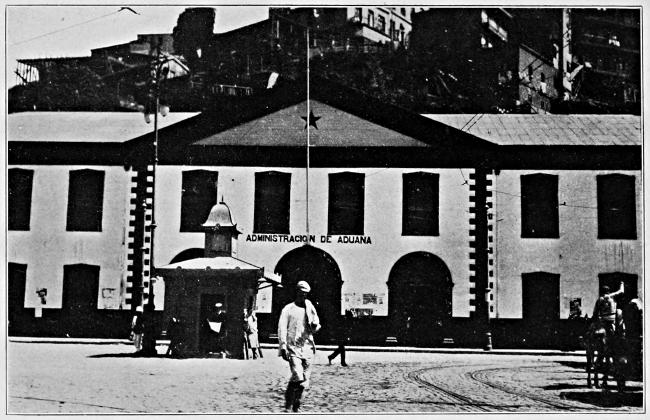
The subjugation and colonization of Chile
was due to two causes. Pedro de Valdivia,
who had distinguished himself in Peru, wanted
an empire for himself, and Francisco Pizarro
was desirous of ridding himself of so formidable
a rival. Valdivia was therefore graciously
permitted to march into and conquer at his
own expense the country south of Peru. After
many months of preparation Valdivia set out
on his expedition with one hundred and fifty
Spaniards, provided with horses and arms,
one thousand Indians, mostly carriers, and a
supply of cattle, pigs, poultry and seeds of
many European plants. Thus equipped this
cavalier set out from Lima, and marched across
the deserts of Arequipa, Tacna, Tarapacá and
Atacama. He reached the central valley of
Chile without the loss of a single Spaniard
through sickness or desertion—a remarkable
record.
The first few years were hard ones for these
colonists. Santiago was founded and made the
capitol. The Indians were hostile, and dissensions
soon arose among Valdivia’s followers.
Several small parties of reinforcements
arrived, but the Spaniards’ position
was always precarious because of the fierce
Araucanians. After Valdivia’s death in 1551,
misfortune followed misfortune in the new
colony. Garcia Hurlado de Mendoza, one of
the viceroys of Peru, succeeded him as governor.
This man was a mere youth with no
experience, and his rule was fraught with
disaster. He established churches and monastic
orders, provided magnificent shows and spectacles,
but did not materially improve the condition
of the colony. Then came Francisco and
Pedro de Villagran and a number of other
governors,—some good and more of them bad.
The colony slowly increased in numbers, but
constant war with the Indians prevented it from
growing rapidly. The coast was swept several
times by Dutch and English pirates. Earthquakes
and plagues reaped their harvests from
the inhabitants. But wealth was increasing.
Thus passed the sixteenth, seventeenth and
part of the eighteenth centuries. It would
be impossible within the limits of this volume
to detail all events, but some of the Indian
wars are mentioned in another chapter.[3] The
usual narrow-sighted policy of Spain toward
all her dependencies was followed, and the local
disaffection grew more acute each year.
It was Voltaire who said that “cruelty leads
to independence.” The colonial system of
Spain in South and Central America, of which
the writer has had occasion to treat before,
was one of selfishness, cruelty and tyranny.
Only the merchants of Cadiz were allowed to
sell goods to the colonists, and the colonists
were permitted to sell their products only to
the same traders, who managed to reap a profit,
owing to the monopoly granted them, of as
much as three hundred per cent. Local human
rights were not recognized by the government
of Spain. It was treason for a man to assert
his freedom, or to seek a free field for his
labour. The natives were compelled to labour
for the conquerors without profit. Imposing
buildings were constructed, cities were encircled
with massive walls, great monasteries,
churches, and convents rose on the hills, all
by the unrequited toil of generations of these
impressed natives. Education was denied, and
the local government, including the church
officials, united in this system of repression
and disregard of human rights.
There was, however, another element which
entered into final independence. For this we
must hark back to Spain for a moment. Charles
IV had resigned his throne in favour of his
son, Ferdinand VII. The colonists accepted
this change because of their loyalty to the
heredity in line of succession, which had to
them a religious as well as political significance.
Charles IV afterwards regretted his abdication
and appealed to Napoleon, who was then
in the height of his power, alleging that the
abdication had not been voluntary. Napoleon
poured troops into Spain, and it was not long
until Ferdinand VII was compelled to yield.
Napoleon then placed his favourite brother,
Joseph, upon the throne of Spain. Joseph was
a well-meaning monarch, a man of far more
principle than his brother, who, perhaps, would
have done well by the colonists, had he been
permitted to work out their destinies. The
colonists, however, felt no loyalty toward him,
and would not recognize his authority. When
Ferdinand VII was finally restored to the
throne after the downfall of Napoleon, he became
a tyrant, and violently opposed all
liberal ideas. The despotism that Napoleon
had overthrown was reestablished. These mistaken
moves on the part of Ferdinand, a period
of a few years during which the Crown had
been opposed, and the free air of America all
had tended to induce a spirit of liberalism and
opposition to monarchy in the New World.
It was not long before Chile was caught in
the same whirl as the rest of the Spanish-American
provinces.
The approach of the end of almost three
centuries of the colonial system in Chile does
not speak well for Spain. Trade was still
restricted. The post-office was a monopoly that
had been farmed out to a private person. A
mail vessel arrived at Montevideo from Spain
once in two months, and from there the mails
were transported across the Andes. There was
a post once a month between Concepción and
Santiago, and twice a week between Santiago
and Valparaiso. Most people used private couriers
or travellers for their despatches. The
only manufactures were the making of brandy
and wine, drying beef and tanning hides.
No city, except Santiago, had more than six
thousand people, and that city had perhaps
thirty thousand. Horse racing, cock-fighting,
bull-fighting and cards were the only amusements.
The buildings were creditable, but the
streets were dirty, unlighted, and unsanitary.
People who went abroad at night had their
servants carry lanterns before them. Vice and
disorder was everywhere. Robbery, brawls
and assassination were frequent. Begging
was an intolerable curse. Titles of nobility
were common, and had been purchased by
many unworthy persons. Decorations of
membership in orders of nobility had been
scattered broadcast. There was not even a
school for girls in Santiago. The majority of
the people still lived in the country in homes
that were without conveniences. They had little
furniture, but all were provided with an oratorio
in which each wandering missionary was
expected to celebrate mass. The Indians were
held in practical slavery, and the landlords
administered justice over their tenants. A
sentimental attachment, and also fear that a
bad condition might be made worse, kept these
poor humans from leaving. Diseases often became
epidemic through the unsanitary conditions,
so that thousands were at times swept
away. Concepción lost a fourth of its population
one year through the ravages of smallpox.
It is probable that at the beginning of the nineteenth
century the total population of Chile,
exclusive of the Araucanian Indians, did not
exceed a half million.
There are two men by the name of O’Higgins
prominent in Chilean history. The first,
Ambrosio O’Higgins, was born in Ireland in
1730, of humble parentage. His uncle, a
Spanish priest, sent the youth to South
America, and he finally landed in Chile. He
first became a trader and peddler, and then
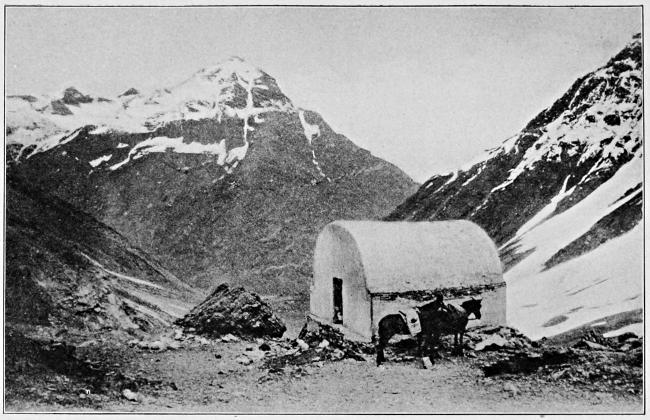
an engineer. During this latter employment
he built the casuchas, as the rest houses in the
Uspallata pass are called. He also distinguished
himself in fights with the Indians, so
that he received government recognition. Plain
Ambrose became Don Ambrosio. Then the
Irish youth, once a ragged, barefooted urchin,
became successively Marquis of Osorno, governor
of Chile, and, finally, Viceroy of Peru.
He died at the age of eighty, in Peru, while he
was filling the latter office. His administration
was marked by indefatigable activity. It was
not until he was sixty-eight years of age that
he became captain-general of Chile, which
position he held for eight years. He introduced
a number of agricultural reforms and set aside
many of the abuses on the plantations. He
constructed a passable road between Valparaiso
and the capitol, where none had hitherto been
built, as the Spaniards were content to ride
on mules and carry their goods the same way.
He improved the road over the Andes via the
Uspallata pass, as trade by this route had
greatly increased. Altogether the things accomplished
by this energetic Irishman were
remarkable; his efforts and talents worked a
great deal of good for Chile and Peru. Had
all the governors and viceroys been men of
similar character history would probably read
differently.
The year 1810 was fraught with direful consequences
for Spain. In that year Hidalgo
sounded the grito of independence in Mexico,
and the memorable assembly met in Buenos
Aires, which was the forerunner of a successful
revolution. The news of the latter event,
which happened on the 25th of May, soon
reached Santiago and fanned the fires of revolution.
On the 18th of September three hundred
and fifty electors met in that city and
elected a junta to take charge of the government.
A quiet submission to the new order of
things followed for a few months. A Congress
was elected and opened with solemn religious
ceremonies and many eloquent speeches. But
jealousies soon arose over the personnel of
the government junta, and several years of conflict
with Spain and internal dissension followed.
The leaders of the patriot forces were
Bernardo O’Higgins, of Irish descent, Lord
Cochrane, an Englishman, and San Martin, an
Argentinian. The disturbing element was contributed
in the main by three brothers, named
Carrera. Though leaders for a while these
brothers, of whom José Miguel Carrera was
the ablest one, all met violent deaths at the
hands of their indignant countrymen.
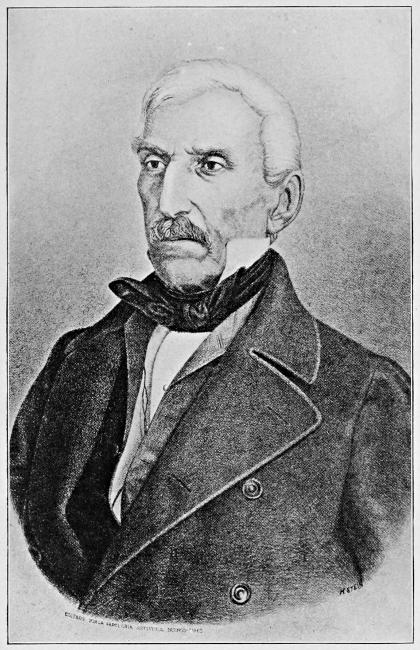
JOSÉ DE SAN MARTIN.
Bernardo O’Higgins was born in Chillan,
Chile, in 1776, an illegitimate son of Ambrosio
O’Higgins. He was educated in England,
where he imbibed republican sentiments. He
returned to Chile a few years before his
father’s death, and immediately identified himself
with the revolutionists. By the year 1813
he was at the head of their forces. He proved
to be a man of wonderful activity, although
not of military training. Troubles between the
Carreras and O’Higgins were unfortunate for
the patriot cause, but the latter was in the
right and the jealousies of the former thwarted
him at every turn. After several years of
possession of the capitol by the revolutionists
the loyalist forces under General Osorio recaptured
Santiago, and O’Higgins was compelled
to flee. The general fled to Mendoza and
there joined General San Martin, who was
greatly impressed by the Irishman. For several
years the destinies of these two men were
linked and intertwined.
José de San Martin was a noble character,
and his life was actuated by unselfish principles.
There was, according to the best accounts, a
moral grandeur in his character, which places
him in the rank of the world’s great leaders
and patriots. No doubt he had his faults, which
may have been serious enough, but his life was
far above his contemporaries, and he has
given us a sample of self abnegation which is
well worth remembering. He gave his sword
to the best interests of the human race, and
when he found that his presence might not serve
the cause of humanity in the nations he had
liberated, he went into exile and poverty.[4]
Here is a pen picture of San Martin written
by one who interviewed him at Lima: “On
the 25th of June I had an interview with
General San Martin on board a little schooner
anchored in Callao Roads. There was little
at first sight in his appearance to engage attention,
but when he arose and began to speak
his great superiority over every other person
I have seen in South America was sufficiently
apparent. He received us in a very simple
style on the deck of his vessel, dressed in a
surtout coat and a large fur cap, seated at a
table made of a few loose planks laid along
the top of two empty casks. Upon this occasion
his views and feelings were decidedly stated.
‘The contest in Peru,’ said he ‘is not a war
of conquest and culture, but entirely of opinion.
It is a war of new and liberal principles against
prejudices, bigotry and tyranny. I do not
want military recognition; I have no ambition
to become conqueror of Peru; I want
solely to liberate the country from oppression.’”
In 1822 San Martin decided that he wanted
to meet Bolivar. A meeting was arranged between
the two to take place at Guayaquil, on
the coast of Ecuador. Bolivar had driven the
Spaniards from Venezuela, Colombia and
Ecuador, but had not proceeded farther south.
San Martin wished to cooperate with him in
the subjugation of Peru. Bolivar came to the
city with some fifteen hundred men, and entered
the city under arches of triumph. San Martin
arrived by sea on a little vessel called the
Macedonia. He landed and passed through
files of soldiers who had been drawn up to
do him honour. When the two heroes met
they embraced, entered the house arm in arm
and were left alone. What actually occurred
no one knows, as neither of the principals ever
revealed the conversation. It is known, however,
from subsequent events, that San Martin
decided upon self abnegation, which, he believed,
would be best for the cause of liberty.
A great ball was given to the two heroes, which
was preceded by a banquet. Bolivar loved
these festive occasions, but San Martin avoided
them whenever possible.
After his return to Peru San Martin wrote
to Bolivar as follows: “My decision is irrevocable.
I have convened the Congress of
Peru; the day after its meeting I shall leave
for Chile, believing that my presence is the
only obstacle that keeps you from going to Peru
with your army.”
Upon his resigning his office San Martin
delivered a speech, of which the following is
a part. “I have witnessed the declaration of
independence of the states of Chile and Peru.
I hold in my possession the standard which
Pizarro brought to enslave the empire of the
Incas. I have ceased to be a public man. Thus
I am more than rewarded for ten years spent
in revolution and warfare. My promises to the
countries in which I warred are fulfilled—to
make them independent and leave to their
will the elections of the governments. The
presence of a fortunate soldier, however disinterested
he may be, is dangerous to newly
constituted states. I am also disgusted with
hearing that I wish to make myself a sovereign.
Nevertheless, I shall always be ready to make
the last sacrifice for the liberty of the country,
but in the class of the private individual, and
no other. With respect to my public conduct,
my compatriots (as is generally the case) will
be divided in their opinions. Their children
will pronounce the true verdict. Peruvians!
I leave your national representation established.
If you impose implicit confidence in
it, you will triumph. If not, anarchy will
swallow you up. May success preside over
your destinies, and may they be crowned with
felicity and peace!”
There were at least five great battles that
decided the liberty of South America. One
of the greatest of these was that of Maipo,
or Maipu, which was fought on Chilean soil.
Although this battle lasted only a few hours,
it was the result of years of careful preparation
by San Martin. In 1814 San Martin, who was
then in Buenos Aires, decided that the best
way to free Argentina was to drive the
Spaniards from the West Coast, as that was
the principal seat of their power. He accordingly
sought the governorship of the province
of Cuyo, which bordered on Chile, and repaired
there to begin his real preparation. The junta,
that governed Buenos Aires, gave him a small
body of troops, which San Martin had already
drilled and made effective soldiers. To these
were added Chilean exiles, slaves who had been
freed, and others whom he could gather at
Mendoza, in the foothills of the Andes, which
was his capitol. For two years he trained
these men, gathered his artillery and ammunition
and made his preparation to cross the
passes of the Andes. No detail had been
omitted by this careful organizer. To no one
did he reveal his plans until he was ready for
the start, then his army, which numbered about
four thousand, was divided into two bodies,
which proceeded through different passes
across the border into Chile. More than seven
thousand mules had been collected for the
soldiers to ride, and every mule was shod.
Specially designed sledges had been constructed
on which to carry the guns. Jerked beef,
parched corn and other supplies had been prepared
for food in large quantities.
The lonely and desolate passes of the mountains
suddenly disgorged a well-equipped and
disciplined army on Chilean soil. The royalist
forces were taken by surprise, although reports
had from time to time reached the commander.
General Maroto concentrated his forces on the
ridge of Chacabuco, whose yellowish-brown
hills are almost devoid of vegetation. There
was no definite road over this ridge, which consisted
of an intricate complexity of steep-sided
little valleys, or barrancas. General San
Martin divided his forces, the command of one
section being given to O’Higgins. Both sections
attacked the Spanish forces vigorously, and the
latter soon gave way through the very force
of the onslaught.
O’Higgins formed his infantry in a solid
column, and with drums beating, advanced
against the enemy’s front. The men were
greatly fatigued by their march, and the sun
was beating down fiercely. After a slight repulse
O’Higgins and his infantry made a bayonet
charge. The shock was terrible, and the
Spanish lines first wavered and then broke and
ran. The defeat was decisive for the royalist
forces. The Spaniards left two-thirds of their
number on the field of battle or in the hands
of the victors. The loss of San Martin was
insignificant, for his casualties did not exceed
one hundred and fifty. The Spanish governor
abandoned Santiago that same night, and
General San Martin and his army entered it
two days later, on the 14th of February, 1817,
in triumph.
When the army reached Santiago a popular
assembly was convened. The dictatorship was
offered to San Martin, but he declined.
O’Higgins was then selected and accepted.
The country, however, was in a deplorable
condition. The new dictator exiled a bishop
and many priests, shut up traitorous women
in convents and began vigorous measures to
preserve order. But the war was not yet
over. Several sanguinary engagements followed.
General Osorio landed with an army at
Talcahuano and slowly proceeded northward.
San Martin and O’Higgins endeavoured to entice
him as far as the river Maule, after the
country had been thoroughly devastated. General
Osorio made an unexpected night attack at
Cancha-Rayada and inflicted a terrible defeat
on the patriotic forces. San Martin retreated
in good order, and took up his position along
a ridge of low hills about two miles from
Santiago. Osorio established himself on a
similar ridge. Between the two forces was a
plain about half a mile in width. On this
plain was fought the battle of Maipo on the
5th of April, 1818.
The day was exquisitely beautiful, and the
sky was clear and serene. San Martin opened
with a strong artillery fire from both his right
and left flank. He then ordered a general advance.
The horse grenadiers, who had accompanied
him from Argentina, charged the
Spanish lines furiously. Other battalions
charged the royalist right, which was made up
of veterans of the Peninsular wars. The
Spanish cavalry were driven from the field. San
Martin brought his reserves into action and
the Spaniards began an orderly retreat. They
withdrew to the buildings and walled enclosures
of a hacienda. These were soon broken down
by the patriot guns. The closing scenes were
horrible. The infuriated patriots showed no
mercy, and the patios and gardens were soon
littered with the dead. The result, after several
hours of fierce fighting, was of a most
decisive character. The Spaniards’ loss was
nearly three thousand. The remainder were
flying in every direction, with the enemy in close
pursuit. Osorio finally reached Talcahuano
with only ten men, the remnant of the original
force of five thousand that entered the battle
of Maipo. The revolutionists’ loss was eight
hundred killed and one thousand wounded.
Spain at last realized the strength of her
opposition.
The war for liberty now turns toward Peru.
Soon after the decisive battle of Maipo San
Martin reverted to his original plan to invade
Peru. The junta at Buenos Aires commanded
him to return to Argentina and aid them in
that city. But he refused to be drawn into
the local struggle between the different factions
that were seeking to obtain control of the
government. He began work on his new expedition
with the same careful and methodical
plans to gather about him an effective army
as he had at Mendoza. The survivors of that
army were loyal to their commander, and they
willingly volunteered for this new enterprise.
Others were added, and all were carefully
drilled. Supplies and ammunition were
gathered. It was not until 1820, however, that
San Martin was ready to embark for Peru with
an army of four thousand one hundred men.
This force was conveyed to the Peruvian
coast by the Chilean navy under command of
Lord Cochrane, who played an important part
in driving the Spaniards from this coast and
liberating Chile and Peru from their domination.
The name of Lord Cochrane is an honoured
one in Chile, and the visitor will find numerous
monuments and memorials to that British
soldier of fortune. Thomas Cochrane was the
tenth Earl of Dundonald, and was born in
Armsfield, Scotland, on the 14th of December,
1775. He became a member of the House
of Commons, and was an officer in the royal
navy. One writer says of him: “He was,
after the death of Nelson, the most notable
naval commander in that age of glory.” He
had made a reputation for himself as a daring
officer during the Peninsular War. In 1814
he was accused of spreading a report of the
death of Napoleon, and was fined, and expelled
from the navy and Commons. He was also
sentenced to a year in prison, which he served.
Angered and embittered by what he considered
the unjust treatment of his country,
Lord Cochrane accepted a commission from
the revolutionary party of Chile to take charge
of their little navy. He arrived in that country
on the 28th of November, 1818. For the construction
and equipment of this little fleet
ladies had given their jewels, and even church
plate had been contributed. He arrived in time
to cooperate with San Martin in the movement
that was then being formulated for the advance
against the Spaniards in Peru. Maipo
had already been won. With four little vessels
conveying the transports Cochrane started for
Callao and arrived there safely. The Spanish
gunboats were anchored under the protection
of the batteries on shore. A terrific fire was
opened on the O’Higgins, which was the flagship,
as the other boats were not able to
get within range because of a calm. Cochrane’s
enthusiasm was caught by the crew, and they
successfully withstood the onslaught of several
hundred guns. The Esmeralda, the best ship
of the Spaniards, was captured by strategy.
Cochrane always led his men in person, and
was ever in the midst of the greatest danger.
His courage and recklessness soon won for the
doughty admiral the name of “El Diablo.” He
declared and maintained a blockade of the entire
Peruvian coast. He used fire-ships which
scattered terror amongst the enemy. His
vigorous tactics made his name feared by the
Spaniards and Peruvians, so that the battle
was half won before it was begun. And yet
his crews and officers would be generally considered
unsatisfactory, for they were composed
for the most part of adventurers. He captured
Valdivia by a clever ruse, which was the
strongest fortified place on the Pacific coast.
Cochrane had the misfortune of a bad temper,
and quarrelled with nearly every one in
authority. He could not understand San
Martin’s deliberation in attacking Peru, so that
these two men, both able and honest, could not
work together. He quarrelled with O’Higgins
and others. He drove the Spanish fleet off
the Pacific waters from Guayaquil south. He
cleared the waters of pirates, and to him in
great part was due the emancipation of Chile
and Peru—all of this in two and one-half
years. Cochrane finally left Chile and commanded
the Brazilian navy from 1823-5, which
position he resigned because of charges of insubordination.
He then went to Greece and
commanded their army for two years. Finally
his good name was cleared in England and he
returned to his native country, and had achieved
the high rank of rear-admiral in the British
navy when he died at the ripe old age of
eighty-five.
The victory of Maipo, although won at great
loss, forever settled the Spanish power in Chile.
Absolute independence from Spain was at once
proclaimed. O’Higgins managed to introduce
a few reforms, but the country was still lawless,
disturbed and unsettled. Armed bands of
robbers, calling themselves royalists, attacked
haciendas and villages, and murdered travellers.
The dictator did the best he could and
introduced many reforms in procedure. Even
these improvements seemed to bring discontent.
He was always optimistic, which was not
for the best. Some men in whom he placed
confidence betrayed it. The priests were insidious
in their preaching, as they favoured the
royalty. The Indians were incited to rebellion
whenever possible.
Traitors arose among the malcontents. Others
were jealous of O’Higgins. San Martin
and Lord Cochrane were both appointed to
head the opposition, but each declined. One
General Freire consented. An assembly was
convened, which the dictator attended. After
a stormy scene O’Higgins resigned his office
rather than plunge the country into civil war.
The withdrawal of his firm but kindly hand
was a great loss to Chile. He went to Peru,
where he died an exile at Lima in 1842.
The long struggle with Spain had accustomed
the Chileans to military service, and the
control of the country naturally fell into the
hands of the military element. Once the common
danger disappeared, intrigue and personal
ambition ran riot and led to a condition of
affairs bordering on anarchy. Chile, however,
never acquired the revolutionary habit to such
an extent as its neighbours, for there was a
powerful landed aristocracy whose interests
lay in the cultivation of the soil, for which
peace was necessary. Anarchy lasted only for
a few years, and then followed four decades
during which time four successive presidents
ruled the country for two terms of five years
each.
After the resignation of O’Higgins, in January,
1823, Congress offered the dictatorship
to General Freire, who was then marching
against the capital with a considerable force.
A constitution was promulgated, but it proved
to be only so much waste paper, for Freire
soon suspended it. He quarrelled with the
Church authorities, banished the Bishop of
Santiago and issued decrees confiscating ecclesiastical
property. Congress was dissolved. A
new election was ordered, but only a few members
were chosen. Political confusion followed,
but another Congress was elected that limited
the dictator’s powers. He maintained his position
only by the use of sheer force.
In 1826 Freire succeeded in driving the
Spaniards from the island of Chiloé, which was
their last stronghold. This victory temporarily
strengthened his prestige somewhat,
although the liberals were daily becoming
stronger. A financial crisis was impending as
the expenses exceeded the revenues. Freire
was temporarily replaced by Manuel Blanco
Encalada. But things became worse and Freire
was recalled. This restoration lasted only a
few months when he resigned in favour of General
Pinto. Pinto succeeded for a while in
suppressing the disturbances, and endeavoured
to introduce some reforms in the army and
finances. A new Congress wrestled with the
constitutional problem. Rivalries among the
leaders were too much for him. It was too
easy for the aristocratic landlords to get up an
army from among their peons, or inquilinos.
A whole series of presidents and dictators followed
in the next couple of years. Social as
well as political anarchy reigned supreme.
Disorders were prevalent, robberies occurred
daily and life was unsafe.
Order was gradually coming out of chaos,
however, for peace began to appear above the
political horizon. With the battle of Lircay
the conservatives, under General Prieto and
Bulnes, won a decisive victory over the other
elements. Freire fled and a horrible slaughter
followed, for the victors were merciless. Freire
himself and his partisans were banished to
Peru, and his sympathizers removed from the
army.
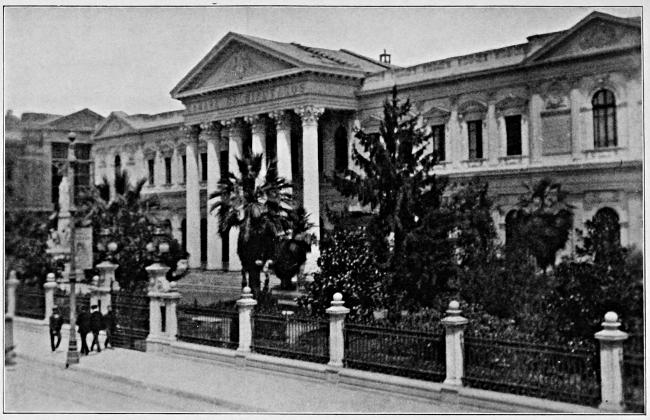
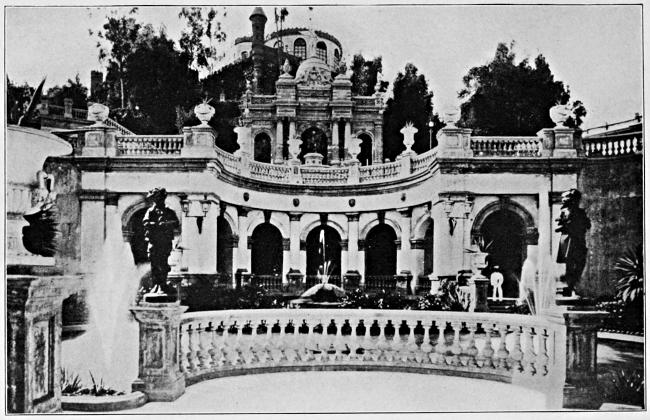
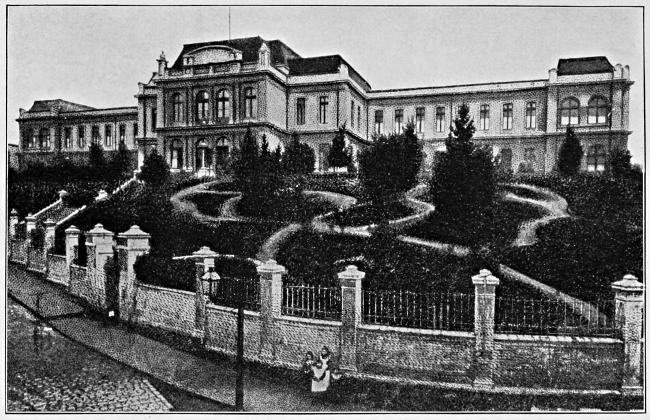
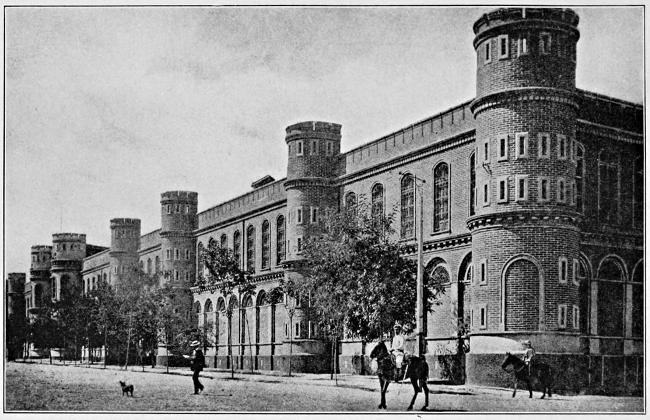
CONGRESS PALACE, SANTIAGO.
At the election in 1831, General Don Joaquin
Prieto was chosen chief magistrate. Although
he owed his elevation to the military power,
the new President did not attempt the role of
dictator at first. He was ably seconded by his
chief cabinet officer, Señor Portales, one of the
ablest statesmen that Chile has produced.
After two years of careful preparation a
new constitution was promulgated in 1833.
Although it has been amended from time to
time to meet new conditions, just as has our
own constitution, this instrument has remained
the fundamental law of the land. It gave to
Chile a strong and stable government. The
foundation of the government, under the franchise
conditions, was the property-holding
class. Political power originated in an oligarchy
which obtained control of Congress.
Although such a possibility was not designed
in the constitution, it gradually developed a
government by dictators. This was due to the
turbulent character of the people. Extraordinary
powers were granted from time to time
in order to suppress revolutionary outbreaks.
These powers included the right to suspend
the constitutional guarantees, to imprison and
exile political suspects without trial, and to
adopt such other arbitrary measures as the
executive might deem advisable. All of these
powers were invoked by President Prieto before
the end of his first term.
As there was no constitutional inhibition
against a second term Prieto was reelected in
1836, and Portales retained his portfolio. All
branches of the government had been reformed
over the former chaotic conditions, and industrial
progress had been rapid. The credit of
the country was good, and interest was paid
promptly. Life in the new republic, however,
was not dull. It was sometimes necessary to
put down disorders with a firm hand. Opponents
were banished without mercy. Peru
seemed to have favoured those who sought
refuge on her soil, and war was declared
against that republic. Several battles were
fought, and Chile captured the entire Peruvian
navy, consisting of three vessels. Portales was
killed, and a serious repulse finally compelled
Prieto to make peace. This caused trouble at
home, and it gave Prieto’s enemies a chance to
denounce the war and its outcome. A new expedition
was sent against Peru under General
Bulnes, and this expedition was successful.
The Bolivian-Peruvian dictator was overwhelmingly
defeated, and this success made
Chile the dominant power on the Pacific
Coast, a position which it has retained ever
since.
At the election in 1841 General Manuel
Bulnes was chosen president. He was a very
distinguished soldier. Owing to his training
as a soldier, President Bulnes had little idea
of any method of administration other than by
force. His course toward political opponents
was severe, and all attempts to dispute his
authority were crushed with an iron hand.
Nevertheless, during the ten years administration
of Bulnes, prosperity made great strides
and Chile became a nation of influence and
importance. The growth of the customs revenues
placed the government finances on a
sound footing. The President fostered education
and other reforms. A more liberal religious
atmosphere began to grow up. Mines
were discovered and opened. The Liberals
began to be more numerous, but Bulnes was
outspoken in his opposition to them. In spite
of their opposition he succeeded in selecting
Manuel Montt as his own successor in 1851.
The new President was a civilian and had
been a member of the Supreme Court, and
many reforms were expected from him. More
would probably have been granted by him, for
his standing was of the highest, had not a
serious disturbance broken out just a few days
after his inauguration. The headquarters of
the revolutionists were at Concepción. Proceeding
toward the capital they won several
small victories. The decisive battle of Loncomilla
followed, however, in which the government
was victorious, but not until five thousand
Chileans had lost their lives in this internecine
warfare. Peace and general amnesty followed
this victory, and equilibrium was quickly established.
Montt welcomed liberals among his
followers. A number of administrative reforms
were adopted, although the liberal program
was strenuously opposed. New treaties with
the leading commercial nations were negotiated.
Nevertheless the policy of centralizing
the entire government with the bureaucracy of
Santiago was followed up. Many leading liberals
were exiled. During his second term
Montt attempted to grant a greater degree of
political liberties, but insurrections broke out
in the north and south, and there was bloody
rioting in Valparaiso. This led to a renewal
of drastic measures. Montt finally came into
open rupture with Congress, because it favoured
the return of his political enemies,
among whom were some of the ablest men in
the republic. The clergy were angry because
they were compelled to submit their decisions to
the civil tribunals. He became more and more
dictatorial in his methods. Newspapers were
suppressed, meetings dispersed, and agitators
imprisoned. President Montt succeeded in
putting down the various insurrections. In
spite of defeat on the field of battle the liberals
in fact won a victory, for their cause was forced
on the government. It was obliged to make
some concessions in order to prevent a renewal
of the conflict. The government was in this
condition when Montt’s second term reached
an end in 1861.
José Joaquin Perez, a man of high personal
prestige, was unanimously chosen as Montt’s
successor. From the very commencement of
his administration Chile began to enjoy a freedom
unknown in the preceding thirty years.
Criticism of the government was encouraged,
instead of being treated as a crime to be punished
by imprisonment or banishment. The
policy of President Perez was one of conciliation,
in order to unite the discordant elements.
A law was at once passed granting amnesty to
political offenders. The extraordinary powers
heretofore granted to dictatorial presidents
was not even asked for by Perez, nor did he
need it. Railroads were opened up, and colonists
began to come in. Fierce parliamentary
struggles over certain reform measures followed
in Congress, and there were many
changes of ministry.
The only serious disturbance of the Perez
administration was a brief war with Spain,
which occurred in 1864-5. The dispute was
primarily between Spain and Peru, but Chile
took the part of the latter, for fear that Spain
might seek to reestablish her authority in
South America. As a result Valparaiso was
blockaded by the Spaniards and bombarded.
Millions of dollars worth of property were
destroyed in a few hours, but the Chileans
would not yield and grant the apology demanded.
Public feeling ran very high for a
few months. Chile had only one war-ship, but
this boat captured a Spanish gunboat. This so
humiliated the Spanish commander, Admiral
Pareja, that he suicided. Although the war
did not officially end for many years, nothing
hostile was done by Spain after the bombardment
of Valparaiso. Perez was reelected as a
matter of course in 1866, and finished his second
term. Pressure for amendments to the
constitution had become very strong, for the
foreign influences were becoming noticeable.
A measure was passed forbidding a president
to be reelected to succeed himself, and this
marks an important step in the evolution of
political ideals. A desperate effort was made
to enfranchise all who could read and write.
This measure, although favoured by Perez, was
defeated, but the property qualification was
greatly reduced. In every way the two administrations
of President Perez marked the beginning
of a new era in Chilean affairs. The
rights of the people began to receive greater
consideration from politicians.
The election of 1871 was hotly contested.
The liberals were very aggressive. The conservatives
united with the moderates, and
Federico Errázuriz, an astute politician, was
chosen. This election practically marks the
elimination of the conservatives as an important
element for several presidential terms.
It was not long after this election until more
radical elements controlled Congress, and
Errázuriz sided with the liberals in their program
of reforms. The great issue was the
amenability of the clergy to the civil law. The
anti-clerical party forced through this law, and
made concessions to Protestant worship. The
requirement of obligatory teaching of the Catholic
religion in the public schools was greatly
modified. The Archbishop promptly excommunicated
all who voted for these laws, and the
breach between the liberals and clericals was
further widened. The administration of President
Errázuriz was marked by considerable
internal improvement and the beginning of a
greater navy, which was soon to be very useful.
Political reforms went forward with increasing
momentum, but not without the usual results.
As soon as the liberals had things in their
power, the various factions into which they
were divided began to intrigue among themselves
for congressional majorities. Material
prosperity had continued until the great world
panic of 1873. The government customs fell
and financial troubles followed, but the debt
was successfully refunded. One of the most
remarkable features of this administration was
that the same Prime Minister held his office
during the entire term of four years without
interruption.
The election of 1876 brought out several
candidates. In former years the retiring President
had practically selected his successor.
More liberal ideas now prevailed, and the Chileans
were called upon to decide for themselves
who should be their chief magistrate. There
were three active candidates, among whom was
Señor Anibal Pinto, who was nominated by the
moderates and elected. President Pinto was a
man of studious habits and a strong advocate
of peaceful measures. And yet this man of
peace was called upon to preside over the
nation during one of its most severe trials.
Never did he falter, even when war became
necessary, and never did he waver in his determination
to protect Chilean interests.
The dispute with Argentina over the southern
boundary had by this time become acute.
Public feeling in both republics had reached
such a stage that peace was threatened. A
previous treaty had declared that the boundary
should be the same as in colonial times. This
was hazy and uncertain, because that section
had been and still was uninhabited. No one
had ever been concerned about it. Chile had
always claimed the Andes to the east and Cape
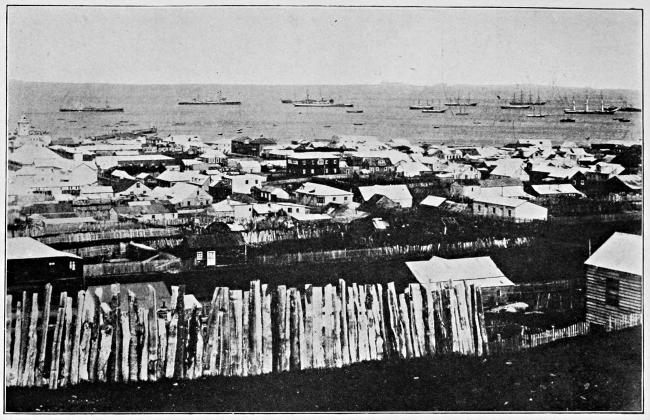
Horn to the south. Punta Arenas had been
founded thirty-five years previously without
serious opposition from Argentina. For years
this controversy continued between the two
countries, but impending war with Peru hastened
a treaty. The territorial limitations
were finally decided upon and Chile practically
got all that she had contended for. Chile obtained
practical control of both ends of the
Straits, although the channel was declared
neutral and neither nation can erect any fortifications
along it.
A severe economic crisis, due to the depression
in the mining industry, also disturbed this
administration, but this situation was met as
well as it could be. But all the troubles of
President Pinto pale before the sanguinary war
conducted against the combined forces of Peru
and Bolivia, in which the lives of twenty thousand
of his subjects were sacrificed.