The editor of a London literary journal was recently
inviting men and women in prominent positions in
public life to name for publication the books of their
childhood. So far as I observed, none of the half-hundred
or more who responded gave Blue Beard,
Cinderella, Little Red Riding Hood, or any of the others
in the same category that follow here. But I am none
the less convinced that these old-time favourites, not
yet unknown, though familiar to city children in the
present generation mainly in their variegated and fantastic
Christmas pantomime form, were in Scotland and
England alike in the last century more essentially the
books of childhood than any others known and read
beyond the walls of the school-room. The travelling
stationers and packmen carried them in their thousands,
in chapbook form, into even the most remote parts of
the country, where they were bartered for and explored
with avidity. In many quarters, indeed, they were so
familiar fifty years ago that the books on occasions
could be dispensed with, and the elder members of
families would recite the stories from memory for the
delectation of the younger fry, when all foregathered in
a crescent before the kitchen fire to wear out the long
winter evenings. In this manner, under the dim-flickering
light of an "oilie cruizie," in a straggling
village in Perthshire, did I learn first of Blue Beard and
Jack the Giant Killer, and many another hero of chapbook
literature. And my experience, I am sure, was by
no means singular. Rather, I feel certain that while
telling thus my own, I am expressing no less truly the
experience of many thousands of men and women now
beyond middle life who similarly were born and bred in
any rural parish in Scotland. And, oh, the weird
fascination of it all! There was no doubting of Blue
Beard's reality; no hesitation in accepting as actual
every extraordinary feat of Jack the Giant Killer.
Both were as real in our innocent imagination as is now
the personality of King Edward the Seventh. It never
occurred to us then, as it does now, that the story of
Blue Beard is only a gory and fantastic parody of the
history of Eden—a temptation, a fall, and a rescue.
And we had no concern about authorship. We did not
know then, as we do now—and as few are yet aware,
perhaps—that Blue Beard, Cinderella, and Little Red
Riding Hood were all written by Charles Perrault, a
celebrated French literateur and poet, who was born in
Paris in 1628, and died there in 1703. And to have
been told, as we have recently been, on authority that
Perrault's Blue Beard—the Comte Gilles de Rais—was
no mere wife-killer (though he was such) but from his
youth upwards, in the fifteenth century, a man of
exquisite culture, and a soldier under Joan of Arc,
would have made for disillusionment so emphatic as to
have shred the tale of a serious amount of its blood-curdling
charm. As I can still enjoy reading them,
it is a real pleasure to embrace here these old-time
examples of child literature. Such as follow—and all
the more popular will be found in the list—are printed
verbatim from the chapbooks now unobtainable, except
at a ransom price—and without individual comment—none
being required.
There was, some time ago, a gentleman who was extremely
rich: he had elegant town and country houses;
his dishes and plates were of gold or silver; his rooms
were hung with damask; his chairs and sofas were
covered with the richest silks; and his carriages were
all magnificently gilt with gold.
But, unfortunately, this gentleman had a blue beard,
which made him so very frightful and ugly, that none
of the ladies in the neighbourhood would venture to go
into his company.
It happened that a lady of quality, who lived very
near him, had two daughters, who were both extremely
beautiful. Blue Beard asked her to bestow one of them
upon him in marriage, leaving to herself the choice
which of the two it should be.
They both, however, again and again refused to
marry Blue Beard; but to be as civil as possible, they
each pretended that they refused because she would not
deprive her sister of the opportunity of marrying so
much to her advantage. But the truth was, they could
not bear the thought of having a husband with a blue
beard: and, besides, they had heard of his having
already been married to several wives, and nobody
could tell what had afterwards become of them.
As Blue Beard wished very much to gain their
favour, he invited the lady and her daughters, and
some ladies who were on a visit at their house, to
accompany him to one of his country seats, where they
spent a whole week, during which nothing was thought
of but parties for hunting and fishing, music, dancing,
collations, and the most delightful entertainments. No
one thought of going to bed, and the nights were
passed in merriment of every kind.
In short, the time had passed so agreeably, that the
youngest of the two sisters began to think that the
beard which had so much terrified her was not so very
blue, and that the gentleman to whom it belonged was
vastly civil and pleasing.
Soon after they returned home, she told her mother
that she had no longer any objection to accept Blue
Beard as her husband; and, accordingly, in a short time
they were married.
About a month after the marriage had taken place,
Blue Beard told his wife that he should be obliged to
leave her for a few weeks, as he had some business to
do in the country. He desired her to be sure to procure
herself every kind of amusement, to invite as many of
her friends as she liked, and to treat them with all sorts
of delicacies, that the time might pass agreeably during
his absence. "Here," said he, "are the keys of the two
large wardrobes. This is the key of the great box that
contains the best plate, which we use for company;
this belongs to my strong box, where I keep my money;
and this to the casket in which are all my jewels. Here
also is a master key to all the apartments in my house—but
this small key belongs to the closet at the end of
the long gallery on the ground floor. I give you leave,"
continued he, "to open or do what you like with all
the rest excepting this closet: this, my dear, you must
not enter, nor even put the key into the lock, for all the
world. Should you disobey me, expect the most dreadful
of punishments."
She promised to obey his orders in the most faithful
manner; and Blue Beard, after tenderly embracing her,
stepped into his carriage and drove away.
The friends of the bride did not, on this occasion,
wait to be invited, so impatient were they to see all the
riches and magnificence she had gained by marriage,
for they had been prevented from paying their wedding
visit by their aversion to the blue beard of the bridegroom.
No sooner were they arrived than they impatiently
ran from room to room, from cabinet to cabinet, and
then from wardrobe to wardrobe, examining each with
the utmost curiosity, and declaring that the last was
still richer and more beautiful than what they had seen
the moment before. At length they came to the
drawing-rooms, where their admiration and astonishment
were still increased by the costly splendour of
the hangings, of the sofas, the chairs, carpets, tables,
girandoles, and looking-glasses, the frames of which
were silver gilt, most richly ornamented, and in which
they saw themselves from head to foot.
In short, nothing could exceed the magnificence of
what they saw; and the visitors did not cease to extol
and envy the good fortune of their friend, who all this
time was far from being amused by the fine compliments
they paid her, so eagerly did she desire to see
what was in the closet her husband had forbidden her
to open. So great indeed was her curiosity, that,
without recollecting how uncivil it would be to leave
her guests, she descended a private staircase that led to
it, and in such a hurry, that she was two or three times
in danger of breaking her neck.
When she reached the door of the closet, she stopped
for a few moments to think of the charge her husband
had given her, and that he would not fail to keep his
word in punishing her very severely, should she disobey
him. But she was so very curious to know what was
in the inside, that she determined to venture in spite
of everything.
She, accordingly, with a trembling hand, put the key
into the lock, and the door immediately opened. The
window shutters being closed, she at first saw nothing;
but in a short time she perceived that the floor was
covered with clotted blood, on which the bodies of
several dead women were lying. These were all the
wives whom Blue Beard had married and murdered,
one after another. She was ready to sink with fear,
and the key of the closet door, which she held in her
hand, fell on the floor. When she had somewhat recovered
from her fright, she took it up, locked the
door, and hastened to her own room, that she might
have a little time to get into humour for amusing her
visitors; but this she found impossible, so greatly was
she terrified by what she had seen.
As she observed that the key of the closet had got
stained with blood in falling on the floor, she wiped it
two or three times over to clean it; still, however, the
blood remained the same as before; she next washed
it, but the blood did not stir at all; she then scoured it
with brickdust, and afterwards with sand, but notwithstanding
all she could do the blood was still there, for
the key was a fairy, who was Blue Beard's friend, so
that as fast as she got it off on one side, it appeared
again on the other.
Early in the evening Blue Beard returned home, saying
he had not proceeded far on his journey before he
was met by a messenger who was coming to tell him
that his business was happily concluded without his
being present, upon which his wife said everything she
could think of, to make him believe she was transported
with joy at his unexpected return.
The next morning he asked for the keys: she gave
them to him; but as she could not help showing her
fright, Blue Beard easily guessed what had happened.
"How is it," said he, "that the key of the closet upon
the ground floor is not here?"
"Is it not? Then I must have left it on my dressing-table,"
said she, and left the room in tears.
"Be sure you give it to me by and by," cried Blue
Beard.
After going several times backwards and forwards,
pretending to look for the key, she was at last obliged
to give it to Blue Beard. He looked at it attentively,
and then said, "How came the blood upon the key?"
"I am sure I do not know," replied the lady, turning
at the same time as pale as death.
"You do not know," said Blue Beard sternly; "but
I know well enough. You have been in the closet on
the ground floor. Very well, madam; since you are
so mightily fond of this closet, you shall certainly take
your place among the ladies you saw there."
His wife, almost dead with fear, fell upon her knees,
asked his pardon a thousand times for her disobedience,
and entreated him to forgive her, looking all the time
so very sorrowful and lovely, that she would have
melted any heart that was not harder than a rock.
But Blue Beard answered, "No, no, madam; you
shall die this very minute!"
"Alas!" said the poor trembling creature, "if I
must die, allow me, at least, a little time to say my
prayers."
"I give you," replied the cruel Blue Beard, "half a
quarter of an hour; not one moment longer."
When Blue Beard had left her to herself, she called
her sister; and after telling her, as well as she could
for sobbing, that she had but half a quarter of an hour
to live: "Pr'ythee," said she, "sister Ann" (this was
her sister's name), "run up to the top of the tower, and
see if my brothers are yet in sight, for they promised
to come and visit me to-day; and if you see them
make a sign for them to gallop as fast as possible."
Her sister instantly did as she was desired, and the
terrified lady every minute called out to her, "Ann!
sister Ann! do you see any one coming?"
And her sister answered, "I see nothing but the sun,
which makes a dust, and the grass which looks green."
In the meantime, Blue Beard, with a great scimitar
in his hand, bawled as loud as he could to his wife,
"Come down instantly, or I will fetch you."
"One moment longer, I beseech you," replied she;
and again called softly to her sister, "Sister Ann, do
you see any one coming?"
To which she answered, "I see nothing but the sun,
which makes a dust, and the grass which looks green."
Blue Beard now again bawled out, "Come down, I
say, this very moment, or I shall come and fetch you."
"I am coming; indeed, I will come in one minute,"
sobbed his unhappy wife. Then she once more cried
out, "Ann! sister Ann! do you see any one coming?"
"I see," said her sister, "a cloud of dust a little to
the left."
"Do you think it is my brothers?" continued the
wife.
"Alas! no, dear sister," replied she; "it is only a
flock of sheep."
"Will you come down or not, madam?" cried Blue
Beard, in the greatest rage imaginable.
"Only one single moment more," answered she.
And then she called out for the last time, "Sister
Ann! do you see any one coming?"
"I see," replied her sister, "two men on horseback
coming to the house: but they are still at a great
distance."
"God be praised!" cried she, "it is my brothers;
give them a sign to make what haste they can."
At the same moment Blue Beard cried out so loud
for her to come down, that his voice shook the whole
house.
The poor lady with her hair loose, and her eyes
swimming in tears, instantly came down, and fell on
her knees to Blue Beard, and was going to beg him to
spare her life, but he interrupted her, saying, "All this
is of no use at all, for you shall die;" then seizing her
with one hand by the hair, and raising the scimitar he
held in the other, was going with one blow to strike off
her head.
The unfortunate creature turning towards him, desired
to have a single moment allowed her to recollect
herself.
"No, no," said Blue Beard, "I will give you no more
time, I am determined—you have had too much
already;" and again raised his arm—Just at this
instant a loud knocking was heard at the gates, which
made Blue Beard wait for a moment to see who it was.
The gates were opened, and two officers dressed in
their regimentals entered, and, with their swords in
their hands, ran instantly to Blue Beard, who, seeing
they were his wife's brothers, endeavoured to escape
from their presence; but they pursued and seized him
before he had gone twenty steps, and plunging their
swords into his body, he immediately fell down dead at
their feet.
The poor wife, who was almost as dead as her
husband, was unable at first to rise and embrace her
brothers. She soon, however, recovered; and as Blue
Beard had no heirs, she found herself the lawful possessor
of his great riches.
She employed a portion of her vast fortune in giving
a marriage dowry to her sister Ann, who soon after
became the wife of a young gentleman by whom she
had long been beloved. Another part she employed in
buying captains' commissions for her two brothers;
and the rest she presented to a most worthy gentleman,
whom she married soon after, and whose kind treatment
soon made her forget Blue Beard's cruelty.
In days of yore, there lived a widow who had a son
named Jack. Being an only child, he was too much
indulged, and became so extravagant and careless that
he wasted the property which his mother possessed,
until at last there remained only a cow, the chief
support of her and her son.
One day the poor woman, with tears in her eyes, said
to Jack—"O, you wicked child, by your ungrateful
course of life you have brought me to beggary in my
old age; cruel boy! I have not money to buy even a
bit of bread, and we must now sell the cow. I am
grieved to part with her, but I cannot see you starve."
Jack felt some remorse, but having less affection for
the cow than his mother had, he drove her to the
nearest market town, where he met a butcher, who
made a very curious offer for her. "Your cow," said
he, "you young prodigal dog! is worth nothing; you
have starved her until she would disgrace the shambles;
and, as to milk, no wonder that you and your mother
have been starving while you were depending upon
that supply. One ill turn deserves another, and
receives it just as surely as one good turn deserves
another. But you shall not take back the cow to
perish with hunger. I have got some beans in my
pocket; they are the oddest I ever saw, not one of
them being, either in colour or shape, like another; if
you will take them in exchange for the cow, you may
have them."
The silly boy could not conceal the pleasure he felt
at the offer. The bargain was struck, and the cow
exchanged for a few paltry beans. Jack made the best
of his way home, calling to his mother before he
reached the house, thinking to surprise her. When she
saw the beans and heard Jack's story, her patience
quite forsook her; she kicked the beans away in a
passion; they flew in all directions—some were
scattered in the garden. Not having anything to eat,
they both went supperless to bed.
Jack awoke early in the morning, and, seeing something
uncommon in the garden, soon discovered that
some of the beans had taken root and sprung up surprisingly;
the stalks were of great thickness, and had
so entwined that they formed a ladder, nearly like a
chain in appearance.
Looking upwards, he could not discern the top; it
appeared to be lost in the clouds. He tried the beanstalks,
found them firm and not to be shaken. He
quickly formed the resolution of climbing to the top to
seek his fortune, and ran to communicate his intention
to his mother, not doubting but she would be equally
pleased with himself. She declared he should not go;
said it would break her heart if he did—entreated and
threatened, but all in vain.
Jack set out, and, after climbing for some hours,
reached the top of the bean-stalk quite fatigued.
Looking around, he found himself in a strange country.
It appeared to be a desert, quite barren—not a tree,
shrub, house, or living creature to be seen.
Jack seated himself upon a stone, and thought of his
mother; he reflected with sorrow on his disobedience in
climbing the bean-stalk against her will, and concluded
that he must die of hunger.
However, he walked on, hoping to see a house where
he might beg something to eat and drink. Presently a
handsome young woman appeared at a distance. As
she approached, Jack could not help admiring how
beautiful she looked; she was dressed in the most
elegant manner, and had a white wand in her hand, on
the top of which was a peacock of pure gold. While
Jack was looking with the greatest surprise at this
charming female, with a smile of the most bewitching
sweetness, she inquired how he came there? Jack told
how he had climbed up the bean-stalk. She asked him
if he recollected his father? He answered that he did
not; and added that he had inquired of his mother
who or where his father was, but that she avoided
answering him, and even seemed afraid of speaking, as
if there was some secret connected with his father's
history.
The lady replied, "I will reveal the whole story;
your mother must not. But, before I begin, I require
a solemn promise, on your part, to do what I command.
I am a fairy, and if you do not perform exactly
what I desire, you will be destroyed." Jack promised
to obey her injunctions, and the fairy thus addressed
him:—
"Your father was a rich and benevolent man; he
was good to the poor, and constantly relieving them;
he never let a day pass without doing good to some
person. On one particular day in the week he kept
open house, and invited those who were reduced and
had lived well. He always sat at the table with them
himself, and did all he could to render his guests comfortable.
The servants were all happy, and greatly
attached to their master and mistress. Such a man was
soon known and talked of. A giant lived a great many
miles off, who was altogether as wicked as your father
was good; he was envious, covetous, and cruel, but had
the art of concealing these vices.
"Hearing your father spoken of, he formed the
design of becoming acquainted with him, hoping to
ingratiate himself into your father's favour. He
removed quickly into your neighbourhood, caused it to
be reported that he had lost all he possessed by an
earthquake, and found it difficult to escape with his
life; his wife was with him. Your father believed his
story, and pitied him; he gave him apartments in his
own house, and caused him and his wife to be treated
hospitably, little imagining that the giant was meditating
a horrid return for all his favours.
"Things went on in this way for some time, the
giant becoming daily more impatient to put his plan
into execution. At last, an opportunity presented
itself. Your father's house was at some distance from
the sea-shore, but the giant, standing on a hill one
stormy day, observed some ships in distress off the
rocks; he hastened to your father, and requested that
he would send all the people he could spare to relieve
the mariners.
"While the servants were all employed upon this
service, the giant despatched your father by stabbing
him with a dagger. You were then only three months
old, and your mother, upon discovering what had
happened, fainted, but still clasping you in her arms.
The giant, who intended to murder both of you, having
found her in that state, for a short time repented of
the dreadful crime he had committed, and granted your
mother and you your lives, but only upon condition
that she should never inform you who your father was,
nor answer any questions concerning him, assuring her
that, if she did, he would certainly put both of you to
death in the most cruel manner. Your mother took
you in her arms, and fled as quickly as possible.
Having gained your father's confidence, he knew where
to find all his treasure. He and his wife soon carried
off two large chests filled with gold, which they could
not have done unless they had been giants, and, having
set the house on fire in several places, when the servants
returned it was burned quite down to the ground.
"Your poor mother wandered with you a great many
miles from this scene of desolation; fear added to her
haste; she settled in the cottage where you were
brought up, and it was entirely owing to her fear of the
giant that she never mentioned your father to you.
"I became your father's guardian at his birth; but
fairies have laws to which they are subject as well as
mortals. A short time before the giant went to your
father's, I transgressed; my punishment was a suspension
of power for a limited time—an unfortunate circumstance,
as it totally prevented my succouring your
father.
"The day on which you met the butcher, as you
went to sell your mother's cow, my power was restored;
and, as I had been told by Oberon, the King of the
Fairies, how dreadful were the consequences to your
father of my single error, I resolved to take you under
my protection, and to be more circumspect in future.
It was I who secretly prompted you to take the beans
in exchange for the cow.
"By my power the bean-stalk grew to so great a
height, and formed a ladder. I need not add that I
inspired you with a strong desire to ascend the ladder.
"The giant now lives in this country; you are the
person appointed to punish him for all his wickedness.
You will have dangers and difficulties to encounter, but
you must persevere in avenging the death of your
father or you will not prosper in any of your undertakings,
but be always miserable.
"As to the giant's possessions, you may seize on all
you can, for everything he has belongs either to you or
to me; for you must know that, not satisfied with the
gold he carried off from your father, he broke into my
house and stole the two greatest curiosities ever
possessed even by a fairy, and would have killed me as
he did your father, if it could have been possible to kill
a fairy. One thing I desire—do not let your mother
know you are acquainted with your father's history till
you see me again.
"Go along the direct road; you will soon see the
house where your cruel enemy lives. While you do as
I order you, I will protect and guard you; but, remember,
if you disobey my commands a most dreadful
punishment awaits you."
When the fairy had concluded, she disappeared,
leaving Jack to pursue his journey. He walked on till
after sunset, when, to his great joy, he espied a large
mansion. A plain-looking woman was at the door; he
accosted her, begging she would give him a morsel of
bread and a night's lodging. She expressed the
greatest surprise at seeing him, and said it was quite
uncommon to see a human being near the house, for it
was well known that her husband was a large and
powerful giant, and that he would never eat anything
but human flesh, if he possibly could get it; that he
did not think anything of walking fifty miles to procure
it.
This account greatly terrified Jack, but he still
hoped to elude the giant, and therefore he again
entreated the woman to take him in for one night only,
and hide him where she thought proper. The woman
at last suffered herself to be persuaded, for although
she had assisted in the murder of Jack's father and in
stealing the gold, she was of a compassionate and
generous disposition, and took him into the house.
First they entered a fine large hall, magnificently
furnished; they then passed through several spacious
rooms, all in the same style of grandeur.
A long gallery was next; it was very dark, just light
enough to show that, instead of a wall on one side,
there was a grating of iron which parted off a dismal
dungeon, whence issued the groans of those poor
victims whom the cruel giant reserved in confinement
for his own voracious appetite.
Poor Jack was half dead with fear, and would have
given the world to have been with his mother again, for
he now began to fear that he should never see her
more, and gave himself up for lost; he even mistrusted
the giant's wife, and thought she had let him into the
house for no other purpose than to lock him up among
the unfortunate people in the dungeon.
At the farther end of the gallery there was a spacious
kitchen, and a fire was burning in the grate. The good
woman bade Jack sit down, and gave him plenty to eat
and drink. Jack, not seeing anything here to make
him uncomfortable, soon forgot his fear, and was
beginning to enjoy himself, when he was aroused by a
loud knocking at the door, which made the whole house
shake; the giant's wife ran to secure him in the oven,
and then went to let her husband in.
Jack heard him accost her in a voice like thunder,
saying—
"Wife, I smell fresh meat."
"Oh! my dear," replied she, "it is only the people
in the dungeon."
The giant appeared to believe her and walked into
the kitchen, where poor Jack lay concealed, shaking
with fear and trembling in every limb.
At last, the monster seated himself by the fireside,
whilst his wife prepared supper. By degrees Jack took
courage to look at the giant through a small crevice; he
was quite astonished to see what an amazing quantity
he devoured, and thought he never would have done
eating and drinking. When supper was ended, the
giant desired his wife to bring him his hen, which was
one of the curiosities he had stolen from the fairy. A
very beautiful hen was brought, and placed on the
table before him. Jack's curiosity was very great to
see what would happen; he observed that every time
the giant said, "Lay!" the hen laid an egg of solid
gold.
The giant amused himself a long time with his hen;
meanwhile his wife went to bed. At length the giant
fell asleep by the fireside, and snored like the roaring
of a cannon. At daybreak, Jack, finding the giant still
asleep, crept softly out of his hiding-place, seized the
hen, and ran off with her.
He easily found the way to the bean-stalk, and
descended it more quickly than he expected. His
mother was overjoyed to see him, for she concluded he
had come to a shocking end.
Jack was impatient to show his hen, and inform his
mother how valuable it was.
"And now, mother," said Jack, "I have brought
home that which will quickly make us rich; and I hope
to make you some amends for the affliction I have
caused you through my idleness and extravagance."
The hen produced as many golden eggs as they
desired, and so they became possessed of immense
riches.
For some months, Jack and his mother lived very
happily together; but he, recollecting the fairy's commands,
and fearing that if he delayed to avenge his
father's death, she would put her threats into execution,
longed to climb the bean-stalk again and pay the
giant another visit. Jack was, however, afraid to mention
it to his mother, being well assured that she would
endeavour to prevent his going. However, one day he
told her boldly that he must take a journey up the
bean-stalk. She begged and prayed him not to think
of it; she told him that the giant's wife would certainly
know him again, and that the giant would desire
nothing better than to get him into his power, that he
might put him to a cruel death in order to be revenged
for the loss of his hen.
Jack resolved to go at all events; for, being a very
clever fellow, although a very idle one, he had no great
dread of the giant, concluding that, although he was a
cannibal, he must be a very stupid fellow not to have
regained his hen, it being just as easy to come down
the stupendous bean-stalk as to ascend it. Jack, therefore,
had a dress made, not exactly invisible, like that
of his illustrious namesake, the Giant-killer, but one
which so disguised him that even
|
"The mother that him bore
Would not have known her child."
|
In a few mornings after this, he rose very early,
changed his complexion, and, unperceived by any one,
climbed the bean-stalk a second time. He was greatly
fatigued when he reached the top, and very hungry,
for, with his usual thoughtlessness, he forgot to take a
piece of bread in his pocket.
Here we are inclined to remark that, as he had
neither bread nor bacon, he must in his progress have
met with a good supply of beans; but perhaps he never
thought of this resource.
Having rested some time, he pursued his journey to
the giant's mansion. He reached it late in the evening;
the woman was at the door as before. Jack addressed
her, telling a pitiful tale, and requesting that she
would give him some victuals and drink, and also a
night's lodging.
She told him (what he knew before very well) about
her husband's being a powerful and cruel giant; and
also that she one night admitted a poor, hungry, friendless
boy, who was half-dead with travelling; that the
little ungrateful fellow had stolen one of the giant's
treasures, and ever since that her husband had used her
very cruelly, and continually upbraided her with being
the cause of his loss. But at last she consented and
took him into the kitchen, where, after he had done
eating and drinking, she laid him in an old lumber
closet. The giant returned at the usual time, and
walked in so heavily that the house was shaken to the
foundation. He seated himself by the fire, and soon
after exclaimed, "Wife, I smell fresh meat."
The wife replied, "It was the crows which had
brought a piece of raw meat, and left it on the top of
the house."
The giant was very ill-tempered and impatient, continually
crying for his supper, like little Tom Tucker,
and complaining of the loss of his wonderful hen, which
we verily believe he would have eaten, disregarding the
treasures which she produced. Jack therefore rejoiced
that he had not only got possession of the hen, but had
in all probability saved her precious life.
The giant's wife at last set supper on the table, and
when he had eaten till he was satisfied, he said to her—"I
must have something to amuse me, either my bags
of money or my harp." Jack, as before, peeped out of
his hiding-place, and presently his wife brought two
bags into the room, one filled with gold and the other
with silver.
They were both placed before the giant, who began
reprimanding his wife for staying so long. She
replied, trembling with fear, that the bags were so
heavy that she could scarcely lift them, and adding
that she had nearly fainted owing to their weight.
The giant took his bags, and began to count their
contents. First the bag which contained the silver
was emptied, and the contents placed on the table.
Jack viewed the glittering heaps with delight, and
most heartily wished the contents in his own possession.
The giant (little thinking he was so narrowly watched)
reckoned the silver over several times; and, having
satisfied himself that all was safe, put it into the bag
again, which he made very secure.
The other bag was opened next, and the gold pieces
placed on the table. If Jack was pleased at the sight
of the silver, how much more delighted must he have
felt when he saw such a heap of glittering gold?
When the giant had counted over the gold till he was
tired, he put it up, if possible, more secure than he had
put up the silver before; he then fell back on the chair
by the fireside, and fell asleep. He snored so loud that
Jack compared the noise to the roaring of the sea in a
high wind, when the tide is coming in. At last, Jack,
being certain that he was asleep, stole out of his hiding-place
and approached the giant, in order to carry off
the two bags of money; but, just as he laid his hand
upon one of the bags, a little dog, which he had not
perceived before, started from under the giant's chair
and barked at Jack most furiously, who now gave himself
up for lost. But Jack, recollecting that the giant
had left the bones which he had picked at supper, threw
one to the dog, who instantly seized it, and took it into
the lumber closet which Jack had just left.
Finding himself delivered from a noisy and troublesome
enemy, and seeing the giant did not awake, Jack
seized the bags, and, throwing them over his shoulders,
ran out of the kitchen. He reached the door in safety,
and found it quite daylight,
Jack was overjoyed when he found himself near the
bean-stalk; although much incommoded with the
weight of the money bags, he soon reached the bottom,
and immediately ran to seek his mother. He was
greatly shocked on finding her apparently dying, and
could scarcely bear his own reflections, knowing himself
to be the cause. On being informed of Jack's safe
return, his mother gradually recovered. Jack presented
her his two valuable bags, and they lived as happily and
comfortably as ever.
For three years, notwithstanding the comforts Jack
enjoyed, his mind dwelt continually upon the bean-stalk;
for the fairy's menaces were ever present to his
mind, and prevented him from being happy. It was in
vain he endeavoured to amuse himself; he became
thoughtful, and would rise at the dawn of day and view
the bean-stalk for hours together.
His inclination at length growing too powerful for
him, he began to make secret preparations for his
journey, and, on the longest day, arose as soon as it was
light, ascended the bean-stalk, and reached the top.
He arrived at the giant's mansion in the evening, and
found his wife standing, as usual, at the door. Jack
had disguised himself so completely that she did not
appear to have the least recollection of him; however,
when he pleaded hunger and poverty in order to gain
admittance, he found it very difficult indeed to persuade
her. At last he prevailed, and was concealed in the
oven.
When the giant returned, he said, as upon the
former occasions, "I smell fresh meat!" But Jack felt
quite composed, as he had said so before, and had been
soon satisfied; however, the giant started up suddenly,
and, notwithstanding all his wife could say, he searched
all around the room. Jack was ready to die with fear,
wishing himself at home; the giant approached the
oven and put his hand into it; Jack thought his death
was certain.
The giant at last gave up the search and ate a
hearty supper. When he had finished, he commanded
his wife to fetch down his harp. Jack peeped as he
had done before, and saw the most beautiful harp that
could be imagined; it was placed by the giant on the
table, who said, "Play!" and it instantly played of its
own accord without being touched. The music was
very fine; Jack was delighted, and felt more anxious to
get the harp into his possession than either of the
former treasures.
The music soon lulled the giant into a sound sleep.
This, therefore, was the time to carry off the harp. As
the giant appeared to be in a more profound sleep than
usual, Jack soon determined, got out of the oven, and
seized the harp. The harp had also been stolen by the
giant from the fairy.
The giant suddenly awoke and tried to pursue him;
but he had drank so much that he could hardly stand.
Jack ran as fast as he could; in a little time the giant
recovered sufficiently to walk slowly, or rather to reel
after him. Had he been sober, he must have overtaken
Jack instantly; but, as he then was, Jack contrived to
be first at the top of the bean-stalk. The giant called
after him in a voice like thunder, and sometimes was
very near him.
The moment Jack got down the bean-stalk, he ran
for a hatchet. Just at that instant the giant was beginning
to descend, but Jack with his hatchet cut the
bean-stalk close off at the root, which made the giant
fall headlong into the garden, and the fall killed him.
At this instant the fairy appeared; she charged Jack
to be dutiful to his mother, and to follow his father's
good example, which was the only way to be happy.
She then disappeared, after recovering her hen and her
harp, which Jack gave to her most thankfully, having
acquired great riches and revenged the tragical death of
his father.
A great many years ago, there lived in the county of
Norfolk a gentleman and his lady. The gentleman was
brave, generous, and honourable; and the lady gentle,
beautiful, and virtuous; they were beloved by all who
knew them, and were blessed with two children, a boy
and a girl. The boy was only about three years old,
and the girl not quite two, when the gentleman was
seized with a dangerous malady, and the lady, in
attending her beloved husband, caught the contagion.
Notwithstanding every medical assistance, their disorder
daily increased; and, as they expected to be
soon snatched away from their little babes, they sent
for the gentleman's brother, and gave the darlings into
his care.
"Ah! brother," said the dying man, "you see I
have but a short time to live; yet neither death nor
pain can pierce my heart with half so much anguish as
what I feel at the thought of what these dear babes will
do without a parent's care. Brother, they will have
none but you to be kind to them, to see them clothed
and fed, and to teach them to be good."
"Dear, dear brother," said the dying lady, "you
must be father, mother, and uncle too, to these dear
innocent lambs. First, let William be taught to read;
and then he should be told how good his father was.
And little Jane—Oh! brother, it wrings my heart to
talk of her; think of the gentle usage she will need,
and take her fondly on your knee, brother, and she and
William too will pay your care with love."
"How it does grieve my heart to see you, my dear
relatives, in this mournful condition," replied the
uncle. "But be comforted, there may yet be hopes of
your well-doing; but should we have the misfortune to
lose you, I will do all you can desire for your darling
children. In me they shall find father, mother, and
uncle; but, dear brother, you have said nothing of
your wealth."
"H-e-r-e, h-e-r-e, brother," replied he, "is my will,
in which I have provided for my dear babes."
The gentleman and his lady then kissed their
children, and a short time after they both died.
The uncle, after shedding a few tears, opened the
will, in which he found that to William was bequeathed
three hundred pounds a year when he became of age,
and to little Jane five hundred pounds in gold on her
marriage day. But if the children should chance to die
before coming of age, then all their wealth was to be
enjoyed by their uncle. The will of the unfortunate
gentleman next desired that he and his beloved wife
should be buried side by side in the same grave.
The two little innocents were now taken to the house
of their uncle, who, for some time, recollecting what
their parents said so sorrowfully upon their death-bed,
behaved to them with great kindness. But when he
had kept them about a twelvemonth, he by degrees
forgot to think both how their parents looked when
they gave their children to his care, and the promises
he made to be their father, mother, and uncle, all in one.
After a little more time had passed, the uncle could
not help thinking that he wished the little boy and girl
would die, for he should then have all their wealth for
himself; and when he had begun to think this, he went
on till he could not think scarcely of anything else; and
at last, says he to himself, "It will not be very difficult
for me to kill them, as nobody knows anything of the
matter, and then their gold is mine."
When the barbarous uncle had once brought his
mind to kill the helpless little creatures, he was not
long in finding a way to execute his cruel purpose. He
hired two sturdy ruffians, who had already killed many
travellers in a dark, thick wood, at some distance, and
then robbed them of their money. These two wicked
creatures agreed, for a large reward, to do the blackest
deed that ever yet was heard of; and the uncle began
to prepare everything accordingly.
He told an artful story to his wife, of what good it
would be to put the children forward in their learning;
how he had a relation in London who would take the
greatest care of them. He then said to the innocent
children, "Should you not like, my pretty ones, to see
the famous town of London, where you, William, can
buy a fine wooden horse to ride upon all day long, and
a whip to make him gallop, and a fine sword to wear by
your side? And you, Jane, shall have pretty dolls and
pretty pincushions, and a nice gilded coach shall be got
to take you there."
"Oh yes, I will go, uncle," said William.
"Oh yes, I will go, uncle," said Jane.
And the uncle, with a heart of stone, soon got them
ready for their journey.
The unsuspecting little creatures were a few days
after put into a fine coach, and with them the two inhuman
butchers, who were soon to end their joyful
prattle, and turn their smiles to tears. One of them
served as coachman, and the other sat between little
William and little Jane.
When they had reached the entrance to the dark,
thick wood, the two ruffians took them out of the
coach, telling them they might now walk a little way
and gather flowers; and, while the children were
skipping about like lambs, the ruffians turned their
backs on them, and began to consult about what they
had to do.
"In good truth," says the one who had been sitting
all the way between the children, "now I have seen
their cherub faces, and heard their pretty speech, I have
no heart to do the bloody deed; let us fling away the
ugly knife, and send the children back to their uncle."
"That I will not," says the other; "what boots their
pretty speech to us? And who will pay us for being
so chicken-hearted?"
At last the ruffians fell into so great a passion about
butchering the innocent little creatures, that he who
wished to spare their lives suddenly opened the great
knife he had brought to kill them, and stabbed the
other to the heart, so that he fell down dead.
The one who had killed him was now greatly at a
loss what to do with the children, for he wanted to get
away as fast as he could, for fear of being found in the
wood. He was not, however, long in determining that
he must leave them in the wood, to the chance of some
traveller passing by. "Look ye, my pretty ones," said
he, "you must each take hold and come along with
me." The poor children each took a hand and went
on, the tears bursting from their eyes, and their little
limbs trembling with fear.
Thus did he lead them about two miles further on in
the wood, and told them to wait there till he came back
with some cakes.
William took his sister Jane by the hand, and they
wandered fearfully up and down the wood.
"Will the strange man come with some cakes,
Billy?" says Jane.
"Presently, dear Jane," says William.
And soon again, "I wish I had some cakes, Billy,"
said she.
And it would have melted a heart of stone to see
how sorrowfully they looked.
After waiting very long, they tried to satisfy their
hunger with blackberries, but they soon devoured all
that were within their reach; and night coming on,
William, who had tried all he could to comfort his
little sister, now wanted comfort himself; so when Jane
said once more, "How hungry I am, Billy, I b-e-l-i-e-v-e
I cannot help crying," William burst out crying too;
and down they lay upon the cold earth, and putting
their arms round each other's neck, there they starved,
and there they died.
Thus were these pretty little innocents murdered;
and as no one knew of their death, so no one sought to
give them burial.
The wicked uncle, supposing they had been killed as
he desired, told all who asked after them an artful tale
of their having died in London of the smallpox, and
accordingly took possession openly of their fortune.
But all this did him very little service, for soon after
his wife died; and being very unhappy, and always
thinking too that he saw the bleeding innocents before
his eyes, he neglected all his business; so that, instead
of growing richer, he every day grew poorer. His two
sons, also, who had embarked for a foreign land, were
both drowned at sea, and he became completely miserable.
When things had gone on in this manner for years,
the ruffian who took pity on the children committed
another robbery in the wood, and, being pursued by
some men, he was laid hold of and brought to prison,
and soon after was tried at the assizes, and found
guilty—so that he was condemned to be hanged for
the crime.
As soon as he found what his unhappy end must be,
he sent for the keeper of the prison, and confessed to
him all the crimes he had been guilty of in his whole
life, and thus declared the story of the pretty innocents,
telling him at the same time in what part of the wood
he had left them to starve.
The news of the discovery he had made soon reached
the uncle's ears, who, being already broken-hearted by
misfortunes that had befallen him, and unable to bear
the load of public shame that could not but await him,
lay down upon his bed and died that very day.
No sooner were the tidings of the fate of the two
children made public than proper persons were sent to
search the wood; when, after many fruitless endeavours,
the pretty babes were at length found outstretched in
each other's arms, with William's arm round the neck
of Jane, his face turned close to her's, and his frock
pulled over her body. They were covered all over with
leaves, which in all that time never withered; and on
a bush near this cold grave a Robin-Redbreast watched
and chirped—so that many gentle hearts still think
that pretty bird did bring the leaves which made their
grave.
In the reign of King Arthur, near the Land's End of
England, in the County of Cornwall, there lived a
wealthy farmer, who had one only son, commonly
known by the name of Jack. He was brisk, and of a
lively ready wit; so that whatever he could not perform
by strength, he completed by wit and policy.
Never was any person heard of that could worst him;
nay, the learned he baffled by his cunning and ready
inventions.
For instance, when he was no more than seven years
of age, his father sent him into the field to look after
his oxen; a country vicar, by chance one day coming
across the field, called Jack, and asked him several
questions—in particular, How many commandments
were there? Jack told him there were nine.
The Parson replied, "There are ten."
"Nay," quoth Jack, "Master Parson, you are out of
that; it is true there were ten, but you broke one of
them with your own maid Margery."
The Parson replied, "Thou art an arch wag, Jack."
"Well, Master Parson," quoth Jack, "you have asked
me one question, and I have answered it; let me ask
you another. Who made these oxen?"
The Parson replied, "God."
"You are out again," quoth Jack, "for God made
them bulls, but my father and his man Hobson made
oxen of them."
The Parson, finding himself fooled, trudged away,
leaving Jack in a fit of laughter.
In those days the mount of Cornwall was kept by a
huge and monstrous Giant, of twenty-seven feet high,
and three yards in compass, of a grim countenance, to
the terror of all the neighbouring towns. His habitation
was a cave in the midst of the mount; neither
would he suffer any living creature near him; his feeding
was upon other men's cattle; for whensoever he
had occasion for food, he would wade over to the mainland,
where he would furnish himself with whatever he
could find. For the people at his approach would forsake
their habitations; then he would take their cows
and oxen, of which he would make nothing to carry
over his back half-a-dozen at a time; and as for
sheep and hogs, he would tie them round his waist.
This he had for many years practised in Cornwall.
But one day Jack, coming to the Town Hall, when
the Magistrates were sitting in consternation about the
Giant, he asked what reward they would give to any
person that would destroy him?
They answered, "He shall have all the Giant's
treasure in recompense."
Quoth Jack, "Then I myself will undertake the
work."
Jack furnished himself with a horn, a shovel, and a
pick-axe, and over to the mount he goes in the
beginning of a dark winter evening, where he fell to
work, and before morning had digged a pit twenty-two
feet deep and as broad, and covered the same over with
long sticks and straw; then strewed a little mould
upon it, so that it appeared like the plain ground.
This done, Jack places himself on the contrary side
of the pit, just about the dawning of the day, when,
putting his horn to his mouth, he then blew, Tan Twivie,
tan twivie. Which unexpected noise roused the Giant,
who came roaring towards Jack, crying out—"You incorrigible
villain, are you come hither to break my
rest; you shall dearly pay for it; satisfaction I will
have, and it shall be this: I will take you wholly and
broil you for my breakfast."
Which words were no sooner out of his mouth but
he tumbled headlong into the deep pit, which heavy
fall made the very foundation of the mount to shake.
"Oh, Giant! where are you now? Faith, you are
got into Lobb's Pond, where I shall plague you for your
threatening words. What do you think now of broiling
me for your breakfast? Will no other diet serve you
but poor Jack?"
Thus having tantalized the Giant for a while, he gave
him a most weighty knock on the crown of his head
with his pick-axe, so that he immediately tumbled
down, gave a most dreadful groan, and died. This
done, Jack threw the earth in upon him, and so buried
him; then going and searching the cave, he found a
great quantity of treasure.
Now, when the Magistrates who employed him heard
the work was over, they sent for him, declaring that he
should be called Jack the Giant Killer. And in honour
thereof, they presented him with a sword, together with
a fine rich embroidered belt, on which these words were
wrought in letters of gold—
|
"Here's the right valiant Cornish man,
Who slew the Giant Cormillan."
|
The news of Jack's victory was soon spread; when
another huge Giant named Blunderboar, hearing of it,
vowed to be revenged on Jack, if ever it was his
fortune to light upon him. This Giant kept an
enchanted castle, situated in the midst of a lonesome
wood. Now Jack, about four months after, walking
near the borders of the said wood on his journey
towards Wales, grew weary, and therefore sat himself
down by the side of a pleasant fountain, where a deep
sleep suddenly seized on him, at which time the Giant,
coming for water, found him; and, by the line on his
belt, knew him to be Jack that killed his brother, and,
without any words, threw him upon his shoulder to
carry him to his enchanted castle.
Now, as they passed through a thicket, the ruffling
of the boughs awaked poor Jack, who, finding himself
in the clutches of the Giant, was strangely surprised;
for, at the entering within the first walls of the castle,
he beheld the ground all covered with bones and skulls
of dead men, the Giant telling Jack that his bones
would enlarge the number that he saw. This said, he
brought him into a large parlour, where he beheld the
bloody quarters of some who were lately slain, and in
the next room were many hearts and livers, which
the Giant, in order to terrify Jack, told him—"That
men's hearts and livers were the choicest of his diet, for
he commonly ate them with pepper and vinegar, and he
did not question but his heart would make him a
dainty bit." This said, he locks up poor Jack in an
upper room, while he went to fetch another Giant
living in the same wood, that he might partake in the
destruction of poor Jack.
Now, while he was gone, dreadful shrieks and cries
affrighted poor Jack, especially a voice which continually
cried—
|
"Do what you can to get away,
Or you'll become the Giant's prey;
He's gone to fetch his brother, who
Will kill and likewise torture you."
|
This dreadful noise so amazed poor Jack, he was
ready to run distracted; seeing from the window afar
off the two Giants coming, "Now," quoth Jack to himself,
"my death or deliverance is at hand."
There were strong cords in the room by him, of
which he takes two, at the end of which he makes a
noose, and, while the Giant was unlocking the gate, he
threw the ropes over each of the heads, and drawing
the other end across the beam, he pulled with all his
strength until he had throttled them; and then fastening
the rope to the beam, turning towards the window
he beheld the two Giants to be black in their faces.
Sliding down by the rope, he came close to their heads,
where the helpless Giants could not defend themselves;
and, drawing out his sword, slew them both, and
delivered himself from their intended cruelty; then
taking out a bunch of keys, he unlocked the rooms,
where he found three fair ladies tied by the hair of
their heads, almost starved to death, who told Jack
that their husbands were slain by the Giant, and that
they were kept many days without food, in order to
force them to feed upon the flesh of their husbands.
"Sweet ladies," quoth Jack, "I have destroyed this
monster and his brutish brother, by which I have
obtained your liberties." This said, he presented them
with the keys of the castle, and so proceeded on his
journey to Wales.
Jack, having but very little money, thought it
prudent to make the best of his way by travelling
as fast as he could; but, losing his road, was
benighted, and could not get a place of entertainment
until he came to a valley placed between two hills,
where stood a large house in a lonesome place. He
took courage to knock at the gate, and to his great
surprise there came forth a monstrous Giant, having
two heads; yet he did not seem so fiery as the others
had been, for he was a Welsh Giant, and what he did
was by secret malice; for, Jack telling his condition, he
bid him welcome, showing him a room with a bed in it,
whereon he might take his night's repose; therefore,
Jack undressed himself, and, as the Giant was walking
to another apartment, Jack heard him muttering forth
these words to himself—
|
"Though here you lodge with me this night,
You shall not see the morning light;
My club shall dash your brains out quite."
|
"Sayest thou so," quoth Jack; "this is like your
Welsh tricks, yet I hope to be cunning enough for you."
Then, getting out of bed, he put a billet in his stead,
and hid himself in a corner of the room; and, in the
dead time of the night, the Welsh Giant came with his
great knotty club, and struck several blows upon the
bed where Jack had laid the billet, and then returned
to his own chamber, supposing he had broken all the
bones in his body.
In the morning, Jack gave him hearty thanks for his
lodging.
The Giant said to him, "How have you rested?
Did you not feel something in the night?"
"Nothing," quoth Jack, "but a rat which gave me
three or four slaps with her tail."
Soon after the Giant arose and went to breakfast
with a bowl of hasty pudding, containing nearly four
gallons, giving Jack the like quantity, who, being loath
to let the Giant know he could not eat with him, got a
large leathern bag, putting it very artfully under his
loose coat, into which he secretly conveyed his pudding,
telling the Giant he could show him a trick; then,
taking a large knife, he ripped open the bag, which the
Giant supposed to be his belly, when out came the
hasty pudding, at which the Welsh Giant cried,
"Cotplut, hur can do dat trick hurself."
Then, taking his sharp knife, he ripped up his own
belly from the bottom to the top, and out dropped his
tripes and trolly bags, so that he fell down for dead.
Thus Jack outwitted the Giant, and proceeded on his
journey.
About this time King Arthur's son only desired of
his father to furnish him with a certain sum of money,
that he might go and seek his fortune in Wales, where
a beautiful lady lived, whom he heard was possessed
with seven evil spirits; but the King, his father, advised
him utterly against it, yet he would not be persuaded
of it; so he granted what he requested, which was one
horse loaded with money, and another for himself to
ride on. Thus he went forth without any attendants.
Now, after several days' travel, he came to a market
town in Wales, where he beheld a large concourse of
people gathered together; the King's son demanded the
reason of it, and was told that they had arrested a
corpse for many large sums of money which the
deceased owed when he died. The King's son replied,
"It is a pity that creditors should be so cruel; go bury
the dead, and let his creditors come to my lodging,
and their debts shall be discharged." Accordingly,
they came in great numbers, so that he left himself
moneyless.
Now, Jack the Giant Killer being there and seeing
the generosity of the King's son, he was taken with
him, and desired to be his servant; it was agreed upon
the next morning, when riding out at the town-end,
the King's son turning to Jack, said, "I cannot tell
how I will subsist in my intended journey."
"For that," quoth Jack, "take you no care; let me
alone, I warrant you we will not starve."
Now Jack, having a spell in his pocket, which served
at noon for a refreshment, when done they had not one
penny left betwixt them. The afternoon they spent in
travel and discourse till the sun began to grow low, at
which time the King's son said, "Jack, since we have
no money, where can we think to lodge this night?"
Jack replied, "We'll do well enough, for I have an
uncle living within two miles of this; he is a monstrous
Giant with three heads; he will fight five hundred
men in armour, and make them to fly before him."
"Alas!" saith the King's son, "what shall we do
there; he will certainly chop us both up at one
mouthful!"
"It is no matter for that," quoth Jack; "I will go
before and prepare the way for you; tarry here."
He waits, and Jack rides full speed. When he came
to the castle, he knocked with such a force that he
made all the neighbouring hills to resound. The Giant,
with a voice like thunder, roared out, "Who's there?"
Jack answered, "None but your own cousin Jack.
Dear uncle, heavy news, God wot."
"Prithee, what heavy news can come to me? I am
a Giant with three heads, and besides thou knowest I
can fight five hundred men."
"O! but," quoth Jack, "here's the King's son
coming with one thousand men to kill you."
"Oh! Jack, this is heavy news indeed; I have a
large vault underground, where I will hide myself, and
thou shalt lock, bolt, and bar me in, and keep the keys
till the King's son is gone."
Jack, having secured the Giant, he returned and
fetched his master. They were both heartily merry
with the wine and other dainties which were in the
house; so that night they rested in very pleasant
lodgings, whilst the poor uncle, the Giant, lay trembling
in the vault underground.
Early in the morning, Jack furnished his master with
a supply of gold and silver, and set him three miles
forward on his journey, concluding he was then pretty
well out of the smell of the Giant, and then returned to
let his uncle out of the hole, who asked Jack what he
would give him in reward, since his castle was not
demolished.
"Why," quoth Jack, "I desire nothing but the old
Coat and Cap, together with the old rusty Sword and
Slippers, which are at your bed-head."
"Jack, thou shalt have them, and pray keep them
for my sake, for they are things of excellent use. The
Coat will keep you invisible, the Cap will furnish you
with knowledge, the Sword cuts asunder whatever you
strike, and the Shoes are of extraordinary swiftness;
these may be serviceable to you, and therefore pray
take them with all my heart."
Jack takes them, thanking his uncle, and follows his
master.
Jack, having overtaken his master, soon after arrived
at the lady's house, who, finding the King's son to be a
suitor, prepared a banquet for him, and, being ended,
she wiped his mouth with her napkin, saying, "You
must show this to-morrow or lose your head;" and she
put it safely into her bosom.
The King's son went to bed sorrowful, but Jack's
Cap of knowledge instructed him how to obtain it. In
the middle of the night, she called upon her familial-spirit
to carry her to Lucifer. Jack put on his Coat
of darkness, with his Shoes of swiftness, and was there
as soon as she; by reason of his Coat they could not
see him. When she entered the place, she gave the
handkerchief to old Lucifer, who laid it carefully upon
a shelf, from whence Jack brought it to his master, who
showed it to the lady the next day.
The next night she saluted the King's son, telling
him he must show her to-morrow morning the lips that
she kissed last this night, or lose his head.
"Ah!" replied he, "if you kiss none but mine
I will."
"It is neither here nor there," said she; "if you do
not, death's your portion."
At midnight, she went as before, and was angry
with Lucifer for letting the handkerchief go. "But
now," said she, "I will be too hard for the King's son,
for I will kiss thee, and he's to show thy lips." Jack,
standing near him with his Sword of sharpness, cut off
the devil's head, and brought it under his invisible Coat
to his master, who was in bed, and laid it at the end of
his bolster. In the morning when the lady came up,
he pulled it out by the horns and showed her the
devil's lips, which she kissed last.
Thus, having answered her twice, the enchantment
broke, and the evil spirits left her, at which time she
appeared a beautiful and virtuous creature. They were
married next morning in great pomp and solemnity,
and returned with a numerous company to the Court of
King Arthur, where they were received with the
greatest joy and loud acclamations. Jack, for the
many and great exploits he had done for the good of
his country, was made one of the Knights of the
Round Table.
Jack, having resolved not to be idle, humbly
requested of the King to fit him with a horse and
money to travel; "for," said he, "there are many
Giants alive in the remotest parts of the kingdom, to
the unspeakable damage of your Majesty's liege
subjects; wherefore, may it please your Majesty to
give me encouragement to rid the realm of those cruel
and devouring monsters of nature, root and branch."
Now, when the King had heard these noble propositions,
and had duly considered the mischievous practices
of those bloodthirsty Giants, he immediately granted
what Jack requested; and, being furnished with all
necessaries for his progress, he took his leave of King
Arthur, taking with him the Cap of knowledge, Sword
of sharpness, Shoes of swiftness, and likewise the
invisible Coat, the better to perfect and complete the
dangerous enterprises that lay before him.
Jack travelled over vast hills and mountains, when
at the end of three days he came to a large and
spacious wood, where on a sudden he heard dreadful
shrieks and cries; whereupon, casting his eyes around,
he beheld a Giant rushing along with a worthy knight
and his fair lady, whom he held by the hair of their
heads in his hands; wherefore he alighted from his
horse, and then putting on his invisible Coat, under
which he carried his Sword of sharpness, he came up to
the Giant, and, though he made several passes at him,
yet he could not reach the trunk of his body, by reason
of his height, though he wounded his thighs in several
places; but at length, giving a swinging stroke, he cut
off both his legs just below the knee, so that the trunk
of his body made the ground to shake with the force of
his fall, at which the knight and the lady escaped.
Then had Jack time to talk with him, and, setting his
foot upon his neck, said, "You savage and barbarous
wretch, I am come to execute upon you the just reward
of your villainy." And with that running him through
and through, the monster sent forth a hideous groan,
and yielded up his life, while the noble knight and
virtuous lady were joyful spectators of his sudden
downfall and their own deliverance.
This being done, the courteous knight and his fair
lady returned him hearty thanks for their deliverance,
but also invited him home, there to refresh himself
after the dreadful encounter, as likewise to receive
ample reward, by way of gratitude for his good
service.
"No," quoth Jack, "I cannot be at ease till I find
out the den which was this monster's habitation."
The knight hearing this, waxed sorrowful, and
replied, "Noble stranger, it is too much to run a
second risk, for this monster lived in a den under yon
mountain, with a brother of his, more fierce than himself;
therefore, if you go thither and perish in the
attempt, it will be the heartbreaking of both me and
my lady. Let me persuade you to go with us."
"Nay," quoth Jack, "if there were twenty I would
shed the last drop of my blood before one of them
should escape my fury, but when I have finished this
task, I will come and pay my respects to you." So,
taking directions to their habitation, he mounted his
horse, and went in pursuit of the deceased Giant's
brother.
Jack had not rode past a mile before he came in
sight of the cave's mouth, at the entrance of which he
beheld the other Giant sitting upon a huge block of
timber, with a knotty iron club by his side, waiting
for his brother's return with his cruel prey; his goggle
eyes appeared like terrible flames of fire, his countenance
grim and ugly, and his cheeks appeared like a
couple of large flitches of bacon; the bristles of his
head seemed to resemble rods of iron wire; his locks
hung down on his broad shoulders like curled snakes.
Jack alighted from his horse, and put him into a
thicket; then with his Coat of darkness he came near
to behold his figure, and said, "Oh! are you there? It
will not be long before I take you by the beard."
The Giant could not see him by reason of his
invisible Coat: so Jack fetching a blow at his head
with his Sword of sharpness, and missing somewhat of
his aim, cut off the Giant's nose, whose nostrils were
wider than a pair of jack-boots; the pain was terrible;
he put up his hand to feel for his nose, and when he
could not find it he raved and roared louder than
thunder; and though he turned up his large eyes, he
could not see from whence the blow came, nevertheless,
he took up his iron-headed club and began to thrash
about him like one stark mad.
"Nay," quoth Jack, "if you be for that sport, then
I will dispatch you quickly, for fear of an accidental
blow."
Then Jack makes no more to do, but runs his sword
up to the hilt in the Giant's fundament, where he left
it sticking for a while, and stood himself laughing, to
see the Giant caper and dance with the sword in his
body, crying out, "I shall die with the gripping of my
guts."
Thus did the Giant continue raving for an hour or
more, and at length fell down dead.
This being done, Jack cut off both the Giants' heads,
and sent them to King Arthur by a waggoner, whom
he hired for the purpose.
Jack having dispatched these two monsters, resolved
to enter the cave in search of the Giants' treasure. He
passed through many turnings and windings, which led
him at length to a room paved with freestone, at the
upper end of which was a boiling caldron; on the right
hand stood a large table, where the Giants used to
dine. Then he came to an iron gate, where was a
window secured with bars of iron, through which he
looked, and beheld a vast many captives, who, seeing
Jack, said, "Young man, art thou come to be one
among us in this miserable den?"
"Nay," quoth Jack, "I hope I shall not tarry long
here; but what is the meaning of your captivity?"
"Why," said one of them, "we have been taken by
the Giants, and here we are kept till they have a feast,
then the fattest among us is slaughtered for their
devouring jaws. It is not long since they took three
of us for the purpose."
"Say you so," quoth Jack; "well, I have given them
both such a dinner that it will be long enough ere they
need any more. You may believe me, for I have slain
them both, and as for their monstrous heads, I sent
them to the court of King Arthur, as trophies of my
victory."
Then leading them to the aforesaid room, he placed
them round the table, and set before them two quarters
of beef, also bread and wine, so that they feasted there
very plentifully. Supper being ended, they searched
the Giants' coffers, where, finding a vast store of gold,
Jack divided it equally among them. They all returned
him hearty thanks for their treasure and miraculous
deliverance. That night they went to their rest, and
in the morning they arose and departed, to their
respective places of abode, and Jack to the knight's
house.
Jack mounted his horse, and by his direction he
came to the knight's house, where he was received
with all demonstrations of joy, by the knight and his
lady, who, in respect to Jack, prepared a feast which
lasted for many days, inviting all the gentry in the
adjacent parts. He presented him with a ring of gold
in which was engraven by curious art, the picture of
the Giant dragging a distressed knight and his fair
lady by the hair of the head.
Now, there were five aged gentlemen who were
fathers to some of those miserable captives whom Jack
had set at liberty; who immediately paid him their
venerable respects. And the smiling bowl was passed
round in honour of the victorious conqueror, but during
their mirth, a dark cloud appeared, which daunted the
assembly.
A messenger brought the dismal tidings of the approach
of one Thunderfold, a huge Giant with two
heads; who, having heard of the death of his kinsmen,
the above-named Giants, was come in search of Jack,
to be revenged on him for their terrible downfall, and
was within a mile of the knight's seat, the people
flying before him from their habitations.
When they had related this, Jack said, "Let him
come, I am prepared with a tool to pick his teeth, and
you, gentlemen and ladies, walk forth into the garden,
and you shall be the joyful spectators of this monstrous
Giant's death."
To which they consented, wishing him good fortune
in that great enterprise.
The situation of the knight's house was in a small
island encompassed with a vast moat thirty feet deep,
and twenty feet wide, over which lay a drawbridge.
Wherefore Jack employed two men to cut it on both
sides, and then dressing himself in his Coat of darkness,
putting on his Shoes of swiftness, he marched against
the Giant, with his Sword of sharpness ready drawn.
When he came close up, the Giant could not see Jack,
by reason of his invisible Coat. Nevertheless, he was
sensible of approaching danger, which made him cry
out:—
|
"Fe, Fi, Fo, Fum,
I smell the blood of an Englishman.
Be he living, or be he dead,
I'll grind his bones to mix my bread."
|
"Sayest thou so," quoth Jack. "Then thou art a
monstrous miller. But how if I serve thee as I did the
two Giants of late, I should spoil your practice for the
future?"
At which time the Giant spoke with a voice as loud
as thunder. "Art thou that villain which destroyed
my kinsmen? Then I will tear thee with my teeth,
and suck thy blood, I will grind thy bones to powder."
"Catch me first," quoth Jack. And he threw off his
Coat of darkness that the Giant might see him, and
then ran from him as through fear.
The Giant, with glaring eyes, followed after like a
walking castle, making the earth to shake at every
step. Jack led him a dance three or four times round
the moat, that the ladies and gentlemen might take a
full view of this huge monster who followed him, but
could not overtake him by reason of his Shoes of
swiftness.
At length Jack took over the bridge, the Giant with
full speed pursuing after him, with his iron club. But
coming to the middle of the drawbridge, the weight of
his body, and the most dreadful steps which he took, it
broke down, and he tumbled into the water, where he
rolled and wallowed like a whale.
Jack standing at the side of the moat laughed at the
Giant, and said, "You would grind my bones to
powder; you have water, pray, where is your mill?"
The Giant foamed to hear him scoffing at that rate,
though he plunged from place to place in the moat.
Jack at length got a cart rope, and cast it over the
Giant's two heads, with a slip knot, and by the help of
horses he dragged him out again, nearly strangled,
before he would let him loose. He cut off both his
heads with his Sword of sharpness, in the view of all
the assembly of knights and ladies, who gave a shout
when they saw the Giant dispatched. Then before he
would either eat or drink, he sent these heads also to
the court of King Arthur.
After some mirth and pastime, Jack, taking leave of
the noble knights and ladies, set off in search of new
adventures. Through many woods and groves he
passed, till coming to the foot of a high mountain late
at night, he knocked at the door of a lonesome house,
at which a man, with a head as white as snow, arose
and let him in.
"Father," said Jack, "have you any entertainment
for a benighted traveller that has lost his way?"
"Yes," said the old man, "if thou wilt accept of such
as my poor cottage affords, thou shalt be welcome."
Jack returned him thanks; they sat together, and the
old man began to discourse as follows. "Son, I am
sensible thou art the great conqueror of Giants, and it
is in thy power to free this place; for, there is an
enchanted castle, kept by a monstrous Giant, named
Galligantus, who, by the help of a conjuror, betrays
knights and ladies into this strong castle, where, by
magic art, they are transformed into sundry shapes;
but above all, I lament the misfortune of a Duke's
daughter, whom they fetched from her father's garden,
carrying her through the air in a chariot drawn by
fiery dragons. She was immediately transformed into
the shape of a White Hind. Many knights have endeavoured
to break the enchantment for her deliverance,
yet none could accomplish it, by reason of two
Griffins, who are at the entrance of the castle gate,
who destroys them as they see them; but you, being
furnished with an invisible Coat, may pass them undiscovered;
where, on the gates of the castle, you will
find engraven in characters, the means by which the
enchantment may be broken."
Jack gave him his hand, with a promise that in the
morning he would break the enchantment, and free the
lady.
Having refreshed themselves with a morsel of meat,
they lay down to rest. In the morning Jack arose,
and put on his invisible Coat, his Cap of knowledge,
and Shoes of swiftness, and so prepared himself for the
dangerous enterprise.
Now, when he had ascended the mountain, he discovered
the two fiery Griffins. He passed between
them, for they could not see him by reason of his
invisible Coat. When he had got beyond them, he
found upon the gate a golden trumpet, hung in a chain
of fine silver, under which were engraven:—
|
Whoever shall this trumpet blow,
Shall soon the Giant overthrow.
And break the black enchantment straight,
So all shall be in happy state.
|
Jack had no sooner read this inscription than he blew
the trumpet, at which the foundation of the castle
trembled, and the Giant, with the Conjuror, were
tearing their hair, knowing their wicked reign was at
an end. At which time the Giant was stooping to
take up his club, Jack, by one blow with his Sword of
sharpness, cut off his head. The Conjuror mounted
into the air, and was carried away by a whirlwind.
Thus was the enchantment broken, and every knight
and lady, who had been transformed into birds and
beasts, returned to their proper shapes, and the castle,
though it seemed to be of vast strength and bigness,
vanished away like a cloud; whereupon universal joy
appeared among the released knights and ladies.
This being done, the head of Galligantus was conveyed
to the court of King Arthur.
The next day, having refreshed the knights and
ladies at the old man's habitation, Jack set forward to
the court of King Arthur, with those knights and
ladies whom he delivered.
Coming to His Majesty, his fame rang through the
court; and, as a reward for his service, the Duke
bestowed his daughter in marriage to Jack. The whole
kingdom was filled with joy at the wedding. After
which the King bestowed upon him a noble house,
with a large estate, where he and his lady passed their
days in great joy and happiness.
Once upon a time there was a little girl who lived in
a village. She was such a nice little girl that her
grandmother was very fond of her, and made her a
little red cloak with a hood. So everybody called her
Little Red Riding Hood.
One day when her mother was baking, she said: "I
hear your poor grandmother is ill in bed. You shall
go across the forest and see how she is, and take her
this cake and a pot of butter."
Little Red Riding Hood was delighted to go, though
it was rather a long walk. So she took the basket
with the cakes and butter on her arm, and set off.
No sooner had she got well into the forest, than a
wolf came by that road. "Good morning, Red Riding
Hood," said the wolf; "where are you going?"
Now, Red Riding Hood did not know that it is
dangerous to stop and speak to wolves, and she only
thought him a nice respectable wolf who knew
manners. So she made a curtsey, and said:
"I'm going to see grandmother, because she's ill;
and I am taking her a cake and a pot of butter."
"Where does your grandmother live?" asked the
wolf.
"In a cottage quite by itself, across the forest," said
Red Riding Hood.
"Well, good morning," said the wolf. "If I were
you, I would stop for a while, and pick some wild
flowers to make a posy for your grandmother."
Red Riding Hood thought this would please her
granny very much, and the wolf trotted away.
As soon as he was out of her sight, he galloped away
to the old woman's cottage, and knocked.
"Who's there?" asked the old woman, in a feeble
voice.
"Little Red Riding Hood," said the wolf, imitating
a little girl's voice. "Mother has sent you a cake and
a pot of butter.
"Lift up the latch and walk in," said the grandmother;
"I'm ill in bed, and can't come to the door."
So the wolf lifted the latch and sprang in, and
gobbled up the poor old grandmother in a moment.
Then he put on her nightgown and nightcap, got into
bed, and pulled up the bedclothes.
Presently Red Riding Hood came and knocked at
the door.
"Who's there?" asked the wolf, imitating the
grandmother's voice.
"Little Red Riding Hood. Mother has sent you a
cake and a pot of butter."
"Lift up the latch and walk in," said the wolf, and
Red Riding Hood entered.
The wolf had got down so far under the bedclothes
that nothing of him could be seen but the top of his
nightcap.
"How hoarse you are, Granny!" said Red Riding
Hood.
"That's because I've got such a bad cold, my dear,"
said the wolf. "It's getting late, so you must undress
and come to bed."
When Red Riding Hood got into bed, she saw the
wolf's ears sticking out from under the nightcap.
"What great ears you've got, Granny!" she said.
"All the better to hear with, my dear!" said the
wolf.
"And what great arms you've got, Granny!"
"All the better to hug with, my dear!"
"But, Granny, what great eyes you've got!"
"All the better to see with, my dear!"
"But, Granny, what great teeth you've got!" said
Red Riding Hood, who began to feel frightened.
"All the better to eat you, my dear!" shouted the
wolf. And the wicked beast jumped up, and ate her
all up at a mouthful.
As it got dusk, Red Riding Hood's mother began to
get very anxious because she had not come back, for as
she had never thought Red Riding Hood would stop
and pick flowers in the forest, she had expected her
home by sunset, and had said nothing about her
stopping at her grandmother's for the night. So when
her husband came home, she said:
"I'm afraid something has happened to Red Riding
Hood. I sent her to her grandmother's this morning,
and she has never come back. You must go and look
for her; and take your lantern and your axe, for fear
of wolves." So Red Riding Hood's father took his
lantern and axe, and asked a friend to go with him
across the forest.
When they got to the grandmother's cottage, it was
quite dark. They knocked, and the wolf called out:
"Lift up the latch and walk in," for he thought he
would make another meal off whoever it was. But
when he saw the two men enter, one with the axe and
the other with the lantern, he began to feel horribly
uncomfortable, especially as he could not run away
quickly, because he was so fat from eating the grandmother
and Red Riding Hood. Red Riding Hood's
father saw in a minute what had happened, and he
flung his axe at the wolf and cut him open. Immediately
the grandmother and Red Riding Hood jumped
out of the wolf's inside, and the wolf made straight up
the chimney.
"I think we've got him now," said Red Riding
Hood's father: "make up the fire, Granny, and we'll
put on the big porridge-pot full of hot water, and some
savoury soup in it to smell nice."
So they made up the fire, and put on the great pot,
full of hot water, and then they poured some soup into
it; and when it boiled, the savoury smell went up
the chimney.
"Aughrr!" said the wolf; "how nice that smells;
I feel quite hungry again."
So he put his head and forelegs into the chimney as
he stood on the roof, and, as he bent further in to catch
the smell, all of a sudden he lost his balance, and fell
headlong down the chimney, and into the great pot,
and was killed.
So they all went home safely, and when Red Riding
Hood's mother put her to bed, she said, "Never you
stop when you're out to talk to strange creatures ever
any more." And Red Riding Hood, who was only too
glad to have got safely out of the wolf's inside,
promised faithfully that she never would.
There was once a very rich gentleman who lost his
wife; and having loved her exceedingly, he was very
sorry when she died. Finding himself quite unhappy
for her loss, he resolved to marry a second time, thinking
by this means he should be as happy as before.
Unfortunately, however, the lady he chanced to fix
upon was the proudest and most haughty woman ever
known; she was always out of humour with every one;
nobody could please her, and she returned the civilities
of those about her with the most affronting disdain.
She had two daughters by a former husband, whom
she brought up to be proud and idle: indeed, in temper
and behaviour they perfectly resembled their mother;
they did not love their books, and would not learn to
work; in short, they were disliked by everybody.
The gentleman on his side, too, had a daughter, who,
in sweetness of temper and carriage, was the exact
likeness of her own mother, whose death he had so
much lamented, and whose tender care of the little girl
he was in hopes to see replaced by that of his new bride.
But scarcely was the marriage ceremony over, before
his wife began to show her real temper; she could not
bear the pretty little girl, because her sweet obliging
manners made those of her own daughters appear a
thousand times the more odious and disagreeable.
She therefore ordered her to live in the kitchen;
and, if ever she brought anything into the parlour,
always scolded her till she was out of sight. She
made her work with the servants, in washing the
dishes, and rubbing the tables and chairs: it was her
place to clean madam's chamber, and that of the misses,
her daughters, which was all inlaid, had beds of the
newest fashion, and looking-glasses so long and broad,
that they saw themselves from head to foot in them;
while the little creature herself was forced to sleep up
in a sorry garret, upon a wretched straw bed, without
curtains, or anything to make her comfortable.
The poor child bore all this with the greatest
patience, not daring to complain to her father, who,
she feared, would only reprove her, for she saw that
his wife governed him entirely. When she had done
all her work she used to sit in the chimney corner
among the cinders; so that in the house she went by
the name of Cinderbreech: the youngest of the two
sisters, however, being rather more civil than the
eldest, called her Cinderella. And Cinderella, dirty
and ragged as she was, as often happens in such cases,
was a thousand times prettier than her sisters, drest
out in all their splendour.
It happened that the king's son gave a ball, to which
he invited all the persons of fashion in the country:
our two misses were of the number; for the king's son
did not know how disagreeable they were; but supposed,
as they were so much indulged, that they were
extremely amiable. He did not invite Cinderella, for
he had never seen or heard of her.
The two sisters began immediately to be very busy
in preparing for the happy day: nothing could exceed
their joy; every moment of their time was spent in
fancying such gowns, shoes, and head-dresses as would
set them off to the greatest advantage. All this was
new vexation to poor Cinderella, for it was she who
ironed and plaited her sisters' muslins. They talked of
nothing but how they should be dressed.
"I," said the eldest, "will wear my scarlet velvet
with French trimming."
"And I," said the youngest, "shall wear the same
petticoat I had made for the last ball; but then, to
make amends for that, I shall put on my gold muslin
train, and wear my diamonds in my hair; with these I
must certainly look well."
They sent several miles for the best hairdresser that
was to be had, and all their ornaments were bought at
the most fashionable shops.
On the morning of the ball they called up Cinderella
to consult with her about their dress, for they knew
she had a great deal of taste. Cinderella gave them
the best advice she could, and even offered to assist
them in adjusting their head-dresses; which was
exactly what they wanted, and they accordingly
accepted her proposals.
While Cinderella was busily engaged in dressing her
sisters, they said to her, "Should you not like, Cinderella,
to go to the ball?"
"Ah," replied Cinderella, "you are only laughing at
me; it is not for such as I am to think of going to balls."
"You are in the right," said they; "folks might
laugh indeed to see a Cinderbreech dancing in a ball-room."
Any other than Cinderella would have tried to make
the haughty creatures look as ugly as she could; but
the sweet-tempered girl, on the contrary, did every
thing she could think of to make them look well.
The sisters had scarcely eaten anything for two days,
so great was their joy as the happy day drew near.
More than a dozen laces were broken in endeavouring
to give them a fine slender shape, and they were always
before the looking-glass.
At length the much-wished-for moment arrived; the
proud misses stepped into a beautiful carriage, and,
followed by servants in rich liveries, drove towards the
palace. Cinderella followed them with her eyes as far
as she could; and when they were out of sight, she sat
down in a corner and began to cry.
Her godmother, who saw her in tears, asked what
ailed her.
"I wish—I w-i-s-h," sobbed poor Cinderella, without
being able to say another word.
The godmother, who was a fairy, said to her, "You
wish to go to the ball, Cinderella; is not this the
truth?"
"Alas! yes," replied the poor child, sobbing still
more than before.
"Well, well, be a good girl," said the godmother,
"and you shall go."
She then led Cinderella to her bed-chamber, and
said to her, "Run into the garden and bring me a
pumpion."
Cinderella flew like lightning, and brought the finest
she could lay hold of. Her godmother scooped out the
inside, leaving nothing but the rind; she then struck
it with her wand, and the pumpion instantly became a
fine coach gilded all over with gold. She next looked
into her mouse-trap, where she found six mice all alive
and brisk. She told Cinderella to lift up the door of
the trap very gently; and as the mice passed out, she
touched them one by one with her wand, and each
immediately became a beautiful horse of a fine dapple
grey mouse-colour.
"Here, my child," said the godmother, "is a coach
and horse, too, as handsome as your sisters; but what
shall we do for a postilion?"
"I will run," replied Cinderella, "and see if there
be not a rat in the rat-trap. If I find one, he will do
very well for a postilion."
"Well thought of, my child!" said her godmother;
"make what haste you can."
Cinderella brought the rat-trap, which to her great
joy, contained three of the largest rats ever seen.
The fairy chose the one which had the longest beard,
and touching him with her wand, he was instantly
turned into a smart, handsome postilion, with the finest
pair of whiskers imaginable.
She next said to Cinderella, "Go again into the
garden, and you will find six lizards behind the
watering-pot; bring them hither."
This was no sooner done, than, with a stroke from
the fairy's wand, they were changed into six footmen,
who all immediately jumped up behind the coach in
gold-laced liveries, and stood side by side as cleverly as
if they had been used to nothing else the whole of
their lives.
The fairy then said to Cinderella, "Well, my dear,
is not this such an equipage as you could wish for to
take you to the ball? Are you not delighted with it?"
"Y-e-s," replied Cinderella, with hesitation; "but
must I go thither in these filthy rags?"
Her godmother touched her with the wand, and her
rags instantly became the most magnificent apparel,
ornamented with the most costly jewels in the whole
world. To these she added a beautiful pair of glass
slippers, and bade her set out for the palace.
The fairy, however, before she took leave of Cinderella,
strictly charged her on no account whatever to
stay at the ball after the clock had struck twelve;
telling her that, should she stay but a single moment
after that time, her coach would again become a pumpion,
her horses mice, her footmen lizards, and her fine
clothes be changed to filthy rags.
Cinderella did not fail to promise all her godmother
desired of her; and, almost wild with joy, drove away
to the palace.
As soon as she arrived, the king's son, who had been
informed that a great princess whom nobody knew
was come to the ball, presented himself at the door of
the carriage, helped her out, and conducted her to the
ball-room.
Cinderella no sooner appeared than every one was
silent; both the dancing and the music stopped, and
everybody was employed in gazing at the uncommon
beauty of this unknown stranger: nothing was heard
but whispers of "How handsome she is!" The king
himself, old as he was, could not keep his eyes from
her, and continually repeated to the queen, that it was
a long time since he had seen so lovely a creature.
The ladies endeavoured to find out how her clothes
were made, that they might get some of the same
pattern for themselves by the next day, should they be
lucky enough to meet with such handsome materials,
and such good workpeople to make them.
The king's son conducted her to the most honourable
seat, and soon after took her out to dance with him.
She both moved and danced so gracefully, that every
one admired her still more than before, and she was
thought the most beautiful and accomplished lady ever
beheld.
After some time a delicious collation was served up;
but the young prince was so busily employed in looking
at her, that he did not eat a morsel.
Cinderella seated herself near her sisters, paid them
a thousand attentions, and offered them a part of the
oranges and sweetmeats with which the prince had
presented her; while they on their part were quite
astonished at these civilities from a lady whom they
did not know.
As they were conversing together, Cinderella heard
the clock strike eleven and three quarters: she rose
from her seat, curtsied to the company, and hastened
away as fast as she could.
As soon as she got home she flew to her godmother,
and, after thanking her a thousand times, told her she
would give the world to be able to go again to the ball
the next day, for the king's son had entreated her to
be there.
While she was telling her godmother everything
that had happened to her at the ball, the two sisters
knocked a loud rat-tat-tat at the door, which Cinderella
opened.
"How late you have stayed!" said she, yawning,
rubbing her eyes, and stretching herself as if just
awaked out of her sleep, though she had in truth felt
no desire to sleep since they left her.
"If you had been at the ball," said one of the sisters,
"let me tell you, you would not have been sleepy:
there came thither the handsomest, yes, the very
handsomest princess ever beheld! She paid us a
thousand attentions, and made us take a part of the
oranges and sweetmeats the prince had given her."
Cinderella could scarcely contain herself for joy:
she asked her sisters the name of the princess: to
which they replied, that nobody had been able to discover
who she was; that the king's son was extremely
grieved on that account, and had offered a large reward
to any person who could find out where she came from.
Cinderella smiled, and said, "How very beautiful
she must be! How fortunate you are! Ah, could I
but see her for a single moment! Dear Miss Charlotte,
lend me only the yellow gown you wear every day,
and let me go and see her."
"Oh, yes, I warrant you; lend my clothes to a
Cinderbreech! Do you really suppose me such a fool?
No, no; pray, Miss Forward, mind your proper business,
and leave dress and balls to your betters."
Cinderella expected some such answer, and was by
no means sorry, for she would have been sadly at a
loss what to do if her sister had lent her the clothes
that she asked of her.
The next day the two sisters again appeared at the
ball, and so did Cinderella, but dressed much more
magnificently than the night before. The king's son
was continually by her side, and said the most obliging
things to her imaginable.
The charming young creature was far from being
tired of all the agreeable things she met with: on the
contrary, she was so delighted with them, that she
entirely forgot the charge her godmother had given
her.
Cinderella at last heard the striking of a clock, and
counted one, two, three, on till she came to twelve,
though she had thought that it could be but eleven at
most. She got up and flew as nimbly as a deer out of
the ball-room.
The prince tried to overtake her; but Cinderella's
fright made her run the faster. However, in her great
hurry, she dropped one of the little glass slippers from
her foot, which the prince stooped down and picked up,
and took the greatest care of it possible.
Cinderella got home tired and out of breath, in her
dirty old clothes, without either coach or footman, and
having nothing left of her magnificence but the fellow
of the glass slipper which she had dropped.
In the meanwhile, the prince had enquired of all his
guards at the palace gates, if they had not seen a
magnificent princess pass out, and which way she
went?
The guards replied that no princess had passed the
gates; and that they had not seen a creature but a
little ragged girl, who looked more like a beggar than
a princess.
When the two sisters returned from the ball, Cinderella
asked them if they had been as much amused as
the night before, and if the beautiful princess had been
there? They told her that she had; but that as soon
as the clock struck twelve she hurried away from the
ball-room, and in the great haste she made, had dropped
one of her glass slippers, which was the prettiest shape
that could be; that the king's son had picked it up,
and had done nothing but looked at it all the rest of
the evening; and that everybody believed he was
violently in love with the handsome lady to whom it
belonged.
This was very true; for a few days after, the prince
had it proclaimed by sound of trumpet, that he would
marry the lady whose foot should exactly fit the
slipper he had found.
Accordingly the prince's messengers took the slipper,
and carried it first to all the princesses; then to the
duchesses: in short, to all the ladies of the court—but
without success.
They then brought it to the two sisters, who each
tried all she could to squeeze her foot into the slipper,
but saw at last that this was quite impossible.
Cinderella, who was looking at them all the while,
and knew her slipper, could not help smiling, and
ventured to say, "Pray, sir, let me try to get on the
slipper."
Her sisters burst out a-laughing in the rudest manner
possible:—"Very likely, truly," said one of them,
"that such a clumsy foot as your's should fit the slipper
of a beautiful princess."
The gentleman, however, who brought the slipper,
turned round, looked at Cinderella, and observing that
she was very handsome, said, that as he was ordered
by the prince to try it on every one till it fitted, it was
just that Cinderella should have her turn.
Saying this, he made her sit down: and putting the
slipper to her foot, it instantly slipped in, and he saw
that it fitted her like wax.
The two sisters were amazed to see that the slipper
fitted Cinderella: but how much greater was their
astonishment, when she drew out of her pocket the
other slipper and put it on!
Just at this moment the fairy entered the room, and
touching Cinderella's clothes with her wand, made her
all at once appear more magnificently dressed than they
had seen her before.
The two sisters immediately perceived that she was
the beautiful princess they had seen at the ball.
They threw themselves at her feet, and asked her forgiveness
for the ill treatment she had received from
them. Cinderella helped them to rise, and, tenderly
embracing them, said that she forgave them with all
her heart, and begged them to bestow upon her their
affection.
Cinderella was then conducted, drest as she was, to
the young prince, who finding her more beautiful than
ever, instantly desired her to accept of his hand.
The marriage ceremony took place in a few days;
and Cinderella, who was as amiable as she was handsome,
gave her sisters magnificent apartments in the
palace, and a short time after married them to two
great lords of the court.
There was a miller who had three sons, and when he
died he divided what he possessed among them in the
following manner:—He gave his mill to the eldest, his
ass to the second, and his cat to the youngest.
Each of the brothers accordingly took what belonged
to him without the help of an attorney, who would
soon have brought their little fortune to nothing in
law expenses.
The poor young fellow who had nothing but the cat
complained that he was hardly used:—
"My brothers," said he, "by joining their stocks together,
may do very well in the world; as for me,
when I have eaten my cat, and made a fur-cap of his
skin, I may soon die of hunger!"
The cat, which all this time sat listening just inside
the door of a cupboard, now ventured to come out, and
addressed him as follows:—
"Do not thus afflict yourself, my good master; you
have only to give me a bag, and get a pair of boots
made for me, so that I may scamper through the dirt
and the brambles, and you shall see that you are not
so ill provided for as you imagine."
Though the cat's master did not much depend upon
these promises, yet as he had often observed the
cunning tricks Puss used to catch rats and mice, such
as hanging by the hindlegs, and hiding in the meal to
make them believe that he was dead, he did not
entirely despair of his being of some use to him in his
unhappy condition.
When the cat had obtained what he asked for, he
gaily began to equip himself; he drew on the boots—and
putting the bag about his neck, he took hold of
the strings with his forepaws, and, bidding his master
take courage, immediately sallied forth.
The first attempt Puss made was to go into a warren,
in which there was a great number of rabbits. He put
some bran and some parsley into his bag; and then,
stretching himself out at full length as if he was dead,
he waited for some young rabbits (which as yet knew
nothing of the cunning tricks of the world) to come
and get into the bag, the better to feast upon the
dainties he had put into it.
Scarcely had he laid down before he succeeded as
well as could be wished. A giddy young rabbit crept
into the bag, and the cat immediately drew the strings,
and killed him without mercy.
Puss, proud of his prey, hastened directly to the
palace, where he asked to speak to the king. On being
shown into the apartment of his majesty, he made a
low bow, and said—"I have brought you, sire, this
rabbit from the warren of my lord the Marquis of
Carabas, who commanded me to present it to your
majesty with the assurance of his respect." This was
the title the cat thought proper to bestow upon his
master.
"Tell my lord Marquis of Carabas," replied the king,
"that I accept of his present with pleasure, and that I
am greatly obliged to him."
Soon after the cat laid himself down in the same
manner in a field of corn, and had as much good
fortune as before; for two fine partridges got into his
bag, which he immediately killed and carried to the
palace. The king received them as he had done the
rabbit, and ordered his servants to give the messenger
something to drink. In this manner he continued to
carry presents of game to the king from my lord
Marquis of Carabas, once at least every week.
One day, the cat having heard that the king intended
to take a ride that morning by the river side with his
daughter, who was the most beautiful princess in the
world, he said to his master, "If you will but follow
my advice your fortune is made. Take off your
clothes, and bathe yourself in the river, just in the
place I shall show you, and leave the rest to me."
The Marquis of Carabas did exactly as he was
desired, without being able to guess what the cat
intended. While he was bathing, the king passed by,
and Puss directly called out as loud as he could bawl
"Help! help! my lord Marquis of Carabas is in danger
of being drowned!"
The king hearing the cries, put his head out at the
window of his carriage to see what was the matter;
when, perceiving the very cat which had brought him so
many presents, he ordered his attendants to go directly
to the assistance of my lord Marquis of Carabas.
While they were employed in taking the Marquis
out of the river, the cat ran to the king's carriage and
told his majesty, that while his master was bathing,
some thieves had run off with his clothes as they lay
by the river side, the cunning cat all the time having
hid them under a large stone.
The king hearing this, commanded the officers of his
wardrobe to fetch one of the handsomest suits it contained,
and present it to my lord Marquis of Carabas,
at the same time loading him with a thousand attentions.
As the fine clothes they brought him made him
look like a gentleman, and set off his person, which was
very comely, to the greatest advantage, the king's
daughter was mightily taken with his appearance, and
the Marquis of Carabas had no sooner cast upon her
two or three respectful glances, than she became
violently in love with him.
The king insisted on his getting into the carriage,
and taking a ride with them. The cat, enchanted to
see how well his scheme was likely to succeed, ran
before to a meadow that was reaping, and said to the
reapers, "Good people, if you do not tell the king,
who will soon pass this way, that the meadow you are
reaping belongs to my lord Marquis of Carabas, you
shall be chopped as small as minced meat."
The king did not fail to ask the reapers to whom the
meadow belonged, "To my lord Marquis of Carabas,"
said they all at once; for the threats of the cat had
terribly frightened them.
"You have here a very fine piece of land, my lord
Marquis," said the king.
"Truly, sire," replied he, "it does not fail to bring
me every year a plentiful harvest."
The cat, which still went on before, now came to a
field where some other labourers were making sheaves
of the corn they had reaped, to whom he said as before,
"Good people, if you do not tell the king, who will
presently pass this way, that the corn you have reaped
in this field belongs to my lord Marquis of Carabas,
you shall be chopped as small as minced meat."
The king accordingly passed a moment after, and
inquired to whom the corn he saw belonged, "To my
lord Marquis of Carabas," answered they very glibly;
upon which the king again complimented the Marquis
on his noble possessions.
The cat still continued to go before, and gave the
same charge to all the people he met with; so that the
king was greatly astonished at the splendid fortune of
my lord Marquis of Carabas.
Puss at length arrived at a stately castle, which belonged
to an Ogre, the richest ever known; for all the
lands the king had passed through and admired were
his. The cat took care to learn every particular about
the Ogre, and what he could do, and then asked to
speak with him, saying, as he entered the room in
which he was, that he could not pass so near his castle
without doing himself the honour to enquire for his
health.
The Ogre received him as civilly as an Ogre could do,
and desired him to be seated.
"I have been informed," said the cat, "that you
have the gift of changing yourself into all sorts of
animals, into a lion, or an elephant, for example."
"It is very true," replied the Ogre somewhat sternly;
"and to convince you, I will directly take the form of
a lion."
The cat was so much terrified at finding himself so
near a lion, that he sprang from him, and climbed to
the roof of the house; but not without much difficulty,
as his boots were not very fit to walk upon the tiles.
Some minutes after, the cat perceiving that the Ogre
had quitted the form of a lion, ventured to come down
from the tiles, and owned that he had been a good deal
frightened.
"I have been further informed," continued the cat,
"but I know not how to believe it, that you have the
power of taking the form of the smallest animals also;
for example, of changing yourself to a rat or a mouse;
I confess I should think this must be impossible."
"Impossible! you shall see;" and at the same
instant he changed himself into a mouse, and began to
frisk about the room.
The cat no sooner set his eyes upon the Ogre in
this form, than he sprang upon him, and devoured him
in an instant.
In the meantime the king, admiring, as he came near
it, the magnificent castle of the Ogre, ordered his
attendant to drive up to the gates, as he wished to
take a nearer view of it. The cat, hearing the noise of
the carriage on the drawbridge, immediately came out,
saying, "Your majesty is welcome to the castle of my
lord Marquis of Carabas."
"And is this splendid castle your's also, my lord
Marquis of Carabas? I never saw anything more
stately than the building, or more beautiful than the
park and pleasure-grounds around it; no doubt, the
castle is no less magnificent within than without; pray,
my lord Marquis, indulge me with a sight of it."
The Marquis gave his hand to the young princess as
she alighted, and followed the king, who went before;
they entered a spacious hall, where they found a splendid
collation which the Ogre had prepared for some
friends he had expected that day to visit him; but
who, hearing that the king with the princess and a
great gentleman of the court were within had not
dared to enter.
The king was so much charmed with the amiable
qualities and noble fortune of the Marquis of Carabas,
and the young princess too had fallen so violently in
love with him, that when the king had partaken of the
collation, and drank a few glasses of wine, he said to
the Marquis, "It will be your own fault, my lord
Marquis of Carabas, if you do not soon become my
son-in-law."
The Marquis received the intelligence with a thousand
respectful acknowledgments, accepted the honour conferred
upon him, and married the princess that very
day.
The cat became a great lord, and never again ran
after rats and mice but for his amusement.
In the reign of the famous King Edward the Third,
there was a little boy called Dick Whittington, whose
father and mother died when he was very young, so
that he remembered nothing at all about them, and
was left a dirty little fellow running about a country
village. As poor Dick was not old enough to work, he
was in a sorry plight; he got but little for his dinner,
and sometimes nothing at all for his breakfast; for the
people who lived in the village were very poor themselves,
and could spare him little more than the parings
of potatoes, and now and then a hard crust.
For all this, Dick Whittington was a very sharp boy,
and was always listening to what every one talked
about.
On Sundays he never failed to get near the farmers,
as they sat talking on the tombstones in the church-yard,
before the parson was come: and once a week
you might be sure to see little Dick leaning against the
sign-post of the village ale-house, where people stopped
to drink as they came from the next market-town; and
whenever the barber's shop-door was open, Dick listened
to all the news he told his customers.
In this manner, Dick heard of the great city called
London; how the people who lived there were all fine
gentlemen and ladies; that there were singing and
music in it all day long; and that the streets were
paved all over with gold.
One day a waggoner, with a large waggon and eight
horses, all with bells at their heads, drove through the
village while Dick was lounging near his favourite sign-post.
The thought immediately struck him that it
must be going to the fine town of London; and taking
courage, he asked the waggoner to let him walk by the
side of the waggon. The man, hearing from poor Dick
that he had no parents, and seeing by his ragged condition
that he could not be worse off, told him he might
go if he would; so they set off together.
Dick got safe to London; and so eager was he to see
the fine streets paved all over with gold, that he ran as
fast as his legs would carry him through several streets,
expecting every moment to come to those that were all
paved with gold; for Dick had three times seen a
guinea in his own village, and observed what a great
deal of money it brought in change; so he imagined he
had only to take up some little bits of the pavement to
have as much money as he desired.
Poor Dick ran till he was tired, and at last, finding it
grow dark, and that whichever way he turned he saw
nothing but dirt instead of gold, he sat down in a dark
corner, and cried himself asleep.
Little Dick remained all night in the streets; and
next morning, finding himself very hungry, he got up
and walked about, asking those he met to give him a
halfpenny to keep him from starving; but nobody
stayed to answer him, and only two or three gave him
anything; so that the poor boy was soon in the most
miserable condition. Being almost starved to death,
he laid himself down at the door of one Mr. Fitzwarren,
a great rich merchant. Here he was soon perceived by
the cook-maid, who was an ill-tempered creature, and
happened just then to be very busy dressing dinner for
her master and mistress: so, seeing poor Dick, she
called out, "What business have you here, you lazy
rogue? There is nothing else but beggars; if you do
not take yourself away, we will see how you will like a
sousing of some dish-water, I have here that is hot
enough to make you caper!"
Just at this time Mr. Fitzwarren himself came home
from the city to dinner, and seeing a dirty ragged boy
lying at the door, said to him, "Why do you lie there,
my lad? You seem old enough to work. I fear you
must be somewhat idle."
"No, indeed, sir," says Whittington, "that is not
true, for I would work with all my heart, but I know
nobody, and I believe I am very sick for want of food."
"Poor fellow!" answered Mr. Fitzwarren.
Dick now tried to rise, but was obliged to lie down
again, being too weak to stand; for he had not eaten
anything for three days, and was no longer able to run
about and beg a halfpenny of people in the streets:
so the kind merchant ordered that he should be taken
into his house, and have a good dinner immediately,
and that he should be kept to do what dirty work he
was able for the cook.
Little Dick would have lived very happily in this
worthy family, had it not been for the crabbed cook,
who was finding fault and scolding at him from morning
till night; and was withal so fond of roasting and
basting, that, when the spit was out of her hands, she
would be at basting poor Dick's head and shoulders
with a broom, or anything else that happened to fall
in her way; till at last her ill usage of him was told to
Miss Alice, Mr. Fitzwarren's daughter, who asked the
ill-tempered creature if she was not ashamed to use a
little friendless boy so cruelly; and added, she would
certainly be turned away if she did not treat him with
more kindness.
But though the cook was so ill-tempered, Mr. Fitzwarren's
footman was quite the contrary; he had lived
in the family many years, was rather elderly, and had
once a little boy of his own, who died when about the
age of Whittington; so he could not but feel compassion
for the poor boy.
As the footman was very fond of reading, he used
generally in the evening to entertain his fellow-servants,
when they had done their work, with some amusing
book. The pleasure our little hero took in hearing
him made him very much desire to learn to read too;
so the next time the good-natured footman gave him a
halfpenny, he bought a horn-book with it; and, with a
little of his help, Dick soon learned his letters, and
afterwards to read.
About this time Miss Alice was going out one
morning for a walk; and the footman happening to be
out of the way, little Dick, who had received from
Mr. Fitzwarren a neat suit of clothes, to go to church
on Sundays, was ordered to put them on, and walk
behind her. As they walked along, Miss Alice, seeing
a poor woman with a child in her arms, and another
at her back, pulled out her purse, and gave her some
money; and as she was putting it again into her
pocket, she dropped it on the ground, and walked on.
Luckily Dick, who was behind, saw what she had done,
picked it up, and immediately presented it to her.
Besides the ill-humour of the cook, which now, however,
was somewhat mended, Whittington had another
hardship to get over. This was, that his bed, which
was of flock, was placed in a garret, where there were
so many holes in the floor and walls, that he never
went to bed without being awakened in his sleep by
great numbers of rats and mice, which generally ran
over his face, and made such a noise, that he sometimes
thought the walls were tumbling down about him.
One day a gentleman who paid a visit to Mr. Fitzwarren,
happened to have dirtied his shoes, and begged
they might be cleaned. Dick took great pains to make
them shine, and the gentleman gave him a penny.
This he resolved to lay out in buying a cat, if possible;
and the next day, seeing a little girl with a cat under
her arm, he went up to her, and asked if she would let
him have it for a penny; to which the girl replied, she
would with all her heart, for her mother had more cats
than she could maintain; adding, that the one she had
was an excellent mouser.
This cat Whittington hid in the garret, always taking
care to carry her a part of his dinner: and in a short
time he had no further disturbance from the rats and
mice, but slept as sound as a top.
Soon after this, the merchant, who had a ship ready
to sail, richly laden, and thinking it but just that all
his servants should have some chance for good luck as
well as himself, called them into the parlour, and asked
them what commodity they chose to send.
All mentioned something they were willing to
venture but poor Whittington, who, having no money
nor goods, could send nothing at all, for which reason
he did not come in with the rest; but Miss Alice,
guessing what was the matter, ordered him to be called,
and offered to lay down some money for him from her
own purse; but this, the merchant observed, would not
do, for it must be something of his own.
Upon this, poor Dick said he had nothing but a cat,
which he bought for a penny that was given him.
"Fetch thy cat, boy," says Mr. Fitzwarren, "and let
her go."
Whittington brought poor puss, and delivered her to
the captain with tears in his eyes, for he said "He
should now again be kept awake all night by the rats
and mice."
All the company laughed at the oddity of Whittington's
adventure, and Miss Alice, who felt the greatest
pity for the poor boy, gave him some halfpence to buy
another cat.
This, and several other marks of kindness shown him
by Miss Alice, made the ill-tempered cook so jealous of
the favours the poor boy received, that she began to use
him more cruelly than ever, and constantly made game
of him for sending his cat to sea, asking him if he
thought it would sell for as much money as would buy
a halter.
At last, the unhappy little fellow, being unable to
bear this treatment any longer, determined to run away
from his place. He accordingly packed up the few
things that belonged to him, and set out very early in
the morning on Allhallow Day, which is the first of
November. He travelled as far as Holloway, and there
sat down on a stone, which to this day is called Whittington's
Stone, and began to consider what course he
should take.
While he was thus thinking what he could do, Bow-Bells,
of which there were then only six, began to ring:
and it seemed to him that their sounds addressed him
in this manner:
|
"Turn again Whittington,
Lord Mayor of London."
|
"Lord Mayor of London!" says he to himself.
"Why, to be sure, I would bear anything to be Lord
Mayor of London, and ride in a fine coach! Well, I
will go back, and think nothing of all the cuffing and
scolding of old Cicely, if I am at last to be Lord Mayor
of London."
So back went Dick, and got into the house, and set
about his business before Cicely came down stairs.
The ship, with the cat on board, was long beaten
about at sea, and was at last driven by contrary winds
on a part of the coast of Barbary, inhabited by Moors
that were unknown to the English.
The natives in this country came in great numbers,
out of curiosity, to see the people on board, who were
all of so different a colour from themselves, and treated
them with great civility; and, as they became better
acquainted, showed marks of eagerness to purchase the
fine things with which the ship was laden.
The captain, seeing this, sent patterns of the choicest
articles he had to the king of the country, who was so
much pleased with them, that he sent for the captain
and his chief mate to the palace. Here they were
placed, as is the custom of the country, on rich carpets
flowered with gold and silver: and the king and queen
being seated at the upper end of the room, dinner was
brought in, which consisted of the greatest rarities.
No sooner, however, were the dishes set before the
company, than an amazing number of rats and mice
rushed in, and helped themselves plentifully from every
dish, scattering pieces of flesh and gravy all about the
room.
The captain, extremely astonished, asked if these
vermin were not very offensive.
"Oh, yes," said they, "very offensive; and the king
would give half his treasure to be free of them: for
they not only destroy his dinner, but they disturb him
even in his chamber, so that he is obliged to be watched
while he sleeps."
The captain, who was ready to jump for joy, remembering
poor Whittington's hard case, and the cat
he had intrusted to his care, told him he had a creature
on board his ship that would kill them all.
The king was still more overjoyed than the captain.
"Bring this creature to me," says he, "and if she can
really perform what you say, I will load your ship with
wedges of gold in exchange for her."
Away flew the captain, while another dinner was
providing, to the ship, and taking puss under his arm,
returned to the palace in time to see the table covered
with rats and mice, and the second dinner in a fair way
to meet with the same fate as the first.
The cat, at sight of them, did not wait for bidding,
but sprang from the captain's arms, and in a few
moments laid the greater part of the rats and mice
dead at her feet, while the rest, in the greatest fright
imaginable, scampered away to their holes.
The king having seen and considered of the wonderful
exploits of Mrs. Puss, and being informed she would
soon have young ones, which might in time destroy all
the rats and mice in the country, bargained with the
captain for his whole ship's cargo, and afterwards agreed
to give a prodigious quantity of wedges of gold, of still
greater value, for the cat; with which, after taking
leave of their majesties, and other great personages
belonging to the court, he, with all his ship's company,
set sail, with a fair wind for England, and, after a
happy voyage, arrived safely in the port of London.
One morning, Mr. Fitzwarren had just entered his
counting-house, and was going to seat himself at the
desk, when who should arrive but the captain and the
mate of the merchant-ship, the Unicorn, just arrived
from the coast of Barbary, and followed by several men,
bringing with them a prodigious quantity of wedges
of gold that had been paid by the King of Barbary
in exchange for the merchandise, and also in exchange
for Mrs. Puss. Mr. Fitzwarren, the instant he heard
the news, ordered Whittington to be called, and having
desired him to be seated, said, "Mr. Whittington, most
heartily do I rejoice in the news these gentlemen have
brought you; for the captain has sold your cat to the
King of Barbary, and brought you in return more
riches than I possess in the whole world; and may you
long enjoy them."
Mr. Fitzwarren then desired the men to open the
immense treasures they had brought, and added that
Mr. Whittington had now nothing to do but to put it
in some place of safety.
Poor Dick could scarce contain himself for joy.
He begged his master to take what part of it he
pleased, since to his kindness he was indebted for the
whole.
"No, no; this wealth is all your own, and justly so,"
answered Mr. Fitzwarren; "and I have no doubt you
will use it generously."
Whittington, however, was too kind-hearted to keep all
for himself; and, accordingly, made a handsome present
to the captain, the mate, and every one of the ship's
company, and afterwards to his excellent friend the
footman, and the rest of Mr. Fitzwarren's servants, not
even excepting crabbed old Cicely.
After this, Mr. Fitzwarren advised him to send for
tradespeople, and get himself dressed as became a
gentleman; and made him the offer of his house to live
in, till he could provide himself with a better.
When Mr. Whittington's face was washed, his hair
curled, his hat cocked, and he was dressed in a fashionable
suit of clothes, he appeared as handsome and
genteel as any young man who visited at Mr. Fitzwarren's;
so that Miss Alice, who had formerly thought
of him with compassion, now considered him as fit to
be her lover; and the more so, no doubt, because Mr.
Whittington was constantly thinking what he could do
to oblige her, and making her the prettiest presents
imaginable.
Mr. Fitzwarren, perceiving their affection for each
other, proposed to unite them in marriage, to which,
without difficulty, they each consented; and accordingly
a day for the wedding was soon fixed, and they were
attended to church by the lord mayor, the court of
aldermen, the sheriffs, and a great number of the
wealthiest merchants in London; and the ceremony
was succeeded by a most elegant entertainment and
splendid ball.
History tells us that the said Mr. Whittington and
his lady lived in great splendour, and were very happy;
that they had several children; that he was sheriff of
London in the year 1340, and several times afterwards
Lord Mayor; that in the last year of his mayoralty he
entertained King Henry the Fifth, on his return from
the battle of Agincourt. And some time afterwards,
going with an address from the city on one of His
Majesty's victories, he received the honour of knighthood.
Sir Richard Whittington constantly fed great numbers
of the poor; he built a church and college to it,
with a yearly allowance to poor scholars, and near it
erected an hospital.
The effigy of Sir Richard Whittington was to be
seen, with his cat in his arms, carved in stone, over the
archway of the late prison of Newgate, that went
across Newgate Street.
A few centuries ago lived a very wealthy merchant,
who had three sons and three daughters. The education
he gave them was of the most superior kind. The
girls were all handsome; but the youngest was styled
the Little Beauty, and hence she was, when grown up,
called by the name of Beauty, which made her sisters
jealous,—who were proud of their riches, kept only the
grandest company, and laughed at their youngest
sister, whose study was to improve her mind. They
would only marry to a duke or an earl, while Beauty
declined every offer, thinking herself too young to be
removed from her father's house.
All at once the merchant lost his whole fortune,
excepting a small country house at a great distance
from town, and told his children, with tears in his
eyes, they must go there and work for their living.
The two eldest answered that they had lovers, who,
they were sure, would be glad to have them, though
they had no fortune; but in this they were mistaken,
for their lovers slighted and forsook them in their
poverty. As they were not beloved, on account of
their pride, everybody said, "They do not deserve to be
pitied; we are glad to see their pride humbled; let
them go and give themselves quality airs in milking the
cows and minding the dairy. But," added they, "we
are extremely concerned for Beauty; she was such a
charming, sweet-tempered creature, spoke so kindly to
poor people, and was of such an affable, obliging disposition."
Nay, several gentlemen would have married
her, though they knew she had not a penny, but she
told them she could not think of leaving her poor father
in his misfortunes, but was determined to go along with
him into the country to comfort and attend him. Poor
Beauty at first was sadly grieved at the loss of her
fortune; "But," said she to herself, "were I to cry
ever so much, as that would not make things better, I
must try to make myself happy without a fortune."
When they came to their country house, the merchant
and his three sons applied themselves to husbandry and
tillage, and Beauty rose at four in the morning, and
made haste to have the house clean, and breakfast
ready for the family. In the beginning she found it
very difficult, for she had not been used to work as a
servant, but in less than two months she grew stronger
and healthier than ever. After she had done her work,
she read, played on the harpsichord, or else sang whilst
she spun. On the contrary, her two sisters did not
know how to spend their time; they got up at ten, and
did nothing but saunter about the whole time, lamenting
the loss of their fine clothes and acquaintance.
"Do but see our younger sister," said one to the
other, "what a poor, stupid, mean-spirited creature she
is, to be contented with such an unhappy situation."
The good merchant was of quite a different opinion;
he knew very well that Beauty outshone her sisters in
her person as well as her mind, and admired her
humility, industry, and patience, for her sisters not
only left her all the work of the house to do, but
insulted her every moment.
The family had lived about a year in this retirement,
when the merchant received a letter with an account
that a vessel, on board of which he had effects, had
safely arrived. This news had liked to have turned the
heads of the two eldest daughters, who immediately
flattered themselves with the hope of returning to
town, for they were quite weary of a country life,
and when they saw their father ready to set out, they
begged of him to buy them new gowns, caps, rings, and
all manner of trifles; but Beauty asked for nothing, for
she thought to herself that all the money her father was
going to receive would scarce be sufficient to purchase
everything her sisters wanted.
"What will you have, Beauty?" said her father.
"Since you are so good as to think of me," answered
Beauty, "be so kind as to bring me a rose; for as none
grow hereabouts, they are a kind of rarity."
Not that Beauty cared for a rose, but she asked for
something lest she should seem by her example to condemn
her sisters' conduct, who would have said she did
it only to look particular. The good man went on his
journey; but when he arrived there they went to law
with him about the merchandise, and after a great deal
of trouble and pains to no purpose, he came back as
poor as before.
He was within thirty miles of his own house, thinking
of the pleasure he should have in seeing his
children again, when, going through a large forest, he
lost himself. It rained and snowed terribly; besides,
the wind was so high that it threw him twice off his
horse; and night coming on, he began to apprehend
being either starved to death with cold and hunger, or
else devoured by the wolves, whom he heard howling
all around him, when, on a sudden, looking through a
long walk of trees, he saw a light at some distance,
and going on a little farther, perceived it came from a
palace illuminated from top to bottom. The merchant
returned God thanks for this happy discovery, and
hastened to the palace, but was greatly surprised at not
meeting with any one in the out-courts. His horse
followed him, and seeing a large stable open went in,
and finding both hay and oats, the poor beast, who was
almost famished, fell to eating very heartily. The
merchant tied him up to the manger and walked
towards the house, where he saw no one; but entering
into a large hall he found a good fire, and a table
plentifully set out, but with one cover laid. As he was
quite wet through with the rain and the snow, he drew
near the fire to dry himself. "I hope," said he, "the
master of the house, or his servants, will excuse the
liberty I take. I suppose it will not be long before
some of them appear."
He waited a considerable time, till it struck eleven
o'clock, and still nobody came; at last he was so
hungry that he could stay no longer, but took a
chicken and ate it in two mouthfuls, trembling all the
while. After this he drank a few glasses of wine, and
growing more courageous, he went out of the hall, and
crossed through several grand apartments, with magnificent
furniture, till he came into a chamber, which had
an exceeding good bed in it, and, as he was very much
fatigued, and it was past midnight, he concluded it was
best to shut the door and go to bed. It was ten the
next morning before the merchant waked, and as he
was going to rise, he was astonished to see a good suit
of clothes in the room of his own, which were quite
spoiled. "Certainly," said he, "this palace belongs to
some kind fairy, who has seen and pitied my distresses."
He looked through a window, but instead of snow, saw
the most delightful arbours, interwoven with the most
beautiful flowers that ever were beheld. He then returned
to the great hall, where he had supped the night
before, and found some chocolate ready made on a little
table. "Thank you, good Madam Fairy," said he aloud,
"for being so careful as to provide me a breakfast. I
am extremely obliged to you for all your favours."
The good man drank his chocolate, and then went to
look for his horse; but passing through an arbour of
roses, he remembered Beauty's request to him, and
gathered a branch on which were several; immediately
he heard a great noise, and saw such a frightful beast
coming towards him that he was ready to faint away.
"You are very ungrateful," said the Beast to him in
a terrible voice. "I have saved your life by receiving
you into my castle, and in return you steal my roses,
which I value beyond anything in the universe; but
you shall die for it. I give you but a quarter of an
hour to prepare yourself, and to say your prayers."
The merchant fell on his knees, and lifted up both
his hands. "My Lord," said he, "I beseech you to
forgive me; indeed, I had no intention to offend in
gathering a rose for one of my daughters, who desired
me to bring her one."
"My name is not My Lord," replied the monster,
"but Beast. I don't like compliments, not I; I like
people to speak as they think; and so do not imagine I
am to be moved by any of your flattering speeches.
But you say you have got daughters. I will forgive
you, on condition that one of them come willingly and
suffer for you. Let me have no words, but go about
your business, and swear that, if your daughters refuse
to die in your stead, you will return within three
months."
The merchant had no mind to sacrifice his daughters
to the ugly monster, but he thought, in obtaining this
respite, he should have the satisfaction of seeing them
once more; so he promised upon oath he would return,
and the Beast told him he might set out when he
pleased. "But," added he, "you shall not depart
empty handed. Go back to the room where you lay,
and you will see a great empty chest; fill it with whatever
you like best, and I will send it to your home,"
and at the same time the Beast withdrew.
"Well," said the good man to himself, "if I must die,
I shall have the comfort, at least, of leaving something
to my poor children."
He returned to the bed-chamber, and finding a
quantity of broad pieces of gold, he filled the great
chest the Beast had mentioned, locked it, and afterwards
took his horse out of the stable, leaving the
palace with as much grief as he had entered it with
joy. The horse, of his own accord, took one of the
roads of the forest, and in a few hours the good man
was at home. His children came around him, but
instead of receiving their embraces with pleasure, he
looked on them, and holding up the branch he had in
his hands, he burst into tears.
"Here, Beauty," said he, "take those roses; but little
do you think how dear they are likely to cost your
unhappy father."
He then related his fatal adventure. Immediately
the two eldest set up lamentable outcries, and in a
reproachful and malignant tone said all manner of ill-natured
things to Beauty, who did not cry at all.
"Do but see the pride of the little wretch," said
they. "She would not ask for fine clothes, as we did;
but no, truly, Miss wanted to distinguish herself; so
now she will be the death of our poor father, and yet
she does not so much as shed a tear."
"Why should I?" answered Beauty; "it would be
very needless, for my father shall not suffer upon my
account. Since the monster will accept of one of his
daughters, I will deliver myself up to all his fury, and
I am very happy in thinking that my death will save
my father's life, and be a proof of my tender love for
him."
"No, sister," said her three brothers, "that shall not
be; we will go and find the monster, and either kill
him or perish in the attempt."
"Do not imagine any such thing, my sons," said the
merchant; "Beast's power is so great that I have no
hopes of your overcoming him. I am charmed with
Beauty's kind and generous offer, but I cannot yield to
it. I am old, and have not long to live, so can only
lose a few years, which I regret for your sakes, my poor
children.
"Indeed, father," said Beauty, "you shall not go to
the palace without me; you cannot hinder me from
following you."
It was to no purpose all they could say, Beauty still
insisted on setting out for the fine palace; and her
sisters were delighted at it, for her virtue and amiable
qualities made them envious and jealous.
The merchant was so afflicted at the thought of losing
his daughter, that he had quite forgot the chest full of
gold; but at night, when he retired to rest, no sooner
had he shut his chamber door, than to his great
astonishment, he found it by his bedside. He was
determined, however, not to tell his children that he
was grown rich, because they would have wanted to
return to town, and he was resolved not to leave the
country; but he trusted Beauty with the secret, who
informed him that two gentleman came in his absence
and courted her sisters. She begged her father to
consent to their marriage, and give them fortunes: for
she was so good that she loved them, and forgave them
heartily for all their ill-usage. These wicked creatures
rubbed their eyes with an onion to force some tears
when they parted with their sister, but her brothers
were really concerned. Beauty was the only one who
did not shed tears at parting, because she would not
increase their uneasiness.
The horse took the direct road to the palace, and
towards evening they perceived it, illuminated as at
first. The horse went of himself into the stable, and
the good man and his daughter came into the great
hall, where they found a table splendidly served up,
and two covers. The merchant had no heart to eat,
but Beauty endeavoured to appear cheerful, sat down
to table, and helped him. Afterwards, thought she to
herself, "Beast surely has a mind to fatten me before
he eats me, since he provides such a plentiful entertainment."
When they had supped, they heard a great
noise, and the merchant, in tears, bid his poor child
farewell, for he thought Beast was coming. Beauty was
sadly terrified at his horrid form, but she took courage
as well as she could, and the monster having asked her
if she came willingly, "Y-e-s," said she, tremblingly.
"You are very good, and I am greatly obliged to
you. Honest man, go your ways to-morrow morning,
but never think of returning here again. Farewell,
Beauty."
"Farewell, Beast," answered she sighing, and immediately
the monster withdrew.
"O, daughter," said the merchant, embracing Beauty,
"I am almost frightened to death; believe me, you had
better go back, and let me stay here."
"No, father," said Beauty, in a resolute tone; "you
shall set out to-morrow morning, and leave me to the
care and protection of Providence."
They went to bed, and thought they should not close
their eyes all night; but scarce had they laid down
than they fell fast asleep; and Beauty dreamed a fine
lady came and said to her, "I am content, Beauty,
with your good will; this good action of yours in
giving up your own life to save your father's shall not
go unrewarded." Beauty waked and told her father
her dream, and though it helped to comfort him a
little, yet he could not help crying bitterly when he
took leave of his dear child from the uncertainty of
again beholding her.
As soon as he was gone, Beauty sat down in the
great hall, and fell a-crying likewise; but as she was
mistress of a great deal of resolution, she recommended
herself to God, and resolved not to be uneasy the little
time she had to live, for she firmly believed Beast
would eat her up that night.
However, she thought she might as well walk about
till then, and view this fine castle, which she could not
help admiring. It was a delightful, pleasant place, and
she was extremely surprised at seeing a door, over
which was written "Beauty's Apartment." She
opened it hastily, and was quite dazzled with the
magnificence that reigned throughout; but what chiefly
took up her attention was a large library, a harpsichord,
and several music books. "Well," said she to herself,
"I see they will not let my time hang heavily on my
hands for want of amusement." Then she reflected,
"Were I but to stay here a day, there would not have
been all these preparations." This consideration inspired
her with fresh courage, and opening the library,
she took a book and read these words in letters of
gold:—
|
"Welcome, Beauty; banish fear,
You are queen and mistress here;
Speak your wishes, speak your will,
Swift obedience meets them still."
|
"Alas," said she, with a sigh, "there is nothing I
desire so much as to see my poor father, and to know
what he is doing." She had no sooner said this than,
to her great amazement, she saw her own home, where
her father had arrived with a very dejected countenance;
her sisters went to meet him, and, notwithstanding
their endeavours to appear sorrowful, their joy, felt
for having got rid of their sister, was visible in every
feature. A moment after, everything disappeared, with
Beauty's apprehensions at this proof of Beast's complaisance.
At noon she found dinner ready, and while at table
was entertained with an excellent concert of music,
though without seeing anybody; but at night, as she
was going to sit down to supper, she heard the noise
Beast made, and could not help being sadly terrified.
"Beauty," said the monster, "will you give me leave
to see you sup?"
"That is as you please," answered Beauty, trembling.
"No," replied the Beast; "you alone are mistress
here; you need only bid me begone, if my presence is
troublesome, and I will immediately withdraw. Everything
here is yours, and I should be very uneasy if you
were not happy. My heart is good, though I am a
monster."
"Among mankind," said Beauty, "there are many
that deserve that name more than you, and I prefer
you, just as you are, to those who, under a human
form, hide a treacherous, corrupt, and ungrateful
heart."
Beauty ate a hearty supper, and had almost conquered
her dread of the monster; but she had like to
have fainted away when he said to her, "Beauty, will
you be my wife?"
It was some time before she durst answer, for
she was afraid of making him angry if she refused.
At last, however, she said, trembling, "No,
Beast."
Immediately the poor monster began to sigh, and
howl so frightfully, that the whole palace echoed. But
Beauty soon recovered her fright, for Beast, having said
in a mournful voice, "Then farewell, Beauty," left the
room, and only turned back now and then to look at
her as he went out.
When Beauty was alone, she felt a great deal of
compassion for poor Beast. "Alas!" said she, "'tis a
thousand pities anything so good-natured should be so
ugly!"
Beauty spent three months very contentedly in the
place. Every evening Beast paid her a visit, and
talked to her during supper very rationally, with plain,
good common-sense, but never with what the world
calls wit; and Beauty daily discovered some valuable
qualifications in the monster, till seeing him often had
so accustomed her to his deformity, that, far from
dreading the time of his visit, she would often look on
her watch to see when it would be nine, for the Beast
never missed coming at that hour. There was but one
thing that gave Beauty any concern, which was that
every night, before she went to bed, the monster always
asked her if she would be his wife. One day, she said
to him, "Beast, you make me very unhappy. I wish I
could consent to marry you; but I am too sincere to
make you believe that will ever happen. I shall
always esteem you as a friend; endeavour to be
satisfied with this."
"I must," said the Beast, "for alas! I know too well
my own misfortune; but then I love you with the
tenderest affection. However, I ought to think myself
happy that you will stay here. Promise me never to
leave me?"
Beauty blushed at these words. She had seen in her
glass that her father had pined himself sick for the loss
of her, and she longed to see him again.
"I could," answered she, "indeed promise never to
leave you entirely, but I have so great a desire to see
my father, that I shall fret to death if you refuse me
that satisfaction."
"I had rather die myself," said the monster, "than
give you the least uneasiness. I will send you to your
father; you will remain with him, and poor Beast shall
die of grief."
"No," said Beauty, weeping, "I love you too well to
be the cause of your death. I give you my promise to
return in a week, for I indeed feel a kind of liking for
you. You have shown me that my sisters are married,
and my brothers gone to the army; only let me stay a
week with my father, as he is alone."
"You shall be there to-morrow morning," said the
Beast; "but remember your promise. You need only
lay your ring on the table before you go to bed, when
you have a mind to come back. Farewell, Beauty."
Beast sighed as usual, bidding her good-night; and
Beauty went to bed very sad at seeing him so afflicted.
When she waked the next morning, she found herself
at her father's, and having rung a little bell that was by
her bed-side, she saw the maid come, who, the moment
she saw her, gave a loud shriek, at which the good man
ran upstairs, and thought he should have died with joy
to see his dear daughter again. He held her fast locked
in his arms above a quarter of an hour. As soon as the
first transports were over, Beauty began to think of
rising, and was afraid she had no clothes to put on;
but the maid told her that she had just found, in the
next room, a large trunk full of gowns, covered with
gold and diamonds. Beauty thanked good Beast for
his kind care, and taking one of the plainest of them,
she intended to make a present of the others to her
sisters. She scarcely had said so, when the trunk disappeared.
Her father told her that Beast insisted on
her keeping them herself, and immediately both gowns
and trunk came back again.
Beauty dressed herself; and in the meantime they
sent to her sisters, who hastened thither with their
husbands. They were both of them very unhappy.
The eldest had married a gentleman, extremely handsome,
indeed, but so fond of his own person that he
neglected his wife. The second had married a man of
wit, but he only made use of it to plague and torment
every one. Beauty's sisters sickened with envy when
they saw her dressed like a Princess, and look more
beautiful than ever. They went down into the garden
to vent their spleen, and agreed to persuade her to stay
a week longer with them, which probably might so
enrage the Beast as to make him devour her. After
they had taken this resolution, they went up and
behaved so affectionately to their sister that poor
Beauty wept for joy, and, at their request, promised to
stay seven nights longer.
In the meantime, Beauty was unhappy. The tenth
night she dreamed she was in the palace garden, and
that she saw Beast extended on the grass plot, who
seemed just expiring, and, in a dying voice, reproached
her with her ingratitude. Beauty started out of her
sleep, and bursting into tears, reproached herself for her
ingratitude, and her insensibility of his many kind and
agreeable qualifications. Having said much on this, she
rose, put her ring on the table, and lay down again.
Scarcely was she in bed before she fell asleep; and
when she wakened next morning, she was overjoyed to
find herself in the Beast's palace. She put on one of
her richest suits to please him, and waited for evening
with the utmost impatience; at last the wished for
hour came, the clock struck nine, yet no Beast
appeared. After having sought for him everywhere,
she recollected her dream, and flew to the canal in the
garden. There she found poor Beast stretched out
quite senseless, and, as she imagined, dead. She threw
herself upon him without any dread, and finding his
heart beat still, she fetched some water from the canal,
and poured it on his head.
Beast opened his eyes, and said to Beauty, "You
forgot your promise, and I was so afflicted at having
lost you that I resolved to starve myself. But since I
have the happiness of seeing you once more, I die
satisfied."
"No, dear Beast," said Beauty, "you must not die;
live to be my husband. From this moment I give you
my hand, and swear to be none but yours."
Beauty scarcely had pronounced these words, when
the palace sparkled with lights and fireworks, instruments
of music—everything seemed to portend some
great event; but nothing could fix her attention. She
turned to her dear Beast, for whom she trembled with
fear; but how great was her surprise! Beast had
disappeared, and she saw at her feet one of the loveliest
Princes that ever eye beheld, who returned her thanks
for having put an end to the charm under which he
had so long resembled a beast. Though this Prince
was worthy of all her attention, she could not forbear
asking where Beast was.
"You see him at your feet," said the Prince; "a
wicked fairy had condemned me to remain under that
shape till a beautiful virgin should consent to marry
me. In offering you my crown, I can't discharge the
obligations I have to you."
Beauty, agreeably surprised, gave the charming
Prince her hand to rise; they went together into the
castle, and Beauty was overjoyed to find, in the great
hall, her father and his whole family, whom the beautiful
lady, that appeared to her in her dream, had conveyed
thither.
"Beauty," said this lady, "come and receive the
reward of your judicious choice; you are going to be a
great Queen. I hope the throne will not lessen your
virtue, nor make you forget yourself. As for you,
ladies," said the fairy to Beauty's two sisters, "I know
your hearts and all the malice they contain. Become
two statues: but under this transformation, still retain
your reason. You shall stand before your sister's
palace gate, and be it your punishment to behold her
happiness."
Immediately the fairy gave a stroke with her wand,
and, in a moment, all that were in the hall were
transported into the Prince's palace. His subjects received
him with joy. He married Beauty, and lived
with her many years; and their happiness, as it was
founded on virtue, was complete.
There was formerly, in a distant country, a king and
queen, the most beautiful and happy in the world:
having nothing but the want of children to participate
in the pleasures they enjoyed. This was their whole
concern; physicians, waters, vows, and offerings were
tried, but all to no purpose. At last, however, the
queen proved with child, and in due time she was
brought to bed of a daughter. At the christening, the
princess had seven fairies for her god-mothers, who
were all they could find in the whole kingdom, that
every one might give her a gift.
The christening being over, a grand feast was prepared
to entertain and thank the fairies. Before each
of them was placed a magnificent cover, with a spoon, a
knife, and a fork, of pure gold and excellent workmanship,
set with divers precious stones; but, as they were
all sitting down at the table, they saw come into the
hall a very old fairy, whom they had not invited,
because it was near fifty years since she had been out
of a certain tower, and was thought to have been either
dead or enchanted.
The king ordered her a cover, but could not furnish
her with a case of gold as the others had, because he
had only seven made for the seven fairies. The old
fairy, thinking she was slighted by not being treated in
the same manner as the rest, murmured out some
threats between her teeth.
One of the young fairies who sat by her, overheard
how she grumbled, and judging that she might give the
little princess some unlucky gift, she went, as soon as
she rose from the table, and hid herself behind the
hangings, that she might speak last, and repair, as
much as possibly she could, the evil which the old fairy
might intend.
In the meantime, all the fairies began to give their
gifts to the princess in the following manner:—
The youngest gave her a gift that she should be the
most beautiful person in the world.
The third, that she would have a wonderful grace in
everything that she did.
The fourth, that she would sing perfectly well.
And the sixth, that she would play on all kinds
of musical instruments to the utmost degree of perfection.
The old fairy's turn coming next, she advanced
forward, and, with a shaking head which seemed to
show more spite than age, she said, "That the princess
would have her hands pierced with a spindle, and die
of the wound."
This terrible gift made the whole company tremble,
and every one of them fell a-crying.
At this very instant, the young fairy came out from
behind the curtains, and spoke these words aloud:—
"Assure yourselves, O king and queen, that your
daughter shall not die of this disaster. It is true I
have not power to undo what my elder has done. The
princess shall indeed pierce her hand with a spindle;
but instead of dying, she shall only fall into a profound
sleep, which shall last a hundred years, at the expiration
of which a king's son shall come, and awake her
from it."
The king, to avoid this misfortune told by the old
splenetic and malicious fairy, caused immediately his
royal proclamation to be issued forth, whereby every
person was forbidden, upon pain of death, to spin with
a distaff or spindle; nay, even so much as to have a
spindle in any of their houses.
About fifteen or sixteen years after, the king and
queen being gone to one of their houses of pleasure,
the young princess happened to divert herself by going
up and down the palace, when, going up from one
apartment to another, she at length came into a little
room at the top of the tower, where an old woman was
sitting all alone, and spinning with her spindle.
This good woman had not heard of the king's proclamation
against spindles.
"What are you doing there, Goody?" said the
princess.
"I am spinning, my pretty child," said the old
woman, who did not know who she was.
"Ha!" said the princess, "that is very pretty; how
do you do it? Give it to me, that I may see if I can
do so."
The old woman, to satisfy the child's curiosity,
granted her request. She had no sooner taken it into
her hand, than, whether being very hasty at it and
somewhat unhandy, or that the decree of the spiteful
fairy had ordained it, is not to be certainly ascertained,
but, however, it immediately ran into her hand, and
she directly fell down upon the ground in a swoon.
The good old woman, not knowing what to do in this
affair, cried out for help. People came in from every
quarter in great numbers. Some threw water upon the
princess's face, unlaced her, struck her on the palms of
her hands, and rubbed her temples with Hungary
water; but all they could do did not bring her to
herself.
The good fairy who had saved her life, by condemning
her to sleep one hundred years, was in the
kingdom of Matakin, twelve thousand leagues off, when
this accident befell the princess; but she was instantly
informed of it by a little dwarf, who had boots of seven
leagues: that is, boots with which he could tread over
seven leagues of ground at one stride. The fairy left
the kingdom immediately, and arrived at the palace in
about an hour after, in a fiery chariot drawn by dragons.
The king handed her out of the chariot, and she
approved of everything he had done: but, as she had a
very great foresight, she thought that when the
princess should awake, she might not know what to do
with herself, being all alone in this old palace; therefore,
she touched with her wand everything in the
palace, except the king and queen, governesses, maids
of honour, ladies of the bed-chamber, gentlemen, officers,
stewards, cooks, under-cooks, scullions, guards, with
their beef-eaters, pages, and footmen. She likewise
touched all the horses that were in the stables, as well
pads as others, the great dog in the outer court, and
the little spaniel bitch which lay by her on the bed.
Immediately on her touching them they all fell
asleep, that they might not wake before their mistress,
and that they might be ready to wait upon her when
she wanted them. The very spits at the fire, as full as
they could be of partridges and pheasants, and everything
in the place, whether animate or inanimate, fell
asleep also.
All this was done in a moment, for fairies are not
long in doing their business.
And now the king and queen, having kissed their
child without waking her, went out of the palace, and
put forth a proclamation that nobody should come near
it. This, however, was unnecessary, for in less than a
quarter of an hour there got up all around the park
such a vast number of trees, great and small bushes,
and brambles, twined one within the other, that neither
man nor beast could pass through, so that nothing
could be seen but the very tops of the towers of the
palace, and not that even, unless it was a good way off.
Nobody doubted but the fairy gave therein a very
extraordinary sample of her art, that the princess,
while she remained sleeping, might have nothing to
fear from any curious people.
When a hundred years had gone and past, the son
of a king then reigning, and who was of another family
from that of the sleeping princess, being out a-hunting
on that side of the country, asked what these towers
were which he saw in the midst of a great thick wood.
Every one answered according as they had heard;
some said it was an old ruinous castle, haunted by
spirits; others, that all the sorcerers and witches kept
their Sabbath, or weekly meeting, in that place.
The most common opinion was that an ogre lived
there, and that he carried thither all the little children
he could catch, that he might eat them up at his
leisure, without anybody being able to follow him,
as having himself only power to pass through the
wood.
The prince was at a stand, not knowing what to
believe, when an aged man spoke to him thus:—
"May it please your highness, it is about fifty years
since I heard from my father, who heard my grandfather
say that there was then in this castle a princess,
the most beautiful that was ever seen, that she must
sleep there for a hundred years, and would be wakened
by a king's son, for whom she was reserved."
The young prince was all on fire at these words,
believing, without considering the matter, that he
could put an end to this rare adventure, and, pushed
on by love and honour, resolved that moment to look
into it.
Scarce had he advanced towards the wood, when all
the great trees, the bushes, and brambles, gave way of
their own accord, and let him pass through. He went
up to the castle, which he saw at the end of a large
avenue, which he went into; and what not a little
surprised him was he saw none of his people could
follow him, because the trees closed again as soon as he
passed through them.
However, he did not cease from valiantly continuing
his way. He came into a spacious outward court,
where everything he saw might have frozen up the
most hardy person with horror. There reigned all
over a most frightful silence; the image of death
everywhere showed itself, and there was nothing to be
seen but stretched-out bodies of men and animals, all
seeming to be dead.
He, however, very well knew, by the rosy faces and
the pimpled noses of the beef-eaters, that they were
only asleep; and their goblets, wherein still remained
some few drops of wine, plainly showing that they all
had fallen asleep in their cups.
He then, crossing a court paved with marble, went
upstairs, and came into the guard-chamber, where the
guards were standing in their ranks, with their muskets
upon their shoulders, and snoring as loud as they
could. After that, he went through several rooms full
of gentlemen and ladies all asleep, some standing, and
others sitting.
At last he came into a chamber all gilt with gold;
here he saw upon a bed, the curtains of which were all
open, the finest sight that ever he beheld—a princess,
who appeared to be about fifteen or sixteen years of
age, and whose resplendent beauty had in it something
divine. He approached with trembling and admiration,
and fell down before her on his knees. And now the
enchantment was at an end; the princess awaked, and
looked on him with eyes more tender than the first
view might seem to admit of.
"Is it you, my prince?" she said to him; "you
have waited a long time."
The prince, charmed with these words, and much
more with the manner in which they were spoken,
assured her that he loved her better than himself.
Their discourse was so well conducted that they did
weep more than talk: there was very little eloquence,
but a great deal of love. He was more at a loss than
she was, and no wonder, as she had time to think on
what to say to him; for it is very probable, though the
history mentions nothing of it, that the good fairy,
during so long a sleep, had given her agreeable dreams.
In short, they talked four hours together, and yet said
not half of what they had got to say.
In the meantime, all in the palace awaked, every one
thinking on his particular business; and as all of them
were not in love, they were ready to die with hunger.
The chief lady of honour, being as sharp set as the
others, grew very impatient, and told the princess
aloud that the supper was served up. The prince
helped the princess to rise, she being entirely dressed,
and very magnificent, though his royal highness did
not forget to tell her that she was dressed like his
grandmother, and had a point-band peeping over a
high collar; but, however, she looked no less beautiful
and charming for all that.
They went into the great hall of looking glasses,
where they supped, and were served by the officers of
the princess; the violins and hautboys played all old
tunes, but very excellent, though it was now about a
hundred years since they had lived. And after supper
without any loss of time, the lord almoner married
them in the chapel of the castle, and the chief lady of
honour drew the curtains.
They had but very little sleep that night, the
princess had no occasion; and the prince left her the
next morning to return into the city, where his father
had been in great pain anxious for his return.
The prince told him he had lost his way in the forest
as he was hunting, and had lain at the cottage of a
collier, who had given him some brown bread and
cheese.
The king; his father, who was a very good man,
readily believed him; but his mother, the queen, could
not be persuaded that this was altogether true; and
seeing that he went almost every day a-hunting, and
that he had always found some excuse for so doing,
though he had lain out three or four nights together,
she began to suspect (and very justly too) his having
some little private amour, which he then endeavoured
that she should remain ignorant of.
Now these frequent excursions, which he then made
from the palace, were the times that he retired to the
princess, with whom he lived in this manner for about
two years, and by whom he had two fine children, the
eldest of whom was a girl, whom they named Morning,
and the youngest a boy, whom they named Day,
because he was a great deal handsomer and much more
beautiful and comely than the sister.
The queen's jealousy increasing, she several times
spoke to her son, desiring him to inform her after
what manner he spent his time, alleging that, as he
saw her so very uneasy, he ought in duty to satisfy
her. But he never dared to trust her with his secret,
for she was of the race of ogres, and the king would
certainly not have married her had it not been for her
vast riches.
It was whispered among the court that she had an
ogrish inclination, and that whenever she saw any
little children going by, she had all the difficulty in the
world to refrain from falling upon them; so the prince
would never tell her one word.
But when the king was dead, which happened about
two years afterwards, and he saw himself lord and
master, he then openly declared his marriage, and went
in great ceremony to conduct his queen to the palace.
They made a very magnificent entry into the city, with
their two children beside them.
Some time after, the king went to make war with
the Emperor Cantalabute, his neighbour.
He left the government of the kingdom to the queen,
his mother, and earnestly recommended to her the care
of his wife and children.
As soon as he was departed, the queen sent for her
daughter-in-law to come to her, and then sent her to a
country house among the woods, that she might with
more ease and secrecy gratify her inclinations.
Some days after she went to this country house
herself, and calling for the clerk of the kitchen, she
said to him, "I have a mind to eat little Morning for
my dinner to-morrow."
"Ah, madam," cried the clerk of the kitchen in a
very great surprise.
"No excuse," replied she, interrupting him; "I will
have it so,"—and this she spoke in the tone of an
ogress, seeming to have a strong desire to taste fresh
meat. "And to make the dish more delicious," added
she, "I will eat her with sauce made of Robert."
This poor man, knowing very well how dangerous it
was to play tricks with ogresses, took his great knife
and went up into little Morning's chamber. She was
then four years old, and came up to him leaping and
laughing, to take him about the neck, and asked him
for some sugar-candy, on which he began to weep, and
the knife fell out of his hand; and he went into the
back yard and killed a lamb, which he dressed with
such good sauce that his mistress assured him she had
never eaten anything so good in all her life.
He had at the same time taken up little Morning,
and carried her to his wife, in order that she might be
concealed in a lodging which he had at the bottom of
the courtyard.
The queen's lascivious appetite (according to her own
apprehensions) being once humoured, she again began
to long for another dainty bit. Accordingly, a few
days after, she called for the clerk of the kitchen, and
told him that she intended that night to sup out of
little Day. He answered never a word, being resolved
to cheat her as he had done before. He went to find
little Day, and saw him with a foil in his hand, with
which he was fencing with a monkey, the child being
but three years old. He took him up in his arms and
carried him to his wife, that she might conceal him in
her chamber, along with his sister; and, in the room of
little Day, cooked up a young kid very tender, which
the ogress praised as much as the former, saying it was
wonderfully good.
All hitherto was mighty well; but a few evenings
after this craving, the ogress said to the clerk of the
kitchen, "I will also eat the young queen with the
same sauce that I had with the children."
Now was the critical time, for the poor clerk despaired
of being able to deceive her.
The young queen was turned of twenty years of age,
not counting the hundred years she had been asleep.
Though her skin was somewhat tough, yet she was fair
and beautiful: and how to find a beast in the yard so
firm that he might kill and cook to appease her canine
appetite, was what puzzled him greatly, and made him
totally at a loss what to do.
He then took a resolution that he must save his own
life, and cut the queen's throat; and going into her
chamber with an intent to do it at once, he put himself
into as great a fury as he could, went into the queen's
room with his dagger in his hand. However, his
humanity would not allow him to surprise her; but he
told her, with a great deal of respect, the orders he had
received from the queen her mother.
"Do it," said she, stretching out her neck; "execute
your orders, and I shall go and see my children, whom
I so dearly love." For she thought them dead ever
since they had been taken from her.
"No, fair princess!" cried the humane clerk of the
kitchen, all in tears; "you shall see your children
again. But then you shall go with me to my lodgings,
where I have concealed them; and I shall deceive the
queen once more by giving her another young kid in
your stead."
Upon this he forthwith conducted her to her chamber,
where he left her to embrace her children, and cry
aloud with them; and he then went and dressed a
young kid, which the queen had for supper, and devoured
it with the same appetite as though it had been
the young queen.
Now was she exceedingly delighted with this unheard
of cruelty; and she had invented a story to tell
the king at his return how the mad wolves had eaten
up the queen, his wife, with her two children.
One evening some time after, as she was, according
to her usual custom, rambling about the court and
yards of the palace to see if she could smell any fresh
meat, she heard, in a ground room, little Day crying,
for his mother was going to whip him because he had
been guilty of some fault and she heard at the same
time little Morning soliciting pardon for her brother.
The ogress presently knew the voice of the queen
and her children, and being quite in a rage to think she
had been thus deceived, she commanded the next morning,
by break of day, in a most terrible voice, which
made every one tremble, that they should bring into
the middle of the court a very large tub, which she
caused to be filled with toads, vipers, snakes, and all
sorts of serpents, in order to throw into it the queen
and her children, the clerk of the kitchen, his wife
and maid: all of whom she had given orders to have
brought thither, with their hands tied behind them, to
suffer the vengeance of the incensed ogress.
They were brought out accordingly, and the executioners
were going to throw them into the tub, when
the king fortunately entered the court in his carriage,
and asked with the utmost astonishment, what was
meant by this horrid spectacle, no one daring to tell
him.
When the ogress saw what had happened, she fell
into a violent passion, and threw herself head foremost
into the tub, and was instantly devoured by the
ugly creatures she had ordered to be thrown into it by
others.
The king could not but grieve, being very sorry,
for she was his mother; but he soon comforted himself
with his beautiful wife, and his two pretty children.
And after all things were settled, he well rewarded
the clerk of the kitchen for his wisdom, humanity, and
compassion.
Publisher
and Bookseller
By
Special Appointment
| |
To
her late Majesty
Queen Victoria.
|
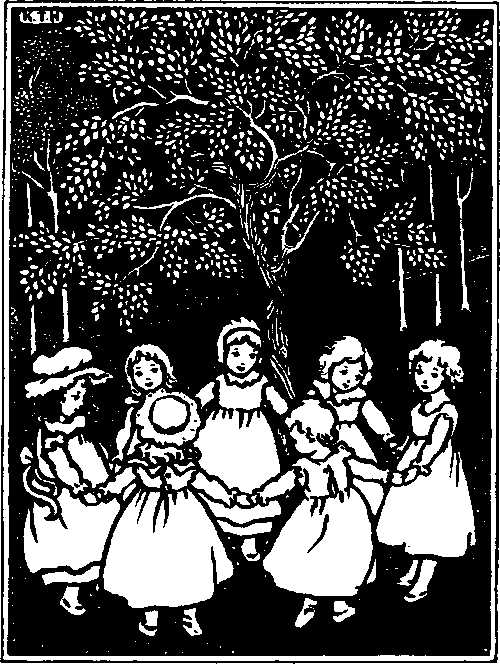 JINGO-RING.