The blacks are great believers in magic and sorcery. Some of these
beliefs are quite harmless and merely help to keep them amused, but
others prove a terrible curse to them, as they can seldom rid themselves
of the idea that another blackfellow somewhere is working them harm by
means of sorcery, and they often die from fear.
The magical ceremonies of the aboriginals are of three kinds:—
1. Those by which they think they can control the weather.
2. Those by which they endeavour to secure an abundant supply of food.
3. Those by which they cause sickness and death—the use of "pointing
sticks" and bones.
We will speak of each of these in order.
The commonest and most universal of all their magical ceremonies by
which they hope to control the weather is that of making rain. Every
group of natives has its "rain-makers," but the methods they employ are
not everywhere the same. In North-western Australia the rain-maker
usually goes away by himself to the top of some hill. He wears a very
elaborate and wonderful head-dress of white down with a tuft of cockatoo
feathers, and holds a wommera, or spear-thrower, in his hand. He squats
for some time on the ground, singing aloud a very monotonous chant or
incantation. Then, after a time, he rises to a stooping position, goes
on singing, and as he does so moves his wommera backwards and forwards
very rapidly, makes his whole body quiver and sway, and turns his head
violently from side to side. Gradually his movements become more and
more rapid, and by the time he has finished he is probably too dizzy to
stand. If he were asked what the ceremonies meant he would most likely
be unable to say more than that he was doing just what his great-great
greatest-grandfather did when he first made rain. Only men belonging to
the "rain totem" are supposed to possess this power of making rain.
Should rain fall after he has finished he, of course, takes all the
credit for it and is a very important personage for a time. If it should
fail to rain, as not infrequently happens, he will put it down to the
fact that some other blackfellow, probably in some other tribe, has been
using some powerful hostile magic to prevent his from taking effect. If
he should happen to meet that other blackfellow there would probably be
a very bad quarter of an hour for somebody!
Sometimes the rain-maker contents himself with a very much simpler
ceremony. He goes to some sacred pool, sings a charm over it, then takes
some of the water into his mouth and spits it out in all directions.
In the New Norcia district when the rain-makers wanted rain they used to
pluck hair from their thighs and armpits and after singing a charm over
it blow it in the direction from which they wanted the rain to come. If
on the other hand they wished to prevent rain they would light pieces of
sandalwood and beat the ground hard and dry with the burning brands. The
idea was that this drying and burning of the soil would soon cause all
the land to become hardened and dried by the sun. In fact their entire
belief in this "sympathetic magic" as it is called is based upon the
notion, perfectly true in a way, that "like produces like," and that for
them to initiate either the actions of their ancestors who first
produced such and such a thing will have the same effect as then, or
that the doing of something (such as causing water to fall) in a small
way will cause the same result to happen on a very much larger scale.
In some parts of Western Australia when cooler weather is desired a
magician will light huge fires and then sit beside them wrapped in a
number of skins and blankets pretending to be very cold. His teeth will
chatter and his whole body shake as though from severe cold, and he is
fully persuaded that colder weather will follow in a few days.
In the second class of magical ceremonies are included all those which
have for their purpose the ensuring of a plentiful supply of food. The
people of wild Australia have no knowledge of those natural laws and
forces, much less of that over-ruling Hand controlling them, by which
their food supply is assured. They think that everything is due to
magic, and therefore the performance of these magical ceremonies
occupies a very large amount of their time. You have seen already that
every tribe consists of a number of "totem groups" as they are called,
and it is to these totem groups that the whole tribe looks to maintain
the supply of their particular animals or plant. If the kangaroo men do
their duty there will be plenty of kangaroos, but if they should become
careless and slothful and begin to think of their own ease and comfort
instead of the well-being of the tribe then the kangaroos will become
fewer and fewer and perhaps disappear. These kangaroo ceremonies, as we
may call them, are usually performed at some rock or stone specially
sacred to this particular animal and believed by the natives to have
imprisoned within it, or at any rate in its near neighbourhood, a number
of kangaroo spirits who are only awaiting the due performance of the
ancient ceremonies to set them free from their prison and again go forth
and become once more embodied. The men gather round the rock or stone,
freely bleed themselves, and then smear the rock or stone with their
blood. As they are "of one blood" with their totem it is, they think,
kangaroo blood which is being poured out, and as "the blood is the life"
they feel quite sure that it will enable the weak and feeble kangaroo
spirits to become quite strong again. Then they arrange themselves in a
kind of half-circle and "sing" their charm. No magical ceremonies are
ever performed without "singing."
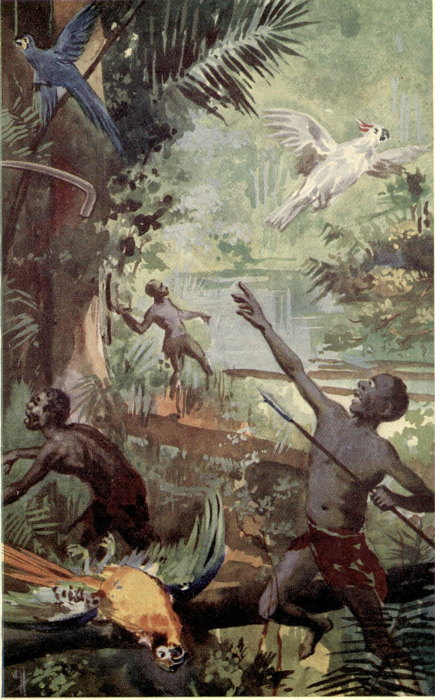
The "cockatoo" ceremonies, by which the natives hope to increase the
number of cockatoos are much simpler, but to a white man who might
happen to be in the near neighbourhood would prove a very thorough
nuisance. A rough image of a white cockatoo will be made, and the man
will imitate its harsh and piercing cry all night. When his voice fails,
as it does at last from sheer exhaustion, his son will take up the cry
till the father is able to begin again.
But of all the forms of magic or sorcery the most terrible is that of
"bone-pointing" and "singing-dead."
A man desirous of doing his neighbour some harm will provide himself
with one of these sticks or bones, go off by himself into some lonely
part of the bush, place the bone or stick in the ground, crouch over it
and then mutter or "sing" into it some horrible curse. Perhaps he will
sing some such awful curse as this over and over again:—
Kill old Wallaby Jack, kill him dead-fellow;
If he eat fish poison him with it;
If he go near water drown him with it;
If he eat kangaroo choke him with it;
If he eat emu poison him with it;
If he go near fire burn him with it;
Kill old Wallaby Jack, kill him dead-fellow quick.
Then he will go back to the camp leaving the bone in the ground. Later
he will return and bring the bone nearer to the camp. Then some evening,
after it has grown dark, he will creep quietly up to the man whom he
wants to injure and secretly point the bone at him. The magic will, he
believes, pass at once from the bone to his victim, who soon afterwards
will without any apparent cause sicken and die unless some bullya, or
medicine man, can remove the curse. The bone is then taken away and
hidden, for should it be found out that he had "pointed" it he would be
killed at once.
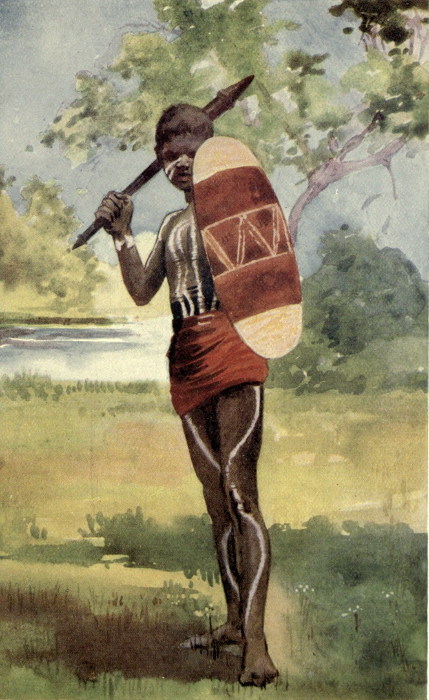
YOUTH IN WAR PAINT
All the blackfellows, men, women, and children alike are horribly afraid
of these pointing-bones, and believe fully in their awful power, and
anyone who believes that one of them has been pointed at him is almost
certain to die. Men in the full vigour of early manhood and middle life
have wasted away, just as though they had been stricken with
consumption, because they could not rid themselves of the belief that
this horrible magic had entered them. A man coming from the Alice
Springs to the Tennant Creek caught a slight cold, but the natives at
the latter place told him that some men belonging to a tribe about
twelve miles away had taken his heart out by means of one of these
pointing sticks. He believed their story, and though there was
absolutely nothing the matter with him but a cold, simply laid himself
down and wasted away. Probably several hundreds of men, women, and
children die in wild Australia every year from fear of these awful bones
and sticks alone. All sickness and death is ascribed to magic.
The only person who is believed able to remove this evil magic is the
"bullya," or medicine man. These medicine men are believed to have had
mysterious stones placed in their bodies by certain spirits. It is the
possession of these stones that gives them their power to counteract
evil magic. Lest these stones should dissolve they have to be very
careful never to eat or drink anything hot. You could probably never
tempt one of them to take a cup of hot tea. Should he do so all his
powers as a doctor would be gone. Medicine men, however, are not called
in for simpler ailments, though these too are attributed to magic. A
common remedy for head-ache is to wear tightly round the forehead a belt
of woman's hair. This is believed to have the power of driving out the
magic. Another frequent but much nastier medicine is several blows on
the head with a heavy waddy. It is wonderful how few doses are required!
Should a man be suffering from back-ache, or stomach-ache, he will lie
down on the ground with the painful part of his body uppermost, and his
friends and relations will jump on him one at a time till the "magic"
goes.
One day a man came home from a long journey through the bush. Soon
afterwards he was attacked by rheumatism and severe lameness. The
medicine men told him that one of his enemies had seen his tracks and
had put some sharp flints into his footmarks. His friends searched the
track, found the flints, and removed them. Almost immediately the
rheumatism and lameness left him and he was completely cured.
On another occasion a medicine man was called in to see a blackfellow
who was lying very nearly at death's door. He said that some men in
another tribe had charmed away his spirit but it hadn't gone very far
and he could fetch it back. He at once ran after it and caught it just
in time, so he said, and brought it back in his rug. He then threw
himself across the sick man, pressed the rug over his stomach, made a
few "passes" somewhat after the manner of a conjurer and so restored the
spirit. The sick man speedily recovered.
These medicine men are not guilty of any trickery. They believe in their
powers as thoroughly as the best European doctors believe in theirs.
They are never paid for their services, but, of course, they expect to
be looked up to by the other members of the tribe and to be spared all
labour and unpleasantness. They also expect the chief delicacies to be
reserved for them, and that others should, as far as possible, do their
bidding. No one would willingly offend a medicine man. His control of
magic is much too dangerous a weapon to be used against them, far more
deadly in its effects than spear or boomerang. He can put a curse in
even more easily than he can get it out, and if he puts it in who is
there to take it away? So you can see on the whole the medicine man has
rather an easy time of it, but as no one wills it otherwise all are
satisfied.
What a boon a few medical missions would prove in wild Australia—a few
earnest Christian men and women who would go and heal the bodily
diseases of the black people, and by their faithful teaching destroy
this awful curse of belief in magic! How glad we all ought to be that
wherever missions have been started, a hospital has been one of the
first buildings to be erected. At Yarrabah, at Mitchell River and at the
Roper River, all of which you will learn more fully about later on, the
missionaries are devoting much time and thought to healing the sick,
just as our Blessed Lord did when He was here among men. Soon after the
missionaries have settled in a new home the sick from all around will
come flocking in to have their needs attended to, and often stay in the
settlement long after they are cured to learn the wonderful new message
those missionaries have brought about the Great Healer and all His
Power and Love.