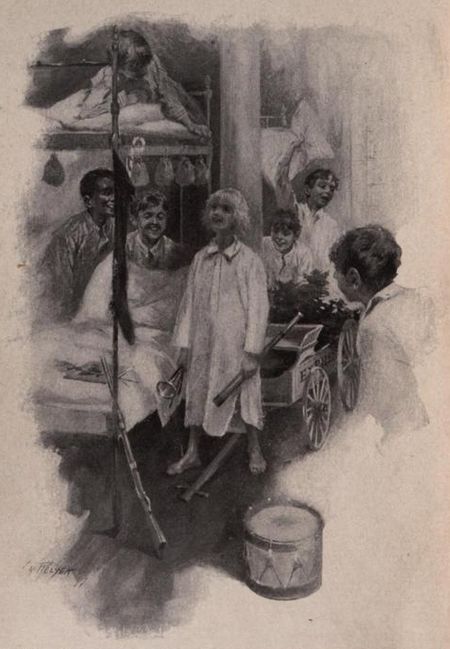
It was just a sprig of holly, with scarlet berries showing against the
green, stuck in, by one of the office boys probably, behind the sign
that pointed the way up to the editorial rooms. There was no reason
why it should have made me start when I came suddenly upon it at the
turn of the stairs; but it did. Perhaps it was because that dingy
hall, given over to dust and draughts all the days of the year, was
the last place in which I expected to meet with any sign of Christmas;
perhaps it was because I myself had nearly forgotten the holiday.
Whatever the cause, it gave me quite a turn.
I stood, and stared at it. It looked dry, almost withered. Probably it
had come a long way. Not much holly grows about Printing-House Square,
except in the colored supplements, and that is scarcely of a kind to
stir tender memories. Withered and dry, this did. I thought, with a
twinge of conscience, of secret little conclaves of my children, of
private views of things hidden from mamma at the bottom of drawers,
of wild flights when papa appeared unbidden in the door,
which I had allowed for once to pass unheeded. Absorbed in the
business of the office, I had hardly thought of Christmas coming on,
until now it was here. And this sprig of holly on the wall that had
come to remind me,—come nobody knew how far,—did it grow yet in the
beech-wood clearings, as it did when I gathered it as a boy, tracking
through the snow? "Christ-thorn" we called it in our Danish tongue.
The red berries, to our simple faith, were the drops of blood that
fell from the Saviour's brow as it drooped under its cruel crown upon
the cross.
Back to the long ago wandered my thoughts: to the moss-grown beech in
which I cut my name and that of a little girl with yellow curls, of
blessed memory, with the first jack-knife I ever owned; to the
story-book with the little fir tree that pined because it was small,
and because the hare jumped over it, and would not be content though
the wind and the sun kissed it, and the dews wept over it and told it
to rejoice in its young life; and that was so proud when, in the
second year, the hare had to go round it, because then it knew it was
getting big,—Hans Christian Andersen's story that we loved above all
the rest; for we knew the tree right well, and the hare; even the
tracks it left in the snow we had seen. Ah, those were the
Yule-tide seasons, when the old Domkirke shone with a thousand wax
candles on Christmas eve; when all business was laid aside to let the
world make merry one whole week; when big red apples were roasted on
the stove, and bigger doughnuts were baked within it for the long
feast! Never such had been known since. Christmas to-day is but a
name, a memory.
A door slammed below, and let in the noises of the street. The holly
rustled in the draught. Some one going out said, "A Merry Christmas to
you all!" in a big, hearty voice. I awoke from my revery to find
myself back in New York with a glad glow at the heart. It was not
true. I had only forgotten. It was myself that had changed, not
Christmas. That was here, with the old cheer, the old message of
good-will, the old royal road to the heart of mankind. How often had I
seen its blessed charity, that never corrupts, make light in the
hovels of darkness and despair! how often watched its spirit of
self-sacrifice and devotion in those who had, besides themselves,
nothing to give! and as often the sight had made whole my faith in
human nature. No! Christmas was not of the past, its spirit not dead.
The lad who fixed the sprig of holly on the stairs knew it; my
reporter's note-book bore witness to it. Witness of my
contrition for the wrong I did the gentle spirit of the holiday, here
let the book tell the story of one Christmas in the tenements of the
poor:—
It is evening in Grand Street. The shops east and west are pouring
forth their swarms of workers. Street and sidewalk are filled with an
eager throng of young men and women, chatting gayly, and elbowing the
jam of holiday shoppers that linger about the big stores. The
street-cars labor along, loaded down to the steps with passengers
carrying bundles of every size and odd shape. Along the curb a string
of pedlers hawk penny toys in push-carts with noisy clamor, fearless
for once of being moved on by the police. Christmas brings a two
weeks' respite from persecution even to the friendless street-fakir.
From the window of one brilliantly lighted store a bevy of mature
dolls in dishabille stretch forth their arms appealingly to a troop of
factory-hands passing by. The young men chaff the girls, who shriek
with laughter and run. The policeman on the corner stops beating his
hands together to keep warm, and makes a mock attempt to catch them,
whereat their shrieks rise shriller than ever. "Them stockin's o'
yourn 'll be the death o' Santa Claus!" he shouts after them, as they
dodge. And they, looking back, snap saucily, "Mind yer
business, freshy!" But their laughter belies their words. "They giv'
it to ye straight that time," grins the grocer's clerk, come out to
snatch a look at the crowds; and the two swap holiday greetings.
At the corner, where two opposing tides of travel form an eddy, the
line of push-carts debouches down the darker side street. In its gloom
their torches burn with a fitful glare that wakes black shadows among
the trusses of the railroad structure overhead. A woman, with worn
shawl drawn tightly about head and shoulders, bargains with a pedler
for a monkey on a stick and two cents' worth of flitter-gold. Five
ill-clad youngsters flatten their noses against the frozen pane of the
toy-shop, in ecstasy at something there, which proves to be a milk
wagon, with driver, horses, and cans that can be unloaded. It is
something their minds can grasp. One comes forth with a penny goldfish
of pasteboard clutched tightly in his hand, and, casting cautious
glances right and left, speeds across the way to the door of a
tenement, where a little girl stands waiting. "It's yer Chris'mas,
Kate," he says, and thrusts it into her eager fist. The black doorway
swallows them up.
Across the narrow yard, in the basement of the rear house, the lights
of a Christmas tree show against the grimy window pane. The
hare would never have gone around it, it is so very small. The two
children are busily engaged fixing the goldfish upon one of its
branches. Three little candles that burn there shed light upon a scene
of utmost desolation. The room is black with smoke and dirt. In the
middle of the floor oozes an oil-stove that serves at once to take the
raw edge off the cold and to cook the meals by. Half the window panes
are broken, and the holes stuffed with rags. The sleeve of an old coat
hangs out of one, and beats drearily upon the sash when the wind
sweeps over the fence and rattles the rotten shutters. The family
wash, clammy and gray, hangs on a clothes-line stretched across the
room. Under it, at a table set with cracked and empty plates, a
discouraged woman sits eying the children's show gloomily. It is
evident that she has been drinking. The peaked faces of the little
ones wear a famished look. There are three—the third an infant, put
to bed in what was once a baby carriage. The two from the street are
pulling it around to get the tree in range. The baby sees it, and
crows with delight. The boy shakes a branch, and the goldfish leaps
and sparkles in the candle-light.
"See, sister!" he pipes; "see Santa Claus!" And they clap their hands
in glee. The woman at the table wakes out of her stupor, gazes around
her, and bursts into a fit of maudlin weeping.
The door falls to. Five flights up, another opens upon a bare attic
room which a patient little woman is setting to rights. There are only
three chairs, a box, and a bedstead in the room, but they take a deal
of careful arranging. The bed hides the broken plaster in the wall
through which the wind came in; each chair-leg stands over a rat-hole,
at once to hide it and to keep the rats out. One is left; the box is
for that. The plaster of the ceiling is held up with pasteboard
patches. I know the story of that attic. It is one of cruel desertion.
The woman's husband is even now living in plenty with the creature for
whom he forsook her, not a dozen blocks away, while she "keeps the
home together for the childer." She sought justice, but the lawyer
demanded a retainer; so she gave it up, and went back to her little
ones. For this room that barely keeps the winter wind out she pays
four dollars a month, and is behind with the rent. There is scarce
bread in the house; but the spirit of Christmas has found her attic.
Against a broken wall is tacked a hemlock branch, the leavings of the
corner grocer's fitting-block; pink string from the packing-counter
hangs on it in festoons. A tallow dip on the box furnishes the
illumination. The children sit up in bed, and watch it with
shining eyes.
"We're having Christmas!" they say.
The lights of the Bowery glow like a myriad twinkling stars upon the
ceaseless flood of humanity that surges ever through the great highway
of the homeless. They shine upon long rows of lodging-houses, in which
hundreds of young men, cast helpless upon the reef of the strange
city, are learning their first lessons of utter loneliness; for what
desolation is there like that of the careless crowd when all the world
rejoices? They shine upon the tempter setting his snares there, and
upon the missionary and the Salvation Army lass, disputing his catch
with him; upon the police detective going his rounds with coldly
observant eye intent upon the outcome of the contest; upon the wreck
that is past hope, and upon the youth pausing on the verge of the pit
in which the other has long ceased to struggle. Sights and sounds of
Christmas there are in plenty in the Bowery. Balsam and hemlock and
fir stand in groves along the busy thoroughfare, and garlands of green
embower mission and dive impartially. Once a year the old street
recalls its youth with an effort. It is true that it is largely a
commercial effort; that the evergreen, with an instinct that is not of
its native hills, haunts saloon-corners by preference; but
the smell of the pine woods is in the air, and—Christmas is not too
critical—one is grateful for the effort. It varies with the
opportunity. At "Beefsteak John's" it is content with artistically
embalming crullers and mince-pies in green cabbage under the window
lamp. Over yonder, where the mile-post of the old lane still
stands,—in its unhonored old age become the vehicle of publishing the
latest "sure cure" to the world,—a florist, whose undenominational
zeal for the holiday and trade outstrips alike distinction of creed
and property, has transformed the sidewalk and the ugly railroad
structure into a veritable bower, spanning it with a canopy of green,
under which dwell with him, in neighborly good-will, the Young Men's
Christian Association and the Jewish tailor next door.
In the next block a "turkey-shoot" is in progress. Crowds are trying
their luck at breaking the glass balls that dance upon tiny jets of
water in front of a marine view with the moon rising, yellow and big,
out of a silver sea. A man-of-war, with lights burning aloft, labors
under a rocky coast. Groggy sailormen, on shore leave, make unsteady
attempts upon the dancing balls. One mistakes the moon for the target,
but is discovered in season. "Don't shoot that," says the man who
loads the guns; "there's a lamp behind it." Three scared birds in the
window recess try vainly to snatch a moment's sleep between
shots and the trains that go roaring overhead on the elevated road.
Roused by the sharp crack of the rifles, they blink at the lights in
the street, and peck moodily at a crust in their bed of shavings.
The dime museum gong clatters out its noisy warning that "the lecture"
is about to begin. From the concert hall, where men sit drinking beer
in clouds of smoke, comes the thin voice of a short-skirted singer,
warbling, "Do they think of me at home?" The young fellow who sits
near the door, abstractedly making figures in the wet track of the
"schooners," buries something there with a sudden restless turn, and
calls for another beer. Out in the street a band strikes up. A host
with banners advances, chanting an unfamiliar hymn. In the ranks
marches a cripple on crutches. Newsboys follow, gaping. Under the
illuminated clock of the Cooper Institute the procession halts, and
the leader, turning his face to the sky, offers a prayer. The passing
crowds stop to listen. A few bare their heads. The devoted group, the
flapping banners, and the changing torch-light on upturned faces, make
a strange, weird picture. Then the drum-beat, and the band files into
its barracks across the street. A few of the listeners follow, among
them the lad from the concert hall, who slinks shamefacedly
in when he thinks no one is looking.
Down at the foot of the Bowery is the "pan-handlers' beat," where the
saloons elbow one another at every step, crowding out all other
business than that of keeping lodgers to support them. Within call of
it, across the square, stands a church which, in the memory of men yet
living, was built to shelter the fashionable Baptist audiences of a
day when Madison Square was out in the fields, and Harlem had a
foreign sound. The fashionable audiences are gone long since. To-day
the church, fallen into premature decay, but still handsome in its
strong and noble lines, stands as a missionary outpost in the land of
the enemy, its builders would have said, doing a greater work than
they planned. To-night is the Christmas festival of its
English-speaking Sunday-school, and the pews are filled. The banners
of United Italy, of modern Hellas, of France and Germany and England,
hang side by side with the Chinese dragon and the starry flag—signs
of the cosmopolitan character of the congregation. Greek and Roman
Catholics, Jews and joss-worshippers, go there; few Protestants, and
no Baptists. It is easy to pick out the children in their seats by
nationality, and as easy to read the story of poverty and suffering
that stands written in more than one mother's haggard face,
now beaming with pleasure at the little ones' glee. A gayly decorated
Christmas tree has taken the place of the pulpit. At its foot is
stacked a mountain of bundles, Santa Claus's gifts to the school. A
self-conscious young man with soap-locks has just been allowed to
retire, amid tumultuous applause, after blowing "Nearer, my God, to
Thee" on his horn until his cheeks swelled almost to bursting. A
trumpet ever takes the Fourth Ward by storm. A class of little girls
is climbing upon the platform. Each wears a capital letter on her
breast, and has a piece to speak that begins with the letter; together
they spell its lesson. There is momentary consternation: one is
missing. As the discovery is made, a child pushes past the doorkeeper,
hot and breathless. "I am in 'Boundless Love,'" she says, and makes
for the platform, where her arrival restores confidence and the
language.
In the audience the befrocked visitor from up-town sits cheek by jowl
with the pigtailed Chinaman and the dark-browed Italian. Up in the
gallery, farthest from the preacher's desk and the tree, sits a Jewish
mother with three boys, almost in rags. A dingy and threadbare shawl
partly hides her poor calico wrap and patched apron. The woman shrinks
in the pew, fearful of being seen; her boys stand upon the benches,
and applaud with the rest. She endeavors vainly to restrain
them. "Tick, tick!" goes the old clock over the door through which
wealth and fashion went out long years ago, and poverty came in.
Tick, tick! the world moves, with us—without; without or with. She is
the yesterday, they the to-morrow. What shall the harvest be?
Loudly ticked the old clock in time with the doxology, the other day,
when they cleared the tenants out of Gotham Court down here in Cherry
Street, and shut the iron doors of Single and Double Alley against
them. Never did the world move faster or surer toward a better day
than when the wretched slum was seized by the health officers as a
nuisance unfit longer to disgrace a Christian city. The snow lies deep
in the deserted passageways, and the vacant floors are given over to
evil smells, and to the rats that forage in squads, burrowing in the
neglected sewers. The "wall of wrath" still towers above the buildings
in the adjoining Alderman's Court, but its wrath at last is wasted.
It was built by a vengeful Quaker, whom the alderman had knocked down
in a quarrel over the boundary line, and transmitted its legacy of
hate to generations yet unborn; for where it stood it shut out
sunlight and air from the tenements of Alderman's Court. And
at last it is to go, Gotham Court and all; and to the going the wall
of wrath has contributed its share, thus in the end atoning for some
of the harm it wrought. Tick! old clock; the world moves. Never yet
did Christmas seem less dark on Cherry Hill than since the lights were
put out in Gotham Court forever.
In "The Bend" the philanthropist undertaker who "buries for what he
can catch on the plate" hails the Yule-tide season with a pyramid of
green made of two coffins set on end. It has been a good day, he says
cheerfully, putting up the shutters; and his mind is easy. But the
"good days" of The Bend are over, too. The Bend itself is all but
gone. Where the old pigsty stood, children dance and sing to the
strumming of a cracked piano-organ propelled on wheels by an Italian
and his wife. The park that has come to take the place of the slum
will curtail the undertaker's profits, as it has lessened the work of
the police. Murder was the fashion of the day that is past. Scarce a
knife has been drawn since the sunlight shone into that evil spot, and
grass and green shrubs took the place of the old rookeries. The
Christmas gospel of peace and good-will moves in where the slum moves
out. It never had a chance before.
The children follow the organ, stepping in the slush to the
music, bareheaded and with torn shoes, but happy; across the Five
Points and through "the Bay,"—known to the directory as Baxter
Street,—to "the Divide," still Chatham Street to its denizens, though
the aldermen have rechristened it Park Row. There other delegations of
Greek and Italian children meet and escort the music on its homeward
trip. In one of the crooked streets near the river its journey comes
to an end. A battered door opens to let it in. A tallow dip burns
sleepily on the creaking stairs. The water runs with a loud clatter in
the sink: it is to keep it from freezing. There is not a whole window
pane in the hall. Time was when this was a fine house harboring wealth
and refinement. It has neither now. In the old parlor downstairs a
knot of hard-faced men and women sit on benches about a deal table,
playing cards. They have a jug between them, from which they drink by
turns. On the stump of a mantel-shelf a lamp burns before a rude print
of the Mother of God. No one pays any heed to the hand-organ man and
his wife as they climb to their attic. There is a colony of them up
there—three families in four rooms.
"Come in, Antonio," says the tenant of the double flat,—the one with
two rooms,—"come and keep Christmas." Antonio enters, cap in hand. In
the corner by the dormer-window a "crib" has been fitted up
in commemoration of the Nativity. A soap-box and two hemlock branches
are the elements. Six tallow candles and a night-light illuminate a
singular collection of rarities, set out with much ceremonial show. A
doll tightly wrapped in swaddling-clothes represents "the Child." Over
it stands a ferocious-looking beast, easily recognized as a survival
of the last political campaign,—the Tammany tiger,—threatening to
swallow it at a gulp if one as much as takes one's eyes off it. A
miniature Santa Claus, a pasteboard monkey, and several other articles
of bric-a-brac of the kind the tenement affords, complete the outfit.
The background is a picture of St. Donato, their village saint, with
the Madonna "whom they worship most." But the incongruity harbors no
suggestion of disrespect. The children view the strange show with
genuine reverence, bowing and crossing themselves before it. There are
five, the oldest a girl of seventeen, who works for a sweater, making
three dollars a week. It is all the money that comes in, for the
father has been sick and unable to work eight months and the mother
has her hands full: the youngest is a baby in arms. Three of the
children go to a charity school, where they are fed, a great help, now
the holidays have come to make work slack for sister. The rent is six
dollars—two weeks' pay out of the four. The mention of a
possible chance of light work for the man brings the daughter with her
sewing from the adjoining room, eager to hear. That would be Christmas
indeed! "Pietro!" She runs to the neighbors to communicate the joyful
tidings. Pietro comes, with his new-born baby, which he is tending
while his wife lies ill, to look at the maestro, so powerful and good.
He also has been out of work for months, with a family of mouths to
fill, and nothing coming in. His children are all small yet, but they
speak English.
"What," I say, holding a silver dime up before the oldest, a smart
little chap of seven—"what would you do if I gave you this?"
"Get change," he replies promptly. When he is told that it is his own,
to buy toys with, his eyes open wide with wondering incredulity. By
degrees he understands. The father does not. He looks questioningly
from one to the other. When told, his respect increases visibly for
"the rich gentleman."
They were villagers of the same community in southern Italy, these
people and others in the tenements thereabouts, and they moved their
patron saint with them. They cluster about his worship here, but the
worship is more than an empty form. He typifies to them the old
neighborliness of home, the spirit of mutual help, of charity,
and of the common cause against the common enemy. The
community life survives through their saint in the far city to an
unsuspected extent. The sick are cared for; the dreaded hospital is
fenced out. There are no Italian evictions. The saint has paid the
rent of this attic through two hard months; and here at his shrine the
Calabrian village gathers, in the persons of these three, to do him
honor on Christmas eve.
Where the old Africa has been made over into a modern Italy, since
King Humbert's cohorts struck the up-town trail, three hundred of the
little foreigners are having an uproarious time over their Christmas
tree in the Children's Aid Society's school. And well they may, for
the like has not been seen in Sullivan Street in this generation.
Christmas trees are rather rarer over here than on the East Side,
where the German leavens the lump with his loyalty to home traditions.
This is loaded with silver and gold and toys without end, until there
is little left of the original green. Santa Claus's sleigh must have
been upset in a snow-drift over here, and righted by throwing the
cargo overboard, for there is at least a wagon-load of things that can
find no room on the tree. The appearance of "teacher" with a double
armful of curly-headed dolls in red, yellow, and green Mother-Hubbards,
doubtful how to dispose of them, provokes a shout of
approval, which is presently quieted by the principal's bell. School
is "in" for the preliminary exercises. Afterward there are to be the
tree and ice-cream for the good children. In their anxiety to prove
their title clear, they sit so straight, with arms folded, that the
whole row bends over backward. The lesson is brief, the answers to the
point.
"What do we receive at Christmas?" the teacher wants to know. The
whole school responds with a shout, "Dolls and toys!" To the question,
"Why do we receive them at Christmas?" the answer is not so prompt.
But one youngster from Thompson Street holds up his hand. He knows.
"Because we always get 'em," he says; and the class is convinced: it
is a fact. A baby wails because it cannot get the whole tree at once.
The "little mother"—herself a child of less than a dozen winters—who
has it in charge, cooes over it, and soothes its grief with the aid of
a surreptitious sponge-cake evolved from the depths of teacher's
pocket. Babies are encouraged in these schools, though not originally
included in their plan, as often the one condition upon which the
older children can be reached. Some one has to mind the baby, with all
hands out at work.
The school sings "Santa Lucia" and "Children of the Heavenly
King," and baby is lulled to sleep.
"Who is this King?" asks the teacher, suddenly, at the end of a verse.
Momentary stupefaction. The little minds are on ice-cream just then;
the lad nearest the door has telegraphed that it is being carried up
in pails. A little fellow on the back seat saves the day. Up goes his
brown fist.
"Well, Vito, who is he?"
"McKinley!" pipes the lad, who remembers the election just past; and
the school adjourns for ice-cream.
It is a sight to see them eat it. In a score of such schools, from the
Hook to Harlem, the sight is enjoyed in Christmas week by the men and
women who, out of their own pockets, reimburse Santa Claus for his
outlay, and count it a joy, as well they may; for their beneficence
sometimes makes the one bright spot in lives that have suffered of all
wrongs the most cruel,—that of being despoiled of their childhood.
Sometimes they are little Bohemians; sometimes the children of refugee
Jews; and again, Italians, or the descendants of the Irish stock of
Hell's Kitchen and Poverty Row; always the poorest, the shabbiest, the
hungriest—the children Santa Claus loves best to find, if any one
will show him the way. Having so much on hand, he has no
time, you see, to look them up himself. That must be done for him; and
it is done. To the teacher in the Sullivan Street school came one
little girl, this last Christmas, with anxious inquiry if it was true
that he came around with toys.
"I hanged my stocking last time," she said, "and he didn't come at
all." In the front house indeed, he left a drum and a doll, but no
message from him reached the rear house in the alley. "Maybe he
couldn't find it," she said soberly. Did the teacher think he would
come if she wrote to him? She had learned to write.
Together they composed a note to Santa Claus, speaking for a doll and
a bell—the bell to play "go to school" with when she was kept home
minding the baby. Lest he should by any chance miss the alley in spite
of directions, little Rosa was invited to hang her stocking, and her
sister's, with the janitor's children's in the school. And lo! on
Christmas morning there was a gorgeous doll, and a bell that was a
whole curriculum in itself, as good as a year's schooling any day!
Faith in Santa Claus is established in that Thompson Street alley for
this generation at least; and Santa Claus, got by hook or by crook
into an Eighth Ward alley, is as good as the whole Supreme Court
bench, with the Court of Appeals thrown in, for backing the
Board of Health against the slum.
But the ice-cream! They eat it off the seats, half of them kneeling or
squatting on the floor; they blow on it, and put it in their pockets
to carry home to baby. Two little shavers discovered to be feeding
each other, each watching the smack develop on the other's lips as the
acme of his own bliss, are "cousins"; that is why. Of cake there is a
double supply. It is a dozen years since "Fighting Mary," the wildest
child in the Seventh Avenue school, taught them a lesson there which
they have never forgotten. She was perfectly untamable, fighting
everybody in school, the despair of her teacher, till on Thanksgiving,
reluctantly included in the general amnesty and mince-pie, she was
caught cramming the pie into her pocket, after eying it with a look of
pure ecstasy, but refusing to touch it. "For mother" was her
explanation, delivered with a defiant look before which the class
quailed. It is recorded, but not in the minutes, that the board of
managers wept over Fighting Mary, who, all unconscious of having
caused such an astonishing "break," was at that moment engaged in
maintaining her prestige and reputation by fighting the gang in the
next block. The minutes contain merely a formal resolution to the
effect that occasions of mince-pie shall carry double
rations thenceforth. And the rule has been kept—not only in Seventh
Avenue, but in every industrial school—since. Fighting Mary won the
biggest fight of her troubled life that day, without striking a blow.
It was in the Seventh Avenue school last Christmas that I offered the
truant class a four-bladed penknife as a prize for whittling out the
truest Maltese cross. It was a class of black sheep, and it was the
blackest sheep of the flock that won the prize. "That awful Savarese,"
said the principal in despair. I thought of Fighting Mary, and bade
her take heart. I regret to say that within a week the hapless
Savarese was black-listed for banking up the school door with snow, so
that not even the janitor could get out and at him.
Within hail of the Sullivan Street school camps a scattered little
band, the Christmas customs of which I had been trying for years to
surprise. They are Indians, a handful of Mohawks and Iroquois, whom
some ill wind has blown down from their Canadian reservation, and left
in these West Side tenements to eke out such a living as they can,
weaving mats and baskets, and threading glass pearls on slippers and
pin-cushions, until, one after another, they have died off and gone
to happier hunting-grounds than Thompson Street. There were
as many families as one could count on the fingers of both hands when
I first came upon them, at the death of old Tamenund, the basket
maker. Last Christmas there were seven. I had about made up my mind
that the only real Americans in New York did not keep the holiday at
all, when, one Christmas eve, they showed me how. Just as dark was
setting in, old Mrs. Benoit came from her Hudson Street attic—where
she was known among the neighbors, as old and poor as she, as Mrs. Ben
Wah, and was believed to be the relict of a warrior of the name of
Benjamin Wah—to the office of the Charity Organization Society, with
a bundle for a friend who had helped her over a rough spot—the rent,
I suppose. The bundle was done up elaborately in blue cheese-cloth,
and contained a lot of little garments which she had made out of the
remnants of blankets and cloth of her own from a younger and better
day. "For those," she said, in her French patois, "who are poorer than
myself;" and hobbled away. I found out, a few days later, when I took
her picture weaving mats in her attic room, that she had scarcely food
in the house that Christmas day and not the car fare to take her to
church! Walking was bad, and her old limbs were stiff. She sat
by the window through the winter evening, and watched the sun
go down behind the western hills, comforted by her pipe. Mrs. Ben Wah,
to give her her local name, is not really an Indian; but her husband
was one, and she lived all her life with the tribe till she came here.
She is a philosopher in her own quaint way. "It is no disgrace to be
poor," said she to me, regarding her empty tobacco-pouch; "but it is
sometimes a great inconvenience." Not even the recollection of the
vote of censure that was passed upon me once by the ladies of the
Charitable Ten for surreptitiously supplying an aged couple, the
special object of their charity, with army plug, could have deterred
me from taking the hint.
Very likely, my old friend Miss Sherman, in her Broome Street
cellar,—it is always the attic or the cellar,—would object to Mrs.
Ben Wah's claim to being the only real American in my note-book. She
is from Down East, and says "stun" for stone. In her youth she was
lady's-maid to a general's wife, the recollection of which military
career equally condones the cellar and prevents her holding any sort
of communication with her common neighbors, who add to the offence of
being foreigners the unpardonable one of being mostly men. Eight cats
bear her steady company, and keep alive her starved
affections. I found them on last Christmas eve behind barricaded
doors; for the cold that had locked the water-pipes had brought the
neighbors down to the cellar, where Miss Sherman's cunning had kept
them from freezing. Their tin pans and buckets were even then banging
against her door. "They're a miserable lot," said the old maid,
fondling her cats defiantly; "but let 'em. It's Christmas. Ah!" she
added, as one of the eight stood up in her lap and rubbed its cheek
against hers, "they're innocent. It isn't poor little animals that
does the harm. It's men and women that does it to each other." I don't
know whether it was just philosophy, like Mrs. Ben Wah's, or a glimpse
of her story. If she had one, she kept it for her cats.
In a hundred places all over the city, when Christmas comes, as many
open-air fairs spring suddenly into life. A kind of Gentile Feast of
Tabernacles possesses the tenement districts especially.
Green-embowered booths stand in rows at the curb, and the voice of the
tin trumpet is heard in the land. The common source of all the show is
down by the North River, in the district known as "the Farm." Down
there Santa Claus establishes headquarters early in December and until
past New Year. The broad quay looks then more like a clearing in a
pine forest than a busy section of the metropolis. The
steamers discharge their loads of fir trees at the piers until they
stand stacked mountain-high, with foot-hills of holly and ground-ivy
trailing off toward the land side. An army train of wagons is engaged
in carting them away from early morning till late at night; but the
green forest grows, in spite of it all, until in places it shuts the
shipping out of sight altogether. The air is redolent with the smell
of balsam and pine. After nightfall, when the lights are burning in
the busy market, and the homeward-bound crowds with baskets and heavy
burdens of Christmas greens jostle one another with good-natured
banter,—nobody is ever cross down here in the holiday season,—it is
good to take a stroll through the Farm, if one has a spot in his heart
faithful yet to the hills and the woods in spite of the latter-day
city. But it is when the moonlight is upon the water and upon the dark
phantom forest, when the heavy breathing of some passing steamer is
the only sound that breaks the stillness of the night, and the
watchman smokes his only pipe on the bulwark, that the Farm has a mood
and an atmosphere all its own, full of poetry which some day a
painter's brush will catch and hold.
Into the ugliest tenement street Christmas brings something of
picturesqueness, of cheer. Its message was ever to the poor
and the heavy-laden, and by them it is understood with an instinctive
yearning to do it honor. In the stiff dignity of the brownstone
streets up-town there may be scarce a hint of it. In the homes of the
poor it blossoms on stoop and fire-escape, looks out of the front
window, and makes the unsightly barber-pole to sprout overnight like
an Aaron's-rod. Poor indeed is the home that has not its sign of peace
over the hearth, be it but a single sprig of green. A little color
creeps with it even into rabbinical Hester Street, and shows in the
shop-windows and in the children's faces. The very feather dusters in
the pedler's stock take on brighter hues for the occasion, and the big
knives in the cutler's shop gleam with a lively anticipation of the
impending goose "with fixin's"—a concession, perhaps, to the
commercial rather than the religious holiday: business comes then, if
ever. A crowd of ragamuffins camp out at a window where Santa Claus
and his wife stand in state, embodiment of the domestic ideal that has
not yet gone out of fashion in these tenements, gazing hungrily at the
announcement that "A silver present will be given to every purchaser
by a real Santa Claus.—M. Levitsky." Across the way, in a hole in the
wall, two cobblers are pegging away under an oozy lamp that makes a
yellow splurge on the inky blackness about them, revealing
to the passer-by their bearded faces, but nothing of the environment
save a single sprig of holly suspended from the lamp. From what
forgotten brake it came with a message of cheer, a thought of wife and
children across the sea waiting their summons, God knows. The shop is
their house and home. It was once the hall of the tenement; but to
save space, enough has been walled in to make room for their bench and
bed; the tenants go through the next house. No matter if they are
cramped; by and by they will have room. By and by comes the spring,
and with it the steamer. Does not the green branch speak of spring and
of hope? The policeman on the beat hears their hammers beat a joyous
tattoo past midnight, far into Christmas morning. Who shall say its
message has not reached even them in their slum?
Where the noisy trains speed over the iron highway past the
second-story windows of Allen Street, a cellar door yawns darkly in
the shadow of one of the pillars that half block the narrow sidewalk.
A dull gleam behind the cobweb-shrouded window pane supplements the
sign over the door, in Yiddish and English: "Old Brasses." Four
crooked and mouldy steps lead to utter darkness, with no friendly
voice to guide the hapless customer. Fumbling along the dank wall,
he is left to find the door of the shop as best he can. Not a
likely place to encounter the fastidious from the Avenue! Yet ladies
in furs and silk find this door and the grim old smith within it. Now
and then an artist stumbles upon them, and exults exceedingly in his
find. Two holiday shoppers are even now haggling with the coppersmith
over the price of a pair of curiously wrought brass candlesticks. The
old man has turned from the forge, at which he was working, unmindful
of his callers roving among the dusty shelves. Standing there, erect
and sturdy, in his shiny leather apron, hammer in hand, with the
firelight upon his venerable head, strong arms bared to the elbow, and
the square paper cap pushed back from a thoughtful, knotty brow, he
stirs strange fancies. One half expects to see him fashioning a gorget
or a sword on his anvil. But his is a more peaceful craft. Nothing
more warlike is in sight than a row of brass shields, destined for
ornament, not for battle. Dark shadows chase one another by the
flickering light among copper kettles of ruddy glow, old-fashioned
samovars, and massive andirons of tarnished brass. The bargaining goes
on. Overhead the nineteenth century speeds by with rattle and roar; in
here linger the shadows of the centuries long dead. The boy at the
anvil listens open-mouthed, clutching the bellows-rope.
In Liberty Hall a Jewish wedding is in progress. Liberty!
Strange how the word echoes through these sweaters' tenements, where
starvation is at home half the time. It is as an all-consuming passion
with these people, whose spirit a thousand years of bondage have not
availed to daunt. It breaks out in strikes, when to strike is to
hunger and die. Not until I stood by a striking cloak-maker whose last
cent was gone, with not a crust in the house to feed seven hungry
mouths, yet who had voted vehemently in the meeting that day to keep
up the strike to the bitter end,—bitter indeed, nor far distant,—and
heard him at sunset recite the prayer of his fathers: "Blessed art
thou, O Lord our God, King of the world, that thou hast redeemed us as
thou didst redeem our fathers, hast delivered us from bondage to
liberty, and from servile dependence to redemption!"—not until then
did I know what of sacrifice the word might mean, and how utterly we
of another day had forgotten. But for once shop and tenement are left
behind. Whatever other days may have in store, this is their day of
play, when all may rejoice.
The bridegroom, a cloak-presser in a hired dress suit, sits alone and
ill at ease at one end of the hall, sipping whiskey with a fine air of
indifference, but glancing apprehensively toward the crowd
of women in the opposite corner that surround the bride, a pale little
shop-girl with a pleading, winsome face. From somewhere unexpectedly
appears a big man in an ill-fitting coat and skullcap, flanked on
either side by a fiddler, who scrapes away and away, accompanying the
improvisator in a plaintive minor key as he halts before the bride and
intones his lay. With many a shrug of stooping shoulders and queer
excited gesture, he drones, in the harsh, guttural Yiddish of Hester
Street, his story of life's joys and sorrows, its struggles and
victories in the land of promise. The women listen, nodding and
swaying their bodies sympathetically. He works himself into a frenzy,
in which the fiddlers vainly try to keep up with him. He turns and
digs the laggard angrily in the side without losing the metre. The
climax comes. The bride bursts into hysterical sobs, while the women
wipe their eyes. A plate, heretofore concealed under his coat, is
whisked out. He has conquered; the inevitable collection is taken up.
The tuneful procession moves upon the bridegroom. An Essex Street girl
in the crowd, watching them go, says disdainfully: "None of this
humbug when I get married." It is the straining of young America at
the fetters of tradition. Ten minutes later, when, between double
files of women holding candles, the couple pass to the
canopy where the rabbi waits, she has already forgotten; and when the
crunching of a glass under the bridegroom's heel announces that they
are one, and that until the broken pieces be reunited he is hers and
hers alone, she joins with all the company in the exulting shout of
"Mozzel tov!" ("Good luck!"). Then the dupka, men and women joining
in, forgetting all but the moment, hands on hips, stepping in time,
forward, backward, and across. And then the feast.
They sit at the long tables by squads and tribes. Those who belong
together sit together. There is no attempt at pairing off for
conversation or mutual entertainment, at speech-making or toasting.
The business in hand is to eat, and it is attended to. The bridegroom,
at the head of the table, with his shiny silk hat on, sets the
example; and the guests emulate it with zeal, the men smoking big,
strong cigars between mouthfuls. "Gosh! ain't it fine?" is the
grateful comment of one curly-headed youngster, bravely attacking his
third plate of chicken-stew. "Fine as silk," nods his neighbor in
knickerbockers. Christmas, for once, means something to them that they
can understand. The crowd of hurrying waiters make room for one
bearing aloft a small turkey adorned with much tinsel and many paper
flowers. It is for the bride, the one thing not to be
touched until the next day—one day off from the drudgery of
housekeeping; she, too, can keep Christmas.
A group of bearded, dark-browed men sit apart, the rabbi among them.
They are the orthodox, who cannot break bread with the rest, for fear,
though the food be kosher, the plates have been defiled. They brought
their own to the feast, and sit at their own table, stern and
justified. Did they but know what depravity is harbored in the impish
mind of the girl yonder, who plans to hang her stocking overnight by
the window! There is no fireplace in the tenement. Queer things happen
over here, in the strife between the old and the new. The girls of the
College Settlement, last summer, felt compelled to explain that the
holiday in the country which they offered some of these children was
to be spent in an Episcopal clergyman's house, where they had prayers
every morning. "Oh," was the mother's indulgent answer, "they know it
isn't true, so it won't hurt them."
The bell of a neighboring church tower strikes the vesper hour. A man
in working-clothes uncovers his head reverently, and passes on.
Through the vista of green bowers formed of the grocer's stock of
Christmas trees a passing glimpse of flaring torches in the distant
square is caught. They touch with flame the gilt cross towering high
above the "White Garden," as the German residents call
Tompkins Square. On the sidewalk the holy-eve fair is in its busiest
hour. In the pine-board booths stand rows of staring toy dogs
alternately with plaster saints. Red apples and candy are hawked from
carts. Pedlers offer colored candles with shrill outcry. A huckster
feeding his horse by the curb scatters, unseen, a share for the
sparrows. The cross flashes white against the dark sky.
In one of the side streets near the East River has stood for thirty
years a little mission church, called Hope Chapel by its founders, in
the brave spirit in which they built it. It has had plenty of use for
the spirit since. Of the kind of problems that beset its pastor I
caught a glimpse the other day, when, as I entered his room, a
rough-looking man went out.
"One of my cares," said Mr. Devins, looking after him with contracted
brow. "He has spent two Christmas days of twenty-three out of jail. He
is a burglar, or was. His daughter has brought him round. She is a
seamstress. For three months, now, she has been keeping him and the
home, working nights. If I could only get him a job! He won't stay
honest long without it; but who wants a burglar for a watchman? And
how can I recommend him?"
A few doors from the chapel an alley sets into the block. We
halted at the mouth of it.
"Come in," said Mr. Devins, "and wish Blind Jennie a Merry Christmas."
We went in, in single file; there was not room for two. As we climbed
the creaking stairs of the rear tenement, a chorus of children's
shrill voices burst into song somewhere above.
"It is her class," said the pastor of Hope Chapel, as he stopped on
the landing. "They are all kinds. We never could hope to reach them;
Jennie can. They fetch her the papers given out in the Sunday-school,
and read to her what is printed under the pictures; and she tells them
the story of it. There is nothing Jennie doesn't know about the
Bible."
The door opened upon a low-ceiled room, where the evening shades lay
deep. The red glow from the kitchen stove discovered a jam of
children, young girls mostly, perched on the table, the chairs, in one
another's laps, or squatting on the floor; in the midst of them, a
little old woman with heavily veiled face, and wan, wrinkled hands
folded in her lap. The singing ceased as we stepped across the
threshold.
"Be welcome," piped a harsh voice with a singular note of cheerfulness
in it. "Whose step is that with you, pastor? I don't know it. He is
welcome in Jennie's house, whoever he be. Girls, make him to
home." The girls moved up to make room.
"Jennie has not seen since she was a child," said the clergyman,
gently; "but she knows a friend without it. Some day she shall see the
great Friend in his glory, and then she shall be Blind Jennie no
more."
The little woman raised the veil from a face shockingly disfigured,
and touched the eyeless sockets. "Some day," she repeated, "Jennie
shall see. Not long now—not long!" Her pastor patted her hand. The
silence of the dark room was broken by Blind Jennie's voice, rising
cracked and quavering: "Alas! and did my Saviour bleed?" The shrill
chorus burst in:—
It was there by faith I received my sight,
And now I am happy all the day.
The light that falls from the windows of the Neighborhood Guild, in
Delancey Street, makes a white path across the asphalt pavement.
Within, there is mirth and laughter. The Tenth Ward Social Reform Club
is having its Christmas festival. Its members, poor mothers,
scrubwomen,—the president is the janitress of a tenement near
by,—have brought their little ones, a few their husbands, to share in
the fun. One little girl has to be dragged up to the grab-bag. She
cries at the sight of Santa Claus. The baby has drawn a
woolly horse. He kisses the toy with a look of ecstatic bliss, and
toddles away. At the far end of the hall a game of blindman's-buff is
starting up. The aged grandmother, who has watched it with growing
excitement, bids one of the settlement workers hold her grandchild,
that she may join in; and she does join in, with all the pent-up
hunger of fifty joyless years. The worker, looking on, smiles; one has
been reached. Thus is the battle against the slum waged and won with
the child's play.
Tramp! tramp! comes the to-morrow upon the stage. Two hundred and
fifty pairs of little feet, keeping step, are marching to dinner in
the Newsboys' Lodging-house. Five hundred pairs more are restlessly
awaiting their turn upstairs. In prison, hospital, and almshouse
to-night the city is host, and gives of her plenty. Here an unknown
friend has spread a generous repast for the waifs who all the rest of
the days shift for themselves as best they can. Turkey, coffee, and
pie, with "vegetubles" to fill in. As the file of eagle-eyed
youngsters passes down the long tables, there are swift movements of
grimy hands, and shirt-waists bulge, ragged coats sag at the pockets.
Hardly is the file seated when the plaint rises: "I ain't got no pie!
It got swiped on me." Seven despoiled ones hold up their hands.
The superintendent laughs—it is Christmas eve. He taps one
tentatively on the bulging shirt. "What have you here, my lad?"
"Me pie," responds he, with an innocent look; "I wuz scart it would
get stole."
A little fellow who has been eying one of the visitors attentively
takes his knife out of his mouth, and points it at him with
conviction.
"I know you," he pipes. "You're a p'lice commissioner. I seen yer
picter in the papers. You're Teddy Roosevelt!"
The clatter of knives and forks ceases suddenly. Seven pies creep
stealthily over the edge of the table, and are replaced on as many
plates. The visitors laugh. It was a case of mistaken identity.
Farthest down town, where the island narrows toward the Battery, and
warehouses crowd the few remaining tenements, the sombre-hued colony
of Syrians is astir with preparation for the holiday. How comes it
that in the only settlement of the real Christmas people in New York
the corner saloon appropriates to itself all the outward signs of it?
Even the floral cross that is nailed over the door of the Orthodox
church is long withered and dead; it has been there since Easter, and
it is yet twelve days to Christmas by the belated reckoning of the
Greek Church. But if the houses show no sign of the holiday, within
there is nothing lacking. The whole colony is gone
a-visiting. There are enough of the unorthodox to set the fashion, and
the rest follow the custom of the country. The men go from house to
house, laugh, shake hands, and kiss one another on both cheeks, with
the salutation, "Kol am va antom Salimoon." "Every year and you are
safe," the Syrian guide renders it into English; and a non-professional
interpreter amends it: "May you grow happier year by year." Arrack
made from grapes and flavored with anise seed, and candy baked in
little white balls like marbles, are served with the indispensable
cigarette; for long callers, the pipe.
In a top-floor room of one of the darkest of the dilapidated
tenements, the dusty window panes of which the last glow in the winter
sky is tinging faintly with red, a dance is in progress. The guests,
most of them fresh from the hillsides of Mount Lebanon, squat about
the room. A reed-pipe and a tambourine furnish the music. One has the
centre of the floor. With a beer jug filled to the brim on his head,
he skips and sways, bending, twisting, kneeling, gesturing, and
keeping time, while the men clap their hands. He lies down and turns
over, but not a drop is spilled. Another succeeds him, stepping
proudly, gracefully, furling and unfurling a handkerchief like a
banner. As he sits down, and the beer goes around, one in
the corner, who looks like a shepherd fresh from his pasture, strikes
up a song—a far-off, lonesome, plaintive lay. "'Far as the hills,'"
says the guide; "a song of the old days and the old people, now seldom
heard." All together croon the refrain. The host delivers himself of
an epic about his love across the seas, with the most agonizing
expression, and in a shockingly bad voice. He is the worst singer I
ever heard; but his companions greet his effort with approving shouts
of "Yi! yi!" They look so fierce, and yet are so childishly happy,
that at the thought of their exile and of the dark tenement the
question arises, "Why all this joy?" The guide answers it with a look
of surprise. "They sing," he says, "because they are glad they are
free. Did you not know?"
The bells in old Trinity chime the midnight hour. From dark hallways
men and women pour forth and hasten to the Maronite church. In the
loft of the dingy old warehouse wax candles burn before an altar of
brass. The priest, in a white robe with a huge gold cross worked on
the back, chants the ritual. The people respond. The women kneel in
the aisles, shrouding their heads in their shawls; a surpliced acolyte
swings his censer; the heavy perfume of burning incense fills the
hall.
The band at the anarchists' ball is tuning up for the last
dance. Young and old float to the happy strains, forgetting injustice,
oppression, hatred. Children slide upon the waxed floor, weaving
fearlessly in and out between the couples—between fierce, bearded men
and short-haired women with crimson-bordered kerchiefs. A
Punch-and-Judy show in the corner evokes shouts of laughter.
Outside the snow is falling. It sifts silently into each nook and
corner, softens all the hard and ugly lines, and throws the spotless
mantle of charity over the blemishes, the shortcomings. Christmas
morning will dawn pure and white.