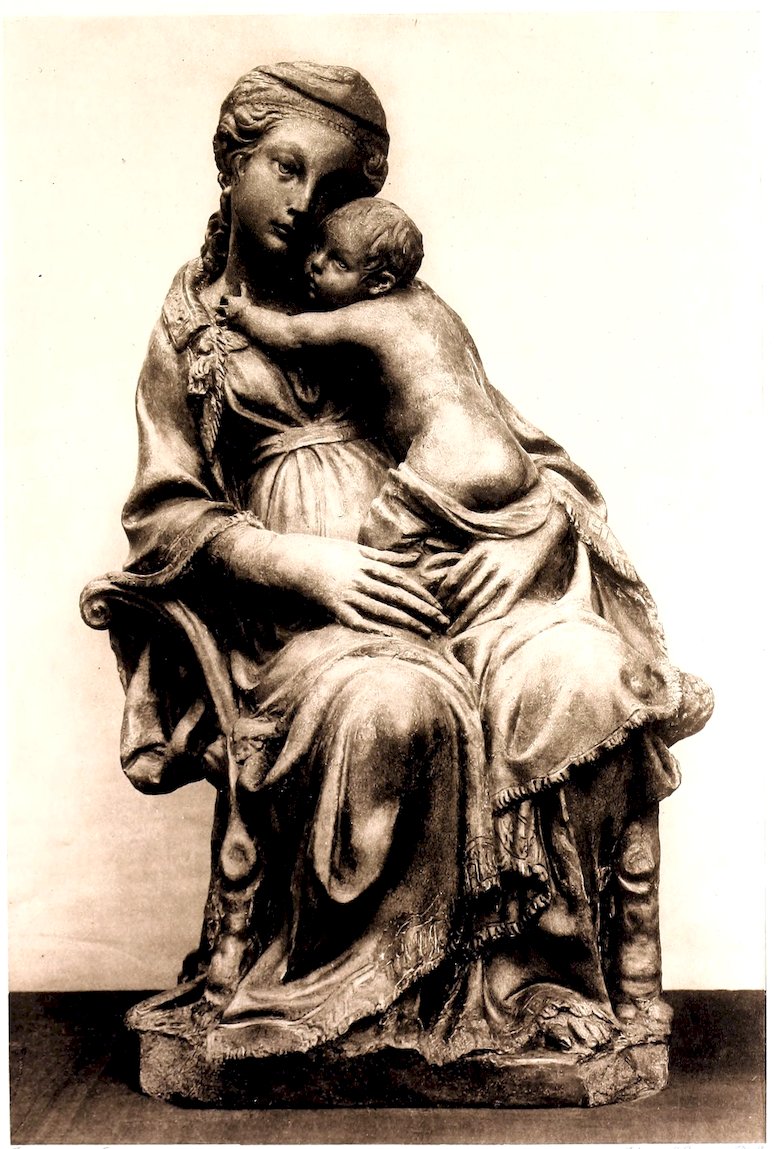
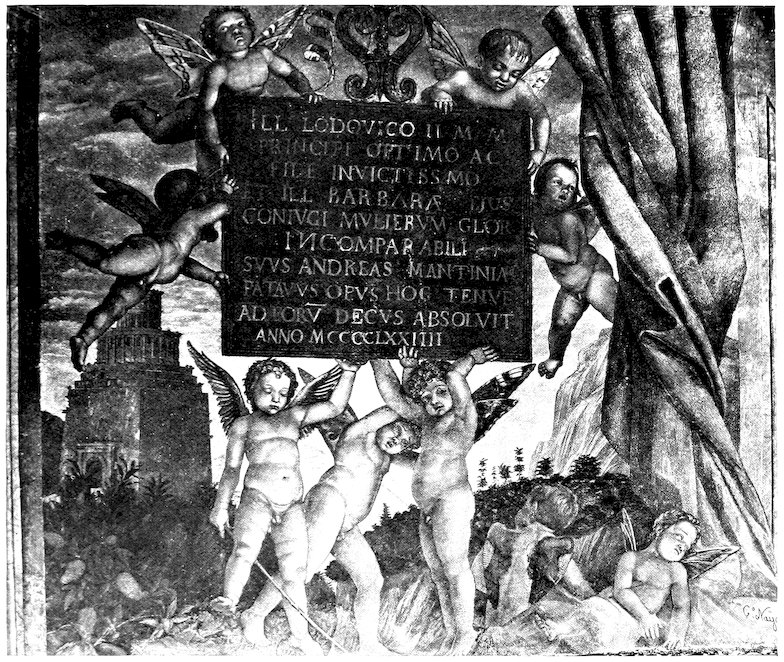
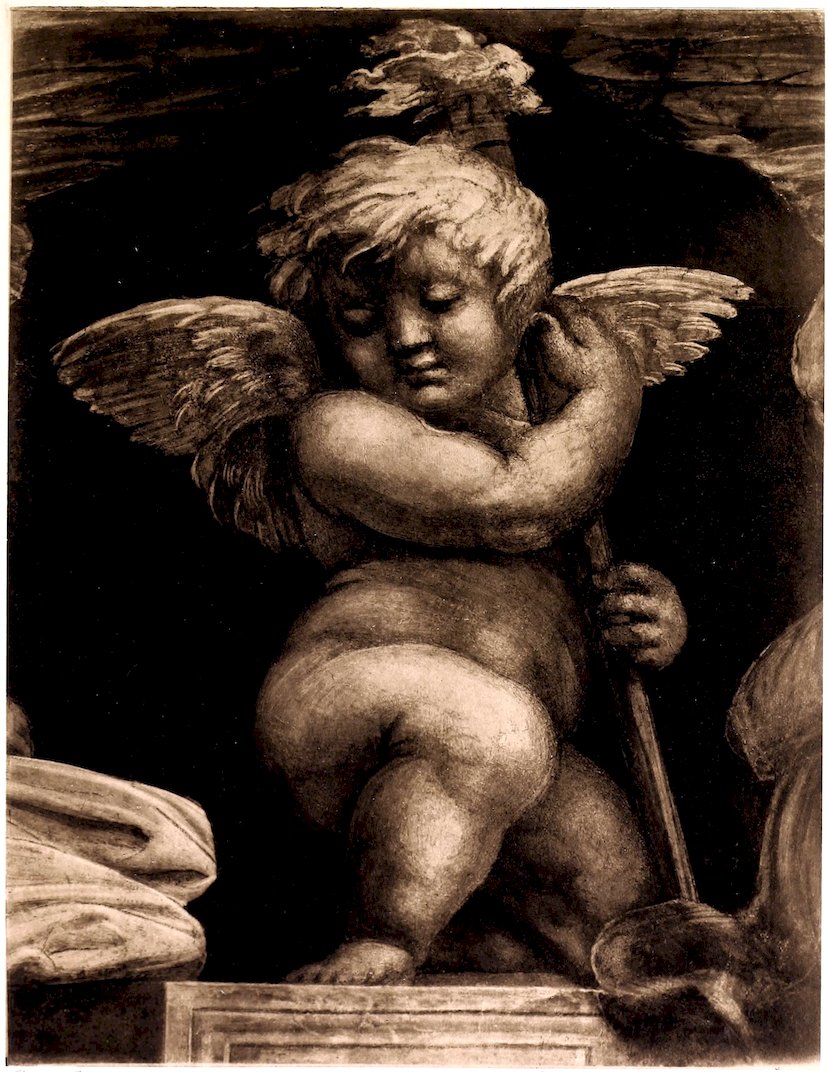
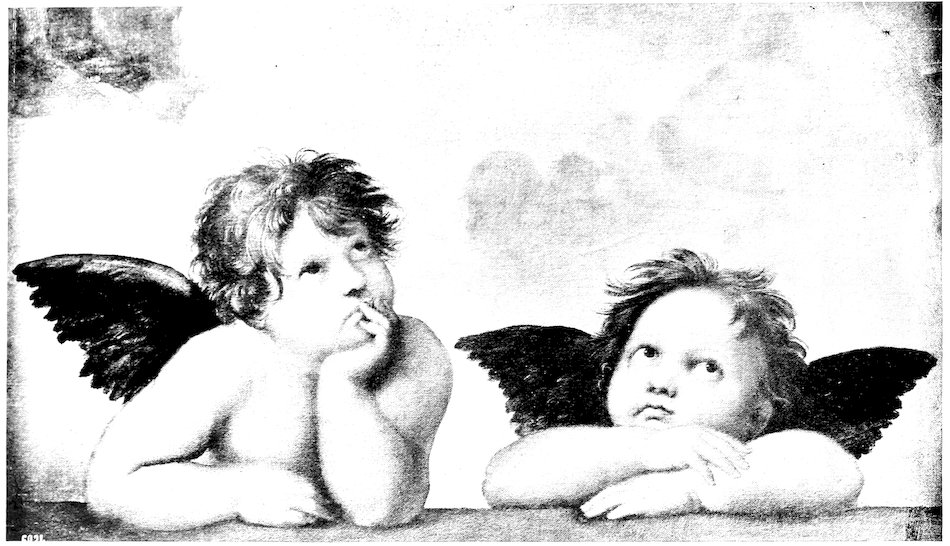
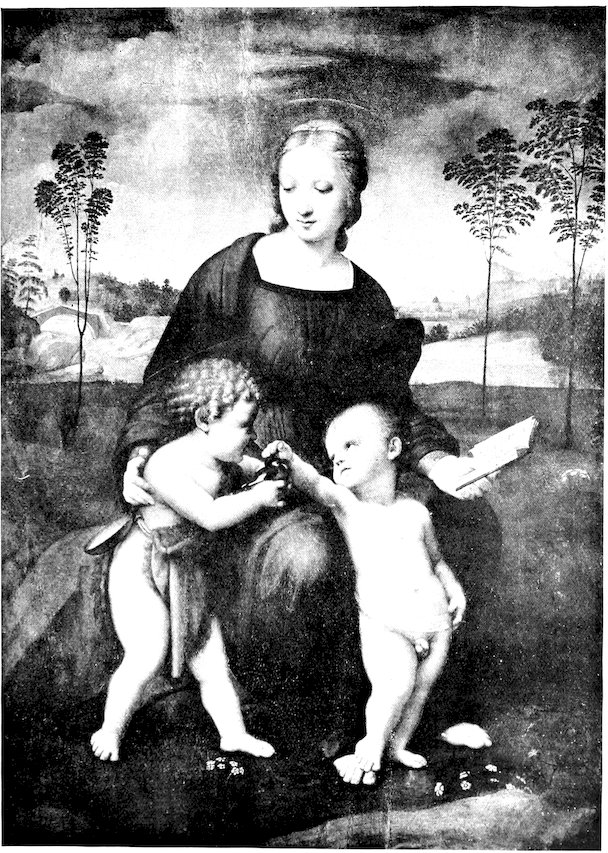
The Photogravure Plates in this book are by Messrs. Walker and Cockerell, after
photographs by Edmund Houghton and the Fratelli Alinari. The other reproductions are
by Messrs. Waddington.
Children of the Old Masters
1
The making of images was, in an earlier world, so
well understood to be for the sake of honour,
that it was the act of homage which must needs
be, by law, restrained. The picture, the statue,
the doll are likenesses of things admired, and
although a strange concourse of unchildlike
children face us as we look at the pictures of the Masters, we are
constrained to confess—seeing how his image is repeated—that these
Masters admired a child, and that the populace of their centuries
must have had popular admiration for a child.
It has been left chiefly for our day, and for our populace, to
make an image in irony, to clothe it in burlesque, to carry it in the
procession of insult. There is but one day in the year on which the
people, in London, make an image, and they set it up for the sake
of derision, draw it through a November fog, hoot it at the pauses
of procession, and, at the end of a day of contempt, give it to the
flames. It is an act of idolatry à rebours, an inversion of the admiring
motive of human art, an act of delight in disrespect not only towards
something unworshipful on earth, but towards the work of the
2maker’s own hands, to which the old and general art of caricature
has no real likeness. For there is no ritual about the comic paper;
nor is its illustration the work of the people, leaving for a day their
labour of making or carrying merchandise to make and carry a work
of art. Whereas they do deride the November image with a kind of
song, and it is the thing of their invention, their burden, their own,
thought out and put together and prepared to its unhandsome end.
Thus the townspeople of to-day intend to tell us that they
contemn—if contempt is the word—the notorious man, national
enemy, or what not, and their own image of him. They do not
express by means of an image what the makers love, like, or admire.
But the images carried by the people of Europe in the thirteenth-century
and onward had no other end.
The Italian schools of painting throughout that long evolution
in which they travelled a great way in mind, a great way in time,
but in place shifted only from Pisa first to Bologna last, dealt less
with children than with one Child. An infantine figure was the very
centre of their attention; and this fact has certainly had an incalculably
wide and persistent influence upon character, and therefore upon
the course of history; but it was not less an effect than a cause of
gentleness and civilization. Art was a matter of importance in
Europe for four or five hundred years, and during those centuries
the centre of art was the portraiture of a child in a woman’s arms.
Our own day would not suffer such a thing. Misplaced irony, and
the love and fear, at once, of a quite inappropriate burlesque would
forbid it. There was, then, a straightforward, a natural sentiment,
now vanished, in the ages that chose this young and helpless group
3for endless repetition; albeit we call those ages violent. They had the
whole Bible to choose from. The Madonna and Child look so merely
a matter of course in the eyes of everyone who so much as knows
the “Old Masters” by their generic name, that these modern eyes
miss the impulse that once set the making of the Madonna and
Child afoot. A manufacture it became, but it had a fresh beginning
and a continuous sanction. The Byzantine who brought the first
Virgin and Child into Italy represented what we should call in our
modern way a public. In order to serve it he made these figures, in
their simplicity and sentiment, the one chief preoccupation of the art
of the new—the second—civilization of Europe. Yet the Crucifixion,
the Descent from the Cross, the great masculine actions and compositions,
were not entirely postponed by this early art. There was
no hesitation, for example, as to their difficulty, inasmuch as the
first mediaeval sculptor was unaware of what modern art calls
difficulty; he knew that his materials must serve him, roughly, in
his approach to drama, and in his use of mere symbols, alike.
Assuredly he had no misgivings as to the representation of the
action of a Resurrection, to be indicated in unpractised and startled
stone. It was not, therefore, for the sake of material simplicity that
he and the painter alike chose the Madonna and Child as the first
and the permanent group. We have to ascribe their choice to the
inclination of the mind of the time, first in the country through
which Greek art entered central Europe, and next in the countries
that followed, while they altered, the fashion of foremost Italy.
Let us grant that this love for children was less conscious, less
deliberate, less meditative, and less articulate than the feeling which,
4apart from the arts, we cherish now, but we may well insist that it
was more serious. It was eager to confess the Divinity of a Child;
and it is well worthy of remark that art put out its hand to stay the
passing of the Divine childhood. It took Goethe’s word and cried to
the passing moment: “Stay, thou art so fair!” And that moment
was the moment of the Infancy of Christ. We are inclined, and with
justice, to accuse our fathers—say our fathers of the seventeenth-century
and onwards—of considering childhood too hurriedly, too
inconsiderately, as a passage. Had they known, we aver, of the law
of unresting change, of the passage through which everything living,
and even the inorganic creature, journeys alike; had they known that
the very crystals have to grow old, they would not have been urgent,
impatient, and in haste with childhood, as they certainly were, because
it is but a state of transition; they would not have seen the character
of transitoriness, which is everywhere, exclusively in human childhood,
and would not have reproached the innocent child with what
is the universal lot. They thought great things of their own maturity,
and hurried their children on to that state which is, after all, so brief
that it hardly stays long enough to be known. It is wonderful that
they should have been thus hasty with childhood, and so pushing to get
it done, so ill-content with the state of the infancy of their children,
in the age in which Reynolds painted the “Strawberry Girl,” and
later when Blake was writing. For the genius of the painter and the
poet had an incomparable apprehension of childhood.
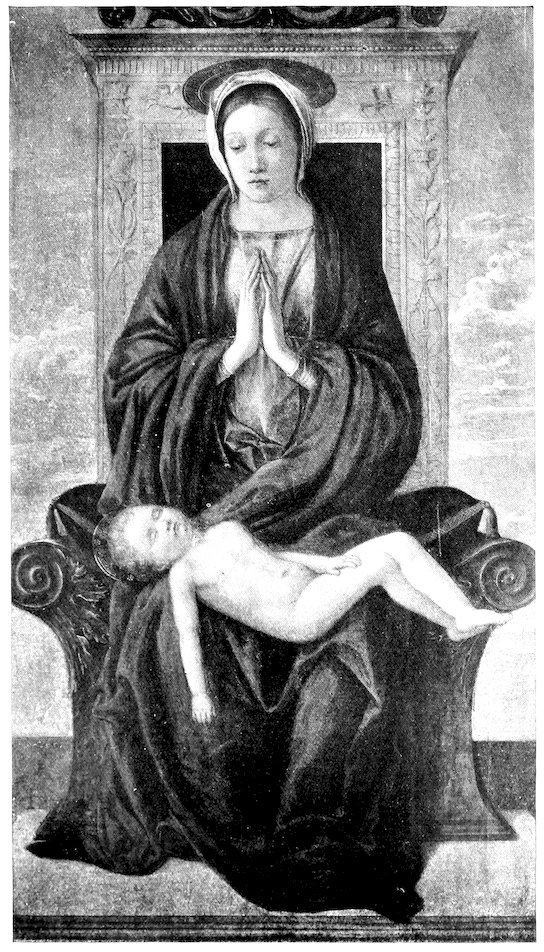
Alinari
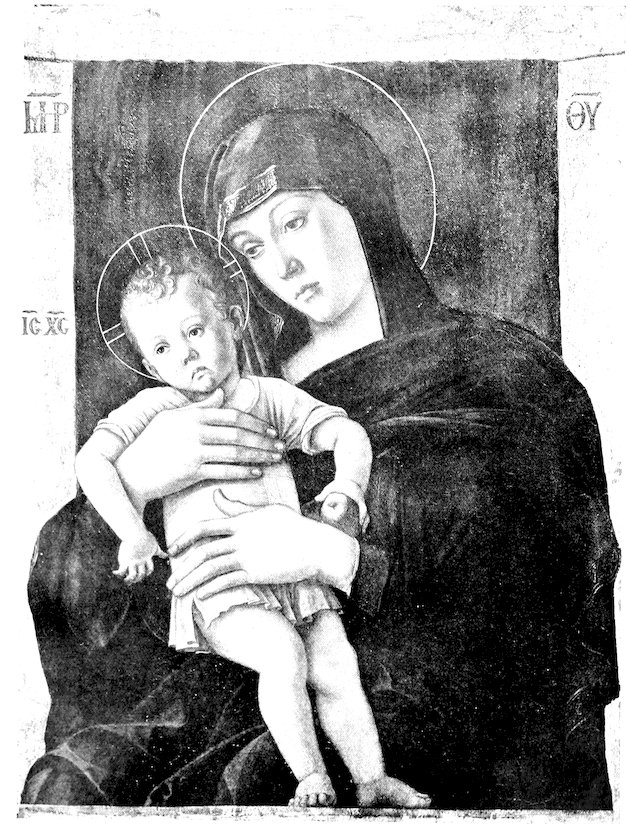
GIOVANNI BELLINI. MADONNA AND CHILD
(MILAN)
One age, then, there was, so little impatient of childhood as to
make perpetual that childhood on which the attention of its art was
fixed. The Infancy of Nazareth was to last for ever. We must not
5forget the certain fact that while the painters of the early schools made
pictures of the Child in the Virgin’s arms they prayed to the Child
himself as though he had never grown older. The infancy they worshipped
was to them a permanent mystery. They were indeed in no
haste to have it over. If we often find in the fifteenth-century and the
sixteenth-century Bambino a lack of that which we call infantine, we
must not forget that the painters intended to paint an infant. A very
“fine” one in the first place. No gossips at a christening were ever
so eager over the fatness of a babe as were the masters. And while
they intended to paint an infant, it must not be a child new-born.
They would not have him wrapped in swaddling-clothes and a few
hours old, but a full six months old and with bared limbs, proved to
be the finest child “in twenty parishes round.” There is a Bambino
of Giovanni Bellini, in the Brera Gallery of Milan, in whom, at a year
old or so, there appears a definite sadness, with the signs of fretting
disease in the droop of the rounded cheeks—the cheeks of the thinnest
baby are round, but the little spheres are flaccid; so are they in Bellini’s
Bambino, and the limbs are helpless with fatigue. But this is a rare
exception. We may take all this vaunting of the fine child in the
Italian school as a simplicity, or else as a lack of delicate feeling.
Children appeal to us by a variant of the quality of pathos; for a certain
time men and women loved them best when they were to die like
little Dombey. That temper is past; but we, to-day, find a child who
is to live, at least as pathetic as the readers of Mrs. Beecher Stowe
found a child who was to die; and assuredly ours is the blacker
humour, the more ill-conditioned melancholy; but it is, with differences,
all one pathos together, and modern. The fourteenth-century
6and after loved a child (in the natural manner) the better for being
high in health and full in flesh.
And yet, after all this apology, I have to confess how seldom
childlike is the Italian Old Masters’ child. The collection in this
volume represents in chief part the exceptions. Rarely and most beautifully,
a purely infantile child—Bambino or angel—more rarely a little
Virgin, and almost as rarely a portrait—shows how suddenly a master
perceived the real character of childishness amid the conventions of
his time and of his art. The Della Robbias, sometimes Botticelli, and
Titian in one great example—these gave the childish look and the
childish action of which they were aware, one hardly knows how, seeing
that both were before the eyes of other masters unperceived. Even
through Raphael’s preoccupation of grace, which has inspired all
dancing masters these many, many years down to Alfred de Musset’s
maître à danser, when he told his maiden pupil that she must turn
her head over the right shoulder when her feet went skimming to the
left, and over the left shoulder when they had to speed to the right:
“But, that way, I shall fall,” says the jeune fille; “But no,” he replies,
sketching with agility a chassé, “Look at me, I don’t fall”; even, I
say, through Raphael’s attitude, destined to so speedy and so long
and so Italian a platitude and commonplace, a perception of the attitude
of childhood breaks at times like a natural action. But not once
did it appear to his followers. The slight corruption of the Raphaelesque
attitude was one of the easiest corruptions in the history of
corruptible art. It suited every tendency of the Latin mind and the
whole school of ornament. Rome, Bologna, and the later Venice improved
upon the child of Raphael, used him for the very structure of
7decorative composition—his curves, especially the bow of his young
figure, which supports the canopies of thrones, not manifestly, as it
was done by caryatides, but entirely by way of attitude and composition.
But for the plastic art—for the exquisite art of Luca and
Andrea della Robbia—a collection of children of the Italian schools
would have lacked much.
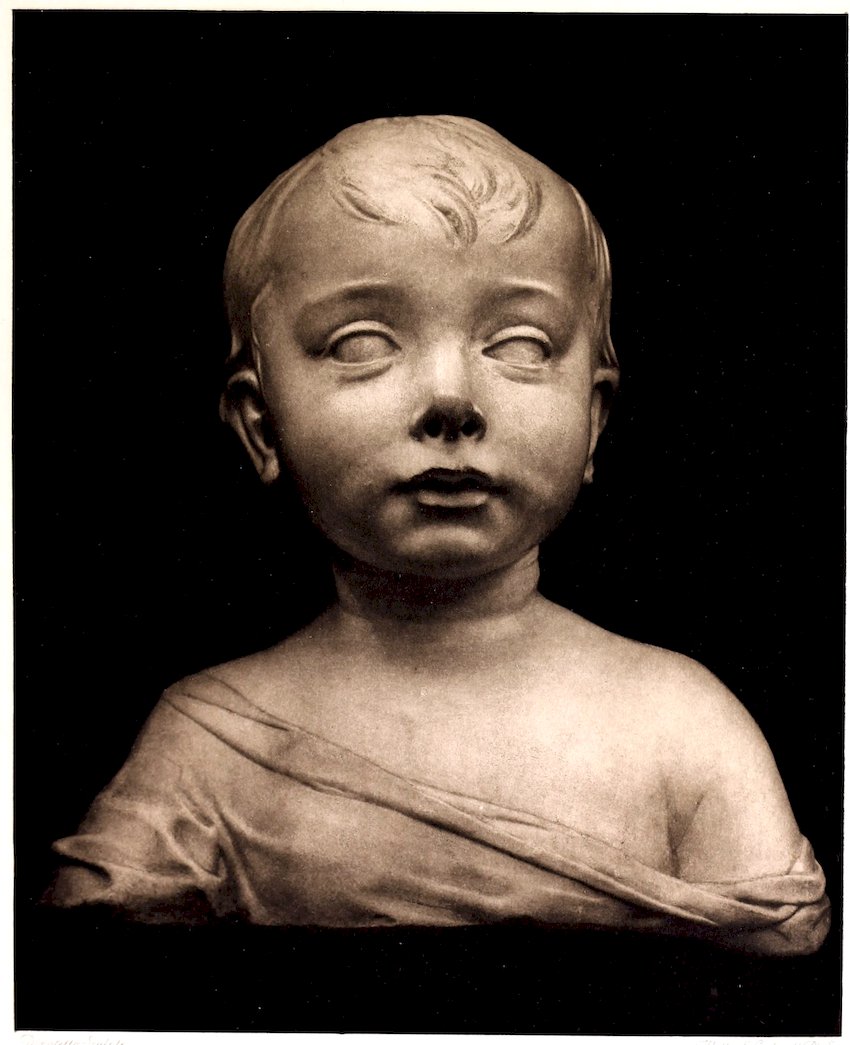
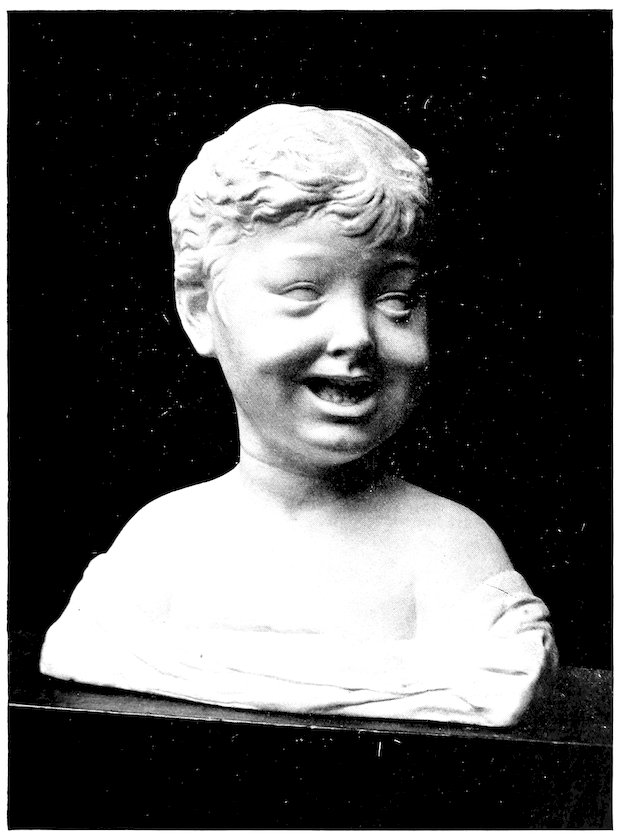
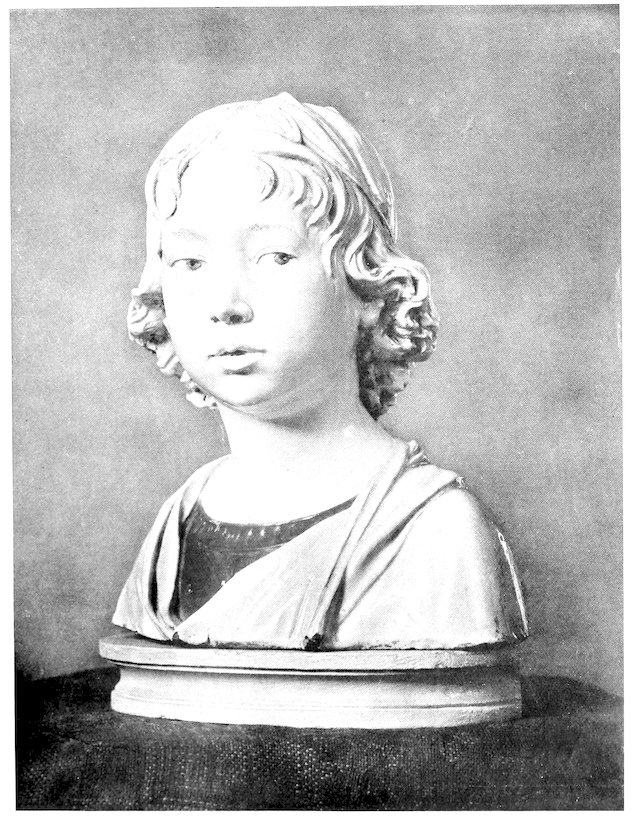
Donatello, Sculptr.Walker & Cockerell Ph. Sc.
Head of a Child.
The Bambino, the boy St. John, the little angel who hauls his
brother by the hand in the “Last Communion of St. Jerome,” with
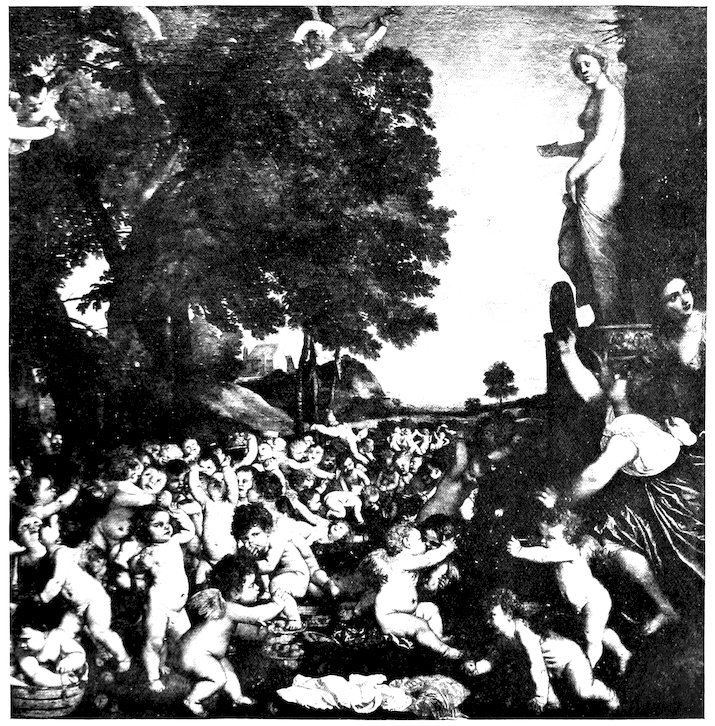
all their kind, and the Loves of Titian’s “Garden” with theirs, are of
course men-children. The woman-child is much neglected; but for
a little Virgin at the knee of St. Anne, or a legendary Presentation
of the Child Mary in the Temple, one might look long for a little girl.
Chaucer seems to allot some of the economy of his tenderness to the
little daughter of Griselda; but soon he makes her masquerade as
a bride at twelve years old: and this was their way, in those days, in
earnest, of suppressing the girl-child; they married her out of the
way of danger.
“Have here again thy little youngë maid.”
Chaucer’s exquisite line, and the tenderness of the poem “Pearl,”
must stand for the scantling of literary allusion to the woman-child
of these many ages.
In a word, the thirteenth, fourteenth, fifteenth, and sixteenth
centuries had a sentiment of their own for childhood, somewhat
unlike each other’s, together very different from ours. We might be
slow to accuse them, whether of error or defect, seeing that they
cannot accuse us again. Nor had they the experience of our older
age, nor the choice of spirits that lies before us. They were not aware
8of the turn human emotions were to take, and doubtless if they had
speculated they would never have guessed prophetically at anything
like the child of Reynolds, or the child of Wordsworth, the child of
the Sunday-school, the child of Mrs. Turner’s moral tales, the child
of Dickens, or of Thackeray, or of the American diarist, or of the
naturalist who showed how the new-born could hang by their hands.
The children of the Italian masters for the greater part are such
as the prejudice of the time would have them, graceful according to
an adult ideal, fat and well-liking, and as beautiful as the hand could
make them when the eye had not learnt to condescend frankly to the
conditions of their life, whether in form or in action. The Greeks
had been most reluctant to recognize the true form—the proportion,
for instance, the relative size of the head and the relative length of
upper and lower limbs. The Italians confessed the characteristic
form, but clung to their own banal idea of grace, the grace that
carries the head aside, the grace of the dancing-master; and imposing
this upon the ultra-childish fat, the exaggerated infancy, the rolling
limbs, of their bimbi, they created a little corpulent artificial figure,
not like a man, not like a child, the pet of the ages that brought
mediaeval Rome to the ground by the pickaxe, and set the seal of
one style upon the city and world. It is difficult to associate the
painting of Angelico or that of Benozzo Gozzoli with the neo-classic
architecture; insensibly we place the painters further back, a step
nearer to the Gothic, than the builders. We do so, that is, in regard
to their Madonnas, to their Apostles, Evangelists, Martyrs, and
Doctors; in these there is the upright spirit—they are “early.”
Thus the arts are at odds, or look so, as to “periods.” But that
9impression disappears when we attend only to the Bambino. Here is
full “Renaissance.” The Bambino goes well with the classic temple
of the academy, with the portico and the pediment, even the broken
pediment; he is of their time.
Amid so many little boys wearing their make-believe childhood
in the posture of indirect grace that living childhood never assumed—a
posture conceived in the adult mind before it was assigned to
any picture-child; amid so many falsified little boys, stand the
smaller number of authentic children. They may be gathered un
peu partout from all the schools of Italy early and late; Florence
yields them in the fourteenth-century and Venice in the sixteenth.
The grace of life, as it were something unexpected, puts out its
impulsive and simple arms, or a laugh breaks through. We find
again the child whom the painters had a little outdone or a little
altered for their art, but whose own incomparable charms meanwhile
had never flagged. It had doubtless been dear to women, in private,
outside of the schools, renewing itself in the freshness of the repetitions
of human generations. If the thrush sings each song twice over, with
the “careless rapture” note for note rehearsed, his indomitable little
fathers had sent the same song afloat, with the same impulse of
invention, in the course of centuries. Nor do the sallies of kittens
change, and doubtless the sacred antics of the spirited Egyptian imp
in ambush that is now a mummy were those which the kitten tries
to-day under the spur of an old but unpremeditated joy. Children
in like manner recapture and recapture the outbreak of their smiles
and their fresh ingenuities of play. And the Italian master who has
moulded his bambino heavily, creased his legs and puffed his cheeks
10so as to make him very much a child—a fine one, and has turned
his neck, disposed his legs, and raised his eyes so as to make him
something more elegant than a child; the same master, I say, sees
at another moment the sweetness of the truth, and his efforts and
prejudices are set aside. Could there be a better example of this
repentance than we may see in the work of Raphael?
It may be necessary to say that the slight essay following is
not a work of art-criticism, and less—if less could be—an historical
study. It does but record some of the changes of sight and spirit,
during the course of the five centuries of Italian art, in the contemplation
and representation of childhood. It is therefore an essay
on a subject of the designs of certain painters and sculptors, and
not on their workmanship.
THE CHILD OF EARLY ART
11
In the ages that, since the Renascence, have been called
dark, the scanty art knew but one Child, but this
was virtually the first child in art—the first prevalent
child. Whether we hold the art of the time between
the fall of the Roman Empire and the entry of Byzantine art into
Italy—the time that is darkened by the smoke of the destruction,
and the dust of the demolition, of Rome—to be the last art of the
antique world or the first of the modern world; a seed-pod or a
bud; an art rigid, grave, and inexpert with exceeding youth, or
bearing those characters because of extreme age; we find it separated
from the past, and allied to the future, by the motive of its effort, by
its desire, by what we call in our loose language its subject. That
subject was chiefly the child-Christ in the arms of his Mother.
When the linear arts came out of hiding in the Catacombs they
came with this burden and for the sake of this. Learning has not
said its last word as to the female figure so often traced on the
subterranean wall—whether the “Orante” was a symbolic woman
or a Madonna; she has no child. But about the woman with a
child there is no doubt. A half-effaced fresco in the Catacomb of
Priscilla has a singular, natural, vivid, well-observed Child glancing
suddenly round from his Mother’s breast with animated eyes—“falcon
12eyes,” an Italian writer calls them; and this is from an
early hour of the dark ages, and a mere scratch in a dark place.
Since this Catacomb design has still a spirit, a vitality, a dramatic
impulse that relate it to antiquity, then it is in these places of
Christian sepulture that the old art lived its latest unmistakable life,
and then passed into that ambiguous state I spoke of but now. For
the falcon-eyed child is conjecturally of the early part of the third
century, thirteen hundred years, that is, before Raphael; Raphael has
much the same action in the “Madonna della Seggiola.” It would
be too much to say that, except in sculpture, this vitality of childish
movement lapsed during those thirteen centuries, passed, in linear
art, from the nameless hand of the Christian in the Catacomb into the
glorious hand of Raphael on the summits of sixteenth-century Rome;
but it might almost be said. For in the pre-Raphaelite painted
Bambini there is something less quick, less instant, than in the
little head of the Catacomb of Priscilla, and in the little head of
Raphael’s picture.
The rest of the Catacomb designs are, as has been said, ambiguous,
between two worlds; the rigidity of weakness is in them; the
proportion of childhood is lost—for let us add to the strange honours
of the Priscilla drawing this fact—that the size of the Child’s head is
there according to nature. After this the Catacomb designs keep
their “dark-ages” character. Moreover, from a Roman tomb of an
even earlier date than that of the Catacomb Child—the vault of a
tomb of the first or second century—we have slight sketches in relief,
amongst which is a child; he is exceedingly young, and springs,
seated, as a child who cannot walk springs on his nurse’s arm; but
13this child is driving a dragon, and doing it with spirit and with
shouting. He is perfectly childish in proportion, a large-headed,
animated boy, for whom some baby sat, in the time of Trajan, leaping
at some vigorous fancy of his own. This work, by the way, is so
skilful, as bas-relief, that we cannot rank it with the equivocal early
Christian drawing; this dragon-driver and all the other work from
the same tomb is decidedly late-antique, and not early-modern; it
is only the Christian art that bears the twilight character—twilight
of nightfall or of daybreak?—in its seclusion.
Next come the majestic mosaics of the Byzantine churches, from
the sixth-century Madonna and Child in the Basilica of Sant’
Apollinare Nuovo, at Ravenna, to the beautiful twelfth-century
Madonna and Child of the Duomo of Torcello. Majestic, indeed,
are they, albeit not only ignorant but weak, barbaric in the early
examples, and loaded—the crowned woman and the crowned doll-child—with
ornaments as rigid as their eyes; but all-noble at their
worst and best. It is only at the close of these ages that notes on
Italian schools should properly begin. The Italian schools grew
from the Byzantine in Italy; and they had there a great origin. The
Renascence, if we give the name to this evolution of an art, was no
sudden thing. Imperceptibly the art of the alien mosaic passed into
the art of national painting. Cimabue made, if one may say so bold
a thing, very little difference. That his Madonna was portable may
have been, after all, the chief cause for the carrying in procession;
that he “held the field” in Florence may have been chiefly by reason
of his Florentine citizenship. At Siena, in the same Tuscan country,
Cimabue had contemporaries and equals. Margaritone d’Arezzo was
14born some twenty-five years earlier than he, and was hardly that
quarter of a century more Byzantine. Duccio di Buoninsegna, whose
“Madonna and Child,” with contemplative angels, has at least as
much as Cimabue’s flexibility, followed him closely in time. And
Duccio’s angels, leaning on their hands on the back of the Madonna’s
throne to look at her Child and her, have a quiet drama of attitude
and look, as full of promise as the best action of the attendant angels
of Cimabue. The Child of all these first masters of Italy has the
arbitrary proportions, the erect attitude of the time, the aspect of a
strange small man, which was, let us remember, as far as we know,
the fiction that Greece herself approved. Cimabue places him on
his mother’s arm, rather than on her knee, but, needless to say,
with no weight; one hand is raised in the action of the Papal
blessing—three fingers up to represent the Holy Trinity. Cimabue
does not give child-angels to the Bambino for companions; none of
his angels, I think, can be said to be children.
When we pass from the mere image of the Virgin and Child to
the representation of the Nativity, art becomes, in a certain degree,
dramatic. Inasmuch as it “illustrates,” the criticism of our day would
call it literary; but it is not more literary than life is literary. The
plastic and linear arts have to do with all that the eyes can see; that
is their large province: expression, action, significant attitude, moral
beauty and intellectual beauty in their aspect, passion in its aspect;
all these as well as decoration. The great schools had no doubts as
to this matter. And the art that was not yet a school, and hardly still,
or hardly yet, an art at all, fumbled at the scene of action, even in the
Catacombs. In the acrosolium of one of the dark galleries of the
15Catacomb hard by the basilica of Saint Sebastian, on the Appian
Way, is a little painting of a wooden bench, upon which lies the child-Christ,
swaddled, with two animals at his side. This is conjecturally
of the fourth-century. It is the first “Nativity.” In regard to the
character of art it is the first, and Correggio’s “Notte” is among the
last. For after Parma and Venice art ceases to go on a steadfast, confident
and coherent way; it breaks as a thread of water breaks into
drops. Virtually, if not in actual date, Correggio was the latest of the
great. He showed plainly the corruption of art in the near future, while
in the immortal Venetians who were his contemporaries there was
not even corruptibility. Incomparable colour kept them in exalted
health—colour and tone. As much as colour, assuredly the tone of
Titian and Tintoretto—the tone of a head against the sky as Tintoretto
painted it, or the tone of the arm against the cloud in Titian’s
“Amor Sagro e Profano,” secured the art of Venice against the thought
of decadence. But decadence was close upon Parma and Rome. During
all these ages of genius, then, the art of painting was intent upon
the representation of the Nativity.
It shrank, however, from representing a new-born child, even in
the manger; the Nativity, though dramatically rendered, was to be
contemplated as a mystery, rather than watched in the taking-place.
Thus the Child is nearly always nude, for the sake of the round forms,
and some months old. But Giotto, who clothes all his figures heavily,
has sometimes a draped and sometimes a swaddled Child, and obviously
tries to make the scene “like” the fact. And the two intentions
keep pace for some time until the Mystery gains. The Nativity takes
place then in the open country, amongst splendid buildings, or under
16a triumphal arch; and the donors of the picture and their patron
saints attend with Milton’s “bright-harness’d angels” at the “courtly
stable.”
Alinari
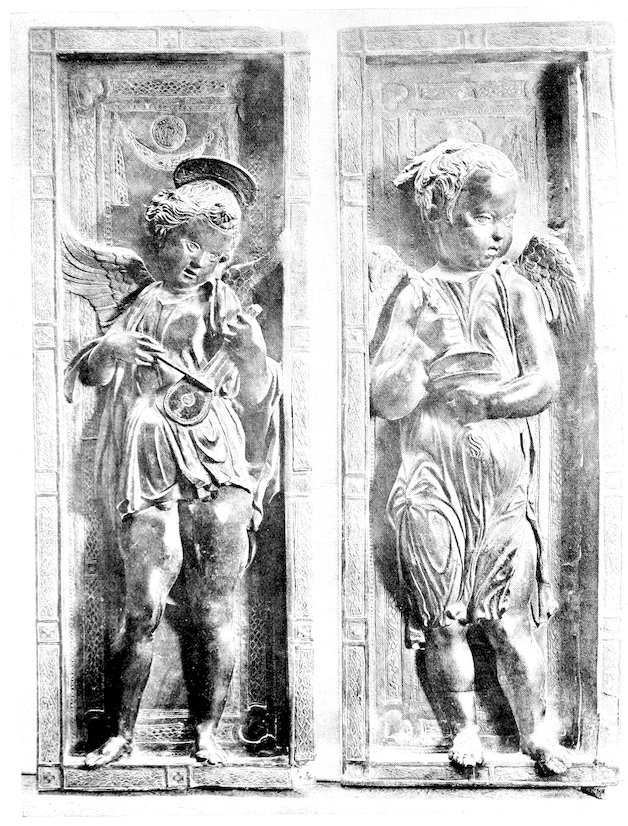
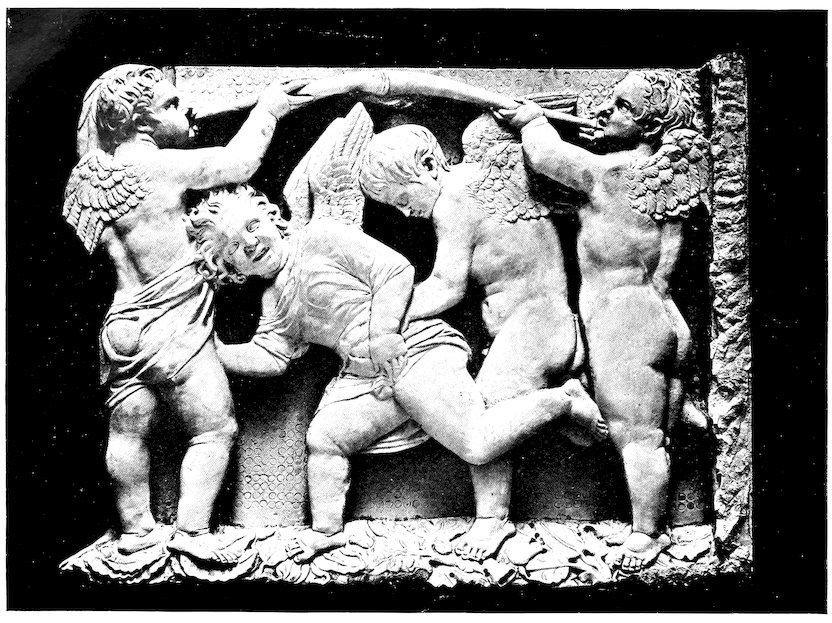
SCHOOL OF DONATELLO. ANGELS
(PADUA)
Houghton
DONATELLO. WINGED PUTTI
(FLORENCE)
Houghton
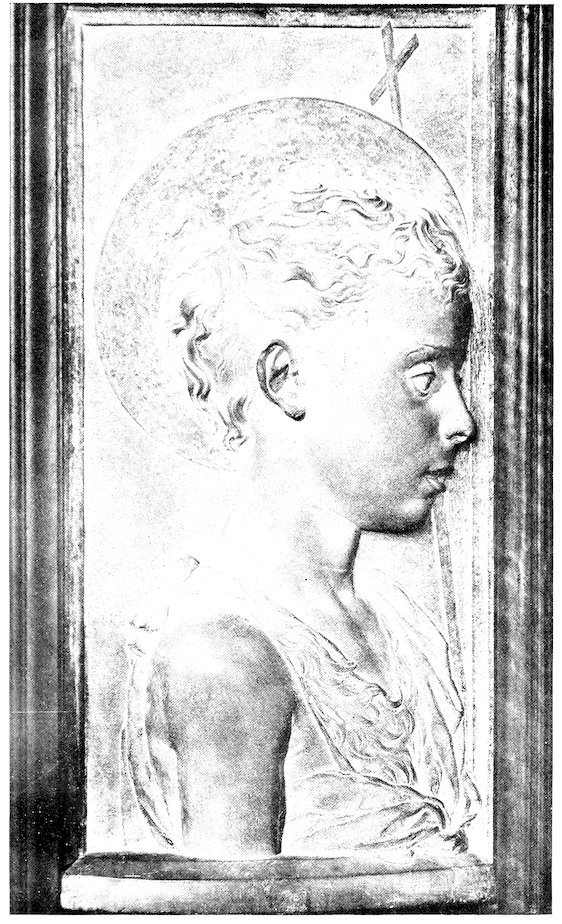
DONATELLO. THE LITTLE ST. JOHN
(FLORENCE)
TUSCAN SCULPTURE AND ENAMEL
17
In Florence the art of the modeller was far in advance of
the painter’s. This is not unintelligible, for the sculptor
had under his eyes the sculpture of the past, whereas the
painter had no painting; he had the conventions and
code of a virtually new art to decide. The mosaics and the illuminations
were all that the early painters possessed for precedents and
models. The difficult art of bas-relief had become Italian through the
first Tuscan who learnt of the last Greek; but Italian painting had
nothing nearer to Antiquity than some so-called Madonnas of the
painter-Evangelist Saint Luke. The mosaics and the illuminations
were, indeed, Byzantine, and indirectly Greek. But compare the figures
of the enthroned mosaic Madonna at Ravenna, and her ceremonial
Child, with the classic sarcophagus that inspired the Pisan. The one
is Byzantine, the other Greek. The sculptor, then, inherited the rules
of the art. The painter had to devise, for instance, the treatment of
a certain degree of perspective by means of the linear art. Margaritone
d’Arezzo, born in the year of Magna Charta, and the Sienese who was
his contemporary, and Cimabue who followed him after a score of
years, together established the general terms of painting.
Thus the Tuscan sculptor, set free by his possession of an established
art, was at ease with nature and the convention of bust and
bas-relief, and with nature’s simple and wild creature the child.
18Giovanni Pisano was born some five years before the nearly
Byzantine, the majestic but captive, Cimabue. In the cathedral of
Prato and in the Camposanto at Pisa are Bambini of Giovanni’s
that are agile, springing in the mother’s arms, playing with her
diadem, perfect children. His father Niccola was in art virtually
a Greek, but his glorious “Nativity” upon the Pisa pulpit and that
on the Siena pulpit do not, of course, show us a spirited child;
though, by the way, Fra Guglielmo of Pisa has an animated little
infant whom the women attending the Virgin wash in a stream, at
the mouth of the cave of the Nativity, from which sheltered sheep
are drinking. Giovanni Pisano’s Bambino is assuredly one of the
earliest of Italian children studied from life and full of life. And
when we speak of the fifteenth-century’s re-discovery of childish
proportion, let us remember that this great sculptor observed it, and
was born early in the thirteenth.
Alinari
DONATELLO. HEAD OF A CHILD
(FLORENCE)
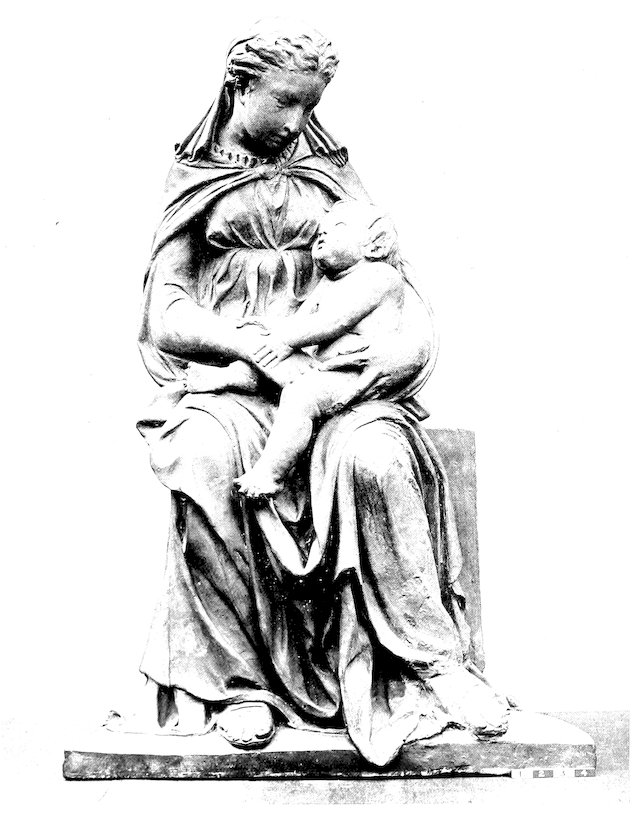
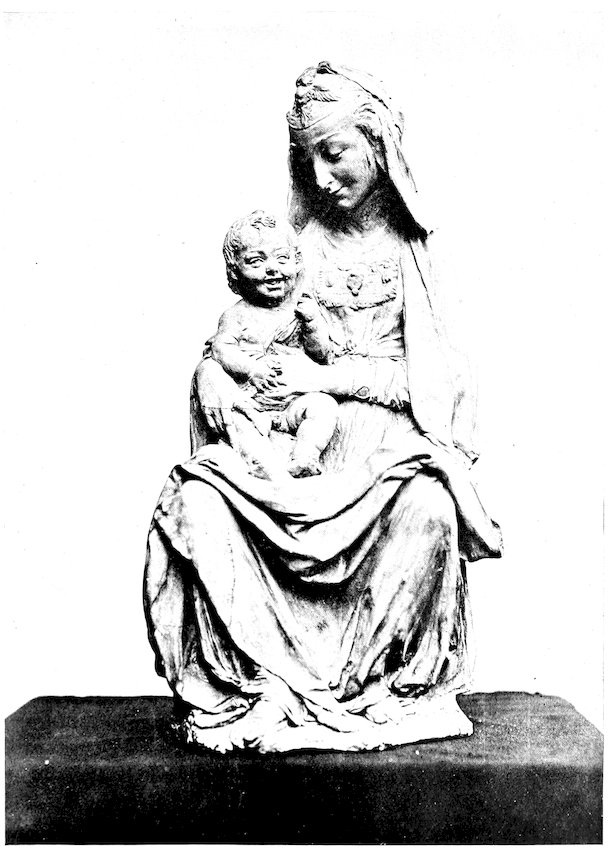
JACOPO DELLA QUERCIA. MADONNA AND CHILD
(SOUTH KENSINGTON)
Painting was still an art in bonds and difficulties when Donatello
produced his beautiful bas-reliefs of a natural Bambino, and the
exquisitely modelled bust with the face delicately broad across the
charming eyes, and narrowing to the chin—whether called the young
St. John or not, purely the portrait of a tender boy; and his lovely
boy-Mercury. Fra Angelico was demurely reckless with his anatomy
when Jacopo della Quercia, the Sienese, was modelling the perfect hands
of his Madonna and her perfect Child in one of the statuettes by the
master which are amongst the original treasures of South Kensington
Museum; also when Luca della Robbia was using his material with
a masterly and liberal hand in the sketch for his bas-relief for the
singing gallery of the Duomo at Florence, a sketch wilder and more
19animated than the finished work. (South Kensington has this incomparable
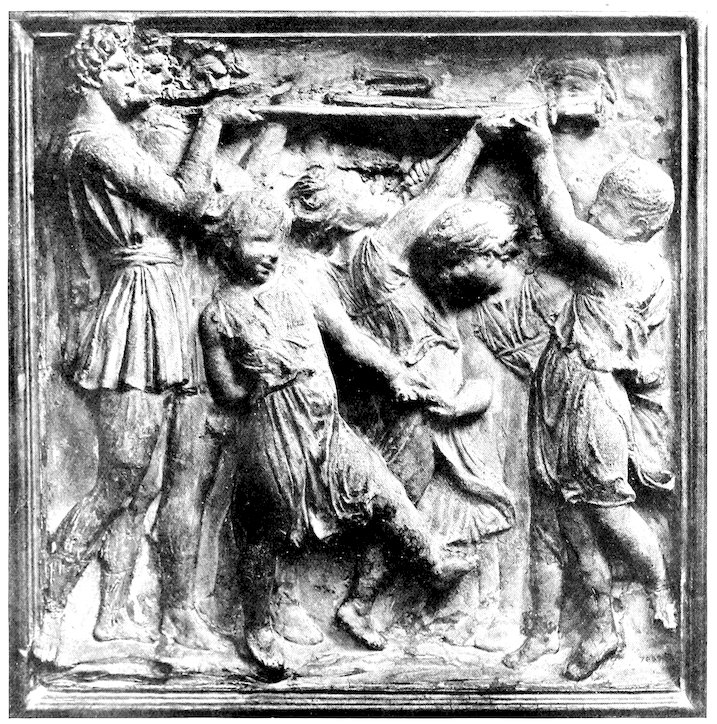
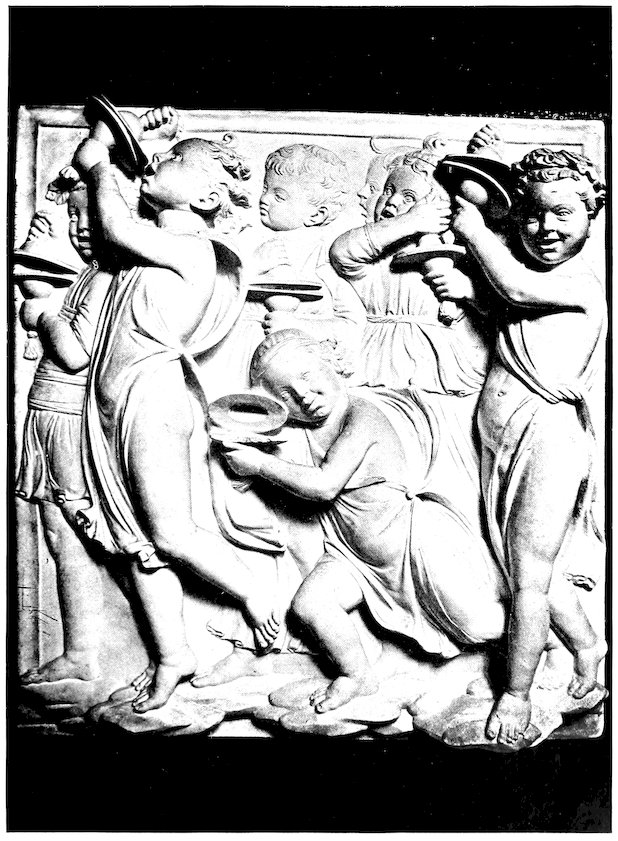
stucco.) The children of this relief move with impulse and
energy in a youthful dance; in another panel they go clashing
cymbals, six cymbals at once used with a will. The works of this
master, the inventor of the enamelled coloured terra cotta that bears
his name, and the eldest of the three who used it, are of ever fresh
variety. His, amongst others, is the Bambino who gives best the
Papal blessing. There is nothing but what is charming in this
action; fantastic as it looks with a baby face fresh from nature, it
does nothing but delight us. Botticelli’s wonderful picture, his
masterpiece, the “Magnificat,” in which the Child, turning his face
upwards, points to the open page, does not reconcile the action with
infancy, but Luca della Robbia makes his little infant a Pontiff
with sweetness and ease. Somewhat like this wholly delightful
Bambino is Rossellino’s, the terra cotta statuette at South Kensington,
in which the smile breaks into an open laugh. The
Madonna laughs also; at least she has a sub-hilarious face as she
looks down at her noisy child, sees the soft gap-toothed mouth, and
feels the little tumult of mirth in the breast under her hand. This is
something altogether different from the benignant smile, a bestowed
smile, with which the painter in the later centuries adorns the Virgin
and Child. Luca della Robbia also has a laughing Child in a bas-relief
now in the Berlin Museum, and he too makes the Mother
laugh with him.
LUCA DELLA ROBBIA. SKETCH FOR A PANEL OF THE SINGING GALLERY IN THE DUOMO, FLORENCE
(SOUTH KENSINGTON)
Houghton
LUCA DELLA ROBBIA. PANEL OF THE SINGING GALLERY IN THE DUOMO, FLORENCE
(FLORENCE)
When we turn to the putti who are not Christs nor perhaps
angels, little laymen dancing in a rondo or joyous in procession,
or decoratively employed, loaded with thick wreaths of flower, fruit,
20and leaf, laurel, pomegranate, and convolvulus, it is still more
difficult to remember that Luca della Robbia and Angelico da
Fiesole were of the same age; according to one computation the one
but a year older than the other. Luca with his ware not only was
a liberal student of nature, but was free enough to use his material
gaily. The painter meanwhile was moving with the stiffness of
experiment; we might place his child in a church of the early Gothic
that had long ceased when he was painting, but Luca della Robbia’s
enamel puttino would seem in place in any age of worthy architecture.
Stone, colour, and the Della Robbia ware had their several historic
ages, concurrent, but different. More than sixty years later, two other
contemporaries, Andrea della Robbia and Botticelli, show something
of the same contrast, generally in a lesser degree; but in one respect
the contrast of the two later men is equal to that of the two earlier—the
anatomy of Botticelli was still reckless, at any rate in the
draped figure, whilst that of Andrea della Robbia was easily correct.
Botticelli, indeed, follows Angelico, his much less expert predecessor,
precisely in a strange ideal of the female figure; both feign that the
body has a long region from the ribs to the hip; they interpolate a
tract, as it were, unknown to nature. Below this, Botticelli sets the
jutting legs of his Graces. Below this, in like manner, but under
draperies that disguise the manner of junction, Fra Angelico discreetly
places the limbs of his seated figures, with entirely arbitrary
knees. It is worth noting that Botticelli does not play this anatomical
prank with the nude figure in his beautiful “Birth of Venus.” This,
however, is not a matter of childish proportion; Botticelli habitually
tries for the right proportions of nature in his children.
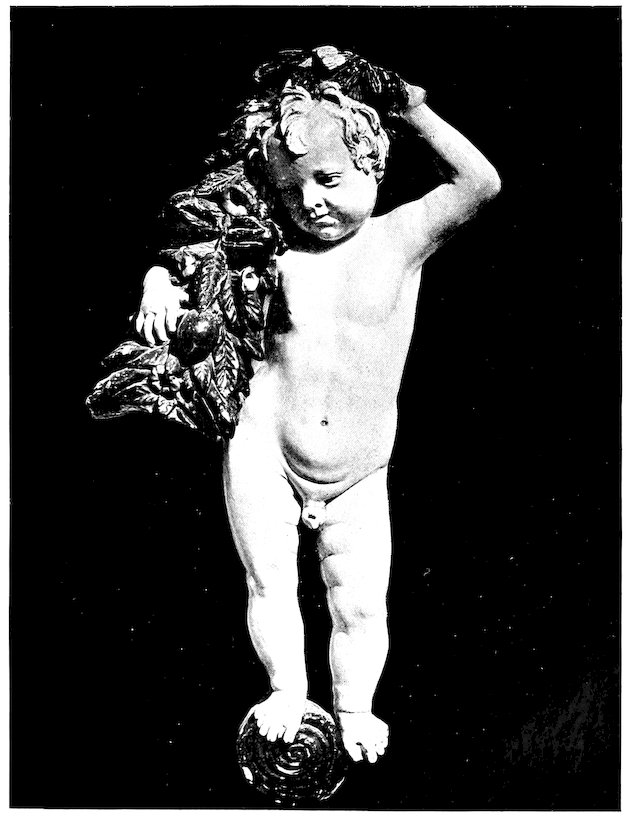
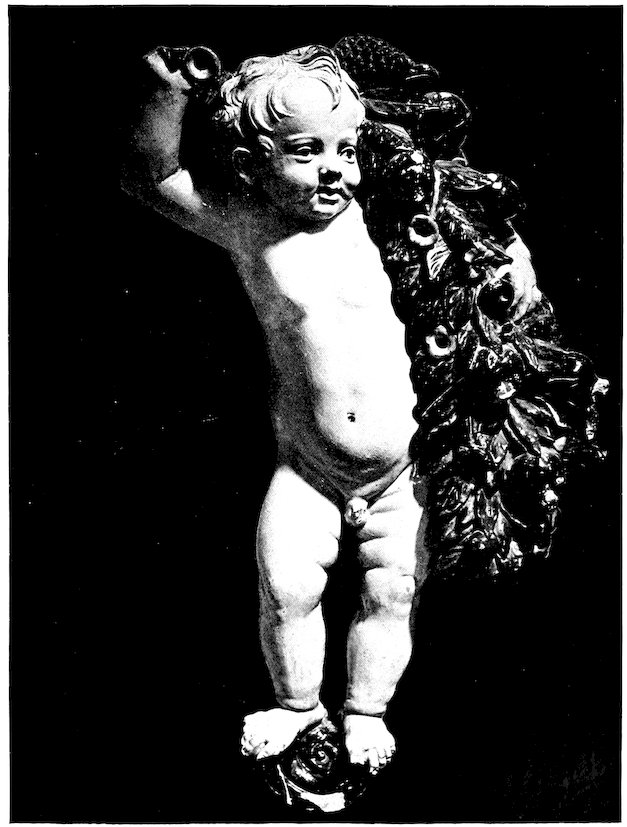
Alinari
LUCA DELLA ROBBIA. CHILD WITH FLOWERS AND FRUIT
(CITTA DI CASTELLO)
Alinari
LUCA DELLA ROBBIA. CHILD WITH FLOWERS AND FRUIT
(CITTA DI CASTELLO)
21Luca della Robbia is surely one of those immortal artists whose
work hardly has a date. It might have been immortal a parte ante
as well as a parte post. It has no obvious beginning, being purely
natural and simple. His own invention of enamelled terra cotta,
which after a time he perfected with colour, gave him a material
that did not alter and the dainty clear surface whereof takes no
smirch of time. It is most appropriate to his fresh and spiritual
genius, which, finding nothing quite fitted to it in the gold and
bronze of its earlier labours, devised this ware, plastic as clay and
cheerful as porcelain. Enamelled terra cotta is perpetually young.
Most appropriate to his genius and to his material also was the
subject of his art. The Virgin and Child are necessary to that lovely
art; they are the centre, they sit enthroned over the arch or the
middle stone of the doorway it decorates, and the little laymen
stand about them with their heavy garlands. Let us add that with
the gaiety of porcelain, the Della Robbia ware has no triviality; it is
sweetly venerable; its pale blue and white especially accords with
the oldest convent threshold that it ever brightened. Matteo Civitali
and Verrocchio, also Tuscans, and like the Della Robbias sculptors
of children (to apply the name of sculptor somewhat loosely), were
architects chiefly, and therefore sculptors as a matter of course.
They are not so sportive as their predecessor Donatello in his earlier
work, but follow him rather in the graver dignity to which that great
sculptor had changed his type in course of time. A Bambino of
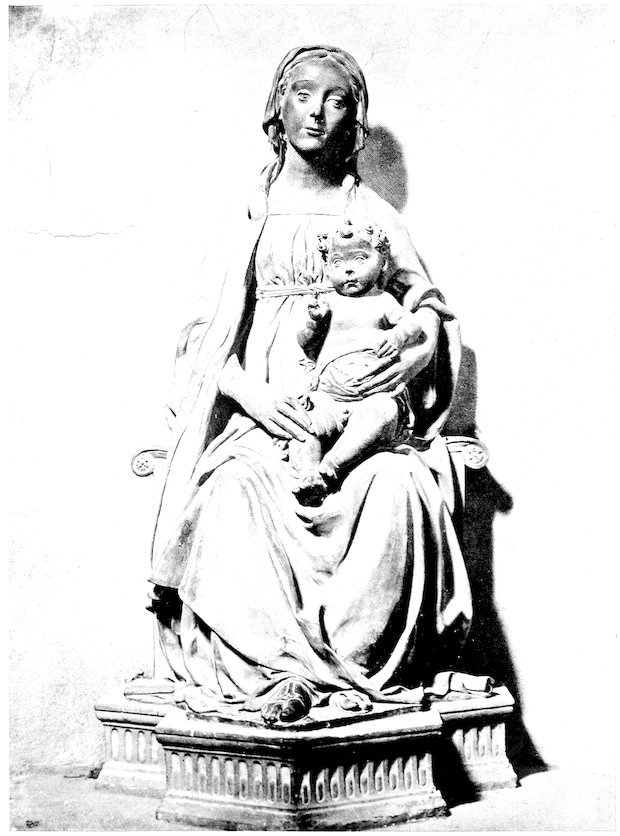
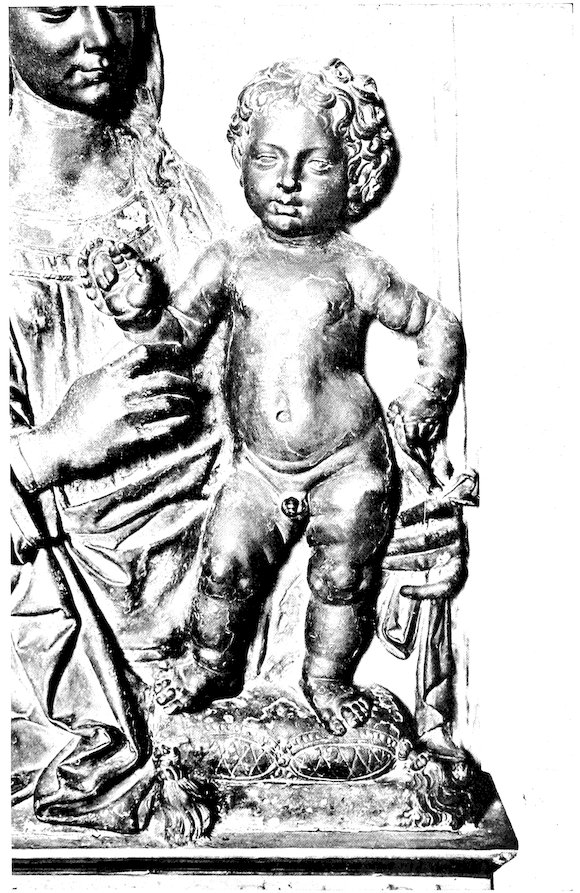
Verrocchio’s gives the benediction, standing before a regal mother
richly apparelled; so does a Bambino of Benedetto da Maiano’s;
one of Pellegrini’s clings closely to the neck of her who leans one
22beautiful cheek upon his head; but amongst the innumerable variations
of attitude appropriate to sculpture in many a form, from that
of enamel to that of bronze, there is nothing quite like one of Jacopo
della Quercia’s groups, where the Bambino and the Virgin look into
each other’s eyes. The Madonna and Child of a thousand other
designs, in sculpture as in painting, are not intended to seem alone.
The Child giving the benediction has the city and the world before
him, or at any rate a congregation of Tuscan people; he who
smiles from his place on the mother’s knee has the passers-by on
the dusty roads in sight; and the Suckling who looks over his
round shoulder is startled because someone perhaps kneels too near.
But this one Mother and Child are quite alone; he has both hands
upon her shielding arm, and holds back his head and meets her
eyes fully. In much Italian art (as I have been obliged to repeat)
there is some form of grace that hinders immediate action and
expression; but these workers in terra cotta have no such interception,
no such thing postponing, deferring, removing the expression
of life, preventing and hindering the close clasp which is the
only real manner of holding a baby. Let this solitary Mother and
Child be one example, and we shall find others in Desiderio da
Settignano’s portrait-busts at South Kensington, tender and fine
models of creative childish life. Here we find no preoccupation
or prejudice (such as the painters so soon assumed), tending quickly
to commonplace and platitude. Desiderio (his date is somewhat
later than Luca della Robbia’s, but Luca is the master of the rest)
has observed the childishness of the protruding upper lip, that
innocent incident of infancy, as the protruding lower lip is an experienced
incident of old age. The one and the other were modelled
in these terra cotta busts from life. Luca della Robbia observes also
the weakness of the soft mouth of childhood, with the underlip
a little sucked in; he models the lips lightly and feebly apart,
in two of the portrait-busts at South Kensington. Domenico da
Capo d’Istria has a fine erect Bambino, as upright in his spirit
as in his attitude; no twist, no head aside is his; and Mino da
Fiesole is equally frank in his Saint John the Baptist. These
are examples, and no more, representatives of a great school of
natural art that lasted nearly a century in Italy.
Jacopo della QuerciaWalker & Cockerell Ph Sc
Madonna and Child.
ROSSELLINO. MADONNA AND CHILD
(SOUTH KENSINGTON)
Alinari
BENEDETTO DA MAIANO. MADONNA AND CHILD
(PRATO)
Houghton
VERROCCHIO. MADONNA AND CHILD
(FLORENCE)
23Luca della Robbia is simple, but Andrea della Robbia, in the
succeeding generation, is more divinely simple yet. It would be
difficult to place him “later” in spirit than his elder. In such a
detail as the treatment of the framing wreaths of close leaves and
fruits, he keeps the rich severity of the natural design. Giovanni,
the third of the name, lost the severity. And Andrea, in his groups
of Madonna and Child, rejects everything that is less than perfect;
here is the blue ground, here the lovely Virgin and the lovely Child—two
tranquil heads, the veil, the hands, and a few straight summer
clouds lying in a blue sky. The altar-piece, probably by him, which
represents the Madonna giving her girdle to Saint Thomas in a
vision after the Assumption, has a mandorla of little angels’ heads,
and in another beautiful relief they are yet more various—a canopy
of delicate portraits with the childish gravity and the childish laugh
and the incidents of vital likeness. The “Madonna of the Cushion,”
at Palermo, is crowned with five such portraits of living angels. It
is worth noting, too, how well this master observed the childish
24figure, for in one of the medallions for the Hospital of the Innocents
he shows the slight infantine narrowness across the body just under
the arms. To the works of these great artists must be added some
terra cottas to which no name has been assigned—a fine Florentine
boy looking out broadly—called, like most of these portrait-busts,
Saint John the Baptist; a beautiful Bacchic cupid, also Florentine
and fifteenth-century. But the cupids are few in this art, which was
altogether natural and sacred.
Before ending this glance at the children of Italian fifteenth-century
sculpture, let a brief word be said of one child by the sixteenth-century
master, the master of masters, Michelangiolo. His bas-relief
in the National Museum at Florence is a tondo which contains the
whole figures of Mother and Child, because she sits crouching with
her feet drawn back, and the curve of the little figure of the child-Christ
holds just within the circle. The master has not intended to
give any childish action to this childish form. With the artificial
action and attitude of a man, the Infant leans one elbow on his
mother’s open book, and his head on his hand. Nor is the Infant of
the famous Bruges Virgin less unchildlike. It is not to Michelangiolo
that we must look for a child indeed. From the meek masters of a
hundred influential years before, the passage is not less than disastrous
to this arrogant work of a greatness o’er-leaping itself and falling into
a sort of sickliness.
Alinari
ANDREA DELLA ROBBIA. HEAD OF A CHILD
(FLORENCE)
But there is another step to be taken from the noble presence of
Donatello, the Della Robbias, Desiderio da Settignano, Pellegrini,
Benedetto da Maiano, Jacopo della Quercia, and the rest of that company;
it is the step into the nineteenth-century tea-room under the
25same roof at South Kensington. This is a room decorated in enamelled
terra cotta, Luca della Robbia’s imperishable happy material,
from top to bottom, in singularly distressing colours and designs of
which the figures of children form a part—putti dancing, playing
with animals, making music and so forth, on the brown and white
columns. He, or they, who made these deplorable little figures, had
not learnt the principles of the difficult art of relief, and, working in
relief on a cylinder, produced arms and legs out of all measure and
shape. This discouraging parenthesis is worth writing, if only for
the sake of protest against the modern usurpation of material. The
decorators of this tea-room ought to make their figures out of something
modern, and to leave enamelled terra cotta to those who had
a right to it.
To return to Michelangiolo, master of our mixed feelings. Most
adult of men, he creates unearthly, unheavenly children of violence,
and twists them in strife and effort amongst the mighty ornaments
of his Sistine roof; but the young Christs of his sculpture are less
than mighty.
THE FLORENTINE PAINTERS—I
26
The sculptors had recognized the form and proportion of
the childish figure, and, more, the incidental characters
of the units of childhood. The heavenly Della Robbias
had nothing left unlearnt that their art needed to know
of nature. But when painting, belated, began to represent the figure,
it looked backward to its few examples, chiefly the mosaics, and
adopted their bantling, the small-headed child, the son of Greek tradition,
whose second life in the early Renascence in Italy was due perhaps
to a corrupt following of Greece (one cannot say of Greek art in
the “Laocoon,” for that very late Rhodian work was not unburied
until the sixteenth-century), perhaps to some authentic ignorance appropriate
to the inexpert art of painting. However this may be, here
are painters, contemporary with our sculptors, reverting to the conventional
child of the bassi tempi. Not only Cimabue did this, but
Fra Angelico, and sometimes Benozzo Gozzoli. Fra Angelico is in
all respects a man of a certain character rather than a certain date.
He was early in character, and should perhaps have had his place in
the preceding chapter, in spite of the prevalent sentiment that honours
him as one of the masters of the noblest Florentine school. It is at
least a tenable opinion that Masaccio was the first great Florentine
painter; that Giotto is to be judged, for all his genius, and despite
27the certain truth that he takes the longest stride set by any man in
the course of modern art, with indulgence; whereas Masaccio is absolutely
a great designer. As for Fra Angelico, we have to remind
ourselves that more than a hundred years lie between his birth and
Giotto’s. That his painting was an untimely contemporary with the
enamel of Luca della Robbia we have already wondered to observe.
And being thus passed on the road, Fra Angelico shows the lagging
of his art—lagging, with all its beauties—to be different from the
custom of his time, or from that just about to develop, chiefly in two
things, facial expression and the natural form of childhood.
Alinari
BENOZZO GOZZOLI. ST. SEBASTIAN
(SAN GIMIGNANO)
He was, in a degree, dramatic; but if we take expression to refer
to the face, and to the eyes above all—“countenance,” in the eighteenth-century,
was much what we call expression now—then we cannot say
that he was the painter of expressive looks. That he could be, in an
infantile way, dramatic, he proved by the activity of some of his little
devils when the sweet Frate compelled himself to oppose these symbols
of evil to the garlanded representatives of good; and it might be
possible to find something a little dramatic in the movement of those
figures of trumpet-bearing angels by which his various and most interesting
art continues to be made popular. He has, in fact, possession
of a certain little energy of action, in the absence of any changes in
the wreathed faces of the blest, or in the still looks of a Madonna.
For expression he does little more than mark a harmless forehead
with a frown. As he took no part in the then modern search for expression,
so he took very little in the new knowledge of the figure of
children. See, for example, the children in the Vatican picture, “Saint
Laurence distributing alms to the poor and widows.” There is sweetness
28in the Frate’s design of the four little ones in this composition.
The baby caresses his mother, a little girl looks up at the beneficent
deacon, a very good boy and girl who have received their alms go
away together with an affectionate little game, and the painter has
made them pretty to the utmost of his power, giving them orderly
curls, with a forehead of great height for the girl—and a fifteenth-century
painter could do no more than this for woman or girl. But
the proportions are nearly those of the adult figure, and the little ones
with their graces look like smooth-headed dolls. In the “Madonna
and Child” of the San Marco Museum at Florence, in the “Madonna
and Child” at the Uffizi Gallery, as in the same master’s repetition of
the same subject, the Bambini are little dolls—the first an affectionate
doll, full of something lighter than sawdust, sitting on nothing, but still
trying sincerely to lay a filial little face against the Madonna’s cheek;
the second a ceremonial doll, holding the globe and giving the benediction,
but yet all dolls because of their proportions. In the most
important of Fra Angelico’s altar-pieces—the “Coronation of the
Virgin” in the Accademia at Florence, painted in 1441 for the Prior
Francesco Maringhi—two little children have the middle place in the
foreground; they are evidently introduced at the suggestion of their
parents in order to recommend them devoutly to heavenly favour.
They have been given into the care of two Saints, a man and a woman,
doubtless their patrons. If the Frate has intended any portraiture, it
is not enough to define them; they are merely little Tuscans on their
knees.
Houghton
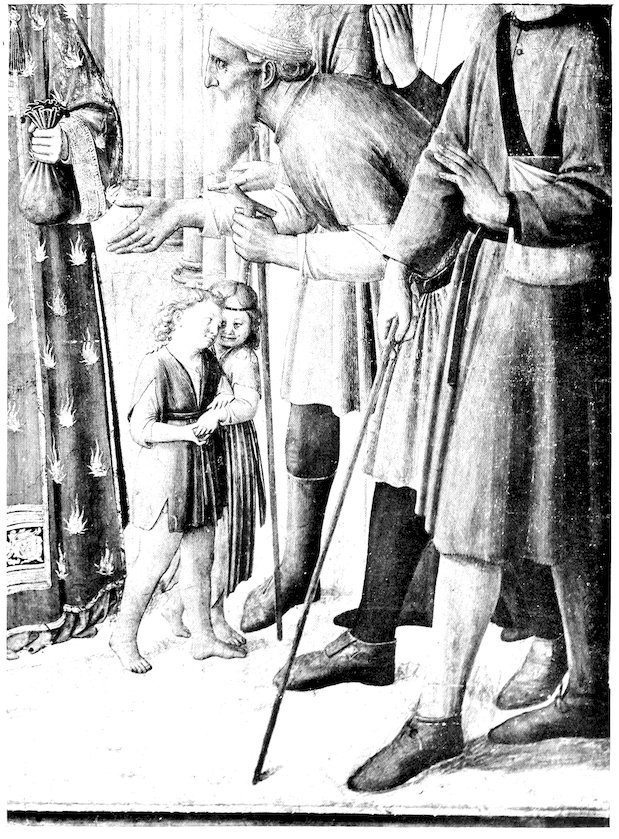
BENOZZO GOZZOLI. ST. AUGUSTINE AT SCHOOL (Detail)
(SAN GIMIGNANO)
Houghton
BENOZZO GOZZOLI. ST. AUGUSTINE AT SCHOOL (Detail)
(SAN GIMIGNANO)
Masaccio yields us little. He was as much an adult as Michelangiolo;
but when he designs a little child it is with more feeling
29and less condescension. I find a slight figure in the “Almsgiving”
of the Brancacci chapel, in the Carmelite Church at Florence, an
infant naturally unconcerned in what is going forward; in the San
Clemente paintings another child naturally clumsy; a Bambino
clasping the Virgin’s neck closely, at Bremen; at San Clemente,
again, a doll-like child on the shoulder of Saint Christopher.
In the order of time, Fra Filippo Lippi follows near to Fra
Angelico, being twenty-five years later in date of birth, but much
more in the consciousness and complexity of mind, and the learning
of the art. With Fra Filippo, as with many others, the child-Christ
and the boy Saint John are nearly the whole of childhood. In the
beautiful Berlin picture, the Bambino lies with one finger to his
mouth, on a carpet of flowers in a wood. The figure is infantine, the
action infantine, but the grace is artificial; almost as equivocal is
the Saint John, round and youthful, standing with his thin rod of a
cross and his little pennon, but—resolved to compass an Italian
elegance as indispensable to design—the painter has disposed the
little legs in the attitude of adult strength and adult idleness and
leisure; no child stands so, in unstable equilibrium; a child uses
both legs in repose, and gets what grip of the ground he can. It is
evident that Filippo Lippi did not intend to give the familiar way
of a child, but the ideal way of a “San Giovannino” in Florentine art.
In a tondo at the Pitti Palace, Fra Filippo introduces the “Nativity
of the Virgin” in the background of a “Virgin and Child.” Of
the new-born Mary in the distance there is nothing to say, except
that Saint Anne seems to be caressing the cheek of her swaddled
daughter. A little girl, of no obvious meaning, is also in the picture;
30through an archway is seen the encounter of Saint Joachim and
Saint Anne, the tired husband welcomed by his wife on the steps of
their dwelling before the birth of Mary. The Bambino himself, in
the foreground group, is, truth to say, an ugly Bambino, in the
painter’s despite, seated in the lap of a very lovely and innocent
Madonna. In one of the most beautiful of Fra Filippo’s simpler
paintings, the group at the Uffizi, two angels lift up the Child on
their hands, so that the Madonna, in her charmingly elaborate veil,
may contemplate her son and pray with her two hands joined. One
of these young boy-angels looks over his shoulder with the wearisome
Italian grace, even then already a platitude.
Houghton
FRA ANGELICO. ST. LAURENCE GIVING ALMS (Detail)
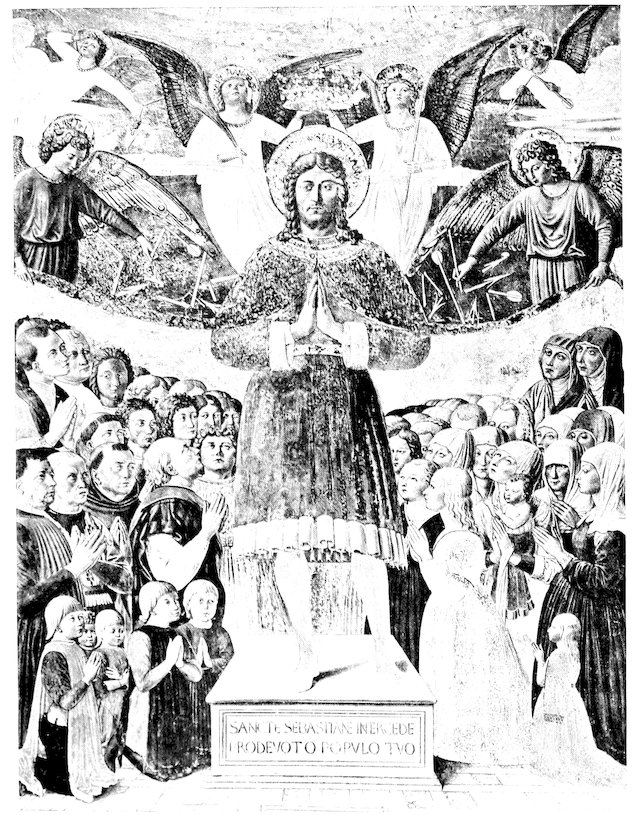
Benozzo Gozzoli’s seventy years were well within the quattrocento;
he did not see the summits of the sixteenth-century. In a
symbolic composition such as his “Saint Sebastian” in the Church
of Sant’ Agostino at Gimignano, he gives to his children something
of the old conventional proportion. The whole noble gathering of
heaven and earth is, in this painting, arbitrary. Saint Sebastian is
colossal, and amongst the little people on their knees at his pedestal
are smaller people who are a kind of children, smooth boys on this
side, smooth girls on that. It is a singular Sebastian, free of all his
arrows, clothed and combed with decorum, his martyrdom finished,
and the long work of intercession begun. But Heaven is busy with
his arrows. One is in the hand of the Eternal Father; the seraphim
hold arrows instead of trumpets, and pierce with them the clouds of
the floor of the skies; the angels that crown the Saint hold the
arrow and the palm; broken arrows are scattered in the middle
region, a flying angel snaps one in two. With all this, the action is
31curiously undramatic. That amid a dramatic people whose daily talk,
whose voices, whose hands, are dramatic, there should be painters
so failing—and there are many—is hard to understand unless we
consider the embarrassment of the celestial company and attitude—the
real shyness. An Italian himself would call it “soggezione.” And
in fact he does lose something of his drama in talk when he is
addressing a stranger or a superior, and regains it instantly with
an almost grotesque expressiveness—for the tone of the voice, the
language of the fingers are more than fit—when he turns from the
stranger to say something to a fellow-citizen, or when he has to talk
of his own daily affairs. So Benozzo Gozzoli, whose upper angels
have rigid and unmeaning hands, and whose Christ and Madonna
in this same picture use symbolic but inexpressive actions, has
more drama in the multitude of the faithful on earth; and in the
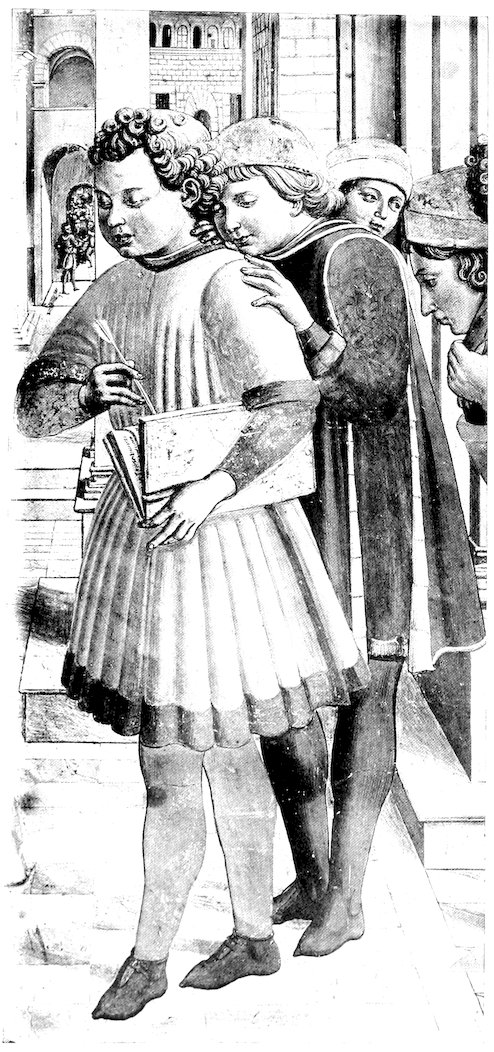
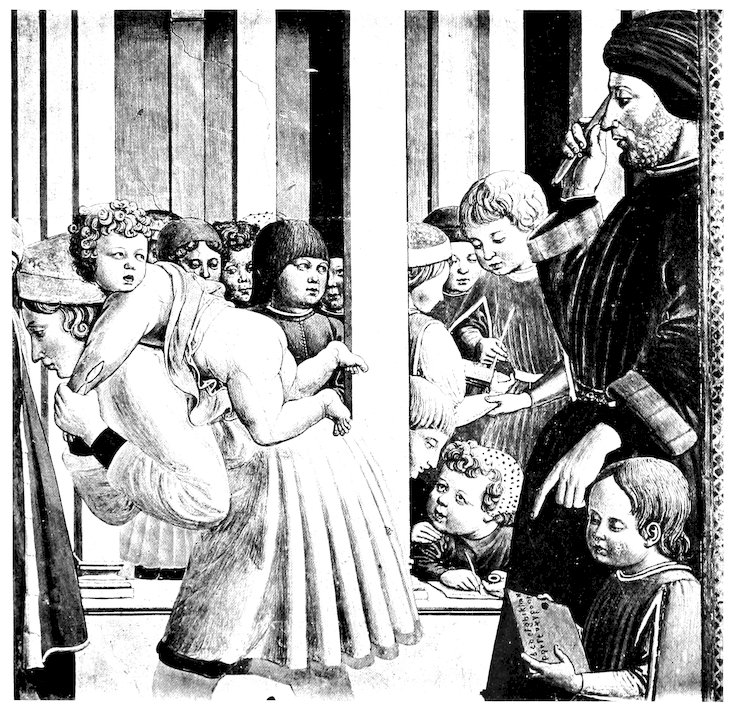
“Saint Augustine at School” he is free and has the natural impulse.
In the sad scene of the chastisement in this picture is an urchin in
a spotted cap, holding his inkhorn and pen, who is dramatically
admirable. So are the two boys on their way to school, although
they are doing little. The painter has intended—except perhaps for
a slight convention in the hands—to design childish children, and
to make them childishly beautiful. We see more of boys, clothed
and about their business, in Benozzo Gozzoli’s frescoes at the
Camposanto of Pisa than in a hundred years of the work of other
Tuscans.
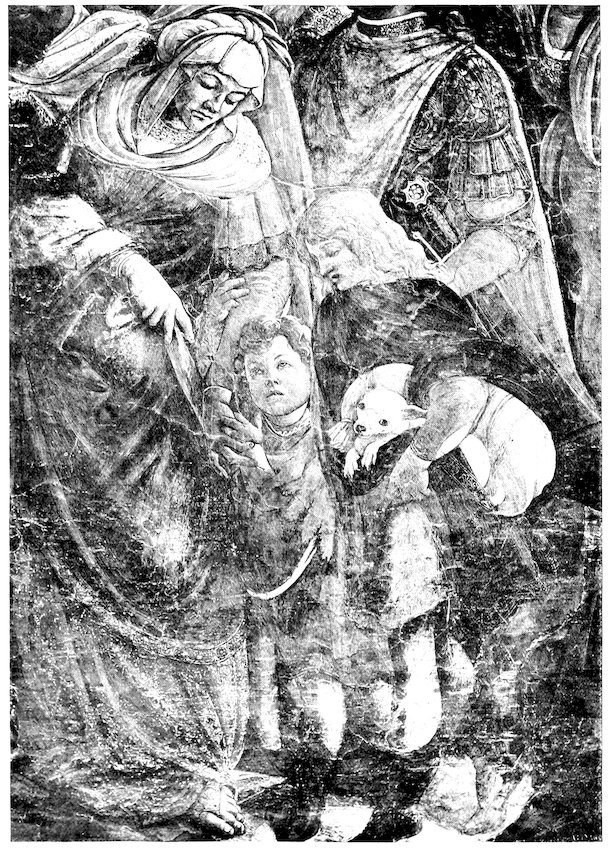
BOTTICELLI. From the “STORY OF MOSES” (Detail)
(ROME)
The “re-animate Greek,” Botticelli, had but to recall, and hardly
to learn, Antiquity, when that “new learning” which was the old
came to Florence; such is Ruskin’s judgment of this painter, of
32whom others are not so sure. For example, one might think his
sadness—the sadness of his Venus—to be something rather of the
latter civilization than of the former; another might find the whole
spirit that looks askance from the beautiful eyes of Botticelli’s
Saint Johns and his stripling angels to be wholly mediaeval and
Christian. But in the Madonna he has, almost invariably, the
undisturbed look, above expression, which it is possible, by some
effort, to assign to the Greek original, the antique ancestry, of his
mind. This serenity the Madonna shares with the rejoicing goddess,
with the Graces, with all the gay flower-spotted persons of the
“Primavera.” Needless to say, his children are not Greek. His
child-Christ would be more beautiful if Botticelli had not been
obviously bound to the good gossiping parochial fifteenth-century
idea of a fine child, a champion child. It must be what the French
call plantureux. To assign to this physique a conscious intelligence,
to make of a full-fed boy, six months old, a kind of theologian, is to
create a little figure of ambiguous aspect and manners. In one
group he points to the open book, in another he seems to teach his
mother from the spread page. Botticelli was a religious man and,
according to Mr. Berenson, “the greatest artist of lineal design that
Europe has ever had.” His double preoccupation had regard, firstly,
to the beauty and dignity of the Mother and the splendid physical
condition and wisdom of the Child, so that his picture should express
his devotion and satisfy that of all who looked at it; and secondly,
to the perfection of the decorative composition. He had few of
the group of “feelings” with which, after five hundred years of life,
art, and literature, true and false, we contemplate a child. It is
33impossible that the world should have passed these centuries without
learning some new loves amongst many studies in humanity;
and, accordingly, we, having lost much, have gained that company of
emotions which we call our love of nature. It would be insincere to
profess that we find it in Botticelli; his true lovers prize him for
more appropriate, more timely, and more national qualities of heart
and vision. His love of nature in the Bambino brings about that
charming holding-out of the arms, and inexpert caressing, of the
Bardi picture at Berlin, the early Santa Maria Nuova “Madonna
and Child with Angels,” and the “Madonna delle Rose” of the Pitti
Palace, to take typical examples. The last-named is generally
judged to be, though something more than a quadro di scuola, not
altogether from Botticelli’s hands. But the Child’s action, if not the
drawing, is at any rate Botticellian; and it assuredly does not come
within our present love of nature. It is not nearer to our sense of
childish attitude and action than are the roses that fill the background
of this tondo to our sense of the character, the growth, the
aspect, the stalks, leaves, thorns, buds, and faces of roses. Here is
something different from convention, which uses the mere suggestions
of natural form for rigid decoration. Botticelli’s roses and
golden fruits are not ruled in ranks. They and his Bambini are the
fruits of his love of nature, a love of nature at arm’s length. It is in
some of the angels, and in more than one Saint John, that the look
is more direct; both the beauty and the expression are immediate,
or almost immediate, as close as Botticelli chose to approach, or
perhaps was able to approach. The lovely tondo in our National
Gallery has been at different times held to be by the master, by a
34pupil working under the master’s direction, and by a painter merely of
the Florentine school of Botticelli’s century. Whatever hand designed
and painted this beautiful group was the hand of genius. No study
of children painted by the Italian masters could pass over these
exquisite heads. They are heads of later childhood, the age of
Saint John the Baptist being decided upon by the painter’s choice.
Historically he would be, as Raphael so often makes him, a companion
infant to our Lord; it is characteristic of the painter of this
Madonna and of other doubtful Botticellian work—for instance, the
picture at the Louvre—to group a Baptist of some twelve years old
with the infant Christ. The three heads have thus a touching
difference in their youthfulness. In the National Gallery picture
there are angels of Saint John’s age, and of equal beauty. The
young Baptist is clad in his camel’s hair and carries his slender
cross. In all these lovely faces there is the Botticellian length;
but whereas the undoubted Botticelli was somewhat fond of an
oblong shape, especially, it would seem, when he aimed at singular
beauty, the school-painter has the long form with a pointed chin.
Botticelli in his later years drew the face with a slightly pointed
chin. He and his pupil, if pupil it was, had alike an ideal eyebrow,
arched and far above the eye, implying a huge eye-socket or orbit,
but one filled smoothly with flesh. That space between the eyebrow
and the closure of the eyelid was so dear to the painter in question
that he carried it perhaps beyond the probabilities of anatomy,
certainly beyond experience; in the unquestioned work of Botticelli
it has hardly the look of wistfulness that the school-painter gives
it, allying it with the gaiety of the chin. The Saint John of the
35Louvre group, that beautiful boy with sidelong look and folded
arms, has the eyebrows and the chin. So has Botticelli’s own
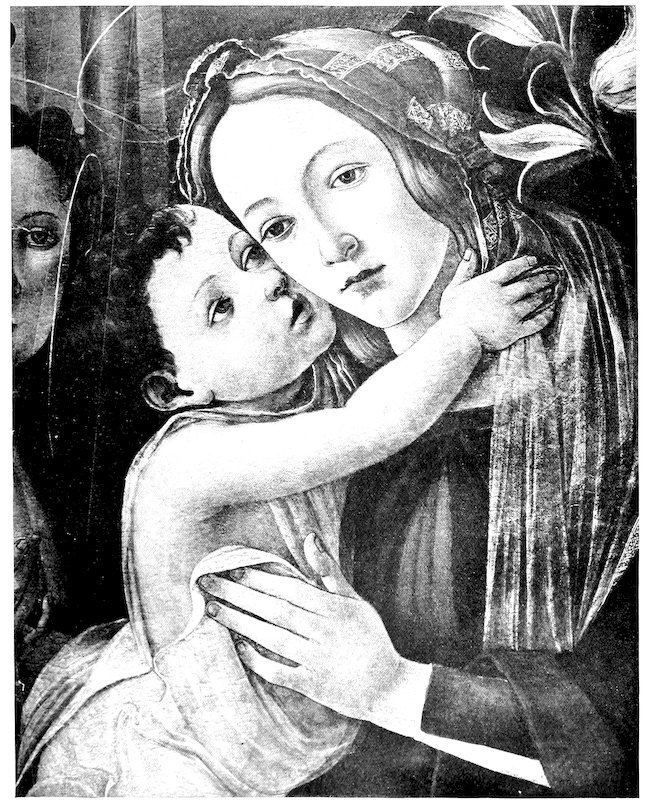
Bambino in the picture at the Pitti, in which the Child is about to
kiss his Mother.
Houghton
BOTTICELLI. MADONNA AND CHILD (Detail)
(FLORENCE)
Finally, these notes on the typical children of Botticelli should
close upon the most noble composition known as “The Childhood
of Moses” amongst the frescoes in the Sistine Chapel. It is a part
of the great composition of the “History of Moses,” in which
Botticelli painted seven scenes from the life, or rather the early life,
of the Patriarch—that is, from the smiting of the Egyptian who had
slain a Hebrew, to the Exodus. The childhood of Moses does not
appear, but the latest scene of the picture, the leading-forth of Israel,
contains the figures of two children; hence, perhaps, through some
misapprehension, the customary name. It is the child who, without
labour, bears the burden of all pilgrimages, even that of the mere
change of home; here are the people going into the wilderness, and
Botticelli bears in mind the children who are to be tired and to weep
upon the road. Moses leads out a little company whereby the painter
represents Israel. They are loaded with their few possessions; and
the foremost group is that of two young unequal boys. The elder
carries his bundle, and with the bundle a little lively dog; the
younger uses both hands to cling to his mother’s hand and arm; he
must make two steps to one of the men and women. He too is a
“fine child” of the time; but perhaps because the master in designing
this beautiful head did not labour especially for wisdom and
the favour of God and man, he has produced more simple nobility
than in painting many a child-Christ. The elder boy pities him,
36looking down with the passionless aspect of quattrocento feeling at
the largely-moulded infantine face; and the young one looks up
with a directly sorrowful appeal, but with beauty undiscomposed.
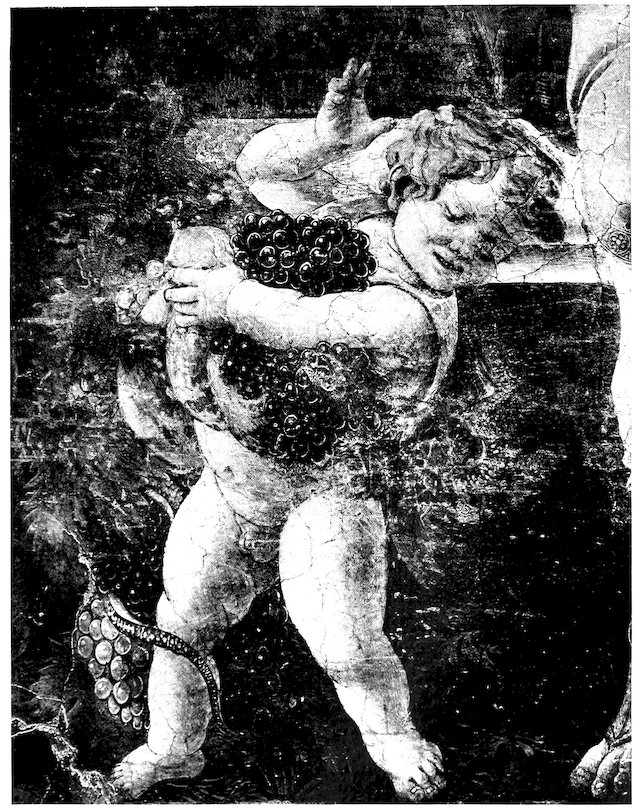
Also in the Sistine frescoes is Botticelli’s boy with a snake. It
is evidently a fine figure, now more than half effaced; the child,
encumbered with an armful of grapes, looks down at his leg, around
which the snake is clinging. Professor Steinmann sees in this design—and
the likeness is manifest even in the present decay—an imitation
of the antique statue, “The Child with a Serpent,” now in
the museum of the Capitol. Botticelli, the Florentine, summoned
to Rome by Pope Sixtus IV., to work with Ghirlandajo, Perugino,
and Cosimo Rosselli at the decoration of those walls of his chapel
which Michelangiolo was not to paint, had the art of Antiquity
before his eyes, fragments of much that had been then newly
shattered, relics of ancient Rome, and some few of that ancient
Greece of which Ruskin holds him to have been the true citizen.
He gives us this one clear sign of his attention to the art of the
past—the figure of a child. Leaving Rome, he returned to his work
for convent and church—the Madonna, the young angel, the holy
Child. He returned also to the study of Dante; Vasari charges him,
without reason, with giving to this literature the time due to his art.
Botticelli did, in fact, follow his own art diligently until those last
years which were given to the yet closer practice of his religion.
D. Anderson
BOTTICELLI. BOY WITH A SNAKE (Detail)
(ROME)
THE FLORENTINE PAINTERS—II
37
When Domenico Ghirlandajo painted for the church of
Santa Maria Novella the stateliest of all the Nativities
of Mary, arranging the scene in a palace chamber and
admitting a company of Florentine ladies to congratulate
Saint Anne, he crowned the decorated room with a frieze of nude
children at play. They are the putti of whom art, by that time, had
made an established convention, and of whom in time to come art
was to make a continual commonplace. Something in these equivocal
children, infantile and yet not infantile, graceful as the adult would
have them and corpulent as the gossip would have them, so took the
fancy of Italy as to make a rule and an example for centuries. Your
Italian house-decorator to-day is fairly able to make you a design
of putti, dolphins, and garlands after the manner of the fifteenth-century.
The child in question has become a kind of repeating
pattern, and he owes his long life in art, through high times and
decadent, to a love of the beauty of children that was an incomplete
love, or one might rather say a love that filled completely the capacities
of a somewhat shallow heart—like, d’ailleurs, some Italian music.
Yet it is to Ghirlandajo that we owe one of the most direct and
sincere children of that time or the times following, one of the best
children of Tuscan art, whom Parma, Rome, nor Bologna was to
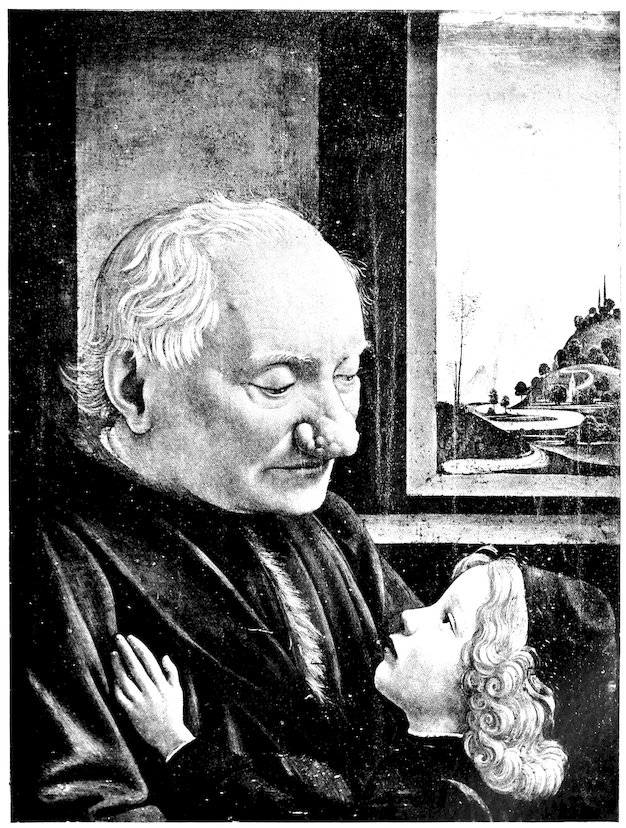
38match. This is the child who loves the bottle-nosed man in
Ghirlandajo’s beautiful picture, a charming child exceedingly urgent
yet gentle, with the little childish upper lip out, and the lower lip soft.
The man loves him, and is a sweet old man, as gentle as the boy, and
the two profiles turn to each other, records of a tenderness certainly
alive four hundred years ago. In his noble “Adoration of the Kings”
(Chapel of the Innocenti, Florence), with its glorious company of
visitors at the shed of the Nativity, and its great animated landscape
of river and mountains, Ghirlandajo has made the unusual introduction
of two little boys amongst the worshippers. They seem to be
little Florentines rather than little angels, and each kneels meekly
on both knees. Saint John the Baptist brings one, and a bearded
Saint whom I do not recognize brings the other. The same master
treats “The Espousals” as a festival ceremony under the arches of
a great palace court. With all possible simplicity and gravity he
deals with the grotesque incident of the spite of Mary’s rejected
suitors—an incident that seems to have been added to the tradition
by the busy fancy of painters; for many of them represent it: one of
the young men, in the extremity of his disappointment, deals Saint
Joseph a hearty blow on the head at the moment of the marriage
benediction. What is to the present purpose is that Ghirlandajo
gives a kind of under-plot to his composition by the brisk movement
of children. A little girl whisks, much excited, into the picture with
her mother, to see the wedding; two other little girls run in from the
other side.
D. Anderson
GHIRLANDAJO. OLD MAN AND CHILD
(LOUVRE)
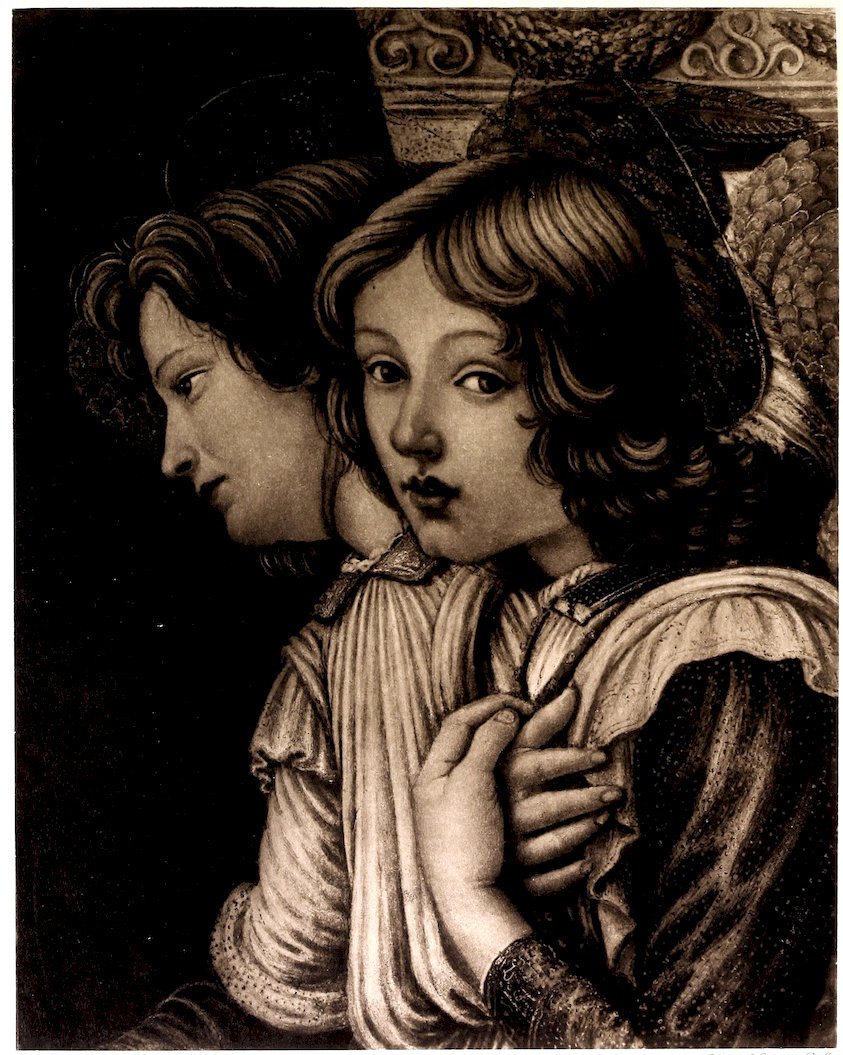
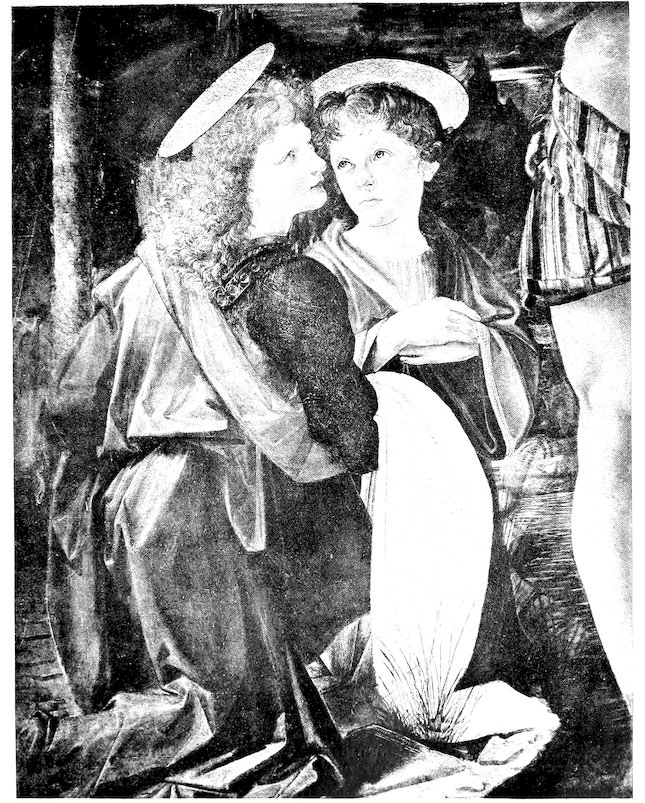
Young if not infantine angels are in the picture by Leonardo
da Vinci and Verrocchio—a beautiful detail of which is detached
39here. The heads are lovely and noble, the nearer all-eloquent,
with sweetness, eagerness and tranquillity at once in the expression—the
“countenance”—of all the mobile features, the quick mouth
and the eyes a little caught up with dramatic impulse of feeling. (It
is this angel that is judged to be Leonardo’s most certain share in the
picture.) If the first young creature is hardly a child, the second
angel is younger, as he is also graver. Both are in a profound and
tender ecstasy, but the angelic nature differs, as though these were
children indeed, and had their human inheritance of character. Both
are loving and both are intellectual, but the elder resembles the loving
seraphim, and the younger the wise cherubim, as the Doctors of
the Church divided them. The Florentine painters were theologians
one and all.
Among Leonardo da Vinci’s innumerable and admirable designs
is the head of a child, here reproduced, beautiful in drawing, with
the solid of the round cheek and the strong lines of the curved
eyelids. The master’s hand has so carefully followed the thin curls
of soft hair in this study from life, that a writer on the spiral forms
of art and nature has attempted to give unlooked-for significance
to those touches. Nay, he sees in one or two spiral curls on the
middle forehead, where a baby’s scanty hair is a little thicker, evidence
that Leonardo da Vinci built the spiral staircase at Amboise. However
this may be, here is a child’s head that is indeed a child’s,
childish in such observed details as the fullness over the upper
eyelid, and the infantine parody of the line of age beneath the under;
purely a baby’s head, untouched by the fifteenth-century prejudice,
and we know that it is thus untampered with because it is only a
40head, and goes no further. Were there so much as a line to indicate
the shoulders!—nay, it is easy to draw, in fancy, the suggestion of
shoulders turned aside in the fifteenth-century manner, in an attitude
at odds with the character of the face not many months old.
Amongst Leonardo da Vinci’s Bambini there is one to whom
the master has manifestly intended to present the lowliest homage
of extreme old age. This is the child-Christ of his “Adoration of
the Kings” at the Uffizi. There is the customary twist and curve
of adult and conscious elegance, and the Child shares it with his
mother, but the group is a lovely one. At the feet of the Virgin the
Wise Men are prostrate; one, white-bearded, kisses the green grass;
another, crouching, raises himself on one hand to offer his gift of
gold; and this the Child stretches a hand to touch in sign of
acceptance.
Alinari
ANDREA VERROCCHIO, AND LEONARDO. ANGELS FROM “THE BAPTISM OF CHRIST” (Detail)
(The foremost figure probably painted by Leonardo)
(FLORENCE)
It would be too rash to question the change of attribution
whereby the “Christ disputing with the Doctors,” in the National
Gallery, has been withdrawn from Leonardo da Vinci and given to
Luini. Yet, questions of execution apart, those doctors to the right
have much of the Leonardo caricature, the short profile in particular.
And an inexpert but observant eye may see Leonardo da Vinci also
in the smoothness and relief; in the type of the figure of Christ, too,
the master’s design and his taste look well-known. But whoever
painted this once famous picture, having to paint the Saviour at
twelve years old, was not content with that age, but added some
years. Dramatically, the figure is lacking, but lacking in the manner
to which the work of masters has accustomed us. Often do the
dramatic Italian hands fail us in their work in the schools, and
41nowhere do they fail us more languidly than in the hands they
painted. The merest wayside theatre in Italy shows us the living
language of the hands; yet the painter of “Christ disputing with
the Doctors” has devised no better action for a disputant than this
of checking off arguments in order, with the fingers of the right hand
upon the fingers of the left. There is no weaker presentation of a
course of reasoning. But the National Gallery has now a Leonardo
da Vinci of somewhat more authority, a variant of the picture in the
Louvre, the “Madonna of the Rocks.” The sweetness of the two
children here is perhaps the best character that the master intended
to bring about in any Christ or Saint John known to be his. The
little Baptist prays with folded hands, kneeling, as no young child
ever knelt in life, upon one knee. The Madonna draws him prettily
nearer, with her hand on his shoulder, to her own Child, who gives
him the benediction. A young angel attends on the child-Christ,
and in the French picture points to the praying Saint John.
The nearest in order of chronology to Leonardo da Vinci is
Filippino Lippi, but this great and exquisite master is nearer to
Sandro Botticelli in genius. We know that Botticelli was his protector
and friend, and somewhat like his elder brother, inasmuch as
both learnt of the younger man’s father, Fra Filippo. The bonds
of the three in their art are signs full of interest, not only for the
modern measuring expert student, but for the plainer pilgrim in the
galleries. They loved alike the half-grown angel who may barely
enter this book’s company of children. Their Saint John the Baptist
is much of the same age, and sometimes may not be known amongst
them but by his camel’s hair and the long light rod of his distinctive
42cross. Filippo, Botticelli, Filippino, and he who painted the National
Gallery full-face Madonna, and he again who painted the lovely profile
Virgin, so long called a Botticelli, in the Louvre, designed the
same full bow-mouth, the same somewhat heavy hair, but hair with
life in its spring from the head and in the slight final curl of the
several locks. And the eyes are not large, under eyelids that withdraw
beneath the fullness of the orbit and the high-uplifted eyebrows,
and the glances are sidelong and most charming and candid.
Filippino Lippi did not generalize his companies of men, or make
them resemble each other; he distinguished, intently, head from head
amongst the old, but these angels and their friend the tender Baptist
are like one another in the sweetness of their touching beauty on
the fine edge of gaiety and sadness. Filippino designed now the
shorter face, with wider-parted eyes, of his father’s pictures, and now
the narrower and longer form of his friend’s choice, though always
with the eyebrows much above the eyes. Notwithstanding this variation,
there is rather a monotony of beauty in these groups of full-lipped
young creatures, tranquilly animated, with their obsequious
eyes bent on the child-Christ, or glancing softly aside into the world
or into the heavens, to see whether men or seraphim are aware of
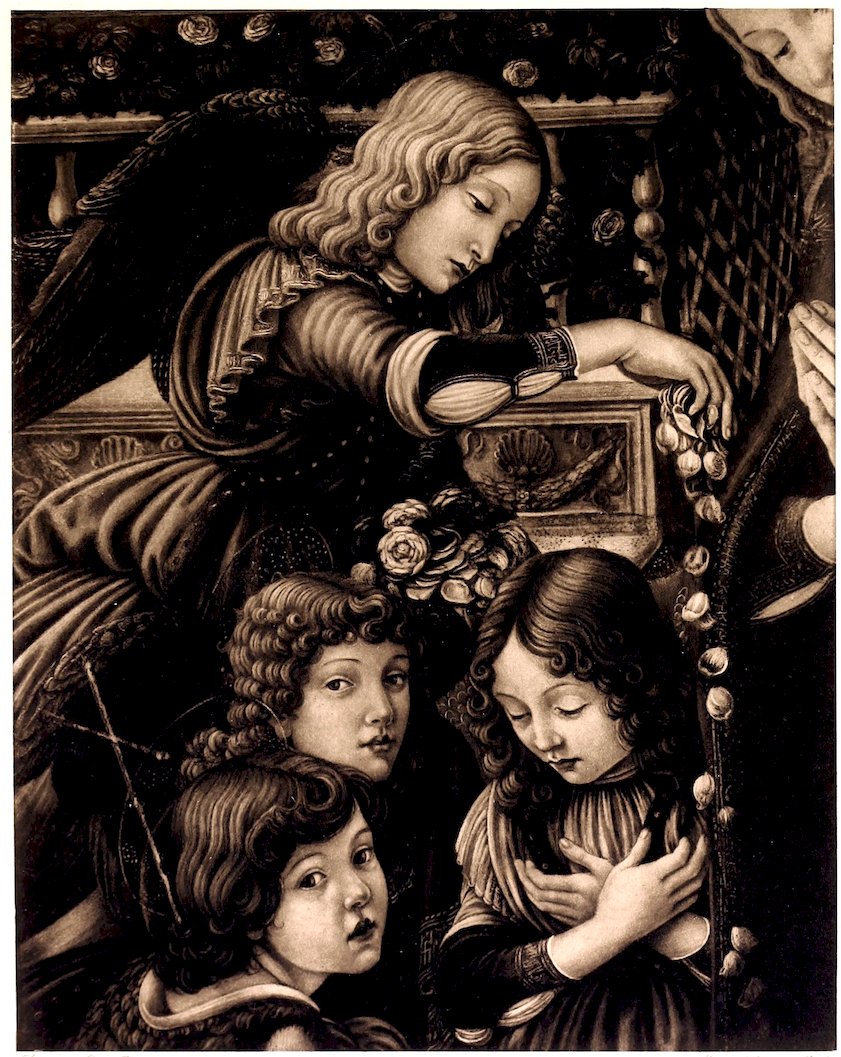
his greatness. In the detail from the lovely picture in the Pitti
Palace, which shows a fair-haired angel dropping rose-leaves, the
Saint John is much the youngest of the heavenly children. A little
of the camel’s hair on his shoulder and his long cross mark him;
he is quick and childlike, dark-haired and dark-eyed, and his locks
are somewhat wilder than those of the angels, who are very trimly
combed. The minister of rose-petals wears, besides his beautiful
43wings, a glorious and elaborate dress; the little downward-gazing
one has sleeves of his pattern, the aureoles are transparent but
delicately patterned. In the group of two companion angels, with
the springing hair, a gentle difference of character in seraph and
cherub resembles that of Leonardo da Vinci’s and Verrocchio’s pair.
If we may place these delicate boys in the company of children, we
cannot count the Archangel in those ranks. Gabriel, though but a
celestial year or so more advanced in age than the young comrades
of Saint John, is a grown angel. Filippino Lippi’s Gabriel is an
energetic and most beautiful messenger, not so impetuous as Titian’s,
who comes in at a run, with fleet foot, open wing, arm aloft, and
flying apparel, under a bursting cloud, to a Virgin overwhelmed.
Filippino’s announcing angel is tranquil, but his action is direct and
full of power. This is one of the Saint Gabriels of art who kneel to
the kneeling Mary.
Filippino Lippi, Pinx.Walker & Cockerell Ph. Sc.
From a painting of the Holy Family.
(Pitti Palace, Florence)
Alinari
LORENZO DI CREDI. MADONNA AND CHILD WITH ANGELS
(ROME)
Filippino’s angels in his great Cistercian picture, “The Vision
of Saint Bernard,” are young; their stature is more childish than
the character of their heads, and they are moreover bent, so that the
erect figure of Mary may have a foil. They share something of the
commonplace of angelic beauty, as the rocks under which Saint
Bernard sits writing at a rustic desk have the commonplace of an
unobserved nature, being designed by the hand of a man who never
cared to see a rock or a wayside stone as it is. The chief beauty of
this work is in the tender and majestic figure and countenance of
Saint Bernard. It is perhaps worth noting that in drawing his
angels on a moderately small scale Filippino Lippi followed, with
his later feeling, a convention of his predecessors, who frankly varied
44the scale of their figures. I have not called certain companies of
angels children, because they were rather small than young, designed
to give dignity to a great Madonna. They have no part in this
volume.
Lorenzo di Credi’s gentle designs have their differences amongst
the works of other minor Florentines of the second half of the
fifteenth-century, but those differences, though visible, are not easily
to be described. He seeks for all possible expression in his young
angels, expression of devotion and sweetness, and places a representative
of the impetuous seraphim and of the thoughtful cherubim
on either side of a tranquil Mother and Child: young angels of
fourteen, small-headed, and on a small scale. Lorenzo di Credi’s
variants of these well-known creatures are sleeker and more smooth
than others. Though a Florentine citizen and the pupil of a Florentine,
he is even less distinctively Tuscan than Leonardo da Vinci, who was
his fellow-pupil in Verrocchio’s workshop.
Rosso, PinxWalker & Cockerell Ph. Sc.
Angels.
Younger, more childlike, and nearer to nature than the young
adolescent angels of contemplation are the little musicians. They
are less smooth, more active, and busy with their strings. The
players and singers of the earlier masters produced their music with
an angelic ease and carelessness of method; but the child of the
later school is industrious and able. He is the pleasant fiction of
a day in which simple action had begun to amuse or attract the
painter’s eye, in which the pencil paused with pleasure upon the way
of a player with a lute and the incidents of the fingering. To feign
the musicianly activity of a little child, to bend a babe’s hand to the
strings or to put his small mouth to the recorders, was a game that
45pleased the fifteenth-century in Italy; it was such a mixture of realism
and miracle as took the fancy of the time. One is reminded of the
distant, different northern fancy, the mixing of observed fact with a
pathetic convention in the insanity of the tragic stage, the sweetness
of an innocent intelligence astray, the favour and the prettiness of
the distracted woman. Carpaccio, Bellini, Bonifazio Veronese, Fra
Bartolommeo, Frate Antonio the Olivetan, Rosso Fiorentino, are but
a few of the painters, major and minor, who have put instruments
into these infant hands; gross hands of natural-unnatural putti are
some of them, and some again are animated with an eager grace.
Frate Antonio gives to one fleshly babe (standing with one bent leg,
for elegance) a triangle, and to another a flute; Bonifazio puts a large
lute into the round arms of a winged musician; Raphael (in the
“Madonna del Baldacchino” at the Pitti Palace) gives to two
corpulent little boys, in attitudes both adult and effeminate, a scroll
to sing from; Rosso gives us a sudden delight in the impetuous
head of his angioletto with the cheek pressed upon the lute, the
mouth close to the strings, the wings erect and the wild hair; Fra
Bartolommeo makes his beautiful winged boy, in the cathedral at
Lucca, a singer to his lute; Carpaccio’s middle child in the “Presentation
of Christ,” one of the loveliest figures in Venetian art, is
intent upon his lute.
Fra Bartolommeo’s boy is as much unlike a human child as
might be one of the fifteenth-century heavenly choir, no more. He
is not grown up, but has an alien felicity and sweetness in his
beautiful eyes and in his majestic action. Here is expression, and
here is a childish abundance fairly accordant with nature at her
46richest. Fra Bartolommeo, the Dominican successor of Fra Angelico
after nearly a hundred years, is generally of a cold nature; his nobility
of composition has a look of unheavenly state. He does not stoop,
it is true, to the demonstrative and obvious dignities and graces
practised sometimes by greater masters in the “late” period of
Florentine art about to set in when he was painting. His design is
too haughty for that consciousness, but the haughtiness is somewhat
mundane. His work does not make that grave appeal to tenderness
of which all art before the latter half of the quattrocento was full—architecture,
sculpture, painting, music—or at any rate we in our day
think it to have been thus full, and take upon ourselves the reply of
sensibility. If we were children we should call him “grand,” with
the protest implied in that childish word. When we were young, he
seemed the most unsympathetic of the masters of the great time;
and the English pre-Raphaelites doubtless renounced him as flatly as
any master one could name. Yet, for all the chill, for all the gesture,
for all his entirely adult spirit, he could design so beautiful a natural
thing as this minstrel child. It is not a figure of the divine beauty
of Carpaccio’s angel also playing his instrument in the foreground
of a Mystery; and the difference is one evidently of genius or
inspiration; but short of the wilder and simpler loveliness of the
Venetian’s child, the Florentine’s is a noble creature.
Houghton
ROSSO. ANGEL PLAYING THE LUTE (Detail)
(FLORENCE)
Houghton
FRA BARTOLOMMEO. ANGEL
(LUCCA)
Thus far these Tuscan children have been designed by “pre-Raphaelites”;
for the arbitrary incompleteness of the definition
which the name expresses is proved by the inclusion of Michelangiolo
in those ranks. But Andrea del Sarto was a Florentine
painter born next after the Umbrian master who was to leave so
47much corruptible, if not corrupt, in the art of Italy. Andrea del
Sarto improves on the graceful game played by so many Florentines
with the soft nude figures of the two children at the knees of their
mothers, Mary and Elizabeth. If the former Italian painters had
rounded the gesture, and bent the knee, and turned aside the head, his
design was yet more curved and facile. It was yet more manifestly the
design of the “sentimentalist,” to use a modern word not very handsome
in form, but necessary now that we have begun to unmask and
expose the character. In painting, the sentimentalist, all preoccupied
with the banalité of his own device, had neither sight nor insight of
incomparable nature. Sentimental without sensibility, he kept unwarmed
the secret coldness and unmoved the obscure hardness of
the sentimental heart.
For, watching thus the artificial attitude rehearsed by generation
after generation of painters, I doubtless have dwelt too much upon
the sin of commission in those who attributed to little children these
graces, these rounded elbows, and these legs placed like those of a
club-man standing to talk before a stroll. But assuredly it is the
graver offence of omission—“Ye did it not”—wherewith we have
chiefly to charge the Italians. They would not see the unconscious
child, “the poor child at his play,” as Henry Vaughan says, or the
wayside nursling as he looked every day, plain to be seen; they not
only devised, but they neglected; gave no attention to that simple
and abundant beauty, that straight aspect and direct gesture of
innumerable children; and inasmuch as they did it not to the least
of these, they did it not to the Child painted in a thousand pictures
upon the Virgin’s knees.
PORTRAITS
48
Nevertheless, another painter born after Raphael,
a sixteenth-century painter who nearly closed the
Florentine school—Bronzino—restores the love of the
nature of childhood, that had been habitually a little
falsified after the days of the Della Robbias and before his own.
Bronzino virtually restored in Florence the portraiture of children;
giving, as he did, the name of the child to a ceremonial portrait in
the apparel of the day, he may be said to have been the first explicit
portraitist of little boys and girls; for Desiderio da Settignano,
Luca della Robbia, Jacopo della Quercia, and the rest of that all-noble
company changed the name, while they studied the incidents
of the face, of a living child. They named the boy Saint John the
Baptist, but Bronzino gives him a more personal as well as a lesser
dignity, takes from him the heavenly and gives him the courtly
honours. While Desiderio da Settignano modelled the oval of a soft
cheek, and showed to the light of all these centuries how two weak
lips met, and how the whole face of one Florentine child was made,
that child’s name passed into the innumerable multitude of names
forgotten upon earth. But now Bronzino, after many years, stepping
aside from the convention of the Holy Family that prevailed in his
own art of painting, names a likeness; and at once we acknowledge
49a fellow-creature. The portrait of a boy in the National Gallery is
one of a long series of portraits of children. Noble patrons seem
to have finally forgotten, at this time—full sixteenth-century—the
early scruple that prevented the portraiture of the living and individual
face, except by way of devotion in order to recommend to
Heaven the soul that was lodged in such or such a body; and the
body was meekly drawn, whether subdued by a small scale or subdued
by plain raiment; in either case in profile, with joined hands,
looking to the Saint or contemplating the Mystery, never turning
faces and jewels to the world, and implying no respect on the part
of the painter or of the donor to the history, character, or date of the
person. Such a scruple of humility did exist, but gave way by
degrees, for Andrea del Sarto, Franciabigio, and Ghirlandajo, in
Florence (as well as Titian and Raphael without), painted portraits.
Francia, in Bologna, painted children’s portraits. In Bronzino’s
figures we have at once the patent personality, and the assertion
of the importance of the name, the year, the circumstance. The
picture of Eleonora da Toledo, at the Uffizi, having all the tranquillity
of countenance that was held to comport with the nobility of
portraiture, has yet an expressive action, inasmuch as the mother has
her hand on the shoulder of the child a certain passage of whose life
she desired to record, and he has his foreshortened little hand on the
rich dress in which she sits encased in state. So rested the hand
of Cowper on the English flowers of a flimsier dress than this
magnificent broccato, one worn by his own mother. The likeness of
child to mother, especially the resemblance of eyes and eyebrows, is
one of those human incidents of which the record touches us; the
50mere simple fact is close to one of the sources of the “tears of
things.”
Anderson
ANDREA MANTEGNA. FAMILY OF LODOVICO GONZAGA (Detail)
(MANTUA)
With Bronzino, art in Florence enters on a new century; so does
Italy. Fathers and mothers desired that their children’s own childhood
should be remembered, and not merely childhood at its best. It
is worth noting that with the portraiture of children, the exaggerated
grace is allowed to rest, at any rate for the purpose of the moment.
The painter is persuaded, by the erect and forthright aspect of a living
child before him, to leave his tricks of posture aside, or to give them
up to the children of holier families than the best of the Florentine.
The boy whose portrait is painted is straight, or full-face, upright, thickset,
quite inapt to bend or glance or in any way to copy the ideal of
sweetness so habitual in Italian design. And with this fidelity to the
square shape of nature comes a certain severity of design, or rather of
composition, which makes it seem strange that Bronzino the portrait-painter
should be a pupil and successor of painters of the most ideal
boys. Nature is more rigid than Italian design of the fifteenth-century
and onward; for whereas the linear arts elsewhere and at
another time may be thought stiffer than life, in the country and the
age that were ripening for Raphael they were more lax and easier,
more coulant and unbraced, and therefore soon to be more inelastic
and sickly, than life. Elegance and ease of posture in design run that
risk of dullness which awaits rhetoric in literature. When rhetoric has
been strained too much and too often its language looses elasticity;
loses the sensible flexion and tension that are welcome in the using;
loses the friction, friction of air to the pinion or of water to the oar,
that makes the using worth while. Relaxed imagery, or hyberbole, or
51literary violence of any kind, is all too easy, as was the task of drawing
water in a sieve, assigned to the daughters of Danaus. We must
pity them, not because their work was hard, but because it was light.
And so it is with the Italian painters and the relaxed ideal they so
long abused.
Alinari
TITIAN. PORTRAIT
(VENICE)
Moreover, taking the suggestion of portraiture and its honest
action, and looking through the years and centuries before Bronzino,
we glean here and there a slight accessory figure, an incident in a
composition, which is childlike and looks solitary. An example
much to the point is Jacopo da Pontormo’s “Joseph and his Kindred
in Egypt” at the National Gallery. Here are the putti, ambiguous
as usual, turning and running in the way of Italian art; and here
are in the midst two little boys who are little boys such as humanity
bears, children turning the way they look and supplying no antithesis
of the movement of limbs and head. The boys, in fact, have been
fighting; they are apart from the fluent good and unclothed children;
they wear street clothes and have less good manners. They are
possibly the first street boys of painting. Now this group from the
life is small and unnoticeable, but it has the sincerity of portraiture;
and, in effect, we find one of the two figures to be, conjecturally at
least, a portrait, and the portrait of Bronzino himself as a boy!
Again, in that very beautiful little picture, also in the National
Gallery, Ercole de’ Roberti’s “Israelites gathering Manna in the
Wilderness,” there is a stray infant not on artistic duty, a little by-way
child, quite insignificant except to the eye looking for life, a
little thing, as far as it goes a portrait; and distantly akin to
another by-way child, one of the most perfect children of any of
52the schools—Rembrandt’s wonderful little spectator in his National
Gallery “Nativity.” This last looks over, leaning, at the Child lying
in the light, and the light shows us his own most beautiful and
touching person and the exquisite folded hands. What other painters
did by rote, or with habitual intention, Rembrandt did with actual
intention. And there is no surer sign of that immeasurable superiority
of spirit and truth than the power and peace of this mere action of
looking-on, the action of a child, under the touch of that incomparable
genius. Dramatic, instant, unconscious, and perfectly simple is the
attitude of that little boy, brought thither by the shepherds, leaning
on his hands. And Rembrandt leads him into the company of this
volume; but he is an alien in this Italian society.
One of the noblest of portrait groups by one of the noblest
masters—Mantegna’s picture of the “Family of Lodovico Gonzaga”—has
the portraits of two children at the majestic mother’s knee.
The girl is at play; the boy, with his father’s hands on his shoulders,
has extraordinary beauty of drawing and expression.
Tiberio Titi. Pinx.Walker & Cockerell Ph. Sc.
Infant Prince Leopoldo.
Alinari
TITIAN. CHILDREN OF CHARLES V.
(ROME)
Portraits of children are found also amongst the Venetians of
the great time, for in Venice the great time was late enough to give
effect to so much of the pride of life as delights in portraiture, and
so much of the personal love of children as desires the portraiture
of sons and daughters. It is to be supposed that patriarchal love
of children, such as consoled the heart of Job with latter offspring
for the former destroyed in their youth, would not have thought of
portraits. Some centuries of decline from such simplicity brought
about the portraits painted by a little Greek artist for the tombs of
Fayum in the second century, and the art of portraiture seems often
53to comfort or flatter some phases of national decadence. (Has not
nearly this been said also of music?) In Venice, in Spain, and in
Holland, during the sixteenth-century in the first nation and during
the seventeenth-century in the two following, there were great
exceptions to such a rule. Titian, Velazquez, and Rembrandt were
no flatterers or soothers, nor were their times poor. But Reynolds,
though a great painter, painted in no great century. The truth may
be simply that portraits are “late,” and that late art in Rome, in
Florence, and everywhere in Italy except only in Venice, is art that
has lost irrecoverable things. In Venice, corruption was prevented
by colour and tone. While colour lasted in its plenitude it borrowed
the health of the golden sun, and the art it filled with life could not
die or see corruption. That Titian, being a great portrait-painter, is
a great portrait-painter of children might be held on the strength of
one lovely picture only. This is the beautiful detail from the Pesaro
portraits—the head in three quarters. And this is the portrait of
one old enough to be treated with the dignity of the Titian quality.
Titian, like Michelangiolo, was a painter of the adult, and this one
young creature whose face he has drawn so finely and in whose
eyes he has lodged so much power and peace, is adolescent. In the
portraits, also in Venice, of the two little sons of Charles V., the
master has sought to give the childish interest; but these two boys
of a great Emperor, made to hold their fruits, and a real sword as a
toy, so that they may look infantine, are obviously placed there as
princes. Unequal in height by a bare year, they are fellow-upholders
of the state of a court. Doubtless the technical critic would find the
minimum of Titian’s beauty in this group, as also in the portrait of
54the little daughter of Roberto Strozzi, at Berlin. Here is that rare
subject of art, an infant girl, and Roberto Strozzi had wished to have
his girl painted in her simplicity. The child is not on courtly duty,
nor clothed like a duchess; her hair is short and undressed, her
ornaments are simple, and she has her dog.
Titian’s pupils, moreover, painted the portraits of children,
amongst them Paris Bordone, who leaves us the delightful picture
of a boy in a plumed cap, now at the Uffizi, a portrait once named;
the accidents of time have stripped it of its name and title, so that
the little soft-faced child, dressed with so much pretty dignity for
the sitting, appears in the catalogues as a “giovane ignoto”—the
unknown youth being about eight years old, his cheeks not yet
narrowed from their childish round. An unconfessed smile, forbidden
to his dark eyes, is lodged in the infantine mouth and chin.
Paris Bordone was the contemporary of Titian, Tintoretto, and
Palma Vecchio, and therefore belonged to the greatest time of
Venetian painting; Palma Giovane and Paolo Veronese were, by a
score or two of years, of a later, more artificial, and less vigorous
genius. Tiburio de’ Titi was employed to make the portrait of the
infant Leopoldo da Modena, in the beginning of the seventeenth-century,
and painted the baby in the modern spirit. The little boy with
his counted dimples lies cushioned and covered with embroidered
silks, the hands and the feet shown as a nurse would have them.
Boraccio Pinx.Walker & Cockerell Ph. Sc.
Infant Prince Federigo.
Alinari
PARIS BORDONE. PORTRAIT OF A BOY
(FLORENCE)
Later than Bordone, and not so late as Tiburio de’ Titi, is
Baroccio, one of the many painters born at Urbino, but too modern
a man to be affiliated to any local school, even when the metropolitan
locus of Raphael is in question. By the time that Baroccio
55had gained courage to place a child quite erect, quite full-face, in
the charm of its own ways, and in the simplicity of childish action,
art had lost much. The loss ought not to cause us to despise the
gain, which is a gain of dignity and not of trivial charm. It makes
for the dignity of art and of the little son of man that his likeness
should be designed honestly, and without fictitious graces. Yet the
noblest time of art used these fictitious graces, and the less noble
time respected the noble nature. History shows us many such
paradoxes; for example, music underwent irrevocable losses when
she made her profoundest discoveries. Some genius of the single
note vanished when harmonies were found.
SIENA AND UMBRIA AND OUTLYING SCHOOLS
56
When Siena came out of the bassi tempi, she grew for a
short time side by side with Florence. She was not
Florentine, but she was Tuscan. The evolution from
the Byzantine took place in the sister cities at much
the same date, but with a difference. Pietro Lorenzetti, for some
years probably a contemporary of Cimabue, struggled out of the
bonds with a different gesture. And the dissimilarity is manifest in
the wonderful figure of a child. In the painting of the Madonna,
with the Infant Christ between Saint John and Saint Francis, in
the lower church at Assisi, Lorenzetti shows us surely the earliest
example of intent, instant expression. The Mother looks close into
her Child’s eyes, and Christ gives the Pontifical benediction to
Saint Francis, in obedience to the Virgin’s sign. The drawing is
still quite arbitrary and irresponsible in such matters as the placing
of the Child on the Mother’s fore-arm; the little figure is vacant of
weight and substance; and, though the perspective of the three faces
in three quarters has been courageously attempted, the eyes have
still the Byzantine length; the hands are, by the usual anomaly,
altogether undramatic and inexpressive; only on the English stage
can we find any hand so inexpert as in early Italian art—always
excepting the extraordinary and untimely genius of the sculptors.
And the whole design is as it were tied up in bands of anxious
57inexperience. But, fettered as it is, the pencil is strong in its constraint.
And in this one figure of the Child the great genius of
expression, destined to perturb the heart of all the human arts; to
strike with a tremor for a thousand weak distresses that literature
which had told unshaken and unappealing the despair of Cain and
the Crucifixion of the Lord; to break the voice of that music which
had steadfastly sung the Good Friday liturgies; to move the arts of
design from their tranquillity so as to make even of portraiture
a kind of familiarity and confidence to the passer-by; to make the
statue the image of the hour, and even to weaken the walls of architecture;
the genius of expression, I say, seems to make nearly its
first appeal in this momentous painting of a child. Pietro Lorenzetti
has made the action, as well as the look, expressive. He has set
aside the habit of ceremonial attitude in order to raise the child’s
head and to direct the speech of this energetic mouth. Amongst
the many beginnings of modern art—as many as the scattered
sources of one large river—here, in the prophetic painting of the
Sienese master, is one.
Alinari
PIETRO LORENZETTI. MADONNA AND CHILD (Detail)
(ASSISI)
Matteo di Giovanni, called also Matteo da Siena, is of a century
and a half later, and the Bambini of his paintings have in some
examples the affectation that all the Italian schools of the noblest
ages shared amongst them and in a measure taught in time to
Germany and Flanders. Moreover with him the “fineness” (to use
the word in its strange corruption), the fineness of the “fine child,”
his superlatively good physical estate, is in an extreme form, as in
the case of the picture in the Palazzo della Signoria, now called the
Palazzo Comunale, at Siena. But, again, we find a little movement
58observed from life in the Accademia picture; the poor and puerile
drawing of a work full of noble feeling yet served the painter in his
desire to give something of childhood, besides fat, to the weak but
thriving limbs. In another Accademia painting, in which the Child
holds a string of beads, it is not only the action but the expression
that has natural vitality. It is simple, and we have seen, amongst
a multitude of Bambini, how rare is simplicity in the dealings of
art with the figure of childhood. The naturally parted lips have
evidently been watched in a living child. In this picture, too, there
is a curious group of angels some ten years old, all unchildish in
the artificial employment of their hands; and yet for these, four
children of Siena may have been the models, for they have character,
and it is doubtless in obedience to the painter’s commands that one
of them holds his head too much on one side.
Matteo di Giovanni Pinx.Walker & Cockerell Ph. Sc.
Virgin and Child with Angels.
(Accademia, Siena)
Alinari
LUCA SIGNORELLI. THE CORONATION OF S. CECILIA (Detail)
(CITTA DI CASTELLO)
Clear, in all these devotional and beatific groups, is the anxious
preoccupation of the pencil in search as eager as a child’s for beauty
of face and figure. The painters of the centuries of art and religion
had no other wish than to paint something beautiful; the objects of
their adoration and admiration were held to possess all beauty
possible to men and angels. They had no dealings with creatures
imperfect and marred, or subject to the waste of accident or crime.
The devils were invested with every sign of evil imaginable by the
mind of man so many centuries old and Italian, and their unhandsome
figures introduced into the very rare pictures that admitted
them; but, apart from these, everything less than beautiful and less
than innocent was banished and cast out. Until the portrait came
to be more practised, when that which modern feeling holds to
59be the best time of art—the time of the flower rather than of the
fruit—had passed by in the perpetual movement of human things;
until men began to desire their own storied faces and the presage of
their children’s faces to be secured in painting, there was not so
much as the incident of personality to engage the painter; he had
not the differences of the multitudes of the living to respect. He
was always bent on drawing a beautiful woman and a beautiful
child; secondarily beautiful angels, and next beautiful martyrs,
virgins, and evangelists. Saint Joseph was to be beautiful in age
and Saint Sebastian in youth. The fact that these centuries of
living art were intent upon the contemplation of moral good is
perhaps too manifest to capture our attention; we know the fact,
and pass on; that fact would be wonderful if only it were strange,
for to this habit the custom of our own age has no likeness. As
steadfast as the morality was the beauty of the aspiration common
to all painters during five hundred years. But the sincere spectator
has to confess that the pencil, the hand, the eye, the invention did
not thoroughly serve the will. Matteo di Giovanni and his contemporaries
of all the schools intended to paint the most beautiful,
and the prettiest, faces they could by any means achieve. For fear
of loss of beauty they dared not forego anything of the prescription—the
long oval for a woman’s face with the arched eyebrows high
above the eyeball, and for a child abundant flesh. The sense of
some failure in the effect of this patient observance of the inventory
of beauties has obviously discouraged a master now and then. He
was far too simple to dread the name of prettiness, and he was sorry
to miss it; missing it, he sought at any rate for grace.
60In the church of Santo Spirito, also in Siena, there is, attributed
to Matteo Balducci, a curious Tuscan picture—it is, if he is the painter,
Florentine, nevertheless it has something of the outlying provincial
manner in design and in the character of his Madonna’s face. The
painter surrounds the seated figure, rising from the symbolical tomb,
with the mandorla of winged angel-heads, children frankly drawn
from life, with a careful variety of attitude. These little bodiless ones
are a characteristically Italian version of the prophet’s angels, each
with six wings—“With twain he covered his face, and with twain he
covered his feet, and with twain he did fly.” Italian art gives this
angel no feet, but crosses the lower twain of his wings under the chin,
no doubt to hide the decollation; the twain that should veil the face
are open and erect, for so amiable and so pretty a head is not to be
covered, and the twain that fly have little to do but to carry a strange
little monster, moth-like, on his fluttering way. Nothing could be
less ancient and less Hebrew. The bodiless ones became a commonplace
of art, and their strangeness soon disappeared in tediousness;
in all dull art there is nothing duller, and the little heads flutter, a
proverb for absurdity, and with the last inappropriateness, on the
tombstones of the eighteenth-century. One cannot easily believe that
they were at any time really interesting, and yet Matteo Balducci
almost persuades us that he liked them. This picture of his has,
besides the six-winged heads, four entire child-angels, winged like
the commonalty of heaven; two wearing the ribbons of Italian taste
and running, each upon a piece of cloud; and two standing as little
guards before the vacant tomb, one rather prettily alert, the other in
an adult attitude of meditation which—one would think—might
61strike even the simplest spectator as insincere. Saint Francis on
one side and Saint Catherine of Siena on the other contemplate the
mystery of the Assumption, and in the distance is an ingenious
landscape of coast and winding reaches of the sea. Triviality and
gravity, both of a kind alien to our thoughts, divide this design, and
many a remotely Oriental composition would seem nearer to our
present mind, more intelligible and interesting.
Alinari
PINTURICCHIO. ST. JOHN PREACHING
(SIENA)
Luca Signorelli, born in another of the steep cities of the hill
country of middle Italy, into which the sun looks as they go up their
mountains by steps—Cortona—was one of the Sistine painters,
but his best works are at Orvieto and at Città di Castello. The
“Coronation of Saint Cecilia” is decorated by a number of putti of
the conventional kind, playing with flowers which they hold with
a detached little finger en minaudant. At any rate one of them
performs this action of Italian elegance—the dancing-master again!—but
another has a fresher and truer movement as he reaches up to
catch a falling rose, for the flowers are scattered by the hands of the
Virgin. Her Child stands on her knee to crown Saint Cecilia, who
wears roses for a wreath, as Tennyson has her, and carries her organ-pipes
and her palm. Crowns like hers lie at the feet of Saint
Catherine of Alexandria and Saint Elizabeth of Hungary. The
expressions of these and of the episcopal and monastic Saints
standing above is unequal—very sweet and still in some instances,
and in others somewhat conventional, strained in the manner that
grows tedious with a tediousness wholly of Latin race, the tediousness
of habitual exaggeration. That habit—exaggeration—has
relaxed the whole language of French religion, for instance; the
62French paraphrase of the Scriptures is as it were an instrument with
strings so loosened as to be incapable of music or meaning. If the
tense habit can do so much for a language, it may well overtax an
art indifferently vigorous.
In a picture at the Poldi-Pezzoli Gallery, Milan, by the Ferrarese
master Cosimo Tura, or more probably by one of his school, we
have at last three boys who, though nude and symbolical, are
neither the putti of the schools nor the angels of a sentimental
Italian convention. A young maternal Charity, seated under a few
white horizontal clouds, such as a tender blue May sky so often
bears in Italy, holds a scroll-like scarf for the rather aimless play of
two of the boys, but the third is really playing at horses with it; he
prances and obviously makes a horsey noise.
Alinari
PINTURICCHIO THE CHILD JESUS AND THE LITTLE ST. JOHN (Detail)
(SIENA)
And now Perugia and Urbino become central to the art of Italy.
Pinturicchio, Perugino, and Raphael rule the time, and the time is
a great one. Perugino may not be to us all that criticism held him
to be in the time of reaction against the love of the Carracci—who
were the greatest (as well as the latest) of all the Italians, in the
grotesque opinion of Horace Walpole. On its way back to the older
Florentines, the taste of the dilettante paused upon Pietro Perugino
as on a master comparatively early, tender, spiritual, and candid. It
was a higher thing to admire the recollected and feminine attitude of
a saint of his under a blue sky than the muscular action of a saint of
Guercino’s against a convention of cloud; and the little tree of the
Umbrian background than the gloomy Neapolitan’s twisted forests.
And with this master of Raphael is Raphael’s father, Giovanni Santi,
contemporaries together, and heralds and forerunners of the painter
63whom nearly all men love to praise. In relation to children Giovanni
Santi seems to be memorable chiefly by reason of a little girl, a
daughter of donors, set on her knees in front of her father and
mother to offer her devotions to the Bambino of a pale Madonna—a
Bambino having nothing remarkable, granted the time and school.
But this little girl in her close cap, who is evidently there because
the pair behind her have no son, is purely childlike, and kneels, like
a child, on both knees, simple and erect, her hands before her and
the soles of her feet behind her, under her little sombre petticoat.
Santi’s angels are much like those of Balducci, if Balducci it be—winged
heads of veritable children making a crown. Their roundness
is here in contrast with the worn and patient Saints, a wrinkled Saint
Francis of Assisi showing his transfixed hands, Saint John the
Baptist hollow-cheeked, Saint John the Evangelist in extreme old
age (we must suppose that the donor’s name is John, like the
painter’s); and Saint Sebastian only of the four is young, and his
whole body is pierced with arrows. Of Perugino’s many Bambini
none has more sweetness than the Child whom a young angel has
placed on a cushion so that the Virgin’s hands, released from their
burden, might be folded. To some charming angel, almost feminine
in action, many a master has given this office, making of the heavenly
youth a little nurse for a time, so that the maternal knees, all day long
the throne of Christ, may be bent and press the earth like those of all
mankind. The Child here has the beauty of a direct look, meeting
the Virgin’s eyes, and his hands have the action of a child; hardly so
the boy Saint John with his light cross against his shoulder, daintily
kneeling upon one knee.
64It would be hard if in Pinturicchio’s gaiety the children of his
pictures had not their part. And there is actually something cheerful
in the two figures of Christ and Saint John (in the Siena Accademia),
the one in a patterned vestment, the other in his camel’s hair, both
with their feet curiously laced. The attitudes are arbitrary and not
infantine, but there is a smile closed within the face, and especially
within the mouth, of each. In the Città di Castello picture, the
young Saint John has something recalling the sprightly look of a
San Giovannino of Filippo or Filippino Lippi, but at some distance.
Pinturicchio’s gaiety is not quite Florentine; the gentler city had, if
not the lighter heart, the lighter wit, and the Tuscan smile is more
intelligent. Pinturicchio’s is rather a doll-like Bambino in this
beautiful picture, small-headed, but the expression is tender, much
more explicitly and intelligibly tender than is usual in this age.
The young Saint John takes here the benediction of his Lamb.
The same Saint John, grown a man, preaches to a little boy, in
the Siena Cathedral. Pinturicchio, repeating yet once more the
ever-unintelligible failure of the fifteenth-century Italian to make any
Saint do what he himself could not but do—give his hands vivacity
to carry a meaning—can think of nothing better than that poor
ineptitude of gesture I have already mentioned; his Baptist convinces
the audience before him, including the little boy, by counting
his reasonings and proofs on his left fingers with his right. See how
unable are also the other hands, and how ineloquent; a young man
lifts one hand in the gesture wherewith the whole art of Italy wearies
us, and the boy crosses his two hands over his breast, not child-wise.
But there is an unwonted thought in the placing of this little auditor
65in the forefront, for he is not a saint by name, but only a very good
Umbrian. In the minds of English people, doubtless the most
conspicuous Pinturicchio child-Christ is the curled one standing by
the prettiest of Madonnas on a carpeted parapet, in the National
Gallery picture. The prettiest she is, with each eye larger than her
mouth, and the Child stands with a kind of Perugino salience of the
hip. His little features are gathered close together under a vast
forehead. But in these two faces, so conventional and rigid in their
beauty, the genius of Pinturicchio and the habit of feeling of the
fifteenth-century have placed sanctity and a remote tranquillity.
PERUGINO. MADONNA AND CHILD WITH THE LITTLE ST. JOHN
As for Mantegna, few infants of his have become the darlings
of the Galleries, but there is something memorable in the slightest
of his designs. The Madonna of one of his drawings, whose long
mantle comes into the foreground with something Flemish in its
angular folds, has laid her Son upon the end of this garment spread
upon the ground. He is the youngest and most helpless of the
Children of the Masters, but Mantegna’s grave hand has moulded
with power the powerless bent limbs and closed hands of the new-born.
There is a suggestion of the North in this figure as well as
in the drapery.
RAPHAEL AND AFTER
66
It is the Raphael of children, and not the whole Raphael,
that is in question here; and any temerity of opinion
whereto these pages may bear witness will for that
cause be more easily forgiven. The master whose name
is tender and august, sweet and venerable, in the ears of generations
in all Europe, added this or that to the arts of arrangement and
design, but he rather continued and fulfilled than renewed the painting
of childhood; he certainly did not invent the grace we call
Raphaelesque, for we have seen this misunderstanding and misconception
of childhood persist, before his date, in all the schools of
the peninsula; we have had it by rote, and the formula is known.
In Santa Maria della Pace, in Rome, Raphael has some loves or
angels, part of the fresco of the four Sibyls, figures nobly composed
as design, but far less than noble or natural as studies of children.
One, in particular, may be taken as the representative of the whole
convention, and this is his attitude: he kneels upon one knee, and the
other corpulent leg is bent, and its foot turned out excessively; the
body is twisted from the hip so that—as De Musset’s dancing-master
danced—it should contradict the turn of the foot, and it is also bent
abruptly at the waist; and this twist is wrenched aside again by the
turn of the head and neck; there are five zigzags, or perhaps one
67should say three zigs and two zags; and all this elegance performed
by a babe for whom those pranks were never intended, for whose shape
they are unfitted, whose mind could not grasp them, whose spirit
they do not express, whose simplicity they violate, and for whose
own honest graces they prove the painter inventing them to have
neither heart nor eye. Raphael was not that painter, he had no kind
of originality in the device, he fell in with the custom, only carrying
it, in this instance of the angel, somewhat farther; but his was the
propaganda which is seldom the inventor’s; he imposed the formula
of grace upon all Europe; he declined upon Canova, upon Sir
Thomas Lawrence, upon the Italian decorator, upon George IV.
True distinction, such as that of Sir Joshua Reynolds—true freshness—was
untouched by that sickly prescription, but nothing
inferior escaped it. It was the rhetoric of the body, it depreciated
attitude. Chancing lately to enter a Chinese temple in San Francisco
on a great festival night, and to see a priest diligently dancing to
and fro in front of the altar of his gods, I had one chief thought.
The priest was, unlike the men of his crowded congregation, a
majestic creature, of stature and spirit, with an oval face flanked
narrowly by the long lappets of a fine headdress. He danced long and
fervently, with a whole code of actions and attitudes altogether alien
in our eyes and of unintelligible beauty. And the chief thought of
the European stranger was this—that here was a grace in which
Raphael had no part. Nothing I had ever before seen in adult
public life, nothing in church, street or theatre, on platform, or on
the trapeze, had been so unlike Raphael. There was nothing of
Raphael in the derivation of that elegance, not even the protest
68against Raphael whereby the English pre-Raphaelites of the middle
of the nineteenth-century implicitly recognized, while they renounced
him. The Chinese priest was all apart from Raphael, and this was
the thing that struck the traveller—so long, so wide and general is
the obsession of Raphael in Europe, and the dancer from beyond the
East and beyond the West came thus far to prove another lineage.
Naya
ANDREA MANTEGNA. CHERUBS (Detail.)
Meantime, nevertheless, there was always the child at home,
the Italian child and the English alike, visibly as free from Raphael
as the Chinese priest. Art, the dance, and the stage might take the
sickly pose, but the child’s body was free. And Raphael himself saw
this. He was more original when he drew children that were not,
than when he designed children that were, Raphaelesque. That is,
he saw for himself the grave childish glance and the huddled position
of the Boy of the “Madonna della Seggiola”; here is no twist
of attitude; the head is aside, indeed, but as nature turns it, and not
for the sake of attitude. Moreover, this is a clasped child, not one
touched at the distance, and with the unconstraining hand and the
parted fingers, of Italian grace. The Madonna of this picture is the
most popular of all the master’s Madonnas, but she is not fine
enough to resist the wearying effect of her scattered fame; her face,
often repeated, grows tedious. But the Boy’s head does not tire our
interest and admiration. If we are weary of the picture, we know
that of one part we are not so, and that the “Madonna della Seggiola”
is at once a hackneyed work and a fresh.
Raphael Pinx.Walker & Cockerell Ph. Sc.
Angel from the fresco of the four Sibyls
(Santa Maria della Pace, Rome)
No less beautiful, and invested in the imaginations of some
spectators with greater nobility, is the Child of the Dresden “Madonna
di San Sisto.” He too is free from the Raphaelesque pose,
69and the childish figure bears a head forced not at all from the character
of its age by its look of intellect and power. There is all the
quality of a portrait in that head, with its eyelids folded down at the
outer corner—a not beautiful but not ignoble irregularity wherewith
the older masters would not have had the heart to roughen the
features of a little Christ. For them were the long and fine corners
of well-finished eyes. Raphael probably saw such severe eyelids in
a living boy; and in this picture they make a detail of likeness
between the Child and the most worthy of the master’s Virgins.
This young dark-haired woman walks all the ages and all the spaces,
and in some happy hour Raphael set on her arm his single solemn
Child. Only in the arbitrary and not very fortunate puff of her
veil is this beautiful group marred by evident convention. But in
the Saint Barbara kneeling below, in the two angels to whom she
smiles, Raphael turns again to the adulterated feeling of Italy. The
two putti have no more than a pretence of natural action—a somewhat
deliberate make-believe in the raised shoulders of the one, the
huddled chin and pushed-up mouth of the other. These puttini are
intended to be at their ease, and in designing them the master has
denied himself his habitual grace; none the more are they true.
For beauty and extreme sweetness—mere sweetness—a foremost
babe of Raphael’s is that of the “Madonna del Cardellino,” who
with languishing looks, and the attitude of a woman, with projected
hip and languid leg, caresses the bird brought to him by a laughing
Saint John. And of the putti, none are more artificial than two in
the “Madonna del Baldacchino,” who are singing their parts from
a scroll of music. Women’s attitudes again are theirs, and women’s
70looks, but the women who should practise these would be lacking
in uprightness and simplicity.
See also the twist of the Bambino of the Foligno Madonna,
who turns shoulders, head, pelvis, knees, and feet in as many directions
in a kind of convulsion of affectation and grace; and the unchildish
manner of standing of the Child in the Louvre picture; all
these are Italian improvements upon a nature unwatched and
neglected. The great time of art is checked in its greatness by this
figure of a child mishandled. That it is not altogether a great time
we know by the rebuke, always at hand, of a living child’s authentic
action and incomparable beauty. The pride of the sixteenth-century
is, in this sense, at the mercy of a photograph.
Close upon Raphael followed the painters of Parma, more fluent,
softer, riper than even he. A reaction against Raphael probably
strikes with still more vigour against Correggio. Yet this last-named
has more of the false elegance in the woman’s action, and
less in the child’s. The smiling mother turns her shoulders and her
head, but the Bambino is often straightforward; thus Correggio
tampers with the lesser simplicity. He is fond of a dainty strife
between the baby and the mother, the one catching at the veil, the
other checking the little hands. For the famous putti of Parma,
with their exuberant and sentimental prettiness, few men with
modern feeling can have a warm admiration. It is a surprise to find
Ruskin owning a rich and gay charm in these frolic children.
Whether as pictures of beautiful boys and angels or as a decoration,
is a company of Correggio’s children in their hide and seek
what we would choose for beauty and delight? Were these happy
71ends ever attained by means so conscious and so luxurious? We
have learnt, rather, that something more sparing is not only more
beautiful, but more joyous.
Houghton
RAPHAEL. ANGELS, “MADONNA DI S. SISTO” (Detail)
(DRESDEN)
Alinari
RAPHAEL. MADONNA “WITH THE GOLDFINCH,” CHRIST AND INFANT ST. JOHN
(FLORENCE)
After Correggio the decline comes quickly; and the word “decline”
seems to express but ill the flimsy scattering of genius. For
genius grows thin, light, and cold, and wastes. Parmigiano, aiming
at beauty only, should perhaps have aimed at something loftier or
further in order to hit the swift and incontrollable creature. I cannot
think that the composition of his, held to be most beautiful,
does cause the delight that is the sanction of beauty. This is the
group of eight young figures—“Amorini Scherzanti”—of the picture
in the Palazzo Mancini gallery at Città di Castello. One of the eight
is a youth, the others are little rounded boys; the elder is Love,
and the seven play with his arrows. Nothing could be more purely
a work dedicated to loveliness and pleasure; and yet there is not a
figure there but has, in spite of the action, the movement, the sport
of lines, an invincible dullness. It is not extravagance, it is not
excitement, it is not excess, or dizziness, or delirium, that chastises
habitual pleasure in art, but only dullness; and when children are
made the ministers of that habit, the dullness looks the more foolish.
One of the Latin races, having the dullness and keeping wit enough
to name it, has the word for it—banalité.
Thus the figure of a child corrects and rebukes. The review of
children in art seems to promise delight and indulgence, but we find
in it various sentences of judgment.
In Rome, where all ornaments are cast into a certain mould,
the sixteenth- and seventeenth-century taste held upright things in
72so much dislike that the straightest thing in the world, the chasuble
of a priest, must be caught in a gale, so that it should flutter with
folds like the scarf of a woman. A hurricane would hardly suffice,
in fact, to set flying this rigid Romanesque vestment, but there is
no sculpture where Bernini lets it hang plainly in the attitude for
which it was made. The inappropriate flight is much like the forbidding
of the Italian urchin to stand upon two simple and equal
feet.
The word “after” has doubtless more significance when it waits
upon the name of Raphael than in any other of the conditions of the
history of art. To follow Raphael is to follow that which, in certain
aspects great, in certain qualities nobly ideal, in certain examples
incorrupt, was yet in a greater number manifestly and explicitly
corruptible.
Giovanni Bellini. Pinx.Walker & Cockerell Ph. Sc.
Angel playing the Flute.
THE VENETIANS
73
Venice is not “after” Raphael. Her school is the only
school of Italy that bears to him no such reference. Its
date, though later, has none of the indignity of that
sequence. It is true that the natural and inevitable
derivation, the heredity as well as the inheritance, from the whole
national past, helped the genius of the place, the genius of the East,
and the genius of the transalpine North, to make the Venetian art;
but Venice had no part in the general rhythm, the rise and fall.
She kept her own time and walked at her own speed. As her Tintoretto
is not “after” Raphael, her Gentile Bellini is not a pre-Raphaelite.
Moreover, she has this singular favour: that whereas other
cities had one inspiration, held it while it lasted, then remembered
it, later remembered that they had remembered it, and then lost
even this “darling of their widowhead,” regret, and, lacking it,
grew fat and cheerful, Venice received two inspirations. The first
was in the time of the Bellinis, and the second after fifty and more
years, when, with the birth of Titian, colour and tone, in a new
sense, and as a new gift to the Occident, began to warm our world.
At the earlier date, as at the later, Venice was original. No other
master of his time was original as was Giovanni Bellini. But more
74wonderful is the originality and illustrious novelty of the late masters
of Venice, contemporaries of the decadent painters of every other
city of Italy, from Naples to the Alps; and it is to the present
purpose that we should find the signs of this fresh and imperial
source of life in the painting of childhood.
Giovanni Bellini’s children are unlike those of the Tuscan and
the Roman; if, in his design, he does not attempt to transcend
nature, neither does he see her amiss, or force her. The Divine
Child is studied from the poor infant in the arms of the Venetian
woman. She is made graver and more beautiful than life, arbitrarily
beautiful with her long features, long eyebrows, and full yet delicate
cheeks; but the Child is made simply natural, and less beautiful
than pathetic. Pathos had hardly entered into the Florentine idea
of the infancy of Christ, but it is seldom absent from the Venetian.
And this is not said on account of the art of Giovanni Bellini only;
the most pathetic child in our National Gallery is another Venetian’s—the
sleeping Child whose heavy little chin is propped upon the
Mother’s arm in Crivelli’s great gilded and inlaid picture, in three
stages, of the “Virgin and Child with Saints.” In the midst of the
“bearded councillors of God,” flanked by pontiffs, doctors, and
virgins, on the knees of the woman who was clothed with the sun,
lifted over some gold fifteenth-century altar, Crivelli sets a wearied
baby, not only tired but sad with his fatigue, slipping, all unbraced,
with his chin caught up; in the first months of a hard life, weak
as a spent wave, light, but too heavy for his own strength, sheltered
from privation and sickness by the depth of the refuge of sleep.
There is not, of course, the modern appeal of expression; the mother
75is tranquil, and the child’s face locked in peace, but the painter gives
to the childish figure all the sadness possible with closed eyes.
Alinari
GIOVANNI BELLINI. ALTAR-PIECE OF S. GIOBBE (Detail)
(VENICE)
Anderson
GIOVANNI BELLINI. MADONNA AND CHILD
(VENICE)
Alinari
ALVISE VIVARINI (formerly attributed to Bellini). ANGEL
(VENICE)
Bellini also has the Bambino asleep, a beautiful but meagre
figure of a young child with one arm dropped, and something
sombre in the depth of sleep. Here is no geste arrondi, the grace is
purely nature’s, and it is lovely beyond the rivalry of artifice; I will
not say of art, for an English wit has well said that affectation displeases
us because it has not too much, but too little, art. Bellini
has not been afraid of a straight arm and a heavy head, and his art
is more, not less, than his Florentine contemporary Verrocchio’s.
Furthermore, one may wonder why Venice alone in Italy did not
play the gossip nor boast like a nurse of the weight of the central
child of pictures. Christ is tender, thin, and delicate in the designs
of the Adriatic painters; never more sweet or more worn than in
Giovanni Bellini’s group referred to at the beginning of this volume.
The tender figure is tenderly treated; the little silken rings of curls—no
signs of vigour as with Botticelli or Raphael—are exquisitely
drawn. And it is only when he paints an attendant angel that the
master makes childhood flourish, sleeks the hair, and creases the
wrist. Bellini’s flute-playing winged putto from the Frari picture
is more conventional, but he does not cease to be a child. Nor does
Vivarini’s, long taken for a work of Bellini, the detail of the
beautiful picture in the church of the Redentore, who sings to his
lute, as befits his wings, beyond his years, but has the attitude of a
human child, the only attitude tolerable with limbs so fair and full.
Here also is the Venetian characteristic. And doubtless it is also in
that singular design of Giovanni Bellini’s which is catalogued (at
76the Uffizi, Florence) by no more definite name than that of Un’
allegoria religiosa. We see here a landscape full of caves, rocks,
steps, and houses, a landscape into the depths of which the eye may
follow Saints to their business or their solitudes, wayfaring with an
ass or in retreat within a hollow. In the foreground is a well-paved
court inclosed within a white marble balustrade, waist-high. A
beautiful throne is raised to the left for the veiled and enwrapped
Virgin, and at her feet kneels one of the martyr-patronesses—Catherine,
Barbara, Agnes, or Lucy—with flowing hair; a humbler
woman-saint, with gathered hair, stands on the other side of the
throne; Saint Paul, Saint Peter, Saint Sebastian, and Saint Paul
the Hermit, or some other anchorite, stand praying, whilst four
children at play have these reverend eyes, and evidently the reverend
thoughts, fixed upon them. They are all putti unwinged; one shakes
a little orange-tree growing in a pot in the middle of the court, and
the others catch the oranges, with charming actions, hold them, and
eat them, all absorbed in their pleasure, as are their holy spectators.
Saint Peter especially is intent upon them, holding up his hands to
pray, and the Virgin Mother herself, praying also, seems to return
to them the morning and evening prayers of childhood. There is no
interpreting the allegory. The little boys are symbolical, but they
are also mere boys, and not about the usual business of angels.
Alinari
GIOVANNI BELLINI. AN ALLEGORY
(FLORENCE)
Alinari
CARPACCIO. “THE PRESENTATION” (Detail)
(VENICE)
Also to Giovanni Bellini’s noble hand do we owe the group of
three young ones—children they are hardly—playing their instruments
at the foot of the Madonna’s chair. Such a group of three was
a peculiarly Venetian gathering of the Society of the Mysteries. The
ceremonial passes above—a New-Testament incident, or merely the
77enthronement of Mother and Child; tall Saints stand at either side,
and the three, a little under life-size, and of about the age of
Botticelli’s younger angels and Baptists, sit making music on the
unequal steps. In the same Accademia with this beautiful Bellini is
the more beautiful Carpaccio thus arranged, and other examples of
this Venetian group of grace and gravity are in the memories of all.
Carpaccio followed Bellini after some twenty years, and he evidently
followed him in the convention of this trio of strings. Bellini’s
violinist is one of the most youthfully and freely graceful figures of
Italian art—graceful with what innocence of the postures of the other
schools! There is much difference between the leaning-aside of this
most beautiful head and the leaning-aside of a Roman angel’s. The
Venetian youth has a masculine rectitude; and with this a glance of
genius, candid and grave. Where, in Florence, are such simple eyes?
If he were more a child this would be the place to pause longer upon
their significance, and upon the heedless beauty of the soft and
spreading hair.
But between Bellini’s date and Carpaccio’s comes that of Crivelli,
a master of the period that was early for Venice, yet a contemporary
of Mantegna at Mantua and of Verrocchio in Tuscany. Something
has already been said here of Crivelli’s Bambino, the sad Child
over-tired. In another National Gallery picture, the famous “Annunciation,”
full of architecture, there is a glimpse of an inceremonial
wayside child; and for once it is probably a girl. A citizen or two
passes on the noble and narrow ways of the fifteenth-century city.
The mystic Dove is coming upon a beam of light in at a ground-floor
palace window; within, Mary kneels at prayer, and behind her are the
78flowered curtains of her bed, its coverlet and pillow, brackets with
vases, pots, books, a glass bottle, a candlestick, a box, and dishes of
majolica. Plants are in the window behind the bars; above the room
is a magnificent loggia, and a peacock sits upon the parapet with a
tail sweeping down to the architrave of the Virgin’s beautiful door.
Without, a street leads to an archway, and beyond lies a stepped
garden inclosed by a machicolated wall. The herald of Heaven,
on his knees upon the foreground pavement, has a twisted feather
fastened to the jewel in his cap, a chain of gold, plumes upon his
shoulder, and acanthus-leaves. The young Emidius, Bishop and
patron of Ascoli, seems to interrupt the Archangel in order to
recommend to him the turretted city he holds in his hands. Far off,
on the terrace of the archway, one man reads a paper to another.
On some narrow palace-steps, truly a Venetian little staircase, a
gentleman of the city and two monks hold a conversation. And all
this takes a new animation from the childlike action of a little girl
whom that conversation does not amuse, but who perceives something
to be taking place in the street, and thrusts a curious head, in a cap,
round the staircase balustrade, to look below. How rare, in Italian
art, is such a child. Venice here has a heart for something simple,
something serious as well as slight, and something other than adult
and condescending. The glorious Venetian master has this heart in
common with the German and the Fleming, and with that divine
Dutchman whose picture in the National Gallery, “Christ blessing
Children,” was taken for a Rembrandt, and—whatever technical
cause may have altered the attribution—was in spirit worthy of that
name of names.
D. Anderson
TITIAN. THE GARDEN OF THE LOVES
(MADRID)
79And now the next child is Carpaccio’s. That great master’s
work was dear to Ruskin in his later Venetian visits; in his earlier
he had not seen it with that first true sight which is virtually first
sight, and makes a shepherd and a Romeo of the lagging lover.
When he was well aware of Carpaccio Ruskin studied his lovely
work in the Schiavoni chapel, and the Saint Ursula series, described
in the latest and the freshest of his writings. But there is one figure—one
of three—that sits in the midst of Carpaccio’s designs, and
in the midst of the art of Italy, a child playing a lute, one of the
chief creatures of the work of line and colour. The Presentation of
Christ in the Temple is going forward above; the three boy-angels
are at their music, and this one, the most simply assiduous, props
his instrument upon his lifted knee, and sedulously watches over
his left-hand fingering. The incomparable composition of this figure
owes nothing to any arbitrary ideal of form or action, nothing to the
bodily grimace in which taste had resolved that the necks of saints,
women, and children, in contradistinction to donors, must, for the
purposes of art, be twisted. Venice thought a child to be a touching
creature, thought natural action in a child to be not lower but higher
than make-believe; and when to these new and imperial perceptions
and convictions, she added the new perception of colour and tone,
she proved herself indeed a great and solitary power in painting.
The art of Venice, in the event, turned to the light, and set the
darkened head of a man against the sun and against the cloud. I
think there never was a greater new act in the history of art than
this facing of the sun, this contemplation of the shadow side of
things. Tone, with all its mystery, as well as light with all its
80mystery, comes about by that change of the gazer’s station. Did
Claude “first set the sun in heaven”? Tintoretto was born nearly
a century earlier than he, and Tintoretto did more than paint the
sun, he implied it by the soft darkness of withdrawal or eclipse, by
the half-light and the half-darkness, by the tenderness of reflected
lights lodged within delicate shadows, or merely in colour by the
Venetian presence of a latent gold. Carpaccio, and masters of an
earlier date than his, had made the discovery of the profounder
warmth of colour, or had perceived the value of that rich secret of
the colours of the East. Carpaccio was—some of the Schiavoni
paintings prove it—a colourist even in the great Venetian sense;
but tone, in the great Venetian sense, was to be the work of Titian.
In design, however, Carpaccio’s minstrel angel has a beauty and
spirit that Titian could not rival, something of the freshness of the
flower compared with Titian’s fruit, both rich and both fragrant, but
differently. The Elizabethan lyric has somewhat the same relation
of beauties to the lyric of the late seventeenth-century—Milton’s,
Crashaw’s, Lovelace’s, or Vaughan’s: peach-blossom to peach, and
Carpaccio’s angel to Tintoretto’s.
Alinari
TITIAN. “THE PRESENTATION IN THE TEMPLE” (Detail)
(VENICE)
Alinari
TINTORETTO. “THE PRESENTATION IN THE TEMPLE” (Detail)
(VENICE)
The persons of Titian’s children are those of the other masters—the
Virgin’s Child, the little angels, the little loves, a Ganymede,
a faun or sylvan—with the addition of the portraits of princes already
noted, and the more memorable addition of the little Virgin. To
the humming-bird angel of the Mysteries he gives no other character
than that so familiar to us in all the schools, except only that with
him the frolic movement looks more sincere; needless to say, the tone
is more beautiful than anything yet known in the West. The little
81angels that fly below the ascending Madonna of the “Assumption”
have Titian’s delicate darkness of shadows that are winged with
secondary lights; if pearls had the colours of flesh, one would liken
them to pearls. To the beautiful “Ganymede” in our National
Gallery, at one time ascribed to Titian, is now hardly accorded the
certainty of a pupil’s name; but we have possession of a part of an
assured Titian child in the human half of the little satyr or faun
who goes in the train of Dionysos. He is a satyr-urchin of the
ways of the woods, an enfant des rues of the forest and the shore
of Naxos; he drags by a string the remnants and fragments of a
sacrifice, as a child going on human feet pulls a toy horse after him,
happy in knowing that it follows, as a backward glance now and
then assures him. He does not laugh, but has a festal gravity as he
skips that is perfectly childish. He is savage, simple, and idle, and
has joined the rout of the progress of the god as a boy in London
follows a show. The Venetian honesty and the Venetian freshness
are manifest in this strolling, trolling figure of Antiquity and the
wild coast. The beauty of the head and the dark eyes is unmarred
by any habitual form of prettiness. The sense of childhood is sincere.
If a child—or but a half-child—is to bear a part in the journeys of
the wine-god, his Silenus, his nymphs, and his leopards, with clashing
cymbals and outcries, this is the childish part—to drag something
with a string. A Florentine would have made the little faun playing
an instrument—he would have had, at the least, to know something
of the cymbals or the triangle. I think that Botticelli’s amorini
sporting with the arms and casque of the sleeping Mars show less
feeling for child’s-play. Titian’s faun is a child of sunshine, as is
82the beautiful god leaping from his car, embrowned with summer.
Is it indeed of this picture (we must not doubt it) that Keats was
thinking when he made his Bacchus, journeying eastwards,
“enough white
For Venus’ pearly bite”?
Keats was a great poet of the imagination, and would have been,
with other examples and a riper life, an infinitely great poet of the
imaginative and impassioned intellect. As it is, he is praised as a
poet of the senses, whereas the truth is that his senses were not
rich, but sickly. Of a fruit he loved the “pulp” rather than the
“heartening savour”; of lips, the “pulp” again; of a woman, her
“softling” hand and a “bleat”; of Bacchus his plumpness and the
unsunned whiteness of his flesh.
Titian’s “Garden of the Loves,” or “Hill of Venus,” at the
Prado, is a very beautiful picture, expressing the delight, that Italy
learnt from Antiquity, in an infant court of the maternal Venus.
Delight is perhaps not the word, for the pleasure of the Renascence
in these frolic putti does not reach close to the heart; it is rather a
pleasure at arm’s length. The babes of this rich “Garden” are not
drawn very realistically, but they are not falsified, and it is natural
to find in them some likeness to the children of the fishermen of
the islands.
It is in his majestic painting of the “Presentation of the Virgin
in the Temple” that Titian has drawn his simplest child. The
picture is a great state-picture, a Venetian reading of the Apocryphal
Scriptures, and an example of the Venetians’ incomparable sense of
the dignity of place and approach. Titian causes us to look upwards
83at his noble figures, his noble priest, and at their action, worthy to
take place under the sky. Even in their modern decline and fall,
Italians generally keep that sense of distant approach and room
which is the most obvious part of Titian’s dignities; they still know
the value of a staircase, which English architects, going, as it were,
with their elbows close to their sides, have never had. The Italian
takes measures at a suitable distance, addresses himself, begins
spaciously to draw near. But the master, having this, had also a
greater and finer feeling, and his architecture serves to lift the
paternal priest, the humble girl, into splendid light and sight. The
legend that gives him the subject of his picture had been illustrated
by the masters, but not very often or by them all. We find it in
Florence, at Siena, at Padua. It is amongst the miniatures of the
Homilies of James the Monk in the National Library of Paris.
Giotto painted it at Padua, and shows himself embarrassed by the
little girl; Taddeo Gaddi gives her great stature and a small head,
an equivocal figure turning on the stairway to take leave of the
world; Giovanni da Milano has a simpler child; Orcagna counts
strictly the fifteen stairs of the legend; Ghirlandajo shows a young
princess of fifteen in a starred mantle; Sodoma has a child, tenderly
relinquished by her mother; Cima da Conegliano and Carpaccio
bring the scene to Venice. But it is not one of the habitual subjects.
Its legend tells (by means of a “gospel” not accepted as canonical
by the Catholic Church, and, therefore, so accepted by none of the
sects) of the dedication of Mary in her early girlhood to the service
of the Temple of Solomon. Some traditions add the miraculous
detail of her infancy, and of her climbing the steps alone though
84too young, in the ordinary course of life, to walk; of the wonder
of Joachim and Anne to whom their little daughter bade farewell,
turning to them from the Temple steps. Titian keeps the tradition
of her going up, and he makes her go alone. But she is no infant—a
little girl of seven years or more, whose beautiful hair has had
time to grow. With a charming symbolism, Titian has made the
nimbus, worn by other Saints around their heads, to crown her
whole figure, from head to foot. This is one of the few little girls in
Italian art; and the Venetian has not taken that sweet opportunity
with less than the simplicity of his noble nature; he has not taken
occasion for a trivially beautiful, or, as we say now, a sentimental
little maiden. He has made her nothing but simple in her loveliness;
she is erect, a straightforward child, and with this the whole
expression of the lifted head accords. The action is perhaps somewhat
of another time of life, but all else is purely childlike, and
incomparably sweet.
Much like Titian’s is Tintoretto’s “Presentation of the Virgin,”
but the picture, and the figure, are less simple. It is still the most
beautiful of his children, but, though somewhat more “touching,” is
less great and less unconscious than Titian’s. It is wonderful that
the two profiles, both so young and so little spoilt by posture, should
yet be lifted up thus with a difference. Tintoretto’s picture, none the
less, is a splendid one. It has more passion, more movement, and
that splendour of the shadow-view in which Tintoretto surpassed
Titian. The shadow-view is the luminous view. Best of all, the
Virgin’s little figure going up the stair is directly against the sky and
the cloud, whereas in Titian’s picture the child is backed by a pillar.
85Amongst Tintoretto’s children are some exquisite Bambini. The
new-born Christ of his “Adoration of the Shepherds” (in the Scuola
di San Rocco), unveiled in a stream of lovely light by a most beautiful
Virgin, is a sincere baby; so is the Child in the strangely splendid
group of Madonna and Child in the Accademia picture. We have seen
the Madonna’s Child in a thousand forms, and on the knees and in the
arms of a Mother under a thousand forms; but Tintoretto’s Virgin
and Child are both different, and fresh, as are Tintoretto’s “Nativity”
and his most dramatic and solemn “Last Supper.” He takes very
literally “a new point of view,” by placing his figures aloft, or his
table in perspective, away, in a large room. True, Parmigiano has a
Madonna and Child raised up higher than Tintoretto’s, looking purely
commonplace and conventional—a revelation without alarm, an insurprising
vision; but Tintoretto’s Virgin, against a visionary sun,
sits as though no other had ever been enthroned, and holds a veritable
Child, a beautiful and animated creature, looking downwards
with an infantile impulse, full of liberal grace; the little head, in a
Tintoretto radiance, casting a Tintoretto shadow on the shoulder and
breast. Of this master’s “Massacre of the Innocents” and of the
many repetitions of this subject in the Italian schools, I give neither
reproduction nor description. The painters made this a picture of
women, in strife with the assassins, rather than of children, and the
character of children or their action is hardly in question; an executioner
has them by the leg, or their fragments are on the ground.
But Tintoretto’s picture at San Rocco—he has another at the Frari—is
magnificent. With his characteristic tenderness he has drawn
the little figure of a child that has crawled from the slaughter.
86The last of all the examples of Italian children in this picture-book
shall be a peaceful and emblematic puttino. It represents Paolo
Veronese, “a noble Venetian,” but no equal to Tintoretto. The child
has the Venetian sincerity; he is really burdened by his sheaf, and
even anxious about the carriage, and is in his own rich person a
sign of abundance.
Italy is said to have much sweetened and softened the children
of the German, Flemish, and Dutch schools by her amiable example.
She civilized the nations of children, fed them high, put an end to
all crying and frowardness, sleeked them, and proclaimed a holiday
in the nurseries of art. It may be so; but after this mission, she might
have brought home a lesson, to make her own sweet humour more
valuable. And one master of masters, Rembrandt, had nothing to
learn from “le clair génie latin.” Velazquez studied Titian and
Tintoretto; Reynolds studied Michelangiolo—where did he find the
“Strawberry Girl”? Not in such a nursery as the Sistine Chapel.
If these pages are varied—in all their delight in the children of
the arts—by some disparagement of a certain number of putti who
turn out their feet in a manner that seems but a poor improvement
on the ways of Nature, no descendant exists to resent the criticism,
for those children never grew up. But the little boys of the Della
Robbias, of Giovanni Bellini, of Tintoretto, mortals, ideally sweet,
have left their seed in “sub-celestial” Italy, and the angels of
Botticelli never died.
87
CHISWICK PRESS: CHARLES WHITTINGHAM AND CO.
TOOKS COURT, CHANCERY LANE, LONDON.
TRANSCRIBER’S NOTES
Fixed typos; non-standard spelling and dialect retained.