Measles, scarlet fever, whooping cough, mumps,
chickenpox, Persian children have them all. Typhoid
fever, diphtheria, rheumatic fever are all common.
But almost the commonest illness of all is smallpox.
A woman brought a child into the dispensary waiting-room
one day covered with a smallpox rash. The
doctor, new to the country, ordered her out, condemning
her reckless disregard for infection. “Is
there anyone who has not had smallpox?” she asked,
looking round at the thirty or forty other people
in the room. As she expected, all had had it, and she
came in.
It is considered a children’s illness, because people
hardly ever grow up without having had it. In fact,
their parents take care they shall not, for they are so
afraid they will take it badly at an awkward time that
they choose a convenient time, and either put the child
with a person who has smallpox mildly, or, oftener,
inoculate him with it, just as we inoculate our babies
with vaccine.
My cook asked me one day, with tears, to go and
see his baby; they had given it smallpox to get it
over, and it had taken it badly. I am glad to say it
recovered. He had not thought it necessary to make
any difference in his cooking for us, while he was
spending his nights with a baby with smallpox.
Another missionary’s cook brought his little boy with
smallpox to the kitchen because it was more cheerful
for him than being at home; he could lie and watch his
father cooking.
So the Persians do not take much trouble to prevent
their children from getting ill. How do they care for
them when they are ill?
First of all they start doctoring them themselves,
except in smallpox, when they say it is dangerous to give
any medicine. For other illnesses they give plenty of
medicine, not in little teaspoonfuls, but in nice big
bowlfuls, and the nastier it is the more good they think
it will do. On the whole Persian children are exceedingly
good about taking their medicine, but
whether they are or not they have to take it. One
way of giving it to naughty children is to pour it
through their noses from a little tin cup with a long
narrow spout.
If the child gets no better the doctor is consulted;
very often two or three doctors are called in, and sometimes
the parents follow the doctor’s advice, but very
often they do not. It depends partly on the beads,
and a good deal on how much they have paid. If they
pay much they generally make the patient take all
the medicine for fear their money should be wasted.
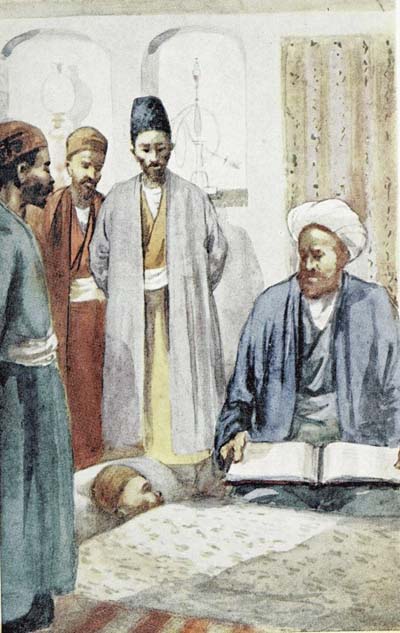
If the doctor seems unable to cure the patient a reader
is called in, sometimes a man, sometimes a woman, who
reads the Quran over the patient in the hope that it
may effect a cure where medical treatment has failed.
In the case of a long, tiresome illness, or when they
despair of recovery, it is not uncommon for the patient’s
friends to hasten the end by giving a dose of poison.
One girl, who had very little the matter with her, but
was always making a fuss over her ailments, gave her
family a great deal of trouble with her fancies. They
found her recovery was likely to be slow, and although
she was going on well they one day told the doctor that
“they had given her sherbet and she had died.”
I myself was several times asked to give poison in
the form of medicine, and I think they were rather
surprised when I told them how Christians regard
such a thing.
When the medical missionary starts work he may
be puzzled by the very common request that he will
give the second medicine first. It appears that the
people think, with how much truth I cannot say, that
their doctors give first a medicine to make the patient
worse and then one to make him better.
Perhaps that was what the devoted old grandmother
was thinking of, who had brought her poor little granddaughter
in from a village many miles away, very, very
ill with rheumatic fever. She called in the English
doctor, and got her medicine from the dispensary, but
when the doctor called next day, she said she had not
given the child any, because she remembered she had
never asked if it would do her good and so she was
afraid to try it.
It must surely have been in the minds of the friends
of one patient who came to the missionary, and said
their friend was worse every time she took her medicine,
and they wanted some more, it was doing her so much
good.
When you are very ill, Mother keeps you very quiet
and does not let you see visitors, but when a little
Persian is very ill all the neighbours crowd in to see him,
and the more ill he is the more people come in. And
they do not tread on tiptoe and talk in a whisper, they
all talk quite loud out and smoke qaliāns and drink
tea, and make noise enough to give anyone in good
health a headache, much more a sick child.
One day I was called in to see a child who was
dangerously ill. Instead of showing me into her room,
the mother, together with a variety of aunts, sisters,
and other relations, escorted me to their receiving-room.
I asked for the sick child, and was told I should
see her after tea, which meant at least half an hour’s
delay. As the account they had given of her sounded
very bad, I said I could not wait, that it was not our
custom to think of tea-drinking and entertainment
when our patients were perhaps dying. With great
difficulty I managed to persuade them to take me to
the poor little girl, whom they had left alone while they
all came to have tea and sweets with me. She was, as
they had said, very ill, her recovery was very doubtful,
yet as soon as we left the room, and had sent for the
medicine, they were all eager to entertain me, and I do
not think anyone would have stayed with the child if I
had not insisted, and they were all as gay and lively as if
they had had no one dangerously ill in the next room.
The Persians are very hospitable and like to put their
best before a visitor, and they consider it very necessary
to provide something nice for the doctor. Some
Persian doctors send word beforehand what refreshments
they would like got ready.
Sometimes this deters the very poor from calling
in even the mission doctor, who, they know, would
treat them free. They cannot even provide tea and
sugar. It was a great relief to more than one poor
person, when it was discovered that the mission ladies
were fond of boiled turnips, for a plate of turnips was
within the reach of the poorest, costing only about a
halfpenny. The news spread, and several sick people
were able at once to have a doctor.
But it is in surgery that one sees the Persian doctor
at his worst.
Here comes little Husain with his head plastered
up with mud; on removing the mud we find a broken
skull and a large wound in a foul condition. Next
comes little Sakīneh with both hands burnt; the
burns are smeared with sticky white of egg covered
over with leaves; it will take days of proper dressing
to get the wounds clean. But she is not so badly off
as Rubābeh, whose burn has been dressed with camphorated
oil, and is so inflamed that she screams and
cries the whole time.
A more fortunate child was the little girl who was
scalded nearly all over, but not deeply, and who looked
like a little nigger with the ink they had put on. She
got well very quickly. It is like Indian ink, and seems
to be the best of the remedies the Persians use for burns.
With broken bones the Persian doctors are not very
successful either. Little Hasan, aged four, fell and
broke both arms. The Persian doctor as usual tied
them up with splints that were too small to be any real
use, but he tried to make up for that by tying the
bandages very tight, and poor little Hasan had both
arms partly destroyed. How proud he was when,
after some weeks at the C.M.S. hospital, he was able
to carry an English doll clasped to his heart with the
two poor bandaged stumps.
There was some truth in what one doctor said, that
more than half the cases that came into the hospital had
come there in consequence of the Persian doctors’ treatment.
The remedy is generally worse than the disease.
There are exceptions, and I have met Persian doctors,
who not only had real knowledge of medical treatment,
but had some of the true doctor’s spirit of pity and
self-sacrifice. Especially I would mention the brave
Persian doctor who stayed at his post in Shiraz in the
cholera epidemic of 1904, and fought that terrible
disease instead of yielding to the panic that had seized
his fellow countrymen.
It is evident, however, that there is a great and
crying need for dispensaries and hospitals in Persia.
So in the north the American Presbyterians, and in the
south the Church Missionary Society, have founded
them in a number of towns.
As a rule a dispensary is started first, to which out-patients
can come to get medicines and have their hurts
attended to. Later a hospital is opened. Generally
the first hospital is a very poor affair, but as the work
grows money is collected, and nice, clean, convenient
hospitals are built and furnished. Armenian and
Persian boys and girls are trained as nurses and
assistants, the boys for the men’s hospital, the girls
for the women’s and children’s.
Here Hasan and ‘Ali, Fātimeh and Rubābeh, and a
great many other little Persian children are made as
comfortable as their illness allows, and are kept clean
and happy in comfortable beds, and well fed and cared
for.
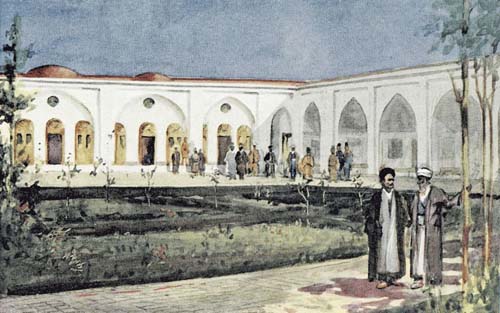
A MISSION HOSPITAL
Morning and evening they hear prayers read, and
soon they too venture to join in the “Our Father.”
And every day someone reads and explains in the ward
something about the Lord Jesus Christ, and His love
and His teaching, and they learn that He knows and
loves each little Akbar or Sakīneh and wants them for
His own, and they learn to love Him because He first
loved them. They learn hymns too, and love to sing
them, the same hymns that you know so well, “Whiter
than snow,” “Simply trusting,” “Here we suffer
grief and pain,” and many others.
The last recalls the story of little Bāgum, the child-wife,
who was deliberately and cruelly burnt by her
husband, and was brought to the mission hospital.
There was no hope of recovery, but all was done that
was possible to relieve her pain and brighten her last
days.
She had heard something of the Gospel story from
a missionary who had paid a visit to her native village,
and she had been so interested that she had asked two
Persian children to teach her more. When she was
brought to the hospital even the terrible pain she was
suffering did not make her forget the wonderful story,
and she begged to be told more and more. And resting
in the love of Christ and trusting wholly in Him and
His salvation, she loved to sing of the joy to which He
was going to take her and kept begging for “Here we
suffer grief and pain,” and repeating over and over the
refrain, “Shādī, Shādī,” (joy, joy), until even the
Muhammadan women would sit beside her and sing the
hymn that comforted her so much.
In a small village in another part of Persia lived a
little lame girl. She could not walk at all, and her
leg was drawn up so that she could not straighten it,
and she suffered very much. She was a good deal of
trouble to her parents, and they got tired of taking care
of her, and neglected her a good deal, till at last her
father heard of the mission hospital in the neighbouring
town, seventeen miles off, and took her there to see
if the Ferangis (Europeans) could cure her. She was
taken in, washed, and dressed in clean clothes and
put to bed. At first she used to scream when her leg
was touched, but it was operated on, and gradually, very
gradually, the pain grew less, and the leg grew straighter.
But still, as the months went on, the recovery was very
slow, and when the weather grew so hot that the
hospital had to be closed and her father took her
home, though free from pain while she lay still in
bed, the pain was so great when she tried to stand that
she could not walk a step. But as she lay alone on her
bed at home she thought over all she had heard at the
hospital, and one day a new thought struck her.
Surely the Khānums had told her that the Lord Jesus
Christ, Who used to cure people so wonderfully, was
alive still and could hear when anyone spoke to Him.
Why had she never asked Him to make her leg well?
And then and there, in her ignorance and simple faith,
she asked Him, Who in the old Gospel days had made
the lame to walk, to make her walk, and, confident in
His love and power, she “arose and walked.”
When the hospital was reopened she came back
again still lame, still in pain, but able to walk about
with a stick. And she loved more than ever to hear of
Him who had not only done so much for the sick
Jews of old times, but had done so much too for
her.