The sewing-machines whirred like a thousand
devils. You have no idea what a noise thirty sewing-machines
will make when they are running at
full speed. Each machine is made up of dozens
of little wheels and cogs and levers and ratchets,
and each part tries to pound, scrape, squeak and
bang and roar louder than all the others. The
old man who went crazy last year in this very same
shop used to sit in the cell where they chained him,
with his fingers in his ears, to keep out the noise
of the sewing-machines. He said the incessant
din was eating into his brains, and, time and again,
he tried to dash out those poor brains against the
padded wall.
The sewing-machines whirred and roared and
clicked, and the noise drowned every other sound.
Braun finished garment after garment and arranged
them in a pile beside his machine. When
there were twenty in the pile he paused in his work—if
4your eyes were shut you would never have
known that one machine had stopped—and he
carried the garments to the counter, where the
marker gave him a ticket for them. Then he returned
to his machine. This was the routine of
his daily labour from seven o’clock in the morning
until seven o’clock at night. The only deviation
from this routine occurred when Lizschen laid the
twentieth garment that she had finished upon her
pile and Braun saw her fragile figure stoop to
raise the pile. Then his machine would stop, in
two strides he would be at her side, and with a
smile he would carry the garments to the counter
for her and bring her the ticket for them. Lizschen
would cease working to watch him, and when
he handed her the ticket she would smile at him,
and sometimes, when no one was looking, she would
seize his hand and press it tightly against her
cheek—oh! so tightly, as if she were drowning, and
that hand were a rock of safety. And, when she
resumed her work, a tear would roll slowly over
the very spot where his hand had rested, tremble
for an instant upon her pale cheek, and then fall
upon the garment where the needle would sew it
5firmly into the seam. But you never would have
known that two machines had stopped for a moment;
there were twenty-eight others to keep up
the roaring and the rattling and the hum.
On and on they roared. There was no other
sound to conflict with or to vary the monotony.
At each machine sat a human being working with
hand, foot, and eye, watching the flashing needle,
guarding the margin of the seams, jerking the
cloth hither and thither quickly, accurately, watching
the spool to see that the thread ran freely, oiling
the gear with one hand while the other continued
to push the garment rapidly under the
needle, the whole body swaying, bending, twisting
this way and that to keep time and pace with the
work. Every muscle of the body toiled, but the
mind was free—free as a bird to fly from that suffocating
room out to green fields and woods and
flowers. And Braun was thinking.
Linder had told him of a wonderful place where
beautiful pictures could be looked at for nothing.
It was probably untrue. Linder was not above
lying. Braun had been in this country six long
years, and in all that time he had never found anything
6that could be had for nothing. Yet Linder
said he had seen them. Paintings in massive gold
frames, real, solid gold, and such paintings!
Woodland scenes and oceans and ships and cattle
and mountains, and beautiful ladies—such pictures
as the theatrical posters and the lithograph advertisements
on the streets displayed, only these
were real. And it cost nothing to look at them!
Nineteen—twenty! That completed the pile.
It had taken about an hour, and he had earned
seven cents. He carried the pile to the counter,
received his ticket, and returned to his machine,
stopping only to smile at Lizschen, who had finished
but half a pile in that time, and who looked
so white and tired, yet smiled so sweetly at him—then
on with his work and thoughts.
He would take Lizschen to see them. It was
probably all a lie, but the place was far, far uptown,
near Madison Square—Braun had never been
north of Houston Street—and the walk might do
Lizschen good. He would say nothing to her
about the pictures until he came to the place and
found out for himself if Linder had told the truth.
Otherwise the disappointment might do her harm.
7Poor Lizschen! A feeling of wild, blind rage
overwhelmed Braun for an instant, then passed
away, leaving his frame rigid and his teeth tightly
clenched. While it lasted he worked like an automaton,
seeing nothing, hearing nothing, feeling
nothing save a chaotic tumult in his heart and brain
that could find no vent in words, no audible expression
save in a fierce outcry against fate—resistless,
remorseless fate. A few months ago these
attacks had come upon him more frequently, and
had lasted for hours, leaving him exhausted and
ill. But they had become rarer and less violent;
there is no misfortune to which the human mind
cannot ultimately become reconciled. Lizschen
was soon to die. Braun had rebelled; his heart and
soul, racked almost beyond endurance, had cried
out against the horror, the injustice, the wanton
cruelty, of his brown-eyed, pale-cheeked Lizschen
wasting away to death before his eyes. But there
was no hope, and he had gradually become reconciled.
The physician at the public dispensary had
told him she might live a month or she might live
a year longer, he could not foretell more accurately,
but of ultimate recovery there was no hope on
8earth. And Braun’s rebellious outbursts against
cruel fate had become rarer and rarer. Do not
imagine that these emotions had ever shaped themselves
in so many words, or that he had attempted
by any process of reasoning to argue the matter
with himself or to see vividly what it all meant,
what horrible ordeal he was passing through, or
what the future held in store for him. From his
tenth year until his twentieth Braun had worked in
factories in Russia, often under the lash. He was
twenty-six, and his six years in this country had
been spent in sweatshops. Such men do not
formulate thoughts in words: they feel dumbly,
like dogs and horses.
The day’s work was done. Braun and Lizschen
were walking slowly uptown, hand in hand, attracting
many an inquiring, half-pitying glance. She
was so white, he so haggard and wild-eyed. It
was a delightful spring night, the air was balmy
and soothing, and Lizschen coughed less than she
had for several days. Braun had spoken of a picture
9he had once seen in a shop-window in Russia.
Lizschen’s eyes had become animated.
“They are so wonderful, those painters,” she
said. “With nothing but brushes they put colours
together until you can see the trees moving in the
breeze, and almost imagine you hear the birds in
them.”
“I don’t care much for trees,” said Braun, “or
birds either. I like ships and battle pictures where
people are doing something great.”
“Maybe that is because you have always lived
in cities,” said Lizschen. “When I was a girl I
lived in the country, near Odessa, and oh, how
beautiful the trees were and how sweet the flowers!
And I used to sit under a tree and look at the
woods across the valley all day long. Ah, if I
could only——!”
She checked herself and hoped that Braun had
not heard. But he had heard and his face had
clouded. He, too, had wished and wished and
wished through many a sleepless night, and now
he could easily frame the unfinished thought in
Lizschen’s mind. If he could send her to the country,
to some place where the air was warm and
10dry, perhaps her days might be prolonged. But
he could not. He had to work and she had to
work, and he had to look on and watch her toiling,
toiling, day after day, without end, without hope.
The alternative was to starve.
They came to the place that Linder had described,
and, surely enough, before them rose a
huge placard announcing that admission to the
exhibition of paintings was free. The pictures
were to be sold at public auction at the end of the
week, and for several nights they were on inspection.
The young couple stood outside the door
a while, watching the people who were going in
and coming out; then Braun said:
“Come, Lizschen, let us go in. It is free.”
Lizschen drew back timidly. “They will not
let people like us go in. It is for nobility.” But
Braun drew her forward.
“They can do no more than ask us to go out,”
he said. “Besides, I would like to have a glimpse
of the paintings.”
With many misgivings Lizschen followed him
into the building, and found herself in a large hall,
brilliantly illuminated, walled in with paintings
11whose gilt frames shone like fiery gold in the bright
light of numerous electric lamps. For a moment
the sight dazzled her, and she gasped for breath.
The large room, with its soft carpet, the glittering
lights and reflections, the confused mass of colours
that the paintings presented to her eyes, and the
air of charm that permeates all art galleries, be
they ever so poor, were all things so far apart from
her life, so foreign not only to her experience, but
even to her imagination, that the scene seemed
unreal at first, as if it had been taken from a fairy
tale. Braun was of a more phlegmatic temperament,
and not easily moved. The lights merely
made his eyes blink a few times, and after that he
saw only Lizschen’s face. He saw the blood leave
it and a bright pallor overspread her cheeks, saw
the frail hand move convulsively to her breast, a
gesture that he knew so well, and feared that she
was about to have a coughing spell. Then, suddenly,
he saw the colour come flooding back to her
face, and he saw her eyes sparkling, dancing with
a joy that he had never seen in them before. Her
whole frame seemed suddenly to become animated
with a new life and vigour. Somewhat startled
12by this transformation he followed her gaze. Lizschen
was looking at a painting.
“What is it, dear?” he asked.
“The picture,” she said in a whisper. “The
green fields and that tree! And the road! It
stretches over the hill! The sun will set, too, very
soon. Then the sheep will come over the top of
the hill. Oh, I can almost hear the leader’s bell!
And there is a light breeze. See the leaves of the
tree; they are moving! Can’t you feel the breeze?
Oh, darling, isn’t it wonderful? I never saw anything
like that before.”
Braun looked curiously at the canvas. To his
eyes it presented a woodland scene, very natural,
to be sure, but not more natural than nature, and
equally uninteresting to him. He looked around
him to select a painting upon which he could expend
more enthusiasm.
“Now, there’s the kind I like, Lizschen,” he
said. “That storm on the ocean, with the big
ship going to pieces. And that big picture over
there with all the soldiers rushing to battle.”
He found several others and was pointing out
what he found to admire in them, when, happening
13to look at his companion’s face, he saw that her
eyes were still fastened upon the woodland picture,
and he realised that she had not heard a word of
what he had said. He smiled at her tenderly.
“Ah, Lizschen,” he said, “if I were rich I would
take that picture right off the wall and give them
a hundred dollars for it, and we would take it home
with us so that Lizschen could look at it all day
long.”
But still Lizschen did not hear. All that big
room, with its lights and its brilliant colourings,
and all those people who had come in, and even her
lover at her side had faded from Lizschen’s consciousness.
The picture that absorbed all her
being had ceased to be a mere beautiful painting.
Lizschen was walking down that road herself; the
soft breeze was fanning her fevered cheeks, the
rustling of the leaves had become a reality; she
was walking over the hill to meet the flock of sheep,
for she could hear the shepherd’s dog barking and
the melodious tinkling of the leader’s bell.
From the moment of their entrance many curious
glances had been directed at them. People wondered
who this odd-looking, ill-clad couple could
14be. When Lizschen became absorbed in the woodland
scene and stood staring at it as if it were the
most wonderful thing on earth, those who observed
her exchanged glances, and several onlookers
smiled. Their entrance, Lizschen’s bewilderment,
and then her ecstasy over the painting had all happened
in the duration of three or four minutes.
The liveried attendants had noticed them and had
looked at one another with glances that expressed
doubt as to what their duty was under the circumstances.
Clearly these were not the kind of people
for whom this exhibition had been arranged.
They were neither lovers of art nor prospective
purchasers. And they looked so shabby and so
distressingly poor and ill-nourished.
Finally one attendant, bolder than the rest, approached
them, and tapping Braun lightly upon
the sleeve, said, quite good-naturedly:
“I think you’ve made a mistake.”
Braun looked at him and shook his head and
turned to Lizschen to see if she understood. But
Lizschen neither saw nor heard. Then the man,
seeing that he was dealing with foreigners, became
more abrupt in his demeanour, and, with a grunt,
15pointed to the door. Braun understood. To be summarily
ordered from the place seemed more natural
to him than to be permitted to remain unmolested
amid all that splendour. It was more in keeping
with the experiences of his life. “Come, Lizschen,”
he said, “let us go.” Lizschen turned to
him with a smiling face, but the smile died quickly
when she beheld the attendant, and she clutched
Braun’s arm. “Yes, let us go,” she whispered to
him, and they went out.
On the homeward journey not a word was
spoken. Braun’s thoughts were bitter, rebellious;
the injustice of life’s arrangements rankled deeply
at that moment, his whole soul felt outraged, fate
was cruel, life was wrong, all wrong. Lizschen, on
the other hand, walked lightly, in a state of mild
excitement, all her spirit elated over the picture
she had seen. It had been but a brief communion
with nature, but it had thrilled the hidden chords
of her nature, chords of whose existence she had
never dreamed before. Alas! the laws of this same
16beautiful nature are inexorable. For that brief
moment of happiness Lizschen was to submit to
swift, terrible punishment. Within a few steps of
the dark tenement which Lizschen called home a
sudden weakness came upon her, then a violent fit
of coughing which racked her frail body as though
it would render it asunder. When she took her
hands from her mouth Braun saw that they were
red. A faintness seized him, but he must not yield
to it. Without a word he gathered Lizschen in his
arms and carried her through the hallway into the
rear building and then up four flights of stairs to
the apartment where she lived.
Then the doctor came—he was a young man,
with his own struggle for existence weighing upon
him, and yet ever ready for such cases as this where
the only reward lay in the approbation of his own
conscience—and Braun hung upon his face for the
verdict.
“It is just another attack like the last,” he was
saying to himself. “She will have to lie in bed
for a day, and then she will be just as well as before.
Perhaps it may even help her! But it is
nothing more serious. She has had many of them.
17I saw them myself. It is not so terribly serious.
Not yet. Oh, it cannot be yet! Maybe, after
a long time—but not yet—it is too soon.” Over
and over again he argued thus, and in his heart
did not believe it. Then the doctor shook his head
and said: “It’s near the end, my friend. A few
days—perhaps a week. But she cannot leave her
bed again.”
Braun stood alone in the room, upright, motionless,
with his fists clenched until the nails dug deep
into the skin, seeing nothing, hearing nothing,
feeling nothing. His eyes were dry, his lips
parched. The old woman with whom Lizschen
lived came out and motioned to him to enter the
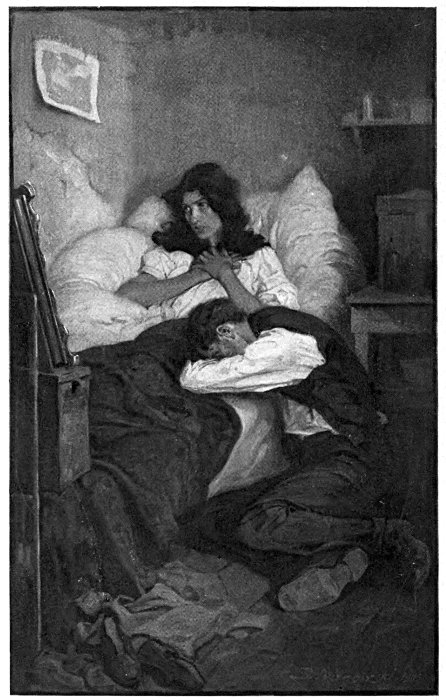
bedroom. Lizschen was whiter than the sheets, but
her eyes were bright, and she was smiling and holding
out her arms to him. “You must go now,
Liebchen,” she said faintly. “I will be all right
to-morrow. Kiss me good-night, and I will dream
about the beautiful picture.” He kissed her and
went out without a word. All that night he walked
the streets.
When the day dawned he went to her again.
She was awake and happy. “I dreamt about it all
18night, Liebchen,” she said, joyfully. “Do you
think they would let me see it again?”
He went to his work, and all that day the roar
of the machines set his brain a-whirring and a-roaring
as if it, too, had become a machine. He
worked with feverish activity, and when the machines
stopped he found that he had earned a dollar
and five cents. Then he went to Lizschen and
gave her fifty cents, which he told her he had found
in the street. Lizschen was much weaker, and
could only speak in a whisper. She beckoned to
him to hold his ear to her lips, and she whispered:
“Liebchen, if I could only see the picture once
more.”
“I will go and ask them, darling,” he said.
“Perhaps they will let me bring it to you.”
Braun went to his room and took from his trunk
a dagger that he had brought with him from
Russia. It was a rusty, old-fashioned affair which
even the pawnbrokers had repeatedly refused to
accept. Why he kept it or for what purpose he
now concealed it in his coat he could not tell. His
mind had ceased to work coherently: his brain was
now a machine, whirring and roaring like a thousand
19devils. Thought? Thought had ceased.
Braun was a machine, and machines do not
think.
He walked to the picture gallery. He had forgotten
its exact location, but some mysterious instinct
guided him straight to the spot. The doors
were already opened, but the nightly throng of
spectators had hardly begun to arrive. And now
a strange thing happened. Braun entered and
walked straight to the painting of the woodland
scene that hung near the door. There was no
attendant to bar his progress. A small group of
persons, gathered in front of a canvas that hung
a few feet away, had their backs turned to him,
and stood like a screen between him and the employees
of the place. Without a moment’s hesitation,
without looking to right or to left, walking
with a determined stride and making no effort to
conceal his purpose, and, at the same time, oblivious
of the fact that he was unobserved, Braun approached
the painting, raised it from the hook,
and, with the wire dangling loosely from it, took
the painting under his arm and walked out of the
place. If he had been observed, would he have
20brought his dagger into use? It is impossible to
tell. He was a machine, and his brain was roaring.
Save for one picture that rose constantly
before his vision, he was blind. All that he saw
was Lizschen, so white in her bed, waiting to see
the woodland picture once more.
He brought it straight to her room. She was
too weak to move, too worn out to express any
emotion, but her eyes looked unutterable gratitude
when she saw the painting.
“Did they let you have it?” she whispered.
“They were very kind,” said Braun. “I told
them you wanted to see it and they said I could
have it as long as I liked. When you are better
I will take it back.”
Lizschen looked at him wistfully. “I will never
be better, Liebchen,” she whispered.
Braun hung the picture at the foot of the bed
where Lizschen could see it without raising her
head, and then went to the window and sat there
looking out into the night. Lizschen was happy
beyond all bounds. Her eyes drank in every detail
of the wonderful scene until her whole being became
filled with the delightful spirit that pervaded
21and animated the painting. A master’s hand had
imbued that deepening blue sky with the sadness
of twilight, the soft, sweet pathos of departing
day, and Lizschen’s heart beat responsive to every
shade and shadow. In the waning light every outline
was softened; here tranquillity reigned supreme,
and Lizschen felt soothed. Yet in the distance,
across the valley, the gloom of night had
begun to gather. Once or twice Lizschen tried
to penetrate this gloom, but the effort to see what
the darkness was hiding tired her eyes.
The newspapers the next day were full of the
amazing story of the stolen painting. They told
how the attendants at the gallery had discovered
the break in the line of paintings and had immediately
notified the manager of the place, who at
once asked the number of the picture.
“It’s number thirty-eight,” they told him. He
seized a catalogue, turned to No. 38, and turned
pale. “It’s Corot’s ‘Spring Twilight!’” he
cried. “It cost the owner three thousand dollars,
and we’re responsible for it!”
22The newspapers went on to tell how the police
had been notified, and how the best detectives had
been set to work to trace the stolen painting, how
all the thieves’ dens in New York had been ransacked,
and all the thieves questioned and cross-questioned,
all the pawnshops searched—and it all
had resulted in nothing. But such excitement
rarely leaks into the Ghetto, and Braun, at his
machine, heard nothing of it, knew nothing of
it, knew nothing of anything in the world save
that the machines were roaring away in his
brain and that Lizschen was dying. As soon as
his work was done he went to her. She smiled at
him, but was too weak to speak. He seated himself
beside the bed and took her hand in his. All
day long she had been looking at the picture; all
day long she had been wandering along the road
that ran over the hill, and now night had come and
she was weary. But her eyes were glad, and when
she turned them upon Braun he saw in them love
unutterable and happiness beyond all description.
His eyes were dry; he held her hand and stroked
it mechanically; he knew not what to say. Then
she fell asleep and he sat there hour after hour,
23heedless of the flight of time. Suddenly Lizschen
sat upright, her eyes wide open and staring.
“I hear them,” she cried. “I hear them plainly.
Don’t you, Liebchen? The sheep are coming!
They’re coming over the hill! Watch, Liebchen;
watch, precious!”
With all the force that remained in her she
clutched his hand and pointed to the painting at
the foot of the bed. Then she swayed from side
to side, and he caught her in his arms.
“Lizschen!” he cried. “Lizschen!” But her
head fell upon his arm and lay motionless.
The doctor came and saw at a glance that the
patient was beyond his ministering. “It is over,
my friend,” he said to Braun. At the sound of a
voice Braun started, looked around him quite bewildered,
and then drew a long breath which
seemed to lift him out of the stupor into which he
had fallen. “Yes, it is over,” he said, and, according
to the custom of the orthodox, he tore a
rent in his coat at the neck to the extent of a hand’s
breadth. Then he took the painting under his arm
and left the house.
It was now nearly two o’clock in the morning
24and the streets were deserted. A light rain had
begun to fall, and Braun took off his coat to wrap
it around his burden. He walked like one in a
dream, seeing nothing, hearing nothing save a dull
monotonous roar which seemed to come from all
directions and to centre in his brain.
The doors of the gallery were closed and all was
dark. Braun looked in vain for a bell, and after
several ineffectual taps on the door began to pound
lustily with his fist and heel. Several night stragglers
stopped in the rain, and presently a small
group had gathered. Questions were put to Braun,
but he did not hear them. He kicked and pounded
on the door, and the noise resounded through the
streets as if it would rouse the dead. Presently
the group heard the rattling of bolts and the
creaking of a rusty key in a rusty lock, and all
became quiet. The door swung open, and a frightened
watchman appeared.
“What’s the matter? Is there a fire?” he
asked.
A policeman made his way through the group,
and looked inquiringly from Braun to the watchman.
Without uttering a word Braun held out
25the painting, and at the sight of it the watchman
uttered a cry of amazement and delight.
“It’s the stolen Corot!” he exclaimed. Then
turning to Braun, “Where did you get it? Who
had it? Do you claim the reward?”
Braun’s lips moved, but no sound came from
them, and he turned on his heel and began to walk
off, when the policeman laid a hand on his shoulder.
“Not so fast, young man. You’ll have to give
some kind of an account of how you got this,” he
said.
Braun looked at him stupidly, and the policeman
became suspicious. “I guess you’d better come
to the station-house,” he said, and without more
ado walked off with his prisoner. Braun made no
resistance, felt no surprise, offered no explanation.
At the station-house they asked him many questions,
but Braun only looked vacantly at the questioner,
and had nothing to say. They locked him
in a cell over night, a gloomy cell that opened on a
dimly lighted corridor, and there Braun sat until
the day dawned, never moving, never speaking.
Once, during the night, the watchman on duty
in this corridor thought he heard a voice whispering
26“Lizschen! Lizschen!” but it must have been
the rain that now was pouring in torrents.
“There the wicked cease from troubling; and there the
weary be at rest.
“There the prisoners rest together; they hear not the
voice of the oppressor.
“The small and the great are there; and the servant is
free from his master.”
It is written in Israel that the rabbi must give
his services at the death-bed of even the lowliest.
The coffin rested on two stools in the same room
in which she died; beside it stood the rabbi, clad in
sombre garments, reading in a listless, mechanical
fashion from the Hebrew text of the Book of Job,
interpolating here and there some time-worn, commonplace
phrase of praise, of exhortation, of consolation.
He had not known her; this was merely
part of his daily work.
The sweatshop had been closed for an hour;
for one hour the machines stood silent and deserted;
the toilers were gathered around the coffin, listening
to the rabbi. They were pale and gaunt, but
not from grief. The machines had done that.
27They had rent their garments at the neck, to the
extent of a hand’s breadth, but not from grief.
It was the law. A figure that they had become accustomed
to see bending over one of the machines
had finished her last garment. Dry-eyed, in a sort
of mild wonder, they had come to the funeral services.
And some were still breathing heavily from
the morning’s work. After all, it was pleasant to
sit quiet for one hour.
Someone whispered the name of Braun, and they
looked around. Braun was not there.
“He will not come,” whispered one of the men.
“It is in the newspaper. He was sent to prison
for three years. He stole something. A picture,
I think. I am not sure.”
Those who heard slowly shook their heads.
There was no feeling of surprise, no shock. And
what was there to say? He had been one of them.
He had drunk out of the same cup with them.
They knew the taste. What mattered the one
particular dreg that he found? They had no curiosity.
In the case of Nitza, it was her baby who
was dying because she could not buy it the proper
food. Nitza had told them. And so when Nitza
28cut her throat they all knew what she had found in
the cup. Braun hadn’t told—but what mattered
it? Probably something more bitter than gall.
And three years in prison? Yes. To be sure. He
had stolen something.
“Wherefore is light given to him that is in
misery,” droned the rabbi, “and life unto the bitter
in soul:
“Which long for death, but it cometh not; and
dig for it more than for hid treasures;
“Which rejoice exceedingly, and are glad, when
they can find the grave?”
And the rabbi, faithful in the performance of
his duty, went on to expound and explain. But
his hearers could not tarry much longer. The hour
was nearing its end, and the machines would soon
have to start again.
It is an old story in the Ghetto, one that lovers
tell to their sweethearts, who always cry when they
hear it. The machines still roar and whirr, as if a
legion of wild spirits were shrieking within them,
and many a tear is stitched into the garments, but
you never see them, madame—no, gaze as intently
29upon your jacket as you will, the tear has left no
stain. There is an old man at the corner machine,
grey-haired and worn, but he works briskly. He
is the first to arrive each morning, and the last to
leave each night, and all his soul is in his work.
His machine is an old one, and roars louder than
the rest, but he does not hear it. Day and night,
sleeping and waking, there are a hundred thousand
machines roaring away in his brain. What cares
he for one more or one less?
THE SADER GUEST
33
Rosnofsky was explaining to me his theory of
the lost blue with which the ancient Hebrew priests
dyed the talith, when the door opened and lanky
Lazarus entered, hat in hand. He entered cautiously,
keeping one hand on the doorknob, and one
foot firmly planted for a backward spring. He
seemed rather embarrassed to find a third person
present, but the matter that he had on his mind
was weighty—so weighty, in fact, that, after a
moment’s hesitation, he plunged right into the
heart of it.
“Mr. Rosnofsky,” he said, “I love your daughter.”
Rosnofsky’s eyes opened wide, and his mouth
shut tight.
“And she loves me,” Lazarus went on.
Rosnofsky’s eyes contracted, until they gleamed
through the tiniest kind of a slit between the
lids. His hand fumbled behind his back among
34a number of tailor’s tools that lay on the
table.
“And I have come to ask your consent to our
marriage.”
Crash! Rosnofsky’s aim was bad. The shears,
instead of reaching Lazarus, shattered the window
pane. Lazarus was flying rapidly down the street.
Then Rosnofsky turned to me.
“And this mixture, as I was saying, will produce
exactly the same blue that the Talmud describes.”
It was worth while to become acquainted with
Rosnofsky. When aroused, or crossed, or seriously
annoyed, he had a frightful temper, and the
man whose misfortune it had been to stir him up
was the object of a malediction as bitter as it was
fierce, extending through all his family for, usually,
a dozen generations. Then, in startling contrast
to this, he was a devout son of Abraham, and,
in moments of serious reflection, would be almost
overcome by a feeling of piety, and at such times
all that was good and noble in his nature asserted
itself. It was a strange blending of the prosaic
with the patriarchal.
35“How came the original colour to be lost?” I
asked. Rosnofsky looked at me for a moment.
Then he shook his head.
“That scamp has upset me completely,” he said.
“Some other time I will tell you. Just now I can
think of nothing but the effrontery of that scoundrel.”
“What makes you so bitter toward him?” I ventured
to ask.
“Bitter! Bitter! He wants to marry Miriam.
The audacity of the wretch! My only child. And
here he practically tells me to my face that he has
been making love to her, and that he has ascertained
that she is in love with him. And I never
knew it. Never even suspected it. A curse on the
scamp! Sneaking into my home to steal my
daughter from me. The dishonourable villain! I
trusted him. The viper. May he suffer a million
torments! May the fiends possess him!”
I ventured to suggest that it was the way of the
world. I departed. Somewhat hastily. I did not
like the way he glared at me.
The next time I saw Rosnofsky he was walking
excitedly up and down his shop, tearing his hair
36en route. When he saw me he sprang forward and
clutched me by the shoulder.
“Here!” he cried. “I will leave it to you. You
were here when he had the audacity to confess his
guilt to my face. Read this.” He thrust a crumpled
piece of paper into my hand. “Read it, and
tell me if there is another such villain upon this
earth. Oh, I shall go mad!”
I read it. It was from Lazarus.
“I told you that I loved your daughter,” he
wrote. “I told you that she loved me. And, like
an honest man, I asked you to consent to our marriage.
You refused. I now appeal to you again.
You will make us both very happy by giving your
consent, as we would like you to be present at the
wedding. If you do not give your consent, we
will not invite you. But we will get married, anyway.
We will elope at the first opportunity. The
only way to stop it is to keep Miriam locked in the
house. Then I shall call in the police.”
It was signed, “Lovingly, your son-in-law-to-be.”
“How can I punish him?” asked Rosnofsky. I
promised to think it over. I had called merely to
37tell Rosnofsky that I would accept his invitation
to supper on Sader night, and to thank him.
“You know the law,” he said. “When you
come bring with you a plan to punish this scoundrel.”
It was the eve of the Passover, and I stood in the
gloomy hallway tapping at Rosnofsky’s door.
Dimly through the darkness I saw a quivering
shadow, but in the labyrinths of tenement corridors
it is unwise to investigate shadows. The door
opened, and Rosnofsky, with “praying cap”
upon his head, welcomed me to the feast of the
Sader.
Miriam was as sweet as a rose. I have not told
you how pretty she was, nor shall I begin now, for
it is a very tempting subject, such as would be
likely to beguile a man into forgetting the thread
of his story, and it was too dangerous for me to
enter upon. Suffice it that her eyes were as glorious
as—but there!
The table was arranged for four, Rosnofsky,
Miriam, and myself, and opposite Miriam’s seat
was the chair for the Stranger.
38Now the custom of celebrating this feast, according
to the ritual, is like this:
Holding aloft the unleavened bread, the head
of the house must say:
“This is the bread of affliction which our ancestors
ate in the land of Egypt. Let all those
who are hungry enter and eat thereof; and all who
are in distress come and celebrate the Passover.”
And the youngest-born must arise and open the
door so that the Stranger may enter and take his
place at the table, and, even though he slew one of
their kin, that night he is a sacred guest.
And—as you have no doubt already opined—hardly
had Miriam opened the door when, with pale
face, but with lips that were pressed in grim determination,
in walked Lazarus. Now, to this day I
do not know whether Miriam expected him, or what
her feelings were when he entered. She has refused
to tell me. It needed but one glance to assure
me that if there was any secret Rosnofsky had not
been in it.
With a cry of rage he sprang to his feet, and I
feared that he would hurl a knife at the intruder.
39But an instant later he recovered himself, and with
a gurgling, choking sound sank into his chair.
“The grace of God be with you all,” saluted
Lazarus, still very pale. Then,
“Am I a welcome guest?”
Rosnofsky seemed to be on the point of exploding
with rage, but at this question he started as if
he had been struck. After a moment’s silence he
arose with great dignity—and holding out his
hand—the strength of his piety never more forcibly
illustrated—said:
“Forgive my anger, my son. You are welcome
to the Feast of the Passover.”
And resuming his seat he chanted:
“Blessed art Thou, O Eternal, our God, King of
the Universe, Creator of the fruit of wine!”
It was the beginning of the service. Lazarus,
with his eyes upon the table, chanted the responses,
and I, who knew nothing of the ritual, looked at
Miriam, who, I assure you, was delightful to behold,
particularly when her eyes twinkled as they
did now.
By the time he had finished the Sader, Rosnofsky’s
troubled spirit had become soothed, and the
40final grace was delivered in a voice so calm and
with a manner so soothing, that when he looked up
Lazarus was emboldened to speak.
“You are angry with me, Father Rosnofsky,”
he ventured.
“Let us not speak of unpleasant things this
night,” replied the tailor, gently. “This is a holy
night.”
Lazarus, in no way abashed, deftly led the old
man to expound some of the intricate sayings of
the rabbis upon the Passover, which Rosnofsky,
who was something of a theologian, did with great
eagerness. Now, how it came about I cannot tell,
but Lazarus was so greatly interested in this discussion,
and Rosnofsky was so determined to prove
that the old rabbis were all in the wrong on this
one point, that when the meal was over he declared
that if Lazarus would call the next night he would
have a book that would convince him. Lazarus
had the discretion to take his departure. When he
had gone Rosnofsky puffed his pipe in silence for
some moments. Then, with a quaint smile, he
turned to me and said:
“The young rogue!”
And then he gazed at Miriam until she grew red.
A RIFT IN THE CLOUD
43
Though the sky be grey and dreary, yet will the
faintest rift reveal a vision of the dazzling
brightness that lies beyond.
So does a word, a look, a single act of a human
being often reveal the glorious beauty of a soul.
So is it written in the Talmud, and it needs no
rabbi to expound it. What I am about to tell you
is not a rounded tale; it hardly rises to the dignity
of a sketch. There is a man who lives in the very
heart of a big city, and I once had a peep into his
heart. His name is Polatschek. He makes cigars
during the day and gets drunk every night.
In that Hungarian colony which clusters around
East Houston Street, the lines that separate Gentile,
Jew, and Gipsy are not more strictly drawn
than are the lines between the lines. And as the
pedigree of every member is the common property
of the colony, the social status of each group is
pretty clearly defined.
44Being an outcast, Polatschek has no social status
whatever, and all that the colony has ever known
or has ever cared to know about him is this:
By a curious atavistic freak Polatschek was born
honest. In the little town in southern Hungary
from which he came his great-grandfather had been
a highwayman, his grandfather had been executed
for murder, his father was serving a long sentence
for burglary, and his two younger brothers were
on the black list of the police. And so, when it was
announced that one of the Polatscheks was coming
to New York, Houston Street society drew in its
latch-string, and one of the storekeepers even went
so far as to tell the story to a police detective.
This, however, was frowned upon, for Goulash
Avenue—as the Hungarians laughingly call
Houston Street—loves to keep its secrets to
itself.
There is no need to describe the appearance of
Polatschek; it is extremely uninteresting. He has
a weak chin, and when he is sober he is very timid.
A Hungarian does not easily make friends outside
his own people, and so it came to pass that Polatschek
had no friends at all.
45How Polatschek lived none but himself knew.
Somewhere in Rivington Street he had a room where,
it was once said, he kept books, though no one knew
what kind of books they were. For a few hours
every day he worked at cigar-making, earning just
enough money to keep body and soul together. He
was, in short, as uninteresting a man as you could
find, and all who knew him shunned him. Night
after night he would sit in Natzi’s café, where the
gipsies play on Thursdays, drinking slivovitz—which
is the last stage. He would drink, drink,
drink, and never a word to a soul. On music nights
he would drink more than usual and his eyes would
fill with tears. We all used to think they were
maudlin tears, but we had grown accustomed to
Polatschek and his strange habits, and nobody paid
attention to him.
It was music night at Natzi’s, and Polatschek
was sitting close to the gipsies with his eyes fixed
upon the leader. He had been drinking a little
more than usual, and I marvelled that a man in his
maudlin condition should take such a deep interest
in music.
46They were playing the “Rakoczy March,” which
only the Hungarians know how to play, and
Polatschek was swaying his head in time to the
melody.
It seemed so strange, this friendless, hopeless
man’s love for music, so thoroughly foreign to his
dreary, barren nature as I had pictured it in my
mind, that when the gipsies had finished I spoke
to him.
“That was beautiful, was it not?”
He looked at me in surprise, his eyes wide open,
and after gazing at me for a moment he shook his
head.
“No, that was not beautiful. The ‘Rakoczy
March’ is the greatest march in the world, but
these gipsies do not know how to play it. They
cannot play. They have no life, no soul. They
play it as if they were machines.”
Startled by his vehemence, I could only murmur,
“Oh!”
“Look!” he exclaimed, rising in agitation. He
took up the leader’s violin and bow. “Listen!
This is the ‘Rakoczy’!”
The gipsy leader had sprung to his feet, but
47at the first tone of the violin he stood as if petrified.
A silence had fallen upon the room. With his eyes
fixed upon mine, his lips pressed firmly together,
Polatschek played the “Rakoczy March.” The
guests were staring at him in blank amazement.
The gipsies, with sparkling eyes, were listening to
those magic strains, but Polatschek was unmindful
of it all, and—I felt proud because he was playing
that march for me. I have heard Sarasate play
the “Rakoczy March.” I have heard Mme. Urso
try it, and I have heard Remenyi, who, being a
Hungarian, played it best of them all. But I
had never heard it played as Polatschek played
it.
As I saw the lines in that face grow sharper,
saw the body quiver with patriotic ardour, those
ringing, rhythmic tones sang of the tramp, tramp,
tramp of armies, of cavalcades of horses, of the clash
and clangour of battle. Then it all grew fainter
and fainter as if the armies were vanishing in the
distance, and the sad strains of the undersong rose
to the surface of the melody and I heard that sobbing
appeal which lies hidden somewhere in every
Hungarian song. It died away, there was a moment’s
48silence—Polatschek remained standing,
looking at me—then a mighty shout went up.
“Ujra! Ujra!” they cried. It was an encore
they wanted.
But Polatschek had resumed his seat and his slivovitz,
and in a few moments he was very drunk.
OUT OF HIS ORBIT
51
In order to emphasise the moral of a tale, it is
safer to state it at the very beginning. The moral
of the story of Rosenstein is this: Woe be to the
man who attempts to teach his wife a lesson! Woe
be to him if he fail! Woe be to him if he succeed!
Whatever happens, woe be to him! In witness
whereof this tale is offered.
Mrs. Rosenstein wanted one room papered in
red, and Mr. Rosenstein held that the yellow paper
that adorned the walls was good enough for another
year.
“But,” argued his wife, “we have laid by a little
money in the past years, and we can easily afford
it. And I love red paper on the walls.” Rosenstein,
by the way, owned a dozen tenement houses,
had no children, and led a life of strict economy
on perhaps one-fiftieth of his income. Besides,
Rosenstein owned a lucrative little dry-goods store
that brought in more money. And he had never
52smoked and had never drunk. But the more his
wife insisted upon the red paper the more stubborn
he became in his opposition, until, one morning
after a heated discussion in which he had failed
disastrously to bring forth any reasonable argument
to support his side of the case, he suddenly
and viciously yielded.
“Very well,” he said, putting on his hat and
starting for the door; “get your red paper. Have
your own way. But from this moment forth I become
a drinker.”
Mrs. Rosenstein turned pale. “Husband!
Husband!” she cried entreatingly, turning toward
him with clasped hands. But Rosenstein, without
another word, strode out of the room and slammed
the door behind him. Mrs. Rosenstein sank into
a chair, appalled. The pride of her life had been
that her husband had never touched liquor, and the
one disquieting thought that from time to time
came to worry her was that some day he might fall.
And she felt that the first fall would mark the beginning
of ruin. She had known men whose
habits of drink had undermined their business
capacity. Her husband, she knew, was close, and
53had a mania for accumulating money. But once
the demon of drink entered into his life she felt
that all this would change. He would become a
spendthrift. He would squander all that he had
saved. They would be homeless—perhaps they
would starve. And he was about to take the first
step. Her heart was almost broken. To follow
him she knew would be worse than useless. He
was stubborn—she had learned that—and there
was nothing for her to do but to accept the inevitable.
Rosenstein meanwhile walked to the nearest
saloon. He had passed the place a thousand times,
but had never entered before. The bartender’s
eyes opened in mild surprise to see so patriarchal
a figure standing in front of the bar glaring at
him so determinedly.
“Give me a drink!” demanded Rosenstein.
“What kind of a drink do you want?” asked
the bartender.
Rosenstein looked bewildered. He did not know
one drink from another. He looked at the row of
bottles behind the counter, and then his face
lit up.
54“That bottle over there—the big black one.”
It was Benedictine. The bartender poured
some of it into a tiny liqueur glass, but Rosenstein
frowned.
“I want a drink, I said, not a drop. Fill me
a big glass.”
The wise bartender does not dispute with his
patrons as long as they have the means of paying
for what they order. Without a word he filled
a small goblet with the thick cordial, and Rosenstein,
without a word, gulped it down. The bartender
watched him in open-mouthed amazement,
charged him for four drinks, and then, as Rosenstein
walked haughtily out of the place, murmured
to himself: “Well, I’ll be hanged!”
Rosenstein walked aimlessly but joyfully down
the street, bowing to right and to left at the many
people who smiled upon him in so friendly a
fashion. When he came to the corner he was surprised
to see that the whole character of the street
had changed over night. Then it seemed to him
that a regiment of soldiers came marching up,
each man holding out a flowing bowl to him, that
he fell into line and joined the march, and that
55they all found themselves in a brilliant, dazzling
glare of several hundred suns. Then they shot
him from the mouth of a cannon, and when he
regained consciousness he recognised the features
of Mrs. Rosenstein and felt the grateful coolness
of the wet towels she was tenderly laying upon his
fevered head. It was nearly midnight.
Rosenstein groaned in anguish.
“What has happened?” he asked.
“You have been a drinker,” his wife replied,
“but it is all over now. Take a nice long sleep
and we will never speak of it again. And the yellow
paper will do for another year.”
Rosenstein watched the flaming pinwheels and
skyrockets that were shooting before his vision for
a while; then a horrible idea came to him.
“See how much money I have in my pockets,”
he said. His wife counted it.
“One dollar and forty cents,” she said. A sigh
of relief rose from Rosenstein’s lips.
“It’s all right, then. I only had two dollars when
I went out.” Then he fell peacefully asleep.
The next morning he faced his wife and pointed
out to her the awful lesson he had taught her.
56“You now see what your stubbornness can drive
me to,” he said. “I have squandered sixty cents
and lost a whole day’s work in the store merely to
convince you that it is all nonsense to put red
paper on the walls.” But his wife was clinging
to him and crying and vowing that she would never
again insist upon anything that would add to their
expenses. And then they kissed and made up,
and Rosenstein went to his store, somewhat weak
in the legs and somewhat dizzy, and with a queer
feeling in his head, but elated that he had won a
complete mastery over his stubborn spouse so
cheaply.
The store was closed.
Rosenstein gazed blankly at the barred door and
windows. It was the bookkeeper’s duty to arrive at
eight o’clock and open the store. It was now nine
o’clock. Where was the bookkeeper? And where
were the three saleswomen? And the office-boy?
As quickly as he could, Rosenstein walked to the
bookkeeper’s house. He found that young man
dressing himself and whistling cheerfully. The
bookkeeper looked amazed when he beheld his employer.
57“What is the meaning of this?” demanded
Rosenstein. “Why are you not at the store?
Where are the keys?”
The young man’s face fell. He looked at
Rosenstein curiously. Then, “Were you only
joking?” he asked.
“Joking?” repeated Rosenstein, more amazed
than ever. “Me? How? When? Are you
crazy?”
“You told us all yesterday to close the store and
go and have a good time, and that we needn’t come
back for a week.”
Rosenstein steadied himself against the door.
He tried to speak, but something was choking him.
Finally, pointing to his breast, he managed to
gasp faintly:
“Me?”
The clerk nodded.
“And what else did I do?” asked Rosenstein,
timidly.
“You gave us each five dollars and—and asked
us to sing something and—what is it, Mr. Rosenstein.
Are you ill?”
“Go—go!” gasped Rosenstein. “Get everybody
58and open the store again. Quickly. And tell
them all not to speak of what happened yesterday.
They—they—can—they can (gulp) keep the
money. But the store must be opened and nobody
must tell.”
He staggered out into the street. A policeman
saw him clutching a lamp-post to steady himself.
“Are you sick, Mr. Rosenstein?” he asked.
“You look pale. Can’t I get you a drink?”
Rosenstein recoiled in horror. “I am not a
drinker!” he cried. Then he walked off, his head
in a whirl, his heart sick with a sudden dread. He
took a long walk, and when he felt that he had
regained control of himself he returned to the
store. It was open, and everything was going on
as usual. And there was a man—a stranger—waiting
for him. When he beheld Rosenstein the
stranger’s face lit up.
“Good-morning!” he cried, cheerfully. “Sorry
to trouble you so early, but this is rent day, and
I need the money.”
Rosenstein turned pale. The saleswomen had
turned their heads away with a discretion that was
59painfully apparent. Rosenstein’s eyes blinked
rapidly several times. Then he said, huskily,
“What money?”
The stranger looked at him in surprise.
“Don’t you remember this?” he asked, holding
out a card. Rosenstein looked at him.
“Yes, this is my card. But what of it?”
“Look on the other side.” Rosenstein looked.
Staring him in the face was: “I owe Mister
Casey thirty-six dollars. I. Rosenstein.” The
writing was undeniably his. And suddenly there
came to him a dim, distant, dreamlike recollection
of standing upon a mountain-top with a band of
music playing around him and a Mr. Casey handing
him some money.
“I thought that was an old dream,” he muttered
to himself. Then, turning to the stranger,
he asked, “Who are you?”
“Me?” said the stranger, in surprise; “why,
I’m Casey—T. Casey, of Casey’s café. You told
me to come as soon as I needed the——”
“Hush!” cried Rosenstein. “Never mind any
more.” He opened a safe, took out the money,
and paid Mr. Casey. When the latter had gone
60Rosenstein called the bookkeeper aside, and, in a
fearful tone, whispered in his ear:
“Ach! I am so glad when I think that I didn’t,
open the safe yesterday.” The bookkeeper looked
at him in surprise.
“You tried, sir,” he said. “Don’t you remember
when you said, ‘The numbers won’t stand
still,’ and asked me if I couldn’t open it? And I
told you I didn’t know the combination?”
Rosenstein gazed upon him in horror. The
room became close. He went out and stood in the
doorway, gasping for breath. In the street,
directly in front of the store, stood a white horse.
A seedy-looking individual stood on the curb holding
the halter and gazing expectantly at Rosenstein.
“Good-morning, boss!” he cried, cheerfully.
Rosenstein glared at him. “Go away!” he cried.
“I don’t allow horses to stand in front of my store.
Take him somewhere else.”
“I’ll take him anywhere ye say, boss,” said the
man, touching his cap. “But ye haven’t paid for
him yet.”
Rosenstein’s heart sank. Then suddenly a wave
61of bitter resentment surged through him. He
strode determinedly toward the man.
“Did I buy that horse?” he asked, fiercely.
“Sure ye did,” answered the man; “for yer
milk store.”
“But I haven’t got a milk store,” answered
Rosenstein. The man’s eyes blinked.
“Don’t I know it?” he cried. “Didn’t ye tell
me so yerself? But didn’t ye say ye wuz going to
start one? Didn’t ye say that this horse was as white
as milk, and that if I’d sell him to ye y’d open
a milk store? Didn’t ye make me take him out of
me wagon and run him up and down the street fer
ye? Didn’t ye make me take all the kids on the
block fer a ride? Am I a liar? Huh?”
Rosenstein walked unsteadily into the store
and threw his arm around the bookkeeper’s
neck.
“Get rid of him. For God’s sake get him away
from here! Give him some money—as little as you
can. Only get him away. Some day I will increase
your salary. I am sick to-day. I cannot
do any business. I am going home.” He started
for the rear door, but stopped at the threshold.
62“Don’t take the horse, whatever you do,” he said.
Then he went home.
Mrs. Rosenstein was sitting on the doorsteps
knitting and beaming with joy. When she saw
her husband she ran toward him. The tears stood
in her eyes.
“Dearest husband! Dear, generous husband!
To punish me for my stubbornness and then to fill
me with happiness by gratifying the dearest wish
of my heart! It is too much! I do not deserve
it! One room is all I wanted!”
Rosenstein’s heart nearly stopped beating.
Upon his ears fell a strange noise of scraping and
tearing that came from the doorway of his house.
“Wh-wh-what is it?” he asked, feebly. His
wife smiled.
“The paper-hangers are already at work,” she
said, joyfully. “They said you insisted that all
the work should be finished in one day, and they’ve
sent twenty men here.”
Mr. Rosenstein sank wearily down upon the
steps. The power of speech had left him. Likewise
the power of thought. His brain felt like a
maelstrom of chaotic, incoherent images. He
63felt that he was losing his mind. A brisk-looking
young man, with a roll of red wall-paper in his
hand, came down the steps and doffed his hat to
Rosenstein.
“Good-morning!” he cried, cheerfully. (The
salutation “Good-morning” was beginning to go
through Rosenstein like a knife each time he heard
it.) “I did it. I didn’t think I could do it, but
I did. I tell you, sir, there isn’t another paper-hanger
in the city who could fill a job like that at
such short notice. Every single room in the house!
And red paper, too, which has to be handled so
carefully, and makes the work take so much longer.
But the job will be finished to-night, sir.”
He walked off with the light tread and proud
mien of a man who has accomplished something.
Rosenstein looked after him bewildered. Then he
turned to his wife, but when he saw the smile and
the happy look that lit up her face he turned away
and sighed. How could he tell her?
“My love,” said Mrs. Rosenstein, after a long
pause, “promise me one thing and I will be happy
as long as I live.”
Rosenstein was silent. In a vague way he was
64wondering if this promise was based upon some
deed of yesterday that had not yet been revealed
to him.
“Promise me,” his wife went on, “that, no matter
what happens, you will never become a drinker
again.”
Rosenstein sat bolt upright. He tried to speak.
A hundred different words and phrases crowded to
his lips, struggling for utterance. He became
purple with suppressed excitement. In a wild endeavour
to utter that promise so forcibly, so emphatically,
and so fiercely as not only to assure his
wife, but to relieve his suffering feelings, Rosenstein
could only sputter incoherently. Then, suddenly
realising the futility of the endeavour, and
feeling that his whole vocabulary was inadequate
to express the vehemence of his emotion, he gurgled
helplessly:
“Yes. I promise.”
And he kept the promise.
THE POISONED CHAI
67
Bernstein sat in the furthest corner of the café,
brooding. The fiercest torments that plague the
human heart were rioting within him, as if they
would tear him asunder. Bernstein was of an impulsive,
overbearing nature, mature as far as years
went, yet with the untrained, inexperienced emotions
of a savage. To such natures the “no” from
a woman’s lips comes like a blow; the sudden knowledge
that those same lips can smile brightly upon
another follows like molten lead.
That whole afternoon Bernstein had suffered the
wildest tortures of jealousy. Had Natzi been a
younger man Bernstein’s resentment might not
have turned so hotly upon him. Yet Natzi was
almost of his own age, a weak-faced creature, with
an eternal smile, incapable of intense feeling, ignorant
of even the faintest shade of that passion
which he (Bernstein) had laid so humbly, so tenderly
at her feet—and it was Natzi she loved!
68Bernstein’s hand darted to his inner pocket and
came forth clutching a tiny object upon which he
gazed with the look of a fiend.
“I may not have her,” he murmured, “but she
will never belong to him.”
He held the tiny thing in his lap, below the level
of the table, so that none other might see it, and
looked at it intently. It was a small phial; it contained
some colourless liquid.
The thought entered his brain to drain the contents
of that phial himself and put an end to the
fierce pain that was eating away his heart. Would
it not be for the best? There was no one to care.
The world held no one but her; perhaps his death
would bring the tears to those big brown eyes; she
might even come and kiss his cold forehead. But
after that Natzi would be master of those kisses,
upon Natzi’s lips hers would be pressed all the livelong
day.
The blood surged to his brain; he clutched
the table as though he would squeeze the wood
to pulp; before his eyes rose a mist—a red
mist—the red of blood. Slowly this mist cleared
away, and the face and form of Natzi loomed up
69before him—Natzi, with patient, boyish eyes, smiling.
“It is the third time that I’ve said ‘Good-evening.’
Have you been sleeping with your eyes
open?”
“No. No. Just thinking,” said Bernstein,
talking rapidly. “Sit down. Here, opposite me.
The light hurts my eyes. Come, let us have some
chai. Here, waiter! Two chais. Have them hot,
with plenty of rum.”
“You seem nervous, Bernstein. Aren’t you
well?” asked Natzi, solicitously.
“Oh, smoking too much. But let us talk about
yourself. How is the wood-carving business? Any
better?”
Natzi shook his head, ruefully. “Worse,” he
answered. “They’re doing everything by machinery
these days, and the machines seem to be
improving all the time. The work is all mechanical
now. The only real pleasure I get out of my tools
is at night when I am home. Then I can carve the
things I like—things that don’t sell.”
The waiter brought two cups of chai, with the
blue flames leaping brightly from the burning rum
70on the surface. Bernstein’s eyes were intent upon
the flames.
“I have not yet congratulated you,” he said.
He did not see the look that came into Natzi’s
eyes—a look of tenderness, of earnestness, a look
that Bernstein had never seen there, although he
had known Natzi many years.
“Yes,” said Natzi, thoughtfully. “I am to be
congratulated. It is more than I deserve. I am
not worthy.”
Bernstein’s gaze was fastened upon the flames.
They were dancing brightly upon the amber liquid.
“She is so beautiful, so sweet, so pure,” Natzi
went on. “To think that all that happiness is for
me!”
The flames changed from blue to red. Bernstein’s
brain whirled. He felt a wild impulse to
throw himself upon his companion and seize him by
the throat and strangle him, and cry aloud so that
all could hear it: “You shall never have that happiness.
She belongs to me. She is part of my life,
part of myself. You cannot understand her. I
alone of all men understand her. Every thought of
my brain, every impulse of my being, every fibre of
71my body beats responsive to her. She was made
for me. No other shall have her!”
Then the thought of the phial in his hand recurred
to his mind and he became calm. The flames
died out, and Natzi slowly drained his cup. Bernstein
watched him with bloodshot eyes. Looking
up he met Natzi’s gaze bent upon him anxiously.
“You are not well, Bernstein. Let us go home.”
“No, no,” Bernstein said, quickly. “It is just
nervousness. I have smoked too much.” He made
a feeble attempt at a smile. “Come,” said he,
draining his cup. “Let us have another. The
last. The very last. And after that we will drink
no more chai.”
Two more cups were set before them.
“Look,” said Bernstein, “is that lightning in
the sky?”
Natzi turned his head toward the open doorway.
Swiftly, yet stealthily, Bernstein’s hand stretched
forth until it touched the blue flames that danced
on Natzi’s cup, hovered there a moment, and then
was withdrawn just as Natzi turned around. His
fingers had been scorched.
72“No, I see no lightning. The stars are shining.”
“Let us drink,” said Bernstein. “The last
drink.”
“I am not a fire-eater,” said Natzi, smiling.
“Let us wait at least until the rum burns out.”
Bernstein lowered the flaming cup that, in his
eagerness, he had raised toward his lips and looked
at Natzi. Malice gleamed in his eyes.
“Yes. Let it cool. Then we will drink a toast.”
“With all my heart,” said Natzi. “It shall be
a toast to her. A toast to the sweetest woman in
the world.”
There was a long pause. Once or twice Natzi
glanced hesitatingly at his companion, who sat
with bowed head, his eyes intent upon the flames
that leaped so brightly from his cup. Then Natzi
spoke, slowly at first, but gradually more rapidly,
and more animatedly as the intensity of his emotion
mastered him.
“Do you know, dear friend,” he began, “there
was a time when I thought she loved you? We were
together so much, the three of us, and she had so
many opportunities to know you—to know you as
73I knew you—to know your great, strong mind,
your tender heart, your steadfastness, your generous
nature, that could harbour no unworthy
thought. You pose as a cynic, as a man who looks
down upon the petty things that make up life for
most of us, but I—I, who have lived with you,
struggled with you, known so many of the trials
and heart-breakings of everyday life with you—I
know you better. True, you have no love for
women, and I often wondered how you could be so
blind to her sweetness, and to the charm that seemed
to fill the room whenever we three were together.
But I never took my eyes from her face, and when
I saw with what breathless interest she listened
whenever you spoke, whenever you told us of your
plans for uplifting the down-trodden, of your innermost
thoughts and hopes and feelings, I read in
her eyes a fondness for you that filled me with
despair.”
Bernstein was breathing heavily. His lips
quivered; his face twitched; the blood had mounted
to his cheeks. His eyes were downcast, fastened
upon the blue flames of the chai, dancing and leaping
in fantastic shapes.
74“That time you were sick—do you remember?
When the doctor said there was no hope on earth,
when everyone felt that the end had come, when
you lay for days white and still, hardly breathing,
with the pallor of death upon your face—do you
remember? And I nursed you—sat at your bedside
through four days and four nights without a
minute’s rest. And then, when the doctor said the
crisis had passed and you would get well, I fainted
away from sheer weakness—do you remember?”
Perspiration in huge drops was trickling slowly
down Bernstein’s forehead. His lips were dry.
His teeth were tightly clenched.
“And you thought I had done it all for friendship’s
sake, and I listened to your outpouring of
gratitude, taking it all for myself, without a word—without
a word! Ah, my dear friend, it was hateful
to deceive you; but how could I tell the truth?
But now I have no shame in telling it. I did it for
her. All for her. To save you for her. That was
the only thought in my poor, whirling brain during
those long, weary days and nights. I felt that if
you died she would die. I knew the intensity of her
75nature, and I knew that if aught happened to the
man she loved she would die of grief. And now to
think you never cared for her, and that it was I
whom she always loved!”
Natzi looked at the bowed head before him with
tender smile. Bernstein was trembling.
“I am glad, though, that all happened as it
did. Had I nursed you only for your own sake,
much as I loved you, I might have weakened, my
strength might not have held out. For a man can
do that for his love which he cannot do for himself.
And, perhaps, after all, it was an excellent lesson
for me to learn to bear bitter disappointment.”
The flames in Bernstein’s cup were burning low.
With every breath of air they flickered and
trembled. They would soon die out.
“Look,” said Natzi, reaching into his pocket.
“Look at this little piece that I carved during the
hours that I sat at your bedside—to keep me awake.
I have carried it over my heart ever since.”
Bernstein looked up. His eyes were frightfully
bloodshot. His face was ashen. In Natzi’s hand
he beheld a tiny carving in wood, fashioned with
76exquisite skill and grace, of a woman’s head. The
flame in Natzi’s cup caught a light gust of air
that stirred for a moment, leaped brightly, as if
on purpose to illumine the features of the carved
image, then flickered and went out. Bernstein had
recognised the likeness. Those features were
burning in his brain.
“Every night since then I have set this image
before me, and I have prayed to God to always keep
her as sweet, as pure, and as beautiful as He keeps
the flowers in His woods. And every morning I
have prayed to Him to fill her life with sunshine
and gladness, and to let no sorrow fall upon her.
And every day I carried it pressed against my heart
and I felt sustained and strengthened. Ah, Bernstein,
God is good! He gave her to me! He
brought about the revelation that her heart was
mine, her sweetness, her beauty—all were mine.
Come, comrade, we have gone through many a
struggle together. Let us drink a toast—you shall
name it!”
Natzi held his cup aloft. With a hoarse cry
Bernstein half rose from his seat, swiftly reached
forward, and tore the cup from Natzi’s grasp.
77“To her!” he cried. “To her! May God
preserve her and forgive me!”
He drained the cup, stared wildly at the astonished
countenance of Natzi, and, after a moment,
during which he swayed slightly from side to side,
fell forward upon the table, motionless.
URIM AND THUMMIM
81
The hall was packed to the point of suffocation,
with thousands of gaunt, hollow-eyed strikers,
who hung upon the speaker’s impassioned words
with breathless interest. He was an eloquent
speaker, with a pale, delicate face, and dark eyes
that shone like burning coals.
He had been speaking for an hour, exhorting the
strikers to stand firm, and to bear in patience their
burden of suffering. When he dwelt on the prospect
of victory, and portrayed the ultimate moment
of triumph that would be theirs, if only they
stood steadfast, a wave of enthusiasm surged
through the audience, and they burst into wild
cheers.
“Remember, fellow-workmen,” he went on,
“that we have fought before. Remember that we
have suffered before. And remember that we have
won before.
“How many are there of you who can look back
82to the famous strike of ten years ago? Do you not
remember how, for two months, we fought with unbroken
ranks, and after privation and distress far
beyond what we are passing through to-day, triumphed
over our enemies and won a glorious victory?
It was but a pittance that we were striking
for, but the life of our union was at stake. With
one exception, not a man faltered. The story of
our sufferings only God remembers! But we bore
them without a murmur, without complaint. There
was one dastard—one traitor, recreant to his oath—but
we triumphed in spite of him. Oh, my fellow-workers,
let us——”
But now a mist gathered before my eyes; the
sound of his voice died away, and all that assemblage
faded from my sight.
The speaker’s words had awakened in my mind
the memory of Urim and Thummim; all else was
instantly forgotten.
Urim was a doll that had lost both legs and an
arm, but its cheeks, when I first saw it, were still
pink, and, in spite of its misfortunes, it wore a smile
that never faded. Thummim was also a doll, somewhat
83more rugged than Urim, but gloomy and
frowning, in spite of its state of preservation.
Koppel and Rebecca agreed that Urim was by far
the more interesting of the two, but the two had
come into the household together, and to discard
Thummim was altogether out of the question.
Koppel was a cloakmaker, and it was during the
big strike that I first met him. Of all the members
of that big trades-union he alone had continued to
work when the strike was declared, and they all
cursed him. Pleading and threats alike were of no
avail to induce him to leave the shop; for the paltry
pittance that he could earn he abandoned his union
and violated his oath of affiliation.
At every meeting he was denounced, his name
was hissed, he was an outcast among his kind.
When I tapped upon his door there was no response.
I opened it and beheld a child with raven
hair, so busily occupied with undressing a doll that
she did not look up until I asked:
“Is Mr. Koppel in?”
She turned with a start and gazed at me in astonishment.
Her big, brown eyes were opened
wide at the apparition of a stranger, yet she did
84not seem at all alarmed. After a moment’s hesitation—the
door was still open—she approached me
and held out the doll.
“Urim!” she said. I took it, and with a happy
smile she ran to a corner of the room, where, from
under a table, she dragged another doll.
“T’ummim!” she said, holding it out to me.
Then Koppel entered the room. He knew me,
although I had never seen him before, and readily
guessed the object of my errand.
“You are from the newspaper,” he said. “You
want to know why I did not strike.”
When the lamplight fell upon his countenance
I saw that he was a miserable-looking creature,
servile in his manner, and repulsive to the eye. He
did not appear to be very strong, and the climb of
the stairs seemed to have exhausted him. He sat
down, and the girl climbed upon his knee. She
threw her arm around his neck, and, looking up at
me with a pretty smile, said:
“Urim—T’ummim—mine!”
Koppel stroked her head, and a look of deep love
came into his eyes, and then I began to understand.
“She has no mother,” he said. “I must pay a
85woman to give her food. I—I can’t strike—can
I?”
One of the dolls slipped from my hand and fell
to the floor.
“Urim!” cried the little one, slipping hastily
from her father’s knee to pick it up. Tenderly she
examined the doll’s head; it was unscathed. Then
she looked up at me and held out her arms, and her
mouth formed into a rosebud. It was a charming
picture, altogether out of place—naïve, picturesque,
utterly delightful.
“You must go to bed,” said her father, sternly.
“The foolish thing wants you to kiss her.”
We became friends—Koppel, Rebecca, Urim,
Thummim, and I.
“I was reading the Pentateuch aloud one
night,” explained Koppel, “and she caught the
words Urim and Thummim. They pleased her, and
she has not forgotten them.”
I have not said that Rebecca was pretty. She
was more than pretty; there was a light in her baby
face that bespoke a glorious womanhood. There
was a quiet dignity in her baby manners that can
be found only among the children of the Orient.
86She was a winsome child, and during the day, when
her father was at work, the children from far and
near would come to make a pet of her.
The strike was at an end, and Koppel was discharged.
When I came to the house a few days
later Rebecca was eating a piece of dry bread, saving
a few crumbs for Urim and Thummim. Koppel,
in gloomy silence, was watching her.
“She is not well,” he said. “She has had
nothing to eat but bread for three days. I must
send her to an institution.”
The next morning the doctor was there, prescribing
for her in a perfunctory way, for it was
merely a charity case. She smiled feebly when she
saw me, and handed me a doll that lay beside her.
“It’s Thummim,” I said. “Won’t you give me
Urim?”
She shook her head and smiled. She was holding
Urim against her breast.
It happened ten years ago, and it seems but
yesterday. The day was warm and sultry—almost
as close as this crowded hall. The streets of the
Ghetto were filled with the market throng, and the
87air hummed with the music of life. The whole
picture rises clearly, now—as clearly as the platform
from which the enthusiastic speaker’s voice
resounds through the hall.
A white hearse stands before the house. The
driver, unaided, bears a tiny coffin out of the
gloomy hallway into the bright sunshine. The
group of idlers make way for him, and look on with
curiosity, as he deposits his burden within the
hearse.
There are no carriages. There are no flowers.
Koppel walks slowly out of the house, his eyes
fastened upon the sidewalk, his lips moving as if
he were muttering to himself. In his hand he carries
two broken dolls. Without looking to right or
left, he climbs beside the driver, and the hearse
rattles down the street.
I mounted the stairs to his home, and found
everything as it had been when I was there last—everything
save Koppel and Rebecca, and Urim and
Thummim, and these I never saw again.
A YIDDISH IDYLL
91
Die Liebe ist eine alte Geschichte.
In German they call it “Die Liebe.” The
French, as every school-girl knows, call it
“L’Amour.” It is known to the Spanish and the
Italians, and, unless I am greatly mistaken, it was
known even in Ur of the Chaldeans, the city that
was lost before the dawn of ancient Greece.
The sky has sung of it, the bright stars have
sung of it, the birds and the flowers and the green
meadows have sung of it. And far from the brightness
and the sunshine of the world I can lead you
to a dark room where, night and day, the air is
filled with the whirring and buzzing and droning
and humming of sewing machines, and if you listen
intently you can hear the song they sing: “Love!
Love! Love!”
Die Liebe ist eine alte Geschichte.
It is a foolish song, and somehow or other it has
become sadly entangled with the story of Erzik and
92Sarah, which is a foolish story that has neither
beginning nor end. Nor has it a plot or a meaning
or anything at all, for that matter, save the melody
of spring and the perfume of flowers.
You see, Sarah’s eyes were brown and Erzik’s
were blue, and they sat side by side in the sweatshop
where the sewing machines whirred and
buzzed and droned and hummed. And side by
side they had sat for almost a year, speaking
hardly a dozen words a day, for they are silent
people, those Eastern Jews, and each time that
Sarah looked up she could see that Erzik’s eyes
were blue, and she saw a light in them that brought
the blood to her cheeks and filled her with a strange
joy and a resolve not to look up again.
And Erzik, wondering at the gladness in his
heart, would smile, whereat the sweater would
frown, and the machines would whirr and buzz and
drone and hum more briskly.
It was the fault of the black thread—or was it
the white thread? One of them, at least, had become
entangled in the bobbin of Sarah’s sewing
machine, and in disentangling it the needle’s point
pierced her skin, drawing—a tiny drop of blood.
93Erzik turned pale, and tearing a strip from his
handkerchief—a piece of extravagance which exasperated
the sweater beyond all bounds—hastened
to bind it around the wound. Then Sarah laughed,
and Erzik laughed, too, and of course he must hold
the finger close to his eyes to adjust the bandage,
and then, before the whole room, he kissed her
hand. Then she slapped him upon one cheek,
whereupon he quickly offered the other, and they
laughed, and all the room laughed, save Esther,
whose face was always white and pinched.
Is it not a foolish story? That very night Erzik
told Sarah that he loved her, and she cried and told
him she loved him, and then he cried, and they both
were happy. And on the next day they told the
sweater that they were soon going to be married,
which did not interest him at all.
It was gossip for half a day, and then it fell
into the natural order of things. The machines
went on whirring and buzzing and droning and
humming, and Erzik and Sarah frequently looked
up from their work and gazed smilingly into each
other’s eyes. Of this they never tired, and through
the spring their love grew stronger and deeper, and
94the machines in the room never ceased to sing of it;
even the sparrows that perched upon the telegraph
wires close by the windows chirped it all day
long.
Esther grew whiter and whiter, and her face became
more and more pinched. And one day she
was not in her place. But neither Erzik nor Sarah
missed her. Another day and another, she was
absent, and on the following day they buried her.
The rabbi brought a letter to Erzik.
“She said it was for your wedding.”
Carefully folded in a clean sheet of note paper
lay three double eagles; it was Esther’s fortune.
Die Liebe ist eine alte Geschichte.
Erzik and Sarah have been married a year, and
they still sit side by side in the sweatshop. Spring
has come again, and the sewing machines whirr and
buzz and drone and hum, and through it all you
can hear that foolish old song. When they look
up from their work and their eyes meet, they smile.
They are content with their lot in life, and they
love each other.
The story runs in my head like an old song, and
when the sky is blue, and the birds sing, the melody
95is sweet beyond all words. Sometimes, when the
sky is grey and the air is heavy with a coming
storm, it seems as if there is a note of sadness in
the song, as if a heart were crying. But the sunshine
makes it right again.
THE STORY OF SARAI
99
It was the idle hour of the mart, and the venders
of Hester Street were busy brushing away the flies.
Mother Politsky had arranged her patriarchal-looking
fish for at least the twentieth time, and was
wondering whether it might not be better to take
them home than to wait another hour in the hope
of a chance customer being attracted to her stand.
Suddenly a shadow fell across the fish. She looked
up and beheld a figure that looked for all the world
as if it had just stepped out of the pages of the
Pentateuch. The venerable grey beard, the strong
aquiline nose, the grave blue eyes, and, above all,
the air of unutterable wisdom, completed a picture
of one of Israel’s prophets.
“God be with the Herr Rabbi!” greeted Mother
Politsky.
The rabbi poked a patriarchal finger into the
fish, and grunted in approbation of their firmness.
100“Are they fresh?” he asked, giving no heed to
her salutation.
“They were swimming in the sea this very day,
Herr Rabbi. They could not be fresher if they
were alive. And the price is—oh, you’ll laugh
at me when I tell you—only twelve cents a
pound.”
The rabbi laughed, displaying fine, wide teeth.
“Come, come, my good mother. Tell me without
joking what they cost. This big one, and that
little one over there.”
“But, Herr Rabbi, you surely cannot mean that
that is too much! Well, well—an old friend—eleven
cents, we’ll say. Will you take the big one
or the little one?”
The rabbi was still smiling.
“My dear mother, you remind me of Sarai.”
“And who was she?” asked Mother Politsky
with interest.
“Sarai was the beautiful daughter of the
famous Rabbiner Emanuel ben Achad, who lived
many hundreds of years ago. She was famed for
her beauty, and likewise for her exceeding shrewdness.
Yes, Sarai was very, very clever.”
101“And I remind you of her? Well, well. What
a beautiful thing it is to be a rabbi and know so
much about the past! Come, now, I’ll say ten
cents, and you can have your choice. Shall I wrap
up the big——”
“This Sarai,” the rabbi went on, “had many
lovers, but of them all she liked only two. One of
these was the favourite of her father; the other
was a poor but handsome youth who was apprenticed
to a scribe. For a long time Sarai hesitated
between the two. Each was handsome, each was
a devoted lover, each was gifted with no ordinary
intelligence, and each was brave. Yet she was undecided
upon which to bestow her heart and her
hand.”
The rabbi had picked up the big fish, and now
paused to sniff at it.
“And what did she do?” asked Mother Politsky.
“Ten cents?” said the rabbi, and then, with a
sigh, he laid down the fish, as if it were hopelessly
beyond his reach.
“Nine, then, and take it, but what did Sarai
do?”
102The rabbi looked long and intently at the fish,
and then, shaking his head sadly, resumed his narrative.
“Sarai pondered over the matter for many,
many weeks, and finally decided to put them to a
test. Now the name of her father’s favourite was
Ezra, while the poor youth was called Joseph.
‘Father,’ she said one day, ‘what is the most difficult
task that a man can be put to?’ ‘The most
difficult thing that I know of,’ her father promptly
replied, ‘is to grasp the real meaning of the Talmud.’
“Thereupon Sarai called Ezra and Joseph before
her, and said to them: ‘He that brings to me
the real meaning of the Talmud shall have my
hand.’ Was that not clever of her?”
“Yes! Yes! But who brought the true answer?”
asked Mother Politsky, with breathless interest.
The rabbi was looking longingly at the
fish.
“How much did you say?”
“Eight cents, eight cents. I don’t want any
profit, but who——”
“Neither of the young men,” the rabbi went on,
103with his eyes still upon the fish, “knew anything
about the Talmud, but Joseph, who was well versed
in Hebrew, began at once to study it, wherein he
had the advantage over Ezra, who knew not a word
of Hebrew.”
“Poor Ezra!” murmured Mother Politsky.
“But Ezra was a shrewd young man, and, without
wasting any time upon studying, he went
straight to Sarai’s father and said to him: ‘Rabbi,
you are the greatest scholar of the world to-day.
Can you tell me the real meaning of the Talmud?’”
“Poor Joseph!” murmured Mother Politsky.
“‘My son,’ said Rabbi ben Achad, ‘all the wisdom
of the human race since the days of Moses has
not been able to answer that question!’”
The rabbi had taken up the big fish and the small
one, and was carefully balancing them.
“Eight, you say. I know a place where I can
get them——”
“Seven, then. And Joseph?”
“——for six.”
“Seven is the lowest. But Jo——”
The rabbi turned to move away.
104“All right. Six cents. But finish the story.
What did Joseph do?”
“Joseph studied many years and came to the
same conclusion. I’ll take the small one.”
“But which of them married Sarai?”
“The story does not say. You’re sure it is
fresh?”
THE AMERICANISATION OF SHADRACH COHEN
107
There is no set rule for the turning of the
worm; most worms, however, turn unexpectedly.
It was so with Shadrach Cohen.
He had two sons. One was named Abel and
the other Gottlieb. They had left Russia five
years before their father, had opened a store on
Hester Street with the money he had given them.
For reasons that only business men would understand
they conducted the store in their father’s
name—and, when the business began to prosper
and they saw an opportunity of investing further
capital in it to good advantage, they wrote to their
dear father to come to this country.
“We have a nice home for you here,” they
wrote. “We will live happily together.”
Shadrach came. With him he brought Marta,
the serving-woman who had nursed his wife until
108she died, and whom, for his wife’s sake, he had
taken into the household. When the ship landed
he was met by two dapper-looking young men,
each of whom wore a flaring necktie with a
diamond in it. It took him some time to realise
that these were his two sons. Abel and Gottlieb
promptly threw their arms around his neck and
welcomed him to the new land. Behind his head
they looked at each other in dismay. In the course
of five years they had forgotten that their father
wore a gaberdine—the loose, baglike garment of
the Russian Ghetto—and had a long, straggling
grey beard and ringlets that came down over his
ears—that, in short, he was a perfect type of the
immigrant whose appearance they had so frequently
ridiculed. Abel and Gottlieb were proud of
the fact that they had become Americanised. And
they frowned at Marta.
“Come, father,” they said. “Let us go to a
barber, who will trim your beard and make you look
more like an American. Then we will take you
home with us.”
Shadrach looked from one to the other in surprise.
109“My beard?” he said; “what is the matter with
my beard?”
“In this city,” they explained to him, “no one
wears a beard like yours except the newly landed,
Russian Jews.”
Shadrach’s lips shut tightly for a moment.
Then he said:
“Then I will keep my beard as it is. I am a
newly landed Russian Jew.” His sons clinched
their fists behind their backs and smiled at him
amiably. After all, he held the purse-strings. It
was best to humour him.
“What shall we do with Marta?” they asked.
“We have a servant. We will not need two.”
“Marta,” said the old man, “stays with us. Let
the other servant go. Come, take me home. I am
getting hungry.”
They took him home, where they had prepared a
feast for him. When he bade Marta sit beside him
at the table Abel and Gottlieb promptly turned
and looked out of the window. They felt that
they could not conceal their feelings. The feast
was a dismal affair. Shadrach was racking his
brains to find some explanation that would account
110for the change that had come over his sons. They
had never been demonstrative in their affection for
him, and he had not looked for an effusive greeting.
But he realised immediately that there was
a wall between him and his sons; some change had
occurred; he was distressed and puzzled. When
the meal was over Shadrach donned his praying
cap and began to recite the grace after meals.
Abel and Gottlieb looked at each other in consternation.
Would they have to go through this at
every meal? Better—far better—to risk their
father’s displeasure and acquaint him with the
truth at once. When it came to the response Shadrach
looked inquiringly at his sons. It was Abel
who explained the matter:
“We—er—have grown out of—er—that is—er—done
away with—er—sort of fallen into the
habit, don’t you know, of leaving out the prayer at
meals. It’s not quite American!”
Shadrach looked from one to the other. Then,
bowing his head, he went on with his prayer.
“My sons,” he said, when the table had been
cleared. “It is wrong to omit the prayer after
meals. It is part of your religion. I do not know
111anything about this America or its customs. But
religion is the worship of Jehovah, who has chosen
us as His children on earth, and that same Jehovah
rules supreme over America even as He does
over the country that you came from.”
Gottlieb promptly changed the subject by explaining
to him how badly they needed more money
in their business. Shadrach listened patiently for
a while, then said:
“I am tired after my long journey. I do not
understand this business that you are talking
about. But you may have whatever money you
need. After all, I have no one but you two.”
He looked at them fondly. Then his glance
fell upon the serving-woman, and he added,
quickly:
“And Marta.”
“Thank God,” said Gottlieb, when their father
had retired, “he does not intend to be stingy.”
“Oh, he is all right,” answered Abel. “After
he gets used to things he will become Americanised
like us.”
To their chagrin, however, they began to realise,
after a few months, that their father was clinging
112to the habits and customs of his old life with a
tenacity that filled them with despair. The more
they urged him to abandon his ways the more
eager he seemed to become to cling to them. He
seemed to take no interest in their business affairs,
but he responded, almost cheerfully, to all their
requests for money. He began to feel that this,
after all, was the only bond between him and his
sons. And when they had pocketed the money,
they would shake their heads and sigh.
“Ah, father, if you would only not insist upon
being so old-fashioned!” Abel would say.
“And let us fix you up a bit,” Gottlieb would
chime in.
“And become more progressive—like the other
men of your age in this country.”
“And wear your beard shorter and trimmed
differently.”
“And learn to speak English.”
Shadrach never lost his temper; never upbraided
them. He would look from one to the other and
keep his lips tightly pressed together. And when
they had gone he would look at Marta and would
say:
113“Tell me what you think, Marta. Tell me
what you think.”
“It is not proper for me to interfere between
father and sons,” Marta would say. And Shadrach
could never induce her to tell him what she
thought. But he could perceive a gleam in her
eyes and observed a certain nervous vigour in the
way she cleaned the pots and pans for hours after
these talks, that fell soothingly upon his perturbed
spirit.
As we remarked before, there is no rule for the
turning of the worm. Some worms, however, turn
with a crash. It was so with Shadrach Cohen.
Gottlieb informed his father that he contemplated
getting married.
“She is very beautiful,” he said. “The affair
is all in the hands of the Shadchen.”
His father’s face lit up with pleasure.
“Gottlieb,” he said, holding out his hand, “God
bless you! It’s the very best thing you could do.
Marta, bring me my hat and coat. Come, Gottlieb.
Take me to see her. I cannot wait a moment.
I want to see my future daughter-in-law at once.
114How happy your mother would be if she were alive
to-day!”
Gottlieb turned red and hung back.
“I think, father,” he said, “you had better not
go just yet. Let us wait a few days until the
Shadchen has made all the arrangements. She is
an American girl. She—she won’t—er—understand
your ways—don’t you know? And it may
spoil everything.”
Crash! Marta had dropped an iron pot that she
was cleaning. Shadrach was red in the face with
suppressed rage.
“So!” he said. “It has come to this. You
are ashamed of your father!” Then he turned to
the old servant:
“Marta,” he said, “to-morrow we become Americanised—you
and I.”
There was an intonation in his voice that alarmed
his son.
“You are not angry——” he began, but with a
fierce gesture his father cut him short.
“Not another word. To bed! Go to bed at
once.”
Gottlieb was dumbfounded. With open mouth
115he stared at his father. He had not heard that
tone since he was a little boy.
“But, father——” he began.
“Not a word. Do you hear me? Not a word
will I listen to. In five minutes if you are not in
bed you go out of this house. Remember, this is
my house.”
Then he turned to Abel. Abel was calmly smoking
a cigar.
“Throw that cigar away,” his father commanded,
sternly.
Abel gasped and looked at his father in dismay.
“Marta, take that cigar out of his mouth and
throw it into the fire. If he objects he goes out
of the house.”
With a smile of intense delight Marta plucked
the cigar from Abel’s unresisting lips, and incidentally
trod heavily upon his toes. Shadrach
gazed long and earnestly at his sons.
“To-morrow, my sons,” he said, slowly, “you
will begin to lead a new life.”
In the morning Abel and Gottlieb, full of dread
forebodings, left the house as hastily as they could.
They wanted to get to the store to talk matters
116over. They had hardly entered the place, however,
when the figure of their father loomed up in the
doorway. He had never been in the place before.
He looked around him with great satisfaction at
the many evidences of prosperity which the place
presented. When he beheld the name “Shadrach
Cohen, Proprietor” over the door he chuckled.
Ere his sons had recovered from the shock of his
appearance a pale-faced clerk, smoking a cigarette,
approached Shadrach, and in a sharp tone
asked:
“Well, sir, what do you want?” Shadrach
looked at him with considerable curiosity. Was he
Americanised, too? The young man frowned impatiently.
“Come, come! I can’t stand here all day. Do
you want anything?”
Shadrach smiled and turned to his sons.
“Send him away at once. I don’t want that
kind of young man in my place.” Then turning
to the young man, upon whom the light of
revelation had quickly dawned, he said, sternly:
“Young man, whenever you address a person
who is older than you, do it respectfully. Honour
117your father and your mother. Now go away as
fast as you can. I don’t like you.”
“But, father,” interposed Gottlieb, “we must
have someone to do his work.”
“Dear me,” said Shadrach, “is that so? Then,
for the present, you will do it. And that young
man over there—what does he do?”
“He is also a salesman.”
“Let him go. Abel will take his place.”
“But, father, who is to manage the store? Who
will see that the work is properly done?”
“I will,” said the father. “Now, let us have no
more talking. Get to work.”
Crestfallen, miserable, and crushed in spirit, Abel
and Gottlieb began their humble work while their
father entered upon the task of familiarising himself
with the details of the business. And even
before the day’s work was done he came to his sons
with a frown of intense disgust.
“Bah!” he exclaimed. “It is just as I expected.
You have both been making as complete
a mess of this business as you could without ruining
it. What you both lack is sense. If becoming
Americanised means becoming stupid, I must
118congratulate you upon the thoroughness of your
work. To-morrow I shall hire a manager to run
this store. He will arrange your hours of work.
He will also pay you what you are worth. Not a
cent more. How late have you been keeping this
store open?”
“Until six o’clock,” said Abel.
“H’m! Well, beginning to-day, you both will
stay here until eight o’clock. Then one of you
can go. The other will stay until ten. You can
take turns. I will have Marta send you some supper.”
To the amazement of Abel and Gottlieb the business
of Shadrach Cohen began to grow. Slowly
it dawned upon them that in the mercantile realm
they were as children compared with their father.
His was the true money-maker spirit; there was
something wonderful in the swiftness with which
he grasped the most intricate phases of trade; and
where experience failed him some instinct seemed
to guide him aright. And gradually, as the business
of Shadrach Cohen increased, and even the
sons saw vistas of prosperity beyond their wildest
119dreams, they began to look upon their father with
increasing respect. What they had refused to the
integrity of his character, to the nobility of his
heart, they promptly yielded to the shrewdness of
his brain. The sons of Shadrach Cohen became
proud of their father. He, too, was slowly undergoing
a change. A new life was unfolding itself
before his eyes, he became broader-minded, more
tolerant, and, above all, more flexible in his tenets.
Contact with the outer world had quickly impressed
him with the vast differences between his present
surroundings and his old life in Russia. The
charm of American life, of liberty, of democracy,
appealed to him strongly. As the field of his business
operations widened he came more and more in
contact with American business men, from whom he
learned many things—principally the faculty of
adaptability. And as his sons began to perceive
that all these business men whom, in former days,
they had looked upon with feelings akin to reverence,
seemed to show to their father an amount of
deference and respect which they had never evinced
toward the sons, their admiration for their father
increased.
120And yet it was the same Shadrach Cohen.
From that explosive moment when he had rebelled
against his sons he demanded from them
implicit obedience and profound respect. Upon
that point he was stern and unyielding. Moreover,
he insisted upon a strict observance of every
tenet of their religion. This, at first, was the bitterest
pill of all. But they soon became accustomed
to it. When life is light and free from care, religion
is quick to fly; but when the sky grows dark
and life becomes earnest, and we feel its burden
growing heavy upon our shoulders, then we welcome
the consolation that religion brings, and we
cling to it. And Shadrach Cohen had taught his
sons that life was earnest. They were earning
their bread by the sweat of their brow. No prisoner,
with chain and ball, was subjected to closer
supervision by his keeper than were Gottlieb and
Abel.
“You have been living upon my charity,” their
father said to them: “I will teach you how to earn
your own living.”
And he taught them. And with the lesson they
learned many things; learned the value of discipline,
121learned the beauty of filial reverence,
learned the severe joy of the earnest life.
One day Gottlieb said to his father:
“May I bring Miriam to supper to-night? I
am anxious that you should see her.”
Shadrach turned his face away so that Gottlieb
might not see the joy that beamed in his eyes.
“Yes, my son,” he answered. “I, too, am
anxious to see if she is worthy of you.”
Miriam came, and in a stiff, embarrassed manner
Gottlieb presented her to his father. The girl
looked in surprise at the venerable figure that stood
before her—a picture of a patriarch from the Pentateuch,
with a long, straggling beard, and ringlets
of hair falling over the ears, and clad in the long
gaberdine of the Russian Ghettos. And she saw
a pair of grey eyes bent keenly upon her—eyes of
shrewdness, but soft and tender as a woman’s—the
eyes of a strong man with a kind heart. Impulsively
she ran toward him and seized his hands.
And, with a smile upon her lips, she said:
“Will you not give me your blessing?”
When the evening meal had ended, Shadrach
122donned his praying cap, and with bowed head intoned
the grace after meals:
“We will bless Him from whose wealth we have
eaten!” And in fervent tones rose from Gottlieb’s
lips the response:
“Blessed be He!”
HANNUKAH LIGHTS
125
Somewhere in transit he had lost all his letters,
papers, credentials, cards—all belongings, in fact,
that might have established his identity. He said
he was David Parnes, and that he had come from
Pesth. And, as he was tall and straight, with fine
black eyes and curling black hair, a somewhat dashing
presence, and the most charming manners, he
soon made friends, particularly among the women,
for, in Houston Street, as elsewhere, the fair sex
rarely looks behind a pleasing personality for
credentials of character.
Eulie, the waitress and maid-of-all-work in
Weiss’s coffee house, felt the blood surge to her
face when first she beheld him, and when, for the
first time, he gave her Trinkgeld and a smile, all
the blood rushed back to her heart. After that
Eulie was his slave. All day long she waited for
him to come. When he had gone the place seemed
dark, and the music of the gipsy band grated upon
126her. While he was there—usually sitting alone
and sipping coffee and staring into vacancy like
a man whose mind is busy with many schemes—her
heart beat faster, and life seemed glad. Eulie was
plain—painfully plain—but there was a charm
about her that had won the admiration of many
of the patrons of the place, some of whom had
even offered her marriage. But she had only
laughed, and had declared that she would never
marry.
Sometimes these incidents came to the ear of
Esther, the daughter of the proprietor, and made
her heart burn; for Esther was fair to look upon,
and yet had reached and passed her twentieth year
without a single offer of marriage. With all her
beauty the girl was absolutely devoid of charm;
there was something even in the tone of her voice
that repelled men; probably a reflection of her arrogance
and selfishness. Then, one day, Eulie beheld
her talking to David; saw that her face was
animated, and that David’s eyes were fastened intently
upon her. In Esther’s eyes she read that
story which, between woman and woman, is an open
book. When her work was finished that night Eulie
127hastened to her room, and, throwing herself upon
the bed, burst into a flood of weeping.
The affair progressed rapidly. There were
times when Eulie, after serving him with coffee,
would stand silently behind David, gazing upon
him intently, yearning to throw her arms around
that curly head and cry, “I love you! I am your
slave!” But these became rarer and rarer, for
Esther demanded more and more of his presence,
and it was seldom that he sat alone in the coffee
house. Eulie had never seen him manifest any of
those lover-like demonstrations toward Esther that
might have been expected under the circumstances,
but she attributed this to his pride. Probably,
she thought, when they were alone, beyond the
reach of prying eyes, he kissed her and caressed
her to her heart’s content. The thought of it wore
on her spirit. And when, one day, Esther told her
that they were to be married at the end of a month
Eulie turned pale and trembled, and then hurried
to her room.
A few days after this announcement had been
publicly made, and congratulations had begun to
pour in from the many patrons of the establishment,
128who had known Esther from childhood, Eulie
observed a change in David’s demeanour. He
seemed suddenly to have become worried. He
would come to the coffee house late at night, after
Esther had retired, and sit alone over his coffee,
brooding. Eulie’s duties permitted her to leave
at nine o’clock, but if David had not come at that
hour, she continued to work, even until midnight,
the closing time, in the hope that she would see him
enter. He rarely spoke to her, rarely noticed her,
in fact, but Eulie, in her heart, had established an
intimacy between them. An intimacy? Rather a
world of love and devotion, in which, alas! she lived
alone with a shadow.
She was quick to see the change that had come
over him, and she longed to speak to him—to implore
him to confide in her. Was it money? She
had led a frugal life, and had saved the greater
part of her earnings for years. She would not
trust her pittance to the banks. It was all in a
trunk in her room, and he was welcome to it. Was
it service that he needed? She was a slave ready
to do his bidding. The tears came into her eyes
to see that face upon which light and laughter sat
129so gracefully now cast down with gloom. But
David worried on in silence, and left the place without
a word.
Then, for several days, he did not come at all.
Esther told her that he had been called out of town
on business.
“Did—did he not look worried when last you
saw him?” Eulie asked, timidly. Esther’s eyes
opened in surprise.
“Why, no. I did not notice that he looked any
different.”
Eulie sighed. That night there came to one of
her tables a brisk, sharp-eyed little man, whose
manner and accent betokened a new arrival from
Hungary. He bowed politely to Eulie, praised her
skill in waiting upon him, and complimented her
upon her hair, which she wore flat upon her head
after the fashion of the peasant girls of Hungary.
He gave her liberal Trinkgeld, and bowed courteously
when he departed. The next evening he returned
and greeted her as a newly made acquaintance.
They chatted pleasantly a while—he had
much news from the mother country that interested
her—and then, quite by-the-way—Did she happen
130to know a young man, tall and straight—quite
good-looking, black eyes and curling hair, a very
pleasant chap, extremely popular with the girls?
A friend had told him that he would find this young
man somewhere in the Hungarian colony—did she
know anyone who answered that description? His
eyes were turned from her—he was watching the
gipsies playing—it was all quite casual.
It is said that love creates a sixth sense. In a
flash Eulie’s whole nature shrank from this man,
and stood at arms ready for battle. This was no
friend in search of a boon companion. This was
an enemy—a mortal enemy of David. She felt
it, knew it as positively as if she had seen him fly at
David’s throat. Fortunately the man had not observed
the pallor that overspread her countenance.
“No. I do not remember having seen such a
man. He never comes here, or I would have remembered
him.”
That night was the beginning of the feast of
Hanukkah—the only feast at which the penitential
psalms are omitted, lest they might mar the
joyfulness of the celebration. Esther was away,
and it was Eulie’s duty to light the candles in the
131living room overhead. The sun was fast sinking,
but the light of day still lingered in the sky. Eulie
felt that it might be sacrilegious to hasten so holy
a function, but a sudden nervous dread had come
over her, and there was fear in her heart.
“I will light the candles now,” she said. “Then
I will wait outside in the street, and if he comes I
will warn him.”
Swiftly, lightly, she sped up the stairs to the
living room. The door was open, and the light
from the hall lamp shone dimly into the furthest
corner, where, with his back turned to the door,
stood, or rather knelt, David Parnes before a desk
in which the coffee house proprietor kept his money.
Eulie recoiled, shocked, horrified. Then, swift as
a lightning stroke came full revelation. He was a
thief! She had always suspected something like
that. And she loved him—adored him more than
ever at this moment! Eulie was an honest girl, an
honest peasant girl, descended from a long line of
peasants, all as honest as the day. But the world
was against the man she loved. Honesty? To the
winds with honesty! With a rush she was at his
side.
132“Listen!” she whispered, excitedly. “There is
the key. Over there on the wall. The money is in
the top drawer. Take it and fly. There is a man
below from Hungary looking for you. I told him
you did not come here. You can get away before
he finds you. I will never tell. I swear I will never
tell. Quick! You must fly!”
The young man had turned quickly when she
entered, but after that he had not moved. He was
still upon one knee. Had a thunderbolt fallen from
the ceiling he could not have been more astonished.
He looked at Eulie in bewilderment.
“Wait!” she cried. “I will be back in a second.
Open the desk and take all the money, and then I
will be back.”
It seemed to him but an instant—Eulie had gone
and had returned. He was still kneeling—almost
petrified with amazement. Eulie held out an old,
stained, leather pocketbook.
“It is all mine,” she whispered. “Take it.
Run! You must not wait!”
Slowly he rose to his feet. Once or twice he
passed his hand over his eyes as if he feared he was
dreaming.
133“Eulie?”
There was a world of incredulity, of bewilderment,
of questioning in his voice.
“Oh, do not stay!” cried the poor girl. “They
will be looking for you. Go, before it is too late.
Go far away. They will never find you.”
“I do not understand,” he said, slowly. “What
does it mean?”
A sudden weakness overcame Eulie, and she burst
into tears. He advanced toward her.
“Why are you doing this?” he asked. Eulie
could not speak. Her frame was convulsed with sobbing;
the tears were streaming down her cheeks;
David, open-mouthed, stood gazing at her. The
pocketbook had fallen from her hand, and a small
heap of bank notes had slipped from it. David
looked at them; then at her. Slowly he advanced
to where she stood. As gently as he could he drew
her hands from her face and turned her head
toward the light in the hall.
“Eulie?”
The blood coursed to her cheeks. Her gaze fell.
She tore herself from his clasp.
“For God’s sake, go!” she cried. He restored
134the money to the pocketbook and placed it in her
hands. Then he started toward the door.
“You will not take it?” she asked, piteously.
“It is all mine. I give it to you freely. Borrow
it if you like. Some day you can send it back.”
He shook his head, stood irresolute for a moment,
then returned to her.
“Eulie,” he whispered. “My mother is dead.
But in heaven she is blessing you!”
Then he kissed her upon the forehead and walked
determinedly out of the room. Eulie stood swaying
to and fro, for a moment, then tottered and fell
to the floor. David stood on the stairs a full minute,
breathing heavily, like a man who has been
running. Then his teeth clicked tightly together,
he drew a long breath, walked briskly down the
steps, and strode into the brilliantly lighted coffee
house.
He knew the man at once. He had never seen
him before, but unerring instinct pointed out his
pursuer. He walked straight toward him.
“When do we start for Pesth?” he asked.
The man eyed him narrowly, gazed at him
thoughtfully for a moment, then his face lit up.
135“By the next steamer, if you like,” was all he
said.
David nodded.
“Good,” he said. Then, after a moment’s hesitation:
“Will you come upstairs with me for a moment?”
Without a word the man accompanied him.
They found Eulie, pale as a ghost, standing at the
mantel, lighting the Hannukah candles. When she
beheld David with his captor, she screamed, and
would have fallen had not David sprung forward
and caught her in his arms.
“Listen,” he said, speaking rapidly. “I am
going back. My name is not David Parnes. I will
write in a few days and tell you everything. They
will send me to prison. In two or three years I shall
be free. Then I am coming back for you.”
He held her in his arms for one brief moment,
kissed her again on the forehead, and was gone.
Then the tears came afresh to Eulie’s eyes. But
through her veins coursed a tumult of joy.
A SWALLOW-TAILER FOR TWO
139
“Isidore? Bah! Never again do I want dot
name to hear!
“Isidore? A loafer he iss! Sure! Ve vas friends
vunce, unt don’t I know vot a loafer he iss? Ven a
man iss a loafer nobody knows it better as his best
friend.
“Don’t you remember by der night uf der two
Purim balls? Vot? No? Yes! Dere vas two
Purim balls by der same night; der one vas across
der street from der odder. Yes. Der one, dot vas
der Montefiore Society. I vas der president. Der
odder, dot vas der Baron Hirsch Literary Atzociation.
Isidore vas der vice-president.
“Isidore unt I lived together. Oh, ve vas such
friends! David unt Jonathan dey vas not better
friends as me unt Isidore. Everyt’ing vot Isidore
had could belong also to me. Unt if I had somet’ing
140I always told Isidore dot I had it. I did not
know vot a loafer he vas.
“So it comes der day of der Montefiore ball, unt
I ask Izzy if he iss going. ‘No, Moritz,’ he says,
‘I am going by der Baron Hirsch ball.’ ‘But anyway,’
I says, ‘let us go by der tailor unt hire for
rent our evening-dress swallow-tails.’ ‘Sure,’ he
says. Unt ve vent by der tailor’s. But dot vas
such a busy times dot every tailor ve vent to said
he vas so sorry but he had already hired out for
rent all der swallow-tails vot he had, unt he didn’t
haf no more left. Ve vent from every tailor vot
ve know to every odder tailor. Der last vun he vas
a smart feller. He says: ‘Gents, I got vun suit
left, but it iss der only vun.’ Den Izzy unt me
looked into our faces. Vot could ve do?
“‘Id iss no use,’ I says, unt Izzy says it vas no
use, unt ve vas just going away, ven der smart
tailor says: ‘Vy don’t you take der suit unt each
take a turn to wear it?’ So Izzy says to me, ‘Moritz,
dot’s a idea. You can wear der suit by der
Montefiore ball, unt I can wear it by der Baron
Hirsch ball. Der dancing vill be all night. You
can have it from nine o’clock until it is elefen
141o’clock. Dot iss two hours. Den you can excuse
yourself. Den I put on der suit und wear it by der
Baron Hirsch ball from elefen o’clock until id iss
vun o’clock in der morning. Den I excuse myself.
Den, Moritz, you can haf it again by der Montefiore
ball until id iss t’ree o’clock. Dot iss two more
hours, unt if I want it after t’ree o’clock I can haf
it for two hours more.’
“Say! Dot Izzy iss a great schemer. He has
a brain like a Napoleon. He iss a loafer, but he iss
a smart vun. So, anyvay, ve took der suit. Der
tailor charged us two dollars—oh, he vas a skin!—unt
Izzy unt I said ve would each pay half, unt
ve each gave der tailor a gold watch to keep for
der security uv der suit. Unt den—I remember it
like if it vas yesterday—I looked into Isidore’s
eye unt I said: ‘Isidore, iss it your honest plan to
be fair unt square?’ Because, I vill tell you, der
vas somet’ing in my heart dot vas saying, he vill
play some crooked business! But Isidore held out
his hand unt said, ‘Moritz, you know me!’ Unt I
trusted him!
“So ve went to der room ve lived in unt I put
der suit on. It fitted me fine. I look pretty good in
142a evening swallow-tail unt Isidore says I looked like
a regular aritztocrat.
“‘Be careful, Moritz,’ he says, ‘unt keep der
shirt clean.’ I forgot to tell you dot ve hired a
shirt, too, because it vas cheaper as two shirts.
‘Come, Moritz,’ he says, ‘let us go!’ ‘Us!’ I
says, astonished. ‘Are you coming by der Montefiore
ball, too?’ ‘Sure,’ he says. ‘You are der
president, unt you can get me in without a ticket.
I don’t have to wear a swallow-tail evening dresser
because I ain’d a member.’
“It took me only a second to t’ink der matter
over. I am such a qvick t’inker. If he comes to
my ball, I says to myself, I vill come by his! ‘Sure,
Izzy,’ I says. ‘As my friend you are velcome.’ So
ve vent to der Montefiore ball.
“Der moment ve got into der ballroom I seen
vot a nasty disposition Isidore got. ‘Izzy,’ I says,
‘go get acqvainted mit a nice lady, unt dance unt
enjoy yourself unt I vill see you again at elefen
o’clock.’ ‘No, Moritz,’ he says. ‘I vill stick by
you.’ I am a proud man, so I said, very dignified,
‘All right, if you vill have it so.’
“Unt Isidore stuck. Efry time I looked around
143me I seen his eyes keepin’ a look-out on der swallow-tail
evening dress. Such big eyes Isidore had dot
night! ‘Don’t vatch me like dot, Izzy,’ I said.
‘Dey vill t’ink you are a detectif, unt dot I stole
somet’ing.’ Efrytime I drops a leetle tiny bit from
a cigar ashes on my swallow-tail shirt Izzy comes
running up mit a handkerchief unt cleans it off.
Efry time I sits down on a chair Izzy comes up unt
vispers in my ear, ‘Moritz, please don’t get
wrinkles in der swallow-tail. Remember, I got to
wear it next.’ Efry time I took a drink Moritz
comes unt holds der handkerchief under der glass
so dot der beer should not drop on der swallow-tail
shirt. ‘Izzy,’ I says to him, ‘I am astonished.’
“So a hour vent by unt den comes in Miss
Rabinowitz. Ven I see her I forget all about
Isidore, unt about everyt’ing else. Oh, she is nice!
I says, ‘Miss Rabinowitz, can I haf der pleasure
uv der next dance?’ ‘No,’ she says, ‘I ain’d dancing
to-night because my shoes hurts me. But ve
can haf der pleasure of sidding out der next dance
togedder.’ Den she says to her mamma, ‘Mamma,
I am going to sid out der next dance mit dis gentleman
friend of mine. You can go somevere else unt
144enjoy yourself.’ Dot gave me a idea. ‘Isidore,’
I says—Isidore was right on top uv my heels—‘gif
Miss Rabinowitz’s mamma der pleasure
of your company for a half-hour, like a good
friend.’
“Isidore looks a million daggers in my eye, but
he couldn’t say nodding.
“He had to do it. Unt I found a qviet place
where it vas a little dark, unt Miss Rabinowitz sat
close by me unt I vas holding her hand unt I vas
saying to myself, ‘Moritz, dis is der opportunity to
tell her der secret of your life—to ask her if she
vill be yours! Her old man has a big factory unt
owns t’ree houses!’ Unt den I looked up, unt dere
vas Isidore.
“‘V’y did you leave Mrs. Rabinowitz?’ I asked.
He gafe me a terrible look. ‘Moritz,’ he says, ‘Id
iss elefen o’clock unt der time has come.’ ‘Vot
time?’ asked Miss Rabinowitz. ‘Oh, Moritz knows
vot I mean,’ he says. So I excused myself for a
minute unt I vispered in Izzy’s ear, ‘Izzy,’ I says,
‘if you love me, if you are a friend of mine, if you
vant to do me der greatest favour in der vorld—I
ask you on my knees to gif me a extra half-hour!
145Dis iss der greatest moment uv my life!’ But
Isidore only shooked his head. ‘Elefen o’clock,’
he said. ‘Remember der agreement!’ ‘A qvarter
of a hour,’ I begged. I had tears in my eyes. But
Isidore only scraped a spot off my swallow-tail
shirt unt den he said, ‘Moritz, I vill tell you vot
I’ll do. I vouldn’t do dis for nobody else in der,
vorld except my best friend. You can wear der
suit ten minutes longer for fifty cents. Does
dot suit you?’ Vot could I do? I looked at him
mit sorrow. ‘Isidore,’ I said, awful sad, ‘I didn’t
know you could be such a loafer! But you haf der
advantage. I will do it.’
“He even made me pay der fifty cents cash on
der spot, unt den he vent off to a corner where he
could keep his eyes on der clock unt vatch me at der
same time. Dose fifty cents vas wasted. How
could I ask a lady to marry me mit dem big eyes of
Isidore keeping a sharp watch on der clothes I had
on?
“‘Id iss no use, Miss Rabinowitz,’ I says. ‘I
had a matter uv terrible importance vot I vanted to
tell you, but my friend iss in great trouble, unt ven
Isidore has troubles in his heart, my heart iss
146heavy!’ ‘Oh,’ she says, so sveet, ‘you are such a
nobleman! It makes der tears come to my eyes to
hear of such friendships!’
“Dot vill show you vot a prize she vas. I hated
to tell her a lie, but vot could I do? So I says I
haf to go out mit Izzy unt get him out of his
trouble, but at der end of two hours I come back.
‘I will wait for you,’ she says. Unt den, mit a
cold, murder eye, I goes to Isidore unt says to him,
‘Come, false friend! I keep der agreement!’
“So Isidore dusts off my coat unt says he found
a room upstairs where ve could change der clothes.
Ven ve got to der room I took der swallow-tail evening-dress
coat off, unt der vest off, unt der pants
off, unt der shirt off, unt I says to Isidore, ‘Dere iss
not a spot on dem! I shall expect you to gif dem
back to me in der same condition ven der two hours
iss up. Remember dot!’ Unt den a horrible idea
comes into my head. ‘Vot am I going to wear?’
I says. ‘I don’t know,’ says Isidore. He had already
put der pants on. ‘Unt I don’t care,’ he
says. ‘But if you vant to put my clothes on, for
friendship’s sake I lend dem to you.’
“You know how little unt fat dot Isidore iss.
147Unt you see how tall unt skinny I am. But vot
could I do? If I vent home to put on my own
clothes I know it would be good-bye Isidore unt
der swallow-tail evening suit. I would never see
dem again. I couldn’t trust dot false face. ‘Moritz,’
I says to myself, ‘don’d leave dot swallow-tailer
out uv your sight. No matter how foolish
you look in Isidore’s short pants, put dem on. You
aint a member uv der Baron Hirsch Literary Atzociation.
You don’d care if your appearances iss
against you. Stick to Isidore!’ So I put on his
old suit. My! It vas so shabby after dot fine swallow-tailer!
Unt I felt so foolish! But, anyvay,
dere vas vun satisfaction. Der swallow-tailer didn’t
fit Isidore a bit. He had to roll der pants up in der
bottom. Unt der shirt vouldn’t keep shut in front—he
vas so fat—unt you could see his undershirt.
I nearly laughed—he looked so foolish. But I
didn’t say anyt’ing—nefer again I vould haf no
jokes mit Isidore. Only dot vun night—unt after
dot our friendships vas finished.
“So ve vent to der Baron Hirsch’s across der
street. Ven ve got by der door Isidore asked me,
astonished-like, ‘Haf you got a ticket, Moritz?’
148‘No,’ I says, ‘but you are der vice-president, unt
you can pass in your friend.’ But Isidore shooked
his head. ‘Der rules,’ he said, ‘uv der Baron
Hirsch Literary Atzociation is different from der
rules uv der Montefiore Society. Efrybody vot
ain’d a member has got to pay.’
“Say, vasn’t dot a nasty vun, vot? But vot
could I do? It cost me a qvarter, but I paid it.
Unt as soon as ve got in by der ballroom Isidore got
fresh. ‘Moritz,’ he says, ‘ve vill let gone-bys be
gone-bys, unt no monkey business. I vill introduce
you to a nice young lady vot got a rich uncle, unt
you can sit unt talk mit her while I go unt haf a
good time. At vun o’clock sharp I vill come back
unt keep der agreement.’
“‘Isidore,’ I says, awful proud, ‘vit your nice
young ladies I vill got nodding to do. But to
show you dot I ain’d no loafer I vill sit out in der
hall unt trust you.’
“So I took a seat all by myself. My! I felt so
foolish in Izzy’s clothes! Unt Izzy vent inside by
der wine-room, where dey was all drinking beer.
‘Moritz,’ I says to myself, ‘you make a mistake
to haf so much trust in dot false face. Maybe he
149iss getting spots on der shirt. Maybe he is spilling
beer on der swallow-tailer. He iss not der kind uv
a man to take good care vit a evening dresser.
‘Moritz,’ I says it to myself, ‘be suspicious!’ Unt
dot made me so nervous dot I couldn’t sit still. So
I vent unt took a peek into der wine-room.
“Mein Gott, I nearly vent crazy! Dere vas dot
loafer mit a big beer spot on my shirt in der
front, unt drinking a glass of beer unt all der
foam dropping in big, terrible drops on der pants
uv der swallow-tailer. I vent straight to his face
unt said, ‘Loafer, der agreement is broke. You
haf got spots on it. You are a false vun!’ Unt
den Isidore—loafer vot he iss—punched me vun
right on der nose. Vot could I do? He vas der
commencer. I vas so excited dot I couldn’t say
nodding. I punched him vun back unt den ve
rolled on der floor.
“Ve punched like regular prize-fighters. I done
my best to keep der swallow-tailer clean, unt Izzy
done der best to keep his suit vot I had on clean,
but dere vas a lot of beer on der floor unt ven der
committee come unt put us out in der street—my!
ve looked terrible! But nobody could make no
150more monkey business vit me dat night. ‘Izzy,’ I
says—I vas holding him in der neck—‘take dot
evening dresser off or else gif up all hopes!’ I
vas a desperate character, unt he could read it in
der tone uv my voice. He took der swallow-tailer
off—right out on der sidewalk uv der street. Den
I put it on unt I vas getting all dressed while he
vas standing in his underclothes, trying to insult
me. Unt just ven I got all dressed unt he vas standing
mit der pants in his hands calling me names vot
I didn’t pay no attention to, but vot I vill get revenge
for some time, dere comes up a p’liceman.
Ve both seen him together, but I vas a qvicker
t’inker as Isidore, so I says, ‘Mister P’liceman,
dis man iss calling me names.’ He vas a Irisher, dot
p’liceman, unt he hit Izzy vun mit his club, unt
says, ‘Vot do you mean by comin’ in der street mitout
your clothes on? You are a prisoner!’ So I
says, ‘Good-night, Isidore!’ unt I run across der
street to der Montefiore ball. Dey all looked at
me ven I got in like if dey wanted to talk to me, but
I vas t’inking only uv Miss Rabinowitz. I found
her by her mamma.
“‘Miss Rabinowitz,’ I says, ‘I haf kept my
151word. I promised to come back, unt here I am!’
She gafe me a look vot nearly broked my heart.
‘You are a drunker,’ she says.
“‘Miss Rabinowitz,’ I says, ‘dem iss hard
words.’ ‘Go away,’ she says. ‘You look like a
loafer. Instead of helping your friend you haf
been drinking.’ Den her mamma gafe me a look
unt says, ‘Drunken loafer, go ‘way from my
daughter or I will call der police.’
“Vot could I do? As proud as I could I left her.
Den a committee comes up to me unt says, ‘Moritz,
go home. You look sick.’ Dey vas all laughing.
Den somebody says, ‘He smells like a brewery
vagon.’ Vot could I do? I vent home.
“Der next morning Isidore comes home. ‘Moritz,’
he says, ‘you are a fool.’ I gafe him vun
look in his eye. ‘Isidore,’ I says, ‘you are der biggest
loafer I haf efer seen.’ Ve haf never had a conversation
since dot day.
“My! Such a loafer!”
DEBORAH
155
Her name was Deborah. When Hazard first
saw her she was sitting on the steps of a tenement
with Berman at her side, Berman’s betrothal ring
on her finger, Berman’s arm around her waist.
“Beauty and the beast!” Hazard murmured as he
stood watching them. He was an artist, and a
search for the picturesque had led him into Hester
Street—where he found it.
Presently Hazard crossed the street, and, with a
low bow and an air of modest hesitation that became
him well, begged Berman to present his compliments
to the young lady at his side and to ask
her if she would allow an enthusiastic artist to make
a sketch of her face. Hester Street is extremely
unconventional. Deborah looked up into the blue
eyes of the artist, and, with a faint blush, freed
herself from her companion’s embrace. Then she
smiled and told the artist he could sketch her. In
a twinkling Hazard produced book and pencil.
156While he sketched they chatted together, ignoring
Berman completely, who sat scowling and unhappy.
When the sketch was finished the artist
handed it to Deborah and begged her to keep it.
But would she not come some day to pose for him
in his studio? Her mother or sister or—with a
jerk of his thumb—this sturdy chap at her side
could accompany her. And she would be well
paid. Her face fitted wonderfully into a painting
he was working on, and he had been looking for a
model for weeks. His mother lived at the studio
with him—the young lady would be well cared for—five
or six visits would be sufficient—a really big
painting. Yes. Deborah would go.
When Hazard had departed, Deborah turned to
her lover and observed, with disappointment, that
he looked coarse and ill-favoured.
“It is getting late,” she said. “I am going
in.”
“Why, Liebchen,” Berman protested. “It is
only eight o’clock!”
“I am very tired. Good-night!”
Berman sat alone, gazing at the stars, struggling
vainly to formulate in distinct thoughts the
157depth and profundity of his love for Deborah and
the cause of that mysterious feeling of unrest, of
unhappiness, of portending gloom that had suddenly
come over him. But he was a simple-minded
person, and his brain soon grew weary of this unaccustomed
work. It was easier to fasten his gaze
upon a single star and to marvel how its brightness
and purity reminded him so strongly of Deborah.
In the weeks that followed he saw but little of
Deborah, and each time he observed with dismay
that a change had come over the girl. In the
company of her mother she had been visiting
Hazard’s studio regularly, and the only subject
upon which Berman could get her to talk with any
degree of interest was the artist and his work.
“Oh, it is a wonderful picture that he is painting!”
she said. “It is the picture of a great
queen, with a man kneeling at her feet, and I am
the queen. I sit with a beautiful fur mantle over
my shoulder, and, would you believe it, before I
have been sitting five minutes I begin to feel as
though I really were a queen. He is a great artist.
Mamma sits looking at the picture that he is painting
hour after hour. It is a wonderful likeness. And
158his mother is so kind to me. She has given me such
beautiful dresses. And not a day goes by but what
I learn something new and good from her. I am
so ashamed of my ignorance.”
“Each time I see her,” thought Berman, “she
grows more beautiful. How could anyone help
painting a beautiful picture of her? She is growing
like a flower. She is too good, too sweet, too
beautiful for me!”
The blow came swiftly, unexpectedly. She came
to his home while he sat at supper with his parents.
“Do not blame me,” she said. “I prayed night
after night to God to make me love you, but it
would not come. It is better to find it out before it
is too late. You have been so kind, so good to me
that it breaks my heart. Is it not better to come
to you and to tell the truth?”
Berman had turned pale. “Is it the painter?”
he whispered. A flood of colour surged to Deborah’s
cheeks. Her eyes fell before his.
“He is a Christian, Deborah—a Christian!” he
murmured, hoarsely. Then Deborah’s colour left
her cheeks, and the tears started to her eyes.
“I know it! I know it! But——” Then with
159an effort she drew herself up. “It is better that
we should part. Good-bye!”
“Good-bye!” said Berman. And his father
arose and called after the departing figure:
“The peace of God go with you!”
With an artist’s eye Hazard had been quick
to perceive the beauty of Deborah, and the possibilities
of its development, and, with an artist’s
temperament, he derived the keenest pleasure from
watching that beauty grow and unfold. Her frequent
presence, the touch of her hand and cheek
as he helped her to pose, her merry laughter, and,
above all, those big, trusting brown eyes in which
he read, as clear as print, her love, her adoration
for himself, all began to have their effect upon
him. And, one day, when they were alone, and
suddenly looking up, he had surprised in her eyes a
look of such tenderness and sweetness that his brain
reeled, he flung his brush angrily to the floor and
cried:
“Confound it, Deborah, I can’t marry you!”
Deborah, without surprise, without wonderment,
began to cry softly: “I know it! I have always
known it!” she said. And when he saw the tears
160rolling down her cheeks he sprang to her side and
clasped her in his arms, and whispered words
of love in her ear, and kissed her again and
again.
An old story, is it not? Aye, as old as life, as
old as sin! And always the same—so monotonously
the same. And always so pitiful. It is such a
tempting path; the roses bloom redder here, and
sweeter than anywhere else in the wide world. But
there is always the darkness at the end—the same,
weary darkness—the poor eyes that erstwhile shone
so brightly grow dim in the vain endeavour to
pierce it.
Like a flower that has blossomed to full maturity
Deborah began to wilt and fade. Her beauty
quickly vanished—beauty in Hester Street is rarely
durable—Deborah grew paler and paler, thinner
and thinner. To do him full justice Hazard was
greatly distressed. It was a great pity, he
thought, that Deborah had not been born a Christian.
Had she been a Christian he could have married
her without blasting his whole future career.
As it was—Fate had been cruel. Let Hazard have
full justice.
161But it fell like a thunderbolt upon Berman when
Deborah’s mother sent for him.
“She has been raving for two days, and she
keeps calling your name! Won’t you sit by her
bedside for a while? It may calm her!”
His heart almost stopped beating when he beheld
how frail and fever-worn were the features
that he had loved so well. When he took her hand
in his the touch burned—burned through to his
heart, his brain, his soul.
“Berman will not come!” she cried. “He was
kind to me, and I was so cruel. He will not come!”
Berman tried to speak, but the words stuck in
his throat. Then, with that sing-song intonation
of those who are delirious with brain fever, Deborah
spoke—it sounded like the chanting of a
dirge: “Ah, he was so cruel! What did it matter
that I was a Jewess! What did it matter that he
was a Christian! I never urged him, because I
loved him so! He said it would ruin his career!
But, oh, he could have done it! We would have
been so happy! Once he made the sign of the Cross
on my cheek. But I told him I would become a
Christian if he wanted me to. What did I care
162for my religion? I cared for nothing but him!
But he was so cruel! So cruel! So cruel!”
It was more than blood could stand. With a
cry of anguish Berman fled from the room. In
the dawn of the following day Deborah’s mother,
grey and worn, came out of the tenement. She saw
Berman sitting on the steps. “It is over!” she
said. Berman looked at her and slowly nodded.
“All over!” he said.
When Hazard awoke that morning his servant
told him that a strange-looking man wished to see
him in the studio. “A model,” thought Hazard.
“Tell him to wait.” Berman waited. He waited
an hour. Then the Oriental curtains rustled, and
Hazard appeared. He had walked halfway across
the room before he recognised Berman. He recognised
him as the man who sat beside Deborah when
he had first seen her. The man who had his arm
around her waist. The man whom he had referred
to as a sturdy chap—who had, indeed, looked
strong and big on that starry night. And who
now loomed before his eyes in gigantic proportions.
He recognised him—and a sudden chill
struck his heart. Berman walked toward him.
163Without a word, without the faintest warning,
he clutched the artist by the throat, stifling every
sound. The artist struggled, as a mouse struggles
in the grasp of a cat. From his pocket Berman
drew a penknife. He could hold his victim easily
with one hand. He opened the blade with his
teeth. As a man might bend a reed, Berman bent
the artist’s back until his head rested upon his
knee. Then, quickly, he slashed him twice across
the cheek, making the sign of a cross.
“You might have married her!” he whispered,
hoarsely. Then he threw the helpless figure from
him and slowly walked out of the room.
The newspapers told next day, how a maniac
had burst into the studio of Hazard, the distinguished
young painter, and without the slightest
provocation had cut him cruelly about the face.
The police were on the slasher’s trail, but Hazard
doubted if he could identify the man again if he
saw him. “It was so unexpected,” he said. To
this day he carries a curious mark on his right
cheek—exactly like a cross.
AN INTERRUPTION
167
In the story books the tragedies of life work
themselves out to more or less tragic conclusions.
In real life the most tragic tragedies are those that
have no conclusion—that can have no conclusion
until death writes “Finis!” From which one
might argue that many of us would be better off
if we lived in novels. Chertoff, however, lived in
Hester Street, and therefore had to abide by his
destiny.
Chertoff was a hunchback. He had a huge
head and tremendously long arms and features of
waxen pallor. Children who saw him for the first
time would run from him with fright and would
hide in doorways until he had passed. Yet those
who knew him loved him, for under his repellent
exterior throbbed a warm heart, and his nature
was kindly and cheering. In Gurtman’s sweatshop,
where he toiled from dawn to nightfall, he
was loved by all—that is, all save Gurtman—for
168when the day’s task seemed hardest and the click
and roar of the machines chanted the song of
despair that all sweatshop workers know so well,
Chertoff would burst into a lively tune and fill the
room with gladness. Then he would gossip and
tell interesting stories and bandy jests with anyone
in the room who showed the slightest disposition
to contribute a moment’s gaiety to the dreary,
heart-breaking routine.
It was before the days of the factory inspectors,
and conditions were bad—so bad that if anyone
were to tell you how bad they were you would never
believe it. In those days a bright spirit in a sweatshop
was no common thing. One day Gurtman
announced that there would be a reduction of three
cents on piece-work, and a great silence fell upon
the room. A woman gasped as if something had
struck her. And Chertoff struck up a merry
Russian tune:
“The miller in his Sunday clothes
Came riding into Warsaw.”
“Why do you always sing those silly tunes?”
Gurtman asked, peevishly.
And then Chertoff closed his eyes and answered:
169“Perhaps to save your life! Who knows?”
Then he opened his eyes and laughed, and many
laughed with him at the very silliness of the retort,
but the sweater only disliked him the more for it.
It was a curious habit of Chertoff’s to close his
eyes when something stung him, and it worked a
startling transformation in his expression. It
was as if a light had been extinguished and a sudden
gloom had overspread his features. The lines
became sharp, and something sinister would creep
into his countenance. But in a moment his eyes
would open and a light of kindness would illumine
his face.
Twice this transformation had come upon him
and had lingered long enough to make the room
uneasy. The first time was when Chertoff’s
mother, who had worked at the machine side by side
with her son for five years, was summarily dismissed.
Chertoff had asked the sweater for the
reason. In the hearing of all the room Gurtman
had curtly replied:
“She’s too old for work. She’s too slow. I
don’t want her.”
They thought that Chertoff was fainting, so
170ashen and so haggard did his features become.
But when he opened his eyes and smiled the iron
rod that he held in his hands was seen by all to
have been bent almost double. The other time—and
oh! how this must have rankled!—was when
Gurtman jestingly taunted Chertoff with being
enamoured of Babel. For it was true. Chertoff,
in addition to his skill as a workman, was an expert
mechanic, and was quite valuable in the shop in
keeping the sewing machines in repair. He was
sitting under a machine with a big screw-driver in
his hand when Gurtman, in a burst of pleasantry,
asked him if it were true that he loved Babel. For
a long time no answer came. Then the screw-driver
rolled to the sweater’s feet, crumpled almost
into a ball, and Chertoff’s merry voice rang out:
“Of course I love Babel! Who does not?”
And then all laughed—all save Babel, who reddened
and frowned, for, with all her poverty and
with all the struggle for existence that had been
her lot since she was old enough to tread a pedal,
Babel was a sensitive creature, and did not like to
hear her name flung to and fro in the sweatshop.
Was Babel pretty? “When a girl has lovely
171eyes,” says the Talmud, “it is a token that she is
pretty.” Babel had lovely eyes, and must, therefore,
have been pretty. Yet what matters it?
Chertoff was eating out his heart with vain longing
for Babel, suffering all the tortures of unrequited
passion, all the agonies that he suffers who yearns
with all the strength of his being to possess what
he knows can never be his. Is not that the true
tragedy of life? So what matters it if Babel be
not to your taste or mine? Chertoff loved her.
He had never told Babel that he loved her;
never had asked her whether she cared for him.
He had spared himself added misery. Content to
suffer, he did his best to conceal his hopeless passion,
and strove with all his might to lighten the
burden of gloom that was the lot of his fellow-workers.
He never could understand, however,
why the sweater had taken so strong a dislike to
him. Surely Gurtman could envy him nothing.
Why should a strong, fine-looking man—a rich
man, too, as matters went in Hester Street—take
pleasure in tormenting an ugly, good-natured
cripple? It was strange, yet true. Perhaps it
was that Chertoff’s cheery disposition grated upon
172the brooding, gloomy temperament of the sweater,
or perhaps the cripple’s popularity in the sweatshop
was an offence in his employer’s eyes, or perhaps
it was merely one of those unreasoning antipathies
that one man often feels toward another
and for which he can give not the slightest explanation.
It was an undeniable fact, however, that the
sweater hated his hunchback employee, and would
never have tolerated him had Chertoff not been so
valuable a workman, and, deeming it unprofitable
to discharge him, vented his dislike in baiting and
tormenting Chertoff whenever an opportunity
offered itself. And had it not been for Babel,
Chertoff would have gone elsewhere. Hopeless
though he knew his longing to be, he could not
bring himself to part from her presence.
And so matters went until a summer’s night
brought an interruption, and this interruption is
the only excuse for this tale. It had been a busy
day, and the sweatshop was working late into the
night to finish its work. It had been a hot day,
too, and men and women were nigh exhausted. The
thermometer was ninety-five in the street, but in
this room, you know, were four tremendous stoves
173at full blast to keep the irons hot. And the
machines had been roaring almost since daybreak,
and the men and women were pale and weary and
half suffocated. Chertoff had been watching
Babel anxiously for nearly an hour. She had lost
her pallor and her face had become slightly flushed,
which is a bad sign in a sweatshop. He feared the
strain was becoming too great, and the thoughts
that crowded one upon another in his wearied brain
were beginning to daze him. He made a heroic
effort.
“Come, Babel,” he said, “if you will stop work
and listen I’ll sing that song you like.”
“Sing it! Sing it!” cried fifty voices, although
no one looked up.
“Not unless Babel stops working,” said Chertoff,
smiling.
“Stop working, Babel! Stop working! We
want a song!” they all cried. So Babel stopped
working and, with a grateful nod to Chertoff,
folded her hands in her lap and settled herself
comfortably in her chair and fastened her eyes
upon the door that led into the rear room. Gurtman
was in this rear room filling the benzine cans.
174Chertoff began to sing. It was an old Russian
folk-song, and it began like this:
“Sang a little bird, and sang,
And grew silent;
Knew the heart of merriment,
And forgot it.
Why, O little songster bird,
Grew you quiet?
How learned you, O heart, to know
Gloomy sorrow?”
He had sung this far when the door of the rear
room was flung open and Gurtman, in angry mood,
cried:
“In God’s name stop! That singing of yours
is making my back as crooked as yours!”
Chertoff turned swiftly, with arm upraised, but
before he could utter a word a huge flame of fire
shot from the open doorway and enveloped the
sweater, and a crash, loud as a peal of thunder,
filled the room.
The benzine had exploded. In a twinkling
bright flames seemed to dart from every nook and
cranny, and the wall between the two rooms was
torn asunder. Then a panic of screams and frenzied
cries arose, and the workers ran wildly, some
175to the door, some to the windows that looked down
upon the street four stories below, some trying
frantically to tear their way through the solid
walls. The voice of Chertoff rose above the tumult.
“Follow me!” he cried. “Don’t be afraid!”
He seized Babel, who had fainted, laid her gently
upon his misshapen shoulder, and led the way into
an adjoining room where the windows opened upon
a fire escape. “Take your time,” he cried.
“Follow me slowly down the ladders. There is no
danger.”
Once out of sight of the flames calmness was soon
restored, and one by one they slowly descended the
iron ladders, following the lead of the hunchback
with his burden. Babel soon regained consciousness.
She looked wildly from face to face and
then, clutching Chertoff’s arm, asked hoarsely,
“Gurtman! Where is he? Is he safe?”
Chertoff smiled. “Do not worry, Babel. He
probably will never torment a human being
again!”
Babel relaxed her hold and every drop of blood
left her face. She began to moan pitifully: “I
loved him! I loved him!” She buried her face
176in her hands and burst into a fit of weeping.
Chertoff’s eyes closed. A look of hatred, unutterable,
venomous hatred, flashed into his face. He
swayed to and fro with clenched fists, as though
he would fall. Then swiftly he raised his head,
his eyes opened, and a smile overspread his face.
“Wait, Babel,” he whispered. “Wait!” With
the agility of a gorilla he sprang upon the iron
ladder and climbed swiftly upward. The bright
moon cast a weird, twisting shadow upon the wall
of the house, as of some huge, misshapen beast.
He reached the fourth story and disappeared
through the open window, whence the smoke had
already begun to creep. Presently he reappeared
with the form of Gurtman upon his shoulder, and
slowly descended. With the utmost gentleness he
laid his burden upon the ground and placed his
hand over the heart. Then he looked up into
Babel’s face.
“He is alive. He is not hurt much.” Then
Babel cried as though her heart would break, and
Chertoff—went home.
Gurtman lived. He lived, and in a few days
the sweatshop was running again exactly as it had
177run before, and everything else went on exactly as
it had gone on before. Perhaps Chertoff’s pale
face became a trifle whiter, but that only brought
out his ugliness the more vividly. He was a splendid
workman, and Gurtman could not afford to lose
him. Sometimes when the task was hard he sang
that old song:
“Sang a little bird, and sang,
And grew silent;
Knew the heart of merriment,
And forgot it.
Why, O little songster bird,
Grew you quiet?
How learned you, O heart, to know
Gloomy sorrow?”
THE MURDERER
181
When Marowitz arrived at the station-house to
report for duty, the sergeant gazed at him curiously.
“You’re to report at headquarters immediately,”
he said. “I don’t know what for. The
Chief just sent word that he wants to see you.”
Marowitz looked bewildered. Summons to headquarters
usually meant trouble. Rewards usually
came through the precinct Captain. Marowitz
wondered what delinquency he was to be reprimanded
for. He could think of nothing that he
had done in violation of the regulations.
Half an hour later he stood in the presence of
the Chief.
“You sent for me,” he said.
The Chief looked at him inquiringly. “What
is your name?” he asked.
“Marowitz.”
The Chief’s face lit up. “Oh, yes,” he said.
182“From the Eldridge Street station. Do you speak
the Yiddish jargon?”
Marowitz drew a long breath of relief.
“Yes, sir,” he answered. “I live in the Jewish
quarter.”
“Good,” said the Chief. “I want you to lay
aside your uniform and put on citizen’s clothes.
Then go and look for a chap named Gratzberg.
He is a Russian, and is wanted in Odessa for murder.
He is supposed to be hiding somewhere in the
Jewish quarter here. You’ll have no trouble in
spotting him if you run across him. Here,”—the
Chief drew a slip of paper from his desk—“here
is the cabled description: Height, five feet seven;
weight, about 150 pounds. Has a black beard.
Blue eyes. Right ear marked on top by deep
scar.”
He handed the paper to Marowitz.
“Keep your eyes open,” he said, “for marked
ears. It’ll be a big thing for you if you catch
him. When I was your age I would have given
the world for a chance like this.”
When Marowitz left headquarters he walked on
air. Here was a chance, indeed. He had been a
183policeman for nearly six years, and in all that time
there had come no opportunity to distinguish himself
through heroism or skill, or through any
achievement, save the faithful performance of
routine duty. His heart now beat high with hope.
How pleased his wife would be! His name would
be in all the newspapers. “The Murderer Caught!
Officer Marowitz Runs Him to Earth!” Officer
Marowitz already enjoyed the taste of the intoxicating
cup of fame.
In mounting the stairs of the tenement where he
lived Marowitz nearly stumbled over the figure of
a little boy who was busily engaged in playing
Indian, lurking in the darkness in wait for a foe to
come along. The next moment the little figure was
scrambling over him, shouting with delight:
“It’s papa! Come to play Indian with
Bootsy!”
“Hello, little rascal!” cried the policeman.
“Papa can’t play to-day. Got to go right out
after naughty man.”
Suddenly an idea came to him.
“Want to come along with papa, little Boots?”
he asked. The little fellow yelled with joy at the
184prospect of this rare treat. He was six years old,
and had blue eyes and a winsome face. His real
name was Hermann, but an infantile tendency to
chew for hours all the shoes and boots of the household
had fastened upon him the name of “Boots,”
by which all the neighbourhood knew him and loved
him. An hour later, and all that day, and all the
next day, and the day after for a whole week,
Marowitz and his little son wandered, apparently
in aimless fashion, up and down the streets of the
East Side. The companionship of the boy was as
good as a thousand disguises. It would have been
difficult to imagine anything less detective-like or
police-like than this amiable-looking young father
taking his son out for a holiday promenade.
Occasionally they would wander into one or another
of the Jewish cafés, where little Boots
ascended to the seventh heaven of joy in sweet
drinks while Marowitz gazed about him, carelessly,
for a man with a dark beard and a marked ear. In
one of these cafés, happening to pick up a Russian
newspaper, he read an account of the crime with
which this man Gratzberg was charged. It appeared
that Gratzberg, while returning from the
185synagogue with his wife, had accidently jostled a
young soldier. The soldier had struck him, and
abused him for a vile Jew, and Gratzberg, knowing
the futility of resenting the insult, had edged out
of the soldier’s way, and was passing on when he
heard a scream from his wife. The soldier, attracted
by the woman’s comeliness, had thrown his
arms around her, saying, “I will take a kiss from
those Jewish lips to wipe out the insult to which
I have been subjected.” In sudden fury Gratzberg
rushed upon the soldier, and, with a light cane
which he carried, made a swift thrust into his face.
The soldier fell to the ground, dead. The thin
point of the cane had entered his eye and pierced
through into the brain. Gratzberg turned and
fled, and from that moment no man had seen
him.
Marowitz laid down the paper and frowned. He
sat for a long time, plunged in thought. Then,
with a shrug of his shoulders, he muttered, “Duty
is duty.” And, taking little Boots by the hand,
he resumed his search for the man with the black
beard and the marked ear.
It was a long and tedious search, and almost barren
186in clues. Two men whom he approached—men
whom he knew—remembered having seen a
man who answered the description, but their recollection
was too dim to afford him the slightest assistance.
In the course of the week he had made a
dozen visits to every café, restaurant, and meeting
place in the neighbourhood, had conscientiously
patrolled every street, both by day and by night,
had gone into many stores, and followed the delivery
of nearly all the Russian newspapers that
came into that quarter. But without a glimpse of
the man with the marked ear.
There came a night when the heat grew so intense,
and the atmosphere so humid and suffocating
that nearly every house in the Ghetto poured out
its denizens into the street to seek relief. Numerous
parties made their way to the river, to lounge
about the docks and piers, where a light breeze
brought grateful relief from the intense heat.
“Want to go down to the river, Boots?” asked
Marowitz.
The lad’s eyes brightened. He was worn out
with the heat, and too weary to speak. He laid his
little hand in his father’s, and they went down to the
187river. Marowitz walked down a long pier, crowded
with people, and peered into the face of every man
he saw. They were all peaceful workingmen, oppressed
by the heat, and seeking rest, and none
among them had marked ears. The cool breeze
acted like a tonic upon little Boots. In a few minutes
he had joined a group of children who were
running out and screaming shrilly at play, and
presently his merry voice could plainly be distinguished
above all the rest. Marowitz seated himself
on the string-piece at the end of the pier, and
leaned his head against a post in grateful, contented
repose. His mind went ruefully over his
week’s work.
“He cannot be in this neighbourhood,” he
thought, “else I would have found some trace of
him. I have left nothing undone. I have worked
hard and faithfully on this assignment. But luck
is against me. To-morrow I will have to report—failure.”
It was a depressing thought. He had had his
chance and had failed. Promotion—the rosy dawn
of fame—became dimmer and dimmer. Now suddenly
rose a scream of terror, followed instantly
188by a loud splash. Then a hubbub of voices and
cries. Then, out of the black water, a wild cry,
“Papa! Papa!” Even before the people began to
run toward him Marowitz realised that Boots had
fallen into the river. A swift, sharp pang of dread,
of horrible fear, shot through him. He saw the
white, upturned face floating by—sprang swiftly,
blindly into the water. And not until the splash,
when the shock of the cold water struck him, at
the very moment when he felt the arms of little
Boots envelop him, and felt the strong current
sweeping them along—not until then did Marowitz
remember that he could not swim a stroke.
“Help! Help!” he cried, at the top of his
voice. But the lights of the pier had already begun
to fade. The cries of the people were rapidly
dying out into a low hum. It was ebb tide, swift
and relentless as death. A twist in the current
carried them in toward another pier—deserted—and
dark—save for a faint gleam of light that
shone through an aperture below the string-piece
and threw a dancing trail of dim brightness upon
the water.
“Help! Help!” cried Marowitz, in despair.
189He heard an answering cry. The faint light had
suddenly been cut off; the opening through which
it had shone had suddenly been enlarged; Marowitz
saw the figure of a man emerge.
“Help! For God’s sake!” he cried.
The man climbed quickly to the top of the pier,
shouting something which Marowitz could not distinguish—seized
a great log which lay upon the
pier, and, holding it in his arms, sprang into the
water. A few quick strokes brought him to Marowitz’s
side. He pushed forward the log so that
the policeman could grasp it. Then, allowing the
current to carry them down the stream, yet, by
slow swimming guiding the log nearer and nearer
toward the shore, the man was finally able to grasp
the rudder of a ship at anchor in a dock. A few
moments later they stood upon the deck, surrounded
by the crew of the ship; the loungers of
the wharf alongside gazing down upon them in
curiosity. Boots was safe and uninjured. The
moment he felt his feet firmly planted on the ship’s
deck he burst into wild wailing, and Marowitz, with
his hand upon his heart, murmured thanks to God.
Then he turned to thank his rescuer, who stood,
190with the water dripping from him, under a ship’s
lantern. The next moment Marowitz’s outstretched
hand fell, as if stricken, to his side, and
he stood stock still, bewildered. The lantern’s rays
fell upon the man’s ear, illuminating a deep red
scar. The water was dripping from the man’s
long black beard. And when he saw Marowitz
draw back, and saw his gaze fastened as if fascinated
upon that scarred ear, a ghastly pallor overspread
the man’s face. For a moment they stood
thus, gazing at each other. Then Marowitz strode
forward impetuously, seized the man’s hand, and
carried it to his lips, and in the Yiddish jargon
said to him:
“You have saved my boy’s life. You have
saved my life. May the blessing of the Lord be
upon you!”
Marowitz then took his son in his arms and
walked briskly homeward.
“What luck?” asked the Chief next day, when
he reported at headquarters. Marowitz shook his
head.
“They must be mistaken. He is not in the
Jewish quarter.”
191The Chief frowned. Then Marowitz, with
heightened colour, said:
“I want to resign. I—I don’t think I’m cut
out for a good detective.”
“H’m!” said the Chief. “I guess you’re
right.”
UNCONVERTED
195
The Reverend Thomas Gillespie (it may have
been William—I am not sure of his first name)
noticed a tall old man with fierce brown eyes
standing in the front of the crowd. Then a stone
struck the Reverend Gillespie in the face. The
crowd pressed in upon him, and it would have gone
ill with the preacher if the tall, brown-eyed man
had not turned upon the crowd and, in a voice that
drowned every other sound, cried:
“Touch him not! Stand back!”
The crowd hesitated and halted. The tall man
had turned his back upon the Reverend Gillespie,
and now stood facing the rough-looking group.
“Touch him not!” he repeated. “He is an
honest man. He means us no harm. He is but
acting according to his lights. He is only mistaken.
Whoever throws another stone is an outcast.
‘Before me,’ said the Lord, ‘there is no
difference between Jew and Gentile; he that accomplishes
196good will I reward accordingly.’
Friends, go your way!”
In a few minutes the entire crowd had dispersed;
the tall man was helping the clergyman to his feet,
and the first “open-air meeting” of the Reverend
Gillespie’s “Mission to the East Side Jews” had
come to an end. The Reverend’s cheek was bleeding,
and the tall man helped him staunch the flow
of blood with the aid of a handkerchief that seemed
to have seen patriarchal days.
“Friend,” he then said to the clergyman, “can
you spare a few moments to accompany me to my
home? It is close by, and I would like to speak to
you.”
The clergyman’s head was in a whirl. The happenings
of the past few minutes had dazed him.
He was a young man and enthusiastic, and this idea
of converting the Jews of the East Side to Christianity
was all his own idea—all his own undertaking,
without pay, without hope of reward. He
knew German well, and a little Russian, and it had
not taken him long to acquire sufficient proficiency
in the jargon to make himself clearly understood.
Then began this “open-air meeting,” the sudden
197outburst of derisive cries and hooting before he had
uttered a dozen words of the solemn exhortation
that he had so carefully planned, then the rush and
the stone that had cut his cheek, and—he was only
dimly conscious of this—the sudden interference
of the tall man. He was glad to accompany his
rescuer—glad to do anything that would afford a
moment’s quiet rest. The Reverend Gillespie
wanted to think the situation over.
The tall man led him into a tenement close by,
through the hall, and across a filthy court-yard
into a rear tenement, and then up four foul, weary
flights of stairs. He opened a door, and the clergyman
found himself in a small dark room that
seemed, from its furnishings, as well as from its
odours, to serve the purpose of sitting-, sleeping-,
dining-room, and kitchen. In one corner stood a
couch, upon which lay an old man, apparently
asleep. His long, grey beard rose and fell upon
the coverlet with his regular breathing; but his
cheeks were sunken, and his hands, that clutched
the edge of the coverlet, were thin and wasted.
“Rest yourself,” said the tall man to the clergyman.
“You are worn out.”
198The clergyman seated himself and drew a long
breath of relief. He was really tired, and sitting
down acted like a tonic. He began to thank his
rescuer. It was the first word he had spoken, and
his voice seemed to arouse a sudden fire in the eyes
of his rescuer.
“Listen!” he cried, leaning forward, and pointing
a long, gaunt finger at the clergyman. “Listen
to me. I have brought you here because I think
you are an honest man. You are like a man who
walks in the midst of light with his eyes shut and
declares there is no light. You have come here to
preach to Jews, to beseech them to forsake the
teachings of the Prophets and to believe that the
Messiah has come. But to preach to Jews you must
first find your Jews. You were not speaking to
Jews. It was not a Jew who threw that stone at
you. It is true the Talmud says, ‘An Israelite,
even when he sins and abandons the faith, is still an
Israelite.’ But you have not come to convert the
sinners against Israel. You have come to convert
Jews. And I have brought you here to show you a
Jew.
“That old man whom you see there—no, he is
199not sleeping. He is dying. You are shocked?
No, he has no disease. Medical skill can do nothing
for him. He is an old man, tired of the struggle
of life, worn out, wasting away. Oh, he will open
his eyes again, and he will eat food, too, but there
is no hope. In a few days he will be no more.
“He is a Jew. We came from Russia together,
he and I, and we struggled together, side by side,
for nearly a quarter of a century. It did not take
me long to forget many of the things the rabbis
had taught me, and to become impatient of the
restraints of religion. But he remained steadfast,
oh, so steadfast! His religion was the breath of
life to him; he could no more depart from it than
he could accustom himself to live without breathing.
It was a bitter struggle, year after year,
slaving from break of day until dark, with nothing
to save, no headway, no future, no hope. I often
became despondent, but he was always cheerful.
He had the true faith to sustain him; a smile, a
cheerful word, and always some apt quotation
from the Talmud to dispel my despondent mood.
“He argued with me, he pleaded with me, he
read to me the words of the law, and the interpretations
200of the learned rabbis, day after day, month
after month, year after year—always so kind, so
gentle, so patient, so loving. And all the while we
struggled for our daily living together and suffered
and hungered, and many times were subjected
to insult and even injury. And he would
always repeat from the Talmud, ‘Man should accustom
himself to say of everything that God does
that it is for the best.’
“Then Fortune smiled upon him. An unexpected
piece of luck, a bold enterprise, a few quick,
profitable ventures, and he became independent.
He made me share his good fortune. We started
one of those little banking houses on the East Side,
and so great was the confidence that all who knew
him possessed in him, that in less than a year we
were a well-known, reliable establishment, with
prospects that no outsider would ever have dreamed
of. Through all the days of prosperity he remained
a devout Jew. Not a feast passed unobserved.
Not a ceremony went unperformed. Not
an act of devotion, of kindness, or of charity
prescribed by the Talmud was omitted by my
friend.
201“Then came the black day—the great, panic of
six years ago—do you remember it? It came suddenly,
on a Friday afternoon, like a huge storm-cloud,
threatening to burst the next morning.
“They came to him—all his customers—in
swarms, to ask him if he would keep his banking
place open the next day. ‘No!’ he said. ‘To-morrow
is the Sabbath!’ ‘You will be ruined!’
they cried. ‘We will be ruined!’ ‘Friends,’ he
said, in his quiet way, ‘I have enough money laid
aside to guard you against ruin, even if all my establishment
be wiped from the face of the earth.
But to-morrow is the Sabbath. I have observed the
Sabbath for nearly sixty years. I must not fail
to-morrow.’
“And when the morrow came the bank failed,
and they brought the news to him in the synagogue.
But he gave no heed to them; he was
listening to the reading of the law. They came
to tell him that banks were crashing everywhere,
that the bottom had fallen out of the world of business
and finance. But he was listening to the words
that were spoken by Moses on Sinai.
“And,” the narrator’s eyes filled, and the tears
202began to roll down his cheeks, “on the Monday
that followed he gave, to every man and to every
woman and to every child that had trusted him,
every penny that he had saved, and he made me give
every penny that I had saved. And when all was
gone, and the last creditor had gone away, paid
in full, he turned to me and said, ‘Man should accustom
himself to say of everything that God does
that it is for the best!’
“And the next day—yes, the very next day—we
applied for work in a sweater’s shop, and we have
been working there ever since.
“We were too old to begin daring ventures over
again. I would have clung to the money we had
saved, but he—he was so good, so honest, that the
very thought of it filled me with shame. And now
he is worn out.
“In a few days he will die, and I will be left to
fight on alone.
“But, oh, my friend, there, lying on that couch,
you see a Jew!
“Would you convert him? What would you
have him believe? To what would you change his
faith? Ah, you will say there are not many like
203him. No! Would to God there were! It would
be a happier world.
“But it was faith in Judaism that made him
what he was. If I—if all Jews could only believe
in the religion of their fathers as he believed—what
an example to mankind Israel would be!
“My friend, I thank you. You have come with
me—you have listened to my story. I must attend
to my friend. May the peace of God be with
you!”
The Reverend Thomas Gillespie (although, as I
said, it may have been William) bowed, and, without
a word, walked slowly out of the room. His
lips trembled slightly.
The “second outdoor meeting of the Reverend
Gillespie’s Mission to the East Side Jews” has
never taken place.
WITHOUT FEAR OF GOD
207
The thread on which the good qualities of human
beings are strung like pearls, is the fear of God.
When the fastenings of this fear are unloosed
the pearls roll in all directions and are lost, one
by one.
—The Book of Morals.
Be pleased to remember that this tale points no
moral, that there is absolutely nothing to be deduced
from it, and that in narrating it I am but
repeating a curious incident that belongs to the
East Side. It is a strange place, this East Side,
with its heterogeneous elements, its babble of jargons.
Its noise and its silence, its impenetrable
mystery, its virtues, its romance, and its poverty—above
all, its poverty! Some day I shall tell you
something about the poverty of the East Side that
will tax your credulity.
There lived on the East Side once a man who had
no fear of God. His name was Shatzkin, and there
208had been a time when he was a learned man, skilled
in the interpretation of Talmudic lore, fair to look
upon and strong.
Like many another outcast he had come with his
story and his mystery out of the “poisonous East,”
and there was no tie between him and his neighbours
save the tie of Judaism. It is a wonderful
bond between men, this tie of Judaism, a bond
of steel that it has taken four thousand years of
suffering and death to forge, and its ends are fastened
to men’s hearts by rivets that are stronger
than adamant, and the rabbis call these rivets
“The fear of God.”
The heat of summer came on. You who swelter
in your parlour these sultry days—do you know
what the heat of summer means to two families
chained by poverty within a solitary room in a
Ghetto tenement, where there is neither light nor
air, where the pores of the walls perspire, where the
stench of decay is ever present, where there is
nothing but heat, heat, heat? You who have read
with horror the tale of the Black Hole of Calcutta—have
you seen a child lie upon a bare floor,
gasping, and gasping and gasping for breath
209amid the roomful of silent people who are stitching
for bread? I would give a year of my life to
wipe out a certain memory that is awakened each
time I hear a child cry—it was terrible.
But I was telling you the story of Shatzkin.
The heat of summer came on, and his youngest-born
died in his arms for lack of nourishment. And
while his wife sat wringing her hands and the other
children were crying, Shatzkin laid the lifeless
body upon the bare floor, and, donning his praying
cap, raised his voice and chanted:
“Great is my affliction, O God of Israel, but
Thou knowest best!”
And it grew hotter, and the other children succumbed.
“You had better send them to the country,”
said the doctor, and, seeing Shatzkin staring at
him dumbly, “Don’t you understand what I
mean?” he asked. Shatzkin nodded. He understood
full well and—and that night another
died, and Shatzkin bowed his head and cried:
“Great is my affliction, O God of Israel, but
Thou knowest best!”
Within a week the Shatzkins were childless—it
210was a terrible summer—and when the congregation
B’nai Sholom assembled upon the following Sabbath
and the rabbi spoke words of comfort, Shatzkin,
with his face buried in his hands, murmured:
“My sorrow is nigh unbearable, O God of Israel,
but Thou knowest best!”
And now the heat grew greater, and the sweatshops,
with all their people, were as silent as the
grave. The men cut the cloth and ironed it, and
the women stitched, stitched, stitched, with never
a sound, and there was no weeping, for their misery
was beyond the healing power of tears.
Shatzkin’s wife fell to the floor exhausted, and
they carried her to her room above, and sent for a
doctor.
“The sea air would do her good,” said the doctor.
“The sea air,” repeated Shatzkin, stupidly.
“The sea air.”
“Keep her as cool as you can. I will call again
in the morning.”
“The sea air,” was all that Shatzkin said.
“The sea air.”
211In the middle of the night the woman cried,
“Shatzkin! Shatzkin!”
He looked down, for her head lay upon his lap.
“Shatzkin!” She was smiling feebly. “The
baby—Aaron—Esther—dear Shatzkin——”
The congregation of B’nai Sholom had assembled
for Sabbath eve worship. The rabbi was
in the midst of the service.
“Blessed be God on high!” he read from the
book. “Blessed be the Lord of Israel, who holds
the world in the palm of His hand. For He is a
righteous God——”
“Ho! ho!” shouted a derisive voice. The
startled worshippers hastily turned their heads.
They beheld a gaunt figure that had risen in the
rear of the room, and seemed to be shaking with
laughter. It was Shatzkin, but so pale and worn
that few recognised him.
“Who are you that disturb this holy service?”
cried the rabbi. “Have you no fear of God in
your heart?”
The man ceased laughing and stared the rabbi
212in the eyes. “No,” he said, slowly. “I have no
fear of God.”
A terrible hush had fallen upon the assemblage,
and the man, looking vacantly from one to another
of the faces that were turned to him, said, in a hollow
voice:
“I am Shatzkin. Does no one remember Shatzkin?
I sat here only last week,” and, slowly, “my—wife—went—to—the—seashore!”
The rabbi’s face softened.
“Good, brother Shatzkin,” his voice was trembling.
“God has tried——”
“You lie!” cried Shatzkin, fiercely. “Do not
speak to me of God! I have no fear of Him! He
killed my youngest-born, and I prayed to Him—on
my knees I prayed and cried, ‘Thou knowest
best!’ And He killed the others—all the others,
and I blessed Him and on my knees I prayed, ‘Thou
knowest best!’ And He killed my wife—my darling
wife—in my arms He killed her. And I am
alone—alone—alone, and I fear no God! Curse—curse—curse!
Ha! ha! ha! ho! ho! ho! Why
should I fear God?”
And throwing a prayer-book to the floor he
213trampled it under foot, and rushed out into the
street.
For many years there worked in one of the sweatshops
on the East Side a shrivelled little man,
with keen blue eyes, who was always laughing.
From sunrise until midnight he toiled, sometimes
humming an old melody, but always with a smile
upon his lips. The other workers laughed and
chatted merrily in the winter time, and became
grave and silent in the summer, but rarely did they
pay attention to the old man who seemed always
happy. Strangers that visited the place were invariably
attracted by the cheerful aspect of the
man, but when they spoke to him he would smile and answer:
“I must earn money to send my wife to the sea
air!”
And if they asked, “Who is this man?” they
would be told in a whisper of awe:
“He has no fear of God!”
And then a significant shake of the head.
The heat of summer is here again. Shatzkin
214has been dead a long time, and the story is almost
forgotten. But in the Ghetto each day his cry is
repeated, and through the heat and the foul air
there arises from a thousand hearts the tearless
murmur:
“Great is my affliction, O God of Israel, but
Thou knowest best!”
THE SUN OF WISDOM
217
“And therefore,” concluded Salvin, stroking his
long, grey beard, “we are forced to accept the
belief that the object of life is toil. We are the
advance guard cutting out the road down which
the next generation will travel, who, in turn, will
carry the road further along. Our work done—our
usefulness ends. We have accomplished our
mission, and nothing remains but to make way for
our successors.”
Young Levine smiled, and rose to go.
“You are wrong, my pessimistic brother,” he
said, fondly laying his hand upon the old man’s
shoulder. “You are wrong. Some day the sun
of wisdom may shine upon you and you will learn
the truth.”
Salvin had been the friend of Levine’s father,
and, despite the inequality of their ages, a firm
friendship existed between him and the son. He
now blew a smoke ring toward the ceiling, and with
a smile of amusement gazed at the young man.
218“And what, O Solomon,” he asked, “may the
sun of wisdom have taught you?”
Levine’s face lit up.
“The object of life,” he said, speaking swiftly
and earnestly, “is love. It begins with love; it
ends with love. Without love life has no object.
It is, then, mere aimless, wondering, puzzling existence
during which the mind—like yours—struggles
vainly to solve the riddle of why and wherefore.
But those who have once had the truth
pointed out to them are never in doubt. To them
love explains all. Without love you cannot know
life.”
Salvin smiled, and then, as the young man departed,
his face grew serious. He sat for a long
time plunged in deepest thought. Strange memories
must have crowded upon him, for his eyes
softened, and the lines of his face relaxed their
tension.
But at the end of it he only sighed and shook
his head gently and muttered, “It is toil! Not
love! Toil!”
Levine, meanwhile, was walking back to his work.
He was a compositor in the printing-shop of the
219Jewish Workingman, and it had been his custom,
for years, to meet his friend Salvin at the noonday
meal in Weiss’s café, where they discussed those
problems of life that perplex the minds of thinking
men. One problem, Levine felt, had been solved—had
been finally and definitely made clear. And
the magic had all been worked by Miriam’s eyes—coal-black
eyes that now seemed the alpha and
omega of all his existence. For Levine, the object
of life was Miriam. The sun rose in order
that he might look upon her. It set in order that
night might bring her sweet repose.
The seasons—what were they but a varying
background against which the panorama of love
could unfold itself? He toiled—for Miriam. He
lived—for Miriam. He thought—always of
Miriam. Could there be a simpler explanation of
the mysteries of existence? Poor old Salvin!
Poor, blind pessimist! After so much pondering
to achieve nothing better than that hopeless creed!
Toil? Yes, but only as a step toward love—as a
means toward the higher end. If man were created
for toil, then man were doomed to everlasting
animal existence. Whereas love raised him to
220higher planes, transformed him into a higher, nobler
being. Could life desire a sublimer object?
Levine trod on air. In his workshop the walls,
the lights, the papers—all that surrounded him—sang
to him of love. The presses chanted the
melody of Miriam’s eyes all the livelong day. The
very stones in the street seemed to him to sing it:
“She is fair! She is fair! She is fair!” and
“Love is all! Love is all! Love is all!”
One day they were married. Salvin was there,
with a hearty clasp of the hand for his friend, and
a kiss and a blessing for the bride. And laughingly
Levine whispered into his ear, “It is love!”
But Salvin was stubborn. He smiled and shook his
head playfully. But what he whispered in return
was, “It is toil!”
They were married, and the universe joined with
them in their pæan of love—love that, like the
wind, “bloweth where it listeth, and thou hearest
the sound thereof, but canst not tell whence it
cometh and whither it goeth.”
Do you know that kind of woman whose temperament
221is like the smiling sunshine? Miriam was one
of these. A light, happy heart—a nature that
gloried in the joy of existence—ever ready to
sing, to smile, to frolic—sympathetic to all woe,
yet realising sorrow only as an external affliction,
whose sting she could see, but had never felt—the
soul of merriment was Miriam. Her lot in life
was an humble one; her task had been severe; but
through it all that sunshiny nature had served as
a shield to ward off the blows of life. Once—there
was a man. For a few hours Miriam’s brow had
puckered in deep thought. But the man had been
foolish enough to ask for a capitulation—for unconditional
surrender—ere the battle had been half
fought, and Miriam had shaken her head and had
passed him by. Then Levine had come. There
was a delicate, poetic strain in his nature that had
immediately appealed to her, and his soft words
fell upon willing ears. He had wooed her gently,
tenderly, caressingly—in marked contrast to the
tempestuous courtship that had failed—and he had
won. It “bloweth where it listeth, and thou hearest
the sound thereof, but canst not tell whence it
cometh and whither it goeth!”
222Love’s eyes are keen, and Levine was quick to
see the change that slowly came over his wife. He
could not have explained it; there was no name for
it; it baffled analysis. The first time he spoke to
her about it she laughed and threw her arms around
his neck, saying, “Can’t you see that I am growing
older? You cannot expect your wife to remain
a silly, giggling girl all her life.”
The second time he spoke to her about it she
gave the same answer. She did not embrace him,
however. And when she had answered him her
face became thoughtful. He spoke to her about it
a third time. She looked at him a long time before
speaking. Then she said, slowly:
“Yes. I feel like a different woman. But I
don’t understand it.” He did not offer to kiss her
that night, as was his custom, but waited for her
to make the first advance. She did not seem to
notice the omission.
He never spoke to her about the matter again.
He never kissed her again.
The marvels of a woman’s mind, the leaps and
bounds of the emotions, the gamut of passion upon
which her fancy plays and lingers—all these are
223the despair of psychology. Yet their manifestation
is sufficiently clear. How it came or whence
it came, or why it came, even Miriam herself
could not tell. But as a flash of lightning on an
inky night reveals with vivid clearness what the
darkness conceals, so the sudden revelation that she
adored the man whom she had rejected lit up, for
a brief moment, the gloom that had fallen upon her
heart and laid bare the terrible dreary prospect of
her life. It came like a thunderbolt. She loved
him. She had always loved him. He was the lord
and master whom her heart craved. The fire had
been smouldering in her heart. Now it leaped into
devouring flame. He loved her! He had fallen
upon his knees and had tried to drag her toward
him. He had sworn that his life would be wretched
without her. And now that she was married he
had thrown all the energies of his heart and soul
into incessant toil in order that he might forget
her. Married? She, the wife of Levine? A cry
of despair broke from her lips.
Ah, yes. The lightning flash had passed. But
she remembered what its brightness had revealed.
She knew now!
224For a long time—for many weeks—she often
felt an almost irresistible impulse to scream aloud,
so that her husband—so that all the world might
hear: “I love him! Him only! No one but him.”
But the heart learns to bear even agony in silence.
Miriam settled down into the monotonous groove
that fate had marked out for her. The revelation
that had come to her so suddenly developed into a
wall that rose between her and her husband. An
invisible wall, yet each felt its presence, and after
many ineffectual attempts to surmount this barrier,
to woo and win her heart anew, Levine abandoned
the effort and yielded to despair. She never told
him, and he never knew—never even suspected.
But after that they lived in different worlds—each
equally wretched. For there is only one other
lingering misery on earth that can compare with
the lot of a woman who is married to one man with
her heart and soul bound up in another. It is the
lot of her husband.
For Miriam there was no consolation. Her
secret was buried in her inmost soul; she was
doomed to live out her life brooding over it. During
the day she often cried. When her husband
225came home she met him with a calm face—often
with a smile—and then they would sit and talk
over trivial matters the while that her agony was
eating into her heart.
And Levine—the torments that he endured were
beyond all description! Of a sensitive temperament,
yet endowed with a clear, critical, philosophic
intellect, he sought for an explanation and a remedy
in a scrutiny of every incident of their married
life, in self-analysis, in the keenest introspection,
and found nothing but that insurmountable wall.
Nothing seemed credible or tangible save that dull
gnawing pain in his heart. Once or twice the
thought of self-destruction entered his head. Why
he thrust it aside he could not say. He was not a
coward. The prospect of fighting his way
through life with that burden of misery upon his
soul possessed infinitely more terrors for him than
the thought of suicide. Nor did he pursue the
suggestion sufficiently to come to the conclusion
that it was unworthy. It was an alien
thought, foreign to his nature, and could find
no lodgment. That was all. He lived on and
suffered.
226Have you ever heard of Levine, the poet? He
is a compositor in the printing-shop of the Jewish
Workingman by day—he writes poetry, and, occasionally,
short prose articles at night. He is not
a genius. He is not a born singer. But his work
is strong in its sincerity, and through it all runs
a strain—that world-old strain of pleading—of
weakness pleading for strength, of the oppressed
pleading for justice. He is not a great poet, but
among the readers of the Jewish Workingman,
and among the loiterers in the East Side cafés, he
is looked upon as a “friend of the masses.” And
what they all marvel at is his prodigious industry.
A day’s work in the composing-room of the Jewish
Workingman is a task calculated to sap a man’s
vitality to its last drop. Yet, this task completed,
Levine throws himself with feverish activity into
the composition of verse, and writes, and writes,
and writes, until the lamp burns low. Sometimes,
when he tires, he pauses to listen to the gentle
breathing of his wife, who sleeps in the next room.
It acts like a spur upon him; with renewed energy
he plunges into his work.
The poem which the readers of the Jewish
227Workingman like best of all Levine’s writings is
“Phantoms.” It ends—roughly translated from
the Yiddish—like this:
And when the deepening gloom of night descends
Upon the perilous path and towering heights,
And wild storm phantoms crowd each rocky pass—
Love sinks exhausted, but grim Toil climbs on!
A DAUGHTER OF ISRAEL
231
There was a young man with a Christian heart
and blue eyes—eyes that made you look at him
again and smile at his earnestness—who went
among the lowly Jews of the East Side to convert
them to the faith of the Messiah whom they disowned.
Those blue eyes fell, one day, upon a head
of hair that gleamed like gold, fiery, red hair,
silken and carelessly tangled, and shining in the
sunlight. Then the head turned and the young
man beheld the face of Bertha, daughter of Tamor,
the rabbi. And Bertha opened her eyes, which
were brown, and gazed curiously at this young
man who seemed out of place in the Ghetto, and
smiled and turned away.
A year went by and the Jews still disowned the
Messiah, but a great change had come over this
young man. In the vague future he still hoped to
carry out his daring scheme, but now all his heart
and all his soul and all his hopes of earthly happiness
232were centred upon Bertha, daughter of Tamor,
the rabbi.
In the beginning she had been amused at him,
but his persistence and his earnestness won their
reward, as those qualities always will, and when
this first year was at an end it came to pass that
this Jewish maiden wept, as a loving woman will
weep, for sheer joy of being loved; she a rabbi’s
daughter, bred in the traditions of a jealous faith,
he a Christian lad.
She had kept the secret of her growing love
locked in her heart, but now it became a burden
too heavy to be borne, and one night—it was
shortly before the fast of Yom Kippur—she
poured out her confession into her father’s ear.
She told it in whispers, hiding her face in her
father’s long beard, and with her arms around his
neck. When the full meaning of the revelation
dawned upon him, the Rabbi Tamor, ashen pale,
sprang from his feet and thrust her from him.
“A Christian!” he cried. “My daughter
marry a Christian!”
He was an old man—so old and feeble that in a
few days the synagogue had planned to retire him
233and install a younger rabbi in his place. But now
fury gave him strength. His whole frame trembled,
but his eyes were flashing fire, and he had
raised his arm as if he were about to strike his
daughter to the floor. But she did not move.
Her eyes were raised to his, tearfully but undismayed.
“Do not strike me, father,” she said. “I cannot
help it. I love him. I have promised to
marry him. Will you not give me your blessing?”
“Blessings?” cried the infuriated old man.
“My curses upon you if you take so foul a step!
Your mother would rise from her grave if you married
a Christian! How dare you tell such a thing
to me—to me, who have devoted so many years to
bringing you up in the faith to which I have devoted
my life? Is there no son of Israel good
enough for you? Must you bring this horrible
calamity upon me in my old age? Would you
have me read you out of the congregation? If it
were the last act of my rabbinate—aye, if it were
the last act of my life, I would read out aloud, so
that all the world would know my shame, the ban
of excommunication that the synagogue would
234impose upon you! Have I brought you up for
this?”
But Bertha had swooned, and his rage fell upon
ears that did not hear.
The cup of bitterness was full. Rabbi Tamor
knew his daughter, knew the full strength of her
nature, the steadfastness of her purpose. He had
pleaded, expostulated, argued, and threatened, but
all in vain. And to add to his misery he saw in
all his daughter’s passionate devotion to her lover
something that reminded him more and more vividly
of the wife whom he had courted and loved and
cherished until death took her from him. Many
years had gone by, but whenever his memory grew
dim, and her features began to grow indistinct,
he had only to look at his daughter to see them before
him again, in all their youthful beauty. His
daughter, the image of his dead wife, to marry a
Christian! It was the bitterness of gall!
The Rabbi Tamor’s father and grandfather had
been rabbis before him, and in his veins surged the
blood of devotion to Israel’s cause. He had been
in this country many years, but the roots of his
235life had been planted in Russia, in a Ghetto where
the traditions of thousands of years still survived
in daily life, and in spirit he still dwelt there. To
him Christianity meant oppression, persecution,
torture. His nature was stern and unbending;
there could be no compromise, no palliation; the
sinner against Israel was like a venomous serpent
that must be crushed without argument. And
now his duty was clear.
When the officials of the synagogue met, a few
days before Yom Kippur, the Rabbi Tamor, pale
and trembling, but firm in his determination, laid
before them the case of a young woman who had
resolved to marry outside her faith. The officials
listened, horror-stricken, but turned to him for the
verdict. He was a wise man, they knew, learned
in Mishna and Thora, and they had become accustomed
to abide by his decisions.
“The warning!” he said, in a low voice. “Let
us read aloud the warning of the ban!”
The new rabbi, who by courtesy had been invited
to the meeting, and who had listened with interest
to Rabbi Tamor’s narrative, raised his hand and
leaned forward as if he were about to speak. But
236when he heard the clerk ask for the girl’s name,
and heard Rabbi Tamor, in a hoarse, stifling voice,
answer, “Bertha Tamor, my—my daughter!” his
hand fell and the words died upon his lips. But
he frowned and sat for a long time plunged in
deep thought.
Upon the Day of Atonement Bertha fasted.
She, too, had gone through a bitter struggle. For
a nature like hers to abandon the faith of her race
meant a racking of every fibre of soul and body.
She had not slept for three nights. Her face was
pale, and her eyes were encircled with black
shadows. But through all her misery, through
all the distress that she felt over her father’s grief,
she could not subdue the throbbing of exulting
joy that pulsed through her veins, nor blot out
from her mind the blue eyes of her lover or the
ardour of his kisses. But grief and joy only combined
to wear out her vitality; she felt despondent,
depressed.
The sun began to sink below the housetops.
The day’s fasting and prayer were slowly coming
to an end. Bertha went to the synagogue, where,
237all that day, since sunrise, her father had been
praying. The news of the proposed reading of
the warning had spread, and when Bertha entered
the gallery set aside for women in the synagogue,
she felt every eye upon her.
The Yom Kippur service is long, and to him who
knows the story of Israel, intensely impressive.
When it drew near its close the Rabbi Tamor
slowly rose, and with trembling hands unfolded a
paper. Several times he cleared his throat as if to
speak, but each time his voice seemed to fail him.
The silence of death had fallen upon the congregation.
“Warning!” he began. He was clutching the
arm of the man who stood nearest him to steady
himself.
“Warning of the ban of excommunication upon
the daughter of——”
“Stop!”
The new rabbi, seated among the congregation,
had risen, and was walking rapidly toward the
platform. A wave of excitement swept through
the hall. Rabbi Tamor’s hand fell to his side.
For a moment a look of relief came into his face.
238His duty was a terrible one, and any interruption
was welcome. When the new rabbi reached the
platform he began to speak. His voice was low
and musical, and after the harsh, strident tones of
their old rabbi, fell gratefully upon every ear.
He was a young man, of irregular, rather unprepossessing
features, and looked more like an energetic
sweatshop worker than a learned rabbi. But
when he began to speak, and the congregation beheld
the light that came into his eyes, every man in
that hall felt, instinctively, “Here is a teacher of
Israel!”
“It is irregular,” he began, in his soft voice.
“I am violating every law and every rule. But
this is the Day of Atonement, and I would be untrue
to my faith, to my God and to you, my new
children, were I to keep silent.”
When Bertha, in her place in the gallery, realised
what her father was about to do she had become
as pale as a ghost, and had clutched the railing
in front of her, and had bitten her lip until the
blood came to keep from crying aloud in her anguish.
And she had sat there motionless as a
statue, seeing nothing but her father’s pale face
239and the misery in his eyes. When the new rabbi
arose and began to speak, she became dazed. The
platform, the ark, and all the people below and
around her began to swim before her eyes. She
felt faint, felt that she was about to become unconscious,
when a sudden passionate note that had
come into the speaker’s voice acted like a tonic
upon her, and then, all at once, she became aware
that the vigorous, magnetic personality of the new
rabbi had taken possession of the whole synagogue,
and after that her eyes never left his face while
he was speaking.
“‘The Lord is my strength and song, and He
is become my salvation: He is my God, and I will
prepare Him a habitation; my father’s God, and I
will exalt Him!’
“So sang Moses unto the Lord, and so year
after year, century after century, through the
long, weary dragging-out of the ages, have we, the
children of Israel, sung it after him. Our temples
have been shattered, our strength has been crushed,
all the force, all the skill, all the cunning of man
have been used to scatter us, to persecute us, to
torture us, to wipe us off the face of the earth.
240But through it all arose our steadfast song. He
was our fathers’ God! We will exalt Him!”
And then the speaker launched upon the story of
Israel’s martyrdom. In a voice that vibrated with
intense emotion he recited that world-tragedy of
Israel’s downfall, her shame, her sufferings
throughout the slow centuries. The sorrow of it
filled Bertha’s heart. She was following every
word, every gesture, as if the recital fascinated
her. It is a sad story—there is none other like it
in the world. Bertha felt the pain of it all in her
own heart. And then he told how, through it all,
Israel remained steadfast. How, under the lash,
at the point of the knife, in the flames of the stake,
Israel remained steadfast. How, in the face of
temptation, with the vista of happiness, of wealth,
of empire opening before her, if only she would
renounce her faith—Israel remained steadfast.
And he told of the great ones, the stars of Israel,
who had chosen death rather than renounce their
faith, who had preferred ignominy, privation, torture
before they would prove untrue to their God.
“He is our fathers’ God!” he cried. “Is there
a daughter of Israel who will not exalt Him?”
241There was a moment of breathless silence. Then
arose a piercing cry from the gallery. Bertha had
sprung to her feet.
“I will be true!” she cried. “I will be steadfast!
He is my fathers’ God and I will exalt
Him!”
A commotion arose, and men and women ran
forward to seize her by the hand. But she brushed
them all aside and walked determinedly toward
the new rabbi. She seized his hand and carried it
to her lips.
“He is my fathers’ God,” she said. “I will
exalt Him!”
And repeating this, again and again, she hurried
out of the synagogue. The elders crowded
around her father and congratulated him.
It is but a short distance from the heart of
the Ghetto to the river, and in times of poverty
and suffering there are many who traverse the intervening
space. The river flows silently. Occasionally
you hear the splash of a wave breaking
against the wharf, but the deep, swift current as
it sweeps resistlessly out to sea makes no sound.
242They brought to Rabbi Tamor, many hours
afterward, the shawl which she had left behind her
on the wharf. They took him to the spot, and
stood near him, lest in his grief he might attempt
to throw himself into the water. But he only
stood gazing with undimmed eyes at the dark river,
babbling incoherently. Once he raised his hand
to his ear.
“Hark!” he whispered. “Do you hear?”
They listened, but could hear nothing.
“It is her voice. She is crying, ‘I will exalt
Him!’ Do you hear it?”
But they turned their heads from him to hide
the tears.
THE MESSAGE OF ARCTURUS
245
David Adler sat at the open window gazing contemplatively
at the sea of stars whose soft radiance
filled the heavens. He was lonely. The stars were
his friends. Particularly one bright star whose
steadfastness, throughout his many night vigils,
had arrested his attention. It seemed to twinkle less
than the others, seemed more remote and purer. It
was Arcturus.
To a lonely person, fretting under the peevish
worries of life, the contemplation of the stars brings
a feeling of contentment that is often akin to happiness.
Beside this glorious panorama, with its
background of infinity and eternity, its colossal
force, its sublime grandeur, the ills of life seem
trivial. And David, who had been lonely all his
life, would sit for hours upon each bright night,
building castles along the Milky Way and pouring
out his soul to the stellar universe—particularly to
Arcturus, who had never failed him. Upon this
246night there was a faint smile of amusement upon his
face. He was thinking of the queer mission that
Mandelkern, his employer, had asked him to undertake
that day.
Mandelkern was old and crabbed and ugly, but
very rich, and when that morning he had said to
David, “I am thinking of marrying,” David felt
an almost uncontrollable desire to laugh. Then,
in his wheezy voice, Mandelkern had outlined his
plan.
“The Shadchen has arranged it all. She is
younger than I—oh, a great many years younger,
David—and she does not know me. We have only
seen each other once. Of course she is marrying
me for my money, but I know that when once we are
married she will love me. But the trouble is, David,
that I cannot find out for myself, positively,
whether she is the kind of girl I want to marry.
You see, if I were to go and see her myself, she
would be on her good behaviour all the time. They
always are. And I would not know, until after we
were married, whether she is amiable, dutiful, studious,
modest—in short, whether she is just what a
girl should be. And then it would be too late. So
247I want you, like the good David that you are, to
see her—don’t you know?—and get acquainted
with her—don’t you know?—and er—question her—er—study
her—don’t you know?” David had
promised to do what he could and they had shaken
hands, and the firm, hearty pressure of his employer’s
grasp had told him, more than words could
convey, how terribly earnest he was in his curiosity.
By the light of the stars David now sat pondering
over this droll situation and smiling. And as
he gazed at his friend Arcturus it seemed to him,
after all, a matter of the smallest moment whether
Mandelkern married the right girl or not—or married
at all—or whether anybody married—or lived—or
died.
On the pretext of a trivial errand David set out
to study the personality and character of his employer’s
chosen bride. The moment his eyes fell
upon her the pretext that he had selected fled from
his mind. In sheer bewilderment he stood looking
at her. And when her face lit up and she began
to laugh merrily, David was ready to turn and
run in his embarrassment. He beheld a mere girl.
248She could not have been more than eighteen or nineteen
at the most, and, although her figure was
mature, her face and bearing were girlish. And
she was exquisitely pretty. At the very first impression
it seemed to David that he perceived a cold
gleam in her eye that betokened sordidness or meanness,
but in a twinkling he perceived that he had
been mistaken. A winsome sweetness rested upon
her lovely features. It was probably the unconscious
memory of Mandelkern that had given that
momentary colour to his thoughts. And now, even
before he had completed his admiring inventory of
her physical charms, she stood laughing at him.
“You look so funny,” she said. “I cannot help
laughing.”
Then David began to laugh, and in a moment
they were friends. To his delight he found that
she was clever, a shrewd observer, an entertaining
companion. Many things that she said awakened
no response in him. It was not until later that he
discovered the reason; she had lived all her young
years in the active world, in touch with the struggle,
the stir of life; he had lived in dreamland with the
stars.
249When Mandelkern asked David what impression
the girl had made upon him, he found, to his amazement,
that he was unable to give a satisfactory
reply.
“She is charming, Mr. Mandelkern,” he said.
His employer nodded assent, but added:
“I know that, but is she amiable?”
David pondered for a long time. Then he said:
“Of course, Mr. Mandelkern, I have had no more
opportunity of judging what her qualities are
than you have. I will have to see more of her. But
I will go to see her several times, and probably in
a week or two weeks I shall be able to give you a
clear idea of her character.”
Mandelkern nodded approvingly.
“You are a good David,” he said. “I have confidence
in your judgment.”
And the stars that night seemed brighter, particularly
his friend Arcturus, who shone with wonderful
splendour and filled David’s heart with deep
content—and the pulsing joy of living.
When the revelation came to him David felt no
shock, experienced no surprise. She had been so
250constantly in his thoughts, had drifted so quietly
into his life, that, when suddenly he realised that
she had become a part of his being, it seemed but
the natural order of events. It could have been
nothing else. He had been born into the world for
this. Through all their many talks the name of
Mandelkern had never been mentioned. In the
beginning the thought of this sweet, girlish nature
being doomed to mate itself with grey, blear-eyed
Mandelkern had haunted him like a nightmare.
But in the sunshine of her presence David quickly
forgot both his employer and the scheming Shadchen,
and when it dawned upon him that he loved
her, that she was necessary to him, that it was in
the harmonious plan of the universe that they
should be united forever, the thought of Mandelkern
came only as a reminder of the unpleasant
duty of revealing the truth to him.
Not a word of love had he spoken. Upon a basis
of close friendship there had sprung up between
them a spirit of camaraderie in which sentiment
played no part. Now, suddenly, David felt toward
her a tenderness that he had never known before—a
desire to protect her, to cherish her—he loved her.
251It dawned upon Mandelkern that David’s answers
to his questions were becoming more and more
vague and unsatisfactory. And one night the
Shadchen, becoming alarmed at David’s frequent
visits to the girl, urged Mandelkern to make
haste.
“It makes me uneasy,” he said, “to see you
sitting idle while a young man has so many opportunities
of courting your promised bride.”
Mandelkern’s watery eyes narrowed to a slit and
his teeth closed tightly together. Then he answered
firmly:
“Have no fear. She will be mine. The lad is,
young.” And after a moment he repeated, “The
lad is young!”
Aye, David was young! His pulses throbbed
with the vigour of youth, with the joy of hope,
with the deep torrent of a heart’s first love. Glorious
youth! Thou art the richest heritage of the
children of men! Canst thou not tarry? Down
the bright beam of Arcturus there came to David
a light that illumined his soul. Sitting at his window
with gaze upturned to the starry heavens,
there came to him the soft, sweet realisation that
252the secret of the universe was love, that life’s cup
of happiness was at his lips, that Arcturus had been
but waiting all these millions upon millions of years
to see the veil lifted from his eyes, and the bliss of
love revealed. Golden youth! Canst thou not
tarry?
They were walking along the street as night was
falling. They were laughing and chatting gaily,
discussing a droll legend of the Talmud that David
had recited to her.
“It reminds me,” said David, “of a story about
the Rabbi ben Zaccai, who——”
A sudden moan and faint cry made him pause
and quickly turn. A woman whom they had just
passed was staggering with her hands pressed to
her breast. David sprang toward her, but before
he could reach her side she had fallen to the sidewalk,
and lay there motionless. In an instant he
had raised her to her knees, and was chafing her
wrists to restore her to consciousness. She recovered
quickly, but as soon as David had helped her
to her feet she began to cry weakly, and would have
fallen again had he not supported her.
253“What is the matter?” he asked. “Are you
ill?”
The woman’s sobs increased, and David repeated
his question. Then, with the tears streaming down
her face, she answered:
“I have eaten nothing for three days. I am
starving. I cannot beg. I cannot die. Oh, I am
so miserable!”
David assisted her to the steps of the tenement
in which she lived, and summoned her neighbours.
He gave them what little money he had in his
pocket, urged them to make haste and bring the
poor woman food and stimulants, and, promising
to return the next day, rejoined his companion.
“My God!” he said, “wasn’t that terrible!”
“Yes. It was terrible!” she said. There was
an expression in her voice that caused him to look
at her, quickly, wonderingly. Her face had paled.
Her lips were tightly pressed together. She was
breathing rapidly. Her whole frame seemed agitated
by some suppressed emotion. It was not pity.
Her eyes were dry and gleaming. It was not shock
or faintness. There was an expression of determination,
254of emphatic resolve in her features.
David felt amazed.
“Look at me!” he said. “Look me full in the
face!”
She gave a short, harsh laugh. In her eyes
David saw that same gleam of sordid selfishness
that he had observed when first he met her. But
now it was clear, glittering, unmistakable.
“Of what are you thinking?” he asked, slowly.
Her glance never wavered. David felt the beating
of his heart grow slower.
“I don’t mind telling you,” she said. She hesitated
for a moment, gave another short laugh, and
then went on:
“I was thinking that that poor woman would
not have starved if she had married Mandelkern.
I was also thinking that I am going to marry Mandelkern.
I was also thinking how terrible it would
be if I did not marry Mandelkern, and would, some
day, have starvation to fear—like that woman.”
Having unburdened her mind, she seemed relieved,
and, in a moment became her old self. With
a playful gesture she seized David’s arm and shook
him.
255“Come, sleepyhead, wake up!” she cried gaily.
“Don’t stand there staring at me as though I were
a ghost. What were you saying about the Rabbi
ben Zaccai?”
David Adler sat at the open window gazing at
the swarming stars, whose radiance had begun to
pale. The dawn of day was at hand. Even now
a faint glow of light suffused the eastern sky. But
David saw it not. His eyes were fastened upon
Arcturus, whose brightness was yet undimmed,
whose lustre transcended the brightness of the
myriads of stars that crowded around. Travelling
through the immeasurable realms of space, straight
to his heart, streamed that bright ray, the messenger
of Arcturus, cold, relentless—without hope.
QUEER SCHARENSTEIN
259
“Scharenstein?” they would say. “Oh, Scharenstein
is queer! He is good-hearted, poor fellow,
but——”
Then they would tap their foreheads significantly
and shake their heads. He had come from a
hamlet in Bessarabia—a hamlet so small that you
would not find it on any map, even if you could
pronounce the name. The whole population of
the hamlet did not exceed three hundred souls, of
whom all but three or four families were Christians.
And these Christians had risen, one day, and had
fallen upon the Jews. Scharenstein’s wife was
stabbed through the heart, and his son, his brown-eyed
little boy, was burned with the house. Upon
Scharenstein’s breast, as a reminder of an old historical
episode, they hacked a crude sign of a cross;
then they let him go, and Scharenstein in some way—no
one ever knew how—found his way to this
country. When the ship came into the harbour
260he asked a sailor what that majestic figure was that
held aloft the shining light whose rays lit up
the wide stretch of the bay. They told him it
was the statue of Liberty Enlightening the
World.
“It is good,” he said.
He found work in a sweatshop. An immigrant
from a neighbouring hamlet came over later and
told the story, but when they came to Scharenstein
with sympathy he only laughed.
“He is queer,” they said.
In all that shop none other worked as diligently
as Scharenstein. He was the first to arrive, and
the last to leave, and through all the day he worked
cheerfully, almost merrily, often humming old
airs that his fellow-workers had not heard for
many years. And a man who worked harder than
his fellows in a sweatshop must surely have been
queer, for in those days the sweatshop was a place
where the bodies and souls of men and women
writhed through hour after hour of torment and
misery, until, in sheer exhaustion, they became
numb. Scharenstein went through all this with a
smile on his lips, and even on the hottest day, when
261there came a few moments’ respite, he would keep
treading away at his machine and sing while the
others were gasping for breath. And at night,
when the work was done, and the weary toilers
dragged themselves home and flung themselves
upon their dreary beds, Scharenstein would trudge
all the way down to the Battery and stand for
hours gazing at the statue of Liberty Enlightening
the World. And as he gazed, the tense lines of
his face would relax, and a bright light would
come into his eyes, perhaps a tear would trickle
down his cheek. Then, after holding out both
arms in a yearning farewell, he would turn and
walk slowly homeward.
There was one day—it was in summer, when the
thermometer stood at ninety-five in the shade—that
the burden of life seemed too heavy to be
borne. The air of the sweatshop was damp from
the wet cloth, and hot from the big stove upon
which the irons were heating. The machines were
roaring and clicking in a deafening din, above
which, every now and then, rose a loud hissing
sound as a red-hot goose was plunged into a tub
of water. The dampness and heat seemed to permeate
262everything; the machines were hot to the
touch. Men sat stripped to their undershirts, the
perspiration pouring from them. The sweater sat
as far from the stove as he could get, figuring his
accounts and frowning. The cost of labour was
too high. Suddenly Marna, the pale, fat old
woman who sat at a machine close by the ironers,
spat upon the floor and cried:
“A curse on a world like this!”
Some looked up in surprise, for Marna rarely
spoke, but the most of them went on without heeding
her until they heard the voice of Scharenstein
with an intonation that was new to them.
“Right, Marna,” he said. “A terrible world.
A terrible world it is. Ho! ho! ho!”
They all looked at him. He was smiling, and
turning around to look from face to face. Then,
still smiling and speaking slowly and hesitatingly,
as if he found it hard to select the right word, he
went on:
“An awful world. They come and take the
woman—hold her down under their knees—hold
her throat tight in their fingers—like I hold this
cloth—tight—and stick a dagger into her heart.
263And they set fire to the house—to the big house—all
the smoke comes out of the windows—and flames—bigger
and hotter than in the stove there—oh,
terrible flames!—and the little boy’s face comes to
the window—and they all laugh. Ho! ho! ho!
Then the whole house falls in—and the little boy’s
face disappears—and oh, how high the flames
go up!”
He looked around him, smiling. A chill struck
the heart of every one of his hearers. He shook
his head slowly and said to Marna:
“Right, Marna! It is a terrible world.”
The sweater was busy with his accounts and had
not heard. But the sudden cessation of work made
him look up, and hearing Scharenstein address the
woman, and seeing others looking at her, he turned
upon Marna.
“Confound it! Is this a time to be idling?
Stop your chattering and back to work. We must
finish everything before——”
There was something harsh and grating in his
voice that seemed to electrify Scharenstein. Dropping
his work, he sprang between the sweater and
Marna and held out his arms beseechingly.
264“Oh, spare her! For God’s sake spare her!
She is an innocent woman! She has done you no
harm!”
And as he stood with outstretched arms, his shirt
fell open, and every eye saw plainly upon his
breast the red sign of a crude cross. The sweater
fell back in amazement. Then a sudden light
dawned upon him, and, in an altered tone, he said:
“Very well. I will do her no harm. Sit down, my
friend. You need not work to-day if you are not
feeling well. I will get someone to take your place,
and—and—” (it required a heroic effort) “you
will not lose the day’s pay. You had better go
home.”
Scharenstein smiled and thanked the sweater.
Then he started down the stairs. Marna followed
him, and with her arm around him helped him down
the steps.
“My little boy is playing in the street,” she
said. “Why don’t you take him for a walk to
the park where you took him before? It will do
you good, and he will be company for you.”
Scharenstein’s face lit up with pleasure.
Marna’s little boy had frequently accompanied
265him on his walks to the Battery, and to see the little
fellow romping about and hear him screaming with
delight at the harbour sights had filled Scharenstein’s
heart with exquisite pleasure. He now
sought the boy. He found him playing with his
companions, all of them running like mad through
all that fierce heat.
“Boy!” cried Scharenstein. “Look!” The
boy turned and saw Scharenstein standing erect
with one arm held straight over his head, the other
clasped against his breast as though he were hugging
something—the attitude of the statue of
Liberty Enlightening the World. With a shout of
delight he ran toward his friend, crying, “Take
me with you!” And hand in hand they walked
down to the sea-wall.
The boy watched the ships. Scharenstein,
seated in the shade of a tree, feasted his eyes upon
that graceful bronze figure that stood so lonely,
so pensive, yet held aloft so joyfully its hopeful
emblem.
He sat like one entranced, and now and then his
lips would move as though he were struggling to
utter some of the vague thoughts that were floating
266in his brain. His face, however, was serene,
and his whole frame was relaxed in a delightful,
restful abandon.
The boy played and ran about, and asked
Scharenstein for pennies to buy fruit, and slowly
the hours slipped by. As the sun sank, and the
coolness of night succeeded the painful heat of the
afternoon, Scharenstein moved from his seat and
stood as close to the water’s edge as he could.
Then it grew dark, and the boy came and leaned
wearily against him.
“I am tired,” he said. “Let us go home now.”
Scharenstein took the little fellow in his arms
and perched him upon one of the stone posts.
“Soon, boy,” he said. “Soon we will go.
But let us wait to see the statue light her torch.”
They gazed out into the gathering darkness.
Scharenstein’s hand caressed the boy’s curly hair;
the little head rested peacefully against his breast,—against
the livid cross that throbbed under his
shirt,—and the pressure stirred tumultuous memories
within him.
“You are a fine boy,” he said. “But you are
not my boy.”
267“I’m mamma’s boy,” murmured the lad,
drowsily.
“Yes. Very true. Very true. You are
mamma’s boy. But I have a little boy, and—dear
me!—I forgot all about him.”
“Where is he?” asked the boy.
“Out there,” answered Scharenstein, pointing
to the dim outlines of the statue of Liberty Enlightening
the World. “She is keeping him for
me! But listen!” He lowered his voice to a
whisper. “When I see him again I will ask him
to come and play with you. He often used to play
with me. He can run and sing, and he plays just
like a sweet little angel. Oh, look!”
The bright electric light flashed from the
statue’s torch, lighting up the vast harbour with
all its shipping, lighting up the little head that
rested against Scharenstein’s breast, and lighting
up Scharenstein’s face, now drawn and twitching
convulsively.
“Do you see him?” he whispered hoarsely.
“Boy! Do you see my little boy out there? He
has big brown eyes. Do you see him? He is my
only boy. He wants me. He is calling me.
268Wait here, boy. I will go out and bring him
to you. He will play with you. He loves to
play.”
Gently he lowered his little companion from the
post and carried him to a bench.
“Wait here, boy,” he said. “I will soon be
back.”
In sleepy wonderment the little fellow watched
Scharenstein take off his hat and coat and climb
over the chain. The moment he disappeared from
view the little fellow became thoroughly awake
and ran forward to the sea-wall. Scharenstein
was swimming clumsily, fiercely out into the
bay.
“Come back!” cried the boy. “Come back!”
He heard Scharenstein’s voice faintly, “I am
coming.” Then again, more faintly still, “I am
coming.” Then all became silent except the lapping
of the waves against the sea-wall, and the
boy began to cry.
It was fully an hour before the alarm was given
and a boat lowered, but of Scharenstein they found
no trace. The harbour waters are swift, and the
currents sweep twistingly in many directions.
269The harbour clings tenaciously to its dead—gives
them up only with reluctance and after many days.
And the statue of Liberty Enlightening the World
looks down upon the search and holds out hope.
But it gives no help.
THE COMPACT
273
The paper lies before me as I write. The bitterness
has all passed. As a matter of fact it was
Sorkin who told it to me as a good story. The
paper read thus:
“Agreement between Ignatz Sorkin and Nathan
Bykowsky, made in Wilna, Russia, December 10,
1861: Sorkin goes to Germany and Bykowsky goes
to America, in New York. In twenty years all the
money they have is put together and each takes
half because the lucky one loves his old friend.
We swear it on the Torah.
“Ignatz Sorkin.
“Nathan Bykowsky.”
It is Sorkin’s story:
“The twenty years went by and I came to New
York. My heart was heavy. I had not heard from
Bykowsky for five years. Why had he not written?
274If he was poor, surely he must have heard
that I was rich, and that half of all I had belonged
to him. And if he was rich, did he mean to break
the agreement? In either case it was bad for me.
If it had not been for that last clause—‘we swear
it on the Torah’! I cannot say. Perhaps I would
not have come. For things had gone well with me
in Germany. I owned twelve thousand dollars.
And I might have forgotten the agreement. But
I had sworn it on the Torah! I could not forget it.
“Still, what was the use of taking too many
chances? I brought only three thousand dollars
with me. The rest I left in government bonds on
the other side. If Bykowsky was a poor man he
should have half of three thousand dollars. Surely
that was enough for a poor man. I had not sworn
on the Torah to remember the nine thousand dollars.
“So I came here. I looked for Bykowsky, but
could not find him. He had worked as a tailor, and
I went from one shop to another asking everybody,
‘Do you know my old friend Bykowsky?’ At
last I found a man who kept a tailor shop. He was
a fine man. He had a big diamond in his shirt.
275Bykowsky? Yes, he remembered Bykowsky.
Bykowsky used to work for him. And where was
he now? He did not know. But when Bykowsky
left his shop he went to open one for himself and
became a boss. A boss? What was a boss? ‘I
am a boss,’ the man said. Then I took a good
look at his diamond. ‘Maybe,’ I thought, ‘if
Bykowsky is a boss, he too has a diamond like
that.’ So I went out to look for Bykowsky the
boss.
“Then I thought to myself, ‘Why shall I be
stingy? I will tell Bykowsky that I have five thousand
dollars and I will give him half. He was a
good friend of mine. I will be liberal.’ So I
looked and looked everywhere, but nobody seemed
to remember Bykowsky the boss. At last I met a
policeman. He knew Bykowsky. He did not know
where he lived, but he knew him when he was a
tailor boss. ‘Is he not a tailor boss any more?’ I
asked him. ‘Oh, no,’ he said. ‘He sold his tailor
shop and opened a saloon.’ ‘Is that a better business
than a tailor shop?’ I asked him. The policeman
laughed at me and said, ‘Sure. A good
saloon is better than a dozen tailor shops.’
276“H’m! I was very sorry that he did not know
where Bykowsky kept his saloon. I made up my
mind that I would go to every saloon in the city
until I found him. And when I found him I would
say, ‘Bykowsky, I have come to keep the agreement.
I have saved seven thousand dollars. Half
is yours.’ Because I liked Bykowsky. We were
the very best of friends.
“I went from saloon to saloon. I am not a
drinking man. But as I did not like to ask so many
questions for nothing I bought a cigar in every
place. Soon I had all my pockets full of cigars.
I do not smoke. I kept the cigars for Bykowsky.
He is a great smoker. Then I met a man who had
once been in Bykowsky’s saloon. He told me what
a place it was. Such looking-glasses! Such fancy
things! And he was making so much money that
he had to hire a man to do nothing but sit at a desk
all day and put the money in a drawer. So I says
to myself, ‘Ah, ha! Dear friend Bykowsky, you
are playing a joke on your dear old friend Sorkin.
You want to wait until he comes and then fill him
with joy by giving him half of that fine saloon
business!’ So I asked the man where that saloon
277was. ‘Oh,’ he said, ‘that was several years ago.
Bykowsky made so much money that he gave up
the saloon and went into the real-estate business.’
“H’m! I began to understand it. Bykowsky
had been making money so fast that he never had
time to write to me. But never mind. I would go
to him. I would grasp him by the hand and I
would say, ‘Dearest friend of my boyhood, I have
come to you with ten thousand dollars that I have
saved. Half is yours. My only hope is that you
are poor, so that I can have the pleasure of sharing
with you all my wealth.’ Then he will be overcome
and he will get red in the face, and he will tell me
that he has got many hundreds of thousands of dollars
to share with me. Ah, yes!
“There are not so many people in the real-estate
business as in the saloon business. And soon I
found a man who knew all about my friend Bykowsky.
‘The last I heard of him,’ he said, ‘he
went out of the real-estate business. He took all
his money and bought a fine row of houses. And
he said he was not going to work any more.’
“That was just like dear old Bykowsky. He
was a regular aristocrat. As long as he had
278enough money to live on he did not care to work.
But he would be glad to see his dear old friend.
I would pretend that I did not know how rich he
was. I would be open and honest with him. I
would keep the letter and the spirit of the agreement.
I would not keep back a single cent. ‘Bykowsky,’
I would say, ‘dear, good, old Bykowsky.
Here I am. I have three thousand dollars in my
pocket. I have nine thousand dollars in good government
bonds in Germany. I also have a fine
gold watch, and a gold chain and a ring, but the
ring is not solid gold. Half of what I have is
yours.’ And we will fall on each other’s shoulders
and be, oh, so glad!
“I found Bykowsky. He was not at home where
he lived. But I found him in a café. He was playing
pinochle with the proprietor. I took a good long
look at him. He did not know me, but I recognised
him right away. I went over and held out
my hand. ‘It is my old friend Bykowsky!’ I
said. He looked at me and got very red in the face.
‘Ah, ha!’ I said to myself. ‘I have guessed
right.’ Then he cried, ‘Sorkin!’ and we threw our
arms around each other. ‘Bykowsky,’ I said, ‘I
279have come many thousand miles to keep our boyhood
agreement. Maybe you and I might have
forgotten it, but we swore on the Torah, and I
know that you could not forget it any more than I
could. I have three thousand dollars in my pocket.
I have nine thousand dollars in good government
bonds in Germany. I have a fine gold watch and a
gold chain and a ring, but the ring is not solid
gold. Half of what I have is yours. I hope—oh,
Bykowsky, I am so selfish—I hope that you
are poor so that I can have the pleasure of dividing
with you.’ Then Bykowsky said, ‘Let me see the
ring!’
“I showed him the ring, and he shook his head
very sadly. ‘You are right, Sorkin,’ he said. ‘It
is not solid gold.’
“‘Well, dear friend,’ I said, ‘how has the world
gone with you?’
“‘Very badly,’ he said. ‘Let me see the watch
and the chain.’
“Something told me he was joking. So I said,
‘Please keep the watch and chain as a token of our
old friendship. We will not count it in the division.
But I am sorry to hear that things have
280gone badly with you. Why did you not’ (this
was only a sly hint) ‘go into the real-estate business?
I hear so many people are getting rich that
way.’
“Then he sighed—and I felt that something
was wrong.
“‘Dear friend Sorkin,’ he said. ‘Dearest
comrade of my boyhood days, I have a sad story
to tell you. A year ago I owned a fine row of
houses. I had nearly two hundred thousand dollars.
I was looking forward to the time when I
would write to you, dear, kind old friend, and ask
you to come over to share with me all my wealth.
But alas! The wheel of fortune turned! I began
to speculate. It is a long, sad story. Two months
ago I sold the last of my houses. To-day I have
three hundred dollars left. Dear, sweet Sorkin,
you come as a Godsend from heaven. My luck has
turned!’”
Here there was a long pause in Sorkin’s story.
Then he said:
“My son, even to this day when I think of that
moment, I feel the sensation of choking.”
281“But did you keep the compact?”
And, in a flash, I regretted the question.
“I had sworn on the Torah,” Sorkin replied.
The firm of Sorkin & Bykowsky has recently
changed its name to Sorkin, Bykowsky & Co. The
Co. is young Ignatz Sorkin Bykowsky. There is
also a young Nathan Bykowsky Sorkin. But he
is still at school.
A SONG OF SONGS
285
I know a story that runs almost like a song—like
that old song, “Behold, thou art fair, my love;
behold, thou art fair!”
In the heart of the Jewish quarter stood an old
Catholic church, relic of those bygone days ere the
oppressed Jews of Russia and Austria had learned
that this land was a haven of refuge, and had come
to settle in this neighbourhood by the hundreds of
thousands. Close by this church lived the Rabbi
Sarna, one of the earliest of the immigrants—an
honest, whole-souled man who knew the Talmud
and the Kabbala by heart, and who had a daughter.
Her name was Hannah—and there the story and
the song began.
It began in the days when Hannah was a young
girl, who would sit for hours on her father’s doorstep
with a school-book in her lap, and when Richard
Shea was altar boy in the Catholic church
close by, and would spend most of his time on the
286doorstep beside Hannah. And they lived a life
of dreams, those happy dreams that abound in the
realm of childhood, where no thought is darkened
by the grim monsters of reality, the sordid facts of
life.
In those days Richard’s tasks in the service of
the Holy Roman Church possessed but little significance
for him. It was his duty to swing the
censer, to light the candles, and to carry the Book
at Mass, and when the task was done Richard’s only
thought was of Hannah, who was sitting on her
father’s doorstep waiting for him. Father Brady,
the rector of the Catholic church, who was Richard’s
guardian—for the lad was an orphan, and
had been left entirely in the priest’s care—was very
exacting in all affairs that pertained to his parish,
and insisted that Richard should perform his
duties carefully and conscientiously. But when
the service was over his vigilance relaxed, and, so
long as there was no complaint from the neighbours,
the lad might do as he pleased. And it
was Richard’s greatest pleasure to be with Hannah.
They would sit for hours in the long summer
287nights, hand in hand, building those wonderful
fabrics of childish imagination, looking forward
hopefully, enthusiastically, to a future whose basis,
whose essence was an eternal companionship of their
two souls. There came a night—perhaps it was
because the stars were brighter than usual, perhaps
because the night was balmy, or perhaps because
the spirit of spring was in the air—at any rate,
that fatal night came when, in some unaccountable
manner, their lips came together, came closely,
tightly together, in a long, lingering kiss, and
the next moment they found themselves flooded in
a stream of light. Hastily, guiltily they looked
up. The door had been opened, and the Rabbi
Sarna was looking down upon them.
Hannah’s father kissed her that night as usual,
and she went to bed without hearing a word of
reproach or of paternal advice. Whether he had
gained his wisdom from the Kabbala or the Talmud
I do not know, but the Rabbi Sarna was a
wise man. He took a night to think the matter
over. Perhaps he felt that the bringing-up of a
motherless daughter was no trivial matter, and
that there were times when, being a man, his instinct
288was sure to be wrong, and that only the most
careful consideration and deliberate thought could
guide him into the right path. For a whole day
he said nothing.
The following evening, however, when the grace
after meal had been said, and “Hear, O Israel!”
had been recited, he laid his hand fondly upon his
daughter’s head and spoke to her, kindly.
“Remember, Hannah,” he said, “the lad is not
one of our people. He is a good lad, and I like
him, but you are a daughter of Israel. You come
of a race, Hannah, that has been persecuted for
thousands of years by his people. If your mother
were alive, she would forbid you ever to see him
again. But I do not feel that I ought to be so
harsh. I only ask you, my daughter, to remember
that you are of a race that was chosen by Jehovah,
and that he comes from a race that has made us
suffer misery for many ages.”
Hannah went to bed and cried, and rebelled at
the injustice of an arrangement that seemed to her
all wrong and distorted. Why were not the Jewish
lads that she knew as tall and straight as her Richard?
And why had they not blue eyes like his?
289And curly, golden hair? And that strength?
And she cried herself to sleep.
In some unaccountable manner—it may have
been that the rabbi told the butcher and the butcher
told the baker—the matter reached the ears of
Richard’s guardian, who promptly took the lad to
task for it.
“Remember, Richard,” he said, “she is a Jewess.
You need not look so fierce. I know that she
is a nice little girl, but, after all, her father is a
Jew, and her mother was a Jewess. They have always
been the enemy of our religion. You know
enough of history to know what suffering they
have caused. I have not the slightest objection to
your seeing her and talking to her, but things
seem to have gone a little too far. You must remember
that you cannot marry her. So what is the
use of wasting your time?”
And, of course, Richard went to bed very glum
and disheartened. For a long time he did not see
Hannah, and when, after several weeks, they came
face to face again, each bowed, somewhat stiffly,
and promptly felt that the bottom had dropped out
of life.
290So the years passed, and the dreams of childhood
passed, and many changes came. Hannah
grew to be a young woman, and her beauty increased.
Her eyes were dark and big, her cheeks
were of the olive tint that predominates in her race,
but enlivened by a rosy tinge; she grew tall and
very dignified in her carriage—and Richard, each
time he saw her, was reminded of the canticle, “Behold,
thou art fair, my love; behold, thou art
fair!”
He, too, had grown older, had grown taller and
manlier; the boldness and audacity that had captivated
the fancy of the Jewish lass had developed
into manly strength and forceful personality; but
his heart had not freed itself from that early attachment.
While the service lasted, and the odour
of incense rose to his nostrils, and the pomp and
ceremony of his religion thrilled his whole being,
Hannah was only a memory, a dim recollection of
a life-long past. But when, from time to time, he
met her and saw the look of joy that lit up her
eyes, Hannah became a vivid, stirring, all-absorbing
reality. And Richard was troubled.
Father Brady sent Richard to the seminary to
291prepare for the priesthood. For two winters Richard
pursued his theological studies, pursued them
with zeal, and devoted himself heart and soul to
the career his fond guardian had selected for him.
And for two summers, during which he helped his
guardian in the parish work, the young man struggled
and fought and battled manfully with the
problem of Hannah. They had spoken but little to
each other. The dream of childhood had passed,
and they had grown to realise the enormity of the
barrier that rose between them—a barrier of races,
of empires, of ages—a monstrous barrier before
whose leviathan proportions they were but insignificant
atoms. And yet——
It came like one of those levantine storms, when
one moment the sky is blue and the air is still, and
the next moment the floodgates of heaven are open,
and the air is black with tempest. The Rabbi
Sarna came rushing to the house of Father Brady.
They had known each other for years, and a certain
intimacy, based upon mutual respect for each
other’s learning and integrity, had grown up between
them. And the rabbi poured forth his tale
of woe.
292“I begged, I implored her,” he ran on, “to tell
me the cause of her stubbornness. The finest young
men you ever saw, one after another, handsome,
strong, well-to-do, have asked her, and have come
to me to intercede for them. And at last I went to
her and begged her, beseeched her to tell me why
she persisted in refusing them all. I am an old man.
I cannot live many years longer. The dearest wish
of my heart is to see her happily married and
settled in life. And she persists in driving every
suitor from the house. And what do you think
she told me?”
A horrible suspicion came into the priest’s head,
but all he said was, “I cannot guess.” The rabbi
was gasping with excitement.
“She loves that Richard of yours. If she cannot
marry him she will not marry anyone else. I
told her she was crazy. Her only fear was that I
would tell you—or him. She does not even realise
the enormity of it! The girl is out of her head!”
The priest held out his hand.
“I thank you,” he said, “for warning me in
time. It was an act of kindness. I will see that an
end is put to the matter at once. At least, so far
293as Richard is concerned. If he is to blame for that
feeling on your daughter’s part I will see that he
does whatever is necessary to remedy the harm he
has done. His course in life has been laid out. He
will be a priest. I am very thankful to you for
coming to me.”
The rabbi was greatly troubled. “I do not
know what to do,” he said. “I am all in a whirl.
I felt that it was only right that you should know.
But I cannot imagine what can be done.”
“Leave it to me,” said Father Brady. As soon
as the rabbi had departed he sent for Richard.
“What is this I hear about that Jewish girl?”
he demanded, sternly. Richard turned pale.
“What!” cried the priest. “Is it possible that
you are to blame?”
“To blame?” asked Richard. “I? For
what?”
“Only this minute,” the priest went on, “her
father was here with a story that it made my blood
boil to hear. The girl has rejected all her suitors,
and tells her father that she will marry no one but
you or——”
With a loud cry Richard sprang toward the
294door. There was a chair in the way, but it went
spinning across the room.
“Richard!” roared his guardian. “What is all
this?”
But Richard, bareheaded and coatless, was tearing
down the stairs, three, four, five at a time, and
the next moment there was a crash that made the
house tremble to its foundation. Richard had gone
out, and had shut the door behind him. The rabbi,
homeward bound, was nearing his door when a
young whirlwind, hatless and coatless, rushed by
him. The rabbi stood still, amazed. His amazement
grew when he beheld this tornado whirl up
the steps of his house and throw itself violently
against the door. As he ran forward to see what
was happening the door opened and Hannah stood
on the threshold, the light behind her streaming
upon her shining hair. And, the next instant, all
the wisdom that he had learned from the Talmud
and the Kabbala deserted him. In after years he
confessed that at that moment he felt like a fool.
For the tempestuous Richard had seized Hannah
in his arms and was kissing her cheeks and her
lips and her eyes, and pouring out a perfect torrent
295of endearing phrases. And Hannah’s arms
were tightly wound around his neck, and she was
crying as though she feared that all the elements
were about to try to drag the young man from her.
A glint of reason returned to the rabbi.
“Hold!” he cried. “Foolish children! Stand
apart! Listen to me!”
They turned and looked at him. The Rabbi
Sarna looked into the eyes of Richard. But what
he saw there troubled him. He could not bear the
young man’s gaze. Almost in despair he turned
to his daughter. “Hannah,” he began. Then he
looked into her eyes, and his gaze fell. He sighed
and walked past them into the house. In an instant
he was forgotten.
“Oh, thou art fair, my love!” cried Richard.
“Thou art fair!”
When “the traveller from New Zealand” stands
upon the last remaining arch of London Bridge
and gazes upon the ruins of St. Paul’s, the Catholic
Church will still flourish. And when the nations
of the earth have died and their names have
become mere memories, as men to-day remember
296the Phœnicians and the Romans, then will there
still rise to heaven that daily prayer, “Hear, O
Israel!” And in the chronicles of neither of these
religions will there ever be found mention of either
Richard Shea or his wife Hannah. But, if that
story be true of the Great Book in which the lives
of all men are written down, and the motives of all
their deeds recorded in black and white, then surely
there is a page upon which these names appear.
And perhaps, occasionally, an angel peeps at it
and brushes away a tear and smiles.
A WEDDING IN DURESS
299
In the days when the Ashkenazim and the
Sephardim were divided by walls of sentiment and
pride, as difficult to surmount as the walls that
separated patrician from plebeian in ancient Rome,
an Ashkenazi youth married a Sephardi maiden.
It happened some four hundred or five hundred
years ago. Youth and maiden are dust, their romance
is forgotten, and we owe them an apology
for disturbing their memory. Let us only add that
the youth’s name was Zalman. May Mr. and Mrs.
Zalman rest in peace!
Zalman, the tailor, lived in Essex Street on the
same floor with the Rabbi Elsberg. Zalman possessed
two treasures, each a rarity of exquisite
beauty, each vying with the other for supremacy
in his affections. The one was a wine glass of Venetian
make, wonderful in its myriad-hued colouring,
its fragile texture, and its rare design. The
mate of it rests in one of the famous museums of
300Italy, and the connoisseurs came from far and near
to feast their eyes upon Zalman’s piece. Money, in
sums that would have made Zalman a rich man in
that neighbourhood, had been offered to him for
this treasure, but he always shook his head.
“It has been in my family for hundreds of
years,” he would say, “and I cannot part with it.
Years ago—many, many years ago—our family
was wealthy, but now I have nothing left save this
one wine glass. I would rather die than lose it.”
His visitors would depart with feelings of
mingled wonder and rage; wonder that so priceless
a gem should be in the possession of a decrepit, untidy,
poverty-stricken East Side tailor; and rage
that he should be so stubborn as to cling to it in
spite of the most alluring offers that were made to
him. Zalman’s other treasure was his daughter
Barbara, whose name, like the wine glass, had descended
from some long-forgotten Spanish or
Italian ancestress. All the lavish praise that the
most enthusiastic lover of things beautiful had
ever lavished upon that wonderful wine glass
would have applied with equal truth to Barbara.
Excepting that Barbara was distinctly modern.
301Reuben sat in the Rabbi Elsberg’s sitting-room,
frowning and unhappy; the rabbi, puffing reflectively
at a long pipe, gazing at him in silence.
Through the walls they could hear Barbara singing.
Barbara always sang when she was merry,
and Barbara was merry, as a rule, from the moment
she left her bed until she returned to it. The rabbi
took a longer puff than usual, and then asked
Reuben:
“What said her father?”
Reuben gulped several times as if the words that
crowded to his lips for utterance were choking
him.
“It is well for him that he is her father,” he
finally said. “I would not have listened to so
much abuse from any other living man.” (Reuben,
by the way, had a most determined-looking
chin, and there was something very earnest in the
cut of his features.)
“He gave me to understand,” he went on, “that
he knew perfectly well it was his wine glass I was
after, and not his daughter. That I was counting
on his dying soon, and already looked forward to
selling that precious glass to spend the money in
302riotous living. And when I told him that Barbara
and I loved each other, he said ‘Bosh!’ and forbade
me to speak of it again.”
The rabbi puffed in silence for a moment.
“He evidently has not a flattering opinion of
you, my young friend.”
“He knows nothing against me!” Reuben hurriedly
exclaimed. “It is only because I want
Barbara. He would say the same to anyone else
that asked for his daughter. You know me, rabbi;
you have known me a long time, ever since I was a
child. I do not pretend to be an angel, but I am
not bad. I love the girl, and I can take good care
of her. I don’t want to see his old wine glass again.
I’d smash it into a——”
Reuben’s jaw fell, and his eyes stared vacantly
at the wall. The rabbi followed his gaze, and,
seeing nothing, turned to Reuben in surprise.
“What is it?” he asked.
“Nothing,” replied Reuben, with a sheepish
grin. “I—I just happened to think of something.”
The rabbi frowned. “If you are often taken
with such queer ideas that make you look so idiotic,
303I don’t think I can blame Zalman so very much.”
But Reuben’s contrite expression immediately
caused him to regret his momentary annoyance,
and holding out his hand, he said, affectionately:
“Come, Reuben, I will do what I can for you.
You are a good boy, and if you and the girl love
each other I will see if there is not some way of
overcoming her father’s objections.”
Taking Reuben by the arm he led him into Zalman’s
shop. Zalman was not alone. A little
shrivelled old man, evidently a connoisseur of
objets d’art, was holding the wonderful wine
glass to the light, gloating over the bewildering
play of colours that flashed from it, while Zalman
anxiously hovered about him, eager to receive the
glass in his own hands again, yet proudly calling
the old man’s attention to its hidden beauties.
Barbara stood in the doorway that led to the
living-rooms in the rear. When she saw Reuben
she blushed and smiled.
Zalman looked up and saw the rabbi and smiled;
saw who was with him and frowned.
“I just dropped in to have a little chat,” said
304the rabbi, “but there is no hurry. I will wait until
you are disengaged.”
The connoisseur carefully set the glass upon the
counter, and heaved a long, painful sigh.
“And no price will tempt you to part with it?”
he asked. Zalman shook his head and grinned.
What followed happened with exceeding swiftness.
Zalman had got as far as, “It has been in our
family for hundreds of years——” when a shadow
caused him to turn his head. He saw Barbara
throw up her hands in amazement, saw the rabbi
start forward as though he were about to interfere
in something, and saw the precious wine glass in
Reuben’s hand. Mechanically he reached forward
to take it from him, and then instantly felt Reuben’s
other hand against his breast, holding him
back, and heard Reuben saying, quite naturally,
“Wait!”
It had not taken ten seconds—Zalman suddenly
felt sick.
The connoisseur hastily put on his glasses. The
situation seemed interesting.
“Mr. Zalman,” said Reuben, speaking very
slowly and distinctly, yet carefully keeping the
305tailor at arm’s length, “I told you this very day
that your daughter Barbara and I love each other.
We will not marry without your consent. So you
must consent. If I cannot marry Barbara I do not
care what happens to me. I will have nothing to
live for. I can give her a good home, and we will
be very happy. You can come to live with us, if
you like, and I will always be a good son to you.
I swear by the Torah that this glass is nothing to
me. I want Barbara because I love her, and you
can throw this glass into the river for all I care.
But if you do not give your consent I also swear
by the Torah that I shall fling this glass to the
floor and smash it into a thousand pieces.”
Zalman, who had been clutching Reuben’s outstretched
arm throughout this speech, and had followed
every word with staring eyes and open
mouth, dropped his arms and groaned. Barbara
had listened in amazement to Reuben’s first words,
but when his meaning dawned upon her she had
clapped her kerchief to her mouth and fled precipitately
through the doorway whence now came faint
sounds which, owing to the distance, might have
been either loud weeping or violent laughter. The
306rabbi’s face had reddened with indignation. The
connoisseur alone was smiling.
“Reuben,” said the rabbi sternly, “you have
gone too far. Put the glass down!” He advanced
toward the young man.
“Hold!” cried Reuben. “If anyone in this
room touches me or attempts to take this glass from
me, I shall quickly hurl it to the floor. Look,
everybody!” He held the glass aloft. “See how
fragile it is! I have only to hold it a little tighter
and it will break into a dozen pieces, and no human
skill will ever be able to put them together again!”
Zalman was in agony.
“I yield,” he cried. “Give me the glass. You
shall marry Barbara to-morrow. Do not hold it so
tightly. Put it down gently.”
He held out his hand. His lips were twitching
with repressed curses on Reuben’s head. But
Reuben only smiled.
“No, good father,” he said. “Not to-morrow.
You might change your mind. Let it be now, and
your glass is safe.”
(“What a pertinacious young man!” thought
the connoisseur.)
307“May the fiends devour you!” cried Zalman.
“Now look you,” said Reuben, twirling the
delicate glass in a careless way that sent chill shudders
down the tailor’s spine; “it is you who are
stubborn. Not I. If you knew how devotedly I
loved Barbara you would not, you could not be so
heartless as to keep us apart.”
“The foul fiends!” muttered Zalman. Beads of
perspiration stood out upon his forehead; he was
very pale.
“You were young yourself once,” Reuben went
on. “For the sake of your own youth, cast aside
your stubbornness and give us your consent. Barbara!
Barbara! Where are you?”
The young woman, blushing like a rose, came
out and stood beside him with lowered head and
downcast eyes.
“You see,” said Reuben, gently encircling her
waist, “we love each other.”
“The foul fiends!” muttered Zalman.
“Help me, Barbara! Help me to plead with
your father,” urged Reuben. But Barbara,
abashed, could not find courage to raise her voice.
308Besides, she kept her kerchief pressed tightly
against her lips.
“Would you make your own daughter unhappy
for the rest of her life?” Reuben went on. (At
every sentence Zalman murmured as far as “The
foul fiends!” then stopped.) “Everything is
ready save your consent. The good Rabbi Elsberg
is here. He can marry us on the spot. We
can dispense with the betrothal. Our hearts have
been betrothed for more than a year. I want no
dowry. I only want Barbara. Can you be so
cruel as to keep us apart?”
The glass slipped from his fingers as if by accident,
but deftly his hand swooped below it and
caught it, unharmed. The tailor almost swooned.
“Take her!” he cried, hoarsely. “In the foul
fiend’s name take her! And give me the glass!”
He held out his trembling hands. With a joyful
cry Reuben pressed the girl tightly against his
heart, and was about to kiss her when the rabbi’s
voice rang out:
“This is outrageous! I refuse to have anything
to do with marrying them!”
Reuben turned pale. To be so near victory,
309and now to lose everything through the desertion
of his old friend, was an unexpected, disheartening
blow. The tailor’s face brightened. Barbara,
who had looked up quickly when the rabbi
spoke, began to cry softly.
“I have consented,” said Zalman. “That was
what you asked, was it not? Now give me back
my wine glass. I can do no more.”
A faint smile had come into his face. It must
have been his evil guardian who prompted that
smile, for it gave Reuben heart.
“If the rabbi will not marry us immediately,”
said Reuben, “then I have lost everything, and
have nothing more to live for.” With the utmost
deliberation he raised an enormous iron that lay
upon the counter, placed the glass carefully upon
the floor, and held the iron directly over it.
“I shall crush the glass into a million tiny bits
beneath this ponderous weight!”
“Hold!” screamed the tailor. “He shall
marry you! Please, oh, please! Marry them,
rabbi! For my sake, marry them! I beg it of
you! I cannot bear to see my precious glass under
that horrible weight! Don’t let it fall! For
310God’s sake, hold it tight! Oh, rabbi, marry them,
marry them, marry them! Let me have my
glass!”
The rabbi glared at Reuben, then at the tailor,
who was almost on his knees before him, and then
at the face of the connoisseur, who, somewhat embarrassed
at finding himself observed in that exciting
moment, said, apologetically, “I—I don’t
mind being a witness.”
The rabbi married them.
“It is not for either of you that I am doing
this,” he said, in stern accents. “You have disgraced
yourselves—both of you. But for the
sake of this old man, my friend, who holds that
bauble so high that I fear he will lose his reason
if any harm befall it, I yield.”
They were married. And then—and not until
then—Reuben raised the precious wine glass, glittering
and sparkling with multi-coloured fire,
gently from the floor and placed it upon the counter.
But he held fast to the iron. Zalman
pounced upon his heirloom, examined it carefully
to see whether the faintest mishap had marred its
beauty, held it tightly against his breast, and with
311upraised arm turned upon his daughter and her
husband. With flashing eyes and pallid lips, he
cried:
“May the foul fiends curse you! May God, in
His righteousness——”
There was a sound of crashing glass. Whether
in his excitement the tailor’s fingers had, for one
instant, relaxed their grip; whether mysterious
Fate, through some psychic or physical agency
had playfully wrought a momentary paralysis of
his nerves; whether—but who may penetrate these
things? The glass had slipped from his hand.
That exquisite creation of a skill that had perished
centuries ago, that fragile relic of a forgotten art
which, only a moment ago, had sparkled and glittered
as though a hundred suns were imprisoned
within its frail sides, now lay upon the floor in a
thousand shapeless fragments.
TRANSCRIBER’S NOTE
Silently corrected typographical errors.
Retained anachronistic and non-standard spellings as printed.