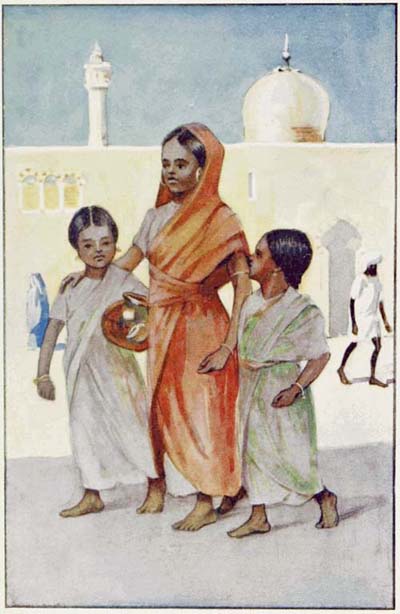
But the children of India have to act as men and
women long before anyone here would think them
old enough to do more than learn and play. Very
early indeed a little Hindu child is married. Sometimes
a baby is married in the cradle, but a little girl
is generally nine or ten years old before she goes away
to her husband’s house. That does not mean that
she and the little boy to whom she is married have a
cottage, and live there together. It only means that
she comes in, a frightened wee girl, to a houseful of
people whom she never saw before. The oldest
woman in the house takes charge of everything.
Often she is the grandmother of the child’s husband,
and the little wife must not only do everything the
old grandmother tells her, she must try to please all
the other women there too, if she wishes to be happy.
If she makes the others like her, and if the boy to
whom she is married likes her, she may soon be as
happy there as she was at home, but if she does not
get on well with the others, there is no one who can
save her from misery.
One bright little girl called Runabai left her father’s
house to go to her husband when she was eleven years
old. Her father had been sorry when she was born,
but she was so loving and happy that everyone had
grown very fond of her, and she went away with
beautiful Saris[5] and many flashing jewels. Her
father was a wealthy man, so he sent twelve maids
with his little daughter to wait on her, and keep
everything about her as nice as it had been when
she still stayed in his house. But her husband’s
family did not like her. They took away all her
beautiful clothes and jewels, and instead of letting
her twelve maids wait on her, they made her work
very hard herself, and do much more than she had
strength for.
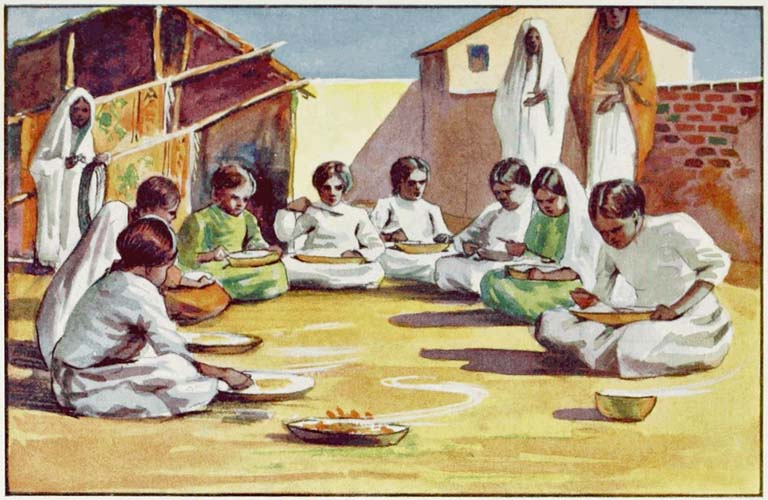
Then before a year had passed they began to starve
her. She was only allowed to eat once a day, and then
all the food she was allowed to have was rice and red
peppers. One day she was cleaning the house, and she
saw a little piece of bread on the table. She was hungry,
and she was only twelve years old, so she picked it
up and began to eat it. But before she had time to
swallow a mouthful her mother-in-law caught her.
She took the bread and pushed it down the little girl’s
throat with a stick.
Little Runabai was sometimes allowed to go home
to see her people. One time she begged them to keep
her with them, and not to allow her to go back to the
terrible life she had to lead. Her father was very sad.
The tears were in his eyes, but he was afraid of the
disgrace it would be to his family if he kept her from
her husband. He knew that his caste would be broken
if he did. So in spite of his sorrow he said, “Go back,
and if you die it will be honourable.” She did go back,
and in two months she did die, and her father and
mother mourned for her, but they comforted themselves
with the thought that she had died honourably!
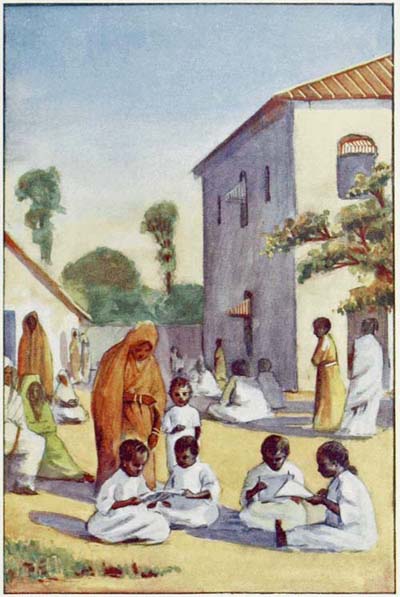
But though a Hindu wife is often free from the pain
and misery that killed this one, there is always a great
fear that hangs over her, for her husband may die,
and then she will be a widow. If a little wife dies,
her husband may marry again, but a high caste Hindu
widow must never marry a second time. Often
little girls are married to full grown men; sometimes,
even, they are married to old men, so it very often
happens that a girl becomes a widow when she is
only a child, and there are Hindu widows who are not
one year old. At first the child may not know that
there is any change in her life, but as she begins to
grow older she finds that all the hard work is left for
her, and that no one wishes to see her when a feast
or a wedding is held, or when anything bright is going
on. Then one day a priest comes to her village, and
to the house where she lives. She is not afraid of him,
for she knows no reason why he should be angry with
her. But he is angry with her. He says her beautiful
black hair must be cut off, and soon the barber comes
and shaves her head all over. After that time she
is only allowed to eat one meal a day, and twice a
month she does not even get that one meal. She
has to wear a rough Sari that lets everyone know
that she is a widow even if she covers up her little
close-shaved head, and in some cases she only has
that one dress for night wear and day wear till it is
so ragged that it will scarcely hold together.
Besides all that, the friends of her husband think
that they cannot be too cruel to her, because they
believe that she must have done something very
wrong indeed in one of the lives she lived long before,
and that it is because of that, that she is a widow.
They think that if their boy had married another wife
he would still be well and bright.
But though girls suffer far more from the early
marriages of India than boys do, the boys have to bear
many unnecessary burdens because of them. They
have to work hard in order to help to get food for the
household, and wee boys labour for long days in the
rice fields. They guide the oxen at the plough,
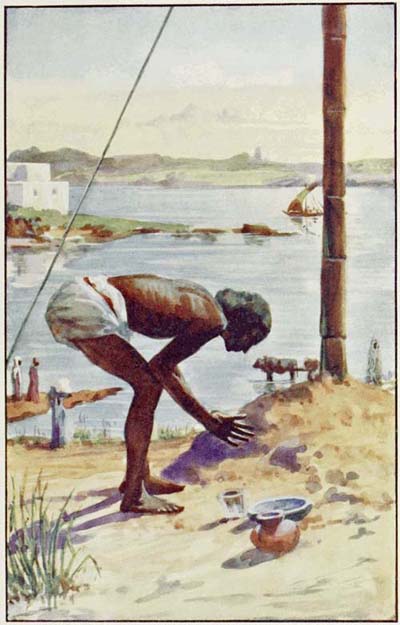
and they carry the pots of water from rivers and
canals to fill the little channels that water the
fields; and sometimes, even with all these early
years of toil, a young man finds that he cannot
feed his family or give gifts to the gods. Then he
goes to a money-lender, and if he once does that, there
is little happiness for him or for his children, for the
money-lender will take everything from him, his jewels,
his wife’s jewels, her clothes, all but the plainest
which she keeps to wear; and then perhaps his fields
will have to go too, and the cruel money-lender will
send men to watch the rice, and the millet, and the
wheat as they grow, for fear any of the crop should be
reaped without his knowledge.
But before a Hindu boy marries he has been taught
how he must worship the gods. A little Brahman boy
puts on the sacred thread which marks his caste, and
which he wears over his right shoulder, when he is
eight or nine years old; from that time onwards he
must keep all the rules of his caste. When the thread
is first put on a priest whispers into the boy’s ear the
sacred text or “mantra” of his family. He must
remember it well, for he will have to repeat it over
and over again each morning before bathing and then
again each evening. He must always repeat his text
and bathe before he tastes food. If he is a good boy,
he will say his text over and over again very often.
In some parts of India he must not stop until he has
said it one hundred and eight times.
The sacred thread is not the only mark by which
a boy shows his caste or the god he worships. He may
have a white V marked on his forehead, or a yellow
W, or a wavy line right across, with perhaps a grain
of rice stuck in the centre, and if he is going to a feast
he will have a bright red dot there too.
Hindu boys repeat the names of their gods as well
as the sacred text of their caste. One little boy who
wished to be very careful that he worshipped his gods
well used to say, “Rama, Rama, Rama,” until he had
said the name twelve thousand, five hundred times;
and then he said, “Siva, Siva, Siva,” six thousand,
two hundred and fifty times, every day.
There are special days and weeks at each shrine
and temple, when there is more merit in offering gifts
than at other times, and on these days people throng
to lay their presents before the gods. They bring oil or
camphor for the priest to burn in a censer which has a
large lamp in the centre for the camphor and five small
ones round it for the oil, and when the priest lights the
lamps he waves the censer before the idol, and the sweet
scent of the camphor fills the shrine. Others bring
melted butter and rice, and others fruit and flowers.
Marigolds are the favourite flowers to bring, and the
temple steps are strewn with them. But with all
the other offerings there must be, if possible, a little
money, for the priest will look eagerly to see if there
are any pice[6] in the offering.
There is no place to which larger crowds of people
go to worship than Benares, and if a boy is lucky
enough to be there he will see many curious sights.
He might see these things in other cities too, but
not so many of them all together.
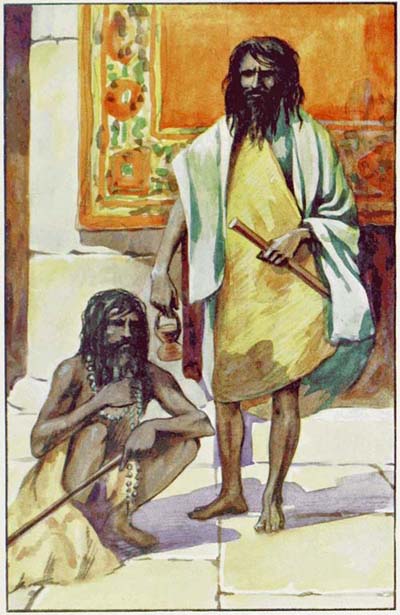
The strangest people he will see are the Fakirs.
They wander about from city to city and from temple
to temple, and live entirely on the gifts that are given
to them by the devout. Even if a Hindu does not
wish to be kind and generous, he will give a gift to a
Fakir, because he believes that if the Fakir curses
him his rice will wither on its stem, his cattle
and his children will sicken and die, and ill-luck
will follow him in everything. So the very shadow
of a Fakir is held sacred, and no one will cross
it lest harm should come to him for his want of
reverence.
The Fakir wears as little clothes as possible, but
he covers his body with mud and ashes, and makes
his hair stick out in all sorts of uncouth forms with
gum and clay. He wears a rope or some strings of
beads round his neck. Sometimes he whitewashes
his face, and paints lines on it, and makes himself still
more uncanny-looking than he already is with his thin
body and his wild hair. He has a boy whom he calls
his “Chela” with him, and a brass bowl, and nothing
else. The boy goes out with the bowl at breakfast
time, and begs till it is full; then he comes back to
the Fakir where he rests on the temple steps, or under
a cart, or by the wayside, to eat the meal with him.
The Fakir himself should never beg, for the gods he
worships are supposed to send him all he needs, and if
he receives nothing from them, he must starve.
Some Fakirs are earnest men who seek to live up to the
best they know, and some are only idle loafers who
wish to have an easy life, and to get as much as
they can by trading on the hopes and fears of other
people.
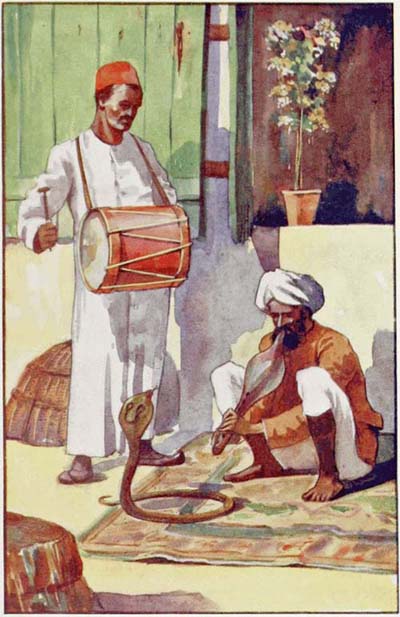
Amongst them there are many men who have
wonderful powers of conjuring and of second sight.
No one can explain the tricks they do, and there is
a weirdness about the men that adds to the weirdness
of their doings. Many an English child would run home
in terror at the mere sight of a Fakir. But the sight
of a Fakir is not nearly so eerie as the sight of some
of the things he seems to do. One of these men will
suddenly appear to climb up into the air going hand
over hand on a rope that is not there, till he vanishes
into the sky. In a few minutes he will come quietly
along the street as if nothing had happened. Another
will take a piece of rope, whirl it round his head, and
toss it into the air, where it will seem to the onlookers
to stand so firm and strong that a man can climb
it, though it is not fastened to anything. One of the
commonest of these wonderful things is to make a
plant grow while the crowd watch. The Fakir takes a
mango fruit, opens it, and lifts out the seeds. He has a
little tub of earth into which he drops them, and as
the bystanders watch, they see a mango tree grow up,
and bear fruit before them.
The chela sees these things, and gradually learns
the secrets that belong to them, so that when his Fakir
dies he is ready to take his place and be a Fakir himself.
The ways in which the gods are worshipped vary
greatly. Some of the idols are washed and dressed
and fed each morning, and bathed and put to bed each
night, and there are long rites that are performed in
the temples. But, there are also many wayside
shrines where men and women lay their offerings as
they pass, and murmur a few words of prayer.
Often a new idol is found. For the Hindus think
that the spirit of a god may enter an animal or a stone
or a tree as the spirit of a man may enter any one of
these.
A WAYSIDE SHRINE
One day a Brahman priest lay in a temple court,
drowsy and troubled. The reason of his trouble was
that plague was in the city and the people fled from it,
and the offerings that were brought to the temple
were poor and small. The priest was full of dread
alike of the plague and of the poverty that would face
him, if the gifts to the temple grew less and less. Soon
the drowsiness grew stronger than his anxious thoughts,
and he fell asleep. As he slept he dreamt that a great
goddess appeared to him, and told him that she had
come to the city in a block of stone, but that she had
not been worshipped, and so she was angry with the
people, and had sent the plague, and that if honour
were not done to her she would send fire to finish the
work that plague had begun. She wished the people
of the place to hold a feast, and then to carry the
stone in which she lived away hundreds of miles over
the country to Benares.
The priest wakened, and, as he thought of his
dream, he remembered a great block of black marble
that lay beside a temple that had just been built in
the city. Ere the women came to gather round him
that day after offering their gifts in his temple, the
priest had thought out the meaning of his dream,
and he told it to them, as they gazed in awe and fear.
He said that the stone in which the goddess dwelt
should have been polished, and set up to guard the
entrance to the new temple; but the workmen had
not seen that the stone was a special one, and had left
it aside, and the goddess in her anger had burned up
the fields. The women sighed, for this part of the
story was only too true. The fields were hard and
bare, because there had been no rain, and the river
beds were dry. Plague had followed famine, and
death was at the door. But the priest told of more
terrible things yet, for he said that Mariamma, the
angry goddess, would send fire if she were not honoured
speedily.
The story of the priest was soon known throughout
the city, for each one told it to another. Within a
few days fire broke out in the palace of the Maharajah
there. The fire as it raged and destroyed the beautiful
building made everyone sure of the truth of the
priest’s vision, and hurried plans were made to have
the goddess in the stone carried one stage towards
Benares.
The people thronged round the marble block. The
new temple stood near, but all eyes were on the stone,
not on the temple. Then the priests began their work.
They washed the stone all over with milk lest anything
might have soiled it while it lay untended. Then
they brought cocoa nuts and limes to lay before it.
After that it was wreathed with garlands and painted
with saffron, and lamps were swung backwards and
forwards which filled the night air with the scent of
burning camphor.
The crowd watched eagerly, and when the great
stone with its added weight of flowers was lifted on to
the shoulders of eight men, their joy burst out in
shouts, for did they not know that famine and
plague and death would leave their city with the
goddess.
Music and lights marked the great procession as it
wound its way through the narrow darkened streets.
Without the city gate eight men waited to carry the
idol forward. Many of those who had followed it
through the streets turned back, but some pressed
on to see the stone pass into the hands of new bearers
at the next village. There the lights, the music, and
the gaily decked stone struck awe into the minds of
the village-folk, and they fell in worship before the
block, and hastened to find men to bear it on. So the
black marble block travelled over many miles of the
land. It never reached Benares, for a priest on the way
dreamt another dream about it. He dreamt that Mariamma
wished to rest in his village, so he had a shrine
built for her; and there, amidst lamps and garlands,
the unused stone received the worship of the people
from the country round, and the priest grew wealthy
by the gifts that were brought to the goddess in the
marble. But the other priest, Ramachandra, died
of the plague which he had said would leave the city
with the angry goddess.
Some Hindu gods look very terrible. One of
these that is commonly worshipped is called Ganesa,
and he has a man’s body with an elephant’s
head. Whenever a Hindu is going to begin a new
piece of work, or to do something important, he makes
offerings to Ganesa, for he believes that the elephant-headed
god can take obstacles out of the way and give
success.
There was a little boy in Madras called Ramaswami,
who went to worship Ganesa for the first time.
As he trotted down through the bazaar by his mother’s
side he chatted gaily. He had garlands on his arms,
and his hands were full of incense. He had listened
to his mother when she told him how to lay his gifts
in the god’s lap, and when to bow to the god, but he
was not thinking much about the god or the gifts.
The temple was a small place, as Hindu temples
often are, for crowds of people do not worship in them
together. One by one, or in small groups, they bring
their gifts, offer them to the idol, and turn away.
The doors of this temple were wide open, and
Ganesa sat in the gloom inside, right opposite the
entrance. The boy saw a black figure as large as a
man on the back of a great stone rat. The eyes, the
tusks and the red mouth of the elephant-head gleamed
out of the darkness, and the trunk was lifted up at one
side, as if it would strike anyone who came near.
Ramaswami screamed with terror, and hid behind
one of the pillars from the dreadful god. His mother
had grown used to the appearance of the idol, and she
only laughed at her wee boy for his fear. She pulled
him from his hiding-place, but before she could drag
him to Ganesa he had slipped from her grasp, and had
run wildly down the street. When she saw that he
was gone she hurried after him, and when she caught
him she was breathless and cross. She pushed him
back before her and said, “You little fool. Is your
father’s son going to be a coward? The god will not
strike you. Don’t you see he is made of stone and
cannot move?” At last Ramaswami stood close
before Ganesa, but his terror was still as great as ever.
He threw down the garlands and the incense, but he
forgot all his mother had told him of the way in which
to give them, and the movements of worship to make
before the idol, and when his hands were at length
empty of the offerings he wriggled once more from
his mother, and fled as if the elephant-headed god
was at his heels.
But all Hindu boys are not frightened of the idols.
There seem always to have been those who wished
something greater to worship than a stone, and who
could not believe that any good would come of senseless
offerings. One of these was called Chikka. His home
was in a village in Mysore, and one day a friend came to
it with an image of Lakshmi, the goddess of fortune,
and asked Chikka’s father to take care of the idol for
him. Not long after that Chikka’s father found that
he must leave the village. He did not wish to carry
Lakshmi with him, so he laid her carefully in a box,
and gave her to the village priest that he might take
care of her. Misfortune came to the friend who had
left the idol, and he began to fear that it was because
he had not been worshipping the goddess, so he
hurried to the village to which Chikka and his father
had gone, and said to the boy, “Come along with me,
and we will fetch Lakshmi here and worship her
together.” Chikka was only ten years old then, but
he had thought out some things for himself, and he
said, “The goddess Lakshmi has left us poor, while
you are rich. When she gives us good fortune we
will worship her, but not till then.” His father was
angry when he heard what Chikka had said, but his
anger did not have any effect on the boy, for only a
year later he did a far more daring thing. He and
his brothers and sisters were ill, and a fortune-teller
was called in to say what the parents should do to
make them well. This man said that the reason of
the illness was that no one in the house had been
worshipping serpents. So two old stone serpent idols
were brought out and consecrated. But though the
others did honour to them Chikka would not. He
watched for a time when no one was beside to interfere
with him, and then he broke the stone snakes into
pieces and threw the fragments away. When his
father found out what had been done he was extremely
angry. He was frightened too, for he thought that
some terrible harm would come to them all because
Chikka had insulted the idols. But in a few days the
children were well again, and no other hurtful thing
had happened to them, so Chikka won his parents
over to his side, and they ceased to believe in the
serpent god.