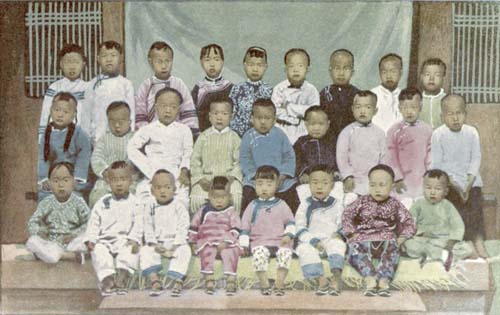
One of the best ways to know boys and girls is to learn
something of the stories they like to hear and tell.
Here are one or two which will help you to understand
our friends the Chinese children much better than
pages of talk about their looks and ways.
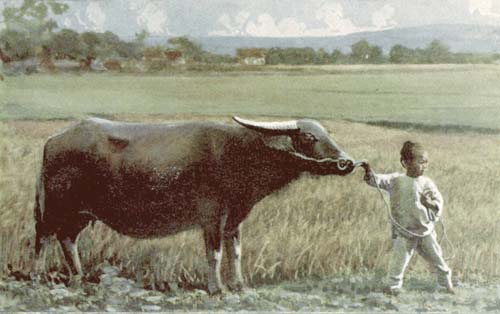
First, there is the story of how the yellow cow and
the water buffalo exchanged their skins. You must
know that the yellow cow has a fold of skin which hangs
loose beneath her neck, and a loud bellow, while the
buffalo has a tight grey skin, that looks some sizes too
small for his great round body, and a tiny wheezing
voice, which sounds strangely coming from so large a
beast. Long ago the buffalo was yellow and his skin
fitted well enough, while the cow was grey. Now it
happened that one hot day the cow and the buffalo
went to bathe in the river, leaving their clothes upon
the bank, while they enjoyed themselves in the cool,
green water. Presently there was a roar, which told
them that the tiger was coming. Out of the water they
dashed, and the cow, being the nimbler of the two,
scrambled up the bank ahead of the buffalo. In her
haste she picked up the first heap of clothes which she
came to and began putting them on, hopping into them
one leg at a time between the steps as she ran. The
buffalo was not far behind, but so frightened lest
the tiger should catch him, that he did not notice that
the cow had run off with his clothes. He picked up hers
and struggled into them somehow, then he ran for his
life. He never was very bright, but blown by running
and frightened though he was, he soon noticed that his
jacket was very tight and that it was the wrong colour.
There was the cow running in front of him, and he could
see that she had put on his nice yellow suit. He
wished her to stop and give him back his clothes, but
the tiger was somewhere in the woods not far behind
them. So they ran and they ran until at last they
were safe from pursuit.
As the cow slowed her pace the buffalo overtook
her. Before he had quite made up to her he tried to
shout out, “Give me back my clothes,” but he felt
so tight and puffed so hard that he could not speak.
He was very stiff about the ribs and a little angry, so
instead of attempting a long sentence he tried to say,
“Oan,” one word only, which means “change.” All
he could get out, however, was “Eh-ah, eh-ah,” in a
wheezy little voice.
The cow understood his meaning well enough, but
she felt so comfortable in her new yellow skin that she
only answered “M-ah, m-ah,” “I won’t, I won’t.”
And so the buffalo has been wheezing “Change,
change,” and the yellow cow has been mooing “I
won’t, I won’t” ever since.
Here is another ‘just-so’ story, which tells how the
deer lost his tail. Long ago an old man and his wife lived
in a lonely cottage upon a hill not far from forests
and rocky places where wild beasts had their holes.
One night, when the man and his wife had finished
their supper, they were talking together, as they often
did before going to bed. In the course of their talk
the old man happened to say: “How happy we are
in our cottage upon this hill far from the city where
thieves and beggars bother and policemen frighten
people. We do not fear thieves nor policemen, nor
tigers nor demons, nor anything at all, unless it be the
Lio—yes, we need not fear anything but the Lio.”
There was a hush in the cottager’s voice when he
spoke the last words, and when he had spoken them,
both he and his wife were quiet for quite a long time.
Now it chanced that a tiger, which had crept down
from his cave under one of the blue peaks of the mountain
overhead, was prowling round the cottage whilst
they were talking together, hoping to pick up the
watch-dog or a fat pig, before setting out for a hunt in
the valleys far below. Hearing the sound of voices, he
stopped outside the door. The family dog, who was
far too wise to be out at night near the edge of the
forest, smelt him and crept into the corner of the room
furthest from the door, under the bedstead. He dared
not growl or whimper. There he lay, his brown hair
bristling over his shoulders, and he breathed so
quietly that the young mice in their hole by the wall
were sure that he was dead, although their little grey
mother knew better.
At the moment the tiger began to listen to the
talking inside the cottage the old man was saying:
“We not do fear thieves nor policemen, nor tigers nor
demons, nor anything at all, unless it be the Lio.”
There was something in the way he spoke the last words
and in the way he stopped after saying them, which
showed that he really was afraid of the Lio. The
tiger, who had never heard of a Lio, wondered what it
could be, so he lay down quietly outside the door to
listen, hoping to hear more about the terrible beast
which frightened people brave enough to fear neither
tigers nor thieves nor demons. All was dark and the
hill side was very still. Behind the cottage a thief,
who had come to rob the lonely couple, was crouching
close to the wall. He too heard the old man talking
about the Lio and wondered what the terrible creature
could be like. Presently he crept round the side of the
cottage. The tiger noticed a sound coming moving
through the darkness. It was the thief. Though he
slipped along as quietly as a pussy cat the tiger heard
him with his wonderful wild-beast’s ears. Dark as it
was when the thief crept round to the front wall, he
felt, rather than saw, that there was something lying
beside the door of the little house. “Good luck!” he
thought to himself. “This is the old man’s cow.” It
was impossible to see, so he stole up gently to try to find
out what the creature might be. He put out his hand
to feel, and touched the tiger. In a moment he knew
that this was no cow. Its hair was harsh and its
muscles like iron bands. Could it be—surely it could
not be—the dreadful creature of which he had just
been hearing. Reckless as he was, the thief felt his
heart stand still. Next moment he jumped to one side,
climbed the wall of the cottage, and hid on the roof.
Meantime the tiger, making sure that the unseen
thing, which had come upon him in the darkness, was
nothing less than the Lio itself, got up and fled. He
ran and he ran, until he met a deer in the forest. The
deer drew respectfully to the side of the path, as in
duty bound when meeting his betters. “Where does
his Excellency come from in such a hurry?” he inquired
in rather a timid voice.
“Oh! from nowhere, from nowhere at all,”
answered the tiger, a little bit confused by what had
just happened. Then he recovered himself and told
the deer how a terrible beast, called the Lio, had
touched him in the dark.
“A Lio, your Excellency! Why, I never even heard
of a Lio,” said the deer in great surprise. “What is it
like?”
“A Lio is very clever,” said the tiger; “it climbs
houses and comes on you in the dark. If you would
like to know more about it I will take you to where it
is. Come, let us go together.”
“But the Lio will catch me, your Excellency, I am
but a weak creature,” said the deer, drawing back a
little, for he did not wish to be gobbled up. He never
had known the tiger so quiet and polite before, and he
could see by the gleam of the great green eyes, even
in the dark, that his companion was turning his head
every now and then, as if he thought the Lio might
come gliding through the forest to spring upon them
at any moment.
“Don’t be afraid,” said the tiger, growing braver
at the thought of having a companion to go back with
him, “I will take care of you.”
“But, your Excellency, the Lio will come and you
will run away and leave me to be caught,” answered
the deer.
“Oh, no, we can tie our tails together, and then it
will be all right,” said the tiger. For you must know
that at that time the deer’s tail was much longer than it
is now.
“Tie our tails together and both get caught at
once,” gasped the deer, so surprised that he forgot to
be polite.
“Not at all,” said the tiger, with a little growl in
his voice. “When the Lio comes I will ‘put forth my
strength’ and pull you away with a whisk before it
can get hold of you.”
“Ha! ha! ha!” laughed the deer, his spotted
sides shaking until the white marks danced again,
“what a clever plan.”
So the deer and the tiger tied their tails together,
and set off to look for the Lio. They had to walk
carefully through the forest, because the bushes and
trees would get between them, and as they went along
they talked in whispers about the Lio, until the deer
felt creepy all over. At last they reached the edge of
the wood, where they could just make out the black
cottage looking very dark against the sky. A branch
cracked as they passed under the last tree.
The thief, who was still crouching on the roof of the
cottage, took fright at the sound, and making sure that
the terrible beast he had heard of was coming back,
jumped down from the tiles, narrowly missing the deer
as he reached the ground.
“Help, help, your Excellency, the Lio!” cried the
deer, terrified by something, he knew not what,
coming tumbling out of the night. The tiger ‘put forth
his strength’ and gave a great spring, when crack! the
deer’s tail broke off close by the root. The thief ran,
the tiger sprang, the deer bounded away, in different
directions, each thinking that the terrible Lio was
close at his heels. But the Lio none of them ever saw.
What was strangest of all, the old man and his wife,
who never had seen a Lio in all their lives, went quietly
to bed that night without an idea of what was happening
outside in the dark. And now you know why
the deer has only a white tuft sticking up, where his
beautiful long tail used to be.
The following story about a bird is a favourite one
with boys and girls in some parts of China.
There is a little grey bird, called the Bean bird,
which pipes a sad note in the spring. Its cry is said
to be like the Chinese words for “Little brother, little
brother, are you there?” According to the story a
man, who had one son, married again and had another
little boy. The second son’s mother hated the elder
brother and wished very much to get rid of him so that
her own child might enjoy the family property. Again
and again she did her best to get the poor lad into
trouble with his father, and too often she succeeded.
One day in spring when the farmers were busy
putting their crops into the ground she found some
beans in a flat basket with which the elder brother
was going to sow his field. The boy was nowhere to
be seen, so she popped his beans into the empty rice
boiler, and putting some grass into the fireplace below,
heated them until those tiny parts which turn into buds
and sprout under the soil were killed. Then she put
the beans back into their basket and left them to cool.
The boy knew nothing of all this, but the younger son,
who dearly loved his elder brother, noticed what had
been done, and hoping to save him a scolding, quietly
put his own beans into the basket and took the roasted
ones to use himself. Then they went to the fields and
each one sowed his plot of ground. After a time their
mother sent the boys to see how the crops were doing.
“If the beans have not sprouted in either of your
fields you need not come home again,” said she. “We
do not wish to have useless, lazy children in this house.”
The elder brother’s little field was covered with
green plants, so he went gleefully home and told his
stepmother. The younger brother’s plot was brown
and bare, not a bean had come up through the soil.
He knew there would be trouble for his brother if he
went home, so he started off for the mountains, hoping
that his elder brother would be left in peace if he were
gone. He wandered away and away, until at length
a tiger found him and ate him up.
The stepmother was vexed when her son did not
come home from the fields, and with many threats and
angry speeches sent the elder boy to go and look for
him. The lad, who was anxious to find his companion,
went everywhere calling, “Little brother, little
brother, are you there?” The workers on the upland
farms and the grass-cutters on the hills, heard his voice
floating faint and far, as he wandered farther and
farther away. Now it was here, now there, always
calling the same sad cry, “Little brother, little brother,
are you there?”
When he could find him nowhere he knelt down in
his despair and prayed Heaven to show him where his
brother was. As he prayed and wept he knocked his
head upon the ground. His head struck a stone, the
blood ran and he died. The blood which flowed from
his wound was changed into a little grey bird, and every
year, when the beans are sprouting in the fields, the
bird comes with its plaintive cry, now near, now far,
“Little brother, little brother, are you there?” When
the children hear its call they say, “Rain is coming,”
and surely enough the drops begin to fall before long,
as if the skies remembered an ancient wrong and wept
for sorrow.
There are many stories of children famous in China
long ago. Here is one which shows how even a little
child may care for others, thinking and acting wisely
in time of danger.
Many hundreds of years ago, in the time of the
Sung Dynasty, a boy named Sze Ma Kung was playing
with some other boys and girls. When the fun was
at its height, one of the party fell into a great big jar of
water. The children were so frightened that they all
ran away, except Sze Ma Kung, who at once went
to try what he could do to save his companion. The
edge of the jar was too high for him to reach over, so the
little fellow could not get at the sinking child, to pull
him out of the water. There was no time to fetch a
stool or call for help; another moment and the prisoner
would be drowned. A good idea struck him. He
rushed off, and picking up as large a stone as he
could carry he dashed it against the side of the jar.
Crack went the pot and a great hole opened, through
which the water all ran away. Then the child crept
out like a half-drowned puppy, but not much the
worse for his drenching. When people heard of
what Sze Ma Kung had done, they knew that if he
lived to grow up he would be a useful man, wise and
thoughtful and quick to help others.
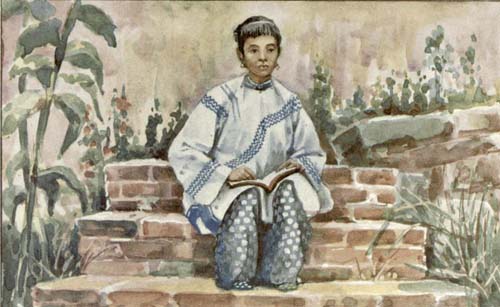
Stories are told of children diligent at their books,
who were famous in after life. One lad, who was too
poor to buy oil for his lamp, used to catch fire-flies
and read by the pale-green light they gave. He
put the fire-flies inside a tiny muslin bag, which he
laid upon the page of his book, the light which they gave
being just enough to let him follow his lesson, line by
line. Another used to read by the light reflected from
snow, as the day failed, or when the moon rose. A third
used to fasten his book to the horn of the cow he was
tending, so as to use the precious hours for study;
while a fourth tied his queue to a rafter of the low roof
above his head, so that when he became drowsy and
nodded over his lesson, he might be wakened by the
pain of having his hair pulled.
Another kind of story helps to fix the written ‘characters’
in schoolboys’ memories. One of these tells
how a scholar, called Li An-i, went to visit a rich boor
named Ti Shing. When he reached the house and asked
for the gentleman, a message was brought that he
was not at home. Li An-i knew that this was not
true, so he wrote the character for ‘afternoon’ on
the door of Mr Ti’s house and went away. When
asked why he had done so, he said that the character
for afternoon meant ‘the ox not putting out its
head.’ When you know that the character for afternoon
is the same as the one for ox, but without the
dot which makes the head of it, and that a stupid
person is called an ox in China, much as he would be
called an ass at home, you will understand Mr Li’s
joke. He meant that the man, who had not ‘put
out his head’ to see him, was a stupid ox.
There are plenty of nursery rimes in China,
one or two of which will show you that Chinese children
are very much like our own. Here is one about our
old friends the sparrows.
“A pair of sparrows with four bright eyes,
Four small feet that pop, pop so,
Four wings that whirr, whirr, how they go!
Pecking rice and grain likewise.”
Another reminds us a little of the pig that would
not get over the stile.
“A bit of copper fell out of the sky,
And hit an old man as he passed by.
When the man began to jog,
He struck against a dog.
When the dog began to yell,
It struck against a mill.
When the mill began to fall,
It struck against a hall.
When the hall began to build,
It struck against a stool.
When the stool began to sit,
It struck against a sheet.
When the sheet began to tuck,
It struck against a duck.
When the duck began to wade,
It struck against a blade.
When the blade began to cut,
It struck against a hat.
When the hat began to wear,
Catch the thief and slit his ear.”
The following verse, which is often shouted by
boisterous little scholars, pokes fun at a greedy
schoolmaster, who has lost the respect of his pupils.
The first and third lines are from the Three Character
Classic, the first book a child learns; the others are hits
at the master.
“‘Primal man’s condition’
Teacher sly steals chicken.
‘Good at root was his heart,’
Teacher’s nicking gizzard.
The boys won’t touch a book,
Roll teacher in the brook.”
The boys and girls of China are learning the stories
of Joseph, Samuel and Jonathan, of John the Baptist
and of Peter. They read the Pilgrim’s Progress,
Jessica’s First Prayer, Christie’s Old Organ and many
another favourite, which has been put into the Chinese
language for them by the missionaries. Best of all
they learn the story of our Lord Jesus Christ, and
through it come to know the Blessed Saviour Himself.