In this chapter, which must be the last, I want to let
you see as well as possible a little mission work in
the various departments you read about in the preceding
chapter. Let me begin with the evangelistic.
In a missionary magazine I have come across a description
which will suit the purpose very well. Here
it is, a visit to a village preaching.
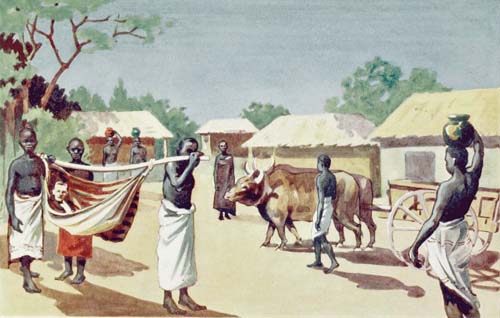
“Our machila carriers are impatient to be off.
They are not always so anxious about an early start,
but to-day we can sympathise with their impatience,
for the hot weather is upon us, and travelling during
the heat of the day is anything but comfortable.
A start is made at last, and we are now as eager as
our ‘boys’ to see the end of the seven or eight-mile
journey. It will take us almost two hours to
do this short distance—two hours of as unpleasant
travelling as one could wish to be saved from, for
machila travelling is at the best but a mild form
of being tossed in a blanket.
“The carriers keep up an incessant chatter all the
way, varied at times with a break into the chorus of
one of their machila songs.
‘Gurr-r-r, Mwana wa mkango, Ine
Child of a lion, I am fierce
Fierce am I, child of a lion.
Gurr-r-r, Gurr-r-r.’
Such is the complaint of one of the carriers as he
sweats at the machila pole. He imitates, with wonderful
skill, the deep growl of the lion, and fondly compares
himself for strength to the king of beasts. The
other boys with lusty chorus give him every support
in his contention, and even we agree, judging from
his deep growls, that he must really be what he says
he is, and soon the chorus ends.
“But here we are at Chentambo’s village. Our
machila men promptly retire under the shade of the
nearest tree and stretch themselves out to rest.
“The service has already begun, and, if we want to
be in time next Sunday, we must leave very early.
Che Bernard is giving an address, the gist of which is
the contrast between the old heathen life of superstition
and darkness and the new way of the cross,
of truth and light and life eternal, of the love of God
for fallen mankind, and the great sacrifice of Christ
Jesus, our Saviour.
“It is skilfully placed before the audience, much
better than could be done by a white man. The
people are interested; they understand, and they
KNOW that Bernard’s way is the right one. You
can read it on their faces. Old customs and superstitions,
however, die hard, and to-morrow, perhaps,
even to-day many of those eager listeners will be
the same careless indifferent lot they were yesterday.
But the seed is not falling only in stony places;
customs and superstitions cannot always choke it.
By and by will come the harvest and the triumph
of the Word.
“While Bernard is speaking let us look around.
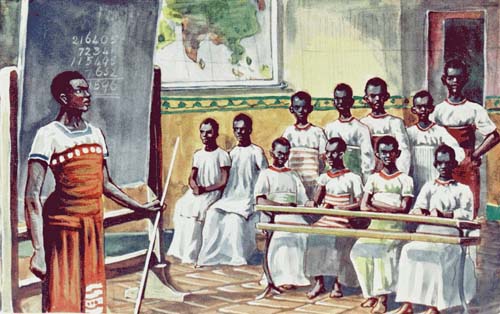
That we are in the school is evident, for there is the
blackboard and there the easel. Over on the other
side hangs a syllable card. But on Sunday, it is
the ‘Nyumba ya Mulungu’ (House of God), and
here we are surrounded by such a crowd as never
enters school.
“Men, women, and children of all ages are sitting
upon the poles which do duty for seats. But when
we run our eyes over the crowd we find that the
majority are women and children. Of grown men
there are few. Where may they be? They may,
perhaps, be out of the district, on plantations, at
the railway, or down to the river for loads, but they
may also be somewhere not so far away, beer-drinking.
There is, however, quite a goodly number of youths
among our hearers.
“The audience is happy, noisily so. There is no such
quiet here as is given to a home preacher. The
little fat, brown, shining babies will not be still;
they insist upon making themselves heard all through
the address, and it is only when one has become
most outrageous in his conduct, that his mother
thinks it necessary to let him see the trees outside.
“But when the white man gets up to begin to speak,
all these tiny brown mortals seem by instinct to plot
against him. No doubt his white face is the cause
of it, for he is always greeted as only black babies
can welcome a white speaker. Bernard however goes
calmly on. He is used to this kind of thing and he
does not suffer from nerves. So, too with his audience,
not a word is lost.
“Crash! down goes a seat broken in two by the
weight of some half-dozen ponderous dames. But
this is quietly ignored by the rest of the audience,
and the heavy ones proceed to accommodate themselves
to a seat on the floor, as if nothing out of the
way had happened. Then two dogs have disagreed
and become unpleasant to one another, till a few
vigorous cuffs and a blow from a stick convince
our canine friends that to-day they must be on their
best behaviour, fit and proper for dogs admitted
to such an assembly. But the babies have their
own way and perform an involuntary accompaniment
all the time of the service.
“Bernard has finished now. He has urged the
people to come to a decision to-day, not to put off
till the to-morrow which never comes. Now is the
time to take a stand on the side of truth and
righteousness. Who will take his stand now?
And so he leaves his audience to answer his final
appeal.
“A hymn, one of the few which the school children
have learned, has been given out by Bernard. He
reads the first verse:—
‘Mwamva mau a Mulungu
Mukabvomeranji ko?
Kodi musandula mtima
Ndi kumvera Yesu’yo.
Bvomerani, Bvomerani, Bvomerani msanga tu.’
‘You have heard the call of Jesus
And your answer now must give.
Turn to Him your heart so precious,
And obeying learn to live.
Oh believe Him: Oh believe Him: Oh believe Him: quickly do.’
“The singing is robust; there is no absence of sound,
and the hymn is enjoyed by all. It may not be the
finest of music, but it is living, real, earnest.
“Then follows a short prayer and the service is over.
In a few minutes men, women, babies, and dogs
are out into the sunshine, and we are enjoying, nay,
gulping down the fresh air.
“The hearers’ class has now assembled, and we
endeavour to teach a few of the great truths of our
faith to this little company of young men and women.
To this little class we look for the things of the future.
Here at least the ground is not stony. The seed is
being sown in good soil and by God’s blessing will
bear fruit in the future and become the foundation
on which to build another church.
“When the lesson is over we have a few minutes
talk with Bernard and some of the boys, to give and
to receive words of encouragement in the work.
Then once more to our machila and back home, our
‘Mwana wa mkango’ being as fierce as ever.
‘Guwr-r-r. Mwana wa mkango, Ine.
Guwr-r-r; Mwana wa mkango, Ine.
Guwr-r-r; Guwr-r-r.’”
A MISSION SCHOOL CLASS
Now let me send you along with a mission lady
to visit a village school, so that you may know a little
about the educational work of an African mission.
But I am afraid you cannot go to the village so I
must let the lady tell of her visit herself. This is
what she writes, and had you gone with her you
would have seen it all with your own eyes:
“‘Our Donna is coming! Our Donna is coming!’
Thus heralded, we approach the village, a flock of
small boys, who have come to meet us, dancing along
before the machila, shrieking at the pitch of their
shrill young voices.
“‘Our Donna has come!’ announces that we have
reached the village courtyard. There stands the
school, a little grass shed, with forms like bird perches;
and the teacher, conspicuous by his clean white clothes,
and Kungauma, the headman, are waiting there to
welcome me.
“After a little, a wheezy horn is blown by a stalwart
young man, and the scholars begin to assemble.
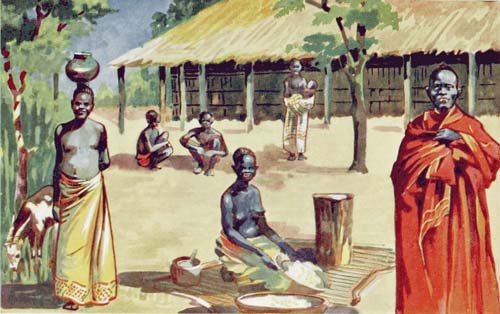
Meantime I pay a visit to the women’s quarters
where the older women are busy pounding the maize
and sifting the flour. After a few words of friendly
greeting, enquires about their work and notice of their
babies—for a black mother, as well as a white one,
likes to see ‘her bairns respeckit like the lave’—I
return to the school. It is full to overflowing.
“A hymn is sung and prayers are said by the
teacher; then the classes arrange themselves on their
respective ‘perches.’ I begin to examine Class 1, while
an admiring circle of fond mothers and sympathising
friends squats outside. After going conscientiously
through the lessons of Class 1, we go on to Class 2,
and I hear them their allotted task.
“But time is flying! I ask what other classes still
remain to be examined. ‘Class 3 and an Infant,’
replies the teacher, indicating their whereabouts.
I glance at the dozen or so of eager little faces that
compose Class 3 and then look towards the ‘Infant.’
He may be such, legally so-called, but to my astonishment
I see the stalwart young man who performed
upon the bronchitic horn! It turns out later that
he is the most advanced pupil in the school and is
reading an English book, called the ‘Infant Reader’;
hence his name.
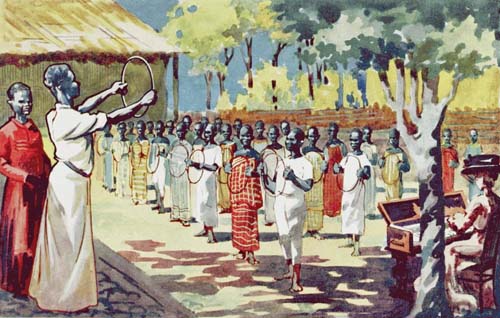
“Leaving him and Class 3 for another day, I call
the young women and girls to begin sewing. Forty
are in my class, and more would like to enter, but I
cannot give proper attention to a larger number.
One is advanced to enough sew a child’s frock, several
are hemming sashes, most of them are at the elementary
‘patch’ stage. As I give out the seams
I glance at their hands. Some, conscious of cleanliness
and virtue, will voluntarily turn up their little pink
palms for my inspection. ‘Mine are clean, Adonna,
look at mine!’ while others have to be sent to
wash.
“Soon the class is hard at work. Some learn very
quickly, others find the management of the needle
almost beyond their powers; some need words of
praise and encouragement to help them to persevere,
while others require judicious fault-finding and criticism
to nip incipient vanity in the bud. A few words
about the use of the words ‘Please’ and ‘Thank
you,’ a few lessons in the elements of gentle bearing
to each other—courtesy to my self is never lacking—are
taken in very good part, and remembered and
put into practice.
“In the course of the day’s lesson, which lasts two
and a half to three hours, several may get advanced
from the ‘patch’ to the ‘sash’ stage. The price
of the ordinary sash is sixpence. (The work done in
all the sewing classes is sold later at a little bazaar,
and the proceeds are given to some scheme in connection
with the native church.) I hear the girls
planning how they will manage to buy the sash when
it is hemmed. ‘I have fowls at home worth sixpence,’
says one. ‘I have only one fowl but it
can lay eggs,’ says another. Some, having no
source of income can but regretfully admire, and
envy their more fortunate companion.
“About two o’clock I take in the work again, and
proceed to do a little simple surgery, the binding
up of ulcers chiefly. Anything serious I decline to
dress, advising the sufferers to come to Hospital,
but the simple sores, which are sadly common, are
quite within my powers. It brings me into touch
with the people at another point of contact and
increases our sympathy.
“The dressings done and the farewells said, I call
my carriers, get into my machila, and off we go,
my men singing lustily as they bear me swiftly along
the native path. The village lies close among the
hills, and the path winds in and out through native
gardens and bush and long grass, while two streams
and a bog have to be forded. On either side rise
the ‘everlasting hills’; solemn, grand, restful,
beautiful at all times, in sunshine or shadow. In
about an hour we leave the native path and turn
into the dusty high road, and a very short time finds
us again at the mission.”
And now to show you mission hospital work. I
have found in the same magazine the story of Gwebede,
the Angoni labourer.
“His home was in far Angoniland—the village
where his childhood had passed, where he played
through many a sunny day, rolling in the sand till
he was white, fighting mock battles with big grasses
for spears, ‘tying’ little houses of grass and sticks,
and lurking in them—all play and no school; and
at night time sleeping in his mother’s hut, close to
the fire, beside the dogs and the chickens. Now he
is a little boy, perhaps ten years old, and when his
brothers and uncles and companions are getting
ready to go off to work with the white men, Gwebede
joins the party. He will work for three months and
then come proudly home with his earnings. His
earnings will be an altogether unimaginable extent
of beautiful white calico. Perhaps it will be enough
to pay his mother’s hut tax, and when that is paid
they will tuck the yellow-edged paper with the stamp
on it safely away among the shiny black grass on the
inside of the roof.
“So he trots gaily along the narrow path, carrying
on a stick over his shoulder some yellow cobs of
maize for food by the way. At night he is very
tired, and after roasting his corn and grinding it
up with his little white grinders he very soon drops
asleep. The party travel for a day or two, and then
stop to work for a day at some village to earn food
for the further journey. In about a week they reach
their destination and see the coffee planters’ broad
acres of cleared ground where in rows grow the coffee
plants, as big as gooseberry bushes, some of them
a little bigger. Then is Gwebede installed with
hoe in hand amongst the coffee.
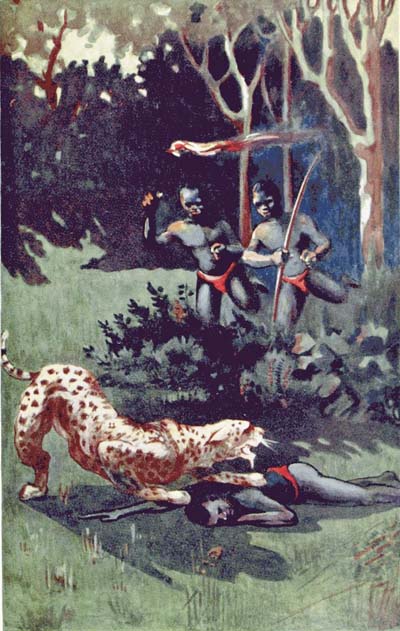
ATTACKED BY A LEOPARD
“Now one morning early Gwebede got up and had
just stepped out of the grass shelter where he slept,
when a great leopard sprang on him, caught him by
the back of the neck in its mouth, and bounded off
with him as easily as a cat would do with a mouse.
Gwebede’s brothers are waked from their sleep,
and look out. ‘A leopard!’ they shout as they
seize hold of the red brands of their evening fire and
rush out yelling as they run. Into the grass they
dash: yonder is the leopard: after him! He is
frightened: he drops the boy: he is off!
“Then they carefully pick up Gwebede. Poor
little Gwebede! Is he dead? No, but there is a
great wound as if the leopard had taken a mouthful
away from the back of his head. They take him to
their master, who promptly binds up the wound,
and sends them off with a letter to the hospital.
It is a long distance, and it is late in the afternoon
when they reach the mission.
“This was the first we saw of Gwebede. There did
not seem to be much hope for him. A little thin
boy with a face full of terror, whom the slightest
movement made to cry out with pain. He refused
to swallow medicine, so we injected under his skin
a little dose of that blessed drug that takes away pain,
and in a few minutes he was asleep. Then we washed
and dressed his wound. A leopard’s teeth are such
dirty things that the wound they make is very
difficult to get clean. One has to wash and wash
and wash for a long time, going carefully into all the
holes and corners.
“As the days passed the pain became less, and the
wound began to heal. For several days Gwebede
cried a good deal, and we had to repeat the dose under
his skin to put him to sleep. Then we noticed that
he was beginning to enjoy his food, and one day
the attendant told us that ‘Gwebede had laughed.’
These were good signs.
“A few weeks later if you could have seen Gwebede
you would have seen that he was no longer thin, but
getting quite respectably stout, and also that he was
constantly smiling. The night attendant noticed,
however, that he sometimes started and cried out in
his sleep. This is the way with people that have
been hurt by wild beasts. For long afterwards
they dream dreadful dreams. Indeed, some of them
are afraid to sleep alone. They can’t help thinking
that a beast will come into the room.
“One day Gwebede’s brothers came to take him
home. They said that the whole party from their
village were about to start for home. We begged them
to leave Gwebede with us to be attended to, and we
asked them to come back for him in a month. They
said they were afraid to go back without him, because
Gwebede’s mother would say, ‘What have you done
with Gwebede?’ We told them that Gwebede
was not well enough to do without having his wound
dressed. They saw also that he was quite happy in
the ward. So they decided to go back to their master
and do another month’s work, and at the end of the
month to come again for Gwebede.
“The month passed, Gwebede walked about slowly
and sedately, holding his head in the air because his
neck was stiff. He got fatter and fatter, till his
face grew like a little round moon—a black moon—full
of smiles and dimples. He was the jolliest little
boy you could imagine. Then came again the big
brothers. Gwebede’s neck was now quite healed.
The great open wound had closed up and now
there was only a scar left. Soon he was dancing
and skipping along the road with his brothers, having
clean forgotten the stiffness of his neck, and that
was the last we saw of little Gwebede.”
Now that you have heard such a great deal about
Africa and its children, and about mission work, are
you not glad, my dear young friends, that you are
enjoying the privilege of helping to make Christ
known among the black people, that you are helping
them to learn to read and write, that you are helping
them to be taught useful trades, and that you are
helping to bind up their wounds and ease their pain?
I know that you are. We all want Africa to belong
to Christ and in God’s own time it will be so. Meantime
we must not faint or be weary although the
fight against the powers of darkness be fierce and
long. Africa, the dark continent must emerge from
darkness at the call of her Lord and Master and
take her place among the nations who live in the
Light of the Saviour of the world.
“Spirit of truth and love,
Life-giving, holy Dove,
Speed forth thy flight:
Move o’er the water’s face
Bearing the lamb of grace,
And in Earth’s darkest place
Let there be light.”