ITTLE girls like a jointed doll to play
with, because they can bend such a doll
in eight or ten places, make it stand or sit,
or can even play that it is walking.
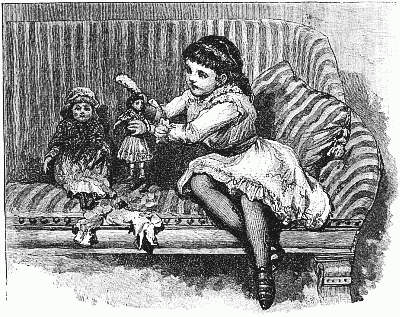 Jointed dolls.
As you study your own bodies to-day, you
will find that you each have better joints
than any dolls that can be bought at a toy
shop.
Some of your joints work like the hinges
of a door, and these are called hinge-joints.
You can find them in your elbows, knees,
fingers, and toes.
How many hinge-joints can you find?
Think how many hinges must be used
by the boy who takes off his hat and makes
a polite bow to his teacher, when she meets
him on the street.
How many hinges do you use in running
up-stairs, opening the door, buttoning your
coat or your boots, playing ball or digging
in your garden?
You see that we use these hinges nearly
all the time. We could not do without
them.
All our joints are not hinge-joints.
Your shoulder has a joint that lets your
arm swing round and round, as well as move
up and down.
Your hip has another that lets your leg
move in much the same way.
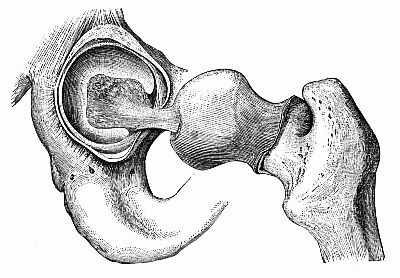 The hip-joint.
This kind of joint is the round end or ball
of a long bone, which moves in a hole, called
a socket.
Your joints do not creak or get out of order,
as those of doors and gates sometimes
do. A soft, smooth fluid, much like the white
of an egg, keeps them moist and makes them
work easily.
What parts of our bodies are jointed together
so nicely? Our bones.
How many bones have we?
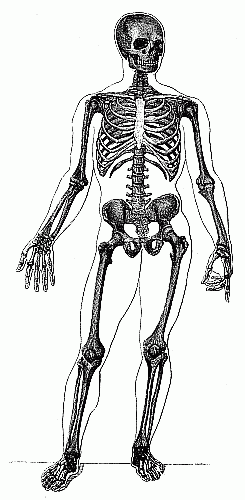
If you should count all your bones, you
would find that each of you has about two
hundred.
Some are large; and some, very small.
There are long-hones in your legs and
arms, and many short ones in your fingers
and toes. The backbone is called the spine.
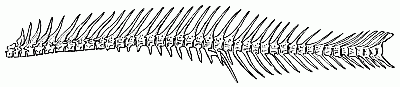 Backbone of a fish.
If you look at the backbone of a fish, you
can see that it is made up-of many little
bones. Your own spine is formed in much
the same way, of twenty-four small bones.
An elastic cushion of gristle (grĭs´l) fits nicely
in between each little bone and the next.
When you bend, these cushions are pressed
together on one side and stretched on the
other. They settle back into their first shape,
as soon as you stand straight again.
If you ever rode in a wheelbarrow, or a
cart without springs, you know what a jolting
it gave you. These little spring cushions
keep you from being shaken even more severely
every time you move.
Twenty-four ribs, twelve on each side,
curve around from the spine to the front, or
breast, bone. (See page 38.)
They are so covered with flesh that perhaps
you can not feel and count them; but
they are there.
Then you have two flat shoulder-blades,
and two collar-bones that almost meet in
front, just where your collar fastens.
Of what are the bones made?
Take two little bones, such as those from
the legs or wings of a chicken, put one of
them into the fire, when it is not very hot,
and leave it there two or three hours. Soak
the other bone in some weak muriatic
(mū rĭ ăt´ĭk) acid. This acid can be bought of
any druggist.
You will have to be careful in taking the
bone out of the fire, for it is all ready to
break. If you strike it a quick blow, it will
crumble to dust. This dust we call lime, and
it is very much like the lime from which the
mason makes mortar.
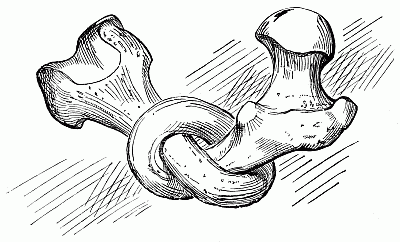 Bone tied to a knot.
The acid has taken the lime from the
other bone, so only the part which is not
lime is left. You will be surprised to see
how easily it will bend. You can twist it
and tie it into a knot; but it will not easily
break.
You have seen gristle in meat. This soft
part of the bone is gristle.
Children's bones have more gristle than
those of older people; so children's bones bend
easily.
I know a lady who has one leg shorter
than the other. This makes her lame, and
she has to wear a boot with iron supports
three or four inches high, in order to walk
at all.
One day she told me how she became lame.
"I remember," she said, "when I was between
three and four years old, sitting one
day in my high chair at the table, and twisting
one foot under the little step of the chair.
The next morning I felt lame; but nobody
could tell what was the matter. At last, the
doctors found out that the trouble all came
from that twist. It had gone too far to be
cured. Before I had this boot, I could only
walk with a crutch."
Because the spine is made of little bones
with cushions between them, it bends easily,
and children sometimes bend it more than
they ought.
If you lean over your book or your writing
or any other work, the elastic cushions
may get so pressed on the inner edge that
they do not easily spring back into shape.
In this way, you may grow round-shouldered
or hump-backed.
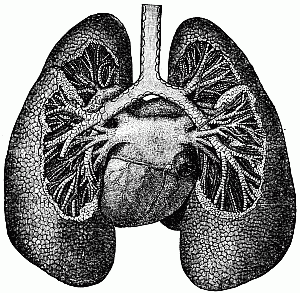
This bending over, also cramps the lungs,
so that they do not have all the room they
need for breathing. While you are young,
your bones are easily bent. One shoulder or
one hip gets higher than the other, if you
stand unevenly. This is more serious, because
you are growing, and you may grow crooked
before you know it.
Now that you know how soft your bones
are, and how easily they bend, you will
surely be careful to sit and stand erect. Do
not twist your legs, or arms, or shoulders;
for you want to grow into straight and graceful
men and women, instead of being round-shouldered,
or hump-backed, or lame, all your
lives.
When people are old, their bones contain
more lime, and, therefore, break more easily.
You should be kindly helpful to old people,
so that they may not fall, and possibly
break their bones.
Healthy children are always out-growing
their shoes, and sometimes faster than they
wear them out. Tight shoes cause corns and
in-growing nails and other sore places on the
feet. All of these are very hard to get rid of.
No one should wear a shoe that pinches or
hurts the foot.
Perhaps some boy will say: "Grown people
are always telling us, 'this will do for
men, but it is not good for boys.'"
Tobacco is not good for men; but there
is a very good reason why it is worse for
boys.
If you were going to build a house, would
it be wise for you to put into the stone-work
of the cellar something that would make it
less strong?
Something into the brick-work or the
mortar, the wood-work or the nails, the
walls or the chimneys, that would make
them weak and tottering, instead of strong
and steady?
It would he had enough if you should
repair your house with poor materials; but
surely it must be built in the first place
with the best you can get.
You will soon learn that boys and girls
are building their bodies, day after day, until
at last they reach full size.
Afterward, they must be repaired as fast
as they wear out.
It would be foolish to build any part in
a way to make it weaker than need be.
Wise doctors have said that the boy who
uses tobacco while he is growing, makes
every part of his body less strong than it
otherwise would be. Even his bones will
not grow so well.
Boys who smoke can not become such
large, fine-looking men as they would if
they did not smoke.
Cigarettes are small, but they are very
poisonous. Chewing tobacco is a worse and
more filthy habit even than smoking. The
frequent spitting it causes is disgusting to
others and hurts the health of the chewer.
Tobacco in any form is a great enemy to
youth. It stunts the growth, hurts the
mind, and cripples in every way the boy or
girl who uses it.
Not that it does all this to every youth
who smokes, but it is always true that no
boy of seven to fourteen can begin to smoke
or chew and have so fine a body and mind
when he is twenty-one years old as he would
have had if he had never used tobacco. If
you want to be strong and well men and
women, do not use tobacco in any form.
1. What two kinds of joints have you?
2. Describe each kind.
3. Find as many of each kind as you can.
4. How are the joints kept moist?
5. How many bones are there in your whole body?
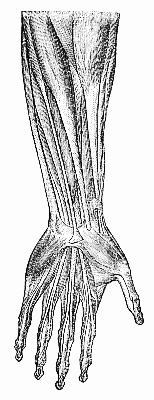
6. Count the bones in your hand.
7. Of how many bones is your spine made?
8. Why could you not use it so well if it were all in one piece?
9. What is the use of the little cushions between the bones of the spine?
10. How many ribs have you?
11. Where are they?
12. Where are the shoulder-blades?
13. Where are the collar-bones?
14. What are bones made of?
15. How can we show this?
16. What is the difference between the bones of children and the bones of old people?
17. Why do children's bones bend easily?
18. Tell the story of the lame lady.
19. What does this story teach you?
20. What happens if you lean over your desk or work?
21. How will this position injure your lungs?
22. What other bones may be injured by wrong positions?
23. Why do old people's bones break easily?
24. How should the feet be cared for?
25. How does tobacco affect the bones?
26. What do doctors say of its use?
27. What is said about cigarettes?
28. What about chewing tobacco?
29. To whom is tobacco a great enemy? Why?
30. What is always true of its use by youth?