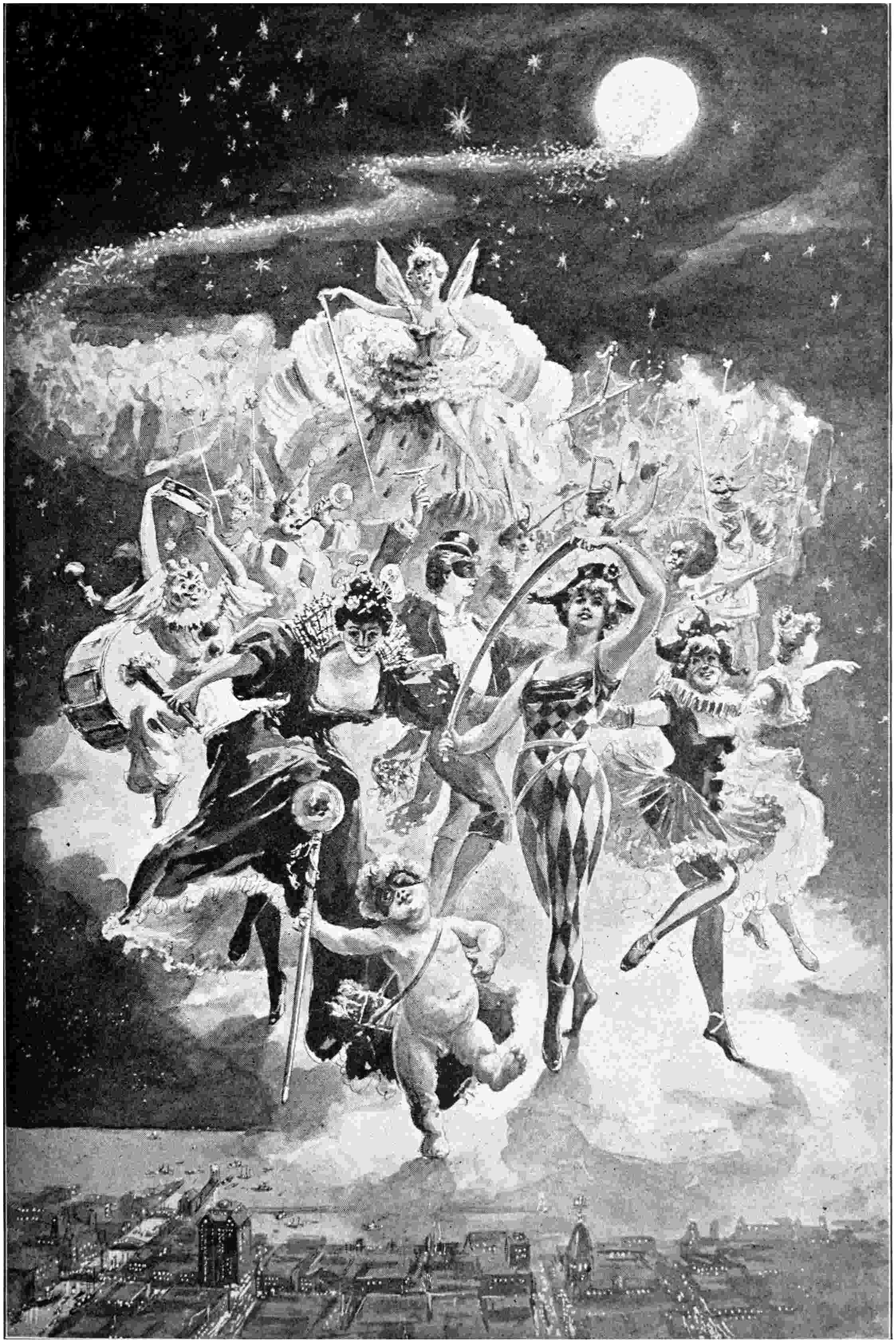
Larger versions of most illustrations may be seen by right-clicking them
and selecting an option to view them separately, or by double-tapping and/or
stretching them.
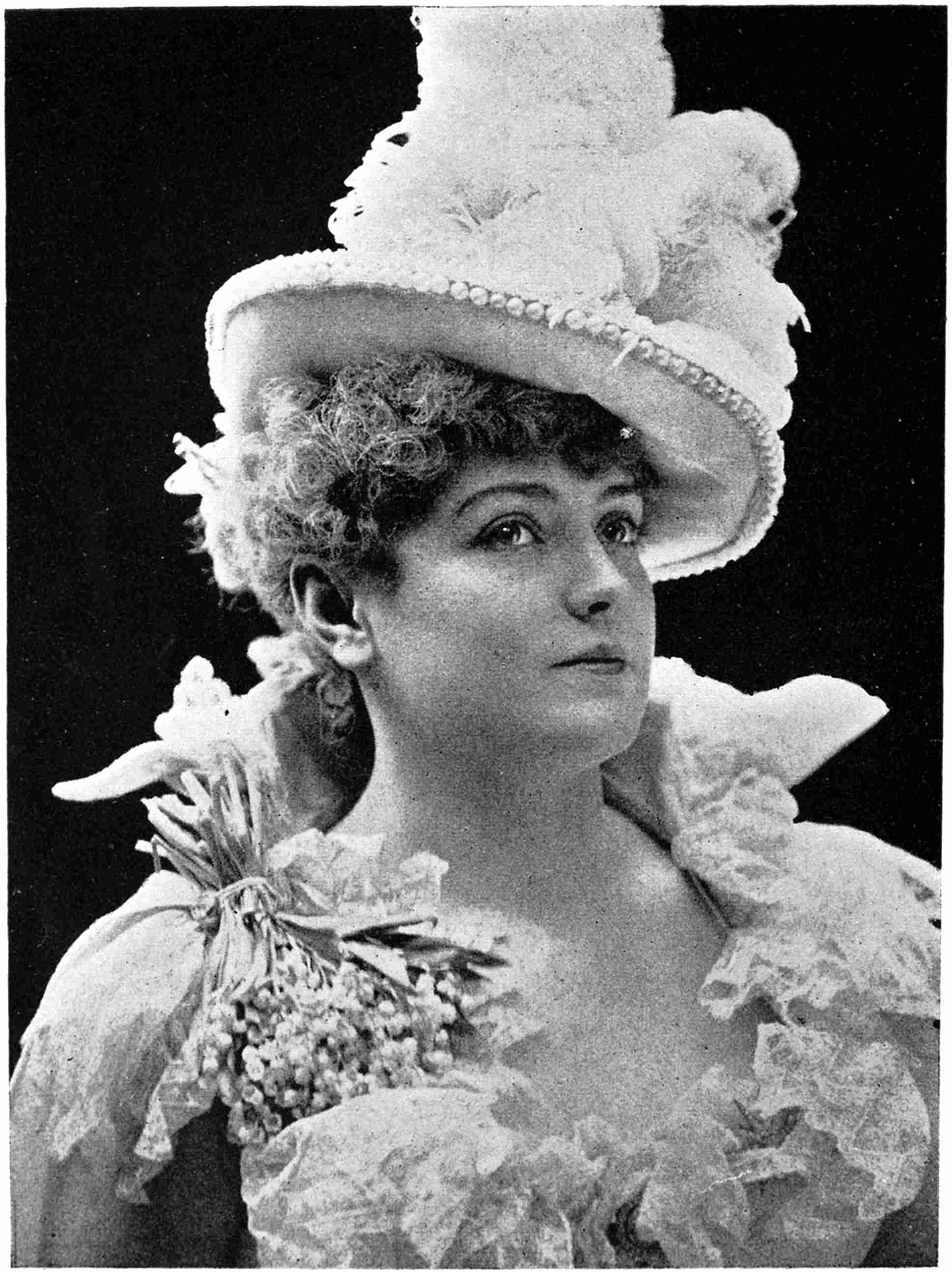
LILLIAN RUSSELL.
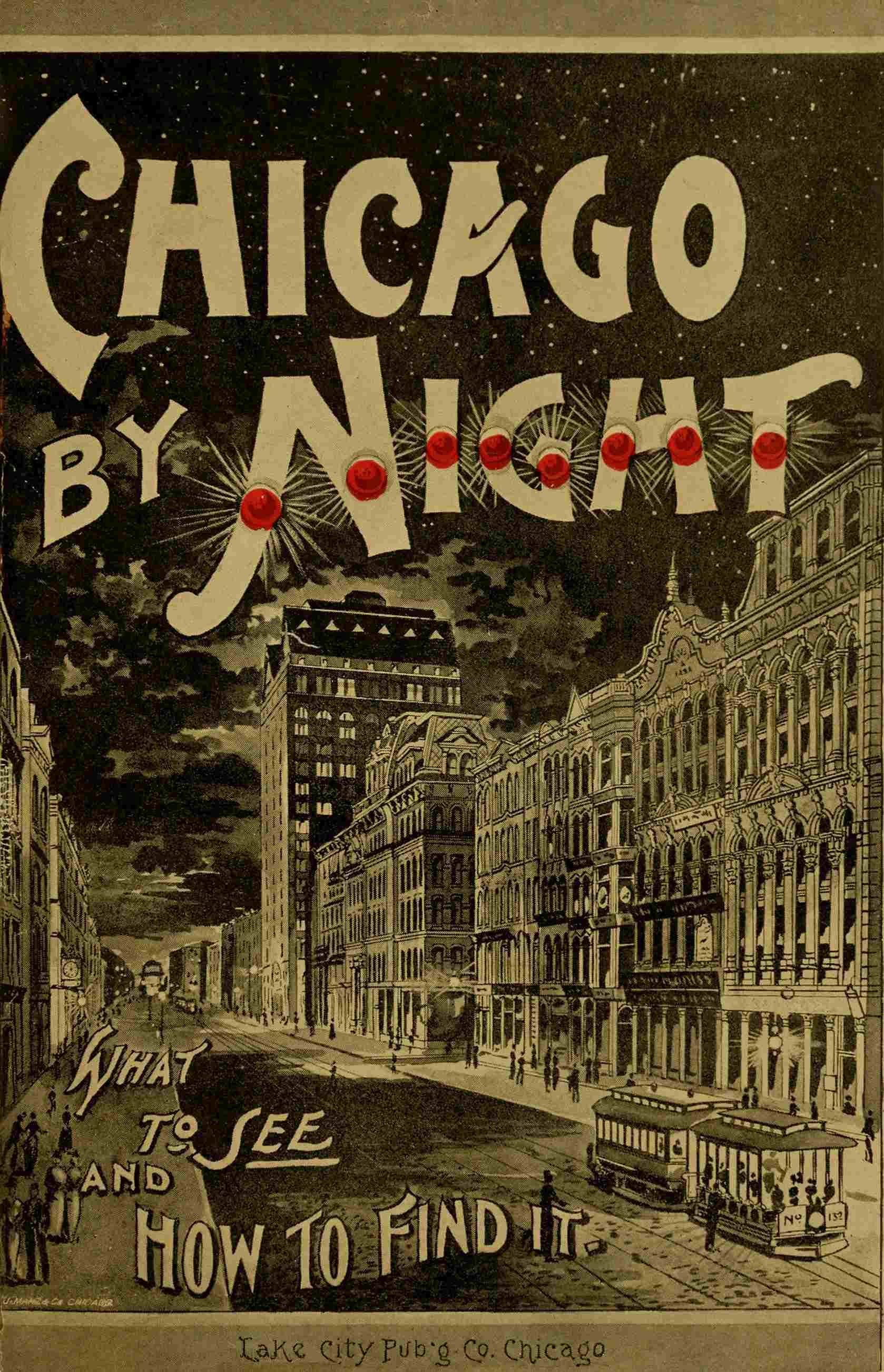
THE PLEASURE SEEKER’S GUIDE TO THE Paris of America.
300 PAGES.
69 ILLUSTRATIONS.
CHICAGO:
THOMSON AND ZIMMERMAN, 234 and 236 La Salle St., 1892.
Copyrighted 1892, By THOMSON AND ZIMMERMAN.
[All rights reserved.]
PART I. INTRODUCTORY.
CHAPTER I.—Where to Stay—A Concise Description of the
Hotels of Chicago, their Characteristics, their Prices, with
some Account of the People Who Patronize Each—The
Great Palmer House Tragedy.
CHAPTER II.—The Theatres—A Complete Description of the
City’s Splendid Play Houses and the Attractions They
Present—Beautiful Belles of Burlesque.
CHAPTER III.—The Great Auditorium and the New German
Theatre—Two New Edifices of which all Chicagoans are
Proud.
CHAPTER IV.—Two Unique Playhouses. Being the Madison
Street Opera House and Park Theatre, where the Shows
are not Painfully Orthodox and Feminine Beauty is the
Chief Attraction.
CHAPTER V.—Free and Easy Shows—Where Etiquette is not
always Strictly Observed. Being Music and Dance Halls,
and Such Like Free and Easy Resorts—“Papa” Engel’s
“Variety” Palace.
CHAPTER VI.—Churches and Church Services. A Full Account
of Chicago’s Handsomest and Most Popular Churches, their
Location and their Pastors.
CHAPTER VII.—The Panoramas and Libby Prison—Places of
Delightful but Quiet Entertainment that the Stranger cannot
Afford to Miss.
CHAPTER VIII.—Perils and Pitfalls—A Chapter that All Should
Read, inasmuch as it Tells of the Traps Set by the Wicked
for the Unwary.
CHAPTER IX.—As to Adventuresses—The Seductive but Conscienceless
Creatures whose Wiles Work Mischief with those
who Do Not Play the Prudent Part and Keep them at a Distance.
CHAPTER X.—The Tiger and its Haunts—Gambling Games
Great and Small wherein the Process of Parting the Fool
and his Money is Carried on with Facility and Dispatch.
CHAPTER XI.—Masquerades and Similar Entertainments
wherein the Giddy Find Delight. Fun and Revelry the
Order of the Night.
CHAPTER XII.—On Shopping—A Few Pertinent Pointers for
Purchasers.
CHAPTER XIII.—Caroussels—A Unique Form of Diversion that
is Patronized by Many.
CHAPTER XIV.—Turkish Baths—Massage—Manicures—The
First the Winebibber’s Salvation, the Second a Doubtful
Luxury, the Third a Charming Experience.
CHAPTER XV.—Hackmen and their Ways—A Few Hints as to
the Proper Way to Treat “Cabby”—His Legal Rates of
Fare, etc.
CHAPTER XVI.—The City’s Moral Code—A Complete Refutation
of the Libelous Assertion that Chicago is the Wickedest
City in the World.
CHAPTER XVII.—The Parks and Boulevards—Which Perhaps
Constitute the City’s Grandest Feature.
CHAPTER XVIII.—Racing—The Three Great Race Tracks
where One May See Unrivaled Contests in Equine Speed—The
Glories of Derby Day and the Gay Cavalcade on the
Avenues.
CHAPTER XIX.—Open Air Attractions. Which Bring the
Pleasure Seeker Entertainment and the Delights of Fresh
Air at the Same Time—Mighty Pyrotechnical Displays.
CHAPTER XX.—An Ideal Afternoon—The Prettiest Drive That
Mortal May Wish to Take, With Possibly Other Charms
Thrown in.
CHAPTER XXI.—On the Water—The Aquatic Side of the Paris
of America—Trips of all Sorts on the Lake.
CHAPTER XXII.—The Restaurants of Chicago—Places Where
the Best of Provender is to be Had at Moderate Rates—The
Fascinating Table D’Hote.
CHAPTER XXIII.—The Haymarket Monument, with a Succinct
Account of One of the Most Thrilling Periods in Chicago’s
History.
CHAPTER XXIV.—Cheyenne—A Unique Spot in the City’s
Centre that it is Safer to Read About than to Visit.
CHAPTER XXV.—Candies and Flowers—Some Beautiful Chicago
Shops.
CHAPTER XXVI.—Summer Night Concerts—The Delights of
Music Enjoyed by the People During the Dog Days.
CHAPTER XXVII.—Special Features—The Elevated Railroads;
the County Jail; the Masonic Temple and Other Sights
Worth Seeing.
CHAPTER XXVIII.—A Few Final Words—Mainly in an Advisory
Strain.
PART II.
THE GREAT WORLD’S FAIR.—Being a Complete History of
the Stupendous Exposition that will be Thrown Open in
1893, when the Peopled World Will be Called Upon to
View the Progress of the Future Metropolis—How the
Exposition will be Opened in the Fall of the Present Year—The
Colossal Buildings and Their Contents—Hints for
the Wayfarer to Follow in His Strolls About the City During
Fair Time.
At a Time when the attention
of the world is concentrated upon
Chicago, as it is at present, it is
fitting that the stranger within its
gates, as well as the uninitiated
native, should be made aware
of the various attractions, of
all sorts and conditions, possessed
by the future metropolis
of the United States. Chicago
has been called the
Paris of America, that title
having been bestowed
upon it by some bright-minded
and discerning person who evidently knew
whereof he spoke. That the title is indisputable
goes without saying. In no other city of its size
on the continent is the same variety of amusements
to be found as in this one. All tastes may be
promptly satisfied, all preferences catered to. If,
when confronted by the marvelously variegated
array of recreations and pursuits that this great
city has to offer, the stranger or the periodical visitor
should turn away dissatisfied, imagining that
he has failed to discover anything especially suited
to his fancy, his mental and physical organism must
be sadly askew. It is his fault and not Chicago’s.
From now on, and for the next year or so, this
mighty city by the lake will swarm with myriads
of men and women of all races, tribes and languages,
being brought hither by the Great Exposition
that is destined to be the marvel of all
nations. That some of this floating mass will remain
here is beyond question. In that case the
population will swell until the two million mark is
passed, and in the proportion that the population
increases, so also will increase the attractions of the
city that harbors it.
It is the purpose of the present work to set forth,
in a terse but comprehensive manner, the various
sorts of entertainment offered by the Coming
Metropolis. The Author, while sufficiently modest
to keep his identity a secret, makes bold to assert
that no person who scans the pages of this book
will be able, after he has done so, to lay claim to
ignorance of the means whereby to procure entertainment
or solace for such hours of idleness as he
may find on his hands during his stay in this city.
The present area of Chicago is a fraction over 180
square miles. What its area will be next year, or
ten years hence, nobody can predict. For the
present it is sufficient to know that within that area
of 180 square miles there dwells a community active,
energetic, mercurial—eager in business and
therefore keen in its thirst for recreation outside of
business hours.
The present work is undertaken in no spirit of
levity or thoughtlessness. Its author is a man-of-the-world
who, recognizing the desire of the average
man to be amused when the cares of business
are done, and being fully cognizant of the qualifications
of this city in the amusement line, aims to
instruct the uninitiated wayfarer in the paths he
may follow with the most satisfaction to himself
and the greatest benefit to his system. If but one
reader confesses his indebtedness to this work for
enlightenment in the smallest degree, its purpose
will have been achieved.
With renewed assurances, therefore, that the
seeker after light upon a great city’s manner of
amusing itself will not seek in vain, the Author
makes his bow to the reader and tenders him an
invitation to accompany him through the following
pages.
CHAPTER I. WHERE TO STAY.
The question of location must of
course be decided by the individual
taste of the visitor. It would be
strange indeed if, with a transient
population roughly estimated at
200,000, the city did not possess
hotels of all grades and
descriptions, from which
the most captious-minded
person might take his
choice and procure satisfaction.
Chicago, at the
present writing, contains
at least 1,500 hotels, with constant additions each
year. There is no more difficult task than to tell
a man with any accuracy what hotel will suit him
best. A caravansary that would delight one man
would disgust another and vice versa. The most
satisfactory plan, therefore, and the safest, is to
give a brief pen-sketch of the leading hotels, with
some idea of the special characteristics of each and
the style of entertainment they afford.
The Lake Front hotels—the Richelieu, Auditorium,
and Leland—enjoy the cream of the new
transient patronage. By “new,” is meant those
people who have never before visited Chicago, and
who naturally select the houses with the prettiest
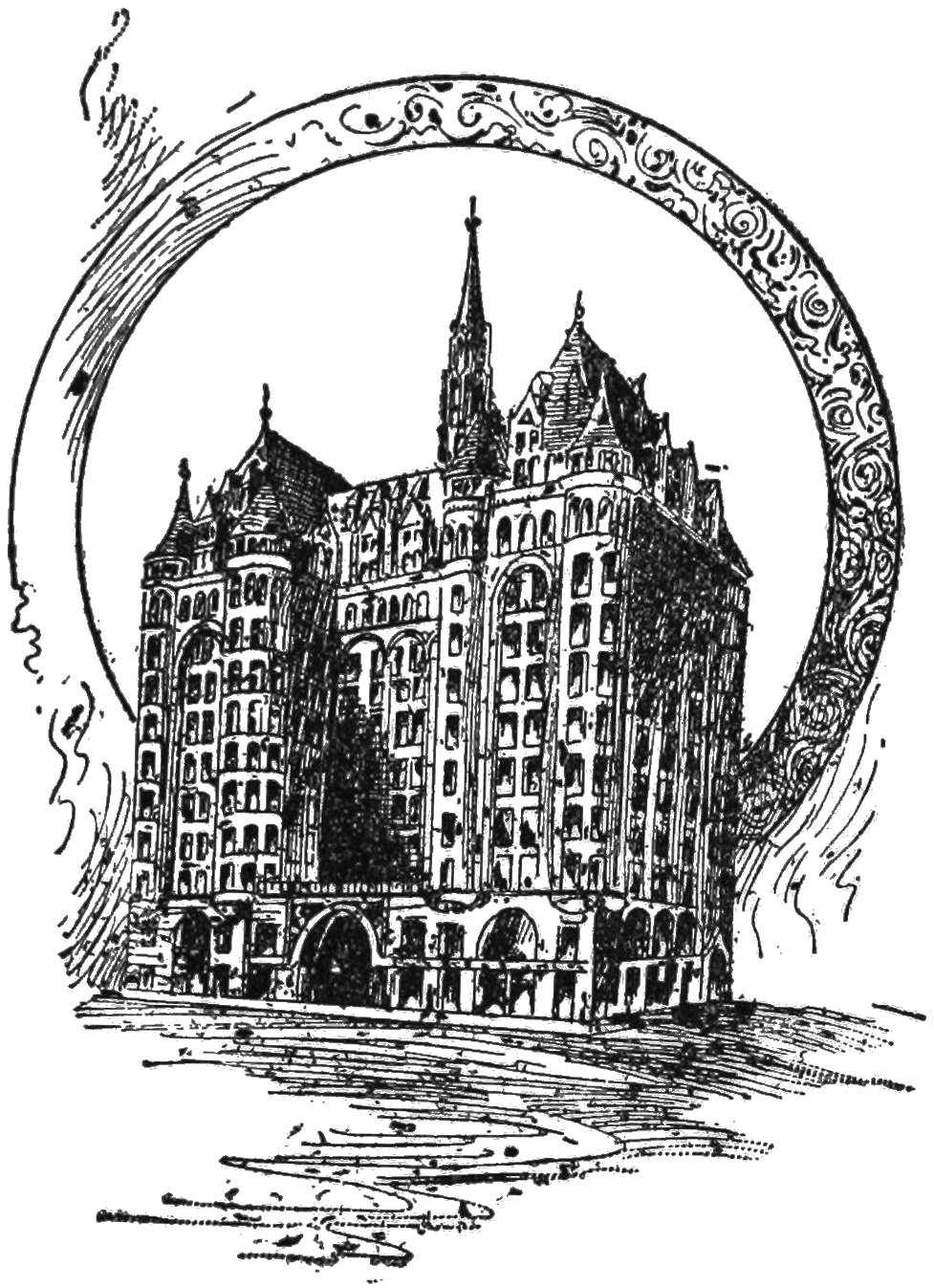
sites. The Auditorium (Michigan Avenue and
Congress Street), despite its gorgeousness and the
flourish of trumpets with which it was opened, does
not indulge in ruinous rates. It is a very large
hotel and accommodations may be had therein
from $4 per day up. Perhaps it is this moderate
charge that makes it so great a favorite with the
theatrical profession, the more prosperous members
of which enjoy the comfort it affords. Well-to-do
managers, famous stars, and sometimes interrogatively
opulent soubrettes and chorus girls seek
lodging at the Auditorium, and some very pretty
romances are narrated of flirtations more or less
interesting which the “blooded” habitues of this
swell hotel “strike up” with the fair footlight favorites
who enjoy its hospitality. It is worth the
price of a day’s board, or at least a dinner, sometimes,
to take a stroll in the corridors and catch the
fragments of delicious lays that are being caroled
forth by the song birds who are practicing their
chosen art in the sanctity of their various chambers.
Especially is this the case during a season
of grand or light opera in the great theater adjoining
the hotel, in which case the latter is sure to be
thronged with singers of both sexes, and of all
grades of artistic and professional prominence.
There is a roomy balcony over the entrance to the
Auditorium which, on pleasant days, is thronged
with gaily dressed people of both sexes, who sit
there and enjoy the dual delight of drinking in the
balmy air and watching the cavalcade on the broad
avenue below.
A block north of the Auditorium is the Richelieu,
the famous hostelry the destinies of which are presided
over by the renowned “Cardinal” Bemis.
For people of means, to whom money is less of an
object than the engagement of luxuries, the Richelieu,
they say, is the place par excellence at which
to stop. Some notable people have honored the
Richelieu with their presence, and one is just as
liable to run plumb against a real, live English
Lord or Italian Marquis within its doors as against
a plain, everyday American citizen. Sara Bernhardt
selects the Richelieu when in the city; so
does Mrs. Langtry when the confines of her private
car become too narrow for comfort. The Richelieu
is famous for the rare pictures that adorn its
walls, some of which are worth small fortunes, and
also—whisper this with bated breath, Oh, ye irreverent!—for
its wine cellars, which are stocked
with some of the rarest and costliest vintages to be
found on the entire continent. On state occasions,
when the Cardinal is entertaining some choice
party of notables, he is wont to disappear suddenly,
absent himself for about fifteen minutes and then
reappear with a quaint-shaped bottle or two in
either hand covered with cobwebs. Those who
sample the contents of said bottles close their eyes,
pat their stomachs softly as the divine liquid glides
down their throats, and then shed tears of joy and
gratitude to the Cardinal for having given them
the happiest moment of their lives. If you are a
connoisseur of wines and wish to test your art in
judgment thereof, cultivate the acquaintance of the
Cardinal, and perhaps he will go down into the
cellar for you.
Mr. Warren Leland, who recently sold the hotel
of that name, always said he had the prettiest
house in Chicago, and there are some people who
agree with him. The Leland rates, on the American
plan, are from $3 to $5 per day up; the European,
$1.50 up. The Leland is known as the
“home hotel” of Chicago, and there is a tradition
abroad to the effect that people who once patronize
it never go elsewhere.
“The Blooded District”—Before proceeding
to the consideration of other prominent hotels, it
may be interesting to inform the reader that the district
which we are about to leave, and of which the
three hostelries enumerated form the nucleus, has
achieved some fame in the annals of the town as
“the blooded district”—so-called for the reason
that the “high-rolling” young men of the city have
made it a sort of headquarters or rendezvous, both
before and after the hours when sober-minded and
steady-going folk are fast asleep. The Auditorium,
Richelieu, and Leland Cafes, together with
Devine’s wine-room on the other side of Jackson
Street, and Colonel John Harvey’s “Wayside Inn”
in the alley, form a sort of circuit or beat, which
these “rapid” young men (i.e. the “bloods”) travel
at all times, including such hours as the sale of
cheering beverages is forbidden by city ordinance.
Of these, Harvey’s is perhaps the most unique resort,
though if one cannot find his friends in one of
the places named after midnight he is tolerably certain
to encounter them in one of the others. Colonel
Harvey is the father of the pert little soubrette,
Hattie Harvey, of whom the great diva, Patti, became
so desperately enamored as to invite her to
her castle in Wales, and admirers of the young
lady are fond of dropping in to discuss her merits
with her papa, the Colonel, who, it goes without
saying, is the most devoted of her admirers. If
you praise Hattie’s beauty to the Colonel he will
mix for you, with his own hands, one of his choicest
drinks; if you swear on your honor that she is destined
to become the greatest actress of the century,
he will probably crack a bottle. The door of Harvey’s
“Wayside Inn” is tightly closed at midnight,
but the initiated may gain ready admittance
by learning the pass-word of the night and roaring
it, in tones more or less musical, through the key-hole.
You can always tell whether there is any
fun going on in Harvey’s by the galaxy of hackmen
who stand in line at the curb, waiting for the
“boys” to emerge in the small hours of the morning.
But we may now leave the “blooded district”
and take a glance at other South side
hotels.
The venerable Palmer House stands like a bulwark
at the corner of State and Monroe Streets,
its vast expanse stretching away for half a block.
The Palmer enjoys a steady patronage from people
who have been “putting up” there for years.
It has a large clientele of the better class of commercial
travelers. The wits of the town crack
jokes at the expense of the Palmer on the score
of the number of guests of Hebraic extraction it
shelters. Be that as
it may, the Palmer
welcomes all who
pay their bills and
those who patronize
it generally
possess that
admirable
qualification.
The Palmer’s
rates are $3 to
$5 per day.
There is a
little room on
the sixth floor
of the Palmer which is an environ of romantic interest,
it having been the scene of one of the most
famous tragedies in Chicago’s history. In the
summer of 1882, it was occupied by Charles Stiles,
the popular and high-living “caller” of the Board
of Trade. Early one morning a veiled woman,
whose tasteful but somber raiment revealed the
outlines of an entrancing figure, took the elevator to
the sixth floor and knocked at the door of Stiles’
room. He came out scantily clad in response to
the summons. There was a flash, the ringing report
of a revolver, and in another instant the
young man lay dead on the floor. The woman
knelt down, kissed his forehead and submitted to
arrest without a murmur. She was an Italian,
Teresa Sturlata by name, and the mistress of
Stiles. His previous abuse of her, as testified to
at the trial, so influenced the jury in her behalf that
she received but the nominal punishment of one
year in the penitentiary, though her great beauty
doubtless had some influence on the leniency of the
sentence. Many men went daft over the beautiful
murderess. Some of the letters that she received
while in jail were published, and precious
epistles they were, too. They all contained protestations
of affection, and several offers of marriage
were included among them. The woman
went to the penitentiary and served her sentence.
When released she disappeared as completely as
though the earth had swallowed her. Her present
whereabouts is unknown, but the room made
famous by the great tragedy is still pointed out to
new guests at the Palmer.
The Grand Pacific, on South Clark Street, kept
by Landlord Drake, is of the same class as the
Palmer, enjoying a steady patronage all the year
round. The rates are $3 to $5 per day. The
Tremont, kept by Mr. Eden (Lake and Dearborn)
and the Sherman, kept by Mr. Pierce (Clark and
Randolph), are of the same grade as the Palmer
and Grand Pacific.
These comprise the list of first-class down-town
hotels, though several others are in progress of
construction, with a view to caring for the thousands
of strangers who will visit the World’s Fair.
Notable among these is the Great Northern, which,
under the supervision of Mr. Eden, has just been
pushed to completion. It is on Dearborn
Street opposite the post office, between Jackson
and Quincy, being situated, therefore, in the very
heart of the business district.
The Victoria, the new hotel on the site of the
building formerly known as the Beaurivage, Michigan
Avenue and Congress Street, is a fashionable
house, patronized by the best people. The
same is true of The Wellington, corner of Jackson
Street and Wabash Avenue.
The smaller hotels are much too numerous to
particularize. They are scattered in all directions
and their rates for rooms vary from fifty cents upward
per day. There is no street in the business
part of the city without two or three such hotels,
and the traveler must be hard to please who cannot
suit himself at one or another among so many.
The residence part of the city, particularly on the
North and South sides, is thickly dotted with first-class
family hotels, where persons contemplating
an extended stay may obtain quiet accommodation
in the exact ratio for which they care to pay.
The two most magnificent family hotels are the
Virginia, 78 Rush Street, and the Metropole,
Michigan Avenue and Twenty-third Street. These
two houses cannot be surpassed for style and elegance
and they are patronized exclusively by people
of means.
CHAPTER II. THE THEATERS.
The Wayfarer having
received some hints
as to the quarters in
which he may establish
himself, one reaches the
much more important
question of how he shall
amuse or divert himself
while here. Before coming
to the point of the
more unique or unusual
modes of diversion with
which the city abounds one’s first thoughts naturally
turn to the theaters.
Chicago is famous as a theatrical center, and the
very best attractions are constantly to be found at
one or another of the great play-houses. Just at
this stage, therefore, it is meet to utter a few remarks
on the leading theaters and the class of excellent
entertainment they present to their patrons.
The Chicago Opera House.—This theater,
one of the youngest in Chicago, is perhaps entitled
to primary mention by reason of its virtual
monopoly, except at stated intervals of the cream
of the city’s theatrical business. It has a very
large seating capacity; was first opened about
seven years ago with the tragedian, Thomas Keene,
as the attraction. The director of the Chicago
Opera House, Mr. David Henderson, has achieved
a wide popularity, both in and out of the profession,
and is aided in his efforts by a corps of efficient
assistants, notable among who are Messrs.
Thomas W. Prior and Max Godenrath. While
presenting to the public attention first-class attractions
all the year around, the Chicago Opera
House has earned the major part of its distinction
by the superb extravaganzas it has been producing
annually. These extravaganzas usually commence
in May and run through the summer months, thus
securing to the house a steady patronage during
the “dog-days.” It is beyond all question that
the first of these spectacles, the “Arabian Nights,”
established Mr. Henderson’s reputation as a purveyor
of this class of entertainment, (termed by
the irreverent “leg shows.”) The second production,
the “Crystal Slipper,” enhanced this reputation,
and those succeeding—“Bluebeard Jr.” and
“Sinbad”—kept it going. This year (1892) the
summer spectacle at The Chicago will be “Ali Baba,
or the Forty Thieves,” and if advance gossip is to be
taken as evidence, it will transcend in magnificence
anything of its kind that has ever been produced under
Mr. Henderson’s supervision. The libretto of
“Ali Baba” is by Harry B. Smith, the distinguished
wit and literateur, who has performed a like service
for the pieces before mentioned. The Chicago Opera
House is situated on the South side of Washington
Street, between Clark and La Salle Streets, and is
invariably thronged throughout the hot weather.
Mr Henderson manages to group upon his stage
as choice a galaxy of feminine loveliness as is to be
found in any climate, and the costuming (or rather
the lack of it) is doubtless as gratifying to the
performers as it is to the spectators, being constructed
on the hot weather plan; light and airy.
It is no uncommon sight to see a party of honest
country folks appearing, gripsacks in hand at the
doors of the Chicago Opera House, having come
straight from the train to the theater to witness the
show, the fame of which had penetrated to their
homes in the country; and which, after their return,
they would rather die than let their families
and the church folks know they had seen.
McVicker’s Theater.—It is situated on the
south side of Madison Street, between State and
Dearborn, and is one of the oldest resorts of its
kind in the city, though the present structure is
quite new, having been reconstructed on the site
of the old one, which was destroyed by fire in the
spring of 1891. The attractions at McVicker’s
are usually of the solid, legitimate order, though
the gray-haired proprietor occasionally is guilty of
a lapse to a variety show. McVicker’s, however,
is the home of high-class drama and comedy,
and the theater itself is perhaps without a
rival on the continent in the way of magnificent
decorations and comfortable furnishing. While
Mr. McVicker is opposed to Sunday performances,
he occasionally permits them, which enables the
stranger, not infrequently, to encounter a first-class
Sunday night show within a few paces of his hotel.
The Grand Opera House.—This admirable
play-house is located on the east side of Clark
Street, just north of Washington. It is another
old-established theater enjoying a large patronage.
The Grand is the home of Hoyt’s farces, each of
these fanciful productions having been produced
successfully at Mr. Hamlin’s temple. At the
Grand, also appear most of the German companies,
though the latter will, it is to be presumed,
go to the new edifice, Schiller theater, Randolph
Street, near Dearborn.
Hooley’s Theater.—Located conveniently on
Randolph, between Clark and La Salle Streets, is
devoted to all sorts of attractions, and is one of
the handsomest theaters of its size in the country.
The patrons of Hooley’s may run the gamut from
low comedy to grand opera; and Irish comedy-drama
often following immediately after one of the
high-class engagements, such as that of the Madison
Square or Lyceum Theater Companies.
Columbia Theater.—In the very heart of the
business district, on the south side of Monroe, between
Dearborn
and
Clark Streets.
This theater is
one of the oldest
in the city, and
has passed
through many managements, being at present under
the direction of the Hayman Bros, and Mr. Will
J. Davis, both of whom are gentlemen of the highest
standing in the profession and thoroughly competent
to cater to the desires of an amusement-loving public.
The attractions presented at the Columbia
are of a wide range, the properties of the house
being suited to the production of grand or light
opera more than anything else. Some of the first
artists in the world have appeared at the Columbia,
notably, Henry Irving and Ellen Terry, the latter
having, on one memorable night, formally christened
the theater which, prior to that time, was known
as Haverley’s; Sara Bernhardt, Adelina Patti,
Christine Nielsson, and others almost equally famous.
The seating capacity of the Columbia is
as large as that of any of the down-town theaters
and it possesses the advantage of large, comfortable
seats, very liberally spaced, that other managers
might do well to emulate.
The “Provincial” Theaters.—The houses
mentioned are known as the “down-town” or high-priced
theaters, the scale of prices ranging from
25 cents to $1.50 per seat. In addition to these,
however, there are a number of houses, some of
which are equally large, scattered about in the
three sections of the city, which are known as the
“second class” or “provincial” theaters, where
the price of admission ranges from 15 cents to
$1.00. Of these may be mentioned the following:
South Side—Alhambra, State and Archer Ave.;
Madison Street Opera House, 83 Madison Street;
Olympic, 46 South Clark Street; Havlin’s, Wabash
and 19th Street; People’s, 339 State Street.
North Side.—Clark Street Theater, Clark and
Kinzie Streets; Criterion, 374 Sedgwick Street;
Windsor, 459 North Clark Street. West Side.—Haymarket,
169 West Madison Street; Lyceum,
58 South Desplaines Street; Standard, 167 South
Halsted Street; Halsted Street Theater, Halsted
and West Congress Streets.
The outside, or provincial theaters usually offer
a more sensational type of plays, specimens of the
wild and woolly border drama being usually presented
for the edification of their mercurial patrons.
The Park Theater, 335 State Street, ought not to
rank with the other theaters, but is often patronized
by travelers whose tastes lead them to desire
entertainment of the more democratic type. The
accessories of tobacco smoke and liquid refreshment,
which are to be indulged in at the Park, form
an attraction that they find it impossible to resist,
nor is it difficult for a patron, whose pocketbook
enables him to indulge in such luxuries, to obtain
an introduction through the influence of the manager
to the more or less fascinating “fairies,” who
go through their performances on the stage. Further
mention of the Park will be made later.
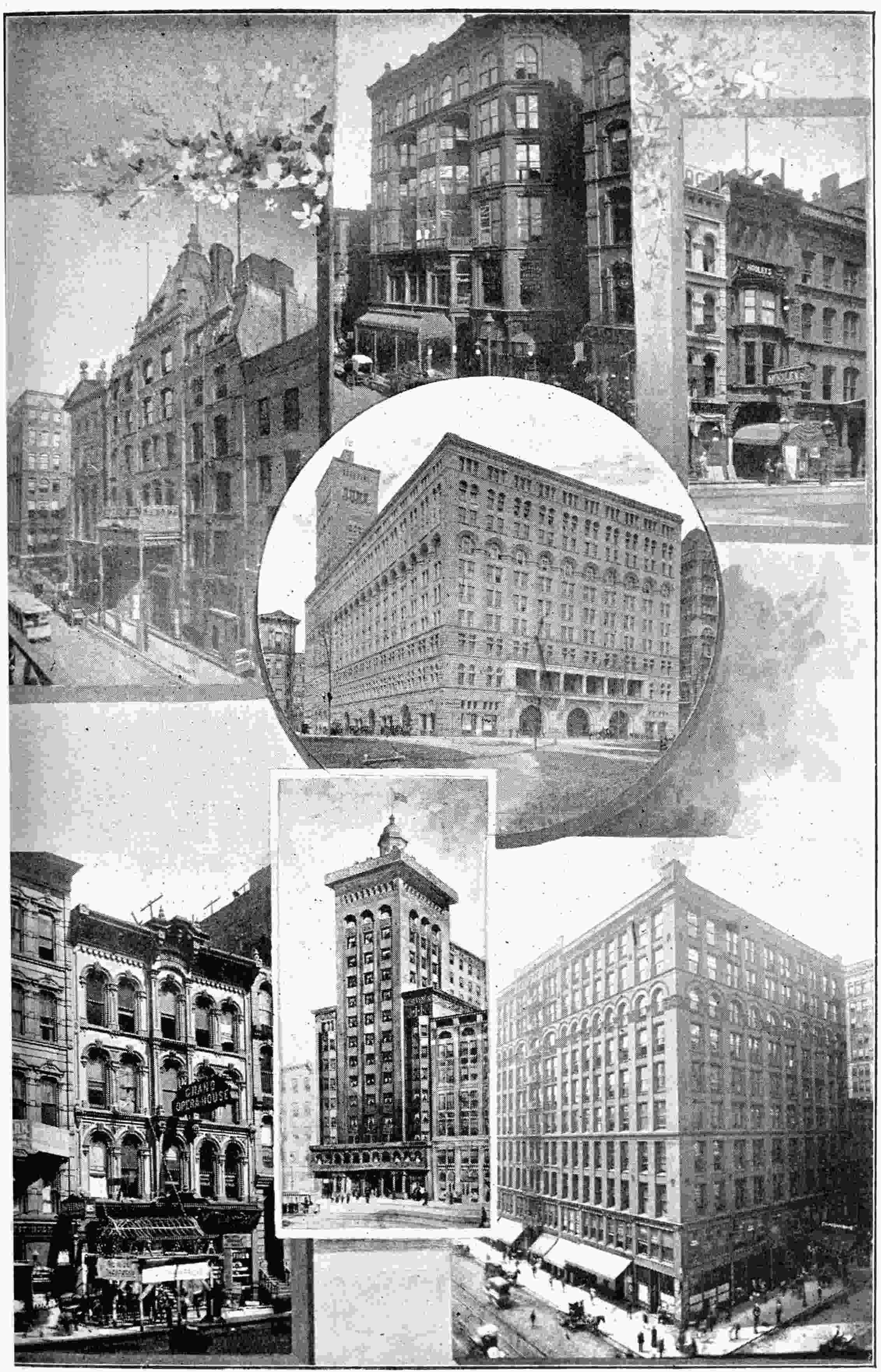
THE COLUMBIA.
GRAND OPERA HOUSE.
HOOLEY’S THEATRE.
CHICAGO OPERA HOUSE.
MCVICKER’S.
THE AUDITORIUM.
THE SCHILLER THEATRE.
The Dime Museums.—Chicago is probably
more bountifully supplied than any other city in the
Dime Museum line. It is not necessary to particularize
as to the various houses of this character;
they are scattered in all quarters of the city, and in
them is to be found infinite material for entertainment
and instruction at the modest admission fee
of 10 cents. The freaks of all climes are to be
found on exibition and most of the museums throw
in a stage performance of some kind more or
less meritorious. A favorite plan of a party, large
or small, desirous of a little quiet fun, is to execute
a “Dime Museum Raid,” as it is called. They
assemble at the hotel or other meeting place, and
start out on a tour of the various museums, visiting
each in turn, with, of course, the usual intermission
for drinks. The amount of fun to be
obtained from such an excursion can easily be
imagined. Aside from the entertainment to be derived
from viewing the freaks on exibition, it is a
very easy matter to discover food for mirth in the
freaks among the audience. There is a happy-go-lucky
atmosphere in a Dime Museum which is not
found elsewhere, and the Dime Museum “raiders”
are in the habit of getting much more than their
money’s worth; but so long as their fun does not
end in a fight, there need be no cause for complaint.
A thing that should be looked into is the
attendance at certain of these cheap shows of
young girls whose tender youth leads one to marvel
why their parents do not manage to keep them
at home, or, failing that, to box their ears and
send them to bed for their contumacy. It is not
the province of the writer, however, to purify the
morals of this great and growing town, so let those
“kick” who will.
The Casino.—This resort, formerly known as
the Eden Musee, is a unique place of amusement,
situated on the west side of Wabash Avenue just
north of Jackson Street. Its leading feature is a
magnificent wax-work exhibit, which good judges
say almost equals the famous resort of Madame
Tussaud in London. All the famous characters in
history, past and present, are reproduced in life-like
manner. There is also a “Chamber of Horrors,”
which may be visited by those who desire to feel
their flesh creep. On the top floor is a roomy
amphitheater, in which a good stage show is always
in progress, and the rear part of which is
filled with neat, round tables, where the patrons
may indulge in light refreshments of various sorts.
The admission fee to the Casino is 50 cents, which
entitles the visitor to all the privileges of the house
without extra charge.
CHAPTER III. THE AUDITORIUM AND THE NEW GERMAN THEATER.
Detailed mention
of the magnificent opera
house in the Auditorium
building has been reserved
until now in order
that it might take its proper
place in the description of
the mighty edifice which is
the wonder and admiration
of the United States, and a
topic of comment to some extent
in Europe.
The project of the Auditorium, three sides of
which face Wabash Avenue, Congress Street and
Michigan Avenue, is said to have emanated from
the brain of Mr. Ferd W. Peck, a capitalist, who,
in a speech to the Commercial Club, outlined the
advantages that would be likely to accrue to the
city from the possession of such a building. As
the Auditorium is one of the sights of the city, it
deserves a special description.
The Auditorium Hotel, mention of which has
been made in a previous chapter, fronts on Michigan
Avenue and occupies the upper floor of the
building, the colossal outlines and massive architecture
of which, rivaling as they do the ancient
Coliseum of Rome, strike the beholder dumb with
admiration. The stock company that constructed
the Auditorium was formed at Mr. Peck’s suggestion
in the spring of 1886, and in January of
the following year work was commenced upon it.
Less than eighteen months afterward the building
had progressed to a stage that made it possible to
hold the National Convention of 1888 under the
roof of the great theater. On that occasion 12,000
people cheered the nomination of Harrison as
the presidential candidate. The formal dedication
of the great structure took place December 9,
1889. The star of the occasion was Adelina Patti,
the world-famous singer, who, although she had
dyed her hair a brilliant red, aroused a cyclone of
enthusiasm by her time-honored rendition of
“Home, Sweet Home.” Speeches were made by
Benjamin Harrison, President of the United States;
by DeWitt C. Cregier, then Mayor of Chicago;
by Ferd W. Peck, President of the Auditorium
Company, and others. It required an expenditure
of nearly $2,000,000 in hard cash to erect the
Auditorium, and the men who invested their money
in the project are drawing a fair interest on the
amount of their wise venture. The building has
a frontage of 187 feet on Michigan Avenue, 361 feet
on Congress Street, and 161 feet on Wabash Avenue.
The material used is mostly American granite
from Maine and Minnesota; the ornamentation
being largely in Mexican onyx. To the visitor
who stands rapt in admiration at the sight of
this superb edifice, a few figures may not be uninteresting.
The main building is 144 feet in height;
the tower on the Congress Street side, 225 feet,
with lateral dimensions of 40 x 71 feet. The building
weighs in its entirety 110,000 tons. There
are 17,000,000 brick in the building and 50,000,000
pieces of marble. The flooring is in Antique
Mosaic.
Now for the theater itself, which is, after all, the
main interior attraction of the Auditorium, the
smaller halls and office suites which are contained
in the main structure possessing only a commercial
interest. The theater has a regular seating capacity
of 4,000, though when it is arranged for a
convention or a ball it will hold three times that
number. The stage is ninety-eight feet in width
and 6,862 square feet in area. The great lobby
with its massive pillars and porticos, prepares the
visitor for the sublime magnificence of the immense
audience chamber. The ceiling, which is
decorated in white and gold, glitters with a myriad
of electric lamps and the spectacular effect, when the
house is filled with a fashionable audience, the long
tiers of boxes gleaming with the brilliant costumes
and jewels of scores of handsome women,
surpasses description. It must be seen to be appreciated.
The Auditorium theater is equipped,
among other things, with an organ that is said to
be the finest and most complete in the world, possessing
as it does, 7,193 pipes.
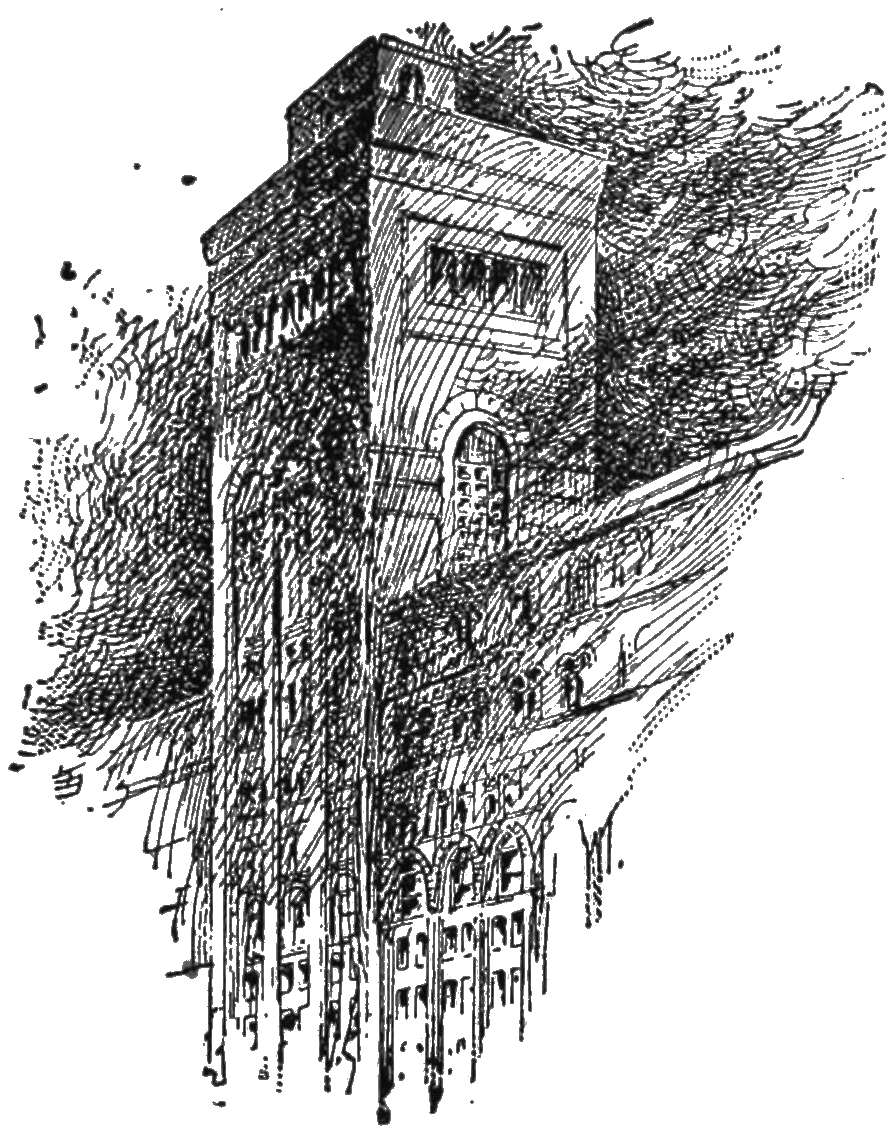
But without question the tower is a stupendous
feature of the Auditorium and is most popular with
strangers; it may be said that no stranger should
leave the city without visiting it. Enter from the
Congress Street side and purchase a ticket at the
box office, costing twenty-five cents. The elevator
carries you up at rapid speed to the top. The
final ascent is made by a small flight of iron stairs
and the tower is reached. The splendor of the
view from this tower can be imagined but not described.
On a clear day the Michigan shore is
discernible far away over the blue water of the
lake, while on the east side, north and south the
eye may penetrate to the furthest limits of the city.
To stand there and look down on the mazes of
buildings and the swarming thousands of your fellowmen
produces a strange feeling of awe and
wonderment. The popularity of the tower with
sight-seers may be imagined from the fact that the
attendance brings in an average of $120 per day to
the company throughout the year.
Preparations are now in progress for the presentation
at the Auditorium during the World’s
Fair year of a theatrical spectacle which shall
eclipse anything of the kind ever before seen in
any country. The plans are yet in embryo, but a
rough outline has been drawn. The production,
which is to be historical in character, will be under
the direction of Managers Adams, Abbey and
Grau. It will open in the spring of 1893, and run
through the World’s Fair season.
The New German Theater on Randolph
Street, between Dearborn and Clark, deserves
special mention by reason of the fact that it will
be the youngest of all Chicago first-class theaters,
and because great promises have been made as
to the magnificence of its furnishings and equipment.
The structure is fire-proof, nine stories in
height with a large square tower fifteen feet in height
surmounted by a cupola. The main building fronts
eighty-four feet on Randolph Street with a depth
of 186½ feet. There will be a covered balcony
in front from which street parades may be advantageously
viewed. The cornices, balustrades and
other parts of the building are decorated with rich
carvings. The construction is of steel columns
and cross-beams, the outer walls being in terra
cotta. The main entrance leading to the theater
is thirty-two feet wide. All the floors and wainscoting
are in polished marble. From the entrance
to the theater foyer will extend two vestibules, in
the inner one of which the box office is located.
Four passenger elevators furnish access to the
hotel and club rooms of which the main portion of
the palatial structure will consist. Broad marble
stairs lead from the foyer to the main floor,
balcony and gallery of the theater, the Auditorium
plan of seating the people having been decided
upon. The theater will seat 1,300 people. The
stage has a superficial area of 3,200 square feet,
with a proscenium arch twenty-nine feet wide and
thirty feet high.
Seven stories of the building are devoted to the
hotel, which also deserves a word of description.
There are 131 guest chambers, 39 bath rooms, a
dining room 76 feet long by 49 wide, and other
features. The hotel will of course have a separate
entrance. Club, billiard, card, and other rooms
occupy the tenth floor. The eleventh is devoted
to a fine ball-room, separate quarters being provided
for the servants on the floors above.
The total cost of this fine structure is estimated
at $600,000, inclusive of the price paid for the
ground. The building is erected by a company of
which the following well-known citizens are directors:
A. C. Hesing, Theodore Arnold, Louis
Wolff, Edward Eiblein, Franz Amberg, Charles
Wacker, C. P. Dose, Louis Wampold, J. A. Orb,
Joseph Scheurer, William Heineman, George E.
Weiss, John M. Krause, C. Herman Plautz, and
Theodore Oehne.
It goes without saying that this will be an attractive
place for strangers to visit.
CHAPTER IV. TWO UNIQUE PLAYHOUSES.
The Madison Street
Opera House and the Park
Theater, which were briefly
mentioned in the preceding
chapter, are two resorts
that may be regarded as
occupying a unique position
in the amusement
roster. The Madison
Street Opera House gives
two performances daily
and its manager, the veteran
Colonel Sam T. Jack,
is reputed to be coining money. The size of the
audiences that fill Col. Jack’s theater twice a day
is attributable, possibly, to the fact that the house
is devoted entirely to the presentation of burlesque.
Companies of more or less merit appear from
week to week, and in order that they may secure
a “date,” it is necessary that they possess a number
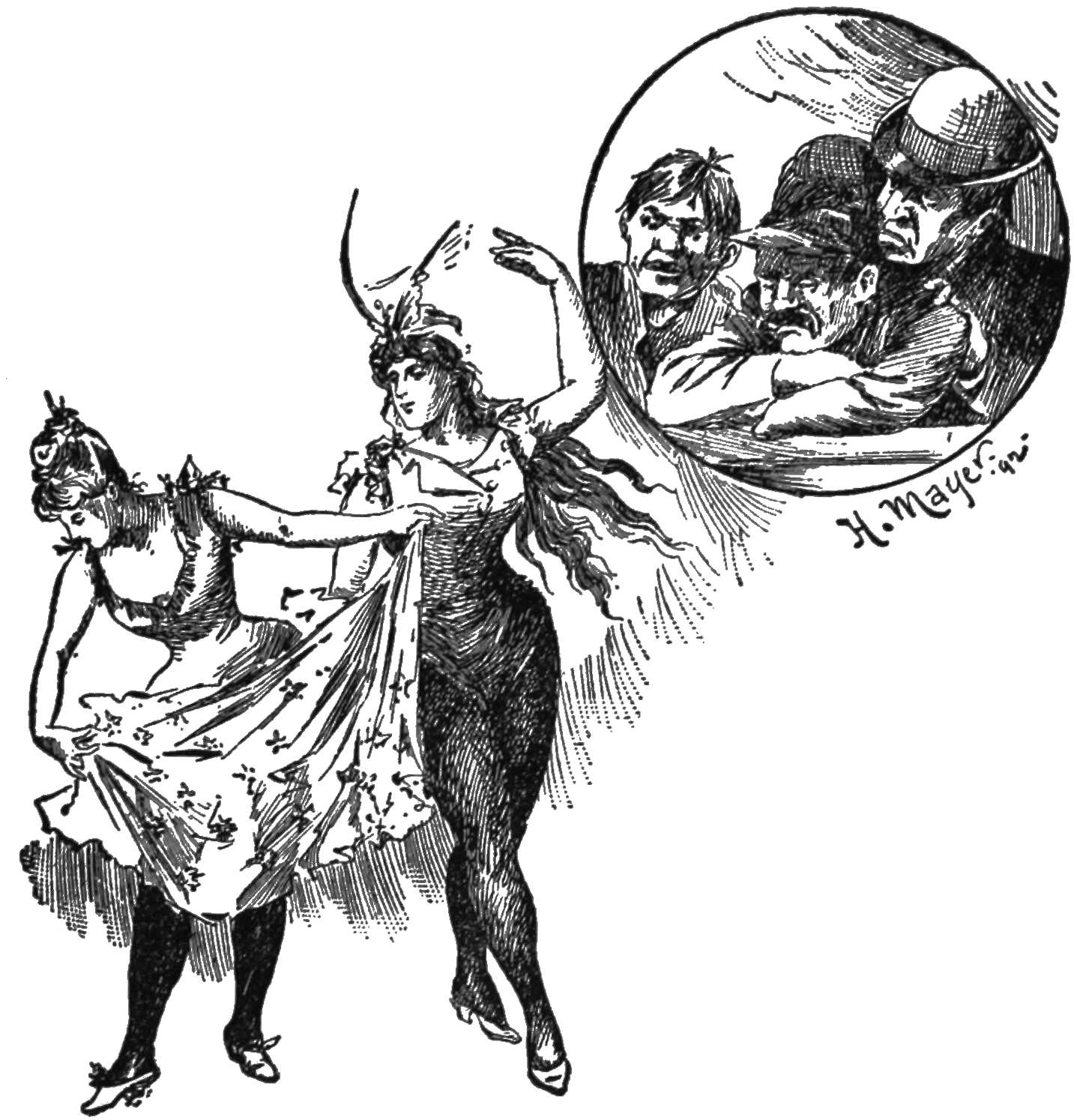
of shapely women in the cast. An artist would
probably call the costumes of the ladies who appear
at the Madison Street Opera House artistic.
Certain it is that if they were constructed on any
other plan than that of the present one they could
not possibly convey a more liberal view of “the
female form divine.” Indeed, there was one engagement
that included the presentation of a series
of classic tableaux, in which the complete suits of
skintights that the ladies wore, were if anything
more attractive than no costumes at all. No
drinks are served in the Madison Street Theater
itself, but it is situated over a large saloon which
is easy of access by means of a staircase leading
directly into the parquet. It is needless to say,
perhaps, that the nature of the spectacular gems
to be seen on the Madison Street Opera House
stages are strongly calculated to produce thirst—especially
in a masculine audience. Not very long ago
the Chicago Mail undertook to “roast” the Madison
Street Opera House, and to stigmatize its
performances as improper. Mr. Jack at once sued
the paper for libel. If a jury should have a notion
to visit the theater it might materially assist in the
rendition of a verdict in accordance with the facts.
The Park Theater, situated on State Street, in
the “Levee,” or “Tenderloin” district, is even
more democratic. Drinks are sold and consumed
during the stage performance, and smoking is allowed.
This is a favorite resort for “bloods” who,
having come to town for fun, propose to see all
there is in it. A party of three or four who purchase
a box may, if they
choose, enjoy the society
of the actresses
who will visit
them between
acts and have a
pleasant, social
time. It is within the
bounds of decorum to
invite the fair performers
to drink, and if an
acquaintance so auspiciously
begun should be carried to even more agreeable
lengths, why, who is going to complain so
long as the City authorities permit its open programme?
Not the manager, surely. He is there
to see that his guests have a good time and will
exercise all his efforts to the procurement of that
end.
There are several wine-rooms upstairs, and in
these one may enjoy a tete-a-tete and a bottle of
champagne with his chosen charmer, if his inclinations
(and his pocketbook) will permit him to go
to that length. An amusing feature of the regime
at the Park is the system whereby the actresses
keep matters straight with “the house.” Under
the rules, each “lady” is allowed a percentage on
the money received for drinks that she causes to
be purchased. She carries a memorandum book
and pencil, and jots down every cocktail or whiskey
straight that her admirer (for the moment) may
purchase. After the “show,” when the audience
departs, she goes to the bar and tallies up with the
barkeeper. A balance is struck at the end of the
week and the money paid over. An idea of the
informality of the performances at the Park may be
gathered from the fact that when James Owen
O’Connor played there awhile ago, a lot of boys
went about in the theater selling stale cats, cabbages
and other garden produce to the audience—the
same to be used for the purpose of pelting the
actor! Anyone who wishes to see a “tough”
audience and a “tough” show will find what he
wants at the Park, which seems to be entirely
within the idea of police regulation, nevertheless.
CHAPTER V. FREE AND EASY SHOWS.
Under this caption
come the entertainments of
a more or less unstilted
character; that is to
say, entertainments
that, while being in no
wise disreputable, are
nevertheless arranged
with a view of catering
to the tastes of people
of both sexes who do
not care to spend the
evening in the narrow
confines and the matter-of-fact
atmosphere of a regular theatre.
The modern music hall, or cafe chantant, of
which there are so many in Paris and London,
has not yet been duplicated to any
great extent in this city. There are, however,
a few places of the kind, widely separated
by distance, that resemble the “old country”
music hall in some respects. The old beer
dens of noisome character that formed a blot
upon the city’s escutcheon in earlier days
have quite disappeared, and the few music
halls that still flourish, besides being of a
much more pretentious character, have in
their management a much stronger claim to
toleration. At any of these places an evening
may be spent without serious prejudice to one’s
morals and without contamination of any sort.
If the jokes are a little “rocky” and the antics
of the actors and actresses just a shade off
color when viewed from the standpoint of
strict propriety there is no reason why the
spectator should go home convulsed with a
sense of the depravity of the city that can suffer
such things to be. The pleasure of the entertainment
at these places is enhanced to a
greater or less extent, according to the taste of
the attendant, by the latter’s ability to solace
himself with such liquid refreshments as his
system may crave during the progress of the
show. He may also smoke like a chimney if
he so desires.
The old Tivoli restaurant and concert hall
on Dearborn street, just below Madison, which
was made famous by the assassination therein
of Jim Elliott, the prize fighter, by Jere Dunn
(the slayer being afterward acquitted on the
ground of self-defense), has long since passed
into oblivion and on its site, the scene of so
many wonderful revelries, a fine office building
now stands. When the Tivoli passed away
there was for a long time a dearth of music
halls in Chicago. At present, however, there
are at least three resorts of the kind that may
be mentioned for the enlightenment of those
who desire to investigate this class of entertainment.
Over on the North Side, on the west side of
Clark street, a few doors north of Division
street, there is an establishment which in some
respects is unique. It is reached either by
the North side cable cars or by hansom cab,
the fare for the latter being fifty cents for each
person. This resort is known as Engel’s, and
for several seasons past it has been the favorite
with the blooded youth of the North side as
well as of a large clientele of chance visitors. It
was formerly kept by a man named Matthai
and adjoining it was a smaller resort kept by a
Monsieur Andre. Andre is now dead and his
place closed. On the site of Mr. Matthai’s
triumphs Mr. Engel now lives and flourishes.
Enter Engel’s at any time between eight
and nine in the evening, after having paid the
modest admission fee of ten cents, and you will
find the large hall, with its imposing array of
polished tables and rows of seats, rather sparsely
filled. The early part of the performance consists
of a series of musical numbers rendered
by the orchestra, the members of which now
and then take a lay-off for drinks. By 10 o’clock,
however, there is a perceptible increase in the
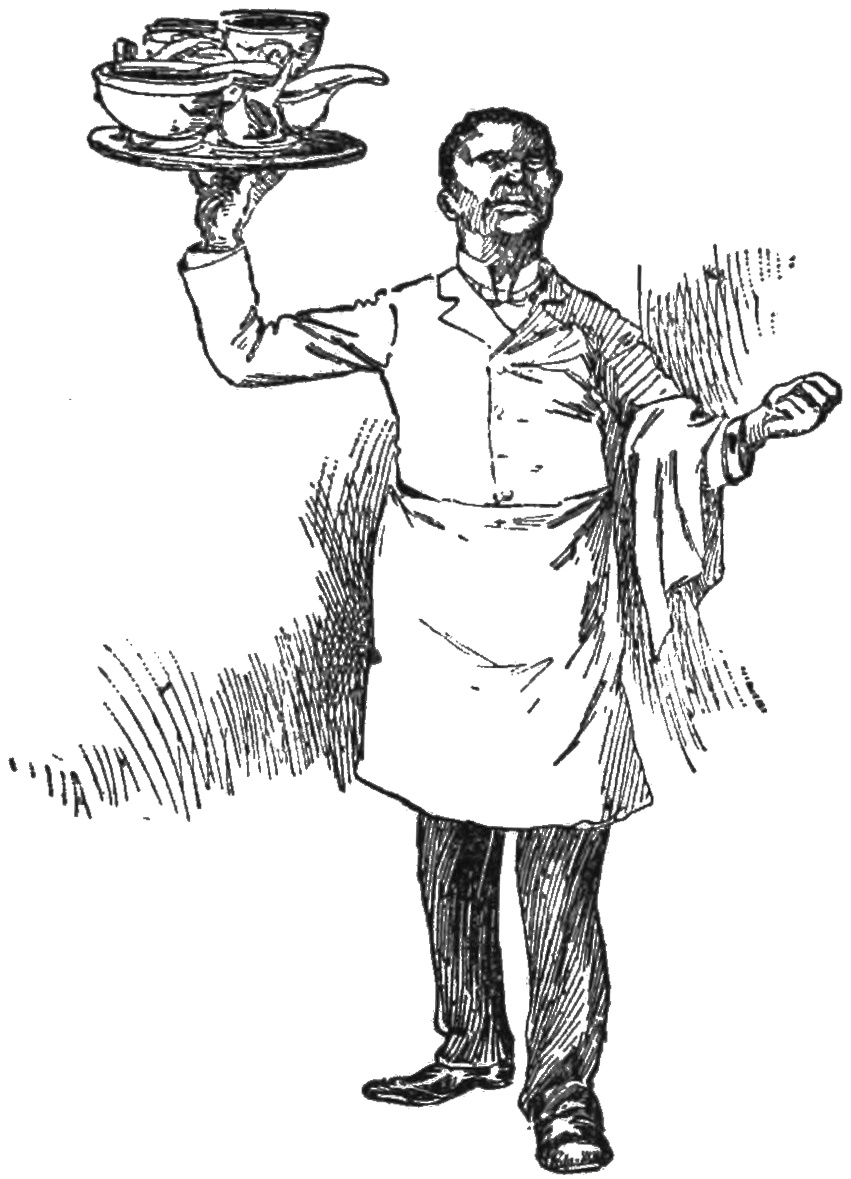
attendance and the white-aproned waiters are
kept busy rushing to and fro supplying the
wants of thirsty customers. The visitor, meanwhile,
has been supplied with a printed programme
which tells him what artists, ladies or
gentlemen, are to appear that evening, and the
manner in which they will endeavor to amuse
the auditors. The curtain rises and a pert
soubrette with a very gaudy complexion and
abbreviated skirts trips to the foot-lights and
sings a song of true love or something else
equally interesting. She may awaken a hurricane
of applause and then again she may not.
The stars of the troupe are usually reserved for
the latter part of the programme. Meanwhile
more drinks are ordered by everybody and by
11 o’clock a general spirit of hilarity prevails,
which is testified to by the added enthusiasm
with which the advancing and retiring favorites
are greeted. The last hour of the entertainment,
between 11 and 12 o’clock, is usually devoted to
a more ambitious effort of some kind. It may
be an opera in one act, a burlesque of the current
follies of the day, or anything else that will
give an opportunity for the singing of “catchy”
songs, the execution of intricate dances and,
above and beyond all, the lavish display of
feminine charms. It is a pleasant custom of
the place for young men of means, possessed
of more money than sense, to purchase bouquets,
which are carried up and down the
aisles on trays by attractive flower girls, and
cast the same upon the stage at their especial
favorites. When a more than usually attractive
damsel sings an unusually taking song
the boards upon which she treads are often
fairly deluged with flowers, and the degree of
grace with which she stoops to pick them up
enhances in just that ratio the warmth of the
plaudits which she receives. It is perhaps unnecessary
to say that during this latter part of
the show the added attractions of the spectacle
presented, together with the concentrated enthusiasm
of the performers, all grouped on the
stage at once, increases the general demand for
refreshments. The waiters are fairly scurrying
hither and thither and the consumption of
stimulating beverages is something enormous.
During all this “Papa” Engel, as he is affectionately
termed by his coterie of more youthful
patrons, looks on with a bland and satisfied
smile, noting with evident enjoyment the merry
spirits of his guests and the rapidity with which
they are enriching his coffers.
The ground floor of Engel’s is exclusively
devoted to the sterner sex. No ladies are allowed
on that floor; up above, however, a
roomy balcony runs around the hall and lady
patrons of all ages and grades of attractiveness
sit at the tables with their escorts and enjoy
the entertainment with the rest. No gentleman
is allowed in the balcony unaccompanied
by a lady and no lady can enter it unescorted.
The popping of corks and the sparkle of champagne
are perpetual adjuncts to this part of the
house and the balcony itself, it is safe to say,
forms no inconsiderable part of Mr. Engel’s
gold mine. Nobody who does not wish to buy
anything, however, is ever requested to do so,
the ten cents admission fee entitling the visitor
to every privilege of the house. Occasionally,
it is true, a bit of disorder may break out,
caused by some indiscreet visitor imbibing
not wisely but too well, but it is very speedily
squelched and there is no case on record where
a person guilty of causing disorder in Engel’s
ever repeated the offense.
Another feature of Engel’s, and many people
find it an agreeable one, is the stage boxes.
These boxes are located above the stage and
behind the curtain, being arranged in such a
way that persons seated therein may view all
that is going forward on the stage itself and
still remain invisible to the audience. With
prominent citizens, or other people who like to
keep their attendance at the music hall a secret,
this is an advantage not to be denied. Occupants
of stage boxes, far from being denied the
privileges of quenching their thirst, are granted
every facility for so doing. There is a neat
table in the rear of the box and an obsequious
waiter stands steadily at the door ready to minister
to the wants of patrons. It is quite permissible,
if the occupant of a stage box desires,
to send the waiter around behind the scenes to
inquire whether this or that fair actress will not
deign to imbibe something at your expense, an
attention which she duly acknowledges by
stepping daintily up beneath the box and, as
she quaffs the soothing beverage, nodding her
thanks to the donor. A spirit of good nature
prevails throughout the entire performance and
when it is all over nobody has been hurt very
much by his contact with this strange element
of life in a great city.
There is another feature of Engel’s which
merits a word or two of mention. Promptly at
12 o’clock, in obedience to the mandate of the
city fathers, the front doors of the place are
closed as tight as a drum. Adjoining the bar,
however, is a commodious cafe where parties of
friends, from two to ten in number, may sit
down and enjoy any sort of a repast that their
appetites may crave, with all the liquid accessories
thrown in. You, young man, who may
have become interested in an especially charming
member of Mr. Engel’s corps de ballet, may,
if you stay in this cafe long enough, possibly be
rewarded by a sight of your charmer for a moment,
emerging from behind the scenes in her
street clothes after the performance. You are
tolerably safe from giving her offense if you offer
her refreshment at your expense, though if it
happens that she is accompanied by a stalwart
cavalier who appears to exert a proprietory influence
over her, it is just as well to reserve
your attention for some more appropriate season.
Some of Mr. Engel’s coryphees take
supper regularly every night in his cafe, the
costs of such meals presumably being charged
against their salary, unless some outside devotee
at their various shrines should feel an inclination
to pay the bills. Mr. Engel himself, animated
by we know not what generous impulse,
has been known to sit at the head of a long
table, around which were grouped a dozen or so
of the lady members of his troupe, and cheerfully
invite them to eat or drink their fill at his
expense. Some wag, who noticed this spectacle
on one occasion, made an observation to the
effect that Mr. Engel seemed to be having a
good time with his harem, and for that reason,
possibly, it has been customary among the flippant
and irreverent young men who frequent
the place to jocosely refer to it over their wine
as “Engel’s harem.”
All in all, it is not such a bad sort of place to
visit, especially if the visitor is desirous of seeing
something a little unusual in a place where
he will not be bothered by a demand for a too
strict observance of the proprieties. In any
event it is a good place to go if you happen to
be in that part of the town after midnight and
are possessed of a thirst of the sort that only
some of the choice alcoholic liquids dispensed
by Mr. Engel and his aids can quench.
On the South side are two well-patronized resorts
that, while resembling Engel’s in some respects,
differ from it in others. Baum’s Pavilion,
situated at the point where 22d street and
Cottage Grove and Indiana avenues merge
together in a sort of triangle, has been famous
for many years as a concert hall, cafe and dance
house. It is a large structure of two stories
and adjoining the building is an open air expanse
or beer garden, dotted with trees, which
is always crowded on summer nights. The
pavilion is reached from three sides; the main
door faces north and entrance can be had
either through the beer garden on Cottage
Grove avenue or through the restaurant on Indiana
avenue. The style of entertainment presented
at Baum’s varies from week to week.
Sometimes it is a first-class variety show, at
other times Mr. Baum grows more ambitious
and puts on a full-fledged comic opera troupe
as an additional divertisement. The admission
fee is 25 cents and the visitor may select his
seat according to his fancy. If it is the summer
season (that is when Baum’s pavilion is
best patronized) the open air garden is only
separated from the hall where the opera is in
progress by open arches, and one may sit at his
table and smoke and drink with nothing but the
blue vault of heaven for a roof and at the same
time have wafted to his ears the exhilarating
music from the stage within.
While the stage show is, of course, the principal
feature of Baum’s and the one from which
the establishment draws its steady patronage,
the dances that are given there usually every
Saturday and Sunday night, at the nominal admission
fee of fifty cents per couple, are always
numerously attended. In the winter season,
when the garden is too frosty to be agreeable
and is closed up in consequence, the dances are
held in the hall above the saloon; but in the
radiant summer, when dancing is at best a
fatiguing pleasure, they take place on the ground
floor. Between the dances the revelers may
adjoin to the open air and partake of whatever
refreshments their hearts and souls most desire.
It is a “free and easy” spot but, as in all other
places of the kind, the best of order is always
maintained, the least semblance of unruly conduct
being sternly checked by the management.
Any one who violates a second time the system
of etiquette that governs the place is promptly
pitched into the street and never again admitted
to the hallowed precincts unless he manages to
conceal his identity.
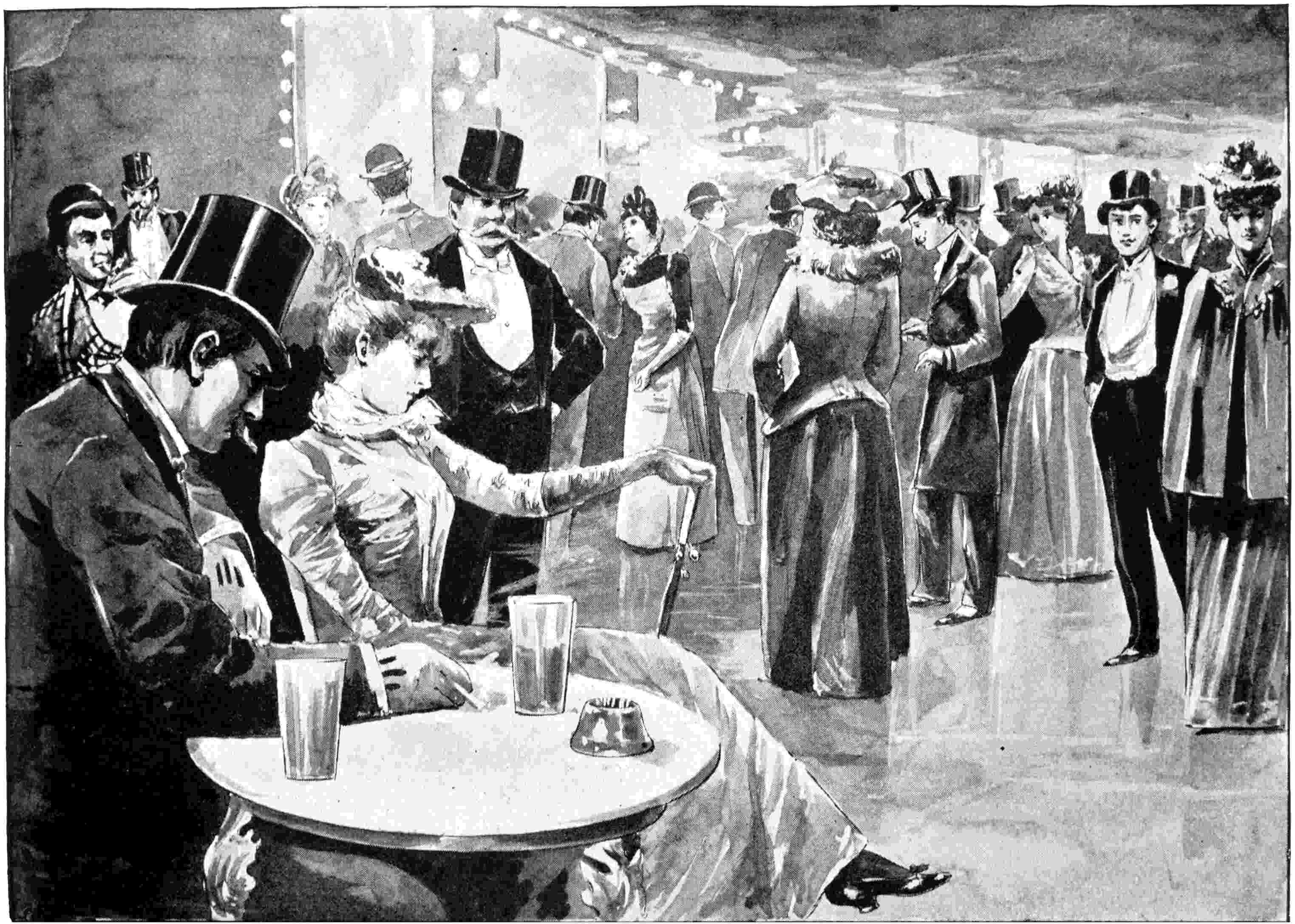
The crowd that attend the summer night
dances afford excellent opportunity for study; all
classes of men and women are represented there.
The well-to-do club man who stays at a distance
and sips his lemonade in peace and quiet is content
to find his share of amusement in watching
the antics of the throng; the hard-working and
respectable mechanic, who works his best at his
trade for six days in the week, is evidently enjoying
the bit of recreation that is yielded to him
there. Scattered in the crowd are salesmen,
barbers, bookmakers, bakers, butchers and
almost every other type of the young manhood
of the day. Perhaps there may be a few confidence
men, bunco steerers, and types of even
more dangerous classes, but they are not to be
feared. They are there for recreation, not for
business; for they know very well that if they
made the slightest effort to ply their calling
in that place they would be promptly
spotted and handed over to the authorities.
As to the feminine portion of the assemblage,
one is at a loss to convey an adequate idea of it
in an off-hand description; it varies with the
seasons and the weather. As a general thing,
however, you will see there from fifty to two
hundred girls and women, some of them the
wives and sisters of the mechanics and tradesmen
above mentioned, who, like their male
relatives, are out for a good time, but the majority
are young girls of quite independent
standing—servant girls, saleswomen and others,
many of them strangers in the city, perhaps,
possessed of no sterner guardians than their
own consciences, and are pleased to select whatever
means may suit them best to pass their
spare time. They see no reason why they
should not spend at least one evening in a little
uproarious festivity. When the dance is at its
height and the enthusiasm of the dancers roused
to its highest pitch the visitor invariably receives
the worth of his money. It does him
good to see so many people enjoying themselves,
and there is very little doubt that if he is of
fairly presentable appearance and sufficiently
discreet to work the matter rightly he may
without much difficulty obtain a partner for him
self and join in the general melee of ecstatic enjoyment.
As a general thing the festivity winds
up about midnight, but if a few select parties
desire to remain a little longer no very serious
objection is likely to be made. A very agreeable
evening may be passed in this place and the
fact that the pavilion has remained where it
now stands for more years than one cares to
count without any serious protest from the aristocratic
residents of this neighborhood, speaks
well for the order with which it is conducted.
On the east side of 31st street, between
Rhodes and Vernon avenues, there is a much
more pretentious concert and dance hall than
either of those previously mentioned. It, also,
is the enterprise of the same Mr. Baum who
runs the 22nd street place. It is a much more
imposing structure, having a stone front and a
wide entrance brilliantly lighted by electricity.
An admission fee of ten cents is charged and
the great hall at the rear, in which the stage
performance takes place, will accommodate
nearly one thousand people. Much the same
class of entertainments as those to be witnessed
at Engel’s are presented here, with the difference,
however, that there are no stage boxes,
no balcony for ladies and no means, so far as
one may ascertain, of making acquaintances
among the performers. Occasionally some
singers of higher merit procure engagements at
this place and the quality of the music that
they contribute to the entertainment is not improved
upon in many of the down-town theatres.
Half of the hall, the east side, is reserved for
ladies escorted by gentlemen; the other half is
for the exclusive use of the male patrons. Refreshments
of all sorts are served all through
the evening at the polished round tables, thus
enabling the visitor to satisfy his hunger, as
well as his thirst, with any sort of a meal during
the progress of the performance.
On the second floor is a ball-room of imposing
dimensions and magnificent furnishings. On
off nights it is rented out to various societies
for their dances, but on very frequent occasions
the proprietor advertises a ball that is invariably
attended by the youth and beauty of the
middle classes residing in the neighborhood.
As is the case at all places where liquor is indiscriminately
dispensed, a pleasant feeling of
informality, not to say hilarity, prevails; the
chance visitor, who may nearly always procure
admission for himself and his fair companion,
if he has one, by the payment of the stipulated
fee, may be certain of passing a pleasant time.
There is a place on the West side, near the
Ashland club, 575 Washington boulevard, which
is for that reason known as the Ashland Club
Annex. There is no especial reason for mentioning
it save that the weary wayfarer, if he
happens to learn the pass-word for the night,
may enter at almost any hour and secure hilarious
enjoyment. The place nearly always contains
a rollicking crowd of young men who are
up to any and every sort of mischief, and manage
by their antics to create unlimited amusement
for any strangers who choose to happen
in. As a rule the “pass-word,” if it may be so
called, consists in a series of variegated taps on
the window with the end of a lead pencil, their
number and regularity signifying to those inside
whether the applicant is to be trusted or not.
This precaution is considered necessary on account
of the fondness of the West side policemen
for descending upon such places entirely
without notice and carting off all the inmates to
the station on a wholesale charge of disorderly
conduct, which disorderly conduct consists in
their frequenting such a place after lawful hours.
It has been a long time, however, since such a
raid was made.
The Lyceum theatre, while perhaps not deserving
of the title of a free and easy resort, is,
nevertheless, a place where variety shows of a
broad description are to be seen at any time.
The Olympic, on South Clark street, opposite
the Sherman House, is another resort of the
same calibre. There is an afternoon show at the
Olympic every day in the week, and as a rule it
attracts good audiences. The rates of admission
at both of these places are very low, and,
considering that fact, the entertainments offered
are in every way satisfactory.
CHAPTER VI. CHURCHES AND CHURCH SERVICES.
With a large portion of
the people who remain in
Chicago over Sunday the
desire to attend some sort
of divine service, as well as
to see some of the principal
edifices devoted to religion,
is the first thought
on awakening. The finest
churches are located at a
distance from the business centre. Before
the fire there were a number of churches in
the heart of the down-town district, but when
they were once destroyed they were never
rebuilt and it is along the residence streets
that the handsomest structures may be seen.
The transient population is cared for, however,
by clergymen who hold services in certain
of the theatres Sunday mornings—of
whose work more anon.
The churches of Chicago represent every
Christian denomination, there being nearly 500
places of worship the total Sabbath attendance
at which is estimated at 120,000. Among these
are many splendid specimens of architecture,
but the two great Catholic edifices, the Church
of the Holy Family, corner of May and West
Twelfth streets, and the Holy Name cathedral,
corner of North State and Superior streets—are
the most imposing from an architectural standpoint.
Other noteworthy churches are the
Cathedral of St. Peter and St. Paul, Grace and
Trinity (Episcopal), Immanuel (Baptist), Second
Presbyterian, Plymouth and New England
(Congregational), St. Paul’s (Universalist), Centenary
(Methodist), Unity and the Church of the
Messiah (Unitarian).
There are some very eloquent preachers in
Chicago and a visitor who does not attend a
church solely for the purpose of getting inside
of it and seeking forgiveness for his sins may
enjoy a very profitable hour in listening to an
admirable sermon in any quarter of the city he
may choose to select. There are several
clergymen in Chicago who receive $6,000 to
$8,000 per year, and at least three whose salaries,
it is said, are $10,000.
The principal churches of the West side are
located for the most part along Washington
and Ashland boulevards, and there is a cluster
of them in the vicinity of Jefferson and Union
parks—small breathing-places a couple of miles
from the business centre. The church district
of the North side is between Clark and Dearborn
streets and north of Ontario. On the
South side the principal religious edifices are
east of State street and south of Twenty-second,
the buildings growing finer, as a rule, the further
south one goes. There are several very
fine churches in the recently-annexed suburb of
Hyde Park if one cares to travel that distance.
It is a peaceful feeling, if nothing else, to find
oneself within sacred walls on a bright Sabbath
morning, and if it is merely for sight-seeing
that you find yourself there—which it is to be
hoped is not the case—you will not be disappointed.
If there are ladies in your party
they will be on the lookout, as ladies always
are, for fine clothes worn by other ladies, and if
so, why it is very certain they will not be disappointed.
Some of the South side congregations
are very wealthy. In some of them a dozen
of the male worshipers could raise between
them enough ready money to buy up several
adjacent blocks—say a million dollars apiece—which,
considering that, according to Holy Writ,
“It is easier for a camel to go through the eye of
a needle than for a rich man to be saved,” or
words to that effect, makes the spiritual outlook
for these wealthy gentlemen a poor one.
However, it is always interesting to watch how
rich men behave themselves in church and one
of the ushers will not be likely to refuse to point
out to you a devout millionaire or two if you
ask him to do so.
Speaking of high salaried preachers (though
the highest-salaried are not always the most
popular) suggests the mention of a few of
the most celebrated divines of the city: Rev.
S. J. McPherson, pastor of the Second Presbyterian
church, Michigan avenue and Twentieth
street, always preaches to a full church.
Dr. McPherson is not a poor man himself,
having been bequeathed a little fortune by the
late John Crerar. Then, too, he has a large
income for wedding fees, for he has such a
charming manner in performing the ceremony
that he is in great request with prospective brides.
Dr. Gunsaulus, pastor of Plymouth Congregational
church, is also very popular. For a time
he conducted Sunday evening services at Central
Music Hall, State and Randolph streets,
but abandoned that field to the Rev. Flavius
J. Brobst, who in turn retired. The famous
Jewish pastor of the city is Rabbi Emil G.
Hirsch, of Sinai congregation, Indiana avenue
and Twenty-first street, who is also a writer of
some renown. Many Christians attend this
church for the sake of the Rabbi’s eloquent sermons,
which are liberal and large-hearted enough
to suit all denominations. A preacher of the good
old, stern, denunciatory stripe is Dr. Poindexter
S. Henson, of the First Baptist church, corner
of South Park avenue and Thirty-first street.
Dr. Henson’s sermons are pitched very frequently
in a topical key. He would just as
soon discuss politics as the Bible from his pulpit,
and whenever the city administration stands
in need of a little “roasting” the Rev. Poindexter
is tolerably certain to supply the need. By
reason of these sermons the Rev. Poindexter
succeeds in getting himself into the newspapers
about as often as any divine in town,
and it is quite safe to say that the stranger who
selects his church as the one to visit will not
regret the selection. For those who admire a
high church service the Episcopal cathedral,
at the corner of Washington boulevard and
Peoria street, will be found to answer all requirements;
the Right Reverend Bishop McLaren
is the pastor. Dr. Clinton Locke presides
over Grace Episcopal church, 1445 Wabash
avenue, with dignity and grace, and
Bishop Cheney fills the pulpit of Christ’s Episcopal
church, Michigan avenue and Twenty-fourth
street. The Rev. J. P. Brushingham, a
clergyman whose record was once marked by a
particularly stormy series of events, draws good
congregations to the Ada Street Methodist
church. Dr. William Fawcett, another eloquent
Methodist divine, preaches at Park Avenue
church, on Park avenue, at the intersection
of Robey street. Rev. Frank Bristol, pastor
of Trinity Methodist church, Indiana avenue
and Twenty-fourth street, is noted for his great
store of learning as well as his flood of eloquence,
and so is Dr. N. T. Meloy, pastor of
the First United Presbyterian church, Monroe
and Paulina streets. Rev. M. Woolsey Stryker
holds forth at the Fourth Presbyterian church,
corner Rush and Superior streets, and the very
aristocratic congregation of St. James’, corner
of Cass and Superior streets, is presided over
by Dr. Tompkins.
The clergymen above mentioned are among
the most famous in the city, but there are
many others almost equally prominent. The
wayfarer, however, will be interested in learning
of the popularity of the services at “Central”
church and the People’s church, conducted at
Central Music Hall and McVicker’s theatre
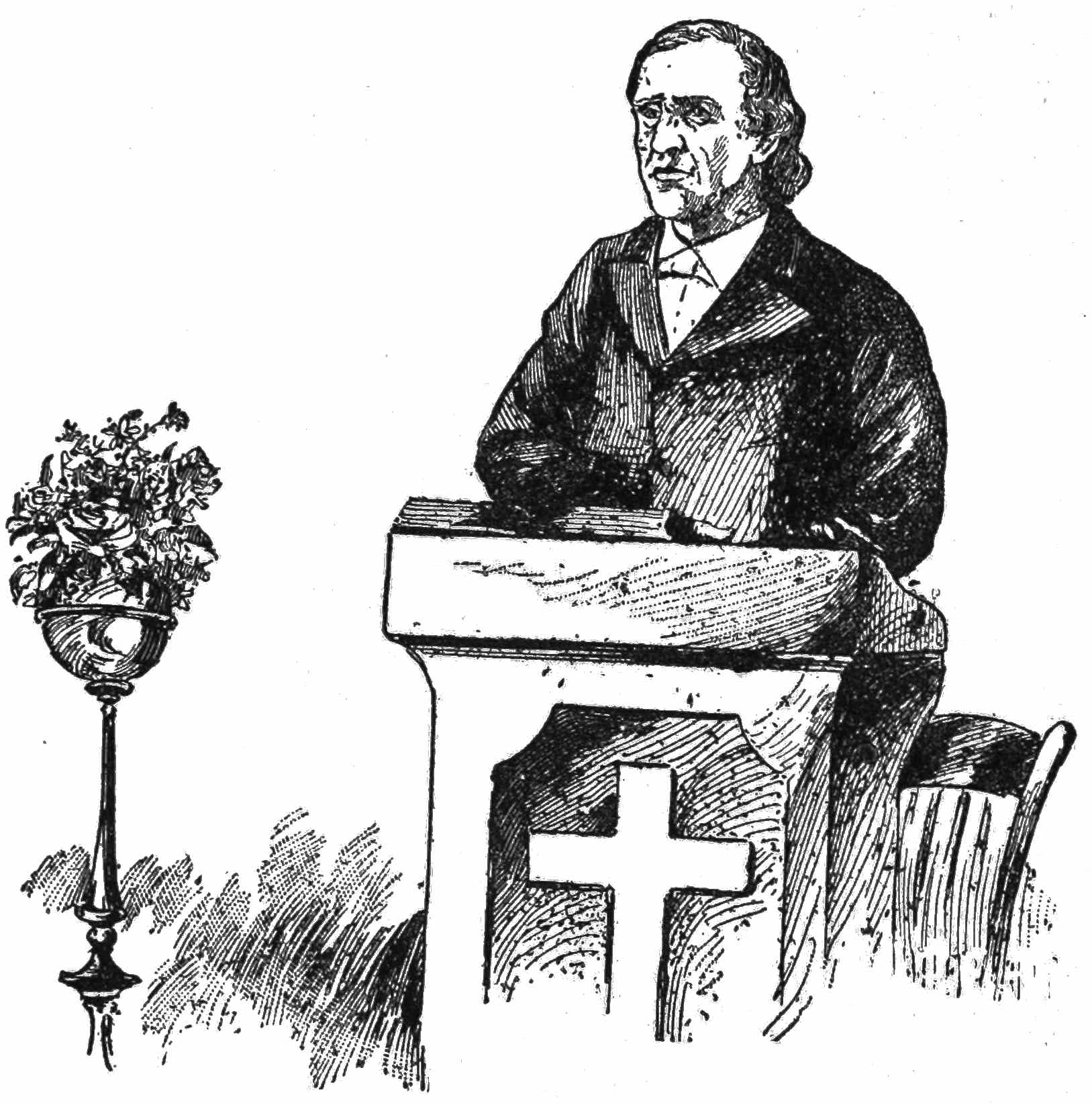
respectively by Prof. David Swing and Dr. H.
W. Thomas. Both these gentlemen possessed
large followings when their congregations
were formed. Prof. Swing is one of the leading
personalities of the religious life of the city.
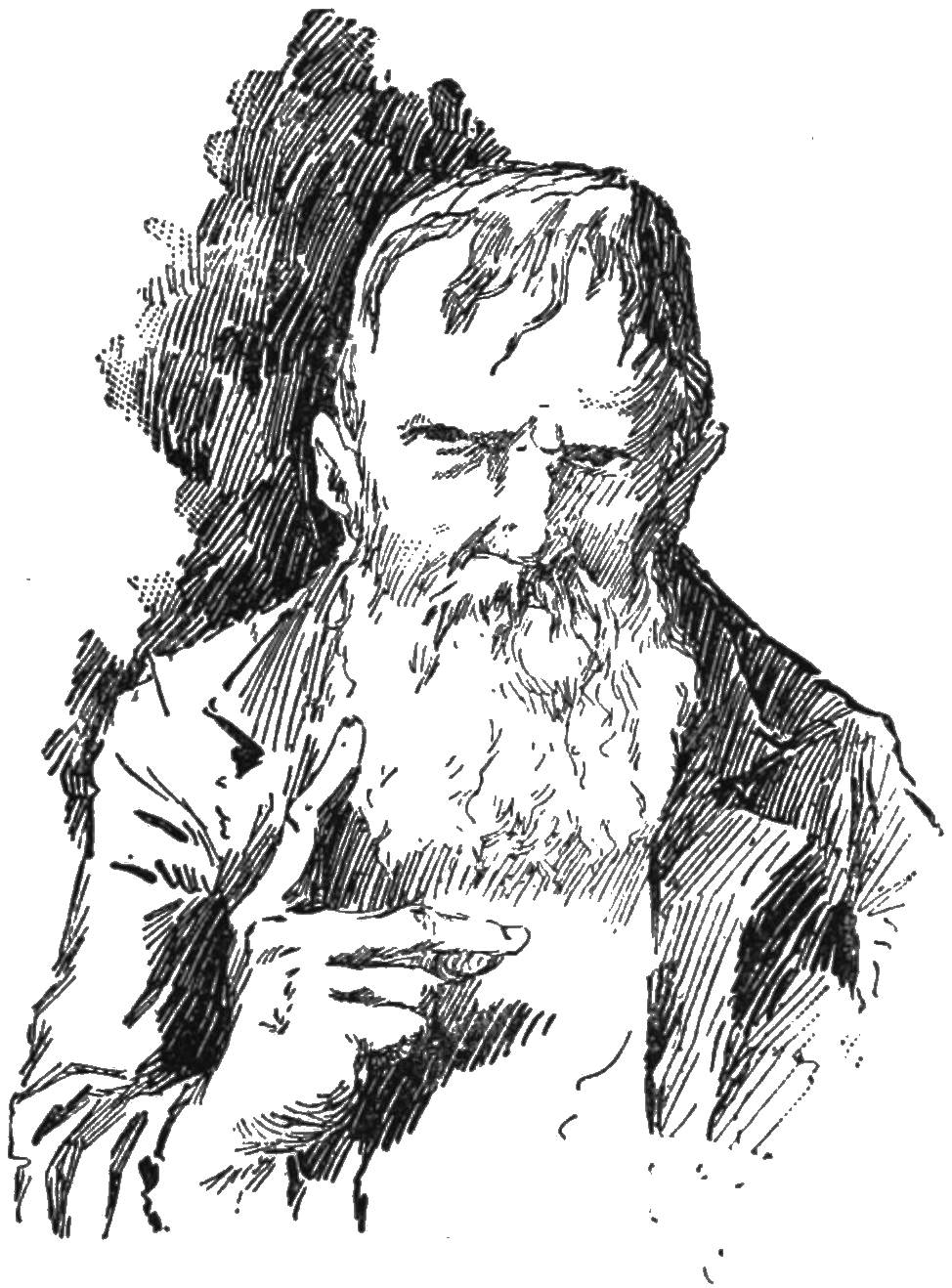
He is a man of exceedingly plain exterior but
his sermons are sound and forcible. It would
be difficult to analyze his creed or that of the
people who go to hear him. Central Music
Hall is filled every Sunday morning with a
large gathering of well-to-do people whose
religious ideas could not, perhaps, be very accurately
defined, but who would not go anywhere
else under any inducement. There is
also a large sprinkling of outsiders. The manner
in which Prof. Swing’s followers appreciate
his ministrations in their behalf is evidenced
by their paying him a salary ample enough to
enable him to build a palatial summer home at
Lake Geneva, a near-by hot weather resort
whose grassy banks are lined with the villas of
Chicago millionaires. Dr. Thomas is a little
more orthodox in his tenets, perhaps, but his
services are no less popular than Prof.
Swing’s. At both of these temples of worship,
operated, as they are, in places devoted throughout
the week to public amusement, chance visitors
are made heartily welcome and many
strangers who would not inconvenience themselves
to ride out to one of the orthodox
churches take advantage of the nearness of
these two to their hotels and drop in on Sunday
morning for an hour or so of spiritual
enlightenment.
CHAPTER VII. PANORAMAS AND LIBBY PRISON.
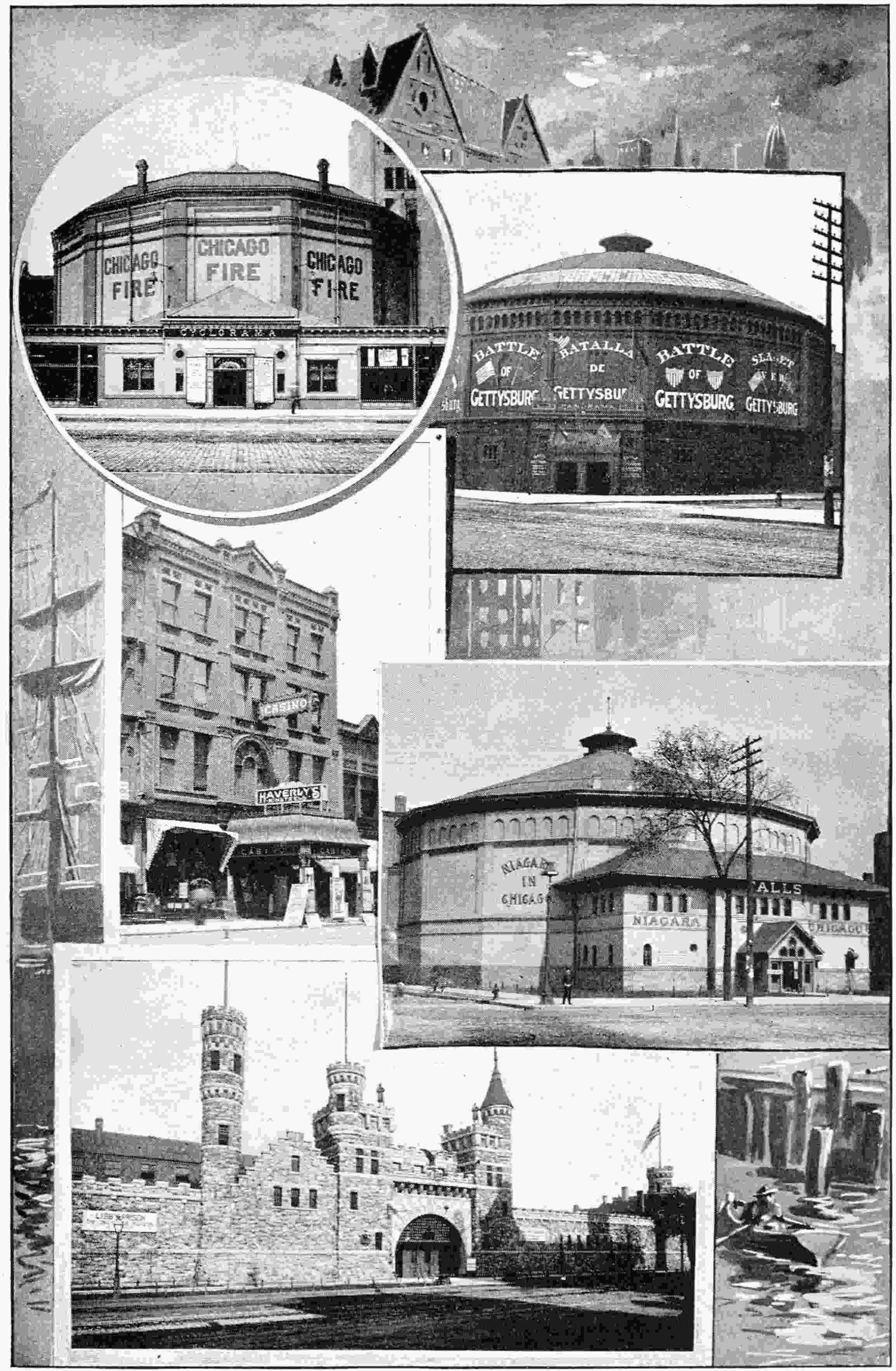
The panoramas of
Chicago have become
justly celebrated. They
are patterned after the
famous panoramas of
Europe, being contained
in huge circular
buildings. There are
at present three panoramas—the
Battle of
Gettysburg and the
Falls of Niagara, on
Panorama Place, a mile south of Madison street
on Wabash avenue, and Chicago on Fire—the
latter being a splendid representation of Chicago
as it looked at the time of the awful conflagration
that drew the eyes of the civilized world
upon the suffering city. The Battle of Gettysburg
is the oldest of the three. The portrayal
of the greatest battle of the war of the rebellion
is realistic beyond description. It is impossible
for the spectator to detect where the canvas
blends with the natural presentation beneath
the feet. Hundreds of thousands of people have
visited this attraction. The Wabash avenue
cable cars take the visitor direct to “Gettysburg”
and to “Niagara,” which is just across the
street. “Niagara” is a faithful delineation of
the world-famous falls, the portrayal being so
realistic that the spectator, in fancy, can almost
hear the roar of the water.
The panorama depicting the fire is shown in
the building formerly consecrated to the Battle
of Shiloh, on Michigan avenue, near Madison
street. Here the visitor may stand for an hour
lost in wonder at the realism of the scene so
artfully drawn on canvas. The panic of a great
city in the throes of a hopeless battle with the
destroying element is admirably pictured, and
from a view of that speaking and truthful canvas
one may gain a slight idea of the bitter
agony of those hours when the proud city was
laid low in the face of as horrible a calamity as
ever befell a community. The panoramas have
a uniform admission fee of fifty cents.
The Libby Prison War Museum, located on
Wabash avenue, between Fourteenth and Sixteenth
streets, belongs to the same class as the
panoramas in the amusement category, inasmuch
as the visitor may enter and wander
around for half a day or so if he chooses, taking
his own time to view the attractions offered.
Libby Prison is one of the leading permanent
attractions of the city. On the outside, fronting
on Wabash avenue, is a massive stone
wall, and on the inside is the identical Libby
Prison in which the soldiers of the north were
incarcerated during the war. The building was
purchased in Richmond by Chicago capitalists,
and has been put up, brick for brick, exactly as
it stood during the
time when the nation
was convulsed
by the horrors of
civil war. Within
its walls will be
found portraits of
all the leading soldiers
and statesmen,
northern and southern,
of that period;
all kinds of firearms
and ammunition, ancient
and modern; a
fine collection of historical documents, including
the will made by John Brown an hour before
his execution, and many other war relics. It
may be easily imagined how deep an interest
this place possesses for old soldiers, union or
confederate. Old comrades, separated since
the close of hostilities, often meet there, and
many are the reminiscences exchanged. The
Libby Prison is open day and evening. The
admission fee is fifty cents, children half-price.
Not far from Libby Prison, on Wabash avenue,
is another structure that possesses a strong
historical interest. This is the fort of John
Brown, transported entire to this city and enclosed
in a neat iron building. Enterprise has
no compunction in these days, and it is hard to
tell what the visitor to Chicago will not see if
he waits long enough.
PANORAMAS, CASINO AND LIBBY PRISON.
CHAPTER VIII. PERILS AND PITFALLS.
It is not insulting the intelligence
of the stranger to warn
him against the unscrupulous
persons who will beset his path,
for they are so numerous
and make their appearance
at such unexpected
times and places that
the very smartest of us
all are occasionally in
danger of being victimized.
There are probably more
“crooked” people in Chicago at
the present writing than any
other city in the Union, and it is
altogether probable that this
number will be largely increased
during the progress of the Fair.
The criminal classes who infest Chicago at
all times are extremely varied. The common
tough, whose exterior and manner of comporting
himself proclaim his worthlessness, is
not very much to be feared. Such gentry will
be well cared for by the police during the great
rush to the Fair. Indeed, it is quite probable
that all suspicious or known disreputable characters
will be spotted at once and given a
chance to leave the city, a failure to avail themselves
of which, will result in their imprisonment
until the Fair is over. But there are other
gentry who are infinitely more dangerous. The
term “bunco-steerer” perhaps best signifies their
calling. The term bunco-steerer originally
meant a decoy, or “capper,” who led or
“steered” the confiding stranger against a bunco
“lay-out.” Lately, however, its meaning has
broadened. By “bunco-steerer” is now meant
the oily, genial gentleman who approaches you
on the street corners and politely inquires
after your health, supplementing this query
with another as to whether you would not like a
chance to get into any sort of game whatsoever.
The bunco-steerer will turn his wits to
almost any scheme to make money at the expense
of his more honest fellow-creatures. He
belongs to the great army of confidence men
who prey upon mankind in general and upon
gullible strangers in large cities in particular.
The confidence man! Ah, beware of him if
you value your peace. He may make his appearance
at any moment and in any guise.
The very suave and polished gentleman who
sits opposite to you at the table in the dining-car
and chats so delightfully with you as you
ride into the city together may be a wolf in
sheep’s clothing, with designs
on your purse. The
very clumsy confidence
man who walks up and
slaps you on the back with a cordial “How de
do, Jones, how are all the folks?” and immediately
tries to scrape up an acquaintance, is not
to be dreaded except by very green people who
have never been in a big city before. It is the
polished villain, the polite, well-dressed person
who, while preserving a dignified demeanor,
nevertheless tries to scrape up an acquaintance
and then proceeds to divulge—as he will sooner
or later—a chance by which a little easy money
can be made, who is to be feared. A very good
rule to go by is to preserve a polite manner to
all strangers, but not to enter into confidential
relations with any man who hasn’t been introduced
to you by some one whom you thoroughly
know. The pleasures of a chance acquaintance
may be great but they are accompanied
by dangers to your purse. If you go
into a quiet little game of cards at a hotel it is
a “cinch” that you will lose your money, because
the men who invite you into it are cheats
and will not give you a fair show. They are
confederates and the money they show cuts no
figure, because they have entered into a combination
to fleece the stranger.
The rhapsodical gentleman who rushes up to
you and proceeds to tell you glibly of all the
people who live in your town has spotted you
for a victim. Look out for him. It is easy to
account for the knowledge he displays. Such
people make a habit of hanging about the hotel
and studying the history of every guest. That
is how this sleek gentleman succeeded in ascertaining
so much about you, my friend. The
hotel people watch very closely for such gentry
and when one of them is caught he is never
given an opportunity to repeat his offense.
There are two bits of advice which if followed
closely will probably save the unwary
stranger from all harm. In the first place never
enter a place you would be ashamed to have
your family at home know you entered; and in
the second place never sign any papers or lend
any money or valuables at the request of strangers.
Among the devices for snaring the wayfarer’s
honest dollar is the “snap” auction sale. Passing
along a leading thoroughfare one encounters a
big shop flanked on the outside by two well
dressed young men who are doing all they can
to attract custom. Inside, a red-faced auctioneer
is expatiating on the magnificence of the
plate and jewelry he is offering for sale. Don’t
be deceived by the plate and jewelry. It would
probably be expensive at $5 a ton. Nevertheless,
the auctioneer is eloquent. It is possible,
too, that he may exhibit for a moment a really
valuable watch or ring, only to deftly conceal it
and substitute a worthless one for it as soon as
somebody shall have made a bid. Scattered
about among the spectators are numerous “cappers”
who, whenever an article is put up, bid a
few dollars against each other. As soon as a
stranger makes a bid of any sort the article is
promptly knocked down to him and handed
over. When he gets away he discovers too late
that he has been duped.
One has not space at command to cite all the
methods by which the unwary are fleeced out of
their wealth. Besides, new and treacherous
schemes are constantly being invented. It is
impossible to tell what plot the genius of the
confidence man will strike next. These shrewd
geniuses have even gone so far as the selling of
banana stalks to farmers for seed. It must
not be supposed by this that all Chicagoans are
dishonest, although many foolish people who
contrive to get fleeced generally go home uttering
loud cries at the greed and dishonesty of the
big city by the lake. But as long as there are
geese to be plucked there will be rascals looking
out for the chance to do the plucking. Take
reasonable precautions and you stand in no
danger. But make merry with chance companions
in questionable resorts, and, unless Providence
has taken you under its especial charge,
you will go home a sadder, wiser and poorer
man.
CHAPTER IX. AS TO ADVENTURESSES.
This should perhaps have been included
under the head of the preceding
chapter, for if there are
any pitfalls and perils more
dangerous than those laid by
fair and unscrupulous
members of the fairer sex
we have yet to be
made aware of
them. The adventuresses of
Chicago, however, deserve a
brief and exclusive chapter,
inasmuch as they constitute a
separate class which might,
with very great propriety, be
asked to go about labeled with
the initials D. F. (signifying “Dangerous Females”).
Even then, however, it is safe to say,
they would not want for victims, for there are
some men who would run after a pretty woman
if they were morally certain that the pastime
would lead to their everlasting damnation.
The term adventuress is applied to women
of careless reputation who, being much too
smart to endure the ignominious career of professional
demi-mondaines, resort to various
shrewd schemes to fleece the unwary. Some
of their class work in concert with male partners
and in such cases the selected victim generally
becomes an easy prey. The confidence
man may be dangerous; the confidence woman,
if she be well educated and bright, as well as
pretty, is irresistible except with the most hardened
and unsusceptible customers. The shrewdest
old granger of them all, who steers safely
through the shoals and traps set for him by
male sharpers, will go down like the clover
before the scythe under a roguish glance,
as it were, from a “white wench’s black eye,”
as Mercutio said.
There is no mortal man in this universe of
ours, be he never so homely or ill-favored, who
does not cherish in his heart of hearts the impression
that there is a woman or two somewhere
whom he could charm if he wished to.
It is the spirit of masculine vanity that forms
the material upon which the adventuress may
work. With the art of an expert she sizes up
the dimensions of her victim’s vanity the instant
she has made his acquaintance, and plays upon
it to just the extent she deems expedient and
profitable. If it were not for masculine vanity
the American adventuress could not exist.
Suppose, for instance, that Mr. John Smith,
who is a merchant in comfortable circumstances
at home and quite a great man in his town, is
taking a stroll down State street in the bright
afternoon sunshine. He has just gotten outside
of a good dinner at his hotel, prior to which he
had a good shave and a cocktail—just the combination
to make a well-to-do traveler with a
little time on his hands feel literally “out of
sight,” as the slang phrase goes. Suppose
then, as John passes Marshall Field’s, he observes
a magnificent creature, a royal blonde,
mayhap, or a plump brunette (either will do for
the sake of illustration) peeping shyly at him
from beneath long silken lashes and smiling
ever so slightly. Now John may be a deacon
in the church at home; he may even be the
father of a large family, but if he is human,
and animated by the latent vanity that is the
paramount trait of his sex, he will instantly experience
a sensation of pleasure and attribute
the strange beauty’s attention to his own long-dormant
power to fascinate.
That splendid creature with her fine clothes,
her exquisite complexion and her graceful bearing,
an adventuress? Impossible! At least so
John Smith thinks. She may even have a carriage
at the curbstone into which she steps
daintily, with her eyes still slyly following the
amorous John. There is a delicate invitation
in the glance, and if John is courageous he will—pshaw!
Let us hope he won’t, for it is a dead
certainty that the coy beauty is an adventuress
of the deadliest and most conscienceless sort.
John, who in his confiding soul has set her
down as a duchess or a society queen at least,
fondly imagines that it is his person of which
she is enamored. We, who are better posted,
know that it is his worldly wealth that she is
after and that even as she gives him an attack
of palpitation of the heart by her warm glance
she is figuring on how she may most easily possess
herself of that wealth.
The schemes of the city’s adventuresses are
quite as numerous as those of the confidence
man, but blackmail is their great card and the
one that they play most successfully. As a
rule a prosperous citizen of good reputation and
standing in his own town, who misconducts himself
when away from home, would rather pay
any sum in reason than have his friends at
home know of that dereliction. That is where
the skilled adventuress makes her strong play.
If she has the power to lure her victim into a
liaison she has surely had the tact to draw
from him in the two or three days they have
spent together all the particulars she needs as
to his relations in his own town. What a disheartening
shock it must be, must it not, to
have this splendid creature, who has vowed a
thousand times to the doting John Smith that
she loves him for himself alone, strike him on
the morning of his projected departure for home
for a cool thousand dollars in cash? Of course
he demurs, but when she pleasantly hints at
the trip she intends to make to his town and
the exposure that must necessarily follow what
is to be done? Poor John Smith! He is not
such a gay dog now. It gradually ends in a
compromise of some sort, for the lady is seldom
too exacting, and if John is inclined to be
docile—to the extent of four or five hundred,
maybe—she will probably be very good-natured
and let it go at that.
This is the highest type of adventuress—the
aristocrat of her profession. From her the types
descend in grades, down to the very lowest of
all, the birds of the night who prowl the streets
in search of victims whom they may lure to the
dens of their male accomplices, there to be vulgarly
drugged or “slugged” and robbed of their
portable valuables.
The “indignant husband” game is a favorite
one with adventuresses of the second class, by
which term is signified such fair and frail creatures
as occupy a somewhat lower place in the
plane of rascaldom than the fairy who relies
solely upon discreet blackmail without publicity
for her means of support. This game is usually
played upon very green persons for the reason
that very few others would fall victims to it.
The fair decoy makes the acquaintance of her
quarry on the street, at a matinee or elsewhere.
For the first interview she is on her good behavior,
and by her repression of any approach
to familiarity that her newly acquired friend
may make she creates the impression that she
is a very nice and decorous person indeed—a
little disposed to flirt, that is all. She does,
however, write him to call upon her and of
course he does so—perhaps to-day, perhaps to-morrow,
but he calls, anyway. By letting fall
certain artful hints she contrives to let her
victim know that she is a married woman. This
of course lends an added spice of interest to the
adventure. The idea of poaching on forbidden
ground is attractive to the dupe. So an hour
passes in pleasant converse, and in the natural
course of events the Caller becomes sentimental.
This much accomplished, he is hers, so to speak.
At the very moment that the poor victim is
congratulating himself upon his conquest there
is a thundering knock at the door.
“My God!” screams the lady, with the dramatic
intensity of a Bernhardt, “My husband!”
The startled fly in her net squirms in his seat.
Who would not, situated as he is? “What is to
be done?” he asks weakly.
“Hide! hide!” says the poor “wife” frenziedly
and straightway rushes him into a convenient
closet. The “husband” enters and, singularly
enough, finds no difficulty in discovering the
interloper’s hiding-place. He is gruffly ordered
to come out and as like as not finds himself
looking down the barrel of a big revolver.
Of course he is willing to make any sort of
settlement in order to escape with a whole skin.
If he has no currency the “husband’s” wounded
“honor” will be healed with a check, although
he would rather have his watch, seeing that the
payment of checks can be easily stopped at the
bank.
It must not be inferred from the foregoing
that any peaceable gentleman who walks the
streets is liable to be dragged by the nape of
his neck into a compromising situation and
compelled to disgorge all of his portable wealth
at the point of a pistol. Far from it. He who
walks the straight path of virtue is in no danger
whatsoever. It is your frisky gentleman, who
is out for a little lark and is reckless in his
manner of carrying out the enterprise, who is
likely to find himself in a snare. “Be good and
you will be happy” is a maxim (modernized)
that applies very handsomely to this sort of
thing. “But you will miss lots of fun!” the
frisky man may respond. Well, well, even so,
but be very careful, for you know not how soon
or how abruptly the languishing angel at your
side may change into a fiery harridan, determined
to have your money, your reputation
or your life—whichever may suit her best.
Only a shade removed from the “indignant
husband” game is the old “panel” enterprise,
which is so very vulgar and simple in the manner
of its operation that it would not be worthy
of mention were it not for the author’s desire to
warn strangers of every grade of intelligence
against every possible danger that may lie in
wait for him. Beware! O sportive young gentleman
in search of a little diversion, of the
young woman who on the shortest term of acquaintance
invites you to accompany her to her
flat or her boudoir, as the case may be. It may
be that she has a pair of sharp scissors in her
pocket with which she deftly snips off your
money pocket; but failing this device, the
“panel” is brought into play. While the interview
between the more or less affectionate lovers
is in progress a panel in the wall slides back,
pushed by invisible hands, and a third person,
the male confederate of the damsel, slinks
through it into the apartment. The amount of
plunder he secures depends entirely upon the
degree of absorption with which the quarry is
wooing his charmer and the progress that he
has made in her affections, but however that
may be he is tolerably certain to emerge a
heavy loser. If the presence of the third party
is discovered (and it is surprising how seldom
this is the case) a fight is in order and the victim
is fortunate if he escapes with only the loss of
his valuables to mourn and no physical injury
to lament.
It is a sorry subject and one is glad to leave
it. Before doing so, however, remember one
thing, and remember it very distinctly: No
young lady, however irreproachable her appearance,
who enters into a street flirtation, can
safely be regarded as other than dangerous.
Act on this suggestion and you will run no
risks. In other words, “Be good and you will
be happy.” A repetition of the maxim will do
no harm.
CHAPTER X. THE TIGER AND HIS HAUNTS.
While gambling
of all sorts and conditions
is to be
strongly deprecated
it is nevertheless a
fact that a large percentage
of the strangers
who flock to this
great city of the
West find themselves
possessed at
times with a desire
to view the feverish
scenes of which they have heard so
much. Gambling as a confirmed vice is a terrible
affliction. It frequently happens, however,
that men who never dream of gambling
at home, finding themselves with a little
superfluous time on their hands in a strange
city, actually yearn for a little of the excitement
that is to be obtained by staking a
small sum at a game of chance or skill. It’s
not the amount of money invested or the hope
of gain that animates them; it is the pleasant
excitement that the game affords. Such men
usually regard the small sum so risked as so much
money thrown away; and as a matter of fact
that is the right way to regard it, for those who
pit their money and skill against gamblers sufficiently
educated to make a living in Chicago
possess more nerve than discretion. The compiler
of this little work advises everybody to
forego all games of chance while resident in
this city. Confident, however, that with many
people old enough and wise enough to know
better this advice will utterly be disregarded,
a few remarks upon the present status of the
gambling fraternity in Chicago may not be
thrown away.
In the old days, during the administration of
both parties, so far as one can remember, the
gambling industry flourished like the proverbial
green bay tree. The South side, in the business
district, fairly swarmed with “hells” of all descriptions,
while the residence portions of the city
were scarcely less favored. Passing along Clark
street on sultry summer evenings, when the
heat of the atmosphere necessitated the opening
of doors and windows, the rattle of the
chips and the monotonous voices of the croupiers
could be distinctly heard by the wayfarer.
All that, however, is now changed. Mr. Washburne’s
administration, when it came into power,
set its face sternly upon “wide-open” gambling;
from the very outset the well-known places
were compelled to close their doors on pain of
a raid and the destruction of their contents. It
is, nevertheless,
a fact
that there are
still a large
number of
professional
gamblers in
Chicago—presumably
there always
will be—and
while there
are no notorious houses
open the stranger who is
yearning for a little action
for his spare cash can be
readily accommodated. The
notorious Hankins castle on Clark street is
tightly closed, but every night there may be
found in that vicinity any number of “sporty-looking”
gentry who will be only too glad to
guide the inquirer to a secluded spot where he
can be accommodated with as large or as small
a game as his inclination may dictate or his
means allow.
That the sporting fraternity live in hopes of
the advent of happier times is very evident.
Costly gambling furniture in large quantities is
stored away in anticipation of the coming into
power of a mayor who will look less rigorously
on the “profession.” Mr. Hankins himself is
credited with having paid the rent of $8,000 per
year for two years in advance for his
place, which shows his faith in his ultimate
ability to re-open. In the old days Hankins’
place was known as the “dinner-pail” home,
presumably by reason of the large clientele of
workingmen, clerks and other people of small
means who deposited their slender earnings
with great regularity in his coffers every Saturday
night. To this day they tell how a wagon
used to drive up to the door a few minutes
before ten o’clock every Monday morning and
carry away to the bank the load of silver dollars,
halves, quarters and dimes left there by
the patrons of the establishment within the
preceding twenty-four hours. The place in
those times was a sight for gods and men. On
three floors games were in progress and the
rooms thronged to the suffocating point with a
variegated assortment of humanity, all bent on
the one project—namely, the acquisition of
riches on the hazard of the cards or dice.
Should the place ever be re-opened the sight
will well repay a visit, even though it be merely
one of curiosity. Nobody who enters is asked
to play, though those who do not are regarded
with suspicion. A few minutes, however, is all
that is necessary in which to see
all that is to be seen.
This description of Hankins’
will serve for any large gambling
house. At the present time,
however, the industry is carried
on sub rosa. There are two or
three places which can be readily
discovered by the curious,
where the “boss” gamblers are in the habit of
meeting, and, failing the presence of the common
prey, proceed to cheerfully “wolf” each other.
The game chosen is the great American game of
poker and a nervous man is liable to suffer from
shortness of breath at the sight of the bets that
are made. There are other places where other
games are carried on, but the visitor, if he is sensible,
will steer clear of any or all of them. The
facilities for running such money traps are so
limited and the risk of arrest and punishment so
great that the chances of encountering against a
“brace” game are about 100 to 1 against the
patron; the only consideration with the “slick”
gentry who manipulate the games being how
to most expeditiously relieve the wayfarer of
his wealth at the least possible risk to themselves.
Take the advice of an old hand and
give the polished and gentlemanly professional
gambler of Chicago a very wide berth.
For people of wealth who, afflicted with the
speculative mania, desire a larger field of operations
than mere roulette, faro or other trifling
games, such a field is not difficult to find. On
the Board of Trade, where colossal fortunes
are sometimes lost and won in an hour, every
facility is offered the stranger who desires to
take a “flyer.” Stop in any commission house
and signify your desire to “play” the market.
No introduction is necessary—only sufficient
money to “margin” your deal. For the benefit
of the uninitiated the system of speculation
in grain and provisions may be briefly explained.
If you are possessed of a notion that the market
price of wheat or oats is too low to be justified
by circumstances and wish to back your expectation
of a rise with money, nothing is more
simple of accomplishment. In that case order
your commission man to buy you 5,000 or 10,000
bushels of the commodity you desire to
trade in and deposit whatever sum he demands
for margin. Some houses will make trades on
a basis of one cent per bushel margin; but
that sort of trading is not very satisfactory inasmuch
as he will sell you out at the first point
or two the market goes against you. The profits
or losses on such a deal are easily figured.
An advance of one cent a bushel, over and
above the agent’s commission of ⅛ of a cent for
buying and selling, means a profit of $50.00
from the transaction. A corresponding decline
means a loss of the same amount. But if the
speculator thinks that the article in which he is
dealing is too high in price he puts up his margin
and “goes short;” that is to say, he instructs
his broker to sell, instead of buying the amount.
Sell what one hasn’t got? Well, that would
ordinarily be difficult, but the system of margins
enables you to do it on the Board of Trade.
If the price advances after you have sold “short”
you are so much out of pocket; if it goes down
you are so much ahead, less always the commission.
This is the principle on
which a “flyer” may be taken
on the Board. This
outside speculation
is of course only a
feature of the vast
legitimate buying
and selling that is
daily transacted on the Board;
but it is there, just the
same, and it will remain just
so long as it is legal to deal in
“futures.” There is a bill now before
Congress making it
unlawful to deal in
“futures” when
those futures affect
the market price of
the necessaries of life.
If the bill should become
a law it would put a sudden
stop to outside speculation
on the Chicago Board of
Trade. The proposed measure
has awakened such a storm of opposition,
however, that it is hardly
likely to go through. Many people claim that
such a law would virtually kill business on the
Board and that it would result in direct disadvantage
to the farmer, for whose benefit it was
framed.
Quite aside from the facilities that it presents
for a bit of high speculation the Board of Trade
is in itself an interesting place to visit. The
great stone building at the head of La Salle
street, where so many colossal fortunes have
been lost and won, is invariably one of the first
places that strangers seek. It is the largest
institution of its kind in the world, being constructed
mainly of gray granite. The height
of the tower is 322 feet above the street. Around
the great hall where the daily sessions of the
mammoth exchange are held are galleries to
which visitors are admitted free. During periods
of great excitement, caused by a rapid advance
or decline in prices, these galleries are
thronged with people who watch with thrilling
interest the half-wild human panorama below.
At such times the stranger may be excused for
imagining that Bedlam had broken loose.
Groups of brokers stand about shouting at each
other like so many madmen. Messengers are
scurrying hither and thither, and at times the
scattering yells break into a chorused roar beside
which the screeching of a dozen locomotives
in unison would seem tame in comparison.
The Board of Trade has 2,000 members. The
membership fee is $10,000, but the places of
members who die or resign may occasionally be
purchased for about half that amount. While
the claim is always made that only legitimate
business is transacted on the Board of Trade
the statement cannot be disputed that it presents
the greatest opportunity for high gambling
in the whole world. Perhaps it is not altogether
gambling, either, inasmuch as it is not so
much a game of chance as a game of judgment
and skill, in which the cleverest and not the
luckiest players come out on top.
However that may be there have been some
mighty fortunes won and lost on the Chicago
Board of Trade. There was one memorable
Saturday morning, nearly ten years ago, before
the Board moved into its present quarters, when
a dozen houses that had hitherto been regarded
as the most substantial among the substantial
went down with a crash. It was the year of the
famous lard corner. Peter McGeoch, the great
speculator and capitalist, tried to buy all the
lard in sight. He succeeded in advancing the
price considerably, but the inevitable break
came and lard suddenly declined $3 a tierce.
All the other products declined in sympathy.
McGeoch, in the parlance of the day, went
broke, and he dragged a lot of other men with
him. Old operators say they never saw such
scenes on the Board as were witnessed that day.
Strong men stood about crying like babies at
the sight of their vanishing fortunes, and
even those who were earning thousands of dollars
with the flight of every five minutes stood
transfixed with terror lest prices should suddenly
bulge the other way and land them in ruin
before they had time to realize their profits.
There was another very similar scene in the
year 1887, when E. L. Harper, President of the
Fidelity Bank, of Cincinnati, tried to “corner”
wheat in Chicago. He and the syndicate he
represented came within an ace of success.
They ran the price up nearly 15 cents a bushel
and had an enormous profit on paper. But
there came a call for more “margins.” Hundreds
of thousands of dollars in greenbacks were
shipped to Chicago from Cincinnati, but the
sum sent was not big enough, and before the
required amount could be raised the reaction
came. There were rumors one bright morning
that a crash was pending. The crash came
and wheat dropped 20 cents a bushel in one
hour. The syndicate was ruined and the very
men who had sold “short” and had risen that
morning in the expectation of meeting ruin
themselves found by the same freak of fortune
which had overwhelmed their adversaries that
they were enriched by hundreds of thousands of
dollars. The aftermath of that famous corner
is history. It was found that Harper had used
the Fidelity Bank’s money as well as his own
and the United States authorities took charge
of the institution. Harper was tried and sent
to the penitentiary for ten years.
In order to realize the splendor of such a
game one must ponder on the actual facts.
If Harper had been able to raise about $50,000
more (he had already put up $500,000 in margins)
he and his friends would have cleared millions.
As it was they just fell short of the
mark and were irretrievably ruined. But would
not any confirmed gamester claim that such a
royal game was worth the risk?
The attempts to run a corner on the Chicago
Board of Trade have not always been unsuccessful.
B. P. Hutchinson, an old gentleman
who afterward went to New York as offering a
more profitable field for his operations, was one
of the few men who have had money enough
to engineer a “corner,” run it to its end and
pocket the enormous profits. “Old Hutch,” as
he was then familiarly named, was credited with
losing a half a million cold dollars in the Harper
deal. The gentlemen who got this money
were of course those who sold “short,” and they
were said to be a group of millionaires who
“had it in” for “Old Hutch,” and had laid
a trap to catch him. Whether these rumors
had any substantiation in fact the writer
knows not. If so, however, it may go on record
as a fact the “Old Hutch” got right royally
even with the gentlemen who “did him up” on
this occasion. For a year or so after this Harper
deal he ran a corner in wheat entirely on his own
account. It was the option for the month of
November to which he turned his attention.
Be that as it may, he bought all the wheat that
was offered him and paid for it at prices ranging
from 90 cents to $1.10. The month drew
to a close. The “bears” had one day in which
to fill their contracts to “Old Hutch” at ruinous
prices. They held off and on the last day of
the month, at the expiration of which the men
who had sold “short” to Hutch were compelled
to either pay their difference or default (that is
fail), the old gentleman stepped up and bought
a single car-load of wheat at $2.00 per bushel,
in order to establish a price, and in, slang parlance,
“that was where he had ’em.” He not
only recovered his losses but milked the alleged
clique of millionaires for at least a million dollars
besides. They were able to pay the loss,
and “Old Hutch” went on his way rejoicing. It
was whispered about that time that “Old Hutch’s”
intellect went a little awry after this terrible
strain. He disappeared, and the newspapers
were full of dire hints as to the probability of
his having wandered off and drowned himself,
or else blown out his brains. He turned up all
right in New York, however, carrying on his
operations with the old-time skill and nerve,
and is, presumably, still making more money to
leave his sons. A very fat and interesting volume
might be written about Mr. B. P. Hutchinson
and his operations in the Chicago grain
market.
The very magnitude of deals like those
above described is calculated to appall the average
mind. Let not the reader suppose,
however, that the same opportunities of which
the millionaire capitalist avails himself lie open
to every one. Far from it. Unlimited resources
and a life-long familiarity with the intricacies
of the market are necessary adjuncts to the
manipulation of a corner. If the wayfarer desires
to try his luck to the extent of a $50 bill,
or a $100 bill, or a $1,000 bill—all well and good.
But he is not advised to do so. He would better
let it alone. Only on the supposition that
there are some men who cannot keep out of a
glorious game like this are the foregoing hints
given.
On the Board of Trade proper nothing smaller
than a 5000-bushel lot of grain or a 250-package
lot of provisions can be dealt in. On the
other side of the street, however, is the Open
Board of Trade, to the floor of which strangers
are admitted free, and where one may deal in
1000-bushel or even 500-bushel lots. Here is a
place where quick action may be had for one’s
money. The intending speculator may make
his deal, watch the blackboard, close out and
walk away $50 richer or $50 poorer, as the case
may be, inside of ten minutes. The speculator
takes big chances—he must never forget
that he is playing against a certainty of a loss
of ⅛ of a cent a bushel (the commission), but
the profits, if there are any, are handsome. So
are the losses. That, however, is merely information.
If you are wise stay away from it,
but if you must go in take an old-timer’s advice
and go slow.
In addition to the two Boards of Trade there
are numerous “bucket-shops” all over town
where the stranger can, if he chooses, relieve
himself of his wealth without the trouble of a
visit to either Boards. A bucket-shop is a snap
commission house which claims to operate on
the Board of Trade quotations. Their existence
is forbidden by law, but plenty are to be found,
nevertheless. The quotations come over a
“ticker.” The customer buys or sells grain or
stocks at a certain price, reports his “margins”
and awaits events. In an hour at the outside
he will get “action” for his money.
There are some bucket-shops that ignore the
Board of Trade and carry on their operations
by telegraphic quotations from the New York
Stock Exchange. If the customer, therefore,
would rather operate in Wall street than on the
Chicago Board he can readily be accommodated.
The Chicago Stock Exchange, located at the
corner of Dearborn and Monroe, is a comparatively
new institution but one that flourishes
exceedingly. It is devoted to the purchase and
sale of Chicago securities of all sorts, such as
bank and street railway shares, stocks, bonds,
etc. Several of the banking and commission
houses connected therewith have private wires to
the New York Stock Exchange and if their customers
grow weary of “playing” Chicago securities,
which do not often fluctuate largely or
rapidly, they can be transported to Wall street
as quickly as the telegram can transmit the deal
they wish to make.
And here the chapter on gambling may be
brought to a close. It is only presented as
showing the opportunities that the city affords
for those of speculative tendencies, and once
again the author, conscious of having performed
his task with all the conscientiousness at his
command, gratuitously advises the reader to let
gambling of all sorts and conditions severely
alone during such time as he may remain in
Chicago. For, while a few may win, the vast
majority lose. Always remember that.
As the bully of the school said when the new
boy licked him within an inch of his life, “’Nuff
said.”
CHAPTER XI. MASQUERADES AND SIMILAR ENTERTAINMENTS.
The more or less
stereotyped forms of
entertainment to be
found in the various
theaters do not always
cater fully to the varying
tastes of the
transient crowds that
throng the streets of
Chicago at all times.
That “variety is the
spice of life” is endorsed
by the popularity
of the different
festivities that are being constantly arranged
and that invariably secure profitable patronage.
Dancing, as a pursuit for pleasure-seekers, is
always popular and its votaries are countless.
There are any number of ordinary dance-halls
located in every quarter of the city, and the
particular style of entertainment they offer may
always be ascertained by consulting the advertising
columns of the evening newspapers.
There are several high-class dancing academies
which, however, would hardly be classified as
public dance-halls, their privileges being really
confined to the pupils and classes who receive
regular instructions there. They may, however,
be particularized as follows: Bournique’s
academy, a handsome brick structure located
at 51 Twenty-third street, where the youthful
scions of the “first families,” so called, receive
instructions in terpsichorean art; M. De Long,
78 Monroe street; Horace Beek, 164 Warren
avenue, and Martine’s academy on Ada street,
between Madison street and Washington
boulevard.
Conceding that these places are for “society”—for
the aristocrat, so to speak—one comes
to consider those that are dedicated to the
people—places where a small sum of money is
the passport for admission and circumspect
conduct the condition of remaining. If an
ordinary dance or ball is enjoyable how much
more so is a masquerade—that merry carnival
in which identities are mysteriously hidden and
all manner of pleasant pranks indulged in by the
maskers, whose brilliant and variegated costumes
transform the aspect of the thronging floor
into a kaleidoscopic expanse of ever-changing
beauty. The accompanying illustration depicts
the sort of jolly scene to be encountered
at a typical Chicago masquerade—a scene which,
witnessed for the first time, is rarely forgotten
until it is eclipsed perhaps, by another later and
even more novel.
Some prodigious masquerades have been
witnessed in Chicago, and, though the fall and
winter months constitute the regular masquerade
season, the mercurial spirit by which
the population is animated occasionally manifests
itself in a masquerade of large or
small dimensions at almost any period of
the year. The most extensive masquerades
of all have been held in Battery D, the roomy
building on the Lake Front, in which has been
held every style of entertainment, from floral
displays and dances to prize-fights and dog
shows. While these masquerades may be
attended in safety by any one who goes in the
capacity of spectator and is animated by a
determination to keep quiet whatever happens,
some quite stirring scenes are occasionally
witnessed there. Like a disordered but by no
means wholly unpleasant dream comes over the
writer the memory of a certain masquerade at
Battery D, which was a gigantic affair, given
under the auspices of the Board of Trade
Clerks’ Association, a coterie of youthful and
devil-may-care spirits whose only object outside
of business hours is to discover agreeable
methods by which to slay time. The admission
fee was fifty cents per head, ladies free.
A commodious bar contained unlimited refreshment
for the revelers, who were of all
classes, from the young “chippie” of the cheap
dry goods shops and her red-necktied escort to
the opulent banker and his friends who viewed
the fun from the galleries. The variety of costumes
was simply infinite. There were clowns,
knights, devils, harlequins, kings, princes,
queens, shepherdesses, queens of hearts, fairy-maids,
witches; in fact, every sort of character it
is possible to imagine. The fun commenced at
eight o’clock and continued until—well they say
it was about noon the next day when the music
finally stopped and the last of the revelers disappeared.
Some of the scenes that were witnessed
were simply too wonderful for description.
After midnight, when the musicians as
well as the maskers found themselves vinously
fortified to sufficient extent, all formality was
dispensed with and care thrown to the winds.
Frolicsome gentlemen turned somersaults and
handsprings, landing not infrequently with
their feet in the stomachs of their friends, and
equally frolicsome ladies indulged in high-kicking
contests and other acrobatic feats that
materially added to the spirit of the occasion.
And fights? Well, fights were quite numerous
but not very deadly. A soft blow or two exchanged,
maybe, and then the combatants, animated
by the general hilarity, kissed and
made up with charming good-nature and abandon.
Nobody bore any malice. A gentleman
who punched another gentleman was promptly
forgiven and the reconciliation sealed with a
drink. The gentleman who got punched as a
rule got even by punching somebody else.
People who were knocked down and walked
upon got up with a lenient smile on their
faces and at the earliest opportunity walked on
other people. Once only was there cause to
fear a serious affray. A young man of very
good family and great wealth succeeded in
incurring the displeasure of a band of very
tough citizens from some region near Canal
street district. His offense consisted solely in
his wearing a swallow-tail coat. Be that as
it may, he was backed into a corner and gruffly
ordered to apologize.
THE MASQUERADER’S DREAM.
“Apologize for what?” he asked. The leader
of the tough gang, who was manifestly drunk,
peremptorily ordered the victim to cease
“monkeying” and apologize; if he did not know
what to apologize for he could apologize on
general principles. The situation was desperate.
The young man knew it was time to think and
think quickly. It was a case of apologizing for
the mere fact of his existence or suffering facial
disfigurement for three months. He desired to
call next day on the charming young lady to
whom he was engaged and so he wisely apologized,
and the menacing horde of roughs,
who were preparing to tear him limb from
limb, at once retired, in the best of humor, and
let him escape.
This, of course, was a masquerade of the lower
order. It is only described to acquaint the
reader with the style of entertainment in which
he may readily mingle if he cares to look for
it. There are plenty of other masquerades
where the company is more select. The halls
along North Clark street, notably North side Turner
Hall, advertise masquerades and plain dances
the year round, some of which are very select.
The finest masquerades of all, however, are
given at the Germania Club, on North Clark
street, near Division. Admission is solely by
invitation and one must possess an acquaintance
with some member of the club in order to secure
entrance, and even then it is very difficult.
Such entertainments, however, are very popular
and much sought after. At no time, though,
is there a scarcity of public dances which will
afford the visitor all the pleasure of that sort
he is seeking, at a very trifling admission fee.
CHAPTER XII. ON SHOPPING.
A party of visitors
in which there are one or
more ladies will unquestionably
go on a shopping
excursion of greater or
less extent, according to
the tastes of the fair ones
and the length of the purses
possessed by their escorts.
It is not intended
to give any advice as to
where to go on such occasions.
To do so would be to “get oneself
disliked,” as the saying goes. It is not possible
to mention all the great shops or stores in detail;
it would be manifestly unfair to praise a
few to the exclusion of the many. There are a
few great houses, however, the names of which
are in a sense landmarks, and have nothing to
lose or gain by being either spoken of or
omitted.
It has been said that one can buy absolutely
anything on State street, from a stick of candy
to an elephant. Certain it is that there are
some stores on that thoroughfare, notably Marshall
Field’s, Gossage’s, the Boston Store,
Mandel’s, Schlesinger & Mayer’s, the Fair, the
Leader, J. H. Walker & Co.’s, and Siegel &
Cooper’s, that contain almost everything
obtainable for money. State street is the
great retail thoroughfare of the city and in
any of the stores mentioned the customer is
certain of fair treatment and his money’s worth.
These houses are all extensive advertisers in
the daily newspapers and if extensive purchases
are contemplated it is just as well to
scan these advertisements for notices of “special
sales,” as they are called. During “special
sales” of certain articles the reduction in the
prices of those articles is very low and much is
to be gained by looking out for announcements
that may save the purchaser considerable
money. The first five houses enumerated are
located between Randolph and Madison streets.
The Fair, which is a wonder in itself, and very
popular, owing to the cheapness of its goods,
stands opposite to the Leader, at State and
Adams streets. James H. Walker & Co. have
a large building on Wabash avenue, at the corner
of Adams. Siegel & Cooper’s great place,
occupying nearly a block, from Van Buren to
Congress streets, is one of the sights of the city,
being, it is said, without exception the largest
store in the world which is devoted to the sale
of general merchandise.
All the leading stores have high-class restaurants
attached to them, a feature keenly appreciated
by lady shoppers, who find it very convenient
to rest from their arduous labors long
enough to take luncheon and then resume the
happy pastime of getting rid of the dollars that
their husbands and fathers have bestowed
upon them for this purpose.
CHAPTER XIII. CARROUSELS.
The carrousel is
a form of entertainment
which has grown
popular with a certain
class of people within
recent years. The
term may be a little
obscure to the uninitiated,
but they will readily
understand its meaning
when it is explained
that the carrousel is
nothing more or less than the old-fashioned
“merry-go-round” which we all easily remember
as a feature of fairs, circuses and other
out-door entertainments. There are at the
present writing several carrousels in the city,
but it would be quite useless to specify their
location, because they change places so frequently
that to do so would only be misleading.
They are here today, there tomorrow; but
there never need be any difficulty in finding
them. An inquiry of the hotel clerks or any
other well-posted person will secure the desired
information as to where the nearest carrousel
is to be found.
Various newspapers have from time to time
waged war upon the caroussel on the ground
that it is prejudicial to the morals of young
people who patronize it. This work does not
assume to criticize, but to state facts. It is a
fact that the carrousels are well patronized as
a rule and that the young people who do the
patronizing appear to extract no end of fun out
of the whirligig process.
The caroussel or “merry-go-round” is generally
situated in a flimsy building on some convenient
vacant lot, rented for the purpose at a
pinch, so to speak. The fiery wooden steeds
that go whirling round and round in a circle, to
the spirited music of a brass band or snorting
orchestrion, bear on their backs sundry youths
and maidens, with now and then an old boy or
girl thrown in as a leaven to offset the general
juvenility, who indulge in all manner of sportive
remarks and jests as they go on their circular
journey. It must not be supposed that
the ride itself forms the chief part of the entertainment.
By no means. A very little of that
goes a long way. The principle part of the fun
is derived from standing among the many rows
of spectators and listening to the witticisms
that are indulged in at the expense of the riders.
These are often very pert, not to say cutting,
and the lively repartee (not always very refined)
that is exchanged between equestrians
and spectators is always productive of infinite
amusement to the chance visitor. A too pointed
remark not infrequently leads to a spirited
argument, which spirited argument not infrequently
results in a row in which the friends of
the participants are as likely as not to take part.
In such an event that is the time when
courtesy and all semblance of it abruptly ends
and simple muscle then comes into play. This is
good time for the outsider to withdraw to a safe
distance, but though the combat is never very
deadly—no shooting scrape, according to the
writer’s recollection, ever having taken place in
a carrousel—it is just as well to avoid the risk
of a black eye or a bloody nose that may result
from a chance whack from a too-enthusiastic
pleasure-seeker who has become embroiled in
the fray with or without his consent. The battle,
inconsequential as it always is, invariably
terminates before it is found necessary to call
in the police.
The ground upon which certain of the great
editors of the city have attacked the carrousel
is that of the temptation to wrong-doing which
it presents to the young. Certain it is that
wherever a carrousel is located a large clientele
of girls of tender age seems to follow in its
wake. These girls are of the sort irreverently
referred to by the very tough young men of the
period as “chippie.” They do not seem to be
burdened with a great supply of innocence, but
it is beyond question that the surroundings of
the carrousel lead them to indulge in such
behavior as they would not be guilty of elsewhere.
In this respect the caroussel has in a
measure taken the place of the skating-rink.
Roller-skating some years ago was a craze, and
while the carrousel craze has never assumed
the dimensions of that popular “fad” its associations
are very similar. There is always a liberal
supply of alcoholic beverages to which the
patrons of the carrousel, male and female, have
easy access. Indeed, in some cases, there is a
saloon directly attached. From this fact it may
be easily imagined that this is not the sort of
place from which a girl of fifteen or thereabout
can be expected to derive any lasting benefit—and
any number of such girls will be found enjoying
themselves at the various carrousel
enclosures.
Whatever be its merits or demerits the carrousel
constitutes one of the features, good, bad
or indifferent, of a great city. As such it is mentioned
here, and for no other reason whatsoever.
It may interest you to go and take a look at one.
CHAPTER XIV. TURKISH BATHS—-MASSAGE—-MANICURES.
The heading of this chapter
may at the first glance seem peculiar.
If so, you don’t have to read
it, do you? Nevertheless, a little
space may be devoted, in a haphazard
sort of way, to a feature
of Chicago life that is not without
its charms for those who
are initiated.
Chicago is nothing if not
metropolitan. The Turkish
bath is a feature of metropolitan
life which should not
be deprived of its proper share of attention.
Ever taken a Turkish bath? No? Then
remedy the deficiency in your education at once
and at the same time taste one of the sublimest
sensations that falls to the lot of man in this
prosaic world of ours!
To particularize all the Turkish baths of the
city would consume too much space. They
can be found in connection with most of the
leading hotels. The Palmer House baths, located
beneath the barber shop, the floor of
which is studded with silver dollars, is perhaps
the most celebrated. They are open day and
night—as all Turkish baths naturally are—and
enjoy a large patronage. There are other
places, quite independent of the hotels, notably
Franks’, on Wabash avenue. The visitor is well
cared for and given a taste of Oriental cleanliness
and luxury at any hour of the day or night.
The Turkish bath owes a good deal of its
popularity, I fear, to its revivifying effect on
the toper. A man may enter a Turkish bath
with the most aggravated case of “jag” on
record and emerge in a few hours fresh,
cleansed and glorified—“clothed and in his
right mind,” as Holy Writ has it. Not to say
that only tipplers patronize the baths! Far
from it. People of unimpeachable sobriety indulge
regularly in them for their health-giving
qualities alone. In hot weather, when the clothing
sticks with disagreeable closeness to the
body, there is no easier method of “cooling off”
than a passage through this fiery, or rather
steaming, ordeal. Listen a moment and learn
how it is done.
You descend a flight of stairs into a basement
and enter the mystic portals. A colored servitor,
almost nude, escorts you politely to a
dressing-room. The torrid atmosphere has
already produced a feeling of enervation, and
you doff your clothes with alacrity. You then
wind about you the sheet with which you have
been provided and emerge, giving all your
valuables to a clerk, who deposits them in the
safe. You are then led to the “hot-room,” as it
called, in which you remain as long as you like.
Hot? Well, rather. The senses become
numbed and dulled
under the great heat,
but the sensation is delicious
beyond description.
Lying full length
on the couch, fairy visions float before the mind.
Try to think connectedly and the effort will be
a failure. The mind becomes a strange jumble,
in which people and events, real and imaginary,
mix themselves without volition of yours in a
kaleidoscopic mass of pleasant pictures. A
copious and wholesome perspiration breaks out
at every pore. After awhile even the strongest
of us has had enough of it, and another stage
of the process is reached.
The bather is now laid full length on a marble
slab, with a blown-out rubber pillow under his
head. A stalwart negro takes him in hand. He
is rubbed, pinched and pounded and kneaded
with a vigor that at any other time might be
unpleasant. In the drowsy languor of the
moment, however, it is all right, and when the
servitor presently smears him all over with
sweet smelling suds only to rinse him copiously
a minute afterward with a bucket of tepid
water the subject of the operation would not
change places with the king of Siam or any
other potentate of whom he has heard great
things. This done, he is led to the shower
bath, where the gentle stream falls over him for
a few minutes, at first warm, then colder, until
he rushes out from under a veritable stream of
ice-water. Acting under instructions he plunges
without hesitation head-foremost into the big
swimming bath that stands ready to receive
him. In this he may sport and gambol at will
until he is tired, and in the cool embrace of the
spacious tank the fever of the hot-room is forgotten
and his body brought back to a normal
temperature. Emerging from the swimming-bath
he is rubbed perfectly dry by an attendant
and escorted to a couch in a large, cool
room, where, wrapped in a sheet, he may lie as
long as he lists in the sweet, dreamless sleep of
the happy and the just. If it is his first experience
he will vow on leaving the place that, as
well as being refreshed and revivified he
feels cleaner than he ever felt in all his life, and,
as cleanliness is said to be next to godliness,
this is something by no means to be despised.
A Turkish bath in a first-class place costs $1,
though there are plenty of places where the
charge is lower. Most Turkish bath establishments
have an apartment especially provided
for ladies.
Massage—a good deal is contained in the
word. There are massage parlors in Chicago
and again there are—massage parlors, or
at least those called such by their proprietors.
There are legitimate massage parlors conducted
by competent physicians, employing skilled
male operators who treat the applicant with
every consideration. Massage—which consists
of rubbing weak or otherwise affected parts of
the body with the hands—is recommended by
many physicians as a cure for rheumatism and
kindred ailments. The applicant seeking such
treatment, however, should assure himself that
he is going to a place where he will receive such
treatment as he needs and nothing else.
For there are so-called massage parlors—extensively
advertised in some of the daily papers
as employing lady operators—that are nothing
more or less than improper resorts in disguise.
There have been times when the “massage”
question has received critical and analytical
attention from one or more sensational papers,
and the disclosures that have been made from
time to time have been anything but edifying.
The visitor will receive a sort of a Turkish bath
at the hands of a “lady” operator, but other entertainment
will not be difficult to procure if
he should express a word or two to that effect.
From a standpoint of morality as well as
prudence it is a good plan to let such “massage”
(?) establishments as brazenly advertise
their employment of “lady operators” severely
alone.
“Manicuring,” by which term is signified the
treatment of the hands, is an industry that is
only mentioned in this chapter by reason of its
bearing on the care of the person or the toilet.
The manicuring establishments are in every
way respectable. For the sum of one dollar a
pleasant-faced young woman washes one’s
hands in a preparation of her own manufacture
and so trims, polishes and fixes up one’s fingernails
that the average customer does not recognize
them as his own after she has finished the
delicate task. Aside from the neatness imparted
by the operation few men object to the
sensation produced by having a pretty woman
manipulate scientifically and dally with his
clumsy hands for half an hour or more.
CHAPTER XV. HACKMEN AND THEIR WAYS.
There is a well-grounded
suspicion in
some quarters that
only the hackmen of
Niagara can compete
with the hackmen of
Chicago in their fondness
for extortion and
their success in practicing
it. Yet, while it
is very true that most
Chicago hackmen are
imbued with a praiseworthy desire to earn all they
can, and are none too conscientious in their ambitions
to acquire riches rapidly, there is a very easy
manner in which to avoid disputes, namely:
make your bargain with your Jehu before you
enter his vehicle. If, after such an arrangement,
he endeavors to impose upon you at the
end of the ride, you may be sure he is trying to
give you the worst of it. In such a contingency,
which may arise in very rare cases, pay
him nothing whatever until you have called
a policeman. It is part of every policeman’s
duty to familiarize himself with the schedule of
legal cab fares, and he will settle the dispute in
very short order. It will be found, however,
that most of the public hackmen are pretty
square fellows, a little bit prone to try for the
best it, maybe, but always amenable to reason,—particularly
if it be a uniformed officer who
talks the “reason” to them.
As a general thing it will be found that the
street-cars provide ample facilities for transportation
to any given point in any direction.
There is a uniform fare of five cents on all the
lines, and for this trifling sum one may ride
many miles on any of the cable lines. These
lines run direct to all the parks and most people
choose this inexpensive mode of traveling.
Occasionally, however, parties desire a more
luxurious mode of transit, preferring to visit the
parks in a carriage and drive about in the pleasant
intricacies of the leafy aisles instead of
traveling afoot; in which case an understanding
with the driver before the start is made becomes
an imperative necessity. But in order
that there may be no mistake it is just as well
to set forth briefly the legal rate for cab-hire established
by the city ordinance.
The charge of conveying one or two passengers
from one railroad depot to another in a
hack—by which term is signified a vehicle
drawn by two horses—is one dollar; for conveying
one or two passengers any distance over
one mile and less than two miles, $1.50; for each
additional two persons of the same party, fifty
cents. For conveying one or two passengers
any distance exceeding two miles the charge is
$2.00—fifty cents more for each additional passenger
of the same party. Children between
the ages of five and fourteen years call for half
rates, but there is no charge for youngsters under
five—providing that the distance they are
carried does not exceed one mile. In case it is
desired to charter a hack for the day the charge
is $8. Four persons may ride in this way, from
point to point, stopping as often as they may
wish. Or the hack may be chartered by the
hour, the charge for which system is as follows:
Two dollars for the first hour and one dollar for
each additional hour or part of an hour. As to
baggage, each passenger is allowed to carry without
charge one trunk and twenty-five pounds of
other baggage. For each additional package
so carried the driver may charge fifteen cents.
Baggage of course is only carried on short trips,
between railroad depots and hotels, it being
presumable that no traveler wishes to take his
trunk with him out to the park or to the World’s
Fair grounds.
The rates for hansom cabs, or other one-horse
vehicles, is much lower, being twenty-five
cents per mile or fraction of a mile for each
passenger. By the hour, seventy-five cents for
the first hour and twenty cents for each quarter
of an hour thereafter. For service outside the
city limits and in the parks: for the first hour,
one dollar, and twenty-five cents additional for
each quarter of an hour thereafter. It should
be remembered that no time engagements will
be made by any driver for less than an hour.
It is the duty of every hackman and cabman
to have posted conspicuously in his vehicle the
rates of fare as quoted above. The law requires
him to do so. But even if he has complied
with the legal requirements it is just
as well to make the bargain with him before
starting, particularly if the journey be a long
one. Disputes can be most easily avoided in
that way.
Many people prefer to secure their carriages
from the hotel livery stables. The charge in
that case will be somewhat higher, with a corresponding
advantage, of course, in the point of
style.
When a party of twenty to thirty people wish
to take an outing in the parks the best plan is
to charter a coach, or “tally-ho,” as it is generally
called, and the charge for which is $25 to
$30 for the afternoon or evening. When divided
up equally between the gentlemen of the
party the cost is by no means ruinous. These
coaches are drawn by four or six horses and the
ride is always an enjoyable, not to say exhilarating,
one. It is considered de riguer on such
occasions for the two handsomest men in the
party to station themselves at the foot of the
ladder and help the ladies up to the best seats
on the roof of the coach.
For the journey to Jackson Park and the
World’s Fair grounds hacks and cabs are little
in demand for the reason that, if the cable cars
are not considered quick or commodious
enough, the Illinois Central trains, which run
every few minutes, stop at the South Park
station, at the very gates of Jackson Park.
CHAPTER XVI. THE CITY’S MORAL SIDE.
Chicago has
been called, in its
time, the wickedest
city in the world, and
somehow or other
(in exactly what
manner it matters
not) the impression
has gone abroad that
it is really a very wicked
place indeed. It
is with the idea of
counteracting this impression
in some degree that reference is about
to be made to some institutions, the very existence
of which, denotes a desire on the part of
the respectable majority to do all they can for the
benefit and improvement of the minority, given
over to evil ways.
Every great city in the world has its wicked
side. Chicago is not an exception to the rule,
but it may be maintained, with earnest emphasis,
that it is at least no worse in this respect
than its contemporary cities. It contains, moreover,
some institutions that should atone, in
the eyes of its critics, for some of the evils that
are undoubtedly to be found within its borders.
It is possible for a perfectly moral person,
one used to all the refinement and peace of
the most law-abiding and self-respecting of
communities, to spend any length of time in
Chicago without being contaminated by the evil
that may be found easily enough if sought.
This statement is made with due consideration
and careful thought. It may seem a bold one,
but it is true, nevertheless.
In a previous chapter, on the churches of Chicago
the author has given the reader some idea
of the strictly religious institutions of the city.
But there are other institutions, semi-secular in
their nature and tone, but wholesome in their
effect upon the moral welfare of stranger and
native alike, that deserve especial mention.
This allusion does not apply to the inebriate
asylums, the hospitals or charitable institutions.
They are too numerous to particularize, but
they all exert a wholesome effect upon the moral
welfare of the city. But the Young Men’s
Christian Association, or, rather, the Chicago
branch of it, deserves some special attention.
The present home of the Association, on the south
side of Madison street, between Clark and
La Salle, was for a long time ample to provide
for the wants of members and strangers. A
new building, however, is in course of preparation.
The site of the new building adjoins the
present property. The lot has a 52 foot front
on La Salle street and 185 feet on Arcade
court. One-third of the space in the new
building will be utilized for Association purposes
and the remainder for offices, the ground
floor being rented for stores. The Y. M. C. A.
proper will have two stories fronting on La
Salle street and seven on Arcade court. The
estimated cost of the new building, which will
contain libraries, reading-rooms, gymnasium,
etc., of the most approved description, will be
$1,400,000.
The Young Men’s Christian Association is an
organization whose influence is felt around the
world. Its branches extend to every inhabited
portion of the globe, and it goes without saying,
perhaps, that a member of the Y. M. C. A. from
another city is always sure of a welcome at
the home of the Association in this city or elsewhere.
In addition to the members, strangers
are always welcome at the Association rooms
and every consideration shown for their benefit
and comfort.
The Chicago membership is over 5,000.
There are five branches in different parts of the
city.
The Public Library is an institution the good
influence of which can hardly be over-estimated.
It is at present located on the fourth floor
of the City Hall building, though in future years
it will occupy a splendid home of its own now
in progress of erection on the vacant lot known
as Dearborn Park, Michigan avenue, between
Randolph and Washington streets. It is one
of the largest free public libraries in the world,
and its reading and reference rooms are at all
times open to strangers. A card signed by
some respectable citizen is the only passport
needed to its circulating shelves.
The new Women’s building, at the corner of La
Salle and Monroe streets, must remain an
everlasting monument to the influence of good
women upon the existence of mankind, at least
so far as Chicago is concerned. It was erected
under the supervision of the Woman’s Christian
Temperance Union, of which Miss Frances
Willard is President, and is devoted to all the
purposes in which female organizations are interested.
The building is fifteen stories in
height and the architecture is superb. Lady
visitors will find it more than worth their while
to inspect it.
The Permanent Art building, now in course
of erection on the Lake Front, on the site of the
old Exposition building, is to take the place of
the old Art Institute, corner of Michigan avenue
and Van Buren street, recently purchased
by the Chicago club. The structure has a
frontage of 320 feet on Michigan avenue, a
length of 178 feet and a depth of 208, with a
main entrance facing Adams street. In it,
when complete, will be found as fine an art collection
as any on the American continent, upon
which the visitor or student may spend hours
in meditative gazing. The World’s Fair directory
contributed $200,000 toward the erection
of the building, $275,000 more was raised by the
sale of the old building, and $125,000 by private
subscription. The structure, when completed
and filled to the satisfaction of its projectors,
will be one of the sights of Chicago.
There are many other features that might be
mentioned as embracing the workings of Christian
influence upon the mighty and ever-increasing
population of the city, but those mentioned
will suffice. There are a hundred avenues
open to peaceful enjoyment for old and young,
rich and poor.
It is possible to spend any length of time in
this city, and enjoy yourself in a quiet, unostentatious
and perfectly moral way without being
contaminated by the evil that confessedly
exists in certain spots.
CHAPTER XVII. THE PARKS AND BOULEVARDS.
So much space having
been devoted, not
without reason, to the
attractions of Chicago
after the evening
shadows have fallen,
it is with a feeling of
pleasure that one turns
to the charms of the
city by day. If there
is a city in the world
calculated to offer the
tourists opportunities
for pleasure in the daytime
it is Chicago. It
is natural, perhaps, in considering these opportunities,
to refer to the parks and boulevards of
Chicago, which, as good judges of such matters
have said, constitute a whole host of attractions
in themselves.
The park system of Chicago is something
upon which the city prides itself perhaps more
highly than on anything else. There is no city in
the world that contains such a complete system
of breathing-places for the people as is to be
found in this one. The parks of Chicago embrace
a total area of 2,074 acres, which is exclusive
of grounds covered by park boulevards.
The park system makes the circuit of the city,
being connected by boulevards and embracing
a total length of perhaps 40 miles. The system
is divided into three divisions, each one of
which is under the control of park commissioners,
which commissioners are elected by the
courts. There are therefore three separate or
distinct government bodies: the South park
commissioners, the North park commissioners
and the West park commissioners, who care
for the territories under their control, which are
maintained by a tax upon the three divisions
of the city above signified. The city government
maintains the control over numerous
small parks or squares, which are maintained
by the city treasury. All of the great parks
are easy of access, being easily reached by any
of the cable lines at the rate of five cents per
passenger. South park, Jackson park and
Washington park may be speedily reached by
the Illinois Central at the rate of 25 cents for
the round trip.
Chicago’s boast that it possesses the finest
parks of any city in the world will be found on
investigation to be borne out by the facts. The
area of territory under care and cultivation, the
artistic manner in which the grounds are laid
out and the general excellence of the tout ensemble
so provided cannot be rivaled by any
of the cities in the Old World. It is not proposed
in this modest work to give a technical description
of the various parks of the city, but rather to
convey a general idea of the natural and artificial
beauties to be found within their limits.
On summer nights, when the hot air of the
streets drives the crowds from the business
district to seek a refuge or breathing-place, the
cars that lead to the various parks are thronged
to the guards with people whose only universal
desire is to get away to some cool spot where
they may enjoy a gentler atmosphere, with perhaps
a cool breeze thrown in.
Of the many parks of which the city boasts
Lincoln park is perhaps the most popular.
This, perhaps, is because it is nearest to the
business centre and is also one of the largest,
situated, as it is, on the very shore of Lake
Michigan and stretching from Diversey street on
the north to North avenue on the south, being
bounded on the west by Clark street.
Lincoln park is reached from the south by
the Lake Shore drive, which is already the finest
boulevard drive in Chicago, and which, when
it extends, as is promised, to the military post
at Ft. Sheridan, will be unequaled in all the
world. The drive proper commences at North
side water works on Pine street and skims
along the lake to the northern extremities of
the park itself, connecting at the park’s northern
most end with the Sheridan drive, which,
when complete, will extend a distance of 25
miles along the lake. Along this drive are
grouped some of the finest private mansions of
which the city can boast. Noticeable among
these is the home of Potter Palmer, the proprietor
of the Palmer House, whose wife occupies
the proud position of president of the Board
of Lady Managers of the World’s Fair. The
Palmer castle, as it is called, is a giant structure
of dark-gray stone and its towers and turrets
present an appearance very little less
imposing than the ancient castles of the Old
World. The Palmer castle is pointed out to
the visitors as one of the sights of the city. On
the right side of the drive is a strong embankment
surmounted by a wall of solid stone,
against which the waves beat ceaselessly. On
bright days the drive is fairly thronged with
brilliant equipages and the sight is a very gay
one. A boat racing course, especially designed
for regattas, commences just beyond the
entrance to the park, being protected from the
fury of the sea by an outer pier.
Lincoln park itself is about 250 acres in area.
In old days it was a cemetery and the tomb of
the Couch family is one of its land-marks. It
has been under state supervision since the
year 1869, when the first board of commissioners
was appointed. All that art can contribute
to nature has been directed upon the project
of beautifying this lovely place, and the winding
avenues, the glassy lakes, the rich foliage,
the gorgeous beds of flowers and masses of
shrubs combine to produce as attractive a picture
as mortal mind could conceive or human
eyes delight in. Aside from the natural beauties
of the place Lincoln park possesses other
attractions in the way of statuary and a zoological
collection, which exercise a peculiar charm
for visitors. Notable among the former is the
Grant monument, facing Lake Michigan on the
Lake Shore drive, the cost of which was $100,000,
the same being defrayed by popular subscription.
There is also the Lincoln statue, by St. Gaudens,
which faces the main entrance and was
presented, together with a drinking fountain, by
the late Eli Bates, statue and fountain costing
$50,000. Other monumental works, notably the
Indian Group in bronze, presented by the late
Martin Ryerson; the La Salle monument, presented
by Lambert Tree; the Schiller monument,
erected by German residents of Chicago,
and the Linne monument, erected by the
Swedish residents of Chicago, are to be found
at various points of the park. There are also
magnificent conservatories, in the flowery mazes
of which the visitor may wander at will, feasting
his senses on beauties there to be found. A
feature of Lincoln park is the new palm house
just erected, the dimensions of which are 168
by 70 feet, with a rear extension, and in which
every variety of tropical palm will be exhibited.
The cost of this structure was $60,000 and it
will well repay a visit.
From Lincoln park to Douglas park is a
long jump, but for the sake of continuity that
jump may be appropriately taken, for the West
side parks come next in importance to Lincoln
park when one is considering the entire system.
The area of Douglas park is 180 acres. It is
situated in a northwesterly direction four miles
from the Court House, being bounded on the
north by 12th street, on the west by Albany
avenue and on the south by W. 19th street.
The 12th street cars take the passenger to the
very gates of the park. Douglas park is located
in a neighborhood which some years ago
was almost entirely destitute of residences, but
within the last few years it has been built up
to such an extent that those who saw the
neighborhood in the days of its primitiveness
would scarcely recognize it now. The people
who live in that neighborhood have great affection
for Douglas park, which is artistically laid
out and very skillfully cultivated. There is a
large lake with a boat-house and refectory. It
has also an artesian well whose waters are said
to contain fine medicinal properties.
The chief park of the West side, however, is
Garfield park, which is reached by the W.
Madison street cable cars, being situated four
miles directly west of the court house. It is
bounded by Lake street on the north, Madison
street on the south, extending a mile and a half
west from Washington boulevard. In order to
drive to Garfield park one may traverse Washington
boulevard, which, lined as it is with fine
residences, is one of the prettiest and most attractive
to be found in the whole city. It is an
exceedingly well paved boulevard and on certain
occasions, when the police are not too vigilant,
some smart brushes between the rival
owners of fast horses are occasionally to be
seen on its broad stretch of smooth road-way.
This park was not always known as Garfield;
its first name was Central park, but this was
changed in honor to the memory of the martyred
president. The park itself is picturesque
beyond measure, its drives and promenades
being laid out in such a manner as to cater to
the most exacting of tastes. Among its features
may be mentioned a handsome fountain,
the gift of Mrs. Mancel Talcott, and an artesian
well 200 feet deep, which discharges mineral
water at the rate of 150 gallons per hour.
Beautiful as Garfield park is at the present
writing it bids fair within the next few years
to be advanced to an even more perfect state.
The people of the West side are determined
that it shall be one of the handsomest parks
in the city, and are sparing no efforts to make
it so. The West side cable cars reach a terminus
at this point, but connecting with them
is an electric line which carries passengers out
to the town of Cicero, through the suburbs of
Austin and Oak Parks, at the uniform fare of
5 cents.
Humboldt park is another West side breathing-place
in which the residents of the locality
in which it is situated take especial pride. Its
area is 200 acres and it lies four miles north-west
from the court house, being bounded on the
south by Augusta street, on the east by N.
California avenue, on the west by N. Kedzie
avenue, and on the north by W. North avenue.
Humboldt park is beautifully laid out
and its trees, shrubs and flowers are of superb
beauty. It has a fine conservatory and an artesian
well 1,155 feet deep.
The South side park system is the most complete
of any in the city, and it monopolizes the
favor of visitors who desire to make a speedy
circuit of the three handsomest parks in the
town within the short space of half a day. The
system of boulevards leading to these parks
cannot be equaled in the whole world. Michigan
avenue boulevard, which commences at
Jackson street and the Lake Front, is the open
sesame to a drive as delicious as the most exacting
soul can desire. This street is one hundred
feet wide from curb to curb and skirts the Lake
Front park at its commencement. Speeding
up Michigan avenue, in whatever sort of conveyance
the taste of the tourist may select, a
fine view is obtained of some of the finest residences
to be found in the whole city, many of
whose millionaires have built palatial homes at
distances greater or less from the business district.
Michigan avenue proper extends south to
35th street. At 35th street commence two
boulevards, Drexel boulevard and Grand boulevard.
Drexel boulevard commences at Oakwood
and the junction of Cottage Grove avenue
and 39th street, and has a double drive-way
200 feet wide, having in its centre a wide strip
of turf dotted with shrubs and flowering plants,
and at its western side a soft track for equestrians.
It was named after the Messrs. Drexel,
the famous bankers of Philadelphia, who, in appreciation
of the compliment thus bestowed,
have erected a fine bronze fountain at the intersection
of Drexel avenue. Grand boulevard
is a very similar stretch of road-way in all respects.
It runs south from 35th street, where
South Park avenue joins that thoroughfare, and
forms the northwestern entrance to Washington
park. It also presents a beautiful road-way
for driving and has a side strip for equestrians,
with flower beds, shrubs and green turf on either
side. Both of these boulevards are dotted by
magnificent private residences, the chosen
homes of the wealthiest class in the city.
They form dual entrances to the circuit of boulevards
leading to the famous Washington park
race-track, of which mention will be found in
another chapter.
Washington park, then, is entered from the
beautiful drive-way on Drexel boulevard, is most
delightfully situated a little over a mile from
Lake Michigan and nearly seven miles southeast
from the court house, being bounded on
the west and north by Cottage Grove avenue
and 51st street, on the south by 60th street.
In the opinion of many people it is the finest of
all of Chicago’s parks, being 371 acres in area,
its floral beauties and its charms of hillocks,
shrubbery, woods and water being almost beyond
description. There is a great play-ground
100 acres in extent, upon which any one is free
to indulge in any sort of athletic game that
fancy may dictate, also a large lake upon which
boating may be indulged. There is also a
splendid conservatory, in which many rare
flowers of all lands may be viewed at any time.
The floral display is in charge of a great army
of skilled gardeners, who change the designs
from season to season and always manage to
turn out something new.
Jackson park proper, the extreme southern
part of which has been selected as the site for
the World’s Fair, lies about eight miles southeast
of the court house, being bounded as follows:
on the west by Stony Island avenue, on
the north by 56th street, on the south by 67th
street and on the west by the blue waters of Lake
Michigan. The works incident to the preparation
for the World’s Fair include the excavating
and dredging of the little lakes connected with
Lake Michigan. The preparations for the Fair
have not materially interfered with the northern
portion of the park, the major portion of
which is devoted to a huge play-ground which
is utilized all through the summer by the devotees
of tennis, base-ball and cricket, or by the
militia as a parade ground. Surrounding this
open expanse of turf are beautiful wooded avenues,
while on the east side is a sea wall and
promenade from which a superb view may be
had of the lake. Midway north and south in
the park, on the very edge of the water, is a
large stone pavilion, in which thousands of
people may find shelter in rainy weather, and
which is sometimes used for dances and other
festivities during the summer months.
Visitors who desire to make a circuit of the
South park system cannot do better than patronize
the phaetons which start every few minutes
from the northern terminus of Drexel boulevard
and make the circuit in about one hour, the
charge for which is 25 cents.
It should be remembered that in case the visitor
desires to make the circuit of all the parks
in a day the chain of boulevards extends completely
around the city. It is impossible to
lose one’s way and the merest hint at a desire
for information at any point of the journey will
meet with the readiest response. In addition
to the parks herein described there are a number
of smaller pretensions, mere breathing-places,
scattered about the city, that, while not
affording much opportunity for study, will,
nevertheless, be found to greatly enhance the
attractions of the journey. The scene in any
of the great parks, particularly at night, when
they are filled with pleasure-seekers, will be
found to be well worth investigation. At that
time there are all sorts and conditions of people
to be found, all bent upon the enjoyment of the
hour and determined to console themselves so
far as they may for the trials and vexations of
the day. The moon is shedding an indulgent
light down upon the merry-makers as they
stroll to and fro in laughing groups beneath
the whispering trees. There is light, mirth,
laughter everywhere, and the merriment of the
idling wanderers is echoed from time to time
by the rippling of the water as it laps upon the
sandy shore. It is indeed a pleasant picture.
Far away in the distance, separated by only a
few miles of dusty roads, is the great city, teeming
with life, turmoil and wickedness. Here
all is peace. The air is soft and balmy, the
spirits of the merry-makers are at their highest
without being vexed either by the recollection
of the tumult of the day or care for the
morrow. The benison of night, assisted by the
art of mankind, is perhaps responsible for the
beauty of the scene and the spirit of happiness
and content that prevails. Visit any of the
parks on a hot summer night for an hour or
two, when all the world is devoted to calm relaxation,
and see if you do not subscribe to the
sentiment.
CHAPTER XVIII. RACING.
The national love of horse-racing,
which is growing in intensity
year by year, finds nowhere
a better ground
for development than
in Chicago. There are in active
operation in this city during
the months of summer and
autumn three admirably
equipped race tracks, where the
fleetest horses in the world are
entered in daily contests for fat
purses. Attached to each are commodious
betting-rings, where the spectator may indulge
in any size of wager he desires, from a dollar
upward. On any fine day during the summer
the roads leading to the tracks are thronged with
gay equipages, which add spirit to a scene
always varied and beautiful. Two of these
tracks are located on the West side, one at
Hawthorne (Corrigan’s) and the other at the
western extremity of Garfield park (the Garfield
Racing Association). The other, and by
far the most famous of the three, is the Washington
Park Club, at the southern end of
Washington park. The Washington Park
Club, under whose auspices the races there are
given each year, is a somewhat aristocratic
organization, composed of a number of the well-to-do
citizens of Chicago. The commodious
club-house occupies a commanding position to the
west of the grand stand and admission thereto
is confined to members and their friends. To
the grand stand and enclosure adjoining, the
public is admitted at a charge of one dollar
per head. The betting-ring is under the grand
stand, and, from the fact that one hundred
book-makers are sometimes doing business there
at the same time and paying the club $100 per
day apiece for the privilege, it may be inferred
that the industry is highly profitable.
The races given every year at this beautiful
track are famous the country over. They commence
early in the month of June with the
American Derby, a race for three-year-olds,
for which a stake of over $20,000 in value is annually
hung up. Derby day is one of the
events of the year in Chicago. Every vehicle
capable of transporting two or more people to
the pleasure ground is bespoken for weeks beforehand.
Along Michigan avenue the gay
cavalcade goes—tally-hos with their freight of
gallant knights and ladies fair; wagonettes,
dog-carts, man phaetons, with their clanking
chains and glossy steeds; tandems, cocking-carts—the
new fashionable vehicle drawn by
three horses abreast—down to the simplest and
most democratic of conveyances. Away they
go, and every window along the route contains
its group of people who, while not going to the
Derby themselves, intend to see the best part
of the show. For hours the procession continues,
the vehicles turning from Michigan avenue
into the boulevards and then winding into
the parks, to emerge presently at the great gateway
of the tracks and unload their pleasure-seeking
occupants.
The scene when the bell is rung for the great
race is one which impresses itself on the mind
beyond all possibility of effacement. Spectators
are packed in the paddock like sardines in
a box. The grand stand is a solid mass of men
and women, the toilets of the latter presenting a
brilliant picture in the gorgeous sunlight. In
the centre of the great in-field, as it is called,
jockeys and stable boys are walking about, and
scattered here and there are some of the noble
brutes that are to take part in the day’s contest.
The horses come on the track and a buzz
sweeps over the vast assemblage as they go
cantering to the post. A few minutes of suspense
and then—“They’re off!” cries the crowd
and past the grand stand they sweep like a
splendid troop of cavalry, the jockeys sitting
like statues on the struggling beasts, each one
of which is animated by an almost human determination
to conquer in the struggle. A moment
more and it is over, and a roar goes up as
the winner sweeps past the judge’s stand. The
great Derby has been lost for some and won
by others. After the subsequent and lesser
races are over the cavalcade sweeps back to the
city again, the winners shouting and singing for
joy and the losers solemn in their silence.
The Washington park meeting lasts till the
latter part of July. The present officers of the
club are as follows: President, George Henry
Wheeler; vice-presidents, Samuel W. Allerton,
Albert S. Gage, H. I. McFarland, Charles
Schwartz; treasurer, John R. Walsh; secretary,
John E. Brewster; assistant secretary, James
Howard; directors, N. K. Fairbank, Norman
B. Ream, Samuel W. Allerton, James W. Oakley,
Columbus R. Cummings, Charles I. Barnes,
John R. Walsh, Henry Norton, A. S. Gage, S.
H. Sweet, G. H. Wheeler, Thomas Murdock,
H. J. McFarland, C. J. Singer, and others.
The Garfield park and Corrigan tracks commence
operation at the close of the Washington
park meeting. The gatherings at these tracks
are by no means so aristocratic, but the purses offered
are rich and the racing is of the first quality.
The betting facilities are ample. For a while
the admission to the Corrigan track was free,
but it is a question whether the practice will be
followed in future.
At present Chicago is one of the liveliest
racing centers in the country during the season
and the visitor who desires to see a little of this
exciting sport will find the amplest facilities at
his command for so doing.
CHAPTER XIX. OPEN-AIR ENTERTAINMENTS.
Under this head come
the open-air shows of different
dimensions, one or
more of which are always
running in Chicago during
the summer months. Last
year Thearle & Cooper gave
the public a treat with an
entertainment that they
styled “A Night in Pekin.”
The location was the great
vacant lot at the southern limit of Washington
Park, across the street from the race-track of
that name. Tiers upon tiers of seats accommodated
thousands of spectators, who watched
the drama, enacted in pantomime, of the destruction
of the city of Pekin by the British
naval forces. The work of desolation was preceded
by games, slack-wire walking and other
interesting feats. The bombardment itself was
a magnificent spectacle. As the big buildings
came toppling down in ruins and the inhabitants
rushed screaming about, showers upon
showers of fireworks were discharged and the
roaring of the great guns kept up until the
work of demolition was over. It was conceded
at the time that the spectacle, from a pyrotechnical
standpoint, was the finest ever seen in Chicago,
but from all accounts the shows to be given
this year and next will eclipse it. For the
World’s Fair year the Kiralfys, those consummate
masters of the spectacular, have promised
a production on the same order as the “Night
in Pekin” that shall totally eclipse anything in
the line of an open-air show ever before seen or
heard of. Its exact nature has not yet been
outlined, but if all the promises are kept it will
be something very wonderful.
The attractions of this sort of an entertainment
are manifold. Aside from the show itself,
which is always interesting, there is the pleasant,
happy-go-lucky spirit that always pervades
great crowds bent on an evening’s fun. The
peanut and lemonade venders ply their calling
briskly, and come in for the usual share of “guying”
that such merchants always excite. In hot
weather the out-door spectacles detract from the
attendance at the theatres, people preferring to
secure their entertainment in the open air if
possible. Spectacles like “Pekin,” it is perhaps
unnecessary to say, cost many thousands of dollars
to produce.
Speaking of the peanut and lemonade men
reminds one that the two great circuses, Barnum
& Bailey’s and Forepaugh’s, exhibit in
Chicago every summer. They generally appear
for two weeks each, and of course parade in
due form, according to custom, through the
streets of the city on the opening day.
Who shall picture the delights of the
circus? Are they not as old as the
memory of man? Strange but true it
is, that the older we
get the circus that
we remember as
the circus of our
youth strengthens
its charm upon our
memory and we
would not miss a sight of
it if we could. We have
the added pleasure of taking
our little ones to see
the sights that so delighted
us in our own childhood,
and that should be
the keenest pleasure of all.
A summer rarely passes without a succession
of smaller shows in the open air, such as balloon
ascensions, bicycle races, cricket and base-ball
matches and so on. There is a resort known
as Cheltenham Beach, a strip of sand twelve
miles from the City Hall, reached by the Illinois
Central railway and known as “The Coney
Island of the West,” although it has never
touched the real Coney Island in point of prosperity.
At Cheltenham Beach there is always
a show of some sort going on. It may be athletics.
It may be a broad-sword combat between
mounted gladiators. It may be an ascent
by a parachute artist, a nervy gentleman
who soars a thousand feet in the air in a balloon
and then descends gracefully to the earth (at the
imminent and exhilarating risk of his neck)
under a parachute to which he clings by a thin
trapeze bar. This is a hair-raising exhibition
frequently seen and quite often ending in the
maiming for life of the hardy ærial navigator.
At Cheltenham Beach, however, everything
“goes,” as it were, and nobody ever complains
unless it is on account of the small amount of
beer doled out for the conventional nickel. Occasionally
they have barbecues and clam-bakes
at Cheltenham Beach, which, though at times
enjoyable, are not exactly the class of entertainment
to which one would invite the ladies of
his family.
There are always vast crowds of people in
Chicago athirst for amusement. That is why
amusement caterers grow so rich when they
give good shows. It has been the purpose of
the present chapter to show that there is plenty
of amusement to be found out-of-doors.
CHAPTER XX. AN IDEAL AFTERNOON.
The charms of Chicago
as a summer resort have been
sung ever since one can remember.
No matter how sultry the atmosphere
in the down-town district, there is
generally a cool breeze from the lake to temper
the fierceness of the sun if one can only
get where it is blowing. It is the purpose of
the present chapter to describe how a simply
ideal afternoon may be spent, provided the
weather is suitable, by a drive along the north
shore, taking in two well-known summer resorts
in the journey.
About three in the afternoon is a good time
to start. By that time the sun has moved well
around toward the western heavens and the
extremity of its fierceness has departed. Let
it be understood for the sake of illustration
that the traveler has secured a companion for
the journey—for who likes to go driving alone,
I should like to know?—and this makes him
seem so much the better natured when he asks
the hotel clerk to procure him from some first-class
livery stable the particular sort of a rig he
may fancy. It may be either a modest one-horse
buggy, a high-wheeled cart (if it is desired
to make an attempt at style), a mail-phaeton
with a spanking team, or any one of half
a dozen other styles of conveyance to be had
at short notice. It may even happen that he
has secured a lady companion for the trip, and
if so, the lucky dog is to be envied, eh? Who
does not know how much more pleasure is attached
to the task of holding the ribbons when
one’s left elbow is continually jolting against
the shoulder of a pretty woman at one’s side.
The start is made in due season. The pace
is necessarily careful up Michigan avenue and
on to the big Rush street bridge (we are to have
a mammoth viaduct hereabouts some day, so
“they say”) but once on the North side the gait
may be accelerated to a slashing trot, the smart
pace of which will lend an added color to the
cheek of the charmer at your elbow—always
supposing the companion to be feminine.
Turning into Dearborn avenue at Ohio street
the smooth asphalt pave is encountered on
which the hoofs of the spirited animals sound
smartly. It is only a few minutes until North
avenue is passed and Lincoln Park reached,
upon which we swerve gently to the right, pass
around the curves by Mr. Yerkes’ great electric
fountain, and the Lake Shore Drive (referred
to in a previous chapter) is reached. Hence
and away there stretches a wide and smooth
expanse of roadway two full miles straight to
the northward. The blue waters of the lake
are dancing and sparkling in the sunlight. The
refreshing breeze is coming straight from the
east and rustling the green foliage of the trees
on the left. Is it any wonder that the blood
flows quicker through the veins and that the
tug of the horses at the bits produces an exhilaration
that leads to a desire for increased speed?
Even the beasts feel the spirit of the thing, and
dash ahead buoyantly over the broad roadway.
Other vehicles swarm over the pleasure course—heavy
family carriages, in which fat dowagers
are taking an airing; dog carts driven
tandem by smart young men whose fathers
have big bank accounts, and here and there an
actual exercising cart with a blooded trotter
between the shafts—it all makes up a gay
panorama and the probabilities are that if
you are human you will let out a link in the
lines and indulge in a wee bit of a race just to
see if the horseflesh you are in charge of is not
just a little better than the next man’s. This
will go all right until the mounted park policeman
motions you to moderate your pace. His
mandate must be obeyed or an arrest and fine
will be the result. The policemen are sometimes
conveniently blind, however, and sometimes
enjoy a bit of a brush as much as anybody,
but really furious driving is against
the law and will not be tolerated.
A SUMMER CONCERT GARDEN.
But the two miles have been passed by this
time and Diversey street and the northern limit
of the park is reached. A few yards further
and it is time to stop, for we have reached the
great gateway of the famous summer garden,
formerly known as “Fischer’s,” but which is
now conducted by a gentleman of another
name. No matter what the name is; it is still
Fischer’s just the same. Driving through
the gates into the grounds a servant takes
charge of the team, leaving you at liberty to
stroll down to the covered pavilion which abuts
on the very edge of the lake and sit and drink
in the cooling breeze to your heart’s content.
There are other refreshments that you may indulge
in if you choose, but it is generally conceded
that the breeze alone is worth the price
of admission.
Fischer’s is an established North side resort.
Besides being a favorite objective point for a
drive it is also pleasantly accessible by water.
There is a landing for boats, many of which arrive
there during the afternoon and evening
hours, freighted with many young folks who
laugh and sing gaily as they come skimming
over the water to the common haven. On certain
evenings during the summer, generally
three in each week, Professor Rosenbecker’s
orchestra (see Sunday concerts) gives a concert
at the garden, and then is the time to see whole
bevies of pretty girls and women, decked out
in all the attractive bravery of summer attire,
sipping sherbet or lemonade in the moonlight
and contributing their quota of charm to a
scene as picturesque and brilliant as any to be
found in the West.
The stop at Fischer’s, however, is merely for
a brief rest and change of scene; with the team
freshly rubbed down we may start on the drive
to Sunnyside. A quarter of a mile north of
Fischer’s we turn west to Evanston avenue and
speed through the pretty suburb of Lake
View. The branches of the trees at the side
of the road will brush our hats off as we go by
if we don’t look out. But the horses spin onward,
past neat villas, with their snow-white
barns in the rear—pictures of comfort; past
smoothly shaven lawns, upon which young people
of both sexes are engaged in rattling games
of tennis; past lissome beauties who look coyly
up from the hammocks in which they are indolently
reclining; past all manner of interesting
objects, each of which lend their separate and
special charm to the
journey. We are
skimming through
Edgewater presently—nicknamed
by the
irreverent “the dude
town,” by reason
of its being so very spick and span. Then
a sharp turn to the left and a long stretch
of highway, lined on one side by pretty trees.
It begins to look like the country at last, for
here are some fields in which thrifty husband-men
and their wives are at work. A rattle and
a thud as we cross the railroad tracks, the dust
flying from the hoofs of our nimble steeds. One
more sharp turn, a start into a private drive-way,
and here we are at our destination—Sunnyside.
One reason, perhaps, why the summer hotel—roadhouse,
some people call it—named Sunnyside
is so popular is that it is just within
comfortable driving distance of the city. An
hour and a half, or two hours (counting for the
customary stop at Fischer’s) is the time allowed
for the journey. The hotel itself, kept by the
Dowling family for years, is a great rambling
old wooden building standing in the midst of
spacious grounds. A peculiarity of the place is
the beautiful independence of the proprietors,
an independence that manifests itself in their
refusal to cater to the whims of guests. A supper
bill of fare is arranged by them. Supper
costs one dollar per person served. No orders
for special dishes are taken. You can take
what is there or go without it. But no one was
ever heard to complain of the fare. There is
beef-steak, from the loins of fat cattle slaughtered
by old man Dowling himself. In addition,
maybe, there is a plump chicken raised in
old lady Dowling’s own poultry yard, and
whose neck was blithely wrung by her own fair
hand that very morning. There is green
corn and ripe tomatoes and young onions and
other delicacies all raised on the Dowling demesne,
and all included in the dollar. If there
has been no joke about it and you really are
accompanied by the charming damsel I have
hinted at, the meal is doubtless all the more
enjoyable. Having youth and good appetite,
sharpened by the ride, you can do justice to the
homely and honest fare. You may have a little
private dining-room all to your two selves, bless
your dear hearts, and every two minutes or so
Mother Dowling will come bustling into the
room, eager to see if you are satisfied with the
service and anxious to supply any deficiencies.
She is a sweet old dame, and if by the merest
chance she should catch you in the very act of
conveying to your inamorata an idea of the high
estimation in which you hold her—if, indeed,
she should detect your face in too close proximity
to your inamorata’s face, her joyous laugh,
strident and cracked though it may be under
the stress of the many years that have rolled
over her head, will echo uncannily through the
corridors, awakening all the echoes and making
you wonder if your fair companion will look as
well as she does when she is as old.
Dear old Lady Dowling! Venerable high
priestess of the quaint old sanctuary of Sunnyside!
Many a time and oft, as the writer has
heard some merry party of noisy but honest fellows,
of whom, alas! he was one, roll out the rare
old drinking chorus:
“Then here’s to Mrs. Dowling,
Drink her down! Drink her down!”
has he marvelled at the fewness of the wrinkles
upon thy brow—considering all that thou
hast passed through in thy progress through
this earthly vale of tears.
The repast concluded, an adjournment to the
wide verandah is in order, there to enjoy a
peaceful smoke and ruminate upon the experiences
of the hour. There may be at the other
end of the verandah a party of frolicsome
youths who have driven out on a six-horse tally-ho,
and who have brought their mandolins
and guitars along. Their songs and laughter
fall pleasantly upon the balmy air. If the
songs and laughter grow wearisome you may
wander among the trees and shrubbery—and,
always supposing that fair feminine companion
a pleasant possibility—who may picture the enjoyment
of such a stroll? The sly old moon,
always indulgent enough toward lovers to shrink
gracefully behind a cloud at the critical moment,
smiles down a jocund benediction upon the
scene and it is all too soon that one is reminded
of the flight of time and that the proprieties
demand a return to town.
Within three minutes of signifying a wish to
that effect the conveyance is brought to the
front door by a cheery hostler, who gracefully
accepts from you the small douceur that you
may give him, and which is the only charge—even
that being voluntary—that is made for the
entertainment of your team. A chirrup to the
horses and off you go, the frolicsome youths
upon the verandah lifting their hats and gratuitously
wishing you a pleasant voyage home
as you speed away.
The drive back? Well, the pleasure thereof
always depends upon circumstances. If that
pleasant possibility before hinted at is an actuality—why,
what is the use of picturing it?
Have we not all, as it were, been there before?
But the whispering breeze, the ceaseless murmur
of the wavelets on the shore and the same
old moon smiling so persistently and blandly
down—form delicious adjuncts to an experience
that once enjoyed will not soon be forgotten.
The spirited horses still tug lustily at the lines,
but they are homeward bound and you can afford
them a little latitude if the supposititious companion
seems to demand a little more of your
attention than she did on the outward journey.
Pshaw! What does it all matter? It is only
a few hours of pleasure, after all; yet I think
you will confess to me, as your horses trot back
over the Rush street bridge, that it has been
an ideal afternoon.
CHAPTER XXI ON THE WATER.
The part Lake
Michigan will play in
the transportation of
people to and from
the World’s Fair
Grounds has not at
this writing (May, 1892)
been definitely determined
upon. It is beyond
question, however,
that some proper arrangement in this direction
will have been made long before the
Fair opens, for it would seem highly impossible
that the great facilities for water transportation
should not be properly utilized.
For some reason or other aquatic sports and
pleasures have not flourished in Chicago as
they should, considering the immense advantages
in that direction that are lying, as it were,
at our very doors. Some people attribute the
small interest of the average Chicagoan in
aquatics to the unstable character of the great
sheet of water known as Lake Michigan—an
unstability which is shown sometimes in the
quick gathering of storms. The lake may be
shining like a sheet of glass one hour, and in
the next heaving tumultuously under the
influence of a squall. This sort of thing puts
a check on the ambition for boating to some
extent, but is hardly a sufficient reason why
the sport of yachting—one of the grandest of
all sports—should not flourish. The yachtsmen
of New York, Chicago amateur marriners
are fond of arguing, have infinitely
greater risks to run in New York bay than we
have in our harbor and lake, but yacht clubs
flourish there, and in fact in all the cities on the
Atlantic coast, while in Chicago the enjoyment
of this royal sport is confined to a few enthusiasts
who vainly endeavor to enlist the sympathies
of the multitude in the pastime they find
so delightful.
There are few sailing yachts in commission
nowadays, but there are several yacht clubs,
and the time may come when the sport will be
properly revived and encouraged. The Chicago
Yacht Club, whose office is at 655 Rookery
building, has many members. Its officers are
A. T. Fisher, commodore; Harry Duvall, secretary;
J. W. S. Brawley, treasurer. The
President of the Countess Yacht Club is Mr.
Sidney W. Woodbury, and the treasurer,
E. W. Herrick. The Countess Yacht Club derives
its title from the somewhat celebrated
craft of that name. The Countess is a magnificent
sloop, and the club is composed of the
gentlemen who own her and take their enjoyment
on board of her. The Countess was built
in Canada and named originally the Countess
of Dufferin, in honor of the wife of the then
Governor-General of the Dominion, the Earl
of Dufferin. She was built to contest for the
American cup but did not succeed. The name
was changed to the Countess when she was
brought to Chicago. The Countess may be
seen any bright summer day gallantly riding
the waters of the bay opposite Lake Front
Park. It is an enthusing sight to see her starting
bravely out into the lake with all her canvas
set, heeling gracefully on in deference to the
breeze. Dozens of smaller but none the less
ambitious craft swarm about her and endeavor to
keep the pace, their snow-white sails showing
prettily against the blue sky. But the Countess
is too speedy for them and out-fools them
all.
Perhaps the most active yachting organization
in Chicago is the Lincoln Park Yacht Club,
organized two years ago. Its list of officers is
as follows: Commodore, James J. Wilson;
vice commodore, S. S. Johnson; rear-commodore,
A. E. Back; treasurer, H. A. Paus; secretary,
C. O. Andrews. This club possesses an
advantage inasmuch as the vessels of its members
find a safe haven and anchorage in the new
slip, protected by a break-water, at Lincoln
Park, which has been constructed especially for
regattas. From ten to fifteen yachts find shelter
here, and some splendid yacht races may
be witnessed during the summer over what is
termed the Lincoln Park course, extending
some five miles out into the lake. The race
is always made outward and return, and the
spectacle is beautiful to witness when half a dozen
of the fleet craft are speeding over the waves
in the contest for supremacy. The yacht races
during the summer naturally heighten the attraction
of this most popular of all the parks.
There are many boat clubs. The Catlin
Boat Club has a clubhouse at the foot of Pearson
street, on the North side. The Ogden Boat
Club’s house is at the foot of Superior street,
half a mile further south. The Farragut Boat
Club is the most pretentious of all, however,
possessing as it does, in addition to its boat-house
at the foot of Thirty-third street, a handsome
clubhouse on Lake avenue, just below
Thirty-first street, which is the scene of many
noteworthy social events. The clubhouse contains,
in addition to its comfortable parlors
and reception rooms, a bowling alley, pool-room
and lavatories, while the upper story is
devoted to a dancing hall and theatre with a
seating capacity of 400.
So much for the private aquatic organizations.
While a visitor with influential friends
finds no difficulty in securing an introduction
to any of them, and a consequent temporary
share in their privileges, they are, of course,
more or less exclusive, and the reader’s interest
will naturally go to such provisions as are made
for the enjoyment and entertainment of the
stranger and the unknown.
Down on the Lake Front, just across the Illinois
Central tracks, will be found from ten to
fifteen pretty yachts, owned by their captains,
who will take a party out for an hour’s sail at
the rate of 25 cents per hour. In case there are
only two of you the charge will be a dollar, the
owners never moving out for less than that sum.
These crafts are sound and seaworthy and in
the charge of old sailors whose skill and nerve
are to be trusted and relied upon in any sort of
weather. It is a most delightful manner of
spending an hour. When the heat in the city
is stifling and not a breath of air is stirring,
try the experiment of a spin over the blue
waters and see how refreshing is the breeze
that is invariably blowing briskly over on the
Michigan shore. There is not even time to get
sea-sick, no matter how violent the motion of the
staunch little vessel, yet if any of the passengers
should feel squeamish the captain is
only too ready to put about and return home.
If the pleasure-seeker prefers steam to canvas
as a motive power he can take his choice
between a trip to the government pier or water-works
crib, and a longer sail to Jackson or Lincoln
Park. The fare to the pier and back is
ten cents; the round trip to and from the crib
or either of the parks is 25 cents. There are
several more pretentious vessels that go out at
night for moonlight excursions on the lake.
They start both from the Lake Front and from
the river, in the latter case generally at the
Clark street bridge. They always secure a
large patronage and there is generally a good
time enjoyed by those who make up such excursions.
The decks are crowded with pretty
girls and their escorts, it somehow generally
happening that the girls outnumber the boys,
and, as a dance is always begun the minute
the vessel is well out in the lake, the pair of
strangers who have resolved to try this manner
of spending the evening are apt to find their
company very much in request. The advent
of another year will probably see a large increase
in the number of excursion steamers, and
during the Fair the lake will doubtless be
drawn upon to its fullest extent as a source of
pleasure for the visiting throng.
All the foregoing applies to short trips.
There are steamship lines whose vessels make
very extended journeys.
It not infrequently
happens that visitors
take advantage of the excellent
opportunities afforded and make one or
two voyages that they remember with pleasure
long after their return to their homes in the
country. The Graham Morton Transportation
Company’s steamers leave from the dock
at the foot of Wabash avenue for St. Joseph
and Benton harbor daily, at 9:30 in the morning
and 11 o’clock at night, arriving at St. Joseph
at 1:30 P.M. and 3 in the morning. On
Sunday one trip is made, leaving at 10 A.M.
and arriving at 2 o’clock. The fare for a single
trip is $1 but the round trip can be made for
that price if the passengers return the same
day. The fine side-wheel steamer City of
Chicago, one of the handsomest on the lakes,
is the star of this line. The Sunday excursion
on this ship costs $1.50. The voyage is directly
across the lake, about 40 miles, and is made
on schedule time in good weather; adverse
winds and waves are apt to cause a little delay.
The Goodrich line, however, is the leading
line of lake steamers as well as the oldest.
The company’s dock is at the foot of Michigan
avenue. The steamers ply between Chicago
and all ports on Lake Michigan, such as Racine,
Milwaukee, Sturgeon Bay, Menominee,
Grand Haven, Muskegon, Green Bay and Manistique.
The trip to Muskegon, which takes
one night, is especially enjoyable and many
people indulge in it for the purpose of seeing
the greatest lumber town in the world, which
distinction Muskegon enjoys; the night trip to
Milwaukee is also a favorite, especially in hot
weather. Milwaukee, as is ever known, is a
sort of Gretna Green for youthful and impressionable
Chicago couples, who are in the habit of
eloping to that happy haven, getting safely
married and then returning on the next boat
to seek the parental forgiveness which is almost
invariably bestowed if they wait long enough.
The Saturday night boat rarely starts in the
summer months without at least one such eloping
couple on board.
Some of the Goodrich line vessels will bear
comparison with the finest ocean steamers.
The dimensions of the Virginia, for instance,
are as follows: 278 feet over all, 260 feet keel,
38 feet beam and 25 feet deep. The hull is divided
into six water-tight compartments, so
constructed that if the vessel were cut squarely in
two halves it would float. The interior decorations
and equipments are of the most magnificent
description. No one should fail to at
least inspect this, by all odds the finest vessel
that floats the lakes. Other fine vessels of this
line are the Indiana, City of Racine and
Menominee.
The steamers of the Lake Michigan & Lake
Superior Transportation Company, which are all
elegantly appointed, carry passengers between
Chicago and Duluth, at the head of Lake Superior.
These staunch steamers leave Chicago
Wednesday and Saturday evenings, leaving
the dock at Rush street bridge at 8:30, and call at
Mackinac, Sault Ste. Marie, Marquette, and all
Lake Superior ports. The passenger traffic on
this line during the summer is enormous and increases
constantly with the fame of the northern
summer resorts, which are yearly growing
more popular.
The pleasure-seeker is hardly likely to be
interested in the commercial side of the Chicago
lake marine. The story of its magnitude,
however, may be told in one brief paragraph:
The daily arrivals and clearances at Chicago
exceed those of New York by fifty per cent, being
nearly as numerous as those of Baltimore, Boston
and New York combined. Figures talk,
and these are the figures that Chicago modestly
presents to the observation of the wondering
stranger.
CHAPTER XXII. THE RESTAURANTS OF CHICAGO.
In response to the
question, “Where shall
we eat?” one might say:
“You pay your money
and you take your
choice.” There are
more than six hundred
restaurants in Chicago
and you will admit that
the declaration is not
imperfect. That is to
say, there are over six
hundred now, but at the present ratio of increase
there will doubtless be a thousand or more
a year hence. It eventually follows that these
restaurants are of all grades. There are places
where you can get a meal for ten cents; others
where no single dish costs less than 50 cents
to $1.00. All the leading hotels—the Richelieu,
Auditorium, Victoria, Wellington, and Palmer,
as well as the family hotels, like the Metropole
and Virginia, have restaurants or cafes (that is
the fashionable term) attached, where the service
is very elegant and the price pitched in a
corresponding altitude. Cheap restaurants are
to be found in every quarter of the city. There
is scarcely a block without one, but the down-town
trade is monopolized by a few large and
well established institutions that serve all sorts
of meals at moderate prices.
Kinsley’s, No. 105 Adams street, is a place
which caters to all classes. On the ground
floor is a lunch-room or restaurant in which a
good meal may be purchased for twenty-five to
fifty cents. On the next story are two fine
cafes, one for the exclusive use of gentlemen
and the other for ladies, or ladies with escorts,
in which the service and prices are on the same
grade as the hotel cafes. Other floors are devoted
to private dining-rooms of all sizes.
There is also a banquet and ball-room, which is
at the service of large parties.
Other large restaurants, where good, plain
food only is served at moderate prices, are
Thomson’s, 143 and 145 Dearborn street; Saratoga,
155 and 157 the same street; Central, on
Randolph street near State, and Tacoma,
north-west corner Madison and La Salle streets.
The oyster houses of Chicago form a special
feature in themselves. There are four of this
class. The Boston Oyster House, Clark and
Madison streets; Chicago Oyster House, Madison
street between Clark and La Salle; the
Lakeside, Clark and Adams; Rector’s, Clark
and Monroe. Three of these serve all kinds of
meats when desired, as well as fish of every variety,
but Rector’s is an oyster house pure and
simple, where only fish and game are served.
Rector’s is a favorite resort after the theatre.
From eleven o’clock to midnight it is crowded
with people of all classes, with a very strong
sprinkling of the sporting and professional element.
There are pretty actresses galore, some
of whom are attended by their hard-working
husbands who have places in the same company
with them; others by young men of means who
enjoy the prestige of having been acquainted in
that particular sort of social worldliness. It is
a gay scene in any event and the fun is often
kept up until long after midnight.
There are at least three places that make a
specialty of catering to patrons who desire the
seclusion of private dining-rooms. These are
Lassagne’s, on South Clark street, opposite the
court house; Weber’s, and the Vendome, State
street, between Madison and Monroe. Lassagne’s,
as the name would indicate, is kept by a
Frenchman and the cooking and service are essentially
French. The service at Weber’s
and the Vendome is similar in almost every respect.
The prices charged at these places are
not at all exorbitant, and a private dining-room
is always in great demand with affectionate
couples who desire a tempting tete-a-tete meal
that would not be nearly so enjoyable if it lacked
the charm of privacy and the opportunities for
the display of sentiment which such privacy
permits. These dining-rooms are small apartments,
neatly partitioned off and graded in
sizes to suit parties of from two to twenty.
That these are liberally patronized may be inferred
from the merry bursts of laughter that
are occasionally heard pealing through the carpeted
halls as the busy waiters go scurrying
to and fro with their piles of well filled dishes.
It has been said that it is from the sale of wines
that the proprietors are enabled to maintain
these private-dining-rooms, consequently it is
the proper caper to wash down the very reasonably
priced dinner with a bottle or so of one’s
favorite style of grape juice if the person can
afford it, and if you can’t, why, you have no business
there.
The table d’ hote has become quite an institution
in Chicago within the past two or three
years. It is presumed that every reader of this
book knows what the term signifies, but it will
do no harm to explain it. The term is a French
one, signifying “the hotel table.” The table d’ hote,
then, is a course dinner, given at a fixed
price, upon payment of which the patron is entitled,
if he wishes for it, to a taste of every
dish mentioned on the printed bill of fare. To
so grade the courses of a big dinner as to pamper
the appetite and leave, with the consumption
of each course, a desire for the appearance
of the next, is a splendid art, second
to none in the opinion of some people, and at
least one table d’ hote in Chicago comes very
close to perfection. This is the table d’ hote
inaugurated by Mr. Leland and since maintained
by the purchasers of the hotel of that
name. The price of
this dinner is $1.00, and
in addition to the
twelve courses of eatables
each person is
entitled to a bottle of excellent red or white wine.
An orchestra stationed somewhere discourses
sweet music during the meal, which is served
from 5:30 to 8:00 P. M. A very similar table d’
hote, but without wine, is served at the Palmer
House at the same price. A most excellent
dinner may be had at a little French restaurant
on Monroe street, one door west of the Columbia
theatre, for seventy-five cents.
In one respect the table d’ hote is a most excellent
arrangement. Considering the lavishness
of the spread a dollar is a very reasonable
price; the same dinner could not be purchased
in a first-class restaurant a la carte for less than
five or six dollars, if not more. If a party of
four or six people want to enjoy a jolly dinner
at a reasonable price, amid pleasant surroundings,
they should patronize the table d’ hote,
always supposing they have plenty of time.
The dinner takes an hour to serve comfortably.
Those who are rushed for time should go elsewhere.
A chapter on restaurants would be incomplete
without a reference to the innumerable
boarding-houses of Chicago. For a person who
contemplates a more or less extended stay a
boarding-house is perhaps the best place to go.
It is certainly much more economical than living
at a first-class hotel. Excellent accommodations
in boarding-houses in the best parts of
the residence districts may be secured at rates
varying from $4 to $10 per week, room and board.
No need to describe the location of boarding-houses.
A glance at the advertising columns
of the daily newspapers will show you a quick
route to hundreds of such. If it is not desired
to go to the trouble of selecting a boarding
place for yourself call at any of the many agencies—all
of which print cards in the “Board
Wanted” columns of the Sunday papers—and
tell the people there exactly what you want.
In nine cases out of ten they will send you to a
place which will be found suitable. There is no
charge for this service. The usual way is to
charge the applicant a dollar, which sum is deducted
from the bill at the establishment he
may select from the list furnished by the agency.
CHAPTER XXIII. THE HAYMARKET MONUMENT.
The statue which
stands in the Haymarket,
the broad
square on Randolph
Street extending from
Desplaines to Halsted,
commemorates
an event only second
in importance in
Chicago’s history to
the great fire of 1871.
It stands as a mark of
that awful night, May
4, 1886, when the
mouthings of the anarchists culminated in the
hurling of a bomb—the only bomb ever thrown
in America—into a squad of police, of whom seven
were killed and sixty-six laid low with awful
wounds.
While looking at this monument, the figure of a
policeman in heroic size, the visitor may if he
chooses, try to imagine that scene, when Desplaines
Street bore the appearance of a battlefield,
and the station house near by, whither the dead and
wounded were carried, that of a hospital. Think
over it all, as you gaze at the monument, and try
to realize the importance of the bloody epoch
which it typifies.
May day of that year had been fixed upon as the
proper time to inaugurate the eight hour movement.
Prior to that date the anarchists had
become thoroughly organized. They held meetings
every Sunday afternoon on the Lake Front,
when their leaders made fiery speeches, advocating
the murder of capitalists and the destruction of
property. On the first of May, strike after strike
occurred in quick succession. Within two days
there were thousands of unemployed workmen in
the streets; the anarchist leaders did all they could
to foster a spirit of mischief and incite the strikers
to deeds of violence. The Haymarket riot itself
originated in the great strike at the McCormick
Reaper works, which transpired February 11, the
strikers’ places being filled by non-union men. Police
were put on guard at the works, and such
anarchist leaders as August Spies, Albert Parsons,
Henry Fielden, and Michael Schwab improved the
opportunity to further excite disturbance and disorder
and to increase the hatred of the mob for
the police. On the evening of April 28, 1885, the
new Board of Trade building was opened and a
swarm of anarchists, both men and women, marched
to the building, waving red flags and breathing
death and destruction to the “aristocrats” as they
called them. It was a strange scene. Inside the
glittering building there were fair women, in dazzling
toilets and decked with gems, who shuddered
as they gazed through the windows at the menacing
populace without—the same class of misguided
beings who turned Paris into a Hell during
the revolution. The police drove the mob away.
The raving hordes dispersed, uttering curses and
threats as they went. This incident is related
merely to show the spirit which prevailed among
the anarchists prior to the deadly deed of the following
year.
It was Monday, May 3, when the riot at McCormick’s
occurred. As the workmen left the
building they were attacked by a great army of men
and women. The police were called and a battle, or
rather a series of battles, resulted, in which knives,
sticks, stones and pistols were used. The police
were fired upon repeatedly by the mob and
promptly returned the fusillade. In all, six rioters
were killed or injured, and several police officers
were wounded. One officer narrowly escaped
being lynched, and succeeded in breaking away
from his captors as they were about to string him
up to a lamp-post, to which a rope had already
been attached. Immediately after this bloody
affair the famous “Revenge” circular was distributed—an
incendiary document written by August
Spies, and supposed to have been the principal
cause of the bomb-throwing. As a historical document
it is worth quoting:
“Revenge! Workingmen, to arms! Your masters sent out
their bloodhounds, the police. They killed six of your brothers at
McCormick’s this afternoon; they killed the poor wretches because
they had the courage to disobey the supreme will of your bosses; they
killed them because they dared to ask for the shortening of the hours
of toil; they killed them to show you, free American citizens, that
you must be satisfied and contented with whatever your bosses condescend
to allow you or you will get killed. You have for years
suffered unmeasurable iniquities; you have worked yourselves to death;
you have endured the pangs of want and hunger; your children have
been sacrificed to the factory lords—in short, you have been miserable
and obedient slaves all these years. Why? To satisfy the insatiable
greed, to fill the coffers of your lazy, thieving masters.
When you ask them now to lessen the burden they send their bloodhounds
out to shoot you—kill you. If you are men, if you are the
sons of your grandsires, who have shed their blood to free you, then
you will rise in your might, Herculean, and destroy the hideous monster
that seeks to destroy you! To arms! We call you to arms!
Your Brothers.”
Events followed fast upon the issue of this
circular. A number of minor conflicts occurred,
and then the Arbeiter Zeitung, of which Spies was
editor, called the Haymarket meeting in the following
notice:
“ATTENTION, WORKINGMEN! Great mass meeting tonight,
at 7:30 o’clock, at the Haymarket, Randolph street, between
Desplaines and Halsted. Good speakers will be present to denounce
the latest atrocious acts of the police—the shooting of your fellow
workmen yesterday afternoon.
The Executive Committee.”
The hour came. The Haymarket
Square and Desplaines
Street were crowded.
From the top of a wagon,
Parsons, Schwab and Spies
made inflammatory
speeches. Fielden was
in the midst of his, when
a platoon of police, over
a hundred in number
appeared,
headed by Captain
Ward and Inspector
Bonfield. Ward
commanded the
people to disperse, and at that instant the bomb
was thrown. It sputtered through the air like a
comet and fell with an awful roar in the ranks of
the police, exploding with deadly effect. Without
wavering an instant, the surviving officers poured
a volley of pistol shots into the mob. For several
minutes the battle raged. When it was over the
ground was littered with the dead and dying.
The wounded were taken to the Desplaines Street
station.
The ringleaders were arrested the following day.
Schnaubelt, the man who threw the bomb was arrested
but released by some mistake and disappeared
as completely as if the earth had swallowed
him.
Spies, Engel, Parson, Fielden, Fischer, Schwab,
Lingg and Neebe were tried for conspiracy to
murder. The trial was the most sensational in
Chicago’s history, and lasted thirty-six days.
Neebe was sent to the penitentiary; all the others
were sentenced to death. All the men made long
speeches in court, protesting against the sentence,
but its justice was affirmed by the Supreme Courts
of Illinois and of the United States. The execution
was fixed for November 11, 1887. A petition
asking for clemency was sent to Richard J.
Oglesby, then Governor of the State. The sentences
of Fielden and Schwab were commuted to
life-imprisonment. The day before that set for the
execution, Lingg, who was the most ferocious anarchist
of all, committed suicide in a horrible manner.
He placed a fulminating cartridge in his
mouth, cigar-fashion, lighted the fuse and calmly
waited until the thing exploded and blew off his
head. The four others, Spies, Parson, Engel and
Fischer, were executed a few minutes before noon
the following day.
The writer of these lines saw these men die,
being seated just below the scaffold, with a complete
view of the proceeding. The assertion may be
ventured, that every witness of that awful event
was impressed by the bravery with which the
doomed four met their fate. They had lived misguided
lives and died ignominious deaths, but there
was not a coward among them. When they perished
the anarchists of Chicago ceased to exist as
a political power. Their party, which suffered a
staggering blow by reason of the event of the
proceeding year, was obliterated, effaced by the
tragedy on the scaffold which vindicated the righteous
power of law and order. The anarchists of
Europe no longer look to this country as a pleasant
or profitable ground for the dissemination of
their doctrines.
When you gaze upon the Haymarket monument
you may ponder on these things. That simple
figure typifies the rise and fall of anarchism in
Chicago—one of the most thrilling periods in all
its history.
CHAPTER XXIV. “CHEYENNE.”
This is an excellent
neighborhood to let alone,
however curious you may be.
The small section of city to
which the nickname of
“Cheyenne” has been given
comprises the district bounded
by Harrison Street on the
north, Twelfth Street on the
south, Dearborn Street on the
east and Fifth Avenue on the
west. In this district reside
more dangerous characters
than there are in any other portion of the city. It
might almost be called a negro colony, so many
colored people reside in it; but there are also large
numbers of foreigners—the scum of the large
cities of Europe—who are fruit-peddlers and organ-grinders
by day and by night—heaven only
knows what! They herd together like animals,
twenty families sometimes finding lodging in one
tenement. It is a historical fact that the police once
literally “cleaned out” a house in which sixty-one
Italians were living. The sixty-one comprised
several families, as many as a score of persons
sleeping in one room.
So desperate are many of “Cheyenne’s” known
characters that no policeman who patrols a beat in
that locality is permitted to do so alone. The officers
move about in squads, armed to the teeth,
for they never know when a gang of habitual
criminals, out on a drunken frolic, may not swoop
down upon them and evidence their traditional
hatred for law and order by inaugurating an attack
upon the officers with clubs, pistols and
knives. When an arrest is contemplated in
“Cheyenne,” a dozen armed officers go to the objective
point in a patrol-wagon, prepared for any sort
of an encounter; for it is a well-known fact that every
prominent Cheyenneite has an army of followers
who regard it as a point of honor to resist his arrest
as bitterly as possible. The degree of importance
enjoyed by the gentleman whose arrest
is contemplated serves as a guide to the police authorities;
if he is in any sense a leader, twenty stalwart
men are none too few to be entrusted with
the mission.
It is with no idea of speaking disparagingly of
the fair sex that one remarks on the presence in
“Cheyenne” of several dusky female characters
of whom the police have a wholesome dread. Most
officers would rather engage in a grapple with
half a dozen male desperados than with one of
those formidable negresses. They are Amazonian
in physique and being thoroughly abandoned, are
ready for any hideous devilment which may or
may not turn up. “Big Mag,” the wickedest
and most notorious character in Cheyenne was recently
sentenced to five years at Joliet, and will
therefore be safely caged during the Fair. She
has raised riots without number in “Cheyenne” in
her time. She is nearly six feet in height, as
straight as an arrow and of such marvelous
strength that no officer on the force would undertake
to arrest her single-handed. She had a record
with the pistol, too, and there was easier breathing
at the Harrison Street Station when she went
“over the road” for a comfortable five years.
As a general thing, there is not much noise or
tumult in “Cheyenne” after nightfall. But its
very quietude is its most deceptive feature. Woe
to the guileless countryman who, having been celebrating
his visit to the city not wisely but too
well, ignorantly strolls into the dangerous canton.
There are dark forms lurking in the alley-ways
and doors, eager for prey. They carry razors as
well as pistols, and will stop at nothing when
booty looms in sight. But there are other times,
generally on holidays when some electrical spark
touches “Cheyenne,” and then the whole settlement
goes, as it were, on a roaring tear. At such
times the police are kept busy. There was one
occasion—’twas last Thanksgiving Day, if one remembers
aright, when the inhabitants of “Cheyenne,”
male and female, turned out for a series of
athletic contests. The open streets served as a
race-course, and the dusky Amazons were the
candidates for honors; the men preferring to stand
and lay wagers on their prowess. A herculean
negro lined the “mares” up for the start and sent
them away to the crack of a pistol—no matter
where the bullets went; such trifles are not considered
in “Cheyenne,”—the Amazons picking up
their skirts and tearing down the “track” to the
cheers of their applauding friends who lined the
sidewalks. Between races the saloons were patronized
and the termination of the sport may be
imagined. So long as the Cheyenneites confined
themselves to mere racing, the police did not interfere,
but when the bad whisky got in its work to
such an extent that fights occurred at the conclusion
of every race, an army of blue-coats swooped
down and made wholesale arrests. The scene
which followed will never be forgotten. It is a
wonder that any policeman who figured in the raid
escaped alive. The mob of desperate blacks
surged round the officers trying to rescue the
prisoners who had been gathered in at the first
rush. Pistols were drawn and many shots fired.
Nobody was killed, but many heads were cracked.
The affair is talked of to this day in Cheyenne and
no police officer who figured in it has any desire
for a repetition of the experience.
It is just as well perhaps that so much of the
dangerous element of the city should be grouped
or colonized in this one spot; as the authorities
know exactly where to look for it and can always
be prepared to check any lawless demonstration
that may emanate from it. If this locality
is visited at all, it should be in broad daylight and
in good company. “Cheyenne” might fitly be
termed the Whitechapel of Chicago.
CHAPTER XXV. CANDIES AND FLOWERS.
A community’s
prosperity is always
to be gauged by the
amount of money it
is able to spend on
luxuries. And if
candies and flowers
are to be classed as
luxuries Chicago
must be very prosperous
indeed, for
the city supports a
large number of
large stores that are devoted to the sale of one
or both of these articles.
A high-class florist in these days simply coins
money. He ought to do so, with Jacqueminot
and La France roses often at $12 a dozen.
There are several Chicago florists who are in a
fair way to become millionaires. The immediate
profits of the candy business are not quite
so large, perhaps, but there is less risk. Roses
fade in a day, and if they are not bought are a
dead loss. The sweet stuff on which the young
ladies of the period dote lasts a little longer and
is disposed of more readily. Perhaps the best
customer of the florist and the candy man
alike is the susceptible youth who wishes to
make the fair object of his adoration think her
best of him, and for that reason bestows gifts of
flowers and candy upon her as long as he seems
to entertain the ghost of a chance of getting
any sort of return for his money. It is the
proper caper, if you are an engaged man, to
send your fiancee flowers and candy every day.
This is where the profits of the purveyor of these
luxuries come in, for, when a marriageable
young man gets what is known as “the mitten,”
it stands to reason that he is very soon going to
find somebody else upon whom to lavish the
same gifts so fruitlessly bestowed upon the
cruel one. Of course when he actually does
marry, the florists and candy men may mark
him off their books, for who is so foolish as to
suppose a man is going to buy flowers and candy
for his own wife? But, while the flower and
candy men are apt to deplore marriage on this
account, they find comfort in knowing that for
every marriage that is taking place there are
twenty young men arriving at a marriageable
age and thereby taking the place of the rescued
victim.
To mention all the florists of Chicago would
take up too much space. There are over two hundred
of them. It is the fashionable thing nowadays
to join the two businesses, having
flowers for sale on one side of the shop and
candy on the other. This is the case with the
Spencer store in the new Masonic Temple building,
on State street, at the corner of Randolph.
The windows of this store are adorned with rare
palms and other handsome plants that prepare
one for the beauties to be found within. It is a
splendid stand for a store of this character and
commands a large patronage. An establishment
of a very similar character, and quite as
imposing, is the store of P. J. Houswirth (successor
to Charles Reissig), in the Auditorium
building. It is a convenient place to rush into
during an operatic performance in the Auditorium
and purchase a $1000 bouquet to fling to
a favorite singer. Perhaps the best-known
florist in Chicago is Michael H. Gallagher, whose
store is located in the Palmer house block, 163
Wabash, and whose greenhouses are at 5649
Washington avenue. Mr Gallagher’s trade
is very large. “The superb floral decorations
were by Gallagher,” is a familiar phrase in the
newspaper reports of weddings, receptions and
kindred gala events. Mr. Gallagher is said to
have made a large fortune at the business.
Among the other prominent down-town florists
may be mentioned the following:
Joseph Craig, 84 State street; Charles Fisk,
149 State; Joseph Curran, 242 Wabash avenue;
Walter Krintberg, 231 Wabash avenue; J. C.
Vaughan, 88 State street (with a branch at 148
West Washington).
Coming to the consideration of candy, confectionery,
and fine fruits, the name of Charles
Gunther first challenges attention. The Gunther
store, 212 State street, is without doubt
one of the sights of the city, containing, as it
does, in addition to the regular stock-in-trade,
the Gunther museum, which the proprietor has
spent the best years of his life in collecting.
The museum embraces curios of all sorts and
some of them are of great value. The entire collection
is worth a fabulous amount and there
is a well-defined impression abroad that the
owner intends to give it to the city some day.
The furnishings of the Gunther store are
magnificent. Tall mirrors reflect the customer’s
shape at every step. The rear part of two
floors is dotted with tables, at which iced drinks,
ice cream, and light luncheons are served.
Whether with a view of purchase or not, the
store will well repay a visit. Gunther’s candy
is advertised the country over, and the concern
enjoys an enormous out-of-town trade.
The new Berry candy store, at the north-east
corner of State and Adams streets, challenges
Gunther’s for brilliancy. The walls and ceilings
are lined throughout with mirrors, set at all
angles, and the effect at night when all the
electric lamps are in full blaze is one of
dazzling brilliancy. The usual soda water
fountain and ice cream branch is also to be
found here. The store is the head-quarters of
John Berry, the proprietor, who, however, has
branches at 155 East Madison, and 167, 241,
581 West Madison streets. The factory is on
Washington boulevard, corner of Sangamon
street.
Huyler’s, 161 State street, is a branch of the
famous New York house of that name and enjoys
a large patronage. It is a favorite resort for
ladies who, tired out with shopping journeys,
stand in need of a little refreshment. Plow’s, in
the new McVicker’s theatre building, is another
popular store. On matinee days especially it
is crowded with purchasers. Boles & Kehoe,
in Central Music Hall, claim that their candy is
equal to the best, and to judge by the size of
their trade the claim is well founded. The
Kranz store, on the opposite side of the street,
is particularly gorgeous in its furnishings, and
its refreshment tables, as well as its counters,
are always crowded.
There are many others that might be mentioned.
The candy purveyors of Chicago number
over a thousand, and no one who is in need
of a package of the toothsome stuff need go
away disappointed.
CHAPTER XXVI. SUMMER NIGHT CONCERTS.
“Music hath charms to soothe the
savage breast,” said Shakespeare,
and whether it does so or not it
soothes the ruffled feelings of
the thousands who attend the
summer night concerts at the
new First regiment armory on
Michigan avenue near Sixteenth street. For
the last ten years the summer night concerts in
this city have been given under the direction
of Theodore Thomas in the old exposition
building, but with the demolition of that time-honored
structure Thomas has retired from the
summer musical arena, leaving his baton to be
wielded by Max Bendix, who for several seasons
played the first violin in the Thomas orchestra.
The great exposition building, dirty
and weather-beaten as it was, had charms for
the thousands who congregated there. It is
true that the occasional weird and unearthly
shriek of a locomotive on the Lake Front interfered
sadly with the witching harmonies of
Schumann or Gounod and even drowned, at
times, the ponderous volume of Wagnerian outbursts.
But it was delightfully cool and refreshing
to sit among the potted shrubs with
which the great hall was dotted and drink in the
seductive strains simultaneously with one’s
Seipp or Bass and watch the never-ceasing procession
of comely youths and airily clad maidens
who passed to and fro.
The atmosphere surrounding the armory
concerts this year is perhaps rather less democratic
than that of the vanished exposition
building, but the general effect is the same.
The massiveness of the structure as viewed
without heightens the pleasant impression received
on stepping within. The polished floor is
covered for the most part with long rows of
neat chairs, but at each side of the big hall is a
row of boxed fir-trees behind which are scattered
the miniature tables at which light refreshments
are served. Overhead are flags and
bunting, while light is supplied by rows of big
electric lamps depending from slender wires.
Placed in niches at intervals along the walls are
electric fans, the incessant whirling of which
supplies a pleasant draught, almost a breeze, in
fact, in the sultriest of weather.
As the hour arrives for the commencement of
the concert the hall fills up. The stream of
amusement-seekers contains all qualities of people,
from the society belles of the adjacent avenues
and their escorts to the musically-inclined
shop-girl from the West side, and the plump
capitalist to the thrifty book-keeper or ribbon
salesman. Music is the ostensible attraction
for all, but it is quite as much to chat with their
friends in quiet nooks and to see what the other
girls are wearing that the prettily attired belles
have made their appearance. And some of the
costumes are veritable dreams. The warmth
of the summer season affords every opportunity
for the display of fetching feminine apparel,
and Solomon in all his glory was never arrayed
like some of the dames who patronize the summer
night concerts.
The music itself is of the very best quality.
Certain nights are devoted to certain music.
There are two “request” nights, when the programs
are made up from the numbers patrons
have asked Director Bendix to play. There are
“popular” nights, when the classical idea is
pushed into the background for the nonce and
the simplest of compositions, the comprehension
of which does not involve the knitting of
one’s brows and the tearing out of one’s hair by
the roots, played. There are two “ball-room”
nights, when the best style of dance music is
played. Thus all tastes are catered to and
all desires satisfied. He who hankers for classical
music may attend on such nights as classical
music is given and stay away on others. Others
may consult their tastes in the same way.
The general idea, that of supplying two hours
of light entertainment each night through the
hot weather season, is a most excellent one.
The delicious strains discoursed by the fifty
shilled musicians float through the air, sending
the listener into dreamland, their soothing effect
enhanced, possibly, by the magic effect of a mug
of golden Bass and the clouds blown from a
fragrant weed. And ever and always there is
the procession of beauty, daintily clad, that
pampers the eye and gives rein to pleasant imaginations.
A garden of pretty girls in a setting
of sweet sound—that is a good definition
of the summer night concerts in Chicago.
The concerts at the armory are given under
the direction of Mr. Anson Temple, the same
active gentleman who manages the Schiller
theatre on Randolph street.
CHAPTER XXVII SPECIAL FEATURES OF CHICAGO.
There are not a few sights worth
seeing in Chicago a detailed
description of which has been
overlooked in the compilation
of the preceding chapters.
It may not be amiss to set
down a few of them as briefly as may be and
permit the reader to suit himself in the matter
of paying them a visit of inspection or not.
First in importance of these, perhaps, is the
elevated railroad, running from Congress street
to Thirty-ninth through the alley between State
street and Wabash avenue. This is the South
side line. The West Side, or Lake street “L”
road, is in rapid course of construction but will
not be finished for some time yet. Another
road, along Ogden avenue, is also projected,
and though it is reasonably certain to be built
some day its completion is too far distant to
merit extended notice.
The South side “L” road commenced operations
about the first of June of the present year.
Its cars are well built, roomy and well ventilated
and the run over the route to Thirty-ninth street
is made in about fourteen minutes. The road
is to be extended south to the world’s fair
grounds in time for the opening of that great
enterprise. Accustomed as Chicagoans have
always been to the introduction of novelties the
sight of the elevated railroad cars skimming
along on a level with the second-story windows
of the houses along the route excited curiosity
and interest for several weeks, and it stands to
reason that strangers, while taking their first
ride in the elevated cars, will experience the
same pleasant emotion. On the day that the
road was formally opened to travel a number
of prominent citizens were invited to take the
trip, and from the accounts published at the
time it is to be surmised that many interesting
sights were seen along the journey. The
families living in the rooms facing the alley were
wholly unprepared for the passage of the train,
and the clear and unobstructed view that could
be had into their windows was productive of no
end of merriment. Gentlemen whose pleasures
of the night before had caused them to sleep
late were surprised at their shaving mirrors, and
ladies in every variety of demi-toilette were
fain to dodge behind closet doors or hastily
draw the curtains as the train loads of voyagers
swept by. This sort of thing was encountered
all along the line, and, while the occupants of
dwellings whose rear windows face the alley
have learned to look for the trains by this time
and guard against surprise, one is still occasionally
caught napping. The elevated railway
affords a rapid and pleasant mode of transit.
Its trains run at all hours of the day and night.
The fare is five cents for the entire journey.
Although it is not altogether a pleasant place
to visit the county jail is inspected by parties
of strangers who have a desire to glance at a
dark side of life in a big city. There may or
may not be a number of interesting prisoners in
the jail at the time of your visit, but if not there
are spots that will be shown you by the affable
clerk, Ben Price, that are full of historical interest.
“Murderer’s Row,” the line of dingy cells
in which candidates for the gallows are confined,
generally has at least one occupant, and let us
hope it will be empty when the reader sees it.
The petty criminals, or those awaiting trial, are
allowed to roam during the day in the cage and
converse at stated intervals with their relatives
or friends through the wire grating. In this
place Louis Lingg, the anarchist, whose dreadful
suicide is referred to in another chapter, used
to enjoy weekly interviews with his sweetheart,
the young girl who is said to have given him the
bomb with which he cheated the gallows by
blowing off his head. In interviews of this sort
the prisoner stands on one side of the wire grating,
the visitor on the other. “Lingg’s girl,” as
the jail habitues used to call her, is said to have
given her sweetheart the bomb by means of a
kiss between the bars, passing the deadly little
instrument from her mouth to his at the moment
their lips met. This is of course only a
jail story, but as there is no other known manner
in which the doomed man could have secured
the bomb, it must be accepted in lieu of
a better explanation.
There is a “visiting” day at the jail each week,
on which the friends of the prisoners are permitted
to bring them delicacies. Old women
with baskets in their arms trudge in and stand
with tearful eyes as their hopeful sons or grandsons
greedily devour the contents. Many a
pitiful sight is to be witnessed and the visitor
may, perhaps, come away with a strengthened
determination never to get into jail himself if
he can help it. A call at the sheriff’s office is
all that is necessary to secure a pass to the jail.
It is situated on the north side on Michigan
street, close to Clark.
Some of the great buildings of Chicago, recently
finished, are well worth inspection. One
of the newest of these, the Temple, on La Salle
street, is one of the sights of the city. Its cost
was $1,100,000, and the estimated income from
its rents is $250,000 a year. Just across the
street, in the Home Insurance building, is the
office of Armour & Co. There are three hundred
well disciplined employes here, and they
move about their business like clock-work. Mr.
P. D. Armour, who is, perhaps, the richest man
in the west, sits at an unpretentious desk
among his “boys,” as he calls them, and spends
as many hours here daily as any of them.
Other great buildings within fifteen minutes
walk of this one are the Rookery, Royal Insurance
building, Republic Life building, Tacoma
building, Phœnix building, Monadnock and
Kearsage building, Manhattan building, Insurance
Exchange building, Pontiac building.
The gigantic Masonic Temple, at the north-east
corner of State and Randolph street, deserves
special mention. It towers skyward until
its roof is almost lost in the clouds. The
idea of a grand Masonic temple in Chicago is
twenty years old, and western Masons are responsible
for the erection of the superb structure,
which is an everlasting honor to themselves
and a credit to the city. The building, which
is without doubt one of the finest in the world,
was completed this spring. The company erecting
it is capitalized at $2,000,000, the price per
share being $100. It has an interior court
measuring ninety feet north and south by forty-five
east and west, the walls of which are faced
with marble of variegated colors, with a bronze
staircase winding its devious way from the
ground floor to the roof. There are fourteen
passenger and two freight elevators, each of
which makes a round trip every three minutes.
An entire morning may be profitably passed in
inspecting this mighty structure, the magnificence
of which, perhaps, cannot be duplicated
on the continent, if indeed, in the entire universe.
MAURICE BARRYMORE.
JESSIE BARTLETT DAVIS.
RICHARD MANSFIELD.
HATTIE HARVEY.
GEORGIA CAYVAN.
ISABELLA IRVING.
MARGARET MATHER.
CHAPTER XXVIII. A FEW FINAL WORDS.
In view of the
fact that the remainder
of this little
work will be devoted
to the
World’s Fair—that
mighty gathering
of all nations
in myriads of
manifold variety,
which will concentrate
the attention
of the civilized
earth upon Chicago—a few farewell hints to the
stranger may not be out of place.
An effort has been made to carefully describe
the places of public entertainment, of all sorts
and conditions, within the city’s confines—in
short, to furnish the visitor with a faithful and
accurate “pleasure-seeker’s guide” in fact as
well as in name. How well that task has been
accomplished is a matter resting with the opinion
of the investigating reader.
In treating of resorts in attractions that are
not of a kind to excite the admiration of people
of tender sensibilities or strongly pronounced
views, no effort has been made to descant
on any impropriety or undesirability that
may exist. The author, throughout this work,
has been actuated by one motive—to tell facts
and to tell them briefly.
The multitudes from all nations who will
make the great city by the lake their Mecca
during the Fair will find here a hearty welcome
and innumerable ways of spending their time
pleasantly. They will also find, probably, the
same crowds of rascals, in all guises, that kept
the police so busy during the Philadelphia and
Paris exhibitions. Every man’s good common
sense must be his own guide, both in looking
out for crooks and in seeking channels of legitimate
diversion for his unoccupied hours.
That is all—and it is enough. We pass on
now to a consideration of the colossal project
which is to make Chicago’s name a household
word on the tongue of the world’s enlightened
nations.
THE GREAT WORLD’S FAIR. — I. THE PROJECT OF THE WORLD’S COLUMBIAN EXPOSITION.
Even at the present
time, nearly a
year before the date
set for the opening of
the World’s Columbian
Exposition, the
site upon which it is
to be given forms the
main object of interest
to Chicagoans as
well as visitors. This
interest will, of course,
be heightened as time
passes on until it
culminates in the attendance
of visiting millions at the exhibit, which
will stand unrivaled in the history of the nations.
The World’s Fair grounds are in Jackson Park,
seven miles from the business center of the city,
and any one who has noticed within the last year
or so the great expanse of swampy, uneven ground
would not recognize it to-day, so stupendous has
been the transformation. The great expanse, half
wilderness, half prairie, which stretches away southward
from the Park on the shores of the Lake,
has been transformed into a miniature city, and the
great buildings, several of them in a state bordering
on completion, tower high toward the skies,
giving promise of the magnificent effect they will create
when finished. If the millions of people whose
eyes are directed in fancy upon this scene could
view it in reality, they would feel satisfied that the
promises made as to their entertainment will be
much more than fulfilled.
The shore line of the Lake approaching the
World’s Fair grounds is graced by a sweeping
promenade of flag-stones. Entering the grounds
one is greeted by a splendid vision of graceful
lagoons, wooded islands and colossal buildings,
gracefully ornamented and striking the beholder
dumb with admiration.
The history of this World’s Fair project reads
like a romance. All the great cities of the country
contested for the honor of holding the Fair
within their gates. By dint of splendid work,
admirably strengthened of course by the natural
advantages it possessed, Chicago won the prize,
and the manner in which the city’s pledges have
been carried out fully justifies the selection. The
citizens of Chicago raised over five million dollars
for a guaranty fund and pledged themselves to
have a like amount in addition ready in case it
should be needed. That is one of the reasons
why Chicago secured the Fair; it was a case
where “money talked.” This Fair, which marks
the four hundredth birthday of this great and
mighty Nation will be thrown open next year to the
delight of the civilized world. The following is
the proclamation by which President Harrison invited
the Nations to participate:
Whereas, satisfactory proof has been presented to me that provision
has been made for adequate grounds and building for the uses
of the World’s Columbian Exposition, and that a sum not less than
$10,000,000, to be used and expended for the purpose of said Exposition,
has been provided in accordance with the conditions and requirements
of Section 10 of an Act entitled “An Act to provide for
celebrating the four hundredth anniversary of the discovery of
America by Christopher Columbus, by holding an International Exhibition
of arts, industries, manufactures and products of the soil,
mine and sea, in the city of Chicago, in the State of Illinois,” approved
April 25, 1890.
Now, therefore, I, Benjamin Harrison, President of the United
States, by virtue of the authority vested in me by said Act, do hereby
declare and proclaim that such International Exhibition will be
opened on the first day of May, in the year 1893, in the city of Chicago,
in the State of Illinois, and will not be closed before the last
Thursday in October of the same year.
And in the name of the Government, and of the people of the
United States, I do hereby invite all the Nations of the earth to take
part in the commemoration of an event that is preeminent in human
history and of lasting interest to mankind by appointing representatives
thereto, and sending such exhibits to the World’s Columbian
Exposition as will most fitly and fully illustrate their resources, their
industries and their progress in civilization.
In testimony whereof I have hereunto set my hand and caused
the seal of the United States to be affixed.
Done at the city of Washington, this twenty-fourth day of December,
in the year of our Lord One Thousand Eight Hundred and
Ninety, and the independence of the United States the One Hundred
and Fifteenth.
By the President. [Signed] Benj. Harrison.
[Signed] James G. Blaine, Secretary of State.
The World’s Fair grounds embrace a total of
1,037 acres and the two adjoining parks, Jackson
and Washington, form a part of the magnificent
park system of Chicago, which has been fully described
in a previous chapter. It stands to reason
that a project of this scope can only be undertaken
under the supervision of a great host of officers.
The principal officers of the World’s
Columbial Exposition are:
President, William T. Baker; Vice Presidents, Thomas B. Bryan,
Potter Palmer; Secretary and Solicitor General, Benj. Butterworth;
Assistant Secretary, J. H. Kingwill; Treasurer, Anthony F. Seeberger;
Auditor, William K. Ackerman; Traffic Manager, E. E. Jaycox.
BOARD OF REFERENCE AND CONTROL.
William T. Baker, Potter Palmer, Ferd W. Peck, Fred S. Winston,
Thomas B. Bryan, Lyman J. Gage, Edwin Walker, H. N.
Higinbotham.
EXECUTIVE COMMITTEE.
William T. Baker, President; Thomas B. Bryan, Vice President;
Potter Palmer, Second Vice President. Ferd W. Peck, Robert A.
Waller, William D. Kerfoot, Robert C. Clowry, Edwin Walker, H.
N. Higinbotham, A. H. Revell, Lyman J. Gage, Charles H. Schwab,
Martin A. Ryerson, Charles L. Hutchinson, John J. P. Odell, Marshall
M. Kirkman.
The officers of the National Commission are:
President, Thomas W. Palmer, Michigan; Director-General,
George R. Davis, Illinois; First Vice President, Thomas W. Waller,
Connecticut; Second Vice President, M. H. De Young, California;
Third Vice President, Davidson B. Penn, Louisiana; Fourth Vice
President, Gorton W. Allen, New York; Fifth Vice President, Alexander
P. Andrews, North Carolina; Secretary, John T. Dickinson,
Texas.
The National Commission is composed of eight
commissioners at large and two for every State
and Territory in the Union, with two alternates.
There are standing committees as follows: Executive,
Judicial, Tariffs and Transportation, Foreign
Affairs, Fine Arts, Science, History, Literature
and Education, Agriculture, Live Stock, Horticulture
and Floriculture, Finance, Auditing, Ceremonies,
Classification, Manufacture, Commerce,
Mines and Mining, Fisheries and Fish Culture,
Electrical and Pneumatical Appliances, Forestry
and Lumber, Machinery, World’s Congresses,
Printing, Grounds and Buildings, Federal Legislation,
Awards, Reference, and Control.
There is also a Board of Lady Managers composed
of two members for every State and Territory
of the Union, with alternates, under whose
supervision woman’s share in the exhibit is being
prepared. The following are the officers in the
Board of Lady Managers:
President, Mrs. Potter Palmer; First Vice President, Mrs. Ralph
Trautmann; Second Vice President, Mrs. E. C. Burleigh; Third
Vice President, Mrs. Charles Price; Fourth Vice President, Miss
K. L. Minor; Fifth Vice President, Mrs. Beriah Wilkins; Sixth Vice
President, Mrs S. R. Ashley; Seventh Vice President, Mrs. F. B.
Ginty; Eighth Vice President, Mrs. M. B. Salisbury; Vice President
at Large, Mrs. R. D. Harrison; Secretary, Mrs. Susan G. Cooke.
There is also a body known as The World’s Congress
Auxiliary, which is an organization authorized
and supported by the Exposition corporation for the
purpose of bringing to Chicago a series of world’s
conventions of leaders in the various departments
of human progress during the Exposition season
of 1893. The auxiliary has also been recognized
by the Government of the United States as the
appropriate agency to conduct this important work.
Its general announcement has been sent to foreign
governments by the department of State, and an
appropriation for its expenses has been made by
act of Congress.
The Auxiliary consist of an active membership
of persons residing in Chicago or sufficiently near
to attend committee meetings without inconvenience
and a nonresident membership divided into
advisory councils of the different departments of
progress and honorary and corresponding members.
Each committee has its own advisory council,
composed of eminent leaders of the world in
the department to which it relates. Honorary and
corresponding members are persons not assigned
to a particular department, but whose prominence
and influence make their aid and co-operation desirable.
The officers of the Auxiliary are:
President, Hon. Charles C. Bonney; Vice President, Hon. Thos.
B. Bryan; Treasurer, Hon. Lyman J. Gage; Secretary, Hon. Benjamin
Butterworth. There is also a President of the Woman’s Branch
of the Auxiliary, Mrs. Potter Palmer, and a Vice President, Mrs.
Charles Henrotin.
The dimensions and costs of the various buildings
are shown complete in the following table:
BUILDINGS.
Dimensions in feet.
Area acres.
Cost.
Mines and Mining
350
x
700
5.6
$ 260.000
Manufactures and Liberal Arts
787
x
1687
30.5
1.100.000
Horticulture
250
x
1000
5.8
300.000
Electricity
345
x
700
5.5
375.000
Woman’s
200
x
400
1.8
120.000
Transportation
250
x
960
5.5
280.000
Administration
260
x
260
1.6
450.000
Fish and Fisheries
163
x
363
1.4
}
200.000
Annexes (2)
135
diam.
.8
Agriculture
500
x
800
9.2
540.000
Annex
328
x
500
3.8
}
200.000
Assembly hall, etc
450
x
500
5.2
Machinery
500
x
850
9.8
}
1.200.000
Annex
490
x
551
6.2
Power House
80
x
600
1.1
Fine Arts
320
x
500
3.7
}
500.000
Annexes (2)
120
x
200
1.1
Forestry
200
x
500
2.3
100.000
Saw-Mill
125
x
300
.9
35.000
Dairy
95
x
200
.5
30.000
Live Stock (3)
65
x
200
.9
}
150.000
Live Stock Sheds
40.0
Casino
175
x
300
1.2
150.000
Total
144.4
$5.990.000
United States Government
350
x
420
3.4
400.000
Battle Ship
348
x
69.25
.3
100.000
Illinois State
160
x
450
1.7
250.000
State Annexes (2)
.3
Grand Total
150.1
$6.740.000
The first two of these are erected by the United
States Government, and the third by the State of
Illinois. They will form a striking portion of the
group of buildings surrounding the lagoons. In
addition to these buildings at the north end of the
Park, buildings will be erected that are to be devoted
to individual States and the foreign Governments
structures, probably one hundred in all. The
latter will surround the gallery of fine arts at the
north end of the lagoon. On the Midway Plaisance
the visitor will find special features, such as
the bazaar of all Nations, the street of Cairo, the
Constantinople Street, the Japanese village, the
German village, etc.
Among the various buildings in a more or less
advanced state of construction, the Administration
Building at once challenges attention, being
regarded as the finest. It stands at the west end
of the great court in the southern part of the site,
facing eastward, the transportation facilities and
depots being immediately in its rear. The Administration
Building cost $450,000, and its lofty
dome is observable from all parts of the grounds.
It consists of four pavilions, each eighty-four feet
square, one at each of the four angles of the
square and connected by the central dome, which
is 120 feet in diameter and 220 feet in height.
The design of this building is after the French
renaissance, the first story being on the Doric
order of architecture of heroical proportions, the
tiers of each pavilion being ornamented with fine
sculptures. On the second story the Ionic style
prevails. There are four great entrances fifty feet
wide and fifty feet high, covered with huge arched
vaults. Above the entrance doors are enormous
screens of glass, through which light is given to
the central rotunda. Galleries connect between
the different pavilions. The internal features of
the building are even more magnificent. Between
every two of the grand entrances is a hall thirty
feet square, giving access to the offices. The rotunda
is octagonally formed, the first story consisting
of eight great arched openings, corresponding
in size to the arches at the entrance. The
second story, fifty feet in height rises above the
balcony, and from this rises the interior dome, 200
feet from the floor, in the center of which is an
opening fifty feet in diameter and through which
light falls from the exterior dome overhead. The
interior of the dome is richly paneled and moulded,
the panels being ornamented with sculpture and
paintings of numerous size and splendid design.
The corner pavilions are divided into offices for
the administration, lobbies and toilet rooms. The
fire and police departments are located on the
ground floor. In the second pavilion are the ambulance
offices and other departments; in the
third, a bank and post office; in the fourth, a
restaurant.
Next in magnitude to the Administration Building,
perhaps, is the Transportation Building, which
is one of a group of edifices forming the northern
architectural court of the Exposition. It is
situated between the horticultural and mines
buildings, facing eastward and commanding a view
of the floral island and part of the lagoon. The
building is simple in its outlines, but rich and elaborate
in detail. The cupola of the Transportation
Building, reached by eight elevators, commands a
most beautiful view of the entire exterior Exposition.
The main entrance is in the form of a single
arch, richly carved and decorated with bas reliefs
and mural paintings. The main part of the building
is composed of a continuous arcade in which
numerous minor entrances are pierced, while almost
at every place are grouped terraces, drinking
fountains, statues, etc. The main part of the
building is 960 feet front by 250 feet deep, from
which extend a huge annex one story in height,
covering about nine acres. In the annex, the
more bulky exhibits are to be found. Along the
central avenues scores of locomotive engines will be
found, highly polished and greatly adding to the
grandeur of the effect. In this building will be
found exhibits of everything connected with transportation,
from a carrier pigeon to a traction engine.
Passing from the Transportation Building one
comes to Machinery Hall, which is said to be
second only in magnificence to the Administration
Building. Machinery Hall is located at the extreme
south of the Park, between the west Park
line and Lake Michigan, standing south of the
Administration Building across the lagoon from the
Agricultural Building. This
building is spanned by three
great archways, and the interior
looks not unlike three
railroad train
houses grouped side
by side. The arches
or trusses are built separately
and will be sold
after the Exposition is over
to the railroads for use as
train houses. The building
has numerous platforms upon
which visitors may stand and
view all that is transpiring. A
power-house adjoining will supply
all the power needed. The entire
group of buildings in this vicinity is designed
so as to conform with the idea of
a Spanish town, the same being considered
appropriate in a Columbian celebration.
Between the Machinery and Agricultural Halls
is a space covered by a colonnade and cafe; in the
center is an archway which, if followed to the end,
will lead the visitor to the cattle exhibit. There is
also a portico which affords a view of nearly a mile
down the lagoon. Machinery Hall has an annex
covering between four and five acres, thus increasing
the length of the actual building to about 1,400
feet. It ranks second of the larger structures of
the Exposition.
The Woman’s Building, it is safe to say, will
be the main object of interest to a large number
of visitors at the Fair. It is situated in the north-west
part of the Park, facing the great lagoon with
the beauty island of flowers at its front. In this
building will be grouped exhibits showing woman’s
work in every conceivable form, and judging by
the progress made at this writing, the building
itself will be no less splendid than the array of
marvels it will contain. In front of the Woman’s
Building the lagoon stretches out to a bay 400
feet in width, from the center of which a landing
and staircase leads to a wide terrace. Above the
terrace are other staircases giving access to the
ground floor of the building itself. On the first
terrace are artistically designed flower beds and
shrubs, and the building itself, in the style of the
Italian renaissance will be considered one of the
most attractive points for the visitor. The main
grouping of the building consists in a center pavilion
with a corner pavilion at each end, connected
at the first pavilion with open arcades. There is
a shady promenade the whole length of the structure.
The first floor is ten feet above the ground
line. The pavilion is reached by a wide staircase
which forms the main triple-arched entrance. The
corner pavilions are two stories high, where are
located the hanging gardens and the committee
rooms of the Board of Lady Managers. There
is a lobby forty feet wide leading into the rotunda,
the latter being surrounded by an open arcade of
beautiful design. On the first floor of the building
will be found a model hospital and a kindergarten.
As to exhibits, the whole floor of the south
pavilion will be devoted to the delineation of woman’s
work in the past; the one on the north to
reform work and charity organization. Above this
are located ladies’ parlors, committee rooms and
dressing rooms, all of which lead to the open balcony
on the front. The balcony commands a superb
view of almost the entire grounds. In the
south pavilion will be found the kitchen and refreshment
rooms, etc.
The Manufactures and Liberal Arts Building
stands alone as the largest Exposition building
ever designed, being 1,687 feet long and 787 feet
wide and covering an area of thirty and one-half
acres. The building is rectangular in form, its
great central hall being its feature. The height of
the roof is 245½ feet at the apex, and the 380 feet
space is covered by a single arch without so much
as a supporting column. The height from the floor
to the center of the arch is 201 feet, the roof being
supported by twenty-two steel arches, each arch
weighing 125 tons. An idea of the magnitude of
this building may be conceived from the fact that
over 5,000 tons of steel were used in the construction
of the main hall. Extending around this
hall is a gallery twenty feet from the floor, sixty-seven
feet wide, twenty-one feet of which space
overhangs the floor of the hall. Beyond the gallery
is a nave 108 feet wide and 114 feet to the
roof. Extending around the nave into the outside
limit of the building is a gallery twenty feet from
the floor and forty-nine and one-half feet wide, the
two galleries being connected by twenty-eight
bridges fifty feet in width and 108 feet in length.
Forty-one carloads of glass were used in the construction
of the roof. The immensity of the building
may be still further conjectured by the fact that
it is three times as large as St. Peter’s Cathedral
in Rome; twenty buildings the size of the Auditorium
could be placed side by side on its floor, and
its central floor is big enough to seat 50,000 people.
The building, which is in the Corinthian
style of architecture, will contain, besides pavilions
and promenades, about sixteen large cafes
and seventy-five private dining rooms. The
building faces the lake and fronts upon smooth
lawns and wide promenades. Its estimated cost
is $1,500,000.
But the building that will challenge the attention
of everybody, rich and poor, young and old alike,
will be the Art Palace, which is Grecian-Ionican
style and a pure type of the most beautiful architecture.
The Art Palace is 500 feet long by 320
wide. Collections of sculpture will be displayed
on the main floor of the nave and transit, and on
the walls of both the ground floor and balcony
will be ample space for paintings. Small picture
galleries will occupy the corners. All around the
building are spacious galleries forming a continuous
promenade. In small spaces between the
promenade and the naves are small rooms to be
devoted to private collections and the collections
of the various art schools. There are also large
annexes to the main building, which will be used
for various art exhibits. There are four entrances
to the main building approached by broad flights
of stairs. The entire construction of the Art
Palace is the most of classic order and will compare
favorably with any Exposition building ever constructed.
The location of the palace is the northern
portion of the Park, the south front facing the
lagoon, from which it is separated by beautiful terraces,
and immense flight of steps lead from its
main portal to the lagoon, where there is a landing
for gondolas. From the north front are to be
seen the wide expanse of lawn and the group of
State buildings.
The Horticultural Building stands just south of
the entrance to Jackson Park from the Midway
Plaisance, facing east on the lagoon. The front
of the terrace borders the water, its center forming
a boat landing. The length of the building is
1,000 feet and its width 250. Its plan is a central
pavilion with two end pavilions connected by front
and rear corridors, forming two interior courts,
each 270 feet by eighty-eight feet. A colossal
dome 288 feet in diameter crowns the central part
of the pavilion, under which are to be shown the
tallest palms, bamboos and tropical tree plants to
be found anywhere on the face of the earth. The
galleries in each of the pavilions have been designed
particularly for cafes, the surroundings being
considered inducive to the enjoyment of refreshments.
On three sides of these cafes stretches an
arcade commanding a fine view of the grounds.
In this building will be found arrayed every variety
of flower, plant, vine and sod, together with a
complete array of every implement used in horticulture.
Such parts of the building as require it
will, of course, be warmed to a tropical temperature.
The Dairy Building will be of special interest
to the agriculturist for whose special favor and edification
it was designed. Besides the exhibits of
dairy products it will contain a dairy school, in
connection with which will be carried on a series
of tests to determine the various merits of different
breeds of dairy cattle and milk and butter producers.
The Dairy Building stands close to the
lake shore in the southeastern part of the Park,
and covers one-half acre. It measures 200 feet
by ninety-five, and is two stories in height. It is
simple in design. On the first floor appears a
large open space to be devoted to the butter exhibits,
while further back will be the large operating
room to be devoted to the dairy. This room
will contain an amphitheater capable of accommodating
four hundred spectators, under whose seats
will be stored refrigerators for the care of the products
turned out. The cheese exhibits will be
placed in the gallery, the rest of the second story
being devoted to a cafe which overlooks the lake.
The dairy school, which is regarded as of special
interest, this being a great agricultural country,
will continue in operation throughout the entire
Fair, and will, no doubt, prove of surpassing interest
to visitors.
The Fisheries Building is regarded as one of
the most artistic of all, embracing, as it does, a
large central structure with two smaller buildings
connected with it by arcades at either end. The
extreme length of the building is 1,100 feet and its
width 200 feet. It stands to the north of the
United States Government Building. In one of
the similar buildings or annexes will be found the
angling exhibit and in the other the aquaria. The
architecture of the building is exceedingly quaint,
the designer having arranged the ornamentation
in such a way as to employ only fish and sea forms
for his designs. The display of live fish will be
something wonderful. In the middle of the rotunda
will be found a basin or pool twenty-six feet
wide, in the center of which will be a mass of
moss-covered rocks. From crevices in this mass
will flow streams of water to the basin below, and
in this great basin all sorts of live fish will disport
themselves. Outside the rotunda is a great corridor
or arcade, on opposite sides of which are
tanks, great and small to accommodate members
of the finny tribes. This arcade is fifteen feet
wide. The glass fronts of the aquaria will have
3,000 square feet of surface.
PART II. LOOKING AROUND.
A trip to the World’s
Fair grounds even now
will convince the visitor
of two things, namely:
the magnitude of the
undertaking and the
steady approach of the
whole enterprise to
completion. The arrangement
of roadways
whereby one may make
the circuit of the
grounds in carriage or afoot, stopping at every
point desired to examine the details of the work,
is excellent. An admission fee of twenty-five
cents is now charged and the readiness with
which thousands of persons pay it everyday for
the privilege of taking a look around is some
index to the probabilities with regard to the attendance
a year hence.
Besides the buildings mentioned in a preceding
chapter there are the following: The Forestry
building, Electrical building, Agricultural
building, Mines and Mining, Government
building, Illinois State building, the casino and
pier, the United States naval exhibit. Before
proceeding further these may be briefly sketched.
The dimensions of the Forestry building are
500 by 200 feet. The architecture is rustic in
style and is surrounded by a veranda and colonnade,
the latter consisting of a series of columns
composed of three tree trunks 25 feet long, one
of which is 16 to 20 inches in diameter and the
others of smaller girth. The tree trunks have
been permitted to retain their bark, thereby
creating a unique effect. They come from all
states and countries, each of which has contributed
a specimen of the best known tree. The
building itself is constructed of slabs and
thatched with various barks, the interior being
finished in woods in such a manner as to show
the graining and polishing susceptibilities of
each. Tablets on the tree trunks forming the
colonnades will inform the visitor as to where
each came from, with other interesting information.
Flags will float above this building, denoting
the different nations whose products are
on exhibition within. The forestry exhibit may
be considered as one of the most interesting to
be found at the fair, comprising, as it will, logs
and sections of trees and “worked” lumber in
every form, such as shingles, flooring, casing,
etc. Look also for dye woods, barks, mosses,
lichens, gums, rosins, cocoanut shells, gourds,
rattan, willow-ware and wooden-ware, tubs,
brooms, etc. More than one saw mill will be
seen in active operation and will be quite distinct
from the exhibits of saw-mill and wood,
working machinery on view in Machinery hall.
The Forestry building is one of the cheapest at
the Fair, costing only $35,000, but its projectors
expect it to be by no means the least entertaining
or instructive.
The Electrical building will be one of the
most important, the exhibit of electrical appliances
and devices being expected to enchain
the attention of scientists and experts as well
as the uniniated millions. The building is 700
feet in width by 345 feet in length, and has been
constructed on magnificent plans at a cost of
$345,000. It is two stories in height and contains
spacious galleries from which crowds may
view all that is going on below. In the north
end of the building is a great semi-circle window,
above which, 102 feet from the ground, is
a spacious gallery, affording the visitor a wide
view of the lagoon and that part of the grounds
stretching to the north. In a niche at the south
part of the Electrical building is a heroic statue
of Benjamin Franklin, whose name connects
American history with one of the most important
discoveries of modern times. The building
has four pavilions, with towers 169 feet
high. There are domes, spires and columns
adorning the building with an architectural and
imposing magnificence that rivets the attention
at first sight and makes it one of the most
striking attractions in the grounds. It is needless
to say that the exhibit will show everything
in connection with the marvelous power, electricity,
discoveries in which, some people claim,
are yet in their infancy and the rapid advancements
in which are destined ultimately to revolutionize
the world.
The Agricultural building, 800 feet in length
by 500 feet in width, stands close to the shore
of the lake, its east side fronting upon a harbor
of refuge for pleasure craft. The designs
of the building, which is but one story in height,
is bold and impressive. On either side of the
main entrance are Corinthian pillars, fifty feet
high. The main entrance is 60 feet wide and
leads into a vestibule, thence into a rotunda 100
feet in diameter. Above the rotunda is a large
glass dome, 130 feet in height. To the south
of the Agricultural building proper is the vast
structure to be devoted to the live stock exhibit
and agricultural assembly hall. The elevated
railway station affords every access to the building.
In it will be held the meetings of all persons
interested in live stock. There will also
be a bureau of information, spacious waiting and
toilet rooms; also an assembly room with a seating
capacity of 1,500, and complete facilities
for lectures, etc. More than twelve acres of
ground are covered by the Agricultural building
and its annex.
The Mines and Mining building is one of the
most imposing on the grounds and stands at
the south end of the western lagoon, between
the Transportation and Electricity buildings,
being 700 feet in length by 750 feet in width.
From its balconies and porticos splendid views
may be had of a vast portion of the grounds
and in its front are spacious lawns dotted with
flowers. The wonders to be found in this
building cannot be adequately described in advance.
Mines of all sorts, in every stage of
operation, are to be shown. The visitor may
feast his eyes on piles of silver and gold in
every stage, from the ore freshly taken from the
earth to the gleaming double-eagles, most royal
of all the coins! And silver dollars fresh from
the mint. And precious stones! They will
be there in every variety and all stages of preparation.
A promise has been made that an
African diamond mine will be shown in active
operation. At one point will be seen the dusky
native delving for the rarest of gems; at another
a skilled workman cutting and setting
brilliants of “purest ray serene.” All this and
much more will this wonderful building contain;
and it is a question whether any other will possess
so great a
charm for the
crowds who will
be apt to stand
there and let
their mouths
water in awesome
hunger at
the sight of so vast
an aggregation of
wealth.
The Government
building is situated on
the lake shore, south of
the main lagoon, near
to the buildings of England,
Germany and
Mexico. It is built of
iron, brick and glass at
a cost of $400,000. All
the departments of the
Government, such as
the post-office, war office, etc., will make
special exhibits. Ample space has been
allotted for the exhibits of the Smithsonian
Institute and interior department. The
government exhibits include the mint, the coast
and the geodetic survey, the bureau of engraving
and printing, the bureau of statistics, the
life-saving board, the light house board and the
marine hospital. The life-saving exhibit shows
a life-saving station built and equipped with
every appliance and a regular crew which will go
through all the life-saving maneuvers in practice
on the coasts. The coast survey exhibit
includes a mammoth map of the United States,
400 feet square, constructed of plaster of paris,
and placed horizontally on the ground beneath
a covering erected over it. By a system of
galleries and pathways on the inside the visitor
may “walk over the whole United States” without
touching it, as one recent writer has expressed
himself. The scale of the map accurately
shows the exact height of all the mountains and
the depth of all the rivers in the United States.
Here is a fine chance for a lesson in geography.
The war department exhibit shows all the uniforms
ever worn by United States’ soldiers, a
telephone as it would be used on the battlefield,
besides all means of army telegraphing and signaling.
The naval exhibit will without doubt attract a
great share of attention. It consists of a structure,
erected in the lake, typifying with marvelous
accuracy one of the new coast-line battleships
recently constructed for the American
navy. The structure stands on piling at the
edge of the lake at the north-east side of Jackson
park. Being quite surrounded by water
the structure has the exact appearance of a vessel
moored to the wharf. It is fitted with all
the appliances of an actual ship, such as guns,
turrets, torpedo tubes, anchors, etc. The navy
department will send on a special crew to serve
during the exposition and the visitors will have
an opportunity to witness all the workings of an
American man-of-war.
A delightful feature of the fair will be the
mammoth casino and pier. The pier runs out
1,000 feet into Lake Michigan and at its extremity
is the casino, which is so constructed as to
give, on the waters of Lake Michigan, a miniature
representation of beautiful Venice. The
casino is built on piles and embraces nine
pavilions, eight of which are two stories in height,
the center one rearing 180 feet. Bridges and
gondolas afford communication between the
pavilions. In part of the casino is a harbor for
pleasure craft. At night the harbor will be
lighted by incandescent lamps sunk beneath
the surface of the water and the brilliancy of
the scene may be imagined.
The Illinois State building occupies a fine site
in the prettiest spot in Jackson park. The
state appropriated $800,000 for this building
and the money has been well expended. The
building is 450 feet in length by 160 feet in
width, and is constructed of wood, stone, brick
and steel, nearly all the material having been
procured in Illinois. A feature of the building
is Memorial Hall, which contains a superb collection
of relics of the war and other periods.
An admirable view of the main exhibit hall may
be had from the spacious galleries. The exhibit
will include five model school-rooms, equipped
and furnished under the direction of the state
superintendent of public instruction. Here will
be illustrated the methods of education pursued
in the state, from the common school to the
university. The exhibit also includes collections
illustrating the natural history and archæology
of the state; an exhibition by the State
Fish Commission of native and cultivated live
fish, with hatchery, appliances and equipments
for transportation. Also maps, charts, etc., illustrative
of all the resources of the state. The
women of Illinois were promised, or presented
with, $80,000 and space in this building for a
special exhibit illustrating women’s work in the
state.
PART III. THE DEDICATORY CEREMONIES.
Though the great
exposition will not be
formally opened until
May 1st, 1893, the fall
season of the present year
will witness the dedicatory
ceremonies, which
will be conducted on a
scale of magnificence unequaled
in the history of
such enterprises. The dedication of the buildings
will in reality be a sort of informal opening
of the fair itself, inasmuch as the publication
of accounts of the ceremonies will start the
stream of visitors Chicago-ward, and all through
the succeeding year, up to the time of the opening,
people will journey hither to see how the
colossal enterprise is progressing. If crowds
are willing even now to pay an admission fee
of 25 cents (which is at present charged) to see
the buildings in their embryotic state, how
much more willing will they be to do so after
the dedication of the buildings has set the stamp
of actuality on the stupendous display.
The dedication ceremonies are to take place
in October of the present year, and the programme
has been fully arranged. The celebration
will last four days, during which one of the
features will be a military encampment. The
troops will be under command of an officer of
the United States army, to be designated hereafter
by the Secretary of War. The ceremonies
will open with a mammoth civic parade which
will, doubtless, be appreciated by the thousands
of visitors who will by that time have assembled.
The parade will be allegorical in character
and typical of the world’s “march of progress.”
This will transpire during the morning
hours. In the evening there will be an even
grander display, in the form of the “Procession
of Centuries,” a historical representation of
American progress, including scenes in the life
of Columbus, and showing the gigantic strides
accomplished in science and art, the discovery
and development of steam, electricity, etc.
This procession will be repeated each evening
during the four days’ celebration. The regular
evening features will also include magnificent
displays of fireworks at Jackson Park and along
the Lake Front.
The feature of the second day’s celebration
will be a magnificent military parade and review,
in which all the visiting troops will take
part. The display of the following day will be for
dedication day proper, and the main building
in Jackson Park will be the scene of the memorial
services. An idea of the grandeur of
these services may be gained from a glance at
the programme as already mapped out.
Promptly at 10 o’clock in the morning the
troops will parade in readiness to receive Benjamin
Harrison, president of the United States,
with proper military honors. After being saluted
by the troops the president will lead the way
into the building, accompanied by his cabinet,
the diplomatic corps (which will come on in a
body from Washington for the occasion), and
other distinguished foreigners. Inside the
building the president will receive the representatives
of the thirteen original states with
proper ceremonies. After this the remaining
states will be received in the order of their admission
to the union. The various states will
be represented by their governors and their staffs,
whose brilliant uniforms, together with the banners
and other insignia that they will bear, will
contribute to a scene the gorgeousness of which
can scarcely be imagined.
When the formal receptions are over and the
great throng of people comfortably arranged the
following programme will be observed:
1. Overture—(Original music by an American composer.)
2. Prayer.
3. Address and report from Director-General George R. Davis.
4. Presentation of buildings by the president of the World’s
Columbian Exposition to the president of the World’s Columbian
Commission.
5. Commemoration Ode—(Miss Harriet Monroe)—with original
music.
6. Address by the president of the United States.
7. “Star-Spangled Banner.”
8. Dedication oration.
9. Hallelujah chorus.
10. National salute of forty-eight battery volleys.
On the evening of the second day the president
will hold a reception in honor of the diplomatic
corps, distinguished foreigners and invited
guests. On the evening of the third day there
will be a grand dedication ball at the Auditorium,
a ball which for magnificence and brilliancy
will probably supersede anything ever seen in
this country. Even now, several months before
the date set, people are figuring on how to
secure invitations, but as 5,000 people at the
most can enter the ball-room many of course
will have to be disappointed. Participation in
this gorgeous fete will be confined to very prominent
citizens and distinguished visitors from
other cities and across the ocean. Every day
there will be military drills and parades, closing
on the last day with a grand sham battle.
The foregoing is merely an outline of the entertaining
and elaborate ceremonies. It is
only reasonable to expect that the programme
will be enlarged in its attractiveness as the time
approaches for carrying out the carefully studied
plans and features. It is to be presumed
that every one knows these ceremonies will be
commemorative of the completion of the world’s
fair buildings. The day after the ceremonies
are concluded the work of arranging the exhibits
in the buildings will begin and this will be carried
on with all due expedition until the great
opening day, 1st of May, 1893. The ceremonies,
it should be stated, are at present under
the charge of the following gentlemen, composing
the committee on ceremonies of the World’s
Columbian Commission: Hon. P. A. B. Widener,
Philadelphia, Pa.; Hon. John D. Adams,
Little Rock, Ark.; Hon. Wm. Lindsay, Frankfort,
Ky.; Gen. V. D. Groner, Norfolk, Va.;
Hon. C. H. Richmond, Ann Arbor, Mich.; Hon.
G. W. Allen, Auburn, N. Y.; Hon. M. B. Harrison,
Duluth, Minn.; Gov. R. B. Furnas,
Brownsville, Neb. And of the following who
compose the committee on ceremonies of the
World’s Columbian Exposition: Messrs. Edward
F. Lawrence, Chas. T. Yerkes, James W.
Ellsworth, Charles L. Hutchinson, W. D. Kerfoot,
Ferd. W. Peck, Charles H. Schwab, Chas.
H. Wacker—all of Chicago.
Acting for the best interests of everybody
concerned these two committees, acting as the
joint committee, have selected the following
sub-committee to assist them with the details
in connection with the preparation for the ceremonies:
On behalf of the World’s Columbian commission—Director-General
George R. Davis and
Secretary John T. Dickinson. On behalf of
the World’s Columbian Exposition association—Chas.
T. Yerkes, E. F. Lawrence and C. H.
Wacker.
PART IV. THE CHICAGO HUSSARS.
There is every reason
to suppose that
considerable interest
will attach to the Chicago
Hussars, a regiment
of volunteer cavalry
which has already
secured the honor of
acting as special escort
to the officers of
the exposition on all
occasions of state.
The Chicago Hussars
are comprised of gentlemen
who own their
horses and are rich enough to afford the luxury
of costly uniforms, expensive banquets and
other delights dear to the military heart. Mr.
E. L. Brand, a prominent citizen, is the commanding
officer of the Hussars, and the rank
and file numbers over a hundred gentlemen,
who, when mounted on their dashing steeds
and clad in their gorgeous trappings, present a
most dazzling appearance. Chicago at present
enjoys the distinction of being the only city of
the United States possessing a volunteer cavalry
regiment. The Hussars are shortly to
erect, at some advantageous point on the South
side convenient to the boulevard, the finest
club-house and armory in America. This will
include a riding ring, perfect in appointments
and over 500 feet in circumference. The appointments
include one hundred box stalls and
a balcony seating fifteen hundred spectators,
commanding a perfect view of the ring. The
prosperity of the Hussars and their appointment
by the director-general of the exposition as a
special guard of honor, for properly escorting
distinguished visitors and officials about the
city during the continuance of the fair, makes a
membership in their ranks a prize much to be
desired. The volunteer cavalrymen on the
march will be one of the sights of the city. The
regiment’s list of officers is as follows: Captain,
E. L. Brand; First Lieutenant, M. L. C. Funkhouser;
Second Lieutenant, Joseph B. Keene.
The staff officers are: Inspector, P. R. McLeod;
Judge Advocate, A. Fouguer; Quarter-Master,
Charles Kern; Surgeon, Stewart Johnstone,
M. D.
PART V. WORLD’S CONGRESS.
The imposing structure known as the Permanent
Memorial Art Palace, about to be
erected on the site of the old exposition building
and mentioned in a previous chapter, is to
be the scene of some notable gatherings during
the continuance of the fair. The building is to
be devoted to the exclusive use of the world’s
congresses. It will contain two large audience
halls, having a seating capacity of 3,500 each,
with twenty smaller halls, which may be utilized
by committees and other bodies into which congresses
are usually divided. These world’s
Congresses will be interesting from every standpoint.
There will be special congresses of lasting
organizations, under the supervision of the
auxiliary, to which will be delegated the consideration
of all live questions, such congresses being
conducted by their own special officers. There
will also be popular congresses, open to all who
may desire to attend, and at which will be presented
for discussion all questions governing the
results of human progress in all the channels of
civilized life. The discussion will be carried on
under the direction of the ablest exponent of that
particular branch of knowledge whose services
can be procured for the occasion. These congresses,
besides providing the various organizations
with the opportunity to discuss their interests,
will secure to the people the opportunity
to hear words of wisdom from the wisest of
mankind. Suppose Mr. Gladstone, the most
eminent Englishman of his time, should visit
the fair, as is not improbable? Should he do
so he will unquestionably be invited to deliver
an oration. Mr. Gladstone is only one of many
European notables who are expected to attend,
and they will of course be conspicuous at these
world’s congresses in the Permanent Art building.
BIRD’S EYE VIEW OF THE WORLD’S FAIR.
PART VI. THE FAIR ITSELF.
When Mr. Edwin
Lee Brown, a pioneer
citizen of Chicago,
died in the summer
of 1891, there passed
away the man who is
said to have been the
first to suggest the
idea of holding a
world’s fair in commemoration
of the
400th anniversary of
the discovery of
America. The mind,
therefore, which conceived
this mighty
project, over which all the nations are agog, is
now stilled in everlasting sleep, but to those of
us who have memories the fair will remain a
lasting monument to the greatness of that master
mind.
Mr. Brown first proposed his scheme to a
meeting of citizens in 1885. His words took
root immediately. Like a flash the idea rushed
through the land, and met with such a unanimous
response that long before the plan had
the sanction of Congress the holding of the
fair was a certainty. From the time it so became
a settled fact in prospect a number of cities
waged a strong and at times bitter fight
for the honor of having the fair held within
their favorite environ. New York was Chicago’s
most formidable rival, though various other
cities contested determinedly for the honor.
Chicago’s campaign was carried on with energy.
A stock company was formed and $5,000,000
subscribed—$5,000,000 more being pledged
long before it was needed. Headquarters were
established and agents sent all over the United
States to enlist the national sympathies in behalf
of Chicago. When the question of location
finally came up before Congress the struggle
was sharp, short and decisive. But a few
ballots were taken when the decision was made.
That night was a happy one in Chicago. Some
people celebrated a little uproariously, it is true,
but “everything went,” so to speak, on an occasion
like that, and nobody complained of the
widespread enthusiasm.
Not a day was lost. It seems a long stretch
of time since then, but everything considered
the progress made has been simply phenomenal.
All judges agree on this point. The great nations
of the earth, in response to the president’s
proclamation, have signified their intention to
be fully represented. The following is a list of
the countries that will participate, showing the
amounts appropriated by their respective governments:
Argentine Republic, $100,000; Austria-Hungary $147,000;
Bolivia, $150,000; Brazil, $550,000
Chile, $100,000; Colombia, $100,000; Costa Rica,
$100,000; Danish West Indies, $10,000; Ecuador,
$125,000; France, $400,000; Germany, $20,000;
$215,000; Great Britain, $125,000; British Guiana,
British Honduras, $7,000; Cape Colony, $25,000;
Ceylon, $40,000; Jamaica, $10,000; New Zealand,
$27,500; Trinidad, $15,000; Guatemala,
$120,000; Honduras, $20,000; Japan, $700,000;
Mexico, $750,000; Dutch Guiana, $6,000; Dutch
West Indies, $10,000; Nicaragua, $30,000; Peru,
$140,000; Salvador, $30,000; Cuba, $25,000.
It is hardly possible, in mere words, to convey
an idea of what the fair will be like, but
from previous chapters the reader will have
formed his own opinion and his imagination
must supply the rest. To say that it will be
the most wonderful exhibition in all history is
to employ very mild language indeed. The
grounds will present a sight that will never be
forgotten. At night, when all the buildings are
glittering with their myriads of electric lights
and great showers of fireworks soaring heavenward;
when the great lake itself fairly blazes
under the glare of illuminated craft and the
stupendous carnival is at its height, the visitor
may be pardoned, if, in the excitement of the
moment, he fancies that he has fallen off the
earth and stepped into another world, peopled
by fairies and decked with palaces reared by
the magicians’ wand.
PART VII. SPECIAL FEATURES OF THE FAIR.
Aside
from the
great buildings
that will
of course be
the main
points of
interest,
there are
numerous special features promised—features
that will be unique in their way and reflecting
in a great degree the manners and customs of
the people who inhabit the countries of which
they will be typical. It has been decided that
a single entrance fee, probably fifty cents, shall
entitle the visitors to see the entire exposition
proper. For the special attractions on Midway
Plaisance a moderate additional charge will be
made. In the course of time these attractions
will doubtless be added to, but even the present
plans are liberal enough to give satisfaction.
The Plaisance, which is a strip of land connecting
Jackson Park with Washington Park, will
be occupied throughout its entire length by
special exposition features, largely of a foreign
character, such as the “Bazaar of All Nations,”
“Street in Cairo,” “Street in Constantinople,”
“Moorish Palace,” “Maori Village,” etc. Concessions
have been granted to all
these enterprises and their production
will represent the
expenditure of hundreds
of thousands
of dollars. Panoramas,
cycloramas,
the sliding railway,
etc., will also be
located in this part
of the exhibition grounds.
A person of imaginative temperament can
easily picture to himself the attractions that may
be found in this locality. The “Bazaar of All
Nations” is a mammoth structure in which will
be representatives of almost every clime under
the sun, grouped in their native habitations and
presenting to the visitor exactly the same appearance
as that which characterizes their home
routine of life. Their manufactures, occupations
and pleasures will be graphically pictured.
The “Street in Cairo” is to be exactly what its
name implies. A street in that sleepy and
quaint old Egyptian city will be deftly reproduced,
in passing down which the visitor may
see sights exactly similar to those that would
greet his vision if he were touring in far-off
Cairo itself instead of in Chicago—the famous
city that finds everything possible, even to the
reproduction of an entire Egyptian city, to say
nothing of a single street from such. The
Moorish Palace will be a splendid structure
and within its gorgeous recesses one may wander
and try to imagine how Othello felt when
he paced his vaulted halls a prey to the demon
jealousy.
According to recent plans fully 150 restaurants
and cafes will be in operation in the various
buildings and about the grounds. These will
be conveniently distributed and will have an estimated
aggregate seating capacity of 6,000 to
8,000. It is intended to have in the Fisheries
building a restaurant devoted as far as possible
to the exclusive serving of fish. Fish dinners
and fish, fresh and salt, served in every edible
style, it is believed, will be a popular feature.
In view of the present outlook it doesn’t
seem as though any visitor need go hungry at
the fair.
In line with the special
features, perhaps, is the
announcement recently made
that a silversmith
in Monterey,
Mexico, is
engaged on a work
in silver which
when completed will be an exact reproduction
of the Agricultural building now in process of
completion at the exposition grounds. It
will be eight feet wide, will contain a quality
of silver valued as bullion at $10,000, and when
finished will be valued at $20,000. The
Connecticut members of the Board of Lady
Managers have undertaken to raise by
contribution a fund with which to pay for a fine
bust of Harriet Beecher Stowe. This will be
their contribution toward the adornment of the
walls of the Woman’s building. Copies of Mrs.
Stowe’s literary works will also be contributed.
The President of Ecuador has decreed that
the governors of each state of the Republic
shall collect and forward to Quito, the capital,
exhibits of all kinds illustrating the riches and
productions of their several states. The Archbishop
of Ecuador has issued an order to the
bishops and priests throughout the Republic
directing them to do the same, and also collect
and forward everything which may be in their
keeping illustrative of the history of the country
suitable to exhibit at Chicago. The Consul-General
of the United States at Quito has directed
the consuls and vice-consuls and consular
agents at different points in Ecuador to assist
the governors of states in every way possible
in the matter of collection of articles relating
to commerce with exterior countries. The entire
exhibit so collected will be forwarded intact
to Chicago.
Lieut. Baker, head of the marine section of
the department of transportation, has secured
a promise from the Detroit Dry-dock Company
for an exhibit of a perfect model in stucco of
the entire ship-building plant of that company,
both at its Detroit and Wyandotte yards.
A bill has recently been introduced in Congress
carrying an appropriation of $18,000 “to
procure, prepare, compile for publication and
publish statistics of the moral, intellectual and
industrial progress of the colored people of the
United States from January 1, 1863, the date of
the emancipation proclamation, to January 1,
1893, as a part of the government exhibit, the
same to illustrate the growth of liberty, morality
and humanity of the United States.”
The women of England, it is understood, are
actively preparing for their participation in the
exposition. At a meeting of the Woman’s
Committee in London, March 3, of the present
year, it was announced that Queen Victoria had
promised specimens of her own work in spinning
and knitting, done when she was a girl;
also some of her embroidering, fine drawing and
water-color painting. Princess Louise will contribute
some clay modelling, Princess Beatrice
several paintings and Princess Christian some
embroidery.
It is probable that the visitors to the exposition
will have an opportunity to see a more
extensive and finer exhibition of ancient Greek
art than it has heretofore been possible to contemplate
outside of Greece. Mr. P. Canreading,
director-general of Grecian antiquities, has
accepted the invitation to participate in the exposition,
with the understanding that it will be
represented only by memorials of its antiquities.
Charles Walstein, director of the American
school of classic studies at Athens, states that
the Grecian government has agreed to make
and send to the exposition casts of the principal
works of ancient art now in Greece, together
with maps, diagrams and photographs. To
these will probably be added casts and perhaps
some of the original specimens of classic Greek
art which are now distributed throughout Europe.
A wheelman’s parade, participated in by 24,000
bicyclists, may be one of the sights at the
exposition. Efforts are being made to bring
about that result.
The Pennsylvania coal operators want to construct
a building entirely of anthracite coal at
the exposition and to have 50,000 tons of best
anthracite on exhibition.
A continuous clam-bake will be one of the
attractions which epicurean visitors will find at
the exposition.
The South African diamond mine exhibit will
doubtless prove an eye-opener, to use a slang
expression. The exhibit will come from Cape
Colony and will include 10,000 carats of uncut
stones, a very large quantity of stones fine cut
and polished, together with all that is necessary
to show the process of mining and washing.
For this it will be necessary to transport to
Chicago 100 tons of pulverized blue earth, 50
tons of unpulverized earth, and a complete
washing machine, which will be operated by
natives. The exhibit will also include a unique
collection of crocidolite, special diamondiferous
products, ostrich feathers, fleeces, etc. It is reported
that a Bushman and Hottentot in native
dress will accompany the exhibit.
A communication has been received by the
fair officials from the British Commission asking
for space to exhibit the rifle-calibre guns
manufactured by the Maxim-Nordenfeldt Gun
Company. The company wants to erect a
building in which to exhibit its guns in practice.
One end of the building will be filled with sandbags
into which the projectiles of the guns will
be fired. It is claimed that the arrangements
are such as will insure perfect safety and will be
reproductions of a similar exhibit recently given
at the Royal Naval Exposition in London.
The wooded island in the exposition
grounds has already begun to assume the character
which in great part it will have during the
fair—that of a gigantic flower garden. The
horticultural department has recently received
27,000 rose bushes and other plants, several
thousand of which came from abroad. These
are being transplanted on the island.
It may be said to be assured that the exhibits
at the fair will cover a wider range and be far
more numerous than any array ever before
gathered together. They will present a picture
of the condition and industrial progress of mankind
in every quarter of the world and of its
achievements in every branch of the sciences
and arts. The exposition classification embraces
12 departments, 176 groups and 967
classes. The applications for space by intending
exhibitors in the United States alone numbered
2,082 in January last. The number at the
Philadelphia Centennial in corresponding space
was 864. Applications from foreign visitors are
rapidly increasing in numbers. It seems assured
that the visitors will outnumber those at
any previous world’s fair.
In April, 1893, a grand international naval
review, preliminary to the opening of the exposition,
as provided for by an act of Congress,
will be held in New York harbor, arrangements
for which are already in progress. All the great
navies of the world will participate in this vast
aquatic pageant.
PART VIII. ABOUT THE CITY DURING FAIR TIME.
With the
exception of
the Auditorium
and
the Chicago
Opera
House the
plans of
which have been heretofore outlined, the
theatres, so far as at present known, have not
arranged for any special attractions during the
fair. All of the down-town houses have booked
more or less to the time from May to October,
and the attractions for the most part are such
standard renditions as have been proved popular
with playgoers for the last two or three
years. The patron of the regular playhouses
will be able to take his choice between grand
or light opera, local drama, tragedy, comedy or
burlesque, and the most exacting taste will
doubtless be amply satisfied. The contract
between managers Abbey and Adams for the
production at the Auditorium has already been
signed and the spectacle to be presented there
will, it is expected, eclipse anything that these
two managers have ever before attempted. At
the Chicago Opera House the first great successes
in the way of burlesque that Mr. Hendersen
scored, “Arabian Nights,” “Crystal Slipper,”
and “Sinbad,” are to be repeated in rotation,
and people will have an opportunity to witness
the perfection of the class of entertainment
termed by the irreverent “leg-shows,” but known
to the world at large by the more dignified title
of burlesque.
Pain & Sons, the great firm whose pyrotechnical
productions have made them famous
wherever fireworks are known, are to produce
their famous spectacle, “The Fall of Pompeii,”
at the Cottage Grove amphitheatre, near South
park, this summer. They are also, it is understood,
arranging for a production on a much
more wonderful scale for the fair season in the
same locality. One of the beauties of the Pain
projections is their shortness. Their glare and
brilliancy is generally crowded into an hour or
at most an hour and a half, thus enabling the
spectator to secure a surfeit of pleasure, as it
were, in a short space of time, without forcing
him to spend an unnecessary season in waiting,
Micawber-like, for something to turn up.
The racing, the boating, the riding, and the
hundred other attractions of the city have already
been described in detail. None are likely
to get away between the present time and the
day set for the opening of the fair. On the
contrary, they are likely to be added to and enhanced,
for human ingenuity is being taxed to
its utmost to invent new charms for the pleasure-seeker
and, incidentally, of course, to catch
the nimble dollar that he is willing to disburse
for the procurement of such pleasures, elevating
or otherwise.
Of course no well regulated person ever enters
a saloon except for purposes of investigation,
but there are a few saloons and cafes in
Chicago that are visited as much for sight-seeing
as for liquid refreshment. In some
there hang pictures worth small fortunes. The
objects represented are generally a little bit
outre—“saloonish,” as I have heard it called.
Hannah & Hogg’s saloons, of which there are
several, located in the business district at various
points, are celebrated for the works of art
that adorn their walls. The one on Madison
street, under the Madison Street Opera House,
contains a valuable gallery of paintings, the
cash estimate of which runs into thousands
of dollars. This is the largest place owned
by the firm; some of their branch establishments
contain rare pictures that are almost as valuable.
“Handsome Harry Varnell’s” place on South
Clark street, near Madison, is perhaps the most
gorgeous saloon in Chicago. It was only recently
completed at a cost said to exceed $40,000.
All the walls and wainscoting are finished
in Mexican onyx, and the outer part is designed
in iron and bronze. Some oil paintings, the subjects
of which are very interesting, adorn the
walls. Varnell, the proprietor, is a “character.”
He enjoys a large popularity with the sporting
classes. He is said to be interested in the Garfield
park race track and is quite a “plunger”
at other games as well. He was one of the principals
in the old-time “boodle” sensation, which
resulted in several of the county officials of
that period going to the penitentiary under sentence
for bribery and corruption.
Just across the way from Varnell’s is Lansing
& McGarigle’s saloon and restaurant, a
place made famous both by the personality of
its chief proprietor and by a historical tragedy
that occurred there some few years ago. William
J. McGarigle has held various offices. He
was once superintendent of police and later warden
of the county hospital. When the boodle
trials were held he was tried and sentenced to
two years imprisonment, but, while awaiting in
the county jail the result of his appeal for a
new trial, he secured permission from Canute R.
Matson, the sheriff of the county, to visit his
home. He drove there with Matson, and, on
the pretext of taking a bath, he slipped away
from the house, boarded a schooner, and got
over into Canada. His flight formed one of
the newspaper sensations of the hour. Matson
never quite recovered from the shock. In the
language of the song, McGarigle “never came
back,” that is to say, not until his friends had
so arranged things that when he did come back
he was permitted to pay his debt to the law by
the payment of a fine of $1,000. McGarigle’s
place now is a famous rendezvous for “sports”
of both sexes. The fare served is of a high quality,
and the visitor may find all the enjoyment
he desires in studying the people who sit at the
tables near him. There are ladies of great
beauty and of all ages, but all of whom manifestly
belong to the class whose existence reputable
people endeavor to forget; there are
gamblers, touts and so on, in loud clothes and
wearing much loud jewelry, both genuine and
bogus. The best of order and good conduct
prevail for the reason that no boisterous actions
are tolerated. But sometimes all the rules
and regulations in the world are not proof
against the angry passions of men, a fact that
was conclusively proved by the tragedy already
mentioned.
The principals were “Doc” Haggerty, a well
known and very muscular person, who bore the
reputation of being something of a bully, and
“Jimmy” Connorton, a gambler. There was a
feud between the two and when Connorton went
into McGarigle’s place one Saturday evening
and met his foe face to face high words and blows
were instantly interchanged. Accounts vary as
to who first drew the deadly pistol, but Connorton
got in the first shot. He shot Haggerty
through the stomach, and then fled through the
restaurant, pursued by the wounded man, who
at every step snapped his revolver in the effort
to slay his adversary. But the weapon would
not explode, and it was not until the two reached
the sidewalk and Connorton had almost succeeded
in escaping through a line of cabs that
it did respond to the fall of the hammer. Connorton
sunk to the sidewalk desperately wounded.
The excitement over the tragedy was only
equalled by that occasioned by the Dunn-Elliott
encounter in the old Tivoli. Haggerty
died, but Connorton recovered and was acquitted
on the ground of self-defense. At present
Lansing & McGarigle’s is a model resort of
its kind. It caters to the sporting element almost
exclusively, and happily such tragedies
like the one here told do not occur often.
Hogan and Batchelder’s, two well-known and
popular resorts on State street, also cater to
the sporting element. They have private supper-rooms
in which hilarious parties are wont
to hold high revel, especially after a return from
a successful day at the races.
The places mentioned are of course of a certain
variety, but the reader has been told in
preceding chapters of the many more quiet
and more decorous places that he may visit. It
is a “great big” city, full of all sorts of attractions,
godly and ungodly. If the world’s
fair should be closed on Sundays, something
that the religious element is sedulously endeavoring
to bring about, the army of pleasure-seekers
will be driven to the city itself for recreation.
Transcriber’s Notes
Punctuation, hyphenation, and spelling were made
consistent when a predominant preference was found
in the original book; otherwise they were not changed.
Simple typographical errors were corrected; unbalanced
quotation marks were remedied when the change was
obvious, and otherwise left unbalanced.
Illustrations in this eBook have been positioned
between paragraphs and outside quotations. In versions
of this eBook that support hyperlinks, the page
references in the List of Illustrations lead to the
corresponding illustrations.
Two illustrations contain multiple photographs. The
captions for them are grouped vertically: left, right, center.
Page numbering in the original book jumps from 10
to 21.
The List of Illustrations omits the sketches on
pages 77 and 177, and the decorative drop cap on
page 212. The illustration listed as being on
page 223 actually is on page 222.