CHICAGO AND THE OLD NORTHWEST — CHICAGO AND THE OLD NORTHWEST — MILO MILTON QUAIFE, PH.D.
THE UNIVERSITY OF CHICAGO PRESS
CHICAGO, ILLINOIS
Agents
THE CAMBRIDGE UNIVERSITY PRESS
LONDON AND EDINBURGH
THE MARUZEN-KABUSHIKI-KAISHA
TOKYO, OSAKA, KYOTO
KARL W. HIERSEMANN
LEIPZIG
THE BAKER & TAYLOR COMPANY
NEW YORK
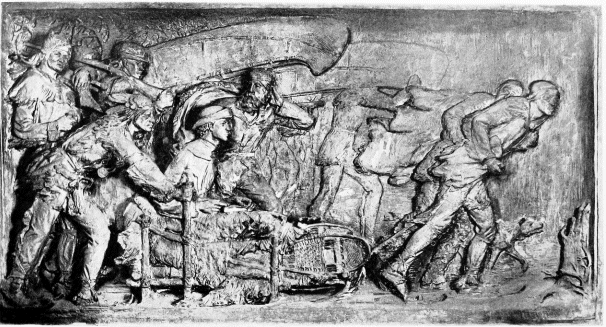
MARQUETTE AT THE CHICAGO PORTAGE
From the bas relief by H. A. MacNeil
(Courtesy of the Chicago Historical Society)
1673-1835
A STUDY OF THE EVOLUTION OF THE
NORTHWESTERN FRONTIER, TOGETHER
WITH A HISTORY OF FORT DEARBORN
By
Professor of History in the Lewis Institute
of Technology
THE UNIVERSITY OF CHICAGO PRESS
CHICAGO, ILLINOIS
Copyright 1913 By
The University of Chicago
All Rights Reserved
Published October 1913
Composed and Printed By
The University of Chicago Press
Chicago, Illinois, U.S.A.
PREFACE
There are many histories of Chicago in existence, yet none of
them supplies the want which has induced the preparation of the
present work. It has been written under the conviction that
there is ample justification for a comprehensive and scholarly
treatment of the beginnings of Chicago and its place in the evolution
of the old Northwest. I have endeavored to produce a
readable narrative without in any way trenching upon the principles
of sound scholarship. To what extent, if any, I have
succeeded must be for the reader to judge. I may, however,
claim the negative virtue of entire freedom from the motives of
commercial gain and family partisanship, which enter so largely
into our local historical literature.
In preparing the work I have made as diligent a study of the
sources as practicable, at the same time availing myself freely of
the studies of others in the same field. With one exception
acknowledgment of my obligations to the latter is made in the
footnotes. The manuscript of a lecture by the late Professor
Charles W. Mann on the Fort Dearborn massacre was put at
my disposal. I have used it as far as it served my purpose
without attempting to cite it in the footnotes.
In many places I have broken new ground and I can scarcely
expect my work to be entirely free from error. I am particularly
conscious of this in connection with chap, xiii on the Indian
Trade, a subject to which a volume might well be devoted. In
controversial matters I have written without fear or favor from
any source. If in many cases my conclusions seem to differ from
those of other writers, I can only say that the words of a recent
historian with reference to history writing in the Middle Ages,
"Recorded events were accepted without challenge, and the
sanction of tradition guaranteed the reality of the occurrence,"
apply with almost equal force to much of the literature pertaining
to early Chicago.
I desire to express my obligation for courtesies rendered,
or facilities extended, to the Chicago Historical Society, the
Wisconsin State Historical Society, the Detroit Public Library,
the Division of Manuscripts of the Library of Congress, the
Bureau of Indian Affairs, and the War Department. I am
indebted also for many favors to Miss Caroline McIlvaine,
librarian, and Mr. Marius Dahl, record clerk, of the Chicago
Historical Society; to Mr. C. M. Burton, of Detroit; to the
descendants of Nathan Heald, Mr. and Mrs. Thomas McCluer
and Mrs. Arthur McCluer, of O'Fallon, Mo., Mrs. Lillian Heald
Richmond and Dr. and Mrs. Ottofy of St. Louis, and Mr. and
Mrs. Wright Johnson, of Rutherford, N.J.; and to my wife and
to my father-in-law, Rev. G. W. Goslin, for unwearied assistance
in the preparation and revision of the manuscript. Finally I
wish to record my deep obligation to Dr. Otto L. Schmidt, president
of the Illinois State Historical Society, for much sympathetic
advice and encouragement.
The story of Chicago properly begins with an account of the
city's natural surroundings. For while her citizens have striven
worthily, during the three-quarters of a century that has passed
since the birth of the modern city, to achieve greatness for her,
it is none the less true that Nature has dealt kindly with Chicago,
and is entitled to share with them the credit for the creation of
the great metropolis of the present day. If in recent years the
enterprise of man rather than the generosity of Nature has
seemed chiefly responsible for the growth of Chicago, in the long
period which preceded the birth of the modern city such was not
the case; for whatever importance Chicago then possessed was
due primarily to the natural advantages of her position.
Since this volume is to tell the story of early Chicago, concluding
at the point where the life of the modern city begins, it
is not my purpose to dwell upon the natural advantages which
today contribute to the city's prosperity. Her central location
with respect to population, surrounded by hundreds of thousands
of square miles of country as fair, and supporting a population
as progressive, as any on the face of the globe; her contiguity
to the wheat fields of the great West; her situation in the heart
of the corn belt of the United States; the wealth of coal fields
and iron mines and forests poured out, as it were, at her feet;
her unrivaled systems of transportation by lake and by rail; how
all these factors, reinforced by the daring energy of her citizens,
have combined to render Chicago the industrial heart of the
nation is a matter of common knowledge. That in the days
before the coming of the railroad or the settler, when for hundreds
of miles in every direction the wilderness, monotonous and unbroken,
stretched away, inhabited only by the wild beast and
the wild Indian; when only at infrequent intervals were its
forest paths or waterways traversed by the fur trader or the
priest, the representatives of commerce and the Cross, the two
mightiest forces of the civilization before the advance of which
the wilderness was to give way; that even in this far-away
period Nature made of Chicago a place of importance and of
concourse, the rendezvous of parties bent on peaceful and on
warlike projects, is not so commonly understood.
The importance of Chicago in this early period was primarily
due to the fact of her strategic location, whether for the prosecution
of war or of commerce, at the head of the Great Lakes
on one of the principal highways of travel between the two
greatest interior waterway systems of the continent, those of the
Great Lakes-St. Lawrence and the Mississippi River. The two
most important factors in the exploration and settlement of a
country are the waterways and mountain systems—the one an
assistance, the other an obstacle, to travel.[1] The early English
colonists in America, settling first in Virginia and Massachusetts
and gradually spreading out over the Atlantic coastal plain,
were shut from the interior of the continent by the great wall
presented by the Allegheny Mountains. The French, securing
a foothold about the same time at the mouth of the St. Lawrence
River, found themselves in possession of a highway which
offered ready access into the interior. The importance of the
rivers and streams as highways of travel in this early period is
difficult to realize today. The dense forests which spread over
the eastern half of the continent were penetrated only by the
narrow Indian trail or the winding river. The former was passable
only on foot, and even by pack animals but with difficulty.[2]
The latter, however, afforded a ready highway into the interior,
and the light canoe of the Indian a conveyance admirably
adapted to the exigencies of river travel. By carrying it over
the portages separating the headwaters of the great river systems
the early voyageurs could penetrate into the heart of the
continent.
Proceeding up the St. Lawrence, the French colonists early
gained the Great Lakes. Their advance rested here for a time,
but in the last quarter of the seventeenth century, by a great
outburst of exploring activity, the upper waters of the Mississippi
were gained and eagerly followed to their outlet in the Gulf
of Mexico. Thus New France found a second outlet to the sea,
and thus, even before the English had crossed the Alleghenies,
the French had fairly encircled them, and planted themselves
in the heart of the continent. From the basin of the Great
Lakes to that of the Mississippi they early made use of five
principal highways.[3] On each, of course, occurred a portage at
the point where the transfer from the head of the one system of
navigation to the other occurred. One of these five highways
led from the foot of Lake Michigan by way of the Chicago River
and Portage to and down the Illinois. The Chicago Portage
thus constituted one of the "keys of the continent," as Hulbert,
the historian of the portage paths, has so aptly termed them.[4]
[3] Winsor, Narrative and Critical History of America, IV, 224.
[4] Hulbert, Portage Paths: The Keys of the Continent.
The comparatively undeveloped state of the field of American
historical research is well illustrated by the fact that despite
the historical importance of the Chicago Portage, no careful
study of it has ever been made. The student will seek in vain
for even an adequate description of the physical characteristics
of the portage. Winsor's description, a paragraph in length, is
perhaps the best and most authoritative one available.[5] Yet,
aside from its brevity, neither of the two sources to which he
makes specific reference can be regarded as reliable authorities
upon the Chicago Portage. Moll, the cartographer, notable
for his credulous temperament,[6] relied for his knowledge of the
Great Lakes region upon the discredited maps of Lahontan.[7]
James Logan, whose description of the portage is quoted,[8] was
a reputable official of Pennsylvania, but, in common with the
seaboard English colonists generally, his knowledge of the
geography of the interior was extremely hazy. This is sufficiently
shown by the fact that he located La Salle's Fort Miami,
which had stood during the brief period of its existence at the
mouth of the St. Joseph River, on the Chicago.
[5] "What Herman Moll, the English cartographer, called the 'land carriage of Chekakou'
is described by James Logan, in a communication which he made in 1718 to the English
Board of Trade, as running from the lake three leagues up the river, then a half a league
of carriage, then a mile of water, next a small carry, then two miles to the Illinois, and then
one hundred and thirty leagues to the Mississippi. But descriptions varied with the
seasons. It was usually called a carriage of from four to nine miles, according to the stage
of the water. In dry seasons it was even farther while in wet times it might not
be more than a mile; and, indeed, when the intervening lands were 'drowned,' it was quite
possible to pass in a canoe amid the sedges from Lake Michigan to the Des Plaines, and so
to the Illinois and the Mississippi."—Winsor, Mississippi Basin, 24. For similar descriptions
see Hulbert, Portage Paths, 181; Jesuit Relations, LIX, 313-14, note 41.
[7] Moll's map in his Atlas Minor is simply an English copy of Lahontan's map of 1703.
For the latter see Lahontan, New Voyages to North America (Thwaites ed.), I, 156.
[8] For the substance of Logan's report see the British Board of Trade report of September
8, 1721, printed in O'Callaghan, Documents Relative to the Colonial History of the State
of New York, V, 621. This will be cited henceforth as New York Colonial Documents.
That there should be confusion and misconception in the
secondary descriptions of the Chicago Portage is not surprising,
in view, on the one hand, of the unusual seasonal variations in
its character, and, on the other, of the dispute which very early
arose concerning it. None of the other portages between the
Great Lakes and the Mississippi—if indeed any in America—were
subject to such changes as this one. The dispute over its
character goes back to the beginning of the French exploration
of this region. When Joliet returned to Canada from his
famous expedition down the Mississippi in 1673, filled with
enthusiasm over his discoveries, he gave out a glowing account
of the country he had visited. In particular he seems to have
dwelt upon the ease of communication between the Great Lakes
and the Gulf of Mexico by way of the Chicago and Illinois
rivers to the Mississippi. Joliet's records were lost, but both
Frontenac, the governor of New France, and Father Dablon
have left accounts of his verbal report.[9] Frontenac stated
that a bark could go from the St. Lawrence to the Gulf of
Mexico, with only a portage of half a league at Niagara.
Dablon, who seems to have appreciated the situation more
intelligently than Frontenac, said that a bark could go from
Lake Erie to the Gulf if a canal of half a league were cut at the
Chicago Portage.
[9] Winsor, Cartier to Frontenac, 246-47; Jesuit Relations, LVIII, 105.
Probably Dablon's report represents more nearly than that
of Frontenac what Joliet actually said, for it seems unlikely
that he would ignore utterly the existence of the portage at
Chicago. Even so, however, his description of the ease of water
communication between the Great Lakes and the Mississippi
River was unduly optimistic. Its accuracy was sharply challenged
by La Salle upon his visit to Chicago several years later.
Joliet passed through Illinois but once, rather hurriedly, knowing
nothing of the country aside from what he learned of it
on this trip. He was ill-qualified, therefore, to describe accurately
the Illinois-Chicago highway and portage; at the most
he could describe only the conditions prevailing at the time of
his hasty passage. La Salle, on the other hand, was operating
in the Illinois country from 1679 to 1683, seeking to establish a
colony with its capital at the modern Starved Rock, one hundred
miles from Chicago. He was greatly interested in developing
the trade of this region, and, while he looked forward ultimately
to securing a southern outlet for it, for the present he must find
such outlet by way of Canada. In the course of his Illinois
career he passed between his colony and Canada several times,
and from both necessity and self-interest became thoroughly
familiar with the routes of communication which could be followed.
He himself ordinarily came by the Great Lakes to the
foot of Lake Michigan and thence by the St. Joseph River and
portage or the Chicago to the Illinois, but he became convinced
that it would not be practicable to carry on commerce between
his Illinois colony and Canada through the upper lakes, and that
a route by way of the Ohio River and thence to the lower lakes
and Canada was more feasible.
In discussing this subject La Salle was led to take issue with
Joliet as to the feasibility of navigation between Lake Michigan
and the Illinois, and so to state explicitly what the hindrances
were.[10] The goods brought to Chicago in barges must be
transshipped here in canoes, for, despite Joliet's assertions, only
canoes could navigate the Des Plaines for a distance of forty
leagues. At a later time La Salle reverted to this subject, and
in this connection gave the first detailed description we have of
the Chicago Portage.[11] From the lake one passes by a channel
formed by the junction of several small streams or gullies, and
navigable about two leagues to the edge of the prairie. Beyond
this at a distance of a quarter of a league to the westward is a
little lake a league and a half in length, divided into two parts by
a beaver dam. From this lake issues a little stream which,
after twining in and out for half a league across the rushes, falls
into the Chicago River, which in turn empties into the Illinois.
[10] Margry, Découvertes et établissements des Français dans l'ouest et dans le sud de
l'Amérique septentrionale, II, 81-82. This collection will be cited henceforth as Margry.
The "channel" was the main portion and south branch of
the modern Chicago River. The lake has long since disappeared
by reason of the artificial changes brought about by engineers;
in the early period of white settlement at Chicago it was known
as Mud Lake. La Salle's "Chicago River," into which Mud
Lake ordinarily drained, was, of course, the modern Des Plaines.
Continuing his description of the water route by way of the
Chicago and Des Plaines, La Salle pointed out that when the
little lake in the prairie was full, either from great rains in summer
or from the vernal floods, it discharged also into the "channel"
leading to Lake Michigan, whose surface was seven feet lower
than the prairie where Mud Lake lay. The Des Plaines, too,
in time of spring flood, discharged a part of its waters by way
of Mud Lake and the channel into Lake Michigan. La Salle
granted that at this time Joliet's proposed canal of half a league
across the portage would permit the passage of boats from Lake
Michigan to the sea. But he denied that this would be possible
in the summer, for there was then no water in the river as far
down as his post of St. Louis, the modern Starved Rock, where
at this season the navigation of the river began. Still other
obstacles to the feasibility of Joliet's proposed canal were pointed
out. The action of the waters of Lake Michigan had created a
sand bank at the mouth of the Chicago River which the force
of the current of the Des Plaines, when made to discharge into
the lake, would be unable to clear away. Again, the possibility
of a boat's stemming the spring floods of the Des Plaines, "much
stronger than those of the Rhone," was doubtful. But if all
other obstacles were surmounted, the canal would still have no
practical value because the navigation of the Des Plaines would
be possible for but fifteen or twenty days at most, in time of
spring flood; while the navigation of the Great Lakes was
rendered impossible by the ice until mid-April, or even later, by
which time the flood on the Des Plaines had subsided and that
stream had become unnavigable, even for canoes, except after
some storm.
Thus there was initiated by La Salle a dispute over the character
of the water communication from Lake Michigan to the
Mississippi by way of the Chicago Portage which has been
revived in our own day, and in the decision of which property
interests to the value of hundreds of thousands of dollars are
involved.[12] Of the essential correctness of La Salle's description
there can be no question. Considering its early date and
the many cares with which the mind of the busy explorer was
burdened, it constitutes a significant testimonial to his ability
and powers of observation. It may well be doubted whether
any later writer has improved upon—if, indeed, any has equaled—La
Salle's description of the Chicago-Des Plaines route.
From its perusal may be gathered the clue to the fundamental
defect in the descriptions of the Chicago Portage which modern
historians have given us. Overlooking the fact that the Des
Plaines River was subject to fluctuation to an unusual degree,
they err in assuming that the portage ceased when the Des
Plaines was reached. The portage was the carriage which must
be made between the two water systems. Hulbert is quite
right in saying, as he does, that none of the western portages
varied more in length than did this one.[13] In fact his words
possess far more significance than the writer himself attaches
to them; for the length of the carriage that must be made at
Chicago varied from nothing at all to fifty miles or, at times, to
even twice this distance. At times there was an actual union
of the waters flowing into Lake Michigan with those entering
the Illinois River, permitting the uninterrupted passage of
boats from the one system to the other. At other times the
portage which must be made extended from the south branch
of the Chicago to the mouth of the Vermilion River, some
fifty miles below the mouth of the Des Plaines.
[12]The United States of America vs. The Economy Light and Power Company. The
evidence taken in this case constitutes by far the most exhaustive study of the character
and historical use of the Chicago Portage that has ever been made.
It is doubtless true that "truth, crushed to earth, will rise
again," but the converse proposition of the poet that error dies
amid its worshipers requires qualification. Certainly in the
matter under discussion La Salle as early as 1683 dealt the errors
of Joliet with respect to the Chicago Portage a crushing blow.
Yet these self-same errors were destined to "rise again," and in
the early nineteenth century it was again commonly reported
that a practicable waterway from Lake Michigan to the Mississippi
could be attained by the construction of a canal a few
miles in length across what for convenience may be termed the
short Chicago Portage, from the south branch of the Chicago
River through Mud Lake to the Des Plaines. Even capable
engineers threw the weight of their opinion in support of this
fallacy.[14] But the young state of Illinois learned to her cost, in
the hard school of experience, the truth of La Salle's observations.
The canal of half a league extended in the making to a hundred
miles and required for its construction years of time and the
expenditure of millions of dollars.
[14]E.g., Major Stephen H. Long. For his report see the National Register, III, 103-98.
We may now consider the dispute between Joliet and La Salle
over the character of the Chicago Portage in the light of the
information afforded by the statements of later writers. It will
follow from what has already been said that the secondary
statements, whether of travelers or of gazetteers and other
compendiums of information, made in the early part of the
nineteenth century, must be subjected to critical examination.
The only way in which this may be done is by a resort to the
sources; and our conclusions concerning the Chicago-Illinois
Portage and route must be based upon the testimony of those
who actually used it, or were familiar with the use made of it by
others. A study of these sources makes it clear that the Des
Plaines River was subject to great fluctuation at different seasons,
or even as between periods of drought and periods of copious
rainfall, and that the length and character of the portage at any
given time depended entirely upon the stage of water in the
Des Plaines. During the brief period of the spring flood boats
capable of carrying several tons might pass between Lake
Michigan and the Des Plaines and along the latter stream without
meeting with obstacles other than those incident to the high
stage of the water. The extreme range of the fluctuation was
many feet.[15] Its effect upon the character of the Des Plaines
was to cause it to pass through all the gradations from a raging
torrent to a stream with no discharge, dry except for the pools
which marked its course. There were times, then, in connection
with these fluctuations, when the stream might be navigable
for canoes, although it would not permit the passage of boats
of greater draft.
[15] Schoolcraft estimated its depth in the seasons of periodical floods at eight to ten
feet (Summary Narrative of an Exploratory Expedition to the Sources of the Mississippi River,
in 1820, 398). See also Marquette's description of the spring flood of 1675, in Jesuit
Relations, LIX, 181.
The duration of the spring flood was put by La Salle at
fifteen or twenty days. At this time the flood was heavier than
that of the Rhone, and a portion of it found its way through
Mud Lake and the south branch of the Chicago River into
Lake Michigan. The effect of this on the portage, obvious in
itself, is described in many of the sources. Marquette, who
was flooded out of his winter camp on the South Branch in the
latter part of March, 1675, found no difficulty, aside from the
obstacles presented by the floating ice, in passing from that
point down the Des Plaines.[16] He reports the water as being
twelve feet higher than when he passed through here in the late
summer of 1673. In 1821, in a time of high water, Ebenezer
Childs passed up the Illinois and Des Plaines rivers to Chicago
in a small canoe.[17] No month or date is given for this trip,
but Childs expressly states that there had been heavy rains for
several days before his arrival at the Des Plaines. He was
unable to find any signs of a portage between the Des Plaines
and the Chicago. When he had ascended the former to a point
where he supposed the portage should begin he left it and taking
a northeasterly course perceived, after traveling a few miles,
the current of the Chicago. The whole intervening country
was inundated, and not less than two feet of water existed all the
way across the portage. Two years later Keating, the historian
of Major Long's expedition to the source of the St. Peter's
River, which passed through Chicago in early June, 1823, was
informed by Lieutenant Hopson, an officer at Fort Dearborn,
that he had crossed the portage with ease in a boat loaded with
lead and flour.[18] Of similar purport to the testimony of Childs
and Hopson is the account given by Gurdon S. Hubbard of his
first ascent of the Des Plaines with the Illinois "brigade" of the
American Fur Company in the spring of 1819.[19] The passage
from Starved Rock up the river to Cache Island against the heavy
current was difficult and exhausting. From this point, with a
strong wind blowing from the southwest, sails were hoisted and
the loaded boats passed rapidly up the Des Plaines and across
the portage to the Chicago, "regardless of the course of the
channel."
[18] Keating, Expedition to the Source of St. Peter's River, ... in the Year 1823, 1, 166.
[19]Hubbard, Gurdon Saltonstall, Incidents and Events in the Life of, 60. MS in the
Chicago Historical Society library. This work will be cited henceforth as Life.
With the subsidence of the spring flood the Des Plaines fell
to so low a stage as to become unnavigable, even by the small
boats ordinarily employed by the fur traders and travelers,
except at such times as the river was raised by rains. According
to La Salle, it was "not even navigable for canoes" except
after the spring flood, and it would be easier to transport goods
from Lake Michigan to Fort St. Louis by land with horses, than
by the use of boats on the river.[20]
This statement of La Salle is corroborated by many other
observers. St. Cosme's party of Seminary priests which passed
from Chicago down the Illinois in the early part of November,
1698,[21] was compelled to portage eight leagues or more[22] along
the Des Plaines, in addition to the three leagues across from the
Chicago to that stream, and almost two weeks were consumed
in passing from Chicago to the mouth of the Des Plaines, a
distance of about fifty miles.[23] In describing the journey St.
Cosme states that from Isle la Cache to Monjolly, a space of
seven leagues, "you must always make a portage, there being
no water in the river."
[21] Shea, Early Voyages Up and Down the Mississippi, 45 ff.
[22] The distances given in St. Cosme's detailed account total this amount. La Source's
general statement is that the party portaged fifteen leagues (ibid., 83), but this, apparently,
included the distance between the Chicago River and the Des Plaines.
[23] The party left Chicago October 29, and reached the mouth of the Des Plaines
November 11.
In September, 1721, Father Charlevoix, touring America
for the purpose of reporting to his king the condition of New
France, came to the post of St. Joseph. His ultimate destination
was lower Louisiana; from St. Joseph to the Illinois River
proper two alternative routes were presented for his consideration,
the one by way of the St. Joseph Portage and down the
Kankakee River, the other around the southern end of Lake
Michigan to Chicago and thence down the Des Plaines. His
first intention was to follow the latter, but this was abandoned
in favor of the route by the Kankakee, partly because of a storm
on Lake Michigan, but also for the additional reason that since
the upper Illinois, the modern Des Plaines, was a mere brook, he
was told it did not have, at this season, water enough to float a
canoe.[24] In his passage down the Kankakee the traveler
observed at the mouth of the Des Plaines a buffalo crossing the
stream. Although sixty leagues from its source, Charlevoix
noted that the Des Plaines was still so shallow that the water
did not rise above the middle of the animal's legs.[25]
[24] Charlevoix, Histoire et description génerale de la Nouvelle France, avec le journal
historique d'un voyage fait par ordre du roi dans l'Amérique septentrionale, VI, 104.
A hundred years after Charlevoix's passage down the Illinois,
in midsummer, 1821, Governor Cass and Henry R. Schoolcraft
came up that stream in a large canoe en route for Chicago. The
observant Schoolcraft has left a careful and detailed narrative
of their experiences, and a description of the Illinois River as
continued in the Des Plaines.[26] The party was compelled to
abandon the canoe at Starved Rock, and the remainder of the
journey to Chicago was made on horseback. The route taken
was in general along the banks of the river, although the actual
channel was observed only occasionally. The result of this
observation was the conclusion that the "long and formidable
rapids" seen by the travelers completely intercepted navigation
at this sultry season. This conclusion was further confirmed
by meeting several traders on the plains who were transporting
their goods and boats in carts from the Chicago River. They
thought it practicable to enter the Des Plaines at Mount Joliet,
thus necessitating a portage of about thirty miles, but Schoolcraft
in recording this opinion points out that his own party
had experienced difficulties far below this point. Although
himself an enthusiast on the subject of the future commercial
importance of Chicago, and of the utility of a canal connecting
the Chicago and Illinois rivers, Schoolcraft's experience on this
journey led him to call attention to the error of those who
supposed a canal of only eight or ten miles in length would be
sufficient to provide a navigable highway between Lake Michigan
and the Illinois. This opinion was approved by Thomas
Tousey of Virginia, another enthusiast on the subject of the
canal, who explored the route of the Des Plaines on horseback
in the autumn of 1822.[27] Although the water was uncommonly
high for the season, Tousey's investigation, while imbuing
him with a "more exalted" opinion of the country and the proposed
canal communication, convinced him that it would be
attended with greater expense to open than he had formerly
supposed.
[26] Schoolcraft, Travels in the Central Portions of the Mississippi Valley, 313 ff.
[27] Schoolcraft, Personal Memoirs of a Residence of Thirty Years with the Indian Tribes
on the American Frontiers, 179-80.
The conditions encountered by John Tanner in a journey
from Chicago down the Illinois River in the year 1820[28] were
similar to those described by Schoolcraft the following year.
Tanner was traveling from Mackinac to St. Louis in a birch-bark
canoe. Some Indians who were accompanying him
turned back before reaching Chicago, on receiving from others
whom they met discouraging accounts of the stage of the water
in the Illinois. Tanner, however, persevered in his enterprise.
After a period of illness at Chicago he engaged a Frenchman,
who had just returned from hauling some boats across the portage,
to take him across also. The Frenchman agreed to transport
Tanner sixty miles, and if his horses, which were much worn
from the previous long journey, could hold out, one hundred and
twenty miles, the length of the portage at the present stage
of water. With his canoe in the Frenchman's cart and Tanner
himself riding a horse belonging to the latter, the overland
journey began. Before the first sixty-mile stage had been
completed the Frenchman became ill. He turned back, therefore,
and Tanner and his one companion attempted to put their
canoe in the water and continue their journey. The water was
so low that the members of the party themselves were compelled
to walk, the men propelling the canoe by walking, one at the
bow and the other at the stern. After three miles had been
laboriously traversed in this fashion a Pottawatomie Indian
was engaged to take the baggage and Tanner's children on horseback
as far as the mouth of the Yellow Ochre River,[29] while
Tanner and his companion continued to propel the now lightened
canoe as before. On reaching the Yellow Ochre a sufficient
depth of water was found to permit the further descent of the
Illinois in the loaded canoe.
[28]Narrative of the Captivity and Adventures of John Tanner, 256-59. This work will
be cited henceforth as Tanner's Narrative.
[29] The similarity of names and distance from Chicago render it probable that Tanner
here refers to the Vermilion River.
Perhaps the most interesting account of the passage of the
portage in the dry season, and in some respects the most detailed,
is the one contained in the autobiography of Gurdon S. Hubbard.[30]
Beginning with 1818, for several years, with a single
exception, Hubbard accompanied the Illinois "brigade" of the
American Fur Company on its annual autumnal trip from Mackinac
by way of Lake Michigan and the Chicago Portage to the
lower Illinois River. Only the first crossing of the portage, in
October, 1818, is described in detail. Leaving Chicago the party,
comprising about a dozen boat crews, camped a day on the
South Branch near the present commencement of the Illinois and
Michigan Canal, preparing to pass the boats through Mud Lake
to the Des Plaines. Mud Lake drained both ways, into the
Des Plaines, and through a narrow, crooked channel into the
South Branch, and only in very wet seasons, Hubbard states,
did it contain water enough to float an empty boat. The mud
was very deep and the lake was surrounded by an almost impenetrable
growth of wild rice and grass.
From the South Branch the empty boats were pulled up the
channel leading from Mud Lake. In many places where there
was a hard bottom and absence of water they were placed on
short rollers, and in this way were propelled along until the lake
was reached. Here mud, thick and deep, was encountered, but
only at rare intervals was there any water. Four men stayed
in the boat while six or eight more waded in the mud alongside.
The former were equipped with boat-poles to the ends of which
forked branches of trees had been fastened. By pushing with
these against the hummocks, while the men in the mud lifted
and shoved, the boat was jerked along. The men in the mud
frequently sank to their waists, and at times were forced to cling
to the boat to prevent going over their heads. Their limbs
were covered with bloodsuckers which caused intense agony
for several days, and sleep at night was rendered hopeless by
the swarms of mosquitoes which assailed them. Yet three
consecutive days of toil from dawn until dark under such conditions
were required to pass all the boats through Mud Lake and
reach the Des Plaines River.
The passage down the Des Plaines and the Illinois as far as
the mouth of Fox River consumed almost three weeks more.
Until Cache Island was reached the journey was comparatively
easy, although even in this portion of the Des Plaines progress
was frequently interrupted by the necessity of making portages
or passing the boats along on rollers.[31] From Cache Island to
the Illinois River the goods were carried on the men's backs
most of the way, while the lightened boats were pulled over the
shallow places, often being placed on poles and thus dragged
over the rocks and shoals. In the autumn of 1823 Hubbard
was sent to a post on the Iroquois River. To shorten his journey
and "avoid the delays and hardships of the old route by way
of Mud Lake and the Des Plaines" he resolved to travel to his
destination by way of the St. Joseph Portage and the Kankakee
River. A year later he was placed in charge of the Illinois
River posts of the American Fur Company. He thereupon
proceeded to execute a plan he had long urged upon his predecessor.
The boats were unloaded on their return from Mackinac
to Chicago, and scuttled in the swamp to insure their safety
until they should be needed for the return voyage to Mackinac
laden with furs the following spring. The goods and furs were
transported between Chicago and the Indian hunting-grounds
on pack horses. Thus "the long, tedious, and difficult passage"
through Mud Lake into and down the Des Plaines was avoided.
It is evident, then, that the chief factor in determining the
character and length of the Chicago Portage was the Des Plaines
River, and that during a large part of the year the portage that
must be made extended much farther than simply from the
Chicago to the Des Plaines. Schoolcraft and Cass in 1821
were compelled to abandon their canoe at Starved Rock, almost
one hundred miles from Chicago. The traders whom they
met in the course of their horseback journey were apparently
planning to put their boats into the Des Plaines at Mount
Joliet, after a portage of thirty miles. Whether, in view of
Schoolcraft's own experience, they succeeded in entering the
river at this point may well be doubted. The transcript of
names from the account books kept by John Kinzie at Chicago[32]
contains several entries of charges for assisting traders over the
portage; some of these show that the portage was made from
Mount Joliet, while one, in June, 1806, shows that it extended to
the "forks" of the Illinois. Tanner's experience presents the
extreme example, if his statement of distances can be relied on,
of a portage of one hundred and twenty miles.[33] The varying
length of the portage necessary at different seasons is well
described in an official report made in 1819 by Graham and
Phillips.[34] At one season there is an uninterrupted water communication
between Lake Michigan and the Mississippi; at
another season a portage of two miles; at another a portage of
seven miles, from the Chicago River to the Des Plaines; and at
still another, a portage of fifty miles, extending to the mouth of
the Des Plaines.
[32] Barry, Rev. Wm., Transcript of Names in John Kinzie's Account Books, MS in the
Chicago Historical Society library. This will be cited henceforth as the Barry Transcript.
[33] If, as suggested above, the Yellow Ochre was the same stream as the Vermilion
River, the distance from Chicago to its mouth was about one hundred miles.
[34]State Papers, Doc. No. 17, 16th Congress, 1st Sess. Senator Benton claimed in 1847
that he had written this report from data supplied him by Graham and Phillips (Niles'
Register, LXXII, 309).
These fluctuations in the state of the Des Plaines and in the
length of the portage influenced materially the plans of the
traders and travelers who had occasion to traverse this route.
For obvious reasons in times when the Des Plaines was known
to be low and the portage correspondingly long the Chicago
route would be avoided if practicable. Thus Charlevoix preferred
the Kankakee to it in 1721. A hundred years later, the
Indians who had set out with Tanner upon learning of the low
stage of the water in the Illinois, abandoned the journey and
returned to their homes. St. Cosme's party in 1698 sought to
reach the Illinois from Lake Michigan by the Root and Fox
rivers, desisting from the effort only under the belief that this
would necessitate a portage of forty leagues. Compelled to
follow the Chicago route, the prospect of the long and difficult
passage down the Des Plaines to navigable water on the Illinois
induced them to leave all of their goods but one boat-load at
Chicago in charge of a member of the party. This made necessary
a return from the lower Mississippi for them the following
spring, but even this was preferred to the arduous undertaking of
transporting them over the long portage at Chicago in the dry
season.
More significant, perhaps, is the fact that those who had
occasion to cross the Chicago Portage, and were informed concerning
the seasonal fluctuations of the Des Plaines, planned
their business so as to take advantage, as far as possible, of the
seasons of high water. Colonel Kingsbury, who in 1805 conducted
a company of soldiers from Mackinac to the Mississippi
by way of the Illinois River to establish Fort Belle Fontaine,
was ordered to proceed to Chicago with them on the first vessel
in the spring.[35] The Illinois River traders in the employ of the
American Fur Company in the period from 1818 to 1824 so
planned their business as to bring their boats laden with furs
up the Des Plaines in the season of the spring flood.
[35] Cushing to Lieutenant-colonel Kingsbury, February 20, 1805. This letter belongs
to the collection of letter books, letters, and other papers of Jacob Kingsbury in the Chicago
Historical Society library. Kingsbury was in command of Detroit, Mackinac, and other
northwestern posts from 1804 on, and for a time was the superior authority in charge of a
group of posts including Fort Wayne, Fort Dearborn, Mackinac, and Detroit. His letters
and papers constitute a source of prime importance for this period of northwestern history.
They will be cited henceforth as the Kingsbury Papers.
La Salle had early contended that it was more feasible to
transport goods between Chicago and Starved Rock with horses
than by boats on the river. There arose very early a demand
for another means of transportation between the two places at
such times as the use of the Des Plaines in boats was impracticable,
whether from excess or from deficiency of water. Lahontan
represents, in his famous narrative of his Long River expedition,[36]
that he returned by way of the Illinois River and Chicago
Portage. To lessen the drudgery of "a great land carriage of
twelve great leagues," he engaged four hundred Indians to
transport his baggage from the Illinois village to Lake Michigan,
"which they did in the space of four days." Historians have
long agreed in denouncing the pretended Long River discovery
as fraudulent, but there is nothing improbable about the statement
of the necessity of a land carriage of twelve great leagues
at the Chicago Portage.
Whether Lahontan ever in fact employed four hundred
Indians to transport his baggage over the Chicago Portage
may well be doubted; but that other travelers employed Indians
in a similar capacity is certain. The companions of Cavelier,
La Salle's brother, who passed from Fort St. Louis to Lake
Michigan in September, 1687, employed a dozen Shawnee Indians
to carry their goods to the lake, because there was no water in
the river at this season of the year.[37] Unable to make their way
from Chicago to Mackinac they returned to the fort to pass the
winter. In this same autumn of 1687, some Frenchmen en route
from Montreal to Fort St. Louis with three canoes loaded with
merchandise and ammunition were halted at Chicago on account
of lack of water in the Des Plaines.[38] Upon information of this
being brought to Tonty he engaged the services of forty Shawnee
Indians, women and men, by whom the goods were transported
to the fort.
When horses were first employed on the Chicago Portage cannot,
of course, be stated. We have seen that La Salle advocated
their employment, but he himself was never in a position to use
them. That such use began very early, however, is indicated
by a tradition preserved by Gurdon S. Hubbard of an adventure
of a trader named Cerré on the Des Plaines.[39] The Indians
sought to force him to pay toll to them, but he defied them;
the controversy ended happily, however, and the Indians transported
Cerré's goods on their pack horses from Cache Island
to the mouth of the Des Plaines. The date of this incident is
not recorded, but Cerré first came into the Illinois country in
1756. If the Indians were accustomed thus early to use pack
horses to transport the goods of travelers it is not improbable
that the practice may have originated long before.
The demand for transportation facilities at the portage was
thus coeval with the advent of the French in this region. In
the early nineteenth century the satisfaction of this demand
afforded employment and a livelihood to some of the inhabitants
of Chicago. The transporting of travelers and their baggage
across the portage formed part of the business of John Kinzie.
That it was Ouilmette's principal occupation, at least for a considerable
period, seems probable.[40] Major Stoddard stated in
1812 concerning the Chicago Portage that in the dry season
boats and their cargoes were transported across it by teams kept
at Chicago for this purpose.[41] Several years later Graham and
Phillips reported that there was a well-beaten road from the
mouth of the Des Plaines to the lake, over which boats and
their loads were hauled by oxen and vehicles kept for this purpose
by the French settlers at Chicago.[42] Schoolcraft and Cass
procured horses to convey them to Chicago from the point
near Starved Rock where they abandoned their canoe. John
Tanner's narrative shows that the Frenchman who carried him
a distance of sixty miles from Chicago to the Illinois River in the
preceding year was commonly engaged in this business. Probably
this man was Ouilmette, although Tanner does not give his
name. If it was someone other than Ouilmette, it is evident
that at least two Chicago residents were engaged in this business.
[40] See Post, pp. 143-44; Tanner's Narrative, 257; Barry Transcript.
[41] Stoddard, Sketches, Historical and Descriptive, of Louisiana, 368 ff.
The project of Joliet of a canal to connect Lake Michigan
with the Illinois River was revived early in the nineteenth
century. After numerous investigations and reports had been
made, the work of construction was at last begun, amid great enthusiasm,
in the year 1836. Twelve years later the Illinois and
Michigan Canal was completed, and therewith the Chicago
Portage ceased to be. Even without the construction of the
canal its old importance and use were about to terminate.
The advance of white settlement sounded the death knell of the
fur trade. With the advent of the railroad, trade and commerce
sought other channels and another means of transportation.
The waterways lost their old importance and the Chicago
Portage passed into history. Ere this time, however, the New
Chicago had been born and her future, with its marvelous possibilities,
was secure.
CHAPTER II CHICAGO IN THE SEVENTEENTH CENTURY
It seems quite probable that Chicago was an important
meeting-place for Indian travelers long before the first white
men came to the foot of Lake Michigan. The portage of the
Indian preceded the canoe of the white man, and the Indian
trail was the forerunner of the white man's road. Who the
first white visitor to Chicago was cannot be stated with certainty.
The chief incentive to the exploration of the Northwest
was the prosecution of the fur trade, and it is probable
that wandering coureurs de bois had visited this region in
advance of any of the explorers who have left us records of
their travels. Coming to the domain of recorded history we
encounter, on the threshold as it were, the master dreamer and
empire builder, La Salle.
Already interested in the subject of western exploration, in
the summer of 1669 he set out from his estate of Lachine in search
of a river which flowed to the western sea.[43] His course to the
western end of Lake Ontario is known to us, but from this point
his movements for the next two years are involved in mist and
obscurity. It is believed by some that he descended the Ohio
to the Mississippi in 1670, and that the following year he traversed
Lake Michigan from north to south, crossed the Chicago
Portage, and descended the Illinois River till he again reached
the Mississippi. But the claim that he reached the Mississippi
during these years is rejected by most historians. Probably
the exact facts as to his movements at this time will never
be known. We are here interested, however, primarily in
the question whether he came to the site of Chicago. Even
this cannot be stated with certainty, but the preponderance of
opinion among those best qualified to judge is that he probably
did.[44]
[43] For this expedition and the subsequent movements of La Salle see Winsor, Cartier
to Frontenac; Parkman, La Salle and the Discovery of the Great West; Winsor, Narrative and
Critical History, IV, 201 ff.
[44] Margry was convinced of this and Parkman thought it entirely probable. Winsor
thought that La Salle came to the head of Lake Michigan, but was in doubt whether he
entered the Chicago River or the St. Joseph. Shea, who constantly belittles La Salle's
achievements, believed he "reached the Illinois or some other affluent of the Mississippi."
See the references given in note 43.
The pages of history might be scanned in vain for a more
fitting character with which to begin the annals of the great
city of today. La Salle is noted, even as it is noted, for boundless
energy, lofty aspiration, and daring enterprise. He combined
the capacity to dream with the resolution to make his
visions real. "He was the real discoverer of the Great West,
for he planned its occupation and began its settlement; and he
alone of the men of his time appreciated its boundless possibilities,
and with prophetic eye saw in the future its wide area
peopled by his own race."[45]
[45] Edward G. Mason, "Early Visitors to Chicago," in New England Magazine, New
Ser., VI, 189.
In strong contrast with the masterful La Salle succeeds, in
the early annals of Chicago, the gentle, saintly Marquette.
For a number of years vague and indefinite reports had been
carried to Canada of the existence, to the west of the Great
Lakes, of a "great river" flowing westwardly to the Vermilion
Sea, as the Gulf of California was then known. These reports
roused in the French the hope of finding an easy way to the
South Sea, and thence to the golden commerce of the Indies.
Spurred on by the home government Talon, the intendant
of Canada, took up the project of solving the problem of the
great western river.[46] It chanced that for several years Marquette,
a Jesuit missionary, had been stationed on the shore
of Lake Superior. Here he heard from his dusky charges
stories of the great river and of the pleasant country to the
westward. In consequence he became imbued with the double
ambition of solving the geographical question of the ultimate
direction of the river's flow, and of seeking in this new region a
more fruitful field of labor.[47] In the summer of 1672 Talon
appointed Louis Joliet, a young Canadian who had already
achieved something of a reputation as an explorer, to carry out
the new task, and the projected exploration of the great river
was launched. Joliet proceeded that autumn to Mackinac—the
Michilimackinac of the French period—where he spent the
winter preparing for the enterprise. Hither Marquette had
come two years before, and here he had established the mission
of St. Ignace. Proximity and a common interest in the projected
enterprise combined to draw the two together; so that when the
expedition set out from Mackinac in May, 1673, the party was
composed of Joliet, Marquette, and five companions. Though
Joliet was the official head of the expedition, it has come about,
through the circumstance that his records were lost almost at
the end of his toilsome journey, that we are chiefly indebted to
the journal of Marquette for our knowledge of it, and have come
insensibly to ascribe the credit for it to him.
From Mackinac the party passed, in two canoes, to the head
of Green Bay, and thence by way of the Fox-Wisconsin River
route to the Mississippi, which was reached a month after the
departure from the mission of St. Ignace.[48] Down its broad
current the voyagers paddled and floated for another month.
Arrived at the mouth of the Arkansas, they were told by the
natives that the sea was distant but ten days' journey, and that
the intervening region was inhabited by warlike tribes, equipped
with firearms, and hostile to their entertainers. This information
led the explorers to take counsel concerning their further
course. Deeming it established beyond doubt that the river
emptied into "the Florida or Mexican Gulf," and fearful of
losing the fruits of their discovery by falling into the hands of
the Spaniards, they decided to turn about and begin the homeward
journey.
[48] Marquette's Journal of the expedition is printed in Jesuit Relations, Vol. LIX.
For standard secondary accounts see the works of Parkman and Winsor.
On reaching the mouth of the Illinois they learned that they
could shorten their return to Mackinac by passing up that river.
A pleasing picture is drawn by Marquette of the country through
which this new route led them. They had seen nothing comparable
to it for fertility of soil, for prairies, woods, "cattle,"
and other game. The Indians received them kindly, and obliged
Marquette to promise that he would return to instruct them.
Under the guidance of an Indian escort the voyagers passed,
probably by way of the Chicago Portage and River,[49] to Lake
Michigan, whence they made their way to Green Bay by the
end of September.
[49] It was the contention of Albert D. Hagar, a former secretary of the Chicago Historical
Society, that on both this expedition and that of 1675 Marquette passed from the
Des Plaines River to Lake Michigan by way of the Calumet Portage and River. (Andreas,
History of Chicago, I, 46.) The evidence, however, seems to me to point to the route by
way of the Chicago Portage and River. Hagar's argument is refuted by Hurlbut in Chicago
Antiquities, 384-88.
The following year Joliet continued on his way to Quebec
to report to Count Frontenac the results of his expedition.
Marquette remained at Green Bay, worn down by the illness
that was shortly to terminate his career. In the autumn of
1674, the disease having temporarily abated, he undertook the
fulfilment of his promise to the Illinois Indians to return and
establish a mission among them. Late in October he began the
journey,[50] accompanied by two voyageurs, Pierre Porteret and
Jacques, one of whom had been a member of the earlier expedition.
The little party was soon increased by the addition of a
number of Indians, and all together made their way down Green
Bay and the western shore of Lake Michigan, to the mouth of
the "river of the portage"—the Chicago. Over a month had
been consumed in the journey, owing to frequent delays caused
by the stormy lake. The river was frozen to the depth of half
a foot and snow was plentiful. Ten days were passed here, when,
Marquette's malady having returned, a camp was made two
leagues up the river, close to the portage, and it was decided to
spend the winter there. Thus began in December, 1674, the
first extended sojourn, so far as we have record, of white men on
the site of the future Chicago. There has been much loose
writing concerning the character of their habitation. Even
Parkman states that they constructed a "log hut," and other
writers have made similar assertions. There is no warrant for
this in the original documents, and all the circumstances of the
case combine to render it improbable.[51] Marquette was too
sick to travel, and he had but two companions to assist him.
They made two camps, one at the entrance of the river, and
the other, a few days later, at the portage. It was already the
dead of winter, and they could not have been equipped with
heavy tools. It seems entirely probable that in place of a
"log hut" they constructed the customary Indian shelter or
wigwam.[52]
[50] For Marquette's Journal of this expedition see Jesuit Relations, Vol. LIX. Parkman
and Winsor have written standard secondary accounts.
Marquette found that two Frenchmen had preceded him in
establishing themselves in the Illinois country. He designates
them as "La Taupine and the surgeon," and says that they were
stationed eighteen leagues below Chicago, "in a fine place for
hunting cattle, deer, and turkeys."[53] They were supplied with
corn and other provisions, and were engaged in the fur trade.
Apparently their location was selected either because it was
"a fine place for hunting," or else because of its advantages as a
trading station, for it is evident from the narrative that they
were in close proximity to the Indians.
[51] The French word used by Marquette, cabannez, was commonly employed, whether
as a verb or a noun, to designate the ordinary temporary encampment of travelers and the
wigwam of the Indian. In Marquette's Journal of his first expedition (Jesuit Relations,
LIX, 146), the word is used to designate the cover of sailcloth erected over the voyagers'
canoes to protect them from the mosquitoes and the sun while floating down the Mississippi.
Later, on the second expedition, when Marquette, hastening along the eastern shore of
Lake Michigan toward Mackinac, found himself at the point of death, his companions hastily
landed and constructed a "wretched cabin of bark" to lay him in (ibid., 194). Numerous
other instances of the habitual use of the word to indicate a temporary camp might easily
be cited.
[52] For a further development of this subject see H. H. Hurlbut's pamphlet, Father
Marquette at Mackinac and Chicago, 13-14.
Who were these French pioneers of the upper Illinois Valley?
We know concerning La Taupine—the mole—that he was a
noted fur trader whose real name was Pierre Moreau;[54] that
he was an adherent of Count Frontenac, the governor of New
France; and that he was accused by the intendant with being
one of the Governor's agents in the prosecution of an illicit
trade with the Indians. He had been with St. Lusson at the
Sault Ste. Marie in 1671, and doubtless was possessed of all the
information current among the French concerning the region
beyond the Great Lakes. In what year he pushed out into
this region and established the first habitation and business of
a white man in northern Illinois will probably forever remain
unknown.
[54]Ibid., 314; Mason, "Early Visitors to Chicago," cited in note 45.
The little that Marquette tells us of the companion of La
Taupine serves only to whet our curiosity. Though these first
residents were lawbreakers, they were not without redeeming
qualities. In anticipation, apparently, of Marquette's arrival
at their station they had made preparations to receive him, and
had told the savages "that their cabin belonged to the black
robe."[55] As soon as they learned of the priest's illness at Chicago
the surgeon came, in spite of snow and bitter cold,[56] a distance
of fifty miles to bring him some corn and blueberries. Marquette
sent Jacques back with the surgeon to bear a message to
the Indians who lived in his vicinity, and the traders loaded
him, on his return, with corn and "other delicacies" for the
sick priest. Furthermore, the surgeon was a devout man, for
he spent some time with Marquette in order to perform his
devotions. Clearly here is a character who improves with
closer acquaintance. But such acquaintance is denied us. As
a ship passing in the night the surgeon flashes across Chicago's
early horizon; whence he came, whither he went, even his name
will doubtless remain forever a mystery.
[56] The Journal records that the Indians were suffering from hunger because the cold
and snow prevented them from hunting.
Meanwhile, how fared the winter with the three Frenchmen
in their primitive camp near the portage? The picture of their
life as painted in the pages of Marquette's Journal is not, on the
whole, unattractive. The fraternal spirit manifested for them
by the traders has already been noted. The Indians were
equally friendly. When those living in a village six leagues
away learned of Marquette's plight, they were so solicitous for
his welfare, and so fearful that he would suffer from hunger,
that, notwithstanding the cold, Jacques had much difficulty
in preventing the young men from coming to the portage to
carry away to their village all Marquette's belongings.
The Indians' fears, however, proved groundless. Deer and
buffalo abounded, partridges, much like those of France, were
killed, and turkeys swarmed around the camp. The traders
sent corn and blueberries, and the Indians brought corn, dried
meat, and pumpkins. The severe winter produced its effect
upon the game, some of the deer that were killed being so lean
as to be worthless. But "the Blessed Virgin Immaculate,"
Marquette's celestial queen, took such care of them that there
was no lack of provisions, and when the camp was broken up
in the spring there was still on hand a large sack of corn and a
supply of meat.
An intense spirit of religious devotion animated Marquette
throughout the winter. It was his zeal in the service of his
Heavenly Master that had led him, in his illness, to brave the
rigors of a winter in the wilderness. Despite his bodily affliction,
the observance of religious exercises was maintained.
Mass was said every day throughout the winter, but they were
able to observe Lent only on Fridays and Saturdays. On
December 15 the mass of the Conception was celebrated. Early
in February a novena, or nine days' devotion to the Virgin, was
begun, to ask God for the restoration of Marquette's health.
Shortly afterward his condition improved, in consequence, as
he believed, of these devotions. An opportunity to give his
religion a practical application was afforded him in the latter
part of January. A deputation of Illinois Indians came bringing
presents, in return for which they requested, among other
things, a supply of powder. Marquette refused this, saying
he had come to instruct them and to restore peace, and
did not wish them to begin a war with their neighbors, the
Miamis.
Toward the end of March the ice began to thaw, but on
breaking up it formed a gorge, causing a rapid rise in the river.
The camping-place was suddenly flooded, the occupants having
barely time enough to secure their goods upon the trees. They
themselves spent the night on a hillock, with the water steadily
gaining upon them. The following day the gorge dissolved,
the ice drifted away, and the travelers prepared to resume their
journey to the village of the Illinois.
Eleven days were consumed in this journey, during which
Marquette suffered much from illness and exposure.[57] According
to Father Dablon he was received by the Indians "as an
angel from Heaven." He preached to them and established
his mission, and then, feeling the hand of death upon him,
began his return journey to the distant mission of St. Ignace.
[57] Marquette's Journal ends abruptly at this point, his last entry being made on April
6 while the little party was waiting at the Des Plaines River for the subsidence of the ice
and the cold winds to permit them to descend. For the remainder of the story we are
indebted to the narrative of Father Dablon, Marquette's superior, whose information was
derived from the two companions of Marquette. Dablon's narrative is printed in Jesuit
Relations, Vol. LIX.
And now we come to what may be regarded as the next
scene in the annals of Chicago. A crowd of the Illinois accompanied
Marquette, as a mark of honor, for more than thirty
leagues, vying with each other in taking charge of his slender
baggage. Then, "filled with great esteem for the gospel,"
they took leave of him, and continuing his journey he shortly
afterward reached Lake Michigan.[58] The route followed from
this point was by way of the eastern side of the lake. But the
missionary's life was to terminate sooner than the voyage.
On May 19 he died, on the lonely shore of the lake, and was
buried near the mouth of a small river in the state of Michigan
which was long to bear his name.
[58] The route followed by Marquette and his escort from the Illinois village to Lake
Michigan is not certainly known. From the fact that after reaching the lake Marquette
sought to reach Mackinac by following around its eastern shore, it has been argued that
he ascended the Kankakee to reach Lake Michigan. The evidence seems to me, however,
to favor the route by the Des Plaines and Chicago. Marquette had gone this way on the
return from his first expedition, and had returned to the Illinois the same way. If he now
followed this route, the thirty leagues which the Indians accompanied him would have
brought them to the vicinity of the portage between the Des Plaines and the Chicago.
In the period when travel was chiefly by water portages were natural meeting (and parting)
places. The one argument in support of the Kankakee route is the fact that the further
route of the party was along the eastern shore of the lake. But this fact does not obviate
the possibility of a return to the lake by the Des Plaines and Chicago. Furthermore, by
the Kankakee route from the point where the Indians turned back Marquette would still
have to travel upward of one hundred and fifty miles to reach the lake. Yet the narrative
states that he reached it "shortly after" they left him—a statement which harmonizes
with the supposition that the leave-taking occurred at or near the Chicago Portage. For
these reasons I have chosen to consider this an event in early Chicago history.
A successor to Marquette at the mission of the Illinois was
found in the person of Father Claude Allouez, who was then
stationed at the mission of St. Francis Xavier at Green Bay.
In October, 1676, with two companions he set out in a canoe
for his new field of work.[59] The winter closed down early,
however, and before they had proceeded far they were compelled
to lie over until February with some Pottawatomie Indians.
Then they proceeded once more, in a way "very extraordinary";
for instead of putting the canoe into the water, they placed it
upon the ice, over which a sail and a favoring wind "made it
go as on the water." When the wind failed they drew it along
by means of ropes. New obstacles to their progress arose,
however, so that not until April did they enter "the river which
leads to the Illinois." At its entrance they were met by a band
of eighty Illinois Indians who had come from their village to
welcome Allouez. The ceremony of reception which ensued
may well be set forth in the words of the missionary himself,
in whose honor it was staged.
[59] The narrative of Allouez is printed in Jesuit Relations, Vol. LX. The quotations
from it which follow are from the Thwaites translation there given.
"The captain came about 30 steps to meet me, carrying in
one hand a firebrand and in the other a Calumet adorned with
feathers. Approaching me, he placed it in my mouth and
himself lighted the tobacco, which obliged me to make a pretense
of smoking it. Then he made me come into his Cabin,
and having given me the place of honor, he spoke to me as follows:
'My Father, have pity on me; suffer me to return with thee,
to bear thee company and take thee into my village. The meeting
I have had today with thee will prove fatal to me if I do not
use it to my advantage. Thou bearest to us the gospel and the
prayer. If I lose the opportunity of listening to thee, I shall
be punished by the loss of my nephews, whom thou seest in so
great number; without doubt, they will be defeated by our
enemies. Let us embark, then, in company, that I may profit
by thy coming into our land.'"
It is not to be supposed that the exact words of the "Captain"
have been preserved, though it may well be that the general
tenor of his remarks is here set forth. The speech concluded,
they set out together, and "shortly after" arrived at the Chief's
abode. We have no clue, further than this, to the location of
the Indian camp. Probably it was in the vicinity of the portage;
for aside from the fact that this furnished a logical stopping-place
Marquette tells us that during his sojourn here, two years
before, Indians were encamped in his vicinity during a portion
of the winter.
After a brief stay among the Indians on the Illinois, where
his labors met with great success, Allouez left them, returning
again the next year. We have no details of these journeys, however,
and our next account of the presence of white men in this
region involves us in the schemes and deeds of the masterful
La Salle.
La Salle conceived the ambitious design of leading France
and civilization together into the valley of the Mississippi.[60]
But vast obstacles interposed to hinder him in its execution.
Canada must be his base of operations, and Canada abounded
in hostile traders and priests who jealously sought to checkmate
him at every opportunity. The initiation of his design involved
the establishment of a colony in the Illinois country. In 1678
he sent out in advance a party of men to engage in trade for him
and ultimately to go to the Illinois country and prepare for his
coming. Meanwhile he himself was busied with further preparations
for the execution of his project; a sailing vessel was
constructed close above Niagara Falls, and in August, 1678, its
sails were spread upon Lake Erie for the voyage around the upper
lakes. Arrived at Green Bay, the vessel was loaded with furs
and started on its return, while La Salle and fourteen followers,
in four canoes, continued their way down the western shore of
Lake Michigan. The party laboriously made its way past the
site of the modern cities of Milwaukee and Chicago and around
the southern end of the lake to the mouth of the St. Joseph
River. This had been agreed upon as the place of rendezvous
with Tonty, La Salle's faithful lieutenant, who with twenty
men was toiling, meanwhile, down the eastern side of the lake
from Mackinac. Tonty had been delayed, and La Salle employed
the period of waiting for him in building Fort Miami on an
eminence near the mouth of the river. This became, therefore,
the oldest fort in this region, and constituted an important
base of operations for the prosecution of his designs.
[60] For the original documents pertaining to La Salle's work see Margry's collection.
For standard secondary accounts see the works of Parkman and Winsor. I have drawn
freely upon these in preparing this portion of my own narrative.
At last Tonty arrived, bringing news which rendered probable
the loss of La Salle's sailing vessel, the "Griffin," with her cargo
of furs. Early in December the combined party ascended the
St. Joseph River to the portage leading to the Kankakee, near
the site of the modern city of South Bend. Down the latter
river they passed and into the Illinois, until they came to the
great Indian village, in the vicinity of Starved Rock, where
Marquette and Allouez had labored as missionaries during the
past five years. The place was deserted, however, the inhabitants
having departed for their annual winter hunt. The journey
was resumed, therefore, as far as Lake Peoria, near which place
a village of the Illinois was found.
A parley was held with the Indians, in the course of which
La Salle unfolded his design of building a fort in their midst,
and a "great wooden Canoe" on the Mississippi, which would
go down to the sea, and return thence with the goods they so
much desired. La Salle was successful in overcoming alike the
suspicions of the natives, the intrigues of his enemies, and the
disloyalty of his own men. A site suitable for a fort was selected,
and here in the dead of winter was constructed the first civilized
habitation of a permanent character in the modern state of
Illinois; the Indians gave to the fort the name of Checagou,
but by La Salle it was christened Fort Crevecoeur.
La Salle had thus established himself in the heart of the
Mississippi Valley, and had initiated the work of carving out
what was to become the imperial domain of French Louisiana.
But the major portion of that work lay yet before him, and
difficulties were to succeed one another in its prosecution until
the leader's death at the hands of a hidden assassin was to
terminate his life in seeming failure. It is not our purpose
here to attempt a history of La Salle's career; rather our aim
is to sketch such of its salient features as may be pertinent to
the unfolding of the story of the genesis of Chicago. The loss
of the "Griffin" imposed upon La Salle the necessity of returning
to Fort Frontenac for supplies. Having urged forward the
construction of his fort and arranged for the departure of
Hennepin and his associates on what eventuated in their famous
exploration of the upper waters of the Mississippi, La Salle left
Tonty in command at Fort Crevecoeur, and himself, in March,
1680, set forth on his long and terrible journey. In its course
he again paused near Starved Rock, noted the ease with which
it might be defended, and passing on to Fort Miami, dispatched
orders to Tonty to occupy and fortify it. He then crossed on
foot the trackless waste of southern Michigan in the season of
spring floods, and came at last to his destination. He spent
some months in setting his affairs in order, and in August, 1680,
set out on the return to Illinois, passing by way of Mackinac
and thence down the eastern side of Lake Michigan to Fort
Miami.
Meanwhile, what of Tonty and affairs at Fort Crevecoeur?
Faithful to his orders, Tonty, on receipt of the dispatch which
La Salle had sent forward from Fort Miami, set forth to occupy
Starved Rock. In his absence the men left at Fort Crevecoeur,
spurred on by the tales of financial disaster to La Salle related
by the new arrivals, rose in mutiny. They destroyed the fort,
stole its provisions, and writing on the side of the unfinished
vessel the legend Nous sommes tons sauvages—"We are all
savages"—departed. Upon the heels of this disaster succeeded
a still greater menace to La Salle's designs. It was essential
to their success that the Illinois Indians should retain peaceable
possession of their territory. But now came against them a war
party of the terrible Iroquois. They assailed and destroyed
the village at the Rock and pursued the fleeing Illinois until
the scattered survivors found refuge across the Mississippi.
The indomitable Tonty, almost alone in this sea of savagery,
had done what he could to save the Illinois from destruction.
His efforts proved vain, and with his few followers he fled from
impending destruction. Their goal was distant Mackinac, and
their route was up the Illinois and the Des Plaines to Lake
Michigan and thence northward along its western shore. Doubtless
the forlorn little party passed by Chicago, though we have
no direct details as to this portion of their journey. Hardships
and dangers in abundance were endured before the survivors
found refuge with a band of friendly Pottawatomies at some
point to the southward of Green Bay.
Shortly after the destruction of the Illinois La Salle, in
ignorance of what had happened, came from Fort Miami to the
relief of Tonty. In the ghastly remains of the village at Starved
Rock he read the story of this new disaster to his plans. Failing
to find the bodies of Tonty and his companions among them,
he followed in the track of the pursued and pursuing savages
until he reached the Mississippi. Concluding at last that Tonty
had not come this way he retraced his steps to the junction of the
Kankakee with the Des Plaines, and turning up the latter stream
soon found traces of Tonty's party. It was now the dead of
winter. Convinced of Tonty's escape, La Salle abandoned the
canoes, which he had dragged with him on sledges thus far
and made his way overland through extreme cold and deep
snow to Fort Miami, where he arrived at the end of January.
The design was now conceived by La Salle of welding the
western tribes into a confederation, which, under the guidance
of himself and his French followers, should oppose the marauding
incursions of the Iroquois into the West. The year 1681
was devoted to the furthering of this project and to the gathering
of La Salle's scattered resources for a renewal of his attempt
at establishing himself in the Mississippi Valley. Late in the
year he was again at Fort Miami with a considerable party of
French and Indians, ready for the exploit which has given him
his greatest fame—the descent of the Mississippi to its mouth.
From Fort Miami the route followed led around the foot
of Lake Michigan to Chicago; thence across the portage and
down the Des Plaines, the Illinois, and the Mississippi to the
Gulf of Mexico. The expedition set forth in two divisions,
Tonty with the first crossing over to the Chicago River in the
closing days of December, 1681, where he prepared sledges
for transporting the canoes and equipment on the ice, and
awaited the arrival of his chief. La Salle with the second division
arrived early in January, and after a detention of a few days,
occasioned by unfavorable weather, the united party set out,
dragging their sledges on the surface of the frozen rivers until
open water was reached below Lake Peoria. There they embarked,
and three months later, on April 9, 1682, at the mouth
of the Great River he had descended La Salle took formal possession,
under the name of Louisiana, of all the vast country drained
by it and by its tributaries, stretching "from the Alleghenies to
the Rocky Mountains; from the Rio Grande and the Gulf to
the farthest springs of the Missouri."[60]
La Salle's discovery of the mouth of the Mississippi caused
him to broaden his projects. He would establish a colony at
the mouth of the Great River to serve as an outlet for his colony
on the Illinois where he hoped to gather the furs on which he
relied to render his whole vast enterprise commercially successful.
The prosecution of his designs, therefore, depended ultimately
on his ability to make the Illinois colony profitable. On his
return to Mackinac from the descent of the Mississippi, in the
autumn of 1682, he learned that the Iroquois were about to
renew their attacks upon the West. The best efforts of himself
and Tonty were now directed, therefore, to the fortification of
Starved Rock, which he planned to serve as the center of his
colony and its rock of defense against the invader.
Here, on a cliff which rises sheer from the water's edge to a
height of one hundred and twenty-five feet, with its crest about
an acre in extent, and accessible only by a narrow pathway in
the rear, during the winter of 1682 and 1683 the fort was constructed.
At the same time the work of alliance with the Indians
went vigorously forward until from the lofty ramparts of St. Louis,
the name given by La Salle to his fortress, the leader could look
down upon the lodges of four thousand warriors, gathered from
half a score of tribes, and a total population of upward of twenty
thousand souls. The stability of the colony thus gathered
depended on La Salle's ability to protect his allies against the
Iroquois, and to furnish them with goods and a market for
their furs.
La Salle's career shows that over natural obstacles and the
wiles of the red man he could rise triumphant, but that he was
no match for the intriguing enemies of his own race. By these
his plans were shipwrecked once more, and for the last time, so
far as his Illinois career was concerned. Count Frontenac, his
staunch supporter hitherto, was recalled, and the new governor,
De la Barre, pursued a policy of unscrupulous hostility toward
him. His ammunition and supplies to sustain himself against
the Iroquois were detained, lying reports about him were sent
to the home government, and finally a force was sent to supersede
him in command of Fort St. Louis.
La Salle's only remedy against such an enemy was to appeal
in person to his monarch. Leaving Tonty in command of the
colony he went, by way of Canada, to France, whence he embarked
upon the enterprise which was to end so disastrously in
the wilds of Texas. Under the guidance of others Louisiana
became, in the following century, the fairest province of New
France. Wrested from French control by the Anglo-Saxon, it
has come in time to constitute the heart and center of our
magnificent national domain. The geographical monuments to
the memory of La Salle are few; a county in Texas, a city and
a county in Illinois are all, aside from a few insignificant post
towns, that bear his name. Yet in the eyes of history he will
always be regarded as the father of Louisiana, a province as
favored by Nature, as imperial in character, as any the sun
ever shone upon.
Since 1678 La Salle's chief lieutenant in the prosecution
of his enterprises had been the capable and valorous Tonty.[62]
La Salle's mission to the French Court in 1684 had resulted in
the restoration of Tonty to command at Fort St. Louis. On
the death of La Salle he sought to step into his former leader's
place, and to complete the establishment of the French power
in the Mississippi Valley. For a dozen years longer he held
his lofty post of St. Louis, seeking meanwhile to interest the
French Court in the uncompleted design of his former chief.
But other and more powerful interests held the ear of the distant
monarch, and his efforts were in vain. Finally, in 1700 an
expedition was sent out under the command of Iberville to take
possession of the mouth of the Mississippi. A settlement was
made at Biloxi Bay, and hither Tonty came, abandoning his
fort at the Rock, and joining his efforts in support of the more
powerful enterprise. After four years more of service in the
cause in which he had first enlisted under La Salle's banner, he
died at Biloxi of yellow fever. There in September, 1704,
"was dug the grave of the most unselfish and loyal, as he was
one of the most courageous and intrepid, of the many knightly
men who blazed the path whence entered civilization into what
later became known as the old Northwest."[63]
[62] The story of Tonty is told by Parkman in connection with his account of La Salle.
"Henry de Tonty," a sketch and appreciation of Tonty's career by Henry E. Legler, is
printed in Parkman Club Publications, No. 3. For an English translation of Tonty's own
modest narrative of his career to 1693 see French, Historical Collections of Louisiana, I, 52 ff.
During Tonty's occupancy of Fort St. Louis in the period following
the death of La Salle a number of travelers passed between
Lake Michigan and the Mississippi by the Chicago-Illinois route
the records of whose experiences are still preserved. One of the
most interesting of these narratives is that of Joutel, the companion
of Cavelier.[64] Their party comprised the sole survivors
of La Salle's ill-fated Texan expedition who returned to
France and civilization. They came, a band of five forlorn
fugitives, up the Mississippi and the Illinois, arriving at Fort
St. Louis in September, 1687. Carefully concealing the fact of
La Salle's death, they obtained means to continue their journey,
and soon set out for Lake Michigan accompanied by a dozen
savages who carried their goods and baggage, because of the
lack of water in the Des Plaines. On the twenty-fifth they
arrived at Chicago and there found a canoe left by some Frenchmen
who had recently passed down to Fort St. Louis. Their
lack of experience as canoemen, together with contrary winds
and bad weather, caused a delay of eight days at this place.
Meanwhile the season was advancing and their scanty supply
of provisions was being consumed. The state of mind to which
they were reduced is naively shown by the record of Joutel that
one of the party, having shot at some chickens and cracked his
gun, "was so provoked that it gave him a fever."
[64] For the story of Cavelier's party see Joutel's Journal printed in Margry, III, 89-535.
An abridged and distorted English translation of the Journal was published in 1714,
and this was reprinted at Albany in 1906 under the editorial direction of Henry Reed
Stiles.
Finally they embarked on the lake and advanced some eight
or ten leagues along the shore to the northward, striving to come
to the villages of the Pottawatomies, where they hoped to procure
a fresh supply of food. The effort was a pitiful failure.
Starvation lay before them; the loss of a year of time with the
consequently lessened prospect of affording succor in season to
the survivors of La Salle's colony in Texas, and the danger of
the discovery of their guilty secret concerning their leader's
fate, awaited their return to Fort St. Louis.
They decided, however, to turn back. It was a dejected
party we may well believe, which came early in October to the
entrance of the Chicago River. Here they made a cache in
which they concealed their goods, put their canoe upon a scaffold,
and retraced their steps to Fort St. Louis. In this place they
passed the winter, and from them we get our fullest description of
the fort, and of the manner of life that prevailed there. Some
three weeks after their arrival at the fort Tonty returned from
his participation in Denonville's famous campaign against the
Iroquois. From Fort St. Louis he had led sixteen Frenchmen
and two hundred Indians to share in this distant enterprise.
With a baseness which is difficult to excuse the fugitives deceived
him concerning the death of La Salle, and after accepting his
hospitality through the winter secured from him, on the assumption
that La Salle was still alive, a considerable quantity of furs
and other supplies.
Taking advantage of the spring floods they set out once
more for Chicago, March 21, 1688. They arrived on March 29,
after a toilsome journey. Because of the swiftness of the river
they were compelled to wade in the water, pulling their canoes,
much of the way. Joutel avers that he suffered more on this
short trip than he had done before since his departure from the
Gulf of Mexico. Again bad weather compelled them to delay
at Chicago, this time for ten days. There was little game and
they had only corn meal to eat. But Providence furnished them
"a kind of manna" to eat with their meal, which appears from
the description to have consisted of maple sap. They also
procured in the woods garlic and other edible plants, and Joutel
records that Chicago takes its name, as they were informed,
from the profusion of garlic growing in the surrounding woods.[65]
The members of Joutel's party passed on to Canada, and here
we may leave them to pursue their way, burdened with their
terrible secret, as best they may. Our interest meanwhile shifts
to the story of Father Pinet and his mission of the Guardian
Angel. We have seen that commerce and the Cross entered
the upper Mississippi Valley together in 1673, in the persons of
Joliet and Marquette. During the succeeding years the efforts
of the servants of the Cross to gain control of this region were
scarcely less zealous than were those of the devotees of trade.
The missionary accompanied, sometimes even preceded, the
explorer in his journeys, seeking everywhere to introduce the
doctrine of the true faith and win the natives to the Church.
The representatives of the Jesuit order were the most active
agents of the Church in this work of proselyting. Under its
auspices Marquette had established the Illinois Mission. Its
vicissitudes of fortune were as various as those of La Salle
himself, but, on the whole, it was as successful as any in all the
annals of Catholic missions to the red man.[66]
[66] For the history of the Illinois Mission see Shea, Catholic Missions among the Indian
Tribes of the United States, chaps, xxii, xxiii.
We are more particularly concerned with that portion of the
work of the Jesuits among the Illinois which pertains to the
mission of the Guardian Angel at Chicago.[67] This was established
in 1696 by Father Pierre Pinet, who had been stationed
at Mackinac for a couple of years. According to the Jesuit
records, however, Pinet was soon driven from Chicago and his
mission broken up by no less a person than Count Frontenac,
governor of New France.[68] An appeal to Bishop Laval resulted
in a cessation of Frontenac's opposition, which, in the eyes of
Pinet's associates, amounted to persecution. The mission of the
Guardian Angel was accordingly resumed in 1698, but two years
later it was permanently abandoned.
[67] For a brief biographical sketch of Pinet see Jesuit Relations, LXIV, 278. Various
references to Pinet scattered throughout the Jesuit Relations have been collected by Frank
R. Grover in his lecture on Pinet and his mission of the Guardian Angel of Chicago, published
by the Chicago Historical Society in 1907.
[68] Letter of Gravier to Laval, September 17, 1697, Jesuit Relations, LXV, 52.
Pinet was a man of deeds rather than words, and has himself
left no account of his mission. The statements of his associates
show that he was successful in his work here; the adult Indians,
"hardened in debauchery," paid little heed to his teachings, but
the young were baptized, and even the medicine men, who were
the most inveterate opponents of Christianity, manifested a
desire to have their children instructed.[69] It was Pinet's practice
to spend only the summer season at Chicago. The winters
he spent with the missionaries lower down on the Illinois, or in
following his charges on their annual hunt.[70]
[69]Ibid., 70; Shea, Early Voyages Up and Down the Mississippi, 53-54.
The site of the mission of the Guardian Angel has long been
a subject of misapprehension. Aside from the general allusions
to the mission as being at Chicago, the document of chief importance
in determining its location is the letter of St. Cosme of
January 2, 1699.[71] He had passed during the preceding autumn
and early winter, in company with a party of associates, from
Mackinac to the Mississippi by way of Green Bay, the Chicago
Portage, and the Illinois River route, and the letter is, in fact,
a report concerning this trip. The party spent some time at
Pinet's mission, detained by storms and other obstacles. From
a study of this letter, as printed by Shea, Grover concludes that
the mission was situated above the modern Chicago on the
North Shore, near the present village of Gross Point.[72]
Shea's translation of St. Cosme's letter, however, frequently
departs from the original manuscript.[73] Because of this fact,
reference to the latter deprives Grover's argument of whatever
force it might otherwise possess.[74] It shows that St. Cosme's
party left the site of the modern city of Racine on October 17,
and having been detained by wind, cabined three days later
"five leagues from Chikagwa." This they should have reached
early on the twenty-first, but a wind suddenly springing up from
the lake obliged them to land "half a league from Etpikagwa."
Here the priests left their baggage with the canoemen, and went
"by land" to the house of Father Pinet, which they say was
built on the bank of the little river, having on one side the lake
and on the other a fine large prairie. On the twenty-fourth,
the wind having fallen, they had their canoes brought with
all their baggage, and, the waters being extremely low, placed
everything not absolutely necessary for their further journey
in a cache, to be sent for the following spring. Finally on the
twenty-ninth they started from Chicago and encamped for the
night at the portage, two leagues up the river.
[73] This is preserved in the archives of Laval University at Quebec. I have used an
attested copy made "with the greatest possible fidelity" by Father Gosselin, archivist of
Laval University, in the Chicago Historical Society library.
[74] Aside from the inaccuracy of Shea's translation of St. Cosme's letter, on which
Grover bases his argument, he has made it the basis of a number of unwarranted and erroneous
conclusions.
It is clear from this account that "Etpikagwa" was a point
on the lake not more than fifteen miles north of Chicago; that
here the party landed early on October 21, and the priests,
leaving the boatmen behind, went by land to Pinet's house.
Grover says that this shows the mission was not on the lake
shore, and that they went inland to reach it; and he further
assumes that they proceeded but a short distance. In fact,
it shows neither of these things, and since three days elapsed
before the canoes were sent for, there is nothing in the account
inconsistent with the supposition that the priests proceeded
a distance of fifteen miles down the lake shore in coming to the
mission.
On the contrary, the account directly supports this supposition.
If the mission was inland near the Skokie marsh, as Grover
supposes, they could hardly have had the canoes brought to
it on the twenty-fourth. The supposition that it was located
at the modern Chicago is strengthened by St. Cosme's account
of the departure from Chicago. Having sent for the canoes on
the twenty-fourth, the party started from Chicago on the twenty-ninth
and camped for the night two leagues up the river at the
beginning of the portage. They had been staying with Father
Pinet, and Father Pinet was at "Chikagwa." Now they depart
from "Chikagwa," and two leagues away, "where the little
river loses itself in the prairies," and at the commencement of
the portage they camp. Pinet's mission was, then, apparently,
near the mouth of the Chicago River. Reverting to the description
already given of it as "on the bank of the little river, having
on one side the lake, and on the other a fine large prairie," we
find nothing to conflict with this conclusion.
Finally, St. Cosme records that having made half of the
portage they were delayed by the discovery that a little boy, who
had joined the party, had wandered off. St. Cosme with four
of the men turned back next day to look for him. Their quest
was unsuccessful, and the next day being All Saints', St. Cosme
was obliged to go and pass the night at Chicago. Mass having
been said early, the following day was devoted to the search.
Evidently the Chicago here referred to was not, as Grover supposes,
located on the North Shore fifteen miles above the mouth
of the river. On the contrary, it must have been within a reasonable
distance of the portage where the boy was lost. From every
point of view the study of St. Cosme's letter leads to the conclusion
that the mission of the Guardian Angel was on the
Chicago River at some point between the forks and the mouth.
The members of St. Cosme's party proceeded on their way,
having left a man at Chicago in charge of some of their supplies,
and without having found the lost boy. After spending the
winter among the tribes along the lower Mississippi, the party
retraced its steps northward.[75] St. Cosme remained among the
Tamaroas at Cahokia, while his companions continued on their
way to Chicago, where they arrived on "maundy Thursday."
One of them records that the boy who had been lost made his
way to Chicago after thirteen days, utterly exhausted and "out
of his head." In the spring of 1700 Father Pinet abandoned
his mission at Chicago and joined St. Cosme at Cahokia, where
he died a few years later.[76] Therewith Chicago ceased to be a
place of residence for white men for almost a century. Owing
to causes which will be set forth in the following chapter, the
frequent visits made by the French in the seventeenth century
ceased, and the story of Chicago during the first half of the
eighteenth century concerns itself almost wholly with the
terrible Indian wars which desolated the Northwest during this
period.
[75] On the travels and experiences of the missionaries see their letters in Shea, Early
Voyages Up and Down the Mississippi.
[76] Citations from the Jesuit Relations in Grover, Pinet, 162-64. The date of Pinet's
death is variously given as 1702 and 1704.
Much has been said and written on the subject of a fort at
Chicago in the French period. In the Treaty of Greenville of
1795 one of the cessions which General Wayne extorted from the
tribes was a tract of land six miles square at the mouth of the
Chicago River "where a fort formerly stood."[77] Since the English
never had a fort at Chicago, the allusion is obviously to one
belonging to the French. Thomas Hutchins, the first and only
civil "geographer of the United States,"[78] who himself had
traveled extensively in the Northwest, placed an "Indian Village
and Fort" at the entrance of the Chicago River on the map
which accompanied his famous Topographical Description of
1778. Many earlier maps might be cited to show the existence
of a fort at Chicago in the French period.[79] Coming to secondary
accounts, most of the local histories which treat of early Chicago
with any degree of fullness credit the French fort tradition.[80]
Mr. Edward G. Mason, a zealous worker in the field of Illinois
history, even thought there was a fort at Chicago from 1685
until the end of French control in this region.[81]
[77]American State Papers, Indian Affairs, I, 562.
[78] Hutchins, Topographical Description of Virginia, Pennsylvania, Maryland, and
North Carolina, 7.
[79]E.g., Hennepin, Nouvelle découverte d'un tres grand pays situé dans l'Amérique, Utrecht,
1697, I, (facing) I. This map was frequently copied by others in the years following its
first appearance. Jean Baptiste Homann's map of North and South America (copy in
Chicago Historical Society library), of unknown date, but probably about the year 1700;
Bellin, Carte de l'Amérique septentrionale, 1755; Jean Roque's map of North America,
1754-61.
[80] See among others Mason, Chapters from Illinois History, 163-64; Hurlbut, Chicago
Antiquities, 164, 171, 360-61, 592; Blanchard, Discovery and Conquests of the Northwest
with the History of Chicago, I, 68 (this work will be cited henceforth as The Northwest and
Chicago); Davidson and Stuvé, History of Illinois, 260. Many other works and historical
articles speak more or less briefly of the supposed French fort at Chicago; see for example
Andreas, History of Chicago, I, 79; Shea, "Chicago from 1673 to 1825," in Historical Magazine,
V, 103.
Despite these numerous assertions, however, it is extremely
doubtful whether the French ever had a regular fort at Chicago,
and it can be shown conclusively that if so it existed for but a
short period only. La Salle and Tonty passed by Chicago at
various times and their movements are known during the entire
period of La Salle's activities in Illinois. But for two exceptions,
to be noted shortly, they nowhere speak of a fort at Chicago at
this time, and the evidence that there was none, though negative,
may be regarded as conclusive. There was no establishment at
Chicago in 1687 when Cavalier La Salle's party was here vainly
seeking to push on to Mackinac; nor in 1688 when the same
party, having wintered at Fort St. Louis, again tarried at
Chicago while on its way to Canada. There is no evidence that
such a fort was established in the succeeding decade; and there
is negative evidence to the contrary, both in the fact that St.
Cosme makes no mention of a fort at Chicago at the time of his
visit and that the French government gave only a grudging
permission to Tonty to continue at Fort St. Louis, limiting his
yearly operations to two canoes of merchandise, and finally,
by royal decree, directing the abandonment of the fort.[82]
We have thus arrived at the beginning of the eighteenth
century. Did the French have a fort at Chicago between the
years 1700 and 1763? James Logan's report to Governor
Keith in 1718, upon the French establishment in the interior,
which was used by Keith in his memorial to the Board of Trade,
so asserts. By the latter the statements of Logan were incorporated
in a report to the king,[83] and this, apparently, was the
source of Popple's representation of a "Fort Miamis" at Chicago
on his great Map of the British Empire in America of 1732.[84]
In spite of this contemporary evidence, which has gained the
approval of many historians, it may confidently be asserted that
no such fort existed at Chicago in the eighteenth century. That
there was no fort here in 1715 is shown by two independent
sources. In November of this year, Claude de Ramezay,
acting governor, and Begon, intendant of New France, in a
report to the French minister dealing in part with the military
situation in the region between the upper lakes and the Mississippi,
recommended the establishment of several new posts.[85]
Among the number a post at "Chicagou" was urged, "to
facilitate access to the Illinois and the miamis, and to keep those
nations in our interests." If a fort already existed at Chicago
the two highest officials in New France would have been aware
of the fact, and there would have been no reason for this recommendation.
In this same year, 1715, as part of an elaborately
planned campaign against the Fox Indians of Wisconsin, the
French arranged for the rendezvous at Chicago of forces from
Detroit, from the Wabash, and from the lower Illinois River
settlements.[86] A series of mishaps caused a complete miscarriage
of plans for the campaign; but these very mishaps show
there was at all events no garrison at Chicago. The three
parties which were to effect a junction here arrived at different
times, and, ignorant of the movements of the others, each in
turn abandoned the expedition and retired. Obviously if there
had been a garrison at Chicago it would have constituted an
important factor in planning the campaign; and the various
bands which were to effect a junction here would have been
informed, on their arrival, of the movements of the others.
[82] Legler, "Henry de Tonty"; Winsor, Cartier to Frontenac, 340.
[83] Printed in O'Callaghan, New York Colonial Documents, V, 620-21.
[84] Popple states that his map was undertaken with the approbation of the Lords of
Trade; and that it is based upon maps, charts, and especially the records transmitted to
them by the governors of the British colonies and others.
That there was no French establishment at Chicago in 1721
is evident from the journal of Father Charlevoix. In this year
he was touring the interior of America on a royal commission
to examine and report to his king the condition of New France.
His letters and history constitute the most authoritative
eighteenth century source for the history of New France. In
the very month of September, 1721, when the British Board of
Trade report was made, Charlevoix passed from Fort St. Joseph,
where the city of Niles, Michigan, now stands, down the Kankakee
and the Illinois to Peoria, and beyond.[87] He had first
intended to pass through Chicago, but a storm on the lake,
together with information of the impossibility of navigating the
Des Plaines in a canoe at this season, led him to follow the route
by the St. Joseph Portage and the Kankakee. His journal is
detailed and explicit; he carefully describes the various posts
and routes of communication. He had planned to pass by
Chicago, and had informed himself concerning the portage and
the Des Plaines River. Yet he gives no hint of a fort here, a
thing incomprehensible if such a fort had in fact existed.
[87] Charlevoix, Histoire et description générale de la Nouvelle France, avec le journal
historique d'un voyage fait par ordre du roi dans l'Amérique septentrionale, letters of September
14 and 17, 1721.
There is abundant evidence in the sources pertaining to the
operations of the French in the Northwest that they had no
fort at Chicago after 1721. In connection with the Fox wars
numerous campaigns were waged in which the Chicago garrison,
if there had been such, would have participated. Yet no such
force is ever mentioned, and some of the sources make it positively
evident that there was neither garrison nor fort here.
In 1727 the holding of a great conference with the Foxes the
following year at Starved Rock or Chicago was proposed.[88]
If this were done it was deemed necessary for the French to be
first on the spot appointed for the rendezvous "to erect a fort"
and otherwise prepare for the council. The project never
materialized, however, and so the fort was not built. In 1730,
when the French succeeded in trapping and destroying a large
band of the Foxes in the vicinity of Starved Rock,[89] parties
came to the scene of conflict from many directions—from
Ouiatanon, St. Joseph, Fort Chartres, and elsewhere; but none
came from Chicago, although it was nearer the scene than any
of the places from which the French forces did come—obviously
because there was no garrison at Chicago. In the early winter
of 1731-32 a Huron-Iroquois war party passed from Detroit to
St. Joseph and thence around the southern end of Lake Michigan
and on into Wisconsin to attack the Foxes.[90] The party paused
at Chicago long enough to build a fort in which to leave their
sick. This "fort" was evidently a temporary Indian shelter,
but it is also evident that if an ungarrisoned French fort had been
standing here, the construction of such a shelter would have been
unnecessary. An official list of the commanders of the various
western posts a dozen years later is preserved in the French
colonial archives.[91] The posts at Detroit, Mackinac, Green Bay,
St. Joseph, Ouiatanon, and elsewhere are mentioned, but the
name of Chicago is not included in the list. Finally an exhaustive
memoir upon the posts and trade of the interior of the
continent by Bougainville in 1757 includes no mention of a post
at Chicago, although the neighboring posts which are known to
have existed at this time receive careful attention.[92]
It is evident, then, that the French had no fort at Chicago
during the eighteenth century. Did they have one here at any
time during the seventeenth? Two exceptions to the proposition
that La Salle and Tonty make no mention of such a fort
have been noted. In a letter written from the Chicago Portage,
June 4, 1683, La Salle[93] speaks of a "fort" here, built by two of
his men the preceding winter. This structure Mason describes
as a "little stockade with a log house within its enclosure,"[94]
and declares it to have been the first known structure of anything
like a permanent character at Chicago. But a log hut
constructed by two men and never garrisoned by any regular
force hardly merits the designation of a fort in the ordinary
acceptation of this term, even though it was surrounded by a
stockade. Those who speak of a French fort at Chicago in this
period refer not to this structure but to the "Fort of Chicagou"
commanded by M. de la Durantaye in the winter of 1685-86.
Our information concerning this fort is very scanty, being
confined to a simple mention of it with the name of its commander,
in Tonty's memoir of 1693.[95] At the end of October,
1685, Tonty started from Mackinac in a canoe on Lake Michigan
to go to Fort St. Louis on the Illinois River. Because of the
lateness of the season his progress was rendered impossible by
the formation of ice in the lake. This compelled him to return
to Mackinac, whence he again set forth, this time by land, for
Fort St. Louis. An earlier account of this trip than that of
1693, but of equal brevity, was written by Tonty in the summer
of 1686.[96] It does not even mention Durantaye's "Fort of
Chicagou," but it adds certain details concerning Tonty's trip
which are of importance in determining the location of that
establishment.
[95] French, Historical Collections of Louisiana, I, 67.
[96] Letter of Tonty to M. Cabart de Villermont, August 24, 1686, in Margry, III, 560.
Tonty was, of course, familiar by 1686 with both sides of
Lake Michigan. In view of this fact it is extremely improbable
that, having to go by land from Mackinac to Fort St. Louis in
the winter time, he would make the long détour around the head
of Lake Michigan and Green Bay and down the western side
of the lake, rather than follow the shorter route down the eastern
side and around its southern end. This reasoning finds support
in the statements of Tonty of the distances he traversed. The
entire distance from Mackinac to Fort St. Louis he gives as two
hundred leagues, and states that after traveling one hundred
and twenty leagues he came to Durantaye's fort. It was,
therefore, eighty leagues from Fort St. Louis. The usual
estimate of French travelers of this time of the distance between
Chicago and Fort St. Louis was thirty leagues;[97] while the distance
overland from St. Joseph to Fort St. Louis was approximately
eighty leagues. It is incredible that Tonty would estimate
the distance from Mackinac to Chicago by land at one
hundred and twenty leagues, and that from Chicago to Fort
St. Louis at eighty leagues, a distance two-thirds as great. The
supposition that Durantaye's fort was on the St. Joseph River
rather than the modern Chicago harmonizes well both with the
probabilities of the case and the distances given us by Tonty.
[97] See for example St. Cosme's statement in Shea, Early Voyages Up and Down the
Mississippi, 59.
The foregoing reasoning is not, of course, absolutely conclusive
of the location of Durantaye's "Fort of Chicagou," It is
strengthened, however, by one other consideration. If such a
fort was in fact here in January, 1686, what had happened to it
in the interval between this time and Cavalier La Salle's visit
in the autumn of 1687? Joutel's narrative of the adventures
of his party is given with a wealth of detail. Both in the autumn
of 1687 and again in the spring of 1688 the traveler stayed at
Chicago for several days. Not only does the narrative show
that there was no garrison or fort here, but it contains no mention
of such an establishment at any previous time.
The French had no fort at Chicago in the eighteenth century,
then, and if they had one in the seventeenth century it could
only have been a temporary, structure which quickly disappeared.
It remains to suggest an explanation of the origin of the widespread
belief that there was a French fort at Chicago. It
seems evident that it was due largely to the cartographers, who,
residing for the most part in Europe, found themselves at a loss
to interpret correctly the narratives of the explorers, which were
themselves oftentimes confused and inaccurate, or lacking in
detail. That the cartographers often labored in the dark, and
that their work was frequently erroneous, will be apparent from
a comparison of their maps with those of an authoritative
modern atlas. The representations of the map-makers can no
more be relied upon implicitly than can the narratives of the
time; and there is as much reason in the one case as in the other
for subjecting them to critical scrutiny.
In the present instance the erroneous belief in the existence
of a French fort at Chicago in the eighteenth century probably
originated with Father Hennepin, the garrulous companion of
La Salle. He had been at La Salle's Fort Miami on the St.
Joseph, and had passed thence with his leader down the Kankakee
and the Illinois. Yet his New Discovery, first published
in 1697, contains a map[98] showing "Fort des Miamis" at the
mouth of a stream emptying into the southwestern corner of
Lake Michigan. It is obvious from a comparison of this map
with the one in Hennepin's earlier work, the Description of
Louisiana, published in 1683,[99] that this representation is intended
for the St. Joseph River and La Salle's Fort Miami, which, by
a stupid blunder, have been transferred from the southeastern
to the southwestern side of the lake. The New Discovery
enjoyed widespread popularity, and numerous editions were
issued during the following years, not only in French but also in
foreign languages. Hennepin's maps, too, were widely copied
in other works, and so the blunder with respect to the location
of Fort Miami was perpetuated. Evidently this was the source
of the error of Logan and of the many who in later times
repeated his statements. Ignorant alike of the fact that Fort
Miami had stood at the mouth of the St. Joseph and that it
had been destroyed nearly forty years before, Logan located it
at Chicago in 1718, adding the interesting information that
it "was not regularly garrisoned."
[98] For a reproduction of this map see Winsor, Narrative and Critical History, IV, 251;
Hennepin, New Discovery (Thwaites ed.), I, (facing) 22.
[99] For a reproduction of this map see Winsor, op. cit., IV, 249; Hennepin, op. cit.,
I, frontispiece.
CHAPTER III THE FOX WARS: A HALF-CENTURY OF CONFLICT
With the dawn of the eighteenth century the character of the
annals of Chicago undergoes a radical change. The period which
had just closed had been marked by great activity on the part of
the French in the adjoining region. For a quarter of a century
the Illinois River had constituted their chief highway from the
Great Lakes to the Mississippi. Upon its placid bosom trader,
priest, and warrior alike had plied their bark canoes. For the
time being the Illinois realized La Salle's design for it of furnishing
the connecting link between the two great river systems of
New France. The Chicago River and Portage thus became an
important feature in the geography of New France, although it
shared with the Kankakee the sum total of travel by the Illinois
River route.
But already forces were at work which were to effect a complete
readjustment of the Indian map of Illinois and Wisconsin,
to shift the center of French influence in this region from northern
Illinois to its lower Mississippi border, and to furnish one of
the interesting although much-neglected chapters in the history
of the long struggle between France and England for the supremacy
of the continent. An adequate understanding of the character
and operation of these influences necessitates a brief review
of the circumstances of their origin.
In the year after the founding of Quebec, Champlain, the
"Father of New France," engaged in an enterprise which proved
to be fraught with far-reaching consequences for his countrymen.
To gain the favor of the dusky neighbors of the infant colony he
accompanied an Algonquin war party on a foray against their
ancient foes, the Iroquois.[100] The latter had never seen a firearm,
and their warriors fled in terror before the death-dealing
device of the white man. The Algonquins gained a temporary
triumph, and Champlain gave his name to the beautiful lake
which still bears it. But of greater moment was it that New
France, almost at its birth, gained the undying enmity of the
Iroquois.
[100] For this expedition and its results see Winsor, Narrative and Critical History, IV,
117-21; 167-68.
Before the death of Champlain, and largely due to his zeal,
the French had extended their explorations and trading-houses
to the Great Lakes. In 1634 Nicolet passed through the Straits
of Mackinac to Lake Michigan, traversed Green Bay, and
revealed to his countrymen the region now known as Wisconsin.
But now ensued a lull in the exploring activities of the French,
and soon they were led to abandon their trading-posts on the
lakes. The Iroquois had succeeded in establishing friendly relations
with the Dutch along the Hudson, and by them were provided
with guns and ammunition.[101] Thus armed they turned
upon their enemies. The French had at first refrained from
supplying their red allies with guns, and these now fell an easy
prey to the combination of Iroquois courage and Dutch guns.
In the ensuing years the Hurons were ruined, the Fries were
exterminated, the region to the west, between the Ohio and the
Great Lakes, was turned into a desert, and life was made a burden
to the French of Canada.
[101] Winsor, op. cit., chap, v; Turner, "Character and Influence of the Indian Trade in
Wisconsin," 14.
The expansion of New France was shortly resumed, but the
hostility of the Iroquois operated powerfully to determine its
course. By their victories the Iroquois secured possession of
the upper St. Lawrence and of Lakes Erie and Ontario. The
French were thus prevented from expanding southward. Their
natural entrance to the Great Lakes by way of the upper St.
Lawrence was closed, and they were forced to seek the upper
lakes by the Ottawa River route to Georgian Bay. The alliance
with the Algonquins, begun by Champlain, became general, and
the French control over these tribes in the Great Lakes region
was firmly established. The fur trade of the great interior thus
became the chief financial support of Canada. On the other
hand the English succeeded to the Dutch trade and friendship
with the Iroquois, and, working through them as middlemen, competed
actively with the French for the trade of the Northwest.
The effect of this combination on the execution of La Salle's
designs has already been seen. The desire of the English to
share in the fur trade of the Northwest furnished the principal
motive for fomenting the wars between the French and the
Iroquois.[102] Protection of his Indian allies against the Iroquois
war parties was one of the conditions essential to the maintenance
of La Salle's Illinois colony. The active competition of the English
for the fur trade of the interior shortly produced another
result. Before the advent of the white man in America the
Indian had been economically self-sustaining.[103] Contact with
civilization speedily developed in him new wants and tastes
without developing the corresponding ability to satisfy them.
In the fur-bearing animals of his country, however, he possessed
a source of wealth greatly prized by the European peoples.
Hence the basis of the barter which constituted the Indian trade.
In this barter the red man should have occupied a position of
equality with the white, since each possessed articles valuable
in the eyes of the other. But, as always in bargaining, where
the parties are unequally matched, the Indian, less intelligent
and less shrewd than the white man, and dependent on the
supplies of the latter for his very existence, got the worst of it.
As long as the French monopolized the trade of the Northwest,
so long was their control over the Indians absolute. The
entrance of the English into competition for this trade, by giving
the Indian another market for his furs and another source of
supply of the goods needed, tended to free him from this control.
[102] Turner, "Character and Influence of the Fur Trade in Wisconsin," in Wisconsin
State Historical Society Proceedings for 1889, 69.
[103]American State Papers, Indian Affairs, II, 181, 261; Turner, Indian Trade in
Wisconsin, 32, 68.
About the time of La Salle's death the Fox Indians of Wisconsin
became disgruntled over the system of trade carried on
by the French, and in particular over the attempt of the latter
to establish commercial relations with the Sioux, their ancient
enemy to the westward.[104] By means of their strategic position,
both geographically with reference to the Fox-Wisconsin waterway
which they controlled, and with respect to their relations
with the various tribes to east and west, they found it possible
to deal with the French on somewhat even terms. In 1687 they
threatened to pillage the post at Green Bay, and before the end
of the century they had effectually closed the Fox-Wisconsin
highway to the Mississippi to French travel. St. Cosme's party
which visited Chicago in 1698 desired to follow this route, which
would have been both easier and shorter. They were forced to
take the "Chicago road," however, because the Foxes would
permit no one to pass the northern route for fear they would go
to their enemies.[105]
[104] Turner, op. cit. There were two reasons for their opposition to this trade. By
supplying the Sioux with firearms and goods the French enabled them to carry on their
contest with the Foxes on even terms. Furthermore the Foxes desired to play the role of
middlemen in the trade between the French and the Indians farther west. As early as
1675, according to Marquette (Jesuit Relations, LIX, 174), the Illinois Indians were trading
in this way between the French and their own people, and already were acting "like the
traders" and giving them hardly more for their furs than did the French themselves.
[105] Shea, Early Voyages Up and Down the Mississippi, 49.
The story of the wars thus opened presents a dreary succession
of cruel deeds and bloody scenes, broken by intervals of
inactivity, lasting for half a century.[106] The Foxes guarded with
grim tenacity the Fox-Wisconsin highway; they seemed determined
to block every avenue by which the French might reach
the Sioux, and for many years no one might pass between Canada
and Louisiana except at imminent risk of his life. In part
owing to ancient relationship, in part because of the logic of the
situation, the Foxes entered into friendly relations with the
Iroquois and were in turn encouraged by them in their contest
with the French. For a like reason they made war upon the
Illinois, the faithful allies of the French, raiding their territory
again and again, sometimes even to the walls of Fort Chartres,
the great French stronghold of the upper Mississippi Valley.
The Foxes were fewer but no less courageous than the terrible
Iroquois, and the role they now played in the West was curiously
similar to that so long enacted on a larger scale by the Iroquois
toward the French. Their opposition became so intolerable to
the French that repeated attempts were made to exterminate
them. The Foxes were terribly punished, and for a long time
their power seemed fairly broken, the survivors being driven to
abandon their homes in Wisconsin and seek refuge beyond the
Mississippi. But they were not exterminated, and the French
were at last compelled to give up the attempt. The dominion
of France in the Northwest was itself drawing to a close; and
to its downfall the long struggle with the Foxes, with its consequent
drain upon the treasury of Canada and the disaffection
for the French engendered by it among the northwestern tribes,
materially contributed.
[106] For a brief summary of the Fox wars and their results see Turner, Indian Trade
in Wisconsin, 34-39. Fuller and more important accounts are given by Parkman, A Half
Century of Conflict, and Hebberd, Wisconsin under the Dominion of France. The latter
takes issue with Parkman in certain important respects. A large number of the original
documents pertaining to the subject are printed in O'Callaghan, New York Colonial
Documents, Vols. IX, X, and in Wisconsin Historical Collections, Vols. XVI, XVII.
The first great event in the fifty-year contest occurred at
Detroit in 1712. Before this post there appeared in the early
summer of that year a band of a thousand Outagamies or Foxes,
three hundred of them warriors, the remainder women and
children. Of the siege, and the destruction of the Foxes at the
hands of the French and their red allies, which ensued, two
accounts differing widely from each other have come down to
us.[107] The official report of Dubuisson, the French commandant
at Detroit, represents that the Foxes came with hostile intent,
which was manifested in their conduct from the moment of their
arrival. This report has been accepted by Parkman, whose
account of the siege is in effect a paraphrase of it.[108] Yet in
many respects its reliability is open to question. The very fact
that the Fox warriors came incumbered with seven hundred
women and children suffices to show that they were not engaged
in a hostile expedition. The other contemporary account of the
affair, by DeLery, asserts it was due to a plot on the part of
the French, designed to lure the obnoxious tribe to its destruction.[109]
This account differs from Dubuisson's report in other
respects as well; among other things DeLery represents that the
Foxes evacuated their fort on the eighth day of the siege, while
Dubuisson states that this occurred on the nineteenth day. It
seems impossible at this day, in view of our limited information,
to decide between the two conflicting versions. Concerning the
main facts of the destruction of the Foxes, however, the two
accounts agree fairly well; since Dubuisson's is that of an eye-witness
who was at the same time the commander of the French,
and moreover since it is much more detailed than DeLery's
account, the following narrative of the siege is based upon it.
[107] For the documents see Wisconsin Historical Collections, XVI, 267 ff.
[108] Parkman, Half Century of Conflict, chap. xii.
The Foxes constructed a fort within fifty paces of the French
post and began to conduct themselves with great insolence.
Since Dubuisson's allies were absent upon their hunting expedition,
he felt compelled to submit to their indignities, until a
party sought to kill two of the French within the fort itself.
Then the commandant interfered and cleared the fort, but he
was still compelled to temporize until the arrival of the Ottawa
and other bands for whom he had hastily sent.
Six hundred of the allied warriors shortly arrived, burning
with zeal for the destruction of the hated Foxes, whose warfare
had been directed in turn against all the northwestern tribes
except the Sacs, Kickapoos, and Mascoutens, their allies.[110] The
French distributed arms and ammunition to the warriors and
the contest was promptly joined. Their war cries "made the
earth tremble," but evidently the Foxes were not similarly
affected, for they replied in kind less than a pistol shot away, and
the firing began. The Foxes were badly outnumbered and in
sore straits for food and water, but their ancient reputation for
bravery was not belied. The French erected towers from which
they fired down into the hostile camp, driving the Foxes to seek
refuge in holes in the ground. In this fashion the siege was
pressed for nineteen days, with alternations of hope and despair
on the part of the contestants.
[110] The story of an affair which occurred in the vicinity of Chicago affords a concrete
illustration of the misdeeds by which these tribes incurred the enmity of their neighbors.
Three Miami squaws who had been captured by the Iroquois had effected their escape in
consequence of the defeat administered to the Senecas by Denonville's expedition in 1687.
Returning to their homes, the squaws encountered at the River "Chikagou" some Mascoutens,
who shortly before had assassinated two Frenchmen. The fear that the women
would reveal this affair led the assassins to "break their heads." To add insult to injury
they carried away the scalps of the women and gave them to the Miamis to eat, saying
that they were scalps of the Iroquois. For thus causing the Miamis to eat their own flesh
the Great Spirit afflicted the Mascoutens with a malady which caused them and their
children to die. Not satisfied with this divine vengeance, however, a party of Miamis came
to Perrot in 1690 to tell him their story and obtain his assistance in a war against the Mascoutens.
The French were still engrossed in their struggle with the Iroquois, however,
and the Miamis were compelled to nurse their vengeance until a more opportune time
(Wisconsin Historical Collections, XVI, 145-46).
At one time the Foxes, perishing from thirst, adopted a ruse
which smacks of the Homeric age. Covering their ramparts
with scarlet blankets and erecting twelve red standards to
attract attention, they addressed their opponents with taunting
speeches. The great war chief of the Pottawatomies mounted
one of the towers and began an eloquent reply, in which the
character of the English, who were regarded as the sponsors of
the Foxes, was severely handled. Meanwhile under cover of
this oratorical contest the Foxes had crept out to secure a supply
of water; seeing which, Dubuisson cut short the speech with an
order to recommence firing and the chieftain's further opinion
of the English was forever lost to the world.
The Foxes soon made overtures to surrender, but the red foe
was implacable for their destruction and the French commander,
reflecting that they had been set on by the English to destroy
him, and that "war and pity do not well agree together,"
abandoned them to their fate. Taking advantage of a stormy
night the survivors made their escape and fled. Dubuisson
spurred on the pursuit, however, and they were brought to bay
a few miles away. A second siege ensued, terminating four days
later in an abject surrender. No quarter was granted to the
vanquished warriors; all but a hundred were killed, and these
were tied, being reserved, evidently, for future torture. This
pleasure was denied the victors, however, for all succeeded in
making their escape. The conquerors returned to the fort with
the enslaved women and children, where "their amusement was"
to shoot four or five each day. The Hurons spared not a single
one of their captives. "In this manner," concludes Dubuisson,
"came to an end, Sir, these two wicked nations, who so badly
afflicted and troubled all the country. Our Rev. Father
chaunted a grand mass to render thanks to God for having preserved
us from the enemy."
But this pious thanksgiving proved premature. The Foxes
had suffered a great disaster, but only a portion of the tribe had
been involved in it, and of this portion one-third of the warriors
had escaped. The immediate result was that they turned on
their foes with redoubled fury. Father Marest, writing only a
week after Dubuisson's report was made, points out that, with
their allies, the Foxes still number five hundred warriors. The
French in this region will always have cause to fear an attack
and travelers will always be in danger; "for the Foxes, Kickapoos,
and Mascoutens are found everywhere, and they are a
people without pity and without reason."[111]
The good Father's fears were amply justified. DeLery tells
us that as soon as the Mascoutens and Kickapoos of the larger
villages heard of the destruction of their allies, they sent out
war parties to Green Bay, Detroit, and to all the routes of travel.
Their Indian foes fled in terror before them, and this went on
until Louvigny brought about peace four years later.[112] These
are the statements of an enemy of Dubuisson, but they are
amply corroborated by official sources.[113] So great was the fear
of the Foxes on the part of the other tribes that they preferred
death from starvation in their cabins to the risk of meeting them
on their hunting expeditions. It was this interference with the
prosecution of the fur trade that chiefly excited the anger of the
French. Ramezay, the acting governor of Canada, observes in
a letter of September, 1714, that the merchants will this year
have a gloomy confirmation of these conditions, seeing how little
peltry has come down to Mackinac.
[113] See letters of Ramezay and Veudreuil, ibid., 300-307.
In this same year the Foxes fell upon the Illinois and killed
or carried off seventy-seven of them.[114] Veudreuil, the governor,
had decided the preceding year that the Foxes must be destroyed
and had intrusted the task to Louvigny, the former commander
at Mackinac.[115] It was planned to establish peace between the
Miamis and the Illinois, who were enemies in common of the
Foxes, and then to lead all the northwestern tribes friendly to
the French against the Foxes and their allies.[116] This project
failed of execution, however, owing to the illness of Louvigny.[117]
De Lignery was therefore substituted as the leader, and a more
elaborate campaign was devised. The Miamis, Ouiatanons,
Illinois, and Detroit Indians were to rendezvous at Chicago under
French leadership in the summer of 1715, while the coureurs de
bois, the Ottawas, and the other northern tribes were to be
gathered at Mackinac under De Lignery. The departure of the
forces from these places was to be so timed that both would
arrive at the Fox fort at the end of August. The detachment
which arrived first was to invest the fort and then await the
arrival of the second corps before attempting its reduction. To
complete the plan, agents had been sent to the Sioux to urge
them not only to refuse the Foxes an asylum, but to join the
French in making war upon them.
[114] Parkman, Half Century of Conflict, chap. xiv.
The campaign thus elaborately projected utterly miscarried,
but its story deserves a place in the history of early Chicago,
none the less. The choice of Chicago as the place of rendezvous
of the southern tribes was due, aside from the obvious convenience
of its location, to the game of all sorts which abounded
here, on which the savages could easily subsist while awaiting
the arrival of the Detroit contingent.[118] An epidemic of measles
assailed the Ouiatanons, and the fickle savages promptly charged
the deaths which resulted to the French, who had come to lead
them to the place of rendezvous.[119] They were cajoled into
promising, however, that such as were able would go to Chicago,
and a half-dozen Frenchmen were left among them to insure
their arrival by the tenth of August. The remainder of the
French went on to rouse the Illinois and lead them to the
meeting-place.
Meanwhile the measles continued to afflict the Ouiatanons,
the death rate mounting to fifteen or twenty a day. Instead of
the two hundred warriors that had been promised, the little band
of Frenchmen were forced to depart on the overland march to
Chicago with only one-tenth as many.[120] Their food supply was
scanty, and the savages were restrained from hunting along the
way by their fear of the Foxes, whose war trails leading toward
Detroit were encountered. When they reached Chicago they
found the Illinois and Detroit savages had not yet arrived; nor
were there any signs of the canoes which were to have come from
Mackinac to inform them regarding the march against the Foxes
from that point. To add to their troubles two of their party
were attacked by the measles, whereupon the whole band of
Indians deserted the Frenchmen and returned to their homes.
The latter, after waiting four or five days beyond the time set
for the arrival of their comrades with the Illinois contingent, set
out to meet them. In this they failed because of their ignorance
of the route, and the little party found rest for the time being
with the Indians at Starved Rock.
Meanwhile, what had happened to the Illinois Indians ? The
Frenchmen who had gone from the Ouiatanons to rouse the
Illinois received a royal welcome from the Indians of the Rock,
and, collecting their warriors, led a band of four hundred and
fifty to Chicago, which was reached on the seventeenth of
August. The leader was much mortified to find no one there
and to get no news from Mackinac. To divert the savages and
if possible to obtain news, scouts were sent out to a distance of
thirty leagues. Their efforts were fruitless, however. On their
return ten days later without any tidings, the Indians could
be restrained no longer. They dispersed and the Frenchmen
returned to Starved Rock, where they found their countrymen
whom they had left among the Ouiatanons.
One further act remains to complete this series of misfortunes.
The coureurs de bois assembled at Mackinac, but the
failure of the supplies which were expected from Montreal to
arrive led to the abandonment of the northern end of the expedition.[121]
This explains the non-arrival of the canoes at Chicago,
which had so disappointed the Ouiatanon and Illinois detachments.
In ignorance of these various miscarriages the Detroit
contingent arrived. From Chicago they proceeded to the
Illinois village at the Rock, expecting to find there the French
leaders of the enterprise.[122] They, however, were now at Kaskaskia,
overcome with illness. They could only send a messenger
to urge the Illinois to join the Hurons and others who
composed the expedition in a foray against the Mascoutens and
Kickapoos, allies of the Foxes, who were hunting "along a certain
river." This was done, and in November the combined
bands, accompanied by only two Frenchmen, fell upon the
Mascoutens. The report of what followed must be taken with
the usual allowance for statements which have an Indian
origin.[123] According to their story they attacked the Mascoutens,
who were stationed on a rock, and after a sharp battle forced
their position, killing one hundred warriors and taking forty-seven
prisoners, without counting the women and children. To
conceal the route of their retreat the party went down the river
in canoes a distance of twenty-five leagues. In spite of this
precaution they were overtaken on the eleventh day by four
hundred men, "the elite of the Reynards." Though they numbered
but eighty, and were incumbered by the prisoners and
wounded, they asserted that in a battle lasting from dawn till
three o'clock in the afternoon they defeated the Foxes with
great loss and pursued them for several hours.
[122]Ibid., 341. That they came to Chicago is not directly stated, but I consider this
a fair inference from this and the preceding documents.
[123] It is true there were two Frenchmen with the party, as already stated. But these
had a direct interest in permitting the Indian reports to go uncorrected; one of them was,
in fact, promoted for his participation in this expedition, and the other was an outlawed
bushranger among the Illinois, whose "reprobate life" had been the subject of an indignant
letter from the governor to the French ministry only the year before (Wisconsin Historical
Collections, XVI, 302-3). Now, apparently, a virtue was made of necessity, and he was
urged to use his influence over the Illinois to induce them to join the Hurons in the proposed
expedition.
In the following year, 1716, the delayed project against the
Foxes was executed. Louvigny was again intrusted with the
command.[124] He left Montreal the first of May with two hundred
and twenty-five Frenchmen, and two hundred more were
to join him at Mackinac.[125] While en route they were joined
by about four hundred Indian allies, and the whole party proceeded
by way of Mackinac and Green Bay to the country of
the Foxes. The latter had gathered to the number of five
hundred warriors and three thousand women and children in a
fort protected by three rows of oaken palisades and a ditch,
located on the Fox River some distance from Green Bay. This
Louvigny besieged in regular European fashion, with trenches
and mining operations. The Foxes fought with spirit, although,
according to Charlevoix, both besiegers and besieged believed
them to be on the brink of destruction. At the end of three
days, however, a surrender was arranged, terms were granted
the besieged, and the invading army marched away.
[125]Ibid., 342. For secondary accounts of this expedition see Hebberd, Wisconsin
under the Dominion of France, 94 ff.; Charlevoix, History of New France (Shea transl.),
V, 305 ff.
The reason for this surprising outcome of the great expedition
remains a matter of doubt to the present day. Louvigny
asserted that the terms he imposed were so harsh that no one
believed the Foxes would accede to them; and further, that his
allies approved of the arrangement made.[126] The first of these
statements is not worthy of serious attention, and the last the
French Indians themselves indignantly denied.[127] The Fox
chieftain, Ouashala, later asserted that they could easily have
escaped by means of a sortie by night, and that this had already
been resolved upon. Possibly the real truth is that Louvigny
was hampered by his instructions and that he feared to press the
Foxes to the last extremity. It may be also that the reported
approach of three hundred allies of the Foxes influenced his
decision. Whatever the reason, the results from the expedition
were meager. The Foxes did not fulfil the terms of
their agreement with Louvigny, and although they refrained
from making war on the French Indians for a time, the situation
in the Northwest continued to be as intolerable to the
French as ever.
The lull which followed Louvigny's expedition was soon
broken, and the restless feuds between the Illinois and the Foxes
and their allies were renewed. In 1719 the Foxes were again at
war with the Illinois, who seem this time to have been the aggressors.[128]
When Charlevoix passed down the Kankakee and
Illinois rivers in 1721, he devoted a considerable portion of his
journal to a description of the dangers encountered along the
way.[129] At Starved Rock he was filled with horror at the spectacle
of the remains of two prisoners who had been burned
recently. At Lake Peoria he was informed by some Canadians
that his party was in the midst of four Fox war parties. A band
of Illinois had recently encountered one of them, and each party
had taken a prisoner. Here as at Starved Rock the priest was
horrified by the spectacle of the wretch whom the Illinois had
tortured to death. Notwithstanding Charlevoix's sturdy escort,
commanded by the gallant St. Ange,[130] it was considered dangerous
for the party to proceed. It was strengthened somewhat
and the resolution was formed to press on, but the horrors he
had seen and heard so affected the good Father that for a week
he was unable to sleep soundly.
[129] Charlevoix, Histoire ... de la Nouvelle France, VI, letters of September 17 and
October 5, 1721.
[130] For an account of St. Ange's career in Illinois see Mason, "Illinois in the Eighteenth
Century," in Chapters from Illinois History.
The Illinois now captured and burned the nephew of Ouashala,
the principal war chief of the Foxes. The latter avenged
this by laying siege the next year to the Illinois stronghold of
Starved Rock. They starved the defenders into a surrender,
and then, to placate the French, spared their lives.[131] Returning
to their own territory the leaders hastened to Green Bay to
justify to the French commandant their action in going to war.
Montigny blustered and assured them that whenever Onontio[132]
wished it they should "indeed die and perish without resource."
To the French minister, however, Veudreuil admitted, in a
report of the following year, that the Illinois directly, and indirectly
the French, through their neglect to secure justice to the
Foxes, were responsible for the hostilities.[133] It is evident from
the reports of the French themselves that the Foxes were frequently
treated unjustly by the French and their Indian allies,
and that in spite of this and their natural ferocity, they at times
displayed admirable patience in enduring the impositions heaped
upon them.
[131] For the original documents pertaining to this affair see Wisconsin Historical Collections,
XVI, 418-22, 428-31.
[132] The Indian designation for the French Governor. It was later applied also to the
French King.
[133]Wisconsin Historical Collections, XVI, 429-30. An inaccurate description of the
affray at Starved Rock is given by Charlevoix (History of New France, VI, 71). He states
that the Illinois beat off the Foxes with a loss of one hundred and twenty men, having
themselves lost only twenty. He adds that the attack determined the Illinois to abandon
the Rock and Lake Peoria, and join their kinsmen who had already sought refuge at Fort
Chartres. No check whatever now existed to the raids of the Foxes along the Illinois
River, and communication between Canada and Louisiana by this route became more
impracticable than ever. It is plain, however, in spite of Charlevoix's statements, that
there were Illinois at the Rock during the following years. For references to them between
1730 and 1736 see Wisconsin Historical Collections, XVII, no, 183, 251. At the latter date
the Illinois village numbered fifty warriors.
For several years following 1725 divided counsels prevailed
among the French with respect to the policy to be pursued
toward the Foxes.[134] Some argued that they should be destroyed.
Others agreed as to the desirability of this, but, dubious as to its
practicability, counseled a policy of conciliation. The French
king first ordered their destruction, and then that they be let
alone. A fitful peace was patched up for a time, but the receipt
of information that the Foxes had promised English emissaries
to kill all the French decided the latter to make war in earnest.[135]
[134] See Parkman, Half Century of Conflict, chap. xiv. For the original documents see
Wisconsin Historical Collections, Vol. XVI.
The Foxes resisted desperately the attempt to exterminate
them.[136] De Lignery led an expedition from Montreal in 1728,
which on its arrival in Wisconsin numbered five hundred Frenchmen
and over a thousand Indians. To this invasion of her
future sister state Illinois contributed a force of twenty Frenchmen
and five hundred Indians, who came by way of the Chicago
Portage. The results of this great effort, however, were but
slight. The Foxes abandoned their villages and retired before
the French, who succeeded in capturing two squaws and an old
man. The former were enslaved and the latter was roasted at
a slow fire, to the scandal of Father Crespel, who expressed his
surprise to the tormentors at the pleasure they derived from the
performance.
[136] For the facts about the ensuing period see Wisconsin Historical Collections, Vol.
XVII, editorial introduction and accompanying documents. Father Crespel's report of
De Lignery's expedition is printed in Smith, History of Wisconsin, I, 339 ff.
Having burned the villages and ravaged the cornfields De
Lignery retired, confessing his failure and placing the responsibility
for it on the Illinois contingent, who should have come by
way of the Wisconsin Portage instead of by Chicago, and thus
have taken the Foxes in the rear. The forts upon Lake Pepin
and Green Bay were evacuated, and Wisconsin was temporarily
abandoned to the red man. The only recourse now before the
French was to rouse against the Foxes the neighboring tribes,
who by constantly harassing them might gradually wear them
down.[137] This policy proved effective, and in 1729 the Foxes
sued for peace. It was not granted, however, and meanwhile a
chain of circumstances arising from De Lignery's humiliation
of 1728 was weaving for them a disaster more terrible than that
which had befallen them at Detroit in 1712.
[137]Wisconsin Historical Collections, XVIII, xiii.
When the French evacuated Fort Beauharnois[138] on Lake
Pepin in 1728, they attempted to escape down the Mississippi
to Fort Chartres, but were taken captive by the Kickapoos and
Mascoutens, hitherto the allies of the Foxes, who had settled in
eastern Iowa.[139] During the long captivity that ensued Father
Guignas, one of the prisoners, succeeded in inducing their captors
to desert the Foxes and sue for peace with the French.[140]
Weakened by this defection the Foxes sought, by passing around
the southern end of Lake Michigan and through the country of
the Ouiatanons, who were well disposed toward them, to escape
to the Iroquois.[141] The Kickapoos and Mascoutens reported this
design to the nearest French posts, but, doubting the fidelity
of their new allies, the settlers around Fort Chartres for a time
declined to take the field.
[138] Named for Charles Beauharnois, governor of New France from 1726 to 1747. He
was reputed to be the natural son of Louis XIV, and it has sometimes been said, though
apparently incorrectly, that the Empress Josephine was descended from him.
[139] Narrative of De Boucherville, Wisconsin Historical Collections, XVII, 36 ff.
[141] For the documents pertaining to this affair see Wisconsin Historical Collections, V,
106-7; and XVII, 100-101, 109-30.
Confirmation shortly arrived in the shape of information that
the Foxes had captured some of the Illinois near Starved Rock
and had burned the son of the great chief of the Cahokias. On
this St. Ange, the commandant of Fort Chartres, conducted an
expedition against them. Parties of French and of savages
gathered from all directions. From Fort St. Joseph came
De Villiers and his son, the latter a mere youth, destined, a
quarter of a century later at Fort Necessity, to defeat and capture
the youthful George Washington.
In all some twelve or thirteen hundred French and Indians
surrounded the doomed Foxes. The latter had intrenched
themselves in a grove on the bank of a small river, some distance
to the southeast of Starved Rock.[142] Under the direction of the
elder De Villiers the siege was pressed with vigor. Both forces
suffered from lack of food, but the necessity of the Foxes was
naturally the greater. On the twenty-third day of the siege,
under cover of a cold and stormy night they attempted to make
their escape. Their design was revealed by the crying of the
children and the besiegers promptly pursued them. As soon
as daylight made it possible to distinguish friend from foe an indiscriminate
slaughter began. The Fox warriors, weakened by
hunger and long exertion and surrounded by overwhelming
numbers, maintained their courage to the end. The women and
children and old men walked in front, and the warriors stationed
themselves in the rear between them and the enemy. But their
line was speedily broken. Two hundred of the warriors were
killed, besides an equal number of women and children. Some
four or five hundred of the latter were taken prisoners and scattered
as slaves among the various tribes. A few of the warriors,
by throwing away their arms and ammunition, succeeded in
escaping, but in such a plight that their fate was little preferable
to that of the slain.
[142]Wisconsin Historical Collections, XVII, in, 115, 129. J. F. Steward (Lost Maramech
and Earliest Chicago) locates this fort on the Fox River, in Kendall County, Illinois.
This does not harmonize, however, with Hocquart's letter to the French minister, January
15, 1731, describing the place and the destruction of the Foxes.
The triumph of the French over the foe that had defied them
for a generation was, apparently, complete. Even their Indian
allies had been moved to pity by the plight of the Foxes, but no
humane sentiment animated the subjects of the Most Christian
King.[143] The extirpation of the hated race was decreed, and the
savage allies were spurred on to the work of destruction. By
drawing in the slaves from the nations to which they had been
distributed,[144] the surviving Foxes managed to assemble a village
of forty-five cabins the year after their overthrow at the hands
of De Villiers. The Hurons of Detroit, ancient enemies of the
Foxes, assumed the task of destroying this remnant of the tribe,
and sent an invitation to the band of Christian Iroquois at the
Lake of the Two Mountains to join them in the work. They
accepted, and in the autumn of 1731 a band of forty-seven
appeared at Detroit where they were joined by seventy-four
Hurons and four Ottawas and the whole set out for Wisconsin.[145]
[144] The Illinois furnished an exception; their captives had all been put to death
(ibid., 163).
They followed the Indian trail to the mouth of the St. Joseph
River and thence around the southern end of Lake Michigan to
the Chicago Portage, where they built a fort and left in it some
sick men with a guard to protect them. Some chiefs of the St.
Joseph Pottawatomies came to them while here and promised
if they would defer their expedition until spring they would join
them. They declined to assent to this, and pushed on westward
to the village of the Mascoutens and Kickapoos located on Rock
River. According to the boastful report of the Indians, made
on their return from the expedition, these were asked to join
them but refused in terror. They were persuaded, however, to
furnish guides to conduct the party to their former allies, but
these prudently turned back before the village of the Foxes was
reached.
[145] Parkman (Half Century of Conflict, chap, xiv) tells the story of the expedition. For
the original documents pertaining to it see Wisconsin Historical Collections, XVII, 148-69.
Winter had now arrived and the party was suffering from
hunger and the fatigue caused by the deep snow. A council was
held and the old men favored turning back. The young men
declined to accede to this, however, and so the party divided.
The old men returned to Chicago, while the others to the number
of forty Hurons and thirty Iroquois pushed on toward the Wisconsin,
where they expected to find their quarry. After several
days they came upon the Foxes, who promptly took to flight.
For the story of what followed we have only the report of the
victors, which is manifestly unreliable. It is repeated, therefore,
rather as furnishing a typical illustration of an Indian
report of such an encounter than because of faith in the trustworthiness
of its details.
THE OLD NORTHWEST
Showing the principal waterways and places of historical interest in the early period
The warriors, in hot pursuit of the fleeing quarry, were astonished
on reaching the top of the hill at seeing in the valley before
them, on the bank of the Wisconsin, the main village of the
Foxes comprising forty-six cabins. From these the men streamed
forth, arms in hand, to the number of ninety, to meet them.
The chiefs of the attacking party exhorted their young men,
volleys were exchanged, and the assailants threw aside their
guns and with tomahawk and dagger drove the Foxes back into
the village with great slaughter. One hundred and fifty were
killed and an equal number made captive, while but ten escaped;
and these, quite naked, died of cold.
This overwhelming victory is partly accounted for by the
explanation that both parties to the contest fought on snow-shoes,
and the Foxes, being less expert in the use of these than
were the Hurons and the Iroquois, were placed at a great disadvantage.
Before the conflict the heathen Hurons, in spite of
the remonstrance of the Christian Iroquois, "made medicine" to
protect them from the hostile bullets and arrows. At the first
volley the chief medicine man and four or five others of the
Hurons were killed, while the Iroquois, who had prayed assiduously
during the whole expedition and had placed all their
reliance in the Master of Life, escaped unscathed.
After the battle the victors released a wounded Fox warrior
and sent him with six of the women to carry the pleasant message
to the remaining villages that their chief village had just
been eaten up by the Hurons and the Iroquois, who would
remain there for two days; the Foxes were welcome to follow
them, but as soon as they should see them they would "break
the heads" of their women and children and make a rampart
of their dead bodies, and would endeavor to complete the work
by piling the remainder of the nation on top of them. Strangely
enough it does not appear that this invitation was accepted.
As usual the Fox version of this action was never told. We
may well believe that another serious defeat was dealt them, for
the war party returned to Detroit with one hundred captives
and reported having killed some fifty on the way. Further than
this we cannot safely go. The tribe was not exterminated,
however much its power was broken. After the decisive overthrow
of the Foxes in 1730 the French re-established the post of
Green Bay, and hither, in 1733, came De Villiers, the leader in
that conflict. In this same year Beauharnois, the governor, had
again resolved that the Foxes must be exterminated.[146] De
Villiers rashly attempted to seize some who had taken refuge
with the Sacs and in the melee that ensued the commandant,
together with his son and a number of the French, was slain.[147]
The Sacs, retreating, were followed by the French and a drawn
battle ensued.
[147] On this affair see ibid., pp. xv, 188-91, 200-204.
The consequences of this embroilment were far-reaching.
The Sacs were kinsmen of the Foxes, but hitherto they had held
aloof from them and had submitted to French control. Together
with the Foxes many now withdrew from Wisconsin and established
themselves west of the Mississippi within the boundaries
of the modern state of Iowa. From this time, therefore, dates
the confederation of the two tribes. This migration did not end
the struggle, however. The French felt that the affair at Green
Bay must be avenged if they would retain their influence over
the tribes of the Northwest. It was recognized that De Villiers'
foolhardiness, rather than misconduct on the part of the Sacs,
had occasioned his death, and it was therefore determined to
pardon them on condition that they abandon the Foxes and
return to their French allegiance. If they refused this reparation
they were to be destroyed.
In August, 1734, sixty Frenchmen under the command of the
Sieur De Noyelles set out from Montreal for a winter expedition
against the distant tribes.[148] The party was to go to Detroit,
and from thence either by way of Mackinac or "in a strait line
overland," according to circumstances. In addition to his sixty
Frenchmen De Noyelles was accompanied by bands of Iroquois
from the Lake of the Two Mountains and Hurons from Detroit,
and in case he decided to follow the overland route from Detroit
he was to arrange a rendezvous with Celeron who was to lead
a mixed force of French and Indians from Mackinac.
[148] For the documents pertaining to this expedition see Wisconsin Historical Collections,
XVII, 206 ff.
The ultimate failure of the expedition was decreed even before
it started. The chief reliance for the punishment of the Sacs
and Foxes was placed in the friendly Indians, who largely outnumbered
the French. To provide even the small number of
the latter which had been decided upon necessitated stripping
Canada of one-tenth of her armed defenders.[149] The policy
which had been determined upon with respect to the Sacs has
already been indicated. In accordance with it De Noyelles was
ordered to grant peace to them on condition that they give up
the Foxes; otherwise he was to destroy both nations and to let
his red allies "eat them up."[150] The expectation of enjoying
this pleasure was the sole inducement for the Huron and Iroquois
contingents to engage in the enterprise; yet they were deceived
by De Noyelles as to the nature of his orders. When the Hurons,
in council, stated that they would not march unless he had
orders to destroy the Sacs as well as the Foxes, he replied, without
further explanation, that he had orders "to Eat up both
nations."[151] When this deception was discovered, the Hurons
and Iroquois declined to assist De Noyelles further, and this, as
will be seen, caused not only the failure of the expedition, but
came near resulting in the complete destruction of the Frenchmen
engaged in it.
When De Noyelles reached Detroit it was decided to continue
overland. This involved passing around the southern end
of Lake Michigan and through the tribe of the Ouiatanons,
located on the upper Wabash.[152] Here it was learned that six
cabins of the Sacs had established themselves on the St. Joseph
River, having taken refuge here, in a region where the French
influence was strongest, in token of their desire for peace.
De Noyelles' Huron and Iroquois allies, however, having come
out in search of Sac and Fox scalps, immediately declared their
intention of going to "eat up" these six cabins. De Noyelles
protested against this, explaining to them, apparently for the
first time, his instructions to spare the Sacs who made their submission
to the French. In spite of all he could do the Hurons
persisted in their design, and departed in a body to execute it.
The Iroquois stayed with De Noyelles, but their disaffection,
which in the end was to bring the expedition to naught, dates
from this incident.
[152] The French established a fort near the site of the modern city of Lafayette, Indiana,
about the year 1720. For its location and history see Oscar J. Craig, "Ouiatanon," in
Indiana Historical Society Publications, Vol. II, No. 8.
The documents left us do not permit a detailed statement
concerning the route followed from the country of the Ouiatanons
to the Mississippi. De Noyelles had planned to go by way
of the Illinois, but this was given up because of the long détour
it would necessitate. From the Ouiatanons he proceeded to the
Kickapoo tribe, on leaving which five Sacs en route to the St.
Joseph River were captured. Under threat of torture these were
forced to guide the party to the Fox village. It is clear that the
expedition rounded Lake Michigan and traveled in a general
northwesterly direction. It is possible and even probable that
it passed by the site of Chicago, as did the Huron-Iroquois party
of 1731; but since the party was traveling overland on snow-shoes,
and was thus not bound to follow the river courses, the
route taken by it cannot be definitely known.
From the prisoners it was learned that the Foxes had left
their posts on the Pomme de Cigne River—the modern Wapsipinicon—where
they had established themselves on retiring
from Wisconsin after the death of the two De Villiers, in 1733,
and had withdrawn to the river Des Moines. On crossing the
Mississippi, the supply of provisions having become low, the
party was forced to content itself with one "very inferior" meal
each day. On March 12 the Fox fort was reached; it was
deserted, but the intense cold compelled a halt of two days,
during which the party was entirely without food. Meanwhile
reconnoitering parties had been sent out, and these now returned
to report that they had seen smoke. The little army moved
forward by night, crossing several rivers with the water up to
the men's waists. A halt was made behind a hill and the men,
wrapped in their robes, tired, wet through, and hungry, awaited
the dawn. They then advanced again; the Indians, believing
the goal was at hand, and that the hostile village numbered only
four cabins, eager to have the honor of arriving first, proceeded
at a run for four or five leagues, the Frenchmen following as
best they could. The race ended on the bank of a wide and rapid
river, full of floating ice. On the opposite bank stood the village
they had come so far to seek; but in place of four or five cabins
it numbered fifty-five.
The river was the Des Moines, the largest western tributary
of the Mississippi above the Missouri; and the point where the
village stood was sixty leagues from its mouth, in the vicinity,
probably, of the modern capital of Iowa. Nontagarouche, the
Iroquois war chief, proposed to De Noyelles that the whole party
should swim across. This the latter declared to be impossible,
on account of the cold. He further pointed out that they had
only sixty men at hand, the others having scattered in search
of the village, the tracks of whose occupants they had been
following; and that, even if it were possible, the enemy would
kill them as fast as they landed. He proposed, therefore, to
reassemble the party and, as they were still undiscovered, to go
higher up the river and construct rafts on which to cross over.
They would then be in a position to attack the enemy with arms
in their hands, and with some prospect of success. Nontagarouche
replied that De Noyelles "was no man." At this the
brave Frenchman's anger blazed forth. "Dog," he cried, "if
thou art so brave, swim over and let us see what Thou wilt do."
The chief did not immediately avail himself of this invitation,
but his insubordination destroyed the last hope of a successful
issue of the campaign. The details of the action that followed
are not entirely clear, though its main features may be followed
with assurance. The Iroquois, with some of the French, left the
commander, who proceeded along the river about a league.
Meanwhile others of the army, probably some of those who had
spread out in search of the hostile village, had crossed the river
on a jam of driftwood and logs, and joined battle with the
enemy. The advance party, consisting of seven Frenchmen and
twenty-three Indians, thus found itself confronted by two hundred
and fifty Sacs and Foxes. Onorakinguiah, an Iroquois
chief from the Sault St. Louis, cried out: "My French and
Indian brothers, we are dead men, but we must sell our lives very
dearly and not let ourselves be captured." They fought so
fiercely that the foe was at first driven back. On perceiving the
small number of their opponents, however, they pressed forward
with the design of surrounding them, seeing which the French
and Iroquois in turn retreated, fighting as best they might. One
of them ran to report the situation to De Noyelles, who had
crossed the river and returned to the village which he found had
been deserted. On receiving the report of the plight of the
advance guard he sent forward all of the men who were with
him, with word that he would Join them with the main body as
soon as it should arrive. A half-hour later he moved forward
with such as had joined him in the meantime, and the combat
was continued for several hours.
Toward nightfall the Foxes attempted to scalp the wounded
on the other side. This led De Noyelles to order his force to
fall back in search of a suitable spot to fortify. A detachment
of fifty men was made to continue the fighting and cover the
work of the remainder while constructing the fort. Meanwhile
the contingent of Kickapoos observed the contest from a near-by
eminence, debating, as De Noyelles feared, whether they should
join forces with the enemy.
The next day through the instrumentality of the disaffected
Iroquois a council was held with the Sacs. They informed
De Noyelles that but for the fact that the French had attacked
them, and for the small number of Frenchmen, they would have
surrendered; but that as the French were inferior in number to
the Iroquois they feared the latter, when they were at a distance
from the Foxes, would "put them in the Kettle." According
to his own story, De Noyelles adopted in reply the tone of a
conqueror. The Sacs were told they might come forth in perfect
safety, and were promised protection from the Iroquois.
In truth, De Noyelles had so little control over his allies that he
could not protect his own soldiers from being beaten by them
before his face. This fear removed, however, the Sacs discovered
other obstacles. The weather was too cold for their women and
children to travel; if the Sacs really had any desire to join the
French the project was effectually prevented by the Foxes.
They informed their allies that in case they deserted to the
French they would immediately "eat" their women and children.
For four days longer the French faced their foe. During
this time they were sorely beset by hunger, their menu consisting
of twelve dogs and a horse; this supply being exhausted, they
were reduced to eating their moccasins. The Iroquois now
proposed to abandon them, and De Noyelles was forced to give
up the enterprise. He covered his failure as well as possible by
sending a "collar"[153] to the Sacs offering to grant them their
lives on condition that they desert the Foxes and return to their
old homes at Green Bay. This the Sacs promised to do. The
French then retired and made their way to Fort Chartres.[154]
[153] A belt to accompany a formal communication of a public character.
[154] For the narrative of this expedition I have drawn chiefly upon the report of De
Noyelles, printed in Wisconsin Historical Collections, XVII, 221-30. It differs from the
report of Hocquart, the intendant, in some respects, but aside from the fact that De Noyelles
was the leader of the expedition while Hocquart remained in Canada, the latter had an
interest in misrepresenting the facts, in order to minimize as much as possible the failure
which had occurred.
The expedition had extended over seven months of time
during which the party had traversed hundreds of miles of wilderness
in the dead of winter, exposed to the inclemency of the
elements, and much of the time in immediate peril of starvation.
At the end, confronted by two hundred and fifty Sacs and Foxes,
and with disaffection rife among his Indian allies, De Noyelles
had been compelled to give up and retreat. The only immediate
result was the infliction of a slight loss upon the enemy in the
battle, and the promise of the Sacs to abandon the Foxes and
return to Green Bay. Both the governor and the intendant
joined in approval of the conduct of De Noyelles, the intendant
expressing his surprise that Frenchmen should be able to
endure the hardships which his party had surmounted.[155] The
governor declared that the savages admitted the courage of the
French to be equal to every obstacle, and that they would seek
the enemy "at the end of the world."[156]
With the failure of De Noyelles' expedition the French felt
constrained to resort to a policy of conciliation. Grave fears
were entertained for a time lest the failure should have a disastrous
effect upon their authority throughout the Northwest
generally. If the dispatches of the governor and the intendant
of Canada are to be credited, however, no such result manifested
itself. But scattered here and there throughout the dispatches
of this period are intimations that all was not going well with the
French, and the truth seems to be that the long contest with the
Foxes, with its attendant consequences, had greatly weakened
their hold upon the northwestern tribes. It is plain from their
own dispatches that the French did not dare to attempt the
extermination of the Sacs; nor, even after all the disasters
which they had suffered, to prosecute further the policy of exterminating
the Foxes. The latter sued for peace, but at the same
time succeeded in entering into a new alliance with the Sioux
who promised them an asylum in case of need.[157] Beauharnois,
the governor, sagely concluding that "there Was danger in
driving the Reynards to despair," offered to pardon them on
condition that they disperse among the other tribes and that no
mention ever be made of the name of the Reynards, "who had
so often Disturbed the earth."[158]
The French found it impossible, however, to carry out even
the new policy of mildness toward the obnoxious tribe. Their
efforts to compel the Sacs to return to their old home near Green
Bay were unsuccessful. Various excuses were given: the land
had lost its fertility on account of its being stained with the blood
of the French and of themselves. Probably the real reason, however,
was the one given by some spokesmen of the Sacs and
Foxes who had settled on Rock River, at a conference held in the
spring of 1739. They stated that they had determined to return
to "LaBaye" as Onontio had desired them, but they had been
told by many French and savages that the French desired their
return only in order that they might the more easily slaughter
them, and that an army of French and their allies was already
prepared for this purpose.[159]
Whatever truth there may have been in this at the time, the
Foxes could hardly be blamed, in view of what had gone before,
for their suspicions. Their alliance with the Sioux was continued
and the tribes in common made war upon the Chippewas
and the Illinois, both allies of the French.[160] The Foxes took
the further precaution of entering into an understanding with
the Iroquois, similar to that already entered into with the Sioux,
which secured them an asylum in time of need.[161] They were
thus prepared, in case of a new French attack, to retreat in either
direction to safety.
[160] Hebberd, Wisconsin Under the Dominion of France, 147.
That these precautions, and the suspicions of French treachery
toward them, were not without reason, is shown by the dispatches
of Beauharnois. In a speech to the representatives of
the Sacs and Foxes at Montreal in July, 1743, the Governor
assured them he had no hostile disposition toward them, and
urged them not to listen to the "evil words" that came to them
from the St. Joseph River.[162] He further directed that the bands
located at Chicago, Milwaukee, and on Rock River should join
those who had returned to their old home near Green Bay.[163]
Yet he had secretly planned an expedition for the year 1742 to
destroy them, and the project had been approved by his advisers
on the ground that for several years the French Court had had
"nothing so much at heart" as the destruction of the Foxes.[164]
[162] This refers to the French who came from the St. Joseph to carry on a trade, apparently
illicit, with the Foxes at Chicago and Milwaukee.
That the French did not dare to execute this program is
sufficiently evident. Their power in the Northwest was tottering,
and in 1743 Beauharnois confessed that he was powerless
to hinder the union of the Sioux with the Foxes.[165] The tribe
whose destruction had so often been decreed and so many times
attempted could at last defy the French with impunity. A few
years later the disaffection among the Indians for the French
culminated in a widespread revolt.[166] Even the Illinois, with
whom allegiance to the French had become proverbial, for a time
inclined to join it. The danger was surmounted for the time
being but the struggle of the French to maintain themselves
was shortly transferred to a far wider field. In the upper Ohio
Valley they joined in deadly combat with the English. The
immediate stake was the control of the Indian trade of the Mississippi
Valley, and so, appropriately enough, the contest was
inaugurated by a descent on Pickawillany, the center of influence
of the English traders in the Northwest, by a band of French
Indians led by the young Wisconsin half-breed fur trader,
Charles de Langlade.[167] The larger stake was the commercial
and political supremacy of three continents and all the seas.
The struggle was accordingly waged on a world-wide scale.
When it ended the dominion of France in North America had
passed forever. We shall have occasion still to deal with the
French, whose influence long persisted in the Northwest, but
henceforth the shaping of the destiny of Chicago and the tributary
region rested with the Anglo-Saxon.
The years from 1754 to 1760 witnessed the overthrow of the
power of France in the new world. For the fourth time in two
generations England and France had joined in deadly combat.
Twice the issue ended in a drawn contest; twice France was
overwhelmed, and the English gained a decisive victory. Each
of these great wars had its American counterpart, and the outcome
of each was reflected in the disposition made in the treaty
of peace of the territories of the warring nations in America.
At the close of the two drawn contests there were no territorial
changes. By the Treaty of Utrecht, which closed the Spanish
Succession War, however, England made substantial territorial
gains in North America at the expense of her defeated rival.
Finally, by the Treaty of Paris of 1763, which registered the
results of the Seven Years' War, France lost all of her vast
American possessions on the mainland. Canada passed into
the hands of the English, while the imperial domain of Louisiana,
in the establishment of which La Salle and Tonty and many
another intrepid Frenchman had toiled and died, was divided;
all that lay west of the Mississippi was given to Spain, while the
portion drained by the eastern tributaries of that stream fell to
the English.
What the dividing line between Canada and Louisiana had
been in the French period is not easy to determine. Nor is it
necessary to our purpose to do so, for whether it had belonged
to Canada or Louisiana, the region tributary to Chicago, since
known as the old Northwest, was now the property of England.
Her civilized rival crushed, however, another foe arose to resist
the assumption by England of possession of her new-won territory.
The idea of passing under the control of the English was
extremely distasteful to a large proportion of the northwestern
Indians. Under the leadership of Pontiac a conspiracy was
formed in the spring of 1763 to wipe out in a day all the English
posts from Pennsylvania to Lake Superior.[168] The execution of
this terrible project stopped short of complete success. Fort
Pitt and Detroit withstood the attacks of the savages. But
Green Bay and Sault Ste. Marie were abandoned; the forts at
Mackinac, Sandusky, Miami, St. Joseph, Ouiatanon, Presque
Isle, and Venango were taken; and over two thousand frontier
settlers were slain.
[168] The classic account of these events is Parkman's Conspiracy of Pontiac. For a
brief narrative see Winsor, Mississippi Basin, chaps, xxii, xxiii.
The storm had not broken entirely without warning, and the
effort to relieve the posts that still held out and to subdue the
obstreperous savages was promptly begun. In August Colonel
Bouquet threw a relieving force into Fort Pitt, having beaten
off the savages at Bushy Run in a bloody battle of two days'
duration. The following season two armies were sent into the
Indian country between the Great Lakes and the Ohio. A force
under Bradstreet passed by way of Niagara and the southern
shore of Lake Erie to Detroit, from which place detachments
were sent out to take possession of Sault Ste. Marie, Mackinac,
and Green Bay. In the fall of 1764 Bouquet with the second
army crossed the Ohio River and advanced into the valley of
the Muskingum where, in November, the tribes of the surrounding
region were forced to subscribe to the terms of peace which
the invader imposed upon them.
Not until another year had passed did the English gain
possession of the country bordering on the Illinois and the
Wabash.[169] A force of four hundred men with which Major
Loftus attempted to ascend the Mississippi to Fort Chartres in
the spring of 1764 was defeated and driven back, when only two
hundred and forty miles above New Orleans. A year later
Lieutenant Fraser was sent down the Ohio from Fort Pitt to
warn the tribes and the French of the prospective approach of
a force of troops which was to follow after him. He succeeded
in reaching the Illinois villages, but was glad to flee in disguise
down the Mississippi. He owed his life to the protection of
Pontiac, but before granting it that terrible chieftain had "kept
him all one night in dread of being boiled alive."[170] A second
herald now set out, in the person of the redoubtable George
Croghan, to descend the Ohio from Fort Pitt to Fort Chartres.
Near the mouth of the Wabash, however, he was seized by a
band of Indians and carried prisoner to Vincennes. He was
subsequently released at Ouiatanon, and made a treaty with
the neighboring tribes; proceeding to Detroit he repeated his
success with the savages there, and then returned to Niagara.
On the receipt of Croghan's report of his success in treating with
the Indians, a force of one hundred and twenty Highlanders of
the famous Black Watch Regiment proceeded down the Ohio
from Fort Pitt, and on October 10, 1765, at Fort Chartres of
the Illinois, in the heart of the Mississippi Valley, the last banner
of France east of the Mississippi was hauled down. "The lilies
of France gave place to the red cross of St. George, and the long
struggle was ended."[171] The control of the British over this
region which was thus at last established was to continue
unchallenged by a civilized power less than a decade and a half.
[169] For the facts given here I have relied on Winsor, Mississippi Basin. Edward G.
Mason has written charmingly of these events in his Chapters from Illinois History.
The old Northwest, to which Chicago belonged, did not participate
actively in the Revolutionary struggle during its earlier
stages. At the beginning of the war the British were, of course,
in possession of all the Northwest. The vantage points from
which they directed the affairs of this region were, in general,
the old French posts, now occupied by British garrisons. Among
these may be named Detroit, Mackinac, Fort Gage, and Cahokia.
The first named of these was easily the most important center
of British influence in the Northwest, being looked upon as the
headquarters of the posts and the key to the fur trade and to
the control of the Indian tribes of this region.[172] The fort was
defended by a palisade of pickets and contained at the beginning
of the year 1776 a garrison of one hundred and twenty men.
In the town and country adjoining were three hundred and
fifty men, mostly French, capable of bearing arms; and to complete
the tale of Detroit's military resources, there floated in the
river opposite the fort several tiny public vessels with crews
aggregating thirty "seamen and servants."
[172] James, "Indian Diplomacy and Opening of the Revolution in the West," in
Wisconsin State Historical Society, Proceedings, 1909, 125.
The only other considerable centers of white population in
the Northwest were the old French posts on the Wabash,
Ouiatanon and Vincennes, and, most populous of all, the settlements
along the eastern shore of the Mississippi from the mouth
of the Missouri to the mouth of the Ohio, on what later came to
be known as the "American Bottom." At Ouiatanon, at the
beginning of the Revolution there were about a dozen French
families.[173] Vincennes had, in 1776, according to the report of
Lieutenant Fraser, about sixty farmers.[174] This would imply a
total population of between two and three hundred, and this
estimate is borne out by a "census" of Indiana of 1769. This
lists the names of sixty-six "Inhabitants" and states that in
addition there are fifty women and one hundred and fifty children
"belonging to the Inhabitants."[175] There were, at this
time, fifty men capable of bearing arms, and during the next
half-dozen years the population increased somewhat.
[173]Indiana Historical Society, Publications, II, 338.
[175]Ibid., 439. Hamilton, who captured the place in 1778, states, however, that he
found 621 inhabitants of whom 217 were able to bear arms (Michigan Pioneer and Historical
Society Collections, IX, 495). This work will be cited henceforth as Michigan Pioneer
Collections.
In the Illinois settlements of the American Bottom in 1778
there was a population of about one thousand whites, and as
many Indians and negroes.[176] The more populous settlements
were Cahokia, with three hundred white inhabitants, and
Kaskaskia, with five hundred whites and almost as many
negroes.
[176] For an account of these settlements see the introduction to the Cahokia Records,
Illinois Historical Collections, II, pp. xiii ff.
For the rest, the vast region which now teems with a population
as prosperous and as highly civilized as any on the face of
the globe was a wilderness. The Indian tribes could muster,
according to the usual estimates, about eight thousand warriors,
which would imply a total population several times as large.[177]
The Chippewas alone numbered over half of this total. Our
interest, however, is concerned rather with certain of the smaller
tribes. Around the southern end of Lake Michigan, with a
village at Chicago but with their principal seat on the St. Joseph
River, were the Pottawatomies, numbering some four hundred
warriors. To the south and southeast of these, in the modern
states of Indiana and Ohio, were the Miamis, Shawnees, and other
tribes, who were to contest the possession of the Northwest with
the Americans even more fiercely than did Great Britain herself.
To the north, at Milwaukee, was located a "horrid set of refractory
Indians," according to the picturesque language of Colonel De
Peyster, which seems to have been composed of the off-scourings
of various tribes and bands. To the west and northwest, in
northern Illinois and the state of Wisconsin, were the descendants
of the Sacs and Foxes, the Winnebagoes, and other tribes.
[177] James, op. cit., 137; Walker, The Northwest during the Revolution, 12.
The advancing wave of English settlement pouring into the
upper Ohio Valley had precipitated the French and Indian War.
As yet this tidal wave of civilization had not crossed the Ohio,
although it had spread out along its eastern valley as far south
as Tennessee. The most important point along this extensive
frontier was still, as in the days of the old war. Fort Pitt at the
Forks of the Ohio.[178] It was the center, therefore, from which
radiated the American efforts to control the northwestern tribes,
just as, at a later date, it afforded the principal gateway through
which the flood of civilization poured into this region.[179]
[179] On the rival efforts to control the northwestern tribes in the early period of the
Revolution see ibid., 125 ff.
The Americans at first strove to secure the neutrality of the
Indians in the impending contest. But the disposition of the
red man did not permit him to stand idly by while a war was
going on, and the British more wisely directed their efforts to
securing his active support. This policy was shortly copied by
the Americans, and soon the perplexed red men were being plied
with rival solicitations for alliance, accompanied by corresponding
threats of punishment and prophecies of disaster which were
to follow their failure to comply. The British urged them on to
assail the outlying settlements of the American frontiers, counseling
humanity to the vanquished, but effectually nullifying this
counsel by offering rewards for all scalps brought in. Lieutenant-governor
Hamilton at Detroit was particularly zealous in hounding
the Indians on to the work of devastation.[180] The Americans,
to their honor, offered rewards for prisoners but none for scalps.
Two courses of action were open to the Americans in view of
this situation. They might endeavor to punish the hostile
Indians by launching retaliatory expeditions against them; or
they might by capturing Detroit, from whence issued alike the
supplies for the marauders and payment for the scalps they took,
destroy the opposition at its fountain-head.[181] The latter course
was urged by Colonel Morgan, the Indian agent for the Middle
Department, a man of much experience among the Indians of
the Northwest. The reasons which he advanced in support of
this policy and against the alternative one were telling,[182] but
his advice went unheeded. Seeing this, and believing a general
Indian war was about to be precipitated, he resigned his office;
the control of the Western Department passed into incompetent
hands, and it seemed probable that the western frontier was
about to be overrun by the British and Indians when an important
diversion occurred. The advent of the Virginia "Hannibal,"
George Rogers Clark, in the Illinois country, compelled the
British at Detroit to turn their attention to the defense of the
Northwest, and shortly of Detroit itself, against the invader.
[180] James, op. cit.; Thwaites, How George Rogers Clark Won the Northwest, 8-10.
Hamilton himself vigorously denied the charges of inhumanity which the Americans preferred
against him. Michigan Pioneer Collections, IX, 490.
In 1776 Clark had cast in his lot with the young settlements
of Kentucky.[183] These were nominally a part of Virginia, but
in fact they were too remote to receive much protection from the
mother colony. It was congenial, too, to the spirit of the American
frontiersman to depend upon himself, and Clark, who had
come to the conclusion that the only means of obtaining safety
was to carry the war into the enemy's country, was one of those
who favored action independently of authorization from the
government of Virginia.
[183] Many of the original documents pertaining to Clark's career in the Northwest have
been printed in the Illinois Historical Collections, Vol. I; the Michigan Pioneer Collections;
and the Wisconsin Historical Collections. Among the secondary accounts may be mentioned
Dunn, Indiana; Winsor, Westward Movement, chap, viii; Thwaites, How George
Rogers Clark Won the Northwest.
Other counsels prevailed, however. The protection of the
parent colony was sought, and as a result the Virginia Assembly
declared the extension of its authority over the region and in
December, 1776, created the county of Kentucky.[184] The next
summer Clark learned from spies whom he had sent into the
Illinois settlements that the French settlers were lukewarm in
their allegiance to Great Britain and that only a few of them
were participating in the raids against the Americans, which,
fomented from Detroit, made these settlements their starting-point
and base of operations. Fired by these reports with the
purpose to conquer the Illinois settlements, he proceeded the
same summer to Virginia. Here he laid his project before
Governor Henry and received his authorization to raise and
equip a force of troops for the work, and with this and a scanty
supply of money he returned to Kentucky and launched the
enterprise.
In the spring of 1778 Clark collected a little army of about
one hundred and fifty men at Redstone, now Brownsville,
Pennsylvania, and dropped down the Monongahela and Ohio,
taking on supplies and reinforcements at Pittsburgh and other
places along the way. At the Falls of the Ohio, where the
metropolis of Kentucky now stands, he paused long enough to
build a blockhouse on Corn Island. On June 24, while the sun
was obscured by a great eclipse, the journey was renewed, the
objective being Kaskaskia, the principal settlement of the Illinois
country. At Fort Massac the little party landed and began
the overland march of one hundred and twenty miles to Kaskaskia.
On the way the hunter who had been engaged to guide
them lost his bearings. This created some excitement, and
caused Clark, who suspected treachery, to threaten him with
death unless he found the way that evening. In this he succeeded,
and accordingly the afternoon of July 4 found the party
within three miles of the goal.
Clark halted his little army until nightfall, when he advanced
to a farmhouse a mile from the town, and seizing the family
secured information of the conditions that prevailed there.
Thus armed, the party moved forward in two divisions and
surrounded the place. We may safely dismiss to the limbo of
myth the romantic story of Clark's appearance, alone, at the
ball where garrison and villagers were disporting themselves, and
his dramatic announcement to the merrymakers that the dance
might go on, but it must be under the banner of Virginia.[185]
The story betrays too conspicuously the handiwork of the
romancer. It is clear, however, that garrison and townsmen
were completely surprised, and surrendered without a blow being
struck or a gun fired. By a judicious mixture of bluster and
leniency Clark soon succeeded in gaining the hearty support of
the villagers. One of his most effective allies was the priest.
Father Gibault, who assured Clark that although, by reason of
his calling, he had "nothing to do with temporal business, that
he would give them such hints in the Spiritual way, that would
be very conducive to the business."[186]
[185] On this see Thwaites, op. cit. , 28-31. I have drawn freely on this reference and on
Winsor, Westward Movement, for the facts concerning Clark's expedition.
[186] Thwaites, op. cit., 33. That he kept his promise is sufficiently attested by Hamilton,
who describes him as a "wretch," "who absolved the French inhabitants from their allegiance
to the King of Great Britain," and "an active agent for the rebels & whose vicious
& immoral conduct was sufficient to do infinite mischief in a country where ignorance &
bigotry give full scope to the depravity of a licentious ecclesiastic."—Michigan Pioneer
Collections, XIX, 487.
The Cahokians readily followed the lead of the Kaskaskians
in submitting to Clark's rule; so, too, did the inhabitants of
Vincennes, to whom Father Gibault went as an emissary of
Clark. Thus far Clark's success had been unchecked; as far
as the French settlers were concerned, the British power had
crumbled. But the Indians were still to be reckoned with, and
the British at Detroit to be heard from, and Clark's resources
were pitifully inadequate for the task in hand. Even a large
part of his Virginia troops abandoned him on the expiration of
their term of enlistment. With such as consented to remain,
augmented by enlistments on the part of the French whom he
had come to conquer, Clark maintained his position throughout
the winter. None knew better than he how to combine in the
right proportions terrible energy, braggadocio, tact, and cajolery.
Friendly relations were established with De Leyba, the Spanish
commander at St. Louis. The Indians were handled so adroitly
that an "Amazeing number" flocked in from five hundred miles
around to treat for peace and learn the will of the Big Knife
Chief.
Meanwhile on August 6, 1778, the news had come to Hamilton
at Detroit of the capture of Kaskaskia, and he promptly began
preparations for the recovery of the posts that had been lost.[187]
On October 7 he set out from Detroit by boat with nearly two
hundred whites, chiefly volunteers, and three hundred Indians.
The destination was Vincennes, and the route followed led up
the Maumee and down the Wabash River. Although expedition
was all-important, the progress made was tedious and slow.
Not until December 17 was Vincennes reached. On the news
of Hamilton's approach the French militia of Captain Helm,
Clark's representative, deserted him. Again, as in the case of
the capture of Kaskaskia by Clark, a melodramatic tale is told
of the capture of the fort. Helm, with his garrison dwindled to
a single man, is represented as standing, lighted match in hand,
by a well-charged cannon which he has placed in the fort gate,
halting the British force, and surrendering with the honors of
war. The story is without adequate historical foundation and
may properly be dismissed as a pleasing bit of fiction.
[187] For Hamilton's own narrative of his course see Michigan Pioneer Collections, IX,
489 ff. His correspondence is printed in Illinois Historical Collections, I, 330 ff.
Although Vincennes surrendered without resistance, the
delays which had been encountered proved fatal to Hamilton's
project. If he had pushed on to Kaskaskia at once it seems certain
that Clark must have succumbed. But winter having now
arrived, Hamilton decided to remain at Vincennes until spring,
when he would not only retake the Illinois settlements but turn
the tables on the invaders by sweeping the Americans from
Kentucky.
Pending the arrival of spring, the greater part of Hamilton's
force was dispersed. Not until the last of January did full news
of the situation at Vincennes and the projected vernal attack
upon Kaskaskia come to Clark. As soon as he had quelled the
panic which the tidings caused among the Kaskaskians, he projected
a counter-assault upon Vincennes. An armed galley was
sent around by water, down the Mississippi and up the Ohio and
the Wabash to a point ten leagues below Vincennes, where it was
to await the arrival of Clark, who, meanwhile, would lead a force
overland across Illinois. The story of the difficulties encountered
and vanquished on the march of this little force across the Illinois
swamps and prairies surpasses many a flight of fiction. It was
February and a thaw that had set in had flooded the lowlands
and driven away the game. To the fatigues and discomforts of
wading swollen rivers and marching through boggy and oftentimes
"drowned" land in midwinter were added the pangs of
hunger. The last stage necessitated the crossing of miles of
bottom land overflowed to the depth of three feet and upward
by the swollen waters of the rivers. Here the sufferings of the
party were such that Clark avers that the bare recital of them
would be "too incredible for any Person to believe except those
that are well acquainted with me."
It had been Clark's purpose to take the garrison by surprise
but on learning from some villagers whom he captured that the
force of British and French largely outnumbered his own, and
that the villagers were not ill-disposed toward the Americans,
he changed his plan. Fearing that in the fight that would doubtless
ensue some of the French and Indians would be slain and
that this would embitter the rest, he determined to bluff the
garrison and the town into a surrender. Halting his little army
in sight of the town, but concealed from the view of the garrison,
he sent a menacing letter ahead, designed to awe the townsmen
into submission. At nightfall, with the garrison still ignorant
of his approach, Clark's men moved into the village. The
Creoles greeted them with enthusiasm, and the fickle Indians,
who made up the larger portion of Hamilton's force, either
offered to join Clark or drew aside to await the issue of the
contest between the palefaces.
The British had been attracted by the commotion and the
discharge of guns, but not until a sergeant received a bullet in
the breast did they know whether to attribute the cause to some
jollification or to the arrival of the "Virginians." Throughout
the night and early morning Clark's riflemen harassed the garrison.
About eight o'clock, while his men stopped for breakfast,
a summons to surrender was dispatched to Hamilton. It was
received by the garrison with mingled feelings of defiance and
despair. According to Hamilton, the British assured him they
would stick to him "as the shirt to my back," while the French
"hung their heads." The firing was resumed, but later in the
day Hamilton agreed to surrender. The next morning, February
25, 1779, the fort changed hands and name as well, for the
Americans now christened it Fort Patrick Henry, in honor of the
governor of Virginia.
Clark's ultimate goal was the capture of Detroit, but with his
small force and scanty supplies he could not at once move forward.
While waiting for reinforcements he applied himself
vigorously to the work of governing his newly won territory,
establishing satisfactory relations with the Indians, and preparing
the way for the greater exploit which he was destined never to
perform. To this work the ensuing spring and summer were
devoted.
Meanwhile certain events were taking place in the region
west of Lake Michigan and the vicinity of Chicago which now
demand our attention. When Hamilton began preparations for
his expedition in the autumn of 1778, he sent word to De Peyster,
who commanded at Mackinac, to raise the Indians tributary to
that post and co-operate with him by an expedition down the
Illinois River.[188] Many of the Indians who frequented Mackinac
had dispersed, however, and the lateness of the season rendered
those who could be reached indisposed to engage in such an enterprise.
Nevertheless De Peyster, whom Winsor describes as "a
somewhat rattle-brained person, given to writing illiterate letters,
but in some ways an enterprising and prudent commander,"[189]
did what he could. He sent Langlade, the man who had
destroyed Pickawillany in 1752, to the Ottawas and Chippewas
in Michigan, and Gautier to the Pottawatomies of St. Joseph,
to lead them to Hamilton's assistance. At the same time he
suggested to Haldimand the project of sending an Indian party
from Green Bay by way of the Fox-Wisconsin route and the
Mississippi, directly against the Illinois posts. The Grand
River Indians declined to start until spring, and Gautier did not
reach St. Joseph until December. What few Pottawatomies
could then be raised were taken on by Louis Chevalier, a trader
who resided among them; Langlade returned to Green Bay and
Gautier to his station on the Mississippi, carrying speeches and
belts to exhort the Indians to be ready for an expedition in the
spring.[190]
During the winter Hamilton sent orders to Langlade at
Green Bay requiring him and Gautier to join him early in the
spring in an attack upon Kaskaskia.[191] Langlade was to proceed
from Green Bay down Lake Michigan, and thence by way of
the Illinois River, while Gautier was to gather the Indians from
the upper Mississippi and descend that stream. Thus a grand
converging attack from three directions would be made on the
Illinois settlements. How Hamilton took and then lost Vincennes
has already been seen. In ignorance of the latter occurrence,
Langlade set out from Green Bay with a band of Indians,
and proceeded as far as Milwaukee.[192] Here they learned the
news of Hamilton's capture, which so disheartened the Indians
that they refused to go farther. Clark's emissaries were in the
neighborhood, purchasing horses and threatening to be at
"Labaye" soon with three hundred men, but Langlade's Indians
were so disaffected that he was unable to capture them.[193]
Gautier's experience was even more discouraging. With a
party of two hundred Indians, made up of Foxes, Ottawas, and
others, he crossed by the Fox and Wisconsin rivers to the Mississippi,
and proceeded down that stream as far as the mouth of
the Rock.[194] Here a party of Sacs whom he stopped to harangue
not only mocked his arguments and threats but had the "insollance"
to force him to release one hundred and twenty of his
followers. Other bands whom he addressed replied by threatening
to carry news of his measures to the "Bostonnais," as the
Americans were called. Like Langlade, therefore, he was forced
to return to Green Bay.
The news of Hamilton's surrender filled the British at Detroit
and Mackinac with forebodings of an immediate attack. Appeals
were sent to Haldimand for reinforcements, while the defenses
at the two posts were put in readiness to withstand an assault.[195]
The Indians reported to De Peyster that the "Virginians" were
building boats near Milwaukee, and also that they were near
Chicago, but it shortly developed that these statements were the
inventions of some "evil minded" Indians.[196] De Peyster professed
not to care how soon "Mr. Clark" might appear, provided
he "come by Lake Michigan & the Indians prove staunch &
above all that the Canadians do not follow the example of their
brethren at the Illinois who have joined the Rebels to a man."[197]
Since there was little likelihood that these conditions would be
realized, it is evident his confidence was not very deep-seated.
[195]Michigan Pioneer Collections, IX, 387 et passim; James, "Some Problems of the
Northwest in 1779," in Essays in American History, 62.
Meanwhile Clark, as a part of his preparations for the projected
attack upon Detroit, dispatched Captain Linctot, a
trader who had recently joined the Americans, and who was
influential with the Indians, up the Illinois River with a company
of forty men to secure the neutrality of the Indians, and to cover
the design of his main expedition.[198] On learning this, and that
Linctot had reached Lake Peoria, De Peyster sent Gautier with
a party of Indians with orders to burn the fort, hoping thus to
intimidate the Americans from attempting an expedition by
this route.[199] A few days after receiving this information a
report came to De Peyster from St. Joseph to the effect that the
Americans were about to send seven hundred men against
Detroit by way of the Wabash River, and four hundred cavalry
under Linctot were to come up the Illinois and thence by St.
Joseph to co-operate with them.[200] In consequence of this intelligence
he detached Lieutenant Bennett with twenty men from
his little force to go, with sixty traders and canoemen and two
hundred Indians, to intercept Linctot, or to harass the "Rebels"
in any way possible.[201] At the same time Langlade was ordered,
July I, 1779, to raise the savages of l'Arbre Croche,[202] Milwaukee,
and other places along the shore of Lake Michigan and join
Bennett at Chicago, or if he should have passed that point, to
hasten to join him before he should reach Peoria.[203]
[198]Michigan Pioneer Collections, IX, 389; James, "Some Problems of the Northwest
in 1779," op. cit., 378.
Bennett carried a war belt a yard and a half long, containing
twelve thousand wampum beads, and early reports received from
him were to the effect that the savages were joining it "fast."[204]
De Peyster himself accompanied Langlade as far as l'Arbre
Croche, where, on July 4, he harangued the assembled Indians.
At a later date he gave vent to his poetical propensities by turning
this speech into rhymed verses which constitute one of the
literary curiosities of the English language.[205] Its chief interest
for the history of Chicago consists in the allusion to Baptiste
Point Du Sable, who is said to have already established himself
here.
[205] Printed in De Peyster's Miscellanies; it may also be found, with editorial notes,
in Wisconsin Historical Collections, XVIII, 377-90.
From Peoria Linctot and his party crossed the country to
Ouiatanon, there to join Clark in his advance. He reached
there in August, accompanied by a large concourse of Indians.[206]
By this time Clark had abandoned the idea of an immediate
advance on Detroit. Linctot, therefore, conceived the idea of
attacking St. Joseph, to which place Bennett's party had meanwhile
come.[207] He sent a message to Vincennes for reinforcements,
but the French refused to respond, and the projected
attack was abandoned.[208]
[206] Said to have numbered 6,000, but this is obviously a gross exaggeration. (Wisconsin
Historical Collections, XVIII, 376.)
Bennett was sufficiently involved in difficulties, however,
without interference from Linctot. On reaching St. Joseph,
July 23, he threw up a slight intrenchment and sent out bands
of Indians toward Peoria, Ouiatanon, and the Miamis, to learn
of his opponents' movements and harass them if practicable.[209]
These parties shortly returned in a disaffected state without
having seen the enemy. On July 26 Bennett sent a message to
Detroit informing Captain Lernault of his movements and offering
to co-operate with him in any practicable operation. While
awaiting an answer the greater portion of his Indians, having
consumed his supplies and rum, deserted. Langlade, meanwhile,
arrived with sixty Chippewas, who conducted themselves with
even greater insolence than the others. Finding himself helpless
to accomplish anything Bennett abandoned St. Joseph about the
middle of August and returned to Mackinac.[210]
[210] I have drawn this narrative from Bennett's Journal, in Wisconsin Historical Collections,
XVIII, 398-401, and the other sources cited above.
Active military operations in the Northwest for the year
1779 were now at an end. Late in the year De Peyster was sent
to Detroit to take the place of Hamilton, who had been sent
by his captors to languish in a Virginia prison. Lieutenant-governor
Patrick Sinclair was sent by Haldimand to succeed
De Peyster at Mackinac.[211] On the American side Clark had
retired to the Falls of the Ohio, his first base of operations in the
Northwest. Upon the declaration of war against Great Britain
by Spain in 1779, the British proceeded to plan a comprehensive
campaign which would sweep the whole western American
frontier from Canada to Florida and result in destroying the
power of both Spain and the colonists in the Mississippi Valley.[212]
From Pensacola in the South and Detroit in the Northwest as
centers of operation, the British forces were to converge upon
lower Louisiana, having taken St. Louis en route. Meanwhile,
to cover these operations, De Peyster from Detroit was to advance
on Clark at the Falls of the Ohio by way of the Maumee
and Wabash rivers. The execution of this comprehensive
program was rendered impossible, even before its initiation, by
the enterprise of Galvez, the Spanish governor at New Orleans.
In a series of operations extending over two years of time, he
cleared the British out of the lower Mississippi Valley, concluding
the process by the capture of Pensacola in May, 1781.[213]
[212] For a statement of this project see James, "Significance of the Attack on St. Louis,"
in Mississippi Valley Historical Association Proceedings, II, 199 ff.
Meanwhile, ignorant of the successes of Galvez in the South,
the British forces stationed in the Northwest began, early in the
year 1780, the execution of their part of the general plan of
operations. The campaign was initiated by Sinclair, who early
in February sent a body of Indians to engage the noted Sioux
chief, Wabasha, to descend the Mississippi to Natchez with his
two hundred warriors.[214] About the middle of the same month
Sinclair ordered Emanuel Hesse, a trader who had formerly
served in the British army, to assemble the Sacs, Foxes, and
other Wisconsin Indians at the Fox-Wisconsin Portage and proceed
with them to the mouth of the Wisconsin, where the Indians
from the upper Mississippi would join them in a descent upon
St. Louis.[215] The services of Matchekewis, who had massacred
the garrison at Mackinac in 1763, but who now was zealously
serving the British, were also enlisted,[216] and it was planned that
Langlade with a chosen band of Canadians and Indians should
join a party gathered at Chicago and lead them down the Illinois
River. Another party was to "watch the Plains" between the
Wabash and the Mississippi,[217] while still another and larger
expedition from Detroit under the command of Captain Henry
Bird was to descend the Wabash to "amuse" Clark at the Falls
of the Ohio.[218] Sinclair believed St. Louis could easily be surprised
and taken, and that the traders who would profit by the
English thus gaining control of the rich "furr Trade" of the
Missouri River would give their assistance to the enterprise.[219]
[214] For a secondary account of this campaign see ibid. For the original documents
pertaining to it see Wisconsin Historical Collections, III, XI, XVIII; Michigan Pioneer
Collections, IX; Missouri Historical Collections, II, No. 6.
On May 2, 1780, the force gathered at the mouth of the Wisconsin,
consisting of about a thousand men, Indians, traders,
and servants, began the descent of the Mississippi.[220] The news
of its approach was carried to St. Louis by a trader, and the
Spaniards made hasty preparations for defense.[221] De Leyba,
the governor, ordered a wooden tower to be erected at one end
of the town in which he placed five cannons, and intrenchments
were constructed at the other exposed places. To man these
defenses he had a force of twenty-nine regular soldiers and two
hundred and eighty-one countrymen. On May 26 the hostile
forces appeared and a vigorous firing began, to which the besieged
replied with their cannon. "Then were to be heard the confusion
and the lamentable cries of the women and children who
had been shut up in the house of the commandant, ... the
dolorous echoes of which seemed to inspire in the besieged an
extraordinary valor and spirit."[222] Finally the besiegers abandoned
the assault on the town itself, and devoted their attention
to ravaging the surrounding country, where they killed or captured
a number of farmers and their slaves. The Spaniards
reported a loss of twenty-nine dead and wounded and twenty-four
prisoners at St. Louis itself, in addition to forty-six taken
captive in minor forays which attended the invasion.[223] Sinclair,
on the other hand, reported that sixty-eight of the enemy were
killed at St. Louis and eighteen taken prisoners.[224]
[220] James, "Significance of the Attack on St. Louis," in Essays in American History, 205.
[223]Ibid., 409. The British while proceeding down the Mississippi had captured an
armed boat with thirteen men near the mouth of the modern Turkey River, and in a side
expedition to the lead mines seventeen more were taken (Wisconsin Historical Collections,
XI, 151).
The attack having failed, the British began their retreat.
According to Sinclair the defeat was caused by the treachery of
the traders and part of the Indians. The attempt to surprise
the Spaniards was a failure, and in the actual assault the Sacs
and Foxes, led by certain of the traders, proved treacherous.[225]
Another, and possibly the chief, reason for the retreat of the
British was the arrival of George Rogers Clark at Cahokia with
a small body of men shortly before the attack on St. Louis
began.[226] Although he took no part in the fight at St. Louis, his
presence at Cahokia across the river was probably an important
factor in determining the British to give up the enterprise, and
he promptly organized an expedition to pursue and punish the
retreating forces.
The British forces retreated in two divisions, one up the Mississippi,
the other overland to Lake Michigan and Mackinac.[227]
Clark now learned of the advance of the force from Detroit upon
Kentucky and made haste to return to its defense, having ordered
Colonel Montgomery to follow and harass the forces retreating
from St. Louis while the Indians were still demoralized from
their recent defeat.[228] Montgomery with three hundred and fifty
men advanced up the Illinois River as far as Lake Peoria,[229] and
then crossed to Rock River, destroying the crops and villages of
the Indians on his way. At this point he was compelled to stop
through lack of provisions, and his retreat to the French settlements
was attended with great hardship and suffering.
[229] Montgomery says he went "to the Lake open on the Illinois River" (Virginia
State Papers, III, 443). Peoria was variously designated at this time as the Pee, Pey,
Opie, etc. This designation is said to have originated as a corruption of the French words
au pied, used with reference to the foot of the lake. Montgomery's "Lake open" was,
apparently, but another variant of the original French form.
The fortunes of the party led by Langlade by way of Chicago
remain to be told. While proceeding down the Illinois it learned
of the advance of Montgomery's force and thereupon beat a
hasty retreat.[230] At Chicago the party was rescued from
threatened destruction at the hands of a band of Indians in the
"Rebel" interest by a relieving party which Sinclair had sent
down Lake Michigan in two small vessels. Sinclair reported to
Haldimand that five days after the vessels left Chicago two
hundred Illinois cavalry arrived there,[231] but this was evidently a
mistaken rumor caused by the advance of Montgomery's expedition,
which, as has been seen, came no farther than Lake Peoria.
The fugitives from the St. Louis expedition had no sooner
gained shelter at Mackinac than Sinclair began to plan for a
new attack on the Illinois settlements[232] the following year. The
services of Wabasha were engaged anew, and Sinclair assured
Haldimand that one thousand Sioux would be in the field under
his leadership by April, 1781.[233] To insure that secrecy the
absence of which had proved so disastrous to the expedition of
1780, Wabasha came in person to Mackinac to make the necessary
arrangements for the enterprise. But the attempt at secrecy
proved futile for in December, Cruzat, the new governor at
St. Louis,[234] was reporting to his superiors the news that Wabasha
was returning to his tribe from "Michely Makinak" with a
great quantity of merchandise to arouse his own and the neighboring
tribes.[235] At the same time Cruzat announced that he
had decided upon measures for checkmating the British design,
but refrained from telling what they were until after they should
be executed.
[232] The settlements on both sides of the Mississippi were referred to as the settlements
of the Illinois. In Navarro's official report concerning the attack on St. Louis in 1780 that
place is designated "San Luis de Ylinoises" (Wisconsin Historical Collections, XVIII, 407).
[234] De Leyba had died shortly after the British attack of 1780 and before the arrival
of the news that his government had promoted him for his conduct on that occasion (Wisconsin
Historical Collections, XVIII, 410).
Whether Cruzat alluded to the mysterious project of De la
Balme against Detroit, which had even then come to an unfortunate
end, or to the forthcoming Spanish expedition against
St. Joseph must remain a matter of conjecture. De la Balme
was a French officer who appeared in the Illinois villages in the
summer of 1780, and rousing the villagers with the story that
their former king was coming to their assistance, announced his
own purpose to lead them in an assault on Detroit and thence
on Canada itself.[236] With a little band of French and Indians,
about eighty in number, flying the banner of France at its head,
he moved upon the British post of Miami near the modern Fort
Wayne, and captured and plundered it. The Indians, however,
shortly attacked De la Balme's party in turn and defeated it, the
commander being numbered among the slain.[237] This occurred
at the beginning of November, 1780.
[236] On De la Balme's mission see Burton, "Augustin Mottin de la Balme," in Illinois
State Historical Society Transactions, 1909, 104 ff.; Illinois Historical Collections, II, lxviii-xciv;
Wisconsin Historical Collections, XVIII, 416; Missouri Historical Review, II, 202-3.
Thus ended De la Balme's projected invasion of Canada.
But the episode of his advent in the Northwest was attended
by further interesting consequences. Before his departure for
Detroit he had sent a detachment from Cahokia under command
of Jean Baptiste Hamelin against the post of St. Joseph.[238]
There had been no regular garrison here since the massacre of
the British soldiers at the time of Pontiac's war; but the post
was advantageously located for trading purposes. It possessed
a further importance as the gathering-place of the Pottawatomie
war parties sent out to harass the Americans, while the fact that
a large stock of goods had been stored here by the British traders[239]
served to increase the zeal of Hamelin's men for the assault.
According to a census that has been preserved, St. Joseph contained
in June, 1780, a population of forty-eight French and
half-breeds.[240] During the summer some of the inhabitants had
been carried off to Mackinac by Sinclair's orders, so that at the
time Hamelin fell upon it the post contained a smaller population
than it had in June.
Hamelin's foray was so timed as to reach St. Joseph early in
December, 1780, when the Indians were absent on their first
hunt.[241] The party numbered only seventeen men; but they
overpowered the traders, loaded their goods on packhorses, and
with twenty-two prisoners beat a hasty retreat around the lake
toward Chicago.[242] Their triumph, however, was short lived.
In the spring of the year De Peyster, who now commanded at
Detroit, had stationed Lieutenant De Quindre at St. Joseph to
look after the interests of the British in that region. He was
temporarily absent at the time of Hamelin's attack, but, returning
shortly afterward, he assembled a party of Pottawatomies
and set out to punish the audacious intruders. Hamelin was
overtaken on December 5 at a place called Petite Fort, a day's
journey beyond the River Chemin,[243] and in the fight that ensued
all but three of his party were killed or taken prisoners.
[243] The stream at the mouth of which Michigan City, Indiana, now stands. Petite Fort
has been said to have been near the Calumet River. I have not succeeded in locating it
more definitely than is indicated above.
This comparatively insignificant affair, which terminated at
Chicago's back door, as it were, was quickly followed by a second
attack upon St. Joseph, the echoes of which were heard in distant
Europe. The preparations which the English were making
for a new descent upon St. Louis in the spring of 1781 excited
the genuine alarm of Cruzat, the new Spanish governor.[244]
Profiting, possibly, by the example set by George Rogers Clark,
in his attack upon Vincennes, Cruzat determined to anticipate
the blow. On January 2, 1781, less than a month after the
disaster to the Americans at the Petite Fort, a Spanish expedition
set out from St. Louis for St. Joseph.[245] It consisted in the
beginning of thirty Spaniards from St. Louis and twenty residents
of Cahokia. On the way across Illinois these were joined by a
dozen Spanish soldiers who had been sent up the Illinois River
in the preceding November to serve as an outpost against the
British in that direction.[246] In addition to this, and of greater
importance doubtless, the party was joined by two hundred
Indians. Included in the latter were the "runagates" from
Milwaukee under the leadership of Siggenauk and Nakewoin,
whose tendency to side with the Americans had long disturbed
the British commanders in the Northwest.[247] In 1779 De
Peyster, then at Mackinac, had bribed a chief, Chambolee, to
capture Siggenauk by fair means or foul and turn him over to
the English, promising that in the event of success he would be
"weall rewarded."[248] This attempt to secure the obnoxious
chieftain proved vain, however. At another time, whether
before or after this does not appear, De Peyster tried the plan
of buying off the "Runagade chiefs," but this too proved
futile.[249] Some time after the St. Joseph expedition, however,
Siggenauk turned against the Americans.
[245] Three detailed studies of this expedition have been made. The conclusions of the
first, by Edward G. Mason, were generally accepted by scholars as valid until Professor
Clarence W. Alvord's study appeared. His conclusions differ materially from those
reached by Mason. More recently Frederick J. Teggart has challenged Alvord's conclusions.
For his study, with references to the earlier studies and the sources, see "The
Capture of St. Joseph, Michigan, by the Spaniards in 1781," in Missouri Historical Review,
V, 214 9.
[247] De Peyster's characterization of them as "a horrid set of refractory Indians" has
already been mentioned (Wisconsin Historical Collections, XVIII, 384). Probably it was
this band which had threatened to destroy the British force at Chicago retreating from
St. Louis in the preceding summer. For a sketch of Siggenauk's career see Wisconsin
Historical Collections, XVIII, 384.
From the model owned by the Chicago Historical Society, after Captain Whistler's drawing of January 25, 1808
The expedition proceeded up the Illinois River as far as
Lake Peoria.[250] Here, the river having frozen, it was found
necessary to leave the boats behind and continue the journey
on foot. It was midwinter, and before the Spaniards lay three
hundred miles of wilderness infested with savages, who might
at any moment fall upon them. At the end of their march lay
the prospect of a hostile force surrounded by savages friendly
to it and hostile to them, with their base of supplies, and their
refuge in case of defeat, four hundred miles away. Naturally
our only knowledge of the experiences of the party on the march
comes from the Spaniards themselves. We may well believe,
however, that they suffered "the greatest inconveniences from
cold and hunger,"[251] not to mention the labor of carrying through
the trackless wilderness provisions for themselves and a supply
of goods to be used in placating the Indians.
[251]Madrid Gazette, March 12, 1782, quoted in Missouri Historical Review, II, 195.
For further details of the march see Teggart, op. cit.
Three weeks were consumed in the march from Lake Peoria
to St. Joseph. On February 11 at nightfall the party was within
two leagues of its destination. It had had the good fortune to
secure the assistance of Louis Chevalier, who was intimately
acquainted with the St. Joseph Indians, his father having been
the principal trader and resident of St. Joseph for many years,
until his arrest and removal by Sinclair's order in the summer
of 1781.[252] While the party halted an emissary was sent on to
the Indians at the post, and by promises of sharing the booty
with them a pledge of neutrality on their part was secured.
Early the next morning, February 12, the Spaniards crossed the
river on the ice and made themselves masters of the post without
a blow being struck. De Quindre was absent at the time, and
all circumstances conspired to render the traders an easy prey
to the invaders. The goods were divided between the St.
Joseph Indians and those accompanying the expedition, and a
supply of corn, gathered in expectation of the coming attack
upon St. Louis, was destroyed. The party remained at St.
Joseph only twenty-four hours, but during this time the Spanish
flag was kept flying and formal possession was taken of the
country in the name of the king of Spain. A hasty retreat was
then begun, and the party arrived at St. Louis early in March
without the loss of a man. On the day after its departure from
St. Joseph De Quindre returned to that place. He sought to
rouse the Indians, as he had done on the former occasion, to
pursue the invaders, but this time without success. Their zeal
for such exploits had evaporated, and they insisted on being led
in the opposite direction to Detroit, to make their excuses to
De Peyster for having allowed their traders to be carried off.
[252] For the elder Chevalier see Wisconsin Historical Collections, XVIII, 372.
The importance which later came to be attached to this
expedition was due to its bearing upon the political rather than
upon the military situation. It has generally been supposed by
historians that the expedition was inspired by the Spanish Court
to furnish the basis for laying claim in the peace negotiations to
the British Northwest. The latest student of the subject rejects
this supposition,[253] as also the further one that when the news of
the successful termination of the exploit became known in Spain
the Court proceeded to turn it to political advantage by founding
extravagant claims upon it. That Vergennes, the French minister,
and Aranda, the representative of Spain in the negotiations
for the treaty, made such use of it is admitted. In 1780,
the year before the expedition against St. Joseph occurred, the
French minister, Luzerne, announced to Congress the view of
the Spanish king that the territory east of the Mississippi and
north of the Ohio belonged to Great Britain and was a proper
object of Spanish conquest. Two years later, in the summer of
1782, in discussing with Jay the boundary between the possessions
of Spain and the United States, the Spanish representative
argued that the western country had belonged to Great Britain
until by conquest during the Revolution it came into the possession
of Spain. The contention was not established, but the
evident design of France and Spain to advance the interests of
the latter in America at the expense of the United States induced
the American negotiators to conclude a separate treaty with
England, in violation not only of their instructions but also of
the treaty of alliance between the United States and France in
1778.
[253] Teggart, in Missouri Historical Review, V, 220-23.
The remainder of the story of the Revolution in the Northwest
can quickly be told. Clark still dreamed of an expedition
against Detroit, and both Jefferson, governor of Virginia, and
General Washington looked with favor upon the project and
held out promises of the necessary assistance.[254] For the year
1781 a force of two thousand men was promised Clark, and
Colonel Brodhead at Fort Pitt was ordered by Washington to
assist him with troops and supplies. But Clark was doomed
again to disappointment. Jefferson resigned the gubernatorial
office, and Washington was engrossed in his contest with Clinton
and Cornwallis which was to end in the capture of the latter at
York town. The British on their part manifested great activity
during 1781 in raiding the settlements along the Ohio River.
The harassed settlers, less far-sighted than Clark, were little
disposed to engage in a distant expedition; a force of over one
hundred men descending the Ohio to join Clark was cut to pieces
in August by a combined British and Indian force sent out from
Detroit by De Peyster, every man being killed or captured.
The victors even considered the project of attacking Clark, who
was now in his stockade fort at the Falls of the Ohio, impatiently
awaiting the assembling of the forces for his projected expedition.
By order of the Virginia Assembly this was again postponed.
Clark's disappointment was keen, for as far as any positive
action was concerned, his projects for the year had completely
failed. From another point of view, however, the prospect was
less dismal. If he had failed to take Detroit, the failure of the
British plans for ousting the Americans from the Northwest had
been no less signal. And the sequel proved that Clark's stubborn
retention of the grip on this region, which he had gained in 1779,
was the principal factor in securing it to the United States in
the negotiations which resulted in the treaty of 1783.
[254] Winsor, Westward Movement, chap, xi; James, "George Rogers Clark and Detroit,
1780-1781," in Mississippi Valley Historical Association, Proceedings, III, 291 ff.
CHAPTER V THE FIGHT FOR THE NORTHWEST
Long before the issue of the military struggle a contest of
another sort for the possession of the Northwest had begun.
France and Spain had entered into the conflict between Great
Britain and her American colonies from no love of the latter, but
rather from a desire on the one hand to humble Great Britain, on
the other to advance their own interests. With the opening of
the peace negotiations, therefore, an effort was made by these
countries to limit the boundary of the new nation on the west to
the Allegheny Mountains, and to give the dominant influence
over the vast territory stretching thence to the Mississippi,
together with the exclusive navigation of that stream, to Spain.
That the project failed, and the Mississippi was made the western
boundary of the new nation, was due in part to the shrewdness
and persistence of the American diplomats, in part to the complaisance
of Great Britain herself. Her representatives did not
hesitate to reject the temptation offered of an alliance with the
two continental monarchies for the purpose of advancing their
own projects at the expense of her former colonies, in favor of
such a settlement with the latter as would, by making possible
their future development, secure their friendship and good will.
By the terms of the treaty, therefore, the Northwest was secured
to the United States, its boundaries being a middle line through
the Great Lakes, and on the west the Mississippi River.
The prospect thus opened for an early reconciliation between
the mother country and her revolted colonies did not, unfortunately,
materialize. The war had left Great Britain burdened
with a vast debt, her dominion curtailed by more than a million
square miles of her finest territory, her prestige no less seriously
damaged, and her ancient foe across the Channel glorying in
the humiliation which had overtaken her. It was, perhaps, too
much to expect, in view of all these things, that the mother
country should at once receive the disobedient daughter to her
bosom, without attempting in any way to manifest her resentment
for the humiliation she had suffered.
Furthermore, conditions in America at the close of the war
were such as to breed irritation and hostility between the two
countries. The Revolution had been in a very real sense a civil
war. Upward of one-third of the American colonists had sided
with the British, and in their ranks were to be found the major
portion of the colonists who were endowed with wealth, good
birth, and education. Between these loyalists, or "Tories," and
the "patriots," whose cause had now triumphed, the most intense
feeling of bitterness existed. Even as wise and conservative a
man as Franklin shared the general feeling of resentment toward
the loyalists and was ready to justify the confiscation of their
estates. Yet they had risked their all for the sake of the mother
country, and Great Britain's honor was involved in securing
them against being punished for their loyalty and devotion to her
interests. A futile attempt was made during the peace negotiations
to insure their protection, and its total failure, while natural
enough in view of the circumstances, furnished one of the elements
making for discord later on between the two countries.
There were other causes of discord and, in fact, neither the
United States nor Great Britain honestly tried to fulfil all the
obligations they had entered into. One of the leading sources
of trouble pertained to the situation in the Northwest. Great
Britain had agreed to withdraw her armies from all places in the
United States "with all convenient speed." This obligation was
kept elsewhere, but it was calmly and deliberately broken as far
as the northwestern posts were concerned.[255] The demands of
the American government for evacuation were met by evasion
and, later, by open refusal, and even an explanation of the
reasons for this course was long withheld. Finally the pretense
was urged that the posts were being held as a guaranty of the
fulfilment by the Americans of their own treaty obligations.
That we were justly chargeable with failure in this respect is
clear; but it is equally clear that the British determination to
retain the posts antedated our infractions of the treaty, and that
the claim that they were being held because of American violations
of the treaty was a mere afterthought, put forward by way
of excuse for a policy in itself indefensible.
[255] The standard study of this subject is McLaughlin's "Western Posts and the British
Debts," in American Historical Association, Annual Report, 1894, 413 ff. See also Roosevelt,
Winning of the West, Vol. IV.
The real reasons for the British policy with reference to the
Northwest were the desire to retain control of the fur trade and
of the Indian tribes of that region. In one sense these two
reasons coalesce, but to some extent they may be distinguished.
The fur trade constituted Canada's chief commercial asset, and
the Canadians had looked upon the concessions contained in the
treaty of 1783 as needlessly generous to the Americans and fatal
to their own prosperity. To retain this trade the Americans
must be shut out of the Northwest, and to this end the posts
must be retained. Further than this, it was an obvious fact
that in time of war the Indian would side with the party
with whom he traded in time of peace. By her control of
the Indian trade and the exclusion of the Americans from
the Northwest Great Britain assured herself that in case of
a future war with America or Spain the tomahawk and scalping
knife might once more be called into requisition against
her enemy.[256]
To these considerations was joined another, which proved
potent to fill the Northwest with strife and bloodshed for a dozen
years after the close of the Revolution. It shortly became the
aim of Great Britain to secure to the powerful tribes in western
New York and in the territory west and north of the Ohio River
the retention of their lands. They would thus serve the purpose
of a buffer state between the United States and Canada, and
would, by proper management of the Indians, render permanent
the grip which the Canadian merchants had on the fur trade. To
secure these ends the British sought to keep the Indians united
and to influence them not to yield too readily to the blandishments
or threats of the Americans. The attempt was made to
establish a sort of guardianship over the Indian tribes and to
require that interviews between them and the Americans be held
in the presence of Canadian officials or in places where the British
influence might be made manifest. In all this the home government
refrained from instigating the Indians to war upon the
Americans, and steadily instructed its representatives to encourage
them to keep the peace. But it is none the less true that its
attitude toward them was productive of a state of affairs and an
attitude of mind on the part of the Indians which made war with
the Americans inevitable.[257] At last the British officials lost
their earlier solicitude for the preservation of peace, and in the
period immediately preceding Wayne's victory of 1794 they
openly encouraged the Indians to make war on the Americans,
and supplied them with the guns, ammunition, and other provisions
which made their long resistance possible.[258]
[258]Ibid., 436; Roosevelt, Winning of the West, Vol. IV, passim.
We may now turn to a consideration of the relations between
the Americans and the Indians on the northwestern frontier in
the period which falls between the close of the Revolution and the
Treaty of Greenville of 1795. By the close of the Revolution two
important steps had been taken in the direction of opening the
Northwest to settlement. The claims of the various states to
a portion or all of this region had been ceded to the national
government, and by the Treaty of Paris the sovereignty of the
United States as against foreign nations had been recognized.
It remained to quiet the Indian title to the lands in question, and,
in this connection, to overcome their opposition to their settlement
by the whites.
Encouraged by the British officials, the Indians at first strenuously
resisted the American claim to sovereignty north and west
of the Ohio River. In the course of a few years, however,
various treaties were entered into between the United States and
the different tribes providing for the cession to the former of lands
beyond the Ohio.[259] Such treaties were made at Fort Mcintosh,
January 21, 1785, and at Fort Finney, January 31, 1786. But
only a portion of the tribes concerned participated in these
treaties; those who opposed the cessions saw in them only an
incitement to hostilities. In the summer of 1786 the disaffected
ones gathered in council at Niagara, and an ineffectual effort was
made to unite them in a war upon the Americans. Meanwhile
raiding went on along the border, and Congress was impotent to
protect it by waging war upon the hostile tribes.[260] Thereupon
the Kentuckians to the number of twelve hundred gathered under
the leadership of George Rogers Clark to chastise the tribes on
their own account. But the force was poorly organized. Clark
had lost the qualities of dauntless leadership for which he had
been distinguished a few years before, and the expedition accomplished
little or nothing.[261]
[259] For an account of these treaties see Winsor, Westward Movement, 267 ff. The
treaties themselves are printed in American State Papers, Indian Affairs, Vol. I, and in the
various collections of treaties between the United States and the Indian tribes.
Meanwhile the rush of settlers into the lands west of the
Alleghenies went on apace. Owing to the Indian menace north
of the Ohio, for the first few years following the close of the
Revolution this settlement was practically confined to the region
south of that river. It was only a question of time, however,
when the Indian barrier would be broken down. The famous
ordinance of 1787 made provision for civil government and for
the ultimate formation of states in the Northwest. In the same
year Congress sold to the Ohio Company five million acres of
land, and provision was made for a territorial government, of
which General St. Clair was to become the first chief executive.
In 1788 the Ohio Company formally inaugurated its enterprise by
founding Marietta at the mouth of the Muskingum, and the tide
of immigration into the Northwest may be said to have fairly
begun.[262] The opposition of the Indians was, naturally, not conciliated
by these developments. In 1789 St. Clair negotiated a
treaty with certain of the tribes at Fort Harmar, which, in effect,
confirmed the grants to the United States north of the Ohio
which had been made by the treaties of Fort Mcintosh and Fort
Finney.[263] But a large portion of the tribes affected held aloof
and took no part in the treaty.
[262] For a description of this movement see ibid., chap. xiv.
It is clear today, as it was to those actually on the frontier at
the time, that with both parties determined to possess the Northwest
war in earnest between the red men and the white was
inevitable. When once the issue was fairly joined the ultimate
outcome could hardly remain a matter of doubt, yet the government
entered upon the war with extreme reluctance, and only
after a flood of appeals from the frontier for protection had been
poured upon it.[264] Several causes operated to produce this hesitation.
The new government, feeble and lacking in resources,
dreaded the expense. The hostile tribes were more numerous
and formidable than any combination the red race had ever yet
brought into the field against the white. They gathered in
bodies so large as fairly to deserve the name of armies, and
fought pitched battles with American armies as large as those
commanded by Washington at Trenton or by Greene at Eutaw
Springs.[265] Finally the government was actuated by an honest
desire to promote the welfare of the Indians and to discharge
scrupulously all of its treaty obligations toward them.[266]
[264] Roosevelt, op. cit., IV, 9, 18, 27 et passim.
[266]Ibid., 9, 17; see, also, documents pertaining to the establishment by the government
of Indian trading houses, in American State Papers, Indian Affairs, Vols. I and II,
passim.
In 1790 the hovering war cloud burst. The Indians forced
the issue by intercepting and plundering the boats conveying
settlers down the Ohio, the main avenue of travel into the western
country. In July St. Clair, the governor of the Northwest
Territory, called upon the state of Kentucky for troops, authorized
the raising of the militia of the western counties of Pennsylvania
and Virginia, and set his own forces in motion. The main
expedition was sent from Fort Washington against the Miamis,
under command of General Harmar.[267] In October he set out
with fourteen hundred men for the hostile villages. Rumor
going in advance multiplied the numbers of his little army, so
that the Indians made no attempt at resistance. The towns at
the junction of the St. Mary's and St. Joseph rivers were found
deserted and were destroyed. At this point Harmar divided his
force, sending out detachments in various directions. These
were severely handled, though they inflicted perhaps an equal
loss upon the Indians. The whole body shortly made a disorderly
retreat, and the campaign was ended. No great disaster
had been suffered, but the army had lost two hundred men and
the net result had been a "mortifying failure."
[267] For Harmar's expedition see Winsor, op. cit., 417-20; Roosevelt, op. cit., 111,
304-10.
That the Indians were not cowed by Harmar was shown by
the prompt renewal of their marauding expeditions. Early in
the year 1791 they raided the New England settlements near
Marietta, killing a dozen persons and carrying half as many more
into captivity.[268] This is but typical of further raids which
continued throughout the winter. Meanwhile the Americans
were preparing another expedition. Washington asked and
received permission from Congress to raise three thousand troops
to be placed under St. Clair's command. To protect the frontier
while this army was being made ready, bodies of rangers
composed of the more capable and daring bordermen were
employed.[269] Moving in small parties and fighting the Indian
in his own fashion, they performed much effective service. In
addition to this measure the Kentuckians were authorized to
conduct two raids upon the enemy. Each expedition consisted
of several hundred mounted volunteers under experienced leaders.
Each succeeded in harrying a number of villages, with
almost no loss to the raiders themselves.
The gathering-place for St. Clair's expedition was, as in the
case of Harmar, Fort Washington. According to the plan
adopted he was to have here three thousand effective troops by
July 10, 1791. But not until July 15 did the first regiment of
three hundred men arrive, and it was October before he could
count two thousand effective men.[270] From beginning to end,
this first great military enterprise of the new government was
woefully mismanaged. The supplies provided were poor, the
commissary department was both inefficient and corrupt, the
commander was sick and incapable, and the troops themselves
were "wretched stuff."[271] Aside from two small regiments of
infantry, the army was composed of six months' levies, and of
militia enrolled for this particular campaign. In its desire to
economize Congress had fixed the net pay of the soldiers at two
dollars and ten cents a month. The judgment passed by one who
observed the force that "men who are to be purchased from
prisons, wheelbarrows, and brothels at two dollars a month will
never answer for fighting Indians" was amply justified by the
sequel.[272]
Early in October the advance began.[273] St. Clair's instructions
required him to establish a permanent fort at the Miami
village and to maintain such a garrison in it as would enable him
to detach five or six hundred men for special service as occasion
should require. He advanced at a snail's pace, the army marching
but five or six miles a day. In this way, stopping now and
then to build a fort or delayed by lack of food, the commander
sick, the troops disorderly and demoralized, with almost no effort
to prevent surprise, the army stumbled northward through the
wilderness. At the end of October, with the enemy in striking
distance, some sixty of the militia deserted in a body, and the
unfortunate commander made the fatal blunder of sending back
one of his two regiments of regulars after them.
[273] Roosevelt (Winning of the West, IV, 30-52) gives a detailed and graphic account
of St. Clair's campaign, with references to much of the important source material. For
St. Clair's official reports see American State Papers, Indian Affairs, I, 136-38.
Perhaps it was just as well, for a larger force would have
resulted only in a greater slaughter. On November 3 the army
encamped on a branch of the Wabash near the middle point of the
western boundary of Ohio. The main body of the army huddled
together on the eastern bank of the stream, while the militia
camped on the opposite side. Shortly after sunrise the next
morning the Indians fell in fury upon this exposed detachment,
and a battle ensued similar in character and in magnitude of
horror and disaster to the defeat of the ill-fated Braddock. Concealed
behind logs and trees the savages poured a steady fire upon
the doomed army. The troops drawn up in close array, unable
even to see their foe, fired vain volleys into the forest. A heavy
pall of smoke soon overhung the army, under cover of which the
agile savages darted again and again into the lines of the troops,
tomahawking their chosen victims and slipping deftly away
before the enraged but slower soldiers could retaliate. The
officers displayed conspicuous bravery, encouraging their men
and leading them again and again in bayonet charges against
their tormenters. But the savages only retired before their
advance to fall upon them the moment they turned; and at times
the charging parties, isolated from the main body, fought their
way back with difficulty.
A more terrible scene can scarcely be pictured. The bravery
and exertions of the troops were all in vain against such a foe.
For two hours the slaughter went on, while the wounded were
gathered to the center and the officers strove to keep the lines
intact. At last the men became demoralized. In ever larger
numbers they deserted their posts to huddle terror stricken
among the wounded. Seeing that all was lost and that the army
could be saved from complete destruction only by an immediate
retreat, St. Clair gathered such fragments of battalions as he
could and ordered a charge to regain the road by which the army
had advanced.
A vigorous charge drove the Indians back beyond the road,
and through the opening the demoralized troops pressed, to use
the expressive phrase of an eye-witness, "like a drove of bullocks."[274]
The pursuit was delayed for a short time, apparently
because the Indians failed at once to grasp the significance of the
new movement; they soon fell upon the rear, however, and
slaughtered without hindrance the terror-stricken fugitives,
whose only thought was to get away. In the mad rout the
soldiers, crazed by fear, threw away their weapons as they ran;
the stronger and swifter rode down the weak; while the slower
and the wounded fell to the rear, and by furnishing occupation
for the tomahawk and the scalping knife purchased temporary
respite for their more fortunate comrades. The savages drew off
after they had followed the fleeing mob in this way for about four
miles, possibly because for once they were satiated with slaughter,
more probably because lured by the plunder of the camp. The
soldiers continued their flight for twenty-five miles pursued only
by the terrors evoked by their superheated imagination. At
nightfall they streamed into Fort Jefferson; here some of the
wounded who had escaped were left, and the army continued to
flee till Fort Washington, the starting-point of the campaign,
was reached.
Thus terminated the most disastrous campaign ever waged
by an American army against the Indians. St. Clair had lost
in killed and wounded over nine hundred men. There were no
prisoners, practically, for the savages slew all but a few of those
who fell into their hands. Only about one-third of St. Clair's
men actually engaged in the battle of the fatal fourth of November
escaped uninjured. Yet during the battle the Americans
had scarcely seen the foe. St. Clair, judging from the destructive
rifle fire poured in upon his ranks, reported that he had
been overwhelmed by numbers, but this may well be doubted.
Neither the number nor the loss of the red men is known with any
certainty; that the latter was slight is, however, apparent, and
Roosevelt's estimate that it may not have amounted to one-twentieth
that of the whites seems not at all improbable.[275]
Fighting with the victors were two men whom we shall meet
again in the annals of early Chicago. The one was Little Turtle,
the famous Miami chieftain, who is generally supposed to have
been the leader of the Indians this day; the other, his son-in-law,
Captain William Wells, member of a prominent Kentucky
family, who had been taken prisoner by the Indians in boyhood
and adopted into the tribe. In this battle he is said to have slain
several of the Americans with his own hand.[276] Soon after this
he abandoned the Indians, and henceforth fought valiantly in
behalf of his native race until he fell gloriously, over twenty years
later, in the Fort Dearborn massacre.
The overthrow of St. Clair's army made necessary another
campaign against the triumphant tribesmen unless the United
States was to surrender her pretensions to that sovereignty over
the Northwest which had been recognized in the treaty of 1783.
Yet three years now elapsed before the final blow was struck
against the Indian power in this region. Their easy triumph over
St. Clair resulted in a great accession both to the number and
spirit of the warring bands. Encouraged by the British, whose
attitude toward the Americans during this period, as manifested
by such officials as Simcoe and Lord Dorchester, became increasingly
hostile, they maintained the attitude that they had not by
any valid treaty surrendered any portion of the territory north
of the Ohio, and continued to send their war parties in ever-increasing
numbers against the "deluded settlers" of the northwestern
frontier. The United States again tried vainly to secure
peace by negotiation. The sanctity which hedges an ambassador
about, familiar even to savages, was violated in the murder of
Colonel Hardin and Major Trueman, who were sent as envoys to
the hostile tribes in the spring of 1792. Despite this, the effort
to bring about a peace was vainly continued throughout the year
1792 and the spring of 1793.[277] At last, there being no other
alternative, the government made definite plans for a new
campaign.
The preparations had already been begun and Anthony
Wayne had been chosen by Washington, though with great reluctance,
to succeed St. Clair as commander.[278] In Washington's
opinion he was vain, open to flattery, easily imposed upon,
and "liable to be drawn into scrapes." In spite of this he was
considered the best man available, and his conduct following his
appointment brilliantly refuted the prevalent opinion of his lack
of judgment. If there ever had been ground for Washington's
low opinion of Wayne's prudence, certain it is that he afforded
none by his measures in this crisis in the history of the Northwest.
His bravery was questioned by no one, and he had long been
recognized as the most active and enterprising officer in the army.
[278] On the selection of Wayne to succeed St. Clair see Winsor, Westward Movement,
439-40.
In the autumn of 1792 Wayne established a camp on the Ohio
about seven miles below Pittsburgh, and began the difficult task
of organizing the remnant of St. Clair's army and the new
recruits that were being enlisted into an efficient "legion,"
which should be able to face the red foe with some prospect of
success.[279] During the winter his troops, which by springtime
numbered twenty-five hundred men, were drilled incessantly.
In May, 1793, he moved down the Ohio to Fort Washington,
near which place he established a camp and called on the
Kentucky volunteers to come to his assistance. The government
was still carrying on futile negotiations with the hostile
tribes, and not until October was Wayne given permission to
launch the campaign. He then advanced about eighty miles
north of Cincinnati to a place six miles beyond Fort Jefferson,
where a second winter camp was established to which he gave
the name of Greenville. From this place a detachment was
sent forward to occupy the site of St. Clair's defeat and there
build a post, to which the significant name of Fort Recovery
was given.
[279] For standard secondary accounts of Wayne's campaign see Winsor, op. cit., chap.
xx; Roosevelt, op. cit., IV, chap. ii. Original documents pertaining to the campaign,
including Wayne's report of the attack on Fort Recovery and the battle of Fallen Timbers,
are printed in American State Papers, Indian Affairs, I, 487-95. Wayne's Orderly Book,
covering the period from 1792 to 1797, is printed in the Michigan Pioneer Collections, xxxiv,
341-734.
The winter was spent in further drill, and in perfecting the
preparations for a decisive conflict in the spring. The Indians
harassed the posts, attacking convoys, and killing the commander
of Fort Jefferson within three hundred yards of the fort.
Ere spring the regular troops had developed into a finely drilled
army, with confidence in their leader and in themselves. The
natural contempt of the frontiersman for a regular force, heightened
as it was by the disasters of the army in the last few years,
gave way to genuine admiration for Wayne's troops. The
cavalry had been trained to maneuver over any ground, and the
infantry to load while on the run. By constant practice the
soldiers had become as good marksmen as were the frontier
hunters themselves, and Wayne, who had become famous in the
Revolution for his reliance on the bayonet, had imbued his men
with his own zeal for coming to close quarters with the enemy.
Prominent among the causes which had contributed to St.
Clair's overthrow was the absence of an efficient corps of scouts
to bring him information of the enemy's movements and protect
his own army against surprise. The preparation of Wayne in
this respect, and the skilful use which he made of his force of
scouts, was in marked contrast to the course of his unfortunate
predecessor. One of the leaders of this force was William Wells,
the son-in-law of Little Turtle, who three years before had
assisted his dusky relative to overthrow St. Clair. Since then he
had rejoined the whites, to whom by reason of his long life on the
frontier, and his intimate acquaintance with the very Indians
against whom Wayne was marching, his services were invaluable.
His scouts covered Wayne's front so effectively that the Indians
were unable to obtain any correct information concerning his
numbers or movements.
On June 30 an assault was made on Fort Recovery by two
thousand Indians, but they were beaten off with considerable
loss, which caused some of them to leave for their homes in
despair.[280] On the other hand, Wayne's forces were augmented
by the arrival of General Scott at the head of sixteen hundred
Kentucky mounted volunteers. Having further deceived the
enemy as to his intentions by making demonstrations to right
and left, Wayne marched by a devious route to the Indian
villages at the junction of the Glaize and the Maumee rivers, in
the heart of the hostile country.[281] Here he had hoped to strike
a telling blow, but the timely information of a deserter enabled
the Indians to flee before his arrival. But their villages, stretching
for several miles up and down the river, with cornfields more
extensive than Wayne had ever seen before, "from Canada to
Florida," fell into his hands without striking a blow. He spent
some time in building here a strong stockade fort, which he
grimly named Defiance, and in sending a last futile overture to
the Indians for peace. It was now the middle of August, and on
learning of the failure of his embassy, Wayne set forth on the
final stage of his campaign.
[281] Wayne to the Secretary of War, August 14, 1794; American State Papers, Indian
Affairs, I, 490.
The defiance to which his fortress gave expression was not
directed against the Indians alone, for the British officials in the
Northwest were now co-operating almost openly with the natives.
In February, 1794, in the course of a speech to an Indian delegation.
Lord Dorchester asserted that he would not be surprised if
war between his country and the United States should begin
during the year. This speech caused an immediate furore at
Montreal, where it was construed to indicate that Dorchester had
private intelligence which rendered him confident that such a
war would shortly begin.[282] During the ensuing weeks it was
actively circulated among the western tribes,[283] who were incited
to collect their forces and assured that in the event of war they
would have an opportunity to make a new boundary line. At
the same time Simcoe, acting under Dorchester's orders, proceeded
from Detroit to the Rapids of the Maumee, a few miles
above the modern city of Toledo, with three companies of British
regulars, and constructed a fort to serve as an outpost for the
defense of Detroit against Wayne's advance. There is nothing
improbable in the assertion that the Indians were given to understand
that its gates would be open to shelter them, in case of
need, from Wayne's army, and it is clear that both the Indians
and the Americans believed that the British were to all intents
and purposes co-operating with the former. Wayne had learned
of Simcoe's advance early in June, and since then he had received
information from his scouts that the British had participated in
the attack on Fort Recovery. It was therefore with the expectation
of having a double foe to deal with that he planted and
named Fort Defiance, preparatory to beginning the descent of
the Maumee to the Rapids, where the British fort was located
and near which the Indians had taken their stand.
[282] Michigan Pioneer Collections, XX, 331. For an account of Dorchester's speech and
its results see Roosevelt, op. cit., IV, 57-60, 62.
[283] See, for example, Lieutenant-colonel Butler's speech to the chiefs of the Six Nations
at Buffalo Creek, in April, 1794, printed in Michigan Pioneer Collections, XX, 342-43.
The advance from Fort Defiance was begun on August 15,
and three days later Wayne's army was within striking distance
of the enemy. Here a halt was made and a temporary fortification
thrown up. The savages had elected to defend a place
known as Fallen Timbers, where the ground was thickly strewn
with tree trunks as the result of a former tornado. This
furnished an ideal covert for their mode of warfare, and at the
same time, as they believed, rendered it impossible for Wayne's
dreaded cavalry to act. Behind this shelter about two thousand
warriors lay on the morning of August 20 awaiting Wayne's
approach. The Indians were far from confident of repeating
their success of three years before against St. Clair. Little
Turtle, the leader on that occasion, had urged the acceptance of
the peace overtures of "the chief who never sleeps," but in this
he was overruled. Already some of the northern tribes had
slunk away, disheartened by their discomfiture at Fort Recovery.
The southern Indians had sent encouraging messages, but had
failed to back them up with their warriors, and the sole hope of
assistance rested with the British, who in similar crises in times
gone by had failed them.[284]
In the ranks of the two armies, about to join combat, were a
number of men who are famous in the history of the Northwest.
General Wayne had acquired fame in the Revolution as a daring
leader of men, but this campaign furnishes the climax of his
military career and his surest claim upon the grateful remembrance
of posterity. From the most unpromising of raw material
he had fashioned an army fit to cope with the red man in his lair,
and had imbued it with his own dauntless confidence and enthusiasm.
He had transformed such men as St. Clair had with
difficulty held together in the absence of the enemy, and who had
proved so helpless in his presence, into the peers of the frontiersmen
themselves in marksmanship and dexterity in the saddle;
and had made them submissive to an iron discipline which rendered
them immeasurably superior to the latter for the conduct
of a campaign or battle.
On the other side were a score or more of chieftains of varying
degrees of importance and influence. If Little Turtle had
favored a fight his rank and reputation would probably have
given him the position of chief importance. Blue Jacket's advice
had prevailed in the council before the battle, however, and as
the result he occupied the position of commander. Two young
men, one in either army, possess a peculiar interest for us by
reason of their later careers. The one, a lieutenant in Wayne's
army and aide-de-camp to the General, William Henry Harrison;
the other, the warrior Tecumseh. Each distinguished himself
according to the fashion of his race for bravery in the battle; each
rose shortly to the position of leader of his race in the Northwest,
and this leadership involved them in a deadly rivalry. In the
long contest between them the red man went down to defeat; his
projects for the resuscitation of his people were forever blasted at
Tippecanoe, and two years later the battle of the Thames marked
another victory for Harrison and Tecumseh's final defeat. For
the one the reward was the Presidency, for the other a ruined
people and a nameless grave. Yet who shall say that, measured
by the standards of his race, Tecumseh was not the equal in
greatness and ability of his victorious rival?
At eight o'clock on the morning of August 20 Wayne's legion
advanced in columns in open order, its front, flanks, and rear
protected by detachments of the Kentucky mounted volunteers
and of Indians. After traveling a distance of five miles the
mounted battalion in advance encountered the Indians, disposed
in three lines stretching a distance of two miles at right angles
to the river. The Kentuckians were driven back and the firing
became general, but they had accomplished their purpose of
giving the army timely notice of the position of the savages.
Wayne's dispositions were quickly made. The infantry was
drawn up in two lines. The whole force of mounted volunteers
was sent by a circuitous path to turn the right flank of the
savages, and the legionary cavalry under Captain Campbell was
ordered to fall upon their left. At the same time the infantry
moved forward with trailed arms to a bayonet charge, with orders
to deliver their fire at close range after the Indians had been
roused from their coverts, and then continue the charge, so as
to give them no opportunity to reload.
The value of the months of careful drilling was now quickly
manifested. Campbell's dragoons plunged forward over the
difficult ground and fell upon the astonished savages, who
delivered a single volley and fled. Campbell was slain and a
dozen of his men killed or wounded, but the cavalry swept on,
Lieutenant Covington, who succeeded to the command, cutting
down two of the red men with his own hand. The infantry
moved forward with equal impetuosity, driving the dismayed
savages before them through the thick woods a distance of two
miles in less than an hour. So quickly was the combat over that
the second line of infantry and the Kentucky volunteers, despite
their "anxiety" for action, were unable to reach their positions in
time to share in the fight. The surviving savages and their
Canadian allies scattered in flight, the Americans pursuing them
as far as the walls of the British fort. Wayne reported a loss of
one hundred and thirty-three in killed and wounded and estimated
the loss of the enemy at more than double his own. The
woods were strewn for some distance with the dead bodies of the
Indians and their white auxiliaries, the latter armed with British
muskets and bayonets.
The battle over, three days were spent in ravaging the surrounding
fields and villages. The houses and stores of the British
traders and agents shared the fate of the Indian villages, while
the garrison looked on in impotent rage. Fortunately a conflict
between the two armies, the danger of which was very real,
was averted, the commanders contenting themselves with an
exchange of verbal hostilities. A week after the battle the
victorious army moved leisurely back to Fort Defiance, laying
waste the villages and cornfields of the savages for a distance of
fifty miles on either side of the Maumee. After two weeks spent
in strengthening the fort, while waiting for supplies from Fort
Recovery, the army moved up the river to the Miami villages at
the mouth of the St. Mary's where Harmar's force had been
rebuffed four years before. Here some weeks were spent in
destroying the surrounding villages and fields and in building a
fort which was named for the commander, Fort Wayne. At the
end of October the army retired to Greenville where it went into
winter quarters. Since the opening of the campaign it had performed
"one of the most weighty and important feats in the
winning of the West."[285]
The Indians were discouraged by their defeat and their
abandonment by the British. The agents of the latter strove to
reanimate them and prolong hostilities,[286] and for some time the
issue was doubtful. Some of the savages were in favor of continuing
the war, but the majority finally inclined to peace, and in
February, 1795, Wayne entered into a preliminary agreement
with a number of the tribes for the negotiation of a permanent
peace on the basis of the terms of the treaty of Fort Harmar of
January, 1789. The tawny diplomats straggled slowly in to the
place appointed for the council. The council fire was kindled on
June 16,[287] but owing to the tardiness of the various delegations
a month elapsed before the formal negotiations were begun.
Three weeks later, on August 10, the treaty was concluded. In
all eleven hundred and thirty warriors had assembled. To the
torrent of savage oratory which their spokesmen poured forth
during the weeks of discussion Wayne replied in kind, showing
himself as much at home in the council chamber as when on the
field of battle.
[286] Winsor, op. cit., 460-61; American State Papers, Indian Affairs, I, 547-58, 568
[287] For Wayne's report of the proceedings attending the negotiation of the treaty see
American State Papers, Indian Affairs, I, 562-83.
On July 3 Wayne called the chiefs together to explain to them
the significance of the impending celebration of Independence
Day, so that they might not be alarmed when the roar of the big
guns should "ascend into the heavens." Twelve days later the
council was formally opened. Wayne displayed his credentials
to the assembled chiefs, explained the occasion of the meeting,
and closed by suggesting an adjournment of two or three days "to
have a little drink" and consider the situation. The chief issue
of the conference was immediately raised by Little Turtle, who
professed ignorance of the treaty of Fort Harmar and denied that
the Miamis had had any part in it. As the negotiations proceeded
this chief strenuously opposed the cessions demanded by
Wayne. In a speech delivered July 22 he expressed his regret
over the division of opinion manifested by the assembled Indians,
and claimed for his tribe all of the territory bounded on the east
by a line from Detroit to and down the Scioto River to its mouth,
on the south by the Ohio from this point to the mouth of the
Wabash, and on the west by a line from the mouth of the Wabash
to Chicago. He questioned the good faith of the Americans,
saying they claimed the land in dispute now by cession by the
British in 1783, now by that of the tribes who took part in the
treaty of Fort Harmar. When, five days later, Wayne read the
list of reservations which he proposed to embody in the treaty,
including a tract six miles square "at the Mouth of Chikago
River ... where a Fort formerly stood," Little Turtle
answered that his people had never heard of it. On this particular
point the facts of history favored the red man, for there
is no satisfactory evidence that the French had ever had a fort
here. But force and the logic of events favored the white leader,
and in the final draft of the treaty was included the cession of
"One piece of Land Six Miles square at the Mouth of Chickago
River emptying into the Southwest end of Lake Michigan where
a fort formerly stood."
Among those most disposed to accept the terms offered by
Wayne were the Wyandots, to whom was intrusted one of the
two copies of the treaty that were engrossed on parchment.
Their leader, Tarke, responded to Little Turtle's reflections upon
the cession made at Fort Harmar and upon those who disagreed
with him, with a burst of eloquence characteristic of Indian
oratory and of the figurative language which it habitually
employed. Addressing his "Elder Brother," General Wayne, he
said:
"Now listen to us: The Great Spirit above has appointed
this day for us to meet together. I shall now deliver my sentiments
to you, the Fifteen Fires. I view you lying in a gore of
blood; it is me, an Indian, who has caused it. Our tomahawk
yet remains in your head; the English gave it to me to place
there.
"Elder Brother: I now take the tomahawk out of your head;
but with so much care, that you shall not feel pain or injury. I
will now tear a big tree up by the roots, and throw the hatchet
into the cavity which they occupied, where the waters will wash
it away where it can never be found. Now I have buried the
hatchet and I expect that none of my color will ever again find
it out....
"Brothers: Listen! I now wipe your body clean from all
blood with this white soft linen [white wampum], and I do it
with as much tenderness as I am capable of. You have
appointed this house for the chiefs of the different tribes to sit in
with you, and none but good words ought to be spoken in it. I
swept it clean; nothing impure remains in it....
"Brother: I clear away yon hovering clouds, that we may
enjoy a clear, bright day, and easily see the sun, which the
Great Spirit has bestowed on us, rise and set continually"
The negotiations were at length satisfactorily concluded, and
all professed themselves satisfied with Wayne's demands. The
treaty recognized the American title to the lands north of the
Ohio bounded by a line drawn from the mouth of the Kentucky
River to Fort Recovery, thence in a general easterly direction to
the Muskingum, and along this river and the Cuyahoga to Lake
Erie; in addition various reservations, aside from the one at
Chicago, were made, most of them for the establishment of forts,
and the free passage of the rivers and portages connecting the
proposed chain of forts was guaranteed. In Illinois the grant
included reservations at Chicago, at Lake Peoria, and at the
mouth of the Illinois, and the free use of the Chicago Harbor,
River, and Portage, and the Illinois River. On the other hand
the Indian title to the soil was recognized, some twenty thousand
dollars worth of presents were distributed, and the payment to
the Indians of annuities aggregating nine thousand five hundred
dollars was promised.
The treaty brought to an end forty years of warfare in the
valley of the Ohio, during which it is estimated five thousand
whites were killed or captured.[288] For three years past the war
had cost the government of the United States over a million
dollars a year. The peace which Wayne brought to the frontier
endured for fifteen years, being broken only by Tecumseh's
war, which shortly merged into the greater struggle between
Great Britain and the United States in 1812. By that time the
in-rush of settlers and the passing away of the older generation had
wrought a material change in the condition of the Northwest; so
that the Treaty of Greenville may fairly be said to have endured
until the conditions which called it forth had passed away.
While Wayne was pushing his campaign against the northwestern
Indians, which the British officials feared would end in
their overthrow at Detroit, Washington dispatched John Jay on
a diplomatic mission to England which was to result in the
peaceable surrender of the northwestern posts. The differences
between the two countries which had arisen from the unfulfilled
treaty of 1783 had now become so serious that there was grave
danger of a warlike termination. In the hope of preventing this
calamity, therefore, Washington appointed Jay, in the spring of
1794, as a special envoy to England to treat of the matters in
dispute.
During the summer the negotiations with the British government
went slowly forward and in November a treaty was concluded.
By the Americans its terms were received with bitter
disgust, and there is even yet a difference of opinion among
students over the question of the wisdom of Jay's conduct of the
negotiations. The western Americans were especially loud in
their denunciation of Jay and the treaty.[289] Yet they obtained
by it the surrender of the British posts in the Northwest, a
measure which constituted the logical completion of Wayne's
work and was absolutely essential to the permanence of the peace
so recently established on the frontier. It was stipulated that
the posts should be evacuated on June 1, 1796, and Washington
appropriately appointed Wayne to superintend the taking possession
of them by the United States. As the appointed time
drew near the British were more ready to make the surrender
than were the Americans to receive it. At our own request,
therefore, possession was retained until the arrival of the relieving
forces at the various posts. During the summer and fall
the transfers were made, the last post which was taken over
by the Americans being Mackinac in October. Our boundaries
in the Northwest, nominally established by the Treaty of Paris
of 1783, were at last achieved in reality. The Indians had been
conquered and Great Britain had retired; the Northwest was
won for the United States.
The strategic value of Chicago as a center of control for the
region between the Great Lakes and the Mississippi had been
recognized long before our government took the step of establishing
a fort there. On more than one occasion during the
French régime recommendations were made to the French
government in favor of a fort at Chicago. As early as 1697 two
Frenchmen, Louvigny and Mantet, conceived the project of
making a combined trading and exploring expedition from
Canada toward Mexico by way of the Mississippi River, and to
this end petitioned the French minister of war for a post at
Chicago to serve as an entrepôt for their enterprise.[290] The
importance of Chicago in the struggle between the British and
the Americans during the Revolution has already been shown.
After Wayne's triumph at Fallen Timbers in August, 1794, the
British officer, Simcoe, proposed to the Lords of Trade a plan for
shutting American traders out of the Mississippi Valley by
establishing British dèpôts along the portages leading to it,
particularly at the Chicago Portage.[291] The British control of
the Northwest which Simcoe was striving to perpetuate was,
however, about to cease, and nothing came of his project.
Wayne's appreciation of the importance of Chicago was shown
by his demand in the Treaty of Greenville that the Indians cede
to the United States a tract of land six miles square at the mouth
of the Chicago River, to serve as the site for a future fort.
Two facts, both of them of great importance in American
history, account for the establishment of Fort Dearborn, eight
years after Wayne thus acquired from the Indians the title to its
site. One was Wayne's victory over the northwestern tribes,
the results of which were registered in this same Treaty of
Greenville; the other, the acquisition of Louisiana by the United
States in 1803. Probably the first of these would alone have
been sufficient to determine the establishment ere long of a fort
at Chicago, but the influence of the two combined rendered delay
impossible.
The victory of Wayne, by removing the menace of Indian
hostilities, made possible the rapid settlement of the region
northwest of the Ohio. During the next few years a veritable
flood of immigration poured into this Northwest Territory, the
portion nearest at hand being, as was natural, first occupied.
Within five years of the Treaty of Greenville this portion of the
territory was ready for statehood. In 1800, therefore. Congress
provided for the separation of the Northwest Territory into two
parts, and two years later the eastern section was admitted into
the Union as the state of Ohio. The remaining portion became
the territory of Indiana with William Henry Harrison, then a
young man of twenty-seven, as governor. During the following
years the line of white settlement advanced steadily, though more
slowly, into the North and West. The two military posts
farthest advanced in this direction were Detroit and Mackinac.
Neither of these was advantageously situated for the administration
of the country stretching from the upper lakes to the
Mississippi.
With every passing year the necessity of exercising a firmer
control over this region became greater. The settlers must be
protected from Indian depredations, and the lawlessness of the
traders and other frontiersmen must be curbed. One fact of
great importance pertained to the British control of the Indian
trade of the Northwest. The surrender of the posts in 1796 had
not broken the grip of the traders on this region. Until the close
of the War of 1812—and in the remoter portion of the Northwest,
for some years after this—the influence of the Canadian traders
over the Indians was paramount. It was impossible, therefore,
for the United States to exercise an effective control over them,
and a garrison to the west of Lake Michigan was needed to assist
in wresting this commercial supremacy from the British traders.
The acquisition of Louisiana advanced our western boundary
from the Mississippi to the crest of the Rocky Mountains. If
before it had been difficult to control our westernmost frontier
from Detroit and Mackinac, with this advance it became utterly
impossible. New outposts must be established in order to keep
pace with both the advancing boundary and the swelling wave of
settlement. Chicago, still far in advance of the latter, was the
logical place for the new establishment. A garrison here in the
heart of the Indian country would serve to protect the settlements
of Indiana and lower Illinois, would perfect the communication
between the latter and the posts of Detroit and
Mackinac, and constitute a convenient center of control for the
region between Lake Michigan and the Mississippi.[292]
[292] See on this point the letter from Mackinac, September 6, 1803, printed in Relf's
Philadelphia Gazette and Commercial Advertiser, November 19, 1803.
Rumors of a purpose to establish a post at Chicago preceded
by some years its actual consummation. In the winter of 1797-98
William Burnett, a French trader on the St. Joseph River, informed
the Montreal house from which he obtained his supplies
for the Indian trade of the expectation that a garrison would be
established at Chicago the following summer.[293] What the basis
for this expectation was does not appear, but evidently Burnett
considered it probable, for in August, 1798, he wrote that he now
had reason to expect the garrison would arrive in the fall. The
shrewd trader's interest in the matter was due to the fact that,
having already a house at Chicago, and "a promise of assistance
from headquarters," he would have occasion for "a good deal
of liquors," and some other articles, for that post. Thus rum
attended the birth, and, as we shall see, was prominent at the
downfall, of old Fort Dearborn.
The "promise of assistance from headquarters" furnishes a
possible clue to the source of Burnett's information. Though five
years were yet to elapse before the project materialized, the letter
is of some importance as showing that among those most interested
it had long been regarded as a probability of the near
future. Early in 1803 the matter was at last determined. A
letter from the Secretary of War,[294] dated March 9, to Colonel
Hamtramck of the First Infantry, who was then stationed at
Detroit, directed that an officer and six men be sent to make a
preliminary investigation of the situation at Chicago and the
route thither from Detroit. The party was to go by land from
Detroit to the mouth of the St. Joseph River, marking a trail
and noting suitable camping-places for the company which was to
follow. Inquiry was to be made concerning the supplies of provisions
which Burnett and the other traders could furnish, and a
suitable "scite" was to be selected at St. Joseph for a temporary
encampment of the company until preparations could be made at
"Chikago" for its reception. In case the overland route should
be found to be practicable for a company with packhorses for
carrying provisions and light baggage, Colonel Hamtramck
should order it to go, under command of a "discreet, judicious
captain," and should send around the lakes the necessary tools
and other equipment for the erection and maintenance of a strong
stockade post at Chicago, together with two light fieldpieces and
the necessary supply of ammunition.
[294] Copy, by Daniel O. Drennan, of letter of Inspector-general Gushing to Hamtramck,
March 14, 1803, in Chicago Historical Society library. Mr. Drennan, as agent of the
society, made exact copies of a large number of documents in the files of the War Department
at Washington pertaining to Hull's campaign and to Fort Dearborn and early Chicago.
These will be cited henceforth as the Drennan Papers.
Six weeks later the appointment of Captain John Whistler as
commander of the new post had been made and, soon after, he
departed with six men to examine the route and report to Major
Pike.[295] At the same time the firm of Robert and James Abbott
of Detroit was considering the advantages of the post as a possible
trading center. They report that Whistler desired them to
establish a store there, and it is possible that the sentiment the
culmination of which is recorded in the quaint announcement of
Whistler to Kingsbury in November, 1804, of the marriage of his
eldest daughter to a "gentleman of my old acquaintance (James
Abbott)"[296] was already blossoming. If, as seems likely, Hamtramck
was responsible for Whistler's appointment to the new
command it must have been almost his last official act, for he
died on April 11, less than a month after the issuance by the
Inspector-general at Cumberland, Maryland, of the order for the
establishment of the fort.[297]
[295] Letter of Robert and James Abbott of Detroit to Abbott and Maxwell of Mackinac,
April 30, 1803, copied in Chicago from 1803 to 1812, by James Grant Wilson, MS in the
Chicago Historical Society library.
[296]Kingsbury Papers, Whistler to Kingsbury, November 3, 1804.
[297] Hamtramck was a veteran soldier, having joined Montgomery's army before
Quebec in 1776. He served throughout the remainder of the Revolution, and at its close
continued in the army, rising by successive promotions to the rank of colonel. He was
stationed on the northwestern frontier for many years prior to his death. At the battle of
Fallen Timbers he commanded the left wing of the legion, and received special mention in
Wayne's official report of the battle.
At half-past five o'clock on the morning of July 14, 1803, the
troops set out from Detroit under command of Lieutenant James
Strode Swearingen of the artillery, then a youth of twenty-one.[298]
Swearingen had volunteered to lead the troops to Chicago for
Captain Whistler, on account of the infirm state of the latter's
health. Whistler and his family, together with his son Lieutenant
William Whistler and his young wife, embarked on the schooner
"Tracy," commanded by Lieutenant Dorr, which had been
ordered to proceed around the lakes with provisions and military
stores for the new post. We have the journal which Swearingen
kept on the trip, containing observations on the country, timber,
camping-places, and water courses.[299] The daily march varied
greatly in length. Sometimes the start was made before five in
the morning and the march ended by two in the afternoon; at
other times bad weather or other obstacles necessitated a late
start and a march of only a few miles. The route followed was
that of the old Chicago Trail, later known as the "Chicago
Road." It led the troops across the Rouge and Huron rivers,
past the site of the modern city of Ypsilanti to the upper waters
of Grand River, which flows into Lake Michigan. Thence the
route lay across country to the St. Joseph and down this river to
its mouth.
[298] For an account of Swearingen's career see report of an interview with him in 1863,
together with his own sketch of his life, preserved in the MS volume of Proceedings of the
Chicago Historical Society, 1856-64, 348.
On July 25 we find Swearingen at "Kinzie's improvement"
on the St. Joseph. The site today is occupied by the sleepy
hamlet of Bertrand, a short distance south of Niles, and the
highway that crosses the river here is still called the Chicago
Road. Here the party was detained for a day while boats were
being procured. On July 27 the expedition proceeded down the
river, the baggage and seventeen of the men in the boats, the
remainder of the men marching by land. From July 28 to
August 12 the troops were encamped at the mouth of the St.
Joseph, awaiting the arrival of the "Tracy" with needed provisions.
Swearingen estimated the distance from Detroit to the
mouth of the St. Joseph at two hundred and seventy-two miles.
The distance by rail today is considerably less, but the expedition
had followed the tortuous Indian trail and then the course of the
meandering St. Joseph. The remainder of the march around the
lake to Chicago was accomplished in three days, the troops
marching along the lake shore. The distance according to
Swearingen's estimate was ninety miles, and in this he was not
far astray. Probably the rapidity of the march, averaging thirty
miles each day, may be explained by the supposition that the baggage
continued to be transported by boat, for the journal records
that the start from St. Joseph was delayed two days by the roughness
of the lake. Unless the boats continued on to Chicago this
would, apparently, have been of no concern to the expedition.
CAPTAIN JAMES STRODE SWEARINGEN
As a youthful lieutenant of twenty-one he led the troops to Chicago in 1803
(By courtesy of the Chicago Historical Society)
While the land detachment was thus marching across the
wilderness of southern Michigan and northern Indiana, the
"Tracy" was conveying the artillery, provisions, and heavy
baggage around the lakes. A short stop was made at the mouth
of the St. Joseph where the troops were supplied with provisions.
Here the Whistlers, father and son, disembarked, and continued
their journey to Chicago in a row-boat.[300] We have several
accounts, each of them more or less fragmentary, of what
happened upon the arrival of the troops at Chicago. Some of
them are of contemporary origin, while two which will demand
consideration were written over half a century later by two surviving
participants in the founding of the first Fort Dearborn.[301]
Of these Swearingen's Journal is easily the most authoritative, but
unfortunately it confines itself largely to describing the physical
situation. The other reports help out the story by the addition
of various details. The troops reached the Chicago River at two
o'clock on the afternoon of August 17, after a march of twenty-four
miles from their last camping-place on the Little Calumet.
They found the Chicago a sluggish stream thirty yards in width
at the bend where the fort was to be constructed. The river
was eighteen feet or more in depth, but a sand bar at its mouth
rendered the water dead and unfit for use. The existence of the
bar made it possible for the troops to cross the river "dry shod"
and encamp on the other side a short distance above its mouth.
The river bank was eight feet high at the point where the fort
was to be built, a half-mile above the mouth of the stream. The
opposite bank was somewhat lower, while farther up the stream
both banks were very low.
[300] This circumstance was related over seventy years later by the wife of Lieutenant
William Whistler (Hurlbut, Chicago Antiquities, 25). The reason for such a proceeding is
not apparent.
[301] Swearingen's Journal, Appendix I; his statements made in 1863 preserved in the
Chicago Historical Society, Proceedings, 1856-64, 348; letter from Mackinac, September 6,
1803, printed in Relf's Philadelphia Gazette, November 19, 1803; letter of Dr. William
Smith from Fort Dearborn, December 9, 1803, to James May of Detroit, MS in Detroit
Public Library; story of the wife of Lieutenant Whistler in 1875, Hurlbut, Chicago Antiquities,
23-28.
Swearingen's Journal says nothing of the Indians, but in the
sketch of his life written sixty years later he records that the
troops were greeted on their arrival by many Indians, all of
whom were friendly. The wife of Lieutenant Whistler, who
came a matron of sixteen summers to the site of the future
metropolis, relates that while the schooner was here some two
thousand natives gathered to see the "big canoe with wings."
Doubtless their souls were stirred at the sight by emotions even
stronger than those which today animate their more sophisticated
successors at sight of the schooners of the air. Three weeks later
a Mackinac letter-writer reported to the eastern press that the
natives opposed the commander's design of building a fort
and threatened to collect their warriors and prevent it.[302] The
writer's source of information was evidently someone on board
the "Tracy," which touched at Mackinac on its return voyage to
Detroit.[303] Since a hostile attitude on the part of the Indians
is not mentioned by Mrs. Whistler, and is expressly denied by
Swearingen, we may safely ascribe the statement to the desire of
someone to tell an interesting story.
[302]Relf's Philadelphia Gazette, November 19, 1803.
[303] Swearingen's statements in 1863, in Chicago Historical Society, Proceedings, 1856-64,
348.
The construction of the stockade and a shelter for the troops
was the commander's first care. Mrs. Whistler relates that
there were no horses or oxen at hand, so that the soldiers were
compelled to perform the work of dragging the timbers to their
required positions. It seems likely, however, that there were
some animals, though their number was probably inadequate.
The original order for the establishment of a fort contemplated
the use of packhorses by the troops on their overland march, and
Whistler, writing to Kingsbury in July, 1804, complains of the
scarcity of corn.[304] The public oxen had had none all summer,
and when he first came here he could obtain but eighteen bushels.
Evidently, then, the commander had oxen before many months
elapsed, if not from the beginning. There was, however, another
source of annoyance. If the natives did not threaten to prevent
the building of the fort, we may be sure they made life a burden
to the troops by their begging and petty thievery. The Illinois
Indians had an ancient reputation, dating back to the early
French period, for being expert thieves. When the second Fort
Dearborn was built a dozen years later, begging and stealing by
the Indians became such an intolerable nuisance that if we are to
credit the assertion of Moses Morgan, who aided in its construction,
it required more men to mount guard by day to keep the
squaws and papooses away than at night.[305]
[304]Kingsbury Papers, Whistler to Kingsbury, July 27, 1804.
[305] Moses Morgan's narrative, preserved by William R. Head, MS in Chicago Historical
Society library. Head was, until his death in 1910, a worker in the local historical
field. Most of his papers have been destroyed, but a few of them are in the Chicago
Historical Society library, and a considerably larger number are owned by his widow.
They will be cited henceforth as the Head Papers.
We have no such detailed account of the building of the first
fort, but at least one characteristic incident has been preserved
for us by Thomas G. Anderson. Anderson, who later fought on
the British side in the War of 1812, was at this time a fur trader
at Milwaukee. In his old age he prepared a long narrative of his
life in the West.[306] It is vainglorious and unreliable in many
respects, but with proper care one may glean much of interest
and something of value from it. He relates that on learning of
the coming of the troops to Chicago, he mounted his horse and
went to pay a neighborly call.[307]' He found Captain Whistler's
family ensconsed temporarily in one of the wretched log huts
which belonged to the traders, while his officers and men were
living under canvas. Anderson accepted an invitation to dine
with Whistler. The table was spread and the guests were
seated, when through the door strode a band of painted warriors.
The women shrieked and fled, leaving the men to play the role of
hosts alone. The leader of the savages, unperturbed by this
reception, proceeded to help himself to the bread on the table
and distribute it among his warriors. Anderson berated him
for his conduct and succeeded in inducing the band to leave;
whereupon the doughty trader assumed to himself the credit
of having averted a massacre of the garrison. It may seem
hazardous to attempt to extract the kernel of truth in this tale
from the chaff which surrounds it; however, the opinion may be
ventured that some such scene may have occurred, but that the
element of danger, and therewith the credit which Anderson
assumes for his action, was wholly lacking.
[306] For Anderson's narrative, together with a biographical sketch of the author, see
Wisconsin Historical Collections, IX, 137 ff. The narrative is unreliable in many ways, and
its statements should be used with caution.
The work of construction progressed but slowly. Soon after
their arrival the troops suffered much from bilious fevers.[308]
These abated with the coming of cold weather, but in December
the garrison was still sheltered in small, temporary huts, and the
fort was described as "not much advanced." Fortunately the
autumn persisted long. On December 9 the surgeon wrote to a
friend in Detroit that there was neither snow nor ice, there had
been but little rain or frost, and the season had been "remarkably
fine."[309]
[308] Letter of Dr. William Smith to James May, December 9, 1803.
[309] Letter of Dr. William Smith to James May, December 9, 1803.
Before leaving the subject of the building of Fort Dearborn,
it may be well to refer to another tale in connection therewith
which has often been repeated.[310] It is to the effect that the
government, having decided to establish a fort on Lake Michigan,
sent commissioners to St. Joseph with a view of locating it
there; they selected a site and began preparations for erecting a
fort, when the Indians objected, and so the commissioners passed
on to Chicago, where Fort Dearborn was constructed. No evidence
has been offered in support of this story, notwithstanding
its improbability. In the light of documents discovered in recent
years it is possible to suggest an explanation of its origin. We
have seen that Colonel Hamtramck was directed to send a detail
to explore the route and select a site at the mouth of the St.
Joseph for a temporary camp; and that Swearingen's company
halted here for two weeks on its way to Chicago. It is possible
that the natives, not knowing that the camp was but a temporary,
one, protested against it and believed their protest responsible
for the removal of the troops to Chicago.
[310] The earliest publication of the story which I have found occurs in the Michigan
Pioneer Collections, I, 122.
We may now turn our attention to the civilian population of
Chicago at the time of the establishment of Fort Dearborn, and
in this connection to what is known of the first white man who
settled at this point. Here as elsewhere, in connection with the
history of early Chicago, the truth has been obscured by a mass
of tradition, fostered in large part by family pride. The effort
to fix upon any certain person the distinction of being the first
resident of Chicago is idle. Traders and other travelers passed
through the place more or less frequently from the time of
Marquette on, and at various times individuals, ordinarily
traders, established themselves here for a shorter or longer period.
The story of Father Pinet's mission of the Guardian Angel at
Chicago near the close of the seventeenth century has already
been noted.[311] After this there are several more or less shadowy
traditions of dwellers on the banks of the Chicago River during
the second half of the eighteenth century. The earliest of these
deals with a remarkable woman, whose career as painted for us
by Reynolds would be difficult to parallel elsewhere in history.[312]
Born of French parents of the name of La Flamme at St. Joseph
on Lake Michigan in 1734, she first migrated to Mackinac.
From thence with her husband, Pilette de Sainte Ange, she
removed to Chicago about the year 1765. After some years'
residence here her husband died and she removed to the French
settlement of Cahokia, where she married a Canadian named
La Compt and reared a large family of children. Widowed
again, she became in due time the wife of Tom Brady. No
issue resulted from this union, and Mrs. Brady was destined to
still another widowhood, dying at Cahokia in 1843 at the age of
one hundred and nine years.
[312] Reynolds, Pioneer History of Illinois, 168-69. The story is told, also, with certain
variations and additional details, by Wm. R. Head (Head Papers, owned by his widow).
Governor Reynolds knew Mrs. La Compt, as she was commonly
known after Brady's death, for thirty years, and describes
her as a woman of strong mind and an extraordinary constitution,
and endowed with the courage and energies of a heroine.
The Indians were her neighbors from her infancy until extreme
old age; she became familiar with their language and their character,
and over the Pottawatomies and other tribes she developed
a remarkable influence. This she frequently exerted during the
stormy days of the Revolution to protect the French settlers
from attack by the hostile warriors, and later, in the early days
of American domination in Illinois, she continued to shield the
white settlers. Reynolds avers that on numerous occasions she
was awakened in the dead of night by her Indian friends to give
her warning of an impending attack in order that she might leave
Cahokia. Instead of seeking her own safety, however, she
would set out alone to meet the hostile war party, and never
failed to avert the storm and prevent bloodshed. She sometimes
remained with the warriors for days, appeasing their anger and
urging wise counsels upon them. In due time the anxious
villagers, who had been watching meanwhile with arms in their
hands for the expected attack, would see Mrs. La Compt approach
at the head of a band of warriors, their angry passions
stilled and their war paint changed to somber black to manifest
their sorrow for having entertained hostile designs against
their friends. A feast would usually follow, cementing the
reconciliation which Mrs. La Compt had been instrumental in
effecting, and the warriors would disperse.
That tradition has exaggerated the influence and services of
Mrs. La Compt is quite probable. But making due allowance
for this, the impression remains that she was a woman of unusual
vigor and strength of character, and it seems appropriate that
her name should head the ever-lengthening list of white women
who have been residents of Chicago. The next tangible tradition
of white occupation of Chicago is contained in a story told to
Gurdon S. Hubbard by the trader, Antoine De Champs.[313] He
pointed out to the youthful Hubbard the traces of corn hills on
the west side of the North Branch, and related that as early as
1778 a trader by the name of Guarie had lived here, from whom
the river had taken its name. Hubbard gives further details
concerning Guarie's trading house, taking pains to point out,
however, that the statements are based on oral tradition. But
this tradition is corroborated in one respect at least, for as late
as 1823 the North Branch was called the "Gary" river by the
historian of Major Long's expedition.[314]
[313] For it see Blanchard, Discovery and Conquests of the Northwest, 757-58.
[314] Keating, Narrative of an Expedition to the Sources of the St. Peter's River ...
in 1823, I, 172.
Our only knowledge of Guarie's residence at Chicago is contained
in the story recorded by Hubbard, but with the mixed-breed
negro, Baptiste Point Du Sable, we reach more solid
ground. The traditional account of his Chicago career, first
recorded by Mrs. Kinzie[315] and afterward repeated and enlarged
upon by others,[316] must be regarded as largely fictitious and
wholly unauthenticated. But by assembling the information
contained in a number of documents widely scattered as to date
and origin it is possible to learn much about him.[317] The usual
accounts, following Mrs. Kinzie, represent Du Sable to have been
a native of San Domingo. Matson, on the other hand, states that
he was a runaway slave from the vicinity of Lexington, Kentucky,
and describes his coming to Chicago and his supposed doings here
with much circumstantial detail.[318] Much of this is obviously
imaginary, and the two accounts are probably equally unworthy
of credence. In general, Du Sable's occupation seems to have
been that of a trader, though according to his own testimony he
had improved a thirty-acre farm at Peoria as early as 1780.[319]
[315] Mrs. John H. Kinzie, Wau Bun, the "Early Day" in the Northwest, Caxton Club
edition. This work has been reprinted several times since its first appearance in 1856.
Page references to it in this work are to the Caxton Club edition of 1901.
[316] See, for example, Mason, "Early Visitors to Chicago," in New England Magazine,
VI, 205-6.
[317] The following sources, on a study of which the accompanying account of Du Sable is
based, contain practically all the information I have been able to collect concerning him:
Kinzie, Wau Bun, 146; De Peyster's allusion, in speech to the Indians at l'Arbre Croche
July 4, 1779, in Wisconsin Historical Collections, XVIII, 384; McCulloch, Early Days of
Peoria and Chicago, 91-92; "Recollections of Augustin Grignon," in Wisconsin Historical
Collections, III, 292; Lieutenant Bennett's report of arrest of Du Sable, August, 1779, in
Wisconsin Historical Collections, XVII, 399; inventory of goods taken from Du Sable by
Bennett, in Michigan Pioneer Collections, X, 366; Journal of Hugh Heward (MS original
owned by Clarence M. Burton of Detroit; I have used the copy in the Chicago Historical
Society library'); Schoolcraft, Personal Memoirs, 478; Draper Collection, S, Vols. XXI
and XXII, passim; McCulloch, "Old Peoria," in Illinois State Historical Society, Transactions,
1901, 46.
[318] Matson, N., French and Indians of Illinois River, 187-91. Matson's information
purports to have been obtained from a grandson of Du Sable.
[319] McCulloch, Early Days of Peoria and Chicago, 91.
As a trader he moved from place to place and the date of his
settlement at Chicago and the regularity of his stay here are alike
uncertain. De Peyster says that he was here in 1779, and also
darkly hints at some punishment meted out to him by Langlade,
the reputed "father of Wisconsin."[320] In the summer of that
year, however, we find him established with a house on the River
Chemin, later known as Trail Creek, probably on the site of
Michigan City, Indiana. Here he was arrested by Lieutenant
Bennett, who had been sent by De Peyster toward Vincennes to
forestall an anticipated attack on Mackinac by George Rogers
Clark.[321] Du Sable's offense seems to have consisted only in his
attachment to the American cause, and even his captor speaks
highly of him. Curiously enough, he was in the employ of a
British trader, Durand, at Mackinac, who this same summer had
undertaken to guide a British war party to the Illinois country to
co-operate with Bennett. The goods which Bennett seized from
Du Sable belonged to Durand, Who proceeded to file a claim with
his government for their value. Because of this circumstance
there is preserved an itemized inventory of Du Sable's stock in
trade.[322] Perhaps the most interesting entry, aside from the
quaint designation of Du Sable as a "naigre Libre," is the rum,
ten barrels of twenty gallons each, with a value nearly twice as
great as all of the remainder of the stock.
[320]Wisconsin Historical Collections, XVIII, 384; see also in this connection ibid.,
399, note 98.
Whatever his nativity may have been, Du Sable proved, at
least to the satisfaction of a government commission, that he
was a citizen of the United States. In pursuance of a series of
congressional acts and resolutions providing for grants in the
Illinois country to citizens of the United States who had made
improvements or who were heads of families, Du Sable made
proof that both before and after 1783 he had resided at Peoria,
that he was the head of a family, and that he had improved a farm
of thirty acres at Peoria as early as 1780.[323] The commission
therefore reported that he was entitled to eight hundred acres of
land. How long after 1783 he continued to reside at Peoria does
not appear, but in 1790 we find him established at Chicago near
the mouth of the river. Whether, as Mrs. Kinzie suggests, he
went into politics and sought election as a chief of the Pottawatomies
is dubious,[324] but when Heward passed through Chicago
in the spring of 1790, he was entertained by Du Sable. The
traveler exchanged some cotton cloth with him for a supply of
food, and also borrowed his boat. Four years later he was still
here, if Grignon's recollections are to be trusted. Alexander
Robinson in his old age related that Du Sable, who had long lived
at Chicago and was prominent among the Indians, came to
Mackinac about the year 1796, accompanied by quite a band of
Indians in several birch-bark canoes. The British greeted him
on his arrival by the discharge of cannon.[325]
[323] McCulloch, Early Days of Peoria and Chicago, 91.
[324] Mrs. Kinzie's brief statement on this point is greatly enlarged and improved upon by
Matson, French and Indians of Illinois River, 188-91.
[325] Interview with Lyman C. Draper, Draper Collection, S, XXI, 276.
The accounts we have of the personality and character of Du
Sable are for the most part highly creditable to him. Robinson
describes him as tall and of commanding appearance. Another
observer, Stephen Hempstead, who was acquainted with him in
his old age, describes him as quite gray and venerable, about six
feet in height, with a well-formed figure and a very pleasant
countenance.[326] De Peyster, himself a rhymster and a friend of
Robert Burns, calls him "handsome" and well educated.
Doubtless in this case allowance should be made for poetic
license and for the fact that the poet probably never actually saw
the subject of his verse. Grignon recalled that Du Sable "drank
pretty freely," and Robinson stated that he danced and caroused
with the Indians and "drank badly." By way of palliation of
this charge it may be noted that drinking was a habit common
alike to Du Sable's age and his profession. There is a much
larger mass of testimony in Du Sable's favor to offset this venial
habit. Hempstead, who has already been quoted, says that he
was not degraded, and that he appeared to be respected by those
who knew him. Long years after his death the observant
Schoolcraft recorded the information received from Mrs. La
Framboise, an aged métif lady at Mackinac, that he was "a
respectable man."[327] But the strongest praise comes from Lieutenant
Bennett, Du Sable's captor in 1779. He reported to
De Peyster that since his imprisonment Du Sable had behaved
in every respect as became a man in his situation, and that he
had many friends who gave him a good character.
[326] Interview of Lyman C. Draper with Hempstead, Draper Collection, S, XXII, 177.
According to the tradition preserved by Mrs. Kinzie, Du Sable
withdrew from. Chicago to the home of a friend in Peoria, where
he terminated his career. Alexander Robinson stated that he
went off to the region of St. Louis and died there, probably before
the beginning of the War of 1812.[328] A more specific and, apparently,
reliable account of his last years is furnished by Hempstead.[329]
He states that Du Sable had no goods in these last
years, but spent his time hunting and fishing and lived by himself.
He had a hut near the mouth of the Osage River, and here he
died, probably about the year 1811.
[328] Interview with Lyman C. Draper, Draper Collection, S, XXI, 276.
When the troops came to Chicago in 1803 they found four huts
or cabins here, belonging to some French-Canadian traders.[330]
One of these was occupied by Le Mai, who had bought out Du
Sable, one by Ouilmette, and a third by Fettle. The fourth,
apparently, belonged to Kinzie and was at this time vacant.
Doctor Smith, the first surgeon at Fort Dearborn, and John La
Lime shortly secured possession of it for the winter and fitted it
up in a comfortable manner for their joint occupancy.[331]
[331] Letter of Dr. Smith to James May, December 9, 1803.
Our information concerning Fettle is meager. According to
Mrs. Whistler he was a French-Canadian living here with an
Indian wife when the garrison came in 1803.[332] The entries in
John Kinzie's account books show that his first name was Louis,
and that he either dealt in furs or himself hunted them.[333] His
name occurs at intervals down to 1812, showing that he was a
resident of Chicago during the entire period. With the last
entry of his name in Kinzie's account book he disappears from
history. Possibly it may have been his fate to fight and die
with the Chicago militia at the baggage wagons on the fatal day
of evacuation in the summer of 1812.
Ouilmette claimed to have come to Chicago in 1790.[334] He
was illiterate, and the statement, uncorroborated as it is, must
be accepted with caution. We know, however, that when the
soldiers came to establish the fort he was living with his Indian
wife in one of the four huts which they found here.[335] When
Doctor Cooper came to Fort Dearborn as post surgeon five years
later, there were still but four houses on the north side of the
river, of which Ouilmette's was one.[336] Ouilmette's chief dependence
for a livelihood, apparently, was on the transportation
of travelers and their baggage across the portage. It has
already been shown that the French settlers at Chicago carried on
this business in the first quarter of the nineteenth century.[337]
That Ouilmette was engaged in this work was stated by Mr.
Bain to Rev. William Barry, founder and first secretary of the
Chicago Historical Society.[338] An entry in Kinzie's account
book charges him for the use of a wagon and oxen to transport
goods over the portage to the "Fork" of the Illinois River.[339]
[334] Ouilmette to John (H.) Kinzie, June 1, 1839, in Blanchard, The Northwest and
Chicago, I, 574.
In the summer of 1820 John Tanner, who had been for thirty
years a captive among the Indians, passed through Chicago with
his family, going by canoe from Mackinac to St. Louis.[340] His
progress was halted here for a time by the low stage of water in
the Illinois River. During this time he suffered greatly from
illness and destitution; he was rescued from his plight by a
Frenchman who had been to carry some boats across the portage.
His wife, who was an Indian, usually accompanied him on such
expeditions. Although his horses were much worn from their
long journey, he agreed for a moderate price to transport Tanner
and his canoe sixty miles, and, if his horses should hold out, twice
this distance, the length of the portage at this stage of the river.
In addition he lent Tanner, who was weak from illness, a young
horse to ride. Before the sixty miles had been traversed the
Frenchman was himself taken sick, and as there was now some
water in the river Tanner dismissed him and attempted to
descend the river in his canoe. That this Frenchman was
Ouilmette seems probable. If so, the narrative throws an interesting
light upon both his business and his character. It shows
that the transporting of travelers over the portage was a common
occupation of Ouilmette, and further that he was not inclined
to take an unfair advantage of a weak and destitute traveler.
Mrs. Kinzie represents that in 1812 Ouilmette was "a part
of the establishment" of John Kinzie, and relates a remarkable
story of the rescue by his family of Mrs. Helm and Sergeant
Griffith from impending slaughter at the hands of the Wabash
Indians.[341] That Ouilmette may have been employed more or
less by Kinzie is not unlikely; but the details of the rescue story,
however creditable to his family, are so improbable as to challenge
belief. It has been said that Ouilmette remained in Chicago
after the massacre, being the only white inhabitant during the
next few years.[342] However this may be, the new garrison which
came in 1816 found him living here in serene possession.[343]
With him, too, was the half-breed chief, Alexander Robinson,
and the two were engaged by the soldiers to harrow the ground
for a vegetable garden for the garrison. That Ouilmette continued
to reside here after this time is shown by the occasional
mention of his name by travelers and others as one of the
inhabitants of the place.[344] In 1825 he was credited with taxable
property to the amount of four hundred dollars, according to the
earliest known Chicago assessment roll, and his name is found
the following year on the first Chicago poll list.[345]
[342] Hurlbut, Chicago Antiquities, 452; Andreas, History of Chicago, I, 184. I have
found no indication of the authority on which these statements rest.
[344] See, for example, Hubbard, Life, 37; John H. Fonda, "Recollections," in Wisconsin
Historical Collections, V, 216.
[345] Blanchard, The Northwest and Chicago, I, 516-17.
But little can be said of the character of Ouilmette. His dealings
with Tanner, which have already been recounted, argue well
for his fairness and humanity. That he was possessed of more
thrift than was the typical frontier French habitant of this period
would seem to be attested by the facts already noted. Moses
Morgan, who was employed in the construction of the second
Fort Dearborn, had a poor opinion of Ouilmette and described
his appearance as that of a "medium sized half starved Indian."
He was a Roman Catholic and signed the petition for the
establishment of the first Catholic church in Chicago.[346]
[346] Andreas, History of Chicago, I, 289. For additional data about the Ouilmette
family see Grover, Some Indian Landmarks of the North Shore, 277 ff.
We are now ready to consider the reputed "father of
Chicago," John Kinzie. According to Mrs. Kinzie, the family
historian, he was born at Quebec in 1763. Shortly afterward his
parents moved to Detroit, where the father died while John was
still in infancy. His mother later married William Forsyth,
who removed to New York City, where the boy's early childhood
was passed. At the age of ten or eleven he ran away from home,
and, making his way to Quebec, fell into the hands of a silversmith
from whom he learned enough of the trade to enable him
to make the ornaments which so delighted the simple red man.
Meanwhile his mother's family returned to Detroit where, later,
it was rejoined by the runaway son. In time he engaged in the
Indian trade, carrying on operations in various places. The same
authority states that his earlier establishments were at Sandusky
and Maumee,[347] and this is confirmed by two independent sources.
About the time of St. Clair's defeat Joseph Brant, the famous
Iroquois chieftain, purchased a horse and other supplies from
"Mr. Kinzie, Silver Smith at the Miami."[348] Henry Hay, who
passed the winter of 1789-90 at the Miami settlement, makes
frequent mention of Kinzie in the journal which he kept of his
travels.[349] According to the journal Kinzie had both a house
and a shop and "apprentices." Hay draws an interesting
picture of the life of the little settlement. Neither social nor
religious consolation was lacking, and Hay played his flute and
Kinzie his fiddle indifferently for drinking bout and mass. At
times the two classes of entertainment followed each other so
closely that the musicians went reeling from one to the other.
"Got infernally drunk last night with Mr. Abbot and Mr.
Kinzie," wrote the journalist on one occasion. "Mr. A. gave
me his daughter Betsy over the bottle. Damnation sick this
morning in consequence of last night's debashe—eat no breakfast,
Kinzie & myself went to mass and played as usual. Mrs.
Ranjard gave us a Cup of Coffee before mass to settle our heads."
[349]Journal from Detroit to the Miami River, MS in the Detroit Public Library. The
journal is anonymous, but Mr. Clarence M. Burton, who has a typewritten copy of it,
ascribes it to Henry Hay.
During these years Kinzie was, of course, in league with the
enemies of the United States. Hay makes frequent mention of
the bringing in of American prisoners by the Indians, and of the
presence of Little Turtle, Blue Jacket, and other chiefs hostile to
the Americans, at the village. In the autumn of 1793 Kinzie was
still at the Maumee Rapids, where he incurred the suspicion of
the Indians by his communications with Wells, one of Wayne's
chief scouts.[350] Probably his establishment was destroyed, along
with those of the other British traders, by the American army
following the battle of Fallen Timbers. The family historian
states that he removed to the St. Joseph River about the year
1800,[351] but he must have located there at an earlier date, for
William Burnett in 1798 speaks of him as "Mr. McKenzie of
this place."[352] Apparently, however, while carrying on trade
with the Indians at these places Kinzie retained some connection
with Detroit. Hurlbut found evidence in the Wayne County
records that he was doing business there in 1795 and again
in 1797.[353] In 1798 he married Mrs. Eleanor McKillip,[354] the
widow of a Detroit militia officer in the British Indian service
who had been slain on the Maumee during Wayne's campaign
against the northwestern tribes. Mrs. McKillip had a daughter,
Margaret, whom we shall meet later as the wife of Lieutenant
Helm of the Fort Dearborn garrison.
[354] Kinzie had formed an earlier connection with a woman of the same family name as
his own, Margaret McKenzie. The story that has been handed down to us of her career,
while doubtless idealized through dint of repetition, well illustrates the possibilities for
adventure of life on the American border a century and a quarter ago. In the course of
Lord Dunmore's war, Margaret and Elizabeth McKenzie were carried away from their
Virginia home into captivity among the Indians. The children were adopted by a Shawnee
chief who lived near the Indian town of Chillicothe in western Ohio. Years later, when they
had grown to womanhood, Margaret, the elder, accompanied her foster parent on a hunting
expedition to the vicinity of the modern Fort Wayne, Indiana. Here a young brave sought
to force her to marry him. Spurning his attentions, she mounted a horse by night and fled
through the forest a distance of seventy-five miles to her Indian home. The horse is said to
have died from the effects of the wild ride, but the maiden was made of sterner stuff. At
length Margaret McKenzie became the wife of John Kinzie, and her sister, Elizabeth, the
wife of a Scotchman named Clark. Whether the two white men rescued the women from
captivity and were rewarded for this service by their respective hands, or the old chief
voluntarily brought them to Detroit on a visit, where the marriages were brought about in
the usual way, depends upon which faction of Kinzie's descendants tells the story. So, too,
it is still a matter of dispute whether or not the union was cemented by a formal marriage
ceremony. Whatever the truth in these respects may be, the unions endured for a number
of years, two children being born to the Clarks and three to the Kinzies. With the restoration
of peace to the northwestern frontier in 1795 Isaac McKenzie, the father, learned of the
whereabouts of his long-lost children. He journeyed to Detroit to see them, and when he
returned to his home in Virginia his daughters with their children accompanied him, leaving
their woodland husbands behind.
Conflicting explanations, colored in each case by partisan pride, have been given of the
reasons for this untimely breaking-up of the two families. Since the only evidence in the
premises is family tradition, it seems vain to seek to determine where the truth lies.
Margaret Kinzie later married Benjamin Hall, while her sister became the wife of Jonas
Clybourne. Two of the former's children by Kinzie, James and Elizabeth, in later years
came to Chicago; so, too, did the Halls and the Clybournes; and these various family
groups comprised a considerable proportion of the population of Chicago in the later
twenties. On the subject of this footnote see Blanchard, The Northwest and Chicago;
Hurlbut, Chicago Antiquities; Andreas, Chicago; Gordon, John Kinzie, the "Father of
Chicago." For obvious reasons the Kinzie family historian makes no mention in Wau Bun
of this feature of her father-in-law's career. Mr. Clarence M. Burton has a genealogy
(MS) of the Kinzie family to which descendants respectively of John Kinzie's first and
second families have contributed their views concerning the legitimacy of the former.
In the spring of 1804 Kinzie became a resident of Chicago.
The last entry in his account book at St. Joseph bears date of
April 30, 1804, while the first at Chicago occurs on May 12.
The hut which Du Sable and Le Mai had in turn occupied now
became the habitation of Kinzie. His business prospered and
he conducted trading "adventures" at Peoria, on the Kankakee,
and elsewhere, in addition to the main establishment at
Chicago.[355] By the massacre and the train of events brought on
by the War of 1812, however, Kinzie's property was largely
destroyed and his business was ruined. After his return to
Chicago in 1816 the formidable competition of the American
Fur Company combined with other causes to prevent him from
achieving the degree of success which he had attained during the
years from 1803 to 1812.
The propriety of designating Kinzie the "father of Chicago"
is dubious. No one individual can properly claim exclusive right
to this title. The event which, more adequately than any other,
signalizes the beginning of modern white settlement here was the
founding of Fort Dearborn; and the man who with more propriety
than any other may be regarded as the "father" of the
modern city is Captain John Whistler, who built the first fort and
for seven years dominated the life within and around its walls.
He came in obedience to an order, of course, as an officer in the
army. Kinzie, on the other hand, came nearly a year later to
conduct the usual Indian trading-house. There is no reason to
suppose that he would have come to Chicago at all, but for the
prior establishment of the garrison. Yet several other traders
had established themselves here, not only before Kinzie, but
also before the garrison came.
It has been stated that for nearly twenty years Kinzie was the
only white inhabitant of northern Illinois outside the military.[356]
So far is this from being true that there was never a moment of
time during his residence at Chicago when he was the only civilian
here. Particularly during the latter years of his life, a number of
civilians were living in Chicago and in the immediate vicinity.
The undue prominence in this period of Chicago history which
Kinzie has come to hold in the popular mind is due to the fact
that he gained, after his death, a daughter-in-law who possessed
the literary skill to weave a romantic narrative celebrating the
family name and deeds.
The name of Kinzie is unpleasantly associated with two other
characters of these early years, John La Lime and Jeffrey Nash.
La Lime was at St. Joseph in 1787, apparently in the employ of
William Burnett.[357] Whether he located at Chicago before the
garrison came is not apparent; if not, he came the same year.
Shortly after the arrival of the garrison he and Doctor Smith, the
surgeon, began living together; they secured Kinzie's house for
the first winter and fitted it up "in a very comfortable manner."[358]
The fourth name entered in Kinzie's account book after
his removal to Chicago in May, 1804, is that of La Lime.[359] In
the same month he signed as witness the articles of indenture of
Jeffrey Nash to Kinzie and Forsyth, "Merchants of Chicago."[360]
When Cooper came to Fort Dearborn as surgeon in 1808, La
Lime was living in one of the four houses on the north side of the
river and acting as government Indian interpreter.[361] He continued
to serve in this capacity until his death shortly before
the massacre in the summer of 1812.
But for a single exception, all the reports concerning La
Lime's character which have come to light are highly creditable
to him. His few remaining letters show him to have been a man
of some education. The esteem in which Jouett held him is
shown by his naming a son after him.[362] Doctor Smith, who was
living with him in the winter of 1803-4, described him as "a very
decent man and a good companion."[363]
[363] Letter of Dr. William Smith to James May, December 9, 1803.
In the summer of 1812, a few weeks before the massacre.
La Lime was stabbed to death by Kinzie in a personal encounter
just outside the entrance to Fort Dearborn. Unless new sources
of information shall come to light, the responsibility for this
affray will never be determined. La Lime's side of the story
has not been preserved, except in the form of unreliable verbal
tradition, which pictures Kinzie in the light of aggressor and
murderer.[364] The Kinzie family tradition represents that La
Lime, insanely jealous over Kinzie's success as a trader, treacherously
attacked him, armed with a pistol and dirk, and was
stabbed to death by Kinzie in self-defense.[365] Practically all
writers on Chicago history hitherto have accepted this version,[366]
but it is as little worthy of credence as the contrary one. The
interest in the killing of La Lime must, in the nature of things,
have soon given place to the general anxiety over the situation
produced by the hovering war cloud which was now about
to burst. Within four months came the massacre,[367] as the
result of which over half of the inmates of the frontier settlement
were slain and the remainder scattered far and wide.
But few of them ever returned to Chicago, and these, like
Rip Van Winkle, drifted back after the passage of years, as
to a new world. That the fate of La Lime should be obliterated
by the horrors and confusion of a three years' war was
only natural. When in a later generation interest in his fate
was revived only the version of it originating with the relatives
and friends of the slayer gained the public ear, and this, for
obvious reasons, put the onus of the affray on the slain. The
fact of La Lime's death at the hands of Kinzie is clear; the
responsibility for it cannot, in the light of existing information,
be determined.
[364] Head Papers. Head was acquainted with various pioneer Chicagoans, and his
statements purport to be drawn from such sources. His methods of work were such, however,
that but little confidence can be had in his statements.
[365] The details of the affair vary, naturally, in the different accounts. For the Kinzie
family tradition see Eleanor Kinzie Gordon, John Kinzie, the "Father of Chicago," 8-9;
letter of Gurdon S. Hubbard, in Wentworth, Early Chicago, Fergus Historical Series, No. 16,
83; Mrs. Porthier's narrative in Andreas, History of Chicago, I, 105. Hubbard procured his
information from the members of Kinzie's family. Mrs. Porthier, who in old age claimed to
have been an eye-witness of the killing of La Lime, was an inmate of the Kinzie household
for several years following 1816.
[366] See for example Wentworth, Early Chicago; Kirkland, The Chicago Massacre;
Andreas, History of Chicago.
[367] I have not been able to determine the exact date of the death of La Lime. It could
not have been earlier than April 13, however, since on this date he wrote to Captain Wells of
Fort Wayne an account of the murders at the Lee farm on April 6 (Louisiana Gazette, May
30, 1812, copied by Lyman C. Draper, Draper Collection, S, Vol. XXVI).
On May 22, 1804, articles of indenture were entered into
which bound Jeffrey Nash, a "Negro man," to serve John Kinzie
and Thomas Forsyth, "Merchants of Chicago," for the term of
seven years.[368] The instrument describes Nash as an inhabitant
of Wayne County, although it was executed, apparently, at
Chicago.[369] The Chicago of 1804 was located in Wayne County,
Indiana Territory, whose county seat was Detroit, over three
hundred miles away. In return for meat, drink, apparel, washing,
and lodging "fitting for a Servant," Nash bound himself to the
maintenance of an utterly impossible standard of conduct.[370]
Doubtless the quaint language of the indenture simply followed
the customary form of such documents; it can scarcely have been
expected that the bound man would live up to its numerous
stipulations.
[368] Draper Collection, Forsyth Papers, I, Doc. No. 1.
[369] That the indenture was entered into at Chicago I infer from the facts that Kinzie
opened his account books here on May 12, and numerous entries in them were made during
the ensuing ten days, and that the name of John La Lime, one of the witnesses of the
indenture, occurs among the entries for May 12.
[370] Among the other things it was agreed that for the space of seven years "the said
servant his said Masters shall faithfully serve their Secrets keep their lawfully Command
everywhere gladly Obey. He shall do no damage to his said Masters. He shall not wast
his Masters goods nor lend them unlawfully to others. He shall not commit Fornication nor
contract Matrimony within said Term. At dice Cards or any unlawful game he shall not
play where by his said Masters may be damaged with his own goods or the goods of others
during the said Term without licence of his said Masters he shall neither buy nor sell he shall
not absent day nor night from his said Masters Service without their leave nor haunt
Taverns or any place or places without permission from said Masters but in all things
behave as a faithful Servant ought to do during the said Term."
Nash signed the instrument by making his mark. It might
reasonably be concluded, even in the absence of other information
concerning him, that this indenture practically reduced him
to slavery. That Kinzie and Forsyth chose to so regard Nash's
status is shown by their treatment of him. He was taken to
Peoria, Forsyth's place of residence from 1802 until 1812, and for
many years held by the latter as a slave.[371] At length he ran
away from his bondage and made his way to St. Louis, and
eventually to New Orleans, where he was said to have had a wife
and children. Forsyth and Kinzie sought to recover possession
of him and to this end a suit was instituted in the parish court;
the case went ultimately to the Supreme Court of Louisiana,
where an interesting decision was rendered.[372]
[371] Draper Collection, Forsyth Papers, Vol. I, copy of decision of the Supreme Court of
Louisiana, June 5, 1816, in the case of Kensy and Forsyth, plaintiffs, versus Jeffrey Nash,
defendant.
[372] The summary given here is based on the manuscript copy of the decision in the
Forsyth Papers. The case is reported in Martin, Louisiana Reports, II, 180.
The plaintiffs submitted two lines of evidence in support of
their contention that Nash was their lawful slave. A number of
witnesses testified that for a term of years he had lived at Peoria
as Forsyth's slave, being "known and reputed" as such by the
villagers. Furthermore the plaintiffs produced a bill of sale of
Nash to them, dated at Detroit, September 5, 1803, and there
recorded and duly authenticated. In view of the fact that the
articles of indenture whereby Nash bound himself "voluntarily
as a servant" to Kinzie and Forsyth for a term of seven years
were executed in May, 1804, there seems to be no escape from
the conclusion that the bill of sale was a forgery, fabricated for
the use to which it was now put. Although it deceived the court,
the fraud brought no profit to the plaintiffs. The judges
declared that since the Ordinance of 1787 prohibited slavery in
the Northwest Territory unless under two exceptions, the plaintiffs'
"alleged possession" of Nash could only have been lawful
at the time the bill of sale was produced on two grounds. There
could be complete ownership and slavery only in case the person
claimed had been convicted of a crime by which his freedom was
forfeited. Or, if the defendant were a fugitive from involuntary
servitude in another state, he might be seized and returned to
servitude there.
The plaintiffs did not claim Nash on this latter ground, however.
Their contention was for the absolute right to hold Nash
during his natural life and dispose of him as they pleased. Their
conduct toward him showed that they unlawfully attempted to,
and did successfully, exercise for years the right of absolute control
over him, until he at last sought safety in flight. Since no
evidence had been produced to show that Nash had forfeited his
freedom because of conviction for crime, the decision was given
for him with costs. Thus did the Supreme Court of the slave
state of Louisiana uphold the free character of the soil of Illinois,
and rescue a free man from bondage, at a time when slavery
openly flourished here, and slaves were bought and sold and held
in bondage even by such prominent characters as the governor
of the territory.
CHAPTER VII NINE YEARS OF GARRISON LIFE
The privations and loneliness of life at the new post on the
Chicago River in the years following 1803 can be imagined by
most readers only with difficulty. Only those who have experienced
the deadly dullness of military routine at an isolated
station can appreciate it properly. All witnesses agree in testifying
to the overpowering loneliness of life under such conditions
as prevailed at Fort Dearborn from 1803 to 1812. "In compassion
to a poor devil banished to another planet," wrote Governor
St. Clair, from Cincinnati, to Alexander Hamilton, in 1795,
"tell me what is doing in yours, if you can snatch a moment from
the weighty cares of your office."[373] One day in October, 1817,
a year after the establishment of the second Fort Dearborn,
Samuel A. Storrow, who was making a tour through the Northwest,
appeared on the north bank of the Chicago River, and
shortly after entered the fort, where he was received "as one
arrived from the moon."[374] A British officer, writing from
Mackinac in 1796, laments as follows: "You talk of your
place being duller than ever, &c., believe me it cannot be put
in competition with ours for dullness, jealousy, and envy,
with all the etceteras mentioned in yours."[375] And Captain
Heald, writing from Fort Dearborn in June, 1810, within a
few days of his taking command there, announces that unless
he can obtain a leave of absence to go to New England the
coming autumn he will resign the service, and leave the command
to another. It is a good place for a man with a family,
who can be content to "live so remote from the civilized part
of the world."
The little establishment at Fort Dearborn constituted a
miniature world, with interests and ambitions quite detached
from those of the larger world outside. The principal means of
contact with the latter was afforded by the traders who passed
through Chicago, proceeding with their merchandise to the
Indian country or returning therefrom with the fruits of their
barter. They brought the news of the outside world to the
inmates of the garrison and surrounding cabins. Each year a
vessel from Detroit or Mackinac brought a supply of merchandise
to the traders at Milwaukee, Chicago, and St. Joseph, and took
back the stock of furs accumulated by them.[376] Aside from these
visits there were official communications from time to time
between the commanding officers of the little group of northwestern
posts, to which Fort Dearborn belonged, and advantage
was taken of the opportunity thus presented to transmit letters
and items of private import. Occasionally, too, the brig,
"Adams," constituting the chief part of Commodore Brevoort's
"navy of the lakes," would pay a visit to Chicago. It must
have been an occasion of rare excitement in the lives of the
inmates of Fort Dearborn when Kingsbury passed through
Chicago with a company of troops in the spring of 1805, on his
way to superintend the establishment of Fort Belle Fontaine
near the mouth of the Missouri River.[377]
[376] Antoine le Claire's statement in Wisconsin Historical Collections, XI, 239-40.
[377] For the facts concerning this expedition see the Kingsbury Papers, letter book,
passim.
Only belated rumors of the events of the outside world
ordinarily penetrated the seclusion of Fort Dearborn. From
November until May it was as isolated as though on another
planet. We have in epitome the story of the failure of one
attempt, made by Captain Whistler in December, 1809, to
break this isolation. He obtained a month's leave of absence
to journey to Cincinnati.[378] Today the round trip may be made
and a fair day's business transacted in twenty-four hours.
Whistler left Chicago the last of November and reached Fort
Wayne December 10, "much fatigued after 11 days wairy traveling
through rain and snow." The water was so high that his
further progress was prevented. Finding it impossible, should
he proceed, to be back at his post by the end of the month, he
prepared to return to Fort Dearborn, grateful to his superior
for the opportunity accorded him as though he had succeeded
in making the journey.
[378]Ibid., Whistler to Kingsbury, December 12, 1809.
Kingsbury's letter books, whose contents relate to the several
northwestern posts in general, are the best source of information
upon the conditions that prevailed at Fort Dearborn in this
period. In October, 1804, Kingsbury writes from Mackinac
to an eastern correspondent urging him to reply immediately,
in which case the answer will reach Mackinac by the first vessel
in the spring, which will probably arrive in May or June.[379]
The answer is to be directed to Detroit, the postmaster there
having agreed to forward his mail to him at Mackinac. A year
later, when Kingsbury is at Fort Belle Fontaine, a St. Louis
friend sends him a bundle of newspapers, but requests him to
preserve them in order that the writer may have a file of "Steady
Habits" to peruse in a "Hypochrondichal hour."[380] How the
inmates of Fort Dearborn sometimes received their mail is shown
by a letter of William Burnett, the St. Joseph trader, to his
Detroit correspondent in January, 1804, in which, among other
things, he mentions the receipt of the letters and newspapers
for "the doctor at Chicagou" and promises to forward them at
the first opportunity.[381]
[379]Ibid., Kingsbury to Benjamin Ellis, October 16, 1804.
[380]Ibid., E. Hempstead to Kingsbury, October 17, 1805.
The observations of the frontier officers upon the public
news of the outside world constitute an interesting part of their
correspondence. In August, 1805, Kingsbury is informed by a
Mackinac correspondent that the French and English fleets have
not met, "which we consider an Unfortunate Circumstance,"
as no doubt is felt of the triumph of the British in the event of a
combat.[382] The French have captured a rich American ship
near Charleston, and the public prints are full of complaints
against the President for suffering such depredations upon
American commerce. Bonaparte has gone to Italy "to extort
much money from the Italians." Another correspondent of
Kingsbury sends news late in February, 1805, of the election
of Jefferson to the presidency.[383] An item which has a familiar
ring relates that "Congress have done nothing since in Session
worth mentioning that have come to our knowledge."[384]
[382]Kingsbury Papers, David Mitchell to Kingsbury, August 24, 1805.
[383]Kingsbury Papers, Clemson to Kingsbury, February 24. 1805.
Thus the public news items run. Bonaparte has been proclaimed
"Emperor of the Gauls";[385] the death of Hamilton is
announced, with regret. Burr has fled from New York, fearing
assassination. The probabilities of a war with Spain and of a
revolt in Louisiana are gravely discussed. The traders, too,
had their disputes. Shortly before Kinzie removed to Chicago,
he became involved in a business dispute with an associate
named Pattinson. The latter addressed an acrid letter to him
"dictated in such terms of impertinency that he pointly brings
in question Kenzie's character, relative to their concerns. In a
word he calls him everything but a gentleman."[386] Burnett of
St. Joseph who, though not directly implicated in the Pattinson-Kinzie
quarrel, seems to have sympathized with the latter, also
became involved in the dispute. Pattinson claimed that Burnett
had insulted him by speaking disrespectfully to his brother of
his government, and by calling his house a "hog-sty." Burnett
replied that it was not his intention to have "hurted their tender
feelings," but that in the course of an argument over the relative
greatness of Great Britain and America, in which Pattinson had
made extravagant claims for the former, he took it upon himself
to contradict "this high flier." It is refreshing to discover that
at a time when our government was humiliating itself before
those of Great Britain and France, the honor of America was
thus valiantly upheld in an obscure corner of the northwestern
frontier.
[385]Ibid., Kingsbury to Whistler, September 10, 1804.
The garrison at Chicago made what progress it might to
complete the fort and prepare for the coming winter. The work
of construction was seriously impeded, however, by the lack of
necessary tools, and even the supplies of provisions and clothing
for the men were inadequate. In July, 1804, a year after the
arrival of the troops, Kingsbury learned from Major Pike and
Doctor Smith that Whistler's men were almost destitute of
clothing.[387] That the destitution extended to other things as
well is shown by his letter to Whistler informing the latter that
he has ordered a supply of clothing, kettles, stationery, hospital
stores, a whip-saw, and other things to be sent to Chicago by
the brig, "Adams." At the same time Kingsbury congratulates
Whistler upon having accomplished so much with his meager
resources, with "no clothing for the men," and without the
necessary tools with which to work.
[387]Kingsbury Papers, Kingsbury to Whistler, July 12, 1804.
That the construction of the fort was not yet completed
would seem to be indicated by numerous entries in Kinzie's
account book during the summer of 1804 of the names of men who
are designated as sawyers.[388] Two weeks after Kingsbury's
letter informing Whistler of the shipment of supplies, the latter
writes that they have been received.[389] But the whip-saw can
be of little use without files, for oak is the only saw timber available
at Chicago. There is clothing for the sergeants, but no
invoice of it has been sent, and until this arrives the clothing
cannot be used. Fifty-six suits of clothing have been received,
but he has sixty-six men to supply. He has two fifers but the
only fife has been lost. Watch coats are needed very badly.
There has been no corn for the public oxen all summer and none
can be procured here. All of these things may be sent by Kinzie,
who is coming from Detroit in about a month.
[389]Kingsbury Papers, Whistler to Kingsbury, July 26 and 27, 1804.
Along with these homely details of toil and privation are
others of more private interest, ranging in character from grave
to gay. On the first of November, 1804, occurred the first
recorded wedding of white people at Chicago. It was, too, a
society affair, for the contracting parties were Sarah, the eldest
daughter of Captain Whistler, and James Abbott, the Detroit
merchant. The proud father-in-law in announcing the event,
states that he has long known and "had a great opinion of" the
bridegroom.[390] The family genealogist records that the marriage
ceremony was performed by John Kinzie, and that the bridal
couple indulged in an overland wedding journey to Detroit,
traveling on horseback and tenting at night.[391]
[390]Kingsbury Papers, Whistler to Kingsbury, November 3, 1804.
[391] Whistler family genealogy, MS in the Chicago Historical Society library.
The next day after Chicago's first wedding the family of
Kingsbury at Mackinac was gladdened by the appearance of a
new daughter.[392] In announcing the event to Colonel Hunt at
Detroit, the happy father hopes to hear of the latter being in a
similar situation, unless he happens to prefer that Mrs. Hunt
should present him with a son. Shortly afterward Kingsbury
ordered from Detroit, by the first vessel in the spring, some walnut
and cherry boards and a cow and calf.[393] He had already
requested Whistler to send him some walnut planks from
Chicago.[394] Whistler responded by sending him two, but
explained that these were all he could procure and that he had
not yet made a single table for himself.[395]
[392]Kingsbury Papers, Kingsbury to Hunt, November 11, 1804.
[393]Ibid., Kingsbury to Clemson, November 21, 1804.
[394]Ibid., Kingsbury to Whistler, October 16, 1804.
[395]Ibid., Whistler to Kingsbury, November 3, 1804.
Less pleasing than the marriages and births are the reports
of fever and other ills which beset the occupants of the garrisons
in the new country. Fort Dearborn was only a year old when
Whistler reported that more than half of his men had been ill.
Whipple at Fort Wayne, writing in September, 1804, praises his
new surgeon; since his arrival the sick list which had numbered
twenty-five has been materially reduced.[396] "We have all been
sick since you left this," wrote Clemson from Detroit in October
of the same year.[397] The writer had not yet recovered from the
severe attack of the fever, but expected with the assistance of
the frosty nights to regain his strength. At the same time Lieutenant
Rhea's little garrison on the Maumee was in a desperate
condition. On July 31 he reported that in addition to himself
ten men out of his force of twenty-one were ill.[398] A month
later the number of sick men remained about the same; the wife
of a corporal was at the point of death, and Rhea had sent to
the River Raisin for a physician, expecting to pay the expense
himself.[399] He appeals urgently for help and for removal. The
"musketoes" are so thick that a well person cannot sleep at
night; the place was never intended "for any Christian to be
posted at."
[396]Ibid., Whipple to Kingsbury, September 1, 1804.
[397]Ibid., Clemson to Kingsbury, October 27, 1804.
[399]Ibid., Rhea to Kingsbury, August 31 and September 8, 1804.
A year later, in July, 1805, a pathetic letter from Whistler
at Fort Dearborn announces that Mrs. Whistler is at the point
of death.[400] She is in constant pain, and frequent bleeding is the
only thing that affords her any relief. The anxious husband
bravely reflects that while there is life there is hope, but laments
his unhappy state, with so large a family of children, should he
lose "so good a companion."
In Captain Heald's journal[401] occurs the entry, "On the 4th
of May, 1812, we had a son born dead for the want of a skilful
Midwife." The picture of the sorrow and tragedy concealed
behind these few words may appropriately be left, as it has been
by the parent, to the imagination. Three months later the young
Kentucky bride, still grieving we may well believe over the loss
of her first-born, conducted herself with such spirit during the
terrible scenes of the massacre as to arouse the admiration of
even the savage foe.
The diversions of the garrison were, naturally, but few.
Fishing and hunting, and an occasional athletic contest with the
Indians who visited the fort were the chief outdoor amusements.
From its first discovery by the French until well into the nineteenth
century the region around Chicago was a perfect hunter's
paradise. When Cooper came to Fort Dearborn in 1808 the
officers and most of the civilians possessed horses, cows, and
dogs.[402] Cooper himself had two good saddle horses, two cows,
and a hunting dog. There was an abundance of game in the
immediate vicinity. Within a week of Cooper's arrival, his
dog and several others chased three deer past the post into the
river. A young soldier who was in a canoe without any weapon
sprang into the water as the deer were swimming past, caught
one by the neck, and held its head under water until it was
drowned. Cooper's dog seized the second, but the third, a large
stag, gained the north bank and escaped.
Not long after this Cooper and Captain Whistler, while
riding out together, came upon a large wolf within half a mile
of the fort. Their dogs took up the chase and soon brought
him to bay. The officers had no pistols, and the dogs manifested
a wholesome respect for the formidable looking teeth of
the wolf, and so they were called off and the animal allowed to
go his way without further molestation. The howling of wolves
at night was a common occurrence during these years. Grouse
and other game birds were abundant, as were fish in the river
and lake, so that in the hunting season the officers spent much
of their leisure time with gun and rod.
We are indebted to Surgeon Cooper for the story of a notable
athletic contest at Chicago, the description of which stirs the
blood, even after the lapse of a hundred years.[403] Lieutenant
William Whistler was a splendid specimen of physical manhood,
over six feet in height and famous for his strength and powers
of endurance. Among the visitors at Fort Dearborn was a
Pottawatomie chief of similar physique and about the same age
as Whistler. He was a great runner and enjoyed the reputation
of never having been defeated in a race. A five-mile foot race
between the two men was arranged, Whistler wagering his
horse and accouterments against the horse and trappings of the
chief. Both the red men and the soldiers of the garrison were
confident of the prowess of their respective champions. The
Indians staked their ponies and other available property on the
chief and the soldiers accepted the wagers as fast as offered.
The contest, which was witnessed by several hundred Indians
and the entire garrison, was won by Whistler, after a superb
struggle, by a margin of a few yards.
The final sequel of the race, according to the same authority,
came some years later and was even more thrilling. During the
War of 1812 the same chief, now serving with the British, sent a
challenge to individual combat to Lieutenant Whistler or any
officer or soldier in his command. It was promptly accepted
by Whistler himself, and as the result of the ensuing hand-to-hand
combat with knife, sword, and tomahawk, firearms
not being allowed, the red man departed for the happy hunting
ground.
An account of the garrison life at Fort Dearborn in this
period would be incomplete without some reference to a drearier
subject than any yet mentioned. The personnel of the army
at this time was far from high. A considerable proportion of
the men were foreigners,[404] and a far larger number were
illiterate.[405] The life at the frontier posts was monotonous,
drinking and desertions were common, and the punishment
for infractions of discipline was atrocious. We have no record
of the court martial proceedings at Fort Dearborn, but the
records for some of the other northwestern posts are painfully
abundant, and a sketch of their contents will answer as well
for Fort Dearborn. The orderly book of Anthony Wayne,
who has been well described as a "furious disciplinarian,"[406]id="Page_-7">- -7
presents a picture of corporal punishments meted out to the
soldiers at Detroit in 1797, worthy of the palmiest days of
the army of Frederick the Great.[407]
[404] Of the fifty-nine men in Captain Whistler's company at Fort Detroit in 1812 eighteen
were foreigners. Of the fifty men in Captain Rhea's company at Fort Wayne in 1810
fourteen were foreigners (Kingsbury Papers, quarterly returns of the companies in question).
[405] Approximately 60 per cent of the members of Captain Heald's company at Fort
Dearborn at the close of the year 1811 were unable to sign their names to the payroll
receipts (payroll receipt of Fort Dearborn garrison for last quarter of the year 1811, in
Heald Papers, Draper Collection, U, VIII, 92).
[407] The orderly book is printed in Michigan Pioneer Collections, XXXIV, 341-734.
It covers the five-year period from 1792 to 1797. The cases which I have chosen for
illustration all occurred at Detroit in the last-mentioned year.
The commonest offense charged was drunkenness, the usual
penalty for which was the public infliction of from twenty-five
to one hundred lashes, and in the case of petty officers reduction
to the ranks. Occasionally resort was had to other methods to
punish and humiliate the guilty one. One culprit, a corporal,
charged with desertion, was sentenced to walk the gauntlet
six times between double ranks of soldiery, both ranks striking
at the same time.[408] Two camp followers, a man and a woman,
charged with selling liquor to a soldier were sentenced to be
drummed out of camp to the tune of the Rogues' March, with a
bottle suspended around the neck of each and the man's left
hand tied to the woman's right. In this plight they were to be
paraded past the citadel and through the barracks of the soldiery
and the principal streets of the town.[409] The man's sentence
was remitted, but that against the woman was carried into
execution the same afternoon. Still another culprit, guilty of
enticing a soldier to desert, was ordered to be given fifty lashes
with "wired Catts," to have the left side of his head and his
right eyebrow close shaved, and to be drummed with a rope
around his neck through the citadel and fort and the principal
streets of the town.[410]
It may be supposed that the punishments inflicted under
Wayne's command were severer than those meted out at Fort
Dearborn a few years later. Yet they show what might be done
by an army officer at that time in the maintenance of discipline.
The records of courts martial at Fort Detroit under Kingsbury's
régime, after Whistler's removal thither from Fort Dearborn
in 1810, probably reflect fairly the state of affairs at Fort Dearborn.[411]
In general the punishments are milder than those
formerly meted out under Wayne. The common crimes were
still drunkenness and desertion. For the former sentences of
from twenty-five to fifty lashes on the "bear back" were commonly
decreed. It should be noted that Whistler and Helm,
both of whom served at Fort Dearborn, were often members of
the court by which these sentences were imposed.
[411]Kingsbury Papers, records of court martial proceedings, passim.
Two specific instances will be cited, in both of which Captain
Whistler acted as president of the court martial. On May 23,
1811, Peter Sendale, a private soldier, was tried for drunkenness.
The accused pleaded guilty, but advanced the ingenuous excuse
by way of extenuation that he had worked hard all day in the
Colonel's garden, that he had the latter's permission to go and
get a drink, and that he "took a little too much." Notwithstanding
this plea he was sentenced to receive twenty-five lashes
on the "bear back." In the other case two men were charged
with desertion. They admitted the offense, but pleaded in
mitigation of it that they had repented of the act and were
returning to their post of duty when arrested. The testimony
given satisfied the court of the truth of this, yet the prisoners
were sentenced to pay the cost of their apprehension and to be
confined at hard labor with ball and chain for a period not to
exceed one year. The court took occasion to observe that the
punishment was not proportioned to the heinousness of the
offense, and that its mildness was due solely to the testimony
concerning the prisoners' belated repentance.
We may now direct our attention to Fort Dearborn itself
and to those persons who composed its official family from
1803 to 1812. There exist two contemporary pictures of the
fort and its surroundings in the year 1808, one the verbal account
of Surgeon Cooper as recorded by James Grant Wilson,[412] the
other a diagram carefully drawn to scale by Captain Whistler,
and accompanied by a summary verbal description.[413] The
river at that time made a sharp turn about an eighth of a mile
from the lake, and after running in a general southerly direction
lost itself in the lake a mile south of its present mouth. The
fort was built on a slight elevation close to the bend of the river,
which enveloped it on its northern and eastern, and to some
extent on its western, sides. The barracks and other structures
for the accommodation of the garrison were built around the
four sides of a quadrangle, facing inward toward the center.
Two blockhouses, one containing two small cannon, the other
containing one, stood at the northwestern and southeastern
corners of the quadrangle, and the whole was inclosed within a
double row of palisades, so arranged that the blockhouses
commanded not only the space without the four walls, but also
that inclosed between the two rows of palisades. Thus if an
enemy should scale the first row he would only find himself within
a narrow inclosure between that and the second which was swept
at every point by the fire from the blockhouses. From the
northwest corner of the stockade to the river was a distance of
eighty feet, and from a point midway of the eastern side it was
sixty yards.
[413] The original is in the files of the War Department at Washington. Because of its
historical value the verbal description which accompanies the drawing is reproduced here:
INDEX ANNEXED TO THE DRAUGHT OF FORT DEARBORN &C.
No.
1 Block Houses
2 Port Holes for Cannon
3 Loop Holes for small arms
4 Magazine
5 Inward Row of pickets
6 Outward Row of pickets
7 Main Gate
8 Wicket Gate
9 Guard House
10 Comm'g Officers Barracks
11 Officers Barracks
12 Soldiers Barracks
13 Contractors Store
14 Hospital Store
15 Asst. Military Agt. Store
16 Small Houses in the garrison
17 Agents House
18 Factors House
19 Interpreters House
20 Armerers Shop
21 Merchants Shop
22 Bake House
23 House in Factors Dept.
24 Stables
25 River Cheykago
26 Banks of said River
27 Wharf of said River
28 Low ground between said bank & River.
29 Beach between Sd. River and Lake.
30 John Kinzie Esq. House on the opisite side River
31 Oather Dwelling Houses on opisite side River
32 Old Grist Mill Worked by Horses
{ N. 33 Covered Way to procure Water } Omited in their places
{ N. 34 Gutters to carry off the Water }
Note. the Barracks are two storeys high with shingled Roofs and Galliaries fronting the
parade. The measurement of the Garrison including the Block Houses And Barrick are laid down at'
twenty feet to the Inch the Cupolas are not yet built on the Block Houses as laid down. The Dwelling
houses mentioned in the Indian Department are laid down at forty feet to the Inch, the oather
houses without any Regular rule. The River is not regularly surveyed but still gives a strong Idea
of Its Courses it is about six miles in length, except in high water, at which time there is no portage
to the Illinois River.
The distances from the defirant places to the Garrison as mentioned with Red Ink on &
red lines, are accurately measured, but not laid down by a scale. The woodland on the reserve Lyes
on the north, & west, sides of the Garrison except a small strip of woods about one mile in length
and two hundred yards in breadth. Lying on the bank of the river south west of the Garrison. Along
the Margin of Said Woods, is good medow and supplyes the Garrison with hay. On the North and
west sides of the Garrison there has been a quantity of underwood and shruby Bushes such as prickly
Ash &c. they are now cut down and cleared off, all within one Fourth of a Mile of the Garrison.
On the south and southwest sides of the Garrison is a large parraria on which stands The aforesaid
strip of woods as laid down in the Draught, and the distance from the Garrison three fourths of a
Mile. On the East side is the Lake. There has been A picket fence on the Opisite side of the river,
northwest of the Garrison as laid Down, this fence might serve as a Barrier against the Garrison as
the pickets were five feet in length, sufficient in thickness to prevent a Musket Ball from doing execution
to an Enemy lying behind them. I thought it proper for the safety of the Garrison to have them
taken up and replaced with a common rail fence. At this time the Garrison (except the Houses on the
Opisite side of the river being somewhat in the way) is perfectly secure from any ambuscade or Barrier.
The Branch that emptys into the Cheykag is considerably the longest, and has the greatest
current. The parraria on the south and southwest as already mentioned is of great extent.
Fort Dearborn 20.th Feb.y 1808. J. Whistler Capt.
Click on map to view clearer version
FORT DEARBORN AND VICINITY IN 1808
From the original draft by Captain Whistler in the archives of the War
Department at Washington
Within the stockaded inclosure were the barracks for the
officers and men. They were two stories in height, with shingled
roofs and covered galleries, and occupied the middle of each side
of the inclosure facing toward the parade ground, in the center
of which stood a lofty flagstaff. The commanding officer's
quarters stood on the east side, and directly opposite were those
for the subordinate officers. The main gateway of the stockade
was at the middle of the south side and was flanked on either
side by the main barracks for the common soldiers. The building
opposite was in part devoted to barracks for the soldiers and in
part to housing the contractor's store of supplies. Between this
building and the northwestern blockhouse stood the magazine,
a small structure made of brick. This alone defied the fire
which destroyed the fort at the time of the massacre. Two
small houses, one near the northeast corner of the inclosure and
the other in the corner diagonally opposite, completed the list
of structures within the stockade. The parade ground was
surrounded by gutters for carrying off the water. A small wicket
gate in the stockade gave ingress and egress near the northwestern
blockhouse. From the northeast corner of the stockade
a covered way led to the river, securing thus to the garrison access
in safety to the water in time of attack.
To the south of the fort were the commanding officer's
gardens in which, in Cooper's time, melons and other small
fruit and vegetables were raised. Somewhat to the east, between
the fort and the mouth of the river, was a smaller garden and
an Indian graveyard. A short distance to the southwest were
two log houses, one occupied by Matthew Irwin, the United
States factor, and the other by Charles Jouett, the Indian
agent. On the north side of the river, almost directly opposite
the fort, was the house of John Kinzie, with outbuildings and a
"Kitchen" garden. Whistler's diagram represents three houses
to the westward of Kinzie's establishment, but omits the names
of their owners. The omission is supplied by Cooper, however,
who says that in his time there were four houses on the north
side, occupied by Kinzie, Ouilmette, La Lime, and Le Mai.
La Lime and Ouilmette were Frenchmen; Le Mai was a half-breed,
married to a Pottawatomie squaw.
In addition to these houses Whistler's drawing represents a
considerable number of houses and outbuildings ranged around
the fort devoted to various purposes. Among these are houses
for the interpreter and for the factor's department, an armorer's
shop, a merchant's shop, and a bake shop, besides several stables
on the south side; and on the north side, near Kinzie's place, a
"Grist Mill Worked by Horses."
In the rear of the group of houses on the north side, the
space between the lake and the north branch of the river was
covered with timber. Along the east side of the South Branch,
stretching southward from the forks of the river, was another
strip of timber, two hundred yards in width and a mile long.
Except for this strip of woodland, the area to the south and southwest
of the fort constituted what Whistler quaintly designates
as "a large Parraria." Along the inner margin of this woodland
lay a good meadow which supplied the garrison with hay. Close
to the forks on the south side of the main river a small field of
eight or nine acres had been reduced to cultivation and made to
serve as the company gardens and public cornfield.
It is evident from Whistler's description that he took careful
measures to prepare the fort against the possibility of a hostile
attack. The ground to the north and west was clear as far as
the woodland mentioned, which lay at a distance of three-fourths
of a mile from the fort. The east side was protected, of course,
by the river and the lake. To the west and the north the ground
had originally been covered with an undergrowth of prickly
ash and other scrubby bushes, but this had been cleared away
to a distance of a quarter of a mile from the stockade. On the
north side there had been erected a heavy picket fence, four feet
in height and sufficiently strong to afford an enemy protection
against musketry fire from the fort. This Whistler caused to be
removed and replaced by a common rail fence. At the time of
making this diagram, in the winter of 1808, Whistler announced
with satisfaction that the garrison was now perfectly secure
from an ambuscade or barrier, except for the houses on the
north side, which were somewhat in the way.
It is evident that the number of civilians clustered around
the fort in the years prior to the massacre was considerably
greater than has ordinarily been supposed. Cooper says there
was a house a mile to the southeast of the fort, owned by a
farmer who supplied the garrison with butter and eggs, and one
near the forks of the river occupied by a man named Clark who
was a cattle dealer. Whistler's drawing represents two houses
at the forks, one occupied by a discharged soldier, and a house
and inclosed field north of the river, belonging to Mr. "Coursoll."
There were two Courselles, one of them a well-known trader, but
the only other record of either of them being at Chicago is the
recurrence of their names in Kinzie's account books. The
farmer mentioned by Cooper was probably Lee, at whose farm
on the South Branch the preliminary massacre of April, 1812,
occurred. But Cooper does not mention the Burns family, which
Mrs. Kinzie describes as living on the North Side at the time of
the massacre. In addition to these were the houses which
Whistler shows belonging to the Indian agent's and the factor's
departments. The conclusion drawn from these various bits of
evidence concerning the number of dwellers around Fort Dearborn
is confirmed by the fact that after the murders at the Lee
farm, Captain Heald enrolled fifteen militiamen from the civilian
population outside the fort. It should be noted, too, that three
of the long-time residents of Chicago, La Lime, Ouilmette, and
Kinzie, were not included in this number.
Of the officers stationed at Fort Dearborn before the massacre,
the régime of Captain John Whistler was the longest and in
many respects the most important. Whistler was descended
from an old English family, but he himself was born in Ireland,
whither his immediate ancestors removed, in 1758.[414] In a
youthful freak he ran away from home and joined the army,
coming to America during the Revolution with the troops under
Burgoyne. He was thus one of the members of that general's
ill-fated army captured by the Americans at Saratoga. On his
return to England Whistler received his discharge from the army,
and soon after, forming an attachment for the daughter of one
of his father's friends, eloped with her, coming a second time to
America and settling at Hagerstown, Maryland. He entered
the American army in 1791 and served continuously on the
northwestern frontier under St. Clair, Wayne, and others, from
that time until the breaking out of the War of 1812. He was
commander at Fort Dearborn from 1803 to 1810, when he was
transferred to Fort Detroit, under circumstances which will
shortly demand our attention. He served under Hull in 1812
and, if family tradition is to be credited, was so enraged over the
capitulation that he broke his sword rather than surrender it to
the enemy.
[414] Whistler family genealogy, MS in Chicago Historical Society library.
The founder of Fort Dearborn thus enjoyed the unique
experience of having been captured, along with the British army
in which he served, by the Americans, and thirty-five years later,
as a member of Hull's army, of being taken by the British. His
connection with Chicago history is not limited to building and
commanding Fort Dearborn. His eldest son served under him
here as lieutenant for several years; his eldest daughter, as we
have seen, became Chicago's first bride; and another daughter
married Lieutenant Joseph Hamilton, who also served under
Whistler at Fort Dearborn.
William Whistler came with his father to Fort Dearborn as
second lieutenant in 1803, accompanied by his bride of a year.
She was even now but sixteen years of age, and was destined to
be the last surviving witness of the building of the first Fort
Dearborn. After several years of service here, Lieutenant
Whistler was transferred to Fort Wayne. His term of service
in the army lasted sixty years, during which time he had, according
to Mrs. Whistler, but six short furloughs.[415] Like his father
he was captured along with Hull's army at Detroit. In 1845
he became colonel of the Fourth Infantry, the regiment to which
General Grant belonged during the Mexican War; and in after
life the famous general told many anecdotes concerning his
former commander.[416]
[416] Heitman, Dictionary of the United States Army, I, 470, 1026; Wilson, Chicago from
1803 to 1812.
Two other descendants of Captain John Whistler demand attention
at this point. George Washington Whistler was a toddling
child three years of age when the commander brought his family
to the new home in the summer of 1803. Here, on the banks
of the Chicago River, during the next few years the child developed
into sturdy boyhood. At the age of nineteen he graduated
from West Point and was assigned to the artillery branch of the
service. Until 1833, when he resigned his commission, he was
engaged largely in engineering and topographical enterprises.
After his resignation from the army he rose to eminence as an
engineer, and during the remainder of his life was engaged in
many important enterprises. In 1842 he went to Russia to enter
the service of the Czar in the construction of the railroad from
St. Petersburg to Moscow. In recognition of his services in
this and other engineering enterprises in Russia Emperor
Nicholas in 1847 conferred upon him the decoration of the
Order of St. Anne.[417]
[417] On George Washington Whistler see Vose, Sketch of the Life and Works of George W.
Whistler, Civil Engineer.
A son of the famous engineer, James Abbott McNeil Whistler,
achieved in the realm of art an even greater reputation than
had his father in that of engineering. Whistler's artistic achievements
are so well known that there is no need to discuss them
here. His connection with Fort Dearborn is not so commonly
understood, although the very names he bore served constantly
to advertise it. James Abbott was Chicago's first bridegroom,
who, as we have seen, married Sarah Whistler here in the fall of
1804. The artist himself never saw Chicago, but with the exception
of West Point there was no other place in the United States
in which he was so much interested.[418] He regarded his grandfather
as the founder of Chicago, and more than once lamented
his failure to visit the place.
[418] Statements of General James Grant Wilson, January 7, 1908, in letter to Chicago
Historical Society library. Wilson was a personal acquaintance of Whistler.
The connection of James Strode Swearingen, the youthful
second lieutenant who conducted the troops from Detroit to
Chicago in the summer of 1803, with Fort Dearborn was but
brief. Because of the physical infirmity of Captain Whistler,
Swearingen offered to lead the troops from Detroit to Chicago
for him, and this made it possible for Whistler to proceed around
the lakes on the sailboat, "Tracy."[419] With the arrival of the
troops at Chicago Swearingen's duty was discharged. He
accordingly returned to Detroit on the "Tracy" and there
rejoined his company. He retired from the army in 1815,
owing to the importunity of his wife, and settled at Chillicothe.
Ohio, where he lived in affluence until his death in 1864.[420]
[419] Swearingen's account of the expedition from Detroit to Chicago in 1803, MS in
Chicago Historical Society library, Proceedings, 1856-64, 348.
[420] Heitman, Dictionary of the United States Army, I, 939; Wilson, Chicago from 1803
to 1812.
Doctor William C. Smith, the first surgeon at Fort Dearborn,
was succeeded in 1808 by John Cooper, who was sent here
immediately after he entered the service. Cooper's grandfather
fought under Wolfe at Quebec, and was near his leader when he
fell.[421] The grandson was born at Fishkill, New York, in 1786.
He came to Fort Dearborn by way of Albany and Buffalo, where
he boarded the brig, "Adams," commanded by Commodore
Brevoort. The voyage across Lake Erie consumed a week,
and another week, including stops, was spent in passing through
the River and Lake St. Clair and on to Mackinac. After several
days' delay at the latter place the brig proceeded by way of
Green Bay to Chicago, which was reached in three days. After
three years' service at Fort Dearborn, Cooper resigned from the
army and returned to the East by way of the overland route to
Detroit, which had been followed by the troops under Swearingen
eight years before. The journey to Detroit required fourteen
days. From Detroit he went by way of Fort Wayne and
Pittsburgh to Poughkeepsie, New York, where he made his
home and practiced his profession for over half a century,
dying in 1863.[422]
The year 1810 saw the culmination at Fort Dearborn of a
garrison quarrel which resulted in the dispersion of the official
family far and wide and the appearance of a new set of officials
at the post. It might be supposed that the sense of isolation and
the need of mutual assistance would bind together the little
group of inmates of a frontier post, such as Fort Dearborn, as
with bands of steel. But, alas for erring human nature, all too
often conditions quite the contrary prevailed. "When society
is thin," wrote the same British officer from Mackinac whose
complaint in 1796 of the dullness, envy, and jealousy in existence
there has already been noted, "I agree with you. They should
make the most of it, but I don't know how it is. I have always
found it the reverse...."[423] "The Amusements have not
been general this Winter in Detroit. Indeed there has been
none worth mentioning. Society a good deal divided," runs a
letter to Kingsbury in the winter of 1805.[424]
[424]Kingsbury Papers, Clemson to Kingsbury, February 24, 1805.
As early as the autumn of 1804 a quarrel developed among
the garrison officers of Fort Dearborn. The details left us are
meager, but we know that Lieutenant Campbell raised charges
against Doctor Smith,[425] who in turn preferred charges against
Lieutenant Whistler,[426] and that Captain Whistler placed Smith
under arrest.[427] Thus, to quote from a contemporary letter,
"a flame" was "kindled at Chicago."[428] Unfortunately for the
historian. Captain Whistler found the affair "to disagreeable"
for him to report, further than the bare announcement of the
surgeon's arrest.[429] Possibly the difficulty was settled by the
elimination of Lieutenant Campbell, for he resigned from the
army a few months later,[430] while both Smith and the Whistlers
continued to serve at Fort Dearborn for several years.
[425]Ibid., Smith to Kingsbury, November 3, 1804; Clemson to Kingsbury, October 27,
1804.
[426]Ibid., Clemson to Kingsbury, October 27, 1804.
[427]Kingsbury Papers, Whistler to Kingsbury, November 3, 1804.
[428]Ibid., Clemson to Kingsbury, October 27, 1804.
[429]Ibid., Whistler to Kingsbury, November 3, 1804.
[430] Heitman, Dictionary of the United States Army, I, 276.
The feud which culminated in 1810 was far more serious.
Our sources of information are scanty as to the origin of the
quarrel, but fuller and more satisfactory for its course and conclusion.
That there existed a rivalry at Fort Dearborn over the
garrison trade, and that this rivalry was the cause of the feud,
is clear. As early as the summer of 1807 Kinzie and John
Whistler, Jr., a younger son of the commander, entered into a
partnership for the purpose of supplying this trade.[431] The
connection lasted until August 21, 1809, when for some reason
not now known it was dissolved.[432] That some discord had
developed is, however, reasonably apparent from what followed.
Six weeks after the dissolution, Doctor Cooper, who
had become the firm friend of Captain Whistler,[433] sought and
obtained permission from the Secretary of War to suttle for
the garrison.[434]
[431]Barry Transcript, entry for July 26, 1807; Kingsbury Papers, Matthew Irwin to
Kingsbury, April 29, 1810. That it was John Whistler, Jr., who was Kinzie's partner is
apparent from the county records at Detroit cited by Hurlbut, Chicago Antiquities, 469.
[433] Wilson, Chicago from 1803 to 1812. On leaving Fort Dearborn in 1810, Whistler
presented Cooper a pistol and a copy of Shenstone's poems. The latter was given by
Cooper to General James Grant Wilson, and he in turn presented it to the Chicago Historical
Society. Cooper wrote to Kingsbury at the time of the quarrel that he was willing
to sell his life to prove Whistler's innocence of the charges against him (Kingsbury Papers).
The date and salutation of this letter have been cut off, but it was evidently written soon
after May 26, 1810.
[434]Drennan Papers, Nicoll to Whistler and Cooper, November 1, 1809.
To "suttle" meant to supply the soldiers with articles not
furnished them by the government. Shortly after Cooper's
arrival at Fort Dearborn Matthew Irwin had been appointed
Government factor, to conduct the Indian trading establishment
at Chicago.[435] He seems also to have held, as did Varnum, the
former factor, the appointment of Government contractor for
supplying the garrison with such provisions as were furnished
the soldiers by the government.[436] The privilege which Cooper
had obtained of suttling for the garrison interfered not only with
Irwin's profits but also with those of Kinzie, who, until the
dissolution of the partnership with the younger Whistler, had
enjoyed this trade. Irwin and Kinzie soon drew together in
opposition to Captain Whistler, whom they seem rightly to have
regarded as the real power behind Cooper. For some reason
Jouett, the Indian agent, and Lieutenant Thompson joined the
Irwin-Kinzie coalition; Lieutenant Hamilton, who was Whistler's
son-in-law, of course sided with the latter, and the quarrel
soon became furious.
[436] That Irwin held this appointment is shown by his letters to Kingsbury; e.g., see
letter of April 29, 1810, in Kingsbury Papers. My conclusion that Varnum had been contractor
as well as factor is based on certain entries in the Barry Transcript.
Irwin claimed that Whistler and his adherents combined in a
policy of persecution calculated to force him to give up his position
as contractor in order that Whistler's son might regain it.[437]
Whistler, on the other hand, asserted that the "malignant
wretches" opposed to him, particularly Jouett, were guilty of
defrauding the public; as for Lieutenant Thompson, he was a
mere tool in the hands of his associates, who despised him even
while they used him.[438] Jouett had told of his running away to
escape paying his landlord, and Whistler stated he had acknowledged
himself a "Liar" in the presence of all the gentlemen of
the fort and its vicinity. Cooper bore a challenge to a duel
from Lieutenant Hamilton to Kinzie, which the latter declined
to accept, contenting himself with roundly cursing both principal
and second.[439] Half a century later Cooper described the trader
as a man of ungovernable temper, who frequently engaged in
bitter quarrels.
[437]Kingsbury Papers, Irwin to Kingsbury, April 29, 1810. The obnoxious conduct
of Whistler, Hamilton, and Cooper is detailed at considerable length in this letter.
The opposition to Whistler, determined to drive him from
Chicago if not from the army, preferred charges against him
to Kingsbury and demanded a court martial. Among other
things, aside from the claim that he had conspired with Hamilton
and Cooper to force Irwin to give up his office, it was claimed
that he had beaten a soldier for not trading with his son,[440] and
had defrauded the government by raising ten acres of corn,[441]
apparently by the labor of soldiers. On the other hand Cooper
preferred charges against Thompson which he believed would
inevitably "brake" him.[442] It is not possible with the information
available to decide the question of right between the two
warring parties, but it is significant that Whistler and later
Captain Heald, both of whom incurred the enmity of Kinzie,
repeatedly received testimonials of confidence from their brother
officers. Captain Heald, who succeeded Whistler at Fort
Dearborn, reported that he had found everything in good
condition and believed that Whistler had paid "particular
Attention to every Part of his duty" during the time he had
commanded there.[443] He also refuted the charge of Whistler's
enemies that he had been in the habit of raising large quantities
of corn. Kingsbury, Whistler's immediate superior, also
testified to his belief in his integrity, and in the falsity of the
charges against him, and Varnum, who had been factor at Fort
Dearborn from 1805 to 1808, expressed approval of Whistler's
conduct during that time.[444] In harmony with this favorable
testimony are the observations of William Johnston,[445] who
journeyed from Fort Wayne to Chicago in the spring of 1809.
He recorded that Fort Dearborn was "the neatest and best
wooden garrison in the United States," a fact which did "great
honor to Capt. John Whistler who planned and built it." The
observant visitor also records that Whistler had under him, at
the time of his visit, the same men as when he built the fort.
Although their term of enlistment had expired they had all
re-enlisted—a sure sign that Whistler was a good officer.
[440]Drennan Papers, Kingsbury to Nicoll, February 15, 1811.
[441]Kingsbury Papers, Heald to Kingsbury, May 31, 1810; Kingsbury to Heald,
June 11, 1810.
[442]Kingsbury Papers, letter of Cooper to Kingsbury cited in note 433.
[444]Drennan Papers, Kingsbury to Nicoll, February 15, 1811.
[445] "Notes of a Tour from Fort Wayne to Chicago, 1809," MS in Chicago Historical
Society library.
The outcome of the quarrel was, on the whole, a triumph for
Whistler's enemies. Rather than bring Whistler and Thompson
to trial on the charges preferred against them, the War Department
decided on a general scattering of the officers at Fort
Dearborn. In April, 1810, Whistler was sent to Detroit, and
Hamilton to Fort Belle Fontaine. Captain Rhea, whose company
at Detroit was given to Whistler, was sent to Fort Wayne to
relieve Captain Nathan Heald, who, in turn, succeeded Whistler
at Fort Dearborn.[446] Thompson and Cooper remained at Fort
Dearborn, but the latter's privilege to suttle was withdrawn by
special order of the Secretary of War.[447] Jouett and Irwin, the
Indian agent and the factor, remained at Fort Dearborn. The
atmosphere was now thoroughly uncongenial to Cooper, who
soon resigned from the army in disgust, being unwilling to remain
in a service where one could be so easily injured in the opinion
of the heads of the department.[448]
[446]Kingsbury Papers, Kingsbury to Irwin, June 11, 1810; Drennan Papers, Nicoll to
Heald, April 11, 1810; Nicoll to Whistler, April 11, 1810; Nicoll to Kingsbury, April 11,
1810; Nicoll to Gansevoort, April 12, 1810.
[447]Drennan Papers, Nicoll to Whistler, March 30, 1810.
[448]Kingsbury Papers, letter of Cooper to Kingsbury cited in note 433.
Thus in gloom and defeat departed the man who, with more
propriety than any other, may be called the father of Chicago.
That he felt keenly the blow that had been dealt him is shown
by his letters to Kingsbury.[449] He was old and infirm, his wife
was ill, and he had a large family of young children to support,
with little property, and burdened with debt.
[449]Kingsbury Papers, Whistler to Kingsbury, May 27, 1810; Drennan Papers, Kingsbury
to Nicoll, February 15, 1811.
Nathan Heald, the new commander at Fort Dearborn, was
born at Ipswich, New Hampshire, in 1775.[450] He entered the
army as an ensign in 1799, serving continuously at various places
on the frontier and in the recruiting service until January, 1807,
when he was promoted to the rank of captain and given command
at Fort Wayne. That he was chosen to succeed Whistler
at Fort Dearborn under the circumstances which have been
described may fairly be regarded as an indication of confidence
on the part of his superiors in his ability and good judgment.
Rhea, who succeeded him at Fort Wayne, reported that he
found everything had been going on "very correct" there, and
that he intended to "take the Track of Captain Heald" as nearly
as possible.[451] Rhea was much pleased with his new post and
expressed the hope he might continue there. Heald, on the
contrary, was dissatisfied with Fort Dearborn, and at once
announced his intention of spending the coming winter in
New England.[452] If the necessary leave of absence were not
granted him he would resign the service rather than remain at
Fort Dearborn.
[450] Nathan Heald's Journal printed as Appendix III. The original is among the
Heald papers in the Draper Collection.
[451]Kingsbury Papers, Rhea to Kingsbury, May 17, 1810.
Unfortunately for Heald the furlough was granted,[453] and
thus he returned to Chicago to participate in the massacre two
years later. After spending the winter in Massachusetts, Heald
returned to the West by way of Pittsburgh and the Ohio River,
stopping at Louisville to marry Rebekah Wells, the daughter of
Colonel Samuel Wells and the niece of Captain William Wells,
with whom Heald had long been associated at Fort Wayne.[454]
The wedding occurred on May 23, 1811, and in June the commander
reached Chicago with his bride, after an absence of seven
months. The bridal journey was made from Louisville to
Chicago on horseback through the wilderness which lay between
the two places. Mrs. Heald's slave girl, Cicely, accompanied
them on their journey, and was an inmate of Fort Dearborn
from this time until the massacre the following year. The
statement preserved in the Heald family chronicle that the bridal
party was received by the garrison with all the honors of war
may well be believed, for the addition of a woman like Mrs.
Heald to the garrison circle was an event of rare interest in the
life of the little community.
[453] Heald's Journal; Kingsbury Papers, Heald to Kingsbury, December 31, 1810,
and May 1, 1811; Wentworth, Early Chicago, 88.
[454] Heald's Journal; Darius Heald's narrative of the Chicago massacre, in Magazine
of American History, XXVIII, 114.
In March, 1811, George Ronan, a young cadet direct from
West Point, was given the rank of ensign and ordered to repair
at once to Fort Dearborn.[455] On the fourth of the same month
Lieutenant Thompson died. With him the last military officer
involved in the quarrel of the preceding year disappeared from
Fort Dearborn. Three months later his place was filled by the
transfer of Lieutenant Linai T. Helm from Detroit to Fort
Dearborn. The transfer was made at Helm's own request, the
reasons for his desiring it being, apparently, his straitened
financial circumstances and the cheaper cost of living at Fort
Dearborn as compared with Detroit.[456] During the summer the
place made vacant by Doctor Cooper's resignation was filled by
the appointment of Isaac Van Voorhis, like Cooper a native of
Fishkill, New York, born a few years after his predecessor, but
a member of the same class in college.[457] The officers of Fort
Dearborn were now the same as on the fatal day of evacuation,
August 15, 1812.
[455]Drennan Papers, Nicoll to Ronan, March 27, 1811; Nicoll to Heald, March 27,
1811; Heitman, Dictionary of the United States Army, I, 844.
[456]Drennan Papers, Kingsbury to Nicoll, April 18, 1811; Nicoll to Kingsbury, May 24,
1811; Kingsbury Papers, Helm to Kingsbury, March 16, 1811.
[457] Van Voorhis, Notes on the Ancestry of Wm. Roe Van Voorhis, 143.
CHAPTER VIII THE INDIAN UTOPIA
Meanwhile time and the fates were weaving a fatal web about
the almost defenseless frontier. The western Indians, awed into
submission for a time by the masterful hand of Wayne, were
again stirred by a great unrest. There were, among others, three
important causes for this condition: the rapid occupation of their
hunting-grounds and the deterioration of the natives by contact
with civilization; the steadily increasing influence of the British,
to secure advantages in trade or help in case of war; and
finally, a patriotic movement toward race unity among the
Indians themselves, which had for its object a revival of the
older and happier existence of their forefathers. This movement
was full of danger for the West and of hope for the British.
In the first place, the red and white races were totally different
in physical habits and in processes of thought by which
perceptions become opinions. The Indian had an incomplete
and indefinite notion of a treaty when he signed it, and was
utterly unable to comprehend its final effect; the white man
exacted to the utmost all possible advantages from these agreements.
The ideas of the two races with respect to the ownership
and transmission of title to land differed markedly. The white
man appeased his omnipresent land hunger by inducing representatives
of the tribes to make a cession, usually for a paltry
consideration, of the land which was at the moment desired.
The usual method of procuring such cessions was to call the
leaders of the tribe affected together in solemn conclave, where
they were plied with whisky and cajolery, and by alternate
threats and appeals to their cupidity the bargain was extorted
from them.[458] If the government did not itself directly supply
the liquor which befuddled the brain and weakened the will of the
red man, it was at least guilty of permitting its subjects to do
so.[459] How the transaction appeared to the Indian, when he had
had time to reflect upon it, is well shown by an appeal of the
Wyandot tribe in 1812 to be allowed to retain possession of the
lands they were then cultivating, which had been ceded to the
United States by a prior treaty. Their description of the process
of obtaining cessions from the tribes can scarcely be improved
upon for clarity and succinctness. "When the United States
want a particular piece of land, all our natives are assembled; a
large sum of money is offered; the land is occupied probably by
one nation only; nine-tenths have no actual interest in the land
wanted; if the particular nation interested refuses to sell, they
are generally threatened by the others, who want the money or
goods offered to buy whisky. Fathers, this is the way in which
this small spot, which we so much value, has been so often torn
from us."[460]
[458] For an excellent description of the scenes attending a typical treaty see Latrobe,
Rambler in North America, II, chap. xi.
[459] There is practically no limit to the number of sources which might be cited in support
of this statement. See for example Latrobe, op. cit., II, chap. xi. At the second Treaty of
Greenville, July, 1814, the government agents seem to have deliberately adopted the policy
of intoxicating the Indians in order to bend them to their wishes (Dillon, "The National
Decline of the Miami Indians," in Indiana Historical Society, Publications, I, 136-37).
[460]American State Papers, Indian Affairs, I, 795-96.
Thus the land hunger of the white man and the discord produced
by the operation of two totally divergent conceptions of
land ownership and alienation furnished the basis for a conflict
between the two races which was probably inevitable under any
circumstances. To the shame of the more enlightened race, however,
it must be said that its relations with its less civilized
neighbor were marked by a policy of persistent abuse and a disregard
of justice and treaty obligations which operated time and
again to goad the red man into impotent warfare, and this, in
turn, became the excuse for further spoliation. No government
ever entertained more enlightened and benevolent intentions
toward a weaker people than did that of the United States toward
the Indian, but never in history, probably, has a more striking
divergence between intention and performance been witnessed.
The failure was due partly to ignorance, but also, in large part
at least, to the inability or unwillingness of the government to
restrain its lawless subjects, who, filled with an insatiable cupidity
and animated by a wanton disregard of justice, hesitated at no
means to possess themselves of the land and other property of the
Indians.
The truth of these statements is so notorious as scarcely to
require demonstration, were it not for the fact that with the
passing of the relations that prevailed between the two races on
the frontier a century ago our knowledge of them threatens to
disappear. Almost any number of witnesses of unimpeachable
authority might be cited to show the unjust administration of the
regulations governing the intercourse between the two races.
Said Hamtramck to St. Clair in 1790: "The people of our frontiers
will be the first to break any treaty. The people of Kentucky
will carry on private expeditions and will kill Indians whenever
they meet them, and I do not believe there is a jury in all Kentucky
who would punish a man for it."[461] This opinion was
substantially repeated by Washington, who affirmed that the
"frontier settlers entertain the opinion that there is not the same
crime (or indeed no crime at all) in killing an Indian as in killing
a white man."[462]
No man understood better the conditions that prevailed on
the northwestern frontier than did General Harrison. His letters
and messages abound in accounts of acts of violence and
other crimes committed against the Indians, and of the impossibility
of obtaining justice for them. By the treaties the Indians
guilty of murder were to be surrendered to the whites, and whatever
the form of trial were practically certain of punishment,
while, as Hamtramck observed, western juries almost invariably
acquitted white men guilty of the same offense. "The Indian
always suffers, and the white man never," said Harrison to the
Indiana legislature in 1806, in a message appealing for a redress
of this grievance.[463] A year later, in discussing the subject of
Indian unrest, the Governor returned to the same theme,
expressing the opinion that the utmost efforts of the British
to incite the Indians to make war upon the Americans would
be unavailing "if one only of the many persons who have
committed murders on their people, could be brought to
punishment."[464] It had even come to pass from the partiality
shown the whites in the enforcement of the laws that the
Indians proudly compared their own observance of the treaty
stipulations with that of their boasted superiors.[465]
[464] Dawson, Historical Narrative of the Civil and Military Services of Major-General
William H. Harrison, 97.
[465] Governor Harrison to the Indiana legislature, printed in Dillon, History of Indiana,
424. In a letter to Harrison from the War Department (unsigned), July 17, 1806, relative
to the murder of an Indian occurs the following: "It is excessively mortifying that our
good faith should so frequently be called in question by the natives who have it in their
power to make such proud comparison in relation to good faith."—Indian Office, Letter
Book B, 240.
An event reported by General Harrison in 1802 well illustrates
the workings of the prejudice which rendered persons guilty of
acts of violence against the Indians immune from punishment.[466]
An Indian was barbarously murdered by a white man. The
offender was a man of infamous character for whom no sympathy
was felt, and the evidence of guilt was incontestable. Yet the
jury, in obedience to the sentiment that no white man ought to
suffer for the murder of an Indian, in a few minutes brought in
a verdict of acquittal. A case which attracted a good deal of
attention and served to embitter the minds of the Indians
occurred about the beginning of the century. An entire party
consisting of several persons, men, women, and children, was
foully murdered by three white villains for the sake of a paltry
fifty dollars' worth of peltry which they owned. The murder
was revealed through the boasting of the murderers themselves.
Governor Harrison made strenuous efforts to secure their punishment,
but because of the active sentiment against punishing white
men for killing Indians these were rendered of no avail.[467] In a
similar manner in 1812 a trader who had killed an Indian at Vincennes
was acquitted by the jury almost without deliberation.[468]
Shortly after this the house of a white man was robbed by a
Delaware Indian. To the demand that the culprit be given up
for trial the chiefs of the tribe replied that they would never surrender
another man until some of the white murderers of their
own people had been punished; they would, however, punish him
themselves, and this promise they kept by putting him to death.[469]
Another illustration of the sense of injustice felt by the Indians
over the one-sided administration of justice as between the two
races, is afforded by the spirited speech of Main Poc, the Pottawatomie
chief who lived near the junction of the Des Plaines and
the Kankakee rivers, to the agent of Governor Edwards in 1811.
To the latter's demand for the surrender of certain red men
accused of committing murders among the whites Main Poc
replied: "You astonish us with your talk. When you do us
harm nothing is done, but when we do anything you immediately
tie us by the neck."[470]
Thus to the native mind there were two kinds of justice, one
red and the other white, and moreover the red man was keen
enough to observe that most of the faults for which he was visited
with punishment had been learned from the palefaces. In particular
the white man's fire-water had for him a fatal fascination,
leading him into depths of degradation and crime which beggar
description. There is no more mournful picture in English
literature than that of the steady destruction of the Indian race
by this poison dealt out to the red man by the white trader for
the sake of paltry gain. The efforts of Catholic and Protestant
missionaries, and of the governments of France, Great Britain,
and the United States to suppress the accursed traffic were all
alike in vain. The narratives of travelers and the letters and
reports of government officials abound in portrayals of shocking
scenes of debauchery indulged in by the Indians while under the
influence of liquor.[471] "I have witnessed the evils caused by that
liquor among the Indians," wrote Denonville, governor of New
France, in an official memoir in 1690.[472] "It is the horror of
horrors. There is no crime nor infamy they do not perpetrate in
their excesses. A mother throws her child into the fire; noses
are bitten off; this is a frequent occurrence. It is another Hell
among them during these orgies, which must be seen to be
credited.... Those who allege that the Indians will remove
to the English, if Brandy be not furnished them do not tell the
truth; for it is a fact that they do not care about drinking as long
as they do not see brandy; and the most reasonable would wish
there had never been any such thing; for they set their entrails
on fire and beggar themselves by giving their peltries and
clothes for drink." "This passion for drink," said General Cass
to the chief, Metea, at the Chicago Treaty of 1821, "has injured
your nation more than any other thing—more than all the other
causes put together. It is not a long period since you were a
powerful independent tribe—now, you are reduced to a handful,
and it is allowing to ardent spirits."[473] And Governor Harrison,
pleading for a law to protect the Indians against the liquor traffic,
thus addressed the Indiana legislature in 1805: "You are
witnesses to the abuses; you have seen our towns crowded with
furious and drunken savages, our streets flowing with their blood,
their arms and clothing bartered for the liquor that destroys
them, and their miserable women and children enduring all the
extremities of cold and hunger. So destructive has the progress
of intemperance been among them, that whole villages have been
swept away. A miserable remnant is all that remains to mark
the names and situation of many numerous and warlike tribes.
In the energetic language of one of their orators, it is a dreadful
conflagration, which spreads misery and desolation through their
country, and threatens the annihilation of the whole race."[474]
[471] For examples see Volney, View of the Soil and Climate of the United States of America,
354; Latrobe, Rambler in North America, II, chap, xi; Keating, Narrative of an Expedition
to the Sources of the St. Peter's River, I, 124-27; Charlevoix, Letters to the Duchess of
Lesdiguières, 228-29; and citations collected by Dillon, in Indiana Historical Society, Publications,
I, 131-38.
[472] O'Callaghan, New York Colonial Documents, IX, 441.
[473] Schoolcraft, Travels in the Central Portions the Mississippi Valley, 351.
At an earlier date than the foregoing, in an official communication
to the Secretary of War, Harrison described the general
effect upon the Indians of their intercourse with the whites in
these words:
"Killing each other has become so customary amongst them
that it is no longer thought criminal. They murder those whom
they have been most accustomed to esteem and regard—their
chiefs and their nearest relatives fall under the stroke of their
tomahawks and their knives.... All those horrors are produced
to those unhappy people by their too frequent intercourse
with the white people. This is so certain that I can at once tell,
upon looking at an Indian whom I chance to meet, whether he
belongs to a neighboring, or to a more distant tribe. The latter
is generally well clothed, healthy, and vigorous; the former, half-naked,
filthy, and enfeebled by intoxication; and many of them
without arms, except a knife, which they carry for the most
villanous purposes."[475]
The red men were not unconscious of the evils of intemperance,
and often made pathetic appeals to the whites to protect
them from temptation. "The Indian Chiefs complain heavily of
the mischiefs produced by the enormous quantities of whisky
which the traders introduce into their country," wrote Harrison
to the Secretary of War in 1801.[476] In 1810 the Fox nation
requested General Clark, Indian agent at St. Louis, to prevent
whisky from coming among them as it made them "verry
poor."[477] In a speech to the President of the United States in
1802 Little Turtle dwelt on the demoralization wrought among
his people by liquor, and urged that its sale be prohibited.
"Your children are not wanting in industry," he said, "but it is
the introduction of this fatal poison which keeps them poor.
Your children have not that command of themselves which you
have, therefore, before anything can be done to advantage, this
evil must be remedied."[478]
[477]Edwards Papers, MSS in Chicago Historical Society library, L, 77; Maurice
Blondeau to Clark, August 25, 1810.
[478]American State Papers, Indian Affairs, I, 655.
The conditions which were working the ruin of the tribes were
borne by the Indians with astonishing patience.[479] "They will
never have recourse to arms," said Harrison in 1806, "unless
driven to it by a series of injustice and oppression."[480] Yet
often there were pathetic protests. "I had not discovered,"
wrote Black Hawk of the spring of 1812, "one good trait in the
character of the Americans that had come to the country. They
made fair promises, but never fulfilled them Why did the
Great Spirit ever send the whites to this island to drive us from
our homes, and introduce among us poisonous liquors, disease,
and death?"[481]
[479] Statement of Harrison to the Secretary of War, July 15, 1801, Dawson, Harrison, 9.
With the government demanding more lands and the advancing
line of white settlement pressing ever forward, the game upon
which the Indians subsisted became scarcer, and many of the
tribes were reduced to destitution. Then came the remarkable
attempt of Tecumseh, the Indian Moses, and his brother, the
Prophet, to rescue their people from the impending doom. The
story of Tecumseh, the greatest man of the native race, begins
with the birth of three boys to the Cherokee squaw of a Shawnee
warrior about the year 1770, in an obscure village near the
present site of Springfield, Ohio.[482] In the nature of things not
much can be known with certainty of his earlier years. His
brother, the Prophet, has spun a fanciful tale of his descent from
the union of a Creek warrior with the daughter of one of the
colonial governors, but both this and the stories of his youthful
precocity and prowess may be regarded with equal suspicion. In
the same light must we view the story of the effect produced upon
Tecumseh by the first spectacle, for him, of the burning of a
prisoner, and his persuading his associates to abandon the
custom,[483] though it is true his later career was marked by a
humanity toward the vanquished foe quite unusual in an Indian.
The young warrior doubtless participated in various warlike
forays during the stormy years prior to Wayne's victory at Fallen
Timbers in 1794. He fought in that battle, but refrained from
attending the council which resulted in the Treaty of Greenville.[484]
During the next few years he assumed the dignity of a
chief and gradually attracted to himself a considerable following.
Before long his fame as an orator and a man of influence among
his fellows had spread even to the white settlers. In 1805 several
scattered bands of the Shawnee tribe, Tecumseh's among the
number, united and settled at Greenville, where Tecumseh's
brother began the career which has caused him to be known in
history as the "Prophet."
Tecumseh was always an enemy of the Americans, but he
based his enmity upon the losses and ills suffered by his people.
Evidently the Great Spirit was angry with his red children, for
they were being driven from their hunting-grounds, were losing
their health and vigor, and sinking into the lowest depths of
poverty and depravity. For all these evils there were two
remedies; the first to recover the lost hunting-grounds, the second
to reform the conduct of the warriors; and no European
statesman ever faced an impossible task with greater courage or
used his resources with greater skill than did Tecumseh.
The leading role was taken for some time by Tecumseh's
brother the Prophet, who now took upon himself the name
Tenskwautawau, meaning the "Open Door," signifying that he
would point out to the Indians the new mode of life they should
pursue.[485] From the village of the assembled bands near
Greenville was sent out far and wide to the tribes in the year
1806 this revelation by the Prophet of the will of the Great
Spirit: "I am the father of the English, of the French, of the
Spaniards, and of the Indians. I created the first man, who was
the common father of all these people, as well as yourselves; and
it is through him, whom I have awaked from his long sleep, that
I now address you. But the Americans I did not make. They are
not my children, but the children of the evil spirit. They grew from
the scum of the great water where it was troubled by the evil
spirit, and the froth was driven into the woods by a strong east
wind. They are numerous, but I hate them I am now
on the earth, sent by the Great Spirit to instruct you. Each
village must send me two or more principal chiefs to represent
you, that you may be taught Those villages which do not
listen to this talk, and send me two deputies, will be cut off from
the face of the earth."[486]
[486]American State Papers, Indian Affairs, I, 798.
A religious enthusiasm was thus enkindled which soon
developed into a frenzy. The Prophet's teachings in the main
were sound, from the red man's point of view, but they were
attended by the excesses inevitable to such a movement.[487]
Witchcraft, drunkenness, and intermarriage with the whites
were declared against, and community of property, respect for
the aged and infirm, and adherence to the native dress and
customs were advocated. To all who would adopt these precepts
the recovery of the comforts and happiness enjoyed by their forefathers
before they were debased by their connection with the
whites was promised. Among the first manifestations of the
influence of the new teachings was the outbreak of a witchcraft
delusion, similar in all essential respects to that in Massachusetts
in 1692.[488] Under the influence of torture those accused confessed
the possession of supernatural powers, and to aerial journeyings by
night; but where staid and civilized Salem had been content to
hang her victims, the untutored red man burned his at the stake.
[487] For a statement of the Prophet's teachings at this time see Drake, Tecumseh, 87-88.
This delusion was soon ended, partly by the good sense of the
Indians reasserting itself, partly through the influence of Governor
Harrison, who sent a ringing protest against it.[489] But the
influence of the Prophet continued to wax, and by the summer of
1807 hundreds of Indians from far and near had come to visit him
and to listen to his instruction.[490] The British, who feared an
outbreak of war and an invasion of Canada by the Americans
following the Chesapeake affair of 1807, sought to foster the
excitement and to turn it to their own ends by attaching the
Indians to their cause in the impending conflict. Messengers
were sent to all the tribes to summon them to Malden,[491] where
for years presents of guns, ammunition, and other supplies had
been distributed to the Indians with a prodigal hand.[492] Hull at
Detroit did his best to counteract the effect of the meetings at
Maiden, but with indifferent success.[493] The British urged the
Indians to join actively in the expected war with the Americans.
Hull, on the other hand, tried to win them to a policy of neutrality,
a role entirely foreign to their savage nature. Many of
them stopped at Detroit on their return from Maiden, and
showed great readiness in inventing excuses for their conduct.
"When you first sent for us," said one, "we immediately prepared
to come to see you. Captain McKee prevented us from
coming then; he renewed his promise of presents to us, and gave
us a keg of spirits; that fatal keg stopped us. We were stopped
a second and a third time; at last, without his knowledge, we
crossed the river. We are now happy on your shore and safe
under your protection."[494]
[490] Captain Wells at Fort Wayne estimated that up to May 25, 1807, fifteen hundred
Indians had passed that point going to visit the Prophet (Dawson, Harrison, 91).
[491]Michigan Pioneer Collections, XV, 44-45, 47-48; American State Papers, Indian
Affairs, I, 797 ff.
[492] For a description by a British partisan of the distribution of goods to the Indians at
Maiden, see Weld, Travels through the States of North America, II, Letter 34.
[493]American State Papers, Indian Affairs, I, 745-46; Michigan Pioneer Collections,
VIII, 568-71.
[494]American State Papers, Indian Affairs, I, 745.
Meanwhile Tecumseh's plans steadily developed. In June,
1809, he established himself with his brother, the Prophet, and a
considerable number of warriors gathered from various tribes on
the "Great Clearing," where Tippecanoe Creek empties into the
Wabash.[495] For three years this town was the center of Indian
intrigue and turbulence in the Northwest. One hundred miles to
the northwest was Fort Dearborn; about the same distance to
the northeast Fort Wayne guarded the approach to the Maumee;
while one hundred and fifty miles to the south Vincennes protected
the Illinois frontier. The new Indian town occupied the
center of the triangle formed by these three posts. Here was
to be worked out, for weal or woe, the great experiment on the
outcome of which depended the future of the red race. That
Tecumseh's was the master mind which guided the enterprise
cannot be doubted, although he made clever use of the influence
wielded by his brother, and at times seemed to shrink into the
background in comparison with the latter. Here at Tippecanoe
the Indians proceeded to exemplify the Prophet's teachings,
which shall be given in his own words.
"The Great Spirit told me to tell the Indians that he had
made them and made the world—that he had placed them in it
to do good, and not evil. I told all the redskins that the way
they were in was not good, and that they ought to abandon it.
That we ought to consider ourselves as one man, but we ought to
live agreeable to our several customs, the red people after their
mode, and the white people after theirs; particularly, that they
should not drink whisky, that it was not made for them, but the
white people, who alone know how to use it; and that it is the
cause of all the mischiefs which the Indians suffer;.... Determine
to listen to nothing that is bad. Do not take up the
tomahawk, should it be offered by the British, or by the Long
Knives. Do not meddle with any thing that does not belong to
you, but mind your own business and cultivate the ground, that
your women and your children may have enough to live on."[496]
[496] Speech to Governor Harrison, August, 1808; Dawson, Harrison, 108-9.
The extent to which this advice was followed is astonishing,
in view of the fact that it necessitated a complete revolution in
the lives and habits of the natives. The influence of the
Prophet's religious teachings was felt from Florida to Saskatchewan.
Most marvelous of all, the love of liquor which had
been the bane of the Indians from the beginning of their intercourse
with the whites was for a time completely exorcised.[497]
Seeking to test the strength of the Prophet's influence over his
followers, Harrison tempted them with whisky in vain.[498] Even
among the distant tribes to which the Prophet's emissaries came,
drunkenness and warfare fell into disfavor.[499] The Ottawas of
l'Arbre Croche were reported in 1807 to be adhering strictly to
the "Shawney Prophet's" advice. The whisky and rum of the
traders had become a drug on the market, not a gallon a month
being purchased. Even when the white men sought to tempt
the natives by urging liquor upon them as a present they refused
it "with disdain."[500]
The settlers on the frontier were filled with apprehensions of
danger from Tecumseh's movement, and protests and appeals for
protection poured in upon Harrison. Yet the brothers protested
that they had no hostile designs against the Americans. In the
summer of 1808 the Prophet visited Harrison at Vincennes and
succeeded in convincing him, apparently, that he desired only
peace and the upbuilding of his race.[501] Meanwhile Tecumseh
was conducting missions far and wide among the Indians, urging
upon them his design of a confederation of all the tribes. In the
famous Vincennes Council of 1810[502] he frankly informed Harrison
that his purpose was to form a combination of all the Indian
tribes of the surrounding region, to put a stop to the encroachments
of the whites, and to establish the principle that the lands
should be considered the common property of all the tribes, never
to be sold without the consent of all. There was nothing original
in this, for exactly the same design and contention had been
advanced by the northwestern tribes in their general council at
the mouth of the Detroit River in 1786.[503] The American
government had, of course, ignored their pretensions. Much
dissatisfaction was expressed by the tribes with the treaties of
Fort Mcintosh and Fort Harmar, subsequent to their enactment,
many of them refusing to recognize the validity of the
cessions made by these treaties until compelled thereto by
Wayne, in 1795. At the Treaty of Greenville in that year most
of the northwestern tribes were represented; but many individuals
belonging to them held aloof, and among these Tecumseh
himself was numbered.
With the rapid advance of white settlement following Wayne's
victory, new cessions of land were from time to time demanded.
That the red man must go down before this advancing tide of
invasion was inevitable. That he should struggle against his
impending fate was but natural. The plan advanced in 1786
offered the only prospect of even temporarily holding back the
whites, and this the more far-sighted among the Indians were
shrewd enough to perceive. Harrison reported in 1802 the
existence among them of an agreement that no proposition
relating to their lands could be acceded to without the consent
of all the tribes.[504] Nevertheless several treaties carrying large
cessions of land were made during the next few years. One of
these, in particular, made by the Piankeshaws and Delawares in
August, 1804, excited the anger of the other tribes.[505] Others
negotiated by Harrison in 1808 and 1809 again aroused them.
To an agent of Harrison Tecumseh stated, in the summer of 1810,
that the continuance of friendship with the United States was
impossible unless the encroachment should cease.[506] "The Great
Spirit," he said, "gave this great island to his red children, he
placed the whites on the other side of the big water; they were
not contented with their own, but came to take ours from us.
They have driven us from the sea to the lakes, we can go no
farther." This was repeated to Harrison himself a few weeks
later at the Council of Vincennes, and the determination was
proclaimed to put to death all the chiefs who had been parties to
the late treaties, and to take away from the village chiefs the
management of their tribal affairs and place it in the hands of
the warriors.[507]
The Council of Vincennes closed with an ultimatum on the
part of Tecumseh that the President must either agree to give up
the lands recently purchased and promise never to make another
treaty without the consent of all the tribes, or else prepare for
war. Harrison agreed to transmit Tecumseh's demands to the
President, but assured him there was no probability of their
acceptance; to which the red leader's grim rejoinder was that in
that event "you and I will have to fight it out." A year passed,
however, and war was not yet begun. In 1811 another council
was held between the leaders of the rival races.[508] Some murders
had been committed in Illinois for which Harrison demanded
satisfaction. Tecumseh professed himself unable to afford it. At
the same time he informed the Governor that he had succeeded
in uniting the northern tribes, and at the close of the council
would set out for the south to bring the southern tribes also
into union.
[508] For an account of this council see ibid., 182-85.
Tecumseh departed on his mission, but returned to find his
hopes of realizing the red man's Utopia forever blasted. The
settlers of Indiana, frantic with fear of the threatened destruction,
demanded that the government take steps effectually to avert
it.[509] Equipped at last with an adequate military force, Harrison
determined to forestall the anticipated blow by striking first.
The fight of Tippecanoe followed in November, 1811, and the
Prophet's shrill battle song on that field was at once the death
song to Indian unity and to peace on the frontier. Henceforth,
if the dream of Tecumseh was to be realized, the Indians must,
as he had threatened, throw in their lot with the British, and
improve the opportunity afforded by a war between the two
white nations.
Thus the agitation fostered by Tecumseh kept the northwestern
frontier in a turmoil for several years, and constitutes for
that region the prelude to the War of 1812. At Chicago there
were no actual hostilities during this time, but the Indians of this
vicinity shared the unrest which existed among their fellows on
the Wabash. In June, 1805, representatives from several of the
northwestern tribes journeyed to Maiden to solicit the assistance
of their British Father against the encroachments of the Americans.
Among the speakers were two chiefs from Chicago, one of
them the notorious Black Bird to whom Captain Heald seven
years later surrendered the survivors of the Fort Dearborn
massacre. The burden of their complaint was that the Long
Knives were pressing on them so that they deemed it time to take
up the hatchet. Both the Chicago chiefs professed an attachment
to peace hitherto, but seeing "the White Devil with his
mouth wide open" ready to take possession of their lands by any
means whatever, they had determined to join with their fellows
in opposition.[510]
A year later, in June, 1806, a French trader informed Captain
Wells at Fort Wayne that a plot had been formed by the Chippewas,
Ottawas, and Pottawatomies to surprise Detroit, Mackinac,
Fort Wayne, and Chicago.[511] In 1808 Jouett, the agent at
Chicago, reported that the neighboring Indians were planning a
visit to the Prophet.[512] He feared that the meeting would be
attended with serious consequences, and advised that it be forestalled
by the apprehension of the Prophet. About this same
time the followers of Main Poc made threatening demonstrations
at Fort Dearborn, stirred up, as Doctor Cooper was told,
by some act of alleged injustice on the part of the government
contractor.[513]
From threatened hostilities to the commission of acts of
violence was a step easily taken. In 1810 the Indians of Illinois
committed a series of depredations and murders along the
Mississippi border.[514] In July four white men were killed near
Portage des Sioux by a band of marauding Indians engaged in a
horse-stealing expedition. Two of the murderers shortly took
refuge with the Prophet.[515] Both Governor Edwards and
Governor Harrison endeavored to secure the surrender of the
offenders, but without success.[516] One of the culprits was
Nuscotnemeg, who later bore a prominent part in the Chicago
massacre.[517] Main Poc, who had made the demonstration against
Fort Dearborn in 1808, seems to have been the most active
marauder during the next few years. In May, 1811, La Lime,
the interpreter at Fort Dearborn, reported that two of Main Poc's
brothers had been engaged in stealing horses from the settlements
of southern Illinois.[518] In August Gomo informed Governor
Edwards' representative that Main Poc had gone to Detroit
where he would remain until fall.[519] The nature of his mission is
revealed by a letter of Captain Wells the following February.[520]
He had been stationed near Maiden since August, visiting the
British headquarters there every few days. He had with him
one hundred and twenty warriors, disposed in bands of ten or
fifteen each to allay the suspicion of the Americans, ready to take
the warpath the moment hostilities between the British and
Americans should begin. Thus alarming reports poured in upon
the government from every part of the frontier.[521] British agents
in Canada co-operated with those in the West to secure the
allegiance of the Indians, and early in the year 1812 attacks were
proposed upon the border settlements of Louisiana and Illinois.[522]
It was due mainly to Robert Dickson, one of the most astute and
influential British traders in the Northwest, that these plans were
not fully carried out, and that the hostile bands were transferred
to the territory about Detroit and the Canadian frontier.[523]
The Americans urged upon the Indians a policy of neutrality in
the impending war between the whites,[524] while the British, with
greater success, sought to enlist them actively in their support.
The opening of the year 1812 found the Indians only awaiting
the co-operation of the British to devastate the frontier with
blood and slaughter.
[522]Edwards Papers; Edwards, Life of Ninian Edwards, passim.
[523]Michigan Pioneer Collections, Vol. XV, passim; Black Hawk, Life, 30-35.
[524] Black Hawk, Life, 34 ff.; Michigan Pioneer Collections, XV, 196-98; Edwards, Life
of Ninian Edwards, 57.
CHAPTER IX THE OUTBREAK OF WAR
The indecisive outcome of the battle of Tippecanoe seemed to
necessitate the continuation of the war which Harrison's campaign
had precipitated. But Tecumseh's plans were not yet
matured, and his British advisers steadily warned him against
the mistake of making a premature beginning of the struggle
with the Americans, which would permit them to crush the
Indians before the British should be ready to come to their assistance.
He chose, therefore, to make light of the affair at Tippecanoe,
and continued to protest that there would be no war with
the Americans unless they themselves forced it.[525] One thing
had, however, been rendered certain by the Tippecanoe campaign:
sooner or later the Americans must renew the attack upon the
Indians; and a war with the British would bring an Indian war
also upon the Northwest.
[525] In a speech delivered at a council of the tribes at Massassinway on the Wabash, in
May, 1812, Tecumseh disclaimed responsibility for the fight of Tippecanoe, referring to it as
"the unfortunate transaction that took place between the white people and a few of our
young men at our village." He stated that the trouble between his followers and Governor
Harrison had been settled, and further that had he been at home there would have been no
bloodshed (Dawson, Harrison, 266-67).
Finally after long debate the country blundered hesitantly
and half-heartedly into the War of 1812. The people of New
England were so bitterly opposed to this step, and to the party in
power, as to give rise to suspicion of their loyalty to the Union.
The middle and southern states were, on the whole, favorably
disposed toward the war. But in no other section were the
people as eager for war to begin as in the West. Here, on the
frontier, the traditional enmity toward England was comparatively
untouched by the commercial advantages which committed
New England to a policy of peace. Revival of commerce
had little effect upon the West with its desultory cultivation and
crude and inadequate means of transportation, but the spirit of
expansion was strong and the greed for land was unappeased.
To this sentiment was added the belief, firmly held by the
westerner, that the British were primarily responsible for the
insecurity of the frontier. In part this was justified by the facts
of the situation, but not to the extent which the American
frontiersmen believed it was. Whether well founded or not, the
belief filled them with resentment toward the British and rendered
them keen for war. "I cannot but notice," wrote Surgeon
Van Voorhis from Fort Dearborn in October, 1811, in a letter to
a friend, "the villainy practiced in the Indian country by British
agents and traders; you hear of it at a distance, but we near the
scene of action are sensible of it. They labor by every unprincipled
means to instigate the Savages against the Americans, to
inculcate the idea that we intend to drive the Indians beyond the
Mississippi, and that in every purchase of land the Government
defrauds them; and their united efforts aim too at the destruction
of every trading house and the prevention of the extension of our
frontier. Never till a prohibition of the entrance of all foreigners,
and especially British subjects, into the Indian Country takes
place, will we enjoy a lasting peace with the credulous, deluded,
and cannibal savages."[526]
[526] Van Voorhis, Ancestry of Major Wm. Roe Van Voorhis, 144-45.
The West looked forward to war, not only as a solution of the
Indian problem, but also as the means of securing Canada. Yet
greater danger threatened the Northwest, in the event of war,
than any other portion of the United States. Of the territories
Michigan was the most defenseless and exposed to attack.
There were in all ten settlements scattered over a wide extent
of country, the distance between the closest of them being
thirty miles and that between the two extremes over ten times
as great.[527] The entire population, counting British, French,
Americans, negroes, and the troops of the garrison at Detroit,
was less than five thousand, four-fifths of them being of French-Canadian
descent. The chief source of danger arose, however,
from the exposed situation of the settlements, rather than from
lack of numbers. Ordinarily the frontier was the extreme line
of white occupation and was backed by settlements whose population
became denser in proportion to their distance from it.
Michigan, however, presented the phenomenon of a double
frontier, open on one side to the British and on the other to the
savages; furthermore the settlements were so scattered as to
render effectual co-operation between them in case of attack out
of the question.
[527] Memorial of the inhabitants of Michigan Territory to the President and Congress,
December 8 and 10, 1811, in American State Papers, Indian Affairs, I, 780-82; Michigan
Pioneer Collections, XV, 61-63.
Separated from even the southernmost of the Michigan settlements
by a wide extent of wilderness, which contained the
stronghold of the budding Indian confederacy, were the white
settlements of Indiana. They had a population of about thirty
thousand, clustered principally in two groups, the one around
Vincennes, the other on the Ohio opposite Louisville, with one
hundred miles of wilderness between them.[528] From the Wabash
to the Illinois and Kankakee, stretching far to the southward,
was the great wedge of lands still held by the Indian tribes.
Beginning with the old French town of Vincennes, then Harrison's
headquarters, the line of the frontier followed the Wabash
River nearly fifty miles to Fort Harrison, opposite the present
city of Terre Haute. Extending north from Fort Harrison to the
Michigan settlements and westward to the Mississippi were the
Indian villages and hunting-grounds. The principal settlements
of Illinois were still, as in the old French days, clustered along its
lower Mississippi border. A line drawn from Vincennes to the
mouth of Rock River on the Mississippi would have had south
of it practically all of them. The total white population of the
territory was probably less than half that of Indiana.
[528] Henry Adams, History of the United States, VI, 68.
To protect this extensive northwestern frontier the United
States had, in the early part of 1812, some half-dozen feeble
garrisons, with an average strength of about seventy-five men.
At Detroit, the largest and most important military station in the
Northwest, were ninety-four men;[529] at Mackinac, three hundred
miles away, were seventy-nine; at the opposite end of Lake
Michigan and about an equal distance from both Mackinac and
Detroit was Fort Dearborn with a garrison of fifty-five men; at
Fort Wayne and at Fort Harrison, the new stockade on the
Wabash, were about as many. All of these were one-company
posts except Detroit, which had two companies. The fortifications
had not been designed for, nor were they expected to be
capable of, defense against the forces of a civilized nation. They
were supposed to possess sufficient strength to withstand an
attack by Indians alone, and, providing the supply of provisions
held out, this expectation would ordinarily have been realized.
Even so, however, they could do nothing toward defending the
scattered settlements against the attacks of the Indians, and the
sequel showed that the garrisons were not even able to defend
themselves. Mackinac surrendered without resistance to a combined
force of Indians and Canadian traders; Fort Dearborn was
abandoned, and the garrison was destroyed while seeking to escape;
and Fort Wayne was saved from impending capture only by
the approach of a large force of militia under General Harrison.
[529]American State Papers, Indian Affairs, I, 781.
Against this frontier could be launched, in the event of an
Indian war alone, several thousand warriors.[530] If war were
joined with Great Britain at the same time, it was believed by
both sides, and with good reason, that several thousand men
employed in the Indian trade and in sympathy with the British
would co-operate in the attack on the American frontier.[531]
Potentially the Americans possessed in the population of Ohio
and Kentucky resources vastly greater than those their opponents
could bring to bear on the Northwest; and in the end the
superiority of population made itself manifest in the triumph of
the American cause in this region. But this triumph came only
after more than a year of fighting, during the greater part of
which the Americans met with disaster after disaster. For the
immediate present the northwestern frontier was practically
undefended while in the traders and Indians the British possessed
a force immediately available for action which constituted to all
intents and purposes a formidable standing army.
[530] In the memorial cited above (note 527) of the inhabitants of Michigan Territory to
the President and Congress, December 8 and 10, 1811, the number of warriors that might be
brought against Detroit was estimated at five thousand.
[531]Michigan Pioneer Collections, XV, 61-63, 70-72; Drennan Papers, Hull to Eustis,
March 6, 1812. The Americans estimated the number of traders who would assist the
British at four thousand.
That this force was not such as could safely be despised both
the words and actions of the frontiersmen gave testimony. In
more recent years on the western plains the forces of the regular
army of the United States have time and again manifested their
superiority over the Indians in open battle; and only rarely,
when the advantage of numbers or position was greatly in their
favor, have the red men won a victory over them. But in the old
Northwest, where advantage could be taken of the heavy timber
which covered so much of the country, the Indian warriors fighting
on their own ground were superior, man for man, to any
regular force that could be sent against them. In fifty years of
warfare with the whites the northwestern Indians had never been
defeated in open battle where the strength on both sides was
nearly equal,[532] while time and again the forces of the whites had
succumbed to inferior numbers. The one decisive American
victory over these tribes down to the War of 1812 was that of
Fallen Timbers in 1794. But this victory was won by a largely
superior force under the command of the ablest general, with the
possible exception of Clark, that the Americans had ever sent
into the Northwest, and after two years of arduous preparation
for the contest.
The battle of Tippecanoe afforded the most recent illustration
of the prowess of the native warriors. Harrison was probably
better fitted to command in a campaign against the Indians than
any other man in the Northwest, and in this campaign he had a
force of one thousand soldiers[533] of as high quality, on the whole,
as America could produce. In the actual battle his force outnumbered
the Indians in the proportion of two to one.[534] Yet it
was only with extreme difficulty and at the cost in killed and
wounded of one-fourth of his army that the Indian attack was
beaten off. Even this success was due in part to good fortune
for the savages had purposely neglected far more favorable
opportunities for attacking Harrison than the one they finally
embraced. Furthermore, even Harrison's advocate grants that
they fought with inferior arms and under circumstances which
sacrificed the advantages which their style of fighting ordinarily
afforded.[535] But for the absence of Tecumseh and the reluctance
of the Indians to fight at all, it is not improbable that Harrison's
army would have been overwhelmed.[536]
[533] The number of Harrison's troops cannot be stated with entire precision. For
a discussion of this point see Adams, op. cit., W, 96, and note 534 below.
[534] Harrison himself stated his number in the battle as "very little above seven hundred
men," aside from sixty dragoons whom he omitted from consideration because they were
"unable to do us much service." They were present in the battle, however, and it is obvious
that the mere fact of Harrison's failure to make effective use of them does not justify their
omission from a statement of the strength of his army. The statement of Dawson, his
biographer, therefore, that on the day before the battle he had "something more than eight
hundred men," may be regarded as approximately correct. The number of the Prophet's
followers can only be estimated. Harrison was "convinced that there were at least six
hundred," but he admits that he had no data from which to form a correct statement.
Henry Adams, allowing for "the law of exaggeration," concludes that there were not more
than four hundred Indians in the battle. On the size of the two armies see American State
Papers, Indian Affairs, I, 778; Dawson, Harrison, 216; Adams, op. cit., VI, 104-5.
[536] See in this connection the account of the campaign, and particularly of the plight of
the army after the battle, in Dawson, Harrison, 233, 238-39; see also, Adams, op. cit., VI,
chap. v.
An indecisive blow had thus been struck, after which Harrison's
forces were disbanded or scattered, and the frontier again
became as defenseless as before the Tippecanoe campaign.
With the series of depredations and murders which marked the
spring of 1812 the settlers became panic-stricken. Large numbers
abandoned their farms and either took refuge in temporary
stockade forts or fled to a safer retreat in the older settlements.[537]
The peril from which they fled was graphically painted by the citizens
of Detroit in their appeal to the government for protection, in
December, 1811. "The horrors of savage belligerence, description
cannot paint. No picture can resemble the reality. No
effort can bring the imagination up to the standard of fact. Nor
sex, nor age, have claims. The short remnant of life left to the
hoary head, trembling with age and infirmities, is snatched away.
The tenderest infant, yet imbibing nutrition from the mamilla of
maternal love, and the agonized mother herself, alike await the
stroke of the relentless tomahawk. No vestige is left of what
fire can consume. Nothing which breathes the breath of life is
spared. The animals reared by the care of civilized man are
involved in his destruction. No human foresight can divine the
quarter which shall be struck. It is in the dead of the night, in
the darkness of the morn, in the howling of the storm, that the
demoniac deed is done."[538]
[538]American State Papers, Indian Affairs, I, 781.
The nation entered upon the war in June, 1812, with a large
portion of its best citizens and one entire section of the country
bitterly opposed to the measure. Apathy and opposition combined
with the incompetence of the administration at Washington
to produce a state of unpreparedness which, in view of the
seriousness of the situation, seems today incredible. Congress
voted men for the army, but there was little disposition on the
part of the country to supply them. The money that was no
less essential to the conduct of a war not even Congress was
willing to vote, except to a ludicrously inadequate degree.[539]
Great Britain had stood undaunted for years between Napoleon
and the realization of his ambition of European if not of world
supremacy. Through generations of warfare her people had
become habituated to devoting their treasure to this end, and
had developed a strong military tradition. Both government
and army had been brought to the greatest possible state of
efficiency for the conduct of war by the experience gained in the
two decades of practically constant warfare which the French
Revolutionary era had opened. That the greater part of this
schooling had been gained in combat with Napoleon, the greatest
military genius of modern times, did not detract from its value.
On the sea the power of England was superior to that of all the
rest of the world combined.
[539] On this whole subject see Adams, op. cit., Vol. VI, passim; Babcock, Rise of American
Nationality, chaps, iv and v.
The contrast presented by the United States in 1812 in all
that pertained to military affairs could hardly have been more
striking. That the Americans were brave and potentially capable
of making good soldiers does not, of course, admit of question.
But this is equally true of the members of the mob which flees in
terror before a detachment of regulars one-tenth as numerous as
itself. The lack of a well-trained army was less serious, however,
than was the absence of a disposition to submit to the labors and
discipline necessary to create one. Of capable military leaders
we had none. Yet this, while deplorable enough, was not so
serious, probably, as was the contempt which all Americans outside
the army itself evinced for regular military training and
experience. Even after the bitter lessons taught us on land by
the War of 1812, a sixteen-year-old runaway boy could convince
as intelligent a man as Calhoun that he had a greater claim to
preferment in the army than had the graduate of West Point.[540]
And in the early stages of our next war with a civilized nation the
President of the United States deliberately determined to appoint
all of the officers of a newly created regiment from civil life, on
the double ground that since he could not promote all of the
officers of the existing army he would not promote any of them,
and that it was "generally expected that they should be selected
from citizens."[541]
[540] Andrews, Biographical Sketch of James Watson Webb, 5-7.
[541] Diary of James K. Polk, I, 412. The same contempt for trained military leaders,
and preference for political appointees, was manifested during the early years of the Civil
War.
On the sea we opposed sixteen ships,[542] excellent enough for
their class, to the eight hundred odd of England. Their showing
in the ensuing war is worthy of all praise. Yet it was probably
as genuinely a matter of surprise to the Americans as it was to
the British themselves. The glamor which resulted from the
success of the Americans in a number of single-ship duels has
blinded the eyes of later generations to the facts that during the
greater part of the war the British vessels maintained a close
blockade of the American coast, insulting our sea ports with
impunity, and that the navy committed blunders almost as
serious as those of the army on land.
[542] Adams, op. cit., VI, 362. This statement omits from consideration the gunboats of
Jefferson's mosquito fleet.
The army, when war was declared, was partly in the field and
partly on paper.[543] The former portion consisted of ten old
regiments with ranks partly filled, scattered in numerous garrisons
from New England to New Orleans. The latter consisted of
thirteen new regiments which had been authorized by Congress
in January, but although recruiting began in March, only four
thousand men had been secured by the middle of June. Shortly
after the declaration of war Congress fixed the regular establishment
at thirty-two regiments with a strength of thirty-six
thousand seven hundred men, yet at this time, including the
four thousand new recruits, there were but ten thousand men
under arms. In February the raising of fifty thousand volunteers
for one year was authorized, and in April the President
was given power to call out one hundred thousand state militia.
But in June less than one-twelfth of the volunteers had been
enrolled, and whether the states would heed the call upon them
for militia, or whether the militia when raised would serve beyond
the frontier, no one yet knew.
[543] On the state of the army at this time see McMaster, History of the People of the United
States, III, chap, xxiii; Adams, op. cit., VI, chap, xiv; Babcock, op. cit., chap. v.
The main reliance of the Americans must obviously be the
militia. Fighting within their own boundaries, under competent
officers of their own choosing, and in their own way, they were
capable of excellent, and at times even brilliant service; Bennington,
King's Mountain, and New Orleans are sufficient evidence
of this. But for prolonged service in a national and offensive
war they were of very little account. In subservience to impulse
and impatience of discipline they rivaled the Indian himself.
Said Amos Kendall, after witnessing a temporary muster in
Kentucky in the summer of 1814: "The soldiers are under no
more restraint than a herd of swine. Reasoning, remonstrating,
threatening, and ridiculing their officers, they show their sense of
equality, and their total want of subordination."[544] Even so
popular and experienced a frontiersman as Harrison, leading the
citizens of his own territory in defense of their own homes, found
great difficulty in controlling the militia in the short Tippecanoe
campaign. His biographer repeats with evident pride that he
relied upon his persuasive eloquence, rather than his authority,
to prevent a general desertion.[545]
Equally typical of the volunteer militia of this period was the
action of the Ohioans on receipt of the news, in the summer of
1812, that Fort Wayne was in imminent danger from the Indians.
Their ardor to serve was such that "every road to the frontiers
was crowded with unsolicited volunteers."[546] Yet this zeal,
praiseworthy as it was in itself, only resulted in the consumption
of the provisions which by General Hull's orders had been
accumulated at the outposts for his use. When Harrison was
finally ready to start upon the expedition for the relief of Fort
Wayne he paraded his troops, "read several articles of war, prescribing
the duty of soldiers, and explained the necessity for such
regulations," and gave those who were unwilling to submit to
them an opportunity to withdraw from the force. The enthusiasm
of the troops was such that only one man availed himself
of this opportunity; and he was conveyed astride a rail by his
disgusted associates to the banks of the Big Miami, "in the
waters of which they absolved him from the obligations of courage
and patriotism." Yet not all of Harrison's eloquence sufficed
ten days later to prevent the Ohio militia from abandoning his
army in a body and returning to their homes with the campaign
but half completed.[547]
[547] McAfee, History of the Late War in the Western Country, 128.
However excellent the quality of the rank and file may have
been, it still would have availed little in the absence of competent
leaders. The painful experience of the government in the early
years of the Civil War has burned this lesson deeply into the
consciousness of the American people. Though the War of 1812
was waged on a far smaller scale, the lack of competent generals
in the earlier years is even more painfully apparent. The officers
appointed by the President to command the army in 1812 have
been well described as "old, vain, respectable, and incapable."[548]
Of the two major generals and five brigadiers the youngest was
fifty-five years of age, and the average age was fifty-nine. Most
of them were veterans of the Revolutionary War, and only one
had ever commanded a regiment in the face of an enemy.
The general plan proposed by Dearborn for the campaign
provided for a main expedition against Montreal by way of Lake
Champlain, flanked by invasions of Canada from Detroit,
Niagara, and Sackett's Harbor. Such a plan vigorously pushed
with proper forces would have compelled the British forces to
stand strictly on the defensive, the Indians would have had no
encouragement to rise, and the northwestern frontier might have
been spared the horrors of the warfare that soon broke upon it.
But while a force was sent to Detroit under Hull to begin the
campaign in that quarter, elsewhere hostilities lagged. Hull's
campaign, therefore, on the issue of which hung the fate of the
Northwest, may receive our undivided attention.
Hull had neither sought nor desired the appointment to the
command of the army in the Northwest. As a soldier of the
Revolution and in various capacities since that war he had
acquitted himself with credit, when, in 1805, he was appointed
by Jefferson governor of the newly created Michigan Territory.
In this office he remained when the War of 1812 began, notwithstanding
the fact that his career as governor had been marked
by discord and disappointment, due largely to Hull's inability to
adjust himself to the environment, new to him, of the frontier.[549]
He had urged upon the government the desirability of rendering
Michigan defensible from a military point of view, advocating
as essential to this end the control by armed vessels of Lake
Erie.[550] In the early part of 1812 he was in Washington urging the
same subject again upon the government. While thus engaged
the military appointment of commander of the forces in that
quarter was tendered to him by Madison and declined.[551] Colonel
Jacob Kingsbury, who had commanded at Detroit, Mackinac,
and Belle Fontaine from 1804 to 1811, and was now on leave of
absence, was ordered to the West to resume his old command.
He was, however, incapacitated by illness, whereupon Hull, urged
a second time by the administration, accepted the appointment.
[549] On Hull's career as governor see Cooley, Michigan, chap. viii.
[550] Cooley, Michigan, 164; Hull, Campaign of 1812, 19-21; Drennan Papers, Hull to
Eustis, March 6, 1812.
[551] Cooley, Michigan, 167; Hull, Campaign of 1812, 14-18.
From every point of view this was a calamity. Hull's opinion
that the control of the lakes was essential to the safety of
Detroit and the Northwest had been repeatedly expressed, the
last time as recently as March 6, 1812. Since that control had
not been gained, it followed that Hull believed himself at the
mercy of the enemy in the event of war. Holding such views it
was impossible for him to enter upon the invasion of Canada with
any confidence or determination. Kingsbury had seen much
of the Northwest. Having had years of military service there,
he was familiar with Heald, Whistler, and the other post commanders,
and was possessed of energy and decision of character.
Under him, even though the invasion of Canada had not been
carried out, it is not likely that Detroit would have surrendered
without a light, and Fort Dearborn have been left to its fate.
The force put at Hull's disposal consisted of three regiments
of Ohio militia, the Fourth United States Infantry, which had
constituted the nucleus of Harrison's force at Tippecanoe, a troop
of Ohio dragoons, and some scattering companies of volunteers,
amounting in all to about two thousand men. With this force he
must cut a road through the wilderness of northern Ohio, establish
blockhouses to protect his line of communication for two
hundred miles through the Indian country, protect the settlements,
and, according to the expectations of the government,
conquer Upper Canada. The mere statement of the task is
sufficient to demonstrate the impossibility of executing it with
the means at his disposal.
On April 25 Hull reached Pittsburgh on his way to the West,[552]
and twelve days later was at Cincinnati, having come from
Baltimore, a distance of over eight hundred miles, in sixteen
days.[553] Meanwhile Governor Meigs with praiseworthy expedition
was recruiting and organizing the regiments of militia. On
May 25 he turned them over to Hull with a spirited speech
worthy of Napoleon's best style and containing withal much
good advice.[554] The failure of the dragoons and the regiment
of regulars to arrive was causing Hull much anxiety, but he
announced his intention to proceed without them.[555] At last, on
June 10, the regulars joined him at Urbana.[556] The whole army
marched out a mile to meet and escort them ceremoniously into
camp. A triumphal arch had been erected near the camp, with
the American eagle displayed on the keystone, and inscribed in
capitals on one side the word "Tippecanoe," and on the other
"Glory." In the place of honor at the head of the army, preceded
only by the troops of mounted dragoons, the regulars
made their way into camp. Arrived at the arch, the cavalry
opened out, allowing them to pass beneath it, while the militia
regiments passed by on the outside, "hoping soon to be entitled
to similar honors."
[552]Drennan Papers, Hull to Eustis, April 26, 1812.
This pleasing ceremony ended, and permission having been
gained from the Indian chiefs to open a road through their
country and protect it with blockhouses,[557] the advance was
pressed with vigor. The obstacles to be overcome were many: a
new road fit for the passage of an army must be cut, blockhouses
were to be erected at intervals of twenty miles through the Indian
country, and the provisions needed for the army must be brought
forward from the settled portion of Ohio. The equipment of the
army was notably deficient in certain important respects. On
reaching Cincinnati, Hull had found the supply of powder so
inadequate as to necessitate sending at once to Lexington for
more.[558] The guns were in such poor condition that to render
them fit for use Hull was compelled to carry a traveling forge
and create a company of artificers to repair them as the army
advanced. In this way they were rendered serviceable at the
rate of fifty a day.[559]
[557] The agreement entered into is given in Drennan Papers, Hull to Eustis, June 9, 1812.
[558] Drennan Papers, Hull to Eustis, May 8, 1812.
Hull reported the spirit of the army as excellent, yet a serious
case of insubordination occurred at Urbana over a grievance, real
or fancied, on the part of the militia with respect to their pay.[560]
The officers had promised the men an advance for the year's
clothing, which was not forthcoming. Papers were accordingly
posted on trees the night before the departure from Urbana,
warning Hull not to march until the army had been paid. He
announced his determination to proceed, and when the assembly
beat all but one company obeyed the order. A detachment from
the Fourth Regiment of regulars was immediately marched
toward it, which cowed the mutineers into submission. Three
of the ringleaders were tried by a court martial which sentenced
them to have one-half their heads shaved, their hands tied behind
their backs, to be marched around the lines with the label
"Tory" between the shoulders, and be drummed out of the army.
This exhibition of firmness on Hull's part seems to have had
the desired effect. The culprits felt the disgrace keenly, considering
the punishment worse than death, and at the solicitation
of their officers Hull consented to pardon them.[561] Heavy and
incessant rains, combined with the other obstacles, prevented
the army from making the progress the commander desired.[562]
On June 26, when Hull received a message warning him of the
impending hostilities and urging him to press forward with all
possible speed, he had covered only about seventy-five miles
from Urbana and was still thirty-five miles from the Maumee
Rapids.[563] He reached this point four days later, and thereupon
committed his first blunder. To save transportation, his personal
baggage, papers, hospital stores, and other material were
embarked on a schooner for Detroit. Meanwhile war had been
declared by Congress on June 18; and the British forces at
Malden, receiving prompt notice of this, seized the schooner
with all it contained. Thus they became apprised of Hull's
strength and of his instructions from his government.
[563] Adams, United States, VI, 298-99; Drennan Papers, Hull to Eustis, June 26, 1812.
On July 5 Hull reached Detroit, and four days later received
word from Washington to begin the invasion of Canada.[564] His
reply expressed confidence in his ability to drive the British from
the opposite bank of the river, but he did not believe he could
take Maiden. A week later he crossed the river and occupied
Sandwich, the British retiring before him without a blow. From
Sandwich a proclamation was issued to the Canadians, designed
to secure their acquiescence in the American conquest.[565] To
some extent this hope was realized, and numbers of the Canadian
militia deserted to the Americans. Instead, however, of pressing
the attack on Maiden at once, from this time Hull delayed until,
with the enemy growing stronger and his own position more precarious,
he lost all hope of success and retreated to Detroit.
The factors responsible for this decision were the news of the
capture of Mackinac with the prospect of the approach of a large
number of traders and Indians upon Detroit in his rear, and the
attacks by Tecumseh's Indians upon his line of communications
with Ohio.
While Hull had thus been conducting affairs at Detroit,
Dearborn, who had command of the army in New York, was
dallying at Boston and Albany, doing nothing to engage the
British by pushing the attack upon Canada from New York, a
measure which was essential to Hull's success. On August 9 he
even entered into an armistice with the British which bound him
to act only on the defensive until the government at Washington
should decide upon the effect of the repeal of the obnoxious
orders. This inactivity in the East left Brock, the British commander
in Upper Canada, entirely free to direct his attention to
Hull; and the attack upon Niagara on which Hull on July 19
had declared all his own success would depend was not made.
Moving with a vigor and daring conspicuously wanting in the
American generals. Brock transferred all of his available forces
from the Niagara frontier to Maiden. On arriving there he
quickly determined to cross the river and assail Hull in Detroit.
Although Hull's force was the larger, the audacity of Brock,
combined with the senility displayed by Hull, rendered the movement
a complete success. Without awaiting the assault, Hull
surrendered his entire army, together with Detroit and Michigan
Territory, to the British.
CHAPTER X THE BATTLE AND DEFEAT
On the issue of Hull's campaign hung the fate of Fort Dearborn.
With the Indian, war was a passion, at once his greatest
pleasure and his chief business in life. He could not remain an
idle spectator of such a war as had now been joined between the
white races, but must be a participant on one side or the other.
The exhortations of the Americans that the red man hold aloof
from the war, which did not concern him, and let the whites
fight out their own quarrel, would be heeded only on one condition.
The Americans must manifest such a decided superiority
over the British as to convince him that theirs was the successful
cause. Both disposition and self-interest urged the Indian to
take his stand on the winning side. As long as appearances led
him to believe that this was the American, he would hold aloof
from the war, since the United States did not desire his assistance.
In the contrary event both inclination and self-interest would
lead him to side with the British.
There were exceptions, of course, to these generalizations.
Tecumseh's hostility to the Americans was independent of any
such adventitious circumstances. But with Hull triumphant at
Maiden the tribes to the west of Lake Michigan would have
possessed neither the courage nor the inclination to rise against
the Americans; with the British flag waving over Detroit the
whole Northwest as far as the Maumee River and the settlements
of southern Indiana and Illinois would, as Hull pointed
out to the government before the war began, pass under British
control.[566]
[566]Drennan Papers, Hull to Eustis, March 6, 1812.
Alarming reports of Indian hostility and depredations came
to Chicago during the winter of 1812. Early in March Captain
Heald received news from a Frenchman at Milwaukee of hostilities
committed by the Winnebagoes on the Mississippi.[567] On
April 6 a band of marauders who were believed to belong to the
same tribe made a descent upon Chicago.[568] Shortly before
sunset eleven Indians appeared at the farm of Russell and Lee
some three or four miles from the fort up the South Branch.
Lee is said to have settled at Chicago about the year 1805, having
received the contract to supply the garrison with provisions.[569]
He lived with his family a short distance southwest of the fort,
and carried on his farming operations at the place on the South
Branch which was later known as Hardscrabble. Russell was
evidently the partner of Lee, but aside from this fact nothing is
known about him. The farm was under the immediate superintendence
of an American named Liberty White, who had lived
at Chicago for some time.[570] At the time of the descent of the
marauding war party there were three other persons, in addition
to White, at the farmhouse, a soldier of the garrison named John
Kelso,[571] a boy whose name no one has taken the trouble to
record, and a Canadian Frenchman, John B. Cardin, who had
but recently come to Chicago.
[567]American State Papers, Indian Affairs, I, 806.
[568] Short reports of the attack by Matthew Irwin and by Captain Heald are printed in
Wentworth, Early Chicago, 49-50. Longer and more valuable accounts are contained in the
letters of Heald and John La Lime to Captain William Wells, dated April 15 and 13 respectively,
printed in the Louisiana Gazette for May 30, 1812. I have made use of the copies of
these letters made by Lyman C. Draper, in the Draper Collection, S, Vol. XXVI. The best
known account is Mrs. Kinzie's narrative in Wau Bun, 155-60, but its statements require
verification.
[569] Statement of William R. Head in his Annals of Chicago, MS owned by his widow.
I have not been able to verify it.
[570]Wau Bun, 157. That his first name was Liberty is stated by Heald. That he
had lived at Chicago for some time is evident from the occurrence of his name in Kinzie's
account books.
[571] La Lime's letter to Wells, as printed in the Louisiana Gazette, May 30, 1812, gives
the name of John Kelson. From the similarity of names I infer that the man was John
Kelso, a private in Heald's company.
Soon after the arrival of the visitors Kelso and the boy, not
liking the aspect of affairs, "cleared out" for the fort. White
and Cardin, less apprehensive of a hostile disposition on the part
of the Indians, remained and were shortly murdered. The
former was "shockingly butchered." He was tomahawked and
scalped, his face was mutilated and his throat cut from ear to
ear, and he received two balls through his body and ten knife
stabs in his breast and hip. It was with reason that Heald
declared him to be "the most horrible object I ever beheld in my
life." Cardin was shot through the neck and scalped, but his
body was not otherwise mutilated. It was Heald's belief that
the Indians "spared him a little" out of consideration for his
nationality.
Following the murder of White and Cardin, the garrison and
the civilian residents of Chicago endured for some time what may
fairly be described as a state of siege.[572] The murderers were
supposed to belong to the Winnebago tribe, but the efforts of the
commander to learn from the neighboring Indians whether the
supposition was correct were in vain. Accordingly he forbade
the Indians to come to the place until he should learn to what
nation the murderers belonged. Kinzie moved his family into
the fort, and all of the other residents of the place outside the
garrison fortified themselves in the house formerly occupied by
Jouett, the Indian agent. Those able to bear arms, fifteen in all,
were organized by Heald into a militia company and furnished
with arms and ammunition from the garrison store.[573] Parties of
savages lurked around, and the whites were forced to keep close
to the fort to avoid the danger of losing their scalps. A few days
after the murders three of the militia, two half-breeds and a
Frenchman, deserted, thus reducing the membership of the company
to twelve, the number present at the time of the massacre.
The deserters were believed to have gone in the direction of
"Millewakii," taking ten or a dozen horses with them.
[572] The narrative at this point is based on the letters of La Lime and Heald to Captain
Wells, April 13 and 15, 1812.
[573] Letter of Heald to Captain Wells, April 15, 1812; letter of Sergeant William
Griffith to Heald, June 13, 1820, Draper Collection, U, VIII, 88.
On May 1 Francis Keneaum, a British subject who lived at
Maiden, reached Chicago attended by two Chippewa Indians,
en route for Green Bay.[574] The party was arrested on suspicion
that Keneaum was a British emissary, and he subsequently made
an affidavit showing that he had been engaged by the brother-in-law
of Matthew Elliot, the British Indian agent, to go on a secret
mission to Robert Dickson, the most active and influential British
emissary among the tribes west of Lake Michigan. The Indians
had taken the precaution to conceal the letters intrusted to them
in their moccasins and to bury them.[575] After their release from
detention they proceeded on their way and delivered them to
Dickson, who was passing the winter at the Fox-Wisconsin
Portage. The message which Captain Heald thus failed to intercept
was from no less a person than General Brock, who was
seeking to establish communication with Dickson; and it was
due to the communication thus established that Dickson led his
northwestern bands to St. Joseph's to co-operate in the attack on
Mackinac, and in that descent upon Detroit which had such a
fatal effect upon Hull's campaign.[576]
[576] This conclusion is based on the letters, in addition to those already cited, of Captain
Glegg to Dickson printed in Michigan Pioneer Collections, XV, 180-82, 193-95, and the communications
between Glegg and Dickson printed in Wisconsin Historical Collections, XII,
139-40.
We have seen already[577] how that campaign progressed to its
disastrous close, and that on its issue hung the fate of Fort
Dearborn and the Northwest. With so much of importance in
the immediate vicinity of Detroit to demand his attention, Hull
had little time or thought to devote to the remote posts at
Mackinac and Chicago. News of the declaration of war was
received at Fort Dearborn toward the middle of July.[578] The
tradition was current at Chicago long afterward that the news
was brought by Pierre Le Claire, a half-breed who figured in the
negotiations for the surrender of the garrison on the day of the
massacre, who walked from the mouth of the St. Joseph River to
Fort Dearborn, a distance of ninety miles, in a single day.[579]
On July 14 Hull wrote to Eustis, the Secretary of War, that
he would cause the brig, "Adams," which had been launched ten
days before, to be completed and armed as soon as possible for
the purpose of supplying the posts of Mackinac and Fort Dearborn
with the necessary stores and provisions, if they could be
obtained at Detroit.[580] Exactly two weeks later, however, two
Chippewa Indians reached Hull's camp at Sandwich bringing
news of the surrender of Mackinac. The report seemed so
improbable that at first Hull refused to believe it, but close questioning
brought forth so many circumstantial details as to remove
his doubt. On the same day, July 29, he wrote to the Secretary
of War, "I shall immediately send an express to Fort Dearborn
with orders to evacuate that post and retreat to this place or
Fort Wayne, provided it can be effected with a greater prospect
of safety than to remain. Captain Heald is a judicious officer,
and I shall confide much to his discretion."[581]
[580]Drennan Papers, Hull to Eustis, July 14 and 19, 1812.
With the evacuation impending, we come upon some of the
most important questions in the history of Fort Dearborn. The
nature of Hull's order for the evacuation, the demeanor of the
savages around the fort immediately prior to the evacuation, the
relations subsisting between Captain Heald and the officers and
men under his control, the degree of sanity and sense displayed
by the commander in dealing with the difficult situation which
confronted him—all these things require careful consideration.
In the accounts of the massacre that have been written hitherto,
these matters have commonly been presented in such a way as to
place the responsibility for the tragedy solely on Captain Heald's
shoulders, and to represent his administration of affairs as stupid
and incompetent to the verge of imbecility. But there is abundant
reason for suspecting that these accounts, which all proceed,
directly or indirectly from a common source, do Heald grave
injustice.[582] If an examination of the available sources of
information confirms this suspicion it is quite time, a century
after the massacre, to correct the popular impression of the affair
and do belated justice to the leader of civilization's forlorn hope
on that day of savage triumph.
Hull's letter to Eustis of July 29 expressed an intention to
confide much to Heald's discretion in the matter of the evacuation.
But his letter to Heald, although written on the same
day, does not fulfil this intention. The order to evacuate was
positive,[583] and the reason assigned for this step was a want of
provisions. Heald was also peremptorily enjoined to destroy the
arms and ammunition. The only thing confided to his discretion
was the disposition of the goods of the government factory,
which he was authorized to give to the friendly Indians, and to
the poor and needy of the settlement.
[583] Lost to the world for almost a century, Hull's order was brought to light a few years
since among the Heald papers in the Draper Collection at Madison, Wisconsin. It was first
published by the author in "Some Notes on the Fort Dearborn Massacre," in the Mississippi
Valley Historical Association, Proceedings for 1910-11, 138. The order reads as follows:
Sandwich July 29th 1812
Capt. Nat. Heald.
Sir:—It is with regret I order the Evacuation of your Post owing to the want of Provisions only
a neglect of the Commandant of [word illegible-possibly Detroit].
You will therefore Destroy all arms & ammunition, but the Goods of the Factory you may give
to the Friendly Indians who may be desirous of Escorting you on to Fort Wayne & to the Poor &
needy of your Post. I am informed this day that Makinac & the Island of St. Joseph will be Evacuated
on acct of the scarcity of Provision & I hope in my next to give you an acct. of the Surrender
of the British at Maiden as I Expect 600 men here by the beginning of Sept.
I am Sir
Yours &c
Brigadier Gen. Hull.
Addressed; Capt. Nathan Heald, Commander Fort Dearborn by Express.
Unfortunately for Captain Heald's reputation with posterity,
the evacuation order was lost to sight for almost a century.
Lieutenant Helm's labored account of the massacre, written in
1814, states that the order to Heald was "to Evacuate the Post
of Fort Dearborne by the route of Detroit or Fort Wayne if
Practicable."[584] Helm's narrative, like the evacuation order, was
unknown to the public for almost a century; his version of Hull's
order, however, was preserved in the form of tradition in the
family of Kinzie, the trader, to which Mrs. Helm belonged, and
thus after the lapse of a third of a century it appeared in print in
Mrs. Juliette Kinzie's account of the massacre[585] which was afterward
incorporated in her book, Wau Bun.
[585] According to Mrs. Kinzie the order was "to evacuate the fort, if practicable, and in
that event, to distribute all the United States' property contained in the fort, and in the
United States' factory or agency, among the Indians in the neighborhood." Wau Bun, 162.
GENERAL HULL'S ORDER FOR THE EVACUATION OF FORT DEARBORN
(By courtesy of the Wisconsin State Historical Society)
The evacuation order closed with the expression by Hull of
the hope, destined never to be realized, of being able to announce
in his next communication the surrender of the British at Maiden.
Instead of this, on August 8 he abandoned Sandwich and recrossed
the river to Detroit. The next day the Indian runner.
Winnemac, delivered to Captain Heald at Fort Dearborn his
order for the evacuation.[586] Hull also sent word of the intended
evacuation to Fort Wayne, ordering the officers there to co-operate
in the movement by rendering Captain Heald any information
and assistance in their power.[587] In consequence of this
Captain William Wells, the famous Indian scout, set out for
Fort Dearborn at the head of thirty Miami warriors to assist in
covering Heald's retreat.
[586] Heald's Journal, Appendix III; his report of the massacre, Appendix IV; Lieutenant
Helm's narrative of the massacre, Appendix VI.
[587] Heald's report, Appendix IV; Brice, History of Fort Wayne, 206.
The days following the ninth of August were, we may well
believe, filled with care and busy preparation for Captain Heald
and all the white people in and around Fort Dearborn. Their
situation in the heart of the wilderness was an appalling one,
well calculated to tax the judgment and abilities of Heald, on
whose wisdom and energy the fate of all depended, to the utmost.
Apparently Kinzie sought to dissuade Heald from obeying Hull's
order to evacuate. There must be powerful reasons to justify
him in taking this step, yet if sufficiently convincing ones
pertaining to the safety of the garrison existed, it is clear that
Heald should have assumed the responsibility on the ground that
the order had been issued in ignorance of the facts of the situation
confronting the Fort Dearborn garrison.
There were several reasons to be urged against an evacuation.
The fort was well situated for defense. With the garrison at
hand it could probably be held indefinitely against an attack by
Indians alone, providing the supply of ammunition and provisions
held out. The surrounding Indians outnumbered the
garrison ten to one, it is true, but success against such odds when
the whites were sheltered behind a suitable stockade was not
unusual in the annals of border warfare. The red man possessed
little taste for besieging a fortified place, and if the first assault
were beaten off, his lack both of artillery and of resolution to
persevere in such a contest rendered his success improbable,
unless the odds were overwhelmingly in his favor, or the provisions
of the besieged gave out. Moreover, whatever the odds
might be at Fort Dearborn, the probability of making a successful
defense behind the walls of the stockade was immeasurably
greater than it would be in the open country. Both Governor
Edwards of Illinois and Harrison of Indiana were vigorous
executives, and if the fort were held, relief might reasonably
be expected before long from the militia which was then being
collected in southern Illinois and Indiana, or even from
Kentucky.
The situation was complicated, too, by the private interests
at stake. Evacuation would mean financial ruin to Kinzie, the
trader, and Lee, the farmer. These considerations Heald
properly ignored of course. But the danger to the families of the
soldiers and of the civilians clustered around the fort was greater
and more appalling than to the garrison itself. There could be
no thought of abandoning these helpless souls, yet the attempt to
convey them away with the garrison would render the retreat
exceedingly slow and cumbersome. Kinzie at Chicago and
Forsyth at Peoria were well known and esteemed by the resident
natives, and many of these were well disposed toward the
Americans; the hostile bands might be expected to disperse after
a period of unsuccessful siege, and the property of the settlers and
the lives of the garrison would be saved.
On the other hand, most of these things were as familiar to
Hull as to Heald himself. Practically the only feature of Heald's
situation about which Hull's knowledge might be presumed to be
deficient was that concerning the number and demeanor of the
Indians around Fort Dearborn. But in the provision of his order
authorizing Heald to distribute the goods of the factory "to the
Friendly Indians who may be desirous of escorting you on to
Fort Wayne" was a clear indication of the commanding general's
will in case this contingency should be realized. Obedience to
orders is the primary duty of a soldier. He may not refrain from
executing the order of his superior, however ill advised it may
appear to him, unless it is evident that it was issued under a
misapprehension of the facts of the situation, and that the commander
himself, if aware of these facts, would revoke it. The
truth of this proposition is so obvious that it would scarcely be
worth while to state it, were it not for the fact that there has been
a practically unanimous chorus of condemnation of Captain
Heald on the part of those who have hitherto written of the Fort
Dearborn massacre because he acted in accordance with it and
obeyed his superior's order. Heald's own view of his duty is
clear, both from the course he followed and from the narratives of
himself and of his detractors. The latter shows that he paid no
attention to the protests against the evacuation made by Kinzie
and such others as the trader was able to influence; while in his
own official report of the massacre Heald does not even discuss
the question of holding the fort or of his reason for evacuating it,
further than to recite the order received from Hull to do so.
The time until the thirteenth of August was doubtless spent
in preparation for the wilderness journey, though actual details
are for the most part wanting. Some slight indication of the
commander's labors is afforded by an affidavit he made in 1817
in behalf of Kinzie and Forsyth's claims against the government
for compensation for the losses sustained by them in the massacre.
In this Heald stated that, being ordered to evacuate Fort Dearborn
and march the troops to Fort Wayne, he employed sundry
horses and mules, with saddles, bridles, and other equipment, the
property of Kinzie and Forsyth, to transport provisions and other
necessities for the troops.[588] On August 13 Captain Wells arrived
from Fort Wayne with his thirty Miami warriors to act as an
additional escort for the troops in their retreat. Probably on
this day a council was held with the Indians at which Heald
announced his intention to distribute the goods among them
and evacuate the fort, and stipulated for their protection upon
his retreat.[589] On the fourteenth the goods in the factory were
delivered to the Indians, together with a considerable quantity
of provisions which could not be taken along on the retreat.
The stock of liquor was destroyed, however, as were also the
surplus arms and ammunition. The one was calculated to fire
the red man to deeds of madness, while for the whites to give him
the other would have been to furnish him with the means for
their own destruction.
[588] Affidavit of December 2, 1817, Draper Collection, Forsyth Papers, Vol. I.
[589] Heald's report does not mention the holding of a council; Helm's narrative represents
that Wells held the council with the Indians. This is probably correct as to the main
fact that a council was held, but untrue in representing Wells, rather than Heald, as the principal
participant in it on the part of the whites. A few months after the massacre the
Superintendent of Indian Trade was initiating measures for recovering from the War Department
indemnity for the goods of the Chicago factory destroyed at the time of the massacre
on the ground that they were delivered by Heald to the Indians "under a kind of treaty"
between the two (Indian Office, Letter Book C, Mason to Matthew Irwin, February 9, 1813).
To the resentment kindled among the Indians by the destruction
of these stores the immediate cause of the attack and
massacre on the following day has often been ascribed. That
the disappointment of the red man was keen is self-evident. Yet
that but for the destruction of the powder and whisky there
would have been no attack on the garrison seems most improbable.
Heald stated under oath several years later that prior to
the evacuation the Indians had made "much application" to him
for ammunition, and expressed the opinion that but for the
destruction which took place not a soul among the whites would
have escaped the tomahawk.[590]
[590] Affidavit of December 2, 1817, Draper Collection, Forsyth Papers, Vol. I.
All was now ready for the departure, which was to take place
on the morning of the fifteenth. At this juncture there came to
the commander a belated warning. Black Partridge, a Pottawatomie
chief from the Illinois River, came to him with the
significant message that "linden birds" had been singing in
his ears and they ought to be careful on the march they were
about to make. At the same time he surrendered his medal,
explaining that the young warriors were bent on mischief and
probably could not be restrained.[591]
[591] There are two contemporary versions of this incident; one is contained in Lieutenant
Helm's narrative of the massacre, the other in McAfee's History of the Late War, 98.
McAfee's informant was Sergeant Griffith of Heald's company. Both of the accounts are
very brief. They agree in the main fact that Black Partridge gave the warning to the interpreter,
but Helm alone mentions the surrender of the medal.
It was now too late to withdraw from the plan of evacuating
the fort, even if the commander had desired to do so. The next
morning dawned warm and cloudless. Inside the stockade the
last preparations for the toilsome journey had been made. No
chronicler was present to preserve a record of the final scenes,
but the imagination can find little difficulty in picturing them.
With all its rudeness and privation, the Chicago they were leaving
was home to the members of the little party—for some the only
one they had ever known. Here the Lees had lived for half a
dozen years; here their children had been born, and had passed
their happy childhood. Here the Kinzies had lived for an even
longer time, and had long since attained a relative degree of
prosperity. Here the soldiers had hunted and skated and fished,
and gone through their monotonous routine duties until they had
become second nature to them. Here the talented young Van
Voorhis had dreamed dreams and seen visions of the teeming millions
that were to compose the busy civilization of this region in
the distant future. Hither in the spring of 1811 the commander
had brought his beautiful Kentucky bride, the niece of Captain
Wells; here, true to her ancestry, she had fallen in love with the
wilderness fife; and here, three months before, her life had been
darkened by its first great tragedy, the loss of her first-born son,
"born dead for the want of a skilful Midwife." We may not know
the thoughts or forebodings that filled the mind of each member
of the little wilderness caravan, but doubtless home was as dear,
and anxiety for the future as keen, to the humbler members of
the party as to any of those whose names are better known.
Without, in the marshes and prairies and woods that stretched
away from the fort to south and west and north, the representatives
of another race were encamped. Several hundred red
warriors, many of them accompanied by their squaws and
children, had gathered about the doomed garrison. For them,
doubtless, the preceding days had been filled with eager debate
and anticipation. The former had concerned the momentous
question whether to heed the advice of the Americans to remain
neutral in the war between the white nations, or whether to
follow their natural inclination to raise the hatchet against the
hated Long Knives and in behalf of their former Great Father.
The latter had hinged about the visions of wealth hitherto
undreamed of to flow from the distribution of the white man's
stores among them; or about the prospect, equally pleasing to
the majority, of taking sweet if belated revenge for the long train
of disasters and indignities they had suffered at the hands of the
hated race by the slaughter of its representatives gathered here
within their grasp. As day by day the runners came from the
Detroit frontier with news of the ebbing of Hull's fortunes and
with appeals from Tecumseh to strike a blow for their race, the
peace party among them dwindled, doubtless, as did the hope of
Hull's army. Now, at the critical moment, on the eve of the
evacuation when, if ever, the blow must be struck, had come a
final message from Tecumseh with news of Hull's retreat to
Detroit and of the decisive victory of August 4 over a portion of
his troops at Brownstown. With this the die was cast, and the
fate of the garrison sealed. The war bands could no longer be
restrained by the friendly chiefs, to whom was left the role of
watching what they could not prevent and saving such of their
friends as they might from destruction.
And now the stage is set for Chicago's grimmest tragedy.
Before us are the figures of her early days. Let us pause a
moment to take note of some of the actors before the curtain is
lifted for the drama. John Kinzie, the trader, vigorous and
forceful and shrewd, with more at stake financially than anyone
else in the company, but, of vastly greater importance, with a
surer means of protection for the lives of himself and family
in the friendship of the Indians. Chandonnai, the half-breed,
staunch friend of the Americans, whom all authorities unite in
crediting with noble exertions to save the prisoners. The
friendly Pottawatomie chiefs, Alexander Robinson, who was to
pilot the Healds to safety at Mackinac, and Black Partridge, who
had warned Captain Heald of the impending attack, and who
soon would save the life of Mrs. Helm. Among the hostile
leaders were Black Bird, probably the son of the chief who had
assisted the Americans in plundering St. Joseph in 1781; and
Nuscotnemeg, or the Mad Sturgeon, already guilty of many
murders committed against the whites.[592] There were, of course,
many other chiefs of greater or less degree and reputation.
Then there were the officers and their wives. Heald, the commander,
old in experience and responsibility if not in years; his
beautiful and spirited young wife, whose charm could stay the
descent of the deadly tomahawk, and whose bravery extort the
admiration of even her savage captors; Lieutenant Helm and his
young wife, who preferred to meet the impending danger by the
side of her husband. Of the younger men, Van Voorhis and
Ronan, the former has left of himself a winning picture sketched
in a letter a fragment of which has been preserved;[593] the latter is
painted in the only description we have of him, in the pages of
Wau Bun, as brave and spirited, but rash and overbearing and
lacking a due sense of respect for his superiors in age and responsibility.
These faults of youth, if in fact they existed, were soon
to be atoned by the bravery with which he met his fate, fighting
desperately to the end.
Sadder, however, than any of these was the situation of some
of the humbler members of the party. That a soldier and officer
should face death with composure was to be expected; that a
soldier's wife should brave danger by his side was not an unknown
thing in the annals of the frontier. But the officers' wives were
mounted, and whatever might happen on the weary march, they
were certain to receive the best care and attention the resources
of the company could afford. There were, too, in their case no
children for whom to provide or worry. But what of the state
of mind of those members of the Chicago "militia," who in addition
to abandoning their homes were burdened with wives and
children, and with inadequate means of providing for them?
What of Mrs. Burns and Mrs. Simmons with their babes of a few
months and the hardships of the march before them? What of
the other mothers' forebodings for their loved ones? What of
the wife of Fielding Corbin, with the pangs of approaching
maternity upon her and the prospect of the dreary journey before
her? Perhaps it was a mercy a period was so soon to be put to
her trials. Finally, what of the innocent babies whose bright
eyes were looking out, doubtless, in uncomprehending wonder,
upon the unwonted scene of bustle and excitement around
them?
With them but not of them was William Wells, the famous
frontier scout, the true history of whose life surpasses fiction.[594]
Member of a prominent Kentucky family, the brother of Colonel
Samuel Wells of Louisville, he was kidnapped at an early age by
the Indians and adopted into the family of Little Turtle, the
noted Miami chieftain. He became a noted warrior and fought
by the side of his red brothers in the campaigns of 1790 and 1791,
when they defeated the armies of Harmar and St. Clair. Afterward,
whether because of a belated consciousness of his true race
identity or of the solicitations of his white relatives and the
pleading of his beautiful niece, Rebekah Wells, he threw in his lot
with the whites. His fame as a scout and fighter soon became as
great among them as it had formerly been with the Indians. He
was a perfect master of woodcraft and of the Indian mode of
warfare, and as head of a special force of scouts he rendered
most efficient service in Wayne's campaign.
[594] On the career of Wells see Kirkland, Chicago Massacre, 173-78; Roosevelt, Winning
of the West, IV, 79 ff.; Wentworth, Early Chicago, 45-46, 56-57; speech of Little Turtle in
American State Papers, Indian Affairs, I, 583; letter of Governor Harrison to the War
Department, October 3, 1809, MS copy in Chicago Historical Society library.
Perhaps the most notable tribute to his character is the fact
that despite this change of allegiance he continued to retain the
esteem of his former associates; and that in this period of fierce
rivalry between the two races he enjoyed at one and the same
time the esteem and confidence of such men as Little Turtle on
the one side and Anthony Wayne and William Henry Harrison
on the other. At the conclusion of the Treaty of Greenville
Little Turtle made a speech on behalf of the Indians, expressing
his satisfaction with it; in the course of which, adverting to the
subject of the traders, he especially requested that Wells be
stationed by the government at Fort Wayne as resident interpreter,
saying that he possessed the confidence of the Indians as
fully as he did that of the whites. Fort Wayne remained his
place of residence for the remainder of his life and during most of
the time he was serving in the government Indian Department.
In 1807 Nathan Heald came to Fort Wayne as commander of
the post, and here met and wooed Rebekah, the daughter of
Samuel, and favorite niece of William Wells. Now at the
summons of love and duty, heedless of the danger to himself, the
latter had hastened with his friendly Miamis from Fort Wayne to
rescue her and assist in the retreat of the garrison. He alone of
all the company, therefore, was present from choice rather than
from necessity. His arrival at Fort Dearborn on the thirteenth
must have afforded the only ray of cheer and hope which came to
the settlement in this time of trial and danger.
All preparations being complete, about nine o'clock the
stockade gate was thrown open and there issued forth the saddest
procession Michigan Avenue has ever known.[595] In the lead
were a part of the Miamis, and Wells, their leader, alert and
watching keenly for the first signs of a hostile demonstration.
In due array followed the garrison, the women and children who
were able to walk, and the Chicago militia, the rear being brought
up by the remainder of the Miamis. Most of the children, being
too young to walk, rode in one of the wagons, accompanied,
probably, by one or more of the women. Mrs. Heald and Mrs.
Helm were mounted and near or with their husbands though
each couple became separated early in the combat. The other
women and children were on foot around the baggage wagons,
which were guarded by Ensign Ronan, Surgeon Van Voorhis, the
soldiers who had families, and the twelve Chicago militia.
[595] The account of the battle and the massacre which follows is the result of a study of
all the known available sources of information. Since Appendix II is devoted to a consideration
of the principal sources of our knowledge of the massacre, I have deemed it
unnecessary to cite my authority in each instance for the statements made here.
The route taken was due south, parallel with the river until
its mouth was reached and then along the beach, not far, probably,
from the present Michigan Avenue, for most of the land to
the east has been filled in since the beginning of modern Chicago.
On the right of the column moved an escort of Pottawatomies.
Below the mouth of the river began a row of sand hills, or ridges,
which ran between the prairie and the beach, parallel to the latter
and distant from it about one hundred yards. When these were
reached the soldiers continued along the beach, while the
Pottawatomies disappeared behind the ridges to the right. The
reason for this soon became apparent. When a distance of
about a mile and a half had been traversed by the soldiers Captain
Wells, who with his militia was some distance in advance, discovered
that the Indians had prepared an ambush for the whites
and were about to attack them from their vantage point behind
the bank. Aware of a favorable position for defense a short
distance ahead, he rode rapidly back toward the main body to
urge Heald to press forward and occupy it, swinging his hat in a
circle around his head as he went, as a signal that the party was
surrounded. The heads of the warriors now became visible all
along the line, popping up "like turtles out of the water." The
troops immediately charged up the bank, and with a single volley
followed home with a bayonet charge scattered the Indians before
them. But this move proved as futile as it was brave. The
Indians gave way in front only to join their fellows in another
place, on the flank or in the rear, and the fight went on.
Meanwhile a deadlier combat, which we may perhaps think
of as a separate battle, was raging around the wagons in the rear.
Here it was that the real massacre occurred. Apparently in the
charge up the sand hills and in the ensuing movements the main
division of the regulars under Heald became separated from the
rear division, and yet it was precisely here, where the provisions
and the helpless women and children were placed, that protection
was most urgently needed. The Indians, outnumbering the
whites almost ten to one, swarmed around, some, apparently,
even coming from the front to share in the easier contest at this
point. Here were the junior officers, Ronan and Van Voorhis,
and here, apparently, Kinzie had elected to stay. Around the
wagons too were the militia, twelve in number, comprising the
male inhabitants of the settlement capable of bearing arms, who
had been organized and armed by Heald at the time of the April
murders. The combat here was furious, being waged hand to
hand in an indiscriminate melee. Fighting desperately with
bayonet and musket-butt the militia were cut down to a man.
But one, Sergeant Burns, escaped instant death, and he, grievously
wounded, was slaughtered an hour after the surrender by
an infuriated squaw. Ronan and Van Voorhis shared their fate
as did the regular soldiers, Kinzie being the only white man at
the wagons who survived. Even the soldiers' wives, armed with
swords, hacked bravely away as long as they were able. In the
course of the melee two of the women and most of the children
were slain.
The butchery of these unfortunate innocents constitutes the
saddest feature of that gory day. The measure which had been
taken to insure their welfare was responsible for their destruction;
for while the conflict raged hotly, a young fiend broke through
the defenders of the wagons and climbing into the one containing
the children quickly tomahawked all but one of them. Of the
women slain one was Mrs. Corbin, the wife of a private soldier,
who is said to have resolved never to be taken prisoner, dreading
more than death the indignities she believed would be in store for
her. Accordingly she fought until she was cut to pieces. The
other was Cicely, Mrs. Heald's negro serving-woman. She and
her infant son, who also perished, afford two of the few instances
of which we have authentic record of negroes being held in
slavery at Chicago.[596]
[596] The printed sources of information concerning Cicely and her child are Darius
Heald's narrative of the massacre in Magazine of American History, XXVIII, 111 ff., and the
Heald petition to the Court of Claims for compensation for property lost in the massacre, in
Chicago Tribune, December 8, 1883. The author has a memorandum prepared by Mrs.
Heald for the guidance of her son, Darius, on the occasion of his visit to Chicago in 1855
for the purpose of procuring testimony in support of the claim for compensation for the
Heald property lost in the massacre. It contains the following allusions to Cicely and her
son: "John Kinzie at Chicago ... he knew the negro girl Cicely. He came to buy the
negro girl offered me $600. he probably knows about the horses three in number. He
knows about the negro woman being killed and also her male infant killed in the battle by
the Indians Mrs. Baubee [Beaubien] Knew Capt. Heald and his wife and
the negroes and horses which they had in possession at the time of the defeat, knows of the
killing of the negroes Mrs. Helium [Helm] Get these two Ladies to relate
all their knowledge as regards the loss of the two slaves the horses and other personal
property in their possession...."
While this slaughter was going on at the wagons Captain
Wells, who had been fighting in front with the main body of
troops, seems to have started back to the scene to engage in a last
effort to save the women and children. His horse was wounded
and he himself was shot through the breast. He bade his niece
farewell, when his horse fell, throwing him prostrate on the
ground with one leg caught under its side. Some Indians
approaching, he continued to fire at them, killing one or more
from his prostrate position. An Indian now took aim at him,
seeing which Wells signed to him to shoot, and his stormy career
was ended. The foe paid their sincerest tribute of respect to his
bravery by cutting out his heart and eating it, thinking thus to
imbibe the qualities of its owner in life. Wells was the real hero
of the Chicago massacre, giving his life voluntarily to save his
friends. The debt which Chicago owes to his memory an earlier
generation sought to discharge by giving his name to one of the
city's principal streets. But to its shame a later one robbed him
in large part of this honor, by giving to that portion of the street
which runs south of the river the inappropriate and meaningless
designation of Fifth Avenue.
The close of another brave career was dramatic enough to
deserve separate mention. During the battle Sergeant Hayes,
who had already manifested the greatest bravery, engaged in
individual combat with an Indian. The guns of both had been
discharged, when the Indian ran up to him with uplifted tomahawk.
Before the warrior could strike Hayes ran his bayonet
into his breast up to the socket, so that he could not pull it out.
In this situation, supported by the bayonet, the Indian tomahawked
him, and the foemen fell dead together, the bayonet still
in the red man's breast.[597]
[597] Schoolcraft, Narrative Journal of Travels from Detroit ... to the Sources of the
Mississippi River in the Year 1820, 392.
Meanwhile what of Captain Heald and the troops under his
immediate direction? The Miamis had abandoned the Americans
at the first sign of hostilities. After a few minutes of sharp
fighting Heald drew off with such of his men as still survived to a
slight elevation on the open prairie, out of shot of the bank or
any other cover. Here he enjoyed a temporary respite, for the
Indians refrained from following him, having no desire, apparently,
to grapple with the regulars at close range in the open.
The fight thus far had lasted only about fifteen minutes, yet half
of the regulars had fallen. Wells and two of the officers were dead
and the other two wounded, and the Americans were hopelessly
beaten. The alternatives before them were to die fighting to the
last, or to surrender and trust to the savages for mercy. After
some delay the Indians sent a half-breed interpreter, who lived
near the fort and was friendly with the garrison, and who in the
commencement of the action had gone over to the Indians in the
hope of saving his life, to make overtures for a surrender. Heald
advanced alone toward the Indians and was met by the interpreter
and the chief. Black Bird, who requested him to surrender,
promising to spare the lives of the prisoners. The soldiers at first
opposed the proposition, but after some parleying the surrender
was made, Captain Heald promising, as a further inducement to
the Indians to spare the prisoners, a ransom of one hundred
dollars for every one still living. The captives were now led
back to the beach and thence along the route toward the fort
over which they had passed but an hour or so before. On the
way they passed the scene of the massacre around the wagons.
Helm records his horror at the sight of the men, women, and
children "lying naked with principally all their heads off." In
passing the bodies he thought he perceived that of his wife, with
her head severed from her shoulders. The sight almost overcame
him, and we may readily believe that he "now began to repent"
that he had ever surrendered. He was happily surprised, however,
on approaching the fort to find her alive and well, sitting
crying among some squaws. She owed her preservation to the
friendly Black Partridge, who had claimed her as his prisoner.
In the action the white force numbered fifty-five regulars and
twelve militia in addition to Wells and Kinzie, the latter of whom
did not participate in the fighting.[598] Against these were pitted
about five hundred Indians. The white men were better armed,
but the Indians had the advantage of position and of freedom
from the incumbrance of baggage and women and children to
protect. Under the circumstances the odds were overwhelmingly
in their favor, and their comparatively easy victory was but a
matter of course. Their loss was estimated by Heald at about
fifteen. The Americans killed in the action comprised twenty-six
regular soldiers, the twelve militia[599] and Captain Wells, with
two of the women and twelve children. A number of the survivors,
too, were wounded.
[598] On the number of the regulars and others engaged in the combat see Appendix IX.
[599] Including Burns, who was wounded in the action and killed by a squaw about an
hour afterward.
Following the surrender came the customary scenes of
savage cruelty. The friendly Indians could answer only for the
prisoners in their possession. Some of the wounded were
tortured to death, and it is not improbable that some of the
prisoners were burned at the stake. The more detailed story of
their fate, along with that of the other survivors of the battle, is
reserved for the following chapter. For the remainder of the
day and the ensuing night the victors surfeited themselves with
the plunder and the torture. The following day the plundering
of the fort and the distribution of the prisoners were completed,
the buildings were fired, and the bands set out for their several
villages. The corpses on the lake shore, bloody and mutilated,
were left to the buzzards and the wolves, and over Chicago
silence and desolation reigned supreme. In March, 1813,
Robert Dickson passed through Chicago on a mission to rouse
the northwestern tribes against the Americans. He reported[600]
that there were two brass cannon, one dismounted, the other on
wheels but in the river. The powder magazine was in a good
state of preservation and the houses outside the fort were well
constructed. He urged the Indians not to destroy them, as the
British would have occasion to use them if they should find it
necessary to establish a garrison here.
Twenty-nine soldiers, seven women, and six children remained
alive at the close of the battle among the sand dunes to face the
horrors of captivity among the Indians. These figures do not
include Kinzie, the trader, and the members of his family, who
were regarded as neutrals and were not included by the Indians
in the number of their prisoners. Concerning the fate of some
of the survivors we have full information, but of others not even
the names can be given with certainty, and of their fate we can
speak only in general terms.
The student of the Fort Dearborn massacre finds himself
hampered by a notable dearth of official records. This is due in
part to the destruction, at the time of the massacre itself, of such
as existed at Chicago; to an even greater extent, perhaps, to the
destruction of the records of the War Department at the time of
the looting of the Capital by the British in 1814. Finally, by a
departmental ruling promulgated in 1897, The historical investigator
has in recent years been denied the cold comfort of access
to such fragmentary records as do in fact exist in the files of the
War Department.[601] For such official documents as have been
available for this study, therefore, the writer is indebted to other
sources. Some of them were copied by earlier investigators in
the field, before the War Department files were sealed to the
student, and have been printed in various places. Others have
been found in manuscripts or in printed works existing outside
the government archives.
[601] This prohibition was removed in 1912, too late, however, to be of any advantage to
the author in the preparation of this work. For this reason the statements made have been
allowed to stand unchanged.
The last existing muster-roll of the Fort Dearborn garrison
prior to the massacre has hitherto been supposed to be that for
December, 1810.[602] However, the Heald papers belonging to the
Wisconsin State Historical Society include the muster-roll for the
period ending May 31, 1812.[603] It shows a garrison strength of
fifty-five men, which was probably the number present at the
time of the massacre. No list of those slain in the massacre has
ever been made, nor is there any comprehensive account of the
names and fate of the survivors. The attempt to construct
one[604] from the various fragmentary sources of information in
existence has proved more successful than could perhaps have
been reasonably anticipated. Yet it reveals certain discrepancies
which cannot be harmonized until additional sources of
information shall be uncovered. This is not surprising in view
of the confusion attendant upon the massacre, and the scattering
far and wide of the survivors following it. The passage of time
and the absence of records make it impossible at this date to
check up the errors and fill in the gaps in our information. The
hardships endured or the adventures encountered by those whose
experiences have been recorded may have been no greater or
more noteworthy than by those whose fate is now buried in
oblivion. Yet the historian must deal with the information he
can obtain, and this chapter of necessity concerns itself largely
with a comparatively small number of the survivors whose story
has been preserved.
The battle and the massacre proper had barely ended when
the dreary work of torture began. It had been stipulated by
Captain Heald that the lives of the prisoners should be spared,
but this agreement was promptly violated. We cannot speak
with much assurance of the details of the tortures, but concerning
the main fact there is no doubt. One man. Burns, who had been
wounded in the battle, was killed by a squaw about an hour after
its conclusion.[605] Possibly this is the man whom Mrs. Helm
refers to as having been stabbed to death with a stable fork in her
presence.[606] In Judge Woodward's letter to General Proctor
upon the survivors of the massacre, Burns is spoken of as a
"citizen," and he is similarly designated in Helm's account of the
massacre. A letter of Sergeant Griffith to Captain Heald in
1820 clears up the question of his identity.[607] It shows that he
was a sergeant in the Chicago militia, enrolled by Heald after the
murders at the Lee farm in April, 1812. It confirms the fact of
his death at the hands of his captors after the surrender, and
incidentally throws a pleasing light upon his character, recalling
to Heald's mind "the Soldierlike conduct of ... Burns while
engaged with an unequal force of Savages, and the manner in
which he was inhumanly murdered (in your presence) after he
was a prisoner." The Wau Bun narrative represents the Burns
family as living at the time of the massacre on the north bank of
the river some distance above the Kinzie house.[608] Apparently
Burns was a discharged soldier who had made Chicago his permanent
home, for the Fort Dearborn muster-roll for November,
1810, shows that he was then a member of the garrison and that
his term of enlistment would expire in June, 1811.
[605] Letter of Sergeant Griffith to Heald, January 13, 1820, Draper Collection, U, VIII,
88; Judge Woodward to Proctor, October 7, 1812, Appendix VII.
The various accounts generally agree that a number of the
prisoners were put to death during the night following the
massacre. Judge Woodward's letter to Proctor, which, written
October 7, 1812, and based on information given by Heald and
Sergeant Griffith, is the most reliable source of information on
this particular point, states that five soldiers were known to have
been put to death at this time. The Wau Bun narrative,
written many years later, makes the same statement. The
Darius Heald narrative states that the Indians were believed to
have gone off down the lake shore on the evening of the massacre
day to have a "general frolic," torturing the wounded soldiers.
Woodward gives the names of two of these victims, Richard
Garner and James Latta, both private soldiers. By a process of
comparison of all the sources concerning those who perished in
captivity we get the names of the other three, Micajah Denison,
John Fury, and Thomas Poindexter.[609] But one account attempts
to tell us how they died, and this, of more than dubious
validity, suggests rather than describes their fate. A half-breed
Frenchwoman, who had remained in her hut on the north side of
the river during the battle and massacre, made her way after its
conclusion to a point opposite the Indian village north of the fort.
Here she could see the "torture ground" where the squaws had
three men, and the warriors one white woman, undergoing the
most fearful torture and indignities, "such as she had never
heard of in Canada."[610] Perhaps after all it is just as well that
we have no more detailed description. The fate of the victims
was no more awful than that customarily meted out to the vanquished
white man in the course of his contest with the red man
for the possession of this continent and it is better that the gory
details should sink into oblivion.
[609] For the way in which these names are determined see Appendix IX.
[610]Head Papers, in Chicago Historical Society library.
On the day after the massacre, the fort having been burned
and the plunder and the prisoners divided, the bands began to
scatter to their various homes. The dreary story of the hardships
endured by the captives and the indignities and cruelties
meted out to them by their masters is relieved, happily, now and
then by some act of kindness or generosity calculated to prove
that gentleness and humanity were qualities not entirely unknown,
even to the savage red man. Ultimately the majority
of the prisoners were to find their way back to civilization, but
for several death offered the only avenue of escape from their
captivity. For some, indeed, death must have come as a welcome
relief from sufferings far more dreadful.
Such must have been the case with Mrs. Needs, the wife of
one of the soldiers. Her husband, her child, and herself all survived
the massacre, only to die in captivity. The husband died
in January, 1813; the brief record left us contains no indication
of the cause of his death.[611] Annoyed by the crying which
hunger forced from the child, the savages tied it to a tree to
perish of starvation or to become the prey of some wild beast.
Still later the wretched mother perished from cold and hunger.
Another prisoner, William Nelson Hunt, was frozen to death.[612]
Hugh Logan, an Irishman, unable to walk because of excessive
fatigue, was tomahawked; such, also, was the fate of August
Mortt, a German, and for a similar reason.[613]
[612]Niles' Register, June 4, 1814. The name is printed as Nelson; it does not occur in
any of the other accounts of the massacre, nor on the muster-roll of Heald's company of
May 31, 1812. The latter does contain the name of William Nelson Hunt, however, and
he is probably the man designated as Nelson in the newspaper account.
[613] The following letter written by Thomas Forsyth to Nathan Heald, April 10, 1813,
suggests a different reason for the killing of Mortt. The letter is reproduced in full for the
sake of the information it gives concerning the massacre and the affairs of some of the
participants in it. The original manuscript is the property of Mrs. Lillian Heald Richmond,
of St. Louis, Mo.
St. Louis 10th April 1813.
Sir: I had the honor to receive from the hand of Gov. Howard, your letter to him of the 24th
February last, in answer to his to you respecting Kinzie & Forsyth Claims for losses sustained 1st
August at Chicago, in your letter you mention that you gave Mr. Kinzie a quantity of gunpowder for
hire of horses to carry provisions, &c. to Detroit, in that case, the gunpowder was from you to us, for
hire of horses for public use and of course the gunpowder became our property, after the delivery of
the gunpowder to Mr. Kinzie, I understood from him (K-) that either you or the late Captain Wells,
and perhaps both, told him, that if he, (K) would destroy all his gunpowder and Whiskey, that he
should be paid for his losses by the U. States all of which was certainly destroyed; in your letter to
Gov. Howard, you say you seen the Whiskey destroyed and that you have no doubt but the gunpowder
was also destroyed; In that case I would thank you if you would forward on to me at this place, a
certificate of what you know about the destruction of those articles, also the prices of gunpowder,
Whiskey, mules & horses, at Chicago. I have claimed for each horse $60—Mules $90—Whiskey $2
per gallon, gunpowder $2 per lb. this you know was the current price for Whiskey and Gunpowder; I
paid myself, this price for Gunpowder bought out of the Factory of that place, as for the horses and
Mules they are by no means high; our losses in horn cattle, hogs, merchandise &c. are very great for
which we demand nothing for. Depain and Buisson wintered at Chicago last winter with goods from
Mackinaw, they have bought of[f] Mrs. Leigh and her younger child, and another woman which I
expect is Mrs. Cooper or Burns, Old Mott was a prisoner, and became out of his head last Winter
and was killed by the Indians.
Please give my respects to Mrs. Heald.
And Remain your most Obedt Servt
T. Forsyth
With relief we turn from these tragic details to the story of
the efforts which were making to restore the captives to civilization.
On September 9 Proctor communicated to General Brock
the news of the massacre at Fort Dearborn, expressing regret over
its occurrence and denying that the British had known anything
of the intended attack, or that the superintendent of the Indian
Department had any influence over the Indians.[614] At the time
of writing this letter Proctor believed that Captain Heald and his
wife and Kinzie were the only survivors of the massacre, and no
suggestion was made by him of measures for the relief of the
captives. Soon, however, Captain and Mrs. Heald and Sergeant
Griffith reached Detroit, bringing information that nearly half of
the garrison and a number of women and children were captives
among the Indians. Detroit and Michigan being in the hands
of the British, in the absence of any official representative of the
American government Judge Woodward assumed the duty of
procuring the initiation of measures for the relief of the prisoners.
On the strength of the information furnished by Heald and
Griffith he addressed a letter to Proctor, representing that over
thirty Americans had been taken by the Indians.[615] He urged
that immediate measures be taken for their relief, suggesting the
sending a special messenger overland to Chicago, charged with the
duty of collecting the captives who still survived and information
of those who had perished, and supplied with the means of conveying
the former to either Detroit or Mackinac. He further urged
that Captain Roberts, the commander at Mackinac, be instructed
to co-operate in the efforts to rescue the Americans, and assured
Proctor that the funds necessary for the work would be repaid
either by the American government or by private individuals.
[615] The original draft of this letter is printed in Appendix VII; the statements in the
text are based on the letter as actually sent. This differed in some respects from the
rough draft.
In consequence of this bold and manly appeal, tardy measures
were instituted by Proctor which resulted in the rescue of a number
of the captives. Woodward was assured that all possible
measures would be taken to secure their release, and two weeks
later Proctor, in reporting the correspondence to his superior,
announced that the chiefs of the tribe concerned in the massacre
had been informed of his desire that the captives be brought to
him.[616] Weeks passed, however, and it was not until the departure
of Robert Dickson for the West in February, 1813, that any
active measures were taken to recover them.
[616] Proctor to Woodward, October 10, 1812, Michigan Pioneer Collections, XV, 163;
Proctor to Evans, October 28, 1812, ibid., 172.
Dickson, as we have already seen,[617] had led a motley band of
northwestern Indians to the assault on Mackinac in the summer
of 1812. In November he proceeded to Montreal and Quebec
to lay before the authorities there a plan he had conceived for securing
the active co-operation of the northwestern tribes in the
prosecution of the war against the Americans.[618] He proposed
that large stores of supplies be sent to Chicago and Green Bay
in the spring of 1813, which points were the most convenient for
rendezvous. He himself, if given the necessary authority and
assistance, would proceed by way of Detroit and Chicago to the
Mississippi and collect the warriors at these points, whence they
could be led to the seat of war around Detroit in time to participate
in the operations of 1813.
[618] For Dickson's project see Michigan Pioneer Collections, XV, 180-82, 202-4, 208-11,
316—21 et passim.
This plan was accepted by the military authorities and Dickson
set out for the West. On February 15 he was at Sandwich
and a month later was among the Pottawatomies of St. Joseph.[619]
Here he was informed that the Fort Dearborn captives still in
the hands of the Indians numbered seventeen men, four women,
and several children. He at once took steps to secure them, and
expressed confidence that he would succeed in getting them all.
On March 22 he was at Chicago, and here penned the description
of the fort to which reference has been made in a preceding
chapter.[620] From this point he hastened on toward the
Mississippi. Early in June he was back at Mackinac at the head
of six hundred warriors, and in addition to these he reported the
dispatch of eight hundred by land to Detroit.[621] That, in the
face of such exertions as these achievements imply, he should
have found any time to bestow on the Fort Dearborn captives,
speaks well for both his energy and his humanity.
Apparently in the press of other matters Dickson neglected
to report further as to his measures for the relief of the captives.
In May, 1814, however, nine surviving members of the Fort
Dearborn garrison arrived at Plattsburg, New York, from
Quebec.[622] The story they told was that after the massacre they
had been taken to the Fox River country and there distributed
among the Indians as servants. In this situation they remained
about nine months, when they were brought to Chicago, where
they were purchased by a "French trader" acting under the
instructions of General Proctor. Doubtless the "trader" was
Dickson, whose arrival at Chicago, March 22, 1813, falls in the
ninth month after the massacre. From Chicago the captives
were sent on to Amherstberg, or Maiden, and thence to Quebec,
where they arrived November 8, 1813.
The names of the nine men who were thus restored to their
countrymen almost two years after the massacre deserve a place
in our narrative. They were James Van Horn, Dyson Dyer,
Joseph Noles, Joseph Bowen, Paul Grummo, Nathan Edson,
Elias Mills, James Corbin, and Fielding Corbin. With the
exception of Grummo, no record has been found of the further
career of these men. His story, written down over four score
years after the massacre, possesses considerable interest, and
contains, moreover, certain details not preserved elsewhere.
In later life Grummo, or De Garmo, as he seems to have been
known, settled at Maumee City, a few miles from Toledo, Ohio.
Here on a small reservation in the early thirties was the gathering-place
and council house of the surviving remnants of the Pottawatomie,
Wyandot, and other tribes. Here, too, gathered
various traders, among others Robert Forsyth, and James
Wolcott, whose brother, Alexander, was Indian agent at Chicago
until his death in 1830. From 1837 until about the year 1841
Charles A. Lamb, to whom we are indebted for the preservation
of the story, was the nearest neighbor of Grummo at Maumee
City.[623] He describes him as a tall, well-built man, who always
insisted that he was a participant in the Fort Dearborn massacre.
[623] Letter of Charles A. Lamb, August 24, 1893, MS in Chicago Historical Society
library.
As Lamb remembered his story, Grummo represented that he
was employed as a scout in the summer of 1812, carrying dispatches
between Fort Dearborn and Fort Wayne. After the
battle he was adopted by a chief whose son he had killed in the
contest. His new-found father took him, in company with
others, in a northwesterly direction. After traveling many days,
they crossed the Mississippi above the Falls of St. Anthony, the
object of their journey being to induce the tribes to join them in
the war against the Americans. Returning from this mission,
Grummo's captors sold him to the British at Detroit, "or somewhere
around there." By them he was taken to Louisburg
where he was kept till the close of the war, when he found his way
to New York.
Such, in brief, was Grummo's story as recorded by Lamb a
half-century after he had heard it. In some respects it is perplexing,
and many of its details are untrustworthy. There is
no reason to question Lamb's sincerity. He frankly admits his
liability to error in telling it after the lapse of so great a time. It
is evident, too, that Grummo drew a long bow in relating his own
experiences. This, however, is so common a characteristic of
old soldiers' stories that it need occasion no particular surprise.
Lamb further records that though Grummo, whose story he has
related only briefly, added many things to prove his veracity, yet
he was never able to secure a pension. Both General Cass and
General John E. Hunt exerted their influence in his behalf, but on
the records of the War Department he had been set down as
a deserter, and this charge could not be disproved.
The fortunes of the officers, Heald and Helm, and their
wives, may be followed with less difficulty, though even here
we encounter at times perplexing contradictions. The Indians
who secured possession of Captain Heald and his wife at the
close of the battle belonged to different bands. Owing to
the entreaties of Mrs. Heald, however, and the efforts of Chandonnai,
the two were brought together.[624] On the day after
the battle their captors set out with them for the St. Joseph
River, coasting around the southern end of Lake Michigan in
a canoe.[625] The trip consumed, according to Heald's journal,
three days, although the distance is only about one hundred
miles.
[624] The details as to Chandonnai's agency in the matter vary somewhat in the different
accounts; it is clear that he exerted his influence, whether by purchasing Mrs. Heald from
her captives or otherwise, to bring the Captain and his wife together, and that the Healds
afterward regarded him in the light of a benefactor.
[625] The principal sources for the captivity of the Healds are the following: Heald's
official report of the massacre (Appendix IV); his Journal (Appendix III); the Heald
papers in the Draper Collection; the Darius Heald narrative of the massacre as reported,
first, to Lyman C. Draper (Appendix V); and second, to Joseph Kirkland (Magazine of
American History, XXVIII, 111-22). A brief account gained from Sergeant Griffith, the
companion of the Healds until they reached Pittsburgh, is contained in McAfee, History of
the Late War, 100-101.
Practically the only details recorded of this journey are contained
in the narrative of Darius Heald to Kirkland in 1892.
That these details, based on second-hand information and written
down at so late a date, cannot be relied upon is obvious. Yet
they are of sufficient interest to merit inclusion here. Both
Heald and his wife were badly wounded, the former being shot in
the thigh and through the right forearm, and the latter having
a half-dozen wounds in all, no one of which, apparently, was
dangerous. After the party had traveled for many hours around
the end of the lake a young deer was seen, coming down to the
water in a clump of bushes to get a drink. The travelers drew
close to the shore and the deer was shot by an Indian. They
then pitched camp and dressed the animal. Using the hide as a
kneading board Mrs. Heald stirred some flour which they had
brought along in a leather bag into a stiff paste which she wound
around sticks and toasted over the fire. Captain Heald afterward
declared that this was the best bread he ever ate.
At the mouth of the St. Joseph, which was reached on August
19, the party halted. The Healds were permitted to stay in the
house of Burnett, the trader, and their wounds were dressed and
given medical attention by an Indian doctor.[626] After a few days
most of the Indians trooped off to participate in the attack on
Fort Wayne. In their absence an avenue of escape opened to
the captives. A friendly Indian, Alexander Robinson, was prevailed
upon to conduct them to Mackinac in his birch-bark canoe.
He was assisted by his squaw and, possibly, by one or two half-breeds,
and for the service Heald paid him one hundred dollars.
[626] Among the Heald papers in the Draper Collection is a certificate of Captain Heald
"on honor" that he paid ten dollars to an Indian for attendance and medicine while sick of
his wounds at the St. Joseph River.
The distance to Mackinac was three hundred miles along the
eastern shore of Lake Michigan, and the journey consumed
sixteen days. The treatment accorded to the fugitives by Captain
Roberts on their arrival there forms one of the bright spots
in the story of the wearisome captivity. He extended them
every kindness within his power to render their condition as
comfortable as possible. Both Captain Heald and Captain
Roberts were Masons, and, as Mrs. Heald told the story in after-years,
they retired to a private room together, when Heald told
his story and asked for help and for protection from the Indians,
who, he feared, were in pursuit of him. Roberts felt doubtful of
his ability to protect the fugitives, but Heald was given his parole
and permission to proceed to Detroit. Sergeant Griffith was
permitted to attend him, and Heald agreed to deliver him up to
the British officer in command upon reaching Detroit. It is of
interest to note that one of the witnesses of Heald's parole was
Robert Dickson, the vigilant and enterprising foe of the Americans
in the Northwest. Probably due to the influence of Captain
Roberts, the captives secured passage to Detroit on a small sailboat,
paying to Robert Irwin, the master, seventeen dollars for
their transportation thither. Before parting from Captain
Roberts the latter took out his pocketbook and urged Heald to
help himself, saying he might repay the money if he ever reached
home; if not it would not matter. It was not necessary to
accept the generous offer, however, for before the evacuation
Mrs. Heald had taken the precaution to sew a sum of money in
her husband's underclothing, and this he had succeeded in retaining
when stripped of his uniform by his captors.
On reaching Detroit at the close of September, Heald reported
to General Proctor and was permitted by him to rejoin his
countrymen. Griffith, also, was allowed to continue to attend
him "to the U. States," on Heald's promise to do all in his power
to prevent his serving in arms against the British until regularly
exchanged. The party left Detroit October 4 for Buffalo, to
which place they had been provided with transportation by
Proctor. Curiously enough the vessel which bore them was the
"Adams," Kingsbury's erstwhile "navy of the lakes," which had
often journeyed to Chicago on friendly missions during the life
of the first Fort Dearborn. In July Hull had attempted to fit it
out for one more trip to carry provisions to Mackinac and Fort
Dearborn. The successful execution of this project might have
rendered Heald's present journey unnecessary. With the capture
of Detroit the "Adams" had fallen into the hands of the
British, and, as a British vessel, bore the defeated commander to
Buffalo. From Buffalo the party journeyed by land to Erie, and
thence by water to Pittsburgh, which was reached October 12.
The movements of Griffith from this time are unrecorded. The
Healds remained here sixteen days, during which time the
commander wrote his official report of the massacre and of his
subsequent movements. Resuming their journey down the Ohio
on November 8 they reached Louisville, the girlhood home of
Mrs. Heald, eleven days later. In their captivity and flight
three months of time had been consumed, and a circuit of nearly
two thousand miles had been traversed, almost all of it by water,
much of the way in a canoe or open boat.[627] The distance from
Chicago to Louisville by rail today is less than one-sixth as long
as Heald's route, and can be traversed in thrice as many hours as
the number of months he required.
[627] The estimate of the distance made by Heald in his Journal was nineteen hundred
and seven miles. Of this only ninety miles, from Buffalo to Erie, were traveled by land.
At the home of Mrs. Heald's parents the fugitives were
greeted as people risen from the dead. Part of the booty
captured by the Indians at the time of the massacre had been
taken down the Illinois River and sold to the whites. It chanced
that Colonel O'Fallon, an old friend of the Healds, saw and
recognized certain articles which had been their personal property.
He had ransomed them and sent them to Samuel Wells
at Louisville, as a memento of his brother and daughter who
were both supposed to have been killed. Most of these articles,
including Heald's sword, a comb, finger ring, brooch, and
table spoons of Mrs. Heald, are still in the possession of her
descendants.
THE HEALD HOME NEAR O'FALLON, MISSOURI
(From photograph taken in 1912, reproduced by courtesy of the grandchildren of Major Heald)
Captain and Mrs. Heald spent the winter at her father's
home, and in the spring of 1813 went to Newport where the
ensuing summer was passed. They shortly returned to the
vicinity of Louisville, where in 1814 they purchased some land
and began the erection of farm buildings, into which they moved
late that fall. Three weeks after the massacre, while he was
pushing his weary flight in an open canoe along the desolate
eastern shore of Lake Michigan to Mackinac, Heald had been
promoted to the rank of major.[628] His wounds, which never
ceased to trouble him, incapacitated him for further service, and
at the consolidation of the army in 1814 he was discharged. In
1817 he was granted a pension of twenty dollars a month, to date
from the time of his discharge from the army in 1814.[629] During
this year he removed to Stockland, now O'Fallon, Missouri.
Here he purchased a farm from Jacob Zumwalt which had been
granted to the latter by the Spanish government toward the close
of the eighteenth century.[630] Here Major Heald continued to
reside until his death in 1832, and Mrs. Heald until her demise a
quarter of a century later. Shortly before Heald's death his old
benefactor, Chandonnai, paid him a visit, accompanied by a
chief and a number of other Indians. The members of the party
were on their way to Kansas to view the country and report to
their people upon its desirability. They visited with Major
Heald, who caused a sheep and a beef to be killed for their entertainment
and talked over with them the story of the captivity.
The Heald estate is still intact in the hands of the grandchildren.
The old homestead, built by the original proprietor of hewn
walnut logs, with the flooring held in place by wooden pegs, still
stands. Within its walls the first Methodist sacrament in
Missouri is said to have been administered in 1807, by Rev. Jesse
Walker, the pioneer of Methodism in Chicago. For many years
the house has been unoccupied, but it is still in a partial state of
repair. Recently two of its rooms have been fitted up to serve
as the meeting-place of local chapters of the society of Daughters
of the Revolution.
[628]Drennan Papers, Gushing to Heald, November 9, 1812.
[629] The following letter from William Turner regarding the granting of Heald's pension
discloses a creditable aspect of the latter's character. The original letter is the property
of a granddaughter of Heald, Mrs. Edmonia Heald McCluer.
Washington City
25th January 1817
Dear Maj: I have taken the liberty without your approbation or knowledge with the assistance
of my friend General Parker to procure you a full pension as Capt. We were at first in hopes to
procure it as full pay for a Maj. but on examining the list of Officers we found that your promotion
as Maj. took place eleven days after you received your wound.
It will take effect from the 10th June 1814 at twenty dollars per month which will be six hundred
dollars up to the 31st Dec 1816.
You will excuse me for the liberty I have taken in procuring this pension without your knowledge
and will explain that I always feel it my indisputable duty to render assistance to my fellow citizens in
all cases but more particularly to a brother officer who has served his country as faithfully as you have
and whose increasing friendship for myself & family have been so conspicuous.
Should you feel any delicacy in receiving the pension which I trust you will not as you are so
greatly entitled to it, permit me to suggest the propriety of bestowin[g] it on your child or children,
which will be of service to them at some future period.
General Parker will enclose to you the warrant or certificate for the pension with instructions
how you are to obtain the money already due.
Wm. Turner
Maj. N. Heald Louisville, Kentucky
[630] Letters of Mrs. Rebecca Heald McCluer, granddaughter of Nathan Heald, to the
author, May 7 and June 1, 1912.
The fortunes of the Kinzie family after the massacre are
recounted with much detail in the family narrative, Wau Bun.
Unfortunately, however, the details are untrustworthy. Some
of the incidents recited undoubtedly possess a certain basis of
fact, and the broader outlines of the itinerary of the family may
in the main be accepted as correct; but these things aside,
accuracy of statement is no more to be looked for than in a
medieval historical romance.[631] Several days after the battle
the family proceeded by boat to the St. Joseph River[632] where it
remained some weeks with the friendly Pottawatomies, when
Mrs. Kinzie and her children journeyed to Detroit under the
escort of Chandonnai, while John Kinzie remained behind for a
time in the hope of collecting some of his scattered property.
[631] Probably there was a kernel of fact around which the story of the rescue of the
family by Billy Caldwell from impending slaughter at the hands of the Wabash band of
Indians was developed. Forsyth's letter to Heald, January 2, 1813 (infra, note 632),
recounts the disappointment of "them murdering dogs from the Wabash," who reached
Chicago shortly after Heald's departure therefrom. It is not improbable that they sought
to vent their displeasure upon the Kinzies, nor, if so, that Caldwell, who was a firm friend
of Kinzie, intervened to protect them. That Mrs. Helm may have sought refuge with
Ouilmette's family is equally consonant with probability; but here as elsewhere it is evident
from a critical reading that the bulk of the narrative is the product of the author's literary
imagination. The account of the rescue of Sergeant Griffith must be regarded in a similar
light. A careful reading of the story, accompanied by the reflection that Griffith was an
experienced frontiersman and soldier, suffices to convince one of this. Instead of being on
the north side of the river during the battle, Griffith was a participant in it. Necessarily
then, the greater part of the narrative is invalid. Yet Helm's brief entry concerning
Griffith, "Supposed to be a Frenchman and released," seems to indicate that Mrs. Kinzie's
narrative had some incitement in fact.
[632] According to the family narrative on the third day after the battle. The following
letter from Thomas Forsyth to Heald, January 2, 1813, shows that in fact it was the fifth
day. The letter is primarily concerned with the property losses of Forsyth and Kinzie, but
incidentally it supplies some interesting data concerning the massacre and certain of the
survivors. The original manuscript is owned by Mrs. Lillian Heald Richmond of St.
Louis, Mo.
St. Louis, 2nd Jany. 1813
Sir: I have forwarded on to the City of Washington our Claims against the U. States for our
Whiskey Gunpowders and horses that was lost at Chicago in August last. Lt. Helm (who I got off
from the Indians) has proven by affidavit, to the Quantity of Gunpowders and Whiskey, but by a
neglect in drawing up his affidavit it does not say that Lt. Helm saw the Gunpowder and Whiskey
destroyed, say 850 Lbs. gunpowder and 1,200 Gallons Whiskey. I therefore would thank you if you
would forward on to the City of Washington, to Gov. Howard of this place, who is gone on to that
city, and has our claims with him, a Certificate or affidavit stating simply the destruction of the
Gunpowder and Whiskey, (as Lt. Helm has proven that he saw the Horses and Mules in possession of
the Indians when he was a prisoner) will be sufficient.
The day after the horrid affair, and I believe the very day you left Chicago for St. Joseph's I
arrived there (Chicago) I remained four days with Kinsie and his family, and I left Chicago the same
day Kinsie left it for St. Joseph's, and I have not heard of him since, you was certainly very fortunate
in getting of from Chicago the moment you did, as I can assure you that a very few days longer and
probably you would never have left Chicago, as them murdering dogs from the Wabash, was very
much displeased when they you was gone, and said it would be needless to follow you, as the wind was
fair and they could not overtake you, was they to follow the boat.
Lynch & Suttenfield was badly wounded, and were both killed before the Indians arrived at
River Aux Sable. Crosier was taken off from River Aux Sable to Green Bay by a Chipeway Indian,
an old friend of his, and therefore he is free. When you send on the deposition to Gov. Howard, direct
your letter to him at Lexington Kentucky and should he not be there his friends will forward it on to
the Seat of Government.
Please give my respects to Mrs Heald.
And remains
Sir
Your most Obedient
Servt. Thomas Forsyth Sdg.
Capt. N. Heald Louisville
Mrs. Helm shared the fortunes of her mother's family as far
as Detroit. Meanwhile her husband, Lieutenant Helm, was
taken by his captors down the Illinois River. Before leaving
Chicago, apparently, Mrs. Kinzie interceded with her son-in-law's
captors in his behalf; her speech had "the desired effect,"
and within a few weeks Thomas Forsyth succeeded in ransoming
Helm by the payment of two mares "and a keg of stuff when
practicable."[633] After spending some time with his rescuer at
Peoria, Helm proceeded down the river, arriving at St. Louis
October 14, two months after the massacre. Thence he made his
way to his father's home in New York, where he rejoined Mrs.
Helm, who had arrived there shortly before. For some reason
not now in evidence, five months elapsed between Helm's arrival
at St. Louis and the conclusion of his journey, the reunion with
Mrs. Helm occurring in March, 1813, seven months and one
week after their separation.[634]
[633] Helm's narrative of the massacre, Appendix VI; letter of Forsyth to Heald, January
2, 1813, supra, note 632; Forsyth to John Kinzie, September 24, 1812, in Magazine of
History, March, 1912, p. 89.
[634] In Wau Bun, p. 187, occurs a moving story of Mrs. Helm's journey from Detroit to
Fort George on the Niagara frontier. It represents that Helm rejoined his wife in Detroit,
where both were arrested by order of the British commander and sent on horseback in the
dead of winter through Canada to Fort George. No official appeared charged with their
reception, and on their arrival they were forced to sit waiting outside the gate for more than
an hour, without food or shelter, notwithstanding the fact that Mrs. Helm was a delicate
woman and the weather was most cold and inclement. When Colonel Sheaffe learned of
this brutal inhospitality he expressed his indignation over it, and treated the prisoners
kindly until they were exchanged, when they made their way to their friends in New York.
Aside from the improbability that Helm, finding himself safe among his own countrymen at
St. Louis, would voluntarily go to Detroit to become a prisoner of the British, the truth of
Mrs. Kinzie's detailed narration is disproved by the explicit statement of Helm in his
narrative of the massacre that after separating from his wife near the fort on the day of the
massacre they met again at his father's home in the state of New York, "she having
arrived seven days before me after being separated seven months and one week."
The story of Mrs. Simmons and her infant daughter is in
some respects the most interesting and heroic of the narratives of
the Fort Dearborn captives.[635] Her husband was one of the little
band of soldiers who died fighting in defense of the wagons.
Among the children in the wagon was his son, David, two years
of age, who perished beneath the tomahawk of the young fiend
who slaughtered the children collected there. Mrs. Simmons on
foot survived the massacre and succeeded in preserving her
daughter, Susan, a babe of six months, whom she carried in her
arms. Perceiving the delight which the savages derived from
tormenting their prisoners, she resolved to suppress any manifestation
of anguish. If the family narrative may be credited,
her resolution was promptly put to a terrible test. The slain
children were collected in a row, among them the gory corpse of
her son, and she was led past them in the effort to discover from
her bearing whether any of them had belonged to her. She
passed through the ordeal without a sign of recognition, and
according to the same account, endured the long months of her
terrible captivity without once shedding a tear.
[635] For the story of the captivity of Mrs. Simmons the principal source is the family
narrative. Heroes and Heroines of the Fort Dearborn Massacre. A Romantic and Tragic
History of Corporal John Simmons and His Heroic Wife, by N. Simmons, M.D. The book
is of value only for its story of the experiences of Mrs. Simmons and her daughter. The
Fort Dearborn muster-roll for May, 1812, shows that Simmons was not a corporal as stated,
but only a private. In general the book must be used with great caution.
In the division of the captives Mrs. Simmons fell along with
others into the hands of some savages from the vicinity of Green
Bay. On the morning after the massacre they crossed the
Chicago River and began the homeward march. The weather
was warm and the hardship of the journey for Mrs. Simmons,
aside from the fatigue of the travel, consisted mainly in being
compelled to do the drudgery of her captors, such as gathering
fuel and building fires. On the march she walked, carrying her
baby the entire distance, two hundred miles or more. The hardships
of the march were as nothing in comparison with the
reception which awaited its conclusion. Runners were sent in
advance to announce the approach of the war party to the members
of the tribe in camp, and as it drew near the women and
children streamed forth to meet it. They saluted the captives
with a fusillade of insults, kicking and otherwise abusing them.
Arrived at the village, they were put under close guard until the
following day.
In the morning the village was early astir, and preparations
were made for subjecting the captives to the ordeal of running
the gauntlet. A long double line was formed by the women and
children in an open space before the wigwams, and each of the
soldiers was compelled to run between the lines, receiving the
blows dealt out with sticks and clubs by those composing them.
Mrs. Simmons' hope of being spared this ordeal proved vain, and
she was led to the head of the line. Wrapping her babe in her
blanket, and enfolding it in her arms to shield it, she ran rapidly
down the path of torment and reached the goal, bleeding and
bruised, but with the infant unharmed.
At this stage of her persecutions the mother encountered an
unexpected act of kindness. An elderly squaw led her into her
wigwam, washed her wounds, and gave her food and an opportunity
to rest. The new-found friend continued her kindly
services as long as Mrs. Simmons remained in the same camp
with her; and the captive ever afterward spoke of her as her
"Indian mother," and regretted her inability to repay the favors
received from her.
Meanwhile Robert Dickson was collecting the western tribes
to lead them to the scene of war on the Lake Erie frontier. The
warriors rendezvoused at Green Bay, from which place the
chieftain, Black Hawk, destined to play a prominent role in the
Northwest twenty years later, led a party of live hundred southward
around Lake Michigan, past the slaughtered garrison of
Fort Dearborn, and onward to the frontier.[636] The band to
which Mrs. Simmons belonged seems to have participated in
this movement of the western tribes. The captive retraced her
weary way from Green Bay to Chicago and the bones of her murdered
husband, carrying her baby as before. From Chicago her
captors led her around the lake to Mackinac; the length of the
entire journey was about six hundred miles, and winter closed
in before it was completed. Scantily clad, suffering from cold,
weariness, and hunger, the mother strove desperately to save her
child, and accomplished the almost incredible exploit of carrying
it in safety to Mackinac.
Here she was cheered by the prospect of ransom or exchange;
but the sequel proved that her trials were as yet but half surmounted.
To accomplish her release she was sent to Detroit.
The terrible march was again resumed, this time in the dead of
winter. The route led through three hundred miles of wilderness;
deep snows with occasional storms impeded the progress;
her clothing was in rags, and food was so scarce that she was
often constrained to appease her hunger by eating roots,
acorns, and nuts, found under the snow. The child, now a
year old, had much increased in weight, while the mother's
strength was diminishing. But the prospect of release at the
end of the journey buoyed up her hopes and she continued
to struggle on.
From Detroit to her parental home near Piqua, Ohio, the
journey was comparatively easy. The first stage took her to
Fort Meigs, then in command of General Harrison, where she
arrived late in March, 1813. Here she learned that a supply
train which had recently come from Cincinnati was about to
return, and that it would pass within a few miles of her father's
home. She accordingly secured passage in one of the government
wagons. She still had over a hundred miles to travel over
wet and swampy roads in early spring time; but in comparison
with her earlier travels this stage of the journey must have seemed
luxurious enough. About the middle of April she left the train
at a point within four miles of her home, walked to the blockhouse
where her parents had taken refuge from marauding Indians,
and rejoined the family circle which had long mourned her as
dead. Three years before, with husband and baby son, she had
set out for her new home at Fort Dearborn. Both husband and
son were dead and she now returned a widow, but with another
child, who had been born at Fort Dearborn in February, 1812.
Safe among her former friends, the brave woman at last broke
down; to use her own language she "did nothing but weep for
months."
There were still other dangers and trials, however, for Mrs.
Simmons to pass through. In August a murderous attack was
made by some marauding Indians upon the family of Henry
Dilbone, who had married the sister of Mrs. Simmons. Mr. and
Mrs. Dilbone were working together in the flax field, with their
four young children close at hand. Near the close of the day's
work their dog raised an alarm, and at almost the same instant
the husband fell shot through the breast. The savage sprang
forward from his place of concealment to take his victim's scalp.
But the latter though mortally wounded was not dead, and
gathering his remaining strength he rose, ran to the edge of the
field, and leaped the fence which separated it from an adjoining
swamp, where he fell among the bushes. The Indian abandoned
the pursuit and turned back after Mrs. Dilbone, who had fled
for concealment into the neighboring corn. Her flight was vain,
however, for she was soon overcome, tomahawked, and scalped.
The slayer now turned his attention to the four children, the
eldest of whom was ten years of age and the youngest seven
months. They, meanwhile, had been making what progress
they could toward the house. Instead of pursuing them the
warrior made off into the forest, fearing probably that the noise
caused by the discharge of his gun and the screams of Mrs.
Dilbone would attract rescuers to the spot.
The neighbors were quickly aroused and a company went in
search of Mr. and Mrs. Dilbone. The corpse of the latter was
found and carried together with the children to the blockhouse of
the Simmons family. The search for Mr. Dilbone was given over
for that night, through fear of an ambuscade. In the morning it
was resumed and he was soon found, too weak to move or even
to cry out. He, too, was borne to the blockhouse, where he
expired the following day. Thus after her own escape from
captivity and death at the hands of the savages, Mrs. Simmons
found herself once more in the midst of bloodshed and slaughter—her
sister and brother-in-law slain, her nephews orphaned. To
such perils were the people on the northwestern frontier exposed
during these troublesome and bloody years.
The story of the later career of Mrs. Simmons and her
daughter can quickly be told. The latter in due course of time
grew to womanhood and became the wife of Moses Winans. The
couple first settled in Shelby County, Ohio, but in 1853 they
removed to Springville, Iowa. Mrs. Simmons, who had previously
taken up her abode in her daughter's family, removed with
them to Iowa, and died at Springville in 1857.[637] Mrs. Winans'
husband died in 1871, and seventeen years later she went to
Santa Ana, California, to make her home with her younger
daughter. She lived to become the last survivor of the Fort
Dearborn massacre, dying at Santa Ana, April 27, 1900.[638]
[637] For this and the following facts concerning Mrs. Winans see the letters and affidavits
pertaining to the securing of a pension for Susan Simmons Winans in the Chicago Historical
Society library.
An interesting although necessarily incomplete narrative of
the fortunes of the surviving members of the Burns family may be
constructed by assembling the facts contained in several widely
scattered sources of information. The killing of the husband,
Thomas Burns, an hour after the surrender has already been
described.[639] A son of Mrs. Burns by a former marriage, Joseph
or James Cooper, was also a member of the slaughtered militia.[640]
To complete the tale of the mother's bereavement, her two children
next in age perished in the massacre. The mother with two
children, one of them an infant, alone survived to undergo the
horrors of captivity among the Indians.[641] Concerning this
captivity we have two accounts, both of them brief and unsatisfactory.
Mrs. Kinzie relates in Wau Bun that Mrs. Burns and
her infant became the prisoners of a chief, who carried them to his
village. His wife, jealous of the favor shown by her lord and
master to the white woman and her child, treated them with the
greatest hostility, and on one occasion sought unsuccessfully to
brain the infant with a tomahawk. Soon after this demonstration
the prisoners were removed to a place of safety. The author
further relates that twenty-two years after the massacre she
encountered a young woman on a steamer, who, hearing her
name, introduced herself and raising the hair from her forehead
displayed the mark of the tomahawk, which so nearly had been
fatal to her.[642]
[640] Letter of Griffith to Heald, January 13, 1820, Draper Collection, U, VIII, 88.
[641] Griffith speaks of three children of Mrs. Burns. Helm's account of the massacre
and the letter of Abraham Edwards to John Wentworth, which will be considered presently,
mention only two, and this harmonizes with Heald's list of the survivors.
The other narrative was given to John Wentworth in 1861 by
the son of Abraham Edwards, who was hospital surgeon in Hull's
army at Detroit in 1812.[643] He settled at Detroit in 1816, and
there the family made the acquaintance of Mrs. Burns. Her
daughter, Isabella Cooper, became an inmate of the Edwards
home, and thus the younger Edwards became familiar with the
story. Together with her mother and sister she had been an
occupant of one of the wagons when the evacuation of Fort
Dearborn took place. A young Indian pulled her out of the
wagon by her hair, but the child, though only about nine years of
age, fought him to the best of her ability, biting and scratching.
Finally he threw her down, scalped her, and was about to tomahawk
her, when an old squaw who had frequently visited at her
father's house intervened and saved her life. The rescuer later
took the child to her wigwam where she cared for her and healed
her wound, although a spot on the top of her head the size of a
silver dollar remained bare. She and her mother and sister remained
among the Indians two years, when they were taken to
Mackinac, purchased by some traders, and sent to Detroit.
The narrative thus told by Edwards to Wentworth fifty
years after the massacre is confirmed in part by a letter of
Sergeant Griffith to Captain Heald in 1820.[644] Griffith had
recently been to Detroit, and wrote to Heald, then living on his
farm in Missouri, to enlist his support in procuring a pension for
Mrs. Burns. She was then living in Detroit, supporting herself
and her three surviving children by her own labor. A number of
officers and others had interested themselves in the project of
obtaining a pension for her. Her husband had been enrolled by
Heald as a sergeant in the militia, in which capacity he had served
for several months and finally given up his life. Of all this the
government had no record or knowledge, however, and so Heald's
certificate as to the nature of Burns's services was needed. In
the absence of any knowledge concerning the success of the pension
project, we may hope that the government ministered to the
needs of the widow who had suffered so grievously in the Fort
Dearborn massacre. Edwards records that Mrs. Burns died at
Detroit about the year 1823. He also states that the daughters
were living as late as 1828, at which time he left Detroit, and that
he had since heard they were living in Mackinac. With this,
except for the brief notice by Mrs. Kinzie of a meeting with one
of them, which has already been mentioned, our knowledge of
them comes to an end.
[644] Letter of Griffith to Heald, January 13, 1820, cited supra, note 640.
Hovering on the border between myth and history are a number
of stories concerning the fate of others who went through the
massacre. Some of these may be true, while some are certainly
without foundation in fact; they are grouped together here because
of the impossibility of confirming their claim to validity.
The story of little Peter Bell will probably forever remain an
unsolved mystery. In September, 1813, a British officer,
Captain Bullock, addressed an inquiry from Mackinac to General
Proctor concerning the disposition to be made of certain prisoners
whom the Indians had surrendered to the British at that post.[645]
Among others he mentioned Peter Bell, a boy of five or six years
of age, "whose Father and mother were killed at Chicagoe." He
had been purchased from the Indians by a trader and brought to
Mackinac in July, 1813, in accordance with the orders of Robert
Dickson. The mystery concerns the identity of the child. The
time and manner of his rescue harmonizes with what is known of
Dickson's work for the relief of the Chicago captives. But in
none of the accounts of Fort Dearborn and the little settlement
around its walls prior to 1812, is there any mention of
a Bell family. The various accounts of the massacre establish
conclusively the proposition that there were nine women among
the whites on that day. Two of these were killed; the names
of all of them are known, and the list contains no Mrs. Bell.
Moreover, it is clear from the sources that six children survived
the massacre. The names of all these are known, but that
of Peter Bell is not among them. The only explanation of
the child's identity which suggests itself is that he was taken
captive at some other place than Chicago and that his captors for
some reason, perhaps because of the ransom offered, saw fit to
surrender him as one of the children taken at Fort Dearborn.
Whatever the true explanation may be, a mournful interest
attaches to the forlorn little waif who thus appears for a moment
amidst the wreck of battle, only to sink again into oblivion.
The fate of the Lee family is recorded in the pages of Wau
Bun.[646] All of its members except the mother and an infant
child were killed during the battle. The fate of the girl, twelve
years of age, was particularly pathetic. On leaving the fort,
she had been placed upon horseback, but being unused to
riding she was tied to the saddle for greater security. During
the battle her horse ran away and the rider, partially dismounted
yet held by the bands, hung dangling as the animal
ran. From this predicament she was rescued by Black Partridge,
with whom she had been a great favorite; but finding
her badly wounded, he terminated her sufferings with a blow
of the tomahawk.
The mother and her infant child were taken by Black Partridge
to his village. There the infant fell ill and Black Partridge
fell in love, instituting a campaign for the hand of his captive.
Unable to cure the sick child, he took it during the winter to
Chicago, where a French trader had established himself since the
massacre. The trader, M. Du Pin, not only prescribed for the
child, but learning of Black Partridge's designs upon its mother,
proceeded to ransom her and then in turn to marry her.[647] This
story is repeated with embellishments by Matson, who, with
curious disregard for consistency, includes an important feature
not found in the original. He avers that the child who was
dragged by the horse and afterward tomahawked was Lillian
Lee, ten years of age; and that she had a sister two years older
who escaped unharmed, was taken by her captors to the
Kankakee, and the following spring was carried to St. Louis,
where she married a man named Besson, and was still living in
East St. Louis at the time Matson's book was written.[648]
[647] In his letter to Heald, April 10, 1813 (supra, note 613), Forsyth stated that "Dupain
and Buisson wintered at Chicago last winter with goods from Mackinaw, they have bought
of[f] Mrs. Leigh and her younger child, and another woman which I expect is Mrs. Cooper
or Burns."
[648] Matson, Pioneers of Illinois, 257-62. The book was published in 1882. Notwithstanding
the author's statement that he had interviewed Mrs. Besson and "listened to her
thrilling narrative," there is much in his account to excite distrust. It recites many details
which are obviously purely imaginary, and for the rest follows, in the main, the account in
Wau Bun.
The story of David Kennison, a survivor of the Fort Dearborn
garrison, is worthy of preservation, if only because of the remarkable
career of the man.[649] Born in New Hampshire in 1736, if
his own story of his age is to be accepted, a member of the
Boston Tea Party, a participant in Lexington and Bunker Hill
and many another battle of the Revolution, he had reached the
respectable age of seventy-one when, in March, 1808, he enlisted
in the army for the regular term of five years. Probably this
was a re-enlistment, for Kinzie's account books show that he was
at Chicago as early as May, 1804. The garrison muster-roll for
May, 1812, shows that he was present for duty at that time.
The supposition that he was a participant in the massacre three
months later rests upon inference, for his name is nowhere expressly
mentioned in connection with that event. Presumably
he was one of the small number of survivors who returned
from captivity concerning whom no definite record is left. In
his old age Kennison told of further service in the War of 1812,
but it is evident that his memory had become confused upon
the subject.
[649] The account given here of Kennison is drawn from the following sources: the
Chicago Democrat, November 6 and 8, 1848, and February 25, 26, 27, 1852; the Chicago
Daily News, December 19, 1903; the Fort Dearborn garrison payroll for the quarter ending
December 31, 1811, and the muster-roll for the period ending May 31, 1812, both among
the Heald papers in the Draper Collection (for the latter see Appendix VIII); the garrison
muster-roll for December, 1810, printed in Wentworth, Early Chicago, 88. Many of the
details concerning the career of Kennison are, of course, of doubtful validity.
After the war Kennison settled in New York, and in the
ensuing years of peace met with physical injuries far more numerous
and serious than in all of his years of warfare. A falling tree
fractured his skull and broke his collar bone and two ribs; the
discharge of a cannon at a military review broke both of his legs;
and the kick of a horse on his forehead left a scar which disfigured
him for life. Notwithstanding these accidents, Kennison
succeeded in becoming a husband four times and a father twenty-two,
and in living to the mature age of one hundred and fifteen.
Late in life he became separated from all his children, and in 1845
he came to Chicago where his last years were spent. He drew a
pension of eight dollars a month for his Revolutionary services,
and until 1848 eked out this means of support by manual labor.
Becoming incapacitated for the latter, however, he entered the
Chicago Museum; in his card to the public announcing this step
he explained that the smallness of his pension obliged him to take
it to provide himself with the necessary comforts of life. For the
last twenty months of his life the veteran was bedridden, but his
sight and hearing, which for a time had been deficient, became
perfect again, and he retained his ordinary faculties to the end.
His death occurred February 24, 1852.
It was fitting that such a character should receive an imposing
funeral. On the day before his death, in response to a request
presented in his behalf that he be saved from the potter's field,
the City Council had voted that a lot and a suitable monument be
provided for him in the City Cemetery. The funeral was held
from the Clark Street Methodist Church, and several clergymen
assisted in the services. At their conclusion a procession moved
in two divisions from the church to the cemetery, to the accompaniment
of cannon booming at one-minute intervals. In the
procession were the mayor and the councilmen, a detachment
of the United States army, the various military companies and
bands of the city, companies of firemen, and others. Upon this
spectacle and that of the interment, which was marked by the
usual military honors, a large proportion of the population of the
city gazed. The cemetery occupied a portion of the ground now
included in Lincoln Park. When the use of this for burial purposes
was abandoned a number of years later, nearly all of the
bodies interred in it were removed. Kennison's was one of the
few left undisturbed. For many years the site of his grave had
practically been forgotten, when, in 1905, with appropriate ceremonies
it was marked by a massive granite monument, erected
by a number of patriotic societies. Thus it has come to pass
that Kennison's burial place possesses a prominence of which
the humble soldier in life can hardly have dared to dream.
Veteran of our two wars against Great Britain, participant in the
Boston Tea Party and the Fort Dearborn Massacre, he enjoys
the unique distinction of a grave in Chicago's most famous park,
overlooking the blue waters of Lake Michigan.
Another massacre story, concerning the mythical character of
which there can be no doubt, is noticed here because of the use
that has been made of it by a historian of acknowledged worth
and ability. Among the beautiful sheets of water which dot the
surface of the Lower Peninsula of Michigan is Diamond Lake
near the town of Cassopolis. In its midst lies Diamond Lake
Island, a wooded expanse of perhaps forty acres in extent. This
was occupied in the early days of white settlement in Cass County
by an aged recluse who bore the prosaic name of Job Wright, but
who was often more romantically designated as the hermit of
Diamond Lake Island. The hermit eked out a living by fishing,
hunting, trapping, and basket-weaving. Since he was of an
uncommunicative disposition, his neighbors were free to give rein
to their imagination in constructing the story of his past, and the
scars upon his face furnished a visible support for the rumor that
he had been a soldier.[650]
[650] For the story of Job Wright see Mathews, History of Cass County, Michigan, 65-66;
Michigan Pioneer Collections, XIV, 265-67.
Another character of note in Cass County three-quarters of a
century ago was Shavehead, the erstwhile leader of a band of
renegade Indians. Shavehead's peculiar cognomen was due to
his fashion of dressing his head; the hair at the base of the head
was shaved off, and the rest gathered in a bunch and tied at the
top. He had been throughout his lifetime the persistent foe of
the whites, and among the early settlers of Cass County he
enjoyed a reputation for knavery and villainy which must, if he
was aware of it, have delighted his heart.
With old age Shavehead fell upon evil days. His followers
disappeared, and with the advance of white settlement and the
disappearance of game the old chief was reduced to sore straits
for food. At times, however, he succeeded in securing a supply
of fire-water sufficient to obliterate for the time being the memory
of his troubles. On one occasion the hermit, visiting Cassopolis
to dispose of his wares, had his attention attracted by a group of
men and boys on the village street who were being harangued by
an Indian. Shavehead, for it was he, partially intoxicated, was
gesticulating wildly, relating the warlike exploits of his stormy
past. As the white man paused to listen, the old chief was
describing the massacre at Fort Dearborn, and the slaughter of
the women and children around the baggage wagons. As he
proceeded with his boastings the hermit muttered words of
recognition, and involuntarily drew his gun from his shoulder as
though to terminate Shavehead's recital together with his life;
he, too, had fought near the baggage wagons. Changing his
mind, however, he listened patiently to the end, but when at
sundown the Indian left the town the soldier followed on his
track. "The red man and the white passed into the shade of the
forest; the soldier returned alone. Chief Shavehead was never
seen again. He had paid the penalty of his crime to one who
could, with some fitness, exact it."[651]
Such is the story of Shavehead and the hermit of Diamond
Lake Island. So complete is it in its tragic fitness that one would
fain believe it. Yet, though it received the approval of Edward
G. Mason, it must be pronounced purely mythical, at least so
far as its connection with Fort Dearborn is concerned. That
Shavehead and Job Wright are historical characters in the early
settlement of Cass County is clear. That the former took part
in the Fort Dearborn Massacre is possible, and even probable.
But that he met his death at the hands of Job Wright there
is no proof whatsoever. Various other accounts exist, in fact,
having apparently an equal claim on our credulity with the one
already cited, of the manner in which Shavehead met his end.[652]
Furthermore there is no evidence that Job Wright was a member
of the Fort Dearborn garrison in 1812. On the contrary, that he
was not may be stated with a positiveness bordering on certainty.
That he was not a member of Heald's company is shown by the
muster-roll of the garrison for May 31, 1812, while the possibility
of his belonging to the militia is negatived by the positive
statements of both Heald and Helm that all of the latter were
slain.
It remains to relate what is perhaps the strangest tale of all,
concerning the survivors of the massacre. For it we are indebted
to Moses Morgan, whose share in the building of the second Fort
Dearborn has already been explained.[653] In October, 1816, two
of the men detailed to select timber for the work of construction
proceeded in a skiff far up the North Branch, when they came
upon a half-concealed Indian hut. They were first apprised of
its proximity by the shrill shrieks of the squaws, who had seen their
boat as it approached. As they turned their skiff to retreat they
heard the voice of a white man, imploring them to stop and talk
with him. The man spoke good English, indifferent French,
and poor Winnebago. He informed them that he was one of the
members of Heald's company. He had been wounded in the
battle, but was mercifully saved by an elderly squaw, whom he
had often provided with something to eat. She prevented the
Indians from scalping him, and with the help of her girls moved
him across the river and put him under some bushes. Here they
cared for him, attending to his wounds, although both they and
he suffered much from lack of food. As soon as he could be
moved the women tied him onto a flat piece of timber taken from
the burnt fort, and dragged him to a small lake some forty miles
to the northward. Here he found himself compelled to take the
old squaw for a wife or perish from starvation. Upon her sudden
death, a year before the visit of the sawyers, he had taken
the two oldest girls to be his squaws. There was a third girl,
younger than these, and the three women and himself comprised
the inmates of the hut.
When the sawyers reported their discovery at the encampment
it was feared the squaws would spirit away their common
husband. On the following day the surgeon. Doctor Gale,
accompanied the sawyers to the hut, taking a boat load of
presents for the squaws. It appeared that the inmates were
about to change their location, and as a preliminary step the
soldier had taken the youngest girl to be his third wife. She was
then one hundred and fifty moons, or thirteen years old, but had
desired to be married before leaving the vicinity of her mother's
burial place.
Doctor Gale examined the man's wounds and found that they
had healed, but with unnecessarily poor results, one leg being
shortened and one arm of little use. The doctor took down his
name and other personal details, and listened to his story of
the massacre. He refused to return to civilization as long as
the squaws would live with him and care for him; but he
promised to bring them to visit the encampment, exacting,
however, a promise that the little squaw should not be ridiculed
by the soldiers. Nothing more was ever seen of the man, a fact
not much to be wondered at. The surgeon wrote out his account
of the interview and handed it, together with the memoranda he
had made, to the adjutant, by whom in some manner it was lost.
That the story did not, like the wounded soldier, pass into complete
oblivion is owing to the quite accidental circumstance of its
narration by Moses Morgan to Head, whose interest in Chicago
history led him to preserve it.
CHAPTER XII THE NEW FORT DEARBORN
The British negotiators of the Treaty of Ghent which brought
the War of 1812 to a close made strenuous efforts to compel the
renunciation by the United States of its sovereignty over all of
that portion of the old Northwest not included within the line
drawn by the Treaty of Greenville of 1795. The avowed object
of this provision was to erect a permanent barrier between the
United States and the possessions of Great Britain in that region
by forever securing the territory thus surrendered by the former
to the Indians. The American representatives refused even to
consider this proposition, however, and in the end the British
were compelled to abandon it. Their contention that the Indian
should be admitted as a party to the treaty was also abandoned,
and, as finally agreed upon, it provided for a better definition of
the boundaries between the two nations, but for no surrender
of territory on either side.
The counterpart for the Northwest of the Treaty of Ghent
was the negotiation during the summer of 1815, by two commissions
representing the United States, of over a score of treaties
with the various tribes of that region.[654] One commission, consisting
of Governor Edwards of Illinois and Governor Clark of
Missouri Territory and Auguste Chouteau, the St. Louis Indian
trader, met the diplomats of the red race at Portage des Sioux
near the mouth of the Illinois River; the other, composed of
General Harrison, General Duncan McArthur, and John Graham,
conducted its negotiations at Spring Wells near Detroit. Except
for the Sacs and Foxes, who manifested a belligerent attitude for
some months longer, the autumn of 1815 witnessed the conclusion
of treaty making and the formal restoration of peace to
the harassed northwestern frontier. But the British influence
over the tribes was still powerful, despite the bitterness of the
red men over their desertion, as they chose to regard it, by their
former ally. The American influence over the tribes of Wisconsin
and the territory farther west was as yet but slight.[655] Though
nominally this region had long acknowledged the sovereignty of
the United States, in fact it had remained commercially dependent
upon Great Britain; and the British possessed, as a matter
of course, the sympathy and affection of the red man.
[654] For the treaties and accompanying documents see American State Papers, Indian
Affairs, II, 1-26.
[655]Wisconsin Historical Collections, XVIII, xii.
With the restoration of peace, therefore, it remained for the
Americans to establish an effective control over the northwestern
tribes. The dominance of the British trader over them must be
broken, and to this end garrisons must be scattered throughout
the country to overcome the tribes and give countenance to the
American traders in their efforts to compete successfully with
their British rivals.
How the situation was viewed by well-informed Americans
may be learned from a letter written by Lewis Cass to the
Secretary of War in the spring of 1816.[656] Calling attention to
the indications of a renewal by the British Indian Department
of its old aggressive attitude with reference to the Indians of
the United States, Cass pointed out the existence of three great
channels for carrying on trade between Canada and the Indians
of the Mississippi and Missouri country. These were, first, by
way of Chicago and the Illinois River; second, by Green Bay
and the Fox-Wisconsin waterway; third, from Lake Superior to
the headwaters of the Mississippi. Of these the great channel
at that time was the second. Through it great quantities of
goods were smuggled into the Indian country of the United
States. This practice could be cut off, Cass urged, so far as the
Illinois and the Fox-Wisconsin river routes were concerned, by
the establishment of garrisons at Green Bay and Chicago. To
stop smuggling altogether, however, there must also be a post
near the Grand Portage.
Almost a year before this John Kinzie had transmitted to
Cass an argument in favor of the re-establishment of a garrison
at Chicago to take the place of the one that had been destroyed
in the massacre of 1812.[657] Kinzie was, of course, greatly interested
in the adoption of this proposal, for it would make
possible the renewal by him under favorable conditions of the
pursuit of a livelihood at Chicago. He pointed out that the
hostility for the Americans of the tribes around Lake Michigan,
between Mackinac and the southern end of the lake, was mainly
due to their intercourse with the traders of the Southwest
Company, who were hostile to the American traders. Because
of lack of game these tribes were forced to migrate at certain
seasons to the waters of the Fox, Chicago, and Illinois rivers,
and as an incident to this migration they generally rendezvoused
at Chicago in the spring. For this reason a garrison there was
necessary to preserve order among the Indians and to restrain
the British traders, whose influence would ever keep them hostile
to the United States.
[657] Kinzie to Cass, July 15, 1815; Indian Office, Book 204, Letter Book I, 90.
Before the close of the summer of 1815 the government
determined not only to establish garrisons at Chicago and Green
Bay, but to reoccupy Prairie du Chien and erect a new fort at
Rock Island on the Mississippi, and another in the vicinity of
the Falls of St. Anthony.[658] At the same time it was planned to
restore the government factory at Chicago for the conduct of
the Indian trade, and to establish new factories at Green Bay
and Prairie du Chien.[659] To the Third Infantry under Colonel
Miller, then stationed at Detroit, was allotted the duty of garrisoning
the forts at Mackinac, Green Bay, and Chicago.[660]
Colonel Miller with his station at Mackinac was to have command
of the three posts. Two companies, Bradley's and Baker's,
were destined for Chicago. In the absence of Major Baker, the
ranking officer, Captain Hezekiah Bradley, commanded the
detachment. The companies comprising the Green Bay contingent
were ordered to embark June 9.[661] Whether the Chicago
detachment accompanied them on their way does not appear,
but on June 30 it was on board the schooner "General Wayne"
off the "Manitoo" Island in Lake Michigan. Here the first
inspection was held, and a roster of the companies was made.[662]
Of the one hundred and thirty-three men enrolled in the two
companies one hundred and twelve were present on this expedition.
[658] Flagler, History of the Rock Island Arsenal, 14-16; Wisconsin Historical Collections,
XIX, 376-89. The decision to restore Fort Dearborn was reached at least as early as June,
1815 (ibid., 384).
On July 4 the expedition arrived at Chicago. The public
buildings were found to have been entirely destroyed with
the exception of the magazine, which was badly damaged.[663]
Numerous small parties of Indians visited the soldiers during
the first few weeks, but no hostility was manifested by them.
But one account preserves the details of the events attending
the construction of the new Fort Dearborn, and this one is
rambling and unreliable.[664] It relates that some Detroit traders,
foreseeing a demand for vegetables upon the arrival of the
garrison, had sent some Canadian half-breeds to Chicago in the
spring of 1816 to start a truck garden. Upon the arrival of the
"General Wayne" the troops landed and a temporary camp for
the protection of themselves and the stores was established
in a pasture near the old fort. Some garden seeds had been
brought along, and one of the first tasks was to prepare a garden.
Two half-breeds, Alexander Robinson and Ouilmette, and their
squaws with their ponies were engaged to prepare the ground.
With the aid of the soldiers the task was soon accomplished;
but whether from the lateness of the season or for some other
reason, the gardening experiment was not a success. The
Canadian gardeners, who had planted in May about four miles
up the South Branch, brought in vegetables for sale to the
garrison at high prices.
Meanwhile the construction of the fort was being prosecuted.
In addition to the garrison, pit-sawyers and other workmen had
been brought from Detroit. A grove of pine trees near the
lake shore about four miles north of the river was selected, and
the logs were rolled into the lake and rafted down to the mouth
of the river and up the stream to a point opposite the site of the
fort. Bands of Indians straggled around the buildings to gaze
at the work of construction, beg for tobacco, and pilfer any
unguarded tools that might be concealed under their blankets.
The visits of the squaws and their papooses to the camp became
so frequent and obnoxious that a heavier detail was required to
mount guard by day to keep them away from the tents than was
necessary by night. A detail of soldiers guarded the pit-sawyers
at the pine grove on the north shore, who were engaged in cutting
out the sawn lumber for roofs and floors. The Indians remained
peaceable, but the sawyers' fears of them were easily excited.
From this unpromising situation a real romance shortly developed.
The disappearance of two of the Canadian pit-sawyers, who when
last seen were in the company of an Indian, intensified the fears
of their associates. Their anxiety was soon relieved by the
reappearance of the men accompanied by two young squaws
whom they had taken to wife. They had determined to take up
their abode with a band of Indians residing on the Calumet, and
had returned to demand their saws and the wages that were due
them. Their requests were satisfied and they were allowed to
depart, but not until the adjutant had read the marriage service
to them and the garrison and workmen had celebrated the
occasion with a holiday.
A few months after the arrival of the garrison Major Long
of the engineer department of the army, who was to acquire
fame several years later as an explorer, came to Chicago in search
of information for a topographical report which he was preparing
on the region roughly corresponding to the modern states of
Illinois and Indiana.[665] He found that the construction of the
fort had been pushed with commendable industry, and reported
that it would probably be brought to completion in the course
of the following season. It was on a point of land formed by a
bend in the river about eight hundred yards from its mouth.
Curiously enough he reported that a more eligible site for the
fort was afforded on the opposite side of the river, on the point
of land between it and the lake. This location would more
completely command the entrance to the river, and would also
command the anchorage to a considerable extent. Perhaps the
reason for this dissent from the judgment of the officers who had
located the first and second forts may be inferred from Long's
recommendation that the position he approved should be fortified
in a manner calculated to resist any naval force that might be
brought against it. Evidently he had in contemplation the
possibility of another war with Great Britain, while both the first
and second Fort Dearborn were designed to afford protection
against Indian attacks only.
[665] The report is printed in full in the National Register, III, 193-98.
With the fort constructed and the garrison re-established,
life at Chicago assumed in the main the aspects which it had
borne before the massacre. Fort Dearborn was no longer, as in
the old days, the farthest outpost of the United States in the
Northwest, but it was still only an isolated wilderness station.
Fort Wayne was the nearest post-office, and between this place
and Chicago the mail was carried by foot soldiers once or twice
a month.[666] Other agencies for maintaining connection with the
outside world were few and irregular. The conduct of the
business pertaining to the garrison and the operations connected
with the prosecution of the fur trade were responsible for most
of them. The provisions for the garrison were for the most part
brought around the lakes in schooners, although the live stock
destined to supply the soldiers with fresh meat was sometimes
driven overland to Chicago.[667] The historian of Major Long's
expedition reported in 1823 that the total annual lake trade of
Chicago, including the transportation of supplies for the garrison,
did not exceed the cargo of five or six schooners.[668]
[666] In describing Chicago in 1818 Hubbard says (Life, 38) once a month. A report of
the Post-Office Department, January 14, 1825 (American State Papers, Vol. XV, Post-Office
Department, 136), shows that at that time the mail was carried between Fort Wayne
and Green Bay once a month. J. Watson Webb, who was post adjutant at Fort Dearborn
in 1821-22 states (Letter to John Wentworth, October 31, 1882) that he sent a sergeant
and a private to Fort Wayne fortnightly to bring the mail for Chicago and Green Bay, and
that a similar detail from the latter place was always on hand to receive and carry forward
the mail destined for that place.
[667] Keating, Expedition to the Source of St. Peter's River, I, 183. A letter from Captain
Bradley of Fort Dearborn in the winter of 1816 (Drennan Papers, Bradley to McComb,
December 3, 1816) announces that "a drove of hogs consisting of about three hundred
recently arrived here for the contractor." At the time of the Chicago Treaty of 1821 two
hundred head of cattle were driven from Brownstown to Chicago to supply fresh meat for
the Indians in attendance on the negotiations (Schoolcraft, Travels in the Central Portions
of the Mississippi Valley, 375). In June of this same year Rev. Isaac McCoy, while traveling
from the mouth of the St. Joseph River to Fort Wayne, met a party engaged in driving
cattle through the wilderness to Chicago (McCoy, History of Baptist Indian Missions,
108-9).
The existence of war interrupted but did not entirely prevent
the conduct of the Indian trade at Chicago. The business of
the American traders was broken up, but their lives were safe,
even in the midst of the slaughter which attended the massacre.[669]
The winter following the massacre two French traders, Du Pain
and Buisson, established themselves with a stock of goods in the
abandoned house of John Kinzie.[670] What success they met
with, or whether they returned in the following years, does not
appear, but the needs of the Indians were supplied to some
extent by Robert Dickson, whose plans for stirring up the northwestern
tribes against the Americans necessitated the sending of
large quantities of goods to Chicago to distribute among his red
allies.[671] The restoration of Fort Dearborn was the signal for
the return of the American traders to Chicago. Among the
early arrivals was John Crafts, the representative of a Detroit
firm, who is said to have established himself at Chicago some
time during the year 1816.[672] His trading house was on the
South Branch, not far from the Lee Cabin, where the murders
of April, 1812, occurred. Crafts pursued his calling with success
for several years, but the competition of the American Fur
Company at last proved too strong, and in 1822 his establishment
passed into its possession. Crafts became its employee
at the same time, and continued to reside at Chicago until his
death, several years later.
[669] Kinzie and all his family passed through the massacre unscathed. Thomas
Forsyth came to Chicago the day after the massacre and remained with the Kinzies
several days (supra, note 632).
[670]Supra, note 613. Mrs. Kinzie gives the name as Du Pin (Wau Bun, 190). Her
story of his rescue of Mrs. Lee and her baby from captivity and threatened matrimony at
the hands of Black Partridge has already been told (p. 255).
[671] For a list of the goods to be sent from Mackinac to Chicago for Dickson at the
opening of navigation in the spring of 1813 see Michigan Pioneer Collections, XV, 224.
[672] On Crafts see Hurlbut, Chicago Antiquities, passim; Andreas, History of Chicago,
Vol. I, passim. It is usually said that he was in the employ of Mack and Conant of Detroit,
but Hurlbut suggests (Chicago Antiquities, 409) that Abraham Edwards was his employer.
John Kinzie's interest in the restoration of Fort Dearborn
has already been noted. The exact date of his return to Chicago
is uncertain, but it apparently occurred during the latter half
of the year 1816. In an affidavit made September 14, 1816,
Kinzie described himself as "of the city of Detroit."[673] The
last entry in his account book at Detroit bears date of June 16,
1816, and the first entry at Chicago occurs on January 10, following.[674]
From the same source we learn that the revival of
Kinzie's commercial activities at Chicago was coincident with
the return of the garrison; for under date of June 13 occurs the
invoice of a "Chicago Adventure," followed three days later by
a second. The principal items of the first invoice are butter and
whisky—four kegs and ten pounds of the former, and two
barrels, containing sixty-eight gallons, of the latter. The contents
of the second invoice pertain wholly to live stock, the
principal items being five head of oxen and a mare and colt.
[673] Copy of affidavit concerning the wounds received by Heald in the Chicago massacre,
MS in possession of Mr. Wright Johnson of Rutherford, New Jersey.
The Kinzie family was again established in the old home
and the trader resumed his calling. He seems never to have
recovered, however, the leading position as a trader which he
held before the war. Within a few months after his return to
Chicago he arranged with Varnum and Jouett to act as interpreter
for both the factory and the Indian agency, and relinquished
his trade with the Indians.[675] He continued to act as
interpreter for some time, and several years later, when Wolcott
had succeeded Jouett as Indian agent at Chicago, Kinzie was
appointed subagent, receiving separate compensation for each
appointment.[676] In addition to his services with the government
he again entered into the Indian trade during these years,
part of the time on his own account, and later, according to
Hubbard, as an employee of the American Fur Company.[677]
[675] Indian Department, Letter Book, Cass Correspondence, Kinzie to Cass, January
25, 1817; Jouett to Cass, January 25, 1817. All of the Indian Department letter books to
be cited are preserved in the Pension Building at Washington.
[676]American State Papers, Indian Affairs, II, 365.
An important part of the life at Chicago in this period
centered in the government Indian establishment, the restoration
of which was coincident with the return of the garrison to
Fort Dearborn. During the year 1815 Charles Jouett received
the appointment of Indian agent, and Jacob B. Varnum was
designated as factor.[678] Jouett had been agent at Chicago for
several years prior to the War of 1812, but had resigned in the
year 1811 and settled in Mercer County, Kentucky.[679] He now
returned to the government service and to his old position at
Chicago. His residence during this second incumbency was a
log house on the north side of the river, possibly the same house
which had sheltered the Burns family in the period before the
massacre. It was far from adequate to the needs of Jouett's
family, and in 1817 he complained bitterly of it and of the
indifference of the officers of the garrison concerning his plight.[680]
The house he described as "a little hut that a man of humanity
would not suffer his negroes to live in." It was fourteen feet
square, with but a single chair, which Jouett had brought with
him from Kentucky, and there were nine persons in the family,
including servants, to be accommodated. Jouett's indignant
appeal produced little result, however. When Wolcott succeeded
him as agent in 1819 he found the agency house a "mere shell,"
which necessitated rebuilding entirely to make it habitable.[681]
[678]Wisconsin Historical Collections, XIX, 380-95. Jouett was first appointed agent
at Green Bay and Colonel John Bowyer agent at Chicago; at Jouett's request, however, a
change was made in the appointments, Jouett going as agent to Chicago and Bowyer to
Green Bay (Wisconsin Historical Collections, XIX, 391-92, 399).
[679] On Jouett see Hurlbut, Chicago Antiquities, 102 ff.; Andreas, History of Chicago, 87.
[680] Indian Department, Letter Book, Jouett to Cass, February 1, 1817.
[681] Indian Department, Cass correspondence, Wolcott to Cass, January 1, 1820.
Jouett was a lawyer by training, and both before and after his
second residence at Chicago he held the office of judge, the first
time in Kentucky, the second in Arkansas Territory. He was
a man of remarkable physique, six feet three inches in height,
broad-shouldered and muscular. Among the Indians he was
known as "the White Otter," and it is said that he possessed a
commanding influence over them. His daughter recalled in
after years that the red men were frequent visitors at her father's
home, and that the dusky callers were especially kind to the
children, her sister and herself. Their nurse was an Indian girl,
a faithful and devoted servant, who afterward married a soldier
of the garrison. In 1819 Jouett again resigned the Indian
agency and returned to Kentucky. His place was filled by the
transfer to the Chicago agency of Doctor Alexander Wolcott,
who had been appointed "Agent to the Lakes," in April, 1818.[682]
[682] Indian Office, Letter Book D, 241, Calhoun to Wolcott, April 22, 1818; ibid., 277,
Calhoun to Wolcott, March 27, 1819.
Jacob B. Varnum, Chicago's only government factor after
the War of 1812, belonged to an old and prominent New England
family.[683] Through the family influence Varnum secured, when
but twenty-three years of age, the appointment as government
factor at Sandusky, Ohio.[684] He remained there until the news
of Hull's surrender at Detroit, causing the precipitate retreat of
the Ohio militia from Sandusky, compelled the abandonment of
the factory. Varnum thereupon entered the army and served
until the close of the war. On the return of peace, finding
himself without an occupation, he applied for a position in the
Department of Indian Trade, and in the summer of 1815 was
appointed factor at Chicago.
[683] For it see Varnum, The Vanums of Dracutt. James Mitchell Varnum was a
brigadier-general during the Revolution. His brother, Joseph B. Varnum, was speaker
of the lower house of Congress from 1807 to 1811, and United States senator from Massachusetts,
from 1811 to 1817.
[684] The account which follows is based upon the journal of Jacob B. Varnum.
At this time it was the expectation of the department to
establish the factory before the winter set in.[685] On receiving
the news of his appointment Varnum set out for Erie by way of
Buffalo, where he met Matthew Irwin, who had been factor at
Chicago before the war and was now en route to establish the
new factory at Green Bay. After a rough passage from Buffalo
to Erie, in "a miserable apology for a schooner," the officials
learned that the goods for the Indian trade, which were to have
preceded them thither, had not arrived, and that the movement
of the military to Chicago and Green Bay had been postponed
to the following year. This involved the postponement of the
establishment of the factories as well; nevertheless the naval
commander at Erie resolved to take the goods, should they
arrive in time, on to Mackinac that season, there to await the
departure of the military expedition in the spring. Irwin thereupon
returned to his home, while it was agreed that Varnum
should go on to Mackinac in charge of the goods.
[685]Varnum's Journal; Mason to Varnum, August 20, 1815, Wisconsin Historical
Collections, XIX, 391-95.
Varnum's narrative of the autumn voyage through the lakes
from Erie to Mackinac presents a vivid picture of the discomforts
and dangers of travel on the Great Lakes a century ago.
The expedition consisted of two government vessels, the "Porcupine"
and the "Ghent." The naval officers considered themselves
insulted and degraded by the menial service of transporting
merchandise. They therefore took no pains to protect the
goods from ruin by water, and but little, apparently, to promote
the comfort of the luckless factor. At Detroit a lady was given
passage to Mackinac. In order to make room for her Varnum
had to surrender the berth he had occupied thus far, and received
in exchange for it one so near the bottom of the vessel that in
rough weather the bilge water would spurt into it, keeping it
wet most of the time.
The commander was a "perfect tyrant," as far as his power
extended, and Varnum avers that during the four weeks they
were together he witnessed the infliction of more severe and often
undeserved punishments than during all the remainder of his
life. The stories of the floggings meted out by the commander's
orders sicken the reader, after the lapse of a century, as they did
the helpless witness at the time. On the second day out the
negro cook, with whom the commander professed he would not
part for his weight in gold, was given a dozen lashes because his
master conceived the meat was not sufficiently cooked. A sailor
possessed of an undue propensity for liquor had been unmercifully
flogged for getting drunk, and threatened with a hundred
lashes upon a repetition of the offense. Notwithstanding this
the offense was repeated. The delinquent was ordered stripped
and lashed to the shrouds. Varnum went below to escape
witnessing the scene. In due time the commander came down,
raging because the culprit had borne the torture so stoically.
After receiving a hundred lashes without uttering a groan the
tyrant demanded of him a promise not to repeat the offense,
under pain upon refusal of receiving a second hundred on his
now raw and bloody back. The torture proceeded and seventeen
lashes had been administered when the victim gave in, making
the promise required and begging for mercy. At the entrance
to Lake Huron the rapid current made it difficult for sailing
vessels to steer an even course. Dissatisfied with the helmsman's
efforts the commander ordered a fresh man to the wheel, and the
one who had been relieved received a dozen lashes. The new
steersman promptly encountered the same difficulty and was as
promptly relieved and flogged; and this routine was kept up
until every seaman on board had taken his turn at the wheel
and received his quota of lashes before the vessel got into the lake.
At Mackinac Varnum opened and dried the goods which had
been wet, and then settled down to pass the long winter. Despite
the extreme cold, and the desolation produced by the recent war,
the winter's confinement proved to be one of the pleasantest
periods of his whole life. He had a comfortable room with a
good stove and plenty of firewood. The days were spent in
reading, or, in pleasant weather, in excursions to the nets of the
fishermen or elsewhere. The evenings were devoted to social
amusements participated in by the merchants and the officers
of the garrison. Among the latter were two brothers of Franklin
Pierce, afterward President of the United States, one of whom,
Captain Benjamin K. Pierce, wooed and married a half-breed
French and Indian girl.[686]
Among the arrivals on the first vessel in the spring was a
beautiful young woman from Detroit who came to visit her aunt.
Varnum became enamored of her, and a romance began which
was to culminate sadly enough at Chicago only a year later.
The impression which the fair stranger made upon him was thus
graphically set forth after the lapse of half a century: "She was
a girl of polished manners, tall and graceful in her walk, and of
striking symmetry of form. Her hair was auburn; her eyes
dark blue, and remarkably transparent skin blended with a due
proportion of red. I thought her in point of beauty quite equal
to any lady I had seen."
That the young girl's beauty had a real existence, apart from
the imagination of the fond lover, is shown by the reminiscences
of Mrs. Baird of her childhood days at Mackinac. After a lapse
of seventy years she alluded to her as "a beautiful woman, who
was married at Mackinac."[687] Three months after the first
meeting the beautiful girl became Varnum's bride, the marriage
being solemnized by Major Puthuff in the absence of any minister
of the gospel at Mackinac. A few days later the couple embarked
with the factory goods on the "Tiger" bound for Chicago,
whither the troops under Captain Bradley had recently preceded
them. On their arrival the skeleton of a log hut on the south
side which had survived the destruction in 1812 was assigned to
Varnum to serve both as a store and as a dwelling. It was about
twenty feet square, a story and a half in height, and without a
floor. Varnum caused a floor of puncheons to be laid, made of
logs split out four or five inches thick and roughly hewed on the
face, and procured the erection of a lean-to for a kitchen. A
large portion of the goods were stored in the loft, the remainder
being deposited with Kinzie for retail purposes.
In this hovel the brief period of the wedded life of the young
couple was passed. According to the chronicler the winter
passed "pleasantly enough." But for him there was the diversion
of his business, and for recreation he indulged in frequent
hunting excursions. For the young wife no relief from the lonely
monotony and the grinding hardship of such an existence was
possible. With the coming of spring she fell ill from approaching
maternity. They had no servants, and there was no possibility
of procuring any, but fortunately Mrs. Varnum's sister came on
a visit and afforded assistance during the time of trouble. In
June, 1817, the birth occurred, but the child was stillborn, and
the trial killed the mother. The simple words of the husband
written long afterward may well be permitted to terminate our
recital of the pathetic tragedy: "Its long suffering mother
survived but a few moments. Thus was I bereft of a beloved
wife and the anticipated hope of a family. The mother with
the child in her arms was buried a few yards from my house,
where they rested when I left Chicago, 1822."
Two years passed, when Varnum joined a horseback party on
a trip to Detroit. With the hot season the Indian trade ceased
and the recreation of hunting was suspended. Diversions wholly
failed, and the principal occupation consisted in fighting mosquitoes.
The journey would involve a ride of seven hundred miles in
fly time, yet Varnum gladly entered upon it to escape the deadly
monotony of life at Chicago. Aside from Varnum the party consisted
of Major Baker, John Dean, who had come to Chicago
as an army contractor in 1816, and a guide. The route taken was
by way of Fort Wayne and thence down the Maumee River and
on to Detroit. The destination was reached after eleven days of
travel, Varnum making his entry into Detroit after nightfall, covered
with mud from head to foot as the result of being thrown
from his horse into a swamp almost at the end of the journey.
Detroit was at that time a small village where each person
interested himself in the affairs of all the rest. Upon the arrival
of Varnum with no ostensible business the ready conclusion was
reached that he had come in search of a wife. Although he
denied such an intention, within two months he confirmed the
expectation of the villagers by contracting a second marriage
alliance. In the autumn of 1819 he embarked with his wife
and her sister on a schooner for Chicago. The weather was
pleasant and the company jovial. Arrived at Chicago the new
wife began housekeeping under more favorable circumstances
than her predecessor had done. The soldiers had constructed
a new dwelling for the factor, under Varnum's superintendence;
Mrs. Varnum had brought with her two servants, and the society
of the place had improved somewhat. Several of the officers
had brought on their families, and a spirit of friendliness and
sociability prevailed, evening parties with dancing and other
amusements being frequently held.
Among the inhabitants of Chicago during this period were
several who had figured prominently in the massacre of 1812.
About the time of Kinzie's return came Lieutenant Helm and
his wife.[688] In 1817 they were living on the south side of the
river in a small square house without a floor.[689] In lieu of this
a tarpaulin was spread down, and tarpaulin was also hung about
the walls. No one has taken the trouble, apparently, to record
the duration of this domestic establishment. Mrs. Helm continued
a resident of Chicago for many years, and frequent mention
of her later doings is made by the family historian in the
pages of Wau Bun. No mention of Lieutenant Helm occurs,
however, and even the fact of his existence is ignored. The
reason for this silence is perhaps revealed by certain court records
of Peoria County, within whose boundaries Chicago was for a
time included. These show that in 1829 Helm was still living,
residing, apparently, in Clay County, Illinois.[690] In October
of this year Mrs. Helm received a divorce from him together with
alimony and the custody of their child.
[688] Helm's name appears in Kinzie's account book in January, 1817, and again in
January, 1818.
[689] Recollections of Mrs. Baird, Wisconsin Historical Collections, XIV, 26.
[690] McCulloch, Early Days of Peoria and Chicago, 108.
To what extent Jean Baptiste Chandonnai made Chicago
his home in the period of the second Fort Dearborn is also
somewhat uncertain. It is related by Mrs. Baird that he was
here in the employ of Kinzie shortly after the return of the troops,
and his wife, coming to join him, was a passenger from Mackinac
on the same schooner which brought Mrs. Baird and her mother
to Chicago. The date of this visit is given as 1816, though it
seems probable it actually occurred the following year. During
the next few years Chandonnai was engaged in the fur trade in
the region tributary to Chicago.[691] What the Indians received
from him in exchange for their furs is perhaps sufficiently
indicated by a consignment of goods sent to him from Mackinac,
September 19, 1818, consisting of four barrels of whisky and six
barrels of flour. Evidently the order had called for a larger
quantity of fire-water, for the consignment was accompanied by
the explanation that no more liquor could be promised because
of its dearness and "uncommon scarcity." The next year
Chandonnai betrayed the confidence reposed in him by the
American Fur Company, by selling his furs to John Crafts and
refusing to pay the company for the merchandise with which
he had procured them.[692] The latter appealed to Kinzie to exert
his influence in its behalf. That he did so with good effect seems
evident from a later letter expressing gratitude for his exertions
in securing the payment of a portion of the claim against Chandonnai.
The writer urges a continuance of these efforts, and asks
if a mortgage cannot be secured on the lands granted to Chandonnai
by the Indians. What was, apparently, the sequel to
this claim appeared fourteen years later in a clause of the Chicago
Treaty of 1833. Among the grants of money made to individuals
was the sum of two thousand five hundred dollars to Chandonnai,
one thousand of which "by the particular request" of
the latter was to be paid to Robert Stuart, agent of the American
Fur Company.
[691] See on this point the letters of Ramsey Crooks printed in Andreas, History of
Chicago, I, 94-95.
Perhaps the most picturesque character in the little group
of civilian residents of Chicago in the decade which began with
the restoration of Fort Dearborn was Jean Baptiste Beaubien.
He was descended from an old Canadian family, one of whose
members is said to have been a follower of La Salle. About the
middle of the eighteenth century a branch of the family established
itself at Detroit, where the future citizen of Chicago was
born in the year 1787.[693] He early engaged in the Indian trade,
and according to the custom of the time married a squaw. He
is said to have had a daughter born at Chicago as early as 1805,
but the details both of his early migrations and of his marriage
alliances are rather hazy. In 1814 he married Josette La Framboise,
who was a servant in the family of John Kinzie at the
time of the massacre. How soon after this Beaubien made
Chicago his permanent place of residence is not certainly
known, but in 1817 he purchased a house of John Dean, the
army contractor, and thenceforth continued to reside on the
Fort Dearborn reservation until, in the early thirties, his attempt
to gain title to it precipitated the struggle over the
Beaubien Land Claim which became famous in the annals of
early Chicago.
[693] Beaubien family genealogy, MS in Chicago Historical Society library.
An interesting feature of the life of Chicago and the adjoining
region during the period under consideration was afforded by the
periodical visits of the Illinois "brigade" of the American Fur
Company. From its headquarters at Mackinac each autumn
a number of trading outfits departed for the various trading
posts scattered throughout the Northwest. Each brigade was
composed of voyageurs organized into boat crews, the number
of the latter varying with the importance of the station which
constituted the destination of the brigade.[694] The goods were
transported in bateaux, each manned by half a dozen men and
carrying about three tons of merchandise. The Illinois brigade
consisted of a dozen boats carrying, including the families of the
traders, about a hundred persons.
[694] On the operations of the American Fur Company see Hubbard, Life, passim.
Each autumn for a number of years this fleet made its way
from Mackinac down the eastern shore of Lake Michigan and
around its southern end to Chicago. From the south branch of
the river the boats and goods were forced at the expense of much
toil and hardship across the portage and down the Des Plaines
until navigable water was reached on the Illinois River. Here
the brigade broke up, small parties going to the various trading
stations of the Illinois and its tributaries, and the winter was
passed in bartering the goods for the furs of the Indians. With
the opening of navigation in the spring the outfit reassembled
and the return journey to Mackinac was begun. The boats, now
laden with furs, were forced up the Illinois and the Des Plaines,
the difficulty on the latter stream arising now from the excess of
water, rather than from its scarcity, and the labor of stemming
the raging current of the swollen stream. The remainder of the
journey from Chicago, around the lake to Mackinac, was made
with comparative ease.
We are indebted to the recollections of Gurdon S. Hubbard
for an intimate picture of the life and activities of the traders
who composed the Illinois brigade. Hubbard first visited the
Illinois country as a youth of sixteen in the autumn of 1818.
Approaching Chicago, the brigade spent the night at the mouth
of the Little Calumet River. At dawn the party set out, in
holiday attire and with flags flying, upon the last twelve miles
of the lake voyage. At Douglas Grove young Hubbard landed,
and climbing a tree gazed in wonder upon the first prairie he had
ever beheld. In the foreground was a sea of waving grass, intermingled
with a profusion of wild flowers; in the distance the
groves of timber at Blue Island and along the Des Plaines
River. A herd of wild deer appeared in view, while a pair of
red foxes emerged from the grass within gunshot of the enraptured
youth. To the northward could be seen the whitewashed
walls of Fort Dearborn sparkling in the sunlight, while on the
blue surface of the lake the brawny voyageurs urged onward
the fleet of bateaux, their flashing oars keeping time with the
music of the boat song.
Descending from his observation point, Hubbard made his
way toward the fort, and found the traders encamped on the
north side of the river to the west of Kinzie's house. Here he
was entertained and a firm friendship between him and the
Kinzie family soon developed. The young visitor was to return
to Chicago frequently during the following years, until in 1834
he made it his permanent home and shortly became one of the
foremost citizens of the struggling but optimistic young city.
Interesting glimpses of the manner of life in and around the
new Fort Dearborn are afforded by the accounts of travelers
who occasionally visited this frontier station. The reception of
Storrow at Fort Dearborn in 1817, "as one arrived from the
moon," has already been mentioned.[695] Storrow was greatly
impressed with the strategic advantages possessed by Chicago,
which he thus early pointed out marked it as the future place of
deposit for the whole region of the upper lakes.[696] He described
the climate and soil as excellent, although not all visitors of this
early period agree with him in this opinion. At the time of his
visit traces of the massacre yet remained, and Storrow encountered
one of the "principal perpetrators," Nuscotnemeg, or the
Mad Sturgeon.
From the pen of Mrs. Baird, whose visit to Chicago was
probably made in the same year as that of Storrow, we get a more
detailed description.[697] The vessel which transported her from
Mackinac had for its cargo "the familiar load of pork, flour, and
butter." There were no ports of call on the western side of Lake
Michigan, and the master after seeking in vain at Chicago for a
return cargo had finally to take on a ballast of sand and gravel.
Mrs. Baird draws a pleasant picture of the household of her host,
John Kinzie. The establishment included a number of "men
and women retainers." There was as yet no bridge across the
river, the only means of passage being a canoe or dugout, as in
the days before the massacre. In this craft, with the two Kinzie
children, eight and ten years of age, acting as her crew, Mrs.
Baird first crossed the Chicago River.
In the summer of 1820 Governor Cass of Michigan Territory,
returning from a voyage of exploration to the sources of the
Mississippi River, arrived in mid-August at Chicago with a
party of sixteen men in two canoes.[698] At Chicago the party
separated. Cass with several attendants proceeded on horseback
along the Indian trail to Detroit, while the scientists of
the expedition. Captain Douglas and Henry R. Schoolcraft,
completed the circuit of Lake Michigan by continuing around
its eastern shore to Mackinac. Schoolcraft, like Storrow, was
greatly impressed with the natural advantages possessed by
Chicago, and predicted for it a glowing future. With the extinguishment
of the Indian title to the surrounding country immigration
would flow in, and Chicago would become the dèpôt
for the inland commerce between the northern and southern
sections of the Union, and "a great thoroughfare for strangers,
merchants, and travelers."
[698] For an account of the expedition see Schoolcraft, Narrative Journal of Travels from
Detroit ... to the Sources of the Mississippi River in 1820.
No little discernment was requisite thus to perceive the
future destiny of the rude frontier hamlet which according to
Schoolcraft's estimate contained, exclusive of the military but
ten or a dozen houses and a population of sixty souls. Quite
different from Schoolcraft's description was that of the historian
of Major Long's expedition to the sources of the St. Peter's
River three years later.[699] He described the climate as inhospitable,
the soil sterile, and the scenery monotonous and uninviting.
The village consisted of a few huts of log or bark, low,
filthy, and disgusting, displaying not the least trace of comfort,
and inhabited by "a miserable race of men," scarcely equal to
the Indians from whom they were descended. Nor could the
chronicler perceive the brilliant future in store for Chicago which
Schoolcraft had foretold. He granted that "at some distant
day," when the country between the Wabash and the Mississippi
should become populated, Chicago might become a point in the
line of communication between the Great Lakes and the Mississippi;
but even the intercourse which would be carried on
through this channel would, he thought, be at all times a limited
one.
[699] Keating, Expedition to the Source of St. Peter's River, I, 163-65.
From September, 1821, until June, 1823, the commander of
Fort Dearborn was Lieutenant-colonel John McNeil.[700] Colonel
McNeil was a man of interesting personality in many ways.
Physically he was the rival of General Scott for being the tallest
and heaviest man in the army, and the equal in size of "Long
John" Wentworth, Chicago's well-known editor, mayor, and
congressman.[701] He was a soldier of the War of 1812, during the
course of which he was twice brevetted for gallant conduct, the
first time in the battle of Chippewa and the second in the battle
of Niagara.[702] Mrs. McNeil was a half-sister of Franklin Pierce,
later President of the United States. She was described over
half a century later, by one who as a young soldier had come
under her influence, as a "most estimable woman," whose
kindness and wise counsels had had a beneficial influence on his
whole life.[703] For a daughter born to Mrs. McNeil at Fort
Dearborn the father subsequently claimed the distinction of
having been the first child born in the new fort.[704] Their only
son, Lieutenant J. Winfield Scott McNeil, who died in 1837 of
wounds received in a battle with the Seminole Indians,[705] was a
young boy during the time his father was stationed at Fort
Dearborn.
[701] Wentworth, Early Chicago, 24-25. In 1857 Wentworth was said to be the tallest
man in Chicago, measuring about six feet and a half and weighing two hundred and thirty
pounds (Chicago Magazine, I, 399).
[702] Heitman, Dictionary of the United States Army, I, 679.
James Watson Webb, who later acquired national renown as
editor, politician, and diplomat, was stationed at Fort Dearborn
as a young Heutenant during a part of the period of McNeil's
incumbency as commander. The descendant of an old New
York family, Webb ran away from home at the age of seventeen,
and going to Washington secured as the result of a personal interview
with Calhoun, then Secretary of War, a commission in the
army. In October, 1821, he joined the Fort Dearborn garrison
and remained here until the following June. Webb's service
at Fort Dearborn was marked by a bold and arduous exploit.
Toward the end of January, 1822, John Kinzie, who was then
acting as sub-Indian agent, communicated to Colonel McNeil
information which he had received from a friendly Chippewa
chief of a plot on the part of the Sioux and Fox Indians to overwhelm
the garrison at Fort Snelling on the upper Mississippi
the following spring.[706] It was desirable to send word to Fort
Armstrong of the plot, from which place the news could be
forwarded up the Mississippi to Fort Snelling. Lieutenant
Webb, though barely twenty years of age, volunteered for this
service. Accompanied by a sergeant and a Pottawatomie guide,
he set out on February 4, intending to proceed to the post of a
French trader on the Rock River and there secure a Winnebago
guide for the remainder of the trip. Upon reaching there, however,
he found the Winnebagoes celebrating their war dance.
To secure a guide from them was out of the question. During
the night Webb and his companion set out, ostensibly to return
to Chicago, but in reality to make their way across the prairie
to Fort Armstrong. The weather was bitterly cold and they
were exposed to the double danger of death from freezing and of
being intercepted by the Indians. Neither materialized, however,
and in due time Webb's message was delivered to the
commander at Fort Armstrong.
[706] For Webb's account of the affair see his letter to John Wentworth, October 31,
1882, in Chicago Historical Society library, and Andrews, Biographical Sketch of James
Watson Webb, 11-15. For Kinzie's report of the plot to Cass, February 1, 1822, see Indian
Department, Cass correspondence.
In May, 1823, an order was issued from Washington for the
evacuation of Fort Dearborn, and the following autumn the
garrison departed.[707] Doctor Alexander Wolcott, who had
succeeded Jouett as Indian agent at Chicago, continued to serve
in this capacity until his death in 1830. In July, 1823, he
married Ellen Marion, the eldest daughter of John Kinzie's
second family,[708] and upon the removal of the garrison took up
his residence in the fort. The circumstances of Wolcott's
marriage well illustrate the primitive conditions which prevailed
at Chicago in this period. There was no justice of the peace,
minister of the gospel, or other person at Chicago authorized
to solemnize marriages. It chanced that William S. Hamilton,
son of the famous statesman, Alexander Hamilton, who had
adopted a roving life in the wilderness of northern Illinois, had
taken a contract to supply the garrison at Fort Howard with beef
cattle. John Hamlin, one of the early residents of Peoria who
held a commission as justice of the peace, had accompanied
Hamilton on a trip to Green Bay with a drove of cattle. On
the return journey he reached Chicago about July 20, and
advantage was taken of his presence by the prospective bride
and groom to have their marriage ceremony performed.
[707] Wentworth, Early Chicago, 47; Drennan Papers, Fort Dearborn post returns.
[708] McCulloch, Early Days of Peoria and Chicago, 99.
With the garrison departed most of the life at Chicago.
During the next few years little occurred to interrupt the monotonous
course of existence. Rarely a new settler, attracted by
the presence of relatives who had gone before, or lured westward
by the hope of improving his material condition, would direct
his steps to Chicago. Periodically the Indians, who still held
possession of the country tributary to Chicago, would assemble
to receive their annuities, the payment of which had been stipulated
in various treaties. At such times the place teemed with
savages and excitement for a few days, during which the traders
reaped a golden harvest. Finally in 1827 occurred the Winnebago
War, which for a time furnished plenty of excitement for
Chicago, and led eventually to the reoccupation of Fort Dearborn
by a garrison of United States troops.
CHAPTER XIII THE INDIAN TRADE
To omit from the history of early Chicago an account of the
Indian trade would be like giving the play of Hamlet with the
principal character left out. Its origin is coeval with the advent
of the white man in this region; and until almost the close of the
period covered by this volume it constituted the basis of the commerce
of the region tributary to the upper Great Lakes and the
Mississippi Basin. With the advance of the settler into the
Northwest the wild game receded before him; and its disappearance
marked the passing of the Indian trade, soon to be followed
by the red man himself. As a rule, the first white man to penetrate
the wilderness was the trader, and the Indian's conception
of the white race was based upon his intercourse with the traders,
the class of whites with whom he was most familiar. Upon these
he was dependent for the gun, ammunition, and other supplies
which quickly became essential to his existence; and most of the
problems which grew out of the contact of the two races centered
around the conduct of the Indian trade.
As early as 1675, Marquette found French traders had
entered Illinois and established themselves below Chicago, in the
vicinity, apparently, of the junction of the Des Plaines River
with the Kankakee.[709] Thus early, too, certain of the Indians
themselves had turned traders, and Marquette was attended, on
his second visit to Illinois, by a party of Illinois Indians who
were returning from Canada with merchandise to trade with the
members of their own race for furs.[710] One of the party, named
Chachagwessiou, was "greatly esteemed" among his nation
because, in part at least, he was engaged in the fur trade; and
this, in spite of the fact that he and his associates subjected their
kinsmen to the same extortion as did the white traders. That it
was primarily for the sake of the fur trade that the French valued
the country is a fact easily demonstrable. The economic
foundation of La Salle's colony was the Indian trade which he
expected to develop. For its exclusive possession he sought and
obtained the royal license, and against interlopers upon his
privileged monopoly he waged relentless warfare. With his
death the license to carry on trade at Fort St. Louis passed to
his faithful Heutenant, Tonty, For many years from his lofty
stronghold he continued to trade with the Indians of the surrounding
region. But the French government looked upon the
enterprise with a jealous eye, and early in the eighteenth century
at its request Tonty's establishment at the rock of St. Louis was
abandoned and he himself departed for lower Louisiana, where he
shortly met his death.
During the greater part of the eighteenth century there was,
as far as known, no civilized establishment at Chicago, That
traders may have established themselves here for a shorter or
longer time is entirely possible, but there was no regular French
post here as has often been stated. Until the end of the French
régime the trade of the territory around Chicago found outlet at
the neighboring posts. The nearest of these was St. Joseph, but
there were others at Mackinac, Green Bay, Ouiatanon, and in
the French settlements of lower Illinois.[711]
[711] For the posts of the interior and their trade, toward the close of the French régime,
see Bougainville's memoir in Wisconsin Historical Collections, XVIII, 167 ff.
The first trading establishment at Chicago of which we have
any certain knowledge was that of Baptiste Point du Sable in the
latter years of the eighteenth century. Hugh Heward, who in
1790 passed from Lake Michigan by way of the Chicago Portage
to the Illinois, tarried at Chicago a day to prepare for the
further journey. He exchanged his canoe for a pirogue belonging
to Du Sable, and bought from him a quantity of flour and pork,
for which he gave in exchange thirteen yards of cotton cloth.[712]
How long Du Sable continued to reside here or how extensive was
his trade is somewhat conjectural. It is evident that during the
closing years of the century the St. Joseph traders, Burnett and
Kinzie, at times extended their trading operations around the lake
as far as Chicago. It is evident, too, from the fact that when the
garrison came in 1803 there were four traders' huts here, that still
other traders had established themselves at Chicago for a shorter
or longer period.[713]
[713] See in this connection the letters of William Burnett, the St. Joseph trader, in
Hurlbut, Chicago Antiquities, 49-70, passim.
So far as existing records are concerned, the first quarter of
the nineteenth century marks the heyday of the Indian trade
at Chicago. The establishment of the garrison here not only
attracted traders and others, as in the case of Kinzie, but it also
resulted in the handing down of more numerous and extensive
accounts of the trading activities of this region than had ever
been done before. Perhaps the most important private source of
information for the period prior to 1812 is the transcript of names
in Kinzie's account books.[714] Far overshadowing this in importance
for the whole period from 1805 to 1822, however, are the
records of the Department of Indian Trade, which maintained a
government factory at Chicago.
The trading operations of Kinzie during the first period of his
residence at Chicago were evidently of considerable importance.
An entry at St. Joseph in April, 1804, less than a month before
the removal to Chicago, shows that the sum of two hundred and
forty-five pounds was invested in a single "adventure" at Peoria.
That similar enterprises were being simultaneously conducted
appears from an entry a week later concerning "Billy Caldwell's
adventure." At Chicago, in addition to the trade he himself
conducted and the "adventures" he financed, Kinzie was in
partnership with his half-brother, Thomas Forsyth, during the
entire period prior to 1812. Although the articles of indenture
of Jeffrey Nash describe Kinzie and Forsyth as "Merchants of
Chicago,"[715] Forsyth was stationed at Peoria until his establishment
was broken up by Captain Craig's militia in the late
autumn of 1812. In Kinzie's account book under date of June 13,
1806, settlements with four individuals, amounting in all to
fourteen hundred and thirty-one pounds, are noted. The names
of these men, Sigrain, Bourbonnais, LaVoy, and Maisonneuf,
furnish a typical illustration of the nationality of the men who
conducted the Illinois fur trade in the first decade of the nineteenth
century.
Some individual entries taken at random from Kinzie's account
books may be of interest as showing the prices that prevailed
at Chicago a century ago. Thirty bushels of corn sold in
1805 for forty-five dollars. The same year, however, two bushels
were sold by Kinzie to Ramsey Crooks for five dollars. Another
entry for 1806 states that tobacco sold at fifty cents a pound;
whisky at fifty cents a quart; powder at $1.50 a pound; and
shot at thirty-three cents a pound. In May of this year butter
was quoted at fifty cents, the same price which Kinzie paid at
Detroit ten years later for a shipment of ten pounds sent on his
first Chicago adventure after the return of the garrison to Fort
Dearborn. This same "adventure" included two barrels of
whisky invoiced at ten shillings or $1.25 a gallon. A comparison
of this with the selling price already noted of fifty cents a
quart would seem to indicate that the profit from the sale of fire-water
proceeded mainly from the dilution of it with water, which
the traders customarily practiced. Returning to 1806, flour is
priced at ten cents a pound, while the pay of six boatmen, hired
to assist in pulling a trader's craft up the river, is fifty cents a day.
In 1810 raisins sold for four shillings and tea for twenty shillings
a pound; while the price of "1 tyson" which Jouett ordered was
thirty shillings. "A silver brooch for six rats," "2 large silver
crosses, $7.50," and "Francis Bourbonnaé Dr. to 1 negro wench
sold him by Indenture £160" are entries which suggest their
own explanation.
It seems evident that the fur trade of Illinois in the period
under consideration was of considerable magnitude. "I had no
idea of there being so extensive a trade carried on in that quarter,"
wrote Colonel Kingsbury to Captain Whistler in the fall of
1804, in reply to an inventory which the latter had sent him of
peltries passing Fort Dearborn the preceding spring.[716] The
operations of Kinzie and Forsyth could have constituted but a
small part of the fur trade of Illinois at this period. In the spring
of 1805 Kingsbury was himself at Chicago, seeking to conduct a
company of soldiers down the Illinois River to establish a new
fort near the mouth of the Missouri.[717] Whistler had been
ordered to secure suitable boats for the transportation of the
detachment, but his efforts to do so had been unavailing. Upon
Kingsbury's arrival at Chicago, however, he succeeded in securing
two traders' bateaux on condition that the goods, amounting
to one hundred packs of peltry and ten bags, should be transported
to Mackinac in the brig "Adams," which had brought the
troops to Chicago. A few entries from Kinzie's account book
will serve further to show the extent of the trade which passed
through Chicago. June 14, 1806, Ouilmette is charged with the
hire of a wagon and oxen to transport a trader's goods to the
forks of the Illinois River. Three weeks later Hugh Pattinson
and Company become indebted to Kinzie for the labor of four men
for six days each pulling boats up the river, and at the same time
for the portage of one hundred and fifty-six packs of peltries. In
July, 1807, Kinzie transported forty-six packs across the portage
for James Aird, and in the same month on two occasions transported
enough for Auguste Chouteau to incur charges of almost
forty pounds. A similar entry in July, 1808, charges Chouteau
with two hundred and fifty-six dollars for carrying one hundred
and twenty-eight packs from Mount Joliet to Chicago.
[716]Kingsbury Papers, Whistler to Kingsbury, August 14, 1804; Kingsbury to Whistler,
September 10, 1804.
[717] For this expedition see ibid., Gushing to Kingsbury, February 20, 1805; Kingsbury
to Smith, June 2, 1805; Smith to Kingsbury, June 1, 1805; Kingsbury to Brevoort, June 2,
1805; Kingsbury to Williamson, July 10, 1805, et passim.
The government factory or trading house constituted a notable
feature of the Indian trade at Chicago after 1805. The
policy of the government toward the red man which found
expression in the factory system was fraught with such significance,
not only for the Indian trade, but also for the larger subject
of the relations between the two races, that it seems desirable at
this point to present a somewhat comprehensive account of it.
The origin of the policy of government trading houses dates from
the early colonial period. In the Plymouth and Jamestown
settlements all industry was at first controlled by the commonwealth,
and in Massachusetts Bay the stock company had reserved
to itself the trade in furs before leaving England.[718] In
the last-named colony a notable experiment was carried on during
the first half of the eighteenth century in conducting "truck
houses" for the Indians. About the close of this period
Benjamin Franklin, whose attention had been called to the abuses
which the Indians of the Pennsylvania frontier suffered at the
hands of the private traders, investigated the workings of the
Massachusetts system and recommended the establishment of
public trading houses at suitable places along the frontier.[719]
[719] Franklin, Works, II, 221. The letter is not certainly by Franklin, but he is supposed
to have been its author. See ibid., 217, footnote.
The first step toward a national system of Indian trading
establishments was taken during the opening throes of the
Revolution. The establishment of friendly relations with the
Indians appeared to the second Continental Congress a matter of
the "utmost moment."[720] Accordingly it was resolved, July 12,
1775, to establish three Indian departments, a northern, a middle,
and a southern, with appropriate powers for supervising the relations
of the United Colonies with the Indians. In November of
the same year a committee, of which Franklin was a member, was
directed to devise a plan for carrying on trade with the Indians,
and ways and mean for procuring the goods proper for it.[721]
[720]Journals of the Continental Congress, II, 174.
Acting upon the report of this committee, in January, 1776,
the Congress adopted a series of resolutions outlining a general
system of governmental supervision of the Indian trade, and
appropriating the sum of forty thousand pounds to purchase
goods for it.[722] These were to be disposed of by licensed traders,
acting under instructions laid down by the commissioners, and
under bond to them to insure compliance with the prescribed
regulations. The following month Congress further manifested
its good intentions toward the native race by passing resolutions
expressing its faith in the benefits to accrue from the propagation
of the gospel and the civil arts among the red men, and directing
the commissioners of Indian affairs to report suitable places in
their departments for establishing schoolmasters and ministers of
the gospel.[723] Owing to the exigencies of the war, however, these
plans for the establishment of a trading system and for the
civilization of the Indians were alike frustrated. The struggle
with the mother country absorbed all the energies and resources
of the Revolutionary government. How this affected the prosecution
of the plans for the Indian Departments, which had been
entered upon so hopefully in the beginning of the war, is sufficiently
shown by the fact that the expenses of the government
in behalf of the Indians fell from two hundred and sixty-one
thousand dollars in 1776 to thirty-five hundred dollars in 1779;
and the total amount for the five years from 1779 to 1783 inclusive
was less than one-tenth the sum spent in the single year
1776.[724]
[724]American State Papers, Indian Affairs, II, 210. The sum spent in 1776 was
$261,783.44; for the five years from 1779 to 1783 inclusive it was $25,641.34.
During the period of the Confederation the subject of the
Indian trade was frequently acted upon by Congress, but no
systematic effort was made to regulate it until 1786. In that
year an ordinance was passed dividing the Indian Department
into two districts and appointing a superintendent and a deputy
for each.[725] They were to execute the regulations of Congress
relating to Indian affairs, and to grant licenses to trade with the
Indians. Only citizens of the United States whose good moral
character had been certified to by the governor of a state were
eligible to licenses; they were to run for one year and to be
granted upon the payment of fifty dollars and the execution of a
bond to insure compliance with the established regulations. To
engage in trade without a license incurred a penalty of five
hundred dollars and forfeiture of goods.
[725] For a sketch of the relations of the government with the Indians see the report of
Calhoun, Secretary of War, to Congress in 1816 (American State Papers, Indian Affairs, II,
181 ff.); for the act of 1786 see ibid., I, 14.
This was, apparently, a judicious system, but the government
of the Confederation had about run its course, and the general
paralysis which overtook it, and the confusion incident to the
change to a new form of government, prevented the new policy
toward the Indians from being carried into effect. Prominent
among the problems which the new national government found
pressing upon it for solution was the subject of Indian relations
and, in this connection, the question of the regulation of the
Indian trade. In 1790 the licensing system of 1786 was temporarily
adopted, but shorn of some of its valuable features. There
was no prohibition against foreigners and no fee was required for
a license. This system was continued without essential change
until 1816, when an act was passed prohibiting foreigners from
trading with Indians of the United States, except by special permission
of the President and under such regulations as he should
prescribe.
The young government shortly entered upon the most serious
Indian war in all its history, and not until one of its armies had
been repulsed and another destroyed did Anthony Wayne succeed,
in 1795, in bringing the hostile red men to recognize the
superior might of the nation he represented. At the close of this
war Congress, at the instigation of Washington, determined to
experiment with another system of conducting the Indian trade.
In the session of 1795, stirred up by the repeated recommendations
of Washington, that body debated a bill for the establishment
of Indian trading houses.[726] Though the bill was defeated
at this time its purpose as stated by its supporters is worth
noting. It was regarded as constituting a part only of a comprehensive
frontier policy; this policy embraced the threefold
design of the military protection of the frontier against Indian
invasions, the legal protection of the Indian country against
predatory white incursions, and the establishment of trading
houses to supply the wants of the Indians and free them from
foreign influence. It was believed that these three things embraced
in one system would bring about the great desideratum,
peace on the frontier; but that without the last the other parts
of the plan would prove totally ineffectual.
The defeat of the advocates of the system of government
trading houses in 1795 was neither final nor complete. Their
principal measure had failed of passage, but at this same session
Congress appropriated the sum of fifty thousand dollars to begin
the establishment of public trading houses,[727] and two were
accordingly started among the Cherokees. Creeks, and Chickasaws
of the Southwest. The next year a second act was passed,
carrying an appropriation of one hundred and fifty thousand
dollars, in addition to an annual allowance for the payment of
agents and clerks.[728] The President was authorized to establish
trading houses at such places as he saw fit for carrying on a
"liberal trade" with the Indians. The agents and clerks
employed were prohibited from engaging in trade on their own
account, and were required to give bonds for the faithful performance
of their duties. The act was to run for two years, and
the trade was to be so conducted that the capital sum should
suffer no diminution.
[727]Ibid., 4th Congress, 1st session, 152; American State Papers, Indian Affairs, I, 583.
[728]Annals of Congress, 4th Congress, 1st session, 282-85; for the act itself, see ibid.,
4th Congress, 2d session, 2889-90.
Notwithstanding the appropriation and act of 1796, for
several years no extension of the system of trading houses beyond
the two experimental establishments of 1795 was attempted; nor
did the government avail itself, to any considerable extent, of the
money appropriated for this purpose. The total amount appropriated
in 1795 and 1796 was two hundred thousand dollars. In
December, 1801, the Secretary of War reported that only ninety
thousand dollars of this amount had been drawn upon, and that
the number of trading houses was still limited to the two
that had been first established.[729] Even the act authorizing
the system had expired in 1799, and in spite of repeated
recommendations to Congress in the matter no action had
been taken to renew it.
[729]American State Papers, Indian Affairs, I, 653-55.
In the debates over the passage of the Act of 1796 it was made
evident that even the supporters of the measure regarded it in the
light of an experiment.[730] The recent war had cost one and a
half million dollars annually; it was worth while to try another
method of securing peace on the frontier. Since the Canadian
trading company was too powerful for individual Americans to
compete successfully with it the government must assume the
task. If upon trial the plan should prove a failure, it could
be abandoned. On the other hand it was objected that public
bodies should not engage in trade, which was always managed
better by individuals; fraud and loss could not be guarded
against; nor should the people be taxed for the sake of maintaining
trade with the Indians. In spite of these objections and
prophecies, the report of 1801 showed that the original capital had
suffered no diminution, but had, in fact, been slightly increased;
this, too, despite losses that had been incurred through the failure
of the sales agent, to whom the peltries had been assigned, to
dispose of them before many had become ruined.
[730]Annals of Congress, 4th Congress, 1st session, 220-32.
It remains to speak of the degree of success achieved in the
broad objects for the attainment of which the system had been
inaugurated. Concerning this the report of the Secretary of War
in 1801 was entirely favorable.[731] As far as it had been established
the effects of the system upon the disposition of the Indians
had been very salutary. The several tribes were desirous of
participating in its advantages, and no doubt was felt that its
extension would be attended by all the good effects originally
contemplated by the government, and this without any diminution
of the original fund.
[731]American State Papers, Indian Affairs, I, 653-55.
Two years later, in January, 1803, Jefferson stated in a
message to Congress that private traders, both foreign and
domestic, were being undersold and driven from competition,
that the system was effective in conciliating the good will of the
Indians, and that they were soliciting generally the establishment
of trading houses among them.[732] At the same time the
Secretary of War reported the establishment of four new stations,
at Detroit, Fort Wayne, Chickasaw Bluffs, and among the
Choctaws, to which the remainder of the money appropriated in
1796 had been applied.[733] This remained the number until 1805,
when four more were established: at Arkansas on the Arkansas
River, at Nachitoches on the Red River, at Belle Fontaine near
the mouth of the Missouri, and at Chicago.[734] The following
year a trading house was established at Sandusky on Lake Erie,
and in 1808 three more, at Mackinac, at Fort Osage, and at
Fort Madison.[735] Meanwhile the two original houses had been
removed to new locations and two others, those at Detroit and
at Belle Fontaine, had been abandoned.
From 1808 until the beginning of the War of 1812 there were
thus twelve factories in operation. At each was stationed an
agent, or factor, and at most an assistant, or clerk, as well. The
salaries of the former prior to 1810 ranged from $750 to $1,250,
in most cases not exceeding $1,000; the pay of the latter from
$250 to $650; in both cases subsistence was granted in addition.[736]
In 1810 the superintendent of the trade estimated that of the
total amount of $280,000, which had been invested in the
business, $235,000 still remained; the loss in the capital invested
to this date was therefore, in round numbers, $45,000.[737]
The four-year period ending in 1815, on the other hand, in
spite of the disturbance to trade which attended the operations
of the War of 1812, produced a profit of almost $60,000.[738]
Approximately three-fourths of this gain was swallowed up in
the destruction, during the war, of the factories at Chicago,
Fort Wayne, Sandusky, Mackinac, and Fort Madison; but
this was the fortune of war and not in any way the fault of
the system.
[738] Report of Crawford, Secretary of War, March 13, 1816, ibid., II, 26-28.
The establishment of a factory at Chicago was determined
upon in the spring of 1805, and on March 19 Ebenezer Belknap
of Connecticut was commissioned as factor.[739] The factory at
Detroit was to be abandoned and the goods and furniture for the
factor's dwelling to be removed to Chicago.[740] To supplement
the stock of goods for the Indian trade removed from Detroit an
initial invoice of new goods to the value of eight thousand dollars
was ordered to be sent to Detroit for the Chicago factory.[741]
Belknap's instructions shed much light upon the practice followed
when a new factory was to be established. He was to receive a
salary of $1,000 a year and in addition to this $365 in lieu of subsistence.[742]
He was empowered to employ, if necessary, a
"principal clerk" at a salary not to exceed $500; if a young man
could be procured for the place at a salary of $200 or $300, this
was to be done. When a new factory was established an allowance
to the factor of $200 for household furniture and domestic
utensils and $25 yearly for the same purpose after the first year
was made. Since Belknap was to take over the outfit of the
Detroit factory his initial allowance for this purpose was reduced
to $100.
[739] Belknap's commission, Indian Office, Letter Book B, 69. In some cases two or
more of these letter books are designated in the same way. In such cases the volume in
question can be determined by taking account of the dates of the contents.
[740]Ibid., 72, War Department (unsigned) to Belknap, April 12, 1805; ibid., 438,
Dearborn to John Johnston, June 3, 1805.
[741]Ibid., 68, John Smith to William Davy, April 12, 1805.
[742] Belknap's commission, ibid., 69; his instructions, April 12, 1805, ibid., 72.
The establishment of the Chicago factory was not unattended
with difficulties. Munroe, the Detroit factor, was indisposed to
surrender the public property in his possession, and much embarrassment
was experienced on this account.[743] Scarcely had
Belknap had time to proceed to his destination when warning
came to the War Department that his character was not what it
should be.[744] Our information concerning the difficulty is but
scanty, but the outlines of the situation are clear. An investigation
into the fitness of Belknap for the position was instituted,[745]
and as a precautionary measure it was decided to appoint a
"suitable character" as his assistant, with instructions to report
faithfully to the War Department concerning the character and
conduct of his superior.[746] Apparently the investigation confirmed
the charges against Belknap, for before the end of November
the choice of a successor to him was being considered,[747] and
on December 31, 1805, the luckless factor's services at Chicago
terminated.[748] He was superseded by Thomas Hayward, who
had been acting as his assistant since the third of the preceding
October. Belknap proceeded to Washington, and in a preliminary
interview with his superiors gave such an account of himself
as to imbue them with the belief that partisan rancor had been
responsible for the charges preferred against him.[749] With this
our information concerning the matter abruptly terminates, and
we can only hope that the fuller investigation established his
innocence of the charge against him.
[743] Various letters in the Indian Office letter books refer to this difficulty, particularly
one from the War Department (unsigned) to William Davy, Superintendent of Indian
Trade, May 17, 1805 (Letter Book B, 76). I have not been able to learn how the trouble
was finally settled.
[744] Indian Office, Letter Book B, 104, War Department to William Davy, August
31, 1805.
[745]Ibid., 104, War Department to Davy, August 31, 1805; ibid., 136, War Department
to Davy, November 22, 1805.
[746]Ibid., 104, War Department to Davy, September 26, 1805.
[747]Ibid., 136, War Department to Davy, November 22, 1805.
[748] Indian Office, Letter Book A, 94, John Mason to Davy, March 10, 1808.
[749] Indian Office, Letter Book B, 218, War Department to Davy, May 12, 1806.
Thomas Hayward continued in charge of the Chicago factory
until the spring of 1807, when he resigned his appointment. No
successor could be found at once, and accordingly Jouett, the
Indian agent, was asked to take temporary charge of the factory,[750]
A few weeks later the President of the United States
"approbated" the appointment of Joseph B. Varnum, a clerk in
the War Department, to the vacant position.[751] Varnum came
highly recommended by his superiors, and his services as factor
gave equal satisfaction to his new employer. "No young man
possess[es] more purity of morals or integrity of Character,"
wrote his superior at the time he was appointed to his new position,
and he further expressed the conviction that Varnum would
perform his new duties with "perfect fidelity."[752]
[750]Ibid., 304, War Department to General John Shee, Superintendent of Indian Trade,
May 12, 1807; ibid., 314, War Department to Jouett, May 19, 1807.
[751]Ibid., 318, War Department to Shee, June 6, 1807.
[752] Indian Office, Letter Book B. The letter is unsigned but probably was written
by Dearborn.
Varnum took up his new work at Chicago the last of August.
The invoice of the household furniture belonging to the factory
made on this date by Jouett and Kinzie is still preserved.[753]
His predecessors had not made use of the full $200 allowed for
this purpose, apparently, for the invoice shows the total original
cost of the equipment to have been $142.87. The appraisers
estimated the present value of the articles at about 80 per cent of
the original cost. The meager equipment included six chairs, one
table, and one camp and two cot bedsteads; the most prominent
items among the kitchen utensils being two brass and four tin
kettles, valued at fifteen dollars.
[753] Department of Indian Trade, Chicago invoice book.
In 1808 it was decided to establish a factory at Mackinac.
Under the impression that Varnum preferred this station to the
one at Chicago the appointment was made, and Matthew Irwin
of Philadelphia was designated to succeed Varnum at Chicago.[754]
Varnum, too late, protested against his transfer, preferring to
remain at Chicago, but the appointment of Irwin had already
been made, and it was decided that the arrangement could not be
altered. Irwin's salary and subsistence was fixed at $1,165, $200
less than his predecessor had been given.[755] He was expected to
proceed to Chicago at once, and to arrive there in time to permit
Varnum to open the factory at Mackinac the same season. This
plan miscarried, however. Irwin in charge of a consignment of
goods went as far as Albany; here the goods were stored and the
factor returned to Philadelphia to pass the winter. In the spring
of 1809 he again started for Chicago.[756] His tenure as factor
lasted three years. The outbreak of war in 1812 terminated the
usefulness of the factory for the time being, and Irwin proceeded
to wind up its affairs. The stock of furs on hand was sent by
vessel to Mackinac, only to fall into the hands of the British.
On July 5 Irwin left Chicago, having closed the storehouse and
delivered the keys to Doctor Van Voorhis.[757]
[754] Indian Office, Letter Book A, 196, John Mason to Matthew Irwin, August 8, 1808;
Letter Book B, 436, War Department to Irwin, May 6, 1809.
[755] Indian Office, Letter Book A, 196, Mason to Irwin, August 8, 1808.
[757] Indian Office, Letter Book C, 131, Mason to Irwin, February 9, 1813.
With the plans for the restoration of the Chicago factory after
the war Irwin was again appointed factor, but before the factory
had actually been established his appointment was changed from
Chicago to Green Bay. His was the only incumbency of the
latter factory, his service there continuing from its establishment
in 1816 to the abandonment of the factory system six years later.
Irwin returned to Pennsylvania, his native state, where he died
in 1845.[758] He was of medium height, well proportioned, "of
pleasing deportment, and quite interesting and popular in his
address."
[758] For a sketch, of Irwin's life see Wisconsin Historical Collections, VII, 269-70.
From the records of the Department of Indian Trade, and the
reports of the Superintendent printed in the volumes of the
American State Papers devoted to Indian affairs, considerable
information concerning the operations of the Chicago factory can
be gleaned. The buildings of the factory cost $1,000, and the
value of the furniture prior to the war was placed at $134.31.[759]
The operations for the four-year period ending September 30,
1811, produced a profit of $3,454.24.[760] This favorable showing
was due to the fact that the peltries received at the Chicago
factory consisted chiefly of hatters' furs on which a profit was
made, and shaved deer skins, which deteriorated comparatively
little in handling.[761] For the year ending April 1, 1812, the business
done at Chicago showed a profit of $1,773.94, a larger gain
than for any similar period thus far.[762] At the last-mentioned
date the stock on hand amounted to almost $12,500, and the total
value of the stock, buildings, peltries, and other assets was
$13,727.15. When Fort Dearborn was evacuated in the following
August, Captain Heald distributed the merchandise of the
factory, amounting in value to more than $6,000, among the
Indians. Prior to this nearly $5,000 worth of peltries and furs
had been shipped to Mackinac, all of which, like the peltries
belonging to Kinzie and Forsyth, fell into the hands of the
British. Together with the loss incurred through debts owed by
the Indians or by members of the Fort Dearborn garrison, and
the destruction of the buildings and furniture of the factory, the
total loss of the Chicago factory was $13,074.47.[763]
[759]American State Papers, Indian Affairs, I, 770, 792.
[763]American State Papers, Indian Affairs, U, 59.
That the operations of the Chicago factory prior to the War
of 1812 were, on the whole, successful, can scarcely be doubted.
The realization of a profit from the Indian trade had never entered
into the calculations of the founders of the factory system, yet,
as has been shown, a steady profit was realized from the Chicago
factory, at least from the year 1807 on. How well the factory
fulfilled its primary function of regulating the prices of the private
traders is significantly shown by the unconscious testimony of
Black Partridge and Petchaho, the latter the brother and
successor of Gomo, the head chief of the Illinois River Pottawatomies.
In 1814 they complained to Thomas Forsyth, who
visited them as a representative of the United States Indian
Department, of the high prices of goods in the sutler's store at
Fort Clark. They pleaded that the United States take pity on
them and establish a factory at Fort Clark, and expressed
the hope that they would be able to get goods as cheap in
this way "as they formerly did in the factory at Chicago."[764]
At another time Forsyth himself, than whom no one was
more familiar with the conditions affecting the Indian trade
in Illinois, stated that no one who bought his goods in this
country could sell them as cheaply as the factories. The
British traders only could oppose the factories, and this was
possible because of their extensive credit, and the superior
quality of their goods.[765]
(By courtesy of Mrs. Lillian Heald Richmond, St. Louis. Missouri)
From the time of its re-establishment in 1816 the factory
was conducted at Chicago until the abolition of the government
trading-house system in 1822; but the Chicago factory did not
acquire during this time the trade and influence enjoyed by the
first factory in the period before the War of 1812. The reasons
for this failure to recover the old-time influence will be set forth
in connection with the consideration of the failure and abolition
of the factory system as a whole.
We have seen that the system of government trading houses
was entered upon as an experiment, and that as such it was
renewed from time to time. Congress never abolished the earlier
system of licensed private traders, and never gave a whole-hearted
support to the competing system. Herein lay the chief
cause of the ultimate failure of the experiment, and here, too, is
to be found the principal reason for the limited degree of influence
and success achieved by the government trading houses during
its continuance. Upon the formation of the American Fur Company
by John Jacob Astor, that powerful corporation, operating
from Mackinac as a center, undertook to monopolize the Indian
trade of the Northwest. There ensued for a few years the most
vigorous exploitation of the fur trade which this region ever
witnessed. The American Fur Company, in connection with
other private traders, was antagonized by the government factory
system, and consequently left no stone unturned to overthrow it.
Partly because of this, but in part from the operation of other
factors, to be noted in their place, the trade of the Chicago and
Green Bay factories largely disappeared prior to 1820; and it had
been decided, in fact, to discontinue them and establish a new one
on the St. Peter's River when Congress, under the urging of
Senator Benton, decided in 1822 to abolish the entire factory
system.
The system of government trading houses had been established
under the influence of a twofold motive. The primary
consideration of the government's Indian policy was the maintenance
of peace on the frontier. This could best be accomplished
by rendering the Indian contented, and by freeing him from the
influence of foreigners. Not merely his happiness, but his very
existence depended upon his securing from the whites those
articles which he needed but which he himself could not produce;
and since the private traders took advantage of his weakness and
ignorance to exploit him outrageously in the conduct of the
Indian trade, it was argued that the welfare of the Indian would
be directly promoted, and indirectly the peace of the frontier be
conserved, by the establishment of government trading houses
upon the principles that have been indicated.
The theory underlying the government factory system seemed
sound, but in practice several obstacles to its successful working,
powerful enough in the aggregate to cause its abandonment, were
encountered. Not until 1816 was an act passed excluding
foreigners from the trade, and even then such exceptions were
allowed as to render the prohibition of little value.[766] The
amount of money devoted to the factory system was never sufficient
to permit its extension to more than a small proportion of
the tribes. However well conducted the business may have been,
this fact alone would have prevented the attainment of the larger
measure of benefit that had been anticipated.
[766] See report of the Committee on Indian Affairs to Congress in 1817, in American
State Papers, Indian Affairs, II, 127; Irwin-McKenney correspondence and report of
Jedediah Morse in Wisconsin Historical Collections, VII, 269 ff.
Another and inherent cause of failure lay in the difficulty of
public operation of a business so special and highly complicated
in character as the conduct of the Indian trade. Great shrewdness,
intimate knowledge of the native character, and a willingness
to endure great privations were among the qualifications
essential to its successful prosecution. The private trader was at
home with the red man, his livelihood depended upon his exertions,
and he was free from the moral restraints which governed
the conduct of the government factor. Above all he was his own
master, free to adapt his course to the exigencies of the moment;
the factor was hampered by regulations prescribed by a superintendent
who resided far distant from the western country;
and he, in turn, by a Congress which commonly turned a deaf ear
to his repeated appeals for amendment of the act governing
the conduct of the trade. The factor's income was assured,
regardless of the amount of trade he secured; nor was he affected
by losses due to errors of judgment on his part, as was the private
trader. Too often he had, at the time of his appointment, no
acquaintance with the Indian or with the business put in his
charge. To instance a single case, Jacob Varnum at the time of
his appointment to the Sandusky factory was a native of rural
New England, who had neither asked for nor desired such an
appointment. It is doubtful whether he had ever seen an
Indian, and he was certainly entirely without mercantile experience;
yet he had for competitors such men as John Kinzie,
Thomas Forsyth, and Antoine De Champs, men who had spent
practically their whole lives in the Indian trade.
The goods for the government trade must be bought in the
United States, and the peltries secured in its conduct must be
sold here. This worked disaster to the enterprise in various
ways. From their long experience in supplying the Indian trade
the English had become expert in the production of articles suited
to the red man's taste. It was impossible for the government,
buying in the United States, to match, in quality and in attractiveness
to the Indian, the goods of the Canadian trader. Even
if English goods were purchased of American importers, the
factory system was handicapped by reason of the higher price
which must be paid. On the other hand the prohibition against
the exportation of peltries compelled the superintendent of the
trade to dispose of them in the American market. Experience
proved that the domestic demand for peltries, particularly for
deer skins, did not equal the supply; so that the restriction
frequently occasioned financial loss. But there were further
restrictions in the act of 1806 which narrowed the choice of a
market even within the United States.[767] That these restrictions
would operate to diminish the business, and accordingly the
influence of the government trading houses, is obvious.
[767] Report of the Superintendent of Indian Trade, January 16, 1809, American State
Papers, Indian Affairs, I, 756; for the act of 1806 see Annals of Congress, 9th Congress, 1st
session, 1287-90.
Another group of restrictions worked injury to the factory
system through their failure to accommodate the habits and
desires of the Indian. To trade with the government the Indian
must come to the factory. The private trader took his goods to
the Indian. The red man was notably lacking in prudence and
thrift, and was careless and heedless of the future. He was, too,
a migratory being, his winters being devoted to the annual hunt,
which frequently carried him several hundred miles away from
his summer residence. Before setting out on such a hunt he
must secure a suitable equipment of supplies. Since he never
had money accumulated, this must be obtained on credit and be
paid for with the proceeds of the ensuing winter's hunt. The
factor was prohibited, for the most part, from extending such
credit; the private trader willingly granted it, and furthermore
he frequently followed the Indian on his hunt to collect his pay as
fast as the furs were taken. In such cases as the factor did
extend credit to the Indian, the private trader often succeeded in
wheedling him out of the proceeds of his hunt, leaving him
nothing with which to discharge his debt to the factor.
The greatest advantage, perhaps, enjoyed by the private
trader involved at the same time the most disgraceful feature
connected with the Indian trade. From the first association of
the Indian with the white race his love of liquor proved his
greatest curse. The literature of the subject abounds in narrations
of this weakness, and the unscrupulous way in which the
white man took advantage of it. For liquor the Indian would
barter his all. It constituted an indispensable part of the trader's
outfit, and all of the government's prohibitions against its use in
the Indian trade were in vain, as had been those of the French
and British governments before it. The Indians themselves
realized their fatal weakness, but although they frequently protested
against the bringing of liquor to them, they were powerless
to overcome it. The factor had no whisky for the Indian, and
consequently the private trader secured his trade.
The remedy for this state of affairs is obvious. Either the
government should have monopolized the Indian trade, at the
same time extending the factory system to supply its demands;
or else the factory system should have been abandoned and the
trade left entirely to private individuals under suitable governmental
regulation. The former course had been urged upon
Congress at various times, but no disposition to adopt it had ever
been manifested. The time had now arrived to adopt the other
alternative. Soon after Thomas Hart Benton entered the Senate
he urged upon Calhoun, then Secretary of War, the abolition of
the factory system. Calhoun's opinion of the Superintendent
of Indian Trade, Thomas L. McKenney, was such that he did
not credit Benton's charges of gross mismanagement, and
accordingly he refused to countenance the proposition.[768] This
refusal led Benton to make an assault upon the system, in the
Senate.[769] In this two advantages favored his success: as the
inhabitant of a frontier state he was presumed to have personal
knowledge of the abuses of the system he was attacking; and
as a member of the Committee on Indian Affairs he was specially
charged with the legislative oversight of matters pertaining to
the Indians.
[769] For the debate see Annals of Congress, 17th Congress, 1st session, I, 317 ff. For the
documents see American State Papers, Indian Affairs, II, passim.
Benton believed and labored to show that the original purpose
of the government trading houses had been lost sight of; that the
administration of the system had been marked by stupidity and
fraud; that the East had been preferred to the West by the
Superintendent of Indian Trade in making purchases and sales;
in short that the factory system constituted a great abuse, the
continued maintenance of which was desired only by those
private interests which found a profit therein. In view of all the
circumstances of the situation his conclusion that the government
trading houses should be abolished was probably wise; but the
reasons on which he based this conclusion were largely erroneous.
His information was gained from such men as Ramsey Crooks,
then and for long years a leader in the councils of the American
Fur Company. This organization had a direct interest in the
overthrow of the factory system. Its estimate of the value of the
latter was about as disingenuous as would be the opinion today
of the leader of a liquor dealers' organization of the merits of the
Prohibition party. In view of the charges of Crooks it is pertinent
to inquire why, if the factory system was so innocuous, the
American Fur Company was so eager to destroy it; and if a
monopoly of the fur trade was so repugnant to the sense of fairness
why was Crooks willing to see his company replace the government
of the United States in the enjoyment of that monopoly?[770]
[770] Chittenden, American Fur Trade of the Far West, I, 18.
Benton's charge of fraud on the part of the superintendent
and the factors failed to convince the majority of the senators
who spoke in the debate, and the student of the subject today
must conclude that the evidence does not sustain them. There
was more truth in his charges with respect to unwise management
of the enterprise; but for this Congress, rather than the superintendent
and factors, was primarily responsible. It is evident,
too, that in spite of his claim to speak from personal knowledge,
Benton might well have been better informed about the subject
of the Indian trade. One of his principal charges concerned the
unsuitability of the articles selected for it by the superintendent.
But the list of items which he read to support this charge but
partially supported his contention.[771] Upon one item, eight gross
of jews'-harps, the orator fairly exhausted his powers of sarcasm
and invective. Yet a fuller knowledge of the subject under discussion
would have spared him this effort. Ramsey Crooks could
have informed him that jews'-harps were a well-known article of
the Indian trade. Only a year before this tirade was delivered
the American Fur Company had supplied a single trader with four
gross of these articles for his winter's trade on the Mississippi.[772]
[771]Annals of Congress, 17th Congress, 1st session, I, 319.
[772] American Fur Company invoices of goods sold to traders, MSS in the Detroit Public
Library. For similar invoices see Wisconsin Historical Collections, XI, 377-79; Michigan
Pioneer Collections, XXXVII, 309-11. Mr. Lewis Beeson of Niles, Michigan, has several
dozen jews'-harps in his collection of relics from the site of old Fort St. Joseph.
Although Benton's charges so largely failed of substantiation,
yet the Senate approved his motion for the abolition of the factory
system. The reasons for this action are evident from the
debate.[773] Even his colleagues on the Committee of Indian
Affairs did not accept Benton's charges of maladministration.
They reported the bill for the abolition of the trading-house
system in part because of their objections to the system itself.
It had never been extended to more than a fraction of the Indians
on the frontier; to extend it to all of them would necessitate a
largely increased capital, and would result in a multiplication of
the obstacles already encountered on a small scale. The complicated
nature of the Indian trade was such that only individual
enterprise and industry was fitted to conduct it with success.
Finally the old argument which had been wielded against the
initiation of the system, that it was not a proper governmental
function, was employed. The trade should be left to individuals,
the government limiting itself to regulating properly
their activities.
[773] See, for example, the arguments of Johnson and Lowrie, Annals of Congress, 17th
Congress, 1st session, I, 339-44.
Benton's method of abolishing the factory system exhibited
as little evidence of statesmanship as did that employed by
Jackson in his more famous enterprise of destroying the second
United States Bank. In 1818 Calhoun, as Secretary of War,
had been directed by Congress to propose a plan for the abolition
of the trading-house system. In his report he pointed out that
two objects should be held in view in winding up its affairs : to
sustain as little loss as possible, and to withdraw from the trade
gradually in order that the place vacated by the government
might be filled by others with as little disturbance as practicable.[774]
Neither of these considerations was heeded by
Benton. He succeeded in so changing the bill for the abolition
of the system as to provide that the termination of its affairs
should be consummated within a scant two months, and by
another set of men than the factors and superintendent.[775]
That considerable loss should be incurred in winding up such
a business was inevitable. Calhoun's suggestions would have
minimized this as much as possible. Benton's plan caused the
maximum of loss to the government and of confusion to the
Indian trade. According to a report made to Congress in 1824
on the abolition of the factory system, a loss of over 50 per cent
of the capital stock was sustained.[776]
[774]American State Papers, Indian Affairs, II, 181-85.
[775]Annals of Congress, 17th Congress, 1st session, I, 318, 351, 354.
[776]American State Papers, Indian Affairs, II, 513.
The journal of Jacob Varnum sheds some light upon the losses
sustained at the Chicago factory, by reason of the operation of
Benton's amendments. Varnum relates that A. B. Lindsay, "a
hanger-on about the offices for an appointment for years," superseded
him in charge of the factory. "After remaining in Chicago
as long as his instructions would permit without making any sale
or collecting the debts, he packed all the goods and shipped them
to Detroit, where they were again offered for sale; and were
finally auctioned off without a guarantee of any kind as to payment.
They sold at good prices—the purchasers, not intending
to pay, were indifferent as to the prices offered, and, what was
foreseen in Detroit, no satisfaction of value was received by the
government, and Lindsay, a man without a single business
qualification, got credit for the prompt and satisfactory manner
with which he had closed the business, and subsequently received
an appointment in the Custom service."
These statements, coming from an interested source, should,
of course, be subjected to due scrutiny; but in at least one respect
they receive confirmation from Lindsay himself. In 1823 in the
course of a congressional investigation into the closing up of the
Indian trading houses, under cross-examination at the hands of
McKenney, the deposed superintendent, Lindsay stated that he
had never been engaged in the Indian trade, and that he did not
know the proper weight of a three-point northwest blanket, nor
what its dimensions should be.[777] It further appears from the
financial statement rendered by him that though the property at
Chicago invoiced nearly $16,000 he turned over to the government
less than $1,250 in cash, the two principal items in his
account consisting, in round numbers, of bills receivable to the
amount of $5,000 and losses on sales of $7,000.[778]
The failure of the trading-house system constitutes but one
chapter in the long and sorrowful story of the almost total failure
of the government of the United States to realize in practice its
good intentions toward the Indians. The factory system was
entered upon from motives of prudence and humanity; that it
was productive of beneficial results cannot be successfully disputed;
that it failed to achieve the measure of benefit to the red
race and the white for which its advocates had hoped must be
attributed by the student, as it was by Calhoun, "not to a want
of dependence on the part of the Indians on commercial supplies
but to defects in the system itself, or in its administration."[779]
The fatal error arose from the timidity of the government.
Instead of monopolizing the field of the Indian trade, it entered
upon it as the competitor of the private trader. Since its agents
could not stoop to the practices to which the latter resorted, the
failure of the experiment was a foregone conclusion. Yet it did
not follow from this failure that with a monopoly of the field the
government would not have rendered better service to the public
than did the private traders. Lacking the courage of its convictions,
it permitted the failure of perhaps the most promising
experiment for the amelioration of the condition of the red man
upon which it has ever embarked.
Almost a dozen years had passed since the coming of Captain
Bradley's troops to Chicago to plant again the banner of civilization
on the spot where savagery had triumphed in 1812, and
nearly half as many since the garrison had been withdrawn
from Fort Dearborn in 1823, when the humdrum quiet of the
little settlement was broken by new rumors of war. Two
Indian wars and a visitation of war's twin scourge of humanity,
the plague, coming in quick succession, served to relieve the
monotony of life at Chicago during the next few years.
The first of the Indian outbreaks, the Winnebago War,
occasioned little actual fighting, but it filled the frontier settlements
with alarm, caused the movement of several hundred
soldiers, many of them for hundreds of miles, and was concluded
by a formal treaty between the United States and the
disaffected tribes. That it was not attended by more bloodshed
was due to the prompt display by the government of an overwhelming
military force which awed the red man into submission.
Driven to desperation by the encroachments and aggressions
of the whites, and encouraged, possibly, by the removal of the
garrisons from Chicago and Prairie du Chien, the Winnebagoes
in the summer of 1827 were in a mood for war. The first outbreak
occurred on the upper Mississippi toward the end of June.
A keelboat, returning from a trip to Fort Snelling with provisions
for the garrison at Fort Crawford, was attacked by the Winnebagoes
near the mouth of the Bad Axe River. On the same day
a murderous assault was made upon the family of a Canadian
half-breed named Gagnier, living a short distance from Prairie
du Chien.[780] The nature of the immediate provocation for the
attack upon the keelboat is a matter of dispute. The assault
upon the family of Gagnier, however, was deliberately planned
by a band of Winnebagoes, which had suffered great indignities at
the hands of the whites.[781] The leaders of the band deliberated
over their wrongs and resolved to enforce the native law of
retaliation. The choice of the agent to commit the act fell upon
Red Bird, a chief who was beloved by the Indians and respected
and admired by the whites. Noted for his friendly disposition
toward the whites, Red Bird undertook the commission of his
band with the intention of pretending to fulfil it and reporting
to his tribe that he had been unable to find a victim.
[780] On these events see Wisconsin Historical Collections, passim.
This plan, unfortunately, miscarried. Being upbraided for
his conduct and taunted as a coward, Red Bird resolved to
redeem his reputation and set out for Prairie du Chien, accompanied
by WeKau and a third Indian, determined to execute his
commission in grim earnest. The chance presence of an old
trader at the house of Mr. Lockwood, which the party first
visited, caused them to refrain from committing there the
intended violence.[782] Crossing the prairie they came to the
house of Gagnier, about three miles from the town. Here they
found the husband, his wife, a babe of eleven months, and a
discharged soldier named Lipcap. The presence of the visitors
at first excited no particular comment. They asked for food and
Mrs. Gagnier had turned to provide it when the bloody work
began. Gagnier was shot by Red Bird and Lipcap by the third
Indian, while Mrs. Gagnier engaged in a struggle with WeKau
in which she succeeded in wresting from him his gun. He turned
and ran and she pursued him, but overcome by excitement or
fear, and finding herself powerless to fire the gun, she made her
way to the village and gave the alarm. Meanwhile WeKau
again entered the cabin and scalped the babe, apparently executing
the horrible task with deliberation in order to secure as
much hair with the scalp as possible. When a posse arrived
from Prairie du Chien the murderers had departed; the babe
was still alive and, strangely enough, recovered from its ghastly
wounds and grew to womanhood.
In the same month of June, 1827, Governor Cass and Colonel
Thomas L. McKenney were sent to negotiate on behalf of the
United States a treaty with the Winnebagoes and other tribes
of Wisconsin respecting the boundaries which had been provided
for in the Treaty of Prairie du Chien of 1825.[783] On reaching
Butte des Morts on Fox River, the place designated for the
council, the commissioners found but a single band of Winnebagoes
represented, and learned at the same time of the hostile
disposition of the tribe and of the outrages committed on the
Mississippi.
[783] Smith, Life and Times of Lewis Cass, 185; Young, Life of General Cass, 93; Schoolcraft,
Personal Memoirs, 265-67.
In this emergency Cass decided on a bold and energetic
course. Leaving the camp at Butte des Morts in charge of
Colonel McKenney, he himself set out in a large canoe manned
by a dozen boatmen for the seat of trouble.[784] The route to
Prairie du Chien led through the midst of the disaffected tribe.
In his descent of the Wisconsin River Cass came upon the
Winnebago encampment. Undaunted by the manifest signs of
hostility which were displayed on his approach he landed and
harangued the savages and persuaded them to smoke the calumet.
As he turned to leave, a young brave sought to assassinate him,
but the attempt was frustrated by an older man striking his gun
aside.
[784] Cass's trip see Schoolcraft, Personal Memoirs, 266; Smith, Cass, 185-90;
Young, Cass, 93-96; Hubbard, Life, 150-51; Wisconsin Historical Collections, II, 166, 330;
V, 156-57.
On reaching Prairie du Chien on the morning of July 4
Cass did what he could to encourage the terrified settlers, who
were gathered in the abandoned Fort Crawford in momentary
expectation of an attack, and took into the service of the United
States the impromptu military company which had been organized.[785]
He then passed quickly down to Galena, the center of
the lead-mining district. The news from Prairie du Chien of
the Indian hostilities had spread terror and dismay among the
miners, who with one accord fled in wildest panic to Galena.[786]
The roads were lined with men, women, and children in momentary
fear of the dread tomahawk or scalping-knife, and the
encampment of the fugitives on Apple River on the first night
of the alarm was said to have extended four miles and numbered
three thousand persons. Such was the state of confusion and
panic when Cass arrived at Galena on July 6. Quickly enrolling
a company of riflemen, it was dispatched on a keelboat for
Prairie du Chien, while Cass's canoemen sped onward in the
opposite direction to carry the news to St. Louis and set the regulars
under General Atkinson's command at Jefferson Barracks
in motion. The destination was reached in record time,[787] and
soon Atkinson at the head of seven hundred troops was proceeding
up the Mississippi River by steamer to the scene of hostilities.
[785] For the occurrences at Prairie du Chien see James H. Lockwood's narrative,
Wisconsin Historical Collections, II, 157 ff.
[787] On the rapidity of Cass's descent of the Mississippi see Young, Cass, 96; Smith,
Cass, 189-90: Schoolcraft says (Personal Memoirs, 267) that the entire circuit from Butte
des Morts to Saint Louis, and back again by way of the Illinois River and Chicago, was made
"in an incredible short space of time."
Instead of returning with the regulars, Cass and his party
ascended the Illinois River to Chicago. Fortunately for them
heavy rains had raised the Des Plaines to such a height that it
was possible to pass up it and across the portage to Chicago
without disembarking from the canoe. In the course of this
passage nightfall overtook the party in Mud Lake. Fearful of
staving a hole in their birch-bark canoe, the boatmen anchored
it by thrusting their paddles into the mud on either side. In
this dreary spot, tormented by mosquitoes and with the rain
descending in torrents to the accompaniment of intense thunder
and lightning, the future senator, cabinet officer, and presidential
candidate passed the hot July night.
The arrival of Cass at Chicago the following morning has
been described by Gurdon S. Hubbard, who chanced to be in
Chicago at this time, at the home of his friend, John Kinzie.[788]
The inmates of the household were at breakfast when the sound
of the Canadian boat song was heard, faintly at first, but gradually
growing louder. Kinzie recognized the leading voice as
that of his nephew, Robert Forsyth, private secretary to Governor
Cass, and made his way to the front porch, followed by
the rest of the company. Looking up the river they beheld
Cass's canoe bearing rapidly down upon them, the boatmen
keeping time with their paddles to the music of the song. It
was soon at hand and during the brief stay which Cass made
the Chicagoans learned for the first time of the outbreak of war
and the outrages on the Mississippi. They learned, also, the
reason of the unusual conduct of Big Foot's band of Indians at
Chicago a few days before.[789] The buildings of the abandoned
Fort Dearborn were at this time under the custody of the Indian
agent, Doctor Alexander Wolcott. With his family he was living
in one of them, while the others were occupied by several French
and American families. The annual payment to the Pottawatomies
had drawn to Chicago a large number of Indians.
Upon receiving their annuity all had departed except a portion
of Big Foot's band, who lived at the modern Lake Geneva.
In the night following the payment, during a violent storm of
wind and rain, the soldiers' barracks were struck by lightning
and destroyed, together with the storehouse and a portion of the
guardhouse.
[788] Hubbard, Life, 150-51; Caldwell and Shabonee, in "Fergus Historical Series,"
No. 10, 41-46; Wisconsin Historical Collections, VII, 341-43.
The alarm of fire soon roused the little settlement, and men
and women to the number of about forty turned out. The
barracks and storehouse were seen to be doomed and so the
attention was devoted to saving the remaining structures.
Robert Kinzie, wrapped in a wet blanket, mounted to the roof
of the guardhouse, which was already on fire, while the others
formed a line to the river along which water was passed to him
in buckets and other available utensils. Despite his burns and
the danger he ran, Kinzie maintained his position until, about
dawn, the fire was subdued. During all this time Big Foot's
followers idly viewed the struggle, ignoring the appeals made to
them for assistance. The next day they started for their homes,
but the subject of their strange behavior furnished food for
discussion at Chicago, until the information brought by Cass
a few days later explained it and their disaffection.
With the departure of Cass the inhabitants of Chicago
assembled for consultation.[790] It was determined to send the
chiefs, Shabbona and Billy Caldwell, to Big Foot's village to
gather information concerning the plans of the Winnebagoes
and the intentions of Big Foot's band. The friendly chiefs at
once departed upon their mission. On reaching Lake Geneva
they separated; Caldwell secreted himself near the town, while
Shabbona entered it, and was promptly imprisoned on the
charge of being a spy and a friend of the Americans. This
he denied, pretending that having heard of the threatened
hostilities with the whites he had come to take counsel with
Big Foot's followers concerning the course of his own people.
By dint of argument and dissimulation he finally obtained
permission to return, accompanied by a number of Big Foot's
band, to his village. Both Caldwell and Shabbona separately
made their way back to Chicago and reported the result of
their mission.
Their report plunged the settlement into a state of panic
akin to that which had earlier seized upon the inhabitants of
Prairie du Chien and Galena. A consultation was held, in the
course of which Hubbard suggested that a messenger be sent to
the settlements on the Wabash for assistance. Volunteers for
this service were called for, but no one except Hubbard himself
appeared desirous of undertaking it; against his going the objection
was raised that in his absence no one else could control the
voyageurs, most of whom were in his employ. Notwithstanding
this, it was finally decided that Hubbard should go. He left
Chicago in the afternoon and reached Danville, one hundred
and twenty miles away, on the following day, having changed
mounts about midnight at his trading house on the Iroquois
River. The news of his mission was spread abroad, and a force
of fifty men or more was quickly raised to march to the relief
of Chicago.[791] Before starting five days' rations were cooked.
Many of the volunteers were without horses of their own. Most
of these were supplied with mounts by neighbors who were to
stay at home, but the number of horses available was insufficient
to supply all the men and five set forth on foot. In other respects
the company's equipment was even more inadequate. The
food supply was insufficient and the arms were most heterogeneous
in character. Squirrel rifles, flintlocks, old muskets,
"or anything like a gun" that could be found had been seized,
and some of the men had no guns at all. The latter, as well as
those whose arms were insufficient, were supplied by Hubbard,
who also issued flour and salt pork, from his trading house on
the Iroquois River.
[791]Wisconsin Historical Collections, narrative of Hezekiah Cunningham, in "Fergus
Historical Series," No. 10, 47 ff. Cunningham, who was a member of the Danville company
which marched to Chicago, says it numbered fifty men, while Hubbard gives the
number as one hundred.
The march to Chicago was completed, after numerous vicissitudes,
near the close of the fourth day. The Vermilion River
was up, running bank full and with a strong current. The men
and saddles were taken across in a canoe and an effort was made
to compel the horses to swim. When the force of the current
struck them, however, they would circle about and return to
the bank. Provoked at the delay Hubbard mounted "old
Charley," a large, steadygoing horse, and plunged in, the other
horses being driven in after him. In the swift current "Charley"
became unmanageable, when Hubbard dismounted on the upper
side, and seizing him by the mane with one hand and swimming
with the other guided him toward the opposite shore. During
the march rain fell most of the time. The condition of the
streams and the intervening country compelled some of the
footmen to turn back, and two of the men with horses also
abandoned the expedition.
The company reached Chicago in the midst of a tremendous
thunder storm. The welcome extended by the settlers, who
had been in momentary expectation of an attack, was naturally
most hearty. If the narrator's reminiscences may be trusted,
a touch of genuine burlesque was now added to the warlike scenes
of the last few days. During Hubbard's absence the settlers
had organized a military company composed of a few Americans
interspersed among a considerable number of Canadian half-breeds.
The former, perceiving that the Danville company was
a better-looking crowd than their own, proposed to abandon
their associates and join it. This feeling stirred up a quarrel,
but the officers quelled the disturbance and the discontented men
remained with their own command. The Danville company
remained at Chicago a number of days, keeping guard day and
night, until news arrived from Green Bay that a treaty of peace
had been made with the Winnebagoes. In their joy over the
good news the citizens brought forth barrels of whisky and
other liquors and a general drinking bout ensued.
Thus hilariously ended Chicago's part in the Winnebago
War. Its speedy and bloodless conclusion was due primarily
to the energetic measures of Governor Cass. From Chicago he
had passed up the western shore of Lake Michigan to Green
Bay, and entering the Fox River had come again to the place
of council at Butte des Morts, after a circuit of eighteen hundred
miles. The prompt movement of troops from every direction
upon the country of the Winnebagoes quickly convinced them
of the hopelessness of resistance. From Jefferson Barracks,
Fort Snelling, and Fort Howard, detachments of regulars converged
upon the disaffected tribesmen, while a force of volunteers
from Galena under General Dodge marched overland
toward the Wisconsin Portage. On August 11 Cass concluded
with the tribes concerned the treaty of Butte des Morts, which
settled, for the time being, the boundary questions which had
grown out of the Treaty of Prairie du Chien of 1825.[792] Although
the Winnebagoes were parties to the treaty, the liberty was
reserved by the United States of punishing the perpetrators of
the recent outrages and exacting from them guaranties of good
conduct in the future.
[792]Treaties between the United States of America and the Several Indian Tribes, from
1778 to 1837, 412-15.
The treaty concluded, Cass returned to Detroit, while the
military continued its task of running down the culprits wanted.
On September 1 the troops from Fort Howard under command
of Major Whistler encamped at the Fox-Wisconsin Portage.[793]
The following day three separate messages arrived from the
hostile Winnebago encampment announcing that the murderers,
WeKau and Red Bird, would be surrendered the day after, and
begging the military not to strike. The murders at Prairie du
Chien had been committed deliberately in accordance with the
Indian law of retaliation. From their standpoint the murderers
had perpetrated no crime, but had performed a meritorious and
public-spirited act. Yet now that the white man's armies were
at hand, they voluntarily surrendered themselves to save their
countrymen from further punishment.
[793] Thomas L. McKenney's narrative, Wisconsin Historical Collections, V, 178 ff.
About noon of the following day a body of Indians was
descried approaching Whistler's camp. As they drew nearer
the voice of Red Bird singing his death song could be heard.
The military was drawn out in line to receive the delegation
and a dramatic ceremony ensued. On the right and slightly
advanced was the band of musicians. In front of the center,
at a distance of a few paces, stood the murderers. Red Bird and
WeKau; on their right and left, forming a semicircular group,
were the Winnebagoes, who had accompanied them. All eyes
were fixed on the magnificent figure of Red Bird: six feet in
height, erect, and perfectly proportioned, his very fingers
"models of beauty"; on his face the most noble and winning
expression; his every movement imbued with grace and stateliness;
his dress of barbaric splendor, consisting of a suit of
white deer skin appropriately fringed and decorated, and over
the breast and back a fold of scarlet cloth; no wonder he seemed
to the spectators, even of the hostile race, "a prince born to
command and worthy to be obeyed."
The effect of Red Bird's presence was heightened by the
contrast, in all outward respects, presented by the miserable
WeKau. "Meagre—cold—dirty in his person and dress—crooked
in form—like the starved wolf, gaunt, hungry, and
bloodthirsty," his entire appearance accorded with the conception
of a fiend who could scalp a babe in the cradle.
Red Bird stood erect without moving a muscle or altering
the expression on his face. The music having ceased and all
being seated except the speakers, the latter began their address.
Its substance was that two of the murderers had voluntarily
surrendered themselves in response to the white man's demand;
as their friends they had come in with them, and hoped their
white brothers would agree to accept the horses they had brought
in satisfaction of the offense. They asked kind treatment for
their friends, and urged that they should not be put in irons.
The spokesman for the whites replied with much advice, which
was doubtless excellent from the white man's point of view.
They were told that the prisoners should be tried by the same
laws as the white man, and the promise was given that for the
present they should not be put in irons.
At the conclusion of the harangue Red Bird stood up facing
Major Whistler. In physique and bearing the latter—the same
magnificent athlete who had bested the champion of the natives
in the Fort Dearborn foot race a score of years before—was a
worthy representative of his race. After a moment's pause
the words, "I am ready," came from the lips of Red Bird.
Advancing a step or two he paused, saying, "I do not wish to
be put in irons. Let me be free. I have given away my life—it
is gone"—stooping and taking some dust between his fingers
and thumb, and blowing it away—"like that. I would not
take it back. It is gone." Throwing his hands behind him to
indicate that he was leaving all things behind, he marched
briskly up to Major Whistler, breast to breast. A platoon
wheeled backward from the center of the line of soldiery. Whistler
stepped aside. Red Bird and WeKau marched through the line
and were conducted by a file of men to a tent prepared for them
in the rear, and the ceremony was concluded.
The fate of Red Bird may quickly be told. Together with
seven others of his tribe who had surrendered themselves to the
whites he was taken to Prairie du Chien and imprisoned to
await trial on the charge of murder.[794] Their imprisonment was
regarded by the Indians as a punishment worse than death itself.
Red Bird bore his confinement hardly and at length sickened
and died. WeKau and another of his associates were finally
brought to trial, in September, 1828. They were found guilty
and sentenced to be hung on December 26, but before the time
set for the execution arrived both were pardoned by President
Adams. The other prisoners were discharged for lack of evidence
to convict them.
[794]Wisconsin Historical Collections, XI, 366-68; VIII, 264-65; Smith, History of
Wisconsin, 1, 250-51.
Although the Winnebago War was thus easily ended, it was
not without important consequences. The Indians had been
cowed, but not conciliated. The original cause for their dissatisfaction
had not been removed; the aggressions of the lead
miners continued, and the specter of white domination still
menaced them as before the uprising. The confinement and
death of Red Bird, whom they believed to have been poisoned
by the Americans,[795] did not tend to alleviate their dissatisfaction,
while the withdrawal of the troops after the brief summer campaign
of 1827 emboldened them again. At the close of the
year 1827 Joseph Street, the Indian agent at Prairie du Chien,
reported to Governor Edwards of Illinois that the Winnebagoes
were greatly dissatisfied, and would, in his opinion, resist the
execution of Red Bird if they could induce any other tribe to
join them.[796] The following spring news was carried to the
British post at Drummond's Island, to which place many of the
American Indians resorted annually for presents, that several
of the northwestern tribes were planning an uprising against
the Americans.[797]
[795] Speech of Nayocantay at Drummond's Island, June 30, 1828, Michigan Pioneer
Collections, XXIII, 146.
To restrain the dissatisfied tribes between Lake Michigan
and the Mississippi by the presence of an adequate military
force, it was determined permanently to regarrison Fort Crawford
and Fort Dearborn, and in addition to establish a new post
at the Wisconsin Portage.[798] To the latter was given the name
of Fort Winnebago, and its garrison muster-rolls during the
next few years contain the names of many men who later won
national fame and reputation.[799] Our primary interest, however,
is centered in Chicago. On October 3, 1828, after an interval
of five years, Fort Dearborn was reoccupied by a regular garrison
of about sixty men, comprising companies A and I of the Fifth
Infantry, under command of Major John Fowle.[800] The Fifth
Regiment had been stationed at Jefferson Barracks prior to the
Winnebago outbreak. In connection with the general shifting
of troops and the re-establishment of garrisons occasioned by
that trouble, to which allusion has already been made, the
garrisons at Sault Ste. Marie, Mackinac, and Fort Howard,
consisting of detachments of the Second Infantry, were moved
down the lakes to Fort Gratiot and Fort Niagara, while the
Fifth Regiment relieved the Second in garrisoning the places
named and in addition sent two companies to reoccupy Fort
Dearborn.[801] The latter probably came up the Illinois River
route. The remaining eight companies moved up from St.
Louis by way of the Wisconsin and Fox Rivers, with the expectation
that the march of so large a body of soldiery through the
heart of their territory would produce a quieting effect upon the
minds of the Winnebago and other tribes.[802]
[799] Among others may be mentioned Jefferson Davis, David E. Twiggs, William J.
Worth, E. V. Summer, and E. Kirby Smith. See on this the "History of Fort Winnebago"
in Wisconsin Historical Collections, XIV, 75 ff.
[800]Drennan Papers, Fort Dearborn post returns, October, 1828.
[801]Wisconsin Historical Collections, XIV, 70; Wentworth, Early Chicago, 27.
[802] On the movement of the troops see Wisconsin Historical Collections, XIV, 70;
Wentworth, Early Chicago, 27; statement of General Hunter in Hurlbut, Chicago Antiquities,
490.
For two and one-half years companies A and I of the Fifth
Infantry continued to garrison Fort Dearborn. Major Fowle
remained in command until December, 1830, when he was
granted six months' leave of absence and Lieutenant Hunter
succeeded to the command. He later became prominent in his
profession and during the Civil War rose to the rank of major-general.
At this time he was a West Point graduate of eight
years' standing, who since his arrival at Fort Dearborn in the
autumn of 1829 had wooed and married Maria Indiana, the
daughter of John Kinzie. Captain Martin Scott, another
member of the little group of officers in this period, was noted
for his eccentricities.[803] He was famous for his skill as a marksman
and passionately fond of hunting. Probably because of
this trait, he maintained a numerous array of dogs. Both
Scott and Hunter had been stationed at Fort Snelling, where
each acquired a reputation for firmness, not to say obstinacy,
in adhering to views which had once been formed. Upon one
occasion they determined to find out by actual experiment
which could abstain the longer from eating. At the end of two
days Scott surrendered unconditionally; it was the general
opinion of the garrison that Hunter would have perished rather
than yield.
[803] For an intimate characterization of Captain Scott see Van Cleve, Three Score
Years and Ten, chap. iii.
Notwithstanding the scare which had caused the regarrisoning
of Fort Dearborn, the months passed into years without any
occasion for the actual services of the soldiers arising. In the
spring of 1831 the fort was again abandoned, the garrison being
ordered to Green Bay.[804] Less than a year later, however,
Major Whistler, who had seen the first Fort Dearborn built in
1803, was ordered from Fort Niagara to Chicago with two
companies of the Second Infantry.[805] He arrived on June 17,
1832, and for the third time since its rebuilding, less than a score
of years before, Fort Dearborn housed a garrison. The order
for its reoccupation was issued in February, but before Whistler's
force arrived the Black Hawk War had begun and Chicago and
Fort Dearborn were crowded with panic-stricken settlers. The
disaffected Sac leader. Black Hawk, on April 6, at the head
of five hundred warriors and their squaws and children, had
crossed the Mississippi River and begun the invasion of the
state of Illinois. Therewith began for Illinois her last Indian
war, and for Chicago and Fort Dearborn a period of excitement
and activity on a greater scale than the place had ever
known.
[804] Wentworth, Early Chicago, 30. An account of the breaking-up of the garrison is
given by Mrs. Kinzie in Wau Bun, chaps, xxiii and xxiv.
The Black Hawk War constitutes one of the saddest chapters
in all the long story of the spoliation of the red race at the hands
of the white. Notable for the number of men of national prominence
in American history who participated in it, it is no less
notable for the blundering and unworthy course pursued by the
whites, first in bringing it on and second in waging it to a conclusion.
The names of two Presidents of the United States,
Abraham Lincoln and Zachary Taylor; of the only President of
the Southern Confederacy, Jefferson Davis; of a presidential
candidate, and for a full generation the most notable soldier in
America, Winfield Scott; of senators and governors and generals
in profusion—A. C. Dodge, Henry Dodge, John Reynolds,
George W. Jones, Sidney Breese, Henry Atkinson, Albert Sydney
Johnston, Joseph E. Johnston, David E, Twiggs, S. P. Heintzelman,
John A. McClernand, E. D. Baker, William S. Harney,
and Robert Anderson, among others—furnish ample evidence
that no other Indian war in American history was participated
in by so many notable men.[806]
[806] This list of participants is drawn from the Drennan Papers, Fort Dearborn post
returns, and Stevens, Black Hawk War, passim.
The history of the war may be found in many places, and the
design of the present narrative is limited to a recital of it from
the point of view of its bearing upon Chicago and the results
for Chicago's development which proceeded from it.[807] Black
Hawk had planned his return to Illinois under the belief that the
Winnebagoes, Pottawatomies, and other tribes and even the
British would ally with him against the Americans.[808] Before
the actual crossing he was partly disabused of this idea, but only
in part. His immediate purpose was to raise a crop of corn on
Rock River, with the Winnebagoes of that locality, and prepare
for active warfare in the fall. This design was frustrated by the
action of the whites. Governor Reynolds promptly called out
the Illinois militia, and early in May four regiments, numbering
sixteen hundred men, accompanied by Governor Reynolds himself,
were at Fort Armstrong, ready to co-operate with the small
force of regulars under Atkinson in the pursuit and overthrow
of Black Hawk's band.[809]
[807] Many contemporary' narratives are printed in the volumes of the Wisconsin Historical
Collections; for the most part they should be used with discrimination. For a sane
and useful brief account of the war see Thwaites, "Story of the Black Hawk War." in Wisconsin
Historical Collections, XII, 217-65. Stevens, Black Hawk War, is a detailed and
valuable narrative. In using it due allowance must be made for the author's too evident
anti-Indian bias.
Meanwhile Black Hawk had learned in a council with the
Pottawatomies that while Big Foot and some others were hot
for war, the bands of Shabbona and Wabansia were determined
to remain at peace with the whites. The news of Black Hawk's
incursion spread rapidly among the scattered settlements, carrying
in its train confusion and panic. Many of the settlers
abandoned their homes and fled for protection to the larger
settlements; some left the country never to return; others
gathered for mutual protection within rude stockade forts, which
were hastily improvised. On May 14 an advance division of the
pursuing army under Major Stillman encountered Black Hawk
and a small number of his warriors, and in the engagement that
ensued the whites sustained a disgraceful defeat.[810] The raw
Illinois militiamen, filled with zeal for the killing of Indians,
rushed headlong into the contest, regardless of the efforts of
their officers to restrain them. Although they outnumbered the
Indians in the proportion of eight or ten to one,[811] their flight,
upon receiving the first fire of the latter, was no less precipitate.
For all but a handful, who fell fighting bravely to cover the
retreat, the flight continued to Dixon's Ferry, twenty-five miles
away, and many did not pause even here, but pressed madly on
to their homes.
[810] On the battle of Stillman's Run see ibid., XII, 236-30; Stevens, op. cit., chap, xix.
[811] Stillman's force numbered three hundred and forty-one men; Black Hawk stated
that he had forty followers, and Reynolds credited him with not to exceed fifty or sixty
(Wisconsin Historical Collections, XII, 235, 237).
In comparison with the panic which ensued upon the news
of Stillman's overthrow, the earlier panic of the settlers, from
which they had already recovered in a measure, seemed trivial.[812]
The terror excited by the exaggerated stories of the militia spread
consternation, not only throughout the frontier immediately
affected, but eastward into Indiana and southern Michigan.[813]
Rumor multiplied many fold the number of Black Hawk's
followers. From Dixon's Ferry, on the day after the defeat
of Stillman, Governor Reynolds "by the light of a solitary
candle" penned a call for two thousand more volunteers.[814]
Shabbona and his friends, at the risk of their own lives, set
forth to warn the settlers of their danger.[815] Most of them fled
to cover. At Chicago, where the citizens had organized a
militia company early in May, the whole surrounding population
gathered within Fort Dearborn, with two hundred armed
men on guard. Yet in the terror of the first panic an appeal was
dispatched to the acting governor of Michigan for assistance.[816]
[812]Ibid., XII, 238-40; Beggs, Early History of the West and Northwest, 97 ff.
[813] For a semi-humorous account of the panic in southwestern Michigan see Henry
Little, "A History of the Black Hawk War in 1832," in Michigan Pioneer Collections, V,
152 ff. On the scare in Indiana see, e.g., [Banta] History of Johnson County, Indiana,
126 ff.
[816] The muster-roll of the Chicago company is printed in Wentworth, Early Chicago,
64-65. For the appeal to the acting governor of Michigan for assistance see letter of
Thomas Owen, Indian agent at Chicago, May 21, 1832, printed in the New York Mercury,
June 6, 1832.
Of the scenes of wild confusion and fear which attended the
flight of the settlers to Chicago and other points, and the hardships
endured at Chicago, a graphic description has been left
by one of the participants. Rev. Stephen R. Beggs.[817] He had
recently settled at Plainfield, Illinois, when "the inhabitants
came flying from Fox River, through great fear of their much
dreaded enemy. They came with their cattle and horses, some
bareheaded and others barefooted, crying, 'The Indians! The
Indians!'" Those of the adjoining settlements who were able
fled with all speed for Danville, only a few of the men remaining
behind to look after their property as best they might. Some
friendly Indians shortly came to allay their fears, but believing
them to be hostile, without allowing them an opportunity to
explain, the settlers mounted horses and fled after those who had
gone before. The Indians pursued, seeking vainly to correct
the mistake, but this served only to increase the terror of the
whites.
The residents of Plainfield at first determined to defend
themselves. The house of Beggs was turned into a fort, the
outbuildings being torn down to furnish logs for the construction
of a breastwork. Here one hundred and twenty-five people, old
and young, assembled. Ammunition was scarce, however, and
they had but four guns among them. As the next best means
of defense a supply of axes, hoes, forks, and clubs was requisitioned.
A few days later the Chicago militia to the number of
twenty-five, hearing of their plight, came, accompanied by an
equal number of friendly Indians, to the rescue. The next day
militia and Indians in separate companies set forth to reconnoiter
along the Fox. At nightfall one of the whites and a few
of the Indians returned, bringing "fearful stories" of having
been captured by the Indians, and the warning that Fort Beggs
would be attacked that night or the next at the latest.
This information precipitated a fresh panic. "The stoutest
hearts failed them, and strong men turned pale, while women
and children wept and fainted, till it hardly seemed possible to
restore them to life, and almost cruel for them to return from
their quiet unconsciousness to a sense of their danger." Immediate
flight, either to Ottawa or Chicago, was debated, but after
discussion was dismissed as impracticable, and the resolution
was reached to remain in the fort and sell their lives as dearly
as possible. Two days passed with occasional alarms, when
every man was ordered to his post to prepare to meet an attack.
Instead of the enemy, however, the Chicago militia appeared.
The joy of the inmates of Fort Beggs was tempered by the news
they brought of the terrible Indian Creek massacre a dozen
miles north of Ottawa.[818] The Chicagoans advised the immediate
abandonment of Fort Beggs and retirement either to
Ottawa or Chicago. The latter destination was decided upon,
and the ensuing night was spent in busy preparation for the
march. Early the next morning the company set out, escorted
by the Chicago militia, and by sunset had completed the forty-mile
journey to Chicago and safety.
[818] This occurred on Tuesday, May 20, 1832. Beggs states (op. cit., 101) that the
Chicagoans brought the news of it to Plainfield on Wednesday evening. For an account
of the massacre and the narrative of the captivity of the Hall girls, the only prisoners taken,
see Stevens, op. cit., 146 ff.
Although Chicago afforded the fugitives a safe refuge, there
was for them no cessation of hardship. The place was crowded
to overflowing. Beggs and his wife were compelled to take up
their abode in a room fifteen feet square, already occupied by
several other families. The plight of the inmates under such
conditions may easily be imagined. One afternoon in the midst
of a violent thunderstorm a stroke of lightning broke open the
end of their room and passed down the wall to the room beneath,
leaving a charred seam within a few inches of a keg of gunpowder.
The next morning Mrs. Beggs gave birth to a child. If the
chronicler's statistics are accurate, fifteen infants were born
during their stay at the fort.
Whatever apprehensions of danger the refugees at Chicago
were still under must have been materially relieved by the
arrival on June 12 of a force of Michigan militia under General
J. R. Williams. Assembled at Detroit and other points in the
latter part of May, they had finally pushed forward, after
numerous vicissitudes arising from incompetent leadership, to
Chicago, where they assumed for a short time the responsibility
of the defense of Fort Dearborn.[819] This service was terminated
by the arrival successively, on June 17, of the two companies
of regulars under Major Whistler from Fort Niagara, and five
days later of a regiment of three hundred mounted militia from
embark on board the "Napoleon" for transportation across the
lake to St. Joseph, whence they were to be marched to Niles and
mustered out of the service. Many of the settlers who had taken
refuge at Fort Dearborn shortly began to depart, some of them
under armed escort, for their homes.[820] Meanwhile from the
seat of government at Washington the military had been set in
motion for the scene of war, and Chicago became the appointed
rendezvous for a larger body of soldiery than had ever yet been
gathered here. From Fortress Monroe. Fort McHenry, Fort
Columbus, Fort Niagara, Fort Gratiot, Fort Brady, and other
places infantry and artillery to the number of one thousand men
were started for Chicago, and General Winfield Scott was ordered
from the seaboard to take charge of the operations against Black
Hawk.[821] Three weeks after the arrival of Major Whistler's
detachment General Scott arrived. With him, too, came a
peril before which the menace of the hostile Indians paled into
insignificance. Instead of peace and tranquillity, the settlers
were plunged anew into panic by the appearance in their midst
of the dreaded Asiatic cholera.
[819] On the movements of the Michigan militia see Stevens, op. cit., chap, xxxvii.
[821]Drennan Papers, copies of orders to the various detachments, and post returns of
the troops sent to Chicago; Wisconsin Historical Collections, XII, 241.
From Europe where it had prevailed for many weeks the
cholera crossed the ocean, making its first appearance in America
at Quebec in the early part of June.[822] From here it quickly
passed up the St. Lawrence to Montreal and then southward to
Albany. The legislature of New York met in special session,
June 21, to devise measures for preventing the spread of the
disease, but less than two weeks later it reached New York City,
and by July 4 eleven deaths from it had occurred there. The
next day was observed as a day of fasting and prayer by many
of the churches of the city but the plague rapidly increased in
virulence and in the two weeks ending July 28 over fourteen
hundred deaths occurred. By the end of August the disease
had practically spent its force in New York, but meanwhile the
pestilential wave was passing southward and westward over the
country. By late autumn it was estimated that one thousand
deaths from cholera had occurred at Philadelphia and an equal
number at Baltimore, and at New Orleans over a hundred
persons a day were dying from cholera and yellow fever combined,
a rate which, if continued, would depopulate the city in a year's
time.[823]
[822]New York Mercury, June 20, 1832, November 21, 1832, et passim.
During the latter part of June the various detachments
of regulars from the Atlantic Coast were proceeding toward
Chicago.[824] At Buffalo the troops embarked on board the
steamers, "Henry Clay," "Superior," "William Penn," and
"Sheldon Thompson."[825] While passing up the lakes the cholera
made its appearance among the soldiers. More potent than the
hostile red man, it disrupted the expedition.[826] Two of the
vessels got no farther than Fort Gratiot, where the virulence of
the pestilence compelled the soldiers to land.[827] The others
continued, after a period of delay, to Chicago, where the troops
were compelled to halt until the pestilence had spent its force
and the survivors were again fit for the field.
[824]Drennan Papers, Fort Dearborn post returns. Six companies of artillery from
Fortress Monroe left New York June 26, and on June 30 were at Clyde in that state. Company
E, Fourth Artillery, started from Fort McHenry, June 18. The route followed by
the seaboard companies was by way of New York City to Buffalo and thence by vessel
around the lakes.
[825] Letter of Captain A. Walker, October 30, 1860, in Chicago Weekly Democrat,
March 23, 1861.
[826] For an account of Scott's expedition and the cholera outbreak see Stevens, op. cit.,
chap, xxxvi; Scott's own narrative is given in his Memoirs, I, chap, xviii; additional
material occurs in Wentworth, Early Chicago, passim; Niles' Register, Vols. XLII and
XLIII, passim; the New York Mercury for 1832, passim.
[827] Letter of Captain A. Walker in Chicago Weekly Democrat, March 23, 1861; letter
from an officer on the Henry Clay, in New York Mercury, July 18, 1832.
The ravages among the men of the detachment of Colonel
Twiggs which was landed at Fort Gratiot were so awful as to
banish discipline to the winds.[828] Those of the command who
were not stricken dispersed in every direction. Many, stricken
later, died in the woods or along the roadway, the terrified
inhabitants refusing them shelter or assistance. According to
a letter from an officer of the Second Infantry, dated July 11,
of Twiggs' three hundred and seventy men, twenty or thirty had
died and about two hundred had deserted.[829] From another
contemporary newspaper report it appears that the detachment
consisted of both infantry and artillery, and that the great
majority of desertions occurred in the former branch of the
service.[830] Of two hundred and eight recruits, thirty had died
and one hundred and fifty-five had deserted; while of one
hundred and fifty-two artillerymen, twenty-six had died and but
twenty had deserted.
[828] Letters of John Nowell in Niles' Register, July 28, 1832; of Captain A. Walker in
Chicago Weekly Democrat, March 23, 1861; letters from Detroit (unsigned) in New York
Mercury, July 18, 1832.
No fatalities occurred on the "Sheldon Thompson," the
steamer on which General Scott had embarked, until Mackinac
had been passed and Lake Michigan entered. Before setting
out for the Northwest Scott, anticipating an outbreak of the
plague, had taken lessons from Surgeon Mower, stationed in
New York, upon its character and treatment.[831] On Scott's
particular steamer the disease broke out suddenly and with fatal
violence. The only surgeon on board became panic-stricken,
drank a bottle of wine, and went to bed sick, and, to quote the
commander's grim comment, "ought to have died." In this
crisis Scott himself turned doctor, applying as best he could the
medicine and treatment suggested by Surgeon Mower. He himself
states that his principal success consisted in preventing a
general panic. From beginning to end of the cholera visitation
he set the example to his subordinates of exhibiting no sign of
fear concerning it, visiting and personally attending to the wants
of the afflicted. In comparison with this exhibition of fearlessness,
the courage required on the field of battle seems trivial.[832]
Some time after the Mexican War, Scott told John Wentworth
that he had often been in the midst of danger and suffering, but
"he had never felt his entire helplessness and need of Divine
Providence as he did upon the lakes in the midst of the Asiatic
Cholera. Sentinels were of no use in warning of the enemy's
approach. He could not storm his works, fortify against him,
nor cut his own way out, nor make terms of capitulation. There
was no respect for a flag of truce, and his men were falling upon
all sides from an enemy in his very midst."[833]
[832] The terror of the troops and of the citizens in the vicinity of Detroit has already
been noticed. A concrete instance of the dread which the cholera inspired is given by
Mrs. Kinzie, who was at Green Bay when the news of the approach of the plague reached
that place. She relates (Wau Bun, 340) that the news was brought to her by a relative,
"an officer who had exhibited the most distinguished courage in the battlefield, and also
in some private enterprises demanding unequalled courage and daring." When he had
broken the news he "laid his head against the window-sill and wept like a child." This
effect was produced, not by the actual presence of the pestilence, but by the news of its
ravages at Detroit and the fear of its advent at Green Bay.
The "Sheldon Thompson" reached Chicago on the afternoon
of July 10.[834] Since there was no harbor, and the bar at the
mouth made it impossible for the vessel to enter the river, the
troops must be landed in small boats, which was done the next
day. The troops under Major Whistler, who had been occupying
Fort Dearborn since June 17, were promptly moved out and
on July 11 the fort was converted into a general hospital for the
use of Scott's men.[835] During the night which elapsed between
the arrival at Chicago and the landing of the troops the following
morning three more of the company died and their bodies were
consigned to the bottom of the lake. Years afterward the
captain of the steamer recalled that their forms could plainly
be seen through the clear water from the deck, exciting such
disagreeable sensations in the minds of the beholders that it was
deemed prudent to weigh anchor and shift the vessel a sufficient
distance from the spot to shut out the gruesome sight.[836]
[834] Scott to Governor Reynolds, July 15, 1832, in Niles' Register, August 11, 1832.
[835]Drennan Papers, Fort Dearborn post returns, October, 1832.
[836] Letter of Captain A. Walker, in Chicago Weekly Democrat, March 23, 1861.
For several days the pestilence raged at Fort Dearborn with
violence similar to that previously manifested at Fort Gratiot.
The official medical report shows that two hundred cases were
admitted to the hospital in the course of six or seven days, fifty-eight
of which terminated fatally.[837] The terror which the
cholera inspired was due as much, apparently, to the rapid
progress of the disease as to the high percentage of mortality
which prevailed among its victims. The first soldier who
perished on the "Henry Clay" was stricken in the evening of
July 5 and died seven hours later.[838] On Scott's vessel, the
"Sheldon Thompson," men died in six hours after being in
perfect health. Sergeant Heyl "was well at nine o'clock in the
morning—he was at the bottom of Lake Michigan at seven
o'clock in the afternoon."[839] The author of the statement
which has just been quoted gives a graphic description of his
own illness, from which at the time of writing he was in process
of recovering. He was serving as officer of the day when the
"Sheldon Thompson" arrived at Chicago, and superintended
the landing of the sick on board the vessel. "I had scarcely got
through my task," he wrote two days later, "when I was thrown
down on the deck almost as suddenly as if shot. As I was walking
on the lower deck I felt my legs growing stiff from my knees
downward. I went on the upper deck and walked violently to
keep up the circulation of the blood. I felt suddenly a rush of
blood from my feet upwards, and as it rose my veins grew cold
and my blood curdled.... My legs and hands were cramped
with violent pain."[840]
[837] Hyde, Early Medical Chicago, 18-19. I have not had access to the original report
on which this statement is based. Hyde says these two hundred cases occurred among
"the Entire force of one thousand." This statement, which does not include Whistler's
two companies, is evidently erroneous. The entire force ordered to Chicago numbered
only a thousand men, and several hundred of these had already been dissipated through
death and desertion, or by delaying at Fort Gratiot and elsewhere. I have not learned
the number of men at Fort Dearborn at this time, but evidently it was much less than one
thousand; the rate of sickness and mortality was, of course, correspondingly greater.
Some interest attaches to the methods employed by physicians
in treating the disease, especially in view of what transpired
at Chicago. In general it may be said that on both sides of the
ocean the medical profession was helpless to stay its course.
In London over one-half of the twenty-three hundred and
eighty-two cases which occurred prior to April 12 terminated
fatally.[841] At the same time the deaths in Paris from cholera
numbered several hundred daily. It was everywhere noted
that persons addicted to intemperance were especially prone
to fall before the disease. The first six victims among the
soldiers on the "Henry Clay" were all intemperate men.[842]
The surgeon who attended Scott's men at Fort Dearborn treated
all cases with calomel and blood-letting. This proved so
efficacious, according to his report, that he regarded the disease
as "robbed of its terrors."[843] In view of the nature of the
remedies employed, and the fact that fifty-eight of the two
hundred cases admitted to the hospital terminated fatally, in
addition to the deaths which occurred on board the steamer,
the grounds for his satisfaction are not entirely clear. But few
fatalities occurred among the men of Major Whistler's two
companies, who had been removed some distance from the
fort and were attended by another physician, Doctor Harmon.[844]
Strangely enough he attributed his success to the fact that he
did not employ calomel in the treatment of the disease. That
some of the soldiers who came with Scott to Chicago were
subjected to other treatment than the blood-letting and calomel
described in the surgeon's report seems evident from the statements
of the officer whose sudden seizure on board the "Sheldon
Thompson" has been described. The doctor administered eight
grains of opium to him and made him rub his legs as fast as he
could; he was also made to drink a tumbler and a half of raw
brandy. At the time of writing the patient described himself
as "out of danger," but whether because of this treatment
would be hazardous to affirm.
The spread of the contagion at Chicago was checked before
the end of July, and on the twenty-ninth of the month Scott
set out, accompanied by a few officers, along the Chicago-Galena
trail for the seat of war, leaving orders for Lieutenant-colonel
Eustis to follow him with all of the troops who should
be able to move by the third of August. Scott reached Prairie
du Chien and assumed command of the army on August 7,
only to find that the war had been brought to a close. The
Illinois militia under Henry and Dodge and the regulars under
Atkinson had roused Black Hawk's band from the wilderness
fastness to which it had retired in the neighborhood of Lake
Koshkonong, and hotly pursued it across southern Wisconsin,
through the beautiful Four-Lakes country where the capital of
the state has since been located, to the Mississippi River about
forty miles above the mouth of the Wisconsin. Here on August 2
in the battle of the Bad Axe, which shortly degenerated into a
massacre, Black Hawk's band was practically destroyed, and the
war concluded. The red leader himself, seeing the end at hand,
had deserted his party the night before the battle, and with a
few followers had fled eastward to the Dalles of the Wisconsin.[845]
About three hundred of his deserted band succeeded in escaping
across the Mississippi, either before or during the affair at the
Bad Axe, but half of these were shortly slaughtered by a party
of one hundred Sioux, whom General Atkinson had sent after
them. Of the band of nearly one thousand persons who had
crossed the Mississippi in April not more than one hundred and
fifty lived to tell the tragic story of the Black Hawk War, "a
tale fraught with dishonor to the American name."[846]
[845] Thwaites, "Story of the Black Hawk War," in Wisconsin Historical Collections,
XII, 258.
General Scott's first act after assuming command of the army
was to order the discharge of the volunteers.[847] On August 10
he started down the Mississippi by steamer to Fort Armstrong,
intending there to bring the war to a formal close by the negotiation
of a treaty of peace. The troops from Chicago, who were
making their way, meanwhile, across Illinois to the seat of war
in obedience to Scott's orders, were met at Dixon's Ferry by
news of the termination of the war, and orders to change their
destination to Fort Armstrong. Here, while awaiting the
bringing-in of the prisoners, and examining those brought in
to determine their share of responsibility for the war, Scott
was once more confronted by the enemy that had wrought such
havoc among the troops in the journey around the Lakes and at
Chicago. About August 26 the cholera again broke out among
his troops with all the virulence of a first attack.[848] Four
companies of United States Rangers had been enlisted, one
from Illinois, two from Indiana, and one from Missouri.[849] The
Illinois company, while proceeding to the seat of war, had been,
like Eustis' detachment of regulars from Chicago, directed to
make its way to Rock Island. On the way down Rock River
from Dixon's Ferry, the soldiers were attacked by cholera;
some were left behind, ill, on the march, and others died after
reaching camp near Rock Island. Whether or not it was
brought by these troops, the disease soon made its appearance
in Rock Island, the first death occurring August 27.[850]
[850] Scott's Order No. 16, August S, 1832, printed in Stevens, op. cit., 248-40.
The outbreak of the plague halted, for the time being, the
progress of arrangements for the treaty. The Indians who had
not yet assembled were directed to remain away until a new
summons should be sent them, and those at hand were permitted
to disperse. In this connection there occurred a striking exhibition
of the red man's devotion to his code of honor. Among the
prisoners whose cases were awaiting disposition were three Sacs
who were accused of having murdered some Menominees in
accordance with the Indian law of retaliation. Scott set them
at liberty to seek safety in the prairies from the pestilence, having
first exacted a promise that in response to a prearranged signal,
to be hung out from, a dead tree on the subsidence of the pest,
they would return to stand their trial. The cholera having
passed away the signal was displayed, and a day or two later
the murderers presented themselves.[851] It is pleasing to be able
to add that an appeal which Scott had already dispatched to
Washington in their behalf met with a favorable response and
that it was not necessary to take the lives of the men who
esteemed their honor so highly.
[851] Stevens, loc. cit., Scott, Memoirs, I, 221-23.
Scott's measures for coping with the cholera at Rock Island
were no less energetic and courageous than those he had already
taken in dealing with the earlier outbreak of the plague. In a
characteristic order to his troops, issued the day after the first
death occurred, he recited the facts of the situation and commanded
a strict observance of the proper sanitary regulations.[852]
He stated that having himself seen much of the disease, he knew
the generating cause of it to be intemperance. Every soldier,
therefore, who should be found intoxicated after the issuance
of this order would be compelled, as soon as his strength should
permit, to dig a grave large enough for his own reception, as
such grave could not fail soon to be wanted "for the drunken
man himself or some drunken companion." This order was
given, it was added, as well to serve for the punishment of
drunkenness as to spare good and temperate men the labor of
digging graves for their worthless companions.
The troops were camped in tents in close order exposed for
several days to cold rains.[853] The groans and screams of the
afflicted, audible to everyone, added to the horror of the scene.
In the face of this situation the hearts of the stoutest quailed.
Through it all General Scott ministered personally to the wants
of the afflicted, officers and privates alike, freely exposing himself
to disease and death in the most terrible form, and by his
example exciting confidence and courage in all.[854] The ravages
of the cholera were finally checked by removing the troops from
their camp on Rock Island to small camps on the bluffs on the
Iowa side of the Mississippi.[855]
[853] Captain Henry Smith's narrative, in Wisconsin Historical Collections, X, 165.
The author was himself an officer in General Atkinson's brigade during the war.
[855] Flagler, Rock Island Arsenal, 22; Wisconsin Historical Collections, X, 166.
On September 15 and 21, 1832, treaties were concluded by
General Scott and Governor Reynolds, acting on behalf of the
United States, with the Winnebago and the Sac and Fox Indians
respectively, which formally terminated the war.[856] The former
were compelled to cede their lands in southern Wisconsin to the
United States, and accept in their stead a new home west of the
Mississippi in the modern state of Iowa; the latter surrendered
an important tract of their territory on the western side of the
Mississippi, extending northward from the northern boundary
of Missouri. Thus was punishment meted out by the victors—to
the Sacs and Foxes for their active participation in the war,
to the Winnebagoes for the sympathy and covert assistance
extended by them to the former. Black Hawk, the leader of
the forlorn red hope in this disastrous foray, was taken, after
several months' imprisonment, upon a tour of the East, with
the design of imbuing him with a conviction of the futility of
further resistance to the whites. Upon his return, shorn of all
political power, he was permitted to live out the remainder of
his life in retirement, the quiet and peace of which contrasted
strangely with the tempestuousness of his active career. No
better defense of his action in going to war with the whites can
be made than he himself offered in the course of a Fourth of July
speech shortly before his death: "Rock River was a beautiful
country. I loved my towns, my cornfields, and the home of my
people. I fought for it."[857]
Upon the conclusion of peace the troops which had been
gathered at Rock Island were dispersed in various directions.
The survivors of the six companies of artillery which had left
Fortress Monroe in June for the seat of war returned to that
place in November. Their return route from Rock Island was
down the Mississippi and up the Ohio and the Kanawha to
Charleston and thence across Virginia to the final destination.[858]
On September 23 six companies of infantry of the Second and
Fifth Regiments under Lieutenant-colonel Cummings left Rock
Island for Chicago.[859] Seven days later the detachment was
in camp, on the east branch of the "River du Pagan" near
Chicago.[860] Evidently the "Du Pagan" was the modern Du
Page. The next day Major Whistler's two companies of the
Second Infantry, which were included in the detachment, moved
into Chicago and once more took up their quarters in Fort Dearborn.
Two days later, October 3, Lieutenant-colonel Cummings
left Chicago for Fort Niagara with the two companies of the Fifth
Infantry which had come from that place four months before to
take part in the war. The destination of the remaining companies
of the detachment which had marched from Rock Island
to Chicago is not in evidence.
Thus the Black Hawk War passed into history. It remains
to speak of the momentous results for Chicago and the country
west of Lake Michigan which accrued from it. By the war the
beautiful region of northern Illinois and southern Wisconsin was
first fairly made known to the whites. "The troops acted as
explorers of a large tract of which nothing had hitherto been
definitely known among white men."[861] It has even been said
that portions of the country which the armies traversed had
previously been as little known to the Indians themselves "as
the interior of Africa was to Stanley when he first groped his
way across the Dark Continent." One of the Illinois militiamen
wrote of the Four-Lakes country that if these lakes were anywhere
else they would be regarded as among the wonders of the
world.[862] On the shores of one of them stands today the capital
of Wisconsin, and on the very spot over which the troops of
Dodge and Henry pressed in hot pursuit of the fleeing red men
has grown up one of America's greatest universities. With the
close of the war the East was flooded with books, pamphlets,
and newspaper articles describing the newly discovered paradise.
The result of this thorough advertising was a rush of immigrants
to take possession of it. No other point in all the West profited
by this as did Chicago. Her position at the foot of Lake Michigan,
on the great highway of trade and travel between the lakes
and the Mississippi, which it was expected the construction of
the canal from the Chicago River to the Illinois, long under
agitation, would shortly open up, secured to her commercial
advantages which no other point in the Northwest could rival.
Chicago became, therefore, the great entrepôt for the onrushing
tide of immigrants. In turn the development of her hinterland
provided the substantial basis for a trade, growing ever vaster,
of which Chicago constituted the natural outlet and center.
The fulfilment of the prophecy made by Schoolcraft a dozen
years before that Chicago would become the dèpôt for the inland
commerce between the northern and southern sections of the
Union, and "a great thoroughfare for strangers, merchants, and
travellers," was at hand. The lethargy of a century and a half
was about to be thrown off, in the birth of a new Chicago whose
name was to become the synonym for energy, enthusiasm, and
progress.
[861] Thwaites, "Story of the Black Hawk War," in Wisconsin Historical Collections,
XII, 264.
The Treaty of Paris of 1783 which closed the Revolutionary
War gave the new nation whose birth it marked the Mississippi
River for its western boundary, and a line through the middle of
the Great Lakes and extended thence to the Mississippi, as its
boundary on the north. Until Wayne's victory over the northwestern
tribes in the battle of Fallen Timbers, in August, 1794,
however, the grip of the red man upon the territory north of the
Ohio River was practically unbroken. Certain treaties had been
made, it is true, carrying cessions of land to the whites in this
region,[863] but their validity was contested by powerful tribes and
factions among the Indians, and the tide of white settlement was
still confined to the country closely bordering upon the Ohio
River. By the Treaty of Greenville, a year after his victory over
the Indians, Wayne secured the cession by them to the United
States of about twenty-five thousand square miles of land, comprising
roughly the southern half of the present state of Ohio
together with a long and narrow strip of land in southwestern
Indiana.[864] At the same time, however, the Indian ownership of
the remainder of the Northwest, aside from certain reservations
which were specially excepted, was conceded. The extinguishment
of the Indian title, thus formally recognized, to the soil of
the Northwest required two score years of time and the negotiation
of dozens of treaties. Its consummation marked the passing
of the red man from the imperial domain of the old Northwest.
[864] For a further account of the terms of the treaty see pp. 124-25.
From the beginning of his term as governor of Indian Territory,
Harrison pursued the policy of procuring by treaties of
cession the Indian lands. This policy was pressed by him, and
later by other representatives of the national government in the
Northwest, at every suitable opportunity. To the omnipresent
land hunger of the whites the development of the agitation led by
Tecumseh, and his brother, the Prophet, was primarily due.
The treaties negotiated by Harrison at Fort Wayne in September,
1809, by which almost three million acres of land was conveyed
to the whites, especially angered Tecumseh, who threatened to
put to death the chiefs who had signed them.[865] His purpose to
form an Indian Confederacy to stay the farther advances of the
whites and the alienation of the lands belonging to the Indians
was boldly avowed to Harrison at Vincennes in August, 1810.
He viewed the policy pursued by the United States of purchasing
the red man's lands as "a mighty water ready to overflow his
people," and the confederacy he was forming among the tribes to
prevent any individual tribe from selling without the consent of
the others was the dam he was erecting to resist this mighty
water.[866]
Tecumseh's dam, however, proved ineffectual to accomplish
its purpose. As well might he seek to turn back the waters of
the Mississippi as to stay permanently the westward tide of white
settlement. By treaty after treaty the red man's birthright was
pared away, until he had lost possession of practically all of the
old Northwest. The methods pursued in the negotiation of all
these treaties were similar. They will be sufficiently illustrated
in the account of the two Chicago treaties of 1821 and 1833.
About the middle of the year 1804 the Sac Indians murdered
three Americans who had settled above the mouth of the Missouri
River.[867] Governor Harrison journeyed to St. Louis to demand
from the representatives of the tribe to which the murderers
belonged satisfaction for the offense. Advantage was taken of
the situation to obtain from the Sacs and Foxes a cession of
lands. By a treaty concluded November 3, 1804, in return for
an insignificant consideration,[868] the two tribes ceded over fifty
million acres of land in Missouri, Illinois, and Wisconsin to the
United States. The portion of the cession east of the Mississippi
included all the land between that stream and the Illinois River
and its tributary, the Fox, extending northward to a line drawn
from the latter stream to a point on the Wisconsin, thirty-six
miles above its mouth. But this magnificent cession was ultimately
to cost the Americans far more than the paltry sum
stipulated in the treaty. Black Hawk and others of his faction
among the Sacs protested that the chiefs who made the cession
had acted without the authorization or knowledge of their
people,[869] and the disputes engendered over the terms of the
cession furnished the principal cause of the Black Hawk War.
In August, 1816, the Indian title to that portion of the Sac
and Fox cession lying north of a line drawn due west from the
southern extremity of Lake Michigan was revived.[870] At the
same time the United States secured possession of a strip of land
lying along Lake Michigan ten miles north and ten miles south of
the mouth of the Chicago River, and extending thence in a
general southwesterly direction to the Fox and Illinois rivers, so
as to give the whites control of the route by the Chicago River
and Portage to the Illinois. Control over this strip of land was
desired to facilitate the building of the proposed canal. "Of all
the Indian treaties ever made, this will be remembered when all
others, with their obligations, are forgotten."[871] The sectional
surveys of the country lying on either side of the zone included
in this cession of 1816 were made at different times. The section
lines were not made to meet each other, and diagonal offsets
along the entire length of the Indian grant resulted. So long as
the present system of land surveys endures, all sectional maps of
this portion of Illinois will be disfigured by the triangular fractions
which resulted from this error in the original surveys.
[870] Treaty of August 24, 1816, Treaties ... from 1778 to 1837, 197.
[871] Blanchard, The Northwest and Chicago, I, 491.
The various treaties by which the United States acquired the
Indian title to the land of the Northwest were held at such places
as best suited the convenience of the parties to the transaction.
Two notable ones were concluded at Chicago, the first in 1821, the
second twelve years later. Fortunately for the historian the
scenes attending the negotiation of each of these treaties have
been described by witnesses possessed of unusual narrative skill.
The purpose of the Treaty of 1821 was to secure from the
Pottawatomies a considerable tract of land in southern Michigan
extending from Grand River southward to the northern boundary
of Indiana. The United States Commissioners, Governor Cass
and Solomon Sibley, accompanied by Henry R. Schoolcraft as
secretary, left Detroit for Chicago July 3, 1821.[872] The route
from Detroit to Chicago usually followed at this time was the
overland trail, which necessitated a journey of about three
hundred miles; the alternative was to go by schooner or other
vessel around the lakes, which entailed a journey twice as long.
Cass's party pursued neither of these routes, however. Partly
because of business on the Wabash, partly from a desire to explore
the country, it was decided to travel in a large canoe by way of
the Maumee and the Wabash rivers to the Ohio and thence to
and up the Illinois to Chicago.[873]
[872] Schoolcraft, Travels in the Central Portions of the Mississippi Valley, 15 ff.
Several weeks later the party was at Starved Rock on the
Illinois. Here the canoe was abandoned because of the impossibility
of proceeding farther by water and the journey was continued
on horseback. The last few miles of the way the travelers
were almost constantly in the company of parties of Indians,
dressed in their best attire and decorated with medals, feathers,
and silver bands; all, like Cass's party, were making their way
to Chicago to participate in the negotiations over the treaty.[874]
The gaudy and showy dresses of the Indians, with their spirited
manner of riding and the jingling caused by the striking of their
ornaments, created a novel and interesting scene. Since they
were converging upon Chicago from all parts of an extensive
circle of country, the nearer Cass and his associates approached
the more compact the assemblage became, and they found their
cavalcade augmented and the dust, confusion, and noise increased
at every bypath which intersected their way.
In all three thousand Indians gathered at Chicago to attend
upon the work of treaty making. To accommodate this assemblage
an "open bower" had been erected on the north side of the
river under the guns of the fort to serve as the council house.[875]
At the first formal session of the council, which occurred on
August 17, Cass set forth in a short speech, the delivery of which
was punctuated at every point by the "hoah," indicative of
attention, the object of the government in calling the red men
together. Without in any way indicating their attitude, the
chiefs adjourned for deliberation. Two days later they were
ready with their answer, which was delivered by the Wabash
chieftain, Metea, the greatest orator of the Pottawatomies.
With a mixture of boldness and humility he advanced a number
of reasons for aversion on the part of the red men for making the
cession desired, and concluded with a flat refusal of Cass's
proffer. Speech-making in profusion followed, interspersed with
frequent adjournments, in the course of which day after day
passed away. From the point of view of the Indians there was
no reason for hurry. They were being entertained and fed at the
expense of the government, and it was natural that they should
improve the opportunity to the utmost. Not only was the
occasion an enjoyable one, but by assuming a recalcitrant attitude
and prolonging the council a better bargain might be driven.
Some misapprehensions concerning the terms of a former
treaty were effectually dispelled by the commissioners, the
wavering and the stubborn were won over, and on August 29 the
treaty was concluded.[876] The Ottawa tribe was to receive an
annuity of one thousand dollars forever, while the Pottawatomies
were to be paid five thousand dollars annually for twenty
years. On behalf of the Ottawas the government agreed, also,
to expend fifteen hundred dollars annually for ten years for the
support of a blacksmith and a teacher and the promotion of the
arts of civilization. In similar fashion the sum of one thousand
dollars was to be expended annually for fifteen years for the
maintenance of a teacher and a blacksmith among the Pottawatomies.
[876] For it see Treaties ... from 1778 to 1837 297 ff.
The foregoing provisions were of general application. The
treaty contained in addition a list of special reservations of tracts
of land which were granted to individuals, usually of mixed
descent. The story of the influences responsible for these
provisions of the treaty afford a view of the methods by which the
terms of such cessions in the Indian treaties of this period were
ordinarily devised. The provisions for supporting the work of
instructing and civilizing the Indians were due to the exertions of
Rev. Isaac McCoy, the founder of Carey's Mission among the
Pottawatomies, near the modern city of Niles. Unable himself
to come to Chicago, he sent a representative to urge upon both
the commissioners for the United States and the Indians the
recognition of his project for establishing a mission among the
latter.[877] Of more importance, he enlisted the support of Colonel
William A. Trimble, who had recently resigned his office in the
army and become a United States senator from Ohio. On his
way to Chicago to attend the council he stopped at Carey's, and
having listened to McCoy's unfolding of his plans and his need of
aid to realize them, promised to exert his influence in the missionary's
behalf at Chicago. Largely because of this championship,
apparently, the provisions already recounted for the support of
blacksmiths and teachers among the tribes involved in the
cession were made. Shortly afterward McCoy received the
appointment as teacher of the Pottawatomies, and his associate,
Mr. John Sears, the similar appointment among the Ottawas,
while the selection and control of the blacksmiths was also
confided to McCoy.[878]
[877] McCoy, History of Baptist Indian Missions, 113.
[878] Cass to McCoy, July 16, 1822, ibid., 145 ff.
"To bring about such an arrangement as this," wrote McCoy,
"had cost us much labor, watchfulness, and anxiety. Others, in
their intercourse with the Indians, had money and goods with
which to purchase their consent to measures to which they otherwise
felt disinclined; but we had neither money nor consciences
that could be thus used."[879] The significance of this statement
becomes evident upon examination of the list of special reservations
provided for by the treaty. The traders and their half-breed
families and their descendants, shrewder and more influential
than the full-blooded Indians, provided for their future
welfare by procuring the reservation to themselves of generous
tracts of land. That these special grants of land were obtained
by the use of improper methods and influences, as McCoy has
charged, can scarcely be doubted.[880] One of the witnesses to the
treaty was Jean Baptiste Beaubien, the Chicago trader. It can
hardly be deemed a mere coincidence that among the grants to
individuals are included one half-section of land to each of his
sons, Charles and Madore, by his Ottawa squaw, Mahnawbunnoquah,
who had by this time been dead for many years. To the
chieftain Peeresh, or Pierre Moran, who guided Cass's party
from Starved Rock to Chicago,[881] and whose racial affiliations
are sufficiently indicated by his name, was granted one section
of land at the mouth of the Elkhart River, while two more
sections were reserved for his children. "To William Knaggs, or
Waseskukson, son of Chesqua, one-half of a section of land," reads
another clause of the treaty. Reference to the list of witnesses
who signed it reveals the name of "W. Knaggs, Indian Agent,"
and this individual acted as interpreter during the negotiation of
the treaty.[882] Pierre Le Clerc, or Le Claire, the half-breed who
had assisted in negotiating the surrender of the defeated Fort
Dearborn garrison in August, 1812, now received a section of
land on the Elkhart, and his brother, Jean B. Le Clerc, half as
much. Another participant in the Fort Dearborn massacre, Jean
Baptiste Chandonnai, whose activities as a trader at Chicago
and elsewhere have already received our attention,[883] was
granted two sections of land.
[880] The policy of bribing the leaders among the Indians was deliberately adopted by the
agents of the government, including such men even as Lewis Cass. On January 1, 1821,
Alexander Wolcott, the Chicago agent, thus addressed Cass relative to the contemplated
Indian treaty and the expenses of his agency for the ensuing year: "To induce the
Pottawatomies to sell their lands, particularly the district of Saint Joseph's to which they are much
attached it will be requisite to bribe their chief men by very considerable presents and
promises; and that should be done, in part at least, before the period of treating arrives, so
that time may be given for its effects to spread through the body of the nation In
short, it appears to me that a small portion of the sum appropriated to the treaty can be
disposed of in the best and most efficient manner in conciliating and securing before hand
the principal men of the nation" (Indian Department, Cass Correspondence, Wolcott to
Cass, Jan. 1, 1821). Cass in reply expressed his approval of the proposal.
Among the most highly favored recipients of special grants
by this treaty were the traders Burnett and Bertrand, and their
families. Burnett had married KawKeemee, the sister of the
Pottawatomie chieftain, Topinabee, and Bertrand had also
married a squaw. The success of these families in securing
special favors for themselves from the Indians and the government
is evidenced by the recurrence of their names in many
treaties. Both Burnett and Bertrand were present at Chicago
and exerted their influence in support of the commissioners at a
critical stage in the negotiations.[884] John Burnett received by
the treaty two sections of land, and four of his children one
section each, near the mouth of the St. Joseph River. To the
wife of Bertrand was given one section of land, and to each of her
five children one half-section. To John La Lime, son of Nokenoqua,
a half-section of land was granted. Presumably he was
the son of the Fort Dearborn interpreter slain by John Kinzie in
1812. The latter was now sub-Indian agent, and assisting in the
negotiation of the treaty. Whose influence was responsible for
the special grant to young La Lime can only be conjectured.
The fatal love for liquor which was working the ruin of the
Indians was significantly manifested during the course of the
negotiations over this treaty. To their honor the commissioners
determined not to supply the Indians with liquor until
the negotiations should be concluded. This did not meet the
approval of the latter, however, and in his speech of August
22 Metea gave expression to their dissatisfaction.[885] Cass
answered him with a spirited rebuke, repelling the implication of
parsimony and showing that the liquor had been denied the
Indians out of regard for their own welfare, that they might be
able to keep sober and protect their interests in the negotiations.
He concluded by painting the baneful influence of whisky upon
them, and appealing to them to wait, if they were determined to
drink, until a proper time. The rebuke was effective in quieting
their importunities upon the subject until the negotiations were
concluded a week later. Then their pent-up thirst for the
liquor, which they had stipulated should accompany the distribution
of goods, overcame their power of self-control. The aged
Topinabee pleaded with Cass for the "milk" he had brought for
them, but was told that the goods were not yet ready to be issued.
"We care not for the land, the money, or the goods," he rejoined;
"it is the whisky we want—give us the whisky." The whisky
was shortly provided, and within twenty-four hours ten shocking
murders had been committed.[886]
The in-rush of white settlers which followed the close of the
Black Hawk War made necessary the early removal of the
Indians from northern Illinois. The Pottawatomies and allied
tribes still held title to a large tract of land between Lake
Michigan and Rock River and extending northward from the
line drawn due west through the southernmost point of Lake
Michigan. With a view to securing the cession of this land and
the removal of its owners to some point west of the Mississippi,
the last and greatest Indian council ever held at Chicago was
convened in September, 1833. It was meet that every warrior of
the tribes concerned in the proposed negotiation should attend
the grand pow wow, bringing his squaws, papooses, ponies, and
dogs with him, and accordingly several thousand Indians
assembled.[887] From far and near, too, gathered "birds of
passage" of the white race, representing every gradation of
character from rascality to respectability.
[887] Latrobe (Rambler in North America, II, 201) says the number was estimated at five
thousand. Shirreff says (Tour through North America, 227) "it was supposed nearly 8,000
Indians were assembled." Porter says (Earliest Religious History of Chicago, 71) that on
the appointed day "Indians began to pour in by thousands." All three writers were in
Chicago while the treaty was being negotiated.
The Chicago of September, 1833, was "a mush-room" village
of a few score houses.[888] Most of them had been hastily erected
since the preceding spring and were small and unsubstantial.[889]
"Frame and clapboard houses were springing up daily," wrote
Latrobe, the English traveler, who visited Chicago while the
council was in progress, "under the active axes and hammers of
the speculators, and piles of lumber announced the preparation
for yet other edifices of an equally light character."[890] The one
business street of the place was South Water Street, along which
a row of one-story log houses sprawled westward from the reservation,
its monotony only slightly broken by the two or three
frame stores which the village at this time boasted.[891] The
unwonted concourse of visitors in attendance upon the treaty
taxed the accommodations of the place to the utmost. There
were "traders by scores and hangers-on by hundreds."[892]
According to one observer, a stranger to America, a "general
fair" and "a kind of horse market" seemed to be in progress.[893]
Large wagons drawn by six or eight oxen and heavily loaded with
merchandise were arriving and departing. In the picturesque
language of Latrobe there were "emigrants and land speculators
numerous as the sand, horse dealers and horse-stealers—rogues
of every description, white, black, brown, and red—-half-breeds,
quarter-breeds, and men of no breed at all; dealers in pigs,
poultry, and potatoes; men pursuing Indian claims, some for
tracts of land, others for pigs which the wolves had eaten;—creditors
of the tribes, or of particular Indians, who know they
have no chance of getting their money if they do not get it from
the government agents; sharpers of every degree; peddlers,
grogsellers; Indian agents and Indian traders of every description,
and Contractors to supply the Pottawatomies with food."[894]
[888] Shirreff (op. cit., 226) gives the number of houses as about one hundred and fifty.
Latrobe (op. cit., II, 206) speaks of "the half a hundred clapboard houses."
[889] Latrobe, op. cit., II, 206; Hoffman, Winter in the West, I, 199, 202; letter of Charles
Butler in Andreas, History of Chicago, I, 129-30.
The few primitive hotels were, of course, utterly unable to
accommodate comfortably the crowds of strangers who clamored
for board and lodging. Latrobe characterizes his hotel, which
was, apparently, the Sauganash, kept by Mark Beaubien, as "a
vile, two-storied barrack," within which "all was in a state of
most appalling confusion, filth and racket."[895] The public table
was such a scene of confusion that the traveler felt compelled to
avoid it. The French landlord was "a sporting character" and
"everything was left to chance, who in the shape of a fat housekeeper,
fumed and toiled around the premises from morning
to night."
The character of the impression which the traveler forms
is determined as much by his standard of judgment as by the
conditions he actually encounters. Latrobe was a cultivated
English gentleman, habituated to another manner of life than
that which prevailed upon the American frontier. The picture
drawn by Shirreff, himself a sturdy farmer, of Chicago's inns in
September, 1833, is perhaps fairer than that of Latrobe; yet even
when measured by his more lenient standards the conditions
described seem crude enough.[896] His hotel was so disagreeably
crowded that the landlord could not positively promise a bed,
although he would do his best to accommodate his guests. His
house was "dirty in the extreme, and confusion reigned throughout,"
but the traveler temperately observes that the extraordinary
circumstances of the village went far to extenuate this.
The table was amply supplied with substantial provisions,
although they were indifferently cooked and served "still more
so." At bedtime the guest was assigned to a dirty pallet in the
corner of a room ten feet square which contained two small beds
already occupied. But he was not to enjoy even this poor retreat
without molestation. Toward morning he was aroused from a
sound sleep by "an angry voice uttering horrid imprecations,"
accompanied by a demand to share the bed. The lighted candle
in the hands of the speaker showed that the intruders were
French traders. Shirreff checked their torrent of profanity with
a dignified rebuke, which caused them to withdraw from the
room, leaving him in undisturbed possession of the bed.
The thousands of savages congregated to barter away their
birthright presented an extraordinary spectacle.[897] Although
several different tribes were represented, their dress and appearance
depended upon individual caprice and the means of gratifying
it, rather than upon tribal customs and distinctions. Those
who possessed the means generally attired themselves in fantastic
fashion and gaudy colors. As a rule the warriors were attired
more gaily and were more given to dandyism than were the
squaws. All of the men, except a few of the very poorest, wore
breechclouts and blankets. Most of them added to these articles
leggings of various colors and degrees of ornamentation; while
those who were able disported themselves in loosely flowing
jackets, rich sashes, and gaudy shawl or handkerchief turbans.
The squaws wore blue or printed cotton cloths and the richer
ones had embroidered petticoats and shawls. The various
articles of clothing of both men and women were covered with
gewgaws of silver and brass, glass beads, and mirrors, such as
had from time immemorial been supplied to the Indians by the
traders. The women wore ornaments in their ears and occasionally
in their noses, while the faces of both sexes were bedaubed
with paint, blue, black, white, and vermilion, applied according
to more or less fanciful designs.
[897] For the picture that follows I have drawn on the works of Latrobe, Shirreff, and
Porter, already cited.
On every hand the camps of the natives were to be seen. The
woodlands and prairies surrounding the village, and the sand
hills along the lake shore, were studded with their wigwams,
while herds of ponies browsed in all directions. Along the river
were many groups of tents, constructed of coarse canvas,
blankets, and mats, surrounded by poles supporting meat,
moccasins, and rags. The confined area within was often covered
with half-rotten mats or shavings, over which men, women,
children, and baggage sprawled promiscuously.
The treaty-making offered to the red man an opportunity of
indulging in an extended carousal. Supplied with food by the
commissioners and with liquid refreshment by the traders, for
the present his cup of contentment overflowed. Gossiping, gambling,
racing, and loafing were the order of the day. "Far and
wide the grassy Prairie teemed with figures; warriors, mounted
or on foot, squaws, and horses. Here a race between three or
four Indian ponies each carrying a double rider, whooping and
yelling like fiends. There a solitary horseman with a long spear,
turbaned like an Arab, scouring along at full speed; groups of
hobbled horses; Indian dogs and children, or a grave conclave of
grey chiefs seated on the grass in consultation."[898]
Of one of these "grave conclaves" a story has been handed
down which smacks strongly of the age of chivalry.[899] Two
finely built young men who were the best of friends, the sons of
two chiefs, Seebwasen and Sanguanauneebee, were courting the
same young squaw, the daughter of Wampum, a Chippewa chief
from Sheboygan. The lovers had proposed to decide the question
as to which should possess the girl by fighting a duel. Their
fathers had submitted this proposition to a council for decision.
The result of the weighty deliberation was that the youths should
fight to the death, the survivor to take the girl. They were
brought before their elders and informed of this decision. Their
ponies were brought forth, their manes and tails were decked
with ribbons, and the saddles and the duelists themselves with
beads, brooches, and other ornaments. After the ponies had
been driven once or twice around the council place, the duelists
and their friends set out for the place of encounter, swimming
their horses across the river, and drew up at an open spot on the
north side. Crude flags attached to poles stuck up in the sand
gave notice that a fight to the death was impending, while guards
were placed to clear a ring for the encounter. Outside the ring,
alone, her arms akimbo and her attitude one of indifference,
stood the girl over whom the duel was to be waged. The time
was an hour before sundown, and four or five hundred spectators,
Indians and white men, were gathered around.
[899] For it see Wisconsin Historical Collections, XV, 460-63. The story as at present
preserved was told to the secretary of the Wisconsin Historical Society by the son of the
Milwaukee trader, Jacques Vieau, who attended the negotiation of the treaty.
One of the duelists wheeled to the right and the other to the
left. Then their horses were brought sideways together, head to
tail and tail to head. As the signal was given each fighter drew
his long-bladed knife. A hubbub arose among the spectators as
they clashed, the squaws rending the air with their cries. Thrust
followed upon thrust, the blood spurting forth as each blow was
given. The bloody work could not continue long, of course.
Soon Sanguanauneebee's son cried out in his death agony and
toppled over backward, his arm raised for a blow, his opponent's
knife in his spine. A moment later Seebwasen's son fell over
and died. The girl, bereft of both her lovers, at last manifested
some concern, and wrung her hands in frenzy. The assemblage
dispersed and the primitive tragedy was ended.
It is painfully evident from a study of the treaty and of the
descriptions of the scenes attending its negotiation which have
come down to us, that the public sentiment of the frontier had
become demoralized by the opportunities for dishonest gain
afforded by the cession of the lands belonging to the red man.
Unscrupulous individuals were never lacking to take advantage
of these opportunities, and others, who under a proper system of
administration of affairs pertaining to the Indians would have
scorned corrupt practices, permitted their honesty to be undermined
by the influence of the example of their fellows in the mad
scramble for plunder. The Treaty of 1833 afforded the last, and
at the same time the greatest, opportunity at Chicago for individuals
to enrich themselves at the expense of the Indians or of
the government of the United States. Since both the red man
and the government submitted meekly to the process, a carnival
of greed and graft ensued.
A set of temporary plank huts had been erected on the north
side of the river for the accommodation of the commissioners and
their dependents, and a "spacious open shed" had been constructed,
also on the north side, to serve as the council house.[900]
The commissioners were Governor George B. Porter of Michigan,
Thomas J. V. Owen, Indian agent at Chicago, and William
Weatherford. About the middle of September they assembled
the chiefs in a preliminary council and Governor Porter explained
the purpose of the assembly, urging upon them the wisdom of
acceding to the government's wishes. The chiefs received the
proposal without enthusiasm, disclaiming any desire to part with
their lands. The request that they return a prompt answer to
the government was negatived with equal decision. The next
day they indulged in a "begging dance" through the streets of
the town. Half a hundred painted Indians on horseback
followed some thirty naked savages on foot, as they danced,
whooped, and shouted from the fort down South Water Street,
stopping before each door to receive whisky, tobacco, or bread.
To the pioneer minister of the gospel who reports the scene they
appeared like the very incarnation of evil. Several days passed.
In vain the signal gun from the fort boomed out its daily notice
of the assemblage of the council, for the chiefs would not assemble.
At length, on the afternoon of September 21 they were induced to
come together. The council fire was kindled and the commissioners
and interpreters gathered at one end of the chamber,
while twenty or thirty chieftains occupied the other. The relative
positions of the groups of white and red men representing
the two races seemed to typify their relation to each other:
"The glorious light of the setting sun streaming in under the low
roof of the council-house, fell full on the countenances of the
former as they faced the West—while the pale light of the East
hardly lighted up the dark and painted lineaments of the poor
Indians whose souls evidently clave to their birthright in that
quarter."[901]
[900] For the further account of the negotiations I have drawn upon the works of Latrobe,
Shirreff, and Porter, as before; chiefly, however, upon Latrobe.
For a few days longer the Indians refused the proffered
terms. At length, urged by the agents and traders, the chiefs one
after another submitted to the inevitable, until, on September
26, the treaty was concluded. The real significance of the
submission cannot be better stated than in the words of
the talented Latrobe, who was a keen-sighted spectator of the
proceedings. "The business of arranging the terms of an Indian
Treaty," he observed, "lies chiefly between the various traders,
agents, creditors, and half-breeds of the tribes, on whom custom
and necessity have made the degraded chiefs dependant, and the
Government Agents. When the former have seen matters so far
arranged that their self-interest, and various schemes and claims
are likely to be fulfilled and allowed to their heart's content—the
silent acquiescence of the Indian follows of course; and till this
is the case the Treaty can never be amicably effected."[902]
[902]Ibid., II, 215. An editorial in the first number of the first newspaper published in
Chicago, commenting on the difficulties encountered by the commissioners in the early
stages of the negotiations, says: "The various and clashing interests of the Traders were
powerfully operating, and altogether seemed, for some days, to render doubtful the
accomplishment of this great and vastly important object" (Chicago Weekly Democrat, November
26, 1833).
The treaty[903] provided that the Pottawatomies and allied
tribes should cede their lands to the west of Lake Michigan and
their remaining reservation in southwestern Michigan, supposed
to contain about five million acres, to the United States, and
within three years' time remove beyond the Mississippi River.
In return they were to receive five million acres of land in the
West for their new home; the United States was to transport
them thither and pay the cost of their support for one year after
their arrival; and the expenditure in their behalf of sums of
money aggregating almost a million dollars was agreed upon.
These provisions were regarded as very liberal on the part of the
United States.[904] In comparison with similar treaties of the time
this view was doubtless justified; but an examination of the
disposition of the money which the United States was to pay
confirms Latrobe's account of the influence by which the terms
of the treaty were shaped. Except for a few minor bequests the
entire sum appropriated was devoted to six principal purposes
which fall naturally into two groups of three each. The sum of
three hundred and twenty thousand dollars was devoted to the
payment for twenty years of an annuity of sixteen thousand
dollars. For the erection of mills, blacksmith shops, and houses,
the employment of physicians, blacksmiths, and mechanics, and
the promotion of civilization generally, one hundred and fifty
thousand dollars were set aside; while the sum of seventy
thousand dollars was devoted to educational purposes and the
encouragement of the domestic arts.
[903] For it see U.S. Statutes at Large, VII, 431 ff.
This group of provisions, which were calculated to redound
to the advantage of the red man, requires no discussion. The
second group, from which he derived little or no advantage, calls
for extended consideration. It was agreed that goods and provisions
to the value of one hundred and twenty-five thousand
dollars should be distributed to the Indians, one portion at the
conclusion of the negotiations, the residue during the ensuing
year. The sum of one hundred and ten thousand dollars was
devoted to the satisfaction of "sundry individuals in behalf of
whom reservations were asked, which the Commissioners refused
to grant." A list of the persons thus favored, together with the
amount granted to each, was appended to the treaty as Schedule
A. Finally, provision was made for the payment of one hundred
and seventy-five thousand dollars to various individuals to satisfy
claims made by them against the tribes concerned in the treaty,
"which they have admitted to be justly due." The list of
claimants with the amount allowed in each case constituted
Schedule B of the treaty.
It was in connection with the contents of Schedules A and B
that the most striking display of greed and dishonesty occurred.
Judged by the standards of the time, some of the requests for
reservations were doubtless proper; measured by the same
standards, too, some of the claims advanced were probably valid;
yet there is no room to doubt that a large proportion of the grants
to individuals under these two heads were improperly made. "It
was an apportionment," remarks Andreas of the one hundred
and seventy-five thousand dollars granted under Schedule B, "of
the ready money of the tribes among all the whites who could
bring a claim against an Indian. The honest debtor and the
unjust and dishonest claimant absorbed the fund. How large a
portion of it represented robbery, theft, and perjury will never be
known until the great book is opened at the last day."[905]
Doubtless this is true, yet the impropriety of many of the
claims allowed is patent even today. The story of "Snipe" and
his claim for pay for hogs which the wolves had eaten is probably
fairly typical of the groundlessness of most of these claims.
"Snipe," whose real name, unfortunately, has not been recorded,
was a farmer from the St. Joseph country, who came to Chicago in
the same stage which brought Latrobe and Shirreff, to prosecute
a claim against the Indians, which on his own statement of the
case was improper.[906] He had intended to make a great deal of
pork that season, but upon collecting his hogs from the woods,
where they had run for five months, he could number only
thirty-five instead of fifty-five. The Indians had been hunting
hogs, he stated, and he expected the government agents to allow
his claim for the twenty which were missing.
[906] For the story of "Snipe" see Latrobe, op. cit., II, 188-89; Shirreff, op. cit., 220.
Due provision was, of course, made for the influential chiefs,
who were frequently half-breeds, and either themselves engaged
in the Indian trade or the descendants of traders. To Billy
Caldwell and Alexander Robinson life annuities of four hundred
and three hundred dollars respectively were granted. In
addition, each was to be given ten thousand dollars, although
before payment this sum was cut in half in each case. Besides
these provisions Caldwell's children were granted six hundred
dollars, and the children of Robinson four hundred. Pokagon,
the St. Joseph River chieftain, received two thousand dollars.
The families of Burnett and Bertrand, the St. Joseph traders,
were well provided for. The various members of the latter
family alone received grants aggregating thirty-nine hundred
dollars. Jean Baptiste Chandonnai received one thousand
dollars under schedule A, and two thousand five hundred under
Schedule B. Joseph La Framboise, a Chicago half-breed who
ranked as chief, was the recipient of numerous favors. By the
Chicago Treaty of 1821 he had been granted a section of land.
Now, aside from a life annuity of two hundred dollars, he
received one grant of three thousand dollars and he and his
children another of one thousand. Numerous other bequests
were made to individuals bearing the name of La Framboise,
whose precise relation to Chief Joseph it does not seem worth
while to attempt to determine.
Another pioneer Chicagoan whose Indian affiliations now
proved valuable to him was Antoine Ouilmette. By the Treaty
of Prairie du Chien of July, 1829, he had been given eight
hundred dollars for losses sustained at the time of the Chicago
massacre, and by the same treaty his wife and children were
granted two sections of land a few miles north of Chicago.[907]
Now he again received the sum of eight hundred dollars.
Whether this was in payment of the same damages already
recompensed by the Treaty of Prairie du Chien is not recorded,
but in view of the identity of the sums involved, and the way in
which the claims of others against the Indians which had long
since been settled were repaid at this treaty, the supposition that
such was the case does not seem at all improbable. To one
daughter, Mrs. Mann, was given one thousand dollars and to
another, Mrs. Welch, two hundred dollars; a third daughter,
Josette, also received two hundred dollars, although this was
probably at the instigation of John H. Kinzie. Finally, still
another allowance of two hundred dollars was made to Ouilmette's
"children."
Since the identity of "Snipe" is unknown, it is not possible to
say whether his effort to secure compensation for his hogs "which
the wolves had eaten" was successful. That a large number of
traders and other persons were influential enough to gain more
than generous recognition at the hands of the commissioners,
however, is quite apparent from a study of Schedules A and B.
Thus Jean Baptiste Beaubien obtained recognition on more than
one count. His sons, Madore and Charles, were granted three
hundred dollars each under Schedule A. His wife, Josette,
received five hundred dollars under the same schedule, and her
children, of whom, presumably, he was the father, received one
thousand dollars. In addition to these grants, both Madore and
his father received sums of money in payment of claims against
the Indians.
But few of the traders who shared in the distribution of the
public funds can receive individual mention. The disappointment
of James Kinzie over the denial of his request for a reservation
might be supposed to have been measurably assuaged by the
five thousand dollars granted him in lieu thereof. Since Kinzie
was of pure American descent, it is difficult to justify this grant
on any ground of recognized propriety. The same may be said
of the aspiration of Robert A. Forsyth for a reservation, which he
was forced to forego for the more paltry donation of three thousand
dollars. A claim which he preferred for the same amount
under Schedule B was allowed, however, as well as another
claim for thirteen hundred dollars, and in addition to all this he
was made trustee of grants to various individuals amounting to
many hundred dollars more.
It can hardly be regarded as a mere coincidence that the
names of many of those who signed the treaty as witnesses on
behalf of the United States should be enrolled in the list of
beneficiaries under it. Thus, of those already mentioned, Robert
Forsyth, James Kinzie, and Jean Baptiste Beaubien were
witnesses of the treaty. William Ewing was secretary of the
commission, and to him and G. W. Ewing a claim of five thousand
dollars was allowed. Luther Rice and James Connor acted as
interpreters. Rice received two thousand five hundred dollars
under Schedule A, while various sums were granted to individuals
bearing the name of Rice, whose relation to the interpreter there
is now no means of determining. Connor was allowed a claim of
twenty-two hundred and fifty dollars; and in conjunction with
another man of the same name received seven hundred dollars
under Schedule A. Thomas Forsyth witnessed the treaty and
was allowed payment of a claim of fifteen hundred dollars. "J.
C. Schwarz Adj.M.M." likewise witnessed the treaty, and "John
C. Schwarz," who was doubtless the same person, received forty-eight
hundred dollars by it. In like manner "Laurie Marsh"
signed the treaty and a claim of "Lowrian Marsh" for thirty-two
hundred and ninety dollars was recognized by it. George Hunt,
another witness, who had been engaged in the Indian trade at
Chicago a short time before, was given nine hundred dollars in
satisfaction of a claim and seven hundred and fifty dollars in lieu
of a reservation which he had requested. B. B. Kercheval, still
another signer of the treaty, secured fifteen hundred dollars.
Gholson Kercheval, who was the sub-Indian agent at Chicago,
was one of the few witnesses, aside from the commissioners and
the officers of the garrison, who received nothing from it. A
year later, however, October 1, 1834, by an amendatory treaty
signed at Chicago by a small number of chiefs he was granted two
thousand dollars for services rendered the Indians in the Black
Hawk War.[908]
It is, of course, conceivable that this payment was a proper
one, even though the propriety of requiring the friendly Pottawatomies
to pay for the services of the captain of the Chicago
militia company in the Black Hawk War is not at this late day
apparent. The largest single beneficiary by the treaty under
Schedule B was the American Fur Company. Robert Stuart
had come on from Mackinac to attend the negotiations and look
out for the interests of his company in connection therewith.[909]
Of the success of his mission some indication is afforded by the
fact that over one-tenth of the total sum of one hundred and
seventy-five thousand dollars awarded to individuals in payment
of claims against the Indians went to the American Fur Company.[910]
In addition to this, of the sum allotted to Jean Baptiste
Chandonnai under Schedule A, one thousand dollars were, by his
"particular request," to be paid to Robert Stuart, agent of the
American Fur Company. While engaged in the Indian trade at
Chicago fourteen years before, Chandonnai had received goods
from the American Fur Company on credit, for which he afterward
refused to pay. A part of the debt thus repudiated had
been secured through Kinzie's influence. Apparently advantage
was now taken of the opportunity presented by the cession
of the Pottawatomie lands to secure payment of the remainder,
ostensibly from the Indians but in reality from the government.
The impropriety of requiring either party to pay the debts of
Chandonnai is self-evident. Notwithstanding his "particular
request," Chandonnai evidently could not be trusted himself to
pay the debt, with the money of the government given into his
possession, and so it was arranged it should pass directly from the
agent of the United States to the American Fur Company.
[909] Stuart was among those who signed the treaty. For his attendance upon it see
Porter, op. cit., 72; also Porter (Mary), Eliza Chappell Porter, 100.
[910] Robert Stuart, as agent of the company, received seventeen thousand dollars, and
James Abbott, also on behalf of the company, twenty-three hundred dollars.
The dubious character of the claims presented and allowed at
this treaty is still further exemplified by the role played in it by
the heirs of John Kinzie. Both of his sons, John H. and Robert
A. Kinzie, attended the negotiation and signed the treaty as
witnesses. The latter was at the time proprietor of a trading establishment
at Chicago. John H. Kinzie, the elder brother, had
a wide acquaintance throughout the Northwest, with the Indians
and whites alike. He had been at different times in the employ
of Robert Stuart of the American Fur Company, secretary
to Governor Cass, and sub-Indian agent at Fort Winnebago.[911]
He had recently resigned the latter position, laid out the land
pre-empted by the family into town lots, and thrown in his
fortune with that of the nascent Chicago. The interests of the
Kinzie heirs, therefore, were advocated by influential spokesmen.
Even the welfare of numerous half-breed dependents of
the family was provided for. To the old family servant of John
Kinzie, Victoire Porthier,[912] and her children, the sum of seven
hundred dollars was given under Schedule A. Her brothers, Jean
Baptiste and Thomas Mirandeau, and her sisters, Jane and
Rosetta, received among them the sum of twelve hundred
dollars with the provision that John H. Kinzie should act as
trustee of the fund. Thomas is the "Tomah" of Wau Bun, the
lad who had been taken by Kinzie to Fort Winnebago the
preceding winter to become a member of his household.[913]
That Jean Baptiste had also been a servant of the Kinzies
at Chicago is stated by the author of Wau Bun.[914] Another
member of John Kinzie's household for whom a grant of money
was secured was Josette, the daughter of Antoine Ouilmette.
Like "Tomah" she was a mere child.[915] She had been a member
of Kinzie's household since the spring of 1831. She was
granted two hundred dollars and Kinzie was appointed trustee
of the fund.
[911] A sketch of Kinzie's career written by his widow is printed in Andreas, op. cit., I,
97-99.
[912] For her connection with Kinzie see ibid., I, 105.
[913] Andreas, op. cit., I, 105; Kinzie, Wau Bun, 376.
Of the one hundred and seventy-five thousand dollars paid
out under Schedule B, over one-eighth was given to the four sons
and daughters of John Kinzie and to his stepdaughter, Mrs.
Helm. To the latter the sum of two thousand dollars was
granted, while twenty thousand dollars were divided in equal
portions among the former. In addition to all this, a second
claim of Robert A. Kinzie for twelve hundred and sixteen dollars
was allowed. Although there is no record in the treaty of the
grounds on which the various demands presented were based,
the improper character of these claims seems obvious. Whatever
the basis of the smaller claim of Robert Kinzie may have been,
the twenty thousand dollars apportioned in equal amounts
among the four brothers and sisters must have been claimed by
virtue of some inheritance from the father. The facts that two
of the claimants were women, who of course had never engaged
in the Indian trade, and each of whom had been for some years
the wife of a government official; that the claims of all were equal
in amount; and that Robert Kinzie presented a second claim,
which was allowed, all point to this conclusion. A claim for
damages at the hands of the Indians inherited from John Kinzie
must necessarily have been based on the losses he sustained in
connection with the Chicago massacre. The losses of Kinzie
and Forsyth at that time had been severe, and Forsyth at least
had made strenuous efforts to obtain compensation from Congress
for them.[916] Whatever ground there may have been for compensation
from this source, there was none whatever for claiming
it from the Indians in connection with the cession of their lands.
The losses sustained were due to acts of war, for which, at the
close of the War of 1812 mutual forgiveness and oblivion had been
pledged in the treaties between the United States and the various
northwestern tribes.[917] John Kinzie lived until 1828, and was
for several years interpreter and sub-Indian agent at Chicago.
He assisted in negotiating various treaties,[918] yet notwithstanding
ample opportunity he apparently made no effort to secure
compensation from the Indians for his losses. In the space of a
few months after his death, however, his family twice secured
from the government, through the medium of an Indian treaty,
the sum of thirty-five hundred dollars. By the treaty with the
St. Joseph River Pottawatomies negotiated at Carey's Mission
in September, 1828, Robert Forsyth was granted the sum of
twelve hundred and fifty dollars and the widow and heirs of John
Kinzie thirty-five hundred. The allowance to the latter, it was
stated, was "in consideration of the attachment of the Indians to
her deceased husband, who was long an Indian trader, and who
lost a large sum in the trade by the credits given to them and also
by the destruction of his property."[919] It was further explained
that this money was in lieu of a tract of land which the Indians
gave to John Kinzie, and upon which he lived.
[916] See, e.g., his letters to the Secretary of War in Wisconsin Historical Collections, XI,
351-55; also his letters to Captain Heald, January 2 and April 10, 1813, supra, notes 613
and 632.
[917] See, e.g., the Treaty of Portage des Sioux, July 2, 1815, with the Illinois River
Pottawatomies. Article I provides that "every injury or act of hostility by one or either
of the contracting parties against the other shall be mutually forgiven and forgot." About
a dozen treaties concluded at this time with the various tribes contain this same provision
American State Papers, Indian Affairs, II, 2 ff.
[918] Treaty with the Wyandots and other tribes concluded at St. Mary's, September 17,
1818; treaty with the Delawares at the same place, October 3, 1818; treaty with the Miamis
October 6, 1818; treaty with the Pottawatomies at Chicago in 1821.
[919] For the treaty see U.S. Statutes at Large, VII, 317-19. For the schedule of sums
granted to individuals see ibid., 603-4.
It is unnecessary to speculate upon the question of the location
of this land, for the Indians were powerless to alienate their
land to individuals, a fact which was, of course, well known to the
commissioners who negotiated the treaty. It is worth noting,
however, that two of the signers of the treaty were Alexander
Wolcott, son-in-law of Kinzie, and Robert Forsyth, the beneficiary
of the smaller grant. Less than a year later, at the treaty
concluded at Prairie du Chien with the Ottawas, Pottawatomies,
and Chippewas, in July, 1829, the heirs of Kinzie again claimed
and received the sum of thirty-five hundred dollars. The claim
this time was "for depredations committed on him [Kinzie] by
the Indians at the time of the massacre of Chicago and at St.
Joseph's, during the winter of 1812."[920] The treaty stipulated
that the sums paid to claimants were "in full satisfaction" of the
claims brought by them against the Indians. Alexander Wolcott
assisted in negotiating this treaty also, and both he and his
brother-in-law, John H. Kinzie, signed it. Thus in 1829 the
heirs of Kinzie obtained "full satisfaction" from the Pottawatomies
and allied tribes for the losses sustained in 1812, despite
the fact that by solemn treaty between the United States and the
Indians mutual forgiveness and oblivion for the hostile acts of
each had been decreed. But the payment in full in 1829 was as
little successful in disposing of the matter as the treaty of 1815
had been, for the self-same claimants utilized the opportunity
presented by the Pottawatomie cession of 1833 to raise themselves
to comparative affluence by extracting, ostensibly from
the Indians but in reality from the government, the sum of
twenty thousand dollars more.
[920] For the treaty see ibid., 320-22; for the schedule of claims see ibid., 604.
Nor is the grant of two thousand dollars to Mrs. Helm by the
Treaty of 1833 less dubious in character. Lieutenant Helm had
come to Fort Dearborn in the summer of 1811 in straitened
financial circumstances.[921] Since his pay was but twenty-five
dollars a month, he can scarcely have increased his fortune
materially in the ensuing period of a little over a year. In fact,
during this time, his account with the government factory
steadily increased, and when the store was closed by Irwin in
July, 1812, was one of the largest on the factor's books.[922] In the
nature of things he could not have lost any great amount of
property at the time of the massacre. Whatever it was, however,
Mrs. Helm had already been compensated for it. By the Treaty
of Prairie du Chien of July, 1829, she received eight hundred
dollars "for losses sustained at the time of the capture of Fort
Dearborn, in 1812," with the stipulation, of course, that this
payment was "in full satisfaction" of all claims. Like her
half-brothers and sisters, however, she now again received compensation,
and her claims, like theirs, had waxed greater with
the passage of time and the increase of opportunity for collecting
them. The ignoring of Lieutenant Helm's interest in the money
collected for the destruction of his property was due to the fact
that in the summer of 1829 Mrs. Helm obtained a divorce from
him.[923] The decree provided that she should hold in her own
right, as a part of the alimony allowed her, all of the money or
other property granted to her as one of the heirs of John Kinzie
in the late treaty of Prairie du Chien. Although the latter antedates
the granting of the divorce decree by almost eleven weeks,
it is evident that Mrs. Helm's spokesmen at the negotiation of
the treaty had arranged its terms, as far as they related to her,
with this provision of the decree in view.
[922] Indian Trade Department, Chicago Petty Ledger, MS volume in Pension Building.
[923] McCulloch, Early Days of Peoria and Chicago, 108.
A few days after the treaty had been concluded the distribution
of goods to the Indians for which it made provision was
begun. Of the one hundred and twenty-five thousand dollars'
worth of goods which the Indians were to receive, eighty thousand
dollars' worth were distributed at this time, in addition to the
payment of the annuity in cash. But little reflection is required
to show that the Indians themselves profited little by the wealth
bestowed upon them. The greater part of it quickly passed from
their hands to the coffers of the traders, much of it in exchange
for bad whisky; and the red man was probably more injured than
benefited by the mess of pottage for which he had surrendered
his birthright.
Jeremiah Porter, the pioneer preacher, has left a vivid
description of the proceedings which accompanied the payment
to the Indians.[924] The money and goods were paid to heads of
families according to the number in each household. The
money was paid in silver half-dollars, and some heads of families
received four hundred of these coins, which were thrown into the
corner of their dirty blankets and "carried off in triumph."
The scenes attending the payment were full of excitement. The
distribution was continued on Sunday the same as during the
week. "Thousands of human beings—some sitting, some
standing, others lying on the grass in all imaginable positions,
some riding, some fighting, and one bleeding to death, the main
artery of his arm being cut off, while his murderer stood a
prisoner, struggling in the arms of a female avenger of blood"—such
were the scenes enacted that Sabbath day. Meanwhile the
minister preached to his little flock from the text, "And he
kneeled down and cried with a loud voice, Lord, lay not this sin
to their charge, and fell asleep."
[924] Porter, Earliest Religious History of Chicago, 72-74.
In preparation for the payment the traders had ordered large
quantities of whisky, anticipating a golden harvest. To their
chagrin, however, a strong south wind prevailed for many days,
so that no vessels could come up the lake while the Indians were
here. Temperance men and Christians rejoiced, while the
traders were correspondingly disappointed. In consequence of
this "Divine protection" of the Indians, they carried away from
Chicago a large amount of the silver which, but for the contrary
wind, would have been wasted in revelry and debauchery.[925]
[925] Porter, who wrote many years after the event, states that the amount paid in silver
was fifty thousand dollars, and estimates that the savages took away thirty thousand dollars
among them.
Two years passed when in the summer of 1835 the natives
assembled at Chicago to receive the last payment of their annuity
and to prepare for the long journey to their new home beyond the
Mississippi. Chicago had long been a favorite resort with the
Pottawatomies. Here they had come to hold their councils and
to receive their annuities. Here almost a quarter of a century
before they had gained their most signal triumph over the race
that was crowding them ever westward. Since the last great
gathering two years before, the sprawling village had developed
into what, to the unsophisticated red man, must have seemed a
veritable metropolis. The signs of civilization which it presented
to their wondering gaze, although crude enough from the point of
view of the twentieth century, must have brought home to them
the realization that their birthright had passed into the possession
of a mightier race; already they were strangers in the land of
their nativity.
As on happier occasions of meeting, however, the Indians
danced and sang and drank and fought. Several thousand had
assembled,[926] and much the same picturesque and motley scenes
were presented as had attended the gathering of 1833. "Some
were well dressed, well mounted, and dignified," wrote Porter.
"These were, I suppose, civilized and Christianized Indians from
St. Joseph. Others were ragged, dirty, half-naked, and drunk,
singing their fiendish songs.... Thousands are around us. I
can hardly raise my eyes to my window without seeing them in
some form—men racing on horseback or women riding by with
their heavy panniers full of flour, or beef, or children. Many of
the horses have bells on them that are ringing all day. Some of
the men and some of the women also have bells on their limbs
which ring with each step they take."[927] "A more motley group
eye never beheld," wrote the reporter for Chicago's only newspaper,
the Weekly Democrat. "Their clothing is of every color,
bright red predominating, and bedizened with bracelets, ribbons,
and feathers." The reporter dismisses the entire subject of the
gathering in a single paragraph, however, in the course of which
he nonchalantly imparts the information that "On Monday, we
understand that one was tried by his tribe for the murder of a
squaw, and sentenced to death. He was shot by the chief a
short distance from town."[928]
[926] Jeremiah Porter wrote in his journal at the time, "thousands are around us"
(Chicago Times, December 19, 1875). The Chicago Weekly Democrat, August 19, 1835,
estimated the number present at from two thousand to four thousand. John Dean Caton,
who was a resident of Chicago and deeply interested, in the Indians, puts the number
(Miscellanies, 139) at live thousand.
[927] Journal of Jeremiah Porter, in Chicago Times, December 19, 1875.
Before quitting forever their ancient council ground the
warriors indulged in a last great war dance. The matchless
charm of Irving has immortalized the Moor's farewell to his
beloved land. More dramatic in its picturesque savagery, and
worthier far of the life he had led, was the Pottawatomie's farewell
to Chicago. Driven westward by the advancing tide of
civilization, in the final moments of their expiring tenure of their
homeland the warriors gave a demonstration of their devotion to
their ancient ideals, by staging before their conquerors such an
exhibition of savagery as appalled the stoutest hearts.
As many warriors as could be mustered, about eight hundred
in number, assembled in the council house on the north side of the
river.[929] Their only covering was a strip of cloth about the loins
and a profusion of paint of brilliant colors with which the face
and body were hideously decorated. Their hair, long, coarse,
and black, was gathered into a scalp lock on top of the head and
profusely decorated with hawk and eagle feathers, some strung
together so as to extend down the back nearly to the ground.
Led by a band of musicians, the procession moved westward from
the council house along the bank of the river until the North
Branch was reached. Crossing this on the old bridge, it turned
to the south along the West Side to the bridge across the South
Branch, not far from Lake Street. This was crossed in turn, and
the procession moved eastward on Lake Street and came to an
end in front of Fort Dearborn.
[929] For the ceremony I have drawn upon the graphic description of Caton
(Miscellanies, 141-45), who was an eye-witness of the proceedings.
THE TRANSFORMATION OF A CENTURY
Grant Park and Michigan Avenue, where the Fort Dearborn garrison marched to destruction one hundred years ago
Every effort was made to render the dance, which to the
participants was "a funeral ceremony of old associations and
memories," impressive and solemn. The procession moved
slowly, the warriors advancing with a continual dance. In front
of every house along their course a stop was made and extra feats
were performed. The musicians produced a discordant din of
hideous noises by beating on hollow vessels and striking sticks
and clubs together.
The Sauganash Hotel at that time stood on the corner of Lake
and Market Streets, where a quarter of a century later Abraham
Lincoln received that nomination for the presidency which
involved the nation in civil war. From its second-story parlor
windows a group of spectators, chiefly ladies, gazed out upon the
strange exhibition. From this vantage point John D. Caton, a
future chief justice of the Supreme Court of Illinois, looked down
upon the dance. It was mid-August, the morning was very
warm, and the exertions of the warriors caused the perspiration
to pour forth almost in streams. "Their eyes were wild and
blood-shot," writes Caton, "their countenances had assumed an
expression of all the worst passions which can find a place in the
breast of a savage; fierce anger, terrible hate, dire revenge,
remorseless cruelty, all were expressed in their terrible features.
Their muscles stood out in great hard knots, as if wrought to a
tension which must burst them. Their tomahawks and clubs were
thrown and brandished about in every direction with the most
terrible ferocity, and with a force and energy which could only
result from the highest excitement, and with every step and every
gesture they uttered the most frightful yells, in every imaginable
key and note, though generally the highest and shrillest possible.
The dance, which was ever continued, consisted of leaps and
spasmodic steps, now forward and now back or sideways, with
the whole body distorted into every imaginable unnatural
position, most generally stooping forward, with the head and face
thrown up, the back arched down, first one foot thrown forward
and then withdrawn, and the other similarly thrust out, frequently
squatting quite to the ground, and all with a movement almost
as quick as lightning. Their weapons were brandished as if they
would slay a thousand enemies at every blow, while the yells
and screams they uttered were broken up and multiplied and
rendered all the more hideous by a rapid clapping of the mouth
with the hand."
The impression produced upon the spectators by such an
exhibition can readily be imagined. Many of those who had
gathered at the Sauganash were recent arrivals from the East
and knew nothing of the Indians but what they had been told of
their butcheries and tortures. Others, like Caton himself, had
been for some time familiar with the red men. But the spectacle
tried the nerves of even the stoutest, and all felt that one such
sight was sufficient for a lifetime. From the Sauganash parlors,
whose windows faced the west, the parade was visible some time
before it reached the North Branch bridge, and from this place
all the way to the bridge across the South Branch and down Lake
Street to the hotel itself. As they came upon the bridge, the
wild band of musicians in front redoubled their blows to increase
the noise. When the head of the column had reached the front
of the hotel, "leaping, dancing, gesticulating, and screaming,
while they looked up with hell itself depicted on their faces, at the
chemokoman squaws in the windows, and brandished their
weapons as if they were about to make a real attack in deadly
earnest, the rear was still on the other side of the river, two
hundred yards off; and all the intervening space including the
bridge and its approaches, was covered with this raging savagery
glistening in the sun, reeking with streamy sweat, fairly frothing
at their mouths as with unaffected rage, it seemed as if we had a
picture of hell itself before us, and a carnival of the damned
spirits there confined, whose pastimes we may suppose should
present some such scene as this."
Thus did the red man play his savage role to the end. It was
a brave show which he enacted that summer morning, but it was
nothing more. For him the scepter of power had departed, and
this was his final farewell. A few weeks later he took up his
weary journey toward the sunset, and Chicago knew him no
more. The red man had vanished, and Chicago and Chicago's
future were committed to the care of another and mightier race.
APPENDICES
APPENDIX I
JOURNAL OF LIEUTENANT JAMES STRODE SWEARINGEN,
"REMARKS ON THE ROAD FROM DETROIT TO
CHICAGO," JULY-AUGUST, 1803[930]
[930] The Journal was kept by Swearingen while en route to Chicago in temporary command
of the company of United States soldiers going to establish the first Fort Dearborn
in the summer of 1803. The original manuscript is at present the property of a grandson
of Swearingen, Mr. James S. Thatcher, of Dallas, Tex. Since access to it was impossible
the text presented here is taken from a typewritten copy of the original made for the Chicago
Historical Society in 1903 by another descendant of Swearingen, Miss Marian Scott Franklin,
of Chillicothe, Ohio.
Detroit, July, 14th, 1803.
Left this place this morning at half past five o'clock, for Chicago
and proceeded about 26 miles and encamped at five o'clock p.m., on
a small branch of bad water. The land is generally good timbered,
with large oak, ash, and hickory. A great deal of underbrush.
Crossed no waters except the river Roush.
Friday, July, 15th.
Proceeded on our march at half past four a.m.., 20 miles, and
encamped at 1 o'clock p.m., on the river Huron, which is very low.
The land is generally level and wet. Several swamps, badly timbered,
and the road very bad on account of being so wet. Fine
weather.
Saturday, July, 16th.
Proceeded on our march at 6 o'clock a.m., 18 miles, and encamped
at a small Indian village near three small lakes and branch, at 2
o'clock, p.m. The land is generally level and poor, timbered with
oak, several prairies, not of a good quality. The weather is warm.
Clear days.
Sunday, July, 17th.
Proceeded on our march at 7 o'clock a.m., 20 miles, and encamped
at 5 o'clock P.M., on a handsome branch of cool, good water, near a
spring of clear, fine water. The land is generally poor and hilly.
Passed a lake of about 2 miles in length and one half in breadth, and
a spring and a handsome branch of fine water. At this branch, there
is every appearance of a large bed of iron ore. Fine weather.
Monday, July, 18th.
Proceeded on our march at 15 minutes past 2 o'clock p.m., 18
miles and encamped on Grand river, at 7 o'clock, p.m., near a village.
Crossed two small branches, passed several ponds of water. Grand
river is about 30 feet wide and tolerably rapid. At this time it is
shallow. The land is poor, hilly, and barren, except the river bottom,
which is about a half mile wide and well timbered, with ash,
oak, and beech. Weather fine and cool.
Tuesday, July, 19th.
Proceeded on our march at 6 o'clock, a.m., 25 miles, and encamped
on the river Kehanimasoo, at 15 minutes after 6 o'clock. The river
is about 60 feet wide, tolerable rapid, and not deep. The banks are
low, no bottoms. The land is hilly, poor and barren. About four
and a half miles from the river, there is a handsome spring and large
branch. This day we crossed several handsome branches of tolerable
good water, several large swamps, prairies, &c. &c. The weather is
warm and fine.
Wednesday, July, 20th.
Proceeded on our march at half past 6 o'clock, a.m., 27 miles and
encamped on the river Kehanimasoo, at 6 o'clock p.m. This day we
crossed Little Kehanimasoo, at 6 miles from our encampment, and
several other small branches. The land is tolerably good in places,
remainder open, oak land, soil thin. Fine weather.
Thursday, July, 21st.
Proceeded on our march at half past 6 a.m., 15 miles, and encamped
on the river Kehanimasoo, at 3 o'clock, p.m. The land is broken and
barren, timber generally small oak, except the last four miles, which
is fine rich land well timbered. Crossed several small branches and
passed near some handsome lakes and prairies, some of which, are low
and swampy. Fine, cool weather. 9 o'clock, p.m. smart shower.
Friday, July, 22nd.
Proceeded on our march at 15 minutes past 7 o'clock a.m. The
land in places, tolerably good. Most of this day's march, is through
level barrens, large prairies 9 miles through, soil not good. Crossed 2
branches in the morning. Fine weather.
Saturday, July, 23rd.
Proceeded on our march at 9 o'clock a.m., 12 miles and encamped
near an Indian village at 2 o'clock, p.m., near the edge of a small lake
of very bad water. The land in general, tolerably good, well timbered,
with ash, oak, beech, sugar trees, etc. Several large grass swamps,
roads very bad on account of fallen timber. 9 o'clock p.m., heavy
storm of rain and wind.
Sunday, July, 24th.
Proceeded on our march at 7 o'clock a.m., 19 miles and encamped
in a prairie near a creek at 6 o'clock p.m. The land is part very good,
timber, ash, beech, and sugar trees. Greater part very poor and
barren, several large creeks, prairies, swamps. A handsome spring in
the edge of a wet prairie, 12 miles from encampment.
Monday, July, 25th.
Proceeded on our march at 15 minutes past 8 o'clock a.m., 12
miles to the river St. Josephus and encamped on the bank near
Kinzey's Improvement, at 1 o'clock p.m. The first mile is through a
very handsome prairie, through a small piece of tolerable woodland.
One mile to the river Limmonet, Crossed a handsome branch at the
mouth and proceeded down this river about two miles, crossed it, 3
miles through tolerably good oak land, timber tall and handsome, to
an Indian village, on the river near the mouth, crossed it at this
village, and proceeded up the river St. Josephus, 5 miles, crossed
several handsome branches. Several showers of rain. The land
from the village is barren and poor.
Tuesday, July, 26th.
Detained her[e] on account of sending for [boats?] to the Kenkakee
river, which is 6 miles from this place. Portage 4 miles, from
St. Josephus river to the Kenkakee river. Kenkakee is a branch of
the Illinois and is navigable, a short distance above this, for small
crafts. In the spring there is no portage, the two waters connect.
Wednesday, July, 27th.
Proceeded down the river, 15 minutes past 12 o'clock with 17 men
and baggage, 36 miles, and encamped on the river bank, at half past
6 o'clock, p.m. The remainder of the men, marched by land. This
river is generally very rapid and shoal bank very good.
Thursday, July, 28th.
Proceeded down the river at half past 6 a.m., 40 miles and
encamped at the mouth, at 2 o'clock p.m. The bank at this place is
about 60 feet high, level oak land back. From Kinzey's, to this
place, by land, is 36 miles. Detained at this place until the 12th of
August. The weather was generally very good. Distance from
Detroit to this place is 272 miles.
Friday, August, 12th, 1803.
Proceeded on our march up the lake at 6 o'clock a.m., 14 miles
and encamped at 1 o'clock, p.m., on account of the roughness of the
lake. Several very heavy showers of rain.
Saturday, August, 13th.
Detained on account of the roughness of the lake. High winds.
Sunday, August, 14th.
Still detained on account of the roughness of the lake and high
winds.
Monday, August, 15th.
Proceeded on our march at 5 o'clock, a.m., 39 miles and encamped
at half past 5 p.m. near an old fort. Heavy storm of wind and rain,
in the night. 12 miles from encampment is a handsome Indian
village, 3 miles to a river about 20 yards wide, shallow, 12 miles to a
small river, then 12 miles to plain [place?] of encampment.
Tuesday, August, 15th.
Proceeded on our march at 15 minutes past 5 o'clock a.m. 33 miles,
and encamped on the Little Calamac river, at 16 minutes past 5
o'clock, p.m. Crossed the Grand Calamac river, at 8 o'clock a.m.,
12 miles from encampment.
Wednesday, August, 17th.
Proceeded on our march at 6 o'clock a.m., 34 miles and encamped
on the Chicago river, at 2 o'clock p.m. This river is about 30 yards
wide where the garrison is intended, to be built, and from 18 feet and
upwards, deep, dead water, owing to its being stopped up at the
mouth, by the washing of sand, from the lakes. The water is not
fit to use. The bank where the fort is to be built is about 8 feet high
and a half mile above the mouth. The opposite bank is not so high,
not being a difference, of more than two feet, by appearances. The
banks above are quite low. The distance from Detroit, to the mouth
of the St. Josephus, is 272 miles. From the mouth of the St. Josephus
to Chicago, 90 miles, making in the whole 362 miles.
PORTAGE.
A portage from the Chicago river, so as to get into the Illinois
river, which is 400 miles from the lakes, or the mouth of Chicago.
This portage is 6 miles above the mouth and a short distance, across
into a small creek, which discharges itself into the river, 16 miles from
this place, at a village, from thence, into a small lakes and creeks,
until intersected, by the Illinois river, from thence into the Mississippi.
In the spring or time of high water, small crafts, may pass
without any land carriage.
APPENDIX II
SOURCES OF INFORMATION FOR THE FORT DEARBORN MASSACRE
The history of lost manuscripts, even in so new a country as the
United States, contains not only much of interest to the curious, but
much of profit to the serious, who are genuinely interested in the work
of preserving the records of the past. Various have the fortunes of
these precious documents been. Some have been used by frugal
housewives to cover jelly glasses or pack eggs, others have gone to
feed the paper mill or the furnace; while all the time our libraries
and historical societies are longing for the opportunity to secure such
materials for preservation for the use of future generations. At times,
however, the very measure of placing manuscripts within the protecting
walls of an institution has been responsible for their oblivion.
Either the document has been mislaid and its resting-place forgotten,
or actual destruction has come upon it.
The history of manuscripts pertaining to the Fort Dearborn
tragedy furnishes numerous illustrations of these various contingencies.
One of the most important of them, a document of several
hundred pages, disappeared, apparently for all time, from the home
of the Heald family a half-century ago. Another, Lieutenant Helm's
massacre narrative, after being lost to sight for three-quarters of a
century, was discovered a few years since in the Detroit Public
Library. A third, the fatal order of Hull to Captain Heald for the
evacuation of the fort, long supposed to have been destroyed, has
been for over forty years, unknown to historical workers, a part of
the Draper Collection, now the property of the Wisconsin State Historical
Society. Still other documents gathered with loving care
within the walls of the local Historical Society by citizens of Chicago,
by reason of this fact were doomed to perish in one or other of the
fires which have twice consumed the Society's archives. Such was
the fate of the papers of Lieutenant Swearingen, destroyed in the
great fire of 1871, a few years after he had presented them to the
Society. Such was the fate, also, of John Kinzie's account books
with their unique picture of early Chicago in the years from 1804
to 1824.
Fortunately in both these instances a remnant of the original
has been preserved to us through the very fact of its retention in
private hands. Swearingen retained part of his private papers, and
some of these, including the original journal of the march of the
troops from Detroit to Chicago in 1803 to establish the first Fort
Dearborn, are still in the possession of his descendants.[931] Of Kinzie's
account books a transcript of the names together with some additional
data is all that remains.[932] Its preservation is due to the fortunate
circumstance that ten years before the Chicago Fire the list was
copied for the use of a historical worker, who carried it with him when
he left Chicago to enter the Union army. More than forty years
later, on the occasion of the centennial of the founding of Fort Dearborn,
the original books having been destroyed, it was returned to
the Historical Society.
[932] The allusion is to the Barry Transcript, which has been cited in various footnotes.
A source of equal regret to the investigator is the fact that many
of the documents pertaining to the massacre which actually remain
to us are a disappointment in one respect or another. Captain Heald,
who of all men was best qualified to speak with authority, left a report
of only a page to cover the entire period from the preliminary massacre
at Chicago in April until his arrival in Pittsburgh late in October.
Lieutenant Helm, who should have been the best qualified witness
after Heald, labored long and arduously upon a narrative which goes
into minute detail with respect to the massacre itself; on examination,
however, it becomes evident that much of the author's labor was
directed to the end of misstating rather than revealing the facts.
McAfee, one of the best historians of the War of 1812, deriving his
information from Sergeant Griffith, a participant in the massacre, saw
fit to devote but three pages to his account of the fall of Fort Dearborn.
Finally, in Mrs. Kinzie, the author of Wau Bun, the youthful Chicago
gained a writer of more than usual charm, who from her position in
the Kinzie family and her proximity to the massacre in point of time
enjoyed an opportunity now gone forever to gain from eye-witnesses
of the events attending the massacre information for an authoritative
narrative; yet her account is perhaps the most disappointing, from
the historical point of view, of any with which we have to deal.
It is our immediate task, however, to estimate the sources of
information that remain to us for what they are worth. First in
order must be placed the report of Captain Heald to the government.
His official rank, the concise yet inclusive manner of expression, the
early date, October 23, 1812, all unite to give it priority of consideration.
Hull's terse compliment, "Captain Heald is a judicious officer,
and I shall confide much to his discretion," Heald's record in the
service, the peculiar circumstances under which he took command at
Fort Dearborn, and the few papers of his in existence, show him to
have been an officer of merit and of judgment. In striking contrast
with the narratives of some of his detractors, Heald's report is marked
by an air of candor and plain common sense. He gives not the slightest
intimation of any feeling of prejudice or hostility toward anyone
in the garrison or settlement. Kinzie, the trader, who looms so large
in the Wau Bun narrative, is not even mentioned. No statements
calculated to challenge the reader's credulity are made. From any
point of view the report must be ranked as historical material of a
high order of excellence, our only ground for disappointment proceeding
from its brevity.
Heald's official report is supplemented to some extent by his
journal, which sketches the main events of his life until after his
retirement from the army, and by a number of letters and papers in
the Draper Collection and in the possession of his descendants. The
second important source is the narrative of Lieutenant Helm, written
in the summer of 1814. It is approximately three times as long as
Heald's report, and describes the actual battle with much detail.
Written by the officer second in command of the troops, it would
be of inestimable value to the student in supplementing Heald's
report, were it not for the fact that in this instance the author's
candor is as conspicuous by its absence as it is by its presence in
the former one.
Further consideration of Helm's narrative is reserved for the
present. After these accounts of the two ranking officers, who were
also the only ones to survive the battle, must be placed the narratives
of their wives as recorded by their descendants. These are the relation
of Rebekah Heald as told to her son, Darius Heald, and his
family, and the Helm-Kinzie account embodied in Mrs. Juliette
Kinzie's Wau Bun.
Rebekah Heald was the only one, apparently, of those concerned
in the massacre who took the trouble to write a comprehensive account
of her life in Chicago. Before her death in 1856 she dictated to a
niece a large number of facts connected with her early life. The
manuscript was foolscap and contained, according to her son's recollection
of it, several hundred pages.[933] During the Civil War the
Heald residence in St. Charles County, Missouri, was ransacked from
cellar to garret by a band of Union soldiers. Among other things
which were taken by the marauders was Captain Heald's sword, and
Mrs. Heald's manuscript. The sword was recovered by a negro boy,
but the manuscript has never since been seen, and was probably
destroyed at the time.[934]
[933] For the history of this manuscript, together with Darius Heald's recital to Kirkland
of his mother's story of the massacre, see Magazine of American History, XXVIII, 111-22.
[934] Curiously enough, if Darius Heald's impression is correct, it was a Chicago regiment
which perpetrated the act of destruction (ibid., 122).
Fortunately we have an indication of the character of its contents
in the recital by Darius Heald of his mother's story as he remembered
it from hearing her tell it "a hundred times." His narrative has
been recorded in two forms, with an interval of many years between
them. In 1868 he was interviewed by Lyman Draper, the famous
collector in the field of western history, who at the time was on one
of his tours in search of historical information. Draper's record of
the interview was, however, buried away among his papers, and has
until the present time been unknown to workers in the field of Chicago
history.[935] In ignorance, therefore, of the Draper interview, Darius
Heald was again interviewed, almost a quarter of a century later, by
Joseph Kirkland, and the story which he obtained was considered by
him sufficiently important to lead him to write his book. The Chicago
Massacre.[936] A comparison of the two versions affords in some degree
a test of the reliability of the Darius Heald narrative. It reveals, as
might be expected, discrepancies in matters of detail, but the final
impression left by the comparison is that neither Darius Heald nor
his mother was animated by any conscious purpose to deceive. Produced
under such circumstances as have already been described, the
limitations of the narrative are obvious, and proper caution must be
preserved and due allowance for error made in the use of it. Subject
to these limitations it may be regarded as a valuable contribution to
our knowledge of the massacre.
[935] The narrative is printed for the first time as Appendix V.
[936] The entire narrative is printed in the Magazine of American History, XXVIII,
111-22. For the use which Kirkland made of it see his book, The Chicago Massacre.
We may now direct our attention to the Kinzie family narrative
of the tragedy as told by Mrs. Juliette A. Kinzie, the daughter-in-law
of John Kinzie, the trader. Like the narrative of Rebekah Heald, as
told by her son Darius, it comes down to us in two forms. Put forth
at first anonymously in pamphlet form in 1844,[937] it appeared twelve
years later as a part of the author's book Wau Bun, or The Early Day
in the Northwest. It was published at a time when the consciousness
of Chicago's future destiny was already dawning on its citizens. To
a developing popular interest in the city's past was joined a general
lack of information concerning her greatest tragedy. Mrs. Kinzie's
narrative, claiming to be based on the testimony of eye-witnesses,
spoke with assurance and precision on a subject about which all others
were ignorant. Its statements have commonly been accepted without
question or criticism, and have constituted the foundation, and
usually the superstructure as well, of almost all that has been written
upon the Fort Dearborn massacre. Sober historians and fanciful
novelists alike have made it the quarry from which to draw the
material for their narratives. Says Moses in his Illinois, published
in 1889: "Without exception, historians have relied for their facts
in regard to the massacre upon the account given of the event
by Mrs. Juliette A. Kinzie ...."; and although he points out
the possibility of an undue criticism of Captain Heald, he concludes
that its statements "bear upon their face the appearance of truth
and fairness."[938] While it is true that some dissent from the
general chorus of confidence in Mrs. Kinzie's narrative has been
voiced,[939] the statement made by Thwaites in 1901 that it "has
been accepted by the historians of Illinois as substantially accurate,
and other existing accounts are generally based upon this,"[940] still
stands as entirely correct.
[937]Narrative of the Massacre at Chicago, August 15, 1812, and of Some Preceding
Events (Chicago, 1844).
[938] Moses, Illinois, Historical and Statistical, I, 251-52.
[939] Notably by Hurlbut, Chicago Antiquities, and Kirkland, Chicago Massacre. Carl
Dilg and William R. Head, two recent workers in the local antiquarian and historical field,
both repudiated it. Both men were unscientific in their methods and animated by violent
prejudices, however. Dilg's papers are now owned by the Chicago Historical Society,
while most of Head's were destroyed a few months after his death in 1910. A few fragments
are in the Chicago Historical Society library, while a considerably larger number are
still in the possession of the widow, Mrs. William R. Head, of Chicago.
[940] Kinzie, Wau Bun, Caxton Club edition, p. xix.
A critical examination of Mrs. Kinzie's narrative is, then, essential
to any study of the Fort Dearborn massacre. The author was born
at Middletown, Conn., in September, 1806, and seems to have enjoyed
educational advantages unusual for girls in her generation. Her
uncle. Doctor Alexander Wolcott, was for almost a dozen years prior
to his death in 1830 government Indian agent at Chicago. Through
the circumstance of his having married the daughter of John Kinzie,
the niece became acquainted with her brother, John Harris Kinzie,
and in August, 1830, the young couple were married.[941] Shortly afterward
the bride was brought by her husband to Wisconsin, where he
held the position of sub-Indian agent at Fort Winnebago. Here they
resided until 1834, when Chicago became their permanent home.
Mrs. Kinzie, therefore, possessed no contemporary or personal knowledge
of the Fort Dearborn massacre, her information being derived
from members of her husband's family subsequent to her marriage.
Of these the ones best qualified to give her first-hand information were
her mother-in-law and her husband's half-sister, Mrs. Helm. Since
the older woman did not witness the actual conflict, for this part of
her narrative Mrs. Kinzie purports to quote directly the words of
Mrs. Helm, though it is evident that not all that passes for direct
quotation from the latter was actually derived from her.
[941] A sketch of the early life of Mrs. Kinzie by her daughter is appended to the Rand-McNally
1903 edition of Wau Bun.
In the preface to the pamphlet narrative of 1844 Mrs. Kinzie
explained that the record had been taken many years since from the
lips of eye-witnesses of the events described, and written down simply
for the purpose of preserving to her children "a faithful picture of the
perilous scenes through which those near and dear to them had been
called to pass." Her record of the massacre is thus on a footing of
equality with that of Darius Heald, in that each is based on information
derived from participants in the events attending the massacre.
From the point of view of the historian, however, it possesses at least
one marked advantage over the latter. The Heald narrative was
reduced to writing for the first time in 1868, over half a century after
the occurrence of the events described. The pamphlet edition of the
Kinzie narrative was published in 1844, almost a quarter of a century-earlier.
Aside from this priority in point of time, its author possessed,
at the time she received her information, the conscious purpose of
preserving it in written form, if not, indeed, of publishing it. Unfortunately,
however, these obvious advantages possessed by Mrs.
Kinzie are offset by qualities in her narrative which destroy, in large
part, the historical value it might otherwise have possessed. The
evident inability of the author to state the facts correctly is manifest
throughout the work. It abounds in details that could not possibly
have been remembered by Mrs. Kinzie's supposed informants; in
others that could not have been known to them; and in still others
that could never have occurred. Undaunted by the absence of
records, Mrs. Kinzie repeats speeches and dialogues verbatim, as she,
apparently, conceived they should have been recited. Thus the
warning speech of Black Partridge, the order of Hull for the evacuation,
and the speech of the Miami chieftain at the beginning of the
fight are given with all the precision of stenographic reports. The
Black Partridge incident is undoubtedly founded on fact, but Mrs.
Kinzie's version of his speech is just as certainly the product of her
own literary imagination.[942] That Hull sent an order for the evacuation
was, of course, a matter of common knowledge; that Mrs. Kinzie
possessed a copy of it or could pretend to report it literally is so
improbable that even though the original order had never been recovered,
we might reasonably regard her version of it as unreliable.
Concerning the speech of the Miami chief, if delivered at all, it could
not have been in the form which Mrs. Kinzie has recorded; nor could
Mrs. Helm, from whom it purports to be reported, possibly have
heard it uttered.
[942] Mrs. Kinzie's version of this speech, which has frequently been quoted, affords a
typical illustration of her practice of embellishing the narrative with details wholly imaginary.
The two source accounts of the incident both agree that Black Partridge sought out
the interpreter in order to deliver his warning. According to Helm the two waited upon
Heald, to whom "the Indian gave up his medal & told Heald to beware of the next day
that the Indians would destroy him & his men." Thus Helm, writing within two years of
the event, did not attempt to do more than give the substance of Black Partridge's speech.
Nor could he possibly have done otherwise, if there is any truth in his further statement
that the warning was concealed from the other officers by Heald and that Wells alone knew
of it. Despite this handicap and the equally serious one that the warning was uttered by
Black Partridge in his native tongue, Mrs. Kinzie was able, over thirty years later, to report
it as follows: "Father, I come to deliver up to you the medal I wear. It was given me by
the Americans, and I have long worn it in token of our mutual friendship. But our young
men are resolved to imbrue their hands in the blood of the whites. I cannot restrain them
and I will not wear a token of peace while I am compelled to act as an enemy."
But a graver fault than the foregoing vitiates the narrative. The
account of the events attending the massacre is highly partisan, manifesting
throughout a bitter antipathy to Captain Heald and a corresponding
idealization of Kinzie. Probably the author is herself
responsible for the latter feature; the responsibility for the former
must be shared with her informants. Their representations concerning
the massacre, and the role played by Captain Heald therein,
would obviously be similar to those of Lieutenant Helm. The extent
of his antipathy for, and misrepresentations of, his commander will
be set forth presently. It is probable that the younger Mrs. Kinzie
never saw his narrative of the massacre, although her own account
repeats many of the statements contained in it. The fact of their
occurrence in the earlier narrative, however, does not of itself establish
their reliability. It merely shifts the responsibility for them to
Helm and compels an inquiry as to the character of his narrative;
and the result of such an inquiry is to dispel all confidence in its
reliability and in the candor of its author.
Finally the historical value of Mrs. Kinzie's book is lessened by
the author's fondness for romance and for dramatic effect, which too
often overshadow her zeal for the simple truth. It was this characteristic
of the book, apparently, which led Kirkland to conclude that
the author intended it to be regarded as a romance rather than as
sober history. Whatever the truth may be as to her intention, there
can be no gainsaying Kirkland's verdict that the book reads like a
romance. In capacity for adventure its characters rival the traditional
medieval knight; while over it all the author has thrown a
glamor of romance which was strikingly absent from the crass materialism
of life on the northwestern frontier a century ago.
It had been arranged by Kinzie that Mrs. Kinzie and her children
should be taken across the lake to St. Joseph in a boat in charge of
the servants and some friendly Indians. Kinzie himself went with
the troops. The boat was detained at the mouth of the river, however,
and here Mrs. Kinzie spent the time during the battle and
massacre. Mrs. Helm had ridden out with her husband, and thus
was actually present in the battle. She soon became separated from
her husband and apparently was with the rear division around the
wagons during the fighting there. According to her own story as
told in Wau Bun, at the height of the fighting she drew aside and
with philosophic calmness began to compose herself to meet her end.
While thus engaged the surgeon, Van Voorhis, came up, wounded
and panic-stricken, "every muscle of his face quivering with the
agony of terror." Oblivious of the helplessness and inexperience of
the young woman, he frantically sought some assurance of safety
from her. While the battle raged around she strove to discourage
his hope and to arouse him to meet his fate with manly firmness.
She even pointed out the soldierly behavior of Ronan, who, though
mortally wounded and nearly down, was fighting with desperation on
one knee. This appeal to the example set by Ronan was, however,
in vain, eliciting from the surgeon only the astonishing rejoinder
"with a convulsive shudder," that he had "no terrors of the future—he
is an unbeliever."
The remarkable dialogue was interrupted at this point by a young
Indian who attempted to tomahawk Mrs. Helm. She dodged the
blow, and closing with the warrior struggled to secure his knife.
From this predicament she was suddenly snatched by Black Partridge,
who bore her to the lake and plunged her into the water.
Instead of drowning her as she expected, he held her in a position
which permitted her to breathe, and she soon discovered that he had
taken this way of saving her from the tomahawk. When the firing
died down he bore her to the shore and up the sand bank, whence she
was conducted back to the Pottawatomie camp west of the fort on
the south side of the river.
Such is Mrs. Helm's narrative of her experience in the massacre
itself, as reported by Mrs. Kinzie. It is evident that only a portion
of the tragedy came under her own personal observation, although in
Wau Bun all the remainder of the narrative, many pages in length,
is represented as being quoted directly from her. If any portion of
the Wau Bun account of the massacre is worthy of credence it should
be this which recites Mrs. Helm's personal experience. Unfortunately
the credibility of even this portion is dubious. That the actor should
emphasize her own part in the affair is, of course, only natural. That
the dialogue with Van Voorhis occurred as represented is, under all
the circumstances, simply incredible. Unfortunately we have no
other record of how Van Voorhis met his fate, and so for nearly three-quarters
of a century his memory has been blackened by this cruel
tale, thoughtlessly taken up and repeated in the numerous accounts
of the massacre based on that contained in Wau Bun. The little we
know of Van Voorhis tends to the belief that he was a young man of
more than usual spirit and breadth of vision. His friend and college
classmate, Surgeon Cooper, testified to his personal worth and bravery,
and to the end of his life protested that the Wau Bun version of his
death was a cruel slander.[943] More significant is the testimony of the
fragment of a single letter of Van Voorhis, of which a copy has been
preserved. Writing from his lonely station in October, 1811, he thus
foretold the future destiny of this region: "In my solitary walks I
contemplate what a great and powerful republic will yet arise in this
new world. Here, I say, will be the seat of millions yet unborn; here
the asylum of oppressed millions yet to come. How composedly
would I die could I be resuscitated at that bright era of American
greatness—an era which I hope will announce the tidings of death
to fell superstition and dread tyranny."[944] The man who at the age
of twenty-two could pen these lines is the only one of the whites
present on the day of massacre who is represented as having behaved
like a poltroon and a coward.
[944] Van Voorhis, Ancestry of Wm. Roe Van Voorhis, 144.
The story of the rescue of Mrs. Helm by Black Partridge has come
to be regarded as a classic in the early history of Chicago. It has
been made the dominant theme of the massacre monument, and has
been accepted without question by practically all who have written
upon the massacre. Yet it may well be doubted whether the event
as described by Mrs. Kinzie in Wau Bun ever actually occurred. That
Black Partridge saved Mrs. Helm is probably true, but that the affair
possessed the romantic aspect which it has come to assume in the
popular mind, or that Mrs. Helm distinguished herself by her heroism
seems unlikely.
The evidence in support of this conclusion is largely negative.
Lieutenant Helm's labored narrative, written in 1814, contains no
mention of the Black Partridge rescue, or of any heroism displayed
by his wife. Concerning her deportment in the massacre he simply
records that, having believed her slain, he was astonished on coming
to the Indian camp to see her "sitting among the squaws crying."
In 1820 the careful and scholarly Schoolcraft passed through Chicago.
He gives us an account of the massacre which he derived chiefly from
John Kinzie, whose guest he was for several days.[945] He describes,
among other things, the duel to the death between Sergeant Hayes
and an Indian. The story is curious and interesting enough to justify
him in recording and commenting upon it. But it is not more curious
and thrilling than that of the Black Partridge rescue of Mrs. Helm,
Kinzie's stepdaughter. Why did Kinzie relate the one and omit to
relate the other to Schoolcraft? Or if Schoolcraft, who is always
careful to make note of anything curious or unusual, was told of the
rescue story, why did he fail to record it? Was there in fact no such
rescue, or is the omission due to its commonplaceness?
[945] Schoolcraft, Narrative Journal of Travels from Detroit ... to the Sources of the
Mississippi River in the Year 1820, 390-93.
We may now consider the narrative of Lieutenant Helm, sent to
Augustus B. Woodward, of Detroit, in November, 1815.[946] Unfortunately
it adds but little to our knowledge of the massacre—why
will be apparent upon analysis. It is a partisan document for which
the writer expects court martial. Its purpose is evidently to discredit
Captain Heald. Helm's letter to Woodward shows that he
had spent some time in preparing it. Yet the manuscript contains
many erasures and alterations. It is strangely inaccurate with
respect to dates, and as strangely precise in certain details not likely
to be noticed or remembered on a battle field. It makes Hull's order
arrive one day too early, the eighth of August. It also makes
Winnemac advise Heald, through Kinzie's agency, to evacuate at
once, the next day if possible, and urge him to change the usual route
to Fort Wayne. Wells is represented as arriving on the twelfth with
the report that the Indians about Fort Wayne are hostile and will
probably interrupt the troops on the march.
[946] For the narrative, together with Helm's letter to Woodward, June 6, 1814, announcing
it, see Appendix VI.
On the day of his arrival Wells held a council with the Indians to
the amount of "500 warriors 179 women and children," as a result of
which he gave the opinion that they also were hostile and would
attack the garrison on the march. On this date, August 12, Helm
asserts that the fort had two hundred stand of arms, six thousand
pounds of powder, four pieces of artillery, an adequate supply of
shot and lead, and three months' supply of Indian corn, besides two
hundred head of homed cattle and twenty-seven barrels of salt. In
addition, three months' provisions had been expended between
August seventh and twelfth, how or why the writer does not say.
After the survey had been made, Kinzie (here Kinzie is erased in the
manuscript and Wells substituted)—Wells demanded of Heald if he
intended to evacuate, and received an affirmative reply. Helm and
Kinzie now urged Wells to ask Heald to destroy the ammunition and
liquor. Wells declined, but offered to accompany Kinzie and Helm.
To their representations Heald replied that he had received positive
orders to deliver to the Indians "all the Public Property of whatsoever
nature," that it was bad policy to tell a lie to an Indian, and that
such a crime might irritate the natives and result in the destruction of
his men. Kinzie thereupon offered to assume the responsibility by
fabricating an order from Hull; to this scheme Heald assented;
Kinzie wrote an order "as if from genl. Hull" and gave it to Heald,
and the arms and ammunition were destroyed.
The account of the battle and massacre then follows. It contains
some information of value, but unfortunately it is mingled with much
that is evidently untrue. The attack began at ten o'clock in the
morning, at a distance of a mile and a half from the fort. In a few
minutes all but ten of the men were killed or wounded. Helm called
upon his men to follow him to the prairie, then moved forward under
heavy fire one hundred and five paces, when he wheeled to the left
to "avoid being shot in the back." This careful enumeration, while
under heavy fire, of the exact number of paces taken by the troops
can hardly convince the student of the writer's sincerity. Waiving
this point, however, it is apparent that the Indians on Helm's flank
were gaining his rear and he wheeled to the south to intercept them.
The Indians now stopped firing "and nevour more renewed it."
Helm at once ordered the men to reload their guns. He now discovered
Captain Heald, "for the first time to my knowledge during
the battle. He was coming from towards the Indians and to my
great surprise they nevour offered to fire on him." The inference
which the writer wishes to convey is plain, but it is also evident that
Heald had been engaged in battle farther south, and that he had
already taken steps to stop further slaughter by bargaining for surrender.
A futile attempt on the part of the soldiers to charge was
followed by more parleying on Heald's part. Passing over the details,
Helm represents that while Heald was agreeing with Black Bird upon
the terms of surrender he himself with the men who were left fell back
to an elevation near at hand. For a reason hinted at but not explained
the men now regarded Helm as their commander. Heald repeatedly
inquires of his subordinate what he intends to do. The men on the
other hand beg him not to surrender. He urges them not to be uneasy
for he has already done his best for them and will not surrender unless
they are willing.
Even the hostile savages now became aware of the quiet usurpation
of the command by Helm during the heat of the battle. The
half-breed interpreter who had conducted the negotiations between
Captain Heald and Black Bird came running to warn Helm not to
surrender until a general council of the Indians had agreed to the
terms. Helm replied that he "had no Ideah of surrender." The
interpreter now collected the Indians and after haranguing them
returned with the promise that they would spare the lives of Helm
and his men if they would surrender. He also informed them that
the lives of Kinzie and some of the women and children had already
been spared. This last news enlivened Helm and his men, for they
"well knew Mr. Kinzie stood higher than anny man in that country"
among the Indians, and that "he might be the means of saving us
from utter destruction, which afterwards proved to be the case."
There follows a description of the scene of the massacre at the
wagons which filled Helm with horror. There are a number of other
details that need not be noticed here. The document is of great
interest and of considerable value, but its partisan character is evident
throughout. In his desire to cast discredit upon Captain Heald,
Helm played fast and loose with the facts of the situation. The
length to which he was billing to go in the effort to impugn Heald's
judgment is perhaps sufficiently indicated by the story of the forged
order for the destruction of the arms and ammunition. Even in the
absence of positive evidence, the inherent improbability of the tale
is such as to arouse grave suspicion of its validity. The discovery of
Hull's order for the evacuation changes this suspicion to certainty.
Since Heald was expressly enjoined to destroy the surplus arms and
ammunition the whole tale concerning the forged order is obviously
a sheer invention. Further misstatements occur in connection with
the account of the supplies on hand at the time of the evacuation.
Instead of two hundred stand of arms, the last Fort Dearborn inspection
return shows that there were approximately one-third this
number;[947] and the number of surplus muskets destroyed did not
exceed half a dozen. Instead of twenty-seven barrels of salt there
were, according to a letter of Heald, written six weeks after the
massacre, but seventeen barrels.[948] That there were seventy muskets
instead of two hundred, and seventeen barrels of salt in place of
twenty-seven, is of no particular consequence, for in each case the
supply was more than sufficient. But the inaccuracy of Helm's
statements is of some significance, as affording evidence of the untrustworthiness
of his narrative, even in matters concerning which no
adequate motive for misrepresentation is apparent. The connection
between Helm's narrative of the massacre and that of Mrs. Kinzie in
the pages of Wau Bun has already been pointed out. The two proceed
from a common source, and have a common bias against Captain
Heald. Helm was the original traducer of Heald. Almost a hundred
years elapsed before his narrative appeared in print, and Mrs. Kinzie
was probably unaware of its existence. Notwithstanding this its
spirit is faithfully reflected in the latter's account, and through its
agency passed into the literature of the Fort Dearborn massacre.
Thus the partisan statements of a bitter enemy, who did not hesitate
to pervert the truth in order to discredit his commander, taken up
and reproduced by others, have been potent to blast the reputation
of Heald to the present time, a century after the massacre.[949]
[947]Heald Papers, Draper Collection, U, Vol. VIII.
[948] Heald to Augustus Porter, contractor for the western posts, September 26, 1812.
MS owned by the author.
[949] The issues raised by Helm's account of the massacre render it a matter of regret
that but little authentic information is extant concerning him. Judge Woodward, in his
letter to Proctor concerning the Chicago captives, speaks highly of Helm (Appendix VII):
there is evidence, however, which tends to invalidate Woodward's estimate of Helm's
character. The following sheds some light upon the characters respectively of Heald and
his detractor. Heald was twice wounded in the battle of August 15, receiving a bullet in
the hip and another through the arm. The former wound never ceased to trouble him
(Physician's certificates, Heald Papers, in Draper Collection), and he carried the bullet
which caused it to his grave. Helm received a slight flesh wound in the heel, from which
he recovered so quickly that within six weeks Forsyth reported him "in good health and
spirits" (letter of Thomas Forsyth to John Kinzie, September 24, 1812, printed in Magazine
of History, XV, 89; see also, infra, letter of Heald to B. Roberts, December 1, 1825).
Heald refrained from applying for a pension, and when one was procured for him by two
of his friends without his knowledge, the latter, in breaking the news to him, thought it
worth while to urge him not to decline it, and to suggest that he bestow it upon his children
in case he felt any delicacy about accepting it himself (supra, note 620). It is apparent
from the letter of Heald to B. Roberts, December 1, 1825 (printed below), that when Helm
came to apply for a pension he not only made what he might of his wound, but also preferred
a claim against the government for money advanced by him from his own funds to
purchase articles for the troops at Chicago. This claim Heald denominated "entirely
false & without the least foundation imaginable"; and further that any vouchers which
Helm might submit in support of his claim were fraudulent. Heald's emphatic condemnation
of Helm's assertions and claim find support in what we know of Helm's financial
situation at the time. See on this supra, p. 365. In view of this it seems unlikely, without
regard to Heald's testimony, that he was in a position to advance money to buy articles
for the soldiers.
[Letter of Heald to B. Roberts]
St. Charles Missouri
1 December 1825.
Dear Sir, I have reed, your Letter from Russellsville on the subject of Capt Helms claims on
the Government. As to his wound reed, at Chicago I know nothing that can be of service to him
in order that he may procure a pension, all that I can say of my own knowledge is that I discovered
he walked a little lame, soon after the action was over, but I had no opportunity to find out the cause
of it, before we were seperated. I was told about 10 days after the action by Mr. Kinzie, the stepfather
of Mrs. Helm, that Capt. Helm's wound was very trifling & could not injure him. I have since seen
Mr. Thos. Forsyth with whom Capt. Helm resided for several mo[n]ths immediately after the action
and he told me that Capt. Helms wound was of no consequence, & that it appeared to be nothing more
than a small flesh wound in one of his heals & did not disable him in the least.
The statement he made to you respecting the articles he says he purchased for the troops &
advanced the money out of his own funds to pay for them is entirely false & without the least foundation
imaginable. And If he has any vouchers to support the claim, depend upon it Sir, they are
fraudulent.
Should you wish for my deposition stating my own knowledge of Capt. Helms
Should you wish for my deposition to support Capt. Helms claim for a Pension, I am perfectly
willing to give it, but I can say nothing more than I have said in this letter of my own knowledge.
The Honbl. B. Roberts
Member of Congress.
The original manuscript from which the foregoing is taken is the copy of the letter
retained by Heald, and is owned by his granddaughter, Mrs. Wright Johnson, of
Rutherford, N.J.
After the sources of information derived from the two surviving
officers and their wives follow a number of reports of distinctly lesser
importance which found their way into the newspapers of the time.
Several of these were preserved from oblivion by being reprinted
during the few weeks following the massacre in that general repository
of information, Niles' Register. The number of such reports which
require consideration here is small. The news of the fall of Fort
Dearborn was borne to the nearest American settlements more rapidly
than might, in view of all the circumstances, have been expected. As
early as August 28 a report of it was published in the Western Courier,
of Louisville.[950] It consisted of an extract from a letter received at
Louisville from an officer of the army who apparently was at or in the
vicinity of Fort Wayne. It stated correctly enough the leading facts
that the fort had been evacuated, the garrison attacked after marching
"about one mile," and that Heald had surrendered on receiving
assurances of mercy for the garrison. It erred, however, in reporting
Heald and his wife among the slain, as well as all but three of Wells's
Miamis. From these three survivors, it was stated, the information
had been gained.
[950] A copy of this paper is owned by the Chicago Historical Society.
In similar fashion the news of the massacre was carried to Detroit,
now in the hands of the British, about the first of September. The
first printed account from this source is found in Niles' Register for
October 3, copied from an earlier number of the Buffalo Gazette.
Considering the source of the information, the brief narrative corresponds
more closely to the facts as we know them than might be
expected. A Pottawatomie chief had brought the news to Detroit,
from which place it had been carried eastward by the British warship,
the "Queen Charlotte"; a flag of truce sent ashore at Fort Erie conveyed
the news to the Americans there, from which place, presumably,
it was carried to Buffalo. The account places the number of survivors
at ten or twelve, and, like the Louisville report, includes Captain
Heald among the slain.[951]
[951] For other early newspaper reports of the massacre see Hurlbut, Chicago Antiquities,
175-77.
More important than either of the foregoing is the report which
appeared in the Missouri Gazette of September 19, 1812. It represents[952]
Captain Wells as bringing the order from Hull for the distribution
of the stores among the Indians and the evacuation of the fort.
Heald prepared to comply with the order, but thought prudent to
destroy all the powder and whisky before distributing the goods. The
Indians suspected this, overheard the staving-in of the powder kegs,
and charged Wells with the fact. He denied it, however, and the
goods were distributed to about eight hundred Indians. Signs of
discontent were already manifest among the Indians when on the
fourteenth an Indian runner arrived with a large red belt. He had
been sent by Main Poc, the inveterate enemy of the Americans, who
lived on the Kankakee but who was now fighting with Tecumseh's
forces near Maiden. The message the runner bore acquainted the
Indians around Fort Dearborn with the British successes and Hull's
predicament on the Detroit frontier; it added that a vessel would be
dispatched in a few days for Chicago with goods and ammunition for
the Indians, and urged them to strike the Americans immediately.
[952] I have not had access to the paper itself, but have made use of the copy of the
article made by Lyman C. Draper, in the Draper Collection, S, XXVI, 76.
This message, added to the discontent over the destruction of the
powder and whisky, precipitated the attack. The next day, about
ten o'clock, the troops, fifty-four in number, with ten citizens, nine
women, and eighteen children, evacuated the fort. After they had
gone about a mile they were attacked by about four hundred Indians,
and a general slaughter ensued. Thirty soldiers, including the doctor
and the ensign, all of the citizens, two women, and twelve children
were torn to pieces. The heart of Wells was torn out and divided
among the different bands. In the midst of the carnage Mrs. Heald
had sunk on the ground and an Indian had a war club raised to drive
into her head, when she was rescued by a young Frenchman who
purchased her with a mule. Heald's captors gave him his liberty,
contrary to the wishes of the other savages. The commander and
his wife were given protection in the house of a trader, where their
wounds were dressed, and at the time of the report they were in
process of recovery.
This early report is worthy of notice for several reasons. It is
notably accurate in some respects, and as notably incorrect in others.
The figures given for the participants in the massacre and for the slain
are surprisingly accurate for so early an unofficial report. On the
other hand, while the order for the evacuation is given with a fair
degree of accuracy, the account of its transmission to Fort Dearborn
and the date of its arrival is entirely wrong. It is to be noted that
thus early to the destruction of the ammunition and liquor is ascribed
a large degree of responsibility for the massacre, and that a version of
the ransoming of Mrs. Heald with a mule appears. It is evident that
this report must have come from someone familiar with the facts concerning
the massacre. Although it is not susceptible of proof, the
opinion may be hazarded that this person was Thomas Forsyth, of
Peoria, Kinzie's half-brother. He came to Chicago the day after the
massacre, and started to return to Peoria a few days later.[953] He was
active and enterprising, and not long afterwards was acting as an
agent of the government among the Illinois River Indians. He was
well known at St. Louis, and it seems not unlikely that he would have
forwarded thither at the earliest opportunity an account of what had
occurred at Chicago.
[953] Letter of Forsyth to Heald, January 2, 1813, supra, note 632.
Another report of the massacre, published in Niles' Register May
8, 1813, requires more extended consideration. It purports to be an
extract from a letter of Walter Jordan, "a non-commissioned officer
of the Regulars at Fort Wayne," to his wife, October 19, 1812. The
writer claims to have been a member of Wells's relief expedition, and
thus to have been a participant in the Fort Dearborn massacre.
According to the letter Wells left Fort Wayne August 1, accompanied
by Jordan and one hundred "Confute" Indians to escort Heald on
his retreat from Chicago to Fort Wayne, "a distance of 150 miles."
Wells reached Chicago August 10, and on the fifteenth all was in
readiness for an immediate march, all the property that could not be
removed having been burned. The force which evacuated the fort
consisted of "Capt. Wells, myself and 100 Confute Indians, Capt.
Heald's 100 men, 10 women, and 20 children—in all 232." After a
ten-minute conflict, in the course of which the "Confute" allies
deserted to the enemy, all but fifteen of the whites were killed. But
"thanks be to God," Jordan was numbered among the survivors.
If his escape was as miraculous as the narrative represents it to have
been, his thankfulness was not inappropriate. First the feather was
shot off his cap, then the epaulet from his shoulder, and finally the
handle from his sword. Unwilling, apparently, to tempt Providence
further, Jordan now surrendered to "four savage rascals." His good
fortune did not desert him, however; the Confute chief, taking him
by the hand, assured him his life would be spared, but invited him
to "come and see what we will do with your Captain." Leading the
way to Wells they cut off his head and put it on a pole, took out his
heart, and, having divided it among the chiefs, "ate it up raw."
After this the fifteen survivors were parceled out among the victors.
The band to whom Jordan fell promised, if he would stay with them,
to make a chief of him; if he tried to escape they would burn him
alive. Despite this alternative, having gained their confidence with
a "fine story," Jordan made his escape and reached Fort Wayne on
August 26, two days before it was blockaded by the Indians.
If Jordan was in fact a member of Wells's party and this is an
authentic account of the massacre by an eye-witness, it must be
regarded as one of our most valuable sources of information. Its
early date, the detailed description of events, and the precise enumeration
of the forces engaged, combine with its first-hand character to
give it this rank. If, on the other hand, the narrative is not to be
accorded this high estimate, it must be dismissed as a mendacious and
worthless fabrication. The circumstances of the case render the
assumption of any middle ground between these positions impossible.
Turning to Jordan's letter, even a casual inspection compels the
adoption of the latter position. Waiving the question whether such
a person as Walter Jordan ever in fact existed, the complete silence
of all other sources as to his presence in Wells's party and at the
Chicago massacre is enough to rouse grave suspicion concerning the
truth of his story. His misstatements concerning the expedition of
Wells and the massacre itself change this suspicion into certainty.
Neither lapse of time nor second-hand information can be urged in
extenuation of his false statements about the number of Wells's
followers and of Heald's party. Aside from this consideration, the
misstatements as to the time of Wells's trip, the tribe to which his
followers belonged, and the distance from Fort Wayne to Chicago
can hardly be explained on any other hypothesis than that of deliberate
fabrication. Surely "a non-commissioned officer of the Regulars
at Fort Wayne" would not substitute for the Miamis a purely imaginary
tribe of Indians, having no existence outside the pages of his
letter. A more Falstaffian tale than that of Jordan's miraculous
escape from death, or a more improbable one than that detailing the
circumstances attending the death of Wells would be difficult to
imagine. Further refutation of the narrative is unnecessary, nor
would it deserve the space that has already been devoted to it but for
the fact that some have been misled into a belief in its reliability.
The correspondence of Judge Woodward of Detroit with General
Proctor relative to the survivors of the massacre constitutes a source
of information of the highest quality.[954]' With the massacre itself,
however, it deals only incidentally, being limited to a consideration of
the survivors and the means of rescuing them from captivity. Woodward
was perhaps the most prominent citizen of Detroit and Michigan
Territory, noted for his eccentricity and his ability. On the arrival
of Captain Heald and his wife and Sergeant Griffith at Detroit early
in October, Woodward set himself the task of gaining all the information
they could give him concerning the losses in the battle and the
survivors of the massacre, and this information he incorporated a
few days later in a vigorous letter to Proctor, the British commander
at Detroit, appealing to him to take all the measures in his power to
recover the unfortunate captives. It is probable that Heald and
Griffith could not speak with entire accuracy concerning the losses
sustained and the number of these survivors, but they were of course
able to give Woodward valuable information on the subject; and his
letter to Proctor constitutes one of our most valuable sources of
information concerning it.
[954] For Woodward's letter to Proctor, October 7, 1812, see Appendix VII.
An account of the massacre drawn in large part from the same
source as Woodward's information, but written a few years later, is
contained in McAfee's History of the Late War, published in 1816.
McAfee was a Kentuckian and himself a soldier in the war, having
served as an officer in the regiment of Colonel Richard M. Johnson.
Because of this, and because his information was largely gathered from
participants in the events described, his history possesses much of
the flavor of a first-hand narrative. McAfee gives a short account
of the destruction of Fort Dearborn, based on information received
from Sergeant Griffith, who was also a member of Johnson's regiment.
The narrative, being thus second-hand, is open to criticism in certain
respects, but the chief occasion for regret is that McAfee's purpose
was satisfied with so brief an account; for the source of his information,
the early date of the history, and the character of McAfee as a
historian all tend to the belief that had it suited his purpose to enter
more fully into the account of Fort Dearborn, a narrative of great
value would have been produced.
We come, after these contemporary accounts, to the recollections
and reminiscences told in old age by participants, or relatives or
friends of participants, in the massacre. Some of these have proved
to be of considerable value for the reconstruction of our story, but in
most sources of this character the traces of time and of failing memory
are plainly to be seen. Moreover, some of them are affected by the
narrator's personal friendships or antipathies, and given in support or
contradiction of some partisan account. Few of them are or pretend
to be more than fragmentary accounts of the battle. Among such
sources may be mentioned the testimony of Black Hawk,[955] of
Shabbona,[956] of Joseph Bourassa,[957] and of Paul De Garmo.[958]
[958] De Garmo's story is contained in a letter of Charles A. Lamb, August 24, 1803,
MS in the Chicago Historical Society library.
Logically belonging in the same class as the foregoing, but requiring
in each case more extended consideration, are the narratives
of Alexander Robinson, of Moses Morgan, and of Susan Simmons
Winans. Robinson was one of the chiefs in the massacre who was
friendly to the whites and did what he might to save them. He it
was who piloted the Healds and Sergeant Griffith in their three-hundred-mile
canoe voyage from the St. Joseph River to Mackinac.
He was one of the last survivors of the massacre, living in the immediate
vicinity of Chicago until 1872, and well known to the generation
of Chicagoans before the great fire. For some reason the first generation
of writers upon early Chicago history did not take the trouble
to secure from Robinson his version of the massacre. A manuscript
which purports to contain his story of the affair is, however, in the
possession of the Chicago Historical Society. The information contained
in it purports to have been secured by Carl A. Dilg in a series
of interviews with the daughter of Robinson some time after the
chief's death. Dilg considered it of great importance, but a careful
study of it compels the conclusion that it possesses practically no
historical value. It was not put in writing until three-quarters of a
century had elapsed; more important, Robinson himself was illiterate,
and the story, third-hand at best, was elicited from his daughter
in a series of interviews extending over several years, by a man whose
prejudices were so violent and methods of work so unscientific as to
render confidence in its reliability impossible.
The account of Susan Simmons Winans, of great value from one
point of view, must, for the actual affair of the massacre, be classed
with the story of Robinson. Mrs. Winans, the infant daughter of
John Simmons, was saved by her mother from the slaughter at the
wagons. Both mother and child appeared as if from the dead in
April, 1813, after a series of adventures which recall the age of miracles
and providential protection. Mrs. Simmons lived until 1857, and
her daughter, Mrs. Winans, until 1900, being the last known survivor
of the massacre. Both mother and daughter frequently narrated to
their relatives the story of their captivity, the daughter's knowledge
having been derived, of course, from her mother. A relative. Doctor
N. Simmons, the son of a brother of John Simmons, moved by family
pride in the narrative and possessed of some slight literary ability,
published in 1896 a small volume which contained, in addition to the
story of his kinsfolk, a sketch of the massacre and of the Pottawatomie
tribe of Indians.[959] The account of the massacre is a reprint of
Edward G. Mason's narrative in his Chapters from Illinois History,
and the volume is of value solely for the account it gives of the captivity
and later life of Mrs. Simmons and her daughter.
[959] Simmons, N., Heroes and Heroines of the Fort Dearborn Massacre.
Finally, we may consider the massacre narrative of Moses Morgan
as preserved by William R. Head. Among the workmen who helped
to build the second Fort Dearborn in 1816 was Moses Morgan, foreman
of a gang of carpenters. He had served as a volunteer in Hull's
army in 1812, and after his exchange from the captivity consequent
upon the surrender of Detroit, had re-entered the service as a carpenter.
He soon became a foreman, and in this capacity assisted in the building
of Commodore Perry's fleet on Lake Erie. In 1816 he was ordered
to accompany the troops sent to rebuild the fort at Chicago. In
later life he became the neighbor at Carlinville, Ill., of William R.
Head, who for many years before his death in 1910 was a resident of
Chicago. Head early became interested in local history, and for a
period of forty years was a tireless collector of data pertaining to
early Chicago and Illinois. Among other things, he recorded the
story told him by Moses Morgan. It contains many details not
found elsewhere, and if it were of such a character that these could
be relied upon, it would constitute an exceedingly valuable source of
information.
Unfortunately, however, it exhibits many defects. The account
was written out by Head late in life from notes taken and from recollections
of his various conversations with Morgan many years before.
Head, like Dilg, was lacking in historical training, while he held a
number of theories concerning the massacre and possessed a violent
antipathy for everything connected with the Kinzie family. In his
old age he undertook a revision of his manuscript, which further
militated against its reliability; finally, to complete the tale of defects,
after his death the mass of notes and other material which he had
accumulated, and by which the correctness of his statements might
to some extent have been tested, was burned as rubbish by his family.
Because of the unreliable character of the narrative but little dependence
can be placed upon it, particularly in those portions which
involve Head's theories or his prejudices. Yet it seems possible to
trust some of its statements and accordingly some use has been made
of it in the present work. There is no reason to question the character
and integrity of either Morgan or Head, or to suppose that either
consciously misrepresented the facts. The more reliable portion of
the narrative has been utilized in the chapter on the fate of the survivors
of the massacre. The part which deals with the tragedy itself
is given here because of its human interest, in spite of a lack of confidence
in its historical worth.
When the garrison came, in the summer of 1816, to rebuild the
fort, many evidences of the massacre were still to be seen. Many
attempts were made by the officers to get an exact account of the
destruction of the first fort from the Indians and the half-breeds who
knew the facts. No dependence, however, could be placed upon
their statements. Previous to the coming of the troops some of these
residents had boasted of the part they had taken in the slaughter.
For obvious reasons their denials were now as strenuous as their
former boasting had been loud. It was found that tales of the fight
were being manufactured by the interpreters, and some of them were
dismissed, but without any favorable results in the form of desired
information.
One account was obtained by a soldier's wife from Okra, Ouilmette's
wife, and a half-breed French woman. These women had,
they said, watched the departure of the troops from the fort. From
a favorable vantage point on the north side of the river where Ouilmette's
hut stood they had watched the troops march out, the Captain
and his wife being the last to leave. There were two army wagons,
one containing the women and children and the personal baggage,
drawn by Lee's horses; to the other, laden with ammunition and
provisions, three pairs of steers were yoked. Soon the women heard
the sound of firing and smelled the powder smoke, but from their
position on the north side of the river they were unable to see the
fight.
Another and fuller story was obtained from a wounded soldier
of Heald's command who was found, under circumstances already
described,[960] living a few miles up the North Branch. In presenting
the details, it should be noted that they bear throughout the imprint
of Head's theories and prejudices. There were not provisions enough
for a long siege. The garrison should not have left so soon. Kinzie
was not faithful in his interpretations. Lieutenant Helm was so
drunk on the morning of August 15 that he was not able to retain his
place in line. There were two wagons, one of which was guarded by
the militia and the soldiers who had children. The troops marched
out close to the water's edge, and when the wagons had gone a short
distance beyond the mouth of the river two half-grown Pottawatomie
boys began shooting at the animals hitched to the wagons, wounding
one of the horses and causing it to lie down. The steers attached to
the army wagon turned quickly around, breaking the wagon-pole,
and half overturning the wagon. For a time the men about the
wagons stood patiently in line surrounded by a group of friendly
Indians. Then the strange Indians, not finding the ammunition and
provisions in the fort, came rushing down upon the wagons. As they
came on the men gave three volleys, killing many of them. The surrender
was made by the Captain to Black Bird, and the valuables and
money were given under a promise of protection for the men. The
Captain and a sergeant were turned over to Robinson to be saved for
their money. The general opinion when Morgan left Chicago was
that the delay caused by the Indian boys' attack upon the teams was
the chief reason why the party did not escape; that the attack upon
the wagons took place beyond the mouth of the river; and that the
ensign made a mistake in commanding his men to fire so quickly.
[961] Printed for the first time from the original manuscript among the Heald papers in
the Draper Collection at Madison, Wis. The Journal was kept by Heald in a small blank
book about 3 × 6 inches in size. It contains in addition to the autobiographical matter
presented here a number of pages of memoranda consisting of military data, financial
entries, medical and household recipes, and so forth.
Nathan Heald, the son of Thomas Heald & Sibyl, his wife, was
born in New Ipswich in the state of New Hampshire the 24th of
September 1775, and entered the army of the U. States as an Ensign
the 2nd of March 1799. In the spring of 1800 went to Springfield in
Mass. on the Recruiting Service.
In the spring of 1801 left Springfield with a Detachment of
Recruits under the command of Capt. Lyman to join the western
Army, and arrived at Wilkinson Ville on the Ohio early in the fall of
the same year. Left Wilkinson Ville late in the fall of the same year,
with a Detachment of 4 Companies of Inf under the Command of
Capt. R. Bissell & went up Tennessee River 2 or 3 miles above the
mouth of Bear Creek, built a cantonment &c.
In the spring of 1802, a part of the Army being disbanded, I went
to Vincennes with a Detachment of Capt. Lyman's company to join
that post.
In the spring of 1803, went on Command to Detroit with Gov'r
Harrison, & returned to Vincennes the next fall, having been sick at
Detroit all summer.
In the beginning of 1804, went to Chilicothe Ohio on the Recruiting
service; spent the summer following at Maysville Ky on the same
service & returned to Vincennes in the fall of the same year.
In the spring of 1805, went to Fort Massack where I commanded
till late in the fall of the same year when I sat out on furlough for
Concord Mass. and arrived there in January 1806. Attended a Genl.
Court Martial as a Member on the seaboard in New Hampshire the
same winter, and went to New London Conn, on the Recruiting
service with Cap. Stoddard in the spring. Left New London late in
the summer & went to New Brunswick N.J. on the same service, &
in the fall, was ordered to Fort Wayne, by the way of Philadelphia
where I joined Capt. Stoddard with a Detachment of Recruits & went
with him to Newport on the Ohio, then by myself to Fort Wayne,
where I arrived and took the command in Jan. 7 1807. On the 31st
of that month & the same year was promoted to a Capt. in 1st Reg't
Infantry.
In the spring of 1807 went to Detroit to sit on a Gen'l Court
Martial & returned to Fort Wayne in the summer.
In June 1810 left Fort Wayne & went to Chicago to Command that
Post, went on furlough to Massachusetts in the fall of the same year
and returned by the way of Kentucky where I was married to Rebecca
Wells the daughter of Gen'l Samuel Wells and Mary his wife, on the
23d of May 1811, and arrived at Chicago in June with Mrs. Heald.
On the 4th of May 1812, we had a son born dead for the want of
a skilful Midwife.
On the 9th of Augt, 1812, rec'd orders from Genl Wm. Hull to
evacuate the Post of Chicago and proceed with my Command to
Detroit.
On the 15th Marched for Detroit & was attacked by about 500
Indians two miles from the Fort and there was killed in the action
1 Ensign, 1 Surgeon's Mate, 24 Non-Commissioned Officers Musicians
& Privates, 12 Militia including Capt. Wells of the Indian Department
at Fort Wayne, 2 Women & 12 Children. Myself, one Lieut. 25
Non-Commiss. Officers Musicians & Privates and eleven Women &
Children were captured by the Indians. On the 16th, that is the day
after [the] action, Mrs. Heald & myself were taken to the St. Joseph
River by our new Masters. The journey was performed in three days
by coasting the Lake (Michigan) and we remained with them (both
being badly wounded & unable to help ourselves) till the 29 of the
same Month when we took our departure for Michilimackinac in a
Birch Canoe, with Sergeant Griffith, one of the unfortunate prisoners,
and 3 Frenchmen & a Squaw. The 14th of Sept. we all arrived safe
at Michilimackinac. I was there Paroled by Capt. Roberts, the
British Comma[n]dant, & permitted to proceed to Detroit with Mrs.
Heald & the Sergeant.
Left the Island on the 19th of the month (Sept.) and arrived at
Detroit the 22nd—was there permitted by Capt. Proctor to proceed
to the U. States on Parole. Left Detroit the 4th of October, and
arrived at Buffalon the 8th in the old Brigg Adams. Left Buffalon
the 10th and arrived at Pittsburg the 22nd.
Left Pittsburgh the 8th Nov. and arrived at Louisville the 19th.
The distance from Chicago to Michilimackinac in coasting the Lake
on the east side is 400 miles
Thence to Detroit 300
Thence to Buffalon 280
Thence to Erie by land 90
Thence to Pittsburgh by land but we travelled by water 132
Thence to Louisville by water 705 —— Total 1907
On the 26th of August 1812, I was promoted to a Major in the 4th
Regt. Inf'y.
The winter of 1812-13 Mrs. Heald & myself spent at her father's,
and went to Newport in the spring where we spent the summer following
& returned to Mr. Jacob Geiger's near Louisville & spent the
winter of 1813-14. The spring and summer following I was engaged
in putting up buildings on a piece of Land I bought of Mr. Wand
joining Jacob Geiger's Plantation & moved into the buildings late in
the fall of 1814.
At the Consolidation of the Army in 1814 I was disbanded, being
then a Major in the 19th Regt. of Inf'y.
Mary Sibyl Heald was born at her Grandfather's near Louisville
on the 17th of Ap'l 1814.
Margaret Ann Heald born at my House near Louisville the 9th
of Dec'r 1816 Kentucky.
Feb 15 th 1817 sold my House & Lot near Louisville Ky to Mr.
Jacob Geiger for $3000.
March 22nd 1817. Left Louisville with my family for St. Charles
County Missouri Territory and arrived there the 15 th of Apl. following.
Spent the summer of 1817 at Joseph Batys plantation.
Nov'r 1817 moved to a Plantation I bought of Jacob Zumwalt
for $1000.
Rebecca Hackley Heald was born in St. Charles County the 7th
January 1819.
21st September 1820. Mr. Geiger's family arrived from Kentucky.
Nov'r 2nd Mrs Geiger died of a consumption. (Nov) 6th Mr.
Geiger with his Children sat out for Kentucky.
17th October (1820) Bought a House and lot in St. Charles of
Antoine Ganis for the sum of $450. cash in hand.
Rebecca Hackley Heald Died 16th Jan'y 1821, between the hours
of 8 & 9 P.M. Aged 2 Years & 10 days.
Darius Heald born on Sunday Jan'y 27th 1822, at 3 o'Clock in
the morning. The Moon 5 days old, in the sign of (Aries) State of
Missouri St. Charles County.
APPENDIX IV
CAPTAIN HEALD'S OFFICIAL REPORT OF THE EVACUATION
OF FORT DEARBORN[962]
[962] The report has been published in various places, usually with the opening sentence
omitted. As presented here the report is taken from the Drennan Papers, copied from
Brannan's Official Military and Naval Letters (Washington, 1823), 84.
Pittsburg, October 23d, 1812.
Sir: I embrace this opportunity to render you an account of the
garrison of Chicago.
On the 9th of August last, I received orders from General Hull to
evacuate the post and proceed with my command to Detroit, by land,
leaving it at my discretion to dispose of the public property as I
thought proper. The neighboring Indians got the information as
early as I did, and came in from all quarters in order to receive the
goods in the factory store, which they understood were to be given
them. On the 13th, Captain Wells, of Fort Wayne, arrived with
about 30 Miamies, for the purpose of escorting us in, by the request
of General Hull. On the 14th, I delivered the Indians all the goods
in the factory store, and a considerable quantity of provisions which
we could not take away with us. The surplus arms and ammunition
I thought proper to destroy, fearing they would make bad
use of it if put in their possession. I also destroyed all the liquor
on hand after they began to collect. The collection was unusually
large for that place; but they conducted themselves with the
strictest propriety till after I left the fort. On the 15th, at 9
o'clock in the morning, we commenced our march: a part of the
Miamies were detached in front, and the remainder in our rear,
as guards, under the direction of Captain Wells. The situation of
the country rendered it necessary for us to take the beach, with
the lake on our left, and a high sand bank on our right, at about
100 yards distance.
We had proceeded about a mile and a half, when it was discovered
that the Indians were prepared to attack us from behind the bank.
I immediately marched up with the company to the top of the bank,
when the action commenced; after firing one round, we charged, and
the Indians gave way in front and joined those on our flanks. In
about fifteen minutes they got possession of all our horses, provisions,
and baggage of every description, and finding the Miamies did not
assist us, I drew off the few men I had left, and took possession of a
small elevation in the open prarie, out of shot of the bank or any
other cover. The Indians did not follow me, but assembled in a
body on the top of the bank, and after some consultations among
themselves, made signs for me to approach them. I advanced towards
them alone, and was met by one of the Potawatamie chiefs, called the
Black Bird, with an interpreter. After shaking hands, he requested
me to surrender, promising to spare the lives of all the prisoners.
On a few moments consideration, I concluded it would be most prudent
to comply with his request, although I did not put entire confidence
in his promise. After delivering up our arms, we were taken
back to their encampment near the fort, and distributed among the
different tribes. The next morning, they set fire to the fort and left
the place, taking the prisoners with them. Their number of warriors
was between four and five hundred, mostly of the Potawatamie
nation, and their loss, from the best information I could get, was
about fifteen. Our strength was fifty-four regulars and twelve
militia, out of which, twenty-six regulars and all the militia were
killed in the action, with two women and twelve children. Ensign
George Ronan and doctor Isaac V Van Voorhis of my company, with
Captain Wells, of Fort Wayne, are, to my great sorrow, numbered
among the dead. Lieutenant Lina T. Helm, with twenty-five non-commissioned
officers and privates, and eleven women and children,
were prisoners when we were separated. Mrs. Heald and myself
were taken to the mouth of the river St. Joseph, and being both badly
wounded, were permitted to reside with Mr. Burnet, an Indian trader.
In a few days after our arrival there, the Indians all went off to take
Fort Wayne, and in their absence, I engaged a Frenchman to take us
to Michilimackinac by water, where I gave myself up as a prisoner
of war, with one of my sergeants. The commanding officer, Captain
Roberts, offered me every assistance in his power to render our situation
comfortable while we remained there, and to enable us to proceed
on our journey. To him I gave my parole of Honour, and came on
to Detroit and reported myself to Colonel Proctor, who gave us a
passage to Buffaloe; from that place I came by way of Presque Isle,
and arrived here yesterday.
I have the honor to be yours, &c.,
N. Heald, Captain U.S. Infantry.
Thomas H. Gushing, Esqr.,
Adjutant General.
APPENDIX V
DARIUS HEALD'S NARRATIVE OF THE CHICAGO MASSACRE,
AS TOLD TO LYMAN C. DRAPER IN 1868[963]
[963] For an account of the two Darius Heald narratives of the massacre see supra,
p . 381. The earlier narrative of the two, which is presented here, was related in an interview
with Lyman C. Draper in 1868. It is printed here for the first time, from the original
manuscript in the Draper Collection. It has never been used by historical writers
hitherto, nor, apparently, has the fact of its existence been known.
In a newspaper account preserved by D. Heald, somewhat fragmentary—evidently
an obituary notice of Maj. Heald—is the following,
supplying a few words toward the close in brackets:
"Maj. Heald was in command of Fort Dearborn, Chicago, in
1812, when an order was presented to him by a British officer [an
Indian, Mr. D. Heald believes] from Gen. Hull to deliver up the post,
with all the public property therein. The officer was accompanied by
several hundred Indians who, after the troops had left the garrison,
commenced an indiscriminate massacre of the men, women & children.
The Major endeavored to rally the few who were armed, but was so
severely wounded in the very outset as to be deprived of every means
of resistance. In this situation he was about to be dispatched by
some of the Indians and was only saved by the interference of a
young man, a half-breed connected with the Indians by the name
of Jean Baptist Chandonnis, through whose persuasions & the hope
of a considerable reward which he held out to the savages, they
were induced to desist from their murderous design, & to take
him a prisoner. Mrs. Heald was in the early part of the action
separated from her husband & fell in company with her uncle, the
late Maj. Wm. Wells, formerly Indian Agent at Fort Wayne. In
the running fight which this brave man kept up with a dozen of
the Indians, & while dying of the wounds he had received, he
killed three of their best warriors, two with his rifle & the third
with his dirk. Mrs. Heald was wounded in the breast, in both
arms and in the side. To her unshaken [firmness] is she indebted
[for the preservation of her own life and that of] her husband [by
the aid of] their friend Chandonis."
[From Darius Heald]
Maj. Heald resolved to retire for Detroit. Can't tell when nor
where the militia came from who were killed. Wells thought there
would be difficulty, yet thought they might effect their escape, &
strongly advised the attempt, saying the longer they remained the
more Indians there would be ready to intercept them when they should
start, as they would have to do when starved out. Thinks there was
no opposition to evacuation by any of the officers. Mrs. Heald used
so to represent it. Capt. Wm. Wells got there perhaps three or four
days before the evacuation, nothing was then destroyed; the secreting
the ammunition in the well was after he came, as also the destruction
of the whiskey, so the Indians should not have it to infuriate them.
The government Indian goods were distributed to the Indians,
who were receiving them as the garrison left. Capt. Wells & the
militia were half a mile in advance. The Indians had formed a half
circle at the east end of the Lake, & the west end of which was left
open for the Americans to enter. They did enter. This half moon
trap was about three-fourths of a mile long. Wells discovered them
as he neared their upper or western line, the advanced party were
fired on, returned the fire & fell back to the main body. Wells gave
a signal with his hat before reaching Maj. Heald & the main body.
Wells & party yet some distance off, mounted on ponies, waving his
hat, indicating that their march was intercepted. Indians' heads now
began to pop up all along the line. Then Maj. Heald formed his men
in battle line on a sand hill, the wagons were made part of the line of
defence. The Indians would get up as near as they could, behind
trees, bushes & sand banks to protect them, would fire upon Heald's
band, who would repel these attacks. Discovering a short distance
ahead a better position for defence, Maj. Heald got the wagons containing
sick soldiers, women & children between the troops & the Lake,
made a charge, drove the Indians & secured this more desirable
position.
The Indians kept crowding up & a running fight took place,
seemingly from the fort to where the wagons were. Mrs. Heald
found herself in front & near her uncle, who rode up beside her, saying,
"My child, I'm mortally wounded." The blood was oozing from his
mouth & nose. Shot through the lungs. She inquired if he might
not possibly recover. "No, I can't live more than an hour," and
added, "My horse is also badly wounded & I fear cannot carry me to
where the wagons are. I must hasten." His horse soon fell & caught
one of the dying captain's legs under him; but Wells managed to disengage
himself. Mrs. Heald now said to him, "See, there are Indians
close by." He replied, "I care not. I cannot last but a few minutes;
I will sell my life as dearly as possible; as there is no apparent hope
for your escape, my dear child, I trust you will die as bravely as a
soldier." He now fell to the ground & shot as he lay, with his rifle &
then with his pistol, thus dispatching two Indians; while reloading
several other Indians came up & laying as if dead he made a last
effort, raised his rifle & killed another, then hastily bidding his niece
farewell, adding that he had done all he could in his weakness, the
advancing Indian host had now come up, readily recognized him,
though painted black & dressed like an Indian, & while some of them,
disingenuously, treacherously, spoke of saving him, one of their number
pointed his gun at Wells' head, seeing which the dying man
pointed his finger at his heart, & made a circular motion around the
crown of his head, thus indicating where to shoot him, & take his
scalp, in another instant he lay in death, when his heart was taken
out, cut up into small bits, distributed & eaten, that they might prove
as brave as he. His scalp was then torn off, his body well hacked &
cut to pieces.
Mrs. Heald received her wo[u]nds while close by her brave uncle,
three wounds in one arm, one in the other, one cut across her breast,
one in her side, only one bone, & that in one of her arms, broken.
She stuck to her horse, was surrounded by the savages & taken
prisoner. She had no weapon of defense. Doesn't know what
Indian took her, except that he was a young chief. She & her horse
were led off and taken to where the squaws were. On the way the
Indians charged her with being an Ep-i-con-yare—a Wells. This,
from supposed policy, she denied. The squaws came out to meet the
approaching party, and one of these forest ladies at once commenced
pulling out the blanket from under Mrs. Heald, which was spread
over the saddle, & on which she sat, when she tried to see if she could
use her right hand, which was the least disabled of the two, & plied
her riding whip two or three times smartly over the adventurous
squaw's bare neck and shoulders, who quickly relinquished her hold
and retreated beyond the reach of this white squaw warrior. The
young chief who had her in charge let go the bridle & raised a hearty
yell of rejoicing at the daring intrepidity of his prisoner, exclaiming,
"brave squaw! Epiconyare!" He seemed resolved on protecting &
serving her, & appeared to admire her spirit. He would afterwards
take the unfortunate squaw, who was supposed to be his wife, &
exhibit to the Indians the marks on her shoulders & relate the circumstances
of her receiving them, when they would all raise a hearty
laugh, which the squaw herself seemed to enjoy as much as the others.
The chief gave directions to the squaws who lifted Mrs. Heald
from her horse, to dress the wounds with poultices, which they did,
& rendered her condition very comfortable.
In the fight she had observed one of the officers fall, perhaps
her husband. She inquired as to Maj. Heald's fate, saying she was
the white captain's squaw. They told her he was wounded & a
prisoner to another band, & had not yet marched away. She then
told them she wanted to see him & share his fate in company with
him. They told her that she and her husband belonged to different
parties, and she could not go with him. She insisted that she must
see him or die. A squaw who had dressed her wounds now addressed
her as Epi-con-yare, and she now frankly acknowledged the relationship,
and said if she had been a man she would have fought as long
as a red skin could have been found.
Now Jean Baptist Chandonnis made quite a speech to the
Indians of the band who had her, appealing to them in their native
language, saying that she was an Ep-i-con-yare, that she was not only
related to a brave man, but was the wife of a brave officer, and had
proved herself a brave & spirited woman, and ought to be permitted
to see her husband, and closed with a noble appeal in her behalf.
He obtained their promise to remain until he could go and see the
Indian who had Captain Heald as his prisoner. He at once repaired
to the other camp & informed [Captain Heald] about his wife; &
prevailed on his Indian captor to mount him on a poney, though
wounded, & conveyed him to where his wife was, when an affecting
meeting took place. The good-hearted Chandonnis then tried to
effect a trade, an arrangement by which the two prisoners should be
kept together. At length Chandonnis purchased Mrs. Heald from
her captor for an old mule captured there and a bottle of whiskey,
and had her placed with her husband.
In the fight the Indians got in the rear & were killing sick soldiers,
women and children when Heald & party commenced falling back,
but they were overpowered, killed and taken. Capt. Heald also
captured, all at last, in a hand-to-hand fight, all mixed up, whites &
Indians.
The Indians used guns, spears, bows & arrows, in the fight.
Thinks the prisoners, Mr. & Mrs. Heald, were some thirty days
reaching Mackinaw where Capt. Heald, being a mason, was befriended
by the British officer in command there, one of the fraternity, & was
treated very kindly, who offered to loan him any amount of money,
tendering him his pocketbook even; adding that if he ever reached
home he could return it—if not it would all be right.
It was believed by Mrs. Heald that it was her spirited conduct
that induced the Indians to spare her & her husband, both badly
wounded, & in such condition would be troublesome & cumbersome.
Mrs. Heald saw & read Mrs. Kinzie's Waubun & said it was
exaggerated & incorrect in its relation of the Chicago massacre.
Don't know the name of the Indian who took Capt. Heald.
Mrs. Heald said the Indians were not drunk.
Mr. D. Heald thinks the friendly Miamis who came with Wells
to escort in the troops were what Maj. Heald speaks of as militia
[which I doubt, as it seems that the friendly Indians took no part in
the fight, whereas some of the "militia" were killed, as Heald's
report shows. L.C.D.]
Thinks Wells painted himself as much to disguise his person as
for anything else. Mrs. Heald said that she did not see the incident
of Mrs. Helm (if it was her) being sent by her captor into the edge
of the lake for safety.
In 1831, Chandonnis called & visited Maj. Heald & wife, accompanied
by a chief, and spent two or three days there, they being cordially
entertained, Maj. H. killing a beef & a sheep & gave them a
feast of fresh meat, & talked over the story of the eventful captivity.
Chandonnis & others were then on their way to Kansas as a deputation
to view the country & report the result of their observations to
their people.
Just before the evacuation of Chicago, Mrs. Heald had sewed
into a wamus, or roundabout, several hundred dollars in paper money,
& gave the since chief Alex. Robinson $100. for conveying Maj.
Heald & wife to Mackinaw, which he safely accomplished. This
garment Maj. Heald wore under his regular military suit, & when his
outside clothing was stripped from him, the old wamus & money were
left untouched.
Page 615 of Peck's edition of Annals of the West, says Mrs.
Heald was attacked in a boat, this is a mistake.
The Indians were not troublesome as represented in that work,
as crowding into the fort before the evacuation.
Wells arrived the 13th, see Heald's official report in the "Annals."
Maj. Heald was so disabled that he was not engaged in any other
active military service subsequently. After a few years his wounds
gradually grew worse, so that he had to use a crutch & cane, & these
wounds finally hastened his death, the ball was never extracted.
Can't say about Capt. Heald first going to Chicago in 1810,
don't know whether there was then any garrison there or not.
Mrs. Heald was born in Jefferson Co., Ky., in 1790, was in her
21st year when married in May, 1811.
Mr. Heald has got a small water-color likeness of his grandfather,
Gen'l Sam'l Wells, and a daguerreotype[964] of Mrs. Rebecca
Heald. There is no likeness extant of Maj. Heald.
[964] Now owned by his daughter, Mrs. Lillian Heald Richmond, of St. Louis; for a
reproduction of it see p. 300.
APPENDIX VI
LIEUTENANT HELM'S ACCOUNT OF THE MASSACRE. TOGETHER
WITH THE LETTER[965] OF HELM TO JUDGE
WOODWARD ANNOUNCING THE NARRATIVE
[965] The letter as printed here is copied from the original manuscript in the Detroit
Public Library. Notwithstanding Helm's statement that the narrative would be ready
in two weeks, an endorsement on the back of it indicates that it was not received by Woodward
until November 10, 1815. In the meantime Heald had severed his connection with
the army, near the close of 1814. In view of Helm's apprehensions of being court-martialed
for his story, it seems not unlikely that there is some relation between Heald's retirement
and its long-delayed appearance. Words and phrases which have been crossed out in the
original manuscript of the letter and of the massacre narrative are printed in italics and
put within brackets.
Flemington New Jersey 6th June, 1814.
Dear Sir: I hope you will excuse the length of time I have taken
to communicate the history of the unfortunate massicree of Chicago
it is now nearly finished and in two weeks you may expect it—as the
history cannot possibly be written with truth without eternally disgracing
major Heald I wish you could find out whether I shall be
cashiered or censured for bringing to light the conduct of so great a
man as many thinks him—You know I am the only Officer that has
escaped to tell the news some of the men have got off but where they
are I know not they could be able to testify to some of the principal
facts—I have waited a long time expecting a court of inquiry on his
conduct but see plainly it is to be overlooked—I am resolved now to
do myself justice even if I have to leave the service to publish the
history, I shall be happy to hear from you immediately on the receipt
of this—
I have the honor to be
Sir—
with great respect
Your Obt Hb Servt L. T. Helm.
Augustus B. Woodward Esqr.
Washington City.
[Addressed] Flemington [Paid] 17
Jun 6th.
Augustus B. Woodward, Esq.
Milton,
[Washington City]
Va.
[Endorsed]
Helm, Mr. Linah T.,
letter from
Dated Flemington
New Jersey
June 6th. 1814.
Received at Washington.
June
14th
1814.
LIEUTENANT HEALD'S NARRATIVE OF THE FORT DEARBORN MASSACRE
[966] The narrative, like the letter (supra), is copied from the original manuscript in the
Detroit Public Library. The tabular list of the survivors of the massacre which seems to
have accompanied the narrative is written in pencil and on paper of a different size than
that used for the narrative proper. The sheet is in such condition that a number of the
names would be undecipherable but for the light shed by a comparison with the Fort
Dearborn muster-roll of May 31, 1812.
Some time in [March] April, about the 7th-10, a party of Winnebagoes
came to Chicago and murdered 2 Men this gave a Sufficient
ground for to suppose the Indians Hostile as they had left every sign
by scalping them & leaving a weapon say a war mallet as a token of
their returning in June, Mr. Kinzie sent in a letter from the Interior
of the Indian country to inform Capt. Heald that the Indians were
Hostile inclined & only waiting the Declaration of War to commence
Hostilities this they told Kenzie In confidence on the 10th of July
Capt. Heald got the information of War being declared & on the 8th.
of august got Genl. Hull's order to Evacuate the Post of Fort Dearborne
by the route of Detroit or Fort Wayne if Practicable. This
Letter was brot by a Potowautemie Chief Winnemeg & he informed
Capt. Heald through Kenzie to evacuate immediately the next day
if possible as the Indians were hostile & that the Troops should
change the usual Route to go to Fort Wayne. [The Evacuation took
place on the 15 August prior to this] Capt. William Wells arrived from
Fort Wayne on the 12th August with 27 Miamis and after a council
being held by him with the tribes there assembled to amount of 500
warriors 179 women & children he after council declared them Hostile
& that his opinion was that they would interupt us on our route.
Capt. Wells enquered into the State of the arms, ammunition & Provisions
[of the fort] we had 200 stand of arms [over them] four pieces of
artillery 6000 lb of Powder & a sufficient quantity of shot Lead &c.
3 Months provisions taken in Indian Corn & all this on the 12th.
Of August having prior to this expended 3 month Provisions at Least
in the interval between the 7th & the 12th of august, exclusive of this
we had at our command 200 Head of Homed Cattle & 27 barrels of
Salt—after this Survey [Kinzie] Wells demanded of Capt Heald if he
intended to evacuate, his answer was he would. Kenzie then with
Lt. Helm cald on Wells and requested him to call on Capt Heald and
cause the ammunition & arms to be destroyed but Capt Wells insisted
on Kenzie & Helm to join with him This being done Capt Heald
Hestitated & observed that it was not sound Pollicy to tell a lie to an
Indian that he had received a positive order from Gen. Hull to deliver
up to those Indians all the public Property of whatsoever nature particularly
to those Indians that would take in the Troops & that he could
not alter it, & that it might irritate the Indians & be the means of the
Destruction of his Men Kenzie Volunteered to take the responsibility
on himself provided Capt Heald would consider the Method he
would point out a safe one. He agreed, Kenzie wrote an order as if
from Genl. Hull & gave it into Capt Heald it was supposed to answer
& accordingly was carried into effect. The ammunition & Muskets
were all destroyed the night of the 13th, the 15th. we evacuated the
Garrison & about one and [a] half mile from the Garrison we were
informed by Capt Wells that we were surrounded & the attack by
the Indians began, about 10 of the Clock Morning the men in a few
minutes were with the exception of 10 all killed and wounded the
Ensign and Surgeons Mate were both killed the Capt and myself
both badly wounded during the battle I fired my piece at an Indean
and felt confident I killed him or wounded him badly, I immediately
called to the men to follow me in the pirara or we would be shot down
before we could load our guns we had proceded under a heavy fire
about an hundred & 5 paces when I made a wheel to the left to observe
the motion of the Indeans and avoid being shot in the back which I
had so far miraculously escaped Just as I wheeled I received a ball
through my coat pocket which struck the barrel of my gun and fell
in the lineing of my coat in a few seconds I received a ball in my right
foot which lamed me considerably the Indeans happened immediately
to stop firing and nevour more renewed it I immediately ordered the
men that were able, to load their guns and commence loadin for them
that were not able, I now discovered captain Heald for the first time
to my knowledge during the battle, he was coming from towards the
Indeans and to my great surprise they nevour offered to fire on him
he came up and ordered the men to form that his intentions were to
charge the boddy of indeans that were on the bank of the Lake
where we had just retreated from they appeared to be about 300
strong we were 27 including all the wounded he advanced about 5
steps and not atal to my surprise was the first that halted some of the
men fell back instead of advanceing we then gained the only high piece
of ground their was near, we now had a little time to reflect and saw
death in every direction, at this time an interpiter from the In[d]eans
advanced towards us and called for the Captain who immediately
went to meet him (the interpiter was a half indean and had lived a
long time within a few yards of the fort and bound to Mr. Kinzie he
was allways very friendly with us all) a chief by the name of Blackbird
advanced to the interpiter [the capt] and met the Capt who after a few
words conversation delivered him his sword and in a few minutes
returned to us and informed me he had offered 100 dollars for every
man that was then liveing, he sayed they were then decideing on what
to do, they however in a few minutes called him again and talked with
him some time when he returned and informed me they had agreed
if I and the men would surrender by laying down our arms they would
lay down theirs meet us half way shake us by the hand as friends and
take us back to the fort. I asked him if he knew what they intended
doing with us then, he sayed they did not informe him he asked me if
I would surrender, the men were at this time crouding to my back and
began to beg me not to surrender. I told them not to be uneasy for I
had already done my best for them and was determined not to surrender
unless I saw better prospects of us all being saved and then not
without [their being] they were willing the Capt asked me the [third]
second time what I would doo without an answer, I discovered the
interpiter at this time running from the Indeans towards us and when
he came in about 20 steps the Capt put the Question the third time
the Interpiter called out Lieut dont surrender for if you doo they will
kill you all for their has been no general council held with them yet
you must wait and I will go back and hold a general council with
them and return and let you know what they will doo. I told him
to go for I had no Ideah of surrender he went and collected all the
indeans and talked for some time, when he returned and told me [if] the
Indeans sayed if I would surrender as before described they would not
kill any [of us] and sayed it was his opinion they would doo as they
sayed for they had already saved Mr. Kinzie and some of the women
and children this enlivened me and the men for we well knew Mr.
Kinzie stood higher than anny man in that country among the Indeans
and he might be the means of saveing us from utter destruction which
afterwards proved to be the case we then surrendered and after the
Indeans had fired of our guns they put the Capt myself and some of
the wounded men on horses and marched us to the bank of the lake
where the battle first commenced when we arrived at the bank and
looked down on the sand beach I was struck with horror at the sight
of men women and children lying naked with principally all their
heads off, and in passing over the bodies I was confident I saw my
wife with her head off about two feet from her sholders tears for the
first time rushed in my eyes but I consoled myself with a firm belief
that I should soon follow her, I now began to repent that I had ever
surrendered but it was two late to recall and we had only to look up
to him who first caused our existence, when we had arrived in half a
mile of the Fort they halted us made the men sit down form a ring
round them began to take off their hats and strip the Capt they
attempted to strip me but were prevented by a chief who stuck close
to me, I made signes to him that I wanted to drink for the weather
was very warm he led me off towards the Fort and to my great
astonishment saw my wife siting among some squaws crying our
feelings can be better judged than expressed they brought some
water and directed her to wash and dress my wound which she did
and bound it up with her pocket handkerchief, they then brought
up some of the men and tommyhawked [some] one of them before us,
they now took Mrs. Helm across the river (for we were nearly on its
bank) to Mr. Kinzies, we met again at my Fathers in the state of
New York she having arrived seven days before me after being seperated
seven months and one week she was taken in the direction of
Detroit and I was taken down the Illinois river and was sold to Mr.
Thomas Forsyth half brother of Mr. Kinzies who a short time after
effected my escape, this Gentleman was the means of saveing many
lives on the Warring frontier I was taken on the 15th of August and
arrived safe among the americans at St. Louis on the 14th. of October.
Captain Heald through Kenzie sending his two Negroes got put
on board a Indean boat going to St. Joseph & from that place got to
Makinac by Lake Michigan in a Birch Canoe—The night of the 14th
the Interpreter and a Chief black patredge waited on Capt Heald
the Indian gave up his medal & told Heald to beware of the next day
that the Indians Would destroy him & his men this Heald never communicated
to one of his officers there was but Capt Wells that was
acquainted with it you will observe Sir that I did with Kenzie protest
against Dest[r]oying the arms ammunition and Provisions untill that
Heald told me positively that he would evacuate at all Hasards—
15 of August we evacuated the Fort the number of soldiers was
52 privates & musichn 4 officers & Physician 14 Citizens 15 children
and 9 women, the baggage being in front with the Citizens Women and
Children I [could not] & on the [Beach] Margin of the Lake we having
advanced to gain the Prarie I could not see the massacre but Kinzie
with Doctor Van Vorees being ordered by Capt Heald to take charge
of the Women & children remained on the Beach & Kinzie since told
me he was an Eye witness to the Horred scene the Indians came down
on the baggage waggons for Plunder they Butchered every male
citizen but Kenzie two women & 12 Children in the most inhuman
manner Possible opened them cutting off their Heads & taken out
their Hearts, several of the women were wounded but not dangerously.
[Endorsed on back] Mr. Helm. Nov. 10, 1815.
Nathan Heald 1. Released.
Lina T. Helm 2 Do
Nathan Edson 3 ...................
Elias Mills 4 ...................
Thos. Point Dexter 5 ...................
August Mort 6 Died Natural
James Latta 7 Killed
Michael Lynch 8 Killed
John Suttinfield 9 Killed
John Smith Senr. 10 Released
John Smith Junr. 11 ...................
Nathan Hurt 12 Deserted
Richard Garner 13 Killed
Paul Grumo 14 ...................
James Vanhorn 15 ...................
Wm Griffiths { 16 Supposed to be a
Joseph Bowen { 17 frenchman and Released
John Fury 18 ...................
John Crozier 19 Deserted
John Needs 20
Daniel Daugherty 21
Dyson Dyer 22 Killed
John [Prestly] Andrews 23 Killed
James Starr 24 Killed
Joseph Noles 25
James Corbin 26
Fielding Corbin 27 Citizens { Mortally wounded
Jos. Burns 28 { since killed
[Names of women on reverse page]
Women taken prisoners. }
Mrs. Heald Released. }
Mrs. Helm Do }
Mrs. Holt }
Mrs. Burns }
Mrs. Leigh } Prisoners.
Mrs. Simmons }
Mrs. Needs }
.......... }
Killed in the action }
Mrs. Corbin }
Mrs. Heald's Negro woman }
Children yet in Captivity
Mrs. Leigh's 2 one Since Dead N D
Mrs. Burns 2
Mrs. Simmon[s] 1
13 Children Killed during the action
11 Citizens including Capt. Wells.
————————————————————————————
John Kinzie taken but not considered as a Prisoner of War
————————————————————————————
54 Rank & file left the Garrison
APPENDIX VII
LETTER OF JUDGE AUGUSTUS B. WOODWARD TO COLONEL
PROCTOR CONCERNING THE SURVIVORS OF THE
CHICAGO MASSACRE[967]
[967] Copied from the original rough draft of the letter in the Detroit Public Library.
The letter as actually sent differed slightly from the rough draft. The latter is presented
here with all its erasures and changes. Words and phrases crossed out in the original
manuscript are printed in italics and placed within brackets.
Michigan, oct. 7, 12.
Sir, It is already known to you that on Saturday the fifteenth
day of August last, an order having been given to evacuate fort dearborn,
an attack was made by the savages of the vicinity on the troops
and persons appertaining to that garrison, on their march, and at the
distance of about [after before they had marched] three miles from the
fort [three of the survivors of that terrible massacre] and the greater
part of the number barbarously and inhumanly massacred. Three
of the survivors of that unhappy and terrible disaster having since
reached this country I have employed some pains to collect the
number and names of those who were not immediately slain and to
ascertain whether any hopes might yet be entertained of saving the
remainder. It is on this subject that I wish to interest your feelings
and to solicit the benefit of your interposition convinced that you
[will ever] estimate humanity among the brightest virtues of the soldier.
[On the policy of associating uncivilized men in the hostile operations of
civilized powers, or on the rules and limitations on which a savage force
if employed at all should be regulated, I will say nothing because I am
impressed with a strong conviction that if any British officer had been
present on this melancholy occasion the consequences would have been
extremely different, infinitely less to be regretted.]
I find, Sir, that the party consisted of ninety-three persons. Of
these the [regular] military [forces] including officers, non-commissioned
officers, and privates, amounted to fifty-four. The [militia] citizens
not acting in a military capacity consisted of twelve. The number
of women was nine and that of the children eighteen. The whole of
the citizens were slaughtered, two women, and twelve children. Of
the military twenty-six were killed at the time of the attack, and
accounts have [reached] arrived of at least [four] five of the surviving
prisoners having been put to death in the course of [that] the same
night. There will remain then twenty-[four]three of the military,
seven women and six children, whose fate with the exception of the
three who have come in, and of two others who are known [understood]
to be in safety at St. Joseph's, remains to be yet ascertained.
Of these [I will fur]—amounting—[to] in all to thirty-one persons I
will furnish you with the names of all that I have been able to
identify. First. There is one officer a lieutenant, of the name of
Linah T. Helm, with whom I have had the happiness of a personal
acquaintance. His father is a [respectable] gentleman of Virginia &
of the first respectability who has since settled in the state of New
York. He is an officer of great merit and the most unblemished
character. The lady of this gentleman a young and [beautiful]
amiable victim of misfortune was separated from her husband. She
was delivered up to her father-in-law, [a British subject,] who was
present, [but] Mrs. Helm was transported into the Indian country a
hundred miles from the scene of action and has not since been heard
of at this place. Second. Of six non-commissioned officers four
survived the action. [Their names are] John Crozier a sergeant,
Daniel Dougherty a corporal, and one other corporal by the name of
Bowen. The other is William Griffin a Serjeant who is now here.
[In addition to] With these may be included John Fifer Smith a fifer.
Third. Of the privates it is said that five, and it is not known
how many more were put to death in the night after the action. Of
those who are said to have thus suffered I have only been able to
collect the names of two Richard Gamer and James Latte. Mr.
Burns a citizen severely wounded was killed by a squaw in the day
time about an hour after the action. There will thus remain
to be accounted for of whom I can only give the following names—Micajah
Dennison and John Fury were so badly wounded in the
action that [perh] little hope was indulged of their recovery. Dyson
Dyer, William Nelson Hunt, Duncan McCarty, Augustus Mott,
John Smith Senior, father of John Smith before named as a fifer,
James Van Horn.
Fourth. Of the [six] five women whose fate remains to be ascertained
I am enabled to give the names of all. They were Mrs. Bums
wife to the citizen before mentioned as killed after the attack. Mrs.
Holt, Mrs. Lee, Mrs. Needs, Mrs. Simmons. Among these women
were six children saved out of the whole number which was eighteen,
part of them, belonging to the surviving mothers & part to those who
were slain. [The] As to the means of preserving them I can only
suggest the sending a special messenger to that quarter charged with
collecting the prisoners who may survive and transmitting them to
Michillimackinac. A communication to Capt. Roberts at that place
may co-operate.
[The permis]
[Endorsed] Chicago prisoners, Oct. 7. 1812.
APPENDIX VIII [968]
MUSTER-ROLL OF A COMPANY OF INFANTRY UNDER THE COMMAND OF CAPT. NATHAN HEALD
IN THE FIRST REGIMENT OF INFANTRY COMMENDED BY COLONEL JACOB KINGSBURY
FROM THE 20TH OF APRIL WHEN LAST MUSTERED TO THE 31ST OF MAY, 1812
[968] Printed for the first time from the original manuscript among the Heald Papers in the Draper Collection.
                                    Date of    To what time                      Remarks and
No.   Names          Rank         appointment   engaged or     Names Present   alterations since
                                 or enlistment   enlisted                        last muster

 1  Nathan Heald    Capt.        31 Jan'y 1807  .............  Nathan Heald
 2  Lina T. Helm    2nd Lieut.   15 Dec'r 1808  .............  Lina T. Helm
 3  George Ronan    Ensign        1 March 1811  .............  George Ronan
 4  Isaac N. Van    Surg'n Mate   1 March 1811  .............  Isaac N. Van
      Voorhis                                                    Voorhis

 1  Isaac Holt      Sergeant     22 Apl.  1811  22 Apl.  1816  Isaac Holt
 2  Otho Hays          "         23 Apl.  1811  23 Apl.  1816  Otho Hays
 3  John Crozier       "          2 July  1808   2 July  1813  John Crozier
 4  Wm. Griffith       "          1 May   1812   1 May   1817  Wm. Griffith    Joined by enlisting
                                                                                 at this place 1 May 1812.

 1  Thomas Forth    Corporal      6 July  1807   6 July  1812  Thos. Forth
 2  Joseph Bowen       "         22 Apl   1811  22 Apl   1816  Joseph Bowen

 1  George Burnett  Fifer         1 July  1811   1 July  1816   George Burnett
 2  John Smith        "          22 Apl.  1811  22 Apl.  1816   John Smith
 3  Hugh McPherson  Drumr        20 Oct.  1807  20 Oct.  1852   Hugh McPherson
 4  John Hamilton     "           5 July  1808   5 July  1813   John Hamilton

 1  John Allin      Private      27 Nov.  1810  27 Nov.  1815   John Allin
 2  George Adams       "         21 Aug.  1811  21 Aug.  1816   George Adams
 3  Prestly Andrews    "         11 Apl.  1811  11 Apl.  1816   Prestly Andrews
 4  James Corbin       "          2 Oct.  1810   2 Oct.  1815   James Corbin
 5  Fielding Corbin Private      25 Oct.  1811  25 Oct.  1816  Fielding Corbin
 6  Asa Campbell       "         26 Jan'y 1810  26 Jan'y 1815  Asa Campbell
 7  Dyson Dyer         "          1 Oct.  1810   1 Oct.  1815  Dyson Dyer
 8  Stephen Draper     "         19 Apl.  1811  19 Apl.  1816  Stephen Draper
 9  Dan'l Daugherty    "         13 Aug.  1807  13 Aug.  1812  Dan'l Daugherty   Re-enlisted 1st June 1812.
10  Micajah Denison    "         23 Jan'y 1811  23 Jan'y 1816  Micajah Denison
11  Nathan Edson       "          6 Apl.  1810   6 Apl.  1815  Nathan Edson
12  John Fury          "         19 March 1808  19 March 1813  John Fury         Sick.
13  Paul Grummo        "          1 Oct.  1810   1 Oct.  1815  Paul Grummo
14  Richard Garner     "          2 Oct.  1810   2 Oct.  1815  Richard Garner
15  Wm. N. Hunt        "          8 Oct.  1810   8 Oct.  1815  Wm. N. Hunt
16  Nathan A. Hurtt    "         29 Dec.  1811  29 Dec.  1816  Nathan A. Hurtt
17  Rodias Jones       "          9 Dec.  1807   9 Dec.  1812  Rodias Jones
18  David Kinison      "         14 March 1808  14 March 1813  David Kinison
19  Sam'l Kilpatrick   "         20 Dec.  1810  20 Dec.  1815  Sam'l Kilpatrick
20  John Kelso         "          3 May   1812   3 May   1817  John Kelso        Joined by re-enlisting
21  Jacob Landon       "         28 Nov.  1807  28 Nov.  1812  Jacob Landon     at this place 3d May 1812.
22  James Latta        "         10 Apl.  1810  10 Apl.  1815  James Latta
23  Michael Lynch      "         23 Dec.  1810  23 Dec.  1815  Michael Lynch
24  Hugh Logan         "          5 Feby. 1811   5 Feby. 1816  Hugh Logan
25  Frederick Locker   "         13 Apl.  1810  13 Apl.  1815  Frederick Locker
26  August Mortt       "          9 Apl.  1811   9 Apl.  1816  August Mortt
27  Peter Miller       "         24 July  1811  24 July  1816  Peter Miller
28  Duncan McCarty     "         31 Aug.  1807  31 Aug.  1812  Duncan McCarty
29  Wm. Moffett        "         23 Jany. 1811  23 Jany. 1816  Wm. Moffett
30  Elias Mills        "         26 Oct.  1811  26 Oct.  1816  Elias Mills
31  John Needs         "          5 July  1808   5 July  1813  John Needs
32  Joseph Noles       "          8 Sept. 1810   8 Sept. 1815  Joseph Noles
33  Thos. Poindexter   "          3 Sept. 1810   3 Sept. 1815  Thos. Poindexter  Sick.
34  Wm. Prickett       "          7 March 1811   7 March 1816  Wm. Prickett
35  Frederick Peterson "          7 June  1808   7 June  1813  Frederick Peterson
36  David Sherror      "          1 Oct.  1810   1 Oct.  1815  David Sherror
37  John Suttenfield   "          8 Sept. 1807   8 Sept. 1812  John Suttenfield
38  John Smith         "          2 Apl.  1808   2 Apl.  1813  John Smith
39  James Starr        "         18 Nov.  1809  18 Nov.  1814  James Starr
40  John Simmons       "         14 March 1810  14 March 1815  John Simmonds
41  James Vanhorn      "          2 May   1810   2 May   1815  James Vanhorn
[The roll concludes with a table of recapitulation, a certificate as to its correctness, signed by Heald and Van Voorhis, and a certificate by Heald, dated Louisville, December 3, 1812, that the foregoing is a true copy of the original muster-roll.]
APPENDIX IX
THE FATED COMPANY: A DISCUSSION OF THE NAMES AND
FATE OF THE WHITES INVOLVED IN THE FORT
DEARBORN MASSACRE
No comprehensive record of the names and fate of those who composed
the company which marched out of Fort Dearborn under Captain
Heald on the morning of August 15, 1812, has ever been made.
Here for the first time, a hundred years after the massacre, an effort
is made to supply such a record. Such success as has been achieved
is due to a study, in addition to the sources of information which have
been used by previous workers in the local historical field, of several
new sources unknown to or unused by students hitherto. The most
important of these is the Fort Dearborn muster-roll for May 31, 1812.
This, together with the list of survivors given by Lieutenant Helm,
the data left by Captain Heald,[969] and the letter of Judge Woodward
to Colonel Proctor constitutes the basis of the present study.
[969] Aside from the Fort Dearborn muster-roll for May 31, 1812, the papers left by
Heald which are of chief importance for our subject are the following: the official report
of the evacuation (Appendix IV); Heald's Journal (Appendix III); the Fort Dearborn
quarterly returns for the quarter ending June 30, 1812; the monthly return for June, 1812;
a tabular statement concerning the troops engaged in the massacre and their fate; a summary
statement concerning the women, and concerning the men who perished in captivity.
With the exception of the official report all of these papers are in the Draper Collection.
At the outset of the effort to name and account for the members
of the fatal company, a difficulty is encountered concerning the precise
number of regular soldiers in Heald's company. In his official
Report, Heald stated that his force of regulars numbered fifty-four.
Whether he intended to include himself in this number is not clear.
The tabular statement, preserved among his papers, of the composition
of his force and its fate, which gives the total strength of his
company as fifty-four, exactly one-half of whom were slain, would
seem to indicate that he did. Yet the latter document disagrees
with the Report in the number of slain, which the Report gives as
twenty-six. Turning to Heald's Journal we find the number of
soldiers slain in the battle placed at twenty-six, and the number of
survivors at twenty-seven, which would give a total strength of fifty-three.
There is reason for believing that the number of regulars
slain in the battle was in fact twenty-six, but it is manifestly impracticable
to determine certainly, from the accounts left by Heald, the
exact strength of his company on the morning of the massacre.
Heald had, to the end of his life, the garrison muster-roll for May 31,
1812, and other contemporary records, and these are still preserved.
An examination of them suggests an explanation of the reason for
his conflicting statements. The garrison muster-roll for May 31 and
the monthly return for June each show a strength of fifty-five men,
while the quarterly return of June 30 and the inspection return of the
same date show a strength of fifty-four. The first two agree in showing
four officers and fifty-one non-commissioned officers, musicians,
and privates present; the third shows three officers and fifty-one of
lesser rank present, and the fourth four officers and fifty of lesser rank.
There is disagreement, then, between the contemporary returns over
the number of the garrison at the end of June; yet it is evident that
its nominal strength at that time was four officers and fifty-one men
of lesser rank, although one of the fifty-five may possibly have been
absent. There is no reason to suppose that there was any alteration
in this number between the end of June and the fifteenth of August.
Without venturing to say that there is any unquestionable preponderance
of evidence that the strength of Heald's company, including
himself, on the latter date was fifty-five rather than fifty-four, from
a consideration of all the factors involved I incline to believe that it
was. In the calculations and statements that follow, therefore, it is
to be understood that the total number of regular soldiers involved
in the massacre is reckoned as fifty-five.
Including the commander, then, ninety-six persons comprised the
doomed company which evacuated the fort on the morning of the
fifteenth of August. These fall logically into several groups, varying
greatly as to size: John Kinzie, a neutral and non-combatant; Wells,
the leader of the Miamis; the nine women and eighteen children of
the company; the twelve Chicago residents composing Heald's
"militia" company; and finally the fifty-five regulars. The first two
of these require but little consideration here, as the fortune of each
has been discussed elsewhere. Wells was slain, while Kinzie passed
unscathed even through the carnage around the wagons where not
another white man escaped with his life.
There is no uncertainty respecting the fate of the women of the
company. The subject has already been discussed at length and
only a brief recapitulation need be given here.
No.     Name                               Fate

 1  Cicely, Mrs. Heald's negro slave   Killed in battle

 2  Mrs. Fielding Corbin               Killed in battle

 3  Mrs. Heald                         Returned to civilization

 4  Mrs. Helm                          Returned to civilization

 5  Mrs. Lee                           Returned to civilization
                                         (Ransomed by Depain and
                                         Buisson at Chicago)

 6  Mrs. Holt                          Returned to civilization
                                         (Possibly the woman ransomed
                                         along with Mrs. Lee)

 7  Mrs. Burns                         Returned to civilization

 8  Mrs. Simmons                       Returned to civilization

 9  Mrs. Needs                         Died in captivity of exposure
                                         and hardship
Of the eighteen children in the massacre only a very incomplete
record can be made from the sources that have come to light thus far.
Neither Mrs. Heald nor Mrs. Helm had children; each of the remaining
seven women, with the possible exception of Mrs. Corbin, had
one or more. Mrs. Burns had several, some of whom bore her former
name of Cooper; probably several belonged to Mrs. Lee. Black
Cicely had one child, and Mrs. Simmons two. One child each at
least, and perhaps more, belonged to Mrs. Needs and Mrs. Holt.
Twelve of the children perished in the massacre, most of them in one
wagon at the hands of a single fiend, and six survived it. One of these,
the Needs child, met perhaps the saddest fate of all the company,
being tied to a tree by the savages and left behind to die. The other
five returned with their mothers to civilization. Two of them
belonged to Mrs. Burns, and one each to Mrs. Simmons, Mrs. Holt,
and Mrs. Lee.
Unless additional sources of information shall come to light, the
names of most of the members of the Chicago "militia" will forever
remain unknown. All of the twelve men were killed in the combat
except the leader, Thomas Burns, who, badly wounded, was killed
a short time later by a squaw. One of his followers was his stepson.
Joseph, or James, Cooper; Lee, the farmer, must have been another
although there is no positive record to this effect. Of the others the
names of but one or two can be conjectured even. If the boy who
escaped from the April massacre was the son of Lee, he doubtless was
one of the militiamen. Probably Louis Fettle, who lived at Chicago
from 1803 to 1812 and then disappeared from recorded history, was
still another. In this connection the conjecture may be hazarded that
Pierre LeClaire, the half-breed interpreter, was one of the twelve.
Griffith represents that he deserted at the beginning of the fight, for
which Griffith at first intended to kill him, but relented when LeClaire
pleaded that it was the only way to save his life. If the suggestion
that LeClaire was one of the militiamen be accepted, the statements
of Heald and others that all of them perished must be regarded as
erroneous. This view, however, would explain Heald's statement in
his Journal, otherwise erroneous, that twelve militia, including Wells
perished.
I have reserved for consideration last the most perplexing problem,
that concerning the regulars of the Fort Dearborn garrison. The
names of the fifty-five men are preserved in the muster-roll of May 31,
1812. The only man who attempted to record the names of those
who survived the battle was Helm, and his list, while incomplete,
and inaccurate in various respects, furnishes the most convenient
starting-point for determining the names of those slain in the battle,
and the subsequent fate of the survivors. Excluding Burns, the
militiaman. Helm lists the following twenty-seven survivors:
 1. Captain Nathan Heald
 2. Lieutenant Lina T. Helm
 3. Sergeant John Crozier
 4. Sergeant Wm. Griffith
 5. Corporal Joseph Bowen
 6. John Smith, fifer
 7. Private Prestly Andrews
 8. Private Fielding Corbin
 9. Private James Corbin
10. Private Daniel Daugherty
11. Private Dyson Dyer
12. Private Nathan Edson
13. Private John Fury
14. Private Richard Garner
15. Private Paul Grummo
16. Private Wm. N. Hunt
17. Private James Latta
18. Private Michael Lynch
19. Private Elias Mills
20. Private August Mortt
21. Private John Needs
22. Private Joseph Noles
23. Private Thomas Poindexter
24. Private John Smith
25. Private James Starr
26. Private John Suttenfield
27. Private James Van Horn
As far as it goes the accuracy of this list is confirmed by other sources
of information, except for Andrews and Starr, concerning whose fate
there is no mention elsewhere. On the other hand Woodward, whose
information was obtained from Heald and Griffith, names Denison
and McCarty, the former badly wounded, among the survivors; the
report of the nine survivors who arrived at Plattsburg, New York, in
1814, adds the name of Hugh Logan; while David Kennison, who
was buried at Chicago with great civic pomp forty years later, evidently
survived the massacre despite the fact that his name does not
appear in any of the sources. We have, therefore, the names of
thirty-one survivors, three more than there actually were. Probably
two of the names in error are those of Andrews and Starr, mentioned
above; possibly the third is that of Logan, although obviously there
can be certainty respecting none of the three. A comparison of this
list with the complete garrison roll discloses the names of those certainly
slain in the battle, twenty-four in number, as follows:
 1. Surgeon Isaac Van Voorhis
 2. Ensign George Ronan
 3. Sergeant Isaac Holt
 4. Sergeant Otho Hays
 5. Corporal Thomas Forth
 6. George Burnett, fifer
 7. John Hamilton, drummer
 8. Hugh McPherson, drummer
 9. Private John Allin
10. Private George Adams
11. Private Asa Campbell
12. Private Stephen Draper
13. Private Nathan A. Hurtt
14. Private Rhodias Jones
15. Private Samuel Kilpatrick
16. Private John Kelso
17. Private Jacob Landon
18. Private Frederick Locker
19. Private Peter Miller
20. Private Wm. Moffett
21. Private Wm. Prickett
22. Private Frederick Peterson
23. Private David Sherror
24. Private John Simmons
There were twenty-six slain, however, according to Heald's Report
and Journal. The two names needed to complete the list are probably
those of Prestly Andrews and James Starr.
We have thus reached, although not with absolute certainty in
every case, the names of twenty-nine survivors and the twenty-six
who lost their lives in the battle. It remains to follow the fortunes
of the former and trace out those who perished in captivity and those
who finally returned to their countrymen. Helm's list is of little
assistance here, for his account of the fate of the survivors is both
incomplete and inaccurate. The fate of twelve of the twenty-seven
on his list is left a blank; opposite the names of five stands the word
"released," and opposite two "deserted." In fact, eleven perished
in captivity and eighteen returned to civilization. It is evident that
Helm was ignorant of the arrival of the nine Fort Dearborn soldiers
at Plattsburg in the spring of 1814, and of the news they brought of
their comrades who had perished in the wilderness. One of the nine
he records as killed, one as released, and leaves the fate of the others
blank. Why Hunt and Crozier should have been set down as deserters
is not apparent. In fact, the former froze to death in captivity, while
the latter effected his release through the agency of a friendly Indian.
The most practicable starting-point for determining the names of
those who perished in captivity and those who escaped from it is
afforded by Heald's tabular statement. This indicates that twenty-seven
survived the battle, nine of whom died in captivity, and eighteen
returned to civilization. Our study, however, has already established
the names of twenty-nine survivors of the battle. On the assumption,
which there are strong reasons for making, that the two not
included in Heald's statement perished in captivity, the names of all
belonging to the latter class, and of all who were restored to freedom,
can be determined. Elsewhere Heald gives the names of nine who
died in captivity. They were:
1. Richard Garner
2. Wm. N. Hunt
3. James Latta
4. Michael Lynch
5. August Mortt
6. Hugh Logan
7. John Needs
8. Thomas Poindexter
9. John Suttenfield
The accuracy of this list is confirmed by other sources with respect
to all except Poindexter, concerning whose fate there is no mention
elsewhere. The two names wanting to complete the list of those who
perished in captivity are Micajah Denison and John Fury, who
according to Woodward were so badly wounded in the battle that
but little hope was entertained of their recovery.
With this list of eleven as our basis it is possible to determine with
reasonable assurance the names of the men who were tortured to
death the night following the massacre. Forsyth's letter shows that
Lynch and Suttenfield, badly wounded, were killed by the Indians,
while en route to the Illinois River. The report of the Plattsburg
group of survivors accounts for the death of four others. Hunt froze
to death; Needs died about the middle of January, 1813, probably
from the hardships of his captivity; Logan and Mortt were tomahawked
because of their inability to keep up with their captors. The
five remaining, Garner, Latta, Denison, Fury, and Poindexter, are
evidently the men who were tortured to death at Chicago. Concerning
the first two we have the positive statement of Woodward in
his letter to Proctor. The belief that this was the fate of the others
rests, obviously, on inference and deduction.
To determine the names of the eighteen who returned to civilization
it is now necessary only to eliminate these eleven names from the
list of the twenty-nine survivors already given. Concerning the
return of twelve of the eighteen there are positive records, while that
of Kennison may safely be inferred from our knowledge of his later
life and death at Chicago. Of the other five no mention or record
has been found, and their names are obtained only by the process of
analysis which has already been gone through. In the list that
follows these five are given last:
 1. Captain Nathan Heald
 2. Lieutenant Lina T. Helm
 3. Sergeant Wm. Griffith
 4. Corporal Joseph Bowen
 5. Private James Corbin
 6. Private Fielding Corbin
 7. Private Dyson Dyer
 8. Private Nathan Edson
 9. Private Paul Grummo
10. Private Elias Mills
11. Private Joseph Noles
12. Private James Van Horn
13. Private David Kennison
14. Sergeant John Crozier
15. Private Daniel Daugherty
16. Private Duncan McCarty
17. John Smith, fifer
18. Private John Smith (father of the preceding)
Although some doubt necessarily attends the conclusions which
have been reached concerning the fate of some of the members of the
Fort Dearborn garrison, practical certainty attaches to the conclusion
reached concerning the great majority, and it is believed that the
present study is as accurate and complete as can be made with the
sources of information at present available. The study may properly
conclude with a tabular recapitulation, embodying the conclusions
reached as to the names and fate of the regular soldiers of the Fort
Dearborn garrison on the morning of August 15, 1812.
1. Nathan Heald       Capt.           Returned to civilization
2. Lina T. Helm       2nd Lieut.      Returned to civilization
3. George Ronan       Ensign          Killed in battle near the baggage wagons
4. Isaac Van Voorhis  Surgeon's mate  Killed in battle near the baggage wagons

1.   Isaac Holt         Sergeant    Killed in battle
2.   Otho Hays          Sergeant    Killed in battle in individual duel with an Indian
3.   John Crozier       Sergeant    Returned to civilization
4.   Wm. Griffith       Sergeant    Returned to civilization

1.   Thomas Forth       Corporal    Killed in battle
2.   Joseph Bowen       Corporal    Returned to civilization

1.   George Burnett     Fifer       Killed in battle
2.   John Smith         Fifer       Returned to civilization
3.   Hugh McPherson     Drummer     Killed in battle
4.   John Hamilton      Drummer     Killed in battle

1.   John Allin         Private     Killed in battle
2.   George Adams       Private     Killed in battle
3.   Prestly Andrews    Private     Killed in battle
4.   James Corbin       Private     Returned to civilization
5.   Fielding Corbin    Private     Returned to civilization
6.   Asa Campbell       Private     Killed in battle
7.   Dyson Dyer         Private     Returned to civilization
8.   Stephen Draper     Private     Killed in battle
9.   Daniel Daugherty   Private     Returned to civilization
10.  Micajah Denison    Private     Badly wounded in battle; tortured to death the ensuing night
11.  Nathan Edson       Private     Returned to civilization
12.  John Fury          Private     Badly wounded in battle; tortured to death the ensuing night
13.  Paul Grummo        Private     Returned to civilization
14.  Richard Garner     Private     Tortured to death the night after the massacre
15.  Wm. N. Hunt        Private     Frozen to death in captivity
16.  Nathan A. Hurtt    Private     Killed in battle
17.  Rhodias Jones      Private     Killed in battle
18.  David Kennison     Private     Returned to civilization; died at Chicago in 1852
19.  Samuel Kilpatrick  Private     Killed in battle
20.  John Kelso         Private     Killed in battle
21.  Jacob Landon       Private     Killed in battle
22.  James Latta        Private     Tortured to death the night after the massacre
23.  Michael Lynch      Private     Badly wounded; killed by the Indians en route to the Illinois River
24.  Hugh Logan         Private     Tomahawked in captivity because unable to walk from fatigue
25.  Frederick Locker   Private     Killed in battle
26.  August Mortt       Private     Tomahawked in captivity
27.  Peter Miller       Private     Killed in battle
28.  Duncan McCarty     Private     Returned to civilization
29.  Wm. Moffett        Private     Killed in battle
30.  Elias Mills        Private     Returned to civilization
31.  John Needs         Private     Died in captivity
32.  Joseph Noles       Private     Returned to civilization
33.  Thos. Poindexter   Private     Tortured to death the night after the massacre
34.  Wm. Prickett       Private     Killed in battle
35.  Frederick Peterson Private     Killed in battle
36.  David Sherror      Private     Killed in battle
37.  John Suttenfield   Private     Badly wounded; killed by the Indians while en route to the Illinois River
38.  John Smith         Private     Returned to civilization
39.  James Starr        Private     Killed in battle
40.  John Simmons       Private     Killed in battle
41.  James Van Horn     Private     Returned to civilization
BIBLIOGRAPHY
BIBLIOGRAPHY
Adams, Henry. History of the United States of America. 1801-1817 (New
York, 1903-4). 9 vols.
The standard general authority for the period it covers. Vol. VI,
1811-13, contains an account of the contest with Tecumseh, the opening
of the War of 1812, and of Hull's campaign and surrender.
Alvord, Clarence W. "The Conquest of St. Joseph, Michigan, by the
Spaniards in 1781," Missouri Historical Review, 11, 195-210.
A critical study, presenting a new interpretation of the expedition.
Condemns sharply the prior study of the same expedition by Mr. E. G.
Mason, in his Chapters from Illinois History.
American Fur Company invoices (MS).
These papers, in the possession of the Detroit Public Library, are
useful for the light they shed upon the operations of the American Fur
Company.
American State Papers. Documents, legislative and executive, of the
Congress of the United States, from the first session of the first to the
third session of the thirteenth Congress inclusive.
The two volumes devoted to Indian affairs are the ones of principal
importance to this work. They contain a large mass of material pertaining
to the relations between the Indians and the United States during the early
period of our national existence.
Andreas, A. T. History of Chicago. From the earliest period to the present
time (Chicago, 1884). 3 vols.
One of the best of the type of commercial histories compiled for popular
consumption. Volume I treats of the period covered by this work.
[Andrews, George H.] Biographical Sketch of James Watson Webb (New
York, n.d.). Pamphlet.
Reprinted from the Morning Courier and Enquirer, September 16. 1858.
A frankly laudatory sketch by an intimate friend and business associate of
the subject.
Babcock, Kendric Charles. "The Rise of American Nationality, 1811-1819"
(New York, 1906).
Constitutes Vol. XIII of The American Nation: a History (Albert Bushnell
Hart, editor).
Banta, D. D. History of Johnson County, Indiana. From the earliest
time to the present, with biographical sketches, notes, etc., together
with a short history of the Northwest, the Indiana Territory, and the
state of Indiana (Chicago, 1888).
Barry, Rev. Wm. Transcript of names in John Kinzie's account books
kept at Chicago from 1804 to 1822 (MS).
The original account books, four in number, were burned in the
destruction of the library of the Chicago Historical Society in
the Chicago Fire of 1871. Before the outbreak of the Civil War
James Grant Wilson conceived the project of writing a history of
early Chicago and commissioned Rev. William Barry, founder and
first secretary of the Chicago Historical Society, to make for his
use a complete transcript of the names in Kinzie's account books.
Wilson's project never materialized, owing to the disarrangement
of his plans and occupation caused by the outbreak of the war.
The transcript came into the possession of the Chicago Historical
Society in 1902. It consists of about fifty closely written pages
containing about two thousand names, with brief entries frequently
concerning the commercial transaction in question. It was jealously
guarded by Wilson, and since by the Historical Society, and has
never been accessible to students hitherto. It is a unique and
valuable source of information for the period with which it deals.
Beaubien family genealogy (MS).
Compiled by Clarence M. Burton of Detroit. I have used the
typewritten copy presented by him to the Chicago Historical Society.
Beggs, Rev. S. R. Pages from the Early History of the West and
Northwest.
Embracing reminiscences and incidents of settlement and growth, and
sketches of the material and religious progress, of the states of
Ohio, Indiana, Illinois, and Missouri, with especial reference to
the history of Methodism (Cincinnati, 1868).
Beggs was a pioneer Methodist preacher of northern Illinois in the
early thirties. The book contains a vivid account by a participant
of the scenes of excitement at Chicago and in northern Illinois in
1832 in connection with the Black Hawk War.
[Benton Thomas H.] Thirty Years' View; or, a History of the Working
of the American Government for Thirty Years, from 1820 to
1850.... By a senator of thirty years (New York, 1854). 2 vols.
Benton led the fight in the Senate on the government factory
system. The book contains a brief partisan account of his
activities in this connection.
Black Hawk. Life of Ma-ka-tai-me-she-hia-kiak or Black Hawk ...
with an account of the course and general history of the late war
... (Boston, 1834).
The work, edited by J. B. Patterson, purports to have been dictated
by Black Hawk to Antoine Le Clare, a half-breed interpreter. Its
trustworthiness has been called in question, but for the purposes
for which it has been cited in this work, at least, it seems worthy
of credence.
Blanchard, Rufus. Discovery and Conquests of the Northwest with the
History of Chicago (Wheaton, Ill., 1881).
A later edition of this work was brought out at Chicago in 1898 in
two volumes. It is carelessly and uncritically written, but contains
some
information obtained by the author in interviews with pioneers which is
not to be had elsewhere.
Brice, Wallace A. History of Fort Wayne from the Earliest Known Accounts
of this Point to the Present Period .... (Fort Wayne, Indiana, 1868).
Carter, Clarence Edwin. Great Britain and the Illinois Country, 1762-1774
(Washington, 1910).
One of the prize essays of the American Historical Association.
Caton, John Dean. Miscellanies (Boston, 1880).
Contains a description by a sympathetic and highly intelligent observer
of the Pottawatomies' farewell to Chicago in 1835.
Charlevoix, P. de. Histoire et description générale de la Nouvelle France,
avec le journal historique d'un voyage fait par ordre du roi dans l'Amérique
Septentrionale (Paris, 1744). 6 vols.
One of the best of the seventeenth-century accounts of New France.
The first four volumes comprise the Histoire ... de la Nouvelle France:
the last two constitute the journal and bear the separate title Journal
d'un voyage fait par ordre du Roi dans l'Amérique Septentrionale; addresse
à Madame la Duchesse de Lesdiguières. The Histoire has been translated
into English by John G. Shea (q.v.) and there are two English editions of
the Journal.
Charlevoix, Father. Letters to the Duchess of Lesdiguières; Giving an Account
of a Voyage to Canada and Travels through That Vast Country, and Louisiana,
to the Gulf of Mexico. Undertaken by order of the present king
of France (London, 1763).
Chicago Historical Society. Collections (Chicago, 1882-1910), Vols. I-IX.
Unlike the usual series of collections of historical societies, the contents
of each of these volumes pertain in most cases to a single subject. Those
which have been of use in the preparation of this work will be cited under
their separate titles.
Chittenden, Hiram Martin. The American Fur Trade of the Far West.
A history of the pioneer trading posts and early fur companies of the
Missouri Valley and the Rocky Mountains and of the overland commerce
with Santa Fe (New York, 1902). 3 vols.
The standard authority for the subject treated; contains a chapter on
the abolition of the government factory system.
Cooley, Thomas McIntyre. Michigan, a History of Governments (Boston,
1895).
Craig, Oscar J. "Ouiatanon," in Indiana Historical Society Publications,
Vol. II, No. 8.
Davidson, Alexander, and Bernard Stuvé. A Complete History of Illinois,
from 1673 to 1884 (Springfield, Ill., 1884).
Dawson, Moses. A Historical Narrative of the Civil and Military Services
of Major-general William H. Harrison, and a Vindication of His Character
and Conduct as a Statesman, a Citizen, and a Soldier. With a detail of
his negotiations and wars with the Indians until the final overthrow
of the celebrated chief Tecumseh, and his brother the Prophet (Cincinnati, 1824).
Although frankly partisan this is a source of prime importance for the
relations between the Indians and the whites in the Northwest during
Harrison's long régime as governor of Indiana Territory.
Dilg, Carl. Papers (MS).
Dilg was a Chicago archaeologist and antiquarian, full of industry and
zeal, but with rather erratic methods of work and violently partisan in his
advocacy of his theories. After his death his papers were purchased by
the Chicago Historical Society. From the point of view of this work they
contain a small amount of useful information, difficult to extract from the
mass of chaff in which it is embedded.
Dillon, John B. A History of Indiana from Its Earliest Exploration by
Europeans to the Close of the Territorial Government in 1816 ... and
a General View of the Progress of Public A fairs in Indiana from 1816
to 1856 (Indianapolis, 1859).
An excellent state history by a careful and scholarly worker, whose
efforts to preserve the early history of his state were but little appreciated
by the generation to which he belonged.
Drake, Benjamin. Life of Tecumseh, and His Brother the Prophet; with
a Historical Sketch of the Shawanoe Indians (Cincinnati, 1856).
An unpretentious but creditable narrative, based to a considerable
extent on source material. There were at least two earlier editions of
the work than the one which I have used.
Draper, Lyman C. Collection (MS).
Lyman C. Draper was an indefatigable collector during a long lifetime
of materials pertaining to western history. Upon his death his papers
became the property of the Wisconsin State Historical Society, of which
he had long been the secretary. The documents of chief importance in
the preparation of the present work are the Heald Papers. For a fuller
account of the Collection see Thwaites, How George Rogers Clark Won the
Northwest, and Other Essays in Western History (Chicago, 1903), 335 ff.
Drennan, Daniel O. Papers (MS).
Drennan was employed by the Chicago Historical Society to search in
the archives of the War Department at Washington for documents pertaining
to Chicago and Fort Dearborn. The papers consist of attested copies
of several hundred documents, chiefly military orders and communications,
covering the years from 1803 to 1836.
Dunn, J. P., Jr. Indiana, a Redemption from Slavery (Boston, 1893).
Edwards, Ninian W. Papers (MS).
Edwards was the first and only territorial governor of Illinois, and
later served as governor of the state. His papers, which comprise' four
bound volumes of letters and other manuscripts, were presented to the
Chicago Historical Society by his son, Ninian Wirt Edwards. They constitute
an indispensable source of information for the history of Illinois
in the period covered by them. They have been of only minor assistance
in the preparation of this work, however, owing to the fact that until
practically the close of the period of which it treats Chicago was separated
from the settled portion of southern Illinois by a broad expanse of wilderness,
and both politically and commercially was much more closely affiliated
with Michigan Territory and Detroit. Many of the manuscripts in the
collection have been published in Edwards, History of Illinois ... and
Life and Times of Ninian Edwards, and Washburne (editor), The Edwards
Papers.
Edwards, Ninian W. History of Illinois from 1778 to 1833; and Life and
Times of Ninian Edwards (Springfield, Ill., 1870).
Farrand, Livingston. Basis of American History 1500-1900 (New York,
1904).
This constitutes volume II of The American Nation: a History (Albert
Bushnell Hart, editor).
Fergus Historical Series.
This consists of thirty-five pamphlets, numbered consecutively, pertaining
to the early history of Chicago and Illinois. They were issued by
the Fergus Printing Company of Chicago. Those numbers to which
reference has been made in the present work are cited under their separate
titles.
Flagler, Major D. W. A History of the Rock Island Arsenal from Its Establishment
in 1863 to December, 1876; and of the Island of Rock Island,
the Site of the Arsenal, from 1804 to 1863 (Washington, 1877).
The early pages of this work give a brief account of the island of Rock
Island in the period beginning with 1804.
Franklin, Benjamin. The Complete Works of. Including His Private as Well
as His Official Correspondence ... John Bigelow, editor (New York,
1887-89). 10 vols.
French, B. F. Historical Collections of Louisiana, Embracing Many Rare
and Valuable Documents Relating to the Natural, Civil, and Political
History of That State (New York, 1846-53). 5 vols.
Contains translations of many of the records of the early French
explorers in the Mississippi Valley.
Gale, Edwin O. Reminiscences of Early Chicago and Vicinity (Chicago,
1902).
The recollections in old age of one who spent practically his entire life
at Chicago. The book is written in familiar and entertaining style, but is
quite uncritical and abounds in the faults common to this species of historical
work.
Gordon, Eleanor Lytle Kinzie. John Kinzie, the "Father of Chicago"; a
Sketch (1912). Pamphlet.
A fanciful and highly laudatory sketch by the granddaughter of Kinzie,
drawn chiefly from her mother's book, Wau Bun. Contains the latest
restatement by a member of the family of the Kinzie tradition.
Gordon, Nelly Kinzie (editor). The Fort Dearborn Massacre, Written in
1814 by Lieutenant Linai T. Helm, One of the Survivors. With letters
and narratives of contemporary interest (Chicago, [1912]).
This volume contains the documents printed in Appendices VI and
VII of the present work, chaps, xviii, xix, and xxii of Kinzie's Wau Bun,
and a reprint of the author's sketch of her grandfather, John Kinzie, noted
in the reference immediately above. The text of Helm's massacre narrative,
the document of chief importance in the collection, has been freely
emended without giving any notice to the reader of the fact. In similar
fashion the composition of the chapters from Wau Bun has been liberally
emended, and in at least one instance an important interpolation has been
made, without warning to the reader.
Grover, Frank R. "Some Indian Landmarks of the North Shore" (Chicago,
n.d.). Pamphlet.
An address read before the Chicago Historical Society, February 21,
1905.
——. "Father Francois Pinet S.J., and his Mission of the Guardian
Angel of Chicago (L'Ange Gardien) A.D. 1696-1699" (Chicago, 1907).
A paper read before a joint meeting of the Chicago and Evanston
Historical Societies, November 27, 1906. The author is uncritical and his
works should be used with caution. In the present work he contends
that "there is not the slightest doubt" that Pinet's Mission stood on the
site of the present Skokie March within the limits of the village of Gross
Point.
[Hay, Henry]. Journal from Detroit to the Miami River (MS).
This manuscript in the Detroit Public Library is the journal of a
Detroit trader who spent the winter of 1789-90 at the French settlement
near the Rapids of the Maumee. It gives an interesting and graphic
picture of the life of this pro-British settlement during the winter. The
chief importance of the journal to the present work consists in the information
it gives about John Kinzie, whose convivial companion throughout the
winter the journalist became. The journal does not contain the author's
name; I have accepted tentatively the ascription of it by Mr. Clarence M.
Burton to Henry Hay.
Head, Wm. R. Papers (MS).
Head was a Chicago antiquarian who for many years industriously
collected data pertaining to the early history of Chicago and Illinois.
Most of his papers were destroyed, following his death in 1910. A few
of them are in the possession of the Chicago Historical Society, however,
and a somewhat larger number were until recently retained by his widow.
For an estimate of their character, and their value to the present work see
Appendix II.
Heald, Nathan. Papers (MS).
These papers, of prime importance for the reconstruction of the story
of the Fort Dearborn massacre, and the fortunes of the Healds, are now
widely scattered. Much the more important of those still in existence
are in the Draper Collection, for which they were procured, apparently,
at the time of Lyman C. Draper's interview with Darius Heald in 1868.
Those which remained in the possession of the family were exposed to the
vicissitudes of chance and the weather until a few years since, when an
awakening realization of their historical importance led to a division of such
as still remained among the various representatives of the family, the
grandchildren of Nathan Heald, by whom they are now carefully preserved.
Such as could be assembled were collected for the use of the writer in preparing
the present work by Mr. Wright Johnson of Rutherford. New
Jersey, a son-in-law of Darius Heald. There are a few Heald papers, also,
among the Kingsbury Papers in the Chicago Historical Society library.
Hebberd, S. S. History of Wisconsin under the Dominion of France (Madison, 1890).
Important chiefly for its treatment of the long wars of the Fox Indians
with the French. The author takes issue with the conclusions of Park man
in certain important respects.
Heitman, Francis B. Historical Register and Dictionary of the United
States Army, from Its Organization, September 29, 1789, to March 2,
1903 (Washington, 1903). 2 vols.
Hennepin, Father Louis. Nouvelle découverte d'un tres grand pays situé dans
l'Amérique entre le Noveau Mexique et le Mer Glaciate ... (Utrecht,
1697-98). 2 vols.
Vol. II bears the title "Noveau voyage d'un pais plus grand que L'Europe ..."
——. A New Discovery of a Vast Country in America. Reprinted from
the second London Edition of 1698 ... by Reuben Gold Thwaites
(Chicago, 1903). 2 vols.
Heward, Hugh. Journal (MS).
This is the journal of a trader who made a trip from Michigan by way
of the Chicago Portage to lower Illinois in 1790. The original manuscript
is owned by Mr. Clarence M. Burton of Detroit. There is a verbatim
copy of it in the Chicago Historical Society library.
[Hoffman, Charles Fenno]. A Winter in the West. By a New Yorker
(New York, 1835). 2d ed., 2 vols.
Contains a graphic description of the village of Chicago at the time of
the author's visit in the winter of 1834.
Hubbard first visited Chicago as an employee of the American Fur
Company in 1818. With the development of the modern city in the early
thirties he became, and remained for half a century, one of its prominent
citizens. This manuscript deals with his early career in the fur trade.
It forms the basis of the published Life of Hubbard.
——. Incidents and Events in the Life of; Collected from Personal Narratives
and Other Sources and Arranged by His Nephew, Henry E. Hamilton ([Chicago,] 1888).
This work, while written in the first person and largely drawn from the
Hubbard manuscript cited above, is not strictly an autobiography, a fact
sufficiently indicated by the title. Taken as a whole it constitutes a
valuable and graphic picture of the methods of conducting the fur trade
in the halcyon days of the American Fur Company, and of the manner of
life incident thereto. It is of chief value to the present work for its account
of the passing of the Chicago Portage. A new edition of the work was issued
in Chicago in 1911 with the title The Autobiography of Gurdon Saltonstall
Hubbard: Pa-pa-ma-ta-be, "The Swift Walker."
Hulbert, Archer Butler. Portage Paths: the Keys of the Continent (Cleveland, 1903).
This work constitutes Vol. VII of the series "Historic Highways of
America."
Hull, William. Memoirs of the Campaign of the Northwestern Army of the
United States, A.D. 1812. In a series of letters addressed to the citizens
of the United States. With an appendix containing a brief sketch of
the Revolutionary services of the author (Boston, 1824).
This work contains Hull's own exculpation to his countrymen for his
course in the campaign of 1812.
Hurlbut, Henry H. Chicago Antiquities. Comprising original items and
relations, letters, extracts, and notes pertaining to early Chicago (Chicago, 1881).
A useful collection of source material, arranged in discursive fashion,
and of very uneven value.
——. Father Marquette at Mackinaw and Chicago.
Hutchins, Thomas. A Topographical Description of Virginia, Pennsylvania,
Maryland, and North Carolina. Reprinted from the original
edition of 1778; edited by Frederick Charles Hicks (Cleveland, 1904).
Hyde, James Nevins. Early Medical Chicago. An historical sketch of the
first practitioners of medicine, with the present faculties, and graduates
since their organization, of the medical colleges of Chicago (Chicago,
1879). Pamphlet.
This is No. 11 in the Fergus historical series. Of value for its account
of the cholera outbreak and the methods of treatment employed at Chicago
in 1832. Contains the only defense I have seen of Surgeon Van Voorhis
against the charge of cowardice made in Kinzie's Wau Bun.
Illinois State Historical Library Collections (Springfield, 1903-11).
Illinois State Historical Society. Transactions (Springfield, 1901-1911).
Nos. 1-15.
Indian Office. Letter books and other documents (MS).
These comprise a great mass of manuscripts and records pertaining to
the relations between the United States and the various Indian tribes
preserved in the Pension Building at Washington. For the most part they
have been used but little, if at all, by historical workers. Those which
have proved of chief assistance in the preparation of the present work are
the letter books and other records of the Department of Indian Trade.
Among these are the daybook kept by Matthew Irwin as factor at Chicago,
his petty ledger, the Chicago order book, and other volumes relating to the
operations of the Chicago factory and of the government trading-house
system in general.
James, James Alton. "Indian Diplomacy and Opening of the Revolution
in the West," in Wisconsin State Historical Society, Proceedings, 1909,
125 ff.
——. "Some Problems of the Northwest in 1779," in Essays in American
History, Dedicated to Frederick Jackson Turner, Guy Stanton Ford,
editor (New York, 1910).
——. "The Significance of the Attack on St. Louis, 1780," in Mississippi
Valley Historical Association Proceedings for 1908-9, 199 ff.
——. "George Rogers Clark and Detroit 1780-1781," in Mississippi
Valley Historical Association Proceedings for 1910-11, 291 ff.
Jesuit Relations and Allied Documents; Travels and Explorations of the
Jesuit missionaries in New France 1610-1791, Reuben Gold Thwaites,
editor (Cleveland, 1896-1901). 73 vols.
Valuable for the movements of the early missionary explorers and their
work among the Indians of the Northwest in the early French period.
Johnston, William. "Notes of a Tour from Fort Wayne to Chicago, 1809."
MS in Chicago Historical Society library.
A detailed description of the route between Fort Wayne and Chicago,
together with brief observations on Fort Dearborn and the Chicago Portage.
The MS is a copy, approximately contemporary, of the original.
Journals of the Continental Congress 1774-1789. Edited from the original
records in the Library of Congress by Worthington Chauncey Ford,
Chief, Division of Manuscripts (Washington, 1904-10). 18 vols.
Keating, William H. Narrative of an Expedition to the Source of St. Peter's
River, Lake Winnipeek, Lake of the Woods, etc, etc. Performed in the
year 1823, by order of the Hon. John C. Calhoun, Secretary of War,
under the command of Stephen H. Long, Major, U.S. T.E. (Philadelphia,
1824). 2 vols.
The explorers passed through Chicago and the historian of the expedition
has left an unusually doleful description of the place and of its prospects.
Kingsbury, Jacob. Papers (MS).
Kingsbury was an officer in the army in command of Detroit and other
northwestern posts at various times from 1804 to 1812, and the officer
first selected by the government to lead the northwestern army in the
campaign of 1812. His papers, in the possession of the Chicago Historical
Society, consist of letter books, original letters, and other documents, and
shed much light upon conditions in the Northwest, particularly in the army,
in this period. The Library of Congress possesses three bound volumes of
Kingsbury's correspondence, but their contents are of comparatively slight
importance for the present work.
Kinzie, John. Genealogy of the Descendants of (MS).
This is a typewritten manuscript in the Chicago Historical Society
library, compiled by Mrs. Gordon, the granddaughter of Kinzie. It deals
only with the descendants of the trader's second, or legitimate, family.
——. Family Genealogy (MS).
This is a portion of a lengthy typewritten genealogical record of the
Kinzie, Lytle, and other families of early Detroit owned by Clarence M.
Burton of Detroit. It was compiled by an advocate of the claims to legitimacy
of the offspring of Kinzie's first family, and later submitted to the
criticism of Mrs. Gordon, who believes that her grandfather's first family
was an illegitimate one.
[Kinzie, Mrs. John H.] Narrative of the Massacre at Chicago, August 15,
1812, and of Some Preceding Events (Chicago, 1844). Pamphlet.
Aside from some scattered source material, this is the first printed
account of the massacre, and it constitutes the basis of almost all the later
accounts that have been written to the present time. The author was a
daughter-in-law of John Kinzie, and her information was obtained chiefly
from his wife and his stepdaughter, the wife of Lieutenant Helm. The
narrative is fanciful and unreliable, yet because of the use made of it by
later writers a knowledge of it is now necessary to any understanding of
the literature pertaining to the Fort Dearborn massacre.
——. Wau Bun, the "Early Day" of the Northwest. New edition, with
an introduction by Reuben Gold Thwaites (Chicago, the Caxton
Club, 1901).
The first edition of this work appeared in 1856. The author incorporated
in it her earlier narrative of the Fort Dearborn massacre. For the
rest the work deals with her experience in the West from 1830 to 1834, and
with the early history of her husband's family. Although from some points
of view the work possesses historical value, from the viewpoint of the present
work the judgment of a recent correspondent of the writer that it "is interesting
as fiction very slightly founded on fact, but worthless as a work of
history" is scarcely too severe.
Kirkland, Joseph. "The Chicago Massacre in 1812," in Magazine of
American History, XXVIII, 111 ff.
Kirkland interviewed Darius Heald in 1892, and this is his report of
the latter's narrative of the Chicago massacre as told by his mother, Mrs.
Rebekah Heald.
——. The Chicago Massacre of 1812. A historical and biographical
narrative of Fort Dearborn (now Chicago). How the fort and city
were begun, and who were the beginners (Chicago, 1893).
This little work was inspired by the author's rediscovery of the Darius
Heald-Rebekah Heald narrative of the massacre. In it he strives to reconcile
this narrative with that of Mrs. Kinzie in Wau Bun.
Lahontan, Baron de. New Voyages to North America, Reuben Gold
Thwaites, editor (Chicago, 1905). 2 vols.
Latrobe, Charles Joseph. The Rambler in North America, 1832-1833
(London, 1835). 2 vols.
One of the best of the series of descriptions by foreigners of their travels
in the United States of which the first half of the nineteenth century was
so prolific. Contains a graphic description of the scenes attending the negotiation
of the Chicago Treaty of 1833, of which the author was an eye-witness.
Legler, Henry E. "Chevalier Henry de Tonty," in Parkman Club Publications,
No. 3. (Milwaukee, 1896).
A sympathetic and scholarly summary of Tonty's career in America.
McAfee, Robert B. History of the Late War in the Western Country. Comprising
a full account of all the transactions in that quarter, from the
commencement of hostilities at Tippecanoe, to the termination of the
contest at New Orleans on the return of peace (Lexington, Ky., 1816).
One of the best of the contemporary narratives of the War of 1812.
Contains an account of the Fort Dearborn massacre drawn from Sergeant
Griffith, a participant.
McCoy, Isaac. History of Baptist Indian Missions. Embracing remarks
on the former and present condition of the aboriginal Indian tribes;
their settlement within the Indian Territory, and their future prospects
(Washington, 1840).
An account of the courageous and self-sacrificing labors of the founder
of Carey's Mission among the St. Joseph Pottawatomies. Sheds some
light on the Chicago Treaty of 1821.
McCulloch, David. Early Days of Peoria and Chicago. An address read
before the Chicago Historical Society at a quarterly meeting held
January 19, 1904 ([Chicago], n.d.). Pamphlet.
——. "Old Peoria," in Illinois State Historical Society Transactions,
1901.
McLaughlin, Andrew C. "The Western Posts and the British Debts,"
in American Historical Association, Annual Report for 1894, 413-44
(Washington, 1895).
The standard study of this subject.
McMaster, John Bach. A History of the People of the United States from
the Revolution to the Civil War (New York, 1891-1906). Vols. I-VI.
Map: Bellin, M. Carte de l'Amérique Septentrionale depuis le 28 degré de
latitude jusqu'au 72. Par M. Bellin, Ingénieur de la marine et du
depost des plans, ... (1755).
Shows an abandoned French post at Chicago.
Map: Homann, Johannes Baptista. Totius Americae Septentrionalis et
Meridionalis, novissima representatio quam ex singulis recentium
geographorum tabulis collecta luci publicae accommodavit (Nuremberg,
[1700?]).
Shows La Salle's Fort Miami at Chicago.
Map: Moll, Herman. Atlas Minor: or a New and Curious Set of Sixty-two
Maps, in Which Are Shown All the Empires, Kingdoms, Countries,
States in All the Known Parts of the Earth ... (London, n.d.).
Map: Popple, Henry. A Map of the British Empire in America with the
French and Spanish Settlements Adjacent Thereto (London, 1733).
Map: Rocque, John. A General Map of North America: in Which Is
Expressed the Several New Roads, Forts, Engagements, &c. Taken from
Actual Surveys and Observations Made in the Army Employed There,
from the Year 1754 to 1761; drawn by the late John Rocque, topographer
to his Majesty.
Margry, Pierre. Découvertes et établissements des Français dans l'ouest et
dans le sud de l'Amérique Septentrionale (1614-1754); mémoires et
documents orignaux (Paris, 1876-1886). 6 vols.
The early volumes contain a mass of source material pertaining to the
work of La Salle in North America.
Martin. Report of Cases Argued and Determined in the Supreme Court of
the State of Louisiana, comprising Louisiana Term Reports IV and V
(New Orleans, 1852).
Contains the decision of the court in the case of Kinzie and Forsyth
vs. Jeffrey Nash.
Mason, Edward G. Chapters from Illinois History (Chicago, 1901).
Contains several charmingly written chapters on Illinois in the early
French period, based to a large extent on a study of the original sources;
a study of the Spanish expedition against St. Joseph in 1781, which has
until recently been regarded as the standard treatment of the subject;
and the address of Mason on the occasion of the unveiling of the Fort
Dearborn massacre monument. The historical value of the latter study
is much inferior to that of the preceding ones.
——. "Early Visitors to Chicago," in New England Magazine (Boston),
new ser., VI, 188 ff.
Matson, N. French and Indians of Illinois River. 2d ed. (Princeton, Ill.,
1874).
——. Memories of Shaubena with Incidents Relating to Indian Wars
and the Early Settlement of the West (Chicago, 1890).
——. Pioneers of Illinois. Containing a series of sketches relating to
events that occurred previous to 1813, ... drawn from history,
tradition, and personal reminiscences (Chicago, 1882).
The author of these three works was an Illinois pioneer possessed of
more zeal for preserving the history of early Illinois than he was of critical
insight. Despite the advantage he enjoyed of personal acquaintance and
contact with many of the characters treated in his works, but little confidence
can be had in the accuracy of his statements, while it is often obvious
that they have no tangible basis in fact.
Michigan Pioneer and Historical Society. Collections and Researches
(Lansing, 1887-1910). Vols. I-XXXVIII.
This series contains a vast number of documents, indifferently edited
for the most part, bearing on the history of the Northwest.
Mississippi Valley Historical Association Proceedings (Cedar Rapids, 1909-12).
Vols. I-IV.
The volumes in this new series are ably edited and their contents,
relating to the history of the Mississippi Valley region, are in general of a
high order of excellence.
Moses, John. Illinois, Historical and Statistical. Comprising the essential
facts of its planting and growth as a province, county, territory, and
state ... (Chicago, 1889). 2 vols.
Neville, Ella Hoes, Sarah Greene Martin, and Deborah Beaumont Martin.
Historic Green Bay, 1634-1840 (Green Bay, Wis., 1893).
O'Callaghan, E. B. (editor). Documents Relative to the Colonial History
of the State of New York (Albany. 1853-58). 10 vols.
Parkman, Francis. A Half-Century of Conflict (Boston, 1897). 2 vols.
This covers the first half of the eighteenth century, and includes an
extensive account of the Fox wars. The series to which the work belongs
has long ranked as a classic in American historical literature, yet the account
of the Fox wars is now obsolete in many respects, and requires rewriting
in the light of the mass of documents brought to light since Parkman's
work was done.
——. La Salle and the Discovery of the Great West (Boston, 1897).
2 vols.
This work still remains the standard authority on the subject treated.
——. The Conspiracy of Pontiac (Boston, 1897).
Some of the conclusions expressed in this work have been challenged
by Hebberd (Wisconsin under the Dominion of France), and other writers.
Peyster, Arent Schuyler de. Miscellanies by an Officer (Dumfries, 1813).
A reprint of the original edition of this work has been issued under
the editorship of J. Watts de Peyster (New York, 1888).
Polk, James K. The Diary of James K. Polk during His Presidency, 1845
to 1849 ... Edited and Annotated by Milo Milton Quaife ...
(Chicago, 1910). 4 vols.
This constitutes Vols. VI to IX inclusive of the Chicago Historical
Society Collections.
Porter, Rev. Jeremiah. The Earliest Religious History of Chicago. An
address before the Chicago Historical Society in 1859 (Chicago, 1881).
Pamphlet.
This work is No. 14 in the Fergus Historical Series.
Porter, Mary H. Eliza Chappell Porter. A Memoir (Chicago, 1892).
Quaife, Milo Milton. "Some Notes on the Fort Dearborn Massacre,"
in Mississippi Valley Historical Association Proceedings for 1910-11,
112 ff.
A critical estimate of the printed accounts of the Fort Dearborn massacre,
more particularly of Mrs. Kinzie's Wau Bun.
Reynolds, John. The Pioneer History of Illinois. Containing the discovery
in 1673, and the history of the country to the year 1818,
when the state government was organized. 2d ed., with portraits,
notes, and a complete index (Chicago, 1887).
Roosevelt, Theodore. The Winning of the West (New York, 1889-96).
4 vols.
Vols. Ill and IV of this work contain a good account of the Indian
troubles in the Northwest and the campaigns of Harmar, St. Clair, and
Wayne in the opening years of the new national government.
Schoolcraft, Henry R. Narrative Journal of Travels from Detroit Northwest
through the Great Chain of American Lakes to the Sources of the
Mississippi River in the Year 1820 (Albany, 1821).
This volume has a second title-page with a somewhat longer title.
The author was an observer of more than usual intelligence and zeal who
spent a great many years in the Northwest as Indian agent at Sault Ste.
Marie and Mackinac. The expedition described in this volume was sent
out by the government under the leadership of Lewis Cass. The Journal
contains a description of Chicago in 1820 and an account of the massacre
based in part on information obtained from John Kinzie.
——. Summary Narrative of an Exploratory Expedition to the Sources
of the Mississippi River in 1820: Resumed and Completed by the Discovery
of Its Origin in Itasca Lake, in 1832 ... (Philadelphia, 1855).
——. Travels in the Central Portions of the Mississippi Valley: Comprising
Observations on Its Mineral Geography, Internal Resources, and
Aboriginal Population (New York, 1825).
The "travels" which furnished the material for this work comprised
a circuit by Schoolcraft from Detroit by way of the Maumee and Wabash
rivers to the Ohio, across southern Illinois, up the valley of the Illinois
River to Chicago, and thence around the lakes to Detroit. Most of the
journey was made in a large canoe, the remainder on horseback. The
occasion for making it was the Chicago Treaty of 1821 to which Schoolcraft
came with Lewis Cass in the capacity of secretary. The work contains,
therefore, the most valuable account in existence of the negotiations
attending that treaty.
——. Personal Memoirs of a Residence of Thirty Years with the Indian
Tribes on the American Frontier, with Brief Notices of Passing Events,
Facts, and Opinions, A.D. 1812 to A.D. 1842 (Philadelphia, 1851).
Shirreff, Patrick. A Tour through North America; Together with a Comprehensive
View of the Canadas and United States. As adapted for
agricultural emigration (Edinburgh, 1835).
The author of this work was a shrewd farmer, and his observations
upon the people among whom he came are characterized by a degree of
sanity and fairness all too rare, unhappily, in the works of English travelers
in the United States in this period. Shirreff came to Chicago in 1833 in
the same stage that brought Latrobe. His observations on the place, and
on the proceedings attending the Indian treaty which was in process of
negotiation may profitably be compared with those of Latrobe.
[Scott, Winfield]. Memoirs of Lieutenant-General Scott, LL.D. Written
by himself (New York, 1864). 2 vols.
Valuable for the cholera epidemic of 1832, and for Scott's share in
the Black Hawk War.
Shea, John Gilmary. "Chicago from 1673 to 1725," in Historical Magazine
(New York, April, 1861).
A brief summary, now of little importance.
——. (editor). History and General Description of New France. By
the Rev. P. F. X. de Charlevoix, S. J. Translated, with notes by
John Gilmary Shea (New York, 1866-1872).
A reprint of this work has been issued (New York, 1900), edited by
Noah F. Morrison.
——. The Catholic Church in Colonial Days ... 1521-1763 (New
York, 1866).
——. History of the Catholic Missions among the Indian Tribes of the
United States, 1529-1854 (New York, 1857).
——. Early Voyages Up and Down the Mississippi, by Cavalier, St.
Cosme, Le Seur, Gravier, and Guignas (Albany, 1861).
Contains an English translation, abounding in numerous errors, of
St. Cosme's letter describing the expedition of the party of Seminary
priests to which he belonged to the lower Mississippi country in 1698-1699.
Valuable for its account of Chicago and the Chicago Portage.
The original manuscript is in the archives of Laval University at Montreal.
There is an attested copy of the manuscript in the Chicago Historical
Society library.
Simmons, N. Heroes and Heroines of the Fort Dearborn Massacre. A
Romantic and Tragic History of Corporal John Simmons and His
Heroic Wife (Lawrence, Kansas, 1896).
A slight work with many faults. It is, however, practically the only
source of information concerning the captivity of Mrs. Simmons and her
infant daughter.
Smith, William Henry (editor). The St. Clair Papers. The life and public
services of Arthur St. Clair ... with his correspondence and other
papers (Cincinnati, 1881).
Smith, W. L. G. The Life and Times of Lewis Cass (New York, 1856).
Smith, William R. The History of Wisconsin. In three parts, historical,
documentary, descriptive (Madison, 1854).
Smith, Dr. William. Letter of, to James May, dated Fort Dearborn,
December 9, 1803.
Smith was the first surgeon at Fort Dearborn. This letter is the
earliest contemporary document from Fort Dearborn that I have knowledge
of. Contains some information about the founding of the fort not
to be found elsewhere. The letter is in the Detroit Public Library.
Stevens, Frank E. The Black Hawk War, Including a Review of Black
Hawk's Life (Chicago, 1903).
By far the most extensive and valuable account of the war. The
author's sympathies are too strongly enlisted on the side of the whites,
however, to entitle it to be ranked as an impartial history. The work is
profusely illustrated.
Steward, John F. Lost Maramech and Earliest Chicago (Chicago, 1903).
Stiles, Henry Reed (editor). Joutel's Journal of La Salle's Last Voyage
1684-1687 ... New edition with historical and biographical introduction,
annotations, and index (Albany, 1906).
This is a reprint of the English edition of Joutel's Journal published in
1714. It is an incomplete and garbled translation of the original, which
is printed in Margry, Vol. III.
Stoddard, Major Amos. Sketches, Historical and Descriptive, of Louisiana
(Philadelphia, 1812).
The author was sent by the government of the United States to take
possession of Louisiana in 1803, and he became the first territorial governor.
Swearingen, James Strode. Papers in the Chicago Historical Society
library (MS).
These consist of three documents, copies, apparently, of the originals,
which were loaned for this purpose by Lyman C. Draper. They comprise
an interview with Swearingen by an agent of Draper in 1865; a letter of
Swearingen's written at that time, concerning his share in bringing the
troops from Detroit to Fort Dearborn in 1803; and a detailed account of
his subsequent career. For a fuller account of these papers see Quaife,
"That First Wilderness March to Chicago," in Chicago Record-Herald,
August II, 1912. Their existence has been unknown until recently, and
no use has hitherto been made of them by students.
Tanner, John. A Narrative of the Captivity and Adventures of John Tanner
... during Thirty Years Residence among the Indians of the Interior
of North America. Prepared for the press by Edwin James, M.D.
(New York, 1830).
Tanner journeyed from Mackinac to St. Louis in 1820 by way of the
Chicago Portage and Illinois River. The book contains a valuable account
of the crossing of the portage in the dry season of the year.
Teggart, Frederick J. "The Capture of Saint Joseph, Michigan, by the
Spaniards in 1781," in Missouri Historical Review (Columbia, 1911),
V, 214-28.
This is the third and most recent critical study, that has been made
of this subject. It is based in part on hitherto unused documents. The
author dissents rather violently from the conclusions of Professor Alvord,
and tends in the main to approve the earlier study of Edward G. Mason.
Thwaites, Reuben Gold. How George Rogers Clark Won the Northwest,
and Other Essays in Western History (Chicago, 1903).
Among the "other essays" is an account of the Draper Collection in
the possession of the Wisconsin State Historical Society.
Treaties between the United States of America and the Several Indian Tribes
from 1778 to 1837 (Washington, 1837).
The use of the various collections of Indian treaties is attended with
some perplexity. Some of the treaties made can be found only in this one;
some others, printed elsewhere, are without one or more of the schedules
and special provisions which were ordinarily an accompaniment of Indian
treaties.
Turner, Frederick J. "The Character and Influence of the Fur Trade in
Wisconsin," in Wisconsin State Historical Society Proceedings for 1889
(Madison, 1880), 52 ff.
This was an address delivered on the occasion of the annual meeting of
the Society. It was afterward expanded by the author into the work cited
immediately below.
——. "The Character and Influence of the Indian Trade in Wisconsin,"
in Johns Hopkins University Studies in Historical and Political Science,
IX, 543-615 (Baltimore, 1891).
U.S. Congress, Debates and Proceedings in. Annals of the Congress of the
United States ... (Washington, 1834-56). 42 vols.
This collection covers the period from 1789 to 1824; it was continued in
the Register of Debates in Congress (1825-37). 14 vols.
United States of America vs. the Economy Light and Power Company (Chicago,
1912). 3 vols.
The evidence in this case, which involves the question of the physical
character and the historical use of the Des Plaines River, constitutes one
of the most exhaustive investigations ever made, probably, of a comparatively
obscure historical question. The original testimony, of which the
printed record is only an abstract, constitutes a vast storehouse of information
and expert critical opinion concerning the Chicago area, given under
oath and subject to cross-examination.
U.S. Public Statutes at Large. Vol. VII (Boston, 1853) bears the title.
Treaties between the United States of America and the Indian Tribes
(Richard Peters, Esq., ed.).
Van Cleve, Charlotte Ouisconsin. Three Score Years and Ten. Life Long
Memoirs of Fort Snelling, Minnesota, and Other Parts of the West
(Minneapolis, 1888).
This volume contains the reminiscences, charmingly written, of the
author's life, first as daughter and later as wife of an army officer, at Fort
Snelling, Fort Winnebago, and other posts. Some of the persons whose
characters are sketched were stationed at Fort Dearborn, either before or
after the author's acquaintance with them.
Van Voorhis, Elias W. Notes on the Ancestry of Major Wm. Roe Van
Voorhis, of Fishkill, Duchess County, New York (privately printed,
1881).
Varnum, Jacob. Journal (MS).
Varnum was factor at Chicago from 1816 to 1822. This document is
an account of his life to 1822, cast in the form of a journal. It was made-up
in 1865 from papers and other data in the writer's possession. The
copy in the Chicago Historical Society library, a typewritten manuscript,
was furnished by John Marshall Varnum, author of The Varnums of Dracutt.
Varnum, John Marshall. The Varnums of Dracutt (in Massachusetts),
(Boston, 1907).
Virginia State Papers. Calendar of Virginia state papers and other manuscripts
... preserved in the capitol at Richmond (Richmond, 1875-85). Vols. I-V.
Volney, C. F. A View of the Soil and Climate of the United States of America.
With supplementary remarks upon Florida; on the French colonies on
the Mississippi and Ohio, and in Canada; and on the aboriginal tribes
of America. Translated, with occasional remarks, by C. B. Brown
(Philadelphia, 1804).
Contains an account of an extended interview, at Philadelphia in 1798,
with Little Turtle and Captain William Wells.
Vose, George L. A Sketch of the Life and Works of George W. Whistler,
Civil Engineer (Boston, 1887).
Walker, Charles I. The Northwest during the Revolution (Madison, 1871).
Pamphlet.
This was delivered as the annual address before the Wisconsin State
Historical Society, January 31, 1871.
Washburne, E. B. (editor). The Edwards Papers. Being a portion of the
collection of the letters, papers, and manuscripts of Ninian Edwards,
... presented to the Chicago Historical Society, October 16th, 1883,
by his son, Ninian Wirt Edwards (Chicago, 1884).
This work constitutes Vol. III of the Chicago Historical Society Collections.
Webb, James Watson, letter to John Wentworth, October 31, 1882 (MS).
This letter, in the Chicago Historical Society library, contains the
narration in old age of the writer's recollections of life at Fort Dearborn,
sixty years before.
Weld, Isaac Jr. Travels through the States of North America, and the Provinces
of Upper and Lower Canada, during the Years 1795, 1796, and
1797. 4th ed. (London, 1800), 2 vols.
Contains an account of the distribution of goods at Maiden to the
Indians.
Wentworth John. Early Chicago. Fort Dearborn. An address delivered
at the unveiling of the memorial tablet to mark the site of the blockhouse
on Saturday afternoon, May 21, 1881 ... (Chicago, 1881).
This constitutes No. 16 of the Fergus Historical Series. As published
it embraces a number of documents and other material not contained in the
original address.
Whistler, John. Genealogy of the family of (MS).
This document, compiled by James Whistler Wood, a grandson of
John Whistler, is in the Chicago Historical Society library.
Wilson, James Grant. "Sketch of the Life of Lieutenant James Strode
Swearingen, Together with the Journal Kept by Him on the March from
Detroit to Chicago in 1803," in New York Herald, October 4, 1903.
——. Chicago from 1803 to 1812 (MS).
A sketch based largely on information gained from Surgeon John Cooper,
who was stationed at Fort Dearborn from 1803 to 1811.
Winans, Susan Simmons. Papers Pertaining to the Securing of a Pension
for (MS).
These papers, in the Chicago Historical Society library, constitute the
only available source of information concerning the life of the last known
survivor of the Fort Dearborn massacre.
Winsor, Justin. Cartier to Frontenac: Geographical Discovery in the Interior
of North America in Its Historical Relations, 1534-1700 (Boston, 1894).
This and the two volumes which follow are standard authorities for
their respective periods and subjects. They are particularly notable for
the use made by the author of historical maps as a basis for his narrative.
——. The Mississippi Basin: the Struggle in America between England
and France 1697-1763 (Boston, 1895).
——. The Westward Movement: the Colonies and the Republic West of
the Alleghenies 1763-1798 (Boston, 1897).
——. Narrative and Critical History of America (Boston, 1889). 8 vols.
Wisconsin State Historical Society. Collections of the State Historical
Society of Wisconsin. Vols. I-XIX (Madison, Wis., 1855-1910).
This constitutes one of the most valuable collections of material in
print for the history of the Northwest.
Young, William T. "Sketch of the Life and Public Services of General
Lewis Cass...." 2d ed. (Detroit, 1852).
INDEX
Abbott, James, trading-post at Chicago, 130; marriage, 130-31, 158, 170.
Abbott, Robert, trading-post at Chicago, 130.
"Adams," sailing-vessel, visits Chicago, 154; Hull plans to equip, 214-15, 243; carries Heald to Buffalo, 243; carries furs to Mackinac, 289.
Adams, John Quincy, pardons Winnebago murderers, 320.
Aird, James, crosses Chicago Portage, 289.
Algonquin Indians, expedition against Iroquois, 51-52.
Allouez, Father, successor to Marquette, 29; at Chicago, 29.
Alvord, Clarence W., study of Spanish attack on St. Joseph, 100, 439.
American Bottom, settlements of, 82.
American Fur Company, Illinois brigade, 10, 14-15, 278-79; John Crafts employee of, 269; claim against J. B. Chandonnai, 277, 360-61; seeks monopoly of Indian trade, 301; hostility to factory system, 306; grants to, 360-61; invoices, 439.
American State Papers, 439.
Anderson, Robert, in Black Hawk War, 323.
Anderson, Thomas G., narrative of, 135.
Andreas, A. T., history, 439.
Apple River, camp on, 313.
Arkansas, factory at, 295.
Armstrong, Fort, J. Watson Webb's mission to, 283; Illinois militia at, 324; peace negotiations at, 334-35, 337; troops ordered to, 335. See also Rock Island.
Army, condition in 1812, 203-5.
Astor, John Jacob, founds American Fur Company, 301.
Atkinson, Henry, in Winnebago War, 313; in Black Hawk War, 323, 334.
Bad Axe, battle, 334.
Bad Axe River, keelboat attacked near mouth, 310.
Baird, Mrs., reminiscences, 274, 277; description of Chicago, 280-81.
Baker, Daniel, company ordered to Chicago, 264-65; horseback journey to Detroit, 275-76.
Baker, E. D., in Black Hawk War, 323.
Baltimore, cholera at, 329.
Barry, Rev. William, founder of Chicago Historical Society, 143; transcript of John Kinzie's account books, 440.
Beaubien, Charles, grant to, 346, 359.
Beaubien, Jean Baptiste, career, 278; grants to, and family, 346, 358-59.
Beaubien, Josette, grant to, 359.
Beaubien, Madore, grant to, 346, 359.
Beaubien, Mark, keeps hotel, 350.
Beaubien family, genealogy, 440.
Beaubien land claim, 278.
Beauharnois, Charles, ancestry, 66; and Fox wars, 69-70, 76-77.
Beauharnois, Fort, evacuated, 66.
Beeson, Louis, collection of relics, 306.
Beggs, Rev. Stephen R., narrative of Black Hawk War, 325-27; history, 440.
Beggs, Fort, in Black Hawk War, 326-27.
Belknap, Ebenezer, factor at Chicago, 296-97.
Bell, Peter, story of, 254.
Belle Fontaine, Fort, established, 17, 154; factory at, 295.
Bennett, Lieutenant, operations against Americans, 92-94; arrests Du Sable, 140; praises Du Sable, 141-42.
Benton, Thomas H., author of Graham and Phillips' report, 16; attacks factory system, 301, 305-8; history, 440.
Bertrand, Kinzie's trading house at, 132.
Bertrand, trader, grants to, 347; grants to family. 357.
Big Foot, in Winnebago War. 314-15; favors war with whites, 324.
Biloxi, founded, 36.
Bird, Henry, attack on Clark, 95.
Black Bird, speech, 193; receives surrender of Heald, 229, 390, 401, 407, 418.
Black Hawk, leads Indians to Canadian frontier, 249; in Black Hawk War, 322-25, 334; later career, 337; on Fort Dearborn massacre, 397; Life, 440.
Black Hawk War, 322-29; cause, 342.
Black Partridge, warns Heald, 220-21, 223, 384, 420; rescues Mrs. Helm, 223, 230, 386-88; captor of Mrs. Lee, 255; asks for factory at Fort Clark, 300.
Black Watch Regiment, occupies Fort Chartres, 81.
Blanchard, Rufus, history, 440-41.
Blue Jacket, Indian leader at Fallen Timbers, 120; at Maumee Rapids, 146.
Board of Trade, reports to, 3, 44.
Boston Tea Party, David Kennison in, 256-57.
Bougainville, memoir, 47.
Bouquet, Henry, ends Pontiac War, 80.
Bourassa, Joseph, recollections, 397.
Bowen, Joseph, captivity, 238-39; survivor of massacre, 423.
Bowyer, John, Indian agent, 270.
Bradley, Hezekiah, company ordered to Chicago, 264-65.
Bradstreet, John, in Pontiac's war, 80.
Brady, Fort, troops sent to Chicago, 328.
Brant, Joseph, buys supplies of Kinzie, 145.
Breese, Sidney, in Black Hawk War, 323.
Brevoort, Commodore, commands "navy of the lakes," 154.
British, reports to Board of Trade, 3, 44; plans for campaign of 1779, 94-95; Cruzat's plans against, 98; raid Ohio River settlements, 103-4; policy in Northwest, 106-8; encourage Indians against United States, 108, 122, 181, 194, 196; hostility toward Americans, 115; build fort at Maumee Rapids, 118; aid Indians in battle of Fallen Timbers, 121; Wayne destroys houses and stores, 121; surrender Northwestern posts, 126; influence over Indians, 178, 263; fear war following Chesapeake affair, 187-88; seek Indian aid against Americans, 188, 194; warn Tecumseh against premature war, 195; strength in Northwest in 1812, 198-99; ask renunciation of portion of Northwest, 262; capture furs of Chicago factory, 299. See also English.
Brock, Isaac, operations against Hull, 210; letter to Proctor, 236.
Brodhead, Daniel, ordered to assist Clark, 113.
Brownstown, American defeat, 222.
Buffalo Gazette, report of Fort Dearborn massacre, 393.
Buisson, winters at Chicago, 236; trading establishment at Chicago, 268.
Bullock, Captain, letter to Proctor, 254.
Burnett family, grants to, 357.
Burnett, John, grant to, 347.
Burnett, William, expects fort at Chicago, 129; letter of, 155; dispute with Pattinson, 156; Healds stay with, 241, 407; extends trade to Chicago, 287.
Burns, Thomas, resident of Chicago before 1812, 167; in Fort Dearborn massacre, 227, 230, 234, 252, 423, 430; career, 233-34; in Chicago militia, 253.
Burns, Mrs. Thomas, in Fort Dearborn massacre, 224; ransomed, 236; captivity and later life of, 252-53; children, 252-53, 430.
Bushy Run, battle, 80.
Butte des Morts, treaty, 312, 317.
Cahokia, St. Cosme at, 42; Pinet at, 42; British garrison at, 81; population in 1778, 82; surrenders to Clark, 87; residents join Spanish expedition against St. Joseph, 100; Mrs. La Compt's career at, 137-38.
Caldwell, Billy, trading adventure, 287; mission to Big Foot's village, 315; grants to, 352.
Calhoun, John C, report on Indian trade, 291; confidence in T. L. McKenney, 305; plan for abolition of factory system, 307-9.
Calumet Portage, use, 24.
Campbell, Anthony, in garrison feud, 171-72.
Campbell, Robert, in battle of Fallen Timbers, 121.
Canada, England gains, 79; De la Balme's project against, 98; objects to terms of treaty of 1783, 107; invasion feared, 187-88; West desires conquest, 196; Dearborn's plans for invading, 205; Hull's invasion, 206, 209.
Canal, across Chicago Portage, 5-8, 12-14, 19-20, 339, 342.
Cardin, John B., murdered, 212-13.
Carey's Mission, founded, 345; treaty at, 363-64.
Cass, Lewis, crosses Chicago Portage, 12, 15-16, 19, 313; on evil of Liquor to Indians, 183; aids Grummo, 240; proposals for garrisons in the Northwest, 263; party visits Chicago, 281; in Winnebago War, 312, 315, 317-18; negotiates Chicago Treaty of 1821, 343-48.
Cassopolis, and story of Job Wright, 258-59.
Caton, John D., account of Pottawatomie dance, 369-70, 441.
Cavelier, party crosses Chicago Portage, 18, 38-39; at Chicago, 38-39, 44.
Cerré, Gabriel, adventure on Chicago Portage, 18-19.
Chachagwessiou, trader, 285.
Chambolee, bribed to capture Siggenauk, 101.
Champlain, expedition against Iroquois, 51-52.
Chandonnai, Jean Baptiste, in Fort Dearborn massacre, 222-23; rescues Healds, 240, 409, 412; visits Healds, 245,413; trading career, 277; grants to, 347, 357-58; claim of American Fur Company against, 277, 360-61.
Charlevoix, Father, tour, 11-12, 16; journal, 45-46; in Fox Wars, 63; writings, 441.
Chartres, Fort, Fox raids reach, 55; De Noyelles retires to, 75; English take possession, 81.
Chemin River, Michigan City at mouth, 100; Du Sable located on, 139.
Cherokee Indians, factory established among, 293.
Chesapeake affair, 188.
Chevalier, Louis, leads Pottawatomies against Americans, 90; aids Spanish against St. Joseph, 101.
Chicago, natural advantages, 1; strategic location, 2; Marquette's camp, 24-28; Allouez at, 29-30; Cavelier's party at, 37-38, 44; origin of name, 38; mission of Guardian Angel, 38-42; St. Cosme's party at, 40-42; French cease to visit, 42; Wayne secures cession of land at, 42-43, 123, 125; French fort at, 42-50, 123; rendezvous for campaign against Indians, 45, 59; for campaign against St. Louis, 95; for soldiers in Black Hawk War, 328; Illinois war party at, 60; Langlade's party at, 97; proposals for fort at, 127; rumors of fort at, 129; earliest resident, 136-37; first white woman resident, 137-38; "father" of, 145, 148; John Kinzie locates at, 147; slavery at, 148-52, 177, 228, 288; first wedding, 157-58; civilian residents before 1812, 167; militia company in Fort Dearborn massacre, 167, 224-25, 227, 407, 413, 430-31; in Winnebago War, 317; in Black Hawk War, 325-27; Indians plan visit to Prophet, 193; speech of chiefs from, at Maiden, 193; Indian murders, 212-13; arrest of Francis Keneaum, 213-14; goods of factory distributed to Indians, 217-18; indemnity for loss of, 220; establishment of factory, 264, 272, 295; history of factory, 296-301, 308; operations of Robert Dickson, 237-39; residence of David Kennison at, 256-57; establishment of fort urged, 263-64; Indians gather at, 264; gardening enterprises, 265-66; life after establishment of second Fort Dearborn, 267-84; bringing of supplies to, 268; Indian trade at, 268-69, 285-309; John Kinzie's career at, after 1816, 269-70; residence of Jouett at, 270-71; visits of American Fur Company traders, 278-79; G. S. Hubbard's first visit, 279-80; S. A. Storrow's description, 280; Mrs. Baird's description, 280-81; visit of Cass in 1820, 281; Schoolcraft's description, 281; Schoolcraft's prophecy, 281, 339; Keating's description, 281-82; payments to Indians at, 284, 314, 366-67; marriage of Alexander Wolcott, 284; traders' huts at, 287; in Winnebago War, 313-17; in Black Hawk War, 325-39; description in 1833, 349; Indian duel, 352-53; Pottawatomies' farewell to, 368-70. See also Fort Dearborn.
Chicago Portage, 3-20; war party passes, 65; builds fort at, 68; Americans to enjoy free use of, 125; travelers carried across, 143-44, 289; American Fur Company traders cross, 279; Hugh Heward crosses, 286; Lewis Cass crosses, 313; United States gains control over, 342; Swearingen's description, 377.
Chicago River, bar at mouth, 6, 133, 331, 376; Des Plaines empties into, 9; Americans enjoy free use of, 125.
Chicago Treaty of 1821, 183, 343-48.
Chicago Treaty of 1833, 277, 348-66.
Chicago-Detroit trail, 68, 131, 343.
Chicago-Galena trail, Scott traverses, 334.
Chickasaw Bluffs, factory established at, 295.
Childs, Ebenezer, crosses Chicago Portage, 10.
Chippewa Indians, Sacs and Foxes wage war on, 77; numbers of, 83; disloyal to British, 94; plot of, against Northwestern posts, 193; followers of Keneaum, 213-14; bring Hull news of surrender of Mackinac, 215; Indian rescues Crozier, 246; chief reveals plot against Fort Snelling, 283; treaty with, at Prairie du Chien, 364.
Choctaw Indians, factory established among, 295.
Cholera, epidemic, 328-37.
Chouteau, Auguste, negotiates treaties, 262; furs taken across Chicago Portage, 289.
Cicely, slave girl, 177; death, 227-28, 430.
Clark, cattle dealer, 167.
Clark, husband of Elizabeth McKenzie, 147.
Clark, Fort, appeal for factory at, 300.
Clark, George Rogers, operations in Revolution, 84-104; leads Kentuckians against Indians, 109.
Clark, William, appeal of Fox Indians to, 184; negotiates treaties, 262.
Clybourne, Jonas, marriage, 147.
Columbus, Fort, troops sent to Chicago, 328.
Confederation, Indian trade policy, 291-92.
Congress, Continental, Indian policy, 290-91.
Connor, James, grant to, 359.
Cooper, Isabella, in Fort Dearborn massacre, 252-53.
Cooper, John, surgeon at Fort Dearborn, 143, 149; reports of life at, 160-61; description of, 163; privilege to suttle at, 172-73, 175; resigns from army, 175; on death of Van Voorhis, 387.
Cooper, Joseph, death, 252; stepson of Burns, 431.
Cooper, Mrs. See Mrs. Burns.
Corbin, Fielding, captivity 238-39.
Corbin, Mrs. Fielding, in Fort Dearborn massacre, 224; death, 227.
Corbin, James, captivity, 238-39.
Corn Island, Clark builds blockhouse on, 85-86.
Courselle, house at Chicago, 167.
Court martial, proceedings at Detroit, 161-63; of mutineers in Hull's army, 208.
Covington, Leonard, in battle of Fallen Timbers, 121.
Crafts, John, trading house at Chicago, 268-69.
Crawford, Fort, settlers take refuge in, 312; regarrisoned, 321.
Creek Indians, factory established among, 293.
Crespel. Father, shocked at tortures, 65.
Crevecoeur, Fort, built, 31-32; destroyed, 32.
Croghan, George, mission to western tribes, 81.
Crooks, Ramsey, buys corn of Kinzie, 288; charges of, against factory system, 305-6.
Crozier, John, captivity, 246; survivor of massacre, 423; fate, 433.
Cruzat, Antoine, plans against British, 98.
Cummings, Alexander, in Black Hawk War, 338.
Dablon, Father, report of Joliet's expedition, 4-5.
Danville, militia company in Winnebago War, 315-17; settlers flee to, 326.
Daugherty, Daniel, survivor of Fort Dearborn massacre, 423.
Davis, Jefferson, at Fort Winnebago, 321; in Black Hawk War, 323.
Dawson, Moses, on strength of Harrison at Tippecanoe, 200; biography of Harrison, 442.
Dean, John, horseback journey to Detroit, 275; J. B. Beaubien buys house, 278.
Dearborn, first Fort, establishment, 127-30, 134-36; John Whistler appointed commander, 130; John Cooper, surgeon, 143, 149; life at, 153-77; description of, and surroundings, 164-67; garrison feud, 171-76; Main Poc threatens, 193; Indian plot against, 193; strength of garrison in 1812, 198, 428-29; and Hull's campaign, 211; news of War of 1812 received, 214, 416; Hull plans to send supplies to, 214-15; Hull's order for evacuation, 215-17, 378, 383, 403. 406, 409, 416; evacuation of, 217-20; Wells reaches, 219, 225; ruins of, in 1813, 231; last muster roll, 232-33, 247, 256, 259, 425-29; measures for relief of captives, 237-39; Nathan Heald commander of, 403; supplies on eve of massacre, 388-91, 417.
Dearborn, second Fort, establishment, 264-67; John McNeil commander, 282; first white child born in, 282; garrison withdrawn, 283, 310, 322; burning of barracks, 314; regarrisoned, 321-22; settlers take refuge in, 325; converted into cholera hospital, 331-32.
Dearborn, Fort, massacre, preliminary, 212-13, 416; participants in, 222-25; forces and losses in, 230; fate of survivors, 232-61, 422-24; account of, in Heald's Journal, 403; Heald's official report, 406-8; Helm's narrative, 415-21; fate of women in, 421, 430; Woodward's letter concerning survivors, 422-24; names and fate of participants, 428-36; fate of children, 430. See also Chicago.
Dearborn, Henry, plans for campaign of 1812, 205; inactivity, 209-10.
De Champs, Antoine, trader, 138, 303.
Defiance, Fort, built, 118; Wayne retires to, 122.
De Garmo, Paul. See Grummo.
De la Balme, Augustin, project against Detroit, 98; sends detachment against St. Joseph, 99.
DeLery, report of siege of Detroit, 56, 58.
De Leyba, Francisco, friendly to Clark, 87; defense of St. Louis, 95-96; death, 98.
De Lignery, Marchand, expedition against Foxes, 65.
Denonville, campaign against Iroquois, 38; on effects of liquor on Indians, 183.
De Noyelles, Nicolas, expedition against Foxes, 70-75.
Department of Indian Trade, records of, 287, 299, 447.
De Peyster, Arent Schuyler, proposes expedition against Illinois posts, 90; defies Clark, 91-92; verses, 93; succeeds Hamilton at Detroit, 94; efforts to capture Siggenauk, 100-101; sends force against Americans, 103; statement about Du Sable, 139.
De Quindre, Louis, defeats Hamelin's party, 99; efforts against Spaniards, 102.
Des Moines River, Fox post on, 72-73.
Des Plaines River, fluctuations. 6-8, 16-17; Thomas Tousey explores, 12-13. See also Chicago Portage.
Detroit, Fox siege, 55-58; war party at Chicago, 61; resists Indian attack, 80; center of British control of Northwest, 81, 84; defenses in 1770, 82; British expect assault, 91; De Peyster stationed at, 94; De la Balme's project against, 98; Clark's plans against, 103-4; outpost of Americans in Northwest, 128; court-martial proceedings at, 161-63; John Whistler transferred to, 175; Indian plot against, 103; Indian attacks diverted to frontier, 194; garrison in 1812, 198; appeal of settlers for protection, 200-201; invasion of Canada from, planned, 205; capture, 210; effect of capture on Northwest, 211
Dickson sends warriors to, 238; journey of Mrs. Simmons to, 249; trip of Jacob B. Varnum and party to, 275-76; J. B. Beaubien born at, 278; factory discontinued, 295-96; goods of Chicago factory shipped to, 308.
De Villiers, Louis Coulon, captures George Washington, 66.
De Villiers, Nicolas Coulon, marches against Foxes, 66; commander at Green Bay, 69; slain, 70.
Diamond Lake Island, and story of Job Wright, 258-59.
Dickson, Robert, leads Indians to Detroit frontier, 194; Keneaum's mission to, 213-14; describes ruins of Fort Dearborn, 231; rouses Indians against Americans, 237-38; rescues Fort Dearborn captives, 238-39, 254; witnesses Heald's parole, 242; collects warriors at Green Bay, 249; sends goods to Chicago, 268.
Dilbone, Henry, assault upon, and family, 250-51.
Dilg, Carl, papers, 382, 442; rejects Mrs. Kinzie's narrative, 382; records Alexander Robinson's narrative, 398.
Dillon, John B., history, 442.
Dixon's Ferry, flight of Stillman's force to, 324; Governor Reynolds issues call for troops from, 325; orders to soldiers at, 335.
Dodge, A. C, in Black Hawk War, 323.
Dodge, Henry, in Winnebago War, 317; in Black Hawk War, 323, 334, 337-38.
Draper, Lyman C, records Darius Heald's narrative of Fort Dearborn massacre, 381, 409-14.
Draper Collection, Heald papers in, 380, 442.
Drennan, D. O., papers, 130, 442.
Drummond's Island, distribution of presents to Indians at, 320.
Dubuisson, report of siege of Detroit, 55.
Du Page River, troops camp on, 338.
Du Pain (Depain, Du Pin), trader, at Chicago, 236, 268.
Durand, employer of Du Sable, 140.
Durantaye, fort of, 47-48.
Du Sable, Baptiste Point, De Peyster mentions, 93; career, 138-42; trading post at Chicago, 286.
Dyer, Dyson, captivity, 238-39.
Economy Light and Power Company, case of, 7, 456.
Edson, Nathan, captivity, 238-39.
Edwards, Abraham, narrative of Burns family, 252-53; employer of John Crafts, 269.
Edwards, Ninian, Main Poc's speech to agent of, 182; seeks to obtain Indian murderers, 193; negotiates treaties, 262; report to, 320; papers, 443, 457.
Elliot, Matthew, British Indian Agent, 214.
English, compete for fur trade, 53; overthrow French in America, 79.
Erie Indians, exterminated, 52.
Erie, Lake, Hull urges armed control of, 205-6.
Ewing, G. W., grant to, 359.
Ewing, William, grant to, 359.
Factory, to be re-established at Chicago, 264; system, 289-309; distribution of goods at Chicago, 406. See also Fur Trade; Indian Trade; Trade.
Fallen Timbers, battle of, 119-21; Hamtramck's part in, 131; Tecumseh in, 186; sole decisive victory over Indians, 199.
Fever, among Northwestern garrisons, 135, 158-59.
Fifth Infantry, movements, 321, 338.
Finney, Fort, Treaty of, 109.
Firearms, Iroquois gain, 52.
Forsyth, Robert, at Maumee City, 239; secretary to Lewis Cass, 314; grants to, 359, 363; signs treaty, 364.
Forsyth, Thomas, relations with Jeffrey Nash, 148-52; Heald employs horses of, 219; losses in Fort Dearborn massacre, 236, 246, 363-64; Indians esteem, 218; letter to Heald, 236, 255; ransoms Helm, 246; partner of John Kinzie, 287; on operations of factory system, 300-301; witnesses treaty, 359-60; author of narrative of Fort Dearborn massacre, 394.
Forsyth, William, marries Mrs. Kinzie, 145.
Fort, French, at Chicago, 42-50; French forts abandoned, 65; Pontiac plans to destroy English, 80; Cass urges establishment in Northwest, 263.
Fortress Monroe, troops in Black Hawk War, 328-29, 336-37.
Four-Lakes country, pursuit of Black Hawk through, 334; beauty of, 338-39.
Fourth Infantry, honors to, 207; quells mutiny, 208.
Fowle, John, commander at Fort Dearborn, 321.
Fox Indians, wars against French, 45-46, 51-78; request liquor be kept from, 184; plot against Fort Snelling, 283. See also Black Hawk War; Sacs and Foxes.
French, highways to Mississippi, 3; seek route to South Sea, 22; traders in Illinois, 25-27, 285; Iroquois hostility for, 51-52; wars with Foxes, 45-46, 51-78; compete with English for fur trade, 53; power in Northwest tottering, 76-78; overthrow in America, 79; negotiations in Treaty of 1783, 103; importance of fur trade to, 286.
Frontenac, Count, version of Joliet's report, 4-5; recalled, 35; breaks up Pinet's mission, 39.
Fur trade, death knell of, 20; English-French competition for, 53; Fox war hinders, 58-59; British desire to control in Northwest, 107; Indians engage in, 285; volume of, in Illinois, 288-89. See also Factory; Indian Trade; Traders.
Fury, John, death, 235, 433-34; wounded, 423.
Gage, Fort, British garrison at, 81.
Gagnier family, assault on, 310-11.
Gale, E. O., reminiscences, 443-44.
Gale, John, and story of Fort Dearborn captive, 260-61.
Galena, panic of settlers, 312-13; volunteers from, in Winnebago War, 317.
Galvez, Bernardo de, operations against British, 94.
Garner, Richard, death, 234, 423, 434.
Gary (Guarie), trader, 138.
Gary River, name of North Branch, 138.
Gautier, Charles, operations against Americans, 90-93.
Geiger, Jacob, relations with Heald, 404.
"General Wayne," carries troops to Chicago, 265.
Geneva, Lake, home of Big Foot's band, 314.
Ghent, Treaty of, 262.
Gibault, Father, assists Clark. 86-87.
Glaize River, Wayne destroys villages on, 117-18.
Gomo, gives news of Main Poc, 194.
Gordon, Eleanor, writings, 444.
Graham, John, negotiates treaties, 262.
Graham, R., report of, 16, 19.
Grand Portage, need of fort at, 263.
Grant, Ulysses S., serves under William Whistler, 169.
Gratiot, Fort, garrisoned, 321; troops from, sent to Chicago, 328; cholera at, 329-30.
Great Lakes, ice in, 7; New France extends to, 52; Jacob B. Varnum's voyage on, 272-73; northern boundary of United States, 272-73.
Green Bay, Foxes threaten, 54; abandoned, 65, 80; post reoccupied, 69, 80; Sacs refuse to return to, 70; Dickson plans to send goods to, 238; captivity of Mrs. Simmons at, 248-49; Dickson collects warriors at, 249; American fort established, 263-65; factory established, 264; French post at, 286; Fort Dearborn garrison ordered to, 322; cholera panic at, 330-31. See also Fort Howard.
Greenville, Wayne establishes camp at, 116; Wayne retires to, 123; Prophet begins career at, 186; Treaty of, 42-43, 122-25, 191, 225, 262, 340; second Treaty of, 179.
"Griffin," built, 30; lost, 31-32.
Griffith, William, letter of, 234, 253; captivity, 236, 242-43; informant of McAfee, 379, 397; survivor of massacre, 423; intends to kill Le Claire, 431.
Grignon, Augustin, statements about Du Sable, 141.
Grover, Frank R., on Pinet's mission, 40-41; addresses, 444.
Grummo (De Garmo), Paul, captivity, 238-40; account of Fort Dearborn massacre, 397.
Guardian Angel Mission, 37-42.
Guignas, Father, captivity, 66.
Hagar, Albert D., on Marquette's route, 24.
Hall, Benjamin, Margaret Kinzie marries, 147.
Hamelin, Jean Baptiste, expedition against St. Joseph, 99.
Hamilton, Alexander, letter to, 153; death, 156; son of, 284.
Hamilton, Henry, rouses Indians against Americans, 84; expedition against Vincennes, 87-88; captured, 80; orders of, for campaigns against Americans, 90-91; imprisonment of, 94.
Hamilton, Joseph, marriage, 168; in garrison feud, 173-74; sent to Fort Belle Fontaine, 175.
Hamilton, William S., contractor, 284.
Hamlin, John, performs marriage ceremony, 284.
Hamtramck, John, commander at Detroit, 130; death, 131; on injustice to Indians, 180.
Hardin, John, murder of, 115.
Harmar, Fort, Treaty of, 109-10, 122, 190-91.
Harmar, Josiah, expedition of, 111.
Harmon, Dr., treatment of cholera, 333.
Harney, William S., in Black Hawk War, 323.
Harrison, Fort, place in Northwestern frontier, 197; garrison in 1812, 198.
Harrison, William H., dealings with Tecumseh, 120, 190-92, 341; governor of Indiana Territory, 128; on liquor-drinking by Indians, 183-84; on injustice to Indians, 180-81; protests against witchcraft delusion, 187; seeks to obtain Indian murderers, 193; difficulty with militia, 204; commander of Fort Meigs, 250; negotiates treaties, 262, 340-42; biography, 442.
Hay, Henry, journal, 145-46, 444.
Hayes, Otto, death, 228-29, 388.
Hayward, Thomas, factor at Chicago, 297.
Head, William R., papers, 134, 149, 382, 444-45; preserves Moses Morgan narrative, 261, 399; rejects Mrs. Kinzie's narrative, 382.
Heald, Nathan, desires leave of absence, 153, 176; birth of children, 159, 404-5; commends John Whistler, 174; transferred to Fort Dearborn, 175-76; visits New England, 175-76; marriage, 176-77; receives news of Indian depredations, 211-12; report of April murders, 212; organizes militia company, 213; Hull commends, 215, 380; Hull's order to, to evacuate Fort Dearborn, 215-17, 378, 393, 403, 406, 409, 416; responsibility for Fort Dearborn massacre, 215, 217-19; preparations for evacuation, 219-20; Black Partridge's warning to, 220-21, 223, 384, 420; in Fort Dearborn massacre, 223, 226, 229; stipulates prisoners to be spared, 233; letter of William Griffith to, 234, 253; letters of Thomas Forsyth to, 236, 246, 255; captivity, 240-3, 403-4, 407; wounds, 241, 244, 391, 403, 407, 414; later life, 244-45; pension, 244, 391-92; home of, 245; home looted, 381; gives factory goods to Indians, 300; report of massacre, 379-80, 406-8; antipathy of Mrs. Kinzie's narrative, 385; conduct in massacre, 389-90, 415-20; journal, 402-5; obituary, 409; papers, 428, 445. See also Chicago; Fort Dearborn.
Heald, Mrs. Rebekah, birth of children, 159, 404-5; marriage, 176-77; death of children, 159, 221, 405; in Fort Dearborn massacre, 223, 226, 394, 409-13; memorandum on property losses, 228; captivity, 240-43, 403-4, 407; wounds, 241, 403, 407, 409, 411-12; later life, 244-45; narrative of massacre, 380-82, 410-14; birth, 414; daguerreotype of, 414.
Heintzelman, S. P., in Black Hawk War, 323.
Helm, Leonard, surrenders Vincennes, 87-88.
Helm, Linai T., member of court-martial, 163; transferred to Fort Dearborn, 177; financial condition, 177, 365; version of evacuation order, 216; in Fort Dearborn massacre, 230, 401; captivity, 246-47, 419-20; later career, 276; narrative of massacre, 378-80, 385, 387-91; version of Black Partridge's warning, 384; wound, 391-92; pension, 392; letter to Judge Woodward announcing narrative of massacre, 415-16; list of survivors of massacre, 421, 431-33; survivor of massacre, 423.
Helm, Mrs. Linai T., in Fort Dearborn massacre, 223, 226, 385-88, 419; rescue of, 223, 230, 386-88, 413; captivity, 246-47; second residence at Chicago, 276; divorce, 276, 311; grants to, 362, 364-65; informant of Mrs. Kinzie, 383; survivor of massacre, 423.
Hempstead, Stephen, statements about Du Sable, 141-42.
Hennepin, Father, expedition planned, 32; New Discovery, 49-50.
Henry, James, in Black Hawk War, 334, 337-38.
Henry, Patrick, approves Clark's plans, 85; Fort Vincennes named after, 89.
"Henry Clay," carries troops to Chicago, 329; cholera on, 332-33.
Hesse, Emanuel, operations of, in 1780, 95.
Heward, Hugh, dealings with Du Sable, 140-41, 286; journal, 445.
Heyl, Sergeant, death, 332.
Hopson, John, crosses Chicago Portage, 10.
Horses, use of, on Chicago Portage, 11-13, 15-19; in building first Fort Dearborn, 134.
Howard, Fort, troops from, in Winnebago War, 317-18.
Hubbard, Gurdon S., crosses Chicago Portage, 10, 14-15; preserves story of Cerré, 18; preserves story of Gary, 138; first visit to Chicago, 279-80; describes arrival of Cass at Chicago, 313-14; brings militia from Danville, 315-17; writings, 446.
Hulbert, A.B., Portage Paths, 3, 7, 446.
Hull, William, seeks to counteract British machinations among Indians, 188; campaign of 1812, 205-10, 214, 222; order for evacuation of Von Dearborn, 215-17, 378, 393, 403, 406, 409, 416; commends Heald, 380; memoirs, 446.
Hunt, George, grant to, 360.
Hunt, John E., aids De Garmo, 240.
Hunt, Thomas, commander at Detroit. 158.
Hunt, William N., death, 236, 433.
Hunter, David, commander at Fort Dearborn, 321-22.
Huron Indians, forays against Foxes, 46, 67-69; Iroquois ruin, 52; foray against Mascoutens, 61-62; defeat Foxes, 62; join De Noyelles' expedition, 70.
Iberville, expedition of, 36.
Illinois, British attempts to gain possession of, 80-81; plans against, in 1781, 97-98; Indian depredations in, 193-94; settlements in 1812, 197; fur traders in, 25-26, 285; operations of American Fur Company in, 278-79; volume of fur trade in, 288-89; militia in Black Hawk War, 324-25, 334.
Illinois Indians, village at Starved Rock destroyed, 33; Foxes wage war against, 55, 77; Foxes attack, 59; war party comes to Chicago, 60; war with Foxes, 63-64; abandon Starved Rock, 64; part in De Lignery's expedition, 65; thievery of, 134; engage in fur trade, 285.
Illinois Mission, founded, 28; Allouez appointed to, 29; success of, 39.
Illinois River, Joliet and Marquette on, 23-24; highway between Great Lakes and Mississippi, 51, 263; Americans to enjoy free use of, 125; Indians cede land at mouth of, 125; ascent of, by Cass, 313; by Fort Dearborn garrison, 321.
Independence Day, celebration, 123.
Indians, as carriers on Chicago Portage, 18; population in Northwest, 83, 198-99; neutrality in Revolution, 83; British policy toward, 84, 106-8; desert Lieutenant Bennett, 93-94; threaten Langlade, 97; relations with United States in Northwest, 108-9, 264; raid Ohio frontier, 111, 115; British encourage against United States, 108, 122, 181, 194, 196; and building of first Fort Dearborn, 133-34; ideas of land ownership, 178-79; failure of United States government policy toward, 179-84; use of liquor, 178-79, 182-84, 188-90, 304, 347-48; patient endurance of evils, 185; Americans urge to neutrality, 188, 194; Tecumseh and Prophet attempt to reform, 186-90; Tecumseh attempts to unite, 190-92; oppose cession of lands, 191; visit Maiden, 193; plot against Northwestern posts, 193; murders in Illinois, 193-94; prowess as warriors, 199; horrors of warfare, 200-201; Dickson leads against Americans, 237-38; treaties with, in Northwest, 262-63; policy of Continental Congress toward, 290-91; of Confederation toward, 291; ask establishment of government trading houses, 294-95; plan rising against Americans, 320; code of honor, 335-36; title to land of Northwest, 340; bribery of, 345-46.
Indian Creek massacre, 327.
Indian trade, basis of, 53; competition for, 78; of Northwest, rivalry over, 107; at Chicago, 285-309; department, records of, 287, 299, 447; factory system, 289-309.
Indiana, territory created, 128; Harrison's messages to legislature, 180-81, 183; fears of settlers, 190-92, 325; settlements in 1812, 197; militia in Black Hawk War, 327-28.
Iroquois Indians, destroy Illinois village, 33; Denonville's campaign against, 38; war party attacks Foxes, 46; Champlain joins expedition against, 51-52; gain firearms, 52; encourage Foxes, 54; Christian, join foray against Foxes, 70; share in De Noyelles' expedition, 70, 73-75; Foxes ally with, 77; Butler's speech to, 118.
Iroquois River, Hubbard's trading house on, 316.
Irwin, Matthew, factor at Chicago, 166, 298-99; in garrison feud, 173; report of, on April murders, 212; factor at Green Bay, 272, 299.
Irwin, Robert, conveys Healds to Detroit, 242.
Jacques, companion of Marquette, 24, 26-7.
Jay, John, negotiates treaty, 103, 125-26.
Jefferson, Fort, St. Clair's army reaches. 114; commander killed, 116.
Jefferson, Thomas, resigns governorship, 103; message on trading-house system, 294-95.
Jefferson Barracks, troops from, in Winnebago War, 313, 317; Fifth Infantry at, 321.
Jesuit order, proselyting work, 38-39.
Jews'-harp, use of in Indian trade, 306.
Johnston, Albert Sidney, in Black Hawk War, 323.
Johnston, Joseph E., in Black Hawk War, 323.
Joliet, Louis, on Chicago Portage, 4-6, 8; proposes canal at Chicago Portage, 5-6, 19; expedition of, 22-24.
Jones, George W., in Black Hawk War, 323.
Jordan, Walter, report of Fort Dearborn massacre, 394-96.
Jouett, Charles, names son for La Lime, 149; Indian agent at Chicago, 166, 270-71; in garrison feud, 173-76; house fortified, 213; in charge of Chicago factory, 297; invoices furniture of factory, 293.
Joutel, narrative, 36-38.
Juries, western, refuse to convict of crimes against Indians, 180-81.
Kankakee River, Charlevoix follows, 11-12, 16, 45; not used by Marquette, 28-29; John Kinzie trades on, 147.
Kaskaskia, population in 1778, 82; Clark captures, 86.
KawKeemee, wife of Burnett, 347.
Keating, William H., narrative of Long's expedition, 10, 448; on Chicago's lake trade, 268; description of Chicago, 281-82.
Keith, Governor, memorial to Board of Trade, 44.
Kelso, John, escapes from April murders, 212.
Kendall, Amos, on character of militia 203-4.
Keneaum, Francis, mission of, 213-14.
Kennison, David, career, 255-57; survivor of massacre, 432, 434.
Kentucky, G. R. Clark settles in, 85; county of, created, 85; inhabitants raid Indians, 109, 111; volunteers in Wayne's army, 116-17; people kill Indians, 180.
Kercheval, B. B., grant to, 360.
Kercheval, Gholson, grant to, 360.
Kickapoo Indians, allies of Foxes, 56; war parties against Foxes, 58; desert Foxes, 66.
Kingsbury, Jacob, papers, 17, 448; crosses Chicago Portage, 17, 289; establishes Fort Belle Fontaine, 154; contents of letter books, 155-56; birth of daughter, 158; court martial proceedings, 162-63; commends John Whistler, 174; offered command of Northwestern army, 206; letter to John Whistler, 288.
Kinzie, Elizabeth, comes to Chicago, 147.
Kinzie, Ellen Marion, marriage, 284.
Kinzie, James, comes to Chicago, 147; grant to, 359.
Kinzie, John, carries traders across portage, 16, 19; house at Chicago, 142, 166, 268; account books, 143, 149, 167, 256, 269, 287, 289, 378-79; career, 145-52; kills John La Lime, 149-50; relations with Jeffrey Nash, 151-52; dispute with Pattinson, 156; performs marriage ceremony, 158; in garrison feud, 172-74; moves family into Fort Dearborn, 213; and evacuation of Fort Dearborn, 218-19, 417, 420; Heald employs horses, 219; in Fort Dearborn massacre, 222, 227, 230, 232, 385, 420, 429; losses in massacre, 236, 246, 363-64; experiences of family after massacre, 246; urges re-establishment of fort at Chicago, 264; career at Chicago after 1816, 269-70; sub-Indian agent, 270, 363; goods of factory deposited with, 275; American Fur Company appeals to, 277; household, 280; learns of plot against Fort Snelling, 283; trading operations, 287-88; invoices furniture of factory, 298; recognizes Cass's party, 313-14; helps negotiate treaty, 347; claims of heirs, 361-65; tells story of death of Sergeant Hayes, 388; and story of forged order, 389, 417; influence over Indians, 390, 419; writes Heald of Indian hostility, 416; biography, 444; family, genealogy, 448.
Kinzie, Mrs. John, marriage, 145-46; intercedes for Helm, 246; in Fort Dearborn massacre, 385.
Kinzie, John H., share in Chicago Treaty of 1833, 358, 361-64; sub-Indian agent, 361, 383; signs Treaty of Prairie du Chien, 364; marriage, 383.
Kinzie, Mrs. Juliette A. (John H.), account of Du Sable, 139, 142; story of Ouilmette, 144; narrative of April murders, 212; version of evacuation order, 216; story of cholera panic, 330-31; narrative of Fort Dearborn massacre, 379, 382-88, 391, 413; writings, 448-49.
Kinzie, Maria Indiana, marriage, 322.
Kinzie, Robert, in Fort Dearborn fire, 314; grants to, 361-64.
"Kinzie's Improvement," 132, 375.
Kirkland, Joseph, interviews Darius Heald, 381; estimate of Wau Bun, 385; writings, 449.
Knaggs, William, grant to, 346.
Koshkonong, Lake, Black Hawk retreats to, 334.
La Barre, Lefevre de, hostile to La Salle, 35.
La Compt, Mrs., career, 137-38.
La Framboise, Joseph, grant to, 358.
La Framboise, Josette, marriage. 278.
La Framboise, Mrs., statement about Du Sable, 141.
Lahontan, Baron de, maps, 4; crosses Chicago Portage, 17-18; writings, 449.
La Lime, John, occupies Kinzie's house, 142; career, 148-50; house, 166; reports Indian depredations, 104; report of April murders, 212.
La Lime, John [son of above ?], grant to, 347.
Lamb, Charles A., story of Grummo, 239-40.
Land, process of obtaining cessions, 178-79; Tecumseh's contentions, 190-92, 341; hunger of whites for, 178, 341.
Langlade, Charles de, captures Pickawillany, 78, 90; operations against Americans, 90-93; in attack on St. Louis, 95, 97; and Du Sable, 139.
La Salle, description of Chicago Portage, 4-11; uses St. Joseph Portage, 5; early explorations, 21; at Chicago, 21-22; career, 30-36; survivors of Texan expedition, 37-38; followers build fort at Chicago, 47; colony founded on Indian trade, 286.
Latrobe, Charles J., account of Chicago Treaty of 1833, 349-57; writings, 449.
Latta, James, death, 234.
Laval, Bishop, Pinet appeals to, 39.
Le Claire (Le Clerc), Jean B., grant to, 347.
Le Claire (Le Clerc), Pierre, brings news of war to Fort Dearborn, 214; grant to, 347; member of Chicago militia, 431.
Lee, farmer at Chicago, 167; murders at farm of, 212-13; evacuation means financial ruin, 218; captivity of family, 254-55; member of Chicago militia, 431.
Lee, Lillian, death, 255.
Lee, Mrs., ransomed, 236, 255; captivity, 254-55.
Le Mai, resident of Chicago, 142; home of, 166.
Lincoln, Abraham, in Black Hawk War, 323; nomination, 370.
Lincoln Park, Kennison buried in, 257.
Linctot, expedition of, 92-93.
Lindsay, A.B., closes Chicago factory, 308.
Lipcap, murder of, 311.
Liquor, Burnett needs, 129; Du Sable's stock, 140; Indians plied with, at treaties, 178-79; efforts to suppress traffic vain, 182; effects on Indians, 182-84, 188-90, 304; given to Indians, 188; Prophet forbids use of, 189-90; destruction of, at Fort Dearborn, 220, 236, 246, 389, 393-94, 406, 410; drinking at close of Winnebago War, 317; drinkers victims of cholera, 333, 336; eagerness of Indians for, 347-48; Mrs. Heald ransomed with, 412.
Little Turtle, in St. Clair's defeat, 114; at Fallen Timbers, 120; contentions at Treaty of Greenville, 123; at Maumee Rapids, 146; on evils of liquor-drinking, 184.
Lockwood, James H., attack upon family averted, 311.
Loftus, Major, defeat of expedition, 80.
Logan, Hugh, death, 236, 404.
Logan, James, report of, 3-4, 44, 50.
London, cholera at, 333.
Long, Stephen H., topographical report, 8, 266-67; expedition of, 281.
Long River, story of, 17-18.
Louisiana, La Salle takes possession, 34; La Salle the father of, 36; France loses, 79; and establishment of Fort Dearborn, 128-29; court upholds free character of Illinois Territory, 151-52; revolt discussed, 156; attacks on settlements proposed, 194.
Louvigny, makes peace with Foxes, 58; expedition against Foxes, 59, 62-63; trading project, 127.
Loyalists, anger of patriots for, 106.
Lynch, Michael, death, 246, 433-34.
McAfee, Robert B., version of Black Partridge's warning, 221; account of Fort Dearborn massacre, 379, 397; history, 449.
McArthur, Duncan, negotiates treaties, 262.
McClernand, John A., in Black Hawk War, 323.
McCoy, Rev. Isaac, meets cattle drivers, 268; share in Chicago Treaty of 1821, 345-46; history, 449.
McHenry, Fort, troops from, sent to Chicago, 328-29.
McKillip, Mrs. Eleanor, marries John Kinzie, 145-46. See also Kinzie, Mrs. John.
McKillip, Margaret, marries Lieutenant Helm, 147. See also Helm, Mrs.
McNeil, John, commander of Fort Dearborn, 282.
McNeil, Mrs. John, half-sister of Franklin Pierce, 282.
McNeil, J. W. S., son of John McNeil, 282.
Mackinac, rendezvous against Foxes, 59; captured in Pontiac's war, 80; English reoccupy, 80; expect assault, 91; Patrick Sinclair takes command, 94; last Northwestern post surrendered, 126; outpost of Americans in Northwest, 128; dullness of life at, 153; Indian plot against, 193; garrison in 1812, 198; Hull learns of surrender, 209, 215; Dickson's share in capture, 214, 237; Hull plans to supply, 214-15; Dickson leads warriors to, 238; experience of Healds at, 242; Jacob B. Varnum winters at, 273-74; headquarters of American Fur Company, 278; French post at, 286; factory at, 295, 298; garrison changed, 321.
Madison, Fort, factory at, 295.
Mahnawbunnoquah, wife of J. B. Beaubien, 346.
Main Poc, speech on injustice to Indians, 182; followers threaten Fort Dearborn, 193; marauding of, 194; sends news of Hull's reverses, 393.
Maiden, distribution of goods to Indians, 188; Northwestern Indians visit, 193; Hull's operations before, 209; Brock reaches, 210; Hull hopes for surrender of, 217.
Marquette, Father, crosses Chicago Portage, 9; interest in exploration, 22; founds mission of St. Ignace, 23; joins Joliet's expedition, 23; second expedition, 24-29; death, 28; Indian traders accompany, 285.
Marsh, Laurie, grant to, 360.
Mascouten Indians, allies of Foxes, 56; kill Miami squaws, 56-57; war parties against French, 58; Huron foray against, 61-62; desert Foxes, 66.
Mason, Edward G., credits French fort tradition, 43; describes fort at Chicago, 47; study of Spanish attack on St. Joseph, 100; credits story of Job Wright, 259; account of Fort Dearborn massacre reprinted, 399; writings, 451.
Massac, Fort, Heald commander of, 402.
Massachusetts, government trading houses, 290.
Matchekewis, joins in attack on St. Louis, 95.
Matson, N., account of Du Sable, 139; account of captivity of Lee family, 255; writings, 255, 451.
Maumee City, settlement at, 239.
Maumee Rapids, British build fort at, 118; settlement at, 145-46; Hull's army reaches, 209.
Maumee River, Wayne destroys villages on, 117-18; Cass and Schoolcraft ascend, 343.
Meigs, Fort, Mrs. Simmons reaches, 250.
Meigs, Governor, raises militia for Hull's campaign, 207.
Metea, speech of Cass to, 183; Pottawatomie orator, 344.
Miami, De la Balme captures, 98.
Miami, Fort, location, 4, 44, 49; La Salle builds, 31; captured in Pontiac's war, 80.
Miami Indians, Harmar's expedition against, 110-11; St. Clair to establish fort among, 112; villages ravaged, 122; followers of Wells in Fort Dearborn massacre, 217, 219, 225, 229, 406, 416.
Michigan, settlements in 1812, 196-97; Hull as governor, 205; Hull surrenders to British, 210; panic of settlers in Black Hawk War, 325; militia in Black Hawk War, 327-28.
Militia, character in 1812, 203-4.
Mills, Elias, captivity, 238-39.
Milwaukee, character of Indian population, 83; Indians join Spaniards against St. Joseph, 100.
Mirandeau Jean Baptiste, grant to, 362.
Mirandeau, Thomas, grant to, 362.
Mississippi River, Joliet and Marquette descend, 22-23; Hennepin's exploration planned, 32; La Salle descends, 34; Spain seeks exclusive navigation, 105; Cass descends, 313; Black Hawk's followers cross, 323, 334; western boundary of United States, 340.
Missouri Gazette, report of Fort Dearborn massacre in, 393-94.
Moll, Herman, description of Chicago Portage, 3-4; maps, 4, 450.
Montgomery, John, pursues British, 97.
Montigny, threatens Foxes, 64.
Moreau, Pierre, courier de bois, in Illinois, 25-27.
Morgan, George, urges expedition against Detroit, 84.
Morgan, Moses, workman on second Fort Dearborn, 134; describes Ouilmette, 145; story of Fort Dearborn captive, 260-61; narrative of massacre, 399-401.
Mortt, August, death, 236, 334.
Moses, John, estimate of Mrs. Kinzie's narrative, 382; history, 451.
Mount Joliet (Monjolly), portage extends to, 11-12, 16; furs transported between, and Chicago, 289.
Mud Lake, La Salle describes, 6; passage of, by American Fur Company traders, 14-15; Cass passes night on, 313.
Murders, of Indians by whites, 180-82; by Indians in Illinois, 193-94.
Nachitoches, factory at, 295.
Nakewoin, joins Spaniards against St. Joseph, 100.
"Napoleon," transports Michigan militia, 328.
Nash, Jeffrey, case of, 148, 150-52, 450; articles of indenture, 287.
Navy, in War of 1812, 202-3.
Nayocantay, speech, 320.
Necessity, Fort, capture of, 66.
Needs, John, death, 433-34.
Needs, Mrs. John, fate, 235-36.
New Orleans, cholera at, 329.
Niagara, portage at, 4; council at, 109; invasion of Canada from, planned, 205.
Niagara, Fort, garrison changes, 321-22; troops from, sent to Chicago, 327-28; troops return to, 338.
Nicolet, Jean, exploration of, 52.
Niles, Fort St. Joseph at, 45; militia mustered out at, 328; Carey's Mission near, 345.
Niles' Register, reports of Fort Dearborn massacre in, 392-96.
Noles, Joseph, captivity, 238-39.
Nontagarouche, taunts De Noyelles, 73.
Northwest, Indian population at opening of Revolution, 83; French-Spanish efforts to gain, 105; posts held by British, 106-7; relations between Indians of, and United States after Revolution, 108; territorial government provided, 109; title to land of, 125, 340; posts surrendered to Americans, 126; Wayne's victory makes settlement possible, 127-28; unrest of Indians, 178; dangers to frontier, 196-97; defenses in 1812, 197-98; strength of British and Indian forces in, 198-99; panic of settlers, 200; effect of Hull's capture on, 211; United States asked to renounce portion of, 262; government to establish garrisons in, 264; American Fur Company attempts to monopolize trade of, 301; treaties closing War of 1812 in, 363.
Nuscotnemeg, murders white men, 193-94; in Fort Dearborn massacre, 223; Storrow meets, 280.
O'Fallon, John, ransoms property of Healds, 243.
O'Fallon (Missouri), Heald home at, 244-45.
Ohio, admission of, 128; conduct of militia in Fort Wayne campaign, 204; militia in Hull's army, 206-7; Hull's advance through, 207-9.
Ohio, Falls of, Clark builds blockhouse at, 85-86; Clark retires to, 94; expedition against Clark at, 95; British plan to attack Clark at, 104.
Ohio Company, founds Marietta, 109.
Ohio River, British raid settlements, 103-4.
Okra, tells story of Fort Dearborn massacre, 400.
Onontio, designation of French governor and king, 64.
Onorakinguiah, bravery of, 73-74.
Ordinance of 1787, prohibition of slavery in, upheld, 152.
Osage, Fort, factory at, 295.
Ottawa Indians, follow Prophet's advice, 190; plot of, against Northwestern posts, 193; and Chicago Treaty of 1821, 344-45; treaty with, at Prairie du Chien, 364.
Ottawa River, French follow route of, 52.
Ouashala, Fox chief, 63; nephew burned, 64.
Ouiatanon, population, 82; Linctot reaches, 93; French post at, 286.
Ouiatanon Indians, measles among, 59-60; visited by De Noyelles, 71.
Ouilmette, Antoine, transports travelers across portage, 13, 19, 143; career, 142-45; house of, 166; hired to prepare garden, 265; hires wagon, 289.
Ouilmette, Josette, grant to, 358, 362.
Owen, Thomas J. V., negotiates treaty, 354.
Paris, Treaty of, 79, 340; cholera at, 333.
Parkman, Francis, account of siege of Detroit, 55; writings, 452.
Patrick Henry, Fort, named, 89.
Pattinson, Hugh, dispute with John Kinzie, 156; hires furs carried across Chicago Portage, 289.
Peck, John M., Annals of the West corrected, 414.
Peoria, variations of name, 77; Du Sable at, 139-40; John Kinzie trades at, 147, 287; servitude of Jeffrey Nash at, 152; Helm at, 246. See also Fort Clark; Fort Crevecoeur; Lake Peoria.
Peoria, Lake, Fort Crevecoeur at, 31-33; Linctot at, 92; Montgomery reaches, 97; Spaniards leave boats at, 101; Indians cede land at, 125.
Pepin, Lake, French fort on, abandoned, 65.
Petchaho, asks establishment of factory at Fort Clark, 300.
Petite Fort, fight at, 99-100.
Pettle, Louis, trader, 142; member of Chicago militia, 431.
Phillips, Joseph, report of, 16, 19.
Pickawillany, capture of, 78, 90.
Pierce, Benjamin K., marriage, 274.
Pierce, Franklin, brothers at Mackinac, 274; Mrs. McNeil a half-sister, 282.
Pinet, Father, mission of, at Chicago, 38-42, 137; at Cahokia, 42.
Pitt, Fort, resists Indian attack, 80; importance of, 83.
Pittsburgh, Wayne establishes camp near, 116; Healds at, 243.
Porter, Rev. Jeremiah, describes Indian gathering at Chicago, 366-67; writings, 452.
Porteret, Pierre, companion of Marquette, 24.
Porthier, Mrs. Victoire, version of La Lime's death, 150; grant to, 361-62.
Pottawatomie Indians, numbers at opening of Revolution, 83; plot against Northwestern posts, 193; Dickson among, at St. Joseph, 238; at Maumee City, 239; payment of annuity to, 314; in Black Hawk War, 323-24; treaties with, 343-66; Carey's Mission among, 345; farewell to Chicago, 367-70.
Prairie du Chien, factory and garrison at, 264; garrison withdrawn, 310; militia organized, 312; treaties of, 312, 317, 358, 364-65; Red Bird's imprisonment at, 319-20; General Scott at, 334.
Presque Isle, captured in Pontiac's war, 80.
Proctor, Henry A., disclaims responsibility for Fort Dearborn massacre, 236; orders Fort Dearborn captives ransomed, 239; letter of Woodward to, 239, 422-24, 428; letter of Bullock to, 254; paroles Heald, 403.
Prophet, The, career, 185-90; cause of agitation led by, 341.
Puthuff, Major, performs marriage ceremony, 274.
"Queen Charlotte," carries news of Fort Dearborn massacre, 393.
Ramezay, Claude de, recommends fort at Chicago, 44.
Rangers, protect Ohio frontier, 111; cholera among United States, 335.
Recovery, Fort, built, 116; assault on, 117.
Red Bird, attacks Gagnier family, 310-11; surrender and death, 318-20.
Revolution, in the West, 81-104.
Reynolds, John, story of Mrs. La Compt, 137-38; in Black Hawk War, 323-25, 337; negotiates treaty, 337; history, 452.
Rhea, James, troops fever-stricken, 159; transferred to Fort Wayne, 175-76.
Rhone River, floods of, 7, 9.
Rice, Luther, grant to, 359.
Roberts, Charles, and recovery of Fort Dearborn captives, 237; treatment of Healds, 242, 403, 407, 413.
Robinson, Alexander, statements about Du Sable, 141-42; resident of Chicago in 1816, 144; in Fort Dearborn massacre, 223; conveys Healds to Mackinac, 241-42, 413-14; hired to prepare garden, 265; grants to, 357; narrative of massacre, 398; given charge of Heald, 401.
Rock Island, garrison to be established, 264; cholera at, 335-37; troops leave, 337-38. See also Fort Armstrong.
Rock River, Montgomery's expedition on, 97; Black Hawk plans to raise crop on, 324; march of troops along, 335; Black Hawk's speech on beauty of country, 337.
Ronan, George, ordered to Fort Dearborn, 177; account of, in Wau Bun, 223; in Fort Dearborn massacre, 226; death, 407.
Russell, April murders at farm of, 212-13.
Sac Indians, allies of Foxes, 56; shelter Foxes, 70; assist Americans, 91; murderers of Menominees, 335-36; murder Americans, 341.
Sac and Fox Indians, confederation, 70; wage war on Illinois and Chippewas, 77; part in attack on St. Louis, 95-96; maintain hostile attitude, 262; treaties with, 337, 341-42.
St. Ange, Jean de, commands Charlevoix's escort, 63; leads expedition against Foxes, 66.
Sainte Ange, Pilette de, early resident of Chicago, 137.
St. Clair, Arthur, governor of Northwest Territory, 109; negotiates treaty of Fort Harmar, 109-10; calls for troops, no; expedition of, 111-14; letters of, 153, 180.
St. Cosme, Father, crosses Chicago Portage, 11, 17; letter of, 40; party of, at Chicago, 40-42; at Cahokia, 42.
St. Ignace, Mission of, 23.
St. Joseph, Linctot plans to attack, 93; Hamelin captures, 99; Spanish attack on, 100-103; studies of, 100,102, 439, 451, 455; Fort Dearborn garrison camps at, 130, 132, 136; captivity of Healds at, 241, 403, 407; French post at, 286; Michigan militia at, 328.
St. Joseph, Fort, at Niles, 45; captured in Pontiac's war, 80; relics from, 306.
St. Joseph Portage, La Salle uses, 5; Hubbard uses, 15; description of, 375. See also Kankakee River.
St. Joseph River, Harmar destroys towns on, in; Swearingen descends, 132; Kinzie removes to, 146; traders operate at Chicago, 287.
St. Lawrence River, gives French access to interior, 2.
St. Louis, British attack on, 95-97; preparations against in 1781, 100; treaty negotiated at, 341-42.
St. Louis, Fort, navigation begins at, 6; built, 35; Cavelier's party at, 37-38; ordered abandoned, 44: Tonty succeeds La Salle at, 286. See also Starved Rock.
St. Mary's River, Harmar destroys towns on, 111; Wayne ravages villages on, 122.
St. Peter's River, Long's expedition to, 281; factory to be established on, 301.
Sandusky, captured in Pontiac's war, 80; John Kinzie at, 145; Jacob B. Varnum at, 271, 303; factory at, 295.
Schoolcraft, Henry R., crosses Chicago Portage, 12, 15-16, 19; records information about Du Sable, 141; description of Chicago in 1820, 281,339; describes Chicago Treaty of 1821, 343; account of Fort Dearborn massacre, 388; writings, 453.
Schwartz, J. C, grant to, 360.
Scott, Charles, joins Wayne with Kentucky troops, 117.
Scott, Martin, eccentricities, 322.
Scott, Winfield, physical stature, 282; in Black Hawk War, 323, 328-37; Memoirs, 453.
Sears, John, teacher among Ottawas, 345.
Second Infantry, movements of, 321, 338.
Sendale, Peter, court martial of, 163.
Settlement, geographic factors, 2; rush of, west of Alleghenies, 109.
Shabbona, mission to Big Foot's village, 315; opposes war, 324; in Fort Dearborn massacre, 397.
Shavehead, story of, 258-59.
Shawnee Indians, employed on Chicago Portage, 18; Tecumseh a Shawnee, 185-86.
Shea, John G., translation of St. Cosme's letter, 40; writings, 454.
"Sheldon Thompson," carries troops to Chicago, 329; cholera on, 330-32.
Shirreff, Patrick, observations on Chicago, 348-51, 357; writings, 453.
Sibley, Solomon, negotiates treaty, 343.
Siggenauk, in Spanish attack on St. Joseph, 100; De Peyster tries to capture, 100-101.
Simcoe, John, hostility toward Americans, 115; builds fort at Maumee Rapids, 118; proposes fort at Chicago, 127.
Simmons, David, death, 247.
Simmons, John, death, 247.
Simmons, Mrs. John, in Fort Dearborn massacre, 224; captivity, 247-51; later career, 251.
Sinclair, Patrick, commander at Mackinac, 94; operations against Americans, 95-98; arrests Chevalier, 101.
Sioux Indians, French trade with. 54; and Foxes ally, 76-77; in attack on St. Louis, 95, 98; plot against Fort Snelling, 283; kill Black Hawk's followers, 334.
Smith, E. Kirby, at Fort Winnebago, 321.
Smith, William C, occupies Kinzie's house, 142; praises La Lime, 149; first Fort Dearborn surgeon, 170; part in garrison feud, 171-72; letter of, 454.
Snelling, Fort, plot of Sioux and Foxes against, 283; troops from, in Winnebago War, 317.
"Snipe," story of, 357-58.
South Water Street, only business street, 349; Indians dance down, 354.
Southwest Company, traders hostile to Americans, 264.
Spain, British plans against, 94-95; efforts to regain Northwest, 105; war with, discussed, 156.
Spanish, operations in lower Mississippi Valley, 94; defense of St. Louis, 95-96; expedition against St. Joseph. 100-103; king, on ownership of Northwest, 103.
Spring Wells, treaties negotiated at, 262.
Starved Rock, capital of La Salle's colony, 5; Tonty ordered to fortify, 32; Iroquois destroy village at, 33; Fort St. Louis built on, 35; Foxes destroyed near, 46, 66-67; French retire to, 60-61; Foxes capture, 64; Illinois abandon, 64. See also Fort St. Louis.
Stevens, Frank E., writings, 323,455.
Stillman, Isaiah, defeat of, 324.
Storrow, Samuel A., reception at Fort Dearborn, 153; description of Chicago, 280.
Street, Joseph, report of, 320.
Stuart, Robert, agent of American Fur Company, 277; at Chicago Treaty of 1833, 360-61.
Sumner, E. V., at Fort Winnebago, 321.
"Superior," carries troops to Chicago,329.
Suttenfield, John, death, 246, 433.
Swearingen, James S., leads troops to Chicago, 131-34; connection with Fort Dearborn, 170; journal, 373-77; papers, 378-79, 455.
Talon, Jean Baptiste, sends Joliet to explore Mississippi, 22-23.
Tecumseh, protagonist of Harrison, 120; career, 185-92; repudiates Tippecanoe affair, 195; attacks Hull's line of communications, 209; sends to Chicago news of Hull's retreat, 222; cause of agitation led by, 341; biography, 442.
Teggart, Frederick J., study of Spanish attack on St. Joseph, 100, 102, 455.
Thompson, Seth, in garrison feud, 173-76; death, 177.
Thwaites, Reuben G., on Mrs. Kinzie's massacre narrative, 382.
Tippecanoe Creek, Tecumseh's town at mouth of, 188.
Tonty, Illinois career, 31-36; in Denonville's campaign, 38; trading license at Fort St. Louis, 44, 286; describes Durantaye's fort, 47-48.
Topinabee, brother-in-law of Burnett, 347; pleads for whisky, 348; Pottawatomie chief, 377.
Tousey, Thomas, explores Des Plaines River, 12-13.
"Tracy," voyage to Chicago in 1803, 131-32.
Trade, rivalry over, at Fort Dearborn, 172; channels of, 263; dependence of Indians upon, 285; Indian, at Chicago, 285-309. See also Indian Trade; Traders.
Traders, French, in Illinois, 25-26, 285; treachery of, to British, 96; influence of Canadian, in Northwest, 128; disputes of, 156; sympathize with British, 198; smuggle goods into Northwest, 263; carried across Chicago Portage, 289; interest of, in Chicago Treaty of 1833, 355.
Treaties, with Indians of Northwest, 108-10, 191, 262-63; Indian ideas concerning, 178; whites break, 180-81; Indian fidelity to, 181; collections of, 456; Treaty of Greenville, 42-43, 122-25, 191, 225, 262, 340; of Paris, 79; of Utrecht, 79; of alliance with France, 103; of 1789, 103, 105, 107, 340; of Fort Finney, 109; of Fort Harmar, 109-10, 122-23, 190-91; of Fort Mcintosh, 109, 190-91; John Jay's treaty, 125-26; second, of Greenville, 179; Chicago, of 1821, 183, 343-48; of Ghent, 262; Chicago, of 1833, 277, 348-66; of Butte des Morts, 312, 317; of Prairie du Chien, 312, 317, 358, 364-65.
Trimble, William A., at Chicago Treaty of 1821, 345.
Trueman, Alexander, murder of, 115.
Turkey River, British capture boat near mouth of, 96.
Turner, William, letter of, 244.
Twiggs, David E., at Fort Winnebago, 321; in Black Hawk War, 323; cholera among troops of, 329-30.
United States, discord with Great Britain, 106; relations with Northwestern Indians, 108, 263; reluctant to begin war, 110,115; Indian policy, 179-84, 292-93; military power in 1812, 201-2; unreadiness for war, 202-5; navy in War of 1812, 202-3; army in 1812, 203-5; factory system, 289-309; rangers, cholera among, 335.
Urbana, Hull's army at, 207-8.
Utrecht, Treaty of, 79.
Van Cleave, Charlotte Ouisconsin, reminiscences, 456.
Van Horn, James, captivity, 238-39.
Van Voorhis, Isaac, stationed at Fort Dearborn, 177; letter of, 196, 223, 387; in Fort Dearborn massacre, 226, 420; given key of factory, 299; death 386-87, 407.
Varnum, Jacob B., career, 270-76; ignorance of Indian trade, 303; on abolition of Chicago factory, 308; journal, 457.
Varnum, Joseph B., commends John Whistler, 174; factor at Chicago, 297-98; at Mackinac, 298.
Venango, captured in Pontiac's war, 80.
Vermilion River, Danville militia cross, 316.
Vincennes, population, 82; Clark gains, 87; Hamilton captures, 87-88 Clark's expedition against, 88-89, position of, in frontier, 97; Council of 1810, 190-92; Heald stationed at, 402.
Wabansia, opposed to war, 324.
Wabasha, operations against Americans, 95, 98.
Walker, Rev. Jesse, pioneer preacher, 245.
Wapsipinicon River, Fox posts on, 72.
War of 1812, strength of contestants, 201-5; news of declaration, at Maiden, 209; at Fort Dearborn, 214.
Washington, Fort, Harmar starts from, 110; St. Clair's expedition gathers at, in; army flees to, 114; Wayne establishes camp near, 116.
Washington, George, captured, 66; favors Clark's projects, 103; opinion of Wayne, 115-16; sends Jay to England, 125; appoints Wayne to receive Northwestern posts, 126; on frontier violence toward Indians, 180; advocates government factory system, 292.
Wau Bun, account of Fort Dearborn massacre in, 216, 382-88, 413; of April murders, 212; of Ronan, 223; of Thomas Burns, 234; of captivity of Kinzie family, 245; of captivity of Mrs. Helm, 247; of captivity of Mrs. Burns, 252; of fate of Lee family, 254-55; ignores Helm, 276.
Wayne, Anthony, gains land at Chicago, 42-43, 123; expedition of, 115-22; negotiates Treaty of Greenville, 122-25; receives surrender of Northwestern posts, 126; appreciates importance of Chicago, 127; victory of Fallen Timbers, 119-21, 199, 292, 340; courts martial under, 162; generalship, 199.
Wayne, Fort, built, 122; garrison fever-stricken, 158; William Whistler transferred to, 169; Rhea transferred to, 176; Indian plot against, 193; garrison in 1812, 198; campaign, 204; officers at, ordered to assist Heald, 217; Heald commander at, 225, 403; St. Joseph Indians join in attack on, 241; mail between Chicago and, 267; factory at, 295.
Weatherford, William, negotiates treaty, 354.
Webb, J. Watson, letter of, 267, 457; Fort Dearborn career, 282-83; biography, 439.
WeKau, attacks Gagnier family, 310-11; surrender and fate of, 318-20.
Welch, Mrs., grant to, 358.
Wells, Rebekah, marriage, 176-77. Sec also Heald, Mrs. Rebekah.
Wells, William, in St. Clair's defeat, 115; leader of Wayne's scouts, 117; uncle of Rebekah Wells, 176; learns of plot against Americans, 193; reports movements of Main Poc, 194; leads force to relief of Heald, 217, 219. 395, 406, 416; career, 224-25; in Fort Dearborn massacre, 226-28; and council with Indians, 388; on destruction of liquor and ammunition, 389; death, 395, 403, 407, 400-11.
Wentworth, John, letter of Abraham Edwards to, 252-53; physical stature, 282; statements of Scott to, on cholera, 331; addresses, 458.
West, desires war with Great Britain, 195-96.
Western Courier, report of Fort Dearborn massacre in, 392.
Whisky. See Liquor.
Whistler, George W., career of, 169.
Whistler, James A. McNeil, and Fort Dearborn, 169-70.
Whistler, John, commander at Fort Dearborn, 130; marriage of daughter, 130-31, 158, 170; "father" of Chicago, 148; attempts journey to Cincinnati, 154-55; map of Fort Dearborn and vicinity, 163-67; career, 168; in garrison feud, 171-76; transferred to Detroit, 175; letter to, 288; family, genealogy, 458.
Whistler, John, Jr., partner of Kinzie, 172.
Whistler, Sarah, marriage, 130-31, 158, 170.
Whistler, William, journey to Chicago, 131; race with Indian, 160-61; career, 168-69; in garrison feud, 171; in Winnebago War, 318-19; in Black Hawk War, 322, 327, 331, 333, 338.
Whistler, Mrs. William, and founding of Fort Dearborn, 133, 168-69.
White, Liberty, murder of, 212-13.
"William Penn," carries troops to Chicago, 329.
Winans, Susan Simmons, career, 251; narrative of, 398-99.
Winnebago, Fort, established, 321; J. H. Kinzie subagent at, 561, 383.
Winnebago Indians, news of depredations, 211-12; commit April murders, 213, 416; celebrate war dance, 283; treaties with, 312, 317, 337; in Black Hawk War, 323-24.
Winsor, Justin, description of Chicago Portage, 3; writings, 458.
Wisconsin, Nicolet explores, 52; abandoned to Indians, 65; British influence over Indians of, 263.
Wisconsin River, British assemble at mouth of, 95; Black Hawk flees to Dalles of, 334. See also Fox-Wisconsin Waterway.
Witchcraft delusion, 187.
Wolcott, Alexander, Indian agent at Chicago, 239, 270-71, 383; marriage, 383-84; in charge of abandoned fort, 314; urges bribery of Indian leaders, 346; signs treaty. 364.
Wolcott, James, at Maumee City, 239.
Woodward, Augustus B., letter to Proctor, 234, 237, 396-97, 422-24, 428; Helm narrative sent to, 388; letter of Helm to, announcing narrative, 415.
Worth, William J., at Fort Winnebago, 321.
Wright, Job, story of, 258-59.
Wyandot Indians, approve Treaty of Greenville, 124; appeal of, 179; at Maumee City, 239.
Due to the fact that much of the text are reprinted from other sources,
the spelling and hyphenation were not standardized. So, Checagou,
Chicagou, Chikagwa, etc. all refer to what is currently called Chicago.
Ep-i-con-yare, Epi-con-yare and Epiconyare were all retained as is.