A Night at Harrison Street Station.
Though honest men sometimes do not seem able
to put their fingers upon a policeman at the instant
they want him, rogues find far oftener that
the policemen are on hand when not wanted.
In the earlier days of police history, when politics
were eliminated from the force, the ordinary
policeman was more effective, and guarded the
“beat” upon which he traveled with a jealous
eye. Wander where he might, the ruffian could
not get away from the law. This constant surveillance
exasperated bad characters. They chafe
under the restraint, make feeble efforts to rebel,
but it is useless. The power of the police over the
evil circles of society is enormous; they have a
mortal fear of the force. They know that behind
that silver star there resides indomitable courage,
and in that close buttoned coat are muscles of
iron and nerves of steel.
The “Boiler Avenue Boys” and roughs were all
cowards and they knew it. They dare not meet
half their weight in righteous pluck.
I have seen a great bully cringe and cry under
a policeman’s open-hand cuffing. Very likely he
had a bowie-knife, or revolver, or slung-shot—or
all three in one, as I saw one night on Fourth
avenue—in his pocket at the time, yet he does
not attempt to use it on the officer of the law, the
occasional exceptions to this are rare and notable.
How many times has a single policeman arrested
a man out of a crowd, and not one of his fellows
raised a finger to help him; they dare not, they
have too wholesome respect for law, for that revolver
in the pocket; most of all they are awed
by the cool courage of the man who dares to face
them on their own ground.
Yet in spite of all this the policeman’s life is
full of danger. He must patrol streets which are
known to be dangerous, narrow alleys, where a
well-delivered blow from a slung-shot, a skillfully
aimed thrust from a knife, or a bullet from
a revolver, would make an end of him before he
could summon help. He is an object of hatred,
as well as of fear, to the dangerous classes, and
they do not hesitate to take advantage of him.
Often some brave fellow is set upon by a gang of
toughs and beaten or wounded. Yet, whatever
danger, the policeman must face it all, and to the
honor of the force be it said, he does not shirk.
Whatever their faults may be, cowardice cannot
be charged against the police of Chicago.
I remember well a tough basement saloon in
Clark street; it had been growing worse and worse
and one dismal November evening, hearing a disturbance,
Captain Mulligan and the officer on
that post went in. There were about fifty persons,
men and women, of every color and nationality,
all of the worst characters, and some notorious in
crime. The captain took in the situation at a
glance, and determined without a thought to arrest
the whole party. Placing his back to the
front door he covered the back door with his revolver,
and threatened death to the first person
who moved. Then he sent the patrolman to the
station for help, and for fifteen long minutes held
that crowd of desperadoes at bay. They glared
at him, squirmed and twisted in their places,
scowled and gritted their clenched teeth, and tried
to get at their knives and tear him to pieces; but
all the while the stern mouth of that revolver
looked at them, and looked them out of countenance,
and the steady nerve behind it held sway
over their brutal ferocity. It was a trial of nerve
and endurance. Captain Mulligan stood the test
and saved his life. They could have shot him a
hundred times. Certainly it was not because they
had any scruples against it, for the first two prisoners
sent to the station killed Officer Burns with
a paving stone before they had gone two blocks.
Captain Clare made an almost precisely similar
single-handed raid on the famous “Burnt Rag”
saloon in Boiler avenue one winter night in the
Seventies.
Let us take our seat beside Sergeant Cameron.
It is 10 o’clock and the night cold and keen
without, but the room is brightly lighted, warm
and comfortable. With the exception of a few
early lodgers who have been given quarters, no
one has put in an appearance, and we begin to
wonder if it is to be a dull night after all. The
sergeant smiles, and remarks that there will be
business enough in the next three hours.
The door opens as he speaks, and a woman in
a faded black dress, a battered bonnet, and a
very dirty face, enters, and hesitatingly approaches
the desk.
“Can I have a night’s lodging, sir” she asks.
The sergeant makes no reply for a minute, but
gazes at her with curious interest, and then asks
abruptly: “When did you wash your face last?”
“I washed it in Bridgeport, sir,” she answered,
“an’ I come from there today, and never a drop
o’ water have I seen.”
“Give her a lodging,” says the sergeant, nodding
to an officer standing by. “But see here,”
he added to the woman, “what are you doing in
this district?”
“Ah! it’s a long story, sir,” she begins. “It
was a man that was the cause of it, an’ bad
luck to him. He left me after deceivin’ me, an’
I’ve come here to find him.”
“How did he deceive you?”
“Oh, the way they always do. He got the best
of me because I was innocent, an’ he promised to
marry me. When he was tired of me he walked
out, an’ I’ve never seen him since.”
“Where do you expect to find him?”
“Here in this city; I’d know his skin on a bush,
an’ I’ll find him or die.”
“Well, you had better take a rest for tonight.”
The woman goes off to her hard bed in the
lodging room, and the office is silent again; but
only for a short while. The door opens again, and
this time with a crash, and an officer enters, with
a prisoner in his vice-like grasp. The man’s coat
is pulled over his head, his hat is gone, the blood
is running from his nose, and his gait so unsteady
that he would certainly fall to the floor but for
the firm hold of the policeman. His shirt front is
covered with blood and beer, and his eyes are
bruised and bloodshot.
“Well, officer, what is it?” asks the sergeant,
taking up his pen, as the patrolman drags his
prisoner to his desk.
“Drunk and disorderly, sir,” replied the patrolman.
“Wanted to fight everybody he met on the
street. He got pretty badly damaged in being put
out of Schlosheimer’s saloon, and I had to take
him in charge.”
“What is your name, and where do you live?”
asked the sergeant of the prisoner.
The man gives his name and address, in a sort
of incoherent manner, and is sent back to a cell,
while the sergeant jots down the circumstances
of his arrest in his “Blotter.”
The door opens again, and a woman neatly
draped in mourning, and with a pale, sad face,
enters timidly, and approaches the desk. In a low
voice she asks the sergeant if he can tell her of
any respectable place in the neighborhood where
she can obtain a lodging at a moderate price. Her
manner is that of a lady, and the sergeant listens
with respect to her request, and gives her the address
of such a place as she desired. In the same
low tone she thanks him, and disappears, and the
stern face of the officer of the law for a moment
has a troubled expression.
The door is thrown open violently once more,
and two flashily-dressed women enter, and hurry
forward to the desk. Their faces are flushed, they
are greatly excited, and have evidently been
drinking. They begin their story together, talking
loudly and angrily. They will not stand it
any longer, they declare. Madame Loraine owes
them money, and they “are going to have it or
raise h—l.” The sergeant, having listened patiently,
mildly interposes with the hope that nothing
of the kind will be raised in the station house,
and then asks:
“How much does she owe you?”
“Seventy-five dollars,” they reply in one voice.
“And why don’t she pay you?”
“Because she thinks by keeping herself in our
debt we won’t leave her,” they respond together,
“and we want a policeman to come along and
make her hand over.”
The sergeant considers for a moment and then
declares the matter does not come within the jurisdiction
of the police, and that he can do nothing
for them. They stare at him in blank amazement
for a while, and then flounce out of the room,
loudly cursing the whole police force, and the
sergeant in particular.
The next comer is in charge of another officer.
He is very dirty and wretchedly drunk. His tall
hat is smashed in, and there is mud sticking in
his hair. He is placed before the desk.
“Drunk and disorderly, sir,” says the patrolman.
“I found him trying to climb a telegraph
pole in front of Pottgieser’s saloon. He said he
always went to his room by way of the fire escape,
when he came home late.”
The prisoner is silent, but tries to listen to the
officer, and fixes upon the sergeant as solemn a
look as his bleared eyes will permit. He is too
drunk to give his name, and is sent to a cell, where
he is soon in a drunken slumber.
Toward midnight, a poor woman, shabbily
dressed, with a thin, well-worn shawl around her
head enters, and approaches the desk.
“Can you tell me if anything has been heard of
my husband yet?” she asks—the same question
she has repeated every day for the past week.
“No, ma’am, nothing,” answers the sergeant,
briefly; but his eyes as he glances at the poor
sorrowful creature, have a pitying look in them.
“What is your husband’s business?”
“He was a stevedore, sir.”
“And you were married to him how long?”
“Eleven years and over, sir, we had four children,
all dead now but the youngest. He was a
good husband to me; but he took a drop too much
now and then, and was cross and noisy. He left
the house three weeks ago, and we have never
seen him since.”
“Did he leave you any money?”
“He left us nothing, sir. The child and myself
live on the charity of neighbors; but we can’t
expect to live that way always.”
“Well, I’ll speak to the captain,” says the sergeant,
kindly, “and see what can be done for you,
and if a dollar will do you any good, here it is.”
And the good-hearted sergeant passes a silver
coin over the desk, and sends the woman away
sobbing out her expression of gratitude.
Loud voices are heard on the station steps as
the woman passes out, the door is thrown open,
and six well-dressed men enter, accompanied by
two policemen. They approach the desk, talking
excitedly, and charge and counter-charges, mixed
with much slang and profanity, are brought before
the sergeant, who sits steadily gazing at the
party, waiting for a return of something like order.
There is a lull in the talking, and one of the
policemen states that two of the men have been
engaged in a drunken assault at a political primary
held in the neighborhood, and that the other
two have come to prefer charges against them.
The charges are made and entered in the “Blotter,”
and the accused prefer counter-charges
against the other two, but as the policemen do not
sustain them, the accusers are suffered to depart,
and the accused are sent to a cell where they
raise a tremendous racket.
As the officers are departing for their beats
again, two more enter, this time having in custody
two handsomely dressed, fashionable looking
youths, whose flushed faces show they have been
drinking, but not enough to prevent them from
feeling the shame of their position.
“Drunk and disorderly, sir,” says the officer,
“Knocked an old woman’s peanut stand in the
street, knocked all her stuff into the mud and
then tried to run away.”
“But, sergeant,” pleads one of the youths, “it
was only for a lark, you see. We will make it all
right in the morning with the old woman.”
“Your names and addresses?” asks the sergeant,
coldly.
They are given, but are evidently fictitious.
“It was only a lark, sergeant,” begins the
young man who spoke before, “we didn’t mean——.”
“Lock them up,” says the sergeant, cutting
him short, “you can state all that to the court in
the morning.”
And they were led away.
The silence that has fallen over the room after
the young men have been led out is rudely broken
by the hasty entrance of an officer from the direction
of the cells. He is pale and excited.
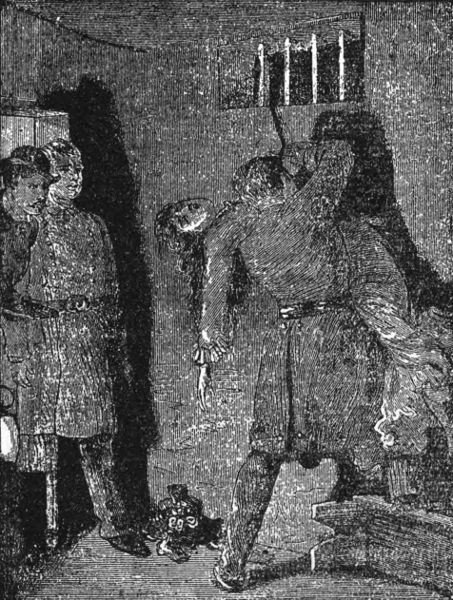
“Sergeant,” he exclaims, “the woman in number
ten has committed suicide. She’s hung herself.”
The sergeant springs up, tells the officer to
take charge of the room, and hurries to the cells.
We follow him. The door in number ten is wide
open, and the doorman is in the act of cutting
down the woman, who has suspended herself by
the means of a line made of her garters. He
lays her on the floor, in the cell, and he and the
sergeant bend over and gaze into the bloated face.
The woman is not dead and exhibits signs of returning
life. Efforts are made to restore her, and
are successful. As she recovers her consciousness
she raises herself on her elbow, and glaring
around savagely, curses bitterly the men who
have saved her from death, and begs for a drink
of whisky. No liquor is given her, however, and
when the officers are satisfied she is out of danger,
she is hand-cuffed, to prevent her from attempting
further violence. The rest of the night she keeps
the place lively with her yells and blasphemous
cries.
We return to the desk with the sergeant, who
enters the occurrence in the “Blotter.” We are
scarcely seated when two of the worst looking
tramps to be found in Chicago enter, and come up
to the desk.
“Cap’n,” exclaims one of them in a thick voice,
“let’s have a shake-down for the night?”
“All right,” says the sergeant, “show these
men back.”
The tramp who has spoken, encouraged by the
ready granting of his request, says coolly, “You
hain’t got a chew of tobaccer, Cap’n, you can
let a fellow have?”
“No, I hain’t,” answers the sergeant, imitating
the voice and expression of the tramp; “but I’ll
send you in an oyster supper presently, with a
bottle of Mum’s extra dry, and a bunch of Henry
Clay’s; and perhaps some of the delicacies of the
season, if they are to be had.”
The tramps laughed at this sally, and followed
the officer to the lodging room.
Half an hour later four policemen enter the
room bearing a stretcher, on which is laid a badly
wounded man, while two or more lead in the assailant,
who is securely hand-cuffed, and bears the
marks of the officers’ clubs. He had assaulted and
stabbed the wounded man in a brawl in a saloon
on Fourth avenue; had resisted the officers who
attempted to arrest him, and had proved so dangerous
that they had been compelled to club and
hand-cuff him. The wounded man is sent to a hospital
in an ambulance and the statements he made
are recorded in the “Blotter” by the sergeant.
The name and address of the prisoner is also written
down, and he is sent to a cell, with the irons
still on him.
Shortly after 2 o’clock another detachment of
officers bring in a batch of about twenty prisoners,
male and female. They are dressed in all
manners of costumes. Here are dukes, Don
Cæsars, Hamlets, Little Buttercups, Indians,
Princesses and Warriors and the like. They have
been to a “fancy ball,” and left it so drunk that
they fell to fighting among themselves in the street
and were taken in custody by the officials. They
are a motley lot indeed and lent a strange aspect
to the station. They appear to feel the ludicrousness
of their position, and beg to be let off; but
the sergeant has no discretion, for the testimony
of the officials is positive and the charge is a serious one.
So they go back to the cells, and in the
morning will appear in full costume before the
Court to answer to the charge against them.
So the hours of darkness pass away, and the
remainder of the night is only a repetition of
many scenes we have described.
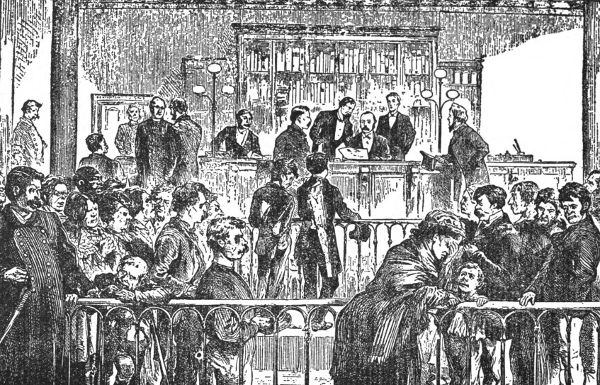
A Monday Morning Scene in the Harrison Police Station.