INTRODUCTION THE HOUSEWIFE AS MANAGER AND PURCHASING AGENT
Several years ago we heard a great deal of talk about
women’s place being in the home. The slogan was
used as a campaign challenge and as a sneer. It was
bandied up and down the country-side until we got
pretty tired of hearing it. Since the privilege of voting
has been given women and since their weight is
being felt in elections, the cry has died down. The
simple reason is that neither the employment of
women in war-work nor the radical challenges of the
ultra-feminist has altered the fundamental fact that the
home is a woman’s realm. Now you can banish her to
the home and make it such a place of drudgery that
she loathes it; or she can abide there as a queenly figure,
director of its work.
Thanks to the inventive genius of our manufacturers,
the home has ceased to be a place of exile for a
woman. The long hours that used to obtain in housework,
the wear and tear on nerves and muscles, are
being cut down by labor-saving equipment. The shortage
of servants is being met with the same devices.
It can never be expected that a big house will be
totally servantless. Utopia is still far away. But it
can be reasonably expected that every house will get
along with fewer servants. The hope of this expectation
lies in two salient features of these times: (1)
the simplifying of our home life; (2) the position of
the housewife as a manager.
One of the reasons for the high cost of living has
been the complication of our living. The past generation
has been brought up to feel that so many more
things are necessary to comfort than was the previous
generation. Short cuts to comfort cost money. The
grocery order sent over the telephone saves steps but
adds to the bill. The dress bought ready-made is a
convenience—and an extra expense. The food and
drink picked up at shops have added to the cost of living—especially
the drink. Nowadays Congress is encouraging
the making of drinks at home, sensible
women will take a basket on arm and supervise their
own buying at grocery stores, and we are forgetting the
silly twaddle about clothes not looking tailor-made.
The way to meet the high cost of living is to simplify
the manner of living. And the way to simplify the
manner of living is to live more at home and do more
at home.
We’ve reached the ebb-tide. The flood is leaving the
restaurant and the cabaret and turning toward home.
Make no mistake about that. We are being cleansed
with the fire that we ourselves kindled. The home is
coming into its own, and with it, the woman in the
home.
Taking them by and large, our grandmothers were
pretty good managers. They didn’t have vacuum
cleaners or electric toasters or telephones or a lot of
other equipment that has cut down housework today,
but, if you will remember, they did have a very decided
system in running and managing their households.
Our mother’s day saw the introduction of labor-saving
devices. The household work then stood on the
threshold of a new era, but it didn’t have the courage
to put a foot across. Moreover, the equipment had not
reached the degree of proficiency where it could be considered
practical. The machinery of household equipment
complicated living.
This present generation has the perfected machinery
and much more to come, but it lacks what our grandmothers
had—a system. We are dealing with old problems
with new equipment. It is a case of old wine in
new bottles, and we have to find a way of handling it.
The secret, of course, is a system, a policy.
The housewife of today is to her home what a man
is to his office. She is a house manager, a Domiologist,
as the author of this book suitably coined. To be successful
in that sphere she must apply the same principles
of management to her work that her husband
does to his. She must consider three things: (1)
household policy; (2) household equipment; (3) employed
personnel.
The employed personnel not only includes the cook
and the other servants of the house, but also the grocer
from whom the vegetables are bought, the butcher, the
dealer in housewares. There is just as much reason for
looking into the character of her butcher before she
buys from him as for looking into her cook’s reputation
before she hires her. In this respect the housewife is
a purchasing agent and she should apply the same
exacting principles that a purchasing agent of a factory
does.
The household equipment can generally be divided
into departments, just as office work is divided into departments.
There is the cooking department, the laundry
department and the cleaning department. These
will be large and small according to the size of the
family and the house. Each requires its own equipment
and each should be kept separate—the cleaning instruments
such as brushes, brooms, vacuum cleaner, dust
cloths, etc., in their own department or closet; the
things appertaining to the kitchen in the kitchen; the
laundry equipment, soap, clothes-lines etc. in the laundry.
Some household managers may say that this is
an old story. Yes, to them. But hundreds of women
complicate the household work by not using this departmental
idea. So soon as they do, household work
begins to straighten out.
A household policy is less easy to define. In an office
a policy is the way of conducting business—both
the way and the purpose. In a house it should be the
same.
It is this that the author of this book reiterates over
and over again, a policy and system in the department
of the installing of labor-saving and work-doing machinery
and devices and operations to reduce the irksomeness
of household management. It is this that the
readers of House and Garden Magazine, wherein this
book appeared serially, have enjoyed. Men and women
have profited by its accurate technical discussion and by
the delightful presentation with its occasional bits of
humor. For these reasons I gladly recommend it to its
future public which I feel sure has need of it, consciously
or unconsciously.
Richardson Wright
CHAPTER I INTRODUCING YOU TO ELECTRICITY — Some Technical Terms
What’s
a watt? This is not a comic opera refrain,
but a question asked so many times that it
is typical of the lack of knowledge people have to-day of
the force which they are using constantly in their own
homes and others.
We have lived to see women go to automobile schools
and learn the working of the car which is theirs to drive.
But as yet there seems to be no course even in the
domestic science school which gives the household engineer
an inkling of what is to be her mechanical field
in the realm of electricity or ordinary mechanical construction.
We hope this will come.
For have you ever stopped to think that the housekeeper
to-day presides over an extensive electric installation?
Even if she has but a telephone and an electric
bell in the house, there is much that happens that ought
to be familiar to her.
But people to-day have much more than these few
things; they have at least three or four of the following:
ironing machine, washing machine, vacuum cleaner,
telephone, warming pad, electric lights, toaster, electric
piano, sewing machine, curling iron, electric range,
electric iron, etc., yet the underlying principles and
vocabulary are still as Sanskrit to the majority of users.
This article is but to make simple and comfortable
electric terminologies and we will use this for an excuse
to get at a few electrical misusages. It is to make
electricity familiar rather than a stranger to the user.
Nobody knows what electricity is, so fortunately, we
don’t have to stop and define it. All that we know is
that it acts in certain definite ways.
We get electricity from the battery and from the generator
(dynamo). The battery consists of celled containers
which come under the heads of dry and wet
batteries in so far as they contain liquid or solid
(wet) ingredients, through which the electricity is generated
and passed out by means of wires. In short
the battery produces electricity by means of chemicals.
The primary battery produces electricity and the storage
battery stores it in the form of chemical energy.
It is useless for purveying very much electrical power
as there never can be enough pressure (voltage) to send
along the electricity to do big jobs, unless hundreds of
cells connected in a certain way were used, which would
be a foolish waste of material and time, etc.
In order to obviate such manufacturing the generator
or dynamo is used and electricity is made in this way
by induction. In other words, we make it by letting a
coil of wire (or several coils) be revolved by steam or
water power (usually) as it cuts through the area of
magnetism (field) of a giant magnet something like
those we used when we were children. This coil catches
the electricity and it is led off by wires wherever we
want it to perform. The coil on the spindle is called
the armature, where the wire is attached to lead off the
electricity from the armature are contact-pieces, and the
plates which make the contact with the contact pieces
and to which are attached the wires of the out-going
electric circuit are called the brushes. There is much
more to say, but not in this article. If you are interested
we refer you to Charles R. Gibson’s “Romance of Electricity”
for simple electrical explanations.
The motor with a few mechanical changes is the reverse
of the dynamo; it works by electricity and changes
it into mechanical power to work our washing machines,
etc. There are on the market A. C., D. C., and Universal
motors. These you will understand after the next
section which takes up A. C. and D. C. electricity.
“Madam, do you use A. C. or D. C.?” asks the man
selling you a washing machine. Most decent folks are
quite at sea at this seemingly geographic question, and
yet after all it is the most complicated simple thing in
the world. D. C. doesn’t mean District of Columbia; it
simply means Direct Current. And A. C. means Alternating
Current. And on these two kinds hang all the
wires of electric profits.
Direct Current or D. C. is a current that runs in
one direction over the wire like water through a
pipe. It is simple to visualize, even if electricity
does flow 163,000 miles per second. But
alternating current (A. C.) is electricity which alternates
and goes back and forth, generally. Even though
it goes back and forth in waves of tremendous rapidity,
you can see that there must be a time in this period
when the electricity is for an infinitesimal space of time
at low power, and another infinitesimal space of time at
high. In order to keep the supply even and steady,
two and sometimes three coils of wire are used in the
generator to catch the electricity so that there is scant
opportunity for the electric supply to be anything
but even, for when one coil is up the other is down and
thus they even up the strength of the current.
So when your salesman asks you when you buy a
motor, “If you have A. C. or D. C. electricity” and you
say A. C. he may go on and say, “How many phase?”
Then you should find out the answer from your lighting
company. He then may ask you how many cycles,
which when translated means the electric period it takes
for the alternating current to flow back and forth.
Now dynamos for D. C. and A. C. electricity vary
slightly, but that need not trouble us.
The reason for two kinds of electricity at all is that
each, though obeying the larger laws, has its own peculiar
habits and good points.
For example, alternating current can be carried long
distances at high pressure (high voltage) and side-tracked
by a transformer to a little home and the pressure
very simply reduced. In other cases the pressure
can be very simply increased. Therefore in country
districts one is very prone to see A. C. in vogue.
The same amount of current, whether D. C. or A. C.,
is used for lighting, etc.
A. C. is not used for electro-plating, etc., or for storage
batteries. This is a good point to remember if you
have storage batteries to supply for bells, etc., and your
current is A. C. You will have to have your batteries
charged from a plant which makes D. C. or install a
small “converter.” If you attempt to use the A. C. you
will burn out your plates.
But how is electricity measured? How, in other
words, do we know how much we use and how can we
test our bills? The following paradigm will give the
electric measures translated into more familiar terms of
water measurement:
| Volt |
Pressure |
| Ampere |
Rate of flow of current per second |
| Watt |
Fraction of horsepower (H.P.) |
| Kilowatt (1000 watts) |
11⁄3 H.P. |
| Resistance |
Friction (as water resists the sides of a pipe.) |
| Ohms (the unit of measuring resistance). |
Friction (as water resists the sides of a pipe). |
The volt takes its name from Volta, an Italian scientist;
the ampere from a Frenchman, the ohm from
a German, the watt from an Englishman. We hear
most about volts and watts. Voltage is found by multiplying
the ohms by the amperes. The volt is the pressure
that makes electricity flow through the wire, and the
friction of resistance to its flow is measured by the ohm.
The amount of work a given number of amperes will
do at a certain voltage (pressure) is known as watts.
So if by chance you ever need formulæ here is a
little one for your card catalogue:
The next thing which is necessary for the householder
to know is how to compute costs of electrical usage.
The amount of electric power used, for example, by
the electric light is measured in watts. Look on any
incandescent bulb and you will see thereon the number
of watts—usually around 50 or 60.
In order to know how many watts a light consumes,
divide the number of watts it consumes by 1000 to reduce
it to a something of a kilowatt. Then multiply
this result by the number of hours the lamp has been
lit by the kilowatt to get the kilowatt hour of electricity.
The kilowatt hour, of course, multiplied by the rate per
kilowatt hour in your locality will give you the cost.
The rate is always figured on the kilowatt hour.
Probably it would be a good thing to know how
to read the meter, which generally consists of four little
dials which are read from right to left. The first dial
measures the tens, the second the hundreds, the third the
thousands, the fourth the ten thousands. Therefore
if the hand in the left has passed 9, that would stand for 9000
In 2nd dial nearest to 1 that would stand for 100
In 3rd dial nearest to 2, that would stand for 20
In 4th dial nearest to 1, that would stand for 1
9121
The total is 9121 kilowatt hours and this multiplied
by the rate (say ten cents) as it is in some places,
would mean that the bill for this consumption would
be $92.2. Now, knowing from your last month’s bill
that the reading of the meter then was 82000—by
subtracting you find that the actual current consumed
was 921 K. W. hours, which multiplied by rate (say ten
cents) gives you $92.10 as your bill.
To quote from an article in this series on electric
ranges will give you an idea as to how to buy in accordance
with voltage and how the cost is reckoned in watts:
“It is necessary when ordering a range to give the
voltage of your electricity supply. The stoves are usually
prepared for 110-220, 110 volts with two wire service
from the street or 110-220 volts with three wire
service. In some stoves the cut-out box is built on the
range directly back of the switches. This, then, can be
easily opened if anything happens. In the stock stove
there is made an extra charge for voltage exceeding
220 or less than 110, because alterations have to be made.
According to the size of heating elements in the stove,
etc., the wattage runs from 10,000 watts or 10 kilowatts,
which is the same thing, to about 2500 watts, or 21⁄2
kilowatts on a small three-heating-unit range. This
gives its total capacity if everything goes at once. The
number of watts used, multiplied by our local rate, say
four cents, gives the cost per kilowatt hour, which in
this case would be 40 cents per hour.
Have you ever wondered how electricity changes from
current to heat? Have you ever wondered how we can
cook, and iron, and warm a room by it?
It is due to electricity’s resistance, which is measured
in ohms. It is resistance which is turned into heat.
The process of overcoming resistance results in throwing
off heat. It is quite familiar.
Did you ever rub a piece of wood in the palm of your
hand for a little while and feel the heat given off? We
call it friction, but it is really the giving off of heat
due to expenditure of mechanical energy.
The same thing happens with the electricity. This
electricity which travels at the speed of 163,000 miles
a second, when it comes into frictional relation with
its conductor pushes aside the molecules of the metal,
and here the mechanical energy is magically transformed
into heat.
When we hear short-circuit mentioned, what does it
mean to us? Well, it should mean that the path of the
electricity (electric circuit) has been suddenly shortened,
the electricity has escaped through the ground or
over another conductor.
Insulation is the covering by which the escape of
electricity through the wire is made impossible.
Always see to it that the insulation is in perfect condition.
All wires must be insulated. In damp places rubber
covered wire must be used.
Wires must always be protected with porcelain tubes
passing through partition walls, girders, and where they
pass over pipes, and other wires, etc.
Incandescent lights are merely globes with a vacuum
in which a filament of tungsten or some other highly resistant
material meets the electric current and glows
through its very resistant power.
The switch is merely a device to open and close the
path of electricity.
The socket is the termination of two wires from the
generator or battery, into which the bulb of the light
is put and other connections made.
You will notice two wires on every electric connection.
This is to make a complete electric circuit (path) to
and from the points where it is used.
The outlet is the opening where the socket can be
placed. The more outlets you have in your home before
building the better off you will be forever and ever.
A convenient outlet (sometimes called a baseboard or
wall receptacle) is simply a place for conveniently connecting
electric appliances to your electric current.
Fuses are things we hear much about. They are the
stop-gaps really between danger and safety and though
they make a splutter when they “blow out” it is right
that they should. Briefly, the fuse is a bit of lead or
other metal with a low melting point so placed that when
the circuit gets overloaded for any reason the metal will
melt and open the circuit, stopping the electricity and
preventing danger.
When the fuse burns, we call that a blow-out, but this
burning has saved us from dangerous currents.
Every house should be well supplied with fuses, and
as soon as they are blown out, restored. Your superintendent
or electrician will show you how to restore the
oft blown-out fuse. So it is wise to keep a few new
fuses in one’s home.
The fuse will blow out sometimes if you allow a bit
of metal from a lamp shade to cavort too intimately
with the excitable parts of your incandescent bulb;
then the wire gets overloaded and the tin or lead conductor
on the fuse melts and prevents the greater current
doing any damage. It’s simple, isn’t it? The
fuses come in convenient shape. Sometimes it is wise
to use a rubber glove when putting them in. We have
seen a sparking do a bit of burning.
Electricity is not dangerous when properly employed.
It is dangerous when you use it wrongly. If
you put your hand under a boiling hot stream of
water you will get burnt. If you put your hand on a
red hot stove you will get burnt; if you burn a fire in a
wooden box you will have more fire than you bargained
for; if you inhale gas you will die. Such is the case
with electricity, which is a most controllable force
if you are not ignorant as to how to use it. However,
if you will put a hot curling iron on your table without
turning off your current you will have a cozy little fire
start up; so you would if you laid down a cigaret without
putting it out. Most accidents occur simply because
of such ridiculous carelessness. Mr. A. M. Grant of the
Manhattan Electrical Supply Company said a wise
thing in reference to this subject: “Before connecting
any appliance to your lamp socket turn out the light
in your bulb; then you know that your current is off.
Never attach anything to anything electrical until the
current is off and never go away and leave an appliance
with the electricity turned on.”
More specifically, in using any electric appliance non-continuously,
shut off the current immediately upon
stopping. Do not only pull out the plug but turn off
the electricity.
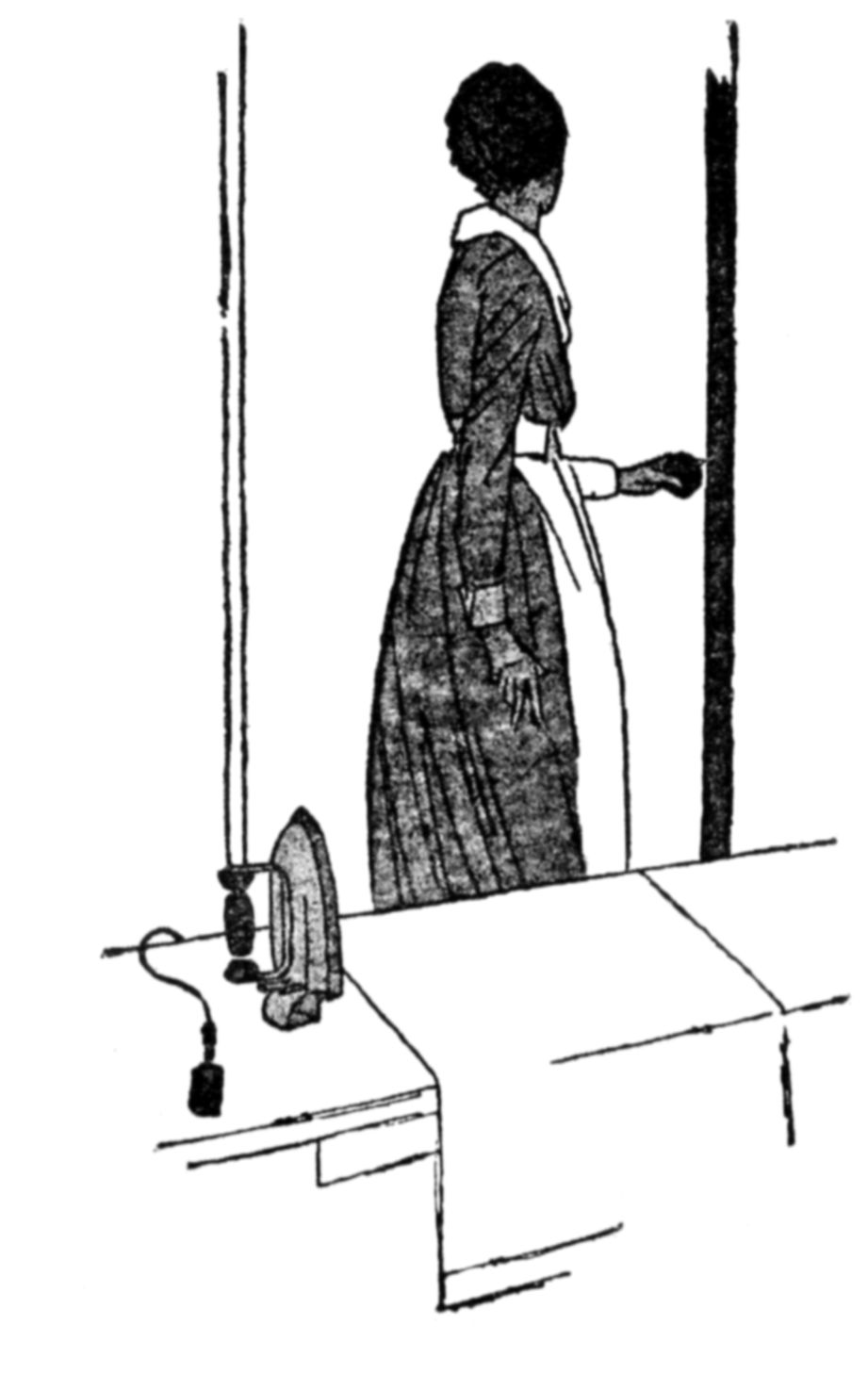
In using the flat-iron detach the plug at the iron as
well as turn off the current from the socket.
Remove the iron from the goods and detach the plug
when called away from the ironing board.
Never pull the plug out by the cord; always grip it at
the spring.
Always replace at once frayed wires—as the ends
often collide and make blow-outs.
Don’t leave your electric curling iron on the table
cloth and do something else about the room without first
turning off the current—or you’ll have a cute little fire.
Care must be taken in using too many cluster plugs,
because the electric circuit (path) may be overloaded.
That is, too much electricity drawn over the wire which
is made for a certain load. Then your fuse will blow
out. Extra appliances should be attached to different
circuits. This a good electrician will regulate for you.
Too much wattage (horsepower) over one circuit is
like forcing any machinery to the breaking point. A
percolator, toaster and a lamp are too heavy a load for
the ordinary circuit. Connect at the same place only
those appliances that are of low wattage.
Some firms have now made percolators and water heaters
with fuse-nut or safety fuse devices which melt if
overloaded or allowed to heat up without any liquid in
them to be heated. You must not let a percolator
“perc” without any water in it. People complain more
about good percolators because their heating element
burns out, either because they do this or because they
have it connected up with too many other devices.
Even if you do the right thing in these respects, don’t
forget to disconnect the electricity by pulling out the
plug.
Don’t get your electricity heating pad wet. In fact,
don’t wet any electric appliance carelessly or you may
have a short circuit.
Remember that electricity, magic as it is, can burn
as well as any flame, so don’t let your curtains blow
against a red hot electric radiator and then blame it on
the electricity which after all is your servant if you
make it so by right treatment.
Always ask your salesman to what the device purchased
should be attached. Some things are designed
for the ordinary lamp socket, and others need different
connections.
Many electric appliances have the pilot light to tell
you whether your electric current is on or off. Yet it
is wise to be your own pilot and remember what you are
doing.
Do not leave your electrical installation entirely to
your architect. Watch what is happening. Remember
you need as many outlets as you possibly can afford;
the more you have the better lighting you can have, the
better electric comforts you can have. If you have few
outlets you are very prone to overload your circuit, and
in the future as more electric devices come into being
you will have to pass them up. Outlets consume no
electricity but are simply entrances where electricity
can be located as soon as the appliance is connected up
with it and turned on.
Above all, have your electric installation put in by
the most responsible and experienced people you can
get to do it.
When you buy appliances always ask what voltage
they require and find out what your own voltage is
before you buy; also find out whether you have D. C. or
A. C., and if A. C. find out what phase and cycle.
These things will save you time and money and free you
from any apprehension of calamity from the use of
electricity.
There is much left unsaid in this chapter. It would
take a book by itself to say everything.
CHAPTER II KEEPING OUT OF HOT WATER
There
is never any magic about household equipment.
You must not expect to do the impossible.
If you have a dishwasher you must not expect it to do
any more processes of washing than you expect of your
player piano of playing. The dishwasher is to wash,
the piano to play.
Many women have said, “I think a dishwasher is a
nuisance, you have to stack your dishes, hand-scrape
pots and pans, carry water by the pailful and then have
the job of cleaning the dishwasher itself. The only
thing it does is to wash off some of the dishes.”
Well, it is only a dishwasher. Doesn’t the automobile
have to be cleaned and oiled? Why should the
dishwasher be expected to polish silver.
Yet we do solemnly think that the dishwasher attached
to the plumbing of the house, so that the fresh
water comes in unlifted by the operator and goes out
unheeded, is the only dishwasher to buy, regardless of
how it is worked—by hand, by water force or by electricity.
This is only one type.
Some of the best dishwashers are made unattached
to the plumbing so that they can be wheeled into the
dining room and be stacked as they leave the table.
This is a rather perfect type for some homes, but you
must have it fixed so that when it arrives dish laden in
the kitchen or pantry it can be attached to the water
supply and emptied through the sewer. This is the only
way to get maximum comfort, unless you or your cook
enjoy hauling pails of water.
Yet we can imagine many women who would rather
haul water than handle dish water. And here is where
the “unattached” dishwasher wins out over the old-fashioned
style of washing dishes. The chances of
breakage are less where the dishes are not washed
separately and rehandled for drying separately. Dishes
handled when dry do not slip so readily, to fall or
break.
For the most part these machines are equipped with
a motor which propels a fan or paddle to spray or
“swish” and whirl the water about among the dishes.
The efficiency depends not only on the speed the water
travels but on the direction.
For example, one of the most interesting of dishwashers
is not run by hand or electricity, but it is
attached to the drain and water supply. The hot water
is distributed and so forced against the dishes that, without
soap, they are washed noiselessly. No soap is required
with this machine.
It has taken us a long time to be sold to this dishwasher,
but we are convinced that it is the type to use
when one has to do one’s own work.
If it is possible to use very hot water in your dishwasher,
you can leave the top of your machine off and
the dishes will dry without handwork. Of course, there
will be no polish on the glass and silver, but they will
be dry.
The following is advice given by those who sell dishwashers:
1. You must have hot water—really hot water—to
use an electric dishwasher successfully.
2. Use the soap powder the manufacturer supplies
or recommends. Remember that suds are unnecessary
for cleansing and are hard to rinse off, anyway. You
need an ash powder which will cut grease.
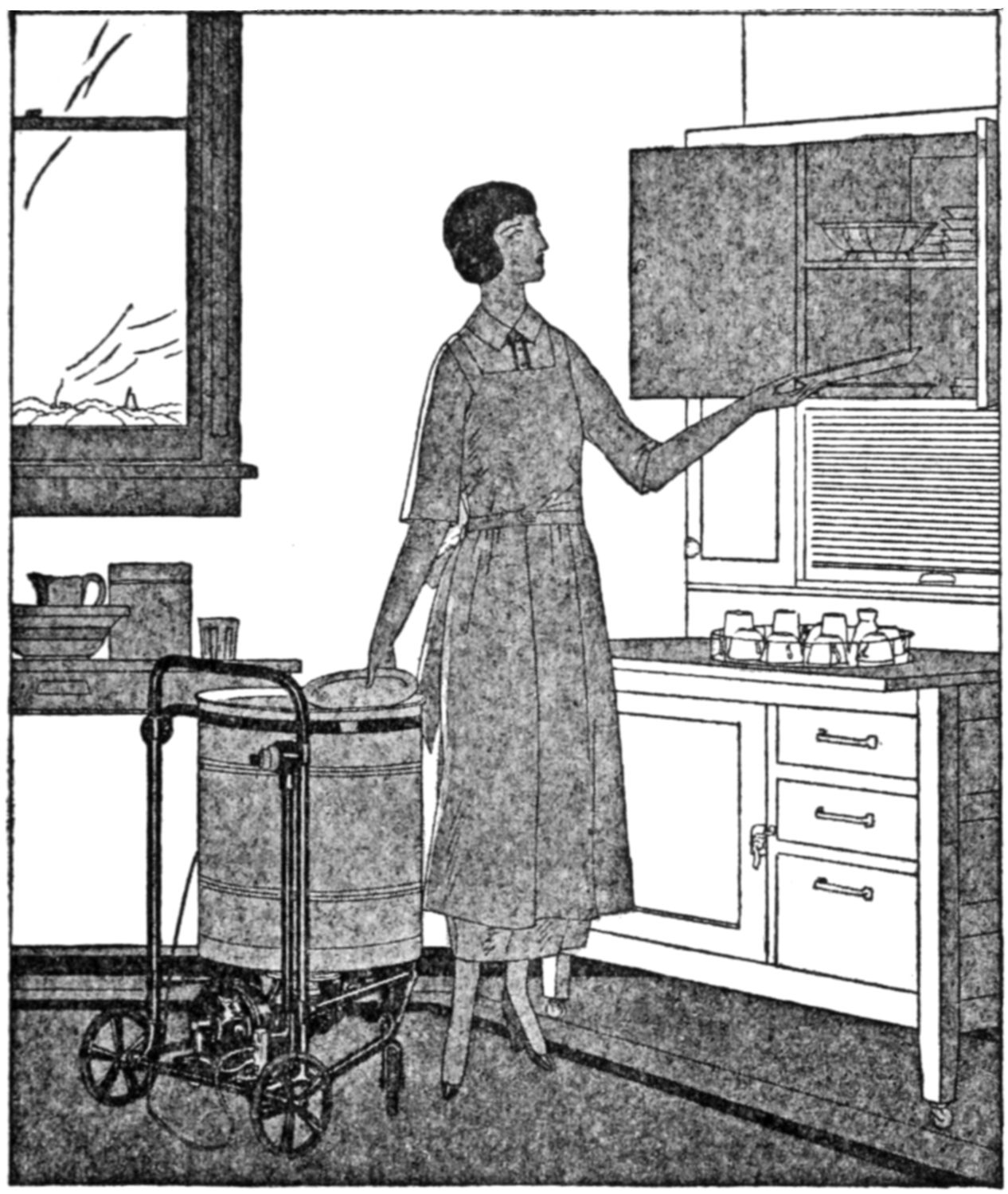
Courtesy of Whirlpool Mfg. Co.
A WAY TO KEEP OUT OF “HOT WATER”—THE PORTABLE
DISHWASHER
3. Dishes covered with egg, flour mixtures, etc.,
should first be held under cold water. Hot water boils
these mixtures and makes them stick closer to dishes.
4. Follow the manufacturer’s directions as to placing
dishes, silver, etc. Get the knack—which is easily
acquired—of putting in the dishes with the fewest motions
possible.
5. Experiment with the much disputed point of
whether dishwashers will wash pots and pans. Most
dishwashers will clean them of everything except burnt-on
food or particles which have to be taken off with a
powder.
6. Note how easy it is to dry the silver and polish
glassware, and that while you are doing this the china
dries itself and needs only to be put away.
7. If you have a small family do not wash the dishes
after every meal, but stack them in the dishwasher and
wash them once a day, say after breakfast.
8. Remember that dishwashing is but one of a series
of kitchen operations. To begin at the beginning, and
to get the utmost value out of the electric dishwasher,
glass, aluminum and enamel cooking utensils are to be
recommended, wherever possible without handles, so that
they do not take up too much space in the machine. In
cooking and serving, clean up as you go, using as few
utensils as possible in your cooking (all modern houseworkers
recommend this procedure, although it does not
always meet with the approval of housekeepers generally),
stacking bowls, plates, spoons, etc., in the dishwasher
as you work, thus having a comparatively clean
kitchen when you are ready to serve the meal.
9. See that the dishwasher is properly placed in relation
to the entire dishwashing performance. The ideal
placement is near the dining room or pantry door, so
that it receives the dishes without extra steps, and adjacent
to cupboard where dishes are put away.
You will perhaps think this is a lot to do, but didn’t
you have to learn to “do” things on your vacuum
cleaner, your washing machine, your typewriter, too?
Weren’t you willing to learn how to run your own car?
When buying a dishwasher, look at the racks. Be
sure they are smooth and easily cleaned, finished so
that there is naught to peel off and catch food. Also
be sure these racks fit and are not cantankerous in going
back into the machine. If they are difficult to manipulate
the misery is untold.
In purchasing look for the following points:
1. The dishwasher must be smooth inside.
2. No corners to harbor bits of food.
3. Self cleansing.
4. Dishes placed so as to be unmoveable and not stick
together.
5. Cost of electricity low, from one to two cents per
washing.
6. Capacity to be convenient to your uses.
7. Operates in kitchen or pantry.
8. Operates from three to fifteen minutes.
9. The water penetrates all sides of dishes.
10. Easy to fill and empty whether attached or unattached
to water and outlet systems.
Some booklets advertise the fact that machines require
only six quarts of water—less water than in ordinary
dishwashing. The water, unless it is to be hand
handled, need not trouble anyone. But it is a well
known fact that dishes to be washed satisfactorily must
have water used on them without stint.
The most satisfactory soaps are the white powders.
A new powder, on the market, which isn’t soap at all,
does not leave a greasy residue and make a difficulty
of cleaning out the dishwater. In a good dishwasher,
however, the water force banishes residue of all kinds.
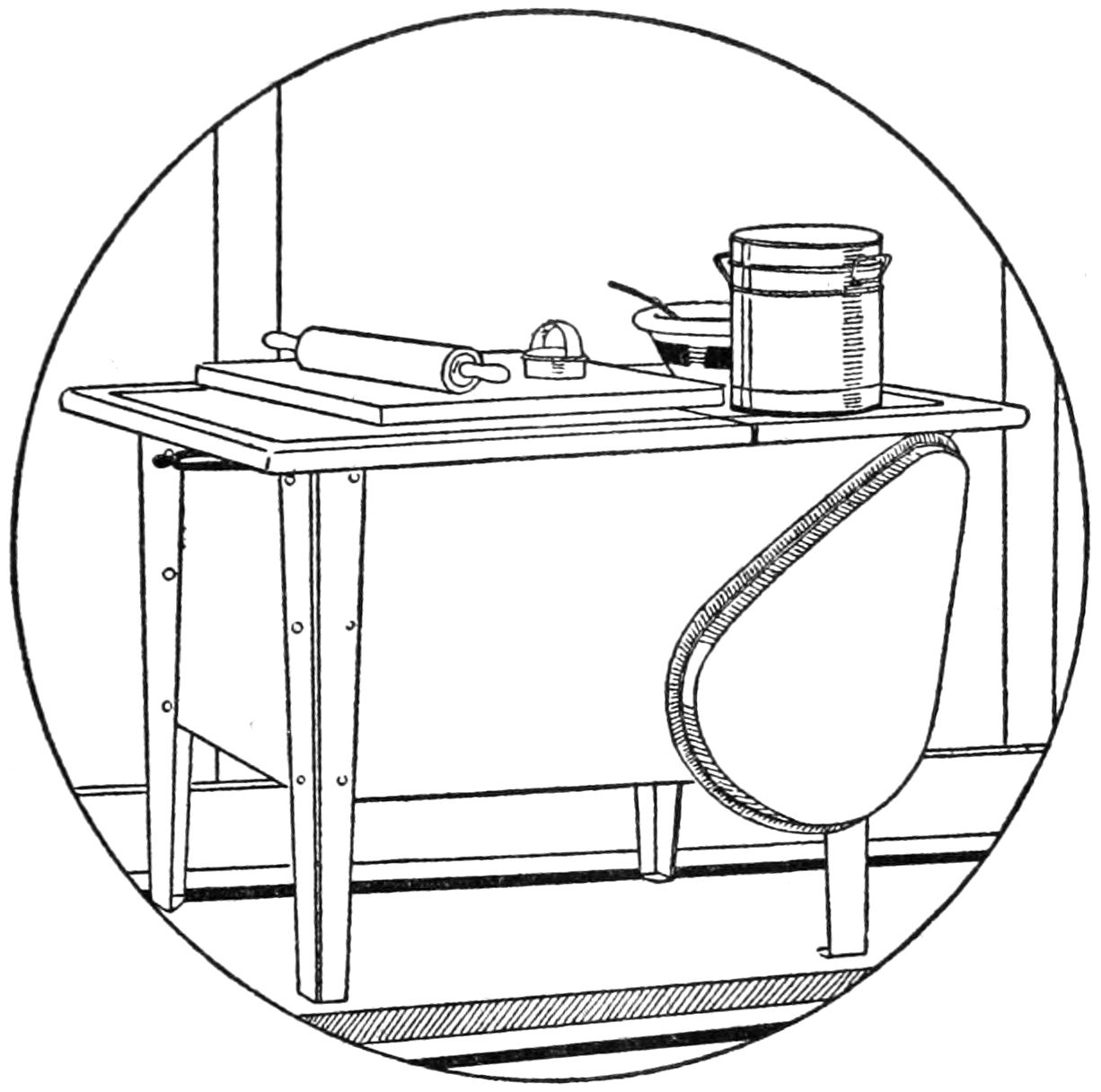
Courtesy of Western Electric Co.
THE DISHWASHER WHICH IS A TABLE WHEN NOT WASHING
One manufacturer of a good dishwasher is honest
enough to say that for a good effect silver and glasses
should always be polished coming out of the dishwasher,
because any method of washing will always leave a film.
Many a dishwasher has been sold on the pretext that
this is unnecessary and the result has been dissatisfaction
and a psychological dislike of the machine.
To be sure, an ordinary dirty pot or pan can be
cleaned on a dishwasher. The burnt-on type of dirt
must be scraped off by hand.
Warning: don’t burn in food, so use utensils where
you reduce this possibility to a minimum. Some dishwasher
concerns supply you with hand-saving scrapers.
A dishwasher in the shape of a table, beautifully finished,
makes it unnecessary to have an extra table about.
This does its work well. One example of this table-high
dishwasher has a device whereby the rack of dishes is
lifted to a reachable height by lifting the lid.
Another supplies you with extra baskets in which to
stack your dishes while the full basket is being used in
the washer.
Yet another cylinder type has a cover that goes back
flat, on which can be laid the tray to be filled with
dishes.
At present some of these machines make a slight
noise in operation; yet many do not mind this. But in
telling a story we must tell it all. Of course many other
machines used in the home are no “modest
violets” either. We don’t need to listen hard to hear
vacuum cleaners or patent brooms, but they work
well despite their blatansies.
Washing machines are made in cylindrical and rectangular
form and can be placed in small kitchens as
well as large without inconvenience. Of course there
are some machines called “Domestic” that are meant
for the domesticity of a home where there are seventeen
servants and other things equally hotel-like. These
are big and efficient but the ordinary apartment or small
home could not afford to house them.
The dishwasher really is the crux of the economic
problem. Many a girl would marry gladly without a
maid, if the dishwashing was reduced to a minimum.
One of these days when lovers offer dishwashers in addition
to the conventional platinum solitaires, they will
find winning a bride a much easier task than it is at
present.
CHAPTER III ELECTROCUTING THE WASH! — Requirements of the Home Laundry — Generally Speaking — The Electric Ironer — An Extraordinary Advance — Good Points — Power and Fuel — Size — How To Operate — A Few Pertinent Questions And Answers — The Washing Machine — Dryers — Theory and Practice — Superficial Points — Electricity Or None — Tables and Shelves — Ironing Boards — A Burning Shame — The Laundry Chute — Arrangement — Flat Irons — Soaps And Powders — To Avoid Blow-Outs — L’Envoie
“Can’t
afford,” is the first thing that is said
against the installation of electrical equipment
in the home. Equipment for offices is placed because it
is saving of time and money and energy, but equipment
for the home is often grudgingly installed just because
makeshifts have been the rule for so long.
Quite true is it, that you often have a hard time to
prove to your husband that the washer is a money saver,
that the ironer too is a saver of money. But
this can be done very easily. Let money talk and the
machinery will almost install itself!
The laundry equipment, of course, is a serious thing
and must be taken so. Many things should be investigated
before buying, your needs known to yourself.
Equipment should not, like marriage, be entered into
unadvisedly, for when you spend money you must spend
it as an investment and not as a mere lark. You must
get your return on the investment or you have thrown it
away.
If you do not know what to get, read, use shoe leather
and ask those who have the thing you want. The
manufacturers too are glad to talk over your needs.
A satisfactory laundry depends on:—
1. The location of room, its relation to outdoor drying
and its relation to the source of supply of incoming laundry.
2. Proper floor, ceiling and walls. All joints curved,
no corners.
3. Selection of equipment. The types and kinds best
fitted to size of family and room.
4. The advantageous disposal of appliances purchased.
5. Thorough instruction of operators in the use of the
machinery, as a good machine is useless unless the
operator knows the requirements.
6. Proper care of appliances.
7. Sanitary conditions: light and ventilation. Good
air is part of all good laundry work.
8. The acceptance of the worker to use cheerfully the
machinery and the adequate payment of the worker.
9. Knowledge on the part of the housekeeper or mistress
of the laundry procedure in order to oversee more
intelligently the work done. Women seem to think a
knowledge of cookery necessary but give little heed to
the importance of the laundry.
10. A system developed and maintained for the
laundering of clothes.
So much for the general principles. This chapter
will not deal at all with methods of laundry work ... as
is.
The only reason for the electric laundry is that it does
save time, money and energy and prolongs the life of
clothes to a certain degree.
In doing missionary work in the past for these things,
people said: “you can lead a maid to the washer but
you can’t make her wash.” They said this too about
the horse and the trough, yet if he never drank he would
have died of thirst! So much for that argument. You
may as well say: You can lead a cook to the soup pot
but you can’t make him stir!
Money talks to husbands! you can prove the saving.
Less work talks to laundresses, you can prove the
saving.
A good equipment for a house with six in the family
and three to four servants is as follows:
A tiled floor. The large blue tile is interesting and
less glaring for the floor than the white. Linoleum
floors too are splendid and cream walls.
Washer 1⁄3 h. p.; solid copper lined with planished
tin to prevent corrosion, white enamel ironing machine,
two rolls; clothes dryer with four heating units; clothes
boiler solid copper lined with planished tin with screen
for holding clothes off the bottom of the boiler; combination
sleeve and skirt board; two metal tables; overhead
clothes dryer, copper clothes extractor; four stationary
tubs; electric irons for valeting and fine work.
A great fuss has been made about setting the clock
ahead one hour to save time and daylight, but little
attention has been given the problem of saving four
hours every ironing day by means of electricity and the
ironing machine. A good machine, unlike the mangle
which only folds and is not heated, should be able to iron
at the rate of seven or eight feet per minute. In this
way the ordinary ironing can be done four times as
quickly as by the old method.
Many a house-wife without a maid has found ironing
good sport with a good ironer and the labor saving devices
have often made marriage possible—where a servant
was too much of a luxury.
Roughly, the ordinary laundry takes about half a day—one
hour for eight pieces for the average family of
five, including all things from table linen to handkerchiefs.
By hand this is about four and a half to five
hours. This costs about $50 to $100 a year or $500
to $1,000 for ten years’ supply of laundered possessions.
The fuel consumed for the average ironing with coal
or electricity costs about $15.60 per year: With a
good machine ironing by electricity or gas will come to
about one and a half cents, or a total of three cents for
ironing and heating, which is a saving of twenty-seven
cents a week or $14.04 yearly. In ten years a saving of
$140. This is apart from the benefit to health and
strength.
There is one on the market with a bench attached on
which the worker can sit down to her work. As the
feed is so arranged that the material turns under, because
of the adjustable delivery board, one doesn’t
have to rise at all, and the saving of strength and comfort
is beyond calculation.
An ordinary table cloth on an ironing machine takes
about three or four minutes. With a good electric iron
it takes about twenty-five to thirty. Besides this the
cloth is ironed evenly and the pattern, if it be embroidered,
is evenly brought out. Initials come out in beautiful
relief, buttons on garments do not break because
of the deeply padded felt rolls which are covered with an
especially-made muslin.
As an ironing machine has proven a practical, money-saving
proposition, what is the best way to purchase
one? First, you should have a good idea as to the
breadth on the average of your sheets and table cloths,
not forgetting that it is wise to have a machine wide
enough to carry two table napkins at once. This saves
time, saves the over-impression of the felt in one spot and
also uses up the whole length of heat along the roll.
In large households, where the work is unusually
heavy, often taking more than one day, a machine about
48″ or 56″ is used for 21⁄2-3 yards of linen. These
rolls should be padded, the heavier the better, to take
care of heavily embroidered initials.
Many persons think that an ironing machine is a mangle
limited to ironing only the coarser flat work such as
sheets, towels, etc. It is, however, not a mangle but an
ironer and will iron practically everything except the
more fancy shirt waists and elaborate dresses. It will
iron to the entire satisfaction kitchen aprons, nightgowns,
pajamas, underwear, children’s play clothes,
hosiery, men’s negligee and silk shirts, and iron, better
than an expert laundress can do by hand, tablecloths,
napkins and centerpieces, doilies, dresser scarfs, blankets,
sheets, bed spreads, pillow cases, towels and handkerchiefs.
It is a great help to curtains, as they will
hang perfectly after ironing. Trousers may also be
pressed in such a machine.
The ironing machines on the market claim certain
best points. One that a moveable shoe (the heated
part under which the garment is passed) is good because
you can remove starchy accumulations and clean it
easily. Some say that the stationary shoe is the best
because the ironing cannot help being done evenly. You
will have to pick your machine.
In another machine the manufacturers use their patented
gas burner of drilled holes and their air mixture
as a talking point to afford a gas saving. Another
claims that oiling is necessary only every six months.
The feed board is a requisite part which must be perfect.
Lowering the feed board removes the roll from
contact with the ironing surface in some machines.
This is the same principle as putting the hand iron on
the rest. At the same time the motion of the roll is
automatically stopped, so that the goods can be withdrawn
at any time. It also enables one to lay a folded
piece or a number of them on and over the roll, and
it insures a straight start at all times. On single or
double thicknesses of goods the feed-board need not be
lowered, as these will start in readily. This patented
feature means safety to the operator and safety to the
goods being ironed. The feed-board is the flat piece of
board running the length of the machine over which
the linen passes.
Some machines are advertised as having all gears enclosed
and protected. This, of course, makes operation
safer.
The swinging arms, two generally, provided for hanging
linen on, are a convenient addition.
The above is the usual list of machines made to-day
but there is an unusual one now on the market. This
one works entirely by electricity, it can be heated by
gas or electricity. There are no levers to handle, no
treadles to tread. It works completely by a switch
and dial. The little finger is sufficient only to do the
job if all your other fingers were disabled!
It is a very convenient size for family use and has
been in use now long enough to assure perfection of
adaptability for the home.
In case this all-electric machine has a blow out, and
to protect the clothes from burning on the shoe there
is simple provision to guard against this and all ills.
The shoe by a button works back and forth if necessary,
and taken altogether it is a beautiful mechanism.
A few excellent machines, too, have the two rollers
instead of one. This is supposed to hold material firmer
and work more expeditiously.
In some cases the gas burner and electric heater
are divided in the center so that the burner can be used
on warm work without scorching the unused part of
the roll.
The machines should be so made that they are
comparatively easy to clean.
Levers are not quite as good as the automatic, adjustable
feed-board, which insures ease of control. It is
worked by raising and lowering. This brings the roll
in contact with the ironing surface, the same principle
as a hand iron is brought to and from its rest. The
action also stops and starts the rotation of the roller.
In other words, it is automatic and there is no possibility
of the operator becoming confused at a critical moment.
There are no levers to pull or switches to turn; the
control is instinctive and always under the hands of the
operator for instant use. Moreover, you can lay your
work over the roll while idle, insuring a straight edge
and start the work again at your convenience.
Ironing on these machines is done on the same principle
as with a flat iron, only instead of passing the iron
over the goods, the goods are moved against a stationary
iron.
Gas, gasoline and electricity are the fuels used to
heat the machines. Electricity and hand-power turn
them.
Motors come from 1⁄8 to 1⁄4 horse power depending
on the size of the machine. When buying one, be sure
to tell agent whether you have Alternating Current
(A. C.) or Direct Current (D. C.) and what voltage
you have. Motors are generally supplied 110, 220 volts
D. C. and 60 Cycle 110, or 220 volts A. C. (We are
not considering here the belt driven larger sizes.)
About 7⁄8 of a pint of gasoline is used on the smaller
size machine. Sometimes the amount increases to 11⁄2
pints; from about 17 to 33 cubic feet of gas. In the
case of electricity as fuel for high heat, 2.5 to 6 kilowatts
are used. For medium 1.7 to 4. For low .85
to 2.
The current driving the machine is from 180 to 320
watts per hour.
The household models come 46″, 42″, 37″, 32″ actual
ironing widths. The 46″ and 42″ seem to be popular
with some manufacturers. The former is for 21⁄2 yards
or 90″ wide and 22″ small linen, and the latter for 21⁄4
yards or 81″ wide or 20″ small linen. The 37″ for 2
yards-wide linen. Size 32″ takes up actually about 42″
× 26″ of floor space, the 37″—47″ × 26″, the 46″—58″ ×
25″, etc. There is one ironing machine on the market
that is separate from its base so that it can be set up
in an apartment on the top of a radiator or on a 14″
shelf. This answers the wants of the “flat dweller.”
It is an interesting fact that one agent in New York
is shipping 1000 ironing machines daily, many of which
go to Boston. This is due to the low rate of electricity
that prevails in that city. And here’s a point:—even
in some vicinities where the rate is low, where two
lines only supply a whole state with electricity, it is
not advisable to use electricity for machines. You must
have a good current, even service, etc., to make it worth
while.
You light the burners on these machines as you light
the gas, turn the electric switch and iron. It is quite
simple and safe. Many of the machines have a pilot
light to tell when the current (electric) is on or off.
To heat by electricity all you do is to attach the cord
to the ordinary wall socket.
A hand-power machine is driven by turning a handle.
Thirty-five turns a minute is the right speed. It can
be converted any time into a belt-driven machine and
attached to the washing machine or anything else that
goes by motor.
The saving in health of operator whether wife or
servant and the saving of the life of linens, etc., is
beyond computation.
The best type of ironer has (1) the stationary ironing
shoe under which the felt padded cylinder revolves.
This insures evenly distributed heat and avoids the
chance of scorching clothes.
In some machines this shoe can be set back in case
of accident and prevents the clothes on roller from being
burnt. (2) Feed board instead of lever. This
gives more rapid control and is more responsive to the
touch. (3) Electric switch instead of lever or feed
board.
How long would it take to iron a table cloth by
the machine?
About three or four minutes in comparison to twenty-five
or thirty by the expert laundress using an electric
iron. A saving in current and time.
What about handsome linens with heavy initials?
“The pad on the roller should be plenty soft enough
to imbed not only the initials but carry buttons and not
break them!”
“What things can’t you iron with it?”
“Only fancy waists and skirts. Laces can be beautifully
done and, of course, all the table and bed linens,
trousers, etc., etc., etc.”
“How big are these machines?”
“They come in four different sizes, but the ordinary
home can use the 46-inch cylinder or at least as wide
as your widest linen to the best advantage. That enables
fewer folds and more ironing lay-out on roll, enabling
you to put a few napkins on the roll at the same
time instead of one.”
The variety of washing machines on the market to-day
are scheduled in three figures.
The following will give you an idea of the better
known types from which to weed out yours.
A. Types
1. Rotary or cylinder.
In which the wash is put into a perforated cylinder
which revolves through the soapy water.
2. Oscillating.
In which the wash is put into the machine and is
washed by being shaken back and forth with enough
friction and motion to clean clothes thoroughly.
The bottoms of these machines are corrugated or in
some shape to offer resistance and cause the necessary
friction.
3. Vacuum.
In which the clothes are put into machine and are
washed by the operation of vacuum or suction cups
raised up and down, drawing the water through
clothes.
4. Dolly.
In which clothes are washed by the semi-rotating
dolly or device which looks like a milking stool.
5. Combination of these types such as the Dolly and
Disc Twin tubs with a mechanism in each, washers
with a bench upon which to place wash basket, etc.,
oscillating cylinder as well as rotating. As to wringers
on these machines, they are stationary, swinging
or sliding.
The latest type is the alternating. Here the drum
rotates, and is divided into two compartments by a perforated
plate. The clothing to be washed is divided
equally between the two compartments, and the mechanical
action of the machine produces alternately the action
of the cylinder, oscillating and the vacuum method.
6. A good combination in cylinder, oscillating and vacuum
type, has just been added to the market.
7. Balance drum, in which the clothes are put in a drum
and it shakes on a pivot.
8. Cylinder type worked by water force—for hotel
room use.
9. Vacuum and cylinder types for tub use run by
electricity—for houses too small in which to bring a
washing machine.
B. General Requirements of Washers
1. All parts which might tear clothes should be covered.
2. All washers, if not stationary, should be equipped
with swinging reversible wringer.
3. Hard wood outside or copper or some hard metal and
to prevent corrosion in the case of copper exterior,
planished tin interiors are the best.
4. Durability.
5. Ease and simplicity of operation.
Courtesy of Scientific Heater Co.
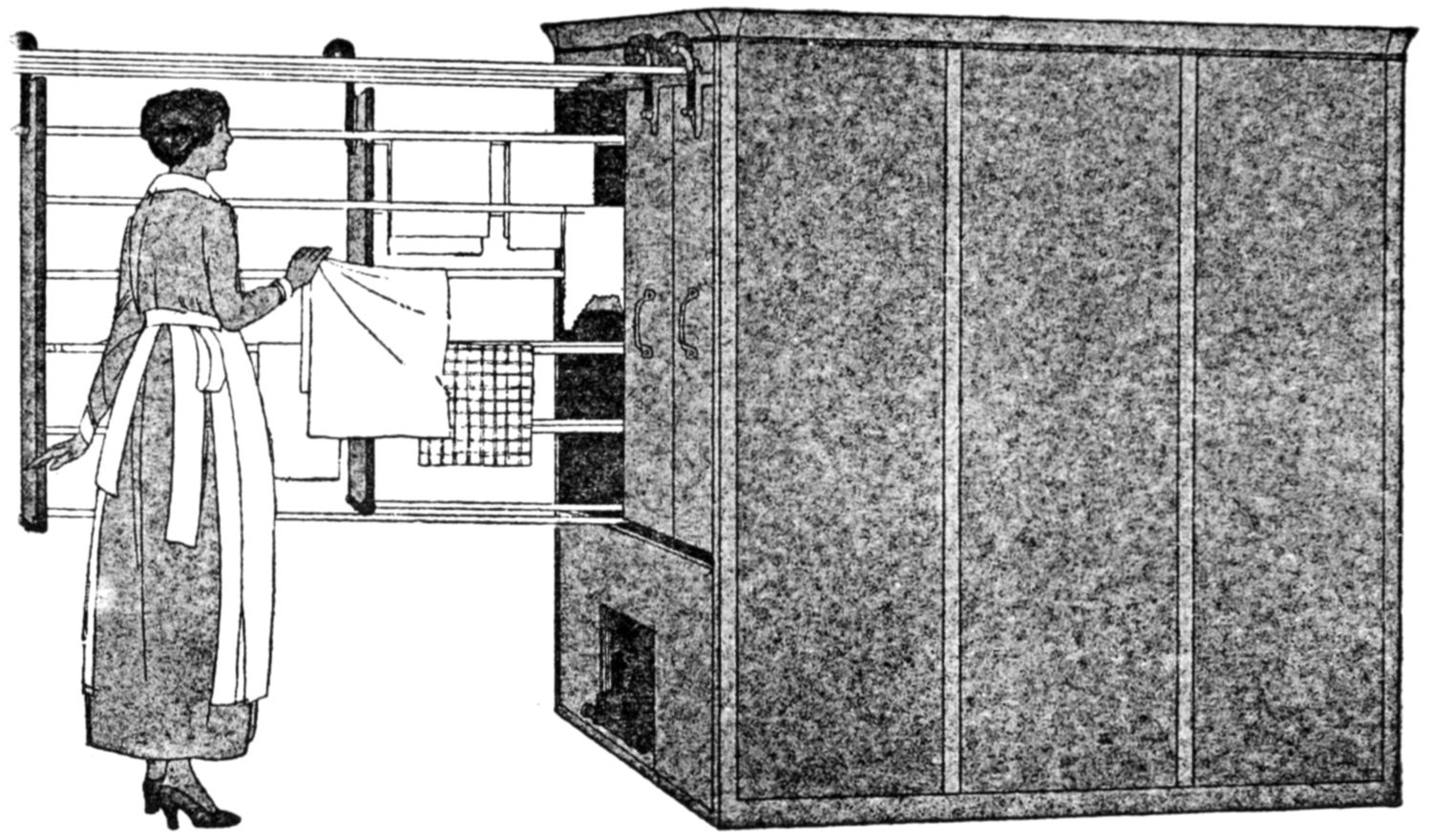
WET DAYS CAN BE DRY DAYS, NO MATTER WHAT THE LAW MAY BE, WITH THE INDOOR DRYER
6. Minimum parts to take out and clean.
7. Less wear and tear on clothes.
8. Automatic release on wringer in case finger is caught.
9. All interiors smooth, non-absorbent of soil or odors.
10. Wash and wring at same time or separately.
Now you have the requirements, you can take your
choice after you have gone about comparing and examining
all the different types.
“What about the dryers?”
They are one of the things that you could get along
without if you wanted to waste time in drying. They
are expensive to buy, but you are never held up by
weather. They dry clothes a good color and you do not
miss the sun. They are heated by their own heat, electric
or gas, or can be attached to the coal stove and get
the overflow heat. They are made to allow no heat to
escape even when extended. (See illustration.)
Up until late years women not convicts have been
time servers. But long before the vote was women’s,
there was a mighty revolt and women decided it became
them better to be time savers and not time servers.
For this reason in gallant fashion manufacturers have
rushed to fill the needs of women in their homes and
from soaps to ironing machines have they labored and
not in vain.
For example, in ancient days if it rained on Monday
(then called Moan day) or was Monday humid, the
work either had to be given up because drying was
impossible or the whole household work had to be dislocated
by the transference of wash day to a more
sunny occasion, to a day when drying was not a theory
but an inevitable accomplishment.
No longer need we say, “If at first you can’t succeed,
dry, dry again.” For the heated air dryer has come
for the laundry of the private home as well as for the
apartment cellar, and drying has become an indoor
sport rather than an outdoor hazard.
These dryers are merely galvanized metal of from two
to ten compartments from 46″ to 53″ wide and about
5′ high. The compartments pull out as easily as a watch
stem and each drying rack has six drying rods 66″ long
or a total of 33′ of rack. Each rack is about 10″ wide.
The ordinary length of the rack is 5′ 10″ and the
distance from the back of the cabinet to the end of the
racks is about 11′ 8″. When the cabinet is closed the
track which protrudes overhead can be used to hang
clothes on. The overhead track is far more convenient
than the floor wheels upon which some racks pull out,
as the floor, should it be uneven, will prevent ease of
operation of the racks and annoyance will ensue. Single
dryers can be bought with two racks only 23″ or so
wide for smaller rooms.
These cabinets can be sunk flush in the wall and take
up no more room if the building is so constructed or lie
against or at right angles to the wall. The heat does
not permeate the room in well-made dryers. Any stove
used in the laundry should not be in connection with
the dryer.
The dryer which really does its work should:
1. Not overheat clothes.
2. Not sweat them.
3. Not turn them yellow.
4. Thoroughly ventilate them.
5. Remove all odors.
6. Dry them rapidly.
7. Make them easy to iron.
It has been imagined that sun and wind alone dry
clothes but the fact is that air is the drying medium
and therefore the best dryers provide a good circulation
of air plus heat. Dry air has a tremendous love
for moisture and eats it up as a blotter eats up ink.
The warmer the air the more moisture it will hug.
This would seem enough, just to bake the clothes, but
baking does not remove odors and does render them
yellow; they are unventilated and smell like the laundry,
so people are prone to say “Sun drying or nothing.”
However, the best dryers provide for circulation of
air. At its best the air changes from 250 to 300 times
an hour. The air must change, for after one lot of air
holds all the moisture it can, it cannot take any more
from the clothes, and new arid air must be substituted
for that which is moisture-fed. This is accomplished by
a moist air exhaust in the newer dryers, which are larger
than the older types. The result is white, odorless,
air-swept clothing.
The stream of air is usually accomplished by the use
of ordinary chimney draft assisted by the warm products
of heating from the heater. The hot air products
of combustion pass through a tapered nozzle into the
moist air exhaust pipe, and by the speed a suction is
created which helps to pull the moist air out of the cabinet
and up the chimney.
When you buy a dryer see to it that the exhaust pipe
is large so that you will have wind and heat instead of
just heat. Air circulation is what you are really buying.
See that you get it.
All parts upon which clothes hang should be non-rusting.
The racks must pull out without any expenditure of
strength and must run quietly.
Racks must be within the reach of the average sized
woman, to avoid stretching.
The heating burner must be simple and easily reached
so that you can tell at a glance how much heat you
have turned on.
There must be ample screening so that should a
garment fall it cannot possibly get scorched.
The finish of these dryers must be smooth, without
protuberances which could in any case tear the garments
to be dried.
Dryers are best heated with gas, electricity or kerosene.
Care must be given to get the best kerosene
burner as they are troublesome when not perfection.
Dryers are simple to operate, and you are saved:
(1) tugging clothes to roof or yard; (2) putting up a
wash-line; (3) fastening clothes and tearing them with
clothes-pins; (4) carrying heavy baskets anywhere;
(5) sprinkling and rolling clothes, because you keep
them drying only long enough to be ready to iron;
(6) the wear and tear from the exposure to dust, sunburn,
fading, snow and other outdoor contaminations.
A very good little dryer, simple as a broiler, is the
over-head slatted dryer, which, on a pulley, is spread
with clothes and pulled up to the ceiling where the
clothes dry by the risen heat of the room.
In a small kitchen where the washing and cooking is
done, it is a real boon, and in the laundry, too, it is
a genuine convenience.
The rack is about 32″ to 64″, and on the ceiling it is
comfortable and useful and out of the way. It comes in
two sizes.
Your clothes go directly from the wringer to the rack
as in the big dryers, you obviate unnecessary handling,
clothes-pin destruction, etc.
It can be pulled down to your own level and hitched
on a wall pin so as to make it reliably firm while you
load it.
Shelves in a laundry are very much more useful
than a quarter of a dozen tables or to buy two or three
tables for laundries and abandon them for needed foot
room, yet long for some room to put things on.
The steel unit of shelves is a very convenient way
out. By using a continuous running shelf, like an
amplified plate rail, any place in the laundry can be
a handy one for placing a bit of soap, a clothes-pin,
washing powder, clothing waiting for starching, or any
other thing. Steps could be saved and wit conserved.
Tables are a necessity, especially the large 7′ table
or smaller. The wooden one for a laundry is quite
useful and so also is the all-metal table. But too
many tables spoil the temper, and the shelf is a comfort.
They should be from 31 to 38 inches high, if possible
adjustable. The tops are most satisfactory in a non-porous
porcelain or porcelain enamel. Some people
like hard wood or metal.
There are many varieties of ironing boards on the
market. Some fold back against the wall and some do
not. Some fold back in self closets against the wall.
Some are adjustable to different heights, others are not.
They come in various sizes and finishes and do away
with the falling and slipping ironing board which has
caused so many useless burns.
In large houses the valets have tables such as you can
purchase with sleeve boards, swinging bodyguard,
supply cabinet for cleaning fluids and brushes, and with
electric iron equipment, snap switches and automatic
signal pilot lamps for each iron. These tables are made
of seasoned pine painted white. Legs, underbody, cabinet,
brackets and cord supporters are in silver bronze
paint. The boards are covered with the best quality
felt. Unbleached muslin makes a good covering for any
ironing board and is generally used.
The ironing board is indispensable for fancy things,
even when the ironing machine is regularly used.
When un-electric irons are used, there should be an
ample supply of iron holders. If your irons are not of
the removable insulated handle type, iron holders of
ticking or soft bits of carpet can be used. This sounds
very elementary, but many scorchings would not have
taken place had the laundress not rushed to get through
to save the hurting hand.
This is truly a burning shame if anything could so
be called. It is possible, too, to get a thin bit of asbestos
encased in a bit of ticking and so protect the laundress
from discomfort and your clothing from destruction.
These iron holders could be made by the children of
the house who are always looking for something that
they can make to give to Mother, Auntie or Grandma.
Much time could be saved in the laundry if whenever
it were possible a chute could be built into which clothes
can be thrown and go directly to the laundry where is
situated a basket or a terminal closet to receive them.
Here stuffing the dumb waiter is obviated, also carrying
the clothes in baskets down the lift or just using the
ugly clothes hamper in dressing room or bath room.
Here is a more or less suggestive plan of arrangement.
Assuring less expenditure in labor and money.
1. Soiled linen chute in one corner of the room.
2. A table near to sort laundry before washing.
3. Tubs in center of the room to be accessible.
4. After clothes are washed and blued they can be
partially dried in dryer and ironed.
5. Then a table on which to place clothes to be ironed.
6. Ironer next in the best light possible and arranged
away from wall to permit two people working at
it, if necessary.
7. Skirt and sleeve board next.
8. After which another skirt and sleeve board or a
valet table or another plain table.
Some people keep a sewing table in the laundry
but it is easier to have the sewing done in the sewing
room and away from the laundry work. Because the
different maids might much better stay in their own
territory and failing maids its easier to keep your
threads any place but in a laundry.
Because there are some dainty things that cannot
be put through a machine, electric flatirons are absolutely
indispensable in a laundry. For that reason
there are many kinds on the market. They are usually
made from 21⁄2 ℔s. to 15 ℔s. Most have but one heat,
but some have three heats. A traveler will be pleased
with the adjustable 3 lb. iron which has a voltage
adjustment making it practical with 220 or 110 voltage.
With the best washing machines you get bad results
if you do not use good soaps or cleaning powders.
There is a very good powder on the market which
not only cleans the clothes well, and leaves no greasy
residue, but is really not a soap at all. It combines
rapidly with water, and makes a fine suds and cleans
very rapidly.
For the most part to-day, yellow soaps and white soaps
as cleaners are on a par but are not as good for laundry
purposes, since the resin in the yellow soap combines
unhappily with your clothes.
White soaps are best, if you want good results.
Another delightful new thing on the market is the
starch which does not starch but which imparts a gloss
and resistance without a stiffness. This will come as
a boon to many women who do not want their lingeries
stiff but do want it to look as a starched bit of linen does.
In the same way as starch this composition permits the
lingerie to stand up longer under use.
The foregoing is just a group of ideas in concrete
form to add to the comfort of laundry days. They can
be passed on to friends as ideas, even ideals, or as
practical, concrete gifts.
All three or any would be acceptable to the thinking
housekeeper who wants one hundred and one things
done better than a man can do one thing well. So all
aids in the home are worth not only considering but
investigating with eye and ear as well as heart and soul.
Perhaps more money is wasted on blow-outs in homes
that utilize electricity than any other cause. If you
follow the rules, illustrated here and first published by
the Edison Company, not only will you save expense
in the home, but you will save the Fire Department,
which is constantly called upon to save lives and property
because of unnecessary fires due to carelessness
(Not to electricity) in handling flat irons.
The cardinal principle for the use of all electrical
appliances is this: When you are not continuously
using any device, shut off the current. To do this,
entirely disconnect the flatiron, curling iron or whatever
the device may be, by pulling out the plug. Do
not be content with turning off the current at the lamp
socket. It is absolutely necessary that the current be
completely cut off when the iron is not in constant use.
Sometimes the current has been inadvertently turned
on when the flatiron has been left connected at the
lamp socket, and material has been badly scorched or
even more serious damage has resulted. An electric
coil for heating water has caused fire when carelessly
left near inflammable material. In like manner a connected
curling iron when heedlessly placed on a bureau
scarf has also caused damage. Remember the invariable
rule for the use of all electrical appliances—pull
out the plug to disconnect when not using.
Go to the best dealer.
Buy the best only; it reduces later costs.
Simplicity, safety and serviceability necessary.
Avoid machinery with extra parts to be cleaned or
upon which injury to attendant or clothes can be perpetrated.
Don’t buy until you are perfectly sure by numerous
comparisons and other experience what are the best
types of machinery to install. Be sure to apply the
three S tests: Service, Safety, Simplicity.
CHAPTER IV THE PORTABLE VACUUM CLEANER — “ All Is Not Gold, Etc. ” — Dust’s Hunting Grounds — We Are Three Kinds! — As To Motive Power — Motors! — Requisite Qualities
“I have seen ten vacuum cleaners at the Electrical
Show and every one, according to the salesman,
is the best on the market! I want one, but which
one shall I buy? It’s most confusing!”
This was said to me no less than ten times.
The answer is: that you must find out in the same
way as you found out about your motor car before buying
it. You didn’t buy your car because a salesman
said it was a good car and because he made you sign a
slip and because he promised you, as he departed, a
quick delivery.
No, indeed, you tried out the car first or last and you
asked your friends, who had purchased the same make,
how they liked it and you talked a lot about cost of upkeep,
efficiency, wear and economy and the service possible
to be had from the makers. Didn’t you? Well,
the same process is necessary in buying a vacuum cleaner
or any other piece of machinery for the house and
every Domiologist knows this to be a fact.
All vacuum cleaners look charming and shiny and
all seem very perfect in the shop! And they all do
their stunts beautifully as the skilled operator thrillingly
draws designs in the flour or bi-carbonate (clean,
unclinging dirt) on the patient carpet. The operator
talks glibly, often failing to give the failings of his
machine because he doesn’t know them. So the only
thing to do is to try it, in your own home, under your
own special conditions, and see that it gets under your
furniture, removes threads, lint, hair, dust, matches and
other substances with the least possible noise (for noise
wears on the operator’s nerves and raises a dislike for
the cleaner) and the least possible effort.
It must be light weight, easy to operate and economical
and durable. There is nothing so hard to remove
as “natural born dust.” It becomes imbedded in the
carpet and it takes force to remove it and the sort of
force that will not destroy.
Taking up the differences in the various machines,
it is the better part of valor to know what the nature
of our prey is before we start to hunt! So we will
examine the animal dust in its hunting-grounds.
In your home you have on the floor woolen or grass
fabrics; rugs large and small, and carpets, grass rugs
and mattings. The carpets or rugs may have a long
nap loosely woven (Chinese) Axminster, Wilton, Velvet
Chenille or the pile in loops (Brussels) or just woven
threads such as ingrain without any nap or pile. Grass
rugs (Crex, etc.) and matting are of this kind.
It is easily understood that, as the carpet or flooring
is walked on, the dust becomes deeply imbedded and
gets tangled up in the fibres, and that surface sweeping
never can take out the dust and you have to send carpets
each year to the cleaners to restore their color,
etc.
Above the floors are, of course, the hangings, mattresses,
books, pictures, moldings, ceilings and walls.
As to the dust and the litter, such as matches, hair, lint,
collects, 85%-90% of it gathers on the floor, and
10%-15% in the rest of the room. Therefore the cleaning
is reduced on the upper regions if the floor is kept
really clean.
Of all dirt considering the surface dust not walked
on that blows in on clothing, etc., litter, threads, hair,
lint, and pieces of paper, imbedded dirt, grit tracked
in and entangling itself in the carpet, the worst of these,
of course, is the hair and lint and grit. These are hard
to remove but they must be taken out, especially the
grit, which is the destructive agent in dirt. In the
Oriental regions, where the street shoes are left on the
door-step, the vacuum cleaner might seem useless.
The carpet doesn’t wear out so much from the top as
it does by being cut from the roots by the stamping in
of the cutting grit. Therefore, the vacuum cleaner has
been invented to save the carpet, and not only to destroy
the carpet destroying factors, but to annihilate the microbe
drawn into the house from the street on your
offending shoes.
And so ... to have the cleaner that really functions,
every machine must be constructed so that it can be
easily taken apart and adjusted, and in order to know
how to know whether the machine is useful, the following
resumé of the kind of cleaners may be of service. These
will be treated in functioning classes rather than in
technical terminologies.
The portable cleaner (we will not discuss the installed
types) are divisible into three classes:
1. Using air only as a cleaning agent
2. Using air plus a brush
3. Using air plus beating and sweeping brush
First: In this class are the tank machines having
vacuum pumps as well as fans, single or multiple (many
fans mounted on the motor shaft) and the small fan
portables.
All these machines are on the same principle, having
the motor, fans or pumps for moving the air, a dust bag
to collect the dirt, and the hose in the tank machines’
case and the extra tools.
In the small portable machines, which we are considering,
the narrow slatted tool attached directly to the
motor and the fan case is the medium through which
the dust from the floor is taken up and the hose, as in
the tank type of cleaner, is eliminated for floor work
and is only used for altitude cleaning. So the only
difference in these types—the tank and the slatted
portables—is that the tool for the floor work is directly
on the motor case, in the slatted or fan portables, and
on the end of the hose in the tank types. In some
machines the dust bag is before the fan, in some behind
it, in some the bag is enclosed (there are hardly any on
the market now) and in others it is hung on the handle.
[Wherever the bag is, it must be so made that it does
not slip from its mooring and spill.] The principle,
however, is the same in each case: drawing air through
the tool which slides easily over the carpet, plus the
velocity of the air as the instrument upon which the
cleaning is dependent. Upon the rapidity and frequency
of the passing of this machine over the carpet depends
the thoroughness of the cleaning operation.
When the carrier wheels are on either side of the
nozzle or just back of it, keeping the nozzle slightly
above the carpet, the operator, if skilful, can do a
good job.
Second: Using air plus a brush: The brushes are
used as follows:—(1) Straight bristle brush (looks
like a comb of bristles) attached inside or outside of
nozzle, projecting slightly below it so that it will comb
the carpet. (2) Spirally wound bristle brush fitted
inside the nozzle opening and operated by the carrier
wheels, either with a belt or gears. This brush moves
in the opposite direction to that in which the cleaner
is pushed, and takes up the lint and hair, etc.
Motor driven brushes are driven by a belt attached
to the motor. It is continually in action when the motor
is running except, of course, when the brush is removed
for any reason. The surface is continuously
swept as the air passes through the nozzle, and there is,
of course, more power in the motor driven brush. But
its enemies in the friction brush camp aver strongly
that the brush is prone by its velocity to wear the carpet!
These brushes generally have two rows of spirally
wound bristle, and in this type you get away from the
old-time carpet sweeper where lint and threads adhere
for a long time to the bristles and often return again
to the carpet.
Third: Using air with beating and sweeping.
These sweepers have a large brush in a large nozzle and
the brushes are spirally wound in two rows with a
simple belt connection to the motor. These machines
are generally adjusted so that the nozzle is about 1⁄4″
above the carpet. The bristles extend enough below
the nozzle so that the bristles push away the carpet as
the air draws it up. This gives the shaking motion
at the same time the bristles, coming down at an angle
on the carpet, beat it and passing through the nap
comb and sweep it automatically. The bristles comb
the nap and the air, passing through, cleans the carpet
and the imbedded dirt is loosened by the shaking. The
surface litter and hair is swept up and it cleans efficiently
by applying all the laws of cleaning at the same
time.
Of course, with the cleaner come tools for altitude
cleaning, for blowing out dust from books, moldings,
upholstery tuftings, etc., etc. The extra tools are absolutely
necessary and it is well to remember that the
price is generally given you without the extra $7 to $10
being added. Tools are made of aluminum steel and
fibre, which means that they are durable and will withstand
much wear and tear.
If you should own the best vacuum cleaner in the
world and take no care of it, it would be as if you had
none. Every bit of machinery that was ever or will
ever be made needs care. Any mechanism “acts up”
if neglected. It is true, that the vacuum cleaner needs
very little care, probably oiling once a month and the
removal of the dust after every cleaning operation.
The oiling is easy to understand, but the reason for removing
the dust after every operation is: that, if the
dust bags clog up, the egress of the air is impeded, and
therefore the action of the motor is impeded, and the
fan’s speed is diminished, causing a decrease in velocity
and air supply which is what makes the cleaner more useful
than a broom.
Do not be fooled by big talk and glib printed matter
about high vacuum power, and long air and water
columns. What is needed for a good cleaner is air displacement
at a sufficiently concentrated point or surface
to maintain a high air velocity. A vacuum cleaner
might show in a technical test a tremendous vacuum
and when used on the carpet the nozzle be so constructed
as to mitigate the power of the suction so created and,
therefore, be ineffectual as a cleaner. Therefore, the
salesman can talk glibly to the uninformed about
vacuums and tests and never say “but our nozzle is so
large or so high or so low that the air intake is bad.”
Too much vacuum often makes the machine heavy by
sucking too heavily upon the carpets. Of course, raising
the nozzle here will help this fault.
Another battling point is the question of whether
the motor put in horizontally into the casting or that
which is put in vertically is the better. They all talk
glibly on this subject, but heed it not. All that is
necessary for the purchaser of a cleaner to know about
the motor is that it should be made by a reputable
firm, have a good speed that is spectacular and that
it be not imbedded too deeply in unnecessary fixings to
be oiled and cleaned.
The universal motor is best for the average purchaser
as it works well on indirect or direct current, whichever
is supplied to you in your neighborhood. Nearly
every cleaner employs a universal motor.
Every vacuum cleaner manufacturer has some point
of his own that makes him the most delightful of talkers.
Here are some very useful devices which are worthy of
mention, but for the most part are matters for individual
choice:
The enclosed dust bag.
Steel motor case.
Nickled steel motor case.
Aluminum motor case.
Wheel bearings inside the nozzle.
Wheel bearings outside the nozzle.
Detachable nozzle.
Air cooled motor (most motors are cooled by in and
outgoing air).
Dust bag on top of the handle shaft.
Adjustment with nut for stair cleaning.
Self adjustment to keep handle erect when released
from holding (very convenient).
Automatic current cut off.
Extra roomy hooks for electric cord on the handle.
Oil cups protected from dust (should be always).
And general attachments made as simple as possible.
Dust bag lined and sometimes partitioned.
Dust bag easy to put on and take off with a collar
to hold between the soles of shoes to empty without
making dust escape.
Automatic closing valve where dust bag collar comes
off—to prevent dust flying back into motor casing.
Rubber bumper to protect furniture.
In short, the satisfactory cleaner must:
1. Sweep loose the adhering dirt such as thread, lint,
dust particle, and brush up matted nap or pile to restore
color tone.
2. Loosen and shake to the surface ground-in dirt
that kills rugs and carpets, so that it can be removed.
3. Have suction enough to carry away all dirt after
the soft hair brush loosens it to make it possible.
This is about the whole story. And as to the expense
of operation, they cost not even as much as an electric
iron, and far less than the cost of extra cleaning folk
to-day. Cleaning becomes interesting and the household
without a maid or with one, saves time and money. The
rugs can be cleaned at home and stored at home in the
summer. Here you save summer’s many costs! Cleaning
becomes almost a pleasure, at least a pleasanter performance,
not a bug-bear—or in this case we might say—a
rug-bear! It is an economy, a comfort and a gold
lined investment in which the interest is health, money
saved, and fabrics preserved. Could you ask for more
in a sweeper?
But don’t expect miracles. The vacuum cleaner needs
slight pushing over the floor—it can’t roll by itself.
CHAPTER V A PIPE DREAM — Pros and Cons — Operation
As
soon as you get accustomed to the intricacies
of one method of doing anything to-day, something
new crops up. This is probably more true in the realm
of housekeeping than in any other except that of military
science. You have no sooner mastered the points
of what not to do and what you should do with portable
vacuum cleaners than up comes the stationary vacuum
cleaner and you have to know about it, too. And so this
article after one on the portable cleaner. If you forget
the technicalities see Chapter IV.
To refresh your memory, every vacuum cleaner has
five elements:
1. Air producer (vacuum is a misnomer): the pump
or fan series employed to create the air current.
2. Dust collector: bag, box, pail, etc.
3. Dust conduit: piping.
4. Cleaning tool: brush, felt, etc., etc.
5. Human direction: the hand that steers.
The portable type of cleaner has the first four parts
mounted on one unit, so that the whole machine is moved
in its chase for the enemy Dust. Besides this the electric
wire must be applied to an electric connection in
a baseboard or electric fixture.
In the case of the stationary cleaner, the mechanism
is larger and the air producer and dust collector are
in the cellar or basement, and the dust conduit impartially
spreads itself throughout the house through walls
and ceilings and politely connects at convenient intervals
with the cleaning tool, via the agency of the vents
in baseboards. With this cleaner the only thing that is
manipulated by the worker is the cleaning tool which
“bites the dust.”
Courtesy of American Radiator Co.
LOOKING FOR THE DUST WHICH WAS SUCKED DOWN FROM
ABOVE STAIRS!
But why should you have the installed cleaner?
Why not have the portable? The fact is that neither
of these cleaners is in competition very directly. But
let us quote an expert who has given most of his time
to the subject of air cleaning:
“There is unquestionably a legitimate field for both
types of cleaners, but the stationary type more nearly
reaches the ideal.” The next statement of his will explain
that: “If we observe the action of the wind in
an open field, we find that a gentle breeze will move
light material.... If the breeze changes to a hurricane,
we find that the moving air has the power ... to
move anything in its path, including fences, trees,
houses, etc.”
Therefore in considering purchasing a cleaner you
must ask yourself first: “Do I want a gentle breeze
or a little hurricane in my home? That’s the first and
foremost question! Is my home large enough to afford
the much more expensive plant which makes the hurricane,
at a higher running cost; or isn’t the portable
just the thing I need because of its various adaptabilities
and small running and installation costs?”
It has been held against the installed vacuum cleaner
that it is—
1. Expensive.
2. Unusual skill must be employed in installation.
3. Suction is altered by length of pipe.
4. Cost of operation is high.
5. Wear and tear on the house too great.
6. It must be installed when the house is built.
Of course the stationary type is more expensive than
the portables, because of the larger machine, the indefinitely
long pipe system and the larger motor. The
motor has from six to twelve times and upwards the
horsepower of the portable machine. It is, therefore,
more costly to run because it eats up more electricity,
but it can do heavier work and quicker.
Great skill must be employed in the installation of
all machinery. Not long ago mistakes were made when
putting in the air system, but now engineers know this
department of work as well as they know gas and electric
installations, and with the length of hose used there
is no lessening of suction because of the construction
of the entire pipeage.
The objection that with this apparatus there is tremendous
wear and tear because the hose is taken
through the doorway from the hall so that the door
must needs be scratched when it closes on the hose
as it is dragged through, may be nullified by installing
double end hose connections in the wall near the door
so that one line of hose will connect from the valve to
the connection in the hall and another shorter piece of
hose used inside of the room.
There is no trouble at all about installing the stationary
vacuum cleaner after the building is erected, but
naturally it is less expensive to put it in during the
building and when planned for ahead than it is to
put pipes through a house after it is built.
With the stationary type cleaner you have no machine
to move about—you simply move the tool attached to the
hose and the tools are just as light as those of the portable
machines. There is no electric connection to make,
no electric wire to carry unconsciously along. All
there is to be done by the worker is to slip the end of
the cleaner hose into the suction pipe opening in the
baseboard of the room. A patented device prevents the
hose from becoming detached accidentally.
The usual tools come with the installed cleaner, such as
handle, blower, felted sweeper, book cleaner, duster, etc.
Other tools can be made to order to fit any particular
need.
One thing delightfully obviated in the stationary
cleaner is the noise. The writer has what she considers
the best portable cleaner on the market, yet the noise is
a great drawback. The stationary cleaner is therefore
a boon to the sick room and it is easy to see why
the newer hospitals take as readily to them as to the
piped water system.
Then, too, having the baseboard vent in each area
in large houses, with the consequent needlessness of
carrying a cleaner upstairs and down, over hill and
dale, is a selling point for the piped cleaner. Also the
swiftness of the cleaning, due of course to the tremendous
air velocity—a canned hurricane. However,
in the small residence the greater cost would be unwarranted
because of the great efficiency of the portable
machines.
Where there is a garage in the family, and it is piped
for cleaning, the machinery, instead of being permanently
installed, can be mounted on rollers and can be
wheeled and attached to the pipes in that building.
Therefore the necessity of two machines is obviated
where the other building is piped.
Yet when the buildings are widely separated it is best
to have one of the good portable machines which are on
the market in so many designs, and are adapted to so
many and varied uses. Therefore you see the portables
as indispensable and see them filling fields that the installed
can never hope to fill.
The fact that the stationary entails no dust-bag cleaning
is a time and labor-saving actuality. Then, too,
no matter how good the dust bag is on the portable
vacuum cleaner, some of the very fine dust must escape
through the bag into the room. In the stationary type
the cleaner politely does its exhaling in the cellar. This
point has been made valuable to chocolate makers who
want to save the loss of chocolate in packing boxes,
to manufacturers who want to obviate the retaining
of poisonous dust among the workers, etc., etc.
In the stationary as well as in the portable vacuum
cleaners the suction is caused by the pump or fan type
machine. Some manufacturers advocate one, some another.
In picking your winner you must go to the best
manufacturer of each type and let him give you his tale,
and then see whether you come out a pump fan or a
fan fan!
The other intricacies of this simple machine need
not bother you. Go to the best makers and make them
responsible for your purchase. Not all of us being engineers,
you have to depend on the reputation of the best
makers.
The stationary cleaner can do more work than the
portable, it will last longer because the machinery is
heavier, yet there are drawbacks to it as to all machinery
which is not at all points open to the eye. For example,
the pipes may clog. But you must remember that water
pipes can clog and that gas pipes do very exasperating
things; yet you use them without blinking.
For the very large residence, factory, hospital, hotel
and institution, of course the stationary machine is best,
mainly because it is difficult to get help to-day to carry
about the premises anything that is heavy. To lift,
push or carry the lightest portable over a very large
residence or institution is a trial, and the stationary
type overcomes this difficulty.
In some cases the heavy duty portable is advised with
its increased horsepower, but when the purse and area
of residence match, the stationary type is really the
best, although we know householders who prefer
to use the portable and heavy duty portables everywhere.
The stationary plant is only another real “pipe
dream” come true, and in addition to piped water,
piped gas and conduited electricity it will tend to hasten
the processes of home maintenance and free the home-keepers
to do more spiritual home tending.
But remember that in the average home or apartment
the portable machine is the ideal sweeper and
fulfills more than every requirement of sanitary
sweeping combined with the least effort. The stationary
is for the large house, not the small.
CHAPTER VI COOKING BY ELECTRIC CURRENT — Points About the Stoves — Ovens and Broilers — Electric Measurements — Control and Trimmings — Dimensions and Care — A Very New Departure
The electric stove is the most dependent on geography
of all your kitchen implements. Because it
consumes a large amount of electricity, the rate of
this as a fuel will decide whether or not you can use the
electricity-consuming stove. This decision, in turn, is
affected by the rate of electricity for cooking in every
different locality in the country.
The vogue of the electric stove is due to the convenience
and sureness with which the cooking is done, the
control which may be exercised and the positiveness of
results. Furthermore, the cleanliness, lack of odors
and gases, and the easy installation and convenience of
placing are other important reasons why the electric
stove has come to stay, if electric companies co-operate
with the stove companies to give a cooking rate.
Its vogue, too, is largely due from the fact that in
the maidless home housekeepers find electricity simpler,
cooler and cleaner, if more expensive and not quite
as rapid as gas.
As with the gas and wood stove, the main principles
must apply in picking them out, with but few additions
and omissions. The electric stove is not bothered
with its own deterioration by the combustion inside
it of oils, woods, coals, cokes, etc., but has, of course, to
be well wired, rust protected and insulated against
mishap and fire. Accidents are contingent on anything
that uses any fuel. With electric stoves it is unnecessary
to have large or small storage systems, which makes
electricity a convenient fuel for the small “rabbit
hutches,” in which the wealthiest and poorest are forced
to live in these days of homelessness.
Courtesy of Estate Stove Co.
THREE LITTLE FINGERS FIT IN THREE LITTLE HOLES AND
THE CONNECTION IS MADE
Courtesy of Bramhall Deane Co.
HERE THE STOVE LID IS SET ON A LITTLE ROUND PLATFORM
ALREADY ATTACHED AND EASILY DISENGAGED
ELECTRIC RANGE
Then again, if you employ electricity, whether it is
more costly or not, you do not have to put in so strenuous
a flue system when building a house, but just a hood
over the stove as a vent to carry off cooking odors and
a special wiring system. You do away, too, with the
draughts necessary for coal or wood types and all the
contingent engineering niceties, which harass and
wear you if they are not perfection.
The body of the stove should be built of non-rusting
iron. Armco rust-resisting iron is often used in the
best grades of stoves. It is free from impurities which
invite corrosion and rust and has proved a valuable
material out of which to make a good stove body. On
some stoves the tops are made of gray iron castings
which, with the black body and its polished iron trimmings,
make a very stately and harmonious article without
sacrificing anything of practical utility.
The top of any stove is the place upon which are
placed the utensils for frying, boiling, etc. This is true
whether the fuel be coal, gas, electricity or what-not.
The top of the electric stove is no variant to this
rule. It has the spots upon which to place the utensil
and these spots are called the heating units. Heat, of
course, is communicated in varying degrees between
the units. These units are of cast or wrought iron.
The tops of any electric stove must be of cast iron or some
such non-warping rigid material which takes readily
to cleaning. The heating element should be safe from
molestations and the top of the stove must be smoothness
itself to hold the utensils with perfect ease and
steadiness. The units’ wire connection must be enclosed
to protect the heating element. The top of the
usual electric stove has about four cooking “holes”
or plates, or heating elements. In some cases the electric
connection is made by the heating units being equipped
with pluglike sets or fingers (as your ordinary lamp
plug) and fitting into a socket under itself. In other
cases, if it be a three-heat stove, the three wires are directly
connected with the heating element and all that
has to be done in case of bad connection is to raise the
heating element and unscrew the wires. In other styles
when bad connection occurs you must search the surface
beneath the plug, a little more complicated operation,
but still the manufacturers of this feel that it is an added
protection to wiring.
The surface units, too, must come off easily so that
no extra tool is needed to pick them up.
There are two kinds of ovens used in the electric
stove, from the point of view of heat retention. One
of them does not retain the heat completely enough to
call itself a fireless cooker oven yet does retain heat
to a great degree and cooks well after a little time on
the third heat or low heat. The other style guarantees
a fireless system of cooking when the electricity is cut
off.
Strange as it may seem, the largest and most elaborate
and the most expensive stoves are not made with the
retention-heat method because, no doubt, the persons
that can pay about $1000 or even $700 for a stove have
chefs and don’t really care whether they use more or
less electricity.
For ordinary use, however, and for the large stove
which costs to-day around $140 to $225, it is well to have
the retained-heat oven, the oven so insulated as to keep
in the heat and keep out the cold, so that you can
cook easily by fireless and save much electricity.
The oven should be equipped with top and floor
heating units. These should be controlled by a three-heat
switch and so geared and wired as to be accessible.
If one unit burns out the others will not.
In some stoves the heating unit in the top of the bake
oven is controlled by the same switch which operates
the units in the oven bottom and is of proper intensity
to insure good results.
Often this same unit also serves the broiler. In other
cases the broiler is supplied by an “on and off” switch
alone and it is only made in conjunction with the
broiler. In still other stoves the three-heat broiler with
separate switch is employed.
The broiler must be heavily tinned to prevent rust
and corrosion and it must have a removable drip pan.
In one stove on the market, which has the broiler to the
left on the top, the drip pan is fastened to the broiler
so that when it is drawn out over the stove for any
reason the drippings are caught by the pan and not
spattered on the stove top beneath. This is a minor
perfection but a very nice one.
Some range companies make a unit of a certain
size, say “24” or “48,” and if you want a larger size
you can simply say “I want two units”—or three, or
what not. There are small stoves for yachts and kitchenettes;
in fact, the electric stove is as adaptable as a
telescope, some have ovens above, some have ovens below,
some have broilers above, some below. Some have
everything above, some everything below. You can
have exactly what you want as to price and style.
Some stoves are also equipped with practical plate and
food warmers.
One very pleasing stove is called a period stove because
it has legs that curve and cavort like a period
bit of furniture—what period we couldn’t say unless
it be early Edison.
Then, too, there are combination coal and electric
ranges, for there are those persons who must have both—and
as they are beautifully combined they make a neat
and effective unit in the kitchen.
There are portable stoves and stoves that are built-in;
that is, the stove that can be very simply moved from
place to place if necessary, and the one that is backed
into the wall and would leave a scar if it were moved.
Of course the huge stoves are of the built-in type, but
they, too, come with legs and are better adapted to
removal.
For these electric stoves, special wiring must be
effected. They cannot be attached to the ordinary electric
socket. It is necessary when ordering a stove to
give the voltage of your electric supply. The stoves
are usually prepared for 110 volts with two-wire service
from street or 110-220 volts with three-wire service.
In some stoves the cut-out box is built on the range
directly back of the switches. This, then, can be easily
opened if anything happens. In the stock stove an
extra charge is made for voltage exceeding 220 or less
than 110, because alterations have to be made.
The consumption of watts in the electric stove is a
very vital question. Watts are the unit of electric power,
just as you speak of 50 cubic feet of gas in measuring
gas consumption. The unit of figuring the cost is not
on the watt—because a watt is too small a figure but of
the unit of one thousand watts, which is the kilowatt.
So you call the unit of fuel consumption the kilowatt
hour and you say the average stove consumes about one
kilowatt hour per person per day. If a burner consumes
800 watts it means you will be charged 800⁄1000
of a kilowatt per hour.
According to the size of heating elements, the wattage
of stoves runs from 10,000 watts or 10 kilowatts (which
is the same thing) to about 2500 watts, or 21⁄2 kilowatts
on a small three-heating-unit range. This gives its
total capacity if everything goes at once.
It is a little more intelligent for the housewife to
read her meter than not to. So here is how it is done:
There are four little dials, which you read from right
to left, the opposite manner of reading this page. The
first dial measures the tens, the second the hundreds,
the third the thousands, the fourth the ten thousands.
Therefore, the total is found by adding all the figures
at which the dials point and always reading the lowest
number which the dial approximates. But you must
always substract your last month’s record from this,
of course, to get this month’s average; and this amount
multiplied by your electricity rate would give you what
your bill should be.
After all, the cost is the paramount thing in your purchasing
and calculations as to purchasing. The electric
stove is, on the whole, more expensive than the ordinary
cook stove. The fuel cost varies, as has been said before,
with the locality in which you happen to live.
In many places the electric companies have made a
cooking rate much lower than the lighting rate. In
such localities where the electricity is but from 11⁄2 to
2 cents, the electricity as fuel is almost equal in cost
to gas at one dollar. It has been generally admitted
that, with care as to fuel consumption, a kilowatt hour
per day is consumed by each individual in the house.
If you have to pay three cents per kilowatt hour and
you have six persons in the house, your electricity will
cost you about eighteen cents per day. In the large,
weighty and “watty” stoves the consumption of electricity
is about 2 kilowatt-hours per day per person,
but on the stock ranges not weighing over 300 pounds
with a comparative low wattage (compared with the
1200-pound made-to-order range) the average is, as was
said before, but one kilowatt-hour per person per day.
One firm, computing 4.2 persons to average a family,
states that in the use of 26,180 ranges the cost was
$4.061⁄4 per month per family.
The value of electric cooking is not in the low cost
of fuel but in the saving of labor, food conservation,
cleanliness, comfort and mental or psychological delight
in the shipshape and orderly method.
In cities where the cooking rate is the same as the
lighting rate (around seven cents) cooking by electricity
is expensive for the average folk who have to think a
little about the cost of living.
It has been said that electric cooking is expensive
because it takes longer to cook by it than by gas. This
is being overcome in three ways: first, by the proper
use of electricity and the turning it off and cooking on
retained heat; secondly, by the better made stove in
use to-day; thirdly, by the use of proper sized and
shaped utensils which are a very great factor in the
rapidity of cooking and thence economy of electricity
as a fuel.
Most stoves are equipped with reliable thermometers
and also many give charts with the stove to show you
exactly what temperatures on that particular stove will
accomplish the pop-over, the roast, or the what-not.
This eliminates any basis of error. Some, too, have
glass ovens which further add to the gaiety of rations.
In buying, buy of the best firms, get guarantees, see
that your wiring is adequate and that everything is
well insulated with asbestos or something of equal value.
See to it that your oven doors close without slamming;
that when they are open they won’t bend if a weight
is put on them. We have seen one stove stand the
weight of a man jumping on the stove oven door when
it was lowered. Many a good cake has been ruined by
banging oven doors.
The switches should be conveniently placed and not
off in some corner. The fuses should be back-side or
back of range, as they are not particularly beautiful
to gaze upon and one is apt to take them for switches
when rushed. But few stoves now put the fuses in the
front. The fuses should be so connected that if one
blows out all do not.
There is a stove on the market at present that has
a fireless cooking timing device, so that when you go
to bed, you can have your breakfast all cooked for you
(if you have stocked the stove before retiring) at any
time in the morning at which you have set the clock.
This you may consider a trimming, but it is a nice bit
of modern life’s embroidery.
In most of the stoves the fireless cooking saves time
and saves your food. Basting is unnecessary; you get
what you pay for in weight of the roast and lose less
than by any other process of cookery. In some stoves
twelve or fifteen minutes of electricity are all that is
needed; stored heat then does the work.
The heights in stoves vary from a few inches (table
ranges) to about 5′. Height to cooking top varies, too;
the nearest it comes to 38″ the more comfortable, of
course. The new stoves are being made with special
emphasis on the height of cooking surfaces.
The depth of stoves also varies, from the built-to-order
stove which is 33″ to the stock stoves which run
even as narrow as 16″, with but three top cooking or
heating units instead of the average four.
As with all new devices, you must practise with the
electric stove to get the best results. The first few weeks
you may think you are using too much current. You
will be, too, but you will learn better if you take the
following into your mind:
1. Do not overheat your oven. Never let the temperature
exceed the thermometer’s tell-tale face.
2. Oil your oven occasionally as you would your
typewriter or sewing-machine, for some “non-rusting”
ovens go back on you.
3. Not only engineers but cooks often sleep at the
switch. But you mustn’t. It would be wise to have
a master switch in the kitchen connecting the range
to the electric supply. In this case you can turn off
the electricity and there will be no danger of leaving
a burner turned on when not needed. The heating
plate may crack if the current is turned on without
anything cooking in a utensil on top of it.
4. Don’t remove burners unless repair is necessary.
Boiling over of foods won’t hurt the burners. Use
nothing but a light non-metallic brush to rid the
burners of spillings. If you use old utensils that have
become rich in food deposits, thoroughly scour before
using on the electric stove. The electric stove
makes no deposit on utensils.
5. Turn down the burner when water boils. You
have three heats. Turn from high to low at boil.
Your bills will come down 75%. Use as little water
as possible and by keeping the lids on you will cook
by steam. Turn your switches to low at every chance
you get. Ten or fifteen minutes before the food is
cooked you can turn off current; there will be enough
heat to cook with if your utensil is covered.
6. When cooking roasts, in about an hour, depending
on the size of your roast, you can turn off full
current on the top burner and cook on retained heat
or on medium heat of bottom burner.
7. For safety in expense keep one burner on at
Full. Start your cookery of each thing on Full and
then shift to medium burners. This will save electric
bills, as you won’t have all your burners going full
tilt at the same time.
8. Flat bottom utensils at least as large as the
heating space are necessary to the economical use of
the electric stove. Use as little water as possible,
thereby cooking by steam and saving food. Shallow
vessels take less heat and therefore less electricity.
On the market, as this goes to press has come the
electric stove which, instead of heating by radiant heat
(red), cooks by conductivity or black heat. That is,
the unit becomes hot throughout and does not burn by
becoming red hot. It is claimed in this case that the
unit wears longer and that it takes less time to cook
therefore less electricity. We have not had time to
test this stove so cannot vouch for it except that it is
made by very eminent manufacturers and invented by
a very distinguished expert.
It is so built that the cleaning of it and the replacing
of its parts is done with the minimum effort.
All switches and connections are at the back of the
stove and can therefore be kept inviolate.
The top burner elements are made of multiple low
temperature units from one ampere in a single unit to
almost unlimited amperage of say 25 amperes, from
25 single units in parallel within a square or diameter
of 8 or 9 inches. Think what flexibility of heat this
means! It is just what up to date the electric stove
has lacked with its but one to three “heats.” If one
or more units burn out then there are others left!
The stove is so geared that a fluctuation of 25 volts
will make no trouble!
The oven arrangement and unit system are so arranged
as to bake quicker and adjustable to different size pans.
Ideal broiling is a thing quite boasted of in this stove.
All the units and parts are easily removable for cleaning
so you will get a prize if all the things they say
of their stove are true and we have little doubt that
they are true.

Courtesy of Bramhall Deane Co.
HOOD AND STOVE HEATED BY GAS AND WOOD. NOTE THE MARBLE-TOPPED TABLES
CHAPTER VII TAKING THE GUESSWORK OUT OF GAS COOKERY — New Devices — The Top — Regulating Heat — Burners — Range Facts
The
points in buying a gas range are for the most
part the same as in purchasing an electric range.
It must be of the best material, cast iron or sheet iron
or a combination of the two, the ovens usually lined
with steel, upon which is baked aluminum or a vitreous
enamel. Enamels are more expensive but their sanitary
value is great. Everything must be of the best
quality, no seams or roughness can be allowed to catch
food or odors, and the stove manufacturers must give
you a guarantee of almost everlasting life.
Stoves to-day are made with and without shelves, some
have the ovens above, some below. But where the oven
is below it is a great boon to have the top at least 32″
high—38″ from the floor is better, so that the oven is
sufficiently high to obviate back breaking, and the cooking
surface high enough to eliminate the back bend for
the ordinary cooking processes. Ranges to-day are built
so that there is absolutely no guess work either in management
or accomplishment.
A recent improvement is a stove with an oven heat-regulating
device, absolutely controlling the temperature.
Because this device is used by domestic science
cooking schools, cooking must be an exact science. No
especial training is required to handle this device, and
it has no working parts to get out of order; the temperature
is simply controlled and maintained by the turn of
a wheel.
This enables you to bake without opening the oven
door. A chart is supplied by which you can cook any
kind of dish, the time, the temperature and the necessary
decreasing or increasing of the temperature being
given clearly.
One new type of stove has the smooth top. It looks
not unlike a coal stove. It has no aching voids for
things to spill into, nor can pots tip over into the yawning
chasms. This saves a lot of needless irritation,
which is important with the present high temperaments
of cooks and housemaids. This stove stands 38″ from
the ground.
An interesting feature is that the whole top becomes
heated and is usable, whereas in the ordinary four-burner
top only four utensils can be used at once. This
top is connected with a flue which draws the heat, so
that there is no waste of gas. If necessary, the lids can
be raised and the flame from the burner will just tip
the utensil, the proper position for flames. The oven in
this range is so planned that it can be opened from the
bottom with either hand. Another stove has a top that
is semi-smooth and semi-spider, allowing you both systems.
Should a vessel spill over in the “smooth top,” the top
catches the overflow and it is simply washed off instead
of the usual pulling out of the tray and the messed-up
burner plate, which must be scraped and cleaned. This
range is made tall and narrow, ready for the small as
well as the large kitchen.
All gas stoves to-day have the automatic lighter, which
gives you freedom from the use of matches and makes
gas nearly as convenient as electricity. Of course, gas
is hotter in the summer than electricity, and to obviate
this many of the stove makers produce marvelously contrived
combination ranges of gas and electricity.
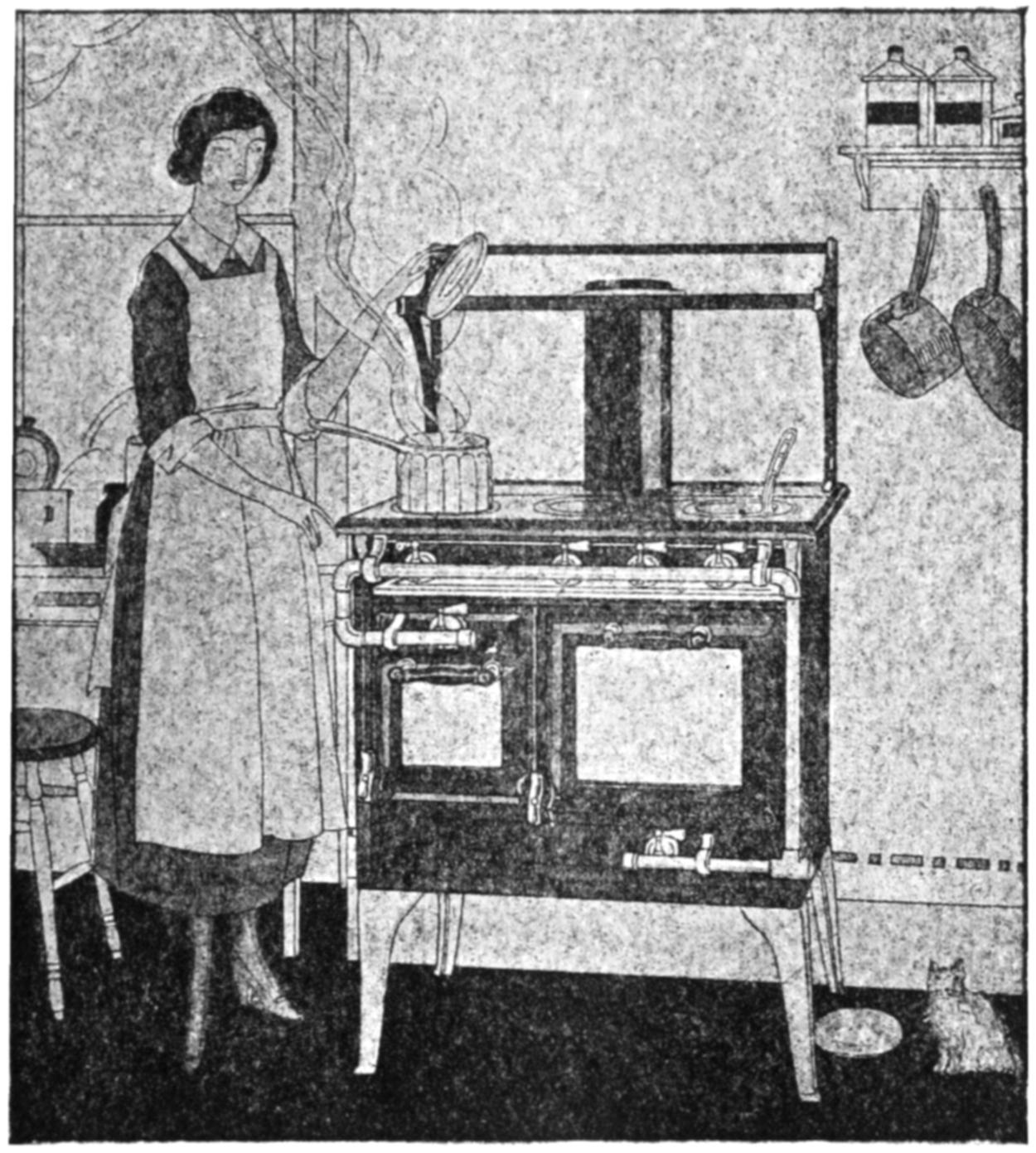
Courtesy of Vulcan Stove Co.
THE SMOOTH TOP 38″ GAS RANGE TAKES THE STOOP OUT OF
STOOPID COOKERY
Some stoves have plate warmers above and some have
a shelf open and available on which to warm dishes,
which also makes a convenient rack for dishes while the
rest of the meal is cooking.
Nearly all stoves are equipped with broiler chamber,
baking oven and wire shelves. One, particularly convenient,
has, instead of the two full-sized shelves in the
large oven, one shelf divided into two pieces, allowing
for more elasticity in placing different dishes in the
oven.
In the stove which has the oven heat-regulating device,
there are many of the fireless cooker features with
some of its drawbacks eliminated. For example, it has
no thick walls which eventually become impregnated
with odors of past meals; the time in pot watching is
eliminated; you can do other work and yet be sure that
your cooking is being done well. So much of the cooking
can be done in the oven that fewer burners are
necessary. This type is made in sizes varying from 35″
wide and upward.
When you are ready to put the whole meal in the
oven, your instruction card will tell you the correct
temperature to set the thermostat. You can then leave
the oven unwatched for a period of three to four hours.
No preliminary cooking is necessary; in fact, the things
can be put on in cold water if necessary; furthermore,
the cost of cooking is no more, and sometimes less, than
with the old-fashioned hit or miss method.
Canning with this oven is simplicity itself, as there
is no need to lift the big containers to the cooking
surface.
Many people prefer the fireless-cooking, oven gas
stoves. These are excellent when made by the best manufacturers
and certainly help the servantless house
greatly.
The old-fashioned methods of finding out if your oven
is hot are as follows: Poking your head into the oven,
perilous; thrusting an unoffending hand therein;
browning pieces of paper or a bit of flour; burning the
gas and letting it go at that; gauging the size of the
flame: but these are unreliable, for everyone feels the
heat differently and the quality of paper varies and
atmospheric conditions differ. How many times have
you cooked the same thing the same way, and have had
success one day and failure the next. What waste—and
how discouraging!
With the particular stove in question, the novice soon
becomes an expert. As much of the cooking can be done
in the oven, not so large a surface stove need be bought;
a small family can actually use a two-burner surface.
The burners on all the best stoves are regulated by
the gas companies, from whom it is wise to buy, unless
you are purchasing the installed, made-to-order stove.
One firm emphasizes its burner because it spreads
well; it claims there is a saving of gas, which is quite
true. This stove also stresses its glass oven door. Now
the glass oven door is a fine thing, but when meats are
being cooked, the glass becomes greased, and unless
cleaned off at once may leave furrows.
The cabinet stove is the type used practically all over
this country. It sits on high legs and has the oven (top
or bottom), warmers and shelves. The stove without
shelves is not called the cabinet style. Usually the
cabinet has the ovens to right or left or below the cooking
top. Some of these stoves have a separate splasher
on the side of the back wall or the side wall; this is not
absolutely necessary if the stove is so finished that the
splashing will wash off easily. Some stoves are completely
enameled, including splasher; others are just
blue iron or polished steel. Of course, there are the
expensive enameled stoves which only have to be washed
for the dirt and dust to slide off.
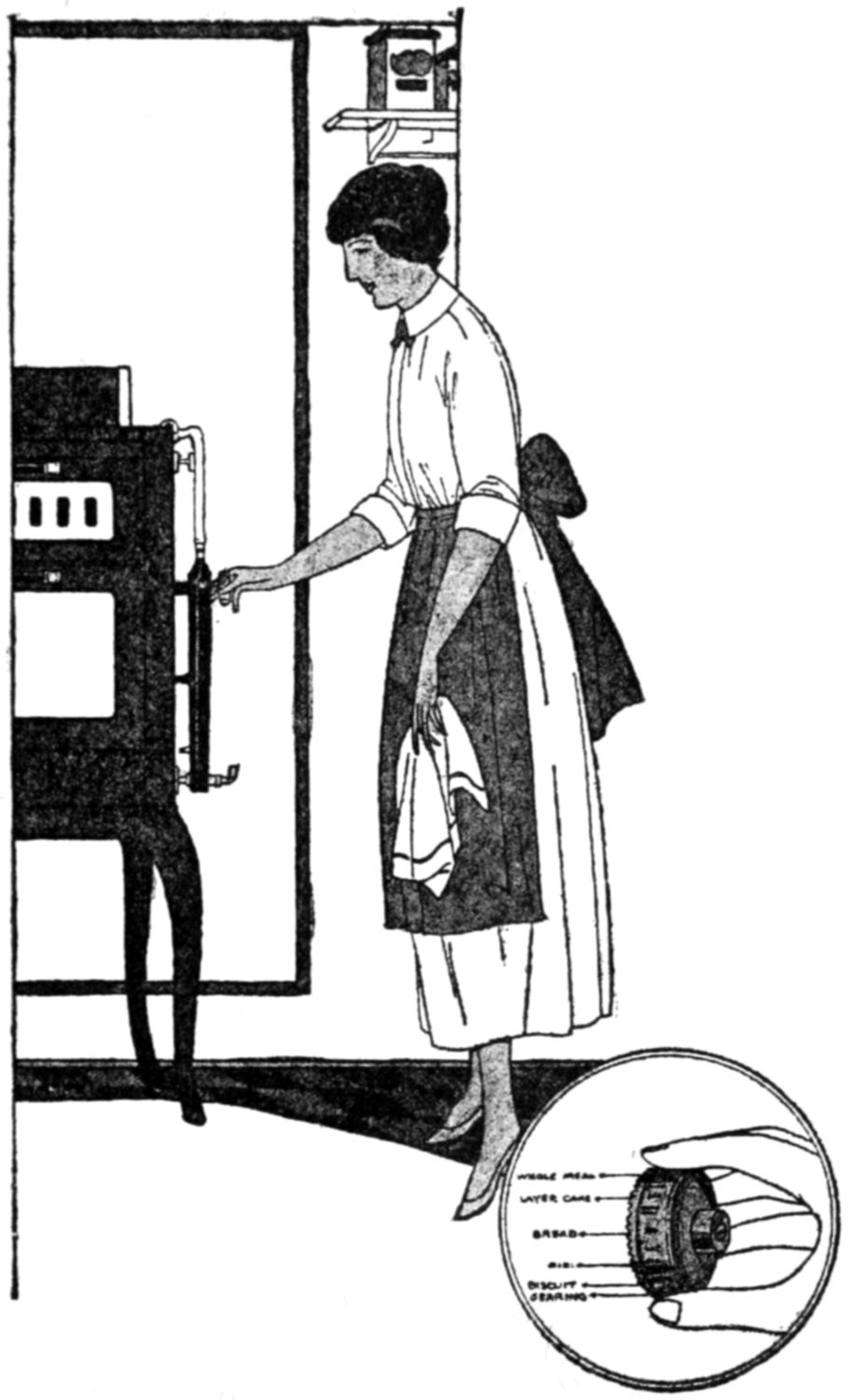
Courtesy of Clark Jewel Stove Company.
TAKING THE GUESS WORK OUT OF OVEN TEMPERATURES
BY THE USE OF AN AUTOMATIC HEAT REGULATOR
The vital thing in the gas stove is the burner and its
regulation. Nothing will compensate for poor burners,
poor insulation, poor heating. Some stoves are so made
that the linings come out and can be easily washed
and greased with kerosene thus keeping them in excellent
condition. But keep your ovens more than spotless.
The gas supply pipe when installed with a stove
should be not less than 3⁄4″ bore. Some companies
advise making an iron pipe connection with a union
coupling.
The best results for the gas range would be had if
connected by a stove pipe to a chimney but great care
should be taken to avoid a down shaft. Much moisture
in a stove, which will slowly destroy it, denotes this down
draft presence. Yet sometimes the flue connection is
a nuisance, as it is at other times a necessity. In some
districts the flue is necessary by ordinance.
Top burners must be frequently cleaned and when
they are removed the drip pan can be cleaned too and
the space in which the drip pan rests. Wipe off dust
from the air mixer, that is, where the air enters the
burner to make the flame cook. Grease your oven
linings occasionally and your stove will wear longer.
If your stove happens to have a porcelain enameled
broiler pan, take it out when not broiling in that oven.
Don’t use a big flame when food or water is boiling.
Nearly all the good stoves have air and gas regulating
devices and with each stove the method is explained to
the purchaser. Remember that you want a blue flame,
that the tip only should touch the utensil and that the
yellow flame may mean too much gas and cause smoking
or it may mean too little air. Keep your flame at
the blue point, with no yellow or white tip.
Before lighting any burner, try all the gas valves to
be sure that they are closed and that there is no gas in
the range. If the burners pop out close partly the air
mixers.
The simmering burner on the new stoves is a great
convenience and economy, if the burner is perfectly
regulated. In most cases the air mixer must be nearly
closed.
Cakes bake unevenly perhaps if they are set too near
the front of the oven. Be sure to put them at least in
the center or better near the back.
To prevent fish from burning while broiling or baking,
grease the gridiron. In broiling steak, if it is thick,
place it 1″ from the flame. If not thick 2″ or 3″.
Keep the broiler door open while broiling. Heat the
oven for ten or fifteen minutes with the door shut before
putting the meat or fish in to broil.
Remember the tip of the blue flame is sufficient to
cook; any other flame condition spells waste.
When your burners do not light, they are probably
grease clogged. Remove them and boil them in a solution
of washing soda.
Turn down the flame when the substance begins to
boil.
Unusual cooking capacity in a small space is really
one of the great advantages of the new stoves. Know
your space, your family needs and then buy your stove
from one of the best makers or order it through your
gas company.
Manufacturers have tried to beautify their stoves, but
when you buy see to it that you buy comfort first.
A gas range should keep in first class condition for at
least fifteen years—that is, if you buy the best and take
reasonable care of it.
All kinds of stove combinations can be had: gas and
coal, gas, coal and electricity, electricity and gas, oil
and electricity, etc. So every taste, every necessity can
be met in stoves to-day. There is but one rule—buy
what you need and the best of its kind.
CHAPTER VIII THE OIL RANGE — Wickless Ranges — Flame Regulation
What
makes it possible to live in gasless, electricless,
coal-less, transportationless places in gustatorial
ease and digestive comfort? The oil range. Not
the old-time messy oil stove, but the efficient, capacious
oil range. In districts unopened to modern improvements
cooking is made a pleasure rather than a drudgery,
with this highly effective medium, so effective that
nothing that can be done on any other type of
stove need be omitted in the daily routine. It has
the maximum comfort and the minimum cost and
trouble. This range too need never be lighted until
wanted and can be “put to bed,” immediately upon
finishing the meal. So now there need be no
place where man can not have his puddings, his
breads, or his flap-jacks with speed and finish.
The two most important types of oil stoves with which
it is worth your while to become acquainted are the wick
and the wickless (kindler type). It is quite evident
from their descriptive titles that the former employs a
wick as heat carrier to the vessel in which is the food;
and the wickless has the kindler by which the heat is carried
to the food in a different way.
The wick oil range is a development born directly
of the lamp. It employs the round wick and with it
in its best form a long chimney is used. This long
draught chimney has proven in the case of the lamp to
make for perfect combustion of the oil. Hence after
many years of trial and proof the wick stove is developed
to a delightful point of comfort and utility.
Speed, lack of odor and perfect work, three necessities
of any stove, are here exemplified, to say nothing
of longevity and ease of upkeep.
You have probably used the heat from a lamp chimney
to light a cigarette or a match or even to heat a
curling iron? Well, this is really the principle of the
wick stove. This heat has been harnessed and petted
into cooking usefulness by expert heat and stove engineers.
The parts of the wick stove with which you must be
acquainted are few but important:
1. The burner
2. The wick
3. Flame spreader
4. Brass wick tube (a fine feature, in that it is of
brass)
5. Clamp set screw
6. Hand wheel to adjust screw
7. Little mica door which opens in chimney instead
of having to pull off the chimney as you do in
lighting a lamp.
All you have to do is apply the match and touch off
the wick at several places. Then lower the wick until
the flame is even.
To extinguish the flame, turn the little wheel to the
left. Never blow it out. This blowing out of the flame
causes all sorts of irregularities and the real troubles.
The oil range is supplied in the best types by gravity
conduit. That is to say that the oil flows from a
reservoir into the burner, and as the oil is consumed the
fresh oil flows down and takes its place, so there can
never be overflow to cause fires or odors. These reservoirs
are of glass and in one case the manufacturer has
a service of reservoirs which supplies the consumer with
a rack of three filled reservoirs, which in turn replaces
the emptied one. This obviates entirely the need of the
cook to pour oil in the reservoir or in fact know she is using
oil! Reservoirs of course are delivered and called
for, if you are in reach of a dealer. Where this service
is impossible to be had the pouring of the oil into the
tank is simpler than simple. It is no more difficult
than pouring milk into a glass. In truth the reservoir
is mechanically adjusted and filled with oil—the human
being but its guide and beneficiary.
The heat wanted in the wick stove depends on your
culinary need and consequently on how high or how
low you turn the wick. Very often it means when the
flame burns low when it should burn high that the wick
needs a cleaning. Don’t blame the mechanism. It is
difficult to say how often you need to buy a wick or how
often it should be cleaned, as it depends very much on
the quality of the oil that you have to use. Some kerosene
is charry and some more free from impurities than
other kinds of kerosene.
Here are some points to observe if you want good results.
1. If there is a gap in the flame, the wick needs cleaning.
There should be a continuous round fence enclosing
the burner around the flame spreader. Or it
may mean the wick is up against the flame spreader.
2. Be sure that the wick is not up against the flame
spreader after lighting, because it will prevent the
air from passing through the center of the brass
wick tube and cause over-heating of burner and a
murky flame.
3. The flame when high should show white points
above the blue body of the flame. These white points
should be about 11⁄4″ for perfect combustion. That
means that there will be no odor and that you
will get all the heat you need and no waste of fuel.
4. The flame has lost its usefulness when the line of
demarcation between the white and the blue is gone.
The flame will begin to smoke, the burner will be
over-heated, the cookery under-heated, and odors
and smudge will be the result. Here again the
human equation comes in. Use your eyes effectively.
5. Cleaning wicks is done by removing the chimney
even as you do in cleaning a lamp wick. Nothing
new in this.
6. Watch your reservoir; never allow it to run dry or
your range to burn dry. Form a habit of watching
it daily and you will never regret it.
7. Under usual circumstances one wick should last
several months.
8. Clean wicks daily for best service.
9. Correct unevenness of the wick with a pair of
scissors.
10. For re-wicking, arresting any other troubles, consult
the “guide book,” which gives directions simply.
11. But remember when you get any kind of range you
must set it up solidly and level before filling with oil
or cooking upon it. Put it in a part of the kitchen
away from draughts and where you would put any
other stove.
12. Every range has special directions for inverting
reservoir and refilling, but in the best types it is
always very easy and simple, needing no strength or
skill.
And so in the best type of the wick range we have
the possibility of cooking everything that any family or
its guests need.
Wicks are easily bought all over the world. The
stoves heat rapidly; the oil reservoir is easy to fill;
your hands need never be oily, unless through crass
carelessness. There is a basin shaped stove base to
collect char and dirt and the feed pipe is so placed as
to make cleaning easy.
All the parts should be easily removable for cleaning
and all should be simple and visible in every part. This
grown up lamp should have all these modern twists.
In the best of the wick type you should have the best
vitreous enamel, where it is enameled, baked in at least
three times; solid brass wick tubes; best grade of steel
tubing and heavily tinned plate pipes where necessary.
In the long chimney-wick type the flame never
touches the vessel. In the short drum type the flame
does touch. One wick type manufacturer makes a perfect
long chimney type yet also makes a short drum type
to give all consumers their heart’s desire.
The wickless, as its name implies, has no wick but
carries the heat directly to the cooking vessel and therefore
shortens the cooking time a little as the heat reaches
the spot more quickly than it can in the long, non-flame
touching type of range.
In this type of range a kindler is employed. This
kindler is a round asbestos ring (costs about 10 cents to
replace) which lies in the burner bowl and is slightly
corrugated at the top and stiffened by a metal band.
Its function is not that of a wick at all. It is rather
the self-starter of the stove and its business is to light
the oil and start the cooking. The stove is lighted
by applying the match to the kindler which is saturated
by oil (from its very position) and this ignition of the
kindler furnishes sufficient heat to the surface of the oil
to turn it into a gas. After the burner is started the
heat automatically keeps the gas forming (vaporizing)
as long as there is oil in the burner. So you can see that
all the kindler does is start the gas ball rolling.
The wickless type of range is equipped with a 12″
seamless burner, which will last several years. The regulation
of the heat is managed by lowering or elevating
the oil in the burner bowl. The greater the area of oil
exposed on which the heat from the kindler ring can
act the greater the amount of gas formed and released,
and inversely the smaller the area of oil surface exposed,
etc.
This range, in its best forms, employs a lever with a
dial, which when turned by the cook to the point in the
dial she knows by experience she needs, automatically
and mechanically adjusts the heat from simmering point
to the most intense heat through a heat scale from “no
heat” to 300° Fahrenheit.
With the dial there is taken out of oil cookery the
guess-work which resides in most cookers.
Here is used the short chimney, with very concentrated
heat focused where it is most needed.
In lighting, you turn the lever to the word “light”
on the dial. After the kindler is saturated, generally
a few seconds after switching the lever, the chimney
must be raised and the match applied in a few spots
to the kindler. In a few moments your blue flame is
going full blast or any blast you desire depending on
your lever setting.
Gravity supplies the oil here too, as in the wick type.
The reservoir with its glass bull’s-eye to detect oil quantity
holds a gallon of kerosene sufficient to last sixteen
to eighteen hours for one burner, or at the rate of
about one cent per hour. Refilling these reservoirs is
very simple, and when you go to buy an oil range this
is one of the things you must insist upon. Unscrew
the cap in this case and pour in your oil, that is all.
There are a feed pipe and release which gather any
sediment that may be in the oil.
Experience is the best teacher in the way of knowing
where you must set the lever to get the hottest flame.
Sometimes dependent on varying conditions, the flame
may be highest when the lever is over the 12th division
of the dial; sometimes it may be at 6 or 7 on your range.
This sort of thing you learn by knowing your range.
Some oil will, of course, be left in the burner after the
light is turned off. Therefore you must expect it to
burn a little while after you have turned your lever to
“out.”
The blue flame to be just right must touch the vessel
with its uttermost tip.
On some of the most modern of this type is a match
scratcher plate which makes it easy to light the match
without using your shoe, a good white wall, or the seat
of your pants.
Every stove in this class is made of the finest pressed
steel, and where the enamel is used it is of vitreous
variety with three bakings. There is an all white stove,
too, to fit in with the bridal effect of the newer kitchens.
The good points of the wickless stove are many:
1. No wicks to clean.
2. Unleakable.
3. More powerful burner than anywhere else, being 12″.
4. Burner 100% odorless.
5. Delivers heat where it does the most good.
6. Acts a little quicker than any other types.
7. More economical in upkeep.
Either one of the stoves herein outlined is the best
on the market as to type and manufacture. If you
have to buy a stove try and get the most for your expenditure
by a collection of the best traits in the stove.
No mechanical device is perfect without perfect handling.
If you do not put in the wick correctly, or if you
do not light your kindler sufficiently you will have
trouble. If you put a tire on your car in the wrong
way you would not blame the car, yet the tendency is
always to blame the oil range and immediately call up
your dealer and say that your stove is smelly or that
the wick won’t burn or that the kindler won’t start, etc.
The best firms give every consumer a little text book
to consult when in difficulty.
These stoves even in electric and gas regions are
used in summer because they are cool cookers.
The advantage over coal is evident, as there is no fire
to clean out, no kindling wood necessary, no ashes to
carry and no coal to lug about, to say nothing about
wondering about dampers, flues and the like.
In all ranges burning oil of the best makes, you can
have all the heat you want and as little as you want as
well.
On all well proportioned ranges you can put some of
the excellently constructed ovens.
The ranges come with from one burner to five burners.
Some are built in cabinet style, with shelves, etc. Some
just plain style. As yet none of the cooking surfaces
is quite high enough; a few inches added to their stature
would make cookery easier on the human back. The
cabinet size usually stands about 541⁄2″ high, 64″ wide.
The spaces between the burners is ample for comfortable
placing of utensils. Watch this when purchasing
a stove, for you can be very uncomfortable with a
jammed surface.
It is pretty much a matter of what you can get in the
way of either of these two specific stoves. They are
both so good. The wick type is convenient because the
wick is sold all over the world. The wickless is convenient
because it is easy to clean and is a bit more
rapid in heating. The kindler is only 10 cents and
can be had at all dealers and when you buy the stove
you can get a supply.
You must demand:
No odor whatever
Speedy cooking
Steady flame
Cleanliness and easy to clean
Easily replaceable parts
No smut and dirt
Easy flame control
Oil visible in reservoir
Best materials on the market
Perfect combustion, making for the minimum amount
of residue carbon.
With the oil range as well as with the gas, electric
and coal range there can be bought water-heating
boilers, ovens, etc.; and with one stove, special broilers
and toasters.
There are two very good ovens on the market to be
used with these stoves and with other kinds as well,
each one with its special selling points. Each is large
enough in some size for a 12 pound turkey, each small
enough for the smallest uses (sizes range from 211⁄2″ × 181⁄2″ × 13″
to 13″ × 181⁄2″ × 13″). They weigh from
about 12 to 18 pounds. You place the oven over the surface
burner.
One oven maker claims:
Asbestos lining for insulation
Shelves set for 5 different altitudes
Curved top to oven like bakers’ oven to pass off
gas and prevent air pockets
Shelf support growing out of lining
Strap hinges
One motion to handle to open oven door
Door closes only if it locks
Special asbestos lining porcelain enameled heat
spreader, triangular in shape, to deflect heat and
prevent burning
Another says of itself:
Special heat resisting lining
Mica windows below to watch flame
Unbreakable glass and unstreamable
Three point locking device on door
All glass door.
The oil range is not cheap. Yet it is a godsend at
certain times. We are not advocating it for general
use where pipes and wires and coal are at our convenient
disposal, but we do recommend it forcibly and sincerely
where you want a simple, efficient cooking medium beyond
the reach of the popular sources of heat.
Unless you buy the very best, not merely the best,
oil cooker you will be saddened, and with the best you
will sign yourself Pollyanna without reservations.
Just about now, a new oil range is being advertised.
It is a cross between the wick and the wickless, because
it uses an asbestos and brass thread wick which is almost
immortal, for it can be reversed when charred and when
both sides are charred it is burnt off in the stove and
ready to begin its double life again.
Like the wickless stove the flame touches the vessel
with the short drum construction, and like the wick it
uses a wick even though quite different.
The stove is of japanned tin, and is made in cabinet
type and in the ordinary style. It is also in the “best”
class.
CHAPTER IX COOKING BY ABSENT TREATMENT — Fireless Stoves — Cooking
The
fireless cooker is primarily a fuel saver. Secondarily,
it has developed into an absent treatment
cooker. That is, the food can be cooking while the
lady of the house is airing the baby or at church or at
club entertainments or while the cook is cleaning the
kitchen, laundry and pantry. Thirdly, it cooks
thoroughly and longly without the added expense of
fuel or effort.
It was first made with a box and with excelsior and
padding but the manufacturers came to the rescue as
they always do to supply a demand and the comfortable
fireless cooker was born.
Its story is short and sweet and to the point. The
essential for the cooker is that it will cook by retained
heat. Therefore, it must be built so that there will be
no leakage of heat. For this reason it must have perfect
insulation. The utensils must have covers that are
clamped on so tight that they retain the heat generated
by the stove or electric current. The lining
should be non-absorbent of odors or “spill.” Therefore
practice has proven that aluminum, which does
not rust and is easily cleaned, is best for this lining.
The linings too, must be smoother than smooth and be
as seamless as it is possible for them to be made.
For long processes, of course, the heated plates
must be able to retain heat and for this, soap stone and
iron plates have been found to be the most practical.
The cookers can be had with from one to three or four
compartments. Therefore, a whole dinner can be cooked.
They claim that you can brown with them as well as in
the roasting oven. Browning can be to some extent
accomplished by an accomplished fireless expert with
extra heating of extra plates and the like, but for real
crisp browning it is as well to take out the food and
rapidly brown in the oven.
The best results are gained with the fireless if used
in conjunction with gas, oil and electric stoves. With
the coal stove there is a loss of fuel saving of somewhere
around 50% due to the fact that it takes so much time
to get up the fire in a coal stove before the plates are
heated sufficiently to do their work in the cooker.
Therefore, it is cheaper if you are going to use the
fireless to any great extent to have a one burner gas
plate on which to heat your plates for the fireless cooking
process.
In the chapters on gas and electric stoves, you will
find there mentioned the fact that there are some stoves
so built that they have fireless ovens. That simply
means that they are so insulated and constructed that
when the cooking has reached a certain point, the
current of electricity or the gas can be turned off (in
some cases turning itself off automatically) and the
rest of the cooking can be done by the fireless process
or on retained heat. This, of course, is the ideal way,
because then there is no extra paraphernalia in the
house and the stove is built so that the back is not bent
in stooping to the low fireless cooker. For this reason,
we would suggest that if you have a fireless, it is best
to have it on a shelf built for it or keep it on a table.
Save your back or your kitchen aid where you can, as
we have but one back for every process in life!
The electric fireless cooker is one which has its own
connection with the electric light circuit. It is not a
stove or part of a stove—it is merely a most convenient
cooker for which you are not forced to heat extra
stoves or plates. It’s a two-in-one combination. According
to directions you turn on and off the circuit.
After you become accustomed to the fireless, you will
find that cooking in it is quite definite and the time and
the schedule can be heeded like clock-work. Do not let
the food cool in the cooker, or you will have the cooker
odor to battle with and you will always have olfactory
souvenirs. The cooling and steaming in the box will
do this only too well. Air your utensils and cooker
after each usage or your food will have a uniform
flavor which to say the least is most unpleasant.
Remember that it takes longer to cook like this and
that you will only save time by being able to do something
else without fear that your food is boiling over
or burning or what not. This cookery takes a little
practice, it is like everything else, a case where practise
makes perfect and where the good utensil and a
good understanding work together for good, while a
poor utensil and a slovenly understanding work together
for a little hell on earth, and this is putting it
not one whit too strong.
It is no doubt true that tough cuts of meat are better
cooked by the long process of retained heat; it is no
doubt true that cereals are much more wholesome with
the process of retained heat, yet it is doubtful whether
the fireless cooker is ever bought for these reasons.
It is bought, however, to economize time, service and
food. There is less waste of food by the fireless process.
You can buy cheap cuts of food if you have a fireless
cooker and enjoy them.
So, the fireless cooker is not an embroidery it is the
“bib and tucker” of culinary labor.
CHAPTER X QUESTIONS FROM THE LEAGUE OF RATIONS — Dropping The Maids — The Necessary Equipment
(A very possible conversation, but invented by the
author to bring out some points that the reader will
readily see.)
“Joy!”
gasped Mrs. Gregory Eggleston, turning
on the electric current for breakfast coffee.
“Isn’t it a luxury after you’ve been out late,” she
said turning to her guest, Mrs. Bradford Reardon,
“not to have to think of servants and be able to have
breakfast like this at 10:30—with impunity! You know
I think the kitchenette will rob domestics of house
room!”
“It certainly is a luxury to have a little cooking kit
like this whether one has another home or not. And to
have it as you have—within easy driving distance from
the theater, where you and your friends can spend the
night and breakfast like kings from this shiny apparatus.
Besides,” she continued, “it’s amazing how a little
6′×5′ room (see plan 1) does solve the omnipresent
question of how to live in the country and yet not have
to depend on hotels to keep one comfortable while
attending to the affairs of business and pleasure in the
city.”
“You’re right,” agreed Mrs. Eggleston, taking some
chilled oranges out of the refrigerator under the table,
“Gregory and I wanted the country for our growing
kindergarten and yet it seemed impossible until we
thought of this scheme. Gregory has so many interests
in the city and you know how many I have that it seemed
almost exile to leave it. If we didn’t have this place,
I’d be on the road all the time, whereas now when I am
home I can devote my entire time to the kiddies.”
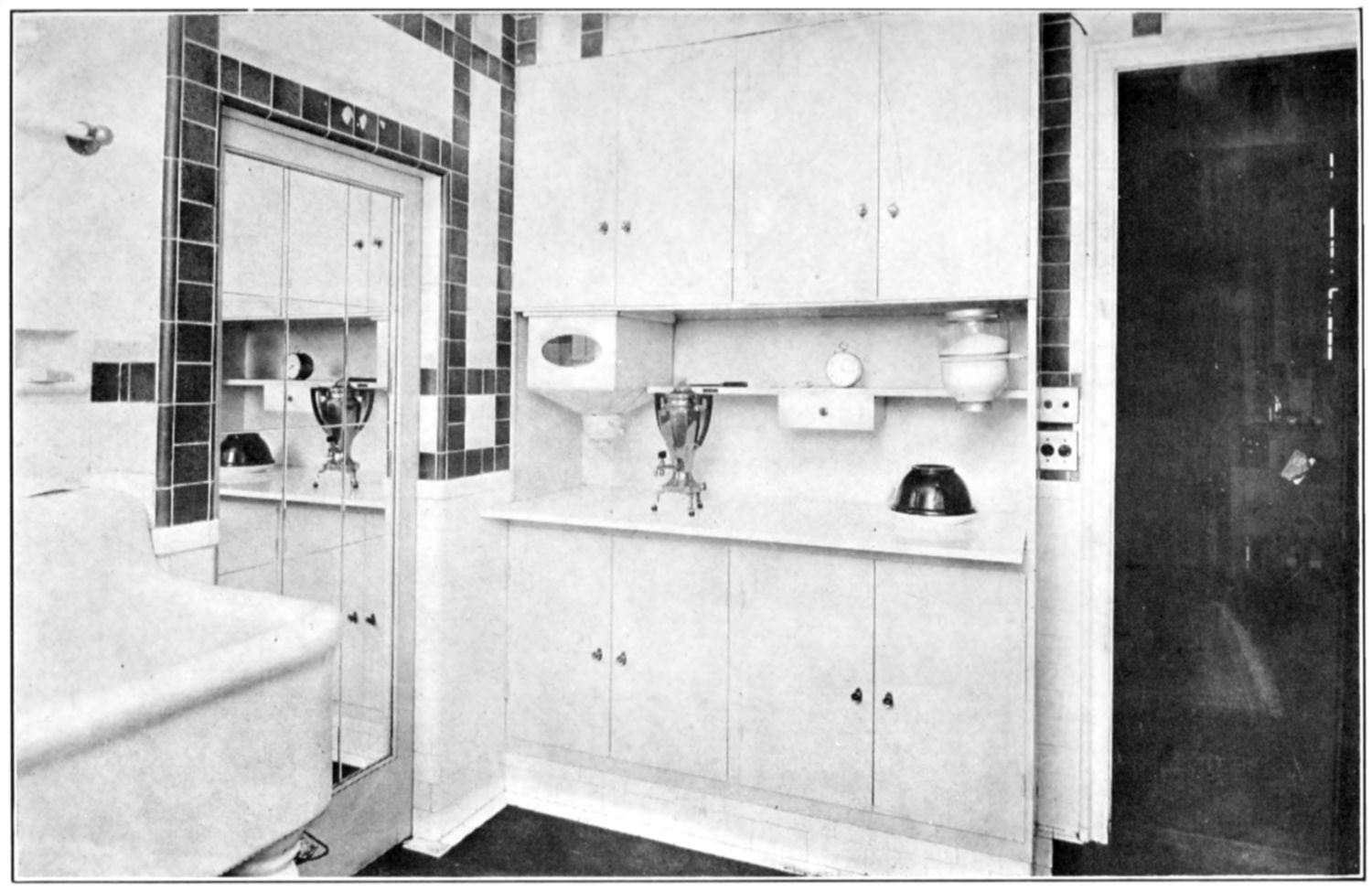
Underwood & Underwood
A CORNER IN WALTER RUSSELL’S KITCHENETTE. THE STEEL UNIT KITCHEN CABINET IS
USED HERE
“But,” she went on, “you’d be surprised how
Gregory hated the idea at first of a manless or maidless
entourage. He said he couldn’t bear to think of me
messing with stoves, etc., and now you should see him!
He loves it—he helps me too, and says it makes him
think of our early days—and he loves me to wait on
him and be alone with him.”
“The kitchenette as the domestic canteen has come
to stay,” Mrs. Reardon said, and then looking about
her with an amused flash in her eye, “but your
kitchenette, dear, is like an ordinary kitchen. The
kitchenettes I’ve conjured up when thinking of them
at all, have been little curtained slits in the wall in the
corner of two rooms without bath, clothes closets without
clothes, bathrooms without baths, washstands capped
with shelves full of canned goods and gas appliances
all permitting of cookery with every requisite for human
food except the desire to eat it.”
“Yes,” laughed Mrs. Eggleston, “I guess the only
definition of a kitchenette is: a place to cook smaller
than your previous one and smaller than any kitchen
of any of your friends!”
“But,” Mrs. Reardon continued with rapture, “your
kitchenette is a dream. It always reminds me of jewels—the
tiled floors, walls and ceiling like luminous settings
and the apparatus like lovely gems. Really it
breeds appetite and culinary prowess. Any one could
cook in this place! And when I’m not in such an
esthetic mood I am reminded of an engine room in a
small electric yacht.”
“That is amusing,” said Mrs. Eggleston, laughing,
“but I hardly can see how it could be otherwise because
Gregory and I thought of all the yachts we knew
before arranging this kitchenette. He always says
‘Well, dear, we certainly are ship-shape here—even if
we don’t own a yacht!’”
Whether the slit in the wall kitchenette or the tiled
kitchenette is the only kitchen in the family, or whether
the kitchenette is only for weekends of the foregoing
variety, it must be small and ship-shape. These are the
only definite kitchenette requirements.
It need consist only of a couple of three-foot shelves,
so compact are the stoves and ranges made for light
housekeeping. But roominess is no crime, so multitudinous
are the tools to play with. Smallness, however,
is unusually synonymous with convenience in kitchenettes.
Nearly every professional woman and many men in
the large cities are banded into a huge League of Rations
by the sympathetic tie of small kitchenettes. These
compact cooking outfits make the lives simple, adaptable
and healthful, they are the result of the hatred of the
restaurant and café which turn steady diet into a farce,
and they put an end to the régime: “Eat, drink and
be merry, for to-morrow we diet.” And so the slit in
the wall or the covered cupboard is made the nucleus
of home cooking and family feeling. No servants
needed, none missed and a feeling that you are not
living down by doing your own work but living up by
managing the difficult combination of living well and
doing your job on the outside to the best possible advantage.
For the most part these kitchenettes are run by gas,
but are for that reason cheaper in the cities like New
York, where there is no cooking rate for electricity.
But the new appliances for the electric kitchenette
are like toys, they are so fascinatingly contrived. You
are crazy to have ice cream or whipped cream with which
to employ the electric kitchen power unit which can perform
all these miracles, and you are led into gustatorial
and epicurean extravagances by cooking, boiling, baking
and grilling at the same time on the new stove. A
whole dinner can be cooked on the dining table with
these new ranges even if you have no kitchenette!
The terror of dishwashing has evaporated! The electric
dishwasher has been born and now our Ladies Eggleston
and Reardon can, without loss of epithelial beauty,
dash into the kitchenette for their matinal refreshment—sans
sacrifice, sans anything but appetite and culinary
ardor.
In the model Edison kitchenette, the utensils are
hung up to avoid unnecessary spinal calisthenics. The
sink is near the stove and is high enough to save the
back from contortionate bends. All surfaces in the
kitchenette should be an inch or so higher than that
which the palm of the hand can reach without bending
the back. The floors should be cement or hard
wood with mat or with linoleum, either cork inlay, tile
or brick; the ceiling of a light color paint or tile or
brick; the walls the same and all joinings rounded to
avoid the cracks at the base of the wall joining the floor,
or where the wall and ceiling join.
The best kitchenettes are tiled or bricked with generous
water vent so that the light hose played on them
flushes and cleans them in no time.
One of the best arrangements is to have the kitchenette
apparatus follow this succession: (See Plan 1)
Drop table, closet, sink, work table, refrigerator beneath,
shelves above, utensils hung underneath, stove, on either
side of the sink drain boards of hardwood tilted toward
sink or copper or composition slightly tilted; and a garbage
chute on right side of work table near the sink.
However excellent or concentrated the arrangement,
there can be no success, however, with any machinery
unless you know how to use it advantageously; so as
engineer in the electric kitchenette you ought to know
a few things about the mysterious current over which
you preside; how to use it economically, how to use it
to its full capacity minus disaster and how to have the
same mental attitude toward your kitchenette equipment
as the workman has to his tools. In the Edison
kitchenette is a little sign with the following legend:
Turn off the current when the range is not in use.
1. Start the oven on high, then turn it to medium
or low.
2. Turn oven off completely and finish baking and
roasting on retained heat.
3. When contents of pot are boiling fast, turn the
plate to medium or low for long cooking.
Turn off current when nearly done.
Complete the cooking by retained heat in the plate.
In a little booklet is found this advice:
Fires caused by the use of electric stoves are mostly
caused by carelessness.
I.IIV Detach the plug as well as turn off current at
the socket.
II.IV When you are not using any device continually
shut off current.
III.V Grasp the plug at the spring not by the cord.
IV.II Blow-outs are caused by too many
devices all
attached to the cluster plug. Reduce the number.
The utensils of these kitchenettes are without end;
some of them are: Tables, ranges—aforementioned;
oven and grill combinations; griddles; toasters; percolators
of all kinds; large and small ranges; ice cream
freezers; combination meat grinders; ice cream, whipped
cream and dough mixing units; electric ice makers;
automatic time ovens, with clock attached so that you
can put something in to cook and at a designated time
the current turns itself off; immersion heaters; coffee
mills; samovars; egg boilers; buffer, etc. for sharpening
and polishing silver and knives; and countless other
things.
But the latest of all is the electric kitchen cabinet or
“Movie” of small price and great compactness; gas
or electrically ranged and arranged, containing in its
simple confines, pots, pans, ice box, folding table, flour
bins, stove, shelves for dishes and all the comforts of
home. Just the thing for one night stands or bachelor’s
retreats!
And jot this down—that if you have a good refrigerator,
electric or plain, you can have all the onions inside
of it that you want without affecting other foods,
and if you have an electric ozonator you can cook onions
in the smallest kitchenette without damage!—so they
say!
CHAPTER XI KEEPING IT COOL — How It is Made — The Nine Points — The Insulation — As to Ice Chambers — How to Use a Refrigerator
She rang for the butler:
“Wilson, please ask the chef what kind of a
refrigerator the architect put in for us.”
“Very well, madam,” and he departed to the kitchen.
This same chatelaine did not send for the butler to
inquire what kind of an automobile her garage held.
Not for a moment! She knew, too, the difference between
the Rolls-Royce, her car, and the Ford, or any
other car! Yet, she didn’t know her refrigerator!
And to-day, although all the world’s a-wheel, the very
crux of the situation is the refrigerator! Peace—war—the
economic structure of nations hinges on the preservation
of food, not only in refrigerating cars, but
in our kitchens; for, as our kitchens save food, just so
much more easily will the world be fed and unrest cease.
Beyond much doubt the chic porcelain-lined refrigerator
of to-day is the corner-stone of the halls of
domesticity; for what in the unconscious song of every
husband is a wife without well-kept food! And is there
any romance that will survive flabby lettuce and pulpy
celery?
The booklets about the refrigerator are entrancing!
The pictures bring to mind marble halls, à la Alma
Tadema, and you might wonder why he never used a
modern refrigerator in one of his Roman paintings!
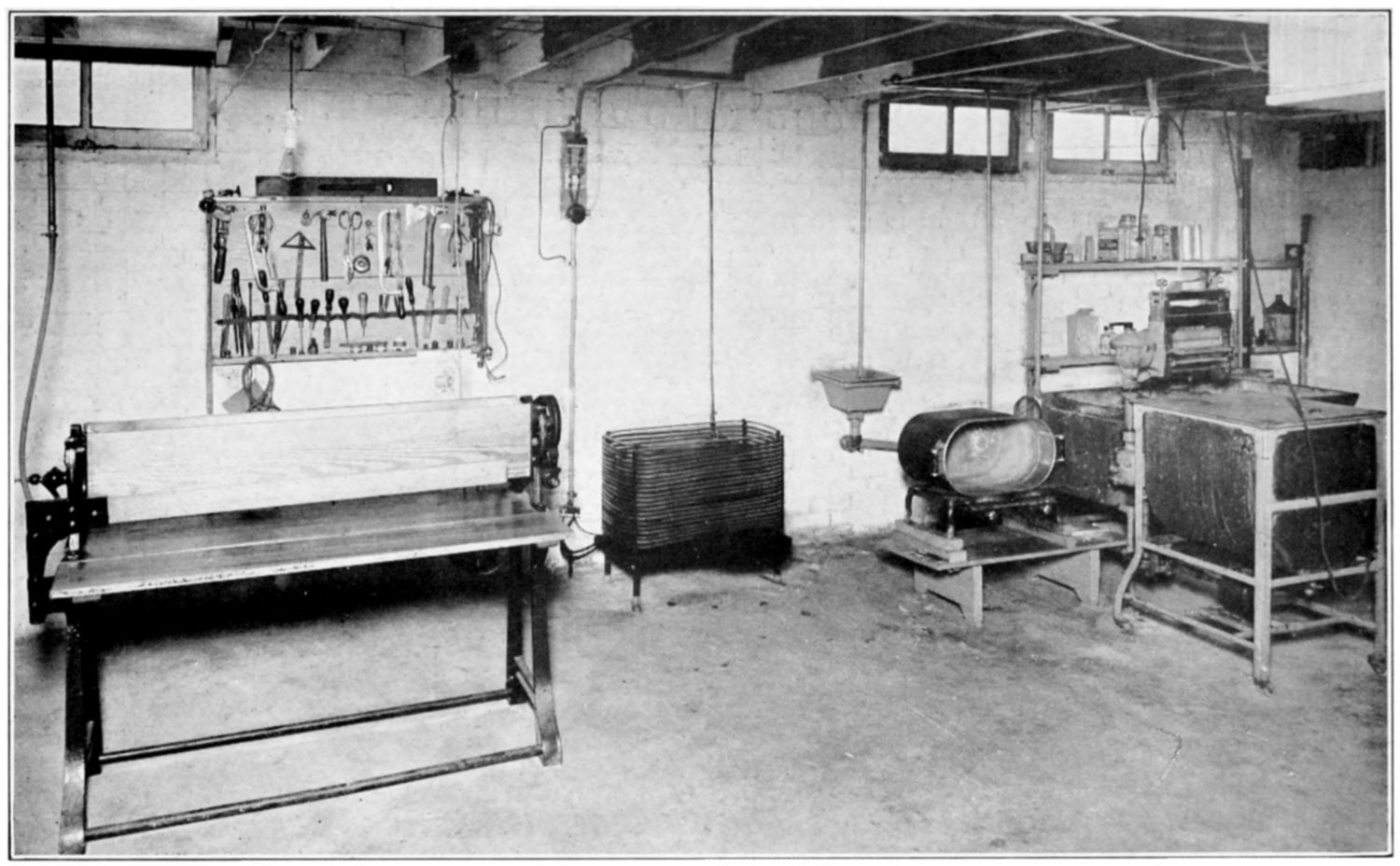
Courtesy of the Kelvinator Co.
WHEN THERE IS A CELLAR USED FOR THE LAUNDRY, THE ICE-MAKER COILS CAN BE SET DOWN
THERE WITH EASE AND SIMPLICITY. HERE TOO IS AN ELECTRIC IRONER AND WASHER INSTALLED,
WITH A VERY NEAT TOOL RACK!
But you will remember that the linings of the refrigerator
are not of marble no matter how much they resemble
it, but instead must be made in one piece of
smooth, hard, non-porous, non-warpable, non rustable
material, the best type of which is the burnt-in
vitreous porcelain in several layers on a metal backing.
These linings must be made in one piece with no seams.
No seams and seamless are quite different in their
implication. “No seams” is what it seems to indicate,
but seamless means a camouflage of joints. Joints
and seams are food and odor entrappers and
presage disease and death. Many of the advertised
enameled interiors are made of nothing but
paint heated, not burnt-in, which therefore flakes
off or crazes (cracks form) and falls into the food,
which of course is not a particularly epicurean sort of
truffle!
The doors, too, must be seamless, jointless, screwless
and smooth.
The shelves and other partitions must be of smooth,
heavily tinned wire mesh. Smooth to prevent accumulation
of food; and the wire mesh to insure rapid and
unimpeded circulation of air.
Whereas some refrigerator owners may keep butlers,
the following points are more essential to the maidless
home, because effort and energy and strength are saved
to say naught of money and ice if conditions are such
that the ice will not fade away rapidly and cleaning
have to be done under difficulties of construction.
Therefore, to preserve the sanitation of the home and
the consequent sanity of the world before buying a
refrigerator the following Nine Points should be laid
before the Kitchen Diplomatic Table:
1. Does it: Maintain a low and uniform temperature?
2. Maintain a pure atmosphere?
3. Appear to keep absolutely sanitary?
4. Seem to be built to keep perfect circulation and an
absence from odors?
5. Keep free from moisture?
6. Seem built to be economical in ice consumption?
7. Have a system to insure perfect drainage?
8. Contain a porcelain lining in provision chamber?
9. And does it seem to be built for durability as well
as for beauty?
And now about enforcing the Nine Points.
How for instance is a minimum temperature to be
kept? Chiefly, by insulation—this is a strictly mechanical
term understood by motorists and engineers and
must be understood by the housewife, who is a domestic
or kitchen engineer if she is anything. The low temperature
is kept by keeping out the outside heat and
keeping in the inside cold! After much experiment,
it has been found that the walls, floors and doors of
every refrigerator must have at least one air space,
from six to nine layers of insulating material consisting
of pebbled cork, or certain patented materials, mineral
wool, asbestos and various layers of porous substances
which keep out the outer warm air and prevent the
cold air from escaping. (See illustration.) Well insulated
refrigerators backed up against boilers, stoves
or vats maintain a temperature far below 58 or 60
degrees; some, the best, maintaining 50 degrees.
The ice compartment should be above, and to one side,
so that the cold air from the melting ice can descend,
as is the custom of cold air, and can rise again as it gets
heated in its contact with the provisions and pass up
over the ice, be cooled and pass down again with its
collected odors through the drain. This is what is called
air circulation, and when the ice box is properly constructed,
and when the ice compartment is kept full,
the air is in constant motion, traveling over and over
again up and down and around the food and ice. This
constant activity of the air is what insures an odorless
condition, unmouldy and cold food.
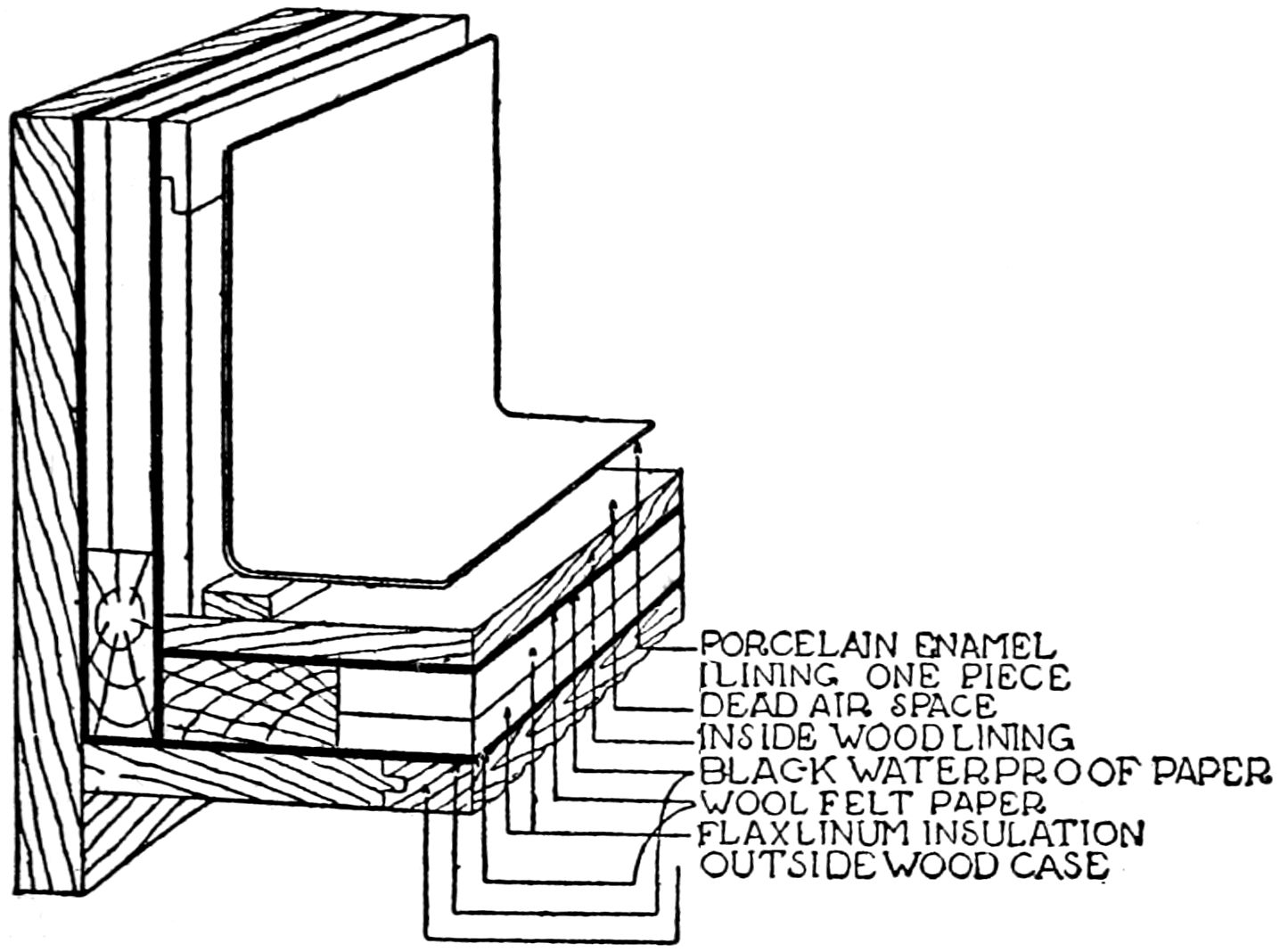
Courtesy of Bohm Syphon Co.
NOR COLD NOR HEAT CAN GET BEYOND THESE
FORTIFICATIONS
PORCELAIN ENAMEL
LINING ONE PIECE
DEAD AIR SPACE
INSIDE WOOD LINING
BLACK WATERPROOF PAPER
WOOL FELT PAPER
FLAXLINUM INSULATION
OUTSIDE WOOD CASE
In the best refrigerators the ice chamber extends a
few inches below the door and is lined with the highest
grade of smooth galvanized metal, lock jointed, and is
without seams and sharp edges.
In some refrigerators the wall between the ice compartment
and the provision chamber is slatted, in some
there is a space at the top, in others, holes are bored,
top and bottom, to permit the free egress of the circulating
air. These methods are good in varying degrees.
The main things to be kept in mind are:
1. Does the air circulate enough to prevent any
moisture accumulating in the refrigerator? Can salt
be kept dry and granular in it for one hundred hours?
2. Does the refrigerator keep below 60 degrees, or
better between 45 and 50 degrees? Will a damp cloth
dry quicker inside than outside of it, because of the
rapid circulation and dryness of the air?
3. Do matches keep dry and can they be lighted by
being struck on its walls? (This shows whether the
ice box is dry!)
4. Does the milk taste of cheese or the butter of the
soup?
If they have any “acquired traits,” you may be sure
the circulation of air in your refrigerator is bad or else
there are seams or crazes in the tile, holding odors in
their grip. Tiles and other beautiful interiors have
in many instances been discarded by many makers
because of their brittleness or pertinacious grip on odors—which,
in the form of gases, poison foods and hence
the family! Opal glass has been dropped because of
its fragility in lighter weights. There are, however,
some manufacturers who use tile with excellent result.
Another important feature is the drain pipe, more
important almost than the exhaust on the motor. If
this pipe is not constructed solely to carry off odors and
waste materials from the cleanest ice and not to import
insects, gases and warm air from the sewage of the
town, it will collect a very tidy packet of typhoid,
diphtheria or any home-seeking germs. This drain ought
therefore to have a water-sealed trap in it, it should be
smooth, of hard, well-finished metal and be so simply
cleaned that the kitchen maid, or whoever is delegated
to perform the laving of this important part of the
household, should not look forward to the performance
with horror, but with a sense of ease.
There isn’t a doubt that a faulty drain in the refrigerator
has caused more typhoid than anything else.
Think what it means then to be a good kitchen engineer—what
service you can render your family! Few
home-keepers realize the necessity of understanding the
underlying principles of air circulation, sanitation and
germination but what a lot of misery could be avoided
if the chatelaine or even the wife-cook had a little
technical knowledge. How this would dignify the science
of the home. And yet how lightly is the function
of home-keeper assumed and how many brainy women
look down upon it!
But if you have everything to assure perfection in
refrigeration and know not how to use it, it is as if you
had none at all.
Note this amendment to the nine points:
1. Keep your ice chamber full, even after Dry
Laws. It saves ice and preserves your food. The circulating
air will only go “over the top” as far as the
bulk of ice drives it.
2. Never put any food in the ice compartment. It
must play an infinite solitaire.
3. Keep the doors shut, and open them as little as
possible.
4. If the ice gives out, take out all the material and
rinse out the refrigerator. Refill it with ice and keep
the door shut at least six hours. And remember
sufficiency of ice insures efficiency of refrigeration
and efficiency of refrigeration means a sufficiency in
expenditure—for a refrigerator.
Water coils can be put in some ice chambers which
connect directly with the water supply. In this way
the water can be kept continuously cool for drinking
under all conditions of outside temperature.
The outside of the ice box should be of hard wood
or porcelain, the hardware of the best, including lever
door handles.
Back doors for filling the ice box can be set so that
the ice can be put in from the outside of the ice house,
room, pantry or kitchen. This avoids useless handling
and melting of the ice and obviates the iceman’s journey
through the house.
And, above all, choose a refrigerator that has no unnecessary
“improvements” in the ice chamber which
have to be taken out and scalded. The easier it can be
rinsed from within the more often the attendants will
clean it!
And remember this, too, that an ice box is a cooler
where the ice and provisions go in the same chamber,
while the refrigerator—well, you know it all now.
And, by the way, if you want a useful little device to
keep your grape juice or yourself—cool—while motoring
this summer, look up a little basket refrigerator which
comes in many sizes and many prices.
CHAPTER XII THE PASSING OF THE ICE MAN
“How
would you like to be the ice man?” is the
lyrical refrain to an ancient ditty that is getting
more and more obsolete every day, for there is a
mechanical conspiracy to oust the ice man from his age-long
position as purveyor to the home. So do ice men,
gladiators and dogs have their day and relinquish to
machinery their evanescent glories.
Nowadays everybody knows that there are domestic refrigerating
plants for home use that displace the
ice man and in which pure ice for table use can be made.
Many people, however, do not realize the reliability of
such equipment, the simplicity of its operation, and
the satisfaction to be derived from its use, nor yet that
there is an actual saving in its use. These facts will,
however, be borne out by thousands who have freed
themselves from the bondage of the ice man.
Even though few will care just what contributes to
making the coldness, it might be well to give a simple
explanation of the principle of making ice, in order that
the prospective purchaser will know what she is getting.
When you wash your hands they feel cool if you do
not dry them. You say they are cool because the water
evaporates, but the fact is that the evaporation takes
place because the water is drawing on the heat from the
air and your hands feel cool in the process. And so
in simplest terms engineers have found refrigerants or
liquids which vaporize or evaporate at low temperatures,
and as they turn from liquids to gasses they use up the
heat and leave the air cold. Some of these refrigerants
are sulphur dioxide, chloride of ethyl, ammonia, etc.
There are two ways of having refrigeration in the
home:
1. The mechanical refrigerator (which is permanently
cool with the machinery a part of itself)—one unit.
2. The domestic refrigerating plant (for making ice
and steadily producing even, low temperatures) which
you can have installed in your own refrigerator—two
units.
The general system of home making-ice refrigerators
consists of the brine tank with copper coils within, a
motor-driven compressor and a condenser of copper
piping. The compressed liquid passes through an
expansion valve into the brine tank where the pressure
is reduced and it changes into a gas, flows out through
and is condensed by the condenser, changed back into a
liquid, is pumped back again by the motor and starts
cycling again—indefinitely. In the best ice-making
plants there is a heat control which turns on the motor
when the temperature in the refrigerator gets too high
and turns it off when it is sufficiently low.
In one refrigerator there is a device by which the
food compartments are kept at any temperature you
desire, usually around 40°, while the temperature of
the ice-making compartment is never allowed to rise
above 20°. By this arrangement it is possible, and very
often the case, that ice will be made in the ice compartment
without running the electric motors for hours,
while food is kept in the food compartments at slightly
above freezing point. Fancy the health insurance that
the best ice-less processes guarantee in the home—infant’s
food, for example, can be absolutely fool-proof.
Although the above technical libretto is of some use,
the things that most people want to know and are asking
are these:
1. Is ice making at home practical?
2. Is it messy?
3. Can I use my old refrigerator?
4. Are they to be had in a special refrigerator?
5. Will I save money?
6. Will it save time and annoyance?
7. What’s the use anyway?
A good refrigerator is a jewel, and it is the first
requisite to be considered. It must be insulated well
enough to keep out hot air and hold in cold. It must
be seamless and smooth in its linings. The air circulation
must be continuous. The temperature inside must
never be higher than an average of 45° and rarely that.
In such a refrigerator one should be able to keep
matches dry and butter must never absorb any of the
charm of the onion.
If you have such a refrigerator, keep it by all means,
and install the ice-making machine. The installation
is simple, and the initial expense is readily made up in
the future saving of ice consumption. But do not install
an excellent ice machine in a poor refrigerator, as
the electric bills will climb the Alps. Yet even in a
poor refrigerator the refrigeration bills are lower than
if you had iced refrigeration.
If you have no refrigerator, it is possible to buy a refrigerator
which has in it the ice-making machines.
But before you buy the outfit you must be very careful
to know whether this refrigerator comes up to the most
stringent tests of the ordinary first-class refrigerator,
for this reason: The average refrigerator in which ice
is used has to be efficient because it must keep itself dry
with actual ice evaporation going on, it must keep a cold
chest with an actual diminishing ice supply, it must
keep ice melting yet staying in spite of weather and surrounding
atmosphere. To make the circulation of air
effect these processes a refrigerator requires fine construction.
The refrigerating manufacturers have put the most
superb effort into making a first-class refrigerator, and
if you are not convinced that the combination outfit
has as good a refrigerator as you can get with the installed
outfit, it is wisest to buy the refrigerator and
install the ice-making machine. There are excellent refrigerators
on the market; apply rigid tests and accept
nothing short of the best.
The machinery can, in some instances, be put on top
of the refrigerator or in the cellar or in the next room
or right next to the refrigerator. In some cases the
machine, consisting of pump and condenser and motor,
takes up no more room than 11⁄2′ × 11⁄4′ × 31⁄2′. This can
be put in place as simply as installing a new gas stove.
In the best of the iceless machines the refrigerator
maintains a lower temperature than the iced ones in
both winter and summer. At a cost of ten cents per
kilowatt hour, and with ice at fifty cents per hundred
pounds, it is cheaper per day to use the iceless refrigerator.
There is, too, less dampness in the iceless refrigerator
than even in the best iced ones, due, of course, to the
absence of the ice itself. This lower percentage of
humidity should not be taken as a reflection on the low
percentage of humidity that can be maintained by the
iced refrigerator of the best make, which is a percentage
low enough to dry towels and keep matches dry.
The iceless refrigerator does these things:
1. Reduces the cost of refrigeration.
2. Maintains a constant low temperature regardless
of weather and automatically starts up “cold making”
when you raise the temperature by opening the
doors.
3. Operates automatically when once installed and
is reliable, clean and noiseless.
4. Permits you to make neat little cubes of ice for
your tumblers, which give your table distinction.
5. Gives you ice of which you know the clean source.
6. Operates by electricity.
7. Needs no refrigerant for years.
8. Is oiled very seldom.
9. Is easily kept clean.
10. Obviates the uncertain ice man and his dirty
boots trailed across the kitchen floor.
11. There is no ice-box drain to clean, no water
dripping to worry about and therefore no extra effort.
12. Consumes from 1½ to 2 kilowatt hours per day—if
it is run from 6 to 8 hours per day.
The purchaser of an ice-making refrigerator or a
domestic refrigerating plant should be warned of the
following:
1. A poor refrigerator will mean more electricity to
keep up a sufficiently low temperature.
2. Don’t let a manufacturer tell you that a freezing
refrigerant, such as sulphur dioxide, will escape and
corrode the pipes. It has been tested out and in the
best machines has neither escaped nor worn out its
pipings.
3. Remember that opening and closing doors raises
the temperature even in the magic iceless paradise,
and therefore uses more electric power to keep the
temperature down.
4. The best machines maintain the ideal and theoretical
low temperature.
5. Expect service from the manufacturer.
6. It is best to have the gas air-cooled and not water-cooled
because the introduction of water makes for
the confraternity of gas and water—a troublesome
mess.
7. Demand the temperature-controlling automatic
device which starts the refrigerating when the temperature
gets up around 39°, and cuts it off when the
temperature is low enough to do its work. This saves
electricity and wear and tear on the machine.
Some iceless refrigerators make little cubes of ice by
putting trays of your favorite drinking water into the
brine tank compartments. In these the temperature
ranges from 20° to 27°. Desserts, too, can be frozen
firmly and surely when placed in these trays.
The brine tank fits easily into the ice compartment of
the well-made refrigerator. The brine tank, compressor,
condensor and pump come in three sizes, corresponding
to an efficiency of making two hundred, three hundred,
four hundred pounds of ice per day. Actually these
three typical sizes of refrigerators can only store ice to
the amounts of one hundred and fifty, two hundred and
three hundred pounds, a difference being allowed for
melting.
The condensor, compressor and motor of some types
of ice machines do not take up any more space than
that of 30″ × 16″ × 18″ high. This can be installed anywhere.
When ordering an ice-maker for your home refrigerator,
it is well to measure its interior, regardless of its
compartments. Get the width, depth and height, and
multiply them together. This gives the cubical contents
and the manufacturer can then estimate as to the cost
and size plant that you need.
At five cents per kilowatt the cost per day of running
an entire kitchen by electricity is but fifty cents. Compare
this to the cost of motoring per day.
CHAPTER XIII A BURNING QUESTION — Fly Costs — The Incinerator — Objects — Construction Points — Economy — Capacity — Casing — Summary
“Let
me see your back-yard and I can tell you what
sort of a housekeeper you are,” said a sleuth to
a friend. But we would add “and your method of garbage
disposal.” So we beg your attention for the tale
of the incinerator, the modern and comforting Inferno,
built to bring heaven (paradoxical as it may sound)
into your home.
The incinerator, to be sure, is one of the last comers
to domestic economy. To most homekeepers it has not
occurred as either a necessity or a convenience; and for
that reason this chapter aims to introduce the householder
to the garbage incinerators.
Once upon a time the incinerator was made to connect
with the kitchen flue and fitted into the stove pipe.
The hot air was thought to be sufficient to evaporate the
moisture of the garbage after the housewife had evaporated
and dried it out as much as possible. This had
to be done because moisture in waste is the deterring
factor in its combustion. Then after this stove-like
incinerator had done its work, the dried garbage itself
would act as fuel.
But ... there was one terrible flaw in this method
and that was the fact that the odors and gases that were
given off were not only unpleasant, but often dangerous
and so for this reason this method has pretty
well passed out of existence.
To do away with the odor and the gases released from
the combustion of household waste, the developing incinerator
has been created and flourishes deservedly among
us.
The enthusiast cannot say about the incinerator, as
he can say about substitutes for his favorite drinks and
foods: “If you don’t have one, you will suffer torture
and go down to your death in agonies of discontent.”
No, he cannot. But he can say this, “Although you
can and do prosper without the incinerator, and
although consciously you do need one in most cases,
yet when you once own and use one, you find that it
brings up the sanitary condition of your dwelling at
least 50%.”
In brief, it means doing without the garbage can
which breeds odors, gases and vermin. It means doing
without the garbage carts which are æsthetically, alone,
a torture to say nothing of the menace they hold in
common with their aide the garbage can.
The fly costs the United States of America, it is estimated,
about 350 million dollars a year because of its
contaminating influence on the health and the weal of
the population. It is alone responsible for nearly 90%
of the intestinal and typhoid fever cases. The answer
to this must be: Every one must fight the fly; and the
moral of that is: the incinerator is one way of getting
rid of garbage and at the same time starving out the fly.
There is no room in the house in which cleanliness is
so important as in the kitchen; therefore, the garbage
can, in most instances, militates against its absolute
cleanliness. To be sure, there is one good can on the
market with an automatic lid which is raised with the
foot so that stooping is unnecessary. One touch by the
foot on the pedal opens the can, and as soon as the foot
is taken off the pedal, the lid closes. It is seamless and
finished in white enamel. But even this can is hardly
a substitute for the incinerator. The average kitchen
isn’t the best lighted and sunniest room in the house,
and what is often left in the garbage can (if not carefully
lined with new paper every time it is emptied)
is a real menace to health.
If you live in the country, the garbage can is usually
in the yard and tours to it are demanded daily. If it is
cold, it is a hardship, and if it is warm it is a hardship,
too! The garbage freezes in the winter; it decays rapidly
in the summer, and there is always the worry about
its collection. If it is kept in the shed, it means other
sources of storage and worry, so whether you are your
own help or whether you have help, garbage disposal
is a really truly problem.
Now to the device to obviate the immoral fly, extra
steps, unclean kitchens, and worry, the thief of content.
The incinerator, besides being the burner of garbage,
is a garbage container. It burns garbage without smoke,
noxious gases and floating inorganic matter. If the
stove could do this, the incinerator would not be necessary,
as suggested above. But it can’t, especially if
it be a gas or electric stove. Every incinerator, if it be
any good at all, is so designed as not only to burn the
waste but reburn the gases, etc., before the products of
combustion reach the outer air.
Every manufacturer will tell you that his apparatus
burns without smoke or odor. This you will do well to
prove by observing one in operation, staying in the
building in which it is being used and also whiffing the
air a few doors away.
The writer knows of a bank which was severely tried
by a daily recurring odor at lunch time. The authorities
found out later that the incinerator of a neighboring
bank was playing its owner false.
There is no use in describing the re-combustion or
re-burning devices of the good incinerator, but it is
necessary for the buyer to know whether the re-burning
is accomplished so as to reduce the waste to clean ash
without smoke, noxious odors, and the rest.
The two main classes of incinerators are, (1) those that
are installed in the cellar and there burn the garbage,
which is dropped in a chute through a hopper installed
by the sink or elsewhere in the kitchen (somewhat the
way mail is dropped into the mail box through its chute)
and (2) the incinerators which look like oblongly high
stoves placed in a recess in the wall or against the wall
in the kitchen where the waste is stored and burned.
The cellar incinerator is connected with the kitchen, etc.,
often through the flue and the waste is dropped into a
little hopper.
Of course, the installed type should, if possible, be put
in with the connivance of the architect before the house
is built as it is simpler than tearing up afterward. This
type, of course, takes up less actual kitchen space.
Some homes use a large incinerator in kitchens (stove
type and small ones in pantry or laundry).
The large installed incinerator should be able to burn
up bits of paper, sweepings, old boxes, soiled rags, garbage,
smelly waste and reduce them to sterile, odorless,
clean ash. And if these things are not done without
clogging up your flues with oily combustion residues,
etc., you might as well burn your stuff in the kitchen
stoves. The ash lift can be used for various things.
The ordinary portable type is primarily for garbage
but some get away with whatever is put in them.
In the construction of the portable incinerator, the
one that is placed in the room and not below stairs, you
must be sure it is so built that the heat from burning
is not communicated to the room to heat it up. This
means then that the maker must think of supplying
the apparatus with sufficient insulation to retain the
enormous heat generated inside which is somewhere
around 1600 degrees Fahrenheit. Just as your ice box
is insulated against the cold air getting out, and the
warm air getting in, so must your incinerator be insulated.
Besides, the lining of the incinerator must be durable
and made to withstand not only the heat but the tremendous
attack on its walls of chemical substances released
in combustion. Sometimes fire brick is used but usually
clay or metal is used in the portable types.
Furthermore, the incinerator becomes a fire peril if
the insulation and the lining is not 100% perfect.
Again the devices of air intakes and outlets, etc.,
etc., are questions for the engineer. All that we are
concerned with, is whether the apparatus does its work.
The cost of operation is practically nil. The fuel
used is gas or coal. Gas is the best method, the writer
thinks. It takes only about twenty to thirty cubic feet
of gas per burning, as the gas is needed only to start the
operation and the evaporated garbage burns itself thereafter.
Or should! There is a type of portable incinerator
which needs no fuel, just burns by ignition of
dry waste which burns the wet as it dries out.
The incinerators are made in various sizes, burn from
one bushel of waste and upwards, depending on the whys
and wherefores of its uses—whether it is the installed
type, or the stove type, or for what home or institution
it is designed.
The stove types are purchasable in sizes ranging from
15 inches (wide) 15 inches deep and 30 inches high, to
respectively 31 × 34 × 64 inches, and they range in price
from about $70. and upward. (It isn’t safe, of course,
to give prices to-day on anything as they change
continually.)
They are usually built of very heavy serviceable castings,
brass and sheet steel, well lined and insulated.
Everything is well hinged and the grates, which are
removable, are made so as to be easily taken out when
it is necessary to remove the ashes or substances not
burnable except in smelters.
So almost in conclusion the incinerator is sanitary,
destroys refuse, destroys it by burning not only the garbage
but the products of the garbage combustion at a
minimum expense, and it should sterilize itself and the
flue in the process.
And it does away forever with the back bending
disposal of garbage into low cans for the openings into
which the garbage is put are high and comforting.
However, with all this we must not forget that garbage,
if it can be expeditiously taken off the premises
at once and easily, is an immense help as fertilizer and
food for pigs.
But it must have fine and careful care. The pits
into which it is put must also have careful structure and
care.
To the surburbanite the incinerator will be a boon—no
more fussing about garbage disposal and about who
is going to collect it.
And to apartment dwellers (and they are being put
in apartments rapidly) no more elevator and dumbwaiter
garbage and all the rest of the garbage nuisance.
And to the new home builder, a sense of the disposal
not only of garbage but of a vexing sanitary problem.
Furthermore, because you have an incinerator, it
doesn’t mean that you should burn up good left overs.
Never burn up to-day what you can use on the morrow,
and with this injunction we think you will enjoy looking
into the subject of the disposal of waste.
CHAPTER XIV AIR AND ITS ENTRANCE AND EXIT — Good Ventilation — Some Devices — Weather Strips as Aid in Ventilation
“Am
I an airess?” not heiress, ought to be the
question to ask yourself if you are really a
responsible home manager. It seems strange that with
all the air to be had for the asking you let it pass you
by, content with whatever draughts and gusts filter
through the cracks and crevices of your house.
Now it so happens that although air is to be had for
the asking, you have to woo it if you want it. But it
pays. Keep the air about you in good condition and
you and all those of your household will soon find yourselves
approaching the 100% efficiency ideal.
Business has found this out already. Do you know
of any factory, good school, bank or department store,
where there is not installed some sort of ventilation
apparatus including weather strips as well? Of course
not. Why? Because fresh air keeps costs down and
keeps health up. On this relation of health and output,
efficiency depends.
Does it not flash into your mind now that if housewives
thought more of home ventilation and especially
kitchen ventilation, you might have improved service,
better tempered cooks, and more satisfactory life in
general?
Of late there are cults of out-door fiends. All kinds
of cold-attracting, pneumonia-coddling out-door fanatics,
who try to tell you it is good to sleep in draughts,
to have cold feet, and the like. Their advice is wrong.
The thing to do is not to subject yourself to the rigours
of cold, but to approximate, in your warm, comfortable
rooms, the sweet clean purity of out of doors.
And this is easy to do by proper ventilation.
Ventilation can render air even better than the outdoor
variety by purifying it of dust and by supplying
it with the right amount of moisture and motion.
For the ordinary home the great air conditioners and
ozonators, which are installed in institutions and factories,
are unnecessary, so we will not consider them.
The best, simplest and least expensive ventilating system
for the home is the system regulated by fans and
blowers, and to this method we will introduce ourselves.
Now, it is conceded by ventilating and heating engineers
that the air, to be healthful, must be in ceaseless
motion, and it must be renewed constantly and evenly.
In other words, it doesn’t make much difference if the
air is burdened with carbon dioxide gas which we exhale
from our lungs, as it does if the air is stationary. Hence
the use of air agitators such as fans, etc. The theory
is that, as the pores of our skin exude moisture, the body
is comforted and cooled by its evaporation which is
effected more readily by constantly moving air. Moving
air, however, does not mean a draught.
In the ideally warmed house, the doors and windows
are nicely placed so that the warm air gracefully exits
from the top of the room and the cold air comes in
from the lower parts of the room (such as lower windows
or well-placed air takers.) Thus, the air is moving
nicely without the least draught.
So it will in the use of the fan and blower types of
apparatus on the market. But before we go on to
describe them, it will be well for us to review some of
the reasons why humans need special air treatments.
It is said by scientists that:
| A Woman |
exhales |
600 |
cubic feet of carbon dioxide per hour. |
| A Young Man |
exhales |
614 |
| A Young Woman |
“ |
453 |
| A Boy |
“ |
363 |
| A Girl |
“ |
343 |
Whereas women don’t breathe so much of what is
noxious yet they have to look after their men folk!
But joking aside, doesn’t this impress you with the foolishness
of inhaling so much vitiated air when the supply
can be renewed so easily with fresh air? Also when you
realize that humans give off 1000 grams of water vapor
under normal conditions per hour, and emit 350 British
Thermal Units per hour. (A B. T. U. is the amount
of heat which will raise 1 pound of water 1° Fahrenheit
or from 32° thru 33° of heat—at normal, not heavy
work.)
Another authority says that air should be renewed
per hour:
| 10 |
times |
for |
public toilet rooms. |
| 6 |
“ |
“ |
clothes lockers. |
| 4 |
“ |
“ |
small meeting rooms. |
| 5 |
“ |
“ |
public offices. |
| 4 |
“ |
“ |
ball rooms. |
| 15 |
“ |
“ |
kitchens. |
| 20 |
“ |
“ |
laundries. |
| 3 |
“ |
“ |
libraries. |
The average air change in the average room is one
to two times per hour. In the well-built house it is
two to three—due to fire-places, windows, doors, etc.
Of course there are other opinions, but this data gives
you an idea of the necessity of changing old for new
air.
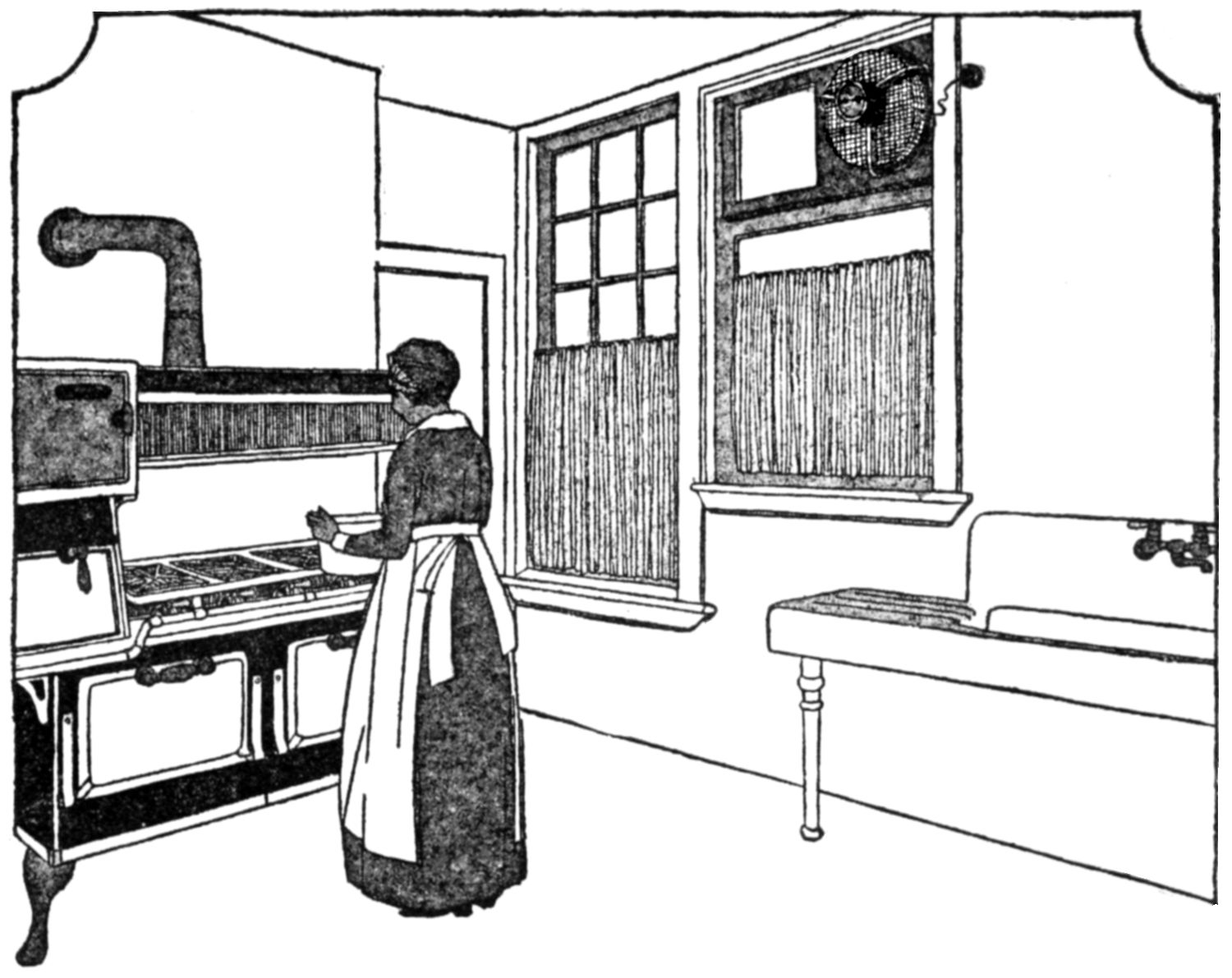
Courtesy of Ilg Electric Ventilating Co.
SHE IS COOL EVEN IN SUMMER WITH MOVING AIR
The requisites then for good ventilation are:
1. Equable temperature from about 60 to 65
degrees Fahrenheit, and the moderate relative humidity
or moisture of 45 to 65 per cent. In order to keep
the room moist in winter it is well to keep a pan of
water on the radiator. Regular humidifyers can be
bought for this purpose.
2. Clear air, free from impurities such as dust,
insects, oily vapors, soot, etc.
3. Odorless air (you have been sickened by the use
even of the most costly of perfumes!) free from
gases and vapors.
4. Air motion; but the motion must be accomplished
without those objectionable blasts of wind that
so frequently startle you in some houses which are
supposed to have the most up to date equipment.
The weather strip is insurance against the gale.
Air isn’t a mysterious chemical combination. It is
a mechanical mixture of 21 parts nitrogen, 79 parts of
oxygen, from 0 to 4% of moisture, and usually 4 parts
of carbon dioxide gas per 10,000 parts of air, so it need
not distress you to effect a good clean supply of air and
equip your house with some of the steadily improving
devices now on the market.
Any device to be useful to the home must, of course,
be convenient, economical, safe to operate, and durable.
Well, let’s begin with the kitchen; for this ventilation
is more necessary than any place else in the house.
Not only is it difficult to keep the kitchen in equable
temperature, but to have it cool often means a draft, and
a draft means a cold for the cook, and a cold for the
cook means danger to the whole household. Then there
are odors from the kitchen. These are continually getting
loose, unless the door of the kitchen is kept closed
(which is trying) and infecting the house prematurely
with the taste of dinner. All of which is uncomfortable
and gives the home a commonplace, tenementy atmosphere.
Your home may be judged by its laundry and
cooking odors! The fewer, the better. Did you ever
think of that?
The cellar is another important room to keep
well aired and should be provided with windows and
doors to formulate a current of air. Pantry and laundry,
too, should be built with ventilation in view in
order that, as in the kitchen, these rooms can be kept
sweet and savory.
Without extra ventilation apparatus, you can take
advantage of the movement of air; as it cools, it falls
and as this falls it is heated and rises again—keeping
up a rotary circulation:
1. Lower windows from top and bottom so that the
warm air will go out at the top and the cold air
come in at bottom, starting the circulation of air.
2. If not too draughty, have a door open opposite the
windows, or use a draught board or screen which
can be easily placed on window sill to curb
current.
3. Cool moist air can be had often by hanging up a
damp sheet and re-wetting it as it dries.
4. Fireplaces with small or large fires in them cause
air current.
5. In some rooms which have a grated air intake cut
into the walls near radiator—air circulation is
effected easily.
6. Give the risen hot air a chance to get out of the top
of room, and give the cold air a chance to come in at
the bottom of room—and keep it agitated—this is
about the best advice. If you can’t do this, call in
a ventilating and heating engineer—he will.
With the new type of ventilators, cookery odors,
draughts, smoke, steamy vapors, smudges collecting over
walls, curtains, etc., are obviated because they are all
dissipated and sent flying to the big outdoors. Its
blowers blow out the bad air. The apparatus, which is
simplicity itself to operate, is attached to the ordinary
lamp socket and placed in effective places. The improved
motors are encased and almost frictionless in
action, which means the minimum wear and tear and no
cost for repairs. Some of the motors are self cooled
which also does away with wear and hot boxes.
There are various kinds of fans which may be used.
Those which change their direction in process of revolution
are good. Some think they are better than the
one-direction fan, and maybe, where the fan is used
alone without other attachments such as purifiers and
blowers, this style may be more efficient. It at least
does the work more swiftly. But whatever kind you
use, they should be so placed as not to make draughts.
The steady movement of air is the only thing necessary,
not hurricanes.
In the study it is necessary to have light and air and
no draughts to blow papers away. The ventilator
(which may be put on the window sill over the radiator
thus obviating the uncertain winds coming crassly
through the open window) will prove a boon to the
writer or housewife.
Oh, Homekeepers, it is often that these office devices
which are always employed where work is done, if installed
at home, would keep your men folk and even
your women office workers happy. You would be surprised
how many people would come home to do
after-hour work if the home were as office-shape as
business places. And the ventilator is a very good
point at which to start.
It is nice to think that along with ice cream, the
steam boat, and other American inventions, applied
ventilation seems to be an almost pure American product!
So, you patriots, here is a way to build real air
castles that will build finer and finer things as you profit
by the stimulus which fresh air, more than any one
commodity in the universe, can give.
No consideration of ventilation of houses could be
complete without a few words on the value of weather
strips. It is strange too that this precaution in the
home is so little known and that the house-wife has so
little knowledge of their infinite good.
Disregarding them as a factor in the cleanliness and
noiselessness of the home, disregarding in this chapter
the intriguing facts of their manufacture and application,
they are adjunct at their best in the home because:
They reduce the possibilities of draughts and therefore
reduce the possibilities of colds and rheumatism
and the like. See Chapter XXXIII.
They keep the temperature of all the rooms as even
as it is possible here below to keep anything even and
therefore give the ventilating régime a square chance
to function well.
In keeping welcome air in and unwelcome air out,
in so far as is necessary, the reduction of fuel bills is
enormous ... from 15 to 50%! This to-day is a
favorable asset when fuel is expensive.
With all the systems of ventilating in the world, if
you have tornadoes flying about your floors from the
air you do not wish admitted, you cannot have a properly
or healthfully ventilated home.
In short, the weather strip makes it possible for you
to have your say as to the air that comes in and out and
makes it possible for your heating and ventilating systems
to work as they should. The hit or miss element
in the home is again routed by the weatherstrip and anything
that does this is worth considering.
CHAPTER XV THE PLUMBING IN YOUR KITCHEN — Plumbing Laws — Further Provision — Definitions — The Trap — Fresh Air Inlets and Main Traps — Sewers, Drains and Traps — Soil and Waste Lines — Vent Pipes — Sinks and Connections — Second Grades — Patented Materials — Outlets — Faucets — Filters — Safe and Refrigerator Waste-Pipes — Homilies
Once upon a time there was a business man who,
upon buying his first house, bought simultaneously
a plumber’s kit. He was sure he could save a lot of
money by attending to simple matters himself. One
day a simple faucet sprung a simple leak. He confidently
used a complicated tool and the result was a vast
sea of trouble. Plumbers! Expense! It is not necessary
to draw the moral.
The plumbing in the house is akin to the alimentary
canal in the human body, and is as complicated a system
as the alimentary canal. The system of plumbing in
the house is a series of pipes which carries water to the
house, and eliminates it as it carries with it various
forms of waste, connecting the house with the main
sources of water, gas and with the sewage system. The
best plumbing is that which effects these things with
the least deterioration and with the least mixture of
sewer gas and foreign matter.
Every community has its own plumbing laws and
regulations. This is true unless you build in very
rural sections where there is no sewage system. However,
this article will deal only with conditions in which
a sewage system prevails.
As will be seen by the following excerpts from the
plumbing laws of New York City, the ordinary housewife
need not worry about transgressing the law, as
everything, from the material used to the size of it
and the laying of it, is controlled. And the plumber is
supposed to know these rules before he is licensed. But
it is in no way as glorious as poetic license!
All the materials must be of the best quality, free
from defects, and all work must be executed in a
thorough, workmanlike manner.
All cast-iron pipes and fittings must be uncoated,
sound, cylindrical and smooth, free from cracks, sand
holes and other defects, and of uniform thickness, and
of the grade known in commerce as “extra heavy.”
The size, weight and maker’s name must be cast on
each length of pipe.
All joints must be made with picked okum and molten
lead and be made gas-tight. Twelve ounces of fine, soft
pig lead must be used at each joint for each inch in
the diameter of the pipe.
All wrought iron and steel pipes must be equal in
quality to “standard” and must be properly tested by
the manufacturer. All pipe must be lap-welded. No
plain black or uncoated pipe will be permitted.
Each building must be separately and independently
connected with a public or private sewer, or cesspool, except
where a building is located in the rear of the same
lot with another building, when its plumbing and drainage
system may be connected to the house-drain of the
front building behind the house trap and fresh air inlet
which shall be used for both buildings if sewer connected;
or may be connected to an existing cesspool of
front house and be provided with a separate house trap
and fresh air inlet.
Where there is no sewer in the street or avenue,
and it is possible to construct a private sewer to connect
in an adjacent street or avenue, a private sewer must
be constructed. It must be laid outside the curb, under
the roadway of the street.
All pipes and traps should, where possible, be
exposed to view. They should always be readily accessible
for inspection and repairing.
In every building where there is a leader connected
to the drain, if there are any plumbing fixtures, there
must be at least one 4″ pipe extended above the roof for
ventilation.
The contents of settling chamber or dust receptacle
for vacuum cleaners may be discharged into a plumbing
and drainage system.
Leaders must be trapped with cast-iron running traps
so placed as to prevent freezing.
Rain-water leaders must not be used as soil, waste or
vent pipes, nor shall any such pipe be used as a leader.
To have an intelligent understanding of what the
plumber has to know, it might be well to know what
certain terms are which are used in the plumbing rules.
The term “private sewer” is applied to main sewers
that are not constructed by and under the supervision
of the Department of Public Works.
The term “house sewer” is applied to that part of
the main drain or sewer extending from a point two feet
outside of the outer front wall of the building, vault
or area to its connection with public sewer, private
sewer or cesspool.
The term “house drain” is applied to that part of the
main horizontal drain and its branches inside the walls
of the building, vault or area and extending to and
connecting with the house sewer.
The term “soil line” is applied to any vertical line of
pipe having outlets above the floor of first story for
water closet connections.
The term “waste line” is applied to any vertical line
of pipe having outlets above the first floor for fixtures
other than water closet.
The term “vent pipe” is applied to any special pipe
provided to ventilate the system of piping and to prevent
trap siphonage and back pressure.
Most important from the hygiene point of view is the
trap, which is a curved pipe permitting the last of a
flow of water to remain in the pipe to prevent a back
flow of sewage gas into the house. There are for use
various forms of traps under different circumstances
which, of course, are entirely the plumber’s business.
In hotels and large institutions, and in some large
homes, a grease trap is built in the sink which is so
constructed as to separate the grease from the water,
which obviates clogging of the pipes and which amasses
the grease which is sold to soap makers for soap.
Fresh air inlets and main traps are also for the prevention
of odors and gases coming directly from the
sewer. The entrance of these gases often takes place,
even though the plumbing is excellent, by the settling
of the floors and foundation rendering the soil pipes
defective.
The question of soil pipes, etc., is sufficiently covered
by the plumbing regulations so far as not to need any
explanations here.
Every sink, of course, must have its own trap.
The following are a few excerpts from the law:
must be of extra heavy cast-iron. When found in a leaky
or defective condition, shall not be repaired or replaced
except with heavy cast-iron pipe.
The house drain and its branches must be of extra
heavy cast-iron when underground, and of extra heavy
cast-iron or galvanized wrought iron or steel when above
ground.
The house-drain must properly connect with the house
sewer at a point two feet outside of the outer front
vault or area wall of the building. An arched or other
proper opening must be provided for the drain in the
wall to prevent damage by settlement.
No steam-exhaust, boiler blow-off or drip-pipe shall
be connected with the house-drain. Such pipes must
first discharge into a proper condensing tank, and from
this a proper outlet to the house sewer outside of the
building must be provided. In low pressure steam
systems the condensing tank may be omitted, but the
waste connections must be otherwise as above required.
All main, soil, waste or vent pipes must be of
iron, steel or brass.
Soil and waste pipes must have proper Y or TY
branches for all fixture connections.
The diameters of soil and waste pipes must not be
less than those given in the following table:
| Main soil stacks |
4″ |
| Main waste stacks |
2″ |
| Branch waste for slop sinks |
3″ |
| Branch waste for kitchen sinks |
2″ |
All vent pipe lines and main branches must be of iron,
steel or brass. They must be increased in diameter and
extended above the roof as required for waste-pipes.
They may be connected with the adjoining soil or waste
line well above the highest fixture, but this will not be
permitted when there are fixtures on more than six
floors.
Branch vent pipes shall be kept above the top of all
connecting fixtures, so as to prevent the use of vent
pipes as soil pipes or waste-pipes. Branch vent pipes
should be connected not less than six inches nor more
than two feet from crown of trap or side of lead bend.
No form of trap will be permitted to be used unless
it has been approved by the Superintendent of Buildings
or the Board of Standards and Appeals.
No anti-siphon trap or deep-seal siphon-jet fixture
shall be approved until it has successfully passed such
test as may be prescribed by the Board of Standards
and Appeals.
A set of not more than three wash trays may connect
with a single trap, or onto the trap of an adjoining sink,
provided both sink and tub waste outlets are on the
same side of the waste line, and the sink is nearest
the line. When so connected, the waste-pipe from the
washtrays must be branched in below the water-seal.
The sizes for traps must not be less than those given
in the following table:
| Traps for slop sinks |
3″ in diameter |
| Traps for kitchen sinks |
2″ in diameter |
| Traps for wash-trays |
2″ in diameter |
Now, of course, all the foregoing relates to the whole
house as well as to the kitchen. But, as the kitchen
sanitary conditions depend upon the same regimen,
the foregoing is a basis for kitchen usage.
The kitchen is mainly concerned with the water supply
and water waste, which is the result of cooking, washing,
cleaning, and storage (refrigerator).
The entry of water to the kitchen is effective
through faucets, for the most part, in some sort of a
sink. What then should these sinks be, and what should
be the nature of their connections? For the most part,
the building law will take care of the connections, but
you should see to it that the traps are below the sinks
and are in plain sight, and that the materials used, for
your own good, should not only be within the law, but
a little above it. Another thing you must remember, in
ordering sinks, is that they should be smooth, in one
piece if possible, having a seamless interior, non-absorbent,
non-rusting, and with a certain amount of elasticity,
so that when hit by sharp and heavy utensils, neither
the utensil nor the sink is cracked or injured by the
impact.
The materials to be used in the making of sinks are
tin, wood, soap-stone, galvanized iron, slate, copper,
enamel, enamel over iron, a porcelain-like material over
metal, and solid porcelain. Stone and slate are poor because
they are too absorbent. Wood is bad for the same
reason. Tin rusts, copper is difficult to keep clean
and is rarely used for anything but pantry sinks.
Enamel over iron is excellent, porcelain over iron is
better, solid porcelain is regal but has the disadvantage
of having so little resiliency that dishes are apt to break
when coming too effectively in contact with it. This is
often obviated in the pantry by enclosing the pantry
sink in a wooden casing. The surface of good porcelain
over metal will not scratch.
Solid porcelain sinks are all made from the same
material, yet the action of fire affects some differently
from others. For instance, a workman may fail to work
out of the wet mould a bit of air in the clay, and when
this piece is fired in the kiln the air condenses and bursts
out and the result is a slight streak; or a bit of copper
may get into the clay causing a green stain on the piece.
When such things occur, it does not alter the value
of the sink, but the high grade manufacturer marks
these “second grade.” This is well for you to know as
it really does not effect the lasting qualities and probably
the initial cost is lower. The shallower a sink is
the easier, of course, it is to take care of.
The general run of sinks has the metal base with
a porcelain-like covering, as they are elastic and are kind
to falling china. However, you cannot go wrong in
buying any of the enameled, or porcelain over iron, or
the solid porcelain, bought from the well-equipped, long
established manufacturies. There is one firm which
makes a superb solid porcelain sink in thirteen varieties,
including two vitreous (porcelain over metal) slop
sinks. When you think of one firm making so many
varieties, and a few other firms making almost as many,
it soon becomes necessary for the domiologists to know
what to tell a plumber to install, before the masculine
mind installs something for which you will have little
use. Of course, it depends first on what the sink is to be
used for. In large kitchens, the pot sink, vegetable
sink, and slop sink are used, sometimes two of some of
these varieties. In the medium kitchen, the pot sink and
one of the others. In the small kitchen, just the ordinary
pot sink is used.
Do not buy an all-roll sink; that is, a sink with a
curved rim and no back, unless your kitchen has a tiled
wall. Why? Because your wall will be splashed to the
destruction point.
Very commodious sinks measure 5′ 2″ over-all, back
9″ high, wall to front, 261⁄2″. This size sink is often in
two divisions, one for washing, and one for rinsing, and
has integral drain boards (of self material as part of
the sink). If the integral drain board is not of wood or
metal, it can be rendered kindlier to china by a rubber
mat. Some sinks have a 5′2″ back, some just have a porcelain
back behind the faucets.
A small sink a little over 3′ can be had with or without
integral drain boards on either side, and a vent at
the right end, so as not to interfere with the dishes.
Speaking of drain boards, it is very often expedient to
have them hinged to the wall, or so attached to the sink
that they can be let down and out of the way.
Sinks of patented materials, with trade names, which
are often metals with a porcelain-like covering, also
come in many sizes and in many designs, and are, as
inferred above, quite as valuable in usefulness and
beauty as solid porcelain, with one exception, of course,
that under some remote circumstance a chipping off
of the material may occur. But the makers of solid
porcelain sinks make a metal-coated slop sink where an
extra heavy thudding, by pails and cleaning instruments,
is apt to occur. This precaution speaks for itself.
The solid porcelain certainly gives you a feeling that
you have the best, yet some of the greatest houses in the
country use the other types of sinks.
Although we have touched upon the subject of drain
boards, there are few more words to say about them.
The sink with a double drain board is, of course, the
most convenient, but this is not always possible. They
are made of metal, such as copper and zinc, and also
of wood, either oak or ash, preferably ground ash, hard
enough to prevent absorption. Sometimes they are of
metal over wood. The porcelain drain board is easiest
of all to clean, requiring only a moist cloth passed over
the porcelain or metal under porcelain, while the others
need scouring and scraping. The grooves in any of
these boards must not be so deep as to require digging
to remove lost particles. Most pantry sinks have the
wooden drain boards and the wooden enclosed solid
porcelain sinks, just to save breakage. “Boards,” of
course, should always be slightly tilted toward the sink.
It is wiser to have sinks 36″ high, or have them on
adjustable standards.
If 36″ happens to be too high, a long wooden step can
be provided. It is better to step up than to form a
crick in one’s back.
However, any plumber will alter the standards, no
matter what sink you buy. Sinks are purchasable
with from one to four standards, depending upon what
space in the kitchen is to harbor said sink.
The standards of sinks are made of glass, brass, nickle
plate, or porcelain, or a porcelain coating over metal.
Some of these standards are supplied with adjustable
bracelets, making it possible to raise and lower the sink
to desired levels. The nickle standard is very desirable,
as is the brass, but they require cleaning and polishing.
The glass and porcelain families need just to be rubbed
down with a moist cloth.
Slop sinks are made to set lower than other sinks in
order to obviate lifting up heavy pails of water, etc.
The question of outlets in the sink is simple. The
outlet should not be perforated so minutely as to prevent
rapid exit of the water, and yet the holes must not
be large enough to permit foreign matter to clog the
pipes of the plumbing system. Very often it is wise to
have a wire net over the outlet. Some sinks are equipped
with stoppers and with cylindrical outlets familiar
in wash basins and bath tubs. In these sinks the water
is kept in until it is time to release it, obviating the
necessity of wash basins. Sunken outlets are a nuisance
to keep clean.
Faucets are usually of metal, and high priced ones
are of enamel. Some sinks have two sets of faucets, two
in each set. Some have a higher faucet, a goose neck
pattern, for filling carafes. The metal faucets are generally
brass and nickel plated. Brass corrodes and is
hard to keep clean. The nickel are very satisfactory
but cost more. The enamel are quite ideal because the
polishing is absolutely obviated. In this case it is a
toss-up to the purchaser what it is best to save—time or
money. Then there is the pressure faucet—the one
which has to be held in order to get water out of it.
These are quite hateful and ought never to be used unless
the water price is almost prohibitive. Sometimes
a foot pressure faucet is used in order that the worker
may have his hands free for work. A new faucet which
can be swung into different positions is to be had on
the new pantry sinks.
If the water pressure is extraordinarily high, try to
get faucets on your sink with air chambers to take
care of this extra pressure. And try, above all things,
to buy faucets that emit a flow of water which does not
splash the worker.
Unless you are a skilled mechanic, don’t try even to
put a new washer in your faucet to stop a leak. Because,
unless you are skilled, you may forget to shut the
stop-cock which cuts off the sink from the main water
supply, which may be under the sink or in the cellar.
And to prevent a woeful catastrophe, don’t forget,
if you leave your house unheated in the winter, to turn
off the water in the cellar.
The question of filters, (See Chapter XXXII, Polishing
The Water Supply) which are attached to
faucets, is full of danger, as there are only a few good
ones on the market, and those that are good can be
rendered, through careless handling, much more of a
menace than the ordinary water supplied to you.
The porcelain-like candle type is one of the best but
not absolutely fool-proof. The water sifts and filters
through this porcelain candle. If this is sent away to
be thoroughly baked, at regular intervals, according to
the manufacturer’s description, it is useful; but, when
this is not done, the filter becomes a breeding place for
germs. Therefore, all things being unequal, boiled
water is the safest insurance against germs.
As for the refrigerator’s (See Chapter XI Refrigerators)
rôle, in the plumbing of the kitchen: this
is, of course, very important and very simple. It
is necessary to keep noxious gases from the stored
food. If possible, have a connection through the
floor with the trap and pan in the cellar. If this is
impossible, have a trap and pan under the refrigerator
which can be often emptied. It is, of course, convenient
to have the ice box filled from the outside of
the house rather than have the ice dragged through the
kitchen.
These are some excerpts from the plumbing code:
Safe and refrigerator waste-pipes must be of galvanized
iron, and be not less than 11⁄4″ in diameter nor
larger than 11⁄2″ in diameter with pipe branches
at least 1″ in diameter with strainers over each
inlet.
Safe and refrigerator waste-pipes shall not be
trapped. They must discharge over a properly water-supplied,
trapped sink, with trap vented unless an
approved anti-siphon trap is installed in the manner
specified in Rule 91, such sink to be publicly placed, and
not more than 4′ above the floor. In no case shall any
refrigerator or safe waste-pipe discharge over a sink
be located in a room used for living purposes.
The branches on vertical lines must be made by Y or
TY fittings and carried up to the safe with as much
pitch as possible.
Where there is an offset on a refrigerator waste-pipe
in the cellar, there must be cleanouts to control the horizontal
parts of the pipe.
In all lodgings and tenement houses the safe and refrigerator
waste-pipes must extend above the roof.
When I started to write this article I thought I would
give specific plumbing rules, but the buying of fixtures
is really all that is necessary for the housewife to know,
as all first class plumbers know the rules of the code.
So the best plan to adopt is to use the best plumber.
Even if he be expensive, he will save your money in the
end. And remember, always use one in your vicinity
for, if you do not, you will be very unpopular, as you
will know when some dire emergency emerges!
If your pipes freeze in the winter, warm cloths until
the plumber comes is the best remedy.
If you build in a remote district, have your water
tested by an expert on the spot, so that he can examine
not only the water, but the source of its supply, and
help you in settling where to build your well or pump,
and where the cistern should go, etc., etc.
After a new installation of plumbing is made, there
is applied always a test like the peppermint smoke test,
etc., to see if there are any leaks in the pipes. This is
also accounted for in the plumbing code.
Although not quite technically a plumbing fixture,
there is a ventilating, self-cooled motor propellor fan,
which is being put up in kitchens, to keep the kitchen
cool in summer, and to remove traces of excessive heat,
steam smoke, and objectionable odors.
CHAPTER XVI KNIFE-LIFE IN THE KITCHEN — Kitchen Cutlery — Variety in Knife-Life — Home Butchering — Handles — Sharpening
“I would like to have a vegetable knife,” says
a woman to the salesman.
“Yes, Madam,” says he, handing her a knife.
“Thank you,” says the customer, not even looking at
it. Then she goes home and tries to pare a pumpkin
with the dainty little flexible knife that she has bought
and finds that the task is quite impossible. Why?
Because she has used a knife not designed at all for
anything but a potato or an apple.
Such things are very frequent because the purchaser
doesn’t realize that “vegetable knife” as well as “motor
car” spells many types, and that the knife is even more
diversified in design than the car to meet various kinds
of work. What carpenter would think of cutting across
the grain with a plane meant for cutting with the grain?
The carpenter realizes the range of design in his tools,
however. So should it be with women if they wish to
save their nerves, their hands and their time and make
their food look worthy of its cost.
The background of the knife and fork is surrounded
with historic significance and romance. The knife
seems to be the first-born of Father Cutlery and the
fork a late development as a table essential; and the
spoon comes so late that it isn’t even romantic.
First of all, cutlery was developed from the hunting
knife in various guises. Then it became the sword of
history. Not until the Middle Ages were knives used
on the table, and then only one or two. Not until two
or three hundred years ago were they used by each
individual! And this first took place in Italy.
Ordinary cutlery was really first used in the form
of the sheep shears, very much like the shears used in
the Rembrandt painting: The Old Woman Cutting
Her Nails.
Before steel was used, bamboo, shell, then copper,
bronze, tin and copper and the so-called “steel” of
Damascus were the materials out of which the knives
and swords were built.
As forks were a later development and were used at
first only as a means of helping the diners from the
central dish, it was necessary for the diners to wear
gloves to shield them from the rigors of hot foods.
Therefore, with such methods it was necessary to recover
in sanitary fashion and to this end servitors would meet
each diner with a bowl of water and a towel.
Thus has the finger bowl descended unto us.
For some time after the knife and fork were used
generally, each person would carry his own beautiful
set in a handsome case at his belt or girdle. During
the 18th Century when the fork was commonly used it
was with the knife superbly fashioned of jewels and
metal work. For the most part forks were two pronged,
and not until Louis XV of France did the four-tine
fork come into being.
So from the hunting knife and the crotched wooden
stick was born our own diversified cutlery. Not only in
steel of fine temper and hardness, but recently of steel
with the added qualities of stainlessness.
Although Sheffield, England, in the past has the reputation
for the finest cutlery in the world, and although
Sheffield must be given the credit for fathering the
craft, yet the United States to-day is making some of the
best cutlery and bids fair to outmake and outsell the
world in quantity and quality.
The subject of kitchen cutlery, the one which this
chapter is dealing with, does not interest itself in silver
plate and all the cutlery so beautifully made for table
use. The same general principals apply, but there is
too little space here to go into the detail of pattern,
brands and general details of table cutlery.
However, the blades for most cutting articles are
made of shear steel, and for this crucible cast steel and
forged steel are used.
The essential parts of the process of cutlery making
are: (1) forging; (2) hardening and tempering; (3)
grinding; (4) polishing; (5) assembling, honing and
the finishing touches; and these are subdivided into
many divisions, making nearly a hundred in some instances
and more in others.
The last division is the one which the “cutler” does
to-day. In the 18th Century the cutler did the whole
work of making a knife, but to-day the polisher polishes
and the grinder grinds, etc. The hundreds of processes
to-day in the course of the manufacture of one piece
of cutlery are in the hands of nearly as many workmen.
Of course, the value of modern cutlery is in the finesse
of manufacture and the quality of steel that is used,
and in the perfection of its varying parts and their
assembling.
Knives are meant to cut.
Knives, therefore, must be so made that they will keep
their cutting edges, so proportioned as to fit the thing to
be cut; so limber or so stiff as to be comfortably
wielded; so assembled as to keep their handles fastened
to them; and so balanced (even as a golf club) as to be
not only easy but pleasant to use. Pleasant tools make
light work.
The knife has three or four main parts—the blade;
the tang (that part which fits into the handle); the
handle itself, or haft, as it is sometimes called; and in
some cases a metal ferrule. Much depends upon the
way these parts are made and fitted; they must be so
married that nothing can divorce the knife from the
handle, so that they will preserve their oneness indefinitely.
The great Reno for the knife is the huddled
drawer in which it is for the most part kept, but more of
this later.
The kinds of knife in which the housewife is particularly
interested are: carvers, vegetable slicers, parers,
fruit, cleavers, etc. Subdivided, they are: paring,
bread, meat, poultry, carving, cake, boning, paring
(small pocket type style), spatula, lemon, grape and
orange, curved in French, German and American fashions,
cleavers and scrapers.
Where it is necessary for a knife to conform to shape
in paring, a flexible knife is more comfortable than a
stiff one. Therefore, if you want a vegetable knife for
slicing potatoes never think of buying a long stiff one because
your work will be seriously impeded. If you
have the right tool the job of paring, or what not, will be
as much fun as carving is for the artist who in his turn
always has the correct tool.
“Gracious, I can never slice a ham that doesn’t look
as if some one bit it up,” said a friend of mine.
As gently as I could I told her it was because she
was trying to do the impossible. She used a knife for
bread and cake, broad and short, and expected it to do
the work of a long, thin blade slightly curved off at the
end. The heavy, wide-bladed knife cleaves to the surface
of the meat and makes it a practical impossibility
for any ordinary mortal to push it through. The narrow
blade is what you must have, as it requires less
strength and cuts therefore more efficiently. The knife
with the almost scimitar formation makes it simple
to cut around a bone.
Most everybody has a bread knife, so we need not
bother about that familiar object, but the only thing
necessary is that the bread knife should be kept for
bread (and kept sharp) as far as possible, unless it is
adapted by having a medium wide blade, to cut meat
and cake.
For hot meats a rather flexible, but not too flexible,
knife should be used, especially in the case of hot steaks
and ham. It is a real comfort to have a good knife for
these things; the meat is not chewed before its time and
is not wasted in formless gobs.
For the person who must economize on the number
of utensils, a knife about 8″ or 9″ long with rather wide
blade can be bought which can very comfortably be used
for cold meat slicing as well as bread and cake. A set
of six knives, two spatulas and two forks, will fill most
kitchens’ needs. Other knives and forks can be added
as specials. Here is the 2″ paring knife, 3″ for splitting.
The general household keeps a fork with the
French pattern blade for general work and the heavy 6″
blade for cutting vegetables such as turnips, pumpkins,
squashes, etc., where a thin blade would snap; the fork
has hardened blades with needle points. The spatula
for pastry works as well as the wide spatula. The carving
knife in 8″ short blade, and the flexible slicing knife
with 9″ blade usable for cold meats, cake, bread, etc.,
and the general utility knife.
For tough cutting and broad surfaces the narrow,
stiff knife is best, for crumbly broad surfaces the broad,
stiff knife. For rather tough, small surfaces, to be pared
and trimmed, the medium flexible, narrow blade is best.
Use the narrow and stiff and short knife for tough small
surfaces like squash and turnips. With these simple
logical suggestions the knife problem is easy.
“Had I only learned the use of the spatula in cooking
school I should have thought my course to be a lifelong
economy.” This was said somewhat in jest, but it
shows just what the value of the spatula is. It is an
economy. It is not a cutter but a very flexible, bendy
blade with round corners which can assume the curve of
any vessel and pick up dough or anything left behind
in bowl or pastry board which is worth saving. It is a
scraper and saver. You need not waste a bit of the
precious egg on the sides of your dish or a bit of batter if
you use the spatula. It also lifts comfortably the egg,
griddle cake, fish etc., from the pan. It is really a joy
unbounded.
A larger sized spatula is a convenience, too, for scraping
and cleaning large kettles and also for a cake or pie
lifter. Being larger it is a trifle stiffer. One corner
of the end of this blade is sharp and the opposite corner
is round. The reasons are obviously for attacking
corners and not scratching surfaces.
In some homes a certain amount of butchering is done
in the kitchen, sometimes to save expense and sometimes
for certain and very fine results if the chef is a
jewel.
To this end there are some good implements on the
market: strong, well balanced and riveted to give good
service. Knife blades for this work range from 5″ to
14″ in length and are in various styles.
The cleaver is a good thing to have should the butcher
sometimes neglect to break a furtive bone. These come
in pleasant weights and dimensions, the one with blade
6″ long by 21⁄2″ wide, weighing in all one pound.
In connection with knives for fruits and vegetables
you will be interested in the story of the late product of
steel which is so fast coming to the markets of the world.
It is stainless steel. A steel (with an admixture of
chromium) which resists rust, does not corrode or scale,
and is impervious to food acids (with the exception of
the mustard plus vinegar plus salt combination which
makes a muriatic acid, which is the acid with which
steel is etched).
It keeps a fine edge and is of fine temper and hardness
when made by accomplished manufacturers. The steel
you use now is a carbon steel. Before the war, both in
England and America, it was rapidly coming into our
markets, but the value of such steel was so patent to
governments that the war and construction departments
used it all. Now, however, it can be bought even in
some department stores.
Think of not having to scour or polish your knives.
Think of the knife having an indefinite life and always
looking highly polished. Soon, too, even the handle will
be made of this steel and the knife will look like a highly
polished silver utensil.
What may this mean in a servantless home?
No cleaning powders must be used to clean this steel;
only warm water and a mild soap. Its advent reminds
you of the early days of aluminum utensils, doesn’t it?
The manufacturers are planning to make kettles, pots,
and pans of it, as they will wear well, and will not scale
and wear as do iron ones.
As this steel is non-staining, the hands are not stained
as much when it is used with fruit juices; the factor of
the juice combining with the elements in the
steel is absent. There are some people whose
hands stain from certain juices whereas the
hands of others do not, but generally speaking,
there will be less hand staining with this newer steel.
If you do your own work, how your hands will be
saved!
The few years of its service may not have revealed
all of its good points or some of its bad points. Only
time will tell, of course. But as a fruit knife at present
the stainless type seems to be a fine thing, though the
ordinary steel knife, if sharp and well made, is no less
of a joy than ever it was. Manufacturers are adopting
the stainless—even those who think that it isn’t as good
as it is claimed to be.
Vegetable and fruit slicers and parers come in many
sizes and styles. They are usually small and light with
narrow blades and sharp. They are to be had in stainless
and carbon steel in sets and in singles, and when
bought wisely make the kitchen maids’ job an artistic
one.
Grape-fruits and oranges have knives for their very
own. Manufacturers have given much time and thought
to the easiest method of preparing these fruits easily,
without loss of juices and flavor, and without waste of
time on the part of the operator. And so there have
been born a few of these knives which are excellent and
live up to their glowing advertisements.
Their characteristics are: Two-edged, like the great
swords of old. They cut from either the right or left
with ease; the blade is curved to fit the fruit and has
rounded points so as not to lacerate the outer skin and
waste the juices and spoil the shape of the fruit. The
blade is exceedingly sharp and honed carefully like a
razor—the sharper it is the swifter it will do its work.
The blade must be securely fastened in the handle.
The handle must be light, of comfortable shape and well
balanced. In a few words, the knife must be able to get
down and under the center, cutting the side segments
as well as making the tough walls “fade away” easily.
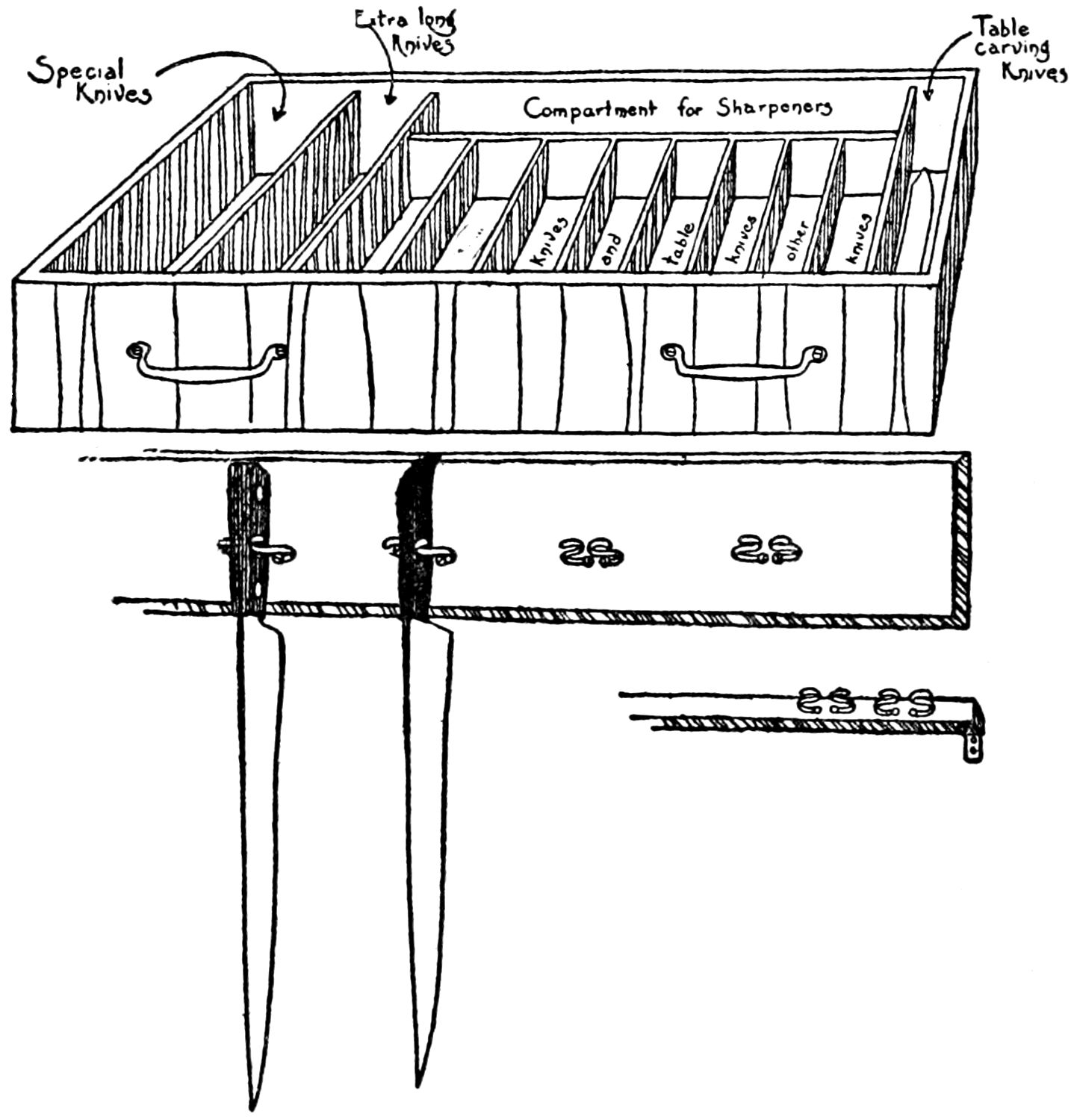
DEVICES DESIGNED BY THE AUTHOR FOR KEEPING CUTLERY
IN CUTTING FORM
The knives are made in stainless steel, in nickel-plated
steel and in the ordinary and fine vanadium steel. Your
fruit when prepared with such a knife may look as if
hands never touched it.
The question of handles is interesting because the
knife without the handle, however sharp it may be, is
of little use. The main question is of ease in gripping,
in the balance, and in the duration of time that the
blade will stay firm in the handle.
There are many ways of accomplishing these things:
in some cases the tang of the blade is cemented in the
handle. This is done where the knife is used with little
pressure and strength, such as the feather-curling knife
of the milliner; there are some knives which are riveted
such as butchers’ knives because much force is used with
them; household knives are pinned and pinned and cemented
sometimes, and in the case of home butcher
knives as many as three pins are used to keep the handle
steady.
With knives like the corrugated types, there are often
metal wire handles drawn out on them. The corrugations
on these blades are to obviate tearing and reduce,
some think, the pressure necessary in cutting.
Handles themselves are made of various things,—woods,
rubberoid, celluloid, metals, stag and in the case
of table knives, mother-of-pearl, shell, silver over nickel,
etc.
The kitchen knife handle must be able to stand all
heats, be impervious to hot water, be smooth and comfortable
in shape, and must be nicely finished so as to
give the worker a feeling of worth-whileness in his job.
Sloppy tools make for sloppy work. Think of your
cutlery as the dentist does his tools and you will feel
professional.
The housewife errs in no place quite so much as in
the care of her cutlery. In nine and one-half houses
out of ten the good blades are huddled and hustled into
a drawer where they loosen from their handles, nick,
scratch and hammer each other to their own destruction.
What good is there in having good materials if they are
to be stored in this manner?
ANOTHER DEVICE DESIGNED BY THE AUTHOR FOR KEEPING
CUTLERY IN CUTTING FORM
Consider the carpenter how he stores! He hangs
each tool in a certain groove, and as he desires a certain
thing he extracts it. He can’t afford to have auto-destruction—it
is too extravagant a disease. Yet it is
the hardest thing in the world to make the housewife
hang up her few knives and keep them forever in good
shape.
Clean them after every using. It’s easier then. A
little scouring powder now and then will keep them in
condition. Do not use scouring powders with stainless
steel, as it reduces the polish—the very thing which
maintains its imperviousness to stain.
All new knives should be so finished when you buy
them that they need no further edging. The best
manufacturers see to this and have a department just
to hone and make knives ready for use.
The housewife’s best method of sharpening or rather
keeping the edges straight and keenly cutting is the
steel. When the knife really gets dull it should be
ground. The use of the stone or carborundum by the
ordinary operator often wears the steel. However, if
the use of the grinder or the stone or the carborundum is
really known, time and money will be saved in the sharpening
process. Sharp knives save temper, save food to a
great degree, and therefore if you can’t sharpen knives
yourself send them out to be taken care of once or twice
a year.
There is a special stone on the market for stainless
steel sharpening; it is well to get this for your stainless
utensils. Follow the directions with it carefully.
All sharpening steels should have a guard for the hand
in case the knife slides back towards the fingers.
Never hold the knife on edge on the steel, for it should
be quite flat; remember you are trying to flatten the
two sides toward the edge, and thereby make it a better
cutter.
There are good rotary grinders and polishers on the
market, and knowledge of them and their use is very
valuable. There are also stones flat and stones in
handles, all for keeping knives sharp. They are yours
if you want them and realize that you must know how
to use them to save rather than to destroy your cutlery.
The story of forks is almost the same as that of its
confrères, knives.
The tines must be rigid and sharp enough to pierce
immediately and not drop their prey by dull points.
Forks were not meant to open cans or lift lids. Many
a perfect fork has had its life history snapped by this
usage.
As with the sharpening steel, so with the fork which
accompanies the carving knife—it too should have a
guard to prevent the knife slipping and injuring the
left hand.
If you buy the best cutlery from the most representative
firms you will have the best results and be well
repaid. Good cutlery, like everything good, is more
expensive than the cheap varieties. Good cutlery may
stand up longer under bad usage than poor cutlery; but
don’t tempt it and waste your money!
A little care with cutlery will curtail your bills, give
your food a better appearance and swifter accomplishment,
for, after all, the kitchen work is mostly cutting
up.
CHAPTER XVII THE ANCIENT WOOD IMPLEMENTS
In
these days of metals, electricity and enamels,
you are very prone to forget that there is still virtue
in the ancient wood, which with true aristocratic
gentleness, has given way to those more parvenu products
that boast their sanitary qualities.
To-day there are still things of wood for the kitchen,
pantry and laundry which are retained to advantage
and other things which can be kept, if not with advantage,
at least for utility.
Some purchasers have wasted time in their zeal to kill
entirely the wood tradition and substitute metals in
every instance. To save this time, this article is written
and dedicated to you who would have the right thing,
be it of the darker ages or of this so-called sanitary or
enlightened era.
For example, could you ever use a metal plank for
planked fish or meats? Of course not! The wood itself
in this case gives up its own essence as it combines,
through the medium of heat, with the juices of the food
cooked on its surface. What metal could do this without
imparting the metallic taste to the bill of fare?
These planks come in different sizes and shapes. The
best are of oak. Some cost more than others. But the
thing to remember is that a plank is like wine, the older
it is, that is, the more it is used and becomes impregnated
with the empyreumatic flavors of the food stuffs,
the more exquisite become its quality and the better
flavor it imparts to the food.
According to Nicholas Sabatini, Chef of Delmonico’s
the best thing to do with a plank when you buy it is
to keep it for at least six weeks, to be sure that it is
seasoned sufficiently. After using a plank, do not soak
it in water, but clean it off with a damp cloth only.
Then keep it under a weight of some sort to prevent
any probable warping of the wood. Mr. Sabatini was
very insistent about the plank being of oak, as any other
wood imparts too definite a flavor of its own to the
food stuffs cooked on it.
Ironing boards have never been replaced with metal
to any large extent. It is their “give” when swathed in
“white stuff” that makes them comforting and usable.
Even the modern bracketed ironing boards are wooden
with the exception of their metal joints and arms,
enabling them to be folded against the walls or put
out of the way. So, too, the sleeve and skirt board.
Time would be wasted in hunting for a more modern
material to use for these staples.
Ironing folding tables are neat little things for the
small house. These are made of white wood. They
will not last a lifetime but they are inexpensive and useful.
Skirt boards come from 3′ to 6′ long and the sleeve
board around 18″ to 20″ long.
In some cases where there is available both a wooden
article and a china or metal, it is often better to get the
non-wooden. For example, the wooden salt box; good
enough in its way but it is out-ranked by the china,
porcelain or composition boxes, because these materials
look better, wear better and cannot help being smoother
and less fibrous than the wooden variety. So would
you rather buy sharpeners, flour sieves, some of the
pot racks and sink racks in metal garb than wood,
although there are some sink racks of wood which not
only have a porcelain lining but save breakage of china.
Chopping bowls of sugar maple (not southern maple)
are kitchen necessities. These do not splinter and they
make the din of chopping less obnoxious. The rotary
chopping machine is not always analogous to the chopping
bowl, for who could chop parsley as well in a
chopper as with blade and bowl?
Wooden bread boards and cake boards, of course, are
invaluable (pie “boards” are better of marble, porcelain
or their cognates). These must be of hard wood
such as maple or birch and so made as to be knotless,
crackless and long grained. A damp cloth will remove
traces of material used thereon.
The onion should have its own little chopping board
for obvious reasons.
Noodle boards are oblong, usually of white wood and
come from 14″×20″ to 20″×30″. These have a descending
ledge at the near side to hold fast to the table
and an ascending ledge on the far side to keep the
dough from sliding off. Bread boards are round and
are from 10″ to 11″ in diameter. Pastry boards can
be had from 12″×16″ to 20″×30″.
The wooden step, non-rickety and solid, is of inestimable
value in the kitchen where the worker is too
short for the tables or tubs, or where things must needs
be on high shelves. The step chair which readily is
changed from ladder to chair combines a 2-in-1 arrangement,
that makes room in a kitchen by obviating extra
chairs and extra space for a pair of steps or ladder.
We would warn purchasers against the salesman of
wood garbage buckets or pails. In no case are they as
sanitary as regular metal containers.
But the oak pail, keg or bucket for cider, vinegar,
preserves or water is a good culinary adjunct. They
are hard, firm and well constructed in the best makes.
Often these things have been quite forgotten and yet
they are quite useful in kitchen economy.
Wooden pails come for various uses—scrubbing pails,
water pails, jelly pails and flour pails. They are made
with two or three hoops and are of pine, cedar, oak grain
or oak. The flour pails hold from 121⁄2 to 50 pounds of
flour. The jelly pails hold from 5 to 30 pounds of
jelly and are a convenience to the house-keeper who
puts up a lot at a time and who has a large menage.
The large wooden spoon for use in acid cookery—preserves
and the like—is indispensable to the epicurean
household and should be on every kitchen utensil
list.
The clothes-horse is practically an extinct animal. In
its place has come a different species of varying kinds.
Some fold up against the wall, some are pulleyed up
to the ceiling and get the ascending heat of the room
for drying and some don’t fold at all. Some are built
for porch use, garden use and roof use. But all are
less aggressive than the extinct “horse.”
A close relation to the clothes rack is the towel rack
and hand towel roller, usually of wood and made as
well of this material as any other.
The bread and pastry roller is usually of wood and is
quite efficient. There are glass rollers on the market
but, of course, these can chip. Special noodle rollers
are made now of maple and birch and are long and thin,
giving quick contact like a low gear! Some rollers
have designs cut in them for finishing off a bit of dough
with a pattern.
Potato, slaw and bread cutters are merely wood receptacles
with cutting blade insertions.
Knife drawers or racks with grooves to keep the
knife blade inviolate are too little used. This is one of
the things that will make the kitchen a more proper tool
chest, prolong the life of cutlery and save time in the
search for wanted knives on the part of the worker.
These are being made in compact, useful fashion to
meet the needs of the well ordered kitchen. We can’t
stress the housing of cutlery hard enough—and it is a
real housing problem.
The pot cover rack for those who do not hang up their
pots is a great comfort. It is inexpensive and easily installed.
With these cover racks you easily identify the
cover and it doesn’t get lost in a dark closet, although
many folks think quite the contrary and deplore the
newer methods of hanging up pots and their covers
to the public gaze.
The question of serving butter delightfully is taken
care of by keeping it in the ice box in a stone crock,
and making butter balls with little wooden butter pats.
There are also wooden butter prints, which enable one
to serve butter in forms with a probable little raised
design on its top surface. These come in a flattened
butter ball size and also in 1⁄2-pound print moulds.
The question of wood in the kitchen becomes acute
in the handle situation. Brushes, brooms and mops of
all kinds have wooden handles, and the handle makes
for comfort and comfort for efficiency. Therefore it
is not out of place here to give a few suggestions as to
what a handle ought to be:
1. Smooth—no splinters—hard non-porous.
2. Easily held in hand (if on scrubbing brush, sink
brush, etc.).
3. Long enough to do the work (if on wall or ceiling
or radiator brush).
4. Set firmly in its socket and easily set in (if on
mop, wall brush, etc.).
5. Non-snapping, not brittle (if on a wall duster).
6. Enameled to resist heat and water.
The mallet and the potato masher are heavy tools and
quite necessary. The former is usually of hickory or
lignum vitae, the latter of maple. The potato masher’s
function is obvious, but the mallet is often needed for
cracking a bone, or ice. For fixing lobster and making
a chicken go a long way a mallet is quite a little “fixer.”
The coffee mill and the sink rack can be as well made
of wood as of metal. Yet this does not need to preclude
the metal ones for those wanting them. The wooden
ones themselves are really more of hardware than of
wood.
The mouse trap of wood used once and then to be
thrown out is rather a pleasanter idea than using the
same impregnated trap over and over again. These are
cheap and ready to use at any time.
The wooden salad set, knife, spoon, fork, are rather
epicurean but seem to be passing out of fashion.
Tables of wood are so common that they need little
description, yet a few suggestions may be of real value.
The table with the stove is all important in the kitchen.
It is so valuable, indeed, that it has been lately combined
with the dish-washer and the effete refrigerator
in order to make it possible in limited spaces to install
these quite noble but less royal things.
Tersely said, the table must be large enough for the
work to be done, steady on its legs, simple in construction
and easily kept clean and wholly sanitary.
If possible metal capped legs will prevent the legs
becoming unlevel by swelling when the floor is washed
or shifting through general use. The table top would
easily take a whole story; the main requisite is that it
be hard, easily cleaned and scraped—be it of wood,
composition, marble, metal or of the porcelain family.
Kitchen tables 3′ to 7′ long, with and without shelves
beneath and also with or without closets and drawers
below.
The wooden top of maple is most satisfactory and
probably, of all the table tops, most used. Yet for those
that can afford the wooden table with marble top and
German silver trimmings, nothing could be more perfect
even though the price soars.
Finally, if there be benefit in this article take from it
suggestions for the wooden wedding gift. Few people
think of the kitchen as a realm for gifts. In our experience
presents of culinary use have been a boon to
many householders, especially at the wooden wedding
period.
CHAPTER XVIII GLASS WEAR — Annealing — Manufacture — Color — How it Differs from Cut Glass — Colored Glass — Cooking Glass — Plate-Glass
Glass
ware is now no longer for ornament alone, but
for cooking uses as well.
The only way to tell if you have a good piece of
glass or not is to compare it to other pieces for color
and sound. If it sounds clear and bell-like, it is pretty
sure to be a good bit of glass. But don’t strike it if it
happens to be in a groove or it will, of course, shatter
it, as the pieces will have no room to vibrate and will
break the bounds.
Annealing is the process brought to such a perfection
to-day that glass can be made almost shell proof. In
fact glass for automobile windows was and is being
made that when it is struck will not shatter but will
simply crack or craze. This process is one of careful
heating and cooling many times repeated. It makes
the glass more elastic so that the particles are in more
of a state of equilibrium and can be struck without
danger of breaking.
The basis of all glass is soda, aluminum or oxide of
lead in combination with silica of sand. Doesn’t this
sound hiphalutin? Well, it isn’t. Then this is heated
to something like 1200 degrees Fahrenheit and when in
molten form is blown with air incorporators into the
requisite shapes. You no doubt have seen glass blown
at bazaars or fairs. But of course this blowing in the
factory is done with huge blowers. The best glass
is dependent on its base as it is combined with lead.
This combination is the fine glass called flint glass.
And it is from flint glass which has the luster that the
cut and engraved glass is made.
The color in glass is given to it by the use of metal oxides,
blue is derived from copper oxide, yellow from iron
oxide, the stunning reds from gold. Don’t these facts,
make glass more interesting to you?
Rock crystal is the fashion now and probably will
persist. But don’t, for goodness’ sake, be untechnical
enough to say anything but polished engraved glass,
when you speak of it! The old time glass with intersecting
canyons cut in it which left tell tale gouges in
one’s fingers, is dead and if you use it you are dead too!
Now be it remembered, it’s polished engraved alias
rock crystal.
Cut glass is decorated with geometric lines by means
of steel wheels and carborundum used for the cutting.
Then these lines are smoothed with stone wheels and
given a high polish. Some manufacturers press in the
design by putting the glass into moulds in its moulten
state, but this makes the cheaper glass commonly called
Pressed to imitate the cut variety. Then the glass is
cooled and the effects are often good enough to fool the
ordinary person. Cut glass can always be distinguished
from the pressed by feeling the inside of the cutting,
where it is the deepest, and if there is a slight lump corresponding
to the cutting it is surely cut and not pressed.
Engraved glass is thinner than the cut glass very
often and is decorated by copper wheels fed with emery
and oil, which does not cut so deep. The skill of the
designer and workman are the only limits to the beauty
of this glass. This kind of decoration is left in the satin
gray finish with the exception of the polishing out of the
centers of the flowers, and other figures according to the
taste of the engraver. This gives the contrasts in gray
and clear glass which give the tonal value to the glass.
And when the engraving is sunk deeply and then polished,
it is called rock crystal because it has the peculiar
colorless mat-finish brilliancy of the natural rock crystal.
What about colored glass? There is much of it about,
some of it the frank imitation of the old stuff and some
of it the real old thing. It is very popular. The reason
it isn’t epidemic is because one has to have all the
fixings with it to use it well and to be au fait. Unless
one has center pieces and side dishes and flowers and, to
go even to extremes, old chairs and antique refectory
tables, colored glass gives a vagrant restless spotty cast
to the table! You know what it means to have everything
en rapport, in the way of expenses and fussing
these days! ... to the majority of people anyway. And
so when colored glass is used, even if one has all the
articles necessary, real vision must be employed and
discrimination exercised in massing everything to give
the ease and grace (the basis of beauty) necessary.
One of the most interesting things about glass to-day
is that a firm in America has been taking the Grand
Prix and the Gold Medal in a competition with the glassmakers
of the world in Paris! And some of the best
glass is made in little old America! Talk about American
prowess! And too, because the foreign markets have
not been able to make the rather staple enamel and gold
glass, America has again stepped in, and has been engaged
in making this sort of glass too, and making it
well.
Some very old and exclusive dealers say colored glass
is not in vogue because these firms have in their clientele
very selected people who probably do not buy it as they
have inherited all they need. Furthermore, many of
their clients don’t want to be bothered with it. But
from the way colored glass has been selling in some
places it is certainly safe to say it is very popular.
Yet on the other hand many dealers are afraid to stock
up heavily with it because they fear a slump. At any
rate, the manufacturers can hardly keep up with the
demand for their excellent reproductions of the old
Scotch, English, Irish and Venetian glass. But many
hostesses like it because it takes such taste and skill to
assemble a table when it is used.
No other utensils on the market combine as these do,
beauty, durability, economy and cleanliness even if the
initial cost is more. You see they save fuel, because
they cook food more rapidly, they save the cook’s time
and the waitress’s time because they save the cooking
time, and because they are easy to clean, collecting no
burn to be forced off and no food to be laboriously
scraped away. Besides all this, the food can be served
directly from the stove without putting it into another
dish for the table. This saves more time and insures
hot food. It doesn’t crack in the oven, it comes
in many styles—it is not inexpensive but it is worth the
outlay.
Of late, plate-glass has been taking an important
part in the household.
This glass differs from other glass in the way it is
made. In short it is spread over iron tables in a
molten state and cut and trimmed to measure. It is
made more carefully than other flat glass and of the
finest material. It is, of course, very carefully annealed
to make it as soft and as little brittle as possible.
For the tops of bureaus, dressing tables, desks,
shelves, medicine cabinets, etc., it has no equal. It is
easy to clean and protects what is under it. Many are
using it now for the tops of dining tables and sideboards
and serving tables. This is a good way to protect
the table and save laundry as beautiful linens shine
through the glass and yet do not soil so readily. The
same can be said of the glassed bureau scarf and the
dressing table where so much may be spilled.
Some people who do their own work like plate-glass
for the kitchen table. As yet we feel that the brittleness
of plate-glass makes the kitchen table a little too
temporary, yet while it lasts it is a comfort for pastry
work as well as for anything else.
For the motor it reduces danger in driving, and looks
better. For the house doors and windows it adds 90
per cent. to the elegance of the lay-out.
CHAPTER XIX THE BRIDE’S KITCHEN — The Lists — Cabinets and Conveniences — China — The Cook Book
We
moderns are so up to date that although we
expect our women to marry they know less of the
kitchen needs and the infant’s psychology than of the
constituencies of the planets’ atmospheres. So to correct
some of the deficiencies we are going to list in this
article the prices of the necessities of the bride’s kitchen
at the present, which you must remember are subject
to daily change and can only give you approximate
values as this book reaches you months after the data is
collected.
To-day prices veer so rapidly that we can only hope
that they will not veer upward before your kindly eye
peruses these pages.
Whether you use electricity, oil, gas, or wood should
be part of the determining factors in buying utensils.
For this reason we will, as far as possible, designate the
special uses of these utensils whenever possible or necessary.
May it be said at the start that aluminum and enamel
(best quality) can be used on any stove. Aluminum is
more expensive but doesn’t blacken up on the stove and
lives longer than enamels. We will not take up copper,
as it is too heavy and costly for the ordinary kitchen
and takes too much labor to keep in the brightened
condition in which it should be kept.
We favor glass whenever it can be substituted for
kitchen utensils as the most ideal oven utensil. If your
purse can stand it and its initial expense, it will save
fuel, time and energy in the end and therefore money.
Our omissions in this listing in any case are due to
personal experience and choice and also to a feeling that
there are many things that can be omitted when the
kitchen is started and be put in later when exigencies
appear and the income is greater.
We have purposely not added up the list to get an
aggregate expenditure as it would mean little when
cheaper or more expensive materials can be substituted.
Therefore we have given but the individual costs which
can be combined in the ways you desire. Thus the
list is meant to be a nomenclature rather than a hard
and fast formula, a vade mecum rather than a crystallized
rule of thumb.
You may consider some things unnecessary in these
lists. Again, the list is a personal compilation, as lists
are as yet not machine-made, and the maker has considered
what are the essentials to culinary habits.
Nor have we mentioned stoves as a consideration of
the first tool chest, because the architect or the landlord
in many cases has decided this for you. If you need
to purchase a stove your choice is usually bounded by
the kind of fuel which is cheapest in the place your
spouse has necessarily to live.
So, although utensils are dependent on the stove
and stoves on utensils, we have omitted the stove here
but if you read chapters VI, VII, VIII you will get
data on ranges and can find out from the manufacturers
the present cost.
Were we fitting out a kitchen we would either buy
a kitchen cabinet or have one built in the home of the
steel unit type. We have not included it in the list
for fear of being too commanding, and it can be dispensed
with if the shelving and hanging room is sufficient;
though we venture to say not quite so delightful
will be the kitchen atmosphere without one. The
kitchen cabinet in steel costs from about $92 upward;
in wood $89 up.
Devices on which to hang the pots and pans and
house the knives in frictionless positions are, too, omitted,
because these things vary in price with carpentering
and the amount necessary to spend in room and
money. It is the only way to house utensils ... in
the open air where they are visible and where the arm
can reach and where the back is not unrelentingly and
unnecessarily bent in the performance of the manifold
duties of kitchen usage.
The ice-cream freezer is not included as this is not
an essential, unless you think it to be one. It is to be
had in a two-quart measure from about $4.90 upward,
and the gallon is available at $7.50.
In some instances we have put an article under two
heads; trays, for example. This is done to show you
that the two articles in aluminum or tin are equally
useful and if the cheaper grade is desirable it is a
safe “buy.”
The grapefruit knife may be a glaring omission—we
hope it is. Yet as it is not strictly necessary we have
omitted it. If this little joy is bought, the stainless
steel is the best material in which to look for it. It
costs about 75 cents. And as soon as the purse is large
enough and the manufacturers have come to the point,
stainless steel is the best in which to buy nearly every
bit of cutlery, as it requires little attention and neither
rusts nor stains.
Here follow the lists:
UTENSILS IN ALUMINUM
| Tea kettle, 3 qts. |
$6.15 |
| Quart measure |
2.00 |
| Double boiler, 2 qts. |
4.05 |
| Funnel |
.90 |
| Ladle |
2.25 |
| Pie plate, shallow |
.53 |
| Pie plate, deep |
.62 |
| Sauce pans, 1 qt. |
- |
|
These
have
covers |
1.40 |
| Sauce pans, 2 qts. |
2.00 |
| Sauce pans, 6 qts. |
3.75 |
| Kettle covers, extra |
|
| 1 qt. |
.25 |
| 2 qts. |
.44 |
| 6 qts. |
.62 |
| Pitcher |
7.85 |
| Baking dish |
1.30 |
| Measuring cup |
.60 |
| Dripping pan |
2.95 |
| Frying pan |
3.60 |
| Griddle |
5.55 |
| Roaster |
7.20 |
| Angel caker |
1.85 |
| Bread pans |
1.15 |
| Cake pans |
1.60 |
| 2 Muffiners, 6 cups |
1.65 |
| Steamer—fits kettle |
3.15 |
| Trays |
$2.55, 3.20 |
| Jelly cake pan |
1.20 |
| Jelly mold |
2.90 |
| Waffle mold |
6.65 |
| Strainer |
1.20 |
| Dish drainer |
4.00 |
UTENSILS IN ENAMEL
| |
|
2nd
Grade |
| Double boiler |
$2.20 |
$2.20 |
| Colander |
1.30 |
1.05 |
| Funnel |
.50 |
.40 |
| Ladle |
.45 |
.35 |
| Pie plates |
.55 |
.40 |
| Measure |
1.00 |
.80 |
| Uncovered sauce pans |
.55 |
.50 |
| .75 |
.60 |
| 1.35 |
1.00 |
| Basting spoons |
.30 |
.28 |
| Tea kettle |
3.00 |
2.55 |
| Mixing bowls |
.95 |
|
| 1.20 |
|
| Tea pot |
1.75 |
1.60 |
| Dipper |
.85 |
|
| Oval dish pan |
2.40 |
1.85 |
| Soap dish |
.55 |
.45 |
| Sink drainer |
.75 |
|
UTENSILS IN GLASS
| Three kitchen glasses |
$ .10 |
| Baking dish (oval) |
.55 |
| Baking dish (deep) |
1.50 |
| Lemon squeezer with holes |
.25 |
| Measuring glass |
.15 |
| Spice jars |
|
| Casseroles (according to taste as to size and depth) |
|
| range in price from 21⁄2 qts. at |
3.00 |
| to 1⁄2 qt. at |
1.25 |
| Individuals at |
.75 |
| Pie dishes, shallow |
.90 |
| Bread pans |
1.75 |
| Layer cake dish, 91⁄8″ |
.90 |
| Custard cups, 4 oz. |
.25 |
| Fruit jars, 1 qt. |
1.20 |
| Fruit jars, 1 pt. |
1.05 |
| Glass butter crock, 1 qt. |
.45 |
| Glass butter crock, 2 qts. |
.70 |
| Glass butter crock, 4 qts. |
1.00 |
EARTHENWARE
| Tea pot (medium size) |
$1.50 |
| Butter crock |
.50 |
| Small mixing bowls (two) |
.60 |
| Large bowl |
4.50 |
| Casseroles (individual) |
.50 |
| Custard cups, per doz. |
1.70 |
JAPANNED WARE
| Bread box |
$3.00 |
| Cake box |
4.00 |
| Dust pan |
.63 |
| Flour bin (10 lbs.) |
7.00 |
| Boxes: |
|
| Tea |
1.25 |
| Coffee |
1.25 |
| 3 Sugar |
1.50 |
| Trays (2) |
.75 |
| Salt box |
1.75 |
TIN WARE
| Flour sifter |
$ .56 |
| Grater |
.30 |
| Flour scoop |
.30 |
| Biscuit cutter |
.25 |
| Apple corer |
.18 |
| Nutmeg grater |
.15 |
| Pastry sheet (10″×17″) |
.70 |
| Steamer, fits any kettle |
4.25 |
IRON WARE
| Garbage pail (galvanized) |
$1.00 |
| Poker (coal stove) |
.20 |
| Lifter (coal stove) |
.10 |
| Ash can (coal) |
5.75 |
WOODENWARE
| Mop handle and mop |
$ .80 |
| Broom |
1.70 |
| Chopping Board |
.75 |
| Meat board |
1.25 |
| Bread board |
.75 |
| Rolling pin |
.35 |
| Pair of butter pats |
.35-.50 |
| Spoon |
.15 up |
| Onion chopping board (an extra board not so called in the shops) |
.25 |
| Towel rack |
.60 |
| Salt box |
1.25 |
| Step chair |
5.75 up |
| Table, all wood (3′) |
10.00 up |
| Knife board |
1.00 up |
CUTLERY
| Scissors |
$2.25 |
| Silver nickel |
|
| 3 knives at |
per doz. 4.00 |
| 3 forks at |
per doz. 4.00 |
| 3 spoons at |
per doz. 4.00 |
| Set of kitchen cutlery including |
|
| One 2″ paring knife |
|
| One 3″ splitting knife |
|
| One household knife and fork (fine point) |
|
| One French bladed knife for general work |
|
| One 6″ blade for tough vegetables |
|
| One spatula for pastry |
|
| One large spatula for lifting cakes, candy, etc. |
|
| Two carving knives |
|
| 8″ blade, stiff |
|
| 9″ flexible slicer |
5.00 |
| Measuring spoons |
.38 |
HARDWARE
| Ice pick |
$ .20 up |
| Meat skewers (set) |
.35 |
| Metal mesh pot cleaner |
.20 |
| Nut cracker |
.75 up |
| Can opener |
.10 up |
| Cork screw |
.45 |
BRUSHES
| Bottle |
$ .15 |
| Dust |
2.63 |
| Pastry |
.70 |
| Refrigerator |
.25 |
| Scrubbing |
.65 |
| Silver |
3.63 |
| Sink |
.15 |
| Vegetable |
.12 |
| Stove |
2.75 |
WIREWARE
| Egg beater |
$ .25 |
| Broiler (coal, oil, wood stove) |
2.50 |
| Deep fat basket |
1.60 |
| Potato masher |
.25 |
| Purée sieve |
.85 up |
FABRICS AND PAPER
| Cheese cloth, per yd. |
$ .38 |
| 6 dish towels at |
.90 |
| 6 dusters at |
.50 |
| 3 floor cloths at |
.40 |
| 2 oven cloths at |
.15-.25 |
| Roller towels |
1.25 |
| Roller towel rack |
1.38 |
| 6 glass towels at |
1.25 |
MACHINERY
| (When possible electric. Prices here not for electric devices) |
| Bread mixer |
$4.50 |
| Cake mixer |
4.50 |
| Meat, nut grinder |
4.50 |
| Egg beater |
.40 |
| Electric fireless, 2 units |
| Electric mixing units—Price on inquiry at electric appliance stores. |
| Motors—Price on inquiry at electric appliance stores. |
GENERAL
| Pail (12 qts.) |
$2.38 |
| Scales (with scoop) |
7.75 |
| Scrap basket (metal) |
2.75 |
| Large needles |
.35 |
| Labels (per box) |
.15 |
| Cork (per box) |
.15 |
| Clock |
$2.50 up to 9.00 |
| Paper— |
| Shelves (roll) |
.85 |
| Drawer (roll) |
.85 |
| Wax (roll) |
.50 |
| Napkins (per 1,000) |
$3.00 up |
A SET OF UTENSILS IN ALUMINUM SUITABLE FOR FAMILY OF FIVE
| Tea kettle |
$6.50 |
| Double boiler |
4.05 |
| Straight sauce pan |
4.05 |
| Straight sauce pan |
2.35 |
| Sauce pan and cover |
1.40 |
| Preserving kettle and cover |
2.35 |
| Strainer |
1.20 |
| Steamer section |
1.80 |
| Coffee pot |
4.15 |
| Fry pan |
3.60 |
| Pudding pan |
.80 |
| Pudding pan |
1.30 |
| Bread pan |
1.15 |
| Tubed cake pan |
1.85 |
| 2 jelly cake pans (each) |
1.20 |
| Corn cake pan |
1.65 |
| Roaster |
7.20 |
| 2 pie pans (each) |
.62 |
| Measuring cup |
.60 |
| Mountain cake pan |
.85 |
| 3 boxes “Wear-Ever” cleanser |
1.05 |
Here follows what a first-class aluminum manufactory
believes to be a complete set of aluminum for the
home. This shows another’s ideal of essentials.
| Tea kettle |
$7.05 |
| Double boiler |
4.05 |
| Sauce pan and cover |
1.40 |
| Straight sauce pan |
2.00 |
| Straight sauce pan |
2.35 |
| Sauce pan and cover |
1.88 |
| Preserving kettle, cover |
3.62 |
| Strainer |
1.20 |
| Steamer section |
1.80 |
| Coffee pot |
4.15 |
| Tea pot |
5.85 |
| Fry pan |
3.60 |
| Griddle |
5.55 |
| Waffle mold |
3.65 |
| Pudding pan |
.80 |
| Pudding pan |
1.30 |
| Bread pan |
1.15 |
| Tubed cake pan |
1.85 |
| Mountain cake pan |
.85 |
| 2 jelly cake pans (each) |
1.20 |
| Corn cake pan |
1.65 |
| Gem pan |
1.60 |
| Roaster |
7.20 |
| 2 pie pans (each) |
.62 |
| Measuring cup |
.60 |
| Tray |
1.65 |
| Water pitcher |
6.00 |
| Jelly mold |
2.90 |
See chapter XL for suggestions as to weights and
measures.
China for the kitchen can be had at varying prices depending
largely on the part of the country where you
live—from ten cents upward if there is a dime shop
around. Yet there are inexpensive sets to be had from
time to time at from $20 upward—and downward.
It isn’t always necessary to buy at the beginning a
whole set of china for the kitchen. Six of each thing
ought to be plenty for a time, counting breakage, which
is perennial.
Platters for the ice box in enamel are excellent, but
if you have extra plates for kitchen use they might
(subject to easier breakage) be utilized.
Last but not by any means least is the cook book.
For what availeth it if you have utensils by the score
if you know not how to fill them and manage foods in
them?
There are many books on the market of fame and repute,
but we have yet to see one for the beginner that
outdoes the Home Science Cook Book, by Anna Barrows
and Mary B. Lincoln. Both these women have
cooked and lectured and taught the science of cookery,
and, what is more, they know its practise. In this book
are to be found simple, brief, successful, economical
recipes and methods of serving which in their very
simplicity knock terror out of the culinary life for the
matrimonial initiate. The writer of this article has had
eulogies heaped upon her by various brides and even
experienced housekeepers for the knowledge given them
of this book.
CHAPTER XX CANNING AND PRESERVING — The Processes of Canning — Preserving and Canning Jars — Sealing Tests — Density Measures — Aluminum Utensils — Enamel Ware — Electric Canning and Preserving
To
get the best results in canning and preserving
fruits and vegetables (disregarding, of course, the
necessity of good recipes, for this is not a cooking history
in any sense of the word) you must use the best set
of utensils.
It has now been proven that the process of packing
fruits and vegetables into containers, and sterilizing
them after packing, is a better method than the old way
of cooking in an open kettle, transferring hot to the jar,
and sealing without further sterilization. Therefore,
you must know what utensils to use for the process
(that is, the final application of heat to the sterilized
product) as well as for the packing.
There are canners made for the express purpose of
doing this work and they must be chosen for the amount
of work necessary to be done. The small, hot-water
canner is the least expensive for home use and is good
for fruits and tomatoes. These two are canned in this
safely at the boiling point, and are often better than
products processed at higher temperature in other canners.
If you have not got a water-seal canner or a cast-iron,
steam-pressure canner, or a small, portable hot-water
canner (water bath canner), you can use a wash
boiler or bucket or an aluminum or enamel combination
roaster-canner, or an enamel or aluminum boiler, if
you place the bottles of fruit during the processing on a
false bottom and put on a tight cover.
The false bottom, of course, is best made of strips of
wood and keeps the glass jars from contact with the
metal container, which is dangerously near the flame.
This, of course, is to prevent breakage. You can use
wire netting and galvanized trays, which must be raised
1″ to 2″ above the vessel floor to permit circulation
of water underneath the jars.
A very simple steam-canner is on the market now,
made of copper covered with nickel.
The processes of canning are well known—the cleansing
of fruits and containers, the scalding or blanching,
cold dipping, packing, processing, air releasing and sealing.
For these processes the following articles are
used: Colander; steamer for blanching; preserving
kettle when preserving; ladle; measuring cup; funnel;
canner or aluminum or enamel roaster-canner;
strainer; dipper; silver knife; shallow trays; pans;
vegetable brushes for cleaning; sieve; squares of cheese
cloth also for blanching; wire basket; teaspoon; spatula
(a most convenient pliable blade to use like a paddle to
let air out of the jars before sealing); scales; and saccharometer
if accurate work is necessary in preserving.
Wooden spoons and saucepans are necessary if the product
to be packed is to be cooked. Also the indispensable
handle with which to lift the jar from the hot processing
utensil.
In using the aluminum roaster and canner with rack,
fill half the lower pan with hot water. Place the rack
in position, and set the jars on the rack. Place the caps
on the jars lightly—do not screw them down tight.
Place the cover on the canner, being sure that the ventilator
is closed tight in order to confine all the steam.
Only one burner is necessary in case a gas, gasoline or
oil stove is used. After the water begins to boil, the
flame may be turned down one-third to one-half—just
keep the water boiling nicely for the proper length of
time as per schedule.
When the time necessary for sterilization has elapsed,
remove the cover from the canner, and the jars can be
taken out without difficulty.
Then come the mechanical parers, hullers for strawberries,
stones for cherries, corers and slicers, all valuable
when the products to be preserved or canned are
in sufficient quantity to warrant their purchase. Of
course, a good steel knife must always be in the kitchen,
and a thermometer makes work less haphazard, for the
kitchen without a thermometer is like a motor car without
a speedometer.
Probably of all the pernickety parts of preserving and
canning operations, the jar question is the most jarring
(pardon the pun, but it truly must have had its genesis
here, and one can’t refrain from putting a joke back on
its native heath!).
We will entirely disregard the tin container because
it is rarely, if ever, used in the home. In the use of
glass jars the same attributes of construction, efficiency,
utility and economy must be considered. There are
numerous brands and variations of these brands on the
market. Sometimes, in a canning or preserving operation,
strange to say, the contents of five jars will turn out
well, and the sixth will be a failure. This is, of course,
due to the human or inhuman equation. Here are some
of the types:
1. Glass jars with metal screw tops lined with porcelain,
made more air-tight by a rubber ring. These tops
can be used again and again.
2. Glass jars with glass tops fastened by a wire clamp,
plus the rubber ring. The tops are usable again and
again.
3. Glass jars with flat metal tops held on temporarily
by a metal clamp until firmly sealed and then taken off.
These look neat and ship-shape, but the top must be
punctured before its removal and therefore new caps
must be bought each time.
4. Glass jars with flat metal cap over the rubber ring
and a bracelet ring with thread and overlapping top
edge which, when screwed over, holds the top securely.
These tops can be used indefinitely.
5. Glass jar with hermetic seal with lacquered metal
top; around the inner edge of the top is a narrow lining
of a composition which, when heated, softens and
sticks to glass, and while the adhering is going on a
wire clamp holds it together and is removed after it is
sealed. It is self-sealing but you are unable to remove
cover if for any reason during the processing it has to
be removed.
The government has this to say about the types mentioned
above:
“If the old-fashioned screw-top jar is used (No. 1),
good caps are essential for safety. After having been
used the edge of this cap becomes flared and the porcelain
lining frequently is loosened from the top. This
lid then not only is difficult to sterilize but may fail
to give an air-tight seal. If such jars are on hand and
must be used, it will be better to use them for the canning
of fruits, preserves, and other products which are
easily processed and to secure jars of the lightning-seal
type for vegetables which are more difficult to
preserve.”
In preserving it is always well to put a three-ply
hot towel underneath the jar when pouring hot material
into the jar to insure against breakage—especially when
the table has a glass or porcelain-like top.
If, after twenty-four hours, the seal or hermetic jars
can be lifted by their lids without falling from grace or
from anything else, the seal is pretty sure to keep the
contents in good shape.
Screw-top jars can be tested by inverting in order
to discover leakage. All jars should be tested and
reprocessed if jars leak.
Sad to say, foods in the best seal containers are often
ravaged by the culinary Bolsheviki which are bacteria
forming in the most airless jars. Unless all the bacteria
are killed in processing, the tight seal is no indication
of salvation.
To make safety surer, the laws of cleanliness must be
observed to a scrupulous degree. The table scoured and
covered with oil cloth, to prevent dirt; refuse cans near
at hand to prevent any accumulations of bacteria or
decay; containers and tops boiled at least fifteen minutes
before using, and used as soon after as is possible,
and then inverted either in water or on an exquisitely
clean surface until used. Rubber rings for sealing jars
must be cleaned immediately before using by dropping,
for one minute, into a boiling solution of soda and water
(one quart of water to one teaspoonful of soda) and
removing quickly from fire to prevent rubber deterioration.
Buy only the very best rubber rings on the market
or else your crop may fail. New rings must be
bought for every canning and preserving process.
Preserving is the result when whole fruits are cooked
in syrup until the syrup is clear and transparent. The
object is to have the fruit thoroughly permeated with
the syrup. Preserving then is the process of introducing
syrup into the fruit.
A United States Government authority says: “In
order to prevent shrinkage it is necessary to put fruit
at first into this syrup and increase its density slowly
enough for diffusion to take place and for the fruit to be
permeated with the syrup. This is done by boiling the
fruit in syrup or by alternately cooking and allowing
the product to stand immersed in the syrup, the density
of the syrup being increased by evaporation or by
substituting a heavier syrup for the lighter one after
each period of standing. If at any time the fruit
shrivels or wrinkles the syrup should be made less dense
by the addition of water. If this process be carried on
gradually enough the fruit may be completely saturated
with sugar (as is the case with crystallized products)
without shrinking.”
When there is much preserving to do, and absolute
accuracy is a saver of money and time, a measure is
used for determining the density of the liquids. This
is called a saccharometer. It is inexpensive, about the
same price as a thermometer, and consists of a long glass
spindle like a thermometer with a scale on it, but, instead
of mercury, the bulb is full of shot. When put in
a vessel of water it rests at the bottom of the vessel and
registers zero. As the density increases the spindle
rises until the solution is saturated with sugar at the
temperature indicated, the reading being one hundred.
This, however, is the Balling scale. The Brix scale is
more accurate and is more expensive. When using a
saccharometer use a 250 cubic centimeter glass cylinder,
or a brass saccharometer cup for the liquid.
The preserving kettle and the rest of the list of tools
can be used for preserving. For cooling, enamel or
aluminum trays are the best. Fruits will discolor tin.
When jars are full, as mentioned before, slip a paddle,
silver knife (silver doesn’t discolor fruit) or spatula
through the fruit next to the container when packed to
remove air bubbles.
Aluminum is light and enduring and contrary to
allegations, cooking acids in aluminum utensils does no
harm whatever. In fact, if any chemical action should
take place, it does in the aluminum, and not in the food.
Chemists use it to cook acids in sometimes which is a
proof of the hardness of it in cooking fruit acids.
If compounds were formed with aluminum, they are
entirely harmless and have no more effect than any
of the organic salts. Salts solutions can be cooked in
aluminum, but don’t store a concentrated brine as pickling
mixtures in aluminum, or the aluminum may become
pitted.
To clean aluminum never use a strong alkali. Steel
wool is the best cleanser on the market at present. If
when a utensil is washed any slight stains or discoloration
on the inside are immediately removed with some
steel wool and a mild soap, it will be kept in a bright
and shiny condition all the time.
Oxalic acid is often recommended as one means of
removing the discoloration from aluminum, as it unites
so readily with the iron or mineral deposit which sometimes
forms on the aluminum from the action of hard
water. This, however, we do not generally recommend
as it is not a safe plan to have it around.
Enamel ware has a steel basis coated with porcelain.
Probably no cooking utensil has so long and classic an
inheritance, for enamel on metal, as jewelry, comes to
us from the ancients, but it is not until modern times
that this process has been used for cookery.
The porcelain or enamel is so spread, hardened and
annealed or tempered that it is about as elastic as the
steel and therefore does not break or crack under high
temperatures. But the cheaper qualities are not reliable;
consequently buy the best. There is no chance of
appendicitis in using enamel ware for never has any
intestinal disturbance been found to have originated
from chipping enamel (as has been said by enamel’s
enemies).
So have no fear about using good quality enamel or
aluminum or any other of the best quality utensils sold
to you by reputable manufacturers. You are not only
safe but fortunate when you can afford the best variety
of the best species.
The enamel merchants say that their ware is decorative
and therefore lends charm to the kitchen because
it can be bought in blue, green, white, gray, maroon,
etc., and we add, too, that aluminum is decorative and it
adds a silver-like touch to a well put-together kitchen.
Enamel is cleaned like a china plate, with plain water
and good soap; whereas burn adheres more tightly to
an enamel dish than an aluminum dish, it is easily removed
and the upkeep simple and swift, adding much
comfort to the housewife.
In the purchase of any utensil, see that it is smooth,
seamless, crackless, air-bubbleless, and light in weight.
When it comes to canning and preserving, the electrically
equipped kitchen is splendidly prepared to
handle this matter with the greatest ease and facility.
Where there is a large electric range, it is unnecessary
to have any additional canning machinery, for the
sterilizing of the jars can be done right in the oven of
the range. The jars may or may not be immersed in a
water-bath, just as it suits the cook, without the bath is
certainly easier and quicker, for the jars, when cold-packed
in the usual way, are merely set on a rack in the
oven. In this case, however, care must be observed not
to keep them there the full length of time prescribed
in the water-bath method, lest the rubber rings be
scorched and afterwards develop defects.
Failing a large electric range, the next best thing is
the electric fireless cooker. Into this, a few jars may
be placed at a time, kept at “high heat” long enough
for the contents to reach the boiling point, when the
automatic time-clock attachment will then throw the
cooker on the “low” for the sterilization period. This
method of canning is particularly desirable for suburban
households where the kitchen garden is only of medium
size; in that case the “crops” usually are produced
in just about the quantity to make this the normal way of
canning. With both of these electrical methods, it will
be noticed that there is no huge, cumbersome and heavy
boiler to be handled, a great labor-saving feature.
In the electric kitchen, jams and marmalades are made
in open kettles on top of the stove, or for that matter,
can be cooked on the much smaller table appliances.
The even, dependable temperature furnished by electric
heat is appreciated in these long, slow-cooking processes,
where with other methods, there is danger of
burning unless ceaseless watch is maintained.
In some of the new stoves, you can set the containers
right in the oven (see Gas Ranges Chapter VII also
Electric Ranges Chapter VI and Oil Stoves Chapter
VIII). This is a great saving of effort to the woman
without a maid, as in this way the canning and preserving
processes can be much simplified, if attention is
given to cutting out extra utensils and processes.
For a household where marmalade, jelly and fruit-juice
making is carried on on a large scale, an electric
fruit-juice extractor adds greatly to the rapidity with
which the work can be done.
CHAPTER XXI CASSEROLES OR THE REVOLUTION CULINARY
“Since
my daughter came back from driving an
ambulance in France and from living in the
various towns, she has not only brought back an international
atmosphere with her but she is quite a Kitchen
Red. She has revolutionized our whole culinary system.”
“You strike terror to my soul. What can you mean?”
I said with amusement.
“Well, since she has returned she is keen for cutting
down unnecessary effort and unnecessary processes and
she thinks that the French have solved the simplifying
of cookery by the use of the casserole or casserole system
as I like to call it!”
It is quite true that these fads are overdone, generally.
But this is no fad, as it’s been popular for æons,
and if it had not been, why should you not give it a
trial? Because a thing can be used intemperately is
no reason why it should not be attempted. We drink
water, yet we don’t choke or drown ourselves very often.
In these servant famine days where people either have
none, one or a very depleted staff of them, processes
must be cut down, handling of utensils must be decreased.
Therefore, cooking in dishes that can be used on
the table, and coming directly from the stove, cuts the
use of one set of dishes, of washing the extra dishes, and
as these utensils are of pottery or glass the ease with
which they can be washed cuts this process in half.
These casserole dishes are made in glazed pottery,
white on the inside and you can buy them in pretty
nearly every color, as far as the outside is concerned.
Because of the heat-conducting attributes of pottery long
and slow cooking is the result of their usage. This fact
is, of course, their greatest asset, because slow cooking
is necessary to bring out the best flavors and render
food more digestible.
Casserole cookery—after all with the French it means
really a kind of dish. Adapted to our use as mentioned
before, it is a system by which cooking is done
(slowly in the casserole) in utensils usable on
the table. Strictly speaking, casserole cookery is cooking
done in the casserole. The French use the casserole
for made-over dishes and have given the world
a fund of dishes and ideas which have saved much money
and besides given much pleasure. This, of course, is a
culinary as well as an economic feat. And probably
one of the best uses of the casserole is the fact that
tough cuts of meat and cheaper grades of vegetables
which are just as nutritious as the expensive are rendered
delicious and appetizing by this slow casserole
cooking.
The appearance of these dishes is enough to stimulate
the jaded palate. They come, too, with cases made in
the different metals: copper, brass, iron and silver. The
dish as it is taken from the stove is slipped into one of
these open-work cases and gives quite a finish to the
table. These holders, be it remembered, are not necessary,
but for that reason they are alluring.
But, people are prone to think that casserole cookery
means living on stews and cheap cuts all the time.
But this is entirely wrong, as you can bake, roast, boil
and braise in these dishes. Excellent cake and bread,
soup and fruits can be cooked and all very deliciously.
Scalloped dishes and marmites and things in ramekins
are very good, too. These are casserole cookery,
too, only those dishes are for the most part “individuals,”
and these individual dishes are often made in the
more delicate pottery wares. Naturally, you do not have
to use the family size always.
They are so made that they do not break if you use
ordinary common sense with them. When they are new,
they should be set in very cold water for a few hours,
let the cook apply gradual heat, never sudden heat, and
remember that she must not put them on or in the stove
without something in them, and that when she uses them
on top of the stove she must put asbestos or metal trays
under them to insulate them from too direct a heat.
Common or uncommon sense has to be used with all
cooking utensils to lengthen their lives. But here are
some of the good points in casserole cookery:—Less
liquid need be added when using them as the food in
long cooking cooks its own juices; left-over foods become
delicious in them; freshly cooked foods become most
appetizing; the tight covers keep in all aroma and
flavor (if the cover doesn’t fit tight enough a little flour
paste around the top of the casserole will seal it completely);
there is no burn to remove when washing these
dishes and food cannot adhere obstinately to cause a
loss of time and patience; anything that is to be removed
is very evident and rubbing it off the smooth
sides is very rapidly accomplished. And they look so
well after they are cleaned that the cook is well repaid.
In buying casserole dishes, you should be sure that
they are smooth on the inside and outside with no
little blisters or cracks. The best casseroles are not
expensive and it is very encouraging to-day to get anything
with epicurean attributes at proletarian prices.
Women should try things as business men try things
when they are cutting down expenses, and operations.
And it doesn’t matter how wealthy a firm is either when
cost reduction can be made. Isn’t it queer that our
wealthy women never think of cutting costs in their
kitchens? Yet the wealthy firm is always trying to
shave costs.
After women realize that slow cookery is healthiest
and is most economical, why do they persist in being
too conservative to buy new things? There seems to
be no reason except that they may unconsciously feel
that were they to begin on slow cookery, they would
adhere to it so rapidly that rapid cookery would fade
away. It may be recalled that some housekeepers insist
upon cooking even the demi-tasse in paper bags!
But to save the rapid cookery processes, the glass
utensil has been born and is waxing popular. Rapidity
is its chief attribute. By this rapidity in cooking
there is a saving of fuel, and as the utensils are taken
directly from the stove, as are the casseroles, and used
on the tables, there is the same saving of service time.
These glass utensils bring out the flavors in all kinds
of foods; they do not absorb odors or greases; they are
very easy to keep clean; there is never any burn to
remove and one can always see inside the utensil to
find out how the food is faring!
On first thought you may fear breakage. But they
don’t break. They are strongly guaranteed against
breakage in the oven. They are annealed so perfectly
that they can stand intense and sudden heat and not
break. Chauffeurs from France came back with great
tales of safety glass which is used on motors. This glass
rarely breaks. Even if hit by shrapnel it simply cracks
and crazes. This fact will give confidence in what the
scientific manufacturers of glass are doing to-day.
This cooking glass is also made in engraved patterns
which make it suitable for the most exacting table use.
But why is it that cooking can be done so much more
rapidly in the glass ware?
Because the glass utensil utilizes by the nature of
glass composition every bit of heat in the oven and the
metal utensil does not. This is proved by putting a
metal and a glass pot in the oven equally full of water
and the glass pot will boil very soon while the ...
you can guess the rest.
Of course, this glass is only usable in the oven. It
is really miracle stuff because even boiling water poured
into one of the utensils won’t break it.
Can everything be cooked in this ware?
A pretty good range: light omelets, dried fruit, cake,
bread, meat and rechaufférs. The glass casserole is
very much in vogue at present because the glass ware
is adaptable to slow cooking, too.
It’s amazing, isn’t it, to think what can be done with
glass and china fire-proof as they have become! Yet
it isn’t when you think of crossing the ocean in sixteen
hours.
But what is amazing is that some women are so slow
to investigate and are willing to live in their unexplored
mediæval culinary ruts, while in every other line they
seem to be so up and coming. But women that do their
own work are far more forward looking.
CHAPTER XXII FURNISHING YOUR KITCHEN — The Table — Special Tables — Kitchen Cabinets — Materials — Shelving Units — Plate Warmer — Chairs and Stools — Mats — Matching Up
Furnishing the kitchen sounds simple enough.
But it is not. Everything put into the kitchen
must have not only beauty and uniformity, but also
utility, durability, tool shop convenience, and the maximum
hygienic attributes. In one word, the furnishings
must have absolute utensibility.
In the other rooms (save the bathroom) you can
humorously tell your decorator to do it in early Pullman
or seriously in Louis Quinze—and all will be well.
Your furniture in these rooms must be passably durable,
consistent, and beautiful, but it need not be unstainable,
washable, non-absorbent, rigid, non-corrosive, etc., etc.
Equipping a kitchen is like equipping a medical laboratory—skill
must be employed.
Chief among the furnishings of the kitchen are the
table and its relatives. They have to be rigid, enduring,
and must be the correct size for the job and the correct
kind for the work they are meant to do.
The table has been the storm center of discussion for
years. The problem is this:—to find a table top that is
non-absorbent, easily cleaned (not holding stains like
an artist’s palette), not brittle, not cracking under
changes of temperature or when utensils are dropped
upon it.
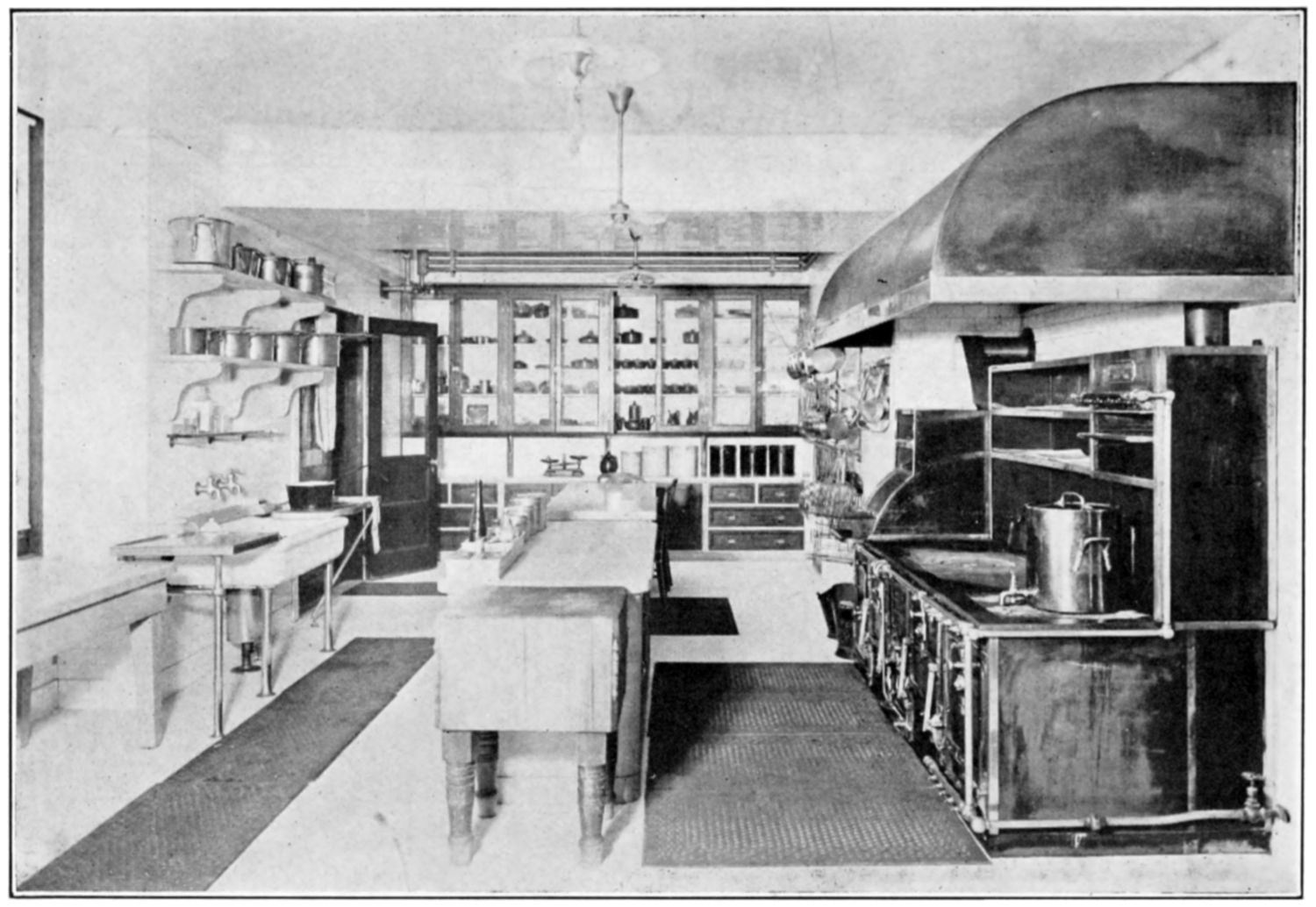
Courtesy of Duparquet, Huot & Moneuse
SHOWING THE MEAT-CHOPPING TABLE, RANGE, TABLE ARRANGEMENT, RUBBER MATS,
SINK, AND POT SHELF ARRANGEMENT
For if you are doing your own work, you do not
want to be scraping and cleaning all day, and if you
have servitors you will want them for more productive
work.
This is a big order. Teachers, scientific experts, and
manufacturers of laboratory conveniences (they are
never called kitchen conveniences in these circles!
Would this nomenclature help the servant problem?)
have massed their findings and the results of the world-wide
demand for a practical kitchen table top are the
following:
Enamel Tops. These (and their confrères vitrolite,
etc.) are excellent if you know that the manufacturer
is good. They do not crack or craze (fall into multitudinous
vein-like cracks) and break with ordinary
usage. The enamel is baked over steel or iron and
should be at least three coats thick.
Glass Tops. Not for general utility, but well
adapted for the pastry table since with this top no
special pastry board is needed. Glass tops are really
very beautiful and have every qualification but unbreakableness.
Some new patents are less brittle than old
makes.
Marble Tops. Excellent for the pastry table, and if
one can afford them, fine for most things. There is only
the remotest chance that they may break and only when
they are less than 2″ thick.
White Metal Tops. Excellent, non-corrosive, flat
coverings. They are expensive but do not need any
nursing to keep them in order.
Zinc Tops. Very much used, but these tops buckle
and puff and are very much affected by acids and
alkalis.
Wooden Tops. Far better than zinc for the householder
who cannot afford the other tops. The wood
can be treated with non-staining varnish, or a varnish
that can stand heat without being annihilated, and you
will have a fine table. If this is not possible, the ordinary
wooden table, fresh from the shop, if covered with
linoleum or oil cloth, is very useful and durable, especially
since the linoleum can be changed inexpensively
and often. There may be a metal binder around the
wooden table top if desired.
Composition Tops. These need a guarantee as they
are often of glass or some mixture undefined.
Tin Tops. These are not used any more, as far as we
know.
The ordinary table length is from 3′ to 7′, depending
upon the size of the kitchen. There are usually from
one to three tables in use,—more often two. The ordinary
heights are from 32″ to 28″. Get the height that
fits your workers. Be sure to find this out if possible;
otherwise you will have to make a later arrangement.
Maple is a satisfactory wood for strong tables; ash,
and pine for the cheaper kind of top.
The marble top table is the royal pastry table, which, of
course, though not a luxury, is an extra table. Fancy
a seven foot marble slab 21⁄2″ thick! Isn’t it like an
Alma Tadema conception! The pastry table usually
has a rack of some sort beneath it, either slatted or solid.
This rack may be half shelf and half electric plate
warmer. In smaller homes the pastry table of 3′ length
is the most convenient with a somewhat thinner marble
top or glass top.
The top of the cook’s table is sometimes divided into
two parts, one part made of marble or glass for pastry
work and the other part of polished wood for ordinary
pursuits. This effects the saving of a table if the cooks
do not squabble or there is but one cook and little room!
The cook’s table is placed opposite the range and has
a 7′ pot rack attached.
The legs of most of these high-grade tables are tipped
with metal to keep them unspotted from the washings
of the floor. The trimmings, too, are of the same metal,
formerly called German silver.
It would not be a bad idea to have a metallic tip of
some sort put on the legs of the less expensive tables,
to keep them from wearing and to maintain a rigidity
well beloved in tables. For there is no happiness in
table tipping outside of the spiritual seance!
A kitchen cabinet (see also Chapter XXVII, Kitchen
Cabinets) is a thing of duty and joy forever. It is the
first cousin to the table and really is but the table extended
and expanded into drawers and shelves and
closets. It signifies the demand of the modern housewife
for a shipshape tool chest with all the materials
ready to her hand so that there may be no reaching,
stretching, or relay races around the kitchen in the
preparation of the recurring daily meals.
For the most part these cabinets are moveable. That
is, they are not built into the walls of the room. At
present, however, architects are planning for them as
stationary and essential parts of the kitchen equipment.
Steel and wood are the materials out of which the
cabinet is made. The steel ones are better in many
ways than the wooden types because they are easier to
clean and are more protected against vermin. However,
the wooden cabinets which are built with rounded corners
are a close second to the steel cabinet, since these
corners cannot become a receptacle for food waste and
are practically vermin proof. Wooden cabinets are
finished in a hard enamel paint and can be washed with
impunity.
Some kitchen cabinets are equipped with a rolling
door which folds upwards; others have swinging doors.
The swinging door, although it extends into the room a
few inches, has the convenience of being able to hold
extra little racks for extra little things, such as small
bottles, market lists, and the like.
Never fill your cabinet too full of things, as they are
prone to fall down and jangle the nerves of the worker,
thus really defeating the purpose for which the cabinet
is built, which is maximum convenience.
Besides the table top, which is used as a molding
board, there are places for the flour bin, sugar container,
bread, cake, pots, pans, rolling pin, cutlery, jars,
dishes, marketing slips, and even the favorite cook book.
The kitchen cabinet is a boon to the small housekeeper
and is becoming so appreciated for its concentration
of work and saving of steps that even the owners of
large homes insist on installing it. That is why architects
are including the kitchen cabinet in their plans.
It means a saving of 75% of toil and thus becomes a
factor in making servants willing to stay with you.
Where there are no servants employed you, Mrs. Wife,
get the benefit!
There are many smaller cabinets on the market. The
sink closet, which contains all the sink soap, swabs and
brushes, a real convenience indeed, as is the long and
narrow broom closet, for brooms and cleaning materials.
Until you have your brooms properly garaged your
nerves never will be entirely rested.
Dealers and manufacturers are ready, in fact, to
make any sort of a cabinet for you if they are not in
stock. Don’t be bashful, get what you need for your
kitchen—but never get more than you can use.
Small neat white cabinets are made, to fit corners as
well as flat spaces, and give the kitchen the efficient,
clean look of the laboratory.
Steel shelving and built-in kitchen cabinets are growing
more and more popular. Stationary shelves, built
once and for all, can be installed, or you can begin with
a few units and as you require more they can be bolted
on to what you have, just like sectional bookcases.
These shelves are covered with three coats of enamel
baked on steel and very durable, having the same qualities
as the good table:—rigidity, non-absorption, and
ease in cleaning.
They are the parallel of the steel filing case in the
office—and that is another sign that the kitchen is becoming
as systematic as the business sanctum. Just as
soon as the home approximates the efficiency and standardization
of the office, just so soon will the servant
problem cease to be. But we are not discussing the millennium
in this chapter.
The shelves can be made with or without doors. Of
course doors are a little help in the fight against dust,
yet even they are not infallible enemies of this household
nuisance.
Very often under the shelves the plate warmer and
the refrigerator are placed. Their close proximity
shows that the refrigerator is insulated against the heat
and the plate warmer is insulated against the cold.
This is really an object lesson in the possible self-identification
of good apparatus.
This arrangement will work well both in the pantry
and in the kitchen.
Wooden shelves are less expensive than the steel ones,
but require careful attention, frequent cleaning, and
new coverings at intervals.
Plate glass shelves are being used of late.
In speaking about the above luxurious pastry and
cook’s tables, we touched on the matter of plate warmers.
In small homes plate warming is accomplished by
ovens, oven tops, or warming plates arranged above the
ovens or stove. In larger homes, however, where guests
are many and often and plates and dishes multitudinous,
the electric plate warmer has come to do the work.
It may be under a table, as you have seen above or it
may be a separate entity.
The doors of the plate warmer are generally of the
sliding variety and are of a special make of iron,
trimmed with steel or white metal. The interior of the
warmer is perfectly insulated with asbestos and other
materials. It does not warm the kitchen. This is
proved by the possibility of its being placed next to a
refrigerator without any bad results to the ice.
There is a little ruby pilot light which tells you if the
electricity is on or off, thus obviating the chance of
unnecessary heat getting out when you wish to find out
whether the warmer is functioning or not.
The electric warmer usually stands a little higher
than a table, but does not alter the size of the table when
built underneath it.
Since the kitchen is in no way a lounge, the chair in
the kitchen is really only another tool to assist in the
work or possibly to permit a few moments of relaxation.
Of course, it is quite obvious that in some kitchens
which are a combination sitting room, living room and
dining room, the chair and even the couch are real comfort
factors. However, this type of room is not being
considered here.
In the kind of kitchen we are furnishing the ordinary
modified Windsor chair is as good a model as any we
know, and can and should be finished to match the rest
of the kitchen.
The stool is most convenient and should be about 24″
in height, because a worker can work efficiently while
sitting on this.
The chair step-ladder is convenient in rooms in which
you have had to build high shelves for sufficient storage
room, lack of space being the only excuse for such unreachable
shelves.
There is, too, the ladder-stool, which serves the same
purpose as this chair step-ladder combination.
The little wooden step is a convenience if perchance
your kitchen maid is not an Amazon and needs a few
more inches added to her, or if your cook happens, too,
not to be of heroic mold.
In small kitchens the settle-table is a convenience.
For when a bench is needed it can be used as a bench,
and presto! when a table is needed, it is quickly changed
into a table—the two things taking but the space of one.
Stone, composition, tile, and even wood floors are
often very trying to the feet and back of your kitchen
denizen. A strip or two of linoleum or cork is a great
relief as it adds to the unrelenting floor a little elasticity
and resiliency which takes the strain off the feet and
makes for comfort and ease. These materials are the
best, for they are washable and non-absorbent, and they
add rather than detract from the beauty of the surroundings.
If the strips are not usable, mats can be
bought or made for the space to be filled.
It is quite as possible to have uniformity in your
kitchen as well as in your other rooms. Even if the
kitchen must be fixed up after the architect has done
his worst, you can at least have the same color scheme
throughout.
There are on the market to-day kitchen furnishings
to suit every pocket, so there is really little excuse for a
kitchen to look heterogeneous and messy. Furnishing
a kitchen is a most tempting problem, especially with
not too full a purse. The trouble is mostly that people
who know nothing about a kitchen always furnish it,
because it is considered easy. It isn’t easy. Even
after furnishings are bought if they are not placed
well they are of as little value as if they did not exist.
In getting household apparatus the first and great
demand is: Know your manufacturer. And the second
is as important: Buy the best you can afford after
the most careful thought, and be very sure where it is
going to be placed when you get it.
CHAPTER XXIII KITCHEN COSMETICS — Preventives of Disease — Choose the Manufacturer First — Paint Rules — Employ an Expert — Enamels or Pigment Varnishes
Like women, kitchens must be made up continuously
to be kept up. Like women, the fairer and even
blonder they are the more attractive they seem to be;
but unlike women, they must never be applied with powder
(as a beautifier) or with oils, varnishes and paints
which for any reason disintegrate into powder.
Every Domiologist (the author’s coinage for home
scientist) likes a light, clean, glistening kitchen. Oils,
paints and varnishes and their relatives, enamels,
shellacs and lacquers, do the trick.
This article is not going to teach you to be a painter,
but ought to give you the salient facts of kitchen “make
up,” which every Domiologist should have in her mental,
if not actual, filing case.
Furthermore, in the maidless or maided house the
basic supply of to-be-cleaned-things must be as nearly
self-supporting as possible. Hence a smoothly varnished
wood-work and un-peeling painted wall or ceiling will
go a long way to simplifying the care of the kitchen,
yea the whole house.
Briefly, paint, according to Wood, is any liquid or
semi-liquid substance applied to any metallic, wooden
or other surface, to protect it from corrosion or decay
or to give color or gloss or all of these qualities to it.
Note the stress on the protective quality.
According to Heckel: Paint is a mixture of opaque
or semi-opaque substances (pigments) with liquids,
capable of application to surface by means of a brush
or a painting machine, or by dipping and forming an
adherent coating thereon.
House paints are made of pigments, drying oils
(volatile or thinners), driers or “Japans” and varnishes.
Pigments are divided into white bases (like oxide of
zinc, the most important), inert reinforcing pigments,
natural earth colors, chemical colors, pigment lakes,
etc.
Varnish enhances the beauty of surfaces, protects
them from injury, increases the luster or hardness of
other coatings, excludes moisture and gases, vapors and
other atmospheric agencies of decomposition or decay.
Paint and varnishes in the main have been thought
to be beautifiers only, but in reality they are much more
than this, for they are very complete means for the maintenance
of sanitary conditions in the kitchen and are
made for application on metals, cement, concrete, plaster,
wood, etc. Therefore, there is nothing in the
kitchen that cannot be re-surfaced if necessary.
Cracks and holes spell vermin and germ traps, which
make efficient distribution centers for disease. Here is
where paints and varnishes and the adjuncts not only
fill the cracks, but fill the bill before the physician has
time to send his.
The best blanket dictum to remember is that:
Cleanliness is next to hole-iness. Fill up the holes,
cracks, splits, roughnesses and unevennesses. Render
all surfaces non-porous by application of liquid paint
fillers. But before all else, scrape and pumice and wash
surfaces with good old soap and water. Benzine is
very often not sufficiently efficient in preparing for
paint applications. Evenness, cleanliness, non-porousness,
these three, and, to be Irish, the greatest of these
is elbow grease—the best of all kitchen cosmetics applied
in preparation and in brushwork.
“What criterion have we,” asks the Domiologist, “in
the choice of paints?”
The answer is, “Choose the manufacturer, then choose
the paint.”
No household has a laboratory, and the widest advertised
paint brands have stood the test. Consequently,
a can opener, the paint, and an all-seeing eye to keep
abreast of the advertisements are the requirements for
the pocket laboratory. But, the standard for any paint
is the overworked word “service.” If the paint you
and your friends have used does not wear, get another
make. But by all means, do not use these things blindly
any more than you would use face powder without knowing
the brand. Buy the best. In no other household
commodity is this advice more important.
Sometimes the best paints and varnishes deteriorate
in storage or transit, by being kept in too cold a room,
and may be explosive if treated with too high a temperature.
In buying paint it will do no harm to bear in mind:
1. That one gallon of paint should be distributable
over an area (in two coats) of 300 square feet.
2. A good paint should produce a surface that is
neither too hard nor too soft. Surfaces that are too
hard are prone to chipping and cracking or splitting.
Sometimes they remain sticky if they are too soft, or
chalk or powder or flow.
3. The average life of a good application of good
paint is four years. It ought to last fifteen years,
but to-day in our apartments we are glad if it lasts
one month. Three years is the minimum, but a
simple pigment paint frequently plays out in three
years.
4. That paint must be durable in color and should
last at least four years under normal conditions.
Good floor paints and varnishes can stand dragging
furniture, walking, hot utensils, steam, water, even
alcohol and greases.
5. That good paints should leave surfaces suitable
for repainting, which, being interpreted, means that
the old paint should be still unbroken, making paste or
liquid fillers practically unnecessary.
Paste fillers with or without color are used to fill
deep cracks, etc., not, however, caused by broken paint
surfaces, but by faulty construction, warping, blows in
plaster, wear, and such injuries.
The common ills which are met with in paint life are:
1. Peeling, cracking or powdering, due to imperfect
attachment, probably on greasy, damp or over artificially
heated surfaces from which the moisture is
driven up through the paint.
2. Blistering, due to underlying vaporized moisture.
An excess of volatile oil prevents this. It often
occurs on incompletely dried lumber, and often light
or some chemical agency is the cause.
3. Alligatoring, incipient cracks due to heavy coats
of paint applied to unseasoned wood especially if the
paint is drier, tougher or more elastic than the under
coats.
4. Wear. This is the only legitimate ill, if it takes
place after the allotted period of its life.
The common epidemics in varnish life are bloom
(opalescence), blistering, spotting, cracking, sweating,
powdering, livering, crawling (refusal to spread), flasking,
deadening (loss of luster), pitting, silking (looks
like enameled silk), seedy or specky, wrinkling, grain
showing, crumbling, all due to imperfect preparation of
surfaces and the presence of moisture, greases, poor varnishes,
poor application of good varnishes, different
brands of varnishes put together, increase or decrease
of temperature in drying or storage or transportation,
etc.
There are hundreds of kinds of varnishes divided
into: oil varnishes, spirit varnishes, japans, enamels
and specialties.
In house finishing, oil varnishes, enamels, painter’s
Japans and sometimes spirit varnishes (shellac and
dammar varnishes).
Lacquers are highly transparent varnishes used on
metals to produce a lustrous film.
Japans (decorative) are dark varnishes applied to
metals and wood.
Japans (painter’s), are varnishes added to paints for
luster and drying.
So it can readily be seen that the painting and varnishing
of the kitchen should be, if nothing else, given
over to experts. The painter should understand these
requirements. “The priming coat,” says Heckel,
“being the one on which the adhesion of the entire paint
film depends, should be most carefully considered. It
should be sufficiently liquid to penetrate every pore and
irregularity of the surface, carrying with it particles
of the pigment; but this fluidity must not be obtained
at the cost of the future strength of the dried film. For
the priming coat it is customary to add a quantity of
oil and some turpentine or benzine or, in the case of
cypress, yellow pine and resinous woods in general,
some form of benzol. It is easy to overdo both. Only
enough of the volatile thinner should be used to avoid a
high gloss, to which subsequent coats will not readily
adhere. Hard, unabsorbent woods require a thicker
priming coat than spongy woods, such as poplar, soft
pine, etc. Resinous woods, like yellow pine, again require
special treatment—a preliminary varnishing of
knots and resinous spots with shellac, and subsequent
priming with a fluid priming coat containing a benzol
product.
“The second coat, which in many instances is also
(improperly) the finishing coat, should be tempered
accordingly. If there are to be three coats (as there
should be), the paint should be lightly reduced with
turpentine or benzine, so as to promote amalgamation
with the priming coat, and to reduce the surface gloss.
If it is to be the finishing coat, prepared paint of the
average consistency can be used without reduction,
but a very little turpentine is sometimes desirable to
assist penetration and adhesion.
“The third or finishing coat should usually be
employed as it comes from the can. In the case of all
coats, thorough, hard brushing is essential, and a round
brush is always preferable to a flat brush. The failure
of paint is frequently due to insufficient ‘elbow grease’
with the brush.
“Every coat of paint should be completely dry
throughout before the next coat is applied; but it is a
mistake to allow a priming coat to ‘weather’ and become
weakened before painting is continued.
“Too much drier or Japan, or cheap rosin Japans,
are at the bottom of many paint failures. The manufacturer
of a scientifically prepared paint will introduce
the proper kind and quantity of driers into his
formula, and none should be added in use.”
A fit condition of surface is obtained by:
(1) By delaying the application of the priming coat
until the wood is thoroughly seasoned, unless seasoning
has been properly attended to in the lumber; secondly,
by seeing that the plaster on the inside of the building is
completely dry before painting is begun on the outside.
A new house should have been heated some weeks before
it is painted. In an old house, leaking spouts, etc.,
should be repaired and the adjacent wood allowed to dry
thoroughly before repainting. Thirdly, by avoiding
the application of paint in moist weather or when the
atmospheric moisture is high. Fourthly, by selecting a
dry, mild season, as late spring or early fall, rather than
a cold or hot season, as winter or mid-summer, for the
work. Fifthly, by seeing that sappy or resinous spots
in new lumber are properly treated before painting.
Sixthly, by due care on old work that all loose paint
and dust are removed by scraping, sand-papering, wire-brushing,
dusting or, if necessary, burning, before new
paint is applied.
As a rule, it should always be remembered that two
thin coats thoroughly brushed out are better in most
cases than one thick coat, and that repainting should
never be delayed until the under coats begin to loosen
seriously.
Only when conditions are favorable should the householder
be his own painter. In any case he should study
carefully the directions on the can, and unless they are
found to apply to his particular job, should consult
either the manufacturer or a practical painter for fuller
advice.
Ceilings and walls of the kitchen are improved by the
application of flat washes, calcimines, etc., of which
there are many on the market. These surfaces are
easily kept clean and sanitary and for this reason have
been used instead of papers in the kitchen. All discolorations
and dirt, grease and dust are removable by
soap and water. The best paints are not poisonous and
are a great factor in home sanitation.
The kitchen floor is a more difficult problem, as the
wear and tear is so much greater than suffered by the
walls. However, paint and varnish manufacturers have
the problem well in hand and there are paints and stains
on the market and varnishes, too, which withstand wear
and tear, heat, grease, steam, gases and every other
normal nuisance. Of course, this holds good only if
they are applied correctly. Floor varnishes should dry
in forty-eight hours. Dressings for revivifying linoleums
are on the market, but beware of poor ones.
Don’t be afraid to investigate! This is another mandate
to the Domiologist!
And bear in mind that floor varnishes and stains
should be able to stand dragging furniture and foot
wear, should be tough, withstand shock or abrasion, and
be unaffected by normal contact with moisture. Good
surfaces will give enduring service and will permit the
scrubbing and washing of floors almost indefinitely.
New coats can be added as the wear and tear demands.
In addition to paints there are varnishes and stains
combined which give effect of natural stain, and these
applied to floors are more than satisfactory. These combinations,
too, are useful on linoleums that have aged.
These materials are made, it must be understood, to
stand wear. Do not ever think of applying a wall stain
or paint to the floor, as the floor compositions are made
to withstand different use. Before using a stain, etc.,
on linoleum it is well to get advice from a linoleum firm
or a topnotch paint firm.
Probably nothing gives the Domiologist more delight
than the effect a fine white enamel gives the objects over
which it is laid. Here is a way to keep the kitchen
a real blonde!
There are many of these enamels on the market which
give the refreshing aspect to the kitchen. Many of
them have the appearance of porcelain, and can be kept
clean with little trouble. They can be bought in the
glossy finish or the flat or dull or mat finish. All the
woodwork of the kitchen can be treated with enamels
if a charming kitchen is wanted.
The high cost of construction to-day demands the protecting
powers of paints. The beauty theory of paint
still holds good, but the protective power is predominant
and most important.
The use of a good floor oil has been proven by Dr.
Wallace Maunheimer to reduce the quantity of dust in
a room from 80% to 100%. Flying dust is the aeroplane
of disease. Oils, paint and varnish the anti-aircraft
guns!
And, finally, read the directions on the can, get the
admirable books of directions mailed gratis by the service
departments of manufacturers of paint, and buy
the best.
And do not fail to realize that the kitchen with a
good complexion augurs well for the complexion of
every one in the house.
CHAPTER XXIV THE GREAT AMERICAN DISH — Kinds of Ice-Cream — Freezing — The Cure — Freezing Mixture — Freezers — Tubs — Buying Freezers
To
be one hundred per cent American, each one of us
must eat at least two and a quarter quarts of ice-cream
annually. This is the national American dish,
despite Boston’s claim for the baked bean and the
South’s for beaten biscuits.
Rich and poor, the be-butlered and the maidless make
their own ice-cream. The more remote from civilization,
the more each individual housekeeper makes her
own ice-cream.
It is no longer a luxury; it is now recognized as a food.
The Government classifies it, and it is experimented
with at most of the State agricultural colleges and State
experimental stations. Its making has become an industry
standardized by the Government and certain
rules must be adhered to by every manufacturer.
The introduction of ice-cream as an industry not
only stimulated purchasers of ice-cream, but has stimulated
machinery builders. To-day the making of large
plants and small household freezers comprises a large
industry.
For these mechanisms many problems of refrigeration,
ice, brine, rock salt and packing arise. Some of these
problems are important to the housekeeper as a maker
of ice-cream, some as a buyer, and some not at all.
In this sketch we will, of course, only touch upon
those parts of this problem that are of interest to the
housekeeper—doing her own work or with assistance.
Ice creams are classified under various heads and
sub-heads. Nearly every one interested classifies them
differently. For the sake of convenience, we will give
here one classification.
I. Plain uncooked ice-cream
Known as Philadelphia ice-cream, which consists of
sugar, flavoring cream with or without condensed
milk.
1. Plain with flavoring.
2. Fruit with flavoring.
3. Nut with flavoring.
4. Bisque with marshmallow, macaroon cake, wafers
and other bread products well dried out.
II. Cooked
French ice-cream—sometimes called Neapolitan
(though Neapolitan is really the many-colored layer
ice cream only) made of cream, sugar, eggs and
flavoring.
1. Parfaits
Highly flavored fruits, nuts, spices (Nesserold
pudding, Roman and English plum puddings).
2. Custards
Flavoring, cornstarch, vanilla.
III. Sherberts and Ices
Water and milk, sugar, white of egg, fruit juices,
etc.
1. Ices (granites frozen by oscillation and frappés—semi-frozen
like mush.
2. Water Sherberts—Ices and egg, sometimes called
soufflé.
3. Punches—with liquor (passing out).
4. Milk Sherbets.
5. Lacto—skimmed milk bases.
IV. Mousse
Rich cream sweetened and whipped, frozen in molds
without oscillating or turning the freezer.
V. Fruit layers
Stabilizers and fillers.
Stabilizers—such as gelatine, ice-cream powders and
gum tragacanth, are used in commercial ice-creams
to give the product body, but manufacturers should,
according to law, admit this addition if necessary.
Housekeepers often use gelatine; it is quite wholesome
and not dangerous in any way.
Apart from the recipes, with which this chapter shall
not deal, the most important part about ice-cream is the
freezing of the mixture. Its dangers are many.
First of all, freezing incorporates air into the mixture
and therefore increases its bulk.
Ice-cream can be frozen too slowly or too fast, and
experience here is the best teacher.
If frozen too rapidly, says the Omaha State Experiment
Station, the ice-cream doesn’t expand very much
(this is more important to the commercial maker of ice-cream).
Without the air incorporated, it is soggy and
heavy. It will also be grainy and will fall apart.
If frozen too slowly, it is buttery, greasy, non-expansive
and fat will rise.
If frozen too long, it will be churned creamy, it
loses expansion, it is greasy, soggy and heavy.
These are the reasons why cream is not a velvety,
smooth, ungrained stand-without-hitching quality.
Here are some other defects and their causes:
First, the cream must be clean and creamy, combined
with flavoring material which blends with the cream
to a full delicious flavor.
There may be defects in the flavor, due to the cream
used, such as sour, old, bitter or metallic cream flavor.
It may be due to the filler or stabilizer, such as a
starch, gum or gelatine.
Defects may also be due to other ingredients. It
may be too sweet, not sweet enough, coarse flavor due to
flavor material, stale fruit, rancid nuts, moldy nuts.
The cream must be firmly frozen to be smooth and
velvety. If it is not, these conditions may prevail:
| Icy: |
Due to improper packing. |
| Coarse: |
Too thin cream or packing while too soft. |
| Sticky: |
Due to fillers, such as gelatine or a sweetened
condensed milk. |
| Buttery: |
Use of cream partially churned before freezing,
or to cream too cold when put into
freezer, or because freezer was operated at
too high speed. |
First, buy a good freezer, never less than a gallon,
because you can always freeze a little in it and always
be ready for a crowd.
There are various types of freezers on the market.
(1) those that you turn by hand, (2) by motor, (3)
ones that aren’t turned at all, (4) ones that are oscillated
only and in which, at home, two flavors can be
frozen at once. In this type it takes longer to freeze
cream, but as the arm only works back and forth it is
not so tiring. The can in the tub is partitioned in two
segments and the paddles and dasher only turn half
way.
The freezer that isn’t turned at all needs no lyric
from me. It tells its own story in making good ice-cream
of a smooth mousse-like consistency, but real ice-cream.
It is rapid and restful.
The various motorized freezers are good for large
families and the small motors attachable to small freezers
geared for motors are joys.
There are some kitchen units that are clumsy, some
that are convenient which turn the freezer, polish the
silver, sharpen the knives, in fact do everything but
shine one’s boots. (See Chapter XXV).
In buying these units don’t be “pulled in” by salesmen
talk. Watch for compactness, durability, cleanability,
lack of danger in use, replaceable parts, and ease
of manipulation. In the use of motors the attachment
must be so made that the connections will not be catching
in gearing, etc. Above four quarts, hand work is
heavy and we would advise turning the freezer by a
motor.
In the non-turning freezer, the chamber for the ice
and salt is separated from the can so that the freezing
mixture cannot enter the ice-cream.
It is cheaper to buy ice-cream, the home-made kind
tastes far better. When you buy ice-cream, it is wise
to watch the containers in which it comes, and to know
where it is made. The Government is very particular,
but slight slips in the ice-cream organizations can breed
the most dangerous of bacilli. At home you can watch
everything; above all, cleanliness of ingredients.
The greatest of all the science of ice-cream making is
the mixture of ice and salt. Most cook books say three
parts ice to one of salt for home use. For hardening
after it is frozen eight parts of ice to one of salt, and the
mixture must cover the can entirely, top and sides.
Of course, the ratio of ice to salt regulates the freezing.
The United States Government Bulletins are full
of these ratios if you want to look up this matter.
On this subject Bowen of the United States Department
of Agriculture in Bulletin 98 says:
“When two solid bodies, as salt and ice, mix to form a
layer, a certain amount of heat becomes latent, called
the latent heat of solution. Since this latent heat is
taken from the mixture itself the temperature falls
correspondingly. The temperature obtained by a salt
and ice mixture depends on relative proportions of the
mixture and to less extent on the salt at which the heat
is supplied from the outside, the size of the ice lump
and salt particles and the amount and density of the
resulting brine. Hence it is impracticable to give other
than approximate temperatures with fixed ratios of
salt and ice.”
It usually takes thirty minutes at least to freeze a
gallon of ice-cream.
Electric freezers come from about $75 up and can
be had for alternate (A. C.) or direct (D. C.) current.
The advantage of the freezer with its own directly-connected
motor, rather than a motor which has to be
connected, is readily apparent to those who have suffered
the annoyance of belting, pulleys, and countershafts.
Being self-contained, such an outfit may be
readily located at will; to operate merely requires securing
it in place and connecting the wires. You have,
therefore, no belts with attendant annoyance and expense,
no countershaft with its necessity for continued
attention and causing vibration, nor is there dirt and oil
being thrown here and there. In addition to the mechanical
advantages secured by the motor-driven ice-cream
freezer unit, there are had by its use cleanliness
and increased space.
Every freezer should be so made that the action of
scrapers and dasher is continuous. Some freezers have
a device in which the scrapers are hung on the dasher
so their lower ends rest on the bottom of the can, and
the friction between ends of scrapers and can bottom
when in motion moves the scrapers against the side of
the can, and holds them there positively and continuously.
The tubs should be strong and if possible bound with
welded wire hoops or metal bands. If the tub is metal
this is unnecessary. Tubs are made of pine, white
cedar, etc. The zinc tub is a good substitute for the
wooden tub, but the wooden one is good if made water
tight and smooth and easy to clean. All parts of the
freezer should be non-rustable, especially the can.
The best cans are made with drawn-steel bottoms.
They do not leak, do not fall out, as may happen with
those having the tin plate or cast bottoms.
The best bodies of the can are made of heavy tin
plate. The top of can is strongly wired and turned
over, while the bottom of can is made to fit over and
under the drawn steel bottom.
All gears must be completely covered so that neither
ice nor salt can get in the cogs nor the fingers be caught
and injured. Some freezers have gearing enclosed in a
box-like fixture.
The inside parts touching the cream should be of
harmless metal, generally of pure block tin. All outside
parts should be smoothly finished, galvanized
usually.
The ice space between the can and the tub must be
so arranged as to use the least amount of ice and salt,
and freeze as quickly as possible.
The cross bars which connect the handles and cover
and clamp on the opposite side are often a source of
agony. These must be simple in operation. Some
freezers have a clamp, some a key. This is a matter
of choice and manufacturer. Some cross bars are
hinged and others are dove-tailed.
Freezers are supplied with fly wheel instead of cranks
to turn. The fly wheel costs a little more but it is far
more convenient, as it requires less turning.
Some freezers have a glass peep hole in the cover of
can so one can see the progress of the freezing and
obviate loss of time and cold by opening the can.
Scrapers are made of rolled steel bars ground straight
and fine to fit can and to insure clean scraping of the
cream, so that all parts of the mixture are being frozen
continuously.
The dashers and beater are usually of malleable iron
heavily coated with pure block tin. Generally (and
better so) there is one scraper for the bottom of the can
and two metal scrapers for side.
The same principals hold in buying freezers as any
other culinary utensil. They must be seamless, smooth,
easily cleaned, non-dangerous, non-corrosive, non-chipping,
and be made by a reputable manufacturer.
Besides the freezer must have ease in running, quick
freezing, economy, convenience, and give practical results.
Freezers are equipped with best standard motors.
The motors should be so placed as to eliminate danger
of motors burning out or being injured by careless
handling of the ice and salt.
In ordering a motor outfit include the following—your
voltage, Direct or Alternating Current; if Alternating
what Cycle and Phase. (See Chapter I).
Buy a freezer with thought. All machinery pays
better when the best is bought and close attention has
been given to the purchase.
CHAPTER XXV THE KITCHEN ROTARY CLUB — Electric Rotaries — Housewives Bad Mixers — The New Machines — Smaller Craft — Time and the Mixer — Some Evolutions — Requirements
Are
you a culinary rotarian? Or do you still
“beat it” by hand?
The Kitchen Rotary Club is becoming a real factor
in culinary economics! By means of rotary motion the
mixer, the beater, the combination of these two have
come to relieve the back, arm and hand and where electrically
driven cause no waste of time!
To begin with, these fairy-like machines are somewhat
like and unlike patent medicine advertisements—alike
because they claim to do many things and unlike
because they can and do fulfill their claims!
For example, they beat eggs, mix bread dough, mayonnaise;
stir cake batter, frostings, dressings; whip
cream; mash potatoes; grind nuts, spices and meat; drive
(some) ice-cream freezers; turn the food chopper;
have grinding and buffing wheels for sharpening cutlery
and polishing silver. In fact, they are companions
not idly to be cast aside.
This will especially appeal to the housewife mayonnaisly—because
many a good mixture has been wasted by
inefficient mixings by the mixer being called away
suddenly, etc. Then, too, many a mayonnaise is never
born at all because the housewife or the cook “hasn’t
the time to-day.” Where the mixer is electrically
driven, time is added unto the menage and while the
mayonnaise is forming the cook is performing elsewhere.
Egg beating, cream whipping, batter beating, all these
take time. Now with the electric machine the home can
revel in soufflés and cake. It can buy coffee in the bean
and grind it with no effort—here is a real epicurean
saving. For coffee in the bean and grinding it at home
saves the volatile essences of the coffee which gives to
perfect coffee the added aroma and full flavor. These
machines grind cutlery and not “exceedingly slow”
and so can add finesse to a slice of meat!
As with the mayonnaise mixing, these utilitarian investments
take the guess work out of cake, meringues,
batters. Improper mixing is an immorality not easily
cleansed from kitchens. Yet these instruments with
perfection of mechanical agitation do the mixing with
assurance and become real vice chasers. Imagine! (all
things being right)—you can be sure that success will
come to your cakes, sauces, breads, rolls, pies, cookies,
doughnuts, cheese dishes, puddings, sauces—Remember
that lumpy cream sauce? Well no more of that! Your
sauces and your mashed vegetables will be lumpless!
Removing doubt, removes nerve strain in a kitchen—and
maybe the cook without nerve strain will be affable
and a comforting dweller in your halls!
Among the best machines is one so made as to effectively
chop food and meat, grind coffee, slice vegetables
and fruit, etc., etc.; has with its attachments a hot-water
and ice container to be used as a “bath,” if stirring
must needs be done in a cold or hot medium; soup
strainer and colander connection; ice-cream freezer
attachment; a meat slicer (a great comfort and saving
of meat). This motor has three speeds.

Courtesy of Troy Metal Products Co.
A MEMBER OF THE KITCHEN ROTARY CLUB AT WORK ON
CAKE-MIXING.
You may have never felt the need of these types of
workers, but then you never knew the use of the radiogram
until you used it!
Don’t you hate to strain and persuade large quantities?
The strain is gone from straining large quantities
now. This is gently done by the coaxing electric
strainer and colander device.
One “mixer” is also accompanied by a cabinet if
desired. It is finished in white and is made especially
for this device and houses comfortably all its attachments.
It has an enameled metal top and does not add
much to the total cost of machine.
Another power unit advertises two speeds and has all
the above attachments. It comes with a metal table
with a shelf (open), on which all the work can be done
with comfort.
If you don’t want a machine that can do so much,
there is one on the market electrically driven, which
beats eggs, mixes mayonnaise, angel cake and light batter,
mashes potatoes and fluffs them if mixed with butter
and cream, mixes custard, soufflés, etc.
It has a small 1⁄2 H. P. motor of fine construction
designed for 110 voltage. It is necessary in this case to
state whether your current is direct or alternating (DC
or AC). This motor can run on either direct or alternating
if the speed control device is not to be used.
But the speed control in this instrument is its crowning
glory. That is, you can mix rapidly or slowly, a performance
the older type of mixers small or large could
not do. It was racing speed or nothing. All cooks
know that some things take rapid beating or stirring,
some other things slower agitation. The cook or housewife
can in the course of her experience with these new
comers into our kitchens find new uses continually for
them.
For example, this small motor has a speed regulator
which ranges from 4800 to 8000 revolutions per minute.
This motor takes from 25 watts (extra load) to 60 watts
(heavy load).
It is well to have a detachable motor as in this one, for
when cleaning is necessary the motor remains—due to
its hydrophobiac (fear of water) elements—unharmed!
The beater itself here is the ancient and honorable
Dover type, so you see it is not so foreign to your ken.
1000 revolutions is all you can effect in a minute, no
matter how “Red” you may be. This machine turns
2000 revolutions, outrushing the Russians and all Central
Europe!
In from one to five and ten minutes can eggs, frostings,
and mayonnaise be accomplished!
Full speed for heavy mixtures, half speed for lighter,
a gram of cream can be had in less than five minutes.
A gallon of oil in relation to a mayonnaise dressing
took but ten minutes to be used up.
Now can you beat it? Hasn’t this phrase lost its
slangy significance?
This little angel weighs but 23⁄4 pounds, and its
lightness is one of its charms.
All these machines should be easily attached to wall
or lighting sockets or outlets. (Electric).
They must be easily cleaned.
The motor must be protected from you and food
stuffs and you must be protected from it.
All attachments must attach easily. When easily is
used it is meant to the limit of ease. All parts must
fit, so that the doing of a new operation is not accompanied
with dread. It must be a pleasure to depart
from coffee grinding to turning the ice-cream pail and
polishing silver.
Now, kitchening is no endurance test. The fatigue
is eliminated. Your days may not be so “stirring”
but at the end of them you will feel like the theatre
and what not.
The hand-turned cake and bread mixers are better
than mixing by hand and spoon—but if possible, the
electrically driven mixers which come in many styles
and prices will give you more than comfort and will
outlast many a cook.
The hand-turned stoners, buffers, grinders, etc., are
very efficient but not quite the joy an electrically
driven unit may be in an electrically conducted
ménage.
These machines are Utopian agitators! Agitating for
food and helping the Kitchen Workers of the World.
CHAPTER XXVI FLAWS OR FLOORS IN YOUR KITCHEN — Floor Requirements — Laying the Floor — The Linoleum Family — The Cork Family — Compositions — Linotile
The
question of the kitchen flooring in the home
is of course, a very profound and serious subject.
Those who build away from cities are hard put to it to
know exactly what there is on the market and those
who live in cities are confused by the variety of floorings
and the attractive attributes as their salesmen recite
their eulogies. In order to help the prospective
buyer we have set down a few basic facts.
Of course, you realize that every kitchen flooring
should, as nearly as possible, be:—
Attractive,
Easy to keep clean,
Noiseless,
Odorless,
Vermin and dust proof,
Comfortable to feet and back,
Non-slippery whether dry or wet,
Durable (no upkeep but washing and polishing),
Fire proof or fire retardent,
Impervious to changes in temperature,
Laid over any kind of floor base,
Lightweight enough to be suitable to any structure,
Seamless or joined so as to be virtually seamless,
Non-warping, non-expansive or non-contracting.
Before enumerating the kinds of floors that you will
have laid before you in this chapter, it would be well
to realize that a floor will sometimes keep a maid or
lose her, and you will not know the “why.” But the
fact is that a floor can tire you if it be not a good kind
for the purpose and can reduce fatigue and make for
general well being if it be a good type.
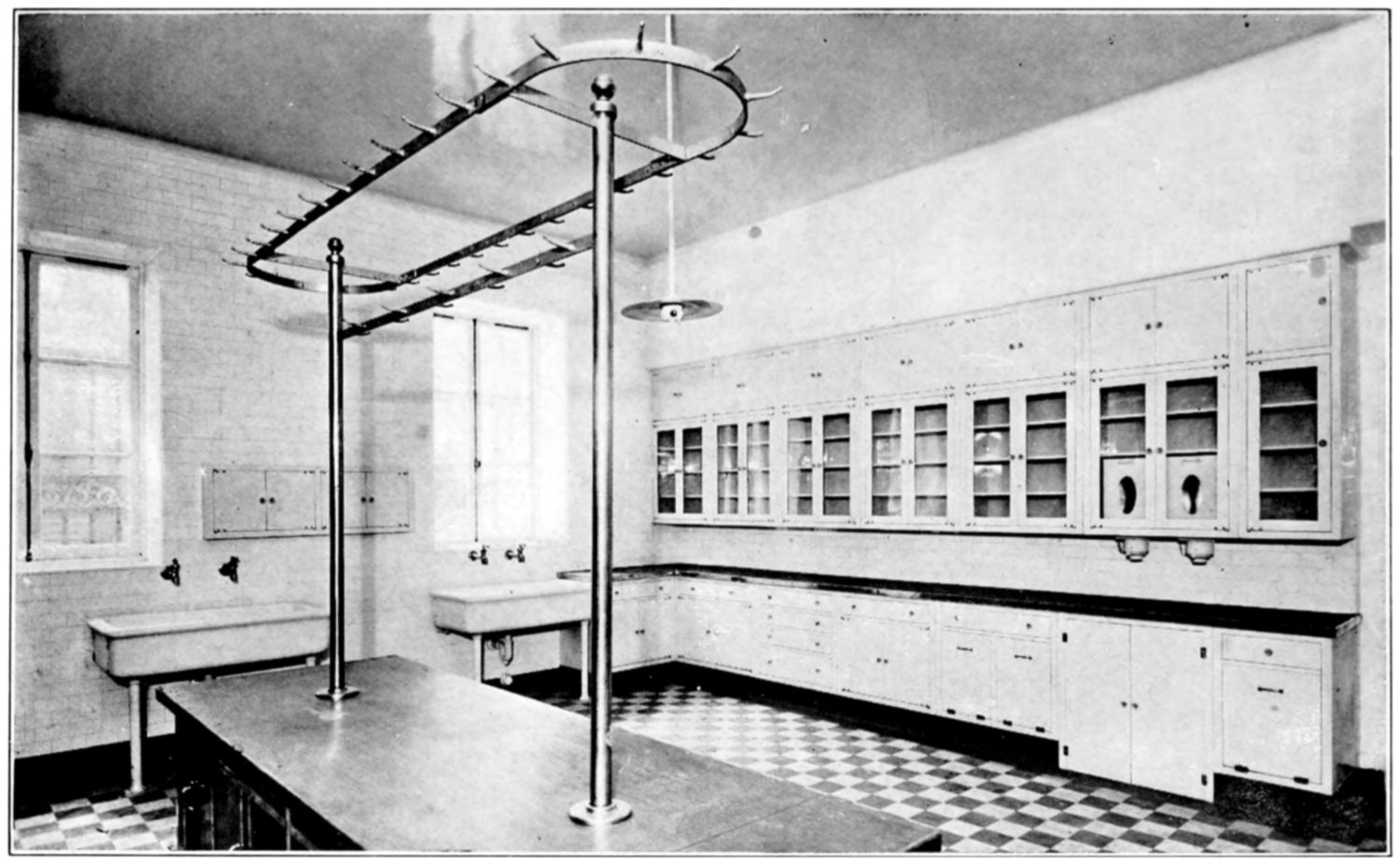
Courtesy of Janes & Kirtland
AN IDEAL KITCHEN WITH LINOTILE FLOOR (ARMSTRONG CORK CO.), BUILT-IN STEEL KITCHEN
CABINET UNITS (JANES & KIRTLAND), AND COOK’S TABLE, WITH POT HANGER COMFORT
Here is a list of the most important kinds of flooring
in use:—
Marble,
Wood and wood block,
Linoleum, Linotile,
Cork,
Composition and concrete, (laid in paste or blocks)
Tile,
Terrazzo.
Marble can be dismissed as being too expensive, too
beautiful and too resisting to the feet. It is also too
cold under foot.
Wood is very popular because in the commoner varieties
it is the cheapest flooring. In whatever grade a
wooden floor is used, it has the disadvantage of needing
attention. It always needs refinishing. The better the
floor the more attention it will need. It will splinter
eventually and show marks if things are dragged over
it. Although the scraping down and refinishing always
make the floor look like new, the wooden floor is better
in any room in the house than the kitchen, laundry or
pantry. There are some housekeepers who wouldn’t
have anything else but the hard wood floors in their
kitchens—oak, maple or Georgia pine, etc.
The wooden floor must be carefully laid or else the
cracks become traps for germs and dust. Of course,
this applies to all flooring. And while on the subject
of laying floors, let me say that even though you order
the best kind of flooring in the world, if it is laid badly,
you might as well have bought the worst sort of material.
It is imperative that you have the manufacturer
or the manufacturer’s delegated dealer lay your floor.
Don’t go to your village builder or carpet man. It
won’t pay; in fact, it will cost you dearly, as in such
case the maker of these products has developed a way
to lay flooring which is inseparable from the life of the
flooring itself.
Many a householder knows a good floor, but few
know what to look for in the laying of it.
Among the best known floorings for kitchen use is
linoleum. It is so well known and so popular that purchasers
in their ignorance often accept, unwittingly,
substitutes and lay felt paper instead of the real thing!
If you decide to buy linoleum, go to the best maker or
his dealer. Follow their gospel Buy the Best. If you
heed this you make an investment. If you do not, you
make an expenditure.
So when you decide to buy linoleum first look on the
wrong side of it, and if it has burlap on the back and
if it is very difficult to tear, it is pretty definitely linoleum.
It also carries the name of the maker.
It is well for the prospective buyer to know something
of the manufacture of a popular article. It
makes you appreciate and understand how to take care
of it better.
Women should not buy unless they know exactly
what they are buying.
Linoleum is made of burlap, linseed oil and cork, as
the main ingredients. The oil is first boiled to thicken
it. When it is cooled it is poured down over suspended
sheets or scrim and by coming in contact with the
oxygen of the air, becomes oxidized and solidified. Then
these oil-impregnated skins are ground up and mixed
with gums to give the fabric elasticity and it is then
mixed with ground cork or cork flour, the coloring
matter, and the rosin, (to harden it). This mixture
is fed into a machine which distributes it evenly over
the burlap. It later passes through a series of finely
adjusted rollers weighing about 27 tons each and adjustable
to space of 1⁄1000 of an inch between rolls
which, of course, give any required thickness to the
linoleum. This is plain linoleum and it is many weeks
in the making.
The printed linoleum is made by passing the plain
over print drums.
The straight line or inlay is done by a still more
involved process, but the patterns never wear out as
they are an integral part of the linoleum, going through
from back to front of the material.
Highly paid designers are engaged in this work and
many craftsmen of great skill are employed for stencil
work, etc.
You don’t always realize the time, work, and expense
of the ordinary things that you see about you.
When the linoleum is being laid, look out for these
things. (They apply pretty generally to the laying of
any flooring of this kind.) If over wood—the nails
must be hammered in below the surface, the wood laid
too to avoid dampness and cracking. If over concrete—it
must have dried a month or two and be filled in with
plaster of paris if it has any cracks. It should be laid
over felt in both cases to insure long life to the linoleum
and the comfortable resiliency to the foot and consequent
ease to the back. The felt acts as a cushion, makes
the linoleum fit better, and obviates later refitting and
trimmings. See too, that the workmen are careful to
force the strips close together and cement closely.
These things if it is absolutely impossible to get the linoleum
people themselves to lay the floor. It would be
wise then, to get their booklet.
It is easily kept in condition if you:
Use only mild soaps, never caustic powder, with warm
water. Rinse immediately with clear water and dry
immediately. Wash and dry about a square yard at
a time; do not flood the whole room at once. Strong
soaps will eat the pattern in the printed linoleum
and wear the inlay.
Use elbow grease!
Use glass casters on heavy furniture as the linoleum
will show marks.
Store linoleum, when necessary, away from excessive
heat and moisture.
Waxing occasionally is good. But an oil mop does
very well.
The numberless designs and coloring to be had in this
fabric add to its value and pleasure, and the kitchen can
be in lovely accord with the decorations of the house.
The ordinary dripping will not effect linoleum, nor
the ordinary moisture. It requires no extra mats as
foot resters, is not a substitute but a flooring, and in
every way deserves its great popularity.
Another attractive, useful and popular flooring is
what is called the corks. It is made of clean cork
shavings compressed in closed steel molds about an
inch thick for five hours under high pressure and high
temperature. All the moisture is thus driven out and
it is pressed together into a waterproof mass. No foreign
substance is introduced to bind it together as this
is done by its own gums. Inferior cork tile is mixed
with foreign substances and this often makes it break
down and detracts from the resiliency and wearing
power. After this process is completed it is cut into
the desired sizes.
Cork tile comes in shades of brown and there is an
excellent cork compound tile that comes in many designs
and colors.
It is not absolutely fireproof but is what is called a
fire retardent in that it takes a flame of 1500 degrees F.
one hour to burn a hole in a tile 6″ × 6″ × 1⁄2″.
The cork tile floor of the best make will last as long as
the building. It is of the loveliest coloring, delightful
in tone, noiseless and soothing to the feet and back, warm
to the touch and altogether psychologically comforting
to the nerves.
It requires but soap and water and elbow grease to
keep it in condition forever. It is never slippery, is
non-absorbent of dust and moisture and when laid correctly
needs no effort nor money for its upkeep. This
is why the initial investment though larger than for
some other flooring is a wise one, as it is positively the
ultimate expenditure.
There is much inferior cork tile on the market and it
is very hard to tell it from the best quality. It looks
attractive until it has been used a little while, then it
will begin to “pit” and “sap” (become dark, and emit a
pungent odor), due to inferior manufacture.
Heavy tracking does not effect cork tile as it is so
elastic that is springs back into place. This is proven
by the restaurants, banks, libraries and hospitals that
use it so generously.
In laying this, the same general things should be observed
as in the case of linoleum. It is laid over felt,
the base must be free from moisture, cracks and nails.
If the cork is put over nailable material, small headless
sunken brads are used. If not, it is pasted on the base.
All joints are pressed together by a special compressing
machine, and are sealed with a preparation virtually
making the cork tile into one large seamless covering
under which no dust, moisture, germs or vermin can
collect.
The velvety quiet of these floors imparts a tranquillity
to the kitchen, contagious to mistress and to maid.
It is needless to say much for the tile as you know its
beauties. It may be cold to the feet, non-resistant and
tiring to the back and slippery when wet, but this is
overcome by mats of matting, cork or linoleum. Tile
is made in every design and color to fit any desire or
design. All corners and joints at the base of walls can
be curved. It makes a unit of the whole room in design
and intention as no other thing does. It can be
cleaned out with a small hose. Of course, poor tile
cracks.
Needless to say, it takes real skill to lay these floors
as the under bed of cement has to be very perfect to protect
the tile upon it. However, it looks royal, it wears,
and is a favorite with great kitchen builders.
The floorings of composition, cements and mineral
mixtures are innumerable. Some are excellent, embodying
nearly all the good points enumerated in this
latter. They are a little warmer than tile and not quite
so expensive. They have probably a little more foot
comfort but not much more. They are fire proof, do
not weigh too much for a lightly constructed house, and
are kept clean with the usual elbow grease and water.
These floors for the most part are made in various
colors and designs.
In tile and composition the joint at the base of walls
can be made practically one with the wall in a curving
connection. In the case of linoleum and cork, this joint
is either accomplished by a curving connection or more
generally by a highly compressed and sealed joint, allowing
for absolutely no trapping of foreign matter and
rendering the floor easily swept and washed.
Many great institutions and some private homes have
found these to be practical, so if you observe the “Buy
the Best from the Best” rule you cannot go wrong.
A newer kind of floor is a cross between a cement and
a linoleum. It wears indefinitely and can be highly
recommended, as handsome as it comes in tile form,
and silent, easily kept clean, resilient and all the good
points of cement as well as linoleum.
CHAPTER XXVII FEDERALIZING YOUR KITCHEN — The Essentials of the Cabinet
Fancy
a carpenter with his tools all over the room!
Fancy a painter with one color here and another
color there! Do you think we would have had a Michelangelo
if he had been forced to get down from the
scaffold every minute for a tool or a bit of clay? And
yet women for the most part, women who need their
energy for making the home a fit place to live in, still
persist in scattering their tools about the kitchens and
walk miles daily, because they have not mobilized their
tools.
To what can be accredited the woman’s hatred of saving
steps, even though she complains of fatigue and
extra work? What can account for the woman’s dislike
of having her things handy? Is it money? No, because
she often buys motors, “movie” tickets, dogs,
jewels and garments in quantities far more than she
needs. It is perhaps due to a past vastness of ignorance.
But now when there are specialists descanting on the
glories of saving steps, time and money there is little excuse.
In this article one stumbling block will be removed
and the kitchen can well transform itself into a room
where the most methodical man can work and where
any maid coming in for the first time will not have
to use levers, telescopes, periscopes and what not to prepare
the first meal. For the kitchen cabinet is the first
plank in the platform of standardizing domestic work
even as it is being standardized in the factory. This is
the basic glory of the kitchen cabinet. Now, for the
more important details of its makeup.
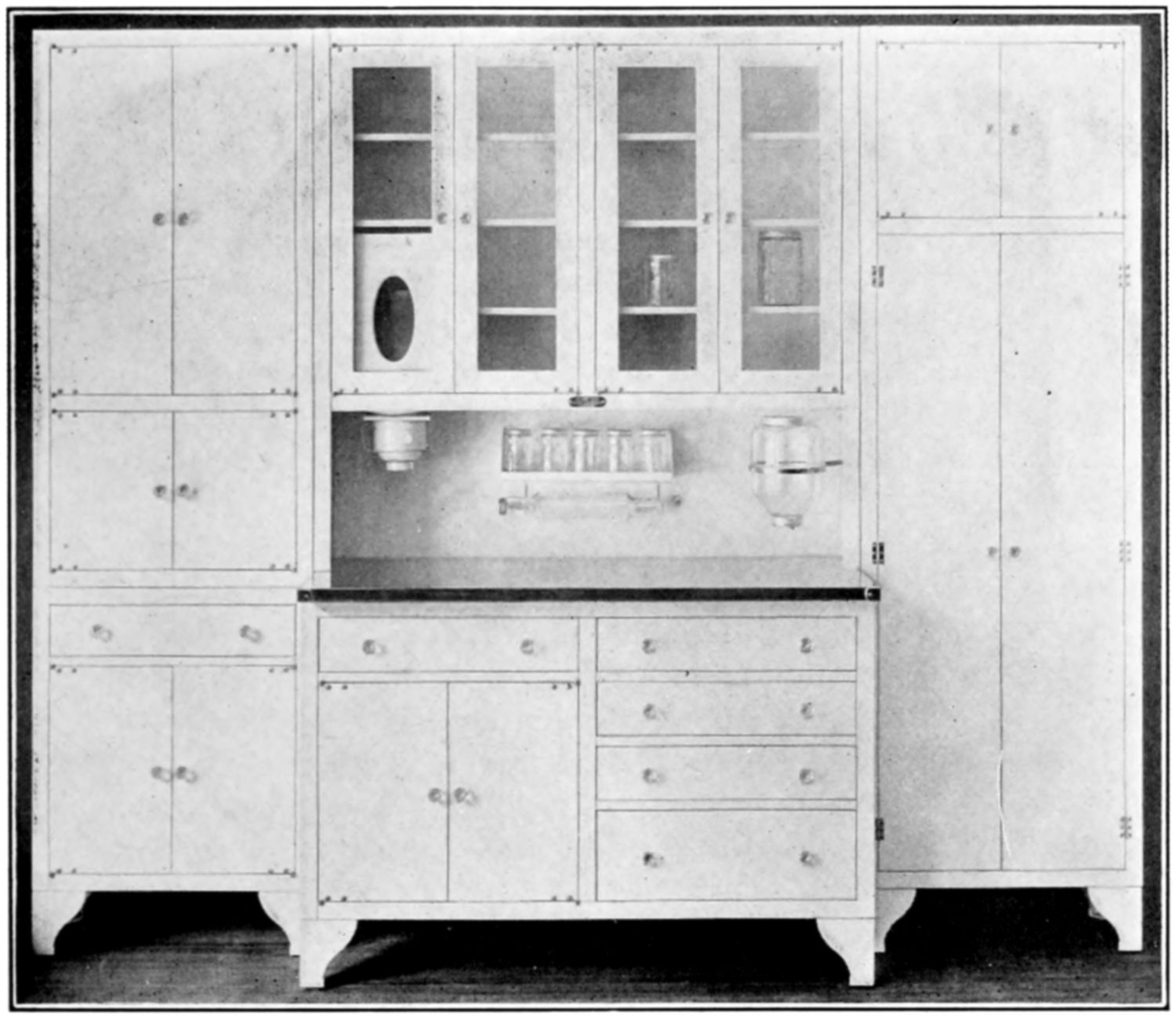
Courtesy of Janes & Kirtland
A STEEL UNIT KITCHEN CABINET FLANKED BY BROOM AND DUSTER
CLOSETS. SEE THE ELEVATION FROM THE FLOOR. THIS CAN BE BUILT-IN
TOO
These cabinets group in one place the necessary tools
and materials for getting together the meals of the
house. They hold the spices, flour, sugar, bottles, pots
and pans, sometimes linens, ice and gas or electric stoves,
packages of cereals, etc., and they are the table, the
bread board, the flour board, the flour bin and dish
rack all in one.
Here you can work where everything is within arm’s
reach; you can sit at your work and not fatigue yourself.
In short, you have a work bench at last and can
feel as professional as the carpenter or the artist, and you
must, if the kitchen is ever going to be as important in
the life and best living of mankind as it deserves to be.
Built of steel entirely in some cases, all wood in
others, and a combination of both in still others, they
are comfortable and worth while in the best makes. Of
course in this product, as in all others, one must go to
the best manufacturers who know their business and
take an interest beyond the sale.
When you buy a kitchen cabinet you must get the
maximum comfort and utility. Go about and see which
one you think will save you the most work.
The all-steel cabinet, of course, is less responsibility
to keep free of vermin. The wood type is a little more
care.
If your cabinet is to be of wood, see to it that it is ant
proof (the castors as well), has all round corners, is
varnished and finished steamproof, has locks that lock, doors
that easily open, whether one leaf is shut or both,
whether it is winter or summer, supplies a broad enough
table to sit down and work at comfortably, a table top
impervious to liquids, grease and heat, sanitary glass
drawer pull, dovetail wood joinings, easy rolling castors,
everything easily withdrawn to clean, and of non-warping,
well-seasoned wood. The finish must be the best,
whether enameled, painted or varnished.
In the cabinet of steel construction you must be sure
that the enamel is on to stay; that the doors, drawers
and locks are of the best construction, electrically
welded. The doors, etc., must be rigid enough not to
emit hollow sounds every time they are closed. In the
best type the doors do not dent or wobble but are double,
about 7⁄16″ thick, reinforced on the inside with heavy
steel angles, making them rigidity enthroned. The
frames are rabbeted to receive doors and drawers, thus
giving no overhang but making a flush surface. The
doors in the steel cabinet are more comfortable to handle
if they are hung on concealed brass hinges, with bullet
catches which enable the doors to open and shut absolutely
independent of each other.
In both the steel and the wood cabinets the table tops
are all of different material. The best steel type in our
opinion uses nickled zinc; the best wood cabinets use
porcelain, iron, aluminum, vitreous steel, enamel, etc.
Any of these tops are good and when in the standard
makes you can be very sure that they have been well
tried and not found wanting in any essential quality.
In general, then, the cabinet is a receptacle for the
most used things in the kitchen; therefore, is so much
used itself that it cannot be too good and should be
adapted to your special need.
If you are building a house and want to have your
kitchen a real comfort, install a kitchen cabinet or go to
the firm that, with its unit system, can make up a
kitchen cabinet combining most of the best things you see
in any. This is an expensive way but a miraculous joy.
If you want a cabinet to be installed before the house is
built it is a saving in wall tiling where the cabinet is
placed, especially if the cabinet is made of steel.
There is one cabinet on the market that has an ice box
in it, which when installed with the back toward the
porch wall makes it possible for the ice to be put in from
the porch and all packages delivered from the porch
through its parcel-service shelf opening on the porch!
In this cabinet there is, too, room for a gas stove or
electric plates, so that with it you have a complete,
compact kitchen.
The unit systems in steel are most elastic, as they can
be duplicated over the broadest and the narrowest, longest
and shortest kitchens. Whole pantries can be
equipped with them. Diet kitchens in the upper floors of
large residences can also be equipped with these units so
that any member of the family, nurse or valet, can prepare
a little meal with everything comfortably housed
in the pantry cabinet. They are one of those examples
of household developments which are so rapidly coming
to the front to-day and mean so much in convenience.
Each maker of kitchen cabinets has a specialty or
two which he tells you makes for superiority. Each one
is right, so you must choose your favorite and most
appealing speciality and buy accordingly.
Some, to obviate the little back bending, have a device
by which the whole shelf of the bottom of the cabinet
pulls out when you open the door and enables you to
see what you want without strain, or time loss.
This we think a delightful device. Others have
gravity locks and catches which always fall in
place; sanitary leg bases, high enough from the floor
to sweep under; a rolling open front, which makes it
simple always to keep the cabinet closed and away from
cooking odors; white enamel interior; roller bearing on
table so that the table rolls in and out with least possible
rebellion or noise; and a drawer for kitchen linen,
which is a great comfort.
Another advertises the possibility of its use with detached
gas or electric range, its silver drawer, bread
board, parcel service, and ice box and special flour bin.
All the cabinets are proud of their flour bins and sifters.
And nearly all have special construction so that they
are filled and emptied with ease and dispatch.
One fine cabinet has a revolving spice container which
is very convenient, of course.
The unit system is proud of the adaptability to any
need, including even broom closets on the side of the
cabinet, filling any wall space. These are usually made
of steel and provide a cheaper method of backing up
one side of the kitchen than by the use of tile or kitchen
shelving.
The steel unit systems also come in special “store”
sizes and are not much more expensive than the wood.
The steel are either 6″ from the floor to allow for cleaning
or are stationary and are attached to the floor by
curved constructed tile or linoleum, which gives continuity
and unity, thus reducing the swabbing out of the
floor to simplest terms.
The kitchen cabinet that is put in when the house is
built, be it of wood or steel, is more convenient than any
other closet, as no builder has given sufficient thought to
maximum utilities. We have seen architects send their
“handy man” to install closets who seemed to be absolutely
unlearned in the necessities of the problems.
Therefore, before and after building, the kitchen cabinet
or the kitchen cabinet unit system is by far the best
policy to pursue.
The cabinet must be able to fulfill these conditions:
It must be easily moved if on castors, it must be easily
taken apart, drawers must run smoothly, racks to hold
things must hold things, they must hold enough things,
too, to prevent relay kitchen races.
The wood cabinets are excellent, the steel we think
a degree more self-protecting because they cannot absorb
odors, or get vermin investitures. However, the best
grades of wood cabinets are so perfect that we can endorse
them ungrudgingly.
The cabinet must have: Supply closets, china
(nearly every case), molding boards, work table, cutting
board, linen receptacle, pot, pan and lid holders, bread,
cake, spice, sugar containers and flour and bin shifter
devices.
All other departures are specialties and are more or
less inviting according to the buyer.
There is a cabinet, remember, for any space as well
as purse. Get the best of the best dealer and make
yourself sure that the one you are getting is the least
complicated and the easiest to keep clean. They range
in price from around $50 up to the thousands. But no
matter what they contain, or how thrilling they look,
unless the cabinet itself is the acme of fine workmanship,
you will be in constant irritation over warping
parts, dust and uncleanable surfaces.
CHAPTER XXVIII WHEN THE POT HANGS HIGH — The Argument for Hanging — Good Tools, Good Treatment — Hanging Within Reach
My text is “one kitchen tool hung up is worth two
in a low cupboard”—taken from The Kitchen
Libel—Chapter 1, Verse 1.
This may not look like a technical chapter—like one
with a lot of mechanical information—and it really
isn’t—it intends to get behind technicalities and be a
radical (don’t fear the word) over-hauling of women’s
opinion on the disestablishment of old forms of kitchen
usage by very slight changes in kitchen arrangement.
For years kitchens have been built with closets for
kitchen pots built in “below the belt” with pernickety
little doors with cranky little locks. For years these
closets gave the kitchen denizen or housekeeper herself
all the rhythmic exercise necessary to the development
of backache and nerves and sense of touch. Into these
closets you had to feel for the pan you wanted and then
often had the musical treat of hearing them crash
down behind something, and you must needs kneel in
prayerful posture to extract the necessary pot or pan.
If there were ever a condition in the kitchen so uncongenial
to the Woman-Doing-Her-Own-Work, it’s this
hidden pot and pan game. If the carpenter has learned
how to save his back, why not the housewife, who not
only does cooking but also a hundred other things.
Avaunt ancient superstitions and affections about
dark low-set closets and come out in the open on high
with your utensils and whether you have a maid or not,
some one’s back will be preserved, if not for higher for
more things!
I have written the above in the past tense—but it is
really existent to-day in the majority of homes.
“Why,” I asked a splendid housekeeper, “don’t you
seal up those dark receptacles and hang up your utensils?”
“Gracious,” said she, “if I hang them up they’d get
all dusty and it wouldn’t be sanitary. Ridiculous,”
quoth she!
“But, my dear friend, do you think those dark closets
are dust-proof and do you think darkness is a germ
killer?”
The truth is these closets, away from light, are almost
ominous!
“But,” continued my friend, “if I decided to hang
my things up, where could I do it in this tiny kitchen?
It’s all right in modern kitchens, but here it is impossible!”
Here she touched a universal note—in fact, two notes—the
old fashioned kitchen, and no room. Two notes
upon which the housekeeper plays monotonous choruses
to excuse modern advances.
“My dear friend,” snapped I—“once upon a time I
ran an experiment station in a tenement kitchen—the
kitchen was four feet wide by ten feet long—in it
were tubs, stove, glass closets under which were the pot
and pan receptacles. I was too busy to stoop every
time I needed anything so I had the carpenter nail on
the wall over the tubs and over the sink a piece of wood
three inches wide (this will go in even the tiniest kitchen)
into which I screwed hooks, and there I hung every
tool I used. Later I had a shelf nailed above it and made
my work a smooth performance. I felt like a carpenter
working at my bench with all my tool ‘en plein air.’”
And I went on to say, as I had a good opportunity, there
is no reason why your kitchen can’t be made like a
tool chest. No man would tolerate breaking his very
strong back to get a pan, or his nerve to pull out a
drawer, which so often sticks, for a can opener! Not he.
Could you imagine a carpenter, a butcher, or any one
else, who worked at everything requiring sharp tools,
or fine quality tools, jumbling them all up together in a
drawer that moves in and out, provoking an earthquake
rhythm among the tools, or a little closet in which
everything is banged to pieces and has to be groped for?
No!—No one could. Because no tools will last under
such treatment and good tools are worth keeping—and
the very best are reduced to nothingness if not kept well.
It’s a case, pure and simple, of noblesse oblige.
There is a good housekeeping reason, too, for things
to be hung up, and this is: when things are in plain
sight they become a constant curse to the cook or to
the beholder if they are not scrupulously clean.
In the kitchen of “suspended animation” you are
pretty sure to have clean and spotless pots and pans, to
have knives whose edges are not nicked, and to have egg
beaters and mayonnaise mixers that are not so out of
kilter that you get nervous prostration in coming in
contact with a scrambled egg or Russian dressing.
These are facts to grapple with.
To prove it, just visit a man-manned restaurant or
hotel kitchen some time—and there you will see the
brightest, cleanest looking copper, aluminum, nickel,
etc., etc., pots and pans hung up on racks near operating
centers—ready to be used. If this were anti-hygiene
the Board of Health would intervene. Anyhow,
water is at hand in a kitchen and dust is easily swabbed
out!
Of course, in the new kitchen, racks are built, and
you have no choice, so you accept the pleasanter condition
without cavil.
In this connection I can’t forbear to mention the
apartment garbage can which owns a hygienic lid which
sits a foot above the floor and for every useless egg shell
to be thrown away the worker must needs bend double
to remove the lid, empty her plate, put on the lid and
raise herself up. Time and energy lost. This could
easily be on a little stool under a common kitchen table
in which a round hole could be cut, or alongside the
garbage creating table and the stuff slid into it, if it
can be bought with a sliding lid. There is also a pail
whose lid is lifted by a pedal worked by the foot.
To be sure, this does not mean to hang up the kitchen
table or the stove, but it does mean to keep things, that
are used hundreds of times every day, within the reach
of your hands without superfluous stooping and bending.
It means, too, that cleaning utensils, such as brooms
and dusters and rags, if hung in separate racks in or
outside of a closet, will live longer in good condition than
if hurled into a corner of a closet where they get smashed
and have their one hundred per cent. utility diminished.
Where a culinary tool decreases in efficiency, the
human element effort is necessarily increased, and unnecessary
fatigue ensues—then: sloppy preparation of
food and then, dyspepsia.
Now, don’t you see the inevitable result of slipshod
kitchen arrangement?
If, for any reason, you like closets for pots and pans,
have glass doors on them and have them no lower than
thirty-two inches from the floor. This way you don’t
have to stoop, the light penetrates, and an arrangement
like this has only the opening and shutting of the door
in its disfavor and the fitting in of the utensils each
time and their possible denting. Even the finest utensils
will dent with improper provocation. Open shelves are
very convenient, too, if you do not care to hang things
up.
If you have a niche for each tool, the work becomes
almost play.
CHAPTER XXIX BRUSHING UP ON BRUSHES — Fiber or Bristle — Brushes Must Brush Only — The Protean Vegetable Brush — Mops and Dusters
Household
work is drudgery unless it is put
on as nice (I say “nice” advisedly in its purest
sense) a plane as any other craft. The best way of doing
this is to have tools that are adapted to the different
kinds of work—and furthermore, and quite as important,
tools you are proud of, proud enough to keep well
and advantageously.
The carpenter does not use one kind of tool for everything—he
does not use a chisel where a plane could be
used not only to better the job but for his own comfort
or pleasure. The same thing can be said of the painter,
who would not use a whitewash brush for a varnish
job. But the housekeeper seems to think it part of
her duty, somehow, to use a one-for-all tool, and then
wonder why her work is irksome and her job ill done.
It is very often difficult to get a maid to use the proper
brush, but you will find, if you do your own work, that
you will simplify it by using the right brush at the
right time. The long handled type for long distance
work, the short for local jobs, soft ones for delicate and
so on. This careful work too will preserve the finishes
of various things which must needs be brushed and save
the cost of renewing paints and varnishes.
Brush work in the home is the most pregnable of
citadels, but one that can be easily fortified against
calumnies by a little attention to what a brush is, does,
and can be.
Of course, a brush is meant to brush. The two main
classes of brushes in which you are interested are the
household and personal. Of these two we will discuss
the household and just touch in passing the personal
brush (such as nail brush, clothes, etc.), and will not
enter into the paint-brush story even though the paint-brush
is in household use on a surprising number of
occasions.
Bristles and fibers and hair are the brush of the brush.
The finest brushes are of bristle and hair and the less
fine are of fiber save where bristle would not function
any better for the job than fiber. Hair is used in some
brushes where fine work and delicate surfaces are involved.
For example, the shaving brush is of hair, the
silver brush of bristle, the whisk of fiber. A room wall
brush, too, is often of hair to save the paper or wall
finish.
Bristles come from the hog’s (or boar’s) back, and the
colder the country in which this quadruped roams the
longer and tougher the bristle. Therefore, the Siberian
bristle has always been the toughest—and the Chinese
have come a close second. We get bristles, too, from
France and Belgium. The bristles from the United
States are not tough, as we kill the hog too soon—for
bacon. However, for a soft brush these bristles are
very fine. Japan imports bristles and so did Austria
before 1914.
The resilient, springy quality in the bristle cannot be
duplicated in any other brush material. Due to-day to
the disorganized trade conditions, with Europe and
Asia, the bristle brush is almost a luxury.
The American brush has been conceded to be as fine
as the European or magically “imported” brush, as
there is not any place to-day where the home is being
studied by the brush makers as it is being done in
America.
Bristles don’t break if bent—and the longer the
bristle, the stiffer and stouter is the butt end by which
it is securely fastened. Therefore all hail the wild old
hog!
Horsehair, badger, camel’s hair, etc., are ideal materials
for some brushes. Many household brushes are
made of horsehair, shaving brushes of badger, and the
artist’s brush is made of camel’s hair when it can be
had. Hearth brushes are sometimes made of the mane
hair of the horse, wall brushes, too; sometimes goat
hair is used. Among other brushes made of horsehair
frequently are the crumb (table), pastry, bottle and
dish washing (white hair). The very best white horsehair
comes from the Russian pony and is very nearly
as stiff as bristles. The black horsehair of the finest
grade is also imported, as the domestic is not as good.
Other horsehair comes from China, Australia, South
America.
When you buy a brush, if you don’t know a fiber
from a bristle, ask your dealer. He may say: “No
this is not bristle, it is made of Bass” (or Bassine, Kitool,
Palmyra or Palmetto or Rice Root, or Mixed Fibers, or
Union, or Union Marble, etc.). If he is a good dealer
you need not fear, if his price is not very low you
need not be suspicious, because no good brush is inexpensive
to-day and no cheap brush is a saving.
Of all the fibers Tampico (from Mexico, Central
America largely), the product of a species of cactus
plant, is probably the best fiber. Palmyra, too, is an
excellent fiber, and comes from a plant indigenous to
regions near the Indian Ocean and the Valley of the
Tigris. What geographical scope we have in our
homes!
There are trade names for fibers such as Ox fiber,
a fine quality of fiber from the cabbage palmetto, and
many other trade named fibers which must be procured
by ye purchasers only from purveyors of royal lineage.
Brushes are made of mixtures of bristle and hair,
such as some flesh brushes or hand brushes, the bristles
taking the brunt of the action and holding the water
better, yet protecting the hair. Fiber and bristles are
sometimes used in combination, too.
If you buy an “all bristle” brush you don’t want a
mongrel variety. If it is a mixture you are getting
a usable and amply priced brush.
Black bristle is often made into pipe, window, stove,
wall, radiator, milk bottle and percolator brushes.
The color, black or white, of bristles doesn’t stamp
quality. In some cases black bristles are bleached for
esthetic reasons. For example, a white tooth brush is
more attractive. The natural white bristle usually
comes from China and the natural black from Siberia.
Fibers in browns and whites, blacks and whites are
mixed in brushes for appearances. Color in brushes is
a matter of attractiveness and does not alter the usefulness
or the wear of them.
The number and variety of brushes on the market
are tremendous—one firm makes sixty-nine ordinary
household brushes, and besides this has others tucked
away, to say nothing of the personal, industrial and
professional classes of brushes. Thousands is not an
exaggerated figure to apply to the variety of brushes
for all uses on the market to-day.
Another firm shows twenty-nine different kinds of
scrubbing brushes (all of fiber—Palmyra, Rice-Root,
White Tampico, Ox Fiber, Palmetto, etc., etc.) of varying
shapes, sizes and color. The object being in every
case for the purchaser to buy the brush that fits the
hand and the job.
Brushes, like any other implement, should do their
own jobs only and nothing else. A brush that gouges
and does a chisel’s work is a poor brush, no matter
what quality the fiber or brush mark. The brush you
buy for your wall or your hardwood floor must not
scratch, and must have nothing in its construction that
can scratch. Likewise, the brush you buy for your
toilet bowl must not scratch or wear the enamel and
the bristles must be bristles, for if of fiber you will have
your brush acting like a blotter. Your brush must
clean and brush, it must not become a bacteria nestling
haven.
Brushes bought for the radiator can get under the
piano and into small spaces, but they are still brushes
and the more things they brush the better, of course.
Furthermore, bristles in a stove brush should not be
stiff enough to engrave designs on the nickel-work on
the stove.
The same may be said for the pot-scouring brush. It
(if made of fiber or bristle) must not chip enamel or
aluminum by any part of its construction.
The brush that fits its works, saves time. For example,
the brush that is meant for the toilet bowl should
be shaped to fit the toilet trap. It should be so built
that its wire will not rust; after it is shaken out it
ought not to drip when hung up; the bristles should not
mat or separate and should be so made as to bend to your
will. If it is of fiber, this brush will mat and become of
no avail in short order. Such a brush can be used as a
bath-tub cleaning brush and will not break the back
when functioning.
Baldness is the worst disease of bad brushes. Bristles
and fiber must be stitched and anchored so as not to shed.
The frosting brush would be a danger if a bristle were
swallowed with a bite of cake. You probably know the
agony of a clothes brush that sheds bristles. The backless
twisted-in-wire brushes give brush area on all sides,
and are so secured that the bristle is fixed indefinitely.
The brush that is all brush, which has no emerging
back to scratch, and which brushes at every angle,
saves time and extra effort, too.
One of the most useful brushes on the market is the
vegetable brush. A little brush whose uses are many.
If there are a few in a household they can be used for
washing vegetables, scraping silk from corn, scrubbing
poultry, scouring pots and pans, cleaning white shoes,
sprinkling clothes, for they hold enough water, and scrubbing
dishes.
For the kitchenette to-day the sink brush and dishwashing
brush with their long handles are a boon for
the housewife as she can keep her hands in condition by
not getting them into hot water so constantly. These
brushes have various other obvious uses besides.
Don’t use paper to grease pans or glaze cakes; use a
pastry brush. Of course this brush must be made without
glue or cement so that it can be frequently washed
in scalding water and the bristles still be where they
should be.
A brush small enough for the percolater tube is to be
had. It is good for teapot spouts, gas burner holes,
typewriter interstices, etc.
Among other brushes to which you may need introduction
are:
Wicker-Reed. This gets in the tiny places so annoying
to clean with mammoth tools.
Refrigerator (or pipe brush). This is a fairy wand
to keep off plumbers from your estate. Almost a pipe-dream
in its general pipe-cleaning skill.
Hearth Brush. A good utilitarian tool for those
owning not only a home but a hearth.
Radiator. Gets around a radiator as if it loved it.
Can be used under a piano, etc. Good for chandeliers,
under oven or gas stove, etc.
Comb Cleaner. The same brush company which
makes the above backless, and twisted wire brushes has
just put a little comb cleaning brush on the market. It
is like a little lawn mower which travels over and through
the comb teeth.
Brush cleaner. This new thing is intended to loosen
the soil which attaches itself to brushes by scraping it
off. It is made of bone entirely.
Remember there are hundreds of brushes and that
they are designed for every kind of thing, and best of all,
there are companies who exist just to fit you out with
brushes and who will advise you just what kinds to get.
Just a word or two about mops, which are more and
more coming to be made of cotton which, though not
technically absorbent cotton, does absorb the dust.
They are not oily, but chemically treated and so will
not hurt the rugs. They should be of wire construction,
no parts exposed so as to scratch. They must be
of strong, enduring cotton, reversible, washable, with an
adjustable long handle, usable for ceiling, walls, doors,
windows, pictures, baseboards and floors; good for corners.
The handle should be at least long enough to
obviate all back bending.
Of course there is a dish mop for washing cups,
pitchers or dishes, and the light weight wet mop, with
long handle, of washable, reversible, corner-hunting,
absorbant cotton yarn.
The duster that dusts and does not smudge is what is
needed. The one that can dust finger marks off polished
surfaces, absorb the dust and can get into difficult places
without breaking the back or—more important still—the
heart. These and many other brushes are to be had
for your comfort and for the asking—and paying.
Many times in the use of fiber brushes, whether for
personal or household uses, it is wise to immerse them
completely in water for one-half minute and set them
aside to dry, resting on the fiber face of the brush instead
of the wooden back or on one of the ends. Laying
the brush flat down permits the entire surface to drain
in the shortest possible time. The object of dipping
the brush in water before use is to overcome a factory
defect which is possible in some factories, for once the
fibers of the brush are dipped in water, the water is
drawn up into the hole by capillary attraction and
rusts the staple which is of iron wire; and as this
staple starts to rust, it forms a bond with the wood that
makes the anchoring permanent. Should there be one
or two loose tufts, they will be cured by the rusting
process.
After using the brush, shake out the water and place
it face downward or standing on the bristles so that it
will drain and dry.
You are particularly interested in the manufacture
of brushes, except to get what you pay for.
The handles of your brushes must be comfortable,
smooth, long enough in some instances to save your back
from pain and short or small enough to fit your hand.
In all cases they must be firm and reliable. The handles
are preferably not joined with a swivel joint, as this
is apt to turn. The clamp is a better fastening.
In the best grade of household brush most of the handles
are of wood or twisted wire, treated so as to be
practically rustless.
The nail brush and tooth brushes, of course, are
often of French ivory and the handle is so made as to
allow no dirt to remain in the handle. Often, too, the
bristles can be taken out to be cleaned or replaced.
(The hair-brush is a story in itself.)
Brushes must be easily cleaned and cared for.
Brush racks can be bought or carpenters make them
very simply.
Above all, you want a brush that brushes, whose
bristles or fibers are anchored to stay, whose utility goes
with years, not months, whose death depends not on use
but abuse, and to whose employing you look forward
with pleasure.
CHAPTER XXX THE QUIET HOUSE
The
entrance to a house is like the tonic chord of
a sonata. It gives you the key, the introduction to
the atmosphere of the home. You really get an impression
of a home immediately upon entering the hallway.
It is also true that on entering a house you are lured or
repelled by the sounds in it, whether from the house
itself or the people living there. If you are greeted by
loud voices, slamming doors, creaking stairs, there is
immediately the impression that this particular home is
not well ordered and that the people in it are not at
peace. But if you are at once enveloped by quiet and
loveliness, a feeling of peace is suggested and involuntarily
we expect to meet a charming family.
The good architect always gives the builder a set of
plans that should make a satisfactory house, but, as an
eminent architect recently said, “It seems to be the aim
of most builders to change every detail of the architect’s
plan.” So it is a wise idea to watch the construction
of your home so that when the house is actually
built you will find it not only attractive to look
at but so well constructed in every detail that there
are no complaints to make as to leaks or noise or cold.
If a house is built of good materials, is well planned,
is well put together, a sense of peace is usually the result.
In order to accomplish this, every detail of the
house must be considered, the windows and the doors,
the stairs and floors.
Due to the high cost of building, heavy masonry
is not always used in the division of rooms and
the separating of stairs from rooms. Where a slight
partition only is required, there are on the market to-day
asbestos, felt, and composition “boards” which render
excellent service, and are often fireproof and sound-proof.
To shut away a nursery, these light weight, sound-proof
partitions are admirable. They not only leave
a nursery perfectly quiet at night, shut away from all
the disturbances of the house, but during the daytime
they keep the family from hearing the play, the romping,
or the unhappy times in the nursery. Of course,
the arrangement of rooms, such as the relation of the
nursery and kitchen to other parts of the house, has
much to do with the peace of the home. The service
end of the house should, so far as possible, be shut
away by halls and doors, from too close communication
with the living part of the house. Think of this when
you are planning your home.
All uncovered floors are noisy no matter how well
they are laid or how nicely they are finished. Of whatever
your floor is made it should be well constructed,
over an adequate sub-floor; if of wood, it should be put
down so compactly that there is never a sound from it.
But when it comes to quiet you must have the carpets or
rugs. Bare floor never produces it, under any conditions.
Metal weather strips! So important are they in relation
to comfort and peace in the house that they should
really be included in the specifications for the building
of a home. Besides keeping out wintry blasts, they contribute
much to a quiet atmosphere. In the first place,
they help to keep the din of the street from indoors;
also when they are applied to the interior of doors, the
noise from one room doesn’t easily reach another. Windows
that carry weather strips slide up and down easily.
And a good word can be said of the weather-stripped
door. A door with this silencer about it closes quietly
and surely; even if one is in a hurry, the door does not
show it. Another device for lessening the sound of doors
shutting is a piston noise retarder. It has an air
cushion which is attached to the frame of the door and
the piston is fixed to the door. This keeps the door
from slamming. Screen doors, which are of no use unless
they shut quite tightly, should be fitted with this
device. Children will bless it and so will the servants
in the house. All these things should be considered
both as to price and comfort when you are planning your
house, so that when you first begin to live in it you find
peace and quiet, instead of a succession of irritating
worries.
A small device but one not to be regarded lightly, is
a set of rubber or glass furniture protectors which,
when affixed to the legs of any piece of furniture, make
it possible to move it about without noise and without
any especial effort. These protectors also save the floor
and keep the carpets from being worn and torn. They
are easily attached and not expensive.
The “silence cloth” on the dining table, whether made
of cloth or asbestos, is another means of lessening disturbing
sounds in a house.
And in some homes I have known it to be a rule that
all the servants must wear rubber heels. This not only
lessens the noise in the house, but it mitigates, to a very
great extent, the weariness felt by busy maids who are
on their feet practically all day long.
A great deal of the clattering sound in a kitchen can
be avoided by lining the cutlery drawers with felt, so
that when silver and knives are put away the clashing
of pieces together is avoided. Pantry dresser drawers
should be lined in the same way. This lining felt
can easily be installed by pasting or tacking, and it is
not expensive.
A place for everything and everything in its place is
an especially good idea in connection with the pots and
pans in a kitchen. Much of the annoying sound from
this source can be obviated by hanging the utensils, because
most of the sound is due to the falling together of
pots and pans as they are piled on top of each other
when being put away on the shelves after use.
One of the chief offenders against the charm of the
home in the matter of noise is cheaply constructed
plumbing. This is not only unsanitary, but at times
deeply embarrassing. Good plumbing is an absolute
essential in the well-constructed house. Nothing will
betray your economy so promptly as plumbing that is
not of good materials and well placed. It is necessary
to get all your fixtures from the most reputable dealer,
and have the best workman put them in, and then you
will save money in the long run and charm and peace
will envelop the plumbing side of life.
The bathtub with a water inlet so fixed that there is
only a little noise for a few seconds or none at all is a
point of perfection that manufacturers are making
every effort to attain. Perhaps the nearest to it is a
device hung very low in the tub so that after the first few
inches of water the faucet is covered, and the noise from
the inflowing water is smothered.
People who will not endure the slightest rattle or
creaking in an automobile will live for months with a
squeaking, leaking faucet. A slight adjustment will
usually remedy the difficulty; sometimes only a washer
is needed. And even an entirely new faucet is not a
purchase with very serious consequences.
As yet no way has been found to modify the noise of
the telephone without lessening its effectiveness. The
telephone is rung to catch your attention and if you
muffle the bell too completely you are liable to lose an
important call. If you have a very noisy telephone bell
in an apartment where every sound is heard, you can
muffle it slightly with a little pad of absorbent cotton.
This is an especially good thing to try where the sound
of the bell disturbs an invalid or little children.
Rugs are a delightful way to reduce noise in the hall.
A long runner that goes the whole length of the hall
and about half its width will keep your hall quiet for
your own house and prevent its disturbing your neighbors.
Of course, in a house where the hall is large
and capacious, the surface is much more interesting
covered with groups of rugs; a runner spoils its interest
and a carpet is less intriguing.
Quiet is one of the most difficult things to find these
days in the city, and also one of the most essential
things for one’s work and happiness and health. There
is only one way to acquire it in the modern home and
that is to look after every detail of your house at the
very beginning.
After all, the things that make for quiet are in the
main little things. Yet it takes thought, some experience
and a good deal of attention to detail at the beginning
of making a home, to insure in it that pervasive
charm which must have for its foundation quiet
throughout the house.
CHAPTER XXXI OSTRACIZING THE FLY — Some Details — Varieties of Metal Screens — Rolling Screens — Wooden Frames — Wire Cloth Varieties
“Try
my glasses,” coaxed a kind old lady, when
her young friend broke her own bone rims. And
she did. But she was far from happy—in fact, quite
miserable; and her eyes took a long time to recover
from the ravages of the ill-fitting glasses.
Naturally nobody should use glasses made for another.
Glasses that have been more than carefully fitted to the
individual’s eye are none too good if comfort and eye
ease are desired.
So it is with the installation of screens. It may
sound queer to compare eye-glasses and screens, but
nevertheless the analogy is nearly perfect. As the eyes
vary, so do the apertures of the various homes. Therefore,
unless screens are fitted carefully to each window,
door or porch there will be discrepancies, and if one fly
or insect can get in others can and there will be not only
discomfort but probably disease distribution.
Swat the fly? No! Don’t give yourself a chance to
swat it. Keep it out!
Therefore if you have a house to screen do it the best
way you can or the money spent will be a dead loss.
They must be bug-tight even as a ship is water tight;
unless they are, you will be the host at continual insect
balls and chairman of the rust convention and store up
for yourself an irritability unprecedented. For there is
no more annoying thing in the home than recalcitrant or
obstinate screens.
It is strange that any missionary work need be done
about screens because almost every one agrees upon their
uses in health prevention and comfort assurance, yet
withal the purchasing of them is done ignorantly and as
carelessly as the young woman who uses anybody’s
glasses for her own particular and peculiar eyes.
To begin with, do not order screens to be made “right
away”; they cannot be done in less than a thirty-day
month and be made with any finish. Order early
enough after you have received estimates from the best
screen makers; then take the estimate which gives you
the best value after you have either seen the models,
actual installations, or are satisfied that you will get
the thing that you need for your particular case. The
skilful screen men treat your case as individually as the
oculist treats your eyes.
Your screens should be:
1. Simple to manipulate, should pull up, lower,
raise or thrust out, easily and happily, and should be
simply removed for storage if necessary and uncomplicatedly
re-applied.
2. All the hardware should be inseparable from the
body of the screen—that is: catches, bolts, locks, etc.
3. All the metal work should be rustless and
adapted to the region in which you live.
4. Frames must be rigid and wire cloth taut, well
fastened at every point in the frame, not sag, and be
rigid.
5. Wooden frame screens must be of kiln-dried,
seasoned wood, and when expedient, of hard wood.
6. Renewal of wire cloth must be a simple matter
without an armory of fancy tools.
7. All should be neat, attractive, matching the
window, door or porch trim where they are placed.
8. They must be a pleasure to use, not limiting the
use of the window or door screened, nor breaking
the back or arm when in use.
Screen frames are made of metals and of wood. Due
to the architectural design of some windows or doors it is
necessary for a wood frame to be used, and for the
same reason it is often wiser to use a metal frame.
Wherever metal frames can be used they are the best
to buy, as they will stand up longer, and, if the best be
bought, they will need less renovation, as they can be
made rigid at only half the width of the wood screen.
Furthermore, you get more ventilation than you do with
the wood-framed screen. Of course, you want air and as
much as you can get of it; therefore the narrower the
frame the more perfect the screen.
The metals used in frames are pretty much up to the
quality of your screens’ maker. They are to be had of
bronze and various concoctions of bronze dependent on
the patents of your purveyor; of grass finish, copper
finish; steel enameled; steel painted; steel grained to
look like the wood trim; steel galvanized and steel regalvanized;
monel metal.
To be honest, there are two better classifications of
screens: those that are rustless and those that are not.
Monel metal is used for seashore houses, as the salt
air does not corrode or corrupt it. Variations of the
bronze screen are also adapted to seashore use.
The painted steel screen has to be painted over and
over again to keep it from rusting and wearing out.
The galvanized screen is practically rustless and
the re-galvanized is quite positively an insurance
against rust.
Be sure that when you buy a bronze frame it
is not simply a bronze steel frame. Steel invites
rust, and the way to have a rustless screen is to make
steel an absentee or galvanize it.
All the hardware must be of non-rusting metal.
No doubt, as soon as the rustless steel is on the market
in large quantities, screen men will be using it instead
of galvanizing, painting, etc., and using it and bronze
and monel metals for hardware.
The corners in the metal (and in the wood frame
as well) have to be of exquisite workmanship. The
best types have no screws or rivets or plates or projections
of any sort, yet are of a perfect interlocking or
welded construction and hold the screen cloth at every
point with infallible tenacity.
There is no aperture so shaped that it cannot be
framed in screens by the ablest screen makers. In the
case of the metal screen the bent work is really a work
of art, in that they are not puckered or pinched, but
are sans humps, sans bumps, sans everything but
beauty, rigidity and conformity to conditions.
Every screen manufacturer has his own scheme for
fastening the screen cloth firmly in both metal and
wood frames. The idea is that the cloth must not sag
in the frames, on the largest openings in doors or
windows, porches, etc., that when either whacked by
the children or inadvertently struck by adults, the
cloth will remain taut and rigid and stay in place in
the frame. The tubular metal frame in this connection
seems the most logical metal frame. It is lighter
and as strong as the other types of metal frames. It
is so admirably contrived that the cloth can be removed
without an extra tool and the springs and slides can
be very conveniently and admirably fitted.
The tracks or slide upon which the metal frame
works must be a slide and not a series of sticking
points. This means good workmanship.
Another advantage the metal frame has over the
wood frame is that it does not need the disfiguring
hinges; if hinged, it can be hung on the pivot hinge
which leaves no scar, and is inserted in the casing of
window and leaves no trace. When it is to be taken
down for the winter it is simply lifted out—no pins
to come out of hinges and no unscrewing.
The type of screen is of course dependent upon the
kind of window or opening you have to screen. The
usual types are: sliding and rolling, casement and
stationery.
The sliding screens are usually used on the double
hung window and slide on a slide. The best slides
are of metal backed by wood. A double hung window
can be screened by a single screen or a double one, dependent
on the wish of the purchaser. The double
slide is necessary, of course, in the case of the
double screen.
In this connection it is interesting to note that there
is a new type of window lately on the market that
arranges in the head of the window a space into which
not only the screen can disappear but the window itself,
and be out of the way. This of course allows for a completely
open window even more so than the casement.
The pleasure of the slide screen is in the fact of its
sliding and not catching in a series of struggles to
make it work. Springs and tubular grooved frames
complete this type. If the springs get out of order in
a tubular grooved frame, they can easily be taken out
and restored without special tools. They are protected
also from wear and rust and made so as to withstand
atmospheric ravages. A safety device should be provided
to prevent the spring from accidentally disengaging
itself. If the screen is hung inside the window,
one hand lift is sufficient. If it is hung outside it is
well to have another on the inside to be of service when
removing them for winter storage.
The acme of screen perfection is attained in the
rolling screen. At present this type is creating the
interest it deserves, as it is adapted to every kind of
window and can be kept on the window throughout
the year.
The screen is of metal and rolls up on a roller like
a window shade; it is of simple construction, durable
and non-rusting. It is light and rolls with great
despatch. Some of these shadelike frames can be raised
and lowered at any point on the window frame; they
are rigid, do not sag on the broadest of windows and
are equipped with non-rusting metal, and are either
of monel or bronze in fittings and framing. The track
in which they slide is also non-rusting and holds the
screen well in place. The screen cloth is of the best
mesh and is tightly fastened at every point in the
frame.
The fact that these screens are inside the window
leaves them free from the ravages of the elements,
which is another point in their favor. Some of these
screens are supplied with a cord like a shade that
pulls up and down the same way. Some of these roller
screens have employed zinc on all exposed parts, and
this is a rust preventive. The same brand employs
a waterproofed fabric less expensive than metal, also
bronze, copper and monel metal.
One especial type of rolling screen presents an advantage
that is very desirable—it has a patent side
grip for the edges of the monel screen cloth and a
perfected runway in which travels a series of metal
clips holding the cloth and so arranged as to roll up
without difficulty. The screen roll is assembled in a
zinc casing, made exactly to fit the window, which is
easily attached to the “stops” at the top of the window
frame and, when painted or stained to match the trim,
looks like a part of it and is almost invisible. The two
side “runways,” also of zinc, are screwed to the window
“stops” like weather strips and are painted or stained
in similar manner making them entirely inconspicuous.
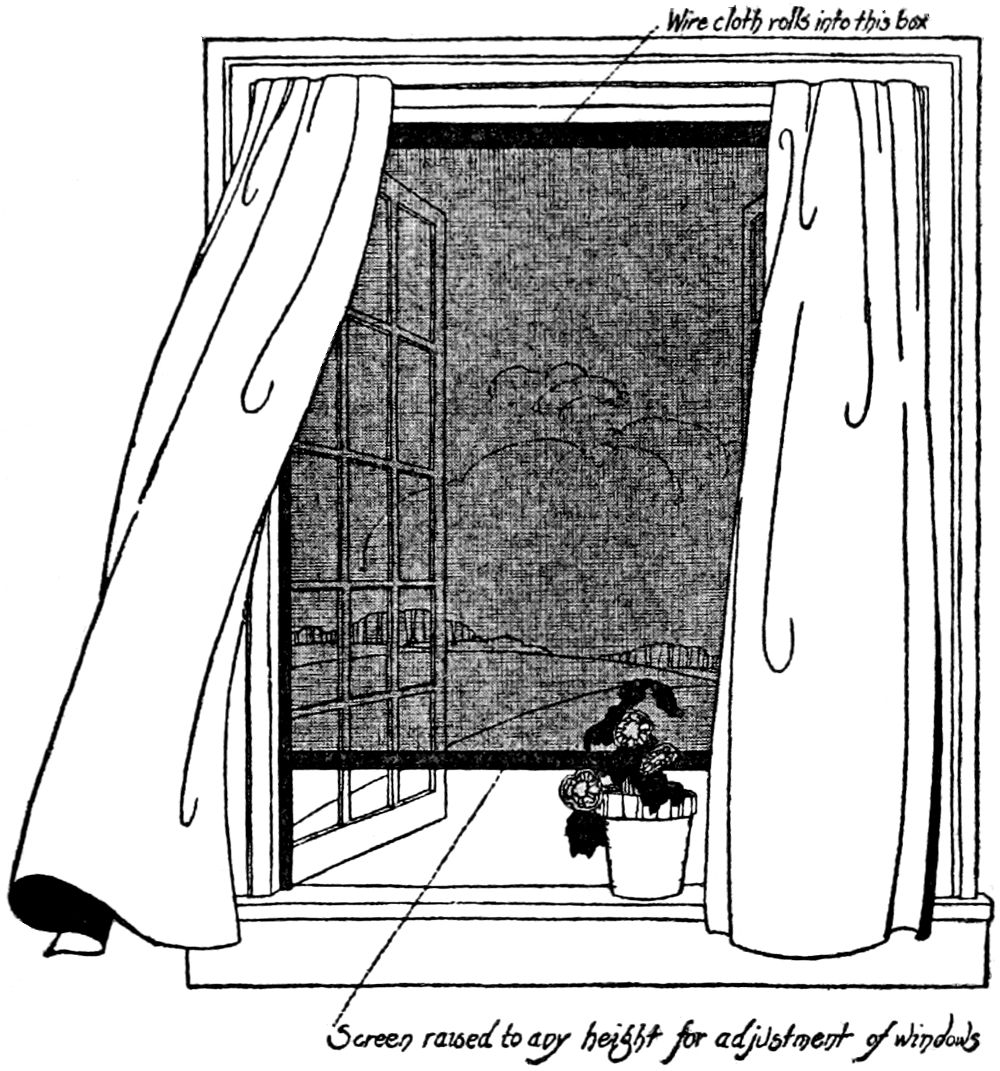
Courtesy of Rolup Screen Co.
THE SCREEN WHICH ROLLS UP IS A COMFORT AS WELL AS A
SAFE AND SANE INSECT OSTRACIZER
Wire cloth rolls into this bar
Screen raised to any height for adjustment of windows
The window shade is then replaced just below the
screen casing and neither interferes with the other.
The screen is so adjusted that it easily pulls down or
pushes up at will, automatically locks itself on being
brought down to the sill, and, after being released by a
slight upward push remains in whatever position it is
left. It covers the whole of every window and is so
simple in construction and direct in action that, once
installed, it should never get out of order. In case
of damage it can easily be removed, new parts obtained
and as easily be relocated. In new houses, under construction,
provision can easily be made to “sink” the
screen casing and side runways into the window frames
so that they are almost invisible.
If the rolling screen is not used, the casement can
be covered with top-hung outside screens, side-hung,
double-door style, or single from one side or stationary
on the outside, if the window opens inside. When
possible the casement screen should be hung on pivot
hinges to permit ease of detaching for storage, and, as
we said before, to leave the window without the marring
of the hinge there or removed. However, frequently in
the case of the unusually large screen the use of a
little strap hinge is sometimes necessary to carry the
extra weight. In marble window casing the hinge of
course is an impossibility.
A couple of side levers on either side of the screen
for releasing the pivots when the screens are to be taken
off for the winter make the matter of removal as easy
as “falling off a log.”
The top hinge screen on the outside of the window
which pushes out from the inside has to be hung very
securely and the bolts and pivots and handles and
adjusters have to be made to perfection. The adjuster
for pushing this window out or open must be a pleasure
to use or else this type of screen will be a curse. There
is an adjuster now on the market that is put on the
window in such a way that the screen can be opened
or closed without opening the inside of the window.
A double insurance against inroads of bugs while opening
the window to adjust screen!
Put up to “stay put” stationary screens are fastened
with bolts which are removed when necessary to store.
The story of the wooden frame is about the same as
the metal, only that the wood frame can’t rust, but can
wear out if not seasoned and kiln dried and given all
the care in manufacture that long life in woods necessitates.
Here, too, the corner construction must be perfect,
must be able to bear the weight of the screen and take
out the jars. The frame must be rigid, light and strong.
The wire cloth must be so fastened at every point that
there is no sag or bagginess in the broadest window.
Now all this is possible in the best wood frame
screens and with good workmanship. Every one
thought for a long time that the metal screen could not
incorporate their good points. Don’t be fooled by some
one saying that the wood screen cannot be made “fool
proof,” for it can and is. Here again every maker has
his own device for catching the metal cloth; here again
the metal cloth must be rustless; here again the metal
work and hardware must be rustless; the screen must
make easy manipulation possible.
The screen door question, too, is rallied round with
the same provisos of manufacture as metal and wood
screens. There are the two leaf door and the one leaf.
The new thing on the door is the fact that the whole
door may be screened or only one-half screened, the
rest of wood or metal. Yet it is far better to have the
whole door screened, but for the sake of beauty and
lack of monotony the lower half can be guarded with
a metal panel which will not only look well but protect
the wire cloth. Sometimes, too, in the wholly
screened door just a metal guard rail is applied to prevent
injury to the wire cloth on the full expanse of a
door.
If half the door is of wood, there again you lose the
free entry of air, so it is advisable to screen the door
completely and use the guard metal work to beautify
and protect it.
Some of the lower portions of doors (as is the case
with French windows) are beautifully carved to be in
keeping with a handsome wood interior.
Doors, too, should be equipped with a good check to
prevent them from banging and close tightly.
Locks or no locks, are questions to be decided by
the buyer, but all hardware, belts, catches, pins, hinges,
etc., should, of course, follow the “no-rust” régime,
and be of the most durable stuff and match up with the
surrounding hardware.
Even though the frame and its hanging are of vital
importance, yet what would the screen be without the
screen cloth? And, of course, there are as many kinds
of cloth in this quarter of the world’s work as in any
other and you have to know something of the variety in
order to know what you are buying, to buy advantageously.
Here again you play the old tune: Rustlessness.
The cloth must be of a mesh not too fine for free entry
of air, and fine enough to prevent the smallest insects
from entering. But here you must use discretion. If
your home is in the Adirondacks where black flies and
midgets precede the mosquitoes, then it is the better part
of wisdom to use a finer mesh; if you are at the seashore,
the ordinary coarser mesh is sufficient.
There is also choice here. You can have:
1. Painted steel cloth which must be repainted
often in accordance with its exposure and in regard
to where it is exposed and whether it is hung inside or
outside of the window.
2. Galvanized steel mesh: This is often blackened
for eye ease.
3. Monel metal (an alloy of copper and nickel)
guaranteed rust proof, used mainly at seashore resorts
but good for any place.
4. Bronze and patented bronzes: Used as is the
monel wire cloth. Here a coat of paint to dull the
bronze glare is of real service to the eye.
5. Copper: A coat of dull paint here, too, will
take off the glare.
Manufacturers have various bronze cloths and they
are sold under various names. Its great use is imperviousness
to rust but it has to be of the best manufacture
to insure this paradisiacal condition.
The porch that is screened with pernickety screens
never is screened in time to reject the insect world.
So here is another case where they must fit and be made
to order.
What is a sleeping porch without a screen? Without
a functioning screen? One swallow may not make a
summer, but one fly can make torture out of night.
Some makers will key your screens so that each screen
has its tag for replacement and there is no loss of effort
and time in resetting them next year in their proper
places. This can be done in windows, door and porch
work. Of course, with the rolling screen—they are
never taken down and much labor is saved.
Screens are not a luxury; they are a health measure.
When we get more civilized we will probably have our
screens inspected to see that they fit, and the boards of
health in the various towns will keep a close watch on
them, for diseases are rapidly being traced to the minute
insect carriers. Typhus and yellow fever are the last
results. Think what Central Europe would have been
spared had it been properly screened!
Contrary to usual opinion screens can be most attractive
and fit in with the surrounding wood trim, and be
a department of house furnishing not to be belittled.
And don’t fail to realize that a lot of trouble can be
saved and unsightliness be avoided, if the screen is
thought of before building your home—and if the roller
type is installed, you have no storage care, or removal
and recurring slavery.
CHAPTER XXXII POLISHING THE WATER SUPPLY
“I found a fish in my bath-tub to-day,” said I to a
friend.
“Wasn’t that the best place in the house to find one?”
was the reply.
“Yes,” I said, “but I can’t say I enjoy bathing in an
aquarium, and my civic pride is hurt because I have
been so proud of my city’s water quality and all of the
sister municipalities which filter or chlorinate or both.”
In this anecdote is the crux of the filter situation.
In times gone by a filter was sold to save life from
polluted waters, from streams, wells, surface sources,
sewage-burdened rivers, etc. It was a dire necessity
and became by its efficiency or lack of it a godsend or
a menace. If it were a good filter it needed care and
attention in the greatest degree to make it a boon; if
it were a bad filter it continued despite care to be a curse
far more dangerous than the unfiltered product because
it became a collector and a breeding place for bacteria
and doled out water as pure to the most modest of drinkers.
But as with every department of living in this realm,
things have moved on. In this case gloriously. For
since the municipalities have taken our lives in their
hands the dangers from bad filters are slight and the
need of good ones necessary but not a life-and-death
matter. In short, the excitement about filters in the
home is dead but their use goes marching on.
However, as this story will be read by inhabitants of
unfiltered municipalities and towns, whatever danger
and comfort can accrue from non-filtration or filtration
of water will be evident after a glance at this attempt to
bring it to your mind. Just as this goes to press we see in
the paper that a western town of Salem has seven hundred
and eighty cases of typhoid in a population of ten
thousand. Here is food for thought!
Hundreds of towns (one firm alone has installed about
163 plants) in the United States have municipal filtration
plants. Some even oxygenate the water by fountaining
it esthetically skyward and allowing it to entice
to itself oxygen (from the free air), by which it gets
life and polish and becomes refreshing.
Some towns chlorinate the water supply. When
water is chlorinated, minute quantities of chlorine are
added which absolutely destroy the germs in the water,
but do not alter its chemical or physical characteristics
in the least. The difference between a water that has
been chlorinated and one that has not been so treated is
that in the first case the germs are destroyed, but in
the second case they remain in the water to cause possible
disease.
This process is rarely used in the home as the control
is too difficult. But in the case of the elaborate residence
with large incumbencies in the way of model
farms, dairy, stables, machine shops, etc., it is used.
Also the smallest plants are used in the case of large
swimming pools in and out of fine residences, where, of
course, the water has been found to be bacterially degenerate
and where the work of purification is not done by
a benign municipality.
To get to the roots of the matter you want water (you
don’t care what the high-browed engineer does to it) to
be:
1. Colorless.
2. Tasteless.
3. Odorless.
4. Free from suspended matter.
5. With enough oxygen gas to make it refreshing and
give it life.
6. Without germs or food for germs.
What you want to keep out:
1. Suspended impurities: vegetable, animal (such as
the fish), mineral, microscopical algæ (what you
see on the stagnant waters), infusoria, etc.
2. Dissolved impurities.
3. Disease germs: typhoid, cholera, etc.
What you must demand in a filter:
1. All the above.
2. Durability.
3. Simplicity of management.
4. Nearest approach possible to self cleaning. (The
uncertain human element makes many a good filter
fall down.)
These four things are essential to the longevity of the
filter and to you, if you inhabit filterless vales.
Another thing suggested by the fourth article of
faith above is the care of the filter. If you have a maid
you can’t be sure in what state the filter is, unless you
keep close watch or have constant inspection by a service
bureau. Slight danger from the nearly self cleaning
filter can by care be entirely eliminated. But only
with care.
To clarify after its long pipe journey (probably
through rusty pipes, etc.); to insure plumbing (in case
of the installed filter in the cellar) against clogging,
incrustations and general wear, accumulations of material
bound to enter the water on its trip through the
pipes to the house—due to broken water mains, fires in
the city—accidents of any kind; to give the laundry a
clean appearance, for the best laundry work availeth
little if the water is murky or turbid; to polish water, or
render it free from flavor and turbidity.
When typhoid had its happy hunting ground in
plumbing it was thought quite in keeping to have typhoid
cases in abundance. In Pittsburgh and other
such afflicted towns it is now felt to be a heinous sin,
since filtration has become a part of the service that
towns render to their inhabitants. In fact, all boards
of health to-day feel it to be a felony and disgrace to find
a case of such a disease in the community.
So, to public-spirited citizens in unfiltered regions,
your task is cut out for you. You can get rid of muddy,
dirty water by municipal filtration plants or home filters
and care.
For those who live in filtered towns the use of filters
is manifest, too.
There are various kinds of filters in use, but only two
kinds are of interest for use in the home.
1. The type affixed to spigot (or water cooler).
2. The installed filter placed in cellar or other part
of the home to filter the whole water supply.
These are divided into many technical categories, but
what you are interested in are the following questions:
Do you need a filter? What shall you have to know
to buy a filter intelligently?
Rapidly stated, it is safest to buy a filter from a
manufacturer who says “my filter is not absolutely perfect
but it is the nearest thing to perfection we can get.
We know our filter can render water from 90 to 100%
free from bacteria, as we have had bacteriological tests
made by competent chemists.”
When you order a filter, put down on paper the
answers to the following questions, and send them to the
manufacturers who will then give you the data and
prices. Choose the best manufacturer and then invest:
1. Are the fixtures all on direct water supply or are
they supplied from an open storage tank or combination
of the two?
2. What are the source, nature and peculiarities of
the water to be filtered? Has it odor, taste, vegetable
discoloration, clay or iron stain?
3. What sort of water supply system do you use and
what of the water pressure? What is the size of
the supply pipe? (Ask your plumber.)
4. How many gallons of water are required to be
filtered per minute, per hour or per 8, 10, 12, or 24
hours? (Ask your plumber.)
5. How many bathrooms and other water fixtures are
in your home?
6. Is there a municipal plant in your town? What
kind?
Since 1885 thousands of filters have been patented.
Years ago the smallest and most unreliable maker would
put a filter on the market and promise immunity from
death and let it go at that, because folks are anxious
to be saved. To-day not many more than six filters are
really sold with a guarantee by reliable firms backing
them. Why? Because most of these filters were cheap
and flimsy, did nothing but strain water and strain their
point as well. These small manufacturers would spring
into being one day and sink into oblivion the next. The
filters, if they did filter (not strain, only), would become
breeding nests for bacteria. Physicians feared
and forbade them.
The filters on the market to-day are in varying degrees
reliable, depending greatly on their functions, on
the amount of care and wear, and how they are used.
For example, coarse gravel as a medium through which
to purify water might be good to take out bits of
sediment—big bits—but it would not act on the bacteria.
In general, the materials used in filters through
which the water must pass to be purified are: sand,
quartz, charcoal, cloth, paper, etc. Another class of
filters passes the water through a bougis or candle made
of unglazed porcelain (Kaolin), natural stone, artificial
stone, asbestos, diatomaceous earth, etc. The pores
through which the water flows catch the bacteria and
sediment.
With this list before you you must ask yourself if
you need only a strainer. Is the water free from
bacilli? Have you a municipal chlorinating plant or
filter plant? If so, any good filter will do to strain
out suspended matter; but if you are very anxious to
have perfect water you cannot go wrong by having a filter
which will catch bacteria which may have accidental
entry, in any community whatever.
If you know you have dirty water and no municipal
plant you cannot be too careful as to what you use
in rendering safe the water from well, stream or any
other source.
The most reliable faucet filter is the diatomaceous
earthen candle type which is simply cleaned by brushing
off its soft surface and boiling occasionally to kill furtive
bacteria. The great drawback to this type of
filter is that it is not a reformer and cannot force the
user to keep it clean. Therefore it is up to the user,
and as its agent told the writer, “Filter use in a city
like New York is a matter of temperament. Some
people enjoy caring for a filter in order to make a
splendid water supply fool-proof, others dislike the care
and do not mind the slight risk in any city water supply
or the discoloration that is often inherent.”
Filters, whether installed or attached to faucets, are
built to fit the occasion.
It is interesting to realize that nearly every fine home
in New York, especially on Fifth Avenue, has a filter,
despite the city’s excellent water supply. Not so much
to save life, as it so often does owing to frequent invasions
of germs into even excellent water, but for the feeling
of clean unflavored, unfishy, unwoody water and for
the insurance of long life of the plumbing system—and
to save deterioration in plumbing is a thing devoutly to
be wished.
Sand or quartz is the usual medium for filtration
in the home. Bone char is often added to these to destroy
taste, for there is nothing as disagreeable as water
with a decided taste.
There are a few filters to-day which when installed
in the cellar consist of one or two vertical tanks attached
to the water supply. In one tank is quartz through
which the water passes and in the other is bone char
to carry away flavor.
In one case the filter has a simple lever which when
set at a certain spot on the dial washes out the filter
beds and frees them from contamination.
As the impurities in the water are removed by a
filter they accumulate in a mass or cake on top of the
filter bed. If this cake or matted formation is not
broken up and thoroughly disintegrated, it will roll
up during the washing process and not only clog but
contaminate a filter bed, utterly destroying its efficiency
as a purifying medium, steadily diminishing the
water supply. Hence a cutting plate is placed immediately
above the bed of quartz. As soon as the
operating lever is moved to the point “Washing,” the
washing current is introduced at the bottom of the
filter, the filter bed is lifted bodily upward and forced
through the cutter, which literally tears the matted
film of impurities into fragments. At the same time
it thoroughly breaks up the bed, separates and perfectly
scours each grain of filtering material, by the force of
the reverse current of water in a space twice the size
it occupies during the filtering process.
The impurities having been separated from the bed
and broken up into minute particles are carried out
of the filter through the waste pipe by the reverse current
of water. During this process a screen at the top
of the filter prevents the filtering material quartz from
escaping out of the filter.
In this way by the least effort—the turn of a handle—once
a week—the filter becomes a boon and not a
menace. After the cleaning process is over, a matter
of from ten to twenty minutes, the lever is turned to
another point “designated in the bond” and the filter
goes back to normal. The agitated sand and char are
calmed down and ready to chasten the next lot of water.
In some localities where the water (though it may be
chlorinated and bacteria-free) is dark and turbid and
full of the finest sediment, the usual sand or quartz
(even with the tiniest of spaces between the grains)
cannot prevent this hyper-fine sediment passing
through into the filter. In order to catch this impure
water with its fine sediment alum is often introduced
into the filter to coagulate the fine sediment (as you
have seen the white of an egg coagulate coffee grounds)
and permits it in the “flock” to be caught as it passes
through the interstices of the filter bed.
Here you can easily see why you must be careful to
give the filter manufacturer a graphic description of
your water supply. Then, too, the installed filter, just
described may be rendered useless if by any means the
pipes in the home become contaminated.
There are some filters on the market (this caution is
for the unfiltered community) which only strain.
Those fitted with paper, cloth, cotton, etc., are fine
in their places, but you must know their places.
One filter, for example, is said to be very speedy.
However, in this case (this filter is attached to the
faucet) you are admonished to let the water run for
about half a minute, because, as the water ran through
before, the collection of germs must be given a chance
to flow out. In this filter the water flows in at one
end through bone char and quartz and the next time it
is used the current is reversed and flows back through
the filter bed, self-washing but carrying with it the
bacteria collected on its last passage. Therefore, if you
forget to let the water run for a time, you may get your
stomach full of more potent germs than if you used the
ordinary water with its occasional bacteria.
Good filters in the last analysis spell “safety first”
wherever they may be. For despite municipal intervention
accidents will happen, and even though the
trouble be corrected in a short time, fifteen minutes
can prove a real menace.
There is one filter just coming to our markets, made
in Germany, which has been tried and tested and found
good. It is affixed to the water supply (direct, not in
cellar) and accomplishes filtration by the process of
passage of water through a paper-like fabric of disks 1⁄4″
thick. These disks keep water absolutely sterile in the
laboratory for 17 days but the makers, rightly, will only
guarantee them for 48 hours in order to obviate danger
to their promises, through the accidents which may
happen. The test under German scrutiny proved that
typhoid germs were rendered nil for 17 days and try as
they might could not force their way through the disks.
This is a good certificate of good conduct. Sewage
for example during the war was rendered harmless as
drinking material by the means of this filter disk, so
it is claimed.
Filtering, unlike sterilizing, does not take the life
out of water or make it readily absorb odors and flavors.
Remember, that some filters remove bacteria and the
finest sediment only (the candle type). Others remove
sediment of all sizes and bacteria, too; while still
others kill flavor to boot. Discuss the point with your
plumber, architect, doctor and manufacturer and water
department. As with clothes so with filters: buy what
suits the need and buy carefully after securing all the
advice available.
One might say pompously that the purchasing of a
filter may be the purchase of life itself, or—facetiously—that
the good filter takes the “imp” out of impure
water.
CHAPTER XXXIII OUTSTRIPPING THE GALE — Things They Obviate — What They Are — The Sliding Window — Other Cases — Doors — Application — Purchasing — For Wind, Dust and Noise — Quiet and Cleanliness
Weather
strips are not the caviar of the building
menu—far from it. They are a whole lot
more like the roast beef with pan gravy and baked
potatoes.
Those of you who bought weather stripping years ago
and either put it on yourself or had the town carpenter
tack it on, do not believe it is any good, and at best
only a “fancy fixing.” But those days are passed
and the weather strip has properly outstripped many
other things in development and has come to be no
hors d’oeuvre but the pièce de resistance of the
bill-of-fare. So important has the effect of the strip
become that heating and ventilating engineers have
been and are to-day carrying on experiments, not to
prove their value (no, for this has been proven), but to
have exact data to show how much fuel is saved and
just how evenly the temperature can be maintained
throughout a home under varying conditions of gale and
stability outdoors and in. (See Chapter XXXV, Heating).
Do you care to heat the great outdoors? This is the
first important question. If you do, how dare you with
the shortage of coal to-day? Have you sufficient coal
to waste it? Is your home hard to heat? Why? Do
you like the gales and little hurricanes racing over
your floors, chasing the little snow flakes? Do you
like to cultivate colds and other draught diseases?
These are pertinent questions even if they seem impertinent.
They suggest the graphic pictures that we
do not want inhabiting our homes.
These conditions can be obviated.
If you inquire from your friends who know intelligently
the value of the furnishings they use, you will
get concrete figures before investing. One conspicuous
friend, Uncle Sam, says that in 1918 he saved two
million dollars’ worth of coal by the use of weather
strips. And this led the director of conservation to
make the extravagant statement that weather strips are
100% fuel conservation.
In the past when the telephone had just become a
household staple and before horse cars evaporated you
used to paste the weather strips on the outside of your
windows. Then they were made of cloth, or rubber or
heavy paper, and they made life slightly fair and
warmer; but most of the heat accrued by them was that
which was fired in trying to raise the windows which
stuck due to the adherence of the weather strip.
To-day the weather strip is gentler and not only keeps
the cold air at bay, but keeps out the dust and noise
and permits the window to go up and down more easily
because it runs on a metal track; really the weather
strip allows it to glide like magic. To move a window
with the weather stripping affixed is a pleasure which
the weakest reed can enjoy.
The dictionary says “the weather strip is a narrow
strip, as wood edged with rubber prepared to be placed
over crevices, as at doors and windows to exclude
wind, rain, etc.”
This is the old weather strip. To-day they are in
general metallic tubular strips fitting into complementary
depressions in metal linings or window sashes that
are designed and shaped to seal the cracks that naturally
occur between and around doors and windows and
their frames, sealing up these openings so that the
elements are turned back before they get even their
noses into the house. They are made of non-corroding,
non-rustable metals such as zinc, bronze and copper, and
they keep their elasticity plus non-leakage qualities as
long as, and sometimes longer than, the building itself.
Every type of door and every type of window present
different problems, and every window or door of each
type has again different problems, so to each there must
be different applications. The following will explain
more particularly than the foregoing.
The sliding window is the most general type to be
treated.
Here the top and bottom, sides and meeting rail must
be considered. How to stop leakage and seal against
unwelcome callers are the problems.
At the top of the window, as in the illustration, two
strips are used; the tubular protuberance in the head
of the frame nestles cosily in the depressed concavity
of the window sash. Some brands line the depression
with metal—others do not.
When the window is closed, there is a complementary
interlocking device at the rail where the upper and
lower sash meet, often in the upper sash of S shaped
bronze and in the lower sash a hook-shaped copper strip.
The side of the frame upon which the window is
raised and lowered is a real problem. The weather
stripping makes the window weather-proof, yet it makes
it open and shut easier than it could before the application
of the strip.
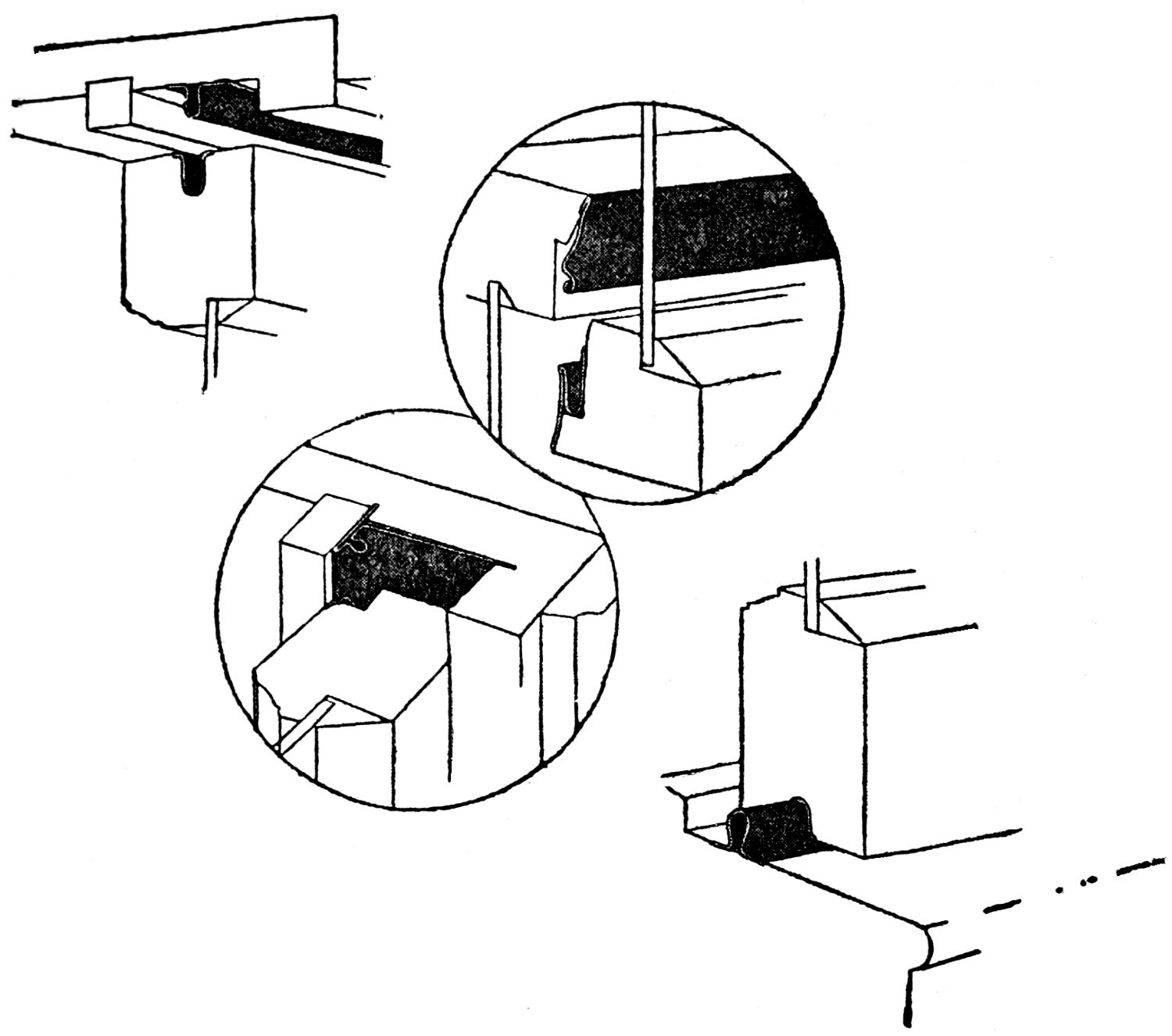
Courtesy of Monarch Metal Weatherstrip Co.
DOUBLE HUNG OR ORDINARY SLIDING WINDOW TREATMENT
WITH WEATHERSTRIPS OBVIATES DRAUGHTS, DUST
AND NOISE—SAVES COAL!
In some brands the frame lining and sash lining are
of metal. In some only the frame is metal lined. In
some the frame is corrugated and the window sash slides
up and down easily as the protuberance slides into the
depression in the unlined sash furrow. In another
brand two metal tubular strips are used, the metal protuberance
fitted into a metal lined depression. Here
the window slides easily and no amount of warping can
disturb the nice adjustment. In such weather strips
are created conditions which absolutely prevent the side
action of windows, so hard to cure with carpentry or
cheap types of weather strips.
The lower sash is managed as is the upper, only the
strips are reversed.
The casement window has its peculiarities of treatment,
as have doors and windows which open in the
center.
In the casement which opens in, for example, a brass
triangle is provided with “weep holes” to drain out
any water which may accumulate on the sill and follow
through into the room. The meeting rail is sealed in
a way approximately as in the sliding window.
The sill strip is peculiarly shaped to spring into its
sealing power; sometimes it is called a Z-shaped plate,
each manufacturer having his own name and pet plan.
The door sills are made with metal, and metal strips
forming a sealed joint against warping, settling air,
etc. There is a very nice device used to prevent the cold
air let into the bedroom at night from escaping into
the halls and cooling them off. On the lower edge of
the door is fitted a spring which when the door is closed
by contact with the hinged side of the frame releases
a felted pad which fits tightly against the sill of the
door. This makes one’s winter immersions a pleasure,
for the bathroom, if you have one connecting with your
room, as well as the hall will be warm for your morning
use.
Weather strips can be applied after as well as when
the house is built.
“My house is so well built,” said a friend of mine,
“that it does not need weather stripping.” If that
could have been so, it was a unique house. There is
hardly a house where the wood around the doors and the
windows does not warp or shrink or do something
equally obnoxious. Whether seasoned by long processes
of actual weathering or rapidly kiln dried, wood in
captivity becomes restless, and seems to strain and
struggle in its fury. Nothing can be said against the
builder—it is the nature of wood. The builder is always
glad to install the strips because then the owner
does not get a chance to feel antagonistic on account
of recalcitrant windows, difficult heating, etc., and is
therefore relieved from grumbling.
The weather strip must be put on by the experts from
the manufacturers of the brand of weather strips that
you buy. Do not call in your favorite carpenter or
plumber, for he cannot do it right. The putting on of
weather strips is a science in itself. They must be put on
so as to insure a uniform efficiency during the inevitable
warpings, shrinkings and swellings of the window. The
windows have to be conditioned carefully because the
stripping must be so fixed that it cannot be removed, if
necessary to do anything to the window itself afterwards,
such as fitting new pulley cords, etc. Every
window and door offers different problems, so an expert
must apply the strips to your window and door. This
is not a commodity that a baby can affix—it’s a man
sized job.
Remember the weather stripping that you buy
should last as long as the life of your house. For this
reason the all metal kind is the best to buy. The metal
and cloth are efficient as long as they last, and so are
other combinations; but they do not last long enough.
You must get a longevity insurance. They must be
made of non-rusting, non-corroding materials such as
bronze, copper, zinc or brass manufactured to a high
degree of dependability, and subjected to the most
rigid inspection and tests for accuracy, thereby awarding
the buyer a rich guarantee.
Find out from users of the brand you think you will
buy, before you buy, and see what they say and what
their experience has been.
Weather strips can be put on any opening, and should
the purveyor you speak to say this or that opening cannot
be properly stripped, that is your cue for seeking
elsewhere. Buy only from established makers, who will
be in business for years—because in twenty or thirty
years you might want a window adjusted.
Early in this article mention was made of the saving
in fuel by Uncle Sam. Professor Allen, of the Research
Laboratory of The American Society of Heating
and Ventilating Engineers, in a letter to the writer said:
“Roughly with ordinary good house conditions we
can say that the air in a room changes every hour due
to leakage around windows. With good weather strips
you reduce the leakage very considerably. Of course,
this depends upon the type of construction in the house.
Some years ago I installed a complete system of weather
stripping in an entire institution and we roughly estimated
that the saving of fuel was about 15%.” Since
then other tests have been made to bring the percentage
of saving of fuel from 15% to 40%.
When you think that a window shade keeps in 19.2%
of warm air, think what the fitted metal and interlocking
strips can do.
The weather strip not only keeps the cold air out but
actually by not admitting the cold air allows the heated
air inside to maintain the moisture necessary for comfort.
With the admission of cold air the moisture is
precipitated from the air and we have not got the proper
humidity necessary to be happy. The moisture in the
home comes from water evaporation in kitchen lavatories,
air itself which comes in, etc.
The warm air can carry the humidity, but the cold
air does not do it as well, and when it strikes the warm
air the latter is forced to condense.
Comfort is the main thing in the home, even more
sometimes than saving fuel bills.
“Comfort,” says Professor Allen in an address, “is
the prime consideration, more than maintaining a definite
temperature. Getting the temperature right
brings comfort. We should aim at 40% to 50% of moisture
in the winter with 68 to 70 degrees.”
The fact is that the heating engineer to-day allows
for about 1⁄3 more heating area when the house is not
weather stripped. And then, sad to relate, at this consequent
extra expense the house will be probably unevenly
heated, because some rooms will have big window
and door leaks and other rooms little leaks, so there will
be overheating in some rooms and underheating in
others.
Another engineer said, “I have caught snow in my
hand at a distance of two feet from a tightly locked
window in a house supposed to have better than ordinary
construction.
“What ... can better this condition? Weather
strips, metal weather strips....”
He also said in the same address on heating the home
that the builder did all he could do, with the materials
he had. So there is the dilemma!
The storm window can often be obviated by weather
strips. The storm window is much more of a nuisance
than the appliquéd weather strips. Who wants to add
another set of windows to be cleaned? And who enjoys
the manipulation of them in rush moments of storm and
wind?
The weather strip is the solution of the gale exposed
home, of the noise, dust and weather exposed home, of
any home with windows at all. It is not subject to
depreciation but increases in value, and as the house
depreciates the weather stripping takes on the burdens
of the ever increasing depreciation and prevents any
more rapid fuel consumption, keeps down the dust infiltrations
and lessens the cleaning bills. If, by
chance, the woodwork is still obstreperous the defect
can always be corrected, if a good brand of stripping
has been used.
In other words, weather strips are a good investment.
Good weather strips, like any good material, are a good
investment.
Much of our trouble with the heat in our homes comes
from the impossibility of even heating. Do what he
will, the furnace man cannot seem to heat the house.
Often you say: “Why do you burn so much coal and
give us so little heat?” There may be other causes,
but the lack of weather stripping is very prone to be one.
The charm of the house is quiet. Don’t you unconsciously
gage the dignity of the homes that you visit
by the quiet of them?
The weather strip keeps much of the street noises out.
It dulls and reduces the raucousness of the clang and
clatter.
Every housewife knows that the hangings next to
the windows get very dirty. She also knows that the
room gets full of dust whether the windows are closed
or not. A certain amount of dust will get into the room
no matter what precautions are taken, but there will be
less of it when weather stripping is applied to the
windows. This is a consideration worthy of notice, as
the servant problem to-day makes all effort in the home
more arduous and the less cleaning there is to be done
the better for all concerned.
Weather strips are not a luxury. They save money
and give comfort by maintaining an equal temperature
and humidity, and by permitting more quiet, less drafts
and a minimum of dust. Finally, the weather strip
is a good investment and, although not intrinsically a
thing of beauty, is a thing of duty and lasts forever.
But remember weather strips are easy to make—cheap
ones. There are many mushroomic dealers—born
to-day and dead to-morrow. Beware of them and buy
the best.
CHAPTER XXXIV BEAUTY AND THE BATH — A French Bath — The Equipment — The Bathtub — Valves — The Shower Bath — Mixing the Water — Lavatories and Tables — Faucets — The Closet — Incidental Fittings
Probably
no development of the home has mirrored
human accomplishment to such an extent as
has the bathroom. We have prided ourselves on our sanitary
bathrooms; on the devices for comfort and idyllic
perfection in this, the smallest, yet the most important
room in the home. We have developed it to such a point
that in new homes everyone has a bathroom to himself
with comfortable additions to fit the individual
whim.
For a few decades this room has been a replica of
hospital efficiency and that has sufficed. But to-day,
the artist in home-making is bringing the bath room
back to the luxury and ease seen in the boudoirs of ancient
days, the days from which we take our beautiful
drawing rooms, chambers and general schemes of decoration.
This reversion toward bathroom luxury has come
about because the ordinary bathroom has been too cold.
It lacked warmth, well-being and coziness. Then, too,
bathrooms are always the smallest rooms in the home,
and for that reason can be more easily dressed in glorious
sheen and kept in harmony with the color scheme
and general plan of the home.
A few years ago no one would have thought of having
wood panels in the bathroom—we proudly felt that
we had gone beyond that stage. Yet to-day in the
elaborate combined dressing-bathrooms we find white
wood panels giving a feeling of warmth, together with
almost as rich an effect as when marble itself is used.
The French bathroom in one great house is as carefully
designed as any room in the house, even more so,
for there both utility and beauty are achieved together.
Take, for example, the closet seat which looks like a
comfortable chair with cane back and seat. The seat
of course, is hinged to raise up and down. Here an
ugly necessity is beautifully camouflaged to fit in with
the entire scheme of the dressing room, and it gives no
jar to the inhabitant who must, forsooth, spend many
hours of careful toilet making in this superb room. The
fixtures here are gold of lovely design, the woodwork in
keeping. The floor is of large tile and spread with rugs
to add warmth and the room is lit, not only by the
regular bathroom fixtures, but also by a crystal center
chandelier.
Some bathrooms even have a corner for the bathtub
which transforms it into a chaise longue.
In modern bathrooms in luxurious homes we have a
reincarnation of the art of Benvenuto Cellini in the
gold wrought metal work. This is made to harmonize
with the general style of the room in which it is placed,
and, though expensive, it is easy to take care of. Besides,
when you are really making a bathroom, what does
it matter if it goes into the thousands when other rooms
go into tens of thousands?
Usually only one or two bathrooms—the master’s and
the mistress’s—reach this height of gorgeousness. The
others, however, conform pretty well to the highly convenient
and thoroughly delightful rooms in the rest of
the house.
An interesting development, too, is the shape of the
bathroom—the departure from the rectangular. Sometimes
it is octagonal, with a radiating tiled floor and the
various functioning fixtures in the far sectors. One
room which we have investigated has in one corner a
sunken marble tub and in the center the radiator. The
gold work in this room is beautiful, but practical, of a
design that takes plumbing into the arts.
The thoroughly equipped woman’s bathroom must
have the usual tub, showers, lavatory, watercloset seat,
a closet or two in the walls, a table, towel rack, brackets
for soap and sponge, hooks for hanging things, scales,
rugs, a chair or stool, toilet paper receptacle, mirrors
and tiling for floors and wall.
In the men’s bathrooms is added the bidet, sometimes
a shaving chair and other shaving necessities such as a
special lamp for fine work. To both these rooms can be
added various things, more or less necessary according
to different people’s taste, such as the sitz bath, which
is luxurious for bathing the feet after a hard walk or
a game of golf.
This article in no way intends to be a plumbing article.
All it means to do is tell you what there is new in
the development of the bathroom and leave the choice
to you. See Chapter XV on plumbing where we have
taken up the necessities of plumbing fixtures. All you
need to remember here is to buy your fixtures at the best
possible shop and then get the best plumber obtainable
to install them. The installation of all good plumbing
work should be in the beginning, in the plans of the
architect, for it is difficult and quite complicated to put
in plumbing installation after the house is well advanced.
There is nothing quite so important to the
successful builder as the early consideration of pipe requirements.
The plumber is equipped with the sanitary
code, which, of course, the architect knows too, and any
householder can get one to read and digest. However,
with a licensed plumber, a good architect and a faithful
builder, this is unnecessary.
The most interesting fixture in the bathroom, to
Americans and Britons, at least, is the bathtub. Aside
from the kitchen stove, this is the nucleus about which
our content is generated.
Civilization has been kind enough to leave us two
generally used types of bathtubs—the solid porcelain
and the enamel over iron (enamel lined or porcelain
over iron) tub. The tin tub has gone out, the glass tub
is too perilous, and the porcelain or porcelain lined
proves about the most satisfactory when we can’t have
marble or old Italian basins for our bathing.
Recent advances in methods of manufacture and design
have made the choice between solid porcelain or
enamel iron baths a matter of personal liking as influenced
by their fitness for positions assigned to them
in a room. On account of the losses sustained for the
manufacture of clay products, selected grades of porcelain
baths are of necessity higher in cost than the porcelain
lined or enameled iron. The porcelain bath is fine in
appearance, but it is not reasonable to expect the same
perfection in shape and uniformity of glaze. This is
due to the difference in methods of manufacture, and
allowance should be made for the irregularities occasioned
by the baking of glazed clay products. In the
past when English porcelain baths were being imported
it was perhaps considered distinction to have a solid
porcelain bath. With the present extensive manufacture
of these products in this country, this condition has,
of course, changed. The porcelain lined bath is preferred
by some on account of its requiring less hot water
to hold the desired temperature. Against this is the
fact that cheap porcelain lined baths should be avoided.
There are some points in favor of the enameled tub.
It doesn’t absorb so much heat from the water; hence a
hot bath can be obtained in it more quickly. It is
lighter in weight, therefore more easy to install in frame
houses and its plumbing is easier to handle. Furthermore,
greater uniformity can be had in its construction.
In the tub which is built into the wall, there is a
tendency to neglect proper piping conditions. When
installing a solid tub, it is necessary to build a bulkhead
in back of the tub so as to take care of the
waste pipe which should be available to the plumber as
it often needs a new washer. Or it must be built against
a closet wall so that the pipes are easy to get at, or
against a hall wall or some stable place.
There are myriads of styles of faucets, vents and outlets
used to-day in tubs.
It was at first thought advisable to have the inlet as
near the floor of the tub as possible in order to make
the pour of the water practically soundless after the first
inch or two came in. This is about the only advantage
of this arrangement. It is far better to have the inlet
higher up, either on top of the wall of the tub, or even
in the wall above the tub. If it is in the wall of the
room it is impossible to hit your back while bathing; and
you may have a shampoo nozzle attached; or draw water
from it whether you are in the tub or not, and when
necessary, fill a pail or dish. There is more noise when
the water is running into the tub, but what of it? If you
have a good door on your room, that will silence the
sound.
With the low inlet, there is a remote danger of drawing
in through the pipe dirty water from the apartment
above if some one is bathing in the tub which is a twin to
yours. It is quite possible for this to happen unless
the plumbing system is very well contrived.
You can have a hot water and a cold water faucet or
one faucet from which both hot and cold come. This
is a matter of taste. More often there are two, but many
people like one, so that there can be a mixture of water,
giving a comfortable temperature.
Tubs, of necessity, have to be placed in many ways.
When in recesses or in a corner, the valves, etc. can be
placed at one end. When against a wall, the piping
can be placed above the bath in the wall. This method
often lends a luxurious air to a room and has been utilized
in the most elaborate ones.
Nearly every modern bath has a shower of some description.
The difficulty with the shower is the splashiness of it.
The first protective device was a cloth on a bracket.
This is still used to a great extent, but the ideal arrangement
is to have the shower in a closet designed for it,
opening into the room. This closet may be of glass,
marble, or tile, with a cloth curtain or a door to match
the material of which the section is built. The door
should be as small as possible. Twenty inches is quite
large enough. The smaller the opening, the less chance
for the escape of water. Besides, a large door is a
nuisance to clean.
When the compartment is used there can be, besides
the ordinary head bath, a needle bath. This may consist
of from eight to twelve nozzles pointing in from the
four corners of the compartment, or it may be a series
of apertures in metal pipes hung around the inside of
the compartment. When the separate compartment for
the shower is not desired, you may find a substitute for
the sheet in the arrangement seen in the Warburg bathroom—plate
glass leaves. The glass sheets are practical
and not cumbersome. Nevertheless, they involve more
cleaning, and in the average home this must be considered
to-day.
There are various propositions on the market to mix
the water in the shower so that it can not scald the
bather. One manufacturer offers a little toe pipe, with
which to test the temperature of the water before starting
the bath. These things are more or less desirable
and dependable but are not at all necessary.
It is best to have the valves at the entrance as you
walk into the shower, so that your arm may not be under
the flow when it begins. If the piping is well done and
the valves work, the mixture of hot and cold water can
be tempered sufficiently to be safe and comfortable.
Here, as well as in every other department of purchasing,
you are told a lot of things, and if inexperienced,
you may be horribly taken in, and led to buy a lot of
unnecessary things, which though good in themselves,
are quite dispensable.
The shower bath compartment must, of course, be
large enough to permit the bather to stand inside without
having to be all the time under the shower. This
is an important point. Glass doors are not necessary
either for a tiled or for a marble compartment. A light
weight curtain is good, with the smallest possible entrance.
This obviates the cleaning of the door.
Tiled floors and floors of honed marble are better for
shower receptors than are the porcelain ones. They fit
into the building problem better, can be made in any
size and are less slippery. Be very careful in selecting
the plumber who puts in your shower, because unless
the drain and curb are absolutely right you will be exposed
to the danger of flooding the room and the partitions
of the house.
The styles of these are legion. The sizes are so well
standardized that unless one wants them made according
to some bizarre pattern it is not necessary to give dimensions.
The usual length is about 33″. This is
ample and graceful. The 54″ takes more space than
most bathrooms can give up to the lavatory, and makes
quite unnecessary bulk. The 33″ lavatory—and any
smaller size—can be made of vitrified china, which is
handsomer and less absorbent than the solid porcelain
lavatory. The vitrified china is fired, and therefore it
is difficult to make in large pieces.
Lavatories may be made for corners, or straight walls.
They may have two legs, or a center pedestal or four
legs, or they may be simply hung on brackets. Two
legs, however, is the usual style, although four makes
a very luxurious looking table. The legs can be had in
nickel, glass, brass or in the handsomest types of gold,
with carving or some other kind of design.
There has been a reversion, too, in the lavatory. The
new style is to make them of imported marble, cut in
one piece. With these the gold leg is suitable, also glass
which looks well and is most satisfactory, and is easy to
clean. Soft American marble is absorptive and stains
easily, so when you use marble, get the imported if
possible. Another point should be noted in buying the
lavatory,—have enough space on it so that it can hold
a glass; otherwise extra cost will accrue from breakage
and ruined nerves.
In addition to the lavatory, as we have said, is the
bidet, and the dressing table. The latter is sometimes
made of glass on gold, nickel or brass standards, but it
is oftener made of vitrified porcelain on four legs.
These regal appointments are given to show how some
people live.
The faucets on tubs, lavatories, bidet, shower, etc.,
require a great deal of care, since they must be cleaned
so often. Various materials have been used, such as
cut glass, porcelain and nickel, porcelain-like enamel,
brass, silver, gold, etc. For a very rich room, gold and
cut glass, or the gold alone is beautiful. But for most
rooms the porcelain and nickel faucets are the very best
and demand the least care. All-white enamel is not
durable and is hard to take care of properly.
It is very much better to have one faucet through
which both hot and cold water can flow. The faucet
should have an overhang of at least 1″ from the side
of the lavatory, so that it will be possible to get a glass
under it for filling or your hand under for washing,
thus obviating the necessity of filling a basin every time
you want to rinse your hands. There are fancy faucets
which do not meet these requirements, but avoid them.
Faucets which only flow when held are a curse and
should only be used in public places where the water
tax is high.
What you must look out for in the floor tile is that it
be as little slippery as possible. Therefore do not get
a glazed tile. More and more floors are being tiled in
colors, to match the home scheme. Also, the dull tile
obviates the squeak occasioned by the shoes touching
it. This is a minor point, but one worthy of notice.
Walls can be tiled to any height desired. In the
average room the tile is carried only 4′ 6″ up except at
the point where the shower is installed. There it should
be carried up 7′.
The syphon type is, of course, the best obtainable.
Many closets are sold especially from catalog and by
mail, as absolutely silent. Never, if you can help it,
buy anything of this sort from a photograph. No closet
can be absolutely silent. If there is any flow at all,
complete silence would be impossible. A minimum of
noise is the best that can be achieved, and the best
makers have closets of this sort.
The bowls are generally of porcelain, and the best
ones are of vitrified china (really porcelain), which
is non-absorbent and quite the thing for this use because
of the freedom from discoloration.
For general use, the less wood around the seat, the
better.
The tank as a flushing medium is still about the best
thing to use. There are on the market various flush
valve types, some of which operate with a foot button
on the floor or with a hand lever on the right side of the
closet. These may be good in some locations, but
neither the ordinary plumber nor the man in the house
can repair them in an emergency. The piping in the
valve type of flusher requires careful arrangement to
avoid trouble.
Sometimes it is rather convenient to have the closet
in a doored recess opening into the room and available
from the hall as well. This is especially to the point
when there are few bathrooms in the house.
Chairs and stools are usually in white enamel or in
fancy rooms are made to match the general style which
prevails in the decoration.
The question of closets in the bathroom is entirely
dependent upon individual taste. You can have the
wall and mirror finished type, or the long door regular
closet, or a combination of these, with or without full
length mirror. In some rooms a glass shelved linen
closet is found to be a real convenience.
The soap racks, etc., have lately become recessed in
walls. This system is not popular, however, because,
although useful and economical for hotel or institutional
use, it adds no charm to the fine bathroom. Rather,
it detracts from its dignity.
A nice way to have scales in a bathroom is to have
the dial encased in the wall, and the tray on which one
stands, sunk into the floor. This arrangement economizes
space and is very welcome to fastidious people.
Plan the bathroom of your house early. Talk with
your architect. Insist upon the best and get it. Your
bathroom need consist of very few things, in the last
analysis, and the wisest plan is to get the best. The
cost will be from $250 upwards, for fixtures. However,
it is wisest to buy the best you can afford so that
a replacement cost is obviated. There must be no
skimping of plumbing work, because that would be a
menace to both health and wealth, and the plumbing
costs no more for good material than for bad.
CHAPTER XXXV THE WINTER OF YOUR CONTENT — The Heating Engineer — Principal of Heating — Boiler Purchase — Piping — The Gas Boiler — Water Backs — Radiators — Air Vent (Steam heating) — Heat Controls — The Bungalow Owner — Heat’s Influence — Heating with Oil — Electric Heating — Hot Water Heating — Gas
Hot
or tempered air is the theme—how the air in
our rooms is kept pleasant in cold weather and not
too hot—this is the duty of the heating plant.
Furthermore, beyond the duty of the heating plant,
it has been the great civilizing influence in the life of
man. Wherever the heating plant has gone, there has
man been able to regulate his work, play and goings and
comings. In this way health has been better maintained
and more regularly in work, therefore, continuous
endeavor which, of course, spells advance and
civilization.
Not wishing to deprive heating engineers of their
profession we shall not drag you through tortuous technical
pipes and valves, but simply tell you what you
must demand in a heating installation.—Here, unless
you are properly equipped you will add to the junk
pile in quantity and therefore waste your money by the
wholesale.
First: you must decide whether you really want hot
air or furnace heating. In this case the furnace heats
the air and it rises through a register in the floor or
wall of your room. According to J. Byers Holbrook,
the distinguished heating engineer, this sort of heating
tarnishes your silver, your bookbindings crack and
your lungs are made either immune to poison or function
in spite of the “rich air” reaching them.
In this place it is wise to mention the pipeless heating
system which is hot air sent from the furnace to one
central vent or register which is supposed to heat the
whole house. It can be used only for small houses.
It is very cheap in comparison to other systems, but it
is unsafe. (See the safer method further along in this
chapter under “Bungalows.”) It is unsafe; for example:
If there be illness in one room it has to be open
to be heated therefore disease will be spread. Furthermore
rooms that are closed will get no heat, as the door
must be open to receive the hot air.
Second: there is steam heat. This is an excellent
system well adapted to residences and buildings, hotels,
institutions, business houses, etc.
Third: Vacuum and Vapor, the steam circulates
through the system at practically atmospheric or greatly
reduced pressure. Vapor heating is used in residences,
vacuum heating is used mostly in large buildings.
Fourth: Hot Water, which is probably best for your
purposes. And with these deterring and encouraging
words we will launch directly into what you should
know before installing a hot water heating plant.
There is such an “animal” as the heating engineer.
He it is who can tell you to an iota how much heating
surface you have in your home to be heated. He it is
who can subtract and add footage and finally tell you
whether you must heat 4400 feet or 3000 feet. When
you know this, of course, you can more readily order the
boiler which is best adapted to heat such a surface.
For example, suppose you had a conservatory in one
end of a large room—your heating engineer could tell
you—due to the glass surface—how much more heat was
required for this room, even had you no flowers for
your conservatory. Glass windows in a shop or in any
room add to the heat units required.
Computing heating area is not easy—because the
shapes of rooms, kinds and varieties and areas of walls
and door openings come into the problem, to say naught
of the badly fitted windows and doors permitting
draughts, etc. So you see the heating and ventilating
engineer has a job that the amateur or even the steam
fitter knows not of. (See Chapter XXXIII).
Usually the householder isn’t asked about her heating
plant at all. The contractor, architect and builder
fix it all up. But—we don’t hold with this. You have
to live with your heating plant, they do not—and it’s
pretty much on your head that discomfort falls. Were
we building we would be quite intimate with the heating
end of life, in fact take a heated and intensely feverish
interest in it. Therefore, after your plans, etc.
are hatched, call on a heating engineer for a few suggestions,
and then go to your contractor and see from
whom he is to buy your boiler and what type. Then
tell him you require certain things in your boiler which
we have listed “here below” for your winter of content.
Steam heat is, of course, heating by means of circulating
steam through pipes to radiators. This is affected
by a one pipe system sometimes, or a two pipe. The
steam ascending from the boiler in one pipe and condensing
into water falls back into boiler in same pipe.
In the two system arrangement the steam ascends in
one and returns in the other. The one pipe system,
of course, is cheaper but takes skill in setting, as the
pitch of it (the angle) must be perfection. In the radiators
the steam condenses and returns in separate
pipes in the two pipe system.
Hot water heating is the circulation of hot water
through pipes to radiators. The heated water being
lighter rises and as it cools in giving off kind heat to
you, it falls back again into the boiler where it is again
heated and takes another “rise” and so it circulates
through its system. Therefore, in all heating systems
there are two main divisions: the generation part of
boiler and the circulation part of piping throughout the
house. Both parts must be perfect to insure perfection
of heating. The first part dependent on many factors,
the second on a few more. In the hot water system
an expansion tank is always placed at the top of the
house in order that the overflow can be taken care of.
1. Swiftly speaking—the boiler must make every
pound of coal do its best, it should respond rapidly
to climatic changes, it must be easily fueled, shaken,
regulated, cleaned, free from repairs, rust, leaks
water heat or gas and it must be easily set up in room
for its use. (All good boiler makers send you “coal
information.”)
Economy in fuel and labor.
Save coal yes? But economy in coal means getting
out of every pound the maximum. So when you buy
coal ask what its fuel value is? It ought to be about
12,500 to 14,500 B. T. U.—that is, it takes to raise 100
pounds of water 1 degree Fahrenheit, 100 British
Thermal units of heat. B. T. U. is the way to
measure heat units as 7 yards of satin is the way you
measure goods for a dress. The best type of boiler
for the home is the sectional, cast-iron type. In this
the water is run through tubes and presents a large
number of surfaces of water to the heat.
You must demand a boiler amply large and of the
best type of tubular—where heating is most rapid, and
direct in order to save fuel, in order too, that all the
heat generated goes to heating the house, not in warming
the flue or chimney.
2. Fuel portion. These must be deep to insure enough
coal at least for 8 hours of heat. So that in the
morning your house will be warm and some coal left
in to be joined in lawful heating to the next supply—leaving
no interim of coolness which wastes the
coal and supplies pneumonia. It takes more coal to
reheat completely than to add heat to a heated mass
of coal.
3. Boiler capacity. Find out how your boiler is rated.
If its capacity only assures you 6 hours of heating;
you must not expect it to do 8 or 10. Only in the best—the
very best makes, do the ratings have much
weight. Experience counts. You can tell approximately.
But buy the boiler you don’t have to force.
For forcing a boiler adds to your coal bill. Your
boiler capacity must be a little beyond what you
actually need. 70 degrees in zero weather is the
standard. A strong “Coal-ition” government is here
necessary!
4. Rapid water heating essential.—
Water-ways thin enough to heat water rapidly.
Quality and position of heating surface must not
allow for waste of heat. 65% of heating surface
should be in direct contact with heat, 35% in flue
surface. Response to your dampers will show you if
you have 65% of your heating surface in direct contact
with flame! Go and see the best hot water boiler
in your vicinity—before you buy consult your engineer
and ask about others.
5. Operating must be easy “as pie.” Grates should
be easily pivoted and balanced. Arrangement must
prevent all accidental dumpings of fuel in fire pot.
Coal so used as to not disappear through grate. One
boiler employs a damper rod running to the front
which enables the caretaker to open and close the
smoke damper rapidly when building and this prevents
gas and smoke leakage when door is open. Such
a device as this makes a floor room in a cellar feasible.
The boilers of some companies are so beautifully
contrived and finished that they are no worse than a
talking machine or upright piano in a play room. In
fact better looking!
Feed doors should be wide mouthed enough to put in
easily the various “meal time” supplies.
The ash pits must be big enough to hold ashes away
from the grates.
6. Sectional construction desirable.—
These sections make it possible to enlarge a boiler;
(2) to move it into a house built completely without
tearing down the house, and obviates its sitting
around in a house which is being built, a prey to all
sorts of bad treatment; (3) can be taken through any
cellar door; (4) can easily be taken apart.
7. Must be easily cleaned.—
All surfaces must be available, fire and flue parts
largely self cleaning. The surfaces can be so made
that soot peels off. Flat surfaces must be easily
reached for quick cleaning, 1⁄4 inch soot deposit will
demand 50% more coal. So get an easily cleaned
boiler or no one will clean it at all!
Boilers should have conveniently placed doors into
which cleaners can have access. If cleaning is easy
it will be done, otherwise it will not. We made this
point too, with refrigerators, etc.
8. All connections must be water tight, steam tight,
gas tight. There should be no packed or gasket joints
made of rubber, asbestos, paper or other washers in
connecting joints, etc. This is very important. Re-packing
should never be necessary with your boiler—the
longer it is used the tighter the sections, etc., and
yet they are easily taken apart at any moment. The
nipples or valves must be easily closed and everlastingly
tight, yet easily opened.
9. The steam boiler for steam heat; the water boiler
for water heating. No straddlers must be used.
10. The best boiler is of cast-iron. It will outlast the
building; will not rust or pit. It is so built as never
to need repair and it doesn’t ever seem to wear out.
This is an investment—other kinds of boilers are
finally permitted to add a value to the junk pile by
rusting, pitting, and other useless decadences.
11. No danger in a boiler where the fire chamber is entirely
surrounded by water and steam surfaces; and
when the boiler stands low and therefore well away
from the joists and woodwork. Boilers are generally
tested for 80 pounds pressure, but to operate them 2
pounds ought to be enough, though 1 to 5 is the usual
bill-of-fare.
Steam boilers should have a relief valve—when
pressure builds up to 10 or 11 pounds.
12. Should be few outside fixings—should be able to
be installed without digging a pit. This, by the way,
would be a good way of starting your chat with the
regal contractor, “I want a simple, fine boiler, for
which no pits must be dug, or brick enclosures.” The
best boilers only require a brick base, for obvious
reasons. There should be no alterations of building
necessary, because the sectional boiler like the sectional
bookcase is made to fit in anywhere. Asbestos
covering of boiler often prevents waste of heat
in the cellar.
13. Thermostatic valves come with some boilers to cut
off automatically and “set on” heat. This conserves
fuel. (See section on heat control.)
The piping from boilers to radiators has to be done
carefully. The best steam fitter is none too good. The
grade or pitch of the pipes etc., the area of surface,
the diameter et al must be adapted to area to be heated
and to the system employed—all of course, is too technical
for your needs here. Only you must require care
to be used here and let your contractor know you’re
“on.”
In this boiler you get maximum comfort and maximum
heat. No coal, no ashes, no bother, little cash.
But this must be from the best makers. It is usually
more costly to operate—but—!
Boiler makers in outstanding manufacturers make
excellent water heaters in which water for laundry
etc. is heated by heat which would otherwise be unused.
Radiators are the translators! They are like the
English writers who translate the Russian novel. The
radiator alone tells us whether our hot water in the
boiler is being translated into heat for our comfort.
They are either curses or benefits! But they are
usually the eye-sore of the home.
In short they are a series of tubing which present
a maximum of heat radiator surface. They have valves,
for controlling the heat.
If you buy the right valves, your radiators will not
leak, water-hammer or bang, or flood.
An air valve must let out the air to permit the steam
or water to fill the pipes. If it doesn’t do this, it is
of no use. Varying steam pressure, flooded radiators,
forced firing of boiler (which you must avoid by having
a boiler with large enough capacity) are overcome with
correct valves. The right valve saves fuel, because
unnecessary amount of pressure is not needed to force
out air, the right valve copes with dirt and dust, prevents
floods, requires no adjustment. Air and steam
units cannot mix, the valve releases the air. The valves
must be all metal five years guarantee, and no adjustment
necessary.
The radiator which is recessed in the wall has the
advantage of being less visible, but unless you employ
heat reflectors you will lose a lot of heat—and even
with them you lose some.
Some manufacturers are doing their super-level best
to build radiators which are lovely to the eye. But,
again like the upright piano, they can be made but
comparatively beautiful. Gratings can veil them but
are gratings lovely? Then too, there is a loss of heat.
One radiator company has good-looking radiators
which are very successful. Their series of columns
make them able to resist high internal pressure. The
internal area of the tubes in relation to the heating surface
has been reduced to 1⁄4 of that run in general use.
This not only greatly increases the pressure resistance
but in reducing the internal area, the water or steam
contents are likewise reduced.
There is on the market a covering for radiators which
is very satisfactory.
There is more heating surface in this type too.
The water content is 1⁄2 the content of other radiators.
This means quick and positive venting for steam, vapor,
or hot water installations and provides rapid circulation,
causes radiator to heat up more rapidly.
The air vent on each main, allows the air to escape
so that the heat arrives more rapidly to radiator. This
of course, saves fuel.
To take the heating of your home out of the area of
dreams and out of the expensive realm of “feeling,”
some sort of heat regulating device is recommended.
It is foolish to say “Do you think it is warm enough?”
to a group in the room. For no two will think alike!
Apart from this, the perfect thermostat not only tells
you at what temperature is your house, not only keeps
the house evenly heated, but in doing this saves you
fuel, expense, illness and what not.
By simple mechanical means the thermostat opens
and closes the door of the furnace as the heat needs
to be lowered or increased. In this way if less heat is
required, the door closes, and less coal is used etc.
Thereby another simple yet ingenious device. The
thermostat can be set to do these things at any time you
wish it to be done. If you want the damper opened at
7 A.M., so it will be done—and you don’t need to go in
your pajamas boiler-ward!
There are two or three excellent thermostats on the
market and many not so good. Be sure you consult
before investing. The best thermostats have no corroding,
or wearing parts, look well and prove themselves
thoroughbreds.
The thermostat prevents cooling off of the boiler
which means starting a fire over again—which means
wasted fuel. All means must be taken against such
waste. Much coal is lost in uneven combustion, some
coal being entirely wasted. The thermostat prevents
this, by ordering a steady, definite consumption of coal.
It takes far less coal to heat hot or tempered return
water than to heat cold—the thermostat prevents the
cooling down entirely.
There is now on the market a hot water boiler which
is compact and good-looking which if put into a cellarless
house heats it with the efficiency of the subterranean
boiler! This is done through pipes and radiators and
with a maximum comfort and a minimum care.
It is usable in schools, cottages, etc., and bids well to
civilize sections of the world which have starved for
heat and consequently have been stunted in physical
and mental growth. This boiler is the Ford of boilers,
giving unto every man the right to be comfortable
wherever he lives!
Oil heaters for special rooms are made by the principal
oilstove makers. These give good results but of
course are not comparable to hot water heating, steam
etc., plants.
As yet heating a house by electricity is too expensive
and isn’t done except by small comforting heaters which
heat one room at a time. These are very clean and
efficient and not expensive.
The problem of heating water is of serious dimensions
for life without hot water to civilized man and woman
is a poor struggle.
At present there are on the market, distinct from the
usual hot water plant installed in properly built and
equipped houses—many different and efficient heaters
and boilers.
In houses where there is no hot water central plant
there can be bought for moderate rates an electric heater
which is attached to the faucet in tub or wash basin
or sink and through its system of copper coils over
which the water flows through, you can get hot water
immediately! This needs be but connected to your electric
light circuit—outlet or fixture.
Then there are large circulation water heaters of
electrical contriving which of course has to be separately
connected—as the (Wattage) heating unit is rated at
about 660 watts! These heaters are of excellent construction,
but in most vicinities as yet—electricity is too
expensive to use thus. This is controlled from any place
in the house, so you need not go down in cellar to start a
hot water “anything!” In the best of these it is possible
to turn on more heat or less from original source by
the use of multiple heat switches.
All conductors must be insulated, these heaters should
be easily installed. There is possible here hot water
without ashes, gas fumes, fire risks—and desired temperature
at will! It is a fine hurry device for the
sometimes opened country house. In winter it is a boon.
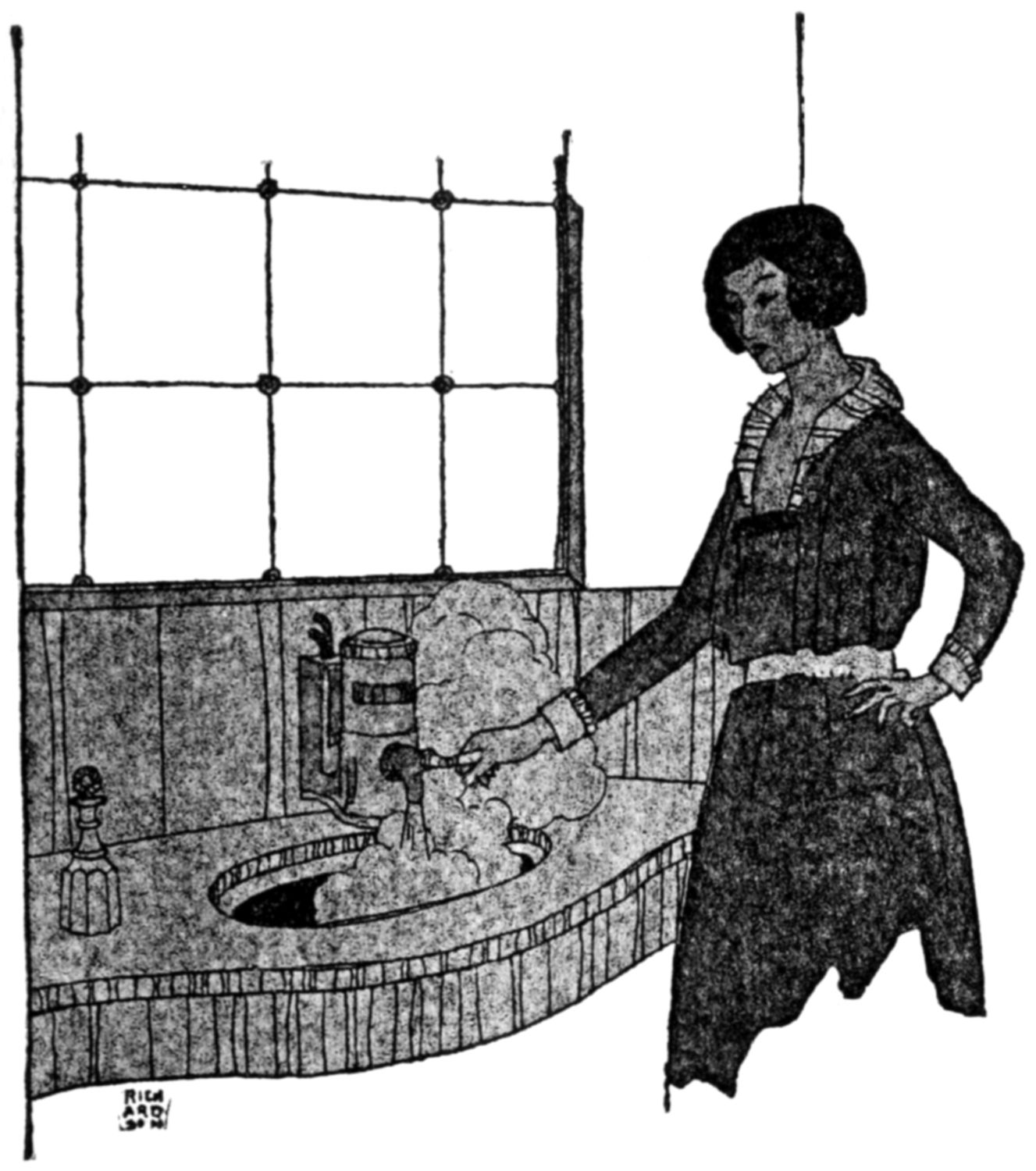
Courtesy of National Electric Water Heater Corp.
A METHOD OF HEATING WATER BY MEANS OF A FAUCET
ATTACHMENT
Then of course there are the little electric emersion
heaters. This is a heating unit which is dropped into
the water basin, pitcher, tea-pot or what not and attached
to electric light bulb very quickly heats your
water.
The gas heater up to date has been most reliable and
efficient.
There are many good gas heaters too on the market,
which when you turn on the water start the fire! These
are rapid and have given very good results.
There are many “boiler” heated water schemes—the
water backs on gas and coal stoves etc. Then too a
very efficient method is using the heat (over) not used in
the sectional boiler for heating the house. This is
effectively used in auxiliary boilers for heating hot
water. Some firms are rightly proud of this contrivance
as it is inexpensive, ample and convenient.
CHAPTER XXXVI OUTLETS SAVE YOUR INCOME — Lighting — Height of Lights — Reflection — Light Measurements — Cost of Light, Electric — The Incandescent Light — Indirect and Direct Lighting — Special Room Service — Dining Room Domes — The Bedroom — The Kitchen and Closets — Architects — In Finale — Some Suggested Novelties — Cord Divider — Tinting — Principles
Let
there be light and there was none—is the
verdict of many an estimator who goes over a home
after it is built and sees the occupants laboring to read,
sew, game or cook according to their separate desires.
And so to take the “bull by the horns” and begin with
the practical first—one of the best ways to get proper
lighting is to have sufficient outlets for electricity, portable
lamps with oil and enumerable fixtures with gas.
This will deal specifically with electric light, yet the
general principals will apply to all other lighting.
Good lighting can mean good health. Eye strain is
often the cause of depleted systems, indigestion and
things that lead to other calamities. Many a doctor
would better analyze a home to see what could afflict the
sufferer than analyze the patient!
Flickering lights strain the eye, because it cannot
adapt itself to the rapid variations in intensity. So the
flickering light must go. Lights that are too bright
hurt the eye, lights that are dim cause strain, all in
turn having disastrous effect on sight and on health—these
too must perish.
The best sort of lighting, of course, is the diffused
light which without glare is sufficient for reading, etc.
Here, though, the distribution may be so imperfect that
the glow is dispiriting and consequently a light softener
in the guise of a lamp shade or frosted dulled glass
helps the situation.
The indirect lighting system, is popular to-day.
When buying this type you must be sure to get them as
dust and bug proof as possible. The simpler they are
the easier to keep clean, of course.
Money can be saved by having outlets at frequent intervals,
so that lamps can be attached at the point
needed, rather than having to light many lamps at various
ridiculous places in a room as contributory lights.
Fixtures which have lights set obliquely in them are
hard on the eyes, lights are not meant to shoot light in
your face but to supply aid quickly and politely to the
eye. Fixtures should have their globes, in the perpendicular.
Lights should be high enough only to cast a direct
light on the subject in hand. The reading lamp must
help the reader, not impede him. Try over and over
again until it is placed correctly. The shade should
be such that it not only directs and diffuses the light,
but softens and subdues and makes it a pleasant thing to
the eye.
Very often dim lights can be magnified by a reflector.
Never, though, can a reflector actually increase the light,
that is to say, the reflector doesn’t increase the electric
power or size of lamps but simply reflecting more than
absorbing, the light gives you its fuller value.
You are probably aware that certain colors absorb
or reflect in varying degrees. Usually in the papering
of rooms no account is taken at all of this perfectly
honest color vagary. Consequently, a dark room is often
somberly decked in deep chocolate paper and therefore
you get something like 4% reflection whereas in that
room white would reflect about 70% and a wall yellow
painted would reflect about 62%, thereby saving the
necessity of just that much more lighting.
Green reflects about 18%, blue 12%, so you can see
here what to do with certain rooms that should be dimmer
or brighter.
In the same way shades of globes enhance or detract
in reflection capacity.
Clear glass absorbs about 5-12% of light and cobalt
blue about 95%, so here you see if you have a lamp
absorbing 95% of light—that you will need more lamps
than one absorbing but 5%! Think on these things.
The foot candle is the unit of light measurement. A
standard candle has been decided upon and all lighting
calculated on this basis. We say we have 16 candle
power lamp that it means it gives light of 16 of these
standard candles. From a 60 watt lamp the candle
power obtained from a tungsten is 56 candle power. A
saving in money is had if the tungsten though more
expensive is used.
The amount of electricity taken by a lamp is measured
in watts—
(See Chapter I on Electricity.)
Economy is quite possible here as in burning oil or
any thing else. If your lights are well placed, you need
less light, if they have not too absorbent globes you will
also need to use less light, if you have proper wall tints,
etc. You often need fewer lamps. One good lamp in the
right place saves two or three wrongly placed.
The Tungsten filaments burn brighter and more
cheaply than the old filament of carbon. There is
a saving of electricity somewhere around 50% in the use
of new filament.
That brings us to the story of the incandescent lamp—
Incandescent means to glow with heat—In short the
incandescent light is one which employs a globe in which
the air has been exhausted and in which a vacuum exists.
Before the air has been exhausted a filament of metal
has been affixed through which the current of electricity
is passed. In the resistance of this current the
filament glows and gives the light that you use.
Don’t take any lamp you can get. Ask for the
number of candle power or watts you want. The lamps
to-day are more popularly sold according to watts
rather than candle power.
Of course there is a loss every time the light is reflected
through a diffusing medium. In correct direct
lighting most of the light is only reflected once before
using point. In indirect lighting it has one more reflection
(at ceiling) causing a loss hardly much less than
25% and maybe more. The diffusing bowls throw a
large part of the light—in semi-direct lighting—where
there is a similar loss and the part of the light which goes
through the bowl is considerably reduced by absorption.
Naturally direct lighting is most efficient. Yet lighting
is a matter of diffusion of light and often the indirect
system gives not only more joy but better illumination
with no greater consumption of power than
direct lighting.
Avoid shallow reflectors not covering filament (or
mantle in gas lamps).
The plain electric glass shades through which the
source of light is plainly seen are practically nil. They
absorb more light than a good reflector and do no good—unless
to look a wee bit better than a bare lamp.
Ground glass is a better thing but poor enough.
Colored shades do absorb light but they are decorative—a
combination of white reflectors and colored
shades is often a good trick.
In lighting rooms remember their special needs. It
is very unpleasant to have a light unshielded by a shade
of some sort as the eye rebels against the sharp concentration
of light.
Dining room domes are like mountains of flowers—obstruct
the view and make you hurdle to see a diner
opposite to you. They should be hung high enough not
to become obstructive to the view and low enough not to
throw light in your eyes. If this can’t be done, hang
it high rather than low and cover the opening of the
dome with a material somewhat alike in color to the
dome.
Have your fixtures on the side walls and plenty of
them. Yet in some bedrooms, there are often three lights
used when one properly placed would be enough!
Think of the money outlay! A few outlets in convenient
places will make it easy to use the vibrator, electric
pad, shaving stand etc.
Over the sink if necessary a small light can be placed.
All dark closets should have an electric light; which
can be switched on from the outside of the closet. It is
a real sanitary measure to say nothing else of the ancient
blind groping in a dark cupboard for these things—which
roll and break in the groping! Blind sport—Electric
lights in all closets are not luxuries now they
are nervous prostration preventives! Light is a detective.
Nothing bad can survive in the light! Dirt
is revealed, bad conditions laid bare—hence the light
works for good! Closets need light, shelves as well
need light to visualize little corner lurkings!
A good light in the vestibule is often a perfect chaperon
for youth!
The shaving mug and stand need careful lighting to
prevent discomfort and inadvertent cuts.
The cellar can be a lonesome spot if not properly
lighted. No one will clean it. A switch upstairs to
light the cellar before going below, with enough other
lights will do much to “sell” the cellar as a usable, cleanable
room.
Flexible lights for desks are great comforts. There
are countless decorative as well as practical desk lamps
on the market to-day.
Although the primary object of lighting is to light, yet
the market to-day has any number of fixtures which
seem primarily for artistic purposes. And we must
say that the fixture makers have a long way to go yet in
the sheer beauty field—as have most non-custom made
products.
Don’t leave your lighting to your architects. Illuminating
engineers are good but you can even be more illuminating
by knowing your own needs and habits.
There is no excuse with electricity in not having your
lights where you want them. Buy the right lights to
save your health and eyes.
Talk to your contractor before the house is “let”
for building. Here is the time to talk outlets!
1. Clean globes mean more light. Don’t think you
don’t have to clean electric lights. You waste money
on electricity with every grain of dust on your globes.
2. Tired eyes often mean too few lights or light placed
in wrong places.
3. Remember don’t always blame cook or work for indigestion,
it may be your eyes from bad lighting.
4. A bare lamp if it must be used should be above the
eye line, always use a shade.
5. Too much is as bad as too little; both strain the eye.
6. In low ceilinged rooms use two or three side small
lamps rather than one large one.
7. Remember ask for the size lamp you want, don’t
just say “I want a lamp.”
8. If you don’t understand lamps, go to a library and
read or consult a good electrician, or go through some
one’s home.
9. Standard plugs throughout the whole house so that
all connections can be made at any outlet.
10. It is wiser to have more rather than too few outlets.
11. Switches—remember you can have lights so arranged
to snap on and off in the closets by a switch on
the outside. (1) You can have switches (3 and 4
way switches) that enable you to light the light upstairs
from downstairs and turn it off when you get upstairs
and turn it on again either up or downstairs.
(2) Side wall switches—near doors as you enter;
(3) Another switch to turn on all lights in house at
once in case of danger.
There is a “cute” little thing now to be had to prevent
you bumping your shins on a table when leaving
the room—a light that when you put it out stays lit one
minute after you pull the chain!
There is also a device which connects the long electric
cord so that you can easily lengthen or shorten it
without calling in an electrician.
Lacquers for globes can be bought whereby you can
reduce the glare of the ordinary lamp at will or even
color them to suit.
First principle is that diffusion of light is necessary
in order to see the object clearly and pleasantly. (2)
Brightness is to be avoided. No general rule can be
given for number of foot candles—different rooms—whether
dark or light in decoration—need different
treatment. Experiment and experience are the only
arbiters here.
Some rules: (1) Avoid flickering light—fatigue and
nerves result from flickers. (2) Use shaded lamps.
More diffused light from a large source gives better
light than from a small. (3) Don’t judge the light by
the lamp. The lamp doesn’t give light. The light
which comes directly from the lamp to the eye does no
good and may interfere with the useful light which has
gone from the lamp to the surrounding objects and
thence to the eye.
(4) Do not face the light. It is well to have the light
from above over the left shoulder. This plan obviates
the shining surfaces of paper, table tops etc. from interfering
with pleasant seeing. In this way too, you do
not see the lamp itself. If you have to shade your
book the light is wrong for you. (5) Avoid brilliant
reflection of the lamp. (No matter how brilliant your
own reflection may be!) Glossy paper in books especially
for children should be “verboten.” (6) Keep
lamp away from your work, your eye likes not to concentrate
on concentrated light. The desk light or factory
light lying “away” rather than “next to” is far
better for worker. A special reading lamp is good but
is often pleasanter when used in connection with a soft
general lighting. (7) Vertical light carrying fixtures
are best—old ones can be bent to carry light vertically.
CHAPTER XXXVII Tin Ware, Rubber and Paper — Cleaning — Japan — Cake Cutters — Galvanized — Necessities Not Known — Ice-Cream Freezers — Trays — Rubber — Paper — Chop Papers — Charlotte Russe
Tin
is one of the oldest metals in the world. The
Ancient Greeks and the Ancient Hebrews made
mention of it frequently.
Before the advent of the Kingly Aluminum and the
Queenly Enamels, agates, granites etc., tin was used
extensively in the kitchen, but now the cooking utensil
is very rarely tin and rightly so.
However, tin still remains a good thing for various
things in the home and is well worth employing in
different ways. These ways will interest you to consider.
However—firstly—all things made of tin to-day are
but steel or iron dip and coated with tin.
Tin melts at a comparatively low temperature and
is besides affected by acids. That is why baking, stewing,
etc. are not to be done with tin utensils plus
acid food. The dark rings on baked apples cooked in
a tin dish show very plainly what acid and tin do in
combination.
In buying tin the criterion is its weight. It is only
wise to buy tin ware in the best shops, because small,
but out of the way hardware shops can rarely afford
to keep on hand the best tinware.
It should, of course, adhere closely to the lines of all
other utensils in that it must be smoothe without rough
globules, without seams, which might catch food or
dust particles to create an aftermath condition difficult
to rectify.
Put tin to be cleaned in hot soda, never more than 5
minutes because the tin will dissolve somewhat, as the
heat and soda meet and though it will disintegrate the
grease it will make the iron or steel base show through.
But with more fine powder like whiting, rinse hot, and
dry while hot. Tin will rust so it is best to dry while
“the tin is hot!”
Among the most useful and jaunty things in tin is the
so-called Japan wear which is but painted tin.
Bread and cake boxes in different colors, with and
without shelves, sliding doors and in varying fasteners
to suit your fancy. These are light and easier to manage
than the shiny metallic ones and easier to clean out
than the wooden ones.
There is no reason either why you cannot use the less
expensive tin cake cutters in their multitudinous designs.
They are keen cutting and light and very durable.
Galvanized wear—is usually steel heated to a special
finish of tin. Some of the things in this material are
most useful and necessary—for example, the refrigerator
drain pan, garbage pail and ash can. These are
extra heavy and withstand wear and jouncing.
For the less elaborate kitchen, the tin muffin pans,
funnels and pie plates are useful yet not as good as other
kitchen wear such as the Aluminum and Enamels.
The ideal Christmas tree holder which keeps the tree
fresh for months on account of its simple reservoir for
water is really something well worth knowing about.
It holds the tree very steady and is japanned in a dull
green.
For country or suburban homes the out-door incinerator,
a perforated tinned container, permits the burning
of rubbish without danger from blowing cinders; of
course, this is not meant to burn fats and animal refuse.
An incinerator (see Chapter XIII) of another
order is necessary for this.
There is no reason whatever, however, why the copper
bottom wash boilers whose numbers and designs are legion
should not be used. As they are light in weight
and durable.
The galvanized coal scuttle, flour bin—japanned or
plain heavy tin, is not a pariah even yet.
If you have the “tin,” it is usual for you to buy
the better metals. Yet there are quite legitimate uses for
tin. There are some householders who have tin ware
left over from the past. To those, however, we can say
don’t let it worry you; as they die out replace them
with better, if you care to, but be loyal to what you have
used if they have served.
No one recommends tin to-day for cookery when on the
market are ideal cooking utensils, but what we do wish to
convey to you in this chapter is that tin has very legitimate
uses.
For example spice, sugar, coffee etc. canisters in
white enamel tin, brown, black etc. with gold lines.
These are not as autocratic as the blue and white china
but they will outlast any such delightful and much to
be desired shelf trousseau. A kitchen in white with
white enameled tin containers is a very pretty thing to
contemplate.
Some of the heavier tin ware is iron or steel dipped in
tin, this, of course, is very resistant and enduring and
not particularly cheap.
Agates, enamels etc. are merely steel and iron covered
with layers of composition that when dry are made up
to resist cookery onslaught.
There are two or three very interesting and effective
ice cream freezers made of tin. There is one in fact so
built as to need no turning.
Tin trays are invaluable as they come in all sizes
and are exceedingly light. They come plain, japanned
and some decorated—but any one with a sense of paint
and form can make an ordinary tin tray a thing of joy—while
for the most part the tin ware houses execrably
decorate the trays! A word to the wise!
The rubber wear that is used in kitchens is not extensive
but what is used is indispensable.
For preserving, of course, the rubber ring to tightly
close certain jars is a necessity and the best is none
too good to buy. Unless you have the best here you are
cheated by breakage.
Rubber gloves for kitchenette and kitchen use save
and prevent breakage, they also prevent the sink becoming
“holey.” For “holey” sinks are horrible to
contemplate!
Some people like perforated rubber mats on linoleum
or tiled floors and on kitchen hallways and stairs.
These wear for a long time.
A few rubber corks to have on hand in the home often
helps you out of a dilemma of temporary corkage.
Rubber brushes for sink use in combination with tin
are useful and can be well scoured and kept in condition.
Rubber gloves for kitchenette and kitchen use save
the hands and are worth their weight in radium. If
more women used them, the house work problem would
be less like martyrdom. They preserve the hands,
health as well as beauty, in fact could anything be
“handier?”
Rubber is used for door steps to preserve the door
surface and to prevent noise. It is also used on the tip
end of legs of tables and chairs to preserve floors and
rugs and to diminish noise.
This is about the full list of rubber things for the house
except, perhaps, the rubber heel for maids’ and butlers’
shoes and rubber stoppers for sinks.
The uses of paper in the home are not so many.
Shelving in the pantry or kitchen can be kept in renewed
health with paper, laces of course.
The bungalow, or motor trip or picnic can be well
supplied with paper and fiber plates.
Rather would we warn you against paper uses! such
as wrapping up your ice to preserve it, to spoil food,
wrapping up your food stuffs in paper in refrigerator,
greasing muffin pan with paper for which you should
use a brush.
Sometimes, however, a piece of paper will clean off the
top of the stove very efficiently, yet even here a brush
would be better.
Clean brown paper to absorb French frys (potato) is
quite indispensable.
The paper napkin has made its place even in the
homes of wealth.
Wax paper is a delight to wrap up sandwiches and
keep bread stuffs and cake fresh.
Paper lining for drawers, of course, is necessary.
The pretty paper lace doily for under finger bowls,
cake and bread, these are delightfully pretty and save
the linen, the laundress and the laundry list.
Paper “golf stockings” for chop bones, poultry legs
etc. are decorative.
Vegetables and charlotte russe are often, too, served
in the paper cup.
Which, by the way reminds me that in large kitchens
the paper cup is indispensable.
In this place it would be well to say that a pad—a
writing pad—should be in every kitchen for multitudinous
listings and memos. No kitchen is a perfect one
that isn’t “padded.” In fact it is a sell if it isn’t!
CHAPTER XXXVIII Come Out Of The Parlor — The Small Equipment — Scales and Sharpeners — Table Bells and Griddles — Electric Dishwashers and Stoves
If
I were a cook (of course, being a democrat, I aspire
to no such plutocratic eminence, but were I a cook),
I should want to have for my use a number of culinary
accessories to make life more rosy, more serene and even
more delightful than it naturally must be.
If I were even a wife, I should welcome gifts that
would make the work I had to do in the kitchen more
saving in time, effort and labor.
But being neither of these, and therefore, free to roam
through manufactories, laboratories, and shops, I will
suggest from the myriads of fascinating kitchen articles
and appliances some that will make captivating and useful
gifts. When you once have made a present of any of
them you will automatically become entablatured in the
recipient’s memory, and maybe you will be saved the
expense of many a meal!
If I were that cook—I would hanker after the ice pick
that doesn’t slide—the spring pick (25 to 35 cents).
You just jab it into the ice and slide the handle up and
down, and you waste neither ice, food, nor temper in the
process. It is a gem of comfort.
The cream bag, with all the alluring little tubes for
making fascinating designs on the birthday or Christmas
cake, saves the cook time in rigging up paper tubes
for spreading cream and sugar.
If it were only to obviate the unpatriotic cry against
our thick bread in comparison to the British gossamer
slice, it would ease one’s life to have some one of the
bread slicers on the American market which cost very
little. (About $4.[1])
Nothing saves more energy than the food chopper
(from $2 up), the nut-cracker (from $1 up), the cherry
stoner (75 cents up). These processes of stoning, chopping
and taking out nuts whole are all tedious by hand.
The coffee mill, too, is a pleasure, the kind that has
the glass top to keep you cognizant of how much work
there is before you. Some of these screw on the wall
and are about $1.35 and upwards. The beef press ($1.50
to $5) (See Chapter on electric mixing units) for
invalid or baby is also a boon.
The prices of all these things are very low as prices
go these days. In some of the realms, however, the
prices vary so from day to day that one is afraid to
mention them. But, whatever the prices are, the devices
are worth the cost in helpfulness and service. And,
strange as it may seem, the kitchen denizen, imperial
though she be, rarely dowers herself with the time-saving,
step-saving apparatus.
Kitchen scales, good ones, are really indispensable
to the careful housekeeper. The balance type is the most
accurate and costs from $8 up. Very often you can
test your purchases and if under weight you can scold
the grocer (what fun!) and if over weight—but what’s
the good of dream stuff here? The hanging spring scale
is accurate and costs from $2.50 up. (See Chapter
XL on Measures.)
“Oh, for a sharp knife!” A feminine and hopeless
cry often ... but the carborundum knife sharpener
(30 to 50 cents) would obviate the humiliation and let
the lady cut a big swathe with her menfolk—if they
found sharp carving knives set before them. There are
many types of sharpeners on the market. Some of
them, of course, are quite expensive. Buy the best in
this case as in every other case. The best is an investment;
less than the best is an expenditure.
Nothing can cut down the antagonism between time
and service like vegetable slicers. They slice any vegetable
and cost about $2.50 up. Do you realize what
such a donation could mean? Could any little fluffy-ruffle
pincushion mean so much to anybody, be she cook
or pauper?
If you want to give something in the realm of a card
for Easter, Christmas or New Year, or some trifle in the
case of another sort of anniversary, why not send some
of the silencers for kitchen chair and table legs at 10
cents a set? Or the permanent gas lighters for 25 cents.
They are convenient and amusing.
Owning a rotary fruit parer ($1.50 up) saves energy
and caters to your sense of form, as the fruit can be
served unangular and with little waste, and besides,
the cook’s imperial temper is not stirred.
Table bells of sweet tintinabulation save the nerves.
At any rate there is poetry in such a gift, and one can
spend from $1.50 to any price at all on these romantic
things, as they also come in the precious metals.
There may be many domiologists with doubts about
cake, bread and mayonnaise mixers, but if you ever
gave any of these articles to a household, you would
go down into history as a benefactor. I wonder often
why so many of us forget that such gifts are really gold
mines.
No one likes to do unnecessary cleaning and scraping
of utensils, so the aluminum waffle and griddle are
presents of unusual pleasure-giving potentialities. The
prices here are prone to fluctuation but there are always
sizes to be had around $4.50. The electric ones cost
three or four times as much.
If you would give a regal gift to the Monarch of
Culinaria, the kitchen cabinet is the thing. It is compact
little kitchen “with everything in it but the kitchen
stove,” and fills the need of the worker in the badly
planned and equipped city kitchen and the unplanned
kitchen out of town.
Although not exclusively a kitchen gift, the vacuum
cleaner cannot be excelled as a present. Once bestowed
you are looked upon as a fairy god-parent. Why not
give one for a wedding present sometime? The fireless
cookers and refrigerators would come under this
classification too, but they vary in price too much to
record here.
If there be a regent and not a cook in your kitchen,
she will welcome with tired arms the electric dishwasher,
the boon to the woman doing her own work. It costs
about $150. or thereabouts and makes housework a
game rather than drudgery. Haven’t you often heard
the young wife say: “I wouldn’t mind house work at
all if it weren’t for the dishwashing.”
Then there is the magic—yes, magic—electric stove
family! There isn’t time enough left to tell of some
of their wonder workings. If you gave one of these
(costing about $180), you would be giving at the same
time money, time-to-herself, and the rest cure. Some
of these stoves automatically cook and stop their cooking
while you are out or sleeping, save money because
they make cheap cuts of meat taste like expensive cuts,
act as fireless cookers and refrigerators and ... I
will leave the rest to your investigation.
Of course, there are the electric laundry appliances,
casseroles, ice-cream freezers which must be turned
and which must not be turned, convenient egg-heaters,
buffers, kitchenette articles, and countless other things
in the line of percolators, etc., which are obvious and
need no mind-jerking from us.
All these things are gifts of value, tremendous helps
to the cook and ought to be boons to the seeker for something
to give.
Be elastic! Come out of the parlor and go into the
kitchen for a new field of giving.
Gifts raise the value of things and the value of culinary
pursuits need raising.
CHAPTER XXXIX Latest Inventions — Electrified Tables — Sleeping Accomodations
There
may be nothing new under the sun but there
is always something inviting under the roofs of
our manufactories, in these labor, time and energy sparing
days. Not to keep abreast of the news is perhaps
to lose at least a week out of your year in time
and a few tons of actual effort.
There is an ideal mixer on the market which attacks
and synthesizes a mayonnaise, cream or eggs, mixes
cakes, makes bread of its ingredients, and all in all can
almost be hitched to the stars and change the rotations
of the solar system, extravagantly speaking. It is
modeled on a giant mixer formerly used in hotels and
soda fountains but now adapted to home use. Furthermore,
it is prepared to annihilate meats, nuts and fruits.
It is a complete power unit and worked by electricity.
Multum in parvo—here you have it. A little washing
machine that can be a sweet pal of the portable typewriter—less
its weight, not requiring, though, either
ink or hand labor. This tiny wooden washer is placed
under a water faucet and the weakest stream of water
revolves its little cylinder so that you can wash two or
three shirtwaists and six hankies and seven towels in
one operation while you sit and think how lucky you are.
Fancy this little fairy in a hotel room, in the country,
where the wash ladies are obsolete and your nurse won’t
wash—or where you don’t want to trust your trousseau
to any laundry resident in your rural haunt. And it is
invaluable for the baby’s wash—because the baby is no
respecter of labor and needs much rehabilitation.
It fits on any wash-stand, is simply made, easily
cleaned très bon marché. So your parlor, bedroom
and bathroom need not be a limitation to your wardrobe’s
perfection.
How many times have you toasted bread at your morning
meal—the meal at which most of us are poorly adjusted?
How many times have we nearly (?) sworn
because your magic electric toaster only did the trick
on one side of the bread? Now—there has been born a
toaster which, when one side of the toast is done, “turns
the other cheek” (by a pat of one’s finger on a lever)
and in most traditionally ethical fashion, so that you
have self-turned toast, well cooked, waiting for you—disgruntled
or radiant. It’s a nice thought—to have
toast without blackened fingers or disintegrated character.
Every sick room at some time or another needs, besides
air, a gentle deodorant. In accordance with electricity’s
forward march an electric incense burner can
be bought which though not in the traditional mode is
very much to the manner of to-day.
Whether this will appeal to our Greenwich Village
friends who espouse with all their modernity archaic
methods, we cannot tell—yet would we suggest this
device whether they be incensed or not.
Soon there will be on the market a wee electric washette—a
portable six shirtwaist or twelve soxer which
washes clothes and will spare the fare on silk hose or
lingerie. Most city and country dwellings have electricity
and in a few months this vital little machine
will be yours for the paying.
Bathrooms to-day without the shower would be like
the kiss to the strange maiden who liked it not, were her
lover unmustachioed. In order to have a faultless
shower—for they are often built haphazardly so that
they leak, spatter, burn and scatter—a standardized
shower has been put on the market which, when ordered
by the architect, can be put into any bathroom. It can
be in curved or square design and in almost any size.
After installation it can be finished in paint, marble,
tile or in whatever uniform your bathroom mobilized.
The fixtures are the most modern, completely covering
the bather with sprays enticing and affording thorough
refreshment.
Practically speaking, the electric washing machine in
which boiling water is put is a perfect instrument.
Yet we can see some instances where the self-gas-heated
electric washer might be a great convenience if the
clothes are not permitted to have the dirt boiled in and
the gas jets left burning beneath them. To-day, to
meet the demand of a self-heating washer, there are a
few being put on the market.
Along the line of washing machines is a “filler”
which acts promptly and swiftly so that the washing
machine is filled and emptied of water with a minimum
effort. There are two or three of these assistants on
the market—two of which are good but one of which
we think better. They can be tried before purchasing.
Furniture is furniture. That seems rational—it has
beauty but not life. Yet in the Middle Edison Period
in which we live, furniture arterially supplied with
electric current has come to pass. Table tipping has
gone out, but electrified tea tables have come in. There
is no limit to what the electrified tea table might not
be, or might not contain. Tea, toast, lectures or
music fill its usual shallow depths. But now a veritable
companion to man—not only a pal but an advisor.
Yet you must be careful lest the amiable invention ousts
the charm of tea itself. But all new inventions when
they seem the most perilous are the most useful. Think
of the charms of the electrified toilet table—shaving-water
hot, curling irons ready, lights in perfect range.
It is beyond imagination lovely. Then think of the electrified
bed! It is too—Enough!
Overlooking the fact that an ironing board and iron
are prohibited in many hotels, they seem to arrive in
other guises. A folding contraption delightfully like a
little box has been made and charmingly cretonned,
which is itself the telescopic board and inside of whose
folds repose the leveling iron, electric connections, etc.
Gunpowder can be made out of the air, but that
isn’t what we are looking for—after all it’s a constructive
use we give it—breathing and health. Of late,
people are longing for health—see the new religious
sects. So the home longs for it, and devices are continually
being made to give the home more air and
better. An automatic device to make rooms breathe is
now a practical thing. It looks like a little box of
copper wire on one side, open on the other and fitted
with little shutters so that the warm air escapes and
the cool fresh air is imprisoned in the room. It is
put on outside the window sash and without draft
you breathe clean, fresh morning air.
You can always supply a bed to the new-comer, or
make your living room into a more livable and sleeping
one by the use of the new beds housed behind a small
door in the wall which swing easily to position at night.
The small door can be near the porch, so the sleeping
porch by day can be free of bedding and be an upper
porch only. Furthermore, if the door be placed rightly,
the bed can be swung to the porch or to the room.
Rainy nights or cyclonic you could sleep indoors. It is
not a folding bed with that device’s many drawbacks.
Of course this is more practically installed when the
house is built, yet it can successfully be put in afterward.
Its makers also offer a concealed ironing board—behind
closed doors—which for a limited home is a
comfort.
Should your home not have enough electric connections
which, of course, it should have—you can now get
electric sockets with two or three plug extensions.
This can double your electric elasticity. For example,
a lamp and an electric piano player can get their nutrition
from one base plug—and you can put two bulbs in
one plug. A makeshift, of course, but it doesn’t look
like one; and if your home was built in the pre-electric
era you can keep up with the times with this device.
Lamps seem to-day to be one of the newer adjustabilities.
A very useful lamp to fix on the piano to light
the eye of the musical page will be a real convenience
to the home in which the piano has to be in the living
room. The whole room can be dark except for this illumination
of the music pages—the audience can sit in
darkness and have their comfort evolve from the lighted
region. Here is a time when from sitting in darkness,
light, comfort and good deeds may emerge. This lamp
can be had in all wood finishes and can be placed on beds
or chairs if wanted in these ways.
Not snubbing other devices at all, we must lump a few
suggestions in electric apparatus. For example, the
hair dryers, giving cold and hot air, the violet ray machines,
the vibrator—all three made in convenient size
and light weight. With these three things your boudoir
is much more complete.
Yesterday, the silence cloth of cloth was all we had to
put under your tablecloth. To-day asbestos in all its
fire impenetrability is to be had in comfortable sheets
for table use—to protect the polished surface in entirety
and enrich the tablecloth. You have known the mats
in asbestos—now you have the table rug.
Jars of pottery can be rapidly turned into electric
lamps by a new device made to fit down in and raise
above a lamp shade, bulb and complete paraphernalia.
Think of the good uses some old wedding presents can be
put to! This device comes in sizes to fit jars with 3″, 4″,
5″, or 6″ openings at the top.
Very nearly meeting the constant question: “Do you
know of an instantaneous heater?” comes the electric
water heater which when attached to your faucet gives
instantaneous, exceedingly hot water. It is a small
thing not more than 8″ high and will be a boon of boons
when absolutely perfect.
During the summer, the attic gets overheated and
makes itself an impossible place for sleeping. This
need not be, as there is a material that comes in sheets to
line the walls and ceiling. For cellars the warmth is
kept in; for attics the heat is kept out. Could there
be anything more simple and adaptable.
To close this chapter safely we can do no more than
suggest a ready-made fence! It has been on the market
years—for the pastures—but is now being introduced
for the garden use of people who don’t want to
or can’t make a new fence. It is delightful—of rough
hewn wood, 4, 5, or 6 bars, posted and diagonalled.
For a rambling place for roses and vines it has no
equal and to be able to buy fences by the yard for the
yard is veritably both joy and comfort brought to your
very doors.
CHAPTER XL Measure for Measure — Avoirdupois — Dry Measure — Liquid Measure — Linear Measure — Square Measure — Scales and Measures — Liquid Measure — Dry Measure — Length Measure — Preserving etc. — Thermometers — Some Precautions — Apothecaries’ Weight — Troy Weight — Fluid Ounces—Weight Ounces — Dry and Liquid Quarts and Pints — Uncertain Quantities — Sacks and Bags — Heaped Bushel—Bulky Vegetables, Fruits etc. — Baskets — Boxes for Fruits — Cords of Wood — Containers — Addition and Recapitulation
“A pint’s
a pound the year around,” said a little
old lady dealing out some lead shot, to a young
man gunner, who received a pint of shot for his pound
and went off thinking he had begun his hunt with augury
well imposed! “What’s lighter, a pound of feathers
or a pound of lead?” These two idea rousers never
would have been born were it not for the average ignorance
and negligence of weights and measures in the
average time-bound home. True it is, if we are time-run
we certainly are inaccurately measured and weighed, especially
in our kitchens—where over-doses may injure,
where under-doses and over-doses may ruin recipes!
There is really no need for this—we have had careful
training in our youth with “tables.” Recall herewith
when absolutely perfect.
| 27 |
.3 |
grains |
equal |
1 |
dram (dr.) |
| 16 |
|
drams |
“ |
1 |
ounce (oz.) |
| 16 |
ounces |
“ |
1 |
pounds (lb.) |
| 100 |
pounds |
“ |
1 |
hundred weight (cwt.) |
| 2 |
pints |
equal |
1 |
quart (qt.) |
| 8 |
quarts |
“ |
1 |
peck |
| 4 |
pecks |
“ |
1 |
bushel |
| 105 |
dry qts. |
“ |
1 |
bbl.—vegetables etc. |
| 4 |
|
gills |
equal |
1 |
pint |
| 2 |
pints |
“ |
1 |
quart |
| 4 |
quarts |
“ |
1 |
gallon |
| 31 |
1⁄2 |
gals. |
“ |
1 |
bbl. |
| 12 |
|
inches |
equal |
1 |
foot |
|
| 3 |
feet |
“ |
1 |
yard |
| 5 |
1⁄2 |
yards |
“ |
1 |
rod |
| 320 |
|
rods |
“ |
1 |
mile |
|
- |
not quite indoors but useful to know |
| 1760 |
yards |
“ |
1 |
mile |
| 5280 |
feet |
“ |
1 |
mile |
| 144 |
|
sq. |
inches |
equal |
1 |
sq. |
foot |
| 9 |
“ |
feet |
“ |
1 |
“ |
yard |
| 30 |
1⁄4 |
“ |
yards |
“ |
1 |
“ |
rod |
| 160 |
|
“ |
rods |
“ |
1 |
acre |
These are the classics over which we of the ancient
régime trembled but which, in the new régime, youth
imbibes in unwitting doses and grows in spite of
itself into engineers and surveyors!
Yet for you and me there are still tables that may be
of use and L. Ray Balderston in her Housewifery
has published one which is worthy of quoting:—
| 4 |
|
saltspoonfuls |
equal |
1 |
teaspoonful |
| 3 |
teaspoonfuls |
“ |
1 |
tablespoonful |
| 16 |
tablespoonfuls |
“ |
1 |
cupful |
| 2 |
gills |
“ |
1 |
cupful |
| 2 |
cupfuls |
“ |
1 |
pint |
| 1 |
cup |
“ |
8 |
fluid ounces |
| 32 |
tablespoonfuls |
“ |
1 |
pound of butter |
| 2 |
cups of butter |
“ |
1 |
pound of butter |
| 4 |
cups of flour |
“ |
1 |
pound of flour |
| 2 |
cups of sugar |
“ |
1 |
pound of sugar |
| 5 |
cups of coffee |
“ |
1 |
pound of coffee |
| 1 |
7⁄8 |
cups of rice |
“ |
1 |
pound of rice |
| 2 |
2⁄3 |
cups of oatmeal |
“ |
1 |
pound of oatmeal |
| 2 |
2⁄3 |
cups of cornmeal |
“ |
1 |
pound of cornmeal |
| 1 |
cup |
of |
liquid |
to |
3 |
cups |
of |
flour |
equal |
a dough |
| 1 |
“ |
“ |
“ |
“ |
2 |
“ |
“ |
“ |
“ |
thick batter |
| 1 |
“ |
“ |
“ |
“ |
1 |
cup |
“ |
“ |
equals |
a thin batter |
| To neutralize |
| 2 |
teaspoonfuls |
of |
soda |
to |
1 |
pint of sour milk |
| 1 |
teaspoonful |
“ |
“ |
“ |
1 |
cup of molasses |
| 1⁄2 |
“ |
“ |
cream of tartar and one teaspoonful of soda equal 2 teaspoonfuls of “home brew” baking powder. |
But what of all this if we use a tea cup one time,
a coffee cup at another for measuring, a dessert spoon
one time, teaspoon another etc?
There is but one way to take the guess out of home
cookery and that is have a set of approved scales, dry
and wet measures.
A salt-spoon is a salt-spoon, even as a rake is a rake
and not a hoe—a teaspoon has a standard size even as
a peck is a peck and a quart is a quart. Those things
have governmental regulation—and you should, of course
profit by them.
In some communities you can buy weights and
measures sealed with government approval. When
possible this is a good thing. Always find out, however,
before buying whether they have the sanction of
the Standard Bureau in Washington. Or what your
community’s regulation may be.
Suppose you asked for a yard of ribbon in one shop
and got short measure? You would soon detect it.
Yet daily and hourly you accept a peck of “this” or a
quart of “that” and never measure it when you get
it home.
Home telephoning for groceries and meats have permitted
more short selling than Wall Street ever dreamed
of!
Every kitchen should possess the series of spoons—attached
to one pivot. This set includes: salt spoon
(1⁄4 teaspoon), 1 teaspoon, 1⁄2 teaspoon, a metal (aluminum
preferred) measuring cup with designations of
2⁄3, 1⁄3, 3⁄4, 1⁄2,
1⁄4, a glass cup divided into quarter cups
for high convenience.
The glass graduate with spout, measuring a pint or
a quart divided into easily read divisions is a joy in any
kitchen.
Then it is easy to have a dry measure such as a quart
wooden container—to measure things as they come from
the grocer.
Scales must be like Cæsar’s wife “above suspicion”—tested
by local authorities for accuracy and worth the
understanding that you will have them officially tested
and “blessed” and sealed by the “Sealer.”
There are many kinds of scales—avoid the kind which
has a spring under the pan as the spring unless a very
expensive one gets out of order. The hanging pan
spring scale is generally good with per 10 to 20 lbs. capacity.
It registers the weight automatically on the
pan. The folding scale of the steelyard type is fairly
accurate at a reasonable outlay and folds against a wall
and is out of the way if not weigh. The counter beam
or balance scale is most accurate if you have table space
and promise to remember where you put the weights.
It requires care as you have to do the marking by hand
and no dial tells you the story. They are more expensive
but more accurate. For all purposes the scale
should be able to record from 1 lb. to 10 up to 30 lbs.
The quota here can comfortably be: 1 quart measure,
1 pint, and 1⁄2 pint—a 4 ounce graduate sub-divided to
1 dram or less. When buying those they should be
cylindrical or conical with top diameter smaller than
bottom diameter. These are purchasable in metal,
enamel ware, etc. Must be made to wear; seamless and
easily cleaned. The markings on these should be clear
enough to avoid the gawky game of “Guess.”
To avoid error in reading cone-shaped graduate, you
will see that the subdivisions are more at base than at
the top. “A 4 ounce graduate may be subdivided to
1⁄2 dram for each 2 drams, to 1 dram for the next 6
drams, to 2 drams for the remaining capacity up to 2
ounces and to 4 drams, or half an ounce for the interval
between 2 and 4 ounces. In filling or reading, it should
be held level and readings made at the main surface of
liquid. Disregard the creeping up of the liquid on
the width of glass.” (This is governmental bulletin
advice.)
Here the quota can be a nest of measures from 1⁄2
bushel to 1 quart. These measures should be of metal
or well varnished wood bound by a metal or some sort
of band on top. Cylindrical here is the best style. If
conical have them with their tops 10% or 1⁄10 larger
than bottom diameter.
For your help:
| Diameters of |
1⁄2 |
bushel |
should |
be |
13 |
3⁄4 |
inch |
| 1 |
peck |
“ |
“ |
10 |
7⁄8 |
“ |
| 1⁄2 |
“ |
“ |
“ |
8 |
1⁄2 |
“ |
| 2 |
quarts |
“ |
“ |
6 |
5⁄8 |
“ |
| 1 |
quart |
“ |
“ |
5 |
3⁄8 |
“ |
| 1 |
pint |
“ |
“ |
4 |
|
“ |
How many a step has been wasted looking for a yard
measure, etc. Why not have a measuring corner in the
kitchen and add to it 1 yard measure or a tape 3 to 6
feet long? Isn’t that easy enough? A yard stick of
course should be of well measured wood plus metallic
ends or all of metal. It is most convenient if sub-divided
not only into feet, inches and fractions, but into
fractions of a yard. The more fractions really the less
fractious will be your measurements.
For testing accurately water densities, hydrometers
are used. If in your community you intend to do a
lot of preserving or candy making, even in your own
home the saccharimeter (a kind of hydrometer) will
take the guess work out of the necessary thickness of a
syrup’s density. This is a short weighted spindle
graduated from 0-70. When placed in water, the spindle
rests on the bottom of the vessel and the reading at
the surface is zero. As the density is increased, the
spindle rises until when the solution is saturated with
sugar at the temperature indicated—the reading is
100. This is an inexpensive one, another type mercury
weighted is more expensive and more accurate. The
vessel must be same depth as saccharimeter. A narrow
vessel is best, so if you are doing much preserving a
250 cubic centimeter glass cylinder or a brass saccharimeter
cup is the “easiest way.” Buy the cylinder
and thermometer with hydrometer. Temperature
affects densities; with the three tools you are sure.
Thermometers are useful things, if they are accurate
and as nearly unbreakable as possible. There are a
few good ones on the market.
We cannot advocate the oven-door thermometer as
there is hardly one which can stand the onslaught of
banging and remain in on its accurate pinnacle!
Many a good stove and many a bad one have inveigled
purchasers because of their neat little thermometer on
their oven doors. They work all well and good for a
while but you know a thermometer is a “dainty” instrument
and must be kept well to keep well. However,
there are many good thermometers built for pretty
rough use—rough as any good instrument may be
treated, which of course should never be rough.
The home could really afford the bath thermometer, the
house thermometer, the kitchen and last and least the
clinical thermometer, but the kitchen thermometer takes
the guess work out of ovens’ heat and prevents the
“Fall of Doughs” a catastrophe like unto few in awfulness!
It does away with thrusting one’s hand in an
oven to find out through our uncertain senses how hot
is the oven, and often prevents a well burned finger,
tongue when tasting or whole body when carelessness
creeps in.
The thermometer is no half measure! It is a real
necessity—it conquers feelings and tells the truth. If
we are slaves to time in this world, why not switch our
allegiance to the thermometer! Then with thermostats
our rooms will be habitable because they have the
right degree of heat, not because one feels it too hot
and another feels it too cool, and too our food will not
be wasted by under cooking or over cooking.
Buy only the best thermometers—others add girth to
the junk-pile—and here we must practice girth control
with all our vigor. Other thermometers useful at home
are for incubator, deep fat frying, refrigerator, pasteurizing
milk etc.
Quantity as well as quality is necessary in household
economy. For this reason, it is well to consider
a few precautions and as there are a few confusing
things in even our “tables” it is best to drive ourselves
up to them like a timid horse is lead to face the
terror that causes him to shy and free himself from
terror.
The avoirdupois pound is larger than the Troy or
apothecaries’ pound—avoirdupois is 7000 grains and the
latter is 5760. But the troy or apothecaries’ ounce is
larger than the avoirdupois ounce. Troy and apothecaries’
weight differ in the division of drams, scruples
and grains (apothecaries’).
| 20 |
grains |
equal |
1 |
scruple |
| 8 |
scruples |
“ |
1 |
dram |
| 8 |
drams |
“ |
1 |
ounce |
| 12 |
ounces |
“ |
1 |
pound |
| 24 |
grains |
equal |
1 |
pennyweight |
| 20 |
penny wgt. |
“ |
1 |
ounce |
| 12 |
ounces |
“ |
1 |
pound (Troy) |
In purchasing drugs and chemicals for the home,
you may need to know these differences. Avoirdupois
system should be used generally in bulk buying. But
unless stiff regulations exist in your vicinity the apothecary
is prone to sell all by the apothecary system. Troy
weight is used by precious metal purveyors so the house
is little concerned here.
Like the “Pint’s a pound” fable so does “all ounces
look alike to me” prevision disaster! The liquid ounce
and the weight ounce are not the same. [In Great
Britain, however, the fluid ounce of water does weigh
an ounce avoirdupois.]
Without strict ordinances in your part of the world
pretty confusion exists in the leveling of dry and liquid
dissimilarities. The dry quart is 16% larger than the
liquid—so you see the loss incurred if liquid measure is
used for a dry purchase! When you buy a quart
at the hardware store for home use, you can find out
whether it is dry or liquid by filling it with water. The
dry quart measure should weigh 2 pounds 63⁄4 ounces,
the liquid quart would hold but 2 pounds 11⁄3 ounces
of water.
The barrel measure is somewhat uncertain—It is
best to find out your state regulations. The barrel
differs according to state law and commodities sometimes.
March 1915 a law was passed by (National) Congress.
This applies to all dry commodities except such
as have been sold by weight or numerical count (flour,
sugar and cement). The standard barrel has a capacity
of 105 dry quarts. The liquid barrel’s capacity is
generally marked on its side.
You are prone to “get the sack” here unless you are
careful. There are usually 94 pounds of cement to the
sack and 100 pounds of sugar. In the case of flour the
weights are usually in multiples of a barrel 1⁄2, 1⁄4, 1⁄8 etc.
expressed in pounds, but the custom is growing to drop
the 1⁄2 pound, 1⁄4 pound, and 1⁄8 pound, from the weight
of 1⁄8, 1⁄16, and 1⁄32 barrel size and make their weights
24, 12 and 6 pounds. (Barrel of flour has 196 pounds.)
Potatoes generally weigh 21⁄2 bushels to the sack—according
to weight per bushel in your own State.
In different states the heaped measure is heaped
differently, in some the measure is heapable to the point
where the commodity falls “down and out,” in others
the cone above the measure has certain lawful dimensions—So
find out before you are fooled.
In buying peas, dried beans etc. be sure they are
measuring your purchase by dry not by liquid measures—or
you will lose 15% of your purchase!
Basket sizes are just about standardized to 2 quart,
4 quart and 12 quart baskets.
A national law says that the standard basket or boxes
or container for small fruits, berries and vegetables shall
be of the following capacities:—Dry half pint, dry
pint, dry quart, or multiples of the dry quart.
Practice differs here in large measure—Purchasers
must find out local laws. In most States a cord of wood
is 128 cubic feet—in piles 3 × 8 × 4 foot lengths. The
lengths, however, into which wood is cut in some places is
3, or 2, or 11⁄2 feet! Measurements are sometimes made
before and sometimes after splitting. The basket in
some states measures fractions of cords, occasionally it
is equal to a heaped bushel, in other states it is more
specifically designated. Look up your laws, here all
your safety lies!
Finally, check up the contents of your containers and
notify the makers; you will help the public and the
manufacturer. Statements of weight are in avoirdupois
terms. Packages of 2 pounds or less are exempt from
marking, and containers below 1 fluid ounce come under
this exemption. Notify the maker if loss exists; it is
a public service.
Losses often occur from evaporation, leakage, bad
packing, and consequent deterioration before opening.
The manufacturer will be glad to get a notification if he
is of integrity so that he can take steps to correct his
measure. Here is real need for a good scales and measuring
cups.
The contents of a cylindrical can or paint pail can
be determined:
Measure circumference with a tape.
Measure height with a tape.
Diameter of can equals 7⁄22 of circumference.
Subtract from circumference a slight amount for
thickness of can.
Multiply the result by itself and the product of 11⁄14.
This result should be multiplied by height of can less
proper allowance for inset and thickness of ends.
The result (if you have used inches) will be the cubic
contents (in inches,) it can be reduced to gallons
or fraction of a gallon by dividing by 231.
These precautions are only a few in the course of home
buying. But we hope they will be suggestive.
Know your state laws.
No home should be—no matter what its scale—without
a scale, a liquid, as well as a dry set of measure.
It is wisest to buy and sell by weight as the heaping
systems vary. It is fairest to customer and more comfortable
to merchant. If you and every one insist on
this fashion—it will prevail in the future.
Finally we have added to our familiar weights, measures,
thermometers and scales—the hydrometer for
candy making, preserves etc., the water meter which you
don’t realize is working away in your home, the electric
meter which silently subtracts coin from your
pocket too, the gas meter which is just as financially
obstreperous and if you are inquisitive meteorologically
you may too have a barometer to tell the atmospheric
pressure and presage the weather and the
hygroscope or psychrometer which will measure the
humidity in the air. These things are the measures
which will take the “uncertain” out of your domestic
sailing and be an all encompassing compass for all your
goings, comings, and weighs.
But above all don’t forget the egg timer—or the clock
for without these two things marriage can be a brittle
thing and homekeeping an anarchy.
CHAPTER XLI TAKING THE KITCHEN ALONG — Refrigerators — Cooking Outfits
It
is no longer necessary for motorists to trust to luck
and the roadhouse restaurant for lunch. They can
take their own kitchen along and loiter down the highways
and byways and eat where and when they will.
Manufacturers who have studied the requirements of
motorists provide the neatest imaginable bits of equipment
for use on the road. With them you can be as
comfortable in the Gobi Desert as at home.
The best known of these pieces is what is called the
“Restaurant,” a ship-shaped glazed duck or sole leather
case equipped with knives, forks, spoons, cups, saucers,
butter jars, sandwich boxes, vacuum bottles, salt and
pepper shakers and napkins, for from two to eight
persons. They can be strapped on the running board
or back rack of the car or slid unobstructively into the
tonneau. They are shaped usually like suit cases, although
one firm makes them in a flat, square shape of
sole leather, black grain leather or glazed duck (patent
leather).
There is a case of this kind on the market that carries
a cooking apparatus, a long fork and a folding
gasoline cook stove with two burners. This burns ordinary
gasoline, which the motorist always has with him.
There are no loose parts to assemble or become lost.
When it is folded all parts are enclosed easily and rapidly
and the case fastens securely and simply. It can be
bought separately or in combination with the above case.
These cases are built on a basis of bass or some other
strong wood and are practically unbreakable.
If you prefer a wood fire to the gasoline stove, there
are small grates to be had which aid greatly in the building
of it. These are light in weight and can be carried
easily.
Long ago the vacuum bottle solved the problem of
carrying cold and hot food. It is made in many shapes,
styles and forms. It insures comfort for the long or
short tour, and if a little care is taken in the handling
there is no danger of breakage.
The best of these bottles are made of glass well
annealed, insuring elasticity. The outer walls are generally
of steel and relieve the jarring. The inner wall
is also of steel, and between these walls is the vacuum,
impenetrative to heat and cold.
These jars and bottles hold from one pint to one
gallon, so the range of choice is vast enough for utility.
The stoppers are so made and fitted, plus their caps, to
prevent leakage of wind or advent of outside air, that the
temperature probably never changes more than a few
degrees in twenty-four hours.
Cases for these bottles in various sizes are made of
leather, duck and wicker. They are convenient and
absolutely necessary to the longevity of the bottle as it is
so adjusted in the casing that it rests and vibrates
enough to ease strain which might overcome the elasticity
of the glass and cause breakage.
The bottles themselves are finished in leather over
metal or in metal containers, and some come equipped
with handles and also with convenient cups.
Another invaluable aid in an automobile trip is the
fireless cooker, which makes a hot meal at any time
a reality. Start it before the trip begins and by meal
time you’ll have a real dinner, not a pseudo-feast.
These fireless cookers can be had, so don’t forget them in
planning a trans-desert tour amid sands and dry winds.
There are on the market admirable ice-boxes for the
motorist. These come with partitions for ice and partitions
for food. Some have racks in which bottles and
other things are held firmly. The wicker basket lined
with metal is a useful one and has a convenient carrying
handle. It is of the finest workmanship of imported
reed, with hardwood bottom covered with two coats of
mineral paint. The covers are of three-ply basswood
finished in dark forest green. There are straps to fasten
the cover, and the hinges, buckles and nickel-plated fixings
are of perfect workmanship. The lining is nickel-plated
zinc and especially insulated against aggressive,
unwanted, outside air.
The iceless refrigerator is an ice saving and remarkable
device which “works” on the old evaporation cooling
principle. The two earthenware crocks, which
fasten together, are submerged before filling in clear
water. When kept in a draught or in a moving vehicle
or in a window, the evaporation process cools the food
within. This device saves ice, the cool air doing the
work.
The other refrigerator boxes are excellent, too, with
their fine installations and vents for melted ice. These
are generally leather covered and zinc lined.
Campers use cooking outfits that motorists do well to
copy. For example, the cooking outfits made of hard
seamless aluminum, for from two to six persons, include,
in the smallest set, one frying pan, two cooking pots,
one coffee pot, two plates, two cups, two soup bowls,
two knives, two forks, two dessert spoons and two teaspoons,
all nested together in the big cooking pot, and
weighing six pounds six ounces. The outfit measures
91⁄2″ × 83⁄4″, all wrapped in a canvas case.
The nest for eight includes: three cooking pots, one E
cooking pot, one large coffee pot, two frying pans,
eight dessert and eight teaspoons. It is only 11″ × 127⁄8″
nested, and weighs 183⁄4 pounds. It can be attached
in canvas case to rear or side of running board racks,
or carried in the car.
If aluminum is too expensive, there is always the very
same kit in steel, heavier, of course, but just as compact
in size. All are seamless and best quality.
There are also pocket kits which weigh about 31 ounces
and measure 2″ × 31⁄8″ × 81⁄2″ and include a folding
broiler, racks which thrust into the ground, two frying
pans with detachable handles and which when fitted together
make a perfect roaster. All fold neatly together
and there is room for knives, forks, etc.
If this list of accessible accessories does not fire your
desire to take to the open road, nothing will.
CHAPTER XLII The Fire Hazard — Fuels — Medicaments — Heating and Garage Hazards — The Big Eight — Extinguishers — Service
The
chief underlying reasons for fires in civilized
communities are: carelessness, ignorance and panic.
The immediate causes are: kitchen stove and range
maladjustments; heating stove and furnace pipe lapses;
trouble in chimney flues and pipings; carelessness with
lamps, gas, oily rags, cleaning fluids; soot deposits of
soft coal; spontaneous combustion; bad insulation;
no insulation; cigarettes, etc.; no means to put out
a fire when it starts; and, topping it all hidden electric
diseases cause almost more fires than any other one cause.
In rural farm communities there are the forest and
brush fires, which we need consider but grudgingly here,
the many fires which catch from roof to roof, and the
fires from the chimney which start one’s own roof afire.
Then there are lightning, incendiary fires by tramps,
kerosene oil lanterns; creosote from the smoke and soot
in wood-burning communities disintegrates the mortar
in the masonry, and as the woodwork comes in contact
with the chimneys, fires are the result. To these are
added the other hazards common to all modern life to-day.
Farmers or those living out of the range of the fire
department should be more especially equipped against
fire than any other groups. For example, a ladder is a
great necessity, and yet many people who are in isolated
places never spend a little money on a good one that
might save the roof and then the home, to say nothing of
lives.
Dirty lamps with loose connections cause many a fire
and should be thought about seriously. Wet days on the
farm are great fire makers, for clothes are put near to
the fire, and whoop la!—a very warm fire ensues! Candles,
too, are handled carelessly and should be treated
as inflammable material when they are lit. Most ashes
will spontaneously burn if set away, as the fine bits of
coal and grease adore fire. Lanterns plus hay if not
carefully used are another cause of fire. So carelessness
really is the root of 99% of fires, and yet we indulge
ourselves in this ruthless pleasure.
Probably the kitchen is one of the best little hatcheries
in the home for fires. Why that is, is easy enough to
see. The chief cause here is negligence and its first
cousin, ignorance.
Fires are swift followers of these conventions:
Ignition of wood floors under, or walls back of, stoves;
drying wood in ovens; kindling left over night too near
the stove; clothes hung on backs of chairs too near the
stove or on the clothes horse too near to the stove,
especially if they have been cleaned with gasoline
or other cleaning fluids; thin clothes, flimsy sleeves
catching a flame make delightfully hot and dangerous
fires.
Fires may be guarded against in these ways:
1. Metal shields projecting at least 6″ at the sides
and back and 12″ in front of ash pans should be
placed under all kitchen stoves standing on wooden
floors.
2. All ranges on wood or combustible floors and
beams that are not supported on legs, and have ash
pans 3″ or more above their base, should be set on
brick foundations.
3. Large ranges, if under combustible ceilings,
should have metal hoods above with a ventilating
pipe passing through to the outer air through a sleeve
or asbestos packing.
4. Wood stud partitions back of ranges standing
12″ or less away should be shielded with metal from
the floor to at least 36″ higher than the ranges.
5. It should be remembered that tin, zinc or sheet-iron
used to protect woodwork from the heat should be so
placed that there will be an air space between it and
the wall.
6. If a metal is against the wood, it only serves to
conceal charring without preventing it. Bear in
mind that bright tin reflects more heat than sheet
iron.
7. Watch stovepipes for parted joints and rust holes;
clean soot from chimneys and stovepipes at stated intervals;
do not allow plaster back of stoves to remain
broken.
8. There is now a fine asbestos product made which is
a mixture of cement and wood and asbestos which if
placed under the stove or even back of it will prevent
fire. This material is not cold to the foot, can be
highly polished and is most delightful in a well
groomed kitchen. This too can be used for table tops
and is polished by a mixture made for its express demands.
This asbestos wood is invaluable for partitions, obviating
very thick and expensive walls; and due to its lightness
it can be used for light frame houses and insure fire
protection. It is used for switch-board and other insulations
by electricians, etc. It takes various stains and
finishes in imitation of wood or marble, is rigid, light
and fireproof.
It is the same physically as wood except that it is
fireproof, takes a higher polish and is harder. It can be
used not only for making walls, floors and ceilings fireproof,
but window casing, partitions, base-boards,
cabinets, and all trim. It is moisture-resisting and impervious
to weather conditions.
The people that are the most careful of the pocketbook
seem to forget the ordinary fire peril and don’t seem
to realize the necessity for concentration on the cures,
probably because they are optimists and do not think of
any trouble—yet why pay so dearly for optimism?
For example, most stoves should be at least 24″ to 30″
from these things that combine so affectionately with
them and should be at least 6″ off the floor if not standing
on metal or asbestos wood. If lath and plaster are
protected by a metal shield, then the stoves can be within
18″ with safety. A fire proof material should be at
least 36″ square on the floor to catch flying embers from
stove or fire.
The fire clay linings in the stove should be watched
and seen to be sound, and the fire in any stove should
never be made above the fire clay linings. Possibly
you have not heard of these things before and they
sound like the cry of the alarmist. Never fear. It
is better to cry before you’re hurt, sometimes, than
afterwards!
Never put kindling wood in the oven.
Deposit all ashes in metal receptacles or upon non-combustible
floors, removing same from building at
least once a week. Barrels or boxes should not be used
for storing or carrying ashes unless they are constructed
entirely of metal.
Before starting fires in the autumn, thoroughly clean
out the furnace and flues thereto, also the fireplaces.
Carefully examine them and immediately repair or
replace any defective part. Don’t burn out chimneys
and flues by making an especially hot fire with paper,
etc. Main chimneys should be cleaned from roof to
cellar. All stovepipes where entering chimneys should
be provided with metal collars and rigidly fixed in
place. Replace any tile, crock or flimsy flues and
chimneys with substantial brick chimneys.
Gas stoves or other heaters should have a ventilating
flue to carry off the burned gas fumes, which are
poisonous. Do not use portable rubber or similar
tubing, but connect all gas stoves rigidly and securely
with gas pipe. Examine valves and see that they are
tight and do not leak.
Never permit a stove of any kind to be set up without
stone, brick, concrete or metal protection underneath,
or near a partition without a metal shield and air
space. Never run stovepipes through partitions, or
paste paper over flue holes.
All types of open fireplaces or stoves, especially
where there are children, should be provided with
substantial spark screens.
Don’t throw waste paper on an open fire unless you
watch it more than carefully.
Every period of extreme cold results in numerous
fires due to forcing the heating apparatus. Keep this
in mind next winter. Watch your heater.
Keep hoods and pipes of kitchen range free from
grease and lint by cleaning with hot water and lye.
Do not hang clothes or bags near stoves, or on stovepipes
or steam pipes or on electric bulbs. In the case
of the recondite furnace whose being we take for granted,
the same principles apply as to the stove. For safety,
asbestos about the wood and adjacent places makes
safety sure, and if safety first doesn’t apply here where
does it? It will at least keep the secretive fire below
stairs from breaking bounds.
Where pipes, flues, etc., pass through woodwork there
should be asbestos or metal protection to the wood or
else here again we will be victims of a lapse of precaution.
Sometimes fires have occurred by the closing of all
registers in a house heated by hot air and the unnatural
heat left in the furnace overheats pipes, etc., to a dangerous
degree. In some homes so heated there are two
registers which cannot possibly be closed, and obviates
overheating.
Inspection of flues to see that deteriorated mortar
will not permit the exit of fire to surrounding woodwork
will prevent many a fire. Very often where joists
and beams rest on chimneys and are not sufficiently
insulated against the ravages of faulty construction
or wear, they will catch fire slowly but surely.
Faulty joints in pipes are many times the cause of
fire when the rest of the home is perfectly guaranteed
against it. For example, when a stovepipe is fitted
into another there should be at least a 3″ lap to make
a safe joint. Imperfect junctures of pipe and flue,
pipe and pipe, make for the escape of sparks and consequent
fire. Stovepipes should not pass through a
floor or plaster partition or any concealed place, lest a
parted joint or rust holes may cause mischief.
Nor should any pipe that is likely to be heated pass
through an attic where fluff is bound to accumulate, unless
this pipe be insulated with asbestos to prevent
ignition. Neither should a stovepipe pass through
a roof, window or siding even of a summer kitchen;
and the running of a very long stovepipe perpendicularly
into a chimney is also hazardous.
A stovepipe or a chimney, no matter how well isolated
by zinc or what not, can set the ordinary shingled
roof on fire by the escape of fiercely burning bits of
soot and cinder. Many a roof has been burned this
way, to say nothing of the whole house.
There is to-day, besides the heavy tile, metal and composition
roof, an asbestos roofing in the shape of
shingles of any color and shape that will wear indefinitely,
and is absolutely fireproof, moisture-proof and
light enough to be put on any house. Furthermore if
you don’t want to remove the old wooden roof, this
shingle can be put over it and make a better roof than
without the old one, as the insulation value of the wood
will keep the attic warm in winter and cool in summer.
There are many asbestos roofings, the best of which are
made of asbestos fiber, cement; these are made in all
colors, sizes and shapes and can be put on by any
roofer. There is never any reason to repaint or repair
them, and if they are a bit higher at first in price than
the ordinary shingle, you save in the lack of upkeep
and the fact that no sparking can go on between your
neighbor’s roof and your own or between your chimney
and your own roof. Copper roofs now are within the
scope of more purses than heretofore.
You have to remove stains from your garments, and
for this may incur death and destruction by fire
quite readily. But death is not necessary if a few
precautions be taken. Keep the gasoline or whatever
you may have in a can that can be bought for the purpose.
Then don’t deposit it in the stove or near it,
but away from it where there is no chance of any fire
coming in contact with it. Don’t clean your clothes
with these fluids in the smoking room or the kitchen. If
possible clean them outdoors.
Wood as a fuel is dangerous because it burns rapidly,
makes a lot of ashes and has to be replenished so often.
Kerosene makes a lot of trouble because there is such
crass ignorance in its use. Some people seem to love
to fill a lamp when it is burning. Of course this is the
worst thing that one could do. And others dote on
pouring kerosene on an open fire. Gasoline is explosive
and as a fuel for the home not at all warranted.
Water won’t be a very good extinguisher in these cases,
but we will talk about extinguishers a little later on.
When you realize that six percent of all fires are caused
by lamps it will do no one harm to learn the following
rules by heart and by brain:
Kerosene should always be handled by daylight and
away from all flames and fires. Under no circumstances
whatever should a lamp be filled while its wick is
lighted. After filling a lamp both the burner and the
reservoir should always be carefully wiped free from
oil films.
When a lamp is not burning it is well to keep the wick
a little below the top of the tube. This helps to prevent
oil from working over the burner and reservoir.
Lamps should be filled as often as they are used.
Especially do not light a lamp when the oil is low in the
reservoir. Never use a burner which fits loosely upon
the rest of the lamp. Never use a lamp wick which does
not fit the tube provided for it. Never blow out a
kerosene flame downward. Turn down the wick a little
and let the flame go out of itself.
If you must blow it out blow upward through the
burner or across the top of the chimney. Both of these
methods produce an upward draught.
Do not try to carry a blazing lamp to a place of
safety. The least agitation may cause an explosion.
When the lamp is well filled there is small chance of
gas forming in it; but as the oil is consumed explosive
gases form.
A burner that is kept clean and bright radiates heat,
while a dirty one conducts heat to a lamp.
Glass lamps are especially dangerous. The dropping
or breaking of lighted lamps and the spreading of burning
oil annually bring havoc to many hundreds of
homes.
As well as cleaning fluids the presence of medicine
and liniments made of ether and chloroform and alcohol
are always causes of fire when not properly housed in
the right kind of metal medicine chest and not directly
over or near a gas jet or oil lamp. So remember to use
carefully anything with these chemicals or camphor,
varnishes, turpentine, benzine or gasoline. Keep them
in tin cans, which are to be had for them. Use them in
daylight.
Never leave rags around saturated with oils, medicines
or greases, because spontaneous combustion will take
place.
According to the National Fire Protection Association,
the attic, cellar and all closets and outbuildings
should be cleaned at least once every year, and all useless
material and rubbish removed therefrom and
burned. These unnecessary accumulations are dangerous,
and are the causes of many fires. Store all remaining
material neatly so that a clear passage may be had
between or around boxes, cases, barrels, etc.
Metal waste baskets, only, should be used.
In storing clothing, first remove all matches or other
material from the pockets and then carefully fold and
neatly place away. Do not hang clothes where they will
be near hot chimneys. Do not go into closets with
lighted matches or candles.
Care should be exercised in burning leaves, dead grass
or rubbish. Keep these fires a safe distance from buildings,
and never light them on windy days.
Do not bank houses in winter with straw, excelsior or
other readily inflammable material; a chimney spark
or carelessly thrown match may ignite it.
Use safety matches, and make it impossible for
children to get them. Always place burned matches in
metal receptacles; never throw them on the floor or
into waste baskets.
To smoke in garages, in beds, or around stables containing
hay is deliberately to invite disaster.
Swinging gas brackets are dangerous, and never
should be allowed near curtains or dressers. Fix them
rigidly so as to avoid contact with combustible material.
If open gas flames are within two feet of ceiling, see
that ceiling is protected with sheet metal or asbestos
board. Tips for gas lights are inexpensive, while a light
used with a broken tip or without a tip often causes
fire. Don’t use gas pendant mantles unless protected
underneath with wire gauze. Hot carbon deposits
form and drop from mantles of gas arc lamps. A globe
closed at the bottom is safer.
Examine the gas meter, see that it is securely set and
well connected, and is not located near open lights or
furnaces. An outside gas shut-off valve to service-connection
is desirable. Never look for gas leaks with a
match, candle or lamps.
Where a dwelling is lighted by a gasoline vapor or
acetylene gas system the rules governing the safe use of
these illuminants should be carefully studied and rigidly
observed.
Illuminating oils should be kept in closed metal cans
in a safe place, and lamps should never be filled except
by daylight. Kerosene lamps should be kept clean and
properly trimmed. If allowed to burn all night, select
one that contains much more than enough oil. A
dirty lamp containing only a little oil is unsafe.
Do not use paper or decorative shades of inflammable
material on lamps or electric light bulbs.
Electricity can be a real hidden peril and extends
throughout the wire system in a building. Be sure it
is safely installed, and have the system carefully inspected
and approved by a recognized electric inspector.
Many fires are due to defective electric wiring. Do not
destroy insulation on electric light, fan or heater
wires by hanging them on hooks or nails. Immediately
repair or replace any defective switches, fuses,
sockets, etc. A fuse is the “safety valve” of an electric
system, and should never be replaced by one of larger
size or any other material.
Before attaching electric irons, vacuum cleaners, cooking
utensils or any other electrical device to your lighting
circuits or sockets, consult an electrician as to the
ability of your wiring to withstand this additional load.
Electric wiring systems are designed to carry only a
certain current, and if overloaded may cause fires.
Numerous fires have been caused by leaving electric
irons with the current on. Disconnect them immediately
when through using. Electricity is safe but
carelessness is unsafe.
Coal and kindling should preferably be kept within
a brick or stone enclosure and not stored against frame
partitions nor directly against walls of boiler or furnace.
It is well to see that the garden hose may be attached
to the kitchen faucet.
Never allow open flame lights in a garage. When
filling the tank, run the auto outside, so that gasoline
vapors will dissipate.
Do not keep quantities of gasoline or calcium carbide
inside of garage or dwelling. An approved underground
storage tank is the safest method for keeping
gasoline.
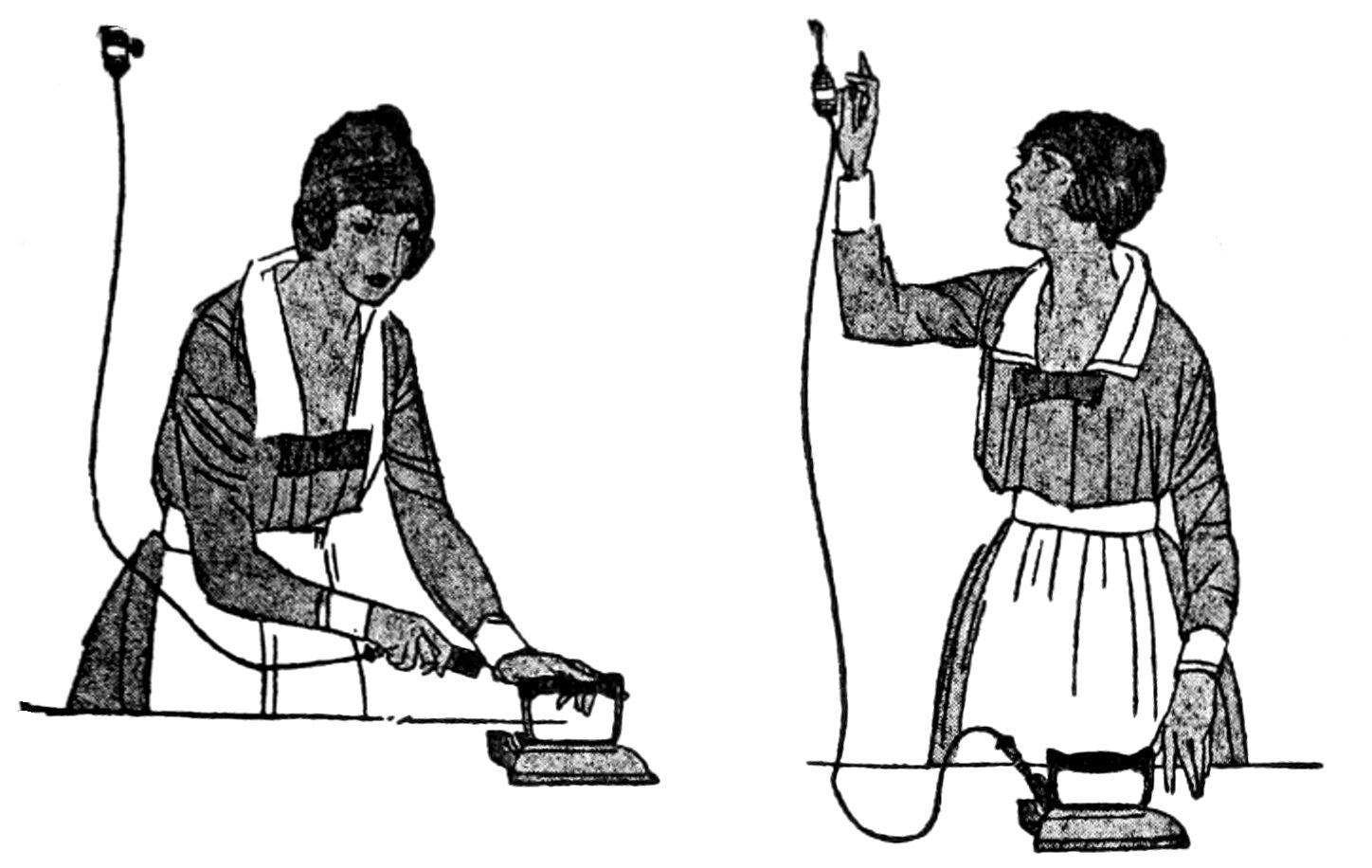
DETACH PLUG FROM IRON AS WELL AS FROM SOCKET IF YOU
WANT YOUR HOME INTACT
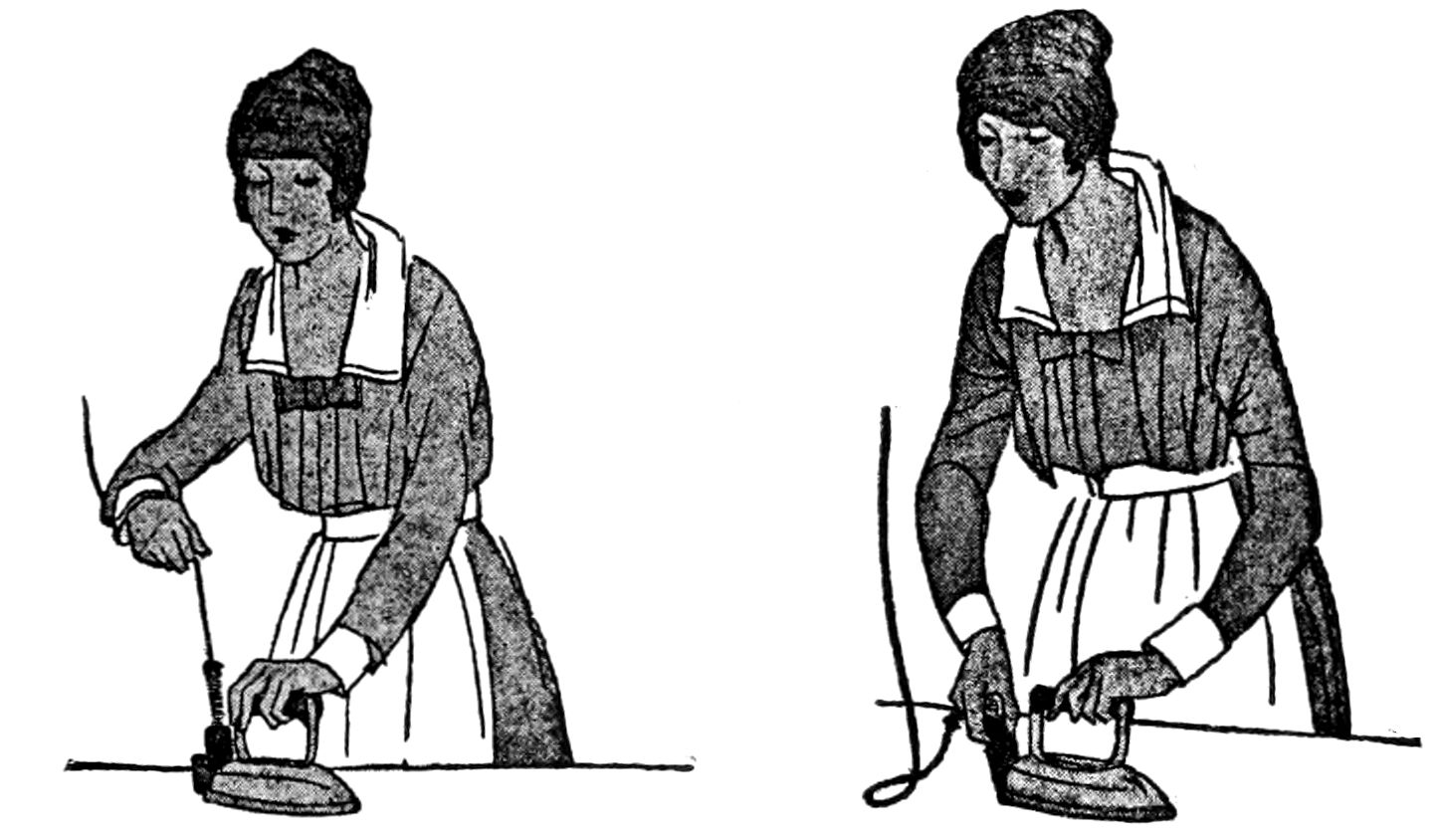
Courtesy of N. Y. Edison Co.
DON’T PULL THE CORD A MILE ABOVE THE IRON TO DETACH,
BUT TAKE IT DOWN CLOSE TO THE IRON. THIS SAVES THE
WIRES AND FIRES
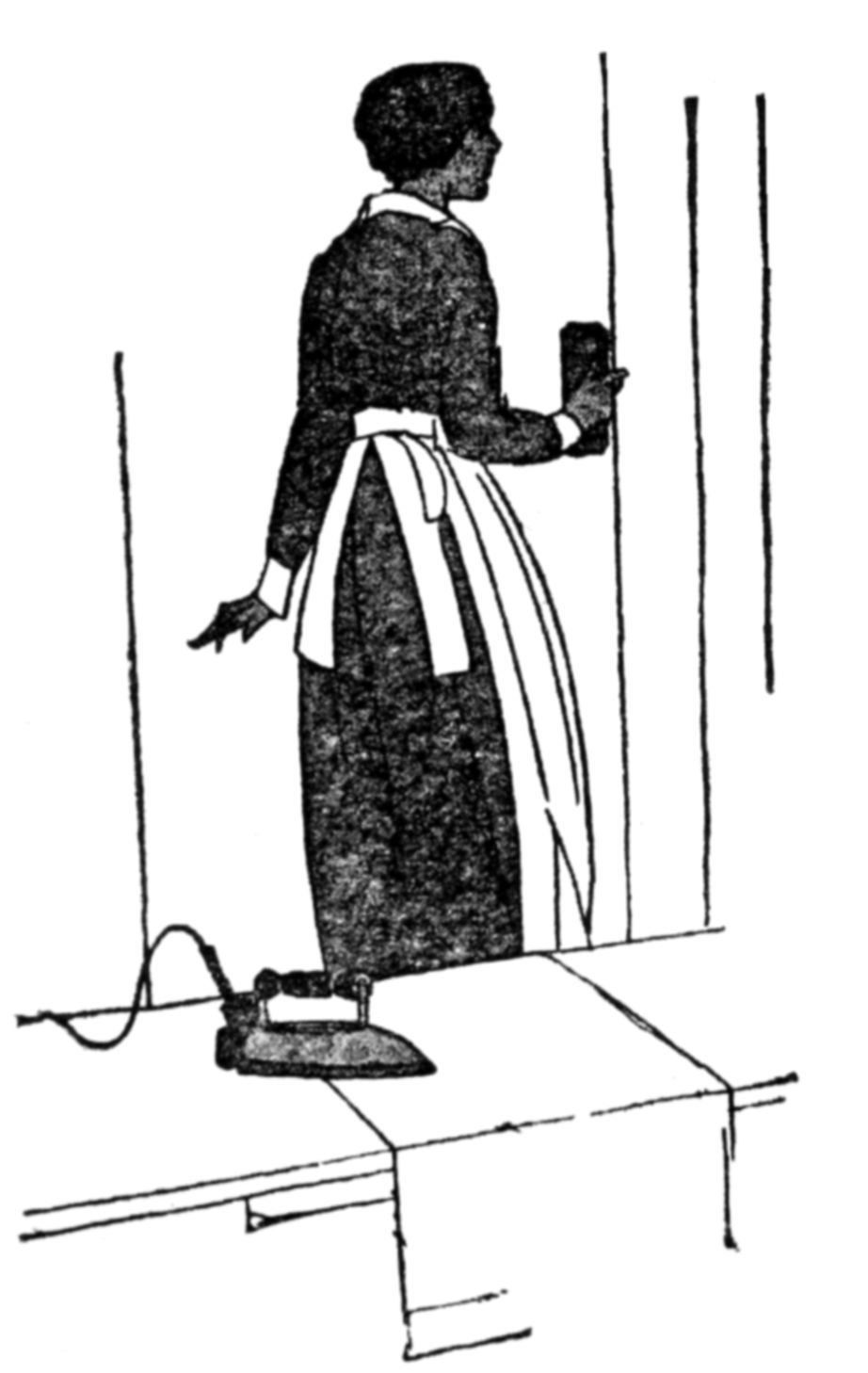
Courtesy of N. Y. Edison Co.
SHE HAS PREPARED THE WAY FOR
A NICE LITTLE FIRE
SHE IS CAREFUL AND HER IRON
WILL NOT PRACTICE ARSON
A metal waste can should be located at a convenient
place outside the garage for all waste and greasy rags.
Burn these every week. Never use sawdust or shavings
to absorb grease and oil. Scrub floor (if wooden)
occasionally with hot water and lye.
The use of gasoline for cleaning parts of the automobile
in the garage is a dangerous thing.
The garage should not be heated by means of stove
or open fire of any kind, unless same is isolated in
another room so that the gasoline vapors of garage cannot
possibly get to it. Gasoline vapor travels. Being
heavier than air, it seeks low levels. Ventilation should
be arranged to take care of vapors collecting near the
floor.
Keep an approved fire extinguisher and a pail of
sand in the garage. Water thrown on burning gasoline
merely serves to spread it.
In many cases water will quench fire. But in the case
of oils, alcohol and other volatile liquids and grease
fires water simply spreads the fire and you are in more
trouble than you were at first.
The eight firemakers in the order of their devastating
power are as follows: Electrical, due to carelessness
and lack of proper inspection; matches and smoking;
defective chimneys and flues; stoves, furnaces,
pipings and boilers; spontaneous combustion; sparks
on roofs, and petroleum and its products. From 1915
to 1919 the value of fires from these causes aggregated
$1,416,375,845. Is it any wonder that there is now
agitation all over the United States to have at least
thirty minutes given each week to the study of fire prevention?
Saving the home is better even than building
more homes.
Every home, of course, should be equipped with the
best possible extinguisher. There are any number of
them on the market. Do you know of many motorists
who refuse the call of the extinguisher? There are not
many who have not one in their car, yet there
are few homes with them. Large homes should have one
on every floor. Small homes, even if they have not
enough footage to lower their insurance rates, should
have them to reduce the fire hazard.
What kind should the householder buy? The chief
thing here is to buy one that has no fancy method of
operation, that simply by inverting the container
turns on a forceful stream; light as possible in weight,
not over 25 pounds and preferably about 12, so that a
woman can use it. Right there it is interesting to note
that The Fireman’s Herald reports that women daily
put out more fires and obviate conflagrations than men;
that were it not for the fact that women put out so many,
the fire peril would have been far greater.
Other things that you must demand in the extinguisher
are that it must have at least a stream of 20′
long; that there must be no suffocating fumes from the
chemical’s contact with the fire; that the chemical
must be as nearly stainproof as possible so that in a
small fire the room is not unnecessarily disfigured.
The chemical must not freeze readily at least not above
27 or 28 degrees Fahrenheit.
There is one extinguisher on the market to-day that
is gaining mightily in favor, because it spreads a foam
over the fire and cuts off the oxygen, and the laying of
the foam prevents a flash-back when the fire is nearly
out. At first this was used in the extinguishing of oil
fires, the heaviest and most difficult of all fires to put out.
For example, where a chemical engine took an hour to
do the trick this foam type took a few minutes.
This has the added power of expanding over eight
times its bulk in the container when released, so that
if the house type is used the container need not be
over 3⁄4 gallon and you really have about six gallons of
material for the fire. This does no more damage to
draperies than would water. It does not injure cottons
or wools and does not penetrate fabrics as many other
chemicals do. If it gets on one’s clothes it is easily
brushed off after it dries. On polished and varnished
furniture it has no effect and is easily washed off.
Reliable firms will always tell you correctly what
kind of an extinguisher to buy for your particular purpose.
They will, too, in compliance with the Board of
Underwriters’ rulings, watch the apparatus once a year
and recharge if necessary. Actually they don’t always
need it, but it is a wise ruling of the Board.
There are some extinguishers excellent for outdoors,
motor boating, etc., but which indoors are apt to give
off suffocating fumes.
There are extinguishers of large capacity on wheels
for large homes and large estates. These are a great
insurance against fire. They are built on narrow gage
wheels for rolling on floors in the house and heavier
construction for outdoor use. Many big estates use
these little two wheelers, as they are fire departments
in themselves.
A good quality fire hose is a mighty good assistance
in a large home, too, and is becoming very widely
used. Of course, there are many fires that water not
only will not quench, but will spread; on the other
hand, there are many little conflagrations that water
immediately will kill.
Another good method, but not as efficient, for use
in all conditions is the telescopic fire bucket set. Six
pails are set in a container in the liquid and all one
has to do in case of fire is to open the lid and each
pail comes out filled. If the fire is not great and has
just started and is within a few feet of you, this is
all well and good, but one can hardly throw water from
a pail as far as ten feet above your head, while with
the extinguisher the stream is from twenty to forty feet
in length. This pail system would not reach a roof,
you see, which the extinguisher might.
An intimate acquaintance with the wizardly asbestos
will do a lot in the home to keep the hearth fires
burning in their right places. The asbestos ironing
pad on the ironing board is a good resilient thing. Although
not in this case primarily meant as a fire preventive,
it will stop the iron from causing a big fire,
even if it should burn off the top sheeting, for when it
reaches the asbestos the fire will go out.
There are now some very convenient collapsible
ladder escapes which are stored in a small box near the
window, which makes the escape from a fire not dependent
on ancestors who were tight-rope walkers.
There are regular fireproof builders who do naught
else but fireproof work, but in this article we are only
concerned in the home after it is built. Yet we cannot
refrain from saying that the right architect and the
right builder at first will reduce your fire hazard; they
will adhere not only to the Underwriters’ rulings but
they will build a house so that its insulation (electric),
air insulation and circulation and partitions will be done
according to safe and wise arrangement.
Don’t do foolhardy things and think you can get
away with them.
Have the telephone number of the nearest fire station
on a special card at your telephone, or have fire departments
in your own home—extinguishers.
Familiarize the family with the operation of the
nearest fire alarm box. After operating a fire alarm,
stay near it to direct the fireman to the fire. Every
minute is significant.
Don’t fail to notify the chief of the fire department of
anything you may see that is dangerous or liable to cause
fire.
We could say to-day that in the home millions are
spent for fires, but hardly one cent for prevention of
them. Should we not as enlightened human beings take
thought and save the world some of its useless expenditure
of life, limb and extravagance?
There is now on the market a new little extinguisher
weighing about two pounds.
CHAPTER XLIII TAKING CARE OF THE HOUSEHOLD EQUIPMENT — Floor Coverings — Some Miscellanies
As
we have intimated before in these articles, the
best of everything may be yours, yet if you care
for them in slovenly, careless or uninformed ways it
will be as if you had nothing whatever of any value.
The persistent ignorance of the seemingly most enlightened
and experienced housekeepers as to the use
and care of the refrigerator is appalling. It is positively
amazing to see the breakage of sane rules of procedure
in favor of what seems to them proper. For
example, the best of housewives will insist on filling the
ice chamber of the refrigerator with but a suspicion of
ice and a riot of food, whereas the ice chamber is meant
for ice, and ice to the limit of its capacity, not once a
week but every and all day. Unless this is done the air
currents over which the manufacturer has slaved to make
possible will not occur, and the best refrigerator becomes
a useless thing. You might just as well get a packing
case and stuff it full of ice and food. The ice chest must
be full in order to cool the air and start the heavier
(cool) air falling through the chest, which as it descends
gets warmer, rises, passes over the ice, cools again and
drops—and so on in endless circulation. It is these
currents which keep the refrigerator cold; it is not the
ice cake itself. In a little ice box, yes, the food has to
be put into the ice chamber as there is no other, but here
you are not depending on the melting of the ice starting
air currents to descend and to rise. The problem is
quite a different one.
We think probably the difficulty with the owners of
refrigerators is that they have the ice box in mind and
it is an inherited notion that the food must be in close
proximity to the ice. This paragraph may seem a
digression, but it is purposely put in to emphasize the
fact that the ice box and the ice refrigerator are two
very distinct and different things. Therefore, be it
remembered that in the refrigerator you must not waste
the ice by cuddling warm provisions next it, because
your ice is like a battery. It, too, makes currents—not
electric, but air currents.
Now then, when we have the ice-making currents,
what happens to the air of varying degrees of temperature?
The coldest air is at the bottom of the refrigerator
(of course we are always thinking of the best
refrigerators) because cold air is heavier than warm air
and the warm air rises. Therefore, if you have odorous
things do not put them in the ice chamber because the
air starting down will carry odors along. Put the
odorous things and the things that should be kept coldest
on the lower shelves.
In some chests the currents of air are so good that
onions and butter never exchange compliments—a
highly snobbish society where there is little amalgamation.
One buyer of an expensive refrigerator said that his
refrigerator was a great disappointment because the ice
chamber leaked. Now this was a strange thing, for
these ice chambers are made of the best workmanship
known to refrigeratordom. Everything was questioned:
Did you keep your ice chamber full? The
reply: Yes. Did you keep things other than ice in the
ice chamber? The orthodox answer came: No. Do
you close the door of the ice chest completely? Answer:
Yes.
So the repair man went to the house to give the
erring chest a stethoscoping and found that the floor
of the ice chest’s compartment was a little uneven and
the water was forced from the melting ice into foreign
channels and escaped through the front of the ice
box, dropping in streaking lines on the front façade.
This is but a minor point, yet the refrigerator or the
stove or the vacuum cleaner or the anything is often
blamed for misplacements, lack of care and ignorance
on the part of the operator, and this article is meant
to forestall a very few of them.
Here, then, are some things to watch out for:
1. Keep the doors of the refrigerator closed always.
If they don’t close easily, see to it that something
is done to make them close.
2. If you have a refrigerator with a lot of movable
parts it is well to remove them and immerse in
hot water occasionally. But don’t buy one that has
many outgoing parts; it’s unnecessary and a constant
bother to adjust.
3. Once a week wash out the whole chest with warm
water and soda; never use strong smelling soaps. Ammonia
can be used but it is probably best to use
soda. Hot water cleans better, of course, but it will
give the ice more cooling to do and if the box is
cleaned regularly cool water ought to do the trick
well enough. However, every so often the hot bath
is a good thing.
4. Every day wash off the ice that newly enters
the ice chamber.
5. Never wrap the ice in paper thinking to save
ice, because ice only makes cold air by melting. Here
is a place where the good and saving housekeeper
saves ice to the destruction of her food stuffs, yet this
is the hardest bit of politics to propagate.
6. If the lining gets discolored use some harmless
preparation to remove the stains.
7. It is sometimes a good idea to put a piece of
waxed paper around highly odorous foods.
8. Wash everything in the way of utensils that are
put in the box. Have a regular refrigerator set of
dishes.
9. Wash vegetables before entering, for if there is
anything introduced in the way of foreign matter, the
enemy alien may make for odorous trouble.
10. Cover any receptive foods; it’s wisest even
with the most perfectly ventilated refrigerators.
Liquids will dry up a bit with a dry air circulation
and egg yolks kept in water will keep better if the
water is changed daily. If dampness collects in your
refrigerator something is wrong.
11. Wash off the outside of refrigerator with damp
cloth every week.
12. Remove ice rack and scrub well in water and
soda weekly.
13. Boil parts (removable) twice a month or use
very hot water.
14. Dry case thoroughly after every douching.
15. If the refrigerator is well connected to drain,
a little hose to flush the interior will be simple and
easy.
16. The drain pipe must be carefully flushed, as
here the invading army of typhoid, etc., loves to encamp
and make inroads. See to it that the drain
pipe is easily removed and cleaned and that the drain
pan (should the drain pipe have no outlet into the
plumbing system) be easily removed at least once a
week to be cleaned out.
With these few words we will leave probably the
most familiar bit of household mismanagement to a
reforming public, and pass on to some floor coverings.
In the case of linoleum and similar floorings we
will take for granted that they are perfectly laid down
and that all that there is for us to think about is the
nursing of them. Even the cheaper (printed and not
inlay) of these floorings will last years if the following
suggestions are absorbed and put into regular practice:
Sweep linoleums daily. This is easy.
Use an oil mop daily.
Never use anything but a mild soap and tepid water
for cleaning.
Then rinse with clear water and dry thoroughly. It
should be done a square yard at a time, each yard carefully
dried before going to the neighboring yard. Do
not flood when a mop is used.
Elbow grease, mild soap and warm water are all that
is necessary.
Avoid as the plague: lye, soda, potash and all cleaning
inventions which may harbor lyes!
Polishing makes the flooring last longer, of course.
Colors will be reborn each time and the floor withstand
wear better. Use a good floor wax. A home-made
kind, if you can’t buy any of the finest kinds on the
market, can be made of beeswax and turpentine in
equal parts. Use all the polishes sparingly and not
more than once a month. Rub in well, however, when
you are doing it.
It is well to have glass or metal caps on heavy furniture
as narrow castors are prone to furrow.
For cork floors:
Sweep daily.
They must be washed with tepid water and weak soap.
Polishing is unnecessary.
Floors of tiles, etc., should be swept daily. Flush
with warm water. Scrub once a week, strong soap and
elbow grease. Soda and water will remove stains. If
not, use a weak hydrochloric acid or oxalic acid and
wash off immediately with water and soap which will
stop the further action of the acid on the tile. (One
part of acid to two parts of water.)
Wooden floors also should be swept daily. Swab
(don’t scrub a varnished or painted floor) with warm
water and weak soap. Keep hardwood floors free from
grit, which bites and grays. Use a soft dry mop of felt
or the brushes the reliable manufacturers make for the
hardwood floors. Occasionally wipe off with some well
known and tested floor finish.
To-day with rustless and ordinary steel the problem
of cutlery is simpler and yet more diversified. In the
case of cleaning and scouring ordinary steel you can use
almost any good scouring powder, but not in the case
of the stainless rustless variety, as it reduces the polish,
the very thing that maintains imperviousness to rust
and stain. Cutlery should be cleaned immediately
after using.
Sharpening knives is best done by an expert. Yet
there are good rotary sharpeners and stones and steels
for home usefulness or knife destruction depending
upon how they are used. Remember when you use a
stone not to feel that you must cut through the stone
itself and that what you are trying to do is to flatten
the edge of the knife and wear off the offending bluntnesses.
The ideal thing is once or twice a year to send
the knives to a grinder and then occasionally at home
run the knife blade flatly over a carborundum stone to
get a smoother edge.
The stainless steel cutlery has a special kind of sharpening
stone at present on the market and it is well to
use this.
Good knives need no further edging when new.
But though you may have the best steel and the best
sharpening, if you house your knives badly you will
have lost all the good from these things that there is. It
is not good for knives to be huddled together. They
get as cutting as humans would in the same position.
If they live in a small place together without their own
places they, as people, wear on each other. They knick
each other’s blades and spoil each other’s usefulness.
Knives should be hung or laid in grooves. A box is now
made for the proper housing of them. You can, too,
hang each knife on a spring which you can get at a
hardware shop. If you reserve a tenement house law
for the knives of your household you will have real
health and help from them.
The same story holds for forks. It would be a good
thing to have a verboten sign in your kitchen, reading:
“It is forbidden to open cans, uncork bottles, unlock
oven doors, pry open ice chests, take a nail out of a box
with the forks in this kitchen.”
In the case of wooden handles, do not let them remain
soaking in hot water for ages. Wash and clean them
at once.
Floor coverings such as mattings and carpets are to-day
best taken care of by the vacuum cleaner. Hot
water cloths with a suspicion of ammonia laid on top of
matting are supposed to be a good thing for its longevity
after it is vacuumed.
Carpets are now coming back into being after years
of retrogressive hate. Now on account of the vacuum
cleaner they can be used in all their warmth and beauty
and kept sanitary for ordinary uses by the vacuum
cleaner. Talking of this:
The only thing that this instrument of redemption
needs is oiling, but not too often; an occasional dusting
off; and the emptying of the dust over something
that doesn’t give it back.
Stoves of themselves don’t get very dirty. It is the
foods that are the transgressors. It is wisest to clean
all stoves when cold. Use kerosene or stove black.
In the case of the gas stove, when the gas vents become
clogged by drippings of food it is well at least once a
week to take them out and emerse in soda and water.
Wipe off grease and grit before cleaning surface of stove
and always remove dirt at once. If grease is removed
after every using of the stove, it will be very easily
maintained in cleanliness and it will never run away
with you.
The trays under the burners in gas stoves should be
cleaned often and well. Burners of oil stoves, too, can
be immersed in soda and water. About one quart of
water and one-quarter pound of soda make a good
cleaning solution.
Don’t let any solid foods get into the sink. Always
have a good sink strainer. Soda and water is a good
cleaner. Flush sink with hot water and clean it at least
three times a day. Grease is a forbidden quantity in a
sink and should any get in, the hot water flushing will
disintegrate it. Warm water and soap, fine powders
such as whiting, etc., will keep porcelain sinks in good
order.
Nickel can be cleaned with soap and water and polished
with ungritty, well devised polishes. Never use
anything that will scratch it.
Boil iron in soda and water, rub with some good
powder with a bit of scratch in it. Use hot soap suds.
Dry while it is hot.
Do not use soap on aluminum; there are regular
aluminum cleaners on the market. Occasionally only
use a little acid, such as lemon or tomato diluted.
Never use soda.
Boil agate in soda water. Wash in hot soap suds and
dry.
Use dilute oxalic acid for cleaning brass, fine powder,
plenty of water. Polish with metal polish which
abounds on the present market.
Tin can be cleaned with soda and water, but do not
leave it in this solution long, as the alkali will eat the
tin. Wash and dry at once or you will have rust on
your tin ware.
The silver story is long but well known. The only
thing not to do is to use gritty powders that will scratch.
Wash your silver after cleaning, as the cleaning mixtures
do not make good appetizers.
In caring for electric ironers and washing machines,
first of all read the directions that come with them. Oil
as they tell you or don’t oil; too much oil is bad and
too little is bad. Do not overload (with clothes) your
cylinder or your drum; some motors rebel and there is
trouble. When buying your washer be sure to tell the
electrician what kind of electricity you consume, whether
it is A C or D C; also the voltage of your circuit. This
applies to all electric machinery.
Don’t leave your electricity on when you are not
using a device. If you do in the case of the iron, you
will have fires and all kinds of trouble. Don’t blame
the machine for faults of your own. Remember in the
case of the electrical ironer that heat is hot and that if
you leave a piece of goods on the roll and the motor
going you will burn your article.
These things are cleaned with warm water and polished
and dusted in accordance with the ordinary metal
needs. There is little to say about their upkeep except
what has been said about other devices. Follow the
directions of the makers; they know the exigencies of
their offspring.
Soft cloths and warm water are best for cleaning
white wood enamel. Soaps yellow the enamel, so a few
drops of ammonia added to a pail of water will help
banish grease.
Warm water and soap or soda and warm water will
clean off marble tops.
In the long life-assurance of metals generally, it must
be born in mind that in order to keep them clean and
bright things must be used that will not scratch, corrode
or roughen—or at least do as little of these things as
possible. In the case of silver cleaning the aluminum
pan method is best because there is less corrosion and
less roughening.
Rubbing with soft chamois and cloths after cleaning
will give the metal the polish it often needs. Buffing
and the use of pumice powders and pastes help along the
better finishes. But these things all must be done in
moderation to preserve the life of these metals. The
more precious gold or silver must be treated of course
with great care. Chemicals are dangerous and the best
acids are lemon and those things which cannot poison.
Many combinations are poisonous and must be used with
discretion and the article well washed before using.
Were the space allotted for this story greater we could
take up many more things, but space being the rarest of
commodities we shall have to end with one last admonition:
When your devices do not work, as guaranteed,
first look to yourself or assistant and see what is wrong.
Then if you find you can absolve yourself from the
great transgression—carelessness or ignorance—it will
be time enough to attack the dealer and get redress.
CHAPTER XLIV A FEW SUGGESTIVE BOOKS — Transcriber’s Notes
The following list is to give the reader a handle to
the subjects lightly touched in this volume.
The Home. Charlotte Perkins Gilman, C. P. Gilman.
Housewifery. I. R. Balderston, Lippincott.
The Business of the Household. C. W. Taber, Lippincott.
The Principles and Practice of Plumbing. C. C. Cosgrove,
Standard Plumbing Manufacturing Co., Pittsburg.
Sanitation Practically Applied. H. G. Wood, John
Wylie & Sons.
Kitchen Fire and How to Run It. S. S. Wright, S.S.
Wright.
Formulas for Soaps and Cleaning Compounds. Automatic
Electric Washer Co., Newton, Iowa.
Electric Cooking, Heating and Cleaning. Out of print
but in Libraries, Maud Lancaster, D. Van Nostrand
Co.
Harpers’ Every Day Electricity. Don Cameron Shafer,
Harper.
Home Canning. Creswell and Powell, U. S. Farmers’
Bulletin 853 (Bureau of Agriculture).
Fuels for the Household. Marion White, Whitcomb and
Barrows.
Successful Drying Community Plant. U. S. Dep’t.
Agriculture Farmers’ Bulletin 916.
Materials for the Household. Circular 70, U. S. Dep’t.
Bureau of Standards.
Safety for the Household. Circular 75, U. S. Dep’t.
Bureau of Standards.
The New Housekeeping. Christine Fredericks, Doubleday
Page.
Laundering at Home. Six Bulletins, Stains, Supplies,
Cottons, Linens, Washing Machines and Ironing
Equipment. Am. Washing Machine Mfg. Assc.,
Chicago.
Little Houses. Flagg.
House and Garden Homes. Condé Nast Co.
Successful Homes and How to Build Them. Francis
White, Macmillan.
Hand Book of Cleaning. Sarah McLeod, Harper
Brothers.
Home and Community Hygiene. Jean Broadhurst, J.
B. Lippincott.
Preserving, Dehydration, etc. Government Bulletins.
Modern Plumbing. Starbuck, M. P. & F. Pub. Co.
200 5th Ave.
Home Laundering. L. Ray Balderston, L. R. Balderston.
Domestic Engineering. Plumbing, Heating Weekly Dec.
13-20—19.
Good Housekeeping Institute Engineering. Good Housekeeping.
Vacuum Cleaning Systems. M. S. Cooly, Heating and
Ventilation Magazine.
Chemistry. Herman Vulté.
Chemistry and Physics. May B. Arsdale, Dr. Woodhull.
Bureau of Building Bulletin 1922, N. Y. C. Municipal
Building. U. S. Government Bulletins on all home
problems, see the list of the U. S. bulletins on all home
processes.
Building, Plumbing, Fire, etc. Bulletin Bureau of
Board of Standards and Appeals, City of N. Y., Dec.
23, 1919.
Bulletin Bureau of Board of Standards and Appeals
City of N. Y. Building, Plumbing, Fire etc., Dec. 23,
1919.
More Leisure Hours. Louise Read—Society for Electric
Development Pamphlet, 522 Fifth Ave.
U. S. Government Pamphlets. Bureau of Printing,
Washington D. C. (Sup. of Documents).
Electrical Record. (Magazine) McGraw Hill Co. Inc.
Electrical Merchandising. (Magazine) Gage Pub. Co.,
Inc.
Laundry Pamphlets. Wallace B. Harts.
The language used in the source document, including unusual, archaic, inconsistent and erroneous spelling, hyphenation
and capitalisation, has been retained, except as mentioned below. The same applies to grammatical errors,
missing words and punctuation, confusing or contradictory texts, the inappropriate use of units, etc.
For no apparent reason the titles for chapters XXXVII-XL and XLII are given in Small Capitals as
distinct from the other chapter titles.
Neither spacing inconsistencies (for example between numbers and their units) nor textual inconsistencies (for example
in prices or in the use of principal vs. principle) have been standardised.
Page xxii, ... safe and sure insect ostracizer: the caption under the illustration is ... safe and sane insect
ostracizer.
Page 6, cost calculation: as printed in the source document, despite obvious errors and inconsistencies.
Paragraph starting “It is necessary when ordering a range ...: the closing quote mark is lacking.
Pages 100 and 104, see Plan 1: this was not present in the source document.
Page 131, ... mixture of 21 parts nitrogen, 79 parts of oxygen ...: the proportions should be reversed, and should be
read as parts per 100 for nitrogen and oxygen, not per 10,000.
Page 221, flavoring cream with or without condensed milk.: there may be a comma missing between flavoring and cream.
Page 221, ... (granites frozen by oscillation and frappés ...: the closing bracket is lacking from the source document.
Page 262, paragraph starting You are particularly interested ...: one or more words may be missing.
Changes made:
Illustrations have been moved out of text paragraphs. For the sake of clarity and legibility some texts have been
transcribed from illustrations; these are surrounded by a dashed box.
The (single) footnote has been moved to directly underneath the paragraph to which it refers.
Some obvious minor typographical and punctuation errors have been corrected silently.
Several tables have been split or re-arranged slightly for better readability; in some tables ditto marks have
been replaced with the dittoed text.
Page 8: ... a filament or tungsten ... changed to ... a filament of tungsten ....
Page 35: ... release on ringer ... changed to ... release on wringer ....
Page 36: ... six drying rods 66′ long ... changed to ... six drying rods 66″ long ....
Page 37: ... new avid air ... changed to ... new arid air ....
Page 57: closing quote mark inserted after ... running and installation costs?
Page 65: ... upon which to place the utensil ... changed to ... upon which to place the utensils ....
Page 68-69: ... a figure out of the unit ... changed to ... a figure but of the unit ....
Page 74: ... oven arrangement and unit system is so arranged ... changed to ... oven arrangement and unit system are
so arranged ....
Illustration after page 74: Courtesy of Brainhall Leane Co. changed to Courtesy of Bramhall Deane Co.
Page 141, table: Branch wastes for slop sinks changed to Branch waste for slop sinks.
Page 245: ... is varnish and finish steamproof ... changed to ... is varnished and finished steamproof ....
Page 260: comma inserted after ... for they hold enough water
Page 335: Heading Principles changed to Principles.
Page 359: Temperature effect densities ... changed to Temperature affects densities ....