A
Abjuration of the Realm, 285
Aldersgate, 117
Aldgate, 30, 56, 76, 77, 93 ff., 116, 117;
tower, 78, 266
All Hallows Stonechurch, 77
Angle, Sir Guichard de, 51
Anne of Bohemia, Queen, 56, 208
Antwerp, 13, 14
Archery, 232, 235, 236, 240
Architecture, 119
Arundel, Archbishop, 142
"Earl, 311
Attechapel, Bartholomew, 26
B
Badlesmere, Lord, 297
Banastre, Katherine, 184
Becket, St. Thomas à, 142, 143, 169, 288
Bedfellows, 87, 140
Belknap, Chief Justice, 264
Berkeley, the family of, 52, 179, 195 ff., 239, 240
Bishopsgate, 15
Black Death, 304
Black Prince, 17, 176
Blanch Apleton, 78
Blanche, Duchess of Lancaster, 37
Blountesham, Richard de, 96
Boccaccio, 47, 48
Books, cost of, 99
Boughton-under-Blee, 167
Brembre, Sir Nicholas, 60, 94, 135, 193
Brerelay, Richard, 63
Bribery, 200
Bristol, 239, 240
Buckholt, Isabella, 65
Bucklersbury, 16
Bukton, 68
Burley, Sir John, 51
Burley, Sir Simon, 54, 60
Burne-Jones, 29
C
Cadzand, 133
Caen, 77;
siege of, 248, 249
Calais, 10, 174, 183
Cambridge, 8, 77, 274, 302
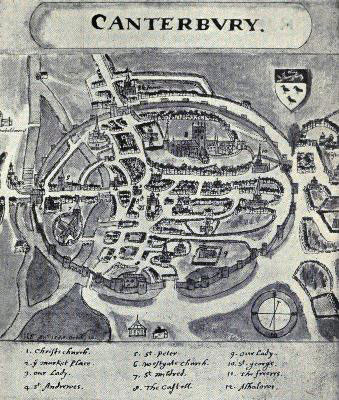
Canterbury, 76, 140, 143, 145, 167, 169, 170, 271, 297
Chandos, Sir John, 175
Charing Cross Mews, 61
Charles V. of France, 33, 52, 122
"VI. of France, 70
"de Blois, 252
Chaucer, Geoffrey, and Aldgate, 56, 93 ff., 101;
his aloofness, 69, 95;
his birth, 3, 15;
and Boccaccio, 47;
and books, 95 ff.;
his childhood, 17;
clerk of Love, 222;
his Clerkship of Works, 60;
his Comptrollership, 54;
at Court, 173;
at the Custom House, 76, 79;
and Dante, 43, 74;
his death and tomb, 73;
in debt, 54, 59, 64, 65;
his debt to Dante, 45;
his family, 12;
his favour from Henry IV., 66;
his freshness, 114;
at Greenwich, 62;
his house at Westminster, 72;
his last poems, 68;
his literary development, 137;
in London, 53;
loses Clerkship, 63;
loses Comptrollership, 58;
in love, 22;
his love of Nature, 112;
and Lynn, 15;
his marriage, 27;
optimistic, 10;
origin of name, 12;
his originality, 39, 45;
as page, 21;
in Parliament, 56;
his pathos, 246;
and Petrarch, 46, 48;
his philosophy, 70;
and Piers Plowman, 71;
his raptus, 54;
and religion, 44, 149, 309 ff.;
his retractation, 72;
robbed, 63;
as royal yeoman, 27, 31;
as squire, 32;
his times, 1;
his travels, 35, 40 ff., 51;
in war, 25;
his wide experiences, 74;
his wife’s death, 59;
and wine, 79;
and women, 119;
his writings, 36, 56, 64;
and Wycliffe, 308
Chaucer, Elizabeth, 74
"John, 14, 15, 17, 20, 21, 22, 26, 27, 193
"Lowys, 55, 64, 73
"Philippa, 27, 28, 29, 30, 59, 96, 101, 103, 104, 178
"Richard, 13
"Robert Malyn le, 12, 13
"Simon, 283, 284
"Thomas, 31, 73
Chaumpaigne, Cecilia, 54, 55
Chausier, Elizabeth, 74
Cheapside, 16, 81, 88, 89, 90
Child-marriages, 198, 204, 206, 207
Children beaten, 215
Chiltern Hills, 117
Chimneys, 86
Chivalry, decay of, 190;
golden age of, 189;
and marriage, 202;
theory of, 188
Church, buildings decayed, 297;
corruption of, 296;
talking in, 140
Churchman, John, 79
Clarence, Lionel of, 13, 21, 22, 48, 49, 52
Clergy, and hunting, 280, 281;
in Parliament, 7;
unpopular, 306, 308;
youth of, 299
Clerical, criminals, 288 ff.;
education, 300 ff.;
immunity, 288 ff.;
influence, decay of, 8 ff.;
morality, 156, 157, 159, 197, 281, 291, 296, 297, 298, 303
Clerkenwell, 264
Comfort, ideal of, 191, 192, 257
Compostella, 140, 141, 142
Compurgation, 289
Conscription, 234 ff.;
and liberty, 251, 253, 263;
and peace, 250
Constance, Duchess of Lancaster, 30
Contrasts, 176
Cornhill, 81, 107, 112, 291
Crécy, 232, 233, 238, 239, 240, 242
Crime and punishment, 283
Cripplegate, 77, 93, 94
Crusades, decay of, 190
D
Dancing, 108
Dartford, 154
Dartmouth, 133, 134
David, King of Scots, 17
Dennington, 13
Despenser, Bishop, 237
"Edward, 49
Dilapidation, 297
Divorce, 205
Douglas, Sir James, 238
Dovecotes, manorial, 196
Du Guesclin, Bertrand, 241, 242, 244
E
Eavesdroppers, 83
Edward I., 6, 77, 122, 194, 213, 234, 235, 290
"II., 179, 254, 297, 311
"III., 4, 6, 9, 10, 13, 14, 16, 25, 26, 27, 32, 33, 35, 38, 42, 53, 59, 70, 88, 122, 123, 126, 133,
172 ff., 191, 194, 197, 234, 235, 237, 238, 240 ff., 249, 263, 275, 292, 298;
bankrupt, 126;
his character, 173;
his court, 33;
his marriage, 178;
his Rhine journey, 13
England, growing wealth of, 126;
unsettled state, 67
English, commerce, 122 ff.;
democratic, 253;
fickleness of, 134;
language, 3 ff.;
language in Chaucer’s poems, 74;
in war, 244, 254
Epping, 116
Exeter, 99, 182, 301
F
Fastolf, Sir John, 211, 212
Florence, 40, 42, 43, 48
Food of the poor, 268
Foreigners in England, 123
Forrester (Forster), Richard, 52, 94
Frederick II., Emperor, 190
Free-thought, 44, 125, 309 ff.
French and English nobles, 33;
language, decay of, 3 ff.
Friars, 294, 298;
and usury, 124
G
Games, 109, 272 ff., 275
Gascoigne, Chief Justice, 211, 212
Gaston, Count of Foix, 175, 209, 211
Gauger, William le, 15
Gaunt, John of, 13, 17, 22, 30, 37, 54, 59, 60, 73, 74, 96, 227, 264, 308
Genoa, 40, 42, 78, 122
Giffard, Bishop, 278, 299
Gisers, John, 16
Glass windows, 83
Gloucester, Thomas, Duke of, 60, 186, 187, 239
Gower, John, 52, 73, 117, 145
Gravesend, 80
Greenwich, 62, 64
H
Hampstead, 116
Harbledown, 169
Hatfield, William of, 184
Hawkwood, Sir John, 52, 242
Henry II., 235
"III., 72, 193
"IV., 4, 59, 66, 67, 68, 72, 73
"V., 73, 243, 278, 297
"VI., 311
Heriot, 260
Highgate, 116
Hoccleve, 73, 175
Holborn, 19, 115, 117
Holidays, 273
Holland, Sir Thomas, 248
Home life, 84, 96, 104, 218
Hornchurch, Prior of, 78
Hospitals, and bad meat, 132
I
Infidelity, 313
Inns, 139
Invasion of England threatened, 94
Ipswich, 12, 13
Irreverence, 140, 141, 157, 275, 276, 277 ff., 297, 298
Isabella, Queen, 21, 51, 178
Isle of Wight, 133
J
Jean de Saintré, 23, 223
John XXII., Pope, 206
John, King of France, 17, 32, 33, 41, 194, 197, 223
Justice, 282 ff.;
and money, 197, 200
K
Kent, John, 80
Knighthood, of boys, 212;
cheapening of, 193;
decay, 242;
imperfect, 252;
and trade, 194, 210, 211
Knightsbridge, 115
Knolles, Sir Robert, 265
L
La Rochelle, battle of, 133
Lancaster, Thomas of, 311
Langham, Bishop, 279
Laws and penalties, 129
Lisle, Lord, 198
Lollardy, popularity of, 306
London, its byelaws, 126;
citizens’ furniture, 85;
city walls, 77;
its churches, 82;
and country, 114, 193;
its Custom House, 79;
gardens, 115;
gate dwellings, 93;
growth of, 121;
its houses, 82, 84;
and Lollardy, 307;
population of, 115;
power of, 135;
sanitation, 267;
sports, 275;
its streets, 81, 84, 88;
suburbs, 116;
view of, 145;
water, 128
London Bridge, 51, 145
Louis, St., 190, 191
Love, and chivalry, 217 ff.;
earthly and heavenly, 222;
in M. A., 22, 28 ff.
Ludgate, 93, 116
Lynn, 15, 17, 77, 80, 193, 238
M
Manslaughter, 292;
and punishment, 283
Marriage, ceremonies, 109;
of children, 198, 204, 206, 207;
and chivalry 202;
and the Church, 204;
and irreverence, 281;
laws lax, 206;
and love, 227;
and money, 195, 206, 209 ff., 227.
Massingham, John, 28
Mauny, Walter de, 175
May-day, 107
Mazelyner, John le, 15
Mercenary troops, 241
Mercer, 134
Merchants, tricks of, 125
Merchet, 260
Michael, St., Aldgate, 77
Mile End, 264
Militia, 240;
and liberty, 253
Money, power of, 99, 132, 191, 200, 258
Moorfields, 15, 18
Moorgate, 15
Morris, William, 29, 81
Mortuary, 260
Murder, 89
N
Nations at universities, 6
Nature in the Middle Ages, 104
Neville’s Cross, 183, 238
Newcastle coal, 114
Newgate, 61, 93
Norfolk pilgrimages, 140
Northbrooke, Bishop, 184
Norwich, 48, 82, 129, 131, 236, 238, 265, 284
O
Oaths, 155, 163, 169
Ospringe, 167
Oxford, 6, 8, 84, 115, 274, 278, 300, 301
P
Paris, 83, 233, 300
Parliament, growth of, 7, 9, 132;
power of, 58
Paston, the family of, 229
Peasants’ Revolt, 261 ff.
Peckham, Archbishop, 290
Percy, Sir Harry, 51
"Henry, 17
"Sir Thomas, 51
Perjury, 201
Perrers, Alice, 186
Petrarch, Francis, 48, 50, 166
Pevensey, 176
Philippa of Hainault, Queen, 13, 14, 33, 178, 179, 180, 181, 183, 184, 185, 253;
description of, 181
Philippe de Valois, King of France, 174, 191, 235, 242, 243, 245
Philpot or Philipot, John, 134, 193
Picard, Sir Henry, 16, 17, 193
Piers, Bishop, 279
Pilgrimage, decay of, 138 ff., 171
Pillory, 131
Pisa, 43
Police, 251
Poor and rich, 257 ff.
Poore, Bishop, 277
Portsmouth, 133, 239
Priests and people, 260
Privacy, want of, 88
Processions, 88;
and bloodshed, 278
Punishment, corporal, 213 ff.;
public, 91
Purgation, 289
R
Ransoms, 198, 200, 233
Reims, 25
Rich and poor, 176, 254, 257 ff.
Richard II., 7, 17, 32, 34, 51, 52, 56, 58, 59, 60, 65, 66, 67, 73, 79, 88, 90, 135, 175, 187, 208, 209, 217, 255, 264, 266, 280, 308, 311
Rochester, 159
Roet, Katherine, 30
Rottingdean, 133
Rye, 133
S
Saint Mary Aldermary, 283
Sanctuary, 283 ff.
Scalby, John, 59
Scarborough, 134
Schools, 20
Scogan, Henry, 64, 68
Scrope, Archbishop, 311
"Stephen, 211, 212
Serfs, 259
Sluys, 10
Smithfield, 62, 88, 264
Somere, William, 73
Southampton, 249
Southwark, 19, 115
Stace, Thomas, 13
Stapledon, Bishop, 89, 299
Stepney, 116
Stodey, John de, 193
Stratford bread, 114
Strikers, clerical, 305
Strode, Ralph, 117, 118
Stury, Sir Richard, 26, 51, 62, 308
Sudbury, Archbishop, 90, 142
Swaffham, John de, 130
Swynford, Sir Thomas, 30
T
Tavern company, 92
Thoresby, Archbishop, 281
Thorpe, 142
Tottenham, 116
Tournaments, 88, 197;
forbidden, 243
Town and country, 115, 120
Trades’ Unions, 270
Travel, dangers of, 41
Tyler, Wat, 19, 142, 145, 264, 265
U
Ulster, Countess of, 21, 27
University, 6, 8;
discipline, 300 ff.;
and sports, 274, 277, 280
Upton, John de, 283
"Robert de, 283
Urban VI., Pope, 70
Usury, 194
V
Vintry Ward, 15, 16
Violante Visconti, 48
W
Wager of Battle, 213, 282
Wages of workmen, 269
Walbrook, 15, 16
Walworth, 193
War, conscription and liberty, 133, 242, 246, 251, 253, 255;
the Hundred Years’, 232;
losses in, 199;
private, 133;
ravage of, 246 ff.
Wardships, 195, 197, 211
Warham, Archbishop, 143
Wells, 87
Wenceslas, Emperor, 70
Westhale, Joan de, 13, 55
Westminster, 16, 32, 33, 57, 60, 63, 64, 88, 89, 115, 116, 184, 189
Winchelsea, 133, 239, 249
Windsor, 21, 53, 61, 62, 64, 96, 175, 176, 185
Women, beaten, 213;
emancipation of, 220;
life of, 107;
manners of, 109, 219 ff.
Woodstock. See Gloucester
Worcester, 289, 290
Wycliffe, 8, 10, 22, 306, 307, 308, 310;
and serfage, 262
Wykeham, William of, 274, 277
Y
York, 179, 184
PRINTED BY
WILLIAM CLOWES AND SONS, LIMITED,
LONDON AND BECCLES.
Footnotes:
[1] See Jusserand, “Hist. Litt.,” L. III., ch. i., and the Preface to his
“Vie Nomade”; also chap. xix. of Prof. Tout’s volume in the “Political
Hist. of Engd.” It is nearly one hundred and fifty years since Tyrwhitt
showed, by abundant quotations, the stages by which English fought its way
to final recognition as the national language.
[2] Froissart, ed. Luce, i., 359, 402. There was in 1444 a similar attempt
to keep up Latin and French among the Benedictine monks, since from
ignorance of one or the other language “they frequently fall into shame.”
Reynerus, “De Antiq. Benedict,” p. 129.
[3] “He chalenged in Englyssh tunge” (“Chronicles of London,” ed.
Kingsford, p. 43, where the exact form of words used by Henry is recorded;
cf. Dymock’s challenge, ibid., p. 49).
[4] It is difficult to go altogether with Prof. Skeat in his repudiation
of the sense commonly attached to this phrase (note on Prologue, i., 126).
Chaucer seems to say that the Prioress (a) knew French, but (b) only
French of Stratford, just as he explains that the parish clerk (a) could
dance, but (b) only after the School of Oxenford. For this Oxford
dancing, see Dr. Rashdall’s “Universities of Europe,” ii., 672.
[5] For the most interesting account of this fusion, see Jusserand, “Hist.
Litt.,” p. 236. (Bk. III., ch. i.)
[6] “English Garner,” 15th century, ed. A. W. Pollard, p. 240; J. R.
Green’s “Short History,” p. 291. “And one of them named Sheffield, a
mercer, came into a house and asked for meat, and especially he asked
after eggs; and the goodwife answered that she could speak no French, and
the merchant was angry, for he also could speak no French, but would have
had eggs, and she understood him not. And then at last another said, that
he would have ‘eyren’; then the goodwife said that she understood him
well. Lo, what should a man in these days now write, eggs or eyren?”
[7] See the cases given in full by Thorold Rogers, “Oxford City
Documents,” pp. 168, 170, 173, and H. Rashdall’s “Universities of Europe,”
ii., 363, 369, 403.
[8] See the articles by Prof. Maitland and Mr. A. L. Smith in vol. ii. of
“Social England.”
[9] Cf. Reynerus, “De Antiq. Benedict,” pp. 107, 136, 425, 468, 595.
The pages in italics contain startling lists of defaulting abbeys and
priories.
[10] See Gower’s “Vox Clamantis,” Bk. III., c. 28, for a description of
the worldly aims of the 14th-century universities.
[11] It seems extremely probable, to say the least, that the poem of Piers
Plowman was by more than one hand; but, in any case, the authors were
contemporaries, and seem to have held very much the same views; so that it
is still possible for most purposes of historical argument to quote the
poem under the traditional name of Langland.
[12] Bartholomæus Anglicus (Steele, “Mediæval Lore,” 1905), p. 86.
[13] Besant quotes accounts recording (inter alia) a gift of wine to the
“Chaucer” on the occasion of a mayoral procession, but apparently without
realizing its significance. (“Mediæval London,” i., 303.)
[14] Mr. V. B. Redstone, in Athenæum, No. 4087, p. 233, and East
Anglian Daily Times, April 8, 1908, p. 5, col. 7. It is not my aim, in
this chapter, to trouble the reader with discussions of doubtful points,
but rather to present what is certainly known, or may safely be inferred
about Chaucer’s life.
[15] At Wycombe, too, “every citizen from twelve years old could serve on
juries for the town business.” Mrs. Green, “Town Life,” i., 184. I shall
have occasion in the next chapter to note how early men began life in
those days.
[16] Pauli, “Pictures of Old England,” chap. v.
[17] “Life Records,” iv., 232. The industry of Mr. Walter Rye has
collected a large number of documentary notices which establish a probable
connection of some kind between Chaucer and Norfolk; but the evidence
seems insufficient as yet to prove Mr. Rye’s thesis that the poet was born
at Lynn; and in default of such definite evidence, it is safer to presume
that he was born in the Thames Street house. (Athenæum, March 7, 1908;
cf. “Life Records,” iii., 131.)
[18] At Rouen, Caudebec, and Gisors, for instance, are very exact
counterparts of the Walbrook, except that the overhanging houses are a
century or two later, and proportionately larger.
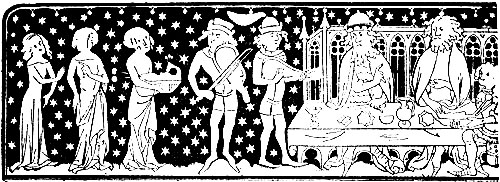
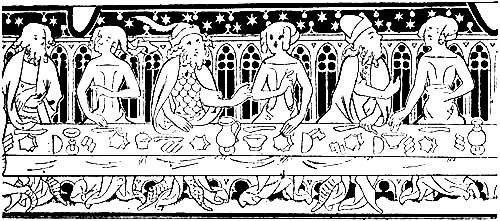
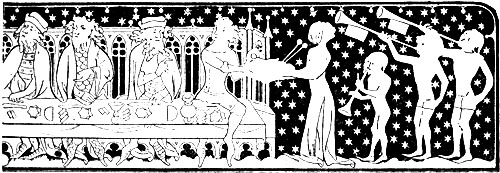
[19] The illustration on page 177 represents a similar royal banquet—the
celebrated Peacock Feast of Lynn. Robert Braunche, mayor, entertained
Edward there circa 1350, and caused the event to be immortalized on his
funeral monument. Henry Picard himself was King’s Butler at Lynn in 1350
(Rye, l. c.).
[20] Fitzstephen, in Stow, p. 119.
[21] See “The Hanseatic Steelyard,” in Pauli’s “Pictures,” chap. vi.
[22] “Œuvres,” ed. Buchon, vol. iii., pp. 479 ff.; cf. Lydgate’s
account of his own schooldays, in “Babees Book,” E.E.T.S., p. xliii.
[23] Prof. Hales, in “Dict. Nat. Biog.”
[24] See the Queen’s vow before the outbreak of the Hundred Years’ War, in
Wright’s “Political Poems,” R.S., p. 23.
| “Alors dit la reine: ‘Je sais bien que piecha | [il y a longtemps |
| Que suis grosse d’enfant, que mon corps sentit la, |
| Encore n’a t-il guère qu’en mon corps se tourna; |
| Et je voue et promets à Dieu qui me créa.... |
| Que jamais fruit de moi de mon corps n’istera, | [sortira |
| Si m’en aurez menée au pays par delà.’” |
[25] “P. Plowman,” B., x., 157, and xi., 402.
[26] “Chronicles of London,” ed. Kingsford, p. 13.
[27] These sums should be multiplied by about fifteen to bring them into
terms of modern currency.
[28] The poet’s grandmother was married at least thrice. Did he find hints
for the “Wife of Bath” in his own family?
[29] Quoted by Dr. Furnivall on p. xv. of his introduction to “Manners and
Meals” (E.E.T.S., 1868).
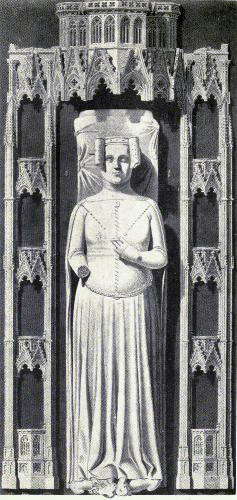
[30] This tunic would, no doubt, be a cote-hardie, or close-fitting bodice
and flowing skirt in one line from neck to feet; it may be seen, buttons
and all, on the statuette of Edward III.’s eldest daughter which adorns
his tomb in Westminster Abbey.
[31] “La Chevalerie,” Nouvelle Edition, pp. 342, 345 ff.
[32] See the author’s “From St. Francis to Dante,” 2nd ed., pp. 350 ff.
[33] That tales like these were read before ladies appears even from
Bédier’s judicial remarks in Petit de Juleville’s “Hist. Litt.,” vol. ii.,
p. 93; and I have shown elsewhere that these represent rather less than
the facts. (“From St. Francis to Dante,” 2nd ed., pp. 358, 359.) For
girls’ behaviour, see T. Wright’s “Womankind in Western Europe,” pp. 158,
159; “Le Livre du Chevalier de la Tour,” chap. 124 ff.; or “La Tour
Landry,” E.E.T.S., pp. 2, 175 ff.
[34] “House of Fame,” Bk. II., l. 108; “Troilus,” Bk. III., l. 41; Prof.
Hales, in “Dict. Nat. Biog.”
[35] “Life Records,” IV., Doc. No. 286.
[36] “Dole,” “ration.”
[37] “Mess of great meat,” i.e. from one of the staple dishes, excluding
such special dishes as would naturally be reserved for the King or his
guests.
[38] The legal tariff in the City of London at this time for shoes of
cordwain (Cordova morocco) was 6d., and for boots 3s. 6d. Cowhide
shoes were fixed at 5d., and boots at 3s. Riley, “Liber Albus,” p. xc.
[39] This was exactly the commons of a chaplain of the King’s chapel
(“Life Records,” ii., 15). The Dean of the Chapel was dignified with “two
darres of bread, one pitcher of wine, two messes de grosse from the
kitchen, and one mess of roast.” Some of this, no doubt, would go to his
servant. All the King’s household, from the High Steward downwards (who
might be a knight banneret), were allowed these messes from the kitchen as
well as their dinners in hall.
[40] “This same year [1359] the King held royally St. George Feast at
Windsor, there being King John of France, the which King John said in
scorn that he never saw so royal a feast, and so costly, made with tallies
of tree, without paying of gold and silver” (“Chronicles of London,” ed.
1827, p. 63). Queen Philippa received for this tournament a dress
allowance of £3000 modern money (Nicolas, “Order of the Garter,” p. 41).
[41] Froissart, ed. Luce, vol. v., p. 289, ff. Walsingham (“Hist. Ang.,”
an. 1389) bears equally emphatic testimony to the good natural feeling
existing between the English and French gentry.
[42] “Knight of La Tour-Landry,” E.E.T.S., p. 30 (written in 1371-2).
[43] Eustache Deschamps, whose life and writings often throw so much light
on Chaucer’s, shows us the difficulties of married men at court, and says
outright—
“Dix et sept ans ai au Satan servi
Au monde aussi et à la chair pourrie,
Oublié Dieu, et mon corps asservi
A cette cour, de tout vice nourrie.” |
(Sarradin, “Eustache Deschamps,” pp. 92 ff., 104, 160.)
[44] Quoted by Nicolas from Rymer’s “Fœdera” new ed., iii., 964.
[45] E.E.T.S., “Stacions of Rome,” etc., p. 37. (The whole English poem
describes a journey to Spain; but as yet the pilgrims are not out of the
Channel.)
[46] Froissart (Globe ed.), pp. 83, 134; “Eulog. Hist.,” iii., 206, 213.
[47] Dante, “Purg.,” iii., 49.
[48] Sarradin, “Deschamps,” pp. 67, 69.
[49] “Hist. of Eng. Lit.,” vol. ii., p. 57, trans. W. C. Robinson.
[50] “Cant. Tales,” G., 57 ff. It will be noted how ill the phrase “son of
Eve” suits the Nun’s mouth. In this, as in other cases, Chaucer simply
worked one of his earlier poems into the framework of the “Canterbury
Tales.”
[51] See a correspondence in the Athenæum, Sept. 17 to Nov. 26, 1898
(Mr. C. H. Bromby and Mr. St. Clair Baddeley), and Mr. F. J. Mather’s two
articles in “Modern Language Notes” (Baltimore), vol. xi., p. 210, and
vol. xii., p. 1.
[52] See Dr. Koch’s paper in “Chaucer Society Essays,” Pt. IV.
[53] Froissart’s great poem of Méliador thus became anonymous for nearly
five centuries, and was only identified by the most romantic chance in our
own generation.—Darmesteter, “Froissart,” chap. xiii.
[54] Athenæum, as above.
[55] Froissart, ed. Buchon, i. 546, 555; Darmesteter, p. 32.
[56] C. L. Kingsford, “Chronicles of London,” p. 63.
[57] Chaucer Soc., “Life Records,” iv., p. xxx.
[58] “Eulog. Hist.,” iii., 357: Statutes of Parliament, Ric. II., an. 6,
c. 6. The preamble complains that such “malefactors and raptors of women
grow more violent, and are in these days more rife than ever in almost
every part of the kingdom,” and it implies that married women were
sometimes so carried off. Cf. Jusserand, “Vie Nomade,” p. 85, and “Piers
Plowman,” B. iv., 47—
“Then came Peace into Parliament, and put forth a bill,
How wrong against his will had his wife taken,
And how he ravished Rose, Reginald’s love,” etc., etc. |
[59] “Life Records,” iv., p. xxxv.
[60] Riley, “Memorials,” pp. 410, 445.
[61] Oman, “England, 1377-1485,” p. 100.
[62] “Eulog. Hist.,” iii. 359.
[63] Ibid., 360.
[64] That is, they contributed to maintain the Minster, and were admitted
to a share of the spiritual benefits earned by “all prayers, fastings,
pilgrimages, almsdeeds, and works of mercy” connected therewith. Edward
III., and at least three of his sons, were already of the fraternity of
Lincoln, and Richard II., with his queen, were admitted the year after
Philippa Chaucer.
[65] Riley, “Memorials,” pp. 271, 285, 321. The Masons’ regulations given
on p. 281 of the same book are interesting in connection with Chaucer’s
work; but still more so are the documents in “York Fabric Rolls” (Surtees
Soc.), pp. 172, 181.
[66] “Life Records,” iv. 282, 283.
[67] A well-to-do youth could be boarded at Oxford for 2s. a week, and
it was reckoned that the whole expenses of a Doctor of Divinity could be
defrayed for thrice that sum, or half Chaucer’s salary. (Riley,
“Memorials,” p. 379; Reynerus, “de Antiq. Benedict,” pp. 200, 596.)
[68] A. 3907. “Lo Grenewych, ther many a shrewe is inne.”
[69] “Little Lowys my son, I aperceive well by certain evidences thine
ability to learn sciences touching numbers and proportions; and as well
consider I thy busy prayer in special to learn the treatise of the
Astrelabie.” Excusing himself for having omitted some problems ordinarily
found in such treatises, Chaucer says, “Some of them be too hard to thy
tender age of X. year to conceive.”
[70] “Life Records,” iv., Nos. 250, 270, 277. The great significance of
this fact is obscured even by such excellent authorities as Prof. Skeat,
Prof. Hales, and Mr. Pollard, who all follow Sir Harris Nicolas in
misinterpreting the last of these three documents. Chaucer had not lost,
as they represent, Henry’s own letters patent of only five days before,
but Richard’s patents for the yearly £20 and the tun of wine. It is quite
possible that Chaucer may have been obliged to leave them in pledge
somewhere, or that they were momentarily mislaid; but it is natural to
suspect that the poet would not so lightly have reported them as lost
unless it had been to his obvious interest to do so. We must remember the
trouble and expense constantly taken by public bodies, for instance, to
get their charters ratified by a new king.
[71] Globe ed., p. 464; Buchon, iii., 349.
[72] “Complaint to his Purse,” last stanza.
[73] “Life Records,” iv., p. xlv. In 1395 or 1396 Chaucer received £10
from the clerk of Henry’s great wardrobe, to be paid into Henry’s hands.
[74] Though the subject-matter of this poem is mainly taken from Boethius,
yet it evidently has the translator’s hearty approval, and is in tune with
many more of his later verses.
[75] Michelet, “Hist. de France,” Liv. VI., ad fin. A cardinal explained
the extreme violence of Urban VI.’s words and actions by the report “that
he could not avoid one of two things, lunacy or total collapse; for he
never ceased drinking, yet ate nothing.” Baluze, “Vit. Pap. Aven.,” vol.
i., col. 1270. Compare Walsingham’s tone with regard to the Pope, “Hist.
Angl.,” an. 1385.
[76] Chaucer’s religious belief will be more fully discussed in Chapter
XXIV.
[77] W. R. Lethaby, “Westminster Abbey,” 1906, p. 2.
[78] Stow (Routledge, 1893, p. 414) seems to imply that the poet was first
buried in the cloister, but this is an obvious error. Dr. Furnivall has
pointed out a line of Hoccleve’s which certainly seems to imply that the
younger poet was present at his master Chaucer’s death-bed. We may also
gather from Hoccleve’s account of his own youth many glimpses which tend
to throw interesting sidelights on that of Chaucer (Hoccleve’s Works,
E.E.T.S., vol. i., pp. xii., xxxi.).
[79] This was occasionally the case even in Normandy until the English
invasion. The great city of Caen, for instance, was still unwalled in
1346. (“Froissart,” ed. Buchon, p. 223.) A piece of London Wall may still
be found near the Tower at the bottom of a small passage called Trinity
Place, leading out of Trinity Square. It rises about twenty-five feet from
the present ground-level.
[80] Riley, “Memorials,” p. 79. This was in 1310.
[81] See pp. 50, 59, 79, 95, 115, 127, 136, 377, 387, 388, 489. My
frequent references to this book will be simply to the name of Riley.
[82] Ed. Morley, pp. 154-157.
[83] Riley, p. 270.
[84] From his first Italian journey Chaucer returned on May 23, 1373; but
his second was during the summer and early autumn of 1378. (May 28 to
Sept. 19.)
[85] “Cant. Tales,” Prol. i., 400.
[86] Walsingham, “Hist. Angl.,” an. 1406, ad fin.
[87] “P. Plowman,” B. Prol., 216. The French words in italics were the
first line of a popular song. Gower has an equally picturesque description
in his “Mirour de l’Omme,” 25,285 ff.
[88] “London was, in very truth, a city of Palaces. There were, in London
itself, more palaces than in Venice and Florence and Verona and Genoa all
together.” “Medieval London,” i., 244, where the context shows that the
author refers not only to royal residences, but still more to noblemen’s
houses.
[89] This was at least the theoretical provision of the regulation of
1189, known as Fitz Alwyne’s Assize, which is fully summarized and
annotated in the “Liber Albus,” ed. Riley (R.S.), pp. xxx. ff. We know,
however, that similar decrees against roofs of thatch or wooden shingles
were not always obeyed.
[90] “Menagier de Paris,” i., 173; Addy, “Evolution of English House,” p.
108; cf. “Piers Plowman’s Creed,” i., 214.
[91] An earthen wall is mentioned in Riley, p. 30. The slight structure of
the ordinary house appears from the fact that the rioters of 1381 tore so
many down, and that the great storm of 1362 unroofed them wholesale.
(Walsingham, an. 1381, and Riley, p. 308.) Compare the hook with wooden
handle and two ropes which was kept in each ward for the pulling down of
burning houses. (“Liber Albus,” p. xxxiv.)
[92] Cooper, “Annals of Cambridge,” an. 1445; Rashdall, “Universities of
Europe,” ii., 413. Cf. the “common nightwalkers” and “roarers” in Riley,
pp. 86 ff.
[93] Riley, p. 65. See the specifications for some three-storied houses of
a century later quoted by Besant. “Medieval London,” i., 250. The furs
here specified may well have come to £3 or £4 more (see Rogers,
“Agriculture and Prices,” pp. 536 ff.). The fur for an Oxford warden’s
gown varied from 26s. 8d. to 83s.
[94] Besant, loc. cit., i., 257, mistakenly calls Hugh a “craftsman,”
and gives from his imagination a quite untrustworthy description of the
inquest, the house, and the shop. He had evidently not seen the
supplementary notice in Sharpe’s “Letter Book,” F.
[95] Riley, p. 199; cf. Sharpe, “Letter Books,” F, pp. 19, 113. A list of
furniture left by a richer citizen, apparently incomplete, is given in
Riley, p. 123, and another on p. 283, but this is difficult to separate
with certainty from his stock-in-trade. The inventory of a well-to-do
Norman peasant-farmer is given by S. Luce, “Du Guesclin,” p. 51. Here the
strictly domestic items are only “four frying-pans, two metal pots, four
chests, three caskets, two feather-beds, three tables, a bedstead, an iron
shovel, a gridiron, a [trough?], and a lantern.” This was in 1333.
[96] Addy, “Evolution of English House,” pp. 112 ff. “A chamber with a
chimney” was the acme of medieval comfort. “P. Plowman,” B., x., p. 98,
and “Crede,” 209.
[97] “Œuvres,” ed. Buchon, p. 646. A century later, Thomas Elwood’s
Memoirs show that an English squire’s family needed their warm caps as
much indoors as outside.
[98] Cf. the affair in the hall of Wolsingham Rectory in 1370. Raine,
“Auckland Castle,” p. 38.
[99] A. F. Leach, “English Schools before the Reformation,” p. 10; “Dame
Alice Kyteler” (Camden Soc.), introd., p. xxxix. The choir-boys, it may be
noted in passing, had only half an hour of playtime daily.
[100] It is interesting to note that, when Chaucer was Clerk of the Works
to Richard II., he superintended the erection of scaffolds for the King
and Queen on the occasion of one of these Smithfield tournaments.
[101] “French Chron. of London” (Camden Soc.), p. 52; cf. Walsingham, an.
1326.
[102] “C. T.,” B., 645.
[103] “Chronicles of London,” ed. Kingsford, p. 15.
[104] Walsingham, an. 1381.
[105] “C. T.,” B., 4583.
[106] “Eulog. Hist.,” iii., 387.
[107] Walsingham, an. 1382; Riley, p. 464.
[108] “P. Plowman,” C., vii., 352 ff. For Clarice and Peronel, see Prof.
Skeat’s notes, ad loc., and cf. Riley, pp. 484, 566, and note 3.
[109] Newgate, Ludgate, and Cripplegate were regular prisons at this time;
but Besant is quite mistaken in saying that all gate-leases provide “that
they may be taken over as prisons if they are wanted” (“Medieval London,”
i., 163). A Cripplegate lease (Riley, p. 387) has naturally such a
provision; the others are silent or (like Chaucer’s) definitely promise
the contrary.
[110] P. 489; cf. “Life Records,” IV., xxxiv. Michaelmas Day fell in 1386
on a Saturday.
[111] Bk. II., lines 122 ff.
[112] Darmesteter, “Froissart,” p. 112.
[113] Riley, pp. 194, 285, 338; cf. Mr. W. Hudson’s “Parish of St. Peter
Permountergate” (Norwich, 1889), pp. 21, 45, 60.
[114] Cf. the present writer’s “From St. Francis to Dante,” 2nd ed., pp.
6, 160, 167, 380, where proof is adduced from episcopal registers that
even large and rich monasteries had often no scriptorium, and many monks
could not write their own names.
[115] “Town Life,” ii., 84.
[116] Riley, p. 226. Cf. the similar complaint of a poet against
blacksmiths in “Reliquiæ Antiquæ,” i., 240.
[117] Nominally, the great gate was shut at the hour of sunset, and only
the wicket-gate left open till curfew; but regulations of this kind were
generally interpreted with a good deal of laxity.
[118] Busch, “Lib. Ref.,” p. 408; Gilleberti Abbatis, “Tract. Ascet.,”
VII., ii., § 3.
[119] See Oskar Dolch, “The Love of Nature in Early English Poetry;”
Dresden, 1882.
[120] “Purg.,” xxvi., 4; viii., 1; iii., 25; cf. xvii., 8, 12.
[121] “Legend of Good Women,” Prol., 30 ff.
[122] “Survey,” ed. Morley, 1893, p. 163.
[123] “Monsieur le curé, ... ne dansons pas; mais permettons à ces pauvres
gens de danser. Pourquoi les empêcher d’oublier un moment qu’ils sont
malheureux?”
[124] Riley, 571. I have dealt fully with this subject in my “Medieval
Studies,” Nos. 3 and 4.
[125] “Babees Book,” E.E.T.S., p. 40; “Ménagier de Paris,” i., 15; “C.
T.,” C., 62.
[126] Sharpe’s “Letter Book” G., pp. 274, 303; Riley, pp. 269, 534, 561,
571, 669. In the country, “hocking” was often resorted to for raising
church funds. See Sir John Phear’s “Molland Accounts” (Devonshire Assn.,
1903), pp. 198 ff.
[127] Cf. “C. T.,” E., 2029; F., 908; “Parl. Foules,” 121. For his
personal love of trees, etc., see “C. T.,” A., 2920; “Parl. Foules,” 175,
201, 442.
[128] Cf. Riley, pp. 7, 116, 228, 280, 382, 487, 498.
[129] “Herbarium,” green and shady spot.
[130] Riley, 388, and passim.
[131] “Aetas Prima,” l. 23 ff.
[132] Loftie, p. 26.
[133] “Letter Book,” G., pp. iii. ff., where there is a very interesting
case of a Florentine merchant.
[134] It is easy to understand how Jews themselves came back to England
under the guise of Lombards. We know enough, from many other sources, of
the evils which followed from the inconsistent efforts to outlaw all
takers of interest, to appreciate the truth which underlay the obvious
exaggerations of the Commons in their petition to the King in 1376. “There
are in our land a very great multitude of Lombards, both brokers and
merchants, who serve no purpose but that of ill-doing: moreover, several
of those which pass for Lombards are Jews and Saracens and privy spies;
and of late they have brought into our land a most grievous vice which it
beseems us not to name” (“Rot. Parl.,” vol. ii., p. 352, § 58).
[135] Benvenuto da Imola, “Comentum,” vol. i., p. 579; Etienne de Bourbon,
p. 254; Nicole Bozon, pp. 35, 226; “Piers Plowman,” B., iii., 38; cf.
Gower, “Mirour,” 21409.
[136] “Mirour,” 25429 ff., 25237 ff., 25915. Mr. Macaulay remarks that
Gower seems to deal more tenderly with his own merchant-class than with
other classes of society; but his blame, even with this allowance, is
severe.
[137] “Mirour,” 25813. The emphasis which he lays on carpets and curtains
shows how great a luxury they were then considered.
[138] “In justice, however, to these centuries, it must be remarked, that
they received the institutions of Frankpledge as an inheritance from Saxon
times” (Riley).
[139] “To these writs return was made [in 1354] to the effect that the
civic authorities had given orders for butchers to carry the entrails of
slaughtered beasts to the Flete and there clean them in the tidal waters
of the Thames, instead of throwing them on the pavement by the house of
the Grey Friars.” Again: “Although this order [of 1369] was carried out
and the bridge destroyed, butchers continued to carry offal from the
shambles to the riverside; and this nuisance had to be suppressed in
1370.” But the whole passage should be read in full.
[140] Vol. I., cxxxviii. ff. and 365 ff.
[141] Mrs. Green, “Town Life,” ii., 55.
[142] Between 1347 and 1375, for instance, there are only 23 cases of
pillory in all.
[143] It is pertinent to note in this connection the medieval custom of
giving condemned meat to hospitals. Mr. Wheatley (“London,” p. 196) quotes
from a Scottish Act of Parliament in 1386, “Gif ony man brings to the
market corrupt swine or salmond to be sauld, they sall be taken by the
bailie, and incontinent, without ony question, sall be sent to the leper
folke; and, gif there be na lepper folke, they sall be destroyed all
utterlie.” At Oxford in the 15th century, there was a similar regulation
providing that putrid or unfit meat and fish should be sent to St. John’s
Hospital. (“Munimenta Academica” (R.S.), pp. 51, 52). Here is a probable
clue to the tradition that medieval apprentices struck against salmon more
than twice a week. See Athenæum, August 27 and September 3, 1898.
[144] Besant insists very justly on the blood-kinship between the leading
citizens and the country gentry. (“Medieval London,” i., 218 ff.) He shows
that a very large majority of Mayors, Aldermen, etc., were country-born,
and of good family.
[145] Michelet, “Hist. de France,” l. i., ch. i.
[146] John Philpot, it may be noted, was at this very time one of the
Collectors of Customs under Chaucer’s Comptrollership.
[147] “C. T.,” E., 995.
[148] The violent scenes of the years 1381-1391 are summarized in
Wheatley’s “London” (Medieval Towns), pp. 236-9. Among the victims of an
unsuccessful cause were even Sir William Walworth and Sir John Philpot.
[149] Walsingham, an. 1392; “Eulog. Hist.,” iii., 368.
[150] Ed. Luce, vol. i., pp. 224, 243, 249.
[151] Cf. Mrs. Green, loc. cit., ii., 31. “In 1499 a glover from
Leighton Buzzard travelled with his wares to Aylesbury for the market
before Christmas Day. It happened that an Aylesbury miller, Richard Boose,
finding that his mill needed repairs, sent a couple of servants to dig
clay ‘called Ramming clay’ for him on the highway, and was in no way
dismayed because the digging of this clay made a great pit in the middle
of the road ten feet wide, eight feet broad, and eight feet deep, which
was quickly filled with water by the winter rains. But the unhappy glover,
making his way from the town in the dusk, with his horse laden with
panniers full of gloves, straightway fell into the pit, and man and horse
were drowned. The miller was charged with his death, but was acquitted by
the court on the ground that he had had no malicious intent, and had only
dug the pit to repair his mill, and because he really did not know of any
other place to get the kind of clay he wanted save the highroad.”
[152] Etienne de Bourbon, p. 411.
[153] T. Wright, “Homes of other Days,” pp. 345 ff., whence I borrow the
accompanying illustration from a MS. of the 15th century, representing the
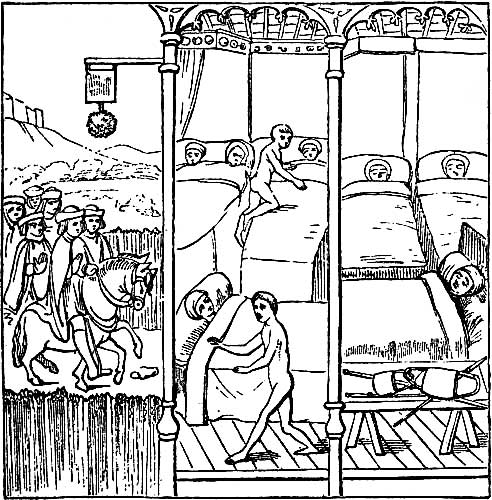
outside and inside of an inn. Incidentally, it illustrates also the common
medieval phrase “naked in bed.” Mrs. Green (“Town Life,” ii., 33) quotes
the grateful entry of a citizen in his public accounts “Paid for our bed
there (and it was well worth it, witness, a featherbed) 1d.”
[154] There were seventy places of pilgrimage in Norfolk alone (Cutts,
“Middle Ages,” p. 162). For churches as trysting-places for lovers or
gossips we have evidence on many sides, e.g. the lovers of the
“Decameron” (Prologue and Epilogue), and the custom of “Paul’s Walk” which
lasted long after the Reformation.
[155] Berthold v. Regensburg, “Predigten,” ed. Pfeiffer, i., 448, 459,
493; Et. de Bourbon, p. 167; “Piers Plowman,” B., v., 527, C., v., 123;
Wharton, “Anglia Sacra,” i., 49, 50.
[156] “Wyclif’s Works,” ed. Arnold, i., 83; cf. other quotations in
Lechler; “Wiclif,” Section x., notes 286, 288; Jusserand, “Vie Nomade,” p.
296; Foxe (Parker Soc.), vol. iii., p. 268.
[157] Chaucer himself tells us the day in the “Man of Lawe’s Prologue”;
Prof. Skeat has accumulated highly probable evidence for the year 1387
(vol. iii., p. 373, and vol. v., p. 75).
[158] About 520 feet from the ground, according to Hollar, but more
probably a little short of 500 feet. (H. B. Wheatley, “London,” p. 333.)
It must be remembered also how high the cathedral site rises above the
river.
[159] Bern. Ep. 25; cf. “Liber Guillelmi Majoris,” p. 478.
[160] Skeat, v., p. 129. “In the subsidy Rolls (1380-1) for Southwark,
occurs the entry ‘Henri Bayliff, Ostyler ... 2s.’ In the Parliament held
at Westminster (1376-7) Henry Bailly was one of the representatives for
that borough, and again, in the Parliament at Gloucester, 2, Rich. II.,
the name occurs.”
[161] The too strict avoidance of oaths had long been authoritatively
noted as suggesting a presumption of heresy; here (as in so many other
places) Chaucer admirably illustrates formal and official documents.
[162] About £1000 in modern money.
[163] “Its unsuitableness to the Clerk has often been noticed,” writes Mr.
Pollard; but surely those who find fault here have forgotten the obvious
truth voiced by the Wife of Bath, “For trust ye well, it is impossible
that any clerk will speakë good of wives.”
[164] This highly dramatic addition of the Canon and his Yeoman is
probably an afterthought of Chaucer’s, who had very likely himself
suffered at the hands of some such impostor.
[165] There is, as Prof. Skeat points out, an inconsistency here in the
text. We can see from Group H., l. 16 that Chaucer had at one time meant
the Manciple’s tale to be told in the morning; yet now when it is ended he
tells us plainly that it is four in the afternoon (Group I., 5).
[166] An allusion to the alliterative verse popular among the common folk,
like that of “Piers Plowman.”
[167] It was mostly destroyed by fire in 1865. Most writers on Canterbury,
misled by the ancient spelling, call the inn “Chequers of the Hope.”
Hope, as Prof. Skeat has long ago pointed out, is simply Hoop, a part
of the inn sign. Cf. Riley, “Memorials of London,” pp. 497, 524; and
“Hist. MSS. Commission,” Report v., pt. i., p. 448.
[168] Mrs. Green, “Town Life,” ii., 33.
[169] A. Murimuth, ed. Hog., p. 225.
[170] Walsingham, an. 1349; Hoccleve, E.E.T.S., vol. iii., p. 93.
[171] Ed. Buchon, i., 286; ed. Luce, iv., 327.
[172] Longman, “Edward III.,” i., 225, 413.
[173] Longman, “Edward III.,” vol. i., pp. 147, 157, 178.
[174] Ed. Buchon, i., 12, 34; ed. Luce, i., 284-287.
[175] Cf. Darmesteter, “Froissart,” p. 16, and Froissart, ed. Buchon, p.
512. “The good queen Philippa was in my youth my queen and sovereign. I
was five years at the court of the King and Queen of England. In my youth
I was her clerk, serving her with fair ditties and treatises of love; and,
for the love of the noble and worthy lady my mistress, all other great
lords—king, dukes, earls, barons and knights, of whatsoever country they
might be—loved me and saw me gladly and gave me much profit.”
[176] I cannot refrain here from calling attention to the extraordinary
historical value of the eight volumes of Exeter registers published by
Prebendary Hingeston-Randolph, who in this department has done more for
historical students, during the last twenty-five years, than all the
learned societies of the kingdom put together.
[177] Ed. 1812, p. 317. The text of this book is frequently corrupt; but
the evident sense of these ungrammatical lines 3-5 is that the envoys were
allowed to watch the unsuspecting damsels from some hidden coign of
vantage. It will be noted that Hardyng speaks of five daughters; there
had been five, but the eldest was now dead.
[178] Ed. 1841, p. 206. She was Katherine, daughter to Sir Adam Banastre.
Miss Strickland asserts that the Queen, contrary to the custom of medieval
ladies in high life, nursed the infant herself. She gives no reference,
and her authority is possibly Joshua Barnes’s “Life of Edward III.”
(1688), p. 44, where, however, references are again withheld. The Black
Prince was born June 15, 1330, when the King would have been 19 and the
Queen just on 16 years old according to Froissart; but Edward was in fact
only 17, and Bishop Stapledon’s reckoning would make the Queen about the
same age.
[179] Throughout this chapter I multiply the ancient money by fifteen, to
bring it to modern value.
[180] Such acts of vandalism were far more common in the Middle Ages than
is generally imagined; a good many instances are noted in the index of my
“From St. Francis to Dante.”
[181] Devon, “Issues of the Exchequer,” pp. 144, 153, 155, 199; “York
Fabric Rolls,” p. 125; cf. 154. It was one of the privileges of the
Archbishops of York to crown the Queen. For the mortuary system, see my
“Priests and People in Medieval England.” (Simpkins. 1s.)
[182] Clough, “Bothie of Tober-na-Vuolich.”
[183] “Mon. Germ. Scriptt.,” xxxii., 444.
[184] “Mirour,” 23893 ff.
[185] Lénient, “Satire en France” (1859), p. 202.
[186] Sacchetti, “Novelle,” cliii.; Ste-Palaye, “Chevalerie,” ii., 80.
[187] Mr. Rye (l. c.) points out how frequent was the interchange
between London and Lynn. Another colleague of John Chaucer’s, John de
Stodey, Mayor and Sheriff of London, had been formerly a taverner at Lynn.
[188] “Mirour,” 7225: Cf. “Piers Plowman,” C., vii., 248. Readers of
Chaucer’s “Prologue” will remember this mysterious word “chevisance” in
connection with the Merchant. Its proper meaning was simply bargain: the
slang sense will be best understood from a Royal ordinance of 1365 against
those who lived by usury; “which kind of contract, the more subtly to
deceive the people, they call exchange, or chevisance.”
[189] “Vie Nomade,” pp. 33, 46.
[190] These were, of course, fines for breaches of the assize of ale, as
in the Norwich cases already mentioned.
[191] In 1347 his total income was £2460, out of which he saved £1150. In
the two other years given by Smyth he saved £659 and £977. Some knights
even made a living by pot-hunting at tournaments. See Ch.-V. Langlois, “La
Vie en France au M. A.,” 1908, p. 163.
[192] Cf. a similar instance in Riley, p. 392.
[193] The Shillingford Letters show us the Bishop and Canons of Exeter
selling wine in the same way at their own houses (p. 91).
[194] Oman, “Art of War in the Middle Ages,” 380 ff.
[195] Buchon, i., 349, 431; Globe, 349.
[196] “Mirour,” 24625. Cf. the corresponding passage in the “Vox
Clamantis,” Bk. VI. According to Hoccleve, “Law is nye flemëd [= banished]
out of this cuntre;” it is a web which catches the small flys and gnats,
but lets the great flies go (Works, E.E.T.S., iii., 101 ff.).
[197] Walsingham, an. 1381. The evil repute of jurors is fully explained
by Gower, “Mirour,” 25033. According to him, perjury had become almost a
recognized profession.
[198] Gautier, loc. cit., p. 352.
[199] Lyndwood, “Provinciale,” ed. Oxon., p. 272.
[200] “Piers Plowman,” B., xv., 237, and xx., 137.
[201] Pollock and Maitland, “History of English Law,” vol. i., p. 387;
Lyndwood, “Provinciale,” pp. 271 ff. It is the more necessary to insist on
this, because of a serious error, based on a misreading of Bishop Quivil’s
injunctions. The bishop does, indeed, proclaim his right and duty of
punishing the parties to a clandestine marriage; but, so far from flying
in the face of Canon Law by threatening to dissolve the contract, he
expressly admits, in the same breath, its binding force.—Wilkins, ii.,
135.
[202] Wilkins, “Concilia,” i., 478.
[203] Froissart, Buchon, iii., 235, 258.
[204] “Piers Plowman,” C., xi., 256. Gower speaks still more strongly, if
possible, “Mirour,” 17245 ff. Chaucer’s friend Hoccleve makes the same
complaint (E.E.T.S., vol. iii., p. 60), and these practices outlasted the
Reformation. The curious reader should consult Dr. Furnivall’s “Child
Marriages and Divorces” (E.E.T.S., 1897).
[205] “Adam of Usk,” p. 3; cf. “Eulog. Hist.,” iii., 355 (where the price
is given as 22,000 marks), and 237, where the negotiations for another
Royal marriage are described with equally brutal frankness.
[206] Froissart, Buchon, ii., 758.
[207] “Paston Letters,” 1901, Introd., p. clxxvi.; cf. for example,
Thorold Rogers’ “Hist. of Ag. and Prices,” ii., 608. “Megge, the daughter
of John, son of Utting,” pays only 1s. for her marriage; but “Alice’s
daughter” pays 6s. 8d.; and so on to “Will, the son of John,” and
“Roger, the Reeve,” who each pay 20s. That is, it was possible for the
lord of the manor to squeeze £20 in modern money out of a single peasant
marriage.
[208] Sarradin, “Deschamps,” p. 256.
[209] Riley, p. 379. It must, however, be remembered that the ordinary
rate of interest then was twenty per cent. Thus Robert de Brynkeleye
receives the wardship of Thomas atte Boure, who had a patrimony of £300
(14th-century standard). With this Robert trades, paying his twenty per
cent. for the use of it, so that he has to account for £1080 at the heir’s
majority. Of this he takes £120 for keep and out-of-pocket expenses, and
£390 for his trouble, so that the ward receives £570. The Royal Household
Ordinances of Edward II.’s reign provide for the maintenance of wards
until “they have their lands, or the king have given or sold
them.”—“Life Records,” ii., p. 19.
[210] Ste-Palaye, loc. cit., i., 64 ff.; ii., 90. This rule of age, like
all others, had, however, been broken from the first. As early as 1060,
Geoffrey of Anjou knighted his nephew Fulk at the age of 17; and such
incidents are common in epics. Princes of the blood were knighted in their
cradles.
[211] Walsingham, ann. 1307, 1381; “Eulog. Hist.,” iii., 189, 389. The
woman avoided the battle only by withdrawing her accusation.
[212] Gower, “Mirour,” 17521.
[213] “Prediche Volgari,” ii., 115, and iii., 176.
[214] I quote from the 15th-century English translation published by the
E.E.T.S. (pp. 25, 27, 81; cf. 23, 95; the square bracket is transferred
from p. 23). Between 1484 and 1538 there were at least eight editions
printed in French, English, and German.
[215] Rashdall, “Universities of Europe,” ii., 599.
[216] Pp. 8, 18, 33, 36, 156, 207, 217, 218, and passim.
[217] “Most of the girls in our ‘Chansons de Geste’ are represented by our
poets as horrible little monsters, ... shameless, worse than impudent,
caring little whether the whole world watches them, and obeying at all
hazards the mere brutality of their instincts. Their forwardness is not
only beyond all conception, but contrary to all probability and all
sincere observation of human nature.” Gautier, l. c., p. 378.
[218] There is a very interesting essay on “Chaucer’s Love Poetry” in the
Cornhill, vol. xxxv., p. 280. It is, however, a good deal spoiled by the
author’s inclusion of many works once attributed to the poet, but now
known to be spurious.
[219] Bk. IV., ll. 152, 158, 367, 519, 554, 564.
[220] “Paston Letters” (ed. Gairdner, 1900), ii., 364; iv., ccxc.
[221] Few tales illustrate more clearly the woman’s duty of accepting any
knight who made himself sufficiently miserable about her, than that of
Boccaccio, which Dryden has so finely versified under the name of Theodore
and Honoria. Equally significant is one of the “Gesta Romanorum” (ed.
Swan., No. XXVIII.).
[222] Quoted by S. Luce, “Bertrand du Guesclin,” 1882, p. 124.
[223] The essentially compulsory foundation of Edward III.’s armies, for
at least a great part of his reign, seems to have been overlooked even by
Prof. Oman in his valuable “Art of War in the Middle Ages.”
[224] Froissart, ed. Luce, i., 401. It was at this time that Edward also
proclaimed the duty of teaching French for military purposes, as noted in
Chap. I. of this book.
[225] “Norwich Militia in the 14th Century” (Norfolk and Norwich Arch.
Soc.), vol. xiv., p. 263.
[226] Knighton (R.S.), ii., 42, 44, 109.
[227] The Scots themselves had found out long before this who were their
most formidable enemies. Sir James Douglas had been accustomed to cut off
the right hand or put out the right eye of any archer whom he could catch.
[228] Compare the interesting case in Gross, “Office of Coroner,” p. 74.
Two conscripts, on their way to join the army, chanced to meet at Cold
Ashby the constable who was responsible for their being selected; they ran
him through with a lance and then took sanctuary. It is significant that
they were not hanged, but carried off to the army; the King needed every
stout arm he could muster.
[229] Tournaments not infrequently gave rise to treacherous murders and
vendettas, as in the case of Sir Walter Mauny’s father (Froissart,
Buchon., i., 199). Compare also the scandal caused by the women who used
to attend them in men’s clothes (Knighton, ii., p. 57). Luce, however,
very much overstates the Royal objections to jousts (pp. 113, 141). He
evidently fails to realize what a large number of authorized tourneys were
held by Edward III.
[230] Froissart, Globe, 94-97.
[231] Denifle, “La Désolation des Eglises,” etc., vol. i., pp. 497, 504,
514. Two pages from English chroniclers are almost as bad as any of the
iniquities printed in Father Denifle’s book, viz. the sack of Winchelsea
(Knighton, ii., 109) and Sir John Arundel’s shipload of nuns from
Southampton (Walsingham, an. 1379; told briefly in “Social England,” illd.
ed., vol. ii. p. 260).
[232] Cf. Knighton, ii., 102.
[233] Green, “Town Life,” i., 130. “At the close of the 14th century a
certain knight, Baldwin of Radington, with the help of John of Stanley,
raised eight hundred fighting men ‘to destroy and hurt the commons of
Chester’; and these stalwart warriors broke into the abbey, seized the
wine, and dashed the furniture in pieces, and when the mayor and sheriff
came to the rescue nearly killed the sheriff. When in 1441 the Archbishop
of York determined to fight for his privileges in Ripon Fair, he engaged
two hundred men-at-arms from Scotland and the Marches at sixpence or a
shilling a day, while a Yorkshire gentleman, Sir John Plumpton, gathered
seven hundred men; and at the battle that ensued, more than a thousand
arrows were discharged by them.”
[234] Ed. Luce, i., 213, 214; cf. 312.
[235] Mrs. Green, l. c., i., 131.
[236] This point is treated more fully in the next chapter.
[237] Denifle, l. c., pp. 497, 504.
[238] “More than three thousand men, women, and children were beheaded
that day. God have mercy on their souls, for I trow they were martyrs.”
Froissart (Globe), 201.
[239] Ed. Luce, pp. 214, 249, 337.
[240] Trevelyan, “England in the Age of Wycliffe,” 1st Edn., p. 195.
[241] “Conseil” (in Appendix to Ducange’s “Joinville”), chap. xxi., art.
8. The writer insists strongly, at the same time, on the lord’s
responsibility to God for his treatment of a creature so helpless.
[242] C., iii., 177. For the Reeve’s duties, see Smyth, “Berkeleys,” vol.
ii., pp. 5, 22.
[243] “Those who demand such mortuaries are like worms preying on a
corpse” (Cardinal Jacques de Vitry, quoted in Lecoy de La Marche, “Chaire
Française,” p. 388). Having already, in my “Medieval Studies” and my
“Priests and People,” dealt more fully with this and several points
occurring in the succeeding chapters, I can often dispense with further
references here.
[244] This is admirably discussed by Mr. Corbett in chap. vii. of “Social
England.”
[245] Froissart, Buchon, ii., 150. Leadam, “Star Chamber” (Selden Soc.),
p. cxxviii. Trevelyan, l. c., p. 185.
[246] Vitry, “Exempla,” pp. 62, 64; “P. P.,” A., iv., 34 (cf. Lecoy., l.
c., 387); Jusserand, “Epopée Mystique,” 114; and “Vie Nomade,” 81, 261,
269.
[247] Walsingham, an. 1381; cf. the record in Powell, “Rising in East
Anglia,” p. 130. The rioters compelled the constable of the hundred of
Hoxne to contribute ten conscripted archers to their party.
[248] It must be remembered that the loyal soldiers also had shown in this
matter a pusillanimity which contrasted remarkably with their behaviour in
the French wars; Walsingham notes this with great astonishment. The
quotations are from the “Chronicle of St. Mary’s, York,” in Oman, Appendix
V., pp. 188-200.
[249] An. 1381; cf. “Eulog. Hist.,” iii., 353. The original of both these
descriptions seems to be Gower, “Vox Clam.” i., 853 ff.
[250] L. c., p. 255.
[251] The first general Sanitation Act for England was that of the
Parliament held at Cambridge in 1388, and is generally ascribed to the
filth of that ancient borough.
[252] “Chronicles of London” (4to., 1827), p. 65. “Eulog. Hist.” iii.,
353.
[253] C., ix., 304; B., v., 549. It will be noted how nearly this diet
accords with that of the widow and her daughter in Chaucer’s “Nuns’
Priest’s Tale”; cf. Langlois, “La Vie en France au M-A.,” p. 122.
[254] “Rot. Parl.” ii., 340.
[255] L. c., C., ix., 331.
[256] L. c., C., x., 71 ff. “Papelots” = porridge; “ruel” = bedside;
“woneth” = dwell; “witterly” = surely; “and fele to fong,” etc. = “and
many [children] to clutch at the few pence they earn; under those
circumstances, bread and small beer is held an unusual luxury.” “Pittance”
is a monastic word, meaning extra food beyond the daily fare.
[257] An Act of 1495 provided that “from the middle of March to the middle
of September work was to go on from 5 a.m. till between 7 and 8 p.m., with
half an hour for breakfast, and an hour and a half for dinner and for the
midday sleep. In winter work was to be during daylight. These legal
ordinances were not perhaps always kept, but they at least show the
standard at which employers aimed” (“Social England,” vol. ii., chap.
vii.).
[258] Bishop Grosseteste asserted that honest labour on holy days would be
far less sinful than the sports which often took their place. “Epp.”
(R.S.), p. 74.
[259] “La France pendant la Guerre de Cent Ans” (1890), 95 ff. The essay
describes a state of things very similar to what we may gather from
English records.
[260] “Universities of Europe,” ii., 669 ff.
[261] Cooper, “Annals of Cambridge,” an. 1410; “Munim. Acad.” (R.S.), 602;
Riley, 571; Strutt (1898), p. 49.
[262] “Shillingford Letters,” p. 101. Queke was probably a kind of
hopscotch, and penny-prick a tossing game; both enjoyed an evil repute,
according to Strutt.
[263] “Rot. Parl.” ii., 64; Myrc., E.E.T.S., i., 334.
[264] “Northumberland Assize Rolls,” p. 323. There is another fatal
wrestling-bout in the same roll (p. 348), another in the similar Norfolk
roll analysed by Mr. Walter Rye in the Archæological Review (1888), and
another exactly answering to John and Willie’s case in Prof. Maitland’s
“Crown Pleas for the County of Gloucester,” No. 452.
[265] “C. T.,” A., 3328. Etienne de Bourbon has no doubt that “the Devil
invented dancing, and is governor and procurator of dancers”; and he
explains the popular proverb, that God’s thunderbolt falls oftener on the
church than on the tavern, by the notorious profanations to which churches
were subjected. (“Anecdotes,” pp. 269, 397.)
[266] L. c. ii., 672.
[267] Wilkins, “Concilia,” i., 600; iii., 61, 68, 365; “York Fabric
Rolls,” 269 ff; Grosseteste, “Epp.” (R.S.), pp. 75, 118, 161; Giffard’s
“Register” (Worcester), p. 422; and Cutts, “Parish Priests,” p. 122.
[268] Wilkins, i., 530, 719; iii., 61 and passim; Archæological
Journal, vol. xl., pp. 1 ff; “Somerset Record Society,” vol. iv.
[269] Eight men died in Northampton gaol between Aug. 1322 and Nov. 1323
(Gross, p. 79). The jury casually record: “He died of hunger, thirst, and
want.”... “Want of food and drink, and cold.”... “Natural death.”...
“Hunger and thirst and natural death.” One is really glad to think that so
small a proportion of criminals ever found their way into prison.
[270] Gross, “Office of Coroner,” p. 69.
[271] “Eng. Hist. Rev.,” vol. 50.
[272] This still allowed him to migrate to another part of the King’s
dominions—e.g. Ireland, Scotland, Normandy.
[273] Worcestershire Record Society.
[274] Gower, “Mirour,” 20125, 20653.
[275] Riley, 567; cf. Preface to “Liber Albus,” p. cvii., and Walsingham,
an. 1382.
[276] Cf. Mr. Walter Rye’s articles in “Norf. Antq. Misc.,” vol ii., p.
194, and Archæological Review for 1888, p. 201.
[277] The complaints which meet us in Gower and “Piers Plowman” on this
score are more than borne out by the “Shillingford Letters” (Camden Soc.,
1871). The worthy Mayor of Exeter reports faithfully to his
fellow-citizens what bribes he gives, and to whom.
[278] Chaucer’s pupil Hoccleve speaks almost equally strongly on the
mischief of such pardons (“Works,” E.E.T.S., vol. iii., pp. 113 ff).
[279] Clergy is of course here used in the common medieval sense of
learning; it does not refer to any body of men.
[280] I.e. the type of perfect religion, “the Christ that is to be.”
[281] Be “found” or provided for, so that they need no longer to live by
begging and flattery.
[282] This was very commonly the case even in the greatest cathedrals:
typical reports may be found in the easily accessible “York Fabric Rolls”
(Surtees Soc.). With regard to Canterbury, a strange legend is current to
the effect that Lord Badlesmere was executed in 1322 for his irreverent
behaviour in that cathedral. Apart from the extraordinary inherent
improbability of any such story, the execution of Lord Badlesmere is one
of the best known events in the reign. He was hanged for joining the Earl
of Lancaster in open rebellion against Edward, against whom he had fought
at Boroughbridge.
[283] Wilkins, iii., 360 ff; “Rot. Parl.” ii., 313. I have given fuller
details and references in the 8th of my “Medieval Studies,” “Priests and
People” (Simpkins, 1s.).
[284] Taking eight test-periods, which cover four dioceses and a space of
nearly forty-five years, I find that, before the Black Death, scarcely
more than one-third of the livings in lay gift were presented to men in
priest’s orders—the exact proportion is 262 priests to 452 non-priests.
[285] Rashdall, “Universities of Europe,” ii., 613, 701. Merely to reckon
the number of years theoretically required for the different degrees, and
to argue from this to the solid education of the medieval priest (as has
sometimes been done), is to ignore the mass of unimpeachable evidence
collected by Dr. Rashdall. Only an extremely small fraction of the
students took any theological degree whatever.
[286] The list of indictments for grave offences in “Munim. Acad.” (R.S.),
vol. ii., contains a very large proportion of graduates, chaplains, and
masters of Halls; and Gerson frequently speaks with bitter indignation of
the number of Parisian scholars who were debauched by their masters.
[287] In Chaucer’s words—
He set ... his benefice to hire
And left his sheep encumbred in the mire,
And ran to London, unto Saintë Paul’s
To seeken him a chanterie for souls. |
The Archbishop’s decree may be found in the “Register of Bp. de Salopia,”
p. 639; cf. 694 (Somerset Record Society).
[288] Quoted from a MS. collection of 14th-century sermons by Ch.
Petit-Dutaillis in “Etudes Dédiées à G. Monod.,” p. 385.
[289] Knighton (R.S.), ii., 191; at still greater length on p. 183.
Walsingham, ann. 1387, 1392; cf. “Eulog. Hist.,” iii., 351, 355.
[290] Kingsford, “Chronicles of London,” p. 64; Walsingham, an. 1410.
[291] “P. Plowman,” B., xv., 383: Jusserand, “Epop. Myst.,” p. 217. See
especially the remarkable words of Chaucer’s contemporary, the banker
Rulman Merswin of Strassburg, quoted by C. Schmidt, “Johannes Tauler,” p.
218. After setting forth his conviction that Christendom is now (1351) in
a worse state than it has been for many hundred years past, and that evil
Christians stand less in God’s love than good Jews or heathens who know
nothing better than the faith in which they were born, and would accept a
better creed if they could see it, Merswin then proceeds to reconcile this
with the Catholic doctrine that none can be saved without baptism. “I will
tell thee; this cometh to pass in manifold hidden ways unknown to the most
part of Christendom in these days; but I will tell thee of one way....
When one of these good heathens or Jews draweth near to his end, then
cometh God to his help and enlighteneth him so far in Christian faith,
that with all his heart he desireth baptism. Then, even though there be no
present baptism for him, yet from the bottom of his heart he yearneth for
it: so I tell thee how God doth: He goeth and baptiseth him in the baptism
of his good yearning will and his painful death. Know therefore that many
of these good heathens and Jews are in the life eternal, who all came
thither in this wise.”
[292] “P. Plowman,” B., x., p. 51; cf. Langlois, l. c., pp. 211, 264-5.
Transcriber’s Notes:
Images have been moved from the middle of a paragraph to a nearby paragraph break. The text in the
list of illustrations is presented as in the original text, but the links navigate to the page number
closest to the illustration’s loaction in this document.