Andrea Amati—“The King” and its History—Gasparo da
Salo—Woods employed by Ancient Luthiers—Paolo
Maggini and the “Dumas” Bass—M. Savart’s Experiments—Freaks—Stradivarius
Violoncellos—Signor
Piatti’s Violoncellos—The Bass of Spain—Davidoff’s
Violoncello—Herr Klengel’s Amati—A neat Swindle—Stradivarius’
Contemporaries—Owners of Rugger
Violoncellos—George IV.’s pseudo Stradivarius—The
earliest Treatise on the Violoncello as a Solo Instrument—Mr
Andrew Forster’s Gamba—The Prince Consort’s
“Ancient Instruments” Concert—Development of the
Technique, of Violoncello playing
The romances of real life are generally allowed
to be far more amazing than anything fiction
can create. Perhaps though, when all is said
and done, the most sentimental or interesting
happenings are not those which lie concealed in
reality or myth, but in the unwritten something
which clings about the antique treasures we
prize—“Those certain things” which Oliver
Wendell Holmes calls “good for nothing unless
they have been kept for a long while.”
That old oak chair is more precious than a
modern production, not because the wood is
better or the make more solid, but for the misty
reminiscences of lace and buskin, Cavalier and
Puritan, in which it is steeped.
This exquisite brocade is valued not so much
for its rich texture as for the memory of the
shapely shoulders of a Du Barry, or a Castlemaine,
which it once graced.
This china vase: this tapestry: this antique
ring—we have but to look at them and they
tell us many an unwritten story, impossible to
repeat, and appealing to us alone. Of all the
mute romancers carefully preserved from time’s
destructive grasp, none can tell such tales as do
the grand old fiddles. Those constant yielding
companions of generations passed away have
served as confessional boxes for so many
centuries that each curve and bend teems with a
secret. Take this masterpiece of Andrea Amati
for instance (p. 114). Made in Cremona by a
man of the mature age of fifty-two or thereabouts,
the impulsive hazard of his youthful
efforts had long since passed away: definite aim
had developed his gifts, and ripe experience had
given his hand an exquisite cunning. Little did
he think as he sat in his sunny Cremona workshop,
smoothing the back of this violoncello,
bending the ribs, letting in the purfled edges,
while he chatted now and again with a neighbour
who dropped in, that he was building a
monument to his own memory.
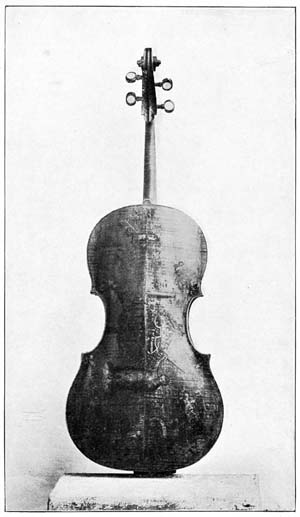
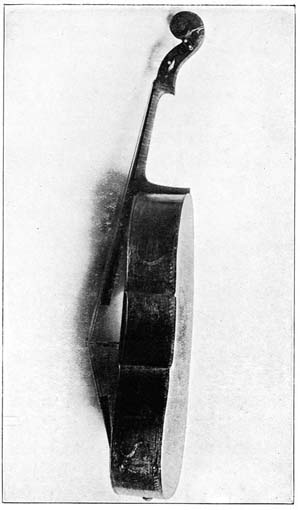
THE ‘KING’
Violoncello by Andreas Amati, 1572.
Sent with its fellows to the French court, this
violoncello arrived, with the painted armorial
bearings of Charles IX., exquisitely pure and
fresh in colour, upon its back and sides. It was
relegated to the King’s “Chapelle,” or private
oratory, doubtless occupying a humble position
in the band where the Duiffoproucart viol was
prominent: feeling the touch of fresh fingers,
as the old ones lost their skill: seeing the
intrigues of the court life: hearing the cries of,
“The King is dead! Long live the King!”
observing each phase of human love and folly,
and watching the vagaries of Princes for over
two hundred years. Truly your tales would
outrival Balzac himself could you speak, and
your royal title—“the King”—is but a well-deserved
panegyric.
At the time of the French Revolution, in
1790, this violoncello is said to have been still
in use at the court of the unfortunate Louis XVI.
On the 6th and 7th of October in that year the
mob destroyed the whole magnificent “set”—consisting
of twenty-four violins (twelve large,
and twelve small), six tenors, and eight basses—to
which it belonged. Two of the violins of
this number were afterwards recovered by
Viotti’s pupil, M. J. B. Cartier, and one of the
small violins belonged to George Somes, Esq., in
1884. These fiddles, and this violoncello—“The
King”—are apparently the only members
of the “set” that survived the reckless
vengeance of the mob. When one realises how
easily such delicate constructions are ruined in
sacrilegious hands, their preservation in the
midst of the pandemonium, which reigned
supreme at that time in Paris, is miraculous.
After the Revolution a glimpse of the whereabouts
of “The King” is afforded us by a
pencilled note written by the father of its
present owner on the back of the frame, containing
the interesting slip of paper which has
accompanied this violoncello for at least a
hundred years. On the paper itself the
following inscription is written in French
characters:—“Basse faitte par erndre ermati
Luthiér â cremonne eu italie en 1572. envoyez
par le pape 3: à Charles 9 roi de france pour
sa chapelle.—avec ses amories et se devise,
pietate justicia.” Turning this little framed
document over, the three faintly pencilled
words, “Duport had it,” seem to imply that
“The King,” during the Napoleonic era, was
the property of Berteau’s gifted pupil, Jean
Pierre Duport, known generally as “Duport
l’ainé.” If this was the case, then this violoncello
went with him to the court of Frederick
the Great at Berlin. It is more probable, however,
that it fell into the hands of Jean Pierre’s
brother, Jean Louis Duport—one of the finest
violoncellists of his day—as he became a
member of Napoleon’s band and professor at the
Conservatoire of Music. Another pencilled
note in the same hand, at the back of the frame,
stating that “A Hollander brought it to Betts in
1812, and he sold it to H. W. Curtis”[22] (afterwards
Sir William Curtis) still further points to
Duport, the younger, as its owner, for Duport
was in sore straits at one time. This accomplished
artist, it may be remembered, also held
an appointment at the court of Frederick the
Great, but when the defeats of Auerstädt and
Jena placed Prussia in the position of a suppliant
at the feet of Napoleon, Duport returned to
Paris utterly ruined. If the violoncello had
belonged to his brother it is possible that Jean
Pierre may have ceded it to the more accomplished
Jean Louis, and the latter brought it to Paris in
1806, where his misfortunes induced him to part
with it to a dealer. The next we hear of “The
King” is on the death of Sir William Curtis,
when it figures in the catalogue of his musical
instruments—which were sold by auction on
3rd May 1829—as: “Lot 9, a violoncello by
Andrea Amati Cremonencis Faciebat, 1572. A
document was given to the proprietor when he
purchased this instrument, stating that it was
presented by Pope Pius V. to Charles IX., King
of France, for his chapel. It has been richly
decorated, the arms of France being on the
back and the motto ‘Pietate et Justitia’ on the
sides. The tone of this violoncello is of extraordinary
power and richness.” The Rev. Canon
A. H. Bridges, Rector of Beddington, either
bought it at the above sale, or from Sir William
Curtis’s survivors. On the death of Canon
Bridges, in 1891, it became the property of his
son, the present owner, John Henry Bridges,
Esq., of Ewell Court, Surrey.
THE ‘KING’
Violoncello by Andreas Amati, 1572.
Some connoisseurs describe “The King” to
be nothing but a curiosity at the present time.
This is hardly correct, for, in spite of its having
been very much knocked about in the past, it
still retains a sweet quality of tone which makes
it a delightful drawing-room instrument. Like
Amati’s fiddles “The King” is of small dimensions;
indeed violoncellos at this early date were
nothing but extra large tenors, and it was not
until makers turned their attention to evolving
violoncellos out of the viola da gamba that the
former began to take a prominent place in the
ranks of stringed instruments. The transition
itself from gamba to the early form of violoncello
took place in the second half of the sixteenth
century but—“Who effected the change?”
Was it Duiffoproucart in Lyons, Andrea Amati
in Cremona, or Gasparo da Salo, looking forth
over the sunny plains of Lombardy? The
correct reply is perhaps—“All!” Duiffoproucart
reduced the size of the huge German
geiges so as to furnish what Rousseau in his
“Dictionnaire de Musique” defines as “les
instruments de remplissage.” Previous to the
dispersion of viols into various sizes, they were
universally large both in Italy and later in
France and England. “The first viols in use
in France,” says Jean Rousseau—the eminent
violist—in his “Traité de la Viole” (Paris,
1687), “had five strings, and were very large
... of such dimensions indeed, that the Père
Mersenne says that a young Page de Musique
could be shut within to sing the treble part,
while the bass was played upon the self-same
instrument”—an arrangement which certainly
could not contribute to the happiness of either
the little page, or the bass-viol, and the diminishing
process which necessarily did away
with such a forlorn practice was certainly
welcome to all the actors in the trio. Owing
to the breaking up of the viols into various
sizes, orchestras grew in proportion, so that
we find in the Etat de France for 1645, that
the “Musique de la Chambre de Monsieur”
(Louis XIV.’s brother) boasted “Nicolas
Fleury” and “Pierre Montigny” as players
of the Haute Contre,[23] “Pierre Noinne” and
“N... le Vert” as players of the Taille
Basses,[24] while “Francois Martin” and “Guillaume
Mercer” disported themselves on the
“Taille Haute.”[25] In the beginning of the
following century, further names of instruments
de remplissage, appear in the Paris Opera
orchestra: for instance “2 quintes”[26] “2
tailles,”[27] and “3 haute contres.”
This was the result of Duiffoproucart’s creation
of the small viola da gamba, a size which broke
into many degrees and kinds. Then Andrea
Amati made a further step in the right direction
by making small-sized bass instruments in the
same form as the violin, which had at that time
assumed the shape now so familiar. The moot
question—“Was it Andrea Amati in Cremona,
or Gasparo da Salo in Brescia who first made
violoncellos in the form of the violin?”—is of
course unanswerable at this space of time. Da
Salo was a man of progress, ready to fight for
his opinions. He made some fine double-basses
and grand tenors which are sought after to this
day, and Herr August Reichers, the Berlin
violin-maker, possessed a small-sized violoncello
by this maker in 1884. If this instrument was
not a cut-down bass-viol, or an exceptionally
large tenor, it is apparently a solitary example
of a violoncello by Da Salo, but even though its
existence be allowed, the numerous violoncellos
made by Andrea Amati must necessarily admit
him to be—if not the inventor—at least the
earliest known luthier to make violoncellos.
Although Da Salo may be looked upon as no
enthusiast where violoncellos were concerned,
he was not neglectful in the matter of other
bass instruments. Signor Dragonetti possessed
no fewer than three fine basses by the Brescian
maker, of various sizes, and Mr Hart, in 1875,
owned a small double-bass of Da Salo’s which
had been brought from Italy by Tarisio, and
was looked upon as the ne plus ultra of its kind.
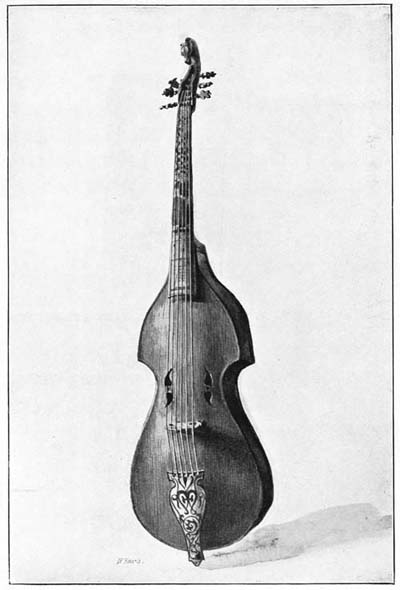
A Da Salo viola da gamba, catalogued as of the
year 1570, was to be seen among the sumptuous
display of musical instruments shown at the
Special Loan Exhibition held at Fishmongers’
Hall in the summer of 1904.
But, fortunately, we need not rely entirely
upon catalogues, description, and speculation for
an idea of Da Salo’s skill as a gamba-maker, for,
here beside us, in their neat glass house, two
examples of the fine old Brescian repose in calm
tranquillity, like veterans silently ruminating over
many campaigns. They both face us with the
quaint C-shaped sound-holes, so dear to the
hearts of the old viol-makers, and both display
upper tables of remarkably well-chosen even-grained
pine wood. One of them is strung
with seven strings, but the seventh is a later
invention, for the earliest viols had five strings,
then six, and it was not until the last part of
the seventeenth century that Sainte Colombe
(some say Marais) added another to the six.
A true unaltered seven-stringed viol is hardly
ever to be met with now. A solitary and excellent
example, however, was lent by M. Galley
to the Special Loan Exhibition at South Kensington
in 1872. This was a remarkably handsome
gamba and had remained untouched, with
the exception of an attempt to attach sympathetic
strings. A further adjunct to be found
in this Da Salo gamba before us is the scroll,
which curves round in a unique manner like a
wisp of twisted ribbon: this never felt the
touch of Da Salo’s hand. It may be the work
of Barak Norman, for a similar, indeed identical,
scroll crowns his gamba now in the Donaldson
Museum, but certainly it is not Da Salo’s work.
In his day sculptured human and animal heads
were de rigueur, and, like his contemporaries, he
carved these himself, or employed special artists
to do so. In Germany the followers of Jacobus
Stainer of Absam—whose favourite ornament
was a lion’s head—freely adopted this practice,
but the custom died out first in Italy, where
viol-makers discovered that such a system was
far from remunerative.
Close to this gamba of Da Salo’s with the
spurious scroll, his second example exhibits his
skill as a wood-carver, in the exquisitely chiselled
head of an old woman, which surmounts the
neck. The varnish is slightly darker on this
gamba than on the one beside it. Age is no
doubt responsible for this and not the maker
himself, as it is also for the black Da Salo fiddles
of which some connoisseurs speak with a degree
of scorn. It may be noticed that there is but
one line of purfling round this gamba. This
was such an ordinary custom with Da Salo that
comment is unnecessary. It is clumsily let in,
lacking the grace and finish expended upon this
difficult art by Cremona makers. The Amatis
above all others excelled in the neatness of their
purfling, and the customary three lines is always
to be met with in their fiddles as well as in those
of Stradivarius. The latter, however, on one
solitary occasion reverted to one line of purfling
in the violoncello upon which Bernard Romberg
played for many years. This instrument is
unique in many ways, for the gifted Cremonese
maker made the back and sides of plane wood
and poplar, material which he employed occasionally
in the early part of his career, but
which he had discarded at the date (1711) he
made the violoncello.
Speaking of wood, by-the-by, the proper selection
of timber was held to be a matter of great
importance by the ancient luthier. M. Fetis, in
his “Antonio Stradivarius,” has given some interesting
information regarding the source from
whence the old viol-makers obtained their wood.
He says that maple was sent from Croatea,
Turkey and Dalmatia to Venice in the shape of
galley oars, and that the Turks, ever seeking to
outrival the Venetians, and consequently frequently
at war with them, took care to choose
wood with the handsomest wave, knowing well
that it would break the more easily. It was from
among this selection that the viol-maker had to
gather his timber. In his own country there was
certainly little difficulty in obtaining wood, but,
where would he get such maple as came to him
from Dalmatia? Secretly he welcomed this
“... thing devised by the enemy”
and turned it to good account. The illustrious
Da Salo was very partial to pear wood as well
as sycamore, which he cut slab-ways from the
tree, as did most of his contemporaries.
Stradivarius preferred maple to any other wood,
but he went with the times and also employed
the woods favoured by his brethren, such as
poplar, lime, and even grained pine. A species
of red pine, common to the Tyrol, and known
to the Italian makers by the name of “Azarole,”
was more in favour with the Cremona luthier
than Swiss pine. Only the south side, the
side exposed to the drying rays of the sun,
was used. Indeed, this precaution is one which
has been observed by makers for over three
hundred years, knowing well that it is one of
the first aids towards solving the problem:
Given: A log of wood. Make: A fiddle. The
timber must be blameless, free from knots or
blemish, and—above all—free from worm, a
fate which has destroyed whole forests of pine
if the trees are cut at the wrong season of the
year. Also the tree must have arrived at a
maturity of ten years, and the question of sap
flowing through the outer part of the tree must
be duly considered. Speaking on this subject,
Mr Davidson[28] remarks that, owing to the sap
passing through this part of the tree, the wood
abounds in saccharine matter and is quickly susceptible
to decay. In trees which have arrived
at maturity, there is no distinction between the
sap and heart wood, the wood being of the
same texture throughout and almost uniform.
The proper time for cutting trees is when the
sap ceases to flow, and experience has determined
the month of December to be the best
time for this purpose, as the wood which has
been cut during this month has been found to
have always been of superior quality to any cut
during the other months. Monsieur l’Abbé
Sibre, author of “La Chelonome ou le parfait
Luthérie,” which was published at the beginning
of the nineteenth century, voices the merits of
wood cut in December and January long before
Mr Davidson, and adds the admonition that the
wood must be cut from between the bark and
heart of the tree. The wood being cut as required
from the healthy pine or maple, it is
sawn into planks, and,—though the fiddle-maker’s
hands are madly twitching to commence operations
on it,—subjected to a drying process to be
effected by sun and air for at least six years.
If at the end of that period of time the luthier
is still enamoured of his timber, then he may
clamp it and cut it and scrape it into the violin
or violoncello of his fancy. Monsieur Simoutre,
the French violin-maker and author of some
patent improvements which, in common with
all innovations connected with bow instruments,
have had no lasting effect, contends that the
best pine wood comes from Silesia, from La
Valteline, Les Grisons, Le Simmenthal in the
Bernese Alps, from certain sheltered parts of
the valley of the Lac de Joux, in the Canton
de Vaud, Switzerland, and from the southern
slopes of the Jura Bernois. Modern violin-makers
generally employ maple cut from trees
growing on the southern slopes of the Carpathians
and also in some parts of the Eastern
Alps, but where this is not procurable, it has
been found that it is not absolutely necessary
to range the Alps or the Carpathians in search
of suitable wood, for many a fine violin and
violoncello have been made from the wainscot
or beam of an old-time cottage or mansion.
J. B. Vuillaume used to roam over Italy and
Switzerland frequently for the sole purpose of
picking up choice bits of pine which had probably
formed part of a beam or support in some
residence for hundreds of years. Out of these
purchases he undoubtedly made some of his
finest instruments. His example has recommended
itself to many other makers, and only
the other day we heard of a contemporary
English maker whose best violins and violoncellos
have been formed from an old beam
obtained from a house near Eltham. Such
practices as these certainly place lutherie within
the range of everyone so inclined, for, who is
there in these days that does not possess a
likely piece of old furniture? some familiar
escritoire, or table, or panel, out of which a
possible rival to Cremona’s chefs-d’œuvre may
be conjured by the aid of gouge, chisel, bending
iron, and glue pot. In spite of the time-saving
effects which the appropriation of the
family heirlooms for this purpose would effect,
how much more appealing and poetic were
the methods of the ancient luthier, who went
straight to the forest for his wood. Can one
picture Stradivarius storing up old beams, and
tables, on the roof of his house in Cremona?
Can we imagine Guarnerius roaming about
the country seeking likely bits of wood in
cottages, or the Amatis, or Da Salo, the maker
of these gambas, resorting to such a commonplace
expedient. No! a thousand times. They
went straight to the forest for their timber,
wandered through the misty depths of clustered
pines, pondering in the deep silence upon many
a knotty point of their craft. Or they stood
at times on the rocky borders of the wood,
where the trees looked down upon the valley
from whence the sound of the rushing brook
could be faintly heard. From a point of vantage
they watched the trees being felled:
hearkened to the tone they emitted as their
torn limbs bounded from rock to rock: counted
the number of circles to ascertain the age of
a likely tree: examined the colour with care
to judge of its health. If they were satisfied
with these various preliminary tests, they bought
what they required, stored the planks on the
sheltered side of their workshop or on the roof
of the same, and watched the hot Italian sun
do its work of drying. Not only did the most
eminent makers of the past carefully store their
own wood, but if they became possessed of a
particularly handsome piece they did not scruple
to patch and piece it together, so that no scrap
of the treasure should be wasted.
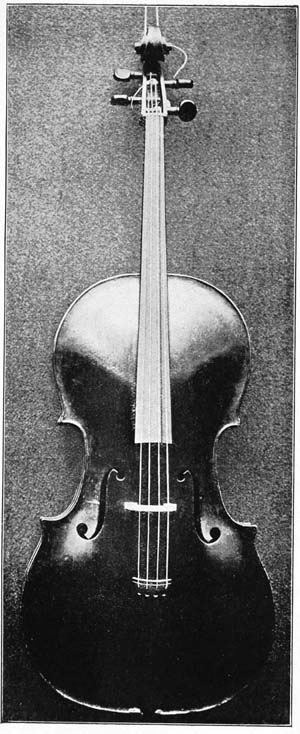
THE ‘VASLIN’
Violoncello by Antonius Stradivarius.
Dated 1725.
Gasparo da Salo, as we have already said, was
an adept in the choice of wood, and he was
fortunate in lighting upon some particularly even-grained
pine. In these days his work is looked
upon as rough, or, to put it more gently, primitive.
The recent researches of Il Cavalieri Livi—the
keeper of the Brescian state archives—have,
however, proved that this was far from
the case in his lifetime. Until the results of
the Cavalieri’s investigations were published
in the Nuova Antalogia on the 16th August
1891, nothing definite concerning this maker’s
life was known. Thanks to the Brescian income-tax
returns and other authentic documentary
evidence it is now proved that Da Salo’s real
name was not Salo at all but Gasparo di Bertolotti,
that he rejoiced in a grandfather named
Santino di Bertolotti who was a lute-maker at
Polpenazze, that his father was one Francesco
Bertolotti, a painter familiarly called “Violino”
by his friends, and that his son, Gasparo, the
future violin-maker, was born at Salo, a small
town on Lake Garda, not many miles distant
from Brescia. Unfortunately the date of Da
Salo’s birth still remains unknown, owing to the
loss of the pages from the parish register where
it should appear, but the income-tax returns
for 1568 state him to be twenty-six years of
age at that date, and those for 1588, forty-five,
thus locating his birth approximately in the year
1542. It is presumed that he learnt his art
from his grandfather first, and later from a
Brescian viol-maker of the name of Gerolamo
Virchi, who stood sponsor to Gasparo’s son,
Francesco. The earliest efforts of the great
Brescian master apparently did not find favour
with his fellow-countrymen, and, this being so,
he became discouraged and contemplated trying
his fortunes in France. A certain Father Gabriel
saw the gifted man’s dispirited efforts, and
also observed his intentions. He was reluctant
to see one of his flock go forth to a foreign
country, and to prevent such a calamity came
forward with a loan of £60. Curiously enough
this small sum changed the bent of Da Salo’s
life. He remained, and encouraged by the
faith of the good priest set to work with such
definite aim and earnestness, that as a result he
soon established himself in a house with a shop
in the Contrada del Palazzo vecchio. This event
occurred in the year 1568. He paid £20 rent
per annum for this establishment, valued his
stock of musical instruments at about £60, and
styled himself Magistro di Violini. In 1579 he
exhibited the added title of Magistro di Cittaris,
and in 1583 called himself Artefice d’instrumenti
musica. Twenty years after his first establishment
in the Contrada del Palazzo vecchio, he
changed his residence to the Contrada Cocere,
where he claimed to be the owner of violins
finished and unfinished valuing quite £200, and
where he had acquired the ostentatious title of
Magister instrumentorum musicorum. The year
1599 found him purchasing another house in
Brescia, situated in the Contrada di St Pietro di
Martero, and between 1581 and 1607 he owned
land adjoining Calvagese, near Salo. It was at
Calvagese that Da Salo’s son, Francesco, found
his bride, the Signora Fior. He also followed
the captivating profession of his father, until
the latter’s death on the 14th April 1609, when
he apparently lost heart, for from that time he
ceased to be a luthier. Probably he sold the
excellent business to Da Salo’s gifted pupil, Gio.
Paolo Maggini, who had worked as an apprentice
in the Brescian master’s workshop for quite eight
years, and was then a bachelor of thirty or thereabouts.
In any case, whether he became possessed
of the business or not, the esteem which
had previously been bestowed upon his instructor
fell to his share. On the whole he deserved all
the support he gained for he not only equalled Da
Salo as a maker but surpassed him in everything
save the ugly stiff sound holes which, for some
unaccountable reason, he retained.
In the history of the violoncello, it is a
puzzling and curious circumstance, that no viola
da gamba by Maggini is extant.[29] His violins,
violas, violoncellos and double-basses have resisted
the onslaught of over three hundred
adventurous years, and, this being so, one cannot
help wondering why his gambas have not
also withstood time’s ravages. The obvious
reply seems to be that, “He made none!”
However, whether he did or did not, his
attitude certainly had no effect on the position
occupied by the violoncello at that time. The
general feeling about the instrument was akin
to the sentiments expressed by the Comte de
Rabutin in his “Epistles”:
“Je ne vous aime pas, Hylas;
Je n’en saurois dire la cause,
Je sais seulement un chose;
C’est que je ne vous aime pas.”
Not being liked, and yet appearing among
them, musicians were confronted with a
difficulty which they solved by placing this
“white elephant” in the obscure position of
playing the fundamental bass in the music of
the Church.
As regards the lack of Maggini violas da
gamba, circumstantial evidence may be right
after all. The man was a genius, and, true to
his instincts, sought after new methods rather
than personal gain. He threw aside the useless
and picked out the good, and, this being so, it
is not surprising that he should prefer to turn
his attention to the budding violoncello, rather
than the pristine viola da gamba.
In the delightful monograph of this maker’s
life—already mentioned—among the excellent
summary of the instruments made by him, there
is an interesting description of a quartet of
instruments generally known as the “Dumas
Set,” from its having once belonged to a family
of that name. In an ancient château near
Lyons the members of the Dumas household
passed through the terrors of the first Revolution
and saw the establishment of the Empire.
They were enthusiastic musical amateurs—friends
of Beethoven—and inspired by a
genuine love of chamber music they collected
together four magnificent examples of Maggini’s
skill. Of the four instruments—i.e. violin, viola,
violoncello and double-bass—which comprise the
“set,” the violin and viola are of the most
characteristic and perfect type, although the
violoncello is also excellent. According to
Lady Huggins’s description of the last, “it has
two lines of purfling, but no ornamental device.
The bottom circle of the sound-holes is smaller
than the top. There is the same under-bevelling
of the inside edge of the sound-holes, as in
Maggini’s other instruments, the same arching
of the model. The wood of the back and the
sides is cut on the slab” (parallel with the
growth of the tree—a favourite practice with
the ancient viol-makers). “The back is joined,
also the belly, the latter having the wood the
ordinary way of the grain, the coarse grain
being outside.” As we look at the instrument,
the thought involuntarily rises in us—“to
Maggini we owe our modern violoncello.”
What a curious mixture of the “old” and the
“new” is to be found in this instrument. The
back cut on the “slab”—in accordance with
the long-standing custom—and the belly cut in
the improved manner. Maggini, although a
great innovator, and the first to cut the wood
in the new way—i.e. wedge-ways from the tree—was
evidently in a state of uncertainty when
he made this violoncello. To balance matters
he mingled the divers ways, yet, in spite of his
hesitation, he came nearer to gauging the most
equitable proportions for the violoncello than
any other maker of his time. It would be of
great interest if it were possible to discover
by what means Maggini and his predecessors
arrived at their conclusions. Whether it was
in the manner of old Mrs Tibbins, who made a
fiddle by means of a blunt knife, a piece of
glass, and a bent file, or, on the principles of
Monsieur Felix Savart. If the ancient luthier
planned his work on the latter’s scientific basis,
then he was accurate in every detail, for no
more satisfactory experiments on the construction
of bow instruments have been attempted.
The idea of these experiments was suggested
by a guitar-shaped violin made by Stradivarius
and owned by the elder Chanot. Imagining
that so eminent a maker would not have constructed
such a violin without good reason,
Monsieur Savart—a doctor of medicine—threw
up his profession for that of science and
interested himself in organising a series of
tests in the first half of the nineteenth century.
As a result of his labours luthiers were at last
confronted with the astounding assertion that
an arched surface vibrates less readily than a
plane one: that there are points where the
vibrations are greatly reduced, and that the
aggregate vibration is least at the sound holes
and at the corner blocks of a violin or violoncello.
Starting from this groundwork, M. Savart
constructed a violin entirely made of flat surfaces
and straight lines with narrow rectilinear slits
for sound holes (so as to cut as few of the
fibres of the wood as possible) and no tailpiece,
the drag of the latter on the tender part of
the belly being considered detrimental to the
instrument. The most astonishing part of this
fiddle was that it passed the test of comparison
with a Stradivarius victoriously. The members
of the Académie des Sciences formed a council
and, assisted by such eminent musicians as
M. Berton, Catel le Sueure, and Cherubini,
sat in solemn judgment. The merits of the
instrument were considered by them at several
meetings, and the gifted violinist, M. Lefebvre,
was requested to play alternately upon a chef-d’œuvre
of Cremona and the Savart “box-fiddle,”
in an adjoining room. The decision arrived at
by these gentlemen was that the square fiddle
was every bit as good in tone—if not better—as
the Cremona violin. Of course this was
most flattering to the inventor, yet it is a
question whether such excellent results would
have taken place had the Savart fiddle been
in less skilful hands. The great violinist Remenyi
maintained that he could produce just as
good a tone out of an eight-shilling fiddle as
out of a 1000-guinea one. Monsieur Lefebvre’s
handling of the “box-fiddle” was doubtless
superior to the fiddle itself and,—as Voltaire said
of Duport’s violoncello playing,—he made the
council of impulsive Frenchmen believe in miracles
“by making a nightingale out of an ox.”
A few years previous to Monsieur Savart’s
researches M. Chanot—a naval officer, and a
member of the distinguished family of violin-makers
of that name, being compelled to leave
the navy on account of his staunch Royalist
predilections—had turned his attention to constructing
guitar-shaped fiddles and violoncellos.
These were also subjected to similar tests by
the members of the Académie des Sciences
and—as in the case of the Savart fiddle—pronounced
to be superior to the instruments of
Cremona. There were independent experts,
however, who considered them faulty in tone
and only to be regarded as curiosities. In the
midst of diverse criticisms, these instruments
found a market for a few years, the violins and
violas fetching 300 francs, while 500 francs was
the price demanded for the violoncellos. Those
who desire to pursue the subject of vagaries,
will find much to interest them in Mr Davidson’s
“The Violin,” and Mr Heron Allen’s “Violin-making
as it was and is”; sufficient for present
purposes is it to know that such grotesqueness
as eighteen stringed violins played with a bow
and producing the combined effect of the violin,
viola, violoncello and double-bass: the combination
violin and violoncello with piano which can
be played by one person: the melephone, which
was nothing more than a concertina enclosed in
a species of violoncello, and other such fallacies,
have been relegated to the land of oblivion.
Certain it is that the ancient viol-maker never
dreamed of such horrors. Once in a way he
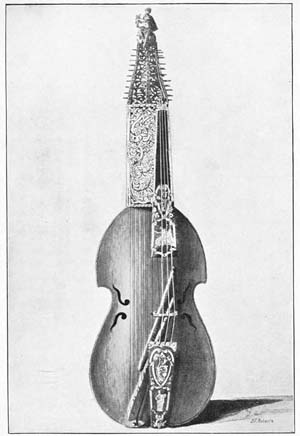
attempted such a mild invention as a detachable
neck, which could be unscrewed and placed
inside the instrument through a door in the
ribs, like the viola da gamba in the Donaldson
Museum, but otherwise his methods, like his
varnish, were so simple that he made no fuss
about them. He saw no necessity for rushing
into print, or taking out patents, or wrangling,
or arguing. The traditions of his graceful craft
were transmitted by word of mouth and practical
demonstration to his pupils, and the pupils, living
in an atmosphere of lutherie, sucked in the unwritten
lore as naturally as the earth absorbs
rain. What need to cry out the sky is blue,
when all the world can see it!
It was among such surroundings that the
mighty Stradivarius learnt his art in the workshops
of Nicolo Amati, grandson of Andrea
Amati, who made “The King.” The atelier of
this maker was a very nest of talent in the
middle of the seventeenth century, for Nicolo
Amati’s renown attracted all the most enthusiastic
young aspirants of the art. It is easy to imagine
the grand spirit of emulation, and even rivalry,
which must have existed within the four walls
of Amati’s premises in Cremona. An unrivalled
master of his art at the time, bestowing
care and thought on every part of his work,
there is no doubt that he did much towards
advancing the construction of the violoncello in
the matter of experimenting with thicknesses, but
he did not alter the dimensions of the violoncello
which was at that time about 31 inches
in length, if not longer. The majority of
Amati violoncellos have been cut down, so that
it is difficult to judge of their original size, but
it is probable that they originally measured over
31 inches in length. The paramount influence
of the Church in musical matters was responsible
for the large dimensions of the violoncello at
that date; it was looked upon as useful to reinforce
the double-bass, or “bass-violin” as it
was then called, for the big viols had already
gone out of use in Italy in the middle of the
seventeenth century. In “The Familiar Letters
of Abraham Hill” (London 1767), his brother,
Thomas, writing to him from Lucca, 1st October
1657, speaking of the instrumental music
he had heard there, says that it “is much
better than I expected. The organ and violin
they are masters of, but the bass-viol they have
not at all in use, and, to supply its place, they
have the bass-violin.” According to Maugars
in his “Reponse fait à un curieux ...” (1639)
the viol was going out of use in Italy, quite
twenty years before the above date. “Regarding
the viol,” he remarks, “there is no
one in Italy now who excels on that instrument,
and even in Rome it is still little cultivated: I
am very astonished at this, seeing that they had
formerly one Horatio de Parme, who was a
marvellous player.” The writer of these lines
was himself a magnificent performer on the
viola da gamba. He visited Rome, where he
found the gamba, the theorbo, and harpsichord
the most fashionable instruments, and, in spite of
the numerous violins and violoncellos being made
by Nicolas Amati in his busy workshops in
Cremona, these latter were considered to be
what Lord Chesterfield would have called “ungentlemanly
instruments.” If by chance any
enthusiastic amateur was rash enough to adopt
the violin, he was careful to hide the fact from
his friends for fear of being thought disreputable.
This antipathy to the fiddle was just
as keenly felt in England, when the encroachment
of the new-fangled four-stringed instruments
began to endanger the position of the viol.
Anthony Wood, writing in 1653 at Oxford, says
in reference to this: “Before the Restoration,
gentlemen played three, four and five parts with
viols. They esteemed a violin to be an instrument
only belonging to a common fiddler, and could
not endure that it should come among them for
fear of making their meetings vain.” This prejudice
against the violin is even felt to-day by
many people. We ourselves remember an old
lady’s astonishment when we confided to her that
we could play the violin: “Why!” she exclaimed,
“I thought such instruments were only
played outside public-houses.”
The degree of excellence attained by such men
as the Abbé Maugars, Hoffman, Sainte Colombe,
and Marais, on the viola da gamba was certainly
detrimental to the development of the violoncello.
Maugars spent four years studying the gamba in
England in 1620, and when he visited Rome, in
1639, his performances at the house of Signora
Leonora Baroni, a famous Italian singer—who
was herself no mean performer on the harpsichord
and gamba—gained him the highest
eulogies, which he recounts with no uncertain
voice in the pamphlet already referred to (p. 138).
In the face of the prodigies performed by gamba
players, makers were content to follow the
times and allow the violoncello to retain its large
proportions. Even Stradivarius, who made the
violin what it now is, did not occupy himself
with the dimensions of the violoncello, but
adopted the measurements of his contemporaries.
A complete account of this maker’s violins and
violoncellos is to be found in Messrs Hill’s valuable
monograph “Antonio Stradivari, his Life and
Work.” In the chapter devoted to a résumé of
Stradivari violoncellos, they make the interesting
assertion that no violoncello by Stradivarius is
known to them previous to the year 1680. The
earliest dated instrument of the violoncello type
known to them was made by the great Cremona
master in his twenty-third year, 1667, and,
although it has been considerably altered, it
apparently originally contained many of the
features of the viola da gamba and violoncello.
They are of opinion that the instrument was
primarily strung as a gamba, which was doubtless
the case, for at that time it was customary to
make gambas in two forms—i.e. with flat back
and true viol-shaped upper bouts curving high
into the neck, and also in the violin form.
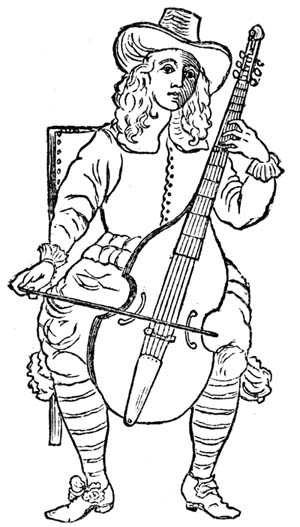
Christopher Simpson, the most renowned English
gamba player of his day, gives excellent representations
of both these forms of gambas (p. 80) in his
“Division Viol” (Second Edition, London, 1667).
He recommends the violin shape as superior to
the viol form for playing divisions on a ground
as “the sound should be quick and sprightly,
like a Violin; and Viols of that shape (the Belleys
being digged out of the plank) do commonly
render such sound.”
Another violoncello by Stradivarius, which
shows similar signs of alteration, belonged to Mr
Leo Stern in 1902. Its proportions, although
cut down by Dodd, are still of the largest, and
the presence of a fifth hole in the head for a peg
indicates that it was originally strung with five
strings. No doubt this was originally an extra
large viola da gamba of the form recommended
by Christopher Simpson. Messrs Hill also give
the interesting piece of information that they
are acquainted with a viola da gamba by Stradivarius,
or, to speak more correctly, with the
material which once formed one. The often
over-generous hand of the modern maker has
employed itself in adding fresh wood in all
directions with a view to transforming the instrument
into a violoncello. Brought from France
to Italy in its original state, it may possibly be
the viol made by Stradivari in 1684 for the
Comtessa Cristina Visconti, the patterns of which
are preserved in the “Della Valle Collection.”
Still referring to Messrs Hill’s book we find
that Stradivarius made about thirty large-sized
violoncellos between the year 1680 and 1700
and that it was not until the latter date that he
shows any signs of turning away from the violoncello
of large proportions. Two instruments
which bear evidence of this important change of
construction are the Cristiani (1700) and the
Servais (1701). The first of these measures
30-1/2 bare inches in length, while the Servais
measures 31-1/8 inches, but even these proportions
were large as compared to the violoncellos he
made ten years later. The Cristiani is of
particular interest at the present moment as it
has recently become the property of the nation.
It originally belonged to a charming lady of that
name who gained repute as a professional
violoncellist in the forties of the nineteenth
century. Felix Mendelssohn paid her the compliment
of playing her accompaniments at her
concert at Leipsic, and dedicated one of his
“Songs without Words” to her. She was not
a great executant by any means, but the violoncello
at that date did not count so many women
players as it does in these days, and, then again,
she was possessed of much personal beauty, so
that her critics judged her in the same manner
as they did the handsome Madame Catalani, of
whom it was said that:
“If to her singing some few errors fall
Look in her face, and you forget them all.”
Mdlle. Cristiani’s violoncello—after her death
at Tobolsk, in Siberia, in 1853—fell into the
hands of M. Benazet, a Baden-Baden amateur.
Through the medium of Messrs Gand & Bernadel,
it became the property of the eminent
violoncellist, Herr Hugo Becker, in 1884. Ten
years later Messrs Hill bought it, and still later
Mr Charles Oldham, a well-known ophthalmic
surgeon of Hove, Brighton, purchased it from
them. At the latter’s death, on the 24th
January 1907, he bequeathed the “Cristiani”
violoncello, together with the famous inlaid
“Rode” violin (1722), a violin of the Amatasie
period dated 1687, and the handsome inlaid viola
made by Stradivarius for Philip IV., of Spain,
in 1696, to the nation. These four instruments
have been confided to the care of the British
Museum, but it is to be devoutly hoped that
the authorities may find some clause in Mr
Oldham’s will, by which they may avoid the
necessity of placing them under a glass case.
There is no more melancholy object than the
violin or violoncello which is relegated to a
museum and compelled to silence. The handsome
violin by Stradivarius in the Musée of the
Paris Conservatoire, and Paganini’s violin in
Genoa—standing under a glass case like an
eight-day clock—are melancholy examples of
such a useless practice. It would be of much
more practical use to art, if wealthy connoisseurs
would follow the example of Mr John Rutson,
and leave their valuable collections of musical
instruments to some musical institution for the
use of gifted pupils unable to purchase a suitable
instrument for their public début and early
appearances. It is undeniable that, as a rule,
genius is poorly endowed with this world’s
goods, and often lacking in opportunity; thus
it is that many a gifted violinist or violoncellist
has been balked of success for lack of a good
instrument to play upon.
After the year 1700, Stradivarius made some
fine violoncellos, the most superb of all at the
present time, being the instrument he made in
his seventy-sixth year. This grand example is
dated 1720, and, besides its intrinsic merits, it
has a special interest, having been the favourite
instrument of Signor Piatti. Many were the
hands through which it passed before finding a
safe haven with the gifted Italian violoncellist to
whom it was presented by Colonel Oliver in
1867. Like Ole Bull and his Gasparo da Salo,
Piatti was enamoured of the violoncello the
moment he saw it, on a visit to Dublin, during
the first year of his sojourn in England in 1844.
Its memory lived in his mind for years, and he
longed to possess it. The most consummate of
storytellers and most genial of men, Piatti was
never weary of recounting the romantic manner
in which his violoncello crossed his path from
time to time, and how he wished to purchase it,
but was debarred from so doing by want of
sufficient capital. However, it was a case of
“Kismet.” He did eventually become its proud
possessor, and like a pair of lovers they found
no hardship in overcoming obstacles together.
The career of this instrument is traced by
Messrs Hill from the year 1818, when it
was brought to this country from Cadiz, by a
wine merchant named Mr Dowell. For
300 guineas it passed into the hands of the
Rev. Mr Booth, who—like Mr Dowell—was an
Irishman. The purchase was effected through
the medium of Paul Alday, an Irish violinist,
whose name is responsible for the story that he
was once so lost in the labyrinths of a seemingly
endless cadenza at a concert, that an exasperated
member of the audience exclaimed: “Well,
Mr Alday, are you going to play all night!”
Ten years after Mr Booth became the possessor
of the violoncello, another change of ownership
took place at a sale by auction at Messrs Cramer
& Beale’s where a well-known Dublin violoncellist,
Mr Piggot, purchased it. The sum paid
by the latter is unknown to Messrs Hill, but
from some notes kindly supplied us on the
subject by Comtessa Lochis—Signor Piatti’s
daughter—through the medium of Mr Whitehouse,
the statement that “it was sold for £100
to a professor of Dublin,” may allude to the
price paid for it by Mr Piggot. After Mr
Piggot’s death, in 1853, Sir Robert Gore Booth,
an amateur violoncellist, undertook the sale of
the instrument for his deceased friend’s widow,
and, bringing it to London, invited Piatti to come
and see it. As soon as Piatti beheld the
violoncello, he recognised it to be the exquisite
instrument he had seen in 1844, and never
forgotten. Great was his chagrin at being
unable to purchase it, but at the time it was
impossible. By his advice, however, the violin-maker,
Maucotel, went to see it, and managed
to obtain it at a bargain for £300, and shortly
after Colonel Oliver bought it of Maucotel for
£350. To Piatti—already a frequent visitor at
Colonel Oliver’s house—the Stradivarius violoncello
was a still further attraction, especially as he
could play on it whenever he felt inclined. He
used to care for it like a child, and at length, on
a memorable day in the year 1867, he was at
the Colonel’s house, occupied in comparing the
Stradivarius’ merits with that of a violoncello
by the brothers Amati and another by Montagnana,
when Colonel Oliver suddenly inquired—“Which
do you prefer?” Piatti at once
indicated the Stradivarius without hesitation.
His astonishment and embarrassment were unbounded
when in reply to this conclusion, the
Colonel said laconically: “Take it home then!”
But nothing would induce the simple-minded
virtuoso to accept the Colonel’s offer, and after
thanking him, he left the house hurriedly,
fearing that his great longing for the violoncello
might make his refusal “tremble in the
scale.” Scarcely had he arrived home, however,
when the violoncello was brought to his door, and
from that day to his death remained with him
always.
It was on this grand Stradivarius that Piatti
delighted audiences week after week, and month
after month, at the Saturday and Monday
Popular Concerts, (now, alas!—be it said to our
shame—dwindled out of existence for want of
support) and it was on New Year’s day, 1901—six
months before his death—that he played his
Swan Song (the “Danza Moresca”) before a
party of friends at his daughter’s house, with
all his accustomed skill and brilliancy. Although
it is not part of our subject here to detail the
lives of violoncello players, yet we cannot leave
this artist, so beloved in England, without
mentioning the touching tribute to his memory,
which is celebrated annually by his resting-place,
in the private chapel of the Lochis family. The
funeral, which was a public one, attended by the
Prefect, the Mayor, and representatives of the
leading Musical Societies of his native town of
Bergamo, took place on the 22rd of July 1901.
In spite of the tempestuous weather, hundreds
of townsfolk and people from the neighbouring
provinces turned out to do homage to their
esteemed countryman. Four professors, from
the Music School at Bergamo, played the
Andante from Schubert’s Quartet in D minor,
according to the last wishes expressed by Piatti,
and a week later again visited the Lochis Chapel,
where they made a solemn compact to meet each
year, and perform the same Andante on the
anniversary of the master’s death. Thus is
the memory of the great artist, whose lovable
nature made him a boon companion and
cherished friend, reverently preserved.
Signor Piatti’s violoncello at his death passed
into the hands of his daughter, Countess Lochis,
who, although realising that it was a precious
relic of her father, still felt that it would harm
the instrument if she kept it without being
played upon. She therefore accepted the offer
of Herr Robert Mendelssohn, the Berlin banker,
and sold it to him for £4000. Herr Mendelssohn,
who is the nephew of the composer of
that name, is himself an excellent amateur
violoncellist, and, in conjunction with his brother,
owns a fine Quartet of Strads. During the
latter years of Signor Piatti’s life he had offered
him £2000 for the violoncello, but had, on the
sum being refused, asked Piatti to name his own
price. But the Italian violoncellist stubbornly
refused to part with the instrument although he
no longer played in public. However—as we
have seen—the violoncello did become the property
of Herr Mendelssohn, who has the distinction
of paying the largest sum ever given
for a violoncello.
No better or more complete account of
Stradivarius’ violoncellos is to be found than in
Messrs Hill’s monograph already referred to.
The merits of such famous instruments as the
“Duport,” the “Mara,” the “Romberg,” the
“Bata,” the “Vaslin,” etc., are skilfully described,
as well as the sums paid for them, and
it is therefore hardly fair to repeat the many
facts there stated, but before leaving the
subject we are sorely tempted to repeat the
well-known romantic episode which occurred in
the career of the Stradivarius violoncello known
as the “Bass of Spain.” It is our English
dramatist, Charles Reade, who recounts the
adventure in one of his letters to The Pall Mall
Gazette, of the year 1872. This was the date—it
may be remembered—of the Special Loan
Exhibition of Musical Instruments at the South
Kensington Museum. Connoisseurs occupied
themselves in scouring Italy to gather together
all the most important and interesting specimens
they could lay hands on, and it was at this exhibition
that the violoncello—then the property
of M. Galley—of which we here have a picture—was
shown (p. 124). Charles Reade, who had
learnt pretty well all that could be known about
fiddle-making from a certain “Henri”—a past
master in the art, but a rampant little revolutionary,
whom he met, by chance, at one of his favourite
Bohemian restaurants in Soho—wrote some
brilliant criticisms on the examples of ancient
Italian lutherie there displayed. In these articles,[30]
the author of “Peg Woffington,” took the
opportunity of expounding his theory of the
Cremona varnish—the most successful explanation
of the concoction ever attempted—and
amongst much fiddle lore, gives the following
account of the vicissitudes of the “Bass of
Spain,” made in the year 1713. It was formerly
in the collection of Mr John Adam, later
in that of the Duc de Camposelice, and was in
the possession of Mr Franklin Singer in 1902:—
“Nearly fifty years ago a gaunt Italian called
Luigi Tarisio arrived in Paris one day with a lot
of old Italian instruments by makers whose
names were hardly known. The principal
dealers, whose minds were narrowed, as is often
the case, to three or four makers, would not deal
with him. Monsieur Georges Chanot, younger
and more intelligent, purchased largely, and
encouraged him to return. He came back next
year with a better lot; and yearly increasing
his funds, he flew at the highest game; and in
the course of thirty years imported nearly all
the finest specimens of Stradivarius and Guarnerius
France possesses. He was the greatest
connoisseur that ever lived or ever can live,
because he had the true mind of a connoisseur
and vast opportunities. He ransacked Italy
before the tickets in the violins of Francesco
Stradivarius, Alexander Gagliano, Lorenzo
Guadagnini, Geofredus Cappa, Gobetti, Morgilati
Morella, Antonio Mariani, Santo Maggini,
Matteo Benti of Brescia, Michel Angelo Bergonze,
Montagnana, Thomas Balestrieri Storioni,
Vicenzo Rugger, the Testori, Petrus Guarnerius
of Venice, and full fifty more, had been tampered
with, that every brilliant masterpiece might be
assigned to some popular name. To his immortal
credit, he fought against this mania and
his motto was, ‘A tout seigneur tout honneur.’
The man’s whole soul was in his fiddles. He
was a great dealer, but a greater amateur. He
had gems by him no money would buy from
him....
“Well, one day Georges Chanot, senior, who is
perhaps the best judge of violins left, now Tarisio
is gone, made an excursion to Spain, to see if he
could find anything there. He found mighty
little. But, coming to the shop of a fiddle-maker,
one Ortega, he saw the belly of an old
bass hung up with other things. Chanot rubbed
his eyes, and asked himself, was he dreaming?
The belly of a Stradivarius bass roasting in a
shop-window! He went in, and very soon
bought it for about forty francs. He then
ascertained that the bass belonged to a lady of
rank. The belly was full of cracks; so, not to
make two bites of a cherry, Ortega had made
a nice new one. Chanot carried this precious
fragment home and hung it up in his shop, but
not in the window, for he is too good a judge
not to know the sun will take all the colour out
of that maker’s varnish. Tarisio came in from
Italy, and his eyes lighted instantly on the Stradivarius
belly. He pestered Chanot till the latter
sold it him for a thousand francs and told him
where the rest was. Tarisio no sooner knew
this than he flew to Madrid. He learned from
Ortega where the lady lived, and called on her
to see it. ‘Sir,’ says the lady, ‘it is at your
disposition.’ That does not mean much in
Spain. When he offered her to buy it, she
coquetted with him, said it had been long in her
family; money could not replace a thing of that
kind, and in short, she put on the screw, as she
thought, and sold it to him for about four thousand
francs. What he did with the Ortega
belly is not known—perhaps sold it to some
toothpick trade. He sailed exultant for Paris
with the Spanish Bass in a case. He never let
it out of his sight. The pair were caught by a
storm in the Bay of Biscay. The ship rolled;
Tarisio clasped his bass tight, and trembled.
It was a terrible gale, and for one whole day
they were in real danger. Tarisio spoke of it
to me with a shudder. I will give you his real
words for they struck me at the time, and I have
often thought of them since:
“Ah, my poor Mr Reade, the Bass of
Spain was all but lost.
“Was not this a true connoisseur? a genuine
enthusiast? Observe! there was also an
ephemeral insect called Luigi Tarisio, who
would have gone down with the bass; but that
made no impression on his mind. De minimis
non curat Ludovicus.
“He got it safe to Paris. A certain high
priest in the mysteries, called Vuillaume, with
the help of a sacred vessel called a glue pot,
soon re-wedded the back and sides to the belly,
and the bass being now just what it was when
the ruffian Ortega put his finger in the pie, was
sold for 20,000 francs (£800). I saw the
Spanish bass in Paris twenty-two years ago....”
Under the impression that this Stradivarius
violoncello he so much admired at the South
Kensington Exhibition of 1872 was the “Bass
of Spain,” Charles Reade begins his next letter,
dated 27th August 1892, with a eulogistic account
of its beauties. In reality the instrument
was not the “Bass of Spain,” but the fine violoncello
made in the year 1725 which we see in
the picture before us (see p. 124). There is
no doubt about the handsomeness of this violoncello.
The scroll is most elegant, the purfling
perfection, the varnish transparent orange colour.
The front table is made of a well-chosen piece
of pine, but it is much cracked, and these cracks
have not been too skilfully mended. Its length
is the same as that of Signor Piatti’s violoncello,
29-7/8 inches, but the rest of the proportions are a
little different. In the hands of M. Vaslin, this
violoncello experienced the trials of a fidgety
master. It was for many years the faithful
companion of this excellent French violoncellist,
who obtained it from a Florentine banker through
his friend and fellow-artist, M. Girard, the
violinist. M. Vaslin found no fault with his
violoncello, until the latter part of his life, when
he felt convinced that something was wrong
with its neck. Times out of number the neck
was altered by some of the best luthiers of the
day, but still the aged violoncellist was not satisfied,
and at length resorted to the expedient of
tinkering it up himself. At length, in 1869,
M. Galley saved it from further torture by persuading
M. Vaslin to sell it to him. The bargain
was not completed until M. Galley had handed
over his own Stradivarius, valued at £400, at
the same time paying £600 in cash.
The devious and romantic ways in which fine
instruments have become the property of famous
artists would fill an interesting volume in themselves,
as would also the swindling practices
of which they have been the innocent cause.
The famous violoncellist, Herr Karl Davidoff,
became possessed of his grand Stradivarius entirely
through the medium of his magnificent
talent. His instrument was originally the property
of Count Wielhorskey, a Russian amateur
violoncellist, who had a passion for collecting
musical instruments. For some reason or other
it suddenly dawned on this Russian nobleman
that it was impossible to play on all the instruments
in his store at once, and that they
could not improve standing like waxwork figures
under glass cases. So, he conceived the brilliant
idea of instituting a competition, the winner of
which was to be rewarded with the Stradivarius
violoncello. Karl Davidoff was just then touring
in Russia and he heard of the Count’s
challenge. At once he entered himself as a
competitor, and, being then at the zenith of his
glory, it was only natural that he should carry
off the prize easily. He kept it until the end
of his life, but it bears many a mark of his
rough usage.
The above-mentioned Count Wielhorskey
also owned a fine-toned violoncello, which he
usually alluded to affectionately as “the Amati.”
This instrument, we believe, was in reality a
Ruggieri, but to the Count it was always “the
Amati.” It belonged originally to a Florentine
lady of noble birth of the name of Renoncini,
and through the instigation and enthusiasm of
a certain Italian named Francesco Ciandi, himself
a violoncellist in the orchestra of the
Italian Opera House at St Petersburg, was
brought from its southern home to the Russian
court. The Emperor Nicolas presented it to
Count Wielhorskey knowing him to be passionately
devoted to violoncello playing. It became
the Count’s favourite instrument, and he scarcely
played on any other until old age cramped his
fingers and forced him to give up playing entirely.
Then, as in the case of the Stradivarius,
being averse to sticking it up under a glass case,
he presented it to Franz Knetch, solo violinist
in the court orchestra, who recounts the gift in
his diary under the date 30th October 1850:
“To-day Count Wielhorskey presented me with
‘the Amati’ violoncello.” He also became
greatly attached to the instrument and bequeathed
it to his sister, who, after his death,
was anxious to give it to a museum. But
apparently it was again saved from the waxwork
type of existence, as Herr Ludwig Grutzmacher,
the far-famed violoncellist, played on it for over
forty years, and called it “My Amati.” The
present owner of this fine instrument we believe
is a wealthy gentleman in Hamburg.
One of the finest violoncellos made by Nicolo
Amati came into Herr Klengel’s possession after
a good many years of obscurity. The story
runs that a young Russian student at Leipsic,
discovering his finances to be in a very exhausted
condition, bethought himself of a
violoncello which had been in his family for
many years, but about which he knew nothing.
Thinking that the old instrument might possibly
have some value, he boldly took it to a pawnbroker’s
on the chance, and demanded a loan
of £5 on it. The pawnbroker in his turn was
unable to estimate whether the violoncello was
worth such an amount, and, to be on the right
side, consulted some experts before giving a
reply. The experts quickly realised that they
had a very fine Nicolo Amati violoncello before
them, and through the medium of the pawnbroker
offered the young student £200 if he
would sell the violoncello outright. The sum
was agreed to by the delighted young Russian.
Twenty-four hours after he sold it, Herr Klengel
became its owner for about double that sum.
Profits in the fiddle trade are certainly swift,
but they are not always honest.
Speaking of pawnbrokers, by the way, it
is not often that they meet their match in
shrewdness. One of the neatest swindles ever
perpetrated took place in New York a few
years ago, and victimised a well-known, “three-balls”
gentleman to the extent of over £30.
According to The New York Sun, it was one day
in May 1902, that a well-known pawnbroker
of Allen Street was visited by a shabbily
dressed man who asked for a loan on his violin
and bow.
“I vas a blayer from Poland,” he said, “and
my fiddle vas most waluable. I vouldn’t lose
it for anything.”
The pawnbroker offered him something like
a guinea on it, and the young violinist accepted
it, saying at the same time: “Don’t wrab it
up. Chust hang it ub der for I vil come and
taig it out to-morrow.”
The fiddle according to his request was not
wrapped up, but placed on a shelf behind the
counter. The next day a man with long black
hair streaming over his shoulders, and wearing
gold-rimmed glasses, entered the pawnshop to
inquire the price of some silver-ware. He
turned it about, found it was not what he
wanted, and, chancing to see the fiddle, asked
if he might look at it. The violin and bow
were handed to him for inspection and he began
to examine them critically.
“Ah!” he exclaimed, “at last I haf foundt
von of dem! Gott in Himmel! but it is a
grandt one.”
“A grand what?” asked the pawnbroker.
“A real genuine Rubinsky violin,” replied the
enraptured foreigner, and whipping it quickly
under his chin began suddenly to play.
The more he played the more the pawnbroker
became convinced that the instrument was extraordinarily
valuable.
“If you will sell dis fiddle to me,” said the
player, pausing, “I vill gif you tree hundredt
dollars for it.”
“I can’t do that,” said the pawnbroker, “because
it is not mine to sell. It was only pledged
yesterday.”
The violinist thereupon demanded the address
of the owner, but the pawnbroker, seeing the
chance of a “deal,” said he could not do that,
but, instead, he himself would see the proprietor
of the fiddle and ask him if he would sell.
“Ferry vell,” said the Polish virtuoso, “here
is dwenty dollars to bint the pargain. Eef he
vill sell, I vill bay the pallance ven I kome to-morrow.”
“Mein Gott!” said the owner of the violin
when the pawnbroker visited him the same
evening and approached him on the subject of
buying the instrument. “I could not pard vid
the violin for less than two hundert dollars. It
kost me fife hundert tollars in Polandt.” The
two men sat some time bickering about the sum
expected and the sum offered, and at length the
pawnbroker laid down $200 and departed with
the delightful intention of asking his customer
$280.
The next day passed, however, without the
expected visitor putting in an appearance.
Also the day following passed in the same
manner, and the next and the next.
At last the pawnbroker felt a twinge of
anxiety. He flew to the address given him by
the would-be purchaser and found that no such
person was known there. A visit to the house
of the former owner of the violin also proved
fruitless, for the bird had flown.
The pawnbroker, it is said, did not seek
sympathy, well knowing that none is extended
to his fraternity, but he occupied himself for
some months in trying to straighten his accounts.
We could easily light upon numerous tales of
swindles in the fiddle trade without difficulty,
but as our time is now short, we will content
ourselves with quoting this one anecdote, and
return to Cremona and its luthiers.
Contemporary with Stradivarius, Italy claimed
many fine fiddle-makers, indeed, as a matter of
fact, there was scarcely a town in Italy that did
not possess some adept at the art. In Cremona
itself there were many who lived almost at the
threshold of Stradivarius’ house. Next door
to him were the Begonzi family, and adjoining
them was the house of Andreas Guarnerius.
Then, but a few steps away in the busy square
of St Domenico—now the Piazza Roma—Ruggieri,
Amati, and Storioni had their workshops.
They must have been a hardy lot to
remain and compete with the gigantic industry
and talent of Stradivarius, but they came through
the ordeal in some cases grandly. Andreas
Guarnerius, for instance, was a steady workman,
who made several violoncellos, though nothing
calculated to “strike one all of a heap.” One of
his best violoncellos was that which was preserved
for many years in Mr Gillot’s collection, but
even this did not command a higher sum than
£73 (including a nameless Italian violoncello),
at the sale by auction which took place after Mr
Gillot’s death in April 1872. Another violoncello
by the redoubtable Andreas belonged to
Beethoven’s patron, Prince Joseph Francis
Maximilian. This instrument, with several
other interesting gambas and lutes, was found
in the old chapel of the deserted castle of Prince
Lobkovitz in the last days of October, 1872,
curiously enough but six months after the sale
of Mr Gillot’s Guarnerius. The instrument discovered
in the chapel was considered so excellent
that it was selected to be shown in the
Cremonese section of the Vienna Exhibition in
that year.
Peter Guarnerius, brother of Andreas’ son
Joseph, also worked in Cremona during the
latter years of Stradivarius’ life. He made some
especially good violoncellos, large and broad in
model, with original, well-cut scrolls, and excellent
purfling and varnish. He got hold of some
grand timber, which he used for the bellies of
many of his violoncellos; wood wide in grain,
but beautifully even. We saw a handsome
violoncello by this maker but a few days ago
in the hands of Miss May Fussell, who has
employed it for all her concert work since
1894. The tone is full and rich.
In the same city another eminent maker, the
eldest member of a large family of luthiers,
Francesco Rugger, was a worthy rival of Stradivarius.
He occupied a prominent position as
a maker, and inscribed himself on his tickets
“Francesco Rugger detto il Per, Cremona,
16—” Various definitions of the true significance
of the il Per adopted by Rugger have
been put forth. Some claim that he thereby
announced himself as the “eldest” or “father,”
others that it alluded to his partiality for pear-tree
wood as material for his instruments.
Read literally, one might easily imagine that
the “il Per” belonged to some catch phrase
or proverb, possibly a nickname by which the
maker was familiarly known to his friends. All
the old fiddle-makers adopted some trade-mark—generally
extracted from the calendar of saints—Rugger’s
“il Per” might therefore have been
a familiar sobriquet which acted for him in this
capacity.
The work of this maker is quite after the
Amati type, though in advancing this statement
we do not for a moment intend to charge him
with being a copyist. Delicacy, finished workmanship,
a graceful sound-hole, transparent
varnish well laid on, these are the chief characteristics
of Rugger’s work. Like Stradivarius,
he at first went with the times, modelling his
violoncellos on a large scale (31-5/16 inches in
length), but he appears to have seen the error
of his ways before his contemporary, as previous
to 1700 he made small violoncellos measuring
but a little over 28 inches in length.
An exceptionally fine violoncello of Francesco
Rugger was the cause of a lawsuit some years
ago, on account of its falling a victim to false
labelling, whereby it purported to be the work
of Antonio Stradivarius. This handsome instrument
belonged at one time to King George
IV., who was an enthusiastic amateur violoncellist
but scarcely an adept. There is a story
told that when King George was Prince of
Wales he played the violoncello one day before
Handel, and desiring to hear what the great
man thought of his performance inquired, “How
do you think I play?” It was impossible to
reply to such a question truthfully, coming as
it did from a royal interrogator, so the wily
Teuton had to temporise, “Like a Brince, your
Royal Highness,” he answered with warmth,
“like a Brince!”
The Duke of Cambridge was the next owner
of the pseudo Stradivarius, after which it passed
into the hands of Mr Corsby, by whom it was
sold to Mr Shuttleworth. In 1877, the same
instrument was sold by auction among the
collection of musical instruments put upon the
market by the death of Mr Parera of Manchester.
It figured in the catalogue as an
Antonio Stradivarius, and realised the sum
of £370.
Several eminent artists have employed Francesco
Rugger’s violoncellos for concert work.
Ladislaus Zelenka, professor of the violoncello
at the Conservatoire at Odessa, and former
pupil of Herr Hugo Becker, possessed a very
fine violoncello by this maker. Mr Bertie
Withers has also an excellent “il Per” instrument
dated 1679, and the favourite violoncello
of the eminent English violoncellist, Mr
W. E. Whitehouse, is a very handsome, small-sized
Rugger, in a high state of preservation.
Pietro Giacomo Rugger, who was at work
in Brescia at the same time as Francesco of
the same name, pursued his labours in Cremona,
was another member of the family who made
violoncellos of modified dimensions. There are
so many points of similarity between his instruments
and those of Johannes Baptiste
Rugger, who worked both at Cremona and
Brescia, that conjecture credits them with joining
forces. The violoncellos of Giacomo are
distinguished by beautiful varnish and elegant
sound holes, but the scrolls lack breadth and
boldness. Signor Piatti owned a fine characteristic
example of this maker’s work which
passed into the possession of Miss Muriel
Handley. It is dated 1717. The gamut of
prices realised from time to time by this violoncello
is one of the many revelations of the
caprices of fiddle dealing. Before Signor Piatti
became its owner, it had been sold for £30,
Piatti parted with it for £500 (!), and after
that it was insured for £800.
Milan boasted a favourite pupil of Nicolo
Amati, Paolo Grancino, an excellent violoncello-maker,
who, doubtless, was one of those who
found the competition too much for him in
Cremona and sought fresh fields. His instruments
are reminiscent of his master, the wood
and workmanship good, but the tone is hardly
suited to a concert hall. A better craftsman
was his son, Giovanni, who also practised his
art in Milan in 1703.
In Naples there was Alessandro Gagliano
whom the Prince Joussupoff, in his “Luthomonographie”
(Frankfort, S.M., 1856), announces
to have been the son of a marquis
of that name. According to this author,
Gagliano, at the beginning of the eighteenth
century, was compelled to flee from Naples, in
order to escape the vigilance of the police, who
were endeavouring to capture him on account
of a murder he had committed. The hunted
man withdrew to a forest in the neighbourhood
of Marghanetto Borgo, and while there, passed
the weary hours—for want of better occupation—in
carving violin-shaped instruments on the
trunks of the trees. Discovering by this means
that his hand was apt at such work, he adopted
the profession of violin making, and as soon as
the police had grown weary of the pursuit
boldly established a workshop in Naples. We
cannot vouch for the veracity of this story;
fiddles have a trick of creating romances, but
Gagliano’s sojourn in the wood is generally
considered to have been the cause of his
excellently chosen pine, and good quality
sycamore.
Alessandro’s son, Nicolo, made some remarkably
good violoncellos resembling Stradivarius’.
The varnish is much darker than his father’s.
Venice claimed one of the best makers of
violoncellos of his time, in Stradivarius’ pupil,
Domenico Montagnana. The “mighty Venetian,”
as Mr Charles Reade called him, found
the market too much monopolised by his
master, and after a short trial in Cremona
removed to Venice. He soon attained great
popularity there, and during the latter part of
Stradivarius’ life sent out magnificent basses
and violoncellos from his workshop. His knowledge
of thicknesses, material, and varnish,
which he brought with him from the great
Cremona school, placed him head and shoulders
above his Venetian contemporaries. The gentle
curves of his model, the grandly cut scroll—which
even surpassed the beauty of his
master’s work—and, above all, the rich tone, are
the qualities which combine in making Montagnana’s
violoncellos perfect instruments. The
late Mrs Lewis Hill was the owner of one of
the finest known violoncellos by this maker.
It belonged for many years to the French
musician and composer, Félicien David (born
1810, died 1876), and after his death it was
sold to the well-known French violoncellist,
M. Francois of Douai, who retained it for some
years and then sold it to an amateur, Signor
Parenti, who ultimately sold it to Messrs Hill
& Son. In 1902, Mr W. H. Squire purchased
it of that firm on behalf of Mrs Lewis Hill, in
whose possession it was employed to complete
her fine Quartet, consisting of two Stradivarius
violins, an Amati viola, and this violoncello.
The instrument is a typical example in every
way, the proportions being untouched, and is
now the property of Mr W. H. Squire, to whom
it was bequeathed by Mrs Hill.
Rome claimed David Tecchler as the maker,
par excellence, in Stradivarius’ time. He continued
to be the most prominent maker of that
city of dried bones and priests, for quite half-a-century,
and gained repute as a maker of
handsome basses and violoncellos—the latter
mostly large sized. He also gained experience
in Venice, and Salzburg, gathering his knowledge
of good timber from the first, and an
unfortunate stiff sound-hole from the second.
Returning to Cremona towards the latter
years of Stradivarius’ life we find a new and
excellent maker—his pupil, Carlo Bergonzi—firmly
established near his master. At one
time he was deemed Stradivarius’ best pupil,
whereas the Cremona master’s son, Francesco—whose
work has been frequently attributed to
Bergonzi—in reality surpassed his. The
beauty of form and rare quality of tone
which characterise Bergonzi’s violoncellos bear
testimony to the great school in which he was
trained. He believed in putting plenty of wood
in his instruments, a practice which has allowed
them to withstand the wear and tear of centuries
of usage better than those of many of his
contemporaries. The Manchester violoncellist
Herr Carl Fuchs—a favourite pupil of Davidoff—had
a grand Bergonzi violoncello, a couple of
years ago, and the instrument usually employed
for concert work by Mr W. H. Squire is also
a fine example of this maker, which he purchased
from the widow of Herr G. Libotton.
While all these makers were occupied in
developing the instrument itself, there were
other influences working to bring it to more
worthy uses. The rapid progress in violin
playing, and the establishment of a clearer and
better method of fingering, had its effect on the
violoncello. With a surer system of shifting
came a firmer grip of the hand and a more
sonorous tone. The old violists could think of
no other way of balancing the incongruity of
sound which existed between the “shrieking
violin” and its duller companion, than by the use
of double the number of bass-viols to prevent
its “outcrying” the lower parts. Never employ
the violin, cautions Thomas Mace, “but
with the proviso, viz. Be sure to make an
equal provision for them by addition and strength
of basses so that they may not outcry the rest
of the music (the basses especially).” A
thorough musician, and an artist, jusque au
fond, Corelli was one of the earliest composers
to realise the ineffectual use of the bass-viol
with the violin; and did not scruple to discard
its services for that of the violoncello. Besides
his employment of it in his numerous sonatas
for due violini e violoncello, etc., he also adopted
the custom of an accompanying violoncello for
his solo performances. For a long time this
rôle of travelling about and accompanying
violinists, was played by violoncellists, who—although
they were not always exact in their execution
or accompanying—by this means, at least,
raised it out of its low position in the orchestras.
The possibilities of the instrument for solo purposes
began to suggest itself to performers, and
the shortcomings of the gamba more comprehended.
As early as 1691, tentative efforts
to bring the violoncello forward as a solo instrument
were being made, and a method, or treatise,
on the art of playing the instrument in this manner
was written by a gifted artist in Parma in that
year. Among the many works in connection
with this subject which we have perused, we
lately came across a rare pamphlet describing
three interesting old musical instruments—i.e. a
harp, a carved violin, and a carved violoncello—preserved
in the Museum Artistico Estense in
Modena. This little brochure came from the
pen of Count Valdrighi—one of the most industrious
and indefatigable of musical historians—and
was printed for private circulation only. It
is altogether a most fascinating little pamphlet,
and, although numbering but fifteen pages, lacks
none of the flowing metaphor and grace so indelibly
associated with Italian literature; moreover
the description of each instrument is supported by
excellent photographs. The exquisitely carved
violoncello of which we have a picture before us
(p. 174), owes its rich ornamentation to Domenico
Galli of Parma, a wood-carver of great repute at
the end of the seventeenth century and the beginning
of the eighteenth. According to Count
Valdrighi, Galli made this sumptuous violoncello
for Frances II., Duke of Modena, and presented
it to him together with a treatise on the violoncello
as a solo instrument entitled Trattenimento
musicale sopra il violoncello a solo ausaciato all’
Altezza Serima de Francesco II. duc di Modena
Reggio. The title-page of this interesting MS.,
which is preserved in the Bibliothèque of the
Estense Museum, is gracefully decorated by
Galli himself, and the date, 8th September 1691,
furnishes us with the information that this work
is the earliest known attempt at a method for
the violoncello. The wealth of carved ornamentation
on Galli’s violoncello and violin were
designed with a special purpose. Thus, while
the exquisite little figure of Orpheus which
adorns the centre of the back of the violin
alludes to the peace enjoyed by the people of
Modena under the temperate government of
Frances II. and also to the musical tastes of the
Duke, the violoncello dabbles in politics and
religion. Hercules slaying the hydra is meant
to depict the character of the Duke’s nephew,
while the figure of Minerva with the cloak of
Pallas about her shoulders represents Mary
Queen of England, who had assumed her father’s
rights. The lions are symbolical of Mary’s
father, James II., at that time an alien under the
protection of Louis XIV., Le Roi Soleil, portrayed
by the sun supported by two figures, over the
carved form of Hercules. Besides the main
point which Galli strove to represent—namely,
a strong desire that the Catholic party might be
victorious and the house of Este restored to the
throne of England—the violoncello is covered
with delicately carved representations of all
things appertaining to the mineral, vegetable,
and animal world. Flowers, fruits, shells,
nymphs, satyrs, form a thickly encrusted background
to the main theme. The fairylike execution
of these is amazing, and worthy of a
Grinley Gibbons. If fault were to be found
it lies alone in the over-generous details of the
design, yet the whole is so skilfully wrought
that this cannot be looked upon as a defect.
Not a petal of the flowers, not a line in the
delicate shells, not a lock in the sirens’ hair that
is not perfect, and well fitted to be the satellite
of the main scheme. The ribs of the violoncello
are as profusely covered with similar embellishments
as the back.
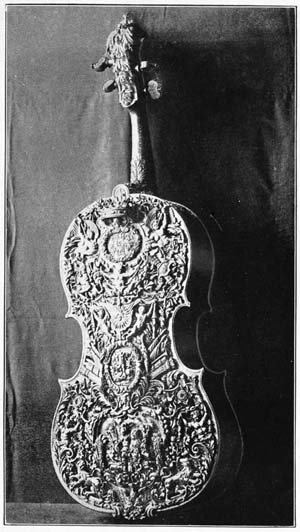
CARVED VIOLONCELLO BY GALLI.
Modena, 1690.
Truly “a thing of beauty is a joy for ever,”
and time only increases its loveliness when it
is cherished. Galli’s chefs-d’œuvre will always
find admirers, as indeed will all the gracefully
decorated musical instruments of past centuries.
Look at this gamba de luxe, one can call it
nothing less, close beside us. Where will you
find more faultless inlaying in ivory and tortoise-shell?
Most pleasing to the eye, is it not?
Yet its very beauty exemplifies one of the
greatest pitfalls of the older luthiers. To the
ancient maker, ornamentation was as irresistible
as was the Lorelei’s golden hair to the sailors
of the Rhine. Most Italian makers had realised
the deleterious effects of inlaying and carving
before Stradivarius’ time, but many of the great
Cremona master’s German contemporaries were
still caught in its delusive toils. Dwelling in
Hamburg there was an unequalled stringed-instrument
maker named Joachim Tielke, who
fashioned his lutes of real ivory and ebony,
inlaid the necks thereof with gold, and silver,
and mother-of-pearl, while the pegs were formed
of the finest tortoise-shell. These lutes were
destined for the slim hands of the satin-clad
dilettanti of the day, who boldly faced the
many difficulties and intricacies of the instrument
for the sake of its beauty. According to
Mattheson,[31] if a lutanist attained the age of
eighty, one might be certain that he had spent
sixty years in tuning; a tedious operation, as
the lute never remained long in tune. An
older writer, Thomas Mace, in his “Musick
Monument,” London, 1676, discussing the
shortcomings of the lute, seriously advises that
it should be kept, in the daytime, between the
rug and blankets of a bed which was constantly
used. It is hardly surprising that the exasperating
sensitiveness to atmospheric changes to
which this instrument was subject was at once
the delight and despair of its votaries, and that
makers observing these difficulties should attempt
to please their patrons by ornamenting
other less fragile instruments in lute fashion.
Tielke of Hamburg at all events transferred his
lute decorations en bloc to his gambas, as this
instrument and some others reveal.
The gamba of this make which is before us
has unfortunately been fitted by some vandal
with a machine head, but otherwise is as perfect
as when it left Tielke’s hands over three
hundred years ago. No doubt, the original
pegs were of ivory tipped with a dainty jewel
to correspond with those which were let into
the neck. Before it became the property of
the South Kensington Museum it was owned
by Mr Simon Andrew Forster, the joint author
of the well-known “History of the Violin.”
Two excellent pictures of this instrument are
included in this volume, and also the information
that Mr Forster purchased it from Mr
John Cause, the artist, who had lent it to the
directors of the “Ancient Concerts,” held in
the Hanover Square Rooms in the spring of
1845. These concerts were organised to take
place in this obsolete concert hall by a small
body of aristocratic music lovers headed by the
Prince Consort, and it was under his auspices
that the second concert of the season was not
only devoted to the sixteenth-century music, but
was performed on the ancient instruments themselves.
M. Fetis, at that time director of the
Brussels Conservatoire, supplied a number of old
instruments from the Musée of the Conservatoire,
and the orchestra on the evening of the 16th
April 1845, presented,—what The Illustrated
London News terms,—“a grotesque sight.”
There was a “Violino Francesi,” says the above
authority, a “viola da gamba” (now before us),
a “viola d’Amore,” and a “viola da Braccio,” a
“Theorbo,” “violino,” “guitar,” “harp,” and
an “organ,” played respectively by Messrs Loder,
Hatton, J. F. Loder, Ventura, Dragonetti, Don
Cubra, T. Wright, and Lucas. The complete
programme of the concert may be seen in full in
The Illustrated London News for 19th April 1845,
suffice it here to say that the two pièces de
résistance comprised a concerto, played on
Antique Instruments, and composed by Emile
del Cavalieri (1600), and an anonymous fifteenth-century
Romanesca, performed in a like manner.
Both Queen Victoria and the Prince Consort,
appeared to be highly delighted with the
concert, and at the end, invited Mr Hatton to
play a solo on his viola da gamba in the tea-room.
Since this galaxy of musical instruments of
the past astonished Londoners, we have had
many other interesting attempts at recalling the
ancient viols to the concert platform, but notwithstanding
the success of these appearances,
there is no danger of the gamba ever getting
the upper hand of the violoncello again. The
latter has steadily taken its place as the leader
since the first half of the eighteenth century,
when the great Italian luthiers busied themselves
with its graceful form, and the performances
of Franciscello first enchanted Scarlatti in
Rome, and then astonished all Italy. From that
time until the present, makers and players have
gone hand in hand. Franciscello’s marvellous
achievements inspired others to emulate his
powers of attraction, among others Antonio
Vaudini, who was Tartini’s great friend and
travelled about with him for some time, for
the sole purpose of accompanying him. This
eccentric association of the high and low instruments
belonging to the string quartet led to
violoncellists adopting the system of fingering
employed for the smaller instrument. The old
way of holding the bow in the manner of the
viol players—i.e. as double-bass players frequently
hold it now—was also discarded for the
violinist’s method. Then Antonionetti of Milan
and Lanzetti, violoncellist to the King of Sardinia,
published some sonatas for the violoncello, which,
according to Monsieur Vidal in his “Instruments
a Archét,” reveal that the capacities of the instrument
to the extent of an octave and a half
were known to them. Curiously enough, at
this point the zeal shown by the Italians in
developing the violoncello somewhat cooled, and
the important invention of employing the thumb
was left for the Frenchman—Berteau. A few
years before this violoncellist’s death in 1756,
Michael Corrette published his “Methode, theorique
et pratique, pour apprendre en peu de
temps le Violoncello ...” Paris, 1741, a work
which was the first of its kind. He still adhered
to the system of fingering the diatonic scale by
stopping whole tones with successive fingers,
and his remarks relating to the several systems
prevailing among violoncellists, together with
his instructions, for three ways of holding the
bow, are indicative of the unsettled state of
technique at that time. This condition of uncertainty
among players continued until towards
the end of the century when Jean Louis Duport
published his carefully written “Essai sur le
doigté du violoncelle, et sur le conduite de
l’archét.” This was the first method in which
the correct mode of fingering—i.e. a finger for
each successive semitone—appeared. Duport’s
system was too sound to be anything else than
universally adopted, and each successive writer
of violoncello schools—Romberg, Dotzauer,
Grutzmacher, etc.—have retained the fundamental
principles laid down by Duport. To-day
there is little executed by violinists that
virtuosos of the violoncello cannot accomplish,
if they are inclined,—but,—talking about the
obvious is always tedious especially at the end
of a long day, and we feel that it is nearly time
to bid you adieu. So much has already been
written by eminent writers on the subject of
makers and players subsequent to Stradivarius—of
the German, French, and English schools—that
it would be superfluous to give a descriptive
list of them here. The question as to
whether Jacobus Stainer and Joseph Guarnerius
del Jesu made violoncellos will always be one of
the many subjects to argue about. Yet, apparently
they have left evidence that they did make
violoncellos. This and other doubtful points
may be found adequately discussed in such
works as Laurent Grillet’s “Les Ancètres de
Violon,” George Hart’s “The Violin,” Anton
Vidal’s “Les Instruments a Archét,” Von
Wasielewski’s “Die Violoncelle,” Luigi Farconi’s
“Il Violoncello, il violoncellesta e Violoncellesti,”
etc., and to those who seek to dig deeper for
themselves, there is the British Museum, and
the many Museums, and storehouses, of information,
to be found in every country.
Our chief aim during these chats has been to
seek out the uncommon rather than to preach,
therefore we will end as we have begun, and
before parting call your attention to the handsome
violoncello belonging to that gifted artist
Herr Paul Ludwig, made by a maker of the name
of “Chioddi” of whom we can find no record,
and as we bid you a regretful adieu, present you
with the history of two eminent women gamba
players, and the first violoncello prodigy known
in this country.
The fog has cleared and we may now dash
through endless slush to our respective homes.
The pleasant hours are over, let us hope for
future meetings, but if this may not come to
pass, the memory of to-day will be ever cherished
by us.
“Female violinists are rare, the violin being we do not know
why deemed an unfeminine instrument....
“Female violoncellists are rarer still, and we have never
met with one. A young German lady, Mademoiselle von
Katow, is delighting Paris by her performances.”—The
Spectator, 14th April 1860
VIOLA DI BORDONE.
A variety of the Viola da Gamba peculiar to Germany and
favoured by amateurs in the Eighteenth Century. This
instrument is in the South Kensington Museum.