CHAPTER XIV
THE FRENCH SCHOOL
A study of French miniature painters has led the present writer to
place their work on a higher level than has heretofore, perhaps, been
generally assigned to it, and has shown him that there have been not
a few but many French miniaturists of remarkable excellence, and that
they practised their art during a period which we are accustomed to
look upon as one of anarchy, of tumult, and of bloodshed; a fact which
is not only interesting in itself, but has the advantage of throwing
light upon the period also; on its life, and on the men and women
who played prominent parts during that eventful period of modern
history, for we find ample evidence that even during the Terror itself
the miniature painter was busy at work. In this respect, as in many
others, a recent exhibition of eighteenth century French Art, at the
Bibliothèque Nationale in Paris, revealed much. Indeed, it may be said
that it was the most noteworthy event in connection with miniatures,
and the claims they have upon the notice of students of art, of
manners, and of costume, which has taken place for years.
It was recognised as a revelation by the learned authorities of the
French national library, who were responsible for its arrangement,
foremost amongst whom stood the late lamented Henri Bouchot, "Directeur
du département des Estampes," a gentleman to whose courtesy I have been
personally indebted, and whose critical acumen was well known.
It was, they said, a revelation; they spoke of it in relation to its
technical aspects more particularly. It brought to light a number of
French miniature painters whose ability was amply demonstrated, but
who were almost or quite unknown at the present day, even to their own
countrymen.
But the personality of these miniature painters and the remarkable
people who sat to them must not make us ignore some earlier men to whom
I shall now briefly refer.
In the first place I may call attention to the fact that, as might be
expected, a comparison between French painters-in-little and those of
Great Britain reveals some interesting differences, both technically
and in respect of the treatment of the subject. The latter differences,
which spring from national characteristics, will, I think, be brought
out as we come to deal with the work of the various artists, and I
shall not stop to enlarge upon them now.
At a time when we could boast in England of no native artist of
importance—hardly one, indeed, can be named, for Nicholas Hilliard was
not born until the middle of the sixteenth century—there was working
in France a family of artists known as the Clouets, who produced
portraiture of great excellence. What I have termed elsewhere the
tangled skein of the history of the Clouets would take a great deal of
unravelling. It is a subject to which foreign critics of eminence have
devoted much time and trouble. Without following all their researches
in detail, or professing to utter anything like the last word upon
an obscure and difficult subject, it may be said to have been proved
that the family was undoubtedly of Flemish extraction, and that they
were firmly established at the French Court at the beginning of the
sixteenth century. M. Laborde, in his "Renaissance des Arts à la Cour
de France," quotes a deed of gift of property which had escheated
to the Crown dated 1516, the second year of the reign of François
I., which shows that, at any rate, by that time the Clouets were
established in Royal favour.
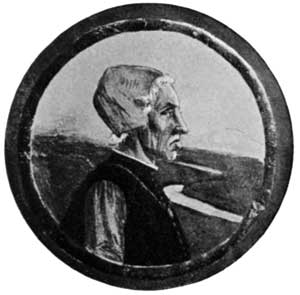
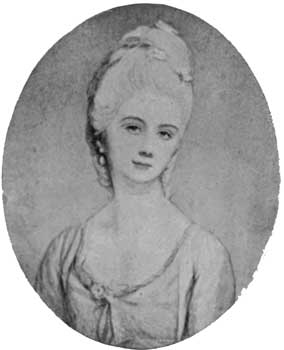
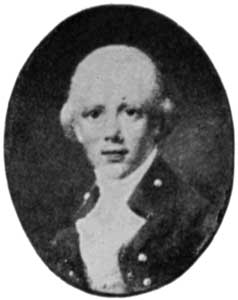
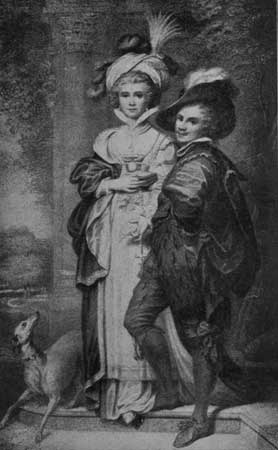
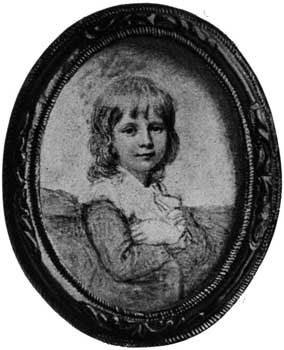
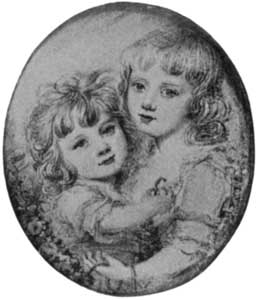
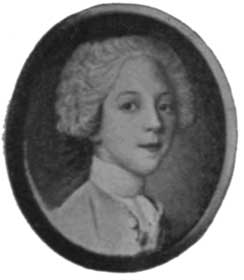
L. SICARDI.
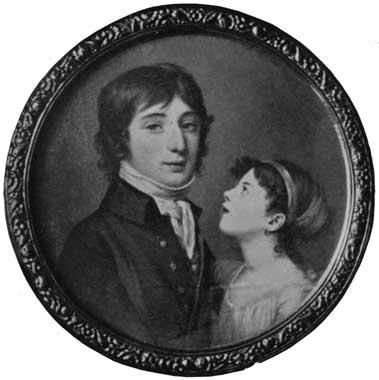
BENOIT BOULOUVARD DE SAINTE ALBINE AND SISTER.
(M. le Comte Allard du Chollet.)
The surname was probably originally Clouwet, and two members of the
family, father and son, have been commonly known as Janet. This
duplication of names, to say nothing of the varieties of spelling, has
led to a good deal of confusion in the attribution of works by these
artists. Among the latest authorities upon this subject I may quote my
friend M. Dimier, of Paris, who contributed a chapter to my book on the
portraiture of Mary Queen of Scots.[5]
The subject has a significance of its own for French art critics as
throwing light upon the influences exerted upon French artists at the
period of the Renaissance—that is to say, whether the work by the
men of that time which has come down to us owes its highest artistic
qualities to Italian influence, to native genius, or to Flemish
influence. Critics are divided into two camps: those who stoutly
maintain the claims of the French artists to originality, and those who
are equally confident that it is to Italian influence we owe all that
is most attractive in French art of that period. M. Dimier has acutely
pointed out that whilst the Italian influence theory is anathema to
many, these same critics allow the assertion of Flemish influence to
pass without a protest.
Be all this as it may, it is quite clear that the vogue for portraiture
in France at the beginning of the sixteenth century was extraordinary.
Contemporary inventories show that drawings by the thousand must have
existed. They were kept in albums in the houses of the great, and many
collections are known. Catherine de Medici loved to have her children
painted, and M. Bonafflé has shown that her estate included more than
a hundred such portraits. There are numbers of these to be seen to-day
at Chantilly, the old home of the Condés, not the least interesting of
which is a series of eighty or ninety drawings in black and red chalk
that once belonged to the Earl of Carlisle and formed part of the
famous Castle Howard Collection.
Before leaving the Clouets, I may mention that a painting, measuring
sixty-one by fifty-three inches, of Henri II. was sold at Christie's
in January, 1905, for £2,500. Those who were fortunate enough to have
visited the Exhibition de Primitifs Français at Paris, in 1904, will
remember a number of interesting portraits attributed to the two
Clouets, of which they cannot have failed to admire the beautiful
portrait from the Louvre of Elizabeth of Austria. The original drawing
for this is in the Bibliothèque Nationale, and the existence of the two
works—that is, the crayon from nature and the beautifully finished
picture in oils—is interesting as showing the practice of the artist.
In the remarkable Exhibition just named the student will have made the
acquaintance of many names probably new to him, and can hardly have
failed to observe the number attributed to Corneille de Lyon, most of
them dated somewhere about 1548. This is an artist who has only of
late years won recognition. He, too, was a Fleming, but the only name
which can be assigned to him is Corneille. M. Dimier says he was a
native of the Hague who settled at Lyons. He surmises that the Royal
visits to Lyons in the year 1536 were productive of Royal patronage.
But M. Dimier appears to hold very conflicting views as to the merits
of this artist, and discovers great divergences in his style; thus he
says: "His [Corneille's] knowledge is so scanty that he can scarce fill
in his own feeble design; in the best of these pictures the bust and
shoulders are like students' work, and verge on the ridiculous"; yet
his texture, he says, elsewhere, "is delicate, limpid, and absolutely
fresh, the total effect the result of genius of a very small order."
But in a portrait of the Baron de Chateauneuf, which does, or did,
belong to Mr. Charles Butler, he finds work which he says is scarcely
unworthy of Holbein; "in depth of knowledge, boldness of execution,
and extreme beauty of colour this little work is a masterpiece, far and
away superior to anything which I have ascribed to the Janets," &c.
I have quoted these opinions at some length so that readers may judge
for themselves of the relative importance of this early artist, all of
whose work exhibited at the Exhibition de Primitifs was small in scale,
and most of it, I have reason to believe, new to some students of art.
When we leave the Court of the Valois we seem to come to a great gap in
our subject; and it is not until we arrive at the names of Petitot and
his followers, a subject which has already been dealt with in Chapter
VIII., that there is anything of importance to arrest our attention.
This book is in no sense a detailed history of miniature painting; it
merely aims at discussing some of the salient points of a wide subject;
and, therefore, I make no further apology for passing on to the work
which was executed in the eighteenth century, when several artists of
remarkable ability appear on the horizon. I propose to take a few of
the most eminent of these names, and to deal with them in chronological
order.
Following that classification, the amiable Rosalba Carriera will come
first. She was born in Venice in 1675; and though some would deny her
any extraordinary talent, certain it is that she achieved European
reputation. This lady must have possessed charming manners and very
endearing qualities, for she is reputed to have been plain in personal
appearance. Some ten or twelve years before her death, which
occurred in her native place in 1757, she became blind, and devoted
her means and the closing period of her life to works of charity.
She painted a good many miniatures, which are dispersed in various
collections, also landscapes. But probably her fame will rest most
securely upon her work in pastels, of which there are examples in the
Louvre; I recall two in the Salon des Pastels which are not unworthy
of the fine specimens of that kind of work which hang around them; and
that is high praise indeed, for, as every one knows, work in crayons
was carried by French artists of the eighteenth century to a pitch
of astonishing excellence; some of the portraits in that room by La
Tour, for example, can hardly be surpassed for truth to nature and
beauty of drawing; with almost the strength of oil paintings, they
have a character and charm peculiar to themselves. In landscape work
Rosalba earned great renown, though there are some who say that she was
over-praised in her day and by her generation.
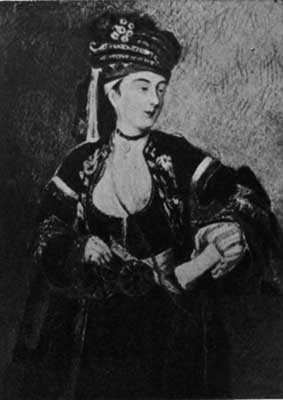
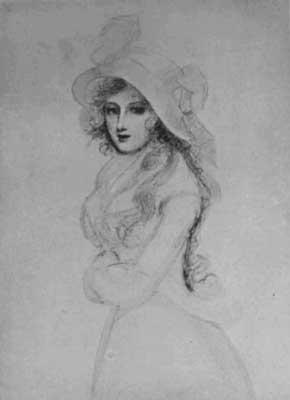
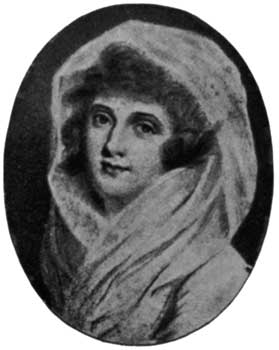
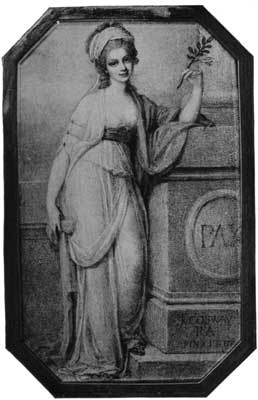
P. P. PRUDHON.
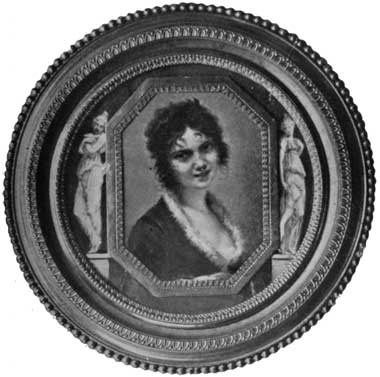
MLLE. CONSTANCE MAYER.
(Eudoxe-Marcille Collection.)
Jean Baptiste Massé has been described as a link between seventeenth
and eighteenth century miniature painters. He was also an engraver, the
son of a Protestant goldsmith of Chateaudun, born in 1687. In spite
of his religion, the Regent obtained his admission to the Academy. He
worked in gouache and his style is said to have influenced Hall. The
portrait of Natoire here shown gives a good idea of his powers. He
lived till 1767.
In François Boucher, who was born just at the beginning of the century,
in 1704, and died in 1770, we have an artist of consummate ability,
whose renown does not depend upon his miniatures. He may be called
the decorative artist par excellence of the century; but probably
many of the little nudities (of which there are a large collection
to be seen at Hertford House) which are attributed to Boucher are
really by Charlier and others of his followers. The learned editor
of the catalogue of the collection of French miniatures shown at the
Bibliothèque Nationale in 1906 is my authority for saying that some
of the miniatures which are signed Boucher are by Madame Boucher, not
the wife of our painter, but a lady bearing the same name. Thus the
connection of François Boucher with our subject appears to be slight,
and as his other work is so well known we need not stop to discuss him
further.
Jacques Charlier comes next to his master in point of date, having been
born in 1720. Very little biographical information is to be gleaned
about this artist; nevertheless he was extremely well known in his
time, and his genius, such as it was, appears to have been admirably
adapted to the taste of the day. Thus, the Comte de Caylus, the amateur
who has left us that valuable memoir of Watteau which the Goncourts
rescued from oblivion, is said to have possessed a hundred examples by
Charlier; and in 1772 the Prince de Conti commissioned him to paint a
dozen miniatures at 1,200 livres apiece. Louis XV. also extended his
patronage to Charlier, who painted upon boxes most of the members of
that monarch's family.
It would seem that after the death of Louis XV. Charlier's reputation
waned, and the value of his works diminished. He had a sale of his
productions which by no means answered his expectations, and shortly
afterwards he died. Hertford House can boast of a large number of works
attributed to Charlier; but, for the most part, they consist of the
familiar Toilet of Venus, nymphs bathing, and such-like subjects which
we are wont to associate with Boucher. But here and there will be found
a portrait—one of Madame Elizabeth of France, for instance.
The versatile Jean Honoré Fragonard, says M. Bouchot, painted
miniatures only for his amusement. This critic also attributes them
to Madame Fragonard. Be their authorship what it may, examples which
can be safely attributed to him are extremely rare and greatly sought
after. A representative one is to be seen in the Ashmolean Museum
at Oxford, and another is in the Wallace Collection.[6] Each may be
described as a portrait study of a young girl; in each the handling
is broad in the extreme, and resembles a freely painted water-colour
drawing in effect.
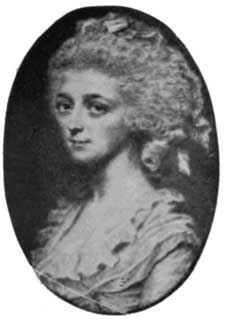
I now come to a miniature painter proper, of the highest excellence,
viz., Pierre Adolphe Hall. He has been termed—and I, for one, should
agree with this verdict—the finest miniature painter of the eighteenth
century. The facility of his execution is simply marvellous; the
sweetness and tenderness of expression that he gives to his faces,
and the invariable refinement of his works, make them delightful. His
manner is entirely peculiar to himself, body colour being largely
used. The work is broad in style and effect, and yet the features are
often minute.
The career of this prolific artist was somewhat chequered; and although
he earned large sums of money by his brush—as much as twenty to thirty
thousand livres a year, it is said—he died in poverty, and left his
family in want. He was born at Stockholm, in 1736. When twenty-four
years of age he came to Paris to study; here he remained many years,
and married a Mlle. Godin, of Versailles, whose father was killed in
the Revolution. Gustavus III. wished Hall to return to Sweden; but he
had become so thoroughly French that he refused.
The Revolution sounded the knell of the artist's fortunes. Quitting
Paris, he started for the north, hoping to find employment and
commissions on the way; but at Liège he was seized with apoplexy, and
died there, in 1793.
In the Exhibition of Miniatures at the French National Library to
which I have several times referred, there were over fifty examples
attributed to Hall, many of superb quality and undoubted authenticity.
I do not mention the price obtained at auction as an infallible test of
the quality of a miniature, or of any other work of art—for fashion
reigns supreme in the sale-room as elsewhere; nevertheless, it is
perhaps worth recording that two miniatures by Hall, shown in this
collection, fetched the sum of 28,000 and 60,000 francs respectively,
one being a portrait of the Countess Helflinger, née O'Dune—an
exquisitely soft and tender example, now belonging to M. Cognac; while
the other came from the Mülbacher Sale, and represented, not Louisa,
Queen of Prussia, as was wrongly stated in Swedish on the back of the
frame, but probably, since the portrait is entirely French in style,
that of Mlle. Dugazon in the character of Nina, as may be seen by a
comparison with an engraving of the subject by Janinet after Houin,
and the portrait by Mme. Vigée le Brun of the famous actress which now
belongs to the Comtesse de Pourtales.
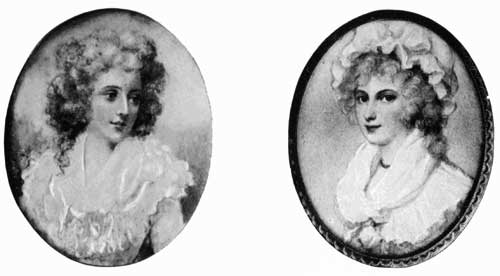
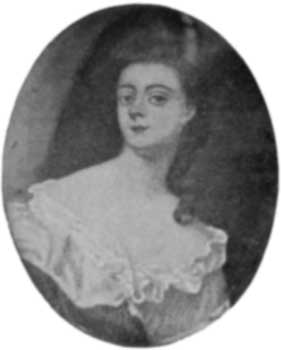
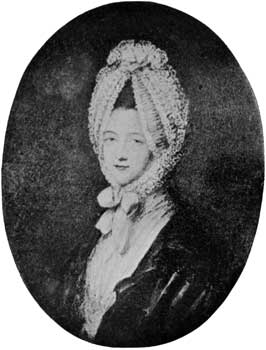
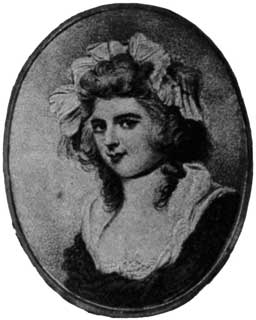
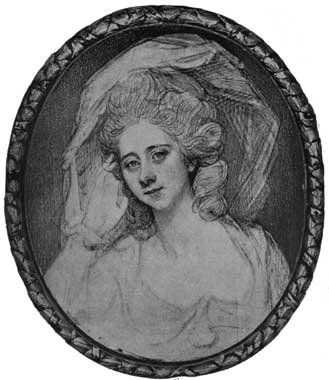
J. B. AUGUSTIN.
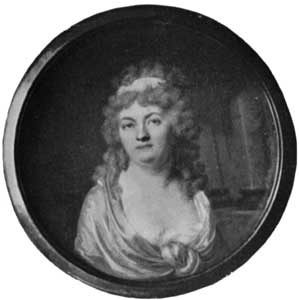
PORTRAIT OF A LADY.
(Mme. de Sainte Martin Valogne.)
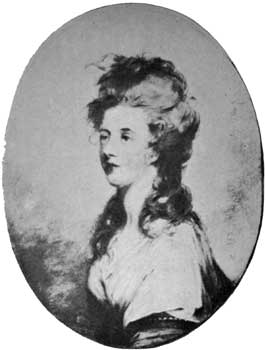
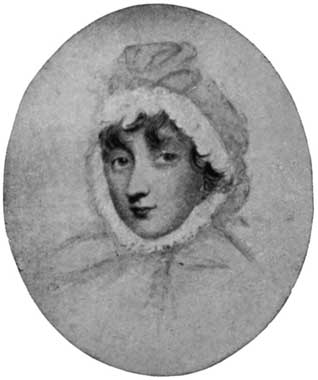
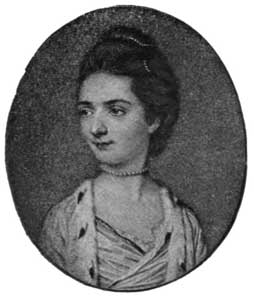
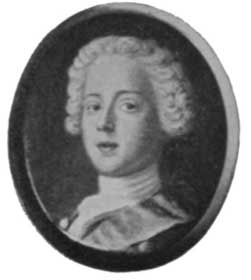
J. GUÉRIN.
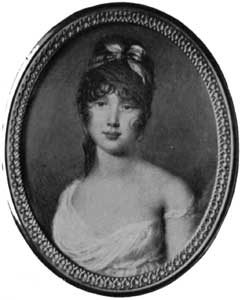
PORTRAIT OF A YOUNG LADY.
(Mme. de Sainte Martin Valogne.)
The year after Hall, was born in Stockholm another Swedish artist,
destined to attain great popularity in France, and, like his greater
compatriot, to fall into neglect, was Nicolas Lavreince, or, to give
him his proper name, Nicolas Lanfransen.
When about thirty years of age he came to Paris to pursue his studies,
and the work of his dainty, minute, not always too decorous brush was
just suited to the taste of the people for whom he worked and amongst
whom he lived. He, too, like Hall, drew Nina, and the Dugazon in the
rôle of Babet, and the Du Barry of course; all of whom were to be
seen in the Bibliothèque Nationale a year or two ago, each portrait
being marked by extreme delicacy of touch and minuteness of finish.
It must be owned that there is an extraordinary charm about the work
of this artist, apart from its merits of execution; but it is a charm
difficult to put into words. They have not the unreality of the fêtes
galantes, nor the domesticity of our Francis Wheatley, but something
between the two, something of the daintiness of Watteau combined with
the homeliness of the English artist.
He worked a good deal in body colour, and his gouaches have been
engraved in colour and in black and white by Janinet and Vidal. Many of
these, such as "La Comparaison," "L'Aveu Difficile," "L'Indiscrétion,"
are very celebrated, and now of extreme value; while another, "Le petit
Conseil," is a print of great rarity. Probably driven away by the
Revolution, Lavreince, like Hall, quitted Paris, and died at Stockholm,
in 1807, at which date, according to M. Bouchot, his art had fallen
into complete discredit.
Antoine Vestier, born in 1740, is recognised as an oil painter, and
was received into the French Academy in 1786. He is said to have
rivalled Mme. Vigée le Brun and Roslin, and loved to adorn his sitters
with ribbons and satins. Nevertheless, he was a miniature painter,
and exhibited in the Salon excellent work of the kind, marked by good
colour and careful execution. He lived on until the end of the first
quarter of the nineteenth century, and had a daughter, Nicole Vestier,
who was also a miniature painter. She married Dumont, himself a
distinguished artist, of whom I shall have something to say later on.
Another artist who devoted special pains to his draperies, and has been
called the Roslin of miniature painting, was Jean Laurent Mosnier, born
in Paris, in 1746. Mosnier was made an Academician two years after
Vestier, but did not long survive, dying in 1795. French critics place
his work on a level with that of Augustin or Dumont. His comparatively
early death may account for the rarity of his miniatures, which are
extremely scarce and much sought after nowadays, being distinguished
by excellent taste and brilliant finish, especially, as I have said, in
the painting of the draperies.
In the same year as the last-named artist, Luc Sicard, or, as he was
sometimes called, Sicardi, was born. He was a native of Avignon, and
one of the best miniature painters of his day. The delicacy of his
flesh tones, the precision of his execution, and his attention to the
most minute details made his work especially adapted for boits aux
portraits; and he was officially attached to the Ministry for Foreign
Affairs, to assist in the production of these cadeaux diplomatiques,
for which he was wont to be paid 300 livres apiece. Hence many
portraits of the French Royalty of his time were executed by him.
There is a lovely example of his delicate handling in the Wallace
Collection (reproduced in my "Miniature Painters"); and the fine
example given in this volume, the portraits of Benoit Boulouvard and
Françoise du Plain de Ste. Albine, gives a good idea of his style,
though it cannot convey the colouring which is especially charming
in the latter example. Thus, the girl wears a citron-coloured ribbon
in her beautifully painted hair, her dress is of a tender pale
greenish-blue, her lips fresh and red; her dark eyes contrast with a
pale complexion of the utmost purity, while the boy's deep blue eyes
contrast with his warm brown hair. Sicardi died in the same year as
Mosnier, namely 1825.
Another provincial artist of about this period was Claude Jean Baptiste
Houin, a native of Dijon, where he died, as Conservateur du Musée,
in 1817. His work, too, is much sought after now. He was a pupil of
Devosge and Greuze, and also painted in pastel.
M. Rouvier, who was born in 1750 and died in the year of Waterloo, is
a man whose work appears to have won recognition in his own time, a
contemporary writer speaking of it as possessing likeness, good colour,
and harmony; but, perhaps owing to the rarity of examples by him, he
may be said to be almost unknown to the present generation. There were
four notable miniatures by him in the Alphonse Kann Collection, dated
1780 and 1781. They are marked by beautiful handling and distinction of
style.
In François Dumont we have, it is generally allowed, one of the
foremost miniature painters that France can boast of, worthy of being
ranked with Isabey and Augustin, and, like both of them, a native of
Lorraine. In the Exhibition, which was so valuable as an exposition of
what the French school was capable of, there were a large number of
works by Dumont, comprising Marie Antoinette, painted in 1774, and many
portraits of the period of the Revolution. There is a certain sobriety
and moderation about the work of Dumont which conveys a sense of solid
value, sometimes rising to a height of character painting of extreme
vigour, and sometimes, in his women's portraits, marked by great
delicacy of face, hair and drapery painting.
The career of Dumont is a notable instance of the triumph of genius and
industry. He was left an orphan, with six brothers and sisters, and
when only eighteen years of age quitted his native place, Luneville,
and came to Paris as a portrait painter. After ten or twelve years'
work he had so far succeeded as to be able to go to Rome, in 1784,
where he established a reputation which led to his being appointed the
"miniaturiste attitré" of the Italian Court. He was made an Academician
when only thirty-seven, and the King gave him Cochin's rooms in the
Louvre. The year the Revolution broke out he married Nicole Vestier;
and from that time on till 1824 Dumont's contributions to the Salon
were regular and numerous.
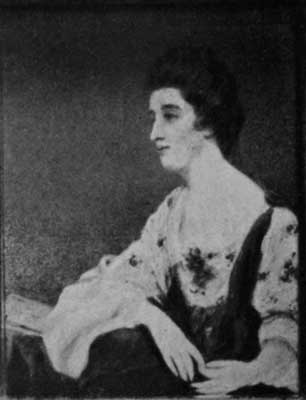
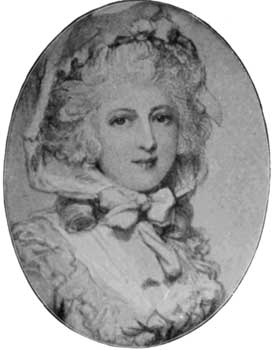
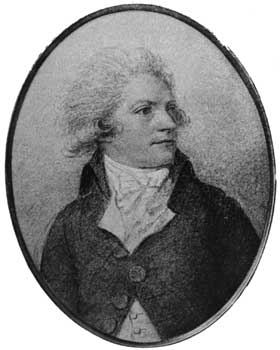
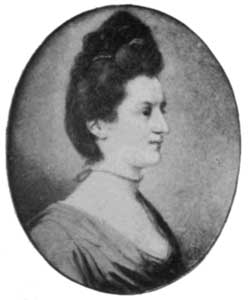
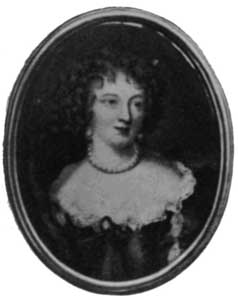
L. F. AUBRY.
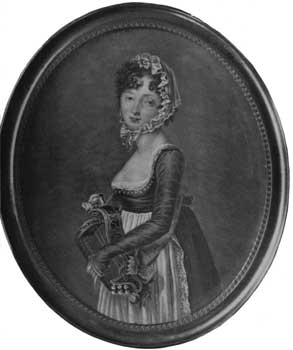
MME. HENRI BELMONT.
(M. de Richter.)
There is a comparatively large collection of his works to be seen at
the Louvre, bequeathed by Dr. Gillet. It may be noted that he had a
brother, Laurent Nicolas Antoine, called Tony, who painted miniatures,
signed "Dumont," at Paris. Some critics are inclined to attribute a
certain heaviness of style to Dumont, which may be the excess of the
solid qualities that I spoke of; and this charge is somewhat borne out
by the examples to be seen at the Louvre.
The lourdeur of Dumont passes into leatheriness in the work of Louis
Lié Périn, his flesh painting being greatly inferior to that of his
master, Sicardi. Périn came to Paris to earn his living as a miniature
painter in 1778. Ruined by the Assignats in 1799, he returned to his
native place, Rheims, where he followed his father's trade of woollen
manufacturer; but he continued to paint during the Empire, and died in
1817.
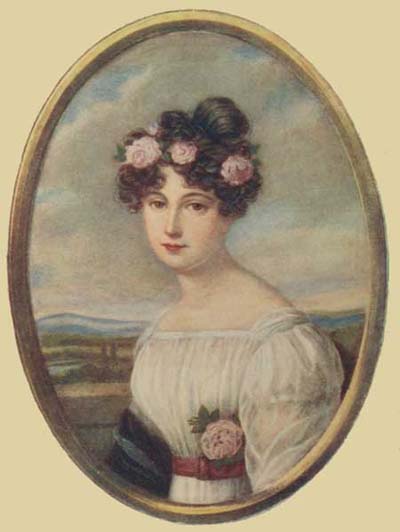
In Pierre Paul Prudhon (1758-1823) we have an artist indeed, but not,
strictly speaking, a miniature painter, for his work in this manner
was but little. Nevertheless, there is one celebrated example of his
powers, viz., the portrait of Mlle. Constance Mayer, from the Eudoxe
Marcille Collection. The tragic end of this pupil and friend of Prudhon
is well known. The face is marked by the sensibility which was the
distinguishing charm of that ill-fated lady and artist. There is a
large drawing of the same subject in the Louvre (reproduced in my
recent work on "Eighteenth Century French Art"), remarkable for force
and character.
Jean Baptiste Jacques Augustin (1759-1832) has long enjoyed a
reputation as one of the greatest miniature painters produced by
France; but it was reserved for the Exhibition brought together at
the Bibliothèque Nationale in 1906 to show the extent and surpassing
quality of some of his work. From the collections of Baron Schlichting
and Alphonse Kann, from the Doistau Collection, and last, but not
least, from Mr. Pierpont Morgan, came nearly fifty works. The quality
of these varied a good deal, some being almost coarse and bricky in
colour, whilst others, notably some sketches, with small heads, which
came from Augustin's heirs, were amongst the most wonderful things I
have ever seen in art of this nature. It would be impossible to convey
an adequate idea of the marvellous expression, delicacy, and finish
combined in the heads in these sketches, which were not larger than a
pea. In another specimen of his powers in the same collection might
be seen the most delicate tones of flesh painting imaginable. In the
Wallace Collection are nine or ten Augustins, including Jérome and
Napoleon Bonaparte and Marie Louise. The most attractive of them all is
a young lady in a white bodice, with a leopard skin hanging round her
décolleté figure. She has a most vivacious and winning expression. It
is dated 1824.
Augustin arrived in Paris some eight years before the outbreak of the
Revolution; he lived to paint Napoleon at the height of his greatness,
say, about 1810, Joséphine, Pauline, and others of the Bonaparte
family, and died of cholera in 1832. Between 1781 and 1800, when he was
married, he painted upwards of three hundred and sixty portraits, some
miniatures and some in oils. His wife became his pupil, and is said to
have almost equalled her husband. She lived till 1865, and her work is
often confounded with that of her husband, whose method of working and
artistic tendencies she thoroughly understood and embraced.
It has been said of Augustin that he was the traditional descendant
of the old missal painters; and a portrait by him of Denon in enamel
recalls, according to M. Bouchot, the best work of Fouquet, of Clouet,
or Nanteuil. I should have said that, compared with the two latter
painters, he was far their superior when at his best. For delineation
of character, minute detail, and brilliant, if somewhat hard, finish,
Augustin's work would hold its own in comparison with much of the
finest medieval missal-painting, which, indeed, it instinctively
recalls. Although, consciously or unconsciously, Augustin's work
may have been influenced by the study of medieval work, with its
brilliancy, formality, and patience, amongst the fifty pieces from his
hand shown in Paris a considerable variety of treatment might be found,
some of it being large and bold in style, as, for example, a portrait
of the sculptor Calamard.
J.-B. J. Augustin must not be confounded with that Augustin Dubourg who
signed his work "Augustin." Dubourg's work is not met with after 1800;
it is said that he was a cousin of the better-known man, and came from
the same town, namely St. Dié in the Vosges.
A contemporary of Augustin, born in the same year and dying in the
same year, was Charles Guillaume Alexandre Bourgeois. His effective
manner of rendering a portrait may be said to be peculiar to himself,
he treating them as medallions, and painting the head in profile on
a black ground, which greatly added to their effect. Although this
seems to have been Bourgeois's favourite method of portraiture, it was
not his invariable practice; and when, leaving the marble whiteness
and medal-like effect of his ordinary method, he set himself to
paint flesh tones and the fair skin and rounded contours of youth,
he was equally successful. He is said to have been very proficient
in practical chemistry, and published several works on the subject.
Although he exhibited in the Salon from 1800 to 1824, his work is
rare, and examples fetch a high price. A peculiarity I have noted in
his treatment is that the eyes in his women's portraits are invariably
large and the eyes lashes curled to an unnatural degree. I should
say that his men are not as well painted as his women. The medallion
style that he affects makes his work particularly suitable for
insertion in boxes.
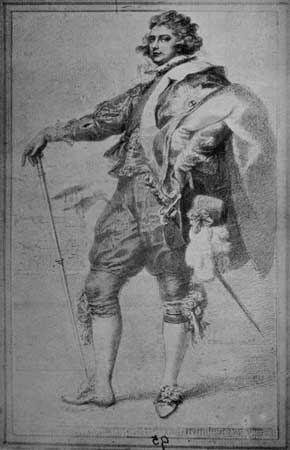
J. B. ISABEY.
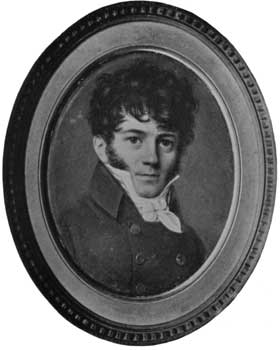
BY HIMSELF.
(M. Ed. Taigny.)
In concluding these remarks upon the French school of miniature
painters, I come to a very distinguished name, that of Isabey, with
which two other artists may be grouped as pupils or companions; and we
will take the latter first; they are Jean Guérin and Louis François
Aubry.
Guérin was born in 1760, and was a companion of Isabey in David's
studio. His abilities must have been early recognised at Court, as he
painted the King and Queen, and, later, many of the celebrities of the
Assemblée; he also lived to paint Joséphine Bonaparte in Court costume.
His portrait of General Kléber is perhaps the best known miniature
in the Louvre, and is a work of astonishing virility and force of
character. It was exhibited in the Salon of 1798, and he made many
copies of it. Although his men's portraits are remarkable for their
searching modelling, he was equally successful with the portraits of
women and children, which he painted with naïveté and tenderness.
The other associate of Isabey was Louis François Aubry, a Parisian,
born in 1767, who lived till the middle of the nineteenth century.
Contemporary criticism assigned to this artist the ability to imitate
his master Isabey, and to rival him in delicacy of brush and fidelity
of likeness. Although he exhibited for over thirty years at the Salon,
there is nothing by him in the Wallace Collection, and I only recall
one in the Louvre, and that is a large miniature, painted with great
care, representing a lady playing a harp. It is highly finished
throughout, and recalls the best work of Augustin. I should say that he
excelled in what may be called full-dress pictures, somewhat conscious,
not to say affected, in pose, but excellent work of high technical
quality. Aubry was at his zenith during the Restoration; he lived till
1851, and for many years had an atelier in Paris frequented by male
and female students.
In some respects Jean Baptiste Isabey is the most remarkable name in
the annals of French miniature painting. He was persona grata to
successive monarchs, having been peintre attitré to Napoleon, to the
Allies, to Louis XVIII., and to Charles X. But the commencement of this
artist's career can be taken much farther back, seeing that it was the
admiration of Marie Antoinette for his work upon boites decorées that
led to his first royal patronage, and resulted in his being installed
at Versailles before he was of age. From that time, the very eve of the
Revolution, until 1855 he produced a long series of portraits of all
the most distinguished personages of his time.
The Wallace Collection is especially rich in his work, there being
nearly thirty examples by his hand. With Napoleon I. he was a special
favourite, and, as I have said, several of his portraits of the Emperor
may be seen at Hertford House, representing him in full Imperial
costume, in academic dress, with Joséphine, and otherwise. And there,
too, may be seen two portraits of the Duke of Wellington from his
hand. But this collection is especially rich in portraits of ladies of
the Empire and Restoration, to depict whose charms he adopted a style
of his own, known to French critics as portraits sous voile. These
ladies are touched in with a light hand and with the freedom of a
water-colour sketch.
This manner of painting, in which he may be said to have set the
fashion, is the very antithesis in style to that of his master David;
but the rigorous training of that severe draughtsman enabled Isabey,
when he chose, to paint with a precision and minute finish which is
the ne plus ultra of such work. This was shown in a large piece,
twenty-three by seventeen centimetres, exhibited in Paris in 1906, and
representing the children of Joachim Murat, and Caroline of Naples
déjeunant sur l'herbe. This, I do not hesitate to say, is the most
extraordinary piece of work of its kind that I have ever seen. It is
a group of several children in velvet dresses of the period, and a
certain quality of velvety softness marks the execution. The attention
to detail is microscopic; all the accessories of the little picnic
party are painted with elaborate care; the stalk of the flowers in the
dessert dish, the tiny finger-nails of the children, are all treated
as if the artist's reputation depended upon the fidelity with which he
represented them. It is a veritable tour de force of finish; but such
is the brilliant and luminous way in which he has handled it that there
is nothing hard or laboured in its effect, in spite of the immense
amount of work it must have entailed.
In this particular example there is a quality recalling the finest
Flemish work; and yet, as Isabey came to the capital, as we have seen,
before he was twenty-one years of age, he can hardly have been subject
to Flemish influences; I should attribute it to the influence of David
and the classical school. The group I have been describing is not
dated, but clearly belongs to the halcyon days of the Empire.
It may have been the demands made upon the time of Isabey, owing to his
numberless commissions, that made him adopt the less laboured style
of most of the portraits of ladies which may be seen at the Wallace
Collection—that is, his latest manner—which is so entirely different
from the group of Murat's children as to make one almost doubt at first
sight that it can have proceeded from the same hand.
I had intended to close this notice upon the French painters with
Isabey, who, as he lived to be nearly ninety, seems to be linked on
almost to our own times; but there are two or three others to whom I
must briefly refer, of whom the Italian Ferdinand Quaglia is one.
He was born in 1780, and was established in Paris in 1805, where,
having obtained the patronage of Joséphine Beauharnais, he became
a Court painter. A miniature of the Empress by him may be seen at
Hertford House; it is probably a replica, as it is dated 1814, and
she was divorced five years earlier. Quaglia's work is marked by high
finish, but it is uninteresting, and his style sometimes approaches the
smoothness of porcelain, which detracts from its artistic value.
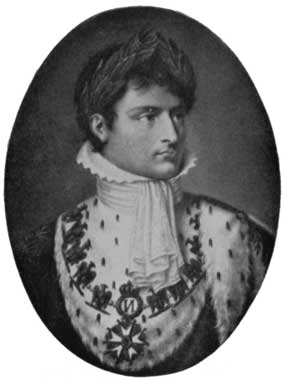
Another artist who clearly enjoyed the French Imperial patronage was
C. Chatillon, as is shown by the beautiful portrait of Napoleon in his
coronation robe and wearing the laurel wreath of victory, which adorns
this volume. The original is in the collection of his Grace the Duke of
Wellington.
Daniel Saint was an excellent artist, though not, perhaps, of the first
rank; there are several examples of his work in the Wallace Collection,
and he may be regarded as the successor of Augustin and Dumont.
Lastly, I may mention J. Mansion, who painted many charming portraits
of the period of the Restoration, as may be seen at Hertford House.
He was associated with the Sèvres factory, but his quality as a
portrait painter is amply vindicated in the Wallace Collection. His
work was probably largely influenced by Isabey, whose style it closely
resembles.