CHAPTER VII
JOSIAH WEDGWOOD
1730–1795
Josiah Wedgwood's place in the ceramic world—His
business abilities—Josiah Wedgwood's wares—Cream
Ware and its invention—Jasper Ware and
its imitation—The influence of Josiah Wedgwood—Wedgwood
Marks—The Prices of Wedgwood.
The time is now ripe to form a mature judgment as
to the exact niche in the temple of fame which
Josiah Wedgwood is to occupy permanently. His
immediate successors were in too close proximity to
his own day to form an opinion as to his life-work
in relation to what had gone before and what has
succeeded him.
The inquiry into the origins of certain inventions
attributed to him have been pursued of late years
with a scientific thoroughness, and many facts have
come to light which tend to raise the reputation
of other lesser known potters who immediately
preceded him or were his contemporaries.
John Dwight (of Fulham) has come into his own.
The Elers (of Staffordshire) have been dethroned
from the unique position they occupied as pioneers
of salt-glaze ware. In regard to the Astburys,
father and son, credit has been given them for
great work, and Whieldon is held to have had an
immense influence on his contemporaries. During
the great outburst in salt-glazed ware, cream ware, its
later rival and conqueror, was in a transitional stage.
This transitional period embraces a great field of
pioneer workers who experimented unceasingly with
clays and glazes. The days of salt-glaze were
drawing to a close, it had many obvious defects; the
ware would not readily stand hot liquids—and this
in an age when tea drinking was becoming fashionable.
The artistic side for the moment was cast
aside in these experiments, the uppermost question
in the Staffordshire potters' minds was the invention
of some ware that could hold its own against the competition
of the new English porcelain factories.
It thus came about that this period of great
technical activity (1720–1740) was immediately
succeeded by an almost simultaneous exhibition of
work, suggesting a renaissance of earthenware in
England (1740–1800) and establishing the European
reputation of Staffordshire.
Josiah Wedgwood with John Turner, of Lane End,
and William Adams, of Greengates, stand as a trio of
master potters who developed the classic spirit in
jasper and kindred ornamental ware. In regard to
developing the manufacture of cream ware and stone
ware for domestic use, and in building up a continental
and American trade which won for British
earthenware the supremacy of the world's trade in
pottery, Josiah Wedgwood takes an equal prominence
together with Warburton and the Baddeleys and the
Adamses and Turner.
In roughly detailing the stages which led up to
the manufacture of the main classes of ware for
which Wedgwood was famous, it will be shown how
with a masterly mind for realising broad results he
combined the patient industry of a practical potter.
He commenced with a capital of twenty pounds and
died worth half a million. In spite of his ill-health
and the loss of his leg, his unflagging energy and
his keen foresight enabled him to build up an
important business which is still carried on by his
descendants. His love of organisation and the
system of control which he exercised over his own
enormous output had a lasting effect on the methods
of the Staffordshire potteries.
The genius of Josiah Wedgwood has won the
continued admiration of succeeding generations. It
may be that he has somewhat overshadowed many
of his contemporaries, and his successors have been
termed imitators. In order to adjust matters there
is a tendency in some quarters to belittle the work
of the great Josiah. But surely the pendulum has
swung too far the other way when it is advanced that
"Wedgwood himself was no artist, he was a tradesman
pure and simple."
This is not the opinion of critics with nicer
balanced judgment and of cosmopolitan taste. The
epitaph upon his monument in the parish church of
Stoke-upon-Trent, which bears the inscription that
he "converted a rude and inconsiderable Manufactory
into an elegant Art," has been assailed in order to
prove it to be a "travesty of the fact," and to state
that "what he really did was to convert an Art—rude
it may be, and inconsiderable, but still an Art—into
a manufacture. In other words, he inaugurated an
entirely new order of things in the production of
pottery, and a less desirable one."
The truth is that it is not necessary to belittle
Wedgwood in order to put his great contemporaries
in the order of their merit. The later and more
corrected opinion may be arrived at quite judicially
by crediting them with some of the artistic impulses
he possessed. While he lived he worked harmoniously
and in close friendship with his fellow potters, and a
century after his death it should not be difficult to
determine their relative positions without bespattering
his epitaph with mud.
Wedgwood's business abilities.—He was undoubtedly
a keen man of affairs. When in partnership with
Whieldon he had travelled to London, to Manchester,
to Birmingham, to Sheffield, and to Liverpool, which
brought him into touch with silversmiths and metal workers
in connection with the agate knife-handles
and similar Whieldon ware. He evidently realised
that Staffordshire was behind other districts in many
respects. Although only a young man, he interested
the influential people in the neighbourhood of the
potteries and the roads were improved and water
transit provided as an outlet for goods. He cut the
first sod of the Trent and Mersey Canal.
In 1759 he was master potter, but he made most
of his own models, prepared his own mixtures,
superintended firing, and was his own clerk and
warehouseman. Less than ten years afterwards,
on the advice of the Duke of Marlborough, Lord
Gower, and Lord Spencer, he opened showrooms in
London in Newport Street.
A year after this the demand for his fine jasper
ware and expensive ornamental productions had so
increased that he found the greatest difficulty in
finding sufficient workmen.
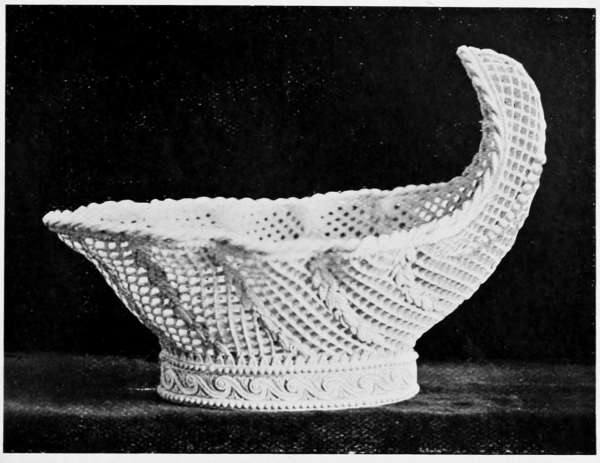
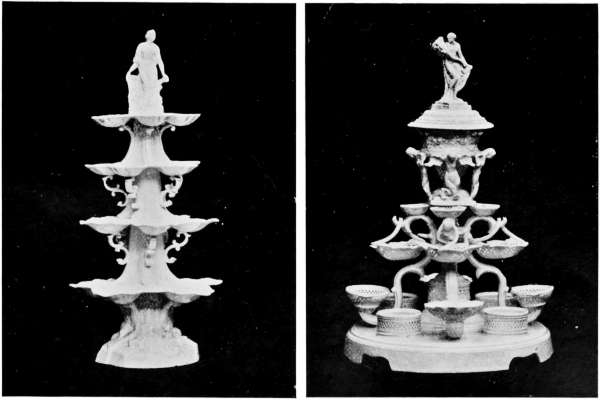
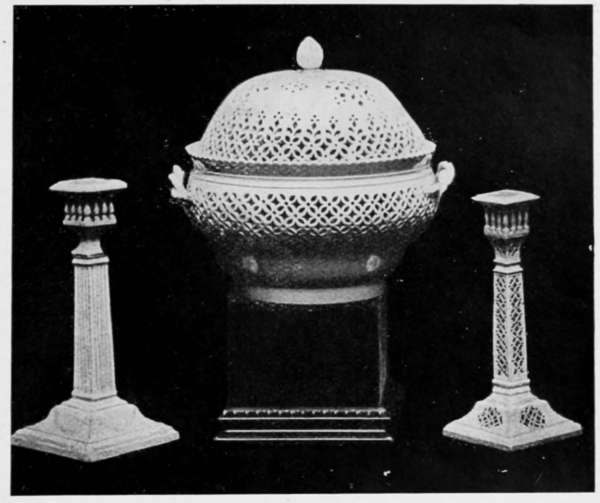
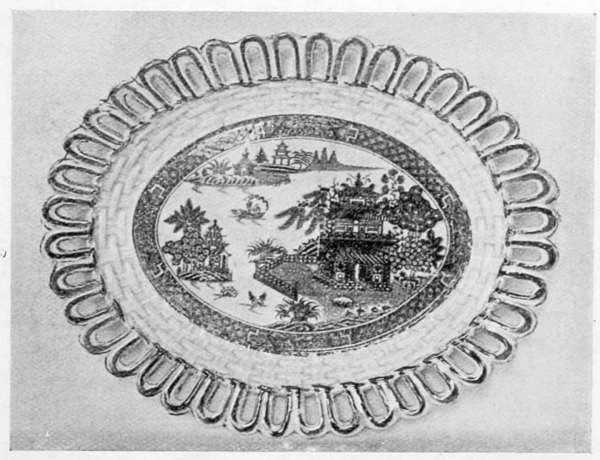
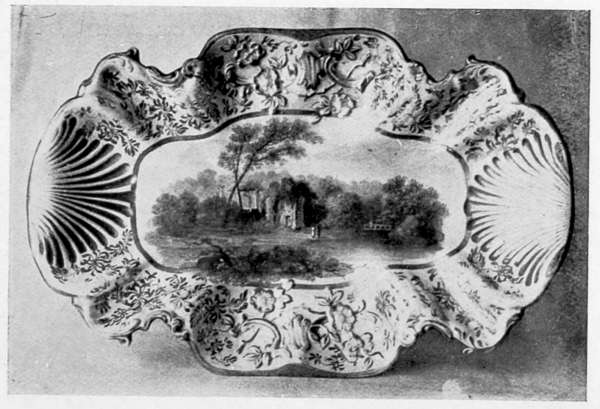
WEDGWOOD CREAM WARE DESSERT BASKET.
Showing fine pierced work.
By the courtesy of Messrs. Josiah Wedgwood & Sons.
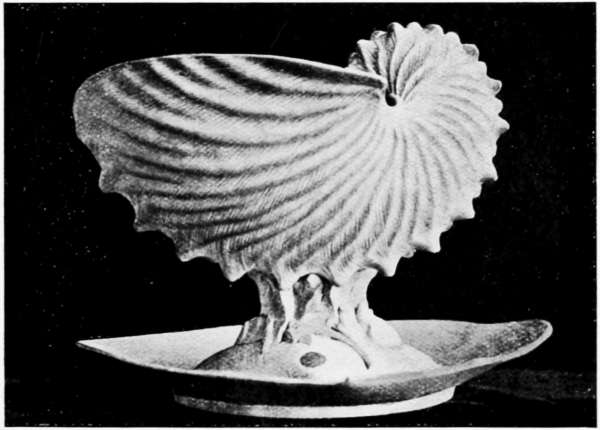
WEDGWOOD CREAM WARE DESSERT CENTRE-PIECE.
Designed from Josiah Wedgwood's collection of shells.
(In Museum at Etruria.)
By the courtesy of Messrs. Josiah Wedgwood & Sons.
His catalogues were printed in several languages,
and he had the shrewd common sense to add some
forewords of his own to indicate the lines on which
he was working as a potter and to bring the attention
of likely buyers to his ware.
Wedgwood as a potter.—There is no doubt that
Wedgwood always had in view the improvement
of whatever ware he engaged to make. When with
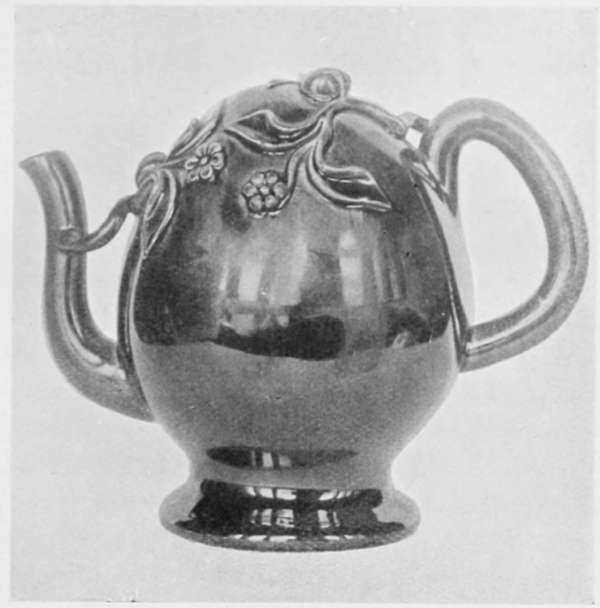
Whieldon he perfected the green glaze in the cauliflower
and kindred ware, and when he became a
master potter in 1759, he produced pieces which were
eminently remarkable for their fine technique. There
is no doubt that his connection with silversmiths
induced him to follow their designs. Some of his
early ware, such as teapots, have punched perforated
ornament in the rims for which he invented tools.
In the museum at Etruria are some six thousand
trial pieces, some few inches in length, covering a
wide period when Josiah was pursuing his way
towards his crowning achievement, the invention of
his jasper ware.[3]
He claims credit for great improvements, both as
an inventor and as a ready and masterly adapter,
quick to seize the salient points of a half-perfected
ware and by a few touches of genius make it his own.
He was made a Fellow of the Royal Society for his
invention of a pyrometer, an instrument for registering
high temperatures in the kilns. His experiments led
him into new fields in connection with bodies, glazes,
and colours, and he introduced for the first time in
pottery certain minerals such as barytes in his pastes.
Josiah Wedgwood's wares.—It will be seen, in the
enumeration of the various classes of ware which
were produced by him, in what respect he added
improvements which in their turn were improved upon
by later potters, and to what extent his productions
were entirely original, adding a new note in English
pottery, creating an entire school, and leaving the mark
of his genius on his successors for nearly a century.
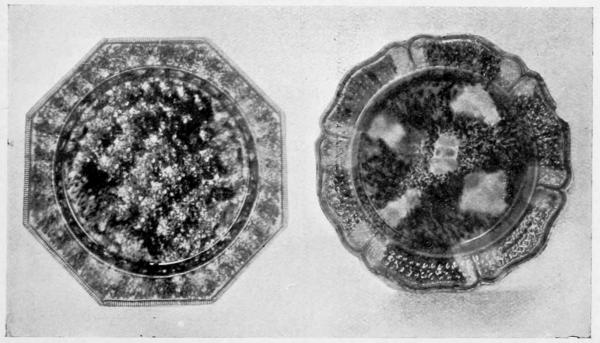
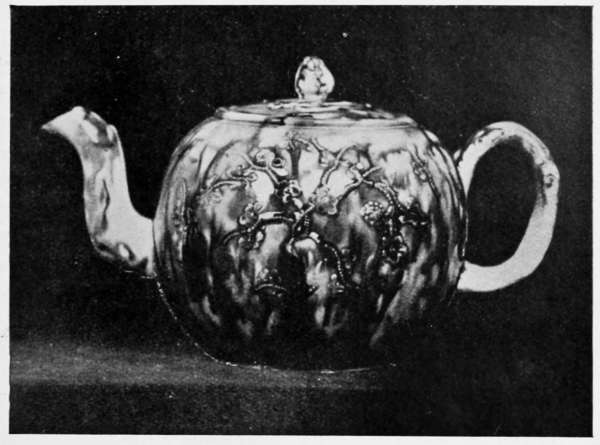
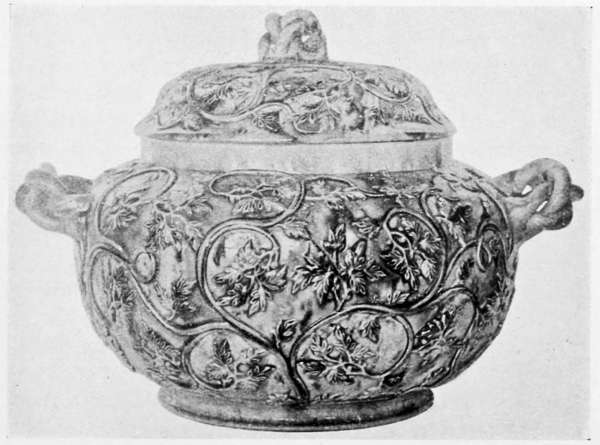
Variegated ware.—The agate, the cauliflower, and
melon ware, the clouded and mottled glaze, and the
various imitations of marbling, came into vogue in
the days of Whieldon. But Wedgwood was more
ambitious in his designs. We have already seen, in
dealing with Whieldon ware, how the "solid" agate
ware was produced by means of fine layers of clays
of different colours, which after careful manipulation
produced a series of waves resembling the natural
ornamentation of the stone. Wedgwood also employed
"surface" colouring for this variegated ware, the body
being of the common cream-coloured earthenware
and the veining and mottling being applied to the
surface. In such pieces the handles and the plinths
were usually oil gilded; later he used a white semi-porcelain
for plinths of such ware.
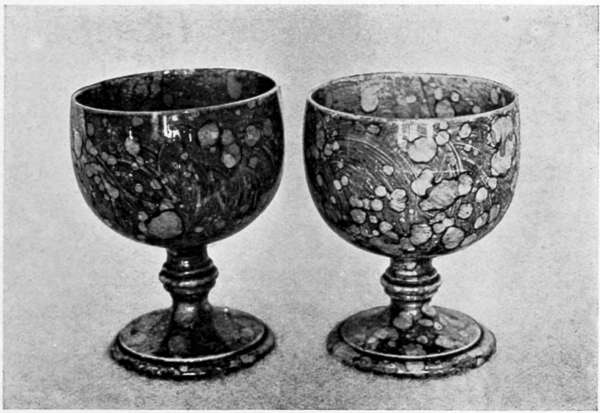
Two agate vases and ewers marked "Wedgwood
and Bentley" belong to the period 1768 to 1780.
The plinths of the agate vases show the white
undecorated body. Wedgwood imitated Egyptian
pebble, jasper, porphyry, and various kinds of granite
speckled with grey, black, white, or green. Much
of this is a flight higher than the agate ware.
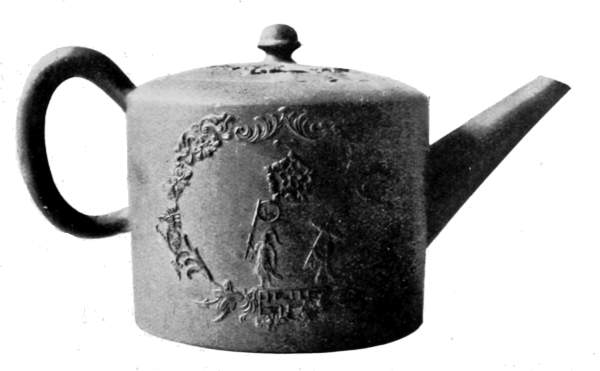
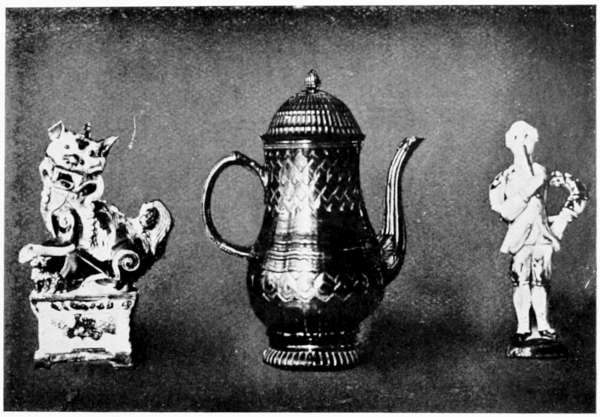
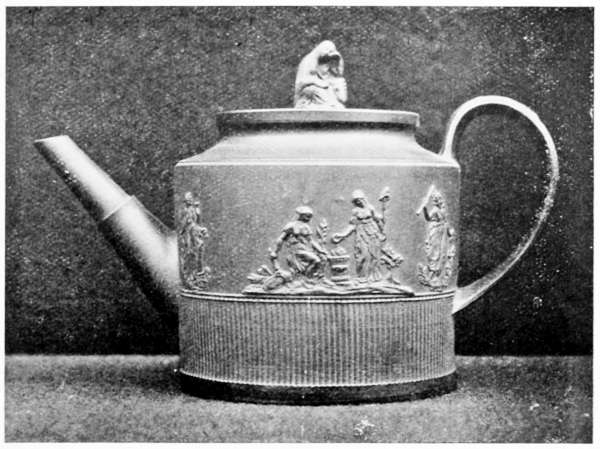
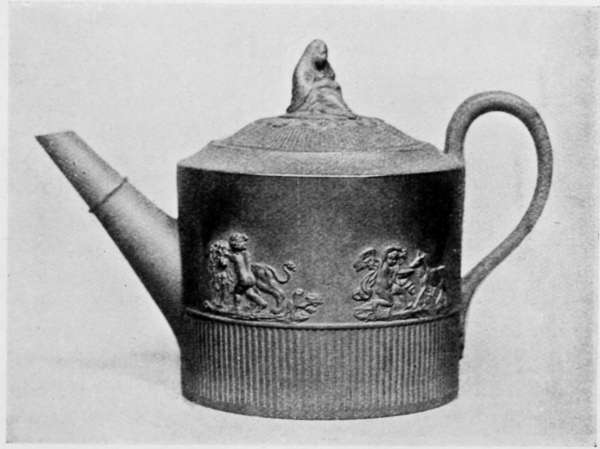
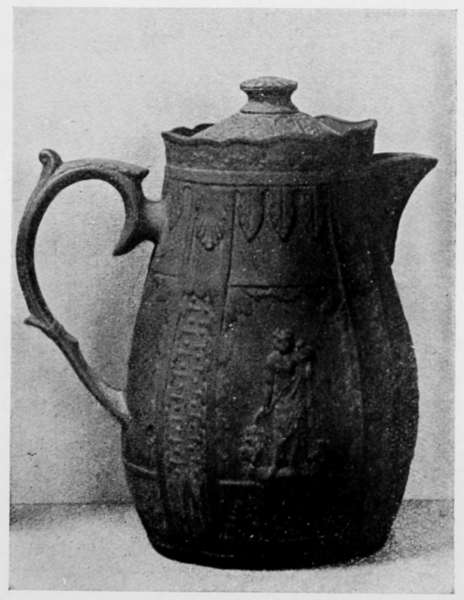
Black basalt Ware.—In this ware, which was
termed "Egyptian black," Wedgwood triumphed
over his predecessors. We know the black ware
made by Elers and by Twyford (two fine black
Twyford teapots are in the Hanley Museum), but
the ware into which Wedgwood infused his genius
is worthy to be called what he termed it—"black
porcelaine." With its rich black, smooth surface
it was capable of varied use, including useful as
well as ornamental ware. In the former, we find
tea services and coffee or chocolate pots strictly
adopting the severe Queen Anne silver shapes, and
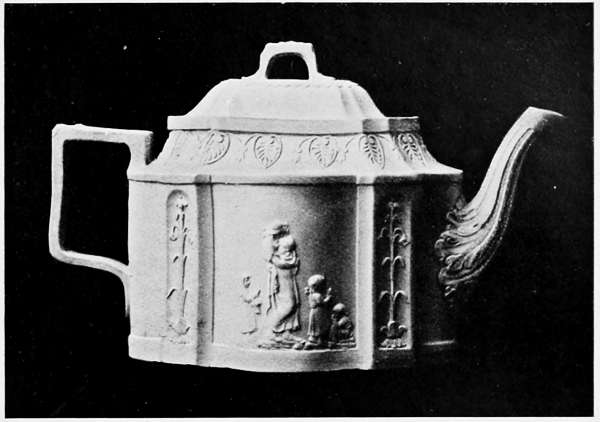
in vases he followed bronze prototypes. See illustration
(p. 241) of two Black basalt Teapots. It was
used in fine manner for life-size busts and for
medallion portraits of "illustrious Ancients and
Moderns."
This basalt ware Wedgwood further used in
combination with other processes. He imitated
the ancient Greek vase paintings by decorating the
black surface with unglazed colours, or he had
ornaments in relief in red. Another replica of
classic art was his simulation of bronze, and this
black ware formed the groundwork to which he
added the bronze metallic colouring in his rare
bronze examples.
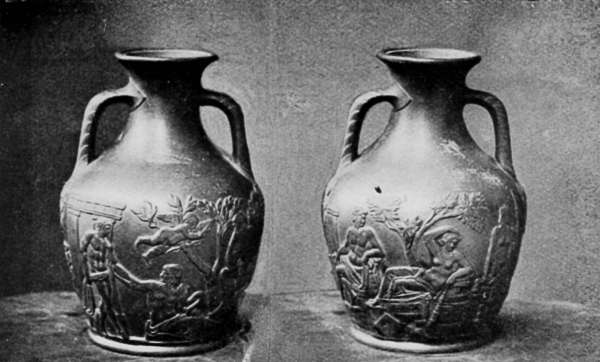
The two black basalt ewers, entitled Wine and
Water, designed by Flaxman, are well known. It
is at once evident that they owe no inconsiderable
debt to the metal worker. It requires no great
stretch of imagination to believe them to be in
bronze. Technically, as specimens of earthenware,
they are perfect, but it is open to question whether
the potter has not trespassed on the domain of the
worker in metal. There are canons which govern
the art of pottery; form and ornamentation strictly
appropriate in metal are utterly unfitted for the
worker in clay. Branched candelabra are false in
porcelain though extremely beautiful in silver. In
passing this criticism, which applies to some of
Wedgwood's work, we are incidentally brushing
aside the contention of those critics who find him
unoriginal. As a matter of fact he was so original
and so responsive to the suggestion of allied arts
that he often undertook the creation of pieces in
his kilns the like of which no potter had ever
attempted before.
Red Ware.—It is not to be supposed that Wedgwood
would allow the fine red Elers ware to stand as
representative of the uttermost that Staffordshire had
produced without attempting to emulate this early
ware. Accordingly, we find in what he terms his
rosso antico, a red ware of extraordinary beauty.
Some of the engine-turned pieces of this red ware
are exceptionally fine. There is in the Hanley
Museum a coffee-pot of great technical and æsthetic
value. Wine-coolers and other useful creations, with
classic ornamentation in relief, show the wide
range of this red terra-cotta or unglazed ware.
The Elers style was simple, with applied stamped
ornament of small dimensions and Oriental rather
than classical in motif. The red stoneware of
Böttcher, of Dresden, was by this time fairly well
known, and Wedgwood had both Elers and Böttcher
to serve as models, although he does not seem to
have employed this red ware to any great extent.
Nor did Wedgwood confine himself to red in this
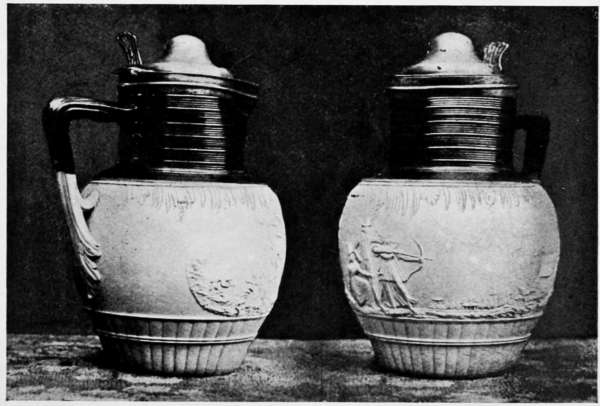
type of ware; he made chocolate-coloured examples,
and in his cane-coloured and bamboo ware he made
articles for domestic use, such as tea and coffee
services as well as mugs and jugs of this type, which
differed from the black basalt inasmuch as the basalt
was an especially hard body, whereas these others
were porous and soft. As was usual with Wedgwood,
not only did he have a series of wares of
different colours, but he often worked with a combination
of these colours in the same piece.
Cream Ware.—Something must be said concerning
the development of cream ware before it can be
accurately determined how much Staffordshire was
indebted to Wedgwood for its development. At
the outset it must be granted that he did not
invent the ware. But he improved it. Similarly
it was further improved subsequent to his day by
other potters who made it finer and whiter.
But to this day, a hundred and fifty years after
the introduction of this cream ware, his descendants,
still trading under the name of Messrs. Josiah Wedgwood
and Sons, produce this cream ware exactly
as it was then produced. Dinner services are made
with Flaxman's designs on the border, essentially
English in character and feeling. Last year Messrs.
James Powell and Sons, of the Whitefriars Glass
Works, near the Temple, which were flourishing in
1710, and still continue to produce the finest glass
in England, held an exhibition of Wedgwood ware.
Considerable interest was drawn to the subject of
this revival of the old patterns of 1775 from the
designs of Josiah Wedgwood's band of artists.
Those connoisseurs who love old furniture and old
eighteenth-century glass ware, as made by Messrs.
Powell, welcomed the Wedgwood queen's ware
designs as being something eminently fitted to
strike the right note of harmony, and accordingly,
by arrangement with the firm at Etruria, some of the
finest patterns of the old ware are exclusively made
for Messrs. Powell. The English dinner table may
now be as English as it was in Georgian days, and,
happily, this æsthetic revival has met with a warm
response by the patronage of the royal family, the
nobility, and by all those who love the old-world
charm of the domestic art of our forefathers.
Before Wedgwood's day cream ware was made.
Astbury used an addition of white clay and flint
to his bodies about 1720. In 1726 the grinding of
flint stones into powder for the potters' use became
so important that Thomas Benson took out a patent
for a machine to do this. In 1750 we find cream
ware being largely made. Aaron Wedgwood and
William Littler introduced about this time a fluid
lead glaze instead of the old manner of using
powdered galena (native sulphide of lead). Body
and glaze were at this period fired at one operation.
Enoch Booth improved this by revolutionising the
method of glazing. He fired the pieces to a biscuit
state and then dipped them in this fluid lead glaze
(ground flint and white lead), and refired them at
a lower temperature. At this date two other potters,
Warburton (of Hot Lane) and Baddeley (of Shelton),
followed Booth's practice, and cream ware may be
said to have been in a fairly flourishing condition.
These facts are all important and cannot be ignored
in arriving at a satisfactory conclusion. Wedgwood
commenced as a master potter in 1759, that is, about
nine years after the latest inventions in cream ware
had brought the ware into something more than
an experimental stage. In 1761 Wedgwood's cream
ware, both by its variety of beautiful form and its
finer glaze and body, had surpassed that of his rival
potters.
In 1762 Wedgwood presented to Queen Charlotte
a caudle and breakfast service of the ware; this was
painted by Thomas Daniel and David Steele. The
Queen and the King were so pleased with the ware
that complete table services were ordered, and
Wedgwood received the Queen's command to call
himself "Potter to Her Majesty" in 1765, and from
that date he termed the ware "Queen's Ware."
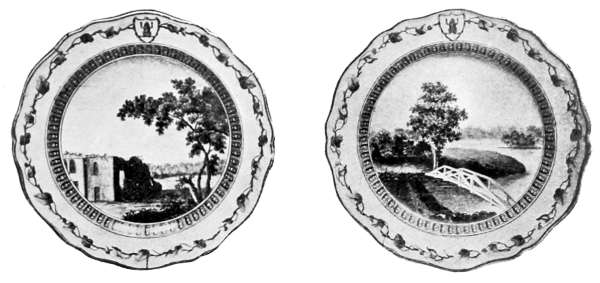
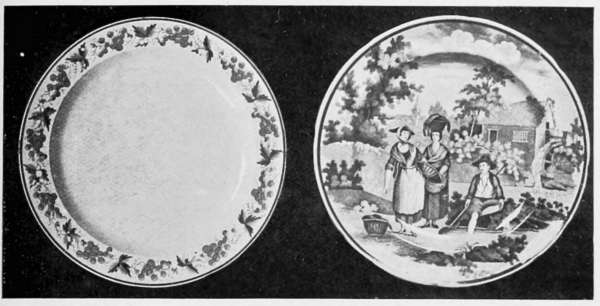
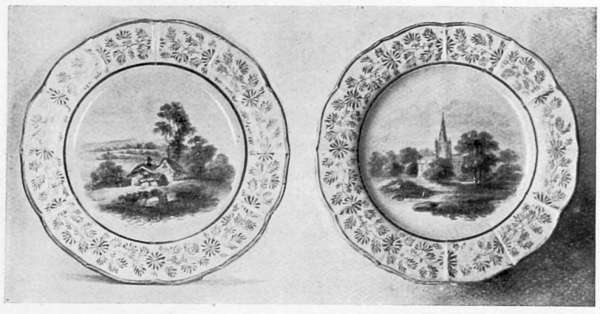
WEDGWOOD CREAM WARE PLATES.
Painted with English scenery. From service made for Catherine II. of Russia, 1774.
Having green frog in reserve on each plate.
(In Museum at Etruria.) (At British Museum.)
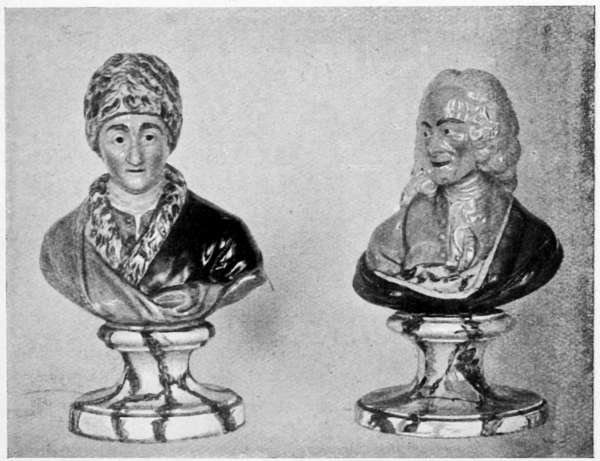
WEDGWOOD BUSTS OF ROUSSEAU AND VOLTAIRE.
Enamelled in colours. (Height 6½ inches and 6 inches.)
(At Victoria and Albert Museum.)
Though the invention of cream ware may not
be his, there must have been something essentially
more pleasing in his productions to have made such
strides in so short a time. Perhaps Wedgwood, "the
tradesman pure and simple," had something to do
with this achievement, but we prefer to think it
was the master hand of Wedgwood the potter and
Wedgwood the artist.
We cannot leave this cream ware question without
referring to an old legal controversy. This brings us
down to the year 1775 when Wedgwood, in company
with John Turner (of Lane End) journeyed to Cornwall
and jointly leased some clay mines. The reason
for their visit was that the whole of the Staffordshire
potters were up in arms. Salt glaze was coming to
an end in spite of the enamelling in colours in emulation
of English porcelain. And now Cookworthy, the
potter of Plymouth, the maker of the first hard
porcelain in England, had sold his patent rights
to Champion of Bristol, who, in 1775, applied for a
further patent for fourteen years to use certain
natural materials for making porcelain. The
Staffordshire potters elected Josiah Wedgwood and
John Turner as their representatives and petitioned
against the granting of this patent, and Wedgwood
urged that
"the manufacture of earthenware in Staffordshire has of late received
many essential improvements, and is continually advancing to higher
degrees of perfection; that the further improvement of the manufactory
must depend upon the application and the free use of the various raw
materials that are the natural products of this country."
He further adds that "the natural productions of
the soil ought to be the right of all."
Incidentally, this controversy throws light on the
position of Wedgwood as a maker of cream ware,
and it had a lasting effect, as we shall show in the
improvement of cream ware itself and upon the
class of ware turned out in Staffordshire.
Champion, in his reply to the Staffordshire outburst
in petitioning parliament not to grant his
patent, pays Wedgwood a great compliment:
"Mr. Champion most cheerfully joins in the general praise which is
given to Mr. Wedgwood for the many improvements which he has
made in the Staffordshire earthenware, and the great pains and assiduity
with which he has pursued them. He richly deserves the large fortune
he has made from these improvements."
Champion goes on to make a most vital point in
upholding his claim to protection that he
"has no objection to the use which the potters of Staffordshire may
make of his or any other raw materials provided earthenware only,
as distinguished by that title, is made from it."
Here, then, is the reason of the visit of Wedgwood
and Turner to the West, in search of the natural earths
that half the potters in Europe had been hunting for
since Böttcher, of Dresden, made his great discovery
of white clay.
But the story of cream ware is not ended. Wedgwood
to this printed "Reply" by Champion entered
the lists with some printed "Remarks," which he
circulated to members of parliament. In this—and
we must bear in mind that he was holding a brief on
behalf of all the Staffordshire potters—we find the
following statement:—
"When Mr. Wedgwood discovered the art of making Queen's Ware,
which employs ten times more people than all the china works in the
kingdom, he did not ask for a patent for this important discovery. A
patent would greatly have limited its public utility. Instead of one
hundred manufactories of Queen's Ware there would have been one;
and instead of an exportation to all quarters of the world, a few pretty
things would have been made for the amusement of the people of fashion
in England."
In spite of the opposition of Staffordshire, the Bill
enabling Champion to obtain his patent rights passed
both houses of parliament, and in the last stage a
clause was inserted throwing open the free use of
raw materials to potters for any purpose except for the
manufacture of porcelain; practically this patent was
to be enjoyed by Champion for nearly twenty-two
years.
Two extraordinarily important effects upon the
pottery industry in Staffordshire were the result of
this controversy: (1) The Staffordshire potter confined
himself to earthenware. (2) Growan stone
and Cornish Kaolin were added to the cream ware
body, which enabled earthenware to compete successfully
with china.
It may have struck an inquiring spirit as singular
that the Staffordshire potters as a body were content
to imitate English porcelain and compete with it.
At first, of course, the remoteness of the Potteries
from the West accounted for this, but clay was
brought by sea from Bideford to Chester and carried
overland to Staffordshire, but not the growan stone
nor Cornish kaolin. Chelsea and Bow did not have
natural earths to hand. But the additional reason
seems to be the one we have given—that practically
Champion's patent precluded them from making
porcelain. When, in or about 1769, cream ware
was perfected there was no need to cast about for
new bodies. Staffordshire earthenware had found
itself, and all other improvements after that date,
for fifty years, until early nineteenth-century days,
mainly concerned enamelling, printing, glazing, and
the exterior, or developments in mechanical production,
or attempts at higher artistic effects.
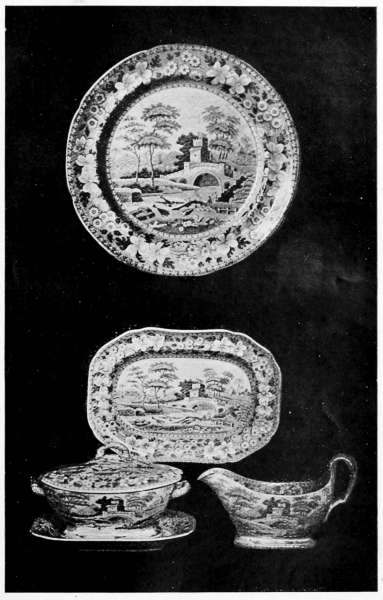
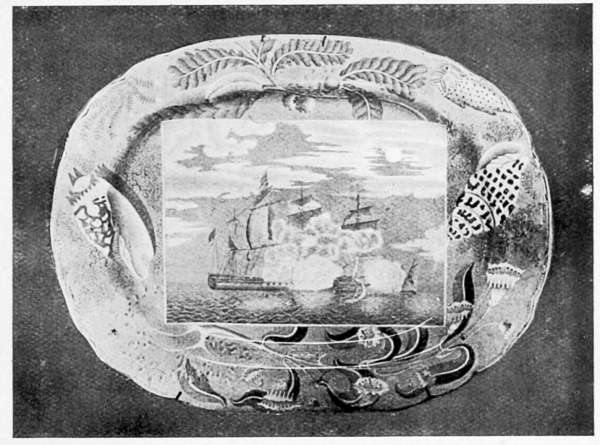
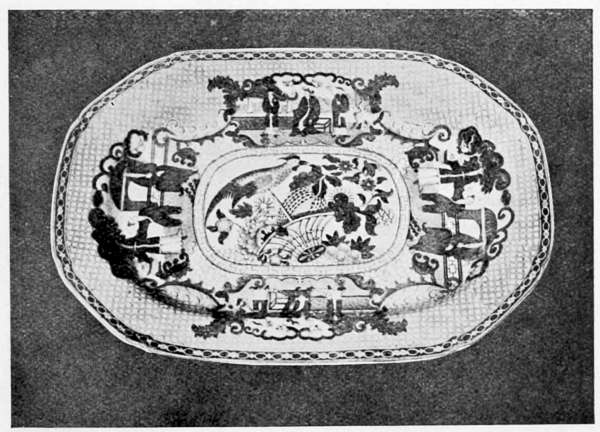
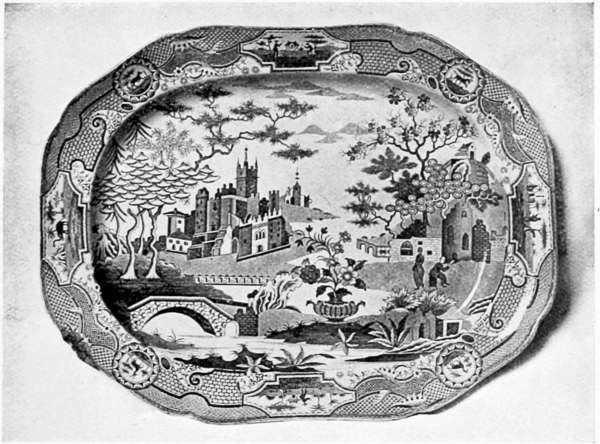
In the illustrations we give of cream ware it will
be seen that it was of varying form and it received a
variety of decoration.
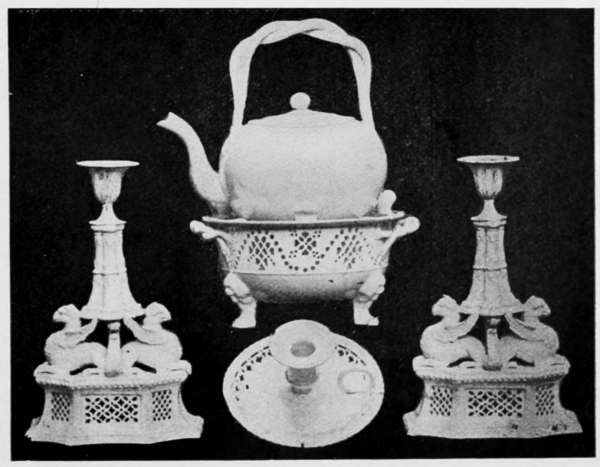
It was plain or undecorated, relying chiefly on its
symmetry of form as an artistic asset. The cut and
pierced designs and many other shapes followed
those of the silversmith, and in dessert dishes and
centre-pieces considerable beauty was exhibited in
modelling—a style which was closely followed by
the Leeds potters, who made excellent cream ware.
A beautiful example of the perforated basket ware
is illustrated (p. 225). It is a dessert dish of most
pleasing shape, and is a rare specimen of the pierced
work in Wedgwood's cream ware.
Wedgwood, as early as 1775, still experimenting
with a view to make his cream ware better, determined
to make a whiter body by the addition of
more china clay and flint and to kill the yellow tone
by the use of blue (oxide of cobalt). This later
white ware he termed "Pearl ware." Among the
most noticeable productions in this whiter ware are
the dessert services modelled from shells. We know
that Wedgwood had a collection, although he was
not a conchologist, yet it is not improbable that the
contemplation of these beautiful forms suggested
ideas and he derived many of his artistic shapes
from the forms of shells. The use of shell forms
was not unknown. Salt-glaze pieces repeatedly show
the pecten shell design, and Plymouth porcelain had
adopted shell designs in salt cellars and similar
pieces. We illustrate (p. 225) a remarkable example
of a centre-piece in the form of a nautilus shell.
Some of the shell dishes have a faint wash in pink,
and yellow radiating bands, hardly perceptible, but
conveying the suggestion of the interior of the shell.
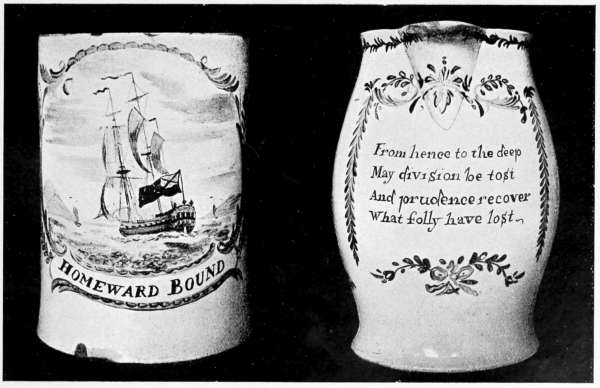
Queen's ware, when decorated, was of two classes:
(1) painted; (2) transfer-printed in red or puce or
black.
It is not necessary to go into details in regard to
these two forms of decoration. It is interesting in
regard to the enamelling in colour to know that
Wedgwood sent his ware to Mrs. Warburton's factory
at Hot Lane to be painted. He also employed a
band of enamellers at Chelsea who had been trained
in the china factory. We reproduce an illustration
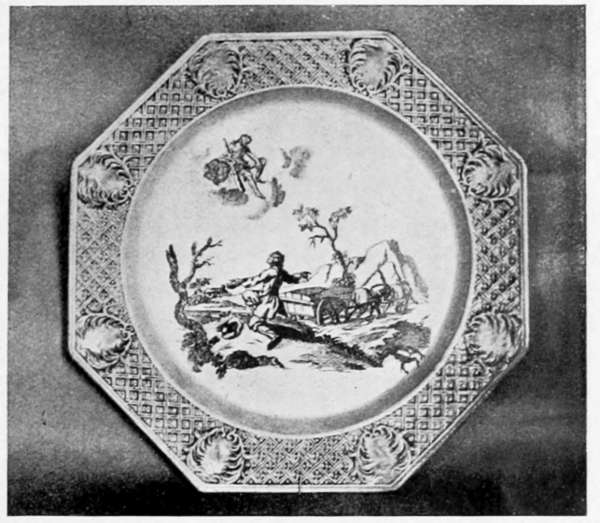
(p. 233) of two painted queen's-ware plates from
the celebrated service executed for Catherine II. of
Russia. The enamel painting of the views and
borders cost Wedgwood over £2,000. In the centre
of each piece is a scene representing some place of
interest in the country. Each view in this series
of British scenery is different, and there are some
twelve hundred. The body is in pale brimstone and
the view painted in a brownish purple; the border
was a wreath of mauve flowers and green leaves,
and, as will be seen in the illustrations, each plate
has a green frog in a reserve. This design has
puzzled many writers, but as the Messalina of the
North intended to place this service in her palace of
La Grenouillère, near St. Petersburg—Grenouillère
meaning a marshy place full of frogs—explains the
whimsical design of the frog on each plate.
This dinner and dessert service was completed in
1774 at a cost of about £3,000. It was exhibited
in London, and set the town agog with amazement.
The rooms in Greek Street, Soho, were thronged with
fashionable people, and, as may be imagined, it gave
a great impetus to the manufacture of Wedgwood's
ware.
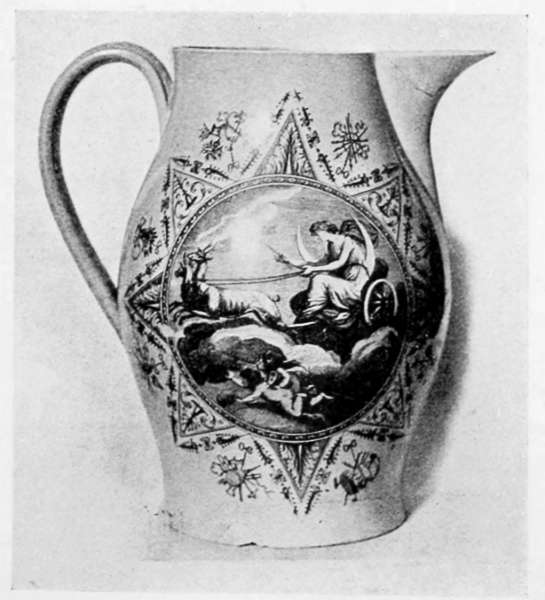
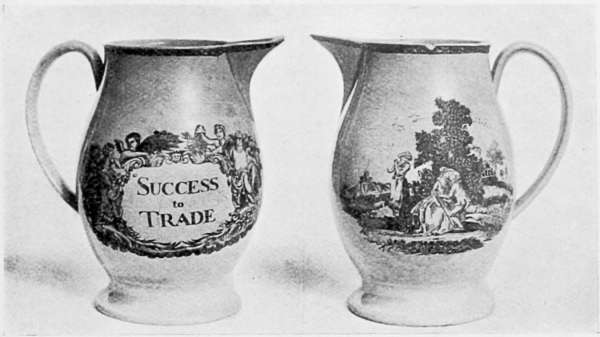
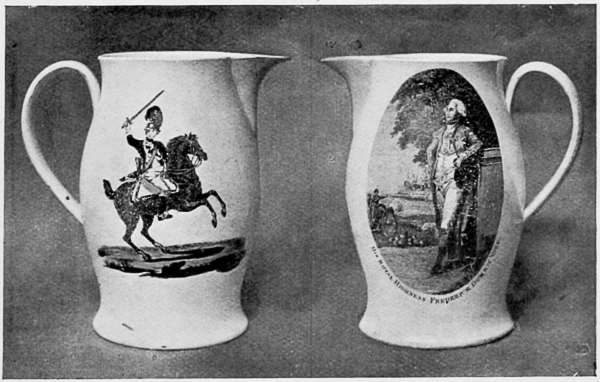
The other decoration employed by Wedgwood on
his cream ware was transfer printing. He availed
himself at once of the new style of printing by
Sadler and Green on the glazed surface of his
ware, which was periodically sent to Liverpool to be
so decorated. In the earlier pieces the tile design is
evident, quite unsuitable for a round plate, in spite
of Wedgwood's addition of wreaths and ribbons in
enamel painting to help out the incongruity. In
early books illustrated by Bewick with square woodcuts
a similar use of garlands and ribbons as an
ornamental border is observed.
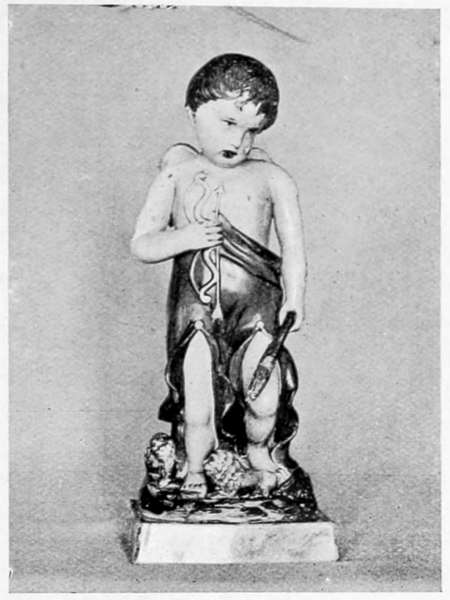
Nor was the cream body confined to strictly
domestic ware. Among his multifarious productions
Wedgwood made some fine coloured figures,
remarkable for strong modelling and subdued and
harmonious colouring. The large figures, such as
Fortitude, Charity, Ceres, Juno, Prudence, and many
others, are not always marked. "Fortitude" and
"Charity" both bear the impressed mark Wedgwood,
the latter belonging to the series Faith,
Hope, and Charity designed for Wedgwood by Mrs.
Landré, and a marked example is in the Willett
Collection. Many small coloured cream-ware busts
were made. We illustrate two typical examples
(p. 233) of Rousseau and Voltaire. They were evidently
intended for the French market, and are very
dainty though somewhat highly-coloured likenesses
of two great Frenchmen. Jean-Jacques is portrayed
in Armenian costume, after the well-known portrait.
The coat is a chocolate brown and the stand is
marbled. Voltaire has a blue surcoat, a terra-cotta
cloak, and lilac vest.
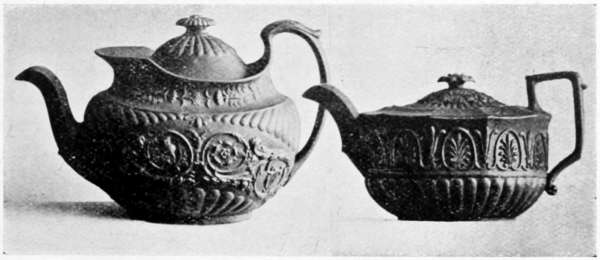
WEDGWOOD BLACK BASALT TEAPOTS.
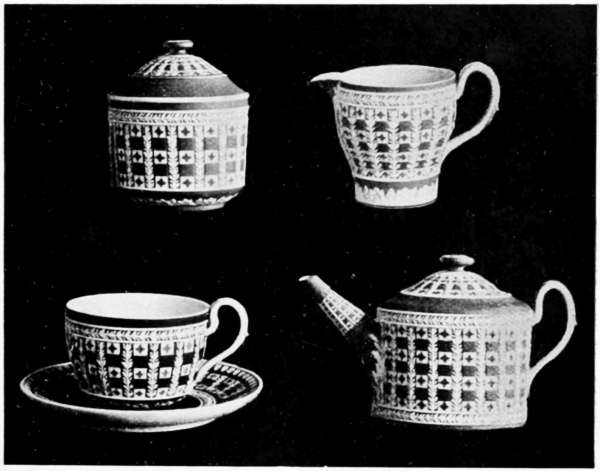
WEDGWOOD JASPER WARE DICED PATTERN TEA SET.
By the courtesy of Messrs. Josiah Wedgwood & Sons.
Jasper Ware.—As early as 1773 Wedgwood was
experimenting with a view to producing jasper body.
It is here that his greatest triumph in the ceramic
art was won. Nothing like it had ever been seen in
pottery before, and the ware he produced in an endless
variety of forms which were termed "ornamental"
by him to distinguish them from the queen's ware,
or "useful" ware. About 1775—a great date in
Wedgwood's history—the jasper ware was perfected,
and from 1780 to 1795 is the period when it was at
its best, when he poured forth from Etruria, then
filled with a highly-trained body of workmen and
artists, his jasper ware, exquisite with grace and
beauty of form and fascinating in its charm of
dainty and subtle colour.
The spirit of classicism was in the air in the days
of Wedgwood. Dr. Johnson had imposed his ponderous
latinity on the world of letters. Alexander
Pope was still writing when Josiah was apprenticed
and known already as a "fine thrower." Homer's
Iliad and Odyssey had appeared in many editions
just prior to Wedgwood's manhood. The statues
of naval and military commanders in Westminster
Abbey were in Roman costume. The Brothers Adam
were in the heyday of their popularity. From sedan
chairs to silver-plate their style was the vogue. The
classical mouldings, capitals, and niches, the shell
flutings and the light garlands in the Adam style are
welcome sights in many otherwise dreary streets in
London. In furniture, the Adam style is as severe
as the French prototypes which had absorbed some
of the ancient spirit of Rome and Greece. As early
as 1763 Grimm wrote, "For some years past we
are beginning to inquire for antique ornaments and
forms. The interior and exterior decorations of
houses, furniture, materials of dress, work of the
goldsmiths, all bear alike the stamp of the Greeks.
The fashion passes from architecture to millinery;
our ladies have their hair dressed à la Grecque."
Men of thought joined in clamouring for simplicity,
and Diderot lent his powerful aid in heralding the
dawn of the revival of the antique long before the
France of Revolution days.
But eyes other than French were fixed on the
remote past. The excavations of Herculaneum and
Pompeii had given a new stimulus to archæological
research. In this country Sir William
Hamilton, as early as 1765, promoted the publication
of the magnificent work, "Greek, Roman, and
Etruscan Antiquities," illustrated from his collection.
It was a specially valuable exposition of the system
and methods and æsthetic value of classic art, especially
plastic art; and in promulgating this sumptuous
illustrated disquisition on the ancient potter's art Sir
William Hamilton laid modern workers in the same
field under a heavy debt. Incidentally it may be
mentioned that Sir William was the husband of the
beautiful Lady Hamilton.
So that in the midst of this eighteenth-century
classic revival Josiah Wedgwood was but the child
of his age, and, associated in partnership with
Bentley, a man of refined and scholarly tastes, he
entered into the new spirit with willing mind.
Adroitly seizing classic models, Wedgwood in his
art adapted all that was most suited to modern
requirements. Pope translated Homer into English
verse, and Wedgwood translated classic designs into
English pottery.
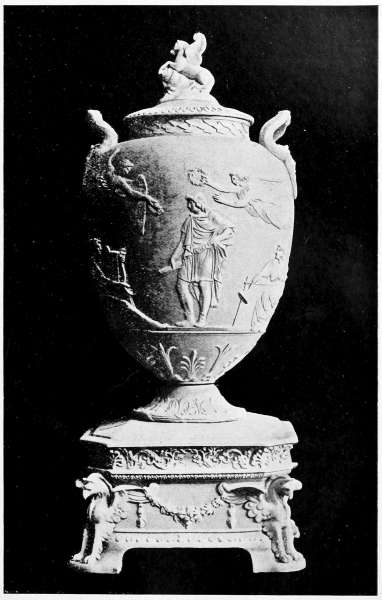
WEDGWOOD JASPER VASE.
Subject—representing the Apotheosis of Virgil; surmounted by Pegasus cover.
By the courtesy of Messrs. Josiah Wedgwood & Sons.
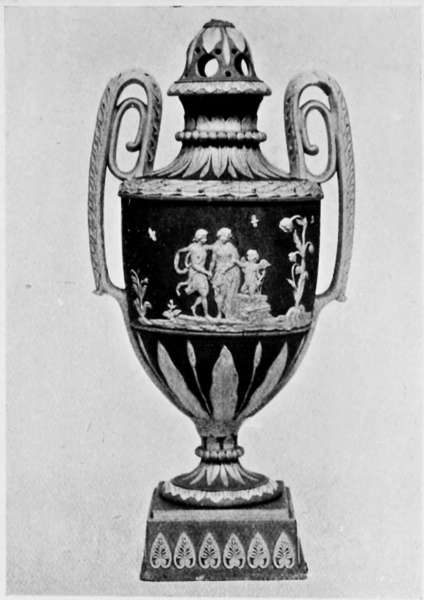
Wedgwood's jasper ware is of various colours—blue
in various tones, sage-green, olive-green, lilac,
pink, yellow, and black, and, of course, white, which
is its natural body without the addition of metallic
oxides. It is capable of taking a polish on the
lapidary's wheel. In use it was mainly employed
for ware of a highly ornamental character, though
it was also employed for utilitarian objects, such as
tea and coffee services, dishes, and flower vases, and
in plaques it was used as interior decorations in fireplaces
and in furniture. We illustrate (p. 241) a
jasper ware diced pattern Tea Set, which shows how
wide a field Wedgwood covered with his new ware.
It is usually found with a ground of one colour,
such as blue, lilac, et cetera—one of the seven—and
the ornament applied in relief is, as a rule, white.
It was Wedgwood's appreciation of antique gems
that suggested the idea of reproducing them in
earthenware, and in the period prior to Bentley's
death, in 1780, cameos, portrait medallions, and
plaques were mostly made.
There are two classes of jasper ware—solid jasper
and jasper dip. The difference is similar to that
between solid agate and surface agate. Solid jasper
is coloured throughout. That which is coloured
only on the surface is jasper dip. This latter
gives more delicate effects, and was employed,
after 1780, in the important series of classic vases
which required translucency and greater delicacy in
the white reliefs, which is especially effective in the
filmy garments and flowing draperies of the classic
figures.
Considerable progress had been made in Staffordshire
since Elers left in 1710, but it is the Elers
method of stamping the ornaments and applying
them to the body of the ware that Wedgwood
adopted. But there was more than enough originality
of invention in this jasper ware to carry his
fame to the confines of Europe. Blue and white
porcelain in imitation of his jasper was made at
Sèvres, and other continental factories, such as
Meissen, Furstenburg, and Gros Breitenbach, made
similar echoes of this wonderful English jasper ware
of Josiah Wedgwood.
No illustrations can do justice to the charm and
tender colour of some of the finer examples of this
Wedgwood jasper ware, varying from pale lemon
colour to delicate mauve as a ground, and having
translucent diaphonous draperies in white standing
in relief in the groups of figures.
To the sense of touch fine old specimens of this
jasper ware are as soft as satin. Usually the dull
matt surface of this ware is left without polish,
though it is so dense and hard as to receive a high
polish, which was occasionally employed in the inside
of basins and cups and on the bevelled edges
of some of his cameos.
His classic subjects were no feeble echoes of
ancient art, but were executed from designs by a
band of great artists working together and saturated
with the spirit of the new classic revival. John
Flaxman, James Tassie, John Bacon, William Hackwood,
Thomas Stothard, George Stubbs, William
Greatbach, were all employed by Wedgwood. And
distinguished amateurs such as Lady Diana Beauclerk
and Lady Templeton supplied him with designs,
and it is interesting to note that Mrs. Wilcox, an
accomplished painter of figures and borders on his
Etruscan ware, was a daughter of Fry, the mezzotint
engraver and founder of the Bow porcelain factory.
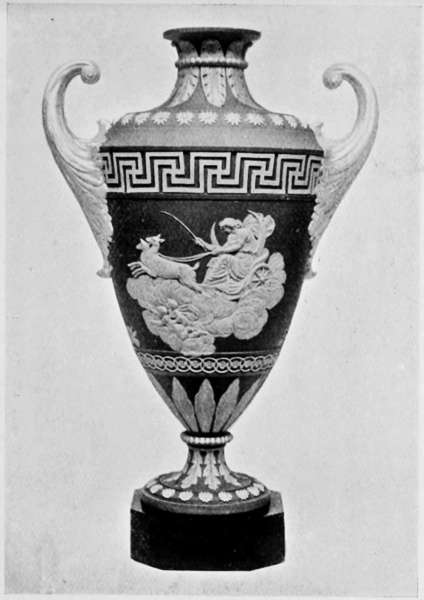
We illustrate (p. 245) a fine jasper vase representing
The Apotheosis of Virgil, the cover surmounted by
a Pegasus. The square pedestal has griffins at the
corners. A companion vase, The Apotheosis of
Homer, changed owners at eight hundred guineas,
and is now in the possession of Lord Tweedmouth.
Wedgwood himself regarded his copy of the celebrated
Barberini vase, which was lent to him by the
Duke of Portland, as his masterpiece. This vase is
a cameo glass vase, which was discovered in the
middle of the seventeenth century in a marble sarcophagus
on the road to Frascati, two miles from
Rome. This vase belongs to the early part of the
third century. It was bought by Sir William
Hamilton for £1,000, and subsequently purchased
by the Duke of Portland. This vase, of rich dark
blue glass, almost black, is decorated with opaque
white enamel cameos in relief cut with the most
extraordinary skill, and it stands as a superb example
of classic art. Strictly speaking, Wedgwood's
copy of this was at best a copy in one material of
the technique of another. But if it be not the
highest art to copy thus in intricate detail, yet it
must be admitted that such masterly elaboration had
never before been attempted by the potter, and the
early copies of Wedgwood (he set out to make only
fifty) stand unequalled as specimens of potting by
the hands of trained workmen directed by genius.
Wedgwood and his influence.—As a final word on
Wedgwood and his influence, something should be
said as to the charge laid against him that he inaugurated
the factory system as applied to pottery.
There is no doubt that he organised what was before
his day a somewhat chaotic industry. And it is
certain that he trained his workmen to become
specialists, and that the system of the division of
labour was the order of the day at Etruria. But
how else could such an output as his be handled?
It has been advanced that the quaintness of the
peasant potter and his later development was submerged,
and that all individuality was lost under
the new system. There was a growing tendency
to develop mechanical perfection and to introduce
labour-saving appliances, but this was the spirit of
the oncoming modern age. Other factories, his contemporaries,
were adopting the same principles, and
those who think Wedgwood unoriginal or uninventive
are quite willing to credit him with all the inventiveness
and originality necessary to overturn the old
system. The truth lies between these two extremes.
Wedgwood, in common with his contemporaries, not
unwillingly embraced all the newest devices known.
It was Sadler and Green, of Liverpool, who together
in one day by their invention printed as many tiles
as it would have taken a hundred painters to do
in the same time. Similarly all over the country
artisans in the china trade were becoming specialised.
There were the enamellers at Chelsea and other places,
and a little examination will show that Wedgwood
did not inaugurate this modern factory method, but
without doubt, in common with all other master potters,
he had to go with the times. Trade rivalry was very
strong, and competition was not unknown when every
potter in Staffordshire was jealously watching the
latest improvement of his neighbour. But to saddle
Josiah Wedgwood with the responsibility of stamping
out original talent is beside the mark. His life-work
stands impregnable against petty assault. "In
a word, no other potter of modern times has so successfully
welded into one harmonious whole the prose
and the poetry of the ceramic art."
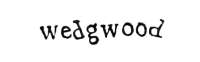
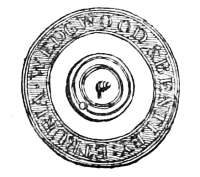
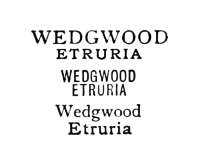
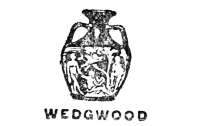
WEDGWOOD MARKS.
|
| 1.—This mark occurs upon a very early
specimen of "Queen's Ware," a teapot,
painted with flowers, &c., supposed to
have been made by Wedgwood at Burslem:
each letter apparently stamped singly with
printers' type. |
|
|
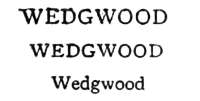
2, 3, 4.—These marks, varying in size,
were, it is thought, used by Wedgwood up to
the accession of Bentley as his partner,
1768–9, and are found upon specimens
said to have been purchased about that
period. |
|
|
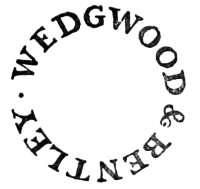
5.—The circular stamp, without the
inner and outer rings, and without the
word Etruria, is doubtless the earliest form
of the Wedgwood and Bentley stamp, and
is found upon a set of three early painted
vases, in imitation of natural stone, with
gilt serpent and scroll handles. No other
example of this mark is known: it may
have been an experimental one, afterwards
changed for No. 6, and never in general
use. |
|
|
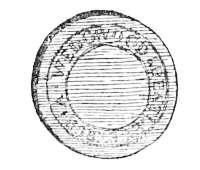
6.—This mark, with the word Etruria,
is made upon a wafer, or bat, and fixed
in the corner, inside the plinth of old
basalt vases, reversing for candelabra and
some large specimens; it is sometimes
found on the pedestal of a bust or large
figure. |
|
|
7.—The well-known circular stamp,
with an inner and outer line, always placed
round the screw of the basalt, granite, and
Etruscan vases, but is never found upon
the jasper vases of any period.
|
|
8, 9, 10, 11.—These marks, varying in
size, are found upon busts, granite, and
basalt vases, figures, plaques, medallions,
and cameos, from the largest tablet to the
smallest cameo for a ring (the writer has
one, only half an inch by three-eighths of
an inch, fully marked); also found upon
useful ware of the period. |
|
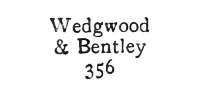
12.—Marks upon the Wedgwood and
Bentley intaglios, with the catalogue
number, varying in size. Very small
intaglios are sometimes marked W. & B.
with the catalogue number, or simply with
number only. |
|
13.—This rare mark is found only upon
chocolate and white seal intaglios, usually
portraits, made of two layers of clay; the
edges polished for mounting.
It may be noted that the word "and"
in every Wedgwood and Bentley mark is
always contracted "&," that no punctuation
or other points, excepting those in
marks No. 5, 6, 7, and 13, are ever used. |
|
|
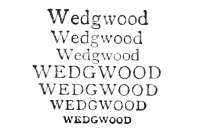
14, 15, 16, 17, 18, 19, 20.—Marks,
varying in size, attributed to the period
after Bentley's death, and probably used
for a time after Wedgwood died. These
marks and others were used by chance—a
small piece often bearing a large stamp,
and a large one a minute stamp. |
|
21.—This rare mark exists upon some
large square plateaux in cane-coloured
jasper. It may have been one adopted
upon the change of partnership in 1790,
but little used. The circular announcing
the change says: "The mark 'WEDGWOOD'
will be continued without any
addition."
|
|
|
22, 23, 24.—These marks rarely found
upon pieces of very high character—usually
upon dark blue stoneware, vases, and
glazed ware. Adopted about 1840, but
soon disused. |
|
|
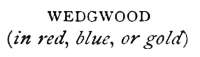
25.—The mark upon Wedgwood Porcelain
made from 1805–1815. Always
printed either in red or blue, sometimes
in gold. An impressed mark cannot be
used with certainty upon soft-paste porcelain,
being so apt to diffuse out in firing. |
|
|
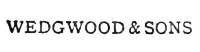
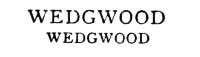
26, 27.—These marks, varying in size,
are still used at Etruria for the modern
jasper and useful ware of all varieties. |
|
28.—The manufacture of fine porcelain
was revived at Etruria, 1878, and is still
continued. This mark, printed in black
and other colours, is used. |
|
29.—The word England was added to
the mark Wedgwood in 1891, to comply
with the new American Customs Regulations,
known as the McKinley Tariff Act. |
| |
The occurrence of three capital letters,
ANO, REP, &c., in addition to name
appears on ware after 1840. The first
two letters are workmen's marks, and the
third is a date letter, e.g., O = 1855,
P = 1856, and so on, as in hall-marks on
silver. |
PRICES.
| Wedgwood. | £ | s. | d. |
| Oval. Ganymede feeding Eagle (6¼ in.
by 5¼ in.), marked Wedgwood & Bentley
Christie, June, 1906 |
40 | 19 | 0 |
| Oblong oval. Marriage of Cupid and
Psyche (6 in. by 7¾ in.), marked
Wedgwood & Bentley. Christie,
June, 1906 |
54 | 12 | 0 |
| Busts, Minerva and Mercury,
black basalt, 18 in. high. Christie,
November, 1906 |
16 | 16 | 0 |
| Oval portrait, in jasper, white on blue
ground, of Captain Cook (10 in. by
8 in.), marked Wedgwood & Bentley.
Sotheby, February, 1907 |
16 | 16 | 0 |
| Jasper vase, blue, with Venus and Cupid
in relief, handles coiled with serpents.
Christie, February, 1908 |
33 | 12 | 0 |
| A pair of splashed mauve Nautilus Shells,
marked Wedgwood. Sotheby, December,
1908 |
3 | 10 | 0 |
The above prices are for ordinary collectors'
examples of old Wedgwood. But exceptional pieces
bring exceptional prices. The largest known example
of a blue and white jasper plaque (11 in. by 26 in.)
sold for £415 at Christie's in 1880, and the fine jasper
vase The Apotheosis of Homer (now in the Tweedmouth
Collection) realised 800 guineas.