PROVINCIAL CLOCKS
Their character—Names of clockmakers found on clocks
in the provinces—The North of England: Newcastle-upon-
Tyne—Yorkshire clockmakers: Halifax
and the district—Liverpool and the district—The
Midlands—The Home Counties—The West Country—Miscellaneous
makers.
A great deal of attention has been paid by
collectors to clocks by well-known London makers
and too little examination has been given to fine
examples by those of the provinces. In the present
chapter an attempt is made to fill a hiatus in this
respect, and by the kindness of those interested in
the various localities certain data are presented
which may stimulate the student to continue his
researches on the lines here indicated.
The metropolis attracted noteworthy makers, but
they had their origin and often their early training
in the provinces.
The following are among the great London clockmakers,
but they were not Londoners. They come
from all parts of the country. Joseph Knibb (about
1670) was an Oxfordshire man. The famous
Thomas Tompion, born in 1638, came from Bedfordshire.
George Graham (1673-1751) tramped to
London from Cumberland. Thomas Earnshaw, who
perfected the marine chronometer, his additions being
still in use, was born at Ashton-under-Lyne in 1750
and served his apprenticeship there. Henry Jones,
who was the pupil of Edward East, was the son of a
vicar at Southampton. Charles II had a clock made
by him. Thomas Mudge was the son of a schoolmaster
and was born at Exeter in 1715. Another
Exeter man was Jacob Lovelace, who took over
thirty years to construct a remarkable clock. The
celebrated John Harrison was the son of a carpenter
on an estate at Pontefract. It was he who competed
for the Government gratuity offered for a nautical
timekeeper, for which he finally received £10,000,
after repeated tests in voyages to the West Indies
by himself and his son. We think of his early
struggles, when he travelled up to London after he
was forty, only to find that he had to return to the
provinces and continue his vocation as clock-mender
in ordinary and inventor extraordinary. There is a
long-case clock with wooden wheels and pinions by
him in the Guildhall Museum, London.
The list is by no means complete. There was
John Ellicott, who was born at Bodmin, and another
Cornishman from the same town is John Arnold,
who was apprenticed to his father, a watchmaker
there. Arnold continued what Harrison had begun
in the chronometer. We must not exclude the great
Dr. Hooke, who was born at Freshwater, Isle of
Wight, who invented the anchor escapement for
clocks and contested the invention of the balance
spring in watches with Huygens.
Names of Clockmakers found on Clocks in the
Provinces.—It has been suggested that in some
cases the name of a local maker does not necessarily
determine, when found on the dial or
elsewhere, that such clock has been made by the
person whose name it bears. It has also been
advanced that the name of the owner was sometimes
put on the dial. This last theory can be
dismissed as being of so infrequent use as to be
practically negligible in recording lists of makers.
The other conjecture may possibly have sufficient
truth in it to disconcert collectors of examples of
local crafts. Of course, it is a statement that cannot
be proved, nor can it be disproved. Presumably
a clockmaker in the eighteenth and early nineteenth
centuries, when clockmaking was something more
than selling or mending clocks that other people
made, did not deliberately set up business and, in
a small town where secrecy was impossible, make a
practice of putting his name on work he did not
execute. That he did not make all the parts himself
is admitted. Had he done so, he would have
had to be a chain-maker or a catgut-maker, a pulley-maker,
a chaser of metal for his dials, a cabinet-maker
for his cases, and so on down to his most
minute screws. One might as well take similar
objection to Sir Joshua Reynolds or Gainsborough
that they did not extract their pigments from the
natural vegetables or minerals, that they neglected
to become proficient in manipulating hogs' bristles
or camel-hair into brushes, or that they could not
and did not make their own canvases or carve their
own frames.
It did happen that an old clock by one maker
was sent to another for repair, and he made such
extensive repairs to the movement that he felt himself
justified in putting his own name to the clock
in its new state. The owner would have had something
to say to this interchange of names had there
not been some justification for it. This practice,
however, is not confined to the provinces, and we
cannot charge the provincial maker with being
wholly unscrupulous.
Some purists in collecting have objected to the
presence of a country maker's name stencilled on
the dial, as being evidence it was not his handiwork.
But this is not in itself a crime. It is far more
likely that such a clock is of local make, and that
being in a remote part it was not easy to get anyone
to paint his name on the dial or engrave it.
Had he had it made to order in a town surely his
name would have been painted for him. In a
measure, crudities of this nature and peculiarities
not found in clocks from the great centres are hallmarks
of genuineness.
At the time of the passing of the Act in 1797
relating to the taxation of clocks and watches, the
following places sent representatives to London to
protest against this tax:—
Newcastle-upon-Tyne, Liverpool, Leicester, Derby,
Bristol, Prescot, Coventry, and Edinburgh. Of
these, Prescot (a few miles from Liverpool) and
Coventry represented the watch industry. We may
therefore fairly conclude that the other places
represent the most noteworthy centres of clockmaking
at that period.
The North of England: Newcastle-upon-Tyne.—In
regard to provincial makers, one wonders what
'prentice hands have gone to the making of the long
cases. Did Thomas Chippendale, when he was
working at his father's bench at Worcester, execute
any of his early joinery and carving to embellish
now forgotten clocks? Who can say? At Newcastle-upon-Tyne
we are on surer foundation, for
it is on record that Thomas Bewick, the wood-engraver,
was apprenticed to Ralph Beilby, an engraver
at Newcastle, on 1st October 1767 for seven years.
His master's business lay in engraving crests and
initials on watch seals, teaspoons, sugar-tongs, and
other pieces of plate, and the numerals and ornaments
on clock dials, together with the maker's
name. Here, then, was young Bewick's 'prentice
work—the master of white line on the wood block.
Later, Bewick confessed to a friend that when engraving
these clock dials his hands grew as hard
as a blacksmith's, and almost disgusted him with
engraving. At any rate, there is the strong probability
that such Newcastle dials engraved by Thomas
Bewick are on clocks of the date from 1763 to
1774.
The following list of names of Newcastle and
other clockmakers in the North of England is
produced by the kindness of C. Leo Reid, Esq., of
Newcastle-upon-Tyne, and by the permission of the
proprietors of the Newcastle Weekly Chronicle, compiled
from notes appearing in that valuable repository
of North-country antiquities.
The makers are of Newcastle, unless otherwise
stated. The list is arranged alphabetically.
- John Airey (Hexham), 1790-95.
- Jas. Atkinson (Gateshead), 1770-77.
- Joseph Atkinson (Gateshead), 1790-1804.
- Beilly and Hawthorn, 1780.
- William Berry (Gateshead), 1810.
- Thomas Bell, 1785.
- John Bolton (Chester-le-Street), 1812; (Durham), 1812-21.
- S. Boverick, 1765.
- William Coventry, 1778.
- William Featherstone, 1790-95.
- William Fenton, 1778.
- William Foggin, 1833 (clock-dial maker).
- Gibson, 1750.
- John Greaves, 1780-95.
- Thomas Greaves, 1778-95.
- John Harrison, 1790-95.
- John Hawthorn, 1780.
- W. Heron, 1790.
- Geo. Hidspeth, 1800.
- J. Hutchinson, 1811.
- Matt. Kirkup, 1811.
- Jos. Ledgard, 1707-32.
- Richard Marshall (Wolsingham), 1796.
- Geo. Miller (Gateshead), 1770.
- Sam Ogden, 1760-70.
- Ord (Hexham), 1797.
- Jno. Peacock, 1800.
- John Rawson, 1790.
- Wm. Rawson, 1790.
- { Christian Ker Reid, 1778-1834.
- { St. Nicholas Churchyard, close to workshop of Thomas Bewick.
- { Reid and Son, 1817.
- { Reid and Sons, 1845 to present day.
- Henry Sanders (Gateshead), 1800.
- John Scott (Sandgate), 1790-95.
- Thomas Smoult, 1790.
- { Hugh Stockell, 1790.
- { Stockell and Stuart, 1798.
- { Hugh Stockell, 1800.
- Archibald Strachan, 1790.
- William Tickle, sen., 1790-95.
- William Tickle, jun., 1790-95.
- J. H. Wakefield (Gateshead), 1800.
- John Wakefield (Lamesley), 1827.
- Ward, 1811.
- Michael Watson, 1811-27.
- Thomas Weatherley (Berwick-on-Tweed), 1790-95.
- John Weatherston, 1790-95.
- John Wilson, 1782-90.
- Richard Young, 1811.
In regard to the remarks about Thomas Bewick
and clock dials, there is every likelihood that his
'prentice work in engraving them between 1763 and
1774 is to be found on clocks by S. Boverick,
William Coventry, William Fenton, Gibson, John
Hawthorn, John Wilson, and Christian K. Reid; the
latter maker certainly knew Bewick. The dates
given in the above list do not definitely represent
that the maker's work was confined to that period
exclusively. They are approximate dates.
Yorkshire Clockmakers: Halifax and the District.—We
have already seen that John Harrison, the
great self-taught genius, born in 1683, was a
Yorkshireman. Of early makers there is a record
of John Ogden, of Bowrigg, of the late seventeenth
century, and Samuel Ogden, born at Sowerby in
1669. The name of Ogden is found on many
Yorkshire clocks. Thomas Ogden came to
Halifax; although the Ogdens seem to have been
a Quaker family, one of his clocks is in the Unitarian
Chapel vestry. The Ogden type of dial with
the phases of the moon, although not original, being
adapted from Dutch models, became noteworthy
in the North of England, and such styles were
termed "Halifax" clocks. Samuel Ogden, a descendant,
migrated to Newcastle-upon-Tyne (see list,
p. 216), perpetuating the name a hundred years after.
In Halifax parish churchyard is a tombstone to
the memory of R. Duckworth, clockmaker, 1677.
John Mason was a maker about 1760, and his
father, Timothy Mason, was a clockmaker before
him. At Rotherham some years ago there were
some Mason clocks on exhibition, and there were
eight generations of Masons as clockmakers, the
later branch having settled at Rotherham. Such
is the record of many provincial makers.
Emanuel Hopperton, of Leeds, made clocks with
marquetry cases. One bore the proud motto, Non
mihi sed mundo.
Henry Brownhill, of Briggate, Leeds, watchmaker
and clockmaker, was sufficiently prosperous to issue
several tons of halfpenny copper tokens in 1793.
By the courtesy of S. H. Hamer, Esq., of Halifax,
an illustration of one of these tokens is given.
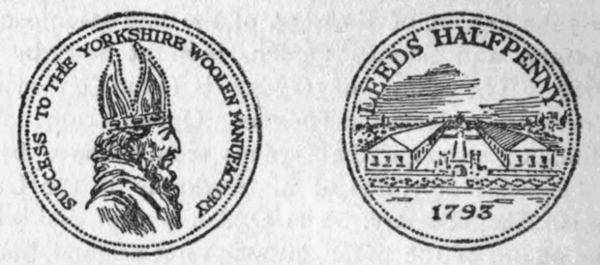
HALFPENNY, 1793.
This was the year when the Reign of Terror
began and when Marie Antoinette was executed.
In England great commercial distress was felt.
Banks issued notes in excess of their capital. Gold
was scarce, and the Bank of England restricted its
issues. A panic ensued and several banks failed.
Pitt issued Exchequer Bills to the extent of five
millions.
Other local clockmakers are Thomas Liston, of
Luddenden, 1718-79, and his son Thomas, of
Halifax, 1745-1815. It is reported that this latter
Thomas Lister travelled by coach from Halifax to
London to regulate and keep in order the clock at
St. Paul's Cathedral. There is an orrery by him
in the Glasgow University Museum.
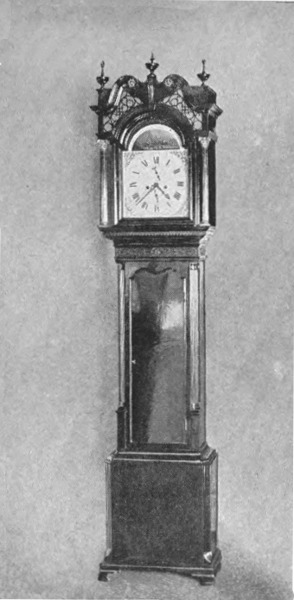
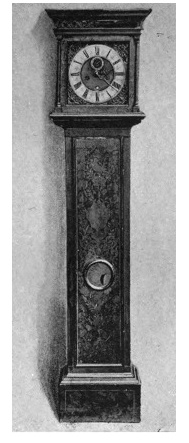
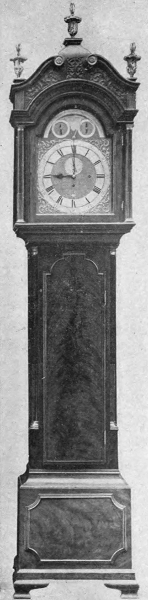
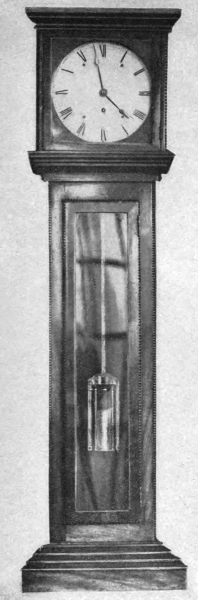
LONG CASE CLOCK.
Maker, Gilbert Chippindale (Halifax).
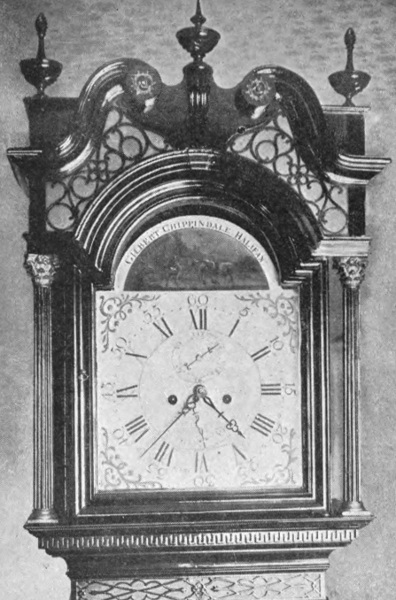
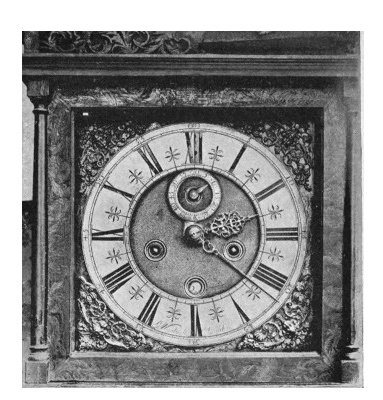
ENLARGEMENT OF HOOD.
Showing fine fretwork and maker's name in lunette.
(By courtesy of Surgeon-Major W. Savile Henderson.)
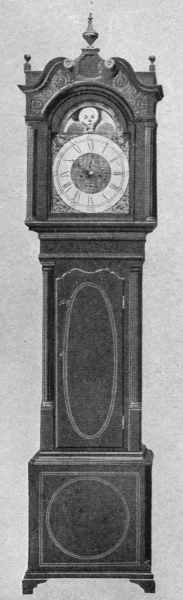
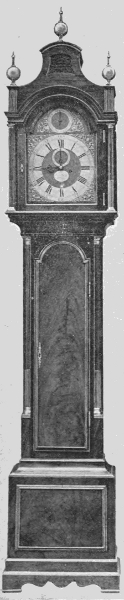
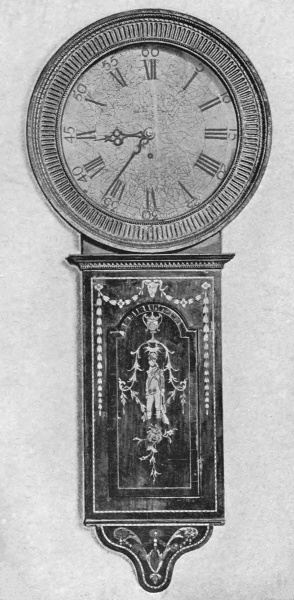
LONG-CASE EIGHT-DAY CLOCK.
Maker, John Weatherilt (Liverpool).
Date, 1780-85.
(Reproduced by courtesy of George H. Hewitt, Esq., J.P.)
William Lister is another member of the same
family who made long-case clocks. In his dials a
noticeable feature is the absence of the hour circle
as being separate from the rest of the plate. The
dial was made in one piece and attached to a back-plate
of brass.
Pattison, another Yorkshire maker, made long-case
clocks similar to those of William Lister.
John Hartley, of Halifax, about 1770, was the
maker of a thirty-hour grandfather clock in oak
case with brass square dial and moon and date
lunettes. Titus Bancroft, of Sowerby Bridge, 1822,
a church-clock maker, also made grandfather clocks.
John Hallifax, of Barnsley, who died in 1750, made
a fine long-case clock now at Wentworth House.
Gilbert Chippindale, of Halifax, 1781, is another
maker of fine clocks. A fine example of his work
is illustrated (p. 219).
R. Henderson, of Scarborough, early eighteenth
century, is another Yorkshire maker. Richard
Midgley, 1720-40, of Halifax, made a number
of clocks still treasured locally. Samuel Pearson
is known about 1790, and John Stancliffe, of Bark-island,
is another local maker.
Collectors have too frequently associated Yorkshire
clocks with the later periods, with ponderous
cases of gigantic size, but, as is shown, the Yorkshire
makers are worthy of considerable attention by connoisseurs
as having a lineage extending back into the
periods when clockmaking was at its best, and when
the case-maker was not such a preponderating factor
as he seems to have been in the early nineteenth
century days in the North.
Liverpool and the District.—In regard to Liverpool
and the vicinity, at the Tercentenary Historical
Exhibition at the Walker Art Gallery in 1907 a
collection of clocks and watches was made to illustrate
the art of the clockmaker in that part of the
country. By the kindness of George H. Hewitt,
Esq., J.P., who arranged these exhibits, we are
enabled to supply the names of many of the Liverpool
clockmakers.
Peter Litherland patented the rack lever escapement
in 1793-4 which Robert Roskell, the Liverpool
maker, introduced into his watches. At the above
Exhibition was shown a pendulum watch by George
Taylor, about 1700, and one by William Tarleton,
1797, with the Government stamp indicating that the
tax of a guinea had been paid. This was in 1797,
the first and only year when a tax on watches and
clocks was levied. One remembers the fine portrait
of Colonel Tarleton in uniform, with one foot on a
cannon, after the portrait by Sir Joshua Reynolds,
signed I. Johnson, on a Liverpool mug. He was the
Member of Parliament for Liverpool from 1790 to
1812. This family gave the name to Tarleton Street,
Liverpool.
That Liverpool and the district was renowned for
its watches is shown by a silver watch made by
Thomas Worsley, Liverpool, inscribed, "Presented
to Robert Burns by his brother ploughmen of Air
(sic) March 9, 1785." Among other makers at Liverpool
whose names are found on watches are Fair-clough
(about 1800), Edmonds (about 1770), Joseph
Finney (about 1770), Robert Roskell (about 1800),
M. J. Tobias & Co. (1820), Harrington (1790), Peter
Hope (1795), J. Johnson (1796).
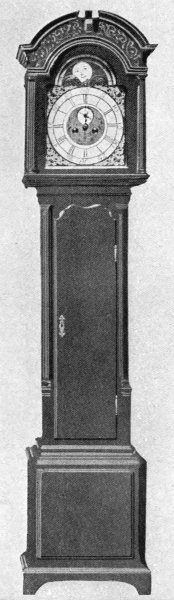
LONG-CASE EIGHT-DAY CLOCK.
Maker, Thurston Lassell (Toxteth Park, Liverpool).
Date, about 1745.
(Reproduced by courtesy of George H. Hewitt, Esq., J.P.)
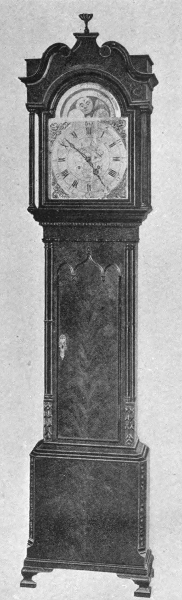
LONG-CASE MAHOGANY EIGHT-DAY CLOCK.
Maker, Henry Higginbotham (Macclesfield).
The Gothic panel in door is a noticeable feature.
(By courtesy of A. Bromley Sanders, Esq., Exeter.)
It is possible that some of these makers also made
long-case and other clocks; we find the name of
Roskell on a long-case clock and R. Roskell on
another. Presumably this was the Robert Roskell
who used the Litherland rack-lever watch escapement.
Joseph Finney also made long-case clocks.
Other makers' names found on Liverpool clocks are
Burges, Aspinall (with the motto, "Time is valuable"),
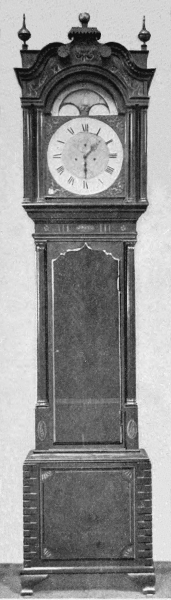
Jno. Weatherilt. This clock is illustrated (p. 221).
It indicates by the character of its marquetry in the
panel of the door and in the base that it belongs to
the second period of marquetry contemporary with
the influence of Sheraton. In the lunette the
phases of the moon are shown. The date of this is
about 1780 to 1785. Another clock, illustrated on
p. 225, is by Thurston Lassell, Toxteth Park, Liverpool.
This in date is about 1745. The phases of
the moon are shown in the lunette. The case is of
more slender proportions than its fellow. The hood
exhibits a reticence which was lost in later examples,
especially in provincial work made in Yorkshire,
where the case became of unwieldy size and somewhat
ungainly shape.
Other names of Liverpool makers found on long-case
clocks are William Sutton, Harrison & Son,
Jas. Canson, Thomas Saxon, Jon Taylor (Ormskirk),
W. Lassell, Toxteth Park, Liverpool, with motto,
"Time shows the Way of Life's Decay," with brass
face, lunar movement, and monthly dial with indicator.
(This style of dial is a feature of a Shropshire
clock illustrated p. 249.) Brown, Liverpool, is found
on a mahogany long-case clock and also on a small
long-case clock. To those who are interested the
portrait in oils of Peter Litherland, the inventor of
the rack lever, who died in 1804, is in the possession
of the Corporation of Liverpool.
Among other Lancashire makers the following are
noteworthy: T. Lees (Bury), 1795-1800; Archibald
Coats (Wigan), 1780; Barr (Bolton), 1790; James
Barlow (Oldham), 1775; Benjamin Barlow (Ashton-under-Lyne),
1780; and Nathaniel Brown (Manchester),
1780-1785.
In Westmorland and Cumberland the names
Burton, of Kendal, and Russell, of Carlisle, are
often found on grandfather clocks of local manufacture
of the late eighteenth century.
In regard to a particular style of case associated
with Lancashire and with Cheshire, having the door
decorated with panel in Gothic style, two examples
are illustrated (p. 227), one by Henry Higginbotham
(Macclesfield), and the other by Heywood, Northwich,
1790 (p. 231).
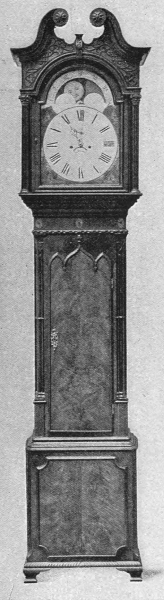
LONG-CASE MAHOGANY EIGHT-DAY CLOCK.
Maker, Heywood (Northwich, Cheshire). 1790.
The Gothic panel in door is a noticeable feature.
(By courtesy of Messrs. A. B. Daniell & Sons.)
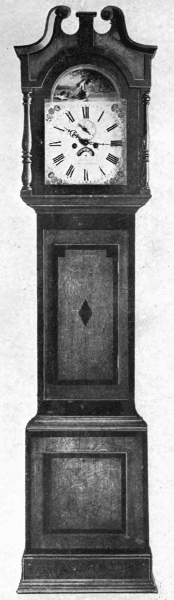
LONG-CASE EIGHT-DAY CLOCK.
With dial showing days of month. Oak case veneered in mahogany.
Maker, Thomas Wall (Birmingham). Date, about 1795.
(In possession of author.)
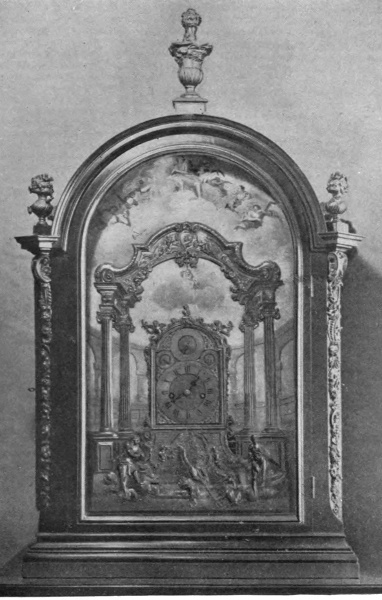
Clockmakers of the Midlands.—As typical of the fine
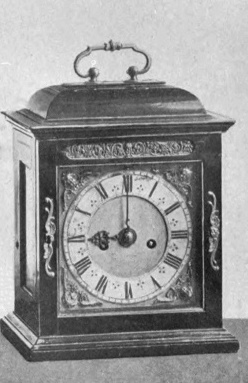
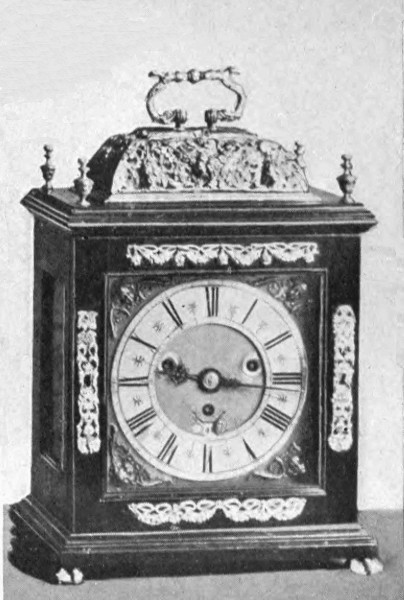
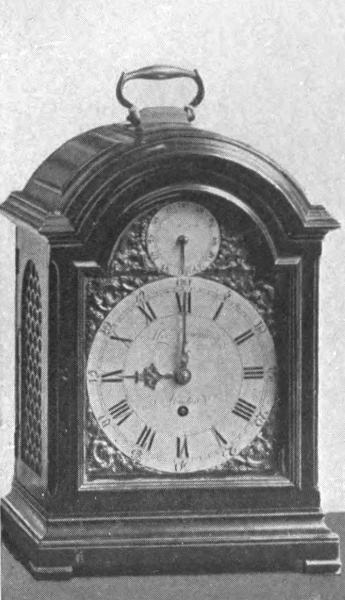
work produced, the bracket clock by Sam Watson,
of Coventry, 1687, illustrated (p. 181), shows that the
provincial maker was at that date in no way on a
lower plane than his contemporary in London.
Other makers are Wilson (Warwick), 1709; John
Whitehurst (Derby), 1785—a fine long-case clock
by this maker is in the Metropolitan Museum of
Art, New York; W. Francis (Birmingham), and
Thomas Wall (Birmingham), 1798. An example
by this maker is illustrated (p. 233), exhibiting a
pastoral scene painted in the lunette of the dial.
This clock—in the possession of the author—keeps
excellent time although 120 years old, and has gone
for ten years without stopping.
Of Nottingham makers, the following names of
early craftsmen are found on watches: Isaac Alexander,
about 1760 (a watch, gold inner case, white
dial; outer case of shagreen, with portrait of Charles
Stuart by J. June, 1745), and Thomas Hudson,
about 1790 (silver, white dial; outer case of tortoiseshell,
with silver mounts). The name of Hen.
Page, Upper Broughton (Notts), is found on a brass
clock, and John Kirk was a maker at Epperstone
and Skegby before he came to London in 1677 and
was admitted as a member of the Clockmakers' Company.
Among the collection of watches at Nottingham
Museum, apart from the two above-mentioned,
are a good many by makers of a later date, mainly
of the early nineteenth century: John Lingford,
A. Shepperley, William Young—all of Nottingham,
and Geo. Stacey, Worksop.
Among the other watches on exhibition are an early
one by Robert Dent (Lincoln), No. 61, and a watch
with gold case with chased repoussé figures and ornament
by J. Windmills, the celebrated London maker,
1671-1700.
This short list of Midland makers is obviously
incomplete, and it is to be hoped that some painstaking
horologists will amplify it and do honour to
the makers and to the counties concerned.
The Home Counties.—Thomas Tompion (1671-1713),
the famous London maker, commenced at Bedford
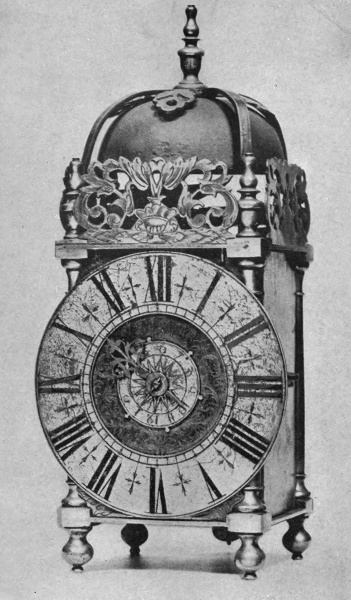
and ended at Bath. We have seen a brass lantern
clock engraved "Thos. Tonkink de Bedforde."
This might very well be one of his early clocks, and
we know his great last triumph in the famous long-case
clock in the Pump Room at Bath. But apart
from this incidental connection of the "father of
English watchmaking" with the provinces, there
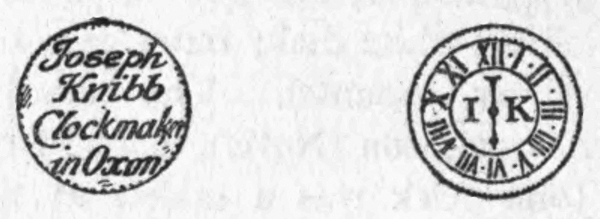
stands Joseph Knibb, of Oxon, who was admitted
to the Clockmakers' Company of London in 1677.
He worked in London for the Court of Charles II.
But he was established in Oxfordshire, as is shown
by the copper token he issued, with inscription
"Joseph Knibb Clockmaker in Oxon," and on reverse
the dial of a clock with initials I.K. in centre. We
give an illustration of this token.
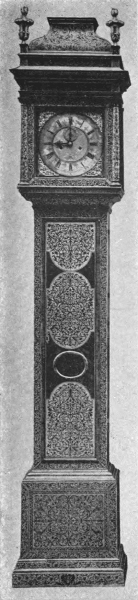
A long-case eight-day clock finely decorated in
marquetry, in date about 1690, is illustrated (p. 237).
This exhibits the work of Knibb as being equal, as
his employment at the Court shows, to the leading
London makers of his day. In the chapter on
Marquetry, p. 79, will be found a notice of this
clock in regard to its relation to other styles of
marquetry, and its place in the sequence there
described.
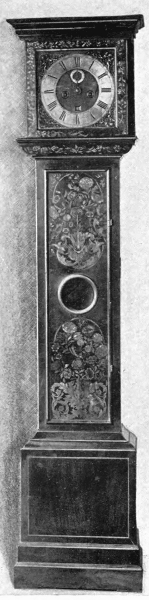
LONG-CASE EIGHT-DAY CLOCK.
Decorated in marquetry.
Maker, Joseph Knibb (Oxon). Date about 1690.
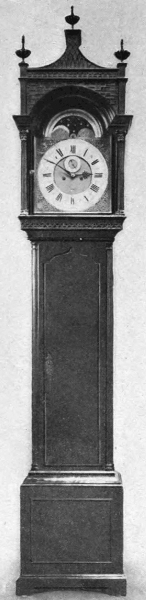
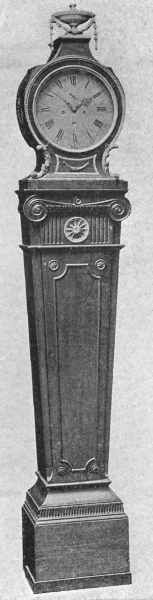
GEORGIAN SPANISH MAHOGANY LONG-CASE CLOCK.
Hood enriched with fretwork in Chinese style of Chippendale. Terminals of carved mahogany.
Maker, Cockey (Warminster).
(By courtesy of Messrs. D. Sherratt & Co., Chester.)
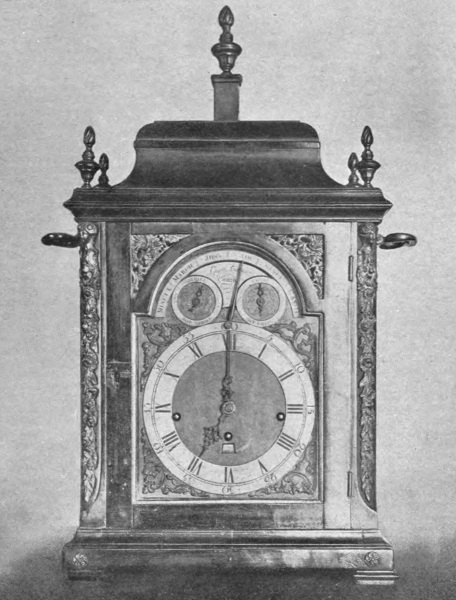
A fine bracket clock by Joseph Knibb, in date
about 1690, is illustrated (p. 181). This is of the
same period as the long-case clock, the year when
William of Orange defeated James II at the battle
of the Boyne, and James, the last of the Stuarts, fled
into France. It is possible that the fortunes of
Joseph Knibb were bound up with Whitehall. At
the Revolution in 1689 our Court clockmaker no
doubt retreated into Oxfordshire to continue his
creations which we now know. A cloud of unpaid
debts must have hung over him, for the Stuarts were
bad paymasters.
The West Country.—In publishing lists of clockmakers
collected by local antiquaries, a loyal service
has been rendered to the West Country by the Devon
and Cornwall Notes and Queries. The following list
is based on the researches published in that journal
by R. Pearse-Chope, Esq.,
[4] and by H. Tapley-Soper,
Esq.
[5]
- Balle, John (Exeter).
- Bickle, R. H. (Bishop's Nympton).
- Bradford (Tiverton).
- Bradford (Drayford).
- Braund, John (Hatherleigh).
- Brayley and Street (Bridgwater).
- Bucknell, Jas. (Crediton).
- Chamberlain, Hen. (Tiverton).
- Chasty, Robert (Hatherleigh).
- Chasty, William (Teignmouth).
- Day, Christopher (South Molton).
- Drake, R. (Beaminster).
- Eastcott, Richard (Exon).
- Edward, Clement, c. 1671.
- Ezekiel (Exon), c. 1794.
- Follet (Sidmouth).
- Foster, James (Ashburton).
- Fox, John (Alverton).
- Gard, Henry (Exeter).
- Gard, William (Exeter).
- Gaydon, J. (Barnstaple).
- Gould (Bishop's Nympton).
- Gould, G. (South Molton).
- Harding, Charles (Sidmouth).
- Harner (Membury).
- Hayward, Peter (Crediton), c. 1766.
- Howard, Wm., 1760.
- Hutchins, William (Cullompton).
- Huxtable (Chittlehampton).
- Huxtable, E. (South Molton).
- Jacobs, A. (Torquay).
- Jonas, Saml. (Exon), 1783.
- Keffutt, Walter (Exon).
- Lord, John (Farringdon).
- Lovelace, Jacob (Exeter), died 1766.
- Mallett, Peter, 1705.
- Mallett, John (Barnstaple), 1840.
- March, R. (Honiton).
- Otercey, John (Torrington).
- Passmore, R. (Barnstaple).
- Pile, Fra. (Honiton).
- Pollard (Crediton), 1760.
- Pollard, Thomas (Exeter).
- Price (Wiveliscombe).
- Rew, Joseph (Wiveliscombe).
- Routledge, George (Lydford), died 1801.
- (Epitaph Lydford Churchyard.)
- Sanderson, Geo. (Exeter).
- (Maker and patentee of tools for duplicating parts of watches, 1761.)
- Scoble, John S. (Colyton).
- Simons, A. (Bideford).
- Skinner (Exon).
- Snell, E. (Barnstaple).
- Stocker (Honiton).
- Strowbridge (Dawlish).
- Stumbel (Totnes).
- Thorn (South Molton).
- Thorne, Sim (Tiverton), 1740.
- Thorne, Michl. (South Molton).
- Tickle, John (Crediton), 1730.
- Upjohn, Richard (Exon).
- (Long-case clock, c. 1730.)
- Upjohn, Wm. (Exeter), 1741.
- Upjohn, Peter (Bideford).
- (Watch, 1780.)
- Weller, Geo. (Exon).
- Wood, I. (Exon).
- Waldron, John (Tiverton).
- Dates from church registers, family Bibles, old wills, marriage
records, and old newspapers to amplify local lists such as this add
greatly to their value in establishing period of clock.
Jacob Lovelace, of Exeter, who died in 1766, was
the maker of a remarkable clock of most elaborate
nature, with organ that played, and a series of
moving figures striking the hours, and bellringers
and other intricate diversions. This clock was exhibited
at the International Exhibition in 1851, and
is now at the Liverpool Museum.
A fine long-case clock in Chippendale style by
Cockey, of Warminster, is illustrated (p. 239), and
exhibits provincial work both in case and movement
of the highest character.
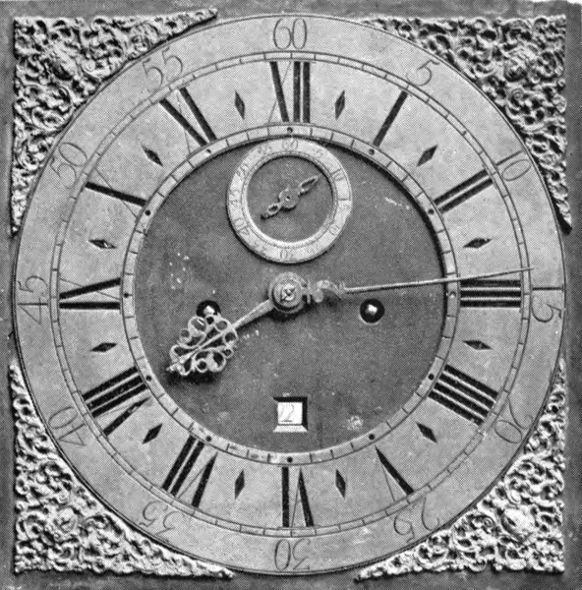
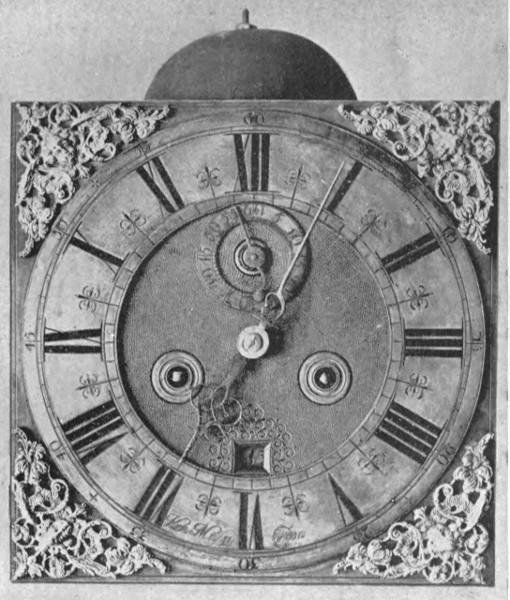
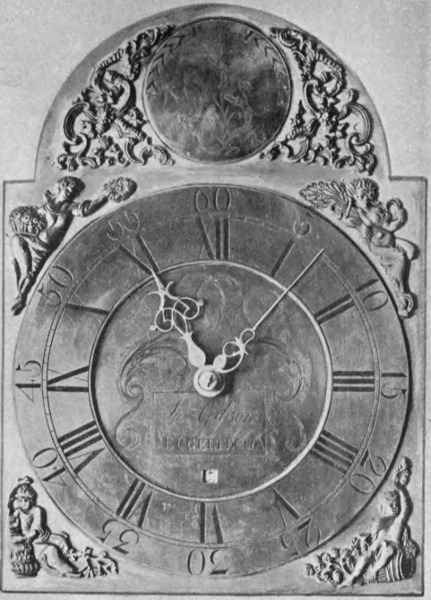
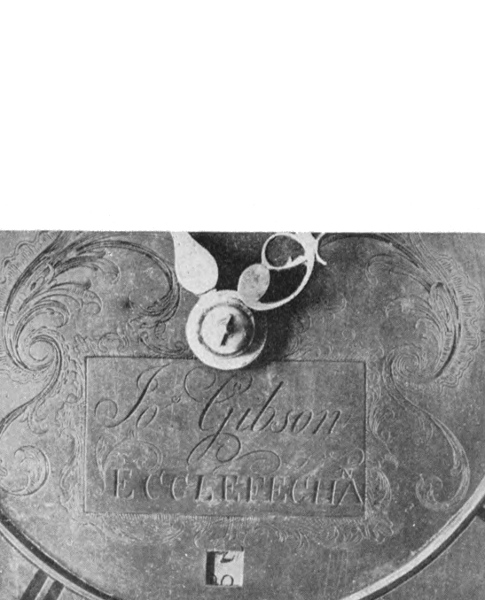
BRASS DIAL OF CLOCK.
By Shenkyn Shon (Blackcock Inn, Pontnedd Fechan).
1714.
(At National Museum of Wales, Cardiff.)
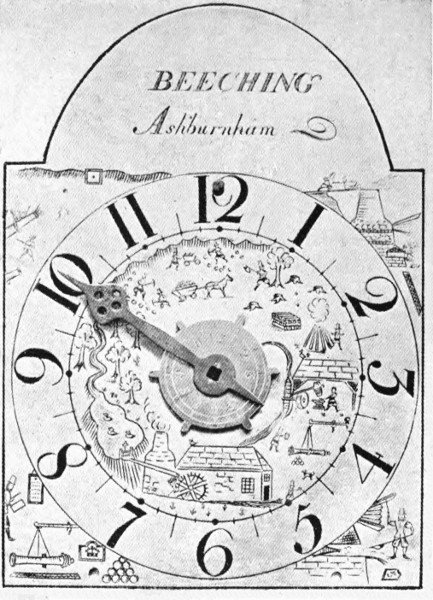
IRON DIAL OF THIRTY-HOUR CLOCK.
Single hand and alarum. Mid-eighteenth century. Ornamented
with designs of various phases of Sussex iron industry.
Maker, Beeching (Ashburnham).
(From the collection of J. C. Dawson, Esq., F.S.A.)
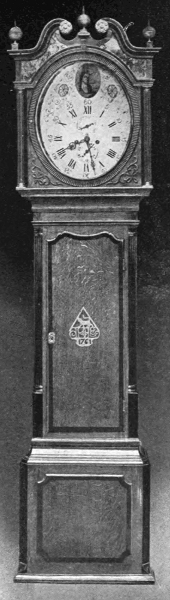
LONG-CASE CLOCK WITH RARE OVAL DIAL.
Subsidiary seconds and calendar dials. Blue painted decoration,
under glass, in spandrels above dial. Fine carved work in oval frame.
Maker, Marston (Salop). Brass plate on door dated 1761.
(By courtesy of Walter Idris, Esq.)
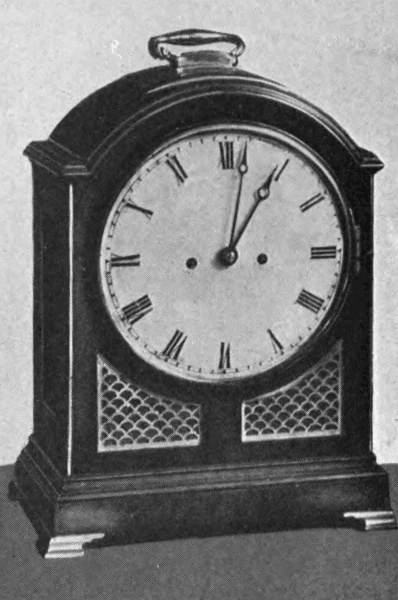
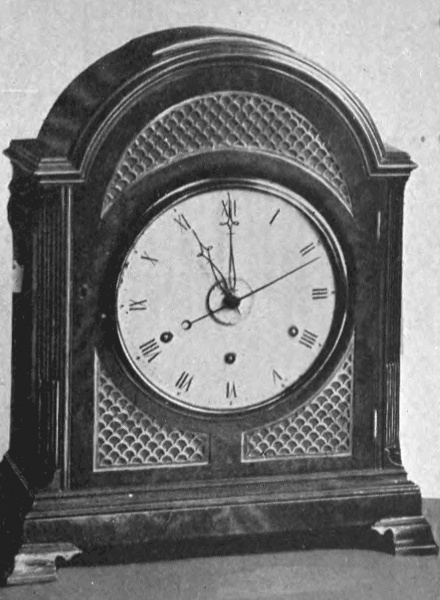
Strowbridge, of Dawlish, is the maker of a bracket
clock, in date about 1805, showing pleasing work
in the fine marquetry decoration introduced by
Sheraton (illustrated p. 201). There is an instance
on record of a clock being sent to "Mr. Strowbridge"
for repair. "When it came back his name, 'H.
Strowbridge, Dawlish,' was engraved upon the dial."
Miscellaneous Makers—East Anglia.—Several
makers are connected with Yarmouth. There is
Thomas Utting (Yarmouth), and we have seen a fine
long-case clock signed thus, and there is Isaac Johnson
(Yarmouth), who apparently made wall clocks.
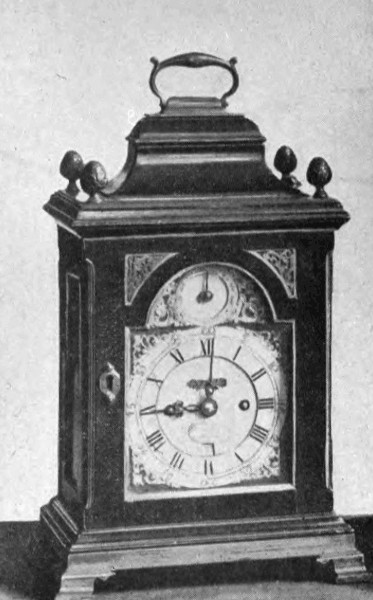
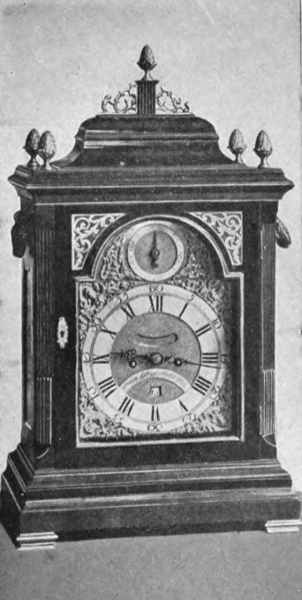
John Page, of Ipswich, is the maker of a very handsome
bracket clock, in date about 1740 (illustrated
p. 187). The name of Henry Terold, Ipswich, is
found on a round silver watch with chased interlacing
bands and silver dial, of seventeenth-century
period. Joseph Chamberlain, of Norwich, is a name
found on a late seventeenth-century watch. The
names of Mann and Jon. Nevill, both of Norwich, are
found on late eighteenth-century grandfather clocks.
Kent and Sussex.—The name of William Gill or
Gilt, of Maidstone, is found on a fine long-case clock
of the eighteenth century. William Gardner, of
Sandwich, and Joseph Carswell, of Hastings, are
other names found on grandfather clocks of the
latter part of the eighteenth century. The dial of a
clock by a Sussex maker, Beeching, of Ashburnham,
from a thirty-hour clock with single hand and alarum
(illustrated p. 243), is of mid-eighteenth century period,
and shows in its decorations the various phases of
the iron industry carried on at Ashburnham.
Welsh Clocks.—At the Amgueddfa Genedlaethol
Cymru, at Cardiff, the National Museum of the
Principality, there is a long-case clock by B. C.
Vaughan, of Pontypool, and a brass block with movement
by "Shenkyn Shon, Black Cock Inn, Pontnedd
Fechan, 1714," and also there exhibited are the
works of the old clock from St. David's Cathedral.
Illustrated on p. 245 is a unique long-case clock with
brass plate on door, with date 1761, with dragon
above. The particular feature of especial interest in
this clock is its oval dial (which is separately
illustrated, p. 249). This dial is enamelled white,
and has a medallion at top representing the figure
of Hope with an anchor. The other decoration is
interesting as exhibiting the attempt of the provincial
maker to simulate in pigment the marquetry
work of the Sheraton school, the design being similar
to that found on tea-caddies, no doubt well known to
the painter of the dial. There are two subsidiary
dials, one for seconds and the other showing the
days of the month.
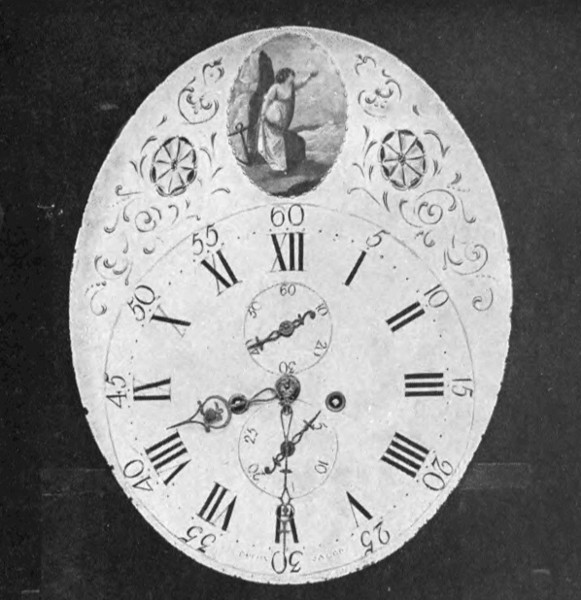
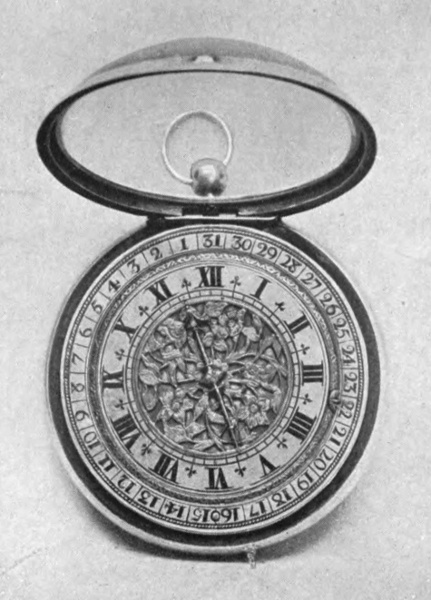
DIAL OF CLOCK ILLUSTRATED P.
245).
This oval form is rare. The Sheraton type of decoration painted on dial
is a noticeable feature. The panel is reminiscent of Pergolesi. The
lower dial indicates the days of month.
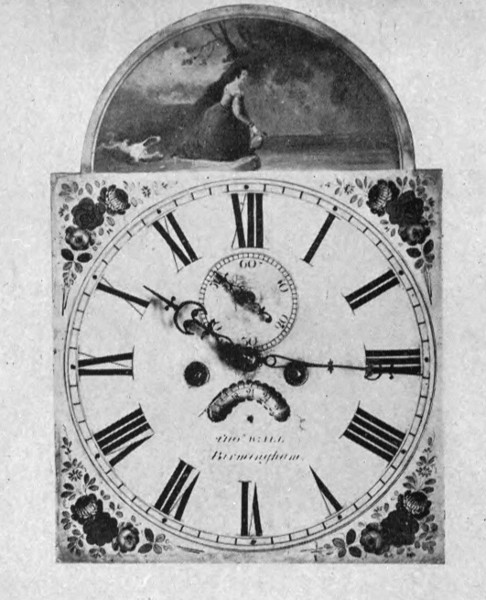
DIAL OF CLOCK ILLUSTRATED P.
233).
Lunette painted with figure subject of woman and pitcher at stream.
Spandrels decorated with roses in red and gold.
Although the maker's name is "Marston (Salop)"
there is an especially Welsh interest attaching to
this clock. It once was in the possession of Daniel
Owen, the famous Welsh novelist, who is buried in
Mold churchyard, and whose monument is in the
County Hall Field at Mold. He introduced this
clock into his novel, Rhys Lewis. The grandmother
of the youthful hero of the story had gone
to the fair; in her absence the boy took this clock
to pieces, so the story goes. But as the hours
wore on he found it was easier to take it to pieces
than to put it together again. The scene on the
return of his grandmother is piquantly described.
The clock-work ran like a thing demented, and the
tell-tale hands revealed the secret of the culprit,
who uneasily fingered a missing wheel in his pocket,
and he had forgotten to put on the pendulum.
The hood of the clock is of original decoration.
The upper spandrels have a blue-and-gold floral
design, covered with glass. The two lower spandrels
are delicately carved. The frame around the oval dial
is of beaded work cut in broad and effective style.
Altogether this clock possesses features appealing
to collectors. The provincial maker followed his
own lines, and has in so doing produced something
unique.
In conclusion, some apology should be made for
an attempt to sketch in makers of repute, scattered
over so wide an area, which resulted in a mere outline.
The meagre lists may in many cases be said to be
noteworthy for their omissions. But want of space
has precluded the writer from pursuing the subject
further, and he may be permitted to express a hope
that the perusal of these facts may stimulate local
efforts to worthier records.