Campaign medals
considered—Waterloo—Burmah—China—Cabul—Jellalabad—Scinde—Meeanee
—Sobraon—The men's Peninsular medal—Punjab—Indian General Service
medals—South Africa, 1850-3; also 1877-9—Baltic—Crimea—Indian
Mutiny—Abyssinia—New Zealand—Later awards
In these days when the deeds of brave men, whether they be of high or
low rank, are acclaimed with equal praise, it is extremely difficult
to understand the feelings which actuated the authorities a hundred or
more years ago when awarding military medals. Parliament, though it
was supposed to represent the masses, decided time after time in these
early years of the nineteenth century that decorations were only meant
for soldiers of rank and that the common men had neither claim nor
title to them. The usual plea was that the ordinary soldier had been
paid for his services, and there the nation's obligation to him was at
an end. Somehow or other, the authorities seem to have shut their eyes
to the fact that the same argument could be applied with equal force
to the commanders of the Army. It is somewhat lamentable to note that
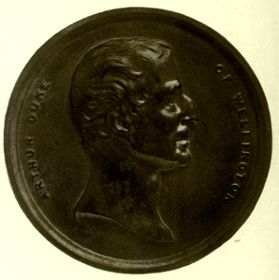
even so grand a soldier as the Duke of Wellington argued in favour of
withholding rewards from the rank and file, and his opinion, we may be
sure, had great influence in certain high quarters.
But in spite of the decided opinions held by those in authority, there
was a strong party of agitators who opposed these narrow views. To them
must be accredited much, for in face of every conceivable obstacle they
left no stone unturned until the coveted awards were shared by men as
well as commanders. In the early days which followed Waterloo this
little band displayed particular activity. "Are our ordinary soldiers,
fresh home from the Belgian battlefields, to go unrewarded as the
Peninsular heroes have done?" was their constant cry. The people took
up the matter, and only when absolutely forced to did Parliament agree
to strike a medal for all ranks of the victorious army. The official
decree ran as follows:—
"The Prince Regent has been graciously pleased in the name and
on behalf of His Majesty to command that in commemoration of the
brilliant and decisive victory of Waterloo, a medal shall be conferred
upon every officer, non-commissioned officer, and soldier present upon
that memorable occasion.
By command of His Royal Highness the Prince Regent.
Frederick, Commander-in-Chief."
Undoubtedly the innovation of rewarding the rank and file as well as
the officers created much satisfaction. The people openly displayed
their approval, the soldiers were pleased beyond measure, and the Press
spoke of the change as a step in the right direction; such, at any
rate, is the impression one gathers from reading articles bearing on
the matter in contemporary numbers of the Quarterly Review.
The Waterloo medal bore on the obverse a profile of George and the
inscription "George P. Regent." On the reverse was a winged figure of
Victory seated upon a rectangular scroll bearing the word "Waterloo,"
and the date "June 18, 1815." The reverse design was obviously copied
from a coin of Elias which is exhibited in the British Museum. The
ribbon was of red silk flanked with blue edges. This material was
passed through a circular ring and not through a horizontal slot, as is
customary to-day.
The award was received by all grades of men who were present at the
Battle of Ligny, June 16th; Quatre Bras, June 17th; Waterloo, June
18th; as well as by certain forces which were posted in the rear of the
battlefield on June 18th. Certain German troops were also decorated
with this award.
The collector will often come across specimens of this medal, which
are provided with slots instead of rings for holding the ribbon in
position. Many of the original recipients preferred this latter method
of attachment and made the alteration themselves. Such specimens,
therefore, are not in strict accordance with the official pattern and
are in consequence of less value than the unaltered kind.
Some ten years elapsed before the next medal, styled the First Burmah
Medal, 1824-6, was struck. This being an Indian award, no royal
features were portrayed. On the obverse was a palm-tree and an army
storming an Eastern city, probably Rangoon; there was also a Persian
inscription in the exergue. On the reverse, a lion was encountering a
white elephant, and a British flag waved prominently in the background.
The decoration was struck in gold for officers, and silver for men
of other standing. For the first time with Indian medals, a definite
ribbon, red and blue, was prescribed.
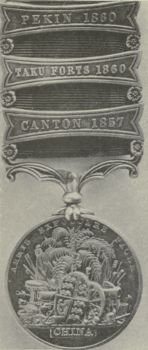
The earliest award to bear the head of Queen Victoria was the China
medal of 1842. The features portrayed on this specimen were similar to
those shown on a medallion executed by William Wyon in 1837, and struck
to commemorate Victoria's first visit to the City of London as queen.
Her Majesty evinced a great liking for this rendering of her features,
and consequently it was used for the coinage, the postage stamps,
and, lastly, the medals. The reverse side revealed a group of arms of
various kinds. The ribbon was red, edged with yellow. It was given both
to soldiers and sailors.
This award may be confused with a later China medal of the same design.
The earlier pattern, however, bears the year 1842 under the word China
in the exergue, whilst the 1857-60 pattern has no date at all. Also, no
bars were furnished with the earlier specimen, but as many as six may
be found on the latter.
Writing of the thrilling incidents which crowded the first campaign,
Carter describes one of them in the following words: "The west gate
had been blown in by Captain Pears, the commanding engineer. A body of
Tartars, having been driven into one division of the western outwork,
refused to surrender, when most of them were either shot or destroyed
in the burning houses, several of which had been set on fire by the
enemy or by the British guns. Major-General Bartley subsequently
proceeded with a body of troops consisting of the 18th and part of the
49th Regiment, when a hot engagement ensued with about one thousand
Tartars, who, under cover of some enclosures, opened a destructive
fire on the soldiers as they were filing round the walls. The leading
division of the 49th dashed down the ramparts, while the 18th pushed
on. As a result, the enemy was soon dispersed, although some fought
with great desperation.
"From the sun becoming so overpowering it was found impossible to
move with men already fatigued by their exertions, many of whom died
from the intense heat. The troops, therefore, remained in occupation
of the gates until six o'clock, when several parties were pushed into
the Tartar city and to the public offices. On passing through the city
and suburbs, the painful spectacle presented itself of hundreds of the
dead bodies of men, women, and children lying in the houses, numerous
families having destroyed themselves sooner than outlive the disgrace
of their city being captured by foreigners."
The second Chinese war resulted from a cumulation of depredatory
movements on the part of the natives, but the capture of the Arrow,
a vessel flying the British flag, was directly responsible for the
declaration of hostilities.
The next medal struck at the Mint was awarded to the soldiers who took
arms in 1842, in Cabul. The obverse bore the Wyon head of Victoria,
whilst the reverse was issued in four patterns as follows:—
1. A wreath encircling the inscription "Candahar, 1842."
2. A wreath encircling the word "Ghuznee," and another encircling the
word "Cabul."
3. A wreath encircling the inscription "Candahar, Ghuznee, Cabul, 1842."
4. A wreath encircling the inscription "Cabul, 1842."
The ribbon attached to all the varieties was of the rainbow pattern
which has since become familiar on Indian medals.
A native medal was also struck at the Mint for distribution among the
Indian troops. Instead of Victoria's bust a trophy of arms surmounting
the inscription "Invicta, MDCCCXLII," filled the obverse side.
After Cabul came the Jellalabad rising. To celebrate the victories
of this campaign, a medal was struck at Calcutta and distributed to
all soldiers who took part in the various actions. The design was
considered unsatisfactory; the obverse bore a simple mural crown,
the upper edge of which resembled the embattled coping of a castle,
whilst the reverse showed the date "VII April 1842," in bold but plain
lettering.
In consequence of the dissatisfaction which the medal caused, another
was struck by the Mint in London and sent out to the troops in 1845. An
order was issued at the same time stating that all recipients of the
Calcutta award could have their decoration changed for the London award
on making formal application. Curiously enough, the soldiers who had
grumbled at the pattern of the earlier medal showed little desire to
become recipients of the newer piece, and in only a few cases was the
exchange made. The London striking is consequently somewhat rare.
The Mint medal bore the Wyon head of Victoria surrounded with the words
"Victoria Vindex," whilst the rear showed a graceful figure of Victory,
with wings, holding a flag and a laurel wreath. The words "Jellalabad,
VII April MDCCCXLII" encircled the figure. The rainbow ribbon of India
suspended the medal.
The early forties were troublous times in India. Hardly twelve months
after Jellalabad had been fought and won, a medal was earned by our
brave troops in the province of Scinde. Referring to this campaign,
Mayo quotes the following interesting letter:—
"Colonial Office,
Downing Street.
18th July, 1843.
My Lord,
I have the honour to acquaint your
Lordships, that the Queen, being desirous of commemorating
the signal success obtained by the
Force under the command of Major-General Sir
Charles Napier, in Scinde, has been graciously pleased
to command that a Medal, to resemble as nearly as
possible that proposed for the Troops employed in
Afghanistan, should be conferred upon the Officers,
Non-commissioned officers, and Soldiers in Her
Majesty's Service, who were engaged in the Battles
of Meeanee and Hyderabad.
Without anticipating the course which the Court
of Directors of the East India Co. may propose
to take for commemorating the success of the
Company's Troops in Scinde, I think it nevertheless
right to add that Her Majesty would readily permit
the Officers, Non-commissioned officers, and Soldiers
of the Company's Army to whom the Court of
Directors might think proper to grant Medals in
commemoration of the Battles of Meeanee and
Hyderabad to wear such Medals in all parts of
Her Majesty's Dominions.
I have etc.,
Stanley,
The Presidency of the Indian Board."
The Mint medal issued in March 1846 bore the Wyon head of Victoria,
with the words "Victoria Regina" on the obverse, but of the reverse
there were three patterns. The first showed a laurel wreath and crown
encircling the word "Meeanee"; the second had the word "Hyderabad"
substituted; whilst the third gave both battles, namely "Meeanee and
Hyderabad." The rainbow ribbon was again employed.
Before turning to the next medal, it is pleasant to recall the Duke
of Wellington's brief eulogy of Sir Charles Napier's campaign, which he
addressed to the House of Lords.
"Sir Charles Napier moved his troops through the desert against
hostile forces, he transported his guns under circumstances of extreme
difficulty and in a most extraordinary manner, and he cut off a retreat
of the enemy which rendered it impossible for them ever to regain their
positions." Meeanee was fought on February 17th, and Hyderabad on March
24, 1843.
THE CHINA MEDAL, 1842-60.
THE EGYPTIAN MEDAL, 1882-9.
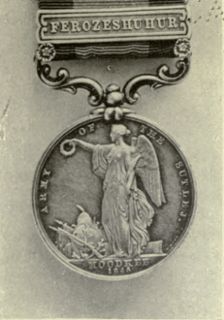
Two years after Scinde, the Sutlej Campaign was waged between British
troops and Sikhs. The Mint medal struck to commemorate our victories
was the second award to carry clasps or bars—the officers' Peninsular
medal being the first. The obverse again showed Wyon's head of
Victoria: the reverse displayed a stirring picture of Victory holding
out a wreath, with a stack of arms at her feet. The words "Army of the
Sutlej" encircled the allegory. Of the exergue on the reverse, there
were four different types: the first read "Moodkee, 1845"; the second,
"Ferozeshuhur, 1845"; the third, "Aliwal, 1846"; and the fourth,
"Sobraon, 1846."
The General Order which regulated the granting of this decoration
stated that soldiers who took part in more than one engagement were to
receive the medal engraved with the name of their earliest encounter,
whilst bars were to be added for subsequent victories. From this it
is clear that the Sobraon medal cannot be found with any bars. Bars,
the decree stated, were to be worn in the following order, counting
upwards from the medal: Ferozeshuhur, Aliwal, and Sobraon. Naturally,
no bars for Moodkee were issued.
Curious as it may seem, the next decoration to be struck by the Mint
was the rankers' Peninsular medal. It will be remembered that on the
conclusion of Wellington's campaign in Spain two gold pieces were
issued for officers, but that no awards were presented to the ordinary
soldiers. This arrangement pleased neither the men nor the officers,
who knew how much the country was indebted to the rank and file. As a
consequence, the question of the men's medal was constantly discussed
in Parliament. In 1844, the matter was thoroughly debated upon in the
Lower House, but the opposers urged with a certain amount of success
that Wellington had decided years ago that no award should be granted.
Sir Charles Napier's answer to this lame argument was to the point. "It
is never too late to do a good thing," he retorted amidst the applause
of his followers. Two years later, in 1846, the matter was again before
the House, and, probably because Queen Victoria was somewhat partial to
the granting of distinctions when merited, a favourable decision was
arrived at. The men were to have the medal so long withheld from them,
as the following General Order of June 1, 1847, explains:—
"Her Majesty having been graciously pleased to command that a medal
should be struck to record the services of her fleets and armies during
the wars commencing 1793, and ending in 1814, and that one should be
conferred upon every officer, non-commissioned officer and soldier of
the army who was in any battle or siege, to commemorate which medals
have been struck by command of Her Majesty's Royal predecessors and
have been distributed to the general or superior officers of the
general armies and corps of troops engaged, in conformity with the
regulations of the army at that time in force...."
The Order was somewhat lengthy and involved, but its chief clauses
were: (a) men should receive medals and clasps for all engagements
figuring on the superior officers' medals and clasps of 1808-9,
and (b) relatives of men since deceased could claim the award on
production of sufficient title.
The medals were issued to 19,000 claimants in 1848. In 1850, the
Duke of Richmond suggested that the troops in Egypt, who had fought
with great bravery, should also receive the distinction, and the
Queen graciously consented to recognize their services. In this case,
however, the relatives of dead soldiers could not claim the award.
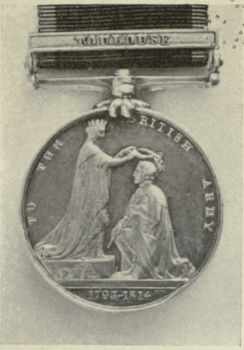
There is much about the rankers' Peninsular medal which is
unsatisfactory. In the first place, the reverse bears the figure of
Victoria crowning the Duke of Wellington. As he took no part in many
of the contributory campaigns, and as his veto so long delayed the
granting of the decoration, some other design would have been more
appropriate. Again, the date placed in the exergue, 1793-1814, is much
too vague. And lastly, the head of Victoria on the obverse has often
caused confusion, as she did not ascend the throne until some three
years after the campaign had come to a welcome close.
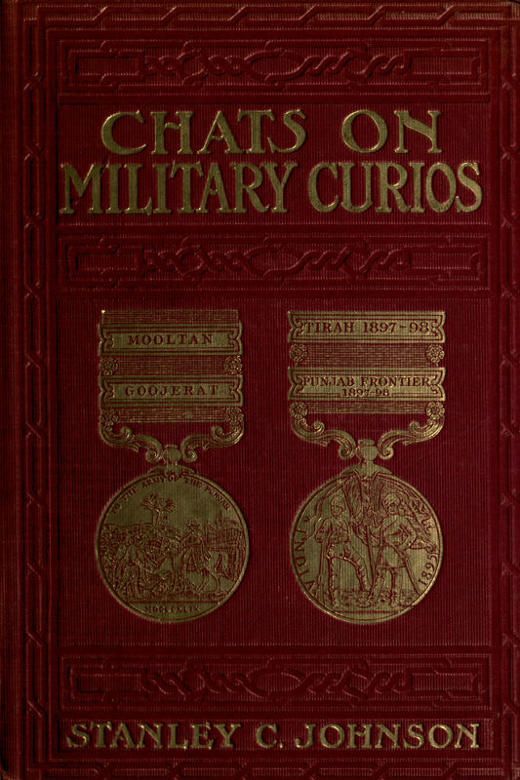
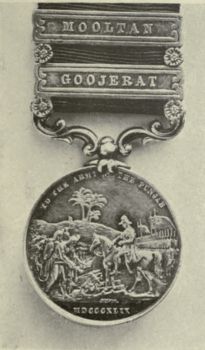
The Punjab award, 1848-9, is probably one of the most artistic pieces
of work emanating from the London Mint. On the obverse was the familiar
Wyon head of Victoria, surrounded by the words "Victoria Regina,"
whilst on the reverse was a stirring tableau representing Sikhs
presenting their arms to Major-General Sir Walter Raleigh Gilbert at
Rawul Pindee. The ribbon was blue, striped with two narrow lines of
yellow. There were three clasps: Chilianwala, Mooltan, and Goojerat.
The most desperate encounter in this campaign was the Battle of
Chilianwala, during which the brigade under Brigadier Pennycuick and
Lieutenant-Colonel Brookes was led to make a disastrous charge owing
to a misunderstanding. The 24th Regiment suffered terribly, and their
medals are now extremely valuable in consequence.
In 1851, Queen Victoria, in furtherance of her policy of rewarding
unrecognized actions of the past, decided to issue an Indian General
Service medal to cover the following feats of arms:—
Storm of Allighur—September 4, 1803.
Battle of Delhi—September 11, 1803.
Battle of Assaye—September 23, 1803.
Siege of Asseerghur—October 21, 1803.
Battle of Laswarree—November 1, 1803.
Battle of Argaum—November 29, 1803.
Siege and storm of Gawilghur—December 15, 1803.
Defence of Delhi—October 1804.
Battle of Deig—November 13, 1804.
Capture of Deig—December 23, 1804.
War of Nepaul—1816.
Battle of Kirkee and battle and capture of Poona—November 1817.
Battle of Seetabuldee and battle and capture of Nagpoor—November and
December 1817.
Battle of Maheidpoor—December 21, 1817.
Defence of Corygaum—January 1, 1818.
War in Ava—1824-6.
Siege and storm of Bhurtpoor—January 1826.
The following are the particulars of the medal:—
Obverse—Wyon's head of Victoria, with the inscription "Victoria
Regina."
Reverse—Victory, seated. A palm-tree in front of her.
Ribbon—Sky blue.
Clasps—Twenty-three in number.
It is curious to note that the reverse bears the date 1799-1826, though
the above list of engagements restricts the years to 1803-26. This is
due to the fact that the list was revised after the dies had been put
in hand, and certain of the earlier battles were deleted on the advice
of the Duke of Wellington.
A second Indian General Service medal was issued in 1854 and
subsequently as conditions demanded. It should be mentioned that the
authorities had grown to view the constant striking of fresh medals for
Indian service with a certain amount of disfavour, and the standard
design was introduced in order to prevent a multiplicity of patterns.
The measure may have proved satisfactory to those in authority, but it
certainly had grave disadvantages of a more or less obvious character.
The ribbon, for instance, was similar through all the years of the
issue, and when worn with undress or civilian clothes conveyed little
meaning. The following clasps were issued:—
Pegu; Persia; North-West Frontier; Umbeyla; Bhootan; Looshai; Perak,
1875; Jowaki, 1877; Naga, 1879; Burma, 1885, 1887, and 1889; Sikkim,
1888; Hazara, 1888 and 1891; Chin-Lushai, 1889; Samana, 1891;
North-West Frontier, 1891; Hunza, 1891; Lushgai, 1889; Wazeristan,
1894.
The value of the piece varies considerably, according to the clasps
provided with it.
The description of the second Indian General Service award is:—
Obverse—Wyon's head of Victoria, with the inscription "Victoria
Regina."
Reverse—Victory crowning a naked warrior.
Ribbon—Three strips of red and two of blue, all of equal width.
Another general medal, first issued in the early fifties, was the
South African medal. It will be remembered that in 1850-3 certain
British regiments were engaged in putting down Kaffir risings. When
a decoration was struck for them, Queen Victoria decreed that the
soldiers who fought in the earlier Kaffir risings in 1834 and 1846-7
should also receive the award. The design, which was the same for all,
bore the Wyon head on the obverse, and a crouching lion with the words
"South Africa" and the date "1853" on the reverse. The ribbon was
orange, streaked with four blue lines.
For the 1834 campaign, the 27th, 72nd, and 75th Foot regiments were
decorated. For the 1846-7 campaign, the recipients were the 7th
Dragoon Guards, the Rifle Brigade, the 6th, 27th, 45th, 79th, 90th,
and 91st Foot regiments. For the 1850-3 campaign, the following were
honoured: the 2nd, 6th, 12th, 43rd, 60th, 73rd, 74th, 91st Foot, the
Rifle Brigade, the 12th Lancers, and various Marines. By noting the
recipient's regiment, engraved on the medal edge, it is possible, in
most cases, to decide for which particular campaign the award was made.
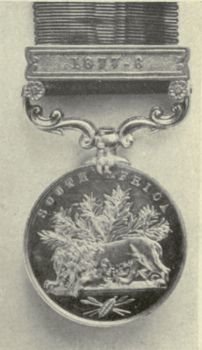
It may be convenient to state here that the South African decoration
was re-issued in 1877-9. The design was similar to the original, except
that the exergue contained a picture of Kaffir arms instead of the date
"1853." With this issue clasps bearing the following years were given:
1877, 1878, 1879, 1877-8, 1878-9, and 1877-8-9.
The next medal was that presented for the Baltic. It was given largely
to the Navy, but the Army received its share, as the letter here quoted
from Mayo plainly shows:—
"Admiralty, June 5, 1856.
Her Majesty having been graciously pleased to signify Her commands
that a medal shall be granted to the Officers and Crews of Her
Majesty's ships as well as to such Officers and Men of Her Majesty's
Army as were employed in the operations in the Baltic in the years
1854-5, the Lords Commissioners of the Admiralty hereby give notice of
the same."
The obverse of the award was again embellished by the familiar head
engraved by Wyon, whilst the reverse depicted Britannia seated. The
inscription "Baltic, 1854-1855," surrounded her. The ribbon was yellow,
flanked with narrow edges of blue.
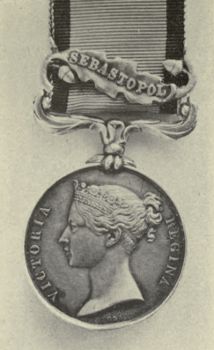
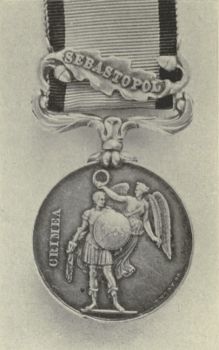
After the Baltic came the Crimea award. This is certainly one of
the finest productions which the London Mint has ever given us. The
well-known picture of Victoria filled the obverse, whilst a splendid
allegorical group, depicting Victory crowning a Roman soldier,
ornamented the reverse. The clasps were more decorative than usual,
taking the form of elongated oak-leaves held in position by minute
acorns. They were five in number and bore the designations of Alma,
Balaklava, Inkerman, Sebastopol, and Azoff (the latter only for naval
victories). The ribbon was light blue, edged with yellow.
The medal commands but a very low price—considering how important
was the victory which it commemorates—unless it bears the bar for
Balaklava. If provided with this honour, and engraved for one of the
cavalry regiments which took part in the famous charge, its value is
considerable.
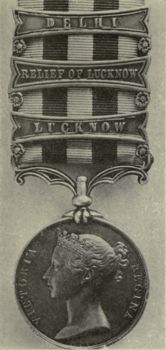
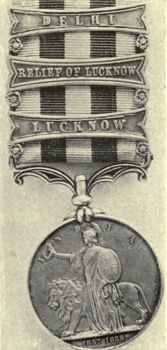
The last award to be paid for by the Honourable East India Company
was the Indian Mutiny medal of 1857-8. This, of course, is one of the
finest pieces which could enter the medallist's collection, yet it
is procurable for a very modest sum, unless it bears the clasp for
the Defence of Lucknow, when it is somewhat costly. The obverse shows
Victoria's profile, as before, whilst the reverse displays Britannia
seated on a lion, with the word "India" printed around the edge. The
ribbon is silver grey, with two bars of red. The clasps are five in
number: Delhi, Defence of Lucknow, Relief of Lucknow, Lucknow, and
Central India. The medal was presented, generally, to soldiers in the
9th Lancers and the Bengal Horse Artillery, besides many civilians.
In 1867-8, a medal for Abyssinia was minted. In some measure it was
an interesting award, as the usual head of Victoria was superseded by
another design, engraved by J. S. Wyon and A. B. Wyon. In this case
the royal features were portrayed within a small circle, which was
surrounded by a star having nine points. In the angles formed by the
points of the star the letters A-B-Y-S-S-I-N-I-A were printed. The
reverse was a simple circular wreath. There were no clasps, and the
ribbon—silver grey and red in colour—was passed through a circular
ring, joined to the medal by a royal crown fashioned in silver.
In 1869, a much-belated decoration was struck for distribution among
the soldiers and sailors who fought against the Maoris in New Zealand
in 1845-7 and 1860-6.
The expeditionary force was landed in 1845, in order to uphold the
rights of British settlers, who complained that after purchasing
allotments of land they were denied their title. The Maori chiefs
disclaimed all knowledge of such practices, but when a British
magistrate presented a formal complaint to a certain Wairau chief, he
was murdered. This seems to have been a signal for other native chiefs
to rise and maltreat the Europeans generally. The British force, it may
be added, only arrived in time to prevent a wholesale massacre of the
settlers from the Motherland.
The obverse of the medal bore a new head of Victoria, wearing widow's
weeds; the reverse showed a wreath, and the inscription "New Zealand,
Virtutis Honor: 1846-65." For reasons which are not clear, a few pieces
were struck bearing no date. The ribbon was blue and red.
As the historical incidents relating to the medals of recent issue are
generally known, it will only be necessary in the following cases to
describe the designs of the medals themselves.
Canada, 1866-70.—Yet another profile of Queen Victoria, with
inscription "Victoria Regina et Imperatrix." On the reverse, a wreath
of maple-leaves and a Canadian ensign. Clasps—Fenian Raid, 1866;
Fenian Raid, 1870; Red River, 1870. Ribbon—two bars of red and one of
grey.
Ashanti, 1874-94.—Still another profile of Queen Victoria, with
inscription "Victoria Regina." The reverse bore a group of British
soldiers fighting savages in a wood, the work of E. J. Poynter, R.A.
Clasps—Coomassie; 1887-8; 1891-2; 1892; 1893-4. Ribbon—yellow and
black.
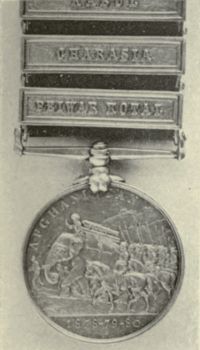
Afghanistan, 1878-80.—Another profile of Queen Victoria,
with inscription "Victoria Regina et Imperatrix." On the reverse, a
fine picture of Indian soldiers proceeding through a mountain pass,
in which an elephant is prominently displayed. The sketch was made by
Randolph Caldecott. Clasps—Ali Musjid; Peiwar-Kotal; Charasia; Ahmed
Khel; Kabul; Kandahar. Ribbon—green and plum.
THE SUTLEJ MEDAL.
THE PUNJAB MEDAL.
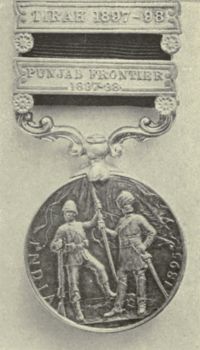
THE THIRD INDIAN GENERAL SERVICE MEDAL.
Cape of Good Hope General Service.—On the obverse, Victoria
with widow's weeds and small crown. On the reverse, the words "Cape
of Good Hope," surmounting a lion and unicorn. Clasps—Bechuanaland;
Basutoland; Transkei. Ribbon—blue and yellow.
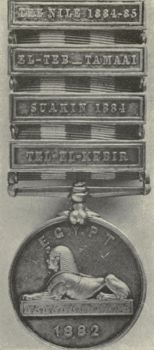
Egypt, 1882-9.—Head of Victoria, as on the Ashanti medal,
on obverse, and sphinx, with inscription "Egypt, 1882," on the
reverse. Clasps—Alexandria; Tel-el-Kebir; Suakin; El Teb; Tamaai;
El Teb-Tamaai; The Nile, 1884-5; Abou Klea; Kirbekan; Suakin, 1884;
Tofrek; Gemaizah; Toski, 1889. Ribbon—grey and blue.
North-West Canada, 1885.—Obverse, as for Egypt. Reverse, maple
wreath, and inscription "North-West Canada, 1885." Clasp—Saskatchewan.
Ribbon—grey with two red stripes.
West Africa, 1890-1900.—Head as in previous case. Reverse,
British soldiers fighting savages in a forest. Seventeen clasps.
Ribbon—black and yellow.
Matabeleland, 1893.—A fresh head of Victoria on the obverse,
and a wounded lion, with the inscription "Matabeleland" on the reverse.
No clasps. Ribbon—orange and blue in seven stripes.
Central Africa, 1894-8.—Medal as for West Africa. One clasp.
"Central Africa, 1894-8." Ribbon—plum, silver, and black.
Third India General Service Medal, 1895-8.—Victoria in widow's
weeds on obverse, and a British and Indian soldier grasping a standard
on reverse. Six clasps. Ribbon—yellow green and plum red.
Sudan, 1896.—Head and shoulders profile of Victoria on obverse,
and on reverse a winged figure of Victory grasping a flag in either
hand and "Sudan" printed beneath her feet. No clasps. Ribbon—a thin
red stripe separating two wide bars of yellow and black. There is also
a Khedive's Sudan medal which British soldiers have permission to wear.
East and Central Africa, 1897-9.—Obverse, as for Sudan.
Reverse, Britannia pointing to the rising sun. A lion accompanies her.
Clasps—Lubwa's Uganda; 1897-8; 1898; Uganda, 1899. Ribbon—orange and
red in two wide bars.
China, 1900.—Victoria in profile on obverse; a pile of arms, a
shield, a palm-tree, and the Latin quotation "Armis Exposcere Pacem" on
the reverse. Clasps—Taku Forts; Defence of the Legations; Relief of
Pekin. Ribbon—a wide red band flanked with yellow edges.
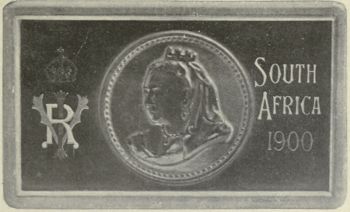
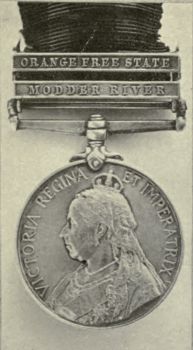
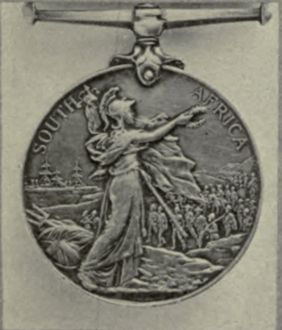
First South Africa, 1899-1902.—The Queen's head on the obverse,
as in previous case. Victory offering a laurel crown to an army of
British soldiers. Twenty-six clasps. Ribbon—orange flanked with blue,
which in turn is flanked with red.
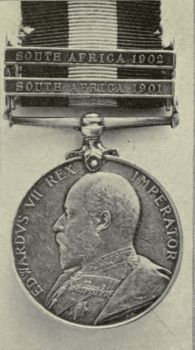
Second South Africa, 1901-2.—The first campaign medal to bear
King Edward's profile. Reverse, as for previous award. Clasps—South
Africa, 1901; South Africa, 1902. Ribbon—equal strips of green,
silver, and orange.
Ashanti, 1900.—Obverse, as for second South Africa. Reverse, a
lion trampling on native weapons, and a scroll with the word "Ashanti."
Clasp—Kumassi. Ribbon—three strips of black and two of green.
East African General Service, 1900-4.—Obverse, as before.
Reverse, Victory, with a lion, pointing to the rising sun. Fourteen
clasps. Ribbon—black, yellow, and green bars.
Fourth India General Service, 1901-2.—Obverse, as before.
Reverse and ribbon, as for the third India General Service medal.
Clasp—Waziristan, 1901-2. Ribbon—three strips of crimson and two of
green.
Tibet, 1903-4.—Obverse, as before. Reverse, the heights of
Tibet crowned by a fortress. Clasp—Gyantse. Ribbon—green, silver, and
plum colour.