From the Retirement of Kiyonaga to the Death of Utamaro (1790-1806)
The change that confronts us as we turn from the period of Kiyonaga to
that of Utamaro, Yeishi, and Toyokuni is one whose significance is not
at first sight wholly clear. We find the sound and classic figures of
Kiyonaga gradually replaced by new and fascinating types—slender
drooping bodies, wonderfully piled coiffures, elaborately brocaded
robes; and the virile drawing of the earlier master gives way to the
sinuous curves and arresting plasticity of the new designers. The
favourite types of this time are almost as unreal as those of the
Primitives, but they convey a totally different feeling; on the one
hand, in their curious perverted way, they are far more realistic than
the Primitives ever dreamed of being; and on the other hand, they seem
the products of minds weary of reality, who turn to the phantasies of
the not wholly normal spirit for their ideals and their consolations.
It must not be supposed, however, that the transition to this style of
the Decadence was a sudden one. The painters who had most perfectly
assimilated the style of Kiyonaga were the very ones who, in this
period, turned to the depiction of figures in which every line betrays
the weariness of the hour and its craving for novelty. The apex of
creative energy in this art had been reached and the inevitable decline
was under way.
Of the forces that produced this decline we have comparatively little
knowledge. Fenollosa's account of the social conditions of the period
throws some light upon the problem. "It was," he says, "a period of
crisis in Tokugawa affairs. The cleavage between the aristocratic and
the plebeian strata of Japanese life, which had become placidly
conscious of itself in the days of Genroku, now threatened a moral, a
social, if not a political disruption. The new factors of popular
education—art, prints, illustrated books, the theatre, novels, contact
with the Dutch at Nagasaki—all had stimulated the spirit of inquiry and
of unrest which had penetrated back in investigation to the facts of the
Shogun's usurpation; which wrote new, popular histories of the national
life; which gave plays and novels a semi-political aim. This deeper wave
of self-consciousness on the part of the people was met by the
authorities with sterner repressions. The better elements that might
have drifted into improving the popular standards in pleasure and art
were driven out by a strict censorship. There was thus a sort of
natural, or unnatural, selection which tended to isolate and give
prominence to the coarser side of the popular feeling. If the issue were
squarely made between Confucius and rank demoralization, there was
little resource for the commoner but to choose the latter. Thus there
arose a sort of alliance between the theatre and the houses of pleasure
on the one hand, and the disaffected among the literary and political
agitators upon the other. Men, great men who sowed the seeds of the
revolution which ripened in 1868, had to flee for asylum, not to
Buddhist temples, but to the labyrinths of the Yoshiwara, where, in the
care of a romantic love lavished upon them by its then highly cultivated
hetairæ, they could print and disperse, from their hidden presses,
seditious tracts which set the heart of the nation on fire. It was not
the ideals of a ripe self-consciousness, such as Kiyonaga had attempted;
it was a struggle of living desires against outworn conventions and
hopeless tyrannies. Hence, the two phases of a new Ukioye art—its
pressure outward toward fuller scientific realisms, and its frank
recreations in the vulgarities of its surroundings."
In addition to the restlessness growing out of such political
conditions, we should remember that it is not the nature of the human
race to be satisfied even with perfection for very long. Kiyonaga, with
all his placid beauty, could not forever suffice men who felt themselves
to be living as passionately "modern" lives as we do to-day. Change was
required to keep them interested; and since the idealization of sound
vitality could hardly be pushed farther than Kiyonaga had taken it, the
obvious path for the artist lay in the direction of fantastic variations
on the old theme and in the idealization of the erotic phantoms evoked
by uneasy weariness. New refinements had to be introduced; new emotions
had to be stirred; and the unending search for novelty led in due time
to strained efforts, perverted mannerisms, and distorted outlooks upon
life.
So much for that part of the decadence which was due merely to the
desire for change. But there was another element of even more definite
operation. It is fairly clear that part of the fatal development
resulted from that slow drift toward realism which we have seen growing,
period by period, since the days of the Primitives. The age of Harunobu,
with its new technical resources, had abandoned pure decoration and
aspired to put into its designs something of the flavour of life. The
age of Kiyonaga, with its complete mastery of technique, had projected
into its designs its observation of real beings—drawn with a fine
idealization, but nevertheless based on a deep fidelity to concrete
forms. The age of Utamaro had a choice of only two steps left to take if
it were to advance to any new position—a step in the direction of still
closer fidelity to nature, or a step in the direction of complete revolt
from naturalism into regions of wild phantasy. Characteristically, it
took both!
Particular instances will show this. Utamaro and Sharaku recorded the
peculiarities of real things with a sharpness of observation and an
accuracy of rendering that the earlier artists had never approached. And
at the same time they used these sharply mastered details of nature as
mere brick and mortar out of which to construct fantastic edifices of
the most unbridled imagination. Because they were geniuses, they did
this and created masterpieces; but they left to later times and lesser
artists only the sterile heritage of a deadening realism which they had
found it convenient to employ, but to which they themselves had never
been truly subject.
At the beginning of this period Yeishi, Choki, Sharaku, and the young
Utamaro produced work that ranks quite as high in beauty as that of
preceding days. Yeishi's visionary figures of women, drawn with a
disembodied and fragile grace, are in their way matchless things, whose
only fault is their lack of virile strength. Choki's finest works are
wholly beyond praise. Sharaku, the supreme master of actor-portraits and
one of the great artists of the world, created designs of stupendous
power; if there is any trace of decadence in him it is not weakness but
brutality. Utamaro, in his earlier years at least, was as wholesome as
Kiyonaga; and even when, in later times, he turned to figures that have
about them an indescribable atmosphere of languor and decline, he made
of them designs that are to many people the most beautiful productions
of the whole school. In all of these men, technical power and sense of
composition were of unimpaired vigour. Why, then it may be asked, should
we speak of the decadence?
The answer lies partly in the fact that these productions, as a rule,
express in their languid or overstrained figures tendencies of emotional
super-refinement and nervous tension that impress every beholder with a
sense of disintegration, and partly in the history of later days. For
the moment, the rivalry between the great men of the period was so keen
as to sustain what was, after all, the dying effort of their art. The
successes of each one spurred the others on to new types and new
feverish devices, feeding thus the flames of the desire for novelty
among the people. But the end was at hand. By 1800, in the later work of
Utamaro, in most of the work of Toyokuni, and in practically all the
work of their followers, genuine artistic weakness appeared,
sensationalism took the place of vigour, garishness supplanted harmony,
and crude emotions, crude drawing, crude colour became the common
feature. The ancient sense of style gave way to a desire to push
pictorial effects beyond their legitimate boundary, and the edge of the
abyss was in sight.
But before that moment came there remained sixteen years in the
productions of which we shall find beauties less sane and sound than
those of Kiyonaga, but nevertheless perpetually delighting.
Portrait of a Woman.
Out of the silence of dead years
Your slender presence seems to move—
A fragrance that no time outwears—
A perilous messenger of love.
From far your wistful beauty brings
A wonder that no lips may speak—
A music dumb save as it clings
About your shadowy throat and cheek.
Longing is round you like that haze
Of luminous and tender glow
Which memory in the later days
Gives vanished days of long ago.
And he who sees you must retrace
All sweetness that his life has known,
And with the vision of your face
Link some lost vision of his own.
The long curves of your saffron dress—
The outline of your delicate mould—
Your strange unearthly slenderness
Seem like a wraith's that strayed of old
Out of some region where abide
Fortunate spirits without stain,
Where nothing lovely is denied,
And pain is only beauty's pain.
. . . . . .
Strange! that in life you were a thing
Common to many for delight,
Thrall to the revelries that fling
Their gleam across the fevered night—
A holy image in the grasp
Of pagans careless to adore;
A pearl secreted in the clasp
Of oozy weeds on some lost shore.
My thought shrinks back from what I see,
And wanders dumb in poisoned air—
Then leaps, inexplicably free,
Remembering that you were fair!
. . . . . .
Belovèd were you in your prime
By one, of all, who came as guest,—
A wastrel strange, whose gaze could climb
To where your beauty lit the west.
One,—in whose secret heart there moved
Some far and unforgotten stir
Of ancient, holy beauties loved,—
Here paused, a sudden worshipper.
Methinks he moved in dusks apart
Through that profound and trembling hour
When you within his doubting heart
Touched all the desert into flower.
And where you rose a world's delight,
For him the dark veils from you fell,—
As earthly clouds from star-strewn night
Withdraw, and leave a miracle.
Not Oiran then, but maid; remote
From tyrant powers of waste desire.
Who drew these hands, this slender throat,
Saw you 'mid skaken winds of fire.
You were a shape of wonder, set
To crown the seeking of his days.
For you his lonely eyes were wet;
With you his soul walked shrouded ways.
And though the burning night might keep
You servient to some lord's carouse,
For him you rose from such a deep
With maiden dawn-light on your brows.
. . . . . .
Pale Autumn with ethereal glow
Hovered your delicate figure near;
And ever round you whispered low
Her voices, and the dying year.
A year—a day—and then the leaves
Purpureal, ashen, umber, red,
Wove for you both through waning eves
A gorgeous carpet gloomward spread.
And with that waning, you had gone,
Through changes that love fears to trace—
No later lover could have known
Your wistful and alluring face—
Your music, quivering in thin air,
Had fled with life that filled your veins—
But he for whom you were so fair
Dreamed; and the troubled dream remains.
. . . . . .
Time, that is swift to smite and rend
The common things that spring from earth,
Dares not so surely set an end
To shapes of visionary birth.
There often his destroying touch
Lingers as with a lulled caress,
Adding, to that which has so much,
An alien ghostly loveliness.
So shall your beauty, crescent, pass
From me through many a later hand,
Each year more luminous than it was—
O April out of Sunset Land!
The career of Hosoda Yeishi as a print-designer began about 1780 at the
time when Kiyonaga was in full sway, and lasted until shortly after the
beginning of the nineteenth century—a date when Kiyonaga had for some
years been in retirement. Thus in Yeishi perhaps more fully than in any
other artist except Utamaro may be observed the crucial transition from
the period of Kiyonaga to the period of complete decline.
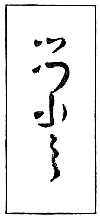
YEISHI.
Yeishi was originally a noble of high rank who studied under Kano
Yeisen, the court painter; and not even in the last years of his career,
when vulgarizing influences were dominant, did he lose the refinement
and aristocratic delicacy that are his most striking characteristics.
Shortly before he became a Ukioye painter he had been attached to the
household of the Shogun Iyeharu. It is not difficult to imagine the
horror of Yeishi's early circle of associates when he threw over
conventionality and station, and plunged into the vie de Bohème of a
popular painter. "This youth," remarks Fenollosa, "doubtless shocked all
his friends in tiring of the solemn old Chinese poets who had been
gliding about in impossible landscapes since Tanyu first labelled them,
and of the semi-serious, long-headed old gods who gave knowing winks to
their turtles and storks, and in running off to such abominable haunts
of the cow-headed Buddhist Satan as Danjuro's theatre-pit, fragrant with
the odours of saki and raw fish, or the lantern-hung balconies of
merry damsels on the river-boats."
But the elegant court gentleman was not destined to sink in the
maelstrom. To this underworld he brought his own subtlety of vision and
evoked from it figures of unfading beauty. At the outset Kiyonaga was
his guide—a guide perhaps too blindly followed. Certainly Yeishi's
first productions, superb as they were, cannot be called his most
characteristic. Plate 35 is an example. They are wholly in the Kiyonaga
manner except that they have a touch of fragility and delicacy that is
alien to Kiyonaga. The proportions of the figures are the same, but
Yeishi's curves are less naturalistic; they seem the product of one
whose hungry visions lapped like waves against the shore of reality,
shaping it into contours determined by their own demands. The "feeling
of repose" which Mr. Strange notes is not repose at all but weariness.
At first the perfect poise of these forms may deceive us; but as we
advance along the calendar of Yeishi's work we find it pervaded by a
spirit less serene, more high-strung, more drugged with beauty than was
Kiyonaga's.
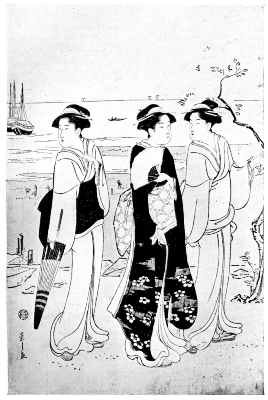
YEISHI: THREE LADIES BY THE SEASHORE.
One sheet of a triptych. Size 15 × 10. Signed Yeishi ga.
Plate 35.
In what we may call Yeishi's second style, he gives the peculiarities of
his nature full expression. The tall slender figures cease to recall
Kiyonaga's; the robust vigour goes out of them; they become impalpable,
wistful creatures, hovering before us with slow grace, moving by us in
grave procession. These beautiful women are like creatures seen in a
dream; they have the solemnity and aloofness of priestesses intent on
the performance of secret rites. Their long robes sweep in stately
pageant; their delicate heads bend in exquisite weariness.
Fenollosa strangely speaks of the "keenness of Yeishi's
characterizations," and says that, "with no idealizations to trouble
him, he put down what he saw as frankly as a young reporter." This is a
surprising misinterpretation. Yeishi was perhaps more notably a
visionary than any other Ukioye artist; he was haunted by supersensible
intimations, perverted by a search for unearthly beauty. A fascinating
painter! He has not the brilliancy and versatility of Utamaro; but the
taste is hard to please which finds monotony in his series of
perfections. In his second period—his most individual and powerful—he
produced compositions that are hardly inferior to Kiyonaga's. Yeishi may
be regarded as one of the few designers who perfectly mastered the
triptych form. His arrangements are simpler than Kiyonaga's but no less
beautiful. A notable series depicting various polite occupations from
the life of Prince Genji are so harmonious in design, so lovely in
colour, and so instinct with spiritual refinement as to rank among his
finest works. In some of these triptychs Yeishi introduces his
interesting colour-invention—a scheme of grey, yellow, violet, blue,
and black, which he handles superbly. Among his other triptychs, "The
Treasure Ship" is especially notable. In this print, a barge whose prow
is shaped like the head and breast of the mythical Hoho bird seems
adrift on a river of peace; its wonderful freight—nine noble ladies
engaged in the refined entertainments of paintings, games, and
poetry—express the nostalgia of Watteau's figures and the line-beauty
of Botticelli's. The repose of heaven is upon them, and the delicate
satiety of heavenly beings.
Yeishi was one of the few painters besides Shunman who successfully
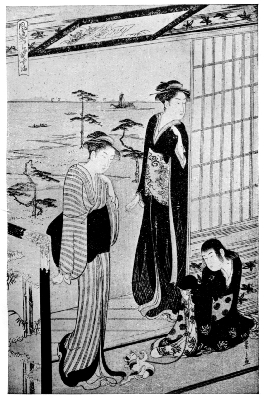
managed grey as a dominant tone. In certain of his prints he produced
notable results in this manner, using a style in which lights of yellow
and purple are arranged with beautiful effect. Sometimes, though rarely,
he omitted them altogether, as in Plate 37, and contented himself with
modulations of pure grey that are the last word in subtlety.
YEISHI: LADY WITH TOBACCO-PIPE.
Yellow background. Size × 10. [Transcriber's note: Dimension missing in
original.] Signed Yeishi ga.
Plate 36.
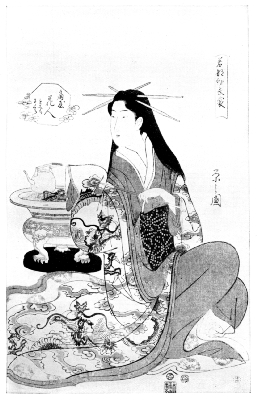
He produced a considerable number of notable full-size sheets depicting
single figures of women seated or kneeling, engaged in gracious
occupations such as flower-arrangement. Some of these are without
background; others have backgrounds of pale grey wash; while still
others, perhaps the finest of all, stand out against luminous yellow
grounds. One of these appears in Plate 36. In these prints is displayed
Yeishi's power to draw exquisitely the long sweeping curves of
draperies; and the strangely pensive, hieratic quality of his faces is
at its best. Their charm lies not in the brushwork, which is never as
free and bold as Kiyonaga's, but in the sentiment of remote beauty of
which these haunting curves are such pure symbols. He also produced a
number of groups of courtesans on parade, with little or no background,
after the fashion inaugurated by Koriusai and Kiyonaga. These appear
stiff beside Kiyonaga's; but they have nevertheless great charm of line
and colour. His album of the Thirty-six Poetesses, about 1800, is a
series of fantastic and gorgeous colour-dreams. His series of standing
women against chocolate or silver backgrounds rises in colour to the
level of Sharaku.
Yeishi could not, however, escape the influence of the growing
decadence. The public taste at the end of the eighteenth century was
debased by a craving for gaudy eccentricities. Utamaro led in the rush
to gratify this craving; and even the aristocratic Yeishi was unable to
resist the general decline. Therefore toward the end of his career as a
print-designer his work greatly altered. His figures grew very tall and
willowy; their necks became so exaggeratedly thin that they seem unable
to support the great pile of the coiffure; an attenuated snakyness
distinguishes their lines; and the curves of their garments are
distorted into the most fantastic folds and swirls. It was in this
period that Yeishi produced most of his large bust-portraits on yellow
or mica grounds; in these he followed the lead of Utamaro, who had
influenced him considerably during his whole career. The noble and grave
faces of his earlier days became wooden and distorted; and when Yeishi
at last stopped print-designing and returned to the life of society and
painting from which he had been so long a renegade, the loss was not a
great one; for the degradation of the age's taste had engulfed him—as,
indeed, it did all his contemporaries.
Yeishi's ordinary work is not particularly rare. Even his slightest
prints have so much charm that they may be highly recommended to the
attention of the modest collector. Yeishi's important works are of great
scarcity. His figures on yellow or mica ground, his grey prints, his
large heads, and his pillar-prints are quite as difficult to obtain as
any of the prints of this or the preceding period; his best triptychs
are extraordinarily hard to procure.
YEISHI: INTERIOR OPENING ON TO THE SEASHORE.
Left-hand sheet of a triptych. Printed in several tones of grey. Size 15
× 10.
Signed Yeishi ga. Metzgar Collection.
Plate 37.
Of Yeishi's many pupils, Shokosai Yeisho stands out as the most
important. Nothing is known of him except that his work was done toward
the end of the eighteenth century.
YEISHO.
Yeisho may be regarded as the veritable shadow of Yeishi. He wholly
adopted his master's style; but he was not able to impart to his figures
that reserved aristocratic poise which was Yeishi's distinguishing mark.
Instead, Yeisho's figures not infrequently have a certain very pleasing
and plausible elegance, fuller and rounder than his master's. His
curves sweep more assertively and less subtly; and his decorative
effects are often superb even though not particularly complex. He too
passed from the manner of Kiyonaga into that of Utamaro; but his middle
period is his most characteristic. In this he produced many fascinating
single sheets of seated or kneeling women, several admirable
pillar-prints, as in Plate 33, some large bust-portraits that are
perhaps his finest works, and a number of triptychs. These last, as a
rule, lack the element that is the real glory of the triptych—a broadly
grasped correlation of complex elements into one great harmonious
composition. Yeisho's triptychs are merely three sheets placed side by
side with only a rudimentary attempt at unification. But so completely
attractive are the separate figures and the great sweeping curves of his
best work that these triptychs are nevertheless delightful
productions—more striking than many a subtler composition. They have,
however, a stereotyped quality that makes one unwilling to take Yeisho
very seriously as an artist. His curves sweep splendidly, but they are
dominated by a formula.
Yeisho's works are not common; they are far rarer than Yeishi's. Yeisho
may serve to illustrate the difficulty of appraising these artists. I
had hardly written the foregoing estimate of Yeisho when I received as a
gift from a friend a large bust-portrait of a woman by Yeisho which is
so unexpectedly magnificent and so much finer than any work of Yeisho's
I had ever seen that my previous opinion had to be modified. In subtlety
of line and delicacy of colour this head is at least equal to Utamaro's
finest works in the same manner; it utterly contradicts my previous
impression of Yeisho's stereotyped quality. Now, what has happened to me
in the case of Yeisho is happening to students of Japanese prints every
day; and not until the last secreted treasure is brought to light and
made known can we be confident that we are even approximately right in
the ranks which we assign to the various designers.
Yeishi's vigour, barely sufficient to create his own exquisite works,
could not transmit itself to any very vital body of pupils. Though his
disciples were many, no one of them achieved independent renown; the
seeds of life were not in the teacher. Out of a large number, the
following pupils may be named as the most important:—
Ichirakutei Yeisui, of whom nothing is known, inherited from his master
an elegance of line that is often pleasing. He cannot, however, be
regarded as an important or original artist. His large bust-portraits,
with charming piquant faces, are his best-known works. His prints are
rare but not especially sought after.
Gokyo, an interesting artist who probably died young, worked in the same
manner as Yeishi. His prints, soft and pleasing in colour, are very rare
indeed; the few known examples of his work have a distinction worthy of
more attention than they have hitherto received. Had he lived he might
have given the school of Yeishi a fresh fame.
Yeiri, of whom not much is known, sometimes signed himself "Yeishi's
pupil Yeiri." He is to be distinguished from the almost contemporaneous
Rekisenti Yeiri. The latter worked more in the style of Utamaro; his
work is rare, and his finest prints are beautiful and valuable. It was
Yeishi's pupil Yeiri who created that rare and astonishing portrait of
Kitao Masanobu which must take a place beside the most brilliant
portraiture of any time or land.
Yeishin is known only by half a dozen prints; these, though attractive,
are not as greatly prized as their scarcity might lead one to expect.
Chotensai Yeiju is a slightly stiff and not very interesting disciple
whose work is rare.
Yeicho also is notable chiefly for his rarity.
Yeiru followed his master with little originality.
Yeiki and Sōraku are later unimportant pupils who followed Utamaro
also.
Portrait of a Woman.
In robes like clouds of sunset rolled
About the dying sun,
In splendid vesture of purple and gold
That a thousand toiling days have spun
For thee, O imperial one!—
With the cunning pomp of the later years,
With their pride and glory and stress,
Thou risest; and thy calm forehead bears
These like a crown; but thy frail mouth wears
All of their weariness.
Thou art one of the great who mayest stand
Where Cleopatra stood:
Aspasia, Rhodope, at each hand;
And even the proud tempestuous mood
Of Sappho shall rule thy blood.
Thy throat, in its slender whiteness bare,
Seems powerless to sustain
The gorgeous tower of thy gold-decked hair—
Like a lily's stem which the autumn air
Maketh to shrink and wane.
More haunting music, more luring love
Round thy sinuous form hold sway
Than the daughters of earth have knowledge of
For thou art the daughter of fading day,
Touched with all hope's decay.
And the subtle languor, the prismic glow
Of a ripeness overpast
Burns through the wonderful curving flow
Of thy garments; and they who love thee know
A loathing at the last.
For they are the lovers of living things—
Stars, sunlight, morning's breath;
But thou, for all that thy beauty brings
Such songs as the summer scattereth—
Thou art of the House of Death.
. . . . . .
But there was one in thy golden day
Who saw thy poppied bloom,
And loved not thee but the heart's decay
That filled thee, and clasped it to be alway
His chosen and sealèd doom.
He who this living portrait wrought,
Outlasting time's control,
A dark and bitter nectar sought
Welling from poisoned streams that roll
Through deserts of the soul.
Ah, dreamer! come at last where dreams
Can serve no more thy need,
Who hast by such bright silver streams
Walked with thy soul that now earth seems
A waste where love must bleed—
Thou whom such matchless beauty filled
Of visions frail and lone,
For thee all passion now is stilled;
Thy heart, denied the life it willed,
Desireth rather none.
And thee allure no verdant blooms
That with fresh joy suspire;
But blossoms touched with coming glooms,
And weariness, and spent desire,
Draw to thy spirit nigher.
Wherefore is nothing in thy sight
Propitious save it be
Brushed with the wings of hovering night,
Worn with the shadow of delight,
Sad with satiety.
For thou hast enmity toward all
The servants of life's breath;
One mistress holdeth thee in thrall,
And them thou lovest who her call
Answer; and she is Death.
. . . . . .
Now Death thy ruined city's streets
Walketh, a grisly queen.
And there her sacred horror greets
Him who invades these waste retreats,
Her sacrosanct demesne—
In robes like clouds at sunset rolled
About the dying sun,
In splendid vestments of purple and gold
That a thousand perished years have spun
For her, the Imperial One.
Utamaro, the central and in some ways the most fascinating figure of
this period, has been from the first a great favourite in the esteem of
European collectors. His graceful, sinuous women are the images that
come most readily to the minds of many people at the mention of Japanese
prints. In his own time and land his popularity was equalled by that of
no other artist.
UTAMARO.
It was by his portraits of women that Utamaro won his great fame.
Passing outside the influence of Kiyonaga, he developed in his designs
of the last decade of the nineteenth century his characteristic feminine
type. Her strange and languid beauty, the drooping lines of her robes,
her unnatural slenderness and willowiness, are the emanations of
Utamaro's feverish mind; as her creator he ranks as the most brilliant,
the most sophisticated, and the most poetical designer of his time. His
life was spent in alternation between his workshop and the haunts of the
Yoshiwara, whose beautiful inhabitants he immortalized in prints that
are the ultimate expression of the mortal body's longing for a more than
mortal perfection of happiness. Wearied of every common pleasure, he
created these visions in whose disembodied, morbid loveliness his
overwrought desires found consolation.
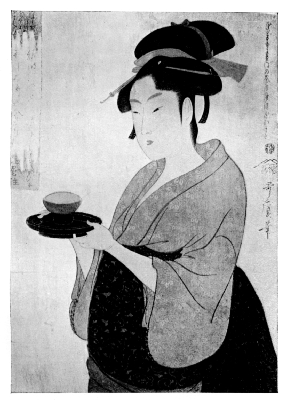
UTAMARO: OKITA OF NANIWAYA, A TEA-HOUSE WAITRESS.
Mica background. Size 12½ × 9. Signed Utamaro, hitsu. Chandler
Collection.
Plate 38.
Utamaro was born in 1753 in the province of Musachi. Early in life he
went to Yedo and there studied under the noted Kano painter and
book-illustrator Toriyama Sekiyen, whom some authorities say was his
father. Almost from the beginning of his career he lived with the famous
publisher Tsutaya, who issued his prints; and this relation continued up
to the date of Tsutaya's death in 1797.
In Utamaro's early work, which began with an illustrated book in 1776,
the influence of Kiyonaga was strong. Shunsho's and Kitao Masanobu's
characteristics are sometimes also visible, but Kiyonaga's style is the
dominating one. Some of his early work is signed Toyoaki.
In 1780 the first important product of Utamaro's career saw the
light—his famous "Gifts of the Ebb-Tide"—a book of exquisitely
conceived and delicately printed representations of shells and rocks on
the seashore. The effort of a trained conchologist to produce accurate
descriptive drawings of these objects could hardly achieve a more
scrupulous fidelity than do these pages, which have in addition an
æsthetic charm of a high order. The same characteristic appears in his
celebrated "Insect Book" of 1788. These two works, dominated by a
scientific realism that was new to Ukioye, may serve as an indication of
the growth of that naturalistic spirit whose effect upon the stylistic
ideals of the art was later to be so destructive.
In the decade between 1780 and 1790 Utamaro produced many additional
books. Notable among them are the "Customs of New Year's Day" (1786),
"The Mad Full Moon," a series of lovely moonlight landscapes in
monochrome (1789), and "The Silver World," a series of delicate snow
scenes (1790). The single-sheet prints which he issued during this
decade are exceedingly beautiful works of a type that the inexperienced
eye would never recognize as Utamaro's. The figures are like those of
Kiyonaga's prime, but drawn with a slenderness of line and restlessness
of poise that strikes a different and shriller note. His work of this
period may be distinguished by the fact that the signature is written in
a squarer, more compact, and more formal manner than the sprawling,
cursive signature of his later days. The two long, tail-like lines of
the later signature, by which even the casual tourist learns to
recognize Utamaro's name, are wholly absent.
With 1790 begins the classic period of Utamaro's work. This was the year
of Kiyonaga's retirement and, according to some authorities, of
Shunsho's death. With the two giants of the older generation gone,
Utamaro was left to compete for leadership with Yeishi, Shuncho, Choki,
Toyokuni, and the lesser men. During the decade from 1790 to 1800
Utamaro was, except for the isolated figure of Sharaku, outstandingly
the most versatile and brilliant among them. All were profoundly
influenced by him, and he had not a few imitators who attempted to
profit by his popularity.
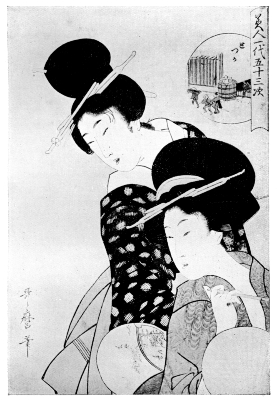
UTAMARO: TWO COURTESANS.
One of a Series "Beautiful Women compared with the Fifty-three Stations
of the Tokaido Road." Size 15 × 10. Signed Utamaro, hitsu.
Plate 39.
During this last decade of the nineteenth century Utamaro produced the
greatest of his works. Among these must be counted the remarkable series
of half-length figures on silver backgrounds, for which no admiration
can be too extreme. One of them appears in Plate 38. The type of face
which Utamaro drew in these prints differs from the Kiyonaga type; it
has something of the girlishness of Harunobu or Sukenobu—wholesome,
rounded, with eyes that are large and not narrowed to slits as in his
later years, and with coiffure of modest proportions. It resembles the
type characteristic of Choki at this time. These charming figures, drawn
with subtle precision, stand against their dull silver backgrounds in
colours whose few and soft tones produce an effect so harmonious as to
almost justify Von Seidlitz in calling Utamaro "the first colourist of
his nation." The prints of this class are as rare as they are beautiful.
The collector who is familiar with nothing but the later work of the
artist can have only an imperfect conception of the greatness of
Utamaro. They constitute the purest and most tranquil of his
productions, and perhaps the high point of his genius.
This 1790 decade, when Utamaro was at the zenith of his powers, saw many
triumphs besides the silver-portraits. He was incessantly busy with
experiments of every kind; pushed by the keen competition of Yeishi,
Choki, and the others, he laboured incessantly for new effects and
passed on to new manners. Plates 39 and 41 are examples. Discarding the
type of head that had appeared in the silver-portraits, he devised that
more restless, haunting type by which we best know him. The ethereal and
supple bodies, the slender necks, the slightly strained poses, all
indicate the nervous hyper-æsthetic tension of the hour. Toward the end
of the decade his peculiarities grew even more marked. The necks of his
figures became incredibly slender; the bodies took on unnatural length;
a snaky languor pervaded them. One print, his famous "Woman Seated on
the Edge of a Veranda," reproduced in Plate 40, may serve as
representative of them all. The drawing of the draperies and of the
figure beneath them is studied with extraordinary fidelity; in fact, so
human and real a figure is hardly to be found in the work of any
preceding artist. But on the other hand, Utamaro has used his keen
realistic power merely as a scaffolding, and has proceeded to build up
on it a work that goes over almost into the region of symbolism. In the
slender delicacy of this figure, the splendid black of her elaborate
coiffure, the drooping fragility of her body, the sensuous grace and
refinement, the languor and exhaustion—in all these speak the
super-sensible gropings and hungers of Utamaro himself. Out of a living
woman he created his disturbing symbol of the impossible desires that
are no less subtle or painful because they are born of the flesh. With
nerves keyed beyond the healthy pitch, he dreamed this melody whose
strange minor chords alone could stir the satiated spirit. He caught and
idealized the lines and colours of mortal weariness.
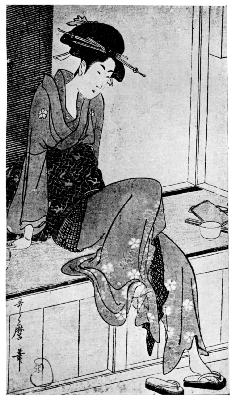
UTAMARO: WOMAN SEATED ON A VERANDA.
Size 13 × 8. Signed Utamaro, hitsu.
Plate 40.
"Woman," says Von Seidlitz, "had always played a prominent part in the
popular art of the country, but now Utamaro placed one type of the sex
in the absolute centre of all attention—the type, namely, of the
courtesan initiated into all the refinements of mental culture as
well as of bodily enchantment, and then playing in the life of Japan
such a part as she must have played in Hellas during the golden age of
Greek civilization. For expressing the inexpressible, the simple
rendering of nature did not suffice; the figures must needs be
lengthened to give the impression of supernatural beings; they must have
a pliancy enabling them to express vividly the tenderest as well as the
most intense emotions of the soul; lastly, they must be endowed with a
wholly peculiar and therefore affected language for uttering the wholly
peculiar sensations that filled them.... It is true that soon after he
yielded to the general tendency of his age ... and gradually insisted on
these attributes to exaggeration, even to impossibility, while his fame
of having been the first to give such morbid inclinations completely
satisfactory and therefore unsurpassable expression is a title of
somewhat doubtful value, even if in any case a high historical
significance cannot be denied it. Nevertheless, we must not forget that
within this domain of the hyper-æsthetic Utamaro was the creator of a
most original and individual style. Nay, if we could only admit the
morbid and exaggerated to be as fit subject-matter for art as the
healthy and sane, we must grant that this style is one of altogether
enchanting originality, and that, however dangerous might be its
immediate influence upon the spectator, and particularly upon possible
successors, it does none the less lift us beyond the cramping limits of
reality, and is therefore not wanting in idealism of a kind."
But weary as seems the spiritual content of these end-of-the-century
designs of Utamaro's, there is no lack of brilliant vigour in their
composition. The great triptychs—such as the "Night Festival on the
Banks of the Sumida River," or the "Firefly Catchers," or the "Persimmon
Pickers"—stand among the finest prints we know. In colour, rhythm of
line, and dramatic quality of composition they are triumphs. There is a
startling beauty in even those extraordinary bust-portraits in which the
enormous coiffure, minute neck, slips of eyes, and dot of a mouth, carry
exaggeration to a bizarre and delirious extreme.
Not long after 1800 the pressure of work brought upon him by his great
popularity, together with the effects of a none too well spent life in
the Yoshiwara, combined to strain his powers unduly. His work no longer
kept its earlier freshness; his exaggerations became coarser; his
invention grew less fertile. He began to rely on the assistance of his
pupils, as we know from his "Book of the Green Houses" (1804), in which
several collaborated with him. Doubtless many an Utamaro print of this
time is their work.
In the year 1804 came the final catastrophe. Consequent upon the
publication of the well-known triptych representing the ancient Shogun
Hideyoshi entertaining his five concubines in the eastern quarter of the
capital, the ruling Shogun Iyenari took umbrage at the salacious
disrespect to his ancestor and the delicately implied allusion to
himself, and Utamaro was thrown into prison for his offence. There he
remained, it is said, for a year; when he emerged, it was with impaired
health and a broken spirit.
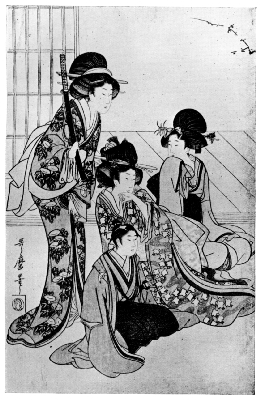
UTAMARO: A YOUTHFUL PRINCE AND LADIES.
Left-hand sheet of a triptych. Size 15 × 10. Signed Utamaro, hitsu.
Plate 41.
His productions after this time were not comparable with his earlier
work. In the year 1806 he died, and with him died the great days of the
Japanese print.
In this rapid survey it has been impossible to do justice to the
many-sided powers of this great designer. His beautiful landscapes, his
fine animal pictures, the tender and whimsical mother-and-child and
domestic scenes he produced, have all had to be ignored in favour of his
central achievements—his unparalleled designs of the courtesan of the
Yoshiwara in her weary glory. Certainly no more varied and distinguished
talent than his illumines the roll of Ukioye artists. Beside his
perpetually fresh invention even the great Kiyonaga seems stereotyped
and academic.
To-day the poorer examples of Utamaro's work are still readily
procurable. His greatest works are rare. Certain of his triptychs, his
silver half-length portraits, and his large heads on mica backgrounds,
are very uncommon. But with patience and judgment the collector may
still obtain now and then a fine specimen of Utamaro's work.
But some care is necessary. Even during Utamaro's life his work was
forged by unscrupulous persons who hoped to reap the benefit of his
popularity; and his pupils, under his direction, produced an unknown
quantity of work signed with his name. After his death, from about 1808
to 1820, the Second Utamaro worked in the manner of his predecessor,
issuing work that cannot with certainty be distinguished from the late
work of the master. Besides these perils there is the fact that
Utamaro's prints have been well reproduced in recent years; and
reproductions are sometimes put forward as originals by ignorant or
dishonest dealers. Considerable familiarity with authentic examples of
Utamaro's best work, or expert advice, can alone protect the would-be
purchaser.
Though Utamaro's influence upon his contemporaries was incalculably
great, he left behind him a body of pupils who were almost without
exception rather insignificant artists. With cruder colour and
composition, they carried still farther the vulgarities of Utamaro's
declining period. Among them may be mentioned the following men:—
Utamaro II, whose original name was Koikawa Shuncho or Harumachi, was a
pupil of Sekiyen; he married Utamaro's widow, and from about 1808 to
1820 continued to produce prints in the debased Utamaro manner. Dr.
Kurth believes he must be distinguished from another Koikawa Shuncho
whose family name was Kurahashi, and who died in 1789. The whole matter
is by no means clear.
Banki and Shikimaro were among the best of this group. Particularly the
former, before Utamaro's death, produced some fine work.
Tamagawa Shucho was a rare pupil of Utamaro who worked about 1790 to
1810.
Kikumaro I (who also called himself Kitagawa Tsukimaro), Kikumaro II,
Tanimoto Tsukimaro, Takemaro, Toyomaro, Yukimaro I, Yukimaro II,
Yoshimaro I (also called Kitao Shigemasa III), Yoshimaro II, Rekesenti
Sogaku, Goshichi, Hidemaro, Mitemaro, Minemaro, Kitamaro, Michimaro,
Toshimaro, Hanamaro, Isomaro, Ashimaro, Kanamaro, Kunimaro, Yoshimune,
Yoshitora, Yoshitsuya, Yoshiki, Yoshimori, Yoshitoshi, Yoshikata,
Yencho, Yumiaki, Hokokujin Fuyo, Chikanobu, Shintoku, Shunkiosai,
Hisanobu, Soraku, Senka, Ryukoku, Sekkyo, Sekicho, Sekiho, Sekijo may
all be classed as late followers, fellow-pupils, or rivals of Utamaro.
Bunro, some of whose work is fine, was a rare imitator of Utamaro. He
worked chiefly about 1800 to 1810.
Dramatic Portrait.
Whence art thou come,
Tall figure clasping to thy tragic breast
Thy orange robe, a flame amid the gloom—
By what wild doom
Art thou forever onward—onward pressed?
A wreath is on thy brow,
A crown of leafage from some lonely haunt
Where might Medea's shade brood ministrant.
Thy shoulders bow
Beneath what fearful weight, what need, what vow?
A leopard fierce—
A ghost that wanders down the wandering wind—
A fury tracking toward some shaken mind—
Where shall I find
The divination that thy veil shall pierce?
How shall I wrest
From thee the secret of thy lofty doom—
From what wild gulf of midnight thou dost come
Who, with clutched breast,
Stalkest forever onward—onward pressed?
Few people approach Sharaku's work for the first time without regarding
him as a repulsive charlatan, the creator of perversely and senselessly
ugly portraits whose cross-eyes, impossible mouths, and snaky gestures
have not the slightest claim to be called art. At first these strange
pictures may even seem mirth-provoking to the spectator—a view of them
which he will remember in later years with almost incredulous wonder. To
overcome one's original feeling of repulsion may take a long time; but
to every serious student of Japanese prints there comes at last a day
when he sees these portraits with different eyes; and suddenly the
consciousness is born in him that Sharaku stands on the highest level of
genius, in a greatness unique, sublime, and appalling.
TOSHIUSAI SHARAKU.
Toshiusai Sharaku is a figure more shadowy than most, even in this
region of shadows. The wilful neglect of a public that hated him has
folded him in a mystery deeper than the mere accidental obscurations of
time. Of his birth and death we know absolutely nothing, nor of the name
of his teacher, if he had one. The resemblance between his work and that
of Shunyei cannot be fully explained until we know more accurately their
relative dates. Kiyonaga's noble drawing certainly affected his
style. The influence of Shunsho upon his colour-schemes is fairly
obvious; but we do not know whether this was due to personal contact, or
only to familiarity with Shunsho's work. The one indisputable fact about
Sharaku is that he was originally a Nō-performer in the troupe of the
Daimyo of Awa. The Japanese authorities state that he worked at
print-designing only one or two years, somewhere between 1790 and 1795.
Dr. Kurth, in his stimulating but somewhat too imaginative volume,
"Sharaku," believes that the evidence justifies us in fixing Sharaku's
working period as a much longer time—1787 to 1795; but he cannot be
said to have wholly proved his case. Whether or not these dates are
accurate, we may at least say that Sharaku's years of activity lay
chiefly within the early part of the last decade of the eighteenth
century.
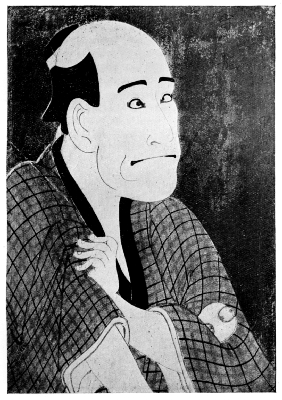
SHARAKU: THE ACTOR ARASHI RYUZŌ IN THE RÔLE OF ONE OF
THE FORTY-SEVEN RONIN.
Silver background. Size 14 × 10. Signed Toshiusai Shakaru ga.
Spaulding Collection.
Plate 42.
Sharaku's work consisted entirely of startlingly powerful and ironic
portraits of actors, some in the form of large bust-portraits, some in
the form of full-length figures of hoso-ye size, and a few large
sheets each containing two full-length figures. Their savage intensity
is arresting and unforgettable; it at once drives one to consider what
manner of man could have created them.
Sharaku was, as we have said, professionally a member of the
Nō-troupe of the Daimyo of Awa. This fact is of far-reaching
significance.
The Nō was a highly developed and aristocratic form of lyrical drama,
based upon ancient and classical legends; it was full of a poetry and
allusiveness that made it incomprehensible to the populace, who,
indeed, had no opportunity to see it; it was as much the exclusive
concern of the cultured aristocracy as the private revival of a Greek
tragedy is with us to-day. In brocaded costumes, perhaps the treasured
reliques of centuries ago, the Nō-dancer appeared upon his empty
stage before a hushed audience of nobles—his face masked, as were the
faces of the Greek actors, his voice lifted to an unnatural pitch of
vibrant chaunting; and with stately motions, elaborately devised steps,
and stereotyped gestures, he intoned the rolling strophes of the drama's
long and hallowed strain. A complex formalism pervaded every word and
step; in no art-form with which I am familiar is an accepted convention,
a totally unrealistic medium, so rigidly adhered to as in these
Nō-plays.
The Nō-actors were a caste utterly apart from the actors of the
common stage. They were the protégés and associates of great nobles who
would not, save incognito, appear in the presence of the common actor.
The gap between the two classes of actors was as great as that between
Sir Johnston Forbes-Robertson and a juggler at a fair—one, the
inheritor of a distinguished literary tradition, the interpreter of our
classic dramatic heritage; the other, a crude beguiler of the populace,
with station no higher than the pedlar. Caste-feeling may very well have
been rather harsh between the haughty Nō-performers and their
despised and ostracized brothers of the gutter.
As we have noted, the Nō-dancer wore a mask; these masks are
creations of the greatest interest. They are carved out of wood,
frequently with a skill that makes them striking works of art. It is
impossible to convey in words the remarkable degree of characterization
which they express. The smooth guilelessness of the young girl, the deep
wrinkles of the old man, the leer of the rascal, the savagery of the
villain, are all in their turn summarized in these haunting
representations whose simplicity of outline is matched only by their
intensity of effect. Nature seems to speak in them—but a heightened
nature, stripped of all incidentals; the very essence of the character
of the rôle is revealed to our eyes the instant the actor, wearing his
impressive and vivid mask, steps upon the stage.
Bearing these things in mind, we may follow Dr. Kurth ("Sharaku,"
München, 1910) in his imaginative summary of the probable effects of the
calling of a Nō-dancer upon the mind and art of Sharaku:—
"Picture a richly endowed painter—at first only dimly conscious of his
powers—as in a mystery-play he treads the consecrated stage in the
sacred precincts of a temple of Tokushima or in the shadow of the
cryptomerias and firs of the Hachisuka castle—a fantastic mask covering
his features, other masked spectres before his eyes—surrounded by the
atmosphere of the occult tradition of ancient and lofty dramatic
art—while, in the depths of his soul's abysses, chained Titans would
storm up to the outer world, and confused pictures of his future
creations hover before his spirit, ... and we shall realize that this
man, as a painter, must become a dramaturgist.
"And if we summon to our vision the gorgeous stretches of Awa—its
chasmy mountains with the forests rustling around them—its picturesque
sea-lapped beaches—its sun-drenched groves of oak—its glowing scarlet
maples—the brilliant flowers of its Spring—the evergreens of its
Winter—then we shall realize that this man, as a painter, must become a
colour-dreamer.
"Brooding spirit that he was, he, an Edipus, approached venturously to
the Sphinx of passion that peers forth from the faces of men. Uncanny
powers lurked in the grotesque furrows and demoniac grimaces of his
Nō-masks, but nothing little or shallow—nay, in spite of all
grotesqueness, only the significant and symbolic. And then he looked
down from his buskined height upon the popular actors—bombastic
barn-stormers—greasy low-comedians—louts from nowhere, as the
illustrious Harunobu had called them—performers who brought before
their gaping audience not, as did he, august things in strangely
wonderful guise, but often things far too human in strutting stage-pomp.
He looked upon them, a guild not only despised but sometimes even
outlawed—a guild that stood on the same plane as the idiotic profession
of the wrestler,—a class whose vulgar faces could not hide their
swaggering gutter-vanity and their cringing lust for applause behind
even the red paint of the ferocious warrior-rôle or the corpse-coloured
rice-powder used when aping women. And if we see him thus, we shall
understand that this man, as a painter of actors, must eventually become
a pitiless satirist."
It was therefore with the colossal and tragic gestures of the
Nō-dance in his soul, the distorted and monumental intensity of the
Nō-masks in his eyes, and the contempt and irony of the
Nō-performer for the common actor in his heart, that Sharaku, coming
to Yedo, took up his terrible brush to depict the Yedo actors as he saw
them. The resulting series of portraits is surely one of the supreme
examples of graphic characterization and devastating contempt that the
world has ever seen.
In the earlier portion of Sharaku's work, among which are his large
portraits on yellow backgrounds, the originality of the man is already
striking enough; but his acid qualities are hardly at their fullest
development. Certain of his hoso-ye prints must belong to this first
period; in these, after the manner of Shunsho, he devoted his attention
chiefly to the attaining of a powerful dramatic rendering of the rôle he
was depicting. Strutting Daimyo, beguiling woman, ferocious warrior,
shrewd peasant—he made each part move with the vigour and force of the
seen stage. Shunsho was never more impressive; and here, in addition,
there is in every design a strange distortion of line, a disturbing
abnormality of pose, that makes one realize that no mere copyist of
Shunsho is at hand.
Then, beginning with an astounding series of twenty-four portraits with
mica backgrounds (Plates 42, 43, 44) representing actors in the play of
the Forty-seven Ronin, Sharaku's mood changes. He ceases to remind one
at all of Shunsho; it is rather the scrutinizing individual
characterization of Shunyei that he recalls. But Shunyei never reached
the point to which Sharaku is now coming. The dramatic force, the
histrionic illusion of his pictures abates no jot; but beyond it,
disturbing lights and movements are lurking. The mighty rôle towers like
a shadow before us in its full dramatic sweep; but from the depths of
the shadow peers with stealthy glance the indwelling personality of the
actor—like a jackal's eyes seen suddenly in a king's tomb. This
contradiction—this complex of two utterly antagonistic forces—is one
of the miracles of Sharaku's genius: it is an antinomy which he resolves
sufficiently to produce an equilibrium, but not enough to take from
these portraits the insoluble mystery of two spirits, the tangle of two
meanings, the explosive and inscrutable life that makes them
unforgettable.
Thus the sweeping rhetoric of the stately rôle and the sudden
naturalistic cry of the discovered actor's soul meet in a discord
unique, subtly calculated, magnificent, and harrowing. Sharaku pierced
deep into the hearts of his sitters to grasp the weak, the grotesque,
the pathetic, the tragic; he appraised the lust, the horror, the vacuity
that was there, and these qualities he dragged out to the light through
the avenues by which he had entered—through the eyes, the lips, the
hands—tearing these gates into terrible and distorted breaches eloquent
of the booty that had been forced through them. No portraits so blasting
as his have ever been created by another; no other hand has so
devastatingly shattered the conventional contours of faces to reshape
them into the awful images of their own hidden potentialities.
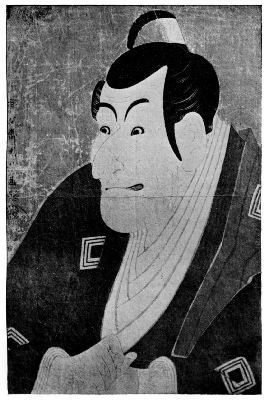
SHARAKU: THE ACTOR ISHIKAWA DANJURO (YEBIZO) AS THE
DAIMYO KO NO MORONAO IN THE DRAMA OF THE FORTY-SEVEN RONIN.
Size 14 × 10. Silver background. Signed Toshiusai Sharaku ga.
Plate 43.
To call Sharaku a realist is a silly, untruthful attempt to muffle in
words forces that one does not understand. He was hardly more a realist
than Kiyonaga. He saw in the spectacle before him certain elements of
beauty and terror; he selected and moulded them into his cunningly
devised designs; and the result was as much a creation of the visionary
mind—a true idealism—as the pictures of the fairy-tale-telling
Harunobu. It is no mere realism, but an insidious dissection and a
mordant reconstruction, that is so striking in these works. The most
savage efforts of modern caricature are child's play beside Sharaku's
disintegrating analysis and his satanic reassembling of features. He
does to the face and its concealed passions what Michael Angelo's
anatomical figure does to the nerves and muscles—revealing appallingly
the secrets of structure and the machinery of power.
Yet, in spite of all the distortions and exaggerations and
displacements, Sharaku's satyrical faces live. They have an unnatural
and monstrous life—like the life of Gothic gargoyles and fabulous
animals, whose parts are brought together into an incredible yet organic
creation. Looking upon them, one realizes that for Sharaku beauty meant
not sweetness or grace, but vitality—the clench and rending of the
earthquake forces of life. He sought no harmonies of sentiment like
those of Harunobu; he plunged wholly into a maelstrom of powers whose
magnificent surge and flow was to him the sole end and the sole
consolation.
He drew no courtesans, no scenes from the daily life of the people, no
festivals, no tea-house gardens by the river; but with a baleful
concentration he, the proud master of the esoteric Nō drama, kept his
eyes fixed unswervingly upon the pathetic mimes of the vulgar
stage—outcasts, common lumps strutting for an hour of glory in gorgeous
robes and heroic rôles before a gaping populace. How one longs for one
more work from Sharaku's hands—a portrait of himself, seated in the
stalls, watching the play at its height! One can almost imagine the
peering eyes, the tight lips, the hidden hands....
So far I have spoken chiefly of the large heads of Sharaku. But it must
not be forgotten that he produced a number of designs in hoso-ye form
that are the very flower of his work. Kurth places certain of these
early in Sharaku's career; he is, perhaps, wrong in this, for many of
those which he thus dates give evidence of an art so mature and
masterful that they must be at least contemporaneous with the Ronin
Series. Such are the print of Arashi Ryūzō as an aged noble in
robe of black with violet girdle, and the print of Segawa Kikusabrō
in robe of olive and purple holding an open fan. In the finest of these
hoso-ye the dramatic force of the composition is so subtle that the
element of caricature takes a subordinate place. A lyric mood pervades
them. It is impossible to contemplate these figures without a sense, not
merely of the irony and contempt which they sometimes embody, but also
of the tragic heights on which they move. Lofty conflicts, desperate
destinies, immense strainings toward desired goals, immense despairs
before impassable barriers—these are some of the emotions that
confront us here. The echo of the tragedy of the Greeks is around them;
their gestures seem the shadows of titanic cataclysms. Kiyonaga gave us
the gods; Sharaku gives us those who fought against the gods. If it were
my fortune to choose, out of the tens of thousands of prints that I have
seen, one print which could alone be saved from some impending universal
destruction, I am not sure whether I would take Harunobu's flawless
"Flute Player," or Kiyonaga's serene "Terrace by the Sea," or that
terrible print of Sharaku's, illustrated in both Kurth and the catalogue
of the exhibition at the Musée des Arts Décoratifs, in which the
orange-robed figure of Nakayama Tomisabrō stalks by with an intensity
of passion that makes one's flesh creep—a vibrancy of line, colour, and
emotion that seems the apogee of beauty and terror.
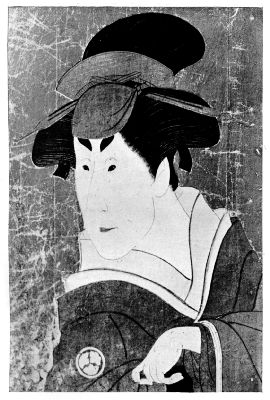
SHARAKU: THE ACTOR KOSAGAWA TSUNEYO AS A WOMAN IN THE
DRAMA OF THE FORTY-SEVEN RONIN.
Silver background. Size 14 × 10. Signed Toshiusai Sharaku ga.
Ainsworth Collection.
Plate 44.
The hoso-ye prints have, upon the whole, more poise and serenity than
the busts; and they will perhaps be judged—in a hundred years, when the
excitement of the discovery of Sharaku is over—to be among his greatest
works. When they occur in triptychs, as probably all were originally
designed to do, they constitute more harmonious and dramatic units than
any of Shunsho's actor-triptychs. The finest, and latest in order of
production, are generally those without background; in these, isolated
and sublime against an empty universe of yellow tint, rise the supreme
evocations of Sharaku's genius.
Great distinction of composition marks all of Sharaku's work. Both the
hoso-ye and the large bust-portraits are drawn with classic simplicity
of lines and masses. Nothing short of certain of the Primitives can
approach them. Every superfluous ornament is omitted; as in Plate 43,
each line is cut down to its meagrest possible limit. But the
expressiveness of the drawing is unsurpassable; and the æsthetic effect
of the direct composition grows with every repeated sight. These strange
heads against the dark glimmering backgrounds seem Titans rooted in the
void; they loom upon one's vision enormously; they are overwhelming with
the spiritual greatness of their creator. In spite of all the disturbing
unquietness of their conflicts, they are charged with a monumental
equilibrium of design, sealed with an exalted peace of conception,
poised as for eternity with the repose of measureless space and time
around them. At first sight, one would imagine these portraits to be
impossibly restless things to live with; but greater familiarity proves
them to be like the Sibyls of the Sistine Chapel—vast and enduring
figures, whose large passion does not obliterate the fundamental
tranquillity of their conception.
The colour which Sharaku employs is of a unique quality: sombre, with
lurid lights; heavy and opaque; nightmare colours, leashed into
miraculous and incredible harmony; things of infernal and dusky
splendour; "tragic colours," Kurth calls them. The dark mica
backgrounds, which Sharaku is said, without much proof, to have
invented, heighten to a remarkable degree his colour effects. Words and
reproductions are alike powerless to convey any sense of them; they hold
in store an impressive sensation for him who has not yet seen them.
With them Sharaku takes first rank as a colourist.
Toward the end of his brief career, his portraits became almost too
terrible in their savage and tragic irony. In the large double-portraits
Sharaku tears the mask of humanity aside and shows the very beast. Yet
to call even these most extreme of his productions caricatures is to
obscure a subtle spiritual essence by a crude word. They are exactly as
comic as the ravings of Lear, as mirth-provoking as the laments of
Shylock. They are not the light mocking of a scoffer or a comedian, but
the appalling and tortured sneer of a man whose vision of men is
coloured by his desire for the gods.
"Because he did not represent reality, but on the contrary painted
unnatural figures, the public became hostile toward him." ... "His
figures were too realistic." ... "He was a bungler in art." ... From
these conflicting criticisms, found in various Japanese authorities, we
may gather with what comprehension the public of that day accepted the
final work of the great painter; and we may conjecture what neglect and
hatred forced him into a never-broken retirement.
Dr. Kurth is of the opinion that, after the year 1795, Sharaku still
continued to produce secretly a few prints under the assumed name of
Kabukidō Yenkyō, and attempted under this disguise to win back the
popularity of his prime. This is an alluring but somewhat fantastic
theory, which neither the documentary nor the internal evidence of
Yenkyō's work adequately supports. Other authorities believe
Yenkyō to have been an independent artist who was a pupil of Sharaku.
His work strangely resembles that of Kunimasa I. At the present time it
cannot be said that the question is wholly settled; but it would be rash
to accept Kurth's theory at its face value.
In conclusion, let us grant that Sharaku is not for every one. One
cannot quarrel with a person who says, "I understand Sharaku; I see the
measureless depths of his tragic irony, the unique splendour of his
colour, the perfect mastery of his composition. But I do not like him. I
prefer Kiyonaga, just as I prefer the stately beauty of Keats to the
troubled profundity of Blake." Such a position is comprehensible and
impregnable. But he who finds Sharaku merely grotesque or absurd or
repellent should return to the portraits for further study; he has not
yet reached the immortal heart of Sharaku's work, and he is missing a
memorable experience.
Exact comparisons are profitless; but most students of Japanese prints
have at certain times turned from the work of Sharaku with the deep
conviction that this man was the greatest genius of them all.
Sharaku's output was not large, and his work is now of the utmost
rarity. The Parisian collectors long ago recognized Sharaku's greatness,
and at a time when Fenollosa was proclaiming Sharaku as an
"arch-purveyor of vulgarities," and Strange was grudgingly describing
him in seven lines as an artist "of great power but little grace," the
collectors of Paris had already acquired such Sharaku treasures as are
now a lavish and deserved reward for their foresight. Perhaps the only
collection of Sharaku prints that can rival those of Paris is the
notable Spaulding Collection of Boston, which takes high rank.
A Silver Print.
The sky, a plate of darkened steel,
Weighs on the far rim of the sea,
Save where the lifted glooms reveal
The last edge of the sun burned free.
Blood-red, it drops departingly.
And in the nightmare or the hour,
Against the terrible sea and sky,
A woman's figure—a strange flower—
Lingers. Her wearied, curious eye
Watches the burning world go by.
Though Choki is probably not to be counted as one of the few supremely
great artists of the Ukioye School, his fame has been steadily
increasing during the last twenty years; and whereas he once held an
insignificant place in the esteem of amateurs, he has of late been
regarded with an interest and admiration that at times seem almost more
than his deserts. Mr. Strange calls him the most graceful of all the
figure-designers of his time, and Kurth does not hesitate to deal with
him as "mit einem Riesengroszen." I note in Kurth a tendency to exalt an
artist because of his proficiency in technical processes, to an extent
that I cannot assent to; Choki was superb, but hardly Titanic. It would
be difficult to characterize him more justly than in the words of M.
Koechlin, "Le plus curieux des petits maîtres." This description
certainly does not err on the side of over-enthusiasm; perhaps these are
rather lukewarm words to apply to a grace so exquisite, a precision so
sharp, and a spiritual appeal so strangely alluring as that of Choki.
CHOKI.
Absolutely nothing is known of Yeishōsai Choki's life; it is believed
that he was a pupil of Sekiyen, who also taught Utamaro. The Japanese
authorities are inexplicably silent about him. Internal evidence,
however, tells us that his work lies between the years 1785 and 1805.
His earliest designs are strongly after the manner of Kiyonaga, whose
feminine types he at first adopted almost literally. These he modified
somewhat a little later when he came under the influence of Yeishi,
whose slender and delicate figures led him away from the robust ones of
Kiyonaga. One of Choki's pillar-prints, illustrated in Plate 45, marks
an interesting transition stage. The face and figure seem at first sight
almost purely of the Kiyonaga variety, but on closer examination
differences appear; and most striking of all is the fact that the
colour-scheme is that peculiar combination of yellow, grey, violet,
blue, and black which was distinctive of some of Yeishi's finest work.
The influence of Sharaku on Choki was at some time very strong,
though the precise date is almost impossible to determine. So great was
Choki's admiration for this master that later, when he had arrived at
his own distinctive manner, he produced a pillar-print of a girl holding
a fan on which appears Sharaku's famous design of "The Man with the
Pipe." But Choki followed no one else as badly as he did Sharaku; though
he appears to have learned things that were of great value to him later,
his immediate imitations of the great ironist reduced the superb effects
of the latter to the level of caricatures and dissipated the effect of
concentrated force which marks his work. Utamaro proved a more congenial
influence; and in Choki's earlier prints there are many traces of the
grace, though not of the versatility, of that artist.
CHOKI: COURTESAN AND ATTENDANT.
Size 26 × 4½.
Signed Choki ga.
SHUNMAN: TWO LADIES UNDER A MAPLE-TREE.
Size 24 × 5.
Signed Kubo Shunman ga.
Plate 45.
About 1790 there came out of this series of imitations a curious blended
type, which finally became Choki's distinctive own. This type is a
composite of Kiyonaga, Yeishi, and Sharaku, but ultimately unlike any of
them in its effect. The lower part of the face is prominent; the neck is
elongated and wonderfully delicate; about the eyes there is a narrowing
that is unusual. These figures of Choki's are distinguished by a
precision in drawing so sharp as to be almost an affectation, and by a
grace half of whose unique fascination is produced by some strangeness
of gesture, some keenness of characterization, or some unusual angle of
vision. Few examples of Choki's work in this manner survive; but they
are sufficient to lift his reputation from that of a copyist to that of
a notable creator of women's portraits. Woman was his great theme. "Er
hat ihrem Liebreiz das Hohelied der Japanischen Malerei überhaupt
gesungen," says Kurth, in a burst of enthusiasm for these subtle
designs. His most striking works in this manner, and perhaps the
greatest of all his works, are undoubtedly his half-length figures on
mica or silver backgrounds. Of the fascination of these rare prints it
is impossible to gain any idea from a reproduction. They rise into the
world of the miraculous; they are pure incantations. Such sheets as the
famous "Fireflies," or the two women smoking by the river, or the
falling-snow scene, or the sunset by the sea, have a beauty as unique as
it is haunting. The colours, dull in tone, produce against the metallic
sheen of the silver backgrounds unparalleled arrangements that are
positively disturbing in their super-refinement.
Choki's blue and silver and red tones seem to pass over into a region
where dwell things inexpressible by ordinary pigments. The most
sophisticated amateur shivers before some of these colour-harmonies.
Choki's characteristic prints are never restful, but always exciting and
vibrant; they are dominated by some hidden instability of equilibrium
that reacts on one's nerves like a drug. Their beauty has a certain
madness in it, or at least a note of strain and disquietude. Thus in the
end, for all his imitative efforts, Choki stands, as did Sharaku, in
solitary isolation and impenetrable mystery.
CHOKI: A COURTESAN AND HER LOVER.
Size 24 × 4½.
Signed Shiko, hitsu.
CHOKI: A GEISHA AND HER SERVANT CARRYING LUTE-BOX.
Size 24 × 5.
Signed Shiko, hitsu.
Plate 46.
For reasons unknown to us, Choki late in his activity changed his
signature to Shiko and produced under this name a small number of prints
regarding the quality of which opinions differ. They are all in the
manner of Utamaro's later style, and so little resemble the work signed
"Choki" that one has to use a distinct effort to restrain one's
incredulity, in the face of pretty clear evidence that the two names
were used by a single artist. Easily first among these prints are a few
splendid pillar-prints; one of these, the two singers with the black
box, illustrated in Plate 46, seems to me almost the finest pillar-print
post-dating 1795 that I have ever seen. Of this form Choki was a
consummate master. But M. Koechlin regards these Shiko prints as mere
imitations of Utamaro's period of decadence, and rejoices in the fact
that they are so rare. Mr. Arthur Morrison, on the other hand, who
points out correctly that Shiko is Choki's late, not his early name (a
matter on which most writers have inexplicably gone astray) feels that
the Shiko sheets are, in the best instances, of more elegance and
distinction than anything produced under the Choki signature. I should
hardly like to agree with either view, but am content to put the Shiko
pillar-prints and the Choki silver-prints side by side, and regard them
as the supreme examples of the double talent of this puzzling genius.
SHIKO.
All of Choki's work is of great rarity; that signed Shiko is possibly
even rarer than that signed Choki. Rarest and most highly treasured of
all are his silver-prints; the ordinary collector will probably never
have an opportunity to obtain one.
Nagahide II and Ichirakusai Nagamatsu (Chōshō) may be mentioned as
followers of Choki. The fact that we do not know of more disciples of so
brilliant a designer is another one of the inexplicable things that
surround him.
The Pupil of Toyokuni.
I walk the crowded Yedo streets,
And everywhere one question greets
My passing, as the strollers say—
"How goes the Master's work to-day?
We saw him sketching hard last night
At Ryogoku, where the bright
Trails of the rockets lit the air.
You should have seen the ladies there!
All the most famous of the town
In gorgeous robes walked up and down
The long bridge-span, well-knowing he
Was there to draw them gorgeously.
I'm sure he'll give us something fine—
Dark splendid figures, lights ashine,
A great procession of our best
And costliest Oiran, with the West
Burning behind them. When it's done,
Pray, of the copies, save me one."
Yes, I am pupil to the great.
How well he bears his famous state!
With what superbness he fulfills
The multitude's delighted wills,
Giving them, at their eager call,
Each play and feast and festival
Drawn with a rich magnificence:
And they come flocking with their pence
To buy his sheets whose supple power
Captures the plaudits of the hour—
Till even Utamaro's eyes
Turn, kindled with swift jealousies.
Strange! that before this crowded shrine
One voice is lacking, and that mine—
I, learner in his lordly house—
I, on whose cold, unwilling brows
The lights of his strong glory burn,
Blinding my heart that needs must yearn
Far from the measure of his state—
I, liegeman to another fate.
Would that some blindness came on me
That I might cease one hour to see,
For all his high, ambitious will,
His is a peasant's nature still....
What utter madness that my thought
Weighs him—I who am less than naught!
Where he walks boldly, there I creep.
Where his assured long brush-strokes sweep
Unhesitant, there I falter, strain
With agony—perhaps in vain—
For some more subtly curving line,
Some musical poising of design
That shall at last, at last express
My frailer glimpse of loveliness.
And yet, for all his facile art,
I hug my impotence to my heart.
For there are things his marching mind
In steady labours day by day
With all its sight shall never find,
With all its craft can never say.
There are lights along the dusky street
That his bold eyes have never caught;
There are tones more luminous, more sweet
Than any that his hopes have sought.
There are torturing lines that curve and fall
Like dying echoes musical,
Or twine and lave and bend and roll,
In labyrinths to lure my soul.
His ladies sumptuous and rare
Move princess-like in proud design
Of glowing loveliness: but where
His bannered pomps and pageants shine,
I feel a stiller, rarer peace,
A cadence breathless, slender, lone.
And where his facile brush-strokes cease
Begins the realm that is my own.
I wander lonely by fields and streams.
I lie in wait for lingering dreams
That brood, a tender-lighted haze
Down the wide space of ending days—
A secret thrill that hovering flies
Round some tall form, some wistful eyes,
Some thin branch where the Spring is green—
A whisper heard, a light half-seen
By lonely wanderers abroad
In crowded streets or solitude
Of hills—to haunt with dim unrest
The empty chambers of the breast.
Perhaps some day a heart shall come,
Like me half-blind, like me half-dumb,
Like me contentless with the clear
Sunlighted beauties men hold dear.
Perhaps he will more greatly prize
My faltered whispers from afar
Than all the Master's pageantries
And confident pomp and press and jar.
Yet, well or ill, how shall I change
The measure doled, the nature given?
Mine is the thirst for far and strange
Echoes of a forgotten heaven.
I listen for the ghosts of sound;
Remote, I watch life's eager stream;
Through wastes afar, through gulfs profound,
I, Toyohiro, seek my dream.
Utagawa Toyokuni was born in 1768, and early began his apprenticeship as
a pupil of Toyoharu. From this master he learned the rules of European
perspective—a device which he soon abandoned for the true Japanese
convention. He may have studied under Shunyei for a short time. Though
he was later to become a fertile producer of actor-prints, he
inaugurated his work with the figures of women. His first works imitate
the type of face and figure made famous by Shunsho's and Shigemasa's
book, "Mirror of the Beautiful Women of the Yoshiwara." Before 1790 he
gave up this type for one copied from Kiyonaga, who was at this time at
the height of his fame. But Toyokuni was no such draughtsman as
Kiyonaga, and his figures in this manner are generally poorly drawn and
awkward. At this time he frequently adopted colour-schemes from Shunman.
After Kiyonaga's retirement Toyokuni began to use the delicate type made
popular by the rising genius of Choki; but after a short interval he
went over to Utamaro, who was then coming into supreme mastery.
TOYOKUNI.
Up to 1791, therefore (according to Friedrich Succo, "Toyokuni und Seine
Zeit," München, 1913), Toyokuni was exclusively a painter of women. But
when in the early nineties the colossal Sharaku brought out his
revolutionary actor-portraits, Toyokuni abandoned his old field and
adopted, to the extent that a smaller man could, the themes and
eventually the manner of this great genius. At first Sharaku appears to
have been an awakener rather than a guide to Toyokuni; for we find that
it was to Shunsho's style that Toyokuni first looked for a model. But
when Sharaku's great series of the Ronin bust-portraits appeared,
Toyokuni at once responded to them as the strongest influence of his
whole life and produced a number of similar portraits in a manner that
captures all the eccentricities but little of the strength or insight of
Sharaku. A more successful series, also definitely inspired by Sharaku's
Ronin busts, was a set of full-length Ronin figures which Toyokuni then
brought out. These tall monumental designs, with striking masses of
black and deep colour against grey or mica backgrounds, are perhaps the
finest actors in the whole long list of this artist's work. Though they
never surpass Shunsho's or Sharaku's supreme creations, they are
powerful conceptions, and constitute some basis for the claim of
Toyokuni's admirers that he was the third-greatest of the
actor-painters.
When, about 1794, Sharaku's career came to a sudden and tragic close,
Toyokuni turned back from actors to women. Once more he followed Utamaro
in the selection of his type, and with greater success than heretofore.
To this period belongs the really splendid triptych, "The Journey of
Narahira," representing a man on horseback and six attendants, admirably
spaced, at the foot of Fuji. In this period also must be placed the
series of pillar-prints of unusual width and shortness, very richly
printed, representing courtesans and actors together. The print of this
series which shows Ichikawa Kōmazō pushing back a reed blind to
surprise a half-clothed courtesan is a very fine work. These, and other
productions of this time, justify us in calling this decade the best
period of Toyokuni's activity.
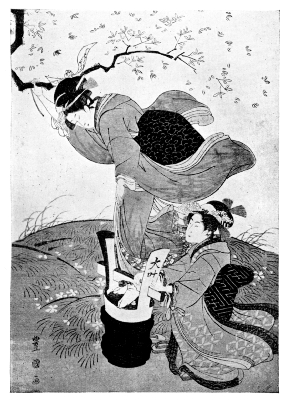
TOYOKUNI: LADIES AND CHERRY BLOSSOMS IN THE WIND.
Right-hand sheet of a triptych. Size 15 × 10. Signed Toyokuni ga.
Metzgar Collection.
Plate 47.
But before 1800 Toyokuni had followed Utamaro in that artist's adoption
of the thin necks, enormous coiffures, and distorted bodies which not
even Utamaro was always able to handle beautifully. Toyokuni's success
was far inferior. The over-ripeness of the type required all Utamaro's
subtlety to make it attractive or significant; and Toyokuni was by no
means subtle. Therefore it was no loss when he returned to actor-prints
shortly thereafter. One print of this, his second actor-period—the
savage portrait of Matsumoto Kōshirō, reproduced by Succo—is
notable and fine. But on the whole his second period shows Toyokuni as
only slightly more original than in the Sharaku period. In his portraits
of women at this time he sometimes leaned a little toward the Yeishi
type, with Yeishi's stiffness but without his distinction. Many books,
from these as well as from other years, bear witness to his industry; he
was a veritable geyser of prints of every sort.
In 1804 Toyokuni was obscurely involved in trouble with the authorities
over some of his historical prints. This was the time when Utamaro also
suffered at their hands. In 1806 Utamaro died; and Toyokuni, who had so
long leaned on the greater painter for his stimulus and inspiration,
went to pieces like a house of cards. Without a rival to emulate, he was
nothing; and we see him, a tragic figure—indisputably the most famous
master then living, who had survived the great days when he had competed
with Kiyonaga, Yeishi, and Utamaro for popular favour—now alone in a
glory which he could not sustain—a master bereft of those conditions
which had once enabled him to produce almost-masterpieces.
From this time on his work steadily deteriorated. The raw and
over-complicated colours of his designs of women made a melancholy
contrast to the "Narahira" triptych. He abandoned woman-portraiture
about 1810. His actors continued—a mere outworn formula—awkward,
angular creations, with senselessly crossed eyes, twisted necks, wry
mouths—the veriest parody on those devices which had once been employed
by Sharaku for a sublime end. Toyokuni died in 1825, a man who had
outlived himself.
Toyokuni's production had been enormous. The contemporaneous popularity
indicated by this is hard to understand unless we remember his frequent
shiftings of style and realize that at every moment he was ready to
throw off his old manner and adopt that of whatever artist most strongly
appealed to the taste of the hour. He was the most imitative of all
artists. What the mob wanted he gave them unreservedly, losing his own
integrity thereby.
Toyokuni seems to have been without real individuality or individual
view-point. He was devoid of either illusions or insight; and the true
artist must have the one or the other passionately. He drew his women
without enthusiasm and without tenderness. He conceived his actors
without the white-heat of real artistic creation. There is something
rasping about the greater part of his work; it seems full of sound and
fury, signifying nothing. It is rhetoric, not the profound and tragic
poetry of Sharaku, nor the subtle and decadent lyric strain of Utamaro.
Rarely did he make an authentic attempt to capture the beauty or wonder
or terror of life as he himself saw it. It is always the vision of other
men that he is reporting, not his own. He had no vision.
So long as he could attach himself to some productive master, catching
that master's feeling and style to a certain extent, he produced
creditable works. But when the support was withdrawn he seemed powerless
to take another step along that road. Kiyonaga's retirement, Sharaku's
downfall, Utamaro's death—each in turn cut short Toyokuni's prosperous
career in the footsteps of these masters. When left to himself he had
only one thing to revert to—the typical Toyokuni actor at its worst, a
thing of common ugliness.
No fame has tarnished more than his with the passing of time. As
Sharaku's has brightened, his has dimmed. Once he was esteemed the
greatest living print-designer; now I find that many students feel a
sense of surprise when occasionally, out of the thousands of Toyokuni's
prints, one appears that is really distinguished.
It must, however, be admitted that at certain times Toyokuni's native
brilliancy enabled him to create prints that are not surpassed by any of
his contemporaries. He did more poor work than any other artist of his
time; but such triptychs as the "Ryogoku Fireworks," in the Kiyonaga
manner, the "Bath House," in which shadows appear on the wall, the "Fan
Shop," and the "Ladies and Cherry-blossoms in the Wind," are beyond
criticism.
The best Toyokuni prints are very rare; the common ones are to be found
plentifully in every print-shop. His few finest triptychs, such as the
"Narahira," or the "Ladies and Cherry-blossoms in the Wind," of which
one sheet appears in Plate 47, are among the collector's important
treasures.
The beginner should be warned that there were, in all, at least five men
who at various times bore the name Toyokuni. No one of the successors of
the first Toyokuni ever produced work comparable with the finest work of
Toyokuni I; but it is a matter of great difficulty, not yet by any means
wholly clear, to distinguish between the late inferior work of Toyokuni
I and the work of several of the succeeding Toyokunis. One simple
indication may be of service to the inexperienced collector: If the
Toyokuni signature is in a red oval or cartouch, it is not by the first
master. This statement cannot, however, be reversed, for the later
Toyokunis often signed without the cartouch.
A Group of Ladies.
O careless passer—O look deep!
These forms from near the sea of sleep
Come hither; on each forehead gleams
The phosphorescent spray of dreams.
They have sailed in from lonely seas
Cloaked in a haze of mysteries;
And hither by a lord are led
Who snared them, pale himself with dread,
Upon the very shores of sleep.
O careless passer-by, look deep!
Utagawa Toyohiro, sometimes also called Ichiriusai, was born in 1773; he
was a brother, fellow-student, and probably pupil of Toyokuni. It is
well known that about 1800 these two artists collaborated to some
extent. Toyohiro's own chief work—landscapes, book-illustrations not
unlike Hokusai's, and figures of women—was done between 1795 and 1820;
he died in the year 1828.
TOYOHIRO.
Fate has been unkind to him in associating him with a man tremendously
more productive and incomparably more popular in his own day than
himself. Even to the present time, the reputation of Toyokuni still
overshadows that of his brother. But the close student of Toyohiro's
work will probably come to the conclusion that this present difference
in fame is due less to difference in merit than to the fact that
Toyokuni was enormously prolific, while Toyohiro's work was scanty. The
contemporaneous popularity may be ascribed to the ability of Toyokuni to
shift and veer with every change in the public taste, while Toyohiro was
unable or unwilling to move with these fluctuating winds. It is reported
that a serious breach occurred between the brothers because of
Toyohiro's refusal to produce actor-prints as the popular taste
demanded. His work is, however, coming to be recognized as of a quality
at least equal to his brother's, and in some respects finer and more
truly the expression of a rare sense of beauty.
We may conjecture that Toyohiro inherited two things from his first
teacher Toyoharu. One was a leaning toward landscape drawing. The other
was a certain distinction and shy aloofness that marked the older
master.
All Toyohiro's work has an aristocratic touch, a fine subtlety of curve
and colour, that contrast markedly with the frequently blaring
compositions of Toyokuni. He seldom drew actors or courtesans; most of
his figures are ladies of birth and breeding. The beautiful spots of
black which are important elements in the majority of his compositions
are handled with a keen sense of contrast that not even Kiyonaga's
surpassed. His brushwork is firm and delicate, but not so sparkling with
vitality as that of some of his predecessors. His colours are soft, his
figures wonderfully graceful; the impression he produces upon one is
that of a subtle and beauty-hungry spirit, detached from the mob by a
refinement beyond their comprehension, driven on by a consuming passion,
devoted to the quest of a perfection he was able to project but not to
realize.
In style, he draws considerably upon Toyokuni's early Utamaro manner;
but in spirit he is nearer to Yeishi and Utamaro himself, both of whom
must have influenced him somewhat. Not even the work of Yeishi is so
saturated with the wistfulness for beauty, the sense of vanishing
loveliness, the homesickness for regions of otherwhere. One of his
triptychs, the "Daimyo's Kite Party," reproduced in Plate 48, so
embodies these qualities that it is worthy of special attention.
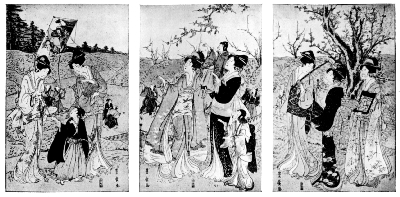
TOYOHIRO: A DAIMYO'S KITE-PARTY.
Triptych. Each sheet size 15 × 10. Signed Toyohiro ga.
Plate 48.
In a landscape of green hills, where a circle of low slopes encloses a
space of level ground, stands, on the rising edge of that natural
amphitheatre, a group of noble ladies and children in the soft
brightness of festal attire—richly decorated pink, black, white,
translucent heliotrope. Below and behind them boys are manœuvring a
kite, and older men direct briskly. The ladies for whom this simple and
charming pastime is arranged do not seem wholly intent upon it. Their
tall slender figures move as if in abstraction, an isolated group in the
foreground. One grey cherry-tree, with gnarled branches etched against a
clear sky, stands in their midst, bare except for the pink of earliest
blossoms; and the pale green of the more distant encircling hills is
here and there touched with the same luminous flowers.
Across this landscape the slender figures move in slow procession. Their
robes sway about them slowly. These sweeping draperies, which Harunobu
would have charged with peace and solemnity, are here touched with the
tension of more unquiet curves, restless, troubled with some element of
torture in their beauty. These are the lines of the branch and of the
wave, bent by the strain of hidden and conflicting forces. The clear
festive brightness of pink cherry-blossoms with the light of spring
shining through them serves but to accentuate the faint melancholy of
the trailing figures on whom lies a wistfulness that no spring can
satisfy. They linger, exquisitely aimless; beautiful, and weary for a
yet-unattained beauty; happy, but grave with the shadow of fleeting
happiness; sad, though reconciled by the knowledge that beauty is half
sadness. They have walked with expectant steps to the edge of the world;
and now they pace, delicately wondering, not far from the abyss where
there is nothing. Autumn will always be to them cold and unkindred; yet
in the flush of the spring their thoughts will turn toward death and
autumn. One cannot imagine them wholly joyous. They seem haunted by a
nostalgia for remote delights, unearthly music, secret and dimly
remembered gardens. Strange, late, exotic flowers are these, whom a
pensiveness not known to simpler and sturdier natures disturbs with
futile dreams.
A similar feeling is so often repeated in Toyohiro's work that I venture
to regard it as the keynote of his genius.
Toyohiro's landscapes are without notable beauty. He had a habit of
cutting across the middle of his picture with wide streaks of white
mist—an unpleasant device adopted to produce the effect of distance. He
is, however, an historical link of great importance between his master,
Toyoharu, and his pupil, Hiroshige, the greatest of all landscape
painters. As a conduit of landscape painting at a time when the Ukioye
School was little given to this as a separate study, Toyohiro's work in
this field may well engage our attention; but one suspects that it is
the fame of his great pupil's landscapes rather than the intrinsic merit
of his own that has given his their prominence.
Toyohiro produced a few pillar-prints of birds which have great
distinction; an almost classic feeling marks some of them.
Toyohiro's prints are not numerous; Toyokuni's outnumber his twenty to
one. His pillar-prints are very rare; his triptychs are generally
notable. It is necessary to add, however, that poor impressions of his
work, printed in poor colours, are more common than any other kind.
VII
THE FIFTH PERIOD:
THE DOWNFALL
FROM THE
DEATH OF UTAMARO
TO THE
DEATH OF HIROSHIGE
(1806-1858)