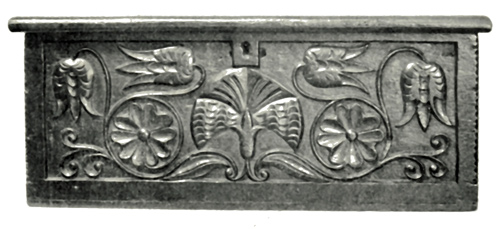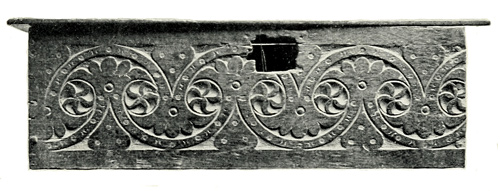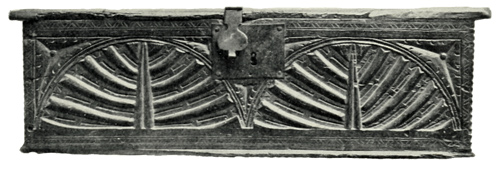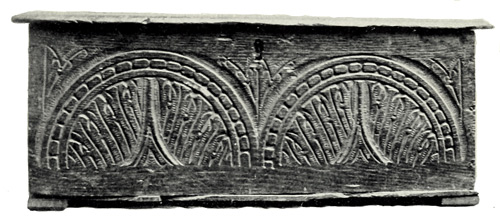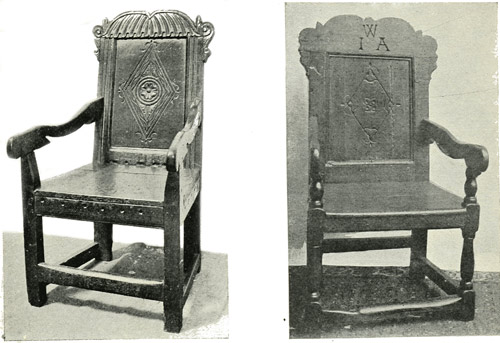
OAK ARM-CHAIR. DATE C. 1675.
With elaborate scroll back.
OAK ARM-CHAIR. DATE 1650.
With scratched lozenge.
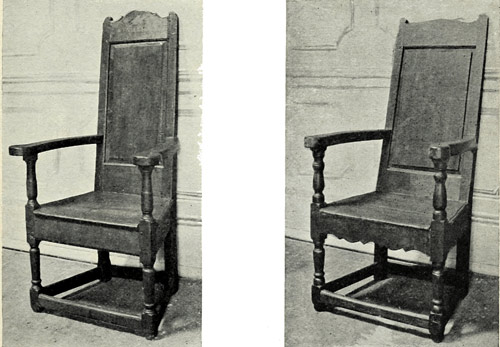
CHESTNUT ARM-CHAIR. DATE 1690.
OAK ARM-CHAIR. DATE 1690.
(By the courtesy of Messrs. Phillips, Hitchin.)
CHAPTER VII
THE EVOLUTION OF THE CHAIR
Early days—The typical Jacobean oak chair—The
evolution of the stretcher—The chair-back and its
development—Transition between Jacobean and
William and Mary forms—Farmhouse styles contemporary
with the cane-back chair—The Queen
Anne splat—Country Chippendale, Hepplewhite,
and Sheraton—The grandfather chair—Ladder-back
types—The spindle-back chair—Corner chairs.
In order to deal exhaustively with the evolution of
the chair from its earliest forms to the latest developments
in sumptuous upholstery, it would be necessary
to make an extended survey of furniture, dating back
to early classic days. To enumerate the manifold
varieties belonging to various countries and to trace
the gradual progress in form, which kept pace with
the advance in civilisation, would be of sufficient
interest to occupy a whole volume. Man, as a sitting
or lounging animal, has grown to require more
elaborate forms of chair, or settee, or sofa, and the
modern tendency has been towards comfort and
luxury.
In regard to English furniture the intense contrast
between the days of Elizabeth and those of Victoria
is at once noticeable. According to Lord Macaulay
in his comparison between the manners of his day
and those of the past, the furniture of a middle-class
dwelling-house of the nineteenth century was equal
to that of a rich merchant in the time of Elizabeth.
In general this may be true, though not as regards
the spacious structure and the massive grandeur of
the Tudor house. In many details the differences
are most noteworthy. The wide gulf dividing the
modern world from the days of the Armada may be
realised by reflecting on such an astounding fact that
Queen Elizabeth possessed at one time the only pair
of silk stockings in her realm, which were presented
to her by Mistress Montague, "which pleased her so
well that she would never wear any cloth hose
afterwards."
The sturdy character of the yeomen of the days
of the Tudors is exhibited in their furniture. The
illustrations of this chapter in regard to the chair
and its structural development indicate the slowly
acquired tastes, running some decades behind the
fashionable furniture, strong with foreign influences,
which had come into more or less general use.
"England no longer sent her fleeces to be woven in
Flanders and to be dyed in Florence. The spinning
of yarn, the weaving, fulling, and dyeing of cloth, was
spreading rapidly from the towns to the country-side.
The worsted trade, of which Norwich was the centre,
extended over the whole of the Eastern Counties.
Farmers' wives everywhere began to spin their wool
from their own sheep's backs into a coarse homespun."
The rough and wattled farmhouses were being
replaced by dwellings of brick and stone. The disuse
of salt fish and the greater consumption of meat
marked the improvement which was taking place
among the countryfolk. The wooden trenchers in
the farmhouses were supplanted by pewter, and there
were yeomen who could boast of their silver. Carpets
in richer dwelling-houses superseded the wretched
flooring of rushes. Even pillows, now in common
usage, were articles of luxury in the sixteenth
century. The farmer and the trader deemed them
as only fit "for women in child-bed." The chimney-corner
came into usage in Elizabethan days with the
general use of chimneys. The mediæval fortress had
given place to the grandeur of the Elizabethan hall
in the houses of the wealthy merchants. The rise of
the middle classes brought with it in its wake the
corresponding advance of the yeomen and their
dependents. Visions of the New World "threw a
haze of prodigality and profusion over the imagination
of the meanest seaman."
Early Days.—Of farmhouse types that can authoritatively
be attributed to Tudor days there are few,
but the succeeding age of the Stuarts is rich with
examples of undoubted authenticity. Many of them
are dated, and they all bear a strong family resemblance
to each other, owing to the narrow range of
motifs in the carved panels. There is a fixed
insularity in these early examples, and the same
traditional patterns in scrollwork or in conventional
lozenge design retained their hold for many generations.
The oak arm-chair of a farmhouse kitchen
made in the days of Charles I. was still followed in
close detail in the days of George III., as dated
examples testify, and it would puzzle an expert,
without the date to guide him, to say whether the
piece was eighteenth or seventeenth century work.
It may be added that as a general rule there is a
marked leaning towards generosity in imparting age
to old furniture. It is now very generally recognised
that, like wine, it gains prestige with length of years.
It therefore grows in antiquity according to the fancy
of the owner or the imagination of the collector.
Among the early forms of chairs falling under
the category of farmhouse furniture may be noticed
examples of rough and massive build, eminently fit
to serve the purpose for which they were designed.
Ornament is reduced to a minimum, and they stand
as rude monuments to the cabinet-maker's craft in
fashioning them and following tradition to suit his
client's tastes.
In regard to the sixteenth century there cannot be
said to be any type falling under the heading of
cottage or farmhouse chairs. We have already illustrated
(p. 35) an early form of Elizabethan days,
but such examples are rare. Practically cottagers
had only stools in common use. It was not until
about 1650 that a simplified form of the well-known
variety of the chairs of the Jacobean oak period
came into general use.
The Typical Jacobean Oak Chair.—The seventeenth
century offers a wide field of selection, and many
examples exist which undoubtedly were in use in
farmhouses at that period. The arm-chair illustrated
p. 191, with the initials "W.I A.", is evidently made
for the farmhouse. It is noticeable for its complete
absence of ornamental carving except a thinly
scratched lozenge. In date this is from 1650 to 1700,
and if made for a wealthier person at that date it
would be richly carved. The adjacent chair shows
the next advance in type. It is a superior farmhouse
chair of the period. It has a carved top with scroll
cresting. The holes in the seat, it should be observed,
originally held ropes, upon which a cushion was
supported. The wooden seat is an addition made in
the eighteenth century.
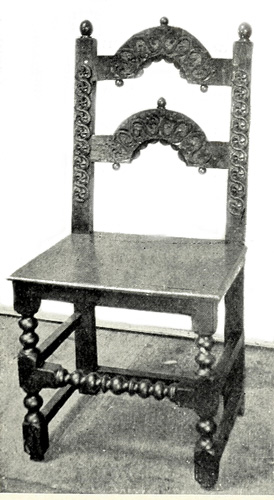
YORKSHIRE CHAIR. DATE 1660.
Late example, with ball turning in stretcher.
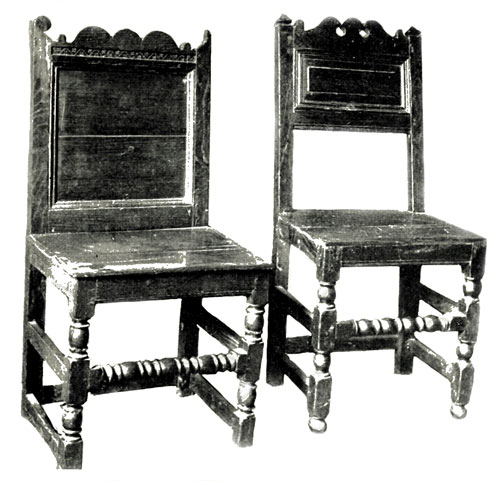
CROMWELLIAN CHAIRS. DATE 1660.
With indication of transition to Charles II. period.
(By the courtesy of Messrs. Phillips, Hitchin.)
The two other chairs illustrated on the same page
are later examples, in date about 1690. One of
these is fashioned of chestnut. The form of these
backs is related to the contemporary high-back cane
chairs of the time of Charles II. and James II. But
these fashions influenced the proportions only of
farmhouse chairs. In arriving at the date of such
specimens as these the bevelled panel is an important
factor in determining the late period.
Cushions had no place in the effects of the farmhouse
in early days, although ropes were sometimes
used to support cushions, as we have shown. But as
a general rule the wooden seats show tangible signs
of rough usage of centuries, and the stretcher has its
worn surface marked by generations of owners who
found it protective against the cold flagged or rush-strewn
floor and the draughts in days prior to carpets
and rugs.
The Evolution of the Stretcher.—In making a study
of the evolution of the chair the stretcher is an
important factor. For obvious reasons, as explained
above, no early chairs were made without the stretcher
across the front, a good sound serviceable piece of
British oak to stand rough wear and tear. Gradually,
keeping time with the march of comfort, the front
stretcher begins to leave its old position near the
floor, and in later examples it is half-way up the front
legs. It still had a use, and a very important one: it
added considerable strength and solidity to the chair,
and is nearly always found in chairs intended for use.
In the series illustrated herein there are only few
examples without the front stretcher. Later it took
another form, as the illustrated specimens in this
chapter show: it united the two side stretchers, and
crossed the chair underneath in the centre at right
angles to the side stretchers. Its purpose in adding
stability to this class of furniture was evidently never
lost sight of.
At first strictly utilitarian, the stretcher was a solid
foot-rest; later, when partly utilitarian in adding to
the strength, it became suitable for ornamentation,
Although in the class of furniture here under review
such ornament never took an elaborate form, there
are examples slightly differing in character from
chairs intended for the use of the wealthier classes,
and these are evidently a local effort to keep in touch
with prevailing taste.
Finely turned stretchers, such as are found in gate
tables, are a feature of a certain class of local chairs,
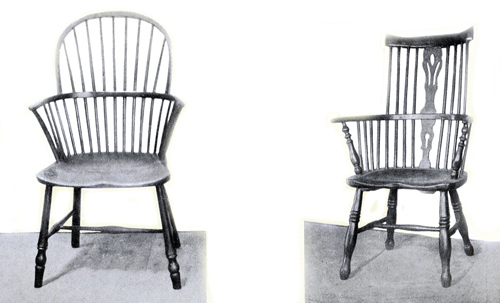
such as those illustrated on p. 197. This kind of
chair without arms is rather more decorated and
conforms more to the styles of furniture made for
higher spheres than the farmhouse. The upper chair
with its light open back and ornate decoration is a
Yorkshire type, and the ball turning in the stretcher
shows the transition period to Charles II. The other
two are Cromwellian chairs, but showing indications
of the next period. In date they are all three
about 1660.
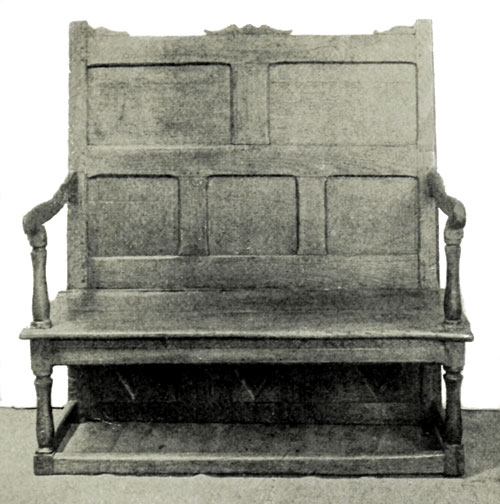
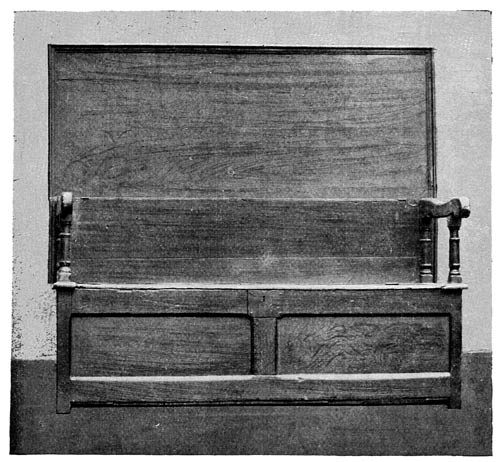
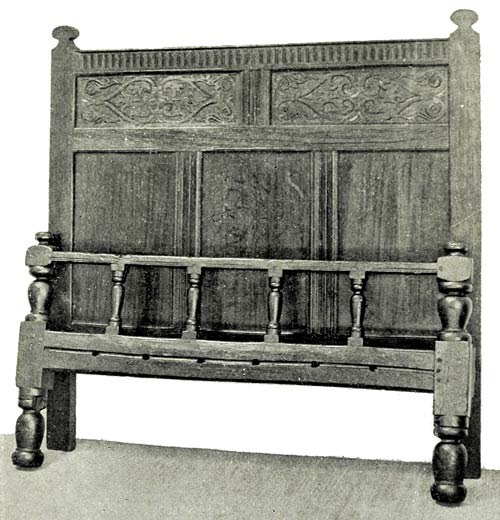
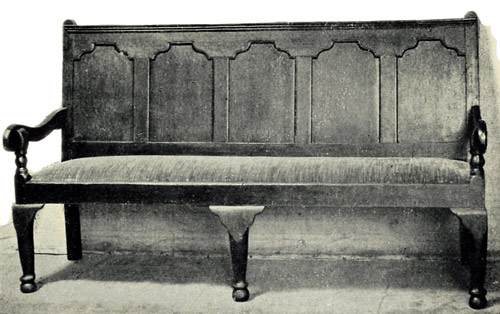
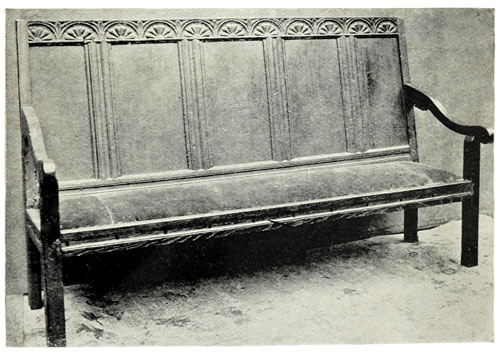
OAK SETTLE.
With back panel under seat made from older Oak Chest. Date 1675.
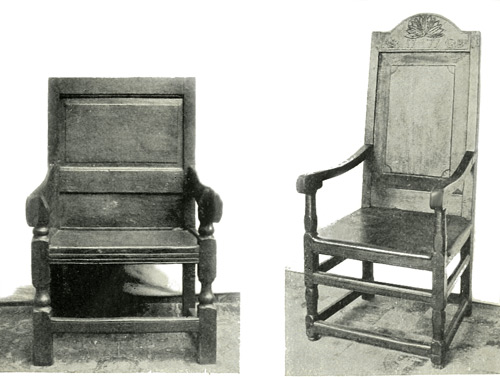
OAK ARM CHAIR. DATE 1675.
With Bevelled Panels.
OAK ARM CHAIR. DATE 1777.
With initials A.S. C.B.
The Chair-back and its Development.—Another point
in connection with the ordered progress of the chair-maker
is the gradual development of the back of
the chair. At first it was straight upright, and no
attempt was made to impart an angle to rest the back
of the sitter. Types such as the arm-chair with
square panel (p. 191) and the upright settle with the
five panels illustrated on p. 201 indicate this feature
of discomfort. The next stage is a slight inclination
in the back, still possessing a flat panel. This angle,
while not conforming to modern notions of ease, was
an attempt to offer greater comfort than before. This
style, in a hundred forms, with the minimum of inclination
in the back, continued for a very considerable
period. It is found in the nearly straight-backed
chairs of Derbyshire and Yorkshire origin, with the
turned stretchers, and it actually in later days became
almost upright in the series of chairs following the
later Stuart types with cane back and cane seat,
noticeable for their tall narrow backs with a resemblance
to the prie-dieu chair of continental usage.
The settle illustrated is a plainer variety of the
settle made for use by fashionable folk with delicately
panelled back. Very often, in cottage furniture, chests
and other pieces are broken up to make into smaller
furniture or to be incorporated into furniture of a
later design. Often it is found that the underframing
of an old gate table made in the seventeenth or
eighteenth century is from an earlier chest. In the
present instance it will be seen that the back panels
of the settle have been made from an older chest,
which bears the inscribed initials, still visible, "I.E." In
date this settle is about 1675, and is contemporary
with the square-backed chair illustrated on the same
page. Here the panel in back projects, that is, it is
slightly bevelled forward. The bevelling of the panel
is always a sign that a chair is later in date than the
year 1670.
Illustrated on the same page is a remarkable chair
having the initials "A.S.C.B." and the date 1777 carved
on it. It is a striking instance of the adherence to
old time-honoured form by the local cabinet-maker,
with touches that, even although the date were not
present, would tell their own story. This dull wood
proclaims a message in accents no less sure than the
sturdy yeoman's to Lady Clara Vere de Vere, and as
a chair in date anno Domini 1777 may afford to "smile
at the claims of long descent" of more pretentious and
fashionable furniture. It is like a rich vein of dialect
running in some old country song ripe with phrase of
Saxon days. It seems incredible that this survival of
early-Jacobean days should have been put together
by a village craftsman true to convention and exact
in seat and arms and stretcher. But it was not done
unthinkingly. Here is a chair, astounding to note, made
when Sheraton was creating his new styles to supplant
Chippendale, and when Hepplewhite stood between
the two masters as a via media. And the back of
this village chair has two distinct features translated
from Hepplewhite's school—the wheatear crest and
the panel with its broken corner!
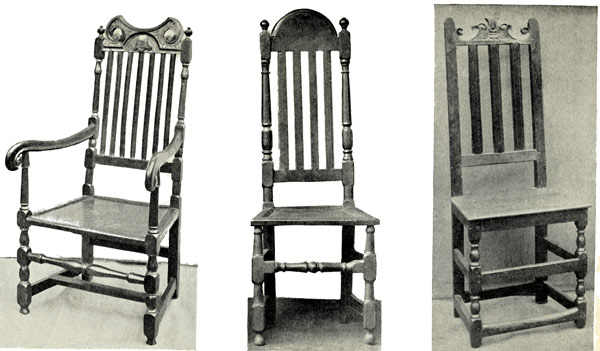
OAK CHAIRS. DATE ABOUT 1680.
Showing the inclination of the craftsmen to assimilate designs then being fashioned in walnut.
(By the courtesy of Messrs. Phillips, Hitchin.)
Transition between Jacobean and William and Mary
Forms.—The rapid growth of the finer specimens of
furniture made in walnut brought a new note into the
farmhouse variety. The elegance and grace of the
newer styles were at once evident. In the same
manner as the grandiose splendour of Elizabethan
woodcarving was succeeded by a less massive style in
oak, degenerating into a rude simplicity in farmhouse
examples, so in turn Jacobean lost favour. Walnut
lent itself to more intricate turning, and lightness and
greater delicacy claimed the popular favour of fashionable
folk. The cane seat and the cane back at once
indicate this new taste. The use of cushions became
general and the sunk seat for the squab cushion is a
feature in the later years of the seventeenth century.
Oak still remained the favourite wood of the
country craftsman, in spite of its more refractory
qualities. But when the walnut styles became so
firmly established that clients demanded furniture in
this fashion, elm and beech and yew were found
pliable enough to conform to the more slender touches
and the finer turning considered desirable.
Walnut was in its turn supplanted by mahogany,
and it will be shown later how farmhouse furniture
followed the dictates of fashion in days when the
outburst of splendid design by Chippendale, Hepplewhite,
and Sheraton, together with a crowd of lesser
known men, spread far and wide new principles in the
art of furniture-making and brought country furniture
another stage in its evolution.
Farmhouse furniture slowly assimilated the technique
and design of the walnut age. The love for the
native oak was so pronounced that country makers
did not desert this wood and essayed to produce
effects by its employment that were exceedingly
difficult and oftentimes unsuccessful. The three
chairs illustrated p. 205 show this transition style,
about the year 1680, struggling with technical difficulties
and affording a fine series of points in the
evolution of design.
Farmhouse Styles contemporary with the Cane-back
Chair.—Farmhouse furniture rarely, if ever, had cane-work
in the back or in the seat. But the craftsman,
while appreciating the delicacy of the cane back in
adding lightness to the chair, circumvented his
inability to work in cane by substituting thin vertical
splats to give the necessary effect of transparency.
The three chairs illustrated show each in varying
degree the quaint compromise made between the
technique of oak and the technique of walnut, and
the attempt to reproduce the walnut designs.
The arm-chair exhibits strong relationship with the
older Jacobean chair in its turned legs and uprights,
but these have assumed a more slender proportion.
The front stretcher is in the newer manner. The
sunk seat is intended to receive a cushion. There
should be no difficulty for the amateur correctly
to assign a date to such a piece. The process of
reasoning would be somewhat as follows:—The
lower half of the chair is Jacobean, but the front
stretcher suggests the Charles II. period, borne out
by the open back, which removes it from the Cromwellian
period, and the details of the top rail with its
curved top indicate that the country maker had seen
the tall straight-back chairs of the William and Mary
period with the cane-work panel.
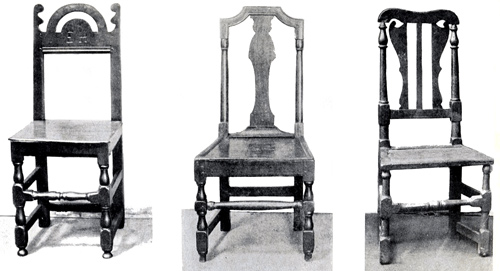
OAK CHAIRS.
With cresting rail, of Charles II. period, retained
and perforated arch centre peculiar
to walnut designs.
With elaboration in turned legs, and uprights,
of William and Mary period retained,
and having Queen Anne splat of 1710.
With sunk seat for squab cushion, turned
uprights and legs and curious back, showing
transition from lath back to splat back.
The middle chair more closely approaches the
upright chair of the Charles II. period. There is a
straight top-rail, supplemented by a lunette, giving
the top a character of its own. This specimen is
exceptionally interesting. The right-hand chair in
its seat and legs is pronouncedly Jacobean. But the
back with the three splats and the coarsely carved
top-rail betray the hand of the country craftsman
following in oak the more graceful curves of the
worker in walnut of the days of Charles II.
It will be seen that these three chairs, each in
varying manner, evade the difficulties of the light
cane-back by the substitution of thin rails, and, as
will be seen from the illustration of three other
chairs (p. 209), the next stage of walnut design with
fiddle-shaped splat offered equal problems to the
makers of cottage furniture. Sometimes they eliminated
the splat altogether, while adopting other points
of design found in chairs with the Queen Anne splat
of 1710. In every case the fondness for old established
styles is exhibited in the fact that the country
cabinet-maker clings doggedly to these and appears
too conservative or too timid to break wholly away
from tradition. In consequence, his work, with
patches of newer design welded on to the old, is
quaintly incongruous. There is thus an absence of
"thinking out" the design as a whole. The minor
maker thought out the parts as he went along. Some
of his results are extraordinary in their characteristics:
they resemble that freak of fashion termed
"harlequin" tea services, where the cups are of one
pattern and the saucers of another. Bearing in mind
these unfailing proclivities of the maker of cottage
and farmhouse furniture, the collector should not find
it difficult to recognise the country hand at once.
Now and again one is struck with the extraordinary
ingenuity of some of the work, or one is charmed
with the faithfulness with which designs have been
translated from the golden bowl to the silver, or, to
be literal, from walnut and mahogany to oak and elm
and beech. But one is never amazed at the delicacy
of proportion, the balanced symmetry, or the fertility
of invention—these attributes belong to cabinet-makers
on a higher plane.
Of three chairs illustrated on p. 209, that on the
left in the legs and seat shows the moribund
Jacobean style. The stretcher indicates the oncoming
of the newer styles, and the back with its cresting
rail is of the Charles II. period. Its retention is
curious, and the perforated arched centre is peculiar
to designs found in walnut; its use in oak by the
maker of this chair was a blunder, as oak is too hard
a wood to employ for such a design.
The middle chair shows an equal admixture of
styles. The elaboration in the turned legs and
uprights belongs to the William and Mary period
and the splat is the Queen Anne fiddle pattern of
1710. The seat begins to show another form in
having the middle sunk for the use of a squab
cushion.
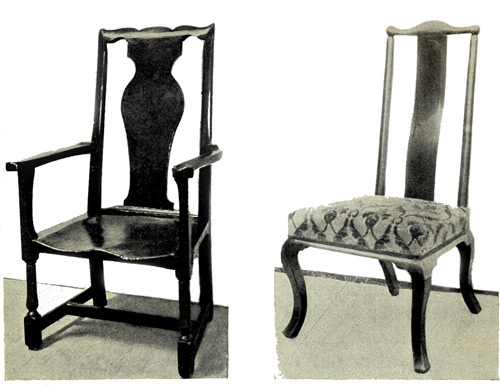
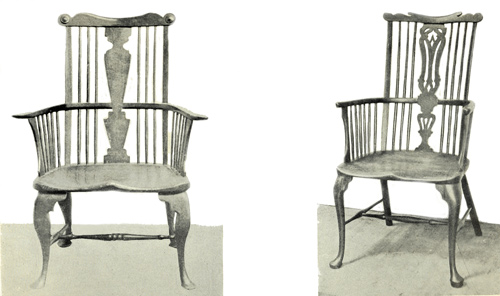
QUEEN ANNE CHAIR.
Entirely oak form except back and splat.
QUEEN ANNE CHAIR.
In oak, with strong inclinations towards
walnut styles.
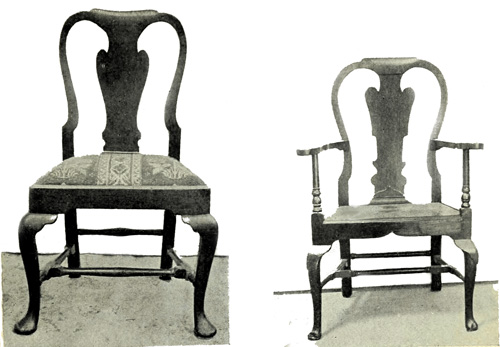
QUEEN ANNE CHAIR.
Walnut design made in oak for farmhouse use.
QUEEN ANE ARM-CHAIR.
With shaped front, walnut design executed in oak.
(By the courtesy of Messrs. Phillips, Hitchin.)
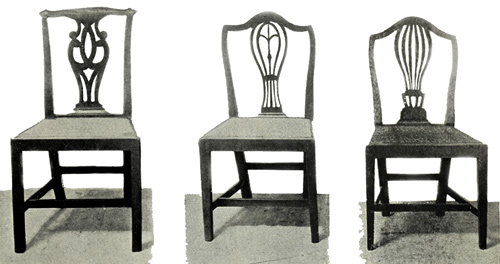
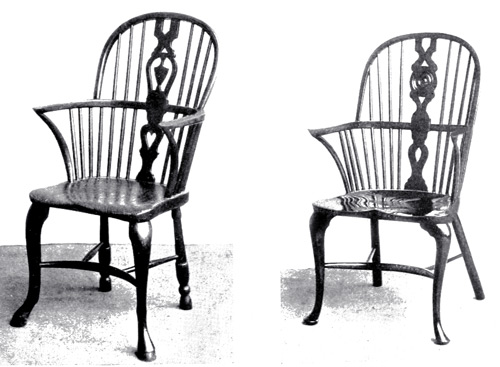
COUNTRY CHIPPENDALE
CHAIR, STYLE MERGING INTO
HEPPLEWHITE.
Less pronounced Cupid's bow top.
TWO CHAIRS COUNTRY HEPPLEWHITE STYLE
MADE ENTIRELY IN OAK.
Left-hand chair with Prince of Wales's feathers.
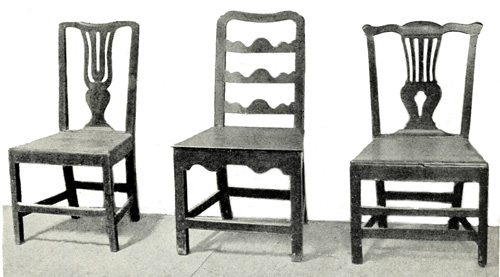
TYPES OF COTTAGE CHAIRS IN OAK.
Having features of the three styles—Queen Anne, Chippendale, and Sheraton.
Two chairs Queen Anne style.
Chair Country Chippendale style.
The right-hand chair parts with the underframing
below the seat, which gives a touch of lightness to the
construction. The turned legs and uprights have
departed from the coarse early-Jacobean style and
perceptibly depend on walnut prototypes for their
character. The back shows the transition from the
lath back (such as in the chairs simulating the cane-work)
to the splat back. It is an interesting and
rare example, marking the slow assimilation of new
forms by isolated makers. This specimen came from
Ireland and evidently possesses native touches of
originality which defy the connoisseur to determine
its exact date.
The Queen Anne Splat.—The fiddle-shaped splat of
1710 marks a turning-point in the construction of
the chair.
The walnut chairs with caned backs of the time
of James II. and the early days of William III.
were carved richly, and sometimes there was a splat
dividing the caning at the back, which later, also in
caned-back examples, is curved and plain. The
general tendency in the reigns of William and Mary,
especially towards the close of the period, was one of
economy, and elaborate carving began to disappear.
The Queen Anne smooth splat of fiddle form
rapidly became popular. This Anglo-Dutch style
became acclimatised here, and is characteristic of the
homely examples of the Queen Anne period. In
walnut it was comparatively easy to carry out
carving. In oak such elaboration was well-nigh
impossible. It was therefore natural that in the
farmhouse examples the plain Dutch splat would
readily find favour as more easily executed. By the
time that the fiddle splat had become popular the
stretcher joining the cabriole legs commenced to
disappear.
The splat plays an important part as indicating
sharp variations in design—walnut with open carving,
intricate and floriated; walnut with the plain
fiddle splat, with its corresponding minor form in
oak; mahogany, with the advent of Chippendale,
with the splat again open, carved with graceful
ribbon-work.
The arm-chair illustrated p. 213 is a remarkable
instance of intermingling of styles. The front legs
are in Jacobean style, and are continued in the same
manner as the usual type of oak chair as supports for
the arms, but an original touch and naïve departure
is in the curve given to this upright from the seat
upwards. The seat is shaped like that of the
Windsor chair. The arms are somewhat stiff for the
back with its Cupid's-bow design, which has a
sprightliness and grace making it a thing apart. The
whole is not unpleasing. It is a remarkable instance
of the attempted assimilation of several diverse styles
by an undeveloped cabinet-maker with strong ideas
of his own. The oak form is rigidly retained in all
except the back and splat of Queen Anne days.
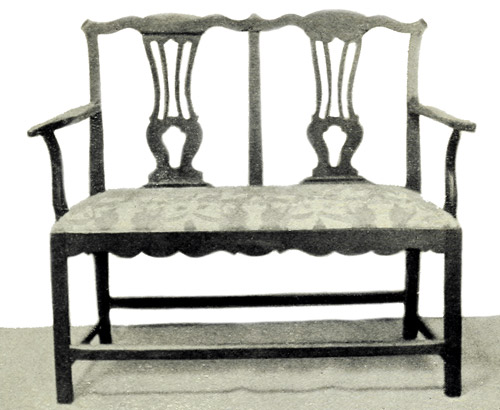
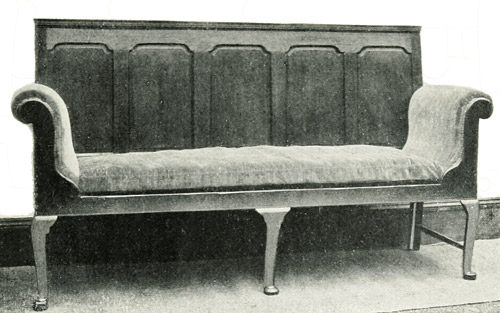
COUNTRY-MADE OAK SETTEE WITH DOUBLE BACK IN
CHIPPENDALE STYLE.
The shaped underframing is a feature only found in farmhouse varieties.
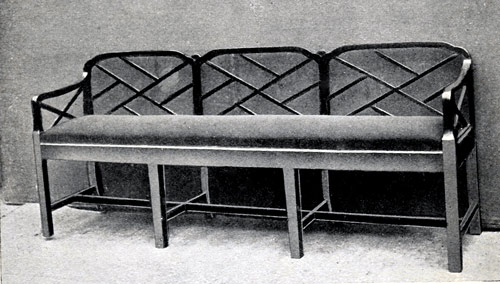
COUNTRY-MADE OAK SETTEE IN CHINESE CHIPPENDALE STYLE.
(By the courtesy of Messrs. Phillips, Hitchin.)
The adjacent chair, with its tall back with curved
splat and its cabriole legs, marks the transition
between William and Mary and Queen Anne. The
top rail indicates by its clumsy joinery the touch of
the immature country cabinet-maker. It is an
attempt to approach a fine model with insufficiency
of skill by the maker. The use of the cabriole leg
either in chairs or in dressers in homely furniture has
always proved a stumbling-block to the minor craftsman.
The delicacy of balance required in order to
preserve the harmony of the whole has proved too
subtle a problem for him to handle, and to the
practised eye these farmhouse pieces at once proclaim
their origin.
The broad splat and the straight square front and
the bold cabriole leg of the Queen Anne type in
walnut were often copied in oak. The example of
the chair with the later tapestry covering, illustrated
p. 213, is a case where the local cabinet-maker has
faithfully copied detail for detail from some fine
original in walnut. His is in oak for more strenuous
usage. The adjacent arm-chair is of the Queen Anne
style, with a shaped front that is very rarely found
in such pieces. The maker here has not been so
successful in catching the bold lines of his original.
There is a sense of something lacking in the curves
of the back. The touches of his own that he has
added in the arms, reverting to an earlier Jacobean
type, reveal the unpractised hand.
Country Chippendale, Hepplewhite, and Sheraton.—A
word in passing may be said in regard to the unique
character of furniture of these types. It is obvious
that factory-made furniture turned out by the hundred
pieces can offer nothing personal, whatever its merits
or demerits of design or workmanship. It is this
personal note, the love of a craftsman in his creation,
that appeals to the collector, whether it be of Persian
rugs or of old brass candlesticks. It is absent in
art produced in a wholesale manner. Blunderingly
as the village craftsmen went to work, they often
stumbled into great things, and they always produced
original results.
Prior to the publication of the design-books of the
great eighteenth-century masters of cabinet-making,
the furniture of certain localities began to assume
a character of its own, the result of long tradition,
and designs such as the dragon found in Welsh
carving became established. The term "unique" is
peculiarly appropriate to furniture of this calibre, for
rarely are two pieces found to be exactly alike. Not
only did different makers add novel features, but
the same craftsman apparently did not repeat
himself.
The permutations of form governing furniture are
illimitable, associated as they are with so many
details of construction. To take the chair—the leg,
its shape, and the design of its turning; the style
and character of the work on the stretcher; the form
of the seat; the decoration and formation of the
front; the back, its length, and the variety of splats
and panels; and the top rail with its variations—these
are only the salient features in which differences
appear. Such modifications of design and piquant
touches of personal character appeal to the collector,
who loves the foibles and fanciful moods of the native
craftsman, be he ever so humble.
Chippendale published his "Director" in 1754, and
it became a working guide to all ambitious craftsmen.
Ince and Mayhew, cabinet-makers of Broad
Street, Golden Square, had issued "Household
Furniture" in 1748, and Hepplewhite & Co.
followed later with the "Cabinet Maker and Upholsterer's
Guide" in 1788, where the delicacies of
ornament were related to the chaster classic models,
and in 1794 came Sheraton with his "Drawing
Book," rich with subtle suggestiveness. A rough
generalisation shows the Chippendale school holding
sway from 1730 to 1780, the Hepplewhite school
from 1775 to 1795, and the Sheraton school from
1790 to 1805: and behind all, the strong influence of
the Brothers Adam in their classic revival. What
had previously been tradition came very speedily
into line with current modes. Fashion, as we have
shown, had a slow and impermanent effect upon
village ideals. But the output of these great
illustrated volumes, with working drawings, undoubtedly
had a wide-reaching influence. The last
quarter of the eighteenth century saw an intense
outburst of interest in the arts of interior decoration.
A great amount of finely designed and beautifully
executed furniture belongs to those days, and the
echo of the splendid achievements in mahogany and
in satinwood is seen in the farmhouse and cottage
furniture, which came singularly close upon the heels
of fashion.
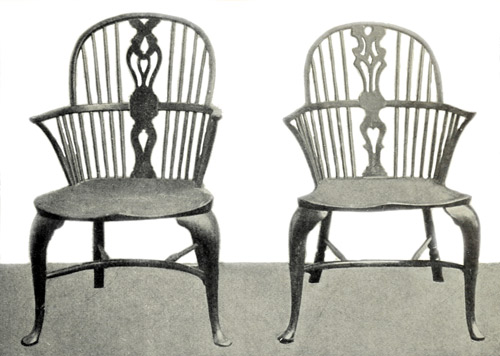
Chippendale furniture in oak, elm, or beech is
being largely collected. We illustrate a sufficient
number of types to show that this class of design
known as "Cottage Chippendale," has peculiar charms
of its own. The arm-chair illustrated p. 225 is in
elm, and is in the style Chippendale employed in
his rich mahogany creations in 1760. The fine
interlaced carving of the back is graceful and well
proportioned. The adjacent chair, in elm, still
follows the Chippendale style. The seat is rush,
and the maker has confined himself to his own
limitations and avoided in the splat the too intricate
work of more sumptuous models. He has arrived
at a very finely balanced result. The heart cut out
of the splat is frequently found in cottage examples,
suggesting that some of the more ornate examples
may have been made as wedding presents for young
couples just setting up housekeeping, or possibly the
village cabinet-maker himself had thoughts in that
direction, and such work was destined to equip his
own home.
The illustration of a chair, in beech, with a plain
wooden seat, has a somewhat intricate ribbon-like
pattern terminating in the Prince of Wales's feathers.
The heart is present in the design at the base of
the splat, cut out in fretwork. The arm-chair on
the right, with its dipped seat, is in oak, and is an
instance representing the adaptations of Sheraton
styles in the provinces.
Another page of chairs in oak (p. 215) shows the
influences at work in moulding the character of the
styles of the late eighteenth and early nineteenth
century farmhouse furniture. Of the three chairs at
top of p. 215, the left-hand one is in Chippendale
style merging into Hepplewhite. The Cupid's bow
at the top rail has become less pronounced. The
other two chairs on right are typically Hepplewhite
in character. The Prince of Wales's feathers, so
often associated with Hepplewhite's own work, are
embodied in the splat of one.
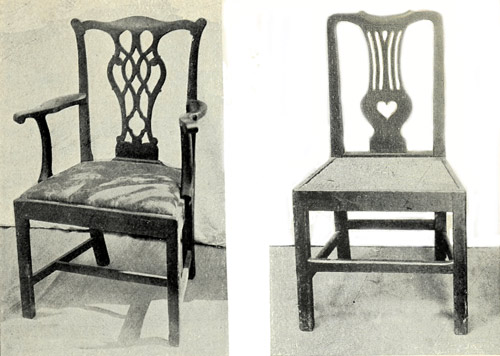
ELM CHAIR, COUNTRY CHIPPENDALE
STYLE. 1760.
ELM CHAIR, COUNTRY CHIPPENDALE STYLE.
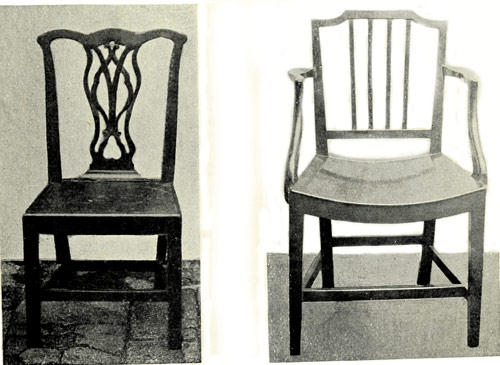
BEECH CHAIR. COUNTRY
CHIPPENDALE STYLE.
OAK CHAIR, COUNTRY CHIPPENDALE
STYLE. WITH DROPPED SEAT.
In the lower group, the right-hand chair is of the
Chippendale type. The other two chairs have
features of three styles—the Queen Anne, the
Chippendale, and the Sheraton. It is this piquancy
and incongruous combination of styles adjacent to
each other in point of time, but having little other
relationship, which make the provincialisms of the
cabinet-maker of exceptional interest.
At times more ambitious attempts were made in
oak, following the lines of the Chippendale style in
mahogany. These have pronounced features always
recognisable as belonging to the farmhouse variety
of furniture. Two examples are illustrated, p. 219.
The upper example of country-made oak settee,
with double back, at once indicates that it is
provincial by the shaped underframing, which is
never found in other classes of furniture. The lower
example of farmhouse oak settee is clearly in
Chippendale's Chinese style. A reference to the
"Gentleman and Cabinet Maker's Directory," published
by Thomas Chippendale in 1754, shows that
this Chinese style adopted by the local maker is very
far removed from the series of delicate fretwork
designs illustrated by Chippendale in his volume.
It is true that the old designer of St. Martin's Lane
sent forth his work with the sub-title stating that
it was "calculated to improve and refine the present
Taste, and suited to the Fancy and Circumstances
of Persons in all Degrees of Life." The great
master cabinet-maker, in scattering his designs far
and wide, evidently had in mind the formation of a
new style. He builded better than he knew. The
importance of his book of designs cannot be overrated.
It was subscribed for in Yorkshire, in Devon,
in Westmorland, and in Ireland, and straightway
minor men looked upon these delightful inventions
and began to follow to the best of their ability the
ideals set forth by Chippendale the dreamer.
That he was an idealist in this book of designs is
naïvely explained in his Preface: "I frankly confess
that in the executing many of the drawings my
pencil has but faintly copied out those images that
my fancy suggested, and had they not been published
till I could have pronounced them perfect, perhaps
they had never seen the light." But Chippendale
was also a practical cabinet-maker as well as a
designer. He has a lingering doubt that after all,
perhaps, the country cabinet-maker and those who
bought the book for use might not be able to carry
out his designs. Evidently this had struck others
too. Perhaps he was accused of fobbing-off in a
design-book mere fanciful work that was too far
above the plane of ordinary cabinet-work. He meets
this objection with a declaration, so to speak, upon
honour, with which he winds up his Preface, which
is a pretty piece of eighteenth-century advertising:—
"Upon the whole, I have given no design but what
may be executed with advantage by the hands of a
skilful workman, though some of the profession have
been diligent enough to represent them (especially
those after the Gothic and Chinese manner) as so
many specious drawings, impossible to be worked off
by any mechanic whatsoever. I will not scruple to
attribute this to malice, ignorance, and inability, and
I am confident I can convince all noblemen, gentlemen,
or others, who will honour me with their
commands, that every design in the book can be
improved, both as to beauty and enrichment, in the
execution of it, by—Their Most Obedient Servant,
Thomas Chippendale."
Enough has been said to prove that "country
Chippendale" is not a misnomer. It is equally true
that the Hepplewhite style was disseminated in like
fashion in the provinces. It must be remembered
that these trade catalogues, as they really were,
brought out somewhat in rivalry with each other by
the great London designers and cabinet-makers, were
the only literature the country makers had to indicate
town fashions. These volumes therefore served a
double purpose in procuring clients for the firm and
in stimulating the art of the country designer. That
they were in part intended to be educational is shown
by the Preface to the "Cabinet Maker and Upholsterer's
Guide," published by A. Hepplewhite & Co.,
Cabinet-makers. We quote from the Preface of
the third edition, "improved," 1794.
The Preface opens with a lament that owing to
"the mutability of all things, but more especially of
fashions," foreigners who seek a knowledge of English
taste and workmanship may be misled by the "labours
of our predecessors in this line of little use."
"The same reason in favour of this work will
apply also to many of our own countrymen and
artisans, whose distance from the metropolis makes
even an imperfect knowledge of its improvements
acquired with much trouble and expense."
"In this instance we hope for reward; and though
we lay no claim to extraordinary merit in our designs,
we flatter ourselves they will be found serviceable to
young workmen in general, and occasionally to more
experienced ones."
In view, therefore, of the books of design we have
enumerated, it is obvious that the country designer
had a new field open to him, and now and again he
made ample use of his opportunities. During the
last quarter of the eighteenth century there was quite
an outburst of literature on furniture, much of it
forgotten and much of it waiting to be disinterred
by patient research; and with the dissemination of
these fine designs some of the most perfect examples
of country-made furniture began to exhibit touches
of skill of the practised hand.
The Grandfather Chair.—From the illustration given
on p. 231 it will be seen that the type known as
the "grandfather" has a humble lineage. It will be
found with the same wings and curved arms and
plain wooden seat in the alehouse or in the ingle nook
of the farmhouse. The specimen we illustrate does
duty as a bacon-cupboard as well as a chair. Usually
such pieces have the cupboard opening at the back,
but in this instance the cupboard opens in front.
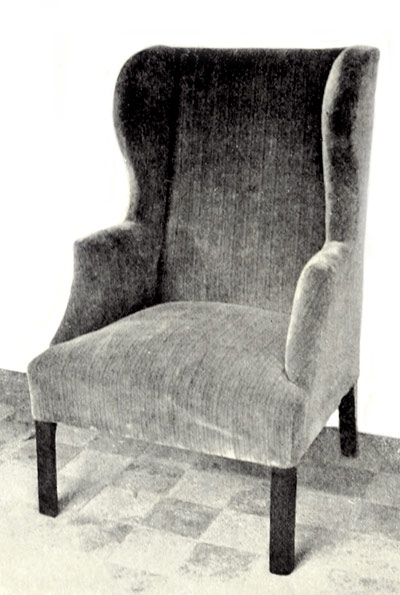
COUNTRY GRANDFATHER CHAIR.
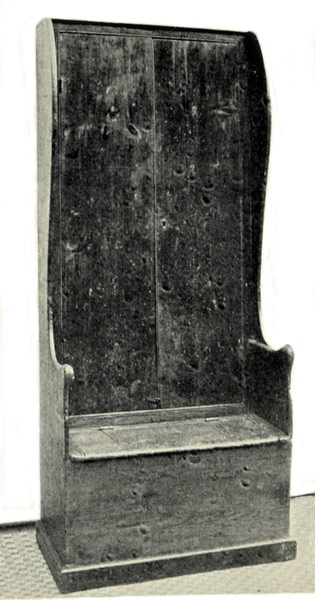
ARM-CHAIR AND BACON-CUPBOARD.
Opens at foot. This type usually opens at back.
As early as the opening years of the eighteenth
century there were upholstered chairs of a somewhat
similar type to the so-called "grandfather" with
scrolled arms or wings. The example we illustrate
is representative of those which may be met with in
the country farmhouse.
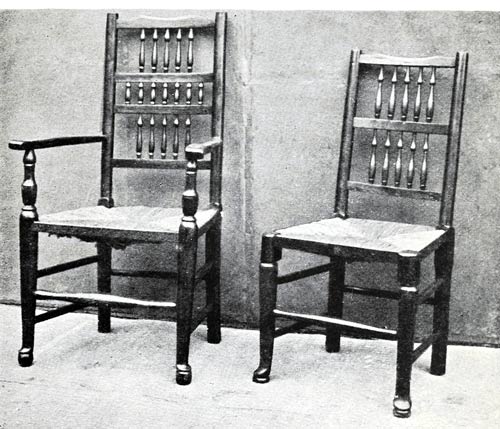
Ladder-back Types.—The ladder-back chair belongs
to the northern half of England, and similarly the
spindle-back chair is found in the same locality.
The Windsor chair, on the other hand, is mainly
confined to the southern half of the country. These
are points which become noticeable after years of
systematised research, and although nowadays these
three varieties of chair may still be found, somewhat
scattered, their real home and place of origin is as
indicated. Another feature of interest is that both
ladder-back and spindle-back varieties, with but
slight differences, are found on the Continent.
It will be observed that this class of chair has a
rush seat. This feature it has in common with the
spindle-back chair.
The rush-bottom chair covers a wide area. It
comes with an air of naïveté and rustic simplicity.
One recalls the long lines of green rushes by the
river-bank and the rush-gatherers in idyllic placidity
slowly trimming the banks, disturbing coot and
moorhen with their punt, and adding another human
touch to the lonely angler. They are pursuing a
calling as old as the river itself, and the use of rush
for floor, for lighting, or for seating furniture, found
occupation for generations of men plying curious
trades, of which the plaiting of osiers into baskets
and the thatching of cottage roofs may be numbered
among the decaying industries. Indeed, this
latter art and the making of birch and heath brooms
may be almost said to be extinct. A good artisan
who can thatch in the old artistic style is much
sought after. Of course ricks have still to be thatched,
but the picturesque skill of masters of this old-world
craft is absent, and corrugated iron sheets have found
favour in lieu of the old style.
The ladder-back chair is, as its name denotes,
decorated with horizontal supports, ladder fashion.
These are capable of the most pleasing variation.
The perfection of form of this type is seen in the
arm-chair illustrated p. 237. The well-balanced
proportion of the ladder rails is a test as to the
excellence of the design. They are not meaningless
ornaments put in place, unthinkingly, to create a new
style. The two examples illustrated on page 235
show other types of the ladder-back chair. The
left-hand one shows the later stages in the development
of the design, and its top rail is of the Sheraton
period. The right-hand one, with arms, is composite
in its character, and is in date about 1820, and
exhibits a touch of the Sheraton slenderness of style
in the splats and the round turning of arms. Both
examples show the quaint survival of the Queen
Anne foot. The ladder-back form survived the
eighteenth century and lasted down to within fifty
years ago, when it became merged into that of the
Windsor chair.
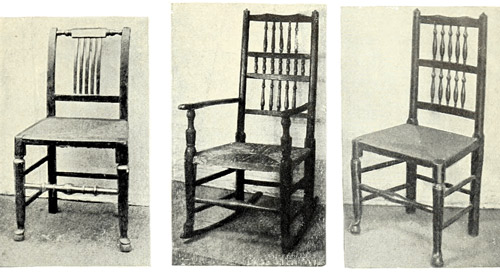
LADDER-BACK TYPE
OF CHAIR.
Showing Empire influence
in curved back.
Dated 1820-1830.
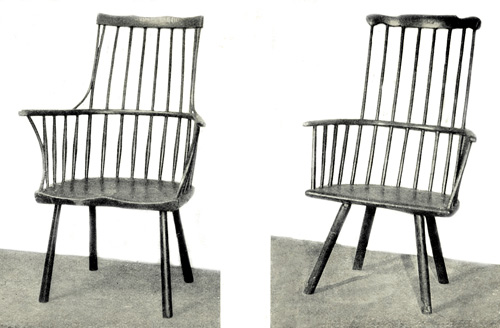
SPINDLE-BACK NURSING CHAIR WITH ROCKER.
Three rows of spindles.
SPINDLE-BACK CHAIR.
Two rows of spindles.
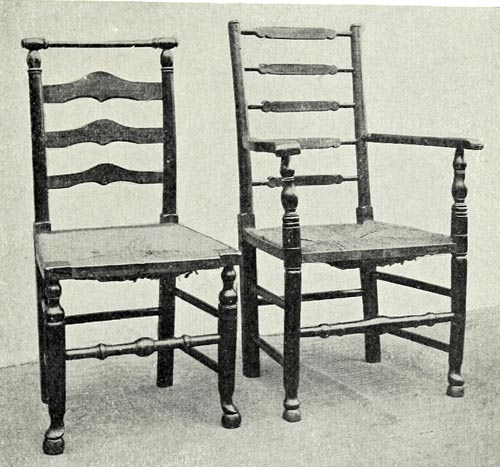
LADDER-BACK CHAIRS WITH RUSH SEAT.
Both chairs showing quaint survival of the Queen Anne feet.
Late Eighteenth Century, with top
rail in Sheraton style.
Later form of splat with turned
ends. Dated 1820.
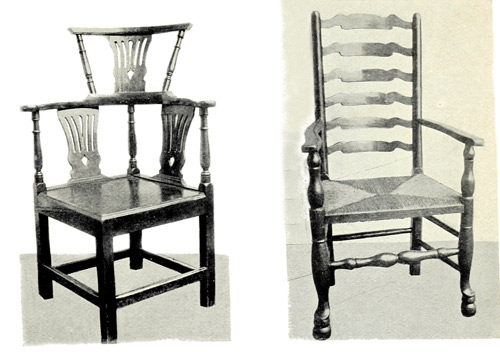
COUNTRY BARBER'S CHAIR.
LADDER-BACK CHAIR.
Perfect specimen in regard to style.
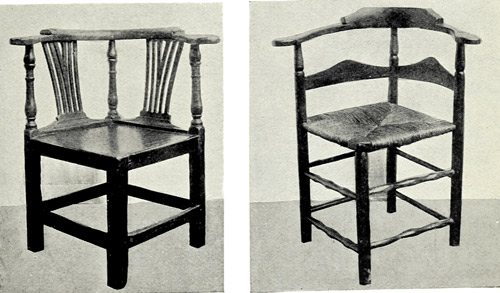
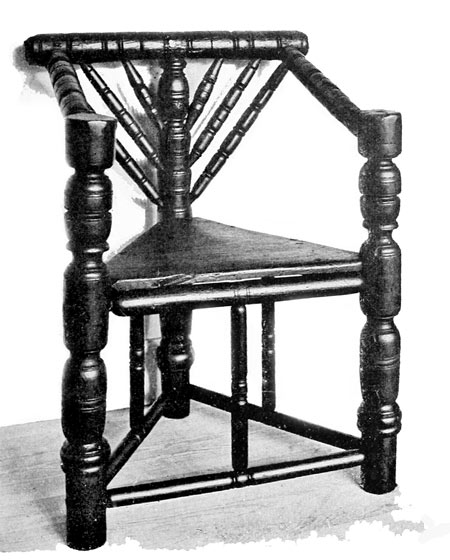
OAK CORNER CHAIR.
LADDER-BACK FORM OF CORNER CHAIR
WITH RUSH SEAT.
Probably Lancashire.
(By the courtesy of Messrs. Phillips, Hitchin.)
The Spindle-back Chair.—The spindle-back chair is
of long lineage. As early as the reign of Charles I.
this type was known. There is still treasured in
America the chair of Governor Carver, with simple
turning in legs and back, which practically consisted
of upright posts rounded and having slight ornament.
The back was set with "spindles." The older types
of these chairs had thick upright posts, the back and
back legs being two posts and the front legs, continued
upward beyond the seat, forming supports for
the arms. These posts are often six or seven inches
in circumference, and belong to early-Jacobean days.
The type found its way to America in Puritan days
and has continued to be a favourite. Hickory wood
was used for American specimens, and considerable
attention has been paid to this form of chair and its
varieties, the differing heights of the posts and the
number of the spindles and their character, by
American collectors. In England examples are not
easily found of early date. The examples illustrated
(p. 235), a Nursing Chair on rockers and an ordinary
Spindle-Back Chair, are of eighteenth-century days,
and are sufficient to indicate the type of chair, but
these two represent the style when it had become
of more general use. Practically it was not until the
eighteenth century that such types were commonly
used in cottages and farmhouses.
These turned chairs, turned in every portion but
the rush seat, lend themselves to the above-mentioned
two styles of treatment. Their upright posts forming
the open back can be treated with vertical splats
divided by horizontal divisions, or they can, as in the
ladder form, receive horizontal splats. The complete
simplicity of this attitude towards the back absolved
the homely cabinet-maker from dangerous experiments.
Avoiding curved backs, he had not to face
the intricacies of the nicety of balance in the splat.
Altogether it was a very satisfactory solution, and in
practice resulted in the production of a wide range
of chairs, differing in slight details but well within
the range of the local workman's art.
The unassuming simplicity of this class of chair
made its appeal to Madox-Brown, who held that
simplicity and utility were the two desiderata, united
with soundness of construction, for domestic furniture.
Veneer was as abhorrent to him as to all genuine
lovers of the artistic. "Let us be honest, let us be
genuine in furniture as in aught else," were his words.
"If we must needs make our chairs and tables of
cheap wood, do not let them masquerade as mahogany
or rosewood; let the thing appear that which it is;
it will not lack dignity if it be good of its kind and
well made." Accordingly he put his theories into
practice and designed some furniture. In a chair in
the possession of Mr. Harold Rathbone he has
employed the rush seat and used spindles to decorate
the back, and in another chair in the same collection
he has adhered to the horizontal ladder-back style,
coupled with the rush seat, with pleasing effect.
Corner Chairs.—Among interesting types of chairs
often with lingering traces of the Jacobean style
and additional features of splats that may be
regarded as standing on the threshold of the
Chippendale period, corner chairs stand in a class
alone. The illustrations on p. 237 show some typical
examples. The chair with the double tier is the oak
adaptation of Chippendale with the retention of the
old Jacobean form of support for the arm. These
chairs with this added tier are often used as country
barber's chairs. The rush-seated corner chair on the
same page, probably made in Lancashire, is suggestive
of the ladder-back form, and there are indications in
its construction that it is subsequent to the Hepplewhite
period.
With these notes relative to the evolution of the
chair, and with carefully selected illustrations of
types likely to be of use to the collector, enough has
been said to whet the curiosity of the reader to study
the matter for himself. It requires keen and discriminating
judgment to allocate specimens with
passing exactitude as to time and place. The taste
for the subject must be natural and not acquired.
Training alone will give the eye the readiness to
detect false touches and modern additions. The
search for bargains goes on apace, and those who
enjoy stalking their quarry in out-of-the-way places
have an exciting quest nowadays for fine pieces.
To those with endless patience, forbearing under
disappointment, and having plenty of leisure, the
search will offer abundant delight, if, to quote Mrs.
Battle, they enjoy "the rigour of the game."