"Truewit. A wise lady will keep guard always upon the place, that
she may do things securely. I once followed a rude fellow into a
chamber, where the poor madam, for haste, and troubled, snatched at
her peruke to cover her baldness, and put it on the wrong way.
"Clerimont. O prodigy!
"Truewit. And the unconscionable knave held her in compliment an
hour with that reversed face, when I still looked when she should
talk from the other side.
"Clerimont. Why, thou shouldst have relieved her.
"Truewit. No, faith, I let her alone, as we'll let this argument,
if you please, and pass to another."
Ben Jonson, The Silent Woman, Act I. sc. 1.
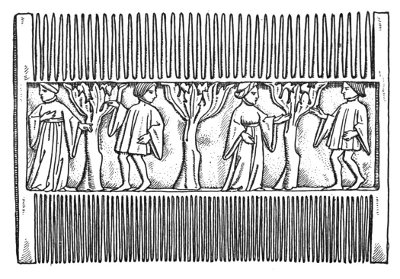
COMB (ITALIAN, FOURTEENTH CENTURY).
IX
THE DRESSING OF THE HAIR, MOUSTACHIOS, AND BEARD
There was nothing new, even in the days of Solomon; wigs, curling
irons, hair powder, and turned-up moustachios being no exception to the
rule.
We have abundant evidence, both from the concurring testimony of
authors and from the actual works which have come down to us, that
heated irons were employed from a very early period for the purpose of
curling the hair and beard. Both with the Assyrians, and the Greeks
of the earlier period, the hair and beard were plaited in a series
of symmetrical curls and ringlets, displaying the utmost degree of
formality in their arrangement.
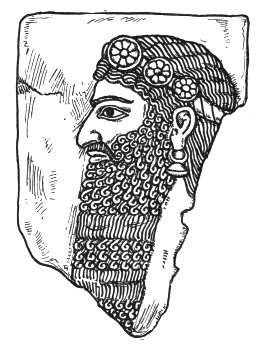
ASSYRIAN BAS-RELIEF.
Layard's "Nineveh."
The hair and beard of Belshazzar when he "made a great feast to a
thousand of his lords," and received an intimation of an unpleasant
character, conveyed to him in an unusual manner, were certainly curled
in such wise, and probably dyed and powdered, as was the custom, the
powder, however, being gold instead of flour, as in more recent days.
As a matter of fact, gold was employed in various ways as an enrichment
to the hair. The Kings of Egypt had their beards interwoven with gold
thread.
Herodotus assures us that the skulls of the Egyptians were much harder
than those of the Persians, owing to the national custom of shaving
the heads of their children at a very early age. He adds, "In other
countries the priests of the gods wear long hair; in Egypt they have
it shaved. With other men it is customary in mourning for the nearest
relations to have their heads shorn; the Egyptians, on occasions of
death, let the hair grow both on the head and face, though till then
they used to shave."
The ceremonies and customs relating to the beard are innumerable. The
management of the beard formed a considerable part of the religion
of the Tartars, who waged a long and bloody war with the Persians,
declaring them infidels, though in other respects of the same faith as
themselves, because they refused to cast their whiskers after the mode
or rite of the Tartars.
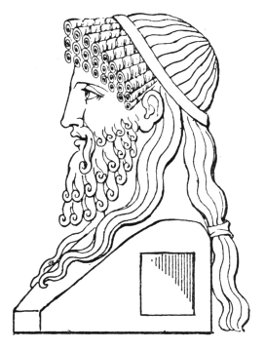
BEARDED BACCHUS.
Hope's "Costume of the Ancients."
It has been recorded that the Greeks wore their beards until the time
of Alexander, who, fearful lest the length of their beards should prove
a handle to their enemies, commanded the Macedonians to be shaven, and
the first who shaved at Athens ever after bore the addition of χοροης (shaven) on medals. Notwithstanding this statement, however,
Philip, the father of Alexander, as well as Amyras and Archelous, his
predecessors, are represented without beards.
According to Pliny, the Romans did not begin to shave until the year of
Rome 454, when P. Titinius brought over a stock of barbers from Sicily.
Pliny adds that Scipio Africanus was the first to introduce the fashion
of shaving daily. It became the custom to have visits of ceremony at
the cutting of the beard for the first time. The first fourteen Roman
Emperors shaved until the time of the Emperor Adrian, who discontinued
the practice and wore a beard, for the purpose, however, of hiding the
scars on his face.
From Gregory of Tours we learn that in the Royal family of France it
was for a long time the peculiar privilege of Kings and Princes of the
blood to wear long hair, artfully dressed and curled; everybody else
was polled, as a sign of inferiority and obedience. To cut off the hair
of a son of France under the first race of Kings was to exclude him
from the right of succession to the crown, and to reduce him to the
condition of a subject.
French historians, however, tell us that Charlemagne wore his hair
short, his son much shorter, and Charles the Bald, as his surname
indicates, none at all.
Good Luitprand furiously declaimed against the Emperor Phocyas for
wearing long hair, after the manner of all the other Emperors of the
East, with the exception of Theophilus, who, being bald, enjoined
all his subjects to shave their heads, like the fox of Æsop, who,
having survived the experience of a trap by the sacrifice of his tail,
harangued the other foxes on the inconvenience of tails in general, and
endeavoured to persuade them to cut off theirs also.
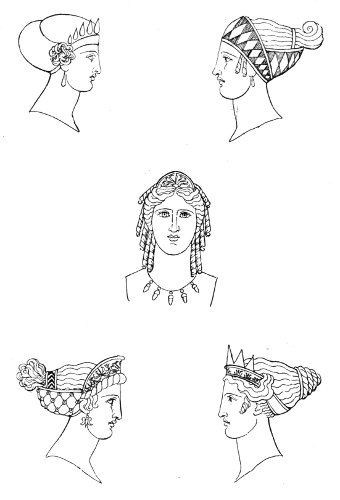
GREEK HEAD-DRESSES.
Hope's "Costume of the Ancients."
In the Church, too, in spite of the beard of Aaron, "that went down
to the skirts of his garments," the Nazarite law, and the reputed
long hair of the founder of Christianity, the priesthood habitually
condemned long hair as being inconsistent with the sacred character
of the priest's office. Pope Anictus is supposed to have been the
first to forbid the clergy to wear long hair. "The Holy Prelate,
Wulstan, reproved the wicked of all ranks with great boldness but he
rebuked those with the greatest severity who were proud of their long
hair."[23] The Nazarite vow is an act of sacrifice in accordance with
the terms of the law laid down in Num. vi. 1-21: "All the days of the
vow of his separation shall no razor come upon his head"; "He shall be
holy, and shall let the locks of his hair grow."
The Nazarite has been regarded as a conqueror who subdued his
temptations, and who wore his long hair as a crown, the hair being worn
rough as a protest against foppery. Another view, however, is that it
was kept elaborately dressed, a proof of the existence of the custom
being seen in the seven locks of Samson:—
"And she made him sleep upon her knees; and she called for a man, and
she caused him to shave off the seven locks of his head; and she
began to afflict him, and his strength went from him" (Judg. xvi. 19).
Let us listen to the story in the quaint, silvery music of Chaucer:—
"This Sampson neyther siser dronk ne wyn
Ne on his heed com rasour noon ne schere
By precept of the messager divyn
For alle his strengthes in his heres were.
. . . . .
Unto his lemman Dalida he tolde
That in his heres al his strengthe lay
And falsly to his foomen sche him solde
And slepying in hir barm upon a day
Sche made to clippe or schere his heres away
And made his foomen al his craft espien
And whan thay fond him in this array
Thay bound him fast and put out bothe his yen.
"But er his heer clipped was or i-schave
Ther was no bond with which men might him bynde
But now is he in prisoun in a cave
Ther as thay made him at the querne grynde
O noble Sampson strengest of al man kynde
O whilom jugge in glory and in richesse
Now maystow wepe with thine eyyen blynde
Sith thou fro wele art falle to wrecchednesse."
Monk's Tale.
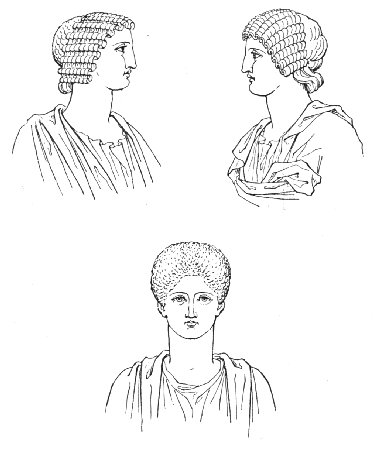
ROMAN HEAD-DRESSES.
Hope's "Costume of the Ancients."
While the hair was the pride, the glory, and the strength of Samson, it
was the bane of Absalom, for by the abundance of his hair he met his
death. "In all Israel there was none to be so much praised as Absalom
for his beauty: from the sole of his foot even to the crown of his
head there was no blemish in him. And when he polled his head (for it
was at every year's end that he polled it: because the hair was heavy,
therefore he polled it), he weighed the hair of his head at two hundred
shekels after the king's weight."[24] Had he polled it at more frequent
intervals he might have made good his succession to the crown, and
Solomon never have been king, for Absalom had "stolen the hearts of the
people of Israel."
As in a mighty river we may trace back its course to the little rill
or rivulet which trickles from the mountain side, so we may often
trace the origin of great events to very small beginnings. How might
the face of both French and English history have been changed but for
Peter Lombard's dislike of a beard! Louis VII. imagined it a matter
of conscience to give an example of submission to the command of
the bishops on the subject of long hair, and to atone for his many
cruelties by being shaved in public. He reckoned, however, without
his—wife, Eleanor of Aquitaine, a jocose madcap, who rallied him upon
his short hair and shaven chin. "I thought I had married a prince, but
find I have wedded nothing but a monk." The breach occasioned by a bare
face was widened, and the marriage dissolved. Six weeks afterwards
Eleanor was again a wife—Henry, Duke of Normandy, who afterwards
reigned as Henry II. of England, being the husband, who obtained
with her fair Aquitaine with its three provinces. Hence arose those
wars which ravaged France for near three centuries, in which upwards
of three millions of Frenchmen perished on the fields of Cressy,
Agincourt, and Poitiers, and on many a lesser field.
Henry I. issued an edict for the suppression of long hair, and as a
natural consequence long hair immediately became the rage. This edict,
however, was the result of a visit to Normandy, and the preaching of
a prelate named Serlo, whose eloquence was such that the monarch and
his courtiers were moved to tears. The astute priest, perceiving the
impression he had created, immediately whipped a pair of scissors from
his sleeve and cropped the whole congregation!
The patriarchal beard and long hair of Edward III., as exhibited in
his effigy at Westminster, is in strict conformity with the general
character of this serious minded monarch, strongly contrasting with the
character of his successor, Richard of Bordeaux, who was the greatest
fop of the day.
During the century which followed the reign of Edward III. beards were
worn of every imaginable cut. There was the fantail beard, with its
wadded nightcap for protection during sleep, of the stiffening which
was applied. There was, as later, the cathedral beard, the spade beard,
the stiletto beard, and there was an extraordinary curled tuft which
resembled a corkscrew. There was apparently as much variety of colour
as of form—
"I will discharge it in either your straw-colour beard, your orange
tawny beard, your purple-in-grain beard, or your French-crown-colour
beard, your perfect yellow" ("A Midsummer Night's Dream," Act I. sc. 2).
Our Royal "Bluebeard" registered a solemn vow before the French
Ambassador that he would never touch razor till he had visited "his
good brother" upon the Field of the Cloth of Gold, the "good brother"
making a similar vow. With characteristic "English perfidy" Henry broke
his vow, while the Frenchman remained true; it was therefore found
necessary for Sir Thomas Boleyn to apologise for his master's bad faith
by saying that "the Queen of England felt an insuperable antipathy to a
bushy chin."
Henry, indeed, not only shaved his own chin and wore his hair short,
but commanded all his subjects to do the same. He granted the barbers a
new charter, incorporated them with the surgeons, and became a member
of their company.
It was found that the "science and connyng of Physyke and Surgerie"
was practised by unskilful persons, "common artificers, as Smythes,
wevers, and women,"[25] who "boldely and custumably take upon theim
grete curis, and thyngys of great difficultie, in which they partely
use socery and whichcrafte" to the grievous hurt of the Kyng's liege
people. It was therefore enacted that none should practise as a
physician and surgeon in London except by examination, duly approved by
the Bishop of London or Dean of St. Paul's(!). As it seemed needful to
provide skilful surgeons for the "helth of mans body whan infirmities
and seckness shal happen," and as there are many surgeons in London who
give instructions to students, who exercise of the said science "to the
greate relief, comforte, and soccour of muche people, and to the sure
savegard of their bodily helth, their lymmes and lyves," and as two
companies of surgeons exist in London, one "the Barbours of London, and
thother company the Surgeons of London," which company of barbours were
first incorporated "undre the greate Seale of the late King of famous
memory, Edwarde the iiijth, dated at Westminster the xxiiijth day of
February in the first yere of his reigne," these two companies ought
therefore to be united into one body, with a common seal, power to hold
lands, and all the rights of both the old companies.
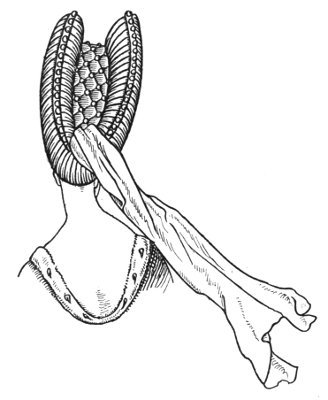
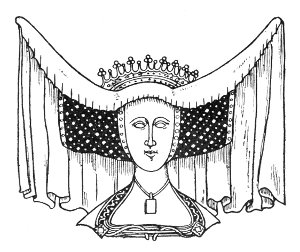
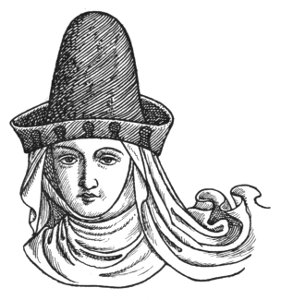
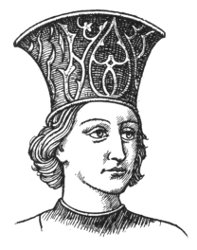
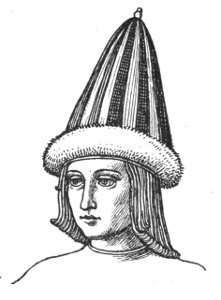
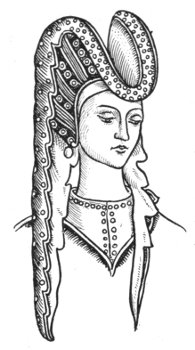
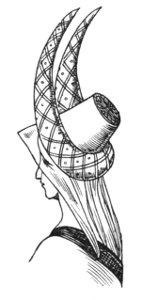
HEAD-DRESS.
From Viollet le Duc (Fifteenth Century).
It was further found that surgeons were in the habit of taking diseased
persons into their houses, where they "doo use and exercise barbery,
as wasshing and shaving, and other feates therunto belonging," very
perilous to the King's people. Now, "after the feast of the Nativitie
of our Lorde God next coming," no barber in London shall practise
surgery, "letting of bludde, or any other thing belonging to surgery,
drawing of teth onelye except." And no surgeon shall "occupye or
exercise the feate or crafte of barbarye or shaving," either by himself
or by any other for him, to his or their use.
It was also provided that any person may keep a barber or a surgeon as
his servant, who may practise in his master's house.
It would appear that the observance of the Lord's day was more strictly
enforced in the seventeenth century than it is at present—
"Att the Councell Chamber on Ouze bridge at York ye xxth of June,
A.D. 1676," it was declared and enacted that whereas barber
surgeons have been shaving and cutting hair on the Lord's day, We
order, that if "any brother of the said company tonse, barbe, or trim
any person on the Lord's day, in any Inn," or other place, public or
private, of which the Lord Mayor shall judge, he shall be fined ten
shillings, and the searchers of the said company for the time being are
to make diligent search in all public and private houses as aforesaid,
for discovery of such offenders.
1745 was the fatal year of the separation of the barbers from their
more dignified colleagues. Their wings were clipped, their privileges
curtailed, the barber's pole and basin, however, still remaining, in
silent, eloquent testimony of their former glory and greatness.[26]
In the reign of Good Queen Bess the campaign against long hair is
continued. Philip Stubbes extols barbers to the skies: "There are no
finer fellowes under the Sunne, nor experter in their noble science of
barbing than they be." Barbers are necessary. "I cannot but marvell at
the beastlinesse of some ruffians (for they are no sober Christians)
that will have their hair grow over their faces like monsters, and
savage people; rather like mad men than otherwise, hanging downe over
their shoulders, as womens haire doth; which indeed is an ornament to
them, being given them as a sign of subjection." In man it is a "shame
and reproch, as the Apostle proveth."
During the reign of the Stuarts long hair was the vogue—with
"love-locks" and "heart breakers."
"A long love-lock on his left shoulder plight,
Like to a woman's hair, well showed a woman's sprite."
"His beard was ruddy hue, and from his head
A wanton lock itself did down dispread
Upon his back; to which, while he did live,
Th' ambiguous name of Elf-lock he did give."
The Great Oyer.
The absurd fashion of painting and patching the face, much ridiculed by
the satirists, began in the reign of Elizabeth.
"Whers the Devill?
He's got a boxe of women's paint—
Where pride is, thers the Divell too."
Quips upon Questions, 1600.
"This is an Embleame for those painted faces,
Where devine beautie rests her for awhile,
Filling their browes with stormes and great disgraces,
That on the pained soule yeelds not a smile,
But puts true love into perpetuall exile;
Hard-hearted Soule, such fortune light on thee
That thou maist be transform'd as well as he."
Chester's Love's Martyr, 1601.
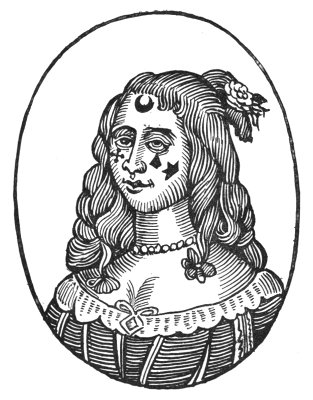
A PAINTED FACE.
Roxburghe Ballads.
By the reign of James I. this ridiculous fashion had become common. All
sorts of curious devices were made use of—spots, stars, crescents,
and in one woodcut a coach and coachman with two horses and postilions
appear upon the lady's forehead. The fashion continued for a long
period; in fact, during the greater part of the Georgian era, when it
had degenerated into mere spots or small patches. At the close of the
eighteenth century it had entirely disappeared.[27]
"Wherfor, faire doughtres, takithe ensaumple, and holde it in your
herte that ye put no thinge to poppe, painte, and fayre youre visages,
the which is made after Goddes ymage, otherwise thanne your Creatoure
and nature hath ordeined; and that ye plucke no browes, nother temples,
nor forhed; and also that ye wasshe not the here of youre hede in none
other thing but in lye and water" ("Advice of the Knight of La Tour
Landry to his iij doughtres").
THE INVINCIBLE PRIDE OF WOMEN.
I have a Wife, the more's my care, who like a gaudy peacock goes,
In top-knots, patches, powder'd hair, besides she is the worst of shrows;
This fills my heart with grief and care to think I must this burden bear.
It is her forecast to contrive to rise about the hour of Noon,
And if she's trimm'd and rigg'd by five, why this I count is very soon;
Then goes she to a ball or play, to pass the pleasant night away.
And when she home returns again, conducted by a bully spark,
If that I in the least complain, she does my words and actions mark,
And does likewise my gullet tear, then roars like thunder in the air.
I never had a groat with her, most solemnly I here declare;
Yet she's as proud as Lucifer, and cannot study what to wear:
In sumptuous robes she still appears, while I am forc'd to hide my ears.
The lofty Top-knots on her crown, with which she sails abroad withal,
Makes me with care, alas! look down, as having now no hope at all,
That ever I shall happy be in such a flaunting Wife as she.
In debt with every shop she runs, for to appear in gaudy pride,
And when the milliner she duns, I then am forc'd my head to hide:
Dear friends, this proud imperious wife she makes me weary of my life.
Roxburghe Ballads, circa 1686.
Wigs of various kinds have been in use from very early periods, as
the grace and ornament which the hair imparts to the human frame have
always been generally recognised. The want of it has ever been deemed
a subject of reproach, held in ridicule, in all climes; hence the
constant recourse to false hair.
Strutt affirms that the beards of the Egyptians, as well as the
coverings for the head, appear to have been made of false hair, and
removed when the face was shaved. There is no doubt that the Egyptians
wore wigs, as examples are to be seen in the British and other museums.
The wig given in the illustration is probably a woman's, and was found
near the small temple of Isis at Thebes. It belongs to the seventeenth
dynasty, about B.C. 1500; it is formed of natural curlings
of the hair in the upper portion, and the lower portion, which was
originally much longer, consists of long, thin plaits, a number of
which have been broken off and decayed, the thin plaitings contrasting
very happily with the natural curls.
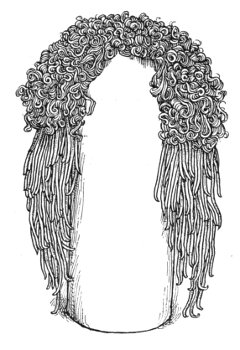
WIG, EGYPTIAN, B.C. 1500.
British Museum.
Lamprideses describes the wig of the Emperor Commodus as powdered with
scrapings of gold, and oiled with glutinous perfumes for the powder to
hang by.
Wigs first appear in England during the reign of Stephen, but are
seldom mentioned until the Tudor period. The "Maiden Queen" is
popularly supposed to have had her head shaved, and to have worn a wig.
Mary Queen of Scots had a most complete collection of wigs, and it is
recorded that she wore one at her execution.
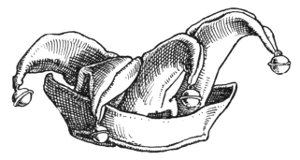
The periwig first appears in history as the headgear of a fool. In
the privy purse expenses of Henry VIII. for December, 1522, occurs
the entry: "For a peryke for Sexton the King's fool xx shillings." By
the middle of the same century their use had become general, and it
was dangerous for children to wander alone, as they were liable to be
deprived of their hair for the manufacture of these articles.
The periwig blossomed out during the reign of Charles II., and attained
enormous proportions; it was often gaily decked with ribbons and
allowed to hang over the front and back for some distance.
The gossiping Pepys, complaining in his diary of October 30, 1663, of
his extravagant purchases in wigs, clothes, &c., mentions, amongst
other things, two periwigs, "one whereof cost me £3 and the other 40s.
I have worn neither yet, but will begin next week, God willing."
"A Londoner into the country went,
To visit his tennants, and gather in rent;
He on a brave gelding did gallantly ride,
With boots and with spurs, and a sword by his side.
Because that the Innkeepers they will not score
He lined his pockets with silver good store;
And he wore a wigg cost three guineas and more;
His hat was cockt up, Sir, behind and before."
Roxburghe Ballads, 1688.
Wigs when first worn were extremely expensive, costing as much as a
hundred guineas, and their value often led to their being stolen from
the head.
The different shapes which the wig assumed were innumerable, and the
different classes of society were identified with particular shaped
wigs. There were the clerical and the physical; the huge tie peruke for
the man of law, the brigadier and the tremendous fox-ear or cluster of
temple curls with a pigtail behind, for the Army and Navy. (The Army
pigtail was shortened to seven inches in 1804, and in 1808 was cut off
altogether.) The merchant, the man of business and of law affected the
grave full-bottom; the tradesman was distinguished by the snug bob or
natty scratch; the country gent by the natural fly and hunting peruke;
"the coachman wore his, as do some to this day, in imitation of the
curled hair of a water-dog."
There were also, as a writer in the London Magazine of 1753 informs
us, the pigeon's wing, the comet, the cauliflower, the royal bird, the
staircase, the ladder, the brush, the wild boar's back, the temple, the
rhinoceros, the corded wolf's paw, Count Saxe's mode, the she-dragon,
the rose, the crutch, the negligent, the chancellor, the cut bob, the
long bob, the half natural, the chain-buckle, the corded buckle, the
snail back, and many others.
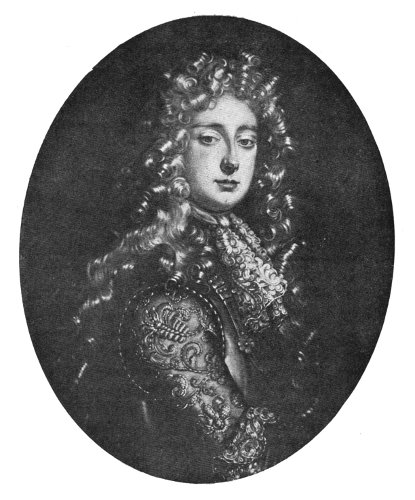
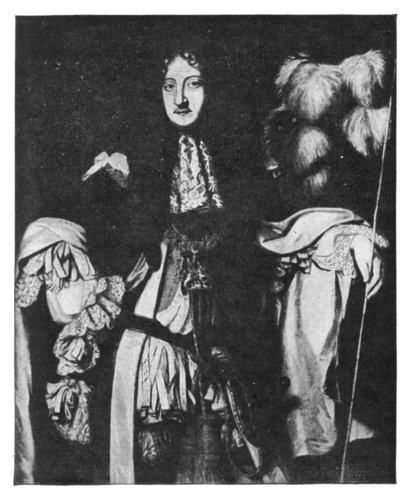
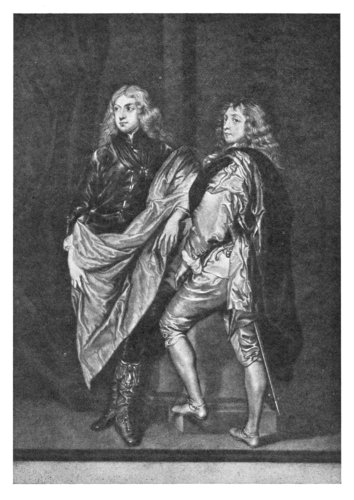
BEAU FIELDING.
After Wissing.
"The Judge," says Fortescue, "while he sitteth in the King's Courts,
weareth a white quoife of silke, which is the principal and chiefe
insignement of habite wherewith Sergeants-at-lawe are dekked, and
neither the Justice nor the Sergeant shall ever put off the quoife, no,
not in the King's presence, though he bee in talke with his majestie's
highnesse."
The coif-cap is still worn on occasions when the Judge passes sentence
of death, but with the colour changed to black, the cap being worn over
the wig.
Samuel Rogers in his "Table Talk" tells a good story of Lord
Ellenborough's wig. On one occasion when the distinguished Judge
was about to go on circuit, his Lady intimated that she would like
to accompany him. He replied that he had no objection, provided she
did not encumber the carriage with band-boxes, which were his utter
abhorrence. During the first day's journey, happening to stretch
his legs, he struck his foot against something below the seat, and
discovered that it was one of the detested band-boxes. Up went the
window, and out went the band-box. The coachman stopped, and the
footman, thinking that the band-box had tumbled out of the window
by some extraordinary chance, was about to pick it up. "Drive on!"
thundered his lordship. The band-box was accordingly left by the
ditch. Upon his arrival at the court at which he was to officiate, and
arraying himself for his appearance at the court-house, "Now," said
he, "where's my wig?—where is my wig?" "My lord," replied the
attendant, "it was thrown out of the carriage window!"
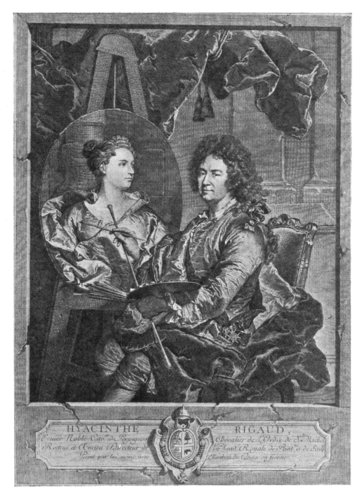
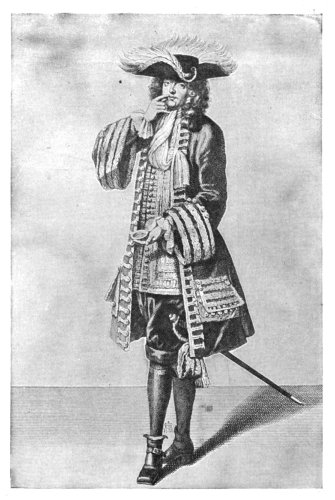
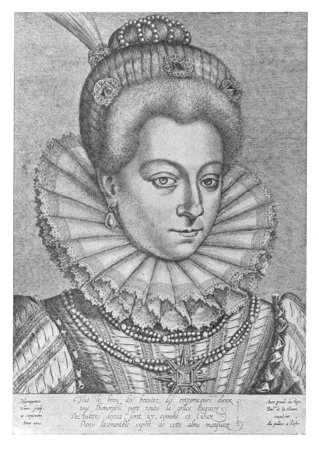
PORTRAIT OF THE PAINTER HYACINTHE RIGAUD.
From 1770 onwards was the period of the highest blossoming of feminine
head-gear. The bodies of these enormous creations were formed of tow,
over which the hair was drawn in great curls, rolls, bobs, &c., with
false hair added, the whole freely plastered over with powder, pomatum,
&c., decorated with huge bows, ribbons, feathers, and flowers.
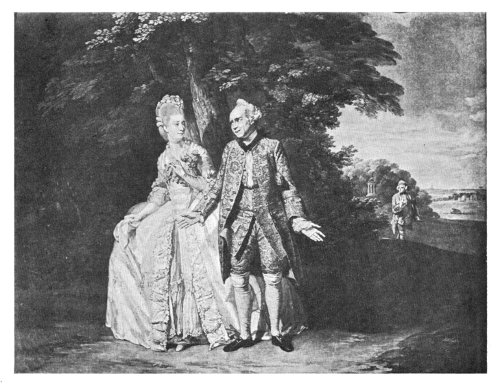
In the "Macaroni Dialogue"—a colloquy between Sir Harry Dimple and
Lady Betty Frisky—in the Lady's Magazine, iv. 1773, which is
illustrated by a picture of a lady and gentleman discussing with great
animation the merits of the male and female costumes of this period, in
which they are clad, the gentleman is presenting to the lady a nosegay,
and she invites his interest in the excessively lofty coiffure which
she is wearing.
"Permit me to present your ladyship with this boquet—it has been to
Warren's, doubly perfumed and scented; so that positively, my lady,
it has not the least of the vulgar odour of the flowers." "I vow, Sir
Harry, you are a man of such nice sensations that you would do honour
to nobility. I am surprised you have hitherto been overlooked in the
creation of Lords." "To be sure, my lady, my taste has never yet been
called into question. It was I who first dethroned those abominable
monsters the Bucks, and established the reign of the Macaronies—who
first improved upon the Poudre à la maréchale by throwing in a dash of
the violet. This hat your ladyship sees is of my own cocking—those
barbarians the hatters have no more idea of 'de retrousser un
chapeau' for a man of genuine taste, than they know how to wear it, and
send it home with the smell of the dye, almost sufficient to make one
faint. I always order my valet to give it a thorough perfume before it
comes into my presence." "O! exquisite refinement—what do you think of
my cap?" "Amazing, my lady, beyond description—yet, had it been but
an inch higher, it would have been at the very summit of the mode—you
would then have been unable to come into a room without stooping, or
riding in a coach without the top being heightened." "You see, Sir
Harry, I have anticipated you: that upon the table is two inches
higher; I shall wear it to-morrow night at the Pantheon." "I hope I
shall have the felicity of your ladyship's hand to walk a minuet. We
shall have all eyes upon us, no doubt!" "I beg, Sir Harry, that your
club may be increased in proportion to my head, else we shall not be
fit partners." "My lady, I shall have it as large again—my toupee
shall be heightened three inches." "You will then, Sir Harry, be the
emperor of the Macaronies." "And you, my lady, their empress."
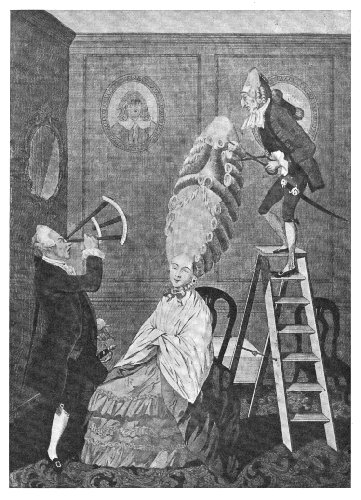
RIDICULOUS TASTE, OR THE LADY'S ABSURDITY.
In a print of the period of the French lady in London, by J. H. Grimm,
published by Carrington Bowles, who appears to have been somewhat
of a wag amongst publishers, devoting himself to the curious and
extraordinary, the lady is seen bowing as she enters the room, the
head-dress reaching to the top of the ceiling. The good man of the
house is so astonished and overcome that he falls to the ground,
bringing the table with him. A large picture upon the wall represents
the Peak of Teneriffe.
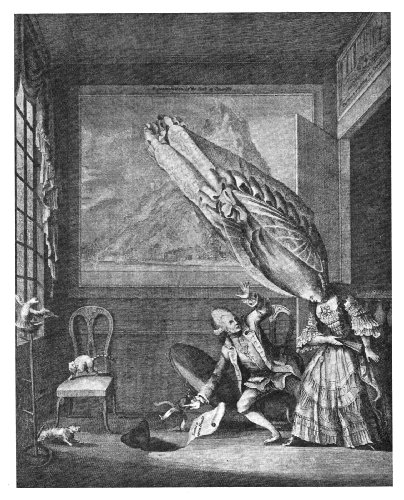
THE FRENCH LADY IN LONDON.
Another print, issued by the same publisher, representing the
fashionable head-dresses for the year 1776, shows two ladies out
walking, attended by their black servant, with head-dresses two yards
high.
In the illustration given of "Ridiculous Taste, or the Lady's
Absurdity," Monsieur le Friseur is mounted on a high pair of steps, and
is operating upon the summit of the lady's coiffure; a gentleman is
taking stock, and giving orders from below.
In the example given from "Jacquemin," the head-dress represents a ship
in full sail.
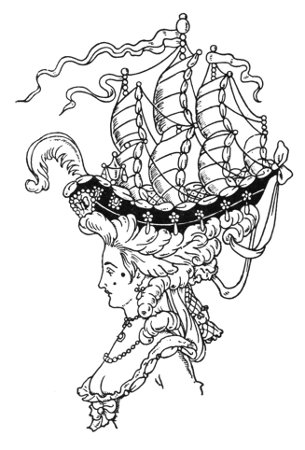
HEAD-DRESS.
From Jacquemin.
In 1776 an etching appeared entitled "Bunker's Hill, or America's
Head-dress." The enormous headgear of the lady represents the battle,
with tents, fortifications, cannon, and battalions. From the crests
of the three hills of the head-dress, which are duly fortified and
defended with soldiery and cannon, three banners are flying, on which
are figured, respectively, a goose, a monkey, and two ladies holding
arrows. The lower portion of the head-dress represents a sea fight.
In the same year appeared "The New Fashioned Phaeton," a mezzotint
representing a conveyance provided with springs, which lifts the lady
and her headgear up to the first-floor window, and does away with the
need for walking up and down stairs.
Another print issued by the same publisher is a "hint to the ladies to
take care of their heads." The ladies' head-dress having caught alight
from a chandelier hanging from the ceiling of a high room, and people
are putting out the fire by means of large squirts.
A charming design for a fancy head-dress is entitled "Betty the Cook
maids Head drest." It is in the form of a heart, the centre of which is
occupied by a Cheshire cheese with mice, surrounded with a border of
greengrocery, &c. On the summit is a stove, with fire alight and meat
cooking. A monkey sits upon the stove, wearing a fool's cap and bells,
and admiring himself in a mirror. On either side of the head-dress are
two trophies composed respectively of a mop and fire-irons and a besom
and cooking utensils.
The legend runs—
"The taste at present all may see,
But none can tell what is to be.
Who knows, when fashion's whims are spread,
But each may wear this kitchen head?
The noddle that so vastly swells,
May wear a fool's cap hung with bells."
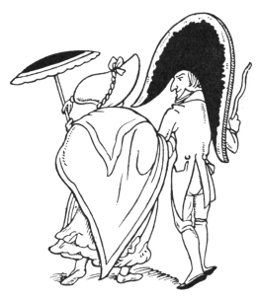
High plumes of feathers re-appeared in 1796. Gillray produced a
caricature of a fashionable belle journeying to the Assembly Rooms
at Bath in a sedan chair. The top of the conveyance is opened to
accommodate the lady's head-dress, a monstrous feather projecting yards
above the sedan—a parasol is fastened to a long pole strapped on the
back of the hindermost portion and protecting the top.
During the feather period, a favourite idea was to represent attacks
by ostriches, peacocks, and other interested birds. This occurs in a
number of prints of the period. The print by John Collet, 1779, of
"The Feathered Fair is a Fright; or, Restore the Borrowed Plumes,"
represents two girls attacked by ostriches:—
"Two lassies who would like their mistresses shine,
On their heads clap'd some feathers to make them look fine;
When two ostriches suddenly came within sight,
And put the poor girls in a terrible fright.
"But how the Birds got to England's no matter,
Tho' they certainly made a most terrible clatter;
Fanny screamed as she ran, and scampering Polly,
With her Fan fought the birds in defence of her folly."
If the reader be curious in regard to the modus operandi of these
astonishing creations, he (or more probably it will be she) is referred
to "Plocacosmos; or, The Whole Art of Hairdressing," by James Stewart,
1782, wherein the mysteries of the art are set forth with great
minuteness and elaboration, far too long to be explained here. The
directions for the lady's "nightcap" may, however, be given:—
"All that is required at night is to take the cap or toke off, as
any other ornament, and as you put them on, you can easily know how
to take them off: with regard to the hair, nothing need be touched
but the curls; you may take the pins out of them, and, with a little
soft pomatum in your hands, stroke the hairs that may have started;
do them with nice long rollers, wind them up to the roots, and turn
the end of each roller firmly in to keep them tight, remembering at
the same time the hair should never be combed at night, having always
so bad an effect as to give a violent headache next day. After the
curls are rolled up, touch them with your pomatumy hands, and stroke
the hair behind; after that take a very large net fillet, which must
be big enough to cover the head and hair, and put it on, and drawing
the strings to a proper tightness behind, till it closes all round the
face and neck like a purse, bring the strings round the front and back
again to the neck, where they must be tied; this, with the finest lawn
handkerchief, is night covering sufficient for the head."
"Heads" usually lasted a matter of three weeks, when—'twould be
dangerous, madam, to delay longer the opening of your head. We get a
glimpse of the possible state of a lady's head at the expiration of
that time from the many recipes and advertisements for the destruction
of insects in the magazines of the period, which reminds us of Julian,
who likened his beard to a "forest grown populous with troublesome
little animals."
"Still to be neat, still to be drest,
As you were going to a feast;
Still to be powdered, still perfumed:
Lady, it is to be presumed,
Though art's hid causes are not found,
All is not sweet, all is not sound.
Give me a look, give me a face,
That makes simplicity a grace;
Robes loosely flowing, hair as free:
Such sweet neglect more taketh me,
Than all the adulteries of art;
They strike mine eyes, but not mine heart."
Ben Jonson, The Silent Woman.
The apeing by the tradespeople of the manners of the great is amusingly
told in the Lady's Magazine for August, 1782, in the form of a letter
to the editor, purporting to be from a respectable greengrocer, who
signs himself "Artichoke Pulse." He says: "I wish to God you would
write something smart against fashion. My family is almost ruined by
the article of dress." It appeared that his son Tom had worked himself
into a gentleman's family as footman, and from this circumstance his
troubles began. "You can scarcely conceive, my dear Sir, what an
alteration this acquaintance with the great family has made. Sally,
my eldest daughter, talks of taste and the mode, aye faith, and the
dresses too. I will give you a description of her going to see the
new comedy of the 'East Indian' the other night, in company with her
brothers and sisters, and a lord's footman, who presented them with
orders for the two-shilling gallery.
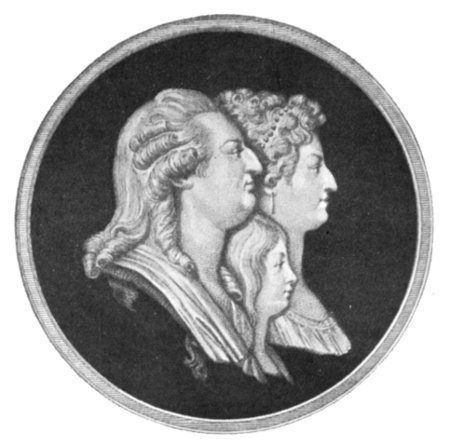
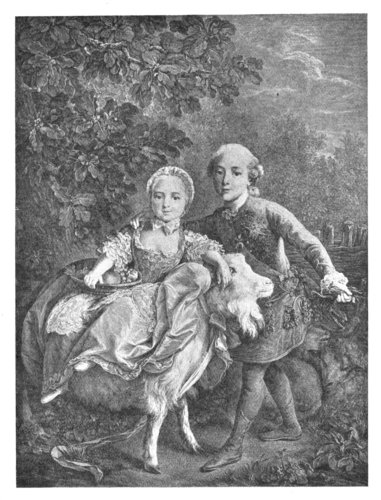
LOUIS XVI., MARIE ANTOINETTE, AND THE DAUPHIN.
Engraved by Augustin de St. Aubin.
"Dick Dusty, the hairdresser's apprentice, who lives in a court
near us, was sent for at two o'clock, and two pound of Sangwine's
eightpenny-halfpenny powder being procured, with a proper quantity
of grease, the operation of the head was begun among the cabbages,
lettuces, turnips, carrots, peas, and beans that surrounded us. Dick,
who was but a novice at his business, cut and slashed away until
he had left just as much hair as he could conveniently dress, and
then, having worked the grease and the flour into a kind of paste, he
plaistered over the head, using his hand as a trowel, until it was
fairly encrusted so as to hide the colour of the hair, or to deceive
the eye into a belief that the head was a pudding bag turned inside out!
"As it was summer, my daughters chose to go without caps, and an
artificial bouquet was stuck in the front of those puddings. The gowns
were silk; but being purchased at a pawnbroker's they were not properly
cut for the fashionable hoop. Hoops, however, were to be wore, and even
my wife resolved for once, to figure away in one of those oval pieces
of nonsense."
"Perhaps in nature, there was never such a figure! Only fashion
to yourself a greengrocer's wife issuing from her cellar in Drury
Lane, with a monstrous hoop, exposing a pair of legs, the ankles as
thick as the calf, and the calf as thick as the modern waist; her
hair bepuddened, her cheeks bedaubed with red, her neck of a crimson
hue, her arms bursting through a pair of white gloves, the contrast
between the two skins being almost the very opposite to each other; a
thick-flowered silk exposing the whole front of a quilted petticoat
that once was white, and then you have the appearance of my wife! Her
daughters made as ridiculous a figure, and Will, I do assure you, was
not the least remarkable in the group."
This sally, recounting the woes of the hapless "Artichoke," provoked
an indignant reply from a champion of the women, which duly appeared in
the next number:—
"I think it high time, then, for every female to exert the little
knowledge she may be possessed of in the scribbling line, when the
wits, under the characters of Green Grocers, dare to insult us, and
speak of our hoops, and other parts of our dress, as freely as they
exercise their authority over the ostlers at a country inn.
"The favour, dear Madam, we wish of you, is to remonstrate with
these smart gentlemen, and, with us, tell them they are incapable
of correcting the foibles in the ladies' dresses, till they have
established a criterion for their own. Did they adopt no other fashions
than useful and becoming ones, they might have some solid reasons for
reprehending us; but how is this to be done? Can they point out of
what use are the high-crowned hats, their shoes tied with strings, the
number of buttons lately added to their coats: of what real service
that ponderosity of their watches and canes? We will even attend to the
Green Grocer, if he can defend them, and no longer despise the opinions
of those scrutators of our dress; but till then we must insist that the
hoop (the battery at which most of their present artillery is played
off against), when of a moderate size, is an addition to the appearance
of a fine woman; it is a finishing grace to their persons, and gives
them that dignity of appearance that every woman in a genteel line of
life has a right to assume."
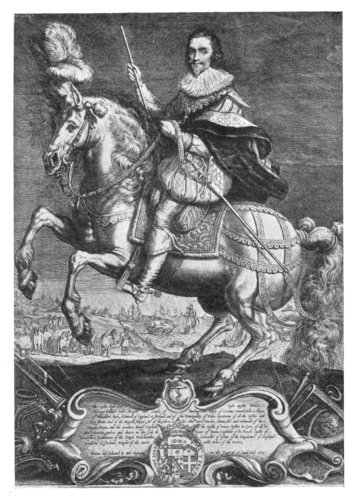
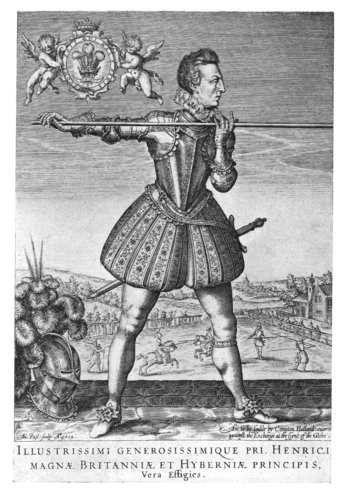
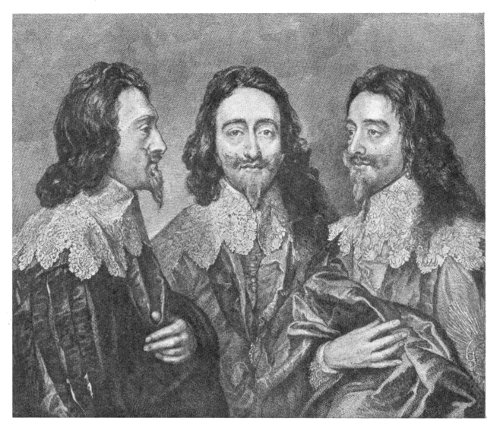
Although Kings have often vainly endeavoured to impose their will upon
the people in the matter of apparel it has often happened that monarchs
have set the prevailing fashion of the period. This is especially
noticeable in the Cavaliers of Charles I., numbers of whom adopted the
short, pointed beard and moustachios and long hair of their master, in
striking contrast to the close cropped and shaven round heads of the
Cromwellians. It was so with the Bonapartists of the Third Empire, when
the "imperial" became the vogue.
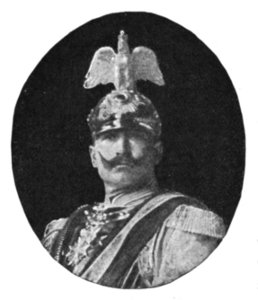
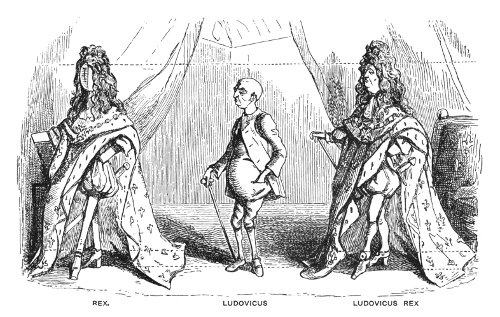
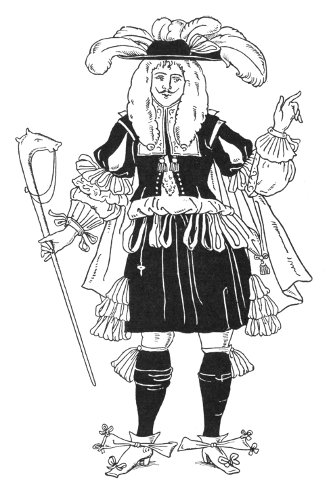
A REIGNING MONARCH.
At a still more recent period, the illustrious personage who is figured
here, and who, be it known, appears here strictly incognito (we would
fain escape the dire consequences of lèse-majesté), has imposed his
imperious will, not only upon his own countrymen, but upon the world at
large, in the matter of the turned up moustachio.
"When you come to be trimed, they will aske you whether you will be cut
to looke terrible to your enimie, or amiable to your freend, grime and
sterne in countenance, or pleasant and demure,—how their mowchatowes
must be preserved and laid out, from one cheke to another, yea, almost
from one eare to another, and turned up like two hornes towards the
forehead" (Stubbes, "Anatomy of Abuses," 1583).
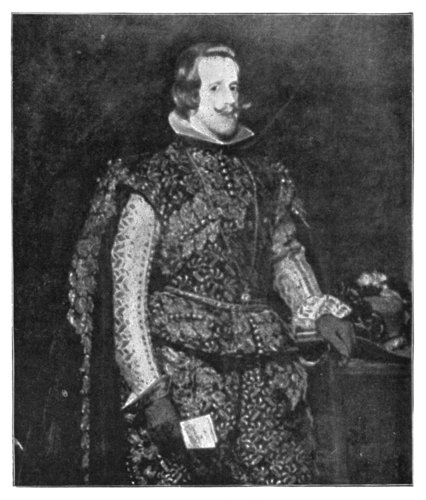
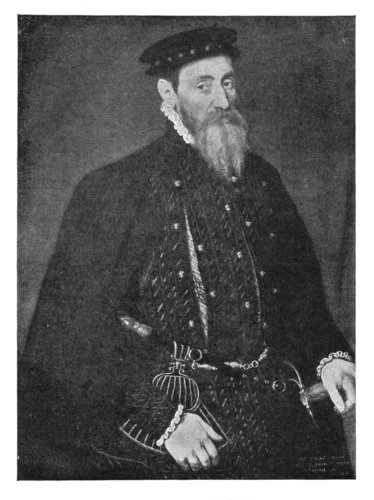
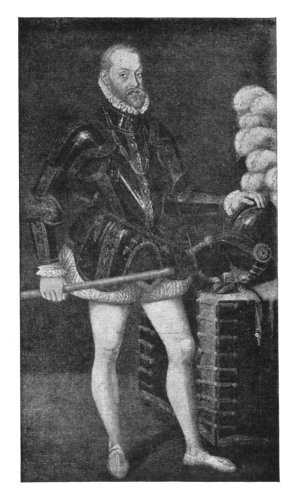
PHILIP IV. OF SPAIN.
The angle at which it is pointed provides an index as to character,
and of the degree of pugnacity of the wearer. At an angle of, say, 45
degrees forward we may expect to see its owner enter a crowded omnibus
with the point of his umbrella held at the same angle, or as a soldier
makes ready to present arms.
In the dressing of the hair, as in costume generally, the lowest depth
of the commonplace has been reached during the nineteenth century. It
is, however, extremely dangerous to indulge in any kind of sweeping
generalities with respect to our own epoch; we are either, from long
habit and custom, prejudiced in favour of a particular régime, or
we are afflicted with that contempt which is born of a too great
familiarity. The chignon, in its many developments, is within the
memory of most of us; the odious Piccadilly fringe still endures with
those persons who are either slaves to habit or who find that the
curling and frizzing of the hair of the forehead destroys its capacity
for growth. Dundreary and mutton-chop whiskers are even now to be found
in out-of-the-way country places. Goldsmith, in one of his delightful
essays, tells a story of a traveller who, on his way to Italy, found
himself in a country where the inhabitants had each a large excrescence
depending from the chin—a deformity which, as it was endemic and
the people little used to strangers, it had been the custom, time
immemorial, to look upon as the greatest beauty. Ladies grew toasts
from the size of their chins, and no men were beaux whose faces were
not broadest at the bottom. It was Sunday; a country church was at
hand, and our traveller was willing to perform the duties of the day.
Upon his first appearance at the church door the eyes of all were fixed
upon the stranger; but what was their amazement when they found that he
actually wanted that emblem of beauty, a pursed chin! Stifled bursts
of laughter, winks, and whispers circulated from visage to visage; the
prismatic figure of the stranger's face was a fund of infinite gaiety.
Our traveller could no longer patiently continue an object of deformity
to point at. "Good folks," said he, "I perceive that I am a very
ridiculous figure here, but I assure you I am reckoned no way deformed
at home."
Lord Dundreary would have been impossible in any other epoch than
the Victorian, although the Dundreary whisker is but a glorified
development of earlier forms—
"A marchaunt was ther with a forked berd,
In motteleye high on horse he sat."
Canterbury Tales.
Dundreary, with his striped peg-tops, his eyeglass, and his drawl,
exactly fitted his environment. His whiskers represent the very
antithesis of the "Piccadilly fringe," also happily gone, or relegated
to the coster fraternity, together with the bell-bottomed trouser with
which it is in singular affinity.
The Piccadilly fringe was persistently condemned by artists, notably
Mr. G. F. Watts, who pointed out that it obscured and destroyed
the beautiful way in which the hair springs from the forehead. Mr.
Watts, however, was not the first to warn the ladies against the sin
of cropping short and pulling out the hair of the forehead. If there
should, peradventure, be any fair readers who are enamoured of the
beauties of either the Piccadilly or other fringe, or who should be
smitten with the insane desire to pop, paint, or powder the face, let
them listen to the sound advice and good counsel which the Knight of
La Tour Landry gave to his daughters, and to the terrible "ensaumples"
which he held up to them for their consideration and avoidance:
"Alas!" he exclaims, "whi take women non hede of the gret love that God
hathe yeve hem to make hem after hys figure? and whi popithe they, and
paintithe, and pluckithe her visage otherwise than God hath ordeined
hem?" Why indeed! There was once a lady who died and suffered great
tortures in hell, the devil holding her "bi the tresses of the here of
her hede, like as a lyon holdithe his praie...." and the same "develle
putte and thruste in her browes, temples, and forehede hote brenninge
alles and nedeles"; and why was she subjected to all this torment?
Because she had "plucked her browes, front and forehed, to have awey
the here, to make her selff the fayrer to the plesinge of the worlde."
It is a very far cry from the good Knight of La Tour Landry to the
wicked Mr. Punch of Fleet Street, who satirises the variations in the
form of the short side whisker still beloved of butlers and ostlers,
and which, in the early days of the Volunteer movement of the
beginning of the sixties, became identified with particular regiments
or companies:—
"Hairdresser: South Middlesex or Keveens, sir? (Customer
looks bewildered.) Why, sir, many corpses, sir, 'as a rekignised
style of 'air, sir, accordin' to the Reg—— (Customer storms.) Not
a wolunteer, sir?—Jus' so, sir. Thought not, sir; leastways I was
a-wonderin' to myself d'rectly I see you, what corpse you could a
belonged to, sir."