FORMERLY, and indeed not so very long ago, no one in
the Highlands of Scotland was considered free of the hill,
or indeed of any account, unless and until he had slain a
stag, a salmon, and an eagle. Nowadays, matters are somewhat
different. The two former, inhabiting as they do the
forests and rivers, are in great request, and have a considerable
money value, and, in consequence, have passed
into the hands of those who have the deepest purses, saving
and except where some few Highland lairds and noblemen
retain their ancient rights in their own hands, and dispense their hospitality
amongst their friends as of yore. As for the golden eagle,
few would attempt, or even wish, to shoot so noble a bird. The ordinary
forest fine of £500 is a sufficient deterrent, if, indeed, any is necessary.
Every effort is now being made, and should be made, to keep the
(now, alas! scarce) king of the birds amongst us.
But if, as we have said, the large majority of the forests and salmon
rivers are rented by those who are able and willing to pay almost any
price for the dignity of being lessees of such tempting and highly-prized
sporting grounds, the general appetite and desire have developed and
grown enormously. Ever-increasing facilities for travelling have brought
with them an ever-growing army of men, all eager to get good salmon
fishing, and searching high and low to secure it. Norway, Sweden,
Iceland, Canada, British Columbia, and a host of other portions of
the globe have been brought into requisition in order to satisfy some
portion of this craving. Small wonder, then, that rents for rivers, spring
or autumn, continue to increase, and that the Government of the day
is being constantly and consistently urged to increase the close time
for net fishing, in order that the upper riparian owners may have some
chance of replenishing their pools.
A man who has once hooked and played a clean-run salmon, and
has experienced the thrill of excitement that continues from the rise
until the salmon is safely landed, is not at all likely to forget it, or
to miss any chance of renewing his acquaintance with Salmo salar.
The contest is such a fair one, there are so many chances in favour
of the fish, that no element of sport is wanting. He is so strong in
the water, so perfectly built for speed, that unless you handle him both
carefully and skilfully you may easily lose him, even if you have brought
him exhausted to the gaff. In that perilous moment, when flopping
and surging near the top of the water, how many a fish effects his
escape! And who is there amongst us but has experienced the sickening
feeling of the straightened rod, and the fly released from the worn hold
in the fish's mouth? It is just the uncertainty of the sport, added to
the strength and vigour of a hooked fish, that form the great allurement
to salmon anglers.
Whilst in trout fishing—more especially with the dry fly—great
accuracy and delicacy of cast are required, the actual fishing for salmon
with the fly makes no such demands upon the angler. Provided that
he can throw a tolerably straight line of reasonable length, so as to
cover the places in the pools where the salmon are wont to rise, many
faults that would entail failure with the dry fly will pass unnoticed,
owing to the fly having been cast into swiftly running water, which
brawling water straightens out in the kindest manner the kinks formed
in the line by the incompetency of the wielder of the rod.
To this extent, therefore, a novice may have the good fortune to
beat the more experienced hand. Once hooked, however, the novice is
out of it, unless he has at hand an experienced mentor, and the odds
are largely in favour of the fish. It is then that the accomplished
angler asserts himself. I have heard of men who consider that the
excitement of salmon fishing begins and ends with the hooking of
the fish, who are willing to hand over to their attendant, or gillie, the
duty which they consider to be monotonous and fatiguing—of playing
the fish.
For my part, I look at the matter from an entirely different point
of view. The combat between the fisherman and the fish is essentially
a gallant one. In the water, a clean-run fish of, say, 18 lb. really plays
the angler for some space of time, and you recognise that although
your experience and intelligence may enable you, within a reasonable
time, to be the victor, yet that you have attached to you a quarry
well worthy of your skill, and one, moreover, who may yet call forth
all your activity and resource, and who cannot be accounted as caught
until he is absolutely on the grass beside you.
I, on the contrary, always consider that playing a salmon is the
most exciting and interesting part of the sport. In playing a fish,
whether it be a heavy trout on a light, single-handed rod, or a clean-run
active salmon on a proportionately suitable rod, a sense of touch is
needed that bears some resemblance to that necessary for the proper
handling of the reins in riding a keen young thoroughbred horse. You
require a keen appreciation of when to allow a certain latitude and when
to exercise all the pressure that the occasion demands.
A heavy-handed man will soon render a sensitive-mouthed young
horse half demented, whilst at the same time quiet, strong hands exert
just that influence that is needed to control his vagaries. Some men
are born with the requisite sensitiveness of touch, others will be clumsy
and heavy-handed to the end of their days. Some will give undue
licence to a fish, will allow him to play for an inordinate length of
time, triplicating thereby the risk of losing him.
It is not possible to lay down on paper any regulations for playing
fish beyond what may be termed the "A B C" of the game. You
should never allow your rod point to be dragged down below an angle
of 45° with the vertical, or a smash of your casting line will be risked.
On the other hand, if the rod be kept too vertical an unfair tax is
placed upon the strength of your middle joint. Another cardinal point,
as every angler knows, is that you should never allow more line off
your reel than you can avoid; that is to say, if your fish means running
either up or down stream, and you feel instinctively that it would be
neither prudent nor practicable to hold him too hard, then you must
try to keep on terms with him by means of your own movements on
the bank side; for it is to be presumed that, although you may have
hooked your fish when wading in mid-stream, you have taken the earliest
opportunity of wading ashore.
Keep nearly level with him, or down stream of him if you can,
and get the weight of the water acting against him as well as the weight
of the line. Never try to force a fish up a heavy stream unless such
a course is absolutely necessary, for the weight of the water, added to
that of the fish, may unduly strain your tackle. That you may be
compelled to try to prevent his going down stream at times goes without
saying, for it may be absolutely necessary to do so; but to endeavour
to force a fresh and strong fish up stream against his will is to court
disaster. Should you have decided that your fish, if it is to be killed
at all, must be kept in the pool in which he then is at all hazards,
by judiciously giving him his head, by means of taking off the strain,
may frequently induce him to abandon his attempt to force his way
down stream, and, under the impression that he has already gained
his freedom, he may often, of his own free will, head up stream once
again. It is a risky, but often the only, course to adopt, if you cannot
or will not follow a fish down.
Mr. Sidney Buxton, in that most charming of books, "Fishing and
Shooting" (John Murray, 1902), sums up the whole matter admirably
when he describes catching and playing salmon as "living moments."
I have seen stalwart soldiers, and I have one V.C. particularly
before my eyes at the moment of writing, covered with perspiration and
quivering in every limb after a long and successful duel with a clean-run
fish. In this respect salmon fishing is ahead of trout fishing, for
the contest is a more even one; though in my opinion the two, being
distinct and incomparable, ought never to be put into the scales and
weighed the one against the other.
Watch an old hand at the game, and observe how easily he controls
the most determined and vigorous rushes of his worthy antagonist;
take out your watch and see how long it will be before the 18 or
20 pounder is brought alongside for the gaff; and then watch the
poor performer, hesitating and uncertain as to when pressure should be
applied or licence given; see how long it takes him to land the 8 lb. or
10 lb. fish; count the number of times that he has to thank a beneficent
providence that he has not lost him; and if, after so doing, you still
incline to your statement that there is nothing in landing a fish, that
the whole pleasurable excitement is concentrated in hooking him, then
I can only reply that I don't agree. The contest between the hooked
salmon and the fisherman is no uneven one—witness the number of
hooked fish that escape—and it is one that is still capable of giving
a thrill of real excitement to those who really love angling.
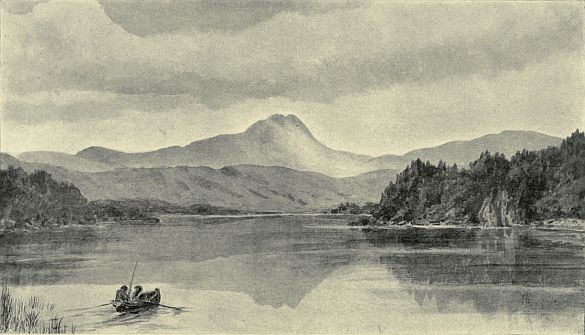
A salmon hooked from a boat in a large loch is, of course, a
different matter; here the odds are so largely in favour of the rod
holder as to unduly diminish the chances of escape to the fish. Such
salmon fishing is outside the scope of our present argument, and falls
into a totally different category. With river-bank fishing, and it is
with that that we are dealing, it would be a bold fisherman indeed
that would count a fish hooked as a fish landed, and a half-hearted
angler that would be content to hand over to the gillie the cream of
the contest between the fish and the man.
Apropos of this nervous excitement, in October, 1900, I formed one
of a shooting party on Don side. The river Don ran within half a
mile from the house, forming as perfect a series of natural pools as
the heart of man could desire. My mouth watered when I saw it, and I
longed to wet a line in it. I found, however, that my host not only loathed
fishing, but was absolutely devoted to bridge. We had but short days
out shooting, everyone rushing back to the lodge to get a rubber or
two before dinner. Professing ignorance of bridge, I begged my host
to let me try the river, as, having been lately fishing on the Dee, I
had my rods and waders with me. With a pitying smile he told me
that I could, of course, amuse myself as I thought best. With no
loss of time I made my way down to the river side, and found it in
grand ply. I was fully aware that the particular part of the Don that
we were on was not popularly supposed to contain many fish at that
time of the year, but it was well worth a trial, and I knew that a
ship laden with lime had lately been sunk at the mouth of the Dee,
and I fancied and hoped that some of the autumn fish might be finding
their way into and up the Don. The pools were so perfect in shape
that no gillie was needed to point me out the best rising-places; they
spoke for themselves and told their own tale.
My first evening produced two clean-run fish of 16½ lb. and 8 lb.,
and my host, when he saw them later, began to think that, after all,
there might be something in angling. The second evening the river
was up and unfishable, but by the third evening it had fined down
into order, and I got a beauty of 20 lb. and a small salmon of 7½ lb.
The glowing accounts I gave of the play of these fish at length excited
my host, and, even at the cost of his rubber of bridge, the next evening
saw him by my side, carefully fishing a leg of mutton pool near the
house, where I had seen and risen a fish the night before. I had to
hold the rod with him and show him how to cast, but I knew pretty
well where my fish lay, and that he was within easy reach. We worked
down to the spot, and, sure enough, up he came with a grand head
and tail rise, hooking himself handsomely. Leaving the rod in my friend's
hands, I told him that he had to do the rest. The first rush nearly
pulled the rod down to the water level, my friend hanging on like
grim death. Fortunately, the gut was sound and stood the strain.
Nearly dying with laughter at his frantic appeals for help and advice,
I shouted to him to keep his rod point up, thoroughly enjoying the
fact that he was having a taste of what he had characterised as a "poor
and tame kind of sport."
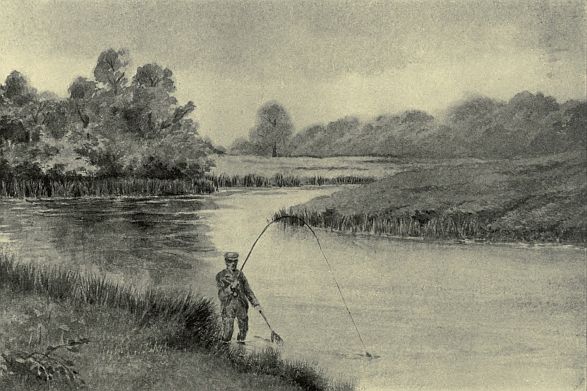
As I particularly wanted him to catch that fish I went to his
assistance. Trembling with excitement and bathed in perspiration, he
was, shortly afterwards, delightedly examining his first salmon, a clean-run
hen fish of 16 lb. I never shall forget his shake of the hand and
his exclamation, "By Jupiter! you have taught me something, this is
worth living for!" Needless to say, he is now mad keen on salmon
angling, and a very capable performer to boot.
Many of us, however, not quite so young as we were, are paying
the penalty of imprudent wading in the times when we scorned to put
on wading trousers. The rheumatic twinges, that hesitation about deep
wading in rivers with bad bottoms, all these are largely bred of our
former contempt for getting wet, and our ill-founded confidence in our
powers of resisting the effects of such very minor matters as wet legs
and feet. We therefore find our choice of fishing water still more
limited: we seek fishings where many of the pools can be commanded
from the bank side, or where, if wading be unavoidable, the bottom
is sound and shelving, and where there are no round slippery stones
to trip us up. Enough for most of us, if we are lucky enough to get
into touch with a good fish, is it that we may have a longish travel
over very rough ground, up and down, before we can call him
ours.
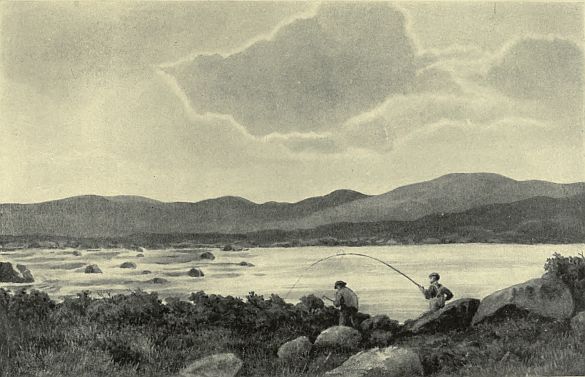
Nearing the End.
One particularly bad-bottomed pool I remember very well in the
Aberdeenshire Dee, not very far below Aboyne. It was a long pool,
the head of water very heavy, the wading throughout simply vile. At
the bottom of the pool was a big rock, nearly in mid-stream, and by
that stone there generally lay a good fish. To reach him you had to
wade as deep as your waders would permit, your elbows almost in
the water, leaning your body against the swirl of the stream, and taking
cautious steps forward, inch by inch, to avoid being tripped up by the
slippery big round stones. Then the best cast you were able to produce
with your 18 ft. Castleconnel would just about reach him. I never
could resist trying for him, though I knew he would go down stream
if hooked, and it seemed impossible to follow him down, so I always
half wished that he might not come. Wading back against that heavy
stream, with a twenty or thirty pounder making tracks round the corner
into the next pool, would have been no easy job; and, if you had
succeeded in reaching terra firma, there were some big overhanging
trees at the corner, beneath which the current had cut a deep hole.
Mercifully for me, though I often tried for him, he never did take
hold, though I rose him several times. It was always with a chastened
spirit of thankfulness that I gave him up and went further down to
try the easier waters of the Boat pool.
There is a local story of a mighty fish, hooked in that self-same
spot, which took its captor down so that he was obliged, perforce, to
swim the deep water under the trees, and was afterwards taken down,
as hard as he could run, through pool after pool, until at length he
managed to steady it in the third pool of the next fishing water. Then,
after a period of sulks, during which both regained their wind, the fish
ran right away up again to his old haunts, where he succeeded in
getting rid of the hook against his favourite rock. All lost fish are
big, and the lapse of time has not in any way diminished his fabled
weight.
Perhaps the one drawback to salmon fishing as an art is that to
which I have already alluded, viz., that the friendly stream corrects of
itself all, or nearly all, errors of slovenly casting, and in that respect
places the duffer more on a par with the really competent. On the
other hand, knowledge and experience, and perhaps more particularly
local experience, will assert itself in the long run, even against the
adventitious success of the novice.
The mere fact of having really fished a pool, whether success reward
your efforts or no, is of itself an element of enjoyment; the feeling
that you have fished, and fished with a really working fly every inch
of fishable water, is per se a cause of satisfaction and pleasure. Here
you are master of the situation; on you depends your chance of sport,
if any is to be obtained.
In grouse driving you may draw the worst butt; or, if you have
the luck to draw the best, the birds may unaccountably take an unusual
line, and, though you may have drawn the "King's butt," nearly every
bird may pass over the heads of your comrades to the right and left
of you. You are, as it were, a mere automaton, to shoot whatever may
come within range; you may be the victim of circumstances, and may
get very few chances.
In hunting, unless you hunt the hounds yourself, you have little
chance of seeing, and none whatever of controlling, the best part of
the game, the working of the hounds. Your main object is to be with
them; they and the huntsman, or master, do the work, you are merely
an accessory.
In fishing, whether it be for trout or salmon, everything from start
to finish rests with yourself; you have to work out your own salvation;
and I venture to assert that it is in consequence of this individual
responsibility that fishing, apart from its other many merits, holds so
high a place in all our affections.
I doubt whether there are many men who have not become aware,
in playing salmon (and perhaps more often when the fish is nearly
played out), of a second fish following the hooked one in all its
movements and stratagems to free itself from the unwelcome attachment
of the rod and line. It has several times happened to me personally,
and on two occasions that I can call to mind I was within an ace of
being able to gaff the free fish when bringing the exhausted and hooked
fish past me for the gaffing process. I feel confident that, had I not
been too much engaged in seeing that my hooked fish did not get free
through any unintentional slackening of my line at that most critical
moment, I could have done so successfully, so assiduous was the
(apparently) hen fish in attendance upon the fish at the end of my line.
Is this a mere matter of curiosity on his or her part, or may it be
attributed to a feeling of camaraderie or friendship? I think no one
can seriously contend for the latter hypothesis, as instances of affection
between such cold-blooded animals as fish have never to my knowledge
been even suggested. We must therefore, I take it, assume that it
is mere curiosity, a desire to see why the hooked fish is acting so
capriciously; and, if this be so, has it not a tendency to modify somewhat
our views as to the necessity of resting pools after a fish has disturbed
them by his being played? The following fish will, of course, have
been taken out of the place where it would probably rise at a fly, and,
therefore, out of any danger for the time being; but travelling fish
are not infrequently hooked and landed.
My observations of salmon, such as they have been, have rather
tended to inspire me with the belief that salmon, when resting in a
pool, take little or no notice of what is going on round them. They
will move just so far aside as to let a rampant fish pass them, gliding
back into their former position the moment he has passed. How often,
when fish are really "on the job," have fishermen caught their four,
five, or even more fish out of one pool of very moderate dimensions,
every square yard of which must have been disturbed by the vagaries
of those caught before them? It seems to me that we are all inclined
to be a bit too cautious and careful in this respect. When the water
is in order, then I should be inclined to say, seize the happy moment,
often short-lived enough, and don't waste time in going to other pools
as long as you have any reason to suppose that the fish are "up," and
that there are other occupants of the pool that you are fishing that
may be grassed.
Somehow or other, if a fish be lightly hooked the information is
conveyed through the line, as through a telephone, to the wielder of
the rod. You obtain a kind of realisation that such is the case, no
matter how well you have endeavoured to drive the barb home. And
his subsequent play shows you how well-founded your feeling was.
You are in constant expectation of seeing your rod point come up—unwelcome
sight—and if you have the luck to get the gaff home, and
the hook drops out of his mouth, you are not one whit astonished,
only thankful that your luck for once was in the ascendant, and that
you have not one more to add to the very considerable number of fish
hooked and lost.
In the same way with a fish that "jiggers," I, rightly or wrongly,
always set him down as being lightly hooked, and invariably offer up
a thanksgiving if he be safely brought to bank. Can anyone tell us
why a fish so acts? It is undoubtedly most disconcerting to the angler,
and must assuredly have a tendency to wear the hold of the hook.
But if it is so effectual, why do not more fish adopt it? Is it not
permissible to think that my hypothesis is right, and that a lightly-hooked
fish is able to appreciate that if he can only enlarge the hold
of the fly he may get free? Or, if this is too much to attribute to
fish intelligence, what other suggestion can be made? Of course, all
my argument is upset if my premise is unsound, that it is lightly-hooked
fish that employ the manœuvre of "jiggering" to free
themselves.
The question is, of course, difficult of solution; at the same time,
I have invariably found that it is just those fish that I have already
set down in my mind as being lightly hooked that have resorted to
that expedient.
I have always found it very advantageous to keep a good yard
of free casting line in my left hand, letting this slack go at the end
of the cast. This is exceedingly useful in getting out a long line;
indeed, it has become such a part of my nature that I invariably do
the same in dry-fly fishing for trout. In that case I find it helps me
to pitch my fly more lightly, and to correct my length; it has one
drawback in trout fishing, in that it prevents you from striking from
the reel, but it does not inconvenience me, for I merely turn the wrist
in striking a trout, so that the fact of my fingers gripping the line
against the rod does not matter. It may not be quite orthodox, but
I find it convenient, and always practise it; in fact, it is so much a
matter of second nature with me that I could not give it up, even if
I wished to do so. It is of great advantage, in fishing any pool, to
have seen the river in all its various stages, so as to know as much
as possible of its bed. As everyone knows, the places where fish rise
vary as the river may be high or low; one place where, in high water,
you might reckon on getting a rise if anywhere, would be absolutely
unlikely when the river is low; and so also in the intermediate stages.
Until you have become fully acquainted with the bed of the various
pools, you are not in a position to make the best of them; that is why
a gillie with local knowledge is so necessary. Perhaps you have
fished a pool when it was in perfect order. The next time you try
it the river has sunk a foot; it may still be fishable, but if you get
a rise it will be almost certainly in a different spot from the time
before.
On the Awe, in Argyleshire, a few years ago, after a summer
drought the river had dwindled down to about half its normal volume.
A rod had been fishing very sedulously a favourite pool of mine called
Arroch. I watched him for some time, and at last suggested that I
did not think he was at all likely to get a fish in the tail of the pool,
where he was employing most of his energies. He replied that he had
caught many a fish in that very part. I told him that it was doubtless
true when the river was in proper order, but that it was most unlikely
in its then condition. Somewhat nettled, he asked me to show him
where I would propose to fish; and, having my rod with me, I
commenced to fish at the very top of the pool, in a narrow, deep neck.
At about my fourth or fifth cast with a very short line, I noticed
below me the silvery glint of a fish that my fly had evidently moved.
Stepping back a little, I began, with great deliberation, to fill and light
a pipe, and then began again where I had originally commenced. At
my fourth cast I saw the same glint, and also felt the fish, which
had taken the fly when it was well sunk and was swirling about in
the quick and heavy stream. It was, of course, a great piece of luck,
yet it served to point my moral and adorn my tale. My friend
was good enough to say that it was a revelation to him, that he
would no more have thought of fishing that neck of the pool than
of flying.
It is astonishing how many anglers are similarly constituted. They
are content to fish a pool in just the same way, no matter what the
state of the river may be. They never seem to fish from their heads,
nor to bring any intelligence to bear. In a really big river it is possible
to pick up an odd fish in the most extraordinary places. Once on
the Carlogie water of the Dee, the river was in big flood, full of snow-brue,
and apparently hopeless to fish; but the grilse had begun to run,
and my time on the water was drawing to a close. Something must
be done; it seemed foolish to stop at home and waste a day, so I
walked up to the top of the Long Pool and fished my own bank down
with a short line. My perseverance was rewarded, and I managed to
secure three grilse. The great thing is to keep going, and to try to
bring all your acquired experience to bear. A dry fly will never catch
a salmon; your fly must be kept in the water, and not on the bank.
The assiduous fisherman will beat the lazy one into fits.
National interest is, undoubtedly, being more constantly directed
to the importance of our salmon fisheries. Thus, this very year, 1905,
an influential deputation, headed by the Duke of Abercorn, was received
at the Offices of the Board of Agriculture, the object being to obtain
Governmental support to a private Bill that had been drafted with
the idea of giving increased powers to the Central Board, and to boards
of Conservators generally. The Bill, mild and tentative though it was
in its provisions, met with but qualified support at headquarters, as it
involved questions of finance, and possible rate aid to boards of
Conservators in carrying out necessary improvements in cases where
the local authorities refused to act. The question is, however, too vast
and too important to be dealt with by piecemeal legislation of any kind,
and, in regard to the vast national asset that is being squandered and
frittered away, demands energetic legislation on a bold scale.
The salmon fishery industry is a factor in the prosperity of the
nation, and the whole issue, with all its branches and ramifications,
should be fairly and squarely tackled in a Government Bill, not in
the interests of a class, but in that of the nation.
It is satisfactory to learn from Lord Onslow that the Government
Bill dealing with obstructions and fish passes, though temporarily
withdrawn last Session, still embodies the views of the present
Administration. We must be thankful for small mercies, but this
Bill merely touches one item of importance, and any Government that
has the courage and wisdom to deal with the question as a whole
will certainly have done something to merit the lasting gratitude of
the whole country.
Since these lines were penned, the Election of January, 1906, has
come and gone, and with it a vast change in the aspect of political
matters. The point, however, that we are advocating is not a party
question. It is a matter affecting the interests of all classes, and it is
devoutly to be hoped that the new Government will take a "liberal"
view of this important matter, and will bring forward a bill, in the
interests of the nation at large, dealing with the whole question of
our salmon harvest in the rivers as well as the sea.
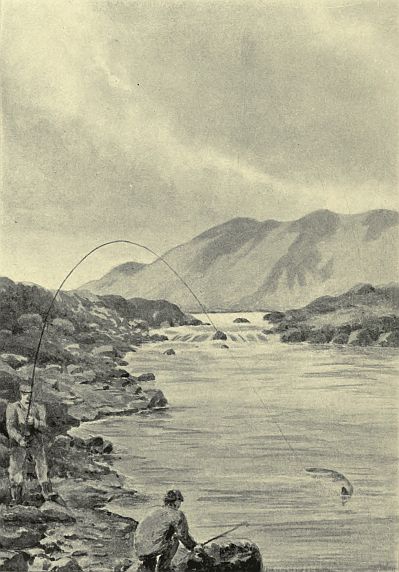
Get the Gaff Ready.