The cover image was created by the transcriber and is placed in the public domain.
POPULAR NOVELS
BY
MRS. MARY J. HOLMES.
Tempest and Sunshine.
English Orphans.
Homestead on Hillside.
‘Lena Rivers.
Meadow Brook.
Dora Deane.
Cousin Maude.
Marian Grey.
Edith Lyle.
Daisy Thornton.
Chateau d’Or.
Queenie Hetherton.
Bessie’s Fortune.
Marguerite.
Mrs. Hallam’s Companion Paul Ralston.
The Tracy Diamonds. (New.)
Darkness and Daylight.
Hugh Worthington.
Cameron Pride.
Rose Mather.
Ethelyn’s Mistake.
Milbank.
Edna Browning.
West Lawn.
Mildred.
Forrest House.
Madeline.
Christmas Stories.
Gretchen.
Dr. Hathern’s Daughters.
“Mrs. Holmes is a peculiarly pleasant and fascinating writer. Her books are always entertaining, and she has the rare faculty of enlisting the sympathy and affections of her readers, and of holding their attention to her pages with deep and absorbing interest.”
Handsomely bound in cloth. Price, $1.00 each, and sent free by mail on receipt of price,
G. W. Dillingham Co., Publishers
NEW YORK.
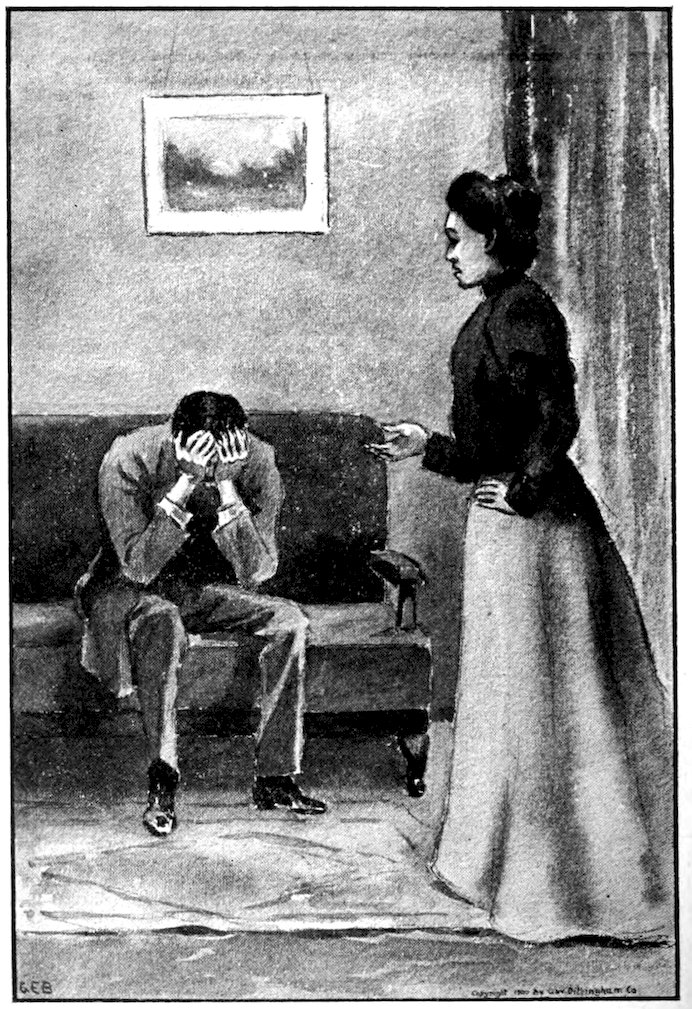
HAVERLEIGH SAT WITH HIS FACE BURIED IN HIS HANDS.—Chateau d’Or, Page 185.
We had left Paris behind us, and were going
down to the southern part of France, as
far as Marseilles and Nice. All day Hal
and I had had the compartment to ourselves, and
had talked, and smoked, and read, and looked
out upon the country through which we were
passing so rapidly. But this had become rather
monotonous, and I was beginning to tire of the
gray rocks, and bleak mountain sides, and gnarled
olive trees, when suddenly, as we turned a curve
and came out into a more open and fertile tract,
Hal seized my arm, and pointing to the left of us,
said:
“Quick, quick! Do you see that old chateau in
the distance?”
10Following the direction of his hand, I saw what
at first seemed to be a mass of dark stone walls,
turrets, towers, and balconies, tumbled promiscuously
together, and forming an immense pile of
ruins. A closer and nearer inspection, however,
showed me a huge stone building, which must
have been very old, judging from its style of architecture,
and the thickness of its walls, and the gray
moss, which had crept up to the very eaves, and
found there before it the ivy, which grows so rankly
and luxuriously in many parts of France.
“Yes, I see it,” I said. “What of it, and what
place is it?”
“That,” said Hal, “is Chateau d’Or, which,
translated into plain English for a stupid like you,
means ‘Chateau of gold,’ though why that somber,
dreary old pile should have that name is more than
I can tell, unless it is that it cost so much to build
it. It is nearly two hundred years old. Its first
owner ruined himself on it, I believe, and it has
passed through many hands since. You see that
stream of water yonder, almost a river? Well, that
passes entirely round the chateau, which really
stands on an island, and is only accessible from one
11point, and that an iron bridge. That old building
has been the scene of the strangest story you ever
heard—almost a tragedy, in fact, and the heroine
was an American woman, and native of my own
town. I’ll tell you about it to-night, after we have
had our dinner.”
I was interested now, and leaned far out of the
window to look at the chateau, which seemed
gloomy and dreary enough to warrant the wildest
story one could tell of it. And that night I heard
the story which I now write down, using sometimes
Hal Morton’s words, and sometimes my own.
THE STORY.
“Millfield,” said Hal, “is one of those
little New England towns which seem
to have been finished up years and
years ago, and gone quietly to sleep without a suspicion
12that anything more could be expected of it.
It stands on a spur of the mountains which lie between
Pittsfield and Albany, and can be distinctly
seen from the car windows, with its spotless houses
of white, with fresh green blinds, and the inevitable
lilac bushes and sweet syringas in front. I was born
there, and when I wish to rest and get away from
the noise and turmoil of New York, I go there and
grow a younger and a better man amid the Sunday
stillness which reigns perpetually in its streets.
And yet you would be surprised to find how much
intelligence and genuine aristocracy that little village
has. There are the Crosbys, who claim relationship
with the Adamses, and a real scion of the
Washingtons, and a lineal descendant of Lord
Cornwallis, and Miss Talleyrand, who prides herself
upon having, in her veins, the best blood in New
England, though good old Deacon Larkin’s wife
once shocked her horribly by saying ‘she didn’t see,
for her part, why Polly Talleyrand need to brag so
about good blood, when she was as full of erysipelas
as she could hold.’”
Here I laughed heartily over Miss Talleyrand’s
13good blood, while Hal lighted a fresh cigar, and
continued:
“Next to these aristocrats—upper crust, as the
deacon’s wife called them—comes the well-to-do
class, tradespeople and mechanics, the people
whose sons and daughters work in the shoe-shops,
for you know the shoe business is nowhere carried
on so extensively as in New England, and it gives
employment to many girls as well as boys, the former
stitching the uppers, as they are called, and the
latter putting on the soles. There is a very large
shop in Millfield, which employs at least fifty girls,
and at the time I am telling you about, there was
not in the whole fifty—no, nor in the entire town—so
pretty a girl as Annie Strong, the heroine of my
story. She was not very intellectual, it is true, or
very fond of books, but she was beautiful to look at,
with a lithe, graceful figure, and winsome ways,
while her voice was sweet and clear as a robin’s.
Birdie Strong, we called her, on account of her
voice, and when she sang in the gallery of the old
brick church, I used to shut my eyes, and fancy I
was in Heaven, listening to the music of the sweetest
singer there.
14“Bob I may as well be frank with you. I was
in love with Annie Strong, and I am certain she
liked me a little, though she never encouraged me in
the least. She was not a bit of a coquette, and made
no secret of the fact that money, and nothing else,
would have any influence with her. Annie was
ambitious, and when, from her shoe-bench in the
hot work-room, she saw Judge Crosby’s daughter
go by in her dainty white dress and sash of blue,
she thought hard, bitter things of the humble life
she led, and vowed to accept the first man who
could give her silks, and lace, and diamonds, and a
place in society.
“At last the man came—a brusque, haughty
Englishman, with a slight limp in his left ankle,
and a cold, hard expression in his steel-gray eyes,
but tolerably good-looking, with a certain assurance
and style, and lavish generosity, which won upon
the people, and made him quite a lion. Eva Crosby
invited him to tea; Miss Talleyrand’s niece drove
with him once or twice; and so he became the fashion.
He was not young—was thirty-five at least,
and looked older. He was of Scottish descent, he
said, though English born, and he owned an estate
15in the north of Scotland, a large chateau in the
south of France, and a city house in London, and he
called himself Ernest Walsingham Haverleigh. If
he chose he could be very gracious and agreeable,
though his manner was always haughty in the extreme,
and had in it an undisguised contempt for
everything American.
“I disliked him from the first, and hated him
after the day of Miss Crosby’s lawn party, to which
Annie Strong was invited, and where she shone the
belle of the fête, notwithstanding that her dress was
a simple blue muslin, and the ruffle round her
throat imitation lace. I learned that fact from hearing
Miss Talleyrand’s niece, from Springfield, say
to Eva Crosby, in speaking of Anna, ‘She is rather
pretty, but decidedly flashy. Her love of finery leads
her to wear imitation lace. If there’s any one thing
I detest, it is that. It always stamps a person.’
“And so Anna was stamped, but did not seem to
mind it at all. How plainly I can see her now as
she came through the gate with her hat in her hand,
and her beautiful hair falling in curls about her
neck and shoulders.
“Up to that moment Haverleigh had maintained
16an indolent, bored attitude, with a look of supreme
indifference on his face, but when Anna joined us,
his manner changed at once, and he devoted himself
to her with a persistency which brought upon her
the jealous rancor of every lady present. But Anna
did not seem to know it, and received the Englishman’s
attentions with an air of sweet unconsciousness,
which only deepened his ardor, and made him
perfectly oblivious to every one around him. The
next day he made some inquiries with regard to
Anna’s family, and before night had learned all there
was to know of them, both good and bad. They
were poor, but perfectly respectable people, and no
taint had ever rested upon the name of Strong.
Years and years before, Grandfather Strong had
married a second wife, with a daughter about the
age of his own son, afterwards Anna’s father, and
this daughter, Milly Gardner, who was in no way
connected with the Strongs, had run away with a
Boston man, who promised her marriage and then
deserted her. A few years later news was received
in Millfield of her death, and so the scandal died
and was buried in poor Milly’s grave, and the family
seldom spoke her name. Indeed, Anna’s mother,
17who was many years younger than her husband,
had never known Milly, while Mr. Strong himself,
who had loved her as a dear sister, never blamed
her. She was more sinned against than sinning,
and so he let her rest in peace, and his children only
knew of her as Aunt Milly, who was very pretty,
and who was dead. Mr. Strong was dead now himself,
and his widow lived in a little red house on the
common, with her three children—Mary, who made
dresses in the winter, and taught school in the summer;
Anna, who worked in the shoe-shop; and
Fred, the youngest and pet of the family, who was
destined for college, and for whom the mother and
sisters hoarded their small earnings and denied
themselves everything.
“This is the history of the Strongs up to the
time when Haverleigh came to Millfield and made
up his mind to marry Anna, with the decided
understanding, however, that in taking her he was
not taking her family. And Anna listened to him,
and throwing aside her love, and pride, and womanhood,
cast into one scale her humble home, with its
poverty and privations, her scanty dress, her hateful
life of toil in the dingy shop, stitching shoes for the
18negroes to wear; while into the other she put a life
of ease and luxury, the country seat in Scotland,
the chateau in Southern France, the city house in
London, with the gay seasons there, and what
weighed more with her—the satins, and laces, and
diamonds which, as Mrs. Haverleigh, she was sure
to wear. Of course, the latter scale overbalanced
the former, and without a particle of love, but rather
with a feeling of dread and fear for the cold Englishman,
Anna promised to be his wife, on one condition.
Fred was to go to college, the mortgage
of five hundred dollars on the red house was to be
paid, her mother was to have a dress of handsome
black silk, and Mary one of dark blue. This request
she made timidly, not daring to look at the
man who, with a sneer on his face, answered, laughingly:
“‘Oh, that is a mere trifle. Fred shall go to
college, the mortgage shall be paid, the silk gowns
shall be forthcoming, and here is the wherewithal.’
“It was a check for five thousand dollars which
he gave her, and his unlooked-for generosity went
far toward reconciling Mrs. Strong and Mary to the
match. And so it was a settled thing, and Anna
19stitched her last shoe in the dingy shop; went
down the staircase for the last time, sang her last
song in church, and was married quietly at home
one lovely morning in July, when Millfield was
looking its best from the effects of a recent rain.
There were drops of crystal on the freshly cut grass,
and the air was sweet with the perfume of roses
and pinks, and heliotrope, while the sky overhead
was blue and clear as the eyes of the young bride,
who, if she felt any regret for the home she was
leaving, did not show it in the least. Perhaps she
was thinking of the costly diamond on her finger,
and the silken robe she wore, or possibly of the
grandeur which awaited her over the sea. Poor
Anna—she was very young—only eighteen—and to
change at once from a poor girl, who was every
morning awakened by the shoe-shop whistle, to a
life she hated, to step into wealth and elegance
must have benumbed and bewildered her so that
she did not realize what she was doing, when at last
she said good-by to the home of her childhood, and
went away alone with a man she had scarcely
known two months—a man whom she did not love,
and who, even while caressing her, made her feel
20the immense condescension it had been on his part
to make her his wife.
“Their destination was New York, where Anna
had never been, and where they were to spend a
week or two before sailing for Europe. At the
hotel where they stopped, Anna met with an old
school friend, who, like herself, was a bride taking
her wedding trip. As was natural, the two young
girls talked together freely of their future prospects
and the husbands they had chosen, and Anna
could not help showing her elation at being the
wife of a man like Mr. Haverleigh.
“‘But tell me honestly, do you love him?’ Mrs.
Fleming, said to her one day. ‘He is not at all the
person I should have selected for you. Why, do
you know I feel a kind of terror stealing over me
every time he speaks to me, there is such a hard
ring in his voice, and it seems to me a cruel look in
his eyes. Then I always thought you would eventually
marry Hal Morton.’
“This was a great deal to say to a bride concerning
her husband, but Lucy Fleming was just the
one to take liberties, and Anna did not resent it in
the least, but answered laughingly: ‘Oh, Hal is
21quite too poor. He took it hard, and looked like a
goosey at the wedding. I fancy he did not like Mr.
Haverleigh, and I see you think him a kind of Blue
Beard, too, and so I confess do I, but then I never
intend to peek, and lose my life as did his silly
wives. Honestly, though, Lucy, I do not love him,
and I experience that same fear of him which you
describe, and actually shrink from him when he
kisses me; but he is very kind to me, and I believe
loves me truly, and I shall make him think that I
love him. I married him for money, for fine
dresses, and jewelry, and handsome furniture, and
servants, and horses and carriages, and that Chateau
d’Or, which did more toward influencing me than
anything else. Only think of living in a house
almost as large as a castle, with a French maid, and
troops of servants, and a housekeeper to take every
care from me; one could endure almost any man
for the sake of all that.’
“Here the conversation ceased, and a moment
after Mr. Haverleigh himself entered the room. To
an ordinary observer there was nothing in his
manner to indicate that he had overheard a word,
but there was a kind of ferocious look in his eyes,
22and his lips were shut more tightly together than
usual as he bowed to Mrs. Fleming, and then,
crossing to his wife, bent over her affectionately,
and kissed her forehead as he asked if she would
take a drive. It was a lovely afternoon. The Park
was full of people, and Anna’s fresh young face
attracted a great deal of notice, as did the haughty
looking man at her side, who had never been as
lover-like in his attentions as he was from that day
on until the ocean was crossed, and they were at
the Grosvenor House in London. His own house
was closed, he said, when Anna asked why they did
not go there, but he drove her past it, and she was
sure she saw a lady’s face looking at them from one
of the upper windows. Haverleigh must have seen
it, too, for he muttered something which sounded
like an execration under his breath, and drove on
faster than before.
“‘Does any one live in your house? I thought
I saw a lady at the window,’ Anna said, timidly,
for she was beginning to understand his moods, as
he called his frequent fits of abstraction, and knew
he was in one now.
“There was nobody occupying his house, and
23she had not seen any one at the window, he
answered rather curtly; but Anna knew she had,
and dreamed that night of the large black eyes
which had peered at her so curiously from the
house on Belgrave Square. She could not be
ignorant of the fact, either, that her husband, while
paying her marked attention, especially in the
parks and at table, was restless, and nervous, and
very anxious to hurry away from London, and very
impatient on account of the slight illness which kept
them there a week longer than he wished to stay.
“Once, just before their marriage, he had asked
her whether she would rather go to Scotland first
or France, and she had answered Scotland, preferring
Southern France later in the autumn, when she
hoped to see Nice and Mentone, before settling
down for the winter at Chateau d’Or. ‘Then to
Scotland we will go,’ he had replied, and she had
greatly anticipated her visit to Scotland, and her
trip through the Trosachs, and across the beautiful
Lakes Lomond and Katrine, but all this was to be
given up; her master had changed his mind, and
without a word of explanation told her they were
going at once to Paris.
24“‘You can attend to your dressmaking better
there than elsewhere, and you know you are fond
of satins, and laces, and jewelry,’ he said, and there
was a gleam in his eye from which Anna would
have shrunk had she noticed it; but she did not.
She was thinking of Paris and its gayeties, and she
packed her trunks without a word of dissent, and
was soon established in a handsome suite of rooms,
at the Grand Hotel, with permission to buy whatever
she wanted, irrespective of expense.
“‘I’d like you to have morning dresses, and dinner
dresses, and evening dresses, and riding dresses,
and walking dresses, and everything necessary to a
lady’s wardrobe,’ he said; and poor unsuspecting
Anna thought, ‘How much society he must expect
me to see, and how glad I shall be of it!’”
Anna was beginning to feel a good deal bored
with no company but that of her husband, for
though he sometimes bowed to ladies on the Boulevards,
no one came to see her, and as their meals
were served in their parlor, she had but little
chance to cultivate the acquaintance of the people
staying at the hotel, so that, with the exception of
her milliner and dressmaker, both of whom spoke
25English, and a few clerks at the different stores, she
could talk with no one in all the great, gay city, and
there gradually settled down upon her a feeling of
loneliness and homesickness, for which all her
costly dresses and jewelry could not make amends.
But this would be changed when they were at Nice
or Mentone, or even at the chateau, which her
husband told her was frequently full of guests during
the autumn months. Oh, how many pictures
she drew of that chateau, with its turrets and towers
overlooking the surrounding country, its beautiful
grounds, its elegantly furnished rooms, its troops of
servants, and herself mistress of it all, with a new
dress for every day in the month if she liked, for
it almost amounted to that before her shopping was
done, and when at last they left Paris, the porters
counted fourteen trunks which they had brought
down from No. —, all the property of the pretty
little lady, whose traveling-dress of gray silk was
a marvel of puffs, and ruffles, and plaitings, and
sashes, as she took her seat in the carriage, and was
driven away through the streets of Paris to the
Lyons Station.
“They were going to the chateau first, her husband
26told her, adding that he hoped the arrangement
suited her.
“‘Oh, certainly,’ she replied. ‘I shall be so
glad to see one of my new homes. I know I shall
like it and perhaps be so happy there that I shall
not care to leave it for a long time. I am getting a
little tired.’
“They were alone in the railway carriage, and
as Anna said this she leaned her head against his
arm as if she were really tired and wanted rest. It
was the first voluntary demonstration of the kind
she had ever made toward him, and there came a
sudden flush into his face and a light into his eyes,
but he did not pass his arm around the drooping
little figure—he merely suffered the bright head to
rest upon his shoulder, while he gazed gloomily out
upon the country they were passing, not thinking
of the dreary landscape, the barren hills, and gray
mountain tops, but rather of the diabolical purpose
from which he had never swerved an hour since the
moment it was formed.
CHAPTER II. CHATEAU D’OR.
27
“It was late one September afternoon
when they came at last in sight of the
chateau, and Haverleigh pointed it out
to Anna, who involuntarily exclaimed:
“‘Why, it’s more like a prison than a house: is
that Chateau d’Or?’
“‘Yes, that’s Chateau d’Or,’ was the short reply,
and fifteen minutes later they stopped at the little
town where they were to leave the train.
“Two men were waiting for them, one the
coachman, who touched his hat with the utmost
deference to his master, while the other seemed on
more familiar terms with Mr. Haverleigh, and
stared so curiously at Anna that she drew her veil
over her face, and conceived for him on the instant
an aversion which she never overcame. He was a
tall, dark man, with a sinister expression on his
face, and a look in his keen black eyes as if he was
28constantly on the alert for something which it was
his duty to discover. Her husband introduced him
as Monsieur Brunell, explaining to her that he was
his confidential agent, his head man, who superintended
Chateau d’Or in his absence, and whose
house was close to the bridge which crossed the
river so that no one could ever leave the grounds
without his knowledge.
“Anna paid little heed to what he was saying
then, though it afterward came back to her with
fearful significance. Now, however, she was too
tired and too anxious to see the inside of the chateau
to think of anything except the man’s disagreeable
face, and she was glad to find herself
alone with her husband in the carriage.
“‘Why does that man stare so impudently at
me? I do not like it,’ she said, and Haverleigh replied,
jestingly:
‘Oh, that’s the way with Frenchmen; he
thinks you pretty, no doubt.’
“They had crossed the bridge by this time, and
Anna noticed that they passed through a heavy iron
gate, which immediately swung together with a dull
thud, which involuntarily sent a shiver through her
29as if it really were the gate of a prison. They were
now in the park and grounds, which were beautifully
kept, and Anna forgot everything else in her
delight at what she saw about her.
“‘Oh, I shall be so happy here!’ she cried, as
they rode along the broad carriage road, and she
saw everywhere signs of luxury and wealth.
“And at that moment Anna was happy. She
had sighed for money, for a home handsomer than
the humble red house far away among the New
England hills, and lo, here was something more
beautiful than anything of which she had even
dreamed. If there had been anything lovable about
Ernest Haverleigh, Anna might have loved him
then in her great delight with the home he was
bringing her to; but there was nothing in his nature
answering to hers, and he did not seem to see how
pleased she was, but sat back in the carriage, with a
dark look on his face and a darker purpose in his
heart. And still he saw her every moment, and
watched the light in her eyes and the clasping of
her hands as she leaned from the window; but it
awoke no answering chord of gladness, unless it
were a gladness that he had it in his power to
30avenge the insult he had received. They were close
to the chateau now, directly in the shadow of the
gray old walls, which looked so dark and gloomy,
so out of keeping with the beauty of the grounds,
that Anna’s spirits sank again, and there was a
tremor in her frame as she descended from the
carriage in the wide court, around which balconies
ran, tier upon tier, and into which so many long,
narrow windows looked.
“At the head of a flight of steps an elderly
woman was standing, her white hair arranged in
puffs about her face, which, though old and
wrinkled, was so sweet and sad in its expression
that Anna felt drawn to her at once, and the court
was not half so damp and dreary, or the walls so
dark and high.
“The woman was dressed in black silk, with a
tasteful lace cap upon her head, while the bunch of
keys attached to her side with a silver chain showed
her to be the housekeeper, even before Mr. Haverleigh
said:
“‘This is Madame Verwest, the head of the
house, just as Monsieur Brunell is head of the
grounds. You will do well to conciliate her, and
31not show your dislike, if you feel it, as you did to
monsieur.’
“‘Oh, I shall love her. I love her now for that
sweet sorry face. Has she had some great trouble,
Ernest?’
“It was the first time Anna had ever called her
husband by the familiar name of Ernest. He had
asked her to do so in the days of their courtship,
and she had answered him, playfully: ‘Oh, Mr.
Haverleigh, you are so much older than I am, and
know so much more, and then—Well, to tell the
truth, I am a little bit afraid of you yet, but by and
by I mean to learn to say Ernest.’
“But the by and by had never come until now.
Anna was the creature of impulse, and while driving
through the handsome grounds she had felt
elated and proud, that she, little Anna Strong, who
once sewed shoes in New England, and planned
how to get an extra pair of gloves, should be riding
in her carriage, the mistress of so much wealth, and
her heart had thrilled a little for the man through
whom this good fortune had come to her. But the
gloomy chateau, and the still more gloomy court,
had driven this all away, and a wave of genuine
32homesickness was sweeping over her when the
serene face of Madame Verwest looked so kindly
down upon her and brought the better feeling back.
She was happy. She was glad she was there, Mr.
Haverleigh’s wife, and she called him Ernest purposely,
and looked up in his face as she did so.
Did he soften toward her at all? Possibly, for a
red flush crept up to his hair; but he raised his
hand as if to brush it away, and then he was himself
again—the man who never forgave, and who
could break a young girl’s heart even while seeming
to caress her. If he heard Anna’s question
with regard to Madam Verwest, he did not notice
it or make her any answer. He merely took her
arm in his, and, leading her up the broad stone
steps, presented her to the lady as Madam Haverleigh,
his wife.
“Instantly there came a change over the placid
features, which kindled with a strange light, and
the dim eyes, which looked so accustomed to tears,
fastened themselves eagerly upon the fair face of
the young girl, and then were raised questioningly
to the dark face of the man whose lips curled
with a sneering smile, as he said, in French:
33“‘She does not understand a word. Ask me
what you please.’
“‘Your wife truly!’ was the quick question of
the woman, and Haverleigh replied:
“‘Yes, truly. What do you take me for?’
“To this there was no answer, but the woman’s
arms were stretched toward Anna with a quick,
sudden motion, as if they fain would hold her a
moment in their embrace; but a look from Mr.
Haverleigh checked the impulse, and only madame’s
hand was offered to Anna, who, nevertheless,
felt the warm welcome in the way the fingers
tightened round her own, and was sure she had
found a friend.
“‘Madame is very welcome, and I hope she
will be happy here,’ the woman said; but she
might as well have talked in Greek to Anna, who
could only guess from her manner what she meant
to say, and who smiled brightly back upon her,
as she followed on up one narrow staircase after
another, until they reached a lofty room, which
she first thought a hall such as the New Englanders
call a ball-room, but which she soon discovered
to be the apartment intended for herself.
34“The floor was inlaid and waxed, and so slippery
that, she came near falling as she first crossed
the threshold. A few Persian rugs were thrown
down here and there, and at the further end, near
to a deep alcove, was a massive rosewood bed
with lace and silken hangings, and heavy tassels
with knotted fringe. On the bed was a light blue
satin spread, covered with real Valenciennes lace
of a most exquisite pattern, and Anna stood a
moment in wonder to look at and marvel at its
richness. Then her eyes went on to the alcove,
across which lace curtains were stretched, and
which was daintily fitted up with the appliances
of the toilet, with the bath-room just beyond. All
this was at the far end of the room, the remainder
of which might have served as a boudoir for the
empress herself, it was so exquisitely furnished
with everything which the ingenuity of Paris could
devise in the way of fauteuil, ottoman, easy-chair,
and lounge, with mosaic tables from Florence, inlaid
cabinets from Rome, lovely porcelains from
Munich and full-length mirrors from Marseilles.
“‘This is your room; how do you like it?’
Mr. Haverleigh asked: and Annie replied:
35“‘I wish mother and Mary knew. I wish they
could be here too. Only the windows are kind
of prison-like, they are so long and narrow, and
so deep in the wall.’
“As she said this she entered one of the arched
recesses and tried to look from the window, but
it was almost too high for her, and by standing
on tip-toe she could just look over the ledge and
get a view of the tree-tops in the grounds, of rocky
hills beyond, and in the far distance a bit of the
blue Mediterranean, which brought back to her
mind a day at the seaside, where she had gone
with a picnic party and bathed in the Atlantic.
That day seemed so very, very far back in the
past, and the ocean waves she had watched as they
broke upon the beach was so far, far away that
again that throb of homesickness swept over her,
and there were tears in her eyes when she turned
from the window and came back into the salon.
It was empty, for both her husband and Madame
Verwest had left it, and she was free to look about
her as much as she liked, and to examine the many
beautiful things with which the salon was filled.
But they did not quite satisfy her now, for that
36pang of pain was still in her heart cutting like a
knife, and her thoughts went back to the day when
she and Mary had fitted the cheap ingrain carpet
and white curtains to the little parlor at home,
and thought it, when done, the finest room in Millfield.
The carpet and curtains were there still,
but oh, how many miles and miles of land and
sea lay between her and the humble surroundings
she had once so fretted against, longing for something
better! She had the something better, but
it did not satisfy, and it was so dreadful to be in
a strange land where she could not understand a
word the people said, and it would be still more
dreadful without Mr. Haverleigh there as interpreter,
she thought; and there began to grow in
her a sense of nearness to her husband, a feeling
of dependence upon and protection in him such as
she had not experienced before.
‘I believe I could love him after all; anyway,
I mean to try, and will begin to-night,’ she thought,
just as there came a knock upon the door, and in
answer to her ‘Entrez,’ the one French word besides
oui which she knew, a smart-looking young woman
37entered, followed by a man, who was bringing in
her trunks.
“With a low courtesy, the girl managed to
make Anna understand that her name was Celine,
and that she was to be her waiting-maid, and had
come to dress her for dinner.
“‘Voyez les clefs,’ she said, holding up the keys
which her master had given her, one of which
she proceeded to fit to a certain trunk, as if she knew
its contents, and that it contained what she wanted.
“Anna had not before had the luxury of a maid,
but she accepted it naturally as she did everything
else, and gave herself at once into the deft hands
of Celine, who brushed and arranged her beautiful
hair with many expressions of delight, not one
of which Anna understood. But she knew she
was being complimented, and when her toilet was
completed, and she saw herself in one of the long
mirrors arrayed in a soft, light gray silk, with
trimmings of blue and lace, with flowers in her
hair, and pearls on her arms and neck, she felt
that Celine’s praises were just, and laughed back
at the vision of her own loveliness.
“‘Oh, if the folks at home could see me now
38they would say it paid,’ she thought, as she walked
up and down the apartment, trailing her silken
robe after her, and catching frequent flashes of
her beauty in the mirrors as she passed.
“And still there was a little of the old homesickness
left, a yearning for companionship, for
somebody to see her, somebody to talk to, and
then she remembered her resolution to try to love
her husband, and she said again: ‘I’ll do it, and
I’ll begin to-night.’
“But where was he that he left her thus alone,
walking up and down, until, too tired to walk longer,
she seated herself upon a satin couch to await his
coming, little dreaming as she sat there of the
scene which had taken place between him and
Madame Verwest, who had invited him to her
own room, and then turning fiercely upon him,
demanded: ‘Tell me, is she your wife, or another
Agatha, brought here to beat her wings against
her prison bars until death gives her release? She
is too young for that, too beautiful, too innocent,
with those childish eyes of blue. Tell me you
mean well by her, or——’
“She did not finish her threat, save by a stamp
39of her foot and an angry flash of the eyes, which
had looked so pityingly at Anna, for Haverleigh
interrupted her with a coarse laugh, and said:
‘Spare yourself all uneasiness and puny threats
which can avail nothing. You are as much in
my power as she. Honestly, though, this girl is
as lawfully my wife as a New England parson
could make her.’
“‘New England,’ and the woman started as if
stung. ‘Is she an American? Is she from New
England? You wrote me she was English born.’
“‘Did I? I had forgotten it. Well, then, she
is an American and a New Englander, and her
name was Anna Strong, and she worked in a shoe-shop
in Millfield, where I stopped for a few months
on account of the scenery first, and her pretty face
afterward. I married her for love, and because I
fancied she loved me a little; but I have found
she does not, and so she shall pay the penalty,
but have her price all the same, diamonds and
pearls, with satins and laces and a dress for every
day of the month.’
“He spoke bitterly, and in his eyes there was
a look which boded no good to Anna, but Madame
40Verwest scarcely heard him. At the mention of
Anna’s name and Millfield she had laid her hand
suddenly over her heart, which beat so loudly that
she could hear it herself, while her eyes had in
them a concentrated, far-off look, and she evidently
was not thinking of the objects around her, the
old chateau and the dreadful man who brought
her back to the present by saying:
“‘I shall leave her here with you for a time,
and it is my wish that she has everything she
wants except, of course, her freedom; you understand?’
“She did understand; she had been through
the same thing once before, and she shuddered
as she remembered the dark-haired, white-faced
girl, who had died in that gloomy house, with wild
snatches of song upon her lips, songs of ‘Ma Normandie,’
and the home where she had once been
pure and innocent. ‘Je vais re voir, ma Normandie’
poor Agatha had sung as the breath was leaving
her quivering lips, and the sad, sweet refrain had
seemed to Madame Verwest to haunt the old
chateau ever since, and now was she destined to
hear another death-song or moaning cry for New
41England instead of Normandy? ‘Never!’ was her
mental reply, and to herself she vowed that the
fate of Anna Strong should not be like that of
Agatha Wynde. But she could do nothing then
except to bow in acquiescence as she listened to
Haverleigh’s instructions, and from them gathered
what his intentions were. Not to desert Anna
absolutely; he could not bring himself to do that,
for the love he had felt for her was not yet
extinct; but she had offended him deeply, and
had hurt his pride, and for the present she was a
prisoner in Chateau d’Or, till such time as he chose
to set her free, or ‘till she recovers her reason,
you know,’ he said to Madame Verwest, who made
no sign that she heard him, but whose face was
white as ashes as she went out from his presence,
and gave orders that dinner was to be served at
once in the grand salle-a-manger, which was all
ablaze with wax candles and tapers when Haverleigh
led his bride thither, and gave her a place
at the head of his table.
“He had found her asleep on the couch, where
she had thrown herself from sheer fatigue, and
for a moment had stood looking down upon her
42childish, beautiful face, while something like pity
did for an instant stir his stony heart. But only
for an instant, for when he remembered her words,
‘I do not love him, and never expect to,’ he hardened
against her at once, and the gleam in his
eye was the gleam of a mad man as he touched
her arm and bade her rouse herself.
“It is not necessary to describe in detail that
elaborate dinner of ten courses, which was served
from solid silver, with two or three servants in
attendance. Haverleigh was very rich and very
purse-proud, and it suited him to live like a prince
wherever he was; besides, he wished to impress
the simple New England girl with a sense of his
greatness and wealth, and he enjoyed her evident
embarrassment, or rather bewilderment, at so much
glitter and display for just themselves and no one
else. Anna had not forgotten her resolution to
try to love him, and after their return to the salon,
where a bright wood fire had been kindled, as
the autumn night was chilly, she stole up behind
him as he lounged in his easy-chair, and laying
her white arms about his neck, drew his head back
43until her lips touched his forehead. Then she said,
softly and timidly:
“‘Ernest, this is our first coming home, and
I want to thank you for all the beautiful things
with which you have surrounded me, and to tell
you that I mean to be the best and most faithful
of little wives to you.’
“It was quite a speech for Anna, who stood
in great fear of the man she could not understand,
and who seemed to her to be possessed of
two spirits, one good and one bad, and should
she rouse the latter she knew it would not be in
her power to cope with it. But she had no fear
of rousing it now, and she felt as if turning into
stone when, for reply to her caress, he sprang to
his feet and placing a hand on either of her
shoulders, stood looking at her with an expression
in his eyes she could not meet and before
which she cowered at last, and with quivering lip
said to him:
“‘Please take your hands from my shoulders;
you hurt me, you press so hard. And why do
you look so terribly at me? You make me afraid
44of you, and I wanted to love you to-night. What
have I done?’
“Then he released her, and flinging her from
him left the salon without a word, and she saw
him no more that night. At eleven o’clock Celine
came in to undress her, and when Anna managed
to make her understand that she wished to know
where Monsieur Haverleigh was, she only received
for answer a meaning shrug and a peculiar lifting
of the eyelids, which she could construe as she
liked. It was not so pleasant a home-coming after
all, and Anna’s first night at the chateau was passed
with watching, and waiting, and tears, and that
intense listening which tells so upon the brain.
Once she thought to leave the room, but the door
was bolted on the other side, and so at last, when
wearied with walking up and down the long apartment,
she threw herself upon the rosewood bed
and fell into a disturbed and unrestful sleep.
“Meanwhile the master—Haverleigh—was fighting
a fiercer battle with himself than he had ever
fought before. He had said that his mind was
made up, and he was one who boasted that when
once this was so nothing could turn him from his
45purpose; his yea was yea, his nay, nay, but those
white arms around his neck, and the touch of
those fresh lips upon his forehead had not been
without their effect, though the effect was like the
pouring of molten lead into his veins, and had
made him what, at times, he was, a mad man.
When he rushed from Anna’s presence, with that
wild look in his eye and the raging fire in his
heart, he went straight to the dark, dreary room
where Agatha had died with the sweet refrain
‘Je vais revoir, ma Normandie,’ upon her lips, and
there amid the gloom and haunting memories of
the place walked up and down the livelong night,
now thinking, thinking, with head bent down, and
now gesticulating in empty air with clinched fist,
and again talking to himself, or rather to the
spirits, good and bad, which seemed to have possession
of him.
“‘Was she in earnest? Did she mean it? Is
it possible that she might learn to love me through
these baubles she prizes so much?’ he questioned
of his better nature, which replied:
“‘Try her, and see. Don’t leave her here in this
dreary place Don’t shut out all the gladness and
46sunshine from her young life. Give her a chance.
Remember Agatha.’
“Just then, through the casement he had thrown
open, there came a gust of the night-wind, which
lifted the muslin drapery of the tall bed in the
corner and swept it toward him, making him start,
it was so like the white, tossing, billowy figure
he had seen there once, begging him for the love
of God to set her free, and let her go back to
‘la belle Normandie,’ where the father was watching
for her, and would welcome her home again.
“Was Agatha, the wild rose of Normandy,
pleading for Anna, the singing bird from New
England? Possibly; and if so, she pleaded well,
and might have gained her cause if the wicked
spirit had not interposed, and sneeringly repeated:
‘Do not love him—shrink from his caresses—can’t
endure to have him touch me—married him for
money—can wind him round my little finger.’ And
that last turned the scale. No man likes to be
wound round any finger, however small it may
be, and Ernest Haverleigh was not an exception.
“‘She shall pay for that,’ he said—‘shall suffer
until the demon within me is satisfied, and I
47rather think I am possessed of the devil. Eugenie
says I am, in her last interesting document,’ and
he laughed bitterly, as he took from his pocket
a dainty little epistle, bearing the London post-mark,
and stepping to the window, through which
the early morning light was streaming, glanced
again at the letter which had been forwarded to
him from Paris, and a part of which had reference
to Anna.
“‘Who was the doll-faced little girl I saw with
you in the carriage, and why didn’t you call upon
me after that day? Were you afraid to meet me,
and what new fancy is this so soon after that other
affair? Ernest Haverleigh, I believe you are possessed
with a demon, which makes you at times
a maniac.’
‘Yes, I believe I am mad. I wonder if it is
in the family far back, working itself out in me?’
Haverleigh said, as he stood with his eyes riveted
upon the last two lines. ‘Curse this woman with
that spell she holds over me. If it were not for
her Agatha might have been living, and I might
forgive Anna, for I do believe I am nearer loving
her than any woman I ever saw, and that is why
48I feel so bitter, so unrelenting, so determined upon
revenge.’
“There were signs of waking life in and around
the chateau now. The servants were astir, and
so Haverleigh left the room where he had passed
the night, and which since Agatha’s death had
borne the cognomen of ‘the haunted chamber.’ On
the stairs he met with Madame Verwest, who stood
with hands folded and eyes bent down, her usual
attitude while receiving his orders.
“Anna was to have breakfast in her own room,
he said, and be waited on by Celine, and then
about ten o’clock he would see her alone, for he
must be off that night for Paris.
“It was a very dainty breakfast of chocolate,
and fruits, and French rolls, and limpid honey and
eggs which Celine took to her mistress, whom she
had dressed becomingly in a white cashmere wrapper,
with broad blue sash, knotted at the side, and
a blue silk, sleeveless jacket. In spite of the weary
night, Anna was very beautiful that morning,
though a little pale and worn, with a shadow
about the eyes, which were lifted so timidly and
49questioningly to Haverleigh when at last he entered
the salon and closed the door behind him.
“‘Oh, Ernest, husband!’ she began; but she
never called him by either of those names again,
and half an hour later she lay on her face among
the silken cushions of the couch, a terrified, bewildered,
half-crazed creature, to whom death would
have been a welcome relief just then.
“He had succeeded in making her comprehend
her position fully, and in some degree to comprehend
him. He was a man who never forgot and
who never forgave. He had loved her, he believed;
at least, he had conferred upon her the great honor
of becoming his wife—had raised her from nothing
to a high and dazzling position, because he liked
her face and fancied she liked him. She had certainly
made him think so, and he, whom many a
high-born damsel of both Scotland and England
had tried to captivate, had made a little Yankee
shoe-stitcher Mrs. Haverleigh, and then had heard
from her own lips that she loathed him, that she
shrank from his touch, that she married him for
money, for fine dresses, and jewelry, and furniture,
and horses, and carriages, and servants—and he
50added with an oath: ‘You shall have all this.
You shall have everything you married me for,
except your freedom, and that you never shall have
until I change my purpose;’ then, without giving
her a chance to speak in her own defense, he went
on to unfold his plan formed on the instant when
he stood by the door in New York and heard her
foolish speech to Mrs. Fleming. She was to remain
at Chateau d’Or, where every possible luxury was
to be hers, and where the servants were to yield her
perfect obedience, except in one particular. She
was never to go unattended outside the grounds, or
off the little island on which the chateau stood.
Monsieur Brunell, who kept the gate, would see
this law enforced, as he would see to everything
else. All letters which she wished to send to him
or her friends would be given to Brunell’s care.
No other person would dare touch them, and it
would be useless for her to try to persuade or bribe
them, as they all feared him and would obey his
orders. For society she would have Madame Verwest,
and plenty of books in the library, and a
splendid piano, which she would find in the same
room, with a small cabinet organ for Sunday use,
51‘as you New Englanders are all so pious,’ he added,
with a sneer. Then pausing a moment, as if to
rally his forces for a last blow, he said, slowly and
distinctly:
“Brunell and Madame Verwest know you are
my wife, but I have told them you are crazy, and
that rather than send you to a lunatic asylum, I
shall keep you in close confinement here for a
while, unless you become furious, in which case
there are plenty of places for you, not so good as
this, or as much to your taste. To the other servants
I make no explanations, except that you are
crazy, and that it is a fancy of yours that you are
not. This fancy they will humor to a certain extent,
but you cannot bribe them. They will give
you every possible attention. Celine will wait upon
you as if you were a queen. You can dine in state
every day, with twenty courses, if you like, and
wear a new dress each time. You can drive in the
grounds when it suits you, and drive alone there;
but when you go outside the gates, Madame Verwest,
or Celine, or some trusty person will accompany
you, as it is not safe for a lunatic to go
by herself into strange quarters. At intervals, as it
52suits my convenience or pleasure, I shall visit you
as my wife, and shall be the most devoted of husbands
in the presence of the servants, who will
thus give me their sympathy and wholly discredit
anything you may tell them. So beat your pretty
wings as you may, and break your heart as often as
you like, you cannot help yourself. I am supreme
here. I am your master, and Madame Verwest
says of me sometimes that I am a madman—ha,
ha!”
“It was the laugh of a demon, and the look
of the man was the look of a madman as he pushed
from him the quivering form which had thrown
itself upon the floor at his feet supplicating for
pity, for pardon. He had neither, and with a coarse
laugh which echoed through the salon like the
knell of death to all poor Anna’s happiness, he
left the room and she heard his heavy footsteps as
he went swiftly down the stone stairway and out
into the court.
“Was it a dream, a nightmare, or a horrible
reality, she asked herself as she tried to recall the
dreadful things he had said to her and to understand
their import. ‘A prisoner, a maniac,’ she
53whispered. ‘Oh, mother, oh, Mary, that I should
come to this. Oh, if I could die, if I could die;’
and in her anguish she looked about her for some
means of ending her wretched life. Her New
England training, however, was too strong for that.
She dared not deliberately and suddenly die by
her own hand, but if this thing were true, if she
were a prisoner here with no means of escape, she
would starve herself to death. They could not
compel her to eat, and she would never taste food
again until she knew that she was free.
“There was a murmur of voices in the court
below, and a sound of wheels crushing over the
gravel. Was he really going, and without her?
She must know, and springing from her crouching
attitude she started for the door, but found it locked
from the other side it would seem, and she was a
prisoner indeed, and for a time a maniac as well, if
sobs and moans and piteous cries for some one to
come to her aid could be called proofs of insanity.
But no one came, and the hours dragged heavily on
till she heard the house clock strike four, and then
Celine came in to dress madame for dinner, but
Anna waved her off loathing the very thought of
54food—loathing the glitter and display of the day
before—loathing the elegant dresses which Celine
spread out before her, hoping thus to tempt her.
“‘Go away, go away, or let me out,’ she
cried, while Celine, who could not understand a
word, kept at a safe distance, eying her young mistress
and thinking it very strange that her master
should have two crazy girls in succession—poor
Agatha Wynde and this fair American, who Madame
Verwest said was his wife.
“‘Perhaps,’ Celine had thought with a shrug of
her shoulders; ‘but if the lady is his wife why leave
her so quick?’
“But wife or not it was Celine’s business to
attend her, and she had no intention of shrinking
from her duty.
“‘Poor girl, and so young,’ she thought, and she
tried to quiet and conciliate her, and brought out
dress after dress and held up to view, until, maddened
at the sight of the finery so detestable to her
now, Anna shut her eyes, and stopping her ears
shrieked aloud in the utter abandonment of despair.
“‘Mon Dieu,’ Celine exclaimed, as she fled from
the room in quest of Madame Verwest, whose face
55was white as marble and whose eyes had in them a
look which Celine had never seen before. But she
did not offer to go near the lady whom Celine represented
as being so bad, nor did she see her during
that day or the next. She, too, was acting very
queerly, the servants said to each other, as they
talked in whispers of the American who refused to
touch a morsel of food, and who had not tasted a
mouthful since the master went away.
“She was in bed now, Celine said, lying with
her face to the wall, and moaning so sadly and saying
things she could not understand. ‘If Madame
would only go to her and speak one word—Anglaise,’
she said to Madame Verwest on the morning
of the third day, and with that same white, pinched
look upon her face, madame started at last for the
salon.
CHAPTER III. MADAME VERWEST AND ANNA.
56
“It was now the third day since Haverleigh’s
departure, and Anna had adhered
to her resolution not to eat or
drink, hoping thus to hasten the death she so longed
for, and yet dared not achieve by rasher means.
Four times a day Celine had carried her the most
tempting dishes which a French cook could manufacture,
and tried by signs, and gestures, and a
voluble rattling of her mother tongue, to persuade
her mistress to eat, or, at least, sip the delicious
chocolate, or cafe au lait, whose perfume itself was
almost meat and drink. But all in vain. Anna
neither turned her head nor spoke, but lay with her
face to the wall on the massive bedstead of rosewood
and gilt, whose silken and lace hangings seemed to
aggravate her misery. So much grandeur, so much
elegance, and she so hopeless and wretched. Oh,
with what wild yearnings she thought of her New
England home, and the labor she had so despised.
57“‘Oh, mother, mother, if you only knew, but I
shall never see you again. I shall die, and nobody
will know. I believe I am dying now,’ she moaned,
as the gnawings of hunger and thirst began to
make themselves felt, and there stole over her that
deathly sickness and cold, clammy sweat which so
often precedes a fainting fit, or a severe attack of
vomiting. ‘Yes, I’m dying and I’m glad,’ she whispered,
as everything around her began to grow
dark, and she seemed to be floating away on a billow
of the sea.
‘No, you are not dying. You are only faint
with hunger and excitement. Take a sip of this
wine,’ was spoken in her ear in a pure English
accent, while a cool hand was laid kindly upon her
hot, throbbing head.
“It was the English voice, the sound of home,
which brought Anna back to consciousness, and
turning herself quickly toward the speaker, she saw
Madame Verwest bending over her, with a glass of
spiced wine and some biscuits, at which she clutched
eagerly, forgetful of her recent desire to die. The
English voice had saved her, and a flood of tears
rained over her young face as she glanced up at
58Madame Verwest, and met the same kind expression
which had greeted her the first day of her arrival at
Chateau d’Or.
“‘Oh, you can speak English. You will help
me to get away, to go home to mother? You’ll save
me from him, won’t you? Why didn’t you come
to me before?’ she cried; and raising herself in bed,
she laid her head upon the bosom of the woman
and sobbed convulsively. ‘Are you crying, too?
Crying for me?’ she asked, as she felt the hot tears
falling upon her hair, and drawing herself a little
from Madame Verwest, she gazed at her in astonishment,
for every feature was convulsed with emotion,
and the tears were running down her pallid
cheeks.
“‘What is it? Are you a prisoner? Does he
say you are crazy like me? Who are you, and why
are you in this dreadful place?’ Anna asked, and
then Madame was herself again, and answered,
calmly:
“‘I am Madame Verwest, Mr. Haverleigh’s
housekeeper, and I am here from choice. I am
neither a prisoner nor crazy, but I am your friend
and can help you in many ways.’
59“‘Can you set me free; oh, can you set me free
and send me home to mother?’ Anna cried, but the
lady shook her head.
‘I dare not do that, and could not if I would.
Monsieur Brunell keeps the gate, the only way of
escape, and would not let you pass. I can, however,
make your life more endurable while you are
here; but the servants must not suspect me, that is,
they must not know that I talk English so fluently.
They are aware that I speak it a very little, so never
expect much talking from me in their presence.
But learn the French yourself at once; it will be
better for you.’
“Anna was too wholly unsuspicious to think for
a moment that Madame Verwest was not French,
though she did wonder at the perfect ease with
which she spoke English, and said to her:
“‘You talk almost as well as I do. Where did
you learn?’
“‘I have lived three years in London, and two
in Edinburgh,’ was the quiet reply, as the woman
held the wine again to Anna’s lips, bidding her
drink before talking any more.
“Anna obeyed eagerly, and then continued:
60“‘You lived in London three years, and in Edinburgh
two? Were you with Mr. Haverleigh all the
time?’
“‘Part of the time I lived with him, and part of
the time alone, though always in his employ.’
“‘You must have known him a long, long time,’
Anna rejoined. ‘Tell me then who he is and what
he is? What kind of man, I mean?’
“‘That is a strange question for a wife to ask
concerning her husband. Who did you think he
was, and what? Surely your mother, if you have
one, did not allow you to marry him, without
knowing something of his antecedents,’ Madame
Verwest said, and Anna colored painfully, for she
remembered well how her mother and sister both
had at first opposed her marrying an entire stranger
of whom they knew nothing, except what he said
of himself.
“‘Did you know nothing of his history? Did
you not inquire? How long had you known him,
and what was he doing in your town?’ Madame
continued, and Anna replied:
“‘He was traveling for pleasure, I think, and
stopped for a few days in Millfield because he
61liked the scenery; then he was sick, I believe, and
so staid on as everybody was kind to him and made
so much of him. He came from New York with
a Mr. Stevens whom he knew and who said he was
all right, and he had so much money and spent it so
freely—’
“‘Yes, but what did he say of himself?’ madame
persisted in asking, and Anna answered:
“‘He said he was of Scottish descent on his
father’s side, but born in England, at Grasmere, I
think—that he left there when he was three years
old—that his father died when he was twenty-two,
and left him a large property which by judicious
management had doubled in value, so that he was
very rich, and that weighed so much with me, for
we were poor, mother, and Mary, and Fred, who
wants to go to college. I’ll tell you just the truth, I
worked in the shoe-shop, and my hands were cut with
the waxed-ends, and my clothes smelled of leather,
and I was nothing but a shop-girl, and I hated it
and wanted handsome dresses, and jewelry, and
money, and position, and Mr. Haverleigh could
give me these, I thought, and he showed us letters
from London and Liverpool, and so I married him,
62and he overheard what I said of him to Lucy Fleming
in New York, and it made him so angry and
jealous that he brought me here, and that is all.
Oh, madame, tell me, please, what you know of
him, and what people say of him who know him
best, and will he ever set me free?’
“Anna asked her questions rapidly, but madame
replied in the same quiet, measured manner, which
marked all her movements.
“‘I think he told you truly with regard to his
birth and his money, and people who know him
best say he is honest, and upright, and generous to
a fault. Did he tell you anything of his mother?
He must have spoken of her.’
“Madame was the questioner now, and Anna
replied:
“‘He never said much of her, nothing which I
recall, but I have an impression that her family was
not as good as his father’s. Do you know? Did
you ever see her?’
“‘Yes, I have seen his mother.’
“‘Oh, tell me of her, please. Was she a lady?’
“‘Not as the English account ladies, perhaps,’
madame said, and Anna went on:
63“‘Was she nice? Was she good?’
“‘I believe she tried to be good,’ was the low-spoken
answer, and Anna cried:
“‘Then there must be some good in him and
sometime he’ll relent and set me free. It would be
so terrible to die here, and mother and Mary never
know. He says I am crazy; he has told you so, but
you don’t believe it; tell me, you do not believe me
mad!’
“‘Not yet, but you will be if you suffer yourself
to get so fearfully excited. Be quiet and make the
best of the situation, which is not without its ameliorating
circumstances. Everybody will be very
kind to you here, and believe me when I say it is
better to live here without him, than to travel the
world over with him; so make the best of it, and at
least seem to acquiesce. If you are fond of reading
there are plenty of books in the library, many of
them English. There is a fine piano, too. Are you
fond of music?’
“‘Yes, but do not play. I always had to work,
and could not afford the lessons,’ Anna replied, and
Madame Verwest said:
“‘I think I can get you a teacher. I know Mr.
64Haverleigh will not object to that: and now you
must rest—must sleep. I’ll draw the curtains of the
bed, and leave you alone for a time.’
“There was something so soothing and reassuring
in madame’s manner that Anna felt the influence,
and worn out as she was and tired, she turned
upon her pillow and fell into a quiet sleep, which
lasted till the sun went down, and the evening
shadows were gathering in the room. Madame was
sitting by her when she woke, and on a table at her
side was a dainty supper which Celine had just
brought in, and which Anna did not refuse.
“‘Perhaps you would like to tell me of your
home in Millfield. I am always pleased to hear of
foreign countries, and how the people live there,’
Madame Verwest said, as she saw the color coming
back to Anna’s face, and knew that she was
stronger.
“So Anna told her of New England and her
Millfield home, the hills around it and the little
ponds sleeping in the valley, and the river winding
its graceful way to the east, until it was lost in the
noble Connecticut. And Madame Verwest listened
65eagerly, with a deep flush on her pallid cheek, and a
bright gleam in her eye.
“‘And the pond lilies grow there by the old
bridge, and the boat-house is near by,’ she said, in a
half-whisper, as Anna told her of the beautiful lilies
which open their petals in June, and fill the summer
air with such delicious perfume.
“‘Why, were you ever there? Did you ever see
the boat-house?’ Anna asked, in some surprise, and
madame replied:
“‘You describe it all so vividly that I feel as if I
had seen it. I love New England, and some day,
perhaps—who knows—we may go there together—you
and I.’
“She wrung her hands nervously, like one under
strong excitement, and Anna looked at her wonderingly,
while she continued:
“‘Yes, some day we’ll go away from this prison-house,
but it may be long hence. He is vigilant
and cunning, and mad, I believe; so be quiet, and
seem to be content, nor beat your wings till you die
like poor—’
“She checked herself ere the name of Agatha
escaped her lips, but a new idea had crossed Anna’s
66mind, making her unmindful of what Madame Verwest
was saying. She would write at once to Millfield,
telling her mother where she was, and begging
her to send some one to her relief. Strange she had
not thought of that before as a way of escape, and
she begged Madame Verwest for the lamp and writing
material, that she might at once begin the letter
which was to bring relief.
“‘Wait till to-morrow,’ madame said, ‘when you
will be stronger and fresher.’
“And to this Anna was finally persuaded, but
early the next morning the letter was written, detailing
every particular of her unhappy position,
and asking her mother to send some one at once to
liberate her.
“This letter she intrusted to Celine, while
Madame Verwest looked pityingly on, knowing in
her heart that in all human probability the letter
would never reach New England, but go instead to
Paris, there to be read by Haverleigh and committed
to the flames.
CHAPTER IV. THE NEWS WHICH CAME TO MILLFIELD.
67
It was Thanksgiving day, and in the
little red house which Anna had
once called her home, the table was
laid for dinner, laid for four—Mary, Fred, and the
Anna over the sea, who had never been absent
before from the festival which, in New England,
means so much and is kept so sacredly. They knew
she would not be there, and they had grown somewhat
accustomed to living without her, but on this
day it was Mary’s fancy to lay the table for her, to
put her plate just where she used to sit, and place
by it the little napkin ring of Stuart plaid which
had been Fred’s present to her on her last birth-day.
“‘We’ll play she is here, mother,’ Mary said.
‘She will be in fancy. Surely she’ll remember us
to-day of all days, and I know she’ll wish herself
here once more. How long it is now since we heard
from her. Only one letter since she reached Paris.
68You don’t suppose she is forgetting us with all the
grandeur and the fine things she has?’
“‘Oh, no, Anna will never do that. She is probably
too much occupied in Paris, and too happy
with Mr. Haverleigh to write many letters,’ Mrs.
Strong replied, but her face belied her hopeful
words.
“She had felt many misgivings with regard to
Anna’s marriage, and her chance for happiness with
a man as cold, and proud, and reticent as Mr. Haverleigh.
But it could not now be helped, and so
she made the best of it, and prided herself on having
a daughter abroad, and rather enjoyed the slight
elevation in society which it really had given her. In
the little town of Millfield it was something to be
the mother of the rich Mrs. Haverleigh, and to talk
of my ‘daughter’s country-house in Scotland, and
Chateau d’Or in France;’ and on this Thanksgiving
day the good woman wore her new black silk—Mr.
Haverleigh’s gift—in honor of him, and committed
the extravagance of celery and cranberries, too, and
wondered as she basted the turkey browning in the
oven, where Anna was and what her dinner would
be.
69“‘Perhaps Fred will bring us a letter. I told
him to stop at the office. It is time he was here,
she said, as, her arrangements for dinner completed,
she stood a moment looking into the street, where
the first snow-flakes were falling.
“Why was it that the day seemed so dreary to
her, and why was there such an undefined dread of
something in her heart? Was it a presentiment of
the sad news coming to her so fast, borne by Fred,
who appeared round a corner running rapidly, and
waving his cap when he saw his mother’s face at the
window.
“‘Here’s a letter from Anna,’ he cried, as he
burst into the room, and held the precious document
to sight. ‘Isn’t it jolly to get it on Thanksgiving
day? ‘Most as good as having her here. Let’s
keep it for the dessert!’
“But the mother could not wait, and taking the
letter from her son, she glanced at the superscription,
which was in Mr. Haverleigh’s handwriting.
But that was not strange. The other letter had
been directed by him, and so she had no suspicion
of the blow awaiting her as she hastily broke the
seal.
70“‘Why, it is written by Mr. Haverleigh,’ she exclaimed,
and then, with Mary and Fred both looking
over her shoulder, she read the following:
“‘Paris, November 10th.
“‘Mrs. Strong:—Dear Madame:—I am sorry
to be obliged to tell you the sad news about Anna,
and I hope you will bear up bravely, for there is
hope, and insanity is not as bad as death.’
“‘Insanity,’ the three whispered together, with
white lips, and then read on rapidly:
“‘My bright-haired darling, whom I loved so
much, and who every day was growing more and
more into my heart, has been very sick here in
Paris, and when the fever left her her reason seemed
wholly gone. The ablest physicians in France were
consulted, but her case seemed to baffle all their
skill, and as she constantly grew worse, they advised
me, as a last resort, to place her in a private asylum,
where she would have absolute quiet, together with
the best and kindest of care.
“‘I need not tell you how I shrank from such
an alternative, feeling, for a time, that I would
rather see my darling dead than behind a grated
71window, but it was my only hope of restoring her,
and as she was at times very violent and uncontrollable,
I yielded at last to the judgment of others, and
yesterday I took her to a private asylum in——’
“Here was a great blot, which entirely obliterated
the name of the place, but in their sorrow and
surprise the three did not observe it then, but read
on rapidly:
“‘It is a charming spot, with lovely views. She
has her own apartments, and maid, and private
table, and carriage, and is surrounded by every
comfort which love can devise or money buy, but
oh, my heart is wrung with anguish when I think of
her there, my beautiful Anna, who enjoyed everything
so much. She was happy for the brief space
that she was with me, and I am glad to remember
that in the dreariness and darkness which have so
suddenly overshadowed my life. But oh, dear
madame, what can I say to comfort you, her mother.
Nothing, alas, nothing, except bid you hope, as I
do, that time will restore her to us again, and that
reminds me of a question the physician asked me.
Is there insanity on either side of her family? If
not, her recovery is certain. Meanwhile, do not be
72troubled about her treatment; it will be the tenderest
and best, as I know her doctor and nurse personally,
and money will secure everything but happiness.
It is not thought advisable for me to see her
often, but I shall keep myself thoroughly informed
with regard to her condition, and report to you
accordingly.
“The last time Anna was out with me before
her sickness, she saw and greatly admired an oil
painting from a scene among the mountains of the
Tyrol. It reminded her, she said, of New England,
and the view from the hill across the river in Millfield.
Recently I have seen the picture again, and
remembering that she said, ‘Oh, how I wish mother
and Mary could see it,’ I purchased it, and yesterday
it started for America, marked to your address. In
the same box is a porcelain picture of Murillo’s
Madonna (the one in the Louvre gallery), and I
send it because it bears a strong resemblance to
Anna, as I have seen her in her white dressing-gown,
with her hair unbound, her hands folded
upon her breast, and her sweet face upturned to the
evening sky, which she loved to contemplate, because,
she said, ‘the same moon and stars were
73shining down on you.’ I hope you will like them,
and accept them as coming—the painting from
Anna, and the Madonna from me. Should you ever
be in need of money, I beg you will command me
to any extent, for I desire to be to you a son for the
sake of the daughter I have taken from you.
“‘As I may not be in Paris the entire winter,
direct to Munroe & Co., and your letters will be forwarded.
Very truly, dear madame, yours,
“‘Ernest Haverleigh.’
“This was the letter received at the red house
that Thanksgiving day, and for a time the mother
and sister felt that Anna was as surely lost to them
as if she had been lying dead in some far-off grave
across the sea. There was no insanity in the family
on either side that Mrs. Strong had ever heard of,
and that gave them a little hope, but their hearts
were aching with a bitter pain as they sat down to
the dinner which was scarcely touched, so intent
were they upon the sorrow which had come so suddenly.
It was terrible to think of their beautiful
Anna as a maniac, confined behind bars and bolts,
and so far away from home.
74“‘If we could only see her,’ Mary said, while
Fred suggested going to France himself to find her
if she did not recover soon.
“‘Where is she? Where did Mr. Haverleigh
say the asylum was?’ he asked, and then reference
was had to the letter, but the name of the place was
wholly unintelligible, and after trying in vain to
make it out, they gave it up and gathered what comfort
they could from the apparent kindness and cordiality
evinced in Mr. Haverleigh’s letter, so different
from his cold, proud manner when there, Mrs.
Strong remarked, and she felt her love go out
toward him as to a son, and before she slept that
night she wrote him a long letter, which contained
many messages of love for poor Anna, and thanks
to himself for his kindness and interest in her sorrowing
family.
“That night there was a Thanksgiving party in
the ball-room of the village hotel. It had been the
custom to have one there for years, and heretofore
Anna Strong had been the very prettiest girl present;
and the one most sought for in the games we
played, and the merry dance. But that night she
was not with us, and the news that she was insane,
75and the inmate of a mad-house, came upon us with
a heavy shock, saddening our spirits and casting a
gloom over the gay scene. Poor Anna! How
little we guessed the truth, or dreamed how many,
many times that day her thoughts had been with us,
or how, until the last ray of sunset faded, she had
stood by the window of her room looking to the
west, as if, with the departing daylight, she would
send some message to her far-off home.
CHAPTER V. THE NEWS WHICH CAME TO CHATEAU D’OR.
Monsieur Brunell had received a
telegram saying that M. Haverleigh
would visit the chateau the following
day, and both Anna and Madame Verwest had
received letters apprising them of his home-coming,
and bidding the one see that a grand dinner was in
readiness for him, and the other to array herself in
her most becoming attire, as befitted a wife about to
receive her husband after a separation of many
76months. To Anna this visit seemed more awful
than anything she had yet experienced at the chateau,
for as a whole her life there had not been without
its pleasures. Acting upon Madame Verwest’s
advice, she had tried to make the best of her position,
and in acquiring the language and a knowledge
of music, she had found a solace for many a weary
hour which otherwise would have hung heavily upon
her hands. She was fond of French and music, and
had developed a remarkable talent for them both,
while in the well-selected library she had found a delight
she had never thought she could find in books.
Madame Verwest was herself a good scholar and a
clear reasoner and thinker, and in her constant
companionship Anna was rapidly developing into a
self-reliant woman, capable of thinking and acting
for herself. She had long since given up all hope
of hearing from home, unless she could find some
other method of communication than through the
medium of Monsieur Brunell, who took charge of
every letter from the chateau, and who, when questioned
upon the subject as to why no answer ever
came to her, always replied that he did not know,
unless her letters were lost on the voyage. He
77always deposited them in the post, and more than
that he could not do. It was in vain that Anna
had tried other methods of getting her letters to the
post. It could not be done, even through Madame
Verwest, who said always, ‘I would so gladly, but
I dare not.’
“And so, though letter after letter had been
written home, there had come to her no reply, and
she guessed pretty accurately that her letters were
sent directly to her husband, who, of course, destroyed
them. A prisoner for life she began to fear
she was, and sometimes beat her wings cruelly
against her gilded cage. Haverleigh had kept his
word, and every luxury in the way of service, elegant
dress, and furniture was hers. All the servants
were respectful and attentive, while Celine was her
devoted slave. Anna could talk with her now tolerably
well, and the first use she made of her knowledge
was an effort to convince her maid of her
sanity, and that she was kept a prisoner there to suit
the whim of her husband, whom she represented as
a dreadful man. But to this Celine gave no credence,
though she at first smilingly assented to her
young mistress’ assertion, as if it were a part of her
78business to humor every fancy of the poor lunatic.
Once Anna was more earnest than usual, and
begged her maid to say if she believed her crazy.
“‘Oui, oui,’ Celine answered, vehemently, ‘I
must think it, else why are you here, shut up from
the world and Paris, and monsieur is far too kind,
too fond to imprison madame for naught, and
yet——’
“Here Celine paused a moment, as if a new idea
had just occurred to her, and then she continued:
“‘And yet it is a little strange that mademoiselle
Agatha should be crazy, too, like you, and like you
shut up here.’
“‘Who was Agatha?’ Anna asked; and then,
little by little, she heard the story of the poor young
girl from Normandy, who had died in what Celine
called the ‘Ghost Room,’ with the words ‘Je vais
revoir ma Normandie’ on her lips.
“‘She haunts the room still,’ Celine said; ‘and
often on stormy nights, when the wind howls round
the old chateau, we hear her voice singing of Normandy.
You see, that was her home, and she
thought she was going back to see it again. Oh,
but she was pretty, much like madame; only she
79was mademoiselle—no wedding ring, for true—no
priest—and she was not lady, like you Americaine.
She was people—very people.’
“This was Celine’s version of the story, and that
night Anna heard from Madame Verwest more of
poor Agatha, who believed herself a wife, and who
went really mad when she found that she was not.
If anything had been wanting to complete Anna’s
loathing and horror of her husband, this story
would have accomplished it. That he was a demon
in human form, as well as a madman, she had no
doubt, and there gradually crept into her heart a
fear lest she, too, like Agatha of Normandy, would
die in that dreary house. Still youth is hopeful,
and Anna was young and cheered by the courage of
Madame Verwest, who was to her more like a mother
than a servant, she found herself constantly forming
plans for escape from the chateau. When she
received her husband’s letter, telling her he was
coming, her first and predominant feeling was one
of horror and dread; but anon there arose in her
mind a hope that he might be coming to release her,
or at least to take her with him to Paris, and once
80there she would fall in with Americans or English,
and through them obtain her freedom.
“With this end in view she determined to make
herself as attractive and agreeable as possible to the
man she detested, and on the day when he was
expected she suffered Celine to dress her in one of
the many Paris gowns which she had never worn,
for it had hitherto seemed worse than folly to array
herself in laces, and silks, and jewels for her solitary
meals. But to-day there was a reason for dressing,
and she bade Celine do her best, and when that best
was done and she saw herself in the glass, a picture
of rare loveliness in blue satin and lace, with pearls
on her neck and arms, something of her old vanity
awoke within her, and she found herself again wishing
that her friends at home could see her.
“In the kitchen below all was bustle and expectation,
for whatever Ernest Haverleigh might be to
others, he was exceedingly popular with his servants,
and not a man or woman of them but would
have walked through fire and water to serve him.
In the dining salon the table was set for dinner as
it never had been laid since the first night of Anna’s
arrival at Chateau d’Or, more than five months ago.
81And Anna glanced in there once as she was passing
the door, and felt herself grow sick and faint as she
saw the costly array, and remembered what it was
for.
“At half-past five the train was due, and just as
the little silver clock chimed the half hour, the
whistle was heard, and from the window where she
had so often watched the sun setting she saw the
long train moving off toward Marseilles, and a few
moments after the sound of carriage wheels in the
court below told her that her husband had come.
She did not go to meet him, but with clasped hands
and rapidly beating heart stood waiting for him
just where he left her months before, terrified, bewildered,
crouching upon the couch, with her face
hidden in her hands. Now she stood erect, with an
unnatural brightness in her blue eyes, and a flush
on her cheeks, which deepened to scarlet as her ear
caught the sound of heavy footsteps, and she knew
he was coming.
“The next moment he opened the door, and
started involuntarily, as if he had not been prepared
to see her thus. He had not expected to find her so
beautiful and so matured. He had left her a timid,
82shrinking girl; he found her a woman, with that
expression upon her face which only experience or
suffering brings. His role had been all marked out
and arranged. He should find her tearful, reproachful,
desperate possibly, and that would suit him
well, and make her insanity more probable to his
servants, while he would be the patient, enduring,
martyr-husband, humoring her like a child, and petting
her as he would pet a kitten which scratched
and spit at his caresses. How then was he disappointed,
when, with a steady step, she crossed the
room to meet him, and offered her hand as quietly
and self-possessed, to all appearance, as if he had
been a stranger seeking audience of her.
“‘Ma precieuse, ma belle reine, how charming I
find you, and how delighted I am to see you looking
so well,’ he exclaimed, as he encircled her in his
arms as lovingly as if she had been the bride of
yesterday.
“Oh, how she loathed his caresses, and felt her
blood curdling in her veins as he pressed kiss after
kiss upon her cheek and lips, and called her his
darling and pet, and asked if she were glad to see
him again. She could not tell a lie, and she dared
83not tell the truth, but her eyes told it for her, and
he saw it at once, and said in a deprecating tone:
“‘What! not glad to see me when I have lived
in the anticipation of this meeting ever since I
parted with you last autumn. Why then didn’t I
come before? you may ask. Business before
pleasure, you know, and then I hoped that perfect
quiet in this lovely retreat would go far toward
restoring you. Eh, ma petite. How is it, are you
any better here?’ And he touched his forehead
significantly.
“That exasperated Anna, who, for a moment,
lost her self-control, and releasing herself from
him, stepped backward, and with a proud gesture
of her head, exclaimed:
“‘Have done with that. You know I’m not
crazy, and you shall not stay in my presence if you
insult me thus!’
“She was very beautiful then, and for a moment
Haverleigh felt a wave of his old love or passion
sweeping over him as he stood looking at her;
then the demon within whispered of that day in
New York, and the words he had overheard, and
84he was himself again, her jailer and master rather
than her lover and husband.
“‘Ha, my pretty pet,’ said he, ‘and so you are
mistress here, and can refuse or permit my presence
as you please! So be it then, and if it suits
you better to be sane, why sane you are to me
at least. But, Mrs. Haverleigh, joking aside, I
am glad to see you, and I think you greatly
improved, and I come in peace and not in war,
and if you incline to the latter I would advise a
change in your programme. Upon my soul, you
are charming.’
‘He drew her to him again, and she suffered
his kisses in silence, and did not even shrink from
him when in the presence of Celine he drew her
down upon his knee, and called her his angel and
dove. But the color had all faded from her
cheeks, and left her very pale, while her hands shook
so that she could scarcely manage her soup, when
at last dinner was announced, and he led her to
the dining salon. He was all attention to her, and
a stranger watching him would have thought him
the most devoted of husbands, but to Anna there
was something disgusting and terrible in his manner
85which she knew was assumed as a means of
deceiving the servants, who pitied their master for
being so unfortunately married.
“When dinner was over, and they had returned
to the salon, Anna could restrain herself no longer,
but going up to her husband startled him with
the question:
“‘There is something I must ask you, and for
the love of heaven answer me truthfully. I have
written home seven times since you left me here
last October, but have never received a word in
reply. Tell me, do you think my letters ever
crossed the sea? Did mother ever get them?’
“For an instant the hot blood flamed up in
Mr. Haverleigh’s face, and his eyes fell beneath
the steady gaze fixed so searchingly upon him.
Anna knew that her suspicions were correct, and
that her letters had never gone to America, and
the lie he told her did not in the least shake her
belief.
“‘Do I think your mother ever got them?’ He
repeated, at last. ‘She must have gotten some
of them, and some may have been lost. You gave
them to Brunel?’
86“Yes, always to Brunel. No one else would
touch them, and I was never allowed to post one
myself. Why not? Why am I treated so like a
prisoner? Why do you keep me here? Surely I
have been sufficiently punished for the foolish
words you overheard. Forgive me for them. Try
me again. Let me go with you to Paris, when
you return. I shall die here or go mad. Don’t
drive me to that. Oh, let me go away somewhere.
Let me go home—back to mother.”
“She was kneeling now at his feet, and he was
looking down upon her with a strange glitter in
his eye. Then the look softened, and there was
unutterable tenderness in the tone of his voice as
he stooped to raise her, and leading her to the
couch, said to her pityingly:
“‘Poor child, you don’t know what you ask.
You have no home to go to. Your mother is dead—died
suddenly—and in kindness to you I have
withheld your sister’s letter, wishing to spare you
pain, but I have it with me. Can you read it
now?’
“He held a worn-looking envelope toward her
but for a moment she did not see it. The blow
87had fallen so suddenly, and was so terrible in its
magnitude, that for a brief space both sight and
sense failed her, and she sat staring blankly into
his face as if she neither saw nor heard. After a
moment, however, her eyes relaxed from their stony
expression; there was a quivering of the lips, a
rapid heaving of the chest, and then in a voice her
husband would never have recognized as hers,
she said:
“‘Give me the letter, please. I can read it
now.’
“He gave it to her, and holding it mechanically
in her hand she studied the address, in her sister’s
handwriting: ‘Ernest Haverleigh, Esq., Paris,
France.Care of Munroe & Co.’ The date upon
the back was Dec. 8th, and there was the dear old
Millfield post-mark seeming to bring her so near
her home, and making her heart throb wildly in
her throat, where was a strange sense of suffocation.
At last, when every part of the soiled envelope
had been studied, she slowly opened it and
drew forth the sheet folded inside. Then the look
of anguish on her face gave way to one of perplexity,
as she said:
88“‘Look, this is not Mary’s letter. It is from
your agent in Scotland.’
‘My agent in Scotland! Not Mary’s letter!
What do you mean?’ Mr. Haverleigh asked, and
taking the paper from her he saw that she was
right, and that he held a communication from his
Scottish steward regarding his estate in the Highlands.
‘What can this mean? I don’t understand,’
he said, and seemed to be intently thinking; then
suddenly he added: ‘Oh, I believe I know how
the mistake occurred. This from McKenzie I
received the same day with the one from your
sister, and instead of putting the latter in this envelope,
as I meant to do, I tore it up, as I do all my
letters of no importance, and put this in its place.
I am sorry, but I can give you the particulars.
Can you bear it now? There, lay your head against
my arm, you look so white and strange.’
“He sat down beside her, and drawing her to
him made her lean against him while he told her
how her mother, after an unusually hard day’s work,
had sickened suddenly and died within three days
peacefully, happily, with a message of love on her
lips for her absent daughter. After the funeral
89was over, yielding to the earnest solicitations of a
lady who was visiting in Millfield, Mary had decided
to rent the house and go West with the
woman as governess for her children. Fred, too,
had accompanied them, as there was in the place a
good school, where he could finish his preparation
for college. The name of the lady Mr. Haverleigh
could not recollect, except that it was something
like Creydock or Heydock, while the town he had
quite forgotten, and could by no means recall. It
was very unfortunate, that mistake about the letters,
and he was so sorry, he kept reiterating;
but Anna did not seem to hear, or if she did, she
did not care. She only was conscious of the fact
that her mother was dead, her home broken up, and
all hope of help from that quarter cut off. The
effect was terrible, and even her husband was
alarmed when he saw how white and motionless she
sat, with her hands dropped helplessly at her side.
Bad as he was, he did not wish her to die then and
there, and he tried to move her from her state of
apathy; but she only answered, ‘Please go away.
I want to be alone.’
“He made her lie down on the couch, and to
90this she did not object, but, like a tired child, laid
her head among the soft silken cushions, and with
a long, low gasping sob, closed her eyes wearily, as
if to shut out all sight of everything. Madame Verwest
and Celine were sent to her, and were told of
the sad news which had so affected her, and one
believed it, and the other did not; but both were
unremitting in their attentions to the poor heartbroken
girl, who gave no sign that she knew what
they were doing or saying to her, except to moan,
occasionally: ‘Oh, my mother is dead! my mother
is dead.’
“Mr. Haverleigh, too, was exceedingly kind,
and very lavish with his caresses, which Anna permitted
in a dumb, passionless kind of way, like one
who could not help herself. Once, when he stroked
her long, bright hair, she lifted her mournful eyes
to him, and asked: ‘Won’t you take me from here?
Won’t you let me go back to where you found me?
I can take care of myself; I can work in the shop
again, and after awhile you will be free from me.
Will you let me go?’
“Free from her! Did he wish to be that? For
a moment, when he remembered the glittering black
91eyes, the only eyes in the world which had power to
make him quail, he half believed he did. On his
return to Paris he had met the woman with the
glittering eyes, which seemed to read his very soul,
and ferret out his inmost thoughts. There had been
a stormy scene, for Eugenie Arschinard was not one
to brook a rival. She had compassed the ruin of
poor Agatha of Normandy, whom, but for her,
Haverleigh might have dealt fairly with, and made
the marriage tie more than a mere farce, a horrid
mockery. From his town-house in London, Eugenie
had seen the young, fair-haired girl driving
by and looking so eagerly at the place, and with her
thorough knowledge of the world, she knew her to
be an American, and guessed her to be some new
flame whom he had lured from home, as the plaything
of an hour. She never for a moment believed
him married; he was not a marrying man; he
dared not marry, bound as he was to her by the tie
of honor, which, in her infidel heart, she held above
the marriage vow. So when she met him in Paris
by appointment, she charged him with his new
fancy, demanding who and where she was, and he
was a very coward in her presence, and dared not
92tell her the truth of that simple wedding among the
New England hills, but suffered her to believe that
Anna, like Agatha, was only his dupe, whom he
could cast off at pleasure. Eugenie had no wish, at
present, to be bound herself. She was true to Haverleigh,
and she enjoyed to the full the luxuries
with which he surrounded her, and in Paris, where
such connections were common, she had her circle
of friends, and reigned among them a queen because
of Haverleigh’s name and the style in which she
lived. By and by, when she was older, and ceased
to attract admiration, she meant to marry him and
so pass into a respectable old age, but just now her
freedom suited her best, and she gave no sign of her
real intentions for the future. But Haverleigh
knew well that to confess he had a wife was to raise
a storm he had not courage to meet, and so he told
her the girl she had seen was a little wild rose from
America, whom he had lifted from poverty and
taken to Chateau d’Or.
“‘You know I must have something to amuse
me when I am at that dreary place, and Anna does
as well as any one. A little washed-out, spiritless
body of whom you need not be jealous.’
93“This he had said to Eugenie, and then had
bought her the diamond set at Tiffany’s which she
admired so much, had driven with her in the Bois
de Boulogne, and afterward dined with her in the
little fairy palace just off the Champs d’Elysees, her
home, of which she had the title-deed in her possession.
And yet, in his heart, Ernest Haverleigh
respected Anna far more than he did this woman,
who so fascinated and enthralled him, for though
Anna had come to him with a lie on her lips, and a
lie in her heart, and had wounded his self-love
cruelly, she was pure and womanly, while Eugenie
was steeped to the dregs in sin and in intrigue.
“But she ruled him completely, and if he had
desired he did not dare take Anna back with him to
Paris and present her as his wife, and he was not
bad enough to cast upon her publicly the odium of
being his mistress. Neither would he send her back
to America, for there was no pretext whatever by
which he could be free from the bond which held
him her husband. She had plenty of pretexts, he
had none. He could not let her go, and besides, he
was conscious of a real interest in her, a something
which fascinated him, and made him wish to keep
94her at Chateau d’Or, where he, and he alone, could
see her at his will. Some time, perhaps, when
Eugenie was less troublesome, he might take her
away, but not now, and when she said to him so
pleadingly, ‘Will you let me go, home?’ he answered
her very gently, ‘Poor child, you have no home to
go to in America. Your home is here, with me.
Not always Chateau d’Or, for some time I mean to
take you with me. I cannot do so now for certain
reasons, but by and by—so be patient, and wait for
the happiness in store.’
“A shudder was Anna’s only answer, as she
turned her face away from him and wished that she
might die. For five weeks Mr. Haverleigh remained
at the chateau, devoting himself entirely to Anna,
who, while shrinking with intense disgust from his
caresses, permitted them because she must. To
Madame Verwest he was very distant and cold,
treating her civilly, it is true, but always in a manner
which showed how wide was the distance between
them. He was master, she was servant, and
he made her feel it keenly. Once, however, when
she came suddenly upon him as he sat alone in his
room, she laid her hand on his arm, and asked:
95“‘How long is this to go on?’
“‘What to go on?’ he replied, savagely, and she
continued:
“‘This horrid life of sin and deception. You
know the girl’s mother is not dead.’
“‘It’s a lie!’ he cried, springing to his feet. ‘A
lie—I swear it to you! And you shall not interfere,
or if you do, by——’
“There was a frightful oath as he threatened the
trembling woman, who did not speak again while
he went on:
“‘I am beginning to love her once more; to feel
a real interest in her. I find her greatly improved,
thanks to you, I suppose. A few months more of
seclusion, and I shall introduce her to the world;
but I will not have her family hanging on me—a set
of low Yankees, working in shoe-shops, teaching
school, and making dresses for the rabble.
“‘Is not her family a good one, then?’ Madame
Verwest asked, and he replied:
“‘Good enough for its kind, for aught I know.
No stain, unless it be the half-sister or something of
the father, who went to the bad they say—ran off
96with a Boston man, who never meant to marry her,
and the natural consequence, of course.’
“‘Where is this woman?’ madame asked, and he
replied:
“‘Dead, I believe, or ought to be. Why should
such women live?’
“‘Yes, oh, why?’ was answered sadly in madame’s
heart; but she made no response, and when
her tyrant of a master motioned her to the door in
token that the interview was ended, she went out
without a word.
“Three days later he left the chateau, saying he
should come again in September or October, and
possibly bring people with him. Madame Arschinard,
a lady of high position and great wealth, had
long wished to visit Southern France, and he might
perhaps invite her down with other friends, and fill
the chateau.
“‘And you, my little white rose,’ he said to
Anna, ‘I want you to get your color back, and be
like your old self, for I shall wish my wife not to be
behind any Parisian beauties. I shall send you the
very latest styles. Worth has your number, I believe.
97And now good-by, my pet. Take care of
yourself, and if——’
“He bent down to her, and whispered something
in her ear which turned her face to scarlet,
and made her involuntarily exclaim:
“‘Oh, anything but that—anything but that!’
CHAPTER VI. IN THE AUTUMN.
“The summer had gone by—a long, bright
beautiful summer so far as sunny
skies, and fair flowers, and singing
birds, and fresh, green grass could make it bright
and beautiful; but to Anna, still watching drearily
the daylight fading in the western sky, and whispering
messages for the sun to carry to the dear
ones across the water, it had dragged heavily, and
not all Madame Verwest’s love and petting which
were given without stint to the poor girl, had
availed to win her back to the comparatively cheerful
98state of mind she had been in before receiving
the sad news of her mother’s death.
“She had ceased writing to America; that was
useless, she knew. Her letters would never reach
there, and she had ceased to expect any news from
home, for however often Mary or Fred might write,
their letters would never come to her. Of this she
was convinced, and she gradually settled into a
state of hopeless apathy, taking little or no interest
in anything, except poor Agatha’s grave.
“She had found it in a little inclosure on the
island which held Chateau d’Or choked with tall
grass and weeds, and smothered by the drooping
branches of the pine and willow which overshadowed
it and hid from view the plain white stone on
which was simply inscribed, ‘Agatha, aged 20.’
Nothing to tell when she died, or where, or where
her home had been, and what her life. But Anna
knew now all the sad story of the sweet peasant-girl
lured from her home by promises of a marriage,
which did take place at last, but with a flaw in it
which made it illegal, and poor Agatha no wife.
Then, when reparation had been refused, she had
held herself as pure and spotless as was Eve when
99she came first from the hands of her Creator, but
had gone mad with shame and remorse, and died
at Chateau d’Or, with a song of Normandy on her
lips.
“With the help of Celine, the weeds and grass
were cleared away from the neglected yard, which,
as the summer advanced, grew bright with flowers
and vines, and was Anna’s favorite resort. Here
she would sit for hours with her head bent down,
thinking sadly of the past, and wondering what the
future, which many a young wife would have
looked forward to eagerly, might have in store for
her. When first there dawned upon her the possibility
that another life than her own might be
intrusted to her keeping she had recoiled with horror,
feeling that she could not love the child of
which Ernest Haverleigh was father; then there
crept over her a better, softer feeling, which was
succeeded by a presentiment which grew to a certainty
that both would die, mother and little one,
and be buried by Agatha; there was just room
between her grave and the fence, room in length
and breadth both, for she had lain herself down in
the grass and measured the space with her own
100person. She would have a headstone, too, like
Agatha, with ‘Anna, aged 19’ on it, and in the
other world, far away from Chateau d’Or, she
might perhaps meet Agatha some day, and with her
recount the sorrows they had borne, and which had
helped to fit them for the eternal home, where Anna
hoped now and believed she would go. Sorrow
had brought her to her Saviour’s feet, and she
felt that whether she lived or died it would be well
with her.
“Occasionally her husband had written to her,
short but kind letters, and once or twice, when he
had asked her some direct questions she had answered
him, but nothing he might now do could
ever awaken in her a single throb of affection for
him, and when there came to her from Paris several
boxes of dresses, Worth’s very latest styles, she felt
no gratitude to the giver, and when a day or two
after his letter arrived, telling her of his intention
to fill the chateau with company, and expressing
a wish that she should look her best, as some of the
guests would be ladies of cultivation and taste, she
experienced only feelings of aversion and dread
in view of the coming festivities. The servants on
101the contrary, were delighted. There had been no
company at the chateau for years, and now it was
a pleasant excitement, opening the chambers long
shut up, airing linen, uncovering furniture, sorting
silver, hunting up receipts, making jellies, and
cakes, and sweetmeats, and speculating as to who
was coming and what they would wear. Madame
Arschinard was certain, for Monsieur Haverleigh
had written Madame Verwest to that effect, and
the largest and best sleeping room was to be hers,
and the finest saddle-horse, and her maid was to
have the large closet adjoining her room, so as to
be always within call, and madame was talked up
and speculated upon almost as much as if it had
been the empress herself expected at the chateau,
instead of the woman who had originated this visit
and insisted upon it, partly because she wanted
change, and partly because she knew that at Chateau
d’Or was the fair-haired American of whom she
had caught a glimpse in London. She had often
questioned Mr. Haverleigh sharply with regard to
Anna, and at last, after a hot and angry quarrel, she
had wrung from him the fact that in an inadvertent
hour he had married the little New England girl,
102who recently had become hopelessly insane, and
was immured within the walls of Chateau d’Or.
At first Eugenie’s rage had been something fearful,
and even Haverleigh had trembled at her violence.
After a little, however, when the first shock was
over, she grew more calm, and began more rationally
to consider the situation, which was not so bad
after all. True, she could not marry him now herself,
should such a fancy take her, but she had not
by any means lost her power over him or any part
of it. He spent his money for her as freely, and
was quite as devoted to her as he had been before
he saw this American, who had conveniently gone
crazy, and was kept so close at Chateau d’Or. In
her heart Eugenie did not quite believe in the
insanity, though it suited her to have it so, and she
was very anxious to see one who in a way was a
kind of rival to her, so she proposed and insisted
upon the visit to the chateau, and chose her own
companions, three of them ladies of her own rank
in life, and six of them young men who were all in
a way her satellites, and would do to play off
against each other when there was nothing better
for amusement.
103“To these people Mr. Haverleigh had explained
that there was a Mrs. Haverleigh, a sweet, unfortunate
young creature, who was hopelessly insane.
She was perfectly harmless, and quiet, and ladylike,
he said, and might easily be taken for a rational
woman, unless she got upon the subject of her
sanity. Then she would probably declare that she
was sane, and kept at Chateau d’Or against her will,
and that her friends knew nothing of her fate, as
none of her letters ever reached them, and none of
theirs reached her. Of course, all this was false, he
said, as she was free to write as often as she pleased,
while he always showed her whatever he thought
she ought to see from home. When the sad news
of her mother’s death reached him, he had withheld
it for a time, thinking it better so, but he had told
her at last, and the result was as he had feared, an
aggravation of her malady and a state of deep
despondency from which she was seldom roused.
He did not know what effect so much gayety and
dissipation would have upon her, but he hoped the
best, and trusted to their good sense not to talk
with her of her trouble, or to credit anything she
might say with regard to him. He repeated all this
104with a most grieved expression upon his face, as if
his burden was almost heavier than he could bear,
and the younger ladies were deeply sorry and
pitiful for the man upon whose life so great a blight
had fallen.
“Eugenie Arschinard, who knew him so well,
kept her own counsel, but of the four ladies none
were half as anxious to see Anna Haverleigh as herself.
It was late one lovely September afternoon
when the guests arrived at the chateau, where all
was in readiness for them, and Madame Verwest, in
her best black silk and laces, stood waiting for them,
courtesying respectfully as they were presented to
her, and then conducting them to their several
rooms. Anna was not present to receive them.
She preferred not to see them until dinner, and
stood waiting for her husband in the salon. She
had not been permitted to wear mourning for her
mother, as she had wished to do, but on this occasion
she was dressed in a black silk grenadine, with
puffings of soft illusion lace at her neck and wrists,
while her only ornaments were a necklace and earrings
of jet. To relieve the somberness of this
attire, Celine had fastened in her bright, wavy hair
105a beautiful blush rose, which was far more effective
than any costly ornament could have been, and had
Anna studied her toilet for a month, she could not
have chosen a more becoming one, or one which
better pleased her fastidious lord. She was beautiful
as she stood before him with that pale, pensive
style of beauty so attractive to most men, and as he
held her in his arms he felt, for a few moments, how
far superior she was to the brazen, painted women
he had brought there as her associates, and for half
an instant he resolved to keep her from them, lest
so much as their breath should fall upon and contaminate
her in some way. But it was too late now.
She must meet them day after day, and he must see
her with them, and go on acting his false part, and
make himself a still greater villain, if possible,
than ever. But he would be very kind to her, and
deferential, too, especially before Eugenie, whom
for the time being he felt that he hated with a most
bitter hatred, not only for what she was, but for the
power she had over him. How gorgeous she was
at dinner in her dress of crimson satin, with lace
overskirt, and diamonds flashing on her neck and
arms, and how like a queen, or rather like the mistress
106of the house, she carried herself among her
companions as they stood in the grand salon waiting
for Mrs. Haverleigh, the younger portion speculating
upon the probabilities of her acting rationally
in their presence, while she, Eugenie, listened
to their speculations with a scornful curl on her lip,
and an increased glitter in her black eyes.
“There was the sound of soft, trailing garments
on the stairs, and Eugenie drew her tall figure to its
full height, and tossed her head proudly as Anna
entered the room, a graceful little creature, with a
tint of the sun on her wavy hair, a faint flush on her
cheeks, and the purity of her complexion heightened
by the color of her dress. And still she was
not a child, for the woman was stamped in every
lineament, and shone in the blue eyes she bent so
curiously upon the guests, as, one by one, they
gathered around her to be presented. And Anna
received them graciously, and welcomed them to the
chateau, which, she said, would be pleasanter for
having them there.
“‘You must be often very lonely living here
alone so much,’ Eugenie said to her, and instantly
the great blue eyes, which had been scanning her so
107curiously, filled with tears, and the sweet voice was
inexpressibly sad which replied:
“‘Oh, you don’t know how lonely.’
“It was long since Eugenie Arschinard had felt a
throb of anything like kindly pity for any one; but
there was something in Anna’s face and Anna’s eyes
which struck a chord she had thought stilled forever,
and brought back a wave of memory which
shook her, for an instant, like a tempest, and made
her grow faint and weak before this woman she had
meant to hate. Years ago, before Eugenie Arschinard
was the woman she was now, she had loved a
young half-sister with all the intensity of her
strong, passionate nature, and loved her the more
for having had the care of her from the time her
first wailing cry echoed through the chamber of the
dying mother. For this child Eugenie had toiled
and denied herself, and gone without sufficient food
that the little one might be daintily clothed and fed
on delicacies. Then, in an unlucky hour, Eugenie
went to Paris to make her fortune as a milliner, and
get a home for the young girl growing each day
more and more beautiful. But before that home
was made Eugenie’s brilliant beauty had been her
108ruin, and she would not bring her sister into the
tainted atmosphere of her world.
“The glamour of Haverleigh’s love and money
was in its freshness, and in her intoxication she
forgot everything else until there came a terrible
awakening, and she heard that ‘La Petite,’ as she
called her sister, had left her home with a stranger,
and gone no one knew whither, or whether for
good or bad. Then for a time the fairy palace off
the Champs d’Elysees was closed, while Eugenie,
maddened and remorseful, sought far and near for
traces of La Petite, but sought in vain, and after
many weeks she returned to her home and life in
Paris, gayer, more reckless than ever, but with a
pain in her heart which never left her for a moment.
“Time passed on till more than a year was gone,
and then she heard from the gray-haired father at
home that in a roundabout way, which he nevertheless
felt to be reliable, tidings had come to him
of La Petite’s death, though how she died or where
he did not know.
“These were very uncomfortable days for
Ernest Haverleigh, who, never having heard Eugenie
109mention her sister, did not know she had
one, and could not guess of the bitter grief which
consumed her day and night, and made her sometimes
like a raging animal in her hatred of all
mankind.
“It was at that time that Mr. Haverleigh, finding
no comfort with Eugenie, had decided to visit
America, and leave the lady to herself until she
was in a better frame of mind. He had found her
better on his return, and furiously jealous of Anna,
whom she wished so much to see, and whom, when
she saw, she felt herself drawn strangely toward,
because of a resemblance to the dear little sister
dead, she knew not where.
“Mr. Haverleigh had dreaded this meeting between
the eagle and the dove, as he mentally
styled the two women who were bound to him, one
by the tie of marriage, the other by the so-called tie
of honor. Would the eagle tear the dove, he wondered,
and he watched them curiously as they met,
marveling much at Eugenie’s manner, and the pallor
which showed itself even through her paint.
Anna had either made a favorable impression, or
else Eugenie thought her too insipid to be considered
110as a rival for a moment. In either case he
was pleased to know that there was not to be war
between the two ladies, and with this load off his
mind he became the most urbane and agreeable of
hosts.
“It was a very merry dinner party, for the guests
were all young and in the best of spirits, and the
light jest and gay repartee passed rapidly around
the board. Only Anna was quiet. She did not
understand French well enough to catch readily
what they said, especially when they talked so rapidly,
and so many at a time. But she was a good
listener, and tried to seem interested and smile in
the right place, and she looked so girlish and pretty,
and did her duties as hostess so gracefully, that her
husband felt proud of her, while every man at the
table pronounced her perfect, and every woman
charming.
“Those October days at Chateau d’Or were very
pleasant, for Mr. Haverleigh was a good host, and
his guests knew well how to entertain themselves,
so that from early morning into the small hours of
night there was no cessation of pleasure and revelry.
But Anna did not join in the dissipation.
111She was not at all strong, and in the freedom of
intercourse between these volatile, unprincipled
French people she saw much to censure and shock
her, and shrunk from any familiarity with them.
This reticence on her part was attributed to her supposed
malady, which made her melancholy, the
ladies thought, and after a few ineffectual efforts to
draw her into their circle, they gave it up, and suffered
her to remain quietly in her room.
“Eugenie, however, often sought her society,
attracted by the look in her face to the lost one, and
by a desire to see how far the story of her insanity
was true, and to know something of her early history.
But it was not until the party had been at the
chateau for three weeks, and were beginning to
talk of going back to Paris, or still farther south to
Nice or Mentone, that an opportunity for the desired
interview presented itself.
CHAPTER VII. EUGENIE AND ANNA.
112
“It had been Anna’s daily custom to steal
away after lunch to her favorite resort,
the little yard where Agatha was
buried, and where one of the servants had built her
a rustic seat beneath the trees, and here Eugenie
found her one afternoon, and leaning over the iron
fence asked first if she might come in, and next
whose grave it was. From where she stood she
could not see the name upon the headstone, but
when Anna answered, ‘It is the grave of the young
girl who is said to haunt the chateau; you have
heard the absurd story, of course,’ she was interested
at once, for she had heard from her maid something
of a ghost whose plaintive cry for home was heard
wailing through the long, dark corridors, and in the
lonely rooms, especially on stormy nights when the
wind was high, and shook the massive walls of the
chateau. Eugenie was not at all superstitious, and
knowing that nearly every old place like Chateau
d’Or had its ghost and ghost room, she had paid no
113attention to the tale as told her by Elise, but when
it assumed a tangible form in the shape of a real
grave, her curiosity was roused, and without waiting
for Anna’s permission she passed through the gate,
and going round to the seat where Anna sat, said:
“‘Then there was a girl who died and was buried
here? Who was she? Do you know?’
“‘It was before I came,’ Anna answered, ‘and I
only know that she was sick—crazy, they said, from
some great wrong done to her, and quite up to her
death she kept singing of her home in Normandy.’
“‘Normandy! Did you say she came from Normandy?
What was her name?’ Eugenie asked, but
before Anna could answer she bent down and read
‘Agatha, aged 20.’
“‘Agatha!’ she repeated, as she grasped the
headstone and stood with her back to Anna, who
thus did not see the corpse-like pallor which spread
all over her face as a horrible suspicion passed
through her mind. ‘Agatha what? Had she no
other name?’ she asked at last, when she had mastered
her emotion sufficiently to speak in her natural
voice.
“‘Yes. Agatha Wynde,’ Anna replied, and was
114instantly startled by a low, sharp cry from her
companion, who laid her hand upon her side, exclaiming:
“‘It’s my heart. I’m subject to it; but don’t call
any one; let me sit here until I’m better. Anything
like a fuss around me disturbs me so much.’
“She was very white, and shivering like one with
an ague chill, and though Anna did not call any
one, she was glad to see her own maid, Celine,
coming toward them. Eugenie did not object to
her, but suffered her to rub her head and hands until
she was better, and the violent beating of her
heart had ceased.
“‘Now let me sit here in quiet, and do you tell
me about this Agatha, whose ghost is said to haunt
the chateau. Was she pretty, and when did she
die?’
“This she said to Celine, who, always ready and
glad to talk, began the story of Agatha so far as she
knew it, telling of her arrival at the chateau one
wild rainy night, of her deep melancholy and sweet,
quiet ways, of her lapse into insanity, her pleadings
to go home to Normandy, and of her subsequent
115death with the words upon her lips, ‘Je vais revoir
ma Normandie.’
“‘She was not like you, madame,’ Celine said.
‘She was the people like me, and so she talked with
me more than ladies might. There was no real
marriage, only a sham, a fraud she said; but she
was innocent, and I believe she told the truth; but
Mon Dieu, what must such girls expect when gentlemen
like monsieur entice them away from home:’
and Celine shrugged her shoulders meaningly, as if
to say that the poor dead girl beneath the grass had
received only her due in betrayal and ruin.
“‘Yes, don’t talk any more, please. The pain
has come back, and I believe I’m dying,’ Eugenie
gasped, while both Anna and Celine knelt by her,
rubbing her again, and loosening her dress until
the color came back to her face and she declared
herself able to return to the chateau. ‘Don’t talk
of my illness and bring everybody around me,’ she
said to her attendants. ‘I cannot bear people when
I’m so. Send me Elise, and leave me alone. She
knows what to do.’
“They got her to her room, and called her maid,
who said she had seen her thus a hundred times,
116and so Anna felt no particular alarm at the sudden
illness, and did not think to connect it in any way
with that lonely grave in the yard, or dream of the
agony and remorse of the proud woman who lay
upon her face writhing in pain and moaning bitterly:
“‘Ma Petite, oh, ma Petite. I have found thee at
last, sent to thy early grave by me—by me. Alas, if
I too could die and be buried there beside thee.’
“Eugenie did not appear at dinner that evening.
She was suffering from a severe nervous attack,
Elise said, and the attack kept her in her room for
three days, during which time she saw no one but
her maid, who reported her to the servants as in a
dreadful way, walking her room day and night,
eating nothing, but wringing her hands continually,
and moaning:
“‘Oh, how can I bear it—how can I bear it, and
live?’
“Once Mr. Haverleigh attempted to see her, but
she repulsed him angrily.
“‘No, no, tell him to go away. I cannot, and
will not see him,’ she said; and her eyes glared
117savagely at the door outside which he was standing.
“After a few days, however, she grew more
quiet, and asked for Anna, who went to her immediately,
feeling shocked at the great change a few
days had wrought in the brilliant woman whom so
many accounted handsome. True to her instincts
as a French woman, she was becomingly dressed in
an elegant morning wrapper, with a tasteful cap
upon her glossy hair, but all her bright color was
gone; her eyes were sunken and glassy, and she
looked pale, and withered, and old as she reclined
in her easy-chair.
“‘Oh, madame, I did not know you had been so
sick. I am very sorry,’ Anna said, going up her,
and offering her hand.
“But Eugenie would not take it, and motioning
her away, said:
“‘It is not for you to touch such as I; but sit
down. I want to talk much with you. There is
something I must tell somebody, and you are the
only true, pure woman here, unless it may be
Madame Verwest, who hates me. I’d as soon talk
to an icicle and expect sympathy, as to her. I liked
118you when I saw you, though I came prepared to
hate, and do you harm.’
“‘Hate me, and wished to do me harm? Why?’
Anna asked, her great blue eyes full of wonder and
surprise.
“‘Don’t you know? Can’t you guess some
reason why I should hate you?’ Eugenie said:
and Anna, into whose mind a suspicion of what
this woman really was had never entered, answered:
‘I do not know why any one should hate me,
when I am so desolate, and wretched, and homesick
here, but not crazy. Oh, madame, surely you do
not believe me crazy?’
‘Crazy! No, not half as much so as the man
who keeps you here,’ and Eugenie spoke impetuously,
while her black eyes flashed, and there came
a deep red flush to her face. ‘What age have you,
girl? You look too young to be madame,’ she continued.
“‘Not quite nineteen,’ was Anna’s reply.
“‘Neither was she when I saw her last, and you
are like her in voice and manner, and so many
things, and that’s why I cannot hate you. Oh, Mon
119Dieu, that she should die and I live on,’ said Eugenie.
‘Let me tell you about her, the sweetest
child that ever drew breath; not high or noble, but
lowly born, a country lass, as innocent and happy
as the birds which sang by that cottage door, and I
loved her, oh, how I loved her from the hour her
dying mother, who was not my mother, but my
father’s wife, put her in my arms. I am almost
thirty-eight. She, if living, would be twenty-three;
so you see my arms were young and strong, and
they kept her so tenderly and lovingly. How I
cared for her and watched over her as she grew into
the sweetest rose that ever bloomed in fair Normandy.
How I toiled and drudged for her, going
without myself that Petite might be fed, that hers
might be the dainty food, the pretty peasant’s dress
in which she was so lovely. How I meant to educate
and bring her up a lady, so that no soil should
come to her soft white hands, no tire to her little
feet. When she was fifteen I went to Paris, hoping
to get money and a home for her. I was a milliner
first, then I recited, I sang, I acted and attracted
much attention, and kept myself good and pure for
her, till there came a chance of earning money
120faster, and woe is me. I took it. You are Anglaise
or Americaine, which amounts to the same thing.
You do not understand how a woman may think
herself respectable and do these things, but I am
French, educated differently. Half of my countrywomen
have their grande passion, their liaison, their,
what do you call it in English?’
“‘I know, I understand,’ Anna said, feeling an
involuntary shrinking from the woman, who went
on:
“‘I sent her money and such lovely dresses, and
meant to leave my own bad life and make a home
where she could come and keep herself unspotted;
but, alas! the wolf entered the fold, and the news
came startlingly, one day, that she had fled from
Normandy with an Englishman, who promised her
marriage, and she believed him, and left these lines
for me:
“‘Darling sister, I go for good, not for bad. He
will marry me in Paris, and he is so noble and kind;
but for a time it must be secret, his relatives are so
grand, and will be angry at first.’
“‘Then I believe I went mad, and for weeks I
scoured Paris in quest of her, but found her not,
121and I grew desperate, for I knew the world better
than she did, and knew he would not marry her, and
so the wretched months dragged on and grew into a
year and a half, and then the white-haired father
wrote me our darling was dead, where, or how, or
when he did not know, only she was dead, with
a blight on her name I was sure, and I think I was
glad she was gone before she grew to be what I
was. I folded away all the pretty dresses and trinkets
I had saved for her; I put them in a chest and
turned the key, and called it Petite’s grave, and made
another grave in my heart, and buried there every
womanly instinct and feeling, and stamped them
down and said I did not care to what lengths I went
now that Petite was gone. Then I painted my face,
and braided my hair, and put on all my diamonds,
and went to the opera that very night, and was
stared at and commented upon, and called the best
dressed woman there, and I had a petit souper after
at my home, and was admired and complimented by
the men who partook of my hospitality, and whom
I hated so bitterly because they were men, and
through such as they ma Petite was in her grave.’
“‘And did you never hear how she died, or
122where?’ Anna asked, without a shadow of suspicion
as to the truth.
“‘Yes,’ Eugenie replied. ‘After years—three
years, I believe, though they seemed a hundred to
me—I heard that my darling was pure and white as
the early snow which falls on the fields in the country.
The wretch could not possess her without the
marriage tie, and so entangled was he with another
woman, who had great power over him, that he
dared not make her his wife; and so there was a
form, which would not stand and was no marriage
at all, and when she found it out she went mad,
and died with a song of home on her lips. Yes,
went mad—mad, my darling. You know whom I
mean.’
“She hissed out the two words, ‘mad, mad,’ and
rocked to and fro in her anguish, while Anna, with
a face as white as the dead girl’s in her grave, whispered
back:
“‘You mean Agatha.’
“‘Yes, I mean Agatha—Agatha—my pet, my
pride, my idol. Agatha, lured, deceived, betrayed,
ruined, murdered by the man on whom I who would
have given my heart’s blood to save her, was even
123then wasting my blandishments, and doing all I
could to keep him from a new love. Oh, Agatha, if
you could but know the grief I am enduring for
my sin. No Magdalen ever repented more bitterly
than do I, but for me there is no voice bidding
me sin no more, and I shall go on and on, deeper
and deeper, till the horror of the pit overtakes me,
and Agatha and I will never meet again—never,
never.’
“Oh, how Anna pitied the poor, repentant
woman, writhing with pain and remorse, and how
she loathed the man who stood revealed to her just
as he never had been before—the monster who had
wrought such misery. And she shrank from Eugenie,
too; but pitied her as well, for there was
much of the true woman left in her still, and Anna
forced herself to lay her hands on the bowed head
of the sorrowing woman, to whom the touch of
those hands seemed to be life-giving and reassuring
for there was a storm of sobs, and tears, and
fierce gesticulations, and then the impetuous and
excitable Frenchwoman grew calm, and something
of her old self was on her face as she shrugged her
shoulders significantly, and said:
124“‘Oh, Mon Dieu! such a scene as I’ve made, and
frightened you, child. How monsieur would have
enjoyed that; he would call it my high art in acting.
Curse him! I’ll act for him no more;’ and
the hard, bitter look of hatred came back to her
face for an instant, then left it again as she said:
‘I’ve told you my story, little one, who seems like
Agatha. Now tell me yours; where you met him;
why you married, and how you came here shut
up, a prisoner. Maybe I can help you. Who
knows? I owe him something for his wrong to
Agatha.’
“But for this hint that possibly Eugenie could
help her, Anna might have shrank from confiding
her story to her, but this new revelation of her husband’s
character had so increased her horror and
dislike of him, that she readily seized upon anything
which offered the shadow of a chance to escape from
a life she hated; and conquering all feelings of distrust
and aversion for one who had openly confessed
herself a bad woman, she began the story, and told
first of her New England home, her poverty, and
her life in the dingy shoe-shop, with the sickening
smell of leather and wax. At this point Eugenie
125started forward, exclaiming joyfully, and this time
in her broken English:
“‘Then you are not no-bil-i-te. You be very people
as me. J’en suis bien aise. I hate no-bil-i-te, who
will trample such as we. I am pleased you are
much the people. I will help you more.’
“‘You mistake,’ Anna cried, eagerly, ‘I am nobility,
as you call it. We are all nobility in America,
or can be. We are all sovereigns by right. No
matter what we do, we can rise.’
“Anna grew very warm with this flash of
national and personal pride, while Eugenie looked
at her curiously, wondering, no doubt, how a born
sovereign could work in wax and leather, but she
was too good-natured and polite to dispute the
point, and answered, laughingly:
“‘Pardonnez moi, madame. Je me trompe. En
Amerique vous—vous—what you call it? You all expect
to marry kings and emperors, and be mi-lady
some time—oui—oui—je l’aime beaucoup, but go on, I
wait to hear how monsieur came——’
“Then Anna told her of Haverleigh’s visit to
Millfield; of his admiration for herself; of her
desire for money and position; of the marriage in
126the church, which was a real marriage; of the foolish
words spoken and overheard in New York; of
Haverleigh’s jealousy and rage; of the punishment
finally inflicted upon her, and of her husband’s different
moods since, sometimes so loving as to fill
her with disgust, and again revengeful and savage
to a degree which made her dread him as a madman.
“Ah, ma Petite,” Eugenie cried, ‘and he is a madman,
at times—much mad; but, tell me, was there
no other one whom Petite cared for at home, in that
quiet, small town? No grande passion to make monsieur
jealous?’
“So much had happened since the days when
Anna walked home from church with Hal Morton,
and sang to him in the twilight, that she had almost
forgotten him, but thoughts of him came back to
her now, and by the sudden heaving of her chest,
and the flush which rose to her forehead, Eugenie
guessed that there was some grande passion, as she
named it, and very adroitly drew from Anna that
somebody was perhaps sadder for her marriage,
‘though I never should have married him,’ she said,
127‘We were both too poor, and Mr. Morton’s family
were the first in Boston.’
“‘Mon Dieu. Quel difference,’ Eugenie exclaimed,
with a shrug. ‘Are you not all born—what you
call it in English—governors! Non, pardonnez—sovereigns!
I do so have things mixed.’
“Anna laughed at the mistake, the first real,
hearty laugh in which she had indulged since she
came to Chateau d’Or, and said:
“‘Yes, but sometimes there’s a difference in sovereigns,
you know.’
“‘Oh, ciel, but it’s to me very strange. I think I
should like votre republique, but go on. You never
think to marry Monsieur Morton, but you like him
much, and Monsieur Haverleigh find it out, and
trust me, child, that broil—bake—fry; what you call
it, rankle in his jealous brain, for however many
passions he have, he want you to own but one. Me
comprenez vous? Bien! Je commence a comprendre
l’affaire; but I can help la petite madame, and I will.
And la mere, does she never know where you stay
all these time?’
“There was then a rain of tears as Anna told of
her mother’s death, and her sister’s removal to some
128place in the far West, whose name she did not even
know, and how, latterly, the sister had ceased to
write at all, Mr. Haverleigh said.
“‘And they think I am in a mad-house, and that
is the worst of all. Oh, I wish I were dead like
mother, for I’ve given up all hope of leaving
Chateau d’Or, and when baby is born I hope I’ll
die,’ Anna said, amid her tears.
“‘Die! Jamais! You shall go home—back to
the leetle house, and the wax, and the leather, and
the smell-bad, and the mother who is not dead. I
not believe that, it is one part of the great whole;
la mere not dead, and you shall see her yet. Give
me the—the—what you say—post restante—l’addresse
of the little village, and I write toute de suite. Trust
me, ma petite enfant. Trust Eugenie, for the sake of
Agatha.’
“It seemed to Anna that when Eugenie attempted
English she was softer and more womanly in
her way of expressing herself; was very pretty and
sweet, and Anna began to feel a degree of trust in
and dependence upon her which astonished herself.
Eugenie remained at the chateau a week longer, but
never again took any part in the gayeties which
129without her suggestive and ruling spirit, were inexpressibly
flat and stale. To Haverleigh she was
cold and distant to a degree, which angered him
sorely and made him cross, and irritable, and
moody; but he was far from suspecting the cause
of Eugenie’s changed demeanor, and never dreamed
of connecting it in any way with Agatha, or suspected
the intimacy springing up between his wife
and Eugenie.
“It was no part of Eugenie’s plan that he should
do so, and though she saw Anna often in the privacy
of her apartment, where she spent much of her
time, she scarcely ever spoke to her in the presence
of Haverleigh, except to pass the compliments of
the day, and when at last she left the chateau for
good, there was a simple hand-shake and au revoir
between herself and Anna, who, nevertheless, grew
more cheerful and happy, but kept, even from
Madame Verwest, the hope she had of a release, or
at least of hearing once more from home. How
this would be accomplished she did not know, but
she trusted to Eugenie’s ready wit and ingenuity
in deceiving Haverleigh, who lingered at the
chateau until November and who grew so moody,
130and unreasonable, and tyrannical that, popular as
he usually was with his servants, every one hailed
his final departure with delight.
“When next Anna heard from him he told her
of a dangerous and most unaccountable illness
which had come upon Eugenie the very day she
reached Paris.
“‘She did not go straight home,’ he wrote, ‘but
took a roundabout way through Normandy, where
in some obscure place she spent a week with her
father, who, it seems, died while she was there. His
death or something upset her terribly, and she has
suffered, and is still suffering, with a nervous fever
which makes her perfectly dreadful at times—out
of her head in fact—and she will not see one of her
old friends. Even I, who have known her so long,
am forbidden the house, her nurse telling me that
she actually knows when I step on the stair and instantly
grows fearfully excited. So, lest I make
her worse, I only send now twice a day to inquire
how she is. They say she talks a great deal of
La Petite, and Anna when delirious. That Anna
is you, of course, but who is Petite? Do you
know?’
131“Anna thought she did, but did not deem it advisable
to enlighten her husband, whose letter she
only answered because of her anxiety to hear again
from Eugenie. All her hopes for the future were
centered upon that woman for whose recovery she
prayed many times a day, wondering if any letter
had yet gone across the water, and waiting so anxiously
for the response it was sure to bring.
CHAPTER VIII. MORE NEWS WHICH CAME TO MILLFIELD.
“It was generally known all over Millfield
that poor Anna Strong was a
lunatic. ‘Hopelessly insane,’ was the
last message from the disconsolate husband, who
wrote regularly and affectionately to the sorrowing
family, which still occupied the small red house by
the mill-pond; for Mrs. Strong was not dead,
though her brown hair had all turned gray, and her
face wore continually a look of sorrow and anxiety.
Grief and concern for Anna weighed heavily upon
132her, and she could not rid herself of a presentiment
that there was something behind—something which
had never been told her. Haverleigh’s letters were
exceedingly kind, and often contained money-orders
for the family, who were far better off in worldly
goods than when he first came to Millfield. Fred
was ready for the Sophomore class in college; Mrs.
Strong’s sign of ‘Dressmaking’ was taken down,
and Mary only taught a select class of young ladies
who came to her to recite.
“In a pecuniary and social point of view, the
Strongs had been gainers by Anna’s marriage; but
they missed her terribly, and mourned for her as
for one worse even than dead. Very eagerly they
watched for Mr. Haverleigh’s letters, which at first
were frequent and regular. Latterly, however, they
had grown less frequent, and it was now some time
since Mrs. Strong had heard from him, and she was
beginning to get impatient and anxious, when one
day, the last of February, there came to her two
letters bearing the foreign post-mark. Both were
from Paris, and one in Mr. Haverleigh’s well-known
handwriting. This was opened first, and said that
Anna was better, and had recognized and talked
133with her husband the last time he saw her, and was
beginning to manifest some little interest in what
was passing around her.
“‘Thank Heaven for that,’ was Mrs. Strong’s
fervent ejaculation, as she folded the short letter and
turned to Fred, who was studying the superscription
of the other envelope, which he had not noticed particularly
before.
“It was in his mother’s box, and had been
handed to him with Haverleigh’s, which, as the
more important, had received the first attention.
“‘What does this mean, and whom can it be
from?’ he said, reading aloud the novel direction,
which was written in that small, peculiar hand common
to the French.
“‘To the friends of Madame Ernest Haverleigh,
nee Mademoiselle Anna Strong, Millfield, Wooster
County, Massachusetts, United States of Amerique,
in New England. P.S. If the friends may be gone
forward where they may be.’
“So much writing covered nearly the entire side
of the envelope, which looked soiled and worn, as if
it had been long upon the road, which in fact was
the case.
134“After leaving Chateau d’Or, Eugenie had gone
to her father, to whom she confessed the whole
shameful story of her life, and told what she knew
of poor Agatha’s fate. Such news was too much
for the old man, who the day following was
stricken with paralysis and died. Doubly and
trebly steeped in remorse, and accusing herself as
the murderer of both father and sister, Eugenie
returned to Paris, and before she could collect her
senses sufficiently to write to Anna’s friends, she
sank into that nervous, half delirious state of mind
in which she continued until January was nearly
gone, when she began to rally. But her improvement
was so slow, and she was so weak, that it was
some time before she had the power to write, as she
had promised, to the friends in Millfield. This was
quite a task for her, as she could write English very
indifferently, and mixed it up with a good deal of
French. But she accomplished it at last, and managed,
pretty accurately and fully, to tell what she
had heard from Anna, to propose a plan for action,
in which she was to be one of the principals.
“It would be impossible to describe the surprise
and consternation, amounting almost to incredulity,
135with which Mrs. Strong listened to this letter which
Mary contrived to read with the help of the dictionary
and Fred, who knew a little French. At
first it did not seem to her possible that any man
could be so deliberately cruel and treacherous, but
the facts were there, and when she recalled many
things which had appeared strange in Mr. Haverleigh’s
letters, she could not doubt the truth of what
Eugenie had written. Fred did not doubt it for a
moment. He had always distrusted Haverleigh;
always thought it strange that notwithstanding the
many times they had asked where Anna was, they
had never received a reply. They knew now where
she was, but for a few moments sat staring blankly
at each other, too much benumbed and bewildered
to speak. Fred was the first to rally, and with quivering
lip and clinched fist exclaimed:
“‘If he was here I’d kill him.’
“That broke the spell at once; the tongues were
loosened, and they talked long and earnestly together
of the best course to be pursued, and deciding
finally to follow Eugenie’s directions. But in
order to do this it was necessary to write to her
first, and this Fred did that very day, sending his
136letter by the next mail which left Millfield, and
then, during the interval of waiting devoted himself
assiduously to acquiring a speaking knowledge
of the French language. Fortunately there was in
Millfield a native teacher, and to him Fred went
for instruction, studying night and day, and working
so industriously that by the time Eugenie’s
second letter was received, and he was ready to
start on his journey, he felt certain of at least making
himself understood in whatever part of France
he might be.
“Both Mrs. Strong and her daughter thought it
better to say nothing of Eugenie’s letters and the
information they contained for the present, but
rather to wait for the result of Fred’s adventure.
Consequently all the people knew was that Fred
was going to see his sister, and it was generally supposed
that Mr. Haverleigh had forwarded the money
for the voyage, and his kindness and generosity
to his wife’s family was the subject of much comment
and praise. Little did the people of Millfield
dream of the truth, or suspect that when at last the
Oceanic sailed down the harbor of New York with
Fred Strong on board, he was there with the steerage
137passengers and under the name of Charles Patterson.
He was not able to take a first-class passage,
and he was afraid to bear his own name lest
by some chance it should reach the eye of Mr.
Haverleigh, who would thus be put on the alert.
So he bore cheerfully all the annoyances and discomforts
of a steerage passage, kept himself very
quiet, and mostly aloof from all his companions but
one, a Swiss lad who spoke French, and who willingly
taught and talked with the young American
so anxious to learn.
CHAPTER IX. EUGENIE’S WAITING-MAID.
“‘Charles Patterson, London,’ was
the name of the occupant of No. 512,
Hotel du Louvre, Paris, and 512 was a
small bedroom on the fifth floor, and looked down
upon the busy Rue St. Honore. Charles was a very
fair, girlish-looking boy, who, from the night he
took possession of No. 512, kept his room entirely,
138and was served in his apartment daily with ‘cafe
complet’ and two eggs in the morning, and with
‘bif-tek au pommes’ and haricots verts for dinner in
the afternoon. At first the waiter had pointed significantly
to the printed notice that having his meals
thus served would cost an extra franc, but Charles
had answered promptly, ‘Je le sais,’ and that had
ended it, and he was free to eat where he liked.
Nobody noticed or thought of him again until the
close of the second day, when, as he stood looking
down upon the street below, and reading the strange
names on the signs, there came a knock at the door,
and a servant handed in a card bearing the name of
‘Eugenie Arschinard.’ The lady herself was in the
hall near the door, and in a moment was in the room
alone with the young boy, whom she addressed as
‘Monsieur Sharles,’ and whom she regarded intently
as he brought her a chair, and then proceeded to
light the one candle which the room possessed.
“‘Mon Dieu!’ she began, in her pretty, half-French,
half-English style; ‘vous etes un petit garcon!
Mais n’importe. You make a very joli—what you call
him?—waiting-maid pour moi. Ah! but you very
like votre sœur. Poor leetle madame!’
139“‘Oh, tell me of Anna, please! Tell me all you
know, and what I am to do,’ Fred said, speaking in
a whisper, as she had done, lest the occupants of the
adjoining rooms should hear what it was necessary
to be kept secret.
“‘Madame has a leetle babee,’ Eugenie said, and
as Fred uttered an exclamation of surprise, she continued:
‘It is so, veritable, but I it not write, for fear
to worry la mere. Both doing well, petite mother and
babee, which makes a boy, and monsieur is—what
you call it?—very much up; oui, very much; but I
hasten. Monsieur comes to find me to-night a diner.
I tell you all toute de suite.’
“Then very rapidly she communicated her plan
for future action, interspersing her talk frequently
with ‘Mon Dieu! you make so pretty girl Anglaise,
with that fair hair and those blue eyes. Nobody
can suspect.’
“And Fred followed her closely, and understood
what he was to do, and, after she was gone, wrote to
his mother a full account of his adventures thus far,
and then waited with what patience he could command
for what was to follow.
140“As will have been inferred, Eugenie was better.
The nervous depression and weakness had passed
away, and, stimulated with this new excitement, she
had never looked handsomer than when she consented
at last to receive Haverleigh as a guest at her
house. He had not seen her for weeks, or rather
months; for since the time she left Chateau d’Or,
until the day she visited Fred at the Louvre, he had
not so much as heard the sound of her voice, and
this long separation from her, and seeming indifference
on her part, had revived his old passion for her
ten-fold, and when at last she wrote, ‘Come and
dine with me this evening,’ he felt as elated and
delighted as the bashful lover who goes for his first
visit to his fiancee.
“He found her waiting for him, dressed with
elegant simplicity, and looking so fresh and young
that he went forward eagerly to meet her, with his
usual gush of tenderness, but she stepped backward
from him, with something in her manner which kept
him in check so that he only raised her hand to his
lips, and then stood looking at her and marveling
at her changed demeanor. And yet in most points
she was not changed; she would not suffer him to
141touch her, and she compelled him to treat her with
a respect he had not been accustomed to pay her in
private; but otherwise she was the same brilliant,
fascinating woman, bewildering him with her beauty
and intoxicating him with her wit and sharp repartees.
“For the le petite madame and la petite garcon she
made many inquiries, expressing a strong desire
to see them, and telling him that as soon as the
weather was more favorable she meant to go down
to Chateau d’Or for a little visit. To this Haverleigh
assented, for he was perfectly willing that Eugenie
and Anna should be on terms of intimacy,
especially as the former pretended to believe in the
lunacy of the latter, and inquired now very anxiously
how she was in her mind since the birth of
her child.
“‘A little better,’ Haverleigh hoped, and Eugenie
continued:
“‘I mean some time this summer, say in June, to
have her here at my house for a little; the change
will do her great good. You are willing, of course,
when it will please me so much.’
“The eyes which looked at him were very soft
142and pleading, and Haverleigh could not resist them,
and answered readily that Madame Anna should
certainly come up to Paris; that he should be glad
to have her come, especially as Madame Arschinard
was so kind as to ask her. Then Eugenie grew
more gracious and captivating, and told him of her
strange sickness, which made her so nervous that
she could not see her dearest friends, but she was
so much better now, and glad to have monsieur to
dine just as he used to do; then she told him as a
great misfortune that Elise, her waiting-maid, had
left her, and that she had made up her mind to advertise
for an English girl to fill her place. She was
so tired of the trickery of her own countrywomen
that she wanted to try some other nation; did monsieur
think an English girl would suit her? Haverleigh
did not know, but advised her to try, and
then the conversation drifted into other channels
until the elegant little dinner was served.
“After dinner they drove to the opera, where
Eugenie’s face was welcomed back again by a score
or more of lorgnettes leveled at her as she sat smilingly
unconscious of the attention she was attracting,
and with her mind far more occupied with the
143boy sleeping quietly in No. 512 than with the gay
scene around her.
“The next morning there appeared in the French
journals an advertisement for a young English
maid, who could speak a little French, and before
night Eugenie had been interviewed by at least a
dozen girls, of all ages and sizes, wanting the place,
but none of them quite suited. She would wait a
little longer, she said, hoping to get just what she
desired. The next day, at a very unfashionable hour,
she drove to the picture gallery at the Louvre, and
bidding her coachman leave her there, stationed
herself in one of the halls of statuary, which she
knew to be less frequented than some others, especially
at that hour of the morning. And there
she waited anxiously, now glancing through the
open door as a new comer entered, and again pretending
to be very busy with some broken-nosed
or armless block of marble.
“Meanwhile Charles Patterson had settled his
bill at the Louvre, and with his traveling-bag, the
only piece of luggage brought from home, he passed
from the court into the Rue de Rivoli, and crossing
the street walked rapidly to the gallery of the
144Louvre, where madame was waiting for him. There
were a few words spoken between them, and then
both walked across the grounds to the street which
skirts the river, where Eugenie called a carriage,
and bade the coachman drive to a second-rate
furnishing house in an obscure part of the city,
with which she had once been more familiar than
she was now. It was a tolerably large establishment
and supplied her with what she wanted, an
entire outfit of a good substantial kind for a young
English girl serving in the capacity of waiting-maid.
There were several bundles, but Fred’s bag
held them all, except the round straw hat which
Eugenie carried herself, closely wrapped in paper.
“‘Drive us to the station St. Lazare,’ she said to
the coachman, and in the course of half an hour
Fred found himself alone with his companion in a
first-class carriage, speeding along toward Versailles.
“Eugenie had spoken to the conductor, and thus
secured the carriage to herself and Fred so that there
was no one to see them when they opened the bag,
and brought out one by one the different articles
which were to transform the boy Frederic Strong
145into the girl Fanny Shader, who was to be Eugenie’s
waiting-maid. For that was the plan, and with a
little shrug of her shoulders and a significant laugh
Eugenie said:
“‘Now I go to sleep—very much asleep—while
you make the grand toilet;’ and closing her eyes
she leaned back in her seat, and to all human appearance
slept soundly, while Fred arrayed himself
in his feminine habiliments, which fitted him admirably
and became him remarkably well. Fair-haired,
pale-faced, blue-eyed and small, he had
frequently taken the part of a girl in the little plays
his school companions were always getting up in
Millfield, so he was neither strange nor awkward in
his new dress and character, but assumed both
easily and naturally as if they had belonged to him
all his life, and when at last he said:
“‘I am ready; you can wake up now,’ and Eugenie
opened her eyes; she started in astonishment
and wonder, for instead of the delicate boy who had
been her companion, there sat a good-sized girl, in
a neatly-fitting brown stuff dress and sacque, with
bands of white linen at the throat and wrists, and a
dark straw hat perched jauntily upon the hair parted
146in the middle and curling naturally. The disguise
was perfect, and Eugenie exclaimed delightedly:
“‘Oh, Mon Dieu, c’est une grande success. You
make such joli girl. Nobody suspect ever. Now
you must be bien attentif to me. You carry my
shawl; you pick up my mouchoir, so;’ and she
dropped her handkerchief to see how adroitly the
new maid would stoop and hand it to her. It was
well done, and Eugenie continued:
“‘You act perfectly—perfectly. Now you not
forget, but walk behind me always with the parcels,
and not talk much with the other domestiques. Ah,
ciel, but you cannot, you cannot speak much French
to them, and that be good; but to me you speak
French toujours; you learn it, which must be better
by and by when the great trial comes.’
“They were now near to Versailles, and, when
the long train stopped, Eugenie and her maid
stepped out unobserved by any one; and as there
was an interval of two hours or more before they
could return to Paris, Eugenie spent it in showing
her companion the beauties of the old Palace and its
charming grounds. And Fanny was very attentive
and very respectful to her mistress, and acted the
147role of waiting-maid to perfection, though occasionally
there was a gleam of mischief in the blue eyes,
and a comical smile lurking about the corners of the
mouth, as Fred answered to the new name, or held
up his skirts as they walked over a wet piece of
ground.
“‘Mon Dieu, but your feet are much large for
the rest of you,’ Eugenie said, as she caught sight of
his boots. ‘You must not show them so much.’
“So Fred kept his dress down, and wondered
how girls managed to walk so well with a lot of
petticoats dangling around their ankles, but behaved
himself, on the whole, with perfect propriety,
and by the time Eugenie’s residence in Paris was
reached, had completely won his mistress’ heart. It
was past the luncheon hour, but Eugenie had chocolate
and rolls in her room, and Fanny served her
with the utmost deference, and moved so quietly
and gently among her fellow servants that she came
into favor at once, and la jeune Anglaise was toasted
at dinner by one of the footmen, who thought the
new girl did not understand a word he said.
“It was two days before Haverleigh came to stop
148any length of time, and then he came to dine, and
by appointment.
“‘I shall ring for you to do something for me
after dinner, and you will be much careful,’ Eugenie
said to Fred, who had never been so nervous and
excited as he was in view of the approaching ordeal.
“The stuff dress had been exchanged for a pretty
calico, and the white fluted apron which he wore
had been bought at the Bon Marche. The light,
abundant hair was covered with a bit of muslin
called a cap, with smart blue ribbons streaming behind,
and this, more than anything else, made Fred
into a girl—a tidy-looking maid, who stood with
beating heart in the upper hall, listening to the tones
of Haverleigh’s voice, as they came from the salon
below. How well Fred remembered that voice, and
how his young blood boiled as he longed to rush
upon the man and with all his feeble strength avenge
his sister’s wrongs. But he must bide his time, and
he waited till his mistress’ bell should summon him
to her presence, and that of his detestable brother-in-law.
“Haverleigh was in excellent spirits that night.
Indeed he had been in excellent spirits ever since
149the morning when he received the dispatch from
Chateau d’Or announcing the birth of a son.
Whether it would ever please him to have his wife
fully restored to reason, and free to come and go
with him in his journeying was doubtful. It was
a rather pleasant excitement, having her at the
chateau, where he could visit her when the mood
was on him; but to have her with him in Paris
and Nice, and London, where he wished to be free
and untrammeled, was another thing.
“So Anna seemed likely to remain just where
she was for an indefinite length of time, unless he
allowed her as a great favor to visit Eugenie for a
few weeks. But the son—his boy—was to be a
great source of pride and happiness to him, and he
had already formed many plans for the future of
that son, and everything wore a brighter hue since
that little life began at Chateau d’Or. Then, too,
Eugenie was latterly more gracious in her demeanor
toward him, and he had hopes that in time
he might be reinstated in her good graces, and as he
had a genuine liking for her, this of itself was a
sufficient reason why he seemed so elated and even
hilarious as he sat once more at her table and
150basked in the sunshine of her smile. To be sure
she talked of Madame Haverleigh more than he
cared to have her, but then she had conceived a
great friendship for his wife, and it was for his
interest to encourage it. So he, too, talked of madame
and her health, and answered Eugenie’s
questions regarding her family en Amerique. Was
there insanity in the blood? Was it a large family?
many sisters? any brothers? and were they
nobilite?
At this question Haverleigh winced, for he was
not certain how much nobility Eugenie would think
there was in a shoe-shop, but he tried to answer her
readily, and said the family was highly respectable,
not nobility exactly, but good; that la mère was dead—and
here he did not look straight at Eugenie lest
the lie should show itself—that there was a sister
Mary, a stronger girl every way than Madame
Anna, though not so pretty, and a boy Fred, who
was, or seemed to be, quite young, and of whom he
did not remember much; he was more interested
in girls, he said, and seldom took much notice of
boys.
“Eugenie shrugged her shoulders significantly
151and as they had finished their dessert led the way
to the drawing-room, telling him as she went that
her advertising had been very successful, and
brought her such a treasure of an English girl,
Fanny Shader, who was so nice and respectable.
Haverleigh cared nothing for Fanny Shader personally,
but if she interested Eugenie he must be
interested, too, and he said he was very glad madame
was suited, and asked from what part of
England Fanny came. London was a safe place to
come from, and so Fanny’s home was there, and
Eugenie said so, and fluttered about the salon until
she remembered that she needed a shawl, and rang
the bell for Fanny.
“Haverleigh was standing with his back to the
fire, looking straight at the door, when Fanny came
in, a flush on her cheek, but with a very modest expression
in her blue eyes, which never glanced at
Haverleigh but once. But in that glance they saw
him perfectly from his head to his feet, and knew
him for the same haughty Englishman who had so
ignored Anna’s family in Millfield. Hating Haverleigh
as he did, it was impossible for Fred not to
show something of it, and there was a sudden gleam,
152a kindling, in his eyes, which attracted Haverleigh’s
notice, and made him look more curiously after the
supposed girl than he would otherwise have done.
But there was not a shadow of suspicion in his mind
as to the personality of the stranger, and when she
was gone for the shawl he said, carelessly:
“‘And so that is the treasure? Nice, tidy-looking
girl enough, but I should say she had a temper,
judging from her eyes; looks a little like somebody
I have seen.’
“Fanny had returned with the shawl by this time
and so the conversation regarding her ceased, and
Haverleigh thought and said no more of her,
although she appeared several times during the
evening in answer to her mistress, who wanted an
unusual amount of waiting upon, it seemed to
Haverleigh.
“‘She is certainly growing very nervous and
fidgety, and I don’t much envy that new girl her
post as my lady’s maid,’ he said to himself, and that
was about all the thought he gave to Fanny Shader,
whom for several days he saw every time he called
upon Eugenie.
CHAPTER X. EUGENIE GOES AGAIN TO CHATEAU D’OR.
153
It was some time during the latter part of
January that the new life came to
Chateau d’Or, and Madame Verwest
telegraphed to Haverleigh, ‘You have a son.’ It
was a big, healthy-looking boy, with great blue eyes,
and soft curly hair like Anna’s, but otherwise it was
like its father, ‘all Haverleigh,’ Madame Verwest
said, as she hugged the little creature to her, and,
amid a rain of tears, whispered something over it
which Anna could not understand. Was it a blessing,
or a prayer that this new-born child might be
kept from the path of sin trodden by another child
which once had lain on her bosom, as soft and helpless
and innocent as this, with the Haverleigh look
on its face. Nobody could tell what she thought or
felt, but from the moment the first infant wail
echoed through the dreary house, Madame Verwest
took the little one into her love and heart, and
seemed to care for it far more, even, than the mother
154herself, for at first Anna shrank from the child so
like its father, and felt better when it was not in her
sight. But with returning health and strength there
came a change; the mother love had asserted itself,
and Anna was much happier than she had been
before the little life came to claim her care. But
for her husband there was no tenderness, no love—only
a growing disgust and antipathy to him, and
an increased dread of his visits, which were more
frequent than formerly. He was very proud of his
boy—Arthur he called him—though there had been
no formal christening, because there was in the
neighborhood no Protestant priest. But Haverleigh
meant to bring one down with him from Paris
and have a grand christening party, and when Eugenie
proposed visiting the chateau, he decided to
have it while she was there, and to persuade her to
stand as god-mother. So a box of elegant dresses,
both for Anna and the child, was forwarded to the
chateau, with the intelligence that Madame Arschinard
would follow in a few days, together with a
Protestant clergyman, who was traveling for his
health, and whose acquaintance Haverleigh had
accidentally made at a hotel. The prospect of seeing
155Eugenie again, and hearing from her whether she
had ever written to America, and with what result,
was a delightful one to Anna, who had never been
so lovely even in her girlish days as she was that
afternoon in early April, when, with her baby in her
arms, she stood waiting the arrival of the train
which was to bring the expected party from Paris.
She had never heard of Fanny Shader, and naturally
supposed that Elise would accompany Eugenie,
as she did before.
The train was late, half an hour behind time,
and when it came, and the carriage returned from
the station, to Anna’s inexpressible relief her husband
was not in it. A sprained ankle, which was
so very painful that he could not put his foot to the
floor, would detain him in Paris for a few days, Eugenie
explained, as she warmly greeted Madame
Haverleigh, and stooped to kiss the baby in her
arms. Then, turning to her maid, she said, in
English:
‘Here Fannee, take my shawl and hat up to
my room. Somebody shall show you the way,
while I sit here a little minute in this pretty court.’
It was the first time Anna had noticed the new
156maid who had stood partly hidden by Eugenie,
gazing at her with flushed cheeks and bated breath,
and trying so hard to keep from rushing upon her
and crying out, ‘Oh, Anna, sister, I am Fred.
Don’t you know me?’
“She did not know or dream that the tall, slight
girl in the gingham dress, with white apron and
straw hat, was other than a waiting-maid, English,
probably, as Eugenie addressed her in that language;
and she felt glad of the change, for Celine,
her own maid, had not agreed very well with Elise
on the occasion of her last visit at the chateau. It
was Celine who conducted the new girl to Eugenie’s
rooms, and tried to be gracious by using the
little English she had learned from Anna.
“‘How you call yourself?’ she asked. ‘Fannee,
votre nom? c’est bien joli. Are you Anglaise ou Americaine?’
“There was a moment’s hesitancy, and then
Fred answered:
“‘Je suis Anglaise.’
“Whereupon Celine, delighted that she could
speak a word of French, and taking it for granted
she could speak more, rattled on so vehemently that
157her companion stood aghast, comprehending nothing
except that Celine had thought him Americaine,
because he was tall and thin, and not—not ‘comment
appellez vous cela,’ she said: ‘very much
grown, much stomach and chin, comme Anglais.’
“‘Anglais thin quelque fois,’ Fanny said: and then
the mischievous Celine commented upon his hands
and feet, which her quick eyes had noted as large
and unfeminine, albeit the hands were very white
and shapely.
“Coloring to the roots of his hair, Fred stood
the ordeal as well as he could, feeling almost as if
he were in the presence of a detective, and should
have his real name, and sex, and business screamed
to all the world. But Celine was far from suspecting
the truth, and rather liked la femme Anglaise on
the whole, and while the ladies talked together in
the court below, took her over the house and
showed her the view from the windows, and presented
her to any of the servants whom they
chanced to meet as Fannee, who was Anglaise, and
came from Londres.
“Meanwhile Eugenie and Anna sat talking on
indifferent subjects, while all the time the latter was
158longing to ask the all-important question as to
whether there was any news from America. At
last she could endure the suspense no longer, and
grasping Eugenie’s hand, said, in a whisper:
“‘Tell me, have you written? Do they know?
I have waited so long for some message.’
“‘Yes, I have wrote; and they do know, and la
mère n’est pas morte, as I tell you, but lives in Millfield
the same. More I tell you plus tard,’ was
Eugenie’s reply.
“And the next moment Anna had fainted.
“The shock was too great for her, and with a
little gasping cry, which sounded like ‘mother,’
she fell across Eugenie’s lap, where she lay unconscious,
while the excitable Frenchwoman screamed
lustily for help. Celine and Fred had just come
out upon the open gallery which ran entirely
round the court and connected with the sleeping
rooms on the third floor.
“Both heard the cry, and both started for the
rescue, but la femme Anglaise outstripped Celine, and
taking Anna in her arms as if she had been a child,
exclaimed:
“‘Where is her room? Let me take her to it.’
159“‘Oui, oui, I show you,’ Celine replied, as she led
the way to her mistress’s room, ejaculating ‘Mon
Dieu! what strength slim people must have to
carry madame so.’
“Oh, how tenderly Fred held his unconscious
sister, never thinking of her weight, thinking only
that he had her in his arms, and could press his
boyish lips against hers, and hug her to his bosom.
Very gently he laid her upon the bed, and then
stood back while restoratives were applied, until
she opened her eyes and showed signs of returning
consciousness.
“‘She hold l’enfant too long in her weak state,
and just fainted sudden,’ Eugenie explained to Madame
Verwest, who cared for Anna until she seemed
wholly herself and declared that she was as well as
ever, but would like to be rather quiet, with no one
to sit with her but Madame Arschinard.
“‘She never tires me,’ she said.
“And so the two had tea together in Anna’s
room, and were waited upon by Celine, so there
was no chance for further conversation until the
next morning after the late breakfast, when Eugenie
invited Anna to her room, where the soi-disant Fanny
160was busy arranging her mistress’s wardrobe in the
closet and drawers.
“At her Anna did not even glance, but she knew
she was in the room, and felt anxious for her to
leave, as the presence of a third party would necessarily
prevent her from questioning Eugenie with
regard to Millfield. But Fanny was apparently in
no hurry to leave, and it seemed to Anna that she
was purposely dawdling and taking a long time to
accomplish a little.
“Anna was occupying the seat which Eugenie
offered her, near the window, and directly facing
Fanny, whose movements could all be seen if one
chose to watch her; and despairing of her quitting
the apartment, Anna began at last to watch her as
she moved from box to closet or shelf, sometimes
with her face turned full toward the window where
Anna sat, and sometimes with her back that way.
At last, as Anna made no sign of recognition, Eugenie
said:
“‘Fanny, have you found that box of bon-bons?’
“‘Yes, madame, I have found it,’ was the reply,
spoken in Fred’s own natural voice, which sent a
thrill through Anna’s veins, and made her heart
161beat rapidly as she thought of home and Fred,
whose voice Fanny’s was so like; and Fanny was
like him, too—the same walk, the same motion of
the hands, the same turn of the head. Surely,
surely, she had seen it all before, and involuntarily
grasping Eugenie’s arm, she whispered in a tone of
affright:
“‘Who is she—that girl you call Fanny?’
“‘That girl’ heard the question, and, turning
square round toward Anna, tore off the cap from
the head, and, running her fingers through her
curly hair, gave to it the old, natural look, and
then stood confronting the startled woman, whose
face was white as marble, and whose lips tried in
vain to articulate the one word: ‘Fred.’
“He had her in his arms the next moment, kissing
her passionately, and saying to her:
“‘It’s I, Anna; truly Fred, and no ghost. I’ve
come to get you away, to take you home to mother,
who is not dead. Sweet sister, how much you must
have suffered; but it is all over now. Madame and
I will save you from that dreadful man.’
“Then Anna’s tears began to flow, and she sobbed
passionately, while Fred tried to comfort and
162reassure her by talking of Millfield and home as of
things just within her reach.
“‘Before all the summer flowers are gone we
will be there,’ he said; ‘but you must be very discreet,
and no no-one here must ever know that I am
not Fanny Shader. Don’t I make a nice maid?
Only Celine thinks my feet and hands too big,’ he
said, as he adjusted his jaunty cap again, and walked
across the floor with a swinging motion to his
skirts which set Anna to laughing hysterically, and
so saved her from another fainting fit.
“Eugenie put away her own dresses and finery
after that, and left the brother and sister free to talk
together of all which had transpired since the day
Anna left home with the man who seemed to her
more and more a demon, as she learned all he had
written of her to her friends.
“‘He must be mad himself,’ she said, ‘as I can
see no motive for his pursuing his petty revenge so
long and to such extremes.’
“And then together they talked of her escape,
which Fred had come to accomplish, or rather to
assist in, for Eugenie was the one who was to plan
and devise, and both agreed to trust her implicitly
163“After a long consultation it was decided that
Madame Verwest should be taken into confidence
and be told at once who Fanny Shader was, and
after that matters were to rest for awhile and Eugenie
to remain at the Chateau d’Or until the last of
May or the first of June, during which time Fred
was to devote himself to the baby and become so
necessary to its well-being that to leave him at the
chateau as nurse would be comparatively easy of
accomplishment, after which the denouement was to
follow naturally.
“Mr. Haverleigh’s sprain proved more serious
than he had at first anticipated, and it was nearly
two weeks before he was able to come down to the
chateau. Then he arrived unannounced one afternoon,
and was accompanied by a young English
clergyman, a rollicking, easy-going man, who was
out on what he called a lark, and who enjoyed nothing
better than the trip to Chateau d’Or with Haverleigh,
for whom he had conceived a great liking.
The christening was uppermost in Haverleigh’s
mind. His boy, his son and heir, must have a name,
and the second evening after his arrival the ceremony
164took place, and the baby was baptized Arthur
Strong, Eugenie standing as god-mother, and Fanny
Shader holding the child. Fanny had proved invaluable,
and entirely superseded the fine lady from
Avignon, who had come to the chateau when the
child was born, and when Haverleigh arrived there
was a plan on foot for keeping the girl entirely as
baby’s nurse. This plan was made to appear wholly
Eugenie’s, who felt it a duty to part with her treasure
for the good of her little god-child. In this
matter Haverleigh was not particular, and greatly
to the satisfaction of all parties Fanny became little
Arthur’s nurse, and was thus almost constantly in
Anna’s society. Once or twice Haverleigh had
looked curiously and closely at the new girl as if
there was something familiar in the features, but
Fred always seemed to know when he was an object
of inspection, and managed adroitly to get out of
sight without appearing to do so. He never spoke
to his master except to answer a question, and then
his manner was exceedingly deferential and quite
gratifying to the man, who liked nothing better than
a cringing manner in a servant, as if he were lord
and master of all.
165“Those spring days at Chateau d’Or were very
pleasant ones, for Anna was buoyed up with the
hope of escape from the man who grew each day
more and more detestable and terrible to her. His
evident admiration for Eugenie, which he did not try
to conceal, would alone have made her hate him had
there been no other cause. But Eugenie’s infatuation
for him was ended, and though she had no fear or
dread of him in her heart, like Anna, she had no liking
for him, and only feigned to tolerate him until she
had achieved her revenge, for with her it was nothing
more than that. She was not a woman of good or
firm principles of any kind, and with the right or
wrong she did not trouble herself, but she had loved
her young sister with an all-absorbing love, and if
she could do aught to harm the man who had
wrought her sister’s ruin she was resolved to do it;
so she lingered at the chateau and professed herself
so much in love with Anna and the child that she
could not endure the thought of a separation from
them, and only decided at the last to return to Paris
on condition that Anna should be allowed to visit
her sometime in June or July. And to this Haverleigh
consented, and said he would himself come
166down from Paris for her when she was ready for the
journey. But this was no part of Eugenie’s plan.
When Anna left Chateau d’Or she must leave it
without other escort than her brother, and of her
ability to manage this she constantly reassured
Anna, who grew so excited and anxious that she
sank into a kind of nervous fever, which confined
her to her room when Eugenie at last said good-by,
and started for Paris with Haverleigh.
CHAPTER XI. THE ESCAPE.
“A letter had been received at the
chateau to the effect that Anna was to
be ready to go to Paris the following
week, with her baby and nurse, and that her husband
would come down to accompany her. It
would be impossible to describe Anna’s state of
mind at the receipt of this letter, while Madame
Verwest, who had been taken fully into her confidence,
seemed for a time as bewildered and nervous
167as Anna herself. Then she rallied, and astonished
Anna and Fred by declaring her intention to go
with them.
“‘What, go to America?’ Anna asked; and
madame replied:
“‘Yes, to America. I have long wished to see
it, and cannot be separated from the baby. I will
go with you;’ and from this decision she never
wavered, but went calmly on with her few preparations,
while Anna waited anxiously for the telegram
which Eugenie had promised to send her, and
which came the day after the receipt of Haverleigh’s
letter, and was as follows:
“‘You are to come at once, instead of waiting
till next week, and monsieur will meet you at Avignon.
Eugenie.’”
“As this was directed to the care of Brunel, who
knew of the proposed visit, it was considered all
right by that functionary, and by him passed to
Anna, who trembled so violently that she could
scarcely read the message, which was exactly what
Eugenie had said it should be, and early to-morrow
she was going away from what had really been a
168prison so long, notwithstanding that in some
respects it had been a pleasant home. But she had
no regrets at leaving it, for every spot was so
closely connected with the man whose name she
bore, and from whom she was fleeing, that she
loathed it utterly, just as she loathed the elegant
dresses with which her closets were filled, and not
one of which she took with her. She packed her
jewels, however; her diamonds, and pearls, and
topazes, for she might need the money they would
bring. To Celine, who had expected to go as maid,
she had said that she did not need her, and had
quieted her with a set of coral and a handsome
evening dress.
“And now the morning had actually dawned,
and nothing happened to prevent our travelers
from passing out from Chateau d’Or to the carriage,
which conveyed them to the station in time
for the early train from Marseilles; but Anna was
so weak and nervous that she was lifted bodily into
the railway carriage, and continued in a half-unconscious
state for nearly an hour, while she was
whirled rapidly away from the scene of so much
misery. Avignon was reached at last, and Eugenie’s
169face was the first to greet them as they
passed from the station, and then Anna fainted
quite away, for now it seemed sure that freedom
and America were just within her grasp.
“‘Is it sure, and where is he?’ Anna asked,
when she could speak at all, and Eugenie replied in
her broken English, interspersed with French:
“‘Ou est-il? a Paris, mais, mon Dieu, such time I
have had. I get him to write for you to come next
week, late some day in the week, and then I telegraph
myself for you to start to-day, and last night
he dine with me, and I tell him I must go to Normandy
for one, two, or three days. I don’t know
sure, and so I cheat him and come here to meet you
with Madame Verwest. Ciel, why is she here?’
“‘I go with Madame Haverleigh to America,’
was Madame Verwest’s reply; whereupon Eugenie
exclaimed:
“‘Vous allez en Amerique! c’est impossible! Ou est
l’argent? Nous n’en avons pas assez pour vous.’
“‘But I have more than enough to pay my passage,
and I am going,’ madame said, so firmly
and decidedly that Eugenie merely shrugged her
shoulders, and replied:
170“‘Eh bien, I fear bad.’
“‘You need not, you need not, for she is the
truest friend; she would never betray us,’ Anna
cried.
“‘And if she did!’ Eugenie replied, with a
threatening gleam in her flashing eyes which meant
much, but did not intimidate Madame Verwest, who
knew her own business and interests better than any
one else.
“It was dark when they took the train again, and
this time their destination was Havre, and when at
last that port was reached, their party consisted of
Anna, her baby, Madame Verwest, Eugenie, and the
boy Fred, who had on the road been metamorphosed
into himself and his own clothes again, and stepped
from the car a very assured youth, equal to any
emergency which might present itself.
“Fortunately for the travelers, a ship was to sail
for New York the following morning, and there was
one vacant state-room, which was immediately secured
for Anna and Madame Verwest, while Fred
went as second-class. Eugenie saw them on board
and bade them adieu with tears raining down her
171cheeks, and when Anna kissed her again and again,
and said:
“‘I never can thank you enough, or understand
why you have been so kind to me,’ she answered,
sobbingly:
“‘Not for you, petite madame. Not for you, seule.
Do not think me good as that. I learn to like you
much; c’est vrai, but not care particularly to run
much risk. It is for her, ma petite, ma sœur, for
Agatha, for revenge. He lose me my sister, I lose
him his boy, and he will feel it. Oh, he will suffer
and I shall think of Agatha, and be glad, much glad
at first, and then who knows, I may comfort him,
for what matter now for me. I bad anyway.’
“‘Oh, madame,” Anna cried, “you will not go
back to him again? You will live a better life!
promise me that!’
“‘No, I not promise. I not know. We French
not think so bad as you. We do not live without
intrigue and little love affairs, but I hate monsieur
now, and I so long to see him suffer. Mon Dieu,
but it will be good! Write me, ma chere, d’Amerique,
and tell me of la mère, and now—it is good-by vraiment.’
172“She wrung Anna’s hand, while great tears
rolled down her cheeks as she said her last good-by,
and turning resolutely away walked from the ship
to the landing, where she stood until the vessel was
loosened from its moorings and moved slowly out
to sea; then, wondering why she should care so
much for les Americaines, she was driven to the station,
where she took the train for Paris, eager for
the denouement when Haverleigh would find how he
had been deceived.
CHAPTER XII. THE DENOUEMENT.
Anna’s party sailed from Havre on Friday,
and it was not until the following
Thursday that Mr. Haverleigh arrived
at the chateau for the purpose of escorting her to
Paris. During the last week he had spent much of
his time with Eugenie, who on her return from
Havre had been very gracious to him, and seemed
in high spirits, breaking out suddenly into bursts
173of merriment on the most trifling provocation, and
making him sometimes wonder if she was not going
mad. She talked a great deal of ‘la petite madame
et la petit garcon,’ and showed him the rooms they
were to occupy, and made him buy a handsome crib
for his son, and predicted that Anna would not return
to the dreary old chateau when once she had
tasted the pleasures of Paris.
“‘Why do you keep her shut up there?’ she
asked him once, with a merry twinkle in her eyes.
‘I’d run away.’
“‘You could hardly do that with Brunell on
guard,’ Haverleigh replied; adding, after a pause:
‘Madame Haverleigh, you know, has not been quite
right in her mind, and quiet was better for her. Her
own family recommend it. They know all about it.’
“‘Mon Dieu, how the man lies!’ was Eugenie’s
mental comment, but she merely said: ‘Tell me
more of madame’s family—of the sister and the
brother,’ and she persevered until she had heard
from Haverleigh again all there was to know of the
mother, and sister and the boy Fred, of whom Eugenie
seemed to like particularly to talk.
“‘I shall wait so impatiently for you to come
174with madame,’ she said to him when he left her to
go to the chateau, and in her eyes there was a look
which puzzled him, and which he could not fathom.
“If he had staid a little longer she might have
betrayed the secret which so tormented her; but he
was gone at last, and on his way to Chateau d’Or,
wondering, as he went, if it were wise in him to
take Anna to Paris, even for a week. At the chateau
she was safe and out of the way, and gave him no
trouble, while in Paris she might seriously interfere
with his actions. On the whole, the chateau was
the best place for her, he decided; but he would
give her more freedom there, and she should be at
liberty to ride around the country as much as she
chose, and go and come like any other sane person.
“Thus magnanimously arranging for Anna’s
future, Haverleigh arrived at the chateau in the
afternoon train, and wondering a little that his carriage
was not waiting for him, started to walk. It
was the lovely month of June, when southern
France is looking her loveliest, and the grounds
about the chateau seemed to him especially beautiful
as he entered them by a little gate, of which he
always kept the key.
175“‘Anna ought to be happy here,’ he said, and
then, glancing up in the direction of her windows,
it struck him as odd that every one was closed.
“Indeed, the whole house had a shut-up, deserted
appearance, and impressed him unpleasantly as he
quickened his footsteps with a vague presentiment
of evil. The first person he saw, on entering the
court, was Celine, who, at sight of him, screamed
out:
“‘Oh, Monsieur, what brings you here now, and
where is madame? Has anything happened to the
little master?’
“‘Where is madame? What do you mean?
Where should she be but here, when I have come to
take her to Paris?’ Haverleigh said, and Celine,
violently excited, continued:
“‘Come to take her to Paris? She’s gone to
Paris, long ago; gone with Madame Verwest.
Surely you knew that?’
“Surely he did not, and he shook so violently
that he could not stand, but was obliged to sit down
while Celine told him rapidly, and with a great
many gesticulations, what she knew of madame’s
going away.
176“‘A letter had come that monsieur would be
there to accompany madame to Paris, and then
Mistress Anna had packed her boxes, but taken no
grand dresses—nothing but her plainest—and had
told Celine she was not to go, as Fanny Shader
could do all that was necessary, and Madame Verwest,
too.’
“‘Madame Verwest!’ Haverleigh gasped, ‘is she
gone, too?’
“‘To be sure she has; but it was after the telegram
that she decided to go,’ Celine said, ‘for the
day after the letter there came down a telegram
from Madame Eugenie, bidding Madame Anna
start at once, and you would meet her at Avignon;
and she started last Wednesday is a week for Paris,
with Madame Verwest, the baby, and Fanny Shader,
and now you come after them. I know not what it
may mean.’
“Celine had talked very rapidly, and a little incoherently,
but Haverleigh had managed to follow
her and understand at least one fact, his wife and
child were gone, and had been gone for more than
a week; and as they were not in Paris, where could
they be, and what did it all mean, and what was this
177about a telegram from Eugenie? He could not
understand it, but bade Celine send Brunell to him
at once. She obeyed, and Brunell came, but could
throw no light upon the mystery. Anna had gone,
as Celine said, and gone, too, in accordance with
instructions received from Eugenie Arschinard,
whose telegram he saw himself.
“‘And you knew nothing of it?’ he asked.
‘You have never seen them in Paris?’
“‘Never,’ and the veins upon Haverleigh’s forehead
began to swell and stand out like ridges as he
grew more and more amazed and excited.
“Even then he did not suspect the truth; but,
weak, vain man as he was, wondered if it could be
some deep-laid plot of Eugenie’s to spirit his wife
away in order to have him quite to herself. He did
not believe that she had ever been reconciled to his
marriage, even though she had professed so much
friendship for Anna, and a Frenchwoman like her
was capable of anything, he knew. Still it seemed
impossible that she should attempt a thing of that
kind when detection was so easy. The tickets for
the party were for Avignon, and thither he would
go at once, taking Brunell with him as an ally
178whose services would be invaluable in a search.
Accordingly when the next train northward-bound
passed the little hamlet, he was a passenger in it,
chafing with impatience to arrive at Avignon, where
he hoped to hear tidings of the fugitives. What he
heard by diligent inquiry at station and hotel, utterly
confounded him and made him for a time a
perfect madman. An elderly woman and a young
one, with nurse and baby, had come up on the Marseilles
train, and been met by a large, dark-eyed
lady, who had gone on with them next morning to
Havre, which was their destination.
“‘Havre! Havre!’ Haverleigh gasped, the
shadow of a suspicion beginning to dawn upon him.
‘Went to Havre, Brunell? What could they go to
Havre for?’
“‘Only one thing that I can think of, but you’d
better follow on and see,’ was Brunell’s reply; and
they did follow on, traveling day and night, as
Anna had done before them, until Havre was
reached and the records of passengers’ names examined.
“There was a frightful imprecation, a horrid
oath, which made the bystanders stare in amazement
179as Haverleigh read that on the — day of June,
Mrs. Haverleigh, nurse, and child, had sailed for
America in the Europe, and that Frederic Strong
had accompanied them.
“‘Frederic Strong! Who the —— is he, and
where did he come from?’ he said, as, white with
rage and trembling in every limb, he walked from
the room with Brunell, who replied:
“‘Was not madame a Strong when you married
her?’
“‘Yes, and she had a brother Fred. But how
came he here, and where is Madame Verwest, and
what did Eugenie have to do with it? I tell you,
Brunell, there is a hellish plot somewhere, but I’ll
unearth it. I’ll show those women with whom they
have to deal.’
“He clenched his fists and shook them at some
imaginary person or persons, while a string of oaths
issued from his lips, so horrid and dreadful that
Brunell tried to stop him, but tried in vain; the
storm of passion raged on, until, with a sudden cry
and distortion of the body, the crazy man fell down
in a fit. It did not last long, but it left its traces
upon his face, which was livid in hue, while his
180eyes looked blood-shot and haggard, and he could
scarcely walk without assistance.
“Still, he insisted upon taking the first train for
Paris, for until he saw Eugenie he was uncertain
how to act. Anna might never have sailed for
America at all, for where did she get the money?
It might be a ruse to deceive him, and by the time
he reached Paris he had made up his mind that it
was. Calling the first carriage he saw, he was
driven rapidly to Eugenie’s house, and ringing the
bell violently, demanded to see Madame Arschinard.
She was ready for him, and had counted upon his
doing just what he had done. She knew he would
take the first train to Avignon, and the next train
to Havre, and then she knew he would come to
her.
“‘Send him to my room,’ was her reply to the
servant’s message, and in a moment he stood confronting
her with a face more like that of an enraged
animal than a human being.
“But she met his gaze unflinchingly, and when
he said:
“‘Where are my wife and child?’
“She answered him fearlessly:
181“‘I last saw them on the deck of the l’Europe
as it put out to sea; if living, they are in that vessel
still, and almost to America. It is several days since
they sailed.’
“For a moment he could not speak, but stood
glancing at her as a wild beast might glance at some
creature it meant to annihilate. But she never
flinched a hair, and her eyes grew larger and
brighter, and her lips more firmly compressed, as
she stood regarding him, with a thought of Agatha
in her heart. This was her hour of revenge, and
when he found voice to say:
“‘Why has she gone, and who helped her to go,
and where is Madame Verwest? Tell me what you
know,’ she burst forth impetuously, and answered
him:
“‘Yes, I will tell you what I know, Ernest
Haverleigh, and I am glad, so glad, of this hour of
settlement between us. I told you your wife had
gone to America, and you ask me why. Strange
question to ask about a wife, a mere girl, whom you
have kept shut up so long a prisoner in reality, with
no freedom whatever. A wife whom you have
branded with insanity, when she is far more sane
182than you, a wife to whom you have told lie after lie,
withholding her letters, and making her believe
her mother dead and her old home desolate. Ay,
Ernest Haverleigh, you may well turn pale, and
grasp the chair, and breathe so heavily, and ask
me how I know all this. I do know that they across
the sea, in the little red house, thought her a lunatic,
and mourned for her as such, while she, this side
the water, mourned her mother dead and sister gone
she knew not where, for you never told her; and you
did all this to her, for why, I know not, except the
foolish words she spoke in New York when she did
not love you. What matter for love then, and she so
young? In time it would have come. She meant
you fair, and you, you darkened her young life, and
made her almost crazy, and she could not love you.
Only one did that truly—loved you to her snare and
death, but I come not to speak of her yet, or I cannot
say to you what I must. Madame Anna would
have loved you in time, but you killed the love, and
she was so desolate when I went to the chateau to
hate her—yes, to hate her, and make merry of her
because she was your wife. I did not want to be
your wife, remember that; not now, not yet. I like
183freedom too well, but by and by, when I am older, and
the hair is gray, and the rouge and the powder will
not cover the wrinkles, I meant to be Madame Haverleigh,
and respectable, and go and live in England,
and make the strict madames and mademoiselles
think much of me; but this little pale American came
between, and I meant to hate her, but could not, for
the sweetness and helplessness in the blue eyes and
the—oh, mon Dieu, the look of the dead darling in
her face. So I liked her much, and pitied her more,
and then—oh, woe is me!—then I found at last my
darling’s grave—found it there at that dreary place.
Agatha, my sister, whom you ruined and drove mad,
really mad, and killed, you villain! Oh, you villain!
how I hate you, and how I would tear your heart
out and break it as you broke hers, only I want you
to live and hear me out, you villain!’
“Here Eugenie stopped to breathe, for she had
wrought herself up to such a pitch of frenzy that
she seemed in danger of apoplexy, and clutched at
the fastenings of her dress about her throat as if to
loosen them. Haverleigh saw the strange look in
her face, and how she gasped for breath, but was
himself too much paralyzed to move. At the mention
184of Agatha, the sweet rose from Normandy,
whom he had almost loved, and whose memory was
still green in his heart, he had thrown up both his
hands and then sank into the chair, unable to stand
any longer. That Agatha Wynde should have been
the sister of Eugenie stunned him completely, and
made him for a time forget even Anna and his child.
At last, as the color faded from Eugenie’s face and
she breathed more freely, he found voice to say:
“‘Agatha your sister, yours! I never dreamed
of that.’
“‘No, of course not, but you knew she was
somebody’s darling, the white-haired old man’s who
died with a curse of you on his lips. You lured the
simple peasant-girl away, and told her you meant
fair, and because she was pure, and innocent, and
could not otherwise be won, you made believe
marry her; but it was no marriage, no priest, and
when she found it out she went raving mad and
died.’
“Haverleigh might have taunted the woman
with the fact that she had had something to do with
the deception practiced upon Agatha, but she did
185not give him a chance, for she went on to accuse
herself:
“‘For this deed of blackness, I, too, was to
blame, but I never dreamed it was my darling, for
whom I would have died; never guessed it was she
of whom I was so madly jealous, those days and
nights when you left me so much, and I knew a
younger, fairer face than mine attracted you. I was
not fair then, for I knew of Agatha’s flight, and was
hunting for her everywhere, and all the time you
had her in Paris, and I working against her. Oh,
Agatha, Agatha, sister, I’d give my life to have
you back, but you are gone, and on that little grave
in southern France I swore you should be avenged;
and so——’ turning now to Haverleigh who sat
with his face buried in his hands—‘and so I learned
the story of the little American, and wrote to her
friends, for I knew the mother was not dead, as you
told her, Heaven only knows why! I wrote, I say,
and the boy Fred started himself for France. Do
you remember my telling you I had advertised for
an English maid, and do you remember the Fanny
Shader of whom I thought so much? That was
Frederick Strong, in girl’s attire.’
186“Haverleigh lifted his head then and ejaculated,
‘the devil,’ then dropped it again, and Eugenie
went on. ‘You begin, no doubt, to see the plot. I
took Fanny to Chateau d’Or, and left her there, and
planned the visit to Paris, and all that happened
next. I telegraphed to madame just as I agreed. I
met her at Avignon; I accompanied her to Havre;
I engaged her passage, and I paid the bills for her
and Fred, not for Madame Verwest. She paid her
own. She was an unexpected character in the little
drama. That she has gone to America, I know.
Why she went I do not know. Now I have told
you all, and Agatha is avenged.’
“He neither looked up, nor moved, nor spoke as
she swept from the room. Indeed, although he
heard the trail of her heavy silk as she went past
him, he hardly knew she had gone, so completely
confounded and stupefied was he with what she had
said to him. That she, for whom he had done so
much, and on whose fidelity he had so implicitly
trusted, should turn against him, hurt him cruelly,
that she should be the sister of Agatha confounded
and bewildered him; and that Anna had fled with
his boy to America, where his villainy, and treachery,
187and deceit would be fully exposed, and that
Madame Verwest had gone with her and thus virtually
turned against him, maddened and enraged
him, and took from him for a time the power even
to move, and he sat perfectly quiet for at least
fifteen minutes after Eugenie had left him. Then,
with an oath and a clenching of his fists at something
invisible, he sprang up, exclaiming, ‘I’ll
follow them to America and claim my own. The
law will give me my wife, or at least my child, and
that will stab them deeply.’
“Excited and buoyed up with this new idea, he
felt himself growing strong again to act, and without
seeking to see Eugenie, he left the house, and
the next steamer which left Havre for America carried
him as a passenger.
CHAPTER XIII. IN AMERICA
188
“The ship l’Europe came slowly up New
York harbor one pleasant summer
morning, and among the eager crowd
gathered on its deck, none were more eager and expectant,
ay, and nervous too, than our friends Madame
Verwest and Anna. The latter had been sick
all the voyage, and kept her state-room, tormented
with a thousand groundless fears as to what her infuriated
husband might do. He was capable of anything,
she knew, and felt that he would follow her
to America, and try to get her again in his power.
It was Fred who thoughtlessly suggested that he
might telegraph to New York for officers to be
ready to arrest his runaway wife as a lunatic, and
after that idea once lodged in her brain, Anna never
rested a moment, night or day; and when at last
New York was in sight, and she was forced to dress
herself and go on deck, she looked more like a
ghost than the blooming girl who had sailed down
189that very harbor not quite two years before. Madame
Verwest had been very silent during the entire voyage,
and had never given the slightest reason why
she had left the chateau. Nor did Anna care to
question her. She was satisfied to have her with her
and clung to her as to a mother.
“‘Do you think he has telegraphed, and what
shall we do if he has? You will never let them have
me,’ she said, as the ship was nearing the wharf,
and she gazed in terror at the promiscuous crowd
waiting there, and mistaking the custom-house officers
for the police come to arrest.
“Madame Verwest herself had thought it possible
that Haverleigh might telegraph, but she did
not admit it. She only said:
“‘They will take both of us, if either. I shall
not leave you and your friends will soon know of
it.’
“Thus reassured, Anna grew more calm, and
waited till the ship was fast at the landing and the
passengers free to leave. There was no officer there,
no telegram, and our party took the first train
which left next morning on the Harlem Road for
Millfield. A telegram, however, had preceded them,
190and the whole town was in a state of wild excitement
when it was known that Anna was coming
back, and why. Up to this time but little had been
said of Fred’s departure for Europe, and though
there were surmises of something wrong, nothing
definite was known until the telegram was received,
when the story came out and set the town on fire.
Everybody told everybody else, so that long before
the train was due the history of Anna’s life in
France had been told a thousand times, and had
Ernest Haverleigh then appeared in the streets he
would assuredly have been torn in pieces by the
crowd which surged toward the depot long before
the train was due. Everybody was there; those who
had known Anna in her girlhood and those who had
not, the new-comers who only knew her story and
waited for a glimpse of her. Oh, how white, and
frightened, and wild she looked when at last she
came and stepped upon the platform. Fred’s arm
was around her, and behind her came Madame Verwest,
carrying the child, which slept soundly all
through the exciting scene.
“‘Mother—where’s mother?’ the pallid lips
asked as Anna’s feet touched the ground, and then
191her mother’s arms were round her, and the tired
head dropped on the maternal bosom with a low
pitiful cry, and it was whispered in the crowd that
she had fainted.
They took her home to the low red house, and
laid her in the little room she used to occupy,
and which she once had so despised. It seemed
like heaven to her now, as she sank down among the
snowy pillows, and felt the sweet breath of the
summer air, laden with the perfume of the new-mown
hay, and the lilies of which she had talked
so much to Madame Verwest.
“‘Oh, mother, Mary, I am so glad,’ she said, as
she saw them bending over her, and felt that she
was safe. ‘No one can get me here. You’ll never
let me go, for he will come after me; he is coming
now,’ and with a shudder she drew the sheet over
her face as if to hide herself from the dreaded husband
coming to take her away.
“After that Anna knew no more of what was
passing about her for days, and even weeks. Nature
had borne all it could, and she lay almost
motionless, and utterly unconscious of everything.
But never sure was queen tended with more care
192than she for whom everybody cared, and whose
room was filled with tokens of remembrance, flowers
and fruit, and such masses of white lilies, for
these had been her favorites, and every school-boy
in town considered it an honor to wade into the
pond, knee-deep, and even imperil his life to secure
the fragrant blossoms.
“From the first Madame Verwest was a puzzle
to all, and a very little in the way. It is true she
was the nurse who took the entire charge of the
baby, and who, more than any one else, seemed to
understand and know what to do for Anna. But
still she was in the way—a stranger, who had not
been expected, but whose only fault seemed to be
that she stared too much at Mrs. Strong and at the
people in Millfield, especially the older inhabitants,
and asked too many questions about them. It was
a little strange, too, how fond she was of roaming
about the town, and exploring it in all its parts.
Sometimes, with the baby in her arms, she would
leave the house in the morning, and not return
again until dinner time, and Mrs. Strong had heard
of her more than once in the graveyard, studying
the old head-stones; and again down near the boat-house
193by the river, sitting apparently in deep
thought upon the grass, with Anna’s baby sleeping
on her lap. At first Mrs. Strong felt some natural
anxiety for the safety of the child, but when she saw
how it clung to Madame Verwest, and how devoted
she seemed to be to its every movement, she came
to trust her fully, and to forget all else in her great
concern for her own child, who grew weaker and
weaker every day, until to those who watched her
so closely there seemed little hope that she could
ever rally from the death-like stupor into which she
had fallen. Nothing roused her to the least degree
of consciousness or motion, except, indeed the
mention of her husband’s name. As an experiment
Madame Verwest bent over her and said:
“‘Ma petite, do you remember Monsieur Haverleigh
of Chateau d’Or?’
“Then there was a quivering of the lids, and a
shiver ran through Anna’s form, and she whispered
faintly:
“‘Yes, yes, and he is coming; he is almost here,
but don’t let him get me.’
“And four days after he came, on the six o’clock
train, from which he stepped like a prince of the
194royal blood, and confronting the first man he met
upon the platform, haughtily demanded if he knew
‘whether Mrs. Ernest Haverleigh, formerly Miss
Anna Strong, were in town.’
“All the town was watching for Haverleigh, and
threatening him with dire vengeance should he
attempt the removal of his wife by force. As it
chanced, the person addressed was a burly truckman,
and who, with his whip in his hand, looked a
rather formidable personage, as, in answer to Haverleigh’s
question, he replied:
“‘Yes, sir, the lady you mean is in town, sick to
death, they say, and if you are that contemptible
dog who shut her up and called her crazy, and told
them infernal lies, the quicker you leave these parts
the healthier for you, if you don’t want to be ducked
in the mill-pond.’
“Haverleigh was too much astonished to speak
at first. That he, the proud Englishman, should be
thus addressed by a low, ignorant, working Yankee
was more than flesh and blood like his could bear,
and his face was purple with rage, and his eyes
gleamed savagely as he replied:
195“‘Who are you that dares speak to me in this
manner, and do you know who I am?’
“‘Yes, sir-ee, I know darned well who you are,’
the man replied, nothing intimidated by Haverleigh’s
threatening manner, but strengthened by the
crowd gathering so fast around him.
“It had circulated rapidly that Haverleigh had
come, and was ‘sassing’ Ben Rogers, and the idlers
gathered near at once, eager to hear and ready to
defend, if necessary, their comrade, who continued:
“You are the confoundedest, meanest, contemptiblist
animal that the Lord ever suffered to
live, and I am Benjamin Franklin Rogers, at your
service, and if you open your dirty mouth again I’ll
give you a taste of this horse-whip; so, if you want
to save your British hide, skedaddle quick for the
Widder Strong’s, as I s’pose you must go there,
but, mark my words, me and these chaps, my
friends’—sweeping his arm toward the crowd—‘will
go with you to see you do no harm, and if the widder
says duck you, we’ll do it, or tar you and ride
you on a rail, or any other honor such as we can
give you grattis for nothin’.’
“Whether Haverleigh was intimidated, or too
196proud to speak, I do not know. He made no reply
except to glare like a madman upon the speaker
and the crowd, which made way for him to pass,
and then followed at a little distance as he moved
rapidly in the direction of Mrs. Strong’s. The news
of his arrival had preceded him, and with a face
white with terror Mrs. Strong was waiting for him,
and so was Madame Verwest. She was neither pale
nor frightened. She had carried the baby to Anna’s
room, and bidding Mary watch it, had left the apartment,
and locking the door after her joined Mrs.
Strong in the parlor below, where they sat together
until the sound of the coming rabble drew them
both to the door.
“Very proudly and erect Haverleigh moved on,
never once glancing back at the crowd behind him.
But he knew that it was there, and heard the muttered
menaces as he opened the gate and walked to
the door. It was Madame Verwest who met him
and asked: ‘Ernest Haverleigh, why are you
here?’
“‘Why?’ he repeated, and his voice was like a
savage growl. ‘Why am I here? I am here for my
wife and my son, and I intend to have them, too. I’d
197like to see the law that can keep them from me, so
lead the way quickly, for I shall be off in the next
train.’
“‘Never with Anna and the baby. Never, while
I have the power to prevent it, as I have,’ Madame
Verwest replied, and then all the pent-up fury of
the terrible man burst out, and there were flecks of
white foam about his lips as he cursed the woman
who boldly kept him at bay, with the most horrible
of curses, calling her at last by the vilest name a
woman can be called, and asking for her wedding
ring and the certificate of her marriage.
‘Ernest Haverleigh, hush; nor dare speak to
me, your mother, like that again.’
“The voice which said these words was very
steady and low, but Haverleigh heard it distinctly,
and grasping the back of the chair near which he
was standing, repeated: ‘My mother; you, who
were only my nurse. You call yourself my mother!’
“‘Yes, and before Heaven I am your mother;
listen while I tell you what you should have known
before, but for a promise to the dead.’
“He was still staring at her, with that same
corpse-like pallor on his face, and the look of a wild
198beast in his eyes, but he did not speak, for some
thing in the woman before him kept him silent
while she went on:
“‘I am your mother, and I thought I was your
father’s wife, until after you were born, when there
came a day of horrid awakening, and I found I was
betrayed by the man I loved, and for whom I had
left my home, for I was young and innocent once,
and pretty, too, they said; but I was poor and hated
poverty, and when this rich man came with honeyed
words and fair promises, I believed and trusted him
to my ruin, and went with him over the sea—for I
am American born, and not English, as you suppose.
We staid in lodgings in London till you were born,
and by that time a face fairer than mine had come
between me and your father, a woman he meant to
marry, and so he told me the truth of his villainy,
and when I found I was not a wife, I think I went
mad for a time, and when I came to myself I was in
poorer lodgings in an obscure part of London,
where I passed for Mr. Haverleigh’s housekeeper,
who had served him so faithfully that he
would not cast me off in my trouble. That was the
lie he told, and they believed him and were kind to
199me for the sake of the money he paid them, You were
at Grasmere then with your father, whom in spite
of everything I loved, and to whom I went, begging
him to let me have the care of my child if nothing
more. To this he consented, the more readily
because he was about to marry my rival, and you
might be in the way. He loved you, I do believe,
and he trusted me, but made me swear not to divulge
my real relation to you. I was your nurse, your
foster-mother, nothing more. There might be no
children of the marriage, he said, and if so, he should
make you his heir, and did not wish you to know
the stain upon your birth. There were no children,
and as if to punish him for his sin to me, his wife
died within the year, and he was left alone and made
you his heir, so that when he died all he had was
left to you, except a thousand pounds given to me,
whom he designated as the foster-mother of his child.
“‘You, as you grew up, believed the woman
who died at Grasmere was your mother, and that I
was only your nurse; but that was false; I was
your mother, else I had never followed your fortunes
as I have, and clung to you through all as
only a mother can cling to the son whose wickedness
200she knows, and whom she cannot forsake.
You thought me in your power, because you fancied
I had been indiscreet in my youth, and that
your threats to expose me kept me quiet to do your
bidding. There you were mistaken. It was the
mother loving you through everything which
made me the same as a prisoner at Chateau d’Or,
where I was really happier than when following
you about. Because it suited you I consented to
be Madame Verwest, a Frenchwoman, and for
you I have lived a life of deceit, which, thank
Heaven, is over now. I meant to release Anna
myself sometime, on the plea of your insanity, if
by no other, for there is madness in your father’s
family, and you are mad at times. But others
planned the escape, and I gladly followed to America,
my native land, and to Millfield, my old home,
for I am Milly Gardner, step-sister to Anna’s father,
and the one you told me went to the bad, and was
the only blot on the family.’
“Up to this time there had been a listener to
Madame Verwest’s story—Mrs. Strong, who, terrified
at the appearance of Haverleigh, had fled to the
adjoining room, where she sank into a chair faint
201and helpless, and thus heard all that was said by
Madame Verwest. At the mention of Milly Gardner,
however, she sprang to her feet and ran to the
woman’s side, exclaiming:
“Oh, Milly, Milly! I have heard so much of
you from my husband, and from him learned to
love you even while believing the story I know now
to be false. It is all so strange that you should be
here when we thought you dead years ago. And
you are his mother,” she continued, pointing to
Haverleigh. ‘Send him away, if you have any
power over him; he must not see my child.’
“The sound of Mrs. Strong’s voice speaking of
Anna roused Haverleigh from his stupor, or rather
state of bewilderment, and with a savage oath he
started forward, exclaiming:
“‘I shall see your child, and take her, too, for she
is mine. Stand aside, woman—hag—beldame—who
dares to call herself my mother,’ he continued, as
Madame Verwest laid both her hands upon his arm.
‘It is a lie you have told me. My mother was she
who lived and died at Grasmere, and you—you—are——’
“He did not finish the sentence, for his excitement
202and passion had been increasing every moment,
while his face grew more and more swollen
and purple, until the flecks of foam gathered more
thickly about his lips, which gave forth a bubbling
sound as he fell across the chair in a fit.
“Then the mother woke again in Madame Verwest,
and kneeling by the side of her tossing, struggling
son, she lifted up his head, and cared for him
as tenderly as when he was a new-born baby and
first lay upon her bosom. The terrible convulsions
ceased at last, and the natural color came back to
his face; but the eyes, which fastened themselves
upon her with such a look of hate, were the eyes of
a madman, who had in his heart intense hatred and
even murderous designs toward the woman who
still held his head upon her lap, and dropped her
tears upon his face.
“‘Woman—fiend—liar—I’ll have your life!’ he
screamed, as he sprang to his feet, and with
clenched fists darted toward his mother, who
stepped aside to avoid the blow, and thus made
way for the men outside upon the walk, who,
attracted by the loud, angry tones, had come nearer
and nearer to the door, which they reached just as
203Haverleigh rose to his feet and sprang toward his
mother.
“‘Hold, villain—stop that!’ the foremost of
them cried; and Haverleigh was caught by both
arms, and held as in a vise by two men, who yet
had hard work to keep him from breaking loose
from their grasp.
“A moment sufficed to convince them that it
was no sane man they held, and then arose a call
for ropes with which to bind him. I think the
whole town knew by this time what was going on,
and the street in front of Mrs. Strong’s was densely
packed with an excited throng, but only a few
entered the house, and these the more intimate
acquaintance of the family. That Haverleigh was
raving mad was a fact no one doubted, and to secure
his person was a step which seemed imperative, but
was hard of accomplishment, for he was naturally
strong, and his excitement lent to him a double
strength. But he was mastered at last, and carried
bodily to the village hall, where he was to be kept
securely until some decision was reached as to what
should be done with him. That decision was
reached before the close of the next day, for he grew
204more and more furious and uncontrollable, until the
asylum seemed the only alternative, and thither
they carried him at last, and placed him in the
strong room, as it was called, where, struggle as he
might, he could not get free or burst the bars and
bolts which held him.
“Meanwhile, in Millfield, Madame Verwest, as
we will still call her, had told her story more fully
to Mrs. Strong, while Anna, too, when she was
better and could bear it, heard that the woman who
from the first had been so kind to her in Chateau
d’Or, was in reality her mother-in-law, and the
grandmother of the little boy Arthur. Like poor
Agatha Wynde she had been lured from her place
in Boston, where she was employed in a straw shop.
The man, who gave his name to her as Stevens, was
an Englishman, and rich, and she went with him
trustingly and honorably, as she believed, until the
dreadful day when she found how she had been
deceived. Even then she loved him and clung to
her child, whom she was allowed to care for on condition
that she passed as his nurse or foster-mother,
and to this promise she held for many years, during
which time Haverleigh died and left by will all his
205fortune to his son, except a thousand pounds
bequeathed to the wretched woman who stood by
him when he died; and when, selfish to the last, he
said: ‘Don’t let the boy know the story of his birth.
Let him think that Mabel was his mother,’ she
answered him, ‘I will,’ and bore her secret bravely,
and cared for the boy, and was a very slave to do
his wishes, because of the love she bore him.
“Whatever opinion he might have had of her, her
influence over him was great, and he really seemed
to have a genuine affection for her as the only
mother he had ever known, and would never suffer
her to leave his service, as he called it. He paid her
well, told her most of his plans, counseled with her
often, and at times evinced for her a liking and
respect very dear to the woman who longed so
much to fall upon his neck and claim him as her
son. She had been with him in Scotland, and London,
and Paris, and at last, six years before his
marriage with Anna, had gone with him to Chateau
d’Or, which he had just bought, and where for
weeks he held a high carnival with his wild, dissipated
friends. The quiet and seclusion of the place
just suited his mother, who at his request had
206before leaving Paris, taken the name of Madame
Verwest.
“Up to that time she had been Mrs. Stevens, for
she clung to the name she once believed to be her
own, but it pleased her son to have her Madame
Verwest, and a Frenchwoman, so a Frenchwoman
she was; and because she liked the chateau so
much he permitted her to stay there in charge of
his servants, who held her in great esteem. The
isolated position of the chateau was just suited to
some of Haverleigh’s nefarious schemes, and poor
Agatha Wynde was not the first young girl who had
been immured in its walls. A fair-haired German
from Munich, and a dark-eyed Italian from Verona
had been hidden there for months until the search
for them by their grief-stricken friends was over.
When poor Agatha came there she had been so fair,
so sweet, and so confiding, that Madame Verwest
had taken the erring, repentant girl into her heart,
and loved her like a mother.
“‘We don’t think quite the same,’ Agatha had
said to her during a lucid interval a day or two
before she died. ‘We are not the same religion.
You Protestant, I Catholique; but you love Jesus,
207you ask him to forgive, and so do I; Him and
Mary, too; and He will, and you will come to
Heaven after poor Agatha some day. I sure you
will, for there be now and then some Protestant
there.’
“This was quite a concession for one so devout
as Agatha, and Madame Verwest had smiled faintly
when it was made, but she kissed the pallid lips and
brow where death had already set its seal, and when
at last all was over she placed a golden crucifix in
the white hands folded so meekly over the heart
which would never know pain again. She telegraphed
to Haverleigh, who was dining with
Eugenie when he received the message, and who
read the telegram without a word of comment, and
then, lest the jealous eyes watching him so closely
should see it, he lighted a match, and applying it to
the paper saw it burn to ashes. But he could not
seem quite natural, and as soon as dinner was over
he excused himself, and started directly for the
station, leaving Eugenie to speculate upon the
nature of the telegram which had so plainly affected
his spirits, and taken him from her earlier than his
wont. Alas, she little guessed the truth, or dreamed
208of the beautiful girl lying so cold and still in her
coffin, and on whose white face even Haverleigh’s
tears fell when he looked upon her dead, and remembered
what she was when he first saw her, a
lovely peasant-girl in Normandy, singing by her
father’s door. They buried her quietly, and then
Haverleigh returned to Paris and Eugenie, while
over the lonely grave Madame Verwest vowed that
no other maiden should ever come there as Agatha
had come; and so, when she first heard of Anna, she
determined upon something desperate, until told
that Anna was a wife in very deed, and that no stain
was on her name. Then, when she learned who she
was, and whence she came, her heart went out to
the desolate creature with a great throb of love,
which strengthened every day, and was such as a
real mother feels for a suffering, ill-used child.
Many times, when listening to Anna’s talk of her
New England home, she had been tempted to tell
her who she was, but had refrained from doing so,
hoping always that the day was not far distant
when she could disclose everything, and be her real
self again. That day had come at last, and with no
fear of the dreadful man who had ruled her for so
209many years, she told her story, and waited the verdict
of her wondering listeners.
“Anna was the first to speak. Motioning Madame
Verwest to her bedside, she wound her arms
around her neck, and said:
“‘I loved you as a mother at Chateau d’Or, and
am so glad to find you are my mother truly, and the
grandmother of little Arthur.’
“Neither were Mrs. Strong and Mary backward
in their demonstrations of friendship and esteem
for the woman who had suffered so much since the
day, years and years before, when she had left her
home in Millfield and returned no more. Could
the inmates of the red house have blotted from their
minds the memory of the poor lunatic who, not
many miles away, was chafing and raging like a
newly-caged animal, they would have been very
happy these last summer days; and, to a certain
degree, they were happy, though, in her low, nervous
state Anna could never quite put from her
mind the fear lest her dreaded husband should by
some means escape from his confinement and come
to do her harm. But the bolts and bars were very
strong which held him, else he might perhaps have
210escaped, for he seemed endowed with superhuman
strength, and clutched savagely at the iron gratings
of his cell, shaking them at times as if they
were but dried twigs in his hands.
“He was terrible in his insanity, and only his
keeper and physician ever ventured near him. At
them he sprang and snapped viciously, like a dog
chained to a post, while he filled the room with the
most horrid oaths, cursing Madame Verwest, who
had dared to call him her child.
“‘He who was highly born, the son of a gentleman,
the child of a servant, a nurse, a Yankee, and
illegitimate at that; curse her! curse her! she lies!
she lies! she played me false, and I hate her!’ he
would scream, when his mother was the subject of
his thoughts.
“Again, when it was Eugenie, he grew, if possible,
more desperate than before, and would utter
such oaths that even his keeper, hardened as he
was by similar scenes, fled from the hearing of the
blasphemous words.
“Of Anna and Agatha he never spoke until toward
the last, when, as if he had worn his fierce
nature out, he grew more quiet, and would sit for
211hours perfectly still, with his head bowed upon his
hands, intently brooding over something in the
past. Was he thinking of Agatha, and the cottage
far away in Normandy, where he first saw her singing
in the sunshine, with the sweet, shy look of innocence
in her soft eyes, or did she come up before
him as he last looked upon her, cold, white, and
dead in her coffin, ruined by him, who had used
every act in his power to lure her into the snare. It
would seem that she came to him in both phases,
for at times he would smile faintly and whisper,
very soft and low:
“‘Ma petite, ma cherie. Venez avec moi a Paris.
Je vous aime bien.’
“To her he always spoke in French and with the
utmost tenderness, saying to her, as he thought himself
bending over her coffin:
“‘I am sorry, Aggie, I am so sorry, and I wish I
had left you in your home as innocent as I found
you, poor little Aggie, so white and cold; don’t look
at me with those mournful eyes; don’t touch me
with those death-like hands; don’t you know you
are dead, dead, and dead folks lie still? Don’t touch
me, I say;’ and cries of fear would echo through
212the hall as the terror-stricken man fancied himself
embraced and held fast by the arms which for so
long had been at rest beneath the sod in southern
France.
“‘It’s the French girl after him now,’ the keeper
would say, as he heard the cries and pleadings for
some one ‘to lie still and take their cold hands off.’
‘It’s the French girl after him now, death hug, you
know. He’ll be quieter when it’s t’other one;’ the
‘t’other one’ referring to Anna, who was often
present to the disordered mind of the man, but who
never excited him like Agatha.
“He was not afraid of Anna, but would hold
long conversations with her, trying sometimes to
convince her of her insanity, and again telling her
that he loved her and always had, notwithstanding
what he had heard her say of him in New York. It
was in the spring following the summer when Anna
arrived at Millfield that this softer, quieter mood
came upon him, and with it a debility, and loss of
strength and appetite, and gradual wasting away,
which told that his days were numbered. Years of
dissipation had undermined his naturally strong
constitution, and he had no surplus vitality on
213which to draw, so that the decay, once commenced,
was very rapid, and just a year from the day Anna
came back to Millfield, he was dead.
“Madame Verwest was with him when he died
for though he never asked for her or for any one,
the mother love was too strong to keep her from
him, and she went to him unbidden when she heard
how sick he was. Whether her presence was any
gratification to him or not, she never knew, for he
expressed nothing, either by word or look. Once,
when she spoke to him of Anna and his boy, there
came a faint flush upon his face, and he repeated
the names:
“‘Anna—Arthur.’
“Again, when she said to him:
“‘Ernest, you have much money, and land in
your possession. If you die, where do you wish it
to go?’
“For a moment he regarded her intently, and
then replied:
“‘Anna, Arthur—mother.’
“The last word was spoken softly, kindly, and
brought a rain of tears from the poor woman, who
had clung to him so many years, and never heard
214that name from him before. Two days after that he
died, and went to the God who deals justly with all
His creatures. They bought him an elegant coffin,
and dressed him in the finest of broadcloth, and
brought him up to Millfield and buried him in the
quiet graveyard behind the church, where he sleeps
till the resurrection morning. Anna did not see
him. She could not, but she suffered Madame Verwest
to take Arthur with her to the grave, and so
the mother and the son stood together while the
coffin was lowered to the earth, and the solemn
words were uttered, ‘ashes to ashes, dust to dust.’
“To the little boy the weeping woman said:
“‘That’s your father, Arthur; your father they
are burying;’ but Arthur was thinking more of the
sunshine, and birds, and flowers than of the ceremonial
which had no meaning for him, and releasing
himself from his grandmother, started in pursuit
of a butterfly, and his loud baby laugh mingled
with the sound of the dirt rattling down upon the
coffin which contained what had been his father.”
Here Hal Morton paused, and pointed toward a
half-closed shutter through which the early morning
was breaking. We had sat up all night, he telling
215and I listening to this strange story, which I felt
was not finished yet, for I must know more of Anna,
and if anything had ever been heard from Eugenie,
who, however bad she might seem, had shown herself
in some respects a noble woman, with many
noble instincts and kindly feelings; so I said to my
companion:
“Never mind the daylight, Hal. We will order
a tip-top breakfast by and by, and meantime you
finish the story and tell me more of Anna and
Eugenie. Did they ever hear from her, and did
Anna and the child get Haverleigh’s money?”
“Yes, they got Haverleigh’s money,” Hal replied.
“Anna and Arthur between them. It was theirs
lawfully, you know, and there was a million in all.
Think of Anna Strong a millionaire. But it did not
hurt her one whit, or change her in the least from the
sweet, modest, half-frightened woman who came
back to Millfield in place of the gay Anna we had
known. She did not wear mourning for her husband;
she could not with that consciousness in her
heart of relief because he was dead; but she always
wore black or white, relieved perhaps with a knot of
ribbon or a flower, and never was there a fairer
216sight than was she in this sober attire as she went
about our village seeking the sick and suffering,
and giving to the poor of the wealth that God had
given her. She built her mother a handsome house
on an elevation just out of the town, and a wing
was added for Madame Verwest, who was so much
one of the family that she could not leave them.
“And so the working in the shoe-shop was at an
end, with the smell of wax and leather, and the horrors
of Chateau d’Or were past, and there were people
foolish enough to say that it paid after all to
marry a madman when the end had brought such
peace. To Eugenie, Anna had often written, and
when all was over she wrote again telling of the
death. Then the French inconsistency of character
showed itself, and the woman to whom Haverleigh
had always been kind and indulgent, wept and
refused to be comforted, partly for her loss, and
more, I think, because no provision had been made
for her.
“‘Mon dieu!’ she wrote to Anna, ‘to think no
little legacee pour moi, who have given everything
for him. Not so much as one, what you say, one
dollar, and I so poor, too. Not so much to buy one
217pair of gloves, and they so cheap at Au Bon Marche,
trois francs et demi, and so good. Shall I send you a
box of black—bah, non, ma cherie. You not wear
that for he, but me, I must wear crepe, and bombasin,
one leetle month, for my heart all French, all crepe,
all ache, douleur, for the bad monsieur, who once
love Eugenie. He have account at bank and I draw
check at will, and have draw till only one thousand
franc left, which you make two hundred dollars.
Then what I must do? I grow old and want no
more monsieur—bah! I hate him all. I look in my
glass and see Eugenie most forty, with some gray
hairs, some wrinkles, which paste will not cover.
No monsieur want me for wife: I want no monsieur.
So I must work; must hang out the sign, ‘Robes et
Costumes. Madame Eugenie,’ and tie to it some
bonnets and caps. Oh, but it will go hard after all
the ease, to have so many girls round, and I must
scold them all the time; perhaps I act again, but it
I hate so much; it brings me les messieurs again, and
I won’t have it. For you, you so happy with beaucoup
de l’argent, no more nasty shop, no more wax,
no more leather, no more smell-bad; but for me
leather, and wax, and smell-bad, toujours, toujours.
218Mon Dieu, ’tis quite hard, and I give all to him, all,
and if he not die, what you call him, crazy, he remember
Eugenie in his—his little last testament,
you call it, or some book like that. Oh, me, I
starve, I die. I have the many girls around me
with the bad to sew, and you have the silk, the
satin, the opera, and the lunch at Trois Freres—bien—’tis
right, but hard, and it takes so few money to
set me up, quite. Me comprenez vous?’
“Anna did understand the hint, and sent to the
Frenchwoman, who had done her great service, ten
thousand dollars, which Eugenie acknowledged
with rapture.
“‘Enough, with prudency and save, to keep me
lady all my life. No need for the girls now to sew
les robes; no leather, no wax, no smell-bad, forevermore,
but highly respectable woman, who let
rooms to les Americains and bring them cafe in the
morning.’
“This was Eugenie’s reply, and after that Anna
heard no more from her, but supposed her happy
as a highly respectable woman and keeper of
lodgers.”
The mention of Eugenie’s cafe was too much for
219Hal and myself in our exhausted condition, and,
ringing the bell, we ordered cafe for two in our
apartments, and while we were sipping the delicious
beverage, I said to my companion:
“Hal, you have told a splendid story, but I must
hear a little more. You were in love with Anna
Strong before she married Haverleigh. Did the
love come back after he was dead?”
Hal made no answer for a moment, then he said:
“I will not tell you another word to-day; nor
have I time. We must see a little of Marseilles,
and to-night be off for Nice.”
“And not stop at Cannes?” I asked, and he
replied:
“No, not stop at Cannes—a stupid place, full of
English. Nice is the spot in all the world for me.”
So we went straight to Nice, and were quartered
at the Grand Hotel, and our rooms opened upon
the spacious garden, where, looking from my
window in the morning, I saw several groups of
people, one of which attracted my attention at once.
A beautiful boy of three years old was running up
and down a graveled walk, followed by a smart-looking
French maid, who always brought him
220back to two ladies sitting on a bench under the
trees.
One lady was old and draped in black, but the
other was young, and oh, so fair in her morning-dress
of white, with a blue ribbon in her wavy hair.
There were diamonds and costly gems sparkling on
her hands, and everything about her betokened the
lady of wealth and culture.
“Who is she, I wonder?” I was saying to myself,
when I saw Hal enter the garden and walk
straight up to her, while a shout from the little boy
showed that he was no stranger.
Stranger! I should say not, by the kiss he gave
that girl or woman, with me looking on, and saying
aloud:
“That’s Anna, sure!”
Yes, it was Anna come abroad with Madame
Verwest and her child, and her former maid, Celine,
whom she had found at Chateau d’Or, where they
had stopped for a few days. And an hour after I
was introduced to Mrs. Haverleigh, and sat opposite
her at the breakfast we had in her parlor, and
studied her closely, and decided that Hal had not
overrated her charms.
221She was beautiful, with that soft, refined, unconscious
beauty that one rarely sees in a really
handsome face. There was nothing of the doll
about her. She was a thorough woman, graceful,
pure, and lovely, with a look in her blue eyes which
told of Chateau d’Or and the dreamy day and night
watches there. But those were over now. Chateau
d’Or was rented for a series of years, at a price
merely nominal, and so that was off her hands, and
the greatest care she had was the care of her immense
fortune. Of course Hal had offered to
relieve her of this care, and she had accepted his
offer, and given him herself as a retaining fee.
We kept with her after that, or Hal did, and I
kept at a distance, and talked with Madame Verwest,
and romped with Arthur until we reached
Venice, and there, one moonlight night, Hal and
Anna were married, and we made the tour of the
Grand Canal for a wedding trip, and the canopy
over the bride was of pure white satin, and in the
soft, silvery moonlight we sang the “Star-Spangled
Banner,” our two boatmen joining in the chorus
with their sweet Italian voices.
That was long ago, and Hal Morton has a boy
222of his own now, and a blue-eyed baby daughter,
too, and he lives in one of the finest places on the
Connecticut river, and goes to Europe every year,
and Madame Verwest lives with him; and Fred
has been through college, and is on the Continent
now; and Mary is married to a Methodist minister,
and Mrs. Strong is dead; and Eugenie—well, when
the Commune swept over Paris, Eugenie herself
went into the street and cared for the wounded and
dying, and hurled a stone at a Frenchman who was
attacking an American, and kept him at bay, and
got the young man into her own house, and bandaged
up his head, and called him “Sharles,” and
asked him if he remembered her.
Fred did remember her then, and staid with her
till the fierce storm was over and he was free to
leave beleaguered and desecrated Paris and go on
his way to Scotland, where he found Hal Morton
and Anna in their beautiful home among the Highlands,
not very far from Loch Katrine, and so I
finish this story of Chateau d’Or.
THE END.
NORAH.
223
I had crossed in the bright October sunshine
from Calais to Dover without once
taking refuge in the close, pent-up
saloon, which is like a little purgatory when the
waters of the Channel are stirred to their depths, and
the boat is tossed like a feather from one angry
wave to another. It was very quiet that day, and
the sea was literally like glass, with the sunshine
falling so softly upon it. Nobody had been sick
except a fair young girl, with bride unmistakably
stamped upon her, from her dainty traveling-dress
to the trustful glance of the blue eyes lifted so often
and lovingly to the face of the young man beside
her. Once, when the boat rocked more than usual,
224she had turned white to her lips, and, dropping her
golden head upon the shoulder of her husband, had
kept it there in a weary, languid kind of way, while
I speculated about her, wondering who she was, and
where she was going, and hoping that the party of
American girls, who seemed to monopolize and fill
the entire deck, would take note of her, and see that
at least one of my countrywomen had taste, and
style and beauty combined.
“Such frights as the English women are, with
their horrid shoes, their dresses made before the
flood, and that everlasting white thing tied high
about their throats,” I had heard one of them say
and, while flushing with indignation, had felt, to a
certain degree, that their criticism was just, and that,
taken as a whole, the English ladies did not compare
favorably with their American sisters, so far as
grace and style were concerned.
But this little bride, with the blue eyes and
golden hair, might have come from the show-rooms
of the most fashionable modiste on Broadway, and
not have shamed her mantua-maker. She had evidently
been gotten up in Paris, and I watched her
with a good deal of interest until the cliffs of Dover
225were in sight, and we were nearing the shores of
England and home. Then, in seeing to my boxes,
which were the very last to be brought from the
boat, I forgot everything, and came near being left
by the train waiting to take us to London.
“Hurry up, miss, you’ve only quarter of a second,”
a porter cried, as, in my bewilderment, I
was looking for a carriage. “Here, here! this way!
Second class?” he screamed again, interrogatively,
and seizing the door of a second-class carriage, he
held it open for me, guessing, by what intuition I
know not, that I must necessarily be a second-class
passenger.
For once, he was mistaken; for, thanks to the
kindness of dear Kitty Bute, with whom my vacation
had been passed, I was first-class all the way
from Paris to London, and, rejecting contemptuously
the porter’s offer of assistance, I sprang into
the nearest first-class compartment, just as the train
began to move, and found myself alone with the
little bride and groom. There was a look of annoyance
in the eyes of the bride, while the young man
gave a significant pull to his brown mustache, and I
knew I was not wanted. But I had a right as valid
226as their own, and taking my seat on the opposite
side, near the open window, I pretended to be occupied
with the country through which we were
passing so swiftly, while my thoughts went back to
the past, gathering up the broken threads of my life,
and dwelling upon what I had been once and what
I was now.
And this is the picture I saw far back through
a vista of twelve long, weary years. A pleasant old
house in Middlesex—an English house, of stone,
with ivy creeping over it even to the chimney-tops,
and the boxes of flowers in the windows, the tall
trees in front, the patches of geraniums and petunias
in the grass, the honeysuckle over the door of the
wide, old-fashioned hall, through which the summer
air blew softly, laden with the perfume of roses, and
the sweet-scented mignonette. And I was standing
in the door, with a half-opened rose in my hair, and
the tall, angular boy who had placed it there was
looking down upon me with great tears swimming
in his eyes, as he said:
“Keep the rose, Norah, till I come back, and I
shall know you have not forgotten me, even if you
are Mrs. Archibald Browning.”
227There was an emphasis on the last name, and a
tone in his voice as he spoke it, which did not please
me, and I said:
“Oh, Tom, why can’t you like Archie better, and
he so noble and good, and so kind to get you that
position with his uncle in India?”
“Yes, I know; Archie is lovely, and I am a
brute because I don’t feel like kissing his feet just
because he interested himself to get me the place.
But I hope you will be happy, and if those two lubbers
of cousins happen to die, you will be my Lady
Cleaver, and mistress of Briarton Lodge; but don’t
forget old Tom, who by that time will be married to
some black East Indian princess, and have a lot of
little darkies running round. There, I must go
now; it’s time. I say, Norah, come with me through
the field to the highway. I want to keep hold of
you to the very last, and Archie won’t care. I’m
your brother, you know.”
He was my brother to all intents and purposes,
though really my second cousin. But I had no
brother, or sister, or mother, only a father and aunt,
and Tom had lived with us since I was a little girl
of ten, and now he was going out to India to make
228his fortune. His ship would sail on the morrow,
and I could not refuse to go with him as far as the
highway, where he was to take the stage for London.
It was a forlorn, dreary walk through the
pleasant grassy lane; for I loved Tom very dearly,
and there was a great wrench in my heart at the
thought of parting with him. He was silent, and
never spoke a word until the stile was reached,
where we were to part. Then, suddenly lifting me
high in his arms, as if I were a child, for I was very
short and he was very tall, he kissed my forehead
and lips, and cried like a baby, as he said:
“Good-by, little Norah, Mrs. Archibald Browning,
good-by, and God bless you; and if that husband
ever does abuse you, tell him he will answer
for it to me, Tom Gordon, the gawky cousin with
more legs than brains.”
“Oh, Tom,” I said, struggling to my feet, “you
know Archie did not mean that, and maybe he never
said it. I wish you did not hate him so.”
“I don’t hate him, Norah. I simply do not like
him, or any of his race. They are a proud set, who
think you highly honored to be admitted into the
blooded family of Brownings. And then, too,
229Norah,” he continued, with that peculiar smile
which was his one beauty and made him irresistible,
“then, too, Norah, you see—you know—I’m not
your brother; I’m only your second cousin, and
though I never thought you very handsome, you
are the nicest girl I ever knew, and—well, I think I
meant to marry you myself!”
He burst into a merry laugh and looked straight
in my face as I drew back from him with a gasp,
exclaiming:
“You, Tom; you marry me! Why, I’m old
enough to be your grandmother!”
“You are twenty, I am nineteen; that’s all the
difference, though I confess that you have badgered,
and scolded, and lectured me enough for forty
grandmothers,” he said; “but there’s the stage, and
now it’s really good-by.”
Two minutes more and I was walking back alone
through the quiet shady lane, where Tom and I had
played together so often, and where now were the
remains of a playhouse he had built under a spreading
oak. There was his room, divided from mine
by a line of stones, and there in the wall the little
niche where I kept my dishes and hid the gooseberry
230tarts away from greedy Tom. How happy we had
been together, making believe sometimes that I was
his mother and he my sick baby, which I tried to
rock to sleep in my lap, finding his long legs a great
inconvenience and a serious obstacle to much petting
on my part. Again he was a fierce knight and I a
lorn maiden shut up in some grim fortress—usually
old Dunluce Castle—for we had once visited the
north of Ireland and explored the ruins of what
some writer terms “the grandest, romantickest,
awfullest sea-king’s home in all the broad kingdom.”
We had had our quarrels, too, and even
fights, in which I always came off victor, owing to
my peculiar mode of warfare, as I had a habit of
springing upon him like a little cat and tearing his
face with my nails, while he was usually content
with jerky pulls at my hair. But all that was over
now, and buried with the doll whose head he had
broken because I would not stay home and nurse
him when he had the quinsy, and could only talk in
a wheezy kind of way. He had threatened revenge,
and taken it upon my prettiest Paris doll, and I had
flown at him like a tiger and scratched his nose till
it bled, and cried myself sick, and then we had made
231it up and buried dolly near the old playhouse in the
lane, and reared a slab to her memory, and planted
some daisies on her grave. And just here, near
what seemed to be the grave of my childhood, I sat
down that summer afternoon and thought of all
those years—of Tom on his way to India, and of the
future opening so brightly before me, for I was
the betrothed wife of Archibald Browning, who
belonged to one of the best families in the county,
and in less than a month we were to be married and
spend our honeymoon in Switzerland, among the
glorious Alps, of which I had dreamed so much. I
knew that Archie’s mother was very proud, and
thought her son might have looked higher than
Norah Burton, especially as there was a possible
peerage in prospect, but she was civil to me, and had
said that a season in London would improve me
greatly, if such a little creature could be improved;
and Archie, I was sure, loved me dearly, notwithstanding
that he sometimes criticised my style and
manner, and wished I was more like his cousin,
Lady Darinda Cleaver, who, I heard, powdered her
face and penciled her eyebrows, and was the finest
rider on Rotten Row. Tom, who had been often in
232London, had seen the Lady Darinda, and reported
her as a perfect giantess, who wore a man’s hat,
with a flapper behind on the waist of her riding-suit,
and sat her horse as stiffly and straight as if held in
her place by a ramrod, and never rode faster than a
black ant could trot.
This was Tom’s criticism, which I had repeated
to Archie, who laughed a little, and pulled his light brown
mustache, and said: “Tom was not a proper
judge of stylish women, and that Darinda’s manners
were faultless.”
I had no doubt they were, though I had never
seen her, but I should ere long, as she had consented
to be one of my bride-maids, and had
written me a note which was very prettily worded,
and very patronizing in its tone, and made me dislike
her thoroughly. She was in London now,
Archie had written in the letter in which he told me
he should be with me on the day after Tom’s departure.
I was never so glad for his coming, I think,
for my heart was very heavy at parting with Tom,
whose words, “I meant to marry you myself,” kept
ringing in my ears as I sat alone in the grassy lane
by the ruins of the playhouse he had built. Not
233that I attached the slightest importance to them, or
believed for a moment that he was serious in what
he said, for he was my brother, my dear, good
brother, who had been so much to me, and whom I
missed so much, that at last I laid my head upon
dollie’s miniature grave and cried bitterly for the
boy traveling so fast to London, and the ship which
would take him away. There was, however, comfort
in the thought that Archie was coming on the
morrow, and the next morning found me with
spirits restored, eager and expectant for my love.
But Archie did not come, and the hours wore on
and there was no news of him until the following
day, when there came a note from his mother telling
me he was sick.
“Nothing very serious,” she wrote, “only a
heavy cold, the result of a drenching he received
while riding with Darinda several miles out in the
country. He sends his love, and says you are not
to be alarmed, for he will soon be with you.”
That was the note, and I was not to be alarmed,
nor was I. I was only conscious that a strange
kind of feeling took possession of me, which I could
not define, but which sent me to my room, where
234the bridal finery lay, and made me fold it up, piece
by piece, and put it carefully away, with a feeling
that it would never be worn. There was much sickness
in our neighborhood that summer, and the
morning after hearing of Archie’s illness I took my
breakfast in bed, and after that day knew little of
what was passing around me until the roses which
were blossoming so brightly when Tom went away
were fading on their stalks, and other and later
flowers were blossoming in their place.
I had been very sick, Aunt Esther said, with the
distemper, as they called the disease, which had
desolated so many homes in our vicinity.
“What day is it? What day of the month, I
mean?” I asked, feeling dazed and bewildered, and
uncertain whether it was yesterday that I sat in the
lane and cried for dear Tom, or whether it was
long ago.
“It’s the tenth,” she said; and her voice shook
a little, and she did not turn her face toward me
but pretended to be busy with the curtains of the
bed.
“The tenth?” I cried. “Tenth of July, my wedding-day! Do you mean that?”
235“Yes,” she answered, softly; “it was to have
been your wedding-day.”
“And Archie,” I continued; “is he better—is he
here?”
Still her face was turned from mine, and her
hands were busy with the curtain, as she replied:
“He is not here now, but he is better, much
better.”
This time her voice and manner awoke in me a
suspicion of some impending evil, and exerting all
my strength, I raised myself in bed and said, vehemently:
“Aunt Esther, you are keeping something from
me. Tell me the worst at once. Is Archie dead, or
Tom, or both?”
“No, no. Oh, no, not Tom. Heaven forbid
that Tom should die. There’s a letter for you from
him. I’ll get it, shall I? You were not to read it
till to-day.”
She started to leave the room, but I kept her
back with my persistent questionings.
“You have not told me all. You are trying to
deceive me. Is Archie dead?”
Archie was dead and buried ten days ago. The
236heavy cold taken while riding with Lady Darinda
had become congestion of the lungs, and while I
lay unconscious of my loss, he had died, and Lady
Darinda had written me a note of condolence and
sympathy. Mrs. Browning was too much broken
down to write, she said, and so on her devolved
the painful duty of telling me how quietly and
peacefully Archie had died, after an illness of a few
days.
“I nursed him myself to the very last, and was
the more anxious to do it,” she wrote, “because I
fancied he had never quite forgiven me for having
refused him, as you probably knew I did two or
three years ago, just before he met you at the Trossachs
Hotel. I was very fond of Archie, poor
fellow, even if I could not marry him, and it nearly
broke my heart to see him die. He spoke your
name once or twice, but I could not make out
exactly what he said, except ‘Be kind to her,’ and
Mrs. Browning wishes me to assure you of her
friendship, and good feeling, and desire to serve
you if ever in her power to do so. We did not tell
Archie you were sick; we thought it better not, and
as he expressed no wish to have you come to him,
237it was not necessary. I send a lock of his hair,
which I cut for you myself, and Mrs. Browning
says she thinks the picture you have of him better
than any she has ever seen, and she will be very
glad if you will loan it to her until she can have
some copies of it taken. Please send it at once, as
we shall leave London soon for Bath, my aunt’s
health rendering a change of air and scene imperative.
Yours, in sorrow and sympathy,
“Darinda Cleaver.”
As I read this strange epistle, I felt as if turning
into stone, and had my life depended upon it I
could not have shed a tear for the lover dead and
the ruin of all my hopes. Indeed, in looking back
upon the past, I do not think I ever really cried for
Archie, though for weeks and months there was a
heavy pain in my heart, a sense of loss and loneliness,
and disappointment, but often, as I felt the
hot tears start, there came the recollection that I had
not been his first choice, if indeed I were ever his
choice at all; that it was probably in a fit of pique
he had asked me to be his wife, and this forced the
tears down and made me harder, stonier than before.
238I sent his picture back that very day, and with it my
engagement ring, a splendid solitaire, which I reflected
with bitterness would some day sparkle on
Lady Darinda’s finger, and it did. I did not write
a word. I could not. I merely sent the ring and
the picture, and felt when I gave them to Aunt
Esther that my old life was ended and a new one
just begun.
“Tom’s letter you have not read yet. That may
comfort you. I’ll bring it directly,” Aunt Esther
said: and in a moment I had it in my hand and was
studying the superscription:
“Miss Norah Burton,
“The Oaks,
“Middlesex.
“Not to be opened till the wedding-day.”
Then for a moment there was a feeling in my
throat as if my heart were rising into my mouth,
but I forced it down, and breaking the seal, read the
letter, which was so much like Tom. He had been
out to sea three days, and there was a ship in sight
by which they hoped to send messages home, so he
239was trying to write in spite of the fearful condition
of his stomach, which he described as a kind of raging
whirlpool.
“Dear Norah,” he began, “I am sitting on deck
on a coil of rope, and am sicker than a horse. I’ve
thrown up everything I ate for a month before I left
England, and everything I expect to eat for a month
to come; but I must write a few lines of congratulation
to Mrs. Archibald Browning, as you will be
when you read this letter. Norah, I hope you will
be happy; I do, upon my word, even if I did talk
against him and say I meant to marry you myself.
That was all bosh, for of course a venerable kind of
a girl like you never could think of such a spindle-shanked,
sandy-haired gawky as I am. Archie is far
better for you, and I am glad you are his wife, real
glad, Norah, and no sham, though last night when
I sat on the deck and looked out over the dark sea
toward old England and you, there was a lump in
my throat as big as a tub, and, six-footer as I am, I
laid my head on the railing and cried like a baby,
and whispered to myself, ‘Good-by, Norah, good-by,
once for all.’ I was bending up double the
240next minute, and that cramp finished the business,
and knocked all sentiment out of me, so that to-day
you are my sister, or mother, or grandmother, just
which you choose to call yourself, and I am very
glad you are to marry Archie. I mean to be a rich
man, and by and by pick up some English girl in
India, and bring her home to you. There it comes
again! that horrid creep from the toes up. I
wonder if the whale felt that way when he cast
up Jonah. Oh, my gracious. I can’t stand it.
Good-by. Yours in the last agony,
“Tom Gordon.”
I had been out in a yacht on the Irish coast, and
been sea-sick, and I knew just how Tom felt, and
could imagine how he acted, and I laughed aloud
in spite of Archie dead and the great pain at my
heart. In fact, the laugh did me good, and with
Tom’s letter under my pillow I felt better than
before I read it.
It was four months before we heard from him
again, and then he was so sorry for me, so kindly
sympathetic, that I cried as I had not cried since
Archie died. Tom was well and happy, and liked
241the country and his employment, and to use his
words was having a “gay old time,” with some
“larks of chaps” whose acquaintance he had made.
Regularly each month we heard from him for a
year or more, and then his letters became very
irregular, and were marked with a daring and flippancy
I did not like at all. Then followed an
interval of silence, and we heard from other sources
that Tom Gordon, though still keeping his place
and performing his duties to his employer faithfully,
was growing fast into a reckless, daring, dissipated
man, such as no sister would like her brother
to be. I was his sister; he was my brother, I said,
and I wrote him a letter of remonstrance and reproof,
telling him how disappointed I was in him
and begging him to reform for my sake, and the
sake of the old time when we were children together,
and he had some respect for goodness and
purity. He did not answer that letter. I think it
made him angry, and so I could only weep over the
wayward boy, and pray earnestly that Heaven
would save him yet, and restore him to us as he
used to be before he strayed so far from the paths
of virtue.
242And so the years went by till I was twenty-five,
when, suddenly, without a note of warning, my
father died, and by some turn in the wheel of fortune,
never clear to my woman’s vision, Aunt
Esther and I were left with a mere pittance not
sufficient to supply the necessities even of one of
us. Then Tom wrote and offered to come home if
I wished it, but I did not. I was a little afraid of
him, and something in my reply must have shown
him my distrust, for he was evidently hurt and
piqued, and did not write again until after Aunt
Esther and myself were settled in lodgings in
London, and taking care of ourselves. For we
came to that at last; came to the back room,
upper floor, of a lodging house in pleasant old
Kensington, with the little hall bedroom, scarcely
larger than a recess, for our sleeping apartment,
and only my piano left me as a reminder of the
dear old home in Middlesex, where strangers
now are living. And I was a teacher of French
and music, and went out every day to give lessons
to my pupils, who lived, some of them, near
to Abingdon Road, and some of them farther
away.
243With the next seven years this story has little to
do. Aunt Esther died within the first two years,
and I was left alone, but stayed always with the
Misses Keith, the three dear old ladies who kept the
house and petted me like a child. They were poor
themselves, and depended for their living upon
what their lodgers paid them, and I was the least
profitable to them of all, for my little back room on
the upper floor was the cheapest room they had.
Still I think they would have parted with me more
unwillingly than with the rich widow and her son
who occupied the drawing-room floor, and made
them handsome presents every Christmas. I kept
their old hearts young, they said, with my music
and my songs, and they pitied me so much, knowing
what I used to be, and what I am now.
From Tom I heard quite often after Aunt Esther
died. He was a better man, rescued from depths of
dissipation he knew not how, he wrote, unless it
was the memory of the olden time in Middlesex,
and the prayers he was always sure I made for him.
It was strange that through all his wildness he had
been retained and trusted by his employer, who
depended greatly upon him, and made him at last
244his confidential clerk. That was the turning point,
and from that time he went up and up until few
young men, it was said, stood higher or were more
popular in Calcutta than my cousin Tom. And I
was so proud of him; and when I read his letters
telling me of his success and the many people whom
he knew, and the families where he visited—families
whose friends lived in London—I was glad he did
not know just how poor I was, and that if even one
scholar failed me I must deny myself something
in order to meet the necessities of my life. I had
never written him the truth with regard to my circumstances.
I told him of the Misses Keith, who
were so kind to me, and of my cozy room which
looked into a pleasant garden, and upon the rear of
the church which the Duke of Argyle occasionally
honored with his presence. I had also mentioned
incidentally, that, as I had plenty of leisure, I gave
a few lessons in music to the daughters of gentlemen
who lived in the vicinity of Abingdon Road.
For this deception my conscience had smitten me
cruelly, and if asked for a motive, I could not have
given one. I merely wished to keep my poverty a
secret from Tom, and up to the time when I was a
245passenger in a first-class carriage from Dover to
London I had succeeded in doing so, and though
Tom frequently sent me some token of remembrance
from India, and, among other things, a real
Cashmere shawl, which I could not wear because of
the contrast between that and my ordinary dress,
he had never sent me money, and so my pride
was spared at the expense of a deception on my
part.
I had been on a little trip to Paris and Switzerland
with one of my pupils, who defrayed all my
expenses, and to whom I was indebted for the
freest, happiest weeks I had known since my
father’s death. But these had come to an end. I
had said good-by to the glorious Alps, good-by to
delightful Paris, good-by to my pupil, who was to
remain abroad with her mother, and here I was at
the last stage of my journey, nearing London, whose
smoke and spires were visible in the distance. As
we flew along like lightning toward the city, there
came over me a great dread of taking to the
old, monotonous life again—a shrinking from
the little back room, third floor, which was dingy
and dreary, with the dark paper on the walls, the
246threadbare carpet, and the paint which had seen
so many years. There was a loathing, too, of
my daily fare, always the cheapest I could find—the
mutton chop, with rolls and eggs, and the
Englishwoman’s invariable tea. No more French
dishes, and soups, and cafe au lait for me. I was
not the guest of a party, now; I was again the poor
music-teacher, going back to my bondage, and for a
few moments I rebelled against it with all my
strength, and hot, bitter tears forced themselves to
my eyes and rolled down my cheeks. Hastily dashing
them away, I glanced at the couple opposite,
the bride and groom, to see if they were noticing
me; but they were not; they were wholly absorbed
in themselves, and were talking of Paris and the
fine people they had met there, while the bride was
wondering if Miss Lucy Elliston, who lived on
Grosvenor Square, would really call upon her as
she had promised to do. The name, Elliston, was
not new to me, for Tom had more than once mentioned
a friend of his, Charlie Elliston, whose father
lived on Grosvenor Square, but I did not know
there was a Lucy, and I became interested when I
heard the bride say:
247“George, do you remember how long it is since
Miss Elliston returned from India?”
George did not, and the bride, whom George
called Addie, continued:
“How very stylish she is, and how much she
talked of Mr. Gordon. Is it one of the Gordons, do
you suppose?”
George did not know, and the conversation soon
changed to another subject, while I began to wonder
if it could be Tom of whom Miss Lucy Elliston
talked so much. Tom was in India, and Tom was
descended directly from the Gordons, whose coat of
arms could be seen any day in Hyde Park during
the season. Did Tom know Miss Lucy Elliston,
and was she so very stylish and proud, and had he
not in one of his letters mentioned the number of
the house on Grosvenor Square? If so, I would
walk round, some day, and look at it, I said, just as
we shot under cover at Victoria Station, and my
journey was at an end.
It seemed as if my one insignificant little box
was always destined to be the last found, and it was
a long time before I took my seat in the cab and
was driven in the direction of No. — Abingdon Road.
248The October sun, which all the day had poured
such a flood of golden light upon the English landscape,
had gone down in a bank of clouds, and I
remember that there were signs of rain in the chill
evening air, and the fog began to creep up around
the lamp-posts and the corners of the streets as I
rode through the darkness with a feeling of homesickness
at my heart, as I remembered the Alps and
Paris, the long vacation free from care, with every
want supplied, and then thought of the little back
room, third floor, with its dingy furniture. Even the
warm welcome I was sure to receive from the Misses
Keith, was forgotten in the gloom which weighed
upon my spirits, when at last the cab stopped before
No.—, which was all ablaze with light, candles in
the basement, candles in the dining-room, and gas,
it would seem, in the drawing-room floor, which the
wealthy widow had left before I went away, but
which evidently had another occupant now. My
ring was answered by the youngest Miss Keith, who
I fancied looked a very little disappointed at sight
of me and my box.
“You here!” she said; “we didn’t expect you
till to-morrow night. Not but you are very welcome
249but you see—come this way, please, down stairs.
Don’t go to your room now. It’s cold there, and
dark. We have let the drawing-room floor very
advantageously to a newly-married couple, who
have just arrived. She is so pretty.”
By this time we had reached the little room in
the basement, where the Misses Keith took their
meals and sat when the business of the day was over,
and where now a cheerful fire was blazing, making
me feel more comfortable than I had since I left the
Victoria Station in the cab. The elder Miss Keith
and her sister were glad to see me, but I thought
they looked askance at each other as if I were not
after all quite welcome, and in a forlorn, wretched
state of mind I sat down to warm my cold feet by
the fire, wondering if letting the drawing-room
floor so advantageously had quite put me in the background.
Evidently it had, for after a few questions
as to my journey, I was left alone, while the three
ladies flitted back and forth, up stairs and down,
busy with the grand dinner to be served in the drawing-room
for the new arrivals, Mr. and Mrs. Trevyllan,
who were reported as making elaborate toilets
for the occasion.
250“Married just six weeks, and her dress is beautiful,”
Miss Keith said to me, as she conducted me
at last to my room, which she reported as ready for
me.
The drawing-room door was open, and as I
passed it I could not forbear glancing in at the
table, set with the best damask and silver and glass
which No.— afforded, and, right before the fire,
under the chandelier, stood the bride in full evening
dress of light silk, her golden curls falling behind
from a pearl comb, and her blue eyes upturned
to the husband who stood beside her, to George, as I
knew in a moment, recognizing them at once as my
fellow-travelers from Dover, and remembering
again what the bride had said of Miss Lucy Elliston
and a Mr. Gordon. Strangely enough, too, my
thoughts went far back to Archie, and what I might
have been had he lived, and there was a swelling of
my heart, and the tears were in my eyes as I followed
Miss Keith to my room, the door of which
she threw wide open, and then stood back for me to
see and admire.
“Oh-h! what have you done? I exclaimed, and
then in an instant I comprehended the whole, and
251knew just how the good souls had planned, and
contrived, and undoubtedly denied themselves to
give me this surprise and delightful welcome
home.
It was not the old dingy apartment at all, but
the coziest of rooms, with fresh paint and paper, a
new, light ingrain carpet of drab and blue, with
chintz coverings for the furniture, of the same
shade, and pretty muslin curtains looped back
from the windows in place of the coarse Nottingham
lace which had always been an offense to me.
Add to this a bright fire in the grate, and my little
round tea-table drawn up before it, with the rolls
and chop, and pot of damson plums, and the teakettle
boiling merrily, and you have the picture of
the room which I stood contemplating, while Miss
Keith blew her nose softly, and wiped her eyes with
the corner of her apron as she said:
“You see, the girls and me (they always spoke
of each other as girls, these women of fifty, fifty-five
and sixty) the girls and me thought you had been
forlorn long enough, and when Mrs. Winters left
and was pleased to give us ten pounds extra, and
we let the drawing-rooms so quick and well, pay
252beginning the day it was let, we said we would do
something for Miss Norah, and we meant to have
the fire made and a nice hot supper ready when you
came, but you took us by surprise, and we had to
keep you below till we could straighten up. I am
glad you like it. There’s Mrs. Trevyllan’s bell, and
I must go.”
She left me then and went to the little bride,
who I knew did not enjoy her elaborately served
dinner in her handsome parlor one-half as much
as I enjoyed my simple tea in my rocking-chair
before the fire, which whispered and spit so cheerily
and cast such pleasant shadows on the wall. All
my poverty and loneliness were for the time forgotten
in the glamour of these creature comforts,
but they returned to a certain extent when, my
supper over and the tea-things removed, I sat down
to read the few letters which had come for me
within the last two weeks and not been forwarded.
Was there one from Tom? I asked myself, and I
was conscious of a feeling of disappointment when
I found there was not.
“Tom does not care for me anymore,” I said,
sadly, to myself, as I opened the first letter and
253read, with a pang, that Mrs. Lambert, on Warwick
Crescent, had concluded to employ a governess in
the house, and consequently would not need my
services as French and music-teacher to her three
daughters.
This was a great loss to me, and I remember a
feeling of cold and almost hunger as I mechanically
folded the letter and laid it aside, and as
mechanically opened the second, and read that Mrs.
Lennox, High street, Kensington, was going abroad
for the winter with her daughters, and would not
need me until spring, when she should be glad
to employ me again if my time was not fully occupied.
“Fully occupied,” I said, bitterly. “Small danger
of that. I shall starve at this rate,” and in a
hopeless, despairing kind of way I opened the third
and last letter and read that Lady Fairfax, No.—Grosvenor
Square, would like me to call at once if I
cared for another scholar, as she might wish to put
her little daughter Maude under my instruction.
The note was dated more than two weeks back,
and the call at once was underscored as if the summons
admitted no delay.
254“Lost that chance too,” I said, as I studied the
small, delicate handwriting, and wondered where I
had seen it before, or a handwriting like it.
I could not tell, but somehow my thoughts went
back to that summer afternoon twelve years ago,
and the breezy hall, with the doors opened wide, the
sweet-scented air, and the tall, lank boy placing the
white rose in my hair and bidding me keep it till he
came back.
I had put the rose between the leaves of a heavy
book that night, and when, weeks afterward, I found
it there, I laid it away in a little Japanese box with
a lock of Archie’s bright brown hair, cut for me from
his dead brow by Lady Darinda’s hand, and one of
Tom’s sandy curls cut by himself with a jack-knife,
and given me on one of my birth-days. That was
twelve years in the past, and everything was so
changed, and I was so tired, so poor and lonely as I
recalled it all, and thought first of Archie dead, then
of the father dead also, and the money gone, and
then of Tom, who had been so much to me once,
and who seemed of late to have forgotten me entirely,
for I had not heard from him since July,
when he wrote, asking for my photograph, and
255bidding me be sure and send it, as he wished to
know how “the little old mother looked after a
dozen years.”
That was what he called me; “little old mother,”
the name he gave me long ago when I used to lecture
him so soundly and call him a “naughty boy.”
He had asked me in the letter if I did not want
some money, saying, if I did he wished I would tell
him so frankly, and it should be forthcoming to any
amount. I did not want money from him; he was
too much a stranger to me now to admit of that, but
I had sent him a photograph, which the Misses
Keith had pronounced excellent, but which I
thought younger, fairer, and better-looking than the
face I knew as mine. Still, such as it was, I sent it
to Tom, and thanked him for offering me money,
and said I did not need it, and told him of my projected
trip to Switzerland with some friends, and
asked him to write to me again, as I was always glad
to hear from him. But he had not written me a
line, and it was almost four months now since I sent
him the photograph.
“He was probably disappointed and disgusted with
the picture, and so has ceased to think of or care
256for me,” I said; and notwithstanding my newly-renovated
room, which an hour before I thought so
bright and cheerful, I do not remember that I had
ever felt so lonely, and wretched, and forsaken, as I
did that night, when I sat thinking of Tom and
listening to the rain which had commenced to fall
heavily, and was beating against the shutters of the
room.
How long I sat there I do not know, but the
house was perfectly quiet, and the fire was burned
out, when at last I undressed myself and crept shivering
to bed.
Next morning I awoke with a dull pain in my
head and bones, a soreness in my throat, and a disposition
to sneeze, all of which, Miss Keith informed
me, were symptoms of influenza, which would nevertheless
succumb to a bowl of hot boneset tea, a dose
of pills, and a blister on the back of my neck. I
took the tea, but declined the blister and pills, and
was sick in bed for two whole weeks, during which
time the Misses Keith were unremitting in their
attentions, and the bride, little Mrs. Trevyllan, came
to see me several times. She was a kind-hearted,
chatty body, disposed to be very familiar and communicative,
257and during her first visit to my room told
me all about herself, and how she happened to meet
George, as she always called her husband. Her
father was a clergyman in the Church of England,
and had a small parish in the north of Ireland, not
far from the Giant’s Causeway, where she was born.
Her mother had belonged to one of the county families
in Essex, and so she was by birth a lady, and
entitled to attention from the best of the people.
George was junior partner in the firm of Trevyllan
& Co., near Regent Circus, and would some day be
very rich. He was the best fellow in the world, and
had been staying at Portrush for a few weeks the
previous summer, and seen and fallen in love with
her, and carried her off in the very face of an old,
passe baronet, who wanted her for his wife. Then
she spoke of her home looking out on the wild Irish
Sea, and of her mother, who, to eke out their slender
salary, sometimes received one or two young ladies
into the family, and gave them lessons in French and
German. Miss Lucy Elliston had been one of
these; and on her second visit to me, the little lady
entertained me with gossip concerning this lady,
whom she evidently admired greatly—“so stylish, and
258dignified, and pretty,” she said, “and so fond of me,
even if I am the daughter of a poor clergyman, and
she the daughter of Colonel Elliston, who served so
long in India, and whose son is there now. We
always corresponded at intervals after she left Ireland,
and I was so delighted to meet her again in
Paris. She has been to India herself for a year, it
seems, and only came home last spring. I believe
she has a lover out there; at all events, she talked a
great deal of a certain Mr. Gordon, who is very rich
and magnificent-looking, she said. She did not tell
me she had his photograph, but I heard her say to a
friend that she would show it to her sometime,
though she did not think it did him justice. I would
not wonder if I have it in my possession this very
minute.”
“You!” I exclaimed—“you have Mr. Gordon’s
photograph! How can that be?”
“I’ll tell you,” she replied. “I met Miss Elliston
shopping at Marshall & Snellgrove’s, the other
day, and she apologized for not having called upon
me as she promised to do when I saw her in Paris.
‘She was so busy,’ she said, and then she was expecting
her brother from India, and she wished I
259would waive all ceremony and come and see her
some day. She gave me her address, and as her
card-case was one of those Florentine mosaic things
which open in the center like a book, she dropped
several cards upon the floor. I helped her pick
them up, and supposed we had them all, but after
she was gone, I found, directly under my feet, the
picture of a man, who could not have been her
brother, for he is sick, and as it was taken in Calcutta,
it must have been Mr. Gordon. I shall take
it back to her, and am glad of an excuse to call, for,
you see, George laughs at my admiration for Miss
Elliston, and says it is all on one side, that she does
not care two straws for me, or she could find time
to come and see me, and all that nonsense, which I
don’t believe; men are so suspicious.”
“I’d like to see the photograph,” I said, thinking
of Tom, and the utter impossibility that he could be
Miss Elliston’s friend, or that she could think him
splendid-looking.
Tall, raw-boned, thin-faced, with sandy hair,
brownish-gray eyes, and a few frecks on his nose—that
was Tom, as I remembered him; while the
picture Mrs. Trevyllan brought me was of a broad-shouldered,
260broad-chested, dark-haired man, with
heavy, curling beard, and piercing, gray eyes, which
yet had a most kindly, honest expression as they
looked into mine. No, Miss Elliston’s Mr. Gordon
was not Tom, and I experienced a feeling of relief
as I returned the photograph to Mrs. Trevyllan.
Looking back upon that time, I know that in
my inmost heart there was no thought or wish that
Tom could ever be more to me than a friend and
brother, but I did want him in that capacity, I was
so alone in the world; and though I did not know
Miss Elliston personally, I was sure she would
separate me entirely from Tom, for there could be
no sympathy between a proud, fashionable woman
like Miss Lucy Elliston, and a poor music-teacher
like myself.
The next day Mrs. Trevyllan made her call, and
returned quite disappointed, and, as I fancied, a
little disgusted. Miss Elliston was very sorry, but
too much occupied with a dressmaker to see any
one, so Mrs. Trevyllan had left her card and the
photograph, and retraced her steps with a feeling
that she had taken the trouble for nothing, unless
she took into consideration the fact that she had at
261least seen the parlors of Miss Elliston’s home.
Beautiful beyond anything I had ever seen they
must have been, if her description of them was to
be trusted, and I sighed a little as I listened to her
glowing account of the carpets, and curtains, and
pictures, and rare works of art, and then glanced at
my own humble surroundings, and thought how
poor I was. Only one pound ten was left in my
purse, and there was the doctor’s bill and the two
weeks’ rent, to say nothing of a new pair of boots
which I must have, for the old pair leaked, and was
past being made respectable by any amount of
French dressing. Yes, I was very poor; too poor,
in fact, to remain idle much longer, and as soon as
I was able, I started out in quest of pupils in the
place of those I had lost.
Remembering the note of Lady Fairfax, I resolved
to seek her first, hoping that she had not
engaged another teacher for her little girl, notwithstanding
the imperative “Come at once, if you care
for another scholar.”
How well I remember that November day, when,
with a leaden sky overhead, muddy sidewalks under
foot, and a feeling of snow or rain in the air, I
262started, in my suit of last year’s gray, which nothing
could make new or stylish, but which I did try
to freshen a little with clean linen collar and cuffs,
and a bright blue necktie in place of the inevitable
white one so common then in England. I hunted
up, also, an old blue feather which I twisted among
the loops of ribbon on my hat, and felt a little
flutter of satisfaction when one of the Misses Keith
told me how pretty I looked, and how becoming
blue was to me. It used to be, when I lived in the
roomy old house in Middlesex, and Tom said my
eyes were like great robin’s eggs; but that was
years and years ago, and I felt so old and changed
as I turned into High street, and went down the
stairs to the station, and took my seat in a third-class
carriage of the under-ground railway. I always
traveled third-class in London, but so did hundreds
of others far richer than myself, and I did not
mind that, or think myself inferior to the people
around me, but when at last I found myself ringing
the bell at Lady Fairfax’s handsome house, and met
the cool stare of the powdered footman, who opened
the door to me, and looked as if he wondered at my
presumption in ringing there, I felt all my misgivings
263return, and was painfully conscious of the
faded gray dress, the old feather, and the leaky
boots, which were wet even with the short distance
it had been necessary for me to walk, and which
began to smoke as I involuntarily drew near and
held them to the warm coal fire in the grate in the
reception-room where I was to wait for Lady Fairfax.
She was at home, the tall footman said, and engaged
with a lady, but wished me to wait, and I
fancied there was a shade of deference in his
demeanor toward me after he had taken my card to
his mistress and received her message for me. How
pleasant it was in that pretty room, with the flowers
in the bow window, the soft, rich carpet, the comfortable
chairs, the bright fire, which felt so grateful
to me after the raw November wind outside. And
for a time I enjoyed it all, and listened to the murmur
of voices in the parlor across the hall, where
Lady Fairfax was entertaining her visitor. Both
were well-bred voices, I thought, and one seemed
stronger than the other, as if its owner were a
stronger, more self-reliant woman than her companion,
and I felt intuitively that I would trust her
264before the other. Which was Lady Fairfax, and
who was her visitor, I wondered, just as a rustling
silk trailed down the stairs, and an elderly lady
entered the parlor opposite. I heard her address
some one as Miss Elliston, and the lower, softer
voice responded. Then the stronger voice said:
“Oh, Lucy, by the way, when have you heard from
your brother, and will he soon be home?”
Instantly then I knew that Lucy Elliston was
Lady Fairfax’s guest, and I was hoping I might
have a glimpse of her as she passed the door on her
way out, when a smart waiting-maid entered the
room hurriedly, and apparently spoke a few words
to Lady Fairfax, who exclaimed:
“Why, Lucy dear, Christine tells me that your
mamma has sent word for you to come home immediately.
Your brother has just arrived.”
“Good gracious!” I heard Miss Elliston say,
and wondered a little at the slang from which I supposed
her class was free. “Charlie come! Was he
alone, Christine? Was no one with him?”
There was a moving of chairs, a shuffling of
feet and in the confusion I lost Christine’s reply,
but heard distinctly Mr. Gordon’s name uttered by
265some one. Then the three ladies moved into the
hall, and through the half-open door I saw a tall
young lady in a maroon velvet street suit, with a
long white plume on her hat, and very large black
eyes, which shone like diamonds through the lace vail
drawn tightly over her face. That was Miss Elliston;
and the very tall and rather stout woman in
heavy black silk, with lavender trimmings, was Lady
Fairfax, who pushed the door of the reception-room
wide open, and with a firm, decided step crossed to
the mantel in front of me, and eying me closely
said:
“You are Miss Burton, I believe?”
“Yes,” I replied, and she continued: “Miss
Norah Burton, who once lived at the Oaks in Middlesex?”
“Yes,” I said again, wondering a little at the
question, and how she had ever heard of the Oaks.
She was regarding me very intently, I knew,
taking me in from the crumpled blue feather on my
hat to the shockingly shabby boots still smoking on
the fender. These I involuntarily withdrew, thinking
to hide them under my gray dress. She saw the
movement, guessed the intention, and said kindly:
266“Dry your boots, child. I see they are very wet
Did you walk all the distance from Kensington
here?”
“Oh, no,” I answered; “only to and from the
station, but the streets are very nasty to-day;” and
then I looked at her more closely than I had done
before.
She was very tall, rather stout, and might have
been anywhere from thirty-five to forty; certainly
not younger. She had fine eyes, a good complexion,
and very large hands, which, nevertheless, were
shapely, soft and white, and loaded with diamonds.
One splendid solitaire attracted my attention particularly
from its peculiar brilliancy, and the nervous
manner with which she kept touching it as she
talked to me. She saw I was inspecting her, and
allowed me time in which to do it; then she began
abruptly, and in a tone slightly fault-finding:
“You received my note, of course, or you would
not be here, It was written a month ago, and as I
heard nothing from you I naturally supposed you
did not care for, or need, another pupil, so I have
obtained a governess for Maude.”
267There was a choking sob in my throat which I
forced down as I replied:
“Oh, I am so sorry, for I do need scholars so
much, oh, so much.”
“Why didn’t you come, then?” she asked; and I
told her how her letter had been two weeks at
my lodgings before my return from the continent,
and of the sickness which had followed my
return.
“And you live there all alone. Have you no
friends, no relations anywhere?” she asked.
“None since father and Aunt Esther died.” I
said. “I have nobody but Cousin Tom, who is in
India, and who never writes to me now. I think he
has forgotten me. Yes, I am quite alone.”
“I wonder you have never married in all these
years,” was the next remark, and looking up at her
I saw something in her face which went over me
like a flash of revelation, and my voice shook a little
as I repeated her last words, “Never married!”
while my thoughts went back to Archie and the
summer days when I waited for him, and he did not
come, and that later time when Lady Darinda wrote
me he was dead.
268Was this Lady Darinda? My eyes asked the
question, and she answered me: “Perhaps my manner
seems strange to you, Miss Burton; let me explain.
I was wishing for a new teacher for my little
Maude, one who was gentle and patient to children.
A friend of mine, Mrs. Barrett, whose daughter you
have taught, told me of you. The name attracted
me, for I once knew of a Miss Norah Burton. I
made inquiries, and learned that Jennie Barrett’s
teacher and Miss Norah Burton of the Oaks, Middlesex,
were one and the same. I wanted to see
you, and so I wrote the note.”
She spoke rapidly, and kept working at the
solitaire, without once looking at me, till I said:
“You are Lady Darinda Cleaver?”
Then her large blue eyes looked straight at me
and she replied:
“I was Lady Darinda Cleaver, cousin to Archibald
Browning, whom you were engaged to marry.
If you had married him you would have been
Lady Cleaver now of Briarton Lodge, for both my
brothers are dead, and Archie was next in succession.”
“Lady Cleaver of Briarton Lodge;” I whispered
269the words with a gasp, and for a moment tried to
realize what was involved in being Lady Cleaver of
Briarton Lodge.
Not a third floor back room, sure, with shabby
boots and mended gloves, and faded dress of gray,
but luxury and elegance, and troops of servants and
friends, and equality with such people as Lady Fairfax,
who, I knew, was trying to imagine how the
crumpled, forlorn little woman, with the shabby
boots and feather, would have looked as Lady
Cleaver of Briarton Lodge. Tom had once taunted
me with the possibility of my being Lady Cleaver,
and with a thought of him the great bitter throb of
regret for what might have been passed away, and I
was glad in my heart that I was not the mistress of
Briarton Lodge; so, when at last Lady Fairfax
said to me, “Are you not sorry?” I looked at her
steadily and answered, “Yes, very sorry that Archie
is dead, but not sorry that I am not his wife. Years
have shown me that we were not suited to each
other. We should not have been happy together,
and then——” I hesitated a moment, while a feeling
of pique, or malice, or jealousy, or whatever one
chooses to call a desire to give another a little
270sting, kept growing within me, until at last I added,
“and then—Archie’s first choice was for you; he
loved you best; offered himself to you first, you
know. You wrote me so in the letter.”
She turned the solitaire on her finger entirely
round, and her cheek flushed as she smiled faintly,
and replied:
“Offered himself to me first? Yes, and was very
fond of me, I think, but whether he loved me best
is doubtful. Poor Archie, he did not want to die,
and at the last, after he had ceased to answer our
questions, he whispered to himself: ‘Poor little
girl; she will be so sorry. Be kind to her.’ That
was you, I think.”
There was a great lump now in my throat, and
a faintness came over me which must have shown
itself in my face, for Lady Darinda exclaimed:
“How pale you look, Miss Burton, and how
tired. I am sure you will be better to take something,”
and touching the bell she bade the servant
who appeared bring some biscuits and a glass of
wine. I was not hungry, but I reflected that the
lunch would save the expense of supper at home,
and I took thankfully the biscuits, and sandwiches
271and wine, which were served from solid silver and
the most delicate of Sevres. To such straits of
calculation had I come: I, who had just missed of
being Lady Cleaver, of Briarton Lodge. I pitied
myself even while I ate the sandwiches, with Lady
Fairfax looking on and fathoming all my poverty,
as I believed. Perhaps I did her injustice, for I
think she really meant to be kind, and when I had
finished my lunch, she said:
“Archie’s mother, Aunt Eleanor, is here with
me now—lives with me entirely. Would you like
to see her?” and before I could reply, she stepped
across the hall into the drawing-room, where I
heard a few low-spoken words; then another step
beside that of Lady Darinda, and Archie’s mother,
Mrs. Browning, was at my side, and holding my
hand in hers.
Time and sorrow had changed her greatly, or
else the silvery puffs of hair which shaded her face
softened the cold, haughty expression I remembered
so well, and made it very pleasing and kind.
“Child,” she said, “it is many years since we
met, and I am sorry to hear so sad a story of you.
You are all alone in the world, Darinda tells me.”
272She had seated herself beside me, still holding
my hand, and at the sound of her voice I broke
down entirely. All the loneliness, and dreariness
and poverty of my life swept over me like a billow
of the sea, and forgetting the difference in our
stations, I laid my head in her lap and cried bitterly.
I think she must have cried, too, a very little, and
that for a few moments she lost sight of the
poor music teacher in crumpled feather and shabby
boots, and saw in me only the girl who had loved
her boy, and whom the boy was to have married, if
death had not interfered. She was very kind to me,
and made me tell her all the sad story of my life
since father died, and questioned me of Tom, and
then, turning to her niece, who had retired to the
window, said:
“Darinda, you did not positively engage Mademoiselle
Couchet to read to me?”
Her tone implied that she wished her niece to
say no, which she accordingly did, while Mrs.
Browning continued:
“Then, I think I shall ask Miss Burton if she
can come to me for two hours five days in the week,
and read to me either in English or French, as I
273may choose at the time. I will give her a pound a
week for the winter. Will you come for that?” and
she turned now to me. “Come between eleven
and one, so as to lunch with me in my room.”
I had hidden nothing of my needs from her, and
I felt sure that she included the lunch for a purpose,
and my heart swelled with a gratitude so
great that it was positive pain, and kept me from
accepting the generous offer for a few moments. I
had indeed found friends where I least expected
them, and when a little later I arose to go, my heart
was lighter than it had been since I bade good-by to
one favorite pupil in Paris. I was to have a pound
a week, with lunch, and what was better yet,
Archie’s friends were mine at last. I was sure of
that, and was not foolish enough to question their
motives or to suspect—what was perhaps the truth—that
inasmuch as I was in no way connected with
them, and they were not at all responsible for my
appearance, they could afford to be kind and lend
me a helping hand; and then, I might have been the
lady of Briarton Lodge, and lived in as grand a
house as that of Lady Fairfax or Miss Lucy Elliston.
I passed the latter on my way to the station,
274knowing it by the number which Mrs. Trevyllan
had told me, and which I found was the same which
Tom had sent me long ago.
The short November day was drawing to a
close, and already the gas was lighted in the parlors
of No. —, and in the dining-room, where the
butler was arranging the dinner-table. He had
not yet closed the shutters, and I could see the
silver, and damask, and flowers, and wondered if
they were expecting company besides the son
just returned, or were their table surroundings
always as elegant and grand. Then I remembered
Mr. Gordon, and said: “He is to be there too,”
just as the figure of a young lady passed before the
window of the parlor. It was Miss Elliston, in blue
silk evening dress, with white roses in her hair and
a soft fall of lace at her throat. She was dressed
for dinner, and I stood watching her a moment as
she walked up and down for two or three times,
restlessly as it seemed, and then came to the window
and looked out upon the street. Did she see me, I
wonder?—the forlorn little woman who hurried
away in the fast-gathering darkness. If she did she
thought it some maid or shop-girl, no doubt, and
275continued her watch, while I sped on my way to the
station and was soon mounting the stairs which led
up and out to High street, Kensington.
It was not far to No. — Abingdon road, but a
heavy mist was falling, and I was wet, and bedraggled,
and cold when at last I reached the house, and
finding the door unfastened, walked in without
ringing, and hurried directly to my room. From
the basement below one of the Misses Keith called
to me softly, and thinking it was some inquiry
about my supper which she wished to make, I answered
back:
“I have had something to eat, and do not wish
anything more.”
Then I ran on up the next flight of stairs, at the
head of which was the door of my room. It was
partly open, and a flood of light and warmth
streamed out into the hall, causing me to stand perfectly
still for a moment, while my eyes took in the
view presented to them. Such a fire as was roaring
in the grate had never been seen there since I had
been mistress of the apartment, while in the middle
of the floor the table was spread as for a gala dinner,
with celery and jelly, and even the coffee-urn
276which I never had used. What did it mean? Why
had the Misses Keith taken this liberty with me, and
plunged me into such extravagance, when they
knew the low state of my finances? I think I felt a
very little indignant at the good, kind old souls, as
I pushed the door wide open and advanced into the
room, starting back and stopping suddenly, at sight
of a man—a big, broad-shouldered, tall man—muffled
in a heavy coat, and sitting with his back to
me, his feet resting on a chair, and his hands
clasped behind his head, as if he were intently
thinking. Who was he that dared thus intrude? I
thought, and my voice had a sharp ring in it, as I
said:
“Sir, what are you doing here? You have made
a mistake. This is my room.”
He started then, and sprang up so quickly as to
upset the chair on which his feet had rested, and
which he did not stop to pick up, as he came rapidly
toward me. What a giant of a fellow he was, in
that shaggy coat, with all that brown, curling beard!
and how my heart beat as he caught me in his strong
arms, and, kissing me on both cheeks, said:
“I have made no mistake, Norah, and I am here
277to see you. Don’t you remember spindle-shanks?”
Then I knew who it was, and, with a glad cry,
exclaimed:
“Oh, Tom! Tom! I am so glad. Why didn’t
you come before, when I wanted you so much?”
I had struggled to my feet, but did not try to
release myself from the arm which held me so fast.
In my excitement and surprise I forgot the years
since we had met, forgot that he was a full-grown
man, and no longer the “spindle-shanks,” as I used
sometimes to call him—forgot everything but the
fact that he had come back to me again, and that I
was no longer alone and friendless in the world.
Tom was there with me, a tower of strength, and I
did not hesitate to lean upon my tower at once, and
when he said, as only Tom could say, in a half-pitiful,
half-laughing tone, “Have it out, Norah. Put
your head down here, and cry,” I laid my head on
the big overcoat, and “cried it out.”
I think he must have cried, too, for, as soon as
his hands were at liberty, he made vigorous use of
his pocket-handkerchief, and I noticed a redness
about his eyes, when at last I ventured to look him
278fully in the face. How changed he was from the
long, lank, thin-faced, sandy-haired Tom of old!
Broad-shouldered, broad-chested, brown-faced
brown-haired, and brown-bearded, there was scarcely
a vestige left of the boy I used to know, except the
bright smile, the white, even teeth, and the eyes,
which were so kind and honest in their expression,
and which, in their turn, looked so searchingly at
me. I had divested myself of my hat and sacque
by this time, and came back to the fire, when, turning
the gas-jets to their full height, Tom made me
stand directly under the chandelier, while he
scanned me so closely that I felt the hot blood
mounting to my hair, and knew my cheeks were
scarlet.
“How changed and old he must think me,” I
said to myself, just as he asked:
“I say, Mousey, how have you managed to do it?”
“Do what?” I asked, and he continued:
“Managed to keep so young, and fair, and
pretty, or rather, to grow so pretty, for you are ten
times handsomer than you were that day you
walked down the lane with me, twelve years ago,
and I said good-by with such a lump in my throat.”
279“Oh, Tom, how can you——” I began, when he
stopped me short and continued:
“Hear me first, and then put in as many disclaimers
as you choose. I want to tell you at once
all it concerns you now to know of my life in India.
Those first years I was there I fell in with bad associates,
and came near going to the dogs, as you
know, and nothing saved me from it, I am sure, but
the knowing that a certain little English girl was
praying for me every day, and still keeping faith in
me, as she wrote me in her letters. I could not
forget the little girl, Norah, and the memory of her
and her pathetic, ‘You will reform, Tom, for
the sake of the dear old times, if for nothing
else,’ brought me back when my feet were slipping
over the brink of ruin, and made a man of me once
more. I do not know why Mr. Rand trusted me
and kept me through everything, as he did, unless
it was for certain business qualities which I possessed,
and because I did my work well and faithfully.
When your father died you know I offered
to come home, but you bade me not, and said you
did not need me; and so I staid, for money was beginning
to pour in upon me, and I grew richer and
280richer, while you—oh, Norah, I never dreamed to
what you were reduced, or nothing would have
kept me away so long. I always thought of you as
comfortable and happy, in pleasant lodgings, with a
competence from your father. I did not know of
music scholars and daily toil to earn your bread.
Why didn’t you tell me, Norah? Surely I had a
right to know—I, your brother Tom!”
He did not wait for me to answer, but went on:
“Six months ago Mr. Rand, my old employer
and then partner, died, and for some good or favor
he fancied I had done him, he left me £50,000,
which, with what I already had, made me a
rich man, and then I began to think of home and
the little cousin who, I said, must be a dried-up old
maid by this time.”
At this I winced and tried to draw back from
Tom, but he held me fast, while his rare smile
broke all over his face as he went on:
“I thought I’d like to know just how you did
look, and so wrote for your photograph, which,
when it came, astonished me, it was so young and
pretty and girlish; not in the least old maidish,
as I feared it might be——”
281“Tom, Tom—are you crazy?” I cried, wrenching
my hands from his. “I’m not pretty; I’m not
girlish; I’m not young; and I am an old maid of
thirty-two.”
“Yes, yes, very true. I know your age to a
minute, for didn’t we use to compare notes on that
point when you brought up your seniority of ten
months as a reason why you should domineer over
and give me fits. I knew you were thirty-two, but
you’d pass for twenty-five. Why, I’m ten years
older than you now, with my bushy head, and tawny
face, and brawny chest. Look at the difference, will
you?” And leading me to the mirror he showed
me the picture it reflected—picture of a tall, broad-shouldered,
brown-faced, brown-haired man, who
might have been thirty-five, and by his side, not
quite reaching his shoulder, the petite figure of a
woman whose forehead and lips were very pale,
whose cheeks were very red, whose eyes were bright
with excitement, and whose wavy hair was not unbecoming
even if it was all tumbled and tossed, and
falling about her face and neck.
That was Tom and I, and when, with his mischievous
smile shining on me from the glass he
282asked: “Well Mousey, what do you think of us?”
I answered with a dash of my old sauciness: “I
think you look like a great shaggy bear, and I like
a little cub.”
He laughed aloud at that and said: “You are
very complimentary, but I’ll forgive you for once,
and go on with my story, which was interrupted at
the point where I received the photograph, which
astonished me so much that I determined to come
home and see if it was correct. And, as you know,
I came, and wishing to surprise you gave no warning
of my coming, but hunted up your lodgings,
and felt utterly confounded when I was ushered
into this little back third floor room, and was told
you had occupied it for years, and not only that, but
that you gave music lessons for a living, and had
gone out to hunt up scholars. I don’t think I quite
swore, but I did tear round a little, and bade the
woman make up a roaring fire against your return,
and told her I was going to dine with you. You
ought to have seen her twist her apron, and heard
her stammer and hesitate as she told me ‘Miss Burton
didn’t mostly have dinners nowadays;’ meaning,
of course, that you couldn’t afford it. I believe
283I did say d——, with a dash, under my breath, but I
gave her a sovereign, and told her to get up the
best dinner possible for the time, for I was hungry
as forty bears. She courtesied almost to the floor
and departed, but upon my soul I believe they think
me a burglar or something dreadful, for one or the
other of them has been on this floor watching me
slyly to see that I was not rummaging your things.”
While he talked I was trying to dry my wet boots
which, like Lady Darinda, he spied at last and exclaimed,
“Why, child, how wet your boots are. Why
do you not change them? You will surely take
cold. Go now and do it.”
I did not tell him they were all I had, but he
must have guessed it from my manner, and looking
sharply at me as if he would wring the truth from
me, he said: “Norah, are these your only boots?”
“Yes, Tom, they are,” and my lip quivered a
little, while he stalked up and down the room,
knocking over a chair with his big overcoat, and
nearly upsetting a stand of plants. I think I felt my
poverty more at that moment than I had ever done
before, but there was nothing I could say, and fortunately
for us both Miss Keith just then appeared,
284saying dinner was ready, and asking if she should
send up the soup. What a dinner it was, and Tom
did ample justice to it, until suddenly, remembering
himself, he said:
“By the way, I must be moderate here, for I
have another dinner to eat to-night: one, too, where
the fatted calf has been killed.”
Up to this point I had not once thought of Miss
Elliston since I found Tom sitting in my room, but
now I remembered the handsome dinner table seen
through the windows of No. — Grosvenor Square,
and felt sure it was to that table Tom had been
bidden as a guest; but I would not ask him, and
he continued:
“My fellow-traveler from India was an invalid—that
Lieut. Elliston of whom I wrote you once. I
nursed him through a contagious disease when
every one else had deserted him, and he seems to
think he owes his life to me, and sticks to me like a
burr; while his family, on the strength of that and
the little Gordon blood there is in my veins, make
much of me, and insist that I shall dine with them
to-night; so I must leave you soon, but shall return
to-morrow.”
285I made no answer, but busied myself with preparing
his coffee, and after a moment he went on:
“By the way, Norah, what do you think of Miss
Elliston? She wrote you were at the same hotel in
Paris.”
“At the same hotel with me? Miss Elliston at
the Grand? When?” I asked, in much surprise;
and he replied:
“Last September, when you were there with
friends. Did you not see her?”
“No,” I answered, “I did not see her, or if I did,
I did not know it; and she is much too proud to
make herself known to me, a poor music teacher.”
This last I said bitterly, but Tom made no reply,
and hardly knowing what I was saying, I added:
“Then you are the Mr. Gordon she talks so
much about?”
“Miss Elliston talk about me! How do you
know that?” Tom asked, with an increase of color
in his face.
Very foolishly I told him how I knew, and of
the photograph which must be his, though it was
not quite like him now.
“Yes, it was taken three years ago, and we exchanged.
286I remember it now—and she has it yet,”
he said, abruptly; then looking steadily at me
across the table, he continued: “Norah, I have not
told you all the reasons which brought me home.
I am thinking of getting married and settling down
in England among the daisies and violets.”
“Yes, Tom,” I said, with a great throb of pain
in my heart, for I knew his marriage with Miss
Elliston would separate him from me further than
his absence in India had done.
“Are you not glad?” he added, and there was a
mischievous twinkle in his eyes, and a lurking
smile at the corners of his mouth.
Then I told a fib, and said I was glad, for I could
some time hope to see him. My life would not be
so lonely.
He had risen by this time, and was putting on
his overcoat, which made him so big and bearish.
“Good-by, Mousey, till to-morrow. Take off
those boots and dry your feet the instant I am gone.
I cannot have you sick now. Au revoir.”
He passed his warm hands caressingly over my
hair and across my cheek, and then he was gone,
and I sat down alone to think it all over, and wonder
287if it really was Tom who had been there, or if
it was a dream from which I should awaken.
Naturally too, I followed him in imagination to the
dinner, and saw Miss Lucy in her blue silk with
white roses in her hair, and to my very finger tips
I felt how Tom must be impressed with the difference
between her high-bred grace and ease of
manner, and the little shrinking woman in faded
gray, with worn out, leaky boots. I did not take
them off, but held them to the fire and watched the
steam as it came from the soles, and rather enjoyed
my poverty and loneliness, and thought hard things
against Miss Elliston, who had known I was at the
hotel and had never spoken to me.
I must have fallen asleep while I thought, and
the fire was out, and the clock striking twelve when
I awoke, chilled in every limb, with a dull, heavy
pain in the back of my head, and a soreness in my
throat. I remember going to the window and looking
out into the foggy night, and wondering if the
grand dinner was over, and how soon Tom would
come again. Then I crept shivering to bed, and
when I woke the Misses Keith were all in my room,
288together with Mrs. Trevyllan, and I heard them
say:
“Twelve pairs of boots for her to try, with
orders to keep them all if they fit. He is very
generous.”
Then I knew that somebody had sent me a box
of beautiful French gaiters, and it made me so tired
to think of wearing them all at once, as I thought
I must, that I gave a weary sigh, which brought the
ladies instantly to my side with anxious inquiries as
to how I felt, and where I was the sickest.
“Not sick at all,” I said, “only tired, and cold,
and sleepy. Please go away with the dinners, and
boots, and Toms, and leave me alone. I want to
sleep it out.”
“Poor girl, she’s out of her head,” I heard one
of them say, and then I slept again, how long I do
not know, but when I woke a curious thing seemed
to have happened, which yet did not surprise me in
the least.
I, Norah Burton, was hidden away in the deep
window seat, where, myself unseen, I could command
a view of the bed, which had been brought
from the little recess, and now occupied the center
289of my room. On that bed, with a face as white as
the pillows, save where the fever spot burned on
either cheek, somebody was lying—somebody who
looked like me, and yet was not I, though they called
her Norah, and talked in whispers about the long
strain upon her nerves, being so much alone; the
long walk in the November mist and fog before
she was able, and the repeated wetting of her
feet from the want of strong, new shoes. How
queerly it all sounded; how curiously I watched
the girl, who looked so young, lying there so still,
with her hands folded always the same way, just
over her breast, and her face turned a little toward
me.
If she had ever been restless, and from what
they said I judged she must have been, it was over
now, and she lay like one dead, never moving so
much as an eyelid, or paying the slightest heed to
what was passing around her. The Misses Keith
and Mrs. Trevyllan were never all together in the
chamber now, though each came frequently, and
Mrs. Trevyllan always cried out and asked, “Do
you think she is any better? Will she live?” of the
tall man who sat and watched the sick girl just as
290closely as I did, and who would sometimes answer,
“God knows,” and again shake his head mournfully,
as if there was no hope.
How kind, and tender, and gentle he was—gentle,
and tender, and kind as any woman—and I found
myself wishing the girl could know he was there,
and know how, when he was all alone, he kissed the
pale little fingers, and smoothed the ruffled hair, and
called so soft and low, “Norah, Norah! don’t you
hear me? Don’t you know old Tom?”
She did not hear; she did not know; and the
pale fingers never stirred to the kiss he gave them,
and only the breath from the parted lips told there
still was life. How sorry I felt for them both, but
sorriest I think, for the man, who seldom left the
room, and sat always where he could see the white
face on the pillow.
“Dear little face! dear little girl! I cannot let
her die. Please, God, spare her to me!” I heard
him say once. Then there certainly was a fluttering
of the eyelids—an effort like struggling back to life;
and I think the girl in the bed wanted to tell the
man in the chair that she heard him, and appreciated
all his watchful care.
291But nature was too weak to rally, and after that
one sign the sick girl lay quiet and motionless as
ever, and only the ticking of the clock broke the
deep silence of the room. I wondered did that ticking
disturb her. It would have worried me, and I
should have been forever repeating the monotonous
one-two, one-two, which the pendulum seemed to be
saying. Did my thought communicate itself to her
the girl on my pillow, with a face like my face, and
which yet was not mine? Perhaps, for she did at
last move uneasily, and the pale lips whispered:
“One-two, one-two! it keeps going on forever and
ever, and makes me so tired. Stop it, Tom.”
He knew what she meant, and the clock which
had not run down in years was silenced at once,
while Tom’s face grew bright and hopeful, for she
had spoken, and called him by his name.
Outside there was the sound of carriage wheels
stopping before the door—a pull at the bell, a
hurried conversation in the hall below, Miss Keith’s
voice sounding flurried and confused, the other
voice self-assured, surprised, and commanding; and
then footsteps came up the stairs, and Archie’s
mother, Mrs. Browning, was standing on the threshold,
292red, tired, panting, and taking in rapidly
every portion of the room, from the cheap hearthrug
and carpet to the tall man by the bedside, and
the pallid face on the pillows. At sight of that her
countenance changed sensibly, and she exclaimed:
“I did not suppose it so bad as this.”
Then Tom, who had arisen from his seat, spoke
a little sternly, for he was angry at the intrusion:
“Madam, don’t you know Miss Burton is very
sick and cannot see strangers?”
“Yes, I know;” and Archie’s mother pressed
close to the girl on the pillow, trailing her India
shawl on the floor directly across Tom’s feet. “She
was engaged to read to me every day for two hours,
and I waited for her to come or send some message,
till at last I concluded to drive round and see what
had become of her. You are her cousin, I believe?
I am Mrs. Browning.”
She said the last name as if between Mrs. Browning
and the cousin there was a vast difference, but
if Tom recognized it, he did not seem to notice it;
he merely said:
“Yes, I am her cousin, and you were to have
been her mother-in-law?”
293“Yes, Archie was my son. If he had lived he
would have been heir of Briarton Lodge; both the
young lords are dead.”
“Oh, yes, and my cousin would have been Lady
Cleaver of Briarton Lodge,” Tom answered, and it
seemed to me that he thought just as I did, namely,
that the sick girl was of more importance to Mrs.
Browning because of what she might have been.
The shadow of the honor she had missed reached
even to this humble room, and made Mrs. Browning
more gracious, more pitiful, more anxious than
she might otherwise have been. And yet it was
wholly the fault of her birth and education that
she cared so much for these things. At heart she
was a thoroughly good woman, and there was
genuine kindness in her inquiries of Tom as to
what was needed most, and in her deportment
toward the sick girl, whom she tried to rouse, calling
her by name, and saying to her:
“I am Archie’s mother; you remember Archie,
who died?”
There was a little sob in the mother’s voice, but
the girl gave no sign; only Tom looked gloomy,
and black, and intensely relieved when the India
294shawl was trailed down the stairs, and the Browning
carriage drove away. Next day it stopped again
before the house, and this time it held an added
weight of dignity in the person of Lady Darinda
Fairfax, whose heavy silk rustled up the stairs, and
whose large white hands were constantly rubbing
each other as she talked to Tom, in whom she had
recognized the Mr. Gordon seen once at Miss Elliston’s,
where she was calling at the same time with
himself.
“Really, Mr. Gordon, this is a surprise. I had
no idea, I am sure, that Miss Burton was your
cousin; really, I am surprised. And she came near
being my cousin, too. You must know about
Archie?”
“Yes,” and Tom bowed stiffly. “I had the honor
of seeing him years ago when he visited my cousin.
I went out to India just before he died.”
“Yes, I see; and did not return until a few days
since. It must have shocked you very much—the
change in her circumstances. Poor girl, we never
knew it until she came to us for employment. I am
glad for her, that you have come to care for her. She
295will live with you, of course, if you marry and settle
here.”
Lady Darinda, though esteeming herself highly
bred, was much given to direct questioning which
sometimes seemed impertinent. But Tom did not
resent it in this case; he merely replied:
“My cousin will live with me when I am married,
and I am happy to say she has no further need
to look for employment of any kind. I shall take
care of her.”
Lady Darinda was so glad. Nor was it a sham
gladness. The intimate friend of Miss Lucy Elliston,
she had heard much of “the Mr. Gordon who
had saved Charlie’s life, and who was of the Gordon
stock, and a thorough gentleman.” She had also
felt a kindly interest in the girl who had almost been
Lady Cleaver, and that interest was increased when
she knew her to be a near connection of Miss Elliston’s
Mr. Gordon. The time might come when it
would do to speak of her and possibly present her
to her friends, and she made many anxious inquiries
concerning her, and talked so rapidly and so loud
that the head on the pillow moved as if disturbed,
and Tom was glad when the lady at last gathered herself
296up to leave. She was still nervously rubbing her
jeweled hands, and Tom’s attention was attracted to
a solitaire of great brilliancy, the same I had observed
the day I sat in her reception-room, and she
stood talking to me and rubbing her hands just as
she was rubbing them now. Suddenly, and as if
her mind was made up, she drew off the ring, and
bending over the sick girl pushed it upon the fourth
finger of the left hand, saying to Tom as she did
so:
“The ring is hers, and she ought never to have
parted with it. I don’t know why she sent it back
to us, but she did, just after Archie died, and as his
cousin I kept it, but wish her to have it again, and I
fancy she is too proud to take it if she knew. I
must go, now, but will come again soon, or send to
inquire. Shall I see you at Miss Elliston’s to-night
at the musicale? Lucy will be greatly disappointed,
if you do not come.”
“I shall not leave my cousin while she is so sick,”
was Tom’s reply, and with a loud spoken good-by,
Lady Darinda left the little room which she had
seemed to fill so full with her large, tall person and
voluminous skirts.
297Scarcely was she gone, when Tom took in his
own the pale little hand where the solitaire was
sparkling, looked at it a moment, then gently withdrew
it; put it in his pocket-book, with a muttered
something I could not quite understand. Then the
girl on the pillow began to grow restless, and her
fever came on, and Tom said there had been too
much talking in the room, and no one must be
admitted except the Misses Keith and Mrs. Trevyllan,
and across the window they hung a heavy
curtain to exclude the light, and so to me everything
became a blank, and I knew no more of what
was passing until one bright December morning,
when I awoke suddenly to find myself in the bed
where the sick girl had lain.
I was very weak and languid, and very much bewildered
as I tried to recall the past, and remember
what had happened. It was something like the
awakening after Archie died, only, in place of dear
old Aunt Esther, here was a tall, brown man looking
down upon me, with so much kindness and
anxiety in his eyes, that without knowing at all who
he was, I tried to put out my hand as I said: “You
are very, very good. I’ll tell Tom about it.”
298“Norah, Norah. I am Tom. Don’t you know
me?” and his great warm hands were laid on mine as
he bent over me with his eager questioning. “Don’t
you know me, Norah? I am Tom.” I did know
him then, and I said:
“Yes, I know you, and I’ve been very sick; it
must have been the leaky boots which kept my feet
so cold and wet. Where are they, Tom?”
“Burned up, Norah. I did it myself in the kitchen
range, and you have in their place twelve pairs
of the neatest little gaiters you ever saw, waiting for
your feet to be able to wear them. Shall I show
them to you now?”
He did not wait for me to answer, but darted
into the recess adjoining, and bringing out the
boots, tumbled them all upon the bed where I could
see them. Twelve pairs of boots, of every style and
make! Walking boots, morning boots, calling
boots, prunella boots, bronze boots, French calfskin
boots, and what was very strange, a dainty
pair of white satin boots, which laced so very high,
and were so pretty to look at. I think these pleased
me more than all the others, though I had no idea
as to when or where I could wear them.
299A handsome boot was one of my weaknesses,
and lo! here were a dozen pairs of them, and I
laughed as a child would have done over a box of
toys. He let me enjoy them a few moments, and
then took them away, telling me I was not to get
too tired, and how glad he was that I was better,
and able to recognize him. I had been sick three
weeks, he said, and he had been with me all the
time, except when he went out for a short time each
day.
“You have been out of your head,” he said,
“and insisted that you were sitting over in the window,
and that somebody else was here in bed, and
that I was a big bear. What do you think of me,
now?”
I looked at him closely, and saw that the heavy
overcoat and coarse sea clothes had given place to
garments of the most fashionable kind, which fitted
him admirably, and gave him quite a distingue air,
while his hair and beard were cut and trimmed after
the most approved style of Hyde Park and Rotten
Row at the height of the season. He was a man to
be noticed anywhere, and after inspecting him a
moment, I said:
300“I think you are very nice, and very handsome,
and I am so glad you have come home.”
This was a great deal to say at once in my feeble
state, and he saw how tired I was, and bade me not
talk any more, and drew the covering about me and
tucked it in, and brought me a clean handkerchief,
and laid it on my pillow, and did it all as deftly and
handily as any woman could have done.
Oh, those first days of getting better, how happy
they were, and how delightful it seemed to be made
much of, and petted, and waited on as if I were a
princess.
Archie’s mother called two or three times, and
was very kind to me, and said once, as she was
leaving:
“You will hardly come to me now as we had
agreed upon.”
“Oh, yes I shall,” I replied. “I must get to work
again as soon as I am able.”
Then Tom came forward and said in a quiet,
decided way, as if he had a right:
“My cousin will not go out any more. She is
under my care now.”
That was so like Tom; and I let him have his
301way with Mrs. Browning, but was nevertheless just
as firm in my determination to care for myself.
I had not forgotten what he had said about being
married, nor had I any doubt that he meant to
marry Miss Elliston, and if so, our lives must
necessarily drift very far apart. But it was so nice
to have him all to myself just now, and I enjoyed
it to the full, and let him wait on me as much as he
liked, and took gladly what he brought me, rare
flowers and hot-house plants, and books of engravings
for me to look at, and books which he read
aloud to me while I lay on my pillows, or sat in my
great arm-chair and watched him as he read, and
wondered at, and rejoiced over, and felt glad and
proud of the change in his appearance. I think he
was, without exception, the finest-looking man I
ever saw, and Mrs. Trevyllan quite agreed with me,
always excepting, of course, her George. She was
with me a great deal during my convalescence, and
one morning, when Tom was out, she came with a
radiant face, which I knew portended some good
news. Miss Elliston had actually called—that is,
she had come to the door in her carriage, sent in her
302card, and with it an invitation to a large party to be
given the next week.
“And are you going?” I asked; and she replied:
“Certainly I am. I think it was real snipping
in her not to call herself, but then I can excuse
something on the score of old acquaintance, and I
must wear that lovely silk before it gets quite out
of fashion. She wrote me a little note, saying it
was to be a grand affair—quite a crash. I can
hardly wait to see it.”
Just then Tom came in, and the conversation
ceased, though I was tempted to tell him I knew
of the party. He was going, of course, and I felt
a little hurt that he did not speak to me about it;
He might have done as much as that, I thought,
but he did not until the very day, when he said to
me, late in the afternoon:
“I have an engagement for to-night, Mousey.
Miss Elliston gives a large party, and as she has
deferred it until I could be present, I think I ought
to go.”
“Yes, certainly, by all means,” I said; and then,
when he was gone, I was silly enough to cry, and to
303think hard things of Miss Elliston, who was so rich
and happy in everything.
When Mrs. Trevyllan was dressed she came to
let me look at her, and I thought I had never seen
anything as lovely as she was, in pink silk, and lace,
and pearls, with her sunny blue eyes and golden
hair.
“You will be the belle of the party,” I said; but
she shook her head, laughingly, and replied:
“I’ll tell you to-morrow.”
Alas! when the morrow came, the little lady’s
plumes were drooping, and her spirits a good deal
ruffled. Tom was late in his visit that morning,
and so she had ample time to tell me all about it.
“Such a jam!” she said; “and it had taken half
an hour for their carriage to get up to the house,
then another half hour to push her way to the
dressing-room and down again to the drawing-room,
where Miss Elliston just touched her hand
and said good-evening; and then she was shoved
on to a corner, where she and George stood, entirely
surrounded by strangers, and feeling more alone
than if they had been in the desert. When the
dancing commenced, it was better, for the parlors
304thinned out, and she was able to walk and look
about a little; but nobody spoke to her or noticed
her in any way, and she was not introduced to a
single individual, until the lion of the evening, the
man who received so much attention from every
body, accidentally stumbled upon her, and was so
kind and good. And who do you suppose it was?
I was never more astonished in my life. And they
say he is to marry Miss Elliston. It is quite a
settled thing, I heard. Your cousin, Mr. Gordon;
and that was his photograph, though not very
natural; at least, I did not recognize him from it.
Perhaps, because I never thought of such a thing.”
“The picture was taken three or four years
ago,” I said; “and Tom says it was never a good
one.”
“Then you did know all the time that he was
Miss Elliston’s Mr. Gordon, and you never told
me?” Mrs. Trevyllan cried, in a slightly aggrieved
tone of voice.
“I knew he was her brother’s friend,” I said,
“but not till after he came home. Is she so very
handsome?”
“Why, yes, I think she is, or at least she has a
305style and high-bred air better than mere beauty.
Last night she was all in white, with blush roses on
her dress, and in her hair, and when she walked or
danced with Mr. Gordon, everybody remarked what
a splendid couple they were, she so tall and graceful,
and he so big and prince-like. Did you know
they were engaged?”
She put the question direct, and I knew my
cheeks were scarlet, as I replied:
“I supposed—yes. I—Tom told me he came
home to be married; that’s all I know.”
I was taking my breakfast, and my hand shook
so that I spilled my chocolate over the clean napkin
and dropped my egg-spoon into my lap.
There was an interval of silence, and then the
impulsive little lady burst out:
“I say, Miss Burton, it’s too bad. Here I’d been
building a castle for you, and behold, Lucy Elliston
is to be its mistress. I don’t like her as well as
I did, I’m free to say, for I do not think she treated
me as she should at the party; never introducing
me to a person, or even speaking to me till just as I
was leaving, when she was so glad I came, and
hoped I had not found it very dull among so many
306strangers; and then, Miss Burton—I despise a talebearer—but
I will tell you what I heard. I was
standing by myself in a little window alcove, and
Lucy came along with a tall, large woman, whom I
think she called Lady Fairfax. They did not see
me, and after the conversation commenced I dared
not show myself, so I kept still and heard them talk
of you.”
“Of me?” I exclaimed; and she continued:
“Of you; yes.” Lady Fairfax said:
“‘What a splendid fellow he is, and how he wins
the people. I almost envy you, Lucy, if you do
marry him. By the way, do you know his cousin,
Miss Burton? Was she invited to-night?’
“‘No,’ Lucy said. ‘I’ve never called upon her.
She teaches music, you know. I saw her in Paris,
with one of her pupils; rather pretty, but no style.
You never saw her, of course!’
“‘Yes, I have;’ and I fancied Lady Fairfax
spoke a little hotly. ‘I know all about her, and she
is as nice as she can be, and a lady too. She was to
have married Cousin Archie, who died, and if she
had she would have been Lady Cleaver, of Briarton
307Lodge, now. She has been very sick; did you
know that?’
“‘Yes, I should think so, for that has kept Mr.
Gordon from us so much, and Charlie was so vexed,
for he needed amusing himself. I trust she will
soon be well. Is she really nice and a lady?’
“‘Yes, every whit a lady; and I advise you to
cultivate her at once.’
“From where I sat I could see Miss Elliston distinctly,
and saw her give a little shrug which she
picked up abroad, and which always irritates me.
Lady Fairfax must have understood its meaning,
for she went on:
“‘Mr. Gordon is evidently very fond of his
cousin, and looks upon her as a sister, and——’
“‘How do you know that? How do you know
he is very fond of her?’ Miss Elliston asked,
quickly; and I saw in a moment she was jealous of
you. And when Lady Fairfax told of her call when
you were sick, and of his devotion to you, and added,
‘He will undoubtedly expect her to live with you
when you are married,’ she gave another shoulder
shrug and said:
“‘Cela depend. I have not married him yet, and,
308if I should, I do not propose marrying his entire
family. This girl is not of the Gordon blood.’
“What more they would have said I do not
know, for just then some dancers came out to cool
themselves, and behind them Mr. Gordon, looking
for Lucy, who took his arm with such a sweet
smile and air of possession, and I heard her say to
him:
“‘Lady Fairfax has been telling me such nice
things about your cousin. I wish you would bring
her to see me; I am so busy and have so many engagements,
I think she might waive ceremony with
me.’”
“What did Tom reply?” I asked, and Mrs.
Trevyllan said:
“I did not hear his answer; but, mark my words,
she’ll make a fool of him, and he will be asking you
to call on her. But don’t you do it, and don’t you
live with them either.”
“I never shall,” was my answer; and as Tom’s
step was heard in the hall just then, Mrs. Trevyllan
left me to receive his visit alone.
He looked tired and ennuied, and was absentminded
and moody for him, while I, too, was very
309reticent, and never once mentioned the party until
he said:
“I met Mrs. Trevyllan as I came up. She told
you about the party last night, I suppose.”
“Yes,” I answered, and he continued:
“What did she say of Miss Elliston? They are
old friends, I believe.”
“Yes: they knew each other in Ireland. She
said she was very pretty and stylish, and so lovely
last night in white, with blush roses——”
“Yes,” Tom replied, evidently wishing to hear
something more.
“And she said everybody was talking of you, and
what a fine-looking couple you were.”
“Yes,” and this time the yes rang out rather
sharply, but brought no response from me.
I had told him all I had to tell him of Miss Elliston,
and, after waiting a few moments, he began
himself:
“Miss Elliston it a very handsome girl, with fine
manners and style. She is considered a great catch,
I believe. Would you like to see her—that is,
enough to call on her with me when you are able?
310She asked me to bring you, as her time is so fully
occupied. Will you go?”
“No, Tom, I’d rather not. I’d do much to please
you, but not that. It is her place to call on me, if
she cares to know me.”
I said this faintly, and with tears gathering in my
eyes, and a horrid feeling of loneliness gathering in
my heart.
I was losing Tom sure, and it made me very
sad, and made the old life to which I must return
seem harder than before. Perhaps it was this, and
perhaps it was that I had no vital force with which
to rally, no bank to draw from, as the physician said,
which kept me an invalid all that winter, with barely
strength to walk about my room, and drive occasionally
with Tom, who came to see me nearly every
day, and who surrounded me with every possible
comfort and luxury, even to the providing me with
a maid to wait upon me. I protested against this,
knowing how hard it would be to go back to my
work after so much petting, and said so once to
Tom when he was spending the evening with me.
“Go back to your work again! What do you
mean?” he asked, and I said:
311“Mean just what I say. Take care of myself as
soon as I am able, and—and—you are married, as
they say you are going to be.”
Since the morning after the party he had never
mentioned Miss Elliston or referred to her in any
way, and his silence was beginning to annoy me,
and so I added:
“You are, are you not?”
“Are what?” he asked, with a comical gleam in
his eye.
“Are going to be married?” I replied, and he
continued:
“Yes, I believe I am, provided the lady will have
me. Do you think she will?”
“Have you! Of course she will,” I said, quite
vehemently, and felt my whole face burn with excitement.
“And if I do marry,” Tom added, “why should
that compel you to return to your teaching, I’d like
to know? Wouldn’t you still be my care?”
“No,” I answered, emphatically. “I shall just
take care of myself as I did before you came from
India. It will not be any harder.”
“I’m not so sure of that,” Tom answered, with a
312laugh, nor was I so sure of it either, and after he
was gone I remember that I cried bitterly over the
certainty of his marriage and the change it would
bring to me.
During the next three or four weeks I did not
see Tom quite as often as usual; he was very busy,
he told me; occupied, I supposed, with Miss Elliston,
whom I saw with him in the gardens where I was
taking an airing in a Bath chair one pleasant morning
in April. Mrs. Trevyllan was walking by my
side, and first called my attention to them coming
straight toward us, and so near that to escape by
turning into a by-path was impossible. Tom saw
me at the same moment, and I fancied there was a
look of annoyance on his face as if the meeting were
one he would have avoided. But it was too late
now. We were very near each other, and wishing
to spare him the necessity of recognition, if possible,
I pulled my blue hood closely about my face and
pretended to be very much interested in a bed of
crocuses; but Tom was not inclined to pass me by,
and before I quite knew what I was doing, I had
been presented to Miss Elliston, and she was looking
at me, and I was looking at her, and each was
313undoubtedly forming an opinion of the other not
altogether complimentary. Mine of her was: Fine-looking,
stylish, very stylish, but cold as an iceberg,
selfish, smooth and deep, and if it be true that
in the case of every married couple there is one who
loves and one who permits it, Tom will be the one
who loves, and she the passive recipient. I should
as soon think of receiving a caress from an iceberg
as from that calm, quiet, self-possessed woman.
Poor Tom, with his warm, loving heart, and demonstrative
nature! This was my opinion of Miss
Elliston, while hers of me, I fancy, was something
as follows: “That little dowdy, faded old maid,
Mr. Gordon’s cousin! and does Lady Fairfax think
I’ll ever consent to her living with me as a poor
relation?”
I thought I read all this in her eyes, which
scanned me so curiously, while she tried to be agreeable
and said she was glad to see me; that she had
been coming to call upon me for a long time, but
really her time was not her own, and she wished I
would come to see her with Mrs. Trevyllan, “who,
naughty girl, owes me a party call,” she added,
314playfully, and shaking her finger at the “naughty
girl,” she made a movement to pass on.
Tom said very little, and I felt he was glad when
the interview was over, and I was being trundled
along the road further and further from him and
his fiancee. She was that, I almost knew, and when
three weeks later, he told me of a place on Finchley
Road, Hampstead, which was for sale, and which he
meant to buy, I was sure of it, and asked him when
it was to be.
“The wedding, you mean?” and he looked so
quizzically at me. “I’d like it as soon as the
middle of June. How do you suppose that would
suit her?”
I thought he could ascertain that better by asking
her rather than me, and I told him so a little pettishly,
I am afraid, though he did not seem the
least bit ruffled, but held me high in his arms just as
he did the night he came from India, and said:
“Mousey must manage to get back some color in
her cheeks, for I want her to look her best at the
wedding.”
Secretly I hoped I’d be sick and unable to go,
but I did not say so, and when, a few days later, he
315came and told me he had bought Rose Park, and
wished me to drive out with him and see it, I did
not object, but put on my hat and shawl with a feeling
as if I were about to visit a grave, instead of the
charming spot which Rose Park proved to be. The
house stood in an inclosure of two acres, and we
went through the grounds first, admiring the beautiful
flowers and shrubs, the velvety grass, the
statuary gleaming so white through the distant
trees, the rustic seats and gravel walks, and pretty
little fountain which sent up such tiny jets of water
near the front door. How delightful it all was;
just a bit of country in the busy city, from which it
was shut out by a high stone wall, over which the
English ivy was rioting so luxuriantly. And yet
in my heart there was an ache as I thought how
very, very seldom I should ever go there, and in
imagination saw Miss Elliston’s tall, graceful figure,
wandering about the shaded walks with Tom, or
sitting down to rest in the rose-covered arbor, just
as he and I were doing, he asking me innumerable
questions about the place, how I liked it, and if I
thought his wife would be suited with it.
“Suited!” I cried. “She ought, for I think it a
316little Paradise. I did not know there was such a
pretty place in London, city and country all in
one.”
“Well, then, Mousey,” he said, “if you like the
grounds so much, let us go inside and see what you
think of the house, and what, if any, changes you
would suggest.”
The inside of the house took my breath away, it
was so handsome, and yet so cozy and home-like, as
if made to live and be happy in. There was nothing
stiff about it, nothing too grand to be used every
day, and yet it was elegant and rich, and I felt like
one in a dream as Tom led me through room after
room, some with low windows and balconies,
others opening into little conservatories, and all so
charming that I could not tell which I liked the
best.
“Has Miss Elliston been here? Has she seen
it?” I asked, and Tom replied: “Not yet. I
wished to bring you here first and see if there was
any alteration you could suggest.”
“I!” and I looked quickly up at him. “She
would not think much of my taste, I fancy. Neither
317do I think she will care to have a thing changed, it
is all so charming, especially her room.”
That was indeed the glory of the house, so large
and airy, and commanding a fine view of the town
outside the garden walls. To the south was a large
bay window, fitted up just like a fairy playhouse,
with pictures and flowers, and lace curtains across
the arch, and a canary bird caroling a merry song in
his handsome cage. To the west a long balcony,
with two or three easy-chairs, and at each corner an
urn full of bright flowers and drooping vines.
Such a nice place to sit and read, or work in the
morning, especially as a door from it communicated
with the sleeping room, which had the tallest bedstead
and bureau I had ever seen, and was pretty
enough for the queen herself. Indeed, I doubted
whether there was in Buckingham Palace or
Windsor Castle any rooms as pretty and suggestive
of genuine comfort as these, and I said so to Tom
as we stood in what he called “my wife’s room,”
with the south bay window and the long west
balcony.
“Then you really like it, and think you could be
318happy here?” Tom said, sitting down upon the blue
satin couch, and drawing me beside him.
“Happy!” I repeated; “yes, perfectly happy with
people whom I loved, and I am sure you’ll be happy,
Tom, and I’m so glad for you that you have so
beautiful a home.” He was silent a moment, and
then he said:
“Norah, you have not selected your room yet.
I know which I have designed for you, but I want
you to be suited. Can you tell me which you would
like?”
Now was the time to make an end of all the
talk about my living with him at Rose Park, and I
began:
“Tom, why can’t you understand how impossible
it is that I should stay here after you are
married?”
“Why impossible?” he asked, and I replied:
“Because there is nothing in common between
me and Miss Elliston. She is elegant, and grand,
and high-born, and I am a little plain old maid of
whom she would be ashamed even as a poor relation.
She loves you, and you will be happy with
her alone. I should only be an element of discord
319in your household. No, Tom, don’t speak till I’m
through. My mind is fully made up. I cannot live
with you, and shall resume my old work again and
so be independent. But I thank you all the same
for your kind offer, and shall be happier in the old
life, knowing you are in London, where I can reach
you if anything should happen.”
I had made my speech, and when it was ended
Tom began in a tone of voice I had never heard
from him before, except as I remember dimly the
time I was so sick and heard him say:
“Dear little girl, please, God, spare her to me
now.”
Sitting in the window, as I fancied I sat then,
and watching the man who ministered so tenderly
to the sick girl, I had thought there was love in his
voice and manner, but when the cobwebs of delirium
cleared away the past seemed very vague and
misty, and sometimes I doubted if I had seen or
heard anything, or if Tom’s lips had touched mine
more than once as a brother’s lips never touch
those of his sister. Now, however, there could be
no mistaking his voice, or the fact that he had
320wound his arm around my waist and drawn me
nearer to him.
“Norah,” he began, “do you remember that
summer afternoon years ago when you walked with
me down the lane, and said good-by at the stile when
the stage stopped to take me up? Yes, you remember
it, and how the boy cried, and the wild words
he spoke about having meant you for his wife—you,
who were ten months his senior, and felt yourself
to be his grandmother. Norah, I was in earnest
then, and there was such a pain in my heart as I
watched you standing on the stile and waving your
hand to me, and to myself I said: ‘Please God if I
can’t have her, I’ll never have anybody.’ Then the
years went by and changes came, and the boy-love
seemed to have died out, though I never saw a
fair English face in India that I did not contrast it
with yours, and say to myself: ‘Norah’s is the best,
though possibly not so pretty.’ I was a man among
men. I had money and social position, and more
than one mother wanted me for her daughter, and I
knew it, and, being human, was flattered by it somewhat,
but always remembered you and the summer
afternoon when we said good-by at the stile in Middlesex.
321Then Miss Elliston came to India. It was
an honor to be noticed by her, and I was thus honored,
and as the friend of her favorite brother was
often at their rooms and came to know her well.
She is very handsome, and though she may be cold
and haughty to those whom she considers her inferiors,
she is sweet and gracious to her equals, and
was the most popular girl in Calcutta. I was much
in her society, and liked her better than any girl I
knew, and, as was natural, our names came at last to
be mentioned together, and I was looked upon as a
suitor for her hand; but I never was, Norah—never.”
I started then, but the arm around my waist
tightened its hold, and he continued:
“I was not a marrying man, I thought, and
whenever I did dream of a home and wife, your
face came always before me as it looked that day
when you watched me going from you. ‘It is not
like that now,’ I said to myself. ‘Norah must have
grown old in these dozen years;’ and then I sent
for the photograph, which, when it came, astonished
me so much by its sweet, pensive beauty and girlish
fairness that I changed my mind, and thought I was
322a marrying man, and that no other face than that of
the original could ever satisfy me. So I came home
and found you more than I had hoped. I saw at
once that you, too, associated me with Miss Elliston,
and as a means of winning you I suffered you to be
deceived. Miss Elliston is nothing to me—never
can be anything to me, even if you now refuse to
select your room at Rose Park. Which shall it be,
Norah? Will you take the pretty suit, you supposed
was intended for another, and will you let me be
somewhere in the vicinity, say within call, in case
you need me?”
It was a novel way of asking me to be his wife,
but it was like Tom, and I understood what it
meant, and for a moment sat perfectly still, too
much overcome to speak. Then, as Tom pressed
me for an answer, and said:
“Come, Norah, I am bound to marry somebody
so which shall it be, Miss Elliston or you?” I answered:
“I think it better be I; but oh, Tom, I never
dreamed of such a thing,” and then, of course, I
cried, and Tom soothed and quieted me in the usual
way, and we sat and talked it over, and I found that
323I must have loved him all my life, and he was certain
he had loved me since the first day of his
arrival at the old home in Middlesex, when he
chased me with an apple-tree worm, which he succeeded
in dropping into my neck, and for which I
rewarded him with a long scratch on his face.
It was settled that we should be married sometime
in June, and that Archie’s mother and Lady
Darinda should be invited to the wedding, which
otherwise was to be void of guests, with the exception
of the Misses Keith and Mrs. Trevyllan. How
surprised these last were, and how glad, and how
much they made of me as the future Mrs. Gordon,
I went and told Lady Fairfax myself, and she insisted
upon giving me a wedding, and saying that I
should be married from her house in Grosvenor
Square. But to that Tom would not listen. A
quiet wedding suited him better, with no fuss and
worry, and no one to criticise.
Lady Darinda was bitterly disappointed, and
was not to be appeased until Tom consented to
allow her to give us a party after our return from
Switzerland, for we were going there on the bridal
trip—going to see the glorious Alps once more,
324with their ever-changing hues, and the silvery lakes
which sparkle in the sunshine like silver jewels on
a bed of green. Oh! that lovely June morning,
when the air was filled with the perfume of roses and
violets, and not a cloud hung over Kensington. My
wedding morning, and it comes back to me so freshly
now, with the song of the robin in the tree by my
window, the dewy sweetness of the air, the deep
blue of the sky, the smiles, and tears, and kisses of
Mrs. Trevyllan and the Misses Keith, the loud, decided
talk of Lady Darinda, the quiet “God bless
you, child, and make you happy,” of Archie’s mother
when she was ushered into my room, for both ladies
came to the house and went with me to the church,
on the street just around the corner, where Tom
met me, radiant and happy, and so handsome in his
new suit “right from Paris,” and the old saucy,
teasing smile in his eyes and about his mouth, as he
looked down upon me and heard me promise to
love, honor, and obey. There were no tears at my
wedding, and I trust no sorry hearts, though Miss
Lucy Elliston was there with her brother Charlie,
mere lookers-on, and when the ceremony was over
325and we were going down the aisle, she confronted
Tom laughingly, and said:
“I meant to see you married whether you invited
me or not.”
To me she was very polite and affable, and I
remembered what Tom had said of her sweet
graciousness to those whom she thought her equals.
I was that now, and she said something about seeing
much of me when I returned to England; but she
has not, and we shall never be more than mere
calling acquaintances, with occasionally a dinner or
a lunch.
Lady Darinda gave the promised party, and I
wore white satin and pearls, and the white boots
Tom bought with the dozen, and Archie’s solitaire,
too, for Tom told me about it one night at Giessbach,
where we spent two delightful weeks, wandering
through the woods and up and down the falls
to the shores of the lake.
“I did not wish to see it on your finger then,”
he said, “when you were so sick and I feared you
might die; but now that you have the wedding ring
and are absolutely mine, I do not care, and you can
wear it if you choose.”
326I did choose, for I had a weakness for diamonds,
and this was a superb one, handsomer even than the
one Tom gave me, which chagrined him, I think, a
little.
The party was a great success, so far as numbers,
and dress, and music, and titled people were concerned;
and I was, I believe, considered a success,
too, especially after it was generally known that I
came near being Lady Cleaver of Briarton Lodge,
and that Tom was one of the Gordons, with heaps
of money and the prettiest place in St. John’s
Wood. For myself, I did not like the party at all,
and felt tired, and bored, and glad when it was over
and I could come back to the beautiful home where
I have been so happy since the day Tom brought
me here as his bride.
It is wife now. The bridal festivities are all in
the past; the bridal dress worn at Lady Darinda’s
party is yellowed by time, and on the terrace in
front of the bow window where I am writing two
children are playing—my sweet, blue-eyed Nellie of
six, and my brave, sturdy boy of four, with light
brown hair and a freck on his nose, just where
Tom’s used to be when he, too, was a boy. We
327called him Archie, to please the dear old lady, whom
I have learned to love so much, and who divides her
time about equally between Lady Darinda and
myself. The children call her grandma, and I
heard Archie explaining to the gardener’s son, the
other day, that she was really his grandmother,
because she was the mother of his first father!
To me the past seems all a dream, and when I
look about me upon my home, and hear the voices
of my children shouting on the lawn, and see their
father coming up the walk, and know that he will
soon be at my side, bending over me in the old,
teasing, loving way, I cannot realize that I am she
who once plodded so drearily through the London
fog and rain, hunting for work with which to get
my daily bread. God has been very good to me,
and, though I have known much of poverty and
sorrow, it is over now, and in all the United Kingdom
there is not a happier home than mine, or a
happier pair, I am sure, than Tom and I—and so
this quiet story of real English life is done.
THE END.
KITTY CRAIG
329
Kitty Craig was just married; and the white satin
and fleecy lace, in which she
had looked so much like an angel that
her great, handsome giant of a husband hardly
dared to touch her, was folded and packed away in
one of the trunks which stood in the hall waiting
the arrival of the express wagon which was to take
them to the train. And Kitty in her traveling-dress
looked infinitely prettier and more approachable
than she had in all that sheen of lace, and satin and
flowers, which had cost so much money and discussion,
the mother and aunties saying that it was
a useless expense, as were nearly all such bridal
dresses, when the bride was neither wife nor
daughter of a millionaire—that in nine cases out of
330ten the costly fabric was worn only at the altar and
then laid aside to fade and grow yellow with time,
or at best to be made over after a lapse of years,
when there arose some occasion which demanded it.
Kitty, on the contrary, knew she should need it, for
was she not going to New York, the very “hub” of
parties, and receptions and society, and though she
did not know an individual there, and might, as her
quaint old aunt expressed it, be at first “a rat
among cats,” instead of “a cat among rats,” as she
had hitherto been, she should soon have troops of
friends, for was not John the confidential clerk in a
first-class wholesale house on Broadway, and already
acquainted with the wives of his employers,
Messrs. Orr, Guile and Steele, and as each of these
ladies was in her way a star, would they not be the
sesame through which Kitty would enter society, and
eventually become a cat. There was Mrs. Orr, the
wife of the senior partner, a handsome matron, who
rolled in gold—name, house and person, all golden—and
telling of the dollars her husband counted by
the millions. John knew her, and had once been
invited to dine with her on Sunday, and in his next
letter to Kitty had delighted her with a description
331of the dinner, at which Mrs. Orr presided in satin
dress of golden-brown, with diamonds in her ears,
and where her daughter, Miss Elinor Orr, wore
natural camellias in her hair and talked French to
her mother all the time. Then there was Mrs.
Guile, a second wife, and a dashing brunette, whose
servants did not speak a word of English, and at
whose house John had once taken tea on a Sunday
night, when his fine baritone voice was wanted in a
quartette of music which followed in the evening.
Kitty’s fancy was caught with the French servants,
the camellias, and the silver service and
satin of golden-brown, but the Sunday dining, and
tea-drinking, and practicing of music shocked her
keen sense of right and wrong, and lowered the
Orrs and Guiles a little in her estimation. To her
the words, “Remember the Sabbath day, to keep it
holy,” meant just that, and nothing less; and not all
John’s assurances that many good, pious people in
New York visited on Sunday, especially in the evening,
availed to convince her. Brought up in a New
England town, she had imbibed some of the puritanical
notions of right and wrong, which, sneer at
them as we may, are the bone and sinew of that
332honesty of purpose and integrity of soul which characterize
so many of the New Englanders and stamp
them as different from their Western brothers.
Kitty could not fellowship Sabbath-breaking, and
Madames Orr and Guile were looked upon with a
shadow of distrust. But she was sure to like the
young and beautiful Lottie, the only daughter of
Mr. Guile, whose second marriage had been distasteful
to the young girl, and hurried her into matrimony
with the quiet, staid Amasa Steele, the junior
partner of the firm, who was several years her senior.
John knew her well, for she often drove to the store
for her husband, and while waiting for him amused
herself with the confidential clerk, whose young
face and fresh ideas were more to her taste than the
sober manners and gray hair of her spouse. Kitty
had once seen a note from Lottie to John, a delicate,
perfumed thing, inviting him to take part in a little
musicale she was getting up, and saying so much
about his splendid baritone, which she must have,
that Kitty had felt a twinge of something like jealousy
of the city girl, and was glad when John wrote
to her that Lottie Guile was married that morning
and gone on her bridal tour.
333That was two years ago, and before John was as
able to take a wife as he was now. An increase of
salary and a few thousand dollars left him by a considerate
old uncle, whose name he bore, made marriage
possible, and he and Kitty were married on a
lovely June morning, when the air was full of sunshine
and sweet odors from the roses and the heliotropes
blossoming in the garden beds. And Kitty
was very happy, and her heart beat high with joyful
anticipations of the future and her life in New York,
where she was sure to know people through the
Orrs, and Guiles, and Steeles. The firm had sent
her a bridal present of a beautiful silver tea-set, and
wholly ignorant of the fact that neither of the three
ladies representing the firm knew anything of the
gift, Kitty felt as if acquainted with them already,
and had insisted upon the white satin and scores of
things which her mother predicted she would never
need. But Kitty knew she should. The white
satin was for the possible party which might be
given for her by some one of “the firm,” and the
pretty light silk for calls at home and abroad; and
Kitty had it all marked out in her mind just what
she should wear on different occasions, and knowing
334but little of the paraphernalia of a city woman’s
toilet, was happy accordingly.
They were not to board; John had had enough
of that, and felt sick every time he remembered the
boarding-house dinners, now done with forever. A
pretty little cozy house far up town, in the vicinity
of the park, was to be their home, and John had
furnished it with the money left him by his uncle,
and in the absence of other feminine advice had
ventured to ask Mrs. Lottie to “drive round some
day and see if it would do.”
There was a slight elevating of Lottie’s eyebrows
and a look of surprise at the boldness of the
young man, and then, thinking within herself, “I
have talked with him so much about music that I
daresay he thinks he can take liberties,” the lady
graciously signified her readiness to oblige. But
she found it very inconvenient to go the day John
fixed upon, very inconvenient, in fact, to go any day,
and at last sent her maid, who had “exquisite taste,”
and who reported “everything perfectly lovely,” to
John, and “rather plain, but quite good enough” to
her mistress.
There was a trip to Niagara Falls, a sail down
335the St. Lawrence, a rambling about in Montreal and
Quebec, a few days at the White Mountains, a week
of rest in the dear old home among the Berkshire
hills, and then, right in the heat of summer, when
everybody was out of town, they came one night to
the cozy home in Fifty-seventh street, where Susan,
the maid of all work, hired in Chicopee, met them
with her kindly smile, and the tea-table nicely
spread stood waiting to greet them. John’s holiday
was over, and he went back to his business the next
morning the happiest man who rode down town
either in stage, or car, or private carriage. He was
married and Kitty was his wife, and he felt her kiss
upon his lips and saw her as she stood looking after
him with those great, sunny, blue eyes of hers, and
there was a song of joy in his heart which showed
itself upon his face as he entered the counting-room
and took his accustomed seat at the desk.
Messrs. Orr and Guile were away doing duty at
Saratoga, but Mr. Steele was at home and welcomed
the young man warmly, and tried to say some smart
thing with regard to the business which had kept
him away so long. Then John asked for Lottie, and
336was told that she was at Newport with a party of
friends.
“Confounded bores those watering-places. I
can’t endure them; and Lottie told me I’d better
come home, she could do very well without me,”
Mr. Steele said, in a weary kind of way; and John
thought of Kitty and how unwilling he should be
to be separated from her now she was all his own.
In the exuberance of his new happiness and because
he pitied the junior partner, who must be so
lonely without his wife, he invited him to dine with
himself and Kitty, and Mr. Steele accepted the invitation,
and was made so welcome by the pretty
bride that he went again and again, and by the time
autumn hung out her gay attire and Lottie came
back to her home it had become a matter of course
for him to dine with the Craigs as often as twice a
week; and those visits, where he saw for the first
time in his life, perhaps, how pleasant a home could
be with love upon the hearthstone and in the atmosphere
of every room, were influencing him for
good and making him a softer, more demonstrative
man than he had been hitherto. And when at last
Lottie came early in October, he met her at the train;
337a very unusual thing for him to do, and kissed her
so warmly that she looked at him with surprise,
wondering if he had “failed” and was trying to
smooth it over to her.
“What is it? Has anything happened?” she
asked.
“No, nothing,” he answered; and, chilled with
his reception and a little ashamed of having kissed
his wife before everybody, when she did not care
two straws for it, he sank back into his old self
again, and was as silent and quiet as ever during
the drive from the station to his house.
Lottie was very pretty next morning in her
becoming dress of drab and scarlet, and Amasa
Steele admired her secretly, and thought how handsome
she was as over his paper he watched her
pouring his coffee, her white hands moving gracefully
among the silver, and every motion indicative
of fine ladyism and high breeding. It was pleasant
to have her home again, and he felt better because
she was there, and thought of Kitty and John and
their pretty little dining-room, and cleared his
throat twice to speak to Lottie about them.
The fact was that Kitty, whose thoughts and
338feelings were as transparent as noon-day, had made
many inquiries of Mr. Steele concerning his wife,
and in so doing had shown plainly that she was
anticipating a great deal of pleasure from Mrs.
Lottie’s acquaintance.
“It seems so strange not to know an individual
in all this great city, when at home I know everybody,
and I shall be glad when Mrs. Steele returns,”
she had remarked to him once in reply to something
he said, which implied at least that he hoped she
and his wife would see a great deal of each other.
And he did hope so, though secretly he felt
doubtful with regard to the matter. Still, he meant
to do his best for the little lady whom he liked so
much, and after his coffee was drank and his paper
finished, and he had coughed ominously a few times,
he began:
“By the way, Lottie, John Craig has brought his
wife to the city, and they are keeping house up in
Fifty-seventh street. I’ve dined with them several
times.”
“Ah-h!” and Lottie’s great black eyes looked
across the table wonderingly.
“Yes, and it’s a jolly place, too; so home-like
339and nice, and Kit—Mrs. Craig, I mean, is very
pretty.”
“Indeed!” And Lottie was interested now. “I
did not suppose Mr. Craig able to support very
much style, but, perhaps, it was the pretty wife
which took you there.”
“It certainly was not style, but rather the absence
of it which pleased me so much,” the husband replied.
“It is a little nutshell of a house. You
could almost put the whole of it in one of our
parlors, and they keep but one servant, a perfect
gem, who makes the nicest kind of apple pie and
ginger-snaps. I say, Lottie, why don’t we ever
have such things? They are a thousand times
better then those French dishes you get up for
dessert.”
Lottie smiled derisively, but her voice was very
sweet and pleasant as she said:
“I hardly think Celine is accomplished to the
extent of apple pie and ginger-snaps.”
Amasa felt the rebuke and wondered at his temerity
in expecting anything so common from a cook,
whose name was Celine, and who sometimes took
the title of Madame.
340As yet he had made no headway with regard to
the call, and so at last he blurted it out, and told
Mrs. Lottie plainly that he wished her to call on
Mrs. Craig and show her some attention.
“She is a lady, every whit,” he said, “and pretty,
too, and intelligent, and well—yes—she rather expects
you to call, and she would like to see a little
of New York society, and she don’t know a single
soul, and it’s lonesome for her, and you can show
her some attention without hurting you one bit,
and I hope you will do it.”
He had said a great deal more than he intended
saying, for something in Lottie’s proud eyes exasperated
him, and without waiting for her to answer
he left the breakfast-room suddenly, and his wife
heard the bang of the street door as it shut behind
him.
“Expects me to call and show her some attention!
How absurd,” she said to herself, as she
went back to her room. “She cannot be much
accustomed to the usages of society if she supposes
I am to call on every clerk who happens to get married.
Why, my list is so large now that I am nearly
crazy and I certainly shall not add Mrs. John
341Craig’s name to it. Apple pie and ginger-snaps,
and one servant! Poor John! He was a nice
kind of a fellow, and ought to have been rich.”
And then Lottie fell into a fit of musing as to
what might have been had John been rich instead
of poor. The truth was, Lottie Guile had fancied
John Craig better than any man she ever knew, and
once, after a long chat with him in the office, where
she was waiting for her father, she had tried to
make up her mind to encourage the liking he evidently
had for her, but fear of what Mrs. Grundy
would say if the daughter of Richard Guile should
marry her father’s clerk prevailed, and when Amasa
Steele offered himself and his half-million, she accepted
him, and wished he was not quite so gray,
and that he looked more like the confidential clerk,
who was present at the wedding, and who, she
thought, seemed a little sorry.
And John was sorry that one as young and
sprightly as Lottie should marry a man so wholly
unlike herself as the sober, middle-aged Amasa
Steele. He was sorry to have her marry at all, for
he had found it very pleasant to chat and laugh and
sing with her on the occasions when chance threw
342her in his way, but further than that he did not care.
He had known and loved Kitty Clew ever since she
was a child, and he drew her to school on his sled,
and he expected one day to make her his wife, so
foolish Lottie was mistaken when she thought there
was a pang in his heart as he saw her made Mrs.
Amasa Steele, and called her by that name. She knew
nothing of Kitty Clew, and went on dreaming her
little romance and fancying there was one joy less
in John Craig’s life until she heard he was to be
married. There was a shadow on her brow, and she
felt somehow as if John had misused and deceived
her, while to crown all she was expected to call on
his wife and make a friend of her. It was a hard
case and Lottie felt aggrieved, and the first time she
met John Craig she was very cool toward him, and
never asked for his wife or hinted that she knew
there was such a creature in the world. John felt
her manner keenly, but did not tell Kitty, who,
knowing that Mrs. Steele had returned, began to
look daily for the call she so certainly expected.
One after another the dresses her aunties had pronounced
useless were brought out and worn, and in
the prettiest of toilets Kitty waited morning, noon
343and night for one who never came. Lottie did not
call, neither did any one else except the clergyman
to whom Kitty had brought a letter of introduction
from her own rector, and who dropped in for a few
moments to see his new parishioner.
Accustomed at home to be first in every good
work, Kitty asked what she could do, and was told
of the mission school, where teachers were always
needed, and of the regular sewing society of the
church, which met one day in each week. Kitty
was pleased with the mission school, and entered
heart and soul into the work, and found fast friends
among the ragged girls and boys, who looked upon
her as a kind of divinity. From the sewing society,
however, she shrank at first, dreading to encounter
so many strangers; but when she heard what need
there was for help, she laid aside her own personal
feelings and went week after week, mostly from a
sense of duty, and a little, it may be, with a hope,
that by some chance she might come to know those
with whom she worshiped Sunday after Sunday, and
with whom she had more than once knelt around
the chancel on communion days.
And there, in the little sewing-room of St. ——’s
344she sat, one Thursday morning, as much alone as if
around her there were not twenty ladies or more
talking socially together, and all unmindful of the
stranger in the midst, poor little Kitty, who actually
started in surprise when she heard herself addressed
by a pleasant-faced, elderly woman, who sat near
her, and who seemed herself to be a stranger.
“Can you tell me who that is?” she asked, nodding
toward a young and dashing-looking lady, who
sat near them talking and laughing merrily, and
showing in all she did that she felt herself a privileged
character, and could do and say what she
pleased.
Kitty, too, had been watching her, and taking
notes of the cut of her dress and style of her hair,
but she did not know who she was, and she said so
to her interlocutor; then, as if the sound of a voice
speaking kindly to her upon some other topic than
her work had unlocked her pent-up feelings, she
continued:
“I do not know any one. I have been here week
after week, too, and not a person has spoken to me
except about my work.”
“Is it possible?—and they call themselves Christians,
345too,” was the reply of the woman, who, having
once passed a similar ordeal, knew just how desolate
and neglected Kitty felt.
Meantime there was a lull in the conversation
of the ladies at the right, and, as Kitty’s voice was
very clear, her words were distinctly heard by one
of the group, at least. Swiftly the proud black eyes
scanned Kitty’s face and person, and then, as if continuing
an interrupted conversation, the lady said,
loudly enough for Kitty to hear:
“There is one thing this society needs, and that a
committee, whose business it shall be to look after
the new-comers—the sensitive ones, who feel
slighted if they are not noticed—and introduce
them, you know.”
“An admirable idea,” said her companion.
“Suppose we make you that committee.”
“No, thank you; that is not in my line. I’ve no
patience with people who think to make the sewing
society a stepping-stone to other society. I come
from a sense of duty, and think every right-minded
person should do the same;” and again the black
eyes flashed sidewise at poor Kitty, who could
hardly restrain her tears, and who would have cried
346outright had she been alone, with no curious ones
around her.
Just then there was a fresh arrival, and the newcomer
greeted her of the black eyes with the exclamation:
“Why, Lottie Steele—it’s an age since you were
here. I thought you had forsaken us.”
Kitty did not hear the reply, so great was her
astonishment at learning that this woman, who had
wounded her so cruelly, was Lottie Steele, the one
for whom she had watched so long, and on whose
acquaintance and friendship she had counted so
much in her utter ignorance of the city and its customs.
Alas, how had her idol fallen, and how were
all her hopes destroyed! She had nothing whatever
to expect in that quarter—nothing to expect anywhere;
and, with a swelling heart as she remembered
the church society at home, where she was
what Lottie Steele was here, or, as her dear old
auntie expressed it, “a cat among rats,” she gathered
up her work, and bidding good-morning to the
pleasant-faced woman at her side, who alone of all
the ladies there had spoken familiarly to her, started
for home, feeling more desolate and alone than she
347had thought it possible for any one in the great city
of New York, which had once seemed to her like an
earthly paradise.
As she left the sewing-room she met the rector
of the parish, who said a few friendly words to her
and then passed on into the room, where he was immediately
accosted by Lottie Steele, who asked him
who the lady was he met with at the door.
“That was Mrs. John Craig, from Rosefield,”
he replied. “She is a stranger in the city, and I
wish some of my ladies would take a little pains
to be polite to her. Her former clergyman
speaks highly of her as a Christian and a lady of culture
and education. She is very regular at church, I
see, and her husband is a splendid-looking fellow.”
“Why, that must be the John Craig in our store,”
chimed in Agatha Orr, a pert miss of seventeen.
“Isn’t it, Mrs. Steele? You ought to know, for you
and he used to be so intimate.”
A withering glance from Lottie’s eyes silenced
Miss Agatha, while Lottie’s cheeks were scarlet, and
her pulse throbbed faster than its wont. She was
not naturally hard and cruel, and given to wounding
people unnecessarily. She professed to be a Christian;
348perhaps she was one. She certainly was very
rigid with regard to all the fasts and holy days, and
no religious devotee kept Lent, so far as churchgoing
was concerned, more strictly than she did; but
she had been reared and trained in the school of
fashion and caste until many of her better impulses
were warped and deformed, and she sometimes did
things thoughtlessly, of which she repented afterward.
Bearing the reputation of being exceedingly
exclusive, she had no idea of inviting into her
charmed circle any who wished to enter, and deemed
it her duty to shut and bar the door against all
intruders, especially if she felt that the intruder had
some claim upon her. So, when she overheard
Kitty’s complaint, and felt in her heart that not only
herself but many of her sisters in the church were
sadly remiss in their reception of strangers, she said
what she did, in a sudden fit of impatience that any
one should expect to make her acquaintance at a
sewing society. But she had no idea it was Kitty
Craig whom she was lashing so unmercifully, and
she would have given considerable for the privilege
of recalling her thoughtless words. But it was too
late; the mischief was done, and Kitty was gone,
349and, as is frequently the case when we are conscious
of having injured a person in any way, Lottie, after
the first pangs of self-reproach were over, found herself
with a greater aversion than ever to that “nutshell
of a house” which might be “put into her
parlor,” and Kitty’s chances for an acquaintance
with Mrs. Amasa Steele were far less than before.
“A rat among cats” she certainly was, and she felt
it keenly as she walked home, with Lottie’s scornful
words ringing in her ears and making her heart
throb so painfully.
“The sensitive ones, who feel slighted if they are
not noticed.”
Had it really come to this, that she was thus designated—she,
who at home had been first in everything,
and had herself, perhaps, been a little hard on
the sensitive ones, not knowing then just how they
felt. She knew now, and, once alone in her room,
wept bitter tears at the first real slight she had ever
received. Then, as she remembered what Lottie had
said of duty, she questioned herself closely to see
how far her motives in going so regularly to the
sewing-rooms had been pure and such as God would
approve, and she found, alas! that they would not
350altogether bear the test applied. Something beside
a genuine desire to do good had drawn her thither;
a hope that she might by chance make some pleasant
acquaintance, had been strong in her heart, and she
confessed it, amid a gush of tears, to the Friend who
never failed her, and to whom she always took her
sorrows, whether great or small.
Kitty’s religion was not on the surface, a mere
routine of form and ceremony. She knew in whom
she had believed, and she told Him all about her
trouble, with the simplicity of a little child, and
asked to be forgiven so far as she was wrong, and
that toward Lottie Steele she might feel as kindly as
before. Kitty’s face was very bright after that talk
with God, and when John came home at night it
was a very pretty and gay little wife which sat at
his table and told him she had at last seen Mrs.
Steele, and thought her very handsome and very
bright. Of the insult, however, she said nothing,
and John never dreamed how little cause his wife
had for speaking as kindly as she did of the thoughtless
lady who had wounded her so sadly.
Kitty did not go to the sewing meeting after that,
but worked at home for the poor and needy, and felt
351far happier alone in her quiet sitting-room, with
only her singing-bird for company, than she had
when surrounded by ladies whom she did not even
know by name. She did not expect Lottie Steele
now, and never dreamed how near that unlucky
affair at the sewing-room came to bringing about
the very thing she had once so greatly desired. For
Lottie was disturbed and annoyed at her own rudeness
and wished she could in some way atone, and
half made up her mind to call upon Mrs. Craig and
make friends with her. But when at the dinner-table
her husband himself broached the subject and
suggested that she go with him that very evening,
her pride took alarm at once. It was too soon;
Kitty would of course think she came to conciliate
her, and she would not humble herself like that before
the wife of a clerk. So she declined rather
crossly, and said she was too tired, and she didn’t
believe Mrs. Craig wanted her to call, and she was
certain “John” did not care to have her see in what
a small way he was living.
Amasa Steele never talked much, and now he
only muttered something about being “so thundering
proud,” and without a word as to where he was
352going, left the house soon after dinner; and Lottie
saw no more of him until the clock was striking
eleven. Then he found her at her prayers, for Lottie
never omitted any duty of that kind, and when her
husband came home she was kneeling by the bedside
with her fanciful dressing-gown sweeping the
floor, and trying to ask forgiveness for having
wounded Kitty Craig. Amasa had not much faith
in Lottie’s religion, and without waiting for her
devotions to end, he asked “where the deuce his
slippers were, that he could never find them?”
This untimely interruption brought Lottie from
her knees, feeling indignant and aggrieved, and as
if she was persecuted for righteousness’ sake, and
she would neither tell her husband where his slippers
were nor ask him where he had been so long,
although she was dying to know, and felt almost
sure he had visited the Craigs. She knew he had
the next day, for he told her so, and said so much
in praise of Kitty that she felt a pang of something
like jealousy, and avenged herself by driving to the
store that afternoon and talking with the confidential
clerk so long that her father at last suggested
353that she go home, as “women were out of place in
a business office.”
When she and Kitty met again it was at the
altar rail, where they knelt side by side, Lottie’s rich
velvet cloak brushing against Kitty’s plainer cloth,
and the glitter of her rings flashing before Kitty’s
eyes. As they rose and turned away Lottie half
bowed a recognition, and felt for the remainder of
the day as if she were a very good and forgiving
woman, inasmuch as Kitty, in her surprise, had not
returned the bow.
New York was very gay that winter, and Lottie
had no leisure to spare to such as Kitty Craig, who
would in time have been wholly forgotten but for
an event which occurred just one year from the day
when John first brought Kitty home as his bride.
Then a new little life came into that house; and
Lottie, who chanced to be in the city for a few days,
was surprised to hear from her husband that he was
to stand sponsor for little Frederic Steele, who was
to be baptized that afternoon. Would she go and
see it?
There was a shrug of Lottie’s shoulders and a
354lifting of her eyebrows, but she made no reply, except:
“You and the Craigs must be very intimate to
warrant their taking such a liberty. Pray, where
have you seen so much of them?”
Amasa did not tell her how many of his evenings
when she was away were spent in that nutshell of a
house, where they had apple pie and ginger-snaps
for dessert, or how the sight of the little round-faced
boy which John had shown him with so much pride
on the occasion of his last visit had raised in his
heart a vague dissatisfaction with the stillness of
his grand house, where baby voices were never
heard. He himself had suggested Frederic Steele,
saying:
“I won’t ask you to inflict upon him such a name
as Amasa, but my only brother was Fred, and I’d
like the little chap called for him.”
So the baby was christened “Frederic Steele,”
and Lottie was there and saw it. She had no fancy
for christenings, where the children usually screamed
so vigorously, she said, but she did want to see
how John looked as a father and how Amasa behaved
as sponsor. So she went to the church and
355mentally criticised Kitty’s dress and the baby’s
dress, and thought her husband very awkward and
John very handsome, and drove next day to Tiffany’s
and selected a silver cup, which was marked,
“For little Fred,” and sent it to the address of the
Craigs, who wondered greatly whence it came,
and wondered, too, what they should do with it, inasmuch
as Amasa’s gift was also a silver cup, gold-lined,
and looking as if it were the twin of the one
which had come no one knew whence, and which
Kitty put away as something to be looked at but
never used.
And now we pass over a period of more than
eighteen months, and come to a time when, wearied
out with gayety and dissipation, Lottie Steele was
almost glad when the first days of Lent came and
put an end to the parties and receptions which had
so engrossed her time, and made her grow pale
and thin, with dark rings around her eyes. But
she would rest now, or at least lead a different
kind of life, for though she wore her second-best
dresses and kept all the fasts and holy days, and
never missed a service, whether on Sunday or week
day, she still had a good deal of leisure time for
356quiet, and kept earlier hours, and hoped to come out
at Easter as bright and fresh as the new bonnet
which she had in her mind for that occasion. Lent
was really beneficial, both to her health and her complexion,
she thought, and she kept it religiously, and
affected to be greatly shocked when she heard that
Kitty Craig had committed the enormity of going
to the opera, where a wonderful bird of song was
entrancing the people with its melody. Lottie went
to elaborate lunches served in darkened rooms, and
went to the Philharmonics, and to concerts, and
lectures but avoided the opera as if the plague had
been rioting there, and felt that the example of consistency
she thus set before her husband was infinitely
better than that of sinful, opera-going Kitty
Craig.
But Lottie grew tired at last of the same daily
routine, and wanted something new, and devised a
little musicale, which was to be held in her parlors
and to be highly exclusive and recherché. Only the
creme-de-la-creme were to be there, and these by invitation—said
invitation to be in the form of cards,
for which five dollars were to be paid, and the proceeds
appropriated to a new mission school, in
357which Lottie was greatly interested, and of which
John Craig was superintendent. This had latterly
thrown John and Lottie together again, and they
were the best of friends; and Lottie’s little dainty
hand had more than once rested on John’s coat
sleeve, and Lottie’s eyes looked straight into his
while she talked of some ragged boy, or devised
some new scheme for the advancement of the
school.
The musicale was her hobby now, and she must
have Mr. Craig in at least three of the quartettes.
And she asked if he would come to rehearsal at her
house, and go with her to see the Misses Barrows,
whose voices were wonderful for depth and richness,
and one of whom played accompaniments remarkably
well? It did not matter now that they
sold bonnets and ribbons on Broadway during the
week, and that Lottie would never dream of inviting
them to her house except on an occasion like
this, when she needed their services. She wanted
them, and John must go with her and see them.
This was down in the office, and her fine face was
all aglow with excitement, and her carriage was at
the door, and John felt his blood stir a little as he
358looked at her and thought of a drive up Broadway
with that fashionable turnout. Yes, he would go to
see the Misses Barrows; and he went and met them
that night at Mrs. Steele’s, and before Kitty came
back from a visit she had made at home everything
was arranged, and he had promised to sing in four
pieces at least, and possibly five, and meet at Mrs.
Steele’s for practice three evenings in a week.
What Kitty said to him when she heard of it
made him doubt a little the propriety of going to a
house where his wife’s existence had never yet
been recognized by so much as an inquiry, and to
which she would not in all human probability be
invited; and when next day Lottie drove down to
the office to consult with him about some new idea,
he mustered courage to tell her that he wished she
would find some one to take his place as now that his
wife had returned he did not like being away from
her evenings, as he necessarily must be if he perfected
himself in the difficult passages assigned to
him. Womanlike, Lottie understood him at once,
and knew that some bold move on her part was requisite
if she would not lose him. And she could
not do that now. He was too necessary to the success
359of her musicale, and with a mental anathema
against the offending Kitty, she exclaimed:
“Oh, Mr. Craig, you know I cannot do without
you and will not. Tell your wife so, please. When
did she return, and how is little Freddie Steele?
By the way, I do not believe I have sent her invitation
yet, have I? She was gone, you know. Suppose
I write her a little note now; that will be more
friendly than a card,” and snatching up a pen Lottie
dashed off a half-formal, half-familiar note to Kitty,
inviting her to the musicale and apologizing for not
having sent the invitation earlier.
“That will settle it,” she thought, while John, who
saw only the flashing eyes and beaming face, began
to descend from his stilts, and in his delight at
having an autograph letter for Kitty from this high-born
lady, forgot that in all the two years and a half
of his married life this was the first time his wife
had ever been alluded to.
But Kitty did not forget, nor seem as much
elated with Lottie’s autograph note as John thought
she ought to be.
“She was much obliged to Mrs. Steele,” she said,
“for the invitation, but she could not for a moment
360think of accepting it. She should feel out of place
among so many strangers.”
And to this decision she firmly adhered, insisting,
however, that her husband should go on with his
practice, and not disappoint Mrs. Lottie. But to
this John objected. There was something amiss
somewhere, and his better way was to remain at
home with Kitty, and so the next morning he wrote
Mrs. Lottie a note, saying positively that he could
not take the parts assigned to him, and mentioning
as a substitute Will Archer, whose voice was quite
as good as his own, and who read music even better
than himself.
“Will Archer! That clown in my parlors!
Never!” was Lottie’s indignant exclamation, as she
threw the note aside. “Cannot spend the time!
Why wasn’t he frank enough to say that obstinate
wife of his would not let him? It all comes of
those thoughtless words she heard me say at the
sewing society. She has never been there since, and
I really was sorry for it.”
“But she don’t know that,” Conscience whispered;
and then Lottie began to wonder what she
could do to secure John’s services.
361She could not do without him, and to get him
she was willing even to ask his wife’s pardon, if
necessary, and at all events she would call the next
day and apologize, for John’s voice she must and
would have at any cost.
Kitty’s morning work was done. The little parlor,
which did duty as sitting-room and nursery too,
was nicely swept and dusted, and everything was in
its place. A bright fire was blazing in the grate.
Freddie was asleep in his crib, the gift of Amasa
Steele, who had mostly supplied the wants of his
god-child since the day he stood with him at the
font, and Kitty, in her neat delaine wrapper, with
faultlessly clean collar and cuffs, was just sitting
down to the pile of work which lay beside her
“Wilcox & Gibbs,” John’s Christmas gift to her.
She was never troubled with morning calls; for,
though she had some few acquaintances in the city
by this time, they were not of the fashionable kind
to whom one hour is as free as another, and she had
no thought of the honor in store for her, and which
was even then at her very door, in the shape of a
handsome little coupé, satin lined, and bearing the
362stamp of the very latest style in all its appurtenances,
from the silver-tipped harness to the driver
in his livery, and the footman, whose coat came
nearly to the ground as he obsequiously held the
door for his mistress to alight.
“It is a nutshell of a house,” was Lottie’s mental
comment, as she went up the steps and rang the bell.
“Poor John, with his refined instincts, he ought to
have done better;” and, so low down in Lottie’s
heart that it was hardly a wrong to Amasa Steele,
there was the shadow of a regret that she had not
thought twice before deciding not to encourage her
father’s confidential clerk.
But it was too late now. She was Mrs. Amasa
Steele, and had come to call on John’s wife, who,
greatly to her amazement, opened the door herself!
Kitty had heard the ring, and not seeing the stylish
turnout in front, and knowing that in all human
probability Susan’s hands were in the bread, she
went to the door, expecting to meet either a book
agent or somebody inquiring if Dr. Jones lived
there, he being her next neighbor, as she and John
both had learned from sundry calls at all hours of
the day and night. She was prepared for the agent
363and the patient of Dr. Jones, but not for the “grand
dame” clad in velvet and Russian sable, whose big
black eyes looked their surprise, but who nevertheless
smiled sweetly, and asked in the blandest of
tones if this were Mrs. Craig.
Lottie’s first impulse had been to suppose the
lady a servant, and ask for her mistress, but she
had come for an object, and it suited her to be very
amiable and even familiar.
“So kind in you to let me in yourself,” she said,
as she followed Kitty into the little parlor, and then
apologized for not having called before.
She did not say out and out that she had intended
calling, for she would not tell an absolute
lie, but her manner implied as much, and she talked
so fast and made herself so agreeable, that Kitty
began to be drawn toward her in spite of herself,
and when she praised the new Wilcox & Gibbs
sewing machine, and pronounced it “the dearest
plaything in the world,” and then, pouncing upon
little Freddie, called him a darling, and complimented
his eyes and his hair, the conquest was more
than half completed. But when Lottie ventured at
last to introduce the musicale, and to say how sorry
364she was that Mrs. Craig had declined coming, and
how very badly she felt to lose Mr. Craig’s services,
there was a peculiar look in Kitty’s eyes which did
not bode success to Mrs. Lottie’s project. Still she
was not disheartened. Her heaviest forces were
still in reserve. The day was so fine and the air so
bracing, would not Mrs. Craig like a drive in the
Park? It would do her good, and the baby, too.
Dear little fellow, he looked pale, though possibly
that was his natural complexion.
Freddie had not been well for a day or two, and
Kitty had wished that very morning that she was
rich and could afford a drive, and now that it was
so gracefully offered to her, she hesitated at first,
and then finally accepted, and almost before she
had time to think she was seated on the satin
cushions by Mrs. Lottie’s side, and was rolling over
the level roads of the beautiful Central Park.
Lottie insisted upon holding Freddie herself, and
was so generally charming that Kitty was sorry
when the carriage stopped at last at her own door.
Up to that moment not a word had been said of
the musicale, but Lottie bided her time, and just as
Kitty was getting out she laughingly said:
365“You do not invite me, but I mean to go in and
see if I cannot coax you to reconsider your decision
with regard to the musicale after all, and persuade
your husband to sing. You don’t know how much
I am in earnest.”
She followed Kitty into the house, and while her
own fingers helped to disrobe little Freddie, she
went on:
“If you do not come I shall think you have
never forgiven those thoughtless words I said in
your hearing the first time I ever saw you. You
remember them, I am sure, but you do not know
how sorry I was, especially when I learned who you
were. It was wrong under any circumstances, but
we had been so annoyed with commonplace people
coming just to be noticed, and besides that I’d had a
little ‘tiff’ that morning with Amasa about calling
on the dowdiest woman you ever saw, and I was not
in the best of moods. You will forgive me, won’t
you, and be friends? Ah, that must be your lunch
bell. I’d no idea it was so late.”
“Stay to lunch, won’t you?” Kitty faltered,
devoutly hoping her visitor would decline; but she
did not.
366She was nearly famished, she said, and accepted
the invitation graciously, and followed on to the
dining-room, where the lunch-table was very neatly
spread, for Kitty was particular about everything
pertaining to her table, which was arranged with as
much care for herself and Freddie as it was when
she had company to dinner. And Susan waited
nicely and suggested that she bring the fresh apple
pie she had made that morning, and which looked
so tempting, with its white, flaky crust, that Mrs.
Lottie took a large piece, and ate a ginger-snap
which Susan also brought.
Apple pie and ginger-snaps were evidently
favorites in that house, and Lottie praised them
both, and asked how they were made, and said her
husband had told her about them. She was outdoing
herself, and when at last she said good-by and
went out to her cross coachman, who had driven up
and down, up and down, and actually sworn about
her to the footman, she had Kitty’s promise that
John should sing, and that possibly she herself
would attend the musicale, while to crown all there
was in her pocket a receipt for ginger-snaps, which
Susan had given her at the last moment, when she
367stood in the hall telling Kitty, “It would not be a
dress affair—that anything she had would answer.”
Lottie was in a very pleasant frame of mind
when she reached home that day. She had accomplished
her object, as she felt that she deserved to
do, for had she not called on Kitty Craig and
apologized for her rudeness, and taken her to drive,
and lunched with her in that “under-ground”
dining-room, not much longer than her butler’s
pantry, and lunched, too, on apple pie and ginger-snaps,
food which heretofore she had thought only
fit for those made of coarser clay than herself, and
was there not in her pocket a receipt for those same
snaps, which poor, deluded Susan, who had taken
a great fancy to the grand lady, thought maybe her
cook might like, as Mr. Steele was so fond of them!
Celine and ginger-snaps! and Lottie laughed
merrily as she took out the receipt and began to
read, “One cup of molasses; half-a-cup of butter;
and half-a-cup of lard——”
“Lard! Horrors, I can never insult her dignity
with that. Amasa must go elsewhere for his snaps,”
and turning to the grate the little bit of paper was
368soon blackening upon the coals, and Amasa’s
chance for snaps at home was lost.
Kitty had said that John should sing, and she did
not find it at all hard to keep her word. He was
fond of music, and only too glad of an opportunity
to serve Mrs. Lottie, who had been and who continued
to be so very kind to Kitty. Lottie never did anything
by halves, and now she had taken up the
Craigs she meant to keep them up till after the
musicale at least, and she frequently sent to Kitty
flowers and fruit, and even her carriage for the dear
little boy to take the air, and Kitty, though she in a
measure understood it all, wisely concluded to
accept the good the gods provided, and submitted
patiently to John’s absence three nights in a week,
and when he was home, played the music for him,
accompanying him with her voice until she was
almost as familiar with it as he was himself, and, as
he declared, played better than the Misses Barrows,
who did not always keep perfect time or give the
best expression.
Kitty was going to the musicale, too, and she
began to look forward to it with a great deal of
369pleasure, although she dreaded it somewhat, inasmuch as “she had nothing to wear.” All those
pretty silks made at the time of her marriage were
out of style. The sleeves were too large, the waists
too small, and “they had not a bit of a stuck-up
behind,” Susan said, when she tried them on one
after another to see if they would do. Only one
was at all “au fait” in that respect, and that a plain
black silk, which, having been made over the summer
previous, was nearly enough “bouffant” in
appearance to suit the fastidious Susan.
“Some do take a newspaper,” she said, as she
tried to make the overskirt stand out as far as Mrs.
Steele’s had done. “Some do take a newspaper and
tie on, and if you was to do that you’d bunch out
beautiful.”
But Kitty declined the newspaper, and when the
night of the musicale came she looked very pretty
and modest in her black silk, with her coral and
real lace, and John kissed her proudly and told her
she was sure “to pass muster.” They were among
the first arrivals, and they found the house ablaze
with light and full of flowers, while Lottie herself
was splendid in silk, and lace, and jewels, and in a
370high state of excitement. The last rehearsal had
been very satisfactory and she had reason to expect
a great success. But where were the Misses Barrows,
her pianist and soprano? They had promised to be
early, and it lacked but half an hour of the time
appointed for the first piece, and they had not yet
appeared.
“Dressing, probably, as if anybody will care
what they wear,” she said to Kitty, thus showing the
estimate in which she held them outside the services
she desired.
There was a sharp ring at the door and a servant
brought a note to Lottie, who, feeling intuitively
that it in some way concerned her greatly, tore it
open at once, her face flushing and then turning pale
as she read that the Misses Barrows had just received
news that their mother was dying, and they must
start for home that night if they would see her alive.
It was a bitter disappointment, and Lottie felt as if
that poor woman dying in that little village in Ohio
had somehow injured her. But there was no help
for it now. The Barrowses were out of the question,
and in her utter helplessness and distress, she turned
to John to know what they should do.
371“It is a failure, of course,” she said, and the
great tears stood in her fine eyes.
John hesitated a moment and glanced toward his
wife, and then to her utter dismay replied:
“Not necessarily an entire failure, perhaps. I
think it just possible that Mrs. Craig can play the
accompaniments and, possibly, sing as well.”
“Oh, John,” Kitty gasped, while Lottie’s black
eyes flashed a curiously doubtful glance at her and
Lottie’s voice said:
“She—your wife,” as if even to her the idea was
preposterous.
“Yes, my wife,” John answered, proudly. “She
has a fine voice and was accounted a good musician
at home.”
“And will she—will you try?” Lottie asked,
willing, now that her first feeling of surprise was
over, to grasp at a straw. “Dear Mrs. Craig, will
you try? It is a positive failure if you do not. I
might ask that horrid Mrs. Banks, but her voice is
like a peacock’s. Do. Mrs. Craig, and I will love
you forever.”
She had her arm around Kitty’s waist and was
drawing her toward the piano where in a moment
372poor, bewildered Kitty found herself seated with
piles of music before her and a crowd of strange
people staring at her and asking each other who that
little nun-like woman was, and where the Misses
Barrows were. Very softly Kitty played over a few
of the more difficult places, and Lottie, who was a
judge of fine playing, began to feel confidence in
her new performer, and whispered encouragingly:
“You are doing splendidly,” while to herself she
groaned: “Oh, if I only knew what her voice
was.”
She did know ere long, and as Kitty’s clear, birdlike
tones began to fill the room, growing sweeter,
and clearer and stronger as Kitty became more confident
of herself, she could have hugged the little
woman in her joy, and did kiss her when the musicale
was over and pronounced a perfect success.
“You are a darling, a second Nilsson. I shall
never forget this, never,” she said, while many of
her friends crowded around Kitty, asking for an
introduction and thanking her for the treat she had
given them. “And to think she never tried the
music before! It is wonderful,” Lottie kept saying
373while others, too, expressed their surprise that she
could play such difficult music at sight.
For a few moments Kitty sat irresolute; then her
love of truth prevailed over every other feeling, and
crossing to where John stood, she put her hand on
his arm and said: “Please let me speak a word to
you all.”
In an instant there was a hush throughout the
room, and every eye was fixed upon the brave little
woman who would not even act a lie, and whose
voice was very clear and distinct, as she said: “It
would be wrong for me to leave an impression on
your minds that I never tried that music before. I
have played it many times at home for my husband,
and sang it with him when he was practicing. I
cannot play at sight like that. I am not a very fine
musician.”
“But you are a good, conscientious, little darling!”
was Lottie’s impulsive exclamation, while a
murmur of admiration for this unexpected frankness
ran through the room. “I could never have done
that, I know I could not. I should just let them
think it was my first effort, but somehow I love you
better for it,” Lottie whispered to Kitty, when for a
374moment they stood together alone, and as she said
it, the fashionable woman of the world felt that she
had learned a lesson of good from plain, simple-hearted
Kitty, who found herself the belle of the
evening, and received so much attention that when
at last she was put into Lottie’s carriage and sent
home, with Lottie’s kiss warm on her lips, and
Lottie’s assurance that she should see a great deal
of her now that she knew her, she felt herself to be
in a bewildered, dazed kind of state, sure of nothing
except that the door of society, so long locked and
barred against her, was open now, and that if she
chose, she could enter the charmed circle she had
once thought so desirable.
“Guess what I’ve brought you, little woman?
An invitation to dine with Mrs. Steele! What think
you of that?” John said to Kitty one night, about a
week after the drawing-room musicale. “The Guiles
and Orrs are to be there, too. Quite an affair! You
don’t suppose there would be time for you to get a
new dress made, do you?”
John was a good deal excited, and, if the truth
was told, a little proud of being invited to a company
375dinner with the old and haughty members of
the firm.
“Just our own people, you know—papa’s family
and the Orrs,” Lottie had said to him, and John felt
that he was recognized as one of “our own people,”
and was flattered accordingly, and said he knew no
reason why he should not accept; and thought to
himself that Kitty should have a new dress, made
with puffs, and ruffles, and bows, and which should
stand out like Lottie Steele’s, and have a New York
look.
Of the cost of such a dress, and the time and
trouble to get it up, he knew nothing. He only
thought Kitty should have one, and put a fifty dollar
bill in his pocket for the emergency, and went
home half an hour earlier than usual to tell Kitty
of the honor in store for her. And Kitty was
pleased, too, and her face flushed a little as she said
she guessed the old black silk would have to do
duty again, as a new one, such as he had in his mind,
was far beyond their means.
“When is it?” she asked, and then John felt
again a little twinge he had experienced when Mrs.
Lottie named Sunday as the most convenient time
376for getting “all the family,” as she termed them,
together.
“Sunday, at six o’clock,” she had said, adding
when she saw the questioning look on John’s face:
“You know it is dark now at six, and the Sabbath
ends at sundown; besides that, I mean to have
some sacred music in the evening, so be prepared,
please.”
John would rather the dinner had been on
some other day, but what people like the Guiles
and Steeles did must be right, and he had not a
thought that Kitty would object. But she did—firmly
and decidedly.
“God never meant that His day should be
remembered by giving dinner parties,” she said.
“That was not keeping it holy, and she could not
go to Mrs. Steele’s, much as she would like to.”
And to this decision she stood firm; and when
John met Mr. Steele next day in the office, he told
him to say to Mrs. Steele that he regretted it exceedingly,
but he must decline her kind invitation
to dinner.
“The fact is,” he said, “my wife was brought up
in New England, where I guess they are more strict
377about some things than the people in New York,
and she thinks she——”
John hesitated as if fearful that to give Kitty’s
reason would sound too much like a reproof, but
Mr. Steele understood him and said, “She does not
believe in Sunday dinner parties; that is what you
mean. Well, well, I’ve seen the day when I did not,
but that time seems to me ages and ages ago.
Somehow here in New York first we know we get
to doing things which once we would not have done
for the world, and Sunday visiting is one of them
I’ll tell Lottie. She will be terribly disappointed,
for she wanted you badly, but I guess your wife is
right. I’m sure she is. Remember the Sabbath—I’ve
most forgotten how it goes, though I used to
say it the best of any of them, when I was a boy at
home;” and folding his hands behind him, Amasa
Steele walked up and down his office, thinking of
the summers years ago, when he sat in the old-fashioned
pew in that little church at the foot of the
mountain, and saw the sunshine lighting up the
cross behind the chancel, and felt upon his cheek
the air sweet with the fragrance of the hay cut
yesterday in the meadow by the woods, and said his
378catechism to the white-haired rector, whose home
was now in Heaven.
That time seemed long, long ago—ay, was long
ago, before he was the city millionaire and husband
of the dashing, self-willed Lottie, who, while
professing to believe just what Kitty did, practiced
a far different creed. All the tithes of anise, and
mint and cumin she brought, but she neglected
the weightier matters, and her dark eyes flashed
angrily for a moment when she heard Kitty’s reason
for declining her Sunday dinner.
“As if she were so much better than anybody
else,” she said, and she was going on to say more
when her husband cut her short with, “I suppose
she does not feel like going straight from the altar
to a dinner party. Isn’t it communion next Sunday
in your church?”
Yes, it was, but Lottie had forgotten that, and
her face flushed as her husband thus reminded her
of it. The two did not seem to be wholly congruous,
and so she staid home the next Sunday, and
felt a strange feeling of disquiet, and thought more
of Kitty Craig, and how she would look with that
expression of peace on her face when she turned
379away from the altar than she did of the grand
dinner which was being prepared in her kitchen,
and which, though pronounced a success by those
of her guests who cared nothing for the fourth commandment,
seemed to her a failure. Nothing suited
her; everything was wrong, from the color of the
gravy to the flower in her step-mother’s hair, and
the fit of Mrs. Orr’s dress; and when all was over,
and the company gone, and she was alone with her
thoughts and the Bible she tried to read, and,
which by some chance she opened at the words.
“Remember the Sabbath day to keep it holy,” she
said to herself, “I don’t believe I’ll ever try to have
another dinner party on Sunday.”
She went to see Kitty the next day and chided
her for her absence, and called her a little Methodist
and a Puritan, and asked how she came to be
so strait-laced, and ended with: “But I believe
you are right after all, only here in the city people
do differently, and you will be like us in time.”
“I trust I never may forget that God is in the
city as well as in the country,” was Kitty’s reply,
which Lottie pondered long in her heart, and which
380at last bore the fruit which ripens on the everlasting
hills of glory.
It is two years since the night of the musicale,
and more than one carriage with servants in livery
and ladies gayly dressed has stopped at Kitty’s door,
and Kitty has the entree to many a fashionable house.
But having tasted the once coveted apple and found
how unsatisfying it was, she has put it from her
and sees but little of the beau monde save such as she
sometimes meets at the house of Lottie Steele, who
is now her best friend, and whose carriage stands
at her door on the night of which we write. There
was a message from Mr. Steele to John and Kitty
Craig, telling them to come immediately, for Lottie,
he feared, was dying.
There were tears in Kitty’s eyes, and a throb of
pain in her heart, as she read the note and then prepared
for the drive. There was a hushed air about
the house as if death had already entered there,
and the servant who opened the door spoke in a
low whisper, as in reply to Kitty’s questions she
said, “Very low, and asking for you. Will you go
up now?”
381Without waiting to throw aside her wrappings
Kitty followed up the stairs, past the room where
Lottie’s week-old baby girl was sleeping, and on to
the chamber where the young mother lay. There
was the pallor of death on her face, and her eyes
seemed larger and blacker than ever. But they
lighted up suddenly and her white cheek flushed
when she saw Kitty come in.
“Oh, Mrs. Craig, I am so glad. I wanted to tell
you how much I owe you, and that but for you I
could not be as happy lying here right in the face
of death—for I am going to die, I know it and feel
it—but first I want to see baby baptized, and you and
your husband must be her sponsors. Please, Am,
tell them to bring her in.”
The child was brought, and the clergyman, who
had been waiting for the Craigs, was summoned
from the parlor below.
“I would call her Kitty,” Lottie said, as she laid
her hand on the silken curls of the little one, “but
Am wants her named for me. Poor Am! I didn’t
think he’d care so much. I’m sorry I have not done
better,” she continued, looking up into the face of
her husband, who gave one great choking sob as he
382whispered “Don’t, Lottie, don’t. You have done
well;” then taking the little girl in his arms he held
it so low that Lottie’s hand rested as in blessing on
its head all through the first of the service, until
the clergyman took the little one himself and baptized
it “Charlotte Maude.”
Then, when all was over and the clergyman gone,
Lottie said, “Hold me, Am; raise me up and let me
lay my head on your arm while I talk to Mrs. Craig
and tell her how much good she has done me, and
how her speaking the truth so frankly that night of
the musicale, and her refusing to come to my dinner
on Sunday, set me to thinking that she possessed
something which I did not; and the more I thought
about it, and the more I saw of her consistent life,
the more I was convinced that my religion was one
of mere form, and that my heart had never been
touched. I had been confirmed, it is true, but I did
not know what for, except that it was the proper
thing to do, and was expected of me. There is too
much of that kind of thing done, and young people
need more instruction, more personal talks than
they get oftentimes, and so the church is harmed. I
meant to do right, and I kept all the fasts and holy
383days, and denied myself many things in Lent, and
thought I was a saint to do it, and all the while was
just as selfish and proud as I could be, and felt
above every body, and was bad to Am——”
“No, Lottie, never bad,” and Mr. Steele pressed
the hand he held in his, while Kitty wondered to
see this grave, quiet man so tender and loving when
she had heretofore thought him cold and indifferent.
“Yes, I was bad,” Lottie said. “I’ve never been
the wife I ought to have been, and I’m so sorry now,
and when I’m gone I want you to think as kindly
of me as you can and bring baby up to be just such a
woman as Kitty Craig. Not fashionable, Am, though
she might be even that and a good woman, too.
There are many such, I know, but do not let her put
fashion before God. Don’t let her be what I have been.
Mrs. Craig will see to her and tell her of her mother,
who was a better woman before she died; for I do believe
I am, and that the Saviour is with me, and has
forgiven even me. I’d like to live for baby’s sake, and
show Am that I could be good, but I am willing to die,
and ready, I trust; and maybe if I get well I should
be bad again; so it is right, and Heaven knows best.
Lay me down now, husband, and let Kitty Craig kiss
384me good-by, and tell me she forgives the cruel words
I said when I first saw her, and my neglect after that.”
She seemed like a little child in her weakness and
contrition, and Kitty’s tears fell like rain as she gave
the farewell kiss, and said that she had long ago
forgotten the insult offered her.
“Now go: I breathe better when there is no one
here but Am,” Lottie said. “And when you come
again, maybe I shall be gone, but I hope I shall be
at peace where there is no more pain or temptation
to be bad.”
So John and Kitty went out together, and left
her alone with her husband, who drew the covering
about her, and, smoothing her tumbled pillow, bade
her sleep if she could. And Lottie slept at last,
while her husband watched beside her with his eyes
fixed upon her white face, and a heavy crushing
pain in his heart as he thought of losing her now,
just as he had a glimpse of what she might be to
him, and as he hoped, just as she was beginning to
love him.
He had always loved her in his quiet, awkward
way—always been proud of her; and though her
frivolities and inconsistencies had roused his temper
385at times, and made him say harsh things to her and
of the religion she professed, he had through all
been fond of her and believed in God—that in,
believed in the God he had learned about in the
New England Sunday-school at the foot of the
mountain, and he thought of Him now, and for the
first time in years his lips moved with the precious
words:
“Our Father.”
That prayer had once been so familiar to him,
and as he said it now the past came back again, and
he was a boy once more, with all the glow and
fervor of youth, and Lottie was to him all she had
been when he first called her his wife, only he
seemed to love her more; and with a choking sob he
cried:
“I can’t let Lottie die. Oh, Father, save her for
me, and I’ll be a better man.”
Softly he kissed the white hand he held, and his
tears dropped upon it, and then a feeble voice said,
in some surprise:
“Am, are you crying, or was it a dream? and
did you pray for me, and do you love me sure, and
want me to get well?”
386“Yes, darling, I do,” and the sobs were loud
now, and the strong man’s tears fell fast upon the
face turned so wonderingly and joyfully toward
him.
“Then I will get well,” Lottie said; “or at
least I’ll try. I really thought you would be
happier without me. I’ve been such a bother, and
it was not worth while to make an effort, but, if you
do love me and want me, it’s different, and I feel
better already. Kiss me, Am, and if I live we’ll
both start new and be good—won’t we?”
Lottie did not die, and when Kitty went to inquire
for her next morning she found her better and
brighter, with an expression of happiness on her face
which she had never seen there before.
“I almost went over the river,” she said; “and
felt sure I was dying when Am’s voice called me
back. Dear old Am, do you think he actually
prayed for me, that I might get well, and I thought
once he did not believe in praying. Any way he
used sometimes to say that my prayers were all
humbug, and I guess they were; some of those
long ones I used to make when I came from a dancing
party at two in the morning, and he was tired
387and sleepy, and wanted me to turn off the gas. But
he is different now, and says he loves me after all
I’ve been. Why, I never gave him a speck of love,
or kissed him of my own accord. But I’m going to
do better; and I guess God let me live to prove to
Am that there is a reality in our church as well as in
others. He says he believes in the Methodist—his
grandmother was one—and when we were first married
he used to want me to play those funny hymns
about ‘Traveling Home,’ and ‘Bound for the Land
of Canaan,’—and he believes a little in the Presbyterians,
and some in the Baptists, but not a bit in
the Episcopalians—that is, he didn’t till he knew
you, who, he thinks, are most as good as a Methodist;
and I am going to try and convince him that
I am sincere, and mean to do right and care for
something besides fashion and dress. I have
baby now to occupy my time, and I am glad, for
when the spring bonnets and styles come out, my
head might be turned again, for I do dote on lace
and French flowers. Do you think I ought to wear
a mob cap and a serge dress to mortify myself?”
Kitty did not think so; and when two months
later she met, down in one of the miserable alleys in
388the city where want, and misery, and vice reigned
supreme, “a love of a” French chip hat, trimmed
with a bunch of exquisite pansies and blonde lace,
she did not believe that the kindness paid to the
poor old paralytic woman who died with her
shriveled hand clasped in Lottie Steele’s, and her
lips whispering the prayer Lottie had taught her,
was less acceptable to God than it would have been
had Lottie’s face and form been disfigured by the
garb with which some well-meaning women make
perfect frights of themselves.
Lottie’s heart was right at last, and Amasa never
muttered now nor swore if he could not find his
slippers while she was saying her prayers. On the
contrary he said them with her, and tried to be a
better man, just as he said he would, and at last one
morning in June, when even the heated city seemed
to laugh in the glorious summer sunshine, he knelt
before the altar and himself received the rite of
which he had once thought so lightly.
“We are so happy now,” Lottie said to Kitty one
day. “And I am so glad of Maudie, though I did
not believe in babies once; and Am is just like a
young lover and I’d rather have him than all the
389men in the world if he was fifty his last birth-day,
and I am only twenty-five; and do you know I
charge it all to you, who have influenced me for
good ever since I first saw you, and made that
atrocious speech.”
“Let us rather both ascribe to Heaven every
aspiration after a holier, better life which we may
have,” was Kitty’s reply, but her heart was very
happy that day, as she felt that she might perhaps
have been an instrument of good to one household
at least, and that to have been so was infinitely of
more value and productive of more real happiness
than getting into society, which she had once
thought so desirable, and which, now that she was
or could be in it if she chose, seemed so utterly worthless
and unsatisfactory.
THE END.
MATTHEW DOYLE.
By Will Garland. This is a powerful story, and one with an object. The vital question of lynching is its theme, and arguments on both sides of the subject are ably set forth. The author has written with spirit and drawn his characters with firm and clear strokes. It is original, exciting, and shows clearly the true position of the negro in the south, in an unprejudicial manner. It is a great book. Cloth bound.
1.25
CONGRESSMAN HARDIE.
By Courtney Wellington. A self-made man, and a thorough democrat like Congressman Hardie, will always be an interesting character, and one that appeals to all genuine Americans. The romance pervading the pages of the book is a delicate one, and skilfully interwoven with the various political events. The heroine is an original conception on the part of the writer, and we see her in some phases of city life not before portrayed in romance. Cloth bound.
1.25
AMY WARREN.
By A. Sydney Logan. Author of “Not on the Chart.” The appeal of this story lies in its naturalness. The hero, Harold Littleton, is not an impossible conception, but a real man of flesh and blood, faults and virtues. A new phase of American country life is also set forth with great fidelity. The worth of this book to the average reader is in the immediate refreshment and absolute change of ideas he can get by opening its pages anywhere. It contains some fine imaginative work and has heroic love for its theme. Cloth bound, gilt top.
1.50
KATHARINE BARRY.
By Harry Hughes. The sacrifice of sentiment to religion is always a fascinating topic. In the case of this novel, it is particularly so, because of the earnestness and evident sincerity of the devoted young girl. She was only a farmer’s daughter, but she passed through most extraordinary experiences, even to being the medium of psychic-phenomena. It is a most interesting book. Cloth bound, gilt top.
1.25
MISS HOGG; The American Heiress.
By Mrs. V. C. Jones. The adventures of an American girl in London are used as the foundation of this story. Miss Hogg was an uncultured heiress, bent on capturing a coronet. In furtherance of her plans, she uses almost desperate means, and places herself in very perilous situations. Her American wit, however, helps her safely through them all, and, at the close of the book she is respected and happy. Cloth bound, gilt top.
1.50
INVISIBLE LIGHT; or, The Electric Theory of Creation.
By George W. Warder. “He holds there are only three elemental substances in nature: spirit, electricity and matter. Matter is controlled by electricity, and electricity is controlled by spirit intelligence. That in discovering electricity man has found the working force of Deity, and uses it in all fields of human effort. The arguments are convincing, and the book attractive and entertaining.”—The Kansas City Star. Beautifully bound in cloth.
1.25
GETTYSBURG, THEN AND NOW.
The Field of American Valor. By J. M. Vanderslice. The new illustrated History of Gettysburg, where and how the Regiments fought and the troops they encountered. A magnificent Quarto Volume with 125 full page illustrations, views of the battle ground and the monuments now on the field. This magnificent volume is the best and most concise history of the great battle. Octavo 492 pages, Cloth bound.
3.50
THE VEIL WITHDRAWN.
By Berton J. Maddux. A tragic beginning makes a happy ending all the more agreeable. The opening pages of this entertaining book relate a murder, and not until the end of the story is the identity of the criminal established. The interest is chained by this sustained mystery, and its denouement is a total surprise. It is a spirited and most interesting work. Cloth bound.
1.25
THE MEMOIRS OF VICTOR HUGO.
Translated by John W. Harding. “Great scenes described by the most vivid word-artist of the century.”—New York World. “Full of the most characteristic bits, sentences or whole paragraphs that no one but Hugo could have written.”—New York Times Saturday Review. Cloth bound, gilt top.
2.50
RISING FORTUNES.
By John Oxenham. Author of “The Princess of Vascovy,” “God’s Prisoner,” etc. The London advent of two poor, but talented young Scotchmen from the country, is the foundation of this splendid story. Their various adventures are carefully depicted in a manner that rivets the attention, and nothing is overdrawn. In this lies the charm of the book, rendering it beyond compare with stories of its class. The writer is gifted, and the work sure to meet a cordial reception. Cloth bound.
1.50
THE DEGENERATION OF DOROTHY.
By Frank Kinsella. This story is extraordinarily clever, and will please the honest reader in search of something unusual. The theme is the transfusion of blood and its wonderful effect upon character. Poor helpless Dorothy had to degenerate, but happily, science explained the phenomenon. The writer has produced a fascinating and original book, and one lays it down with the earnest desire to read more from the same pen. Cloth bound.
1.50
THE BOND OF BLACK.
By Wm. Le Queux. This is another charming and spell-binding story by the wonderfully successful author of “If Sinners Entice Thee,” “The Day of Temptation,” etc., and is one of the best novels of the year. Cloth bound.
1.50
DON COSME.
By T. H. Tyndale. The author here introduces us to a wealthy Southern family. The favorite daughter loves an alleged Mexican, Don Cosme, who is proven to have colored blood in his veins. The scene of the girl spurning him at the altar is very impressive and dramatic. It is an unsavory incident, but one fraught with significance. There is unlimited food for thought throughout the book, which should especially appeal to Southerners. The essential idea of the work is treated with great force and fulness. Cloth bound.
1.25
JACK CREWS.
By Martha Frye Boggs. A brilliant new novel, dedicated to the railroad engineers of America, one of whom is the hero of the story. The plot is well sustained, the hero an impressive character. The book is full of action, it is dramatic and will hold the reader’s attention to the end. Cloth bound.
1.50
THE FUNNY SIDE OF POLITICS.
By George S. Hilton. Nothing has ever been written like this book. It gives many amusing stories told in the House and Senate in Washington. The book is replete with anecdotes of many living politicians. Their names are given, as well as the occasion which called forth the stories. Third edition. Cloth bound.
1.25
THE SLAVE OF THE LAMP.
By Henry Seton Merriman. Author of “The Sowers,” “Young Mistley,” “Dross,” etc. There is a ring and thrill to this story due in part to its unusual theme. It is written with all the characteristic power of the author, and will meet a tremendous sale. Illustrated and Cloth bound, gilt top.
1.50
THE SACRIFICE OF SILENCE.
By Edouard Rod. Translated by John W. Harding. M. Rod shows, with consummate art and in two widely contrasting examples, that silence under certain conditions constitutes a heroic sacrifice, so generous in its abnegation, and in one case, in which the unblemished reputation of a wife and mother is involved, so unflinchingly steadfast, as to impart a character of nobleness and grandeur to the sin of prohibited love and its inevitable accompaniments, lying, deceit and hypocrisy. Cloth bound, gilt top.
1.50
A PRINCESS OF VASCOVY.
By John Oxenham. Author of “God’s Prisoner.” A story that will win thousands of admirers. It is an artistic conception; a true romance, which has about it a quality of real life. It is a dramatic tale equal in many respects to the “Prisoner of Zenda,” and fully as interesting. Cloth bound, gilt top.
1.50
THE MAN WHO DARED.
By John P. Ritter. Mr. Ritter has achieved a work of rare interest. It is a great historical picture of the time of Robespierre, in which fact and fancy are welded together in a fine realization of the spirit of the times. It has all the elements of a genuine romance, and is an unusually fascinating historical romance. Illustrated. Cloth bound, gilt top.
1.25
THE DAY OF TEMPTATION.
By Wm. Le Queux. This is one of this author’s best stories. It is thrilling and realistic, and bears out a mystery which carries the reader through a labyrinth of strange experiences. Cloth bound.
1.50
THE STORY OF THE ROUGH RIDERS.
By Edward Marshall. The most intensely interesting book of modern times. It is devoted entirely to this one famous regiment. It contains a complete roster of the regiment, and is profusely illustrated from photographs and drawings. Cloth bound.
1.50
WATERS THAT PASS AWAY.
By N. B. Winston. “There is a deep lesson of life to be learned from a book like this, and in it one may study character, and the infallible trend of social consequences, sorrow ever following sin, and sin in its turn yielding to joy when true repentance follows after.”—Philadelphia Item. Cloth bound.
1.25
THE RETURN OF THE O’MAHONY.
By Harold Frederic. To those who have read “The Damnation of Theron Ware,” and “Seth’s Brother’s Wife,” there will be found in this extremely delightful novel, “The Return of the O’Mahony,” a book that will gratify the reader much more than any other book of the times. Illustrated, and with portrait of the author. Cloth bound, deckle edge, gilt top.
1.50
TRANSCRIBER’S NOTES
Silently corrected obvious typographical errors and variations in spelling.
Retained archaic, non-standard, and uncertain spellings as printed.