Transcriber's Notes:
Obvious punctuation errors and misprints have been corrected.
Blank pages present in the printed original have been deleted in the e-text version.
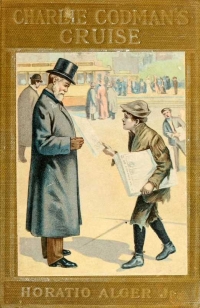
CHARLIE CODMAN'S CRUISE
A Story for Boys
BY
HORATIO ALGER, Jr.
AUTHOR OF "FRANK'S CAMPAIGN," "ERIE TRAIN BOY," "ADRIFT IN NEW YORK," ETC., ETC.
NEW YORK
HURST & COMPANY
PUBLISHERS
PREFACE.
In deference to the expressed wishes of some of his young friends, the author has essayed a story of the sea, and now presents "Charlie Codman's Cruise," as the third volume of the Campaign Series. It will be found more adventurous than its predecessors, and the trials which Charlie is called upon to encounter are of a severer character than befell Frank Frost or Paul Prescott. But it will be found that they were met with the same manly spirit, and a like determination to be faithful to duty at all hazards.
Though not wholly a stranger to the sea, the author is quite aware of the blunders to which a landsman is exposed in treating of matters and a mode of life which, at the best, he must comprehend but imperfectly, and has endeavored to avoid, as far as possible, professional technicalities, as not essential to the interest of the story.
With these few words he submits the present volume to his young readers, hoping for it a welcome even more generous than has been accorded to "Frank's Campaign" and "Paul Prescott's Charge."
CHARLIE CODMAN'S CRUISE.
I. CHARLIE AND THE MISER.
Charlie Codman turned out of Washington into Bedford Street just as the clock in the Old South steeple struck two. He was about fourteen, a handsome, well-made boy, with a bright eye and a manly expression. But he was poor. That was evident enough from his clothes, which, though neat and free from dust, were patched in several places. He had a small roll of daily papers under his arm, the remains of his stock in trade, which he had been unable wholly to dispose of.
Some of my readers may know that the Latin School and English High School are kept in the same building. At two o'clock both are dismissed. Charlie had scarcely passed the school-house when a crowd of boys issued from the school-yard, and he heard his name called from behind. Looking back he recognized a boy somewhat smaller than himself, with whom he had formed an acquaintance some time before.
"Where are you bound, Charlie?" asked Edwin Banks.
"I'm going home now."
"What luck have you had this morning?"
"Not much. I've got four papers left over, and that will take away about all my profits."
"What a pity you are poor, Charlie. I wish you could come to school with us."
"So do I, Eddie. I'd give a good deal to get an education, but I feel that I ought to help mother."
"Why won't you come some time, and see us, Charlie? Clare and myself would be very glad to see you at any time."
"I should like to go," said Charlie, "but I don't look fit."
"Oh, never mind about your clothes. I like you just as well as if you were dressed in style."
"Perhaps I'll come some time," said Charlie. "I'd invite you to come and see me, but we live in a poor place."
"Just as if I should care for that. I will come whenever I get an invitation."
"Then come next Saturday afternoon. I will be waiting for you as you come out of school."
Charlie little thought where he would be when Saturday came.
Shortly after the boys separated, and Charlie's attention was arrested by the sight of an old man with a shambling gait, who was bending over and anxiously searching for something on the sidewalk. Charlie recognized him at once as "old Manson, the miser," for this was the name by which he generally went.
Old Peter Manson was not more than fifty-five, but he looked from fifteen to twenty years older. If his body had been properly cared for, it would have been different; but, one by one, its functions had been blunted and destroyed, and it had become old and out of repair. Peter's face was ploughed with wrinkles. His cheeks were thin, and the skin was yellow and hung in folds. His beard appeared to have received little or no attention for a week, at least, and was now stiff and bristling.
The miser's dress was not very well fitted to his form. It was in the fashion of twenty years before. Grayish pantaloons, patched in divers places with dark cloth by an unskilful hand; a vest from which the buttons had long since departed, and which was looped together by pieces of string, but not closely enough to conceal a dirty and tattered shirt beneath; a coat in the last stages of shabbiness; while over all hung a faded blue cloak, which Peter wore in all weathers. In the sultriest days of August he might have been seen trudging along in this old mantle, which did him the good service of hiding a multitude of holes and patches, while in January he went no warmer clad. There were some who wondered how he could stand the bitter cold of winter with no more adequate covering; but if Peter's body was as tough as his conscience, there was no fear of his suffering.
Charlie paused a moment to see what it was that the old man was hunting for.
"Have you lost anything?" he asked.
"Yes," said Peter, in quavering accents. "See if you can't find it, that's a good boy. Your eyes are better than mine."
"What is it?"
"It is some money, and I—I'm so poor, I can't afford to lose it."
"How much was it?"
"It wasn't much, but I'm so poor I need it."
Charlie espied a cent, lying partially concealed by mud, just beside the curb-stone. He picked it up.
"This isn't what you lost, is it?"
"Yes," said Peter, seizing it eagerly. "You're a good boy to find it. A good boy!"
"Well," thought Charlie, wondering, as the old man hobbled off with his recovered treasure, "I'd rather be poor than care so much for money as that. People say old Peter's worth his thousands. I wonder whether it is so."
Charlie little dreamed how much old Peter was likely to influence his destiny, and how, at his instigation, before a week had passed over his head, he would find himself in a very disagreeable situation.
We must follow Peter.
With his eyes fixed on the ground he shuffled along, making more rapid progress than could have been expected. Occasionally he would stoop down and pick up any little stray object which arrested his attention, even to a crooked pin, which he thrust into his cloak, muttering as he did so, "Save my buying any. I haven't had to buy any pins for more'n ten years, and I don't mean to buy any more while I live. Ha! ha! Folks are so extravagant! They buy things they don't need, or that they might pick up, if they'd only take the trouble to keep their eyes open. 'Tisn't so with old Peter. He's too cunning for that. There goes a young fellow dressed up in the fashion. What he's got on must have cost nigh on to a hundred dollars. What dreadful extravagance! Ha! ha! It hasn't cost old Peter twenty dollars for the last ten years. If he had spent money as some do, he might have been in the poor-house by this time. Ugh! ugh! it costs a dreadful sum to live. If we could only come into the world with natural clothes, like cats, what a deal better it would be. But it costs the most for food. Oh dear! what a dreadful appetite I've got, and I must eat. All the money spent for victuals seem thrown away. I've a good mind, sometimes, to go to the poor-house, where it wouldn't cost me anything. What a blessing it would be to eat, if you could only get food for nothing!"
It is very clear that Peter would have been far better off, as far as the comforts of life are concerned, in the city almshouse; but there were some little obstacles in the way of his entering. For instance, it would scarcely have been allowed a public pensioner to go round quarterly to collect his rents,—a thing which Peter would hardly have relinquished.
Reflections upon the cost of living brought to Peter's recollection that he had nothing at home for supper. He accordingly stepped into a baker's shop close at hand.
"Have you got any bread cheap?" he inquired of the baker.
"We intend to sell at moderate prices."
"What do you ask for those loaves?" said the old man, looking wistfully at some fresh loaves piled upon the counter, which had been but a short time out of the oven.
"Five cents apiece," said the baker. "I'll warrant you will find them good. They are made of the best of flour."
"Isn't five cents rather dear?" queried Peter, his natural appetite struggling with his avarice.
"Dear!" retorted the baker, opening his eyes in astonishment; "why, my good sir, at what price do you expect to buy bread?"
"I've no doubt they're very good," said Peter, hastily; "but have you any stale loaves? I guess they'll be better for me."
"Yes," said the baker, "I believe I have, but they're not as good as the fresh bread."
"How do you sell your stale loaves?" inquired Peter, fumbling in his pocket for some change.
"I sell them for about half price—three cents apiece."
"You may give me one, then; I guess it'll be better for me."
Even Peter was a little ashamed to acknowledge that it was the price alone which influenced his choice.
The baker observed that, notwithstanding his decision, he continued to look wistfully towards the fresh bread. Never having seen old Peter before, he was unacquainted with his character, and judging from his dilapidated appearance that he might be prevented, by actual poverty, from buying the fresh bread, exclaimed with a sudden impulse: "You seem to be poor. If you only want one loaf, I will for this once give you a fresh loaf for three cents—the same price I ask for the stale bread."
"Will you?"
Old Peter's eyes sparkled with eagerness as he said this.
"Poor man!" thought the baker with mistaken compassion; "he must indeed be needy, to be so pleased."
"Yes," he continued, "you shall have a loaf this once for three cents. Shall I put it in a paper for you?"
Peter nodded.
Meanwhile he was busy fumbling in his pockets for the coins requisite to purchase the loaf. He drew out three battered cents, and deposited them with reluctant hand on the counter. He gazed at them wistfully while the baker carelessly swept them with his hand into the till behind the counter; and then with a sigh of resignation, at parting with the coins, seized the loaf and shambled out into the street.
He put the bundle under his arm, and hastened up the street, his mouth watering in anticipation of the feast which awaited him. Do not laugh, reader,—little as you may regard a fresh loaf of bread, it was indeed a treat to Peter, who was accustomed, from motives of economy, to regale himself upon stale bread.
The baker was congratulating himself upon having done a charitable action, when Peter came back in haste, pale with affright.
"I—I—," he stammered, "must have dropped some money. You haven't picked up any, have you?"
"Not I!" said the baker, carelessly. "If you dropped it here you will find it somewhere on the floor. Stay, I will assist you."
Peter seemed rather disconcerted than otherwise by this offer of assistance, but could not reasonably interpose any objection.
After a very brief search Peter and the baker simultaneously discovered the missing coin. The former pounced upon it, but not before the latter had recognized it as a gold piece.
"Ho, ho!" thought he, in surprise, "my charity is not so well bestowed as I thought. Do you have many such coins?" he asked, meaningly.
"I?" said Peter, hastily, "Oh no! I am very poor. This is all I have, and I expect it will be gone soon,—it costs so much to live!"
"It'll never cost you much," thought the baker, watching the shabby figure of the miser as he receded from the shop.
II. A MISER'S HOUSEHOLD.
Peter Manson owned a small house in an obscure street. It was a weather-beaten tenement of wood, containing some six or eight rooms, all of which, with one exception, were given over to dirt, cobwebs, gloom, and desolation. Peter might readily have let the rooms which he did not require for his own use, but so profound was his distrust of human nature, that not even the prospect of receiving rent for the empty rooms could overcome his apprehension of being robbed by neighbors under the same roof. For Peter trusted not his money to banks or railroads, but wanted to have it directly under his own eye or within his reach. As for investing his gold in the luxuries of life, or even in what were generally considered its absolute necessaries, we have already seen that Peter was no such fool as that. A gold eagle was worth ten times more to him than its equivalent in food or clothing.
With more than his usual alacrity, old Peter Manson, bearing under his cloak the fresh loaf which he had just procured from the baker on such advantageous terms, hastened to his not very inviting home.
Drawing from his pocket a large and rusty door-key, he applied it to the door. It turned in the lock with a creaking sound, and the door yielding to Peter's push he entered.
The room which he appropriated to his own use was in the second story. It was a large room, of some eighteen feet square, and, as it is hardly necessary to say, was not set off by expensive furniture. The articles which came under this denomination were briefly these,—a cherry table which was minus one leg, whose place had been supplied by a broom handle fitted in its place; three hard wooden chairs of unknown antiquity; an old wash-stand; a rusty stove which Peter had picked up cheap at an auction, after finding that a stove burned out less fuel than a fireplace; a few articles of crockery of different patterns, some cracked and broken; a few tin dishes, such as Peter found essential in his cooking; and a low truckle bedstead with a scanty supply of bedclothes.
Into this desolate home Peter entered.
There was an ember or two left in the stove, which the old man contrived, by hard blowing, to kindle into life. On these he placed a few sticks, part of which he had picked up in the street early in the morning, and soon there was a little show of fire, over which the miser spread his hands greedily as if to monopolize what little heat might proceed therefrom. He looked wistfully at the pile of wood remaining, but prudence withheld him from putting on any more.
"Everything costs money," he muttered to himself. "Three times a day I have to eat, and that costs a sight. Why couldn't we get along with eating once a day? That would save two thirds. Then there's fire. That costs money, too. Why isn't it always summer? Then we shouldn't need any except to cook by. It seems a sin to throw away good, bright, precious gold on what is going to be burnt up and float away in smoke. One might almost as well throw it into the river at once. Ugh! only to think of what it would cost if I couldn't pick up some sticks in the street. There was a little girl picking up some this morning when I was out. If it hadn't been for her, I should have got more. What business had she to come there, I should like to know?"
"Ugh, ugh!"
The blaze was dying out, and Peter was obliged, against his will, to put on a fresh supply of fuel.
By this time the miser's appetite began to assert itself, and rising from his crouching position over the fire he walked to the table on which he had deposited his loaf of bread. With an old jack-knife he carefully cut the loaf into two equal parts. One of these he put back into the closet. From the same place he also brought out a sausage, and placing it over the fire contrived to cook it after a fashion. Taking it off he placed it on a plate, and seated himself on a chair by the table.
It was long since the old man, accustomed to stale bread,—because he found it cheaper,—had tasted anything so delicious. No alderman ever smacked his lips over the most exquisite turtle soup with greater relish than Peter Manson over his banquet.
"It is very good," he muttered, with a sigh of satisfaction. "I don't fare so well every day. If it hadn't been for that unlucky piece of gold, perhaps the baker would have let me had another loaf at the same price."
He soon despatched the half loaf which he allotted to his evening meal.
"I think I could eat the other half," he said, with unsatisfied hunger; "but I must save that for breakfast. It is hurtful to eat too much. Besides, here is my sausage."
The sausage was rather burned than cooked, but Peter was neither nice nor fastidious. He did not eat the whole of the sausage, however, but reserved one half of this, too, for breakfast, though it proved so acceptable to his palate that he came near yielding to the temptation of eating the whole. But prudence, or rather avarice, prevailed, and shaking his head with renewed determination, he carried it to the closet and placed it on the shelf.
Between seven and eight o'clock Peter prepared to go to bed, partly because this would enable him to dispense with a fire, the cost of which he considered so ruinous. He had but just commenced his preparations for bed when a loud knock was heard at the street door.
At the first sound of the knocking Peter Manson started in affright. Such a thing had not occurred in his experience for years.
"It's some drunken fellow," thought Peter. "He's mistaken the house. I'll blow out the candle, and then he'll think there's nobody here."
He listened again, in hopes to hear the receding steps of the visitor, but in vain. After a brief interval there came another knock, louder and more imperative than the first.
Peter began to feel a little uneasy.
"Why don't he go?" he muttered, peevishly. "He can't have anything to do with me. Nobody ever comes here. He's mistaken the house."
His reflections were here interrupted by a volley of knocks, each apparently louder than the last.
"Oh dear, what shall I do?" exclaimed the miser with a ludicrous mixture of terror and perplexity. "It's some desperate ruffian, I know it is. I wish the police would come. I shall be robbed and murdered."
Peter went to the window and put his head out, hoping to discover something of his troublesome visitor. The noise of opening the window attracted his attention.
"Hilloa!" he shouted. "I thought I'd make you hear some time or other. I began to think you were as deaf as a post, or else had kicked the bucket."
"Who's there?" asked Peter, in a quavering voice.
"Who's there! Come down and see, and don't leave a fellow to hammer away all night at your old rat-trap. Come down, and open the door."
"This ain't the house," said Peter. "You've made a mistake. Nobody ever comes here."
"No more I should think they would, if you always keep 'em waiting as long as you have me. Come along down, and let me in."
"But I tell you," persisted Peter, who didn't at all like the visitor's manners, "that you've made a mistake. This ain't the house."
"Ain't what house, I'd like to know?"
"It ain't the house you think it is," said the old man, a little puzzled by this question.
"And what house do I think it is? Tell me that, you old——"
Probably the sentence would have been finished in a manner uncomplimentary to Peter, but perhaps, from motives of policy, the stranger suppressed what he had intended to say.
"I don't know," returned Peter, at a loss for a reply, "but there's a mistake somewhere. Nobody comes to see me."
"I shouldn't think they would," muttered the outsider, "but every rule has its exceptions, and somebody's come to see you now."
"You've mistaken the person."
"No, I haven't. Little chance of making a mistake. You're old Peter Manson."
"He has come to see me," thought Peter, uneasily; "but it cannot be for any good end. I won't let him in; no, I won't let him in."
"Well what are you going to do about it?" asked his would-be visitor, impatiently.
"It's too late to see you to-night."
"Fiddlestick!" retorted the other. "It isn't eight yet."
"I'm just going to bed," added Peter, becoming momentarily more uneasy at the man's obstinacy.
"Going to bed at half past seven! Come, now, that's all a joke. You don't take me for a fool!"
"But I am," urged Peter, "I always do. I'm very poor, and can't afford to keep a fire and light going all the evening."
"You poor! Well, may be you are. But that ain't neither here nor there. I have got some important business to see you about, and you must let me in."
"Come to-morrow."
"It's no use; I must see you to-night. So just come down and let me in, or it'll be the worse for you."
"What a dreadful ruffian!" groaned Peter; "I wish the watch would come along, but it never does when it's wanted. Go away, good man," he said, in a wheedling tone. "Go away, and come again to-morrow."
"I tell you I won't go away. I must see you to-night."
Convinced that the man was not to be denied, Peter, groaning with fear, went down, and reluctantly drawing the bolt, admitted the visitor.
III. THE UNWELCOME VISITOR.
Opening the door with trembling hand Peter Manson saw before him a stout man of forty-five, with a complexion bronzed by exposure to the elements.
Short and thick-set, with a half-defiant expression, as if, to use a common phrase, he "feared neither man nor devil," a glance at him served hardly to reassure the apprehensive old man.
The stranger was attired in a suit of coarse clothing, and appeared to possess little education or refinement. He might be a sailor,—there was an indefinable something about him,—a certain air of the sea, that justified the suspicion that he had passed some part of his life, at least, in the realms of Father Neptune.
Peter Manson, holding in his hand the fragment of candle which flickered wildly from the sudden gust of wind which rushed in at the door just opened, stood in silent apprehension, gazing uneasily at his unwelcome visitor.
"Well, shipmate," said the latter, impatiently, "how long are you going to stand staring at me? It makes me feel bashful, not to speak of its not being over and above civil."
"What do you want?" inquired Peter, his alarm a little increased by this speech, making, at the same time, a motion as if to close the door.
"First and foremost, I should like to be invited in somewhere, where it isn't quite so public as at the street door. My business is of a private nature."
"I don't know you," said the miser, uneasily.
"Well, what's the odds if I know you?" was the careless reply. "Come, push ahead. Where do you live? Up stairs, or down stairs? I want to have a little private talk with you somewhere."
The speaker was about to cross the threshold when Peter stepped in front, as if to intercept him, and said, hurriedly, "Don't come in to-night; to-morrow will do just as well."
"By your leave," said the visitor, coolly, pushing his way in, in spite of the old man's feeble opposition. "I have already told you that I wanted to see you to-night. Didn't you hear me?"
"Thieves!" the old man half ejaculated, but was checked by the other somewhat sternly.
"No, old man, I am not a thief; but if you don't have done with your stupid charges, I may be tempted to verify your good opinion by trying my hand at a little robbery. Now lead the way to your den, wherever it is, if you know what is best for yourself."
The outer door was already closed, and Peter felt that he was at the intruder's mercy. Nevertheless, there was something in this last speech, rough and imperative as it was, that gave him a little feeling of security, so far as he had been led to suspect any designs on his property on the part of his companion.
Without venturing upon any further remonstrance, which, it was clear, would prove altogether useless, he shuffled up stairs, in obedience to the stranger's command, yet not without casting back over his shoulder a look of apprehension, as if he feared an attack from behind.
His visitor, perceiving this, smiled, as if amused at old Peter's evident alarm.
Arrived at the head of the stairs, Peter opened the door into the apartment appropriated to his own use.
The stranger followed him in, and after a leisurely glance about the room, seated himself with some caution in a chair, which did not look very secure.
Peter placed the flickering candle upon the mantel-piece, and seated himself.
It was long, very long, since a visitor had wakened the echoes of the old house; very long since any human being, save Peter himself, had been seated in that room. The old man could not help feeling it to be a strange thing, so unaccustomed was he to the sight of any other human face there.
"It seems to me," said his visitor, dryly, taking in at a glance all the appointments of the room, "that you don't care much about the luxuries of life."
"I," said Peter, "I'm obliged to live very plain,—very plain, indeed,—because I am so poor."
"Poor or not," said the visitor, "you must afford to have a better fire while I am here. I don't approve of freezing."
He rose without ceremony, and taking half a dozen sticks from the hearth, deposited them in the stove, which now contained only some burning embers.
"Stay," said Peter, hastily. "Don't put so much on; it's wasteful, and I sha'n't have any left for to-morrow."
"I'll risk that," said the other, carelessly. "At any rate, it's better to be comfortable one day than to shiver through two."
The flame caught the wood, which soon blazed up, diffusing an unusually cheerful glow over the apartment. Peter, in spite of the dismay with which he had at first contemplated the sudden movement on the part of his visitor, and the awful consumption of wood which he knew must ensue, nevertheless appeared to enjoy the increased heat. He drew his chair nearer the stove, and an expression of satisfaction was visible in his face as he spread out both hands to catch a little warmth.
"There, Peter," said the stranger, "I knew you'd like it after it was fairly done. Isn't it worth while to have a good warm fire?"
"If it didn't cost so much," groaned Peter, the one thought intruding.
"Hush, Peter; if what people say be true, and as I am inclined to believe, there's no one better able to afford a good fire than you."
"No one better able!" repeated Peter, at once taking alarm, and lifting up both hands in earnest deprecation, "when I can hardly get enough together to keep from absolute starvation. Oh, it's a strange world, it's a strange world!"
"Well, Peter, some strange people do live in it, to be sure. But people do say, Peter, that you have a power of money hidden away in this old house somewhere."
Peter started to his feet in affright, then feeling that his movement might lead to suspicion, sank back into his seat, saying, uneasily, "I only wish it were true. People say such strange things. But it's only idle talk, idle talk. They know better."
"You'd be very grateful, I have no doubt, to anybody that would show you where all these treasures are that people talk about, wouldn't you, hey?"
"Ye—Yes," answered Peter Manson, who did not know quite how to understand his companion, whose tone seemed to have a hidden meaning which made him uneasy.
"And will you give me leave to search the house, if I will promise to give you half the gold I find?"
"But you wouldn't find any," answered the miser, hastily.
"Then there would be no harm done. Suppose now I should remove the flooring, just here for instance, don't you think I might possibly find something underneath that would repay me for my search?"
Unconsciously the speaker had hit upon one of Peter's places of deposit. Directly under where he was seated there was a box of gold coins. Accordingly this remark, which seemed to indicate to Peter some knowledge of his hiding-place, filled him with fearful apprehensions.
"No, no," said he, vehemently; "go away, there isn't any there. If that is all you have got to say, go away and leave me to my rest. I ought to be in bed; it is getting late."
"I have something more to say, Peter Manson," returned his companion. "If I had not, I should not have sought you to-night. What I have to say is of great importance to you as you will find. Will you hear it?"
"Go on," muttered Peter, his attention arrested, in spite of his fears, by the stranger's peculiar tone.
"First, then, let me tell you a story. It may be real, it may be only fancy. I won't say anything about that. By the way, Peter, were you ever in the West Indies?"
This question produced a singular effect upon Peter, considering its apparently unimportant character. He started, turned as pale as his ghastly complexion permitted, fixed an anxious glance upon the stranger, who looked as if nothing particular had happened, and said hastily, "No, I was never there. What made you ask?"
"Nothing particular," said the other, carelessly; "if you were never there, no matter. Only it is there that what I am going to tell you happened. But to my story.
"Some twenty years ago there lived in the city of Havana an American gentleman, no matter about his name, who had established himself in business in the city. He had married before he went there, and had a daughter about sixteen years of age. Well, his business flourished. Good luck seemed to attend him in all his ventures, and he seemed likely to accumulate enough to retire upon before many years."
Peter started, and as the story progressed seemed to be internally agitated. A keen glance satisfied his visitor of this; without appearing to notice it, however, he went on,—
"But things don't always turn out as well as we expect. Just when things looked brightest there came a sudden blow, for which the merchant was unprepared. On going to his counting-room one morning, he discovered that his book-keeper had disappeared, and what was worse, had carried off with him the sum of twenty thousand dollars—a large sum, was it not?"
"What is all this to me?" demanded Peter, with sudden fierceness.
"I will tell you by and by," said the stranger, coolly.
"I will take the liberty to put a little more wood into the stove, and then go on with my story."
"I—I'll put some in," said Peter.
He took a small stick about half as large round as his wrist, and opening the stove-door, put it in.
"That'll do to begin with," said the stranger, following it, to Peter's dismay, with half a dozen larger ones. "Now we'll be comfortable."
IV. A STARTLING QUESTION.
While Peter's uneasiness became every moment more marked, his visitor continued,—
"This sad defalcation was the more unfortunate because, on that very day notes to a heavy amount became due. Of course the merchant was unable to pay them. Do you know what was the result?"
"How should I know?" asked Peter, testily, avoiding the gaze of the stranger, and fixing his eyes uneasily upon the fire.
"Of course you couldn't know, I was foolish to think such a thing."
"Then what made you think it?" said Peter, in a petulant tone. "I don't care to hear your story. What has it got to do with me?"
"Don't be in too much of a hurry, and perhaps you will learn quite as soon as you care to. The same result followed, which always does follow when a business man cannot meet his engagements. He failed."
Peter stirred uneasily, but said nothing.
"His character for integrity was such that there were many who would have lent him a helping hand, and carried him safely through his troubles; but he was overwhelmed by the blow, and sank under it. Refusing all offers of assistance, he took to his bed, and some six months after died."
"And what became of his daughter?" asked Peter, showing a little curiosity for the first time.
"Ha! you seem to be getting interested," exclaimed the other, fixing his keen eyes upon Peter, who seemed confused. "His daughter was beautiful and had already won the heart of a young American, who had little money but a handsome figure and good business habits."
"Did she marry this young Codman?"
"Who told you his name was Codman?" asked Peter's visitor, watching him keenly.
"I—I thought you did," stammered the miser, disconcerted.
"You are mistaken. I have mentioned no name."
"Then I—I must have misunderstood you."
"I dare say," said the other, ironically. "However, we won't dispute that point. Well, this young Codman,—for singularly enough you hit upon the right name, not knowing anything of the circumstances of course,—this young Codman married Isabel."
"Isabel!" repeated the old man. "Her name was——"
Here he paused in sudden confusion, feeling that he was betraying himself by his incautious correction.
"Yes, Peter," said the other with a shrewd smile, "you are right. Her name was not Isabel, but Eleanor. I acknowledge that I was wrong; but it seems to me that, for one who is entirely a stranger to the events I have been describing, you show a wonderful shrewdness in detecting my mistakes."
Peter maintained a confused silence, and wriggled about uneasily, as if the stranger's fixed and watchful gaze disturbed him.
"Humph! well they say that some people have the gift of second sight, and others can see through millstones, and various other wonderful things."
"What has all this to do with me?" asked Peter, crossly, for he felt it necessary to make some demonstration. "It's getting late, and I want to go to bed. Go away, and—and come again to-morrow, if you want to."
"A bird in the hand is worth two in the bush, Peter, which means that I am sure of you now, and perhaps you wouldn't let me in if I should call to-morrow. If you are sleepy I have no objection to your going to bed. I can talk to you as well as if you were sitting up. I will stay here and keep the fire going."
Peter looked at the small pile of wood with a groan, and muttered something about "its being awful extravagant to keep such a fire."
"I believe," said the stranger, "I have not yet told you the name of the defaulted clerk."
Peter said nothing.
"It was Thornton, but his first name was Peter, the same as yours. Singular, isn't it, Peter?"
"I suppose there are a good many Peters in the world," muttered the old man.
"Very likely; though I hope most of them are better than this Peter Thornton. He got off without being taken, with the twenty thousand dollars in his possession. He was fond of money, and many thought this explained the defalcation. However, there were not wanting others who assigned a different motive. It was said that he had been smitten by the youthful charms of his employer's daughter Eleanor, who did not favor his suit."
Peter shifted uneasily in his chair.
"No one could blame her. In fact it was perfectly preposterous for him to think of mating with her. Did you speak?"
"No!" snarled Peter.
"I thought you said something. I repeat, that she had plenty of reasons for rejecting him. She was just sixteen, and beautiful as she was young, and had no lack of admirers ready to devote themselves to her. As for Peter Thornton, ha! ha! he never could have been very handsome, from all I have heard of him. In the first place, he was forty or more."
"Thirty-eight," muttered Peter, below his breath.
"And his features were irregular, besides being marked with the small-pox, which he had had in early life. He had a long, hooked nose like a bird's beak, an enormous mouth, little sharp gray eyes like a ferret's, and his hair was already mingled with gray. On the whole, he hadn't much beauty to boast of. Did you say anything?"
"No!" snarled Peter, sourly. He was sitting with his elbows on his knees, and his face resting on his hands.
"Beg pardon, I thought you spoke. To add to Peter's charms of person, his disposition was not the sweetest that ever was. He had a harsh and crabbed manner, which would have led to his discharge if he had not had one saving trait. I will say, to his credit, that he was a capital book-keeper. Of his honesty his employer thought he was well assured, and probably if nothing had occurred of a character to wound Peter's pride, he might have continued faithful to his trust. One day, however, Peter took an opportunity, when he had been calling at the house of his employer on business connected with the counting-room, to declare his love to the young lady, whom he found alone in the drawing-room. You can imagine how much she was amused—why don't you laugh, Peter? You look as glum as if it were you that had met with this disappointment. The young lady told him plainly, as soon as she got over her astonishment, that she could give him no encouragement whatever. Perhaps there might have been in her tone something of the aversion which it was natural for her to feel at such a proposition from one so much beneath her. If they had married, it would have been a second case of Beauty and the Beast. Beg pardon, Peter, I believe you said something."
"No!" snarled Peter, fiercely. "Have you got nearly through? Your story is nothing to me—nothing, I say. I want to go to bed. You have kept me up too late already."
"I can't help that, Peter. It took me too long to get in for me to resign readily the pleasure of your society. I say, Peter, what a jolly good fellow you are,—quite a lively companion,—only it strikes me you might be a little more civil to your company. It isn't exactly polite to keep telling one how anxious you are for him to go.
"As I was saying, when you interrupted me, Eleanor told Peter very decidedly that she could not for an instant entertain his suit. He endeavored to change her determination, being an ardent, impulsive lover, and probably in her impatience she said something which irritated her lover, who went off in a rage. After a while, however, he was foolish enough to open the subject again. Of course she was extremely annoyed at his persistence, and seeing no other way of escaping the persecution, she felt it necessary to acquaint her father with what had transpired. The merchant was naturally indignant at his book-keeper's presumption, and calling him aside one morning threatened to discharge him from his employment unless he should forthwith desist. This was, of course, a great blow to Peter's pride. He had the good sense to say nothing, however, but none the less determined within himself to be revenged upon those who had scorned his advances, as soon as an opportunity offered. I don't know as I blame him. Perhaps I should have done the same under similar circumstances."
There was a trace of agitation upon the pale and wrinkled countenance of the miser.
"This it was," continued the stranger, "taken in connection with Peter's natural cupidity that led to the defalcation I have mentioned. So far as the merchant was concerned his revenge was completely successful, for he was the means of his ruin and premature death. And now, Peter," he added, suddenly changing his tone, "can you tell me what induced you to change your name from Thornton to Manson?"
"Me!" exclaimed the miser, starting to his feet in consternation, and glaring wildly at the speaker.
V. THE COMPACT.
"Yes," said the stranger, composedly; "I repeat the question, why did you change your name to Manson?"
"What—do—you—mean?" the old man faltered slowly.
"I mean just what I say, and I see you understand me well enough."
"You can't prove it," said Peter, with an uneasy glance at his imperturbable companion.
"Can't I? Perhaps not. I should say the mysterious knowledge you seem to possess of the main incidents in my story would prove something."
"That isn't evidence in a court of law," said Peter, regaining a degree of confidence.
"Perhaps not; but I say, Peter, don't you recognize me?"
The old man scanned his features eagerly, and a sudden look of remembrance satisfied the latter that he was not forgotten.
"I see you do remember me," he said; "I thought you hadn't forgotten John Randall. At any rate he hasn't forgotten you, though twenty years have passed, and I was then but a young man. I used to see you too often about the streets of Havana not to remember that hooked nose, those gray eyes, and (excuse my plainness of speech) that large mouth. Yes, Peter, your features are impressed upon my memory too indelibly to be effaced."
Peter Manson remembered his companion as one who had had the reputation of being a "wild" young man. He had been placed at school by his father without any profitable result. On his father's death he squandered, in dissipation, the property which came to him, and had since devoted himself to the sea.
"Having settled this little matter of your identity," continued Randall, "I am ready to finish my story. I told you that Eleanor married the young man whose name you remembered so well. He was poor, dependent upon his salary as a clerk, and thanks to you his wife had nothing to hope from her father. They were obliged to live in a very humble way. At length, thinking he could do better here, he removed to Boston, where his early life had been spent."
"To Boston!" muttered Peter.
"The removal took place some six years since. They had three children when they first came here, but two died, leaving only the second, a boy, named Charlie. I should think he might be fourteen years of age. And now, would you like to know if the husband is still living?"
"Is he?" asked Peter, looking up.
"No. He died about a year since, of a fever."
"And—and Eleanor? What of her?"
"For six months past she has been a tenant of yours."
"A tenant of mine!" exclaimed the miser.
"It is even so. She occupies a second-story room in the tenement-house in——Street."
"And I have met her face to face?"
"I dare say you have. Your tenants are pretty sure to have that pleasure once a month. But doesn't it seem strange that Eleanor Gray, the beautiful daughter of your Havana employer, should after these twenty years turn up in Boston the tenant of her father's book-keeper?"
"Ha! ha!" chuckled the miser, hoarsely, "she isn't so much better off than if she had married old Peter."
"As to being better off," said Randall, "I presume she is better off, though she can't call a hundred dollars her own, than if she were installed mistress of your establishment. Faugh! Poorly as she is obliged to live, it is luxury, compared with your establishment."
He glanced about him with a look of disgust.
"If you don't like it," said Peter, querulously, "there is no use of your staying. It is past my bedtime."
"I shall leave you in a few minutes, Peter, but I want to give you something to think of first. Don't you see that your property is in danger of slipping from your hands?"
"My property in danger!" exclaimed Peter, wildly; "what do you mean; where is the danger?" Then, his voice sinking to its usual whine,—"not that I have any of any consequence, I am poor—very poor."
"Only from what I see I could easily believe it, but I happen to know better."
"Indeed, I am——"
"No more twaddle about poverty," said Randall, decidedly, "it won't go down. I am not so easily deceived as you may imagine. I know perfectly well that you are worth at the very least, thirty thousand dollars."
"Thirty thousand dollars!" exclaimed the miser, raising both hands in astonishment.
"Yes, Peter, and I don't know but I may say forty thousand. Why, it can't be otherwise, with your habits. Twenty years ago you made off with twenty thousand, which has been accumulating ever since. Your personal expenses haven't made very large inroads upon your income, judging from your scarecrow appearance. So much the worse for you. You might have got some good from it. Now it must go to others."
"To others!" exclaimed Peter, turning pale.
"Certainly. You don't think the law gives you whatever you've a mind to steal, do you? Of course there is no doubt that to your tenants, Eleanor and Charlie Codman, belongs this property which you wrongfully hold."
"They sha'n't have it. They never shall have it," said Peter Manson, hastily.
"Well, perhaps the law may have something to say about that."
"My gold!" groaned the miser. "If I lose that I lose everything. It will be my death. Good Mr. Randall, have pity upon me. I am sure you won't say anything that——"
"Will bring you to state's prison," said Randall, coolly.
"They—Eleanor and her son—need never know it."
"Unless I tell them."
"But you won't."
"That depends upon circumstances. How much will you give me to keep the thing secret?"
"What will I give you?"
"Precisely. That is what I have been so long in coming at. You see, Peter, that the secret is worth something. Either I reveal it to the parties interested, in which case I wouldn't give that," snapping his fingers, "for your chance of retaining the property, or I keep silence if you make it worth my while."
"Pity me," said the miser, abjectly, sinking on his knees before Randall; "pity me and spare my gold."
"Pity you!" said Randall, contemptuously. "Why didn't you pity your employer? You must make up your mind to pay me my price."
"I am very poor," whined Peter, in his customary phrase, "and I can't pay much."
"Oh yes, Peter," said the other, sarcastically, "I am well aware that you are poor,—wretchedly poor,—and I won't be too hard upon you."
"Thank you—thank you," said Peter, catching at this promise; "I will give you something—a little——"
"How much?" asked Randall, with some curiosity.
"Ten dollars!" said the miser, with the air of a man who named a large sum.
"Ten dollars!" returned Randall, with a laugh of derision. "Ten dollars to secure the peaceable possession of thirty thousand! Old man, you must be mad, or you must think that I am."
"I—I did not mean to offend," said the old man, humbly. "If I double the sum will it satisfy you? I—I will try to raise it, though it will be hard—very hard."
"This is mere trifling, Peter Manson," said his visitor, decidedly. "Twenty dollars! Why I wouldn't have come across the street to get it. No, you will have to elevate your ideas considerably."
"How much do you demand?" said the miser, groaning internally, and fixing his eyes anxiously upon Randall.
"You must not make a fuss when I name the amount."
"Name it," said Peter, in a choking voice.
"One thousand dollars will purchase my silence, and not a dollar less."
Peter sprang from his seat in consternation.
"One thousand dollars! Surely you are not in earnest."
"But I am, though. This is not a subject I care to jest upon."
"One thousand dollars! It will take all I have and leave me a beggar."
"If it should, Peter," said his visitor, composedly, "I will procure you admission to the poor-house, where, if I am not much mistaken you will be better off than in this tumble-down old shanty."
"Has the man no mercy?" groaned Peter, wringing his hands.
"None at all."
"Then," exclaimed the miser, in a sudden fit of desperation, "I won't pay you a cent—not a single cent."
"That is your final determination, is it?"
"Ye—yes," muttered Peter, but less firmly.
"Very well. I will tell you the result. I shall at once go to Eleanor, and inform her of the good fortune which awaits her. No fear but she will pay me a thousand dollars for the intelligence."
"She has no money."
"I will furnish her with money for the lawyers—she can repay me out of your hoards."
Peter groaned.
"Ay, groan away, Peter. You'll have cause enough to groan, by and by. There is one thing you don't seem to consider, that the law will do something more than take away your property. I will come to see you in jail."
He rose to leave the room, but Peter called him back hastily. "We may come to terms yet," he said.
"Then you accede to my terms."
"I will give you five hundred."
"Good-night, Peter. I wish you happy dreams."
"St-stay!" exclaimed Peter, terrified. "I will give eight hundred."
"I am in something of a hurry," said Randall. "I believe I will call on Eleanor. I don't think we can make any arrangement."
"Hold! perhaps I will do as you say."
"Ah! now you are beginning to be reasonable," said Randall, resuming his seat.
"What security can you give me for your silence?"
"I'll tell you what I will do, Peter. You remember I told you Eleanor had a son, a boy of fourteen."
"Yes."
"His mother is quite devoted to him. Indeed, he contributes to her support by selling papers, and by various little jobs. Now, as long as Eleanor lives here you are in danger."
"Yes."
"And if a blow is levelled at her it must be through her boy."
"I see."
"Then I'll tell you of a scheme I have arranged. You must first know that I am mate of a vessel now in port, which is bound for San Francisco. We are to sail in a few days."
"Well?"
"We happen to be in want of a boy to fill up our regular number. Suppose I kidnap Eleanor's boy. Don't you see, that as he is her chief support, she will soon be in difficulties? and this, with her uncertainty about her boy's fate, may rid you of your greatest peril, and the only one of the two who could identify you."
"Excellent, excellent!" chuckled Peter, rubbing his hands; "she shall yet be sorry that she rejected old Peter."
"Am I to understand that you accede to my proposal, then?"
Not without many groans Peter agreed to deliver the sum mentioned between them, on condition that the boy was secured.
It was striking ten when Randall left the house. His face beamed with exultation.
"I have done a good night's work," he said. "By working on the fears of the old curmudgeon I have made sure of a thousand dollars. He will be lucky if this is the last money I get out of him. He little thinks that I, too, have a revenge to wreak. He is not the only one that has been scornfully rejected by Eleanor Codman. Now to bed, and to-morrow shall see my work commenced."
VI. CHARLIE AT HOME.
The tenement-house owned by Peter Manson was a three-story wooden building, very much in need of paint. It was scarcely likely to be pointed out by any one as one of the architectural ornaments of the city. Years before it had fallen into Peter's hands at a small price, and he had every year since realized from it in the way of rent a sum equal to one half the purchase-money. No one who has lived in a city can help knowing how much more proportionally the poor are compelled to pay for their scanty and insufficient accommodations than the rich, or those in moderate circumstances. No class of property is made to pay a larger percentage than the wretched tenement-houses which seem adapted to furnish as little accommodation as possible to those who are compelled to occupy them.
The tenement-house in which Charlie and his mother lived was no better than the average. It was the home of a large number of persons of various occupations. Seamstresses, mechanics, washer-women, and many others found a home under this one roof.
Mrs. Codman occupied a room on the third floor. As we enter the room it is easy to see what a charm can be thrown around even the humblest place by the presence of refinement and good taste. All the appointments of the room, indeed, were of the cheapest description. Probably the furniture did not exceed in cost that of the room opposite. Yet there was a considerable difference in the appearance of Mrs. Codman's room and that of Sally Price, who, if she had ever possessed an organ of neatness, had lost it years ago.
The old-fashioned windows were washed as clean as water could make them, so as to admit all the sunshine which could find its way over the tall roof on the opposite side of the street. They were hung with plain chintz curtains, separated in the middle and looped on either side. The floor was quite clean as far as it could be seen. In the centre was spread a floor-cloth some eight feet square, which relieved its bareness. There was a small round table near the window, and a small square work-table of no very costly material, in another part of the room. On this was placed a rose-bush in a flower-pot. It had been given to Charlie by an old gentleman who had taken a fancy to him. In another quarter was a home-made lounge, the work of Charlie's hands. It had originally been a wooden box, given him by a shopkeeper near by. This box had been covered with calico stuffed with cotton, so that it made quite a comfortable seat. It was used besides as a wood-box, its legitimate province, but when the cover was closed it was nevertheless a very respectable article of furniture. There were besides a few plain wooden chairs, and a small rocking-chair for Mrs. Codman. Opening out of the main room was a small bedroom, occupied by the mother, while Charlie had a bed made up for him at night in the common sitting-room.
A few books—a very few—were piled upon the little table. They were chiefly schoolbooks,—an arithmetic, a geography, and an atlas, over which Charlie would generally spend a portion of every evening, and occasionally a boy's book, lent him by his friend Edwin Bangs, who, together with his brothers, had quite a large juvenile library.
Mrs. Codman is sitting by the window industriously engaged in needle-work, and intent on accomplishing a certain amount before nightfall. She was past thirty-five, yet, in spite of the trials which have left their impress on her brow, she would readily be taken for five years younger. She has drawn her chair to the window to make the most of the rapidly fading daylight. As with swift fingers she plies the glistening needle, and the sun touches her cheek with a beaming glow, we can see that not only has she been beautiful, but is still so.
A hasty step is heard on the stairs, there is a stamping at the door, and in rushes a bright, handsome boy, with rosy cheeks and dark hair.
The mother's face lights up with a bright smile as she turns to her son, the only one she has left to love.
"You're a little later than usual, Charlie, are you not?"
"A little, mother. You see I didn't get a job till late, and then two came together."
"What were they?"
"A gentleman wanted me to take his carpet-bag from the Maine depot, and I had to carry it away up to Rutland Street."
"Did he go with you?"
"No; he had to go to his counting-room in State Street."
"Was he willing to trust you? Some boys might have made off with the carpet-bag, and he would have never seen it again."
"He thought of that, but he said—and I think he's a real gentleman—that he knew I was honest by my appearance, and he was willing to trust me."
"Quite complimentary, Charlie. How much did he pay you for your trouble?"
"Half a dollar."
"Then you have done a good deal better than I have. I have been working all day, and shall not realize more than twenty-five cents for my labor."
"I wish you didn't have to work at all, mother."
"Thank you, Charlie; but I dare say I am happier for having something to do. I wish I could get better pay for my work. But you haven't told me what the other errand was. You said you had two."
"Yes," said Charlie, "I had just got back from Rutland Street, and had bought two or three evening papers which I was going to try to sell, when a man came up to me, and after looking at me for a minute or two, asked me if I would take a little walk with him. He said he was a stranger in Boston, and didn't know his way about much. He asked me if I had lived here long, and what my name was. He told me he would pay me if I would go around with him, and point out some of the public buildings. He told me he would pay me at the rate of twenty-five cents an hour for my time. I told him I had one or two papers to dispose of."
"'Never mind about them,' said he, 'I will take them off your hands.'
"'But they are alike,' said I.
"'Never mind,' he answered; so he paid me the full price for two Journals and two Transcripts, and off we went."
"What sort of a person was he?"
"He was a stout man, over forty, and looked to me like a sailor. I shouldn't wonder if he was an officer of some ship."
"Did you like his looks?"
"Why," said Charlie, hesitatingly, "not exactly; not so much as I did of the other gentleman. There was something about his eye which I didn't like. Still he acted up to his agreement, and paid me all he promised."
"How long were you together?"
"About an hour and a half. We walked round the Common and the Public Garden, went into the State House and the Public Library. However, he didn't seem to care much about them. He seemed to take more interest in me, somehow, and asked me a good many questions; whether I had any parents living, and how long I had lived in the city. When I told him you were born in Havana, he said he used to live there himself."
"Indeed!" said Mrs. Codman.
"He also told me that he might like to have me go round with him again, and told me to call to-morrow at the Quincy House, where he is stopping. But, mother, isn't it most time for supper? Here, just let me set the table, if you are busy."
"Very well, Charlie; I shall be glad to have you do so, as I am in a hurry to finish my sewing."
In the evening Charlie read to his mother while she sewed. Neither of them suspected that it was the last evening they would spend together for several months.
VII. CAPTAIN BRACE.
Lying at one of the wharves was a ship of moderate size, evidently fast getting ready for sea. The cargo had all been stowed away, and, notwithstanding the confusion, it was easy even for a landsman to see that the ship was about ready for departure.
The ship was the Bouncing Betsey, commanded by Captain Nathaniel Brace. As to the peculiar name of the vessel, I can give no information whether or not there was a real Bouncing Betsey after whom it was named. The probability however is, that it was a purely ideal name, the sound and alliterative character of which had commended it to the one upon whom rested the selection of a name.
A few words now about Captain Brace, with whom we shall become better acquainted by and by.
He was a short, stout, broad-shouldered man. He was no fresh-water captain, but from the age of thirteen had been tossing about on the ocean. It is my privilege to know many sea captains who do honor to their calling, high-toned, gentlemanly, and intelligent men; not learned in books, but possessing a wide range of general information. I am sorry to say that Captain Brace was not a man of this class. He had little education beyond what was required by his profession, and was utterly lacking in refinement and courtesy. He was not an amiable man, but rough, stormy, exacting, and dictatorial. The crew under his command he looked upon as so many machines, whose duty it was to obey him with scrupulous exactness, whatever might be the nature of his requisitions. When he got into one of his fits of passion, he would stamp and rave, kicking and striking this way and that with the most reckless disregard of human lives and human feelings. In fact, he was one of those pests of the merchant service, an unfeeling tyrant, who did all in his power to degrade the profession which he had adopted, and add to the hardships which lie in the path of the sailor.
The employers of Captain Brace were far from being aware of the extent to which he carried the severity of his discipline; brutality, indeed, would be the more appropriate word. They supposed him to be a strict commander, who liked to preserve a proper subordination in those under his command, and this they were disposed to commend rather than to complain of, more especially as the captain was master of his profession, and had usually made quick and profitable voyages. This, as may be supposed, was enough to cover a great many defects in the eyes of those whose pecuniary interest he subserved, even if the captain had not been shrewd enough to conceal his more disagreeable traits when on shore, under an affectation of bluff frankness.
There was a time when there were many captains in the service no better than the one we have just sketched, but both in the naval and merchant service there has undoubtedly been a great improvement within a few years.
Without dwelling further on the personal characteristics of Captain Brace, with whom we shall have abundant opportunity to become acquainted, since we purpose going to sea with him on his approaching voyage, we introduce him pacing the deck of his vessel with a short black pipe in his mouth, on the very morning he intends to sail.
"Where is Mr. Randall? has he come on board?" he inquired, turning to the second mate.
"No, sir; I have not seen him this morning," was the reply.
"When he comes on board tell him I wish to see him immediately."
"Very well, sir."
The captain went to his cabin, and about five minutes later the individual after whom he inquired came aboard. We recognize in him an old acquaintance; no other than the nocturnal visitor who excited such fearful apprehensions in the mind of old Peter Manson the miser.
"Where is Captain Brace, Mr. Bigelow?" he inquired of the second mate.
"In the cabin, Mr. Randall. He wishes to see you."
"And I wish to see him, so we can suit each other's convenience. How long since did he ask for me?"
"Only two or three minutes. He has just gone below."
"Then he hasn't had long to wait."
With these words he hastened to the cabin, where he found the captain waiting for him.
The subject on which the captain wished to see his first mate was purely of a professional and technical character, and will not be likely to interest the reader, and so will be passed over.
When this preliminary matter was disposed of, Randall, with a little hesitation, remarked: "I have a little favor to ask of you, Captain Brace."
"Very well, sir; let me know what it is, and if I can conveniently grant it I will."
"The boy who had engaged to go with us has backed out, having heard some ridiculous stories about your severity and——"
The captain's brow grew dark with anger as he said:
"The young rascal! I should like to overhaul him! I'd show him what it is to see service!"
There is very little doubt that the captain would have kept his word.
Randall took care not to inform his superior officer that he had privately communicated to the mother of the boy intelligence of his severity, not from any motives of humanity, but simply because his going would have interfered with his own plans in respect to Charlie.
"We shall not have much time to hunt up a boy if we sail at three o'clock," said the captain. "I don't see but we must go without one."
"I think I can supply you with one, Captain Brace."
"Ha! who is it?"
"It's a nephew of mine, and the favor I spoke of was that you should take him in place of the boy we have missed of."
"Humph!" said the captain, "there is one objection I have to taking relations of the officers. You are expected to be tender of them, and not order them about as roughly as the rest."
"There won't be any trouble of that sort in this case, Captain Brace, you may be very sure," said the mate. "Although the boy is my nephew I don't feel any very extraordinary affection for him."
"I should think not," said the captain, with a grim smile, "from your efforts to get him a place on board this ship. You're not any more gentle with boys than I am."
"The fact is, Captain Brace," said Randall, with a smile which evinced a thorough understanding of the captain's meaning; "the fact is, the boy is unruly, and they can't do much for him at home, and I thought it might be well for him to try a voyage or two, for the benefit of his health!"
The mate smiled, and as it was such a joke as the captain could appreciate, he smiled too.
"Very well, Mr. Randall; if such are your views I have no objection to his coming on board."
"I had fears," continued the mate, "that his unruly temper would interfere with his usefulness at home. I felt pretty sure we could soon cure him of that."
"Kill or cure, that is my motto," said the captain.
"Sometimes both," thought Randall, remembering one boy in a previous voyage who had languished and died under the cruel treatment he experienced on board.
"Does the boy know he is to go with us?" inquired the captain.
"Bless you, no; not he! He'd make a fuss if he did."
"How do you intend to get him on board, then?"
"I shall invite him to come and see the vessel, and when he is down below I can take care that he stays there till we are fairly at sea."
"A good plan. What is the youngster's name, Mr. Randall?"
"Jack Randall; named after me."
"Humph! hope he'll do credit to the name," said the captain, grimly. "I leave in your hands all the steps necessary to securing him. Remember, if you please, that we shall sail at three."
"I will be on board before that time, sir, and bring my nephew with me."
"Very well, sir."
Of course the reader has conjectured that the Jack Randall, the mate's nephew, spoken of above, is no other than our young hero, Charlie Codman.
Poor boy! little does he dream of the plot that is being formed against him.
VIII. THE BLUE CHEST.
On leaving the Bouncing Betsey, Mr. John Randall, the estimable mate of that vessel, bent his steps towards a shop devoted to sailors' clothing ready-made, with a large variety of other articles such as seamen are accustomed to require.
It was a shop of very good dimensions, but low studded and rather dark, the windows, which were few, being in part covered up by articles hung in front of them.
The proprietor of this establishment was Moses Mellen, a little Jew, with a countenance clearly indicating his Israelitish descent. His small black eyes sparkled with the greed of gain, and he had a long, hooked nose like the beak of a bird, which would not have been considered too small an appendage for a face of twice the size. He had one qualification for a successful trader—he seldom or never forgot a face which he had once seen.
Rubbing his hands with a great show of cordiality, and with his face wreathed in smiles, the instant he espied Randall he hastened to meet him.
"Delighted to see you, Mr. Randall," he exclaimed; "perhaps I ought to say Captain Randall."
"Not yet."
"Ah well, that will come soon. I hope you have had a prosperous voyage."
"Tolerably so, Mr. Mellen."
"Have you just arrived in the city, or have you been here for some time?"
"Three weeks only, and now I am off again. We sailors don't have a chance to stop long on dry land, Mr. Mellen."
"Not if they are such capital sailors as my friend, Mr. Randall. But where are you bound this time?"
"Probably to Valparaiso."
"Anywhere else?"
"Perhaps so. We may go to the Indies or Sandwich Islands before we return."
"A long voyage,—you will need to be fitted out before you start,—don't you want something in my line? I sha'n't want much profit out of an old friend like you."
This, by the way, was what Moses said to pretty much all his customers.
"I shall want a few things. I will pick them out now."
"This way, then."
Randall followed the proprietor to the back of the store, where he selected a variety of articles, which he ordered sent on board the Bouncing Betsey immediately.
"Now," said the mate, after his own purchases were completed, "I shall require a small outfit for a boy who is going out with us."
"If you had brought him with you we could have furnished him at short order."
"There was one little difficulty in the way of my doing that."
"Eh?"
"He doesn't know he is going."
"Ah ha!" said the Jewish dealer, putting one scraggy finger to the side of his nose with a knowing look; "that's it, is it?"
"I see you comprehend. Now tell me what shall we do about fitting him?"
"If I could only see him——"
"You could judge by your eye what would be likely to fit him. Is that what you would say?"
"Precisely."
"And how long would you require to look at him?"
"Two minutes would answer."
"Very well; I will call with the boy in the course of an hour or two. By the way, I shall want a small chest to put the articles in. You keep them, of course?"
"A great variety."
"I dare say you will suit me. A very plain one will answer. Have your bill made out for the other articles, and I will discharge it."
With a profusion of bows and thanks, the trader dismissed his customer.
The mate now betook himself to the hotel where he had engaged Charlie to meet him at eleven o'clock. Charlie, who was always punctual to his appointments, had already arrived, and was looking over a newspaper in the reading-room.
"So you are on hand, my boy," said Randall, in a friendly manner.
"Yes, sir."
"I am glad to find you punctual. Are you ready to set out?"
"Yes, sir, quite ready."
Rather to keep up the boy's delusion as to his designs, Randall suffered Charlie to guide him to one or two places of public interest, with which he was already more familiar than his guide, and then suddenly proposed that they should go down to the wharves.
"You must know, my lad," said he, "that I am a sailor."
"I thought so, sir."
"What made you think so?"
"I don't know, sir; but I can generally tell a sailor."
"Perhaps I haven't got my sea-legs off. However, as I was saying, I am an officer on board a ship lying at the wharf, and I have just thought of a bundle I want brought from the ship. If you will go with me and fetch it, I will pay you at the same rate I promised you for going about with me."
Of course Charlie had no objections. In fact, although he had been on board ships at the wharf, he had never been in company with an officer, and he thought it possible his companion might be willing to explain to him the use of some parts which he did not yet understand. Accordingly he gave a ready assent to the mate's proposition, and together they took their way to Long Wharf, at which the ship was lying.
The shop kept by the Jew was, as a matter of convenience and policy, located near the wharves. It was not a general clothing-store, but specially designed to supply seamen with outfits.
"I have a little errand here," said Randall, pausing before the shop of Moses Mellen.
"I can stop outside," said Charlie.
"You had better come in. You will see where we sailors get our clothing."
Not suspecting any sinister design in this invitation, Charlie accepted it without more ado, and followed Randall in. He looked about him with some curiosity, not observing that he too was an object of attention to the Jewish dealer, whose quick eye detected their entrance.
He went forward to meet Randall.
"You see the boy, do you?" asked the mate, in a low voice.
"Is that the one?"
"Yes. Do you think you will be able to fit him?"
"No doubt about it, though he is a little smaller than the boys we usually fit out."
"Never mind if the clothes are a little large. He'll be sure to grow to them, and a precise fit isn't quite so important on the quarter-deck as it might be on Washington Street. We are not fashionable on board the Betsey, Mr. Mellen."
The dealer laughed, showing some yellowish tusks, which were evidently not supplied by the dentist.
"Have you made out my bill?"
"Here it is."
"While I am looking over it, will you pick out such clothes as the boy will need?"
Darting a hasty glance at Charlie, to make sure of his size, the dealer hurried to the rear of the shop, and commenced selecting articles which he laid away in a small blue chest.
The task was soon completed, and again he came out to the front part of the store.
"All ready!" he said, in a low voice to Randall.
"You have been quick. Here is the amount of your bill. As to the chest, you may send it on board the Bouncing Betsey without any unnecessary delay."
"It shall be done, Mr. Randall. Have you no further commands for us?"
"I believe not, to-day."
"You will remember our shop when you are round again?"
"I won't forget you."
"You needn't accompany me to the door, nor allude to my voyage," said Randall, in a low voice, to the dealer. "Remember, I have him with me."
Moses winked in a manner which by no means improved the expression of his not very agreeable features.
"Now, my lad," said Randall, "we'll go on board the vessel. Have you ever been on board a ship?"
"Yes, sir, a good many times by myself, but I never had any one to tell me the different parts."
"I'll promise, then," said the mate, in a tone whose significance was lost upon our hero at the time, though he afterwards recalled it, "that you shall know more about a vessel before you leave this one."
"I thank you," said Charlie, considering the offer a kind one.
They ascended the ladder and jumped upon the deck of the vessel, which, though Charlie knew it not, was to be his home for many a weary day.
IX. ON BOARD.
At the close of the last chapter we had got our hero fairly on board the Bouncing Betsey, on what he supposed to be a brief visit, but which his companion had resolved should be far otherwise.
Randall did not at first undeceive his youthful attendant. He felt that it would hardly be polite, as the ship was lying at the wharf surrounded by other vessels, and the disturbance and vigorous resistance which Charlie would be apt to make when told what was in store for him might attract a degree of attention which might prove fatal to his plans.
They had scarcely set their feet upon deck, when they encountered Captain Brace.
The mate glanced significantly at the boy by his side, and carelessly put his finger to his lips in token of silence, at the same time saying, "A lad whom I have promised to initiate into some of the mysteries of seamanship."
"He may find the knowledge useful to him some time," said the captain, with a grim smile. "Do you think you should like going to sea, my lad?"
"No, sir," returned Charlie, promptly, "I don't think I should."
"Why not?"
"I should get tired of seeing the sea all the time."
"You would get used to it."
"I never should like it so well as the land. Besides, I should not like to leave my mother."
"Well, my lad, if you should ever change your mind," said the captain, with a wicked glance at Randall, "I hope you'll give me the first offer of your services."
"Yes, sir," said our hero, thinking the captain very affable and polite, though, to be sure, his appearance was hardly as prepossessing as it might have been.
"The captain seems to be a very nice man," said he to Randall, after that officer had left them.
"Oh, yes," answered Randall, dryly, "a very fine man the captain is. I'm glad you like him."
"Have you been to sea a long time?" inquired Charlie.
"Yes, I have been ever since I was a boy."
"Do you like it?"
"Very much. It seems like home to me now. I shouldn't be willing to live on land for any length of time."
"Did you begin very young?"
"I was about sixteen. How old are you?"
"Almost fourteen. I shall be fourteen next month."
"You are a very good size for your age."
"Yes," said Charlie, with boyish pride, drawing himself up to his full height. Like most boys, he liked to be told he was large of his age.
"My father was quite a large man," added our young hero.
"I know it," muttered Randall to himself, as the handsome face and manly form of the father rose before him. They were imprinted more vividly upon his memory, because he felt that it was these very advantages which had enabled his rival to succeed in winning the prize for which he had vainly contended.
"Did you speak?" said Charlie, hearing indistinctly the words which his companion muttered.
"No," said Randall, shortly. "But I promised to show you something about the vessel. I suppose you know the names of the masts."
"Yes, sir."
"What do they call this?"
"This is the main-mast," answered Charlie, promptly, "and the others are called the fore-mast and mizzen-mast."
"That is right; I suppose the masts seem high to you."
"Yes, very high," said Charlie, stretching his neck to enable him to see the top.
"Then you don't think you should like to go aloft?" said Randall, playing with him as a cat plays with a mouse.
"I don't believe I could. It would make me dizzy."
"You could do better than you think for, if you were obliged to."
"Perhaps I might," said Charlie, doubtfully. "Do the boys on board ship have to go up there?"
"I had to when I was a boy."
"Wer'n't you afraid?"
"I suppose I was, but that didn't do any good,—I had to go."
"Wer'n't you afraid of losing your hold?"
"Yes, but it isn't often a boy loses his hold going up the first time. He is so frightened that he clings to the ropes with a pretty tight grip. But after he gets used to it—and it doesn't seem any worse than going up stairs—he is apt to grow careless, and then there is sometimes an accident."
"Then I suppose they fall on deck and are instantly killed," said Charlie, shuddering.
"Not always, for when the ship is in progress it leans a good deal, so that they are more likely to fall overboard."
"And get drowned!"
"Sometimes. They can't always keep up till assistance comes, especially if they can't swim. Sometimes their fall is broken by the rigging, and they manage to save themselves by catching hold."
They visited other parts of the ship, and Randall continued his explanations. The sailors were all on board, at work in various ways. They did not appear to notice the mate and his young companion when they passed, but Charlie, chancing to look behind him, observed one making a significant gesture to another, which evidently referred to them.
Our young hero mentally thought this not very polite, but did not pay much attention to it.
About this time a porter arrived from the clothing-store already referred to, bringing a small blue chest.
"This is the ship Bouncing Betsey, isn't it?" he inquired.
"Yes," answered one of the sailors.
"I was told to bring this chest here, then."
"Who is it for?"
"Jack Randall."
"That's the mate, you lubber. Why don't you put a handle to his name?"
"No, it's for a boy."
"We haven't got any such boy aboard as I knows on."
"There ain't two ships of this name, are there?"
"Not as I ever heerd tell."
"Then this must be the ship. Where shall I stow this chest? I've got tired of bringing it on my back."
"You'd better go and speak to the mate about it. There he stands. Mayhap that's the boy the kit belongs to."
The porter walked forward.
"Does this belong to you?" he asked, laying down the chest.
"Yes."
"Then it wasn't for a boy?"
"Yes," answered the mate, carelessly. "It is for a nephew of mine who is going with us this voyage."
"Is that the young gentleman?" asked the porter, pointing to Charlie.
"He thinks you're my nephew," said Randall, smiling. "A good joke, isn't it?"
"This young gentleman is only looking about the ship a little," he answered. "He don't think he should fancy going to sea."
"Beg pardon, I didn't know but he might be the one."
"Oh, no, certainly not."
"Shall I leave the chest here?"
"Yes, anywhere. No, you may carry it below. Here," summoning one of the sailors, "Show this man where to put this chest."
"So your nephew is going to sea," said Charlie, with some curiosity.
"Yes."
"Does he think he shall like to go?"
"I don't believe he thinks much about it."
"How large a boy is he?"
"I should think he was about as large as you. Yes, come to think of it, I don't believe there can be any difference between you."
The joke was a cruel one, as Charlie found to his cost, before long.
"Is he on board now?"
"I don't see him," said the mate, looking in the opposite direction from where Charlie was standing. "But I think he will be on board very soon. Were you ever dressed in sailor's clothes?"
"Never," said our hero.
"I wonder how you would look. You are just about my nephew's size. Have you any objection to trying on his clothes?"
Charlie had not. In fact he was rather curious to learn how he should look in this unusual attire. Accordingly he went below, and was soon dressed in full sailor rig. It was a very good fit, and very becoming to our hero, who was a remarkably handsome boy.
"A good fit, is it not?" asked the mate.
"Excellent," said Charlie.
"One would almost think the clothes were meant for you," said Randall, with a smile, which Charlie did not understand.
X. CHARLIE IN A TIGHT PLACE.
Charlie surveyed himself in his new attire with some complacency. He felt that it was becoming, and it gave him a new feeling of manliness. In fact it seemed to him, for the time being, as if he were really a sailor. Charlie, however, though he was very well pleased with his sailor's rig, did not feel in the least tempted to wear it professionally. Accordingly, after the survey was over, he began to divest himself of it.
"What are you doing?" asked the mate, laying his hand heavily upon the shoulder of our young hero.
"Taking off your nephew's clothes," returned Charlie, looking up in considerable surprise at the tone in which he was addressed.
"What's that for?"
"To put on my own."
"Then you needn't trouble yourself," said Randall, composedly; "those you have on are your own."
"What do you mean?" asked Charlie meeting the mate's triumphant look with an open, manly glance.
"I mean," said Randall, with a sardonic look, "that the clothes were bought for the one who now wears them."
"Bought for me!" exclaimed Charlie, in great bewilderment.
"Yes. You wondered how they happened to fit you so well. That is easily explained. They were picked out on purpose for you. The old Jew in the clothing-store took your measure with his eye while you were standing there with me. Faith, he's got a pretty sharp eye."
"But your nephew?" said Charlie, his heart sinking, as he began to comprehend the plot to which he had fallen a victim; "I thought you said they belonged to him."
"Well," said Randall, with a harsh laugh, "you're my nephew."
"I am not," said Charlie, with something of haughtiness in his tone, as he surveyed the mate scornfully.
"He's got his mother's look," muttered the latter. "That's the way she looked when she sent me about my business. She'd look something different, I fancy, if she knew I'd got her boy in my power. I've got the whip-hand of her now, and she'll live yet to repent the day she rejected Jack Randall."
These thoughts flashed through his mind in an instant, and did not prevent his answering at once Charlie's bold denial.
"There's a little too much pride about you, youngster. It'll need taming down. You're to be my nephew while you're aboard this ship. Remember, your name is Jack Randall. Take care that you claim no other."
"What good will that do?" said Charlie. "I am not going to remain on board."
"You're not, eh?" said the mate, significantly.
"No," said Charlie, boldly.
"Suppose I say you shall."
"Then," said Charlie, firmly, "I say you are mistaken."
Our hero was a boy of spirit, and had no idea of being disposed of without his own consent. He commenced tugging away at his blue jacket with the intention of pulling it off.
"What are you doing?" asked Randall, with a frown, advancing and laying a heavy hand on the boy's shoulder. "Haven't I told you to keep those clothes on?"
"You have no right to interfere with me," said Charlie, stoutly, his eye flashing with indignation. "Give me back my clothes."
"You can't have them. If you strip off those you have on you'll have to go without any."
Exasperated, Charlie made a spring forward, and attempted to wrest his clothes from the hands of the mate.
"Ha, my fine fellow!" exclaimed Randall, as, evading the boy's grasp, he lifted them beyond his reach. "So you are inclined to be mutinous, are you? Very well, we have a remedy for all such cases, and a very simple one it is."
So saying, he drew a stout cord from his pocket, and advanced towards our hero with the intention of binding him.
Charlie sprang for the stairs, and was half way up before the mate caught him and dragged him back.
"Well, boy, you're a pretty tough customer—true grit. You're just the boy to make a sailor of. I must make sure of you."
So saying, he succeeded, in spite of Charlie's vigorous exertions, in tying his hands and feet. Not until thus rendered quite helpless did the brave boy suffer himself to burst into tears.
"What are you going to do with me?" he asked.
"I am going to make a sailor of you," answered the mate.
"But I don't want to go to sea," answered Charlie.
"So you said once before, but you'll change your mind before long."
"My mother will not know where I am. She can't get along without me, for she depends upon me in part for support."
"I dare say she'll get along somehow," said Randall, coolly. "She won't miss you much, and she ought to feel glad that your uncle has taken charge of you."
"Uncle!" retorted the boy, with flashing eyes. "I wouldn't own you as uncle for all the money in Boston."
"You wouldn't!" said Randall, his tone changing, and a dark look overspreading his face. "Very well, my bold lad, you may have reason to repent those words. You may find out by and by that it is as well to be civil to your superior officer. I will do nothing about it now, but when we are out of port and fairly at sea, look out!"
Charlie, who was quick-witted, caught a hint from these words, and at once set up a scream, hoping to draw attention from outside.
"That's your game, is it?" said the mate. "We'll soon stop that."
So saying, he drew out the boy's own handkerchief, and gagged him so that there was no further fear of his being able to make any disturbance which could be heard on the wharf or on neighboring vessels.
Feeling now secure, he left Charlie mute and helpless, and ascended to the deck.
"What was the noise I heard below, Mr. Randall?" asked the captain, pausing in his walk, and addressing his first officer.
"My nephew!" said Randall, with a smile.
"Ha! he is a little obstreperous, is he?"
"A trifle so."
"Doesn't like the society of his uncle sufficiently to want to go to sea with him, I suppose?"
"I dare say he would like to change his quarters," said Randall, composedly.
"How did you reconcile him to his fate?"
"A couple of strong cords and a gag did the business. They will keep him quiet till we get out to sea, and then perhaps we can discover some other means of bringing him to terms."
"A slightly different application of the cords, perhaps, Mr. Randall."
The mate smiled approval of this jest, and as his services were now in requisition to expedite preparations for departure, he left the captain and went about his duty.
Meanwhile the mate's conduct had not been unobserved by the crew. Among these was an old sailor who rejoiced in the name of Bill Sturdy. It is needless to say that this was not his real name. No one appeared to know what his real name was, and he had become so used to this, that he generally called himself so. The name Sturdy had probably been given him on account of his sturdy make. He was stout and very powerful. Probably there were no two men on board the ship who would not have felt some hesitation in attacking Bill Sturdy.
It may be added that the name was no less appropriate if we consider it bestowed on account of his character and disposition. He was unpolished enough, having beaten about the world all his life, yet he had been gifted by nature with a fund of sturdy common sense and powers of observation which made him more thoughtful and intelligent than most of his class. He had a kind heart, and hated to see oppression. This was his first voyage on board the Bouncing Betsey; the ship on which he had last served having been wrecked, and he with a few others having, with difficulty, saved themselves. Since he had engaged on board the Betsey, the stories he had heard of the captain's brutality led him to repent of his determination, and he had resolved within himself to remain on board but a single voyage.
He had had his attention drawn to our hero and the mate, and he observed that the latter came up alone from below.
"That's a trim, handsome little lad," he said to himself; "I wonder what the mate is so attentive to him for. There's some deviltry in the wind, as sure as my name is Bill Sturdy. I hope, for the boy's sake, he isn't going to ship with us. If he does. I must do what I can for him, for I mistrust he'll want a friend."
XI. OFF TO SEA.
The thoughts of our young hero as he lay helpless, gagged and bound, were hardly of the most cheerful character. The blow had been so sudden, that he was quite unprepared for it. Added to this, his apprehensions were vague and indefinite. There seemed something mysterious about the manner in which he had been spirited away, and this thought increased his feeling of discomfort. A danger which can be measured and comprehended in its full extent may be boldly faced, however great, but when we are ignorant of its nature and extent that is not so easy.
Charlie understood as much as this, that it was the intention of Randall to carry him off to sea. But why he should have taken such pains to ensnare him, when there are always plenty of boys glad to obtain such a situation, he could not conceive.
Charlie was no coward. He was no stranger to the bold spirit of adventure by which boys of his age are apt to be animated. Indeed, under different circumstances, and if the arrangement had been of his own free choice, it is quite possible that he might have looked forward with pleasurable anticipations to the life that awaited him. But there was one thought uppermost in his mind that gave him no little pain and anxiety, the thought of his mother. He was her all. In the large and busy city she knew but very few; she had none whom she could call friends. Her hopes were all centred in him. Still farther, it was in a great measure owing to his activity and industry that she had been able to live with a degree of comfort, for though she was always at work, the avenues of industry open to women are few, and toil at the needle is so unsatisfactorily compensated that Charlie, though working fewer hours, was able to contribute considerably more than half of the sum required for their joint support.
How would his mother get along during his absence, the length of which he could not estimate? Would she suffer not only in mind but in bodily discomfort? Well he remembered how pleasantly the evenings had passed when they were together. Now there must be a long separation. Would he ever see his mother again? She would not be able to retain their present lodging, now that the entire rent would fall to her to pay. Perhaps when he did he should be unable to obtain any clew to her whereabouts. This was indeed a terrible thought to poor Charlie, who chafed like a caged lion in his confinement. He endeavored to unloose the cords which bound him, but with little prospect of success; for no one better than a sailor understands the art of tying a knot securely.
While Charlie was doing his utmost to free himself from the cords that bound him, having already removed the gag, he was startled by a low laugh of triumphant malice.
Looking up, he saw the mate, the author of all his misfortunes, watching him with great apparent enjoyment.
"Ah, Jack," he said, "I see you are hard at work. Work away. If you untie those knots you've got more skilful fingers than the one that tied them, that's all."
"Come and release me," said Charlie. "You have no right to keep me here."
"You are mistaken," said the mate, coolly. "I have the best of all rights."
"And what right is that?" demanded our hero.
"The right of power!" answered Randall. "Might makes right, perhaps you have heard."
"How long are you going to keep me here?" asked Charlie, after a pause.
"Till we get far enough out to sea to make it safe to release you."
Charlie kept silence. He felt that it would be useless to appeal to the mercy of the mate, who appeared bent upon carrying him away. He turned his face resolutely away from Randall, for whom he began to entertain a stronger feeling of dislike than he had supposed himself capable of feeling. Hitherto he had only been accustomed to an atmosphere of affection, and though he had met with some rebuffs in his daily search for employment, he could always return at night to a home and a mother, with whom he could forget whatever had been disagreeable during the day. Now his position was entirely changed. The only one he knew on board the vessel was one whom he had no reason to believe friendly, but very much the reverse.
By this time the noise upon deck, which he could hear plainly, had become greater and greater. He could hear frequent orders given by the captain, and also by the mate, who had now returned to his post.
Soon the vessel, which had been at rest, appeared to be moving. He could hear the plashing of the water against its sides. He felt that it was in motion, slow at first, but afterwards more rapid. He conjectured that the ship was being towed out to sea by a steam-tug.
He wished that at least he could get to a window, and catch a last glimpse of the land to which he was about to bid so unexpected a farewell. But this, tied hand and foot as he was, was impossible, and he felt that now it would do him no good even if he should succeed in breaking his bonds. Already they were speeding out to sea as fast as the tug could convey them. There was no redress or help for him beyond the limits of the vessel in which his tyrants exercised absolute control, for he felt well assured that Captain Brace was in league with the mate, or, at all events, would interpose his authority to support Randall in his plans.
So time sped on, the ship continuing all the while in steady motion.
At length the tug left them and returned to the city, leaving the vessel to shift for itself. Although Charlie could not see what was going on, he judged this from the noise and shouts of command given above, to which he listened with sharpened attention.
Charlie felt that with the departure of the steam-tug all possibility of escape had passed. The last link which had bound him to the shore had been snapped asunder.
While he was plunged in sorrowful thought he suddenly heard a step descending the stairs.
Thinking it was the mate, of whom he felt that he should see in future much more than he cared, he did not turn his head.
"Hallo, my lad," was the salutation of the new-comer, in a rough, but hearty voice, "how came you in this trim?"
It was not the mate's harsh voice. Quickly turning round, Charlie's eyes rested on the bronzed but good-humored face of Bill Sturdy, the stout sailor to whom reference has already been made. Whatever may be thought of physiognomy as an index of character, it is undeniable that we are either attracted to or repelled from certain faces.
Now the first sight of Bill Sturdy's honest and good-humored face seemed to Charlie like a ray of light in a dark place. He felt that he was a man to be trusted.
"Will you be a friend to me?" asked Charlie, with instinctive confidence.
"That I will, my lad," exclaimed Bill, with hearty emphasis; "but tell me who tied you up in this fashion?"
"His name is Randall, and I believe he is the mate."
"The lubberly rascal! And what did he do that for?"
"He entrapped me on board the vessel, and now he is carrying me out to sea, against my will."
"How came you in your sailor's rig?" asked Sturdy.
Charlie explained the trick which had been practised upon him, which Bill Sturdy denounced in good set terms, though possibly more strong than refined.
"He's a rascal; there ain't a doubt of that," said Bill. "I should like to overhaul him, and teach him better manners. As for you, my lad, I'm sorry for you. You've shipped for the v'y'ge, and there ain't any help for it, as I see. But you may depend upon one thing, old Bill Sturdy will look out for you, and will be your friend."
"Thank you," said our hero, feeling more cheerful and hopeful. It was something to have one friend on board.
"I mistrust there are some rascals aboard," muttered Bill to himself, as he went up on deck. "They'd better not interfere with me or that young lad!" and he extended his muscular arm with a sense of power.
XII. LANDLORD AND TENANT.
The payment of a thousand dollars to Randall had been a severe blow to old Peter Manson, and this consideration materially lessened the satisfaction which he felt in Charlie's removal.
We re-introduce him to our readers, engaged, as usual, in counting over his hoards. Preparatory to doing so, he carefully secured the outer door, and also the door of the apartment which he occupied.
Then lifting up a plank from the floor, he raised from beneath a large box containing gold coins. It was very heavy, and it was not without difficulty that the old man, who was very feeble, succeeded in lifting it to a level with the floor.
The box was, perhaps, four fifths full.
The old man surveyed the deficiency with a groan.
"It might have been full," he muttered, "if I hadn't been obliged to pay away such a sight of money to that determined man. One thousand dollars! two hundred bright, sparkling coins! How many, many weary days it will take before I can supply their place. It was all but full. It wanted only ten more coins to make five thousand dollars. Oh gold, gold, gold! How beautiful you are! To me you are food and drink and clothing and friends and relations. I care for nothing but you."
While Peter was indulging in this soliloquy, he was engaged in counting the coins in the box.
The result of the count showed one less than he had anticipated.
The old man turned pale.
"Some one has robbed me," he muttered. "Or, perchance, I have counted wrong. I will go over it again."
This he did with eager haste and a feeling of nervous anxiety, and, to his no small dismay, the count resulted as before.
"They have taken my money!" exclaimed Peter, tearing his white hair in anguish. "They will make me a beggar, and I shall be reduced to want in my old age. Oh, oh!"
In the midst of his lamentations he suddenly discovered the missing coin, which had rolled away, without his observing it, to the opposite side of the room.
Chuckling with delight, he picked it up and replaced it in the box.
His duty satisfactorily performed, the miser put on his cloak, and prepared for another task. This was, to raise Mrs. Codman's rent, and so compel her to leave the rooms which she rented of him. This, however, was unnecessary, since, deprived of Charlie's earnings, his mother would have found it impossible to pay the rent previously demanded.
Peter Manson resolved to call upon his tenant in person. He was not afraid of recognition. He felt that the changes which twenty years had wrought in his appearance, would be a sufficient protection. Indeed, this had already been tested; for Peter had already called several times on the same errand, without attracting a glance which could be construed into recognition.
It was the morning after Charlie had disappeared. He had been absent twenty-four hours, and his mother had heard nothing of him. She was in a terrible state of apprehension and anxiety, for few boys were more regular than he in repairing home as soon as his daily duties were over.
Mrs. Codman had sat up late into the night, hoping against her fears that he would return. At length, exhausted by her vigils, she sank upon the bed, but not to sleep. In the morning she rose, unrefreshed, to prepare her solitary meal. But it was in vain. Sorrow and anxiety had taken away her appetite, and she was unable to eat anything.
Soon afterwards a knock was heard at the door. She hastened to open it, hoping to hear some tidings of her lost boy. What was her disappointment to meet the bent form and wrinkled face of Peter Manson, her landlord.
The old man gave her a stealthy glance.
"Why did I not know her before?" he thought. "She is not so very much changed. But I—ha, ha! she don't know who I am."
Mrs. Codman went to a drawer in her bureau, and took therefrom six dollars.
"This is the amount of your rent, I believe," she said.
The old man greedily closed his fingers upon the money, and then, after intimating that it was very small, avowed his determination to raise the rent to two dollars per week.
The miser watched with gleeful exultation the look of dismay which came over the face of his tenant.
Two dollars a week was not only beyond Mrs. Codman's means, but was, at that time, an exorbitant rent for the rooms which she occupied. She would scarcely have been justified in paying it while she had Charlie's earnings as well as her own to depend on. Yet there seemed now an imperative necessity for remaining where she was, for a time at least. It was possible that Charlie would come back, and if she should remove, where would he find her? Of course, he would come back! The thought that there was even a possibility of her son being lost to her was so full of shuddering terror, that Mrs. Codman would not for a moment indulge it. Life without Charlie would be so full of sadness, that she could not believe him lost.
She resolved to make an effort to arouse the old man's compassion. She did not dream of the spite and hatred which he felt towards her. There are none whom the wicked hate so heartily as those whom they have injured. That is something beyond forgiveness.
Mrs. Codman knew that Peter Manson was avaricious, and to this she attributed the increase in the rent. She had no suspicion that he had a particular object in distressing her.
"Surely, Mr. Manson," she remonstrated, "You do not think these rooms worth two dollars a week. It is all we are able to do to raise the rent we now pay."
"Humph!" muttered Peter, avoiding the eye of his tenant, "they are worth all I can get for them."
"Have you raised the rent on the other rooms in this house?"
"No, but I—I shall soon."
"Then I tremble for your tenants. Mr. Manson, if you were poor yourself, perhaps you would have a heart to sympathize with and pity the poor."
"If I were poor!" exclaimed the old man, betrayed into his customary whine; "I am poor; indeed, I am very poor."
"You!" repeated Mrs. Codman, incredulously. "Why, you must receive a thousand dollars a year from this building."
"Yet I—I am poor," persisted Peter. "I am only an agent. I—I do not own this building; at least—I mean—there are heavy incumbrances on it; I have to pay away nearly every dollar I receive."
"Can you let me remain a month longer for the same rent as heretofore?" asked Mrs. Codman, anxiously.
"I—I couldn't do it," said Peter, hastily. "Either you must pay two dollars a week, or move out."
Mrs. Codman hesitated.
She went to her bureau, and found that she had between five and six dollars remaining in her purse. This would enable her, in addition to what she could earn by sewing, to get along for a month.
"Very well, sir," said she, "I must stay a month longer, at any rate. I must for my boy's sake."
"Have you a son?" asked Peter, desirous of learning from the mother's lips that the blow had struck home.
"Yes; you have probably seen him here sometimes."
"I haven't noticed him."
"I am feeling very anxious about him. Yesterday morning he went out on an errand for some one who had engaged him, and he hasn't been back since. I am afraid something must have happened to him," and the mother's eyes filled with tears.
"Perhaps he has fallen off from one of the wharves, and got drowned," suggested Peter, with a savage delight in the pain he was inflicting.
"You don't think it possible!" exclaimed Mrs. Codman, starting to her feet, and looking in the old man's face with a glance of agonized entreaty, as if he could change by his words the fate of her son.
"Such things often happen," said Peter, chuckling inwardly at the success of his remark; "I knew a boy—an Irish boy, about the size of yours—drowned the other day."
"About the size of my boy! I thought you had not noticed him."
"I—I remember having seen him once," stammered Peter. "He is about a dozen years old, isn't he?"
"Yes; but you don't—you can't think him drowned."
"How should I know?" muttered Peter. "Boys are careless, very careless, you know that; and like as not he might have been playing on the wharf, and——"
"No, it can't be," said Mrs. Codman, with a feeling of relief which her knowledge of Charlie's habits gave her. "Charlie was not careless, and never went to play on the wharf."
The old man was disappointed to find that his blow had failed of its effect, but ingenious in devising new methods of torture, he now suggested the true cause of Charlie's absence.
"Perhaps," he said, with his cruel gray eyes fixed upon the mother, "perhaps he's been carried off in a ship."
"Carried off in a ship!" faltered Mrs. Codman.
"Yes," said Peter, delighted by the evident dismay with which this suggestion was received.
"But," said Mrs. Codman, not quite comprehending his meaning, "Charlie never had any inclination to go to sea."
"Perhaps they didn't consult him about it," suggested Peter.
"What do you mean?" exclaimed the mother, with startling emphasis, half advancing towards the old man.
"You—you shouldn't be so violent," said Peter, trembling, and starting back in alarm.
"Violent! Deprive a mother of her only child, and she may well show some vehemence."
"I—I didn't do it," said Peter, hastily.
"Certainly not," said Mrs. Codman, wondering at his thinking it necessary to exculpate himself; "but you were saying something about—about boys being carried to sea against their will."
"I didn't mean anything," muttered Peter, regretting that he had put her on the right track.
"But you did, otherwise you would not have said it. For heaven's sake, tell me what you did mean, and all you meant. Don't fear to distress me. I can bear anything except this utter uncertainty."
She looked up earnestly in the old man's face.
Peter was somewhat amused at the idea that he might be afraid to distress her, but decided, on reflection, to tell her that all he chose she should be made acquainted with.
"Sometimes," he explained, "a captain is short of hands, and fills out his number the best way he can. Now perhaps one of the ships at the wharves might have wanted a boy, and the captain might have invited your son on board, and, ha, ha! it almost makes me laugh to think of it, might carry him off before he thought where he was."
"Do you laugh at the thought of such a cruel misfortune?" asked Mrs. Codman, startled from her grief by the old man's chuckle.
"I—excuse me, I didn't intend to; but I thought he would be so much surprised when he found out where he was."
"And does that seem to you a fitting subject for merriment?" demanded the outraged mother.
The miser cowed beneath her indignant glance, and muttering something unintelligible, slunk away.
"Curse her!" he muttered, in his quavering tones, "why can't I face her like a man? I never could. That was the way when—when she rejected me. But I shall have my revenge yet."
Strange to say, Peter's last suggestion produced an effect quite different from that which he anticipated and intended. Days passed, and Charlie did not come; but his mother feeling certain, she hardly knew why, that he had been inveigled on board some vessel, felt sure he would some day return.
"He will write to me as soon as he gets a chance," thought the mother, "and I shall soon see him again."
XIII. CLOUDS AND SUNSHINE.
Small as was the remuneration which Mrs. Codman received for sewing, she hoped, by great economy, to get along with the money which she already had on hand. But troubles never come singly, and of this she was destined to feel the full significance.
One morning she made up a bundle of completed work, and proceeded with it to the ready-made clothing store of Messrs. Sharp & Keene, her employers. It was a trial to one reared as Mrs. Codman had been, to come into contact with men who did not think it necessary to hide their native coarseness from one who made shirts for them at twenty cents apiece.
On the present occasion she was kept waiting for some time, before her presence appeared to be noticed. At length, Sharp nodded to her from the desk.
"Ahem! Mrs. Wiggins," commenced Sharp.
"Codman, sir," corrected the one addressed.
"Well, the name don't signify, I suppose. How many shirts have you got there?"
"Half a dozen, sir."
"Half a dozen at twenty cents apiece make a dollar and twenty cents. Present this card at the other desk, and you will be paid."
He scratched on a card "6 shirts—$1.20," and handed to her, at the same time calling, in a loud voice, "Here, Thomas, pay Mrs. Wigman a dollar and twenty cents."
"Codman, sir."
"It seems to me you are mighty particular about your name."
"Shall I have more work?" asked Mrs. Codman, with some anxiety.
"Well, not at present. Business is dull just now. Nothing doing, and won't be for some time to come."
"How long before you can probably give me something to do?" inquired Mrs. Codman, apprehensively.
"Can't say," was the careless reply. "It may be a month, or six weeks. You can call round in four or five weeks."
"What am I to do between now and then?" thought the poor woman, her heart sinking.
She must get something to do. She could not live otherwise, more especially since the rise in the rent, and her resources had been so largely diminished by the withdrawal of Charlie's services.
She applied at several other shops which she passed on the way home, but found, in every case, that they were already overrun with applications, and in the slack of business would be compelled to discharge some of those at present employed.
But the hour is the darkest that's just before day, and when fortune has done its worst, oftentimes the tide turns, and affairs improve.
So it proved with Mrs. Codman.
On reaching home, not a little depressed at the idea of remaining inactive, when she stood so much in need of the proceeds of her labor, Mrs. Codman had scarcely removed her bonnet and shawl, when she heard a knock at her door.
In answer to her "Come in," the door opened, and the washer-woman, who roomed just above, entered.
"How do you do, Mrs. O'Grady?" said Mrs. Codman.
"I am very well, Miss Codman, and I hope it's the same wid yerself. Have you heard anything of the swate boy that was lost?"
"Nothing," was the sad reply.
"Cheer up, then, Miss Codman. He'll be coming back bimeby, wid his pockets full of gold, so that you won't have to work any more."
"I am afraid that I shall not be able to work any more at present," returned Mrs. Codman.
"And what for not? Is it sick that ye are?"
Mrs. Codman related the want of success which she had met with in procuring work. She also mentioned Peter's visit and the increased rent.
"Just like him, the old spalpeen!" broke out Mrs. O'Grady, indignantly. "He wants to squeeze the last cint out of us poor folks, and it don't do him any good neither. I'd be ashamed if Mr. O'Grady wint about dressed as he does. But may be, Miss Codman, I'll get you a chance that'll take you out of his reach, the mane ould rascal!"
"You get me a chance! What do you mean?" asked Mrs. Codman, turning with surprise to her Hibernian friend and defender.
"I'll tell ye, only jist sit down, for it may take me some time."
This was Mrs. O'Grady's explanation, which it may be better to abridge, for the good lady was wont to be somewhat prolix and discursive in her narratives.
It seems she had been employed, at sundry times, in the house of a Mr. Bowman, a wealthy merchant living on Mt. Vernon Street. This gentleman had lost his wife some months before. The only child arising from this union was a daughter, about ten years of age. Her father did not like schools, either public or private, for a child of her years, and preferred that his daughter, for the present, should be educated at home. Hitherto she had been left pretty much to herself, and had never been willing to apply herself to study.
Mr. Bowman was now looking out for a suitable governess for his daughter, and it had struck Mrs. O'Grady—who, though ignorant and uncultivated herself, was sharp-sighted enough to detect the marks of education and refinement in another—that Mrs. Codman would suit him.
So Mrs. O'Grady, in her zeal, made bold to intimate to the servants, through whom it reached Mr. Bowman, that she knew a sweet lady who would be just the one for a governess for the young lady.
Now the recommendation of an Irish washer-woman may not be considered the most valuable in an affair of this kind; but it so happened that the suggestion reached Mr. Bowman at a time when he was so oppressed with business cares that he did not know how to spare the time necessary to seek out a governess. He accordingly summoned Mrs. O'Grady to a conference, and asked some hasty questions of her, which she answered by such a eulogistic account of Mrs. Codman, whose condescending kindness had quite won her heart, that Mr. Bowman desired her to request Mrs. Codman to call upon him the next day at a stated hour.
"So you see, Miss Codman," concluded the warmhearted Irish woman, "that you're in luck, and all you've got to do is to call upon Mr. Bowman to-morrow, and you'll get a nice home, and won't have to work any more at your sewing."
Mrs. Codman did not at once reply.
"And won't you go?" asked Mrs. O'Grady, wondering at her silence.
"I think I will," said Mrs. Codman; "and I feel much obliged to you, my good friend, for saying a kind word for me, though I do not feel at all confident that I shall obtain this place."
"Niver fear for that," said the sanguine washer-woman; "he'll see at once that you're a rale lady, and it's in luck he'll be to get you."
Undoubtedly the position of a governess would be more remunerative, and less laborious, than that of a seamstress, and, under present circumstances, Mrs. Codman felt that she could not afford to throw the chance away. She retired that night a little more cheerful and hopeful than would have been the case had not this door of escape from the evil of want been shown her.
XIV. BERT.
In the breakfast-room of a house on Mt. Vernon Street sat two persons with whom it is necessary that we should become acquainted.
The first is a gentleman of perhaps forty-five, rather stout, and with a pleasant expression of countenance. He has finished his cup of coffee, and taken up the morning paper, which he scans carefully, more especially those parts relating to business.
At the opposite side of the table is a young lady of ten, with mirthful black eyes, and very red cheeks, which are well set off by her black hair. Altogether, she is very handsome, a fact of which she is not altogether unconscious. She is lively, fresh, original, and impulsive, not under very much restraint, but with an excellent disposition and kindly feelings, which do not allow her to go very far wrong. Yet it must be confessed that thus far her education has been sadly neglected, so that, as far as learning goes, she probably knows less than most girls two years younger.
The room, in which the father and daughter were seated, is tastefully furnished with that regard to comfort which is found in our American houses.
The two whom we have thus introduced are Benjamin Bowman, a wealthy merchant, and his daughter Bertha, though, in that shortening of names which is apt to take place in a family, hers has been shortened to Bert, which she appears to prefer to the longer and more strictly feminine name.
"Papa," she said, pushing away her plate, "you ain't good company at all."
"Thank you for the compliment, Bert," he said.
"But you're not, though. There you are wearing out your eyes over that stupid paper, and leaving me to talk to myself or Topsy. Here, Topsy, isn't it so?"
At this summons a kitten, black as the ace of spades, and very much addicted to fun and frolic, jumped into the lap of her young mistress, and purred a noisy acquiescence.
"There," said Bert, triumphantly, "Topsy says I am right. I don't know what I should do without Topsy."
"She makes a very suitable companion for you, Bert," said Mr. Bowman, smiling.
"Why?" asked the cat's mistress, suspiciously.
"Because you can sympathize so well. Both are equally mischievous, and it is very difficult to tell which knows the most of books."
"Now, papa, that is a slander. I will sue you for libel."
"On your own account, or the kitten's?" asked Mr. Bowman. "I really don't know which I have done injustice to."
"Now you are laughing at me, papa. I know you are."
"Not entirely, Bert. The fact is, you are terribly ignorant for one of your age."
"I suppose I am," said Bert, shaking her head in comic despair.
"You'll grow up with no more knowledge than a Hottentot."
"Don't they have any schools among the Hottentots?"
"I suppose not."
"How delightful that must be! Why can't we move out where they live?"
"I don't know but we shall have to," said her father, "as, hereabouts, young ladies are expected to know something about books. But that reminds me I don't know but I shall succeed in engaging a governess for you to-day."
"A governess to-day!" exclaimed Bert, in dismay.
"Yes. I have made an appointment with a lady to call here at nine o'clock, and, if I am satisfied with her, I intend to engage her."
"And if I am satisfied with her," added Bert.
"Is that essential?" asked her father, smiling.
"Yes, for you know she will be with me most of the time. If she is like Julia Campbell's governess, I sha'n't like her."
"Well, and what fault do you find with Julia Campbell's governess?" asked Mr. Bowman, with more interest than his tone conveyed; for he knew that if Bert did not fancy her governess she would be a most incorrigible little rebel, and would be likely to profit very little by her instructions.
"Oh, she's as disagreeable as she can be. In the first place, she's an old maid,—not that that's so very bad. In fact, I've about made up my mind to be an old maid myself."
"Indeed!" said Mr. Bowman, amused. "May I inquire your reasons?"
"Too numerous to mention."
"Perhaps one is, that you don't expect to have any chance to change your name."
"I have had a chance already," said Bert, in a matter-of-fact tone.
"Had a chance already!" exclaimed her father, in amazement.
"Yes," said the young lady of ten, "Charlie Morrill offered himself the other day, and I refused him."
"What is the world coming to?" thought Mr. Bowman. "Why did you refuse him?"
"Because," said Bert, soberly, "I don't like the way he parts his hair. But as for Julia's governess, I know she never had an offer. She's as homely as—as—well, I don't know who. Then she wears glasses, and has a nose ever so long, and a long face, and she never smiles, and she makes Julia study terrible hard."
And Bert drew a long breath.
"Not a very charming picture, certainly," said Mr. Bowman; "but I'll promise you that, if the lady who applies for the post of governess to-day should be anything like this, I won't engage her."
"That's right, papa. When do you expect her?"
"Let me see. She was to be here at nine, and now it wants only ten minutes of that time."
"And you won't send me out of the room, papa, will you?"
Mr. Bowman hesitated.
"You know I am very anxious to see how she looks. If I like her, I will make a sign to you, and then you can engage her."
"What sign will you make, Bert?" asked her father, amused, and yet alive to the necessity of securing his daughter's acquiescence in his choice.
"I don't know," said Bert, reflecting; "suppose I wink."
"And suppose the lady should see you winking at me? What do you suppose she would think?"
"Oh, I could tell her afterwards, you know, and she would feel flattered, knowing it was a sign that I liked her."
"She might not think it very lady-like in you."
"What's the use of being lady-like? I don't want to be. There's Florence Gates; I suppose she's lady-like. I'll show you how she walks."
Bert imitated the gait of the young lady, swaying herself from side to side, as she walked with mincing step, tossing her head, and exhibiting a caricature of the airs and affectations which girls sometimes delight to display.
"Why, she wouldn't run for a thousand dollars," exclaimed Bert. "She would think it beneath her dignity. If she is lady-like, I don't want to be. But, hark! there goes the bell. She's coming. Now, papa, just remember, I shall wink if I like her, and if I don't I'll make up a face."
Bert transferred herself to an ottoman, and took Topsy into her lap.
Both she and her father looked towards the door with curiosity.