Quantrell, with forty-eight of the most daring
of his old band, accompanied Shepherd as far south
as White River, Arkansas. He left them there to go to
his old home in Maryland. He passed all Federal
camps, had no trouble staying in Federal camps, eating
with Federal soldiers, playing Federal himself until he
reached Upton Station, in Hart County, Kentucky,
where he crossed the Louisiana & Nashville Railroad,
still representing himself and his men as Federal
soldiers.
Near Marion County he entered the Lebanon and
Campbellville turnpike at Rolling Fork and traveled
north to New Market, thence east to Bradford, and
from Bradford towards Hustonville, camping for the
night preceding the entrance into this place at Major
Dray’s, on Rolling Fork. Thirty Federal soldiers were
at garrison at Hustonville, possessed of as many horses
in splendid condition, and these Quantrell determined
to appropriate. No opposition was made to his entrance
into the town. No one imagined him to be other
than a Union officer on a scout.
He dismounted quietly at a hotel in the place and
entered at once into a pleasant conversation with the
commander of the post. Authorized by their chieftain,
however, to remount themselves as speedily as possible
and as thoroughly as possible, the Guerrillas spread
quickly over the town in search for horses, appropriating
first what could be found in the public stables and
later on those that were still needed to supply the deficiency,
from private places.
As Quantrell conversed with the commander, a
Federal private made haste to inform him of the kind
of work the newcomers were doing, and to complain
loudly of the unwarranted and outrageous appropriation.
Enraged and excited, the commander snatched up a
brace of revolvers as he left his headquarters and
buckled them about him and hurried to the nearest
livery stable where the best among the animals of his
men had been kept. Just as he arrived, Allen Parmer
was riding out mounted on a splendid horse. The
Federal major laid hands upon the bridle and bade Parmer
dismount. It was as the grappling of a wave with
a rock.
No Guerrilla in the service of the South was cooler
or deadlier; none less given to the emotion of fear. He
looked at the Federal major a little curiously when he
first barred the passageway of his horse and even
smiled pleasantly as he took the trouble to explain to
him the nature of the instructions under which he was
operating.
“D——n you and d——n your instructions,” the
major replied fiercely. “Dismount!”
“Ah,” ejaculated Parmer, “has it really come to
this?” and then the two men began to draw. Unquestionably
there could be but one result. The right hand
of the Federal major had hardly reached the flap of
his revolver, before Parmer’s pistol was against his
forehead, and Parmer’s bullet had torn half the top of
his head off.
In June, 1865, Quantrell started from Bedford Russell’s,
in Nelson County, with John Ross, William
Hulse, Payne Jones, Clark Hockinsmith, Isaac Hall,
Richard Glasscock, Robert Hall, Bud Spence, Allen Parmer,
Dave Helton and Lee McMurtry. His destination
was Salt River.
At Newel McClaskey’s the turnpike was gained and
traveled several miles, when a singularly severe and
penetrating rain storm began. Quantrell, to escape
this, turned from the road on the left and into a woods
pasture near a postoffice called Smiley. Through this
pasture and for half a mile further he rode until he
reached the residence of a Mr. Wakefield, in whose barn
the Guerrillas took shelter. Unsuspicious of danger
and of the belief that the nearest enemy was at least
twenty miles away, the men dismounted, unbridled
their horses, and fed them at the racks ranged about the
shed embracing two sides of the barn.
While the horses were eating the Guerrillas amused
themselves with a sham battle, choosing sides and
using corncobs for ammunition. In the midst of much
hilarity and boisterousness, Glasscock’s keen eye saw
through the blinding rain a column of cavalry, one hundred
and twenty strong, approaching the barn at a trot.
He cried out instantly, and loud enough to be heard
at Wakefield’s house sixty yards away: “Here they
are! Here they are.” Instantly all the men were in
motion and rushing to their horses.
Captain Edward Terrell, known well to Quantrell
and fought stubbornly once before, had been traveling
the turnpike from the direction of Taylorsville, as completely
ignorant of Quantrell’s proximity as Quantrell
had been of his, and would have passed on undoubtedly
without a combat if the trail left by the Guerrillas in
passing from the road to the pasture had not attracted
attention. This he followed to within sight of the barn,
understood in a moment the character of the men sheltered
there, and closed upon it rapidly, firing as he
came on.
Before a single Guerrilla had put a bridle upon a
horse, Terrill was at the main gate of the lot, a distance
of some fifty feet from the barn, and pouring such a
storm of carbine bullets among them that their horses
ran furiously about the lot, difficult to approach and
impossible to restrain.
Fighting desperately and deliberately, and driving
away from the main gate a dozen or more Federals stationed
there, John Ross, William Hulse, Allen Parmer,
Lee McMurtry, and Bud Pence, cut their way through,
mounted and defiant. The entire combat did not last
ten minutes. It was a fight in which every man had
to do for himself and do what was done speedily.
Once above the rattling of musketry, the neighing
of horses and the shouting of combatants, Quantrell’s
voice rang out loud and clear: “Cut through, boys,
cut through somehow! Don’t surrender while there is
a chance to get out.”
The fire upon the Guerrillas was furious. Quantrell’s
horse, a thoroughbred animal of great spirit and
speed, could not be caught. His master, anxious to
secure him, followed him composedly about the lot for
several minutes, trying under showers of bullets to get
hands upon his favorite.
At this moment Clark Hockingsmith, who was
mounted and free to go away at a run, saw the peril
of his chief, and galloped to his rescue. Quantrell,
touched by this act of devotion, recognized it by a smile,
and held out his hand to his comrade without speaking.
Hockingsmith dismounted until Quantrell took his own
place in the saddle, and then sprang up behind him.
Another furious volley from Terrill’s men lining all
the fence about the great gate, killed Hockingsmith and
killed the horse he and Quantrell were upon. The second
hero now gave his life to Quantrell. Richard
Glasscock also had secured his own horse as Hockingsmith
had done and was free to ride’ away in safety as
he had been.
Opposite the main entrance to the barn lot there
was an exit uncovered by the enemy and beyond this
exit a stretch of heavy timber. Those who gained the
timber were safe. Hockingsmith knew it when he deliberately
laid down his life for his chief, and Glasscock
knew it when he also turned about and hurried up
to the two men struggling there—Quantrell to drag
himself out from under the horse and Hockingsmith in
the agonies of death.
The second volley from the gate mortally wounded
Quantrell and killed Glasscock’s horse. Then a charge
of fifty shouting, shooting men swept over the barn lot.
Robert Hall, Payne Jones, David Helton, and Isaac Hall
had gone out some time before on foot. J. B. Tooley,
A. B. Southwick and C. H. Southwick, wounded badly,
escaped fighting. Only the dead man lying by his
wounded chief, and Glasscock, erect, splendid, and
fighting to the last, remained as trophies of the desperate
combat. Two balls struck Quantrell. The first,
the heavy ball of a Spencer carbine, entered close to the
right collar bone, ranged down along the spine, injuring
it severely, and hid itself somewhere in the body. The
second ball cut off the finger next to the little finger of
the left hand, tearing it from its socket, and lacerating
the hand itself badly. The shoulder wound did its
work, however, for it was a mortal wound. All the
lower portion of Quantrell’s body was paralyzed and
as he was lifted and carried to Wakefield’s house his
legs were limp and his extremities cold and totally without
sensation.
At no time did he either make complaint or moan.
His wonderful endurance remained unimpaired to the
end. His mind, always clear in danger, seemed to recognize
that his last battle had been fought and his last
encounter finished. He talked very little. Terrill came
to him and asked if there was any good service he
might do that would be acceptable.
“Yes,” said Quantrell quietly, “have Clark Hockingsmith
buried like a soldier.”
After he had been carried to the house of Wakefield
and deposited upon a pallet, he spoke once more
to Terrell:
“While I live let me stay here. It is useless to haul
a dying man about in a wagon, jolting out what little
life there is left in him.”
Terrell pledged his word that he should not be removed,
and rode away in pursuit of those who had
escaped.
Some of the fugitive Guerrillas soon reached the
well known rendezvous at the house of Alexander
Sayers, twenty-three miles from Wakefield’s, with tidings
of the fight.
Frank James heard the story through with a set
face, strangely white and sorrowful, and then he arose
and cried out: “Volunteers to go back. Who will follow
me to see our chief, living or dead?”
“I will go back,” said Allen Parmer, “and I,” said
John Ross, and “I,” said William Hulse.
“Let us ride, then,” rejoined James, and in twenty
minutes more—John Ross having exchanged his jaded
horse for a fresh one—these four devoted men were
galloping away to Wakefield’s.
At two o’clock in the morning they were there.
Frank James dismounted and knocked low upon the
door. There was the trailing of a woman’s garments,
the circumspect tread of a watching woman’s feet, the
noiseless work of a woman’s hand upon the latch and
Mrs. Wakefield, cool and courtly, bade the strange
armed men upon the threshold to enter.
Just across on the other side of the room from the
door a man lay on a trundle bed. James stood over the
bed, but he could not speak. If one had cared to look
into his eyes they might have seen them full of tears.
Quantrell, by the dim light of a single candle, recognized
James, smiled and held out his hand, and said to
him very gently, though a little reproachfully: “Why
did you come back? The enemy are thick about you
here; they are passing every hour.”
“To see if you were alive or dead, Captain. If the
first, to save you; if the last, to put you in a grave.”
“I thank you very much, Frank, but why try to take
me away? I am cold below the hips. I can neither
ride, walk nor crawl; I am dead and yet I am alive.”
Frank James went to the door and called in Parmer,
Ross and Hulse. Quantrell recognized them all in his
old, calm, quiet fashion, and bade them wipe away their
tears, for they were crying visibly.
Then Frank James, joined in his entreaties by the
entreaties of his comrades, pleaded with Quantrell for
permission to carry him away to the mountains of Nelson
County by slow and easy stages, each swearing to
guard him hour by hour until he recovered or died over
his body, defending it to the last. He knew that every
pledge made by them would be kept to the death. He
felt that every word spoken was a golden word and
meant absolute devotion. His faith in their affection
was as steadfast and abiding as of old. He listened
until they had done talking, with the old staid courtesy
of victorious Guerrilla days, and then he silenced them
with an answer which, from its resoluteness, they knew
to be unalterable.
“I cannot live. I have run a long time; I have come
out unhurt from many desperate places; I have fought
to kill and I have killed; I regret nothing. The end is
close at hand. I am resting easy here and will die so.
You do not know how your devotion has touched my
heart, nor can you understand how grateful I am for
the love you have shown me. Try and get back to your
homes, and avoid if you can the perils that beset you.”
Until 10 o’clock the next day these men remained
with Quantrell. He talked with them very freely of the
past, but never of the earlier life in Kansas. Many
messages were sent to absent friends, and much good
advice was given touching the surrender of the remnant
of the band. Again and again he returned to
the earlier struggles in Missouri and dwelt long over
the recollections and the reminiscences of the first two
years of Guerrilla warfare.
Finally the parting came, and those who looked
last upon Quantrell’s face that morning as they stooped
to tell him goodbye, looked their last upon it forever.
Terrill had promised Quantrell positively that he
should not be removed from Wakefield’s house, but in
three days he had either forgotten his promise or had
deliberately broken his pledge. He informed General
Palmer, commanding the department of Kentucky, of
the facts of the fight, and of the desperate character
of the wounded officer left paralyzed behind him, suggesting
at the same time the advisability of having him
removed to a place of safety.
General Palmer sent an ambulance under a heavy
escort to Wakefield’s house and Quantrell, suffering
greatly and scarcely more alive than dead, was hauled
to the military hospital in Louisville and deposited
there.
Until the question of recovery had been absolutely
decided against him, but few friends were permitted
into his presence. If any one conversed with him at all,
the conversation of necessity was required to be carried
on in the presence of an official. Mrs. Ross visited him
thus—Christian woman, devoted to the South, and of
active and practical patriotism—and took some dying
messages to loved and true ones in Missouri.
Mrs. Ross left him at one o’clock in the afternoon
and at four the next afternoon the great Guerrilla died.
His passing away, after a life so singularly fitful
and tempestuous, was as the passing of a summer
cloud. He had been asleep, and as he awoke he called
for water. A Sister of Charity at the bedside put a
glass of water to his lips, but he did not drink. She
heard him murmur once audibly—“Boys, get ready.”
Then a long pause, then one word more—“Steady!”
and then when she drew back from bending over the
murmuring man, she fell upon her knees and prayed.
Quantrell was dead.
Before his death he had become a Catholic and had
been visited daily by two old priests. To one of these
he made confession, and such a confession! He told
everything. He was too serious and earnest a man to
do less. He kept nothing back, not even the least justifiable
of his many homicides.
As the priest listened and listened, and as year after
year of the wild war work was made to give up its
secrets, what manner of a man must the priest have
imagined lay dying there.
Let history be just. On that hospital bed, watched
by the calm, colorless face of a Sister of Charity, a
dead man lay who, when living, had filled with his deeds
four years of terrible war history. A singularly placid
look had come with the great change. Alike was praise
or censure, reward or punishment. Fate had done its
worst and the future stood revealed to the spirit made
omniscient by its journey through the Valley of the
Shadow of Death. He had done with summer’s heat
and winter’s cold, with spectral ambuscades and midnight
vigils. There would never be any war in the
land of the hereafter. The swoop of cavalry, the roar
of combat, the agony of defeat, white faces trampled
by the iron hoofs of horses, the march—the bivouac,
the battle; what remains of these when the transfiguration
was done and when the river called Jordan rolled
between the shores of the finite and the infinite?
Nothing! And yet by those, standing or falling, must
the great Guerrilla be judged.
Quantrell differed in some degree from every Guerrilla
who was either a comrade or his contemporary.
Not superior to Todd in courage and enterprise, nor
to Haller, Poole, Jarrette, Younger, Taylor, Anderson,
Frank James, Gregg, Lea, Maddox, Dan Vaughn, or
Yager, he yet had one peculiar quality which none of
these save Gregg, Frank James, Thrailkill, Lea and
Younger possessed to the same pre-eminent degree—extraordinary
resource and cunning.
All the Guerrillas fought. Indeed, at certain times
and under certain conditions fighting might justly have
been considered the least of their accomplishments. A
successful leader requires coolness, intrepidity, robust
health, fine horsemanship, expert pistol practice, quick
perception in peril, great rapidity of movement, immense
activity, and inexorable fixedness of purpose.
Those mentioned excelled in these qualities, but at
times they were too eager to fight, took too many desperate
chances, or rushed too recklessly into combats
where they could not win. Quantrell counted the
cost of everything; watched every way lest an advantage
should be taken of him; sought to shield and save
his men; strove by much strategy to have the odds
with rather than against him; traveled a multitude
of long roads rather than one short one once too often;
took upon himself many disguises to prevent an embarrassing
familiarity; retreat often rather than fight
and be worsted; kept scouts everywhere; had the
faculty of divination to an almost occult degree; believed
in young men; paid attention to small things;
listened to every man’s advice and then took his own;
stood by his soldiers; obeyed strictly the law of retaliation;
preferred the old dispensation to the new—that
is to say, the code of Moses to the code of Jesus Christ;
inculcated by precept and example the self abnegation
and devotion to comrade; fought desperately; carried
a black flag; killed everything; made the idea of surrender
ridiculous; snapped his fingers at death; was
something of a fatalist; rarely drank; trusted few
women, but these with his life; played high at cards;
believed in religion; respected its ordinances; went at
intervals to church; understood human nature thoroughly;
never quarreled; was generally taciturn and
one of the coolest and deadliest men in a personal combat
known to the border. He rode like he was carved
from the horse beneath him. In an organization where
skill with a pistol was a passport to leadership he shot
with a revolver as Leatherstocking shot with a rifle.
He drilled his men to fight equally with either hand.
Fairly matched, God help the column that came in contact
with him.
As to the kind of warfare Quantrell waged, that is
another matter. Like the war of La Vendee, the
Guerrilla war was one rather of hatred than of opinion.
The regular Confederates were fighting for a cause
and a nationality—the Guerrilla for vengeance.
Mementoes of murdered kinsmen mingled with their
weapons; vows consecrated the act of enlistment and
the cry for blood was heard from homestead to homestead.
Quantrell became a Guerrilla because he had
been most savagely dealt with, and he became a chief
because he had prudence, firmness, courage, audacity
and common sense. In personal intrepidity
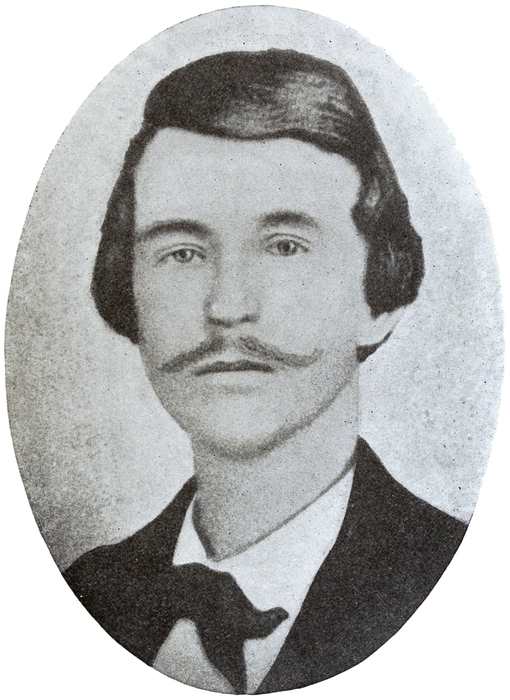
he was inferior to no man. His features were pleasing
without being handsome, his eyes were blue and
penetrating. He had a Roman nose. In height he
was five feet, eleven inches, and his form was well
knit, graceful and sinewy. His constitution was vigorous,
and his physical endurance equal to an Indian. His
glance was rapid and unerring. His judgment was
clearest and surest when the responsibility was heaviest,
and when the difficulties gathered thickest about
him. Based upon skill, energy, perspicacity and unusual
presence of mind, his fame as a Guerrilla will endure
for generations.
Quantrell died a Catholic and was buried in a Catholic
cemetery at Louisville, Kentucky.