Speech in the Senate, on the Bill for the Admission of Kansas
as a Free State, June 4, 1860.
Thou art a slave, whom Fortune’s tender arm
With favor never clasped, but bred a dog.
Shakespeare, Timon of Athens, Act IV. Sc. 3.
A universe of death, which God by curse
Created evil, for evil only good,
Where all life dies, death lives, and Nature breeds,
Perverse, all monstrous, all prodigious things.
Milton, Paradise Lost, Book II. 622-625.
Onward! onward!
With the night-wind,
Over field and farm and forest,
Lonely homestead, darksome hamlet,
Blighting all we breathe upon!
Longfellow, Golden Legend.
Instrumenti genus vocale, et semivocale, et mutum: vocale, in quo sunt
servi; semivocale, in quo sunt boves; mutum, in quo sunt plaustra.—Varro,
De Re Rustica, Lib. I. cap. xvii. § 1.
Nil metuunt jurare, nihil promittere parcunt;
Dicta nihil metuere, nihil perjuria curant.
Catullus, Carm. LXIV. 146, 148.
Pone crucem servo.—Meruit quo crimine servus
Supplicium? quis testis adest? quis detulit? Audi;
Nulla unquam de morte hominis cunctatio longa est.—
O demens, ita servus homo est? Nil fecerit, esto:
Hoc volo, sic jubeo, sit pro ratione voluntas.
Juvenal. Sat. VI. 219-223.
There is a tradition of the Prophet having said, that the greatest mortification
at the Day of Judgment will be when the pious slave is carried to
Paradise and the wicked master condemned to Hell.—Saadi, The Gulistan,
tr. Gladwin, p. 242.
“And the Black Oppressor am I called. And for this reason I am called
the Black Oppressor, that there is not a single man around me whom I have
not oppressed, and justice have I done unto none.” … “Since thou
hast, indeed, been an oppressor so long,” said Peredur, “I will cause that
thou continue so no longer.” So he slew him.—The Mabinogion, tr. Lady
Charlotte Guest, Vol. I. pp. 341, 342.
After we had secured these people, I called the linguists, and ordered
them to bid the men-negroes between decks be quiet (for there was a
great noise amongst them). On their being silent, I asked, What had
induced them to mutiny? They answered, I was a great rogue to buy them
in order to carry them away from their own country, and that they were
resolved to regain their liberty, if possible.—Snelgrave, New Account
of some Parts of Guinea and the Slave-Trade, p. 170.
A system of concubinage was practised among them worse than the loose
polygamy of the savages: the savage had as many women as consented to
become his wives; the colonist as many as he could enslave. There is an
ineffaceable stigma upon the Europeans in their intercourse with those whom
they treat as inferior races; there is a perpetual contradiction between their
lust and their avarice. The planter will one day take a slave for his harlot,
and sell her the next as a being of some lower species, a beast of labor.
If she be indeed an inferior animal, what shall be said of the one action?
If she be equally with himself a human being and an immortal soul,
what shall be said of the other? Either way there is a crime committed
against human nature.—Southey, History of Brazil, Chap. VIII., Vol. I.
p. 258.
Negro slavery exists in no part of the world without producing indolence,
licentiousness, and inhumanity in the whites; and these vices draw after
them their earthly punishment,—to look no farther into their fearful, but
assured consequences.—Ibid., Chap. XLIV., Vol. III. p. 816.
I had observed much, and heard more, of the cruelty of masters towards
their negroes; but now I received an authentic account of some horrid
instances thereof. The giving a child a slave of its own age to tyrannize
over, to beat and abuse out of sport, was, I myself saw, a common practice.
Nor is it strange, being thus trained up in cruelty, they should afterwards
arrive at so great perfection in it; that Mr. Star, a gentleman I
often met at Mr. Lasserre’s, should, as he himself informed L., first nail up
a negro by the ears, then order him to be whipped in the severest manner,
and then to have scalding water thrown over him, so that the poor
creature could not stir for four months after. Another much applauded
punishment is drawing their slaves’ teeth. One Colonel Lynch is universally
known to have cut off a poor negro’s legs, and to kill several of
them every year by his barbarities.—Rev. Charles Wesley, Journal,
Charleston, S. C., August 2, 1736.
You are to have no regard to the health, strength, comfort, natural affections,
or moral feelings, or intellectual endowments of my negroes. You
are only to consider what subsistence to allow them and what labor to exact
of them will subserve my interest. According to the most accurate
calculation I can make, the proportion of subsistence and labor which will
work them up in six years upon an average is the most profitable to the
planter. And this allowance, surely, is very humane; for we estimate here
the lives of our coal-heavers, upon an average, at only two years, … and
our soldiers and seamen no matter what.—A West-India Planter’s Instructions
for his Overseers: John Adams, Works, Vol. X. pp. 339, 340.
The unfortunate man would have been tried upon five other indictments,
some of them still more atrocious than the one upon which he was found
guilty; and his general character for barbarity was so notorious that no
room was left for me even to deliberate. His victims have been numerous;
some of them were even buried in their chains, and there have been found
upon the bones taken from the grave chains and iron rings of near forty
pounds’ weight.… He had been three times married, has left several
children; he had been in the Army, had a liberal education, and lived in
what is called the great world. His manners and address were those of
a gentleman. Cruelty appears in him to have been the effect of violence
of temper, and habit had made him regardless of the death and suffering of
a slave.—Right Hon. Hugh Elliot, Governor of the Leeward Islands:
Memoir, by the Countess of Minto, pp. 409, 410.
Is slavery less slavery in a Christian than in a Mahometan country? I
entreat your attention, while I plead the general cause of humanity. In
such a cause it is right to appeal to your sensibility as well as your reason.
It is now no longer time to flatter petty tyrants by acknowledging that color
constitutes a legitimate title for holding men in abject and perpetual bondage.
In support of this usurpation what can be urged but the law of the
strongest?—Col. David Humphreys, Valedictory Discourse before the
Cincinnati of Connecticut, July 4, 1804, p. 29.
Christianity suppressed slavery, but the Christians of the sixteenth century
reëstablished it,—as an exception, indeed, to their social system, and
restricted to one of the races of mankind; but the wound thus inflicted
upon humanity, though less extensive, was far more difficult of cure.—Tocqueville,
Democracy in America, ed. Bowen, Chap. XVIII. sec. 2,
Vol. I. p. 457.
The Kentuckian delights in violent bodily exertion; he is familiar with
the use of arms, and is accustomed from a very early age to expose his life
in single combat.… Were I inclined to continue this parallel, I could
easily prove that almost all the differences which may be remarked between
the characters of the Americans in the Southern and in the Northern
States have originated in Slavery.—Ibid., pp. 467, 468.
I visited our State Penitentiary a short time since, and from my own personal
observation I am led to the inevitable conclusion that the plan of sending
our slaves to the Penitentiary, as a punishment for crime, is exactly
the reverse: it is rather a reward than punishment. “Let sober reason
judge.”
We punish offenders to prevent crime. I would ask any reasonable man,
Is the sending a slave of any of our farms to the Penitentiary a punishment?
The white man is punished by being deprived of his liberty for that
length of time: what liberty is the slave deprived of? He has as much,
and oftentimes more, liberty within the walls of the Penitentiary than on
any of those large sugar or cotton plantations. Then where is the punishment?
We send white men there, and the dread of going is a stain on his
character: what character has the negro to lose? Hence we must come to
the conclusion that sending negro slaves to the Penitentiary is not a punishment.
A moment’s reflection will convince any man who has ever had the management
of negroes on a plantation, that the well-being and safety of societies
demand that any offence committed by a negro, for which the lash is
not a sufficient punishment, death should be the penalty.
Taking these things into consideration, would it not be just and laudable
to sell all negroes now in the Penitentiary to the highest bidder, on or about
the first of November next, by the Sheriff of the Parish of East Baton Rouge,
on the same terms and conditions that negroes are sold at present, under an
ordinary fi. fa., and, as near as can be, two thirds of the net proceeds of
each negro be paid to the former owners or their legal representatives, the
balance be and remain in the State Treasury for ordinary purposes?—Weekly
Advocate, Baton Rouge, La., Jan. 17, 1858.
A very large edition of this speech was printed at Washington,
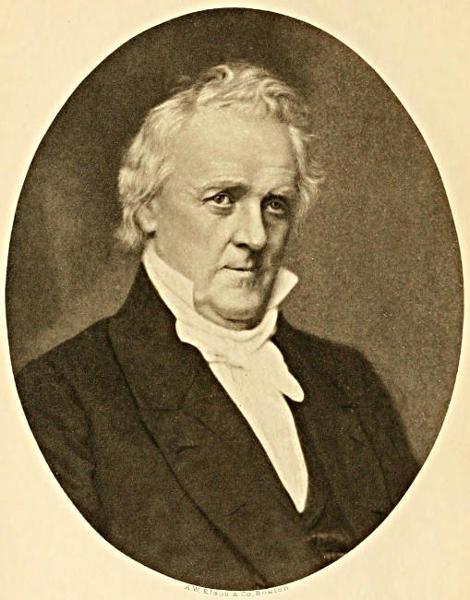
immediately after its delivery. Another appeared at Boston, with a
portrait; and another at San Francisco, with the Republican Platform.
While the Rebellion was still warring on the National Government, an
edition was brought out in New York by the “Young Men’s Republican
Union,” to which Mr. Sumner prefixed a Dedication to the
Young Men of the United States, which will be found in its proper
place, according to date, in this collection.
A letter from that devoted friend of the Slave, the late George L.
Stearns, of Boston, under date of March 1st, 1860, shows something of
the outside prompting under which Mr. Sumner spoke.
“I have just read ——’s speech. He stands up to the mark well, for a
politician; but we want one who believes a Man is greater than a President,
and who would not lift his finger to obtain the best office in the gift of our
nation, to raise this question above the political slough into its true position.
Charles O’Conor, in his late speech in New York, affirmed, that, ‘if Slavery
were not a wise and beneficent institution for the black as well as the
white, it could not be defended.’ We want you to take up the gauntlet
that he has thrown down so defiantly.”
A letter from William H. Brooks, of Cambridgeport, unconsciously
harmonized with Mr. Stearns.
“Feeling that our nation is now in the very throes of her deliverance, and
I trust her prompt deliverance, from bondage to her, not Thirty, but Three
Hundred Thousand Tyrants, may I frankly say, that, if not inconsistent
with your health and safety, which are on no consideration to be perilled,
you could aid more than any single person, or score of them, in effectually
accomplishing the great triumph.… The unseen forces of public opinion
are gathering and forming for the great November conflict. Your long, enforced,
and martyr silence will give a depth of impression and moving
power and ten thousand echoes to your words beyond their accustomed
might.”
Something about the menace of violence after this speech, with illustrations
of its reception at the time, is postponed to an Appendix.
Kansas was not admitted as a State into the Union until January 29,
1861, after the slaveholding Senators had withdrawn to organize the
Rebellion, when the bill on which the present speech was made became
a law.

MR. PRESIDENT,—Undertaking now, after a silence
of more than four years, to address the
Senate on this important subject, I should suppress the
emotions natural to such an occasion, if I did not declare
on the threshold my gratitude to that Supreme
Being through whose benign care I am enabled, after
much suffering and many changes, once again to resume
my duties here, and to speak for the cause so near my
heart. To the honored Commonwealth whose representative
I am, and also to my immediate associates in
this body, with whom I enjoy the fellowship which is
found in thinking alike concerning the Republic,[25] I owe
thanks which I seize the moment to express for indulgence
extended to me throughout the protracted seclusion
enjoined by medical skill; and I trust that it will
not be thought unbecoming in me to put on record here,
as an apology for leaving my seat so long vacant, without
making way, by resignation, for a successor, that
I acted under the illusion of an invalid, whose hopes
for restoration to natural health continued against oft-recurring
disappointment.
When last I entered into this debate, it became my
duty to expose the Crime against Kansas, and to insist
upon the immediate admission of that Territory as a
State of this Union, with a Constitution forbidding
Slavery. Time has passed, but the question remains.
Resuming the discussion precisely where I left it, I am
happy to avow that rule of moderation which, it is said,
may venture to fix the boundaries of wisdom itself. I
have no personal griefs to utter: only a vulgar egotism
could intrude such into this Chamber. I have no personal
wrongs to avenge: only a brutish nature could
attempt to wield that vengeance which belongs to the
Lord. The years that have intervened and the tombs
that have opened[26] since I spoke have their voices,
too, which I cannot fail to hear. Besides, what am I,
what is any man among the living or among the dead,
compared with the question before us? It is this
alone which I shall discuss, and I begin the argument
with that easy victory which is found in charity.
The Crime against Kansas stands forth in painful
light. Search history, and you cannot find its parallel.
The slave-trade is bad; but even this enormity is petty,
compared with that elaborate contrivance by which, in a
Christian age and within the limits of a Republic, all
forms of constitutional liberty were perverted, all the
rights of human nature violated, and the whole country
held trembling on the edge of civil war,—while all this
large exuberance of wickedness, detestable in itself, becomes
tenfold more detestable, when its origin is traced
to the madness for Slavery. The fatal partition between
Freedom and Slavery, known as the Missouri Compromise,—the
subsequent overthrow of this partition, and
the seizure of all by Slavery,—the violation of plighted
faith,—the conspiracy to force Slavery at all hazards
into Kansas,—the successive invasions by which all
security there was destroyed, and the electoral franchise
itself was trodden down,—the sacrilegious seizure of the
very polls, and, through pretended forms of law, the imposition
of a foreign legislature upon this Territory,—the
acts of this legislature, fortifying the Usurpation, and,
among other things, establishing test-oaths, calculated
to disfranchise actual settlers friendly to Freedom, and
securing the privileges of the citizen to actual strangers
friendly to Slavery,—the whole crowned by a statute,
“the be-all and the end-all” of the whole Usurpation,
through which Slavery was not only recognized on this
beautiful soil, but made to bristle with a Code of Death
such as the world has rarely seen,—all these I fully
exposed on a former occasion. And yet the most important
part of the argument was at that time left untouched:
I mean that found in the Character of Slavery.
This natural sequel, with the permission of the Senate,
I now propose to supply.
Motive is to Crime as soul to body; and it is only
when we comprehend the motive that we can truly
comprehend the Crime. Here the motive is found in
Slavery and the rage for its extension. Therefore, by
logical necessity, must Slavery be discussed,—not indirectly,
timidly, and sparingly, but directly, openly, and
thoroughly. It must be exhibited as it is, alike in its
influence and its animating character, so that not only
outside, but inside, may be seen.
This is no time for soft words or excuses. All such
are out of place. They may turn away wrath; but
what is the wrath of man? This is no time to abandon
any advantage in the argument. Senators sometimes
announce that they resist Slavery on political
grounds only, and remind us that they say nothing of
the moral question. This is wrong. Slavery must be
resisted not only on political grounds, but on all other
grounds, whether social, economical, or moral. Ours is
no holiday contest; nor is it any strife of rival factions,
of White and Red Roses, of theatric Neri and Bianchi;
but it is a solemn battle between Right and Wrong,
between Good and Evil. Such a battle cannot be
fought with rosewater. There is austere work to be
done, and Freedom cannot consent to fling away any
of her weapons.
If I were disposed to shrink from this discussion, the
boundless assumptions made by Senators on the other
side would not allow me. The whole character of Slavery,
as a pretended form of Civilization, is put directly
in issue, with a pertinacity and a hardihood which
banish all reserve on this side. In these assumptions
Senators from South Carolina naturally take the lead.
Following Mr. Calhoun, who pronounced Slavery “the
most solid and durable foundation on which to rear free
and stable political institutions,”[27] and Mr. McDuffie,
who did not shrink from calling it “the corner-stone
of our republican edifice,”[28] the Senator from South
Carolina [Mr. Hammond] insists that its “frame of
society is the best in the world”[29]; and his colleague
[Mr. Chesnut] takes up the strain. One Senator from
Mississippi [Mr. Jefferson Davis], adds, that Slavery
“is but a form of civil government for those who by
their nature are not fit to govern themselves”;[30] and his
colleague [Mr. Brown] openly vaunts that it “is a great
moral, social, and political blessing,—a blessing to the
slave, and a blessing to the master.”[31] One Senator from
Virginia [Mr. Hunter], in a studied vindication of what
he is pleased to call “the social system of the South,”
exalts Slavery as “the normal condition of human society,”
“beneficial to the non-slave-owner as it is to the
slave-owner,” “best for the happiness of both races,”—and,
in enthusiastic advocacy, declares, “that the very
keystone of the mighty arch, which, by its concentrated
strength, and by the mutual support of its parts, is able
to sustain our social superstructure, consists in the black
marble block of African Slavery: knock that out, and
the mighty fabric, with all that it upholds, topples and
tumbles to its fall.”[32] These are his very words, uttered
in debate here. And his colleague [Mr. Mason], who
never hesitates where Slavery is in question, proclaims
that it is “ennobling to both races, the white and the
black,”—a word which, so far as the slave is concerned,
he changes, on a subsequent day, to “elevating,” assuming
still that it is “ennobling” to the whites,[33]—which
is simply a new version of the old assumption, by Mr.
McDuffie, of South Carolina, that “the institution of
Domestic Slavery supersedes the necessity of an order
of nobility.”[34]
Thus, by various voices, is Slavery defiantly proclaimed
a form of Civilization,—not seeing that its
existence is plainly inconsistent with the first principles
of anything that can be called Civilization, except
by that figure of speech in classical literature where a
thing takes its name from something which it has not,
as the dreadful Fates were called merciful because they
were without mercy. Pardon the allusion, if I add,
that, listening to these sounding words for Slavery, I
am reminded of the kindred extravagance related by
that remarkable traveller in China, the late Abbé Huc,
where a gloomy hole in which he was lodged, infested
by mosquitoes and exhaling noisome vapors, with light
and air entering by a single narrow aperture only, was
styled by Chinese pride “The Hotel of the Beatitudes.”
According to a Hindoo proverb, the snail sees nothing
but its own shell, and thinks it the grandest palace in
the universe. This is another illustration of the delusion
which we are called to witness.
It is natural that Senators thus insensible to the
true character of Slavery should evince an equal insensibility
to the true character of the Constitution.
This is shown in the claim now made, and pressed with
unprecedented energy, degrading the work of our fathers,
that by virtue of the Constitution the pretended
property in man is placed beyond the reach of Congressional
prohibition even within Congressional jurisdiction,
so that the slave-master may at all times enter
the broad outlying territories of the Union with the
victims of his oppression, and there continue to hold
them by lash and chain.
Such are two assumptions, the first of fact, and the
second of Constitutional Law, now vaunted without
apology or hesitation. I meet them both. To the
first I oppose the essential Barbarism of Slavery, in all
its influences, whether high or low,—as Satan is Satan
still, whether towering in the sky or squatting in the
toad. To the second I oppose the unanswerable, irresistible
truth, that the Constitution of the United
States nowhere recognizes property in man. These two
assumptions naturally go together. They are “twins”
suckled by the same wolf. They are the “couple” in
the present slave-hunt. And the latter cannot be answered
without exposing the former. It is only when
Slavery is exhibited in its truly hateful character that
we fully appreciate the absurdity of the assumption,
which, in defiance of express letter in the Constitution,
and without a single sentence, phrase, or word upholding
human bondage, yet foists into this blameless text
the barbarous idea that man can hold property in man.
On former occasions I have discussed Slavery only
incidentally: as, in unfolding the principle that Slavery
is Sectional and Freedom National; in exposing the
unconstitutionality of the Fugitive Slave Bill; in vindicating
the Prohibition of Slavery in the Missouri
Territory; in exhibiting the imbecility, throughout the
Revolution, of the Slave States, and especially of South
Carolina; and, lastly, in unmasking the Crime against
Kansas. On all these occasions, where I spoke at
length, I said too little of the character of Slavery,—partly
because other topics were presented, and partly
from a prevailing disinclination to press the argument
against those whom I knew to have all the sensitiveness
of a sick man. But, God be praised, this time
has passed, and the debate is now lifted from details
to principles. Grander debate has not occurred in our
history,—rarely in any history; nor can it close or
subside, except with the triumph of Freedom.
Of course I begin with the assumption of fact, which
must be treated at length.
It was the often-quoted remark of John Wesley, who
knew well how to use words, as also how to touch
hearts, that Slavery is “the sum of all villanies.” The
phrase is pungent; but it were rash in any of us to
criticise the testimony of that illustrious founder of
Methodism, whose ample experience of Slavery in
Georgia and the Carolinas seems to have been all condensed
in this sententious judgment. Language is
feeble to express all the enormity of an institution
which is now exalted as in itself a form of civilization,
“ennobling” at least to the master, if not to the slave.
Look at it as you will, and it is always the scab, the
canker, the “barebones,” and the shame of the country,—wrong,
not merely in the abstract, as is often
admitted by its apologist, but wrong in the concrete
also, and possessing no single element of right. Look
at it in the light of principle, and it is nothing less
than a huge insurrection against the eternal law of
God, involving in its pretensions the denial of all human
rights, and also the denial of that Divine Law in
which God himself is manifest, thus being practically
the grossest lie and the grossest atheism. Founded in
violence, sustained only by violence, such a wrong must
by sure law of compensation blast master as well as
slave,—blast the lands on which they live, blast the
community of which they are part, blast the government
which does not forbid the outrage; and the longer
it exists and the more completely it prevails, must its
vengeful influences penetrate the whole social system.
Barbarous in origin, barbarous in law, barbarous in
all its pretensions, barbarous in the instruments it
employs, barbarous in consequences, barbarous in spirit,
barbarous wherever it shows itself, Slavery must breed
Barbarians, while it develops everywhere, alike in the
individual and the society to which he belongs, the
essential elements of Barbarism. In this character it is
conspicuous before the world.
Undertaking now to expose the Barbarism of Slavery,
the whole broad field is open before me. There is
nothing in its character, its manifold wrong, its wretched
results, and especially in its influence on the class
claiming to be “ennobled” by it, that will not fall
naturally under consideration.
I know well the difficulty of this discussion, involved
in the humiliating truth with which I begin. Senators,
on former occasions, revealing their sensitiveness,
have even protested against comparison between what
were called “two civilizations,”—meaning the two
social systems produced respectively by Freedom and
Slavery. The sensibility and the protest are not unnatural,
though mistaken. “Two civilizations!” Sir,
in this nineteenth century of Christian light there can
be but one Civilization, and this is where Freedom
prevails. Between Slavery and Civilization there is
essential incompatibility. If you are for the one, you
cannot be for the other; and just in proportion to the
embrace of Slavery is the divorce from Civilization.
As cold is but the absence of heat, and darkness but
the absence of light, so is Slavery but the absence of
justice and humanity, without which Civilization is impossible.
That slave-masters should be disturbed, when
this is exposed, might be expected. But the assumptions
so boastfully made, while they may not prevent
the sensibility, yet surely exclude all ground of protest,
when these assumptions are exposed.
Nor is this the only difficulty. Slavery is a bloody
Touch-Me-Not, and everywhere in sight now blooms the
bloody flower. It is on the wayside as we approach
the National Capitol; it is on the marble steps which
we mount; it flaunts on this floor. I stand now in the
house of its friends. About me, while I speak, are
its most jealous guardians, who have shown in the past
how much they are ready to do or not to do, where
Slavery is in question. Menaces to deter me have
not been spared. But I should ill deserve the high
post of duty here, with which I am honored by a
generous and enlightened people, if I could hesitate.
Idolatry has been exposed in the presence of idolaters,
and hypocrisy chastised in the presence of Scribes and
Pharisees. Such examples may impart encouragement
to a Senator undertaking in this presence to expose
Slavery; nor can any language, directly responsive to
Senatorial assumptions made for this Barbarism, be open
to question. Slavery can be painted only in sternest
colors; nor can I forget that Nature’s sternest painter
has been called the best.
The Barbarism of Slavery appears, first, in the
character of Slavery, and, secondly, in the character of
Slave-Masters.
Under the first head we shall properly consider
(1) the Law of Slavery with its Origin, and (2) the practical
results of Slavery, as shown in comparison between
the Free States and the Slave States.
Under the second head we shall naturally consider
(1) Slave-Masters as shown in the Law of Slavery;
(2) Slave-Masters in their relations with slaves, here
glancing at their three brutal instruments; (3) Slave-Masters
in their relations with each other, with society,
and with Government; and (4) Slave-Masters in their
unconsciousness.
The way will then be prepared for the consideration
of the assumption of Constitutional Law.
I.
In presenting the Character of Slavery, there
is little for me, except to make Slavery paint itself.
When this is done, the picture will need no explanatory
words.
(1.) I begin with the Law of Slavery and its Origin;
and here this Barbarism sketches itself in its own
chosen definition. It is simply this: Man, created in
the image of God, is divested of the human character,
and declared to be a “chattel,”—that is, a beast, a
thing, or article of property. That this statement may
not seem made without precise authority, I quote the
statutes of three different States, beginning with South
Carolina, whose voice for Slavery has always unerring
distinctiveness. According to the definition supplied
by this State, slaves
“shall be deemed, held, taken, reputed, and adjudged in
law to be chattels personal in the hands of their owners
and possessors, and their executors, administrators, and assigns,
to all intents, constructions, and purposes whatsoever.”[35]
And here is the definition supplied by the Civil Code
of Louisiana:—
“A slave is one who is in the power of a master to whom
he belongs. The master may sell him, dispose of his person,
his industry, and his labor. He can do nothing, possess
nothing, nor acquire anything, but what must belong to his
master.”[36]
In similar spirit the law of Maryland thus indirectly
defines a slave as an article:—
“In case the personal property of a ward shall consist of
specific articles, such as slaves, working beasts, animals of any
kind, … the court, if it shall deem it advantageous for the
ward, may at any time pass an order for the sale thereof.”[37]
Not to occupy time unnecessarily, I present a summary
of the pretended law defining Slavery in all the
Slave States, as made by a careful writer, Judge Stroud,
in a work of juridical as well as philanthropic merit:—
“The cardinal principle of Slavery—that the slave is
not to be ranked among sentient beings, but among things,
is an article of property, a chattel personal—obtains as
undoubted law in all of these [Slave] States.”[38]
Out of this definition, as from a solitary germ, which
in its pettiness might be crushed by the hand, towers
our Upas Tree and all its gigantic poison. Study it, and
you will comprehend the whole monstrous growth.
Sir, look at its plain import, and see the relation
which it establishes. The slave is held simply for the
use of his master, to whose behests his life, liberty, and
happiness are devoted, and by whom he may be bartered,
leased, mortgaged, bequeathed, invoiced, shipped
as cargo, stored as goods, sold on execution, knocked off
at public auction, and even staked at the gaming-table
on the hazard of a card or a die,—all according to law.
Nor is there anything, within the limit of life, inflicted
on a beast, which may not be inflicted on the slave.
He may be marked like a hog, branded like a mule,
yoked like an ox, hobbled like a horse, driven like an
ass, sheared like a sheep, maimed like a cur, and constantly
beaten like a brute,—all according to law. And
should life itself be taken, what is the remedy? The
Law of Slavery, imitating that rule of evidence which
in barbarous days and barbarous countries prevented
the Christian from testifying against the Mahometan,
openly pronounces the incompetency of the whole African
race, whether bond or free, to testify against a
white man in any case, and thus, after surrendering the
slave to all possible outrage, crowns its tyranny by
excluding the very testimony through which the bloody
cruelty of the Slave-Master might be exposed.
Thus in its Law does Slavery paint itself; but it is
only when we look at details, and detect its essential
elements, five in number, all inspired by a single motive,
that its character becomes completely manifest.
Foremost, of course, in these elements, is the impossible
pretension, where Barbarism is lost in impiety, by
which man claims property in man. Against such blasphemy
the argument is brief. According to the Law of
Nature, written by the same hand that placed the planets
in their orbits, and, like them, constituting part of
the eternal system of the Universe, every human being
has complete title to himself direct from the Almighty.
Naked he is born; but this birthright is inseparable
from the human form. A man may be poor in this
world’s goods; but he owns himself. No war or robbery,
ancient or recent,—no capture—no middle passage,—no
change of clime,—no purchase-money,—no
transmission from hand to hand, no matter how many
times, and no matter at what price, can defeat this indefeasible,
God-given franchise. And a divine mandate,
strong as that which guards Life, guards Liberty also.
Even at the very morning of Creation, when God said,
“Let there be Light,”—earlier than the malediction
against murder,—he set the everlasting difference between
man and chattel, giving to man “dominion over
the fish of the sea, and over the fowl of the air, and
over every living thing that moveth upon the earth.”
“That right we hold
By his donation; but man over men
He made not lord: such title to himself
Reserving, human left from human free.”
[39]
Slavery tyrannically assumes power which Heaven
denied,—while, under its barbarous necromancy, borrowed
from the Source of Evil, a man is changed into
a chattel, a person is withered into a thing, a soul is
shrunk into merchandise. Say, Sir, in lofty madness,
that you own the sun, the stars, the moon; but do not
say that you own a man, endowed with soul to live
immortal, when sun and moon and stars have passed
away.
Secondly. Slavery paints itself again in its complete
abrogation of marriage, recognized as a sacrament by
the Church, and as a contract by the civil power, wherever
civilization prevails. Under the Law of Slavery no
such sacrament is respected, and no such contract can
exist. The ties formed between slaves are all subject
to the selfish interests or more selfish lust of the master,
whose license knows no check. Natural affections
which have come together are rudely torn asunder:
nor is this all. Stripped of every defence, the chastity
of a whole race is exposed to violence, while the result
is recorded in tell-tale faces of children, glowing with
a master’s blood, but doomed for their mother’s skin
to Slavery through descending generations. The Senator
from Mississippi [Mr. Brown], galled by the comparison
between Slavery and Polygamy, winces. I
hail this sensibility as the sign of virtue. Let him
reflect, and he will confess that there are many disgusting
elements in Slavery, not present in Polygamy,
while the single disgusting element of Polygamy is
more than present in Slavery. By license of Polygamy,
one man may have many wives, all bound to
him by marriage-tie, and in other respects protected
by law. By license of Slavery, a whole race is delivered
over to prostitution and concubinage, without
the protection of any law. Surely, Sir, is not Slavery
barbarous?
Thirdly. Slavery paints itself again in its complete
abrogation of the parental relation, provided by God in
his benevolence for the nurture and education of the
human family, and constituting an essential part of
Civilization itself. And yet by the Law of Slavery—happily
beginning to be modified in some places—this
relation is set at nought, and in its place is substituted
the arbitrary control of the master, at whose mere command
little children, such as the Saviour called unto
him, though clasped by a mother’s arms, are swept
under the hammer of the auctioneer. I do not dwell
on this exhibition. Sir, is not Slavery barbarous?
Fourthly. Slavery paints itself again in closing the
gates of knowledge, which are also the shining gates of
Civilization. Under its plain, unequivocal law, the bondman,
at the unrestrained will of his master, is shut out
from all instruction; while in many places—incredible
to relate—the law itself, by cumulative provisions,
positively forbids that he shall be taught to read!
Of course the slave cannot be allowed to read: for his
soul would then expand in larger air, while he saw the
glory of the North Star, and also the helping truth, that
God, who made iron, never made a slave; for he would
then become familiar with the Scriptures, with the Decalogue
still speaking in the thunders of Sinai,—with
that ancient text, “He that stealeth a man and selleth
him, or if he be found in his hand, he shall surely be
put to death”[40]—with that other text, “Masters, give
unto your servants that which is just and equal,”[41]—with
that great story of Redemption, when the Lord raised
the slave-born Moses to deliver his chosen people from
the house of bondage,—and with that sublimer story,
where the Saviour died a cruel death, that all men, without
distinction of race, might be saved, leaving to mankind
a commandment which, even without his example,
makes Slavery impossible. Thus, in order to fasten your
manacles upon the slave, you fasten other manacles upon
his soul. The ancients maintained Slavery by chains
and death: you maintain it by that infinite despotism
and monopoly through which human nature itself is degraded.
Sir, is not Slavery barbarous?
Fifthly. Slavery paints itself again in the appropriation
of all the toil of its victims, excluding them from
that property in their own earnings which the Law of
Nature allows and Civilization secures. The painful
injustice of this pretension is lost in its meanness. It
is robbery and petty larceny under garb of law. And
even the meanness is lost in the absurdity of its associate
pretension, that the African, thus despoiled of all
earnings, is saved from poverty, and that for his own
good he must work for his master, and not for himself.
Alas, by such fallacy is a whole race pauperized! And
yet this transaction is not without illustrative example.
A sombre poet, whose verse has found wide favor, pictures
a creature who
“with one hand put
A penny in the urn of poverty,
And with the other took a shilling out.”
[42]
And a celebrated traveller through Russia, more than
a generation ago, describes a kindred spirit, who, while
devoutly crossing himself at church with his right hand,
with the left deliberately picked the pocket of a fellow-sinner
by his side.[43] Not admiring these instances, I
cannot cease to deplore a system which has much of
both, while, under affectation of charity, it sordidly
takes from the slave all the fruits of his bitter sweat,
and thus takes from him the main spring to exertion.
Tell me, Sir, is not Slavery barbarous?
Such is Slavery in its five special elements of Barbarism,
as recognized by law: first, assuming that man can
hold property in man; secondly, abrogating the relation
of husband and wife; thirdly, abrogating the parental
tie; fourthly, closing the gates of knowledge; and,
fifthly, appropriating the unpaid labor of another. Take
away these elements, sometimes called “abuses,” and
Slavery will cease to exist; for it is these very “abuses”
which constitute Slavery. Take away any one of them,
and the abolition of Slavery begins. And when I present
Slavery for judgment, I mean no slight evil, with
regard to which there may be reasonable difference
of opinion, but I mean this fivefold embodiment of
“abuse,” this ghastly quincunx of Barbarism, each
particular of which, if considered separately, must be
denounced at once with all the ardor of an honest soul,
while the whole fivefold combination must awake a
fivefold denunciation. The historic pirates, once the
plague of the Gulf whose waters they plundered, have
been praised for the equity with which they adjusted
the ratable shares of spoil, and also for generous benefactions
to the poor, and even to churches, so that Sir
Walter Scott could say,—
“Do thou revere
The statutes of the Buccaneer.”
[44]
In our Law of Slavery what is there to revere? what is
there at which the soul does not rise in abhorrence?
But this fivefold combination becomes yet more hateful
when its single motive is considered; and here Slavery
paints itself finally. The Senator from Mississippi
[Mr. Jefferson Davis] says that it is “but a form of
civil government for those who by their nature are not
fit to govern themselves.” The Senator is mistaken.
It is an outrage, where five different pretensions all
concur in one single object, looking only to the profit
of the master, and constituting its ever-present motive
power, which is simply to compel the labor of fellow-men
without wages. If I pronounce this object not only barbarous,
but brutal, I follow the judgment of Luther’s
Bible, in the book “Jesus Sirach,” known in our translation
as Ecclesiasticus, where it is said: “He that giveth
not his wages to the laborer, he is a bloodhound.”[45]
Slavery is often exposed as degrading Humanity. On
this fruitful theme nobody has expressed himself with
the force and beautiful eloquence of our own Channing.
His generous soul glowed with indignation at
the thought of man, supremest creature of earth, and
first of God’s works, despoiled of manhood and changed
to a thing. But earlier than Channing was Jean
Jacques Rousseau, who, with similar eloquence and
the same glowing indignation, vindicated Humanity.
How grandly he insists that nobody can consent to
be a slave, or can be born a slave! Believing Liberty
the most noble of human attributes, this wonderful
writer will not stop to consider if descent to the condition
of beasts be not to degrade human nature, if renunciation
of the most precious of all God’s gifts be not to
offend the Author of our being; but he demands only by
what right those who degrade themselves to this depth
can subject their posterity to this same ignominy, renouncing
for them goods which do not depend upon
any ancestors, and without which life itself is to all
worthy of it a burden; and he justly concludes, that, as,
to establish Slavery, it is necessary to violate Nature,
so, to perpetuate this claim, it is necessary to change
Nature. His final judgment, being the practical conclusion
of this outburst, holds up jurisconsults, gravely
pronouncing that the child of a slave is born a slave,
as deciding, in other terms, that a man is not born a
man,[46]—thus exposing the peculiar absurdity of that
pretension by which Slavery is transmitted from the
mother to her offspring, as expressed in the Latin scrap
on which the Senator from Virginia [Mr. Mason] relies:
Partus sequitur ventrem.
If the offence of Slavery were less extended, if it
were confined to some narrow region, if it had less of
grandeur in its proportions, if its victims were counted
by tens and hundreds instead of millions, the five-headed
enormity would find little indulgence; all would
rise against it, while Religion and Civilization would
lavish choicest efforts in the general warfare. But
what is wrong when done to one man cannot be right
when done to many. If it is wrong thus to degrade a
single soul, if it is wrong thus to degrade you, Mr.
President, it cannot be right to degrade a whole race.
And yet this is denied by the barbarous logic of Slavery,
which, taking advantage of its own wrong, claims
immunity because its usurpation has assumed a front
of audacity that cannot be safely attacked. Unhappily,
there is Barbarism elsewhere in the world; but American
Slavery, as defined by existing law, stands forth as
the greatest organized Barbarism on which the sun now
looks. It is without a single peer. Its author, after
making it, broke the die.
If curiosity carries us to the origin of this law,—and
here I approach a topic often considered in this Chamber,—we
shall again confess its Barbarism. It is not
derived from the Common Law, that fountain of Liberty;
for this law, while unhappily recognizing a system of
servitude known as villeinage, secured to the bondman
privileges unknown to the American slave,—guarded
his person against mayhem,—protected his wife against
rape,—gave to his marriage equal validity with the
marriage of his master,—and surrounded his offspring
with generous presumptions of Freedom, unlike that
rule of yours by which the servitude of the mother is
necessarily stamped upon the child. It is not derived
from the Roman Law, that fountain of Tyranny, for two
reasons: first, because this law, in its better days, when
its early rigors were spent, like the Common Law itself,
secured to the bondman privileges unknown to the
American slave,—in certain cases of cruelty rescued
him from his master, prevented separation of parents
and children, also of brothers and sisters, and even
protected him in the marriage relation; and, secondly,
because the Thirteen Colonies were not derived from
any of those countries which recognized the Roman
Law, while this law, even before the discovery of this
continent, had lost all living efficacy. It is not derived
from the Mohammedan Law; for, under the mild injunctions
of the Koran, a benignant servitude, unlike
yours, has prevailed,—where the lash is not allowed
to lacerate the back of a female,—where no knife or
branding-iron is employed upon any human being, to
mark him as the property of his fellow-man,—where
the master is expressly enjoined to favor the desires of
his slave for emancipation,—and where the blood of
the master, mingling with that of his bondwoman, takes
from her the transferable character of chattel, and confers
complete freedom upon their offspring. It is not
derived from the Spanish Law; for this law contains humane
elements unknown to your system, borrowed, perhaps,
from Mohammedan Moors who so long occupied
Spain; and, besides, our Thirteen Colonies had no umbilical
connection with Spain. Nor is it derived from
English statutes or American statutes; for we have the
positive and repeated averment of the Senator from
Virginia [Mr. Mason], and also of other Senators, that
in not a single State of the Union can any such statutes
establishing Slavery be found. From none of these
does it come.
No, Sir, not from any land of Civilization is this Barbarism
derived. It comes from Africa, ancient nurse of
monsters,—from Guinea, Dahomey, and Congo. There
is its origin and fountain. This benighted region, we
are told by Chief-Justice Marshall in a memorable
judgment,[47] still asserts a right, discarded by Christendom,
to enslave captives taken in war; and this African
Barbarism is the beginning of American Slavery.
The Supreme Court of Georgia, a Slave State, has not
shrunk from this conclusion. “Licensed to hold slave
property,” says the Court, “the Georgia planter held
the slave as a chattel, either directly from the slave-trader
or from those who held under him, and he from
the slave-captor in Africa. The property of the planter
in the slave became thus the property of the original
captor.”[48] It is natural that a right thus derived in
defiance of Christendom, and openly founded on the
most vulgar Paganism, should be exercised without mitigating
influence from Christianity,—that the master’s
authority over the person of his slave, over his conjugal
relations, over his parental relations, over the employment
of his time, over all his acquisitions, should
be recognized, while no generous presumption inclines
to Freedom, and the womb of the bondwoman can deliver
only a slave.
From its home in Africa, where it is sustained by immemorial
usage, this Barbarism, thus derived and thus
developed, traversed the ocean to American soil. It
entered on board that fatal slave-ship,
“Built in the eclipse, and rigged with curses dark,”
which in 1620 landed its cruel cargo at Jamestown, in
Virginia; and it has boldly taken its place in every
succeeding slave-ship, from that early day till now,—helping
to pack the human freight, regardless of human
agony,—surviving the torments of the middle passage,—surviving
its countless victims plunged beneath
the waves; and it has left the slave-ship only to travel
inseparable from the slave in his various doom, sanctioning
by its barbarous code every outrage, whether of
mayhem or robbery, lash or lust, and fastening itself
upon his offspring to the remotest generation. Thus
are barbarous prerogatives of barbarous half-naked African
chiefs perpetuated in American Slave-Masters, while
the Senator from Virginia [Mr. Mason], perhaps unconscious
of their origin, perhaps desirous to secure for
them the appearance of a less barbarous pedigree, tricks
them out with a phrase of the Roman Law, discarded
by the Common Law, which simply renders into ancient
Latin an existing rule of African Barbarism, recognized
as an existing rule of American Slavery.
Such is the plain juridical origin of the American
slave code, now vaunted as a badge of Civilization. But
all law, whatever its juridical origin, whether Christian
or Mohammedan, Roman or African, may be traced to
other and ampler influences in Nature, sometimes of
Right and sometimes of Wrong. Surely the law which
stamped the slave-trade as piracy punishable with death
had a different inspiration from that other law which
secured immunity for the slave-trade throughout an immense
territory, and invested its supporters with political
power. As there is a nobler law above, so there is
a meaner law below, and each is felt in human affairs.
Thus far we have seen Slavery only in pretended
law, and in the origin of that law. Here I might stop,
without proceeding in the argument; for on the letter
of the law alone must Slavery be condemned. But the
tree is known by its fruits, which I shall now exhibit:
and this brings me to the second stage of the
argument.
(2.) In considering the practical results of Slavery,
the materials are so obvious and diversified that my
chief care will be to abridge and reject: and here I put
the Slave States and Free States face to face, showing
at each point the blasting influence of Slavery.
Before proceeding with these details, I would for one
moment expose that degradation of free labor, which is
one of the general results. Where there are slaves,
whose office is work, it is held disreputable for a white
man to soil his skin or harden his hands with honest
toil. The Slave-Master of course declines work, and
his pernicious example infects all others. With impious
resolve, they would reverse the Almighty decree
appointing labor as the duty of man, and declaring that
in the sweat of his face shall he eat his bread. The
Slave-Master says, “No! this is true of the slave, of
the black man, but not of the white man: he shall
not eat his bread in the sweat of his face.” Thus is the
brand of degradation stamped upon that daily toil
which contributes so much to a true Civilization. It is
a constant boast in the Slave States, that white men
there will not perform work performed in the Free
States. Mr. Calhoun and Mr. Waddy Thompson made
this boast. Let it be borne in mind, then, that, where
Slavery prevails, there is not only despair for the black
man, but inequality and ignominy for the white laborer.
By necessary consequence, the latter, whether emigrating
from our Free States or fleeing from oppression and
wretchedness in his European home, avoids a region
disabled by such a social law. Hence a twofold injustice:
practically he is excluded from the land, while
the land itself becomes a prey to that paralysis which
is caused by a violation of the laws of God. And now
for the testimony.
The States where this Barbarism exists excel the
Free States in all natural advantages. Their territory
is more extensive, stretching over 851,448 square miles,
while the Free States, including California, embrace
only 612,597 square miles. Here is a difference of
more than 238,000 square miles in favor of the Slave
States, showing that Freedom starts in this great
rivalry with a field more than a quarter less than
that of Slavery. In happiness of climate, adapted to
productions of special value,—in exhaustless motive
power distributed throughout its space,—in natural
highways, by more than fifty navigable rivers, never
closed by the rigors of winter,—and in a stretch of
coast, along Ocean and Gulf, indented by hospitable harbors,—the
whole presenting incomparable advantages
for that true Civilization, where agriculture, manufactures,
and commerce, both domestic and foreign, blend,—in
all these respects the Slave States excel the Free
States, whose climate is often churlish, whose motive
power is less various, whose navigable rivers are fewer
and often sealed by ice, and whose coast, while less
in extent and with fewer harbors, is often perilous from
storm and cold.
But Slavery plays the part of a Harpy, and defiles
the choicest banquet. See what it does with this territory,
thus spacious and fair.
An important indication of prosperity is in the growth
of population. In this respect the two regions started
equal. In 1790, at the first census under the Constitution,
the population of the present Slave States was
1,961,372, of the present Free States 1,968,455, showing
a difference of only 7,083 in favor of the Free States.
This difference, at first merely nominal, has been constantly
increasing since, showing itself more strongly in
each decennial census, until, in 1850, the population of
the Slave States, swollen by the annexation of three
foreign Territories, Louisiana, Florida, and Texas, was
only 9,612,969, while that of the Free States, without
such large annexations, reached 13,434,922, showing a
difference of 3,821,953 in favor of Freedom. But this
difference becomes still more remarkable, if we confine
our inquiries to the white population, which at this
period was only 6,184,477 in the Slave States, while it
was 13,238,670 in the Free States, showing a difference
of 7,054,193, in favor of Freedom, and showing also
that the white population of the Free States had not
only doubled, but, while occupying a smaller territory,
commenced to triple, that of the Slave States. The
comparative sparseness of the two populations furnishes
another illustration. In the Slave States the average
number of inhabitants to a square mile was 11.29, while
in the Free States it was 21.93, or almost two to one in
favor of Freedom.
These results are general; but if we take any particular
Slave State, and compare it with a Free State,
we shall find the same marked evidence for Freedom.
Take Virginia, with a territory of 61,352 miles, and
New York, with a territory of 47,000, or over 14,000
square miles less than her sister State. New York has
one seaport, Virginia some three or four; New York
has one noble river, Virginia has several; New York
for 400 miles runs along the frozen line of Canada,
Virginia basks in a climate of constant felicity. But
Freedom is better than climate, river, or seaport. In
1790 the population of Virginia was 748,308, and in
1850 it was 1,421,661. In 1790 the population of New
York was 340,120, and in 1850 it was 3,097,394. That
of Virginia had not doubled in sixty years, while that
of New York had multiplied more than nine-fold. A
similar comparison may be made between Kentucky,
with 37,680 square miles, admitted into the Union as
long ago as 1792, and Ohio, with 39,964 square miles,
admitted into the Union in 1802. In 1850, the Slave
State had a population of only 982,405, while Ohio had
a population of 1,980,329, showing a difference of nearly
a million in favor of Freedom.
As in population, so also in the value of property, real
and personal, do the Free States excel the Slave States.
According to the census of 1850, the value of property
in the Free States was $4,102,162,098, while in the
Slave States it was $2,936,090,737; or, if we deduct
the asserted property in human flesh, only $1,655,945,137,—showing
an enormous difference of billions in
favor of Freedom. In the Free States the valuation
per acre was $10.46, in the Slave States only $3.04.
This disproportion was still greater in 1855, when,
according to the Report of the Secretary of the Treasury,
the valuation of the Free States was $5,770,197,679,
or $14.71 per acre; and of the Slave States, $3,977,354,046,
or, if we deduct the asserted property in human
flesh, $2,505,186,446, or $4.59 per acre. Thus in five
years from 1850 the valuation of property in the Free
States received an increase of more than the whole accumulated
valuation of the Slave States in 1850.
Looking at details, we find the same disproportions.
Arkansas and Michigan, nearly equal in territory, were
organized as States by simultaneous Acts of Congress;
and yet in 1855 the whole valuation of Arkansas, including
its asserted property in human flesh, was only
$64,240,726, while that of Michigan, without a single
slave, was $116,593,580. The whole accumulated valuation
of all the Slave States, deducting the asserted
property in human flesh, in 1850, was only $1,655,945,137;
but the valuation of New York alone, in
1855, reached the nearly equal sum of $1,401,285,279.
The valuation of Virginia, South Carolina, Georgia,
Florida, and Texas, all together, in 1850, deducting
human flesh, was $559,224,920, or simply $1.96 per
acre,—being less than that of Massachusetts alone,
which was $573,342,286, or $114.85 per acre.
The Slave States boast of agriculture; but here again,
notwithstanding superior natural advantages, they must
yield to the Free States at every point,—in the number
of farms and plantations, in the number of acres
improved, in the cash value of farms, in the average
value per acre, and in the value of farming implements
and machinery. Here is a short table.
| Free States. | Slave States. |
| Number of farms, | 873,608 | 569,201 |
| Acres of improved land, | 57,720,494 | 54,970,327 |
| Cash value of farms, | $2,147,218,478 | $1,117,649,649 |
| Average value per acre, | $19.17 | $6.18 |
| Value of farming implements | $85,840,141 | $65,345,625 |
Such is the mighty contrast. But it does not stop
here. Careful tables place the agricultural products of
the Free States, for the year ending June, 1850, at
$888,634,334, while those of the Slave States were
$631,277,417; the product per acre in the Free States at
$7.94, and the product per acre in the Slave States at
$3.49; the average product of each agriculturist in the
Free States at $342, and in the Slave States at $171.
Thus the Free States, with a smaller population engaged
in agriculture than the Slave States, and with smaller
territory, show an annual sum total of agricultural products
surpassing those of the Slave States by two hundred
and twenty-seven millions of dollars, while twice
as much is produced by each agriculturist, and more
than twice as much is produced on an acre. The monopoly
of cotton, rice, and cane-sugar, with a climate
granting two and sometimes three crops in the year, is
thus impotent in competition with Freedom.
In manufactures, mining, and the mechanic arts the
failure of the Slave States is greater still. It appears
at all points,—in the capital employed, in the value of
the raw material, in the annual wages, and in the annual
product. A short table will show the contrast.
| Free States. | Slave States. |
| Capital, | $430,240,051 | $95,029,877 |
| Value of raw material, | 465,844,092 | 86,190,639 |
| Annual wages, | 195,436,453 | 33,247,560 |
| Annual product, | 842,586,058 | 165,423,027 |
This might be illustrated by details with regard to
different manufactures,—as shoes, cotton, woollens, pig
iron, wrought iron, and iron castings,—all showing the
contrast. It might also be illustrated by comparison
between different States,—showing, for instance, that
the manufactures of Massachusetts, during the last year,
exceeded those of all the Slave States combined.
In commerce the failure of the Slave States is on a
yet larger scale. Under this head the census does not
supply proper statistics, and we are left to approximations
from other sources; but these are enough for
our purpose. It appears, that, of products which enter
into commerce, the Free States had an amount valued
at $1,377,199,968, the Slave States an amount valued
only at $410,754,992; that, of persons engaged in
trade, the Free States had 136,856, and the Slave
States 52,622; and that, of tonnage employed, the Free
States had 2,791,096 tons, and the Slave States only
726,284. This was in 1850. But in 1855 the disproportion
was still greater, the Free States having 4,320,768
tons, and the Slave States 855,510 tons, being a difference
of five to one,—and the tonnage of Massachusetts
alone being 979,210 tons, an amount larger than that of
all the Slave States together. The tonnage built during
this year by the Free States was 528,844 tons, by the
Slave States 52,938 tons. Maine alone built 215,905
tons, or more than four times the whole built in the
Slave States.
The foreign commerce of the Free States, in 1855, as
indicated by exports and imports, was $404,365,503;
of the Slave States, $132,062,196. The exports of the
Free States were $167,520,693; of the Slave States,
including the vaunted cotton crop, $107,475,668. The
imports of the Free States were $236,844,810; of the
Slave States, $24,586,528. The foreign commerce of
New York alone was more than twice as large as that
of all the Slave States; her imports were larger, and
her exports were larger also. Add to this evidence of
figures the testimony of a Virginian, Mr. Loudon, in
a letter written just before the sitting of a Southern
Commercial Convention. Thus he complains and
testifies:—
“There are not half a dozen vessels engaged in our own
trade that are owned in Virginia; and I have been unable
to find a vessel at Liverpool loading for Virginia within
three years, during the height of our busy season.”
Railroads and canals are the avenues of commerce;
and here again the Free States excel. Of railroads in
operation in 1854, there were 13,105 miles in the Free
States, and 4,212 in the Slave States. Of canals there
were 3,682 miles in the Free States, and 1,116 in the
Slave States.
The Post-Office, which is the agent not only of commerce,
but of civilization, joins in the uniform testimony.
According to the tables for 1859, the postage collected
in the Free States was $5,581,749, and the expense
of carrying the mails $6,945,545, leaving a deficit of
$1,363,796. In the Slave States the amount collected
was only $1,936,167, and the expense of carrying the
mails $5,947,076, leaving the enormous deficit of $4,010,909,—the
difference between the two deficits being
$2,647,113. The Slave States did not pay one third of
the expense in transporting their own mails; and not a
single Slave State paid for transporting its own mails,
not even the small State of Delaware. Massachusetts,
besides paying for hers, had a surplus larger by one half
than the whole amount collected in South Carolina.
According to the census of 1850, the value of churches
in the Free States was $66,177,586; in the Slave States,
$20,683,265.
The voluntary charity contributed in 1855, for certain
leading purposes of Christian benevolence, was, in the
Free States, $955,511; for the same purposes in the
Slave States, $193,885. For the Bible cause the Free
States contributed $321,365; the Slave States, $67,226.
For the Missionary cause the former contributed $502,174;
and the latter, $101,934. For the Tract Society
the former contributed $131,972; and the latter, $24,725.
The amount contributed for Missions by Massachusetts
was greater than that contributed by all the
Slave States, and more than eight times that contributed
by South Carolina.
Nor have the Free States been backward in charity
for the benefit of the Slave States. The records of
Massachusetts show that as long ago as 1781, at the
beginning of the Government, there was a contribution
throughout the Commonwealth, under the particular
direction of that eminent patriot, Samuel Adams, for
the relief of inhabitants of South Carolina and Georgia.[49]
In 1855 we were saddened by the prevalence of yellow
fever in Portsmouth, Virginia; and now, from a report
of the Relief Committee of that place, we learn that the
amount of charity contributed by the Slave States, exclusive
of Virginia, the afflicted State, was $12,182;
and including Virginia, it was $33,398; while $42,547
was contributed by the Free States.
In all this array we see the fatal influence of Slavery.
But its Barbarism is yet more conspicuous, when we
consider its Educational Establishments, and the unhappy
results naturally ensuing from their imperfect
character.
Of colleges, in 1856, the Free States had 61, and
the Slave States 59; but the comparative efficacy of
the institutions assuming this name may be measured
by certain facts. The number of graduates in the Free
States was 47,752, in the Slave States 19,648; the
number of ministers educated in Slave colleges was
747, in Free colleges 10,702; and the number of volumes
in the libraries of Slave colleges 308,011, in the
libraries of Free colleges 668,497. If materials were at
hand for comparison between these colleges, in buildings,
cabinets, and scientific apparatus, or in standard
of scholarship, the difference would be still more apparent.
Of professional schools, teaching law, medicine, and
theology, the Free States had 65, with 269 professors,
4,417 students, and 175,951 volumes in their libraries;
while the Slave States had only 32 professional schools,
with 122 professors, 1,816 students, and 30,796 volumes
in their libraries. The whole number educated at these
institutions in the Free States was 23,513, in the Slave
States 3,812. Of these, the largest number in the Slave
States study medicine, next theology, and lastly law.
According to the census, there are only 808 students in
the Slave theological schools, and 747 studying for the
ministry in Slave colleges; and this is the education of
the Slave clergy. In the law schools of the Slave
States the number of students is only 240, this being
the sum-total of public students in the land of Slavery
devoted to that profession which is the favorite stepping-stone
to political life, where Slave-Masters claim
such a disproportion of office and honor.
Of academies and private schools, in 1850, the Free
States, notwithstanding multitudinous public schools,
had 3,197, with 7,175 teachers, 154,893 pupils, and
an annual income of $2,457,372; the Slave States
had 2,797 academies and private schools, with 4,913
teachers, 104,976 pupils, and an annual income of
$2,079,724. In the absence of public schools, to a
large extent, where Slavery exists, the dependence must
be upon private schools; and yet even here the Slave
States fall below the Free States, whether we consider
the number of schools, the number of pupils, the number
of teachers, or the amount paid for their support.
In public schools, open to all, poor and rich alike, the
preëminence of the Free States is complete. Here the
figures show a difference as wide as that between Freedom
and Slavery. Their number in the Free States is
62,433, with 72,621 teachers, and with 2,769,901 pupils,
supported at an annual expense of $6,780,337. Their
number in the Slave States is 18,507, with 19,307
teachers, and with 581,861 pupils, supported at an
annual expense of $2,719,534. This difference may
be illustrated by details. Virginia, an old State, and
more than a third larger than Ohio, has 67,353 pupils
in her public schools, while the latter State has 484,153.
Arkansas, equal in age and size with Michigan, has only
8,493 pupils at her public schools, while the latter State
has 110,455. South Carolina, nearly four times as large
as Massachusetts, has 17,838 pupils at public schools,
while the latter State has 176,475. South Carolina
spends for this purpose, annually, $200,600; Massachusetts,
$1,006,795. Baltimore, with a population of
169,054, on the northern verge of Slavery, has school
buildings valued at $105,729; Boston, with a population
of 136,881, has school buildings valued at $729,502.
Baltimore has only 37 public schools, with 138 teachers,
and 8,011 pupils, supported at an annual expense
of $32,423; Boston has 203 public schools, with 353
teachers, and 20,369 pupils, supported at an annual expense
of $237,100. Even these figures do not disclose
the whole difference; for there exist in the Free States
teachers’ institutes, normal schools, lyceums, and public
courses of lectures, unknown in the region of Slavery.
These advantages are enjoyed by the children of colored
persons; and here is a comparison which shows the
degradation of the Slave States. It is their habit particularly
to deride free colored persons. See, now, with
what cause. The number of colored persons in the
Free States is 196,016, of whom 22,043, or more than
one ninth, attend school, which is a larger proportion
than is supplied by the whites of the Slave States. In
Massachusetts there are 9,064 colored persons, of whom
1,439, or nearly one sixth, attend school, which is a
much larger proportion than is supplied by the whites
of South Carolina.
Among educational establishments are public libraries;
and here, again, the Free States have their customary
eminence, whether we consider libraries strictly
called public, or libraries of the common school, Sunday
school, college, and church. The disclosures are
startling. The number of libraries in the Free States
is 14,893, and the sum-total of volumes is 3,883,617;
the number of libraries in the Slave States is 713,
and the sum-total of volumes is 654,194: showing an
excess for Freedom of more than fourteen thousand
libraries, and more than three millions of volumes. In
the Free States the common-school libraries are 11,881,
and contain 1,589,683 volumes; in the Slave States
they are 186, and contain 57,721 volumes. In the Free
States the Sunday-school libraries are 1,713, and contain
474,241 volumes; in the Slave States they are 275,
and contain 68,080 volumes. In the Free States the
college libraries are 132, and contain 660,573 volumes;
in the Slave States they are 79, and contain 249,248
volumes. In the Free States the church libraries are
109, and contain 52,723 volumes; in the Slave States
they are 21, and contain 5,627 volumes. In the Free
States the libraries strictly called public, and not included
under heads already enumerated, are 1,058, and
contain 1,106,397 volumes; those of the Slave States
are 152, and contain 273,518 volumes.
Turn these figures over, look at them in any light,
and the conclusion is irresistible for Freedom. The
college libraries alone of the Free States are greater
than all the libraries of Slavery; so, also, are the libraries
of Massachusetts alone greater than all the libraries
of Slavery; and the common-school libraries alone of
New York are more than twice as large as all the libraries
of Slavery. Michigan has 107,943 volumes in
her libraries; Arkansas has 420; and yet the Acts for
the admission of these two States into the Union were
passed on the same day.
Among educational establishments, one of the most
efficient is the press; and here again all things testify
for Freedom. The Free States excel in the number of
newspapers and periodicals published, whether daily,
semi-weekly, weekly, semi-monthly, monthly, or quarterly,—and
whatever their character, whether literary,
neutral, political, religious, or scientific. The whole aggregate
circulation in the Free States is 334,146,281,
in the Slave States 81,038,693; in Free Michigan
3,247,736, in Slave Arkansas 377,000; in Free Ohio
30,473,407, in Slave Kentucky 6,582,838; in Slave
South Carolina 7,145,930, in Free Massachusetts 64,820,564,—a
larger number than in the twelve Slave
States, Delaware, Maryland, Virginia, North Carolina,
South Carolina, Georgia, Alabama, Mississippi, Florida,
Louisiana, Arkansas, and Texas, combined. This enormous
disproportion in the aggregate is also preserved
in the details. In the Slave States political newspapers
find more favor than all others together; but even
of these they publish only 47,243,209 copies, while the
Free States publish 163,583,668. Numerous as are political
newspapers in the Free States, they form considerably
less than one half the aggregate circulation of
the Press, while in the Slave States they constitute nearly
three fifths. Of neutral newspapers the Slave States
publish 8,812,620, the Free States 79,156,733. Of
religious newspapers the Slave States publish 4,364,832,
the Free States 29,280,652. Of literary journals
the Slave States publish 20,245,360, the Free States
57,478,768. And of scientific journals the Slave States
publish 372,672, the Free States 4,521,260. Of these
last the number of copies published in Massachusetts
alone is 2,033,260,—more than five times the number
in the whole land of Slavery. Thus, in contributions to
science, literature, religion, and even politics, as attested
by the activity of the periodical press, do the Slave
States miserably fail,—while darkness gathers over
them, increasing with time. According to the census
of 1810, the disproportion in this respect between the
two regions was only as two to one; it is now more
than four to one, and is still darkening.
The same disproportion appears with regard to persons
connected with the Press. In the Free States the
number of printers was 11,812, of whom 1,229 were in
Massachusetts; in the Slave States there were 2,625, of
whom South Carolina had only 141. In the Free States
the number of publishers was 331; in the Slave States,
24. Of these, Massachusetts had 51, or more than
twice as many as all the Slave States; while South
Carolina had but one. In the Free States the authors
were 73; in the Slave States, 6,—Massachusetts having
17, and South Carolina none. These suggestive illustrations
are all derived from the last official census. If we
go to other sources, the contrast is still the same. Of
the authors mentioned in Duyckinck’s “Cyclopædia of
American Literature,” 434 are of the Free States, and
only 90 of the Slave States. Of the poets mentioned
in Griswold’s “Poets and Poetry of America,” 122 are of
the Free States, and only 16 of the Slave States. Of
the poets whose place of birth appears in Read’s “Female
Poets of America,” 71 are of the Free States, and
only 11 of the Slave States. If we try authors by
weight or quality, it is the same as when we try them
by numbers. Out of the Free States come all whose
works have a place in the permanent literature of the
country,—Irving, Prescott, Sparks, Bancroft, Emerson,
Motley, Hildreth, Hawthorne; also, Bryant, Longfellow,
Dana, Halleck, Whittier, Lowell,—and I might
add indefinitely to the list. But what name from the
Slave States can find entrance there?
A similar disproportion appears in the number of
Patents, during the last three years, 1857, 1858, and
1859, attesting the inventive industry of the contrasted
regions. In the Free States there were 9,557; in the
Slave States, 1,306: making a difference of 8,251 in
favor of Freedom. The number in Free Massachusetts
was 1,351; in Slave South Carolina, 39. The number in
Free Connecticut, small in territory and population, was
628; in Slave Virginia, large in territory and population,
184.
From these things we might infer the ignorance
prevalent in the Slave States; but this shows itself in
specific results of a deplorable character, authenticated
by the official census. In the Slave States there were
493,026 native white adults, persons over twenty years
of age, unable to read and write; while in the Free
States, with double the native white population, there
were but 248,725 persons of this class in this unhappy
predicament: in the Slave States the proportion being
1 in 5 of the adult native whites; in the Free States
1 in 22. The number in Free Massachusetts, in an
adult native white population of 470,375, was 1,055,
or 1 in 446; the number in Slave South Carolina, in a
like population of only 120,136, was 15,580, or 1 in 8.
The number in Free Connecticut was 1 in 256, in Slave
Virginia 1 in 5; in Free New Hampshire 1 in 192, and
in Slave North Carolina 1 in 3.
Before leaving this picture, where the dismal colors
all come from official sources, there are two other aspects
in which Slavery may be regarded.
1. The first is its influence on emigration. The official
compendium of the census (page 115) tells us that
inhabitants of Slave States who are natives of Free
States are more numerous than inhabitants of Free
States who are natives of Slave States. This is an egregious
error. Just the contrary is true. The census of
1850 found 606,139 in the Free States who were born
in the Slave States, while only 206,624 born in the
Free States were in the Slave States. And since the
white population of the Free States is double that of
the Slave States, it appears that the proportion of
whites moving from Slavery is six times greater than
that of whites moving into Slavery. This simple fact
discloses something of the aversion to Slavery which
is aroused even in the Slave States.
2. The second is furnished by the character of the
region on the border-line between Freedom and Slavery.
In general, the value of lands in Slave States adjoining
Freedom is advanced, while the value of corresponding
lands in Free States is diminished. The effects
of Freedom and Slavery are reciprocal. Slavery is
a bad neighbor; Freedom is a good neighbor. In Virginia,
lands naturally poor are, by nearness to Freedom,
worth $12.98 an acre, while richer lands in other parts
of the State are worth only $8.42. In Illinois, lands
bordering on Slavery are worth only $4.54 an acre,
while other lands in Illinois are worth $8.05. As in
the value of lands, so in all other influences is Slavery
felt for evil, and Freedom felt for good; and thus is it
clearly shown to be for the interest of the Slave States
to be surrounded by a circle of Free States.
At every point is the character of Slavery more and
more manifest, rising and dilating into an overshadowing
Barbarism, darkening the whole land. Through
its influence, population, values of all kinds, manufactures,
commerce, railroads, canals, charities, the post-office,
colleges, professional schools, academies, public
schools, newspapers, periodicals, books, authorship, inventions,
are all stunted, and, under a Government
which professes to be founded on the intelligence of the
people, one in five of native white adults in the region
of Slavery is officially reported as unable to read and
write. Never was the saying of Montesquieu more triumphantly
verified, that countries are not cultivated by
reason of their fertility, but by reason of their liberty.
To this truth the Slave States testify perpetually by
every possible voice. Liberty is the powerful agent
which drives the plough, the spindle, and the keel,—opens
avenues of all kinds,—inspires charity,—awakens
love of knowledge, and supplies the means of gratifying
it. Liberty is the first of schoolmasters: nay,
more; it is the Baconian philosophy of Civilization,
through which the powers and activities of man are
enlarged beyond measure or imagination.
Unerring and passionless figures thus far are our witnesses.
But their testimony will be enhanced by a final
glance at the geographical character of the Slave States;
and here there is a singular and instructive parallel.
Jefferson described Virginia as “fast sinking” to be
“the Barbary of the Union,”[50]—meaning, of course, the
Barbary of his day, which had not yet turned against
Slavery. And Franklin also wrote, that he did “not
wish to see a new Barbary rising in America, and our
long extended coast occupied by piratical States.”[51]
In this each spoke with prophetic voice. Though on
different sides of the Atlantic and on different continents,
our Slave States and the original Barbary States
occupy nearly the same parallels of latitude, occupy
nearly the same extent of longitude, embrace nearly
the same number of square miles, enjoy kindred advantages
of climate, being equally removed from the
cold of the North and the burning heat of the tropics,
and also have similar boundaries of land and water,
affording kindred advantages of ocean and sea, with
this difference, that the boundaries of the two regions
are precisely reversed, so that where is land in one
is water in the other, while in both there is the same
extent of ocean and the same extent of sea. Nor is
this all. Algiers, for a long time the most obnoxious
place in the Barbary States of Africa, once branded by
an indignant chronicler as “the wall of the Barbarian
world,”[52] is situated near the parallel of 36° 30´ north
latitude, being the line of the Missouri Compromise,
which once marked the wall of Slavery in our country
west of the Mississippi, while Morocco, the chief
present seat of Slavery in the African Barbary, is near
the parallel of Charleston. There are no two spaces on
the surface of the globe, equal in extent, (and careful examination
will verify what I am about to state,) which
present so many distinctive features of resemblance,
whether we consider the common regions of latitude
in which they lie, the common nature of their boundaries,
their common productions, their common climate,
or the common Barbarism which sought shelter in both.
I do not stop to inquire why Slavery—banished at
last from Europe, banished also from that part of this
hemisphere which corresponds in latitude to Europe—should
have intrenched itself, in both hemispheres,
in similar regions of latitude, so that Virginia, Carolina,
Mississippi, and Missouri are the American complement
to Morocco, Algiers, Tripoli, and Tunis. But there is
one important point in the parallel which remains to
be fulfilled. The barbarous Emperor of Morocco, in the
words of a treaty, so long ago as the last century, declared
his desire that “the odious name of Slavery might
be effaced from the memory of men”;[53] while Algiers,
Tripoli, and Tunis, whose tenacity for the Barbarism
was equalled only by that of South Carolina, have renounced
it one after another, and delivered it over
to the indignation of mankind. Following this example,
the parallel will be complete, and our Barbary will
become the complement in Freedom to the African
Barbary, as it has already been its complement in
Slavery, and is unquestionably its complement in geographical
character.
II.
From the consideration of Slavery in its practical
results, illustrated by contrast between the Free States
and Slave States, I pass to another stage of the argument,
where Slavery appears in its influence on the
Character of Slave-Masters. Nothing could I undertake
more painful, and yet there is nothing more
essential to the discussion, especially in response to
pretensions of Senators on this floor, nor is there any
point on which the evidence is more ample.
It is in the Character of Slavery itself that we are
to find the Character of Slave-Masters. I need not
go back to the golden mouth of Chrysostom to learn
that “Slavery is the fruit of covetousness, of extravagance,
of insatiable greediness”;[54] for we have already
seen that this fivefold enormity is inspired by the
single idea of compelling men to work without wages.
This spirit must naturally appear in the Slave-Master.
But the eloquent Saint did not disclose the whole truth.
Slavery is founded on violence, as we have already too
clearly seen; of course it can be sustained only by kindred
violence, sometimes against the defenceless slave,
sometimes against the freeman whose indignation is
aroused at the outrage. It is founded on brutal and
vulgar pretensions, as is unhappily too apparent; of
course it can be sustained only by kindred brutality
and vulgarity. The denial of all rights in the slave
can be sustained only by disregard of other rights, common
to the whole community, whether of the person,
the press, or speech. Where this exists there can be
but one supreme law, to which all other laws, statute
or social, are subordinate,—and this is the pretended
law of Slavery. All these things must be manifest in
Slave-Masters; and yet, unconscious of their true condition,
they make boasts which reveal still further the
unhappy influence. Barbarous standards of conduct are
unblushingly avowed. The swagger of a bully is called
chivalry; a swiftness to quarrel is called courage; the
bludgeon is adopted as substitute for argument; and
assassination is lifted to be one of the Fine Arts. Long
ago it was fixed certain that the day which makes man
a slave “takes half his worth away,”—words from the
ancient harp of Homer, sounding through long generations.
Nothing here is said of the human being at
the other end of the chain. To aver that on this same
day all his worth is taken away might seem inconsistent
with exceptions which we gladly recognize; but,
alas! it is too clear, both from reason and from facts,
that, bad as Slavery is for the Slave, it is worse for the
Master.
In making this exposure I am fortified at the outset
by two classes of authority, whose testimony it will be
difficult to question: the first personal, and founded
on actual experience; the second philosophical, and
founded on everlasting truth.
First, Personal Authority. And here I adduce words,
often quoted, which dropped from the lips of Slave-Masters
in those better days, when, seeing the wrong of
Slavery, they escaped from its injurious influence. Of
these, none expressed themselves with more vigor than
George Mason, a Slave-Master from Virginia, in debate
on the adoption of the National Constitution. This is
his language:—
“Slavery discourages arts and manufactures. The poor
despise labor, when performed by slaves. They prevent the
emigration of whites, who really enrich and strengthen a
country. They produce the most pernicious effect on manners.
Every Master of Slaves is born a petty tyrant. They
bring the judgment of Heaven on a country.”[55]
Thus, with a few touches, does this Slave-Master portray
his class, putting them in that hateful list which,
according to every principle of liberty, must be resisted
so long as we obey God. And this clear testimony
received kindred support from the fiery soul of Jefferson.
Here are his words:—
“There must doubtless be an unhappy influence on the
manners of our people produced by the existence of Slavery
among us. The whole commerce between master and slave
is a perpetual exercise of the most boisterous passions, THE
MOST UNREMITTING DESPOTISM on the one part, and degrading
submissions on the other. Our children see this, and learn to
imitate it.… The man must be a prodigy who can retain
his manners and morals undepraved by such circumstances.
And with what execration should the statesman be loaded,
who, permitting one half the citizens thus to trample on the
rights of the other, transforms those into despots and these
into enemies, destroys the morals of the one part and the
amor patriæ of the other!… With the morals of the people,
their industry also is destroyed.”[56]
Next comes the Philosophic Authority. Here, while
the language which I quote may be less familiar, it is
hardly less commanding. Among names of such weight
I shall not discriminate, but simply follow the order
of time. First is John Locke, the great author of the
English system of Intellectual Philosophy, who, though
once unhappily indulgent to American Slavery, in another
place describes it, in words which every Slave-Master
should know, as—
“The state of war continued between a lawful conqueror
and a captive.” “So directly opposite to the generous temper
and courage of our nation, that ’tis hardly to be conceived
that an Englishman, MUCH LESS A GENTLEMAN, should
plead for ’t.”[57]
Then comes Adam Smith, the founder of the science
of Political Economy, who, in his work on Morals, thus
utters himself:—
“There is not a negro from the coast of Africa who does
not possess a degree of magnanimity which the soul of his
sordid master is too often scarce capable of conceiving.
Fortune never exerted more cruelly her empire over mankind
than when she subjected those nations of heroes to the
refuse of the jails of Europe, to wretches who possess the virtues
neither of the countries which they come from nor of
those which they go to, and whose levity, brutality, and baseness
so justly expose them to the contempt of the vanquished.”[58]
This judgment, pronounced just a century ago, was
repelled by the Slave-Masters of Virginia in a feeble
publication, which attests at least their own consciousness
that they were the criminals arraigned by the distinguished
philosopher. This was soon followed by the
testimony of the great English moralist, Dr. Johnson,
who, in a letter to a friend, thus shows his opinion of
Slave-Masters:—
“To omit for a year, or for a day, the most efficacious
method of advancing Christianity, in compliance with any
purposes that terminate on this side of the grave, is a crime
of which I know not that the world has yet had an example,
except in the practice of the planters of America, a race of
mortals whom, I suppose, no other man wishes to resemble.”[59]
These are British voices. There are French also of
equal character, whose is the same implacable judgment.
First I name Condorcet, who did so much to develop
the idea of Human Progress. Constantly he testifies
against Slavery. His brand of it as Barbarism is sententiously
expressed in a letter to Voltaire, describing
a successful Slave-Master:—
“L’Éprémesnil is a little American, who, by dint of plying
his negroes with the lash, has succeeded in getting
enough sugar and indigo to buy an office of King’s Councillor
in the revenue service.”[60]
Voltaire adds to this expression other words kindred
in scorn:—
“The American savage of whom you speak does not
astonish me; but he frightens me, for I know beyond doubt
that he is of the horde of other French savages who have
sworn immortal hate to reason.”[61]
In harmony with these is that famous irony of Montesquieu,
where, speaking of the Africans, he says:—
“It is impossible that we should suppose these people
men; because, if we supposed them men, the world would
begin to think that we ourselves were not Christians.”[62]
Other countries might testify; but this is enough.
With such authorities, Personal and Philosophic,
American and Foreign, I need not hesitate in this
ungracious task; but Truth, which is mightier than
Mason and Jefferson, than John Locke, Adam Smith,
and Samuel Johnson, than Condorcet, Voltaire, and
Montesquieu, marshals the evidence in unbroken succession.
Proceeding with the argument, broadening as we advance,
we shall see Slave-Masters (1) in the Law of
Slavery, (2) in relations with Slaves, (3) in relations
with each other and with Society, and (4) in that unconsciousness
which renders them insensible to their
true character.
(1.) As in considering the Character of Slavery, so
in considering the Character of Slave-Masters, we must
begin with the Law of Slavery, which, as their work,
testifies against them. In the face of this unutterable
abomination, where impiety, cruelty, brutality, and robbery
all strive for mastery, it is vain to assert humanity
or refinement in its authors. Full well I know
that the conscience, which speaks so powerfully to the
solitary soul, is often silent in the corporate body, and
that, in all ages and countries, numbers, when gathered
in communities and States, have sanctioned acts from
which the individual revolts. And yet I know no surer
way of judging a people than by its laws, especially
where those laws have been long continued and openly
maintained.
Whatever may be the eminence of individual virtue,—and
I would not so far disparage humanity as to
suppose that offences so general where Slavery exists
are universal,—it is not reasonable or logical to infer
that the body of Slave-Masters are better than the Law
of Slavery. And since the Law itself degrades the
slave to be a chattel, and submits him to irresponsible
control,—with power to bind and to scourge, to usurp
the fruits of another’s labor, to pollute the body, and to
outrage all ties of family, making marriage impossible,—we
must conclude that such enormities are sanctioned
by Slave-Masters; while the refusal of testimony,
and the denial of instruction, by supplementary
law, complete the evidence of complicity. And
this conclusion must stand unquestioned, just so long
as the Law of Slavery exists unrepealed. So mild and
philosophical a judge as Tocqueville says, in his authoritative
work: “The legislation of the Southern States
with regard to slaves at the present day exhibits such
unparalleled atrocities as suffice to show that the laws
of humanity have been totally perverted, and to betray
the desperate position of the community in which that
legislation has been promulgated.”[63] All of which is too
true. Cease, then, to blazon the humanity of Slave-Masters.
Tell me not of the lenity with which this
cruel Code is tempered to its unhappy subjects. Tell
me not of the sympathy which overflows from the mansion
of the master to the cabin of the slave. In vain
you assert such “happy accidents.” In vain you show
individuals who do not exert the wickedness of the
law. The Barbarism still endures, solemnly, legislatively,
judicially attested in the very Slave Code, and
proclaiming constantly the character of its authors.
And this is the first article in the evidence against
Slave-Masters.
(2.) I am next brought to Slave-Masters in their relations
with Slaves; and here the argument is founded
on facts, and on presumptions irresistible as facts. Only
lately has inquiry burst into that gloomy world of bondage,
and disclosed its secrets. But enough is already
known to arouse the indignant condemnation of mankind.
For instance, here is a simple advertisement—one
of thousands—from the Georgia Messenger:—
“Run Away.—My man Fountain; has holes in his ears,
a scar on the right side of his forehead; has been shot in
the hind parts of his legs; is marked on his back with the
whip. Apply to Robert Beasley, Macon, Ga.”
Holes in the ears; scar on the forehead; shot in the
legs; and marks of the lash on the back! Such are
tokens by which the Slave-Master identifies his slave.
Here is another advertisement, revealing Slave-Masters
in a different light. It is from the National Intelligencer,
published at the capital; and I confess the
pain with which I cite such an indecency in a journal
of much respectability. Of course it appeared without
the knowledge of the editors; but it is none the less an
illustrative example.
“For Sale.—An accomplished and handsome lady’s-maid.
She is just sixteen years of age; was raised in a
genteel family in Maryland; and is now proposed to be
sold, not for any fault, but simply because the owner has no
further use for her. A note directed to C. D., Gadsby’s
Hotel, will receive prompt attention.”
A sated libertine, in a land where vice is legalized,
could not expose his victim with apter words.
These two instances illustrate a class.
In the recent work of Mr. Olmsted, a close observer
and traveller in the Slave States, which abounds in pictures
of Slavery, drawn with caution and evident regard
to truth, is another, where a Slave-Master thus frankly
confesses his experience:—
“‘I can tell you how you can break a nigger of running
away, certain,’ said the Slave-Master. ‘There was an old
fellow I used to know in Georgia, that always cured his so.
If a nigger ran away, when he caught him, he would bind
his knee over a log, and fasten him so he couldn’t stir;
then he’d take a pair of pincers, and pull one of his toe-nails
out by the roots, and tell him, that, if he ever run away
again, he would pull out two of them, and if he run away
again after that, he told him he’d pull out four of them,
and so on, doubling each time. He never had to do it
more than twice; it always cured them.’”[64]
Like this story, from the lips of a Slave-Master, is
another, where the master, angry because his slave
sought to regain his God-given liberty, deliberately cut
the tendons of his heel, thus horribly maiming him for
life.
In vain these instances are denied. Their accumulating
number, authenticated in every possible manner,
by the press, by a cloud of witnesses, and by the confession
of Slave-Masters, stares us constantly in the
face.
Here we are brought again to the Slave Code, under
the shelter of which these things, and worse, are done
with complete impunity. Listen to the remarkable
words of Mr. Justice Ruffin, of North Carolina, who,
in a solemn decision, thus portrays, affirms, and deplores
this terrible latitude. The obedience of the slave,
he says,—
“is the consequence only of uncontrolled authority over
the body.… The power of the master must be absolute, to
render the submission of the slave perfect. I most freely confess
my sense of the harshness of this proposition. I feel
it as deeply as any man can. And, as a principle of moral
right, every person in his retirement must repudiate it.
But in the actual condition of things it must be so. There
is no remedy. This discipline belongs to the state of Slavery.…
It is inherent in the relation of master and
slave.”[65]
This same license is thus expounded in a recent judicial
decision of Virginia:—
“It is the policy of the law in respect to the relation of
master and slave, and for the sake of securing proper subordination
and obedience on the part of the slave, to protect the
master from prosecution, even if the whipping and punishment
be malicious, cruel, and excessive.”[66]
Can Barbarism further go? Here is irresponsible
power, rendered more irresponsible still by the seclusion
of the plantation, and absolutely fortified by supplementary
law excluding the testimony of slaves. That
under its shelter enormities should occur, stranger than
fiction, too terrible for imagination, and surpassing any
attested experience, is simply according to the course of
Nature and the course of history. Antiquity has illustrations
which are most painful. From Ovid we learn
how the porter was chained at his master’s gate;[67] by
Plautus we are introduced to the various instruments
of punishment, in fearful catalogue;[68] and in the pages
of the philosopher Seneca we are saddened by the
cruelties of which the slave was victim.[69] A later writer,
the great teacher of medicine, Galen, describes men
knocking out the teeth of slaves with the fist, falling
upon them not only with fist, but with the heels, and
gouging the eyes with a pen, if at hand, as did the Emperor
Adrian on one occasion;[70] while Tacitus shows how
four hundred slaves in the house of an assassinated
master were handed over to vindictive death.[71] St.
Chrysostom portrays a mistress dragging a slave-girl
by the hair, and herself applying the whip, until the
cries of her bruised victim filled the whole house and
penetrated the street.[72]
All this is ancient Barbarism, according to the evidence;
but the analogies of life show that such things
must be, where Slavery prevails. The visitation of the
abbeys in England disclosed vice and disorder in startling
forms, cloaked by the irresponsible privacy of monastic
life. A similar visitation of plantations would
disclose more fearful results, cloaked by the irresponsible
privacy of Slavery. Every Slave-Master on his
plantation is a Bashaw, with all the prerogatives of a
Turk. According to Hobbes, he is a “petty king.” This
is true; and every plantation is of itself a petty kingdom,
with more than the immunities of an abbey. Six
thousand skulls of infants are reported to have been
taken from a single fish-pond near a nunnery, to the
dismay of Pope Gregory.[73] Under the Law of Slavery,
infants, the offspring of masters “who dream of Freedom
in a slave’s embrace,” are not thrown into a fish-pond,
but something worse is done. They are sold.
This is a single glimpse only. Slavery, in its recesses,
is another Bastile, whose horrors will never be known
until it shall be razed to the ground; it is the dismal
castle of Giant Despair, which, when captured by the
Pilgrims, excited their wonder, as they saw “the dead
bodies that lay here and there in the castle-yard, and
how full of dead men’s bones the dungeon was.” The
recorded horrors of Slavery are infinite, and each day,
by the escape of its victims, they are still further attested,
while the door of the vast prison-house is left ajar.
But, alas! unless examples of history and lessons of political
wisdom are alike delusive, its unrecorded horrors
must assume a form of more fearful dimensions.
Baffling all attempts at description, they sink into that
chapter of Sir Thomas Browne entitled “Of some Relations
whose Truth we fear,” and among kindred things
whereof, according to this eloquent philosopher, “there
remains no register but that of Hell.”
If this picture of the relations of Slave-Masters
with their slaves could receive any darker coloring, it
would be by introducing figures of the congenial agents
through which the Barbarism is maintained,—the Slave-Overseer,
the Slave-Breeder, and the Slave-Hunter, each
without a peer except in the brothers, and the whole
constituting a triumvirate of Slavery, in whom its
essential brutality, vulgarity, and crime are all embodied.
There is the Slave-Overseer, with bloody lash,—fitly
described, in his Life of Patrick Henry, by Mr.
Wirt, who, born in a Slave State, knew the class, as
“last and lowest, most abject, degraded, unprincipled,”[74]—and
his hands wield at will the irresponsible power,
being proper successor to “the devil,” described by the
English dramatist, who appeared
“in Virginia, and commanded
With many stripes; for that’s his cruel custom.”
[75]
There is next the Slave-Breeder, who assumes a higher
character, even entering legislative halls, where, in
unconscious insensibility, he shocks civilization by denying,
like Mr. Gholson, of Virginia, any alleged distinction
between the “female slave” and the “brood
mare,” by openly asserting the necessary respite from
work during the gestation of the female slave as the
ground of property in her offspring, and by proclaiming
that in this “vigintial” crop of human flesh consists
much of the wealth of his State,—while another Virginian,
not yet hardened to this debasing trade, whose
annual sacrifice reaches twenty-five thousand human
souls, confesses the indignation and shame with which
he beholds his State “converted into one grand menagerie,
where men are reared for the market, like oxen for
the shambles.” Verily the question may be asked, Have
we a Guinea among us? And, lastly, there is the Slave-Hunter,
with the bloodhound as his brutal symbol, who
pursues slaves as the hunter pursues game, and does
not hesitate in the public prints to advertise his Barbarism
thus:—
“BLOODHOUNDS.—I have TWO of the FINEST
DOGS for CATCHING NEGROES in the Southwest. They
can take the trail TWELVE HOURS after the NEGRO
HAS PASSED, and catch him with ease. I live four miles
southwest of Bolivar, on the road leading from Bolivar to
Whitesville. I am ready at all times to catch runaway
negroes.
“David Turner.
“March 2, 1853.”[76]
The bloodhound was known in early Scottish history;
it was once vindictively put upon the trail of
Robert Bruce, and in barbarous days, by cruel license
of war, was directed against the marauders of the Scottish
border. Walter Scott makes one of his heroes
“cheer the dark blood-hound on his way”; but more
than a century has passed since the last survivor of the
race was seen in Ettrick Forest.[77] The bloodhound was
employed by Spain against the natives of this continent,
and the eloquence of Chatham never touched a truer
chord than when, gathering force from the condemnation
of this brutality, he poured his thunder upon the
kindred brutality of the scalping-knife, adopted as an
instrument of war by a nation professing civilization.
Tardily introduced into this Republic some time after
the Missouri Compromise, when Slavery became a political
passion and Slave-Masters began to throw aside
all disguise, the bloodhound has become the representative
of our Barbarism, when engaged in the pursuit
of a fellow-man asserting his inborn title to himself;
and this brute becomes typical of the whole brutal
leash of Slave-Hunters, who, whether at home on Slave
Soil, under the name of Slave-Catchers and Kidnappers,
or at a distance, under politer names, insult Human
Nature by the enforcement of this Barbarism.
(3.) From this dreary picture of Slave-Masters with
their slaves and their triumvirate of vulgar instruments,
I pass to another more dreary still, and more completely
exposing the influence of Slavery: I mean the relations
of Slave-Masters with each other, also with Society
and Government,—or, in other words, the Character of
Slave-Masters, as displayed in the general relations of
life. Here again I need your indulgence. Not in
triumph or in taunt do I approach this branch of the
subject. Yielding only to the irresistible exigency of
the discussion, and in direct reply to the assumptions
on this floor, especially by the Senator from Virginia
[Mr. Mason], I proceed. If I touch Slavery to
the quick, and make Slave-Masters see themselves as
others see them, I shall do nothing beyond the strictest
line of duty in this debate.
One of the choicest passages of the master Italian
poet, Dante, is where we are permitted to behold a
passage of transcendent virtue sculptured in “visible
speech” on the long gallery leading to the Heavenly
Gate. The poet felt the inspiration of the scene, and
placed it on the wayside, where it could charm and
encourage. This was natural. Nobody can look upon
virtue and justice, if only in images and pictures, without
feeling a kindred sentiment. Nobody can be surrounded
by vice and wrong, by violence and brutality,
if only in images and pictures, without coming under
their degrading influence. Nobody can live with the
one without advantage; nobody can live with the other
without loss. Who could pass life in the secret chamber
where are gathered the impure relics of Pompeii,
without becoming indifferent to loathsome things? But
if these loathsome things are not merely sculptured and
painted,—if they exist in living reality,—if they enact
their hideous, open indecencies, as in the criminal
pretensions of Slavery,—while the lash plays and the
blood spurts,—while women are whipped and children
are sold,—while marriage is polluted and annulled,—while
the parental tie is rudely torn,—while honest
gains are filched or robbed,—while the soul itself is
shut down in all the darkness of ignorance, and God
himself is defied in the pretension that man can have
property in his fellow-man,—if all these things are
“visible,” not merely in images and pictures, but in
reality, the influence on character must be incalculably
deplorable.
According to irresistible law men are fashioned by
what is about them, whether climate, scenery, life, or
institutions. Like produces like, and this ancient proverb
is verified always. Look at the miner, delving low
down in darkness, and the mountaineer, ranging on airy
heights, and you will see a contrast in character, and
even in personal form. The difference between a coward
and a hero may be traced in the atmosphere which
each has breathed,—and how much more in the institutions
under which each is reared! If institutions generous
and just ripen souls also generous and just, then
other institutions must exhibit their influence also.
Violence, brutality, injustice, barbarism, must be reproduced
in the lives of all living within their fatal sphere.
The meat eaten by man enters into and becomes part
of his body; the madder eaten by the dog changes his
bones to red; and the Slavery on which men live, in all
its fivefold foulness, must become part of themselves,
discoloring the very soul, blotting the character, and
breaking forth in moral leprosy. This language is
strong, but the evidence is even stronger. Some there
may be of happy natures—like honorable Senators—who
can thus feed and not be harmed. Mithridates fed
on poison, and lived. It may be that there is a moral
Mithridates, who can swallow without bane the poison
of Slavery.
Instead of “ennobling” the master, nothing is clearer
than that the slave drags his master down; and this
process, beginning in childhood, is continued through
life. Living much in association with his slave, the
master finds nothing to remind him of his own deficiencies,
to prompt his ambition or excite his shame. He
is only a little better than his predecessor in ancient
Germany, as described by Tacitus, who was distinguishable
from his slave by none of the charms of education,
while the two burrowed among the same flocks and in
the same ground.[78] Without provocation to virtue, or
elevating example, he naturally shares the Barbarism
of the society he keeps. Thus the very inferiority
which the Slave-Master attributes to the African explains
the melancholy condition of the communities in
which his degradation is declared by law.
A single false principle or vicious thought may debase
a character otherwise blameless; and this is practically
true of the Slave-Master. Accustomed to regard
men as property, the sensibilities are blunted and the
moral sense is obscured. He consents to acts from
which Civilization recoils. The early Church sacrificed
its property, and even its sacred vessels, for the redemption
of captives. On a memorable occasion this was
done by St. Ambrose,[79] and successive canons confirmed
the example. But in the Slave States all is reversed.
Slaves there are hawked as property of the Church[80];
and an instance is related of a slave sold in South Carolina
to buy plate for the communion-table. Who can
estimate the effect of such an example?
Surrounded by pernicious influences of all kinds, positive
and negative, the first making him do that which
he ought not to do, and the second making him leave
undone that which he ought to have done,—through
childhood, youth, and manhood, even unto age,—unable,
while at home, to escape these influences, overshadowed
constantly by the portentous Barbarism about
him, the Slave-Master naturally adopts the bludgeon,
the revolver, and the bowie-knife. Through these he
governs his plantation, and secretly armed with these
enters the world. These are his congenial companions.
To wear these is his pride; to use them becomes
a passion, almost a necessity. Nothing contributes to
violence so much as wearing the instruments of violence,
thus having them always at hand to obey a lawless
instinct. A barbarous standard is established;
the duel is not dishonorable; a contest peculiar to our
Slave-Masters, known as a “street fight,” is not shameful;
and modern imitators of Cain have a mark set
upon them, not for reproach and condemnation, but for
compliment and approval. In kindred spirit, the Count
of Eisenburg, presenting to Erasmus a handsome dagger,
called it “the pen with which he used to combat saucy
fellows.”[81] How weak that dagger against the pen of
Erasmus! I wish to keep within bounds; but unanswerable
facts, accumulating in fearful quantities, attest
that the social system so much vaunted by honorable
Senators, which we are now asked to sanction and
extend, takes its character from this spirit, and, with
professions of Christianity on the lips, becomes Cain-like.
And this is aggravated by the prevailing ignorance
in the Slave States, where one in five of the
adult white population of native birth is unable to read
and write.
“The boldest they who least partake the light,
As game-cocks in the dark are trained to fight.”
There are exceptions, which we all gladly recognize;
but it is this spirit which predominates and gives the
social law. Again we see the lordlings of France, as
pictured by Camille Desmoulins, “ordinarily very feeble
in arguments, since from the cradle they are accustomed
to use their will as right hand and their reason
as left hand.”[82] Violence ensues. And here mark an
important difference. Elsewhere violence shows itself
in spite of law, whether social or statute; in the Slave
States it is because of law, both social and statute. Elsewhere
it is pursued and condemned; in the Slave
States it is adopted and honored. Elsewhere it is
hunted as a crime; in the Slave States it takes its place
among the honorable graces of society.
Let not these harsh statements stand on my authority.
Listen to the testimony of two Governors of Slave
States in messages to their respective Legislatures.
Said the Governor of Kentucky, in 1837:—
“We long to see the day when the law will assert its
majesty, and stop the wanton destruction of life which almost
daily occurs within the jurisdiction of the Commonwealth.
Men slaughter each other with almost perfect impunity.
A species of Common Law has grown up in Kentucky,
which, were it written down, would, in all civilized countries,
cause it to be re-christened, in derision, the Land of
Blood.”
Such was the official confession of a Slave-Master,
Governor of Kentucky. And here is the official confession
made the same year by the Slave-Master Governor
of Alabama:—
“We hear of homicides in different parts of the State
continually, and yet have few convictions, and still fewer
executions. Why do we hear of stabbings and shootings
almost daily in some part or other of our State?”
A land of blood! Stabbings and shootings almost
daily! Such is official language. It was natural that
contemporary newspapers should repeat what found
utterance in high places. Here is the confession of a
newspaper in Mississippi:—
“The moral atmosphere in our State appears to be in a
deleterious and sanguinary condition. Almost every exchange
paper which reaches us contains some inhuman and revolting
case of murder or death by violence.”[83]
Here is another confession, by a newspaper in New
Orleans:—
“In view of the crimes which are daily committed, we are
led to inquire whether it is owing to the inefficiency of our
laws, or to the manner in which these laws are administered,
that this frightful deluge of human blood flows through our
streets and our places of public resort.”[84]
And here is testimony of a different character:—
“As I left my native State on account of Slavery, and
deserted the home of my fathers to escape the sound of the
lash and the shrieks of tortured victims, I would gladly
bury in oblivion the recollection of those scenes with which
I have been familiar; but this may not, cannot be.”[85]
These are the words of a Southern lady, daughter of the
accomplished Judge Grimké, of South Carolina.
A catalogue of affrays between politicians, commonly
known as “street fights,”—I use the phrase furnished
by the land of Slavery,—would show that these authorities
are not mistaken. That famous Dutch picture, admired
particularly from successful engraving, and called
The Knife-Fighters,[86] presents a scene less revolting than
one of these. Two or more men, armed to the teeth,
meet in the streets, at a court-house, or a tavern, shoot
at each other with revolvers, then gash each other with
knives, close, and roll upon the ground, covered with
dirt and blood, struggling and stabbing, till death, prostration,
or surrender puts an end to the conflict. Each
instance tells its shameful story, and cries out against
the social system tolerating such Barbarism. A catalogue
of duels would testify again to the reckless disregard
of life where Slavery exists, while it exhibited
Violence flaunting in the garb of Honor, and prating of
a barbarous code disowned equally by reason and religion.
But you have already surfeited with horrors,
and I hasten on.
Ancient Civilization did not condemn assassination.
Statues were raised to Harmodius and Aristogeiton,
who slew Hipparchus. Brutus and Cassius were glorified.
Modern Civilization judges otherwise; but Slavery,
not content with the Duel, which was unknown to
Antiquity, rejoices in assassinations also,—rejoices in
both.
Pardon me, if I stop for one moment to expose and
denounce the Duel. I do it only because it belongs to
the brood of Slavery. Long ago an enlightened Civilization
rejected this relic of Barbarism, and never was
one part of the argument against it put more sententiously
than by Franklin. “A duel decides nothing,”
said this patriot philosopher; and the person appealing
to it “makes himself judge in his own cause, condemns
the offender without a jury, and undertakes himself to
be the executioner.”[87] To these emphatic words I add
two brief propositions, which, if practically adopted,
make the Duel impossible: first, that the acknowledgment
of wrong, with apology or explanation, can never
be otherwise than honorable; and, secondly, that, in the
absence of such acknowledgment, no wrong can be repaired
by gladiatorial contest, where brute force, or skill,
or chance must decide the day. Iron and adamant are
not stronger than these arguments; nor can any one
attempt an answer without exposing his feebleness.
And yet Slave-Masters, disregarding its irrational character,
insensible to its folly, heedless of its impiety, and
unconscious of its Barbarism, openly adopt the Duel as
regulator of manners and conduct. Two voices from
South Carolina have been raised against it, and I mention
them with gladness as testimony from that land
of Slavery. The first was Charles Cotesworth Pinckney,
who, in the early days of the Republic, after asking
if there were “no way of abolishing throughout the
Union this absurd and barbarous custom,” invoked the
clergy of his State, “as a particular favor, at some
convenient early day, to preach a sermon on the sin
and folly of duelling.”[88] The other was Mr. Rhett, who,
on this floor, openly declared, as his reason for declining
the Duel, “that he feared God more than man.”[89] Generous
words, for which many errors will be pardoned.
But these voices condemn the social system of which
the Duel is a natural product.
Looking at the broad surface of society where Slavery
exists, we find its spirit actively manifest against all
freedom of speech and the press, especially with regard
to this wrong. Nobody in the Slave States can speak
or print plainly about Slavery, except at peril of life or
liberty; and a curious instance shows how this same
spirit is carried by our Slave-Masters into foreign lands.
As early as 1789, and in Paris, a poor play,[90] where
Slavery was painted truthfully, excited the hostility of
what Baron Grimm, who reports the incident, calls “an
American cabal,” so that its failure was attributed by
some to this influence, being the early prototype of
that so strong among us. St. Paul could call upon the
people of Athens to give up the worship of unknown
gods; he could live in his own hired house at Rome,
and preach Christianity in this Heathen metropolis;
but no man can be heard against Slavery in Charleston
or Mobile. We condemn the Inquisition, which
subjects all within its influence to censorship and secret
judgment; but this tyranny is repeated in American
Slave-Masters. Truths as simple as the great
discovery of Galileo are openly denied, and all who
declare them are driven to recant. We condemn the
“Index Expurgatorius” of the Roman Church; but
American Slave-Masters have an Index where are inscribed
all the generous books of the age. One book,
the marvel of recent literature, “Uncle Tom’s Cabin,”
is treated thus by the Church as by Slave-Masters,
being honored by the same suppression at the Vatican
as at Charleston.
Not to dwell on these instances, there is one which
has a most instructive ridiculousness. A religious discourse
of the late Dr. Channing on West India Emancipation—the
last effort of his beautiful life—was
offered for sale by a book agent at Charleston. A prosecution
by the South Carolina Association ensued, and
the agent was held to bail in the sum of one thousand
dollars. Shortly afterward, the same agent received for
sale a work by Dickens, “American Notes,” freshly published;
but, determined not to expose himself again to
the tyrannical Inquisition, he gave notice through the
newspapers that the book would “be submitted to
highly intelligent members of the South Carolina Association
for inspection, and if the sale is approved by
them, it will be for sale,—if not, not.”[91]
Listen also to another recent instance, as recounted
in the “Montgomery Mail,” a newspaper of Alabama.
“Last Saturday we devoted to the flames a large number
of copies of Spurgeon’s Sermons, and the pile was graced at
the top with a copy of ‘Graves’s Great Iron Wheel,’ which
a Baptist friend presented for the purpose. We trust that
the works of the greasy cockney vociferator may receive the
same treatment throughout the South. And if the Pharisaical
author should ever show himself in these parts, we
trust that a stout cord may speedily find its way around his
eloquent throat. He has proved himself a dirty, low-bred
slanderer, and ought to be treated accordingly.”
Very recently we had the opportunity of reading in
the journals, that the trustees of a college in Alabama
resolved against Dr. Wayland’s admirable work on
Moral Science, as containing “Abolition doctrine of the
deepest dye,” and proceeded to denounce “the said
book, and forbid its further use in the Institute.”
The speeches of Wilberforce in the British Parliament,
and especially those magnificent efforts of
Brougham, where he exposed “the wild and guilty fantasy
that man can hold property in man,” were insanely
denounced by the British planters in the West Indies;
but our Slave-Masters go further. Speeches delivered
in the Senate are stopped at the Post-Office; booksellers
receiving them have been mobbed; and on at least
one occasion the speeches were solemnly proceeded
against by a Grand Jury.[92]
All this is natural, for tyranny is condemned to be
consistent with itself. Proclaim Slavery a permanent
institution, instead of a temporary Barbarism, soon to
pass away, and then, by the unhesitating logic of self-preservation,
all things must yield to its support. The
safety of Slavery becomes the supreme law. And since
Slavery is endangered by Liberty in any form, therefore
all Liberty must be restrained. Such is the philosophy
of this seeming paradox in a Republic. And our
Slave-Masters show themselves apt. Violence and brutality
are their ready instruments, quickened always by
the wakefulness of suspicion, and perhaps often by the
restlessness of uneasy conscience. The Lion’s Mouth
of Venice is open everywhere in the Slave States; nor
are wanting the gloomy cells and the Bridge of Sighs.
This spirit has recently shown itself with such intensity
and activity as to constitute what is properly
termed a Reign of Terror. Northern men, unless recognized
as delegates to a Democratic Convention, are exposed
in their travels, whether for business or health.
They are watched and dogged, as in a land of Despotism,—are
treated with the meanness of disgusting tyranny,—and
live in peril always of personal indignity,
often of life and limb. Complaint is sometimes made
of wrongs to American citizens in Mexico; but the last
year witnessed outrages on American citizens perpetrated
in the Slave States exceeding those in Mexico.
Here, again, I have no time for details, already presented
in other quarters. Instances are from all conditions of
life and in various quarters. In Missouri, a Methodist
clergyman, suspected of being an Abolitionist, was
taken to prison, amidst threats of tar and feathers. In
Arkansas, a schoolmaster was driven from the State.
In Kentucky, a plain citizen from Indiana, on a visit to
his friends, was threatened with death by the rope. In
Alabama, a simple person from Connecticut, peddling
books, was thrust into prison, amidst cries of “Shoot
him! Hang him!” In Virginia, a Shaker, from New
York, peddling garden-seeds, was forcibly expelled from
the State. In Georgia, a merchant’s clerk, Irish by
birth, who simply asked the settlement of a just debt,
was cast into prison, robbed of his pocket-book containing
nearly one hundred dollars, and barely escaped
with life. In South Carolina, a stone-cutter, also an
Irishman, was stripped naked, and then, amidst cries of
“Brand him!” “Burn him!” “Spike him to death!”
scourged so that blood came at every stroke, while tar
was poured upon the lacerated flesh. These atrocities,
calculated, according to the words of a great poet, to
“make a holiday in Hell,” were all ordained by Vigilance
Committees, or that swiftest magistrate, Judge
Lynch, inspired by the demon of Slavery.
“He let them loose, and cried, Halloo!
How shall we yield him honor due?”
[93]
In perfect shamelessness, and as if to blazon this
fiendish spirit, we have this winter had an article in a
leading newspaper of Virginia, offering twenty-five dollars
each for the heads of citizens, mostly Members of
Congress, known to be against Slavery, with fifty thousand
dollars for the head of William H. Seward. In
still another paper of Virginia we find a proposition to
raise ten thousand dollars for the kidnapping, and delivery
at Richmond, of a venerable citizen, Joshua R.
Giddings, “or five thousand dollars for the production
of his head.” These are fresh instances, but not alone.
At a meeting of Slave-Masters in Georgia, in 1836, the
Governor was recommended to issue a proclamation
offering five thousand dollars as a reward for the apprehension
of either of ten persons named in the resolution,
citizens of New York and Massachusetts, and one
a subject of Great Britain,—neither of whom was it
pretended had ever set foot on the soil of Georgia. The
Milledgeville “Federal Union,” a newspaper of Georgia,
in 1836, contained an offer of ten thousand dollars for
kidnapping a clergyman residing in the city of New
York. A Committee of Vigilance in Louisiana, in 1835,
offered, in the “Louisiana Journal,” fifty thousand dollars
to any person who would deliver into their hands
Arthur Tappan, a liberty-loving merchant of New York;
and during the same year a public meeting in Alabama,
with a person entitled “Honorable” in the chair,
offered a similar reward of fifty thousand dollars for the
apprehension of the same Arthur Tappan, and of La Roy
Sunderland, a clergyman of the Methodist Church in
New York.
These manifestations are not without example in the
history of the Antislavery cause elsewhere. From the
beginning, Slave-Masters have encountered argument
by brutality and violence. St. Jerome had before him
their type, when he described certain persons “whose
words are in their fists and syllogisms in their heels.”[94]
If we go back to the earliest of Abolitionists, the wonderful
Portuguese preacher, Vieyra, we find that his
matchless eloquence and unquestioned piety did not
save him from indignity. The good man was seized and
imprisoned, while one of the principal Slave-Masters
asked him, in mockery, “where were all his learning and
all his genius now, if they could not deliver him in this
extremity?”[95] He was of the Catholic Church. But
the spirit of Slavery is the same in all churches. A
renowned Quaker minister of the last century, Thomas
Chalkley, while on a visit at Barbadoes, having simply
recommended charity to the slaves, without presuming
to breathe a word against Slavery itself, was first met
by disturbance in the meeting, and afterward, on the
highway, in open day, was shot at by one of the exasperated
planters, with a fowling-piece “loaded with
small shot, ten of which made marks, and several drew
blood.”[96] In England, while the Slave-Trade was under
discussion, the same spirit raged. Wilberforce, who
represented the cause of Abolition in Parliament, was
threatened with personal violence; Clarkson, who represented
the same cause before the people, was assaulted
by the infuriate Slave-Traders, and narrowly
escaped being hustled into the dock; and Roscoe, the
accomplished historian, on return to Liverpool from his
seat in Parliament, where he had signalized himself as
an opponent of the Slave-Trade, was met at the entrance
of the town by a savage mob, composed of persons
interested in the traffic, armed with knives and
bludgeons, the distinctive arguments and companions of
the partisans of Slavery.
Even in the Free States, these same partisans from
the beginning acted under the inspiration of violence.
The demon of Slavery entered into them, and through
its influence they have behaved like Slave-Masters.
Public meetings for the discussion of Slavery have
been interrupted; public halls, dedicated to its discussion,
have been destroyed or burned to the ground.
In all our populous cities the great rights of speech and
of the press have been assailed precisely as in the Slave
States. In Boston, an early and most devoted Abolitionist
was dragged through the streets with a halter
about his neck; and in Illinois, another, while defending
his press, was ferociously murdered. The former yet
lives to speak for himself, while the latter lives in his
eloquent brother, a Representative from Illinois in the
other House.[97] Thus does Slavery show its natural character
even at a distance.
Nor in the Slave States is this spirit confined to outbreaks
of mere lawlessness. Too strong for restraint,
it finds no limitations except in its own barbarous will.
The Government becomes its tool, and in official acts
does its bidding. Here again the instances are numerous.
I might dwell on the degradation of the Post-Office,
when its official head consented that for the
sake of Slavery the mails themselves should be rifled.
I might dwell also on the cruel persecution of free
persons of color, who, in the Slave States generally,
and even here in the District of Columbia, are not
allowed to testify where a white man is in question,
and now in several States are menaced by legislative
act with the alternative of expulsion from their homes
or of reduction to Slavery. But I pass to two illustrative
transactions, which a son of Massachusetts can
never forget.
1. The first relates to a citizen of purest life and perfect
integrity, whose name is destined to fill a conspicuous
place in the history of Freedom, William Lloyd
Garrison. Born in Massachusetts, bred to the same
profession with Benjamin Franklin, and, like his great
predecessor, becoming an editor, he saw with instinctive
clearness the wrong of Slavery, and, at a period when
the ardors of the Missouri Question had given way to
indifference throughout the North, he stepped forward
to denounce it. The jail at Baltimore, where he then
resided, was the earliest reward. Afterward, January
1st, 1831, he published the first number of “The Liberator,”
inscribing for his motto an utterance of Christian
philanthropy, “Our country is the world, our countrymen
are mankind,” and declaring, in the face of surrounding
apathy: “I am in earnest,—I will not equivocate,—I
will not excuse,—I will not retreat a single
inch,—and I will be heard.” In this sublime spirit
he commenced his labors for the Slave, proposing no
intervention by Congress in the States, and on well-considered
principle avoiding all appeals to the bond-men
themselves. Such was his simple and thoroughly
constitutional position, when, before the expiration of
the first year, the Legislature of Georgia, by solemn act,
a copy of which I have before me, “approved” by Wilson
Lumpkin, Governor, appropriated five thousand dollars
“to be paid to any person or persons who shall arrest,
bring to trial, and prosecute to conviction under the
laws of this State, the editor or publisher of a certain
paper called The Liberator, published in the town of
Boston and State of Massachusetts.”[98] This infamous
statute, touching a citizen absolutely beyond the jurisdiction
of Georgia and in no way amenable to its laws,
constituted a plain bribe to the gangs of kidnappers
engendered by Slavery. With this barefaced defiance
of justice and decency Slave-Masters inaugurated the
system of violence by which they have sought to crush
every voice raised against Slavery.
2. Here is another illustration, of a different character.
Free persons of color, citizens of Massachusetts,
and, according to the institutions of this Commonwealth,
entitled to equal privileges with other citizens,
being in service as mariners, and touching at the port
of Charleston, in South Carolina, have been seized, and,
with no allegation against them, except of entering this
port in the discharge of their rightful business, have
been cast into prison, and there detained during the
stay of the vessel. This is by virtue of a statute of
South Carolina, passed in 1822, which further declares,
that, in the failure of the captain to pay the expenses,
these freemen “shall be deemed and taken as absolute
slaves,” one moiety of the proceeds of their sale to belong
to the sheriff. Against all remonstrance,—against
the official opinion of Mr. Wirt, as Attorney-General
of the United States, declaring it unconstitutional,—against
the solemn judgment of Mr. Justice Johnson,
of the Supreme Court of the United States, himself a
Slave-Master and citizen of South Carolina, also pronouncing
it unconstitutional,[99]—this statute, which is
an obvious injury to Northern ship-owners, as it is an
outrage to the mariners whom it seizes, has been upheld
to this day by South Carolina.
Massachusetts, anxious to obtain for her people that
protection which was denied, and especially to save
them from the dread penalty of being sold into Slavery,
appointed a citizen of South Carolina as her agent for
this purpose, and in her behalf to bring suits in the
Circuit Court of the United States to try the constitutionality
of this pretension. Owing to the sensitiveness
of the people in that State, the agent declined to render
this simple service. Massachusetts next selected one
of her own sons, a venerable citizen, who had already
served with honor in the other House of Congress, and
was of admitted eminence as a lawyer, the Hon. Samuel
Hoar, of Concord, to visit Charleston, and there do what
the agent first appointed shrank from doing. This
excellent gentleman, beloved by all who knew him,
gentle in manners as he was firm in character, with
a countenance that was in itself a letter of recommendation,
arrived at Charleston, accompanied only by his
daughter. Straightway all South Carolina was convulsed.
According to a story in Boswell’s Johnson, all
the inhabitants at St. Kilda, a remote island of the
Hebrides, on the approach of a stranger, “catch cold”[100];
but in South Carolina it is fever that they catch.
The Governor at the time, who was none other than
one of her present Senators [Mr. Hammond], made his
arrival the subject of special message to the Legislature,
which I have before me; the Legislature all caught the
fever, and swiftly adopted resolutions calling upon his
Excellency the Governor “to expel from our territory
the said agent, after due notice to depart,” and promising
to “sustain the Executive authority in any measures
it may adopt for the purpose aforesaid.”
Meanwhile the fever raged in Charleston. The agent
of Massachusetts was first accosted in the streets by a
person unknown to him, who, flourishing a bludgeon in
his hand,—the bludgeon always shows itself where
Slavery is in question,—cried out: “You had better
be travelling, and the sooner the better for you, I can
tell you; if you stay here until to-morrow morning,
you will feel something you will not like, I’m thinking.”
Next came threats of attack during the following
night on the hotel where he was lodged; then a
request from the landlord that he should quit, in order
to preserve the hotel from the impending danger of
an infuriate mob; then a committee of Slave-Masters,
who politely proposed to conduct him to the boat.
Thus arrested in his simple errand of good-will, this
venerable public servant, whose appearance alone, like
that of the “grave and pious man” mentioned by Virgil,
would have softened any mob not inspired by Slavery,
yielded to the ejectment proposed, precisely as
the prisoner yields to the officers of the law, and left
Charleston, while a person in the crowd was heard
to declare that he “had offered himself as a leader
of a tar-and-feather gang, to have been called into
the service of the city on the occasion.” Nor is this
all. The Legislature a second time caught the fever,
and, yielding to its influence, passed a statute, forbidding,
under severe penalties, any person within the
State from accepting a commission to befriend these
colored mariners, and, under penalties severer still, extending
even to unlimited imprisonment, prohibiting
any person, “on his own behalf, or under color or in
virtue of any commission or authority from any State
or public authority of any State in this Union, or of
any foreign power,” to come into South Carolina for
this purpose; and then, to complete its work, by still
another statute took away the writ of Habeas Corpus
from all such mariners.[101]
Such is a simple narrative, founded on authentic documents.
I do not adduce it for present criticism, but
simply to enroll it in all its stages—beginning with the
earliest pretension of South Carolina, continuing in violence,
and ending in yet other pretensions—among the
special instances where the Barbarism of Slavery stands
confessed even in official conduct. And yet this transaction,
which may well give to South Carolina the character
of a shore “where shipwrecked mariners dread to
land,” was openly vindicated in all its details, from beginning
to end, by both the Senators from that State,
while one of them [Mr. Hammond], in the same breath,
bore testimony from personal knowledge to the character
of the public agent thus maltreated, saying, “He
was a pleasant, kind old gentleman, well informed, and
I had a sort of friendship for him during the short time
that I sat near him in Congress.”[102]
Thus, Sir, whether we look at individuals or at the
community where Slavery exists, at lawless outbreaks
or at official conduct, Slave-Masters are always the
same. Enough, you will say, has been told. Yes,
enough to expose Slavery, but not enough for Truth.
The most instructive and most grievous part still remains.
It is the exhibition of Slave-Masters in Congressional
history. Of course, the representative reflects
the character as well as the political opinions of the
constituents whose will it is his boast to obey. It follows
that the passions and habits of Slave-Masters are
naturally represented in Congress,—chastened to a certain
extent, perhaps, by the requirements of Parliamentary
Law, but breaking out in fearful examples.
And here, again, facts speak as nothing else can.
In proceeding with this duty, to which, as you will
perceive, I am impelled by the positive requirements of
this debate, I crave indulgence of the Senate, while,
avoiding all allusions to private life or private character,
and touching simply what is of record, and already
“enrolled in the Capitol,” I present a few only of many
instances, which, especially during these latter days,
since Slavery became paramount, have taken their place
in our national history. Clarendon has mildly pictured
successive Congresses, when, recounting what preceded
the Civil War in England, he says: “It is not to be
denied that there were in all those Parliaments …
several passages and distempered speeches of particular
persons, not fit for the dignity and honor of those
places.”[103] But Congress, under the rule of Slavery, has
been worse than any Parliament.
Here is an instance. On the 13th of February, 1837,
R. M. Whitney was arraigned before the House of Representatives
for contempt, in refusing to attend, when
required, before a committee investigating the administration
of the Executive office. His excuse was, that
“he could not attend without exposing himself thereby
to outrage and violence” in the committee-room; and
on examination at the bar of the House, Mr. Fairfield, a
member of the Committee, afterward a member of this
body, and Governor of Maine, testified to the actual
facts. It appeared that Mr. Peyton, a Slave-Master
from Tennessee, and a member of the Committee, regarding
a certain answer in writing by Mr. Whitney to
an interrogatory propounded by him as offensive, broke
out in these words: “Mr. Chairman, I wish you to inform
this witness that he is not to insult me in his
answers; if he does, God damn him, I will take his
life upon the spot!” Mr. Wise, another Slave-Master,
from Virginia, Chairman of the Committee, and latterly
Governor of Virginia, then intervened, saying, “Yes, this
damned insolence is insufferable.” The witness, thereupon
rising, claimed the protection of the Committee;
on which Mr. Peyton exclaimed: “God damn you, you
shan’t speak; you shan’t say a word while you are in
this room; if you do, I will put you to death!” Soon
after, Mr. Peyton, observing that the witness was looking
at him, cried out: “Damn him, his eyes are on me;
God damn him, he is looking at me; he shan’t do it;
damn him, he shan’t look at me!” These things, and
much more, disclosed by Mr. Fairfield, in reply to interrogatories
in the House, were confirmed by other witnesses;
and Mr. Wise himself, in a speech, made the
admission that he was armed with deadly weapons, saying:
“I watched the motion of that right arm [of the
witness], the elbow of which could be seen by me; and
had it moved one inch, he had died on the spot. That
was my determination.”
All this will be found in the thirteenth volume of the
“Congressional Debates,” with the evidence in detail,
and the discussion thereupon.
Here is another instance, of similar character, which
did not occur in a committee-room, but during debate
in the Senate Chamber. While the Compromise Measures
were under discussion, on the 17th of April, 1850,
Mr. Foote, a Slave-Master from Mississippi, in the
course of remarks, commenced personal allusion to Mr.
Benton. This was aggravated by the circumstance that
only a few days previously he had made this distinguished
gentleman the mark for most bitter and vindictive
personalities. Mr. Benton rose at once from
his seat, and, with angry countenance, but without
weapon of any kind in his hand, or, as appeared afterward
before the Committee, on his person, advanced
in the direction of Mr. Foote, when the latter, gliding
backward, drew from his pocket a five-chambered revolver,
full-loaded, which he cocked. Meanwhile Mr.
Benton, at the suggestion of friends, was already returning
to his seat, when he perceived the pistol. Excited
greatly by this deadly menace, he exclaimed: “I am
not armed. I have no pistols. I disdain to carry arms.
Stand out of the way, and let the assassin fire.” Mr.
Foote remained standing in the position he had taken,
with pistol in hand, cocked. “Soon after,” says the
Report of the Committee appointed to investigate this
occurrence, “both Senators resumed their seats, and
order was restored.”
This will be found at length in the twenty-first volume
of the “Congressional Globe.”[104]
I cite yet another instance from the same authentic
record. Mr. Arnold, of Tennessee, had proclaimed himself
as “belonging to the Peace party,” when Mr. Dawson,
of Louisiana, coming to his seat, called him “a
damned coward,” “a damned blackguard,” and then said,
that, if Mr. Arnold did not behave better, “he would
cut his throat from ear to ear.”[105]
The Duel, which at home in the Slave States is
“twin” with the “street fight,” is also “twin” with
these instances. It is constantly adopted or attempted
by Slave-Masters in Congress. But I shall not enter
upon this catalogue. I content myself with showing
the openness with which it has been menaced in debate,
and without any call to order.
Mr. Foote, the same Slave-Master already mentioned,
in debate in the Senate, the 26th of March, 1850, thus
sought to provoke Mr. Benton. I take his words from
the “Congressional Globe,” Vol. XXI. p. 603.
“There are incidents in his [Mr. Benton’s] history, of
somewhat recent occurrence, which might well relieve any
man of honor from the obligation to recognize him as a
fitting antagonist; yet is it, notwithstanding, true, that, if
the Senator from Missouri will deign to acknowledge himself
responsible to the laws of honor, he shall have a very
early opportunity of proving his prowess in contest with
one over whom I hold perfect control; or, if he feels in the
least degree aggrieved at anything which has fallen from me,
now or formerly, he shall, on demanding it, have full redress
accorded him, according to the said laws of honor. I do
not denounce him as a coward; such language is unfitted
for this audience; but, if he wishes to patch up his reputation
for courage, now greatly on the wane, he will certainly
have an opportunity of doing so, whenever he makes known his
desire in the premises. At present he is shielded by his age,
his open disavowal of the obligatory force of the laws of honor,
and his Senatorial privileges.”
With such bitter taunts and reiterated provocations to
the Duel was Mr. Benton pursued; but there was no call
to order, nor any action of the Senate on this outrage.
I give another instance. In debate in the Senate
on the 27th February, 1852, Mr. Clemens, a Slave-Master
of Alabama, thus directly attacked Mr. Rhett
for undertaking to settle their differences by argument
in the Senate rather than by the Duel. “No man,”
said he, “with the feeling of a man in his bosom, would
have sought redress here. He would have looked for it
elsewhere. He now comes here, not to ask redress in the
only way he should have sought it.”[106] There was no call
to order.
Here is still another. In the debate on the Bill for
the Improvement of Rivers and Harbors, 29th July,
1854, the Senator from Louisiana [Mr. Benjamin], who
is still a member of this body, ardent for Slavery, while
professing to avoid personal altercation in the Senate,
especially “with a gentleman who professes the principles
of non-resistance, as he understood the Senator
from New York does,” proceeded most earnestly to
repel an imagined imputation on him by Mr. Seward,
and wound up by saying, “If it came from another
quarter, it would not be upon this floor that I should
answer it.”[107]
During the present session, the Senator from Mississippi
[Mr. Jefferson Davis], who speaks so often for
Slavery, in a colloquy on this floor with the Senator
from Vermont [Mr. Collamer], maintained the Duel as
a mode of settling personal differences, and vindicating
what is called personal honor,—as if personal honor
did not depend absolutely upon what a man does, and
not on what is done to him. After certain refinements
on the imagined relations between an insult and the
obligation to answer for it, the Senator declared, in
reply to the Senator from Vermont, that, in case of
insult, taking another out and shooting him might be
“satisfaction.”[108]
I do not dwell on this instance, nor on any of these
instances, except to make a single comment. These
declarations have all been made in open Senate, without
any check from the Chair. Of course, they are
clear violations of the first principles of Parliamentary
Law, and tend directly to provoke a violation of the law
of the land. Here, in the District of Columbia, all duels
are prohibited by solemn Act of Congress.[109] In case of
death, the surviving parties are declared guilty of felony,
to be punished by hard labor in the penitentiary;
and even where nothing has occurred beyond the challenge,
all the parties to it, whether givers, receivers, or
bearers, are declared guilty of high crime and misdemeanor,
also to be punished by hard labor in the penitentiary.
Of course, every menace of duel in Congress
sets this law at defiance. And yet Senators, who thus
openly disregard a law sanctioned by the Constitution
and commended by morality, presume to complain on
this floor because other Senators disregard the Fugitive
Slave Bill, a statute which, according to the profound
convictions of large numbers, is as unconstitutional as
it is offensive to the moral sense. Let Senators, whose
watchword is “the enforcement of laws,” begin by
enforcing the statute which declares the Duel to be
felony. At least, let the statute cease to be a dead letter
in this Chamber, where the watchword is so often
heard. But this is too much to expect while Slavery
prevails here; for the Duel is part of that System of
Violence which has its origin in Slavery.
It is when aroused by the Slave Question in Congress
that Slave-Masters have most truly shown themselves;
and here again I shall speak only of what has
already passed into history. Slavery is a perpetual
fever-and-ague, under which Congress has shaken with
alternate heats and chills. Even in that earliest debate,
in the first Congress after the Constitution, on the
memorial of Dr. Franklin, simply calling upon Congress
to “step to the verge of its power to discourage every
species of traffic in the persons of our fellow-men,”[110] the
Slave-Masters became angry, indulged in sneers at “the
men in the gallery” being Quakers and Abolitionists,
and, according to the faithful historian, Hildreth,[111] poured
out “torrents of abuse,” while one of them began the
charge so often since directed against all Antislavery
men, by declaring his astonishment that Dr. Franklin
had “given countenance” to “an application which
called upon Congress, in explicit terms, to break a solemn
compact to which he had himself been a party,”
when it was obvious that Dr. Franklin had done no
such thing. The great man was soon summoned away
by death, but not until he had fastened upon this debate
an undying condemnation, by portraying, with
matchless pen, a scene in the Divan at Algiers, where
a Corsair Slave-Dealer, insisting upon the enslavement
of White Christians, is made to repeat the Congressional
speech of an American Slave-Master.[112]
These displays of Violence naturally increase with
the intensity of the discussion. Impelled to be severe,
but with little appreciation of debate in its finer forms,
they cannot be severe except by violating the rules of
debate,—not knowing that there is a serener power
than any found in personalities, and that all severity
transcending the rules of debate becomes disgusting as
the utterance of a Yahoo, and harms him only who
degrades himself to be its mouthpiece. Of course, on
such occasions, amidst all seeming triumphs, the cause
of Slavery loses, and Truth gains. If men cannot
afford to be decent, they ought to suspect the justice
of their cause, or at least the motives with which they
sustain it; but our Slave-Masters, not seeing the indecency
of their conduct, know not their losses. There
is waste as well as economy of character; but the latter
is found only in the cultivation of those principles
which make Slavery impossible.
Against John Quincy Adams this violence was first
directed in full force. To a character spotless as snow,
and to universal attainments as a scholar, this illustrious
citizen added experience in all the eminent posts of
the Republic, which he had filled with an ability and
integrity now admitted even by enemies, and which impartial
history can never forget. Having been President
of the United States, he entered the House of
Representatives at the period when the Slave Question,
in its revival, first began to occupy public attention.
In all the completeness of his nature, he became the
representative of Human Freedom. The first struggle
occurred on the Right of Petition, which Slave-Masters,
with characteristic tyranny, sought to suppress. This
was resisted by the venerable patriot, and what he did
was always done with his whole heart. Then was
poured upon him abuse “as from a cart,” according to a
famous phrase of Demosthenes. Slave-Masters, “foaming
out their shame,” became conspicuous, not less for
the avowal of sentiments at which Civilization blushed
than for an effrontery of manner where the accidental
legislator was lost in the natural overseer, and the lash
of the plantation resounded in the voice.
In an address to his constituents, September 17,
1842, Mr. Adams thus frankly describes the treatment
he experienced:—
“I never can take part in any debate upon an important
subject, be it only upon a mere abstraction, but a pack
opens upon me of personal invective in return. Language
has no word of reproach and railing that is not hurled at
me.”
And in the same speech he shows us Slave-Masters:—
“Where the South cannot effect her object by browbeating,
she wheedles.”
On another occasion, he announced, with accustomed
power:—
“Insult, bullying, and threat characterize the Slaveholders
in Congress; talk, timidity, and submission, the
Representatives from the Free States.”
Nor were the Slave-Masters content with violence of
words, or with ejaculation of personalities by which
debate became a perpetual syringe of liquid foulness,
and every one seemed to vie with Squirt the apothecary,
according to the verse admired by Pope,—
“Such zeal he had for that vile utensil.”
[113]
True to the instincts of Slavery, they threatened personal
indignity of every kind, and even assassination.
And here South Carolina naturally took the lead.
The “Charleston Mercury,” which always speaks the
true voice of Slavery, said in 1837:—
“Public opinion in the South would now, we are sure,
justify an immediate resort to force by the Southern delegation,
even on the floor of Congress, were they forthwith to
seize and drag from the Hall any man who dared to insult
them, as that eccentric old showman, John Quincy Adams,
has dared to do.”
And at a public dinner at Walterborough, in South
Carolina, on the 4th of July, 1842, the following toast,
afterwards preserved by Mr. Adams in one of his
speeches, was drunk with unbounded applause:—
“May we never want a Democrat to trip up the heels
of a Federalist, or a hangman to prepare a halter for John
Quincy Adams! [Nine cheers.]”
A Slave-Master from South Carolina, Mr. Waddy
Thompson, in debate in the House of Representatives,
threatened the venerable patriot with the “penitentiary”;
and another Slave-Master, Mr. Marshall, of
Kentucky, insisted that he should be “silenced.” Ominous
word! full of incentive to the bludgeon-bearers
of Slavery. But the great representative of Freedom
stood firm. Meanwhile Slavery assumed more and
more the port of Giant Maul in “Pilgrim’s Progress,”
who continued with his club breaking skulls, until
he was slain by Mr. Great-Heart, soon to join the congenial
pilgrims, Mr. Honest, Mr. Valiant-for-Truth, and
Mr. Standfast.
Next to John Quincy Adams, no person in Congress
has been more conspicuous for long-continued and patriotic
services against Slavery than Joshua R. Giddings,
of Ohio; nor have any such services received in higher
degree that homage found in the personal and most
vindictive assaults of Slave-Masters. For more than
twenty years he sat in the House of Representatives,
bearing his testimony austerely, and never shrinking,
though exposed to the grossest brutality. In a recent
address at New York he has recounted some of these
instances.
On his presentation of resolutions affirming that
Slavery was a local institution and could not exist
outside of the Slave States, and applying this principle
to the case of the “Creole,” the House caught the
South Carolina fever. A proposition of censure was
introduced by Slave-Masters, and under the previous
question pressed to a vote, without giving him a moment
for explanation or reply. This glaring outrage
upon freedom of debate was redressed by the constituency
of Mr. Giddings, who without delay returned him
to his seat. From that time the rage of the Slave-Masters
against him was constant. Here is his own
brief account.
“I will not speak of the time when Dawson, of Louisiana,
drew a bowie-knife for my assassination. I was afterward
speaking with regard to a certain transaction in which negroes
were concerned in Georgia, when Mr. Black, of Georgia,
raising his bludgeon, and standing in front of my seat,
said to me, ‘If you repeat that language again, I will knock
you down.’ It was a solemn moment for me. I had never
been knocked down, and, having some curiosity upon that
subject, I repeated the language. Then Mr. Dawson, of Louisiana,
the same who had drawn the bowie-knife, placed his
hand in his pocket and said, with an oath which I will not
repeat, that he would shoot me, at the same time cocking
the pistol, so that all around me could hear it click.”
Listening to these horrors, ancient stories of Barbarism
are all outdone; and the “viper broth,” which was
a favorite decoction in a barbarous age, seems to be
the daily drink of American Slave-Masters. The blaspheming
madness of the witches in “Macbeth” is renewed,
and they dance again round the caldron, dropping
into it “sweltered venom sleeping got,” with every
other “charm of powerful trouble.” Men are transformed
into wolves, as according to early Greek superstition,
and a new lycanthropy has its day. But Mr. Giddings,
strong in consciousness of right, knew the dignity of
his position. He knew that it is always honorable to
serve the cause of Liberty, and that it is a privilege
to suffer for this cause. Reproach, contumely, violence
even unto death, are rewards, not punishments; and
clearly the indignities you offer can excite no shame
except for their authors.
Besides these eminent instances, others may be mentioned,
showing the personalities to which Senators and
Representatives are exposed, when undertaking to speak
for Freedom. And truth compels me to add, that it
would be easy to show how these are grossly aggravated
towards individuals who notoriously reject the Duel;
for then they can be offered with personal impunity.
Here is an instance. In 1848, Mr. Hale, the Senator
from New Hampshire, who still continues an honor
to this body, introduced into the Senate a bill for the
protection of property in the District of Columbia, especially
against mob-violence, when, in the debate that
ensued, Mr. Foote, a Slave-Master from Mississippi, thus
menaced him:—
“I invite the Senator to the good State of Mississippi, and
will tell him beforehand, in all honesty, that he could not go
ten miles into the interior before he would grace one of the
tallest trees of the forest with a rope around his neck, with
the approbation of every virtuous and patriotic citizen, and
that, if necessary, I should myself assist in the operation.”[114]
That this bloody threat may not seem to stand alone,
I add two others.
In 1836, Mr. Hammond, of South Carolina, now a
Senator, is reported as saying in the House of Representatives:—
“I warn the Abolitionists, ignorant, infatuated barbarians
as they are, that, if chance shall throw any of them into our
hands, he may expect a felon’s death!”[115]
In 1841, Mr. Payne, a Slave-Master from Alabama, in
the course of debate in the House of Representatives,
alluding to the Abolitionists, among whom he insisted the
Postmaster-General ought to be included, declared that
“He would put the brand of Cain upon them,—yes, the
mark of Hell; and if they came to the South, he would
hang them like dogs.”[116]
And these words were applied to men who simply
expressed the recorded sentiments of Washington, Jefferson,
and Franklin.
Even during the present session of Congress, I find in
the “Congressional Globe” the following interruptions
of the eloquent and faithful Representative from Illinois,
Mr. Lovejoy, when speaking on Slavery. I do
not characterize them, but simply cite the language.
By Mr. Barksdale, of Mississippi:—
“Order that black-hearted scoundrel and nigger-stealing
thief to take his seat.”
By Mr. Boyce, of South Carolina, addressing Mr.
Lovejoy:—
By Mr. Gartrell, of Georgia (in his seat):—
By Mr. Barksdale, of Mississippi, again:—
“No, Sir, you stand there to-day an infamous, perjured
villain.”
By Mr. Ashmore, of South Carolina:—
“Yes, he is a perjured villain; and he perjures himself
every hour he occupies a seat on this floor.”
By Mr. Singleton, of Mississippi:—
“And a negro-thief into the bargain.”
By Mr. Barksdale, of Mississippi, again:—
“I hope my colleague will hold no parley with that perjured
negro-thief.”
By Mr. Singleton, of Mississippi, again:—
“No, Sir! any gentleman shall have time, but not such a
mean, despicable wretch as that!”
By Mr. Martin, of Virginia:—
“And if you come among us, we will do with you as we
did with John Brown,—hang you up as high as Haman. I
say that as a Virginian.”[117]
But enough,—enough; and I now turn from this
branch of the great subject with a single remark. While
exhibiting the Character of Slave-Masters, these numerous
instances—and they might be multiplied indefinitely—attest
the weakness of their cause. It requires
no special talent to estimate the insignificance of an
argument that can be supported only by violence. The
scholar will not forget the ancient story of the colloquy
between Jupiter and a simple countryman. They
talked with ease and freedom until they differed, when
the angry god at once menaced his honest opponent
with a thunderbolt. “Ah! ah!” said the clown, with
perfect composure, “now, Jupiter, I know you are
wrong. You are always wrong, when you appeal to
your thunder.” And permit me to say, that every appeal,
whether to the Duel, the revolver, or the bludgeon,
every menace of personal violence and every outrage
of language, besides disclosing a hideous Barbarism,
also discloses the fevered nervousness of a cause already
humbled in debate. And then how impotent! Truth,
like the sunbeam, cannot be soiled by outward touch,
while the best testimony to its might is found in the
active passions it provokes. There are occasions when
enmity is a panegyric.
(4.) Much as has been said to exhibit the Character of
Slave-Masters, the work would be incomplete, if I failed
to point out that unconsciousness of its fatal influence
which completes the evidence of the Barbarism under
which they live. Nor am I at liberty to decline this
topic; but I shall be brief.
That Senators should seriously declare Slavery “ennobling,”
at least to the master, and “the black marble
keystone of our national arch,” would excite wonder,
if it were not explained by examples of history. There
are men who, in the spirit of paradox, make themselves
partisans of a bad cause, as Jerome Cardan
wrote an Encomium on Nero. But where there is no
disposition to paradox, it is natural that a cherished
practice should blind those under its influence; nor is
there any end to these exaggerations. According to Thucydides,
piracy in the early ages of Greece was alike
wide-spread and honorable; and so much was this the
case, that Telemachus and Mentor, on landing at Pylos,
were asked by Nestor if they were “pirates,”[118]—precisely
as in South Carolina the stranger might be asked
if he were a Slave-Master. Kidnapping, too, a kindred
indulgence, was openly avowed, and I doubt not held to
be “ennobling.” Next to the unconsciousness of childhood
is the unconsciousness of Barbarism. The real Barbarian
is unconscious as an infant; and the Slave-Master
shows much of the same character. No New-Zealander
exults in his tattoo, no savage of the Northwest
Coast exults in his flat head, more than the Slave-Master
of these latter days—always, of course, with honorable
exceptions—exults in his unfortunate condition. The
Slave-Master hugs his disgusting practice as the Carib
of the Gulf hugged Cannibalism, and as Brigham Young
now hugs Polygamy. The delusion of the Goitre is
repeated. This prodigious swelling of the neck, nothing
less than a loathsome wallet of flesh pendulous upon
the breast, and sometimes so enormous, that the victim,
unable to support the burden, crawls along the ground,
is common to the population on the slopes of the Alps;[119]
but, accustomed to this deformity, the sufferer comes
to regard it with pride,—as Slave-Masters with us, unable
to support their burden, and crawling along the
ground, regard Slavery,—and it is said that those who
have no swelling are laughed at and called “goose-necked.”[120]
With knowledge comes distrust and the modest consciousness
of imperfection; but the pride of Barbarism
has no such limitation. It dilates in the thin air of
ignorance, and makes boasts. Surely, if the illustrations
which I have presented to-day are not entirely
inapplicable, then must we find in the boasts of Slave-Masters
new occasion to regret that baleful influence
under which even love of country is lost in love of
Slavery, and the great motto of Franklin is reversed, so
as to read, Ubi Servitudo, ibi Patria.
It is this same influence which renders Slave-Masters
insensible to those characters which are among the true
glories of the Republic,—which makes them forget that
Jefferson, who wrote the Declaration of Independence,
and Washington, who commanded our armies, were Abolitionists,—which
renders them indifferent to the inspiring
words of the one and the commanding example
of the other. Of these great men it is the praise, well
deserving perpetual mention, and grudged only by malign
influence, that, reared amidst Slavery, they did not
hesitate to condemn it. Jefferson, in repeated utterances,
alive with the fire of genius and truth, has contributed
the most important testimony to Freedom ever
pronounced in this hemisphere, in words equal to the
cause; and Washington, often quoted as a Slave-Master,
in the solemn dispositions of his last will and testament,
has contributed an example which is beyond even
the words of Jefferson. Do not, Sir, call him Slave-Master,
who entered into the presence of his Maker
only as Emancipator of his slaves. The difference between
such men and the Slave-Masters whom I expose
to-day is so precise that it cannot be mistaken. The
first looked down upon Slavery; the second look up to
Slavery. The first, recognizing its wrong, were at once
liberated from its insidious influence; while the latter,
upholding it as right and “ennobling,” must naturally
draw from it motives of conduct. The first, conscious
of the character of Slavery, were not misled by it; the
second, dwelling in unconsciousness of its true character,
surrender blindly to its barbarous tendencies, and, verifying
the words of the poet,—
“So perfect is their misery,
Not once perceive their foul disfigurement,
But boast themselves more comely than before.”
[121]
Mr. President, it is time to close this branch of the
argument. The Barbarism of Slavery has been exposed,
first, in the Law of Slavery, with its five pretensions,
founded on the assertion of property in man, the denial
of the conjugal relation, the infraction of the parental
tie, the exclusion from knowledge, and the robbery
of the fruits of another’s labor, all these having the
single object of compelling men to work without wages,
while its Barbarism was still further attested by tracing
the law in its origin to barbarous Africa; and,
secondly, it has been exposed in a careful examination
of economical results, illustrated by contrast between
the Free States and the Slave States, sustained by official
figures. From this exposure I proceeded to consider
the influence on Slave-Masters, whose true character
stands confessed,—first, in the Law of Slavery,
which is their work,—next, in the relations between
them and their slaves, maintained by three inhuman
instruments,—then, in their intercourse with each other
and with society: and here we have seen them at
home, under the immediate influence of Slavery, also
in the communities of which they are a part, practising
violence, and pushing it everywhere, in street-fight and
duel; especially raging against all who question the
pretensions of Slavery, entering even into the Free
States,—but not in lawless outbreaks only, also in
official acts, as of Georgia and of South Carolina regarding
two Massachusetts citizens,—and then, ascending
in audacity, entering the Halls of Congress, where
they have turned, as at home, against all who oppose
their assumptions; while the whole gloomy array of
unquestionable facts is closed by the melancholy unconsciousness
which constitutes one of the distinctive
features of this Barbarism.
Such is my answer to the assumption of fact in behalf
of Slavery by Senators on the other side. But
before passing to that other assumption of Constitutional
Law, which forms the second branch of this discussion,
I add testimony to the influence of Slavery on
Slave-Masters in other countries, which is too important
to be neglected, and may properly find place here.
Among those who have done most to press forward
in Russia that sublime act of emancipation by which
the present Emperor is winning lustre, not only for his
own country, but for our age, is M. Tourgueneff. Originally
a Slave-Master himself, with numerous slaves,
and residing where Slavery prevailed, he saw, with the
instincts of a noble character, the essential Barbarism
of this relation, and in an elaborate work on Russia,
which is now before me, exposed it with rare ability
and courage. Thus he speaks of its influence on Slave-Masters:—
“But if Slavery degrades the slave, it degrades the master
more. This is an old adage, and long observation has
proved to me that this adage is not a paradox. In fact,
how can that man respect his own dignity, his own rights,
who has not learned to respect either the rights or the dignity
of his fellow-man? What control can the moral and
religious sentiments have over a person who sees himself
invested with a power so eminently contrary to morality and
religion? The continual exercise of an unjust claim, even
when moderated, ends in corrupting the character of the
man, and perverting his judgment.… The possession of
a slave being the result of injustice, the relations of the
master with the slave cannot be otherwise than a succession
of wrongs. Among good masters (and it is agreed so to call
those who do not abuse their power as much as they might)
these relations are invested with forms less repugnant than
among other masters; but here the difference ends. Who
can remain always pure, when, induced by disposition, excited
by temper, influenced by caprice, he may with impunity
oppress, insult, humiliate his fellow-men? And be
it remarked, that enlightenment, civilization, do not avail
here. The enlightened man, the civilized man, is nevertheless
a man; that he may not oppress, it is necessary that it
should be impossible for him to oppress. All men cannot,
like Louis the Fourteenth, throw the cane out of the window,
when they feel an inclination to strike.”[122]
Another authority, unimpeachable at all points, whose
fortune it has been, from extensive travels, to see Slavery
in the most various forms, and Slave-Masters under
the most various conditions,—I refer to the great
African traveller, Dr. Livingstone,—thus touches the
character of Slave-Masters:—
“I can never cease to be most unfeignedly thankful that
I was not born in a land of slaves. No one can understand
the effect of the unutterable meanness of the slave
system on the minds of those who, but for the strange obliquity
which prevents them from feeling the degradation of
not being gentlemen enough to pay for services rendered, would
be equal in virtue to ourselves. Fraud becomes as natural
to them as ‘paying one’s way’ is to the rest of mankind.”[123]
And so does the experience of Slavery in other countries
confirm the sad experience among us.
Discarding now all presumptuous boasts for Slavery,
and bearing in mind its essential Barbarism, I come
to consider that second assumption of Senators on the
other side, which is, of course, inspired by the first, even
if not its immediate consequence, that, under the Constitution,
Slave-Masters may take their slaves into the
National Territories, and there continue to hold them, as
at home in the Slave States,—and that this would be
the case in any territory newly acquired, by purchase
or by war, as of Mexico on the South or Canada on
the North.
Here I begin with the remark, that, as the assumption
of Constitutional Law is inspired by the assumption of
fact with regard to the “ennobling” character of Slavery,
so it must lose much, if not all of its force, when
the latter assumption is shown to be false, as has been
done to-day.
When Slavery is seen to be the Barbarism which it
is, there are few who would not cover it from sight,
rather than insist upon sending it abroad with the flag
of the Republic. Only because people have been insensible
to its true character have they tolerated for a
moment its exorbitant pretensions. Therefore this long
exposition, where Slavery stands forth in fivefold Barbarism,
with the single object of compelling men to
work without wages, naturally prepares the way to
consider the assumption of Constitutional Law.
This assumption may be described as an attempt
to Africanize the Constitution, by introducing into it
the barbarous Law of Slavery, originally derived, as we
have seen, from barbarous Africa,—and then, through
such Africanization of the Constitution, to Africanize
the Territories, and Africanize the National Government.
In using this language to express the obvious
effect of this assumption, I borrow a suggestive term,
first employed by a Portuguese writer at the beginning
of this century, when protesting against the spread of
Slavery in Brazil.[124] Analyze the assumption, and it is
found to stand on two pretensions, either of which
failing, the assumption fails also. These two are, first,
the peculiar African pretension of property in man,—and,
secondly, the pretension that such property is
recognized in the Constitution.
With regard to the first of these pretensions, I might
simply refer to what has been said at an earlier stage of
this argument. But I should do injustice to the part it
plays in this controversy, if I did not again notice it.
Then I sought particularly to show its Barbarism; now
I shall show something more.
Property implies an owner and a thing owned. On
the one side is a human being, and on the other side a
thing. But the very idea of a human being necessarily
excludes the idea of property in that being, just as the
very idea of a thing necessarily excludes the idea of a
human being. It is clear that a thing cannot be a
human being, and it is equally clear that a human being
cannot be a thing. And the law itself, when it
adopts the phrase, “relation of master and slave,” confesses
its reluctance to sanction the claim of property.
It shrinks from the pretension of Senators, and satisfies
itself with a formula which does not openly degrade
human nature.
If this property does exist, out of what title is it
derived? Under what ordinance of Nature or of Nature’s
God is one human being stamped an owner and
another stamped a thing? God is no respecter of persons.
Where is the sanction for this respect of certain
persons to a degree which becomes outrage to other
persons? God is the Father of the Human Family,
and we all are his children. Where, then, is the sanction
of this pretension by which a brother lays violent
hands upon a brother? To ask these questions is humiliating;
but it is clear there can be but one response.
There is no sanction for such pretension, no ordinance
for it, no title. On all grounds of reason, and waiving
all questions of “positive” statute, the Vermont Judge
was nobly right, when, rejecting the claim of a Slave-Master,
he said, “No, not until you show a Bill of
Sale from the Almighty.” Nothing short of this impossible
link in the chain of title would do. I know
something of the great judgments by which the jurisprudence
of our country is illustrated; but I doubt if
there is anything in the wisdom of Marshall, the learning
of Story, or the completeness of Kent, which will
brighten with time like this honest decree.
The intrinsic feebleness of this pretension is apparent
in the intrinsic feebleness of the arguments by which it
is maintained. These are twofold, and both were put
forth in recent debate by the Senator from Mississippi
[Mr. Jefferson Davis].
The first is the alleged inferiority of the African race,—an
argument instructive to the Slave-Master. The law
of life is labor. Slavery is a perpetual effort to evade
this law by compelling the labor of others; and such an
attempt at evasion is naturally supported by the pretension,
that, because the African is inferior, therefore
he may be enslaved. But this pretension, while surrendering
to Slavery a whole race, leaves it uncertain
whether the same principle may not be applied to other
races, as to the polished Japanese who are now the
guests of the nation,[125] and even to persons of obvious
inferiority among the white race. Indeed, the latter pretension
is openly set up in other quarters. The “Richmond
Enquirer,” a leading journal of Slave-Masters,
declares, “The principle of Slavery is in itself right,
and does not depend on difference of complexion.” And a
leading writer among Slave-Masters, George Fitzhugh,
of Virginia, in his “Sociology for the South,” declares,
“Slavery, black or white, is right and necessary. Nature
has made the weak in mind or body for slaves.”
In the same vein, a Democratic paper of South Carolina
has said, “Slavery is the natural and normal condition
of the laboring man, black or white.”
These more extravagant pretensions reveal still further
the feebleness of the pretension put forth by the
Senator, while instances, accumulating constantly, attest
the difficulty of discriminating between the two races.
Mr. Paxton, of Virginia, tells us that “the best blood
in Virginia flows in the veins of the slaves”; and more
than one fugitive has been advertised latterly as possessing
“a round face,” “blue eyes,” “flaxen hair,” and
as “escaping under the pretence of being a white man.”
This is not the time to enter upon the great question
of race, in the various lights of religion, history, and
science. Sure I am that they who understand it best
will be least disposed to the pretension which, on an
assumed ground of inferiority, would condemn one race
to be the property of another. If the African race be
inferior, as is alleged, then unquestionably a Christian
Civilization must lift it from degradation, not by the
lash and the chain, not by this barbarous pretension of
ownership, but by a generous charity, which shall be
measured precisely by the extent of inferiority.
The second argument put forward for this pretension,
and twice repeated by the Senator from Mississippi, is,
that the Africans are the posterity of Ham, the son of
Noah, through Canaan, who was cursed by Noah, to be
the “servant”—that is the word employed—of his
brethren, and that this malediction has fallen upon all
his descendants, who are accordingly devoted by God
to perpetual bondage, not only in the third and fourth
generations, but throughout all succeeding time. Surely,
when the Senator quoted Scripture to enforce the
claim of Slave-Masters, he did not intend a jest. And
yet it is hard to suppose him in earnest. The Senator
is Chairman of the Committee on Military Affairs,
where he is doubtless experienced. He may, perhaps,
set a squadron in the field; but, evidently, he has considered
very little the text of Scripture on which he
relies. The Senator assumes that it has fixed the
doom of the colored race, leaving untouched the white
race. Perhaps he does not know, that, in the worst
days of the Polish aristocracy, this same argument was
adopted as excuse for holding white serfs in bondage,
precisely as it is now put forward by the Senator, and
that even to this day the angry Polish noble addresses
his white peasant as “Son of Ham.”
It hardly comports with the gravity of this debate to
dwell on such an argument; and yet I cannot go wrong,
if, for the sake of a much injured race, I brush it away.
To justify the Senator in his application of this ancient
curse, he must maintain at least five different propositions,
as essential links in the chain of the Afric-American
slave: first, that by this malediction Canaan himself
was actually changed into a “chattel,”—whereas he
is simply made the “servant” of his brethren; secondly,
that not merely Canaan, but all his posterity, to the remotest
generation, was so changed,—whereas the language
has no such extent; thirdly, that the Afric-American
actually belongs to the posterity of Canaan,—an
ethnological assumption absurdly difficult to establish;
fourthly, that each of the descendants of Shem and
Japheth has a right to hold an Afric-American fellow-man
as a “chattel,”—a proposition which finds no
semblance of support; and, fifthly, that every Slave-Master
is truly descended from Shem or Japheth,—a
pedigree which no anxiety can establish. This plain
analysis, which may fitly excite a smile, shows the
fivefold absurdity of an attempt to found this pretension
on any
“successive title, long and dark,
Drawn from the mouldy rolls of Noah’s ark.”
[126]
From the character of these two arguments for property
in man, I am brought to its denial.
It is natural that Senators who pretend, that, by the
Law of Nature, man may hold property in man, should
find this pretension in the Constitution. But the pretension
is as much without foundation in the Constitution
as it is without foundation in Nature. It is not too
much to say that there is not one sentence, phrase,
or word, not a single suggestion, hint, or equivocation,
even, out of which any such pretension can be implied,—while
great national acts and important contemporaneous
declarations in the Convention which framed
the Constitution, in different forms of language, and
also controlling rules of interpretation, render this pretension
impossible. Partisans, taking counsel of their
desires, find in the Constitution, as in the Scriptures,
what they incline to find; and never was this more
apparent than when Slave-Masters deceive themselves
so far as to find in the Constitution a pretension which
exists only in their own minds.
Looking for one moment juridically at this question,
we are brought to the conclusion, according to the admission
of courts and jurists, first in Europe, and then in
our own country, that Slavery can be derived from no
doubtful word or mere pretension, but only from clear
and special recognition. “The state of Slavery,” said
Lord Mansfield, pronouncing judgment in the great case
of Somerset, “is of such a nature that it is incapable of
being introduced on any reasons, moral or political, but
only by positive law. It is so odious that nothing can
be suffered to support it but POSITIVE LAW,”—that is,
express words of a written text; and this principle,
which commends itself to the enlightened reason, is
adopted by several courts in the Slave States. Of course
every leaning must be against Slavery. A pretension
so peculiar and offensive, so hostile to reason, so repugnant
to the Laws of Nature and the inborn Rights of
Man, which, in all its fivefold wrong, has no other object
than to compel fellow-men to work without wages,—such
a pretension, so tyrannical, so unjust, so mean,
so barbarous, can find no place in any system of Government,
unless by virtue of positive sanction. It can
spring from no doubtful phrase. It must be declared
by unambiguous words, incapable of a double sense.
At the adoption of the Constitution, this rule, promulgated
in the Court of King’s Bench by the voice
of the most finished magistrate in English history, was
as well known in our country as any principle of the
Common Law; especially was it known to the eminent
lawyers in the Convention; nor is it too much to say
that the Constitution was framed with this rule on
Slavery as a guide. And the Supreme Court of the
United States, at a later day, by the lips of Chief-Justice
Marshall, promulgated this same rule, in words
stronger even than those of Lord Mansfield, saying:
“Where rights are infringed, where fundamental principles
are overthrown, where the general system of the
laws is departed from, the legislative intention must be
expressed with irresistible clearness, to induce a court of
justice to suppose a design to effect such objects.”[127] It
is well known, however, that these two declarations are
little more than new forms for the ancient rule of the
Common Law, as expressed by Fortescue: Impius et
crudelis judicandus est qui Libertati non favet: “He is
to be adjudged impious and cruel who does not favor
Liberty,”[128]—and as expressed by Blackstone, “The law
is always ready to catch at anything in favor of Liberty.”[129]
But, as no prescription runs against the King, so no
prescription is allowed to run against Slavery, while
all the early victories of Freedom are set aside by the
Slave-Masters of to-day. The prohibition of Slavery
in the Missouri Territory, and all the precedents, legislative
and judicial, for the exercise of this power, admitted
from the beginning until now, are overturned.
At last, bolder grown, Slave-Masters do not hesitate to
assail that principle of jurisprudence which makes Slavery
the creature of “positive law” alone, to be upheld
only by words of “irresistible clearness.” The case of
Somerset, in which this great rule was declared, is impeached
on this floor, as the Declaration of Independence
is also impeached. And here the Senator from
Louisiana [Mr. Benjamin] takes the lead, with the assertion,
that in the history of English law there are earlier
cases, where a contrary principle was declared. Permit
me to say that no such cases, even if hunted up in authentic
reports, can impair the influence of this well-considered
authority. The Senator knows well that an
old and barbarous case is a poor answer to a principle
brought into activity by the demands of advancing
Civilization, and which, once recognized, can never be
denied. Pardon me, if I remind him that Jurisprudence
is not a dark-lantern, shining in a narrow circle,
and never changing, but a gladsome light, which, slowly
emerging from original darkness, grows and spreads
with human improvement, until at last it becomes as
broad and general as the Light of Day. When the
Senator, in this age, leaguing all his forces, undertakes
to drag down that immortal principle which made Slavery
impossible in England, as, thank God! it makes
Slavery impossible under the Constitution, he vainly
tugs to drag down a luminary from the sky.
The enormity of the pretension that Slavery is sanctioned
by the Constitution becomes still more flagrant,
when we read the Constitution in the light of great national
acts and of contemporaneous authorities. First
comes the Declaration of Independence, the illuminated
initial letter of our history, which in familiar words
announces “that all men are created equal; that they
are endowed by their Creator with certain unalienable
rights; that among these are Life, Liberty, and the
Pursuit of Happiness; that to secure these rights governments
are instituted among men, deriving their just
powers from the consent of the governed.” Nor does
this Declaration, binding the consciences of all who
enjoy the privileges it secured, stand alone. There is
another national act, less known, but in itself a key to
the first, when, at the successful close of the Revolution,
the Continental Congress, in a solemn Address to the
States, grandly announced: “Let it be remembered
that it has ever been the pride and boast of America,
that the rights for which she contended were the Rights
of Human Nature. By the blessing of the Author of
these rights on the means exerted for their defence, they
have prevailed against all opposition, and form the Basis
of thirteen independent States.”[130] Now, whatever
may be the privileges of States in their individual
capacities, within their several local jurisdictions,
no power can be attributed to the nation, in the absence
of positive, unequivocal grant, inconsistent with
these two national declarations. Here is the national
heart, the national soul, the national will, the national
voice, which must inspire our interpretation of the
Constitution, and enter into and diffuse itself through
all the national legislation. Such are commanding
authorities which make “Life, Liberty, and the Pursuit
of Happiness,” and, in more general words, “the
Rights of Human Nature,” as the basis of our national
institutions, without distinction of race, or absurd recognition
of the curse of Ham.
In strict harmony with these are the many utterances
in the Convention which framed the Constitution:
of Gouverneur Morris, of Pennsylvania, who announced
that “he never would concur in upholding
Domestic Slavery; it was a nefarious institution”;[131] of
Elbridge Gerry, of Massachusetts, who said that “we
had nothing to do with the conduct of the States as
to slaves, but ought to be careful not to give any sanction
to it”;[132] of Roger Sherman and Oliver Ellsworth,
of Connecticut, and Mr. Gorham, of Massachusetts, who
all concurred with Mr. Gerry;[133] and especially of Mr.
Madison, of Virginia, who, in a phrase which cannot be
quoted too often, “thought it wrong to admit in the
Constitution the idea that there could be property
in men.”[134] And, lastly, as if to complete the elaborate
work of Freedom, and to embody all these utterances,
the word “servitude,” which had been allowed
in the clause on the apportionment of Representatives,
was struck out, and the word “service” substituted.
This final and total exclusion from the Constitution of
the idea of property in man was on the motion of Mr.
Randolph, of Virginia; and the reason assigned for the
substitution, according to Mr. Madison, in his authentic
report of the debate, was, that “the former was thought
to express the condition of slaves, and the latter the
obligations of free persons.”[135] Thus, at every point, by
great national declarations, by frank utterances in the
Convention, and by positive act in adjusting the text of
the Constitution, was the idea of property in man unequivocally
rejected.
This pretension, which may be dismissed as utterly
baseless, becomes absurd, when it is considered to what
result it necessarily conducts. If the Barbarism of Slavery,
in all its fivefold wrong, is really embodied in the
Constitution, so as to be beyond reach of prohibition,
either Congressional or local, in the Territories, then,
for the same reason, it must be beyond reach of prohibition,
even by local authority, in the States themselves,
and, just so long as the Constitution continues
unchanged, Territories and States alike must be exposed
to all its blasting influences. Do we not witness this
result in open attempts now made by Slave-Masters to
travel with their slaves in the Free States? Calling
the slave-roll in the shadow of Bunker Hill, according
to well-known menace, will be the triumph of this
consummation. And yet this pretension, which in natural
consequences overturns State Rights, is announced
by Senators who profess to be special guardians of State
Rights.
Nor does this pretension derive any support from the
much debated clause in the Constitution for the rendition
of fugitives from “service or labor,” on which
so much stress is constantly put. I do not occupy
your time now on this head for two reasons: first, because,
having on a former occasion exhibited with great
fulness the character of that clause, I am unwilling
now thus incidentally to open the question upon it;
and, secondly, because, whatever may be its character,—admitting
that it confers power upon Congress,—and
admitting, also, what is often denied, that, in defiance
of commanding rules of interpretation, the equivocal
words there employed have that “irresistible clearness”
which is necessary in taking away Human Rights,—yet
nothing can be clearer than that the fugitives,
whosoever they be, are regarded under the Constitution
as persons, and not as property.
I disdain to dwell on that other argument, brought
forward by Senators, who, denying the Equality of Men,
speciously assert the Equality of the States, and from
this principle, true in many respects, jump to the conclusion,
that Slave-Masters are entitled, in the name of
Equality, to take slaves into the National Territories,
under solemn safeguard of the Constitution. This argument
comes back to the first pretension, that slaves
are recognized as “property” in the Constitution. To
that pretension, already amply exposed, we are always
brought, nor can any sounding allegation of State
Equality avoid it. And yet this very argument betrays
the inconsistency of its authors. If persons held
to service in the Slave States are “property” under the
Constitution, then under the provision known as “the
three-fifths rule,” which founds representation in the
other House on such persons, there is a property representation
from the Slave States, with voice and vote,
while there is no such property representation from the
Free States. With glaring inequality, the representation
of Slave States is founded, first, on “persons,” and,
secondly, on a large part of their pretended property,
while the representation of the Free States is founded
simply on “persons,” leaving all their boundless millions
of property unrepresented. Thus, whichever way we
approach it, the absurdity of this pretension becomes
manifest. Assuming the pretension of property in man
under the Constitution, you upset the whole theory of
State Equality, for you disclose a gigantic inequality
between the Slave States and the Free States; and assuming
the Equality of States, in the House of Representatives
as elsewhere, you upset the whole pretension
of property in man under the Constitution.
Nor will I deign to dwell on one other argument,
which, in the name of Popular Sovereignty, undertakes
to secure for the people in the Territories the wicked
power—sometimes, by confusion of terms, called “right”—to
enslave their fellow-men: as if this pretension was
not crushed at once by the Declaration of Independence,
when it announced that all governments “derive their
just powers from the consent of the governed”; and as
if anywhere within the jurisdiction of the Constitution,
which contains no sentence, phrase, or word sanctioning
this outrage, and which carefully excludes the idea
of property in man, while it surrounds all persons with
the highest safeguards of a citizen, such pretension
could exist. Whatever it may be elsewhere, Popular
Sovereignty within the sphere of the Constitution has
its limitations. Claiming for all the largest liberty of
a true Civilization, it compresses all within the constraints
of Justice; nor does it allow any man to assert a
right to do what he pleases, except when he pleases to do
right. As well within the Territories attempt to make
a king as attempt to make a slave. Beyond all doubt,
no majority can be permitted to pass on the question,
whether fellow-men shall be bought and sold like cattle.
There are rights which cannot be “voted up” or “voted
down,” according to phrases of the Senator from Illinois
[Mr. Douglas], for they are above all votes. The
very act of voting upon the question of reducing men
to bondage is a heinous wrong, for it assumes that we
may do unto others what we would not have them do
unto us. But this pretension,—rejected alike by every
Slave-Master and by every lover of Freedom,—
“Where I behold a factious band agree
To call it Freedom, when themselves are free,”
[136]—
proceeding originally from vain effort to avoid the impending
question between Freedom and Slavery,—assuming
a delusive phrase of Freedom as a cloak for
Slavery,—speaking with the voice of Jacob, while its
hands are the hands of Esau,—and, by plausible nickname,
enabling politicians sometimes to deceive the
public, and sometimes even to deceive themselves,—may
be dismissed with other kindred pretensions for
Slavery; while the Senator from Illinois [Mr. Douglas],
who, if not inventor, has been its boldest defender,
will learn that Slave-Masters, for whom he has done so
much, cannot afford to be generous,—that their gratitude
is founded on what they expect, and not on what
they receive,—and that, having its root in desire rather
than in fruition, it necessarily withers and dies with the
power to serve them. The Senator, revolving these
things, may confess the difficulty of his position, and
perhaps
“remember Milo’s end,
Wedged in that timber which he strove to rend.”
[137]
The pretension that in the Territories Slavery may
be “voted up” or “voted down,” as the few people
there see fit, is a novelty, and its partisans, besides a
general oblivion of great principles, most strangely forget
the power of Congress “to regulate commerce with
foreign nations and among the several States,” limited
only by temporary exception in favor of “the migration
or importation of such persons as any of the States
now existing shall think proper to admit” until 1808.
These express words, solemnly accepted as part of the
Constitution, attest the power of Congress to prevent
“the migration” of slaves into the Territories. The
migration or importation of slaves into any State existing
at the adoption of the Constitution was tolerated
until 1808; but from that date the power of Congress
became plenary to prohibit their “importation”
from abroad or “migration” among existing States,
while from the beginning this power was plenary to
prevent their “migration” into the Territories. And as
early as 1804 Congress exercised this power, by providing
that no slave should be introduced into the Territory
of Orleans, except by a citizen of the United
States removing thither for actual settlement, and at
the time bonâ fide owner of such slave; and every slave
imported or brought into the Territory, contrary to this
provision, is declared free.[138] In this unquestioned exercise
of a beneficent power, at a time when the authors
of the Constitution were still on the stage, and the temporary
exception in favor of existing States was in force,
we have a precedent of unanswerable authority, establishing
the power of Congress to exclude Slavery from
the Territories, even if it be assumed, that, under the
Constitution, this five-headed Barbarism can find place
anywhere within the exclusive jurisdiction of the Nation.
Here I close this branch of the argument, which I
have treated less fully than the first, partly because
time and strength fail me, but chiefly because the
Barbarism of Slavery, when fully established, supersedes
all other inquiry. Enough is done on this head.
At the risk of repetition, I gather it together. The
assumption, that Slave-Masters, under the Constitution,
may take their slaves into Territories and continue to
hold them as in States, stands on two pretensions,—first,
that man may hold property in man, and, secondly,
that this property is recognized in the Constitution.
But we have seen that the pretended property
in man stands on no reason, while the two special
arguments by which it is asserted—first, an alleged
inferiority of race, and, secondly, the ancient curse of
Ham—are grossly insufficient to uphold such pretension.
And we have next seen that this pretension
has as little support in the Constitution as in reason;
that Slavery is of such an offensive character, that
it can find support only in “positive” sanction, and
words of “irresistible clearness”; that this benign rule,
questioned in the Senate, is consistent with the principles
of an advanced Civilization; that no such “positive”
sanction, in words of “irresistible clearness,” can
be found in the Constitution, while, in harmony with
the Declaration of Independence, and the Address of
the Continental Congress, the contemporaneous declarations
in the Convention, and especially the act of
the Convention substituting “service” for “servitude,”
on the ground that the latter expressed “the condition
of slaves,” all attest that the pretension that man can
hold property in man was carefully, scrupulously, and
completely excluded from the Constitution, so that it
has no semblance of support in that sacred text; nor is
this pretension, which is unsupported in the Constitution,
helped by the two arguments, one in the name of
State Equality, and the other in the name of Popular
Sovereignty, both of which are properly put aside.
Sir, the true principle, which, reversing all assumptions
of Slave-Masters, makes Freedom national and
Slavery sectional, while every just claim of the Slave
States is harmonized with the irresistible predominance
of Freedom under the Constitution, was declared at
Chicago.[139] Not questioning the right of each State,
whether South Carolina or Turkey, Virginia or Russia,
to order and control its domestic institutions according
to its own judgment exclusively, the Convention
there assembled has explicitly announced Freedom to
be “the normal condition of all the territory of the
United States,” and has explicitly denied “the authority
of Congress, of a Territorial Legislature, or of any
individuals, to give legal existence to Slavery in any
Territory of the United States.” Such is the triumphant
response by the aroused millions of the North
to the assumption of Slave-Masters, that the Constitution,
of its own force, carries Slavery into the Territories,
and also to the device of politicians, that the
people of the Territories, in the exercise of a dishonest
Popular Sovereignty, may plant Slavery there. This
response is complete at all points, whether the Constitution
acts upon the Territories before their organization,
or only afterward; for, in the absence of a Territorial
Government, there can be no “positive” law in
words of “irresistible clearness” for Slavery, as there
can be no such law, when a Territorial Government is
organized, under the Constitution. Thus the normal
condition of the Territories is confirmed by the Constitution,
which, when extended over them, renders Slavery
impossible, while it writes upon the soil and engraves
upon the rock everywhere the law of impartial
Freedom, without distinction of color or race.
Mr. President, this argument is now closed. Pardon
me for the time I have occupied. It is long since I
made any such claim upon your attention. Pardon
me, also, if I have said anything I ought not to have
said. I have spoken frankly and from the heart,—if
severely, yet only with the severity of a sorrowful
candor, calling things by their right names, and letting
historic facts tell their unimpeachable story. I have
spoken in patriotic hope of contributing to the welfare
of my country, and also in assured conviction that
this utterance to-day will find response in generous
souls. I believe that I have said nothing which is not
sustained by well-founded argument or well-founded
testimony, nothing which can be controverted without
direct assault upon reason or upon truth.
The two assumptions of Slave-Masters are answered.
But this is not enough. Let the answer become a legislative
act, by the admission of Kansas as a Free State.
Then will the Barbarism of Slavery be repelled, and the
pretension of property in man be rebuked. Such an act,
closing this long struggle by assurance of peace to the
Territory, if not of tranquillity to the whole country, will
be more grateful still as herald of that better day, near
at hand, when Freedom will find a home everywhere
under the National Government, when the National
Flag, wherever it floats, on sea or land, within the national
jurisdiction, will cover none but freemen, and the
Declaration of Independence, now reviled in the name
of Slavery, will be reverenced as the American Magna
Charta of Human Rights. Nor is this all. Such an act
will be the first stage in those triumphs by which the
Republic, lifted in character so as to become an example
to mankind, will enter at last upon its noble
“prerogative of teaching the nations how to live.”
Thus, Sir, speaking for Freedom in Kansas, I have
spoken for Freedom everywhere, and for Civilization;
and as the less is contained in the greater, so are all
arts, all sciences, all economies, all refinements, all charities,
all delights of life, embodied in this cause. You
may reject it, but it will be only for to-day. The sacred
animosity of Freedom and Slavery can end only
with the triumph of Freedom. The same question will
be carried soon before that high tribunal, supreme over
Senate and Court, where the judges are counted by
millions, and the judgment rendered will be the solemn
charge of an awakened people, instructing a new President,
in the name of Freedom, to see that Civilization
receives no detriment.
When Mr. Sumner resumed his seat, Mr. Chesnut, of South Carolina,
spoke as follows.
“Mr. President, after the extraordinary, though characteristic, speech just
uttered in the Senate, it is proper that I assign the reason for the position
we are now inclined to assume. After ranging over Europe, crawling
through the back doors to whine at the feet of British aristocracy, craving
pity, and reaping a rich harvest of contempt, the slanderer of States and
men reappears in the Senate. We had hoped to be relieved from the outpourings
of such vulgar malice. We had hoped that one who had felt, though
ignominiously he failed to meet, the consequences of a former insolence
would have become wiser, if not better, by experience. In this I am disappointed,
and I regret it. Mr. President, in the heroic ages of the world men
were deified for the possession and the exercise of some virtues,—wisdom,
truth, justice, magnanimity, courage. In Egypt, also, we know they deified
beasts and reptiles; but even that bestial people worshipped their idols on
account of some supposed virtue. It has been left for this day, for this
country, for the Abolitionists of Massachusetts, to deify the incarnation of
malice, mendacity, and cowardice. Sir, we do not intend to be guilty of aiding
in the apotheosis of pusillanimity and meanness. We do not intend
to contribute, by any conduct on our part, to increase the devotees at the
shrine of this new idol. We know what is expected and what is desired.
We are not inclined again to send forth the recipient of PUNISHMENT howling
through the world, yelping fresh cries of slander and malice. These are the
reasons, which I feel it due to myself and others to give to the Senate and
the country, why we have quietly listened to what has been said, and why
we can take no other notice of the matter.”
In these words Mr. Chesnut refers to the assault upon Mr. Sumner,
with a bludgeon, on the floor of the Senate, by a Representative from
South Carolina, since dead, aided by another Representative from that
same State, and also a Representative from Virginia, on account of which
Mr. Sumner had been compelled to leave his seat vacant, and seek the
restoration of his health by travel. As Mr. Chesnut spoke, he was
surrounded by the Slave-Masters of the Senate, who seemed to approve
what he said. There was no call to order by the Chair, which was
occupied at the time by Mr. Bigler, of Pennsylvania. Mr. Sumner obtained
the floor with difficulty, while a motion was pending for the
postponement of the question, and said:—
Mr. President, before this question passes away, I
think I ought to make answer to the Senator from
South Carolina,—though perhaps there is no occasion
for it. [“No!” from several Senators.] Only one
word. I exposed to-day the Barbarism of Slavery.
What the Senator has said in reply I may well print
as an additional illustration. That is all.
Mr. Hammond, of South Carolina, said:—
The first pamphlet edition of this speech contained a note which is
preserved here.
“The following letter, from a venerable citizen, an ornament of our
legislative halls at the beginning of the century, and now the oldest
survivor of all who have ever been members of Congress, is too valuable
in testimony and counsel to be omitted in this place.
“‘Boston, June 5, 1860.
“‘Dear Sir,—I have read a few abstracts from your noble speech, but
must wait for it in a pamphlet form, that I may read it in such type as eyes
in the eighty-ninth year of their age will permit. But I have read enough
to approve, and rejoice that you have been permitted thus truly, fully, and
faithfully to expose the ‘Barbarism’ of Slavery on that very floor on
which you were so cruelly and brutally stricken down by the spirit of that
Barbarism.
“‘I only hope that in an Appendix you will preserve the vera effigies of
that insect that attempted to sting you. Remember that the value of amber
is increased by the insect it preserves.
“‘Yours, very truly,
“‘JOSIAH QUINCY.’”
The speech on the Barbarism of Slavery was followed by outbursts
of opinion which exhibit the state of the public mind at the time.
There was approval and opposition, and there was also menace of violence.
As this was promptly encountered, it could never be known to
what extent the plot had proceeded.
Mr. Sumner was at his lodgings, alone, on the fourth day after the
speech, when, about six o’clock, p. m., he received a visit from a stranger,
who opened conversation by saying that he was one of the class
recently slandered, being a Southern man and a slaveholder, and that
he had called for an explanation of the speech, and to hold its author
responsible. A few words ensued, in which the visitor became still more
offensive, when Mr. Sumner ordered him out of the room. After some
delay, he left, saying, in violent tone, that he was one of four who
had come from Virginia for the express purpose of holding Mr. Sumner
responsible, and that he would call upon him again with his friends.
Mr. Sumner sent at once to his colleague, Mr. Wilson, who quickly
joined him. While they were together, a person came to the door who
asked particularly to see Mr. Sumner alone, and when told that he was
not alone, declined to enter. About nine o’clock in the evening three
other persons came to the door, who asked to see Mr. Sumner alone,
and receiving the same answer, they sent word by the domestic who
opened the door, that Mr. —— and two friends had called, but, not
finding him alone, they would call again in the morning, for a private
interview, and if they could not have it, they would cut his d——d
throat before the next night. Such a message, with the attendant circumstances,
put the friends of Mr. Sumner on their guard, and it was
determined, contrary to his desire, that one or more should sleep in
the house that night. Accordingly Hon. Anson Burlingame and Hon.
John Sherman, both Representatives, slept in the room opening into
his bedroom. In the morning other circumstances increased the suspicion
that personal injury was intended.
It was the desire of Mr. Sumner that this incident should be kept
out of the newspapers; but it became known, and caused no small excitement
at Washington, and through the country. It was the subject
of telegrams and of letters. The anxiety in Boston was shown in a letter,
under date of June 9, from his friend Hon. Edward L. Pierce,
saying:—
“We have just heard of the threat of violence made to you last evening.
Dr. Howe and others meditate leaving for Washington forthwith. I wish I
could be there; but I feel assured that there are enough to protect you, if
you will only let them. Do be careful, very careful. You will not be safe,
until you have arrived in the Free States on your way home.”
Messrs. Thayer and Eldridge, booksellers, wrote at once from Boston:—
“If you need assistance in defending yourself against the ruffians of the
Slave Power, please telegraph us at once, or to some of your friends here
who will notify us. There is a strong feeling here, and we can raise a small
body of men, who will join with your Washington friends, or will alone defend
you.”
Hon. Gershom B. Weston, a veteran, wrote from Duxbury, Massachusetts:—
“I am ready to shoulder my musket and march to the Capitol, and there
sacrifice my life in defence of Free Speech and the Right.”
Hon. M. F. Conway, then in Washington, and afterwards Representative
in Congress from Kansas, sent in to Mr. Sumner, while in his
seat, this warning and tender of service:—
“You are not safe to be alone at any time. I will be glad to be with you
all the time, if practicable. I ask the privilege especially of being one of
your companions at night. I will accompany you from the Senate Chamber,
when you leave this evening.”
In reply to an inquiry from home, Hon. James Buffinton, of the
House of Representatives, wrote:—
“The Massachusetts delegation in Congress will stand by Mr. Sumner and
his late speech. There will be no backing down by us, and I am in hopes
our people at home will pursue the same course.”
The Mayor of Washington invited Mr. Sumner to make affidavit of
the facts, or to lodge a complaint, which the latter declined to do, saying
that he and his friends had no inducement from the past to rely
upon Washington magistrates. At last the Mayor brought the original
offender, being a well-known Washington office-holder of Virginia,
to Mr. Sumner’s room, when he apologized for his conduct, and denied
all knowledge of the visitors later in the evening who left the brutal
message.
The friends of Mr. Sumner did not feel entirely relieved. Among
these was his private secretary, A. B. Johnson, Esq., afterwards chief
clerk of the Lighthouse Board, who, untiring in friendship and fidelity,
without consulting him, arranged protection for the night, and a
body-guard between his lodgings and the Senate. The latter service
was generously assumed by citizens of Kansas, who, under the captaincy
of Augustus Wattles, insisted upon testifying in this way their
sense of his efforts for them. Apprised of Mr. Sumner’s habit of
walking to and from the Capitol, they watched his door, and, as he
came out, put themselves at covering distance behind, with revolvers
in hand, and then, unknown to him, followed to the door of the
Senate. In the same way they followed him home. This body-guard,
especially in connection with the previous menace, illustrates
the era of Slavery.
The personal incident just described was lost in the larger discussion
caused by the speech itself, in the press and in correspondence.
The appearance of the Senate at the delivery of the speech was
described by the correspondent of the New York Herald in his letter
of the same date.
“During the delivery of this exasperating bill of charges, specifications,
and denunciation of that ‘sum of all villanies,’ Slavery, a profound and
most ominous silence prevailed on the floor of the Senate and in the galleries.
We have no recollection in our experience here, running through a
period of twenty years, of anything like this ominous silence during the
delivery of a speech for Buncombe, on Slavery, by a Northern fanatic or a
Southern fire-eater. We say ominous silence, because we can only recognize
it as something fearfully ominous,—ominous of mischief,—ominous
of the revival in this capital and throughout the country of the Slavery
agitation, with a tenfold bitterness compared with any previous stirring
up of the fountains of bitter waters.”
The correspondent of the New York Tribune of the same date
wrote:—
“Mr. Sumner’s speech attracted a large audience to the Senate galleries,
which continued well filled during the four hours of his scourging review of
Slavery in all its relations, political, social, moral, and economical. There
appeared to be a studied effort at indifference on the Democratic side; for
only a dozen Senators were in their seats during the first hour or two.
Afterward they gradually appeared, and leading Southern members from
the House contributed to the general interest by their presence and attention.
“As a whole, this speech was regarded as being more offensive by the
South than the one which created such a sensation before, and there is
reason to believe, that, but for prudential considerations, it might have been
attended with similar results. It was found quite difficult to restrain some
decided exhibition of resentment in certain quarters. The only expression
of indignation which found vent was in Mr. Chesnut’s brief and angry
reply, from which the general temper of the South may be inferred, as he is
regarded among the most discreet and considerate in his tone and bearing.”
The correspondent of the Chicago Press and Tribune, under date of
June 5, wrote:—
“The speech of Charles Sumner yesterday was probably the most masterly
and exhaustive argument against human bondage that has ever been
made in this or any other country, since man first commenced to oppress
his fellow-man. He took the floor at ten minutes past twelve, and spoke
until a little after four. The tone of the speech was not vindictive, and yet
there was a terrible severity running through it that literally awed the
Southern side. There will, of course, be various opinions as to the policy of
this awful arraignment of the Slave Power, yet there can be but one opinion
as to its extraordinary logical completeness, and, however it may affect
public opinion to-day, it is an effort that will live in history long after the
ephemeral contest of this age shall have passed away. Indeed, while listening
to it, I could not but feel—and the same feeling was, I know, experienced
by others—that the eloquent and brave orator was speaking rather
to future generations, and to the impartial audience of the whole civilized
world, than to the men of to-day, with a view of effecting any result upon
elements with which he was immediately surrounded.”
The correspondent of the New York Evening Post wrote, under date
of June 5:—
“Mr. Sumner’s speech was a tremendous attack upon Slavery, and was
utterly devoid of personalities. He attacked the institution, and not individuals,
but his language was very severe. There was no let-up in the severity
from beginning to end. Facts were quoted, and they were allowed to bear
against States as well as individuals; but Mr. Sumner made no comment
upon that class of facts. While he was exhibiting the barbarous character
of Slave-Masters, there was a good deal of restlessness on the slaveholding
side of the Senate Hall, as if it required great self-control to keep silence.”
The correspondent of the Boston Traveller wrote at length on the
delivery, and the impression produced. Here is an extract:—
“So far as personal violence was to be apprehended, we think he was as
unconcerned as a man could be. Anxiety on that account might have been
felt by his friends, but not by him. He seemed to be all forgetful of himself,
and to have his mind dwelling on the cause to which he was devoted, the
race for which he was to plead, and on the responsibility under which he
stood to his country and to generations to come.…
“There was something sublime in the ardor and boldness and majesty
with which he spoke. At times we could not but forget the speech, and
think only of the speaker,—the honorable emulation of his youth, the
illustrious services of his manhood, the purity of his aims, the sufferings
he had endured, and the merciful Providence which had preserved him.
Nothing could surpass the effect of the concluding paragraphs, in which he
predicted a Republican triumph in November next.
“The four hours during which we listened to him can never pass from
our memory. It would be superfluous here even to enumerate the points
of the speech, or to suggest its most powerful passages, for it will be universally
read. An arraignment of Slavery so exhaustive has never before
been made in our history, and it will supersede the necessity of another.
Hereafter, when one desires to prove Slavery irrational and unconstitutional,
he will go to that speech as to an arsenal. During a part of its delivery, the
Southern Senators, as Toombs and Wigfall, were very uneasy, walking
about the Senate, and conversing aloud. Keitt and other members of the
House from South Carolina were also in the Senate Chamber, and were
rather unquiet. Near Mr. Sumner, throughout his speech, sat his colleague,
Mr. Wilson, Mr. Burlingame, and Owen Lovejoy; and had any Southern
member attempted a repetition of the Brooks assault, he would have found
in either of them a foeman worthy of his steel.
“The Republican Senators gave excellent attention to the speech. Some
of them, who are understood to hold very moderate and conservative opinions,
expressed a strong admiration of the speech. One of them called it
‘a mighty effort’; another said it was ‘the greatest speech of the age’;
another said ‘it was an unanswerable refutation of the doctrines which
Senators from Slave States had repeatedly advanced and debated in favor
of the justice and policy of Slavery, and It was a good work.’ …
“Mr. Sumner was called upon last evening by some of the leading citizens
of Kansas, some of whom are to hold official positions upon its admission,
who thanked him for his speech, and assured him that their cause
would rather be advanced than injured by it. Their course puts to shame
the timidity of some persons who were opposed to its delivery, fearing lest
it would defeat the admission of Kansas,—just as if the Proslavery Democracy,
in their treatment of that question, are to be governed by any consideration
except their own party interests and the demands of Slavery. It
is time that the Republican party pursued its own course, without asking
the counsel or permission of its adversaries.”
An occasional correspondent of the Chatauque Democrat, New York,
gave a familiar sketch of the scene.
“Mr. Breckinridge remained all the time, and sat with an open book in
his hands, pretending to read; but his eyes wandered from the page, and,
with a frown upon his brow, he finally gazed at the speaker till he closed.
Jeff Davis pretended to be reading the Globe, but it was plain to be seen by
the heading of the paper that it was upside down. Wigfall seemed in
torment. He listened respectfully awhile, and then glided silently around
from one Senator to another, and conferred in whispers. He seemed to be
hatching mischief; but the grave shake of the head of the older Senators
doubtless kept this uneasy, restless desperado quiet. Hunter sat like a
rock, immovable, and listened respectfully to the whole. Not a muscle
moved upon his placid face to denote what was going on in his mind.
Toombs heard the most of it quietly, and with as much of a don’t-care
look as his evil passions would permit. Near the close, ‘Sheep’s-Gray’
Mason came in and took his seat, and commenced writing a letter. He
evidently intended to show the galleries that Sumner was too small for him
to notice. But he soon found a seat in a distant part of the Hall, and an
easy position, where he sat gloomily scowling upon the orator till he sat
down. When the speech was about half through, Keitt, the accomplice of
Brooks in his attempted assassination of Mr. Sumner, came in and took a
seat near Senator Hammond. For a while he sat gazing about the galleries,
evidently to notice the dramatic effect of his presence upon the audience
there. But few seemed to notice him. By degrees he began to pay attention
to the speech.… Curry, of Alabama, and Lamar, of Mississippi,
members of the other House, though Southerners of the straitest sect, could
not conceal their delight at the oratory and classic and scholarly feast before
them. They are scholars and orators themselves, and could appreciate an
intellectual treat, though the sentiments were ever so obnoxious.
“On the Republican side breathless attention prevailed. Those who
immediately surrounded the Senator were Mr. Wilson, Senator Bingham,
John Hickman, Preston King, and Solomon Foot. Mr. Seward sat in his
usual seat, and scarcely moved during the delivery of the great speech.”
As the speech was read, the conflict of opinion began to show itself.
Democrats were all against it; Republicans were divided.
The New York Tribune, in an editorial notice, said:—
“We have said that Mr. Sumner’s was doubtless a strong and forcible
speech; and yet we wish he had made it on some other bill than that
providing for the admission of Kansas.”
A Boston paper, in a letter from Washington, contained the following
reply to the New York Tribune.
“And speaking of Kansas, I may here say that a number of leading
Kansas men have called on Mr. Sumner to assure him that the Tribune’s
idea, that his speech injured the prospect of the admission of their State,
never found lodgement in their minds. They thank him for it, and assure
him, that, of their own knowledge, the fate of the bill was decided before he
took the floor.”
The New York Evening Post, after observing that the speech was
“elaborate, learned, eloquent, and exhaustive of every topic on which
it touched,” said:—
“Though nominally relating to the bill for the admission of Kansas, his
remarks took a wider range, and were a general arraignment of the system
of Slavery, as it exists in the Southern States of this Union, in all its moral,
political, and social aspects.…
“No one, we presume, can fail to admire the ability and cogency of this
address; but whether the peculiar line of argument was called for at this
time, or whether it will aid in the passage of the Kansas Admission Bill,
may admit of doubt.”
The New York Times was as little sympathetic as the Tribune.
“From beginning to end it was a vehement denunciation of Slavery. The
labor of four leisure years seems to have been devoted by Mr. Sumner to
collecting every instance of cruelty, violence, passion, coarseness, and vulgarity
recorded as having happened within the Slave States, or as having been
committed by a slaveholder.… But, aside from its utter irrelevancy to
the Kansas Question, what general good can be hoped for from such envenomed
attacks upon the Slave States? Do they tend in any way to promote
the public welfare? Do they aid in the least the solution of what
every sensible man acknowledges to be the most delicate and difficult problem
of this age?”
Then, in another number, the Times said:—
“Fortunately, it has commanded less attention than was anticipated, and
has encountered silence in some quarters, and positive disapproval in others,
usually disposed to judge speeches of this class with the utmost forbearance.
Even the Tribune, while it has published the speech in its editions
intended mainly for the country, has not deemed it judicious or wise to give
it circulation among its city readers; and some of the most decided Republican
papers in the country have protested against the injustice of holding
the party responsible for its sentiments.”
The New York Herald took advantage of the speech to hold up the
consequences of “Black Republicanism.” On the day after the delivery,
it wrote thus:—
“Important from Washington.—The Great Republican Manifesto.—Opening
of the Campaign in Earnest.—Charles Sumner’s Inflammatory Harangue
in the Senate.—Appeal to the North against the South.—The Fivefold
Wrong of Human Slavery.—Its Total Abolition in the United States the
Sacred Duty of the Republican Party.—The Helper and Spooner Programmes
fully and emphatically indorsed.—Mr. Sumner the Leading Light of the Black
Republicans.
“We give elsewhere, to-day, in full, the speech of Senator Sumner, of
Massachusetts, on the great question that is presented to the whole country
for judgment in November next.
“Not only the argument it contains, but the place where it was uttered,
and the position and character of the man who uttered it, should be taken
into consideration, in measuring its bearing upon, and relation to, what may
truthfully be called the greatest question of the present age.…
“In that Senate which has so often resounded with the sublimest utterances
of human lips and human hopes, Mr. Sumner stands forth the personification
of a great and a free State, and the representative man of a great
and powerful political party in fifteen of the sovereign States of this Union.
He possesses the philosophical acumen of Mr. Seward, without his cautious
reserve as a politician,—the honesty of Lincoln, without the craft of a candidate
in nomination,—and literary culture, political zeal, and the gift of eloquence,
which place him in the very foremost rank as a leader and an exponent
of the Black Republican ideas. All of these circumstances combine
to give a more deep solemnity to his words, in this grave moment of their
utterance.…
“Every man admits that our fraternal relations with the Southern States
are productive of unmixed benefit to us and to ours; and yet Lincoln and
Seward incite the North to an ‘irrepressible conflict’ with the South;
and now comes another mighty leader among the Black Republicans, and
proclaims it to be a ‘sacred animosity.’
“This is the burden of Mr. Sumner’s eloquence, and we need not enter
upon its details. But there is one characteristic of this speech which is in
perfect accordance with the policy of the Black Republican party in the
present campaign. The bloody and terrible results which must ensue, if
that party succeeds in getting possession of the Federal Government, are kept
carefully out of view. John Brown’s practice is taught, but there is no
word of John Brown. The social condition of fifteen populous, rich, and
powerful States is to be revolutionized; but not a hint of the possibility of
resistance on their part, or of the reactive effect of such resistance upon the
aggressive North, is dropped.”
On the next day the Herald said:—
“Sumner’s Truthful Exposition of the Aims of Black Republicanism.—Its
Teachings in the coming Conventions.
“The perfect platform of the Black Republican party has been laid down
by Senator Sumner in his recent speech in the Senate, and it is now before
the country for approval or rejection.”
In the same spirit, the Richmond Despatch recognized the speech as
an authentic manifestation of Northern sentiment.
“The fact is, Sumner has spoken but too truly. His is the spirit in which
the South is regarded by the party to which he belongs. He is its mouthpiece.
His is the tongue to the Abolition lyre, giving it utterance, bringing
out its genuine tones. Greeley and Raymond are afraid, just at this moment,
to speak the whole truth. They dare not let the conservative portion
of the people at the North know that it is the design of the party with which
they are associated to make uncompromising war upon the South,—to destroy
its institutions at any cost of blood, to hunt down its people even to
the extremity of death, if it be necessary. The South ought to feel obliged
to Sumner for betraying the designs of the party. His speech is a godsend.”
The Indianapolis Daily Journal wrote:—
“We have read as much of Senator Sumner’s speech on the Barbarism of
Slavery as we have had time to read, and must bear witness that it is one
of the ablest, most exasperating, and most useless speeches we ever read.
It shows all through the genius, the learning, and the hate of its gifted and
abused author. It is manifestly the revenge of the orator on the institution
that through Brooks’s arm struck him down so brutally. It is intended
less to check the growth of Slavery than to gall Slaveholders. It is a scalding,
excoriating invective, almost without parallel in the annals of oratory.…
As a vengeance for the orator’s own wrongs, it is ample and admirable.
As an implement to aid the great work of repressing Slavery extension, it is
simply worthless, or worse. Slavery is all that he charges. But slaveholders
are not as barbarous as their system.”
The Boston Daily Advertiser begins by saying of the speech, that “its
denunciation, although strong, is not hot; its profuse learning and
reference to history show elaboration and study; and the whole mass
of reasoning, of rhetoric, and of authority is brought together and
wielded with such skill and power as the greatest masters of oratory
might well envy”; and then the journal proceeds:—
“We confess that in our judgment the argument upon Slavery itself need
be neither long nor elaborate. The Golden Rule has exhausted the subject,
both upon principle and authority. The testimony of one enlightened
slaveholder like Jefferson, who ‘trembled for his country, when he remembered
that God was just,’ tells us as much of the actual workings of the institution
as all the hideous narratives which its opponents have culled in
such appalling profusion from its current history. The subject is one which
is governed by principles which are essentially and peculiarly elementary,
and we confess that we see not how any powers of eloquence or reasoning
could turn him who is not convinced by the simple statement of these few
original principles.…
“If the majority of the people are already right upon the main subject,—and
we should otherwise despair of the Republic,—we must conclude that
our efforts will be much more efficacious, if directed at those constitutional
heresies by means of which this giant evil is at present carrying on its
attack. It is in this way, chiefly, that, within those limits of duty which
the Republican party is ever careful to affirm and observe, we can hope to
act efficiently upon this great question.”
The tone of the Democratic papers appears in the Albany Atlas and
Argus.
“No one can rise from a perusal of this speech without a contempt for
the author, and a conviction of his unfitness for the place.”
Also in the Boston Post.
“Charles Sumner’s recent speech is a curiosity that has no parallel, at
least in our Senatorial record. Pedantry, egotism, fortuitous hypothesis,
malice, rhapsody, and verbosity stripe and emblazon it with disgusting
conspicuousness.”
Other papers were grateful and enthusiastic, generally in proportion
to their Antislavery character.
The Boston Traveller said:—
“No nobler specimen of American eloquence can be found than this
logical, bold, spirited, clear, and learned exposition of the ‘Barbarism of
Slavery.’ In it we have the views of the chivalrous antagonist of Wrong,
expressed in the pointed and elegant language of the accomplished scholar,
and guided by the intellect of the sagacious and benevolent statesman. We
are the more pleased with the plain speaking of Mr. Sumner, because there
has apparently been a falling off in the language of some leading Republicans
since the beginning of the Presidential contest, as if they were fearful
of offending the Oligarchy. Mr. Sumner, who has no idea of sacrificing
the Right to the Expedient, has given utterance to vital truths in language
full of vital energy,—‘Thoughts that breathe, and words that burn.’”
The Boston Transcript said:—
“Many persons, who read this speech without having previously read a
number of speeches made on the other side, may be likely to consider it too
abstract in its character. But, as many Southern Senators, who assume to
be the representative men of their section, have gravely lectured the Senate
at great length in defence of the principles and practice of Slavery, have
taken the bold ground that it is in accordance with the commands of God
and the teachings of experience, have attempted to show that it elevates the
white man and blesses the black, have even gone so far as to assert that
labor, whether white or black, is happier when owned than when hired, and
on the strength of these assumptions have eagerly argued for the extension
of such a beneficent institution into territory now free, it is certainly
proper that some man from the Northern States should make an attempt to
save religion, conscience, reason, common sense, common sensibility, from
being pressed into the service of the wickedest and most nonsensical paradoxes
that ever entered the brain or came out of the mouth of educated
men.”
The Boston Atlas and Bee said:—
“It is not too much to say that it is the boldest, most thorough, and most
uncompromising speech that Mr. Sumner has ever delivered; and it is easy
to see that it must prove the most offensive to the slaveholders of any of
his speeches. It is a complete hand-book of their offences, and will excite
in them great and perhaps irrepressible rage.…
“In vigor of thought and style, this speech will rank among the greatest,
if not at the head, of Mr. Sumner’s productions. It is straightforward, direct,
logical, proceeding directly to its mark and by the shortest line, striking
the swiftest and hardest blows, and never for a moment leaving the
reader in doubt as to its meaning, while it is enlivened by even more than
the orator’s usual wealth of classical and historical lore. It is in every
respect a remarkable speech, and will arrest the attention of the whole
country.”
The Boston Journal said:—
“We trust that the length of Mr. Sumner’s speech will deter none from
its perusal. It is what it professes to be, an examination of the institution
of Slavery itself,—and we venture to say a more acute, comprehensive, exhaustive,
and powerful exposition of the whole subject never was made.
Whoever wants to understand what American Slavery is must read this
speech; whoever wants to make headway against the ripening public
feeling by defending Slavery must first try to answer the arguments of
this speech. If he does not, he will be in danger of imitating the folly of
Senator Chesnut, and, through an exhibition of passion and scurrility, of
becoming a living illustration of its truths.… The nation has certainly
been drifting into a too general acquiescence in the doctrine, upheld openly
or insidiously by both factions of the Democratic party, that slaves are
property, precisely like any other property known to the Common Law.
Any utterance like this of Mr. Sumner’s, which shall call the American
people from this disgraceful and dangerous conclusion, may well be generously
criticised in other respects.”
The New Bedford Mercury had the following, in a letter from Boston.
“The chief event of interest, certainly to Bostonians, lately, is the astonishing
speech delivered by Charles Sumner, in his place in the Senate, in
which he takes up the Slavery Question precisely where he left it off, when
stricken down by the cane of the deceased bully Brooks. Offensive as that
speech proved to the Slave-Masters, this one is ten times worse. This
speech, for the first time in the history of Congressional speeches, sets forth,
without the slightest veil or mincing of the matter, the deformities, obliquities,
and immoralities of the Slavery system.”
The Albany Evening Journal said:—
“On the 22d of May, four years ago, we were startled with the news that
Charles Sumner had been struck down in the Senate Chamber and nearly
killed. Yesterday, for the first time since that event, his eloquence again
enchained the attention of the Senate. The speech which provoked the
assault in 1856 has been more than matched in the one just delivered. The
former speech was read by millions, and the last is undoubtedly destined to
receive a still wider attention. The glowing eloquence and surpassing erudition
of Mr. Sumner give to all his speeches an attraction difficult to
resist, even by those who dislike the doctrines he proclaims. His last
speech is characterized not only by his usual brilliancy of style, but contains
a striking array of facts and statistics which must have cost much
patient toil in collecting.”
The Hartford Evening Press said:—
“It is said in certain quarters that it would have been more politic to
have left the speech unspoken. It is even urged by a leading journal that
the admission of Kansas is endangered by it. The fact is, that the journal
knows—none know better—that the Kansas Bill stands just as good a
chance at the hands of Southern Senators to-day as if Charles Sumner had
bent low and with bated breath begged the admission of that Territory as a
favor, instead of demanding it as a right.… The speech is demanded by
the progress of the assumptions of Slavery. It boldly sets itself up as divine
in origin, Christian in practice, the best form of civilized society, and challenges
our scrutiny and approbation. This, taken in connection with its extraordinary
interpretation of the Constitution as a charter of Slavery, and not
of Freedom, as we have all along supposed it to be, forces the discussion upon
us. Let us thank Heaven that we have men bold enough to take up the
gauntlet. Charles Sumner deserves well of the country and well of the age,
for his calm and masterly exposition of the true character of that system
we are urged to accept and extend, as divine in appointment, and adapted
to the wants of our time.”
The New Yorker Abendzeitung, a German paper at New York, published
an elaborate leader, translated by the Evening Post, of which
this is an extract:—
“The oration made by Mr. Sumner is not a mere speech in the common
meaning of the term, but rather a thoroughly digested treatise, carefully
prepared, on the basis of a great number of facts and quotations. It unites
the most thorough-going philosophical research, regardless of the conflict of
its results with the nearest practical aims, to that variegated poetical coloring,
which, appealing to the power of imagination, is an indispensable element
of an efficient speech. Even to the best speeches of Senator Seward
Sumner’s speech stands in proportion as an oil painting of richest coloring
and most dramatic grouping of figures to a mere black crayon etching. If
Mr. Sumner’s speech had been uttered before the meeting of the Chicago
Convention, he would undoubtedly have occupied a prominent rank among
the candidates of the radical portion of the Republican party.”
The Sunday Transcript, of Philadelphia, said:—
“The greatest speech of the season is certainly Charles Sumner’s magnificent
philippic against ‘The Great Barbarism.’ The learning and research,
the array of facts, the apt and eloquent quotations, the striking
illustrations, and the vivid imagery of the oration are its least merits. The
style and diction are as clear as crystal, as pure as water, and sonorously
musical. The entire tone of the speech is dignified and lofty.…
“Indeed, we admire his courage, his unequalled moral pluck. In this day
of compromise and timidity, of bated breath and base concession, when it is
the loathsome fashion to say that the Slavery Question should be discussed
only as a matter of profit and loss, it is refreshing to hear a Senator speak in
the spirit of Jefferson and the Fathers. Besides, does not the South challenge
us to discuss the abstract question? Do not Benjamin, Toombs,
Stephens, Curry, Keitt, Lamar, Hunter, Slidell, Brown, Hammond, Chesnut,
Mason, Pryor, Clingman, Fitzhugh, and all the Southern politicians,
discuss the question of Slavery in the abstract? Do they not deliver long
arguments to prove that Slavery is right, just, benign, civilizing, and necessary,—that
it is the proper condition of the negro and the working-man?
And is any free Northern man so poor a poltroon as to say that these men
shall not be replied to? What! shall all the South be privileged to praise
and applaud Human Slavery, and not even Charles Sumner be allowed to
describe it as it really is?”
The Daily Democrat, of Chicago, said:—
“This is the great speech of the day. It paints American Slavery as it
is, and as it has never been painted before. No Republican can look
upon the picture which Charles Sumner draws of this Barbarism without
feeling his heart swell with hatred against it, and without recording a new
vow to labor unceasingly for its extinction.”
Early in the controversy Frederick Douglass’s Paper bore testimony
as follows.
“At last the right word has been spoken in the Chamber of the American
Senate. Long and sadly have we waited for an utterance like this, and
were beginning at last to despair of getting anything of the sort from the
present generation of Republican statesmen; but Senator Sumner has now
exceeded all our hopes, and filled up the full measure of all that we have
long desired in the Senatorial discussions of Slavery. He has dared to
grapple directly with the Hell-born monster itself. It is not the unreasonableness
of the demands of Slavery, not the aggressions nor the mere arrogance
of the Slave Power, insufferable and unconstitutional as these have
been, that have now so thoroughly aroused the soul and fired the tongue of
the learned and eloquent Senator of Massachusetts, but the inherent and
brutal barbarism of Slavery itself.… His manner of assault is, we
think, faultless. It was calm, self-poised, earnest, brave, and yet completely
guarded. The network of his argument, though wonderfully elaborate
and various, is everywhere, and in all its parts, strong as iron. The
whole slaveholding Propaganda of the Senate might dash themselves against
it in a compact body, without breaking the smallest fibre of any of its
various parts.”
The Liberator, in an editorial article by William Lloyd Garrison,
said:—
“Throughout, its spirit was lofty, dignified, and bold, indicative of high
moral intrepidity and a noble purpose. No attempts were made to interrupt
him, though the smothered wrath of the Southern members must have
been excessive.”
The correspondent of an Antislavery paper, with the initials W. P.,
in an article entitled “Mr. Sumner’s Last and Greatest Speech,”
said:—
“The Massachusetts Senator has led a column into this fortress, which,
in the name of God and Humanity, must eventually silence all its guns
and level its last stone to the ground. Neither statesman nor philanthropist
has ever, in like manner, rent asunder the veil and exposed to the
view of an outraged people the Barbarism of Slavery. This Mr. Sumner
has done, and no man can undo it. ‘What is written is written.’ Slaveholders
may rave, Americans may ignore, Republicans may deplore, but the
speech and the name of Charles Sumner will live and be praised when the
death-pall of oblivion shall cover the last vestige of these unhappy men.”
The Independent, of New York, said:—
“The world will one day acknowledge the debt of gratitude it owes to the
author of this masterly analysis. For four hours he held a crowded audience
in attention, including large numbers of Southern people, members of
Congress, and others.”
The Antislavery Standard, of New York, said:—
“Nothing like it, in elevation of tone and width of scope, had ever before
been heard in that Chamber. It was worth, to the author, to the cause, and
to the country, all that it cost to produce it. For Mr. Sumner it was a great
triumph and a revenge. And yet there was nothing vindictive in its tone or
spirit. The ‘bitterness’ which is ascribed to it was in its truth. No doubt
it stirred the malignant passions of the Slave-Masters to the deepest depths;
but the fault was theirs, not his. His facts were unquestionable, his logic
beyond the reach of cavil, and his rhetoric eminently becoming and self-respectful.”
While newspapers were discussing the speech, and Republicans were
differing, the Legislature of Massachusetts threw its weight into the
scales by the adoption of resolutions, entitled “Resolves relating to
Freedom of Speech,” containing the following support of Mr. Sumner.
“Resolved, That the thanks of the people of this Commonwealth are due
and are hereby tendered to the Honorable Charles Sumner for his recent
manly and earnest assertion of the right of free discussion on the floor
of the United States Senate, and we repeat the well-considered words of
our predecessors in these seats in approval of ‘Mr. Sumner’s manliness and
courage in his fearless declaration of free principles and his defence of human
rights and free institutions.’
“Resolved, That we approve the thorough, truthful, and comprehensive
examination of the institution of Slavery embraced in Mr. Sumner’s recent
speech; that the stern morality of that speech, its logic, and its power
command our entire admiration; and that it expresses with fidelity the sentiments
of Massachusetts upon the question therein discussed.”
The meaning of these resolutions was not left doubtful by the mover,
J. Q. A. Griffin, who, after alluding to “certain Conservative Republican
newspapers, such as the New York Times and the Courier and
Enquirer, declaring that Mr. Sumner does not represent the Republican
party in any degree,” said, “It is necessary that Massachusetts
should uphold her Senator.”
The conflict of opinion in the American press showed itself abroad.
The London Times took the lead in opposition. Its New York correspondent,
entitled “Our own Correspondent,” in a letter dated June 6,
said of the speech: “A more studied insult to Southern slaveholding
members, who compose nearly one half of the body in which the
speech was delivered, a more vituperative attack upon the institution,
a more bitter, galling, personal assault, or one more calculated to
excite the worst feelings, can hardly be imagined.” Then quoting certain
passages without explanation or context, and asking the reader to
“bear in mind that one half of the gentlemen who listened to him
were slaveholders,” the New York correspondent adds, “These extracts
are sample bricks of the whole structure.”
The Times itself followed in a leader of June, 18, where the tone of
its New York correspondent was reproduced; and here is the beginning
of those attacks on the Antislavery cause in our country for which this
journal became so famous during the war. An extract will show its
character.
“We must, in the name of English Abolitionism at least, protest against
these foolish and vindictive harangues. Scarcely has the frenzy caused by
John Brown’s outrage begun to die away than out comes Mr. Sumner with
a speech which will set the whole South in a flame. We can well believe
that the prospects of the Republican party have been already damaged by
it. Mr. Sumner is one of that class of politicians who should be muzzled
by their friends. The man who can in personal irritability so forget the
interests of a great cause is its worst enemy. Slavery existed on the
American Continent long before the assembly of which Mr. Sumner is a
member. On it depends, or is supposed to depend, the prosperity of half
the Union; the looms of Lancashire and Normandy, as well as those of
Mr. Sumner’s own State, are supplied by slave-grown cotton, and hundreds
of millions of Northern dollars are invested in slave-worked plantations.
Slavery, with its roots thus deep in the soil, is not to be rooted up by any
peevish effort of rhetoric; and we may predict that the man who first gains
a victory for the cause of Abolition will be of very different temper to
the Senator from Massachusetts.”
The London Morning Star, of June 20, replied at length, and with
much feeling. Here is an extract:—
“Who invested the Times with the functions of the organ of English
Abolitionists? Who authorized the hoary charlatan of Printing-House
Square to speak authoritatively in the name of the advocates of negro
emancipation, and, as their assumed representative, to bespatter with its
venom one of the noblest champions of that holy cause? Assuredly not
the men of whom, with the mendacious arrogance which has become to it
a second nature, it now pretends to be the appointed spokesman. Let it
canvass, if it will, the whole legion of British sympathizers with the groaning
slaves in the Southern States of America; it will be puzzled to find
one whom its coarse and unprincipled attack upon Mr. Sumner has not
inspired with sentiments of mingled indignation and disgust.…
“We are convinced, that, throughout the length and breadth of the United
Kingdom, the noble speech of Mr. Sumner will awaken reverence for his
valor, admiration for his eloquence, and sympathetic esteem for his genial
sympathy for the down-trodden slave; at any rate, we believe that there is
but one journal whose inveterate malignity would inspire it to heap censure
upon conduct which cannot be rewarded by too abundant homage.”
The London Morning Advertiser also replied at length. Here is a
specimen:—
“We are not satisfied with a contemporary who chooses to describe the
noble oration of Senator Sumner as ‘a vituperative attack,’ as ‘a bitter, galling,
personal assault.’ It is full of noble and manly thoughts, expressed in
terms of becoming strength, but not too strongly, considering the magnitude
of the evil against which it is directed, and the determination of the party
by whom it is maintained.”
The London Daily News, of June 22, followed.
“The barbaric character of Slavery, and of its supporters, has been abundantly
exhibited through the press of some Northern States, but it has
never before been displayed in the Senate; and all criticism of it is excluded
from the Southern press, and from most of the Northern. In the progress
of the revolutionary conflict, the moment has arrived for the truth to be told
in the Senate; and Mr. Sumner, as the representative of the most venerable
State of the Union, was the man to utter it. He described the character of
Slavery; he proved its operation upon the liberties of communities and the
character of individuals; and he declared the resolution of the Free States
to get rid of the evil of being implicated in such a barbarism, and to save
every new community from being cursed with it against its will.”
Then came Punch, July 21st, which said:—
“Mr. Summer’s speech was chiefly characterized by its closeness of argument
and lucidity of diction; but he occasionally introduced a passage of
highly wrought eloquence, or an image of singular vividness; and in England,
however the orator’s sentiments might have been objected to by a
political antagonist, Mr. Sumner would have received the compliments of
gentlemen of both sides upon so remarkable an exhibition of sustained
power and intellectual skill.…
“Mr. Punch begs leave to offer his respectful congratulations to Mr.
Sumner upon his magnificent speech, and even more earnestly upon the
ample and perfect testimony that was instantly given by the besotted
slave-owners to the truth of his assertion of the Barbarism of Slavery. It is
not often that an orator’s enemies are in such a desperate hurry to prove his
case for him. But here he was scarcely down, when the Slave party rushed
together to proclaim themselves the ruffians he had painted them, and in
the published copy of the oration Mr. Sumner has given at once the calmest
and the deadliest blow to the system he denounces,—for he prints Mr.
Chesnut’s speech. All the bludgeons in the hands of all the ‘chivalry of the
South’ cannot beat that demonstration of Mr. Sumner’s case out of the
heads of the public in and out of the States. The speech should be reprinted
in England, and circulated in thousands. What is the Antislavery Society
about?”
To these London articles may be added passages from Miss Martineau’s
correspondence with the Antislavery Standard, of New York.
In a letter under date of July 2, the eminent writer said:—
“I may just say that Senator Chesnut’s commentary on Mr. Sumner’s
speech is very amusing here. He cannot know much of the English aristocracy,
if he supposes that strangers can get at them by their back doors.
Their back doors are well looked to; but in Mr. Sumner’s case there was no
question of back door or front. Our aristocracy went out to seek him,—not
he them. I need not say that we heartily rejoice in the full truth having
been spoken in Congress. The occasion brings back vividly to my
memory Mr. Calhoun’s countenance and voice, when he insisted to me, peremptorily
putting down all argument, that that day would never come:
there would be silence about Slavery in Congress world without end. This
was in 1835. It must be also needless for me to say that no unprejudiced man
or woman here really supposes that any terms can be kept with Slavery and
Slaveholders. The crisis of your revolution may be precipitated by such
open defiance in the Federal Legislature; but we see that it was the South
which brought on the revolution and uttered the defiance, and that the only
course for the Senator from Massachusetts is to take care that the revolution
is steered straight by compass while there is such a fearful tampering
with the helm. To speak gingerly of Barbarism, when his business was to
set before his country the choice between Barbarism and Civilization, was,
of course, impossible; and there could be no fidelity short of such a thorough
exposure and denunciation as he has offered.”
Then, under date of July 16, Miss Martineau wrote again:—
“Since I wrote last, we have had the opportunity of reading Mr. Sumner’s
speech entire. I know no instance in which it was so necessary to have
read the whole in order to understand any part; and certainly I can recall
no case in which careless and conceited critics have cut a more wretched
figure in condemning a production before they understood it. They supposed
themselves on safe ground, when they cited passages of denunciation, leaving
(as such isolated passages must) an impression that the speaker had outraged
the principles and spirit of legislative debate by personal imputation
and provocation to passion. Mr. Sumner’s own friends here regretted what
they saw, simply because personal accusation and insult can never do any
good, and must, in a crisis like that of your polity, render a complete rupture
inevitable. As soon as we got the whole speech, however, the aspect
of the quoted paragraphs was entirely changed. Instead of a piece of stimulating
invective, we find the speech to be a chapter of history, and an exposition,
calm and rational, of the workings of a social institution which is
brought forward for discussion, and so placed on its trial, by Mr. Sumner’s
opponents. To me it appears a production of altogether incalculable importance,
apart from its merits in detail. Till now, if we could have met with
such a phenomenon in England as a person who was not convinced of the
wickedness and folly of Slavery, we should not have known where to turn
for a compact, reliable, serviceable statement of the modern case of slave
and free labor.”
Another testimony, purporting to be “by a distinguished writer of
England,” appeared in the American papers at the time.
“Thanks, many thanks, for Sumner’s noble speech. It has been read
with swelling throats and tearful eyes. It is a mighty effort towards wiping
out the monstrous blot that disfigures your fair country. I like well the
way in which he takes head after head of the foul Hydra, and severs each
as completely as ever Hercules did; yet his labor was child’s play in
comparison.”
To this English list may be joined a poem prompted by this speech.
The New York Independent, where it first appeared in our country,
announced that the initials subscribed to it were those of Mrs. L. W.
Fellowes, a daughter of Rowland Hill, originator of the cheap postage
system in England.
“TO CHARLES SUMNER.
“As one who wandering lone is sudden stirred
With a wild gush of hidden woodland singing,
Doth picture to himself the beauteous bird
That with sweet concord sets the greenwood ringing,
And gazes eager round, and is full fain
To mark the warbler fair, yet gazes still in vain,—
“So I, being melted to my inmost soul
By this thy noble plaint for Freedom’s sake,
Do grieve that ocean-tides between us roll,
And that I ne’er can see thee strive to break
The shackles, e’en more harsh than those that bind
The slave-born limbs,—the shackles of the mind.
“Go on, brave heart! and faint not, though thy way
Be rough and rude, and torn with many a thorn:
All England would thee hail, if some white day
Thou, harassed by thy country’s bitter scorn,
Shouldst seek our friendly shore, and rest awhile
Thy wearied soul in this our happy Isle.
“L. W. F.
“Wolverhampton, England.”
This speech took its place in foreign bibliography. French writers
who discussed American Slavery cited it, among whom was that excellent
ally of our country, M. Édouard Laboulaye, who wrote always
with equal knowledge and friendship. After quoting the famous words
by which Wesley describes and blasts Slavery, he gives a definition
from this speech.
“The Americans of the North, who calculate even to the beatings of the
heart, have summed up this multifold crime in five axioms. It is, say they,
man become the property of his fellow-man, marriage abolished, paternity
destroyed, intelligence systematically stifled, labor forced and unpaid,—in
other terms, tyranny, confiscation, and robbery. Such are the essential
vices of Slavery, vices independent of the goodness or the wickedness of
the master, vices irremediable,—for to correct them is to acknowledge that
the Slave has some rights, it is to make a man of him, it is to commence
emancipation. Such, without exaggeration and without declamation, is the
‘Barbarism of Slavery,’ as the eloquent Senator of Massachusetts has justly
called it.”
The able Frenchman then adds in a note:—
“Mr. Sumner is the Senator who was struck down in the Senate Chamber
by a colleague from the South, for which the assailant received a cane
of honor, awarded by his admirers at the South. The welcome which Mr.
Sumner in turn received in England and France, where he came to reëstablish
his health, must have proved to him how much on the Old Continent
are still esteemed courage and talent put forth in the service of humanity.”[140]
The testimony of correspondents was in harmony with the Antislavery
press. Both in character and number, their letters were of singular
authority. They show the sentiments of good men, and the extent
to which the country was absorbed by the question of Slavery, although
politicians sought to put it out of sight. And since this discussion,
culminated in war, they throw light on the origin of that terrible conflict,
and therefore belong to history. Brief extracts are given from a
portion of the letters within reach.
There can be no better name for the beginning than John G. Whittier,
the poet, who wrote from his home at Amesbury, Massachusetts:—
“I have just finished reading the speech. It is all that I could wish for.
It takes the dreadful question out of the region of party and expediency,
and holds it up in the clear sun-blaze of truth and reason, in all its deformity,
and with the blackness of the pit clinging about it. In the light of that
speech the civilized world will now see American Slavery as it is. There is
something really awful in its Rhadamanthine severity of justice; but it was
needed.
“It especially rejoices thy personal friends to see in the speech such confirmation
of thy complete restoration to health and strength of body and
mind. It was the task of a giant.”
Frederick Douglass, once a slave, wrote from Rochester, New York:—
“I wish I could tell you how deeply grateful I am to you, and to God, for
the speech you have now been able to make in the United States Senate.
You spoke to the Senate and the nation, but you have a nobler and a
mightier audience. The civilized world will hear you, and rejoice at the
tremendous exposure of the meanness, brutality, blood-guiltiness, hell-black
iniquity, and barbarism of American Slavery. As one who has felt the
horrors of this stupendous violation of all human rights, I venture thus far
to trespass upon your time and attention. My heart is full, Sir, and I could
pour out my feelings at length, but I know how precious is your time. I
shall print every word of your speech.”
Hon. S. P. Chase, afterwards Chief Justice of the United States,
wrote from Columbus, Ohio:—
“Your great speech came to me, under your frank, this morning. I had
read it all—in the Bulletin of Philadelphia, in the Times of New York, and
in the Globe—before I received the pamphlet copy. It is gratifying to
know that the New York Herald also prints it, and that, through various
channels of publication, it will reach every corner of the land, ‘cogens
omnes ante thronum.’ ‘C’est presqu’un discours antique,’ said a French gentleman
to me last Saturday. I say, ‘C’est bien plus.’”
Hon. Francis Gillette, an Abolitionist, and formerly Senator of the
United States from Connecticut, wrote from Hartford:—
“I cannot tell you how pleased I am with your late speech on the ‘Barbarism
of Slavery.’ It makes a lustrum in the Senate, and an era in the
history of the Antislavery cause. But I am afraid the bloodthirsty barbarians
are intent on assassinating you. Look out for them, and when they
apologize to you with the pretension of drunkenness, understand them to
mean they are drunk with rage. Do not believe them.”
Hon. Carl Schurz, the German orator, afterwards Senator of the
United States from Missouri, wrote from Milwaukee, Wisconsin:—
“Allow me to congratulate you on the success of your great speech. It
did me good to hear again the true ring of the moral Antislavery sentiment.
If we want to demolish the Slave Power, we must educate the hearts of the
people no less than their heads.”
Hon. Joshua R. Giddings, so long a champion of Freedom in Congress,
wrote from his home at Jefferson, Ohio:—
“Permit me to congratulate you. My heart swells with gratitude to
God that you are again permitted to stand in the Senate and maintain the
honor of a nation and of mankind. I dared not say to you how much I
feared the effect of that excitement which I knew must attend you while
speaking in the Senate. But now you have passed the most trying point,
I hope no evil effects will result to your health; but, however health or life
may be affected, you have again spoken.”
Then again the veteran champion wrote:—
“Of all the subjects before you, no one was so well adapted to the occasion
as the ‘Barbarism of Slavery.’ And no man was so well adapted to
the subject as yourself. I was profoundly grateful that you succeeded in
pronouncing the speech,—and still more so, when I read it. It is worthy of
yourself. Thus far my desires and prayers in regard to you have been fully
met. May your services to your country and mankind continue so long as
life continues!”
Hon. George W. Julian, another champion in Congress, wrote from
his home at Centreville, Indiana:—
“I am exceedingly rejoiced that you have made your great speech, and
said just what I understand you have said about the whole question of Slavery.
But I grow sick, indignant, and nervous, on reading the cowardly
notices of the speech by windy Republican journals.”
Hon. John Jay, afterwards Minister to Austria, wrote from New
York:—
“I wrote you hastily my congratulations and thanks on your last powerful
effort, the effect of which I think will be stupendous and permanent,
giving a vigor to the cause, and a definiteness to the opinion of the North,
and an example of pluck more powerful in its persuasive influence than a
thousand essays.”
Hon. Gerrit Smith, always champion of the slave, wrote from his
home at Peterborough, New York:—
“I have this day read your speech as it appeared in the New York Times
of the 5th. God be praised for the proof it affords that you are yourself
again,—ay, more than yourself! I say more,—for, though the ‘Crime
against Kansas’ was the speech of your life, this is the speech of your life.
This eclipses that. It is far more instructive, and will be far more useful,
and it is not at all inferior to the other in vigor or rhetoric.
“The slaveholders will all read this speech, and will all be profited by its
clear, certain, and convincing truths. The candid among them will not dislike
you for it; not a few of them will, at least in their hearts, thank and
honor you for it. Would that they all might see that there is no wrong, no
malice whatever, in your heart! Would that they all might see that you
do not hate the slaveholder, but pity him as the victim of a false education!…
“I have read the editorial of the Times on your speech. It is more than
unjust, it is wicked. Nor has the Tribune, so far as I have seen, any praises
for you. But this is their way, or rather one of their ways, for promoting
the interests of your Republican party.”
Mr. Smith added in a subsequent letter:—
“I am scattering through my county the great speech of your life: I
mean your speech on the Barbarism of Slavery. It is just to the taste
of Republicans here,—for the Republicans here are nearly all Abolitionists.”
Rev. John Pierpont, lifelong Abolitionist, and poet, wrote from the
home of Gerrit Smith, whose guest he was:—
“I finished the reading of your great speech in the car on my way hither,
and, permit me to say, thank you for it with my whole soul,—notwithstanding
the qualified commendations of it that may have found their way into
some of the Republican papers.”
Hon. Samuel E. Sewall, another lifelong Abolitionist, and able lawyer,
wrote from Boston:—
“I rejoice that you have had the courage to exhibit in a systematic manner
the essential barbarism of the institution. Everywhere I hear your
speech spoken of in the highest terms of admiration. Even the most desperate
conservatives are compelled to acknowledge your eloquence and
ability. Nor do they deny the justice of your attack on the system of Slavery.
But they say the time you chose for making this assault was inopportune
and ill-judged, that it could only retard the admission of Kansas,
that it is likely to have a bad effect on slaveholders, etc., etc., etc. It seems
to me, however, that no occasion for denouncing an institution which is the
ruin and disgrace of our nation can be inopportune.”
William Lloyd Garrison, who gave his name to a school of Abolitionists,
and was himself a host in constancy and lofty principle, wrote
from Boston:—
“Allow me warmly to congratulate you upon your complete restoration
to health, and upon the successful delivery of your great speech in Congress,
the potency of which is seen in the writhings and denunciations of
the slaveholding oligarchy and their base Northern allies, quite as much as
in the commendations and rejoicings of your numerous friends and admirers.”
Wendell Phillips, the orator of Freedom, and early friend, wrote:—
“I rejoice with a full heart, not only, not so much perhaps, in your
glorious speech, as in what we so longed for and hoped, that you are again
on your feet, again in harness,—it is so heart-stirring and cheering to hear
your voice once more along the lines, and just now, too, when you and a
very few others seem to embody all the real Antislavery there is in politics.
Those were ‘four’ nobly used hours. ’Twas a blast of the old well-known
bugle, and fell on welcoming ears, and thankful ones.”
Edmund Quincy, the accomplished writer and determined Abolitionist,
wrote from Dedham:—
“The spirit moveth me to tell you how much I admired your speech of
last Monday, the rather that I see that the dishes of skim-milk that you are
trying to stir to an honorable action are turning sour to your word. The
fact is, the leading Republicans not only don’t know enough to go in when
it rains, but they quarrel with the man that offers them an umbrella.…
I beg you to believe that the editors do not express the real feeling of the
Republicans about your speech, as far as I have talked with them. The
common people received it gladly; and its great power, eloquence, and exhaustive
and unanswerable quality everybody acknowledges, even the
enemy. You have done a good service to the country, and a great one to
your party, if they have the sense to make use of it.”
Lewis Tappan, the ancient and leading Abolitionist, wrote from
New York:—
“The speech is timely and valuable. Everywhere I have heard it highly
commended. Still some Republicans dislike it, at this crisis. But the
party needs having their attention directed to the moral aspects of the question.
May the good Lord protect and bless you, and enable you to feel a
consciousness of his presence and inspiration!”
J. Miller M’Kim, an active Abolitionist, who did much for the cause,
wrote from Philadelphia:—
“The speech is in great demand here. Twenty-five cents a copy have
been offered for the Herald or Bulletin containing it. I am disgusted with
the notices of it which have appeared in some of the leading Republican
prints. Maugre them all, I say, and all right-minded men will say, it was
judicious, well-timed, and german to the question before the country.”
Rev. Parker Pillsbury, the Garrisonian Abolitionist, who thought the
Republican party too feeble, wrote from Cumington, Massachusetts:—
“Amid the profusion of epistolary plaudits you will doubtless receive
for your late powerful protest against Slavery, a voice humble as mine can
be to you only of slight account. And yet I cannot forbear my congratulations
at your so far recovered vigor and health, and the cause of Freedom
and Humanity, that it still receives the powerful aid and advocacy of your
voice and influence. I only regret that a speech of such power as your last
must be laid on the altar of Republicanism, while to the leaders of the party
your utterances are distasteful, if not absolutely terrific.”
Mrs. Maria Weston Chapman, the courageous Abolitionist, always
faithful and intelligent, wrote from Boston:—
“Will you accept my hearty thanks for your speech? Exciting, as it
must, a rage of hatred in some, proportionate to the love and gratitude it
secures from others, I am sure your life is in danger; but with you, the
greater the danger, the greater the courage,—and courage is preservative.
No need to bid you be of good cheer: one in your place cannot help being
so.”
Rev. George B. Cheever, whose soul was in the Antislavery cause,
wrote from New York:—
“I bless you from the bottom of my heart, and praise God for his goodness
in sparing you and returning you to your place in the Senate for that
great work. It is a mighty blow, struck just at the right time, with a severity,
pungency, and hearty earnestness that it does one’s very soul good to
witness. God bless you, and keep you, my dear friend and brother!—for
you must allow me to use this language, since you have endeared yourself
to every lover of freedom and justice, of truth and righteousness, and to
every friend of the slave, more than ever; and your noble course might
justify even a personal stranger in addressing you thus. You are very
dear to us all.”
Rev. William H. Furness, the Unitarian preacher, whose gentle nature
was always aroused by Slavery, wrote from Philadelphia:—
“I have just read the telegram of your speech, and I must tell you that I
have no words to express my admiration, gratitude, love. It is a grand
justification of your non-resignation of your seat. The grace of God is on
you,—his special favor, in that you have had the will and the opportunity
for so faithful, so noble an utterance. It is a planetary space beyond and
above the Republican party.”
In another letter he wrote further:
“I have no words to describe the blessed work you have done. Never
for one instant mind the ‘cold-shoulderism’ of the Tribune, or the heartlessness
around you; but rest assured that you have sent the truth into the
inmost being of the Southern men who heard you. They may affect contempt
by their silence, or they may rail and foam like Chesnut, but they
know that you have spoken the bitter and biting truth without bitterness
and without fear, as became a Christian gentleman. I declare to you that I
consider that you are paid for the inaction and suffering of the last four
years, and so are we. You cannot, no one can, begin to estimate the substantial
work that you have done, both in regard to the essential truth,
which you have demonstrated, and more to the perfect spirit and manner
of the work.”
Rev. O. B. Frothingham, the courageous clergyman and reformer,
wrote from New York:—
“Expressing my satisfaction and delight with your recent speech in the
Senate, I do not know which most to be thankful for,—the complete restoration
of your physical and mental power indicated by it, or the unabated
courage it manifests, or the undazzled moral vision it displays in every sentence.
To read it is like inhaling a draught of air in midsummer from the
cliffs of Nahant or the hills of New Hampshire. It gives a conscience to
legislation, and sets us all back upon the everlasting truth and rectitude.”
Rev. Nathaniel Hall, an excellent clergyman, beloved by all who
knew him, wrote from Dorchester, Massachusetts:—
“Nobly you have dared to speak the truth, where to speak the truth,
as you well knew, was to imperil life: I do not know in our day a nobler
instance of moral bravery. And the speech itself, so clear, so strong, so impregnable
in its arguments, so unanswerable in its facts, so unexceptionable
in its tone, so free from personalities (save where for truth’s sake and the
cause they must have been), so comprehensive, so conclusive, so great, so
good, so Christian, so worthy,—yes, of a Christian statesman,—so lifted
in tone and character above the utterances of that place,—my soul thanks
you for it,—thanks God with added fervor, that he spared your life, and
brought you back to your honored seat, and enabled you to such fidelity.
It richly pays for these years of waiting.… Whatever a partisan press
may say, whatever political opponents and political friends may say,
whatever of coolness and mistrust may be expressed, where you had a
right to expect sympathy and support, be assured that deep in the hearts
of multitudes of all parties you are honored, and will be by increasing numbers.
I know it from what I know of human nature in myself. I know that
my feelings must be shared. I know that the secret reverence not only of
the true-hearted, but of all who have not sunk below the mark where
appreciation of true-heartedness is impossible, must be given to him who
has stood forth in the intrepidity of a Christian manliness, to declare, in the
face and beneath the power of its violators, strong in power and reckless
in deed, the eternal law of rectitude and mercy.”
Rev. Convers Francis, the learned professor and stanch Abolitionist,
wrote from Harvard University:—
“Thanks, many and most hearty thanks, for that great, very great speech,
and for your kindness in sending it to me. What a portraiture of the Barbarism
of Slavery! And what a master hand to draw it! Such a picture
none but an artist of the highest order could paint. I must tell you, Mr.
Sumner, that nothing on this great and fearful subject has ever so filled and
satisfied my whole soul. ‘Too severe,’ say some; ‘not good policy to irritate
the South.’ I tell them, Not an iota too strong. I would not have a single
sentence or word less pungent or forcible, if I could; because every sentence
and every word are loaded deep with truth, such truth as I rejoice that
somebody is found in our Congress to give utterance to.… You have
done great and excellent things before, Mr. Sumner, but this, I must say,
seems to me the greatest and most excellent of all. The abundance of facts
from the most unquestionable sources, the admirable arrangement, the
keen and searching application of the argument, the masterly logic, and the
manly eloquence of the speech will make it a document of truth and righteousness
for all coming time.”[141]
Rev. John T. Sargent, Abolitionist and faithful reformer, wrote from
Boston:—
“Every column of the paper, as I took it up, seemed to gleam on me like
the golden lamps of the Apocalypse. How irresistible are your arguments!
How pungent, and yet how Christian, your rebuke of this sore iniquity of our
time! How sharp and clear goes the sword of your spirit through all the
sophistry of your opponents! My soul has been in a glow all through the
reading, and over the pathos of parts I have cried as if my heart would
break.”
Rev. Frederick Hinckley, Free-Soiler from the start, wrote from
Lowell:—
“I write this hasty note to tell you how much I thank you (and I think
the heart of New England thanks you, too) for your recent speech on the
‘Barbarism of Slavery,’ in its moral tone and outspoken truthfulness so far
above all other Republican speeches in Congress or Convention, carrying us
back to the remembrance of the old Free-Soil times, when the party had
more moral than political power, and, not expecting success, could speak
right out.”
Rev. Beriah Green, one of the most devoted among Abolitionists,
wrote from Whitesborough, New York:—
“Such massive, enduring truth! uttered so clearly, definitely, fully!
The argument so perspicuous, compact, conclusive! The illustrations so
apt, so fresh, so sparkling! The conclusions so weighty, grand, impressive!
Every paragraph pervaded, radiant, with scholarly beauty. When did
literature, our own or other, ever more willingly, more generously, come,
all vigorous and graceful, to the aid of any of her sons?
“I bless God, and thank you, for the deep-toned, comprehensive humanity
which pervades, which consecrates and hallows your paragraphs. I found
myself, as I moved on step by step through your trains of thought, quickened
and encouraged, inspired and refreshed. The impression which the
speech as a whole made upon my innermost spirit it is my privilege to
cherish and retain. I shall, I trust, be more fraternal in my regards for all
my fellows forever, for your brave, manly utterances. Blessings on your
head, heart, and estate!”
Rev. Thomas C. Upham, author, professor, and devoted friend of
Peace, wrote from Bowdoin College, in Maine:—
“Your history in Congress has been a providential one. I do most fully
believe that the hand of God has been in it from the beginning. I thought
that the blow which struck you down in the Senate was destined, through
the overrulings of Providence, to break the chains of the slave, and I think
so still. Allow me to congratulate you, in connection with multitudes of
others, on your return to the country and the Senate, and on the utterance
of great and true and kind words which will have an influence on the
hearts of thinking men throughout the nation.”
Rev. Henry M. Dexter, religious editor, and zealous historian of the
Plymouth Pilgrims, wrote:—
“I cannot help feeling, my dear Sir, that you have made the most effective
argument which the country has yet listened to on the general subject
of the evils of that horrible system under which our nation is reeling like
a giant poisoned by an adder. God bless you for your faithfulness, so
calm, so dignified, so just, so overwhelming in its logical results, and
grant that in ‘the good time coming’ your voice may often be lifted in that
Senate House to more appreciative and coöperative auditors!”
Rev. Joseph P. Thompson, the eminent divine and eloquent preacher,
wrote from New York:—
“My first duty as a Christian is to thank God that he has restored you
to the Senate with physical and mental vigor equal to the great debate in
which you have just borne so noble a part. My first duty as a patriot is to
thank you for a speech which meets fully, squarely, ably, eloquently, conclusively,
the one issue upon which our national welfare now depends.
My first duty as a friend is to express the high satisfaction with which I
have read the speech throughout, every line and letter of it, and the peculiar
pleasure with which I have observed your self-control and avoidance of
personalities under provocation, and your fearless and searching exposure
of the barbarism and criminality of Slavery under the very eye of its bullying
champions and in the very place where you had suffered its deadly
malice. I am ashamed of the timid comments, almost deprecating indeed,
of the Tribune and Post upon the only speech in the Senate which has
reached the core of the question. If the Republican party is to seek
success by blinking the real issue of the right or wrong of Slavery, I am
prepared to witness its defeat without regret.”
Rev. Thomas T. Stone, the persuasive preacher, and student of Plato,
wrote from Bolton, Massachusetts:—
“It is scarcely necessary that I should tell you how much I thank you
for your public deeds. I was one who wished your seat in the Senate
empty, till either you filled it, or the inevitable doom removed you from
the possibility of doing it. May the words which have ennobled it go
forth as thunders, arousing souls now deadened by the barbarisms of our
country and our age!
“‘Quo bruta tellus et vaga flumina,
Quo Styx et invisi horrida Tænari
Sedes, Atlanteusque finis
Rev. Caleb Stetson, the Liberal clergyman, and early foe of Slavery,
wrote from Lexington, Massachusetts:—
“It is the best and completest word that has yet gone forth on the subject.
If another as good can be made, it must be by yourself.”
Rev. Rufus P. Stebbins, the Unitarian divine, wrote from Woburn,
Massachusetts:—
“I have read your last speech in the Senate on ‘The Barbarism of Slavery’
with admiration and gratitude. As a citizen, a constituent, I thank
you from my heart’s core. It was a glorious triumph, such as no Roman
consul or general ever won, to stand in your place, after such a long absence,
for such a cause, and through four long hours proclaim such holy
truth in such distinct language as was never before heard on that floor. It
is glory enough for one life.”
Rev. William C. Whitcomb, an earnest clergyman and Abolitionist,
wrote from Lynnfield Centre, Massachusetts:—
“A thousand thanks to you for your speech in Congress this week. ’Tis
the most thorough, satisfactory, and powerful speech I have ever read on
the subject of Slavery, or any subject. ’Twill secure millions of readers,
and I trust open the eyes of the nation to the ‘Barbarism of Slavery.’ Ever
think of me, and the people to whom I preach, as among your warmest admirers,
lovers, and sympathizers.”
Rev. David Root, retired clergyman and Abolitionist, wrote from
Cheshire, Connecticut:—
“Though approaching seventy, such is my heartfelt interest in the cause
you advocate, that I could cry with joy over the thought that there is at
least one member in Congress who is able, and who has the moral courage,
to do justice to that great enormity, that atrocious wickedness, that deep
and damning crime of Slaveholding. You seem to have embraced in your
speech the whole subject, in all its important departments, and with a
plainness, directness, pith, force, and pungency worthy of the highest commendation.
It should be a permanent and standard document on that subject,
and be perpetuated through all coming time, that other generations may
look at it and learn to hate Slavery and love Liberty.… Mind not what
some timid croakers may say about being ill-timed or calculated to injure
our Republican campaign. It is not so. You have given us just the document
we needed, going down to the foundation.”
Rev. Edgar Buckingham, an early schoolmate of Mr. Sumner,
wrote from his parish at Troy, New York:—
“I congratulate you upon the fidelity and the courage which you have
manifested; and though I do not rejoice in all severity, I rejoice always in
the severity of truth, and I trust that the leaders of the Republican party
will unanimously decide, that, not their expediencies, but God’s opportunity,
is always the test of the time in which truth is to be spoken.”
Rev. J. S. Berry wrote from New York:—
“Allow me, though a stranger, to thank you in the name of Humanity for
the noble speech on the ‘Barbarism of Slavery’ just delivered by you in
the Senate, so just, so truthful, and so timely. I bless God that he has so far
restored you, and brought you to ‘this hour.’ Thousands of hearts thrill
with intense hatred of Slavery, as they read your startling disclosures of its
workings; and the prayers of these same thousands, nay, millions, ascend to
the Father of us all, that you may be long spared to show up the wickedness
and inhumanity of the institution. I rejoice that not alone on political
grounds do you attack the system.”
Rev. Daniel Foster, pastor, Abolitionist, and pioneer in Kansas,
wrote from the town of Sumner there:—
“I rise from the perusal of your speech on the ‘Barbarism of Slavery’
with such feelings of affection and reverence for you that I must give my
feelings and emotion vent by a word of thanks to you. I was grievously
disappointed in ——’s speech. Yours fully satisfies me, it is so thorough,
exhaustive, forcible, and withal so lofty and noble and patriotic in its
spirit.”
T. Dwight Thacher, journalist, and Kansas pioneer, wrote from
Lawrence:—
“Allow me, though an entire stranger, to express my thanks for the delivery
of your recent great speech in the Senate of the United States. You
may rest assured that the true, radical, Free State men of Kansas have no
kind of sympathy with those who are so solicitous lest that speech should
have injured our prospects for admission. We have learned the Slave Power
well enough to know that its schemes of injustice toward us are not the
offspring of sudden and transient excitements, but are the deep and well-settled
purpose of years. And for one I would rather that we should remain
out of the Union forever than that a single utterance in favor of Freedom
should be suppressed in the Senate.”
H. R. Helper, of North Carolina, afterwards Consul at Buenos
Ayres, author of the work entitled “The Impending Crisis,” wrote
from New York:—
“I am in ecstasies with your speech of yesterday. Every word is put
just where it was most needed. One such speech at intervals of even four
years is worth incomparably more than a Globe of ordinary debate every
day.”
Theodore Tilton, the eloquent lecturer and journalist, sent this good
word from New York:—
“I hasten to offer you my congratulations, not merely as a personal
friend, but as a citizen, for your vindication of Liberty. Since the Senate
began its sessions, no speech has been made on the floor which has satisfied
me except this. I am glad that you have been neither intimidated to
silence nor hallucinated by ‘expediency’ into speaking only half the
truth.”
Francis H. Upton, lawyer, and author of the work on “The Law of
Nations affecting Commerce during War,” wrote from New York:—
“Thank God that you are yet stanch and strong, and in all things fit for
the fight that is before us. I have no sympathy with those who prate of
the impolicy of your present utterance, and also suggest the possibility of its
influencing Senators to obstruct or postpone the admission of Kansas. It
seems to me that he is but an ill observer of the signs of the times, and has
not his finger upon the nation’s pulse, who fails to perceive that the day of
soft words and bated breath and candy-tongued conciliation is gone, and
gone forever. Slavery has seen its last triumph, and henceforth should receive
no quarter.”
Hon. William Curtis Noyes, the eminent lawyer and exemplary
citizen, wrote from New York:—
“I thank you cordially for your speech on the ‘Barbarism of Slavery’;
and I thank you still more for having delivered it in the Senate, where you
had a right to speak, and were bound to speak upon that subject first of all
upon your restoration to health. Allow me also to congratulate you on
that event, so auspicious to yourself and your country.”
Hon. John Bigelow, the able journalist, and afterwards Minister to
France, wrote from New York:—
“I have not found an opportunity until to-day of reading your speech
about the Barbarism of Slavery. It is the best arranged and by far the
most complete exposure of the horrid rite of Slavery to be found within the
same compass in any language, so far as known.”
Hon. Hiram Barney, for many years an Abolitionist, Collector of
the Port of New York under President Lincoln, wrote from New
York:—
“I was mortified to see in some of our Republican papers unkind criticisms
on the expediency of such a speech at this time. In my judgment
it is the best speech you have ever made. It was made at the best moment
practicable to make it, and it would have been a wrong to the country and
the cause to have withheld it. Moreover, it was made by the right man in
the right place. It is the most valuable Antislavery document that I have
ever seen.”
Thomas Hicks, the artist, wrote from New York:—
“I have just read your speech. It is solid with fact, eloquence, and
courage,—right in matter, place, and time.”
Alfred Willard, a strong Republican, wrote from New York:—
“The South Carolina Senator spoke truly, in saying your speech was
‘characteristic.’ It was so indeed, not only of yourself, but glorious old
Massachusetts, whose happy fortune it is that her Senators dare speak
boldly for Truth and Freedom. Sir, you spoke yesterday not for yourself
alone; thousands, ay, millions, of American citizens will sympathize to
their hearts’ core with every word so fearlessly spoken. As your speech
was ‘characteristic,’ so also was the brief South Carolina response.…
Your speech will serve admirably, not only as a powerful and able argument
for Freedom, but as a campaign document in the coming contest.”
Professor Charles D. Cleveland, the accomplished teacher and early
Abolitionist, wrote from Philadelphia:—
“Many, many heartfelt thanks to you, my dear friend, for your noble
speech. It takes the only true ground,—the essential barbarism and
sinfulness of Slavery. The few lines in reply to the infamous remarks of
Chesnut were admirable, just the thing, and I hope his remarks and yours
will go with the speech in its pamphlet form. What would I have given to
hear it!”
E. M. Davis, merchant and constant Abolitionist, wrote from Philadelphia:—
“So many people will thank you for your timely, noble, and courageous
speech that my thanks will hardly reach your ear; yet I must thank you
for my own sake. Our family here spent the last three evenings in reading
it out aloud, my son Henry being the reader, and you ought to know how
sure we are now that you are well, and how thankful we are for it, and how
much good this greatest of all your efforts will do.”
Daniel L. Eaton, journalist, wrote from Pittsburg, Pennsylvania:—
“You must permit me, a perfect stranger, to express my cordial thanks
to you for the noble, scathing speech on the ‘sum of villanies’ with which
you enriched our literature on Monday last in the Senate. This contest
is no holiday battle, but the irrepressible conflict between Right and
Wrong. I thank my God that he has spared your life to tell the world that
the bludgeon of Barbarism did not silence your tongue nor subdue your
spirit. ‘Let the Heathen rage.’ Behind you stand a million of your fellow-citizens
in whose hearts your speech finds an echo. After reading it
through with scrupulous care, I could not resist the impulse to tell you
what I have.”
Thomas MacConnell, lawyer, wrote from Pittsburg:—
“I hold Slavery to be a curse and a disgrace to our country and to mankind;
and I rejoice to know that we have one man who is not afraid to denounce
it as such, in plain Anglo-Saxon, on the floor of the Senate, and in
the face of the Slaveholders.”
C. B. M. Smith, another lawyer, wrote from Pittsburg:—
“Will you permit a private in the Republican ranks to thank you for
your great speech on the Barbarism of Slavery? I do not believe that
it was ill-timed, or too severe. It was just what the occasion and the times
called for.”
Rev. N. Warren Everett wrote from Wilkesbarre, Pennsylvania:—
“I have just been reading your masterly and unanswerable speech of the
fourth instant with thrills of delight. Massachusetts can afford to let one of
her Senatorial chairs remain vacant, if we can have such a speech as that
once in four years. I feel like thanking God from the bottom of my heart
that you have been restored to health, and have the nerve, or, as you once
expressed yourself, the ‘backbone,’ to stand as one of God’s noblemen and
give utterance to truth.”
Edward Corner wrote from Columbus, Ohio:—
“It is worth its bulk in gold. I honor the heart and give large credit
to the head that combined to send forth such a document. If it could but
reach the eyes and ears of the South generally, it would tell upon even that
dark and ignorant people; but it cannot; a few may see it. There is not
brass enough, nor yet iron, nor steel, in the Southern Senators to ward off
such a blow. They will never forget it. There are some weak-kneed Republicans
who wish the speech had been less severe. I believe in the entire
speech. As you undertook to give the truth, why not tell the whole
truth? It is time they were exposed; it is time to hold up Slavery’s
mirror, not only to the South, but before the world.”
Alanson St. Clair wrote from Muskegon, Michigan:—
“And if my memory is not greatly at fault, you are the first Member
of Congress who has entered the penetralia of the Pandemonium, and fully
exposed the diabolical character of the system, and the true character of
its supporters. Such efforts are telling.
“The efforts of many noble patriots have been manly, self-denying, and
praiseworthy, and should not be disparaged; and yet I know of no one who
has taken the high moral ground on this subject which you have from the
first. This, during your whole Senatorial career, has made you the hope of
the reliable Antislavery men in America; and your last effort will increase
not a little their reliance on and their affection for you. It is a godlike
effort, a stunning blow, a blow in the right direction and upon the right
spot, which has inflicted a fearful, if not a deadly wound.… I pray God
that you may live, and retain your place, to pronounce the funeral oration
of Slavery, and to receive the exultant blessings of the millions to be set
free.”
Nathan C. Meeker wrote from Dongola, Illinois:—
“Notwithstanding what Mr. Greeley said as to its not being proper at this
time, I think it timely, and that Mr. Greeley is not aware of the great prevalence
of Antislavery sentiment, although he as much as any one has contributed
to create it. I thank you for the bold words, and also for the pleasure
I have received in reading a correct performance, since there are so
many which are hard for me to read. I think your speech will long be
referred to, as embracing all that has been and well can be said on this
question, and forever cause men to wonder why it was listened to in silence.”
Horace White, the able journalist, afterwards editor of the Chicago
Tribune, wrote from Chicago:—
“I take pleasure in saying that in my opinion your recent effort ranks
with Demosthenes on the Crown, and with Burke on Warren Hastings.”
John H. Rolfe wrote from Chicago:—
“Nobly and well have you met the expectations of those who, like myself,
have waited through four years of silence for your next utterance on
the great sin of our times. Highly as I prize the speech, I think your brief
and pointed reply to Senator Chesnut fully doubles its value, for all practical
purposes.”
W. H. Herndon, the able lawyer, associated in business with Abraham
Lincoln, wrote from Springfield, Illinois:—
“I have received and read your most philosophic, logical, and classical
speech, made in the Senate of the United States. The speech is a withering
one to Slavery. It is worthy of you, and you of it. I thank you very, very
much for it.… We feel well out here; are confident of success. We
hope the East will do as well as the West.”
S. M. Booth, journalist, who, spurning the Fugitive Slave Act,
helped fugitive slaves, and was sentenced to imprisonment, wrote from
“U. S. Custom-House Prison” at Milwaukee:—
“I bless God for the utterance. It is timely and needed at this juncture.
I have no sympathy with that craven policy which would suppress such a
speech, lest it might prejudice the rights of Kansas or endanger the election
of Lincoln.… Your portrait of Slavery is true; its character and effects
are all you describe it; and the nation needs to have its own sin and shame
mirrored as you have done it. I see, too, the assassins have since sought
your life.… You have struck a mighty blow at the very existence of
Slavery. You have laid the axe at the root of the tree. We never can reach
the evil as long as we fight on the defensive. But if the doctrines of your
speech are true, it is no longer a question where or how far Slavery shall go,
but whether it shall be allowed to go or to be anywhere.… In God’s name
let it perish, and the sooner the better.”
Hon. A. A. Sargent, delegate from California to the Chicago Convention
which nominated Abraham Lincoln as President, and afterwards
Representative in Congress from California, wrote from Newburyport,
Massachusetts:—
“You go back of mere political distinctions to lay bare the sin and barbarousness
of a hoary iniquity, falsely assuming to be a form of Civilization.
You have taken up a train of thought, and pursued it well, which I have long
wished to have developed, and filled a void in the system of declared truths
upon which Republicanism is based, too long neglected. Your speech
stirred my heart with feelings of pride for the representative of my native
State.”
Hon. Neal Dow, eminent in the cause of Temperance, and afterwards
a general in the War, wrote from Portland, Maine:—
“You will be glad to know that among all thoughtful men of our side
your speech is commended without a qualification. There is no sympathy
with the cowardice of the mere politicians, in the fear that it may excite the
bad passions of the South, and provoke them to do some dreadful thing.
I think the general wish is that the whole truth should be boldly spoken, and
that the crisis, whatever it may be, may come soon. The indications now
are that the South will have an opportunity to make up its mind what it
will do about it.”
John Neal, the veteran of American literature, wrote from the same
city:—
“I have just finished the reading of your great and conclusive speech
upon the ‘Barbarism of Slavery,’ and I have only to say that I go with you
heart and soul, and that I concur entirely in the opinion expressed by the
venerable Josiah Quincy of your argument.
“Your manliness, your Christian forbearance, your plainness of speech,
and your unexaggerating truthfulness are all of a piece, and I desire to
thank you in the name of this whole generation for what you have done and
suffered and said.”
Hon. James S. Pike, also of Maine, for many years a journalist,
afterwards Minister of the United States at The Hague, wrote from
Cape May:—
“I think you have got hold of a heavy sledge, and hit between the horns
at every lick. The style of treatment will do as much towards bringing the
beast upon his knees as any other, and the duty is peculiarly appropriate
at your hands. I am very sure you are right, and feel prompted to say
so.”
Hon. John Appleton, the learned jurist, and Chief Justice of Maine,
wrote from Bangor:—
“I owe you thanks for your able and unanswerable speech, which came
in my absence. More truth was never condensed in one speech. But woe
to those by whom it so becomes the truth!”
Hon. Moses Emery, an eminent citizen, wrote from Saco, Maine:—
“Permit me to say I have read it through twice, and parts of it many
times, and that I consider it the most glorious and most needed speech ever
made in the United States. I rejoice that you have been spared to make
it. But be on your guard. The Demon of Slavery will be revenged, if possible.”
Thomas H. Talbot, a lawyer, who argued well against the Fugitive
Slave Act, wrote from Portland, Maine:—
“I rejoice at your determination to tell the whole truth, so much needed
now, when many acting with you either do not perceive it or are willing to
withhold it, for reasons of false, fleeting policy. So far you seem not seriously
to have been molested; and yet that you have really achieved freedom
of speech in Washington upon that subject, and to the extent of your
speech, seems almost too much to hope for at present.”
Hon. Woodbury Davis, an earnest Republican, afterwards Justice of
the Supreme Court of Maine, wrote from Portland:—
“Your friends here were alarmed on Sunday evening by a rumor that you
had been attacked again by Southern ruffians. I felt thankful yesterday
morning, when the despatches were published, to learn that it was no worse.
I do not believe there is another man in the world for whose personal safety
so much real prayer ascends to Heaven.…
“Allow me, as one of the people, though not one of your immediate constituents,
to thank you for your great speech. In these times, when there
is a tendency to let down the great principles of Universal Liberty in order
to gain a temporary triumph, it was so refreshing to have them so nobly
and faithfully advocated in the great forum of the nation, that I felt truly
grateful to you, and to Him who has preserved you for such a service. If
Slavery is to be restricted, it is because of its own inherent wrong, wheresoever
and upon whomsoever it rests. And if wrong, we are bound not only
to resist its extension, but by whatever powers we have to seek its extinction.”
Professor Benjamin Silliman, distinguished in science and venerable
in years, wrote from Yale College:—
“It is a terrible indictment, and supported by such an array of facts, that,
having now gone to the jury, there can be no doubt as to the verdict, and a
verdict without appeal, except to violence,—against which, as regards yourself
personally, I trust you will exercise a ceaseless, although not a timid
vigilance.”
Cyrus R. Sanborn wrote from Rochester, New Hampshire:—
“After the many anxious inquiries during your long absence in a foreign
land, your return to the Senate has been a topic of not much less interest.
Upon the question often being asked, ‘Shall we again hear from Mr. Sumner
on the question of Slavery?’ as often it would be answered either in the
affirmative or negative. Not too late, just at the time, you have answered
the whole question in your recent elaborate speech. Happy and delighted are
freemen that the bludgeon and threats have not daunted your courage and
freedom of speech upon the great question of Slavery.”
John A. Andrew, afterwards the great Governor of Massachusetts,
wrote from Boston:—
“Among the numerous congratulatory letters which your recent brilliant
Senatorial effort is doubtless bringing to you, I doubt not you will derive
some pleasure in being remembered at No. 4, Court Street.
“‘The Philosopher’[143] and myself, as you know, always read you promptly
and carefully. In this recent triumphant success I recognize the ‘wonted
fires’ which have now these dozen years illumined our heavens. And I
rejoice at the evidence of confirmed physical vigor which is assured by
your encounter of the fatigues and excitement of such an intellectual exercise.
May you live a thousand years!”
Hon. Francis W. Bird, one of the ablest and honestest politicians
in Massachusetts, for many years an Abolitionist, and of peculiar influence,
wrote from East Walpole:—
“You do not need that I should thank you for your speech. I confess I
considered the risk to your health and life so great that I hoped you would
keep silent. But I thank God you have gone through it, for now we may
rest assured your health is established. But how I dreaded the test! I
rejoice especially that you have placed yourself where the next step logically
is, Slavery has no rights, no recognition (except as an existing fact), and
no political existence under the Constitution. Then comes the end. And
you are to be the leader in that final fight.”
George L. Stearns, so faithful as Abolitionist, who did so much for
the organization of colored troops during the War, wrote from Boston:—
“I cannot wait until I have finished your speech to tell you how perfectly
it meets my most sanguine expectations. It is the morning star that
heralds the coming day when the vile institution shall only live in the
history of the Past. Your word will become the battle-cry in the coming
conflict, showing that it is indeed irrepressible, and will not be put down,
even when the leaders in the fight fall back in terror.”
Hon. James M. Stone, afterwards Speaker of the Massachusetts
House of Representatives, and a reformer, wrote from Charlestown:—
“I am delighted with your admirable speech on the ‘Barbarism of Slavery,’
and I desire to unite with the millions of the freemen of the country
in tendering you thanks for this effort to arouse the attention of the people
to the terrible evils of Slavery. The power of your facts and logic is unanswerable
and irresistible. The speech comes just at the right time, too; for
there was great danger of too much forgetfulness of the great fundamental
principle of Human Freedom, without which the Republican party would
never have obtained its present power and prospects for the future, and
without which it will surely and speedily go to destruction.”
William I. Bowditch, the well-known conveyancer, and among the
strictest of Abolitionists, wrote from Boston:—
“As to the speech, the more I think of it, the heavier I think the blow
was which you have given. And I am glad to find you yourself again.”
Nathaniel I. Bowditch, author, as well as eminent conveyancer, remarkable
also for goodness and moral principle, wrote from Brookline:—
“I had not the least conception of the immense differences effected by
Freedom and Slavery. Your statistics were truly astonishing. Some of my
visitors, friendly in the main to the Republican cause, have expressed their
doubts as to the expediency of your speech,—considering that its effect
must be to exasperate the slaveholders; but when I find that Bell, nominated
by the Union party, actually eulogized Slavery as the corner-stone of
the material prosperity of the country, I think that it is well that the true
picture should be held up to their inspection, however repulsive it may be.
As in some homely picture of the Dutch school, such as that of The Dentist
pulling out a Tooth, the subject may be distasteful, but all must acknowledge
the skill of the artist, so I think no one can deny the thoroughness of
your researches or the ability with which you have presented their results.
Even your opponents cannot fail to acknowledge the manly and fearless tone
of your remarks.”
George Livermore, a Boston merchant, who loved books, and was
always true to his convictions, wrote from Boston:—
“I have waited almost a fortnight since the first reading of your speech,
and have read it again and again, before saying anything about it. I have
heard the various remarks of many persons whom I have met, and have read
the contradictory criticisms of politicians, philanthropists, and religionists.
But the first thoughts and the first impressions on reading the speech have
been strengthened by reflection. I could then find no words of my own so
suitable to express my views respecting it as the words of the wise man of
Israel, and I said more than once to my nearest friends, ‘Here are apples
of gold in pictures of silver.’ For if ever words were fitly spoken, it was
when you so bravely, truly, and eloquently lifted up your voice in the Senate,
and shamed the ‘Barbarism of Slavery.’ I thank you for it.”
Charles W. Slack, able editor, and ever earnest against Slavery,
wrote from Boston:—
“If the truth must be suppressed, if every honest aspiration must be
crushed, if everything manly and heroic is to be tamed down, to win a
Presidential contest, better be without the success, I say, than purchase
it at such a sacrifice. Again I thank you, over and over again.
“Let me say that I know the newspapers don’t represent the current
tone of the Republicans in this community, even where bold and brave
utterances heretofore have not been popular.”
William S. Robinson, for many years Clerk of the Massachusetts
House of Representatives, and able journalist, who uttered what he
thought, wrote from Boston:—
“I suppose that you are not disappointed that timid Republicanism in
some quarters objects to the time and occasion of your speech. Of course
its real objection is to the speech itself. But I assure you that the Antislavery
men gladly welcome it. I regard it as your best speech, and as
calculated to do immense good.”
J. P. Blanchard, clear-headed, and vowed against Slavery and War,
wrote from Boston:—
“I need hardly say that I share in the high admiration and satisfaction
with which it is received by all intelligent persons here, except those few
who have sold their souls for office, or who have not yet awoke from the
political sleep of half a century. I esteem it especially, not so much for its
great research and ability, which were expected, as because it discusses the
true fundamental question of the wrong as well as evil of holding property
in man, which, though the real issue between the parties, has hitherto been
too much slurred over on both sides.”
Seth Webb, Jr., appointed by President Lincoln Consul at Port-au-Prince,
Hayti, a Republican of the best quality, and always Antislavery,
wrote from his home in Scituate, Massachusetts:—
“I have read it with care. It is magnificent, and I am glad on every account
that it was made. It was all needed,—needed now and from you.
It not only expresses my own opinions fully, but in it you have written on
the walls of Eternity the adamantine convictions of Massachusetts.
“That there are some timeserving and tremulous men and presses in our
ranks who treat the speech coolly only shows that Republican leaders do
not understand Republicanism, and that it is a mighty work to regenerate a
nation.
“The strength of the Republican party lies in the fearless utterance of its
opinions; its weakness, in the suppression of them. A timid policy will be
our ruin; a bold one wins friends and awes enemies.”
Hon. Amasa Walker, afterwards Representative in Congress, writer
on Currency and Political Economy, and enlisted against Slavery and
War, wrote from his home at North Brookfield, Massachusetts:—
“I do think it excellent and well-timed, just what you ought to say, and
no more,—but what no other man in the Senate would have dared to say.”
Hon. Willard Phillips, for many years Judge of Probate in Boston,
and author of the excellent work on the Law of Insurance, wrote from
Boston:—
“I was not a little chagrined and mortified by ——’s notice of it, as I
expressed to him in a note the moment I had read his leader respecting it.
Brutality, no less than vice, is a monster, and whoever paints it fair, or
wishes others to, by the false character he gives betrays his own true character.
I have great faith in plain-spoken truth; and the railing and gnashing
of teeth in anger by the Southern preservers of the Union, and what
John Randolph denominated as the white slaves of the North, who second
them, is a plain confession of the truth as you have spoken it.”
Hon. Albert G. Browne, prominent in the politics of Massachusetts,
and ever foe to Slavery, wrote from Boston:—
“No poor words of mine can convey to you my admiration and hearty
approbation of your speech. I greatly err in judgment, if it is not by universal
consent considered your best effort in this direction. To my mind it
is exhaustive of the subject.”
Daniel Henshaw, a venerable citizen, once a journalist and always a
reformer, wrote from Boston:—
“I have read your speech on the Barbarism of Slavery attentively, having
devoted seven hours thereto yesterday, and I cannot refrain from offering
you my humble thanks, although words cannot express my feelings on
the subject. You know something of my views on Slavery. For thirty
years I have considered it the leading and most important subject before
the nation.”
Charles M. Ellis, the lawyer, and always against Slavery, wrote from
Boston:—
“Especially allow me to thank you for the discourse of the Barbarism of
Slavery; for it shows you well again, and leading on the good fight. It is
needed now, when men at the South seek to justify the thing,—needed,
I think, more than anything,—and leaves little to be done in that direction.”
Warren Sawyer, a merchant and active Republican, wrote from
Boston:—
“I have looked over the newspaper reports, and have thanked God your
life was spared to prepare such a masterly production, so full of facts, so
happily arranged, so glowingly knit together, and that you were able in
strength to stand up in the Senate and deliver it.
“To my mind, the speech will do much good; it was needed. The great
mass of the people have become, or are becoming, what is now called conservative
on the Slavery Question; they forget, amid their business and their
many calls, the horrors, the crime, and the Barbarism of Slavery.”
C. J. Higginson, a merchant, wrote from Boston:—
“Notwithstanding all that has been said and written on Slavery, I think
you have first perceived and expressed this ‘unconsciousness’ of slaveholders;
and the additional fact of this unconsciousness being nearly as
general at the North as South explains the necessity of proving at this late
day, even to us of the North, the Barbarism of Slavery. We thought their
wealth and leisure led them to be generous; nobody has ever so plainly
shown their accepted necessity of meanness. We have been unconscious
of their influence in lowering our standing.… I only wish to express
my satisfaction at finding Massachusetts again represented by a man with
a constitution, so valuable in the latitude of Washington, capable of standing
the burning heat of the South and the chilliness of the North.”
Hon. J. Q. A. Griffin, the lawyer and earnest Republican, too early
removed from life, wrote from Charlestown:—
“I must thank you for the great gratification I felt in the perusal of your
great speech. Twice I have read the whole of it, and many times more
various parts. It is small praise to say, what is here on all lips, that it
evinces marvellous scholarship, and embraces a sternly logical statement of
the whole question between Freedom and Slavery. Its amazing courage and
justice will commend it yet more to the thinking men of this and all other
countries.”
George Baty Blake, the banker, wrote from Boston:—
“Its unanswerable arguments will stand forever as monuments of manly
effort in behalf of an oppressed race,—defending principles, too, which ought
to be approved by every Christian man.”
A practical Republican, very active in the party, wrote from Boston:—
“I have read your splendid speech, and find that I cannot express in
words or with pen my admiration of it. It is one of your efforts, the results
of which will undoubtedly place our great party one more pace onward, as
in every case of the past you have done. In my opinion it was needed at
this time; and as I have been something of a prophet in days past, perhaps
my sanction may give you courage.”
A considerable number of constituents at Boston, among whom were
James Redpath, Richard J. Hinton, and Loring Moody, friends of Kansas,
and Abolitionists, forwarded the following address, signed by
them:—
“Jointly and severally, as men and as citizens, we say, God bless you,
Charles Sumner! Thank God for one man whom no Barbarism frightens,
whom no pusillanimous policy deters from uttering the truth! Thank
Heaven that in our modern Sodom one just man and fearless was found,
who, in the face of despots, has dared to plead the cause of their victims, and
to brand their tyranny with the titles it has won!
“Go on,—with God, and the slave, and all good men applauding you.
Victory is inevitable, and near at hand.
“With gratitude and love and admiration, your friends, constituents, and
fellow-citizens.”
Dr. Joseph Sargent, the eminent surgeon and strong Republican,
wrote from Worcester, Massachusetts:—
“When I first read your speech, as I did immediately after its delivery,
my blood boiled anew, as after the outrage which our country’s Barbarism
inflicted on you four years ago. God has punished that crime, in the persons
of its more immediate perpetrators, in his own way. Your speech is the
apt and condign punishment of that portion of the community who supported
them. In its learning, its truth, and its eloquence, it is worthy of
you; while in its comprehensiveness, its compactness, and its completeness,
it has exhausted the whole subject. If you never say a word more, your
record will be right, and may God bless you!”
Hon. James H. Morton, holding a judicial situation, wrote from
Springfield, Massachusetts:—
“I have long been expecting to hear from you in your regaining health,
and my expectation has been fully realized in the noble, scorching, withering
expression of the true sentiment of Massachusetts on this subject. Would
to God that every man who entertains the sentiments contained in your
speech, whether of the North or South, had the moral courage boldly to express
them! We should soon see an end of that accursed thing, Slavery.”
Hon. D. W. Alvord, lawyer and warm Republican, wrote from
Greenfield, Massachusetts:—
“I write to thank you for your recent speech. There is not elsewhere in
the English language so powerful an argument on the Barbarism of Slavery.
In my opinion it is just such a speech as you were bound to make,—just
such a speech as the honor of Massachusetts required from you. It is such
a speech as few men living but you could make. Hurt the Republican
party, will it? If it will, then the party does not deserve success.”
Humphrey Stevens, Register of Deeds for Franklin County, Massachusetts,
wrote from Greenfield:—
“I have just read your speech on the Barbarism of Slavery. God be
praised that you did not compromise, and that the prayers of the good have
been answered! Some Republicans may condemn, but hosts will rejoice
that you regard the cause more than Republicanism.”
Rev. William S. Tyler, the learned Greek Professor, wrote from
Amherst:—
“I cannot refrain from expressing to you the deep, though in some respects
painful, interest with which I have read your late speech in the
United States Senate.
“That your life has been spared, your health in such a measure restored,
and that you were able to begin ‘where you left off,’ and finish such a faithful
and complete exposition of the monstrous Barbarism—that is the word—of
American Slavery, is just matter of congratulation to the country, and of
thanksgiving to God. The enemies of Freedom and Humanity will of course
gnash their teeth upon you, and timid friends will question the expediency
of such a speech; but when the passions and prejudices of the hour have
passed away, it will be remembered and honored as one of the truest, greatest,
best utterances of our age.”
Hon. Henry Hubbard, the agent of Massachusetts to visit New
Orleans in behalf of colored seamen imprisoned there, wrote from
Pittsfield:—
“I cannot, even at the hazard of offending you, refrain from expressing
the sense of honor and gratitude I feel for your sending me your immortal
and all-conquering speech on the Kansas Question, showing and proving
the unmitigated atrocity and monstrous deformity of Slavery, maintained
in many States of this confederacy, and threatening all the rest. Boldly,
manfully, faithfully you have ‘done the austere work,’ not letting, by your
laches, ‘Freedom fling away any of her weapons.’ Oh, no! Freedom stood
in all her majesty, and used all her weapons.”
Henry D. Thoreau, author and man of genius, wrote from Concord,
Massachusetts:—
“Especially I wish to thank you for your speech on the Barbarism of
Slavery, which I hope and suspect commences a new era in the history of
our Congress, when questions of national importance have come to be considered
from a broadly ethical, and not from a narrowly political point of
view alone. It is refreshing to hear some naked truth, moral or otherwise,
uttered there, which can always take care of itself, when uttered, and of
course belongs to no party. (That was the whole value of Gerrit Smith’s
presence there, methinks, though he did go to bed early.) Whereas this
has only been employed occasionally to perfume the wheel-grease of party
or national politics.”
Frank B. Sanborn, teacher and earnest man, afterwards an able
journalist, wrote from Concord:—
“Whatever politicians and editors may say, or even think, you have
more endeared yourself to the popular heart by your labors in the last
Session than by all that you have previously done. Neither the North nor
the South can soon forget the faithful picture held up before us in your
speeches.”
Miles Pratt, a business man and active Republican, of Watertown,
Massachusetts, wrote:—
“I am sure I express the sentiments of nine tenths of the Republicans of
this town, when I say that your speech is received with joy by us all.
Strange that such papers as the Tribune can wish that it had been made
at some other time! We don’t want victory, if at such sacrifice as the
Tribune proposes. Let me assure you that such sentiments as you have
uttered are what keep very many men in the Republican ranks.”
E. P. Hill, of Haverhill, Massachusetts, wrote:—
“Allow me to congratulate you upon the delivery of one of the most
effective speeches upon the great question of the age that have ever been
given to the American people. I rejoice most heartily that the facts and
sentiments it contains have found a timely utterance, and it is safe to
predict for it a decided effect upon the moral sense of the whole world.”
P. L. Page wrote from Pittsfield, Massachusetts:—
“I have just read your speech, ‘The Barbarism of Slavery,’ and, notwithstanding
the opinions of some politicians, am glad you have delivered it
just as it is. It is terrible, but truthful. I think it will do good. While
there is immense sympathy for the Republican party, as a party, there is
too little sympathy for the Slave, and too little indignation against that
abominable system by which he is held in bondage. The tendency of that
speech is to show that it is not this or that measure merely we have to contend
with, but the monster Slavery.”
Andrew L. Russell, an excellent citizen, of Pilgrim stock, and an
early Abolitionist, wrote from Plymouth, Massachusetts:—
“I have just read your speech with great interest, and thank you for it.
It is just the thing, manly and conclusive. I hope in all the copies of your
speech Mr. Chesnut’s beautiful specimen of Southern Chivalry manners will
be printed, with your rejoinder.
“We must be bold and determined now, and the victory is sure. The
ravings of the Oligarchy show that they are wounded.”
Mrs. Lydia Maria Child, of beautiful genius, and equal devotion to
the cause, wrote from Wayland, Massachusetts:—
“I presume you were not disappointed that so many Republican editors
pronounced your speech injudicious, ill-timed, etc. I was not surprised,
though I confess I did expect something better from the New York Evening
Post. Honest utterance generally frightens or offends the wise and prudent;
but it gains the popular heart, and thus renders political parties the greatest
service, though it is one they least know how to appreciate. They themselves
are also carried onward by such agencies, as certainly as cars follow
the engine.”
From representative colored men similar testimony proceeded. That
of Frederick Douglass has been given already. Robert Morris, the colored
lawyer, wrote from Boston:—
“In behalf of the colored young men of Boston, and following the dictates
of my own heart, I write to thank you for the speech you have just
made in exposition of the Barbarism of Slavery.…
“In battle, when a bombshell is thrown into the camp of the enemy, if it
creates consternation and surprise, rest assured it has been thrown successfully,
and done good service. So your speech, every word of which is truthful,
fearlessly spoken to the guilty parties in the iniquitous system of Slavery,
was properly directed, and has done good service, as is fully demonstrated
by the renewed attempts on the part of the Southerners to assault
you again and silence your voice.”
John S. Rock, also a colored lawyer, afterwards, on motion of Mr.
Sumner, admitted to the bar of the Supreme Court of the United States,
wrote from Boston:—
“Your immortal speech has sent a thrill of joy to all the lovers of Freedom
everywhere, and especially so to the down-trodden. We feel the value of
it the more since the Republican party appears determined to treat us in the
spirit of the Dred Scott decision.”
J. B. Smith, colored, of New Bedford, wrote from Boston:—
“Permit me, as a citizen of your native State, and especially as a colored
man, who has faithfully devoted more than twenty years of his brief life
to the elevation of his race, most sincerely and heartily to thank you
for your very masterly speech in exposition of the monstrous iniquity of
American Slavery. I can assure you that the gratitude of the colored
people of this country towards you, who so eminently deserve it, is incalculable.”
Ebenezer D. Bassett, a colored professor, afterwards Minister at
Hayti, wrote from Philadelphia:—
“The speech, which I read in the Herald, is, it seems to me, unequalled
by anything in the oratory of modern times, and I venture to predict that
future ages will place it, as a work of art, side by side with the matchless
De Corona of Demosthenes. It is certainly beyond all praise.”
William Still, colored, and with the natural sentiments of his race,
wrote from Philadelphia:—
“In my humble opinion, you have so effectually laid the axe at the root
of the tree that thousands and tens of thousands who have been indifferent
or Proslavery will henceforth work for the deliverance of the bondman,—will
labor to help cut the tree down. Thus I am greatly encouraged, and
devoutly hope and pray for a better day for my race soon.”
Robert Purvis, an accomplished gentleman, connected by blood with
the colored race, wrote from his home at Byberry, near Philadelphia:—
“Permit me, out of the fulness of my heart, to make to you my grateful
acknowledgments for the most powerfully effective speech, in my humble
opinion, against the ‘Barbarism of Slavery,’ ever made in this or any other
country. Its timeliness, as well as its vital power, stirs within me the deepest
emotions, which, indeed, are poorly expressed in subscribing myself as
being your grateful and admiring friend and obedient servant.”
H. O. Wagoner testifies to the sentiments of the colored people of
Illinois, in a letter from Chicago:—
“For the great words you have spoken, and the ever-memorable services
which you have just rendered in the Senate of the United States to the cause
of my enslaved and down-trodden fellow-countrymen, I return you not only
my own individual heartfelt thanks, but I venture to speak in the name and
in the behalf of the seven or eight thousand colored people of the State of Illinois.…
Could the poor slave but know the substance of that speech,
the circumstances under which it was given, in the very face of the Slave
Power,—I say could the slaves be made to comprehend fully all this, it
would thrill their very souls with emotions of joy unspeakable.”
This collection, which might be extended, is concluded with a voice
from the Land of Slavery. J. R. S. Van Vleet wrote from Richmond:—
“As a citizen of the ‘Old Dominion,’ and a hater of Slavery, I hereby
send to you my unqualified approbation of your manly, bold, eloquent, and
truthful exposition of the great crime of our common country; and let this
come to you as from the slave-pens of Richmond, in the midst of which
these lines are secretly written, and within which hundreds of human hearts
this moment feel the crushing weight of the ‘Barbarism’ you have so
faithfully illustrated. If these poor slaves were permitted to give you
thanks, their dark and gloomy prisons for once would be made vocal with
praise, and their tears of sorrowing and bitterness be changed to tears of
joy.
“If you knew the deep and secret interest which these people take in the
great battle now waging, you would be stimulated in your efforts to hasten
the day when we white men of Virginia could unite with the colored slave to
celebrate our common emancipation.…
“Some of the Northern Republicans affect to think that your speech was
ill-timed; but I think it was just in time, and not a moment too soon. The
Southern party demand that the area of Slavery shall be extended,—that
the system shall be protected by Congressional legislation backed by the
whole power of the Government; is it not, therefore, right and proper that
the people of the Free States should know what that system is which they
are required to perpetuate and protect? You have torn off its mask and
exhibited to them its hideous features, and now let them say whether they
will crush it beneath their feet, or foster, caress, and protect it.”
William Rabé, Secretary of the Republican Central Committee of
California, wrote from San Francisco:—
“We have republished your speech.… I have the honor to hail from
Mr. Chesnut’s State, but am extremely sorry to be obliged to disagree with
him, and to be obliged to indorse the reasoning of your speech, notwithstanding,
or, in fact, in consequence of, my having been a planter in South
Carolina for years.… It may not be for me to eulogize you and your
speeches; but that you have created an enthusiasm and opened the door
for free talk on the subject of Slavery no one will deny, and the effect has
already been electric.”
From the press, and from correspondence, it is plain, that, whatever
the efforts or desires of politicians, the question of Slavery had reached
a crisis. Nothing touched the universal heart so strongly, and the
interest extended abroad. For years the South had been growing passionate
for this Barbarism, and determined on its extension. It now
appeared that in the North there was a passion the other way. The
Presidential election turned on Slavery, and nothing else. The precise
point in issue was its limitation by preventing its spread into the
Territories; but this issue, even in its moderate form, involved the
whole character of Slavery, and the supremacy of the Slave Power in the
National Government.
The speeches during the canvass were on this issue. Politicians were
swept into the irresistible current. This appeared in the pressure upon
Mr. Sumner to speak. At the close of the session of Congress, only
a brief period after his exposure of the Barbarism of Slavery, on
the invitation of the Young Men’s Republican Union of New York,
he delivered an address at Cooper Institute, on “The Origin, Necessity,
and Permanence of the Republican Party,” where he presented
anew the argument against Slavery. This was followed by urgent requests
to speak in other places. Hon. Hannibal Hamlin, the Republican
candidate for Vice-President, wrote from Maine: “We want you
much, very much.… Will you come? Don’t say, No.” Hon. William
P. Fessenden, learning that he was coming, wrote: “The news has rejoiced
all our hearts.” Hon. Neal Dow urged: “You may say all that
is in your heart, relying fully upon the entire sympathy of the people.”
And John A. Andrew, who was visiting there, reported: “Your name
will draw like a thousand elephants.” There were other States where
there was similar urgency. A private letter from Thurlow Weed, at
Albany, hoping it would be in Mr. Sumner’s power to visit New York,
was followed by a formal letter from the New York State Republican
Central Committee, pressing him to address the electors of this State,
and saying: “The Committee are very urgent in this request, and hope
you will consent to speak for us as much as possible”; and this was
followed by a special appeal from Simeon Draper, Chairman of the State
Committee. A similar call, with the same urgency, came from Illinois,—and
here the agents were Hon. Elihu B. Washburne, of the Republican
Congressional Committee at Washington, and Hon. N. B. Judd,
Chairman of the Illinois Republican State Committee. In pressing the
invitation, the latter said: “We can promise you such welcome as
Western Republicans can give to laborers in the cause of Freedom”;
and then again, in another letter: “The people expect you, and know
that no personal motive or interest induces you to come,—only a deep
conviction of the necessity for the election of Mr. Lincoln, and the
triumph of the principles of which he is the representative.” Another
ardent Republican wrote from Chicago: “A glorious reception is
awaiting you.”
During the canvass, Mr. Sumner spoke several times in Massachusetts,
treating different heads of the Great Question, as will appear in
the course of this volume; but after his address at New York, he did
not speak out of his own State. The appeals from other States attest
that his method was not discarded by the people. As the Rebellion
began to show itself, the Barbarism of Slavery was more and more
recognized.