Speeches in the Senate, on his Supplementary Civil
Rights Bill, as an Amendment to the Amnesty Bill,
January 15, 17, 31, February 5, and May 21, 1872.
Brave Theseus, they were Men like all before,
And human souls in human frames they bore,
With you to take their parts in earthly feasts,
With you to climb one heaven and sit immortal guests.
Statius, Thebaïd, tr. Kennett, Lib. XI.
I was fully convinced, that, whatever difference there is between the
Negro and European in the conformation of the nose and the color of
the skin, there is none in the genuine sympathies and characteristic
feelings of our common nature.—Mungo Park, Travels in the Interior
Districts of Africa, (London, 1816,) Vol. I. p. 80, Ch. 6.
The word Man is thought to carry somewhat of dignity in its sound;
and we commonly make use of this, as the last and the most prevailing
argument against a rude insulter, “I am not a beast, a dog, but I am
a Man as well as yourself.” Since, then, human nature agrees equally
to all persons, and since no one can live a sociable life with another
who does not own and respect him as a Man, it follows, as a command
of the Law of Nature, that every man esteem and treat another as one
who is naturally his equal, or who is a Man as well as he.—Pufendorf,
Law of Nature and Nations, tr. Kennett, Book III., Ch. 2, § 1.
Carrying his solicitude still farther, Charlemagne recommended to
the bishops and abbots, that, in their schools, “they should take care
to make no difference between the sons of serfs and of freemen, so that
they might come and sit on the same benches to study grammar, music,
and arithmetic.”—Guizot, History of France, tr. Black, (London,
1872,) Vol. I. p. 239.

May 13, 1870, Mr. Sumner asked, and by unanimous consent obtained,
leave to bring in a bill “Supplementary to an Act entitled ‘An
Act to protect all persons in the United States in their civil rights, and
furnish the means of their vindication,’ passed April 9, 1866,” which
was read the first and second times by unanimous consent, referred to
the Committee on the Judiciary, and ordered to be printed.
July 7th, only a few days before the close of the session, Mr. Trumbull,
Chairman of the Committee on the Judiciary, reported a bundle
of bills, including that above mentioned, adversely, and all, on his motion,
were postponed indefinitely.
January 20, 1871, Mr. Sumner again introduced the same bill, which
was once more referred to the Committee on the Judiciary.
February 15th, Mr. Trumbull, from the Committee, again reported
the bill adversely; but, at the suggestion of Mr. Sumner, it was allowed
to go on the Calendar. Owing to the pressure of business in
the latter days of the session, he was not able to have it considered,
and the bill dropped with the session.
At the opening of the next Congress, March 9, 1871, Mr. Sumner
again brought forward the same bill, which was read the first and second
times, by unanimous consent, and on his motion ordered to lie on
the table and be printed. In making this motion he said that the bill
had been reported adversely twice by the Committee on the Judiciary;
that, therefore, he did not think it advisable to ask its reference again;
that nothing more important could be submitted to the Senate, and
that it should be acted on before any adjournment of Congress. In
reply to an inquiry from Mr. Hamlin, of Maine, Mr. Sumner proceeded
to explain the bill, which he insisted was in conformity with the Declaration
of Independence, and with the National Constitution, neither
of which knows anything of the word “white.” Then, announcing
that he should do what he could to press the bill to a vote, he said:
“Senators may vote it down. They may take that responsibility; but
I shall take mine, God willing.”
At this session a resolution was adopted limiting legislation to certain
enumerated subjects, among which the Supplementary Civil Rights
bill was not named. March 17th, while the resolution was under discussion,
Mr. Sumner warmly protested against it, and insisted that
nothing should be done to prevent the consideration of his bill, which
he explained at length. In reply to the objection that the session was
to be short, and that there was no time, he said: “Make the time,
then; extend the session; do not limit it so as to prevent action on a
measure of such vast importance.” An amendment moved by Mr.
Sumner to add this bill to the enumerated subjects was rejected. The
session closed without action upon it.
At the opening of the next session, Mr. Sumner renewed his efforts.
December 7, 1871, in presenting a petition from colored citizens of
Albany, he remarked: “It seems to me the Senate cannot do better
than proceed at once to the consideration of the supplementary bill
now on our Calendar, to carry out the prayer of these petitioners”;
and he wished Congress might be inspired to “make a Christmas present
to their colored fellow-citizens of the rights secured by that bill.”
December 20th, the Senate having under consideration a bill, which
had already passed the House, “for the removal of the legal and political
disabilities imposed by the third section of the Fourteenth Article
of Amendment to the Constitution of the United States,” Mr. Sumner,
insisting upon justice before generosity, moved his Supplementary Civil
Rights Bill as an amendment. A colloquy took place between himself
and Mr. Hill, of Georgia, in which the latter opposed the amendment.
Mr. Sumner. I should like to bring home to the Senator that
nearly one half of the people of Georgia are now excluded from
the equal rights which my amendment proposes to secure; and
yet I understand that the Senator disregards their condition, sets
aside their desires, and proposes to vote down my proposition.
The Senator assumes that the former Rebels are the only people
of Georgia. Sir, I see the colored race in Georgia. I see that
race once enslaved, for a long time deprived of all rights, and now
under existing usage and practice despoiled of rights which the
Senator himself is in the full enjoyment of.
Mr. Hill. … I never can agree in the proposition that, if
there be a hotel for the entertainment of travellers, and two
classes stop at it, and there is one dining-room for one class and
one for another, served alike in all respects, with the same accommodations,
the same attention to the guests, there is anything offensive,
or anything that denies the civil rights of one more than the
other. Nor do I hold, that, if you have public schools, and you
give all the advantages of education to one class as you do to another,
but keep them separate and apart, there is any denial of a
civil right in that. I also contend, that, even upon the railways
of the country, if cars of equal comfort, convenience, and security
be provided for different classes of persons, no one has a right
to complain, if it be a regulation of the companies to separate
them.…
Mr. Sumner. Mr. President, we have a vindication on this
floor of inequality as a principle and as a political rule.
Mr. Hill. On which race, I would inquire, does the inequality
to which the Senator refers operate?
Mr. Sumner. On both. Why, the Senator would not allow a
white man in the same car with a colored man.
Mr. Hill. Not unless he was invited, perhaps. [Laughter.]
Mr. Sumner. The Senator mistakes a substitute for equality.
Equality is where all are alike. A substitute can never take the
place of equality. It is impossible; it is absurd. I must remind
the Senator that it is very unjust,—it is terribly unjust. We
have received in this Chamber a colored Senator from Mississippi;
but according to the rule of the Senator from Georgia we should
have put him apart by himself; he should not have sat with his
brother Senators. Do I understand the Senator as favoring such
a rule?
Mr. Hill. No, Sir.
Mr. Sumner. The Senator does not.
Mr. Hill. I do not, Sir, for this reason: it is under the institutions
of the country that he becomes entitled by law to his seat
here; we have no right to deny it to him.
Mr. Sumner. Very well; and I intend, to the best of my
ability, to see that under the institutions of the country he is
equal everywhere. The Senator says he is equal in this Chamber.
I say he should be equal in rights everywhere; and why
not, I ask the Senator from Georgia?
Mr. Hill. … I am one of those who have believed, that,
when it pleased the Creator of heaven and earth to make different
races of men, it was His purpose to keep them distinct and
separate. I think so now.…
Mr. Sumner. The Senator admits that in the highest council-chamber
there is, and should be, perfect equality before the law;
but descend into the hotel, on the railroad, within the common
school, and there can be no equality before the law. The Senator
does not complain because all are equal in this Chamber. I should
like to ask him, if he will allow me, whether, in his judgment,
the colored Representatives from Georgia and South Carolina in
the other Chamber ought not on railroads and at hotels to have
like rights with himself? I ask that precise question.
Mr. Hill. I will answer that question in this manner: I myself
am subject in hotels and upon railroads to the regulations provided
by the hotel proprietors for their guests, and by the railroad
companies for their passengers. I am entitled, and so is the colored
man, to all the security and comfort that either presents to
the most favored guest or passenger; but I maintain that proximity
to a colored man does not increase my comfort or security,
nor does proximity to me on his part increase his, and therefore it
is not a denial of any right in either case.
Mr. Sumner. May I ask the Senator if he is excluded from
any right on account of his color? The Senator says he is sometimes
excluded from something at hotels or on railroads. I ask
whether any exclusion on account of color bears on him?
Mr. Hill. I answer the Senator. I have been excluded from
ladies’ cars on railroads. I do not know on what account precisely;
I do not know whether it was on account of my color;
but I think it more likely that it was on account of my sex.
[Laughter.]
Mr. Sumner. But the Senator, as I understand, insists that it
is proper on account of color. That is his conclusion.
Mr. Hill. No; I insist that it is no denial of a right, provided
all the comfort and security be furnished to passengers
alike.
Mr. Sumner. The Senator does not seem to see that any rule
excluding a man on account of color is an indignity, an insult, and
a wrong; and he makes himself on this floor the representative of
indignity, of insult, and of wrong to the colored race. Why, Sir,
his State has a large colored population, and he denies their
rights.
Mr. Hill. If the Senator will allow me, I will say to him
that it will take him and others, if there should be any others who
so believe, a good while to convince the colored people of the State
of Georgia, who know me, that I would deprive them of any right
to which they are entitled, though it were only technical; but in
matters of pure taste I cannot get away from the idea that I do
them no injustice, if I separate them on some occasions from the
other race.…
Mr. Sumner. The Senator makes a mistake which has been
made for a generation in this Chamber, confounding what belongs
to society with what belongs to rights. There is no question of
society. The Senator may choose his associates as he pleases.
They may be white or black, or between the two. That is simply
a social question, and nobody would interfere with it. The taste
which the Senator announces he will have free liberty to exercise,
selecting always his companions; but when it comes to rights,
there the Senator must obey the law, and I insist that by the law
of the land all persons without distinction of color shall be equal
in rights. Show me, therefore, a legal institution, anything created
or regulated by law, and I show you what must be opened
equally to all without distinction of color. Notoriously, the hotel
is a legal institution, originally established by the Common Law,
subject to minute provisions and regulations; notoriously, public
conveyances are common carriers subject to a law of their own;
notoriously, schools are public institutions created and maintained
by law; and now I simply insist that in the enjoyment of these
institutions there shall be no exclusion on account of color.
…
Mr. Hill. I must confess, Sir, that I cannot see the magnitude
of this subject. I object to this great Government descending
to the business of regulating the hotels and the common
taverns of this country, and the street railroads, stage-coaches,
and everything of that sort. It looks to me to be a petty
business.…
Mr. Sumner. I would not have my country descend, but
ascend. It must rise to the heights of the Declaration of Independence.
Then and there did we pledge ourselves to the great
truth that all men are equal in rights. And now a Senator from
Georgia rises on this floor and denies it. He denies it by a
subtilty. While pretending to admit it, he would overthrow it.
He would adopt a substitute for equality.
…
Mr. Hill. With the permission of the Senator, I will ask
him if this proposition does not involve on the part of this Government
an inhibition upon railroad companies of first, second,
and third class cars?
Mr. Sumner. Not at all. That is simply a matter of price.
My bill is an inhibition upon inequality founded upon color. I
had thought that all those inequalities were buried under the tree
at Appomattox, but the Senator digs them up and brings them
into this Chamber. There never can be an end to this discussion
until all men are assured in equal rights.…
Mr. Hill. … I do not know, that, among the guests that the
Senator entertains of the colored race, he is visited so often by the
humble as I myself am. I think those who call upon him are
gentlemen of title and of some distinction; they may be Lieutenant-Governors,
members of the two Houses here, members of
State Legislatures, &c. My associations have been more with the
lower strata of the colored people than with the upper.
Mr. Sumner. Mr. President, there is no personal question between
the Senator and myself—
Mr. Hill. None whatever.
Mr. Sumner. He proclaims his relations with the colored
race. I say nothing of mine; I leave that to others. But the
Senator still insists upon his dogma of inequality. Senators have
heard him again and again, how he comes round by a vicious
circle to the same point, that an equivalent is equality; and when
I mention the case of Governor Dunn travelling from New
Orleans to Washington on public business, I understand the Senator
to say that on the cars he should enjoy a different treatment
from the Governor.
Mr. Hill. No, Sir; I have distinctly disclaimed that. When
he pays his money, he is entitled to as much comfort and as much
convenience as I am.
Mr. Sumner. Let me ask the Senator whether in this world
personal respect is not an element of comfort. If a person is
treated with indignity, can he be comfortable?
Mr. Hill. I will answer the Senator, that no one can condemn
more strongly than I do any indignity visited upon a person
merely because of color.
Mr. Sumner. But when you exclude persons from the comforts
of travel simply on account of color, do you not offer them
an indignity?
Mr. Hill. I say it is the fault of the railroad companies, if
they do not provide comforts for all their passengers, and make
them equal where they pay equal fare.
Mr. Sumner. The Senator says it is the fault of the railroad
company. I propose to make it impossible for the railroad company
to offer an indignity to a colored man more than to the Senator
from Georgia.
Mr. Hill. Right there the Senator and I divide upon this
question.… I confess to having a little penchant for the white
race; and if I were going on a long journey, and desired a companion,
I should prefer to select him from my own race.
Mr. Sumner. The Senator comes round again to his taste. It
is not according to his taste; and therefore he offers an indignity
to the colored man.
Mr. Hill. No, Sir.
Mr. Sumner. It is not according to his taste; that is all.
How often shall I say that this is no question of taste,—it is no
question of society,—it is a stern, austere, hard question of rights?
And that is the way that I present it to the Senate.
…
In old days, when Slavery was arraigned, the constant inquiry of
those who represented this wrong was, “Are you willing to associate
with colored persons? Will you take these slaves, as equals,
into your families?” Sir, was there ever a more illogical inquiry?
What has that to do with the question? A claim of rights cannot
be encountered by any social point. I may have whom I please
as friend, acquaintance, associate, and so may the Senator; but I
cannot deny any human being, the humblest, any right of equality.
He must be equal with me before the law, or the promises of the
Declaration of Independence are not yet fulfilled.
And now, Sir, I pledge myself, so long as strength remains in
me, to press this question to a successful end. I will not see the
colored race of this Republic treated with indignity on the grounds
assigned by the Senator. I am their defender. The Senator may
deride me, and may represent me as giving too much time to what
he calls a very small question. Sir, no question of human rights
is small. Every question by which the equal rights of all are
affected is transcendent. It cannot be magnified. But here are
the rights of a whole people, not merely the rights of an individual,
of two or three or four, but the rights of a race, recognized as
citizens, voting, helping to place the Senator here in this Chamber,
and he turns upon them and denies them.
Mr. Hill. The Senator is not aware of one fact, … that
every colored member of the Legislature of my State, even though
some of them had made voluntary pledges to me, voted against my
election to this body. I was not sent here receiving a single vote
from that class of men in the Legislature.
Mr. Sumner. I am afraid that they understood the Senator.
[Laughter.]
Mr. Hill. That may be, Sir. I would not be surprised, if
they had some distrust. [Laughter.]
Mr. Sumner. And now, Mr. President, that we may understand
precisely where we are, that the Senate need not be confused
by the question of taste or the question of society presented by
the Senator from Georgia, I desire to have my amendment read.
The Supplementary Civil Rights Bill was then read at length, as
follows:—
Sec.—That all citizens of the United States, without distinction of race,
color, or previous condition of servitude, are entitled to the equal and impartial
enjoyment of any accommodation, advantage, facility, or privilege
furnished by common carriers, whether on land or water; by innkeepers;
by licensed owners, managers, or lessees of theatres or other places of public
amusement; by trustees, commissioners, superintendents, teachers, or
other officers of common schools and other public institutions of learning,
the same being supported or authorized by law; by trustees or officers of
church organizations, cemetery associations, and benevolent institutions
incorporated by National or State authority: and this right shall not be
denied or abridged on any pretence of race, color, or previous condition
of servitude.
Sec.—That any person violating the foregoing provision, or aiding in its
violation, or inciting thereto, shall for every such offence forfeit and pay the
sum of $500 to the person aggrieved thereby, to be recovered in an action
on the case, with full costs and such allowance for counsel fees as the court
shall deem just, and shall also for every such offence be deemed guilty of a
misdemeanor, and upon conviction thereof shall be fined not less than $500
nor more than $1,000, and shall be imprisoned not less than thirty days
nor more than one year; and any corporation, association, or individual
holding a charter or license under National or State authority, violating the
aforesaid provision, shall, upon conviction thereof, forfeit such charter or
license; and any person assuming to use or continuing to act under such
charter or license thus forfeited, or aiding in the same, or inciting thereto,
shall, upon conviction thereof, be deemed guilty of a misdemeanor, and
shall be fined not less than $1,000 nor more than $5,000, and shall be
imprisoned not less than three nor more than seven years; and both the
corporate and joint property of such corporation or association, and the
private property of the several individuals composing the same, shall be
held liable for the forfeitures, fines, and penalties incurred by any violation
of the —— section of this Act.
Sec.—That the same jurisdiction and powers are hereby conferred and
the same duties enjoined upon the courts and officers of the United States,
in the execution of this Act, as are conferred and enjoined upon such courts
and officers in sections three, four, five, seven, and ten of an Act entitled
“An Act to protect all persons in the United States in their civil rights,
and furnish the means of their vindication,” passed April 9, 1866, and these
sections are hereby made a part of this Act; and any of the aforesaid officers
failing to institute and prosecute such proceedings herein required shall for
every such offence forfeit and pay the sum of $500 to the person aggrieved
thereby, to be recovered by an action on the case, with full costs and such
allowance for counsel fees as the court shall deem just, and shall on conviction
thereof be deemed guilty of a misdemeanor, and be fined not less than
$1,000 nor more than $5,000.
Sec.—That no person shall be disqualified for service as juror in any
court, National or State, by reason of race, color, or previous condition of
servitude: Provided, That such person possesses all other qualifications
which are by law prescribed; and any officer or other persons charged with
any duty in the selection or summoning of jurors, who shall exclude or fail
to summon any person for the reason above named, shall, on conviction
thereof, be deemed guilty of a misdemeanor, and be fined not less than
$1,000 nor more than $5,000.
Sec.—That every law, statute, ordinance, regulation, or custom, whether
National or State, inconsistent with this Act, or making any discriminations
against any person on account of color, by the use of the word “white,” is
hereby repealed and annulled.
Sec.—That it shall be the duty of the judges of the several courts upon
which jurisdiction is hereby conferred to give this Act in charge to the
grand jury of their respective courts at the commencement of each term
thereof.
Objection was at once raised to the admission of any amendment
whatever, as imperilling the pending bill,—Mr. Alcorn, of Mississippi,
while pressing this, objected further, urging the hazard to the measure
embraced in the proposed amendment from attachment to a bill requiring
for its passage a two-thirds’ vote instead of the usual simple
majority.
December 21st, Mr. Thurman, of Ohio, objected to the amendment
of Mr. Sumner, on the ground suggested by Mr. Alcorn,—raising the
point of order, that, “being a measure which, if it stood by itself,
could be passed by a majority vote of the Senate, it cannot be offered
as an amendment to a bill that requires two-thirds of the Senate.”
The objection being overruled, and Mr. Thurman appealing from the
decision of the Chair, a debate ensued on the question of order,—Mr.
Thurman, Mr. Bayard of Delaware, Mr. Trumbull of Illinois, Mr.
Davis of Kentucky, and Mr. Sawyer of South Carolina sustaining the
objection, and Mr. Conkling of New York, Mr. Carpenter of Wisconsin,
Mr. Edmunds of Vermont, and Mr. Sumner opposing it. In
the course of his speech Mr. Sumner remarked:—
Does not the Act before us in its body propose a
measure of reconciliation? Clemency and amnesty it
proposes; and these, in my judgment, constitute a measure
of reconciliation. And now I add justice to the colored
race. Is not that germane? Do not the two go
together? Are they not naturally associated? Sir, can
they be separated?
Instead of raising a question of order, I think the
friends of amnesty would be much better employed if
they devoted their strength to secure the passage of my
amendment. Who that is truly in favor of amnesty
will vote against this measure of reconciliation?
Sir, most anxiously do I seek reconciliation; but I
know too much of history, too much of my own country,
and I remember too well the fires over which we have
walked in these latter days, not to know that reconciliation
is impossible except on the recognition of Equal
Rights. Vain is the effort of the Senator from Mississippi
[Mr. Alcorn]; he cannot succeed; he must fail,
and he ought to fail. It is not enough to be generous;
he must learn to be just. It is not enough to stand by
those who have fought against us; he must also stand
by those who for generations have borne the ban of
wrong. I listened with sadness to the Senator; he
spoke earnestly and sincerely,—but, to my mind, it is
much to be regretted, that, coming into this Chamber
the representative of colored men, he should turn against
them. I know that he will say, “Pass the Amnesty
Bill first, and then take care of the other.” I say, Better
pass the two together; or if either is lost, let it be
the first. Justice in this world is foremost.
The Senator thinks that the cause of the colored race
is hazarded because my amendment is moved on the
Act for Amnesty. In my judgment, it is advanced.
He says that the Act of Amnesty can pass only by a
two-thirds vote. Well, Sir, I insist that every one of
that two-thirds should record his name for my measure
of reconciliation. If he does not, he is inconsistent with
himself. How, Sir, will an Act of Amnesty be received
when accompanied with denial of justice to the colored
race? With what countenance can it be presented to
this country? How will it look to the civilized world?
Sad page! The Recording Angel will have tears, but
not enough to blot it out.
The decision of the Chair was sustained by the vote of the Senate,—Yeas
28, Nays 26,—and the amendment was declared in order. On
the question of its adoption it was lost,—Yeas 29, Nays 30.
Later in the day, the Amnesty Bill having been reported to the Senate,
Mr. Sumner renewed his amendment. In the debate that ensued
he declared his desire to vote for amnesty; but he insisted that this
measure did not deserve success, unless with it was justice to the colored
race. In reply to Mr. Thurman, he urged that all regulations of
public institutions should be in conformity with the Declaration of
Independence. “The Senator may smile, but I commend that to his
thoughts during our vacation. Let him consider the binding character
of the Declaration in its fundamental principles. The Senator does not
believe it. There are others who do, and my bill is simply a practical
application of it.”
Without taking any vote the Senate adjourned for the holiday recess,
leaving the Amnesty Bill and the pending amendment as unfinished
business.
January 15, 1872, the subject was resumed, when Mr. Sumner made
the following speech.
MR. PRESIDENT,—In opening this question, one
of the greatest ever presented to the Senate, I
have had but one hesitation, and that was merely with
regard to the order of treatment. There is a mass of
important testimony from all parts of the country, from
Massachusetts as well as Georgia, showing the absolute
necessity of Congressional legislation for the protection
of Equal Rights, which I think ought to be laid before
the Senate. It was my purpose to begin with this testimony;
but I have changed my mind, and shall devote
the day to a statement of the question, relying upon the
indulgence of the Senate for another opportunity to introduce
the evidence. I ask that the pending amendment
be read.
The Chief Clerk read the amendment, which was to append to the
Amnesty Bill, as additional sections, the Supplementary Civil Rights
Bill.
Mr. Sumner resumed:—
Mr. President, Slavery, in its foremost pretensions,
reappears in the present debate. Again the barbarous
tyranny stalks into this Chamber, denying to a whole
race the Equal Rights promised by a just citizenship.
Some have thought Slavery dead. This is a mistake.
If not in body, at least in spirit, or as a ghost making
the country hideous, the ancient criminal yet lingers
among us, insisting upon the continued degradation of
a race.
Property in man has ceased to exist. The human
auction-block has departed. No human being can call
himself master, with impious power to separate husband
and wife, to sell child from parent, to shut out the opportunities
of religion, to close the gates of knowledge,
and to rob another of his labor and all its fruits. These
guilty prerogatives are ended. To this extent the slave
is free. No longer a chattel, he is a man,—justly entitled
to all that is accorded by law to any other man.
Such is the irresistible logic of his emancipation.
Ceasing to be a slave, he became a man, whose foremost
right is Equality of Rights. And yet Slavery has been
strong enough to postpone his entry into the great possession.
Cruelly, he was not permitted to testify in
court; most unjustly, he was not allowed to vote.
More than four millions of people, whose only offence
was a skin once the badge of Slavery, were shut out
from the court-room, and also from the ballot-box, in
open defiance of the great Declaration of our fathers,
that all men are equal in rights, and that just government
stands only on the consent of the governed. Such
was the impudent behest of Slavery, prolonged after it
was reported dead. At last these crying wrongs are
overturned. The slave testifies; the slave votes. To
this extent his equality is recognized.
But this is not enough. Much as it may seem, compared
with the past, when all was denied, it is too little,
because all is not yet recognized. The denial of any
right is a wrong darkening the enjoyment of all the rest.
Besides the right to testify and the right to vote, there
are other rights without which Equality does not exist.
The precise rule is Equality before the Law, nor more
nor less; that is, that condition before the law in which
all are alike,—being entitled, without discrimination,
to the equal enjoyment of all institutions, privileges,
advantages, and conveniences created or regulated by
law, among which are the right to testify and the right
to vote. But this plain requirement is not satisfied, logically
or reasonably, by these two concessions, so that
when they are recognized all others are trifles. The
court-house and the ballot-box are not the only places
for the rule. These two are not the only institutions
for its operation. The rule is general; how, then, restrict
it to two cases? It is, All are equal before the
law,—not merely before the law in two cases, but before
the law in all cases, without limitation or exception.
Important as it is to testify and to vote, life is not all
contained even in these possessions.
The new-made citizen is called to travel for business,
for health, or for pleasure; but here his trials begin.
His money, whether gold or paper, is the same as the
white man’s; but the doors of the public hotel, which
from the earliest days of jurisprudence have always
opened hospitably to the stranger, close against him,
and the public conveyances, which the Common Law
declares equally free to all alike, have no such freedom
for him. He longs, perhaps, for respite and relaxation
at some place of public amusement, duly licensed by
law; and here also the same adverse discrimination is
made. With the anxieties of a parent, seeking the
welfare of his child, he strives to bestow upon him the
inestimable blessings of education, and takes him affectionately
to the common school, created by law, and
supported by the taxation to which he has contributed;
but these doors slam rudely in the face of the child
where is garnered up the parent’s heart. “Suffer little
children, and forbid them not, to come unto me”: such
were the words of the Divine Master. But among us
little children are turned away and forbidden at the
door of the common school, because of the skin. And
the same insulting ostracism shows itself in other institutions
of science and learning, also in the church, and
in the last resting-place on earth.
Two instances occur, which have been mentioned
already on this floor; but their eminence in illustration
of an unquestionable grievance justifies the repetition.
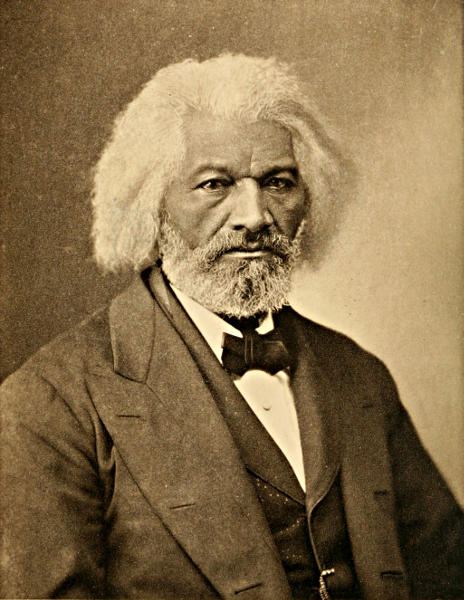
One is the well-known case of Frederick Douglass,
who, returning home after earnest service of weeks as
Secretary of the Commission to report on the people of
San Domingo and the expediency of incorporating them
with the United States, was rudely excluded from the
table, where his brother commissioners were already
seated, on board the mail-steamer of the Potomac, just
before reaching the President, whose commission he
bore. This case, if not aggravated, is made conspicuous
by peculiar circumstances. Mr. Douglass is a gentleman
of unquestioned ability and character, remarkable
as an orator, refined in manners, and personally agreeable.
He was returning, charged with the mission of
bringing under our institutions a considerable population
of colored foreigners, whose prospective treatment
among us was foreshadowed on board that mail-steamer.
The Dominican Baez could not expect more than our
fellow-citizen. And yet, with this mission, and with
the personal recommendation he so justly enjoys, this
returning Secretary could not be saved from outrage
even in sight of the Executive Mansion.
There also was Oscar James Dunn, late Lieutenant-Governor
of Louisiana. It was my privilege to open
the door of the Senate Chamber and introduce him upon
this floor. Then, in reply to my inquiry, he recounted
the hardships to which he had been exposed in the
long journey from Louisiana,—especially how he was
denied the ordinary accommodations for comfort and
repose supplied to those of another skin. This denial
is memorable, not only from the rank, but the character
of the victim. Of blameless life, he was an example
of integrity. He was poor, but could not be bought
or bribed. Duty with him was more than riches. A
fortune was offered for his signature; but he spurned
the temptation.
And yet this model character, high in the confidence
of his fellow-citizens, and in the full enjoyment of political
power, was doomed to suffer the blasting influence
which still finds support in this Chamber. He is dead
at last, and buried with official pomp. The people,
counted by tens of thousands, thronged the streets while
his obsequies proceeded. An odious discrimination was
for the time suspended. In life rejected by the conductor
of a railway because of his skin, he was borne to his
last resting-place with all the honors an afflicted community
could bestow. Only in his coffin was the ban
of color lifted, and the dead statesman admitted to that
equality which is the right of all.
These are marked instances; but they are types. If
Frederick Douglass and Oscar James Dunn could be
made to suffer, how much must others be called to endure!
All alike, the feeble, the invalid, the educated,
the refined, women as well as men, are shut out from
the ordinary privileges of the steamboat or rail-car, and
driven into a vulgar sty with smokers and rude persons,
where the conversation is as offensive as the scene, and
then again at the roadside inn are denied that shelter
and nourishment without which travel is impossible.
Do you doubt this constant, wide-spread outrage, extending
in uncounted ramifications throughout the whole
land? With sorrow be it said, it reaches everywhere,
even into Massachusetts. Not a State which does not
need the benign correction. The evidence is on your
table in numerous petitions. And there is other evidence,
already presented by me, showing how individuals
have suffered from this plain denial of equal rights.
Who that has a heart can listen to the story without indignation
and shame? Who with a spark of justice to
illumine his soul can hesitate to denounce the wrong?
Who that rejoices in republican institutions will not
help to overthrow the tyranny by which they are degraded?
I do not use too strong language, when I expose this
tyranny as a degradation to republican institutions,—ay,
Sir, in their fundamental principle. Why is the Declaration
of Independence our Magna Charta? Not because
it declares separation from a distant kingly power; but
because it announces the lofty truth that all are equal
in rights, and, as a natural consequence, that just government
stands only on the consent of the governed,—all
of which is held to be self-evident. Such is the soul of
republican institutions, without which the Republic is a
failure, a name and nothing more. Call it a Republic,
if you will, but it is in reality a soulless mockery.
Equality in rights is not only the first of rights, it is
an axiom of political truth. But an axiom, whether of
science or philosophy, is universal, and without exception
or limitation; and this is according to the very law
of its nature. Therefore it is not stating an axiom to
announce grandly that only white men are equal in
rights; nor is it stating an axiom to announce with the
same grandeur that all persons are equal in rights, but
that colored persons have no rights except to testify and
vote. Nor is it a self-evident truth, as declared; for no
truth is self-evident which is not universal. The asserted
limitation destroys the original Declaration, making
it a ridiculous sham, instead of that sublime Magna
Charta before which kings, nobles, and all inequalities of
birth must disappear as ghosts of night at the dawn.
All this has additional force, when it is known that
this very axiom or self-evident truth declared by our
fathers was the real issue of the war, and was so publicly
announced by the leaders on both sides. Behind
the embattled armies were ideas, and the idea on our
side was Equality in Rights, which on the other side
was denied. The Nation insisted that all men are created
equal; the Rebellion insisted that all men are
created unequal. Here the evidence is explicit.
The inequality of men was an original postulate of
Mr. Calhoun,[174] which found final expression in the open
denunciation of the self-evident truth as “a self-evident
lie.”[175] Echoing this denunciation, Jefferson Davis, on
leaving the Senate, January 21, 1861, in that farewell
speech which some among you heard, but which all may
read in the “Globe,” made the issue in these words:—
“It has been a belief that we are to be deprived in the
Union of the rights which our fathers bequeathed to us,
which has brought Mississippi into her present decision. She
has heard proclaimed the theory that all men are created free
and equal, and this made the basis of an attack upon her social
institutions; and the sacred Declaration of Independence has
been invoked to maintain the position of the equality of the
races.”[176]
The issue thus made by the chief Rebel was promptly
joined. Abraham Lincoln, the elected President, stopping
at Independence Hall, February 22d, on his way to
assume his duties at the National capital, in unpremeditated
words thus interpreted the Declaration:—
“It was that which gave promise that in due time the
weight should be lifted from the shoulders of all men, and
that all should have an equal chance.”
Mark, if you please, the simplicity of this utterance.
All are to have “an equal chance”; and this, he said,
“is the sentiment embodied in the Declaration of Independence.”
Then, in reply to Jefferson Davis, he proceeded:—
“Now, my friends, can this country be saved upon that
basis? If it can, I shall consider myself one of the happiest
men in the world, if I can help to save it. If it cannot be
saved upon that principle, it will be truly awful. But if this
country cannot be saved without giving up that principle, I
was about to say I would rather be assassinated on this spot
than surrender it.”
Giving these words still further solemnity, he added:
“I have said nothing but what I am willing to live by,
and, if it be the pleasure of Almighty God, to die by.”
And then, before raising the national banner over the
historic Hall, he said:—
“It is on such an occasion as this that we can reason
together, and reaffirm our devotion to the country and the
principles of the Declaration of Independence.”[177]
Thus the gauntlet flung down by Jefferson Davis
was taken up by Abraham Lincoln, who never forgot
the issue.
The rejoinder was made by Alexander H. Stephens,
Vice-President of the Rebellion, in a not-to-be forgotten
speech at Savannah, March 21, 1861, when he did not
hesitate to declare of the pretended Government, that—
“Its foundations are laid, its corner-stone rests, upon the
great truth that the Negro is not equal to the white man.”
Then, glorying in this terrible shame, he added:—
“This, our new Government, is the first, in the history of
the world, based upon this great physical, philosophical, and
moral truth.”
“This stone, which was rejected by the first builders, is
become the chief stone of the corner.”[178]
To this unblushing avowal Abraham Lincoln replied
in that marvellous, undying utterance at Gettysburg,—fit
voice for the Republic, greater far than any victory:
“Fourscore and seven years ago our fathers brought forth
on this continent a new Nation, conceived in Liberty, and dedicated
to the proposition that all men are created equal.”
Thus, in precise conformity with the Declaration, was
it announced that our Republic is dedicated to the Equal
Rights of All; and then the prophet-President, soon to
be a martyr, asked his countrymen to dedicate themselves
to the great task remaining, highly resolving
“that this Nation, under God, shall have a new birth of Freedom;
and that Government of the people, by the people, and
for the people shall not perish from the earth.”[179]
The victory of the war is vain without the grander
victory through which the Republic is dedicated to the
axiomatic, self-evident truth declared by our fathers,
and reasserted by Abraham Lincoln. With this mighty
truth as a guiding principle, the National Constitution
is elevated, and made more than ever a protection to
the citizen.
All this is so plain that it is difficult to argue it.
What is the Republic, if it fails in this loyalty? What
is the National Government, coextensive with the Republic,
if fellow-citizens, counted by the million, can be
shut out from equal rights in travel, in recreation, in education,
and in other things, all contributing to human
necessities? Where is that great promise by which
“the pursuit of happiness” is placed, with life and liberty,
under the safeguard of axiomatic, self-evident
truth? Where is justice, if this ban of color is not
promptly removed? Where is humanity? Where is
reason?
The two excuses show how irrational and utterly
groundless is this pretension. They are on a par with
the pretension itself. One is, that the question is of
society, and not of rights, which is clearly a misrepresentation;
and the other is, that the separate arrangements
provided for colored persons constitute a substitute
for equality in the nature of an equivalent,—all
of which is clearly a contrivance, if not a trick: as
if there could be any equivalent for equality.
Of the first excuse it is difficult to speak with patience.
It is a simple misrepresentation, and wherever
it shows itself must be treated as such. There is no
colored person who does not resent the imputation that
he is seeking to intrude himself socially anywhere. This
is no question of society, no question of social life,
no question of social equality, if anybody knows what
this means. The object is simply Equality before the
Law, a term which explains itself. Now, as the law
does not presume to create or regulate social relations,
these are in no respect affected by the pending measure.
Each person, whether Senator or citizen, is always free
to choose who shall be his friend, his associate, his
guest. And does not the ancient proverb declare that
“a man is known by the company he keeps”? But
this assumes that he may choose for himself. His
house is his “castle”; and this very designation, borrowed
from the Common Law, shows his absolute independence
within its walls; nor is there any difference,
whether it be palace or hovel. But when he leaves his
“castle” and goes abroad, this independence is at an
end. He walks the streets, but always subject to the
prevailing law of Equality; nor can he appropriate the
sidewalk to his own exclusive use, driving into the gutter
all whose skin is less white than his own. But nobody
pretends that Equality in the highway, whether on
pavement or sidewalk, is a question of society. And
permit me to say that Equality in all institutions created
or regulated by law is as little a question of
society.
In the days of Slavery it was an oft-repeated charge,
that Emancipation was a measure of social equality; and
the same charge became a cry at the successive efforts
for the right to testify and the right to vote. At each
stage the cry was raised, and now it makes itself heard
again, as you are called to assure this crowning safeguard.
Then comes the other excuse, which finds Equality in
separation. Separate hotels, separate conveyances, separate
theatres, separate schools and institutions of learning
and science, separate churches, and separate cemeteries,—these
are the artificial substitutes. And this is the
contrivance by which a transcendent right, involving a
transcendent duty, is evaded: for Equality is not only
a right, but a duty.
How vain to argue that there is no denial of Equal
Rights when this separation is enforced! The substitute
is invariably an inferior article. Does any Senator
deny it? Therefore, it is not Equality; at best it is an
equivalent only. But no equivalent is Equality. Separation
implies one thing for a white person and another
thing for a colored person; but Equality is where all
have the same alike. There can be no substitute for
Equality,—nothing but itself. Even if accommodations
are the same, as notoriously they are not, there is
no Equality. In the process of substitution the vital
elixir exhales and escapes: it is lost, and cannot be
recovered; for Equality is found only in Equality.
“Nought but itself can be its parallel”; but Senators
undertake to find parallels in other things.
As well make weight in silver the equivalent for
weight in diamonds, according to the illustration of Selden
in his famous “Table-Talk.” “If,” remarked the
learned interlocutor, “I said I owed you twenty pounds
in silver, and you said I owed you twenty pounds of
diamonds, which is a sum innumerable, ’tis impossible
we should ever agree.”[180] But Equality is weight in
diamonds, and a sum innumerable,—which is very different
from weight in silver.
Assuming—what is most absurd to assume, and
what is contradicted by all experience—that a substitute
can be an equivalent, it is so in form only, and not
in reality. Every such assumption is an indignity to
the colored race, instinct with the spirit of Slavery; and
this decides its character. It is Slavery in its last appearance.
Are you ready to prolong the hateful tyranny?
Religion and reason condemn Caste as impious and unchristian,
making republican institutions and equal laws
impossible; but here is Caste not unlike that which
separates the Sudra from the Brahmin. Pray, Sir, who
constitutes the white man a Brahmin? Whence his
lordly title? Down to a recent period in Europe the
Jews were driven to herd by themselves, separate from
the Christians; but this discarded barbarism is revived
among us in the ban of color. There are millions of
fellow-citizens guilty of no offence except the dusky
livery of the sun appointed by the Heavenly Father,
whom you treat as others have treated the Jews, as
the Brahmin treats the Sudra. But, pray, Sir, do not
pretend that this is the great equality promised by our
fathers.
In arraigning this attempt at separation as a Caste, I
say nothing new. For years I have denounced it as
such; and here I followed good authorities, as well as
reason. Alexander von Humboldt, speaking of the
negroes of New Mexico when Slavery prevailed, called
them a Caste.[181] A recent political and juridical writer
of France uses the same term to denote not only the discrimination
in India, but that in our own country,—especially
referring to the exclusion of colored children
from the common schools as among “the humiliating
and brutal distinctions” by which their Caste is characterized.[182]
The principle of separation on the ground of
hereditary inferiority is the distinctive essence of Caste;
but this is the outrage which flaunts in our country,
crying out, “I am better than thou, because I am white.
Get away!”
Thus do I reject the two excuses. But I do not
leave the cause here. I go further, and show how consistent
is the pending measure with acknowledged principles,
illustrated by undoubted law.
The bill for Equal Rights is simply supplementary to
the existing Civil Rights Law, which is one of our great
statutes of peace, and it stands on the same requirements
of the National Constitution. If the Civil Rights
Law is above question, as cannot be doubted, then also
is this supplementary amendment; for it is only the
complement of the other, and necessary to its completion.
Without this amendment the original law is
imperfect. It cannot be said, according to its title,
that all persons are protected in their civil rights, so
long as the outrages I expose continue to exist; nor
is Slavery entirely dead.
Following reason and authority, the conclusion is
easy. A Law Dictionary, of constant use as a repertory
of established rules and principles, defines a “freeman”
as “one in the possession of the civil rights enjoyed by
the people generally.”[183] Happily, all are freemen now;
but the colored people are still excluded from civil
rights enjoyed by the people generally,—and this, too,
in the face of our new Bill of Rights intended for their
especial protection.
By the Constitutional Amendment abolishing Slavery
Congress is empowered “to enforce this article by appropriate
legislation”; and in pursuance thereof the Civil
Rights Law was enacted. That measure was justly accepted
as “appropriate legislation.” Without it Slavery
would still exist in at least one of its most odious pretensions.
By the Civil Rights Law colored persons
were assured in the right to testify, which in most of
the States was denied or abridged. So closely was this
outrage connected with Slavery, that it was, indeed, part
of this great wrong. Therefore its prohibition was “appropriate
legislation” in the enforcement of the Constitutional
Amendment. But the denial or abridgment of
Equality on account of color is also part of Slavery. So
long as it exists, Slavery is still present among us. Its
prohibition is not only “appropriate,” but necessary, to
enforce the Constitutional Amendment. Therefore is
it strictly Constitutional, as if in the very text of the
National Constitution.
The next Constitutional Amendment, known as the
Fourteenth, contains two different provisions, which
augment the power of Congress. The first furnishes
the definition of “citizen,” which down to this time
had been left to construction only:—
“All persons born or naturalized in the United States, and
subject to the jurisdiction thereof, are citizens of the United
States, and of the States wherever they reside.”
Here, you will remark, are no words of race or color.
“All persons,” and not “all white persons,” born or
naturalized in the United States, and subject to the
jurisdiction thereof, are “citizens.” Such is the definition
supplied by this Amendment. This is followed
by another provision in aid of the definition:—
“No State shall make or enforce any law which shall
abridge the privileges or immunities of citizens of the United
States; nor shall any State deprive any person of life, liberty,
or property without due process of law, nor deny to any person
within its jurisdiction the equal protection of the laws.”
And Congress is empowered to enforce this definition
of Citizenship and this guaranty, by “appropriate
legislation.”
Here, then, are two Constitutional Amendments, each
a fountain of power: the first, to enforce the Abolition
of Slavery; and the second, to assure the privileges and
immunities of citizens, and also the equal protection of
the laws. If the Supplementary Civil Rights Bill,
moved by me, is not within these accumulated powers,
I am at a loss to know what is within those powers.
In considering these Constitutional provisions, I insist
upon that interpretation which shall give them the
most generous expansion, so that they shall be truly
efficacious for human rights. Once Slavery was the
animating principle in determining the meaning of
the National Constitution: happily, it is so no longer.
Another principle is now supreme, breathing into the
whole the breath of a new life, and filling it in every
part with one pervading, controlling sentiment,—being
that great principle of Equality which triumphed at last
on the battle-field, and, bearing the watchword of the
Republic, now supplies the rule by which every word of
the Constitution and all its parts must be interpreted, as
much as if written in its text.
There is also an original provision of the National
Constitution, not to be forgotten:—
“The citizens of each State shall be entitled to all privileges
and immunities of citizens in the several States.”
Once a sterile letter, this is now a fruitful safeguard,
to be interpreted, like all else, so that human rights
shall most prevail. The term “privileges and immunities”
was at an early day authoritatively defined by
Judge Washington, who announced that they embraced
“protection by the Government, the enjoyment of life
and liberty, with the right to acquire and possess property
of every kind, and to pursue and obtain happiness
and safety, … the right of a citizen of one State to
pass through or to reside in any other State, for purposes
of trade, agriculture, professional pursuits, or otherwise.”[184]
But these “privileges and immunities” are
protected by the present measure.
No doubt the Supplementary Law must operate, not
only in National jurisdiction, but also in the States,
precisely as the Civil Rights Law; otherwise it will be
of little value. Its sphere must be coextensive with
the Republic, making the rights of the citizen uniform
everywhere. But this can be only by one uniform
safeguard sustained by the Nation. Citizenship is universal,
and the same everywhere. It cannot be more or
less in one State than in another.
But legislation is not enough. An enlightened public
opinion must be invoked. Nor will this be wanting.
The country will rally in aid of the law, more especially
since it is a measure of justice and humanity. The law
is needed now as a help to public opinion. It is needed
by the very people whose present conduct makes occasion
for it. Prompted by the law, leaning on the law,
they will recognize the equal rights of all; nor do I despair
of a public opinion which shall stamp the denial
of these rights as an outrage not unlike Slavery itself.
Custom and patronage will then be sought in obeying
the law. People generally are little better than actors,
for whom it was once said:—
“Ah, let not Censure term our fate our choice:
The stage but echoes back the public voice;
The drama’s laws the drama’s patrons give;
For we that live to please must please to live.”
[185]
In the absence of the law people please too often by
inhumanity, but with the law teaching the lesson of
duty they will please by humanity. Thus will the law
be an instrument of improvement, necessary in precise
proportion to existing prejudice. Because people still
please by inhumanity, therefore must there be a counteracting
force. This precise exigency was foreseen by
Rousseau, remarkable as writer and thinker, in a work
which startled the world, when he said:—
“It is precisely because the force of things tends always
to destroy equality that the force of legislation should always
tend to maintain it.”[186]
Never was a truer proposition; and now let us look
at the cases for its application.
I begin with Public Hotels or Inns, because the rule
with regard to them may be traced to the earliest periods
of the Common Law. In the Chronicles of Holinshed,
written in the reign of Queen Elizabeth, is a chapter
“Of our Inns and Thoroughfares,” where the inn,
which is the original term for hotel, is described as
“builded for the receiving of such travellers and strangers
as pass to and fro”; and then the chronicler, boasting
of his own country as compared with others, says,
“Every man may use his inn as his own house in England.”[187]
In conformity with this boast was the law of
England. The inn was opened to “every man.” And
this rule has continued from that early epoch, anterior
to the first English settlement of North America, down
to this day. The inn is a public institution, with well-known
rights and duties. Among the latter is the duty
to receive all paying travellers decent in appearance and
conduct,—wherein it is distinguished from a lodging-house
or boarding-house, which is a private concern,
and not subject to the obligations of the inn.
For this statement I might cite authorities beginning
with the infancy of the law, and not ending even with a
late decision of the Superior Court of New York, where
an inn is defined to be “a public house of entertainment
for all who choose to visit it,”[188]—which differs very little
from the descriptive words of Holinshed.
The summary of our great jurist, Judge Story, shows
the law:—
“An innkeeper is bound to take in all travellers and wayfaring
persons, and to entertain them, if he can accommodate
them, for a reasonable compensation.… If an innkeeper
improperly refuses to receive or provide for a guest, he is
liable to be indicted therefor.”[189]
Chancellor Kent states the rule briefly, but with fulness
and precision:—
“An innkeeper cannot lawfully refuse to receive guests to
the extent of his reasonable accommodations; nor can he impose
unreasonable terms upon them.”[190]
This great authority says again, quoting a decided
case:—
“Innkeepers are liable to an action if they refuse to receive
a guest without just cause. The innkeeper is even
indictable for the refusal, if he has room in his house and
the guest behaves properly.”[191]
And Professor Parsons, in his work on Contracts, so
familiar to lawyers and students, says:—
“He cannot so refuse, unless his house is full and he is
actually unable to receive him. And if on false pretences he
refuses, he is liable to an action.”[192]
The importance of this rule in determining present
duty will justify another statement in the language of
a popular Encyclopædia:—
“One of the incidents of an innkeeper is, that he is bound
to open his house to all travellers, without distinction, and has
no option to refuse such refreshment, shelter, and accommodation
as he possesses, provided the person who applies is of the
description of a traveller, and able and ready to pay the customary
hire, and is not drunk or disorderly or tainted with
infectious disease.”
And the Encyclopædia adds:—
“As some compensation for this compulsory hospitality, the
innkeeper is allowed certain privileges.”[193]
Thus is the innkeeper under constraint of law, which
he must obey; “bound to take in all travellers and
wayfaring persons”; “nor can he impose unreasonable
terms upon them”; and liable to an action, and even to
an indictment, for refusal. Such is the law.
With this peremptory rule opening the doors of inns
to all travellers, without distinction, to the extent of
authorizing not only an action, but an indictment, for
the refusal to receive a traveller, it is plain that the
pending bill is only declaratory of existing law, giving
to it the sanction of Congress.
Public Conveyances, whether on land or water, are
known to the law as common carriers, and they, too,
have obligations, not unlike those of inns. Common
carriers are grouped with innkeepers, especially in duty
to passengers. Here again the learned Judge is our
authority:—
“The first and most general obligation on their part is
to carry passengers, whenever they offer themselves and are
ready to pay for their transportation. This results from their
setting themselves up, like innkeepers and common carriers of
goods, for a common public employment, on hire. They are no
more at liberty to refuse a passenger, if they have sufficient
room and accommodation, than an innkeeper is to refuse suitable
room and accommodations to a guest.”[194]
Professor Parsons states the rule strongly:—
“It is his duty to receive all passengers who offer; to
carry them the whole route; to demand no more than the
usual and established compensation; to treat all his passengers
alike; to behave to all with civility and propriety; to
provide suitable carriages and means of transport; … and
for the default of his servants or agents in any of the above
particulars, or generally in any other points of duty, the carrier
is directly responsible, as well as for any circumstance of
aggravation which attended the wrong.”[195]
The same rule, in its application to railroads, has been
presented by a learned writer with singular force:—
“The company is under a public duty, as a common carrier
of passengers, to receive all who offer themselves as such
and are ready to pay the usual fare, and is liable in damages
to a party whom it refuses to carry without a reasonable excuse.
It may decline to carry persons after its means of conveyance
have been exhausted, and refuse such as persist in
not complying with its reasonable regulations, or whose improper
behaviour—as by their drunkenness, obscene language,
or vulgar conduct—renders them an annoyance to other passengers.
But it cannot make unreasonable discriminations between
persons soliciting its means of conveyance, as by refusing
them on account of personal dislike, their occupation, condition
in life, COMPLEXION, RACE, nativity, political or ecclesiastical
relations.”[196]
It has also been affirmed by the Supreme Court of
Pennsylvania, where, on account of color, a person had
been excluded from a street car in Philadelphia.[197]
The pending bill simply reinforces this rule, which,
without Congress, ought to be sufficient. But since it
is set at nought by an odious discrimination, Congress
must interfere.
Theatres and other places of Public Amusement,
licensed by law, are kindred to inns or public conveyances,
though less noticed by jurisprudence. But, like
their prototypes, they undertake to provide for the public
under sanction of law. They are public institutions,
regulated, if not created, by law, enjoying privileges, and
in consideration thereof assuming duties, kindred to
those of the inn and the public conveyance. From
essential reason, the rule should be the same with all.
As the inn cannot close its doors, or the public conveyance
refuse a seat, to any paying traveller, decent in
condition, so must it be with the theatre and other
places of public amusement. Here are institutions
whose peculiar object is “the pursuit of happiness,”
which has been placed among the Equal Rights of All.
How utterly irrational the pretension to outrage a large
portion of the community! The law can lend itself to
no such intolerable absurdity; and this, I insist, shall
be declared by Congress.
The Common School falls naturally into the same
category. Like the others, it must open to all, or its
designation is a misnomer and a mockery. It is not a
school for whites, or a school for blacks, but a school for
all,—in other words, a common school. Much is implied
in this term, according to which the school harmonizes
with the other institutions already mentioned. It
is an inn where children rest on the road to knowledge.
It is a public conveyance where children are passengers.
It is a theatre where children resort for enduring recreation.
Like the others, it assumes to provide for the
public; therefore it must be open to all: nor can there
be any exclusion, except on grounds equally applicable
to the inn, the public conveyance, and the theatre.
But the common school has a higher character. Its
object is the education of the young; and it is sustained
by taxation, to which all contribute. Not only does it
hold itself out to the public by its name and its harmony
with the other institutions, but it assumes the
place of parent to all children within its locality, bound
always to exercise a parent’s watchful care and tenderness,
which can know no distinction of child.
It is easy to see that the separate school, founded on
an odious discrimination, and sometimes offered as an
equivalent for the common school, is an ill-disguised
violation of the principle of Equality, while as a pretended
equivalent it is an utter failure, and instead of a
parent is only a churlish step-mother.
A slight illustration will show how it fails; and here
I mention an incident occurring in Washington, but
which must repeat itself often on a larger scale, wherever
separation is attempted. Colored children, living
near what is called the common school, are driven from
its doors, and compelled to walk a considerable distance—often
troublesome, and in certain conditions of the
weather difficult—to attend the separate school. One
of these children has suffered from this exposure, and I
have myself witnessed the emotion of the parent. This
could not have occurred, had the child been received at
the common school in the neighborhood. Now it is idle
to assert that children compelled to this exceptional
journey to and fro are in the enjoyment of Equal Rights.
The superadded pedestrianism and its attendant discomfort
furnish the measure of Inequality in one of its forms,
increased by the weakness or ill-health of the child.
What must be the feelings of a colored father or mother
daily witnessing this sacrifice to the demon of Caste?
This is an illustration merely, but it shows precisely
how impossible it is for a separate school to be the
equivalent of the common school. And yet it only
touches the evil, without exhibiting its proportions.
The indignity offered to the colored child is worse than
any compulsory exposure; and here not only the child
suffers, but the race to which he belongs is degraded,
and the whole community is hardened in wrong.
The separate school wants the first requisite of the
common school, inasmuch as it is not equally open to
all; and since this is inconsistent with the declared rule
of republican institutions, such a school is not republican
in character. Therefore it is not a preparation for
the duties of life. The child is not trained in the way
he should go; for he is trained under the ban of Inequality.
How can he grow up to the stature of equal
citizenship? He is pinched and dwarfed while the
stigma of color is stamped upon him. This is plain
oppression, which you, Sir, would feel keenly, were it
directed against you or your child. Surely the race enslaved
for generations has suffered enough without being
doomed to this prolonged proscription. Will not the
Republic, redeemed by most costly sacrifice, insist upon
justice to the children of the land, making the common
school the benign example of republican institutions,
where merit is the only ground of favor?
Nor is separation without evil to the whites. The
prejudice of color is nursed, when it should be stifled.
The Pharisaism of race becomes an element of character,
when, like all other Pharisaisms, it should be cast out.
Better even than knowledge is a kindly nature and the
sentiment of equality. Such should be the constant
lesson, repeated by the lips and inscribed on the heart;
but the school itself must practise the lesson. Children
learn by example more than by precept. How precious
the example which teaches that all are equal in rights!
But this can be only where all commingle in the common
school as in common citizenship. There is no
separate ballot-box: there should be no separate school.
It is not enough that all should be taught alike; they
must all be taught together. They are not only to receive
equal quantities of knowledge; all are to receive
it in the same way. But they cannot be taught alike,
unless all are taught together; nor can they receive
equal quantities of knowledge in the same way, except
at the common school.
The common school is important to all; but to the
colored child it is a necessity. Excluded from the common
school, he finds himself too frequently without any
substitute. But even where a separate school is planted,
it is inferior in character, buildings, furniture, books,
teachers: all are second-rate. No matter what the temporary
disposition, the separate school will not flourish
as the common school. It is but an offshoot or sucker,
without the strength of the parent stem. That the two
must differ is seen at once; and that this difference is
adverse to the colored child is equally apparent. For
him there is no assurance of education except in the
common school, where he will be under the safeguard
of all. White parents will take care not only that the
common school is not neglected, but that its teachers
and means of instruction are the best possible; and the
colored child will have the benefit of this watchfulness.
This decisive consideration completes the irresistible
argument for the common school as the equal parent
of all without distinction of color.
If to him that hath is given, according to the way of
the world, it is not doubted that to him that hath not
there is a positive duty in proportion to the necessity.
Unhappily, our colored fellow-citizens are in this condition.
But just in proportion as they are weak, and not
yet recovered from the degradation in which they have
been plunged, does the Republic owe its completest support
and protection. Already a component part of our
political corporation, they must become part of the educational
corporation also, with Equality as the supreme
law.
It is with humiliation that I am forced to insist upon
the same equality in other public institutions of learning
and science,—also in churches, and in the last resting-places
of the dead. So far as any of these are public
in character and organized by law, they must follow
the general requirement. How strange that any institution
of learning or science, any church, or any cemetery
should set up a discrimination so utterly inconsistent
with correct principle! But I do not forget that
only recently a colored officer of the National Army was
treated with indignity at the communion-table. To insult
the dead is easier, although condemned by Christian
precept and heathen example. As in birth, so in
death are all alike,—beginning with the same nakedness,
and ending in the same decay; nor do worms spare
the white body more than the black. This equal lot has
been the frequent occasion of sentiment and of poetry.
Horace has pictured pallid Death with impartial foot
knocking at the cottages of the poor and the towers
of kings.[198] In the same spirit the early English poet,
author of “Piers Ploughman,” shows the lowly and
the great in their common house:—
“For in charnel at chirche
Cherles ben yvel to knowe,
Or a knyght from a knave there.”
[199]
And Chaucer even denies the distinction in life:—
“But understond in thine entent
That this is not mine entendement,
To clepe no wight in no ages
Onely gentle for his linages:
Though he be not gentle borne,
Than maiest well seine this in sooth,
That he is gentle because he doth
As longeth to a gentleman.”
[200]
This beautiful testimony, to which the honest heart
responds, is from an age when humanity was less regarded
than now. Plainly it shows how conduct and
character are realities, while other things are but accidents.
Among the Romans degradation ended with life.
Slaves were admitted to honorable sepulture, and sometimes
slept the last sleep with their masters. The slaves
of Augustus and Livia were buried on the famous Appian
Way, where their tombs with historic inscriptions
have survived the centuries.[201] “Bury him with his niggers,”
was the rude order of the Rebel officer, as he
flung the precious remains of our admirable Colonel
Shaw into the common trench at Fort Wagner, where
he fell, mounting the parapets at the head of colored
troops. And so was he buried, lovely in death as in
life. The intended insult became an honor. In that
common trench the young hero rests, symbolizing the
great Equality for which he died. No Roman monument,
with its Siste, viator, to the passing traveller, no
“labor of an age in pilèd stones,” can match in grandeur
that simple burial.
Mr. President, against these conclusions there is but
one argument, which, when considered, is nothing but a
prejudice, as little rational as what Shylock first calls
his “humor” and then “a lodged hate and a certain
loathing,” making him seek the pound of flesh nearest
the merchant’s heart. The prejudice of color pursues
its victim in the long pilgrimage from the cradle to the
grave, barring the hotel, excluding from the public conveyance,
insulting at the theatre, closing the school,
shutting the gates of science, and playing its fantastic
tricks even in the church where he kneels and the
grave where his dust mingles with the surrounding
earth. The God-given color of the African is a constant
offence to the disdainful white, who, like the pretentious
lord, asking Hotspur for prisoners, can bear nothing so
unhandsome “betwixt the wind and his nobility.” This
is the whole case. And shall those Equal Rights promised
by the great Declaration be sacrificed to a prejudice?
Shall that Equality before the Law, which is the best
part of citizenship, be denied to those who do not happen
to be white? Is this a white man’s government or
is it a government of “all men,” as declared by our fathers?
Is it a Republic of Equal Laws, or an Oligarchy
of the Skin? This is the question now presented.
Once Slavery was justified by color, as now the denial
of Equal Rights is justified; and the reason is as
little respectable in one case as in the other. The old
pretension is curiously illustrated by an incident in the
inimitable Autobiography of Franklin. An Ante-revolutionary
Governor of Pennsylvania remarked gayly, “that
he much admired the idea of Sancho Panza, who, when
it was proposed to give him a government, requested it
might be a government of blacks, as then, if he could not
agree with his people, he might sell them”; on which a
friend said, “Franklin, why do you continue to side
with those damned Quakers? Had you not better sell
them?” Franklin answered, “The Governor has not
yet blacked them enough.” The Autobiography proceeds
to record, that the Governor “labored hard to blacken
the Assembly in all his Messages, but they wiped off
his coloring as fast as he laid it on, and placed it in
return thick upon his own face, so that, finding he was
likely to be negrofied himself, he grew tired of the contest
and quitted the Government.”[202] To negrofy a man
was to degrade him.
Thus in the ambition of Sancho Panza, and in the
story of the British governor, was color the badge of
Slavery. “Then I can sell them,” said Sancho Panza;
and the British governor repeated the saying. This is
changed now; but not entirely. At present nobody
dares say, “I can sell them”; but the inn, the common
conveyance, the theatre, the school, the scientific institute,
the church, and the cemetery deny them the equal
rights of Freedom.
Color has its curiosities in history. For generations
the Roman circus was convulsed by factions known from
their liveries as white and red; new factions adopted
green and blue; and these latter colors raged with redoubled
fury in the hippodrome of Constantinople.[203]
Then came blacks and whites, Neri and Bianchi, in the
political contentions of Italy,[204] where the designation
was from the accident of a name. In England the
most beautiful of flowers, in two of its colors, became
the badge of hostile armies, and the white rose fought
against the red. But it has been reserved for our Republic,
dedicated to the rights of human nature, to adopt
the color of the skin as the sign of separation, and to organize
it in law.
Color in the animal kingdom is according to the Law
of Nature. The ox of the Roman Campagna is gray.
The herds on the banks of the Xanthus were yellow; on
the banks of the Clitumnus they were white. In Corsica
animals are spotted. The various colors of the
human family belong to the same mystery. There are
white, yellow, red, and black, with intermediate shades;
but no matter what their hue, they are always MEN,
gifted with a common manhood and entitled to common
rights. Dr. Johnson made short work with the famous
paradox of Berkeley, denying the existence of matter.
Striking his foot with mighty force against a large stone,
till he rebounded from it, “I refute it thus,” he exclaimed.[205]
And so, in reply to every pretension against
the equal rights of all, to every assertion of right founded
on the skin, to every denial of right because a man
is something else than white, I point to that common
manhood which knows no distinction of color, and thus
do I refute the whole inhuman, unchristian paradox.
Observe, if you please, how little the word “white”
is authorized to play the great part it performs, and how
much of an intruder it is in all its appearances. In
those two title-deeds, the Declaration of Independence
and the Constitution, there are no words of color,
whether white, yellow, red, or black; but here is the
fountain out of which all is derived. The Declaration
speaks of “all men,” and not of “all white men”;
and the Constitution says, “We the people,” and not
“We the white people.” Where, then, is authority for
any such discrimination, whether by the nation or any
component part? There is no fountain or word for it.
The fountain failing, and the word non-existent, the
whole pretension is a disgusting usurpation, which is
more utterly irrational when it is considered that authority
for such an outrage can be found only in positive
words, plain and unambiguous in meaning. This
was the rule with regard to Slavery, solemnly declared
by Lord Mansfield in the famous Somerset case; and
it must be the same with regard to this pretension. It
cannot be invented, imagined, or implied; it must be
found in the very text: and this I assert according to
fixed principles of jurisprudence. In its absence, Equality
is “the supreme law of the land; and the judges in
every State shall be bound thereby, anything in the constitution
or laws of any State to the contrary notwithstanding.”[206]
This conclusion is reinforced by the several Constitutional
Amendments; but I prefer to dwell on the original
text of the Constitution, in presence of which you
might as well undertake to make a king as to degrade a
fellow-citizen on account of his skin.
There is also, antedating and interpreting the Constitution,
the original Common Law, which knew no distinction
of color. One of the greatest judges that ever
sat in Westminster Hall, Lord Chief-Justice Holt, declared,
in sententious judgment, worthy of perpetual
memory, “The Common Law takes no notice of Negroes
being different from other men.”[207] This was in 1706,
seventy years before the Declaration of Independence;
so that it was well known to our fathers as part of that
Common Law, to which, according to the Continental
Congress, the several States were entitled.[208] Had these
remarkable words been uttered by any other judge in
Westminster Hall, they would have been important; but
they are enhanced by the character of their illustrious
author, to whom belongs the kindred honor of first declaring
from the bench that a slave cannot breathe in
England.[209]
Among the ornaments of English law none has a
purer fame than Holt, who was emphatically a great
judge,—being an example of learning and firmness, of
impartiality and mildness, with a constant instinct for
justice, and a rare capacity in upholding it. His eminent
merits compelled the admiration of his biographer,
Lord Campbell, who does not hesitate to say, that, “of
all the judges in our annals, Holt has gained the highest
reputation, merely by the exercise of judicial functions,”—and
then again, in striking words, that “he may be
considered as having a genius for magistracy, as much
as our Milton had for poetry or our Wilkie for painting.”[210]
And this rarest magistrate tells us judicially,
that “the Common Law takes no notice of Negroes
being different from other men,”—in other words, it
makes no discrimination on account of color. This
judgment is a torch to illumine the Constitution, while
it shows how naturally our fathers in the great Declaration
said, “All men,” and not “All white men,” and in
the Constitution said, “We the people,” and not “We
the white people.”
In melancholy contrast with the monumental judgment
of the English Chief-Justice are judicial decisions
in our own country, especially that masterpiece of elaborate
inhumanity, the judgment of our late Chief-Justice
in the Dred Scott case. But it is in the States that the
word “white” has been made prominent. Such learned
debate on the rights of man dependent on complexion
would excite a smile, if it did not awaken indignation.
There is Ohio, a much-honored State, rejoicing in prosperity,
intelligence, and constant liberty; but even this
eminent civilization has not saved its Supreme Court
from the subtilties of refinement on different shades of
human color. In the case of Lake v. Baker et al.,[211]
this learned tribunal decided that a child of Negro, Indian,
and white blood, but of more than one-half white,
was entitled to the benefits of the common-school fund;
yet in a later case the same court decided that “children
of three-eighths African and five-eighths white blood,
but who are distinctly colored, and generally treated and
regarded as colored children by the community where
they reside, are not, as of right, entitled to admission into
the common schools set apart for the instruction of
white youths.”[212] Unhappy children! Even five-eighths
white blood could not save them, if in their neighborhood
they were known as “colored.” But this magic of
color showed itself yet more in the precedent of Polly
Gray v. The State of Ohio,—a case of robbery, in the
Court of Common Pleas, where the prisoner appearing
on inspection “to be of a shade of color between the
mulatto and white,” a Negro was admitted to testify
against her, and she was convicted; but on grave consideration
by the Supreme Court, on appeal, it was decided
that the witness was wrongly admitted, and the
judgment was reversed; and the decision stands on
these words: “A Negro is not an admissible witness
against a quadroon on trial charged with a crime”![213]
Into this absurdity of injustice was an eminent tribunal
conducted by the ignis-fatuus of color.
These are specimens only. To what meanness of inquiry
has not the judicial mind descended in the enforcement
of an odious prejudice? Such decisions are
a discredit to Republican Government; and so also is
the existing practice of public institutions harmonizing
with them. The words of the Gospel are fulfilled, and
the Great Republic, “conceived in Liberty, and dedicated
to the proposition that all men are created equal,”[214]
becomes “like unto whited sepulchres, which indeed appear
beautiful outward, but are within full of dead men’s
bones and of all uncleanness.”[215] Are not such decisions
worse than dead men’s bones or any uncleanness? All
this seems the more irrational, when we recall the Divine
example, and the admonition addressed to the
Prophet: “But the Lord said unto Samuel, Look not on
his countenance, … for the Lord seeth not as man
seeth; for man looketh on the outward appearance,
but the Lord looketh on the heart.”[216] To the pretension
of looking at the skin and measuring its various pigments
in the determination of rights, I reply, that the
heart, and not the countenance, must be our guide. Not
on the skin can we look, though “white” as the coward
heart of Macbeth, according to the reproach of his wife,—but
on that within, constituting character, which
showed itself supremely in Toussaint L’Ouverture, making
him, though black as night, a luminous example, and
is now manifest in a virtuous and patriotic people asking
for their rights. Where justice prevails, all depends
on character. Nor can any shade of color be an apology
for interference with that consideration to which character
is justly entitled.
Thus it stands. The word “white” found no place
in the original Common Law; nor did it find any place
afterward in our two title-deeds of Constitutional Liberty,
each interpreting the other, and being the fountain
out of which are derived the rights and duties of
the American citizen. Nor, again, did it find place in
the Constitutional Amendment expressly defining a
“citizen.” How, then, can it become a limitation upon
the citizen? By what title can any one say, “I am a
white lord”? Every statute and all legislation, whether
National or State, must be in complete conformity with
the two title-deeds. To these must they be brought as
to an unerring touchstone; and it is the same with the
State as with the Nation. Strange indeed, if an odious
discrimination, without support in the original Common
Law or the Constitution, and openly condemned by the
Declaration of Independence, can escape judgment by
skulking within State lines! Wherever it shows itself,
whatever form it takes, it is the same barefaced and insufferable
imposture, a mere relic of Slavery, to be treated
always with indignant contempt, and trampled out
as an unmitigated “humbug.” The word may not be
juridical; I should not use it if it were unparliamentary;
but I know no term which expresses so well the little
foundation for this pretension.
That this should continue to flaunt, now that Slavery
is condemned, increases the inconsistency. By the decree
against that wrong all semblance of apology was
removed. Ceasing to be a slave, the former victim has
become not only a man, but a Citizen, admitted alike
within the pale of humanity and within the pale of citizenship.
As man he is entitled to all the rights of man,
and as citizen he becomes a member of our common
household, with Equality as the prevailing law. No
longer an African, he is an American; no longer a slave,
he is a common part of the Republic, owing to it patriotic
allegiance in return for the protection of equal laws.
By incorporation with the body-politic he becomes a
partner in that transcendent unity, so that there can be
no injury to him without injury to all. Insult to him
is insult to an American citizen. Dishonor to him is
dishonor to the Republic itself. Whatever he may have
been, he is now the same as ourselves. Our rights are
his rights; our equality is his equality; our privileges
and immunities are his great freehold. To enjoy his
citizenship, people from afar, various in race and complexion,
seek our shores, losing here all distinctions of
birth,—as into the ocean all rivers flow, losing all trace
of origin or color, and there is but one uniform expanse
of water, where each particle is like every other particle,
and all are subject to the same law. In this citizenship
the African is now absorbed.
Not only is he Citizen. There is no office in the Republic,
from lowest to highest, executive, judicial, or
representative, which is closed against him. The doors
of this Chamber swing open, and he sits here the coëqual
of any Senator. The doors of the other Chamber
also swing open. Nay, Sir, he may be Vice-President,
he may be President; but he cannot enter a hotel or
public conveyance, or offer his child at the common
school, without insult on account of color. Nothing can
make this terrible inconsistency more conspicuous. An
American citizen, with every office wide open to his
honorable ambition, in whom are all the great possibilities
of our Republic, who may be anything according
to merit, is exposed to a scourge which descends upon
the soul as the scourge of Slavery descended upon the
flesh.
In ancient times the cry, “I am a Roman citizen,”
stayed the scourge of the Lictor; and this cry, with its
lesson of immunity, has resounded through the ages,
testifying to Roman greatness. Once it was on the lips
of Paul, as appears in the familiar narrative:—
“And as they bound him with thongs, Paul said unto the
centurion that stood by, Is it lawful for you to scourge a man
that is a Roman, and uncondemned?
“When the centurion heard that, he went and told the
chief captain, saying, Take heed what thou doest; for this
man is a Roman.
…
“And the chief captain also was afraid, after he knew that
he was a Roman, and because he had bound him.”[217]
Will not our “Chief Captain,” will not Senators, take
heed what they do, that the scourge may not continue
to fall upon a whole race, each one of whom is an American
and uncondemned? Is our citizenship a feebler
safeguard than that of Rome? Shall the cry, “I am an
American citizen,” be raised in vain against perpetual
outrage?
In speaking of the citizen as of our household, I adopt
a distinction employed by a great teacher in Antiquity.
Aristotle, in counsels to his former pupil, Alexander, before
his career of Asiatic conquest, enjoined a broad distinction
between Greeks and Barbarians. The former
he was to treat as friends, and of the household; the
latter he was to treat as brutes and plants.[218] This is
the very distinction between Citizenship and Slavery.
The Citizen is of the national household; the Slave is no
better than brute or plant. But our brutes and plants
are all changed into men; our Barbarians are transformed
into Greeks. There is no person among us now,
whatever his birth or complexion, who may not claim
the great name of Citizen, to be protected not less at
home than abroad,—but always, whether at home or
abroad, by the National Government, which is the natural
guardian of the citizen.
Mr. President, asking you to unite now in an act of
justice to a much-oppressed race, which is no payment
of that heavy debt accumulated by generations of wrong,
I am encouraged by the pending measure of Amnesty,
which has the advantage of being recommended in the
President’s Annual Message. I regretted, at the time,
that the President signalized by his favor the removal
of disabilities imposed upon a few thousand Rebels who
had struck at the life of the Republic, while he said
nothing of cruel disabilities inflicted upon millions of
colored fellow-citizens, who had been a main-stay to the
national cause. But I took courage when I thought
that the generosity proposed could not fail to quicken
that sentiment of justice which I now invoke.
Toward those who assailed the Republic in war I
have never entertained any sentiment of personal hostility.
Never have I sought the punishment of any
one; and I rejoice to know that our bloody Rebellion
closed without the sacrifice of a single human life by
the civil power. But this has not surprised me. Early
in the war I predicted it in this Chamber.[219] And yet,
while willing to be gentle with former enemies, while
anxious not to fail in any lenity or generosity, and
while always watching for the moment when all could
be restored to our common household with Equality as
the prevailing law, there was with me a constant duty,
which I could never forget, to fellow-citizens, white and
black, who had stood by the Republic; and especially to
those large numbers, counted by the million, still suffering
under disabilities having their origin in no crime,
and more keenly felt than any imposed upon Rebels.
Believing that duty to these millions is foremost, and
that until they are secured in equal rights we cannot
expect the tranquillity which all desire,—nay, Sir, we
cannot expect the blessing of Almighty God upon our
labors,—I bring forward this measure of justice to the
colored race. Such a measure can never be out of
order or out of season, being of urgent necessity and
unquestionable charity.
There are strong reasons why it should be united with
amnesty, especially since the latter is pressed. Each is
the removal of disabilities, and each is to operate largely
in the same region of country. Nobody sincerely favoring
generosity to Rebels should hesitate in justice to the
colored race. According to the maxim in Chancery,
“Whoso would have equity must do equity.” Therefore
Rebels seeking amnesty must be just to colored fellow-citizens
seeking equal rights. Doing this equity, they
may expect equity.
Another reason is controlling. Each is a measure of
reconciliation, intended to close the issues of the war;
but these issues are not closed, unless each is adopted.
Their adoption together is better for each, and therefore
better for the country, than any separate adoption.
Kindred in object, they should be joined together and
never put asunder. It is wrong to separate them.
Hereafter the Rebels should remember that their restoration
was associated with the equal rights of all,
contained in the same great statute.
Clearly, between the two the preëminence must be
accorded to that for the equal rights of all, as among
the virtues justice is above generosity. And this is
the more evident, when it is considered, that, according
to Abraham Lincoln, the great issue of the war was
Human Equality.
In making the motion by which these two measures
are associated, I seize the first opportunity since the introduction
of my bill, nearly two years ago, of obtaining
for it the attention of the Senate. Beyond this is with
me a sentiment of duty. In the uncertainties of life,
I would not defer for a day the discharge of this immeasurable
obligation to fellow-citizens insulted and
oppressed; nor would I postpone that much-desired
harmony which can be assured only through this act
of justice. The opportunity is of infinite value, and I
dare not neglect it. My chief regret is that I cannot
do more to impress it upon the Senate. I wish I were
stronger. I wish I were more able to exhibit the commanding
duty. But I can try; and should the attempt
fail, I am not without hope that it may be made in
some other form, with increased advantage from this
discussion. I trust it will not fail. Earnestly, confidently,
I appeal to the Senate for its votes. Let the
record be made at last, which shall be the cap-stone of
the reconstructed Republic.
I make this appeal for the sake of the Senate, which
will rejoice to be relieved from a painful discussion; for
the sake of fellow-citizens whom I cannot forget; and
for the sake of the Republic, now dishonored through a
denial of justice. I make it in the name of the Great
Declaration, and also of that Equality before the Law
which is the supreme rule of conduct, to the end especially
that fellow-citizens may be vindicated in “the pursuit
of happiness,” according to the immortal promise,
and that the angel Education may not be driven from
their doors. I make it also for the sake of peace, so
that at last there shall be an end of Slavery, and the
rights of the citizen shall be everywhere under the equal
safeguard of national law. There is beauty in art, in
literature, in science, and in every triumph of intelligence,
all of which I covet for my country; but there is
a higher beauty still in relieving the poor, in elevating
the down-trodden, and being a succor to the oppressed.
There is true grandeur in an example of justice, making
the rights of all the same as our own, and beating down
prejudice, like Satan, under our feet. Humbly do I
pray that the Republic may not lose this great prize,
or postpone its enjoyment.
Mr. Vickers, of Maryland, on the same day, made an elaborate
effort on the position of the South and Amnesty, which he opened by
saying:—
“It is not my purpose to follow the Senator from Massachusetts [Mr.
Sumner] in the remarks which he has made, because his amendment is not
only not germane to the subject-matter properly before the Senate, but is so
palpably unconstitutional that I consider it unnecessary to make any comment
upon it.”
January 17th, Mr. Sumner spoke again at length, introducing testimony,
being letters, resolutions, and addresses from various parts of the
country, and especially from the South, showing the necessity of Congressional
action for the protection of Equal Rights, and that such protection
was earnestly desired by colored fellow-citizens.
At the close he remarked on the importance of equality in the school-room.
One of the most important aspects of the pending
measure is its operation on the common school, making
it what is implied in its name, a school open to all. The
term “common” explains itself. Originally, in England,
under the law, it designated outlying land near a
village open to all the inhabitants; and the common
school is an institution of education open to all. If you
make it for a class, it is not a common school, but a separate
school,—and, as I have said frequently to-day, and
also before in addressing the Senate, a separate school
never can be a substitute for the common school. The
common school has for its badge Equality. The separate
school has for its badge Inequality. The one has
open doors for all; the other has open doors only for
those of a certain color. That is contrary to the spirit
of our institutions, to the promises of the Declaration of
Independence, and to all that is secured in the recent
Constitutional Amendments. So long as it continues,
the great question of the war remains still undecided;
for, as I explained the other day, that transcendent
issue, as stated by Jefferson Davis, and then again accepted
by Abraham Lincoln, was Equality. Only by
maintaining Equality will you maintain the great victory
of the war.
Here in Washington this very question of separate
schools has for some time agitated the community. The
colored people have themselves acted. They speak for
Equal Rights. I have in my hand a communication to
the Senate from the Secretary of the Interior, under date
of January 18, 1871, covering a report from the trustees
of the colored schools of Washington and Georgetown,
in which they make most important and excellent recommendations.
How well at last the colored people
speak! Who among us can speak better than they in
the passages I am about to read?
After reading these passages,[220] which he pronounced “unanswered
and unanswerable,” Mr. Sumner proceeded:—
Sir, I bring this testimony to a close. I have adduced
letters, resolutions, addresses from various States,
showing the sentiments of the colored people. I have
adduced them in answer to allegations on this floor that
the pending measure of Equal Rights is not needed, that
the pending measure is for social equality. Listening to
these witnesses, you see how they all insist that it is
needed, and that it is in no respect for social equality.
It is a measure of strict legal right.
I adduce this testimony also in answer to the allegation,
so loftily made in debate the other day, that the
colored people are willing to see the former Rebels amnestied,
trusting in some indefinite future to obtain their
own rights. I said at the time that such an allegation
was irrational. I now show you that it is repudiated by
the colored people. They do not recognize the Senators
who have undertaken to speak for them as their representatives.
They insist upon their rights before you
play the generous to Rebels. They insist that they
shall be saved from indignity when they travel, and
when they offer a child at the common school,—that
they shall be secured against any such outrage before
you remove the disabilities of men who struck at the
life of this Republic.
Now, Sir, will you not be just before you are generous?
Or if you do not place the rights of the colored
people foremost, will you not at least place them side
by side with those of former Rebels? Put them both
where I seek now to put them, in the same statute,—so
that hereafter the Rebels shall know that generosity
to them was associated with justice to their colored
fellow-citizens,—that they all have a common interest,—that
they are linked together in the community of
a common citizenship, and in the enjoyment of those
liberties promised by the Declaration of Independence
and guarantied by the Constitution of the United
States.
Mr. Frelinghuysen, of New Jersey, followed with remarks chiefly in
criticism of the form of the bill, and made several suggestions of amendment.
Mr. Sumner stated that his object was “to get this measure in
the best shape possible,” and that he should welcome any amendment
from any quarter; that he did not feel as strongly as the Senator “the
difference between his language and the text,” but that he was anxious
to harmonize with him. Mr. Sumner afterwards modified his bill in
pursuance of Mr. Frelinghuysen’s suggestions.
The debate was continued on different days,—Mr. Sawyer, of South
Carolina, Mr. Thurman, of Ohio, Mr. Morrill, of Maine, Mr. Saulsbury,
of Delaware, Mr. Davis, of Kentucky, speaking strongly against the
bill of Mr. Sumner. Mr. Sawyer objected to it as an amendment to
the Amnesty Bill. Mr. Nye of Nevada, and Mr. Flanagan of Texas
spoke for the bill. The latter, after saying that he had read the Constitution
for himself, and was “satisfied that the proposed amendment
was constitutional,” added other reasons:—
“One is, that I discover, that, if we should remain here, as we certainly
shall do, for a very considerable period, petitions will come in to such a degree,
requiring so much paper, that really the price will be vastly enhanced,
and it will thereby become a considerable tax to the Government of the
United States; for the Senator is receiving, I might almost say, volumes—I
know not what the quantity is; it is immense, however—from all parts
of the nation.”
And then again:—
“Again I am reminded that it is best to try to get rid of the imposing
Senator [Mr. Sumner] on that subject, just as the lady answered her admirer.
The suitor had been importuning her time and again, and she had
invariably declined to accept the proposition. At length, however, being
very much annoyed, she concluded to say ‘yes,’ just to get rid of his importunity.
I want to go with the Senator to get rid of this matter, [laughter,]
because, really, Mr. President, we find his bill here as a breakwater. A
concurrent resolution was introduced here for the adjournment of Congress
at a particular day. Well, you saw that bill thrust right on it. ‘Stop!’
says he, ‘you must not adjourn until my bill is passed.’ There it was
again; here it is now; and we shall continue to have it; and I am for making
peace with it by a general surrender at once. [Laughter.] I stop not
there, Mr. President; I go further, and I indorse the Senator to the utmost
degree in his proposition.”[221]
Mr. Morrill, in an elaborate argument, denied point-blank the constitutionality
of the bill,—insisting, and repeating with different forms
of expression, that “the exercise of this power on the part of Congress
would be a palpable invasion of the rights of the people of the States in
their purely domestic relations.… This Constitution has given us
no such authority and no such power.”[222]
January 31st, Mr. Sumner replied to Mr. Morrill.
Mr. President, before this debate closes, it seems to
me I shall be justified in a brief reply to the most extraordinary,
almost eccentric, argument by my excellent
friend, the Senator from Maine [Mr. Morrill]. He
argued against the constitutionality of the pending
amendment,—you all remember with how much ingenuity
and earnestness. I shall not follow him in the
details of that speech. I shall deal with it somewhat
in the general, and part of the time I shall allow others
to speak for me.
But before I come upon that branch of the case, I
feel that in justice to colored fellow-citizens I ought to
see that they have a hearing. Senators whom they
helped elect show no zeal for their rights. Sir, they
have a title to be heard. They are able; they can speak
for themselves; but they are not here to speak. Therefore
they can be heard only through their communications.
Here is one from a member of the Virginia
House of Delegates. It came to my hands yesterday,
and is dated “Richmond, January 29, 1872.” I wish
the Senate would hear what this member of the Virginia
House says on the pending amendment.
The letter, as read by Mr. Sumner, concluded as follows:—
“We all, Sir, the whole colored population of Virginia, make this appeal
through you to a generous Senate, and pray, for the sake of humanity,
justice, and all that is good and great, that equal common rights may be
bestowed on a grateful and loyal people before disabilities shall have been
stricken from those who struck at the very heart-strings of the Government.”
Can any Senator listen to that appeal and not feel
that this Virginian begins to answer the Senator from
Maine? He shows an abuse; he testifies to a grievance.
Sir, it is the beginning of the argument. My friend
seemed almost to ignore it. He did not see the abuse;
he did not recognize the grievance.
Mr. Morrill. I certainly did see it, and I certainly recognize
it. The only difference between the Senator and myself,
so far as the argument is concerned, is one simply of
power.
Mr. Sumner. I shall come to that. But first is the
point, whether the Senator recognizes the grievance;
and here let me tell my excellent friend, that, did he see
the grievance as this colored citizen sees it, did he feel it
as this colored citizen feels it,—Sir, did he simply see it
as I see it,—he would find power enough in the Constitution
to apply the remedy. I know the generous heart
of the Senator; and I know that he could not hesitate,
did he really see this great grievance. He does not see
it in its proportions. He does not see how in real character
it is such that it can be dealt with only by the
National power. I drive that home to the Senator. It
is the beginning of the argument in reply to him, that
the grievance is such that it can be dealt with adequately
only by Congress. Any other mode is inefficient,
inadequate, absurd. I begin, therefore, by placing
the Senator in that position. Unhappily he does not
see the grievance. He has no conception of its vastness,
extending everywhere, with ramifications in every
State, and requiring one uniform remedy, which, from the
nature of the case, can be supplied only by the Nation.
And now I come to the question of power; and here
I allow a colored fellow-citizen to be heard in reply to
the Senator. I read from a letter of E. A. Fulton, of
Arkansas:—
“I have seen and experienced much of the disabilities
which rest upon my race and people from the mere accident
of color. Grateful to God and the Republicans of this country
for our emancipation and the recognition of our citizenship,
I am nevertheless deeply impressed with the necessity
of further legislation for the perfection of our rights as American
citizens.”
This colored citizen is impressed, as the Senator is
not, with the necessity of further legislation for the perfection
of his rights as an American citizen. He goes
on:—
“I am also thoroughly persuaded that this needed legislation
should come from the National Congress.”
So he replies to my friend.
“Local or State legislation will necessarily be partial and
vacillating. Besides, our experience is to the effect that the
local State governments are unreliable for the enforcement or
execution of laws for this purpose.
“In Arkansas, for example, a statute was enacted by the
General Assembly of 1868 for the purpose of securing the
equal rights of colored persons upon steamboats, railroads,
and public thoroughfares generally. The provisions of the
statute were deemed good, if not entirely sufficient; yet to
the present time gross indignities continue to be perpetrated
upon colored travellers, men and women, while those charged
under oath to see the laws faithfully executed look on with
seeming heartless indifference while the law remains a dead
letter on the statute-book.
“With a care and anxiety which one vitally interested
alone can feel I have examined and weighed this subject.”
Here, Sir, he replies again to my friend. I should
like the Senator to notice the sentence:—
“With a care and anxiety which one vitally interested
alone can feel”—
as, of course, my friend cannot feel, since he has not
that vital interest—
“I have examined and weighed this subject.”
What does he conclude?
“I am fully persuaded that nothing short of national legislation,
and national authority for its enforcement, will be
found sufficient for the maintenance of our God-given rights
as men and women, citizens of this great and free country.”
Mr. Morrill. As my honorable friend emphasizes that
particular point, will he be kind enough to say whether he
reads that letter as an authority showing that Congress has
the power to do what he asks, or whether it is simply an individual
opinion that some such legislation is necessary?
Mr. Sumner. I think my friend must know that I
do not read the letter as an authority, according to his
use of the term. By-and-by I shall come to the authority.
I read it as the opinion of a colored citizen—
Mr. Morrill. As to the necessity of legislation?
Mr. Sumner. Who has felt the grievance, and testifies
that the remedy can only be through the Nation.
There is where he differs from my friend.
Mr. Morrill. It is not necessary to read evidence to me
that the colored people think there ought to be legislation by
Congress. The question between the Senator and myself is
precisely this: What is your authority?
Mr. Sumner. I am coming to that. This is only the
beginning.
Mr. Morrill. When you come to that, and make an
issue with me, I shall be ready to answer.
Mr. Sumner. I shall come to that in due season, and
give the Senator the opportunity he desires. I shall
speak to the question of power. Meanwhile I proceed
with the letter:—
“I have read with joy your recently presented Supplementary
Civil Rights Bill. It meets my hearty approval.
In the name of God and down-trodden humanity, I pray you
press its enactment to a successful consummation.
“Such a law, firmly enforced, coupled with complete amnesty”—
You see the point, Mr. President,—“coupled with
complete amnesty”—
“for political offences to those who once held us in bondage,
will furnish, as I believe, the only sound basis of reconstruction
and reconciliation for the South.”
Now my friend will not understand that I exaggerate
this letter. I do not adduce it as authority, but simply
as testimony, showing what an intelligent colored fellow-citizen
thinks with regard to his rights on two important
points much debated: first, as to the necessity
of remedy through the National Government; and,
secondly, as to the importance of uniting this assurance
of Equal Rights with Amnesty, so that the two shall go
together.
Before coming directly to the authority on which my
friend is so anxious, I call attention to another communication,
from the President of the Georgia Civil Rights
Association, which I think should be read to the Senate.
It is addressed to me officially; and if I do not read it,
the Senate will not have the benefit of it. There is no
Senator from Georgia to speak for the Civil Rights Association.
I shall let them speak by their President,
Captain Edwin Belcher:—
“I realize more and more, every day, the necessity of such
a measure of justice as your ‘Supplementary Bill.’ When
that becomes a law, the freedom of my race will then be
complete.”
I call attention to that point. This writer regards
the pending measure essential to complete the Abolition
of Slavery; and I hope you will not forget this judgment,
because it will be important at a later moment
in vindicating the constitutional power of Congress.
“When that becomes a law, the freedom of my race
will then be complete,”—not before, not till then, not
till the passage of the Supplementary Civil Rights Bill.
Down to that time Slavery still exists. Such, Sir, is
the statement of a man once a slave, and who knows
whereof he speaks; nor can it be doubted that he is
right.
After reading the letter at length, Mr. Sumner proceeded:—
This instructive letter is full of wise warnings, to
which we cannot be indifferent. It is testimony, but it
is also argument.
The necessity of this measure appears not only from
Georgia, but even from Pennsylvania. I have in my
hands an article by Richard T. Greener, the principal
of the Colored Institute at Philadelphia, where he vindicates
the pending bill. I read a brief passage, and
simply in reply to the Senator from Maine, on the necessity
of Congressional action. Mr. Greener is no unworthy
representative of his race. He knows well how
to vindicate their rights. Here is what he says:—
“Not three weeks ago, the Committee which waited on
the President from this city, in behalf of Mr. Sumner’s bill,
were refused accommodations at the dépôt restaurant in Washington,
and only succeeded in being entertained by insisting
upon just treatment. It has scarcely been three months since
the secretary of the American legation at Port-au-Prince, Rev.
J. Theodore Holly, with his wife and three children, was refused
a state-room on the steamer running between New
Haven and New York city.”
Then he shows the necessity:—
“Should Minister Bassett himself, indorsed by the Union
League, return home and arrive late at night, there are probably
not two hotels, such as a gentleman of his station would
wish to stop at, where he could be accommodated,—not a theatre
or place of amusement which he could visit without insult
or degrading restrictions,—not a church, except it be a
Quaker or Catholic one, where he would not be shown into
the gallery, or else be made to feel uncomfortable: so outrageous
are the current American ideas of common hospitality
and refinement; so vindictive is this persecution of a humble
class of your fellow-citizens.”
Lastly he vindicates the pending measure, and asks
for a two-thirds vote:—
“The Supplementary Bill ought to pass by a two-thirds
vote. If it passes by a simple majority, we shall, of course,
be satisfied, and understand the reason why. If Republican
Senators, elected by colored votes, give their influence and
votes against this measure, it might be well for them to remember
that Negroes, along with instinct, have ‘terrible
memories.’”
And now, Sir, after these brief illustrations, where
our colored fellow-citizens have spoken for themselves,
showing the necessity of legislation by the Nation, because
only through the Nation can the remedy be applied,
I come to the precise argument of the Senator.
He asks for the power. Why, Sir, the National Constitution
is bountiful of power; it is overrunning with
power. Not in one place or two places or three places,
but almost everywhere, from the Preamble to the last
line of the latest Amendment; in the original text and
in all our recent additions, again and again. Still further,
in that great rule of interpretation conquered at
Appomattox, which, far beyond the surrender of Lee, was
of infinite value to this Republic. I say a new rule of
interpretation for the National Constitution, according
to which, in every clause and every line and every
word, it is to be interpreted uniformly and thoroughly
for human rights. Before the Rebellion the rule was
precisely opposite. The Constitution was interpreted
always, in every clause and line and word, for Human
Slavery. Thank God, it is all changed now! There is
another rule, and the National Constitution, from beginning
to end, speaks always for the Rights of Man.
That, Sir, is the new rule. That, Sir, is the great victory
of the war; for in that are consummated all the
victories of many bloody fields,—not one victory, or
two, but the whole,—gleaming in those principles of
Liberty and Equality which are now the pivot jewels
of the Constitution.
My excellent friend from Maine takes no notice of
all this. He goes back for his rule to those unhappy
days before the war. He makes the system of interpretation,
born of Slavery, his melancholy guide. With
such Mentor, how can he arrive at any conclusion other
than alien to Human Rights? He questions everything,
denies everything. He finds no power for anything,
unless distinctly written in positive and precise
words. He cannot read between the lines; he cannot
apply a generous principle which will coördinate everything
there in harmony with the Declaration of Independence.
When I refer to the Declaration, I know well how
such an allusion is too often received on this floor. I
have lived through a period of history, and do not
forget that I here heard our great title-deed arraigned
as “a self-evident lie.” There are Senators now, who,
while hesitating to adopt that vulgar extravagance of
dissent, are willing to trifle with it as a rule of interpretation.
I am not frightened. Sir, I insist that the National
Constitution must be interpreted by the National
Declaration. I insist that the Declaration is of equal
and coördinate authority with the Constitution itself.
I know, Sir, the ground on which I stand. I need no
volume of law, no dog-eared page, no cases to sustain me.
Every lawyer is familiar with the fundamental beginning
of the British Constitution in Magna Charta. But
what is Magna Charta? Simple concessions wrung by
barons of England from an unwilling monarch; not an
Act of Parliament, nothing constitutional in our sense
of the term; simply a declaration of rights: and such
was the Declaration of Independence. And now, Sir,
I am prepared to insist, that, whenever you are considering
the Constitution, so far as it concerns human
rights, you must bring it always to that great standard;
the two must go together; and the Constitution can
never be interpreted in any way inconsistent with the
Declaration. Show me any words in the Constitution
applicable to human rights, and I invoke at once the
great truths of the Declaration as the absolute guide to
their meaning. Is it a question of power? Then must
every word in the Constitution be interpreted so that
Liberty and Equality shall not fail.
My excellent friend from Maine takes no notice of
this. He goes back to days when the Declaration was
denounced as “a self-evident lie,” and the Constitution
was interpreted always in the interest of Slavery. Sir,
I object to this rule. I protest against it with all my
mind and heart and soul. I insist that just the opposite
must prevail, and I start with this assumption. I
shall not make a long argument, for the case does not
require it. I desire to be brief. You know the Amendment:—
“Section 1. Neither slavery nor involuntary servitude,
except as a punishment for crime whereof the party shall have
been duly convicted, shall exist within the United States, or
any place subject to their jurisdiction.
“Section 2. Congress shall have power to enforce this
article by appropriate legislation.”
Here is an Amendment abolishing Slavery. Does it
abolish Slavery half, three-quarters, or wholly? Here I
know no half, no three-quarters; I know nothing but
the whole. And I say the article abolishes Slavery
entirely, everywhere throughout this land,—root and
branch,—in the general and the particular,—in length
and breadth, and then in every detail. Am I wrong?
Any other interpretation dwarfs the great Amendment,
and permits Slavery still to linger among us in some of
its insufferable pretensions. Sir, I insist upon thorough
work. When I voted for that article, I meant what it
said,—that Slavery should cease absolutely, entirely,
and completely. But, Sir, Congress has already given
its testimony to the true meaning of the article. Shortly
after its adoption, it passed what is known as the Civil
Rights Law, by which the courts of justice throughout
the country, State as well as National, are opened to
colored persons, who are authorized not only to sue and
be sued, but also to testify,—an important right most
cruelly denied, even in many of the Northern States,
making the intervention of the Nation necessary, precisely
as it is necessary now. That law was passed by
both Houses of Congress, vetoed by the President, and
passed then by a two-thirds vote over the veto of the
President, and all in pursuance of these words:—
“Congress shall have power to enforce this article by appropriate
legislation.”
Remark, if you please, the energy of that expression;
I have often had occasion to call attention to it. It is a
departure from the old language of the Constitution:—
“The Congress shall have power to make all laws which
shall be necessary and proper for carrying into execution the
foregoing powers.”
It is stronger,—more energetic:—
“Congress shall have power to enforce”—
Mark, Sir, the vitality of the word—
“to enforce this article by appropriate legislation.”
The whole field of apt legislation is open to be employed
by Congress in enforcing Abolition. Congress
entered upon that field and passed the original Civil
Rights Act. And who among us now, unless one of my
friends on the other side of the Chamber, questions the
constitutionality of that Act? Does any one? Does
any one doubt it? Does any one throw any suspicion
upon it? Would any one have it dropped from the
statute-book on any ground of doubt or hesitation? If
there is any Senator in this category, I know him not.
I really should like to have him declare himself. I
will cheerfully yield the floor to any one willing to declare
his doubts of the constitutionality of the Civil
Rights Act. [After waiting a sufficient time.] Sir, there
is no Senator who doubts it.
Now, how can any Senator, recognizing the constitutionality
of the original Civil Rights Act, doubt the
present supplementary measure? Each stands on the
same bottom. If you doubt one, you must doubt the
other. If you rally against that Amendment, your next
move should be to repeal the existing Civil Rights Act
as inconsistent with the Constitution. Why does not
my excellent friend from Maine bring forward his bill?
Why does he not invite the Senate to commence the
work of destruction, to tear down that great remedial
statute? Why is he silent? Why does he hang back,
and direct all his energies against the supplementary
measure, which depends absolutely upon the same constitutional
power? If he is in earnest against the pending
motion, he must show the same earnestness against
the preliminary Act.
When I assert that Congress has ample power over
this question, I rely upon a well-known text often cited
in this Chamber, often cited in our courts,—the judgment
of the Supreme Court pronounced by Chief-Justice
Marshall, in the case of McCulloch v. State of Maryland,
from which I will read a brief extract:—
“But the argument on which most reliance is placed is
drawn from the peculiar language of this clause. Congress
is not empowered by it to make all laws which may have relation
to the powers conferred on the Government, but such
only as may be ‘necessary and proper’ for carrying them into
execution. The word ‘necessary’ is considered as controlling
the whole sentence, and as limiting the right to pass laws for
the execution of the granted powers to such as are indispensable,
and without which the power would be nugatory,—that
it excludes the choice of means, and leaves to Congress
in each case that only which is most direct and simple.”
These words show how the case was presented to the
Court. Here is the statement of John Marshall:—
“We admit, as all must admit, that the powers of the
Government are limited, and that its limits are not to be transcended.
But we think the sound construction of the Constitution
must allow to the National Legislature that discretion
with respect to the means by which the powers it confers
are to be carried into execution which will enable that body
to perform the high duties assigned to it in the manner most
beneficial to the people. Let the end be legitimate, let it be
within the scope of the Constitution, and all means which are
appropriate, which are plainly adapted to that end, which are
not prohibited, but consist with the letter and spirit of the Constitution,
are constitutional.”[223]
In other words, the Supreme Court will not undertake
to sit in judgment on the means employed by Congress
for carrying out a power which exists in the Constitution.
Now the power plainly exists in the Constitution;
it is to abolish Slavery, and it is for Congress in its discretion
to select the means. Already it has selected the
Civil Rights Law as the first means for enforcing the abolition
of Slavery. I ask it to select the supplementary
bill now pending as other means to enforce that
abolition. One of the letters that I have read to-day
from a leading colored citizen of Georgia said: “When
that becomes a law, the freedom of my race will then be
complete.” It is not complete until then; and therefore,
in securing that freedom, in other words in enforcing
the Constitutional Amendment, Congress is authorized
to pass the bill which I have felt it my duty to introduce,
and which is now moved on the Amnesty Bill.
I might proceed with this argument. But details
would take time, and I think they are entirely needless.
The case is too strong. It needs no further argument.
You have the positive grant of power. You have already
one instance of its execution, and you have the
solemn decision of the Supreme Court of the United
States declaring that it is in the discretion of Congress
to select the means by which to enforce the powers
granted. How, Sir, can you answer this conclusion?
How can my excellent friend answer it?
Were I not profoundly convinced that the conclusion
founded on the Thirteenth Amendment was unanswerable,
so as to make further discussion surplusage, I
should take up the Fourteenth Amendment, and show
how, in the first place, we have there the definition of a
Citizen of the United States, and then, in the second
place, an inhibition upon the States, so that they cannot
make or enforce any law which shall abridge the privileges
or immunities of citizens of the United States, nor
deny to any person within the jurisdiction of the United
States the equal protection of the laws. And here again
Congress is empowered to enforce these provisions by
appropriate legislation. Surely, if there were any doubt
in the Thirteenth Amendment, as there is not, it would
all be removed by this supplementary Amendment.
Here is the definition of Citizenship, and the right to
the equal protection of the laws,—in other words, Citizenship
and Equality, both placed under the safeguard
of the Nation. Whatever will fortify these is within
the power of Congress by express grant. But if these
are interpreted by the Declaration of Independence, as
I insist, the conclusion is still more irresistible.
Add the original text of the Constitution, declaring
that “the citizens of each State shall be entitled to all
privileges and immunities of citizens in the several
States.” These words, already expounded by judicial
interpretation,[224] are now elevated and inspired by the
new spirit breathing into them the breath of a new life,
and making them yet another source of Congressional
power for the safeguard of equal rights.
But I have not done with my friend. I am going
to hand him over to be answered by one of his colored
fellow-citizens who has no privilege on this floor. I put
George T. Downing face to face with my excellent friend,
the Senator from Maine. The Senator will find his
argument in one of the papers of the day. I shall read
enough to show that he understands the question, even
constitutionally:—
“But I come directly,” says he, “to ‘misconception,’—to
thwarting justice. The Senator”—
Referring to the Senator from Maine—
“opposes Senator Sumner’s amendment; he says it invokes
an implication of some principle or provision of the Constitution
somewhere, or an implication arising from the general
fitness of things possibly, to enable it to invade the domiciliary
rights of the citizens of a State.”
These were the precise words of the Senator; I remember
them well; I was astonished at them. I could
not understand by what delusion, hallucination, or special
ignis-fatuus the Senator was led into the idea that
in this bill there is any suggestion of invading the domiciliary
rights of the citizens of the States. Why, Sir,
the Senator has misread the bill. I will not say he has
not read it. He certainly has misread it. And now let
our colored fellow-citizen answer him:—
“I do not speak unadvisedly, when I declare that no such
end is desired by a single intelligent colored man; no such
design can be gleaned from any word ever spoken by Charles
Sumner; his amendment cannot by any reasonable stretch of
the imagination be open to the implication.”
Not a Senator, not a lawyer says that; it is only one
of our colored fellow-citizens whom the Senator would
see shut out of the cars, shut out of the hotels, his children
shut out from schools, and himself shut out from
churches; and seeing these things, the Senator would do
nothing, because Congress is powerless! Our colored
fellow-citizen proceeds:—
“The amendment says that all citizens, white and black,
are entitled to the equal and impartial enjoyment of any accommodation,
advantage, facility, or privilege furnished by
common carriers, by innkeepers, by licensed theatres, by managers
of common schools supported by general taxation or authorized
by law. Does any of the same invade the domiciliary
rights of a citizen in any State?”
That is not my language, Sir; it is Mr. Downing’s.
“Could any man, white or black, claim a right of entrance
into the domicile of the poorest, the humblest, the weakest
citizen of the State of Maine by virtue of Mr. Sumner’s
amendment, when it shall become a law? Certainly not; a
man’s private domicile is his own castle: no one, with even
kingly pretensions, dare force himself over its threshold. But
the public inn, the public or common school, the public place
of amusement, as well as common carriers, asking the special
protection of law, created through its action on the plea and
for the benefit of the public good, have no such exclusive
right as the citizen may rightfully claim within his home;
and it seems to me to be invoking the aid of an unholy prejudice
in attempting to force the idea that Mr. Sumner desires,
or that the colored people in petitioning for civil rights are
designing, to break into social circles against the wish of those
who compose them.”
It is difficult to answer that. The writer proceeds:—
“I have the testimony of Senator Morrill, this same Senator,
to the fact ‘that equality before the law, without distinction
of race or color,’ is a constitutional right,—for we have
his declaration to that effect recorded, and further setting
forth that it is ‘the duty of the Circuit Court of the United
States to afford a speedy and convenient means for the arrest
and examination of persons charged with a disregard of the
same.’ (See proceedings of Senate, April, 1866.)”
I have not verified this reference; I read it as I find
it. The Senator will know whether he has heretofore
employed such generous language, in just conformity
with the Constitution. Assuming now that he has used
this language, I think, as a lawyer, he will feel that
George T. Downing has the better of him. I ask my
friend to listen, and perhaps he will confess:—
“If equality before the law be a constitutional right, as
testified to by Mr. Morrill, and if it be the duty of the Federal
courts to protect the same, as he further affirms, is not
all conceded as to the right of Congress to act in the case in
question, when it is shown that the public inn, the public
school, the common carrier, are necessary institutions under
the control of law, where equality without regard to race
or color may be enforced? Can there be any question as
to the same?
“I further invoke the letter of the Constitution in behalf
of Congressional action to protect me in the rights of an American
citizen; for instance,”—
Again I say, this is not the argument of a Senator,
nor of a lawyer, but only of one of those colored fellow-citizens
for whom my friend can find no protection,—
“for instance, that article which says, ‘The judicial power
shall extend to all cases in law and equity arising under this
Constitution.’ If equality before the law be, as Mr. Morrill
has declared, a constitutional right, the judicial power of the
United States reaches the same. Another section says, ‘The
citizens of each State shall be entitled to all privileges and
immunities of citizens in the several States.’”
The writer is not content with one clause of the
Constitution:—
“Another section says, ‘No State shall make or enforce
any law which shall abridge the privileges or immunities of
citizens of the United States.’ Another section says, ‘The
United States shall guaranty to every State in this Union a
republican form of government.’ The section last cited contemplates
a case where a controlling power shall strive to
have it otherwise, and the subordinated individuals need protection.
Congress is left the judge of what constitutes a republican
form of government, and consequently of the rights
incidental thereto.”
Then again:—
“Another section says, ‘This Constitution, and the laws of
the United States which shall be made in pursuance thereof,
shall be the supreme law of the land.’ Another section says,
‘The Congress shall have power to make all laws which shall
be necessary and proper for carrying into execution the powers
vested by this Constitution in the Government of the
United States.’ Will it be said that the power is not vested
in the Government of the United States to protect the rights
of its citizens, and that it is not necessary and proper to
do so?
“The Senator admits that there is a constitutional inhibition
against proscribing men because of their race or color in
the enjoyment of rights and privileges, but he denies the existence
of a constitutional right on the part of Congress to act
in defence of the supreme law, when a State may disregard
the Constitution in this respect. I read the Constitution
otherwise. I conclude, that, when the supreme law says of
right a thing shall not be, Congress, which has that supreme
law as its guide and authority, has the power to enforce the
same.”
That, Sir, is the reply of a colored fellow-citizen to
the speech of my excellent friend. I ask Senators to
sit in judgment between the speech and the reply. I
ask if my excellent friend is not completely answered
by George T. Downing? If the latter has been able to
do this, it is because of the innate strength of his own
cause and the weakness of that espoused by the Senator.
Our colored commentator places himself on the
texts of the Constitution, and interprets them liberally,
justly, for the equal rights of his race. The Senator
places himself on those same texts, but in an evil
moment surrenders to that malignant interpretation
which prevailed before the war and helped to precipitate
the Rebellion.
Sir, I ask, Is not the constitutionality of this measure
vindicated? Does any one really doubt its constitutionality?
Can any one show a reason against it? Sir,
it is as constitutional as the Constitution itself. You
may arraign that great charter; you may call it in
doubt; you may say that it is imperfect, that it is
wrong; but I thank God it exists to be our guide and
master, so that even my excellent friend, the able and
ingenious Senator, snatching reasons, if not inspiration,
from ante bellum arguments, when State Rights were the
constant cry, and from speeches in other days, cannot
overturn it. The Constitution still lives, and as long as
it lives it must be interpreted by the Declaration of
Independence to advance human rights.
This is my answer to the Senator on the question of
power, to which he invited attention. I have spoken
frankly, I hope not unkindly: but on this question I
must be plain and open. Nor is this all.
Sir, there is a new force in our country. I have alluded
to a new rule of interpretation; I allude now to a
new force: it is the colored people of the United States
counted by the million; a new force with votes; and
they now insist upon their rights. They appear before
you in innumerable petitions, in communications,
in letters, all praying for their rights. They appeal to
you in the name of the Constitution, which is for them
a safeguard,—in the name of that great victory over
the Rebellion through which peace was sealed; and
they remind you that they mean to follow up their appeal
at the ballot-box. I have here an article in the
last “New National Era,” of Washington, a journal
edited by colored persons,—Frederick Douglass is the
chief editor,—and devoted to the present Administration.
What does it say?
“Here, then, is a measure, just and necessary, the embodiment
of the very principles upon which the Government is
founded, and which distinguish it from monarchical and aristocratic
Governments,—a measure upon which there should
be no division in the Republican Party in Congress, and of
which there is no question as to its being of more importance
than Amnesty. Without this measure Amnesty will be a
crime, merciless to the loyal blacks of the South, and an encouragement
of treason and traitors. We have met colored
politicians from the South who think that the Amnesty proposition
is an attempt to gain the good-will of the white voters
of the South at the expense of the colored voters. Should
this feeling become general among the colored people, there is
danger of a division of the colored vote to such an extent as
to defeat the Republican Party. Give us the just measure of
protection of our civil rights before the pardoning of those
who deny us our rights and who would destroy the nation,
and the colored people can feel assured that they are not to
be forced into a back seat, and that traitors are not to be
exalted.”
Is not this natural? If you, Sir, were a colored citizen,
would you not also thus write? Would you not
insist that you must doubt any political party, pretending
to be your friend, that failed in this great exigency?
I know you would. I know you would take your vote
in your hand and insist upon using it so as to secure
your own rights.
The testimony accumulates. Here is another letter,
which came this morning, signed, “An Enfranchised
Republican,” dated at Washington, and published in the
“New York Tribune.” It is entitled, “President Grant
and the Colored People.” The writer avows himself in
favor of the renomination of General Grant, but does
not disguise his anxiety at what he calls “the President’s
unfortunate reply to the colored delegation which
lately waited on him.”
Now, Sir, in this sketch you see a slight portraiture of
a new force in the land, a political force which may
change the balance at any election,—at a State election,
at a Presidential election even. Take, for instance,
Pennsylvania. There are colored voters in that State
far more than enough to turn the scale one way or the
other, as they incline; and those voters, by solemn petition,
appeal to you for their rights. The Senator from
Maine rises in his place and gravely tells them that
they are all mistaken, that Congress has no power to
give them a remedy,—and he deals out for their comfort
an ancient speech.
Sir, I trust Congress will find that it has the power.
One thing I know: if it has the power to amnesty
Rebels, it has the power to enfranchise colored fellow-citizens.
The latter is much clearer than the former.
I do not question the former; but I say to my excellent
friend from Maine that the power to remove the
disabilities of colored fellow-citizens is, if possible,
stronger, clearer, and more assured than the other.
Unquestionably it is a power of higher necessity and
dignity. The power to do justice leaps forth from
every clause of the Constitution; it springs from every
word of its text; it is the inspiration of its whole chartered
being.
Mr. President, I did not intend to say so much. I
rose to-day merely to enable the absent to speak,—that
colored fellow-citizens, whose own Senators had failed
them, might be heard through their written word. I did
not intend to add anything of my own; but the subject
is to me of such incalculable interest, and its right settlement
is so essential to the peace of this country, to
its good name, to the reconciliation we all seek, that I
could not resist the temptation of making this further
appeal.
February 1st, Mr. Carpenter, of Wisconsin, in an elaborate speech,
replied to Mr. Sumner, and criticized his bill, especially so far as it
secured equal rights in churches and juries.
February 5th, in pursuance of the opposition announced in his
speech, Mr. Carpenter moved another bill as a substitute for Mr. Sumner’s.
Mr. Norwood, of Georgia, sustained the substitute; Mr. Wilson
of Massachusetts, Mr. Frelinghuysen of New Jersey, and Mr.
Morton of Indiana predicated the earlier proposition. Mr. Sumner
then replied to Mr. Carpenter.
Before the vote is taken, I hope the Senate will pardon
me, if I explain briefly the difference between the
two amendments.
First let me say a word in regard to the way in which
the amendment moved by me comes before the Senate.
Even this circumstance has been dwelt on in this debate,
and I have been criticized—I think not always
justly—on that account. Here is a memorandum
made for me at the desk from the Journal of the Senate,
which shows the history of this amendment. I
will read it.[225]
…
At last, during this session, before the holidays, when
the present measure of Amnesty was under consideration,
I found for the first time a chance. Twice had I
introduced the bill, and on my motion it was referred
to the Judiciary Committee, who had twice reported
against it. Sir, was I to be discouraged on that account?
No committee enjoys higher authority on this
floor than the Judiciary Committee; but I have been
here long enough to know that its reports do not always
find favor. Have we not during this very session, within
a very few days, seen that committee overruled on
the Apportionment question?
Therefore, Sir, I am not without precedent, when I
bring forward an important measure and ask your votes,
even though it have not the sanction of this important
committee. I wish it had their sanction; but I do not
hesitate to say that this bill is more important to the
Judiciary Committee than that committee is important
to the bill. In this matter the committee will suffer
most. A measure like this, which links with the National
Constitution, and with the Declaration of Independence,
if the Senator from Wisconsin will pardon
me—
Mr. Carpenter. I rise to ask why that inquiry is made
of me. Have I criticized allusions to the Declaration of Independence?
Mr. Sumner. I feared the Senator would not allow
allusion to the Declaration, except as a “revolutionary”
document. I say, this measure, linked as it is with the
great title-deeds of our country, merits the support not
only of the Judiciary Committee, but of this Chamber.
The Senate cannot afford to reject it.
Sir, I am weak and humble; but I know that when
I present this measure and plead for its adoption I am
strong, because I have behind me infinite justice and
the wrongs of an oppressed race. The measure is not
hasty. It has been carefully considered already in this
Chamber, much considered elsewhere, considered by
lawyers, by politicians,—ay, Sir, and considered by
our colored fellow-citizens, whose rights it vindicates.
But at the eleventh hour the Senator comes forward
with a substitute which is to a certain extent an emasculated
synonym of the original measure, seeming to
be like and yet not like, feeble where the original is
strong, incomplete where the original is complete, petty
where the original is ample, and without machinery for
its enforcement, while the original is well-supplied and
most effective.
That you may understand the amendment introduced
by me, I call attention to the original Civil Rights Act,
out of which it grows and to which it is a supplement.
That great statute was passed April 9, 1866, and is entitled,
“An Act to protect all persons in the United
States in their civil rights, and to furnish the means of
their vindication.”[226] It begins by declaring who are
citizens of the United States, and then proceeds:—
“Such citizens, of every race and color, without regard to
any previous condition of slavery or involuntary servitude,
except as a punishment for crime whereof the party shall have
been duly convicted, shall have the same right, in every State
and Territory in the United States,”—
To do what?
“to make and enforce contracts, to sue, be parties, and give
evidence, to inherit, purchase, lease, sell, hold, and convey
real and personal property, and to full and equal benefit of all
laws and proceedings for the security of person and property,
as is enjoyed by white citizens, and shall be subject to like
punishment, pains, and penalties, and to none other, any law,
statute, ordinance, regulation, or custom, to the contrary notwithstanding.”
The Senate will perceive that this Act operates not
only in the National but in the State jurisdiction. No
person will question that. It operates in every National
court and in every State court. The language is,
“in every State and Territory in the United States.”
Every State court is opened. Persons without distinction
of color are entitled to sue and be sued, especially
to be heard as witnesses, and the colored man may hold
up his hand as the white man.…
Now I ask the Senator from Wisconsin to consider
what is the difference in character between the right to
testify and the right to sit on a jury.
Mr. Carpenter. Or on the bench.
Mr. Sumner. The Senator will allow me to put the
question in my own way. I say nothing about the
bench, and the Senator is too good a lawyer not to see
why. He knows well the history of trial by jury; he
knows that at the beginning jurors were witnesses from
the neighborhood,—afterward becoming judges, not of
law, but of fact. They were originally witnesses from
the vicinage; so that, if you go back to the very cradle
of our jurisprudence, you find jurors nothing but witnesses:
and now I insist that they must come under
the same rule as witnesses. If the courts are opened to
colored witnesses, I insist by the same title they must
be opened to colored jurors. Call the right political or
civil, according to the distinction of the Senator. No
matter. The right to be a juror is identical in character
with the right to be a witness. I know not if it be
political or civil; it is enough for me that it is a right
to be guarded by the Nation. I say nothing about
judges; for the distinction is obvious between the two
cases. I speak now of colored jurors; and I submit,
as beyond all question, that every reason or argument
which opens the courts to colored witnesses must open
them to colored jurors. The two go together, as natural
yoke-fellows.
But do not, Sir, forget the necessity of the case. How
can justice be administered throughout States thronging
with colored fellow-citizens, unless you have them
on the juries? Denying to colored fellow-citizens their
place on the juries, you actually deny them justice.
This is plain, and presents a case of startling wrong. I
am in the receipt of letters almost daily, complaining
of the impossibility of obtaining justice in State courts
because colored fellow-citizens are excluded from juries.
I say, therefore, from the necessity of the case, and also
from the analogy of witnesses, the courts should be
opened to colored jurors. The Senator makes a mistake,
when he deals his blow in the very Temple of Justice.
He strikes down the safeguards of justice for the whole
colored race; and what is the excuse? That to sit on
the jury is a question of politics,—that it is a political
right, and not a civil right. Sir, I cannot bring myself
to make any question whether it is a civil right or a political
right; it is a right. It is a right which those
men have by the Law of Nature, and by the National
Constitution interpreted by the National Declaration.
But, Sir, not content with striking at the colored race
even in the very Temple of Justice, the Senator, finding
an apology in the Constitution, insists upon the very exclusion
from churches which the famous Petroleum V.
Nasby had set up before. From juries I now come to
churches. The Senator is not original; he copies, as
I shall show, from a typical Democrat, who flourished
during the war. But before I come to his prototype,
let us consider the constitutional question presented by
the Senator with so much gravity, without even the
smile that plays so readily on his countenance. He
seemed in earnest, when he read these words of the
National Constitution:—
“Congress shall make no law respecting an establishment
of religion, or prohibiting the free exercise thereof.”
And still without a smile he argued that the application
of the great political principles of the Declaration
and of the recent Constitutional Amendments to a
church organization incorporated by law was a violation
of this provision, and he adduced the work of the much-venerated
friend of my early life, and my master, the
late Judge Story, expounding that provision. I do not
know if the Senator read these words from the commentary
of that great jurist:—
“The real object of the Amendment was not to countenance,
much less to advance, Mahometanism, or Judaism,
or infidelity, by prostrating Christianity, but to exclude all
rivalry among Christian sects,”—
Observe, Sir, what it is,—
“but to exclude all rivalry among Christian sects, and to prevent
any national ecclesiastical establishment, which should
give to a hierarchy the exclusive patronage of the National
Government.”[227]
How plain and simple! The real object was to exclude
all rivalry among Christian sects, and to prevent
any national ecclesiastical establishment. Such was the
real object.
But the Senator says, if Congress decrees that the
Declaration of Independence in its fundamental principles
is applicable to a church organization incorporated
by State or National authority, we violate this provision
of the Constitution! You heard him, Sir; I do no injustice
to his argument.
Our authority, Judge Story, continues in another
place:—
“It was under a solemn consciousness of the dangers from
ecclesiastical ambition, the bigotry of spiritual pride, and the
intolerance of sects, thus exemplified in our domestic as well
as in foreign annals, that it was deemed advisable to exclude
from the National Government all power to act upon the
subject.”[228]
To act upon what? The subject of a religious establishment.
No pretence here of denying to Congress the
establishment of police regulations, if you please, or the
enforcement by law of the fundamental principles of the
Declaration of Independence. There is nothing in this
text inconsistent with such a law. The Constitution
forbids all interference with religion. It does not forbid
all effort to carry out the primal principles of republican
institutions. Now, Sir, here is no interference with religion.
I challenge the Senator to show it. There is
simply the assertion of a political rule, or, if you please,
a rule of political conduct. Why, Sir, suppose the manners
and morals which prevailed among the clergy of
Virginia during the early life of Mr. Jefferson, and recently
revealed by the vivid pen of one of our best writers,
should find a home in the churches of Washington.
You have read Mr. Parton’s account in a late number of
the “Atlantic Monthly.”[229] Suppose Congress, taking into
consideration the peculiar circumstances, should give
expression to public sentiment and impose a penalty
for such scandalous conduct here under our very eyes;
would that be setting up an Established Church? Would
that be a violation of the National Constitution, in the
provision which the Senator invokes, “Congress shall
make no law respecting an establishment of religion”?
And yet, in the case I suppose, Congress would enter
the churches; it might be only in the District of Columbia;
but the case shows how untenable is the position
of the Senator, according to which the effort of
Congress to preserve churches from the desecration of
intemperance would be kindred to setting up an established
religion. There is a desecration as bad as intemperance,
which I now oppose. I introduce the case of
intemperance only as an illustration.
And now, Sir, I come to the question. Suppose Congress
declares that no person shall be excluded from any
church on account of race, color, or previous condition;
where is the interference with the constitutional provision?
Is that setting up a church establishment? Oh,
no, Sir! It is simply setting up the Declaration of Independence
in its primal truths, and applying them to
churches as to other institutions.
Mr. Carpenter. Will my friend allow me,—not for the
purpose of interrupting him, but to come to the point? Suppose
Congress should pass a law that in no church in this
country should the Host be exalted during divine service.
Mr. Sumner. The Senator knows well the difference.
This is a religious observance.
Congress cannot interfere with any religious observance.
Congress can do nothing to set up a religious establishment.
It can make no law respecting an establishment
of religion. But the Senator must see that in
the case he puts, the proposed law would be the very
thing prohibited by the Constitution. I thank him for
that instance. I propose no interference with any religious
observance,—not in the least: far from it.
Sir, the case is clear as day. All that I ask is, that, in
harmony with the Declaration of Independence, there
be complete equality before the law everywhere,—in
the inn, on the highway, in the common school, in the
church, on juries,—ay, Sir, and in the last resting-place
on earth. The Senator steps forward and says: No,—I
cannot accept equality in the church. There the
Constitutional Amendments interpreted by the Declaration
are powerless; there a White Man’s Government
shall prevail. A church organization may be incorporated
by National or State authority, and yet allowed
to insult brothers of the human family on account of the
skin. In the church this outrage may be perpetrated,—because
to forbid it would interfere with religion and
set up an establishment.
Such, Sir, is the argument of the Senator; and he
makes it in the name of Religious Liberty! Good God,
Sir! Religious liberty! The liberty to insult a fellow-man
on account of his skin! You listened to his eloquent,
fervid appeal. I felt its eloquence, but regretted
that such power was employed in such a cause.
I said, that, consciously or unconsciously, he had copied
Petroleum V. Nasby, in the letter of that renowned
character entitled, “Goes on with his Church,” from
which I read a brief passage:—
“Church of St. Vallandigum,
“June the 10th, 1863.
“We hed a blessid and improvin time yisterday. My
little flock staggered in at the usual hour in the mornin, every
man in a heavenly frame uv mind, hevin bin ingaged all
nite in a work uv mercy, to wit: a mobbin uv two enrollin
officers. One uv em resisted, and they smote him hip and
thigh, even ez Bohash smote Jaheel. (Skriptooral, wich is
nessary, bein in the ministry.) He wuz left for dead.
“We opened servis by singin a hym, wich I writ, commencin
ez follows:—
“Shel niggers black this land possess,
And mix with us up here?
O, no, my friends; we rayther guess
We’ll never stand that ’ere.”
[230]
I ask if that is not the Senator’s speech? [Laughter.]
I know not whether it is necessary for me to go further.
Something more, I might say. Very well, I will; the
Senator rather invites me.
The Senator becomes here the representative of Caste;
and where, Sir? In a Christian church; and while espousing
that cause, he pleads the National Constitution.
Now, Sir, I have to repeat—and here I am determined
not to be misunderstood—we have no right to enter the
church and interfere in any way with its religious ordinances,
as with the raising of the Host; but when a
church organization asks the benefit of the law by an act
of incorporation, it must submit to the great primal law
of the Union,—the Constitution of the United States,
interpreted by the Declaration of Independence. The
Senator smiles again; I shall come to that by-and-by.
Whenever a church organization seeks incorporation, it
must submit to the great political law of the land. It
can have the aid it seeks only by submitting to this
political law. Here is nothing of religion; it is the political
law, the law of justice, the law of Equal Rights.
The Senator says, No; they may do as they please in
churches, because they are churches, because they are
homes of religion, of Christianity; there they may insult
on account of the skin. I call that a vindication
of Caste, and Caste in one of its most offensive forms.
You all know, Sir, the history of Caste. It is the distinction
of which we first have conspicuous record in the
East, though it has prevailed more or less in all countries;
but it is in the East that it showed itself in such
forms as to constitute the type by which we describe
the abuse. It is an offensive difference between persons
founded on birth, not unlike that maintained among us
on account of a skin received from birth.
And now pardon me, if I call attention to the way in
which this discrimination has been characterized by the
most eminent persons familiar with it. I begin with
the words of an estimable character known in religion
and also in poetry,—Bishop Heber, of Calcutta, who
pictured Caste in these forcible terms:—
“A system which tends, more than anything else the Devil
has yet invented, to destroy the feelings of general benevolence,
and to make nine-tenths of mankind the hopeless slaves
of the remainder.”[231]
Then comes the testimony of Rev. Mr. Rhenius, a
zealous and successful missionary in the East:—
“I have found Caste, both in theory and practice, to be
diametrically opposed to the Gospel, which inculcates love, humility,
and union; whereas Caste teaches the contrary. It
is a fact, in those entire congregations where Caste is allowed,
the spirit of the Gospel does not enter; whereas in those from
which it is excluded we see the fruits of the Gospel spirit.”
Mr. Carpenter. Will the Senator allow me to interrupt
him to ask whether these commentaries are read for the purpose
of construing the Constitution of the United States?
That is the only point of difference between us.
Mr. Sumner. The Senator will learn before I am
through. I shall apply them.
After quoting other authorities, Mr. Sumner proceeded:—
These witnesses are strong and unimpeachable. In
Caste, Government is nurturing a tremendous evil,—a
noxious plant, by the side of which the Graces cannot
flourish,—part and parcel of Idolatry,—a system
which, more than anything else the Devil has yet invented,
tends to destroy the feelings of general benevolence.
Such is Caste,—odious, impious, accursed, wherever
it shows itself.
Now, Sir, I am ready to answer the inquiry of the
Senator, whether I read these as an interpretation of the
Constitution of the United States. Not precisely; but
I do read them to exhibit the outrage which seems to
find a vindicator in the Senator from Wisconsin,—in
this respect, at least, that he can look at the National
Constitution, interpreted by the National Declaration,
proclaiming the Equal Rights of All, and find no word
empowering Congress to provide that in churches organized
by law this hideous outrage shall cease. I think I
do no injustice to the Senator. He finds no power. He
tells us that if we exercise this power we shall have an
Established Church, and he invokes the National Constitution.
Sir, I, too, invoke the National Constitution,—not
in one solitary provision, as the Senator does, but
from its Preamble to its last Amendment,—and I invoke
the Declaration of Independence. The Senator
may smile. I know how he treats that great charter.
I know how in other days he has treated it. But, Sir,
the Declaration survives. It has been trifled with, derided,
insulted often on this floor, but it is more triumphant
now than ever. Its primal truths, announced as
self-evident, are more commanding and more beaming
now than when first uttered. They are like the sun
in the heavens, with light and warmth.
…
Sir, is not the Senator answered? Is not the distinction
clear as noonday between what is prohibited by the
Constitution and what is proposed by my amendment?
The difference between the two is as wide as between
the sky and the earth. They cannot be mingled. There
is no likeness, similitude, or anything by which they
can be brought together. The Senator opposes a religious
amendment. I assert that there shall be no political
distinction; and that is my answer to his argument
on churches.
And now, Sir, may I say, in no unkindness, and not
even in criticism, but simply according to the exigencies
of this debate, that the Senator from Wisconsin has
erred? If you will listen, I think you will see the origin
of his error. I do not introduce it here; nor should I
refer to it, if he had not introduced it himself. The
Senator has never had an adequate idea of the Great
Declaration. The Senator smiles. I have been in this
Chamber long enough to witness the vicissitudes of
opinion on our Magna Charta. I have seen it derided
by others more than it ever was by the Senator from
Wisconsin.
Mr. Carpenter. I should like to ask the Senator from
Massachusetts when he ever heard me deride it.
Mr. Sumner. The Senator will pardon me; I am
coming to that. The Senator shall know. The person
who first in this Chamber opened assault upon the Declaration
was John C. Calhoun, in his speech on the Oregon
Bill, June 27, 1848. He denounced the claim of
equality as “the most false and dangerous of all political
errors”; and he proceeded to say that it “has done
more to retard the cause of Liberty and Civilization,
and is doing more at present, than all other causes combined.”
He then added, that “for a long time it lay dormant,
but in the process of time it began to germinate
and produce its poisonous fruits,”[232]—these poisonous
fruits being that public sentiment against Slavery which
was beginning to make itself felt.
This extravagance naturally found echo from his followers.
Mr. Pettit, a Senator from Indiana, after quoting
“We hold these truths to be self-evident, that all
men are created equal,” proceeded:—
“I hold it to be a self-evident lie. There is no such thing.
Sir, tell me that the imbecile, the deformed, the weak, the
blurred intellect in man is my equal, physically, mentally, or
morally, and you tell me a lie. Tell me, Sir, that the slave
in the South, who is born a slave, and with but little over
one-half the volume of brain that attaches to the northern
European race, is his equal, and you tell what is physically a
falsehood. There is no truth in it at all.”[233]
This was in the Senate, February 20, 1854. Of course
it proceeded on a wretched misconstruction of the Declaration,
which announced equality of rights and not
any other equality, physical, intellectual, or moral. It
was a declaration of rights,—nor more nor less.
Then, in the order of impeachment, followed a remarkable
utterance from a much-valued friend of my
own and of the Senator, the late Rufus Choate, who,
without descending into the same particularity, seems
to have reached a similar conclusion, when, in addressing
political associates, he characterized the Declaration
of Independence as “that passionate and eloquent manifesto
of a revolutionary war,” and then again spoke of
its self-evident truths as “the glittering and sounding
generalities of natural right.”[234] This was in his letter
to the Maine Whig State Central Committee, August
9, 1856. In my friendship for this remarkable orator,
I can never think of these too famous words without
a pang of regret.
This great question became a hinge in the memorable
debate between Mr. Douglas and Mr. Lincoln in the contest
for the Senatorship of Illinois, when the former said,
in various forms of speech, that “the Declaration of
Independence only included the white people of the
United States”;[235] and Abraham Lincoln replied, that
“the entire records of the world, from the date of the
Declaration of Independence up to within three years
ago, may be searched in vain for one single affirmation,
from one single man, that the negro was not included in
the Declaration.”[236] This was in Mr. Lincoln’s speech at
Galesburg, October 7, 1858. Elsewhere he repeated the
same sentiment.
Andrew Johnson renewed the assault. After quoting
the great words of the Declaration, he said in this Chamber,
December 12, 1859:—
“Is there an intelligent man throughout the whole country,
is there a Senator, when he has stripped himself of all
party prejudice, who will come forward and say that he believes
that Mr. Jefferson, when he penned that paragraph of
the Declaration of Independence, intended it to embrace the
African population? Is there a gentleman in the Senate who
believes any such thing?… There is not a man of respectable
intelligence who will hazard his reputation upon such an
assertion.”[237]
All this is characteristic of the author, as afterward
revealed to us.
Then, Sir, in the list we skip to April 5, 1870, when
the Senator from Wisconsin ranges himself in the line,
characterizing the great truths of the Declaration as
“the generalities of that revolutionary pronunciamento.”
In reply to myself, he rebuked me, and said that
it was my disposition, if I could not find a thing in the
Constitution, to seek it in the Declaration of Independence,—and
if it were not embodied in “the generalities
of that revolutionary pronunciamento,” then to go
still further.[238]
I present this exposition with infinite reluctance; but
the Senator makes it necessary. In his speech the other
day, he undertook to state himself anew with regard to
the Declaration. He complained of me because I made
the National Constitution and the National Declaration
coëqual, and declared, that, if preference be given to one,
it must be to the Declaration. To that he replied:—
“Now the true theory is plain.”
Mr. President, you are to have the “true theory” on
this important question:—
“If the Senator from Massachusetts says, that in doubtful
cases it is the duty of a court, or the duty of the Senate, or
the duty of any public officer, to consider the Declaration of
Independence, he is right. So he must consider the whole
history of this country; he must consider the history of the
Colonies, the Articles of Confederation, all anterior history.
That is a principle of Municipal Law. A contract entered
into between two individuals, in the language of the cases,
must be read in the light of the circumstances that surrounded
the parties who made it. Certainly the Constitution of the
United States must be construed upon the same principle;
and when we are considering a doubtful question, the whole
former history of the country, the Declaration of Independence,
the writings of Washington and of Jefferson and of
Madison, the writings in ‘The Federalist,’—everything that
pertained to that day and gives color and tone to the Constitution,
must be considered.”[239]
Plainly, here is improvement. There is no derision.
The truths of the Declaration are no longer “the generalities
of that revolutionary pronunciamento.”
Mr. Carpenter. Oh, yes, it is; I stand by that.
Mr. Sumner. The Senator stands by that. Very
well.
Mr. Carpenter. I glory in it. I glory in all the history
of that revolutionary period, our revolutionary fathers, our
revolutionary war. It is the Revolution that I make my
stand upon.
Mr. Sumner. Then, as the Senator from Vermont
[Mr. Edmunds] remarks, the Senator should give some
effect to what he glories in. I hope he will not take it
all out in glory, but will see that a little of it is transfused
into Human Rights.
Mr. Carpenter. All that is consistent with the express
provisions of the Constitution.
Mr. Sumner. I shall come to that. The point is,
that the Senator treats the Declaration of Independence
as no better than the writings of Washington, of Jefferson,
of Madison, “The Federalist,” and everything that
pertains to that day. It is only part and parcel of contemporary
history,—of no special consequence, no binding
character, not supreme, but only one of the authorities,
or at least one of the witnesses, by which we are to
read the Constitution. Sir, is it so regarded by Congress,—or
at least is it so regarded by the committee of this
body under whose direction is printed what is known
familiarly as “The Constitution, Rules, and Manual”?
Here is the little volume, to which we daily turn. I
find that the first document is the National Declaration,
preceding the National Constitution. Sir, it precedes
the Constitution in time, as it is more elevated in character.
The Constitution is a machine, great, mighty,
beneficent. The Declaration supplies the principles
giving character and object to the machine. The Constitution
is an earthly body, if you please; the Declaration
is the soul. The powers under the Constitution
are no more than the hand to the body; the Declaration
is the very soul itself. But the Senator does not see it
so. He sees it as no better than a letter of Jefferson or
Madison, or as some other contemporary incident which
may help us in finding the meaning of the Constitution.
The Senator will not find many ready to place themselves
in the isolation he adopts. It was not so regarded
by the historian who has described it with more
power and brilliancy than any other,—Mr. Bancroft.
After setting forth what it contains, he presents it as a
new and lofty Bill of Rights:—
“This immortal state-paper, which for its composer was
the aurora of enduring fame, was ‘the genuine effusion of the
soul of the country at that time,’ the revelation of its mind,
when, in its youth, its enthusiasm, its sublime confronting of
danger, it rose to the highest creative powers of which man is
capable. The bill of rights which it promulgates is of rights
that are older than human institutions, and spring from the
eternal justice that is anterior to the State.”[240]
The vivid presentment of this state-paper, in its commanding
character, like an ordinance for mankind, above
all other contemporary things, shows its association with
our great national anniversary.
“The nation, when it made the choice of a day for its
great anniversary, selected not the day of the resolution of
independence, when it closed the past, but that of the declaration
of the principles on which it opened its new career.”[241]
Shall I remind you, Sir, of that famous letter by John
Adams to his wife, written the day after the Resolution
of Independence, and pending the Declaration? Of this
epoch he predicts, in words quoted with annual pride,
that it “will be the most memorable in the history of
America,—celebrated by descending generations as the
great anniversary festival,—commemorated as the day
of deliverance, by solemn acts of devotion to God Almighty,—solemnized
with pomp and power, with cheers,
games, sports, guns, bells, bonfires, and illuminations,
from one end of this continent to the other, from this
time forward forevermore.”[242] And yet this Declaration,
annually celebrated, having the first pages of our statute-book,
placed in the fore-front of the volume of rules for
our guidance in this Chamber, this triumphant Magna
Charta, is to be treated as “the generalities of a revolutionary
pronunciamento,” or at best as of no more value
than the letter of a contemporary statesman. Sir, the
Senator misconceives the case; and there, allow me to
say, is his error.
Mr. Carpenter. The Senator understood me to say, at
least I said, in construing the Constitution you must undoubtedly
look to the Declaration of Independence, as you
must look to all the contemporary history of that day. Did
I say there was no difference in the different documents?
Did I say that no more importance was to be attached to the
Declaration of Independence than to a letter of Madison or
Washington? No, Sir,—I said no such thing.
Mr. Sumner. The Senator shall speak for himself.
He has spoken now, and you shall hear what he said
before:—
“Certainly the Constitution of the United States must be
construed upon the same principle.”
That is, as “a contract entered into between two individuals.”
“And when we are considering”—
What?—
“a doubtful question, the whole former history of the country,
the Declaration of Independence, the writings of Washington
and of Jefferson and of Madison, the writings in ‘The Federalist,’
everything that pertained to that day and gives color
and tone to the Constitution, must be considered.”
I am happy in any word of respect for the Declaration,—because
the claim of Equal Rights stands on the
Constitution interpreted by the Declaration.
This brings me again to the main question. We have
the National Constitution from the Preamble to the signature
of George Washington, and then we have the recent
Amendments, all to be interpreted by the National
Declaration, which proclaims, as with trumpet:—
“We hold these truths to be self-evident: that all men
are created equal; that they are endowed by their Creator
with certain unalienable rights; that among these are life,
liberty, and the pursuit of happiness.”
Unquestionably the Constitution supplies the machinery
by which these great rights are maintained. I
say it supplies the machinery; but I insist, against the
Senator, and against all others, that every word in the
Constitution must be interpreted by these primal, self-evident
truths,—not merely in a case that is doubtful,
as the Senator says, but constantly and always, so that
the two shall perpetually go together, as the complement
of each other; but the Declaration has a supremacy
grander than that of the Constitution, more sacred
and inviolable, for it gives the law to the Constitution
itself. Every word in the Constitution is subordinate to
the Declaration.
Before the war, when Slavery prevailed, the rule was
otherwise, naturally; but, as I have already said, the
grandest victory of the war was the establishment of the
new rule by which the Declaration became supreme as
interpreter of the Constitution. Take, therefore, any
phrase in the Constitution, take any power, and you are
to bring it all in subordination to those supreme primal
truths. Every power is but the agent by which they
are maintained; and when you come to those several
specific powers abolishing slavery, defining citizenship,
securing citizens in their privileges and immunities,
guarding them against any denial of the equal protection
of the laws, and then again securing them the right
to vote, every one of these safeguards must be interpreted
so as best to maintain Equal Rights. Such I assert
to be Constitutional Law.
Sir, I cannot see it otherwise. I cannot see this
mighty Magna Charta degraded to the level of a casual
letter or an item of history. Why, Sir, it is the baptismal
vow of the Republic; it is the pledge which our
fathers took upon their lips when they asked the fellowship
of mankind as a free and independent nation. It
is loftier than the Constitution, which is a convenience
only, while this is a guide. Let no one smile when it
is invoked. Our fathers did not smile on the great day.
It was with them an earnest word, opening the way to
victory, and to that welcome in the human family with
which our nation has been blest. Without these words
what would have been the National Declaration? How
small! Simply a dissolution of the tie between the
Colonies and the mother country; a cutting of the cord,—that
is all. Ah! it was something grander, nobler. It
was the promulgation of primal truths, not only for the
good of our own people, but for the good of all mankind.
Such truths can never die. It is for us to see
that they are recognized without delay in the administration
of our own Government.
Mr. Carpenter replied at some length. Mr. Sumner followed.
The Senator insists that I am willing to disregard
the Constitution. On what ground can the Senator
make any such assertion? Does he suppose that his
oath is stronger with him than mine with me?
Mr. Carpenter. Will the Senator allow me to answer
him?
Mr. Sumner. Certainly.
Mr. Carpenter. I assume that, for the reason that when
we come here to discuss a constitutional question, the power
of Congress to do a certain thing, the Senator flies from the
Constitution and goes to the Declaration of Independence,
and says that is the source of power.
Mr. Sumner. The Senator ought to know very well
that I have never said any such thing. The Senator
proclaims that I fly from the Constitution to the Declaration,
which I insist is the source of power. I now
yield the floor again, and ask the Senator when I said
what he asserts.
Mr. Carpenter. The Senator said that the Declaration
was coördinate in authority with the Constitution. What
did he mean by that? I supposed he used the word in the
ordinary acceptation; and if he did, he meant to say that
the Declaration was a coördinate grant of power.
Mr. Sumner. Just the contrary, Mr. President.
Senators will bear me witness. I appeal to you all.
I said just the contrary. Repeatedly I said that in my
judgment the Declaration of Independence was not a
grant of power, but coëqual with the Constitution,—the
one being a grant of power, and the other a sovereign
rule of interpretation. That is what I said. And
now the Senator, in the face of my positive words, not
heeding them at all, although they are found in the
“Globe,” vindicates himself by putting into my mouth
what I never said or suggested, and then proceeds to announce
somewhat grandly that I set the Constitution at
nought. I challenge the Senator again to point out one
word that has ever fallen from my lips, during my service
in this Chamber, to sustain him in his assertion.
I ask him to do it. He cannot. But why this imputation?
Is the oath we have all taken at that desk binding
only on him? Does he assume that he has a monopoly
of its obligations; that other Senators took it
with levity, ready to disregard it,—or at least that I
have taken it so? Such is the assumption; at least it
is his assumption with regard to me.
Now I tell the Senator, and I beg him to understand
it for the future, that I shall not allow him to elevate
himself above me in any loyalty to the Constitution.
Willingly do I yield to the Senator in all he can justly
claim of regard and honor. But I do not concede precedence
in that service, where, if he does not magnify
himself, he degrades me.
I have served the National Constitution longer than
he has, and with such fidelity as I could command. I
have served it at moments of peril, when the great principles
of Liberty to which I have been devoted were in
jeopardy; I have served it when there were few to
stand together. In upholding this Constitution, never
did I fail at the same time to uphold Human Rights.
That was my supreme object; that was the ardent aspiration
of my soul. Sir, I know how often I have
failed,—too often; but I know that I never did fail in
devotion to the Constitution, for the true interpretation
of which I now plead. The Senator speaks without authority,
and, he must pardon me if I say, with levity,
when he makes such an allegation against one whose record
for the past twenty years in this Chamber is ready
to answer him. I challenge him to point out one word
ever uttered by me to justify his assault. He cannot do
it. He makes his onslaught absolutely without one
tittle of evidence.
Sir, I have taken the oath to support the Constitution,
but it is that Constitution as I understand it. In other
days, when this Chamber was filled with intolerant
slave-masters, I was told that I did not support the
Constitution, as I have been told to-day by the Senator,
and I was reminded of my oath. In reply I borrowed
the language of Andrew Jackson, and announced, that,
often as I had taken that oath, I had taken it always to
support the Constitution as I understood it; and it is
so now. I have not taken an oath to support the Constitution
as the Senator from Wisconsin understands it,
without its animating soul. Sir, my oath was to support
the National Constitution as interpreted by the
National Declaration. The oath of the Senator from
Wisconsin was different; and there, Sir, is the precise
divergence between us. He swore, but on his conscience
was a soulless text. I am glad that my conscience felt
that there was something more.
The Senator must hesitate before he assaults me again
for any failure in devotion to the Constitution. I put
my life against the life of the Senator; I put my little
service, humble as it is, against the service of the Senator;
I put every word uttered by me in this Chamber
or elsewhere against all that has been said by the Senator,—and
the world shall pronounce between us on the
question he has raised. If I have inclined in favor of
Human Rights, if I have at all times insisted that the
National Constitution shall be interpreted always so
that Human Rights shall find the greatest favor, I have
committed no error. In the judgment of the Senator I
may have erred, but I know that in the judgment of the
American people I have not erred; and here I put myself
upon the country to be tried.
Sir, on that issue I invoke the sentiments of mankind
and posterity when all of us have passed away. I
know that it will be then written, that the National
Constitution is the Charter of a mighty Republic dedicated
to Human Rights, dedicated at its very birth by
the Great Declaration, and that whoever fails to enlarge
and ennoble it by the interpretation through which Human
Rights are most advanced will fail in his oath to
support the Constitution: ay, Sir, fail in his oath!
The debate was continued successive days: Mr. Thurman of Ohio,
Mr. Ferry of Connecticut, Mr. Corbett and Mr. Kelly, both of Oregon,
Mr. Hill of Georgia, Mr. Stevenson of Kentucky, and Mr. Tipton of
Nebraska speaking against Mr. Sumner’s bill; Mr. Harlan, of Iowa, in
favor of it; and Mr. Frelinghuysen, of New Jersey, declaring his support,
if Mr. Sumner would modify its provisions as to “churches.”
The substitute of Mr. Carpenter was rejected,—Yeas 17, Nays 34.
A motion of Mr. Frelinghuysen to make the bill inapplicable to
“churches” was carried,—Yeas 29, Nays 24. The next question was
on a motion of Mr. Carpenter to strike out the clause relating to
“juries.” This was earnestly debated by Mr. Edmunds, of Vermont.
Before the vote was taken, Mr. Sumner remarked:—
There is a famous saying that comes to us from the
last century, that the whole object of government in
England—of King, Lords, and Commons—is to bring
twelve men into a jury-box. Sir, that is the whole
object of government, not only in England, but in
every other country where law is administered through
popular institutions; and especially is it the object
of government here in the United States; and the
clause in this bill which it is now proposed to strike
out is simply to maintain that great principle of popular
institutions.
This amendment was rejected,—Yeas 12, Nays 42. Other amendments
were moved and rejected.
The question was then taken on Mr. Sumner’s bill as an amendment
to the Amnesty Bill, and it was adopted by the casting vote of Vice-President
Colfax,—the Senate being equally divided, Yeas 28, Nays
28, as follows:—
Yeas,—Messrs. Ames, Anthony, Brownlow, Cameron, Chandler,
Clayton, Conkling, Cragin, Fenton, Ferry of Michigan, Frelinghuysen,
Gilbert, Hamlin, Harlan, Morrill of Vermont, Morton, Osborn, Patterson,
Pomeroy, Ramsey, Rice, Sherman, Spencer, Sumner, West, Wilson,
Windom, and Wright,—28.
Nays,—Messrs. Blair, Boreman, Carpenter, Cole, Corbett, Davis
of West Virginia, Ferry of Connecticut, Goldthwaite, Hamilton of
Texas, Hill, Hitchcock, Johnston, Kelly, Logan, Morrill of Maine,
Norwood, Pool, Robertson, Saulsbury, Sawyer, Schurz, Scott, Stevenson,
Stockton, Thurman, Tipton, Trumbull, and Vickers,—28.
Absent,—Messrs. Alcorn, Bayard, Buckingham, Caldwell, Casserly,
Cooper, Davis of Kentucky, Edmunds, Flanagan, Hamilton of Maryland,
Howe, Kellogg, Lewis, Nye, Pratt, Sprague, and Stewart,—17.
The announcement of the adoption of the amendment was received
with great applause in the galleries.
The provisions relating to Amnesty were then taken up, and after
some modification of them Mr. Sumner declared his purpose to vote for
the Bill as amended,—that it was now elevated and consecrated, and
that whoever voted against it must take the responsibility of opposing
a great measure for the assurance of Equal Rights.
The question was then taken on the passage of the bill as amended,
when it was rejected,—Yeas 33, Nays 19,—two-thirds not voting in
the affirmative. Democrats opposed to the Civil Rights Bill voted
against Amnesty with this association.
The attention of the Senate was at once occupied by other business,
so that Amnesty and Civil Rights were for the time superseded.
May 8th, another Amnesty Bill, which had passed the House, being
under consideration, Mr. Sumner moved to strike out all after the enacting
clause and insert the Civil Rights Bill. Mr. Ferry, of Connecticut,
promptly objected that the amendment was not in order; but
Vice-President Colfax overruled the point, and was sustained by the
Senate. The next day Mr. Ferry moved to strike out of Mr. Sumner’s
bill the words applicable to “common schools and other public institutions
of learning,” which was rejected,—Yeas 25, Nays 26. Mr. Blair,
of Missouri, then moved that “the people of every city, county, or State”
should “decide for themselves the question of mixed or separate
schools,” and this was rejected,—Yeas 23, Nays 30. Mr. Carpenter
moved to strike out the section relating to “juries,” and this was rejected,—Yeas
16, Nays 33. On a motion by Mr. Trumbull, of Illinois,
to strike out the first five sections of Mr. Sumner’s bill, the votes being
Yeas 29, Nays 29, the casting vote of Vice-President Colfax was given
in the negative, amidst manifestations of applause in the galleries. The
question was then taken on the motion to substitute the Civil Rights
Bill for the Amnesty Bill, and it was lost,—Yeas 27, Nays 28. Mr.
Sumner at once moved the Civil Rights Bill as an addition, with the
result,—Yeas 28, Nays 28, and the adoption of the amendment by the
casting vote of the Vice-President. This amendment as in Committee
of the Whole was then concurred in by the Senate,—Yeas 27, Nays 25.
On the passage of the bill thus amended, the vote stood, Yeas 32,
Nays 22; so that, two-thirds not voting in the affirmative, the bill was
rejected.
Again there was a lull in the two measures.
May 10th, Mr. Sumner introduced another Supplementary Civil
Rights Bill, being his original bill with such verbal changes and emendations
as had occurred during its protracted consideration, and the
bill was placed on the calendar of the Senate without reference to a
committee.
May 21st, the Senate having under consideration a bill to extend the
provisions of the Enforcement Act in the Southern States, known as
the Ku-Klux Act, and entering upon a “night session” in order to
pass the bill, Mr. Sumner, who was an invalid, contrary to his habit
left the Chamber. In the early morning the bill was passed, when the
Senate, on motion of Mr. Carpenter, of Wisconsin, took up Mr. Sumner’s
Civil Rights Bill, and, striking out all after the enacting clause,
inserted a substitute, imperfect in machinery, and with no allusion to
schools, institutions of learning, churches, cemeteries, juries, or the
word “white.” The bill thus changed passed the Senate in Mr. Sumner’s
absence. Meanwhile Mr. Spencer, of Alabama, had moved an adjournment,
saying, “It is unfair and unjust to take a vote upon this
bill during the absence of the Senator from Massachusetts.… I insist
on the motion to adjourn, as the Senator from Massachusetts is not
here.” The motion was rejected. A messenger from the Senate informed
Mr. Sumner of the effort making, and he hurried to the Chamber;
but the bill had been already acted on, and another Amnesty Bill
on the calendar taken up, on motion of Mr. Robertson, of South
Carolina, and pressed to a final vote. Mr. Sumner arrived in season to
protest against this measure, unless associated with Equal Rights. At
the first opportunity after reaching his seat, he said:—
Mr. President, I understand that in my absence,
and without any notice to me from any quarter, the
Senate have adopted an emasculated Civil Rights Bill,
with at least two essential safeguards wanting,—one
concerning the Common Schools, and the other concerning
Juries. The original bill contains both, and more;
and I now ask the Senate, most solemnly, to consider
whether, while decreeing equal rights for all in the
land, they will say that those equal rights shall not prevail
in the common school and in the jury. Such I understand
to have been the vote of the Senate. What
will ensue, should it be confirmed by the other House?
The spirit of Caste will receive new sanction in the education
of children; justice will find a new impediment
in the jury.
Sir, I plead for the colored race, who unhappily have
no representative on this floor. I ask the Senate to set
its face against the spirit of Caste now prevailing in the
common schools, against the injustice now installed in
the jury. I insist that the Senate shall not lose this
great opportunity. You recognize the commanding principle
of the bill. Why not, then, apply it throughout,
so that hereafter there shall be no question? For, Sir,
be well assured, there is but one way of settling this
great cause, and that is by conceding these equal rights.
So long as they are denied you will have the colored
people justly complaining and knocking at your doors,—and
may I say, so long as I remain in this Chamber
you will have me perpetually demanding their rights.
I cannot, I will not cease. I ask, Sir, that this terrible
strife be brought to an end, and the cause settled forever.
Now is the time. But this cannot be, except by
the establishment of equal rights absolutely and completely
wherever the law can reach.
Sir, early in life I vowed myself to nothing less than
the idea of making the principles and promises of the
Declaration of Independence a living reality. This was
my aspiration. For that I have labored. And now at
this moment, as its fulfilment seems within reach, I appeal
to my fellow-Senators that there shall be no failure
on their part. Make, I entreat you, the Declaration of
Independence in its principles and promises a living
letter; make it a practical reality.
One word more. You are about to decree the removal
of disabilities from those who have been in rebellion.
Why will you not, with better justice, decree a similar
removal of disabilities from those who have never injured
you? Why will you not accord to the colored
race the same amnesty you offer to former Rebels? Sir,
you cannot go before the country with this unequal
measure. Therefore, Sir, do I insist that Amnesty shall
not become a law, unless at the same time the Equal
Rights of All are secured. In debate this winter I have
often said this, and I repeat it now with all the earnestness
of my nature. Would I were stronger, that I
might impress it upon the Senate!
A motion by Mr. Sumner to append his bill was rejected,—Yeas 13,
Nays 27,—and the question returned on the Amnesty Bill.
Mr. Sumner then declared his purpose to vote against the Amnesty
Bill:—
Mr. President, I long to vote for amnesty; I have
always hoped to vote for it; but, Sir, I should be unworthy
of my seat as a Senator if I voted for it while
the colored race are shut out from their rights, and the
ban of color is recognized in this Chamber. Sir, the
time has not come for amnesty. How often must I repeat,
“Be just to the colored race before you are generous
to former rebels”? Unwillingly I press this
truth; but it belongs to the moment. I utter it with
regret; for I long to record my name in behalf of amnesty.
And now let it not go forth that I am against
amnesty. I here declare from my seat that I am for
amnesty, provided it can be associated with the equal
rights of the colored race; but if not so associated, then,
so help me God, I am against it.
The Amnesty Bill was then passed, with only two dissenting votes,—Mr.
Sumner, and Mr. Nye, of Nevada.
Mr. Sumner then made an ineffectual effort to obtain a reconsideration
of the votes just taken, so that on another day, in a full Senate, he
could be heard. Here he said:—
Mr. President, I had supposed that there was an understanding
among the friends of civil rights that the
bill for their security should be kept on a complete
equality with that for amnesty,—which could be only
by awaiting a bill from the House securing civil rights,
precisely as we have a bill from the House securing amnesty.
The two measures are not on an equality, when
the Senate takes up a House bill for amnesty and takes
up simply a Senate bill for civil rights. I will not characterize
the transaction; but to me it is painful, for it
involves the sacrifice of the equal rights of the colored
race,—as is plain, very plain. All this winter I have
stood guard here, making an earnest though unsuccessful
effort to secure those rights, insisting always that
they should be recognized side by side with the rights
of former Rebels. Many Senators agreed with me; but
now, at the last moment, comes the sacrifice. The Amnesty
Bill, which has already prevailed in the House,
passes, and only awaits the signature of the President;
while an imperfect Civil Rights Bill, shorn of its best
proportions, which has never passed the House, is taken
up and rushed through the Senate. Who can tell its
chances in the other House? Such, Sir, is the indifference
with which the Senate treats the rights of an oppressed
people!
Sir, I sound the cry. The rights of the colored race
have been sacrificed in this Chamber, where the Republican
Party has a large majority,—that party, by its history,
its traditions, and all its professions, bound to their
vindication. Sir, I sound the cry. Let it go forth that
the sacrifice has been perpetrated. Amnesty is adopted;
but where are the equal rights of the colored race?—still
afloat between the two Houses on an imperfect bill. And
what is their chance? Pass the imperfect bill and still
there is a denial of equal rights. But what is the chance
of passing even this imperfect measure? Who can say?
Is it not a sham? Is it not a wrong which ought to
ring through the land?
Sir, I call upon the colored people throughout the
country to take notice how their rights are paltered
with. I wish them to understand, that here in this
Chamber, with a large majority of Republicans, the
sacrifice has been accomplished; and let them observe
how. They will take note that amnesty has been secured,
while nothing is secured to them. Now, Sir,
would you have your work effective, you should delay
amnesty until a bill for civil rights has passed the
House, and reaching this Chamber the two measures
will then be on a complete equality. Anything else is
sacrifice of the colored race; anything else is abandonment
of an imperative duty.
The Senate then adjourned at ten o’clock and twenty minutes on
the morning of May 22d.
Nothing further occurred on this interesting subject during the
remainder of the session. The Amnesty Bill became a law. The
Civil Rights Bill was not considered in the House; so that even
this imperfect measure failed. At the next session of Congress Mr.
Sumner was an invalid, under medical treatment, and withdrawn from
the Senate, so that he was unable to press his bill; nor did any other
Senator move it.
December 1, 1873, on the first day of the session, Mr. Sumner again
brought forward his bill in the following terms:—
A Bill supplementary to an Act entitled “An Act to protect all persons
in the United States in their civil rights, and furnish the means of their
vindication,” passed April 9, 1866.
Be it enacted by the Senate and House of Representatives of the United
States of America in Congress assembled, That no citizen of the United
States shall, by reason of race, color, or previous condition of servitude, be
excepted or excluded from the full enjoyment of any accommodation, advantage,
facility, or privilege furnished by innkeepers; by common carriers,
whether on land or water; by licensed owners, managers, or lessees
of theatres or other places of public amusement; by trustees, commissioners,
superintendents, teachers, or other officers of common schools and
public institutions of learning, the same being supported by moneys derived
from general taxation or authorized by law; also of cemetery associations
and benevolent associations supported or authorized in the same
way: Provided, That private schools, cemeteries, and institutions of learning,
established exclusively for white or colored persons, and maintained
respectively by voluntary contributions, shall remain according to the
terms of their original establishment.
Sec. 2. That any person violating any of the provisions of the foregoing
section, or aiding in their violation, or inciting thereto, shall, for
every such offence, forfeit and pay the sum of five hundred dollars to
the person aggrieved thereby, to be recovered in an action on the case, with
full costs, and shall also, for every such offence, be deemed guilty of a misdemeanor,
and, upon conviction thereof, shall be fined not less than five
hundred nor more than one thousand dollars, or shall be imprisoned not
less than thirty days nor more than one year: Provided, That the party
aggrieved shall not recover more than one penalty; and when the offence is
a refusal of burial, the penalty may be recovered by the heirs-at-law of the
person whose body has been refused burial.
Sec. 3. That the same jurisdiction and powers are hereby conferred, and
the same duties enjoined upon the courts and officers of the United States
in the execution of this Act, as are conferred and enjoined upon such courts
and officers in sections three, four, five, seven, and ten of an Act entitled
“An Act to protect all persons in the United States in their civil rights,
and furnish the means of their vindication,” passed April 9, 1866, and these
sections are hereby made a part of this Act; and any of the aforesaid officers,
failing to institute and prosecute such proceedings herein required,
shall, for every such offence, forfeit and pay the sum of five hundred dollars
to the person aggrieved thereby, to be recovered by an action on the case,
with full costs, and shall, on conviction thereof, be deemed guilty of a misdemeanor,
and be fined not less than one thousand dollars nor more than
five thousand dollars.
Sec. 4. That no citizen, possessing all other qualifications which are or
may be prescribed by law, shall be disqualified for service as juror in any
court, National or State, by reason of race, color, or previous condition of
servitude; and any officer or other person charged with any duty in the
selection or summoning of jurors, who shall fail to summon any citizen for
the reason above named, shall, on conviction thereof, be deemed guilty of a
misdemeanor, and be fined not less than one thousand dollars nor more
than five thousand dollars.
Sec. 5. That every discrimination against any citizen on account of
color, by the use of the word “white,” or any other term in law, statute,
ordinance, or regulation, National or State, is hereby repealed and
annulled.
On the reïntroduction of this bill, the original clause relating to
“churches” was omitted, in order to keep it in substantial harmony
with the votes of the Senate.