Speech in the Senate, on the proposed Amendment of the
Constitution fixing the Basis of Representation, February
5 and 6, 1866. With Appendix.
Taxation without representation is Tyranny.—The Revolutionary
Fathers.
Remember, O my friends, the laws, the rights,
The generous plan of power delivered down
From age to age by your renowned forefathers,
So dearly bought, the price of so much blood:
Oh, let it never perish in your hands!”
Addison, Cato, Act III. Scene 5.
But if any among you thinks that Philip will maintain his power by having
occupied forts and havens and the like, this is a mistake.… Impossible
is it, impossible, Athenians, to acquire a solid power by injustice and
perjury and falsehood. Such things last for once, or for a short period;
maybe, they blossom fairly with hope; but in time they are discovered and
drop away. As a house, a ship, or the like, ought to have the lower parts
firmest, so in human conduct, I ween, the principle and foundation should
be just and true.—Demosthenes, Second Olynthiac, tr. Kennedy.
Yet ye say, The way of the Lord is not equal. Hear now, O house of
Israel! Is not my way equal? are not your ways unequal?—Ezekiel,
xviii. 25.
’Twere better, O my son,
To cultivate Equality, who joins
Friends, cities, heroes in one steadfast league;
For by the laws of Nature through the world
Equality was established: …
Equality, among the human race,
Measures and weights and numbers hath ordained.
Euripides, The Phœnician Damsels, tr. Wodhull.
That all might free and equal all remain.
Lucan, Pharsalia, tr. Rowe, Book IX. 336.
Upon what principle is it that the slaves shall be computed in the representation?
Are they men? Then make them citizens, and let them vote.—Gouverneur
Morris: Debates in the Federal Convention, August 8, 1787:
Madison Papers, Vol. III. p. 1264.
He took his ground carefully, and propounded only what he felt sure that
Hardy himself would at once accept,—what no man of any worth could
possibly take exception to. He meant much more, he said, than this, but
for the present purpose it would be enough for him to say, that, whatever
else it might mean, Democracy in his mouth always meant that every man
should have a share in the government of his country.—Hughes, Tom Brown
at Oxford, Vol. II. Chap. XIX.
The Equal Rights of the colored race occupied the constant attention
of Congress in different forms. One measure was known as
the Civil Rights Bill, securing the right to sue and testify in court,
introduced by Mr. Trumbull January 5, and passed April 9, 1866.
Others were intended to secure suffrage for colored citizens in the
District of Columbia and generally in the Rebel States. The efforts
of Mr. Sumner were applicable to all these measures. He insisted
always upon the equal title of all to rights of white citizens, whether
civil or political, and he wished to act directly. Not doubting
the plenary powers of Congress to provide for the equal rights of
all, political as well as civil, especially since the Constitutional Amendment
prohibiting Slavery, he pressed action by “appropriate legislation.”
Meanwhile the House of Representatives undertook to meet the Suffrage
question indirectly, and by a proposition for an Amendment of the
Constitution, reported by Hon. Thaddeus Stevens from the Joint Committee
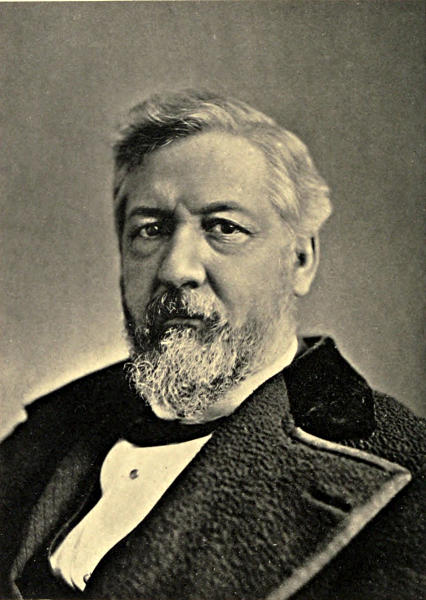
on Reconstruction. Proceeding originally from Hon. James
G. Blaine, a Representative from Maine, afterwards Speaker, it was
known familiarly as “the Blaine Amendment.” After elaborate discussion,
the joint resolution containing the Amendment was adopted
by the House, January 31st,—Yeas 120, Nays 46,—in the following
terms:—
“Representatives shall be apportioned among the several States which
may be included within this Union according to their respective numbers,
counting the whole number of persons in each State, excluding Indians
not taxed: Provided, That, whenever the elective franchise shall be
denied or abridged in any State on account of race or color, all persons
therein of such race or color shall be excluded from the basis of representation.”
Mr. Fessenden, of Maine, who was the Senate Chairman of the Joint
Committee on Reconstruction, promptly gave notice that he should
call for its consideration in the Senate February 5th. This opened the
whole subject in all its branches, and Mr. Sumner seized the earliest
opportunity to discuss it, beginning the important debate. His speech,
after asserting the equal rights of all, vindicated the plenary powers of
Congress, especially under the clause requiring the United States to
guaranty a republican form of government. Though made on the Constitutional
Amendment, it was equally applicable to Mr. Trumbull’s
Civil Rights Bill, then pending, as also to the Bill for Enfranchisement
in the District of Columbia, and to all measures of Reconstruction.

MR. PRESIDENT,—I begin by expressing my acknowledgments
to the Senator from Maine, who
yields the floor to-day, and also my sincere regret that
anything should interfere with the opening of this debate
by him. It is his right, and I enter upon it now
only by his indulgence.
I am not insensible to the responsibility assumed in
setting myself against a proposition already adopted in
the other House, and having the recommendation of a
Committee to which the country looks with such just
expectation, and to which, let me say, I look with so
much trust. But, after careful reflection, I do not feel
that I can do otherwise. Knowing, as I do, the eminent
character of the Committee, its intelligence, its patriotism,
and the moral instincts by which it is moved, I am at a
loss to understand the origin of an attempt which seems
to me nothing else than another compromise of Human
Rights, as if the country had not already paid enough
in costly treasure and more costly blood for such compromises
in the past. I had hoped the day of compromise
with wrong had gone forever. Ample experience
shows that it is the least practical mode of settling
questions involving moral principle. A moral principle
cannot be compromised.
Here are important words of the Amendment:—
“Provided, That, whenever the elective franchise shall be
denied or abridged in any State on account of race or color,
all persons therein of such race or color shall be excluded
from the basis of representation.”
I may be mistaken, Sir, but I think it difficult to
read this proposition without being painfully impressed
by the discord and defilement it will introduce into
the National Constitution, having among specific objects
the guaranty of a republican form of government.
The discord appears on the face. The defilement is none
the less apparent. Go back, if you please, to the adoption
of the Constitution, and you will gratefully acknowledge
that the finest saying of the times was when
Madison, evidently inspired by the Declaration of Independence,
and determined to keep the Constitution
in harmony with it, insisted, in well-known words, that
it was “WRONG to admit in the Constitution the idea
that there could be property in men.”[40] Of all that
has come to us from that historic Convention, where
Washington sat as President, and Franklin and Hamilton
sat as members, there is nothing with so much
of imperishable charm. It was wrong to admit in the
Constitution the idea that man could hold property
in man. In this spirit the Constitution was framed.
This offensive idea was not admitted. The text, at
least, was kept blameless. And now, after generations
have passed, surrounded by the light of Christian truth
and in the full blaze of Human Freedom, it is proposed
to admit in the Constitution a twin idea of Inequality
in Rights, and thus openly set at nought the first principles
of the Declaration of Independence, and the guaranty
of a republican government itself, while you blot
out a whole race politically. For some time we have
been carefully expunging from the statute-book the
word “white,” and now it is proposed to insert in the
Constitution itself a distinction of color. An amendment,
according to the dictionaries, is “an improvement,”
“a change for the better.” Surely the present
proposition is an amendment which, like the crab, goes
backward.
Such is the appearance, when you regard it merely in
form, without penetrating its substance; but here it is
none the less offensive. The case is plain. Still among
us are four million citizens robbed of all share in the
government of a common country, while, at the same
time, according to their means, they are taxed, directly
and indirectly, for the support of the Government.
Nobody will question the statement. And this bare-faced
tyranny of taxation without representation it is
now proposed to recognize as not inconsistent with
fundamental right and the guaranty of a republican
government. Instead of blasting it, you go forward to
embrace it as an element of political power.
If you expect to induce the recent slave-master to
confer suffrage without distinction of color, you will
find the proposition a delusion and a snare. He will
do no such thing. Even the bribe offered cannot tempt
him. If, on the other hand, you expect to accomplish
a reduction of his political power, permit me to say
that success is more than doubtful, while the means
employed are unworthy. Tricks and evasions are possible,
and the cunning slave-master will drive his coach
and six through your Amendment, stuffed with all
his representatives. Should he cheat you, it will only
be a proper return for the endeavor on your part to
circumvent him at the expense of fellow-citizens to
whom you are bound by every obligation of public
faith.
I know not if others will see this uncertainty as I
see it; but there are two practical consequences, having
direct influence on the times, which all must discern as
following at once from the adoption of the so-called
Amendment. In the first place, it will be a present
renunciation of all power under the Constitution to
apply the remedy for a grievous wrong, when the
remedy, even according to your own recent example,
is actually in your hands. You have already in this
Chamber, only last Friday, decreed civil rights without
distinction of color.[41] Who can doubt that by the same
title you may decree political rights, also, without distinction
of color? But, having the power, it is your
duty to exercise it. You cannot evade this duty without
becoming partakers in wrong. And this brings me
to the second practical consequence that must ensue
from the adoption of this proposition. You hand over
wards and allies, through whom the Republic has been
saved, and therefore our saviours, to the control of vindictive
enemies, to be taxed and governed without their
own consent; and this you do for a consideration “nominated
in the bond,” by virtue of which men may do a
great wrong, provided they submit, as a quid pro quo,
to a proportionate abridgment of political power. Who
does not admire the Scottish patriot of whom it was said
that he “would lose his life readily to serve his country,
but would not do a base thing to save it”?[42] I hope we
may act in this spirit. Above all, do not copy the example
of Pontius Pilate, who surrendered the Saviour
of the World, in whom he found no fault at all, to be
scourged and crucified, while he set at large Barabbas,
of whom the Gospel says in simple words, “Now Barabbas
was a robber.”
I speak with sincere deference for cherished friends
from whom I differ; but I submit that the time has
come, at last, when we should deal directly, and not
indirectly, with the great question before us, and when
all compromise of Human Rights should cease, and especially
there should be no thought of a three-headed
compromise, which, after degrading the Constitution,
renounces a beneficent power essential to the safety of
the Republic, and, lastly, borrowing an example from
Pontius Pilate, turns over a whole race to sacrifice.
These objections I present briefly on the threshold,
without argument, and advance to the main question
which must dominate this whole debate. By way of
introduction, I send to the Chair a counter proposition,
which I wish read. It is entitled “A joint resolution
carrying out the guaranty of a republican form of
government in the Constitution of the United States,
and enforcing the Constitutional Amendment for the
prohibition of Slavery.”
This was the joint resolution introduced February 2d,[43] in anticipation
of this debate, but made applicable “anywhere within the limits
of the United States or the jurisdiction thereof.” After its reading by
the Secretary of the Senate, Mr. Sumner proceeded.
Mr. President,—In opening this great question, I
begin by expressing a heartfelt aspiration that the day
may soon come, when the States lately in rebellion
may be received again into the copartnership of political
power and the full fellowship of the Union. But
I see too well that it is vain to expect this day, so
much longed for, until we have obtained that security
for the future which is found only in the Equal Rights
of All, at the ballot-box as in the court-room. This is
the Great Guaranty without which all other guaranties
will fail. This is the sole solution of present troubles
and anxieties. This is the only sufficient assurance of
peace and reconciliation. To the establishment of this
Great Guaranty, as a measure of safety and of justice,
I now ask your best attention.
The powers of Congress over this subject are ample
as they are beneficent. From four specific fountains
they flow, each sufficient, all four swelling into an irresistible
current, and tending to one conclusion: first,
the necessity of the case, by which, according to analogy
of the Territories, disloyal States, having no local
government, lapse under the authority of Congress;
secondly, the Rights of War, which do not expire or
lose their grasp, except with the establishment of all
needful guaranties; thirdly, the constitutional injunction
to guaranty a republican form of government; and,
fourthly, the Constitutional Amendment, by which Congress,
in words of peculiar energy, is empowered to “enforce”
the abolition of Slavery by “appropriate legislation.”
According to the proverb of Catholic Europe, all
roads lead to Rome; and so do all these powers lead
to the jurisdiction of Congress over this whole subject.
No matter which road you take, you arrive at
the same point. The first two have already been discussed
exhaustively.[44] The two latter have been considered
less, and it is on these that I shall speak especially
to-day. I propose, with the permission of the
Senate, to show the necessity and duty of exercising
the jurisdiction of Congress so as to secure that essential
condition of a republican government, the Equal
Rights of All. And I put aside, at the outset, the
metaphysical question, worthy of schoolmen in the Dark
Ages, whether certain States are in the Union or out of
the Union. That is a question of form, and not of substance,—of
words only, and not of facts; for the substance
is clear, and the facts are unanswerable. All
are agreed, according to the authority of President Lincoln,
in his latest utterance before his lamented death,
that these States have ceased to be in “practical relation
with the Union”;[45] and this is enough to sustain
the jurisdiction of Congress, even without the plain
words of the Constitution in two separate texts.
The time has passed for phrases, which have been
the chief resource in opposition to a just reconstruction.
It is not enough to say “a State cannot secede,”
“a State cannot get out of the Union,” “Louisiana is a
State in the Union.” These are mere words, having no
positive meaning, and improper for this debate. So far
as they have meaning, they confound law and fact. It
is very obvious that a State may, in point of law, be
still in the list of States, and yet, in point of fact,
its relations to the Union may have ceased through
violence, foreign or domestic. In point of law, no man
can commit suicide; but in point of fact, men do. The
absurdity of denying that a man has committed suicide,
because it is unlawful, is equalled by the kindred
absurdity of saying that a State cannot do a certain
thing, because it is unlawful. Unhappily, in this world,
the fact is not always in conformity with the law.
Therefore I put aside all fine-spun theories running
into the metaphysics of Constitutional Law. All such
subtilties are absolutely futile. They must end in
nothing. I found myself on existing facts, which are
undeniable. Of these I select two.
Whatever may have been the effect of the acts of
Secession in point of law, it is plain that de facto the
Rebel States have ceased to take any part in the
National Government. All loyal government in those
States has been de facto subverted. They are all without
magistrates or officers bound by oath to support the
National Constitution according to its requirement, so
that de facto there are no magistrates or officers of the
Union in these States; nor are there any de facto Senators
or Representatives in Congress from those States.
Such are unquestionable facts, all of which concentre
in the great unquestionable fact, that for the time being
there are no State Governments in these States which
the National Government can recognize as such.
There is another fact equally unquestionable. It is
that the Rebel States have been de facto in war against
the National Government. Armies have been mustered,
battles have been fought, and the whole country has
been convulsed by this war. An immense national
debt, mourning families, widows and orphans, attest
this terrible fact.
Everything has a natural consequence, and the consequence
of this condition of things is that necessity
which I have announced. These States cannot subsist
without legal governments in just correlation with the
other States and with the Nation.
Necessity and duty commingle. If what is necessary
is not always according to duty, surely duty is always
a necessity. On the present occasion they unite in one
voice for the Great Guaranty. It is at once necessity
and duty. Glancing at the promises of the Fathers, I
shall exhibit,—
First, the overruling necessity of the times;
And, secondly, the positive mandate of the Constitution,
compelling us to guaranty “a republican form of
government,” and thus to determine what is meant by
this requirement; all of which has been fortified by
continuing Rights of War, and by the Constitutional
Amendment authorizing Congress to enforce the abolition
of Slavery.
In the life of a nation, as in that of an individual,
there are moments when outstanding promises must
be performed under peril of ruin and dishonor. Such
is the present moment in the life of the Republic. Sacred
promises, beginning with our history, are yet unperformed,
although the hour has sounded when continued
failure on our part will open the door to a long train
of woes. And there are yet other promises, recently
made, for the national defence against a wicked rebellion,
which, like those of earlier date, are also unperformed.
But the latter are all included in the former;
so that our whole present duty centres in the performance
of sacred promises coëval with the national life.
Our fathers solemnly announced the Equal Rights
of all men, and that government had no just foundation
except in the consent of the governed; and to the
support of the Declaration heralding these self-evident
truths they pledged their lives, their fortunes, and their
sacred honor. Looking at this Declaration now, it is
chiefly memorable for the promises it made. Mighty
words! Fit utterance for the infant giant then born!
Fit device for the great Republic taking its place in the
family of kings! Fit lesson for mankind! And now the
moment has come when these vows must be fulfilled
to the letter. In securing the Equal Rights of the
freedman, and his participation in the Government
which he is taxed to support, we shall perform the
early promises of the Fathers, and at the same time
supplementary promises only recently made to the
freedman as the condition of alliance and aid against
the Rebellion. Failure here is moral and political
bankruptcy. It is repudiation of moral and political
duties, ending in repudiation of the financial obligations.
So are duties to the national freedman linked
with obligations to the national creditor, that you cannot
repudiate the former without impairing the latter.
Whoever disowns any of the promises of the Republic
leads the way in repudiation.
But you cannot be thus guilty. Even if indifferent
to the vows of the Fathers, necessity, in harmony with
the plain injunction of the Constitution, will constrain
you. On this there can be no doubt. You must perform
these promises; and this brings me to the overruling
necessity of the times.
Necessity is a peremptory instructor. It gives the
law which no man can disregard. It will not hearken
to apology or postponement. With a voice of command
it insists that its behests shall be obeyed. And
now this very necessity speaks with familiar tones.
Twice already, since Rebel Slavery rose against the
Republic, it has spoken, insisting, first, that the slaves
should be declared free, and, secondly, that muskets
should be put into their hands for the common defence.
Yielding to necessity, these two things were
done. Reason, humanity, justice were powerless; but
necessity was irresistible. And the result testifies how
wisely the Republic acted. Without Emancipation, followed
by arming the slaves, Rebel Slavery would not
have been overcome. With these, victory was easy.
At last the same necessity, which insisted first upon
Emancipation and then upon arming the slaves, insists
with the same unanswerable force upon admission of
the freedman to complete equality before the law, so
that there shall be no ban of color in court-room or
at the ballot-box, and government shall be fixed on
its only rightful foundation, the consent of the governed.
Reason, humanity, and justice, all of which
are clear for the admission of the freedman, may fail
to move you; but you must yield to necessity, now
requiring these promises to be performed.
The demand I make stands on necessity. You must
grant it, or you will peril the peace of the Republic,
and postpone indefinitely the great day of security and
reconciliation. Therefore, in the name of that national
safety which is the supreme law, I begin my appeal.
Whatever is required for the national safety is constitutional.
Not only it may be done, but it must be
done. Not to do it is to fail in duty. The Republic
must be saved.
When I speak of necessity, I mean that overruling
compulsion which cannot be disobeyed. In the present
case it is compounded of moral duty and the instinct
of self-preservation. The moral duty to perform
these promises is plain as the Decalogue. The instinct
of self-preservation, impelling us to save the Republic,
is in harmony with the requirement of moral duty.
In denying justice now, you are not only guilty of
grievous wrong, but you expose your country to incalculable
calamity. The case is too clear for debate.
The irresistible argument for Emancipation was always
twofold,—first, its intrinsic justice, and, secondly,
its necessity for the safety of the Republic; all of
which was expressed by President Lincoln in the closing
words of his great Proclamation:—
“And upon this act, sincerely believed to be an act of
justice warranted by the Constitution upon military necessity,
I invoke the considerate judgment of mankind and the gracious
favor of Almighty God.”
But the argument for Enfranchisement, which is
nothing but the complement of Emancipation, is the
same. Enfranchisement is not only intrinsically just,
but necessary to the safety of the Republic. There is
no reason, point, or argument once urged for Emancipation
which may not be urged now for Enfranchisement.
I do not err, when I say that Emancipation itself
will fail without Enfranchisement.
By Enfranchisement I mean the establishment of the
Equal Rights of All, so that there shall be no exclusion
of any kind, civil or political, founded on color, and the
promises of the Fathers shall be fulfilled. Such a measure
will be, in the words of President Lincoln, “an
act of justice warranted by the Constitution upon military
necessity.”
As an act of justice, Enfranchisement has a necessity
of its own. No individual and no people can
afford to be unjust. Such an offence carries a curse,
which, sooner or later, must drag its perpetrator to
ruin. But here necessity from considerations of justice
is completed and intensified by positive requirements
of the national safety, plainly involved in the
performance of these promises.
Look at the unhappy freedman blasted by the ban
of exclusion. He has always been loyal, and now it
is he, and not the Rebel master, who pays the penalty.
From the nature of the case, he must be discontented,
restless, anxious, smarting with sense of wrong and consciousness
of rights denied. He does not work as if
taken by the hand and made to feel the grasp of friendship.
He is idle, thriftless, unproductive. Industry
suffers. Cotton does not grow. Commerce does not
thrive. Credit fails; nay, it dies before it is born.
On the other hand, his Rebel master, with hands still
red with the blood of fellow-countrymen, is encouraged
in that assumption of superiority which is part of
the Barbarism of Slavery; he dominates as in times
past; he is exacting as of old; he is harsh, cruel, and
vindictive; he makes the unprotected and trembling
freedman suffer for the losses and disappointments of
the Rebellion; he continues to insult and prostitute
the wife and children, who, ceasing to be chattels, have
not ceased to be dependants; he follows the freedman
to by-ways and obscure places, where once again he
plays master and asserts his ancient title as lord of the
lash. Scenes of savage brutality and blood ensue. All
this, which reason foretells, the short experience of a few
months already confirms. And all this you sanction,
when you leave the freedman despoiled of his rights.
But the freedman, though forbearing and slow to
anger, will not always submit to outrage. He will resist.
Resistance will be organized. And here begins
the terrible war of races foreseen by Jefferson, where
God, in all His attributes, has none which can take
part with the oppressor. The tragedy of San Domingo
will be renewed on a wider theatre, with bloodier incidents.
Be warned, I entreat you, by this historic
example. It was the denial of rights to colored people,
upon successive promises, which caused that fearful
insurrection. After various vicissitudes, during which
the rights of citizenship were conferred on free people
of color and then resumed, the slaves at last rose;
and here the soul sickens at the recital. Then came
Toussaint l’Ouverture, a black of unmixed blood, who
placed himself at the head of his race, showing the
genius of war, and the genius of statesmanship also.
Under his magnanimous rule the beautiful island began
to smile once more: agriculture revived; commerce
took a new start; the whites were protected in
person and property; and a Constitution was adopted
acknowledging the authority of France, but making no
distinction of race or color. In an evil hour this policy
was reversed by a decree of Napoleon Bonaparte.
War revived, and the French army was compelled to
succumb. The connection of San Domingo with France
was broken, and this island became a black republic.
All this dreary catalogue of murder, battle, sorrow, and
woe began in denial of justice to the colored race. And
only recently we have listened to a similar tragedy from
Jamaica, thus swelling the terrible testimony. Like
causes produce like effects; therefore all this will be
ours, if we madly persist in the same denial. The
freedmen among us are not unlike the freedmen of San
Domingo or Jamaica; they have the same “organs,
dimensions, senses, affections, passions,” and, above all,
the same sense of wrong, and the same revenge.
To avoid insurrection and servile war, big with
measureless calamity, and even to obtain the security
essential to industry, agriculture, commerce, and the
national credit, you must perform the promises of
the Republic, originally made by our fathers, and recently
renewed by ourselves. But duty done will not
only save you from calamity and give you security; it
will also prepare the way for the great triumphs of the
future, when through assured peace there shall be tranquillity,
prosperity, and reconciliation, all of which it is
vain to expect without justice.
The freedman must be protected. To this you are
solemnly pledged by the Proclamation of President
Lincoln, which, after declaring him “free,” promises to
maintain this freedom, not for any limited period, but
for all time. But this cannot be, so long as you deny
him the shield of impartial laws. Let him be heard in
court, and let him vote. Let these rights be guarded
sacredly. Beyond even the shield of impartial laws,
he will then have the protection which comes from the
consciousness of manhood. Clad in the full panoply
of citizenship, he will feel at last that he is a man.
At present he is only a recent chattel, awaiting your
justice to be transmuted into manhood. Would you
have him respected in his rights, you must begin by
respecting him in your laws. Would you maintain
him in freedom, you must begin by maintaining him
in the equal rights of citizenship.
And now the national safety is staked on this act of
justice. You cannot sacrifice the freedman without endangering
the peace of the country and the stability of
our institutions. Everything will be kept in jeopardy.
The national credit will suffer. Business of all kinds
will feel the insecurity. The whole land will gape with
volcanic fire, ready to burst forth in fatal flood. The irrepressible
conflict will be prolonged. The house will
continue divided against itself. From all these things,
Good Lord, deliver us! But, under God, there is but
one deliverance, and this is through justice.
I have said that the national credit will suffer;
but this does not disclose the whole financial calamity.
It is idle to suppose that recent rebels, restored to
privileges of citizenship, will vote cordially for the
national debt incurred in the suppression of their rebellion,
or that they will willingly tax themselves
for interest on the enormous outlays by which their
darling Slavery has been overthrown. The evidence
shows them already set against any such contribution.
As time advances, and their power is assured, in conjunction
with Northern sympathizers, they will openly
oppose it; or, if they consent to recognize it, they will
impose the condition that the Rebel debt shall be
recognized also. All this is inevitable, if you give
them the power; it is madness to tempt them. But
they will not have the power, if the promises to the
freedman are performed. Here again justice to the
freedman becomes a necessity.
Sometimes it is said that we must not require justice
to the freedman, because justice is still denied to
the colored citizen in Connecticut and New York. Idle
words, of inconceivable utterance! as if the two cases
bore any imaginable resemblance! There are rivers in
the North and rivers in the South, but who says that
on this account the two regions are alike? The denial
of justice to the colored citizens in Connecticut and
New York is wrong and mean; but it is on so small
a scale that it is not perilous to the Republic, nor is
it vital to the protection of the colored citizen and the
protection of the national creditor. You are moved to
Enfranchisement in Connecticut and New York for
justice to a few individuals only; but you are moved
to it in the Rebel States for justice to multitudes,
also to save the Republic, imperilled by injustice on
a gigantic scale, and to supply needful protection to
the national freedman and the national creditor. From
failure on our part, there is in one case little more than
shame, while in the other there is positive danger,
involving the fate of the national freedman and the
national creditor, to whom we are bound by the most
solemn ties. To a good man, injustice, even on a small
scale, is not tolerable; he feels the necessity of resisting
it; but where the victims are counted by millions,
this necessity becomes a transcendent duty, quickened
and invigorated by all the instincts of self-preservation.
Therefore, I say again, for the national safety, redeem
these promises of the Fathers, and your own.
It is sometimes asserted that the National Constitution
expressly reserves to the States the power of
determining who shall vote, because it declares that
“the electors in each State shall have the qualifications
requisite for electors of the most numerous branch of
the State Legislature.” But this assumption proceeds
on the fatal error, that, at any time under the Constitution,
which makes no distinction of color, there can
be any such oligarchical distinction as a “qualification”
founded on color. Even assuming that in a period
of peace this might be done, yet, beyond all doubt, at
the present moment, from the necessity of the case,
from the Rights of War, from the Constitutional clause
of guaranty, and from the Constitutional Amendment,
Congress, by its quadruple powers, is completely authorized
to do all it thinks best for the national security
and the national faith in the Rebel States. As
well question Farragut in the maintop of his steamer,
Sherman in his march across Georgia, or Grant in
the field before Richmond, as question the authority
of Congress in the present crisis. But, if the authority
exists, it must be exercised.
And this brings me to the next form of this necessity
and duty, as they appear in the guaranty clause of
the Constitution. It is expressly declared that “the
United States shall guaranty to every State in this
Union a republican form of government.” These words,
when properly understood, leave no alternative. They
speak to us with no uncertain voice. But they must
be understood. The Rebel States, while providing constitutional
safeguards for property in man, and, according
to the vaunt of their Vice-President, making
Slavery the corner-stone of the new Government, yet
follow our Constitution in the formal guaranty of a
republican form of government.[46] Defiantly they assume
that Slavery is not inconsistent with such a
government. To this degrading assumption we must
reply, not only for the national cause, but that republican
governments may not suffer.
The magnitude of the question before us is seen in
the postulate with which I begin. Assuming that there
has been a lapse of government in any State, so as to
impose upon the United States the duty of executing
this guaranty, then do I insist that it is a bounden
duty to see that such State has a “republican form
of government,” and, in the discharge of this bounden
duty, we must declare that a State, which, in the foundation
of its government, sets aside “the consent of
the governed,” which imposes taxation without representation,
which discards the principle of Equal Rights,
and lodges power exclusively with an Oligarchy, Aristocracy,
Caste, or Monopoly, cannot be recognized as a
“republican form of government,” according to the requirement
of American institutions. Even if it may
satisfy some definition handed down from antiquity or
invented in monarchical Europe, it cannot satisfy the
solemn injunction of our Constitution. For this question
I now ask a hearing. Nothing in the present debate
can equal it in importance. Its correct determination
will be an epoch for our country and for mankind.
Believe me, Sir, this is no question of theory or
abstraction. It is a practical question, which you are
summoned to decide. Here is the positive text of the
Constitution, and you must affix its meaning. You
cannot evade it, you cannot forget it, without abandonment
of duty. Others in vision or aspiration have
dwelt on the idea of a Republic, and they have been
lifted in soul. You must consider it not merely in vision
or aspiration, but practically, as legislators, seeking
a precise definition, to the end that the constitutional
“guaranty” may be performed. Your powers and duties
are involved in this definition. The character of
the Government founded by our fathers is also involved
in it.
There is another consideration not to be forgotten.
In affixing the proper meaning to the text, and determining
what is a “republican form of government,”
you act as a court in the last resort, from which there
is no appeal. You are sole and exclusive judges. You
may decide as you please. Rarely in history has such
an opportunity been offered to the statesman. You may
raise the name of Republic to majestic heights of justice
and truth, or you may let it drag low down in
the depths of wrong and falsehood. You may make
it fulfil the idea of John Milton, when he said that
“a commonwealth ought to be but as one huge Christian
personage, one mighty growth and stature of an
honest man, as big and compact in virtue as in body”;[47]
or you may let it shrink into the ignoble form of a
pretender, with the name of Republic, but without its
soul.
Before considering this vital question, it is proper to
regard the origin of this “guaranty,” and see how it obtained
place in the Constitution. Perhaps there was
no clause more cordially welcomed; nor does it appear
that it was subjected to any serious criticism in the
National Convention or in any State Convention. It
is not found in the Articles of Confederation; but we
learn from the “Federalist”[48] that the want of this provision
was felt as a capital defect in the plan of the
Confederation. Mr. Madison, in a private record, made
in advance of the National Convention, and which has
only recently seen the light, enumerates among defects
of the Confederation what he calls “want of guaranty
to the States of their Constitutions and laws against
internal violence”; and he then proceeds to anticipate
danger from Slavery, which could be counteracted only
by such “guaranty.” Showing why this was needed,
he says, that, “according to republican theory, right and
power, being both vested in the majority, are held to
be synonymous; according to fact and experience, a
minority may, in an appeal to force, be an overmatch
for the majority”; and he remarks, in words which
furnish a key to the “guaranty” afterwards adopted,
“Where Slavery exists, the republican theory becomes
still more fallacious,”—thus showing, that, at its very
origin, it was regarded as a check upon Slavery.[49]
Hamilton was not less positive than Madison. In
his sketch of a Constitution, communicated to Madison,
and preserved by him,[50] this “guaranty” is found;
and in the elaborate brief of his argument on the Constitution,
it is specified as one of its “miscellaneous
advantages.” The last words of this remarkable paper
are “guaranty of republican governments.”[51] Randolph,
of Virginia, in his sketch of a Constitution,
proposed the “guaranty,” and, in a speech setting forth
the evils of the old system, he said of the remedy, that
“the basis must be the republican principle.”[52] Colonel
Mason, of Virginia, taking up the same strain, said, that,
though the people might be unsettled on some points,
they were settled as to others, among which he put
foremost “an attachment to republican government.”[53]
The proposition in its earliest form was, “that a
republican government, and the territory of each State,
except in the instance of a voluntary junction of government
and territory, ought to be guarantied by the
United States to each State.”[54] This was afterward altered
so as to read, “that a republican Constitution and
its existing laws ought to be guarantied to each State
by the United States.” Gouverneur Morris thought
that the proposition in this form was “very objectionable,”
and he added, that “he should be very unwilling
that such laws as exist in Rhode Island should
be guarantied.” On discussion, it was amended, at the
motion of Mr. Wilson, the learned and philosophical
delegate from Pennsylvania, afterward of the Supreme
Court of the United States, so as to read, “that a republican
form of government shall be guarantied to each
State, and that each State shall be protected against
foreign and domestic violence,” and in this form it was
unanimously adopted.[55] Afterward it underwent modification
in the Convention and in the Committees of
Detail and Revision, until it received the final form it
now has in the Constitution:[56]—
“The United States shall guaranty to every State in this
Union a republican form of government, and shall protect
each of them against invasion, and, on application of the
Legislature, or of the Executive, when the Legislature cannot
be convened, against domestic violence.”
Thus stands the “guaranty.” If further reason be
required for its introduction into the Constitution, it
will be found in the prophetic language of the “Federalist”:—
“It may possibly be asked, what need there could be of
such a precaution, and whether it may not become a pretext
for alterations in the State governments without the concurrence
of the States themselves. These questions admit of
ready answers. If the interposition of the General Government
should not be needed, the provision for such an event
will be a harmless superfluity only in the Constitution. But
who can say what experiments may be produced by the caprice
of particular States, by the ambition of enterprising leaders, or
by the intrigues and influence of foreign powers?”[57]
The very crisis anticipated has arrived. “The caprice
of particular States,” and “the ambition of enterprising
leaders” have done their worst. And now the “guaranty”
must be performed, not only for the sake of individual
States, but for the sake of the Union to which
they all belong, and to advance the declared objects of
the Constitution, specified in its preamble.
The text of this great contract is worthy of study.
No stronger or more comprehensive words could be
employed, whether we regard the object, the party guarantying,
or the party guarantied. The express object
is “a republican form of government.” This is plain.
The party guarantying is not merely the Executive or
some specified branch of the National Government, but
“the United States,” or, in other words, the Nation.
The Republic, which is the impersonation of all, guaranties
“a republican form of government”; and every
branch of the National Government must sustain the
guaranty, including especially Congress, where is the
collected will of the people. The obligation is not
less broad, when we consider the party guarantied.
Here there can be no evasion. The guaranty is not
merely for the advantage of individual States, but for
the common defence and the general welfare. It is
a guaranty to each in the interest of all, and therefore
a guaranty to all. And such is the solidarity of States
in the Union, that the good of all is involved in the
good of each. For each and all, then, this guaranty
must be performed, when the casus fœderis arrives. As
guarantor, the Republic, according to a familiar principle,
is to act on default of the party guarantied; and
then the duty is fixed in all its amplitude.
The testimony is complete. This clause was no hasty
or accidental amendment, creeping into the Constitution
by stealth or compromise, obscure in language
and open to various interpretation, but a solemn act,
couched in few, lucid, unmistakable words; and its precise
purpose was just what so plainly appears,—to
keep all the States truly “republican,” and make the
whole numerous people, in the development of the future,
homogeneous and one. By these words the Nation
is not only empowered, but commanded, to perform
the great guaranty. Power and duty here concur.
Mr. Webster was right, when he called this provision
“a very stringent article, drawing after it the most
important consequences, and all of them good consequences.”[58]
The question, then, returns, What is “a republican
form of government,” according to the requirement of
the National Constitution? Mark, if you please, that it
is not the meaning of this term according to Plato and
Cicero, not even according to examples of history, nor
according to definitions of monarchical writers or lexicographers,—but
what is “a republican form of government”
according to the requirements of the National
Constitution? Of course these important words were
not introduced and unanimously adopted without purpose.
They must be interpreted so as to have real
meaning. Any interpretation rendering them insignificant
must be discarded as irrational and valueless, if not
dishonest. They cannot be treated as a phrase only,
nor a dead letter, nor an empty figure-head. Nor can
they be treated as profession and nothing more, so that
the Constitution shall merely seem to be republican, reversing
the old injunction, “To be rather than to seem,”—Esse
quam videri. They must be treated as real.
Thus interpreted, they become at once a support of
Human Rights and a balance-wheel to our whole political
system.
In determining their signification, I begin by putting
aside what is vague, unsatisfactory, and inapplicable,
in order to bring the inquiry directly to American institutions.
I put aside all illustration derived from the speculations
of ancient philosophers, because, on careful examination,
it appears that the term “Republic,” as used
by them, was so absolutely different from any idea
among us as to exclude their definition from the debate.
This captivating term is of Roman origin. It is the
same as “commonwealth,” and means the public interest.
As originally employed, it was not a specific term,
describing a particular form of government, but a general
term, embracing all governments, whether kingly,
aristocratic, democratic, or mixed. Its equivalent in
Greece was “polity,” being the general term for all
governments. Therefore the definition of a Republic,
according to these ancients, is simply the definition
of an organized government, whether kingly, aristocratic,
democratic, or mixed. Following this definition,
the words of the Constitution are only the guaranty
of an organized government, without determining its
character. This, of course, leaves open the very question
under consideration.
While the ancient nomenclature cannot be cited in
determining the definition of a Republic, we may be
encouraged by it in demanding that all government,
whatever name it bears, shall be designed to establish
justice and secure the general welfare. Thus, Plato,
who commenced these interesting speculations, likens
government to a just man, delighting in justice always,
however treated by others; and the philosopher insists
that every man is a government to himself as every
community is a government to itself. His ideal commonwealth
appears in a good man, and this analogy
testifies to the government he conceived. Aristotle, in
a different vein, and with more precision, opens by
declaring that “every state is a certain community”
or “partnership.”[59] This idea appears again when he
says, “Nothing more characterizes a complete citizen
than having a share in the judicial and executive part
of the government.”[60] In various places he speaks of
“the common good” as a special object,—as, “when
the One, the Few, or the Many govern for the common
good, theirs must be called a good government”[61];
and he defines a democracy as “where the freemen and
the poor, being the majority, are masters of the government.”[62]
The same ideas find new fervor and expansion,
when Cicero says, “A republic is the interest of
the people. But by the people I do not mean every
assemblage of men, gathered together anyhow, but a
body of men associated through agreement in right and
community of interest.”[63] And then again, in another
place, the Roman philosopher says, “Only in a state
where the power of the people is supreme has Liberty
any abode, and, where not equal, it is not really
Liberty.”[64] But all these requirements or aspirations
are applicable to any government, of whatever form;
and it is well known that Cicero recorded his preference
for a government tempered by admixture of the
three different kinds; so that we are not advanced
in our definition, unless we insist that our Republic
should have all the virtues accorded to the ideal commonwealth.
And yet there are two principles which
all these philosophers teach: the first is justice; and
the second is the duty of seeking the general welfare.
I next put aside the examples of history, as absolutely
fallacious and inapplicable. In all ages, governments
have been called Republics. Tacitus speaks of
Rome under the tyranny of the Empire as the Republic;
and Marcus Aurelius, while Emperor, pledges himself
to the Republic. Indeed, there is hardly a government,
from that of the great hunter Nimrod down
to insulted and partitioned Poland, which has not been
called Republic. In 1773, only a few years before the
adoption of the National Constitution, Russia, Austria,
and Prussia, after dividing Poland, undertook to establish
fundamental laws for this conquered country, where
was this declaration:—
“The government of Poland shall be forever free, independent,
and of a republican form: the true principle of said
government consisting in the strict execution of its laws, and
the equilibrium of the three estates, namely, the king, the
senate, and the equestrian order.”[65]
But a government thus composed cannot be recognized
in this debate as “of a republican form.”
At the adoption of the Constitution, the most competent
persons, who disagreed on other things, agreed
in discarding these examples. Alexander Hamilton and
John Adams met here on common ground. The former,
in the Brief of his Argument, exhibits the various forms
of government to which the term “Republic” has been
applied.
“A Republic, a word used in various senses. Has been
applied to aristocracies and monarchies. (1.) To Rome under
the Kings. (2.) To Sparta, though a Senate for life. (3.) To
Carthage, though the same. (4.) To United Netherlands,
though Stadtholder, hereditary nobles. (5.) To Poland,
though aristocracy and monarchy. (6.) To Great Britain,
though monarchy, &c.”[66]
John Adams, in his Defence of the American Constitutions,
written immediately anterior to the National
Constitution, concurs with Hamilton.
“But, of all the words in all languages, perhaps there has
been none so much abused in this way as the words Republic,
Commonwealth, and Popular State. In the Rerum-Publicarum
Collectio, of which there are fifty and odd volumes, and
many of them very incorrect, France, Spain, and Portugal,
the four great Empires, the Babylonian, Persian, Greek,
and Roman, and even the Ottoman, are all denominated
Republics.”[67]
In his old age the patriarch expressed himself in
the same sense, and with equal force.
“The customary meanings of the words Republic and
Commonwealth have been infinite. They have been applied
to every government under heaven: that of Turkey, and that
of Spain, as well as that of Athens and of Rome, of Geneva
and San Marino.”[68]
And then again he said:—
“In some writing or other of mine, I happened, currente
calamo, to drop the phrase, ‘The word Republic, as it is used,
may signify anything, everything, or nothing.’ For this
escape I have been pelted, for twenty or thirty years, with
as many stones as ever were thrown at St. Stephen, when
St. Paul held the clothes of the stoners. But the aphorism
is literal, strict, solemn truth. To speak technically,
or scientifically, if you will, there are monarchical, aristocratical,
and democratical republics. The government of Great
Britain and that of Poland are as strictly republics as that
of Rhode Island or Connecticut under their old charters.”[69]
In the latter remark, Mr. Adams simply repeats his
treatise, where he calls England and Poland “monarchical
or regal republics.”[70]
It is plain that our fathers, when they adopted the
“guaranty” of “a republican form of government,”
intended something certain, or which, if not certain
on the face, could be made certain. But this excludes
the authority of incongruous and inconsistent examples.
They did not use words to signify “anything, everything,
or nothing”; nor did they use words which were
as applicable to England and Poland as to the United
States. Therefore I cannot err in putting aside examples
which, however they illustrate republican government
in times past, are utterly out of place as a
guide to the interpretation of the National Constitution.
Something better must be found: nor is it wanting.
I put aside, also, definitions of European writers and
lexicographers anterior to the National Constitution;
for all these have the vagueness and uncertainty of political
truth at that time in Europe. Among these, none
is of higher authority than Montesquieu, who brought
to political science study, genius, and a liberal spirit.
But even this great writer, who profited by all his
predecessors, quickens and elevates without furnishing
a satisfactory guide. He taught that “Virtue” was the
inspiring principle of a republic, and by “virtue” he
means the love of country, which, he says, is the love
of equality.[71] This is beautiful, and makes Equality a
foremost principle; but, with curious inconsistency, he
includes “democracy” and “aristocracy” under the
term “Republic,”—the former being where the people
in mass have the sovereign power, and the latter
“where the sovereign power is in the hands of part of
the people.” When defining “democracy,” he expresses
the importance of the suffrage as a fundamental of
government, saying, among other things, that it is as
important to regulate by whom the suffrage shall be
given as in a monarchy to know who is the monarch.[72]
But among all these glimpses of truth there is no
definition of “a republican form of government” which
can help us in interpreting the National Constitution.
Surely an aristocracy, “where the sovereign power is
in the hands of part of the people,” cannot find a just
place in our political system. It may be “a republican
form of government” according to Montesquieu, but
it cannot be according to American institutions.
One of the ablest among the modern predecessors of
Montesquieu was John Bodin, also a Frenchman, who
wrote nearly two centuries earlier. Like the ancient
writers, he uses the term “republic” to embrace monarchy,
aristocracy, and democracy, which he calls “three
kinds of republics,”—tria rerumpublicarum genera. If
the republic is in the power of one, penes unum, it is a
monarchy; if in the power of a few, penes paucos, it
is an aristocracy; if in the power of all, penes universos,
it is a democracy. Proceeding further, he says that a
democracy is “where all or the major part of all the
citizens, omnes aut major pars omnium civium, collected
together, have the supreme power.”[73] Here the
philosopher plainly follows the rule of jurisprudence
in regard to corporations; but this definition seems to
sanction the exclusion of part of the citizens, less than
a majority, while it is inadequate in other respects. It
says nothing of equality of rights, or of that great touchstone
of the republican idea, the dependence of taxation
upon representation.
But in his day the word was general, and not specific,
as appears in other instances. The easy-going and very
natural Brantôme, a contemporary of Bodin, quotes a
book of his day which in its title speaks of “the Republic
of France.”[74] This was while the most unrepublican
house of Valois ruled. The great Chancellor
l’Hospital uses the word in the same sense, when in his
famous testament he speaks of yielding to “the necessity
of the Republic.”[75] We have also the authority of
Henri Martin, in his admirable History of France, who
says that the word in Bodin “means only the State in
its broad signification.”[76] Plainly, from writers of this
period there is little help in the present inquiry.
There are later definitions to be put aside also. Thus,
for instance, it is often said that a republic is “a government
of laws, and not of men”; and this saying
found favor with some among our fathers.[77] Long before,
Aristotle had declared that such a government
would be the kingdom of God.[78] But this condition,
though marking an advanced degree of civilization, and
of course essential to a republic, cannot be recognized as
decisive. On its face it is vague from comprehensiveness.
It is enough to say that it would embrace England,
whose government our fathers renounced in order
to build a republic. And still further, it would throw
its shield over a government which “frameth mischief
by a law.” This will not do.
There is also a plausible definition by Millar, the
learned author of the work on the British Constitution,
who states, hypothetically, that by Republic may be
meant “a government in which there is no king or
hereditary chief magistrate.”[79] But this, again, must be
rejected, as leaving aristocracies and oligarchies in the
category of republics.
Sometimes we hear that a government with an elective
chief magistrate is a republic. Here, again, nothing
is said of aristocracy or oligarchy, which coexist
with an elective chief magistrate,—as in Venice, where
the elected Doge was surrounded by an oligarchy of nobles,
and in Holland, where the elected Stadtholder was
a prince surrounded by princes. But there are other instances
which make this definition unsatisfactory, if not
absurd. The Pope of Rome is an elective chief magistrate;
so also is the Grand Lama; but surely the States
of the Church are not republican, nor is Thibet.
Rejecting the definition founded on the elective character
of the chief magistrate, we must also reject another,
founded on “the sovereignty of more than one
man.” It has been said positively, by an eminent person
who has written much on the subject, that “the
strict definition of a republic is that in which the sovereignty
resides in more than one man.”[80] But this strict
definition embraces aristocracies and oligarchies.
I conclude these rejected specimens with that of Dr.
Johnson in his Dictionary, which appeared before American
Independence:—
“Republic. (1.) Commonwealth; state in which the
power is lodged in more than one. (2.) Common interest;
the public.”
These definitions are all as little to the purpose as
the “vulgar error,” chronicled by Sir Thomas Browne,
“that storks are to be found and will only live in republics,”[81]—or
the saying of Rousseau, at a later day,
that, “were there a nation of gods, it would govern itself
democratically,”[82]—or the remark of John Adams,
that “all good government is republican.”[83] It is evident
that we must turn elsewhere for the illumination
we need. If others thus far have failed, it is because
they have looked across the sea instead of at home, and
have searched foreign history and example instead of
simply recognizing the history and example of their
own country. They have imported inapplicable and uncertain
definitions, forgetting that the Fathers, by positive
conduct, by solemn utterances, by declared opinions,
and by public acts, all in harmony and constituting
one overwhelming testimony, exhibited their idea
of a republican government in a way at once applicable
and certain. They are the natural interpreters of their
own Constitution. Mr. Fox, the eminent English statesman,
exclaimed in debate, that, “if, by a peculiar interposition
of Divine power, all the wisest men of every
age and of every country could be collected into one
assembly, he did not believe that their united wisdom
would be capable of forming even a tolerable constitution,”[84]—meaning,
of course, that a constitution must
be derived from habits and convictions, and not from
any invention. There is sound sense in the remark;
and it is in this spirit that I turn from a discussion
having only this value, that it shows how little there is
in the past to interpret the meaning of the Fathers.
Every constitution embodies the principles of its
framers. It is a transcript of their minds. If its meaning
in any place is open to doubt, or if words are used
which seem to have no fixed signification, we cannot err
in turning to the framers; and their authority increases
in proportion to the evidence they have left on the
question. By “a republican form of government” our
fathers plainly intended a government representing the
principles for which they had struggled. Now, if it appears
that through years of controversy they insisted on
certain principles as vital to free government, even to
the extent of encountering the mother country in war,—that
afterward, on solemn occasions, they heralded
these principles to the world as “self-evident truths,”—that
also, in declared opinions, they sustained these
principles,—and that in public acts they embodied
these principles,—then is it beyond dispute that these
principles must have entered into the idea of the government
they took pains to place under the guaranty
of the nation. But all these things can be shown unanswerably.
In these words of hypothesis I foreshadow the four different
heads under which these principles may be seen.
First, as asserted by the Fathers throughout the long
radical controversy which culminated in war.
Secondly, as announced in solemn declarations.
Thirdly, as sustained in declared opinions.
Fourthly, as embodied in public acts.
1. I begin with the principles asserted by our fathers
throughout the protracted controversy that preceded the
Revolution. If Senators ask why our fathers struggled
so long in controversy with the mother country, and
then went forth to battle, they will find that it was to
establish the very principles for which I now contend.
To secure the natural rights of men, and especially to
vindicate the controlling maxim that there can be no
taxation without representation, they fought with argument
and then with arms. Had these been conceded,
there would have been no Lexington or Bunker Hill,
and the Colonies would have continued yet longer under
transatlantic rule. The first object was not independence,
but the establishment of these principles;
and when at last independence began, it was because
these principles could be secured in no other way.
Therefore the triumph of independence was the triumph
of these principles, which necessarily entered
into and became the animating soul of the Republic
then and there born. The evidence is complete, and,
if I dwell on it with minuteness, it is because of its
decisive character.
The great controversy opened with the pretension of
Parliament to tax the Colonies, first disclosed to Benjamin
Franklin as early as 1754. It was at the time
a profound secret; but the patriot philosopher, whose
rare intelligence embraced the natural laws of government
not less than those of science, in a few masterly
sentences exposed the injustice of taxation without representation.[85]
For a moment the Ministry shrank back;
but at last, when the power of France had been humbled,
and the Colonies were no longer needed as allies
in war, George Grenville, blind to principle and only
seeing an increase of revenue, renewed the irrational
claim. The Colonies were to be taxed by the Parliament
in which they had no representation. Two millions and
a half of people—for such was the population then—were
to pay taxes without voice in determining them.
The men of that day listened to the tidings with dismay.
In this ministerial outrage they saw the overthrow
of their liberties, whether founded on natural
rights or on the rights of British subjects. In their
conclusions they were confirmed by two names of authority
in British history, Algernon Sidney and John
Locke, each of whom solemnly asserted the liberties
now in danger. One had borne his testimony on the
scaffold, the other in exile.
Sidney, in his Discourses on Government, did not
hesitate to say, that “God leaves to man the choice
of forms in government,”—and then again, that “all
just magistratical power is from the people.”[86] Such
words were calculated to strengthen the sentiment of
human freedom. But it was Locke who gave formal
expression to the very principles now assailed. In a
famous passage of his work on Civil Government, inspired
and tempered by his exile in Holland, this eminent
Englishman bore his testimony.
“It is true governments cannot be supported without
great charge, and it is fit every one who enjoys his share
of the protection should pay out of his estate his proportion
for the maintenance of it. But still it must be with his own
consent, i. e. the consent of the majority, giving it either
by themselves or their representatives chosen by them; for, if any
one shall claim a power to lay and levy taxes on the people
by his own authority and without such consent of the people,
he thereby invades the fundamental law of property and
subverts the end of government; for what property have I
in that which another may by right take, when he pleases,
to himself?”[87]
Here is a plain enunciation of two capital truths:
first, that all political society stands only on the consent
of the governed; and, secondly, that taxation without
representation is an invasion of fundamental right.
It was these truths that our fathers embraced in the
controversy before them; and these same truths, happily
characterized by Hallam as “fertile of great revolutions
and perhaps pregnant with more,”[88] are as fertile
and as pregnant now as then.
But even this illumination did not begin with these
illustrious Englishmen. Two centuries before their testimony,
Philippe de Comines, a minister of Louis the
Eleventh, in his Memoirs, marking an epoch in historical
literature, announced the same principle; so that
here France antedates England.
“Is there king or lord on earth who has power, outside
his domain [personal estate], to impose a penny upon his
subjects, without grant and consent of those who must pay it,
unless by tyranny or violence?”[89]
That good man, who excelled so much as teacher,
and did so much for scholarship and history, Arnold of
Rugby, records a conclusion hardly less important than
that of his earlier compatriots.
“It seems to be assumed in modern times that the being
born of free parents within the territory of any particular
state, and the paying towards the support of its government,
conveys a natural claim to the rights of citizenship.”[90]
Others had said there could be taxation only with
the consent of the people taxed. The last authority
exhibits citizenship associated with contribution to
the support of the government. This same political
truth appeared in Virginia as early as 1655-6, where,
by solemn enactment, repealing a restriction upon suffrage,
it was declared “something hard and unagreeable
to reason that any persons shall pay equal taxes
and yet have no votes in elections.”[91] And it reappears
in the famous Declaration of Rights, adopted
unanimously June 12, 1776, which announces that men
“cannot be taxed or deprived of their property for public
uses without their own consent or that of their representatives
so elected.”[92]
Sidney and Locke unquestionably exercised more
influence over the popular mind, preceding the Revolution,
than any other writers. They were constantly
quoted, and their names were held in reverence. But
their authority has not ceased. As they spoke to our
fathers, they now speak to us: Sicut patribus, sic nobis.
The cause of Human Liberty, in this great controversy,
found voice in James Otis, a young lawyer of
eloquence, learning, and courage, whose early words,
like the notes of the morning bugle mingling with the
dawn, awakened the whole country. Asked by the
merchants of Boston to speak at the bar against Writs
of Assistance, issued to enforce ancient Acts of Parliament,
he spoke both as lawyer and as patriot, and so
doing became a statesman. His speech was the most
important, down to that occasion, ever made on this
side of the ocean. An earnest contemporary, who was
present, says, “No harangue of Demosthenes or Cicero
ever had such effects upon this globe as that speech.”[93]
It was the harbinger of a new era. For five hours the
brilliant orator unfolded the character of these Acts of
Parliament; for five hours he held the court-room in
rapt and astonished admiration; but his effort ascended
into statesmanship, when, after showing that the colonists
were without representation in Parliament, he cried
out, that, notwithstanding this exclusion, Parliament had
undertaken to “impose taxes, and enormous taxes, burdensome
taxes, oppressive, ruinous, intolerable taxes”;
and then, glowing with generous indignation at this injustice,
he launched that thunderbolt of political truth,
“Taxation without representation is Tyranny.”[94] From
the narrow court-room where he spoke, the thunderbolt
passed, smiting and blasting the intolerable pretension.
It was the idea of John Locke; but the fervid orator,
with tongue of flame, gave to it the intensity of his own
genius. He found it in a book of philosophy; but he
sent it forth a winged messenger blazing in the sky.
John Adams, then a young man just admitted to the
bar, was present at the scene, and he dwells on it often
with sympathetic delight. There, in the Old Town-House
of Boston, sat the five judges of the Province,
with Hutchinson as Chief Justice, in robes of scarlet,
cambric bands, and judicial wigs; and there, too, in
gowns, bands, and tie-wigs, were the barristers. Conspicuous
on the wall were full-length portraits of two
British monarchs, Charles the Second and James the
Second, while in the corners were the likenesses of Massachusetts
Governors. In this presence the great oration
was delivered. The patriot lawyer had refused
compensation. “In such a cause as this,” said he, “I
despise a fee.” He spoke for country and for mankind.
Firmly he planted himself on the Rights of Man, which
he insisted were, by the everlasting Law of Nature, inherent
and inalienable; and these rights, he nobly proclaimed,
were common to all, without distinction of
color. To suppose them surrendered in any other way
than by equal rules and general consent was to suppose
men idiot or mad, whose acts are not binding. But
he especially flew at two arguments of tyranny: first,
that the colonists were “virtually” represented, and,
secondly, that there was such a difference between direct
and indirect taxation, that, while the former might
be questionable, the latter was not. To these two apologies
he replied, first, that no such phrase as “virtual
representation” was known in Law or Constitution,—that
it is altogether subtilty and illusion, wholly unfounded
and absurd,—and that we must not be cheated
by any such phantom, or other fiction of law or politics,
or any monkish trick of deceit and hypocrisy;
and then, with the same crushing force, he said, that,
in absence of representation, all taxation, whether direct
or indirect, whether internal or external, whether on
land or trade, was equally obnoxious to the same unhesitating
condemnation.[95] The effect was electric. The
judges were stunned into silence, and postponed judgment.
The people were aroused to a frenzy of patriotism.
“American Independence,” says John Adams,
in the record of his impressions, “was then and there
born; the seeds of patriots and heroes were then and
there sown, to defend the vigorous youth. Every man
of a crowded audience appeared to me to go away, as
I did, ready to take arms against Writs of Assistance.
Then and there was the first scene of the first act of
opposition to the arbitrary claims of Great Britain.
Then and there the child Independence was born.”[96]
But this great birth is inseparably associated with the
principle, then and there declared, that “Taxation without
representation is Tyranny.”
From this time forward Otis dedicated himself singly
to the cause he had so bravely upheld, and the popular
heart clove to him. He became the favorite of his
fellow-countrymen. His arguments were repeated, his
words were gratefully adopted, and the saying, “Taxation
without representation is tyranny,” became a maxim
of patriotism. In May, 1761, only a few weeks after
this utterance, he was chosen a representative of Boston
in the Legislature by an almost unanimous vote. The
Crown officers were dismayed by this most significant
election, and one of them, speaking with prophetic lamentation,
said it would “shake the Province to its
foundation”; on which John Adams remarked, many
years later, when some of its results were already visible,
“That election has shaken two continents, and will
shake four.”[97] Of course this was simply because it
affirmed and invigorated a practical truth of government
by which all the people are confirmed in political
power. At his new post of duty, Otis became the acknowledged
leader, constant, fervid, eloquent, and, according
to his own language, “daring to speak plain
English.” While still declaring unhesitating loyalty
to the Crown, and even pledging “the last penny and
the last drop of blood, rather than that by any backwardness
of ours his Majesty’s measures should be
embarrassed,” he made haste to announce, in words
where humor blends with truth, that “God made all
men naturally equal,”—that “the ideas of earthly superiority,
preëminence, and grandeur are educational, at
least acquired, not innate,”—that “no government has
a right to make hobby-horses, asses, and slaves of the
subject, Nature having made sufficient of the two former
for all the lawful purposes of man, from the harmless
peasant in the field to the most refined politician
in the cabinet, but none of the last, which infallibly
proves they are unnecessary.” But the case would have
been imperfectly stated, if the patriot representative had
not once more cried out against taxation without representation,
and warned against the calamities that must
follow from this unquestionable tyranny. This early
debate is preserved in a pamphlet, printed in 1762, and
entitled “A Vindication of the Conduct of the House
of Representatives of the Province of the Massachusetts
Bay, etc., by James Otis, Esq.,” which, we are told
by an eminent authority, contains, in solid substance,
all that is found in the Declaration of Rights and
Wrongs issued by Congress in 1774, the Declaration
of Independence in 1776, and the subsequent writings
of those political philosophers who upheld the national
cause.[98] Pardon me, if I dwell too minutely on
this history. I do it only to illustrate the issue of
principle actually made with the mother country.
The controversy still continued, when, in 1764, the
orator, who by voice and pen had so bravely maintained
the cause of his country, put forth another publication,
entitled “The Rights of the British Colonies Asserted
and Proved.” Mark, if you please, the vigor of the
title. The rights of the Colonies are not only “asserted,”
but “proved.” Reprinted in London, this pamphlet
was read by Lord Mansfield, Chief Justice of
England, and was answered by Soame Jenyns, a partisan
writer of the Crown. The copy I hold in my
hand has the imprint of London, and is marked “Third
Edition.” All things considered, it is the most remarkable
pamphlet of our country, and one of the most remarkable
ever written. Recent events, verifying the
truths it so early announced, elevate its place in history.
Here are the same vital principles, enforced with
learning and eloquence, which Otis announced at the
bar, and then again in the debates of the Legislature;
and here are not only the truths asserted by our fathers,
but the unanswerable arguments by which they
were vindicated. Even an abstract would be too long
for this debate; but the character of this Defence of
the American People, not unlike Milton’s famous “Defensio
pro Populo Anglicano,” will appear in a few passages,
where, as in gleams, may be discerned the Idea of
a Republic.
I do not pause on the assertion, “that every man of
a sound mind should have his vote,” or the authority he
invokes, when he says, “Lord Coke declares that it is
against Magna Charta and against the franchises of the
land, for freemen to be taxed but by their own consent,”
both of which, sounded by him elsewhere,[99] are
important premises. Nor do I dwell on that admirable
statement of much in little, “The first simple principle
is Equality and the Power of the Whole.”[100] The
Equality of All and the Power of All!—the two buttresses
of a just government. I come at once to the
plain statement of fundamental right.
“The supreme power cannot take from any man any
part of his property without his consent in person or by
representation.”
“Taxes are not to be laid on the people but by their consent
in person or by deputation.”[101]
Such are “the first principles of law and justice,
and the great barriers of a free state”; and then he
adds, “I ask, I want no more.”[102] And these principles
he claims for all, without distinction of color.
“The colonists are by the Law of Nature free-born, as
indeed all men are, white or black.… Does it follow
that ‘tis right to enslave a man because he is black? Will
short, curled hair, like wool, instead of Christian hair, as
’tis called by those whose hearts are as hard as the nether
millstone, help the argument? Can any logical inference
in favor of Slavery be drawn from a flat nose, a long or
a short face?”[103]
Assuming these rights as common to all, whether
white or black, he insists that any taxation, whether
direct or indirect, without representation, is only another
form of Slavery.
“I can see no reason to doubt but that the imposition of
taxes, whether on trade, or on land, or houses, or ships, on
real or personal, fixed or floating property, in the Colonies,
is absolutely irreconcilable with the rights of the colonists,
as British subjects, and as men. I say men, for in a state
of Nature no man can take my property from me without
my consent. If he does, he deprives me of my liberty and
makes me a slave.… The very act of taxing, exercised over
those who are not represented, appears to me to be depriving
them of one of their most essential rights as freemen, and,
if continued, seems to be in effect an entire disfranchisement
of every civil right. For what one civil right is worth a
rush, after a man’s property is subject to be taken from
him at pleasure, without his consent?”[104]
Such was the voice of James Otis, who was our John
the Baptist. It was he who went before in this great
controversy. He first stated the case between the
Colonies and the mother country, and first developed
the principles in issue. But, though first, he was not
long alone. Conspicuous among his followers was Samuel
Adams, that austere patriot, always faithful and
true, who desired to make Puritan Boston “a Christian
Sparta.” He was remarkable for the simplicity, accuracy,
and harmony of his style, and on this account often
held the pen for the Legislature or the town-meeting.
In obedience to the latter, he drew up instructions to the
Representatives of Boston, afterward adopted in Faneuil
Hall, where, repeating the very arguments of Otis, he
says, “If our trade may be taxed, why not our lands,
why not the produce of our lands, and everything we
possess or make use of?” And then, advancing in the
subject, he asks: “If taxes are laid upon us in any shape
without our having a legal representation where they are
laid, are we not reduced from the character of free subjects
to the miserable state of tributary slaves?”[105] In
proposing this question, he leaves no room to doubt the
answer it deserved.
Soon thereafter, Franklin, as agent of Pennsylvania,
maintained the same principles in England. But the
ministry, hurried on by fatal folly leading to destruction,
persevered in their pretension. The Stamp Act
was passed, and for the first time in our history papers
bore stamps, to swell the revenue of the Crown. Massachusetts
remonstrated in formal resolutions, “particularly
considered,” wherein it is declared, “That there
are certain essential rights of the British Constitution
of Government, which are founded in the law of God
and Nature, and are the common rights of mankind,—therefore,
… that no man can justly take the property
of another without his consent,— … that all
acts made by any power whatever, other than the General
Assembly of this Province, imposing taxes on the
inhabitants, are infringements of our inherent and unalienable
rights as men and British subjects, and render
void the most valuable declarations of our Charter.”[106]
In an address to the Royal Governor, the Legislature,
after setting forth the injustice of the Stamp Act, proceeded
to say, “We must beg your Excellency to excuse
us from doing anything to assist in the execution of
it.”[107] The people in town-meetings took up the strain,
and all united against the Act. But Massachusetts was
not alone.
Virginia, by positive statute, as early as 1655-6 recognized
the just principle, as we have already seen;[108]
and now a writer of that State, catching the spirit of
Otis, declared, in an elaborate pamphlet, that it was
“an essential principle of the English Constitution that
the subject shall not be taxed without his consent”;
and then again, quoting the words of another, “All men
have natural, and freemen legal rights, which they may
justly maintain, and no legislative authority can deprive
them of.”[109] The Legislature of Virginia, even
before Massachusetts, adopted resolutions kindred in
spirit, which were moved by Patrick Henry, and heroically
carried by his eloquent voice, even against the
menacing cry of “Treason.” Thus spoke Virginia, exposing
the true issue, and insisting on the inseparability
of taxation and representation:—
“Resolved, That the taxation of the people by themselves,
or by persons chosen by themselves to represent them, who can
only know what taxes the people are able to bear, or the
easiest method of raising them, and must themselves be
affected by every tax laid on the people, is the only security
against a burdensome taxation and the distinguishing characteristic
of British freedom, without which the ancient Constitution
cannot exist.”[110]
Pennsylvania, by her House of Assembly, spoke also
to the same effect:—
“Resolved, N. C. D., That this House think it their duty
thus firmly to assert with modesty and decency their inherent
rights, that their posterity may learn and know that it
was not with their consent and acquiescence that any taxes
should be levied on them by any persons but their own
representatives.”[111]
The controversy proceeded. At the invitation of Massachusetts,
moved by Otis, a Congress assembled at New
York in October, 1765, having delegates from Massachusetts,
Rhode Island, Connecticut, New York, New
Jersey, Pennsylvania, Delaware, Maryland, and South
Carolina, which, after a prolonged session, adopted a
declaration of colonial rights and grievances, where it
is declared:—
“That it is inseparably essential to the freedom of a people,
and the undoubted right of Englishmen, that no taxes
be imposed on them but with their own consent, given personally
or by their representatives.
“That the people of these Colonies are not, and from
their local circumstances cannot be, represented in the
House of Commons in Great Britain.”[112]
At last the Stamp Act was repealed. But the pretension
of taxation was suspended rather than abandoned.
A ministerial partisan continued to urge the
scheme in unscrupulous language:—
“All countries unaccustomed to taxes are at first violently
prepossessed against them, though the price which they give
for their liberty: like an ox untamed to the yoke, they show
at first a very stubborn neck, but by degrees become docile
and yield a willing obedience.… America must be
taxed.”[113]
As time advanced, the old audacity was revived, and,
under the lead of the reckless Charles Townshend, taxes
were imposed by Parliament on tea, glass, lead, paper,
and painters’ colors. The old opposition in the Colonies
was revived also, and taxation without representation
was again denounced. Committees of correspondence
were established, and the work of organization began.
The whole country was in a fever. Massachusetts, as
in times past, did not hesitate to proclaim the true principle.
At a town-meeting of Boston in 1772, there
was a declaration of rights, “which no man or body
of men, consistently with their own rights as men and
citizens or members of society, can for themselves give
up or take away from others”; and here we meet again
familiar words:—
“The supreme power cannot justly take from any man
any part of his property without his consent in person or
by his representatives.”[114]
Against all Parliamentary taxation, as often as it
showed itself, this impenetrable buckler was lifted.
But the mother country was perverse. Ship-loads of
tea arrived. At Boston the tea was thrown into the
dock. The Colonies entered into an agreement of non-importation.
Then came troops, and the Boston Port
Bill, by which this harbor was vindictively closed
against commerce. The whole country, including even
South Carolina, made common cause with Massachusetts.
Gadsden exclaimed, “Massachusetts sounded
the trumpet, but to Carolina is it owing that it was
attended to.”[115] And Virginia exclaimed, “We will
never be taxed but by our own representatives. This
is the great badge of Freedom.… Whether the people
in Boston were warranted by justice, when they
destroyed the tea, we know not; but this we know,
that the Parliament, by their proceedings, have made
us and all North America parties in the present dispute.”[116]
Meanwhile more troops arrived. All things
portended strife; and yet the colonists did not ask for
independence. They only asked for rights, insisting
always that there should be no taxation without representation.
“The patriots of this Province,” said John
Adams in 1774, “desire nothing new; they wish only
to keep their old privileges. They were for one hundred
and fifty years allowed to tax themselves, and
govern their internal concerns as they thought best.
Parliament governed their trade as they thought fit.
This plan they wish may continue forever.”[117] Thus
stood the two parties face to face.
Then came the Continental Congress, which at once
put forth resolutions, where, after claiming the enjoyment
of life, liberty, and property, as natural rights, it
was insisted that the colonists could be bound by no
law to which they had not consented by representatives.
Here was the original programme of James Otis: first,
the rights of men, according to Natural Law; and,
secondly, the principle that government, including of
course taxation, depended on the consent of the governed.
“The foundation of English Liberty and of all
free government,” said these resolutions, “is a right in
the people to participate in their legislative council.”[118]
In harmony with these resolutions were the several
addresses of the Continental Congress,—to the people
of Great Britain, to the inhabitants of the Province of
Quebec, and to the king himself,—always pleading for
Human Rights in the largest sense. The address to the
people of Great Britain begins by an appeal for “the
rights of men and the blessings of Liberty,” and then
insists “that no power on earth has a right to take our
property from us without our consent.”[119] The address
to the inhabitants of the Province of Quebec, in similar
spirit, says: “The first grand right is that of the people
having a share in their own government by their representatives
chosen by themselves, and, in consequence, of
being ruled by laws which they themselves approve,
not by edicts of men over whom they have no control.
This is a bulwark surrounding and defending their
property.”[120] And the petition to the king has the
same key-note: “Duty to your Majesty, and regard
for the preservation of ourselves and our posterity, the
primary obligations of Nature and society, command us
to entreat your royal attention.”[121] Thus constantly,
down to the last moment, did our fathers set forth
the principles they sought to establish as essential to
free government. Thus constantly did they testify to
the cause for which I now plead.
Answering voices came back from England, announcing
the principles in issue. The right of taxation was
asserted; but there were many who disguised the tyranny
by assuming that the Colonies were “virtually
represented.” Perhaps that spirit of legal technicality
which is satisfied by form at the expense of reason was
never more strikingly illustrated than in the argument
of Sir James Marriott, the Admiralty Judge, who gravely
insisted, in the House of Commons, that England
“had an undoubted right to tax America, because she
was represented by the members for the County of
Kent, of which the thirteen provinces were a part or
parcel, for in their charters they were to hold of the
manor of Greenwich in Kent.”[122] The whole pretension
had been scouted by the indignant eloquence of Mr.
Pitt, afterward Lord Chatham. “The idea,” said he, “of
a virtual representation of America in this House is the
most contemptible idea that ever entered into the head
of a man. It does not deserve a serious refutation.”[123]
As the controversy continued, and especially as those
masterly state papers, the addresses of the Continental
Congress, reached England, the ministers of the king
were put on the defensive. They retained as advocate
none other than Samuel Johnson, who, for “small
hire,” lent the pen which had written “Rasselas,” “The
Vanity of Human Wishes,” and the English Dictionary,
to a rancorous attack on the principles of our
fathers. Its concentrated venom was all expressed in
the title, “Taxation no Tyranny.” Another pamphlet
appeared in reply, with the epigram, “Resistance no
Rebellion,” embodying the idea, that, where there is
taxation without representation, resistance is justifiable;
and thus was issue joined at London. This was
in 1775. Already the “embattled farmers” had gathered
at Lexington and Bunker Hill; already Washington
had drawn his sword at Cambridge, as commander-in-chief
and generalissimo of the new-born armies;
already war had begun. At last, to the defiant watchword,
“Taxation no Tyranny,” hurled from London,
our fathers returned that other defiant watchword,
“Independence.” But they did not turn their backs
upon the principles asserted throughout the long controversy.
Independence was the means to an end, and
that end was nothing less than a Republic, with Liberty
and Equality as animating principles, where government
stood on the consent of the governed, or, which is the
same thing, where there should be no taxation without
representation: for here was the distinctive feature of
American institutions.
2. The principles heralded through fifteen years of
controversy were not forgotten when Independence was
declared: and here I come to the national declarations
of the Fathers.
It sometimes happens that men fail in support of the
cause to which they are pledged, or content themselves
with something less than the truth. But not so with
our fathers. In declaring Independence they continued
loyal to their constant vows. The natural rights
of all men, and the consent of the people as the only
just foundation of government, which James Otis first
announced, which Samuel Adams maintained with severe
simplicity, which Patrick Henry vindicated even
against the cry of “Treason,” and which had been affirmed
by legislative bodies and public meetings, were
embodied in the opening words of the Declaration.
There they stand, like a sublime overture to the new
Republic, interpreting, inspiring, and filling it with
transforming power.
“We hold these truths to be self-evident: that all men are
created equal; that they are endowed by their Creator with
certain unalienable rights; that among these are life, liberty,
and the pursuit of happiness; that to secure these rights
governments are instituted among men, deriving their just
powers from the consent of the governed.”
Nor did these declarations proceed from the National
Congress alone. The States spoke also in their Bills of
Rights.
Foremost is the Equality of All Men. Of course, in
a declaration of rights, no such supreme folly was
intended as that all men are created equal in form or
capacity, bodily or mental,—but simply that they are
created equal in rights. This is grandest of the self-evident
truths announced, leading and governing all
the rest. Life, liberty, and the pursuit of happiness are
among inalienable rights; but they are all in subordination
to that primal truth. Here is the starting-point
of the whole; and the end is like the starting-point.
Announcing that governments derive their just powers
from the consent of the governed, the Declaration repeats
the same proclamation of Equal Rights. Thus
is Equality the Alpha and the Omega, wherein all other
rights are embraced. Men may not have a natural
right to certain things, but most clearly they have a
natural right to impartial laws, without which justice,
being the end and aim of government, must fail. Equality
in rights is the first of rights. Because these self-evident
truths, beginning with Equality, had been set
at nought by Great Britain, in her relations with our
fathers, Independence was declared. To these truths,
therefore, was the new Government solemnly dedicated,
as it assumed its separate and equal station among the
powers of the earth. Do you ask for the definition of
Republic? Here it is, by patriot lexicographers, whose
authority none of us can question.
As the War of Independence began with a declaration
of principles, so it ended with a like declaration. At its
successful close, the Continental Congress, in an Address
to the States, by the pen of James Madison, thus announced
the objects for which it had been waged, and
thus supplied another definition of the new government:—
“Let it be remembered that it has ever been the pride
and boast of America, that the rights for which she contended
were the rights of human nature. By the blessing of the
Author of these rights on the means exerted for their defence,
they have prevailed against all opposition, and form
the basis of thirteen independent States. No instance has
heretofore occurred, nor can any instance be expected hereafter
to occur, in which the unadulterated forms of Republican
Government can pretend to so fair an opportunity of
justifying themselves by their fruits. In this view, the
citizens of the United States are responsible for the greatest
trust ever confided to a political society.”[124]
Such, also, was the sublime sentiment promulgated
by Washington from his camp, in a general order, near
the same date, announcing the close of the war, where
he declares his “rapture” in the national prospects, and
the three-fold happiness for all “who have assisted in
protecting the rights of human nature.”[125] It was for
“the rights of human nature” that our fathers went
forth to battle, and these rights are proclaimed to
“form the basis of thirteen independent States.” But
supreme among these is Equality, including of course
the equal right of all to a voice in the Government.
And this is the Republic which our fathers, with pride
and boast, then gave as an example to mankind.
The same spirit appears in the National Constitution,
which, by its preamble, asserts practically similar
sentiments:—
“We, the people of the United States, in order to form
a more perfect union, establish justice, insure domestic tranquillity,
provide for the common defence, promote the general
welfare, and secure the blessings of liberty to ourselves
and our posterity, do ordain and establish this Constitution
for the United States of America.”
Thus was the National Constitution ordained, not to
create an oligarchy or aristocracy, not to exclude certain
persons from the pale of its privileges, not to organize
inequality of rights in any form, but to “establish justice,”
which is Equality,—to “insure domestic tranquillity,”
which is vain without justice,—to “provide
for the common defence,” which is the defence of all,—to
“promote the general welfare,” which is the welfare
of all,—and to “secure the blessings of liberty”
to all the people and their posterity, which is giving
to all the complete enjoyment of rights central among
which is Equality. Here, then, is another authoritative
definition.
Thus has our country testified to its idea of a Republic,
not only throughout long days of controversy,
but in national declarations, being in themselves monumental
acts.
3. From these national declarations I come now to
the Opinions of the Fathers. Here you see how these
same principles have been sustained by eminent characters,
whose names are historic, all testifying to the
government they founded and upheld. In their weighty
words you find a definition, constantly repeated, in harmony
with all the promises of the Fathers, whether in
controversy or in solemn instruments which are the
very title-deeds of the Republic.
I begin with Benjamin Franklin, who saw all questions
of Government with a surer instinct than any
other person in our history. As early as 1736, while
still a young man, he wrote an article, which was published
in the Pennsylvania Gazette, containing these
words:—
“Popular Governments have not been framed without the
wisest reasons. It seemed highly fitting that the conduct of
magistrates, created by and for the good of the whole, should
be made liable to the inspection and animadversion of the
whole.”[126]
It is for the good of the whole, and not for an odious
oligarchy or an aristocratic class, that our patriot speaks,
and in these words is foreshadowed the idea of a republican
government. But it was in discussions, after
Otis had hurled his flaming bolt, that we find a fuller
and more precise definition. Here it is, as adopted, if
not written, by Franklin:—
“That every man of the commonalty (excepting infants,
insane persons, and criminals) is, of common right, and by
the laws of God, a freeman, and entitled to the free enjoyment
of liberty.
“That liberty, or freedom, consists in having an actual share
in the appointment of those who frame the laws, and who are to
be the guardians of every man’s life, property, and peace: for
the all of one man is as dear to him as the all of another;
and the poor man has an equal right, but more need, to have
representatives in the Legislature than the rich one.
“That they who have no voice nor vote in the electing of
representatives do not enjoy liberty, but are absolutely enslaved
to those who have votes, and to their representatives: for to be
enslaved is to have governors whom other men have set over
us, and be subject to laws made by the representatives of others,
without having had representatives of our own to give consent
in our behalf.”[127]
In these emphatic words is a complete vindication
of the equal right of representation, as essential to free
government,—so much so, that, where this does not
exist, Liberty does not exist.
Jefferson followed Franklin in the same vein, but
with greater fervor. The author of the Declaration of
Independence could not do otherwise. Constantly he
testifies to his idea of a Republic. Thus he wrote to
Alexander von Humboldt, under date of June 13, 1817,
affirming the rights of the majority as “the first principle
of Republicanism,” and assuming the principle of
Equal Rights:—
“The first principle of Republicanism is, that the lex
majoris partis is the fundamental law of every society of
individuals of equal rights. To consider the will of the society
enounced by the majority of a single vote as sacred
as if unanimous is the first of all lessons in importance, yet
the last which is thoroughly learnt. This law once disregarded,
no other remains but that of force, which ends
necessarily in military despotism.”[128]
In another letter, to John Taylor, of Caroline, dated
May 28, 1816, he thus defines a Republic:—
“Indeed, it must be acknowledged that the term Republic
is of very vague application in every language. Witness the
self-styled Republics of Holland, Switzerland, Genoa, Venice,
Poland. Were I to assign to this term a precise and definite
idea, I would say, purely and simply, it means a government
by its citizens in mass, acting directly and personally, according
to rules established by the majority,—and that every
other government is more or less republican in proportion
as it has in its composition more or less of this ingredient
of the direct action of the citizens.”[129]
Here again, while confessing the unquestionable
vagueness of the term according to old examples, he
assumes that in a republic all citizens must have a
voice. And again, in the same letter, he thus indignantly
condemns denial of representation:—
“And also that one half of our brethren who fight and pay
taxes are excluded, like Helots, from the rights of representation,
as if society were instituted for the soil, and not for the
men inhabiting it, or one half of these could dispose of the
rights and the will of the other half without their consent.”[130]
Thus did he scout the whole wretched pretension of
oligarchy and monopoly by which citizens are deprived
of equal rights.
To these may be added his earliest and latest declarations
on this important question. The earliest is in his
“Notes on Virginia,” written in 1781, where he recognizes
“a reciprocation of right” as a presiding principle:—
“When arguing for ourselves, we lay it down as a fundamental,
that laws, to be just, must give a reciprocation of
right: that without this they are mere arbitrary rules of
conduct, founded in force, and not in conscience.”[131]
The latest declaration was in 1826, the year of his
death. It is in a paper containing some of his most
intimate opinions. Here he bears testimony to “equality
among our citizens” as “essential to the maintenance
of republican government.”[132] These are among his
dying words.
Madison was colder in nature than Jefferson; but
they were associates in opinion, as in political life. In
the debates on the National Constitution the former condemned
the denial of rights on account of color:—
“We have seen the mere distinction of color made, in the
most enlightened period of time, a ground of the most oppressive
dominion ever exercised by man over man.”[133]
Speaking directly of the right of suffrage, he uses the
following language:—
“The right of suffrage is certainly one of the fundamental
articles of republican government, and ought not to be left to
be regulated by the legislature. A gradual abridgment of
this right has been the mode in which aristocracies have been
built on the ruins of popular forms.”[134]
Thus declaring himself against “aristocracies,” he naturally
recognized the true idea; and here he was perplexed
by the question of a property qualification, and
the effort to reconcile it with “the right of suffrage,”
which he calls “a fundamental article in republican
constitutions.”[135] In another place, he says of “confining
the right of suffrage to freeholders”: “It violates the
vital principle of free government, that those who are
to be bound by laws ought to have a voice in making
them; and the violation would be more strikingly unjust
as the lawmakers become the minority.”[136] Completely
recognizing the great American principle, that
just government can stand only on “the consent of
the governed,” he is brought to this conclusion:—
“Under every view of the subject, it seems indispensable
that the mass of citizens should not be without a voice in
making the laws which they are to obey, and in choosing the
magistrates who are to administer them.”[137]
In one of the most remarkable chapters of the “Federalist,”
Madison gives expansion to this idea in his
formal definition of a Republic:—
“If we resort for a criterion to the different principles on
which different forms of government are established, we may
define a Republic to be, or at least may bestow that name on,
a government which derives all its powers directly or indirectly
from the great body of the people, and is administered by
persons holding their offices during pleasure, for a limited
period, or during good behavior. It is essential to such a
government that it be derived from the great body of the society,
not from an inconsiderable proportion, OR A FAVORED CLASS OF
IT: otherwise a handful of tyrannical nobles, exercising their
oppressions by a delegation of their powers, might aspire to
the rank of republicans, and claim for their government the
honorable title of Republic.”[138]
Thus, in few significant words, does this authority
teach that a Republic is a government derived from
“the great body of the people,” and not from “a favored
class of it.” Better words could not be found
for the American definition.
I repeat these two conditions of republican government
according to Madison: First, the government
must be derived from the great body of the people; and,
secondly, it cannot spring from any favored class.
That the colored race should not be excluded from
this definition may be justly inferred from his remark,
already quoted, that “where Slavery exists the republican
theory becomes still more fallacious,”[139] and also
from his correspondence at a later day with Lafayette,
whose devotion to the great principle of Equal
Rights was blazoned before the world. Writing to the
latter, November 25, 1820, he said:—
“The Constitutions and laws of the different States are
much at variance in the civic character given to free persons
of color: those of most of the States, not excepting such as
have abolished Slavery, imposing various disqualifications,
which degrade them from the rank and rights of white persons.
All these perplexities develop more and more the dreadful
fruitfulness of the original sin of the African trade.”[140]
“Various disqualifications which degrade them”;
“dreadful fruitfulness”: such are some of the terms in
which judgment is recorded. Another letter, also to
Lafayette, written as late as February 1, 1830, says:—
“Outlets for the freed blacks are alone wanted for a
rapid erasure of the blot [of Slavery] from our Republican
character.”[141]
Thus, in his opinion, was the treatment of this unhappy
people inconsistent with the “Republican character.”
Hamilton follows with perhaps equal authority.
Though approaching political questions from opposite
points of view, we find him uniting with Franklin,
Jefferson, and Madison. Here is a glimpse of the definition
he would supply:—
“As long as offices are open to all men and no constitutional
rank is established, it is pure republicanism.”[142]
Not for an oligarchy, but for all, is a Republic created.
Then again he testifies for Equal Rights, and
against partial distinctions:—
“There can be no truer principle than this, that every
individual of the community at large has an equal right to the
protection of Government.… We propose a free government.
Can it be so, if partial distinctions are maintained?”[143]
Again he says, in positive words:—
“A share in the sovereignty of the State, which is exercised
by the citizens at large in voting at elections, is one of
the most important rights of the subject, and in a Republic
ought to stand foremost in the estimation of the law. It is that
right by which we exist a free people.”[144]
He then exhibits the crowning lesson:—
“The principles of the Revolution taught the inhabitants
of this country to risk their lives and fortunes in asserting
their liberty, or, in other words, their right to a share in the
government. That portion of the sovereignty to which each
individual is entitled can never be too highly prized. It is
that for which we have fought and bled.”[145]
More could not be said in the few words. But it is
when Hamilton comes to consider the National Constitution
and to expound its provisions, that, while recognizing
the anomalous condition of Slavery, and exposing
what he calls “the compromising expedient of the
Constitution” by which “the slave is divested of two
fifths of the man,” he yet declares “the equal level of
free inhabitants,” and announces, “that, if the laws were
to restore the rights which have been taken away, the
negroes could no longer be refused an equal share of representation
with the other inhabitants.” Here is this important
text,—which has additional authority when it
is considered that it was attributed also to Madison,
and indeed claimed by him, who thus acknowledged the
sentiments as his own:—
“It is only under the pretext that the laws have transformed
the negroes into subjects of property, that a place is
denied to them in the computation of numbers; AND IT IS
ADMITTED, THAT, IF THE LAWS WERE TO RESTORE THE RIGHTS
WHICH HAVE BEEN TAKEN AWAY, THE NEGROES COULD NO
LONGER BE REFUSED AN EQUAL SHARE OF REPRESENTATION
WITH THE OTHER INHABITANTS.”[146]
Thus, according to Hamilton, if the slaves are restored
to the rights which have been taken away,—in
other words, if they become freemen,—they will
be on the same equal level, and entitled to the same
equal share of representation with the other inhabitants.
The two ideas of Equality and a Right to Representation,
so early and constantly avowed by the
Fathers, are here again recognized as essential conditions
of government; and this is the true definition of
a Republic.
With these great representative names to illustrate
the American idea I might close the catalogue. Surely
this is sufficient. But there are others, whose authority
cannot be disregarded.
Here is the testimony of that inflexible spirit, who
had thought and acted much, Samuel Adams, in a letter
to his kinsman, John Adams:—
“That the sovereignty resides in the people is a political
doctrine which I have never heard an American politician
seriously deny.… We, the people, is the style of the
Federal Constitution. They adopted it; and, conformably
to it, they delegate the exercise of the powers of government
to particular persons, who, after short intervals, resign their
powers to the people, and they will reëlect them, or appoint
others, as they think fit.”[147]
Here also is the testimony of another Republican, who
signed the Declaration of Independence, Roger Sherman,
in a letter to John Adams:—
“What especially denominates it a Republic is its dependence
on the public or people at large, without any hereditary
powers. But it is not of so much importance by what appellation
the government is distinguished as to have it well
constituted to secure the rights and advance the happiness of
the community.”[148]
There also was John Adams himself, who was the
least distinct of all the Fathers on this question; but
we find in the Preface to his Defence of the American
Constitutions a passage full of prophetic meaning:—
“Thirteen governments, thus founded on the natural authority
of the people alone, without a pretence of miracle or
mystery, and which are destined to spread over the northern
part of that whole quarter of the globe, are a great point
gained in favor of the rights of mankind.”[149]
Here is a plain assertion that our Thirteen States
were founded “on the natural authority of the people
alone,” and that they were destined to spread over all
North America.
Charles Pinckney, in a speech on the adoption of the
Constitution, speaks for South Carolina:—
“The doctrine of representation is the fundamental of a
republic.… As to the United Netherlands, it is such
a confusion of states and assemblies, that I have always
been at loss what species of government to term it. According
to my idea of the word, it is not a republic; for I
conceive it as indispensable in a republic that all authority
should flow from the people.… A republic is where the
people at large, either collectively or by representation, form
the Legislature.”[150]
Luther Martin, an able representative of Maryland in
the Convention, while vindicating a prohibition or tax
on the importation of slaves, said:—
“The privilege of importing them was unreasonable; and
it was inconsistent with the principles of the Revolution,
and dishonorable to the American character, to have such a
feature in the Constitution.”[151]
Afterwards, in his address to the Legislature of Maryland,
he announced that both in the Committee and in
the Convention he was influenced by the argument,—
“that Slavery is inconsistent with the genius of republicanism,
and has a tendency to destroy those principles on which
it is supported, as it lessens the sense of the Equal Rights of
mankind, and habituates us to tyranny and oppression.”[152]
Thus was a “sense of the Equal Rights of mankind”
one of the principles on which Republicanism rested.
And here is one more word from Virginia: it is Colonel
Mason, who always spoke with so much point:—
“The true idea, in his opinion, was, that every man, having
evidence of attachment to and permanent common interest
with the society, ought to share in all its rights and
privileges.”[153]
Again we have a plain recognition of the Revolutionary
idea.
Here, also, is another authority. I quote a Virginia
writer on Government,—John Taylor, of Caroline:—
“The end of the guaranty is ‘a republican form of
government.’ The meaning of this expression is not so unsettled
here as in other countries, because we agree in one
descriptive character as essential to the existence of a republican
form of government. This is representation. We do not
admit a government to be even in its origin republican, unless
it is instituted by representation; nor do we allow it to be so,
unless its legislation is also founded upon representation.”[154]
I close this array, illustrative of opinion, with the
words of Daniel Webster, in harmony with the rest:—
“Now, fellow-citizens, I will venture to state, in a few
words, what I take these American political principles in
substance to be. They consist, as I think, in the first place,
in the establishment of popular governments on the basis
of representation.… This representation is to be made
as equal as circumstances will allow.”[155]
Then again, on another occasion, he said:—
“This is the true idea of a State. It is an organized
government, representing the collected will of the people,
as far as they see fit to invest that government with
power.”[156]
Thus, at every stage, from the opening, when Otis
announced the master principle, “Taxation without
representation is Tyranny,” all along to Daniel Webster,
we find “Representation” an essential element in
the American definition of republican government.
4. From authoritative opinions I pass to public acts,
which testify to the true idea of republican government.
These are of two classes: first, by the United
States, in their collective character; and, secondly, by
the States individually.
Looking at the States in their collective character, we
find that at the adoption of the National Constitution
they refused to recognize any exclusion from the elective
franchise on account of race or color. The Fathers knew
too well the requirements of a republican government
to sanction such exclusion. Recognizing Slavery as a
transitory condition, soon to cease, they threw over it a
careful oblivion; but they were none the less jealous of
the rights of all freemen. The slave did not pay taxes,
and, so far as he was a person and not property, he was
part of the family of his master, by whom he was represented,
so that in his case the commanding principle
of the Revolution was not disturbed. But, becoming
a freeman, the slave stepped at once within the pale
of taxation, and therefore necessarily of representation,
since the two are inseparable. And this consideration
was the guide to our fathers.
The Continental Congress refused point-blank to insert
the word “white” in the Articles of Confederation.
The question came up, June 25, 1778, on these words:
“The free inhabitants of each of these States (paupers,
vagabonds, and fugitives from justice excepted) shall be
entitled to all privileges and immunities of FREE CITIZENS
in the several States.” The delegates from South Carolina
moved, in behalf of their State, to limit this guaranty
to “free WHITE inhabitants.” On the question of
inserting the word “white,” eleven States voted,—two
in favor of the insertion, one was divided, and eight were
against it. South Carolina, not disheartened, made another
attempt, by moving to add, after the words “the
several States,” the further clause, “according to the law
of such States respectively for the government of their
own FREE WHITE inhabitants,”—thus seeking again to
limit the operation of the guaranty. This proposition
was voted down by the same decisive majority of eight
to three. And thus did our fathers testify to the right
of representation without distinction of color. On other
occasions, for successive years, they constantly gave the
same testimony.
A resolution of Congress in April, 1783, seconded by
the report of a Grand Committee, of which Mr. Jefferson
was Chairman, in April, 1784, recommended an
Amendment of the Articles of Confederation, whereby
the war expenses should be apportioned among the several
States according to “the whole number of white
and other free citizens and inhabitants,”—thus positively
embracing colored persons. In the Act for the Temporary
Government of the Territory “ceded or to be
ceded” to the United States, April 23, 1784, and drawn
by Jefferson, the voters are declared to be the “free
males of full age,” without distinction of color. In the
famous Ordinance for the Government of the Northwestern
Territory, drawn by Nathan Dane, of Massachusetts,
adopted by the Confederation July 13, 1787, and
then reënacted by our Congress after the adoption of
the Constitution, the voters are declared to be “free
male inhabitants of full age,”—again without distinction
of color. Then came successive Acts of Congress
for the government of Territories, where the rule in
the Ordinance for the Northwestern Territory was followed,
and there was no distinction of color. If this
rule changed, it was only when the partakers in the
Revolution and the authors of the Constitution ceased
to exercise influence over public affairs. The testimony
of the Fathers was constant, and it is only of this
that I speak.
Turning from the States collectively, and looking at
them individually, we find the same testimony. By the
Constitution of New Hampshire, at the adoption of the
National Constitution, the suffrage was vested in “every
male inhabitant of each town and parish,” with certain
qualifications, but without exclusion on account of color.
By the Constitution of Massachusetts the suffrage was
vested in “every male inhabitant,” with certain specified
qualifications, but without distinction of color. Rhode
Island, at the adoption of the Constitution, was under
her original colonial charter, which provided for elections
by “the major part of the freemen of the respective
towns or places,” without distinction of color. Connecticut
was likewise under her original colonial charter,
which also provided for elections by “the major part of
the freemen of the respective towns, cities, and places,”
without distinction of color. By the Constitution of
New York the suffrage was vested in “every male inhabitant
of full age,” with certain specified qualifications,
but without distinction of color. By the Constitution
of New Jersey it was vested in “all inhabitants
of this Colony of full age,” with certain specified qualifications,
but without distinction of color. By the Constitution
of Pennsylvania it was vested in “every freeman
of the full age of twenty-one years,” with certain
specified qualifications, but without distinction of color.
By the Declaration of Rights prefixed to the Constitution
of Delaware it was announced that “every freeman,
having sufficient evidence of a permanent common
interest with and attachment to the community, hath
a right of suffrage,” without distinction of color; and
in the Constitution the suffrage was vested in “the
freemen and inhabitants of the respective counties,”
with certain specified exceptions, but without distinction
of color. By the Constitution of Maryland the
suffrage was vested in “all freemen above twenty-one
years of age,” with certain specified qualifications, but
without distinction of color. By the Constitution of
North Carolina the suffrage was vested in “all freemen
of the age of twenty-one years,” with certain
specified qualifications, but without distinction of color;
and this rule continued down to 1836, when the
Constitution was amended, or rather, let me say, perverted.
That eminent citizen, Judge Gaston, of North
Carolina, in giving judgment at a later day, said: “It
is a matter of universal notoriety, that free persons,
without regard to color, claimed and exercised the
franchise.”[157] To these States I add Tennessee, which was
carved out of North Carolina, and followed her benign
example. Her Constitution, adopted in 1796, vested the
suffrage in “every freeman of the age of twenty-one
years,” with certain qualifications, but without distinction
of color; and this rule continued down to the perversion
of the Constitution in 1834. Mr. Cave Johnson,
of Tennessee, once Postmaster General, is reported to
have said that he was originally elected to Congress by
the votes of colored persons, and I have heard Mr. John
Bell make the same confession with regard to himself.
Virginia was inconsistent and uncandid. By the Declaration
of Rights prefixed to her Constitution it was
announced that “ALL MEN, having sufficient evidence
of permanent common interest with and attachment to
the community, have the right of suffrage,” without distinction
of color; and it is added, that they “cannot be
taxed or deprived of their property for public uses without
their own consent or that of their representatives so
elected, nor bound by any law to which they have not
in like manner assented for the public good.” This was
entirely worthy of the eminent citizens who adorned
that State. But a subsequent provision of the Constitution
preserved the right of suffrage “as exercised at
present”: thus embodying, without naming, the legislative
exclusion of free negroes, mulattoes, and Indians,
“although such persons be freeholders.” This discreditable
manœuvre becomes more notable in view of an
incident in the early history of Virginia, curious and
important, and also applicable to all the States during
their colonial existence. It was on the enactment of
a statute in 1723, “that no free negro, mulatto, or
Indian whatsoever shall hereafter have any vote at
the election of burgesses, or any other election whatsoever,”[158]
when the tyranny here manifest was rebuked
with unexpected plainness. The legal authority in England,
to whom this colonial statute was submitted for review
and approval, reported, in admirable words:—
“I cannot see why one freeman should be used worse
than another merely upon account of his complexion.…
To vote at elections of officers, either for a county or parish,
&c., is incident to every freeman who is possessed of a certain
amount of property.”[159]
Georgia was fitful. By her Constitution of 1777, in
existence immediately anterior to the National Constitution,
suffrage was confined to “male white inhabitants.”
But a Constitution adopted May 6, 1789, and
another adopted May 30, 1798, accorded suffrage to
“citizens and inhabitants,” with certain specified qualifications,
but without the word “white.”
It only remains to speak of South Carolina, the persistent
marplot of republican institutions, where, by the
Constitution, the suffrage was vested in “every free
white man, and no other person,” with certain specified
qualifications. This was the only State among the original
Thirteen, unless Georgia be grouped with South
Carolina, which at that time allowed a color discrimination
in its Constitution. It was the only State which,
after uniting in a National Declaration that “all men
are created equal,” openly and audaciously commenced
the example of “a white man’s government.” This
apostate idea, which has since played such a part as a
disturber of the national peace, was then and there born,
as the opposite idea was born in Massachusetts, under
the inspiring words of James Otis. And the other
States, in their Constitutions, followed this patriot voice.
They spoke of “persons,” “inhabitants,” “freemen,” or,
better still, “men,” without prefix of “white.” Color was
not mentioned. But even in South Carolina, which introduced
the discreditable tyranny into her Constitution,
this exclusion was more apparent than real. In point of
fact, even as late as 1790, when the first census was
taken, there were in this State only one thousand eight
hundred and one free colored citizens. Of course their
exclusion was wrong, mean, and unrepublican; but I do
not assert that it was such a case as to justify the interference
of the nation to reform it, especially where
there was no lapse of the State Government. On the
other hand, its sufferance cannot be interpreted as a
waiver of the principles for which the Revolution was
fought. But even in South Carolina there had been a
spasm of virtue. In 1757 there was a “flourishing
negro school” at Charleston, and in 1709 we find a complaint
that “even negroes” had been admitted to vote.
Though denounced as an abuse, the precedent is authenticated
by a disgusted inhabitant.[160]
Such are the public acts of the States, collectively
and individually, at the adoption of the National Constitution,
illustrating with rare harmony the American
idea of a Republic, and testifying against any exclusion
founded on color. Add to these, that the National Constitution,
carefully excepting from the basis of Representation
“Indians not taxed,” pays open homage to the
principle that there can be no taxation without representation;
add then that it expressly founds the Government
upon “the people,” not only in the preamble,
which begins “We the people,” but also in providing
that the House of Representatives shall be “chosen
by the people of the several States”; add also the
crowning fact, that it recognizes no distinction of color,
that it treats all with the same impartial justice, that
the word “white” does not appear there, and who are
we, Sir, who dare foist into this Magna Charta an
oligarchical idea which finds no sanction in its republican
text?
Here I bring this part of the argument to a close.
We have seen the origin of the controversy which led
to the Revolution, when Otis, with such solid claim,
insisted upon Equal Rights, and then, giving practical
effect to the grand demand, sounded the battle-cry,
“Taxation without Representation is Tyranny”; we have
followed the controversy in its anxious stages, where
these principles were constantly asserted and constantly
denied, until it broke forth in battle; we have seen
these principles adopted as the very frontlet of the Republic,
when it assumed its place in the family of nations,
and then again when it ordained its Constitution;
we have seen them avowed and illustrated in memorable
words by the greatest authorities of our history;
lastly, we have seen them embodied in public acts of
the States collectively and individually; and now, out
of this concurring, cumulative, and unimpeachable testimony,
constituting a speaking aggregation absolutely
without precedent, I offer you the American definition
of a Republican form of government. In vain do you
cite philosophers or publicists, or the examples of former
history. Against these I put the early and constant
postulates of the Fathers, the corporate declarations
of the Fathers, the avowed opinions of the Fathers,
and the public acts of the Fathers, all with one voice
proclaiming, first, that all men are equal in rights, and,
secondly, that government derives its just powers from
the consent of the governed; and here is the American
idea of a Republic, which must be adopted in the interpretation
of the National Constitution. You cannot
reject it. As well reject the Decalogue in determining
moral duties, or reject the multiplication-table in
determining a question of arithmetic.
Counter to this irresistible conclusion there can be
only one suggestion having any seeming plausibility,
and this is founded on the contemporary recognition of
Slavery. On this point, it is enough, if I remind you,
first, that our fathers did not recognize Slavery as a
permanent part of our system, but treated it as exceptional
and transitory, while they concealed it from
view by words which might mean something else; secondly,
that the slave was always regarded, legally and
politically, as part of the family of his master, according
to the nomenclature of Blackstone’s Commentaries,
much read at the time, where master and servant are
grouped with husband and wife, parent and child, and,
as in the case of wife and child, the slave is represented
by the head of the family, who also paid taxes on his
account, so that in his case the cardinal principle of the
Revolution, associating representation and taxation together,
was not essentially violated; and, thirdly, that
by the acts of the Continental Congress, and generally
by the State Constitutions, all distinction of color was
discarded in determining the elective franchise, and that
illustrious expounders of the National Constitution, as
if anticipating the very question before us, Alexander
Hamilton and James Madison, announced in the “Federalist,”
IF THE LAWS WERE TO RESTORE THE RIGHTS
WHICH HAVE BEEN TAKEN AWAY, THE NEGROES COULD
NO LONGER BE REFUSED AN EQUAL SHARE OF REPRESENTATION
WITH THE OTHER INHABITANTS. Such was the
understanding, and such the promise, at the adoption
of the Constitution. Such was the declared meaning
of our fathers, according to the concurrent contemporary
testimony of Hamilton and Madison. Therefore,
while confessing sorrowfully the terrible inconsistency
in recognizing Slavery, and throwing over their shame
the mantle which the son of Noah threw over his father,
we must reject every argument or inference on
this account against the true idea of a Republic, which
is none other than a government where all citizens
have an equal voice. As Washington, by divine example,
gave to mankind a new idea of political greatness, so
did the Fathers, by inspired teaching, give to mankind
a new idea of Government. Do you ask again for authority?
I offer it in its many forms. It is the early
Vocabulary of James Otis, Samuel Adams, Patrick
Henry, and Benjamin Franklin; it is the Dictionary
of the Revolution; it is the Lexicon of our National
History; it is the Thesaurus of Public Acts. This new
idea was the great discovery of our fathers. Rob them
of this, and you take their highest title to gratitude.
Columbus, venturing into an unknown sea, discovered
a New World of Space; but our fathers, venturing likewise,
discovered a New World of Public Duty. It is
for us, their children, to profit by their discovery.
For determining the meaning of our own Constitution
in a momentous requirement without precedent,
American authority and example are enough; but I
would not have you forget that the conclusion on which
I rest is grandly sustained by France. Here I shall be
brief.
I cannot begin with a higher name than Montaigne,
who, though never defining a Republic, let drop words
which, coming from such a master, are invaluable:—
“Popular rule seems to me the most natural and equitable.”
“Equality is the first part of equity.”[161]
In the same spirit, Montesquieu, while failing to supply
a precise definition, helped to elevate the idea of
republican government, when he declared “virtue” its
inspiration, and that virtue is the love of equality.[162] A
kindred thought is expressed by a publicist of our
time, in a remarkable study on Montesquieu, when he
says, that “the true principle of democracy is justice.”[163]
But justice is equality.
Contemporary with Montesquieu was the Marquis
d’Argenson, a minister of Louis the Fifteenth and the
friend of Voltaire. In a work written as early as 1739,
but not seeing the light till 1764, some time after his
death, when it was attributed to Rousseau, this remarkable
character gives utterance to words worthy of perpetual
memory:—
“It is only necessary to lay aside the most stupid prejudice,
to admit that two things are chiefly to be desired for
the good of the State: one, that all the citizens shall be
equal among themselves; the other, that each shall be the
son of his works.”[164]
A government where these two things are assured
would be a Republic indeed.
Voltaire, though not professing to define a Republic,
taught its dependence upon equality:—
“Civil government is the will of all, executed by one or
by many in virtue of laws for which all have voted.” “The
republican is undoubtedly the most tolerable of all governments,
because it is that which brings men most nearly
to natural equality.”[165]
In another place the same illustrious teacher said:—
“The people never desire, and never can desire, anything
but Liberty and Equality.”[166]
Advancing in time, the Republic becomes more manifest.
Omitting the fervid words of Jean Jacques Rousseau,
I adduce Condorcet, whose consecration to truth
was sealed by a tragical death:—
“I have ever thought that a Republican Constitution,
having Equality for its basis, was the only one in conformity
with Nature, with reason, and with justice,—the only one
which could preserve the liberty of the citizens and the
dignity of the human race.”[167]
Belonging to the ancient system of France, and, like
Lafayette, with the rank of Marquis, Condorcet, again
like Lafayette, not only accepted the Republic, but declared
its true basis.
Another French authority, of eminent experience in
diplomacy, who wrote coldly and only according to the
requirement of reason, Gérard de Rayneval, asserts the
same law of Equality:—
“Political Liberty consists in the right to participate in
public affairs. This participation is direct or indirect, and
it is more or less extended according to the form of government.
It is, then, necessarily unequal. For example, in a
Democracy all the citizens participate in the legislative power.
If they delegate it, they have only a very indirect part in
it; but all can become delegates or representatives, all can
arrive at administrative employments, and all have the right
to protest against abuses. In aristocratic republics political
liberty is exclusively concentrated in the body of Notables;
they alone exercise all the power; subjects have only civil
liberty.”[168]
Such, in France, is the voice of political science.
It is also the voice of the French Revolution. The
one idea which that great event taught with prevailing
influence was the Equal Rights of All, explained and
defined by the new-born formula, that “all are equal
before the Law.” Napoleon recognized the supremacy
of this principle, when, in an official address to the
Council of State, he said, “France loves Equality above
everything”;[169] and he sought to enforce it, when, in an
early proclamation, he declared, “Let there be no head
which does not bend under the empire of Equality.”[170]
Such is human inconsistency, that shortly afterwards
his own ambition refused to bend under this empire,
which none the less disowned the sceptre he assumed
and the nobles he created. But the great truth, though
trampled down, survived in the hearts of the French
people, to rise again and resume its heritage.
As the Provisional Government of 1848 proclaimed
the Republic, it was careful, after proper deliberation, to
proclaim at the same time “universal suffrage,” which
Lamartine, standing on the steps of the Hôtel de Ville,
and speaking in the name of the Government, said was
“the first truth and only basis of every National Republic.”[171]
This proclamation was itself submitted to the
vote of “all the citizens”; and on the terms of this submission
another member of the Government, of solid
sense and perfect fidelity, thus expresses himself:—
“By these words—all the citizens—the Provisional Government
intended to consecrate definitively the fundamental
principle of democracy; it intended to proclaim boldly and
forever the inalienable, imprescriptible right inherent in each
member of society to participate directly in the government
of his country; it intended to put in practice really and
loyally the great principles hitherto shut up in the domain
of the abstract theories of philosophy.”[172]
The same person, M. Garnier-Pagès, who was at once
an eminent actor in these scenes and their most authentic
historian, thus again dwells on the true idea
of a Republic:—
“The Republic, that government of all by all, where each
has his place, his duty, and his right; the Republic, that is
to say, Liberty itself, the liberty to do every act and to give
utterance to every thought not prejudicial to others; the
Republic, that fraternal ground where are admitted all parties,
the representatives of the past as well as of the future,
where all minds, all associations, can have free scope.”[173]
This precise definition is fitly crowned by the remarkable
words revealing the soul of De Tocqueville:—
“I should, I think, have loved Liberty at all times, but
in the times in which we live I feel inclined to adore it.…
There is no legislator sufficiently wise and sufficiently
powerful to maintain free institutions, if he does
not take Equality for first principle and symbol. All our contemporaries,
then, who would create or assure the independence
and dignity of their fellow-men, must show themselves
the friends of Equality; and the only worthy way of showing
themselves such is to be so. Upon this depends the
success of their holy enterprise.”[174]
To the authentic testimony of modern France, in
harmony with our own country, I add the definition of
a very recent foreign publicist, who, after dwelling on
Equality as the idol sentiment of a Republic, says:—
“This shows us the nature and the end of republican
government. It is a government founded on the general
interest and equality.”[175]
Admirable words!—in themselves a definition. And
here, before closing this testimony, let me call attention
to two authorities, contemporary with our fathers, which
stand apart,—one English, and the other German. The
first is that of Dr. Richard Price, the friend of John
Adams, who very early appreciated the American Revolution,
and vindicated it before the world. Here is his
idea of good government, compendiously expressed:—
“Legitimate government, as opposed to oppression and
tyranny, consists only in the dominion of Equal Laws made
with common consent, or of men over themselves; and not in
the dominion of communities over communities, or of any
men over other men.”[176]
The German was none other than the great thinker,
Emanuel Kant, who, in his speculations on Perpetual
Peace, says, that to this end every state should be a
Republic, which he defines:—
“That form of government where every citizen participates
by his representatives in the exercise of the legislative power,
and especially in that of deciding on the questions of peace
and war.”[177]
The statement of Kant is as simple as Pure Reason,
which is the title of his great work. It claims plainly
for “every citizen” a share in the government, and
is the deliberate conclusion furnished by this eminent
philosopher, whose name, rarely quoted in politics, is
an unimpeachable authority.
Such is the definition of a republican form of government,
as found in the history, declarations, opinions,
and public acts of the Fathers of our country, reinforced
by the authority of foreign intelligence and the
example of France. From this presentation of authorities
not to be questioned we pass easily to another
stage of the discussion, where the conclusion is the easy
and irresistible sequence.
Bringing these lapsed States to the touchstone, we
see at once their small title to recognition as republican
in form. Authentic figures are not wanting. The
census of 1860 discloses the population of the States in
question.
| States. |
White Population. |
Colored Population,
Slave and Free,
including Indians. |
| Alabama | 526,271 | 437,930 |
| Arkansas | 324,143 | 111,307 |
| Florida | 77,747 | 62,677 |
| Georgia | 591,550 | 465,736 |
| Louisiana | 357,456 | 350,546 |
| Mississippi | 353,899 | 437,406 |
| North Carolina | 629,942 | 362,680 |
| South Carolina | 291,300 | 412,408 |
| Tennessee | 826,722 | 283,079 |
| Texas | 420,891 | 183,324 |
| Virginia | 1,047,299 | 549,019 |
| 5,447,220 | 3,656,112 |
A glance at this table is enough. Taking the sum total
of population in the eleven States, we find 5,447,220
whites to 3,656,112 colored persons; and you are now
to decide, whether, in the discharge of imperative duties
under the National Constitution, and bound to guaranty
a republican form of government, you will disfranchise
this latter mass, shutting them out from those Equal
Rights promised by our fathers, and from all copartnership
in the government of their country. They surpass
in numbers, by at least a million, the whole population
of the Colonies at the time our fathers raised the cry,
“Taxation without Representation is Tyranny”; and
now you are to decide whether to strip them of representation,
while you subject them to grinding taxation
by tariff and excise, acting directly and indirectly,
dwarfing into insignificance everything attempted by
the British Parliament. Our fathers could not bear a
Stamp Act in making which they had no voice, and
they braved terrible war with the most formidable
power of the globe rather than pay a tax of threepence
on tea imposed by a Parliament in which they were
unrepresented. Are you ready, Sir, in disregard of this
great precedent, and in disregard of all promises and
examples of past history, to thrust a single citizen out
of all representation in the Government, while you consume
his substance with taxation, subject him to Stamp
Acts, compel him to pay a duty of twenty-five cents a
pound on tea, and then follow him with imposts in all
the business of life? Clearly, if you do not recognize
his title to representation, you must at least by careful
legislation relieve him from this intolerable taxation.
Some of the millions you thrust out already contribute
largely to the public revenue. How, then, can you
deny them representation? Their money is not rejected.
Why reject their votes? But if you reject
their votes, you cannot take their money. As you
detect no color in their money, you ought to detect
no color in their votes.
In this denial of the right to vote there is a surpassing
tyranny, being nothing less than a confiscation of
the highest property the citizen can possess. To take
his money is robbery; to appropriate his house or land
is spoliation; but house and land are less than the
right by which the citizen is assured in all other
rights. Lord Chief Justice Holt spoke as became one
of England’s greatest magistrates, when he said from
the bench: “A right that a man has to give his vote at
the election of a person to represent him in Parliament,
there to concur to the making of laws which are to bind
his liberty and property, is a most transcendent thing
and of an high nature.”[178] But this “most transcendent
thing” is taken from a whole race on an excuse insulting
to them as members of the human family.
Unhappily, too many people discern the wrong only
when they personally feel its sting. Suppose now the
case reversed, and white citizens in South Carolina despoiled
of this “most transcendent thing” by the predominance
of the colored race, so that “black” instead
of “white” marks participation in government. But, if
such discrimination is just where the white prevails, it
would be equally just where the black prevails, and it
would be as constitutional in one case as in the other.
Unquestionably a black man’s government is as constitutional
as a white man’s government. But the white
man could not easily endure the degradation; nor can it
be doubted that Congress would promptly insist that
it was inconsistent with republican government, and
would apply the proper remedy. Failing in this duty,
what other discrimination could it arrest? The Anglo-Saxon
might exclude the Celt; the Celt might exclude
the Anglo-Saxon; both might exclude the German, and
the fearful antagonisms of race would have full play.
Other battles than the Boyne would be the signal of
discord, and other parties than Orangemen would stalk
upon the scene.
If, looking at these States together, the case is clear,
it becomes clearer when we look at them separately.
Begin with Tennessee, which disfranchises 283,079
citizens, being more than a quarter of its whole “people.”
Thus violating a distinctive principle of republican
government, how can this State be recognized as
republican? The question is easier asked than answered.
But Tennessee is the least offensive on the list.
There is Virginia, which disfranchises 549,019 citizens,
being more than a third its whole “people.” There is
Alabama, which disfranchises 437,930 citizens, being
nearly one half its whole “people.” There is Louisiana,
which disfranchises 350,546 citizens, being one half its
whole “people.” There is Mississippi, which disfranchises
437,406 citizens, being much more than one half
its whole “people.” And there is South Carolina, which
disfranchises 412,408 citizens, being nearly three fifths
its whole “people.” A republic is a pyramid standing
on the broad mass of the people as a base; but here is a
pyramid balanced on its apex. To call such a government
“republican” is a mockery of sense and decency.
A monarch “surrounded by republican institutions,” as
at one time was the boast of France, would be less offensive
to correct principles, and give more security to
Human Rights.
Plainly such a government is not a “democracy,”
where all the people assemble and govern in person;
nor is it a “republic,” where they assemble and govern
by representatives, according to the distinction presented
by Madison in the “Federalist.”[179] A representative government
is a government by the people, not less than
a democracy, provided all the people are represented.
Representation is a modern invention of incalculable
value to embody the will of the people. A republic,
like a democracy, cannot tolerate inequality. Wherever
a favored class appears, whether in one or the other, its
republican character ceases. It may be an aristocracy
or oligarchy, but it is not a democracy or a republic.
It is not difficult to classify our Rebel States. They
are aristocracies or oligarchies. Aristocracy, according
to etymology, is the government of the best. Oligarchy
is the government of the few, being not even aristocracy,
but an abuse of aristocracy, as despotism is the abuse of
monarchy. Perhaps these States may be characterized
in either way; and yet aristocracy, especially in origin,
has something respectable, which cannot be attributed to
a combination whose single distinctive element is color
of the skin.
The eminent French publicist, Bodin, in his definition
of aristocracy, says that it exists where a smaller body of
citizens governs the greater;[180] and this definition has been
adopted by others, especially by Montesquieu. But it
is not satisfactory. Hallam, whose judgment is of the
highest value, after discussing its merits, proposes the
following most suggestive substitute:—
“We might better say, that the distinguishing characteristic
of an aristocracy is the enjoyment of privileges which
are not communicable to other citizens simply by anything they
can themselves do to obtain them.”[181]
These words completely characterize the aristocracy
of color; for this aristocracy is plainly in the enjoyment
of privileges not communicable to other citizens by anything
they can themselves do to obtain them. Are we
not reminded that “the Ethiopian cannot change his
skin,” neither can we “make one hair white or black,”
and “which of you by taking thought can add one cubit
unto his stature”? Aristotle, the great intelligence of
Antiquity, whose illumination has reached everywhere,
used congenial language, when, in reply to those who
would have magistracy and power distributed unequally,
according to some rule of personal superiority, he
said, “If this is a correct rule, then complexion, or
stature, or some similar advantage, might be made the
excuse for superiority in civil rights”; and he illustrates
the unreasonableness of such a rule by showing, that, in
a company of musicians, the best flute is not given to
the most noble, but to the artist who will use it best;
thus making merit the only qualification, and discarding
color, which is accidental and unchangeable.[182]
The famous French founder of the school of Doctrinaires,
Royer-Collard, so remarkable for sententious
thought, was in the habit of saying that “the sovereignty
of Reason is superior to the sovereignty of the
people.” But both declare the equal rights of all. The
rule of inequality is plainly unreasonable; and what a
mockery is that sovereignty of the people which sanctions
any denial of equal rights! In different spirit,
the consummate French writer, Louis Blanc, devoted
to reform, has declared that “the republic is above
universal suffrage,”—meaning that even universal suffrage
cannot subvert it. But in each is Equality. Universal
suffrage openly proclaims this right; and what
is the republic without it?
To show that our Rebel States are aristocracies or
oligarchies might suffice. But we must not forget,
that, born of Slavery, they have the spirit of that iniquity,
so that they are essentially of a low type. Founded
on color of the skin, they are, beyond question, the
most senseless and disgusting of all history. Would you
learn to what they must incline? Listen to the frank
words of the Venetian master, the famous Father Paul,
while, in a state refined by art and elevated by glory,
he counsels the privileged class how to use their powers.
“If a noble,” says he, “injure a plebeian, justify
him by all possible means; but should that be found
quite impossible, punish more in appearance than in
reality. If a plebeian insult a noble, punish him with
the greatest severity, that the commonalty may know
how perilous it is to insult a noble.”[183] Such is the
terrible rule announced in a document which taught
how to make the power of Venice perpetual. But
this same spirit predominates still in the Rebel States.
It rages there with more revolting cruelty than Venice
ever witnessed. And such is the government now
claiming recognition as “republican.”
The pretension is hateful on another ground. It is
nothing less than a caste, which is irreligious as well as
unrepublican. A caste exists only in defiance of the
first principles of Christianity and the first principles
of a republic. It is heathenism in religion and tyranny
in government. The Brahmins and the Sudras in India,
from generation to generation, have been separated, as
the two races are still separated in these States. If a
Sudra presumed to sit on a Brahmin’s carpet, he was
punished with banishment. But our recent Rebels undertake
to play the part of Brahmins, and exclude citizens,
with better title than themselves, from essential
rights, simply on the ground of caste, which, according
to its Portuguese origin (casta), is only another term for
race.
But the pretension is yet otherwise hostile to good
government. Here is a monopoly on a gigantic scale
and with an unprecedented field, in a country which
sets its face against all monopolies as unequal and immoral.
If any monopoly deserves unhesitating judgment,
it must be that which absorbs the rights of others
and engrosses political power. How vain to condemn
the petty monopoly of commerce, while allowing this
vast, all-embracing monopoly of Human Rights!
Clearly, most clearly, and beyond all question, such
a government is not “republican in form.” Call it oligarchy,
call it aristocracy, call it caste, call it monopoly;
but never call it a republic.
Of course such a government can exist only in defiance
of the National Constitution, and it is the duty of
Congress to interfere against it.
The guaranty is by the United States; therefore Congress
must perform it; and, in the discharge of this eminent
duty, it must affix the true meaning to the requirement,
declaring what is a republican government, and
supplying the long-sought definition. Here Congress
is sole and final arbiter, binding all other branches of
Government. Let a State make office hereditary,—let
it shut from the courts all who have not the “blue
blood” of ancient ancestry,—let it accord to a favored
class controlling power and influence,—let it apply
any discrimination on account of race or color, whether
against Anglo-Saxons, Celts, or Germans, whether
against black or white,—let it do any of these things,
all so plainly inconsistent with constitutional requirement,
and the legislative power of the nation must
recall the State from its aberration, and bring it home
to the republican standard.
President Johnson, in his recent annual message,
says:—
“In case of the usurpation of the government of a State
by one man or an oligarchy, it becomes a duty of the United
States to make good the guaranty to that State of a republican
form of government.”
The President forgets to mention an aristocracy, and
does not add, what is true, that the authority bound
to make good the guaranty is the sole judge of the
exigency. To this end everything centres in Congress,
whose powers are commensurate with the occasion. In
aid of the guaranty are those other words providing
that Congress “shall have power to make all laws
which shall be necessary and proper for carrying into
execution the powers vested by the Constitution in the
Government of the United States.” Under this ample
provision there is a duty to be performed, by any means
that seem best. The jurisdiction is complete, and it
is in Congress. If any authority were needed for this
proposition, it would be found in the words of Chief
Justice Taney himself, speaking for the Supreme Court
of the United States:—
“The fourth section of the fourth article of the Constitution
of the United States provides that the United States
shall guaranty to every State in the Union a republican form
of government, and shall protect each of them against invasion,
and, on the application of the Legislature, or of the
Executive (when the Legislature cannot be convened), against
domestic violence.
“Under this article of the Constitution, it rests with Congress
to decide what government is the established one in a State.
For, as the United States guaranty to each State a republican
government, Congress must necessarily decide what government
is established in the State, before it can determine whether it is
republican or not.”[184]
In the exercise of this power two courses are open.
One is to impose an irrepealable condition upon the
unrepublican States, requiring them, before recognition,
to re-form their governments to the satisfaction of Congress.
The other, and more direct, is by Act of Congress,
in performance of the guaranty, and according
to the plenary authority “for carrying into execution
the powers vested by the Constitution in the Government
of the United States,” to provide all needful safeguards
in the unrepublican States, and especially to
place the Equal Rights of All under the guardianship
of National Law.
Against the exercise of this power there are but two
arguments. First, that the Constitution, by providing
that “the electors in each State shall have the qualifications
requisite for electors of the most numerous
branch of the State Legislature,” has reserved to each
State the power of excluding citizens merely on account
of color, even though constituting more than a majority
of the population. The other argument is, that, since
certain States at the North have disfranchised the few
colored persons within their borders, the United States
are so far constrained by this example that they cannot
protect the millions of freedmen in the Rebel States from
disfranchisement, and cannot save the Republic from
the peril of crying injustice. I know not which of these
two arguments is the least reasonable, or rather, which
is the most reprehensible. They are both unreasonable,
and both reprehensible. They both do violence to the
true principles of the National Constitution, if not to
common sense.
It is true, that, according to the text of the Constitution,
each State may determine the “qualifications” of
electors; but this can have no application to an exigency
like the present, where, at the close of a prolonged
and desperate rebellion, the United States are obliged to
guaranty to certain States a republican form of government.
In the performance of this guaranty, the United
States will look only at the essential elements of such a
government, nor more nor less, without regard to State
laws. But I am unwilling to rest the argument here.
Even assuming that there has been no lapse of State
governments, so as to bring the guaranty into operation,—assuming
that we are in a condition of assured
peace,—then I utterly deny that the power to determine
the “qualifications” of electors can give any
power to disfranchise actual citizens. It is “qualifications”
only which the States can determine,—meaning
by this limited term those requirements of personal condition
regarded as essential to the security of the franchise.
These “qualifications” cannot be in nature permanent
or insurmountable. Color cannot be a “qualification,”
any more than size, or quality of hair. A permanent
or insurmountable “qualification” is equivalent
to deprivation of suffrage; in other words, it is the tyranny
of taxation without representation, and this tyranny,
I insist, is not intrusted to any State. This is the
very ground taken by Mr. Madison, when defending the
National Constitution in the Virginia Convention.
“Some States might regulate the elections on the principles
of Equality, and others might regulate them otherwise.…
Should the people of any State, by any means, be
deprived of the right of suffrage, it was judged proper that it
should be remedied by the General Government.… If the
elections be regulated properly by the State Legislatures,
the Congressional control will very probably never be exercised.
The power appears to me satisfactory, and unlikely
to be abused as any part of the Constitution.”[185]
With these decisive words from a chief framer of the
National Constitution, backed by the reason of the case,
I dismiss this objection to the little consideration it deserves.
And I dismiss to the same indifference the
other objection, that our hands are tied because certain
Northern States have done a wrong and mean thing.
Pray, Sir, how can the failure of these States affect the
power of Congress in a great exigency under the National
Constitution? Duty here is identical with power.
No matter if the power has been long dormant,
it is none the less vital. It is like the slumbering statute
which Cicero describes as a sword in the scabbard,
tanquam gladius in vagina. It only remains that it
be drawn forth.
This duty is fortified by the Constitutional Amendment,
which, after providing for the abolition of Slavery,
empowers Congress to “enforce” it by “appropriate
legislation,” thus heaping Ossa upon Pelion. Clearly,
under these words, Congress may do what in its discretion
seems “appropriate” to this end, and there is
no power to call its action in question. On this point
the authority of the Supreme Court, in the weighty
judgment of Chief Justice Marshall, is explicit.
“The government which has a right to do an act, and has
imposed on it the duty of performing that act, must, according
to the dictates of reason, be allowed to select the means;
and those who contend that it may not select any appropriate
means, that one particular mode of effecting the object
is excepted, take upon themselves the burden of establishing
that exception.…
“Let the end be legitimate, let it be within the scope
of the Constitution, and all means which are appropriate,
which are plainly adapted to that end, which are not prohibited,
but consist with the letter and spirit of the Constitution,
are constitutional.”[186]
These words of the Chief Justice are reinforced by a
kindred declaration from another great authority, Mr.
Justice Story, speaking also for the Supreme Court, on
an important occasion.
“The Constitution unavoidably deals in general language.…
The instrument was not intended to provide merely
for the exigencies of a few years, but was to endure through
a long lapse of ages, the events of which were locked up in
the inscrutable purposes of Providence.… Hence its
powers are expressed in general terms, leaving to the Legislature
from time to time to adopt its own means to effectuate
legitimate objects.”[187]
Apply these words to the present case, and the conclusion
is irresistible. Whatever legislation seems “appropriate”
to “enforce” the abolition of Slavery, whatever
means seem proper to this end, must be within the
powers of Congress under the Constitutional Amendment.
You cannot deny this principle without setting
aside those most remarkable judgments which stand
as landmarks of constitutional history. But who can
doubt that the abolition of the whole Black Code, in
all its oligarchical pretensions, civil and political, is
“appropriate” to “enforce” the abolition of Slavery?
Mark the language of the grant. Congress may “enforce”
abolition, and nobody can question the “means”
it thinks best to employ. Let it not hesitate to adopt
the “means” that promise to be most effective. As the
occasion is extraordinary, so the “means” employed
must be extraordinary.
But the Senate has already by solemn vote affirmed
this very jurisdiction. You have, Sir, decreed that blacks
shall enjoy the same civil rights as whites,—in other
words, that with regard to civil rights there shall be no
oligarchy, aristocracy, caste, or monopoly, but that all
shall be equal before the law, without distinction of
color. And this great decree you have made, as “appropriate
legislation” under the Constitutional Amendment,
to “enforce” the abolition of Slavery. Surely you
have not erred. Beyond all question, the protection of
the colored race in civil rights is essential to complete
the abolition of Slavery; but the protection of the colored
race in political rights is not less essential, and the
power is as ample in one case as in the other. In each
you legislate for the maintenance of that Liberty so
tardily accorded, and the legislation is just as “appropriate”
in one case as in the other. Protection in civil
rights by Act of Congress will be a great event. It
will be great in itself. It will be greater still, because
it establishes the power of Congress, without further
amendment of the National Constitution, to protect
every citizen in all his rights, including of course the
elective franchise. There are precedents of Congress,
as well as of courts, which are landmarks; and this is
one of them.
Therefore, as authority for Congress, you have two
sources in the Constitution itself,—first, the guaranty
clause, and, secondly, the Constitutional Amendment,
each sufficient, the two together a twofold sufficiency.
To establish the Equal Rights of All, no further Amendment
is needed. The actual text is exuberant. Instead
of adding new words, it will be enough, if you give those
that exist the natural force belonging to them. Instead
of neglecting, use them. Instead of supplementing, interpret
them. An illustrious magistrate once retorted
upon an advocate, who, dissatisfied with a ruling of the
court, threatened to burn his books, “Better read them”;
and so would I say now to all who think the Constitution
needs amendment, Better read it. Yes, Sir, read it
in the principles proclaimed by the Fathers before the
Revolution, read it in the declarations of the Fathers
when they took their place as a Republic, read it in the
avowed opinions of the Fathers, read it in the public
acts of the Fathers; and in all this beaming, diffusive
light you will discern the true meaning. Then again
read it in that other light which, as from another sun,
newly risen at midday, streams from the obligation of
Congress to “enforce” the abolition of Slavery. And
yet again read it in the glowing illumination of the war.
In whichever light you read it, you will find always
the same irresistible meaning. Even if the text were
doubtful, the war makes it clear. The victory which
overthrew Slavery carried away all those glosses and
constructions by which this wrong was originally fastened
upon it. For generations the National Constitution
has been interpreted for Slavery. From this time
forward it must be interpreted in harmony with the
Declaration of Independence, so that Human Rights
shall always prevail. The promises of the Fathers must
be sacredly fulfilled. This is the commanding rule, superseding
all other rules. This is a great victory of the
war,—perhaps the greatest. It is nothing less than the
emancipation of the Constitution itself.
Mr. President, such is the testimony of history,
authority, and Constitution, binding the judgment, and
leaving no alternative. Thus far I have done little but
bring together the diversified testimony and weave it
into one body. It is not I who speak. I am nothing.
It is the cause, whose voice I am, that addresses you.
But there are yet other things, even at this late hour,
craving utterance. And here, after this long review, I
am brought back to more general considerations, and end
as I began, by showing the necessity of Enfranchisement
for the sake of public security and public faith.
I plead now for the ballot, as the great guaranty, and the
only sufficient guaranty,—being in itself peacemaker,
reconciler, schoolmaster, and protector,—to which we
are bound by every necessity and every reason; and
I speak also for the good of the States lately in rebellion,
as well as for the glory and safety of the Republic,
that it may be an example to mankind.
Let me be understood. What I ask especially is impartial
suffrage, which is, of course, embraced in universal
suffrage. What is universal is necessarily impartial.
For the present, I simply insist that all shall be equal
before the law, so that in the enjoyment of this right
there shall be no restriction not equally applicable to
all. Any further question in the nature of “qualification”
belongs to another stage of the debate. And yet
I have no hesitation in saying that universal suffrage is
a universal right, subject only to such regulations as the
safety of society may require. These may concern (1.)
age, (2.) character, (3.) registration, (4.) residence. In
ancient Greece there was what is called a Timocracy,
where a certain amount of property was required; and
this condition has modern example, even among us.
But it is entirely out of place now. Nobody doubts
that minors may be excluded, and so also persons of
infamous life. Registration and residence are both prudential
requirements for the safeguard of the ballot-box
against the Nomads and Bohemians of politics, and to
compel the exercise of this franchise among neighbors
and friends, where a person is known. Education also,
under certain circumstances, may be a requirement of
prudence, particularly valuable in a republic, where so
much depends on the intelligence of the people; but it
is of doubtful value, especially where patriotic votes
are needed to crush treason or counteract fraud. There
is something worse than inability to read and write.
These temporary restrictions do not in any way interfere
with the right of suffrage, for they leave it absolutely
accessible to all. Even if impediments, they are easily
overcome. At all events, they are not in any sense
insurmountable; and this is the essential requirement
of republican institutions. No matter under what depression
of poverty, in what depth of obscurity, or with
what diversity of complexion a man has been born, he
is nevertheless a citizen, the peer of every other citizen,
and the ballot is his inalienable right.
The ballot is peacemaker; and is it not said, “Blessed
are the peacemakers”? High among the Beatitudes let
it be placed, for there it belongs. Deny it, and the
freedman will be the victim of perpetual warfare. Ceasing
to be a slave, he only becomes a sacrifice. Grant
it, and he is admitted to those equal rights which allow
no sacrifice. Plutarch records that the wise man
of Athens charmed the people by saying that Equality
causes no War, and this “pleased both the rich and the
poor.”[188] In another place the same ancient records the
wise man as declaring it “that which would occasion
no tumult or faction.”[189] But this is peace. How god-like
in transforming power alike on master and slave!
The master will recognize the new citizen. The slave
will stand with tranquil self-respect in presence of the
master. Brute force disappears. Distrust is at an end.
The master is no longer tyrant. The freedman is no
longer dependant. The ballot comes to him in his
depression, and says, “Use me, and be elevated.” It
comes to him in his passion, and says, “Use me, and
do not fight.” It comes to him in his daily thoughts,
filling him with the strength and glory of manhood.
The ballot is reconciler. Next after peace is reconciliation.
But reconciliation is more than peace. It
is concord. Parties long estranged are brought into
harmony. They learn to live together. They learn
to work together. They are kind to each other, even if
only as the Arab and his horse; and this mutual kindness
is mutual advantage. Unquestionably the ballot
promises this great boon, because it brings all into
natural relations of justice, without which reconciliation
is a vain thing. Do you wish to see harmony truly
prevail, so that industry, society, government, civilization
may all prosper, and the Republic wear a crown of
true greatness? Then do not neglect the ballot.
The ballot is schoolmaster. Reading and writing are
of inestimable value, but the ballot teaches what these
cannot teach. It teaches manhood. Especially is it important
to a race whose manhood has been denied. The
work of redemption cannot be complete, if the ballot is
left in doubt. The freedman already knows his friend
by the unerring instinct of the heart. Give him the
ballot, and he will be educated into the principles of
government. Deny him the ballot, and he will continue
alien in knowledge as in rights. His claim is exceptional,
as your injustice is exceptional. For generations
you have shut him out from all education, making it a
crime to teach him to read the Book of Life. Let not
the tyranny of the past be apology for further exclusion.
Prisoners long immured in a dungeon are sometimes
blinded, as they come forth into day; but this is no
reason for continued imprisonment. To every freedman
the ballot is the light of day.
The ballot is protector. Perhaps, at the present moment,
this is its highest function. Slavery has ceased
in name; but this is all. The old master still asserts an
inhuman power, and now by positive statutes seeks to
bind his victim in new chains. Let this conspiracy proceed
unchecked, and the freedman will be more unhappy
than the early Puritan, who, seeking liberty of conscience,
escaped from the “lords bishops” only to fall
under the “lords elders.” The master will still be master,
under another name,—as, according to Milton,
“New presbyter is but old priest writ large.”
Serfdom or apprenticeship is slavery in another guise.
To save the freedman from this tyranny, with all its
accumulated outrage, is a solemn duty. For this we
are now devising guaranties; but, believe me, the only
sufficient guaranty is the ballot. Let the freedman vote,
and he will have in himself under the law a constant,
ever-present, self-protecting power. The armor of citizenship
will be his best security. The ballot will be to
him sword and buckler,—sword with which to pierce
his enemies, and buckler on which to receive their
assault. Its possession will be a terror and a defence.
The law, which is the highest reason, boasts that every
man’s house is his castle; but the freedman can have no
castle without the ballot. When the master knows that
he may be voted down, he will know that he must be
just, and everything is contained in justice. The ballot
is like charity, which never faileth, and without which
man is only as sounding brass or a tinkling cymbal.
The ballot is the one thing needful, wanting which,
rights of testimony and all other rights are no better
than cobwebs, which the master will break through
with impunity. To him who has the ballot all other
things shall be given,—protection, opportunity, education,
a homestead. The ballot is the Horn of Abundance,
out of which overflow rights of every kind, with
corn, cotton, rice, and all the fruits of the earth. Or,
better still, it is like the hand of the body, without
which, man, who is now only a little lower than the
angels, must have continued only a little above the
brutes. We are fearfully and wonderfully made; but as
is the hand in the work of civilization, so is the ballot
in the work of government. “Give me the ballot and I
will move the world” may be the exclamation of the
race despoiled of this right. There is nothing it cannot
open with almost fabulous power, like that golden
bough which in the hands of the classical adventurer
unclosed the regions of another world, while, like that
magic rod, it is renewed as in the verse,—
“One plucked away, a second branch you see
Shoot forth in gold and glitter through the tree.”
[190]
If I crowd these illustrations, it is only that I may
bring home that supreme efficacy which cannot be exaggerated.
Though simple in character, there is nothing
the ballot may not accomplish,—like the homely
household lamp in Arabian story, which, at call of its
possessor, evoked a spirit that did all things, from the
building of a palace to the rocking of a cradle, and
filled the air with an invisible presence. As protector
it is of immeasurable power,—like a fifteen-inch Columbiad
pointed from a Monitor. Ay, Sir, the ballot is
the Columbiad of our political life, and every citizen
who has it is a full-armed Monitor.
Having pleaded for the freedman, I now plead for the
Republic; for to each alike the ballot is a necessity. It
is idle to expect any true peace while the freedman is
robbed of this transcendent right, and left a prey to a
vengeance too ready to wreak upon him the disappointment
of defeat. The country, sympathetic with him, will
be in perpetual unrest. With him it will suffer; with
him alone can it cease to suffer. Only through him
can you redress the balance of our political system and
assure the safety of patriot citizens. Only through him
can you save the national debt from the inevitable repudiation
awaiting it, when recent Rebels in conjunction
with Northern allies once more bear sway. He is our
best guaranty. Use him. He was once your fellow-soldier;
he has always been your fellow-man. If he
was willing to die for the Republic, he is surely good
enough to vote. And now that he is ready to uphold
the Republic, it is madness to reject him. Had he
voted originally, the Acts of Secession must have failed,
treason would have been voted down. You owe this
tragical war, and the debt now fastened upon the country,
to the denial of this right. Vacant chairs in once
happy homes, innumerable graves, saddened hearts,
mothers, fathers, wives, sisters, brothers, all mourning
lost ones, the poor ground by taxation never known
before, all testify against the injustice by which the
present freedman was not allowed to vote. Had he
voted, there would have been peace. If he votes now,
there will be peace. Without this you must have a
standing army, which is a sorry substitute for justice.
Before you is the plain alternative of the ballot-box or
the cartridge-box: choose ye between them.
Reason, too, in every way and with every voice, cries
out in unison with necessity. All policies, all expediencies,
all economies take up the cry. Nothing so impolitic
as wrong; nothing so inexpedient as tyranny;
nothing so little economical as the spirit of caste. Justice
is the highest policy, the truest expediency, and the
most comprehensive economy. In this inspiration act.
Do you wish to save the national credit, still imperilled
by fatal injustice, and to secure gold as the national currency?
Then do not let the question of Equal Rights
disturb the country with volcanic throes. You complain
that labor is unorganized, and that the cotton crop fails.
Do you wish labor to smile and cotton to grow? Then
sow the land with Human Rights, and encircle it round
about with Justice. The freedman will not, cannot
work, while you deny his rights. Cotton will not, cannot
grow in such an atmosphere. Absurd to expect it.
Using the freedman as you now do, you imitate those
barbarous Irish who insisted upon ploughing by the
horse’s tail, until an Act of Parliament interfered to require
ploughing by harness. The infinite folly must be
corrected, if for no higher reason than because it is unprofitable.
But it is contrary to Nature, and on this account
renders the whole social system insecure. Where
Human Rights are set at nought, there can be no tranquillity
except that of force, which is despotism. The
philosophy of history, speaking by one of its oracles,
the great Italian Vico, confirms this lesson, when it says,
most sententiously, that “nothing out of its natural
state can either easily subsist or last long.” Truer
words were never uttered, as statement of philosophy,
or warning to injustice enacted into law.
Gratitude, in unison with necessity and reason, takes
up the cry, insisting that we shall not fail in duty to
benefactors. It is difficult to measure the extent of this
obligation, which is vast in proportion to regard for
Human Rights and the value set upon the Union.
By their strong arms and patriot example the national
strength was aggrandized. As Freedom stamped her
foot, black armies sprang from the ground. To save
the Republic they toiled, digging trenches and making
of their bodies breastworks; for the Republic they bled.
Toiling and fighting, they became copartners in the
government. And shall we now disown the copartnership?
Receiving them into our embattled lines, the
Republic is estopped against all denial of their Equal
Rights. Acts stronger than words created the unimpeachable
estoppel. They aided the victories by which
the Republic was assured in unity. Is there no assurance
for them also?
If that “more perfect union” proclaimed in the National
Constitution as a primary object has been obtained
at last, it is through them. If the terrible crime
of Slavery, for which the Republic suffered in strength
and good name, is ended, and the Republic thereby
exalted, it is through them. They helped our deliverance.
To them, therefore, are we bound as debtor to
creditor, as just man to benefactor. By their undoubted
service we are under perpetual obligation of doing to
them as they did to us. We must deliver them. Here
justice commands; but another sentiment, proceeding
from the heart, lends persuasive influence. Failing in
present duty, the Republic will lose a precious possession,
as full of sweetness as of strength.
“Sweet is the breath of vernal shower,
The bee’s collected treasures sweet,
Sweet music’s melting fall; but sweeter yet
The still, small voice of Gratitude.”
[191]
Mr. President, already I have taken too much
time, and still the great theme, in various and multitudinous
relations, continues to open before us. At
each step it rises in some new aspect, assuming every
shape of interest and of duty,—now with voice
of command, and then with voice of persuasion. The
national security, the national faith, the good of the
freedman, the concerns of business, agriculture, justice,
peace, reconciliation, obedience to God,—these are
among the forms it takes. In the name of all these I
speak to-day, hoping to do something for my country,
and especially for that unhappy portion which has been
arrayed in arms against us. The people there are my
fellow-citizens, and gladly would I hail them, if they
would permit, as no longer a “section,” no longer “the
South,” but an integral part of the Republic, under a
Constitution which, knowing no North and no South,
cannot tolerate “sectional” pretension. Gladly, in all
sincerity, do I offer my best effort for their welfare.
But I see clearly that there is nothing in the compass
of mortal power so important to them in every respect,
morally, politically, and economically, that there is nothing
with such certain promise to them of beneficent
result, that there is nothing so sure to make their land
smile with industry and fertility, as the decree of Equal
Rights I now invoke. Let the judgment go forth to
cover them with blessings, sure to descend upon their
children in successive generations. They have given
us war: we offer them peace. They have raged against
us in the name of Slavery: we send them back the
benediction of justice for all. They menace hate: we
ask them to accept in return all the sacred charities of
country, together with oblivion of the past. This is our
“Measure for Measure.” This is our retaliation. This
is our only revenge.
All omens are with the Republic, destined yet to win
its sublimest triumphs. Timid or perverse counsels may
postpone the gladsome consummation; but the contest
now begun can end only when Slavery is completely
transformed by a metamorphosis which shall substitute
justice for injustice, riches for poverty, and beauty for
deformity. From history we learn not only the past,
but the future. By the study of what has been we
know what must be, according to unerring law. Call
it, if you please, the logic of events, and infer the inevitable
conclusion. Or call it, if you please, the Rule of
Three, and from the result of certain forces determine
the proportionate result of increased forces. There can
be no mistake in the answer. And so it is plain that
the Equal Rights of All will be established. Amid all
seeming vicissitudes the work proceeds. Soon or late
the final victory will be won,—I believe soon. Speeches
cannot stop it; crafty machinations cannot change it.
Against its irresistible movement politicians are as impotent
as those old conjurers who imagined that
“By rhymes they could pull down full soon
From lofty sky the wandering moon.”
[192]
These verses, which shine on the black-letter page of
the great lawyer, Sir Edward Coke, aptly describe the
incantations of our day to pull down Justice from her
lofty sky. It cannot be done. In this conviction I
observe what comes to pass without losing faith. I
listen with composure to arguments which ought not
to be made, and I see with equal composure how individual
opinions swing between Congress and the President.
It is not to the oscillations of the pendulum that
we look for the measure of time, but to the face of the
public clock and the striking of the church bell. The
indications of that clock and the striking of that bell
leave little room for doubt.
In the fearful tragedy drawing to a close there is
a destiny, stern and irresistible as that of the Greek
drama, which seems to master all that is done, hurrying
on the death of Slavery and its whole brood of sin.
There is also a Christian Providence which watches
this battle for right, caring especially for the poor and
downtrodden who have no helper. The freedman, still
writhing under cruel oppression, lifts his voice to God
the Avenger. It is for us to save ourselves from righteous
judgment. Never with impunity can you outrage
human nature. Our country, which is guilty still, is
paying still the grievous penalty. Therefore by every
motive of self-preservation we are summoned to be just.
And thus is the cause associated indissolubly with the
national life.
But, saving the Republic, we elevate it. Overthrowing
an oppressive injustice, we give full scope to the
principles of the National Government, and fulfil the
“idea of a perfect commonwealth” which has charmed
the visions of philosophy and poetry. “I am all that has
been, that is, and that shall be, and none among mortals
has hitherto lifted my veil”: such was the enigma
cut on the pavement of the Temple of the Egyptian
Minerva.[193] For ages it remained unanswered; but the
answer is at hand. The Republic is all that has been,
that is, and that shall be; and it is your duty to lift the
veil. To do less were failure; for such was the aspiration
and promise of the Fathers, assuming their first
vows in the family of nations. To do this will fix the
example of American institutions. So long as Slavery
endured, it was impossible; so long as the Black Code,
wretched counterpart of Slavery, endures in any form,
it is impossible. To attain this idea we must proclaim
the rule of justice. Slavery thus far has been the very
pivot round which the Republic revolved, while all its
policy at home and abroad has radiated from this terrible
centre. Hereafter the Equal Rights of All will
take the place of Slavery, and the Republic will revolve
on this glorious centre, whose countless, far-reaching
radiations will be the happiness of the people.
There is nothing the imagination can picture which will
not be ours. Where justice is supreme, nothing can be
wanting. There will be room for every business and
for every charity. The fields will nod with increase,
industry will be quickened to unimagined triumph, and
life itself raised to higher service. There will be that
repose which comes from harmony, and also that simplicity
which comes from one prevailing law, both essential
to the idea of Republic. Our country will cease
to be a patchwork where different States vary in the
rights they accord, and will become a Plural Unit, with
one Constitution, one liberty, and one franchise. With
all these things the Republic will be the synonym for
justice and peace, since these things will be inseparable
from its name. In our longings we need not repair
to philosophy or poetry. Nor need we go back to the
memorable sage who declared that the best government
was where every citizen rushed to the defence of the
humblest as if he were the state, for all this will be
ours. Nor need we go back to the patriot king, in
ancient tragedy, who, inspired by the republican idea,
called for the vote of the people:—
“For them I made supreme,
And on this city, with an equal right
For all to vote, its freedom have bestowed.”
[194]
Here, at last, among us all this will be assured, and the
Republic will be of such renown and virtue that all at
home or abroad who bear the American name may exclaim
with more than Roman pride, “I am an American
citizen!”—and if danger approaches, they may repeat
the same cry with more than Roman confidence,
knowing well that this title will be a sufficient protection.
Then will be renewed the story of the two
sticks in the prophecy of Ezekiel: “Behold, I will take
the stick of Joseph, which is in the hand of Ephraim,
and the tribes of Israel his fellows, and will put them
with him, even with the stick of Judah, and make them
one stick, and they shall be one in mine hand.”[195]
Sir, it is for you now to determine if all this shall be
fulfilled. The whole case is before you in its grandeur
and its humanity, infinite as human aspiration, beautiful
as the vision of a republic. Turn not away from
it. Vindicate the great cause, I entreat you, by the
suppression of all oligarchical pretensions, and the establishment
of those equal rights without which republican
government is a name, and nothing more.
Strike at the Black Code, as you have already struck
at the Slave Code. There is little to choose between
them. Strike at once; strike hard. You have already
proclaimed Emancipation; proclaim Enfranchisement also.
Nor longer stultify yourselves by setting at nought
the practical principle of the Fathers, that all just government
stands only on the consent of the governed,
and its inseparable corollary, that taxation without representation
is tyranny. What was once true is true forever,
although we may for a time lose sight of it; and
this is the case with those imperishable truths to which
you have been, alas! so indifferent. Thus far the work
is only half done. See that it is finished. Save the
freedman from the outrage which is his daily life. As
a slave he was “a tool without a soul.” If you have
ceased to treat him according to this ancient definition,
it is only because you treat him even as something
less. In your cruel arithmetic he is only a “cipher,”
without the protection which the slave sometimes
found in the self-interest of the master; or rather let
me say he is only a “cipher” where rights are concerned,
but a numeral counted by millions where taxes
are to be paid. Not only is the freedman compelled to
pay, he must fight also, and he must obey the laws,—three
things he cannot escape. But, according to
the primal principle of republican government, he has
an indefeasible right to a voice in determining how to
be taxed, when to fight, and what laws to obey,—all
of which can be secured only through the ballot. Thus
again do I bring you to the same conclusion, confronting
us at every point and at every stage, as a commandment
not to be disobeyed.
Would you secure all the just fruits of this terrible
war, and trample out the Rebellion in its pernicious assumptions,
as in its arms? You cannot hesitate; and
this is the last stage of the argument. The Rebellion
began in two assumptions, both proceeding from South
Carolina: first, the sovereignty of the States, with the
pretended right of secession; and, secondly, the superiority
of the white race, with the pretended right of
caste, oligarchy, and monopoly, on account of color.
The first was often announced in many ways. The second
showed itself at the beginning, when South Carolina,
conspicuous among the Thirteen States, allowed her
Constitution to be degraded by an exclusion on account
of color; but it did not receive authoritative statement
until a later day, when that false evangelist, Mr. Calhoun,
taking issue with the Declaration of Independence,
audaciously announced in the Senate that to declare
all born free and equal was “the most dangerous
of all political errors”; that it had “done more to retard
the cause of liberty and civilization, and is doing more
at present, than all other causes combined”; and that
“we now begin to experience the danger of admitting so
great an error to have a place in the Declaration of our
Independence.”[196] These two assumptions are kindred
in effrontery. All agree that the dogma of State sovereignty
must be repelled; but this is less offensive than
the other, having the same origin, that the Declaration
of Independence is “the most dangerous of all political
errors.” To repel such effrontery is not enough;
it must be scorned.
The Gospel according to Calhoun is only another
statement of the imposture, that this august Republic,
founded to sustain the rights of Human Nature, is nothing
but “a white man’s government.” The whole assumption
is ignoble, utterly unsupported by history, and
insulting to the Fathers, while offensively illogical and
irreligious. It is illogical, inasmuch as our fathers, when
they declared that all men are created equal, gave expression
to a truth of political science, which, from the
nature of the case, admits no exception. As axiom it
is without exception; for it is the essence of an axiom,
whether in geometry or morals, to be universal. As
abstract truth it is also without exception, according to
the requirement of such truth. And, finally, as self-evident
truth, so announced in the great Declaration, it is
without exception; for only such truth can be self-evident.
Thus, whether axiom, abstract truth, or self-evident
truth, it is always universal. But the assumption
is not only illogical, it is irreligious, inasmuch as it flies
in the face of that living truth which appears twice at
the Creation: first, when God said, “Let us make man
in our image”; and, secondly, in the unity of the race,
then divinely appointed, and which appears again in
the Gospel, when it said, “God, that made the world, and
all things therein, hath made of one blood all nations
of men.” According to the best testimony, the present
population of the earth—embracing Caucasians, Mongolians,
Malays, Africans, and Americans—is about
thirteen hundred millions, of whom only three hundred
and seventy-five millions are “white,” or little more
than one fourth; so that, in claiming exclusive rights
for “white,” you degrade nearly three quarters of the
human family, made in the “image of God” and declared
to be of “one blood,” while you sanction a caste
offensive to religion, an oligarchy inconsistent with republican
government, and a monopoly which has the
Human Family as the subject of its tyrannical usurpation.
Against this assumption I protest with mind, soul,
and heart. It is false in religion, false in statesmanship,
and false in economy. It is an extravagance, which, if
enforced, is foolish tyranny. Show me a creature, with
lifted countenance looking to heaven, made in the image
of God, and I show you A MAN, who, of whatever country
or race, whether browned by equatorial sun or
blanched by northern cold, is with you a child of the
Heavenly Father, and equal with you in all the rights
of Human Nature. You cannot deny these rights without
impiety. And so, as God linked the national welfare
with national duty, you cannot deny these rights
without peril to the Republic. It is not enough that
you have given Liberty. By the same title that we
claim Liberty do we claim Equality also. One cannot
be denied without the other. What is Equality without
Liberty? What is Liberty without Equality? One
is the complement of the other. The two are necessary
to begin and complete the circle of American citizenship.
They are the inseparable organs through which
the people have their national life. They are the
two vital principles of republican government, without
which, government, although republican in name, cannot
be republican in fact. These two vital principles
belong to those divine statutes graven on the soul of
Universal Man, even of the slave who forgets them,
and of the master who denies them, and, whether forgotten
or denied, more enduring than marble or brass,
for they share the perpetuity of the human family.
The Roman Cato, after declaring his belief in the immortality
of the soul, added, that, if this were an error,
it was an error he loved. And now, declaring my belief
in Liberty and Equality as the God-given birthright of
all men, let me say, in the same spirit, if this be an
error, it is an error I love,—if this be a fault, it is
a fault I shall be slow to renounce,—if this be an illusion,
it is an illusion which I pray may wrap the world
in its angelic forms.
The sequel of this speech, which occupied two days in the delivery,
will appear, first, in the Debate and Votes that ensued, and, secondly,
in its reception by the country, as illustrated by the Press and Correspondence.
The speech of Mr. Sumner was followed by a succession of speeches
extending over a month, with considerable variation by a concurrent
resolution from the House of Representatives involving the same questions.
Mr. Fessenden, of Maine, on the day after Mr. Sumner, spoke at
length. In the course of his remarks he said:—
“I take it no one contends, I think the honorable Senator from Massachusetts
himself, who is the great champion of Universal Suffrage, would
hardly contend, that now, at this time, the whole mass of the population of
the recent Slave States is fit to be admitted to the exercise of the right of
suffrage.”
Then again:—
“While the honorable Senator from Massachusetts argued, and argued
with great force, that every man should have that right, and that he
should only be subject to disabilities which he could overcome, his argument,
connected with the other principle that he laid down, and the application
of it that he made, that taxation and representation should go together,
would just as well apply to women as to men; but I noticed that the honorable
Senator dodged that part of the proposition very carefully.”
He criticized the substitute offered by Mr. Sumner, when the latter
remarked:—
“Last Friday this Senate solemnly declared, that, under the Constitutional
Amendment abolishing Slavery, it had power to decree the equal
rights of all persons everywhere throughout the United States, without distinction
of color. The moment that was declared, I said to friends about
me that the duty of Congress was fixed with regard to political rights also.
If Congress can decree equality in civil rights, by the same reason, if not
a fortiori, it can decree equality in political rights; and as the preamble
to my proposition recited two reasons or moving causes, one the guaranty
clause, and the other the Constitutional Amendment, I felt it my duty,
acting upon the vote of the Senate, to insist that the declaration of equality
for all should be coextensive with the Republic, claiming as I do under the
guaranty clause that it operates within all the States where there has been
a lapse of government, and that under the Constitutional Amendment it
operates everywhere within the limits of the Republic.”
In confining the guaranty clause to States that had “lapsed,” Mr.
Sumner was cautious not to make his proposition too broad, although
his judgment was that it was applicable to all the States, and authorized
a prohibition by Congress of unrepublican provisions in any
State.
Mr. Fessenden said: “The Senator says we may secure it in the
States which have lapsed. That is a new phrase, but perhaps it is as
good as any other.” But he was unwilling to accept this power.
Mr. Lane, of Indiana, said, in answer to Mr. Sumner:—
“If Congress had the undoubted and unquestionable authority to pass
such a law, it gets at the result more readily than does the Constitutional
Amendment; but it is doubtful to my mind whether Congress has this
power. I believe, under the Constitution, the right to determine the qualifications
of electors is left with the several States.”
Then of the counter proposition he said:—
“It is a noble declaration, but a simple declaration,—a paper bullet, that
kills no one, and fixes and maintains the rights of no one.”
Mr. Johnson, of Maryland, Mr. Henderson, of Missouri, Mr. Clark,
of New Hampshire, Mr. Williams, of Oregon, Mr. Hendricks, of Indiana,
Mr. Yates, of Illinois, Mr. Buckalew, of Pennsylvania, Mr.
Pomeroy, of Kansas, Mr. Saulsbury, of Delaware, Mr. Morrill, of
Maine, and Mr. Wilson, of Massachusetts, all spoke at length. Of
these, Mr. Henderson, Mr. Yates, and Mr. Pomeroy sustained Mr.
Sumner, in opposition to the House expedient, although the first preferred
to assure suffrage by a Constitutional Amendment ordaining
it: while insisting upon the ballot for the colored citizen, he doubted
the power of Congress. Mr. Johnson thought the claim of our fathers,
in their cry against Taxation without Representation, was for communities,
and not for individuals. Mr. Sumner afterwards replied at
length to this opinion.[197] In the course of Mr. Henderson’s speech, occupying
two days, the following colloquy occurred.
Mr. Sumner. Do I understand my friend as insisting that the denial of
the franchise is consistent with a republican government? Take the State
of South Carolina, which denies the franchise to more than half its population.
Mr. Henderson. In theory it is not. Under the Constitution it was
regarded as a republican State at the time of the adoption of the instrument.
Mr. Sumner. It did not deny the franchise to half its citizens and
more. I say citizens. Most excluded were slaves.
Mr. Henderson. It then had only one hundred and forty thousand
whites, and had one hundred and seven thousand slaves. It also had eighteen
hundred free negroes. I think it more nearly a republican State now
than then. Practically, the question of suffrage was left to the States——
Mr. Sumner. But that is the question, whether they were left to deny
suffrage to any freeman on account of color.
Mr. Henderson. If that be the question, then the point is against
my friend; for both South Carolina and Virginia did deny the suffrage to the
free negroes on account of color only, at the time when the Constitution was
made, and when it was adopted. Virginia had upward of twelve thousand
free negroes thus denied.
Mr. Sumner. But the question is—I cannot anticipate my friend’s
conclusion on that point——
Mr. Henderson. My conclusion is, that a mistake was made in recognizing
a Constitution as republican that permitted Slavery. I know of no
way to get rid of it except by Constitutional Amendment. I think another
mistake was committed in leaving each State to so far abridge the right of
suffrage as to change, in theory, the republican form. But such is the Constitution,
and you cannot change it by Act of Congress. That is my conclusion.
Mr. Sumner. You are wrong. It is a question of theory with regard to
republican government, and I say that the Constitution must be interpreted
according to this theory.
Mr. Henderson. But our fathers did not deal with it in the Constitution
as a question of theory, but as a question of fact. Whatever may have
been their theories, I mean only to say that the text of the Constitution
does not carry them out——
Mr. Sumner. The practical point is, Did our fathers concede to any
State the power of disfranchising citizens on account of color? I utterly
deny it, and I challenge my friend to show any authority for it.
Mr. Henderson. Why, Mr. President, if I have already failed to show
it, I must fail in the future. I have shown that the suffrage was left to the
States, and that they did exclude their negroes,—that they held in slavery
in Virginia almost half of their population,[198] and that Virginia was called
a republican State. Indeed, she was most prominent in making the very
provisions we are discussing. She excluded the slaves and——
Mr. Sumner. Ah! slaves. That is another thing. The question is,
whether you are allowed to disfranchise freemen on account of color,—whether
you are allowed to deny freemen rights as citizens. That I
deny. The exception was slaves, who were not regarded as members of
the “body politic.” They were treated as minors, or as women, represented
by their masters. But every freeman, no matter what his color, was
recognized as entitled to all the privileges of citizenship; he was one of
the sovereigns. The proposition cannot be met, if my friend will consult
the history of his country.
Mr. Henderson. It was not slaves only that were disfranchised, but I
have shown that free negroes were also disfranchised. But I have no controversy
with the Senator in what we mutually aim at.
Mr. Sumner. I know that, and I concede to my excellent friend all
that I claim for myself. We are in search of the best. I applaud his zeal,
and thank him for his courtesy.
Mr. Henderson. I am certainly very much obliged to the Senator from
Massachusetts. I feel now ten times better than I did before. [Laughter.]—I
cannot longer detain the Senate in presenting objections to the exercise
of legislative power under the guaranty clause. It is sufficient to control
my own action, that I believe by the letter, and even spirit of the Constitution,
the suffrage was placed exclusively under the control of State action.
I think that the error of so placing it is as clear as the error made in tolerating
Slavery. To rid ourselves of the evil, however, we must amend the
Constitution.
Mr. Sumner. Do I understand my friend that a State might adopt a
rule founded on the color of the hair, so that all men with light hair should
be excluded from suffrage? I insist that a State is not authorized, under
the Constitution, to make any exclusion on account of color.
Mr. Henderson. It ought not to be, you mean.
Mr. Sumner. No,—it cannot be. Color cannot be a qualification. There
may be a qualification founded on age, or residence, or knowledge, or crime.
Mr. Henderson. You are now coming in conflict with the Committee
of Fifteen, who declare by their resolution that the States now have the
power, and may yet exclude everybody of a particular race or color.
Mr. Sumner. The Committee propose to place that in the Constitution,
which is one reason why I object to their report. I say that they propose
to do what our fathers never did.
Mr. Henderson. The Senator from Massachusetts is in theory, perhaps,
correct. He is speaking, however, of an ideal Constitution.
The following colloquy also occurred.
Mr. Henderson. The Senator from Massachusetts proposes to do by
an Act of Congress what I think can only be done by a Constitutional
Amendment. That is the difference now between the Senator from Illinois
[Mr. Yates] and myself. I think the Amendment can be adopted. Indeed,
I feel confident of it.
Mr. Sumner. What Amendment?
Mr. Henderson. An Amendment to the Constitution preventing any discrimination
against the negro in the right of suffrage because of color.
Mr. Sumner. It cannot.
Mr. Henderson. I thought in the bright lexicon of the Senator from
Massachusetts there was no such word as “fail.”
Mr. Sumner. I thought the Senator meant that this proposition of the
Reconstruction Committee could be adopted.
Mr. Henderson. Oh, no! I never thought that.
Mr. Sumner. I believe that the Senator’s proposition can be adopted—gratefully
adopted—by the country; but the other cannot be.
Mr. Williams, of Oregon, hesitated with regard to Mr. Sumner’s substitute,
although he seemed to sympathize with the speech.
“Sir, I listened with profound admiration to the speech which the Senator
delivered in favor of the proposed substitute. It was worthy of the
subject, worthy of the occasion, worthy of the author; and when those who
heard it shall be forgotten, the echoes of its lofty and majestic periods will
linger and repeat themselves among the corridors of History. I cordially
indorse the prevailing sentiment of that speech. I believe that the founders
of this Republic intended that all freemen should participate in the political
and civil rights of the country. I think the distinction which they made
was not between white men and black men: that distinction is of modern
origin: but the distinction which they made was between freemen and
slaves.”
He took objection to the substitute.
“Pass that law at this session, and it becomes an issue in the next political
campaign; and those who sustain it and pass it here will be committed
to its support, and those who oppose it will strive to elect men in favor of
its repeal. A majority of this Congress may believe in the constitutionality
and expediency of such legislation; but another Congress, if a majority
should happen to sympathize with the honorable Senator from Kentucky,
would abrogate the law, and so the political rights of millions of people
would be as varying as the capricious fortunes of the political parties of the
country.”
In the intervening debate on the Reconstruction Resolution of the
House of Representatives, Mr. Cowan, of Pennsylvania, made an elaborate
speech on the pending Amendment, in which he pictured the
compromise involved in it.
“This Committee proposes in this Amendment to sell out four million
(radical count) negroes to the bad people of those States forever and ever.
In consideration of what? I am asked. O shame, where is thy blush?
I answer, in dust and ashes, For about sixteen members of Congress. Has
there ever been before, Sir, in the history of this or any other country, such
a stupendous sale of negroes as that? Never! never! It is saying to the
Southern States, You may have these millions of human beings, whom we
love so dearly, and about whom we have said so much, and for whom we
have done so much,—you may do with them as you please in the way of
legislative discrimination against them, if you will only agree not to count
them at the next census, except as your sheep and oxen are counted; waive
your right to sixteen members of Congress, and the great compromise is
sealed, the long agony is over, the nation’s dead are avenged, the nation’s
tears are dried, and the nation’s politics are relieved of the negro.”
March 7th, Mr. Sumner spoke at length in reply to Mr. Fessenden
and others who had opposed his substitute. This speech appears in
the present volume, according to its date.[199] He was followed by his
colleague, Mr. Wilson, who was strenuous for the House Amendment.
“Mr. President, there are indications, not to be mistaken, that this
Amendment is doomed to defeat. To me this result will be a subject of
sincere and profound regret. My heart, my conscience, and my judgment
approve of this Amendment, and I support it without qualification or reservation.”
March 9th, Mr. Fessenden spoke again, criticizing especially Mr.
Yates and Mr. Sumner.
Mr. Sumner followed Mr. Fessenden in a brief reply, which will be
found under its date.[200]
Mr. Wilson declared again his adhesion to the pending Amendment,
saying: “I would go to the scaffold joyfully before the sun goes down,
if I could put this proposed Amendment into the Constitution of my
country; for, if it were there, there would be but one result and one
end to it, and that is the enfranchisement of every black man within
the bounds of the United States.”
The voting then commenced on the various substitutes for the
Amendment adopted by the House of Representatives.
First came the counter proposition of Mr. Sumner, altered, in conformity
with the original draught,[201] so as to be applicable only to States
that had lapsed, being “lately declared to be in rebellion,” without
republican government.
Mr. Henderson moved to strike out all of the counter proposition,
and in lieu of it insert a Constitutional Amendment securing the suffrage
to colored citizens:—
“Article 14. No State, in prescribing the qualifications requisite for
electors therein, shall discriminate against any person on account of color
or race.”
Mr. Henderson felt obliged to move his amendment as a substitute
for the counter proposition of Mr. Sumner in order to compel a vote
upon it.
Mr. Sumner stated that he was for this proposition, and that he
should vote for it, and, on its failure, press his own.
The question, being taken by yeas and nays on Mr. Henderson’s
amendment, resulted—Yeas 10, Nays 37—as follows:—
Yeas,—Messrs. Brown, Chandler, Clark, Henderson, Howe, Pomeroy,
Sumner, Wade, Wilson, and Yates.
Nays,—Messrs. Anthony, Buckalew, Conness, Cowan, Cragin, Creswell,
Davis, Dixon, Doolittle, Fessenden, Foster, Grimes, Guthrie,
Harris, Hendricks, Johnson, Kirkwood, Lane of Indiana, Lane of
Kansas, McDougall, Morgan, Morrill, Nesmith, Norton, Nye, Poland,
Ramsey, Riddle, Saulsbury, Sherman, Sprague, Stewart, Stockton,
Trumbull, Van Winkle, Willey, and Williams.
Absent,—Messrs. Foot, Howard, and Wright.
So the amendment to the amendment was rejected.
The question then recurred on the substitute of Mr. Sumner, when
the vote stood,—Yeas 8, Nays 39; so it was rejected. Those voting in
the affirmative were Messrs. Gratz Brown, of Missouri, Chandler, of
Michigan, Howe, of Wisconsin, Pomeroy, of Kansas, Sumner, Wade,
of Ohio, Wilson, of Massachusetts, and Yates, of Illinois.
Mr. Clark, of New Hampshire, then moved to amend the House
proposition by striking out the proviso and inserting these words,
being an amplification of the proviso:—
“Whenever the elective franchise shall be denied or abridged in any State
in the election of Representatives to Congress, or of any other officer, municipal,
State, or national, on account of race, color, descent, or previous condition
of servitude, or by any provision of law not equally applicable to all
races and descents, all persons of such race, color, descent, and condition
shall be excluded from the basis of representation, as prescribed in the second
section of the first article of the Constitution.”
This amendment was adopted,—Yeas 26, Nays 20. It was afterwards
withdrawn by the mover, with the unanimous consent of the
Senate.
The next question was on a legislative substitute, not unlike that of
Mr. Sumner, moved by Mr. Yates:—
“That no State or Territory of the United States shall, by any constitution,
law, or other regulation whatever, heretofore in force or hereafter to
be adopted, make, or enforce, or in any manner recognize, any distinction
between citizens of the United States, or of any State or Territory, on account
of race or color or previous condition of slavery; and that hereafter
all citizens, without distinction of race, color, or previous condition of slavery,
shall be protected in the full and equal enjoyment and exercise of all
their civil and political rights, including the right of suffrage.”
This was rejected,—Yeas 7, Nays 38.
Mr. Davis, of Kentucky, then moved to amend the proposition of
the House of Representatives by inserting after the word “legislatures”
the words “next hereafter to be chosen in each State.” The
motion was rejected,—Yeas 12, Nays 31.
Mr. Sumner then moved to strike out the proviso in the House
proposition, as amended on the motion of Mr. Clark, and in lieu thereof
insert,—
“And the elective franchise shall not be denied or abridged in any State
on account of race or color.”
In moving this Constitutional Amendment, Mr. Sumner remarked
that it was “a direct, positive proposition, slightly different from that
[Mr. Henderson’s] on which the Senate had voted.” It was rejected,—Yeas
8, Nays 38.
Mr. Sumner then moved to add at the end of the House proposition
the words, “And they shall be exempt from taxation of all kinds.”
Before the vote he remarked:—
“It is proposed, by a solemn provision of the Constitution, to declare that
certain persons shall not be included in the basis of representation. I think,
in justice to them, they should not be taxed. You ought not to repeat in the
Constitution the tyranny of taxation without representation. In so many
words, you are about to despoil fellow-citizens of representation, and I say,
that, not to be inconsistent with your own institutions and with the principles
upon which your government is founded, you must exempt them from
taxation.”
The amendment was rejected.
The question then came on the passage of the House proposition,
when the vote stood,—
Yeas,—Messrs. Anthony, Chandler, Clark, Conness, Cragin, Creswell,
Fessenden, Foster, Grimes, Harris, Howe, Kirkwood, Lane of
Indiana, McDougall, Morgan, Morrill, Nye, Poland, Ramsey, Sherman,
Sprague, Trumbull, Wade, Williams, and Wilson.
Nays,—Messrs. Brown, Buckalew, Cowan, Davis, Dixon, Doolittle,
Guthrie, Henderson, Hendricks, Johnson, Lane of Kansas, Nesmith,
Norton, Pomeroy, Riddle, Saulsbury, Stewart, Stockton, Sumner, Van
Winkle, Willey, and Yates.
Absent,—Messrs. Foot, Howard, and Wright.
The Chair then declared: “On this question the Yeas are 25 and
the Nays 22. Two thirds of the Senators present not having voted
for the joint resolution, it is not agreed to.”
This vote showed the judgment of the Senate at that time. But, in
order to keep the question open, it was, on motion of Mr. Henderson,
reconsidered. Mr. Doolittle, of Wisconsin, then moved a substitute,
basing representation on qualified voters, and also regulating direct
taxes. Mr. Sherman, of Ohio, offered another substitute, founded on
qualified voters, but with nothing on direct taxes. While these were
pending, the subject was postponed on motion of Mr. Fessenden, and
never resumed.
Much feeling was manifested by some of the supporters of the House
attempt at amendment, when its defeat was known. Mr. Stevens, of
Pennsylvania, took an early occasion to say:—
“It was slaughtered by a puerile and pedantic criticism, by a perversion
of philological definition, which, if, when I taught school, a lad who
had studied Lindley Murray had assumed, I would have expelled him from
the institution as unfit to waste education upon.… The murderers must
answer to the suffering race. I would not have been the perpetrator. A
load of misery must sit heavy on their souls.… Let us again try and
see whether we cannot devise some way to overcome the united forces of
self-righteous Republicans and unrighteous Copperheads.”[202]
The Fourteenth Amendment followed, and was adopted by both
Houses of Congress during the present session. While undertaking
to regulate representation, this Amendment had no recognition of exclusion
from the elective franchise on account of “race or color.”
Though failing in directness, there was nothing in it to injure the text
of the Constitution, or impair the idea of a republican form of government,
always with Mr. Sumner a cardinal point. There were also
other important clauses, defining citizenship, assuring for all “the
equal protection of the laws,” disqualifying certain persons from office
until the removal of such disability by a vote of two thirds of each
House of Congress, protecting the public debt of the United States,
and annulling all debts in aid of rebellion or on account of the loss or
emancipation of any slave.
The original object of the clause relating to representation was accomplished
directly, before its ratification as part of the Constitution.
After much debate, Congress yielded to the claim of power, and took
jurisdiction of the elective franchise in the Rebel States, requiring, that,
in voting on any State constitution in the reconstruction of the Rebel
States, there should be no exclusion on account of race or color, and
that this prohibition should be embodied in the new State constitutions.[203]
The Fifteenth Constitutional Amendment on equal suffrage followed.
Unquestionably the establishment of the equal rights of colored citizens
at the ballot-box was one of the most important events in our
political history. With few supporters at first, the cause grew in interest
and strength until final success in the Acts of Reconstruction,
and then in the Constitutional Amendment. This great result was
accomplished by discussion and the gradual recognition of the national
exigency.
Mr. Sumner’s speech was extensively circulated, and awakened much
attention. The response of the country will be seen in the contemporary
press and in letters addressed to him, which, while illustrating
the speech, reflect light on the times.
The Washington correspondents concurred in accounts of the speech,
and of the interest it created.
Henry C. Bowen, proprietor of the New York Independent, then
on a visit to Washington, wrote to his paper of the first day of the
speech:—
“Senate Chamber, Monday Afternoon.
“Whatever may be said in regard to the political opinions of Hon. Charles
Sumner, no one can deny his eminent ability as an orator and scholar, and
to-day this world-renowned friend of the poor and the oppressed is speaking
in the Senate,—I had almost said as orator and scholar never spoke before.
His theme is the Rights of Man. The floor and galleries of the Senate Chamber
are crowded with most attentive listeners, and such a spectacle as it is
now my unspeakable privilege to witness is worthy of a thousand miles’
journey.… Never before have I heard in these halls such solemn appeals,
never such noble and eloquent utterances. May the great Author of truth
and justice continue to inspire the great Senator now speaking to do His
will to the glory of His name!”
So also the correspondent of the Boston Daily Advertiser:—
“The finest audience of the session came out to-day to hear Mr. Sumner’s
great speech on the Amendment to the Constitution. Many persons
were in the galleries before the Senate was called together at noon, and long
before one o’clock, the hour at which the proposition was to be taken up,
they were crowded to their utmost capacity. The morning hour was occupied
with minor business, and it was a quarter past one when Mr. Fessenden
called for the special order. He of course was entitled to open the debate,
but, being unwell to-day, he yielded the floor to Mr. Sumner.
“The scene, when he rose to speak, was one that could not fail to touch the
most indifferent heart. One fourth of the gentlemen’s gallery was filled with
colored soldiers, and the other seats and aisles of the remaining part of the
galleries were closely packed with an intent and appreciative auditory,
while on the floor were a large number of members from the House and several
members of the foreign delegations resident in the city.”
So also the correspondent of the Pittsburg Commercial:—
“The great event of the day and of the session in the Senate was Mr.
Sumner’s speech. The galleries were crowded to excess, as they have not
been on any occasion before in a long time. Frederick Douglass was in the
gallery, one of the most attentive listeners, and evidently the best-pleased
man in the Chamber, as he heard the distinguished champion of his race
plead so eloquently in its behalf. Nearly every member of the Senate listened
with rapt attention to Mr. Sumner.”
So also the correspondent of the Boston Commonwealth:—
“Mr. Sumner’s great speech upon what constitutes a republican government
is now being delivered in the Senate. It is the most powerful oration
of his life,—the crowning glory of his scholarship and statesmanship.
Never yet has any American statesman swept so wide a range of learning,
so complete a circle of public law, history, philosophy, and jurisprudence,
in support of so noble a principle as the one underlying republican government.
Mr. Sumner spoke two hours yesterday, and will occupy about the
same time to-day. The galleries were filled to overflowing. The Senatorial
chairs were all occupied, while the floor was thronged by Representatives
and others having the entrée.”
The correspondent of the Boston Journal wrote of the second day:—
“Senator Sumner was honored to-day by such an audience as is rarely
seen in the Senate Chamber. The Senators, wheeling around their chairs
so as to face the speaker, listened with marked attention. Scores of Representatives
filled the sofas or the floor and stood in groups, and the galleries
were literally packed with earnest men and women, who drank in every
word as the gifted orator proceeded. When he closed, the galleries applauded
loudly, until Senator Pomeroy, who occupied the chair, secured
order, while those on the floor crowded around Senator Sumner to offer
earnest congratulations.”
So also the correspondent of the New York Tribune:—
“Senator Sumner concluded his great effort at fifty-five minutes past
two, having commenced at one. Diplomats, two Cabinet Ministers, and a
much larger number of Congressmen than yesterday were on the floor,
while all the galleries and approaches were densely packed with attentive
listeners. As the argument of the speaker culminated, he became grandly
eloquent, and his elaborate plea, which might rather be denominated an
essay than a speech, for negro enfranchisement, unquestionably made a profound
impression upon every intelligent listener. At its conclusion the floor
and galleries broke forth in applause.”
A few days later, the correspondent of the New York Tribune, after
mentioning President Johnson’s interview with the delegation of colored
people headed by Frederick Douglass and George T. Downing,
wrote:—
“As to Mr. Sumner’s grand vindication of the fundamental principles underlying
republicanism, it is unnecessary to repeat what has been said of
the immediate effect it produced upon those who listened to it,—of the
overcrowded galleries, the silent attention of the Senate, the members of
the House who had left their own seats and eagerly thronged the floor of
the Senate Chamber.… And even now, since the sound has died away
and there has been ample time for searching criticism, you can hear men
who are not in the habit of following Mr. Sumner’s views of policy say with
heartfelt satisfaction, it was a grand speech, worthy of the Senate, worthy
of the cause it defended, worthy of this Republic. I have hardly seen a
Republican here who was not as proud of it as if he had made it himself.
Even Mr. Sumner’s opponents, the Democrats of the Senate and the House,
yielded to it the tribute of their respect. That respect will go all over this
country, and even beyond its boundaries; and while no thinking man in
this Republic will take it up without feeling the irresistible weight of its
logic and the ennobling power of its sentiments, it will abroad do more
honor to American republicanism than any public act since the decree of
Emancipation.”
The correspondent of the New Orleans Tribune wrote:—
“You will of course give to your readers the great speech of Senator
Sumner. His speech is one of the best ever delivered in the Senate, and it
was delivered in the greatest of causes,—that of Human Liberty. It differs
from the tone so common among so-called ‘Democratic’ orators for years
past, both North and South, inasmuch as it contained neither abusive, personal,
nor vindictive language. But it was calm, manly, dignified,—full of
the subject in hand, treating it with frankness,—alluding to the opposite
view with fairness, and even respect, while showing up their errors and weaknesses
as one would those of a wayward child. For historical and legal research,
critical analysis, and logical argument, it is unsurpassed. Concise,
pithy, full of effective and happy illustrations, it was admirably conceived
and presented.”
The correspondent of the Richmond Republic, with equal appreciation,
but less faith, wrote:—
“In the Senate, the day was devoted to Sumner. He began speaking
about one o’clock, and concluded his exhaustive argument in an hour and
forty minutes. The burden of the whole of it was the absolute political and
civil equality of all men, and his peroration was a loftier flight of majestic
eloquence than the Senate has heard since the best days of Clay and Webster.
While very few agree with Sumner in the present practicability of
his ideas, and still fewer indorse them at all as tenets of political faith, yet
there is but one opinion of the speech he has been making for two days,—that,
simply as a monument of laborious research and good English, it is
unsurpassed. When he concluded to-night, the densely crowded galleries
could not be restrained, and burst out into vehement applause; but it was
a tribute to the grandly classical language in which his ideas were clothed,
and not to the ideas themselves. Charles Sumner may possibly be a patriot,
but he is certainly a political philanthropist, and as such there is no probability
that he will live to see his tenets practically enforced in the legislation
of the country.”
The correspondent of the New York Times wrote:—
“He exhausted ancient and modern history in gathering maxims and examples
for the illustration of the points which he made. Portions of the
speech were marked by great felicity of language and beauty of imagery.
It exhibited, perhaps, more of the speculative theorist than of the practical
statesman. Though he took pains to disavow everything of this character,
and to present his views as the basis and guide of practical action, it was
by far the most elaborate and comprehensive speech made in Congress for
many years, and was heard with great attention by the Senate and crowded
galleries.”
A few extracts from newspapers will show how the speech was received
at a distance.
The Independent, of New York, in printing the speech, thus noticed
it:—
“Charles Sumner’s argument for the Rights of Men ought to be printed
by the hundred thousand, and scattered like seed-grain throughout the nation.
It is a speech worth a lifetime to have achieved,—the greatest of all
Mr. Sumner’s great speeches. Standing in some respects almost alone in
the Senate, his position is all the more morally grand for his isolation, and
his plea all the more eloquent for his moral heroism. Generous readers will
overlook their minor differences of opinion from Mr. Sumner, for the sake
of agreeing with him to the full in the masterly, unanswerable, and incomparable
argument which he has made in behalf of securing to every American
citizen his just rights before the law.”
The New York Tribune said:—
“Mr. Sumner concluded yesterday a great speech on the true basis of a
Republic. We believe it will exalt his reputation as a statesman, a scholar,
and a devotee of Liberty. It is elaborate; but his theme demanded thorough
treatment, and we think very few who read the speech will find it too
long. He will not convince the majority that the Federal Constitution, as it
stands, empowers Congress to extend and guaranty the right of suffrage in
the States lately in revolt to the black race, and especially to the freedmen;
but he has very clearly demonstrated that it ought to be so extended,—that
the rights of the humble, the hated, the scorned ought especially
to be protected by their right to vote. Hear what he says on this
point.”
The Boston Daily Advertiser said:—
“There has been a good deal of amusement expressed at the evidence of
industry, during the recess of Congress, presented by the sheaf of bills and
resolutions offered by Mr. Sumner at the opening of the session. The copious
use of authorities in his speech of this week shows that these numerous
measures were not prepared without a careful survey of the ground
upon principle and in history, nor without very profound inquiry into the
underlying doctrines upon which the true glory of our institutions is established.”
The Adams Transcript, of Massachusetts, said:—
“In this work of clearing away the rubbish of lies which Slavery has
heaped upon the real doctrines and purposes of the Fathers, and bringing
out into clear, glorious relief the great truth and work of the Revolution,
Mr. Sumner has performed a service which no public man of our politics
has equalled. The whole of our history is searched and illumined, and the
most overwhelming mass of evidence produced to the point, that a true construction
of the Constitution gives all men who pay taxes representation and
the ballot, thus basing free government upon the consent of the governed.
No such argument for free government has been made in our day. For
learning, cogency of logic, wealth of illustration, felicity and splendor of
diction, nobility of tone and sentiment, and genuine eloquence, it will take
rank with the highest of forensic efforts. Already its effect is visible in the
political atmosphere. The public feeling and thought have received an obvious
elevation.”
The Rochester Democrat, of New York, said:—
“It will be observed, as a remarkable characteristic of this great speech,
that it is but slightly controversial in its character, but is devoted mainly to
the elucidation of the general principles of republican government, which
are discussed with an elevation of sentiment, a depth of learning, and a
power of logic that entitle it to a place far above the transient expressions
of the views and passions of the hour. It will stand for ages, a noble and
enduring monument of the highest range and scope of American statesmanship,
and will be read with profit and admiration long after the questions of
the day have been settled and forgotten, or remembered only by students of
history. Its immediate effect, however, on public sentiment cannot fail to
be vast and beneficial.
The Dayton Journal, of Ohio, said:—
“As an exposition of the American theory of Republicanism, this speech
is unsurpassed in the history of American oratory. It is a magnificent
contribution to our political literature. It is candid and temperate, the
speech of a statesman and patriot who earnestly seeks the welfare of all
his countrymen. It abounds in splendid passages, and is a model of classic
strength and elegant style. The partisan sneers of demagogues cannot prevail
against it.”
The Portland Daily Press, of Maine, said:—
“It is not only the great speech of Charles Sumner’s life, but it is the
great speech of the age. It is perfectly exhaustive, free from all personalities,
free from all idiosyncrasies, statesmanlike, philosophical, and calculated
to become a lasting memorial of its author’s research, patient investigation,
power of analysis, and, above all, his undying devotion to the cause
of popular liberty and human rights.”
The Progressive Age, of Belfast, Maine, said:—
“It is beyond question the greatest effort of our most distinguished New
England statesman, and will make his name dear to every friend of freedom
and equal rights in all coming time. It is throughout the language of the
calm, conscientious statesman. Avoiding all mere expedients and controversies
concerning details, it fixes the attention upon the great principles of
a free republican government; and never in our history have those principles
been so clearly and forcibly elucidated.”
The Bangor Jeffersonian, also of Maine, said:—
“In the United States Senate, on Monday and Tuesday of last week, Mr.
Sumner made a speech which will occupy a very conspicuous place in the
history of the American Union, not so much for its advocacy of any merely
formal plan or scheme of national legislation for Reconstruction as for its
closer relations to the great fundamental principles which constitute the
ideal of a truly republican government It goes to the very foundation of
things.”
In a leading article of more than two columns, the New York Herald
said, in a different vein:—
“Mr. Sumner’s Oration.—Negro Suffrage the Whole Duty of
the Nation, and the Only Escape from our Difficulties.—Mr. Sumner,
in his Senatorial pleading in the case of the negro, has given to the
country an elaborate evidence of the utterly impracticable and visionary
character of his political views. His oration is admirable in all purely literary
respects, and indicates an abundant industry and research; but its
theories of society, its interpretations of the Constitution, and its assumptions
as to the history of the country and of the war are inadmissible,
excepting only what is said of the Constitutional Amendment.…
“Those parts of the oration which claim suffrage for the negro, as a
necessary policy of the nation, will require but little answer by argument;
for the country and the world—all men outside the Radical Republican
party—will completely deny the truth of the points from which they
start.…
“We quite agree with Mr. Sumner in the grand fact that the Constitutional
Amendment gives Congress full power to settle the position of the
negro in the Southern States, and even to give him the suffrage. We are
quite sure that this oration has not shown the necessity, the justice, or even
the expediency of this gift. Still it may be expedient, necessary, and just.”
The speech attracted attention in Europe. In the Revue des Deux
Mondes, of Paris, which is so comprehensive a representative of the
French mind, a leading article by M. Forcade presents a parallel between
Mr. Sumner’s speech and the famous speech of the time in the
French Assembly by M. Thiers, where Liberty was the theme.
“The very day when M. Thiers delivered his speech we were occupied
in reading the remarkable speech which Mr. Sumner has just pronounced
in the Senate at Washington, and which the last mail from America has
brought us. The speech of Mr. Sumner is the recent political event in the
United States.
“The illustrious American Senator, the chief of the radical party in the
Senate, proposed to himself to deduce from the most careful examination
of the Constitution of his country those principles according to which should
be settled that difficult problem which the Americans call Reconstruction,—that
is to say, the return of the Rebel States into the Union. We shall not
undertake to judge the practical bearing of the opinions of Mr. Sumner on
the great question which agitates the United States; but it is impossible for
us not to render homage to the patriotic piety which breathes in his beautiful
discourse. As M. Thiers wished to derive the liberal destinies of France
from the great principles of the Revolution, so Mr. Sumner applied himself
to exhibit in the origin of the Constitution of the United States the fundamental
principles of republican government of modern times.…
“Is it not a remarkable coincidence, that these voices of two great patriots,
who, almost at the same moment, without any concert, obey instinctively
the mysterious law which moves the people destined to guide civilization,
answer to each other with so much splendor from opposite sides of the
Atlantic? All the news from the United States show that the effect produced
by the speech of Mr. Sumner has been immense.… The habitual
adversaries of Mr. Sumner, the Democrats in Congress, covered themselves
with honor in uniting in the testimonials of respect which were so universally
rendered to the radical Senator. In the pride inspired by this beautiful
and good oratorical plea, the Americans turn in a friendly spirit toward
our Old World, and do not dissemble the hope that this speech will do them
more honor in Europe than any public act in their country since the decree
of Emancipation. We are charmed, for our part, to justify this hope.”[204]
Numerous letters, from various persons and quarters, attest the
general interest, marked in many cases by feeling and personal gratitude
seeking to express itself. Brief extracts from a portion only are
given.
Theodore Tilton, editor of the New York Independent, wrote just before
the speech:—
“I protested with all my heart against the Amendment offered by the
Committee of Fifteen. It don’t execute justice. It leaves the negro to the
decision of the Rebel. It proves that a republic is ungrateful.
“I am glad to notice by the Tribune of this morning that you are to move
an Amendment, or rather a substitute for that Amendment.”
[FROM MASSACHUSETTS.]
William Lloyd Garrison, the early Abolitionist, always persistent
against Slavery, wrote from Boston:—
“I have perused your eloquent and unanswerable speech on the Suffrage
question, and need not say that it contains the noblest sentiments, to which
all the faculties and powers which God has given me thrillingly respond. It
will doubtless be more efficacious out of the Senate than in it, as it will
help to educate the popular mind up to the point of abolishing all complexional
distinctions before the law, North and South.… Your speech,
based as it is upon absolute justice and eternal right, is an admirable elementary
treatise, and I trust will have the widest circulation.…
“What assiduity and perseverance, what courage and determination,
what devotion and inflexible purpose you have shown, through fiery trials
and at the risk of martyrdom, ‘in season and out of season,’ to effect the
downfall of the atrocious slave system, and thereby elevate and save the
Republic! If to this extent the year of jubilee has come, you have done
much towards ushering it in, and have a right to be specially glad and
grateful that Heaven has been pleased to make you so potential an instrumentality
in bringing about its beneficent designs.”
Wendell Phillips, who never failed to sympathize with efforts for
Human Rights, wrote from Boston:—
“We are all inexpressibly grateful for your brave position and words.
You and half a dozen others redeem Congress. Your arguments have been
grand and exhaustive. You never linked so many hearts to you as during
the last two months.”
Elizur Wright, the veteran Abolitionist, wrote from Boston:—
“Your speech and vote on the Blaine Amendment ought to produce a
thrill of life and joy and hope through every spinal column that supports a
loyal soul. We can’t afford any of the old nonsense. We took our sable
friends into our boat when it was bulleting; and if we allow them to be
thrown overboard by the traitors now it is balloting, we sink, in short.”
George Bemis, the eminent lawyer and publicist, wrote from Boston:—
“I think that you may justly rank it among your greatest efforts, and
that it will go into history as the great statement of the Freedman’s claim
to participate in the government of the country of which he makes part.
The general student of governmental law and civil polity will also constantly
refer to it as a new and important development of the connection
between representation and executive sovereignty, and as a powerful exposé
of the true basis of republican institutions. You have done a great service
to the colored race, to the science of statesmanship, and to your country, all
at once.”
Hon. Charles P. Huntington, for some time an able Judge of the
Superior Court, wrote from Boston:—
“If your opposition does not just now reflect the feeling of New England
Republicans, it anticipates their sober judgment. Theoretically, at least, it
deprives the black race of representation, and punishes them for acts of
legislation in which they have no voice.”
Hon. Theophilus P. Chandler, able lawyer and Assistant Treasurer,
wrote from the United States Treasury, Boston:—
“Eloquent, exhaustive, unanswerable.”
Hon. George B. Loring, afterwards Chairman of the State Committee
of the Republican party in Massachusetts, and President of the
Massachusetts Senate, wrote from Salem:—
“Your masterly speech will one day be reached by Congress and the
people,—I trust, in your day and mine. The best minds believe in it; the
best hearts take courage from it.”
Hon. E. L. Pierce, afterwards Secretary of the Board of Charities
in Massachusetts, wrote from Boston:—
“I read last evening, at one session, your last speech in the Senate. It is
a noble one, and right in all respects. One passage near the close reminds
me of the famous passages of Curran and Brougham about Freedom. I
agree with you about the proposed Amendment.”
Thomas Sherwin, head master of the Boston High School, father of
General Sherwin, and a tutor of Mr. Sumner at Harvard College,
wrote from Dedham:—
“Allow me, as an old friend, to congratulate you and to thank you for
your noble speech in the Senate on the 5th. I obtained it last evening, and
read the whole before I slept. In humanity of sentiment, in true patriotism,
in completeness of argument, in fulness of illustration, you have left
nothing to be desired.
“This Reconstruction is, indeed, a momentous affair, and I feel a greater
doubt of its just determination than I felt for that of arms while the war
raged.”
Rev. John T. Sargent, always swift to sympathize with Mr. Sumner,
wrote from Boston:—
“It is emphatically the speech of the time and crisis, absorbing, superseding,
and transcending every other. God bless you for these timely
words! They ought to be widely circulated, and reprinted in every corner
of our land, East, West, North, and South.”
Rev. George C. Beckwith, Congregational clergyman, and Secretary
of the American Peace Society, wrote from Boston:—
“Nothing but the constant feeling that you are constantly overtasked
has kept me from writing you on several occasions. I will only just say
now, that I owe you a thousand thanks for the great and noble services you
are rendering. God give you strength and life and full opportunity to complete
your work!”
Rev. R. S. Storrs, the eminent Congregational clergyman, wrote from
Braintree:—
“I am sure that I express but the common sentiment of the people all
about me, when I say that your own course meets with more than a hearty
approval, even admiration and gratitude. May God give you wisdom and
firmness equal to the emergency, and crown your arduous labors with the
success they deserve!”
E. E. Williamson, one of the earnest men of Massachusetts, wrote
from Boston:—
“Your whole argument is founded upon righteousness and justice, and
cannot be overthrown. What a glorious record you are making for future
generations to peruse with gladness, and by which record your name is
made as imperishable as the hills of your native State! I hope God will
spare you to finish the good work you are in, and many years after to reap
a slight portion of your reward.”
Nathaniel C. Nash, a merchant devoted to the national cause, wrote
from Boston:—
“The multitude who thronged to the Senate Chamber, together with the
representatives of foreign governments, to listen to your speech (which I
term the New Testament of the Nineteenth Century), was an exhibition of
the world’s interest in how well or ill you finish the great battle for human
freedom, not for one continent, but for civilized man.”
Hon. Charles G. Davis, a stanch Antislavery Republican, wrote
from Plymouth:—
“Your course is fully approved here by a majority of the Republicans,
and by all who have opinions. Besides all this, you will be historically
right, now that the Amendment is defeated.… It is the greatest work of
your life, unless your opposition to Lincoln’s Louisiana scheme may prove
such, if you even succeed in keeping out the mongrel States.”
Augustine G. Stimson, desiring to express his sympathies as a constituent,
wrote from Boston:—
“Last evening I read your speech from beginning to end, with an interest
that awakened admiration and gratitude. The Equal Rights of All is the
only sure guaranty for the present and future of mankind.”
William E. Chase, formerly a private in the national army, wrote
from North Uxbridge:—
“Please accept the thanks of a poor private for your noble, courageous,
and Christian efforts in the great cause of Right, Justice, and Liberty, when
Justice is unpopular, and you are obliged by duty to meet both friend and
foe in this conflict.”
F. W. Pelton wrote from Boston:—
“I desire to thank you for your late noble speech in favor of legal equality
in this country. I read it with deep interest. Your propositions are
sound, and the great lights of history you marshal up to sustain them impressed
me forcibly.”
William Plumer wrote from Lexington:—
“Please accept my thanks for the copies of your very able and learned
speech on the right of universal suffrage. Whatever may be the practicability
of this principle at the present time, and however the country or
Congress may settle the question in the future, your arguments are certainly
unanswerable, and will ever remain an enduring monument of your
earnest labors in behalf of the Freedman.”
Richard L. Pease, Clerk of Courts, wrote from Edgartown:—
“It was with feelings of intense satisfaction that I read the report of your
recent speech on equal suffrage, as it appeared in the Boston Journal. The
argument is so clear and able that it would seem that no intelligent man of
candor could deny the conclusions. Adherence to the Right because it is
the Right will never fail to commend itself to all right-thinking men.”
Rev. Robert Crawford wrote from Deerfield:—
“I thank you for that noble speech, … so logical, so happily illustrated,
so full of earnestness and soul, and withal so convincing. I rejoice
that there is one in our highest councils who feels as you do on the subject,
and who has the ability and the courage to make such a speech.”
Rev. Patrick V. Moyce, a priest of the Roman Catholic Church, wrote
from Northampton:—
“I am often reading your admirable speech of March 7th, and so much
am I impressed with the justice of the principles it inculcates with so much
classical ability and statesmanly wisdom and foresight, that I cannot possibly
deny myself the honor of taking this method of testifying to you my
heartfelt congratulations. You are the one man among many who seems
to have studied the present exigencies of your noble country, and to have
judged aright the requirements of the age you and we all live in at present.
The benevolent qualities of heart which distinguish you in this great speech
are in perfect keeping with the towering majesty of your well-cultivated
intellect. Go on. Lead and triumph, and accept the blessing and prayers
of a Roman Catholic priest, who begs to subscribe himself, with profound
esteem and high consideration, your most humble and devoted servant.”
The New England Conference of the Methodist Episcopal Church,
meeting at Chicopee, Massachusetts, March 28th, adopted a resolution,
officially communicated to Mr. Sumner, which, after declaring
approbation of both Houses of Congress, proceeds:—
“Especially do we offer our sympathies and prayers for our own honored
Senators, one of whom has endured in the past, with a martyr’s fortitude,
the barbarous assaults upon his person of the champion of Slavery,
and has lately been called to endure an equally unjustifiable assault upon
his reputation by the present Chief Magistrate of the United States.”
[OUT OF MASSACHUSETTS.]
Hon. Israel Washburn, Collector of the port of Portland, formerly
Governor of Maine and a distinguished Representative in Congress,
wrote from Portland:—
“When I obtained Wilson’s bill, which prohibited the denial by the
States of civil rights to persons on account of color or race, I wrote him to
inquire why he had not said also political. The authority is certainly as
clear for the latter as for the former. So, when, last evening, I read your
resolution and speech, I was strengthened and rejoiced. Your positions are
impregnable, and your speech, I think, the greatest of your life. We must
stand there, or not at all.”
In another letter, Mr. Washburn wrote:—
“When men as patriotic and sincere as I am, and a great deal wiser, sustain
the Blaine Amendment, I am confounded, and don’t know what to
make of it. To my mind it is most abhorrent, and I hope it will not receive
the assent of Congress.”
Rev. Rufus P. Stebbins, a Unitarian clergyman, wrote from Portland,
Maine:—
“You have fought a good fight. The Amendment proposed was defeated.
Laus Deo! It was a blot too dark and foul to be permitted to
stain the Constitution. To speak of ‘race and color’ in that instrument
would be an insult to the men who framed it.”
Rev. A. Battles wrote from Bangor, Maine:—
“As a native of Massachusetts, and more than that, as a lover of my
race, I want to thank you for your timely and eloquent words in behalf of
universal and impartial justice. I thank you also for voting against the
Blaine Amendment. Though it might accomplish one desirable object, it
was a concession to prejudice against color. The black man could hope
for nothing through it. We want no more compromise.”
Hon. William Greene, an enlightened citizen, who has held various
public offices in Rhode Island, wrote from East Greenwich:—
“I beg to congratulate you as a friend, and to thank you as an American
citizen, for the great speech recently delivered by you in the Senate. You
have opened a new field of thought to American statesmen, and furnished a
new book of elementary political lessons to the American people. It would
seem almost impossible that such an effort should not tell grandly upon
both.”
Hon. Gerrit Smith, the devoted Abolitionist, formerly a Representative
in Congress, wrote from Peterboro, New York:—
“God bless you for this noble speech which you have made against the
Apportionment Amendment! I have this day read the part of it in yesterday’s
New York Tribune. I long to read the whole of it.”
In another letter, Mr. Smith wrote:—
“You are the keystone of our arch. If you fail, all falls.”
Hon. N. Niles, formerly in the diplomatic service, wrote from New
York:—
“I admire and applaud the tenacity with which you advocate the equal
rights of all men of all races under one Constitution and Government.…
I hope you will stand up for the Asiatics as well as for the negroes. They
are now treated as brutes in some of our States.”
Cephas Brainerd, lawyer, and arbitrator under the last treaty with
England against the Slave Trade, wrote from New York:—
“Nearly all the copies of your great speech that I obtained have been
circulated, and I don’t find any one who dares deny the correctness of the
doctrines you lay down. It has my hearty assent, and I have subjected it
to the examination which the argument of an opposing counsel receives
from me. I consider that very many of your Senatorial speeches will be
quite as permanent as any of Burke’s productions; but this last seems to
be as enduring as the Constitution of our country, whether as the foundation
of a government or as a matter of mere study.”
Rev. Henry Ward Beecher, always on the watch-tower, wrote from
Brooklyn, New York:—
“Although I do not think with you on the specific change in the Amendment
which you advocate, I cannot forbear expressing my thanks for your
noble speech, which has the merit of rising far above the occasion and object
for which it was uttered, and covering a ground which will abide after
all temporary questions of special legislation have passed away.
“I wish that your oration might be in every school library in the Union.
May your life be prolonged, and every year add some new jewel to the
crown of fame, that, when you go to a higher sphere, men will place upon
your name!”
Rev. A. P. Putnam, Unitarian clergyman, also wrote from Brooklyn,
New York:—
“I bless God for the firm and lofty stand you have taken, and the people
will yet see, if they do not now see, that it is the only wise and sure one for
Union- and Freedom-loving men to take. Would that all loyal men, especially
the great Union party, could see it to be their duty and their interest
to meet boldly and grandly the issue which the President seems determined
to force upon them!”
Rev. F. C. Ewer, anxious against compromise, wrote from New
York:—
“I am but one of thousands whom you little think of as watching you
with anxiety, and to whom your present firm position has given great cheer
and comfort. Of course there are many who have always stood with you,
and who must be sources of encouragement; but we are new recruits, who
have had enough of ‘compromise,’ and who see no hope of permanent peace
ahead except under a thorough adjusting of the Constitution to the principles
of the Declaration of Independence.”
James P. Lee and fourteen others united in a letter from Herkimer,
New York:—
“In this centre of the Empire State there are not a few who would
express their thanks to you personally, if they could, but more especially
to God, our Heavenly Father, for having endowed you, as Joshua of old,
with the determination to lead His oppressed people to the promised land,
‘a land flowing with milk and honey’ (not with disgrace), after their Moses
had been taken from them.”
F. Hawley wrote with much feeling, from Cazenovia, New York:—
“In God’s name, in the name of Justice and Freedom, and in behalf of
the millions of God’s outraged poor, I thank you for your noble speech.
Brooks could not kill you. God predetermined that you should live to be
mouth for Him, that this preëminently guilty nation might know their duty,
and that the great idea that lies at the foundation of all righteous civil government
might be vindicated. It is to be regretted that your proposition
could not have been brought forward before the House had committed itself
to that miserable Amendment.”
Alexander Ostrander, a lawyer, wrote from New York:—
“I thank God that we have a man in the Senate bold enough and capable
enough to point the nation the road back to the foundation principles of the
Government.”
E. W. Stewart, originally of the Liberty party, wrote from North
Evans, New York:—
“Having read your truly noble plea for the ‘great guaranty’ of personal
and political rights under the Constitution, in the Senate, I write to thank
you with my whole heart. It is the right word spoken at the right time and
in the right place, and it will reach the hearts of the people and produce
there a deep conviction, if it does not in Congress.… The positions in
your speech are unanswerable.”
Dr. Henry A. Hartt, a radical Abolitionist, wrote from New York:—
“I must tell you how proud I feel, as a man and as an American citizen,
on account of the position you have taken. When the Amendment of the
Committee was proposed, I felt chagrined and mortified beyond expression,
and I did fervently pray that we might be saved from the intolerable infamy
of putting into our Constitution a sanction, even by implication, of
the right of a State to deny or abridge the franchise in consequence of race
or color. You may, then, imagine my joy, when I saw you break loose from
all considerations of policy and party, and place yourself immovably upon
the elevated platform of a just and righteous statesmanship.
“I have read the report of your speech in the extra of the Tribune, and
I am sure that history will confirm the verdict which I give, when I say that
it was equal to the great occasion.”
Edward Cary, editor of the Brooklyn Daily Union, wrote from that
place:—
“The loyal people in Brooklyn have felt very keenly the outrage and
insult you have suffered at the hands of Mr. Johnson. They honor and
trust you, and will uphold you. The mention of your name by Mr. Garrison,
on Tuesday evening, drew from the large audience rounds of applause,
which died away only to be renewed, until it was the most prolonged I ever
heard.”
William Silvey, of New Jersey, earnest in patriotism and Antislavery,
wrote from Alexandria, Virginia:—
“How all the hearts of the true lovers of their country, even in this rebellious
city, are thrilling with gratitude and thankfulness for your uniform
noble efforts, which have opened and will continue to open the eyes of the
citizens of our country and the whole world as to the true significance or
meaning of what constitutes a republican government, which has been so
sadly perverted by our practice as a nation!”
W. H. Ashhurst, an eminent merchant, wrote from Philadelphia:—
“I have read nothing for a long while that has moved me so much as
your speech in the Senate on the 5th and 6th inst.”
George D. Parrish, an earnest friend of peace, wrote from Philadelphia:—
“I have written you more than once before, but, having no personal acquaintance,
hesitated to thank you for the strength and instruction which
really called for thanks and congratulations. You have done nobly, Sir, for
your country and for this generation.”
Joseph T. Thomas, of the Pennsylvania House of Representatives,
wrote from Harrisburg:—
“You may be vilified and abused, and no doubt are, as all great benefactors
of their race are in their day and generation. But future ages will
do you full justice, and your name will be illustrious when the names of
your revilers will be consigned to the most ignoble oblivion.”
T. E. Hall wrote from Galion, Ohio:—
“In the joy of my heart I congratulate the people of this Government
that the old ship of state has at its helm a statesman who, despite the
storms, the howling tempests, the Cimmerian darkness which enshrouds
us, stands boldly and fearlessly at his post, unawed, calm, self-possessed,
ready for any emergency.
“The great speech, portions of which it has been my privilege to peruse,
is only second in importance to President Lincoln’s proclamation which
liberated four millions of slaves; and, indeed, this speech carried out is virtually
but the fulfilling of that proclamation.”
Rev. George Duffield wrote from Detroit, Michigan:—
“I feel constrained, though entirely unknown to you, to thank you most
cordially for the intense pleasure I have enjoyed in the perusal of your
great oration on the question of Universal Enfranchisement, as involved
in the proposed Constitutional Amendment, looking towards universal suffrage.
Its lucid didactic statements, its admirable analysis, its irresistible
logic, and its glowing, brilliant eloquence, with its valuable historic instruction
and its burning love of freedom and humanity, have both convinced
my understanding and captivated my heart.”
Rev. Charles H. Brigham, an accomplished Unitarian clergyman, in
a letter describing an exhibition at the University of Michigan, wrote
from Ann Arbor:—
“But the most attractive piece on the programme, which brought the
house down with the most prolonged and hearty applause, was Number
Four [entitled “Charles Sumner”], in which a most glowing and animated
tribute was paid to the scholarship, industry, fidelity, patriotism, love of
justice, and love of man, of the Senator whom Massachusetts delights to
honor. It was a delight, I assure you, to a Massachusetts man, and a
friend of yours, to hear, out here in the West, among these ‘Fogies’ and
‘Copperheads,’ such noble words about the old Bay State and her representative
man, and to hear the response to them from the great audience.”
Hon. Charles V. Dyer, a Judge under the final treaty with England
against the Slave Trade, wrote from Chicago:—
“I am greatly your debtor for your two speeches, in a form for preservation
and re-perusal, and any word of mine in regard to their ability or patriotism
is quite needless. But I will say that the courage that can face cold
looks of friends, cruel animadversions of one’s own party press, and, what
is easier, the unceasing abuse and bullyism of the enemies of all good, is so
rare that it commands my admiration.”
Jesse W. Fell wrote from Normal, Illinois:—
“I have just finished reading your late speech on Reconstruction, and I
cannot forbear dropping you a line to say how much I have been gratified
by its perusal. I will not characterize it as under different circumstances
I should be tempted to. Suffice it to say, in my poor judgment it is the
noblest, ablest effort of your life, and is just the document to send broadcast
over the land.”
James H. Alderman wrote from Jacksonville, Illinois:—
“A thousand thanks for your incomparable speech, expounding and defining
the true theory of a republican government. Yes, I say a thousand
thanks. I have always believed the Constitution was fully adequate for
every exigency. Congress, therefore, must of necessity guaranty to every
State a republican form of government.”
Worthington G. Snethen, an Abolitionist, of Baltimore, wrote:—
“Thanks, thanks for your two great speeches. They will live and
breathe and stir the heart of humanity, when the memory of A. Johnson
and his Republican renegade sycophants will be forgotten, or brought to
mind only to be execrated. Millions of black men bless you now, and hundreds
of millions of God’s dusky skins will bless you in the ages to come,
for these two grand and eloquent vindications of human liberty from the
assaults of despotism, caste, and the white man’s meanness; and the white
world, too, far down in the future, will bless your name. The spirit of
prophecy pervades every line of these speeches, and lights up every step
you take with the blaze of logic and truth.…
“Your resistance to the Trojan horse of the Apportionment Amendment
I sincerely hope was crowned with success in to-day’s vote. That Amendment
is the basest compromise that has yet bubbled to the surface of the
cesspool of American politics.…
“You must all come to it, sooner or later. Congress must legislate
impartial suffrage into all the States by direct statute. Strange that the
States in Congress cannot do what the States separately out of Congress
can do!”
Hon. R. Stockett Mathews, the orator and lawyer, wrote from Baltimore:—
“I thank you most profoundly for the seasonable courage which will admonish
others of their duty, although I have but small hope of witnessing
any immediate fruition of the good work you have done for us all.”
F. W. Alexander, of Maryland, who served patriotically in the war,
wrote from New York:—
“I read your speech in the paper this morning, and I write to express
my gratification that you have refused to accept any half-measures, but
have sought to induce Congress to proceed in its work of Reconstruction
on the only sure foundation, that of justice to all. Whether the measure
is carried or not, your speech will not be lost, and it is a mere question
of time.”
S. F. Chapman wrote from Alexandria, Virginia:—
“I thank you for your speech. I think it an honor to the age in which
you live, and believe it will remain a monument to your genius and eloquence.
I am proud of it, and that you sent it to me. I shall preserve it,
and leave it to my children, as one of the noblest consecrations to Liberty
and Man.”
John W. Osborne, Hospital Steward of the United States Army,
wrote from Washington:—
“That elaborate exposition will endure for ages as a monument of your
noble patriotism and unparalleled eloquence. Its sentences will be read
with grateful emotion by the freedom-loving people of all nations, and their
prayers for your welfare and warfare will daily ascend to Heaven.”
Rev. Henry Highland Garnet, a colored clergyman and orator, for
some time settled in New York, wrote from Washington, where he
was on a visit:—
“I was one of the many who heard your speech which you concluded
yesterday afternoon in the Senate of the United States, and I take this
opportunity to tender you my thanks and undying gratitude for that glorious
and inspired production. I think that I may safely say that you have
the gratitude of my entire race for your fearless and radical advocacy of
the rights of all men, as I know you have their sincere and ardent love.
“After having slept upon your speech, and the excitement which was
produced at the moment of its delivery is somewhat subdued, I must say,
that, if I were able, I would cause a million of copies to be printed and
scattered over the land.”
This was followed by the presentation of the Memorial Discourse by
Mr. Garnet in the Hall of the House of Representatives, Washington,
February 12, 1866, with the inscription, “To the Hon. Charles Sumner,
as a small and humble token of respect, and admiration of the
ablest speech ever delivered in the Senate of the United States.”
Among the most enlightened women of the country the pending question
awakened a deep interest; nor was their testimony wanting.
Mrs. Josephine S. Griffing, devoted to good works in Washington,
and especially to the care and protection of poor colored people, young
and old, wrote from Washington:—
“I hope I shall not be considered intrusive in expressing to you my deep
gratitude for and high estimation of your unparalleled speech, made in the
United States Senate, February 5th and 6th, not only as contrasted with
that of President Johnson to the colored delegation, but as an independent
effort, the greatest, because the broadest in its application, of any ever
made before the American people.”
Mrs. L. M. Worden, sister of the late Mrs. William H. Seward, and
always a warm Abolitionist, wrote from Auburn, New York:—
“Please accept my thanks for your noble speech of the 5th and 6th of
February, which I have read and re-read with great attention and deep
gratitude and admiration. This ‘testimony of the truth’ will add yet
another bright page to the record of your undeviating fidelity to the cause
of Justice and Humanity.”
Mrs. Horace Mann, widow of the philanthropist, teacher, and Representative
in Congress, wrote from Concord, Massachusetts:—
“I presume you will receive a thousand letters expressive of the satisfaction
and delight that your speech upon the Suffrage question has given;
and yet I must add mine, for it is but rarely that one feels that a moral
subject is exhausted, and you appear to have accomplished this astonishing
result. It is difficult to conceive how Congress can act otherwise than
in the highest manner, after listening to it and reading it.”
Miss Susan B. Anthony, so earnest to secure suffrage for her own
sex, was not less earnest for the colored race:—
“A thousand thanks for your renewed, repeated protest against that proposed
Amendment. You stand in the Senate almost the lone man to vindicate
the absolute Right. May you be spared these many years, thus to stand
and thus to speak!”
An immediate effect of the speech was to hasten yet more the issue
with President Johnson. On the day after its delivery he was visited
by a delegation of colored citizens, who pleaded especially for the ballot.
The President answered with feeling, that he had always been a
friend of the colored race, and said:—
“I do not like to be arraigned by some who can get up handsomely
rounded periods, and deal in rhetoric, and talk about abstract ideas of Liberty,
who never perilled life, liberty, or property. This kind of theoretical,
hollow, unpractical friendship amounts to but very little. While I say
that I am a friend of the colored man, I do not want to adopt a policy that
I believe will end in a contest between the races, which, if persisted in,
will result in the extermination of one or the other.”
The idea of “a contest between the races” recurred in stronger language,
when, alluding to the colored man, he spoke of “the sacrifice
of his life and the shedding of his blood.… I feel what I say, and I
feel well assured, that, if the policy urged by some be persisted in, it will
result in great injury to the white as well as to the colored man.…
The query comes up right there, whether we don’t commence a war
of races.… I do not want to be engaged in a work that will commence
a war of races.… I feel a conviction that driving this matter upon
the people, upon the community, will result in the injury of both races,
and the ruin of one or the other.”[205]
Shortly afterwards he was reported in the press as saying to a colored
delegation of North Carolina, “I suppose Sumner is your God”;
to which the spokesman replied, “We respect and love Mr. Sumner,
Sir, but no man is our God.”
Then came the incendiary speech of the 22d February, when the
President, standing on the steps of the Executive Mansion, threw away
all reserve.
“I am opposed to the Davises, the Toombses, the Slidells, and the long
list of such. But when I perceive, on the other hand, men [A voice, “Call
them off!”]—I care not by what name you call them—still opposed to the
Union, I am free to say to you that I am still with the people. I am still
for the preservation of these States, for the preservation of this Union, and
in favor of this great Government accomplishing its destiny.”
Here the President was called upon to give the names of three of the
Members of Congress to whom he had alluded as being opposed to the
Union.
“The gentleman calls for three names. I am talking to my friends and
fellow-citizens here. Suppose I should name to you those whom I look
upon as being opposed to the fundamental principles of this Government,
and as now laboring to destroy them. I say Thaddeus Stevens, of Pennsylvania;
I say Charles Sumner, of Massachusetts; I say Wendell Phillips,
of Massachusetts.”
Becoming excited in speech, the President followed the charge of
opposition to the fundamental principles of this Government with an
accusation of a different character.
“Are those who want to destroy our institutions and change the character
of the Government not satisfied with the blood that has been shed?
Are they not satisfied with one martyr? Does not the blood of Lincoln appease
the vengeance and wrath of the opponents of this Government? Is
their thirst still unslaked? Do they want more blood? Have they not
honor and courage enough to effect the removal of the Presidential obstacle
otherwise than through the hands of the assassin?”[206]
Mr. Sumner never made answer or allusion to this Presidential attack,
but others did. It became the subject of debate in the House
of Representatives of the Massachusetts Legislature, on resolutions by
Hon. George B. Loring, the Representative of Salem, already mentioned
in this Appendix.[207] His reasons for vindication of Mr. Sumner were
private and public, according to the report of the debate.
“The first men to congratulate him on his change [from the Democratic
party] were John A. Andrew and Charles Sumner; and he should not forget
that Mr. Sumner, against whom he had warred so long, was the first to
extend sympathy to him, and had led him on till this day.
“Passing now to the public reasons for his advocacy of the fourth resolution,
Mr. Loring paid a high eulogium to Senator Sumner, who, he said,
would live in history with Adams and Hancock, for his adherence to and
courageous advocacy of great principles, and his remarkable record since
the war of the Rebellion broke out. Men might say that Mr. Sumner was
an impracticable theorist; but it was to him, more than to any other man,
that we owed the defeat of the iniquitous Louisiana proposition in the last
Congress, the success of which would have established a precedent fraught
with great danger to the nation.”[208]
The resolution, adopted by the House March 14, and the Senate
April 7, 1866, was as follows:—
“Resolved, That, while thus expressing our confidence in our Senatorial
and Representative delegations in Congress, and the determination of the
people to stand by them, we are also impelled to take notice of the recent
charges made by name against one of the Senators of this State, Hon.
Charles Sumner, in the lately published speech of the President of the
United States, and to declare that the language used and the charges made
by the President are unbecoming the elevated station occupied by him, an
unjust reflection upon Massachusetts, and without the shadow of justification
or defence founded upon the private or public record of our eminent
Senator.”
A copy of the resolutions, containing the foregoing, engrossed on
parchment, was forwarded to Mr. Sumner by the Governor of Massachusetts,
Hon. Alexander H. Bullock, with a letter, saying, “This I
take great personal pleasure in asking you to accept and preserve.”
The Aldermen of Boston, by a resolution, under date of March 2d,
interposed their “indignant conviction of the utter falsehood” of the
charges against Mr. Sumner.[209]
This testimony may be closed by that of a Massachusetts pen. In
the New York Independent, Mrs. Lydia Maria Child, replying to the
President, said:—
“Let any man capable of forming an opinion independent of party prejudice
look candidly at the whole course of the Hon. Charles Sumner, and
say whether any nation was ever blessed with a public man intellectually
more able and consistent, and morally more courageous, pure, and noble.
What a tower of strength he has been in times of difficulty and danger!
How brave and steadfast he has been in the midst of denunciations and
threats! How much he has suffered in the cause of Freedom! and how
calmly and heroically he suffered, never boasting or complaining! What
herculean labor he has performed, and every particle of that labor to sustain
and advance those principles of justice and freedom which form the
only sure basis of a republic! I am glad to see that Boston has, at last, by
the voice of its city government, shown due appreciation of the services
rendered to the country by that truly great and good man.”
Such was the conflict then raging, with Truth gaining new strength
daily.
From his first arrival in Washington as a Senator, as far back as
1851, Mr. Sumner had been pursued by menace of personal violence.
At the beginning of the present session he received a warning,[210] while
the head of the military police reported to him at least one conspiracy
against his life, with regard to which he had evidence. The prevailing
bitterness, especially after the speech of President Johnson, arrested
the attention of Hon. A. P. Granger, a retired Representative in Congress
from the State of New York, whose experience in the anxious
days of Kansas, when Mr. Sumner suffered personal violence, put him
on his guard. In a letter from Syracuse, New York, he expressed his
present anxiety:—
“Permit me to say a word as to your personal safety. There are many
of our best men who think more of that than you do. No man living that
Treason would so much rejoice to see struck down as yourself; and many
there are who would strike, if they dared. I know you think little of danger;
but fear for your country, if not for yourself. Do not keep your room
alone, night or day. Seldom or never go out after nightfall, and let your
painful experience and the character of the foe teach you to be ever on
guard.”