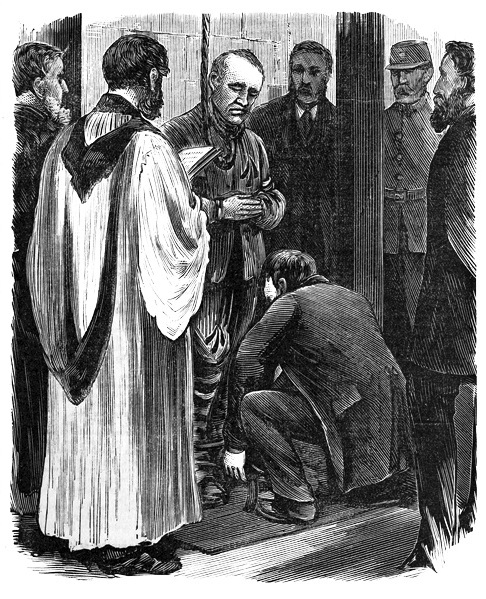
From what we have been able to gather from persons
whose testimony is in every way reliable, Mrs. Peace
made a precipitate retreat from Peckham after the
arrest of her husband.
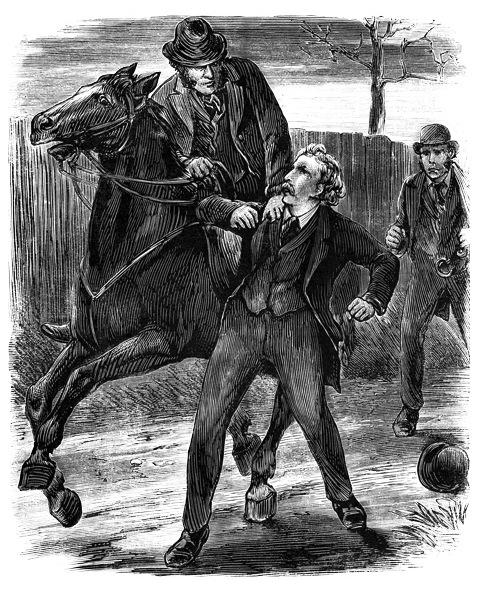
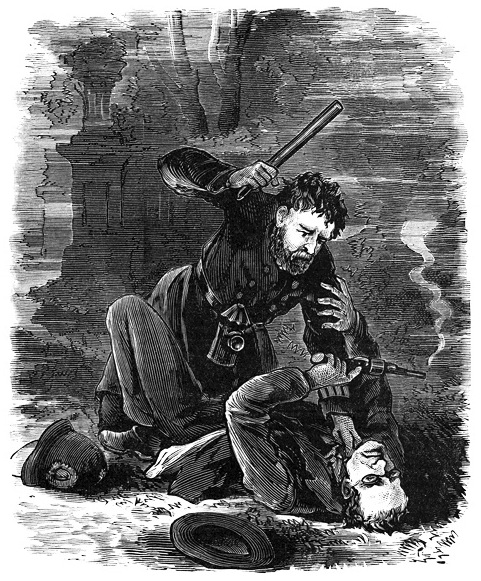
The day after Police-constable Robinson bravely
fought the burglar down, in spite of his wounded arm,
and had Peace taken to gaol, the wife of the convict
made preparations for flight. She packed up three
boxes, and had them conveyed to Cleaves, the greengrocer,
to Nunhead Station.
She and her son followed them to the station, and
took the train for Darnall, near Sheffield, the place
where Peace lived before coming to London, and at
which he was living when Dyson was shot.
A month after the arrest some of the effects were
sold, and the remainder were carted to No. 22, Philip’s-road,
the residence of Mr. Brion, heretofore mentioned
as the joint patentee of the invention for raising
sunken ships.
There is no question that the police were afterwards
made aware of the departure of Mrs. Peace and of Mrs.
Thompson’s change of abode.
Mrs. Thompson, although she lived with Peace at
Nottingham after the murder, and lived in company
with Mrs. Peace at Peckham, was not called as a witness
for obvious reasons.
Peace was convicted of assault with a deadly
weapon, and it was unnecessary to try him for the
burglary, as the sentence was penal servitude for life.
The representative of the Press Association had an
interview with Mr. Brion. His relationship with Peace
was, he said, a purely business one.
“But for me,” he said, “Peace’s connection with the
murder would never have been discovered. It was I
who gave the police the information that put them on
the track. Those police would never have discovered
anything themselves had not everything been told them
and every step they took indicated. How did I become
connected with Peace?
“You will know all about that in my testimony at
Bow-street, when Mrs. Peace was under examination.
I am an inventor, a geographical engineer. I make
maps. You know Donald McKenzie, who has gone to
Africa to make surveys for letting the ocean flow into
the Sahara?
“That is my project. This is the map I exhibited
at the Mansion House. (Mr. Brion unrolled a map
20 feet by 12 feet, whereon was delineated very broadly
the Continent of Africa and on which was shown, in red
dotted lines below the Canary Islands, a kind of gutter
through which the ocean is to flow inland and flood the
Sahara.)
“Mrs. Thompson went away from here on Monday.
I know where she is, but I cannot tell you of her
whereabouts. That has all been arranged with the
police. She came here with the full knowledge of the
police, and all the goods in Peace’s house were brought
here by their direction and consent.
“The police are aware of everything I can tell them
about Peace. I have spent three months in the interest
of the public to bring this man to justice, and I was
promised by the police that I should have my expenses
paid, but here have I been during all that time running
around the country and living at hotels, and
spending money for the sake of getting at evidence,
and now they refuse to pay me anything.
“I have done with the police, although they know
all that I have done, and now I have a memorial to the
Treasury on the subject.
“I am disgusted with the whole business, and annoyed
that for any length of time I should have been
associated in whatever degree with such a scoundrel
as Peace.
“He was a very interesting man, full of general information,
and had acquired a great amount of ability
in mechanics. He had an inventive faculty, and could
readily understand anything in mechanism.
“He was working away at this idea of his for lifting
ships from the sea bottom, and it is now plain that he
could not have obtained a patent himself.
“As with all these men of smirched reputation, he
had to look around for some one to assist him, and he
fastened upon me.
“I used to see him in the mornings, afternoons, and
at nights, and he was always pleasant enough, and I
never suspected he was what he is.
“His left hand was always bare when I saw it, but
when he went to Whitechapel he was accustomed to
cover it and pretend that it was injured.
“Whitechapel was where he went with his booty. I
expended a considerable sum in my experiments with
Peace on his invention.
“I found that he had the idea of raising ships by
air force, but that the appliance was faulty, and that
no patent would be given for an idea.
“I have a plan of my own for raising ships, and I
have offered it to the Admiralty. They have not
accepted it, and I intend to raise the ‘Vanguard,’ and
sell it on my own account. The police are aware of
everything that Mrs. Thompson has to say.
“They have been cognisant of her movements from
first to last, and they knew of her departure from this
house, and where she has gone.”
The reader will be at no loss to understand that the
police were tolerably well informed as to the movements
and whereabouts of Mrs. Peace. This is plainly
evidenced by her arrest, the examination at the police-courts
that followed, and her trial and acquittal at
the Central Criminal Court.
After this they confined their attentions to the convicted
man who was at this time incarcerated in Newgate,
and their chief aim was to prove him to be the
murderer of Mr. Dyson.
The capture and conviction of Peace was the universal
topic of town talk. Never surely did a criminal
create a greater amount of excitement both in the
metropolis and the provinces.
Officers were despatched both to Nottingham and
Sheffield. The constabulary received information
from the Park-road station of the K Division. It was
put forth that the prisoner in Newgate was a man
apparently about fifty years of age, dark, clean shaved,
hair grey, large mouth, large scar on the side of the
left leg, and the back of the thigh, three fingers on the
left hand deficient, dress overcoat, with velvet collar,
and black under coat.
He wore a brown leather belt, low boots, and a
brown felt hat.
A Sheffield paper thus chronicles further proceedings:—
Police-constable David Morris was dispatched to
London, by Mr. Jackson, with a view to the identification
of the criminal in custody at Newgate.
Morris, who was at one time stationed at Darnall,
lived for more than a year in the house directly
opposite to that occupied by Charles Peace, and was
therefore in the habit of seeing him every day, and
frequently several times a day.
Morris had with him a letter from his chief to the
director of the Criminal Investigation Department, by
means of which he obtained admission to the cell.
At half-past one o’clock a telegram from our reporter
was received at this office as follows:—
“St. Martin’s-le-Grand, 1.30. p.m.
“Peace has been further identified by a Sheffield
constable, and there is no doubt he is the murderer.”
The telegram, when posted in the window of our
publishing department, excited much interest. Shortly
after two o’clock the Chief Constable received a
telegram from Police-constable Morris as follows:—
“Man in custody is Peace. I am quite positive about his
identity.”
All doubt, if any existed, has now been removed.
The man, John Ward, the notorious burglar of Blackheath—the
man who did all his villainies “single-handed,”
and thus no doubt escaped detection for a
longer time than he would otherwise have done—is
none other than Charles Peace, the murderer of Mr.
Arthur Dyson, at Bannercross-terrace, that dark
November night two years ago.
Charles Peace, alias George Parker, alias Alexander
Mann, alias Paganini, alias John Ward—the man of
many aliases—is trapped at last, and the general hope
is that now he is caught there may be evidence enough
to make him suffer the penalty of his greatest crime—that
which startled this town and district so terribly in
the winter of 1876.
A journalist furnishes us with the following descriptive
visit to Newgate and the scene at the identification:—
That Charles Peace, the murderer of Mr. Arthur
Dyson, of Bannercross, is at last caught there cannot
now be the shadow of a doubt. He has been clearly
identified by a Sheffield constable, who knew him most
intimately.
The result of my researches into the history of this
man’s career reveals a depth of depravity, hypocrisy,
daring, and low cunning, such as have scarcely ever
been penned in the annals of crime.
On entering Scotland-yard, and making known my
errand—that I desired to prosecute inquiries into the
history of the man then in their custody, who was
committed for trial from the Greenwich Police-court,
on charges of attempted murder and burglary, a man
who had given the name of John Ward, the replies
given were certainly very courteous, but in no way
satisfactory to a reporter in quest of information.
The result was that after about an hour and a half’s
waiting, and after being interviewed successively by
some dozen or two very polite gentlemen, who were
evidently “authorities,” I was ultimately told, with a
smile, by one that they did not give information to
members of the Press.
“Why?” I asked.
“Because it’s against regulations, and we are not
allowed to answer questions.”
“Well,” I said, “where is this man Ward or Peace
confined, because I want to see him?”
He had a short look at me, and after telling an untruth
in the words “He’s not in town,” took his
departure.
However, I knew there had come up to London by
the morning train a Sheffield constable whose errand
was to see the man “Ward,” and that officer was one
who had been on the most intimate terms with Charles
Peace.
He had seen the murderer daily for months before
the commission of the crime, had had him in his house,
and had further confided to him some of the “family
troubles” of Peace.
The officer was Police-constable (222) David Morris,
of the Attercliffe division, and it is due to him that
Peace has at length been identified beyond dispute.
The police authorities of the metropolis are true to
their word and traditions in this, that if they gain their
information with difficulty they hold it with tenacity
when they have obtained it. They appear to mistake
reporters for Ishmaelites.
After further trouble I succeeded in finding out that
at about one o’clock a detective from Scotland-yard
would be at the Old Bailey, otherwise well known as
Newgate Gaol, and that he would there ask Morris if
he could pick out the so-called Peace from a number
of men.
How to get it was the question, but I also thought
it might be possible for me to identify him if I could
see him, and so, with a little help from a friend, I got
permission from the authorities to go inside and
witness.
The approaches to the Old Bailey are of a forbidding
character, dark and repulsive. Even the inquiry door
has massive iron spikes projecting from the top of it,
and as you have to make your applications either
through the spikes or over them, you stand a chance of
having your chin perforated.
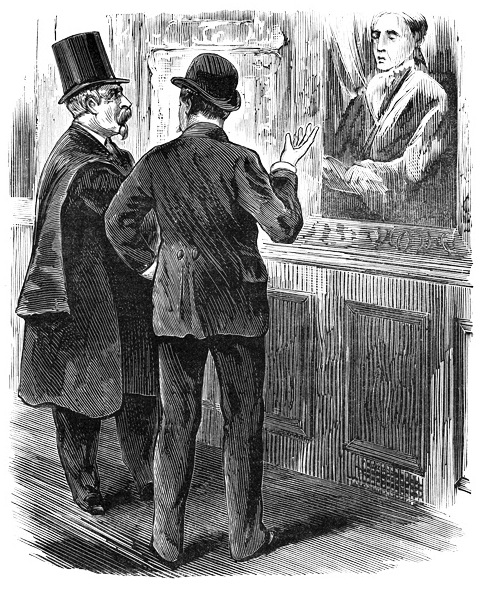
On getting inside there are apparently nothing but
bars and big doors, but over one of the doors on the
shelf there are conspicuously displayed plaster casts of
heads.
These casts are the official representations of all
the murderers who have interviewed the hangman
within the walls of the prison, and a hideous-looking
crew they are.
Seeing that another candidate for the “long drop”
has next to be interviewed the effect is not pleasing.
However, there is another delay, and this is accounted
for by the fact that the suspected culprit is being
“mixed” with some more prisoners, the more to test
anyone in the task of identification.
At last the signal is given that all is ready, and
after passing through a short corridor a yard is seen,
rather capacious and surrounded with cell-doors.
But between the yard and the corridor were double
gates of iron, and anyone exercising in the yard had not
a shadow of a chance of communication with the outer
world.
The iron gates were opened by the governor of the
gaol; in front stood the constable and another who had
come to see if Peace was in the hands of the police, and
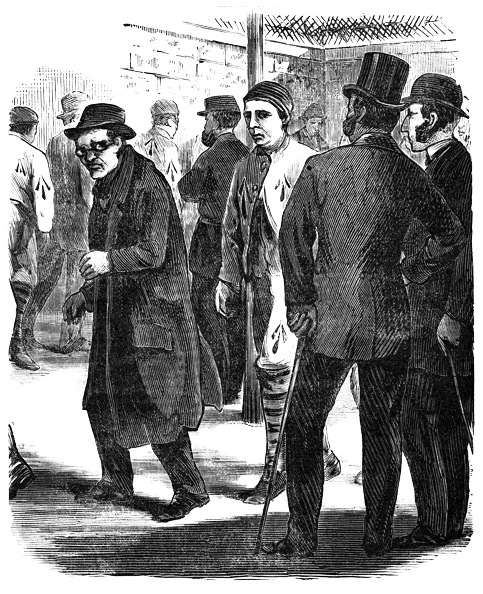
in front were twelve prisoners doing “the circular
drill.”
This is a performance best known to prison officials,
and to those who have been “wanted.” It consists in
this:—
If there is a prisoner in the establishment whose
identity needs to be established, and there is anyone
attending for the purpose of viewing them, the prisoner
is placed amongst others, and they follow each
other in circle.
The suspected prisoner must then be identified.
Those who performed the “circular drill” on this occasion
in the Old Bailey, were a curious lot.
First came a young man, of some three or four-and-twenty
years, with his neck half hidden in a muffler.
His gait was upright, but there was that cowed look
about him which showed him to be “an old prison
bird.”
Before the march commenced the prisoners took a
look at us; they did not know who was “wanted,” and
our visages were strange to all but one.
Then the march began, and all the prisoners
appeared to want to march the double, but they had
only a short time of duty.
The second man who passed was an old one, some
forty years of age, who wore a swallow-tail coat, and
looked most like a defaulting half-starved attorney’s
clerk.
He gave a searching look, knit up his brows, as if to
see “who in creation there could be that he knew,”
and then apparently satisfied that he was not
“wanted,” passed on with a livelier tread.
The third but a young man, with a bull neck, who
held his head down and stared at the ground, as though
afraid of seeing anyone strange, for fear they should
recognise him.
He had apparently gone through this class of inspection
before.
Two other young fellows passed, of lively mien, and
then there came
ONE WHO WAS WANTED.
A man of about five feet three or four inches in
height, with white hair on his head, cut very short,
and bald in the front of his head, but the razor had
lately done this.
His eyebrows heavy and overhanging the eyes, which
were deeply socketed.
A chin standing very prominently, and, as if to make
it more so, the head was thrown back with an air of
half self-assertion, yet half caution, as though there was
a degree of hesitancy in the action.
The lower part of his cheek bones protruded more
than was their wont in years gone by, but he had apparently
had some bruises recently, and had had his
whiskers shaven off since he was last seen in Sheffield.
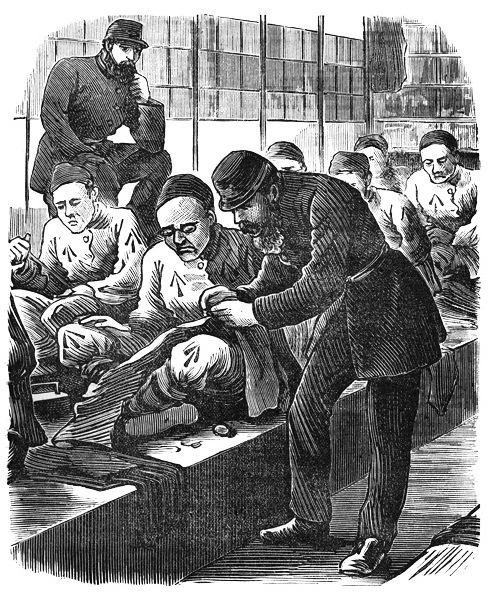
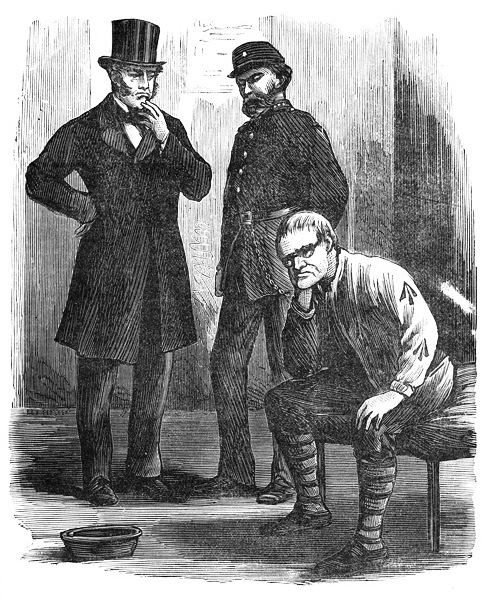
No. 83.
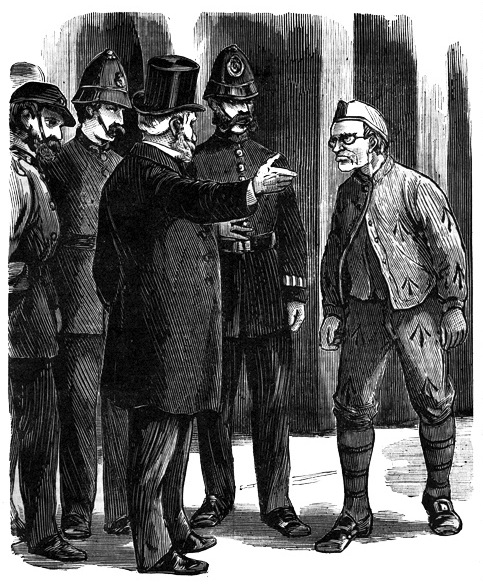
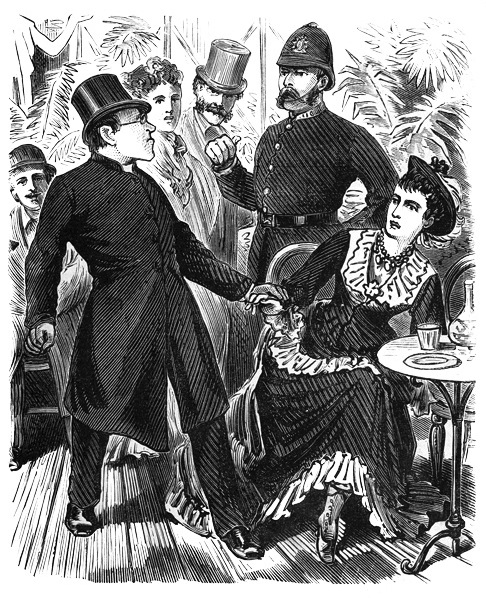
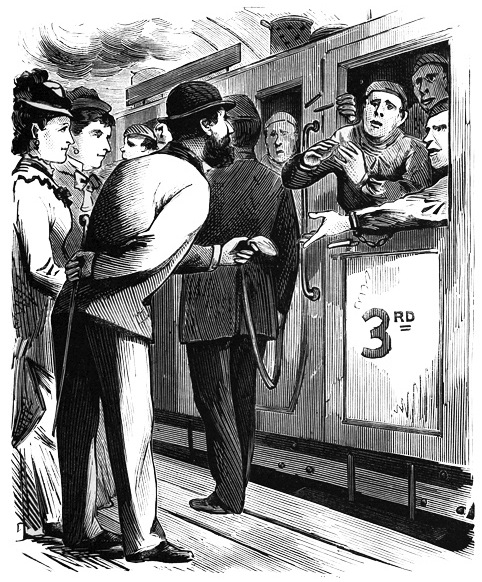
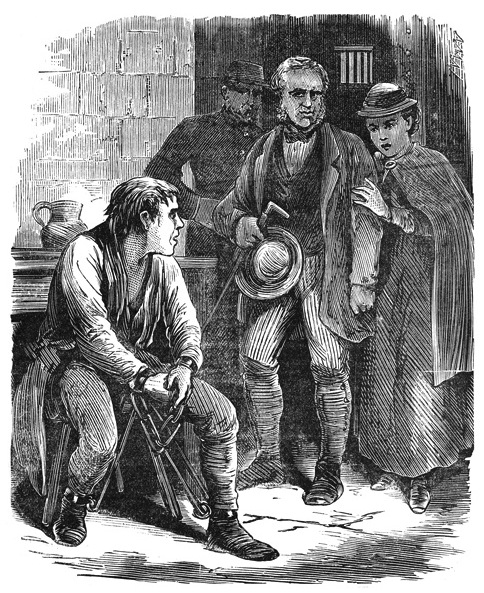
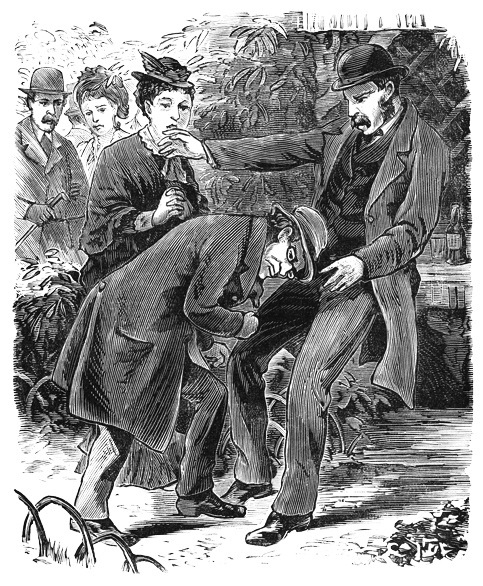
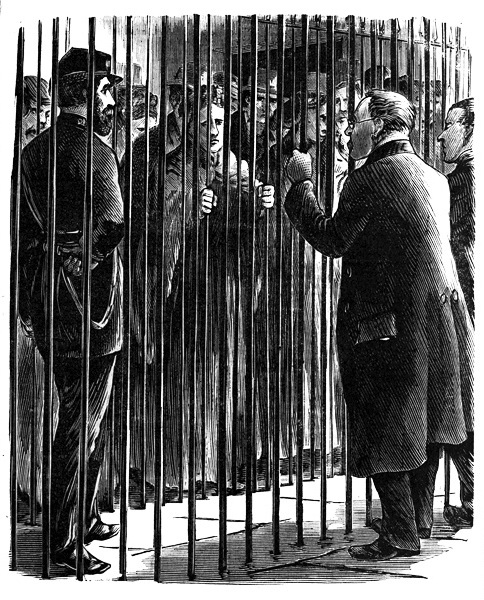
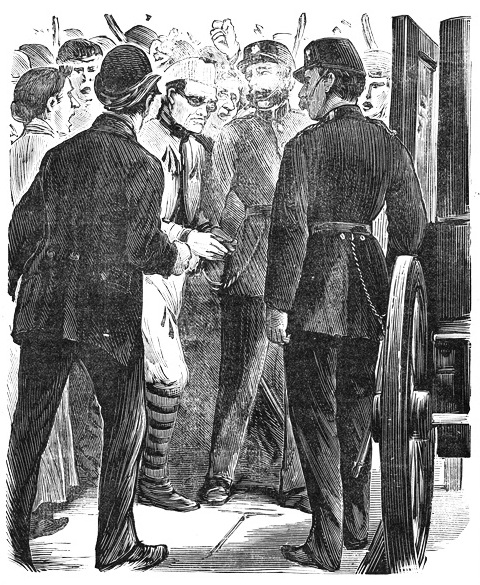
THE IDENTIFICATION OF PEACE BY THE SHEFFIELD OFFICER.
In addition to that he wore a pair of large brass-rimmed
spectacles, as if the more completely to make
certain of his non-identification.
Slightly bending himself this man approached those
who were inspecting the prisoners, and then there was
a sudden stop.
“That’s Peace,” said Morris. “I’d know him anywhere,”
and the man “Ward” stepped from the ranks
and approaching the officer with a look which betokened
the most earnest inquiry, asked, “What do you want
me for?”
The governor here very severely said, “Go on, sir,
with your walk,” and Peace returned to his place in
the ranks, which were no longer marching.
The other prisoners were now staring at the identified
man, and evidently wanted to ask, “What has he
done?” but they dared not.
Even Peace had had no intimation given to him
that he was recognised as the Sheffield murderer, and
until he saw the officer who had come to identify him
he had no notion of why he was required to go on
this special parade.
The marks which were described as on the missing
Peace are all distinctly on him. Before he can appear
in the police court at Sheffield on the charge of murder,
the Chief-constable for Sheffield will have to apply to
a superior court for a writ of habeas corpus.
Upon this he will be taken to answer the capital
charge now made against him.
After committing the murder on the night of the
26th November, 1876, Peace was completely lost sight
of; his career in this life, it was said, was closed, for
he had made away with himself.
But Peace was not such a fool as that, for he had
no sooner finished the murder than he took to his old
game of burglary—an avocation which appears to have
had a curious attraction for him.
Subsequent events have proved that Peace went to
Hull, and there replaced his waning funds by breaking
into a gentleman’s house, from which, he extracted a
large quantity of plate and valuable jewellery.
From thence, after realising on his spoil, he repaired
to Nottingham, where a near relative resided, and with
her he took up his quarters.
Although it was well known that there was a heavy
reward offered for his apprehension, it does not seem
that any of his relatives considered it advisable to
state who was in the midst of them.
After effecting a very clever warehouse robbery, in
which silk goods were the principal booty, Peace
appears to have then considered that his proximity to
Sheffield was dangerous, and he again changed his
abode.
Thus it will be seen that the Sheffield authorities
were correct when they stated that they had traced the
man to Hull, but there had lost sight of him.
It was believed that he had escaped to the Continent.
But not so; the fox had “doubled,” and in the Midland
Counties, with Nottingham for his centre, was continuing
his depreciations.
On reaching London some four or five months after
the murder, he was not very well off for money, and he
took up his residence in Lambeth.
The police in charge of this district then became
aware that night after night the most audacious depredations
were committed in the district.
There was scarcely a night passed but a burglary
was announced, and in as even a succession the statement
followed that the thieves had not been caught.
The value of the booty thus secured was exceedingly
great, and the thieves—for they were then believed to
be a gang—were said to be well rewarded for their
audacity.
But the place appears to have become too hot for
him, and he then removed to Greenwich, where he
occupied a beautiful house, and commenced to furnish
it in a most expensive manner.
Whatever Peace failed in, it was not in the want of
self-assurance and the belief that he could pass through
society as a gentleman.
Though he had repulsive features he appears to have
had winning ways in the eyes of some, for he now
appears to have decided on engaging a lady to share
his improving fortunes.
This “lady” may perhaps figure elsewhere shortly,
and her name will then be found in the police record.
But the establishment could not be kept up without
“means,” and again came the last resort.
Peace had described himself to the new sphere of
respectable neighbours—among whom he now moved—as
a “gentleman of independent means,” and he
was looked up to as one who had done well in the
world.
We have endeavoured, throughout this strange
eventful history, to place before the reader the leading
and most noticeable circumstances connected with the
career of this sinful man. After his arrest for the
burglary and attempted murder of Police-constable
Robinson, there was but little chance of his escaping
conviction for the Bannercross murder, but there are
many who have attributed his identification and subsequent
conviction upon the grave charge to the
jealousy of a woman, as will be seen by the following
extract from a journal of the time.
It has been remarked by ancient as well as by
modern writers that wherever there is a piece of outrageous
mischief there is sure to be a woman at the
bottom of it.
The experience of the present civilised age does not
present any instances to the contrary, but rather
strengthens the opinions previously held. Charles
Peace was clever in one thing, that he knew his “profession”
and succeeded in it so long as he did it
“single-handed;” but when he obtained a partner, like
many others who have preceded him, his fortunes,
though apparently improving, were really on the decrease.
Whilst in Nottingham—and this only happened
within a month after the murder of Mr. Dyson—he
succeeded in securing to himself the affections of a
young female relative.
This young “lady” followed him through his many
hazardous adventures until at length the two were in
Lambeth, where they occupied a decent house, and
to all intents and purposes were a well-conducted
pair—the lady being slightly younger than her
husband, but as “Mr. Johnson” was well-to-do it was
supposed that there had been a marriage of love.
Business in Lambeth proved of a paying character,
although those who did the paying were not always
aware of the fact until before banking hours in the
morning—when the news was brought to their bedroom
doors by the earliest risers in the house.
On removing to Greenwich, Peace was accompanied
by the young lady who had followed his fortunes,
although she might not know the whole of his crimes
and there were again commenced the robberies which,
have made his name so notorious in the criminal annals
of the country.
Peace resumed his business; as he had not to press
sales on the market he did not care what came to his
hand, and being well versed in the legerdemain of the
light-fingered fraternity he obtained access to the
mansions of the rich around him, and their loss was his
gain.
As the aristocrats in his neighbourhood became more
indignant, he became more pious, and his immediate
neighbours, whilst looking out for the midnight thieves,
relied somewhat on his perception and assurances that
nothing would be wrong.
But all this time there was in Peace’s well-furnished
household a young woman who had been misled and
wronged.
She had been led to believe that Peace, with whom
she had associated in Nottingham, was a steady, hardworking
man. Peace had given to her a number of
costly goods, he was to her a man of sterling honesty,
and then it transpired that he was a burglar.
Then came her time of trial.
The man with whom she was associated was a thief,
a burglar, and more than that—and she knew it.
He was a murderer.
But what could she do? It was this man upon whom
she was dependent for a subsistence—it was this man
who had committed murder once, and whom she knew
would not hesitate to commit it again.
So she helped to get rid of the goods which were
brought by his nightly marauds, and like other sensible
people who are in a mess, she held her peace.
But when Peace and this housekeeper had got to the
new home at Peckham, “a cloud came o’er the scene,”
and the cloud was a woman.
This “cloud” took up her residence in the house of
Mr. Peace—otherwise “Johnson,” by which latter cognomen
he was well known—and then commenced the
beginning of the end.
The first victim of Peace’s duplicity dared not speak,
and the second admirer of him dared not—so between
the rivals the burglar had a fair chance of bidding for
favouritism.
But when the last “throw” came from the dice-box
of criminal ingenuity and the thrower lost, there were
left in the house in Peckham a couple of rivals.
One, the latest comer, “realised,” and the older and
much-injured one gave information which resulted in
the disclosures which had now been made public.
By the aid of “the first love” valuable goods were
traced to Nottingham and others to Sheffield.
She told the detectives where to work and where to
find, and she disclosed the name of her rival, Mrs.
Thompson, who was asked to give her address.
Charles Peace, as we have had occasion to observe
before, was by no means a man of retiring character,
but in respect to audacity and assurance he was certainly
able to hold his own with any of those great
criminals in whose footsteps he so long and persistently
followed. It must, however, be admitted that there
was one bright spot in his character.
It was this: after his arrest and conviction he strove
by every means in his power to prove the innocence of
his wife.
It is certain that he only sought to become acquainted
with those who were, in his estimation, likely
to be useful to him in an emergency, and this statement
has been fully borne out by the latest phase of
the case.
A gentleman in Sheffield some years ago bestowed
some favours on a member of the miscreant’s family,
and his name and address had been treasured up, with
a view to still further calls upon the benevolence that
was once exercised in his behalf.
The gentleman in question was infinitely surprised
one morning to receive a letter, which was directed in
an unknown hand.
Tearing open the cover he saw a mass of cramped
and crooked lines, which ran higgledy-piggledy over
the paper, and showed that the hand which had written
them might have been more familiar with the “jemmy”
and the skeleton key than with the pen.
A further consideration of the document revealed
that the author was either a most illiterate man, or
that, to suit his own purpose, he would fain appear to
be such.
The simple rules of grammar were set at defiance,
and the attempts to decipher the letter were so painful
that it would have been tossed impatiently aside had not
the eye been caught by the signature, “Charles Peace or
Ward.”
The gentleman at once made all efforts to decipher
the letter, which was from no other person than the
notorious Bannercross murderer, who was at that time
in Newgate.
The purport of the letter was to supplicate the receiver
to become bail for Mrs. Peace, who for some
time had been in custody in consequence of the vast
quantity of stolen property found in her possession by
Inspectors Phillips and Twibell.
He coolly went on to ask that counsel should be obtained
for her defence, and declared that his wife had
no guilty knowledge when she received the goods, but
that he forwarded them to her in order that she might
convert them into money to supply her needs.
He again and again with some vehemence asserted
that Mrs. Peace was an innocent woman, and that the
misfortunes into which she had fallen were not attributable
to any fault of her own.
It was much to Peace’s credit that he thus endeavoured
to exculpate his wife, and it is pleasant to
record this one good trait in his otherwise debased and
odious character; but he made a fatal mistake in
forming a connection with the other lady of his establishment.
Mrs. Thompson (who may be known by some by the
name of Susan Gray), the woman with whom Peace
was living at the time of his arrest for the Blackheath
burglaries, made a long statement as to her own career,
and her connection with our hero.
As this forms part of the history of the notorious
criminal the reader would be in no way pleased by our
suppressing it.
The following is a tolerably accurate description of
her personal appearance.
In person she is tall, and considerably above the
middle height. Her figure is not robust. Her complexion
is fair, and was no doubt at one time good.
Her hair is dark and plentiful, and her eyes of a deep
blue, what is known as a violet hue.
Mrs. Thompson, at the time I saw her, was dressed
in a brown robe, trimmed with velvet to match; and
wore a cloth jacket and round hat, becoming and neat.
Both of these articles she removed in the course of
conversation.
Her manner was at first frank and agreeable, but as
our interview lasted it changed to a fitful moroseness,
which was difficult to deal with. Both in person and
in manner Mrs. Thompson may be said to be decidedly
prepossessing—what may be called a taking woman.
She is manifestly a fairly well-educated woman, and
writes a pretty, ladylike Italian hand. The statement
she made to me in answer to questions and in course of
conversation was as follows:—
MRS. THOMPSON’S PERSONAL HISTORY.
My maiden name is Susan Gray, and I was born in
the year 1842, at Nottingham. My parents are very
respectable people, and carry on a small business in
that town. I am heartily sorry to have brought this
disgrace upon them.
In my childhood I went to various schools in Nottingham—to
the Trinity School when I was a youngster,
when I was also picked out as a singer in the choir.
I continued to attend the Trinity Schools until I was
eight or nine years of age, when my parents removed
me to the College School.
There I remained until I was fourteen, when I went
out to work.
I should not like to state where I was employed, as
it might give pain to persons living, but there are those
alive who know that this statement is true.
After I left my first situation I stayed at home and
assisted my father in his business as his bookkeeper.
When I was about twenty-eight or twenty-nine years
old, a Mr. Bailey one day came for purposes of business
to my father’s house.
He had occasion to see my handwriting, and asked
me if I would make out some bills for him. I obliged
him, and from that day I kept his books, and did all
the writing he required.
One day he asked me if I would marry him, and, in
a spirit of vexation, I having had some little disturbance
with a brother of mine, I said “Yes.”
We were married on the 10th of October, 1872, but
three months after that I left him, on finding out what
was his true character, and that it would be impossible
for me to live happily with him.
I went next to live with my married sister at Nottingham.
I then worked for my living, employing my time in
the manufacture of caps such as ladies and servants
wear.
One Sunday evening, perhaps six months afterwards,
as I was going to chapel, I met Bailey again. He
stopped and spoke to me, and finally induced me to
return to live with him.
I stayed with him for nearly a year, when I again
left him, and since that time I have not spoken to him,
except to obtain from him a weekly allowance, which I
continued to enjoy until I met the man Peace, but on
my becoming connected with him that allowance was
forfeited.
HER FIRST MEETING PEACE.
I met Peace in January, 1877, I think it was. He
came to the house where I was living at Nottingham
about that time.
One evening, just as I was returning from work,
when I entered the house, I saw him there. I shall
never forget the impression he made upon me.
I thought him of very singular appearance, and,
from what I saw at first sight, I had reason to believe
that he was a one-armed man; but that appearance
was only the result of one of his tricks and deceptions.
When I went in he said to the landlady, “Is this
your daughter?”
I was not living with my sister then. I had left
home, and had not spoken to any of my family for a
long time.
In answer to Peace’s question, my landlady, after
some hesitation, gave an affirmative reply.
Some conversation in subdued tones then took place
between Peace and my landlady. I ought to have said
that this occurred in a house in a district known as
“The Marsh,” at Nottingham—a very low neighbourhood
indeed. Peace had brought my landlady some
boxes of cigars for sale.
She said to him, in reference to myself, “You can
speak before her; she won’t say anything.”
Peace then asked her if she would go and see if she
could sell the cigars.
This woman, who is since dead, was an accomplice
of his, and used to assist him in the disposal of stolen
property. Her name was Adamson.
She thereupon went out and sold them, and when she
returned gave him 18s., of which sum he returned her
6s. by way of commission.
After that he became a constant visitor, and we
always spoke of him as the one-armed old man. He
not unfrequently had there his breakfast, dinner, tea,
and supper, and at last it became known to me what
his real character was.
At first he gave out that he was a hawker, and dealt
in various little articles such as pedlars invariably
travel with—spectacles, cheap finery, and jewellery,
and miscellaneous goods of that description.
At last he openly showed himself in his true character—I
mean as a most daring burglar. He brought
things into the house which it must be evident to anybody
were stolen property.
There were articles of silver plate, timepieces,
watches, and even quantities of tea, sugar, and other
perishable articles.
I do not know at all where he got these from; but I
am perfectly satisfied that they were the proceeds of
robberies or burglaries.
This knowledge was kept from me at first. I was led
to suppose he was what he seemed to be—viz., a hawker,
and a quiet, respectable man.
On one occasion he went out of town, saying he had
to go and see his mother at Hull. By his mother he
meant Hannah Peace.
Peace on that occasion took £5 to Mrs. Ward at Hull,
and stayed there three weeks.
During that time he committed several robberies
either at Hull or in the neighbourhood.
I know that to be the case, because when I have been
in Hull he has shown me the houses at which the
burglaries were committed, and he also told me that
on one occasion he had to run for it, when he “fired
wide” at a policeman by whom he was in imminent
danger of being captured.
The property was disposed of in Hull. He returned
after a while to Nottingham. I was out at the time of
his return, having business in the evening, for I was
still at work and getting my own living in an honest
way. I was not earning very much, for work was
short, but still it was honest.
On this particular night, on my return home, Mrs.
Adamson said to me, “Oh, Mrs. Bailey, who do you
think has come back?”
I replied I did not know, to which she made answer,
“Why, the one-armed old man, and he has asked for
you. He swears he will shoot you unless you go to
him.”
He was in the house of our next-door neighbour,
and previously to that the lady of the house came in,
and said, “Oh, Mrs. Bailey, do come in, the old man’s
gone mad; he wants to see you so bad. He won’t be
satisfied with anyone until you go.”
When I went in I found him “drunk on Irish
whiskey.”
He said, “Is that you, pet (for by that name he used
to call me), I am so glad you have come, where have
you been?”
I told him I had just come in from business.
He said, “Oh, I am so glad you have come. I
thought you were never coming back. Are you not
pleased to see me?”
I said, “Oh, particularly, very; I like you so much.”
People must not think by that that I loved him, or
because he said in his last letter to me that I did. I
got him home, and made him a cup of tea, after which
he seemed better.
He went back to the place where he was then residing,
for he did not, as I have already said, live in the
house with me.
The following day he came to me very early. That
day I was rather short of work.
He said he was sorry he had been in such a bad way
and had behaved so rudely. He next asked me to stay
at home for the day.
I said “No, that would not do. I should lose my
work.”
“Never mind that,” said he. He reckoned up how
much I was earning, and said, “Look here, darling! If
you will promise me not to go to work again, I will pay
for your board and lodging. And if Mrs. Adamson
likes, I will give her 14s. a week for my board, and
come and stay, but not sleep here.”
There was no accommodation for him in the house.
Eventually my better feelings were overruled, and I
submitted myself to him. He was invariably very
kind to me, and I did not live with him unhappily.
I knew that he made a living on the proceeds of burglaries
which he committed, but I never had any of
the goods so stolen; and my dresses were bought for
me by him.
He said one day he would have given me a splendid
ostrich feather, but he had not got them, because the
woman of the house at which he used to lodge would
not give them up.
I said “It is very strange if you have things where
you used to lodge and cannot get them if you don’t
owe them anything.”
He replied “Never mind; I will buy you one.”
One Monday night he brought home a black silk dress,
polonaise, and a long jacket, which he said he thought
would fit me.
I told him I did not wear such things. He offered
to buy me some like them, but this offer I also declined.
If I remember rightly, these things were the proceeds
of a burglary at Hull, and I believe they have
been given up to the police. I have since worn dresses
that were stolen, but they have all been given up now
to the police.
Mrs. Adamson went with him one day to look at a
pawnbroker’s shop, into which she wanted him one
night to force an entry, but the project never came to
a head.
I believe he thought the premises whereon was so
much valuable property were pretty sure to be watched.
Mrs. Adamson would have found means of getting
rid of the spoil, but he never did enter the place.
I would rather not mention the name of the street
in which the shop was situated.
After that he committed a great cloth robbery at
one of the factories, and in the course of a week he
went again and stole a great number of coats.
He brought several rolls of cloth and the coats to
Mrs. Adamson, who disposed of a great portion of the
property to persons whom one would have thought to
be of unblemished respectability.
In June, 1877, Mrs. Adamson wanted some blankets,
and Peace said he could get her any amount.
He went to get some, or, at any rate, to try, but was
detected in the act of entering the house.
He made his escape through a stable and through a
woodyard.
Resistance was offered by a man on the premises,
but Peace pulled out his revolver and threatened to
shoot him; and the man, intimidated, let him get clear
away.
PEACE’S FLIGHT FROM NOTTINGHAM.
After that he was constantly concerned in robberies
until the occasion of the great silk robbery, for the
perpetrator of which £50 reward was offered. That
was just before we came to London.
The silk was disposed of by Mrs. Adamson, and the
detectives came to her house two or three days after.
Ward, as I then called him, and I were sitting together.
We were living together you know, sir, then——the
fact is we were in bed together. I was asleep, but the
noise the officers made on entering awoke me.
I said, “Oh, Mr. G.,” that is the name of the officer
who first entered the room. He stood astonished when
he saw me. “Oh, Mr. G.,” I said, “let me get out of
this.”
He said, “I am surprised to see you, Mrs. Bailey.”
The men turned to the convict Peace and said to
him, “What is your name?”
“John Ward,” was the rather sullen reply.
“What do you do for a living?” the officer next
asked.
“I hawk spectacles.”
“Where is your licence?”
“I will show it to you when I come down.”
“Get up and dress,” said one of the officers.
“I shan’t before you,” was the reply, in the same
sullen tone and manner, “but I will be down directly.”
They went downstairs, leaving Ward in the room.
I said to Peace, “Let me go out,” whereupon he
permitted me to leave the room, and went to my next-door
neighbour’s, where I was very much hurt indeed
at the thought of what had happened.
They asked me what was the matter, and I said, “I
do not know.”
No sooner had I left the room, than Peace slipped
on his clothes, and made his escape through the
window, squeezing himself between two iron bars
which I am sure were not more than six or eight inches
apart.
He ran across the road into the house of a neighbour,
whom he got to fetch his boots for him, the detectives
being at the time in the house waiting for him to come
downstairs.
At last one of them shouted out, “Come, young man,
you are a long time coming.”
No answer being returned, a move was made upstairs;
the door was thrust open, and the discovery
made that the bird had flown.
Away from the neighbour’s house he went to the
Trent side, where he walked for a considerable distance.
When he considered himself safe from recognition,
he entered a public-house, where he gave a man 1s.
and a note for me.
The note was one asking me to go to him at the
place where he was staying, but I declined, and the
daughter of the house where I was living went to see
him in my stead.
I sent him some money by her, and the answer he
made me was that he did not care for all the detectives
in England; that he would not lose sight of me; that
he would not go away from the place without me.
I belonged, he said, to him, and he would not leave
the neighbourhood without me.
He sent yet again, and then I met him by appointment
in the evening time, and from that time we have
always been together.
We came to London together, and took apartments
in the Lambeth district, where he began again that
career of crime which has made him so notorious.
But here again his character to the outside world
was the same as it had ever been.
Though he was always regarded as a passionate
man, he was at the same time looked upon as quiet,
peaceable, and inoffensive, and in the highest degree
respectable.
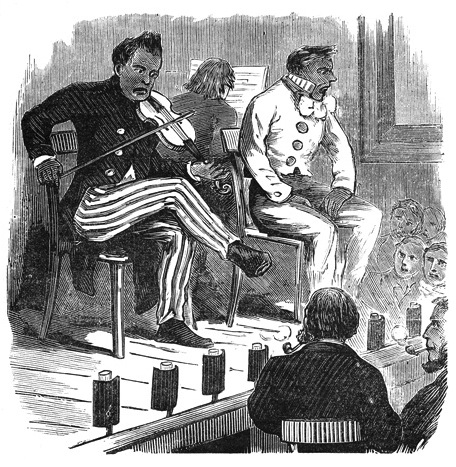
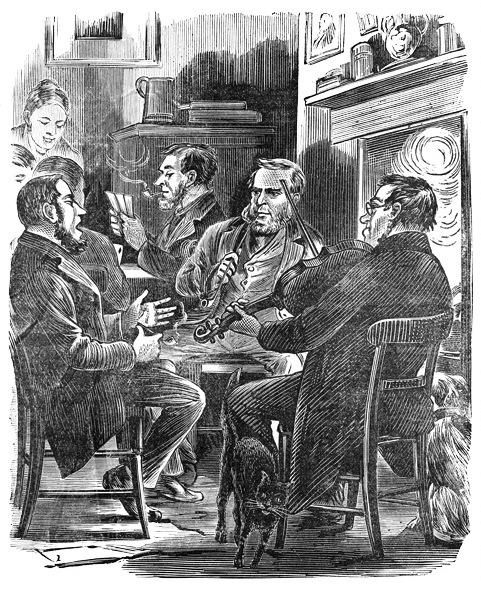
As a performer upon the violin he was anything but
a mean proficient. He mixed very little with his
neighbours, to my knowledge, in this locality, and but
little was known of that wonderful fund of ingenuity
which he undoubtedly possessed.
Often and often have I said to him what a pity it
was that he had not turned his abilities to a better
account than for the purpose of committing depredations
upon the property of his fellow-creatures; but
though his manner to me was kind, he would always
jeer and scoff at my rebukes.
It would be utterly impossible for me to enumerate
all the robberies he has committed. He has told me
at times of his having been into as many as four and
even six houses in a single night, sometimes with success,
and sometimes, of course, without.
During the day it was his custom to remain in bed,
preparing himself for his work in the following evening,
when he would regularly go out upon his housebreaking
exploits.
Sometimes he came in with a great deal of valuable
plunder, consisting chiefly of silver and gold watches,
rings, and various other articles. After a while I
became tired of living at apartments. Some of his
friends from Darnall used to stay there.
We only had one room, though it was comfortable
and nicely furnished; and as I did not think it decent
for them to come and live with us, I insisted upon
Peace providing me with a home that I could call my
own; and as he was uniformly good to me at that
time, and gave me nearly everything that I asked, he
promised that I should have one.
He had just previously committed a great robbery,
and he asked me if I would take some money for him
to some friends of his at a distance, as he dared not
write letters. I consented to this, and several times
I took money for him to Hull.
Hannah was living in that town at the time, and
kept a shop there. I particularly wish that fact to be
stated. Several times I took money to Hull, and
never less than £5 at a time. Often I took a great
deal more.
MRS. PEACE GOES TO LONDON.
One Sunday evening a knock came at the door at
the house where we lived at Lambeth. I answered
the door; and saw before me a little elderly woman.
“Does Mrs. Thompson live here?” she asked.
I replied, “Yes.”
She then said that she was Hannah.
I called to Peace and said, “Jack, you’re wanted.”
“Who is it?” he asked.
“Come and see,” I replied.
He did, and he found to his surprise, I believe, that
it was Hannah.
“What brought you here?” he asked.
I interrupted jocosely with the remark, “I suppose
the train.”
Hannah, however, said, “Didn’t you get my letter?
I have been waiting two hours on the look out for
you.”
I said, “We received no letter. There is no delivery
here on a Sunday morning.”
Jack said, “Come in,” and she came in. Having
looked round our apartment, she said, “You have a nice
place here.”
Jack asked her if she would have some supper.
She replied in the affirmative, and this I had to get
ready. She then began to talk about his friends and of
the people whom they both knew, and I learned in the
course of conversation that the shop at Hull had
been given up, and that she had realised the proceeds.
Peace asked my permission to have Mrs. Ward and
the boy Willie in London.
I could not do otherwise than consent, and eventually
they came.
Shortly after their arrival we moved to a house at
Greenwich, but as we did not live comfortable
in the same house, we moved into separate habitations
adjoining each other, Mrs. Ward and her son living in
one, and I and Peace in the other.
Whilst we were living in this manner Peace made a
journey into the provinces—a thing which he now very
seldom did. Whilst upon this excursion he committed
a great burglary at Southampton.
The police say that the affair took place at Portsea,
but I know better; it was at Southampton. By this
robbery Peace cleared something like £200—£60 of
the money being in gold and silver, and the remainder
in Bank of England notes.
These he found no difficulty in getting rid of. There
is a place, I am told, where all Bank of England notes
can be disposed of without inquiries being made, but I
do not feel justified in stating where it is. That is
reserved for the Bank of England authorities.
It was upon the proceeds of that excursion that he
started his pony and trap, the expenses of maintaining
which he found to be great.
In the first place we had no stable accommodation
connected with the house we occupied. This had to be
paid for, and the cost of the food for the pony was
again a very considerable item.
One day I said to him:
“I don’t like this neighbourhood; let us remove
from here and get where there is a stable connected
with the house.”
He told me he had seen a place in the Evalina-road,
Peckham, and if I would put my things on we would
go and see it, which we did.
We inquired next door as to who was the agent or the
landlord of the house, and the lady whom we saw
kindly referred us to Mr. Smith. We looked over the
house, which we both liked very much. Smith and
Peace came to an agreement as to the building of a
stable.
When Smith asked for references, Peace said to him:
“Oh, come down and see my house.”
Smith did so, dined with us, and went away perfectly
satisfied, for a few days afterwards we received a note
to say that the house was at our disposal.
Shortly afterwards we removed to the house No. 5,
East Terrace, Evalina-road, Peckham, where my
troubles commenced.
Mrs. Ward and the boy Willie came to live in the
same house with myself and Peace, and her presence
occasioned much trouble between us. When we were
settled, Peace began his system of robberies again.
Oh! many a time have I, by my tears and by my
entreaties, kept that man at home.
I was not allowed to move from the house without
either one or the other being with me; but though
they were so afraid of me, I should never have
breathed a syllable against them.
I have been threatened, and he latterly at times
ill-used me.
I have had a pistol pointed at my head and more
than once he has threatened to kill me. Peace used
occasionally to ill-use Hannah cruelly, and in a way I
shudder to think about.
On one occasion he threatened me because I had
pawned a silk dress, and he was afraid that it might be
traced.
Racked by jealousy, a prey to remorse, and the
object of constant suspicion, is it to be wondered that
I at last took to drinking?
In this respect Peace was again indulgent, for
though he jealously guarded me when I went out, at
home I could have what I liked, and with drink I
deadened my senses, and fled from my shame and
despair.
Peace, as a rule, went out nightly, unless he got a
good haul, when he would stop at home for a night or
two.
What I call a “good haul” was when he was able to
show me plenty of jewellery and silver-plate. I have
know him bring home sixty-six ounces at a time. His
method of procedure being this: he used to be driven
of an evening to within a certain distance of the house
where he intended to “work.”
If the nights were light, Peace used to be concealed
all night and return home, say, between six and seven
o’clock in the morning, when some one would go out
and meet him.
He was very good to his horse, for I should like
people to give him his due; and it was only occasionally
that he worked it hard.
He often went to his destination by train or by tram,
and some one would go with the trap to meet him at
the hour and place appointed. When he has come
home haggard and black, as I have often seen him, he
has said to me, “Well, pet, have you not got a smile
for me?”
According as he had been successful, or the reverse,
he would say, “Well, I have not done much, my girl
or, “I have done pretty well;” and then he would
proceed to sort out the property, preparatory to its disposal.
I have seen him shake his head sometimes over the
proceeds of the night’s takings, and say, “I don’t
think they will fetch much.” Then he would tell me
of his struggles and his escapes, and the number of
houses he had been into.
Once he told me that, in order to get a gold watch
and chain from under a lady’s pillow, he had to shift
her position slightly.
The lady, he told me, muttered something fond, and
turned over to her husband, whom she believed to have
been the cause of the very slight disturbance occasioned.
Peace abstracted the watch and chain, and came
away. I verily believe that, when such adventures
occurred to him, he used to come back sick at heart,
for, notwithstanding the profession which he followed,
and the fact that he had always firearms which he
would not have hesitated to use had he been disturbed,
he was generally very kind to me, and I am sure he
felt such things.
Now, as to the disposal of the property. If it was
valuable, he used to send for those persons who bought
of him, and obtain for them such a sum of money as
he required.
I am not at liberty to say who those persons were,
but Peace used to swear that if ever he was taken he
would do for them, and confess as to his accomplices,
but I hope I shall not be mixed up in that affair.
I always told him he would go to Blackheath once
too often. I cannot say more than the persons to whom
he disposed of the property were Jews.
Two I know of, certainly, and they will “Jew” me,
I expect, if they get hold of me. One day I went with
him while he disposed of some property.
He used to take the property wrapped up like
drapers’ parcels—innocent and unsuspicious-looking
enough. He used to treat me with great kindness
when Mrs. Ward was nowhere about.
He seemed to be never so happy as when he could
get me alone. We occupied the drawing-room floor,
using the front room as a sitting-room and the back
as a bedroom, the breakfast-room below being my
private sitting-room or boudoir, and the rest of the
house being devoted to our lodgers.
The care of Peace’s animals, of which, by the way,
he was extremely fond, devolved upon myself.
It would be as well, I think, to say what they were,
as the collection was heterogenous.
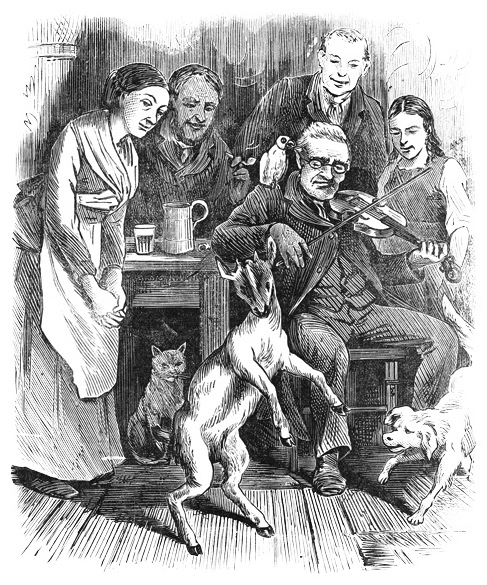
There were ten guinea pigs, every one of which I
gave away when he was taken; a goat, two cats, two
Maltese terriers, and a cockatoo; and in addition to
these, Mrs. Ward kept a Maltese dog, a parrot, a dog,
and four pigeons.
When Peace went out at night to work he always
took with him a revolver, a “jemmy,” a sharp knife,
and various-sized screws wherewith to fasten the doors
of rooms in which he was “working,” so as to ensure
his being able to thoroughly ransack them without
being disturbed; but he never took skeleton keys, for
he was so skilful that he would take out the panel of
a door almost noiselessly and with great rapidity.
When the police caught him they caught the
cleverest thief and the cleverest beast that I should
think there ever was in human form.
Here, Mrs. Thompson, as I shall continue to call her
(that being the name by which she is best known),
produced to me an old pair of Peace’s trousers.
In addition to the usual side pockets, they were
fitted with pockets behind on a level with the hip, and
in these receptacles he used, she told me, to stow away
his revolver, and whatever instruments he had to take
with him.
The inside of the trousers on the left-hand side was
filled with a piece of oilskin or glazed cloth, to prevent
the iron from chafing the burglar’s skin.
Mrs. Thompson also showed me how, by turning in
his left foot and by bending up his make-believe arm
towards his shoulder, the little man used to assume
deformity.
I also obtained from her a description of a burglar’s
stick, as she called it, which Peace found useful in
climbing, and an instrument still more remarkable
which, she said he possessed, as a kind of portable
step ladder of seventeen steps, which he was able to
fold into so small a compass that he could go out with
it underneath his coat without attracting attention.
It was provided with hooks, for the purpose of
fastening to walls and window ledges, but she said
he never used it, owing, I suppose, to the fact that it
was a clumsy apparatus to affix noiselessly.
After that she continued her narrative as follows:—
Peace never went out without leaving me with a
revolver which, I dare say, I should have the courage
to use had occasion presented. He had four revolvers
altogether, and the three he left at home I destroyed,
when I found he had been taken. Yes, as you suggest,
I sank them. When he came to London he ceased to
appear as a one-armed man, except in the presence of
a man whose name I will not mention.
PEACE’S CAPTURE—DISPOSAL OF PROPERTY.
When we saw in the papers that he had been taken
Mrs. Ward cried out, “Oh, my poor Charlie—my poor
Charlie! I must go—I dare not stay here; Willie,
you must go too.”
I then asked her, “And what is to become of me
then?”
“Oh,” she said, “You are young; you can fight your
own battle.”
She was for selling everything, but I objected to my
furniture being sold, as I thought I might be able to
get a living by letting apartments.
My rooms were well furnished, though I had no
carpets, and Jack bought every stick that was in them.
We divided all the money that was in the house, about
£5, and sold the trap, harness, cushions, and rug for
£8, though he had given £14 for the trap alone.
It does not matter to whom they were sold, because
the man who bought them did not know at that time
that we were other than very respectable people, and I
should not like to expose him as having had dealings
with us.
Hannah took all the moveables. We divided the
ready money, and parted.
I was very firm about the furniture, which Jack said
he had bought to be my own. If I liked, he said, he
would buy me more.
I was to have had a piano on the 14th December
last, as a birthday present.
Heigho! I cannot help feeling that I have made a
great mistake. It has blotted my life; but there, I
am not going to be sentimental any more. I am not a
sentimental sort.
Mrs. Thompson then went on to state that when she
found herself quite alone she had applied to a gentleman
who had befriended her, and through whom she
received the following letter from the wretched man
in prison:—
“From John Ward,
“A prisoner in H.M. Prison, Newgate,
November 5, 1878.
“My dearly beloved Wife,
“Oh! do forgive me for what I have brought on
myself, and the disgrace upon you. Oh! have mercy
on me all of you, and do forgive me for my drunken
madness and do all you can for me on my trial, which
I think will be about the 18th November, so, my dear
wife, do have pity upon me and do your very best for
me, for I think that you may do me a great deal of
good, that is by doing just as I tell you to do. You
must go and tell Mr. —— that I do very much want
to see him at once about him coming to speak as to
my character. I want to see Mr. —— to see if he
will come to speak for me, and I want you to go with
Mr. —— to Mr. —— to see if he will come forward to
speak to my dealing with him in musical instruments,
and tell him that I only want him to come forward and
speak the truth of me. My dear wife, you must also
find everyone of my letters about my income, and also
every invoice about my dealing in musical instruments,
and give them to Mr. —— for him to take along with
his letters to my solicitor, now, at once, and also let
them have some of my cards. My darling dear wife,
this must really be attended to at once.
“My dear wife, I feel that there is one great favour,
that this has been my first offence, and never having
been in prison before, so that by your doing your best
for me, and with the help of God, hope it may be better
for me than may be expected, and as soon as ever this
comes to your hands you must come direct to see me,
and never mind the disgrace of your having come to
see me in a prison, for I must really see you, so do
come to see me, and I want to see my solicitor for
something very particular, so that you must tell him
to come and see me, and give my dear love to Mr. and
Mrs. —— and also to my dear friends.
“I am, your ever loving husband,
“(Signed) John Ward.”
This gentleman, as Mrs. Thompson further went on
to state, had been engaged with Peace in the getting
out of a patent for raising sunken vessels. To him she
applied when Peace was taken, she stating that he had
left her and gone off with another woman.
He took her into his house, and under his persuasion
she disclosed what she knew of him—not, she said, for
her own protection, for she would willingly have been
taken herself, but because it was represented to her
that she must forward the ends of justice.
I then tried to obtain from her some particulars of
the past life of Peace, but as to these she was extremely
reticent.
“How did he really escape on the night of the murder?”
I asked.
Mrs. Thompson replied—
“I have never breathed this to any one. I have had
people try and try, and try over again.
“According to what he has told me, he climbed over
a wall opposite Mr. Dyson’s house, and walked deliberately
over a field.
“He has told me the name, but I do not remember.
I got a lot out of him through his dreams, but he never
told me he had committed murder. He said it was
something else he had to run away for.
“He went direct to his aunt’s house. Having first
cut off his beard, he dressed himself in a fustian suit,
and went across country, committing little depredations
to help him on his journey, for he had no money until
he arrived at Bradford.
“He did not personate a one-armed man then; that
device he did not carry into effect until he was at Hull.
He took a room at Bradford and kept two women there,
who used to assist him in burglaries.
He has often boasted to me of his achievements in
that town and others, and he seemed to find a particular
sort of pride in the fact that in one case it took
him and one of his accomplices three days to remove
some things from a furnished house which the tenants
had temporarily left, and which, so far as articles of
value were concerned, he literally cleared out.
“He has told me a good deal about his earlier
career, but I can’t recall it to mind just now. First
of all, he told me he was a sort of worker in the
iron trade; that ever since he was fourteen he was a
thief. Sometime between 1852 and 1854 he resided
with Mrs. Peace at Manchester. He was brooght up
for trial on a charge of burglary about that time,
and Mrs. Peace had to sell the things in the house they
lived in—most of them being stolen—to procure him
professional advice upon his trial. He was committed
for seven years, and while he was in prison he communicated
with her, and always know of her whereabouts.
“He managed to write more than the police officials
knew of, for he had a way of pasting up his letters
which he has shown me. When he had regained his
liberty, which he told me was in 1858, he rejoined
Hannah and resumed his old courses. When he went
out on his exploits he wore stockings over his boots to
conceal his footmarks.”
Mrs. Thompson made various other statements
respecting the notorious man who was the subject of
our conversation, but they were not calculated to add
much to the existing stock of information concerning
him.
Either she did not know much of Peace before she
went to live with him, or she did not care to make any
disclosures; but, as our interview lasted for something
over five hours, she must have been tired and her
memory confused.
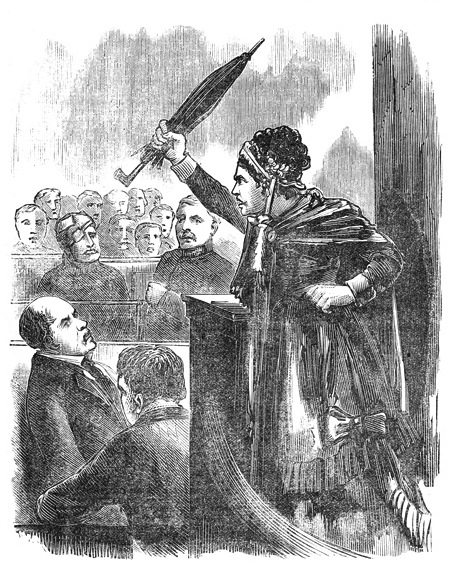
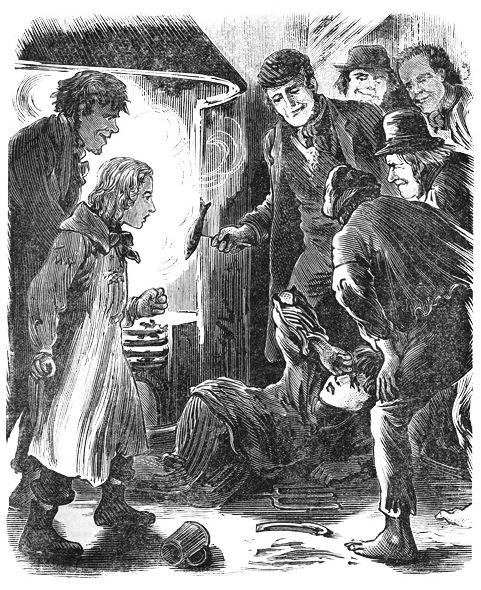
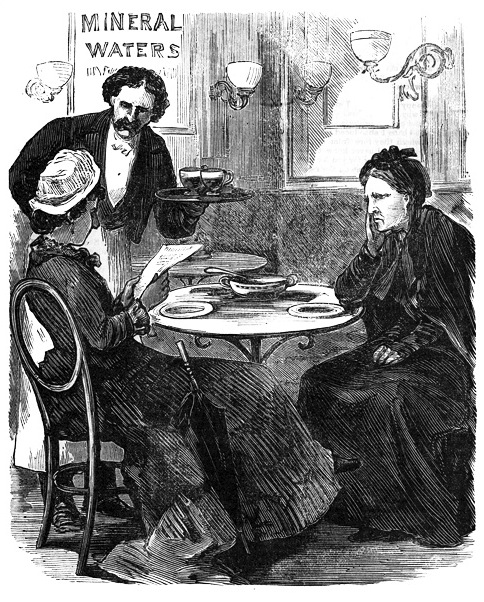
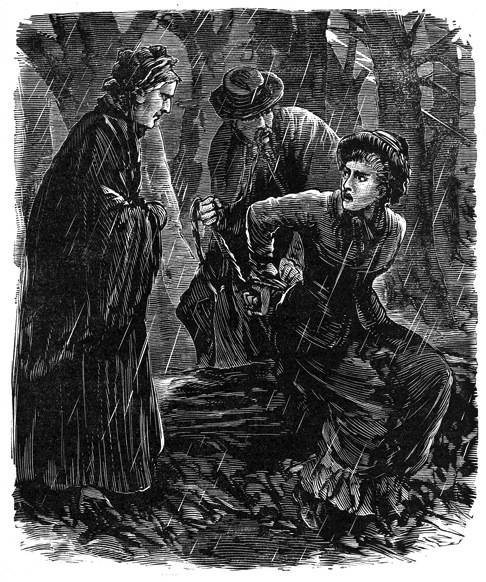
No. 84.
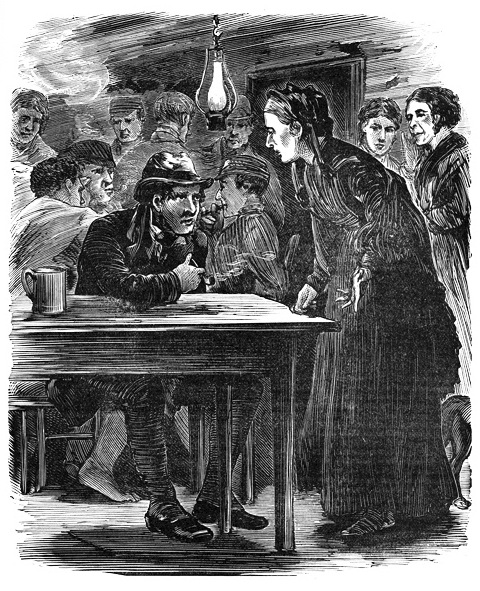
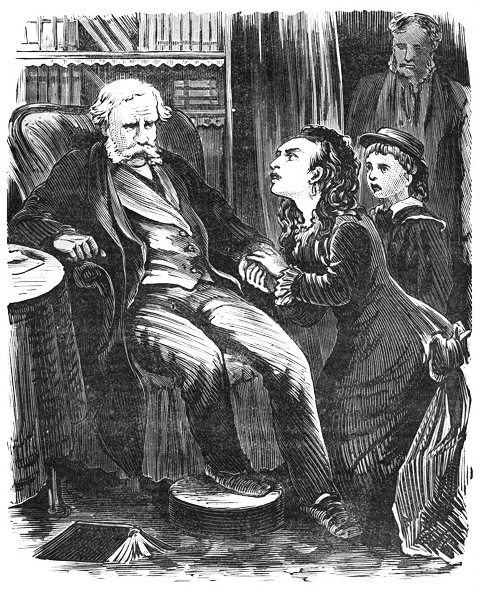
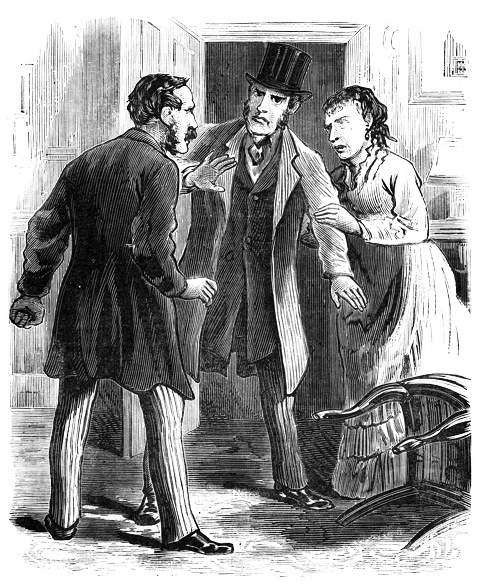
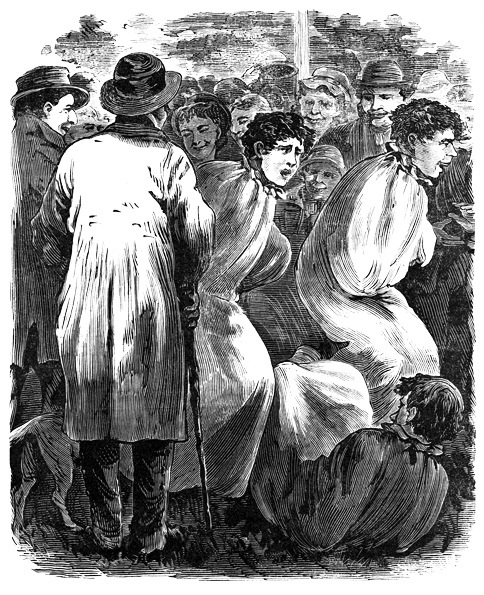
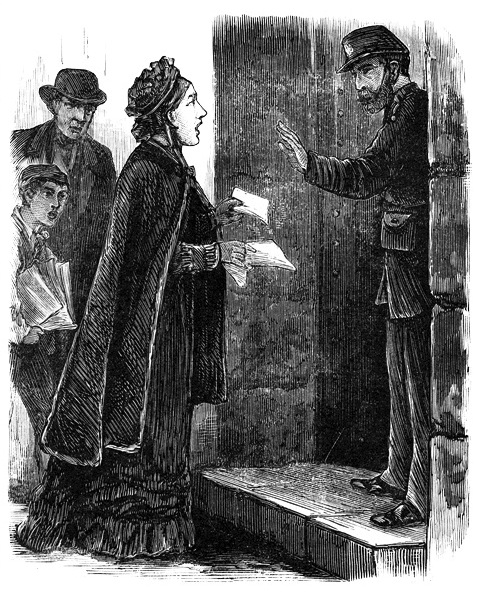
A MOTHER SEEKING HER SON IN THE THIEVES’ KITCHEN.
I was not such a barbarian as not to have offered
her some refreshment during that period. She took it
in the form of steak and onions, rinsed down with
brandy and water.
“When we parted we were the best friends in the
world; she shook me warmly by the hand, and her
last remark was, “I have my own character to
redeem, and if I have my health and strength I hope
to do it.”
The foregoing is a faithful chronicle of the account
given by the woman Thompson.
We have on more than one occasion given the reader
an insight of the mode in which Peace disposed of his
stolen property. He did not, however, confine his
business transactions in this respect to one receiver,
or “fence.”
This has been already demonstrated. He had
several confederates to whom he disposed of the goods
he had so dexterously purloined, but in most cases he
had to part with them at what drapers are accustomed
to term “a ruinous sacrifice.”
This is invariably the case with burglars and robbers
of every description. The receiver has always the
best of the bargain.
The property must be got rid of, and this the
“fence” knows perfectly well.
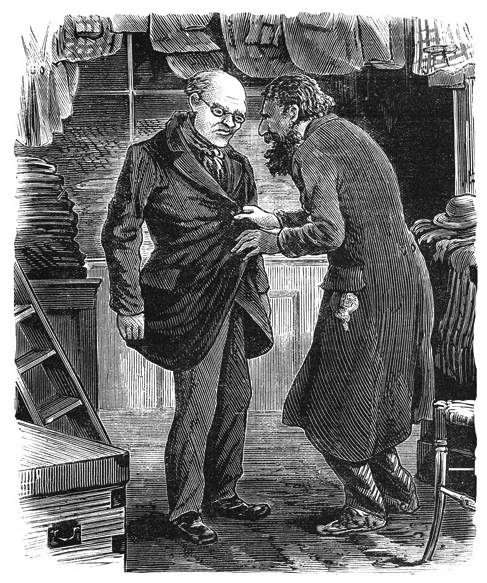
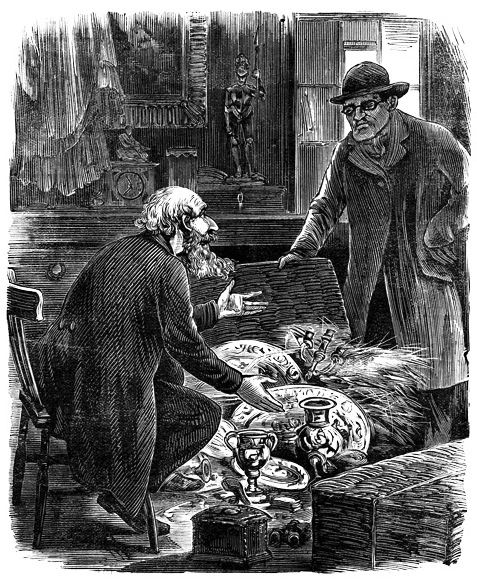
Peace, in addition to the two other Israelites already
introduced to the reader had a Petticoat-lane confederate,
who during his London career bought largely
of him. This personage was interviewed by one of the
special correspondents of the press. We subjoin a
graphic account of his visit.
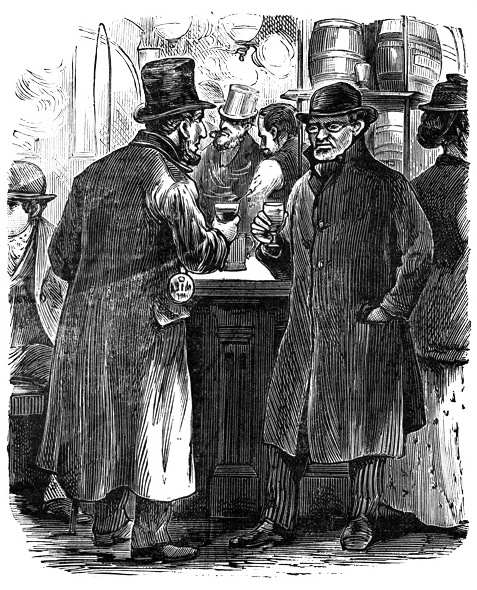
“That’s my name, and you’re quite right about
my keeping a tobacco shop in this lane, and about my
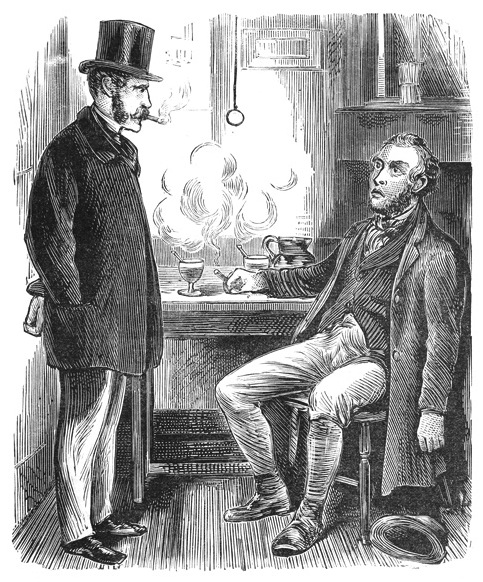
buying and selling ’most all kinds of old stores.”
This was the reply given to a comprehensive interrogatory
addressed by a Sheffield reporter to a
middle-aged keeper of a public-house in Petticoat-lane,
whose name indicated that he was “of the order of
Melchisedeck,” and who, rumour said, knew something
of the manner in which the convict Peace had invested
some of the money it is supposed he must have been
possessed of shortly before his arrest.
If the police with their finished machinery and well-trained
inquisitors have been able to discover nothing,
it was hardly to be expected that the astute Hebrew
dealer would allow himself to be trapped into any prejudicial
admissions by a newspaper emissary, even
though he was simply charged with the high and philanthropic
duty of affording that dealer opportunity for
clearing from his character aspersions which had been
unjustly cast upon it.
Having informed the “old stores” man of the
charitable nature of his mission, said the “special”:—
“Now, I suppose you never knew or had any dealings
with Peace?”
“Me, dealings with Peace! Why, I never heard
or seen ’im, except when I was bound over to keep
it for six months, ’cause I give a cove a knock in the
eye.”
At this sally the rowdy-looking congregation in the
bar who had evinced a lively interest in the interview,
delivered themselves of a unanimous guffaw. The special
smiled blandly, and went on:
“I suppose you have seen what the papers have
been saying about your supposed connection with
Peace?”
“Oh, yes; I’ve seen it all. It’s all wrong. I’m
quite innocent o’ this thing. Besides, it aint nothing
to do with me. It aint me they mean. It’s the other
man with the same name that keeps the ‘knell’ down
the lane. If they wrote about me I should ’a took
it up; but as they didn’t, I shall not trouble about
it.”
“Glad to find you’re so clear of this nasty business;
but have you heard much about the rumours here in the
lane?”
“No; nothing except what there’s bin in the newspapers.”
“Ah! then I think I’ll call on the man at the ‘knell,’
and hear what he’s got to say.”
“Yes, that’ll be ’sgood a thing as you can do,” said
the store dealer; and as the special passed the threshold
sounds of merry cachinnation reached him from
the idlers at the bar.
Trudging through the snow-slush, with pipe in
mouth as an antidote to the many-flavoured, fever-charged
atmosphere, the interviewer in a few minutes
found himself outside the “knell.”
The proprietor having been inquired for, he was
summoned from upstairs, and in about five minutes
presented himself. He was a very young man. He
was in his shirt sleeves.
He was short, but had good shoulders and breadth
of chest, and his face, which had a puffiness betokening
free application to the pewter pot, was adorned with a
nose off one side of which the skin had been almost
entirely scraped. A smile was as foreign to him apparently
as vegetation to an iceberg.
The interviewer made no attempt to smile upon
this young and promising vendor of Old Tom. He did
not make another.
There was not the remotest smirk of sympathy or
approbation in the countenance of his vis-à-vis.
He listened stoically to a few introductory original
observations by the special, such as, “Very unexpected
fall of snow this.”
“Quite an old-fashioned winter.”
“Spring will soon be here now, though.”
But on learning the nature of the caller’s business
he was no longer passive.
His eyes brightened and jumped a bit, and he became
loquacious, but continued cynical.
“I haven’t got nothing to say about the matter. All
I know is that I don’t know nothing about Peace or
about his money, or his loan society, or anything else.
Besides, the newspapers know all about the case
already. If they knows s’much, what do they want to
send to me about it for?”
“Well, the fact is,” answered the special, “the function
of a newspaper is to put the public in possession
of reliable information. Reports which compromise
your honour have been given currency, and although
minute inquiry has been made no particle of foundation
has been found for them. What I want is to get hold
of the facts necessary to put the public au courant
with things as they really are, and at the same time
afford a much-injured party a means of retrieving his
good name.”
The short man with the broad shoulders, stuck his
hands in his breeches pockets, spread his legs, swung
his head to and fro, lifted his eyelashes, and remarked,
“Ah! you do—do you?”
Then he turned round to his wife and inquired of
her in surly tones why she had called him down, and
muttered something to her not at all complimentary to
newspaperdom or its labourers.
“Well, look here, Mister. I don’t care for what the
newspapers say. Let ’em find out what they can. I
aint got nothin’ to say. All I knows is that if the
papers says anything about me they’ll be sorry for it,
that’s all.”
“Ah! but they have done so already. They have
mentioned both your name and that of your house.”
“Well, what if they have? What good have they
done?” rejoined the innkeeper, and then he continued,
“I’ve been bothered enough over this matter already,
and I don’t want to be bothered any more.” So saying
he left the special in dudgeon.
The rumours which have been afloat anent Peace’s
confederates in Petticoat-lane have been sufficiently
weighty to justify a descent by the police on the
houses of the suspected parties.
Nothing criminating was, however, forthcoming, and
the probability is that, wanting divulgence by Peace,
the public will remain ignorant what has become of
whatever money he has stored.
Inspired by the extraordinary statements circulated
at this time as to the enormous amount of property
alleged to have been disposed of by Peace, and by the
reported “finds” of hidden spoil in London, the Daily
Telegraph writes:—
“For a precedent to the curious museum of plunder
now in police custody at Bethnal-green we must go
back to the days of that very eminent ‘fence,’ Jonathan
Wild.
“The real character of this remarkable scoundrel
has been unfortunately obscured, first in Fielding’s
masterly ‘Jonathan Wild the Great,’ which is fundamentally
a satire upon the statesmen of his time; and
next in Mr. Ainsworth’s foolish and mischievous
romance of ‘Jack Sheppard.’
“We must peruse the straightforward and dispassionate
Old Bailey sessions papers to study Jonathan
in his true aspect as a cunning, adroit, and not ill-educated
rascal, who first reduced robbing to a system,
and organised a detailed scheme for receiving and
disposing of stolen goods.
“He started in business on a very small scale as the
landlord of a little alehouse in Cock-alley, Cripplegate,
where he surreptitiously purchased the ‘takings’ of
the juvenile pickpockets from Moorfields.
“At night he would perambulate the brandy shops
of Fleet-street, and traffic with the women who had
contrived to rob drunken people of their watches or
pocket-books.
“Growing bolder with success, it is on positive
criminal record that he convened a meeting at his house
of the most notorious thieves in London, and represented
to them that if they took their booty to such of
the pawnbrokers as were known not to be troubled
with scruples of conscience, they—the thieves—would
scarcely receive a fifth of the value of the goods which
they had stolen; whereas if they could agree to bring
their prizes to him he would make much more liberal
terms for them.
“The penalty for failing to constitute Jonathan
Wild their receiver-general was simply death. Bad
faith was immediately resented by the denunciation of
the thief to justice; and unless he could come to an
arrangement with Wild the chances were overwhelming
in favour of the robber going to Tyburn.
“Thus Jonathan Wild was not only a preceptor of
thieves and a ‘putter-up’ of robberies, but also a
receiver of stolen goods, and a thieftaker to boot.
“Removing from Cock-alley to a house in the Old
Bailey, he found at length that he had accumulated an
embarrassingly heavy stock of stolen property, and he
absolutely purchased a sloop in order to transport his
plunder to Holland and Flanders.
“The command of this vessel was entrusted to one
Roger Johnson, a noted river pirate; and Wild’s factor
at Ostend, and general Continental agent, was a superannuated
thief called Randall.
“The sloop—her name, unfortunately, is not mentioned
in the records of rascality—having discharged
her cargo at Ostend, brought back to England such
commodities as lace, wine, and brandy, which were
landed at night, and, it is almost needless to say, without
the custom-house authorities being troubled in the
matter.
“Smuggling and dealing in stolen goods are operations
possibly, no longer carried on in conjunction;
still, who shall say that our modern Jonathan Wilds
have not their favourite lines of steamers—it is not
now necessary that they should buy ships of their
own—and that they have not their factors and
agents at Continental ports and in Continental
cities?
“Many thousands of pounds’ worth of jewellery and
bank-note—to name only two sorts of plunder—are
stolen every year.
“There must be a mart for this precious merchandise,
a mart the whereabouts of which must be perfectly
familiar to professional burglars and thieves.
“Bank robbers and pickpockets have been known
coolly to admit that the market price for a stolen five-pound
note is three pounds ten shillings. Who buys
stolen bank notes at this rate? Who melts down the
stolen plate? Who wrenches the stolen gems out of
their settings? Who sends the unset jewels to Amsterdam
and elsewhere?
“If the police are unable to find out the wholesale
dealers in stolen property, and trust to chance to
make such a haul as they made the other day in the
Commercial-road, might it not be expedient to allow
the next professional burglar we catch to turn Queen’s
evidence against the receivers?
“No terms can be made with a murderer, and Peace
must be left to the gallows; but most useful revelations
might be obtained from a professional housebreaker
permitted to turn approver.
“Such a witness, if his evidence proved trustworthy,
should receive—strictly or once in away—a full
pardon.
“Convicts sentenced to penal servitude are not apt
to be very grateful for a partial remission of their term
of durance; and, indeed, in the case of Mr. Harry
Benson, the Government, it appears, does not conceive
that it is under any obligation at all to the convict
for having made an exhibition of the old detective
force in its full iniquity.”
In tracing the criminal career of a desperate character
like Peace, it is curious to note how prone to
wrong-doing he was from his earliest youth. His first
theft is thus described:—
An apple of beautiful hue tempted Eve to her first
sin, and it is said that fruit of a similar name first
induced Peace to commit a serious theft. In the year
1830 he lived close to the orchard of the Rev. Joseph
Smith, whose residence was known as the Plantation.
“The rev. gentleman was the pastor of the flock who
worshipped at the Nether Chapel in Norfolk-street.
But the ‘Plantation’ on Langsett-road had a different
prospect to what is now the case.
“Then it was in the country really; on the banks
behind the houses were farms and orchards; beneath
the house were meadows sloping to the River Don,
which was then alive with fish, trout being plentiful in
the waters, and at times a salmon or sea-trout strayed
into these higher regions from the Ouse.
“The railway connecting Sheffield with Manchester
had not made its black streak across the opposite Old
Park-hill, and a pleasant place was the residence of
the Independent minister of those days.
“Behind the good man’s house was a goodly
orchard, and within the enclosure fruit trees which
carried crops of heavy, golden fruit.
“The lads of the neighbourhood viewed those crops
with envy, and one of the leading spirits among them
was Charles Peace, a well-instructed lad, fearless,
venturesome, and domineering in spirit.
“He planned the robbery of the pastor’s orchard,
but being inexperienced, was captured—whilst in an
apple tree.
“He had not learnt in those days the wiles and
deceits which have since come so naturally to him.
“But he had not to cope with detectives, inspectors,
constables, and other professional men, who render
life obnoxious to a thief. His captor was actually the
parish beadle.
“Had that man lived until these days how proudly
he might have said—
“‘I caught Peace!’
“But the youthful aspirant to future honours did
not obtain the reward he should have had for his
speculation.
“He bargained for apples, and instead was taken
before the wrathful owner of the fruit, Mr. Smith. The
beadle shortly afterwards had a task to undertake
which left no mark in local history, but did on the
young man who stole the apples.
“Such was the commencement in ‘active’ life of
him who now occupies a cell in Newgate, from thence
to be taken to answer a record of crime the which has
not been paralleled by Claude Duval, Thomas King,
Richard Turpin, or others of that ilk.
“Those men had not the telegraph to compete with,
yet failed; Peace had the widespread information of
modern days to watch, and yet for a time succeeded.
“The marauders of the old shool, above mentioned,
defeated justice for a time because on their thoroughbred
horses they could outride the messengers of
justice.
“Peace had to fight against the magnificent apparatus
of science by which information is flashed across
a thousand miles in a second of time, and yet he succeeded
in baffling all who sought to track him.”
The blow that had fallen on Peace and his domestic
circle was a terrible one, and in a short space of time,
after his conviction, the house in the Evalina-road was
tenantless.
A visit to the locality is thus described by an eye-witness:—
“Peckham approached from Greenwich, with a
suggestion of sunshine in the sky, looked much
prettier to-day. There are some goodly houses along
Queen’s-road, but as one climbs the hill to Peace’s
part, the houses taper away till long lines of modest
brick buildings meet the eye. Where Peace lived may
be called the tail-end of Peckham.
“His house is still to let, and though nobody that I
can hear of has been to visit it—except members of
the Press—the gentleman who has the letting of it
thinks he will get a couple of pounds extra now that
it has sprung into notoriety.
“Well, he may. I don’t know so much about the
peculiarities of the Peckham people; but on this point
I am inclined to agree with the lady who lives next
door. She wants to let her front room, and has ‘Apartments’
in the window.
“That card appeals in vain to the eligible young
gentlemen who usually want comfortable chambers,
and she is afraid that respectable people will not care
to come into such a ‘dreadful’ neighbourhood.
“She considers it a bad day for her when she came
there, which she did a week before Peace was found
out. Indeed, it was from Peace she had the keys to
look over the house. An ominous introduction
truly.
“Her idea is that before that house lets again £2
will have to be taken off, instead of being put on, the
rent. I agree with her, for I can hear of nobody who
has a good word for the house, except perhaps the
postman, who told me, as we trudged together through
the mud, that ‘it wasn’t a bad place in his view of it.
The Thompsons did not trouble him much—they had
very few letters.’
“A neighbour says that when the Thompsons came
their house was a treat to look at, Mr. Thompson
filling all the front windows with choice and costly
flowers, which he carefully tended and watered with
his own hands.
“People at Peckham are beginning to be a trifle
impatient with inquisitive strangers who want to know
about their most famous character. On my first visit
to Peckham I looked in on the gentleman who combines
the duties connected with her Majesty’s mails with
dispensing flour and other household necessities to
her Majesty’s females.
“I asked him if he knew and could tell me where
‘Mr. Smith’ lived—the party who had let the house
to Mr. Thompson? This gentleman shut me up very
sharp.
“‘I know where Mr. Smith lives, but I don’t think I
would be justified in telling you, as you would only be
bothering him like the rest.’
“I left that establishment with a feeling that my
introduction to the natives of Peckham was not
encouraging. A few yards further on I saw Mr.
Smith’s address ln the windows of half-a-dozen empty
houses, the notices inviting people to apply to ‘Mr.
Smith, Ryde Villas, St. Mary’s-road.’
“I accepted the invitation, and found Mr. Smith a
most obliging and very communicative gentleman.
HOW PEACE WAS FOUND OUT.
“I find the police scout the idea that the man
‘Ward’ was discovered through the jealousy of Mrs.
Thompson, the younger of the ‘housekeepers’ at Peckham,
and the professed wife of Peace.
“Those who had to do with the case told me that
they had no information whatever from Mrs. Thompson,
who never communicated with them, but disappeared
as she sniffed danger.
“‘How then,’ I asked, ‘did it occur to you to connect
the Blackheath burglar with the Bannercross
murderer?’
“‘Well,’ was the reply, ‘we can scarcely tell you.
We could not get our evidence so complete as we
could wish, and we were obliged to wait for a time.
That waiting served us well. Trifles, mere trifles, such
as we can scarcely repeat to you, made us believe that
this man was ‘somebody.’ We watched those who
came about our place at Greenwich; then we watched
those who came about Newgate. We got, after great
trouble, a hint or two; we acted upon what we
received, and were ultimately able to connect the man
‘Ward’ with Peckham; then from Peckham we
worked Nottingham and Sheffield, and then the case
gradually worked itself into shape.’
“For the police it was a lucky thing Mrs. ‘Ward’
took those two boxes to Sheffield.
“That, I believe, was really the first indication that
Blackheath and Bannercross were connected.
“It suddenly flashed across one of the Greenwich
division that this mysterious man, who called himself
a ‘half-caste,’ resembled in every respect except one
the man so urgently ‘wanted’ at Sheffield.
“That exception was his hair, particularly the
absence of beard and whiskers. Height, breadth, eyes,
manner of talking, singularity of fingers, and wide,
straddling walk—to quote the police description,
‘walking with his legs apart’—all tallied. Put beard
and whiskers upon that face, and it was—Peace.
“Inspector Bonny went to Nottingham; Inspector
Phillips to Sheffield.
“Phillips was shown a portrait of Peace. He was
confirmed in his suspicions. The photograph resembled
the man in Newgate so closely that he had no doubt as
to the identity.
“The rest of the story you know. How Phillips and
Twibell found the property at Darnall in the possession
of Mrs. Peace, how the property was identified as part
of the proceeds of the Blackheath burglaries, how
Police-constable Morris came to London and identified
Peace in Newgate, and (as I telegraphed to you) how
the Treasury, appreciating the importance of the case
in the light of the identification, undertook the prosecution
on its own account.
“To Police-officer Robinson undoubtedly belongs in
the first instance the credit of capturing Peace. He
unquestionably risked his life in his courageous
encounter with the desperate convict, and well deserves
such recognition as has been suggested by your correspondent.
“Let it not be forgotten, however, that Robinson’s
share in the transaction terminated there. Without
him nothing would have been done; yet after Peace’s
bullet pierced his arm and the two constables came to
his help, Robinson dropped the thread, which was
picked up by Inspector Phillips and Inspector Bonny.
“These officers have been indefatigable in their
exertions to bring home the graver charge against
Peace. Day by day, and night after night they have
laboured, and many a night since the memorable
evening when Peace was caught in the act, they have
slept not, neither have they rested, so anxious have
they been to close once for all the career of the dreadful
villain whose escape made everybody so uneasy.
“But it should not be forgotten (observed a writer
at the time) if testimonials are spoken of, to remember
these two officers.
“Robinson was a brave fellow, and acted like a hero;
yet if Bonny and Phillips had not used their brains,
and set their highly-trained wits to work, ‘John Ward’
might have been convicted of the Blackheath burglary
and the shooting of the intrepid Robinson, and he
might have been sentenced to penal servitude for life;
but in Sheffield the Bannercross murder would have
been regarded as an undiscovered crime.
“To Bonny and Phillips belong the credit of proving
that Ward was Peace, that Blackheath meant Bannercross,
that burglary was overshadowed by the bigger
crime of murder. A wave of relief swept over Sheffield
when it was known that Peace had really been captured
at last. To Phillips and Bonny was due the fact that
he was thought of at all as the man who shot Dyson
two years before.
THE TROUBLES OF THE PEACES.
“There is really no peace for the Peaces. Now that
Charles Peace, the man of Bannercross, has been
caught there are dozens of persons who are anxious to
tell all they know about him and his family.
“Several of them have got it into their heads that
there is only one family of Peace, the head and front
of which now awaits in Newgate the reward of his
desperate misdeeds.
“Thus it comes about that several most excellent
people are getting uneasy about the name they bear,
particularly when they find it connected with some
of the early doings of “the insignificant-looking”
gentleman who has recently sprung into so much
significance.
“The latest instance is that of a family of Peace
who lived some time ago in Philadelphia—not the
Philadelphia which figures in Sacred Writ, but the
exceedingly secular locality of that name which figures
in Sheffield.
“Mr. Charles Peace, of George-street, Philadelphia,
has no connection whatever with the Charles Peace of
the many aliases, burglar and murderer; neither is it
right that his son, who also bears the (in these days)
somewhat burdensome name of Charles Peace, should
be associated with the person who has proved himself
so eligible a candidate for the last attentions of the
law.
“It is certainly a trifle too bad, even when people
are thirsting for every particle of information about
that extraordinary character, that the respectable
member of a respectable firm of file manufacturers in
Pea-croft, or his son who earns his livelihood in an
honourable way in the file trade at Rotherham, should
have themselves brought up in public as connected in
even the remotest degree with the ruffian who had the
misfortune to call himself by their name.
“So that, once for all, readers will understand the
Philadelphia Peace and the Bannercross Peace are
wide as the poles asunder.
“This incident reminds one of the trouble and suspicion
to which many people were put shortly after
the murder.
“Peace, it will be remembered, was described as a
‘little, insignificant-looking man, with grey hair.’
“There was at once an eager look-out kept for
people who answered that somewhat general description.
It was a bad time for ‘little insignificant-looking
men,’ and as our local world has a good many
people who come fairly within that description, several
estimable and other citizens were frequently the object
of glances which were not at all flattering in their
meaning.
“Two elderly gentlemen were pointed out as greatly
resembling the notorious Peace, and enjoyed a reputation
on that account only a shade less comfortable than
other gentlemen in this district, of most substantial
proportions, who up to a short time ago were repeatedly
referred to as remarkably like the Claimant.
“Even when a more specific description of Peace
appeared mistakes were freely made, though not with
the provoking results of a double apprehension, as in
the case of that poor tramp at Barrow-in-Furness,
who was subsequently apprehended at Hexham, and
who complained bitterly—and not unnaturally—to our
reporter who interviewed him in prison, that he should
have been arrested a second time ‘when the police had
already let him go once.’
“This poor fellow, to put matters right once for all,
made a pilgrimage to Sheffield and called upon the
Chief Constable, who, of course, had no more to do
with his arrest at Barrow-in-Furness and Hexham than
the poor tramp had to do with the arrest of the real
Peace by Police-constable Robinson in that garden at
Blackheath.”