My mother, whose maiden name was Victoire Lemachois, was born at Rouen
on the 4th of June 1780. Her father was a member of the French
magistracy. Her mother, a Mdlle. Heuzey, was a lady of remarkable
intelligence and marvellous artistic aptitude. She was a musician, and a
poetess as well. She composed, sang, and played on the harp; and, as I
have often heard my mother say, she could act tragedy like Mdlle.
Duchesnois, or comedy like Mdlle. Mars.
Attracted by such an uncommon combination of exceptional natural talent,
the best families in the neighbourhood—the D'Houdetots, the De
Mortemarts, the Saint Lamberts, and the D'Herbouvilles—continually
sought her, and literally made her their spoilt child.
But, alas! those talents which give life its greatest charm and
seduction do not always ensure its happiness. Total disparity of tastes,
of inclinations, and of instincts seldom conduce to domestic peace, and
it is dangerous to dream of trying to govern real life by ideal rules of
conduct. The Angel of Peace soon spread her wings and deserted the
household where so many influences combined to make her stay impossible,
and my mother's childhood suffered from the inevitable and painful
consequences. Her life was saddened, perforce, at an age when she and
sorrow should have been strangers.
But God had endowed her with a strong heart, a sound judgment, and
indomitable courage. Bereft of a mother's watchful care, actually
obliged to teach herself how to read and write, she also learnt, alone
and unassisted, the rudiments of music and drawing, arts by which she
was ere long to earn her living.
During the turmoil of the Revolution my grandfather lost his judicial
post at Rouen. My mother's one idea was to get work, so as to be useful
to him. She looked out for piano pupils, found a few, and thus, at
eleven years of age, she began that toilsome life which in after years,
during her widowhood, was to enable her to bring up and educate her
children.
Spurred by her constant desire to improve, and by a sense of duty which
was the dominant feature of her whole life, she realised that a good
teacher must acquire everything that is likely to add weight and
authority to her instructions. She resolved, therefore, to place herself
under the care of some well-known master, to learn all that was
necessary to ensure her own credit and satisfy her conscience. To this
end, little by little—penny by penny, even—she laid by part of the
miserable income which her music lessons brought in, and when a
sufficient sum had been accumulated she took the coach, which in those
days did the journey from Rouen to Paris in three days. On her arrival
in Paris she went straight to Adam, the professor of pianoforte-playing
at the Conservatoire, father of Adolphe Adam, the author of "Le Châlet"
and many other charming works.
Adam received her kindly, and listened to her attentively. He at once
recognised her possession of those qualities which were to foster and
strengthen the interest primarily aroused by her happy facility for her
art.
As my mother's youth forbade her residing permanently in Paris, to
benefit by a regular and consecutive course of instruction, it was
arranged she should travel up from Rouen once in every three months and
take a lesson.
One lesson every three months! A short allowance indeed! and one which
could hardly have seemed likely to repay the cost involved. But certain
individuals are living proofs of the miracle of the loaves and fishes,
and this narrative will show, by many another example, that my mother
was one of them.
A person destined later on to enjoy such solid and well-earned renown as
a teacher of music was not, could not be, in fact, a pupil capable of
forgetting the smallest item of her master's rare and invaluable
lessons. Adam was himself greatly struck by the improvement apparent
between each séance and the next. As much to mark his appreciation of
his young pupil's personal courage, as of her musical talent, he
contrived to get a piano lent her gratis. This allowed of her studying
assiduously without bearing the burden entailed on mind and purse of
paying for her instrument, which, small as it was, had been a heavy tax
upon her small resources.
Soon after this a circumstance occurred which had a decisive influence
on my mother's whole future life.
The fashionable pianoforte composers at that time were Clementi,
Steibelt, Dussek, and some others. I do not mention Mozart, who had
already blazed out upon the musical world, following closely upon Haydn;
nor do I refer to the great Sebastian Bach, whose immortal collection of
preludes and fugues, "Das Wohltemporirte Clavier," published a century
ago, has given the law to pianoforte study, and become the unquestioned
text-book of musical composition. Beethoven, still a young man, had not
yet reached the pinnacle of fame on which his mighty works have now
placed him.
About this period a German musician, named Hullmandel, a violinist of
great merit, and a contemporary and friend of Beethoven's, came and
settled in France, with a view to making a connection as an accompanist.
He stayed some time at Rouen, and while there expressed a wish to hear
the performances of those local young ladies who were considered to have
the greatest musical talent. A sort of competition was organised, in
which my mother took part. She had the good fortune of being
particularly noticed and complimented by Hullmandel, who at once fixed
on her as a fit person to receive lessons from him, and to perform with
him at certain houses in the town where music was carefully and even
passionately cultivated.
Here ends all I have to tell about my mother's childhood and youth. I
know no further details of her life until her marriage, which took place
in 1806. She was then twenty-six years and a half old.
My father, François Louis Gounod, was born in 1758, and was therefore
slightly over forty-seven years of age at the time of his marriage. He
was a painter of distinguished merit, and my mother has often told me
that great contemporary artists, such as Gérard, Girodet, Guérin, Joseph
Vernet, and Gros, considered him the best draughtsman of his day.
I remember a story about Gérard, which my mother used to tell with
pardonable pride. Covered as he was with honour and glory, a Baron of
the Empire, owning an enormous fortune, the famous artist was noted for
the smartness of his carriages. While driving about one day, he
happened to meet my father, who was walking. "What!" he cried, "Gounod
on foot! and I in a carriage! What a shame!"
My father had studied under Lépicié with Carle Vernet (the son of Joseph
and father of Horace of that ilk). Twice over he competed for the Grand
Prix de Rome. His scrupulous conscientiousness and artistic modesty are
best reflected by the following little incident which occurred during
his youth. The subject given for the "Grand Prix" competition on one of
the occasions mentioned above was "The Woman taken in Adultery." Among
the competitors were my father and the painter Drouais, whose remarkable
picture gained him the Grand Prix. When Drouais showed him his canvas,
my father told him frankly there could be no possible comparison between
it and his own; and, once back in his studio, he destroyed his own work,
which did not seem to him worthy to hang beside his comrade's
masterpiece. This fact will give some idea of his artistic integrity,
which never wavered between the call of justice and that of personal
interest.
Highly educated, with a mind as refined as nature and study could make
it, my father throughout his whole life shrank instinctively from
undertaking any work of great magnitude. The lack of robust health may
partly explain this peculiarity in a man of such great powers; perhaps,
too, the cause may be discovered in his strong tendency towards absolute
freedom and independence of thought. Either circumstance may explain his
dislike to undertaking anything likely to absorb all his time and
strength. The following anecdote gives colour to this view.
Monsieur Denon, at that time Curator of the Louvre Museum, and also, I
believe, Superintendent of the Royal Museums of France, was an intimate
friend of my father's, and had, besides, the highest opinion of his
talent as a draughtsman and etcher. One day he invited him to execute a
number of etchings of the drawings forming the collection known as the
"Cabinet des Medailles," with an annual fee of 10,000 francs during the
period covered by the work. Such an offer meant affluence to a needy
household like ours, in those days especially. The sum would have
provided ample support for husband, wife, and two children. Well! my
father refused point-blank. He would only undertake to do a few
specially ordered portraits and lithographs, some of which are of the
highest artistic value, and carefully treasured by the descendants of
those for whom they were originally executed.
Indeed, my mother's unconquerable energy had to assert itself often
before these very portraits, with their delicate sense of perception and
unerring talent of execution, could leave the studio. How many would
even now have remained unfinished, had she not taken them in hand
herself? How many times had she to set and clean the palettes with her
own hands? And this was but a fraction of her task. As long as his
artistic interest was awake;—while the human side of his model—the
attitude, the expression, the glance, the look, the Soul in
fact—claimed his attention,—my father's work went merrily. But when it
came to small accessories, such as cuffs and ornaments, embroideries and
decorations, ah! then his interest failed him, and his patience too. So
the poor wife took up the brush, cheerfully slaving at the dull details,
and by dint of intelligence and courage finished the work begun with
such enthusiasm and talent, and dropped from instinctive dread of being
bored.
Happily my father had been induced to hold a regular drawing-class in
his own house. This, with what he made by painting, brought us in
enough to live on, and indirectly, as will be apparent later, became the
starting-point of my mother's career as a pianoforte teacher.
So the modest household lived on, till my father was carried off by
congestion of the lungs on the 4th of May 1823. He was sixty-four years
old, and left his widow with two boys—my elder brother, aged fifteen
and a half, and myself, who would be five years old on the 17th of the
following June.
My father, when he left this world, left us without a bread-winner. I
will now proceed to show how my mother, by dint of her wonderful energy
and unequalled tenderness, supplied in "over-flowing measure" that
protection and support of which his death had robbed us.
In those days there lived, on the Quai Voltaire, a lithographer of the
name of Delpech. It is not so very long since his name disappeared from
the shop-front of the house he used to occupy. My father had not been
dead many hours before my mother went to him.
"Delpech," she said, "my husband is dead. I am left alone with two boys
to feed and educate. From this out I must be their mother and their
father as well. I mean to work for them. I have come to ask you two
things—first, how to sharpen a lithographer's style; second, how to
prepare the stones.... Leave the rest to me; only I beg of you to get me
work."
My mother's first care was to publish the fact that, if the parents of
pupils at the drawing-class would continue their patronage, there would
be no interruption in the regular course of lessons.
The immediate and unanimous response amply proved the public
appreciation of the courage shown by the noble-hearted woman, who,
instead of letting her grief overwhelm and absorb her, had instantly
risen to the necessity of providing for her fatherless children. The
drawing-class was continued, therefore, and a number of new pupils were
soon added to the attendance. But my mother, being already known to be a
good musician as well as a clever draughtswoman, it came about that many
parents begged her to instruct their daughters in the former art.
She did not hesitate to grasp at this fresh source of income to our
little household, and for some time music and drawing were taught side
by side within our walls; but at length it became necessary to
relinquish either one or the other. It would have been bad policy on
her part to try to do more than physical endurance would permit, and, in
the event, my mother decided to devote herself to music.
I was so young when my father died, that my recollection of him is very
indistinct. I can only recall three or four memories of him with any
degree of certainty, but they are as clear as those of yesterday. The
tears rise to my eyes as I commit them to this paper.
One impression indelibly stamped upon my brain is that of seeing him
sitting with his legs crossed (his customary attitude) by the chimney
corner, absorbed in reading, spectacles on nose, dressed in a white
striped jacket and loose trousers, and a cotton cap similar to those
worn by many painters of his day. I have seen the same cap, many years
since then, on the head of Monsieur Ingres, Director of the Académie de
France at Rome—my illustrious, and, I regret to say, departed friend.
As a rule, while my father was thus absorbed in his book, I would be
sprawling flat in the middle of the room, drawing with a white chalk on
a black varnished board, my subjects being eyes, noses, and mouths of
which my father had drawn me models. I can see it all now, as if it were
yesterday, although I could not have been more than four or four and a
half. I was so fond of this employment, I recollect, that had my father
lived, I make no doubt I should have desired to be a painter rather than
a musician; but my mother's profession, and the education she gave me
during my early youth, turned the scale for music.
Shortly after my father's death, which took place in the house which
bore, and still bears, the number 11 in the Place St. André-des-Arts (or
rather "des Arcs"), my mother took another, not very far away from our
old home. Our new abode was at 20 Rue des Grands Augustins. It is from
that flitting that I can date my first real musical impressions.
My mother, who nursed me herself, had certainly given me music with her
milk. She always sang while she was nursing me, and I can faithfully say
I took my first lessons unconsciously, and without being sensible of the
necessity so irksome to any child, and so difficult to impress on him,
of fixing my attention on the instruction I was receiving. I had
acquired a very clear idea of the various intonations, of the musical
intervals they represent, and of the elementary forms of modulation.
Even before I knew how to use my tongue, my ear appreciated the
difference between the major and the minor key. They tell me that
hearing some one in the street—some beggar, doubtless—singing a song
in a minor key, I asked my mother why he sang "as if he were crying."
Thus my ear was thoroughly practised, and I easily held my place, even
at that early age, in a Solfeggio class. I might have acted as its
teacher.
Proud that her little boy should be more than a match for grown-up
girls, especially as it was all thanks to her, my mother could not
resist the natural temptation to showing off her little pupil before
some eminent musical personage.
In those days there was a musician of the name of Jadin, whose son and
grandson both made themselves an honoured name among contemporary
painters. Jadin himself was well known as a composer of romances, very
popular in their day. He was, if I am not mistaken, accompanist at the
well-known Choron School of Religious Music.
My mother wrote and asked him to come and pass judgment on my musical
abilities.
Jadin came—put me in the corner of the room, with my face to the wall
(I see that corner now), and sitting down to the piano, improvised a
succession of chords and modulations. At each change he would ask, "What
key am I playing in?" and I never made a single mistake in all my
answers.
He was amazed, and my mother was triumphant. My poor dear mother! Little
she thought that she herself was fostering the birth of a resolve, in
her boy's mind, which was some years later to cause her sore uneasiness
as to his future. Nor did she dream, when she took me, a six-year-old
boy, to the Odéon to hear "Robin Hood," that she had stirred my first
impulse towards the art that was to govern all my life.
My readers will have wondered at my saying nothing so far about my
brother. I must explain that I cannot recall any memory of him till
after I had passed my sixth birthday; prior to that time I remember
nothing of him.
My brother, Louis Urbain Gounod, was ten and a half years older than
myself, he having been born on December 13, 1807.
When he was about twelve he entered the Lycée at Versailles, where he
remained till he was eighteen. My first recollections of that best of
brothers are connected with my memories of Versailles. Alas! I lost him
just when I was beginning to appreciate the value of his fraternal
friendship.
Louis XVIII. had appointed my father Professor of Drawing to the Royal
Pages, and having a strong personal regard for him, he had granted us
permission, during our temporary residence at Versailles, to occupy
rooms in the huge building known as No. 6 Rue de la Surintendance, which
runs from the Place du Château to the Rue de l'Orangerie.
Our apartment, which I remember well, and which could only be reached by
a number of most confusing staircases, looked out over the "Pièce d'Eau
des Suisses" and the big wood of Satory. A corridor ran outside all our
rooms, and looked to me quite endless. It led to a suite of rooms
occupied by the Beaumont family. One of this family, Edouard Beaumont,
was one of my earliest friends. He ultimately became a distinguished
painter. Edouard's father was a sculptor, his duties at that time being
to restore the various statues in the château and park at Versailles,
which duties carried with them the right of occupying the rooms next
ours.
When my father died in 1823, my mother was still allowed to live in
these rooms during the annual holidays. This permission was extended to
her during the reign of Charles X., that is, up to 1830, but was
withdrawn on the accession of Louis-Philippe. My brother, who, as I said
above, was a student at the Lycée at Versailles, always spent his
holidays with us there.
An old musician named Rousseau was then chapel-master of the Palace
Chapel at Versailles. His particular instrument was the 'cello (the
"bass," as it was called in those days), and my mother persuaded him to
give my brother lessons. The latter had a beautiful voice, and often
sang in the services at the Royal Chapel.
I really cannot tell whether old Père Rousseau played upon his
violoncello well or ill; what I do clearly remember is that my brother
was not proficient on the instrument. But I was young, and my small mind
could not grasp the fact that playing out of tune was possible; I
thought when an instrument was put into a person's hands, he must
produce pure tone. I had no conception of what the word beginner meant.
Once I was listening to my brother practising in the next room. My ear
was getting very sore from the continual discords, so, in all innocence,
I asked my mother, "Why is Urbain's violoncello so fearfully out of
tune?" I do not remember what she answered, but I am sure she laughed
over my simple question.
I mentioned that my brother had a beautiful voice. I was able to judge
it later on by my own ears. And I can also quote another testimony, that
of Wartel, who often sang with him in the Chapel-Royal at Versailles.
Wartel studied at the Choron School, and sang at the Opera in Nourrit's
time; ultimately he took to teaching, and earned a great and
well-deserved reputation in that line.
In 1825 my mother's health broke down. I was then about seven years old.
Our family doctor at that time was Monsieur Baffos; he had brought me
into the world, and had known us all for many years. Our former doctor,
Monsieur Hallé, had recommended him to us when he himself retired. As my
mother's work consisted in giving music lessons at her own house all
the day long, and as the presence of a child of my age was a source of
anxiety and even worry to her, Baffos suggested my spending the day at a
boarding-school, whence I was fetched back every evening at dinner-time.
The school selected was kept by a certain Monsieur Boniface in the Rue
de Touraine, close to the École de Médecine, and not far from our home
in the Rue des Grands Augustins. Its quarters were soon shifted to the
Rue de Condé, nearly opposite the Odéon.
There I first met Duprez, destined to become the celebrated tenor, who
shone so brilliantly on the Opera boards.
Duprez, nine years older than myself, must have been about sixteen or
seventeen at the time I speak of. He was a pupil of Choron's, and taught
Solfeggio in Monsieur Boniface's school. He soon took a fancy to me when
he found I could read a musical score with the same ease as a printed
book—much better indeed, I make no doubt, than I can do it now. He used
to take me on his knee, and when one of my little comrades made a
mistake, would say, "Come, little man, show them how to do it!"
Years afterwards I reminded him of this fact, now so far behind us both.
It seemed to come back to him suddenly and he cried, "What! were you the
small boy who solfa-ed so well?"
But it was growing high time for me to set about my education after a
more serious and systematic fashion. Monsieur Boniface's establishment
was really more of a day nursery than a school.
So I was entered as a boarder at Monsieur Letellier's institution in the
Rue de Vaugirard, at the corner of the Rue Ferou. Monsieur Letellier
soon retired, and was succeeded by Monsieur de Reusse. I remained there
for a year, and was then removed to the school of Monsieur
Hallays-Dabot, in the Place de l'Estrapade, close to the Panthéon.
My recollection of Monsieur Hallays-Dabot and his wife is as clear and
distinct as though they were present here. Nothing could exceed the
warm-hearted kindness of my reception in their house. It sufficed to
dispel my horror of a system from which I had an instinctive shirking.
The almost paternal care they gave me quite destroyed this feeling, and
allayed the doubts I had entertained as to the possibility of being
happy in a boarding-school.
The two years I spent in his house were, in fact, two of the happiest in
my life; his even-handed justice and his kindly affection never failed.
When I reached the age of eleven it was decided that my education should
be continued at the Lycée St. Louis. When I left Monsieur
Hallays-Dabot's care, he gave me a certificate of character so
flattering in its terms that I refrain from reproducing it. I have felt
it a duty to make this public acknowledgment of all he did for me.
The good testimonials I brought from Monsieur Hallays-Dabot's
establishment gained me a quart de bourse at the Lycée St. Louis,[1]
which I accordingly entered at the close of the holidays in October
1829. I was then just eleven years old.
The then Principal of the Lycée was an ecclesiastic, the Abbé Ganser, a
gentle, quiet-natured man much inclined to meditation, and very paternal
in his dealings with his pupils.
I was at once put into what was known as the sixth class. From the
outset of my school career I had the good fortune of being under a man
who, in the course of the years I studied with him, gained my deepest
affection—Adolphe Régnier, Membre de l'Institut, my dear and honoured
master, formerly the tutor, and still, as I write, the friend of the
Comte de Paris.
I was not stupid, and as a rule my teachers liked me; but I must confess
I was very careless, and was often punished for inattention, even more
so during preparation hours than in the actual school-work.
I mentioned that I joined St. Louis as a "quarter scholar." This means
that my college fees were reduced one-quarter. It was incumbent on me to
endeavour, by diligence and good conduct, to rise to the position of
half scholar, three-quarter scholar, and finally to that of full
scholar, and so relieve my mother of the expense of keeping me at
college. Seeing I adored my mother, and that my greatest joy should
therefore have been to help her by my own exertions, this sacred object
ought to have been ever present with me.
But woe is me! Instincts forcibly repressed are apt to wake again with
tenfold fierceness. And so mine did, many a time and often—far too
often, alas!
One day I had got into a scrape for some piece of carelessness or other,
some exercise unfinished, or lesson left unlearnt. I suppose I thought
my punishment out of proportion to my crime, for I complained, the sole
result being that the penalty was largely increased. I was marched off
to the college prison, a sort of dungeon, where I was to be kept on
bread and water till I had finished an enormous imposition of I know not
how many lines, some five hundred or a thousand, I think—something
absurd, I know! When I found myself under lock and key I began to think
I was a brute. The feelings of Orestes when the Furies reproached him
with his mother's death were not more bitter than mine when I was given
my prison fare! I looked at the bread, and burst into tears. "Oh! you
scoundrel, you brute, you beast," I cried; "look at the bread your
mother earns for you! Your mother who is coming to see you after school,
and will hear you are in prison, and will go home weeping through the
streets, without having seen or kissed you! Come, come, you are a
wretch; you do not even deserve to have dry bread!"
And I put it aside, and went hungry.
However, in my normal condition I worked on fairly enough, and, thanks
to the prizes I won every year, I gradually progressed towards that
ardently wished-for goal, a "full scholarship."
There was a chapel in the Lycée Saint Louis, where musical masses were
sung every Sunday. The gallery, which occupied the full width of the
chapel, was divided into two parts, and in one of these were the
choristers' seats and the organ. When I joined the Lycée, the
chapel-master was Hyppolyte Monpou, then accompanist at the Choron
School of Music, well known in later years as the composer of a number
of melodies and theatrical works, which brought him some considerable
popularity.
Thanks to the training my mother had given me ever since my babyhood, I
could read music at sight; and my voice was sweet and very true. On
entering the college I was at once handed over to Monpou, who was
astonished by my aptness, and forthwith appointed me solo soprano of
his little choir, which consisted of two sopranos, two altos, two
tenors, and two basses.
I lost my voice owing to a blunder of Monpou's. He insisted on my
singing while it was breaking, although complete silence and rest are
indispensable while the vocal chords are in their transitional stage;
and I never recovered the power and ring and tone I had as a child, and
which constitute a really good singing voice. Mine has always been husky
ever since. But for this accident, I believe I should have sung well in
after life.
At the Revolution of 1830, the Abbé Ganser ceased to be our Principal.
He was succeeded by Monsieur Liez, a former Professor at the Lycée Henri
IV., strongly attached to the new régime, and a zealous advocate of the
system of military drill forthwith introduced into the various colleges.
He used to come and watch us drilling, standing bolt upright like any
sergeant instructor or colonel on parade, and with his right hand thrust
into the breast of his coat, like Napoleon I.
Two years afterwards Monsieur Liez was superseded by Monsieur Poirson.
It was while he was Principal that the various circumstances which
decided the ultimate bent of my life took place.
Among my many faults was one pet sin. I worshipped music; the first
storms that ruffled the surface of my youthful existence originated with
the overmastering passion, which had such paramount influence on my
ultimate career.
Anybody who knows anything about a Lycée has heard of the Festival of
Saint Charlemagne, so dear to every schoolboy.
One feature of the festival is a great banquet, to which every student
who has gained either one first or two second places in the various
competitions during that term is bidden. On this banquet follows a two
days' holiday, which gives the boys a chance of "sleeping out"—in other
words, of spending a night at home—a rare treat universally coveted.
The festival fell in mid-winter. In 1831 I had the good luck to be one
of the invited guests; and to reward me, my mother promised I should go
in the evening to the Théâtre Italien with my brother, to hear Rossini's
"Otello." Malibran played Desdemona; Rubini, Otello; and Lablache, the
Father.
I was nearly wild with impatience and delight. I remember I could not
eat for excitement, so that my mother said to me at dinner, "If you
don't eat your dinner I won't let you go to the opera," and forthwith I
began to consume my victuals, in a spirit of resignation at all events.
We had dined early that evening, as we had no reserved seats (this would
have been far too costly), and we had to be at the opera house before
the doors were opened, with the crowd of people who waited on the chance
of finding a couple of places untaken in the pit. Even this was a
terrible expense to my poor mother, as the seats cost 3 frs. 75 c. each.
It was bitterly cold; for two mortal hours did Urbain and I wait,
stamping our frozen toes, for the happy moment when the string of people
began to move past the ticket office window.
We got inside at last. Never shall I forget my first sight of the great
theatre, the curtain and the brilliant lights. I felt as if I were in
some temple, as if a heavenly vision must shortly rise upon my sight.
At last the solemn moment came. I heard the stage-manager's three
knocks, and the overture began. My heart was beating like a
sledge-hammer.
Oh, that night! that night! what rapture, what Elysium! Malibran,
Rubini, Lablache, Tamburini (he sang Iago); the voices, the orchestra! I
was literally beside myself.
I left that theatre completely out of tune with the prosaic details of
my daily life, and absolutely wedded to the dream which was to be the
very atmosphere and fixed ideal of my existence.
That night I never closed my eyes; I was haunted, "possessed;" I was
wild to write an "Otello" myself!
I am ashamed to say my work in school betrayed my state of mind. I
scamped my duties in every possible way; I used to dash off my exercises
without making any draft, so as to gain more time to give to musical
composition, my favourite occupation—the only one worth attention, as
it seemed to me. Many were the tears and heavy the troubles that
resulted. One day, the master on duty, seeing me scribbling away on
music paper, came and asked for my work. I handed him my fair copy. "And
where is your rough draft?" said he. As I hadn't got one to show, he
snatched my music paper and tore it up. Of course I objected, and got
punished for my pains. Another protest, and an appeal to the Principal,
only resulted in a repetition of the old story; I was kept in school,
given extra work, imprisoned, &c., &c.
This first tormenting, far from having its intended effect, only
inflamed my ardour, and made me resolve to ensure myself free indulgence
of my taste by doing my school-work thoroughly and regularly.
Thus things stood when I took the step of drawing up a kind of
"profession of faith," wherein I warned my mother of my fixed
determination to embrace the artistic career. I had hesitated some time,
so I declared, between music and painting; but I was now convinced that
whatever talent I possessed would find its best outlet in the former
art, and my decision, I added, was final.
My poor mother was distracted. She knew too well all an artist's life
entails, and probably she shrank from the thought that her son's might
be no better than a second edition of the bitter struggle she had shared
with my poor father.
In her despair she sought our Principal, Monsieur Poirson, and consulted
him about her trouble. He cheered her up.
"Do not be the least uneasy," so he spoke to her; "your son shall not be
a musician. He is a good little boy, and does his lessons well. The
masters are all pleased with him. I will take the matter into my own
hands, and later on you will see him in the École Normale. Do not worry
about him, Madame Gounod; as I said before, your son shall not be a
musician."
My mother retired, greatly comforted, and the Principal sent for me to
his study.
"Well, little man," said he, "what is this I hear? You want to be a
musician?"
"Yes, sir."
"But what are you dreaming of? A musician has no real position at all!"
"What, sir! Is it not a position in itself to be able to call oneself
Mozart or Rossini?" Fourteen-year-old boy as I was, I felt a glow of
indignant pride.
The Principal's face changed at once.
"Oh! you look at it in that way, do you? Very well. Let us see if you
have the making of a musician in you. I have had a box at the Opera for
over ten years, so I am a pretty fair judge."
He opened a drawer, took out a sheet of paper, and wrote down some lines
of poetry.
"Take this away," he said, "and set it to music for me."
Full of delight, I took my leave and went back to the class-room. On the
way I devoured the poetry he had given me, with feverish haste. It was
the romance from "Joseph"—"À peine au sortir de l'enfance," &c.
I had never heard of "Joseph" nor of Méhul, so I had no reminiscences to
confuse me or make me fear I might fall into plagiarism. My profound
indifference to Latin exercises, at this rapturous moment, may well be
imagined.
By the next play hour my ballad was set to music, and I hurried with it
to the Principal's room.
"Well! what's the matter, my boy?"
"I have finished the ballad, sir."
"What! already?
"Yes, sir."
"Let me see—now sing it through to me."
"But, sir, I want a piano for the accompaniment."
(I knew there was one in the next room, on which Monsieur Poirson's
daughter was learning music.)
"No, never mind; I don't want a piano."
"Yes, sir, but I do, because of my harmonies."
"Your harmonies! what harmonies? Where are they?"
"Here, sir," said I, putting my finger to my forehead.
"Oh, really! Well, never mind; sing it, all the same. I shall understand
it well enough without the harmonies."
I saw there was no way out of it, so I sang it through.
Before I got half-way through the first verse I saw my judge's eye
soften. Then I took courage—I felt myself winning the game—I went on
boldly, and when I had finished, the Principal said—
"Come, we will go to the piano."
My triumph was certain. I was sure of all my weapons. I sang my little
ballad over again, and at length poor Monsieur Poirson, completely
beaten, took my face in his hands, kissed me with tears in his eyes, and
said—
"Go on, my boy; you shall be a musician!"
My dear mother had acted prudently. Her opposition had been dictated by
her maternal solicitude, but the danger of consenting too precipitately
to my desire was outweighed by the heavy responsibility of perhaps
impeding my natural vocation. The Principal's encouragement robbed my
mother's objections of their chief support, and herself of the aid she
had most reckoned upon to make me change my mind. The assault had been
delivered. The siege had begun. It was time to capitulate. But she held
out as long as she could, and, in her dread of yielding too soon and too
easily to my prayers, she betook herself to the following plan, as her
final resource.
There then lived in Paris a German named Antoine Reicha, who had the
highest possible reputation as a theoretical musician. Besides being
Professor of Composition at the Conservatoire (of which Cherubini was at
that time Director), Reicha received private pupils in his own home. My
mother thought of placing me under him to study harmony, counterpoint,
and fugue—the elements of the art of composition, in fact. She
therefore asked the Principal's permission to take me to him on Sundays
during the boys' walking hour. As the time spent in going to and from
Reicha's house, added to that spent over my lesson, practically covered
the same period as the boys' airing, my regular studies were not likely
to be interfered with by this special favour.
The Principal gave his consent, and my mother took me to Reicha's house.
But, before she handed me over to him, she thus (as she told me herself
long afterwards) addressed him privately—
"My dear Monsieur Reicha, I bring you my son, a mere child, who desires
to devote himself to musical composition. I bring him against my own
judgment; I dread an artist's life for him, knowing, as I do, the many
difficulties which beset it. But I will not ever reproach myself, nor
let my son reproach me, with having hindered his career, or spoilt his
happiness. I want to make quite sure, before all else, that his talent
is real and his vocation true. And so I beg you will put him to the
severest test. Place everything that is most difficult before him. If he
is destined to be a true artist, no trouble will discourage him; he will
triumph over it all. If, on the other hand, he loses heart, I shall know
where I am; and shall certainly not allow him to embark on a career,
the first obstacles in which he has not energy to overcome."
Reicha promised my mother I should be treated as she wished; and he kept
his word, as far as in him lay.
As samples of my boyish talent, I had brought him a few sheets of
manuscript music—ballads, preludes, scraps of valses, and so
forth,—the musical trifles my boyish brain had woven.
After looking them over, Reicha said to my mother, "This child already
knows a good deal of what I shall have to teach him, but he is
unconscious of the knowledge he possesses."
In a year or two I had reached a point in my harmony studies which was
rather beyond the elementary stage—counterpoint of all kinds, for
instance, fugues, canons, &c. My mother then asked him—
"Well, what do you think of him?"
"I think, my dear lady, that it is no use trying to stop him; nothing
disheartens him. He finds pleasure and interest in everything; and what
I like best about him is, he always wants to know the 'reason why.'"
"Well," said my mother, "I suppose I must give in."
I knew right well there was no trifling with her. Often she would say to
me—
"You know, if you don't get on well, round comes a cab, and off you go
to the notary." The very idea of a notary's office was enough to make me
do miracles.
But, anyhow, my college reports were good; and though I was threatened
with extra work to make up for lost time, I took good care the masters
should have no cause to complain that my music interfered with my other
studies.
Once indeed I was punished, and pretty sharply too, for having left some
work or other unfinished. The master had given me a heavy imposition,
500 lines or thereabouts to write out. I was writing away (or rather I
was scribbling with the careless haste which is usually bestowed on such
a task) when the usher on duty came to the table. He watched me silently
for some minutes, then laid his hand quietly on my shoulder and said—
"You know you are writing dreadfully badly."
I looked up and answered, "You surely don't think I'm doing it for
pleasure, do you?"
"It only bores you because you do it badly." He went on quietly, "If you
took a little more trouble about it, it would bore you less."
The simple, sensible words, and the gentle and persuasive kindness which
marked their quiet utterance, made such an impression on me, that I do
not think I ever offended again by negligence or inattention to my work.
They brought me a sudden revelation, as complete as it was precise, of
what diligence and attention really mean. I returned to my imposition,
and finished it in a very different frame of mind. The irksomeness of
the task was lost in the satisfaction and benefit of the good advice I
had been given.
Meanwhile my musical studies bore good fruit, and daily grew more and
more absorbing.
My mother seized the opportunity of a vacation of some days' duration,
the New Year's holidays, to give me what was at once a great pleasure
and an exceedingly precious lesson.
Mozart's "Don Giovanni" was being played at the Théâtre Italien, and
thither she took me herself. The exquisite evening I spent with her, in
that small box on the fourth tier, remains one of my most precious and
delicious memories. I am not certain of being right, but I think it was
by Reicha's advice that my mother took me to hear "Don Giovanni."
When I look back on the emotion that masterpiece roused within me, I
feel inclined to doubt whether my pen is capable of describing it, not
indeed faithfully—that were impossible—but even so as to give some
faint conception of what I felt during those matchless hours, whose
charm still lingers with me, as in some luminous vision, some revelation
of hidden glory.
The first notes of the Overture, with the solemn and majestic chords out
of the Commendatore's final scene, seemed to lift me into a new world. I
was chilled by a sensation of actual terror; but when I heard that
terrible threatening roll of ascending and descending scales, stern and
implacable as a death-warrant, I was seized with such shuddering fear,
that my head fell upon my mother's shoulder, and, trembling in the dual
embrace of beauty and of horror, I could only murmur—
"Oh, mother, what music! that is real music indeed!"
Rossini's "Otello" had awakened the germs of my musical instinct; but
the effect "Don Giovanni" had on me was very different in its nature
and results. I think the two impressions might be said to differ in the
same way as those produced on the mind of a painter called from the
study of the Venetian masters to the contemplation of the works of
Raphael, of Leonardo da Vinci, or of Michael Angelo.
Rossini taught me the purely sensuous rapture music gives; he charmed
and enchanted my ear. Mozart, however, did more; to this enjoyment,
already so utterly perfect from a musical and sensuous point of view, he
added the deep and penetrating influence of the most absolute purity
united to the most consummate beauty of expression. I sat in one long
rapture from the beginning of the opera to its close.
The pathetic accents of the trio at the death of the Commendatore, and
of Donna Anna's lamentation over her father's corpse, Zerlina's
fascinating numbers, and the consummate elegance of the trio of the
Masks and of that which opens the second act, under Zerlina's
window—the whole opera, in fact (for in such an immortal work every
page deserves mention), gave me a sense of blissful delight such as can
only be conferred by those supremely beautiful works which command the
admiration of all time, and serve to mark the highest possible level of
æsthetic culture.
This visit to the Opera was the most treasured New Year's gift my
childhood ever knew; and later on, when I won the Grand Prix de Rome, my
dear mother's present to me, in memory of my success, was the score of
"Don Giovanni."
That year was, indeed, particularly propitious to the development of my
musical taste. After hearing "Don Giovanni," I went in Holy Week to two
sacred concerts given by the Conservatoire Concert Society, which
Habeneck then directed. At the first, Beethoven's "Pastoral Symphony"
was played; at the other, the "Choral Symphony" by the same master. This
added fresh impulse to my musical ardour. I remember clearly how these
two performances, besides giving me an inkling of the proud and fearless
personality of that mighty and unrivalled genius, left an instinctive
feeling with me that the composer's language, if I may call it so, was
closely akin, in many ways at least, to that I had first listened to in
"Don Giovanni."
Something told me that these two great talents, each so peerless in its
way, came of a common stock, and professed the same musical dogma.
Meanwhile my school life was slipping away. My mother had not yet given
up the hope that I might change my mind. She had reckoned on the
lengthening of my school hours to have that effect; but failing this,
she counted on finally dissuading me by telling me that if I drew an
unfavourable number at the conscription I should have to serve, as she
was too poor to pay a substitute.
This was a transparent subterfuge. The poor dear woman, who had often
enough eaten a crust herself so that her children might be filled, would
sooner have sold the very bed she lay on than part with one of us. So,
being old enough to understand and appreciate the gratitude and love I
owed her for such a life of devoted labour and self-sacrifice, I
answered, when she mentioned the conscription to me—
"All right, mother dear; don't let us talk about it. I will see to it
myself. I will win the Grand Prix de Rome, and buy myself off."
I was at that time in the third class at the Lycée. A little incident
which had just occurred in school had gained me a certain amount of
respect amongst my comrades.
Our form master was a Monsieur Roberge, who was desperately fond of
Latin verses. To write good ones was a certain means of getting into his
good books. Some schoolboy trick had been played on him one day, and as
the delinquent would not confess, nor any other boy tell of him,
Monsieur Roberge stopped the whole class's leave. As the Easter
vacation, which meant four or five days' holiday, was at hand, this was
a terrible punishment indeed. Nevertheless, schoolboy honour stood firm,
and the name of the culprit was not divulged.
The idea struck me that if I were to attack Monsieur Roberge on his weak
point, he might relent.
Without a word to my comrades, I wrote a copy of Latin verses, taking
for my theme the sufferings of the caged bird, far from the country and
the woods, cut off from the bright sun and the free air, and plaintively
crying out for liberty. Good luck attended me—I suppose because my
object was so meritorious!
When we got back into school, I seized an opportunity, when Monsieur
Roberge's back was turned, to lay my little effusion on his desk. On
taking his seat he saw the paper, opened it, and began to read.
"Gentlemen," he said, "who wrote these lines?"
I held up my hand.
"They are extremely good," said he. Then, after a moment, "I cancel the
punishment inflicted on this class; you can thank your comrade Gounod
for earning your liberty by his good work."
Unnecessary to describe the civic honours showered on me in return.
At length I got into the second class, and found myself once again under
my beloved former master, Adolphe Régnier, who had taught me while I was
in the sixth.
Among my new comrades were Eugène Despois, afterwards a brilliant pupil
at the École Normale, and a well-known classic, Octave Ducros de Sixt,
and Albert Delacourtie, the high-minded and clever lawyer, still one of
my closest and most faithful friends. We four practically monopolised
the top places, the "Banc d'Honneur."
At Easter I was considered sufficiently advanced to warrant my being
transferred to the Rhetoric class;[2] but I only remained in it three
months, as my studies had been sufficiently satisfactory for my mother
finally to abandon her idea of extra classes.
I left the Lycée at the summer vacation, being then a little over
seventeen.
Still I had not passed through the Philosophy class, and my mother had
no intention of allowing me to leave my education incomplete. It was
therefore agreed and arranged that I was to go on working at home, and,
without interrupting my musical studies, to read for my Bachelor of Arts
degree, which I succeeded in taking within the year.
I have often regretted that I did not take a science degree as well. I
should thus have made acquaintance at an early age with many ideas whose
importance I only realised later in life, and my ignorance of which I
much regret. But time was running short. I had to set to work if I was
to win the Grand Prix de Rome, as I had promised; it was a matter of
life or death for my career. So there was not a moment to be lost.
Reicha being just dead, I was bereft of my instructor. The idea of
taking me to Cherubini, and asking him to put me into one of the
composition classes at the Conservatoire, struck my mother. I took some
of my exercise books under my arm, to give Cherubini some notion of what
Reicha had taught me. But he did not think fit to look at them. He
questioned me closely about my past, and as soon as he knew I had been a
pupil of Reicha's (although the latter had been a colleague of his at
the Conservatoire), he said to my mother—
"Very well; now he must begin all over again. I don't approve of
Reicha's style. He was a German, and this boy ought to follow the
Italian method. I shall put him under my pupil Halévy, to work at
counterpoint and fugue."
Cherubini's view was that the Italian school followed the only orthodox
system of music, as laid down by Palestrina, whereas the Germans look
upon Sebastian Bach as the high priest of harmony.
Far from being discouraged by this decision, I was only too delighted.
"All the better," said I to myself; and to my mother, later on, "It will
be great advantage to me. I can choose the best points of both the great
schools. It is all for the best."
I joined Halévy's class, and at the same time Cherubini put me into the
hands of Berton, the author of "Montano and Stéphanie," and a varied
collection of other works of high value, who was to instruct me in
lyrical composition.
Berton was a man of quick wit, kindly and refined. He was a great
admirer of Mozart, whose works he constantly recommended to the
attention of his old pupils.
"Study Mozart," he was always saying; "study the 'Nozze de Figaro!'"
He was quite right. That work should be every musician's text-book.
Mozart bears the same relation to Palestrina and Bach as the New
Testament bears to the Old, in Holy Writ.
When Berton died, as he did a couple of months after I joined his class,
Cherubini handed me over to Le Sueur, the composer of "Les Bardes," "La
Caverne," and of many masses and oratorios.
He was a man of grave and reserved character, but fervent and almost
biblical in inspiration, and devoted to sacred subjects. He looked like
an old patriarch, with his tall figure and waxen complexion.
Le Sueur received me with the greatest kindness, almost amounting to
paternal tenderness; he was very affectionate and warm-hearted. I was
only under him, I regret to say, for nine or ten months; but the period,
short as it was, was of incalculable benefit to me. The wise and
high-minded counsels he bestowed on me entitle him to an honoured place
in my memory and my grateful affection.
Under Halévy's guidance I re-learned the whole theory and practice of
counterpoint and fugue; but although I worked hard, and gained my
master's approval, I never won a prize at the Conservatoire. My one and
constant aim was that Grand Prix de Rome, which I had sworn to win at
any cost.
I was nearly nineteen when I first competed for it. I got the second
prize.
On the death of Le Sueur I continued to study under Paër, his successor
as Professor of Composition.
I tried again the following year. My poor mother was torn between hope
and fear. This time it must be either the Grand Prix or nothing! Alas!
it was the latter; and I was just twenty, the age when my military
service was due.
However, the fact of my having won the second prize the year before
entitled me to twelve months' grace, and gave me the chance of making a
third and last effort.
To make up for my disappointment, my mother took me for a month's tour
in Switzerland. She was as bright and active then, at eight-and-fifty,
as any other woman of thirty. As I had never been outside Paris, except
to Versailles, Rouen, and Havre, this tour was a dream of delight to me.
Geneva, Chamounix, the Oberland, the Righi, the Lakes, the journey home
by Bâle, successively claimed my admiration. We went through the whole
of Switzerland on mule-back, rising early, going late to rest; and my
mother was always up and ready dressed before she roused me.
I returned to Paris full of fresh zeal for my work, and quite determined
this time to carry off the Grand Prix de Rome.
At last the period of competition came round. I entered, and I won the
prize.
My poor mother wept for joy, first of all, but afterwards at the
thought that the first result of my triumph would be to separate us for
three weary years, two of which I should have to spend in Rome and one
in Germany. We had never been parted before, and now her daily life was
going to be like the story of the "Two Pigeons."
The winners of the other Grand Prizes of my year were Hébert for
painting, Gruyère for sculpture, Lefuel for architecture, and Vauthier
(grandson of Galle) for medal engraving.
Towards the end of October the different prizes were publicly awarded
with becoming solemnity. This ceremony was an annual function, one of
its features being the performance of the cantata which had won the
music prize. My brother, who was an architect, had highly distinguished
himself at the École des Beaux Arts under the teaching of Huyot. Whether
it was that he foresaw his younger brother would one day win a Grand
Prix, and consequently have to go abroad to study, I know not, but
Urbain utterly refused to compete for a similar honour himself. He did
not choose to leave a mother he adored, and of whom he was the prop and
support for five long years. But he did carry off a prize known as the
Departmental Prize, conferred on the student who has won the greatest
number of medals during his attendance at the École des Beaux Arts.
The winner of this prize was publicly named at a general sitting of the
Institute, and my proud mother had the satisfaction of seeing both her
sons honoured in the same day.
I have already mentioned that my brother was educated at the Versailles
Lycée. There he became acquainted with Lefuel, whose father was
architect at the Palace, and who was to live to add lustre to the name
he bore. They met again as fellow-pupils in the office of Huyot, one of
the architects of the Arc de Triomphe, and there became, and always
continued, the firmest of friends. Lefuel was nearly nine years older
than I. My mother, who loved him like her own son, urgently begged him
to look after me; and, in duty to the memory of my good old friend, I
chronicle the faithful care and watchfulness with which he performed his
trust.
Before I started abroad I was offered a piece of work, considerable
enough at any age, but doubly so at mine. Dietsch, the chapel-master of
St. Eustache, who at that time was chorus-master at the Opera, said to
me one day—
"Why don't you write a mass before going to Rome? If you will compose
one, I will have it sung at St. Eustache."
A mass! of my composition! and at St. Eustache! I thought I must be
dreaming!
I had five months before me, so I set to work at once. Thanks to my
mother's industrious help in copying the orchestral parts (we were too
poor to afford a copyist), all was ready on the appointed day. A mass
with full orchestra—think of that!
I dedicated this work—over-boldly perhaps, but certainly with deep
gratitude—to the memory of my beloved and regretted master, Le Sueur,
and I myself conducted the performance at St. Eustache.
My mass, I readily admit, was a work of no very remarkable value. The
novice's inexperience in the art of handling an orchestra with all its
varied tints of sound, which needs so long a practical experience, was
all too apparent. As to the musical ideas my work contained, their value
was confined to a fairly clear conception of the sense of its sacred
subject, and a tolerably close harmony between that sense and the music
intended to illustrate it. But vigour of design and general outline were
sorely lacking.
However that may have been, this first attempt brought me much kind
encouragement; the following, for instance, which touched me specially.
Returning home with my mother after the performance of the mass, I found
a messenger with a note awaiting me at the door of our apartment (then
at 8 Rue de l'Éperon, on the ground floor). I opened the letter, and
read as follows:—
"Well done, young fellow, whom I remember as a child! All honour to your
'Gloria,' your 'Crédo,' and, above all, your 'Sanctus.' It is fine, it
is full of religious feeling! Well done, and many thanks! You have made
me very happy!"
It was from good Monsieur Poirson, my former Principal at Saint Louis,
then Principal of the Lycée Charlemagne. He had seen the announcement of
my mass, and had come with all speed to witness the first public
appearance of the young artist to whom he had said, seven years before,
"Go on, my boy; you shall be a musician!"
I was so touched by his kindly thought, that I did not even wait to go
indoors. I rushed into the street, called a cab, and hurried to the
Lycée Charlemagne, in the Rue St. Antoine, where I found my dear old
Principal, who clasped me to his heart.
I had only four more days to spend with my mother before leaving her for
three years. She, poor woman, through her constant tears, was getting
everything ready against the day of my departure. Very soon it came.
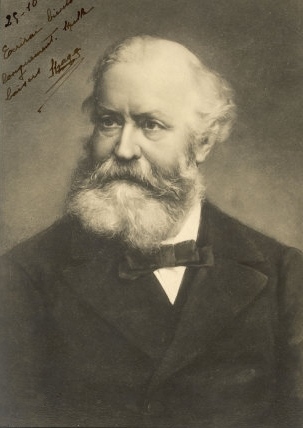 Charles Gounod.