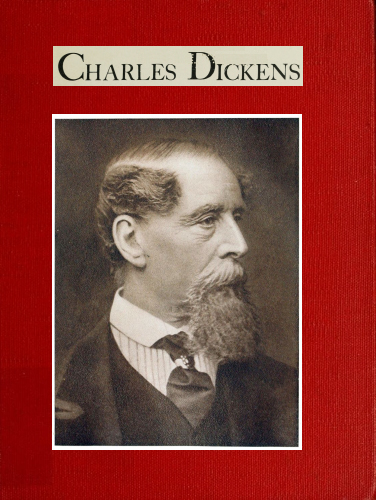
THE asseveration that “Dickens” is “a name to conjure with” seems almost
a truism. The innumerable editions of his works so constantly pouring
from the press abundantly testify to the continued and unabated
popularity of the most famous writer of fiction of the Victorian epoch.
As regards the circumstances appertaining to his career the start in
life under harassing conditions, the brilliant success attending his
initial efforts in authorship, the manner in which he took the world by
storm and retained his grip of the public by the sheer force of
genius—there is, I venture to believe, no parallel in the history of
literature. Born in a humble station of life, his early years spent in
the midst of an uncongenial (not to say demoralising) environment, his
natural gifts, combined with almost superhuman powers of perseverance,
enabled him to overcome obstacles which would have deterred ordinary
men, with the result that he rapidly attained the topmost rung of the
ladder of fame, and remained there.
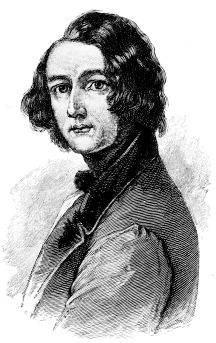
CHARLES DICKENS IN 1844
From a Miniature by Miss Margaret Gillies exhibited in the Royal
Academy, 1844. Engraved on wood by R. Taylor for “The Magazine of
Art”
(Reproduced from The Magazine of Art, by kind permission of Messrs.
Cassell & Co., Ltd.)
Although the leading incidents in the life of Charles Dickens are
generally familiar, thanks to the various biographies of him published
from time to time, a few facts, briefly stated, will not, I hope, be
devoid of interest. The novelist first saw the light at No. 387,
Commercial Road, Mile End, Landport, in the Island of Portsea. Like
David Copperfield, he was born on a Friday, the natal day being February
7th, 1812. The baptismal register of Portsea Parish Church (St. Mary’s,
Kingston), where he was christened, records that three names were
bestowed upon him, Charles John Huffam, the second being that of his
father, and the third the cognomen of his godfather, Christopher Huffam,
a “Rigger to his Majesty’s Navy,” who lived at Limehouse Hole, on the
north bank of the Thames. The birthplace in Landport—still existing is
an unpretentious tenement of two storeys, surmounted by a dormer window,
and fronted by a small railed-in garden. John Dickens, the father of
Charles, had filled a clerical
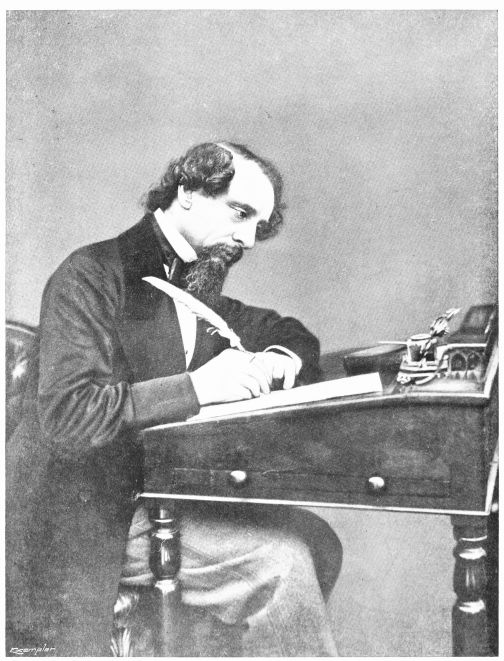
From a photo by Fradelle & Young
CHARLES DICKENS AT WORK
position in the Navy Pay Office, Somerset House, whence he was
transferred to a similar post at Portsea. About four years after the
birth of Charles (the second child), the Dickens family removed to
Chatham, residing there until the boy was eleven years old. It was at
Chatham where he first went to school, and where he, being endowed with
exceptional powers of observation, imbibed his earliest impressions of
humanity, to be subsequently made available as material for his
inimitable sketches.
London, however, was again to be the home of John Dickens—the mighty
metropolis which, with its phantasmagoria of life in its every aspect,
its human comedies and tragedies, ever attracted the great writer, whose
magic pen revelled in the delineation of them. It was in 1823 that the
Dickens family took up their residence in Bayham Street, Camden
Town—then the poorest part of the London suburbs. There had come a
crisis in the affairs of the elder Dickens which necessitated the
strictest economy, and the house in Bayham Street (which may still be
seen at No. 141) was nothing but “a mean tenement, with a wretched
little back garden abutting on a squalid court.” This was the beginning
of a sad and bitter experience in the life of Charles Dickens. Here he
seemed to fall into a solitary condition, apart from all other boys of
his own age, and, recalling the circumstances in after years, he
observed to Forster: “As I thought, in the little back-garret in Bayham
Street, of all I had lost in losing Chatham, what would I have given, if
I had had anything to give, to have been sent back to any other school,
to have been taught something anywhere?” Not only did the exceptionally
intelligent lad miss the pleasures of association with his schoolfellows
and playmates at Chatham, but he no longer had recourse to the famous
books whose acquaintance he had made there.—“Don Quixote,” “Robinson
Crusoe,” “The Arabian Nights,” et hoc genus omne—which, as admirers
of his works will remember, he was so fond of quoting. The account given
by Forster of the Bayham Street days is painful reading, and we are
told that, thus living under circumstances of a hopeless and struggling
poverty, the extreme sensitiveness of the boy caused him to experience
acute mental suffering.
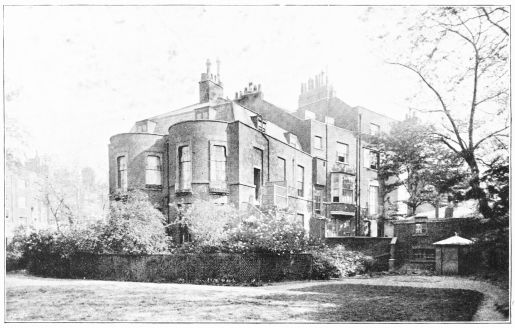
From a photo by Ellis & Wallery
No. 1. DEVONSHIRE TERRACE
Dickens’s residence from 1839 to 1850, where much of his best work was
done
(Reproduced from The Windsor Magazine by kind permission of the
Editor)
After a short residence in Bayham Street, the family removed their
belongings to Gower Street North (the identical house was demolished a
few years ago), and an effort was made to bring grist to the mill by an
attempt on the part of Mrs. Dickens to start a school for young ladies;
but the venture proved abortive, notwithstanding the fact that Charles
did his utmost to aid the project by leaving “at a great many doors, a
great many circulars,” calling attention to the advantages of the
establishment. John Dickens’s financial difficulties increased,
tradesmen became pertinacious in their claims for a settlement of
long-standing debts, which could not be met, until at last the father
was arrested, and lodged in a debtors prison—events
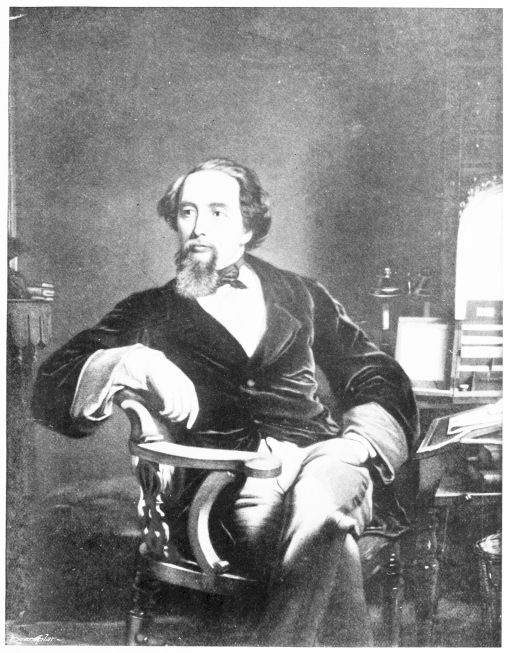
After the painting by W. P. Frith, A.R.A., in the Forster
Collection at the South Kensington Museum
CHARLES DICKENS IN 1859
Rischgitz Collection
which the novelist afterwards vividly recalled, and which will be found
duly set forth in “David Copperfield.”
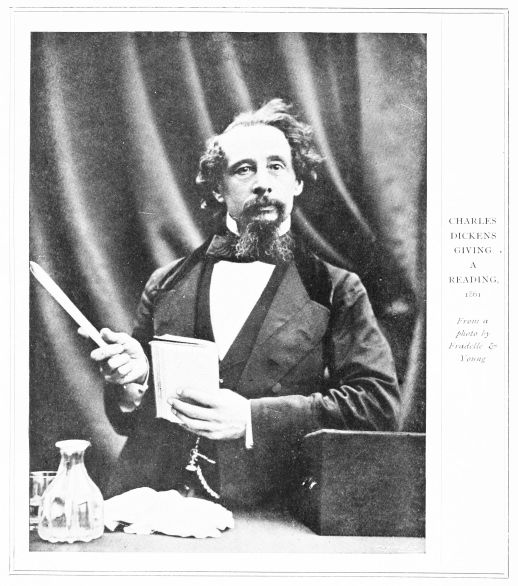
CHARLES DICKENS GIVING A READING, 1861
From a photo by Fradelle & Young
It was at this awkward juncture that some relatives of the family, named
Lamert, realising that an opportunity should be given to the poor
neglected lad of earning a livelihood, found him an occupation in their
blacking-manufactory (started in opposition to the famous Warren), and
here he earned a few shillings a week by covering and labelling pots of
paste blacking! While infinitely preferable to a state of enforced
idleness under demoralising conditions, the boy’s experience during what
is usually referred to as “the blacking-bottle period” for ever remained
a terrible nightmare, and the novelist pointedly referred to that
unhappy time when in “David Copperfield” he observed that no one could
express “the secret agony” of his soul as he sank into the companionship
of those by whom he was then surrounded, and felt his “early hopes of
growing up to be a learned and distinguished man” crushed in his breast.
In respect of a miserable and neglected boyhood, Alphonse Daudet
suffered as did Charles Dickens, and, phœnix-like, both emerged
triumphantly from the ashes of what to them appeared to be a cruel
conflagration of their desires and aspirations.
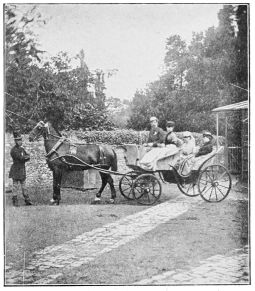
CHARLES DICKENS DRIVING WITH MEMBERS OF HIS FAMILY
Reproduced from The Favourite Magazine, by kind permission of Messrs.
Paul Naumann, Ltd.
There is no doubt that the ordeal of poverty, with its unhappy
accompaniments, had counteracting advantages in the case of Charles
Dickens: his natural abilities were sharpened, as well as his powers of
observation, his excellent memory enabling him in after years to record
those actualities of life which render his books a perpetual joy and
delight. Fortunately, brighter days were in store. The elder Dickens (in
whom it is easy to detect glimpses of Mr. Micawber) was in a position
to send Charles to a reputable school in the Hampstead Road, known as
Wellington House Academy (still standing), where he remained two years,
and on leaving it he entered another scholastic establishment near
Brunswick Square, there completing his studies, rudimentary at the best.
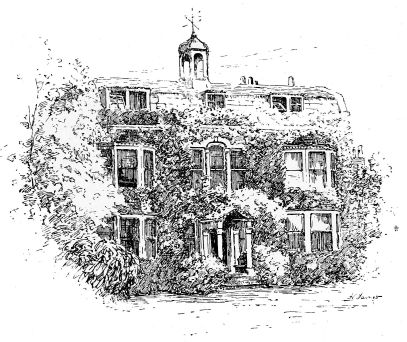
GAD’S HILL PLACE, NEAR ROCHESTER, KENT.
The last residence of Charles Dickens
(From “Rambles in Dickens-Land,” by R. Allbut. Reproduced by kind
permission of Messrs. S. T. Freemantle & Co.)
The year 1827 proved a memorable one for the subject of this sketch, for
then it was that he, in his fifteenth year, “began life,” first as a
clerk in a lawyer’s office in Lincoln’s Inn, and then acting in a
similar capacity for a firm of attorneys in Gray’s Inn, where his weekly
salary amounted to something under a sovereign. As was his wont, he made
mental memoranda of his environment, noting the manners, customs, and
peculiarities of lawyers, their clerks and clients, for the result of
which one needs only to turn to the pages of the immortal “Pickwick.”
His father, who had left the Navy Pay Office, turned his attention to
journalism, and at this time had become a newspaper parliamentary
reporter. Charles, craving for a similar occupation, in which he
believed there might be an opening for greater things, resolutely
determined to study shorthand, and became an assiduous attendant at the
British Museum. His persevering struggle with the mysteries of
stenography was recalled when recording David Copperfield’s
experience—a struggle resulting in ultimate victory. Following in his
father’s footsteps, he, at the age of nineteen, succeeded in obtaining
an appointment as a reporter in the Press Gallery at the House of
Commons, where he was presently acknowledged to be the most skilful
shorthand writer among the many so engaged there.
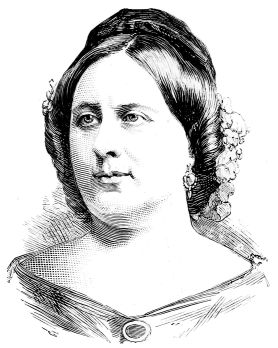
From a photo by C. Watkins
MRS. CHARLES DICKENS
The Novelist’s widow died in 1879
Dickens had just attained his majority when, in 1833, he essayed to
venture into the realm of fiction. He has himself related how, one
evening at twilight, he stealthily entered “a dark court” in Fleet
Street (it was Johnson’s Court), and with fear and trembling dropped
into “a dark letter-box” the manuscript of his first paper—a humorous
sketch entitled “A Dinner at Poplar Walk” (afterwards called “Mr. Minns
and his Cousin”); and how, when it “appeared in all the glory of print,”
he walked down to Westminster Hall, and turned into it for half an hour,
because (he explains) his eyes “were so dimmed with joy and pride, that
they could not bear the street, and were not fit to be seen there.” To
this initial effort (which was published in the old Monthly Magazine,
December, 1833) there is a slight reference in the forty-second chapter
of “David Copperfield,” where the youthful hero intimates that he
“wrote a little something, in secret, and sent it to a magazine, and it
was published in the magazine.” His journeys across country by coach or
postchaise, when reporting for his newspaper (the Morning Chronicle),
proved invaluable from a literary standpoint, inasmuch as those
expeditions by day and night and in all seasons afforded him special
opportunities of studying human idiosyncrasies, as he necessarily came
into contact with “all sorts and conditions of men.”
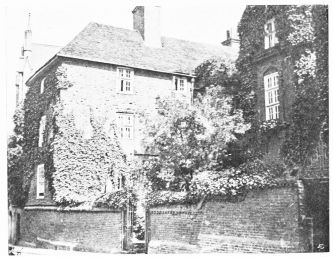
From a photo by Walter Dexter
RESTORATION HOUSE (THE “SATIS HOUSE” OF “GREAT EXPECTATIONS”)
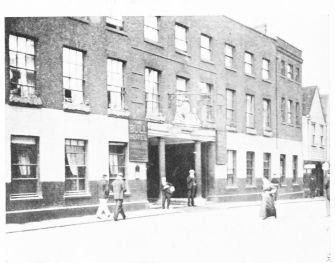
From a photo by Walter Dexter
THE BULL HOTEL, ROCHESTER
“Good house—nice beds....” Vide “Pickwick”
The success of his little paper in the Monthly Magazine induced him to
try his hand at others, for gratuitous publication in the same journal.
They bore no signature until the sixth sketch appeared, when he adopted
the curious pseudonym of “Boz”: this had for some time previously been
to him
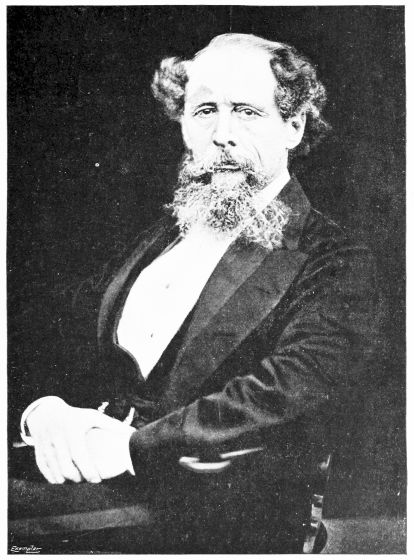
From a photo by Mason & Co.
A PORTRAIT OF CHARLES DICKENS AT ABOUT THE AGE OF 50
Rischgitz Collection
a familiar household word, as it was the nickname of his youngest
brother, Augustus, whom (in honour of “The Vicar of Wakefield,” one of
his favourite books) he had dubbed Moses, which, being facetiously
pronounced through the nose, became Boses, and being shortened became
Boz.
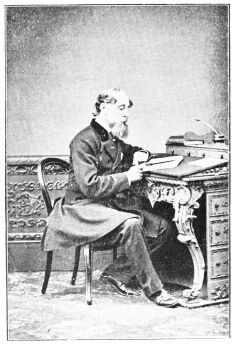
CHARLES DICKENS, circa 1864
(Reproduced from The Favourite Magazine, by kind permission of Messrs.
Paul Naumann, Ltd.)
The time had now arrived when he considered himself justified in
endeavouring to increase his stipend as a reporter for the Morning
Chronicle by offering to contribute to its pages a similar series of
sketches, for which he should be remunerated, and the proposal was
acceded to. Accordingly we find several papers signed “Boz” in the
Evening Chronicle, an offshoot of the Morning Chronicle. Some of his
sketches of “Scenes and Characters” (signed “Tibbs”) appeared
simultaneously in Bell’s Life in London, and a couple also in “The
Library of Fiction,” edited by Charles Whitehead. Early in 1836 Dickens
collected together a number of these bright little articles and stories,
and sold the copyright for £100 to Macrone, who published them in two
volumes under the title of “Sketches by Boz.”
Although remarkable for their humour and originality, the “Boz” sketches
were presently to be eclipsed by a work which immediately took the world
by storm, and upon which the reputation of Dickens securely rests. I
allude to the ever fascinating “Pickwick Papers,” and perhaps the most
extraordinary circumstance in connection therewith is the fact that the
author was then only three-and-twenty.
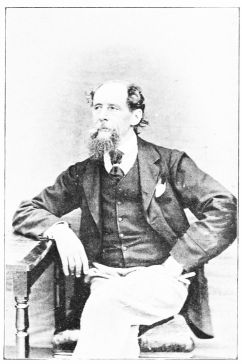
CHARLES DICKENS, circa 1864
(Reproduced from The Favourite Magazine, by kind permission of Messrs.
Paul Naumann, Ltd.)
his book rapidly achieving a degree of popularity which we cannot but
regard as astounding even in these days of large editions. The “Pickwick
Papers” originated in this way. The junior partner of what was then a
young publishing house, Messrs. Chapman & Hall (now a leading London
firm), called upon the rising author at his rooms in Furnival’s Inn with
a proposition that he should furnish the letterpress for a “monthly
something” that should be a vehicle for certain sporting-plates by a
humorous draughtsman named Seymour. The first idea of a sort of Nimrod
Club did not appeal to Dickens, for the excellent reason that he was no
sportsman, and it was therefore eventually decided that, having agreed
to supply the text, he should exercise a free hand, allowing the
illustrations to arise naturally from the text. To give a complete
history of the “Pickwick Papers” would occupy considerable space.
Suffice it to say that the book was issued in shilling monthly parts
(1836-37), then a favourite method of publishing novels, and
consistently adopted by Dickens; that it was illustrated by means of
etchings; that the sale of the first few numbers was so small that both
publishers and author were in despair; and that the success of the work
was assured as soon as Sam Weller made his first bow to the public—a
character which, by reason of its freshness and originality, called
forth such admiration that the sale of ensuing numbers increased until
a circulation of forty thousand copies was attained! The creation of
Sam Weller, therefore, was the turning-point in Dickens’s fortune, and
so great became the popularity of the book that the name of “Pickwick”
was bestowed by enterprising tradesmen upon their newest goods, while
portraits of Dickens himself were in the ascendant. People of every
degree, young and old, revelled in the pages of the “Pickwick
Papers”—judges on the bench as well as boys in the street; and we are
reminded of Carlyle’s anecdote of a solemn clergyman who, as he left the
room of a sick person to whom he had been administering ghostly
consolation, heard the invalid ejaculate, “Well, thank God, ‘Pickwick’
[the monthly number] will be out in ten days, anyway!”
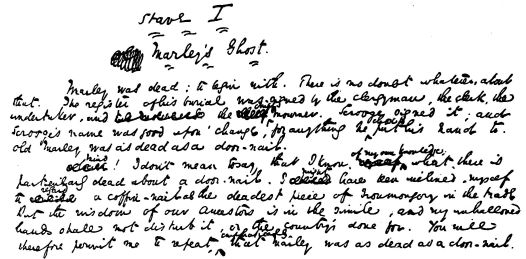
A PORTION OF DICKENS’S MS. TAKEN FROM “THE CHRISTMAS
CAROL”
The identity of the author of “Pickwick,” by-the-bye, was not disclosed
until that work was nearly completed. It had given rise to much
conjecture until the name of the young writer was at length revealed,
when the following “Impromptu” appeared in Bentley’s Miscellany:
Who the dickens “Boz” could be
Puzzled many a learned elf,
Till time revealed the mystery,
And “Boz” appeared as Dickens’ self.
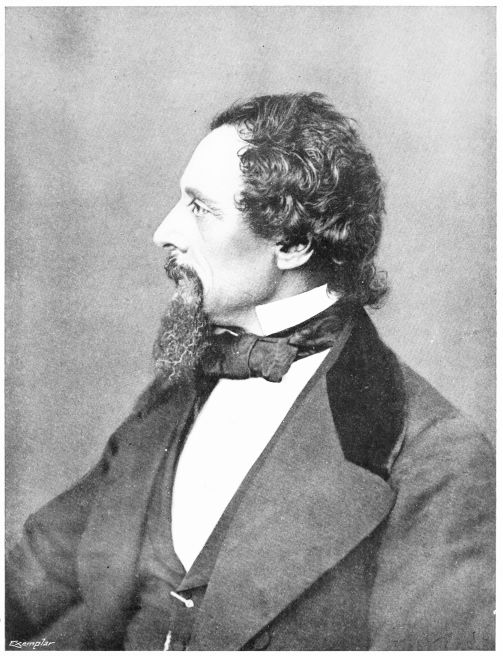
From a photo by Fradelle & Young
CHARLES DICKENS
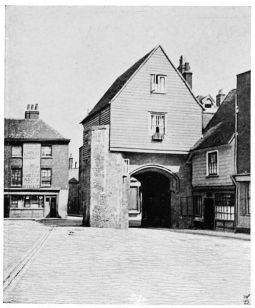
From a photo by Walter Dexter
THE GATEHOUSE, ROCHESTER
Where Jasper lived with the Verger Tope (“Edwin Drood”)
As soon as the first number of the “Pickwick Papers” was launched (that
is, in April, 1836), its author took unto himself a wife, the bride
being Miss Catherine Thomson Hogarth, eldest daughter of Mr. George
Hogarth, his fellow-worker on the Morning Chronicle. By her he had
several children, and among those surviving are Mrs. Kate Perugini, a
clever painter, and Mr. Henry Fielding Dickens, the eminent K.C. Mrs.
Dickens survived her husband nine years and five months.
Before the last of the twenty numbers of “Pickwick “ was launched, the
author became a public favourite. Certain sage prophets foretold that as
“Boz” had risen like a rocket, he would of a surety fall like the stick.
But, as events proved, they were wrong, for Dickens not only became the
most popular novelist of the ’thirties and ’forties, but, by the sheer
strength of his genius, maintained that supremacy. Story after story
flowed from his pen, each characterised by originality of conception,
each instinct with a love of humanity in its humblest form, each
noteworthy for its humour and its pathos, and nearly every one “a novel
with a purpose,” having in view the exposure of some great social evil
and its ultimate suppression.
Following “Pickwick” came “Oliver Twist,” attacking the Poor Laws and
“Bumbledom”; “Nicholas Nickleby,” marking down the cheap
boarding-schools of Yorkshire; “The Old Curiosity Shop” and “Barnaby
Rudge”; “Martin Chuzzlewit”; “Dombey & Son”; “David Copperfield”;
“Bleak House,” holding up to ridicule and contempt the abuse of Chancery
practice; “Little Dorrit”; “A Tale of Two Cities”; “Great Expectations”;
“Our Mutual Friend”; and, finally, the unfinished fragment of “The
Mystery of Edwin Drood,” to which Longfellow referred as “certainly one
of his most beautiful works, if not the most beautiful of all.”
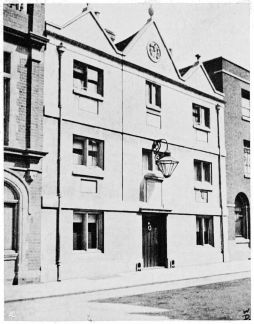
From a photo by Walter Dexter
THE HOUSE OF THE SIX POOR TRAVELLERS AT ROCHESTER
Of his many minor writings, special mention should be made of the
attractive series of Christmas Books, the first of which, “A Christmas
Carol,” has become almost a text-book; and we know that, by the reading
aloud of this touching little allegory to enthusiastic audiences, Sir
Squire Bancroft has afforded substantial aid to many deserving
charities. Dickens is appropriately termed “the Apostle of Christmas,”
and it is undoubtedly true that his Yuletide stories were the pioneers
of Christmas literature.
Having thus briefly reviewed the literary career of Charles Dickens, it
becomes almost essential to consider him from a personal and social
point of view, in order to thoroughly realise what manner of man he was.
Referring to his personal characteristics, Forster says that to his
friends (and their name was legion) Dickens was “the pleasantest of
companions, with whom they forgot that he had ever written anything, and
felt only the charm which a nature of such capacity for supreme
enjoyment causes every one around it to enjoy. His talk was unaffected
and natural, never bookish in the smallest degree. He was quite up to
the average of well-read men; but as there was no ostentation of it in
his writing, so neither was there in his conversation. This was so
attractive because so keenly observant, and lighted up with so many
touches of humorous fancy; but with every possible thing to give relish
to it, there were not many things to bring away.” He thoroughly endorsed
the axiom that “what is worth doing at all is worth doing well.” He was
most methodical in his habits, and energetic to a degree. “In quick and
varied sympathy, in ready adaptation to every whim and humour, in help
to any mirth or game, he stood for a dozen men.... His versatility made
him unique.”
Concerning the novelist’s personality, the following testimony has
recently been placed on record by Mr. Percy Fitzgerald, a surviving
member of the “Dickens Brigade” of young men who revered him as “the
Master”: “I say advisedly, there was, and never could be, so genial,
amiable, unaffected, and untiring a person in his treatment of friends
and guests. He was always eager to listen rather than to speak—to take
a second or third place; more anxious to hear, rather than to tell, an
amusing story. His very presence was enough, with the bright, radiant
face, the glowing, searching eyes, which had a language of their own,
and the expressive mouth. You could see the gleam of a humorous thought,
first twinkling there, and had a certain foretaste and even
understanding of what was coming; then it spread downwards the mobile
muscles of his cheek began to quiver; then it came lower, to the
expressive mouth, working under shelter of the grizzled moustache; then,
finally, thus prepared for, came the humorous utterance itself!”
Dickens was intensely fond of the Drama, as evidenced not only by the
frequent reference in his writings to theatres and actors, but by the
fact that he himself was an actor of an exceptionally
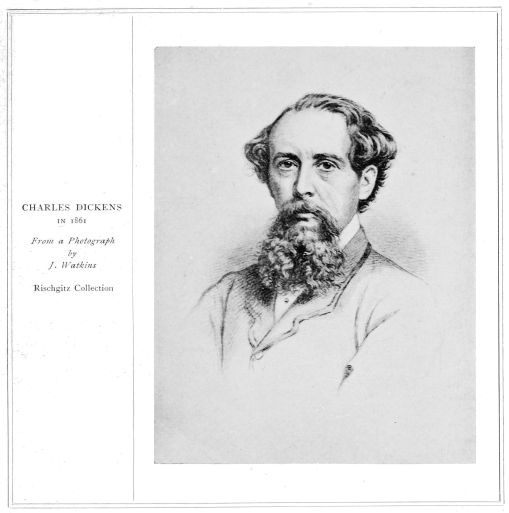
CHARLES DICKENS IN 1861
From a Photograph by J. Watkins
Rischgitz Collection
high order, and it is conceded that had he adopted the stage as a
profession he would have attained first rank. Indeed, it was by the
merest accident that he did not enter the profession, for when he was
about twenty he applied for an engagement to the stage-manager at Covent
Garden Theatre, and an appointment was made, which Dickens failed to
keep on account of a terribly bad cold. After that he never resumed the
idea. In later years he became the leading spirit of a wonderful
company of amateur actors, who, on one occasion, performed before her
late Majesty Queen Victoria, by special request. Sir John Tenniel is now
the sole survivor of that merry confraternity.
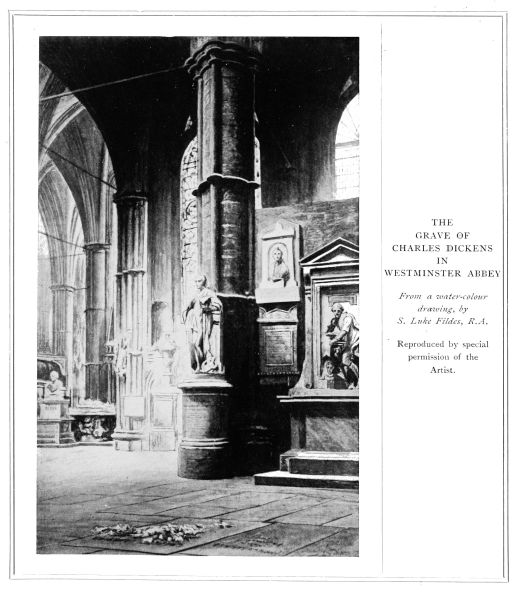
THE GRAVE OF CHARLES DICKENS IN WESTMINSTER ABBEY
From a water-colour drawing, by S. Luke Fildes, R.A.
Reproduced by special permission of the Artist.
As a reader, too, Dickens stood pre-eminent. It has lately transpired
that his very first public reading took place, early in the fifties, at
Chatham, in aid of the Rochester and Chatham Mechanics’ Institution, and
the subject of the reading was the “Christmas Carol.” He gave public
readings from his own works both in Great Britain and America, and an
entertaining account of these tours may be found in Mr. George Dolby’s
volume, “Charles Dickens as I Knew Him.” There can be no doubt that the
mental tension caused by these readings (which covered a period of some
fifteen years), supplemented by the strain of literary and editorial
labours, curtailed the brilliant career of England’s greatest novelist.
It was at his charming rural retreat, Gad’s Hill Place, near Rochester
(his home from 1856), that Charles Dickens breathed his last, on June
9th, 1870, in his fifty-ninth year. “Before the news of his death even
reached the remoter parts of England,” says Forster, “it had been
flashed across Europe; was known in the distant continents of India,
Australia, and America; and not in English-speaking communities only,
but in every country of the civilised earth, had awakened grief and
sympathy. In his own land it was as if a personal bereavement had
befallen everyone.” Although he himself would have preferred to lie in
the small graveyard under the ancient wall of Rochester Castle, or in
the pretty Kentish churchyard of Cobham or Shorne, public sentiment
favoured the suggestion that the mortal remains of Charles Dickens
should be interred in Westminster Abbey; and there, in Poets’ Corner,
they were laid to rest, quietly and unostentatiously. What Carlyle said
of him, a few days later, will meet with universal acceptance:—
“The good, the gentle, high gifted, ever friendly, noble Dickens,—every
inch of him an Honest Man.”
F. G. Kitton.