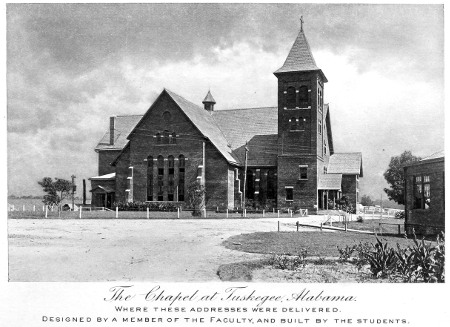
I hope that you all paid strict attention to what Mr. William H.
Baldwin, Jr., who recently spoke to you, had to say. In the few words
that he spoke, I think he told you the platform upon which this
institution has been built. You will remember that he laid a great deal
of stress upon the importance of the institution remaining simple, of
keeping that degree of simplicity and thoroughness that it has always
possessed.
It is true that in the last few months the institution has come into
a great deal of prominence, and is meeting with what the world calls
"success." But we must remember that very often it is with institutions
as it is with individuals—success may injure them more than poverty.
Now, this institution will continue to succeed, will continue to have
the good will and confidence, the co-operation of the best and wisest
and most generous people in the country, just so long as its faculty,
its students, and all connected with it, remain simple, earnest and
thorough. Just as soon as in any department there are indications
that we are beginning to become what the world calls "stuck up,"
just so soon will the people lose confidence in us, and will fail to
support us, and just so soon will the institution begin to decay. We
will grow in buildings, in industries, in apparatus, in the number of
teachers and of students, and in the confidence of the people, just
in proportion as we do what the institution has set out to do; that
is, teach young men and women how to live simple, plain and honourable
lives by learning how to do something uncommonly well.
When I speak of humbleness and simplicity, I do not mean that it is
necessary for us to lose sight of what the world calls manhood and
womanhood; that it is necessary to be cringing and unmanly; but you
will find, in the long run, that the people who have the greatest
influence in the world are the humble and simple ones.
Now, we must not only remain humble, but we must be very sure that
whatever is done in every department of the school is thoroughly done.
Any institution runs a great risk when it begins to grow—to grow
larger in numbers or larger in any respect. It can succeed then only
in proportion as those who have responsibilities are conscientious in
the highest degree. We can succeed in putting up good buildings only in
proportion as every one performs well his part in the erection of each
building. We can succeed only in proportion as the student who makes
the mortar, who lays the bricks, puts his whole conscience into that
work, and does it just as thoroughly as it is possible for him to do
it. If he is mixing mortar, he must do it just as well as he can, and
then, to-morrow, must do it still better than he did it to-day, and the
next week better than he did it this week. The student who lays the
bricks must learn to lay each brick as well as it is possible for him
to lay it, and then do still better work on the morrow.
We must remember, too, that we have a certain amount of responsibility
to care for our buildings, and that a great deal of interest should
be taken not only in putting up all our buildings thoroughly, but in
looking out for their preservation as well. We must see to it that the
buildings which the students have worked so hard to erect, and which
generous friends have so kindly enabled us to secure, are not marred in
any way. You must make new students know that this property is yours,
and that every building here is yours. No student has any right to mar
in any way what you have worked so hard to erect, and your friends have
been generous enough to provide. If you find a student drawing a lead
pencil across a piece of plastering which you have put on, you must
let that student know that he is destroying what you have worked hard
to create, and that when he destroys that building he is destroying
something which students yet to come should have the opportunity of
enjoying.
We want to be sure that in every industry, in every department of the
institution, there is simplicity, humbleness, thoroughness. Whatever
is intrusted to you to do in the industrial departments, in the class
rooms, be sure that you put your whole heart into that thing.
We do not expect to have fine, costly buildings, nor do we want to
have them. But we do expect to have well-constructed buildings, and
attractive buildings; and, if we can go on in this simple, humble way,
the time will come when we shall have all the buildings we need. Just
in proportion as our friends see that we are worthy of these good
things, they will come to us.
We want to be sure, also, that in no department is there any
wastefulness. We must try to make every dollar go as far as possible.
"We must stretch a dollar," as I have heard Mr. Baldwin say, "until
it can be stretched no further." Now, there will be waste unless we
put our conscience into everything that we do. There will be waste in
the boarding department, in the academic department, in the industrial
department, in the religious department, in all the departments about
us, unless we put our conscience into everything that we do. Let us be
sure that not a single dollar that is given to us is wasted, because
the same people who give to us are called upon almost every day in the
week, each year, to give for hundreds of purposes, and they have to
choose which they will support. They must decide whether they want to
give to this cause, or to that cause, and they will give to us if we
make them feel that we are more worthy than other similar institutions.
We want, also, to be sure that we remain simple in our dress and in all
our outward appearance. I do not like to see a young man who is poor,
and whose tuition is being paid by some one, and who has no books,
sometimes has no socks, sometimes has no decent shoes, wearing a white,
stiff, shining collar which he has sent away to be laundered. I do not
like to ask people to give money for such a young man as that. It is
much better for a young man to learn to launder his collars himself,
than to pretend to the world that he is what he is not. When you send a
collar to the city laundry, it indicates that you have a bank account;
it indicates that you have money ahead, and can afford that luxury. Now
I do not believe that you can afford it; and that kind of pretence and
that kind of acting do not pay.
Get right down to business, and, as I have said, if we cannot do up
your collars well enough here to suit you, why, get some soap and
water, and starch, and an iron, and learn to launder your own collars,
and keep on laundering them until you can do them better than anybody
else.
I am not trying to discourage you about wearing nice collars. I like
to see every collar shine. I like to see every collar as bright as
possible. I like to see you wear good, attractive collars. I do not,
however, want you to get the idea that collars make the man. You quite
often see fine cuffs and collars, when there is no real man there. You
want to be sure to get the man first. Be sure that the man is there,
and if he is, the collars and the cuffs will come in due time. If there
is no man there, we may put on all the collars and cuffs we can get,
and we shall find that they will not make the man.
When you have finished school, after you have gone out and established
yourselves in some kind of business, after you have learned to save
money, and have got a good bank account ahead, if you are where the
laundering is not sufficiently well done to suit you, why perhaps you
can afford to send your collars forty or fifty miles away. But as I
see you young men, I do not believe you can afford it. And if you can
afford it, why, I should like to have you pay that money for a part of
your tuition, which we now have to get some one else to pay for you.
You want to be very sure, too, that as you go out into the world,
you go out not ashamed to work; not ashamed to put in practice what
you have learned here. As I come in contact with our graduates, I am
very glad to be able to say that in almost no instance have I found a
student who has been at Tuskegee long enough to learn the ways of the
institution, or a graduate who has been ashamed to use his hands. Now
that reputation we want to keep up. We want to be sure that such a
reputation as this follows every student who goes out.
And then be very sure that you are simple in your words and your
language. Write your letters in the simplest and plainest manner
possible. Who of you did not understand what was said by Mr. John D.
Rockefeller, Jr., when he spoke from this platform a few evenings ago?
Was there a single word, or a single reference, or figure of speech,
that he used that you did not understand the full force of, or did not
appreciate? Here is a man whose father is perhaps the richest man in
the world, and yet there was no "tomfoolery" about his speech. Every
word was simple and plain, and everybody could understand everything
that he said. He used no Latin or Greek quotations.
Some people get the idea that if they can get a little education, and
a little money ahead, and can talk so that no one can understand them,
they are educated. That is a great mistake, because nobody understands
them, and they do not understand themselves. Now, the world has no
sympathy with that kind of thing. If you have anything to write, write
it in the plainest manner possible. Use just as few words as possible,
and as simple words as possible. If you can get a word with one
syllable that will express your meaning, use it in preference to one
of two syllables. If you can not get a suitable word of one syllable,
try to get one of two syllables instead of three or four. At any rate
make your words just as short as possible, and your sentences as short
and simple as you can make them. There is great power in simplicity,
simplicity of speech, simplicity of life in every form. The world has
no patience with people who are superficial, who are trying to show
off, who are trying to be what the world knows they are not.
You know you sometimes get frightened and discouraged about the laws
that some of the States are inclined to pass, and that some of them
are passing, but there is no State, there is no municipality, there is
no power on earth, that can neutralize the influence of a high, pure,
simple and useful life. Every individual who learns to live such a life
will find an opportunity to make his influence felt.
No one can in any way permanently hold back a race of people who are
getting those elements of strength which the world recognizes, which
the world has always recognized, and which it always will recognize,
as indicating the highest type of manhood and womanhood. There is
nothing, then, to be discouraged about. We are going forward, and we
shall keep going forward if we do not let these difficulties which
sometimes occur discourage us. You will find that every man and every
woman who is worthy to be respected and praised and recognized will be
respected and praised and recognized.