Introduction.
The history of the Seven Wise Masters forms an important epoch in
the history of European popular stories, because it affords the most
remarkable evidence of the literary descent and origin of stories,
as distinct from a traditional descent. Professor Comparetti in
his Researches respecting the Book of Sindibad, published by the
Folk-Lore Society, Mr. Clouston in his Bakhtyar Nama and in his
Book of Sindibad, two privately printed books, and Mr. Wright in his
Sevyn Sages, printed by the Percy Society in 1846, have practically
exhausted the literary history of this famous collection of stories.
Shortly summarised from these three sources the main facts are these.
There was an ancient original Indian book of stories which became so
popular that it was copied frequently, and thus handed down from one
generation to another. From this book two separate groups of texts have
descended. To the first belong all the texts in the Eastern languages;
to the other belong the Dolopathos, the Historia Septem Sapientum,
the Erasto, and other numerous texts of the various European
literatures of the Middle Ages. With the Eastern group of texts we have
now
nothing to do beyond saying that Professor Comparetti has restored, in
the scholarly book above mentioned, the form of the original text for
the guidance of the modern student. The Western group of texts has a
history of its own quite apart from its Eastern origin. It has kept the
original framework, but it has varied the setting; and this variation
will be found of great interest to the student of popular tradition.
Before, however, we come to this part of the subject, let us see the
kind of work with which we are dealing. The framework of the romance is
as follows: A young prince, falsely accused by the wife of the king,
his father, of having attempted to offer her violence, is defended
by seven sages, who relate a series of stories to show the deceits
of women, the queen at the same time urging the death of the accused
prince by the example of stories told by herself. This system of
story-telling is practically the same as that adopted in the Arabian
Nights. Boccaccio adopted this plan in his Decameron; Chaucer
adopted it in his Canterbury Tales.
Among the Eastern texts is a famous one in Hebrew, dating as far
back as the first half of the thirteenth century. Under the title of
Historia Septem Sapientum Romæ, a Latin translation of this was made
by Dam Jehans, a monk of the abbey of Haute Selve, in the diocese of
Nancy, in the thirteenth century. The earliest printed copy of this
version that I have been able to find is one printed at Cologne in
1490, of which I shall say something a little further on.
It was through this Latin version that the work was communicated to
nearly all the languages of Western Europe; and in 1520 a translation
into English was printed by the famous printer Wynkyn de Worde. A fine
copy of this is preserved in the British Museum, and from it is printed
the text of the present version. One or two pages are missing from
this copy, and the passages are restored from the earliest chap-book
version which I have been able to discover—namely, that printed
in 1671 at London, and belonging to the British Museum. This chap-book
version is nearly identical with the Wynkyn de Worde, with the simple
alteration of the spelling to the modern forms. One curious variation,
however, illustrating the force of the change of religious opinions
at the time of the Reformation, is well worth noting. On page 173
of our text will be found related how the murdered children of the
Emperor Lodwyke were found alive singing "of ye moost
blessed vyrgyne Mary, aue Maria gracia plena dn̄s tecum," but
in the chap-book of 1671 it is said they were singing praises to the
Almighty.
Since 1671 many chap-book versions have been issued, and I have
succeeded in obtaining a copy still published in Dublin. These later
versions are all much deteriorated from the original. Besides the 1671
edition, there are the following: London 1684, 1687, and 1697; Glasgow
1713; London [1750]; Newcastle 1750; London 1780—7 [1785]; Boston 1794;
London 1805; Warrington 1815. And I have no
doubt that it has been continually reproduced until the present day.
Besides the closeness of the translation of the prose version of
Wynkyn de Worde, one curious feature to be noted is the series of
illustrations. It is well known that German woodcuts supplied English
books with illustrations,[1]
and this is a good instance of the practice. In the Bibliographer (vol. ii. p. 70)
Mr. W. M. Conway has told the history of the woodcuts of the Lubeck edition of the Seven
Wise Men. It was first printed in April, 1488,
with the name of Claes Leeu, probably a brother of Gerard Leeu. In 1490
appeared another edition printed at Cologne by J. Koelhof de Lubeck,
to whom the blocks must have been lent. He returned them to Leeu with
the exception of one, which was either retained by him or lost on the
journey; and the imperfect set, a new block being made by some other
hand to replace the lost one, was employed in the edition printed by
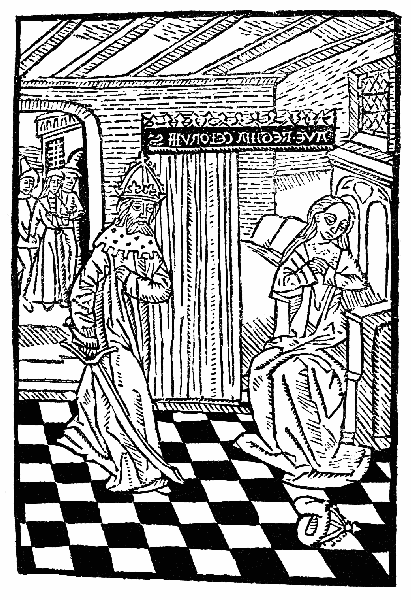
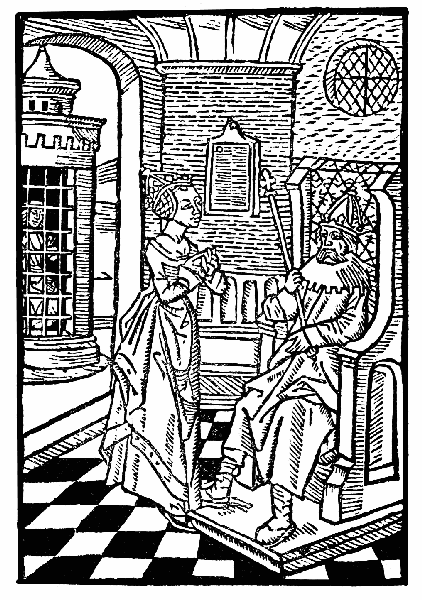
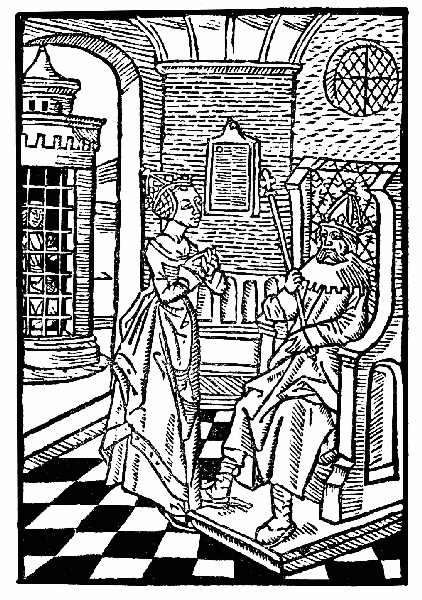
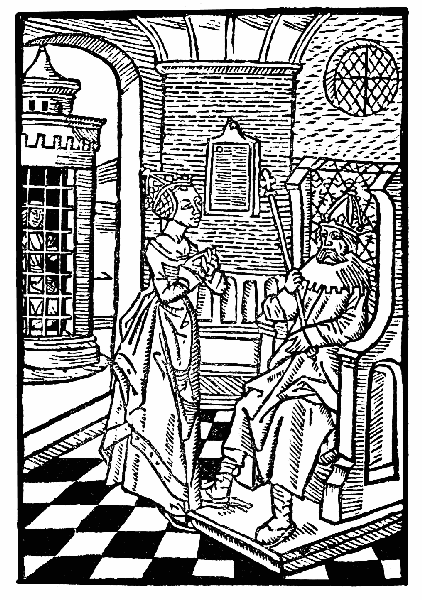
Leeu on the 6th November, 1490. One of the cuts (see p. 21) represents
the Emperor coming angrily into the chamber of his wife with a drawn
sword in his hand and reproaching her with her infidelity. She is
seated on a chair on the right, with her hands clasped in an attitude
rather of shyness than fear or remorse. One reason for this seems to be
discoverable from the fact that along the top of the bed behind, the
words Ave regina cœlorum can be traced carved in reverse; and
it is quite possible that the whole cut, with the
exception of the figure of the Emperor, was copied from some print
representing the Annunciation.
Both these editions, that by J. Koelhof de Lubeck and that printed
by Gerard Leeu on 6th November, 1490, are in the library of the British
Museum, the latter under the title of Historia de Calumnia Novercali.
This book has a preface not contained in the other edition, and it
formed the subject of a communication to the Gentleman's Magazine for
1767, p. 541, in a letter signed T. From this letter it would appear
that later editions were issued. The preface quoted in the letter is
the same as the preface in the British Museum copy, but the words of
the latter are much more contracted than the writer in the Gentleman's
Magazine indicates was the case with his copy. This letter is, I
think, worth reproducing, as it conveys some useful information. It is
as follows:—
"I lately met with a mutilated copy of a book, which to me, at
least, appears a curiosity. It bears for its title, Historia de
Calumnia Novercali: an history now commonly sold at stalls for the
entertainment of English children, under the title of The History of
the Seven Wise Masters; with which last-mentioned book mine agrees as
to the substance and order of the tales, but differs considerably from
it in the form and manner of relating them.
"It is printed in sixteens, in the common Gothic character of the
time (the beginning, as I judge, of the 16th century), an English or
black face approaching to a Roman, on a pica body,
and with many abbreviations, and is ornamented with wooden cuts of
the size of the pages, which, considering their age, are by no means
contemptible.
"The preface runs thus:—
"'Compositâ pridem Calumniæ Novercalis Historia quæ Septem
Sapientum dicitur, pulchro quidem argumento, pulchris etiam ac
memoratu dignis tractata exemplis, in utramq: partem & defensionis
& condemnationis sive vera sive ficta sit, nihil ad te attinere
puto mi Gerarde: magis autem quid doceat adverte, intelligimus ex
ea & qui sint malarum mulierum, & pravorum liberorum, &
zelotyporum itemq: delirorum senum aliarumq: personarum mores atq:
fortunæ variâ ratione, ut quid caveri quidve eligi oporteat agnoscamus.
Cum autam nominum quorundam ratio temporibus satis respondere visa
non esset, & textus nimium fluxus minimeq: cohærens videretur
non indignum judicavi quo tibi morem gererem id postulanti, paululum
mutatis verbis obmissisq: nominibus ne legentem offendant, re ipsa
integra servata, hanc narationem efferre; ne quid inventori laudis aut
inventioni veritatis detractum esse videatur: imposito potius nomine
Calumniæ Novercalis qualis & Phædræ fuit is Hyppolitum; et simili
quoq: genere uxoris Putipharis in Joseph Hebræum; & senum illorum
in Susannam; ut eo nomine historia hæc majorem notitiam gratiamq: apud
lectores sit habitura.'
"From hence it appears that this book is an alteration and
improvement of a more ancient work, intitled Historia Septem
Sapientum, and, as the particulars here said to be altered are
retained unaltered in the English translation, it should seem
that the English history is translated from a performance of a
more early date than this."
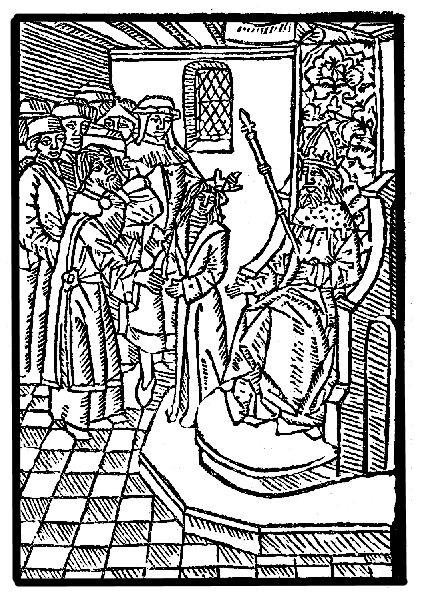
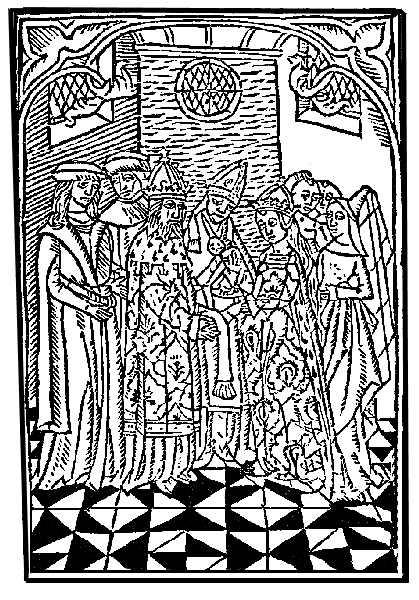
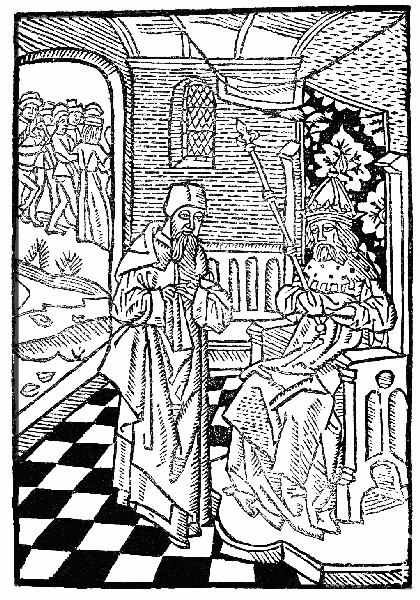
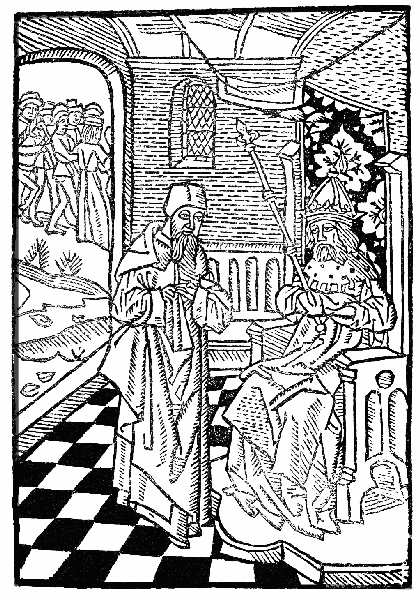
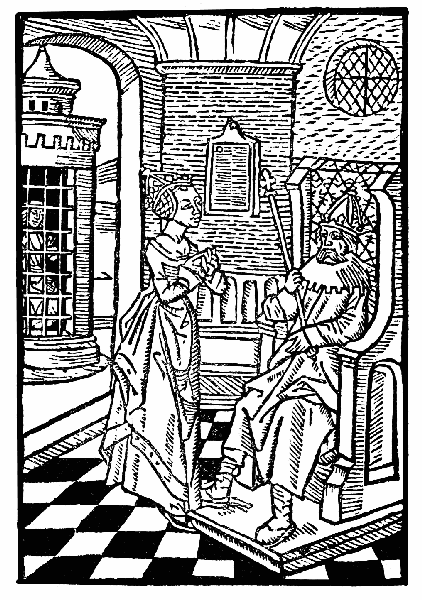
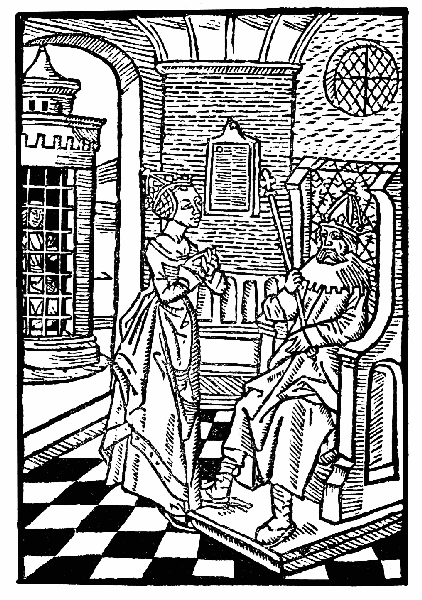
The woodcuts of the Wynkyn de Worde are not identical
with the Cologne edition, but copies, having been decidedly
improved. All these are reproduced in facsimile in the present
edition. Owing to the missing pages, one or two of these
illustrations are not given in the British Museum copy. The
Cologne edition contains a frontispiece plate, one after the first
two as printed on pages 4 and 8 of our text, and two printed
at the end of the book, making four in all, which are not contained
in the British Museum copy of the Wynkyn de Worde.
We will now consider the stories given in this version of the
Seven Wise Masters. Although the framework, as I have
pointed out, is ancient, the setting has been altered. The
stories that suited Eastern fancy did not suit Western; and
accordingly we have a considerable variation. In order to have
the stories clearly before us, the following analysis will be found
useful:—
(1.) The first example of the Empress.—In the garden of a
Roman burgess was a tree famed for its cure of all diseases—the
burgess one day discovered a "fair young imp"—this was
planted and put under the care of the gardener—the young tree
did not flourish—the burgess commanded the branches of the
overshading old tree to be cut down to the ground—the young
tree then did not flourish—the burgess commanded the old tree
to be cut down to the ground—the young tree died.
(2.) The example of the first Master.—A knight had one son—also
a greyhound and a falcon—the knight went to a tourney—a
serpent in the hall attacked the child—the falcon roused
the attention of the greyhound—the greyhound fought the
serpent and killed it—the greyhound, wounded, went and laid
down by the cradle of the child, which became covered with
his blood—the nurses coming in thought the child was killed by
the greyhound—they tell their mistress, who tells the knight—the
knight kills the greyhound—he afterwards discovers his
error and repents.
(3.) The second example of the Empress.—An Emperor had a
forest in which was a boar that destroyed all men going through
the forest—the Emperor proclaimed that whoever should slay
the boar should marry his daughter—a shepherd by stratagem
slew the boar, and married the daughter.
(4.) The example of the second Master.—In a city there was
an ancient knight who had married a young wife—there was a
law or custom in that city that whoever was found in the streets
after the ringing of a certain bell should be put in the pillory—the
wife had a paramour, and every night she went to her lover.
One night the husband woke and missed his wife, and on her
return would not let her in—she went to the well and pretended
to drown herself—the husband came out of the house to help
his wife out of the well—she then ran into the house and
locked the doors, and her husband being found in the streets by
the watch, was taken to prison and on the morrow put in the
pillory.
(5.) The third complaint of the Empress.—There was in
Rome a knight that had two daughters and one son—the
knight, by hunting and tournaments, spent all his substance.
There was an emperor at that time who had a tower full of
gold—the knight and his son agreed to steal some of the gold—the
keeper of the tower put a vessel full of pitch that the
robber might fall in—the second time the knight and his son
went the knight fell into the pitch—the son cut off the father's
head and hid it, that the body should not be recognized—the
daughters of the knight made a great outcry on seeing their
father's body dragged through the streets—the son then wounded
himself, and the officers believed his story that it was on account
of his wound that his sisters made lamentations.
(6.) The example of the third Master.—There was a rich
burgess that had a "pie" which he loved and taught to speak—his
wife had a lover who visited her in the absence of the burgess—the
pie threatened to tell the burgess—the wife imitated rain
and hail and snow on the bird's cage and nearly killed her—when
the burgess returned the pie told him that his wife's
lover had stayed all night with her, and that the hail, rain, and
snow that night had nearly killed him—the master hearing
that the night had been quite fine, killed the bird, thinking it
had told lies—he afterwards found out the truth.
(7.) The fourth example of the Empress.—There were once
seven wise masters who governed Rome under an Emperor,
who by their artifices they made blind whenever he left the
palace—the Emperor, on pain of death, desired the seven wise
masters to cure him—the masters discover a child who shewed
the meaning of dreams—they brought him to the Emperor—the
child discovered in the Emperor's bedchamber a well which
had seven springs—the child commanded the wise masters to
be killed, one at a time, and thrown into the well—the well
and springs vanished.
(8.) The example of the fourth Master.—There was an old
knight who married a young wife—the wife wished to have a
lover, but on the persuasion of her mother tried the knight
three times: 1st, by cutting down a favourite tree—2nd, by
killing a favourite hound—3rd, by destroying everything on the
table at a banquet. The two first the knight forgave, the third
time he brought a barber who opened veins in the wife's arms—the
wife thereupon said she would be content with her husband.
(9.) The fifth example of the Empress.—There reigned in
Rome an Emperor who was covetous and loved gold above all
things.—In the city was a wise master who made a tower, and
in it as many images as there were provinces governed by Rome,
and when there was any rebellion or dispute in these distant
provinces the images rang a bell, and so informed the people.
The kings of these provinces consulted together how best to
defeat Rome. Four knights undertook to get the images
and tower destroyed if they could have four tons of gold—they
took this and went to Rome—and represented themselves as
soothsayers, and pretended to discover by dreams quantities
of gold which they had previously hidden—they obtained permission
of the Emperor to dig under the tower for more gold—undermined
the tower and rode away—the counsellors of the
Emperor put him to death for betraying the image to their
enemies.
(10.) The example of the fifth Master.—There was a famous
physician named Ypocras—he had a nephew named Galienus,
who in time excelled Ypocras—the king of Ungary sent for
Ypocras to cure his son—Ypocras sent Galienus instead—Galienus
on seeing the sick child said to the queen that the
king was not its father, and demanded to know who was—the
queen told him the truth and Galienus cured the child.
Ypocras on hearing from Galienus that he had cured the child
killed him by craft—Ypocras was taken grievously sick, and
his scholars and disciples were unable to heal him—He knew
that for the death of Galienus he was made sick—confessed
from envy he had slain him, and died.
(11.) The sixth example of the Empress.—There was a king
marvellously deformed in his visage so that women hated and
abhorred him—the king desired his steward to bring a fair and
beauteous woman, and promised a large sum of money to the
woman—the steward from covetousness insisted on his own
wife going to the king and thus obtaining the money—the king
found out that the steward had undone his own wife, banished
him on pain of death and kept the wife. The king assembled
a great army to conquer Rome, but by the stratagems of seven
wise masters there was defeated with great slaughter and killed.
(12.) The example of the sixth Master.—There was an
emperor of Rome who had three knights whom he loved above
all others. There was also in the city an ancient knight who
had a fair young wife—this wife would sit at her window looking
into the street and sing. The three knights at different
times passed her window and fell in love with her—they each
offered her a hundred florins—she consented to receive them,
promising to send for them on a suitable opportunity. She told
her husband, and suggested that when the knights came he
should kill them and keep the hundred florins—the husband
consented and killed each of the knights—the wife got her
brother to dispose of the first body, and by telling him the corpse
had come back again, of the other two—the husband afterwards
quarrelled with his wife and struck her—she in revenge told
how he had murdered the three knights—they were both drawn
at a horse's tail and hanged.
(13.) The seventh example of the Empress.—A king loved his
wife above all things and locked her up alwayes in a strong
castle and kept the keys himself. A knight in distant parts
dreamed of a fair queen whose love he would win—the queen
dreamt the same night of the knight—the knight travelled
about till he came to the queen's tower, and knew her for the
lady of his dream.—He entered the king's service—fought
bravely, was made the king's steward, and gained permission of
the king to build a place adjoining the castle—He built a secret
passage to the queen's rooms—gained her love—she gave him a
ring the king had given her—the king saw the ring on the
knight's hand and demanded of the queen the ring he had given
her—she showed it to the king having previously got it back
from the knight—the knight asked the king to be present at a
banquet at which would be his lady love—presented the queen
to the king as a lady of his own country—the king after the
banquet went to the queen's rooms, found her there, and thought
he had been mistaken a second time—the knight asked the
king to be present at his wedding and to give the bride away—the
king gave the queen to the knight and saw them sail away
from the city—went back to the castle and found out how he
had been deceived.
(14.) The example of the seventh Master.—A knight had a
fair young wife whom he tenderly loved—one day she cut her
hand and the sight of her blood killed her husband—she
bewailed his death greatly—would not leave the grave—her
friends made a little house close by where she might stay and
get food. When a trespasser against the law was hanged the
sheriff was obliged to watch all night by the gallows, and if the
body was stolen the sheriff had to lose his land and his life.
It happened soon after that a man was hanged, and the sheriff
watched by the gallows—he saw the little house, asked permission
to enter to warm himself—the sheriff went back to the
gallows and found the body stolen—told the lady, who advised
him, if he would marry her, to take up her dead husband and
hang him on the gallows in place of the thief—when the body
was dug up, the sheriff said he could not hang her husband
up as he was, the thief having lost two front teeth, his ears, and
was otherwise mutilated—the lady mutilated her husband in a
corresponding manner—she reminded the sheriff of his promise
to marry her—he refused, and killed her.
(15.) The example of Dioclesian, the King's son.—A knight
had one son, who was sent away to learn, and returned well
favoured—as they sat at table a nightingale sang—the son
interpreted the song to mean that he should become great and
be waited upon by his father and mother—the knight was
angered, and cast his son into the sea—the son swam to land,
from which he was rescued by a ship—the shipmen sold him
to a duke—the duke took him into favour—the king of the
country (Egypt) summoned his council to tell him why ravens
followed him wherever he went, and promised to give his
daughter to him who would interpret the event—the child, who
went with the duke, interpreted the event, and the ravens left
the country—the king thereupon took the child, Alexander, to
live with him—before marrying his daughter, Alexander asked
leave to visit the court of Titus—leave was granted, and he
went and was much loved—there came also the son of the King
of France, Lodwyke—the two, Lodwyke and Alexander, were
much alike—the emperor had a daughter whom Lodwyke fell
in love with—Alexander used to attend her—she fell in love
with him—he, however, allowed Lodwyke to attend her in his
stead—he assisted Lodwyke in his suit—presented gifts to her
three times on behalf of Lodwyke—finally she consented to
receive Lodwyke—the knights found out the intrigue, and
sought to slay Lodwyke, but Alexander defended his friend—letters
came to tell Alexander of the death of the King of
Egypt—Alexander went to Egypt—Lodwyke at parting gave
him a ring—Guydo, son of the King of Spain, then came to
the court—he found out Lodwyke with the emperor's daughter,
and told the emperor—a day of battle between Lodwyke and
Guydo was appointed—Lodwyke was afraid to meet him, and
by advice of the emperor's daughter got the day of battle
adjourned, and went to Alexander—Alexander was going to be
married to his betrothed—being so like Lodwyke he agreed to
take his place, and Lodwyke was to take Alexander's place at
the wedding, and to put a naked sword between him and
Alexander's wife on the night of their marriage—Alexander
went, as Lodwyke, and defeated and slew Guydo—Lodwyke,
as Alexander, married his betrothed and kept the compact of
putting a sword between them—when Alexander returned his
wife, annoyed at him not loving her the first night, would not
accept his embraces—she grew to love a knight, and by poison
made Alexander a leper—he was driven from Egypt—he
travelled to Lodwyke's court (who had succeeded Titus on the
throne)—he made himself known to Lodwyke—Lodwyke
asked his master to cure his friend—they could not do so—the
only cure was revealed to Alexander in a dream—it was for
Lodwyke to kill his two sons and wash his body with the
blood of them—Lodwyke does this, and his wife afterwards
agrees to it—Alexander is restored—the sons come to life again—Lodwyke
assists Alexander in the recovery of Egypt—after
a time he resolved to see his father and mother—he goes to
them without revealing himself—they wait upon him—he then
reveals himself to them, forgave them, and took them, honoured,
to Egypt.
Of these fifteen stories only three are the same as those
given in the Book of Sindibad, as published by Professor Comparetti—namely,
No. 2, the example of the first Master, which
is told by the fifth Master in the Sindibad version; No. 6, the
example of the third Master, which is told by the first Master
of the Sindibad version; and No. 11, the sixth example of the
Empress, which is told by the fourth Master of the Sindibad
version. No. 3, the second example of the Empress, may
perhaps be a variant of the fifth example of the Empress in the
Sindibad version. The remaining stories then might, prima facie,
be considered of Western origin; and perhaps genuine Folk-Tales
thus early enshrined in literature. No. 4 is to be found
in Peter Alfonsi's Disciplina Clericalis and in the Decameron.
And Mr. Wright, in his Introduction to The Seuyn Sages (Percy
Society), p. liii. says he heard the same story told traditionally
in an English country town of a townsman who had a scolding
unruly wife. No. 5 is a variant of the legend of Rhampsinitus,
king of Egypt, as told by Herodotus; and a similar legend is
given in Pausanias, lib. ix. c. 37. No. 7 contains some of the
incidents of Merlin's story told by the Chroniclers. No. 10,
the example of the fifth Master, is something like Campbell's
"Fearachur Leigh," No. xlvii. of his Highland Stories (vol. ii.
p. 161). No. 13 bears an analogy to the plot of the Miles
Gloriosus of Plautus. Upon the entire question of the occurrence
elsewhere of these stories I would refer to Mr. Clouston's
Book of Sindibad privately printed in 1884.
There are one or two curious words and expressions which
may be of use to the philologist, but the reader will find that the
language used is mainly that of the present day with a different
spelling. Some of the difficulties of this style have been obviated
by the insertion, where necessary, of letters left out in contracted
words, and these insertions are printed in italics to
distinguish them from the original.
The Example of the Second Master.
[In a City was an ancient Knight, which wedded a young wife
and fair, as ye hath done, whom he loved above all earthly
things; the knight was a very circumspect and careful husband
insomuch that every night he locked the door with his own
hands and laid the keys under his Beds-head. In that City was
a law or custom, that at a certain hour in the night, a bell was
used to be rung, that after the ringing of the said bell, if any
man or woman were by the watch-men found about the streets,
all that night they should be kept in prison, and on the morrow
set upon the Pillory, that all people might behold them.
[The said Knight had little lust of fleshly deeds, for he was
very old, and might not satiate or perform the desires and
appetites of his young wife; wherefore every night she having
a Paramour, her Husband sleeping, took the keys from under
his Beds-head, and went to her love; and when she came again,
laid the keys under her husband's head; and thus they played
many a time.
[It happened upon a night that the knight awaked from his
sleep, and missed his wife, and the keys and his Beds-head,
whereupon he rose up and went unto the doors, and found them
open, the which he bolted fast within, and went up again into
his chamber, and looked out of the window towards the street:
and when it was near the third cocks crow, his wife came from
her best beloved, and found the door shut and bolted within:
then was she] sorowfull. neuerthelesse she knocked to haue
come in. Tho spake the knyght out of the wyndowe. O yu
moste euyll ⁊
vnclene wyfe, now I knowe ⁊
am experte that many a tyme ye haue forsaken my bedde
⁊ gone and done
auoutrye. now shall ye stande tyll the bel be rongen and yt the
wakers may take you and doo with you according to the lawe.
The wyfe answered, My lorde wherfore lay ye that to me.
In trouth I shall saye you I was called by my moders mayden
⁊ fetched in the nyght, ⁊
whan I sawe that ye slepte so swetely
I durste not awake you bycause that ye are olde, and therfore
I toke ye keyes ⁊
went to my moder the whyche is sore seke,
that I fere too morowe she must bee anoynted or aneeled notwithstandyng
for that I sholde not you offende or dysplease I
haue hasted me ayen to you ⁊
haue lefte her lyenge in grete payne ⁊
infyrmyte. Therfore I pray you for the loue of god lete me in afore the bel be rongen.
The knyght answered So shall ye not come in, ye muste there
abyde vnto the tyme that the bell be rongen,
⁊
tyll that ye wakers come and take
you. The she sayde that sholde be to you ⁊
to me: to all our
frendes ⁊ kynred a grete shame and rebuke. Therfore atte the
reuerence of almyghty god lete me come in. Than sayd he, Haue in thy
mȳde euil and false wyfe how oftentymes ye haue forsaken my
bedde and doone auoutrye. It is moche better that ye suffer shame and
beewayle for youre synnes here in this worlde, thanne for too suffer
payne in helle. She sayd ayen to hȳ I praye you for the loue of
hȳ yt was crucyfyed ⁊ dyed vpon the crosse haue
mercy vpon me. The knyght answered, ye laboure all in vayn̄ for
ye shall not come in, but ye shall tary the comynge the wakers. As she
herde that, she sayde my lorde ye knowe well that by this dore standyth
a well, yf ye lete me not come in I shall therin drowne my selfe,
rather thanne all my frendes sholde be shamed for me. Then̄e sayd
he, wolde god yt ye had be drowned long afore or ye in my
bedde came. And as they thus spake togyder, ye mone went
down ⁊ was al derke. Tho sayde she, yf it wyll none otherwyse
be I shal drowne miselfe, but yet afore as a trewe crysten woman I
wylle make my testament. Fyrst I bequethe to god ⁊ to oure lady
my soule, my body too be buryed in ye chyrche of saynt
Peter ⁊ of all other thȳges ⁊ goodes yt
god hath sent me, I gyue vnto you to dyspose for my soule after your
wysdome ⁊ dyscrecyon, ⁊ whan she had thus sayd, she went
to the well, ⁊ a grete stone ther beynge wt bothe her
armes she lyfte vp ⁊ sayd, Nowe I drowne myselfe, ⁊ caste
ye stone downe in to the well ⁊ went ayen pryuely and
stode by the dore. The knyghte herynge that noyse cryed wt a
lowde voyce saynge / alas alas
my wyfe is drowned, and hastely came downe and rāne to the well.
And whan she sawe that the dore was open, anone she entred and locked
and made faste ye yate / ⁊ went vp to ye
chamber ⁊ laye ⁊ loked out of ye wyndowe. The
knyghte stode by ye welle ⁊ cryed and wepte bytterly
and sayd, woo be to me I haue now loste my moost beloued wyfe, cursed
be the tyme that I made faste the dore ayenst her. The lady herde that
⁊ sayd, O ye cursed olde grysarde, why stade ye there this tyme
on ye nyght, was not my body to you suffycyent, wherfore
goo ye thus euery nyghte, out to your harlottes ⁊ hores and leue
my bed. As he herde the voyce of his wyfe he was ryght gladde and sayd
Blessed be god that yet she is not drowned. But my good lady wherfore
laye ye suche thynges ayenst me. I thoughte to haue chastysed you,
and therfore I locked the dore. But in no wyse I entended your peryl
/ ye knowe well whatte sorowe I made for you whan I herde you to haue
fallen in the well, ⁊ therfore I came lyghtly to haue holpen
you. Therupon she sayde, falsly ye lye. I neuer dyde suche thinges as
ye laye to me. But it appereth by a comyn prouerbe, he yt
is defectyfe or culpable hymself in a synne, he iugeth euery man to be
in the same, or elles yt fader soughte neuer his sone in
ye ouen: but yf he had ben therin hȳselfe. And therfore
ye put that to me yt ye yourselfe haue oftentymes done
⁊ vsed but one thynge I promys you. ye shall abyde there tyll
ye wakers come, ⁊ that ye bell be rongen
that they may lede you before ye iuges to abyde ⁊
suffer the law. Tho
sayd the knyght, wherfore laye ye suche thynges too me / I
am olde ⁊
all my lyfe dayes I haue ben conuersaunt in this cyte,
⁊
in this was I neuer dyffamed, [et] therfore lete me in that to
me ne to your self ye do no shame. She sayd, ye speke in
vayne, It is better that ye forthynke your sȳnes in this worlde
than in hell. Haue in mynde what the wyse man sayth. A
poore man proude, A ryche man a lyer, An olde man a fole
god hatyth. So ye be a lyer and ryche. what nede was it too
you for too lye vpon me. And ye are a fole, for ye had ye
floure of my youth at your pleasure, and yet ye muste renne to hoores
⁊ harlottes.
And therfore it is a grete grace of god that ye haue tyme and space too
forthynke it, leste that ye sholde perysshe and be dampned for eurmore.
⁊ for yt
suffre your penaunce pacyently. Tho knyght sayd, O my best and well
beloued lady all though it be so, yet is god mercyfull, and he
asketh noo thynge of a synner, but he amende his lyfe and forthynke
and doo penaunce for his synnes. Nowe lete me come
in and I wyll make amendes, She sayde, Whiche deuyll hath
made you so good a prechour, So come ye not in. And as
they thus spake the bell was rongen / ye knyght herynge that
sayd, O my mooste dere lady the bell ryngeth now, suffer me
to come in that I be not ashamed for euer. whiche answered,
ye ryngȳge of the bell pretendeth the helthe of youre soule take
it pacyently in your penaūce. And as this was sayd come ye
wakers yt aboute the cyte went ⁊
founde the knyght standynge
in ye strete ⁊
sayd to hym, O good man it is not gode yt ye
in this houre of ye nyght stande here. And as she herde the
voyce of ye wakers / she sayd, Good felowes venge me on yt
olde cursed horehunter ⁊
rybaude, for ye knowe whose doughter
and what I am. This cursed olde man is wont euery nyght
to leue my bed, ⁊
gothe to his hoores ⁊
harlottes. I haue longe forborne hym and wolde not shewe it ne complayne vpon
hym too my frendes, for I trusted that he wolde haue amēded
his mysrule, ⁊
it helpeth not. And therfore take hym ⁊
punysshe hym after the lawe, yt all suche olde dotardes may
take example by hym. Then ye wakers toke hym and all
nyght chastysed hym in pryson. ⁊
on ye morne they put hym on ye pyllery. Tho sayd to the Emperoure,
Lorde haue ye ynderstonde what I haue sayd
⁊
he sayd ryght well. Tho sayd ye mayster, yf ye put
to dethe your sone by ye excytacyon
of your wyfe, it shall to you worse come than it dyd to ye
knyght. The Emperour sayd she was the worste woman yt
euer I herde of that so falsely her husbande brought to shame
⁊
rebuke. I say to you mayster yt for ye reason of this example,
my sone shall this daye not dye. The mayster sayd to hym,
yf ye do so than do ye wysely. And yt
herafter ye shall ioye, ⁊
I commende you to god / ⁊
thanke you of your pacyent herynge / and of the sparynge of your sone and so he departed.
The Example of the Thyrde Mayster.
There was in a cyte a ryche burgeys that had a pye the
which he loued so moche yt euery day he taught her to speke
latyn ⁊ hebrewe. And whan yt she had lerned perfetly to
speke those two langages / all yt she sawe ⁊ herde, she shewed
⁊ tolde to her mayster. This good man had a fayre yonge
wyfe as ye haue / the whiche he loued moche. but she contrary
loued not hym / bycause he myght not furnysshe her of such
pleasures ⁊ lustes as she desyred to haue. And therfore had she
an other fayre yonge man that she loued aboue her husbōde.
And alwayes as her husbonde was out of the towne about his
marchaundyse ⁊ other besynesses to do, and she sent for her
best beloued yt they myght togyder make good chere. The pye
as she that sawe tolde it to her mayster, at his home comyng,
in such wyse that ye noyse ranne all ouer the cyte of her
aduoutry, wherof her husbōde many tyme brauled ⁊ chydde
her. She answered hȳ, ye beleue your cursed pye, whiche as
longe as she lyueth shall alwayes make betwix us varyaunce ⁊
dyscorde. And he sayd the pye can not lye, for that she seeth
⁊ hereth that she telleth me, and therfore I beleue her more
than you. It fortuned that the good man went in to ferre
coūtrees to do his marchaūdyse, ⁊ as sone as was gone his wyfe
sent for her frende ⁊ loue to solace ⁊ make good chere wt hȳ.
but he durst not come by day lyght. but abode to ye euenynge
leste that he sholde be seen ⁊ marked of ye peple. And as ye
nyght was comen / he knocked at ye gate: ⁊ she was redy ⁊
opened it ⁊ sayd, Go in frely for n̄o man shall see you. ⁊ he
sayd I fere me yt the cursed pye shall accuse vs, for by her is
comen grete sclaundre vpon vs through out all the cyte. Entre
in she sayd boldely and fere not. And as he sholde passe
through ye halle where the pye was in her cage, she herd hym
say thyse wordes. O my moste beloued I fere me gretely of ye
pye that she shal bewraye vs. And as the wyfe herde that she
sayde, Be styll foole. it is derke she may not se you. Then̄e
ye py that herynge sayde, If I se the not I here thy voyce, ⁊
thou doost wrong to my mayster, for yu slepest with my maystresse,
and whan̄e my mayster cometh I shall tell hym. The
yonge man herynge that sayd, Tolde I not you yt the pye
sholde dyscouer vs. And ye wyfe sayd fere not for this nyght
we shall be auenged vpon the pye. And entred in to ye chamber
⁊ slepte togyder that nyght. About mydnyghte the wyfe arose,
⁊ called to her a mayden and sayde / fetche me a ladder ⁊ set
vp too ye rofe of ye house yt I may wreke me on the pye. The
mayde dyde so and they bothe went vp ⁊ made an hole through
the coueryng of ye house ryght ouer the pye / and there thrugh
caste sande clay stones ⁊ water vpon the pye, somoch that the
poore pye was nere dede ⁊ on the morne the yonge man went
erly out at a backe dore. And whan the good man was comen
home as his custume was he went ⁊ vysyted his pye and sayd
to her, O pye my welbeloued byrde / say me howe yu haste
fared the whiles that I haue been out. She sayd, mayster I
shall tel you tydynges that I haue herde. your wyfe as sone as
ye were gone by the nyght tyme she lete a man come in and as
I that herde I tolde hym yt I wolde shewe it to you at your
comynge home / that not withstondynge she lad hym in to
your chamber, ⁊ slepte with hȳ al nyght. ye demaunded me
also howe yt I haue done in your absence. And I saye you of a
trouth that I was neuer so nygh my deth as I was that same
nyght wt snowe hayle ⁊ rayne yt fyll vpon my body, so longe
durȳge that I was almoste left for dede. The wyfe whā she
herde that sayd too her husbonde, Syr ye byleue your pye now
may ye here what she sayth / she cōplaynyth yt in ye same
nyght there fyll so moche snowe hayle ⁊ rayne vpon her yt she
was almost dede, ⁊ yet ther was none of thē al that same nyght,
for ther was not in a yere a fayrer ne a clerer nyght than it
was ⁊ therfore from hensforth byleue her not. Tho went ye
good man to his neyghbours ⁊ demaūded of them yf yt nyght
were ony tempest or rayne. They answered yt some of them
had waked all ye nyght, ⁊ in all yt yere they had not sene a
fayrer nyght. Tho went he to his house ⁊ sayd to his wyfe, I
haue foūden you in ye trouth for ye nyght was fayr ⁊ clere as
I vnderstonde of your neyghbours. ye may now knowe of a
trouth sayd she yt py is a lyer. wt her lesȳges she hath sowen
⁊ made discorde betwix vs, ⁊ ouer that I am diffamed thrugh
ye cite by her fals lesyngs. than ye burgeys went to ye pye ⁊ sayd
wherfore haste yu made lyes ⁊ fals tales betwix me ⁊ my wyfe.
Is this ye thāke that I haue for ye mete that I was wont
to gyue ye wt myn owne hōdes euery day ⁊ haste also therby
my wyfe brought in to grete dyffamacyon thrugh al the towne.
The pye answered, god knoweth yt I can not lye for that I
sawe ⁊ herde yt haue I shewed to you. Than sayd he, yu lyest.
Haste thou not sayd vnto me that in ye same nyghte was hayle
⁊ snowe ⁊ rayne that yu haddest nerehōnde loste thy lyfe whiche
is false. And therfore from hensforth yu shalt make no mo
lesynges ne dyscorde betwix me and my wyfe / ⁊ toke ye pye
and brake her necke. As the wyfe sawe that she was ryght
glad ⁊ sayd now haue ye done well, now maye we all our lyue
dayes lyue in reste ⁊ peas. And whan he had slayne ye pye, he
loked vp ⁊ sawe in the top of ye house a laddre ⁊ a vessel wt
water, sand ⁊ stones. and as he that behelde, he perceyued the
falshede of his wyfe, and cryed with a loude voyce, Woo be too
me that for my wyues wordes I haue my pye slayne and all my
solace and ioye loste. ye why (sic) the in all thynges sayd to me
trouthe. And as he had thus doone anone for sorowe lefte his
marchaundyse and all his house and went to wardes the holy
londe, and neuer retorned ayen towardes his wyfe. Than̄e
the mayster sayd to themperour, Syr haue ye vnderstande what
I haue sayd. he answered ryght well. the mayster sayd, was
not yt a false ⁊ cursed wyfe yt so by her lesynges caused ye pye
for to be slayne. The emperour sayd, In trouthe she was full
of falsenesse. I forthynke gretly the pye, the whiche for her
true saynge lost her lyfe. Verely I say to you yt ye haue tolde
me a fayr example therfore th[i]s day my sone shal not dy.
Tho sayd the master, Syr yf ye do so ye do wysely, ⁊ I thāke
you that ye haue spared your sone, this day for my wyll, and
to god I commende you.

The Fourthe Example of the Empresse.
Somtyme was in the cyte of rome seuen wyse maysters by
whome all ye empyre was gouerned ⁊ ruled. And themperour
that than was dyde no thynge or attempte wtout the counseyll
of them, as they vnderstode that themperour was to them soo
inclyned, yt without theym he sholde ordeyne or doo noo thynge.
in ye meane tyme they made by theyr arte and connȳg yt
themperour sholde clerely se as longe as he was in his palays
but anone as he was out of his palays, he was made blynde / ⁊
that dyde they to the entent yt they myght the more frely
intromytte themself of all thynges that apperteyned to themperour,
by ye whiche they gate ⁊ wanne too theym grete
profyte ⁊ lucre of goodes. ⁊ after that they had made ⁊ wroughte
that experyment, they coude neuer chaunge it ne fordo it,
afterwarde, but themperour abode styl blȳd many yeres. Then
the vii maysters made ⁊ ordeyned throughout thempyre, that
yf ony man had dremed a dreme he sholde come vnto them wt
a florene of golde or of syluer, ⁊ they sholde expowne ⁊ declare
vnto them the Interpretacyon of theyr dremes wherby ⁊ by
other vniuste meanes they obteyned moche more substaunce ⁊
money of ye people than themperour dyde. Soo vpon a tyme
whan he sate at the table wt the empresse he began to syghe ⁊
sorowe in hymselfe. and whan she perceyued that she enquyred
dylygently of hym ye cause of his heuynesse ⁊ doloure. Themperour
sayde / sholde not that to me be heuy ⁊ sorowfull yt I
so longe haue been blynde ⁊ out of my palays / ⁊ of yt can haue
or fynde no remedy. To whome spake thempresse ⁊ sayd, my
lorde here my counseyll ⁊ it shall neuer repent you yf ye do
therafter. In your courte ye haue vii wyse maysters by whome
ye ⁊ all ye empyre is gouerned yf ye nowe beholde ⁊ marke this
in your mȳde / ye shall fynde that they are ye cause of your
blyndnesse ⁊ dysease. ⁊ yf it be so they are worthy too dye a
shamefull deth. Therfore take hede to my coūseyl and aduyse.
Sende ye for them ⁊ shewe vnto them youre dysease ⁊ infyrmyte,
⁊ threte them on payne of theyr lyues, yt they sholde fynde a
remedy to make you hole of your syknesse ⁊ blyndnes. This
coūseyl pleased the emperour well. ⁊ anone sent for ye maysters
And whā they were come, themperour anone shewed vnto them
his infyrmyte ⁊ blyndenes. ⁊ charge them vpon payne [of] deth /
yt they sholde seke a rememedy (sic) ⁊ make hym hole therof.
Tho answered they, Ye desyre of vs a thinge that is dyffusyfe
⁊ harde for vs to do thus shortly but gyue vs respyte ⁊ dayes ⁊
in ye tenth day we shall gyue you answere. Themperour was
therwith well content ⁊ pleased. Then ye seuen wyse maysters
went to counseyll, how they myght yt best chaunge ⁊ alter / ⁊
that in noo maner coude they fynde ye meane howe they myght
put awaye ye blyndnes from the Emperour. Wherfore they
were all ryght sorowfull. ⁊ sayde amonge them self, wtoute we
fynde a remedye we are all but dede men. Soo went they
from thens thrugh out al thēpyre ⁊ sought yf they coude fynde
ony remedy or coūseyll therfore. It hapned them vpon a tyme
goynge thrugh a cyte, ⁊ in ye myddes therof they founde
chyldren playnge. ⁊ a[f]ter them came a man wt a talente or
florene of golde ⁊ sayd to them, Good maysters this nyght I
haue dremed a dreme, thenterpretacyon therof I wolde fayne
knowe. Wherfore I pray you shewe me what it sygnyfyeth ⁊
take this golde to you. That herde one of ye chyldren yt
played amonge ye other ⁊ sayd too hym, gyue me ye golde ⁊ not
them, ⁊ I shall expowne thy dreme. The man sayde, I
dremed this nyghte yt in the myddes of myn orchyerde was a
grete sprynge of water, wherof came many smal sprynges yt al
myn orchyerde was full ⁊ overflowen wt water. The chylde sayd,
take a spade ⁊ dygge in ye same place there as ye thought that
ye water outsprange, ⁊ there shall ye fynde an horde of golde
so grete that ye ⁊ all your chylderne & lynage shall be for euer
ryche. The man dyde as ye chylde had shewed hym ⁊ found
ye tresoure accordynge to hys wordes. Tho went ye man to ye
chylde ⁊ offred hym a pounde weyght of ye golde yt he had
founde for ye interpretacyon of his dreme ⁊ he wold none
receyue but cōmytted hym to ye prayers of ye man. The vii.
maysters whan they herde ye chylde so wysely expowne ye
dreme, they sayd to hym, gode chylde what is your name he
answered ⁊ sayde I called Merlyne. Then sayd ye maysters,
we se clerely grete wysedome in you, we shal shewe vnto you a
grete mater, ⁊ of yt we wolde gladly yt ye coude fynde a remedy.
The chylde sayd, shewe me your mater. And they sayd
themperour of rome as longe as he is in his palays he hath his
syght clere wtout ony impedymēt and as sone as he is gone out
of his palays he is soo blȳde yt he may not se. Yf ye can now
determyne ye cause herof ⁊ fynde a remedy yt he may be eased
⁊ haue h[i]s syght ayen ye shall haue grete rewardes ⁊ honoures
of thēperour. The chylde sayd, I know ye cause as wel of
his blȳdhede as of ye remedy. They sayd to hym, Come wt vs
to themperour ⁊ ye shal be rewarded so largely yt ye shall be
pleased. To whome ye chylde sayd, I am redy to go wt you.
And whan they came wt ye chylde before themperour they sayd
to hym. Lorde loo here this childe yt we haue brought afore you
ye which shal fulfyll your desyre as touchȳge the cause of your
blȳdenes as ye recouerȳge of your syghte. Themperour sayd,
Good maysters woll ye take it vpon you ⁊ abyde therby that
ye chylde shall do wt me. They all sayd ye, for we be experte
in his wysedome. Themperour torned hymself towardes ye
chylde and sayde, wyll ye vndertake to tell me the cause of my
blindnesse ⁊ the remedye. The chylde answered ⁊ sayd, my
lorde the emperour lede me in to your bedchamber, ⁊ there I
shal shewe you what is to be done And as he was therin broughte
he sayd to ye seruaūtes, take of ye clothes of the bedde, ⁊ all
thapparayle, ⁊ ye shall se wonders. And as yt was done they
sawe a well smokyng yt had vii sprȳges or floodes, the whiche
whan thēperour sawe meruayled gretly. ye chyld sayd ye se this
wel ⁊ wtout it be quēched ye shal neuer haue your sygt.
thēperour sayd, how may yt be. ye chyld sayd, but by one way.
Themperour sayde, Shewe vs than the meane, ⁊ yf it be possyble
to me it shall be done, yt I maye recouer ayen my syght as well
wtout as wtin. To whome the chylde sayd my lorde ye vii.
sprynges of this well are thyse vii. wyse maysters, ye whiche
you ⁊ your Empyre hythertoo haue trayterously gouerned ⁊
haue you made blȳde as ye be wtoute your palays yt they youre
subgettes by extorcyon myght plucke ⁊ pyll, ye not seynge, but
nowe they knowe not ye remedy. Here ye nowe my counseyll.
⁊ this well shal be quenched ⁊ extyncte. do stryke of ye fyrste
maysters hede ⁊ anone ye shall ye fyrste sprynge quenched. ⁊
so by ordre one after an other, tyll yt they are all beheded, ⁊
anone all the sprynges wt the well shall be vanysshed and gone
awaye / ⁊ ye shall haue ayen your syght as ye had afore. And as
this was done ⁊ fulfylled / the well with the vii. sprynges were
vanysshed. And as themperour had his syghte ayen he made
the chylde a grete lorde ⁊ gaue hym grete habundaūce of goodes.
After that spake thempresse, my lorde haue ye this example
well perceyued that I haue tolde you. ⁊ he sayd ye in the best
wyse. ye haue recyted a good and a ryall example. Than
sayd she, In the same wyse your vii. wyse maysters intende
too doo with you, by theyre false narracyons, that your sone
may reygne vpon you / that god forbede.
The Example of the Fourthe Mayster.
There was an olde knyght ⁊
a ryght wyse man that longe
lyued without wyfe ⁊
chylde. His frendes came to hym many
tymes ⁊
counseyled and exhorted him that he sholde take a
wyfe. The knyght thus counseyled ⁊
styred by his frendes soo
oftymes that at the laste he agreed too theym. And they gaue
hym to wyfe the doughter of the prouost of rome that ryche
was ⁊
ryght fayre, whome whan he had seene anone he was
made blynde ⁊
taken in her loue, ⁊
began to loue her meruaylously
wel and whan they had ben a certayne space togyder
⁊ had no fruyte ne chylde.
Upon a tyme in a mornynge it
happened that she went to the chyrche where she met wt her
moder, ⁊
saluted her as it behoued. My dere doughter sayd the
moder how pleaseth you your maryage ⁊
your husbonde: she
sayd ryght euyll, for ye haue gyuen to me an olde lame man /
me in al thȳges dyspleasynge. I wolde ye had that same tyme
buryed me, for I had leuer lye ⁊
ete with a swyne than with
hym, and therfore I may no longer thus endure, but I must
loue another. Tho sayd ye moder, god forbede that My dere
doughter howe longe tyme I haue be with your fader ⁊ yet
hytherto I neuer medled me with suche folysshenes. The
doughter sayde, moder it is noo meruayle for ye bothe in your
youth met togyder, ⁊ the one toke solace of the other, ⁊ I may
receyue of hym noo maner of solace corporall for he is colde /
⁊ vpon ye bed he lyeth as styll as a stone, or as a thyng
immouable: The moder answered, yf ye wyll loue another say
me what he is. The doughter sayd a preest I wyl loue. to
whome ye moder sayd it were better to you ⁊ lesse syn to loue
a knyght or a squyer than a preest. ⁊ the doughter sayde, If
I shold loue a knyght or a gentel squyer in shorte tyme he
wolde be wery of me, ⁊ after yt he wolde do me shame ⁊ tell
it ouer all, ⁊ so it is not of the preest, for he wyll holde and
kepe his owne honoure ⁊ counseyll as well as mȳn, And also
spyrytuell men be more true to theyr loues than the seculer
men. The moder sayd, Here my counseyll ⁊ it shall be good for
you. Olde folkes are wylly ⁊ fell, tempte your husbonde fyrst
⁊ yf ye scape hym wtout doynge ony harme or smytȳge, than
loue the preest. The doughter sayd I maye not so longe abyde.
The moder sayd vpon my blessynge abyde tyll ye haue proued
hym. The doughter sayde vpon your blessynge I wyll abyde
so longe, tyll I haue attempted hym but fyrst say me how that I
shal proue hym. The moder sayde, He hath in his orchyerde
a tree whiche he loueth moche. do yt to be smyten downe
whyles he is oute at hontynge. ⁊ ayenst his comynge make
hym there a fyre, ⁊ yf he forgyue it you thā maye surely loue
the preest. As she had herde the coūseyl of her moder she
went to her house. To whom her husbonde sayd, Where haue
ye ben so longe. She answered I haue ben in the chyrche
where as I met wt my moder ⁊ wt her a lytell I haue talked ⁊
comyned, ⁊ so began proprely for to dyssymyle. After mydday
ye knighte rode out for to hunte. Then she thynkȳge vpon ye
counseyll of her moder went to the gardyner ⁊ sayde to hym.
Cut downe this yonge tree newly planted that I may make a
fyre therof to warme my lorde withal at his comynge from
huntȳge, for it is a grete wynd ⁊ a ryght sharpe colde. The
gardyner sayde, Madame yt wyll I not do, for my lorde loueth
better that tre than he dothe all ye other trees neuertheles I shal
wel helpe you to gadre wood ynough for to make withall a
good fyre but in onywyse this I wyl not hewe downe. She
herde that, ⁊ boldly she toke ye axe from ye gardyner ⁊ hewed
downe the tree her selfe ⁊ made ye gardyner wt other to bere it
home. At euyn whan ye lorde came from huntynge he was
sore a colde The lady lete make a grete fyre, ⁊ went ⁊ met
wt hym, ⁊ set hym on a stole afore the fyre to warme. And
as he a lytell whyle had sytten he perceyued ye odoure of the
fyre. ⁊ called to hym ye gardyner ⁊ sayd, I fele by this odour yt
my newe plante brenneth in the fyre. The gardiner sayde,
Lorde it is trewe, my lady your wyfe hath felled it down. The
knyght sayd to her god forbede that my plante sholde be cut
downe by you. She answered anone ⁊ sayd, Lorde I haue done
it knowyng the weder colde ⁊ you also colde. ⁊ therfore I haue
ordeyned this fyre for your cōforte. As the knyght yt herde
he loked angrely vpon her ⁊ sayd, O cursed woman, how werest
yu so hardy to hewe downe so gentyl a yonge tre ye whiche yu
knowest wel yt I loued aboue al other trees As she that herde
she began to wepe ⁊ excuse her selfe ⁊ sayd My lorde I haue
done it for your good ⁊ prouffyte, ⁊ ye take it so greuously.
⁊ began to cry wo wo be to me. Anone as ye knyght sawe
ye wepȳge ⁊ teeres of his wyfe ⁊ herde her cause he was
meued wt mercy saynge to her, Cesse of your wepȳg, ⁊ beware
how yt ye ony more angre or trouble me in ony thȳge
/ that I loue. The next daye erly in the mornȳge / she
went ayen to the chyrchewarde, ⁊ met wt her moder comȳge
ayenst her. ⁊ they salued eche other. Than ye doughter
sayd to her moder, O dere moder I wyll loue the preest, for
I haue attempted my lorde as ye coūseyled me / but all for
nought, for he anone forgaue it whan he sawe me a lytell
wepe. Tho sayd ye moder, though olde men one tyme forgyue
/ they double the payn vpon an other tyme. ⁊ therfore I
counseyll you yt ye an other tyme attempte hym. Tho sayde
the doughter I maye no lenger abyde, for I suffer so moche
payn for the loue of ye preest, that wt my tonge I canne not
tell, therfore ye shall perdone me I wyll noo more folowe or do
after your counseyll. than sayde the moder, for the loue that
the chylde sholde haue vnto the moder attempte hym yet ones.
⁊ for your faders blessynge / and thenne yf ye goo quyte wtout
ony harme or betinge, loue the preest in the name of god. tho
answered ye doughter, it is to me a grete payn so long tyme to
abyde. neuertheles for ye blessyng of my fader I shal ons atēpte
hym. but say me how I shall begyn. the moder sayd I vnderstande
yt he hath a lytell hoūde yt he loueth wel ⁊ yt kepith his
bed. cast ye hoūd wt so grete might afore his face that it dy ⁊
yf ye scape wtout a strype or that he forgyue it lyghtely, in the
name of god than loue the preest. Than sayd the doughter,
I shall in all thynge doo after your coūseyll, for there is noo
doughter lyuynge to day yt wolde more gladly haue ye blessynge
of the fader ⁊ the moder than I. And so she bad her moder
fare well / ⁊ went to her house ayen / ⁊ that day wt grete
importunyte ⁊ trouble of herte she brought too the nyght.
⁊ whan the nyghte was comen, she cōmaunded the bed to be
couered wt pupure ⁊ wt clothe of golde the whyles the knyght
sate by the fyre. And whan the bed was thus made redy. the
lytell hounde as he was accustomed lepte on the bedde ⁊ she
toke hym by the hynder legges, ⁊ wt a wood ⁊ a malycyous
herte she cast it ayenst the wall yt it lay styll dede. Whan the
good olde knyght that sawe / he was merueylously angry. ⁊
sayd wt a loude voyce too his wyfe, O worste ⁊ most cruell of
all wycked wymmen how coudest yu fynde in thyn herte that
lytell gentyll hounde to sle, yt I so moche loued. Lorde sayd
she haue ye not sene how the hounde wt his foule fete hath our
bed that is soo precyously couered with ryche clothes made
foule comynge out of the myre: And the knyghte sayde
wt moche anger, knewe ye not yt I loued moche better
that lytell hounde than the bed. Whan she herde that, anone she began
pytyously to wepe ⁊
sayd woo be to me that I was borne for
all thynge that I doo for the best it is all tourned in to the
worste. The knyght wolde not suffre the wepynge and weymentynge
of his wyfe. but for that yt he loued her soo moche
he sayd to her leue or cesse your wepȳge for I forgyue you it
all togyder. And I counseyll you that ye beware how that ye
dysplease me from hens forth / ⁊ they went toogyder to bed.
Upon ye morowe she rose vp erly ⁊ went to the chyrche where
as she found her moder / to whome whan she hadde done reuerence
as it behoued, She sayd, moder now wyll I loue ye preste,
for I haue now attempted the seconde tyme my husbonde ⁊ all
thynges he suffred. The moder sayde, O my dere doughter
there is noo cruelte or falshede aboue the cruelte of olde folkes.
⁊ therfore I coūseyll you yt ye yet ones proue hym. To whom
the doughter answered, Moder ye laboure in vayne. for yf ye
wyst what ⁊ how moche payne yt I suffer for ye prestes loue
ye sholde rather helpe me yf ye loued me. The moder sayd,
Here me doughter this one tyme, ⁊ I shal neuer let you more.
Thȳke howe yt ye haue souked mylke of my brestes: ⁊ the
grete payne that I suffred for you at your byrth. By thyse
paynes my dere doughter I desyre of ⁊ I charge you yt ye
denye me not this good petycyon. ⁊ I promyse to god I shall
no more let nor hȳder you of your entente: but rather helpe you
therto. / Tho answered ye doughter, it is to me a grete payne
to absteyne me ⁊ forbere my selfe, so longe from the loue of
the preest. neuerthelesse for ye grete charges that ye haue layde
too me, and also for yt ye haue made a vowe no more for to
lette me, but to further me, tell me how I shall attempte hym, ⁊
I shal ones yet put it in aduenture. The moder sayd, I know
well that on sondaye next comyng he entendeth to haue vs all
to dyner ⁊ there shall be your fader ⁊ I and all your frendes
⁊ al ye best of the cyte. And whan ye are set in your place ⁊
all the metes are brought ⁊ serued vpon the table / faste one
of the keyes preuely yt hangeth at your gyrdell in the table
clothe ⁊ than fayne to haue forgoten your knyfe and say thyse
wordes openly. Se what a shorte wytte that I am of, I haue
forgoten my knyf in my chambre / ⁊ ryse vp hastely ⁊ go. ⁊ ye
cloth wt al the metes ye shall caste down ⁊ ouerthrowe vpon the
grounde. And yf ye scape wtout payn I make a vowe to god I
shall neuer let you after. The doughter sayde yt shall I gladly
doo ⁊ so toke her leue ⁊ departyd. The feste daye came yt all as
the moder sayd were boden. The seruaūtes made redy ⁊
couered ye table. All were set at ye table. ⁊ the doughter sate
ouer ayenste her lorde. And whan the table was well serued
wt metes ⁊ other thynges as therto belonged / ye lady of the
house sayd with an high voyce, se how forgeteful I am of mynd
I haue lefte my knyfe in my chamber ye whiche I muste fetche /
⁊ rose hastely vp and drewe ye clothe with all the mete that
was vpon it with her. and all the golde vessels ⁊ saltes lay vpon
ye groūde. The knyght vexed sore angrye in his herte, but
for shame he dyssymyled afore his gestes, ⁊ cōmaūded on other
clene clothe ⁊ other metes to be brought ⁊ wt Joy and myrth
he solyted ⁊ meued his gestes to ete and make good chere. so
that by hym they were all gladed. The feste or dyner done
they gaue all thankȳges to ye knyght ⁊ toke theyr leue ⁊
departed euery man towardes his owne house. Upon ye nexte
day in the mornȳge ye knyghte arose erly ⁊ went to the
chyrche ⁊ herde a masse the which ended went to a barbour
⁊ sayd too hym, Mayster are ye experte in blode letynge in
what vayne yt I wyll desyre you. He sayde, syr I am experte
in what vayne yt ye can name in mannes body. The knyghte
sayd, I am well contente come on wt me. ⁊ whan he was
comen to his house he entred in to his chamber where his wyfe
laye in bed ⁊ sayd to her Ryse vp shortely. Than sayd she,
what shall I do vp thus erly it is not yet nyne the clocke. The
knyght sayd, ye muste ryse vp, for ye muste be letten blode on
both your armes. she sayd, I was neuer laten blode / ⁊ shall I
nowe blede. Tho sayd ye knyght, that is trouth, ⁊ therfor ye
are a fole. For thȳke ye not yt ye hewe fyrst downe my tree,
⁊ an other tyme ye kylled my lytell hoūde ⁊ yesterday ye
shamed me afore all our frendes ⁊ parentes. ⁊ the fourth is yf I
sholde suffer you thus too go forthe ye sholde me for euer confoūde
⁊ shame. the cause herof I consyder yt ye haue euyll
⁊ wylde blode wtin your body, ⁊ therfore I wyll that yt corrupte
blode shall be drawen out that ye from hensforth shal no
more put me to shame ⁊ angre, and lete to be made a grete
fyre. and she stode and cryed and helde vp her hondes towardes
the heuen and sayde, My lorde forgyue me this t[r]espace[2] / and
haue pyte vpon me at this tyme, and I shal neuer more offende
you. The knyghte sayd pray for no mercy, for by the mercy
that god hath wroughte, without that thou holdest oute thyn
arme strayte I shall sone haue thyn herte blood. and he sayd
also to the barbour, smyte harde ⁊ make a depe hole in her
arme, or elles I shall gyue you a grete strype. Than smote ye
barbour so sore that the bloode came habundaūtly out. and the
knyght wolde not suffer hym to staunche it vnto the tyme that
she chaunged coloure in her vysage. And as this was done the
knyght had to be stopped or staūche yt vayne. ⁊ bad ye barbour
smyte the vayne vpon ye other arme. Then̄e cryed she wt a
loude voyce, My swete husbonde haue compassyon vpon me for
now I deye. The knyght answered, my wyfe ye sholde haue
afore thought on th[i]s or that ye haue done to me thyse thre
euyll tournes or despytes. Then̄e she helde out her left arme.
⁊ ye barbour smote therin an hole yt the blood came out ryght
hudgely. ⁊ suffred her to blede vnto the tyme that the coloure
in her vysage chaunged ⁊ that she swouned / Than sayd the
knyght, now bynde that arme ⁊ staūche it. ⁊ sayd to her now
goo to bed, ⁊ studye and thynke hensforth how ye may amende
your self or elles I shall draw ye bloode of your herte. And as
this was done he gaue the barbour his rewarde and he wente
ayen vnto his own house. and the wyfe vnder ye handes of hir
maydens nyghe deed was ladde to hyr bedde ⁊ bad one of hir
handmaydens go to hyr moder in all haste ⁊ say that she come
speke with me afore I deye. The moder whan she harde yt
she was gladde of ye correctyon of hir doughter ⁊ hastely came
to hyr / the doughter whȳ she herd hyr moder sayd to hir, O
my moste swete moder I am almoste dede, for I haue so moche
blode bled, yt I byleue yt I shal not scape ye deth. Tho
answered ye moder / sayd I not too you that olde men are
ryght cruell ⁊ fell, wyll ye nowe loue the preste. Whiche
sayd, The deuyll may the preest confounde ⁊ shame. I wyl
neuer loue other but my husbonde. Than sayde the mayster
to themperour, Lorde haue ye vnderstande me. And he
answered ryght well, for amonges all other yt euer I haue
herde this was the best example. Thre euyll dedes she dyde
vnto her husbonde ⁊ I doute not but yf she had done ye fourth
she sholde haue shamed hym for euer. Than sayd ye mayster
therfore I counseyll you yt ye beware of your wyfe leste that it
happen worse to you. for why yf ye doo to deth your onely
sone for her wordes, ye shall be deceyued in ye ende, ⁊ for euer
ye shal forthynke it. The Emperour sayd truly mayster this
day my sone shal not dye. The mayster sayd My lorde I
thanke you yt ye for min example and my sake this day haue
spared your sone.
The Fyfth Example of the Empresse.
Octauianus themperour reygned in Rome ryghte ryche ⁊
coueytous. ⁊ aboue all thynges he loued golde. The cytezyens
yt tyme of Rome dyde moche harme ⁊ many grete outrages to
other nacyons. In soo moche that dyuerse nacyons ⁊ regyons
were meued ⁊ styred ayenst ye Romayns. In that tyme there
was mayster Uirgilius, ye whiche excelled in magique ⁊ in other
scyences all other maysters. The cytezeyens prayed hym that
he by his arte ⁊ connȳge wolde make somwhat by the whiche
they of theyr ennemyes myght haue warnyng ⁊ knowlege byfore.
Wherby that they myght puruey for themselfe ye better. He
lete doo make by his arte and connȳge a toure, ⁊ aboue vpon
ye toure dyde to be set as many ymages as in al the worlde
were regyons and prouynces. and in the myddes of the toure he
let to be made and set an ymage, whiche helde in his hande an
appell or a grete roūde balle of golde. And euery ymage of the
toure helde in his hand a lytell bell, and stode torned lokynge
towardes his owne prouynce to hym assygned. And as oftentymes
as ony prouynce wolde styre or rebel ayēste the romaynes,
so often torned hym the ymage of yt londe ⁊ range the bell.
That herȳge the cytezeyns of Rome armed themselfe ⁊ to that
prouynce yede with all theyr myght for that londe to kepe
vnder. And soo was there no londe so grete yt coude wreke
them vpon the romaynes, and therfore were they bedradde and
fered ouer all the worlde. After that Mayster Uirgilius[3] made
for the solace and conforte of the poor people a lyght that
alwaye brende, and by that lyghte he made two bathes, the one
of them hote, in the whiche the poore people myghte bathe and
wasshe theym / ⁊ that other colde in the whiche they myghte
theymselfe refresshe, and betwyx that lyghte and the bathes he
made an ymage standynge, in whos forhede was wryten: He yt
smyteth me shall anone haue vengeaunce. This ymage stode
there many yeres. At the laste there came a clerke and behelde
that ymage ⁊ radde this wrytynge / and thoughte in hymselfe,
what vengeaūce myght he fynde therfore. I byleue better that
yf ony man sholde smyte the that thou fyllest there wt to ye
erthe, he sholde fynde some tresoure vnder thy sete. ⁊ therfore
is thy wrytynge that no man sholde haue it. ⁊ the clerke lyfte
vp hys hande ⁊ gaue the ymage a grete stroke yt it fell to ye
grounde. ⁊ anone ye lyght was out. ⁊ the bathes were vanysshed
away, ⁊ he foūde no tresoure. The poore folke yt perceyuynge
were all sorowfull sayenge, cursyd mote he be for euer more yt
for his synguler coueytyse hathe destroyed this ymage. ⁊ vs
hathe robbed of so grete solace ⁊ cōforthe. Here after assembled
thre kynges the whiche of ye Romayns had been oppressed
⁊ suffred greate wronges. ⁊ went to coūysell wt them of theyr
coūysell, how they myght best of ye Romayns be auenged.
⁊ some of them sayd. we labour in vayne, as longe as there
standyth ye tour wt the ymages we maye no thynge do
ayenste theym. To yt counseylle arose vp foure knyghtes
and sayd to the kynges, we haue thoughte a goode remedy
how we shal destroye the toure wt the ymages and yt to
do and brynge aboute we wyll our lyues sette to pledge. Yf
that ye wyll do ye coste. Tho sayd ye kynges what coste
shall we do. They sayd, we must haue iiii tonnes full
of golde. Than sayd ye kynges, take that golde ⁊ fulfyll
youre promyse. The knyghtes toke ye golde ⁊ went towardes
Rome. ⁊ whan they were thyder come in the nyght wtout
one of ye yates in the dyche wt water they drowned one of
ye tonnes wt the golde. ⁊ another tonne they drowned by
the secōde yate ⁊ the thyrde tonne by ye thyrde yate. ⁊ the
fourth ton̄ by the fourth yate they drowned. And whan they
had thus done erly in the mornynge they entred in to ye cyte
at an houre conuenyent whan yt themperour went ouer the
marte, they dyde to hym reuerence as it behoued. Themperour
seynge them demaunded frome whens they were, or
what scyences or what seruyce yt they coude do. Whiche
answered, we are of ferre countrees ⁊ we be sothsayers so
perfyte yt there was neuer thynge so preuely or secretly
hydde but yt we shall fȳde it by our dremes. We haue herde
that ye laboure ⁊ haue pleasure in such thynges, and therfore
came we to you for to wyte yf ye had ony nede of our seruyce /
Themperour sayd, I shall proue you ⁊ yf it be so yt I fynde
you true, ye shall haue of me grete rewardes ⁊ thanke. they
sayde we aske no thynge but ye haluen dele for our rewarde of
the golde that by vs shall be foūden. The emperour sayd, I
am therwith wel content. And thus had they with the
emperour many wordes. At euen whan themperour was
goyng to bedde they sayde too hym. My lorde yf it please
you this nyghte shall the oldest of vs set his connynge a werke
⁊ dreme, ⁊ the thyrde day we shall shewe you his dreme ⁊
what it sygnefyeth. Themperour sayd goo in goddis name.
And they went forth wt grete gladnesse. ⁊ all yt nyght they
passed ouer with derysions ⁊ myrth vpon truste that they
sholde come to a good purpose. whan ye thyrde daye was
comen they went erly too themperour. ⁊ the fyrste of them
sayd my lorde pleaseth you to goo with vs without one of ye
yates of thy cyte ⁊ I shall shewe you where as a tonne full of
golde is hyd. Themperour sayd, I shall go with you and se
yf it be true that ye saye. whan they were comen to the place
they drewe out ye tonne that they there afore had put / The
emperour whan he that sawe was gladde, and gaue to them
theyr parte. Tho sayde the seconde dremer, my lorde this
nyght I shal dreme. Themperour sayd, god gyue you a
good dreme. ye next nyght came he ⁊ toke out ye other
tonne, and gaue it to themperoure, ⁊ toke hym his dele. In
lyke wyse dyd the thyrde. ⁊ ye fourth, vpon ye whiche
themperour was out of all mesure ioyus ⁊ glad ⁊ sayd he
had not sene afore soo true ⁊ experte sothsayers or dremers
as they were / Than sayd they al togyder at once as it had
ben out of one mouth, my lorde we haue one after another
dremed ye whiche as ye haue sene be all true proued. But now
yf it please you that we may dreme all togyder this nyghte,
we truste that too vs shall bee shewed where we shall fynde
a greate quantyte or substaūce of golde ⁊ of rychesse. the
Emperoure sayde god gyue to you a gode dreme yt to me and
to you may be proffytable. Unto ye next morowe they came
ayen vnto ye Emperoure ⁊ sayd to hym wt joyouse ⁊ gladde
vysages or coūtenaūces. My lorde we brynge gode ⁊ proffytable
tydynges, for this nyght in our slepes such ⁊ so grete
a tresour is to vs shewed ye whiche yf ye wyll suffre it for
to be soughte, ye shall be so moche enryched that in this
worlde shall be none to you lyke. Themperour sayd, where
sholde ye fynde ye hoorde or tresoure. they sayd, vnder the
fundament of the tour yt the ymages standen on. The Emperoure
answered, God defend that I sholde for loue of golde
destroye that toure wt ymages wherwith yt we of oure ennemyes
be defended ⁊ warned. They sayde too hym ayen, My lorde,
Haue ye founde vs in our saynges otherwyse than true ⁊
ryghtful. Themperour sayd nay. O Lorde sayd they, we
with our owne hondes shall gete oute ye gold wtout hurtynge
of the tour or of ye ymages. And it is expedyent yt secretly
in the nyght by vs it be done, for drede of resorte and concours
of ye people leste that ye sholde ren in the noyse ⁊ clamour of
theym, and also that they sholde not take that good and golde
away from you and vs. The Emperour sayde, Goo in the
name of god and doo your beste, as ye well can̄e, and I shall
to morowe erly come too you. Tho went they with joye and
gladnesse, and in the nyght they were laten in too the toure,
and with grete haste and dylygence they vndermynded it. ⁊
on the next daye erly they mounted vpon theyr horses ⁊ rode
ayen towardes theyr owne countre with ioye ⁊ glory. And
or that they came wtout the syght of rome / the toure fell
downe. And on the morne ensuynge whan it was fallen / ⁊
the Senatours it perceyued they sorowed gretely ⁊ there was a
grete sorowe ⁊ bewaylynge thrughout all ye cyte ⁊ went to
themperour ⁊ sayd, lorde how maye it be yt this tour is thus
fallen, by the whiche we haue alwayes had warnynge afore of
our enemyes. He answered ⁊ sayd, To me came foure fals
deceyuers ⁊ fayned themself to be foure sothsayers ⁊ yt they
coude fynde tresoure hyd in the groūde. And they sayd
that vndr the fundacyon of ye toure was hydde an vnnumerable
sōme of golde ye whiche they sholde well vndermyne wtout
hurtȳge of the toure or ymages / ⁊ I gaue fayth to them ⁊
they haue deceyued me. they answered hym / ye haue coueyted
so moche golde, ⁊ for your insacyate couetyse we shall be all
destroyed. but fyrste your couetyse shall full (sic) vpon your selfe.
⁊
toke ⁊
ladde hym vnto ye capytoll, ⁊ layde hym on his bac
⁊
poured his mouth full of molten golde, sayng to hym ye haue
desyred golde, ⁊
therfore ye shall drynke golde ⁊ after they
buryed hym quycke. Not long after that came thenmyes ayenst
ye Romayns, ⁊
ouercame ⁊ destroyed them al. Than sayd
thempresse vnto themperour haue ye my lorde this example
well vnderstand ⁊ he sayd ryght well. Than sayd she, The
tour wt the ymages is your body wt your v. wyttes, as long as
ye lyue there none so hardy to trouble or make werre vpon
you ne vpon your people. That hath your sone ryght well
vnderstonde wt his vii. maysters ⁊ wt theyre false narracyons
or fables fynde how they may destroye you, for ye are ouermoche
couetyse to here ⁊ enclyned to them. ⁊ in so moche yt
they shal vndermyne you ⁊ caste you vnder fote, ⁊ brȳge you to
nought. The ymages are your fyue wyttes yt be all lost. for
they se yt ye be all chyldyshe or folyshe they shall destroy and
sle you. ⁊ your sone shall opteyne your empyre. Thēperour
sayd, ye haue recyte to me a good exāple. wherfore it shall not
to me happen as it dyde wt ye tour but my sone fyrste this daye
shall be hanged. To whome thempresse sayd, yf ye doo so ye
shall fare well ⁊ lyue long. Upon ye nexte day he commaūded
hym to be lad to hangȳge. ⁊ as he was towardes ye galowes lad,
came rydynge ayenst hym vpon an hors his fyfth mayster
towardes ye palays. ⁊ came before themperour ⁊ saluted hym
wt all reuerence / ⁊ he despysed his salutacyon. ⁊ put hym in
fere of his lyfe. ⁊ ye mayster sayd My lorde I haue not deserued
to dye. ⁊ ye my salutacyon despyse it is not your honoure.
for your sone hath not with vs be of such condycyons as ye
repute hym for as ye in short tyme shal fynde. ⁊ that he speketh
not is of his his (sic) grete wysdome. ⁊ knowe ye yt he shal
well speke as ye tyme comyth, though yt he now speke not, as
ye in shorte tyme shall here. But ye saye yt he your wyfe
wolde haue shamed. yt byleue not. for so wise a man as he is
neuer sholde attemte so shamful a dede. And ye put hym to
dethe for your wyues wordes, ye sholde not scape without shame
and vengeaunce / In lyke wise as Ypocras scaped not wtout
vengeaūce for ye deth of Galtenus his cosyne. The emperour
sayd that wolde I fayne here and vnderstonde. The mayster
sayd, what sholde auayle ye narracyon to tel vnto you for your
prouffyte yf in the meane seasone your sone sholde be hanged.
⁊ therfore yf ye wyll call ayen your sone, and therafter do as
ye thynke beste it shall be at your pleasure. Themperour lete
call ayen his sone and set him in pryson. And tho began ye
mayster too tell vnder this maner as foloweth:

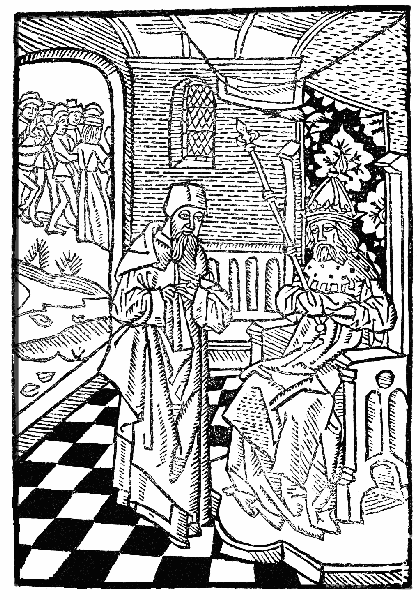
The Example of the Fyfthe Mayster.
Somtyme there was a famous physycyan named Ypocras
ryght connynge, ye which exceded all other in connynge ⁊
scyence he had wt hym his neuewe or kynnesman yt was called
Galienus, ye whiche he loued moche. This Galienus was of
an excellēt wytte ⁊ applyed all his wytte ⁊ mynde to lerne of
h[i]s vncle the scyence of physyke. Whan Ypocras apperceyued
that in as moche as he coude hyde from hym hys conynge
ferynge that he sholde excelle hym in yt crafte, for ye grete
wytte that he was of. As Galienus this sawe, he studyed ⁊
excersysed, in soo moche yt in shorte tyme he had perfyte connynge
physyke. for the whiche Ypocras enuyed hym moche.
It hapned vpon a tyme therafter, yt the kȳge of Ungary sent
his messengers vnto Ypocras that he sholde come vnto hym his
sone fer to cure or make hole. Ypocras excused hȳself ⁊
wolde no goo. but sent his cosyne Galienus wt his wrytynge
in the company of ye messengers for to excuse hym. And
whan Galienus was comen afore ye kynge he was ryghte
worshypfully receyued. but he merueyled why that Ypocras wolde
not come. he excused hym saynge that he had many grete
thynges too do that he myght not come, but he hath sent me
in his stede. ⁊ wt the helpe of god I shall make hole that
childe. That pleased well ye kynge. Galienus went to the
chylde. ⁊ whan he had seene his vryne, and tasted his pounces.
he sayd tho (sic) the quene. O excellent prynces I pray you here
⁊ suffer my wordes, ⁊ tel me who is ye fadrof this chylde. She
sayd, who sholde be his fader but my lorde the kyng. Galienus
sayd, I am sure yt he is not the fader. She answered yf ye
wyll say yt for a trouth I shall doo your hede to be smytn of.
he answered I say yet ones agayn yt this kynge is not the fader
and I am not therfore comen hyther to lese my hede. for I
haue no suche rewarde deserued. ⁊ he was goynge his waye.
The quene yt seynge spake. O good mayster yf ye wyl kepe
it secrete, ⁊ not dyscouer me, I shal shewe ⁊ open vnto you
myn herte. The mayster sayd God defende that from me,
that I to no persone sholde shewe it. and therfore O noble
quene shewe it boldely to me for it shall neuer passe my
mouthe after. and I shall your sone ease and make hym hole.
She sayde yf ye doo that, ye shall haue of me a good rewarde.
⁊ therfore here what I shall saye. Of fortune came hyther
vnto my lorde, the kyng of Burgondyen, and he was so longe
wt me conuersaunt that this chylde by hym I bare. Tho sayd
ye mayster, fere ye not, I knewe well that it was so byfore. ⁊
anone he gaue the chylde to ete beef or of an oxe to drynke. and
the chylde was eased of his infyrmyte. And whan as the
kȳge herde that the chylde was quite of his malady he gaue
vnto ye mayster a good rewarde. but of the quene he secretly
receyued and had a greter gyfte and a specyal thanke and went
his waye. And whan that he was comen home, Ypocras his
mayster demaunded of hym, haue ye yt chyld heled. ⁊ he sayd
ye. Than asked he hym what he gaue to hym. ⁊ he sayd, I
gaue hym fleshe of ox beef to ete, ⁊ water to drynke. Tho sayd
Ypocras. Than is the moder of that chylde not true too her
husbonde. yt is trouth sayd Galienus. Ypocras anone was
meued wt enuye, ⁊ thought in hymselfe yf here be not found
a remedy, my scyence shall no more be set by. ⁊ he shal be
named and praysed aboue me. And from that day forthwarde
he thought ⁊ deuysed how he myght slee hym. Uppon a day
Ypocras called and sayd come go we to seke and gadre herbes in
the gardyne. To whome he sayd mayster I am redy. And
whan they were comen in to ye gardyne, Ypocras sayd, I fele
that this herbe is ryght vertuous, stoupe downe ⁊ gadre me of
it. Galienus dyde so. and as they went aboute the gardyne,
sayd Ypocras now knowe I well by ye odoure of this herbe that
it is better ⁊ precyoser than golde. and therfore stoupe downe
to the groūde ⁊ drawe hym oute wt the rotes for he is ryght
moche. Galienus bowed hymself down to plucke vp the herbe.
Ypocras drewe out his knyfe ⁊ kylled hym. After that Ypocras
fyll seke to the dethe that ye strengthes of his body fayled hym
and dyde as moche as he coude to helpe hymself but it wold
not be and as his scolers ⁊ dyscyples herde of it they went
hastely to hym. ⁊ all that they myght or coude do for the prouffyte
of his helthe they dyde / but it auayled hym nothynge.
Whan Ypocras that perceyued, he sayd vntoo his scolers. Goo
and fetche me a grete tonne and fyll it full vnto the brynkes
with water. And whan they had soo done, he sayd too them
make nowe therin an hondred hooles, and whan that was doone,
there wente none of the water oute. Tho sayd Ypocras.
Beholde my moste dere dyscyples, how yt ye vengeaunce of god
is fallen vpon me as ye openly may see, for in this tonne are an
hondred holes, ⁊ yet gooth there out not one droppe, ryght so
there cometh no vertue out of ye herbes to helpe me. and therfore
what ye doo to me it helpeth not, for I must dye. But
my dere chyldren yf my neuewe Galienus were now on lyue,
he sholde hele me, whom I haue slayne / yt me sore forthynketh.
⁊ therfore ye vengeaūce of god cometh ouer me.
And this sayd he torned hym to ye wal ⁊ gaue vp the goost.
Tho sayd ye mayster to themperour, My lorde vnderstande ye
well what I haue sayd. He answered ye ryght well, what
hurte had it bē to hym ⁊ Galienus had lyued. The mayster
answerd it had ben ryght good, for Ypocras at that tyme had
not dyed, ⁊ therfore by ye ryghtwyse Jugement of god his
medycynes auayled hym not. ⁊ therefore I shewe to you yt it
shall happen worse to you, yf yt ye put to deth your sone for
ye wordes of your wyfe, which in tyme of necessyte shall assyste
⁊ socoure you. ⁊ consyder ye not, yt ye haue after your fyrst
wyfe, ye haue wedded this wyfe yt ye now haue. ⁊ so ye may
ye thyrde ⁊ ye fourthe, ⁊ neuer shall ye haue of ony of them
suche a sone yt shal kepe ⁊ saue you from peryll. Themperour
sayde truly he shal not dye. Tho sayd ye mayster than do ye
wysely, ⁊ I commende you to god, ⁊ thanke you, yt ye haue
this daye for me spared your sone. Themperour sayd I marke
this wel yt wymmen are crafty, ⁊ subtyl, herfore I wyl not for
you but for my self saue hym.

The Syxte Example of the Empresse.
There was a kyng ryght proude ⁊ merueylously dyfformed
in his vysage in suche wyse that wȳmen hym hated ⁊ abhorred.
This kynge thought Rome to destroye ⁊ the romaynes to slee,
⁊ ye bodyes of Peter ⁊ Poule to take ⁊ cary awaye, whiche
while he was in this mynde he called to hym his stewarde that
was ryght secrete wt hym of his pryue counseyll and sayd to
hym. Seke me a fayre woman yt this nyghte may slepe wt me.
The stewarde answered, My lorde ye knowe wel your
infyrmyte ⁊ dysese, ⁊ yt no woman wyll doo it wtout a grete
somme of money. The kynge sayd, thynke ye yt for money I
wyll want one, haue I not golde ⁊ syluer ynough though it
were a thousande florenys I sholde it gladle gyue. The
stewarde herynge yt was anone smyten wt couetyse, went too
his owne wyfe whiche was ryght fayre, chast, ⁊ of a gode
kynrede, ⁊ sayde to her, O my good wyfe, my lorde desyreth ⁊
coueyteth fore to slepe wt a fayr ⁊ beauteuouse woman, ⁊ wyll
not forbere it, though yt she wold aske of hym a thousande
florenys, and hath commaunded me too puruey hym of one.
And therfore I counseyll you that ye to vs gete that money.
The wyfe sayde, were it not so that the kynge so proude and
foule of vysage were, yet wolde I not to that euyl consente
bycause of the synne ayenst god. The stewarde answered, ⁊ I
consente that ye shal do it, ⁊ therto I counseyl and cōmaunde
you, and promyse you wtoute that ye consente to me herin, ye
shall neuer haue good daye wt me. She heryng that trembled,
in so moche that for drede she consented to hym. The stewarde
yt herynge went to the kynge ⁊ sayd Syr I haue founde a fayre
woman ⁊ she is comen of a good house, whiche wil not lesse
haue than a thousande florenes ⁊ in the euin she shall come, ⁊
erly in the mornyng she must away that she be not seen of the
people. The kynge answered ⁊ sayd, I am well content. whan
the nyght was comen the stewarde lad his wyfe to ye kynges
bed and made faste the dore ⁊ yede his waye. Erly in the
mornynge the stewarde arose ⁊ went vnto ye kynge ⁊ sayd.
My lord it shall be daye wtin a whyle, it is good that ye performe
your promise ⁊ let the woman go. The kyng sayd this
woman pleseth me so well yt so sone she shall not departe from
me. whan the stewarde that herde he departed thens al sory.
unneth he taryed ony whyle but came to the kynge and sayd.
My lorde the mornynge is comen, therfore let the woman goo,
leste yt she be ashamed, as I have promysed her. The kyng sayd
yet shall she not go from me. ⁊ therfore goo out and shet the
dore ayen. The stewarde ryght sorowfull departed and wente
vp ⁊ downe with an heuy ⁊ an angry herte, tyll that the
fayre ⁊ the clere daye appered, and than entred ayen in to the
chamber and sayd. My lorde it is clere daye, suffre that
woman to departe that she be not therwith ashamed. The
kynge answered/ I saye to you for a trouth she shall not yet
departe for her company is to me ryght pleasaunt ⁊ acceptable.
The stewarde yt herynge coude no lenger forbere ne holde his
owne counseyll, but sayd vnto ye kyng. O my good and
gracyous lorde I beseche you suffre her to departe for it is myn
owne wyfe. The kynge herynge that sayd to hym. Open ye
wyndowe. ⁊ whan it was open, the fayre ⁊ and the bryght
day appered. he behelde the woman ryght fayre and goodly.
perceyued yt it was ye wyfe of the stewarde ⁊ sayd to hym.
O thou moste ⁊ worste rybaude or knaue, why haste thou for
so lytell money ashamed ⁊ vndone thy good ⁊ fayre wyfe. ⁊
her vnto me vnwetyngly haste delyuered. Therfore haste ye ⁊
gete the out of my realme ⁊ neuer more herafter come in my
syghte, for frome hensforth yf euer I may se the thou shalt
dye ye moost shamefull ⁊ horryblest dethe that euer canne be
ymagyned. Whan ye stewarde herde yt he fled his waye ⁊
durste not abyde ⁊ was neuer so hardy ony more to come in to
that realme. And ye kynge kepte ye wyfe al hys lyuedayes in
grete worshyp, and gaue to hyr plente of all thynges that to
her behoued ⁊ appertayned. After that the kynge lete do
gadre ⁊ assemble a grete ⁊ a myghty armye ⁊ puyssaunce of
men of werre. ⁊ went to Rome with grete myght, ⁊ besyeged
the cyte on all sydes, so long tyll that the Romayns wolde
haue delyuered hym for to haue departed and withdrawen hymself
from thens the bodyes of the holy apostles Petyr ⁊ Poule.
Than was there in ye cyte seuen wyse maysters as ye nowe
haue, by the counseyll of whome all the cyte was gyded ⁊
gouerned. And the cytezeyns came too theym and sayd.
what shall we do, it behoueth vs as that we delyuere vnto
oure dedely ennemyes the bodyes of the holy apostles or elles
ye cyte. Tho answered ye fyrste mayster. I shall wt my
wysdome ⁊ connynge this day ye cyte ⁊ ye body of the apostles
saue. ⁊ so one after another promysed to doo ye same,
eueryche of theym for one daye. In lyke wyse as ye maysters
haue promysed your sone. wt that ye kynge began to assaute
the cyte on all partyes. Tho began ye fyrste mayster to saye,
⁊ to alledge so wysely for to haue pease, yt ye kynge that day
lefte his assaute makynge ⁊ withdrewe hym a lytyll fro the
cyte. ⁊ soo dyde all the maysters one after an other vnto the
laste. To whome came ye burgeyses ⁊ sayd. O mayster ye
shall vnderstande that ye kynge hath made his othe ⁊ sworne
that to morowe wt al his puyssaunce ⁊ strength he wyll haue
⁊ wynne the cyte. Or elles we muste all be in jeoperdye
too lese our lyues. Therfore in aquytynge of your promyse
defende ⁊ kepe vs from daunger lyke as all your felowes
afore haue done. to that answered ye mayster ⁊ sayd be of good
comforte ⁊ fere not, for too morowe I shall by my connynge
shewe suche a werke and operacyons / that the kyng with all
his puissaunce and myght shal fle ⁊ leue the syege. The
nexte daye the kynge made ⁊ gaue a grete assaute too the cyte.
Tho went the mayster and endued or clothed hymselfe with a
meruayvesture or clothynge hauynge therin the fethers or ye
tayles of pecockes and of other foules of dyuers coloures. and
toke two bryght swerdes in eche hande one. and went there
with all and stode vpon the hygheste toure of all the cyte. and
began to meue and torne or shewe hymselfe aboute on all partes
towarde the oste so that they myght all beholde ⁊ se hym. and
he helde in his mouthe the two bryght swerdes yt merueylously
shyned. They wtout of ye kynges hoost that seyeng sayd to
hym. O lorde beholde vpon hyghest of yonder toure a wonderfull
thynge or fygure. Ye I se it wel yt it is merueylous /
but what it is I knowe not. They sayd to hym It is Jhesus the
god of ye crysten folke yt is come out of heuen vs al to sle ⁊
destroye wt his two swerdes yf wee here ony lenger abyde.
The kynge herynge that trembled for fere and sayde what shall
we do, there is but one way and that is that we anone go and
departe fro hens leste that theyr god auenge hvmselfe vpon vs.
Tho began ye kynge wt all his oste to fle, notwithstondȳge
there was no nede. but yt they of ye mayster were begyled ⁊
deceyued. And whan ye romaynes yt sawe they hastely
moued after al armed in good ordynaunce. ⁊ the kynge wt
many of his people they kylled and destroyed, ⁊ also in that
manere by grete subtylte of ye mayster was ye myghty kynge
wt his folke ouercomen. Then sayd thempresse to themperour,
Lorde haue ye vnderstande what I haue sayde. He sayd
ye, well in ye beste wyse. She sayd, haue ye no herde what
I haue sayd to you at the begynnynge of this narracyon, of
the stewarde that the kynge trusted so moche, which for lucre
of good shamed his owne wyfe, ⁊ he for that was dryuen ⁊
banysshed out of the londe. In lyke wyse your sone for the
desyre and appetyte that he hath to the empyre, entendeth to
confounde and destroye you. But while ye be in your myght ⁊
power do with hym as ye kynge did wt his stewarde yf ye wyll
not put hym to deth, banysshe him out of your empyre, yt
ye without fere may leue in surete of your lyue. And haue
ye not also herde how ye kyng lay before ye cyte of Rome, ⁊
howe he was by the wyse maysters dec[e]yued ⁊ scorned yt he
with his folke were kylled ⁊ slayne. In the same wyse ye
seuen maysters entende to do wt you. ⁊ by theyr false wyles
and subtyltees to deceyue you, ⁊ in the ende to sle you yt your
sone may regne. Therupon answered themperour ⁊ sayd that
shall not so be, for my sone too morowe shal deye. Than
commaunded his seruaūtes that they sholde lede his sone to
hangynge. And as the folke herde that there was a grete
noyse ⁊ a gaderynge of theym and bewayled the dethe of ye
only sone of themperour. And as ye syxte mayster herde
that, he hasted hym too the Emperour ⁊ salued hym moche
honourably, ⁊ he toke it vnthankfully, ⁊ thretned hym or
menaced him to dye wt his sone for that he was wt them made
dompe, and a rybaude, ye whiche he had shewed vpon his wyfe.
The mayster sayd. I haue deserued no deth wt your sone, but
grete ⁊ large gyftes, for he is not dompe as ye shall here wtin
thre dayes yf he may lyue soo longe. and yf ye put hym too
deth for wordes of your wyfe, than shall I merueyll of your
wysdome. ⁊ without doute it shall happen to you as it somtyme
happened to a knyght that so moche alowed the saynges
of his wyfe that he was bounde to an horse tayle ⁊ drawen
thrugh out all the cyte to the galowes. Themperour sayde
for the loue of god shewe me that example that I may the
better beware of that peryl. That wyl I not doo sayd the
mayster, wtout ye do cal ayen your sone. Than themperour
commaunded to call his sone. And the mayster began afore al
the folke to tel in this maner folowynge.


The Example of the Syxte Mayster.
There was an Emperour of Rome the whiche had thre
knyghtes whom he loued aboue al other. And in that same
cyte was an auncyent knyght yt had wedded a fayre yonge wyfe
as ye do thempres whiche aboue al other thynges he loued.
This lady coude synge ryht wel, ⁊ melodyously ⁊ wt suche
swetnes yt many drewe to her house ⁊ desyred her company /
It befell vpon a season as she sate in her house, ye vysage torned
in to the strete yt she myght se them that went by. ⁊ began
swetely tu synge, yt all folke delyted for to here her. By
chaunce came that wayes a knyght of ye Emperours courte ⁊
herde that voyce, lyft vp his eyē ⁊ behelde her Intentyfly ⁊
anone he was taken in her loue, and entred in to her house ⁊
fyll in communycacyon wt her of loue. ⁊ amonges al other he
demaunded what he sholde gyue her too slepe by hym one
nyght. She answered an hondred floreyns. The knyght sayde,
tell me whan I shall come, ⁊ I shall gyue you an hondred
floreyns. She sayd whan I may haue a conuenyent tyme I
shal sende for you. The nexte day she sange ayen in the
same place, and it fortuned the seconde knyght of themperour
to come by that same way, the whiche in lykewyse was smyten
in her loue, ⁊ also promysed her an hondred floreyns. To whom
also she promysed to shewe hym a tyme prouyded. The thyrd
day was the thyrd knyght in lyke wyse caught in her loue, the
whiche also promysed an hondred floreyns, ⁊ she too gyue hym
knowelege of the tyme. Thyse thre knyghtes haue so secretly
spoken with that lady yt none of them had knowlege of other.
The lady yt was of malyce ⁊ cautelous replenysshed, came to
her husbonde ⁊ sayd, syr I haue secrete maters too shewe you,
⁊ folowe therein my counseyll yf ye do it, our necessite or
pouerte ye may largely releue. The knyght sayd tel it me I
shal holde it secrete ⁊ fulfyl it to my power. She sayde thre
knyghtes of thēperours court haue ben wt me one after an
other in suche wyse yt none knoweth of an other counseyll. ⁊
euery of them haue offred me an hondred floreyns, myght we ye
thre c florayns gete ⁊ no knowlege therof be had sholde it
not be to vs a grete helpe ⁊ our pouerte well releued. The
knyght sayd, forsoth yes, ⁊ therfore what someuer ye counseyl
me to do I shall folowe it. Tho sayd she, I shall gyue you
this counseyll. whan they come with the floreyns ye shall
stande behynde ye yate wt your swerde drawen in your hande.
⁊ bycause yt euery of them comethe alone, ye shall sle one
after another, ⁊ so we shal haue the three c floreyns of
them without knowlege of ony other. The knyght answered.
O my best beloued wif I fere me that this euyll can notte be
hydde, and we sholde therfore shamefully suffre dethe yf that
it were knowen. She sayd I shall this werke begynne. ⁊ I shall
make therof a good ende, and fere it not. whan the knyght
sawe that she was so hardy it caused hym to be the more bolde.
and she sent for the fyrst knyght and he came to hyr anone
with oute ony taryenge to the yate ⁊ knocked, ⁊ she askyd yf
he brought ye c floreyns. and he sayd ye, I haue theym here
all redy. Tho lete she hym in. ⁊ anone at ye entrynge in, her
husbonde kylled hym ⁊ so he dyde ye seconde ⁊ the thyrde ⁊
in to one secrete chamber they drewe the bodyes of them.
Whan it was thus done ye knyght sayd to his lady. O dere
wyfe yf thyse bodyes be founde wt vs, we shall dye ye moost
shamefull deth yt can be ymagyned for it is not possyble but
yt thyse knyghtes shall be myssed in themperours courte. ⁊
grete serche ⁊ Inquysyon shall be for them made thrugh all
this cyte, where they are become. She sayde, Syr I haue this
werke begonne, ⁊ shal make therof a good ende, fere not, as I
afore sayd. This lady had a brother the whiche had the gouernaunce
of the watche of ye cyte that on ye nyghtis vpon stretes
watched wt his felowes. She stode at her gate ⁊ called her
brother ⁊ sayde. O my best brodr I haue a secrete mater the
whiche in confessyon I shal shewe you. ⁊ therfore come a lytyll
within, ⁊ whan yt he was come in, the knyght receyued hym
frendly ⁊ gaue hym wyne to drynke. ⁊ sayd, my well beloued
broder, this is ye cause yt I haue called you, for of your counseyll
I haue moche nede. The broder answered say it boldely to
me, ⁊ what someuer yt I may do, to my power, yt shall be
at your desyre wtout lettynge. Tho sayd she, yesterdaye came
in a knyght in good frendshyp / but afterwarde he fyll in suche
wordes ⁊ varyaunce wt my husbonde, yt he slewe hym, ⁊ lyeth
in my chamber. ⁊ myn owne dere broder we haue noo man
that we may truste but you. ⁊ yf ye body were founde by vs we
sholde dye. ⁊ she made mencyon but of one. ye brother sayd
delyuer it me in a sacke ⁊ I shall bere hym to ye see. she herynge
yt was full glad thereof, ⁊ delyuered to hym the body of ye fyrste
knyght. he toke it ⁊ went wtall a good pase ⁊ cast it therin. ⁊
as this was done, he came ayen to his syster ⁊ sayde, gyue me
nowe of the beste wyne for ye are of hym quyte. ⁊ she thanked
hym ⁊ went in to as though she had gone for wyne and began to
crye wt an hygh voyce, ye knyghte that was caste in to the see
is come ayen. As her brother yt herde he wondred sore, ⁊
sayde gyue me hym. I shall se yf he shall aryse ayen. ⁊ toke
the body of the seconde knyght ⁊ wende it had ben of the fyrst
knyght ⁊ went to the see, ⁊ wt a grete stone drowned hym
therin. yt done, went ayen vnto his systers house ⁊ sayde, nowe
fyll me a cuppe with good wyne, for I haue drowned hym so
depe yt he shall neuer come ayen. she sayd thanked be god ⁊
went ayen too her chamber ⁊ fayned her to fetche wyne. ⁊
cryed with a grete voyce. Alas wo be to me he is rysen ayen
and come out of ye see. ⁊ as her brother herde that with grete
meruaylle sayd. what deuyll is this knyght that I haue thus caste
in to ye water ⁊ notwithstandynge is comen ayen. Delyuer
hym me ye thyrde tyme, ⁊ I shall se yf he shall come ayen. Tho
gaue she hym ye thyrde knxght (sic), whiche he byleued had
ben ye fyrste knyght, ⁊ yede wtoute ye cyte to a grete foreste
⁊ made a grete fyre ⁊ caste the knyght therin. ⁊ whan he was
almost brente, ye brodr went thens a lytel dystaunce to do his
nede. Tho came there a knyght yt wolde ryde to ye cyte
where on ye mornynge they sholde haue a tourneye ⁊ a Justyng.
⁊ it was colde weder ⁊ derke, ⁊ was not fer fro ye cyte. As
yt he had a syght of that fyre drewe therto ⁊ alyghted from his
horse ⁊ warmed hym. The waker came ⁊ sayd to hym what arte
yu. The knyght sayd I am a gentyl knyghte. Tho spake ye
waker ⁊ sayd, yu arte no knyght but a deuyll for fyrste I caste
ye in to the water, the ii tyme wt a grete stone I drowned the,
⁊ the iii tyme I haue put ye in this fyre supposynge yt yu
haddest be brente. ⁊ yet yu standest here, ⁊ tho he toke ye
knyght wt his hors ⁊ cast them both in to the fyre. ⁊ after yt
he went ayen to his syster ⁊ tolde what had hapned hym. Nowe
brynge me of ye beste wyne, for after yt I had brente hym I
founde hym ayen by ye fyre wt his horse, ⁊ I haue caste them
both in the fyre. ⁊ his syster perceyued well yt he had brent a
knyght of the tourney whiche anone broughte hym of ye best
wyne habundauntly. ⁊ after he had wel dronken he went thens.
Not longe tyme after that there fyll a grete debate ⁊ contencōn
betwyx the knyghte ⁊ his wyfe, in such wyse yt he smote her.
which had indygnacyon therof ⁊ waxed angry ⁊ sayd that many
myght here it, O wretche wyll ye kylle me as ye haue done the
thre knyghts of themperours. men yt herynge layde handes on
them, ⁊ brought them before ye emperour ⁊ ye woman anone
knowleged yt hyr husbonde had slayne the thre knyghtes of
themperours ⁊ how he toke fro them thre hondred floreyns ⁊
as it was thus in trouth founde, bothe were drawen atte an horse
tayll and hanged vppon the galowes. Than sayd ye mayster to
themperour, haue ye vnderstande what I haue sayd. He
answered ryghte well. I saye for certayne that wyfe was ye
worste woman that myght be of all wymmen, for she moued ⁊
styred hym to murdre, ⁊ afterwarde dyscouered hym. The
mayster sayd, It is wtoute doubte yt it shall to you happen
worse yf ye put to deth your sone by ye aduyse of your wyfe.
Themperour sayd, my sone shall not dye this day. The
mayster yt herynge yaue thankynges to themperour, and toke
leue ⁊ went his waye.

The Seuenth Example of the Empresse.
There was somtyme a kyng, the whiche loued his wyfe aboue
all thynge. in so moche that he closed her in a stronge castell,
⁊ bare ye keyes of the castel hymselfe. The lady was therfore
ryght heuy ⁊ desolate. Now in ferre partyes there was a
valyaunte knyght ye whiche in a nyght had a dreme after this
effecte. For he thought that he sawe one of the fayreste
quenes yt myght be. ye which aboue all thynges desyred to
haue her loue. yt yf he myghte se her walkynge he sholde
clerely haue knowlege of, by whome to hym grete frendshyp
⁊ worship sholde come. To ye quene in ye same nyght by
vysyon of the sayd knyght, it was to her also shewed. ⁊ yet
they hadde of eche other neyther knowlege of name neyther
of fame. Whan ye knyght had thus dremed ⁊ seen in his
slepe, he thought ⁊ determyned in his mynde that his fote
sholde not reste vnto ye tyme tyll he had founde that lady, yt
to hym was shewed in his vysyon. and lepte vpon his horse /
and toke with hym all that to hym was necessarye for his
journey. and rode and laboured thrughe dyuerse regyons and
londes soo longe tyll at the last he came vnto the same londe,
where that the quene was by her husbonde closed or kepte in
a stronge castel. And whan this sayd knyght was come in to
ye same cyte, and by a certayne season had there soiourned, it
happened on a day as this knyght walked by the castell, and
knewe not yt ye quene was therin she sate in a wyndowe to
beholde ⁊
see ye people goynge by. ⁊
amonge all other she sawe the sayd knyght, and knewe that he was the same man
that she had dremed of. And yt knyght by chaunce lyfte vp
his eyen ⁊
perceyued ye lady syttyng in the wyndowe.
⁊ anone
his minde shewed hym yt it was she yt he the dremes of had.
⁊
he began to synge a songe of loue. And as she herde yt she
was anone taken wt his loue. The knyghte from thensforth
dayly went ⁊
walked aboute ye castell beholdynge it ouer all
yt yf in ony maner wyse he myght gete to her too shewe his
mynde. The lady perceyuynge that she wrote a letter
⁊ cast
it downe to hym. And whan he had sene ouer ye letter,
⁊
understode ye wyll of that lady, he began to haunte Joustes
⁊
tournamentes ⁊
dyde so many gret ⁊
merueylous actes or dedes, that ye name of hym came to the kynge. And as the
kynge herde that he sent after hym ⁊
sayd to hym, Syr knyght I haue herde moche honour of you. yf it wyll please you for
to abyde ⁊
to dwell wt vs, we shall gyue you large gyftes ⁊
rewardes. The knyght answerd, O ryght myg[h]ty prynce
I am your seruaunte, wolde god yt I coude do ony seruyse to
please your magnyfycence, wtout takynge of rewarde saue one
thyng afore all other I desyre. The kynge sayd, shewe it
boldely what thynge yt it is. The knyght sayd, My lorde
sythen yt it hath pleased you for to take me as your seruaunt
⁊
one of youre counseyll, me semeth that it were expedyent for
bothe our solaces, that I hadde a place nyghe too the wall of
the castell: that I myght at all tymes be the more redy at
your callynge whan that ye haue nede. Then̄e the kynge sayd
I consente it to you make it as ye thynke it beste. Tho wente
the knyght ⁊ hyred werkemen
⁊ made a fayre logynge by ye
walles of ye toure. ⁊
whan it was all redy, He made a couenaunt
wt a werkeman for to make out of his house a secret way in
to ye tour ⁊
whan it was made redy after his entente, he kylled
ye werkeman by cause he sholde not dyscouer.
⁊
went in to ye quene ⁊
dyde to her reuerence accordyng ⁊ they talked of many
thynges, yt at thende he desyred for to slepe by her, which she
oftentymes denyed, but neueryeles she consented to hym. After
yt ye quene thought what shall I do, yf I sholde gyue knowlege
herof vnto my husbond, therof sholde come two euyls ye one is
my shame, ⁊ yt by auenture
he sho[l]de vtterly forsake me ⁊
dryue me out of his londe for euer, ⁊
ye knyght he sholde sle, for fro ye dethe he coude not escape,
⁊ therfore it is better yt I
be styll ⁊ tell not.
The knyght after yt as oftentymes as it pleased hym he went in to the quene,
⁊ dyde his wyll
with her. And she gaue hym a rynge the whiche ye kyng had
gyuen vnto her at theyr weddynge. This knyght in euery
batayll and tournamēadde the vyctory wherfore he was and
stode in grete fauour with the kynge insomoche that he made
hym his stewarde ⁊
gouernoure of al his Regyon ⁊
lond. ¶ It happened vppon a daye that the kynge dysposed hym selfe for
too goo too chase or huntynge, and he commaunded his stewarde for too make hym redy vppon
the morowe for too goo with hym, whertoo he offred hym selfe all redy. ¶ And on the
morowe after they entred in to ye forest,
⁊ all that daye they
chased, ⁊
folowed ye wylde bestes that they were so wery that
ye kynge by a fontayne sate hym downe to reste.
⁊ ye knyghte
by ye kynge, ⁊
fyll on slepe by hym, hauynge ye rynge vpon his
fynger, ye whiche the kynge marked
⁊
knewe. After yt the knyght perceyued yt the kynge had sene the
rynge, fayned hymself seke ⁊
sayd, My lorde I fele my selfe sore seke ⁊
yf I fynde not hastely remedy therfore by the meanes [of] physyke
I am but a dede man ⁊
therfore I pray you lycence me to go home. To whome he sayd, go my dere frend in goddes name.
he anone gate on his horse ⁊
hasted hym to his house, ⁊
wente to the quene ⁊
gave her ayen ye rynge, ⁊
tolde her how ye kynge had marked it ⁊
sene it on his fynger, ⁊ prayed her yf
he made ony questyons of ye rynge yt [s]he sholde shewe it
to hym. This done, he went downe ayen to his lodgynge. And
anone after yt the kynge came to the quene ⁊
she receyued hym ryght louyngly, ⁊
after yt a lytyl tyme was passed, the kyng sayd, My lady shew me
where ye ryng is that I gaue to you, I desyre to se it. O my lorde to what
entente at this tyme
desyre ye to se it. Than sayd he, yf ye shewe it not to me
Incontynent it shall repente you. She rose anone vp ⁊ went to
[her] cheste ⁊ brought the rynge to ye kynge. And as he sawe
ye rynge he was half ashamed, ⁊ sayd vnto her, O howe lyke is
the knyghtes rynge vnto this rynge, whyche I sawe vpon his
fynger, and I bileued that it had ben my rynge, and therfore it
was that I asked it of you so hastely after the rynge. And of
this euyll suspecyon I yelde my selfe gylty ayenst you my dere
lady, in this behalfe, for ye strength of the toure deceyued me,
for I thynke yt noo man myght come therin, but I myself alone.
She sayde, My dere lorde, wondr not for one rynge is lyke an
other, for werke men make seldome ony werke, but ye other
make the same, but god forgyue it you that ye haue had me suspect
whan ye knowe the strength of ye toure,
⁊ the keyes
ye haue alway by you, ⁊
byleue no man therwt. After yt
the knyght lete ordeyn̄
a grete dyner ⁊
sayd to the kynge, my lorde it is so that my lady in loue is come out of my countre
⁊
I haue done to be made a feste or a dyner.
⁊
gladly I wolde pray you that at this tyme ye wyll doo me honour,
⁊
take suche mete as is in my house. he kynge sayd I shal gladly do you yt
worshypp ⁊ more.
The knight was therof glad, ⁊
by his secrete way went to the quene ⁊
sayd to her, My lady this day ye shal come to my house by my preuy way,
⁊
clothe you in ryche clothynge after the way of my countre,
⁊
ye shal syt at the table wt the kynge as my souerayne lady,
⁊
make hym good there. She sayd as ye wyll I shall it all thȳges
fulfyll, ⁊
whan the houre of mete was come, ⁊ the kynge from
the castell was comyng towardes the knyghtes house, In the
meane tyme the quene entred by the secrete way in to the
knyghtes lodgynge ⁊
apparayled her after the maner of the
knyghtes countre. and whan the kynge was entred in to the
house, she salued hym reuerently and receyued hym. and whan
the kynge hadde beholden her he demaunded of the knyghte,
what woman is this that is so fayr. Then ye knyght sayd my
lorde it is my souerayne lady that now is come out of my
countre after me. I haue taryed longe in her seruyce. Then
the knyght set the kynge att ye table as it behoued.
⁊ made the
quene to syt by hym / ⁊
the kynge thoughte that it was his
quene, and sayd wtin hymself, O how lyke is this woman vnto
my wyfe. So ye strength of the toure deceyued hym, that he
gaue more fayth and credence to ye knyghtes wordes than he
dyde vnto his owne eyen. The quene began̄e for
to speke ⁊
talke vnto the kynge and to styre hym for to ete and drynke
⁊
to make good chere. And whan as the kynge herde her voyce
and speche than he sayd to hymselfe, O blessed lady, lyke is
this woman vnto my quene, in her behauyng / in speche / in
vysage / ⁊
in all other thynges ⁊
condycyons. and alwayes ye strengthe of the toure fayled hym.
In the ende of ye mete, ye knyghte prayed his loue
to synge a songe afore ye kyng the whiche began for to synge a
songe of loue. whan as he herde that ⁊
knewe her voyce, he thought is not this my wyfe. How
may it be she. haue not I the keyes of ye toure my selfe in
kepynge. and soo all the mete tyme he sate and strofe within
hymselfe. Tho att the laste he sayde vnto the knyght that
he sholde take vp the table for he hadde somwhat for too done
for why that he sate in suche a grete thought, and aduysemēt.
The knyght answered and sayde, My lorde ye make noo good
chere, ye are full of thoughtes. And yf it please you we shall
make to you more sporte ⁊
solace. And the woman sayd please it you syr kynge here by vs tarye. we shall make you
all the sporte ⁊
solace that we can, lyke as ye quene is in her
solace ⁊
conforte. He sayd take away the table, for I may no
lenger abyde. Then the knyght at the commaundement of ye
kynge toke vp the table, ⁊
thanked theym all. And ye kynge wente hastely vnto the castell in
serchynge whether yt the quene were wtin or not.
And in the meane whyle the quene went vp by her preuy way,
⁊
put of her vppermost vestures ⁊
the kynge founde her in the same clothynge that he lefte her
afore. Whan as the kynge was entred ⁊
so founde her, he embraced ⁊
kyssed her ⁊
sayd vnto her. This day I haue eten wt my knyghte and wt his
loue that is come out of his countree, and sythen I was borne vnto this
day myn eyen hath not sene two so lyke creatures in al thyng as she is to you and this
mete tyme I haue be soo moche styred with dyuerse thynges yt
I coude no lenger abyde there, but yt I muste come
⁊ serche
whether ye were here or theyre. Tho sayd ye quene, Syr how
myght ye thynke yt, for ye knowe well yt this
toure is fast, ⁊
stronge ynoughe ⁊
that no body can come in nor out wtout
you, for ye alone haue alwayes the keye. How were it then possyble
for me to be there. Ye fynde somtyme one man lyke on
other and therfore ye sholde take none argumētes of mysdemyng
or of suspycion, as ye late dyde of the rynge. The kynge sayd,
that is true and therfore I knowlege my selfe gylty that I haue
mysdemed you. After that came to hym ye knyght
⁊ sayd,
My lorde I haue of long tyme serued your good grace, and now
it is tyme that I retourne ayen in to my countre
⁊ therfore for
all the seruyce yt I haue done vnto you I desyre of you but one
thynge to do for me. yt my lorde ye whiche I entende to wedde
in the face of the chyrche, which hath folowed me out of ferre
countrees, ⁊
her I shall brynge thyder ayen as my laweful wyfe.
Therfore I beseche and praye your noble grace that ye wyll do
me this honour, that by your owne honde ye wyll gyue her
afore the preest vnto me, the whiche shallbe vnto me greete
honour and worshyp whan I come into my countree. The
kynge answered, yt petycyon and more yf ye desyre it that
shall I gladly doo and fulfyll it. The knyght prefyxed the
daye of maryage. To the whiche daye this good kynge came
to the chyrche worshypfully. The preest was redy
⁊ stode
indued wt his vestymentes for to solemnyse the matrymonye.
The knyght had the quene all redy apparayled in his owne
house after his maner ⁊
had ordeyned two knyghtes for to
lede her to the chyrche, they byleuynge that it had ben his
paramour. And whan they were before in the face of ye
chyrche ye preest sayd, who shall gyue this woman vnto this
knyght. Then the kynge sayd, I shall gyue her to myn owne
knyght. and toke her by the hande ⁊ sayd vnto her, O good
woman ye are moche lyke vnto my quene, and therfore I loue
you the better, and also for that ye be my knyghtes wyfe and
shall be of my house. and putte the quenes hande in to ye
knyghtes hand. and ye preest after ye maner of the chyrche
hath bounde ⁊ wedded them togyder. and whan all this was
fynysshed ⁊ done the knyghte sayd vnto ye kyng, Syr my shyp
yt I entende to go in towardes my countre is all redy to make
sayle wherfore I humbly beseche hyghly your moost noble
grace that it wyl please you for to accompany my wy[fe]
therunto ⁊ that ye wyll aduertyse ⁊ enfourme her[4] that
she loue me ⁊ haue me in fauoure aboue all other creatures
lyuynge, and the rather for your gode excytacyon ⁊ doctryne.
Thenne the kynge with a grete multytude of people
went with theym ⁊ accompanyed theym vnto the shyppe of
whoos departynge many of them were dolaunte to the shyppe.
the kynge began to say vnto the quene, my moost dere frende,
herken now well vnto my counseyll and folowe it, for it shall
be for your honour ⁊ proufyte. My knyght hath now here
wedded ⁊ done to you al ye worshypp yt in hym is. wherfore
loke yt ye loue ⁊ honour hym aboue all erthly creatures ⁊ yt
hath god commaunded ⁊ that ye be too hym true ⁊ obedyent.
⁊ as this was sayd he delyuered her vnto ye knyght saynge my
blessyng go wt you both, ⁊ our lorde kepe ⁊ conduyte you in
sauete to your countre. Then the knyght and the quene bowed
and enclyned down̄ her hedes vnto ye kynge. ⁊ thanked hym
of all thyngs and they commytted hym to god and entred in
to the shyppe and the maryners haled up the sayles and sayled
forth afore the wynde soo that wtin a short tyme the kyng
had lost ye syght of the shyp. And from thens he went hastely
to ye castell ⁊ myssed the quene. ⁊ whan he founde her not / he
was meued in all the partes of his body. ⁊ sought all about ye
toure and serched, tyll at laste he founde ye hole or ye secrete
way yt the knyght had made. ⁊ as he saw that, than cryed he
and weped and sayd, Alas alas this knyght in whom I hadde so
grete confydence ⁊ truste hath taken away my wyfe, was I not
a fole yt I gaue more fayth in to his words then I dyde to
myne owne eyen. Than sayd thempresse, My lorde haue ye
vnderstand what I haue sayde. Themperour sayd ryght wel
in ye best wyse. Then sayd thempresse, remember how yt
he trusted the knyghte ⁊ yet he deceyued hym. In the same
manere wyse ye haue confydence in the seuen wyse maysters /
and they laboure for to destroye me that am your wyfe. ⁊ ye
gyue more fayth vnto theyr wordes than ye do vnto your owne
eyen. for ye haue well sene how yt youre sone rente and
scratched me. Wherof yet I bere and haue the tokens ⁊ the
markes as ye may see. And also ye knowe well how that your
cursed sone hath me ashamed ⁊ ye marke not howe they
defende hym in his foly and falshede. Therfore it is to be
dradde yt it shall happen to you as it dyde to the kynge that
too you I haue spoken of. Themperour sayd, I byleue myn
eyen better than theyr wordes. ⁊ therfore I say you yt to
morowe I shall do justyce of hym. On ye morowe the Emperour
commaunded that his sone sholde be hanged. Tho
began ayen a grete noyse in and [bewailing amongst the
common people for the death of the Emperor's only son. At
last when the seventh master heard it, he ran immediately
unto the officers, which were leading him to the gallows, and
said: My friends, I pray you not to make overmuch haste
but stay your hands a while, for I think this day (with the
help of the Almighty God) to save him from all perils; and
from thence the master hasteth himself to the Emperor's
Palace, and did him reverence according to his accustomed
duty. But the Emperor with great indignation made him
this answer: Never more have you any joy in this world, for
that you have sent my son home untaught and dumb, whom
I delivered unto you well speaking, for which cause you shall
all be put to death with him. The master answered: O
most noble Emperor, the time is not long betwixt this and tomorrow
noon; then (by the grace of God) you shall hear
him speak discreetly, and shall declare the truth of all things,
and this I promise you he will perform to the full, upon pain of
my life, if you will spare him so long a time; if you find it not
so, then take my life and the lives of us all. Then said the
Emperor: If I might but hear my son speak, it would give me
sufficient content, and I would not desire longer to live. Then
answered the master: All this and more you shall hear and
see, and confess it to be true, if you will but abide this little
time: and then the strife that hath been betwixt us and the
Empress will clearly be decided. And if you suffer him to be
put to death through the words of your most ungodly wife,
I tell you of a truth it shall happen worse to you than it did
to a knight that died for a little blood that he saw his wife to
bleed, to whom afterwards she was most unnatural. Then
said the Emperor: That example I would fain hear. Then
said the master: Let your son be called again, and I shall tell
you so notable an example that during your life you may
beware of the unsteadfastness of woman. Then the Emperor
said: I shall go call my son again upon condition that tomorrow
I shall hear him speak as you have promised. The
master said: Do that, my lord, for it shall so be. And began
to tell as followeth.]

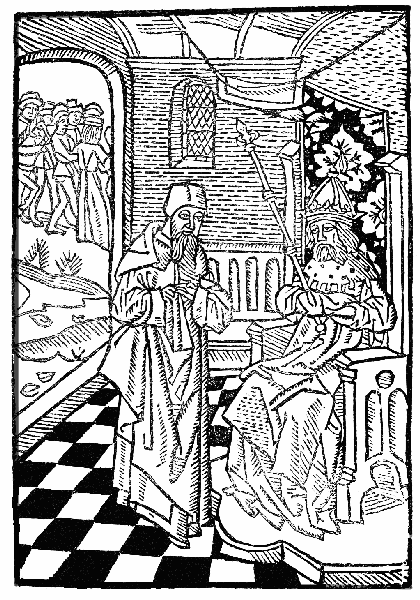
The Example of the Seuenth Mayster.
There was a knyght yt had a fayre yonge wyfe whome he
entyrely loued in so moche that he coude not be out of her
syght. It hapned on a tyme yt they played togyder at the
chesse, ⁊ ye knyght by chaunce helde a knyfe in his hande ⁊ she
playng fortuned to smyte her hand vpon ye knyf, yt a lytel blode
began to appere. Whan ye knyght sawe that his wyfe bled he
sorowed moche and was sore aferde of his wyfe yt he fel to the
grounde in a swoune. his wyfe cast colde water vpon his
vysage, yt he a lytell came ayen too hymselfe ⁊ sayd lyghtely
call the curate wt the holy sacramente for I muste deye for the
blood yt I haue seen come out of your fynger hath smyten the
deth to my herte. The preest came and houseled hym. ⁊
anone after he dyed wtout ony taryeng, for whoos deth there
was made grete sorowe ⁊ bewaylynges and specyally of ye wyfe.
And after that the obsequyes ⁊ buryenge was done accordynge
she went and lay vpon the buryel or graue and there she made
the gretest sorowe of the worlde, and sayd that she wolde neuer
departe from thens, but as a turtyll douue she wolde for the loue
of her husbonde there abyde ⁊ dye. Tho went her fren[ds] vnto
her and sayd what auayleth this for his soule to lyue ⁊ dye here,
it is better yt ye go to your house ⁊ gyue almes for ye loue of
god ⁊ yt shal more auayle his soule, than in this place to abyde.
To whom she answerd be styll ye are euyll counselours. Consyder
not ye how I am fro hym seperate ⁊ departed by his deth for a
lytell blode yt he sawe com out of my hond or fynger,⁊ therfore
I shall neuer fro hens departe. Her frendes herynge yt lete
make a lytell house or lodgynge nygh vnto ye graue, ⁊ put
therin all thynges yt to her was necessarye ⁊ went theyr wayes
thynkynge that within a whyle she sholde be wery to be alone, ⁊
so desolate from all company ⁊ yt therby she sholde desyre ayen
ye company of people. In yt cyte was thenne a lawes (sic) yt
whan a trespassour or offendour ayenst the lawe were hanged, yt
ye shyryf all yt nyght sholde watche ⁊ kepe the body all armed, ⁊
yf it hapned yt the body of hym hanged were stolen away, ye
seryf sholde lese all his londe, ⁊ his lyfe at ye kynges pleasure.
It hapned sone after yt the knyghte was dede a man to be
hanged for trepasse that he had done, so that ye sheryf after ye
lawe of the londe all the nyght watched by ye galowes yt was
not fer fro ye cyte, ⁊ ye chyrcheyerde was not ferre from
the walles of ye same. Tho became ye sheryf so colde yt he
wyst not but to dye for colde, wtout the rather yt he myghte
warme hym. it was so feruent a colde ⁊ so stronge a froste,
and he behelde fro thens about hym ⁊ sawe ye fyre in
ye chyrcheyerde, ⁊ hasted hym ⁊ came therto, ⁊ whan he was
come he called ⁊ knocked at the lytyll house. The woman
spake who is that yt at this houre is knockynge at ye house of
this sorowfull woman. I am ye shyref that so moche colde
suffreth yt wtout anone ye late me in I shall frese to deth. She
sayd, I fere me yf that I lete you come in ye sholde shewe me
such wordes yt sholde cause me for to be more heuyer. ⁊ he
sayd I promyse vnto you yt I shall saye no wordes to your dyspleasure.
Then lete she hym in. and whan he awhyle had
sytten by ye fyre ⁊ was well warmed he sayd to her, O fayre
woman wt your lycence wolde I fayne speke but one worde
vnto you. She answered to hym, syr say what it pleaseth you.
He sayd, O lady ye be a fayr gentyl woman ryche ⁊ yonge.
were it not better ⁊ more conuenyent for you to dwell at home
in your house ⁊ to gyue almesse than to destroye ⁊ consume
your lyfe here wt wepynes ⁊ cryenges. She sayde syr knyght
had I knowen this afore ye had not come herin for I say to
you, as I haue sayd too other oftentymes, ye knowe well
yt my husbonde loued me so well that for a lytyll bloode yt
he sawe me blede on one of my fyngers he is dede, wherfore
I shall here deye for the loue of hym. As the knyght
herde this he toke leue and wente to the galowes ⁊ whan
he was there come, he sawe yt the theef that he left there
hangynge was stolen ⁊ caryed awaye, ⁊ began therfore to wexe
heuy ⁊ full of sorowe, ⁊ sayd, wo is me what shall I do for I
haue loste my lyfe and all my good. And he goynge thus full
of sorowe ⁊ heuynesse, ⁊ wyste not whyche waye to torne
hym or to go, at the laste bethought hym to go to yt deuoute
⁊ desolate lady, ⁊ shewe vnto hyr ye heuynesse of his herte, to
wyte yf yt she coude gyue hym ony gode counseyll. And whan
he was theder come he called, ⁊ she axed the cause of his
knockynge. Tho sayd he, madame I am the shyref that was
here ryght now wt you, ⁊ I wolde feyne shewe you ye secretes
of myn herte. Therfore I praye you for ye loue of god open
the dore. and he wente in ⁊ sayd to her O moost vertuous
lady I come to haue your counseyll and aduys, for ye knowe
well ye lawe of ye londes are that whan so euer ony man is
hanged ⁊ stolen awaye of the galowes, than the shyref his lyfe
and godes be in ye kynges handes. Nowe it is happened in ye
tyme that I was here with you ⁊ warmed me, ye theef is stolen
away frome ye galowes, therfore I praye you for the loue of
god gyue me your aduys what is me beste to do. She answered
I haue compassyon vpon you, for by the lawe ye haue loste lyfe
⁊ goodes to ye kynge. Do nowe after my counseyll, ⁊ ye shall
neyther lese lyfe ne godes. He answered therfore I came to
you hopynge to haue gode comforth. She sayd wyll ye than
promyse to take me to your wyfe. the knyght answered, wolde
god that ye wolde do yt, but I fere me leste yt ye wolde dysdeyne
so moche to humble you too me yt am so pore a knyght.
She sayd I gyue you my wyl therto, ⁊ he yaue her ayen his
wyll ⁊ consented too be her knyght durynge his lyfe. Tho
sayd she, ye knowe well yt suche a daye my lorde was buryed
whiche for ye loue of me deyed, take hym oute of his sepulture,
⁊ go hange hym in stede of ye theef. The knyght answered
lady your counseyll is good. Tho went they togyder ⁊ opened
the graue ⁊ drewe hym out. The knyght sayd howe shall we
nowe doo, by cause or the theef was taken, two of his vpper
tethe were smyten oute, ⁊ I fere me yf yt were perceyued I
shold be dede. She sayd to hym, take a stone and stryke
oute two of his tethe. The knyght answered, madame yt may
not do for while he lyued he was my wel beloued felowe ⁊
it sholde be to me a grete rebuke, yf I cōmytted soo dysloyall
a dede vnto his body beynge dede. She answered for your loue
I shall do it, ⁊ toke a stone ⁊ smote out two of his tethe, ⁊
sayd to the shyref, take hym ⁊ hange him vpon ye galowes lyke
to ye theef. The knyght sayde I fere me to do it, for ye theef
in takynge of hym was wounded in ye hede, ⁊ he wanted both his
eres, ⁊ therfore yf it were serched ⁊ founde otherwyse, it sholde
be to my vtter vndoynge. Than sayd she, take out your
swerde ⁊ make hym a grete wounde in his hede, ⁊ cut of his
eres. O madame god forbede yt I do yt to the dede body yt I
loued so well in hys lyfe. Than sayd she, gyue me your swerde
⁊ I shal for ye loue of you do it. ⁊ toke ye swerde ⁊ smote a
manly stroke vpon ye dede mānes forhede, ⁊ cut of bothe his
eres. And whan she hadde thus done, sayd, now take ⁊ hange
hym wtout company. ⁊ than ye knyght answered, yet I fere
me to hange hym, for ye theef wanted both his stones, ⁊ yf that
were serched ⁊ founde wtout, all your labour were in vayn.
Then sayd she, I sawe neuer so feerfull a man seyng ye mater
so clere ⁊ sure. Take a knyfe ⁊ cut of his stones. And he
answered, yt may I not do in no wyse and therfore I pray you
spare me, ⁊ ye knowe well what a man is wtout his stones. She
sayd for ye loue of you I shall do it. And toke ye knyf in her
hande ⁊ cutte of husbondes stones, and [sayd] to hym, nowe take
this churle thus dysfygured and hange hym vp withoute drede.
And went forth togyder and henge vp the body vpon ye galowes
⁊ so was the shyref delyuered out of the kynges daunger. Tho
sayd ye lady, now be ye quyte of all your daungeours ⁊ fere ⁊
all thy sorowes by my counseyll. And therfore I wyll yt ye
wedde me in ye face of ye chyrche. The knyghte sayde I haue
made a vowe yt I shal neuer wed other as longe as ye lyue, which
I wyl holde. but afterwarde he sayd, O ye moost shameful ⁊
worst woman of al wȳmen who wolde take ye to his wyfe. An
honourable ⁊ a louynge knyght was thy husbonde, whiche for a
lytel blode yt he sawe of thy fynger shed dyed. now haste yu
smyten out two of his tethe, yu haste cutte of his eeres, ⁊ his
stones, ⁊ yu haste made hym a grete wounde in his hede, what
deuyll wolde wed ye, ⁊ by cause yt yu shal neuer shame more
good man, I shal rede ye, ⁊ drewe his swerde ⁊ wt one stroke
he smote of her hede. The mayster sayd, My lorde haue ye
vnderstande what I haue sayd. The emperour sayd, ryght
well. Amonges all wymmen was this ye worste ⁊ the knyght
rewarded her accordynge so as she sholde no more men shame.
And themperour sayd more ouer, O my good mayster myght I
ones here my sone speke I sholde gyue no charge of my lyfe.
Tho sayd the mayster, To morowe ye shall here hym speke
afore you ⁊ afore al ye lordes of thempyre, ⁊ he shall shewe ye
very trouth of all ye varyaunce betwyxte vs ⁊ thempresse as I
hope. ⁊ toke his leue of themperour ⁊ departed.

The Example of Dyoclesyan the Emperours sone.
There was a knyght whiche hadde but one sone that he
loued ryght moche in begynnynge as ye nowe all onely haue me,
whome he delyuered to a mayster of ferre countrees to nourysshe
⁊ to lerne. ye chylde was of a grete wytte ⁊ prouffyted
moche and grewe as well in lernynge as in body. And whan
he had dwelled with his mayster seuen yere, his fader desyred
to see hym, ⁊ sent letters to hym yt he sholde come ayen in to
his countree ⁊ vysyte his frendes in lyke wyse as ye haue sente
for me. The chylde was obedyent to his fader ⁊ came at his
cōmaundement of whos comynge he joyed moche, for yt he was
as well growen in his membres as in doctryne. To euery man
he appered pleasaunt and gentylle. It happened vpon a daye yt
the fader and the moder syttynge at ye table, ⁊ the chylde
seruynge theym, a nyghtyngale came fleynge afore ye wyndowe
where as they satte, ⁊ began for to synge so swetely yt they
merueyled. And ye knyght sayd, O how swetely this byrde
syngeth, well were hym yt coude vnderstande his songe, ⁊
coude shew the interpretacyon therof. Thenne the sone
sayd, my worshypfull fader the song of the nyghtyngale I coude
well declare, but I fere your dysplesure. The fader sayd, saye
hardely my sone ye interpretacyon of ye byrde, ⁊ than ye shall
proue whether I shall be angry or not, but I shall marke well
ye reason of myn angre. ⁊ whan ye sone herde yt he sayd, ye
nyghtyngale hath sayd in his songe, that I shall become a grete
lorde, yt I shall be honoured ⁊ worshypped of all men, ⁊ namely
of my fader, the whiche shall brynge the water for to wasshe
in myn handes, and my moder shall holde the towell. The
fader sayd thou shall neuer see yt day suche seruyce of vs to
haue, nor none suche dygnyte shall folowe the, and in greate
malyce ⁊ wodenesse he toke his sone vppon his sholders ⁊ ranne
to the see ⁊ cast hym in it, and sayd, Lye there the interpretatour
of ye byrdes songe. The chylde coude swymme, and
swymmed to a londe where he was foure dayes without mete
or drynke. The fyft daye there came a shyp saylynge, and as
the chyld sawe that, he called loude to the shypmen ⁊ sayd for
the loue of god delyuer me frome the peryll of dethe. The
shypmen sawe that it was a fayre yonge man they had compassyon
on hym and went with theyr bote and sette hym aborde and
in to ferre countrees with them they ledde hym and solde hym
there to a duke. The chylde grewe goodly and fayre, ⁊ the
duke loued hym moche, ⁊ hadde him gretely in his fauoure.
Uppon a tyme the kynge of yt realme lete calle and assemble all
the greate lordes ⁊ noble men of his londe to a generall counsell.
This duke prepared ⁊ ordeyned hym to go to ye counsell, ⁊
marked the wysdome ⁊ the wytte of the chylde ⁊ toke the
chylde with hym. And whan they were all gadred ⁊ assembled
before the kynge in his counseyll My welbeloued lordes ⁊ frendesō
sayd ye kynge, wylle ye wete ye cause wherfore yt I haue called
you to this counseylle. Then sayd they all we be all souerayne
lorde at your commaundemente. Then ye kynge sayd, It is
a secrete mater yt I shall shewe you, yf yt ony man can
open it ⁊ declare what yt it sygnyfyeth, I swere ⁊ promytte
vnto hym by my crowne yt I shall gyue too hym myn only
doughter in maryage, ⁊ he shal be my felowe in my realme
duryng my lyfe, ⁊ after my dethe he shall haue ⁊ possede all
the hole kyngedome, ⁊ ye mystery of the counseyll is this.
Thre rauons alwayes folowe me where so euer that I goo. they
leue me not, but cry wt suche horryble voyces, yt it is grete
payne for me to here them, ⁊ to beholde theyr lokynges. ⁊
therfore yf ther be ony man ye whiche that knoweth the cause
of theyr folowynge, ⁊ can shewe what they mene by theyr
cryenge ⁊ voyde theym fro me, wtout doubte I shall fulfyll this
promyse yt I haue made. ⁊ as the kynge had thus sayd, there
was none founde in all the counseyll yt wyst the cause or coude
moue or put awaye the rauons. Then sayd ye chylde too the
duke. My lorde thynke ye that the kynge wyl holde his promyse
or worde yf I accomplysshe his wyll and desyre. Than
ye duke sayde I thynke he wyll holde yt he hath promysed, but
wyl ye yt I gyue the kynge knowledge of you what ye can do.
Then ye chylde sayd, I wyl my lyfe set in pledge ⁊ I shall
perfourme ⁊ make it good yt I haue sayd. Whan ye duke
herde that he went to the kynge ⁊ sayd, My lorde the kyng,
here is a yong man that is ryght connynge ⁊ wyse, the whiche
promyseth for to satysfye ⁊ fulfyl in al thynges your desyre as
touchynge the rauons yf ye wyll fulfyll that ye haue promysed.
The kynge swore by the crowne of his kyngdome, what I haue
promysed in al thynges shalbe fulfylled. Tho brought he ye
chylde before the kynge, and whan the kynge sawe hym he
spake to hym. O fayre chylde can ye gyue answere to my
questyon. The chylde sayd, my lorde ye in the best wyse,
your questyon is wherfore yt the rauons folowe you ⁊ horrybly
crye vpon you. To whiche I answere. Upon a tyme it
hapned that two rauons a male ⁊ a female had brought forthe
bytwene them the thyrde rauon. vpon the sayd se was so
grete famyne ⁊ scarsytee of all maner of thynges yt men bestes
⁊ foules dyed ⁊ perysshed for defaute. The thyrde rauon yt
tyme beynge yonge in the nest the moder lefte it sekynge
where she myght best gete her lyuynge, ⁊ came no more to
ye neste. The male rauon seynge that with grete penurye and
laboure fed the yong rauon tyll that he was able to flye and
whan the dere tyde was passed and gone then the female rauon
came ayen too the yonge rauon and wolde holde felysshyppe
and company with hym. And as the male rauon sawe that,
he wolde haue dryuen her away, saynge thus, that she in his
grete myscheyf and necessyte lefte hym and his company, and
therfore nowe she sholde wante his company and felysshyppe.
She alledged and sayd that she had in his byrthe grete laboure
and sorowe, and suffred penurye, and therfore of his company
she sholde rather joye than the fader. For this my souerayne
lorde they folowe you askynge the ryght jugement whiche of
them both shal haue the yonge rauon in theyr company, and
this is the cause of theyr horryble clamour and noyse that they
make dayly vpon you. But my lorde hadde ye hereupon a
ryght wysse sentence gyuen ye sholde neuer more see theym
or be troubled wt theyr cryenge. Tho sayd the kynge, for the
cause that the moder hath left ⁊ forsaken the yonge rauen in
his mooste necessyte, it standeth with reason ⁊ iustyce yt she
shall wante ⁊ be without his felyshyp. And where yt she
sayth ⁊ alledgethe yt in the berynge ⁊ byrth of hym she hadde
greate payne and traueyle, that helpeth her not, for yt payne
was torned in to joye as sone as she sawe the yonge rauen
in the worlde. But for yt the male is ye cause of produccyon
⁊ generacyon in euery beste, ⁊ also yt he the yong rauon
in his necessyte sustayned ⁊ fedde in to the recoueryng ⁊
nourysshynge of his body, therfore I gyue for a iugement
⁊ for a sentence dyffinityue yt the yonge rauen shall abyde
⁊ holde company wt the fader and not with the moder.
And whan the rauons herde this sentence, with a greate
noyse ⁊ crye they flewe vp in the ayre ⁊ were no more
seen ne founde in all that Regyon. Whanne that this was
doone ye kynge demaunded of the yonge man what his name
was. He answered I am called Alexander. Tho sayd the
kynge, I wyll haue one thynge of you, yt ye frome hens forth
shal name ⁊ take me ⁊ none other for your fader but me, for
ye shall marye my doughter, and ye shall be possessour of all
my realme. The yonge Alexander abode and dwelled stylle
with the kynge, and euery man hadde too hym fauour and loue,
for he began to haunt and occupy hymselfe in iustes ⁊ in
tourneys, wherin at all tymes he had the pryse aboue all other
yt were in all Egypte, soo yt his pere or lyke was not founde, ⁊
there was not so harde nor so obscure a questyon put vnto hym
but yt he coude assoyle it. At that tyme was there an Emperoure
named Tytus, that excelled in gentylnesse, curtesy ⁊
curposyte [curiosity] of all other Emperours kynges and prynces
in ye worlde. In so moche yt suche a fame ⁊ noyse flewe ⁊
ranne ouer all the worlde of it, yt what so euer he was yt wolde
prouffyte in connynge maners or behauynge, that he sholde go
to the Emperours courte. And whan Alexander herd that he
sayd to the kynge my most honourable fader ⁊ lorde ye wote
well that al the worlde is full of the fame of themperoure so yt
it is delectable to abide ⁊ dwel in hys courte wherfore yf it
please yow my lorde ⁊ fader I wolde gladly go to hys court that
I myght be wyser ⁊ prompter in maners ⁊ behauynge than I
am. Thereupon answered ye kynge, It pleaseth me ryght
well, but I wolde that ye take with you plente of golde ⁊
syluer ⁊ other necessaryes, so moche yt ye myn honoure ther
wt may saue, ⁊ yt ye may haue also yt is to you requysyte ⁊
behouefull. And also me semeth it were expedyent yt ye afore
your departyng sholde mary my doughter. Tho answerd
Alexander wyll it please you my lorde too spare me at this tyme
⁊ at my comynge home ayen I shall wedde hir wt all honoure
as to her apperteyneth. The kynge answered, sythen it is your
wyll to go to themperours court I lycence you and therto I
consente. Alexander toke leue of the kynge, ⁊ toke with hym
tresoure ynoughe ⁊ went to themperours courte. And whan
he was come with a fayre companye, he wente afore the
Emperoure ⁊ felle on his knees, and salued hym ⁊ dyd hym
reuerence. Themperoure rose frome his sete imperyall and
kyssed hym, ⁊ asked of hym of whens ⁊ what he was, ⁊
wherfore he was comen. He answered and sayd I am sone ⁊
heyre to the kynge of Egypte, ⁊ am come to do seruyce to
your moost hyghe maieste yf it please you to accepte me.
Themperour sayd yt he was ryght welcome, ⁊ cōmytted hym
to his stewarde and made hym his keruer. The stewarde
ordeyned hym a fayre chamber ⁊ purueyed hym all thynges yt
were necessary to the same. And Alexander behaued hym so
well ⁊ wysely yt in shorte tyme of all people he was beloued.
Not longe after that came ye kynges sone of Fraunce to do
seruyse to themperoure ⁊ to lerne nurture, whome themperour
receyued honourably and demaunded his name ⁊ of what kynred
he was come. He answered I am sone to the kynge of
Fraunce, ⁊ I haue to name Lodwyke your seruaunte. Tho
sayd the Emperoure I haue made Alexander my karuer, ⁊ ye
shall be my cuppe berer. yt alwayes ye shall do seruyse afore
me at my table. ⁊ cōmaunded his stewarde to assygne hym a
lodgynge, whome he assygned wt Alexander in his chamber.
These were soo lyke in stature, in vysage, ⁊ in condycyons yt
vnneth ye one myght be dyscerned fro ye other. but yt Alexander
was more in cōnyng ⁊ lyghtlyer in his dedes than Lodwyke
was, for Lodwyke was a femynyne man ⁊ shamfast. ⁊
these two yong men loued well togyder. This Emperoure
had a doughter oonly, named Florentyne, ye which was ryght
fayr ⁊ gracyous, ⁊ shold be his heyre whome he loued entyerly,
which had a courte by her selfe ⁊ seruauntes to her
assygned. To whome ye Emperour euery daye was accustomed
to sende frome his table of his deyntes, in tokenyng of
loue by ye hande of Alexander, wherupon ye doughter began
to haue hym meruaylouslye in her fauoure bycause of his wysdome
⁊ his gracyous demenure. It hapned vpon a day Alexander
at the mete tyme had suche a besynesse yt he serued not
at ye table nor none other gaue attendaunce for hym in his
rowme. Lodwyke perceyued yt ⁊ serued in his stede. And
whan he had serued the Emperoure in his last seruyce vpon
his knee, ye Emperoure cōmaunded hym to bere a dysshe vnto
his doughter as he was wonte to do, thynkyng hym to be
Alexander. Tho toke Lodwyke ye dysshe ⁊ yede to ye palays
of the Emperours doughter ⁊ salued her wt grete reuerence ⁊
set ye mete afore her. but vnto yt tyme he had not seen her
she perceyued anone yt it was not Alexander, ⁊ sayd to hym
in this manere. What is your name, ⁊ whose sone are ye.
⁊ he answered to hyr ⁊ sayd, Madame I am ye kynges sone
of Fraunce, ⁊ my name is Lodwyke. She sayd I thanke you
of your laboure. ⁊ he toke his leue ⁊ departed. In ye mene
tyme came Alexander to ye table, ⁊ they fulfylled ther seruyce.
The dyner done anone Lodwyke went to his bedde sore seke.
And Alexander apperceyuynge that went to his chamber ⁊
sayd to hym, O my best beloued frende ⁊ felowe Lodwyke
how is it with you, ⁊ what is ye cause of your infyrmite. He
answered hym and sayd, ye cause of it I knowe not but I fele
me soo seke yt I fere me I can not escape ye dethe. Alexander
sayd ye cause of your infyrmyte and dysease I knowe well.
For to daye whan as ye bare the mete vnto the Emperours
doughter, ye behelde hyr vysage ⁊ beaute so feruently, yt your
herte is taken ⁊ rauysshed wt her loue. Therupon he answered,
O Alexander all the physysyans in the worlde coude
not more truly iuge my sekenesse, but I fere it shall be my
dethe. Then sayd Alexander, Be of good comforth and I
shall helpe you vnto my power, ⁊ yede vnto the market ⁊
bought wt his owne moneye a fayre clothe sette with precyous
stones, vnknowynge to Lodwyke ⁊ presented it on his behalue
vnto the mayden. ⁊ as she sawe yt she asked hym where he
myght that costely ⁊ precyouse cloth fynde to bye. ⁊ he
sayd, Madame it is the sone of ye moost crysten kynge yt
sendeth it vnto you for youre loue, for he but for one syght yt
he hathe had of you is so seke yt he lyeth vpon his bed vnto the
dethe. ⁊ therfore yf ye suffre hym to perysshe ye shall neuer
recouer ayen your honoure. Tho sayd she, O Alexander
wolde ye this counseyll me yt I shold soo lese my vyrgynyte.
God defende that. ⁊ be ye sure Alexander yt of suche messages
ye shall neuer more haue ne wyn thanke. Therfore go ye out
of my syght ⁊ speke no more therof to me. whanne Alexander
herde that he dyd his obeysaunce and departed. ye nexte daye
Alexander went ayen to the cyte ⁊ bought a chaplet that was
two tymes more in value than ye cloth, and therwith he yede
to ye maydens chamber ⁊ yaue it to hyr on the behalue of
Lodwyke. And whan she sawe that costely gyfte she sayd
vnto hym in this manere. I marueyle of you yt soo oftentymes
as ye haue seen and spoken with me, that ye haue not done
your owne erande or spoken for your selfe but for an other.
Then he answered, O madame I haue not ben so disposed, by
cause that my byrthe is not to be compared with yours. And
also it happened me neuer suche a case that my herte was so
wounded, ⁊ he yt hathe a gode felawe is bounde for to doo hym
good ⁊ true felysshyp. And therfore moost eccellent pryncesse
of youre moost habundaunte pyte haue compassyon vpon hym ⁊
make hym hole that ye haue se wounded vnto ye deth that it be
not for euer layde vnto your crueltee ⁊ impyteouse herte. She
answered hym, go your wayes for at this tyme I wyll gyue you
none answere therof. And as he herde yt he toke his leue ⁊
departed. And the thyrde daye he wente vnto the market ⁊
boughte a gyrdell yt thre tymes was more in value ⁊ costelyer
than the chaplet was, ⁊ presented it vnto her on the behalue of
Lodwyke. And whan she sawe ⁊ behelde yt so precyouse, she
sayd vnto Alexander, Saye to Lodwyke yt he come to my
chamber aboute ye thyrde hour in ye nyght, and he shall fynde
ye dore open. ⁊ Alexander herynge that, he was glad, ⁊
went to his felow and sayd, My beste beloued felowe be ye of
gode comforth, for I haue conquered ye mayden vnto you, and
in this nyght I shall brynge you vnto hyr chamber. And whan
yt was sayd, he stert vp as thoughe that he hadde wakened out
of his slepe, ⁊ was well reuyued ⁊ for grete ioye he was made all
hole. And ye next nyght folowynge Alexander toke Lodwyke
⁊ brought hym vnto the chamber of ye lady wt whome he was
in solace ⁊ joye all the nyght, ⁊ fro yt tyme forth all hyr herte
was vpon hym so yt there was but one loue betwyxt them bothe.
And after yt Lodwyke vsed her oftentymes to vysyte. So yt
it came by processe of tyme to the eres of ye knyghtes of ye
courte, how yt the Emperours doughter was knowen by Lodwyke:
⁊ conspyred amonges them selfe how yt they myght
hym therwith all fynde, ⁊ hym to take or sle. As Alexander
had knowlege therof, he armed hym to withstande them.
And whan the knyghtes vnderstode yt they ferynge Alexander
suffred his felowe to go in peas, ⁊ Alexander many tymes put
hym selfe in ieopardye for hym, he not knowynge therof, but
ye mayde knewe it welle. In shorte tyme after yt there came
letters to Alexander of the dethe of the kynge of Egypt yt he
sholde hastely come and receyue his kyngdome with honour ⁊
joye, and that shewed he anone too the mayden and to Lodwyke.
and also of his departynge, wherof they were sorowfull ⁊
heuy. he sayd also vnto ye emperour, My mooste redoubted
lorde please it you for to vnderstande that I haue receyued
letters of the deth of my fader. Wherfore it behoueth
me to go ⁊ receyue ye kyngdome, and that ye wyll lycence
me to depart, and for all benefetes to [me] done I offre
my selfe ⁊ all my godes, ⁊ rather then I sholde by my
goynge awaye offende or dysplese you my lorde I shall
forsake all my realme ⁊ all yt I haue in ye world, ⁊ abyde wt
you styll. Then sayd ye Emperoure, knowe ye for certayne
yt of your departynge I am ryght heuy for ye were vnto me
the beste seruaunt that was in all my house. But it becometh
not an Emperoure to lette his seruauntes frome ther promocyons,
or auauncementes, but soner to promote theym vnto
hygher ⁊ gretter honoure. Therfore go ye vnto oure tresourer,
⁊ he shall delyuer you as moche golde as ye wyll haue,
⁊ in ye name of god ⁊ with my blessynge go in to your countre.
and thus Alexander had leue of ye Emperoure ⁊ bad farewell,
⁊ many of ye courte were sorowfull of his departynge, for
of all he was beloued. Lodwyke wt the mayden brought hym
on his waye well seuen myle. After that Alexander wolde
not suffre theym for to go further. then fell they both to ye
grounde for grete sorow ⁊ Alexander toke ⁊ lyfte them bothe vp
ayen from ye erthe, ⁊ comforted theym with fayre ⁊ swete
wordes and sayd, O Lodwyke my moost beloued felawe, I
warne you yt the secretes beynge betwyxt you ⁊ my lady, ye
hyde them ⁊ kepe them as preuely as ye may ⁊ take good
hede to all thynges, for I wote an other shall come and be in
my stede, that shall enuy you of the fauoure ⁊ grace, yt ye
stande in wt the Emperoure and daye ⁊ nyght shall lye in a
wayte to take you wt a faute, ⁊ to put you to a rebuke. Then
answered Lodwyke ⁊ sayd, O Alexander I shall be ware as
moche as to me is possyble, but how shall I nowe do whan I
wante your company, therfore one thynge I shall desyre of you
yt ye wyl take this rynge of me for a remembraunce. Then sayd
he I shall for the loue of you gladly receyue ye rynge, ⁊ yet
sholde I neuer wtoute ye rynge forgete you, ⁊ comytted them
too god. Then they embraced eche other aboute ye necke ⁊
kyssed, and so departed frome other. Not longe after yt the
kynges sone of Spayne named Guydo was receyued of the
Emperoure in ye rowme ⁊ place of Alexander, to whome the
stewarde assygned Alexander's place ⁊ chamber, whiche was
sore ayenste ye wyll of Lodwyke, but he coude not amende it.
Guydo perceyuynge yt Lodwyke ayenst his wyll had hym in
his felysshyp, anone he toke ⁊ had enuye ayenst hym so that
Lodwyke of a longe tyme for fere of ye sayd Guydo kepte hym
out of ye company of ye sayd mayde. Neuerthelesse afterwarde
ouercomen with the loue of ye mayden, somtyme haunted ⁊
wente ayen to hyr as he afore tyme had done. Guydo shortly
perceyuynge awayted so longe therupon, yt he the trouthe
knewe, and was therof in surete that the mayden was by Lodwyke
knowen ⁊ hadde accompanyed with hym. Uppon a
tyme it happened yt the Emperoure stode in hys halle ⁊ praysed
gretely Alexander of his gentylnes and wysedome. That
herynge Guydo sayde, My lorde he is not soo moche worthy
to be cōmended as ye wene for he hath ben a longe whyle a
traytour in youre house. Thenne themperoure sayd telle me
how. Guydo sayd, ye haue but one doughter oonly, ye whiche
shall be your heyre, and yt Lodwyke hathe defouled ⁊ lyen by
hyr by the helpe of Alexander: ⁊ he gothe to hyr euery nyght
whan it pleaseth hym. and whan ye Emperoure herde yt
he was sore meuyd ⁊ wexed angry, ⁊ it happened Lodwyke
vpon ye same tyme to come thrugh ye hall and whan the Emperour
sawe hym he sayd, what hear I of ye thou euyll and
vntrue body. Yf it be founde ⁊ proued true thou shalt deye
ye moost shamefull dethe yt cann be deuysed. Lodwyke sayd,
My lorde ye emperoure what is ye cause. Guydo answered, I
saye ⁊ depose here afore my lorde ayenst the yt thou haste
defouled his oonly doughter. ⁊ euery nyght thou goost to hyr
⁊ doost fornycacyon wt her, and yt in batayle I shall proue ⁊
make good vpon thy body wt my body. Thenne sayd Lodwyke
I am innocente, ⁊ not defectyue in ye cryme, ⁊ falsely yu
puttest yt and layest vpon me, ⁊ therupon I holde ye batayle,
for I truste on god thy falshede shall come vpon thyn owne
hede. Then ye Emperoure assygned theym the daye of batayle
⁊ fyghtynge. That done Lodwyke went vnto ye mayden ⁊
shewed to her ye cause ⁊ the daye of batayle by the Emperoure
assygned and in what maner Guydo hadde hym accused, and
sayd to hyr, Nowe it behoueth me to haue your counseyll, or
els I muste deye for why as ye knowe it had not aueyled me to
haue a-yensayd the batayle wtout I wolde haue yelded myselfe
gylty. Guydo is stronge ⁊ hardy in armes that his lyke is none
but Alexander, ⁊ I am weyke ⁊ feble ⁊ therfore yf I holde
the batayle ayenst hym I am but a dede man, ⁊ so shall ye
abyde shamed ⁊ rebuked. Then sayd she, Do my counseyle in
that, yt ye mystrust youre selfe. Go hastely vnto my fader, ⁊
saye to hym that ye haue receyued letters, wherby that ye are
acertayned that ye lorde your fader is sore seke ⁊ lyeth vppon
his dede bed ⁊ desyreth to se you ⁊ speke wt youre persone, ⁊
to dyspose his kyngdome ⁊ his godes afore he departe out of this
world, ⁊ desyre his lycence for the loue of your fader yt ye
maye go ⁊ vysite hym. ⁊ yt he wyll proroge ⁊ lengthe the daye
of bataylle whyles yt ye maye go ⁊ come. And whan ye haue
obteyned his congye or lycence, as hastely as ye may go
secretely to the kynge Alexander, ⁊ whan ye are come to hym
take hym aparte ⁊ shewe hym ye cause of youre comynge ⁊
requyre hym in this youre vtter extremyte yt he wylle vs helpe
⁊ ayde. And whan yt Lodwyke had herd this counseyll, it
pleased hym well ⁊ dyde hereafter. Hys leue goten ⁊ lenger
daye or terme of batayle prefyxed and assygned departed ⁊ toke
his iourneye towardes ye realme of Egypte, ⁊ neuer letted daye
nor nyght tyll he came vnto kynge Alexander's castell. ⁊ whan
ye kynge Alexander hadde vnderstondynge of his comynge he
was moche glad ⁊ went to mete hym ⁊ receyued him honourably,
⁊ had wonder of his comyn̄ge. Tho sayd Lodwyke, O
my dere lorde ⁊ my bestebyloued frende, my lyfe ⁊ my dethe is
in youre handes, for as ye sayd to me afore yt I sholde haue an
other felowe ye whiche sholde lye in a wayte to aspye me ⁊
too destroye me / wtout I save ye more wysely to my selfe: ⁊
as longe as I myght I absented me tyll yt I coude no lenger.
But afterwarde ye kynges sone of Spayne makynge watch soo
longe on me tyll that he perceyued ye trouthe, ⁊ hathe accused
me vnto ye Emperoure, so that frome this daye vnto ye viii.
daye hereafter prefyxed it behoueth me to come ⁊ fyght wt hym
body ayenst body, and as ye knowe well he is a stronge ⁊ an
hardy man, and I am weyke ⁊ feble, ⁊ therfore hath Florentyne
counseyled me yt I sholde not hyde this my charge frome you
for she knoweth you for a faythfull frende, ⁊ that ye wolde
not leue vs in this necessyte. Then sayd Alexander, is there ony
body yt knoweth of your comyng vnto me for this mater more
than Florentyne. He answered hym ⁊ sayd no creature lyuynge,
for I toke leue of ye Emperoure to go ⁊ vysite my fader lyenge
greuously seke. Then axed Alexander hym what counseyll hathe
Florentyne gyuen to you howe ⁊ in what wyse I myght helpe
you. He sayd, O moost constaunt ⁊ faythfull frende, in this
wyse she hath counseylled me, consyderynge yt we be lyke, yt ye
sholde come ⁊ do ye batayle wyth hym, no man shall knowe
you but she, and the batayll done I shall come ayen to ye
court ⁊ ye vnto youre countree. Then he asked whan ye day
sholde be of the batayle, and he sayd this daye, viii. dayes.
Thenne sayd Alexander, yf I sholde this daye tary then can I
not come to yt daye prefyxed. Therfore se what I shall do.
I haue boden all my subgectes that tomorowe they sholde come
⁊ be at my weddynge ⁊ brydale. and yf I sholde go than is
yt daye loste / and yf I go not ⁊ do the batayle than Florentyne
⁊ ye are bothe vndone. what thynke ye nowe beste for to doo.
whan Lodwyke herde yt he fell to the erthe ⁊ began to syghe
⁊ sorowe oute of mesure, saynge, sorow and heuynesse come
to me on all sydes. Then sayd Alexander vnto hym, be of
good comforte for I shall not forsake you thus, thoughe that
I sholde lese my wyf ⁊ kyngdome but herken what that I haue
thought in so moche as we are bothe lyke: soo yt the one of
vs can not be knowen frome ye other but we be bothe togyder
⁊ I am not yet gretly knowen here. but my barons ⁊ other
folke shall take you for me. Therfore here shall ye abyde ⁊
tary ⁊ mary my wyfe in my stede, ⁊ holde ye feest ⁊ brydale,
⁊ do in all thynges as though I were there my selfe present,
excepte whan as ye come to bedde wt my wyfe loke yt ye be
there true ⁊ faythfull: ⁊ I shall wtoute taryenge go ⁊ take
my horse ⁊ ryde theder as ye batayle shall be, ⁊ yf god gyue
me the vyctorye yt I may ouercome ⁊ vaynquysshe your
enemye, I shall come ayen secretlye, and ye shall go ageyne
to youre partyes and dwellynge playce. Thys done, Alexander
badde Lodwyke fare well, and toke his journeye towardes ye
Emperours courte, for to fyght and to do the batayle with
Guydo. ⁊ Lodwyke abode in Egypt in the stede of kynge
Alexander, and vpon the next mornynge came Lodwyke as
though it hadde be kynge Alexander. ⁊ solemply in ye face
of the chirche maryed and spoused Alexander's wyfe, ⁊ helde
ye feest and brydale wt grete royalte of delycate, ⁊ precyous
metes, plente of all maner wynes, ⁊ dyuerse melodyes of instrumentes
of musyke, and he made greate joye ⁊ chere to all the
noble men, ⁊ to all other people yt there was assembled. And
whan ye nyghte was come, he wente to bedde with ye quene,
⁊ layd betwyxt hym and her a naked swerde, wherof she had
greate wonder, but no thynge she sayd, and also he laye wt hir
euery nyght as longe as Alexander was out. ¶ The kynge
Alexander at the daye yt was prefixed ⁊ sette, came vnto ye
Emperoure ⁊ sayd, O most drad souerayne lorde it is so yt I
haue left my fader ryght seke. Neuerthelesse I am come for
to defende myn honoure ⁊ my forwarde to performe. The
Emperoure sayd ye do ryght well ⁊ accordynge to a noble
man, ⁊ fortune shall fauoure you in your iuste ⁊ ryght wysse
quarell. And whan the Emperours doughter vnderstode yt
Alexander was comen, anone she sent for him ⁊ whan as he
was come to hyr she embraced hym, ⁊ with ioye ⁊ gladnesse
she kyste hym, ⁊ blessed ye tyme that she myght see hym ayen
⁊ demaunded hym where he that hadde lefte hyr frende and
louer Lodwyke. Then he shewed ⁊ declared vnto hyr all ye
processe ⁊ how he had left hym kyng in his realme, ⁊ toke his
leue at hyr, ⁊ wente in to Lodwyke's chamber, ⁊ there was
no creature yt thought otherwyse but it was lodwyke, oonly
excepte Florentyne. The next daye folowynge afore er Alexander
went vnto ye batayle he sayd vnto ye Emperoure in ye
presence of Guydo. My moost redoubted souerayne lord this
Guydo hath falsely ⁊ vntruely accused me vnto your noble
grace, yt I sholde be of suche aqueyntaunce wt youre doughter
yt sholde be vnto ye dyshonoure of your moost noble persone ⁊
hyrs, ⁊ vnto yt I swere ⁊ afferme, by this holy euaungelyes yt
she was neuer in ony maner by me in suche wyse knowen as
he hathe to you alledged ⁊ enformed, ⁊ that this daye wt the
ayde ⁊ ye helpe of god I shall proue ⁊ make good vppon his
body. Then sayd Guydo, yet ones I say ayen ⁊ swere by ye
holy euaungelyes ⁊ by all yt god hathe made yt thou hast hadde
knowledge ⁊ hast defouled ye Emperours doughter, ⁊ yt I shall
make good vpon thy hede. where vpon they lepte vpon theyr
coursers, ⁊ fyersly ranne togyder wt theyr speres yt they bothe
brake ⁊ shyuered in peces, ⁊ theye drewe theyr swerdes ⁊
faught longe togyder, tylle at ye laste Alexander wt grete
myght and strengthe at one stroke smote of Guydoes hede, and
sent it vnto ye Emperour's doughter wherof she was ryght
gladde, ⁊ bare it vnto her fader ⁊ sayd, Fader beholde the hede
of hym yt you ⁊ me hath falsely defamed. whan yt the Emperoure
perceyued ye vyctory, anone he sent for Alexander whom
yt he beleued hadde ben Lodwyke ⁊ sayd, O Lodwyke this
daye youre honoure ⁊ my doughters ye haue saued. ye shall
stande ⁊ be the more in my grace ⁊ fauour, ⁊ what soeuer
he be that hereafter more defame you he shall for euer stande
in my indygnacyon. Alexander answerd, god helpethe ⁊
saueth theym yt trusteth in hym, ⁊ alwayes wreketh ye blode
vndeffectyue or innocent. But now my moost redoubted lorde
of one thynge I requyre you, at my departynge fro my fader I
lefte hym sore seke yt it wyll lyke you for to lycence me to go
⁊ se how it standethe wt hym, ⁊ yf yt it be ony thynge
amended I shall incontynent come ayen. Then the Emperour
sayd, that pleaseth me well, but ye maye in no manere wyse
leue me for fro hensforth I can not be without your presence.
Alexander toke leue of ye Emperoure and bad hym fare well,
⁊ rode ayen vnto his realme whome whan Lodwyke sawe he
made greate chere ⁊ gladnesse, ⁊ ryghte frendlye receyued hym
⁊ sayd, O moste true frende of all frendes, tell me howe ye
haue done ⁊ spedd in your iourney ⁊ nede, and what ende ye
haue brought it to. Then sayd he, goo to ye Emperoure and
serue hym as ye haue done tofore. I haue goten you more
grace and fauoure of hym than euer ye haue hadde afore tyme
⁊ I haue also smyten of the hede of youre enmye and aduersarye.
Then sayd Lodwyke, ye haue not only at this tyme saued my
lyfe, but many a tymes here afore, ye whiche as yet I can not
deserue, but god rewarde you, ⁊ so departed ⁊ wente ayen
vnto the Emperoure, ⁊ there was no man that knewe of the
absence of Alexander saue oonly Lodwyke. And whan as the
nyght was come he wente to bedde with the quene, ⁊ anone he
hadde with hyr swete ⁊ frendly wordes ⁊ her embraced ⁊ kyst.
Tho sayd she, ye haue made this tyme all to longe, that ye
haue not shewed ony thyng of frendshyp or loue, how may this
be. Thenne sayd he, wherfore saye ye that. She sayd, euery
nyght as I was in my bed ye haue layde betwyxe you ⁊ me a
naked swerde and ye haue neuer tasted or torned you towardes
me more than nowe. And whan the kynge herde yt he thought
on ye trouthe of hys felowe ⁊ sayd vnto hyr, O my moost dere
lady ⁊ quene, it was not do[ne] for none euyll wyll, but for a
gode probacōn ⁊ for a perpetuall loue. But she thought in her
selfe yt loue shall ye neuer more haue of me, but yt dyspyte she
thought I shall auenge vpon the. Tho was there a knyght yt
she afore had a lytell loue and fauour vnto, ⁊ she began for to
loue hym more ⁊ more, so longe tyll at ye laste they thoughte
⁊ ymagyned how they myght destroye ⁊ sle ye kyng, ⁊ therfor
they gate poyson ⁊ poysoned ye kynge, soo yt yf he had not ben
ryght stronge of complexyon he had deyed thereof but it
wrought in hym so sore yt it caused hym to be ye moost foule
and horryble lepre or laser yt euer was sene vpon erthe. The
lordes ⁊ noble men of his realme ⁊ the quene also seynge this
despysed hym ⁊ sayd, yt it behoued not a lepre to regne vpon
vs, for he sholde not procure nor engendre ony fayre or clene
heyres. And so he was deposed of ye dygnyte royall, ⁊ dryuen
out of his realme. ¶ In the meane tyme deyed the Emperour
of Rome, ⁊ Lodwyke wedded ye doughter ⁊ after that Lodwyke's
fader deyed, so that Lodwyke reygned bothe Emperoure ⁊
kynge of Fraunce at ones. Whan kynge Alexander herde
that he thought in hymselfe, nowe my felowe reygneth togyder
vpon thempyre ⁊ the realme of Fraunce, to whome maye I better
goo than to hym for whome many tymes I haue aduentured my
lyfe. and vpon a nyght he rose vp ⁊ made hym redy ⁊ toke
wt hym hys staff ⁊ claper, ⁊ yede towarde themperours courte.
And whan he was come nyghe to ye yate, he set hym amonges
other lasers abydynge ye gyuynge of ye almesse. and on a
season as ye Emperoure went out of his palays, all ye pore lasers
began to rynge theyr clapers, ⁊ ye gode kynge Alexander dyd
lyke ye other, but there was none almesse gyuen to them. He
taryed so longe vnto ye tyme yt themperour was set ⁊ serued
at ye table. Tho went kynge Alexander vnto ye yate ⁊
knocked therat, ⁊ the porter asked who was there. Alexander
answerd hym I am a pore despysed man, but for ye loue of god
I require you yt ye torne not your syght fro my vysage, and yt
ye wyll for ye rewarde of god do my message vnto ye Emperour.
he asked what is ye mater. Alexander sayd go ⁊ tell hym here
is a laser that ryght horryble is to see. The whiche prayeth
hym for the loue of god ⁊ kynge Alexander that he wyll graunte
hym this daye to ete his almesse afore hym vpon the erthe in his
hall. The porter sayd I wonder that ye dare desyre that of
my lorde, for why all the hall is full of lordes ⁊ noble men, ⁊ yf
they beholde you they sholde all abhorre ⁊ leue theyr mete.
But for so moche as ye haue requyred me so profoundly for ye
loue of god I shall go ⁊ do youre erande what so euer happen
therof. ⁊ so he yede forthe afore themperour ⁊ dyd his
message. Whan ye Emperour herde ye porter name Alexander
ye kynge of Egypte, he sayd to ye porter, go bryng hym
in afore me how horryble yt so euer his vysage be, ⁊ ordeyne
hym a place afore me, yt he may ete his mete afore me in my
presence. The porter brought hym in anone, ⁊ ordeyned hym
a place ⁊ set hym to mete afore ye Emperour, ⁊ whan he was
well refresshed he sayd vnto one of the Emperours seruauntes,
My dere frende do me thys erande to ye Emperoure. Saye
vnto hym yt I praye hym for ye loue of god ⁊ kynge Alexander
yt he wylle sende me his cuppe wt wyne. The seruaunt sayd for
ye loue of god I shall doo it, but I beleue it wyll not be, for yf
ye ones drynke of my lordes cuppe, he wyll no more drynke of
ye same. neuerthelesse he dyd ye erande. Anone as the
Emperoure herde hym name kynge Alexander, he cōmaunded
his cuppe to be fylled of the beste wyne ⁊ bere it vnto hym.
The whiche wyne whan he hadde receyued it he put it into hys
botelle, ⁊ toke his rynge yt Lodwyke had gyuen vnto hym ⁊
put it in to the cuppe, ⁊ sent it ayen vnto ye Emperour, and
whan ye Emperoure sawe the rynge anone he knew it yt it was
the same yt he had gyuen vnto Alexander in frendeshyp whan
yt he departed fro hym, ⁊ thoughte in his herte yt Alexander is
dede, or ellys this man is merueylously come vnto ye rynge, ⁊
cōmaunded anone that the laser sholde not departe vnto ye tyme
he had spoken wt hym, for in no wyse he coude haue knowlege
of hym nor yet reputed hym for Alexander, after that the dyner
was done ⁊
ended, the Emperoure toke the seke man aparte
and askyd howe he came by ye rynge. Alexander demaunded
yf he knewe well ye rynge. The Emperour sayd, I knowe it
ryght well. Alexander sayd, wote ye also to whome ye haue
gyuen it. Themperour sayd I wote ryght well. Howe is it
than sayd Alexander yt ye knowe not me, for I am Alexander
to whome ye haue gyuen ye same rynge. whan the Emperoure
herde yt he felle downe to the grounde for sorowe ⁊ tare and rente
his robys ⁊ clothes, ⁊ wt grete syghynges and bewaylynges sayd,
O Alexander ye be the one halfe of my soule, whehe (sic) is
your goodlye and delycate body yt was so fayre yt nowe so
vnclene ⁊ wretchedly is enfecte. he answered, This is me hapned
for the grete fydelyte that ye haue done to me in my bedde with
my wyfe, whan ye layd a naked swerde betwyxt you ⁊ hyr, wherfore
she became wrothe ⁊ hated me, that she ⁊ a knyght that
afore tyme she ought hir loue vnto haue impoysened me as ye
maye see. ⁊ aboue yt they haue dryuen me out of my realme.
⁊ whan the Emperoure herde that he for loue toke hym aboute
ye necke ⁊ kyste hym ⁊ sayd, O my moost entyerlye beloued
brother, I sorowe to see you in this grete syknesse ⁊ mysery,
wolde god I myght deye for you, but my moost dere frende,
suffre pacyently a lytell tyme tyll yt we haue sente for all ye
physycyens ⁊ wyse maysters in physyke to haue theyr counseylle
⁊ aduyse. yf there be ony remedye or hope of recouerynge
of your helthe, ⁊ yf it be possyble for to helpe you,
we shall neyther spare Empyre lordshyps nor other good temporall
to make you hole ⁊ sounde. In the meane whyle he was
brought into a fayre chamber rychely appareylled ⁊ appoynted
of all maner thynges yt were requysyte ⁊ necessarye for his
ease ⁊ helthe. ⁊ in all haste he sente his messangers by all
partyes of ye worlde, for ye experte ⁊ moost wyse physycyens
yt myght be founde. Of whome within a moneth were come ⁊
assembled before ye Emperoure xxx. ye whiche were ryght
experte ⁊ subtyll in ye scyence. To whome themperour sayd,
My welbeloued maysters I haue a frende yt greuousely is infecte
wt a lepry, whome I wolde ryght fayne were heled ⁊
made sounde. ⁊ no thynge theron to spare neyther golde ne
syluer ne all ye other goodes yt I haue in this worlde, but I
wolde gyue it to recouer hys helthe. The maysters answered
⁊ sayd all yt euer is possyble to be done by physyke yt ye
shall sone vnderstande after yt we haue seen the persone. ⁊
forthwt as they had seen hym, ⁊ perceyued ye cause ⁊ mater
of ye infyrmyte, they iuged it a dysease vncurable for all ye
maysters lyuynge. and whan the Emperoure herde yt he was
ryght sory in hys herte, ⁊ remytted it vnto ye helpe of almyghty
god callynge vnto hym relygyous men, ⁊ poore people,
⁊ other deuoute persones ⁊ desyred theym to praye to god, yt
he wolde wouchesaufe to make hole his frende ye sooner for
theyr gode dedes ⁊ prayers. and he hymselfe with manye
other fasted ⁊ prayed humbly to almyghty god for ye helth of
his frende. Uppon a daye as kynge Alexander was in his
prayers, there came vnto hym a voyce saynge Yf the Emperoure
wyll wt his owne handes slee hys two sones, whiche his
wyfe hathe born by hym at one burden, ⁊ wasshe thy body wt
the blode of them, thy body ⁊ thy flesshe shall be as fayre ⁊
as clene as ye flessh of the lytell chyldern. whan kynge Alexander
had herde this he thought in hymselfe, this vysyon is
not expedyente to be shewed for it is sore ayenste nature yt
ony man sholde slee his owne sones for ye recoueryng of the
helthe of a straunge man. The Emperour nyght ⁊ daye laye
in his prayers wt greate deuocyon, ⁊ prayed to god for ye
remedye of kynge Alexander. So yt at the laste there came a
voyce vnto hym ⁊ sayd, how longe shall ye thus crye ⁊ calle
vpon me whanne it is openly shewed ⁊ notefyed vnto Alexander
how that he shall be made hole. The Emperoure
herynge that wente vnto Alexander ⁊ sayd, Of all frendes ye
beste ⁊ mooste true, blessed be the moost hyghe god the
whyche neuer faylethe yt call ⁊ truste vpon hym, of whome I
haue knowlege yt it is shewed vnto you howe ⁊ in what
wyse that ye maye be made hole, wherfore I praye you that ye
wyll it openly shewe vnto me that we maye joye togyder. ⁊ yf
ye nede ony thynge therto that I maye do I shall fulfyll it vnto
my powere and for your helthe gyue all yt I haue. Alexander
said Syr I dare not shewe to you how yt I maye be cured or
heled of my maladye, for it excedethe ⁊ it is a thynge ayenste
nature for to be done, therfore I wyll not shewe it to you,
howe be it grete truste ⁊ confydence is in you. The Emperoure
sayde Alexander truste in me, for what so euer is possyble
for to be done for the recouerynge of youre helthe I shall
do it ⁊ therfore hyde no thynge frome me. Then sayd Alexander
I haue of god knowlege yt yf ye wyll slee youre two
sones with youre owne handes ⁊ wasshe me in theyre blode I
sholde be hole, ⁊ therfore I haue not shewed it vnto you, for
me thynketh it is ayenst nature yt the fader sholde slewe his
owne chyldern for ye helthe of a straunge man. The Emperoure
sayd saye not yt ye be a straunge man, for I loue you
as I do my selfe, ⁊ therfore yf I hadde ten chyldern I sholde
notte spare one alyue to haue youre helthe. after that ye
Emperoure watched ⁊ spyed his tyme whan ye Empresse
⁊ all ladyes ⁊ chambereres were oute of ye waye ⁊ whan
tyme was he entred into ye chamber where as the chyldern
slepte, ⁊ drewe out his knyfe ⁊ cutte asonder bothe theyr
throtes, ⁊ gadred ye blode in a vessell, ⁊ therin he bathed
⁊ wasshed Alexander. ⁊ whan he was so bathed his body ⁊
flesshe was as fayre ⁊ as clene as thought (sic) it had ben of
a yonge chylde. Then ye emperour had knowlege of his
vysage, ⁊ kyssed hym sayng, O good Alexander nowe I see
you in ye same forme whiche I haue often tymes dylected in,
blessed be god that euer I hadde thyse chyldern, by ye whome
ye be holpen and made hole. ⁊ yet wyste no man of the deth
of ye chyldern saue oonly ye emperoure ⁊ Alexander. ⁊ whan
as the emperoure sawe yt Alexander was parfytly heled, he sayd
vnto hym, I shall ordeyne to you an honeste companye ⁊ ye
shall go frome hens ten myle the next daye sende vnto me a
messager, ⁊ yt ye shew openly vnto me of youre comynge, and
I shall then with all solempnyte come ⁊ mete you, ⁊ ye shall
abyde with me vnto the tyme that we maye otherwyse prouyde
for ye recouerynge of youre realme. This counseyll pleased
Alexander ryght well, ⁊ accordynge to ye same it was done,
for on ye nexte daye came ye messager vnto the emperoure
shewynge hym ye comynge of kynge Alexander ⁊ whanne the
empresse herde that she was ryghte gladde, ⁊ sayd vnto the
emperoure, O my lorde haue ye not nowe a cause of greate
ioye, that kyng Alexander whome we of a longe tyme haue not
seen. and yf it please you to go and mete hym with your lordes
and seruauntes, I shall folowe you with my ladyes ⁊ gentylwymen.
⁊ yet wyste she not the dethe of hyr chyldern. Then
rode they forth with a grete companye and met with the kynge
Alexander and whan they mette togyder, with greate reuerence
and honoure they receyued hym, and with grete gladnesse and
joye they broughte hym in to the palays. and whanne the
tyme of dyner was come Alexander was set at ye table betwyxt
ye emperour ⁊ ye empresse ⁊ all the chere yt she coude make
she dyd to hym. and whan the Emperour perceyued that, he
was ryghte well pleased ⁊ sayd, O myne owne Florentyne I
joye aboue all thynges yt ye do ⁊ make to kynge Alexander
soo gode chere. Then sayd she, wherfore sholde I not, is not
his comynge to vs bothe joye ⁊ gladnesse but more to you my
lorde, for this dygnyte yt ye are in by hym yeed,
⁊ many tymes he hathe saued you fro ye dethe. Themperour
sayd than I praye you myn owne Florentyne yt ye wyll take
hede to my wordes yt I shall saye to you. Sawe ye not ye foule
laser, whiche the laste daye sate before oure table, and prayed
me for the loue of god ⁊ kynge Alexander yt I shold gyue
hym drynke. she sayd, My lorde I saw hym well a more horryble
man I neuer behelde. then sayd Themperoure, I demaunde
nowe this of you. I put case yt he were kynge Alexander ⁊
that he in ony wyse coude not be made hole but wt the
blood of your sones, the whiche ye in one daye brought in to
this worlde, wolde ye not yt theyr bloode were shed that he
myght bathe hym therin to ye entente yt by the same he myght
haue parfyte helthe as ye nowe se hym in. She sayd my lorde
wherfore demaunde ye me yt question. I saye ⁊ lete you haue
knowlege for trouthe that yf I hadde ten sones I sholde gladly
slee them wt min owne handes to prepare ⁊ ordeyne for hym
a bayne, ⁊ sholde wasshe hym therin myne owne selfe, rather
than I sholde leue hym in suche peryll. for god myght well
sende vs mo chyldern. but suche a true frende were as a thynge
impossyble for vs to recouer or fynde. Whan themperour herde
this of hyr, he was well contente ⁊ pleased in his mynde ⁊ sayd,
O wyfe had ye leuer haue your chyldern dede than Alexander
shold be in yt sekenesse of lepery. therfore shall I open and
shewe to you nowe ye trouthe of ye mater. That foule laser
the whiche ye sawe was Alexander that syttethe here, ⁊ by yt
maner he is made hole wt the blode of our sones, ⁊ they are
dede: as ye Empresse herde yt she began to sorowe as nature
wolde, all thoughe she had sayd afore yt she had leuer see hyr
chyldern dede than she wolde suffre Alexander in suche payne.
The nourysshes of ye chyldern vnderstandynge this, wt grete
cryenge ⁊ wepynge went to ye nourysshery or chamber of
them, ⁊ grete sorowe ⁊ bewaylynge was made thrughe themperours
courte for his sones. ⁊ whan the nourysshes came into
ye chamber, they founde the chyldern playnge ⁊ syngynge of ye
moost blessed vyrgyne Mary, aue maria gracia plena dn̄s tecum,
⁊ tho went they ayen in all haste vnto ye Emperour ⁊ shewed
hym yt his sones were lyuynge ⁊ that about theyr throtes there
as they were cutte they haue a cercle of threde of golde, ⁊
therof was grete joy ⁊ gladnesse in all ye courte, ⁊ gaue
thankynges vnto al[m]yghty god ⁊ to ye blessed vyrgyne mary
his moder of yt grete myracle. after yt themperoure wt a
grete multytude and company of people gadred ⁊ assembled
went wt Alexander into Egypte ⁊ set hym ayen into his royalte
⁊ possessyon of his Realme ⁊ the quene wt the knyghte whiche
lyued togyder in auoutry he dyd them both to be brent in too
poudre. And whan this was all done, the Emperoure hadde a
syster oonly whom he gaue Alexander vnto his wyfe. And
whanne kynge Alexander had all his realme obteyned ayen ⁊ was
sette in gode reste ⁊ peas ye Emperoure wente ayen vnto his
Empire, ⁊ the kynge Alexander ryght wysely ⁊ manly gouerned
hymselfe in all his feates ⁊ actes so yt he ouercame all his
enmyes ⁊ rebelles. And whan he was in al his glorye, peas ⁊
myght, he hadde thought ⁊ mynde vpon his fader ⁊ moder, by
whome he was caste into the see, which dwelled in ferre partyes
from thens he sent to them a messager ⁊ dyd them to haue
knowelege yt the kynge of Egypte vpon suche a daye wolde be
wt them to ete ⁊ to drynke ⁊ to make good chere. and whan
the messager was come too them, they receyued hym wt grete
joye ⁊ with gyftes largely to hym gyuen sent hym ayen, saynge
yt theyr seruyces sholde be redy at all tymes to do ye kynge
plesure but yt coude they neuer by power fully deserue yt he
wolde wouchesauf to shewe them yt honoure, wherto they were
not worthy, he for to come to them to ete ⁊ to drynke ⁊ sporte
hym. The messager went ayen vnto ye kynge ⁊ shewed how
gladlye yt they wolde receyue hym, ⁊ what rewarde they
had gyuen hym ⁊ how faythfully they were ⁊ redy to do
hym seruyce at his cōmaundement, wherewt the kynge
was well contente. And whan ye daye was comen yt was
prefyxed, the kynge with a fayre company rode towarde his
faders house, ye whiche as well to ye knyght his fader as to
his moder was vnknowen that he was theyr sone. Whanne
the kynge was come nygh vnto his faders castell, the knyght
rode to receyue and mete hym, ⁊ whan he come nyghe vnto ye
kynge he descended frome his horse ⁊ reuerenced hym with his
knee on the erthe, but the kynge toke hym vp shortly, ⁊
comaunded hym to ascende ayen vpon his horse, ⁊ rode so
togyder cheke by cheke vnto ye castell. And whan they were
come theder the moder came them to mete, ⁊ felle vpon hyr
knees to ye erthe ⁊ welcomed hym gladly. The kynge toke
hyr louynly vp ⁊ kyssed hyr ryght frendly. ⁊ she sayd, My
moost honorable lorde ye do vnto vs vnworthy grete honour
wt the presence of your persone moost honourable, the whiche
we neuer more can deserue. After yt all the mete was all redy,
⁊ the tyme of ye day was come to go to dyner. The fader
came wt a basyn, ⁊ with an ewyr, ⁊ the moder wt a towell
saynge, Syre all thynge is redye, please it you to wasshe.
⁊ whan ye kyng sawe that he smyled ⁊ sayd vnto hymselfe,
Nowe is ye songe of the nyghtyngale true, for my
fader ⁊ my moder sholde gladly fulfyll as I sayd, yf yt I
my selfe wolde therto consente and suffre them to do it.
But he wold not suffre theym for to doo too hym suche
seruyce, saynge youre aege is for to be honoured and worshypped
/ ⁊ therfore I wyll not of it, and called vnto hym
one of his seruauntes the whiche serued hym therof. Thenne
sayd the knyght, ye wyll not suffre vs too do it for our honour,
for we are not worthy therto. The kynge sayd, haue not I
sayd that for your aege I forbere you it. whan ye kynge was
set at ye table, he set his moder on ye ryght hande of hym, ⁊
his fader on his lefte syde ⁊ they as moche as they myght
behelde his vysage ⁊ countenaunce. The dyner ended ye kynge
entred in to a chamber, ⁊ made ye knyght wt his lady to come
in to hym, ⁊ comaunded all other to auoyde ⁊ goo out. and
whan they were thus alone, ye kynge sayd vnto them haue ye
no chyldern. They answerd we haue neyther sone ne
doughter. and ye kynge sayd had ye neuer none. The
knyght answered, we haue hadde one sone, but he is longe
agone dede. The kynge asked of what dethe deyed he. The
knyghte sayd, a naturall dethe: Tho sayd ye kynge, yf I maye
otherwyse knowe yt he deyed than are ye founde wt a defawte.
Tho asked the knyghte, My lorde wherfore enquyre ye thus
after oure sone. The kynge answered, that do I not wtout
cause, ⁊ therfore I wyll knowe of what dethe he deyed. ⁊
yf ye wyll not tell me I shall cause you to deye a shamefull
dethe. whan they herde that they fell too grounde upon ther
knees afore hym ⁊ asked hym mercye ⁊ forgyuenesse of theyr
lyues. The kynge wolde not suffre them to knele, but scortly
toke them vp ⁊ sayd, To that entente came I not in to your
house to ete your brede ⁊ to betraye you. but saye me ye
trouthe ⁊ ye shall be saued, for it is gyuen me to vndestande that
ye haue put hym to dethe, and yf that come in iugemente ye
muste deye a shamefull dethe. Than sayd the knyght, lorde
pardone me my lyfe ⁊ I shall shew you ye very trouthe. The
kynge sayd fere not, for I shall do you no harme. Tho sayd
he, Souerayne lorde we had a sone oonly yt was wyse ⁊ lettred
⁊ ryght well vnderstande. And vpon a tyme as he stode afore
vs ⁊ serued at ye table, There came a nyghtyngale yt ryght
swetly songe, whoos songe he began to interprete and tell vs
what it mente ⁊ sayd: This byrde syngeth that I shall become
so grete ⁊ myghty a lorde yt it shall be to youre honoure ⁊
aduaunsement in suche wyse yt ye my fader shall be gladde to
holde ye basyn wt water to wasshe in my handes, ⁊ my moder
ye towell yf yt I wolde suffre it. And whan I herde yt I was
sore meued ⁊ toke ⁊ caste hym in to ye see for too drowne.
Tho sayd the kynge what euyll myght haue come to you yf
he hadd ben made so grete ⁊ myghty, me thynketh it sholde
haue been youre honoure ⁊ proufyte. The knyghte sayd lorde
it was no reason but a woodnesse. The kynge answered: yt
was a grete folysshnes of you yt ye wolde do ayenst ye ordynaunce
⁊ wylle of god. But nowe ye shall knowe for trouth
yt I am youre sone yt ye caste in to ye see. ⁊ god of his grete
mercye ⁊ goodnesse hathe saued me, ⁊ by his grace hathe
brought me too this astate ⁊ dygnyte. and ye fader ⁊ moder
herynge yt with fere ⁊ joye replenysshed fell flat to ye grounde,
whom he louynly ⁊ frendly toke vp sayng fere not, but rather
be glad ⁊ joyous for ye shall no thynge suffre, but my exaltacyon
shall be your glorye ⁊ joye ⁊ proufyte ⁊ kyste bothe his
fader ⁊ moder wt grete joye ⁊ gladnesse. Tho began ye
meder (sic) to wepe. Than sayd ye kynge wepe not but be of gode chere for in my
realme ye shall be honoured aboue
me durynge my lyf ⁊ toke them wt hym in to his realme
where they dwelled togyder in honour ⁊ joye, ⁊ ended theyr
dayes wt joye ⁊ myrthe.

[How Judgement was given upon the Empress and how that she and her Lover were both put to death.
[Then the Emperor commanded the judges and justices to sit
in judgement and to bring again the Empress before them;
with the Ladies and also the Ribauld, her best beloved, cloathed
in the vesture and habit of a woman, whom he did cause to
stand next unto the Empress; then the Emperor's son asked
sentence and just judgement upon them, saying,
[My most honourable Lord and father, even as you are Emperour
of the World; and that your majesty and power requireth
to do true justice unto all your subjects that desire it:
so now I demand that you this day do give right sentence and
true judgement upon the untruth, falshood and shame which
were put and alledged unto me by the Empress; for the which
accusations I have been seven times led unto the gallows and
have stood in great jeopardy and peril of my life; and also that
she hath been to you untrue of her body as you have seen by
good proof made before you; and on the which I ask judgement;
and therefore command your Justices and Judges to
give sentence thereupon, according to Right, Equity and Law.
[As soon as the Empress heard this, she fell flat to the earth
before the Emperor and asked mercy and forgiveness for her
just offence and misdoing; but it helped nor profited nothing,
for the son would have right and desired Judgement. Then
spake the Judges and Justices, her own misdeeds condemn her,
and the report of her Lemmon by her kept and found; therefore
we give sentence against the Empress, that she shall be
bound to a horses tail and drawn through all the streets of the
city to the place] of execucyon ⁊ there to be brent. ⁊ we
iuge also ⁊ gyue sentence ayenste the rybaude yt he shall be
quartred ⁊ smyten in peces ⁊ his flesshe caste vnto ye houndes,
and byrdes of ye ayre for to deuoure hym, ⁊ this sentence was
approbate ⁊ alowed of all people. ¶ Hereafter in shorte tyme
deyed ye Emperoure, ⁊ Dyoclesyan his sone gouerned ⁊ ruled
thempyre wt grete wysdome, ⁊ helde ⁊ kept his maysters wt
hym in grete honoure ⁊ glorye. By whoos counseyll ⁊ wysdom
he gouerned the Empyre, yt he excelled all his predecessours in
rychesse ⁊ in doynge iustice ⁊ ryght. And his maysters loued
hym aboue all other thynges in the worlde. So that many
tymes they put themselfe in grete perylle ⁊ ieoperdye of ther
lyues for hym. And so they ended theyr dayes in grete joye
⁊ honoure, and cōmended theym to almyghty god.
¶ Thus endeth the treatyse of the seuen sages or wyse
maysters of Rome. Enprented in Flete Strete in ye sygne of
the sone, by me Wynkyn de worde.
Transcriber's Notes.
1. Silently corrected simple spelling, grammar, and typographical errors.
2. Retained anachronistic and non-standard spellings as printed.
3. The et symbol, [ ⁊ ], which looks like a figure seven [ 7 ] with a
horizontal line through it, may not be available in some fonts. It is often used in place of the
word "and" in the 1520 text.
4. The forward stroke character [ / ] is often used to represent a comma.
5. The Pilcrow [ ¶ ] character normally represents the start of a new paragraph.
The original 1520 text in this eBook is not divided into modern paragraphs.
Pilcrows would have been inserted where, on reading the text, a new paragraph
would be expected. They have been left as printed in the original book.