The popular story of Whittington and his Cat is one in
which a version of a wide-spread folk-tale has been grafted
upon the history of the life of an historical character, and in the
later versions the historical incidents have been more and more
eliminated. The three chief points in the chap-book story are,
1, the poor parentage of the hero; 2, his change of mind at
Highgate Hill by reason of hearing Bow Bells; and, 3, his
good fortune arising from the sale of his cat. Now these are
all equally untrue as referring to the historical Whittington,
and the second is apparently an invention of the eighteenth
century. When the Rev. Canon Lysons wrote his interesting
and valuable work entitled The Model Merchant he showed the
incorrectness of the first point by tracing out Whittington’s
distinguished pedigree, but he was loath to dispute the other
two. It is rather strange that neither Mr. Lysons nor
Messrs. Besant and Rice appear to have seen the work
which I now present to my readers, which is the earliest
form of the life of Whittington known to exist. This is
printed from the copy in the Pepysian Library, a later edition
of which, with a few typographical alterations, will be found in
the British Museum library. This History will be found to
differ very considerably from the later and better-known story,
which appears to have been written early in the eighteenth
century. A comparison between the latter which I print at
the end of this Preface (p. xxix.) with T. H.’s earlier text will
not, I think, be found unprofitable. The Famous and Remarkable
History here reprinted is undated, but was probably published
about 1670; the later edition in the British Museum is dated
1678. One passage on page 7—“The merchant went then to
the Exchange, which was then in Lumber-street, about his
affairs”—seems to show that it was originally written quite
early in the century, and it is just possible that T. H. stands for
the voluminous playwright and pamphleteer Thomas Heywood.
The Exchange was removed to its present site in 1568, and
therefore our tract could not have been written before that date,
but must have appeared when the memory of the old meeting-place
was still fresh in public memory. On page 11 it will be
seen that Whittington, when discontented with his position in
Fitzwarren’s house, set out before day-break on All Hallows-day
with his clothes in a bundle, in order to seek his fortune
elsewhere. He had only got as far as Bunhill when he heard
Bow bells ring out what appeared to be—
“Turn again, Whittington, Lord Mayor of London,
Turn again, Whittington, Lord Mayor of London.”
These words took complete possession of him, and he returned
before it was known that he had run away. In the more
modern chap-book Whittington is made to reach Holloway,
where it would be less easy to hear Bow bells, and from which
place he would have found it more difficult to return before
the cook had risen. As far as I can find there is no allusion
to Holloway or Highgate hill in any early version, and it is
evident that this localization is quite modern. Mr. Lysons
is certainly wrong when he says that at Highgate “a stone
continued to mark the spot for many centuries.” It is not
known when the stone was first erected there, but it was
probably put up when the name of the place was first foisted
into the tale. One stone was taken away in 1795, but others
have succeeded it, and now there is a Whittington Stone
Tavern; and the situation of Whittington College, which was
removed to Highgate in 1808, has helped to favour the supposition
that Whittington himself was in some way connected
with that place.
The form of invitation which the bells rung out varies very
much in the different versions.
In Richard Johnson’s ballad (1612) we find—
“Whittington, back return.”
which is then amplified into—
“Turn againe, Whittington,
For thou in time shall grow
Lord Maior of London.”
In T. H.’s History (see p. 11) we have—
“Turn again, Whittington, Lord Mayor of London.”
In the later chap-book version this is altered into—
“Turn again, Whittington,
Lord Mayor of great London.”
It will be seen that the special reference to the fact that
Whittington was three times Lord Mayor is not to be found
in either the ballads or the chap-books.
In the Life, by the author of George Barnwell (1811),
however we read—
“Return again, Whittington,
Thrise Lord Mayor of London.”
And in The Life and Times of Whittington (1841)—
“Turn again, turn again, Whittington,
Three times Lord Mayor of London.”
In the early version of the History by T. H. the fanciful
portions are only allowed to occupy a small portion of the
whole, and a long account is given of Whittington’s real
actions, but, in the later chap-book versions, the historical
incidents are ruthlessly cut down, and the fictitious ones
amplified. This will be seen by comparing the two printed
here. Thus T. H. merely says (p. 6) that Whittington was
obscurely born, and that being almost starved in the country
he came up to London. In the later chap-book the journey
to London is more fully enlarged upon (p. xxxiii.), and among
those at Whittington’s marriage with Alice Fitzwarren the
name of the Company of Stationers not then in existence is
foisted in (pp. xlii.) It does not appear in T. H.’s History.
In many other particulars the later chap-book which contains
the story as known to modern readers is amplified, and
thus shows signs of a very late origin.
With regard to the three fictitious points of Whittington’s
history mentioned at the beginning of this preface, the first—his
poor parentage—is disposed of by documentary evidence;
the second—his sitting on a stone at Highgate hill—has been
shown to be quite a modern invention; and the third—the
story of the cat—has been told of so many other persons in
different parts of the world that there is every reason to believe
it to be a veritable folk-tale joined to the history of Whittington
from some unexplained connection. None of the early
historians who mention Whittington allude to the incident of
the cat, and it is only to be found in popular literature, ballads,
plays, &c. The story seems to have taken its rise in the
reign of Queen Elizabeth. The reason why however the life
of Whittington should have been chosen as the stock upon
which this folk-tale should be grafted is still unexplained.
Some have supposed that he obtained his money by the
employment of “cats,” or vessels for the carriage of coals; but
this suggestion does not appear to be worthy of much consideration.
It is said that at Newgate, which owed much to Whittington,
there was a statue of him with a cat, which was destroyed in
the Great Fire; and in 1862, when some alterations were
made in an old house at Gloucester, which had been occupied
by the Whittington family until 1460, a stone was said to
have been dug up on which was a basso-relievo representing
the figure of a boy carrying a cat in his arms. This find,
however, appears rather suspicious.
Keightley devotes a whole chapter of his Tales and Popular
Fictions to the legend of Whittington and his Cat, in which
he points out how many similar stories exist. The Facezie,
of Arlotto, printed soon after the author’s death in 1483,
contain a tale of a merchant of Genoa, entitled “Novella
delle Gatte,” and probably from this the story came to
England, although it is also found in a German chronicle of the
thirteenth century. Sir William Ouseley, in his Travels, 1819,
speaking of an island in the Persian Gulf, relates, on the
authority of a Persian MS., that “in the tenth century, one
Keis, the son of a poor widow in Siráf, embarked for India
with a cat, his only property. There he fortunately arrived
at a time when the palace was so infested by mice or rats that
they invaded the king’s food, and persons were employed to
drive them from the royal banquet. Keis produced his cat;
the noxious animals soon disappeared, and magnificent rewards
were bestowed on the adventurer of Siráf, who returned to that
city, and afterwards, with his mother and brothers, settled on
the island, which from him has been denominated Keis, or
according to the Persians Keisch.” Mr. Halliwell-Phillipps
quotes from the Description of Guinea (1665) the record of
“how Alphonso, a Portuguese, being wrecked on the coast of
Guinney, and being presented by the king thereof with his
weight in gold for a cat to kill their mice; and an oyntment
to kill their flies, which he improved within five years to
6000l. in the place, and, returning to Portugal after fifteen
years traffick, became the third man in the kingdom.”[A]
Keightley also quotes two similar stories from Thiele’s Danish
Popular Traditions and another from the letters of Count
Magalotti, a Florentine of the latter half of the seventeenth
century.
Mr. Lysons gives much information as to the great value of
cats in the Middle Ages, but the writer of the History of
Whittington does not lead us to believe that they were dear in
England, for he makes the boy buy his cat for one penny. The
two following titles are from the Stationers’ Registers. The
ballad is probably the one subsequently referred to as by
Richard Johnson:—
“The History of Richard Whittington, of his lowe birthe,
his great fortune, as yt was plaied by the Prynces Servants.
Licensed to Thomas Pavyer, Feb. 8, 1604-5.”
“A Ballad, called The vertuous lyfe and memorable death
of Sir Richard Whittington, mercer, sometymes Lord Maiour
of the honorable Citie of London. Licensed to John Wright,
16 July, 1605.”
The first reference that we find to the cat incident is in the
play Eastward Hoe by Chapman, Ben Jonson, and Marston;
for, as the portrait which was said to have existed at Mercers’
Hall is not now known, it can scarcely be put in evidence.
This half-length portrait of a man of about sixty years of age,
dressed in a livery gown and black cap of the time of Henry VIII.
with a figure of a black and white cat on the left, is said to have
had painted in the left-hand upper corner of the canvas the
inscription, “R. Whittington, 1536.”
In Eastward Hoe, 1605, Touchstone assures Goulding that
he hopes to see him reckoned one of the worthies of the city
of London “When the famous fable of Whittington and his
puss shall be forgotten.”
The next allusion is in Thomas Heywood’s If you know not
me, you know nobody, 2nd part, 1606.
Dean Nowell. “This Sir Richard Whittington, three times Mayor,
Sonne to a knight and prentice to a mercer,
Began the Library of Grey-Friars in London,
And his executors after him did build
Whittington Colledge, thirteene Alms-houses for poore men,
Repair’d S. Bartholomewes, in Smithfield,
Glased the Guildhall, and built Newgate.
Hobson. Bones of men, then I have heard lies;
For I have heard he was a scullion,
And rais’d himself by venture of a cat.
Nowell. They did the more wrong to the gentleman.”
Here it will be seen that, although the popular tale is mentioned,
it is treated as a mere invention unworthy of credence.
The next in point of time is the ballad by Richard Johnson,
published in the Crowne Garland of Goulden Roses (1612),
which probably had a much earlier existence in a separate form.
It is the earliest form of the story of Whittington now in
existence.
A song of Sir Richard Whittington, who by strange fortunes came
to bee thrice Lord Maior of London; with his bountifull
guifts and liberallity given to this honourable Citty.
(To the tune of “Dainty come thou to me.”)
“Here must I tell the praise
Of worthie Whittington,
Known to be in his dayes
Thrice Maior of London.
But of poor parentage
Borne was he, as we heare,
And in his tender age
Bred up in Lancashire.
Poorely to London than
Came up this simple lad,
Where, with a marchant-man,
Soone he a dwelling had;
And in a kitchen plast,
A scullion for to be,
Whereas long time he past
In labour grudgingly.
His daily service was
Turning spits at the fire;
And to scour pots of brasse,
For a poore scullions hire.
Meat and drinke all his pay,
Of coyne he had no store;
Therefore to run away,
In secret thought he bore.
So from this marchant-man
Whittington secretly
Towards his country ran,
To purchase liberty.
But as he went along
In a fair summer’s morne,
London bells sweetly rung,
‘Whittington, back return!’
‘Evermore sounding so,
Turn againe, Whittington;
For thou in time shall grow
Lord-Maior of London.’
Whereupon back againe
Whittington came with speed,
Aprentise to remaine,
As the Lord had decreed.
‘Still blessed be the bells’
(This was his daily song),
‘They my good fortune tells,
Most sweetly have they rung.
If God so favour me,
I will not proove unkind;
London my love shall see,
And my great bounties find.’
But see his happy chance!
This scullion had a cat,
Which did his state advance,
And by it wealth he gat.
His maister ventred forth,
To a land far unknowne,
With marchandize of worth,
And is in stories shewne.
Whittington had no more
But this poor cat as than,
Which to the ship he bore,
Like a brave marchant-man.
‘Vent’ring the same,’ quoth he,
‘I may get store of golde,
And Maior of London be,
As the bells have me told.’
Whittington’s marchandise,
Carried was to a land
Troubled with rats and mice,
As they did understand.
The king of that country there,
As he at dinner sat,
Daily remain’d in fear
Of many a mouse and rat.
Meat that in trenchers lay,
No way they could keepe safe;
But by rats borne away,
Fearing no wand or staff.
Whereupon, soone they brought
Whittington’s nimble cat;
Which by the king was bought;
Heapes of gold giv’n for that.
Home againe came these men
With their ships loaden so;
Whittington’s wealth began
By this cat thus to grow.
Scullions life he forsooke
To be a marchant good,
And soon began to looke
How well his credit stood.
After that he was chose
Shriefe of the citty heere,
And then full quickly rose
Higher as did appeare.
For to this cities praise
Sir Richard Whittington
Came to be in his dayes
Thrise Maior of London.
More his fame to advance,
Thousands he lent his king
To maintaine warres in France,
Glory from thence to bring.
And after, at a feast,
Which he the king did make,
He burnt the bonds all in jeast,
And would no money take.
Ten thousand pound he gave
To his prince willingly,
And would not one penny have.
This in kind courtesie.
God did thus make him great,
So would he daily see
Poor people fed with meat,
To shew his charity.
Prisoners poore cherish’d were,
Widdowes sweet comfort found;
Good deeds, both far and neere,
Of him do still resound.
Whittington Colledge is
One of his charities,
Records reporteth this
To lasting memories.
Newgate he builded faire,
For prisoners to live in;
Christ’s Church he did repaire,
Christian love for to win.
Many more such like deedes
Were done by Whittington;
Which joy and comfort breedes,
To such as looke thereon.
Lancashire thou hast bred
This flower of charity;
Though he be gone and dead,
Yet lives he lastingly.
Those bells that call’d him so,
‘Turne again, Whittington,’
Call you back may moe
To live so in London.”
This ballad, as it stands here with the exception of the last
stanza, was reprinted in A Collection of Old Ballads, 1823,
vol. i. p. 130.
This ballad is the original of all the later ballads, although
the titles have been greatly varied. The Roxburghe ballad
(vol. iii. p. 58) is dated in the British Museum Catalogue
1641[?]. Its full title is as follows:—
“London’s Glory and Whittington’s Renown, or a Looking
Glass for Citizens of London, being a remarkable story how
Sir Richard Whittington (a poor boy bred up in Lancashire)
came to be three times Lord Mayor of London in three several
kings’ reigns, and how his rise was by a cat, which he sent by a
venture beyond sea. Together with his bountiful gifts and
liberality given to this honourable City, and the vast sums of
money he lent the King to maintain the wars in France; and
how at a great Feast, to which he invited the King, the Queen,
and the Nobility, he generously burnt the writings and freely
forgave his Majesty the whole Debt. Tune of ‘Dainty, come
thou to me.’ London: Printed for R. Burton, at the Horse
Shoe in West Smithfield.”
The bulk of the ballad is the same as Richard Johnson’s,
but the following first stanza is added, the original first stanza
becoming the second:—
“Brave London Prentices,
Come listen to my song,
Tis for your glory all
And to you both belong.
And you poor country lads,
Though born of low degree,
See by God’s providence
What you in time may be.”
The second half of the original seventh stanza, and the eighth,
ninth, and tenth stanzas, are left out.
Immediately before the last stanza the following one is
introduced:—
“Let all kynde Citizens
Who do this story read,
By his example learn
Always the poor to feed.
What is lent to the poor
The Lord will sure repay,
And blessings keep in store
Until the latter day.”
The other alterations are not many, and chiefly consist in
transpositions by which the rhymes are varied. This may be
seen by comparing with the original the Roxburghe version of
the last stanza which is as follows:—
“Lancashire, thou hast bred
This flower of charity;
Though he be dead and gone,
Yet lives his memory.
Those bells that call’d him so,
Turn again, Whittington,
Would they call may moe
Such men to fair London.”
At the end of one of the chap-books there is a version of the
ballad in which Lancashire is replaced by Somersetshire.
In the same volume of the Roxburghe Ballads (p. 470) is a
short version [1710?] containing a few only of the verses taken
from the ballad. It is illustrated with some woodcuts from
T. H.’s earlier History.
“An old Ballad of Whittington and his Cat, who from a poor
boy came to be thrice Lord Mayor of London. Printed and
sold in Aldermary Church Yard, London.”
There is a copy of this in the Chetham Library.
The following are some of the chief references to Whittington’s
story in literature after the publication of Johnson’s ballad,
arranged in chronological order:—
“As if a new-found Whittington’s rare cat,
Come to extoll their birth-rights above that
Which nature once intended.”—
Stephens’s Essayes and Characters, 1615.
“Faith, how many churches do you mean to build
Before you die? Six bells in every steeple,
And let them all go to the City tune,
Turn again, Whittington, and who they say
Grew rich, and let his land out for nine lives,
’Cause all came in by a cat.”—
Shirley’s Constant Maid (1640), act ii. sc. 2.
“I have heard of Whittington and his cat, and others, that have
made fortunes by strange means.”—Parson’s Wedding (1664).
Pepys went on September 21, 1668, to Southwark Fair,
“and there saw the puppet show of Whittington, which was
pretty to see.” He adds in his Diary “how that idle thing do
work upon people that see it, and even myself too.”
In the Tatler of September 13, 1709 (No. 67), is a list of
great men to be entered in the Temple of Fame, and in the subsequent
No. 78 is printed the following letter from a Citizen:—
“Mr. Isaac Bickerstaff, Sir, Your Tatler of September 13 I am
now reading, and in your list of famous men desire you not to forget
Alderman Whittington, who began the world with a cat, and
died worth three hundred and fifty thousand pounds sterling, which
he left to an only daughter three years after his mayoralty. If you
want any further particulars of ditto Alderman, daughter, or cat,
let me know, and per first will advise the needful, which concludes,
Your loving Friend, Lemuel Leger.”
“I am credibly informed that there was once a design of casting
into an opera the story of Whittington and his Cat, and that in
order to it there had been got together a great quantity of mice;
but Mr. Rich, the proprietor of the playhouse, very prudently considered
that it would be impossible for the cat to kill them all, and
that consequently the princes of the stage might be as much
infested with mice as the prince of the island was before the cat’s
arrival upon it; for which reason he would not permit it to be
acted in his house.”—Spectator (No. 5, March 6, 1711).
The Rev. Samuel Pegge brought the subject of Whittington
and his Cat before a meeting of the Society of Antiquaries in
1771, but he could make nothing at all of the cat. There is
no record of the inquiry in the Archaeologia, but it is mentioned
in a letter from Gough to Tyson, 27 Dec. 1771 (Nichols’s
Literary Anecdotes, vol. viii. p. 575). Horace Walpole was
annoyed at the Society for criticising his “Richard III.”
and in his Short Notes on his Life he wrote—“Foote having
brought them on the stage for sitting in council, as they had
done on Whittington and his Cat, I was not sorry to find
them so ridiculous, or to mark their being so, and upon that
nonsense, and the laughter that accompanied it, I struck my
name out of their book.”
Foote brought out his comedy of The Nabob at the Haymarket
Theatre in 1772. Sir Matthew Mite, the hero of the
piece, is elected a member of the Society of Antiquaries, and
delivers an address on Whittington and his Cat in which he
gave the following solution of the difficulty:—“The commerce
this worthy merchant carried on was chiefly confined to our
coasts. For this purpose he constructed a vessel which for its
agility and lightness he aptly christened a cat. Nay, to this
our day, gentlemen, all our coals from Newcastle are imported
in nothing but cats. From thence it appears that it was not
the whiskered four-footed, mouse-killing cat that was the source
of the magistrate’s wealth, but the coasting, sailing, coal-carrying
cat; that, gentlemen, was Whittington’s cat.”
We may now pass from the fictitious to the real Richard
Whittington, and although this is not the place for a life of the
distinguished citizen, which may be found elsewhere, it will be
convenient to set down in order the chief incidents of his career.
Richard Whittington was the third son of Sir William
Whittington, knight, of Pauntley, Gloucestershire, and it is
assumed, by some writers, that he was born in or about the
year 1360. We must, however, place his birth at an earlier
date, for his name appears in the city Letter Book, H, fol. 110a,
(as Richard Whyttingdone), in the second year of Richard II.
(A.D. 1379), as a contributor of five marks towards a loan to
the city authorities; about four-fifths of the subscribers contributing
the same, which is the lowest figure among the
contributions.[B] This is the first appearance of Whittington’s
name in the city books. William, the eldest son, succeeded to
the family property of Pauntley, but, dying without issue, the
estate went to Robert, the second son, who became high sheriff
of the county in 1402, and again in 1407. Pauntley remained
in the family as late as 1546.
Nothing is known of Richard’s early life, either as to when
or how he came to London. He appears to have married
Alice, daughter of Hugh Fitzwarren, and probably he was
originally apprenticed to his father-in-law, whose name appears
in all the versions of his history.
The second appearance of Whittington’s name in the city
books is in 8 Richard II., when he was one of the eight
common councilmen for Coleman Street ward. In 11 Richard
II. he is named as becoming surety to the chamberlain in the
sum of ten pounds towards providing money for defence of
the city. In the following year he appears to have been no
longer a member for Coleman Street ward. On the 12th of
March, 1393, he is named as then chosen alderman of Broad
Street ward; and on 21st September of the same year he was
chosen by the mayor, William Staundon, one of the sheriffs for
the ensuing year.[C]
When Adam Bamme died in the year 1397, during his
mayoralty, Richard II. arbitrarily put Whittington in his place,
and at the lord mayor’s day of that year Whittington again
filled the office, being then regularly elected.[D] From his will
we find that this king, who was a member of the Mercers’
Company, to which Whittington was apprenticed, was an
especial patron of his. In 1400 he was excused from attending
the Scottish wars, and in 1406 he was again elected mayor. He
rebuilt his parish church, and Mr. Riley has printed in his
valuable Memorials (p. 578) the grant by Whittington of land
for the re-building of the church of St. Michael, Paternoster,
“in the street called La Riole,” called after the merchants of La
Riole, a town near Bordeaux, who had established themselves
there.
Whittington was knighted by Henry V., and in 1419 he was
elected mayor for the fourth time. It was in this year that
John Carpenter commenced the compilation of his famous
Liber Albus. We see how highly this distinguished citizen was
appreciated from the writings of such men as Grafton and
Stow. Richard Grafton writes in his Chronicle (1569,
p. 433)—
“This yere (1406) a worthie citizen of London, named Rychard
Whittyngton, mercer and alderman, was elected maior of the sayde
citie, and bare that office three tymes. This worshipfull man so
bestowed his goodes and substaunce to the honor of God, to the
reliefe of the pore, and to the benefite of the comon weale, that he
hath right well deserved to be regestered in the boke of fame. First,
he erected one house or church in London to be a house of prayer,
and he named the same after his awne name Whittyngtons College,
and so it remayneth to this day. And in the same church, besydes
certeine priestes and clerkes, he placed a number of poore aged
men and women and buylded for them houses and lodgyngs, and
allowed unto them wood, cole, cloth, and weekly money to their
great reliefe and comfort.... He also buylded for the ease of
the maior of London and his brethren, and of the worshipfull
citizens at the solempne dayes of their assemblye, a chapell adioining
to the Guyldhall, to the entent they should euer before they
entered into any of theyr affayrs first to go into the chappel, and by
prayer to call upon God for assistaunce.... He also buylded
a great part of the east ende of the Guildhall, besyde many other
good workes that I knowe not. But among all other I will shewe
unto you one very notable, which I receyved credibly by a writyng
of his awne hande, which also he willed to be fixed as a schedule
to his last will and testament, the contentes whereof was that he
willed and commaunded his executors as they would aunswere
before God at the day of the resurrection of all fleshe, that if they
found any debtor of his that ought to him any money, that if he
were not in their consciences well worth three tymes as much, and
also out of the debt of other men, and well able to pay, that then
they shoulde never demaund it, for he cleerely forgave it, and that
they should put no man in sute for any debt due to him. Looke
upon thys, ye aldermen, for it is a glorious glasse.”
Stow writes as follows in his Survey of London on some of
Whittington’s good works:—
“Richard Whittington, mercer, three times mayor, in the year
1421 began the library of the grey friars in London, to the charge
of four hundred pounds: his executors with his goods founded and
built Whittington College, with almshouses for thirteen poor men,
and divinity lectures to be read there for ever. They repaired St.
Bartholomew’s hospital in Smithfield; they bare half the charges of
building the library there, and they built the west gate of London,
of old time called Newgate,” &c.[E]
“The 1st year of Henry VI. John Coventrie and John Carpenter,
executors to Richard Whitington, gave towards the paving of this
great hall twenty pounds, and the next year fifteen pounds more,
to the said pavement, with hard stone of Purbeck; they also glazed
some windows thereof, and of the mayor’s court; on every which
windows the arms of Richard Whitington are placed.”[F]
Respecting the library at Guildhall, Stow, after relating how
the Duke of Somerset, Lord Protector, borrowed the books
and never returned them, writes:—“This library was built by
the executors of Richard Whittington and by William Burie;
the arms of Whittington are placed on the one side in the
stone work, and two letters, to wit W and B, for William
Burie, on the other side; it is now lofted through, and made a
storehouse for clothes.”[G]
Whittington appears to have died childless, and in the
interesting picture of his deathbed, copied by Mr. Lysons from
an illumination in the ordinances of his college, his executors
are seen around his bed. His will was proved in 1423 by
John Coventry, John White, William Grove and John Carpenter.
The College of St. Spirit and St. Mary consisted of
a master, four fellows (masters of arts), clerks, conducts,
chorists, &c. It was dissolved by Edward VI.; but the
memory of it remains in the name College Hill, Upper Thames
Street. God’s House or Hospital for thirteen poor men was
moved to Highgate in 1808.
By his will Whittington directed that the inmates of his
college should pray for the souls of himself and his wife Alice,
of Sir William Whittington, and his wife Dame Joan, of
Hugh Fitzwarren and his wife Dame Malde, as well as for the
souls of Richard II. and Thomas of Woodstock, Duke of
Gloucester, “special lords and promoters of the said Whittington.”
Whittington’s epitaph is preserved by Stow and is in Latin;
yet the author of a Life of Whittington (1811) makes the
following misstatement:—
“Record, however, has handed down to us the original epitaph,
as it was cut on the monument of Sir Richard, by order of his
executors; and, exclusive of its connection with the subject of
these pages, it may be subjoined as a curious specimen of the poetry
of an age which was comparatively with the present so entirely
involved in the darkness of superstition and ignorance.
“Beneath this stone lies Whittington,
Sir Richard rightly named;
Who three times Lord Mayor served in London,
In which he ne’er was blamed.
He rose from indigence to wealth
By industry and that;
For lo! he scorned to gain by stealth
What he got by a cat.
Let none who reads this verse despair
Of providences ways;
Who trust in him he’ll make his care,
And prosper all their days.
Then sing a requiem to departed merit,
And rest in peace till death demands his spirit.”—
Life of Sir R. Whittington, by the author of Memoirs of George Barnwell, 1811, p. 106.
1604-5, Feb. 8. Play licensed, see ante, p. vii.
1605, July 16. Ballad licensed, see ante, p. vii.
1612. Johnson’s Ballad published in Crowne Garland of Goulden
Roses, see ante, p. ix.
1641? Roxburghe Ballad (“London’s Glory”), see ante, p. xiv.
1670? Famous and Remarkable History by T. H., reprinted
in this volume (see p. 1).
1678. Another edition with the same title as the above (see
p. 1), but with the following imprint:
“London: Printed by A. P. and T. H. for T. Vere
and J. Wright, and are to be sold at their shops at the
Angel without Newgate and at the Crown on Ludgate
Hill. 1678.”
There are a few alterations in spelling, &c. but otherwise
it is the same as the earlier edition.
1730. The History of Sir Richard Whittington, thrice Lord
Mayor of London. Durham: Printed and sold by I.
Lane.
This is the earliest version of the common chap-book
tale in the British Museum. It is divided into chapters,
and the headings of these chapters are given at p. xxx. of
the present preface. All the other chap-books that I have
seen are more or less versions of this story, but one of
the most complete is that printed in this Introduction
(p. xxxii.) The book was printed in most of the chief
towns, as Newcastle, Edinburgh, &c. but one of the most
interesting editions is that printed at York and illustrated
by Bewick:—
The History of Whittington and his Cat; how from
a poor country boy destitute of parents or relatives he
attained great riches and was promoted to the high and
honorable dignity of Lord Mayor of London. York:
Printed by J. Kendrew, Colliergate.
The frontispiece represents the stiff figure of a man in
wig and gown of the time of Charles II., underneath
which is printed—
“Sir Richard Whittington behold
In mayor’s robes and chain of gold.”
1808. In the Antiquarian Repertory (vol. ii. pp. 343-346) there
is a good account of Whittington.
1811. The Life of Sir Richard Whittington, Knight, and four
times Lord Mayor of London, in the reigns of Edward
III. Richard II. and Henry V. Compiled from
authentic documents; and containing many important
particulars respecting that illustrious man never before
published: intended to amuse, instruct, and stimulate the
rising generation. By the Author of “Memoirs of George
Barnwell.” Harlow: Printed by B. Flower for M. Jones,
No. 5, Newgate Street, London. 1811. Small 8vo.
1828. The Life of Sir Richard Whittington, Knight, four
times Lord Mayor of London. London: Published by
Thomas North, 64, Paternoster Row. 1828. (Lysons.)
1841. The Life and Times of Dick Whittington: an Historical
Romance. London: Hugh Cuningham, St. Martin’s
Place. 1841. 8vo.
This is a novel written in imitation of Ainsworth,
illustrated with plates in imitation of Cruikshank.
[1845.] Woodcock’s “Lives of Illustrious Lords Mayors and
Aldermen of London, with a Brief History of the City of
London”. London. 8vo. Pp. 28-46, Life of Whittington;
but it contains no information of any value.
1860. The Model Merchant of the Middle Ages, exemplified
in the Story of Whittington and his Cat: being an
attempt to rescue that interesting story from the region
of fable, and to place it in its proper position in the
legitimate history of this country. By the Rev. Samuel
Lysons, M.A. London: Hamilton, Adams & Co. 1860.
8vo.
1871. The Story of Sir Richard Whittington, Lord Mayor of
London in the years 1397, 1406-7, and 1419 A.D.
Written and illustrated by Carr. London: Longmans,
Green and Co. 1871. Folio.
A new Ballad prettily illustrated, in which Canon
Lysons’s researches are taken into account, and the boy
is made of good parentage, but the rest of the legend is
retained.
1881. Sir Richard Whittington, Lord Mayor of London. By
Walter Besant and James Rice. London: Marcus Ward
and Co. 1881. Sm. 8vo.
Whittington and his Cat. By Ernest J. Miller. Published
by the Albany Institute, Albany, N.Y. Weed,
Parsons, and Company. 1881. 8vo.
A valuable paper, which contains a great mass of information
on both the true and——the fictitious Whittington.
Whittington and his Cat, an Entertainment for Young
People, by Miss Corner.
The Remarkable History of Richard Whittington and
his Cat. Aunt Busy Bee’s New Series. Dean and Son.
Coloured illustrations on the page.
The following title is taken from Mr. Lysons’s book,
and I presume it is merely an edition of the ordinary
chap-book.
History of Sir Richard Whittington. Printed at Sympson’s
in Stonecutter Street, Fleet Market.
The following extract from Granger’s History of England is
curious as showing that the public would not have a portrait of
Whittington without a representation of his famous cat:—
“The true portraicture of Richard Whitington, thrise Lord
Maior of London; a vertuous and godly man, full of good works,
and those famous. He builded the gate of London called Newegate,
which before was a miserable doungeon. He builded Whitington
College, and made it an almose-house for poore people. Also
he builded a great parte of the hospitall of St. Bartholomew’s, in
West Smithfield, in London. He also builded the beautiful library
at the Grey Friars in London, called Christe’s Hospitall. He also
builded the Guildehalle chappell, and increased a great parte of
the east ende of the said halle, beside many other good workes.”—R.
Elstracke sc. Collar of SS.; his right hand on a cat.
Granger says of this:
“The cat has been inserted as the common people did not care
to buy the print without it. There was none originally in the
plate, but a skull in the place of the cat. I have seen only two
proofs of this portrait in its first state, and these were fine impressions.”—1775,
vol. i. p. 62.
The following is a copy of the headings of the chapters in an
early form of the chap-book version of Whittington’s life:
THE
HISTORY
OF
SIR RICHARD WHITTINGTON,
Thrice Lord Mayor of London.
Durham: Printed and sold by I. Lane. [1730.]
THE LIFE OF
SIR RICHARD WHITTINGTON.
Chap. I.
How, Whittington, being born of unknown parents, was left to a
desperate fortune, and rambled the country till necessity and fear
made him come to London.
Chap. II.
How, at the instance of Mrs. Alice, the Merchant’s daughter, he
became a servant in the family under the cook maid, who used him
cruelly, and how Mrs. Alice took pity on him, and interpos’d her
authority.
Chap. III.
How, lying in a garret, he was ready to be devoured by rats and
mice, and to prevent it purchased a cat with a penny given him
for cleaning shoes; and how, with the servants, he adventured
the cat, being all his stock.
Chap. IV.
How the bitter jade of a cook maid encreasing her cruelty
towards him he grew weary of his service, and was running away
on All-Hallow’s day; but upon hearing the ringing of Bow bells
came back again. Also how the merchant abroad disposed of his
cat.
Chap. V.
Of the great riches received for Whittington’s cat more than for
all the goods in the ship; on the arrival of which his master sent
for him upstairs by the title of Mr. Whittington, and the excuses
he made, and how he distributed part of his wealth to his fellow-servants
giving the ill-natur’d cook maid 100l.
Chap. VI.
How Mr. Whittington, being genteely dress’d, became, to all
appearance, a very comely, proper person; how Mrs. Alice, his
master’s daughter, fell in love with him, and, by her father’s consent,
married him; and also how he was chosen sheriff of London.
Chap. VII.
How he was thrice elected Lord Mayor of London; how he
entertain’d King Henry V. in his return from the conquest of
France: with an account of his buildings for pious and charitable
uses, great liberality to the poor, his death, burial, and epitaph.
EPITAPH.
Here lies Sir Richard Whittington, thrice mayor,
And his dear wife, a virtuous, loving pair;
Him fortune rais’d to be belov’d and great,
By the adventure only of a cat.
Let none who read of God’s great love despair,
Who trusts in Him of him He will take care;
But growing rich chuse humbleness, not pride,
Let these dead persons’ virtues be your guide.
The following reprint of a later version of the chap-book is
almost identical with a large number of editions:
THE
ADVENTURES
OF
SIR RICHARD WHITTINGTON,
WHO WAS
THREE TIMES
LORD MAYOR OF LONDON.
And the Surprising History of his
CAT,
TO WHICH IS ADDED
The Caledonian, A Poem.
Banbury:
Printed and sold by J. Cheney, in the High Street.
THE
HISTORY
OF
WHITTINGTON.
Dick Whittington was a very little boy when his father and
mother died; little indeed, that he never knew them, nor the place
where he was born. He strolled about the country as ragged as a
colt, till he met with a waggoner who was going to London, and
who gave him leave to walk all the way by the side of his waggon
without paying anything for his passage, which pleased little
Whittington very much, as he wanted to see London sadly, for he
had heard that the streets were paved with gold, and he was willing
to get a bushel of it; but how great was his disappointment, poor
boy! when he saw the streets covered with dirt instead of gold,
and found himself in a strange place, without a friend, without food,
and without money.
Though the waggoner was so charitable as to let him walk up by
the side of the waggon for nothing, he took care not to know him
when he came to town, and the poor boy was, in a little time, so
cold and so hungry that he wished himself in a good kitchen and
by a warm fire in the country.
In this distress he asked charity of several people, and one of
them bid him “Go to work for an idle rogue.” “That I will,”
says Whittington, “with all my heart; I will work for you if you
will let me.”
The man, who thought this favoured of wit and impertinence
(tho’ the poor lad intended only to show his readiness to work),
gave him a blow with a stick which broke his head so that the blood
ran down. In this situation, and fainting for want of food, he laid
himself down at the door of one Mr. Fitzwarren, a merchant,
where the cook saw him, and, being an ill-natured hussey, ordered
him to go about his business or she would scald him. At this time
Mr. Fitzwarren came from the Exchange, and began also to scold
at the poor boy, bidding him to go to work.
Whittington answered that he should be glad to work if any
body would employ him, and that he should be able if he could get
some victuals to eat, for he had had nothing for three days, and
he was a poor country boy, and knew nobody, and nobody would
employ him.
He then endeavoured to get up, but he was so very weak that
he fell down again, which excited so much compassion in the merchant
that he ordered the servants to take him in and give him
some meat and drink, and let him help the cook to do any dirty
work that she had to set him about. People are too apt to reproach
those who beg with being idle, but give themselves no concern to
put them in the way of getting business to do, or considering
whether they are able to do it, which is not charity.
“Think of this ye affluent,
And when the overplus of your fortunes disturb
Your minds, think how little stops the lash of penury,
And makes the wretched happy!”
I remember a circumstance of this sort, which Sir William
Thompson told my father with tears in his eyes, and it is so affecting
that I shall never forget it:
STORY
OF
SIR WILLIAM THOMPSON.
“When Sir William Thompson was in the plantation abroad,
one of his friends told him he had an indentured servant whom
he had just bought, that was his countryman and a lusty man;
‘but he is so idle,’ says he, ‘that I cannot get him to work.’ ‘Aye,’
says Sir William, ‘let me see him.’ Accordingly they walked out
together and found the man sitting on a heap of stones. Upon
this Sir William, after enquiring about his country, asked why he
did not go out to work. ‘I am not able,’ answered the man.
‘Not able?’ says Sir William, ‘I am sure you look very well; give
him a few stripes.’ Upon this the planter struck him several times,
but the poor man still kept his seat.
“Then they left him to look over the plantation, exclaiming
against his obstinacy all the way they went; but how surprised
were they, on their return, to find the poor man fallen from off
the place where he had been sitting, and dead! ‘The cruelty,’
says Sir William, ‘of my ordering the poor man to be beaten while
in the agonies of death lies always next my heart. It is what I
shall never forget, and will for ever prevent my judging rashly of
people who appear in distress. How do we know what our children
may come to? The Lord have mercy upon the poor, and defend
them from the proud, the inconsiderate, and the avaricious.’”
But we return to Whittington: who would have lived happy in
this worthy family had he not been bumped about by the cross
cook, who must be always roasting or basting, and when the spit
was still employed her hands upon poor Whittington! ’till Miss
Alice, his master’s daughter, was informed of it, and then she took
compassion on the poor boy, and made the servants treat him
kindly.
Besides the crossness of the cook, Whittington had another
difficulty to get over before he could be happy. He had, by order
of his master, a flock-bed placed for him in a garret, where there
were such a number of rats and mice that often ran over the poor
boy’s nose and disturbed him in his sleep. After some time, however,
a gentleman, who came to his master’s house, gave Whittington
a penny for brushing his shoes. This he put into his pocket,
being determined to lay it out to the best advantage; and the next
day, seeing a woman in the street with a cat under her arm, he ran
up to know the price of it. The woman (as the cat was a good
mouser) asked a deal of money for it, but on Whittington’s telling
her he had but a penny in the world, and that he wanted a cat
sadly, she let him have it.
This cat Whittington concealed in the garret, for fear she should
be beat about by his mortal enemy the cook, and here she soon
killed or frightened away the rats and mice, so that the poor boy
could now sleep as sound as a top.
Soon after this the merchant, who had a ship ready to sail, called
for his servants, as his custom was, in order that each of them
might venture something to try their luck; and whatever they sent
was to pay neither freight nor custom, for he thought justly that
God Almighty would bless him the more for his readiness to let the
poor partake of his fortune. “He that giveth to the poor lendeth
to the Lord, who will return it seventy-fold.”
All the servants appeared but poor Whittington, who, having
neither money nor goods, could not think of sending anything to
try his luck; but his good friend Miss Alice, thinking his poverty
kept him away, ordered him to be called.
She then offered to lay down something for him, but the merchant
told his daughter that would not do, it must be something
of his own. Upon which poor Whittington said he had nothing
but a cat which he bought for a penny that was given him. “Fetch
thy cat, boy,” said the merchant, “and send her.” Whittington
brought poor puss and delivered her to the captain, with tears in
his eyes, for he said he should now be disturbed by the rats and
mice as much as ever. All the company laughed at the adventure
but Miss Alice, who pitied the poor boy, and gave him something
to buy another cat.
While puss was beating the billows at sea, poor Whittington was
severely beaten at home by his tyrannical mistress the cook, who
used him so cruelly, and made such game of him for sending his
cat to sea, that at last the poor boy determined to run away from
his place, and, having packed up the few things he had, he set out
very early in the morning on All-Hallows day. He travelled as
far as Holloway, and there sat down on a stone to consider what
course he should take; but while he was thus ruminating, Bow
bells, of which there were only six, began to ring; and he thought
their sounds addressed him in this manner:
“Turn again, Whittington,
Lord Mayor of great London.”
“Lord Mayor of London!” said he to himself; “what would not
one endure to be Lord Mayor of London, and ride in such a fine
coach? Well, I’ll go back again, and bear all the pummelling and
ill-usage of Cicely rather than miss the opportunity of being Lord
Mayor!” So home he went, and happily got into the house and
about his business before Mrs. Cicely made her appearance.
We must now follow Miss Puss to the coast of Africa, to that
coast where Dido expired for loss of Ænus (sic). How perilous
are voyages at sea, how uncertain the winds and the waves, and
how many accidents attend a naval life!
The ship, which had the cat on board, was long beaten at sea,
and at last, by contrary winds, driven on a part of the coast of
Barbary which was inhabited by Moors, unknown to the English.
These people received our countrymen with civility, and therefore
the captain, in order to trade with them, shewed them the patterns
of the goods he had on board, and sent some of them to the king
of the country, who was so well pleased that he sent for the captain
and the factor to his palace, which was about a mile from the sea.
Here they were placed, according to the custom of the country, on
rich carpets, flowered with gold and silver; and the king and queen
being seated at the upper end of the room, dinner was brought in,
which consisted of many dishes; but no sooner were the dishes
put down but an amazing number of rats and mice came from all
quarters, and devoured all the meat in an instant. The factor, in
surprise, turned round to the nobles and asked “If these vermin
were not offensive?” “O yes,” said they, “very offensive; and
the king would give half his treasure to be freed of them, for they
not only destroy his dinner, as you see, but they assault him in his
chamber, and even in bed, so that he is obliged to be watched
while he is sleeping for fear of them.”
The factor jumped for joy; he remembered poor Whittington
and his cat, and told the king he had a creature on board the ship
that would despatch all these vermin immediately. The king’s
heart heaved so high at the joy which this news gave him that his
turban dropped off his head. “Bring this creature to me,” says he;
“vermin are dreadful in a court, and if she will perform what you
say, I will load your ship with gold and jewels in exchange for
her.” The factor, who knew his business, took this opportunity
to set forth the merits of Miss Puss. He told his majesty “That
it would be inconvenient to part with her, as, when she was gone,
the rats and mice might destroy the goods in the ship—but to
oblige his majesty he would fetch her.” “Run, run,” said the
queen; “I am impatient to see the dear creature.”
Away flew the factor, while another dinner was providing, and
returned with the cat just as the rats and mice were devouring that
also. He immediately put down Mrs. Puss, who killed a great
number of them.
The king rejoiced greatly to see his old enemies destroyed by
so small a creature, and the queen was highly pleased, and desired
the cat might be brought near that she might look at her. Upon
which the factor called “Pussy, pussy, pussy,” and she came to
him. He then presented her to the queen, who started back, and
was afraid to touch a creature who had made such a havoc among
the rats and mice; however, when the factor stroked the cat and
called “Pussy, pussy,” the queen also touched her and cried “Putty,
putty,” for she had not learned English.
He then put her down on the queen’s lap, where she, purring,
played with her majesty’s hand, and then sung herself to sleep.
The king having seen the exploits of Mrs. Puss, and being
informed that she was with young, and would stock the whole
country, bargained with the captain and factor for the whole ship’s
cargo, and then gave them ten times as much for the cat as all the
rest amounted to. With which, taking leave of their majesties,
and other great personages at court, they sailed with a fair wind for
England, whither we must now attend them.
The morn had scarcely dawned when Mr. Fitzwarren stole from
the bed of his beloved wife, to count over the cash, and settle the
business for that day. He had just entered the compting-house,
and seated himself at the desk, when somebody came, tap, tap, at
the door. “Who’s there?” says Mr. Fitzwarren. “A friend,”
answered the other. “What friend can come at this unseasonable
time?” “A real friend is never unseasonable,” answered the
other. “I come to bring you good news of your ship Unicorn.”
The merchant bustled up in such an hurry that he forgot his gout;
instantly opened the door, and who should be seen waiting but the
captain and factor, with a cabinet of jewels, and a bill of lading, for
which the merchant lifted up his eyes and thanked heaven for
sending him such a prosperous voyage. Then they told him the
adventures of the cat, and shewed him the cabinet of jewels which
they had brought for Mr. Whittington. Upon which he cried out
with great earnestness, but not in the most poetical manner,—
“Go, send him in, and tell him of his fame,
And call him Mr. Whittington by name.”
It is not our business to animadvert upon these lines; we are
not critics, but historians. It is sufficient for us that they are the
words of Mr. Fitzwarren; and though it is beside our purpose, and
perhaps not in our power to prove him a good poet, we shall soon
convince the reader that he was a good man, which was a much
better character; for when some, who were present, told him that
this treasure was too much for such a poor boy as Whittington, he
said, “God forbid that I should deprive him of a penny; it is his
own, and he shall have it to a farthing.” He then ordered Mr.
Whittington in, who was at this time cleaning the kitchen, and
would have excused himself from going into the compting-house,
saying, the room was rubbed, and his shoes were dirty and full of
hob-nails. The merchant, however, made him come in, and
ordered a chair to be set for him. Upon which, thinking they
intended to make sport of him, as had been too often the case in
the kitchen, he besought his master not to mock a poor simple
fellow, who intended them no harm, but let him go about his
business. The merchant, taking him by the hand, said, “Indeed,
Mr. Whittington, I am in earnest with you, and sent for you to
congratulate you on your great success. Your cat has procured
you more money than I am worth in the world, and may you long
enjoy it and be happy.”
At length, being shown the treasure, and convinced by them
that all of it belonged to him, he fell upon his knees and thanked
the Almighty for his providential care of such a poor and miserable
creature. He then laid all the treasure at his master’s feet, who
refused to take any part of it, but told him he heartily rejoiced at
his prosperity, and hoped the wealth he had acquired would be a
comfort to him, and would make him happy. He then applied to
his mistress, and to his good friend Miss Alice, who refused to
take any part of the money, but told him she heartily rejoiced at
his good success, and wished him all imaginable felicity. He then
gratified the captain, factor, and the ship’s crew, for the care they
had taken of his cargo. He likewise distributed presents to all
the servants in the house, not forgetting even his old enemy the
cook, though she little deserved it.
After this Mr. Fitzwarren advised Mr. Whittington to send for
the necessary people and dress himself like a gentleman, and made
him the offer of his house to live in till he could provide himself
with a better.
Now it came to pass that when Mr. Whittington’s face was
washed, his hair curled, and dressed in a rich suit of clothes, that
he turned out a genteel young fellow; and, as wealth contributes
much to give a man confidence, he in a little time dropped that
sheepish behaviour which was principally occasioned by a depression
of spirits, and soon grew a sprightly and good companion,
insomuch that Miss Alice, who had formerly seen him with an eye
of compassion, now viewed him with other eyes, which perhaps
was in some measure occasioned by his readiness to oblige her, and
by continually making her presents of such things that he thought
would be most agreeable.
When her father perceived they had this good liking for each
other he proposed a match between them, to which both parties
cheerfully consented, and the Lord Mayor, Court of Aldermen,
Sheriffs, the Company of Stationers, and a number of eminent
merchants attended the ceremony, and were elegantly treated at an
entertainment made for that purpose.
History further relates that they lived very happy, had several
children, and died at a good old age. Mr. Whittington served
Sheriff of London in the year 1340, and was three times Lord
Mayor. In the last year of his mayoralty he entertained King
Henry V. and his Queen, after his conquest of France, upon which
occasion the King, in consideration of Whittington’s merit, said,
“Never had prince such a subject;” which being told to Whittington
at the table, he replied “Never had subject such a king.”
His Majesty, out of respect to his good character, conferred the
honour of knighthood on him soon after.
Sir Richard many years before his death constantly fed a great
number of poor citizens, built a church and a college to it, with a
yearly allowance for poor scholars, and near it erected an hospital.
He also built Newgate for criminals, and gave liberally to St.
Bartholomew’s Hospital and other public charities.
Two old houses in London, which were pulled down at the
beginning of the present century, have been associated with the
name of Whittington, but there is no evidence that he really
dwelt in either of them. One ruinous building in Sweedon’s
Passage, Grub Street, engravings of which will be found in
J. T. Smith’s Topography of London, was pulled down in 1805,
and five houses built on its site. A tablet was then set up, on
which was an inscription to the effect that the house had been
called Gresham House, and that Whittington once inhabited it.
The magnificent house which stood in Hart Street, Crutched
Friars, a few doors from Mark Lane, is said to have been called
Whittington’s palace in the old leases, but this is the only
evidence in favour of the popular belief. The front was
elaborately carved in oak, the work of a much later date than
that of Whittington. The decoration is attributed to the latter
part of the reign of Henry VIII., and on the ceiling among
other forms was that of a cat’s head, from which possibly the
tradition of its having been the residence of Whittington arose.
There was a popular superstition that the cat’s eyes followed
the visitor as he walked about the room. This house was taken
down in 1801, but both it and the house in Sweedon’s Passage
were reproduced in the interesting Old London Street at the
International Health Exhibition of 1884.
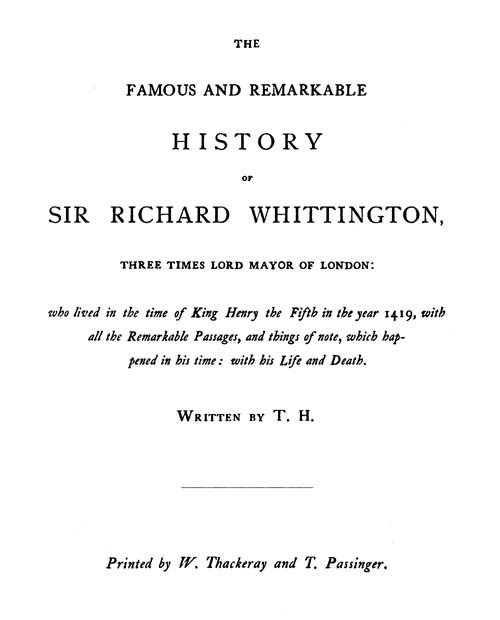
THE
FAMOUS AND REMARKABLE
HISTORY
OF
SIR RICHARD WHITTINGTON,
THREE TIMES LORD MAYOR OF LONDON:
who lived in the time of King Henry the Fifth in the year 1419, with
all the Remarkable Passages, and things of note, which happened
in his time: with his Life and Death.
Written by T. H.
Printed by W. Thackeray and T. Passinger.