NO sooner had the Duc d’Aumale resolved to bestow Chantilly with all its
treasures as a gift to the French nation than he joined, with even more
enthusiasm than he had previously done, the ranks of the great European
collectors, and he frequently attended in person important sales in
London, Paris, and elsewhere.
During the long years of exile, passed chiefly in England, he usually
resided either at Orleans House near Twickenham or at Woodnorton in
Worcestershire (till recently the residence of his nephew, the present
Duke of Orleans). It was, however, at the former place that all the
valuable manuscripts, paintings, books, and objects of art brought from
Chantilly were then housed.
The first exhibition of his taste as a pronounced bibliophile was given
by his acquiring the celebrated Standish Library, a collection
originally bequeathed to Louis Philippe by the English collector
Standish but sold by auction in 1851 on the death of that King. This
remarkable collection contained numerous Aldine editions and hundreds
of Italian and German incunabula. To this famous library the Duke next
added that of M. Armand Cigongne, a collection composed almost
exclusively of works in French—volumes of prose and poetry, exquisitely
bound, and many of them still bearing the coats-of-arms and book-plates
of former proprietors.
The most important acquisition, however, (added in 1855), was the famous
illuminated MS. known as Les Très Riches Heures du Duc de Berry, an
unique example of primitive French Art, to a description of which we
shall return later on.
In course of time other additions were made of great value and interest:
such as, for instance, Les Fables de Marie de France, Le Roman
d’Aspremont (thirteenth century), a copious selection of ballads and
songs of the fourteenth century, and many other works of note, amongst
them being a copy in four volumes of the Songs of Laborde, illustrated
with original designs by Moreau.
In the year 1861 the Duc d’Aumale, for the moderate sum of 14,000
francs, purchased from the well-known connoisseur M. Reiset a collection
of no less than 380 drawings by Italian, Flemish, Dutch, and German
masters. Amongst these may be specially noted: A Reading Monk, by
Raphael (hung in the Galerie du Logis), and a design, dated
approximately 1505, which approaches in execution the St. Catherine in
the Gallery of the Louvre.[18] Here are also drawings attributed to
Verrocchio: a Warrior on Horseback, five studies of horses, and an
interesting drawing of A Man and Woman, all in the style of Pisanello.
La Joconde (also in the Galerie du Logis), a cartoon for the picture
attributed to Leonardo da Vinci at St. Petersburg, came from the Reiset
Collection, as also did studies for Signorelli’s Last Judgment at
Orvieto; studies for Michael Angelo’s Prophets in the Sixtine Chapel;
and drawings by Fra Bartolomeo for his great composition in the Pitti. A
fine group of eleven figures by Lucas van Leyden, illustrating The
Return of the Prodigal Son, is one of the most important items in this
series; and a study of a Virgin by Dürer, an interesting Portrait by
Holbein the elder, a Mountainous Landscape by Rembrandt, and certain
studies of costume attributed to Pisanello, etc., are all worthy of more
than a passing notice.
Orléans House was soon found to be far too small to contain all these
treasures, and an annexe was built to it. The Duc d’Aumale presently
organised an exhibition, to which he invited the members of the
Burlington Fine Arts Club. Disraeli, who was present, and was much
struck by what he saw on that occasion, referred to him in his speech at
the anniversary of the Foundation of the Royal Literary Fund in the
following appropriate words: “Happy the prince who, though exiled from
his palaces and military pursuits through no fault of his own, finds a
consolation in books and an occupation in the rich domain of Art. Happy
the prince who, whilst living on terms of equality with the people of a
strange country, still distinguishes himself by the superiority of his
noble mind and character. Happy the prince who in adverse circumstances
can defy fate and make conquests in the kingdom of letters, which
cannot, like dynastic authority, be taken away from him.” The great
statesman here alluded to the stupendous historical work in seven
volumes on the History of the Princes de Condé upon which the Duke was
at that time occupied.
It must be remembered that these more recent acquisitions were
supplementary to the already existing collection which His Royal
Highness had inherited as heir to the last Prince de Condé—a collection
which comprised, amongst other things, two fine Van Dycks (the
Princesse de Barbançon and the Comte de Berghe), paintings by
Christophe Huet, by Desportes and by Oudry, and precious Gobelins and
Beauvais tapestries.
Furthermore yet another collection came into the Duke’s possession on
the death of his father-in-law, the Prince of Salerno, and with it no
less than seventy-two paintings, including works by Andrea del Sarto,
Luca Longhi, Giulio Romano, Luca Penni, Perin del Vaga, Daniele di
Volterra, Baroccio, Bronzino, Mazzola, Carracci, a Portrait by Moroni,
a Guido Reni, a Spada, an Albano, a Portrait of Himself by Guercino, a
fine Madonna by Sassoferrato, two landscapes by Gaspar Dughet, and
several paintings by Salvator Rosa.
Examples of the Northern Schools in this same collection include
portraits of Elisabeth Stuart, Queen of Bohemia, daughter of James I
of England, by Mierevelt and of the Duke of Neubourg by Van Dyck.
In the Salerno Collection is an interesting little work by Ingres
representing Paolo Malatesta and Francesca da Rimini in the ecstasy of
their first kiss, and also a portrait of a Young Woman by Van Loo and
some fine mosaics from Herculaneum and Pompeii.
Although this Salerno Collection is full of interest in itself, compared
with later acquisitions it is but of secondary importance. It was French
Art that chiefly attracted the Duke, and he consequently missed no
opportunity of extending his purchases in that direction. From the
well-known firm of Colnaghi in Pall Mall he bought portraits of members
of the Valois family, such as, for instance, Henri II as a child
(attributed to Clouet), and as King by Primaticcio; the Comte de Cossé
Brissac; Madame and Mademoiselle de Longueville, by Beauburn; and
other portraits by Mignard, Largillière, etc.
At the Bernal Sale in 1855 he acquired for 6,000 francs the
much-discussed portrait of Odet de Coligny; portraits of Queen
Eleonore, of Henri II, of Henri III, of Elisabeth of Austria, and
of Louis XIV, the last named of these being by Hyacinthe Rigaud.
At the famous Utterson Sale the Prince acquired some of those wonderful
sixteenth-century French drawings which formed the nucleus of his unique
collection of this branch of art; and at about the same period he also
bought a number of engravings, amongst which were fine examples by Marc
Antonio Raimondi and Rembrandt.
From the collection of his brother the Duke of Orleans he bought The
Assassination of the Duc de Guise by Delaroche, and a painting by
Descamps; and at the Lawrence Sale in 1856 secured a portrait of his
ancestor Philippe Egalité by Sir Joshua Reynolds. This was apparently
a sketch for the life-size portrait commissioned by the Prince of Wales
(afterwards George IV) during the French Prince’s exile in England. The
larger picture, formerly at Carlton House, was destroyed by fire in
1820, which greatly enhances the value of the sketch at Chantilly.
The portraits of Mazarin and Richelieu by Philippe de Champaigne,
now at Chantilly, were formerly at Château d’Eu, and formed part of
Louis Philippe’s collection, as also did de Troy’s Déjeuner d’Huîtres
and Lancret’s Déjeuner de Jambon. From the same source came two
splendid cabinets by Riesener and the Beauvais furniture now in one of
the salons of the Petit Château.
The Prince was evidently a great admirer of Poussin, for in 1854 he
acquired for 9,175 francs the celebrated Massacre of the Innocents,
and in 1860 another work by the same master, Thésée découvrant l’épée
de son père, which is typical of that artist’s particular style.
At the Northwick Sale in 1859 yet another Poussin, The Infancy of
Bacchus, was added; besides a large panel by Perugino, an early work,
once in the Church of San Girolamo at Lucca. An interesting painting
representing a Dance of Angels, probably by a Sienese master of the
fifteenth century, came also from this same sale. Titian’s Ecce Homo
was bought for 15,000 francs from the Averoldi family of Brescia, for
whom it is said to have been painted.[19]
The Woman taken in Adultery (attributed to Giorgione), The Martyrdom
of St. Stephen by Annibale Carracci, and Mars and Venus by Paolo
Veronese were bought in London in 1860 from M. Nieuwenhuys; and in 1864
at a public sale in Paris the celebrated painting by Ingres representing
The Story of Antiochus and Stratonice fell, amid general applause, to
the lot of the Duc d’Aumale for 92,100 francs.
Rosa Bonheur’s A Shepherd in the Pyrenees, presented by the Duke to
his wife, was acquired next, together with Gérome’s Le Duel après le
Bal and Protais’ Avant et après le Combat.
From the Soltykoff Sale in Paris, for the sum of 54,000 francs, came the
four large portraits in Limoges enamel representing Henri d’Albret,
King of Navarre, Antoine de Bourbon, Louis de Bourbon, and
Catherine de Lorraine.
Plate XX.

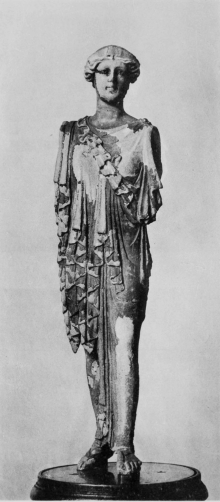
The Minerva of Chantilly.
Greek Bronze.
In 1865 Baron Triqueti, who often represented the Prince at these sales,
was sent to Paris to acquire the famous Pourtales vase, a Greek amphora
with red figures of the time of Phidias. For this interesting work of
art he paid 10,000 francs; whilst two small Greek bronzes—one
representing Jupiter and the other a statuette of Minerva—were
knocked down to him for 8,000 and 19,300 francs respectively. Upon this
occasion the Duke was bidding against the Louvre, the British Museum,
and Monsieur Thiers. These two bronzes, which were found near Besançon,
are of unequal merit; the Jupiter is of only average workmanship; but
the Minerva statuette is considered one of the greatest treasures at
Chantilly. Léon Heuzey places it in the late archaic period at a time
when the Greeks were still endeavouring to ennoble and beautify their
goddess before they finally arrived at the height of their ideal in the
famous Athena of Lemnos. The fact that this statuette was found at
Besançon indicates how highly Greek Art was valued, not only in Rome,
but also in Cisalpine Gaul; for such small portable figures often
accompanied their owners on their journeys, and who knows what great
personage it may have been who brought this exquisite little Minerva
with him to Gaul? We know that Tiberius never travelled without his
much-cherished Amazon of the Vatican.
A fragment of an antique sarcophagus representing Bacchus and Ariadne
was acquired for 7,200 francs at the Nolivos Sale and is exhibited now
in the Salle Minerve along with the above-mentioned statuettes and some
charming Tanagra figures.
On the death of his mother, Queen Marie Amélie, the Duc d’Aumale
inherited a great many family portraits and miniatures, the most
noteworthy among these being a life-size portrait of Gaston d’Orléans
by Van Dyck, of which there is a replica in the Radnor Collection. This
painting was given to Louis Philippe by George IV and was probably
painted at the request of Queen Henrietta Maria, wife of Charles I, who
was a sister of the Royal sitter. There is not the slightest resemblance
in his features to the good King Henri IV, his father. Treachery lurks
in his mouth and eyes, and we cannot help being reminded that he was the
direct cause of the execution of the last Montmorency.
From the same source came a portrait of Queen Marie Amélie herself,
painted by Gérard in 1817, and likenesses of the same Queen and two of
her daughters by Vigée Le Brun; a portrait of Louis Philippe as Duc
d’Orléans, when professor at Reichenau, by Winterhalter; and others of
Philippe Egalité and his charming wife, a daughter of the Duc de
Penthièvre, and of the Duc d’Aumale as a child by Robert Fleury. Most
of the gems and miniatures are likewise from the collection of Queen
Marie Amélie; and to the miniatures, in course of time, were added
others of members of the Royal Family of France bought by the Duke
himself, such as of Anne de Bretagne, François I, Gabrielle
d’Estrées and her two sons, Henri II, Henri IV, and Sully, the
famous Minister of Finance; of the Duc de Guise (le Balafré), Marie
de Medicis, Marie Thérèse, Queen of Louis XIV, the Grand Dauphin
and his wife Marie Anne of Bavaria, and many more.
In 1865 Mr. Colnaghi sold to the Duke Meissonier’s Les Dragons sous
Louis XV and a landscape by S. W. Reynolds, who is best known as an
engraver. The charming portrait of Maria, Lady Waldegrave with her
Daughter by Sir Joshua, was bequeathed to the Duke by Frances, Countess
of Waldegrave; and Lord Holland in 1860 presented him with
Talleyrand’s portrait by Ary Scheffer. From Sir Charles Robinson the
Duc d’Aumale acquired some fine Italian manuscripts, and an interesting
Rheno-Byzantine painting representing the Emperor Otto I seated
between two allegorical female figures, each holding a small globe
signifying the vassal states of the Empire. This painting, which is of
considerable historical value, is apparently a detached portion of a MS.
illuminated for the Emperor about the year 1000. From the same source
came another fragment, a Resurrection, dating from the fourteenth
century and belonging to the Sienese School. This hangs in the Rotonde
near a miniature of a Christ on the Cross attributed to Giulio Clovio.
In 1868, two years before his exile was suddenly terminated by the
downfall of the second Empire, the Duc d’Aumale bought for the sum of
600,000 francs the collection of the Marquis Maison; and amongst the
pictures which formed it were eight Descamps, three Marilhats, one Gros,
four Watteaus, four Greuzes and two paintings by Prud’hon. After that
followed the acquisition of one of Fromentin’s finest works, La Chasse
au Faucon en Algérie; whilst a sea-piece by Vandervelde together with
the Dunes at Scheveningen by Ruysdael were bought at the San Donato
Sale.
Presently there came the celebrated Vierge de la Maison d’Orléans by
Raphael, which the Duke acquired at the Delessert Sale for the sum of
160,000 francs—a fascinating picture supposed to be one of the two
panels described by Vasari as having been painted for Guidobaldo di
Montefeltro, and of which he says “that they were small but exceedingly
beautiful examples of the master’s second manner.”[20] At one time in
the possession of Gaston d’Orléans, this charming work passed from
France into Flanders at the end of the sixteenth century, where it is
supposed to have belonged to David Teniers the Younger. Passavant
thought that it was then that the background was repainted and the shelf
with the various pots and vases added—a supposition which has,
however, since been refuted. The youthful Madonna is seated on a
cushioned bench in a small homely room; and behind her hangs a light
curtain of reddish grey. She bends tenderly over the Infant Christ, who
gazes intently at the spectator with an expression full of feeling and
inspiration. This is perhaps the most divine-looking of all Raphael’s
Infants. The Bridgewater Madonna, seated on a similar seat in a homely
habitation, is closely analogous to the Virgin in this work, but instead
of the shelf there is an arched window to the right. The lights in both
pictures are subtle and extremely delicate, whilst the shadows are in
strongly marked contrast.
In the eighteenth century the Orléans Madonna subsequently returned to
France to the house of the well-known collector Crozat, from whence it
passed into the Orléans Gallery and obtained thus its distinctive
appellation. During the Revolution this entire collection was
transported to Brussels, and the Madonna changed hands several times
before it finally entered the haven of the Musée Condé.
Plate XXI.
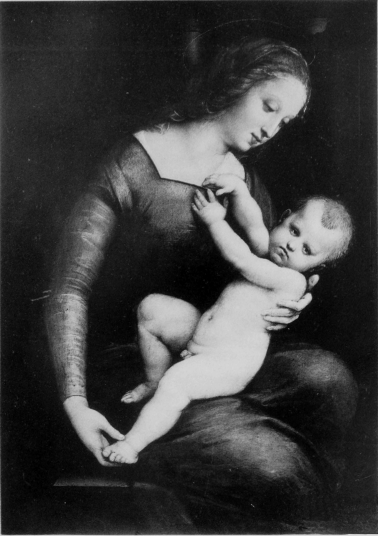
Photo Giraudon.
The Virgin of the Maison d’Orléans.
By Raphael.
Musée Condé.
When the Duc d’Aumale returned to Chantilly after an absence of twenty
years, he at once formed as we have seen a plan for erecting a museum
upon the ruins of the old Château, with the further intention of
presenting the mansion with all its contents to the French nation. Many
years, however, elapsed before the building was complete and ready to
receive all the treasures which it was destined to hold; but meanwhile
the Duke continued to increase the collection by munificent and
judicious purchases.
At the Faure Sale in 1873, Delacroix’s dramatic composition of The Two
Foscari was acquired; in 1877 there were added the four Tanagra figures
which now adorn the case wherein the Minerva is enshrined; and an
exquisite example of Italian enamel, representing Apollo guiding the
Chariot of the Sun (attributed to Benvenuto Cellini), was bought from
M. Cadard for 6,000 francs.
In 1876 a very important acquisition was made in the shape of a
collection of French portraits, once in the possession of Gaignières but
subsequently belonging to Alexandre Lenoir, from whom it had passed into
England and become the property of the then Duke of Sutherland. This
collection, which was at Stafford House until the Duc d’Aumale acquired
it, consists of no less than 69 painted portraits, 148 drawings in
coloured chalk and several pastels. Amongst the most interesting of
these portraits are: Francis I (painted about 1515), his sister,
Marguerite d’Angoulême, and her husband, Henri d’Albret, King of
Navarre; Jeanne d’Albret; Admiral de Coligny, and his brother the
Cardinal; Catherine de Medicis, Diane de Poitiers, Charles IX,
Henri III, the Duc d’Alençon, and the Duc de Nemours (all
attributed to François Clouet); Marguerite de France, and Madame de
Lansac (attributed to Corneille de Lyon); Philippe de Clève, Sieur
de Ravenstein; Jean de Bugenhagen (attributed to Holbein); Catherine
de Bora, the wife of Luther; Charles V; the Count and Countess
Hornes; Henri IV (by Pourbus), and an attractive likeness of his
daughter Elizabeth, Queen of Spain; Gabrielle d’Estrées au bain;
the Duc de Retz; the Duc d’Aumont on horseback; Sully and
Charost (by Quesnel); George I; several portraits by Mignard, among
them a magnificent likeness of Molière, another of Mazarin, and two
pastels representing Colbert and Quinault. From the same collection
are the portraits of Pope Benedict XIV by Subleyras and of Marie
Antoinette as Hebe by Drouais.
Another portrait which attracts much notice is that of Antoine de
Bourgogne, the Grand Bâtard, the second of the nineteen illegitimate
sons of Philippe le Bon. This painting was presented to the Duc d’Aumale
by the Duke of Sutherland. It is an exquisite work of art which has been
variously attributed to Memling, to Roger van der Weyden, and to Ugo van
der Goes, but it is to the last-named artist that it can be assigned
with greater probability. The Grand Bâtard[21] wears the Order of the
Golden Fleece instituted by his father at Bruges in 1430, and appears to
be about forty years of age, the period of life when he gained his great
victory over the Moors at Ceuta. He was not only a valiant warrior, but
also an arduous bibliophile and collector. His Château of La Roche
contained many interesting illuminated manuscripts now dispersed, and of
these the Froissart at Breslau is amongst the most celebrated. Like
all those that belonged to him, it bears his autograph “ob de
Bourgogne” “ob” being an abbreviation of the Greek word
ὁβαλὁς, which means bâtard.[22]
The drawings of this Sutherland Collection, especially those belonging
to the sixteenth century, are less important, many of them appearing to
be copies by inferior hands; those, however, of the seventeenth century
by Quesnel and Dumoustier are first-rate. Among the portraits in pastel
may be noted likenesses of Madame de Montespan, Louis XIII, Gaston
d’Orléans, Louis de Haros, and an interesting portrait of Watteau
designed by Boucher after an original by Watteau himself.
In 1877 the Duc d’Aumale availed himself of another opportunity of
restoring to France a French collection which had been brought to
England, namely, that of M. Carmontelle, which comprised no less than
450 coloured sketches for portraits which date from the year 1757 to the
year 1775. Carmontelle, as tutor to the Duc de Chartres, had plenty of
opportunity during his leisure hours to sketch all the men and women
with whom he came in contact, which he did merely for his own amusement,
without any expectation of payment. The facility with which he executed
these sketches astonished even Grimm, who remarked upon his skill. In
about two hours each, with the greatest ease, he reproduced all the most
noticeable figures in the life of the period, from the Dauphin and his
courtiers, the Princes and Princesses of the House of Bourbon and
Orléans, the officers, ladies and gentlemen, ecclesiastics, musicians
and actors, down to the domestics, and even the floor-scrubber at
Saint-Cloud. These sketches amounted at the time of his death to the
number of 700, and in 1807 were bought en bloc by his friend Richard
de Ledans, who disposed of a good many of them. When he died in 1816 450
drawings only were left. These were at once bought by Pierre de la
Mesangère, editor of Le Journal des Dames et des Modes, and they form
an exceedingly valuable record of the fashions at the time of Louis XV.
In 1831 the Carmontelle drawings reappeared in Scotland in the
Duff-Gordon-Duff Collection, whence they were acquired by the Duc
d’Aumale for the sum of 112,500 francs, to add to other examples of this
artist’s work, particularly a portrait of Carmontelle himself, which
he already possessed. They are now stored in large portfolios in the
Salle Caroline at Chantilly, and, catalogued with comments and notes by
the late Anatole Gruyer, afford great pleasure and amusement to those
who have leisure to examine them.
Plate XXII.
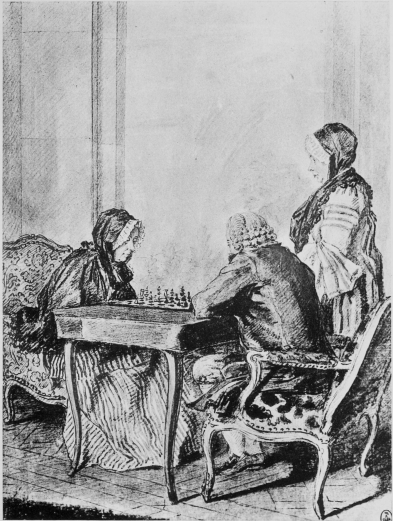
Photo. Giraudon.
A GAME OF CHESS.
Carmontelle.
Musée Condé.
The next acquisitions were a number of paintings collected by M. Reiset,
who had already, as we have seen above, passed on his drawings to the
indefatigable Duke. The price paid for these was 600,000 francs, and
they include no less than twenty-five pictures of the Italian School,
amongst which we may mention the following: a small panel representing
the Death of the Virgin, attributed to Giotto (unfortunately much
repainted); The Coronation of the Virgin, by Giovanni del Ponte di San
Stefano; an allegorical figure representing Autumn, attributed to
Botticelli[23]; an Annunciation by Francia and a Holy Family by
Jacopo Palma; several Luinis and two small Filippo Lippis; and an
exquisite little Madonna holding the Infant Christ by Bissolo. The
Marriage of St. Francis of Assisi to Poverty, by Sassetta (formerly
assigned to his pupil Sano di Pietro) is one of the most attractive
works by this master. It once formed part of an altarpiece at S.
Severino, long since broken up and dispersed. Several smaller panels
from the same altarpiece are to be found in the Chalendon Collection in
Paris, and one belongs to M. le Comte Martel; whilst the central portion
is in the possession of Mr. B. Berenson.[24]
In the painting at Chantilly Sassetta may be seen at the height of his
imaginative power.[25] An atmosphere of religious calm breathes over the
landscape from which the three figures of Chastity, Humility and Poverty
are floating upwards; the latter turning to wave a last friendly
greeting to the Saint whom they are leaving on earth. It is full of the
naïve sentiment for which this artist is so conspicuous.
Another interesting painting which belonged to the Reiset Collection is
the portrait of Simonetta Vespucci, formerly assigned to Pollaiuolo,
but attributed by Dr. G. Frizzoni to Piero di Cosimo. Simonetta was a
young Genoese lady renowned for her beauty, who came to Florence as the
wife of a Cattini. Poliziano wrote sonnets upon her charms, and Giuliano
dei Medici fell madly in love with her. Among the numerous likenesses of
her by Botticelli and others, in the National Gallery, at Berlin, and
elsewhere, this one in the Musée Condé seems to be the most lifelike.
Reiset bought this portrait in 1841 from the last member of the Vespucci
family.
Attention may here be drawn to a fine sea-piece by Everdingen, the
master of Ruysdael; to two small portraits of a Husband and Wife of
the Van Eyck School; and to a Procession attributed to Dierick
Bouts—all excellent examples of the Dutch School.
An extremely interesting picture, now known to be of French origin, came
also from the Reiset Gallery, namely, The Virgin as Protector of the
Human Race[26]—a work executed in 1452 by Charonton and Vilatte for
Jean Cadard and his wife, and of special importance in the history of
French painting.
Plate XXIII.
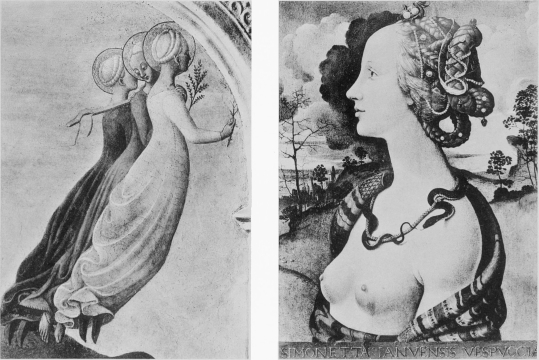
Photo. Giraudon.
THE MYSTIC MARRIAGE OF S. FRANCIS, BY SASSETTA.
SIMONETTA VESPUCCIA, BY PIERRE DI COSIMO.
Musée Condé.
To face page 146
Five large Poussins, two Gaspar Dughets, a portrait of Napoleon by
Gerard; and no less than three works by Ingres came also from this
same source: namely, the Artist’s own portrait as a youth, a portrait
of a Madame Devançay, and the painting of Venus Anadyomene, upon
which he is known to have spent much time and thought throughout the
last forty years of his life.
Finally, to all these other treasures were added some drawings by
Prud’hon. Then in 1882, from the Hamilton Palace Sale interesting
portraits by Corneille de Lyon, and a small likeness of Montaigne
probably by a late pupil of that master; and at various subsequent
London sales drawings were purchased by Botticelli, Canaletto, Tiepolo,
Salomon Ruysdael, Dumoustier, Ingres, Van Loo, and Gericault, besides a
great number of engravings.
Whilst the Duke was making these important acquisitions he was at the
same time gradually rebuilding the old Château of the Condés in order to
house them adequately, and it is not to be wondered at that intellectual
France took a great interest in this vast artistic enterprise. His Royal
Highness was elected a Member of the Institut de France and invited to
occupy the chair of M. de Cardaillac at the Académie des Beaux Arts. It
was on this occasion that Victor Hugo, whom the Prince had referred to
in his address of eulogy upon his predecessor, wrote him the following
memorable letter:
Cher et Royal Confrère,
Je viens de lire vos nobles paroles sur moi. Je vous ecris emu.
Vous êtes né prince et devenu homme. Pour moi votre royauté a
cessé d’être politique et maintenant est historique; ma république
ne s’en inquiète pas. Vous faites partie de la grandeur de la
France. Et je vous aime.[27]
It was, however, during the last years of his life that the Duke really
made his most important acquisitions. In 1885, for the sum of £3,800, he
bought from Mr. Fuller Russell the charming diptych painted in 1466 for
Jeanne de France, daughter of Charles VII. This painting was formerly
attributed to Memling, but Count Paul Durrieu now assigns it to Zanetto
Bugatto of Milan, one of that master’s greatest pupils in Italy.
Plate XXIV.
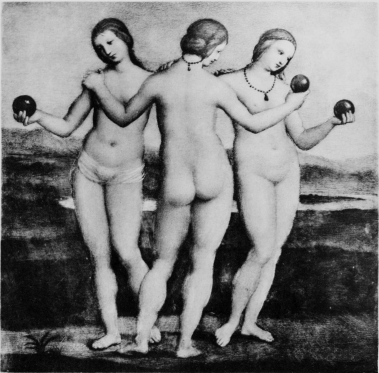
Photo. Giraudon.
The Three Graces.
By Raphael.
Musée Condé.
In the same year Raphael’s picture of the Three Graces was purchased
for the sum of £30,000 from the executors of the Earl of Dudley—a panel
so small as not to exceed the dimensions of a man’s hand. The youthful
Raphael in this composition was clearly inspired by the beautiful
antique marble group at Siena; and we may observe how the genius of two
great artists in two such diverse epochs can be happily blended
together. The Three Graces at Chantilly and The Dream of a Knight at
the National Gallery are not far apart and may probably both be dated
at about 1500-1503; but around the former picture there seems to hang
some unsolved problem. The Duc d’Aumale expresses himself about it in
the following terms: “Are these really the Three Graces whom we have
here before us? Or was it not rather the intention of Raphael to
represent the Three Ages of Womanly Beauty? To the left the virgin
with a veil around her slender hips; to the right the woman in her prime
wearing a necklace of coral; and in the centre, with her back turned to
the spectator, the woman in her full maturity, merely exhibiting her
fine profile. Does not this picture imply that Woman at all ages holds
in her hand the Empire of the World?”
This little panel, originally in the Borghese Gallery, passed
successively into the collections of Reboul, Fabre, Sir Thomas Lawrence,
Woodburn, and Lord Dudley whence it finally entered the sanctuary of the
Musée Condé.
Another important picture of the Italian School is the cassone panel
representing King Ahasuerus and Esther.[28] This was originally
painted for the Torrigiani family of Florence and was formerly ascribed
to Filippino Lippi; but modern art-criticism assigns it to the
suppositious “Amico di Sandro,” who, if he really did paint it, has
almost surpassed Filippino in both beauty and grace.
Another panel from the same cassone, representing the Second
Appearance of Esther before Ahasuerus, is in the possession of Leopold
Goldschmidt at Paris; whilst the two side panels of Mordecai on
Horseback and Esther as Queen walking in her Garden are in the
Lichtenstein Gallery at Vienna.
One more Italian picture deserves notice. It is a replica of the famous
composition which passed some years ago from the collection of Prince
Chigi in Rome into that of Mrs. John Gardiner at Boston, U.S.A. It
represents the Virgin and the Holy Child attended by an angel who
offers the latter roses. This picture has much of the charm of both
Botticelli and Filippino but is by neither of them. It is the work of
some unknown but unquestionably highly gifted artist.
Plate XXV.
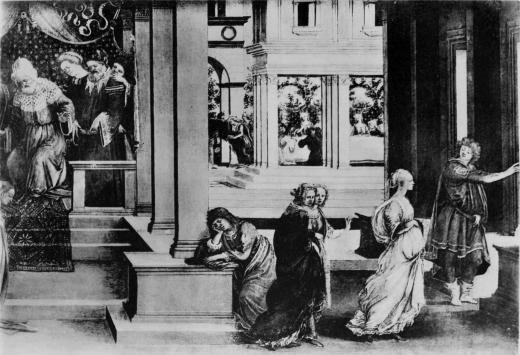
Photo. Giraudon.
The Story of Esther.
School of Sandro Botticelli.
Musée Condé.
In spite of these important purchases of Italian pictures the Duc
d’Aumale never neglected an opportunity of acquiring French works of
art, and he extended his collection as far as possible in that
particular direction. So that from M. Destailleur, from the Comte de
Fresnes, and from the Baron Seillier he acquired books that had been
bound expressly for François I, for Henri II and for Marguerite de
Valois. At the Hamilton Palace Sale he purchased for 12,375 francs a
Book of Hours of the fourteenth century which had been specially bound
for its then owner, François de Guise. In 1892 the sumptuous Psalter of
Ingeburge of Denmark, wife of Philippe Auguste, found its way into this
ever-increasing collection; and this was quickly followed by the
interesting Breviary executed in the fourteenth century for Queen
Jeanne d’Evreux.
In 1889 more than 310 French drawings were acquired from Lord Carlisle,
including original work by Jean Perréal, by Jean and François Clouet, by
Corneille de Lyon and by the Dumoustiers. The artistic, iconographic and
historical value of these drawings has been pronounced on all hands to
be almost unique; more especially with regard to the portraits of
celebrated personages living between the years 1514 and 1560. Francis
I with his Queens, his mistresses, his courtiers, and the ladies of his
petites bandes; the famous Preux de Marignan, the great
Montmorency and the Colignys, Henri II and his numerous sons and
daughters; Catherine de Medicis and la belle Diane—all these famous
heroes and heroines of history are met together in effigy at Chantilly:
a place they all knew so well and enjoyed so much during their lifetime.
The question of how these drawings, so highly valued under the Valois
régime, were ever allowed to leave France has never been
satisfactorily solved. Horace Walpole possessed a similar collection,
but it was of much less artistic importance. It was the collection once
owned by Mariette and is now apparently in the possession of an English
peer.[29] Gaignières also collected French drawings of the same type,
but after his death they greatly depreciated in value and passed from
the Bibliothèque Royale into the Bodleian Library at Oxford. But the
Howard portfolio, the most important of all, and also the Salting
Collection were discovered in Florence. It is certain that there is a
common link between all of the sets, and similar handwritings are to be
found upon the margins of most of them. We must, however, postpone
further discussion on this interesting question until a later chapter.
In 1889 the great painting by Meissonier, Les Cuirassiers de 1805, was
bought at the Secrétan Sale for the sum of 190,000 francs; and soon
after came Détaille’s finest work, Le Colonel Lepic à Eylau: “Haut les
Têtes.”
In 1890 Corot’s Concert Champêtre cost the Duke 20,000 francs and
proved how fully he appreciated the more recent art-movements in France.
His Royal Highness made his last acquisition in 1891, perhaps the most
important of all, and one which certainly procured for him immense
satisfaction—namely, forty miniatures by the famous Jean Fouquet from
the Book of Hours of Étienne Chevalier. These unique treasures were
purchased from Herr Brentano of Frankfurt for the sum of 250,000 francs
and will be fully described presently.
Plate XXVI.
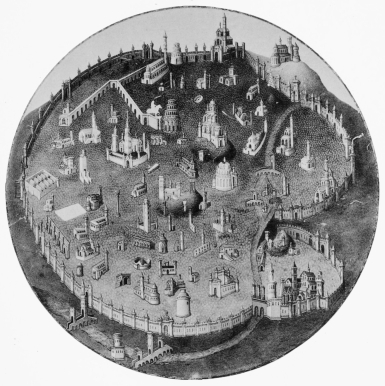
Photo. Giraudon.
PLAN OF ROME.
Pol de Limbourg and his Brothers.
From The “Très Riches Heures du Duc de Berry.”
The Musée Condé affords the most unique opportunities for the study of
French art. The Wallace Collection may be richer in the work of the
seventeenth, eighteenth, and nineteenth centuries, but there is nothing
in that collection which can compare with the examples of French
fifteenth and sixteenth century art enshrined at the Musée Condé; for
example, the exquisite miniatures of the Brothers Limbourg and of Jean
Fouquet, or the precious pencil portraits by the Valois Court-Painters.
It is to these that closer attention will be drawn in the following
chapters.
Plate XXVII.
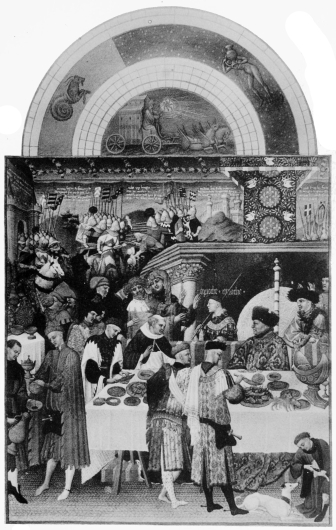
Photo. Giraudon.
JANUARY
Pol de Limbourg.
From The “Très Riches Heures du Duc de Berry.”
To face page 154.
THE leading part taken by French Art in the twelfth and thirteenth
centuries was not continued in the same degree during the fourteenth and
fifteenth. Nevertheless records have survived which afford sufficient
information whence we may conclude that France was at that period not as
entirely unproductive as has been hitherto supposed. It is true that,
owing to the fact that the wall-decorations in the Hôtel St. Paul, the
old Louvre, and the Hôtel de Savoisie in Paris, of the châteaux of
Bicêtre and Vaudreuil in Normandy, and of the castles of the Comtesse
d’Artois, have been almost entirely destroyed or demolished by fire,
siege or climate, native works of art of that period have become
extremely rare. Still those few which remain, such as the diptych
belonging to the Earl of Pembroke at Wilton,[30] the Parement de
Narbonne, now in the Louvre, the wall-paintings in the Cathedral at
Cahors and in the Church of Saint-Savin at Poitiers, etc., testify amply
to the importance of the work of that period. Moreover, the
miniatures of that period have not shared the disastrous vicissitudes of
the larger works. Thus the illuminated MSS. preserved at Chantilly offer
a special interest and are of an almost unique value in the general
history of Art.
By a fortunate chance an Inventory has come down to us, compiled in
1416, immediately after the death of the Duc de Berry, brother of King
Charles V of France. This document contains a catalogue of all the
art-treasures in his possession; but hardly any names of artists are
mentioned except those of Pol Limbourg and his brothers. Among the
entries the following is worth quoting: “Plusiers cayers d’une Très
Riches Heures qui faisoient Pol et ses frères, très richement historiez
et enluminez”—a note which refers without a doubt to the MS. of Les
Très Riches Heures now at Chantilly. Another document of no less
importance is one drawn up by François Robertet, Secretary to the Duc de
Bourbon, which informs us that several of the miniatures in the MS. of
Josephus’ Antiquities are by Jehan Fouquet, Court-Painter to Louis XI.
Thus it has been possible to identify the authentic work of the
Limbourgs and of Fouquet, some of the finest examples of which are to be
found in the Musée Condé.
Unfortunately these flashes of light are very rare; and absence of
record is no doubt one of the chief reasons why French paintings of this
period were so little known and appreciated in France, and why the
valuable collection bequeathed by Robert Gaignières to Louis XIV was but
little valued by that monarch. Trusting to the advice of the ignorant
critics of the time His Majesty reckoned them as of no importance and
did not consider the collection worthy of a place in the Louvre; so that
eventually, in 1717, it was scattered by public auction under the
directions of the painter de Troy.
Thus it happened that, whilst France was acquiring valuable antiques and
important examples of the art of the Italian Renaissance, she was unable
to estimate or retain the art which had sprung up on her own soil. To
cite one example only: Fouquet’s diptych from Melun has been lost to
France for ever, one portion of it being at Antwerp, another at Berlin,
whilst the beautiful enamelled frame has disappeared altogether.
Fortunately, however, connoisseurs like Reiset and Mariette arose, who
bequeathed French fifteenth and sixteenth century pictures to the
Louvre; and later still this remarkable legacy from the Duc d’Aumale
restored to France some of her own most valuable treasures. By means of
these acquisitions this patriotic Prince has constructed a monument to
French Art which is as interesting as it is unique.
Plate XXVIII.
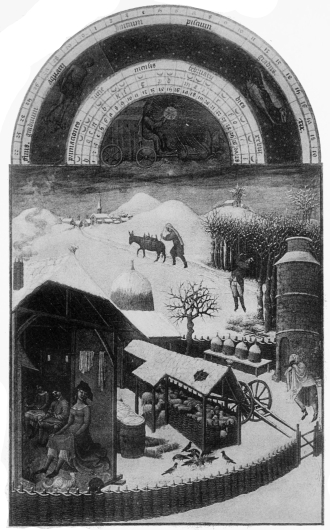
Photo. Giraudon.
FEBRUARY.
Pol de Limbourg.
From The “Très Riches Heures du Duc de Berry.”
To face page 156.
The Cabinet des Livres at Chantilly, still just as it was when
occupied by the Duc d’Aumale, with his chair, his writing-table, his
reading-lamp and half-burnt candle, contains no less than fourteen
thousand manuscripts of the very highest importance. The most
noteworthy amongst these are: the first ten books of St. Augustine’s
Cité de Dieu (translated by Raoul de Presles); Aristotle’s Ethics
(translated by Nicolas Oresmes); Livy’s Second Decade (translated by
Pierre Bersuire); all of which at one time belonged to the Duc de Berry.
Then there is the third volume of the Gallic War, a free translation
of the Commentaries of Cæsar,[31] on the last page of which is the
following inscription: Albertus Pichius, auxilio Godofredi pictoris
Batavi faciebat praecipiete Francisco Molinio mense novembris anno
quinquimillesimo vigesimo; whence we derive information regarding the
date of its completion, the names of the artists who were entrusted with
it and even the name of the man who commissioned it on behalf of Francis
I.
Most interesting are a selection of the Table Ronde used by Gaston
Paris in Vol. XXX of the Histoire littéraire de la France and a copy
of Dante’s Inferno with a Commentary by Guido of Pisa. Furthermore a
French translation of Cicero’s Rhetorics written in 1282 by Master
Jean d’Antioch and commissioned by a monk called Guillaume de
Saint-Etienne of the Order of St. John of Jerusalem: a MS. which throws
interesting light on still more ancient translations and is ornamented
with fine old miniatures; a French translation of Valere Maxime (in
two volumes), which belonged to the Cardinal George d’Amboise; a
translation of Diodorus Siculus, with a frontispiece representing
King Francis and his Court; and an illuminated manuscript, known to
have been the Book of Hours of Anne de Montmorency, offer more than
ordinary interest. This last belongs to the sixteenth century and
contains miniatures in the style of Jean Cousin.
Next comes a Legenda Aurea, which once belonged to Charles V of France
and which in its time has travelled back and forth between England and
France (as was so often the case with old books and manuscripts); for on
the last page we read in an unknown hand:
And yf my pen were better
Better shuld be my letter.
Plate XXIX.
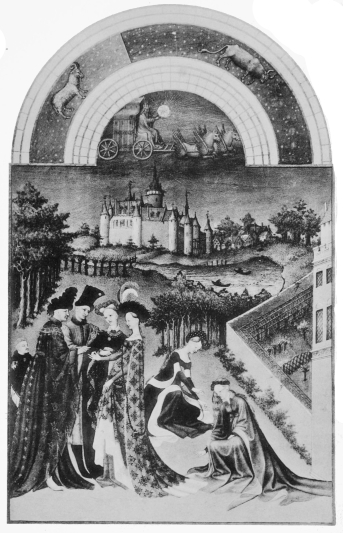
Photo. Giraudon.
APRIL.
Pol de Limbourg.
From The “Très Riches Heures du Duc de Berry.”
To face page 158.
Other extremely important MSS. acquired by the Duke himself are the MS.
de la Coche de Marguerite d’Angoulême and the Psalter of Queen
Ingeburge, of which the Duke was particularly proud. It commences with
a Calendar, followed by a series of paintings on gold backgrounds
representing scenes from the Old and New Testaments, and dates from the
thirteenth century. It belonged to Queen Ingeburge, the unhappy and
neglected wife of Philippe Auguste and in it are entered the names of
her father, Waldemar the Great, King of Denmark, of her mother, Queen
Sophia, and of the Comtesse Eleanore de Vermandois, her faithful friend
during long years of trial, thus proving unquestionably her ownership
of this precious volume. She has, moreover, entered in it the date 1214,
the year in which she was recognised as Queen of France. On the last
page appears the following entry: “Ce psaultier fut de Saint Loys,”
showing that the MS. subsequently came into the possession of St. Louis,
King of France, himself. In Charles V’s Inventory, dated 1380, it is
described as “mon gros psaultier, nommé le Psaultier St. Loys, très
richement enlumyne d’or et d’ancien ymages,” and we learn that in 1428
it was preserved in the Château of Vincennes. From that time, however,
it disappeared for nearly two hundred years until it was found in
England by Pierre de Bellièvre, who secured it and presented it in 1649
to Henri de Mesmes. The miniatures are similar in style to those found
in English MSS. of the thirteenth century; the colours are luminous,
black and blue being predominant, and the whole work is painted on a
gold ground. The initial letters and the decorative caligraphy show
skilful technique and were evidently designed at the period of which
Dante speaks as “L’onor di quell’arte ch’alluminare è chiamata in
Parisi.”[32] It is very probable that this Psalter of Queen
Ingeburge[33] served as the model for many other illuminated
manuscripts.
Another noteworthy royal MS. acquired by the Duc d’Aumale which is of
special importance is the Breviary of Jeanne d’Evreux. Amid the
delicate decorations of the border around the illuminated text may be
seen the coats-of-arms of France, Navarre, and Evreux; and it contains
no less than one hundred and fourteen miniatures in grisaille upon
coloured and gold backgrounds. The Gothic attitudes and graceful figures
recall the style of Jean Pucelle, which, dating from the years
1327-1350, had been introduced into Paris before the coming of Northern
realism.
Jeanne d’Evreux, wife of Charles IV, was well known as a connoisseur in
illuminated books, and this exquisite work of art passed to Charles V,
by whom it was kept at Vincennes in a coffer along with the Breviary
of Belleville.
The small Book of Hours belonging to M. Maurice de Rothschild
(published in facsimile by Count Delisle), the Missal of St. Denis in
the Victoria and Albert Museum, the Book of Hours designed for Jeanne
de France, Queen of Navarre, in the Yates Thomson Collection, form a
group of beautiful codices which have rightly been compared with this
MS. of Queen Jeanne d’Evreux.
Plate XXX.
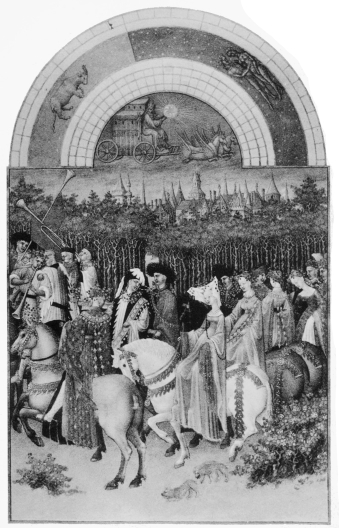
Photo. Giraudon.
MAY.
Pol de Limbourg.
From The “Très Riches Heures du Duc de Berry.”
To face page 160.
The greatest gem, however, of all these illuminated MSS. is
unquestionably the precious volume known as Les Très Riches Heures of
the Duc de Berry. The Duc d’Aumale himself relates the history of its
acquisition in 1855. On his way to visit his mother Queen Marie Amélie,
then lying ill at Nervi, he visited the Villa Pallavicini at Pegli,
near Genoa—at that time a boarding-school for young ladies—in order to
examine a MS. to which his attention had been drawn by Sir Antonio
Panizzi, Principal Librarian of the British Museum. Without any
hesitation he arranged on the spot to purchase the work of art for a sum
of 18,000 francs. On his return to Twickenham (where he was then
residing), the Duchess herself carefully unfolded the newly acquired
treasure from its “cassetta foderato di velluto” and every connoisseur
of note at once hastened to examine the wonderful MS. which the Duke had
been so fortunate as to acquire. As early as 1857 Waagen wrote about it
with much detail; later Count de Laborde, Anatol Gruyer, and Leopold
Delisle followed; and recently, and more exhaustively, Paul Durrieu
also. But it was Delisle who made the important discovery that the Très
Riches Heures could be identified with the MS. described in the
Inventory of the Duc de Berry: “Item une layette plusiers cayers d’une
‘Très Riches Heures’ que faisoient Pol et ses frères, très richement
historiez et enluminez.” The same writer also discovered that these
leaflets were valued at 500 livres tournois (about 20,000 francs), a
very large price for that time, and one which showed the high value in
which this manuscript was held even at that date.
The death of the Duc de Berry brought these precious pages, begun under
such brilliant auspices, to a sudden standstill; and in consequence of
that prince’s debts—which arose chiefly from his expensive artistic
tastes—a sale of his property immediately took place. The Duc de
Bourbon and the Comte d’Armagnac (the husbands of his two daughters and
co-heiresses) were making war upon one another on account of the murder
of the Duc d’Orléans by Jean Sans Peur—a war known in history as the
War of the Armagnacs and the Burgundians. Amid these disturbances there
was scarcely time to think of illuminated MSS.; for which reason the
work of Pol de Limbourg and his brothers was suspended, and was not
resumed until the year 1454, long after their death—unfortunately by a
far inferior hand—that of Jean de Colombe. By that time the volume had
come into the possession of Charles of Savoy and his wife Blanche of
Monferrat. It is not difficult to explain how this Breviary came into
the House of Savoy—a fact which is proved by the armorial bearings and
two miniature portraits of Charles—because both husband and wife were
descendants in direct line from Bonne de Berry (one of the daughters of
the Duc de Berry), who had first been married to a Count of Savoy. In
1501 the MS. passed to Margaret of Austria, wife of Philibert of Savoy,
a Royal patroness of the Arts who corresponded with Jean Perréal
regarding the tomb of her husband in the church at Brou. By her this MS.
was provided with a velvet cover and a silver padlock; and she no doubt
took it to Flanders with her after her husband’s death.
Plate XXXI.
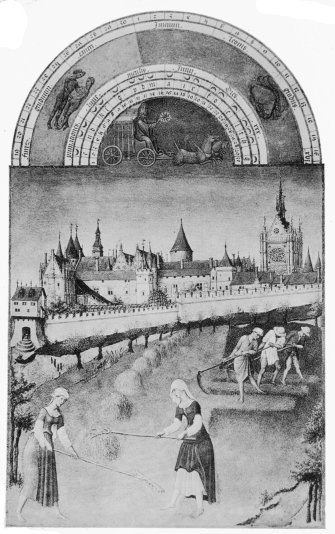
Photo. Giraudon.
JUNE.
Pol de Limbourg.
From The “Très Riches Heures du Duc de Berry.”
To face page 162.
Comte Paul Durrieu identifies the Très Riches Heures with a MS.
mentioned also in an Inventory of 1523 as “une grande heure escripte
à la main,” whereby it can be explained how the Grimani Breviary,[34]
executed about the end of the sixteenth century, and other Flemish MSS.
have obviously taken this famous Codex as a model; and even in some
points copied it very closely.
When Margaret of Austria died in 1530 the volume passed into the hands
of one of her executors, Jean Buffant, Treasurer to the Emperor Charles
V; and from that time there occurs a gap which even Paul Durrieu has so
far been unable to fill. The present binding of red morocco leather
belongs to the eighteenth century and bears the coat-of-arms of the
Spinola family, which points strongly to the probability that the volume
also once belonged to the celebrated General Spinola, who captured the
town of Breda—an historical event immortalised by Velasquez. From the
Spinolas it came into the family of the Sèvres, a fact proved by another
coat-of-arms amongst the illuminations; and from a member of that family
it was acquired by the Duc d’Aumale, by whom it was deposited at
Chantilly.
From this amazing list of MSS. we may see that nearly all the important
books and manuscripts of the fifteenth and sixteenth centuries are
represented at Chantilly. Some portions of the collection go back to the
old Montmorency and Condé acquisitions; whilst the Duc d’Aumale himself
has described the origin and vicissitudes of the articles gathered in by
himself in his admirable work The Philobiblon Miscellanies, which will
always remain the best guide to the Cabinet des Livres at Chantilly.
Plate XXXII.
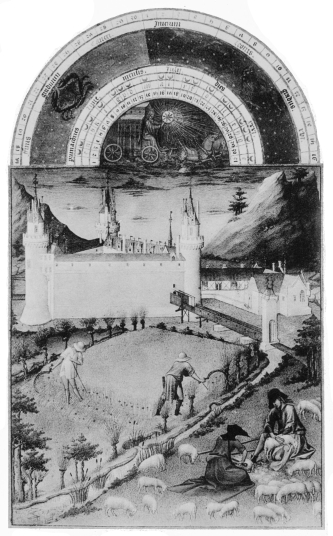
Photo. Giraudon.
JULY.
Pol de Limbourg.
From The “Très Riches Heures du Duc de Berry.”
To face page 164.
THE Duc de Berry was one of those enlightened and enthusiastic patrons
of Art who, by giving numerous commissions to the artists of his time
created important centres of Art in Paris and Dijon. It was for him that
Jaquemart de Hesdin and his school executed the famous Très Belles
Heures (now dispersed), fragments of which are to be found in the
Louvre: in the collections of Baron Adolph de Rothschild in Paris; and
of Prince Trivulzio at Milan: whilst the largest and most interesting
portion, known as the Hours of Turin, once treasured in the Royal
Library of that city, perished in a disastrous fire in 1904.[35]
It was likewise for the Duc de Berry that the nephews of Malouel, Pol de
Limbourg and his brothers, painted these famous Très Riches Heures now
at Chantilly. And that the Duke very greatly admired the work of these
artists is proved by entries in old Inventories, wherein we find that
he showered valuable presents upon them—pieces of gold (coins), rings,
etc. He moreover presented Pol the eldest and most eminent of the
brothers with a mansion at Bourges, where the artist and his wife
resided until his death.
The Duc de Berry was also one of those collectors whose taste rose above
that of his time; and who, furthermore, proved to be one of the leading
spirits in the development of the Art of that period. Besides famous
painters he also employed the celebrated architect Guy de Damartin to
build and restore his castles. The discovery of a MS. containing
architectural sketches of various fortresses (probably drawn by the hand
of this architect himself) proves that the Duke had a fancy to have his
various castles introduced with the greatest precision into the
backgrounds of the miniatures executed for him in this MS. No doubt it
was by his express wish that the landscape details in the Calendar of
this famous Book of Hours were copied direct from nature and not
treated merely conventionally as hitherto.
Plate XXXIII.
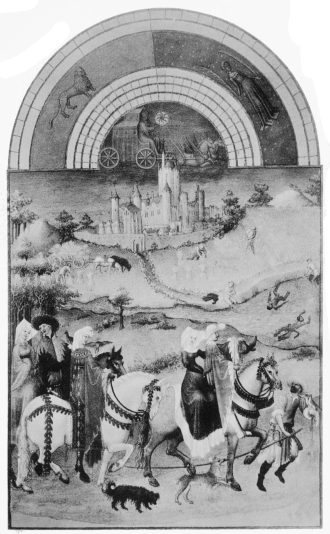
Photo. Giraudon.
AUGUST.
Pol de Limbourg.
From The “Très Riches Heures du Duc de Berry.”
To face page 166.
This remarkable work marks an important epoch in the history of
Primitive French Art, inasmuch as its influence extended not only over
France, but also to Italy, Flanders, and the School of Cologne. It
commences with a Calendar delightfully decorated and illustrating
minor passing events in the life of the period, with portraits of the
Duke himself, his family, his friends and other personages.
The Month of January[36] begins by showing us a banqueting scene. The
Duc de Berry, attired in a richly brocaded mantle and a fur cap, is
seated before a screen in conversation with a church dignitary—the only
one among the company besides himself who is seated. Three elegantly
dressed pages are busy serving a meal, whilst another is playing with
some pet dogs; puppies being engaged in eating out of a plate upon the
table. Two cup-bearers stand ready with wine and in a prominent position
upon the board stands a nef. This beautiful example of the goldsmith’s
art was known as the Salière du Pavillon and its design is attributed
to Pol Limbourg himself.[37] In the background may be seen the Ducal
guards and one of his castles. The face of the Duke appears to be an
excellent likeness if we compare it with a Holbein drawing at the Bâle
Museum, which is said to have been copied from a statue of this prince
at Bourges. Above this miniature, in a blue and gold lunette, appears
the Chariot of the Sun drawn by winged horses—a design repeated
several times in subsequent miniatures.
The Month of February exhibits a bright wintry landscape, where a silent
village[38] with a church tower lies beneath a mantle of white. The
feeling of a cold wintry day is well expressed by the heaped-up masses
of snow, against which the wool of sheep cowering in their folds is
sharply contrasted. We can almost see the shivers of the man to the
right, with his mantle drawn close around him. A haystack, bee-hives,
birds picking up crumbs, a peasant girl warming her feet at an open
fire, are so delightfully realistic, so free from convention, that we
feel that the artist has here given free rein to his imagination.
Then follows March: a peasant is ploughing, whilst behind rises the
fortress of Lusignan, the cradle of the Plantagenets. The sky is blue
and cloudless, and above one of the towers is a flying dragon, intended
to symbolise the fair Melusine. A close copy of this miniature is in the
Grimani Breviary.[39]
In the Month of April,[40] with the Castle of Dourdan on the River Orge
we find a scene characteristic of the period. An exchange of
presents—presumably an engagement—is in process between a noble knight
and a richly attired lady. The knight is the same personage who is
represented in attendance upon the Duke in the banquet scene. Another
pair of personages look on with sympathetic interest, whilst two young
ladies gather flowers.
Plate XXXIV.
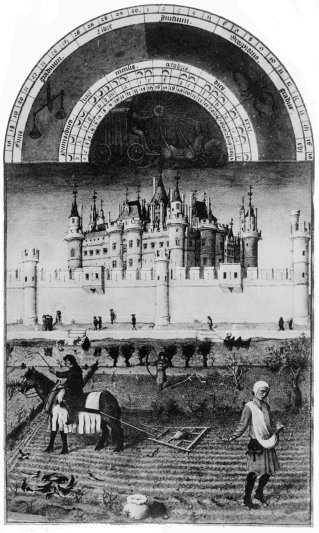
Photo. Giraudon.
OCTOBER.
Pol de Limbourg.
From The “Très Riches Heures du Duc de Berry.”
To face page 168.
The fifth miniature (which the Duc d’Aumale designates as La Reine de
Mai)[41] is one of the most charming of the series, for May Day was
at that time an occasion of much festivity at the Court of France. A
gay cavalcade is passing through a wood, headed apparently by a Prince
of the Blood—perhaps even the Sovereign himself—and amid those in
attendance the knight of the last picture again appears, his head bound
with a chaplet of bay-leaves. He is turning back to gaze at his bride,
who rides beside him on a white horse. She wears the same ornaments as
in the previous picture, and it is by these that we can identify her. In
the background, silhouetted against the horizon, is the Castle of Riom,
pleasantly situated in its park and gardens. This picture displays with
much effect the gaiety of the persons represented, who all seem to be
engaged in animated converse. Pol de Limbourg evidently approaches in
this picture his highest capabilities; and becomes more and more
independent of convention.
In the Month of June[42] the Palais de Justice of Charles V with the
Sainte-Chapelle are visible in the rear. The reapers shown in this
composition and the two graceful peasant girls busy amid the fresh-cut
grass have aroused great enthusiasm amongst modern connoisseurs; and we
involuntarily recall the paintings of François Millet and the Barbizon
School—a school which, after nearly four centuries, has revived the art
of realistic landscape-painting in France.
In the Month of July[43] the lofty towers of the Castle of Poitiers,
which not long before had been restored by the Duc de Berry, appear in
the background. And just as the winter landscape of the Month of
February arouses the impression of winter’s snow and ice, so this
brilliant composition, in which the sunshine blazes upon the cornfields,
makes one dream of the burning days of summer. The sheep, in February
huddled together in their pens, are now grazing in a meadow, whilst a
young peasant woman is busy plying her shears upon their fleecy coats
and a youth watches her with marked interest.
The Month of August[44] presents a hawking party. Two cavaliers mounted
on richly appointed steeds, their ladies mounted on pillions behind
them, are carrying hawks. One lady is, however, courageous enough to
manage her own palfrey, and holds a hawk upon her left wrist. Behind,
labourers are pursuing their toil and bathers are sporting in a stream.
At the back rises the Château d’Estampes which the Duc de Berry had
recently bought from his brother Louis of Anjou. The landscape is here
treated with admirable freedom. The artist has painted what he saw, just
as it really was, and the outlines of the château are represented with
remarkable fidelity.
The Castle of Saumur appears in the September miniature, where a vintage
is proceeding with life and vigour.
Plate XXXV.
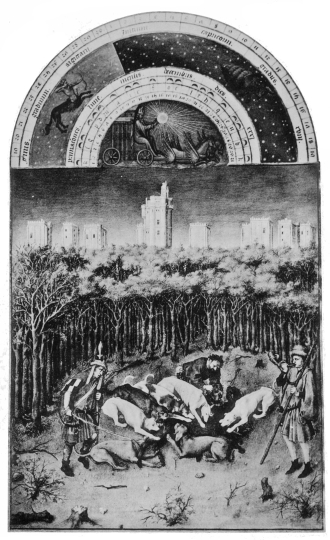
Photo. Giraudon.
DECEMBER.
Pol de Limbourg.
From The “Très Riches Heures du Duc de Berry.”
To face page 170.
October[45] brings with it ploughing, whilst a man scatters seed only
to be devoured at once by flights of hungry birds. In the rear various
groups of figures parade up and down upon a quay before the old Palace
of the Louvre.
The Month of November is a disappointment. It is conjectured that the
artist intended to present the Tour de Nesle, the Duke’s stately
town-residence, but that through his sudden death the page was left
unpainted until a century later, when Jean de Colombe undertook to fill
it in. It represents a swineherd with his pigs who are grubbing for
acorns; but the landscape is only a feeble attempt to imitate the
earlier work. The lunette, however, was evidently painted by the
Limbourgs.
In December[46]—the last of the series—a hunting-scene is presented,
with a pack of hounds careering through a spacious park, in the
background of which is the Keep of Vincennes, the Duke’s birthplace.
This miniature, which somewhat differs in conception from the earlier
ones, was probably executed by one of the brothers of Pol Limbourg.
The fascinating landscapes and the graceful architecture of these
Calendar Months excite our keenest admiration; for we must remember
that at this early date (1415) landscape-painting had hitherto been
treated as mere decoration, without any attempt at reality or
probability.[47] Their special charm lies very largely in their
truthfulness to nature, and the Duc de Berry himself added still further
to this element when he insisted upon the introduction of accurate
representations of his own castles and their surroundings.
Immediately after the Months we come upon a strange miniature, which,
since it also displays the escutcheon of the Duc de Berry, may be
assigned to the years 1415-16 and is therefore presumably the work of
the Limbourgs. Two nude figures, classical in conception, are presented
propped back to back against one another. As in the case of the statue
found at Porto d’Anzio, doubt has recently arisen with regard to their
sex.[48]
It has been suggested that these two figures were inspired by the Three
Graces of Siena; that they are not meant to represent the Dioscuri,
as had been hitherto supposed; but that they are two tall slender women
such as we find in early Renaissance Art inspired by Greek originals.
Their tresses are arranged in the characteristic Greek knot and their
slender bodies exhibit the Astrological and Horoscopical connection
between the various members of the human organism and the Signs of the
Zodiac. We do not find amongst the illustrations of the Middle Ages
anything analogous to this curious painting, so that it may be reckoned
amongst the many entirely original ideas peculiar to this interesting
Codex.
Plate XXXVI.
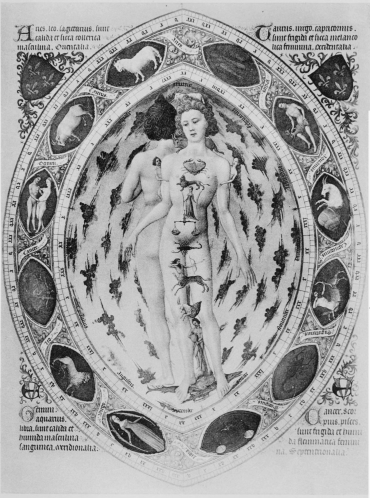
Photo. Giraudon.
THE ZODIAC.
Pol de Limbourg and his Brothers.
From The “Très Riches Heures du Duc de Berry.”
To face page 172.
This curious design is followed by small but exquisite miniatures of
the Four Evangelists and of the Tiburtine Sybil prophesying to
Augustus. Our attent ion is then drawn to a large design representing
the Terrestrial Paradise. Four different scenes are shown on the same
plane: Eve receives the apple from the Serpent; she offers it to
Adam; the Almighty interrogating the offenders; and their expulsion
from Paradise through a Gothic gateway by a stern-looking angel with
scarlet wings. This miniature, out of the entire number of not less than
206, is the only one which exhibits a marked Flemish influence and
reminds us of the fact that the Limbourgs were nephews and pupils of
Malouel, Court-Painter to the Duke of Burgundy. All the other miniatures
in this Codex which can be assigned to these artists are pre-eminently
French in feeling and sensitiveness, showing only occasionally a trace
of the influence of Simone Martini: as, for example, Christ bearing His
Cross.
The scenes from the Life of Christ commence after traditional fashion
with the Annunciation and end with the Crucifixion. The
Annunciation is perhaps one of the most attractive of the series. It
no longer expresses merely Mediæval symbol but seems rather to simply
represent a story; so that we feel that we are already on the threshold
of the Renaissance. The Virgin kneels before a fald-stool in a Gothic
chapel, whilst the Holy Dove hovers above her head. Smiling with gentle
content, she welcomes the salutation of the Archangel—a handsome youth
who bears in his hand a branch of lilies. Tastefully grouped around the
central composition are angels singing and playing on musical
instruments, and the whole is executed in most vivid colours. The
armorial bearings of the Duke, a fleur-de-lys displayed between a bear
and a swan, have given rise to the canting word Oursine (ours-cigne),
which is said to have been the name of the Duke’s favourite mistress.
They occur frequently in this MS.
The Adoration of the Infant Saviour, with choirs of rejoicing Angels
around the roof of the stable and Joseph—an Oriental-looking personage
with a long beard—in deep contemplation, is a representation full of
novelty and charm. A shepherd, followed by his flock, draws near to gaze
in awe upon the Divine Babe.
On the next page a number of shepherds are pointing to a choir of angels
who are singing and making melody in the air, whilst in the distance
rises a majestic Gothic cathedral, probably intended to represent the
Temple at Jerusalem. In the foreground is one of those conventional
hillocks so often met with in old mosaics; but the fountain of running
water which rises upon it and from which the sheep are drinking is
realistically conceived. It is interesting, therefore, to note the
admixture of symbolic tradition with realistic feeling.
Plate XXXVII.
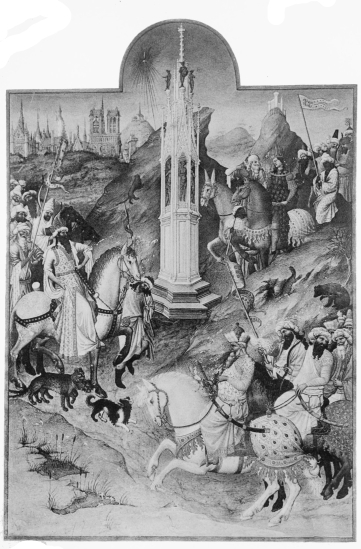
Photo. Giraudon.
THE PROCESSION OF THE MAGI.
Pol de Limbourg and his Brothers.
From The “Très Riches Heures du Duc de Berry.”
To face page 174.
The Procession of the Magi, again, is an example of the Limbourgs’
facility in applying new forms to conventional conceptions; and it is
worth observing how anxious they evidently were to study the special
wishes of their patron the Duke. We learn from the Inventory of this
Prince that he was an ardent collector of medals, and that he had bought
from a Florentine dealer a medal of the Emperor Constantine. The
figure of the most prominent of these three Magi on the left of the
scene appears to have been copied from this very medal.[49] In the
background may be noticed the Cathedral of Notre Dame de Paris and the
Sainte Chapelle. Again two bears are introduced in allusion to the Ducal
device. In the centre of the picture is a tabernacle of pure French
Gothic style adorned with figures of prophets and saints. These
tabernacles were used in the fourteenth century (the Duc d’Aumale
observes), as halting-places between Paris and Saint-Denis and were
called Montjoies.
The Fall of the Rebel Angels[50] which comes next is one of the
loveliest pages of the series. God the Father, surrounded by Cherubim
and Seraphim, is enthroned above the golden rays of the Sun. From
amongst the ranks of the Angels—who are seated around in a
semicircle—the rebels are being cast headlong to Earth. As Lucifer in
his fall strikes his handsome head and diadem upon the ground fire
bursts from him, producing a marvellous colour-effect of gold, blue and
green.
Although this composition is otherwise entirely symbolical, a body of
French soldiers clad in armour of that period, with long staves, are
introduced striking down the angels as they fall from above. This
wonderful little design, although not more than 10 inches wide, is so
full of action that it has been compared to the Signorelli frescoes at
Orvieto; and this not without reason, for these miniaturists have, even
on so tiny a scale, produced very much the same forcible effect.
In direct contrast to this awe-inspiring composition is The Coronation
of the Virgin[51] shown here with a fine combination of grandeur and
elegance in style. Our Lady’s mantle is rainbow-hued and her dress of
pure white is powdered with golden fleur-de-lys. Angels bearing her
crown descend from above, whilst Our Lord Himself raises His hands in
blessing. On the right are the Apostles and a group of female Saints,
one of whom is said to be a portrait of Oursine herself. On the left
is a bishop attended by monks. This miniature seems to be a prototype of
a painting by Enguerrand Charonton, executed about half a century later
and now at Villeneuve les Avignon.
Plate XXXVIII.
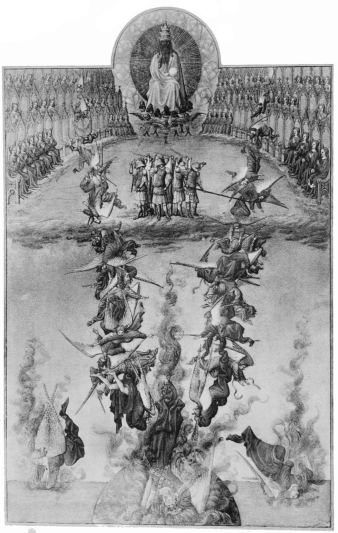
Photo. Giraudon.
THE FALL OF THE ANGELS.
Pol de Limbourg and his Brothers
From the “Très Riches Heures du Duc de Berry.”
To face page 176.
The Temptation of Our Lord deserves somewhat special attention. The
scene is represented as taking place upon a conventional mountain-top;
and Satan is pointing to a castle with three towers: none other than
the Duke’s celebrated Castle of Mehun-sur-Yèvre,[52] described by
Froissart as the most beautiful place on earth.
In the Crucifixion, in accordance with the Biblical text, the artists
have endeavoured to represent eclipses of the Sun and of the Moon, thus
creating for the first time, as early as 1415, that chiaroscuro which
later on was so much admired when employed by Rembrandt and Correggio.
The Miracle of the Loaves, within its graceful frame, is also
extremely interesting; and not less noteworthy is a Plan of Rome,[53]
in which may be observed the old basilica of St. Peter, Santa Maria
Maggiore, the Lateran, the Colosseum and the Capitol, the equestrian
statue of Marcus Aurelius, the aqueducts, etc. Nothing is to be seen of
the Forum, for at that time no excavations had yet been made.
In conclusion we must mention the exquisite miniature representing Mont
St. Michel, with the dragon and St. Michael fighting in the air, a lake
and sailing-boats below, and the effigy of the fair Oursine enshrined in
the letter B.
Attempts have been made from time to time to trace throughout these
beautiful pages the different hands of the three brothers, but no
definite conclusion has been arrived at. It is, however, certain that
Pol, the greatest of the three, was the leading spirit, and that he was
the sole author of the Calendar Months, except that of November,
which, as has already been mentioned, was completed seventy years later
by Jean Colombe. In this design, and likewise in that part of the book
executed by this latter artist, the originality which fascinates us so
much in the work of the Limbourgs suddenly vanishes and we find
ourselves contemplating mediocrity. In the Pietà (one of Jean
Colombe’s miniatures) kneeling figures of the Duke and Duchess of Savoy
are introduced. We cannot help wondering what different results might
have been achieved had Duke Charles of Savoy, on inheriting the Très
Riches Heures, employed Bourdichon or Perréal to complete them—or
perhaps Simon Marmion of Valenciennes, who at that very time was
painting his celebrated altarpiece for St. Bertin. Unfortunately this
prince was not a connoisseur like his august relative the Duc de Berry,
and he was unable in consequence to distinguish great art from lesser
achievements.
Plate XXXIX.
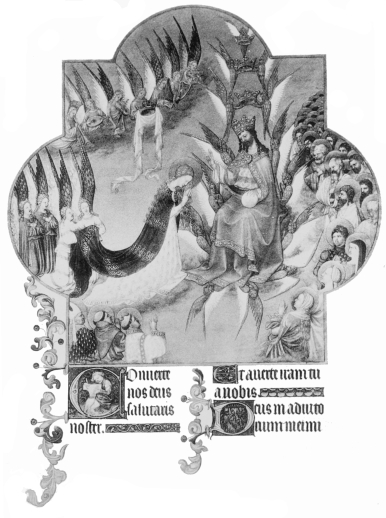
Photo. Giraudon.
THE CORONATION OF THE VIRGIN.
Pol de Limbourg and his Brothers
From The “Très Riches Heures du Duc de Berry.”
To face page 178.
IT is reasonable to inquire with some misgiving whether the Très Riches
Heures du Duc de Berry[54], so far surpassing all other artistic
creations of its period, are the only record of the labours of Pol de
Limbourg and his brothers which has come down to us. This would seem to
be almost the case, if we except the Belles Heures de Jean de Berry
(now in the possession of Baron Edmond de Rothschild,) which was the
livre de chevet of the Duke and is far smaller in dimensions than the
Très Riches Heures.
We can trace in the Bible Moralisée (MS. Français 166 Bibl. Nat.)
miniatures strongly recalling the style of the Limbourgs, and if we
proceed to compare some of its later pages, supposed to have been the
work of the young Fouquet, with similar subjects as in the Chantilly
Codex a distinct resemblance can be observed. For instance a
representation of Paradise in the Bible Moralisée closely resembles
the Limbourgs’ treatment of the same subject in the Très Riches
Heures. A few pages farther on the same scene appears, attributed once
more and not without reason to Fouquet—probably an early work—which
shows the decided influence of his predecessors and tends to suggest
that Jean Fouquet of Tours must have been a follower of Pol de Limbourg.
At any rate his taste for landscape-painting is already in evidence
here, and from the first he appears to have clearly grasped the fact
that his predecessors’ greatness lay very largely in this branch of the
art of painting, so that he specially laid himself out to make it his
own also. The banks of the Loire and the country surrounding his native
town of Tours were his favourite subjects, and his treatment of these
provoked the fervent admiration of his Italian friend Florio.
Plate XL.
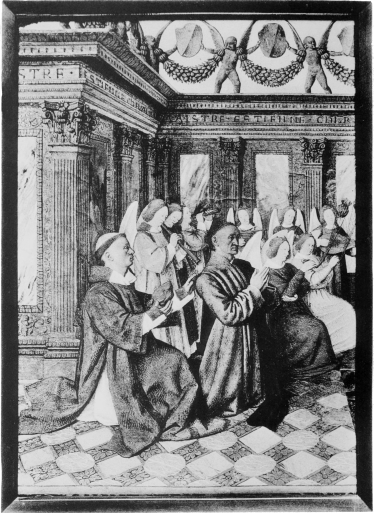
Photo. Giraudon.
ETIENNE CHEVALIER AND HIS PATRON SAINT KNEELING BEFORE THE VIRGIN.
Jean Fouquet.
Musée Condé.
To face plate XLI.
Fouquet was born in 1415, and was already famous when Louis XI ascended
the Throne of France, and made him his Court-Painter. He was, moreover,
well known in Italy before 1443; for he was commissioned whilst in Rome
to paint a portrait of Pope Eugenius IV which is known to have been
long preserved in the Sacristy of Santa Maria sopra Minerva, but which
has only come down to us in a mediocre engraving. Filarete in his
Treatise on Architecture, dedicated to Francesco Sforza, speaks of
Fouquet as famous for portraits from life, and mentions this very
portrait of the Pope, together with those of two members of his family.
His name was still remembered in Italy in the sixteenth century (he died
before 1480), for Vasari mentions him as Giovanni Fochet assai lodato
pitor. And Jean de Maire of Belgium, who lived at the Court of that
highly cultured patroness of the Arts, Margaret of Austria,
daughter of the Emperor Maximilian, recalls Fouquet with highest
commendation. Indeed this princess, according to an Inventory of 1516,
seems to have owned a small Madonna painted by this master: “Un petit
tableau de Notre Dame bien vieux de la main de Fouquet ayant etuy et
couverture.”
Plate XLI.
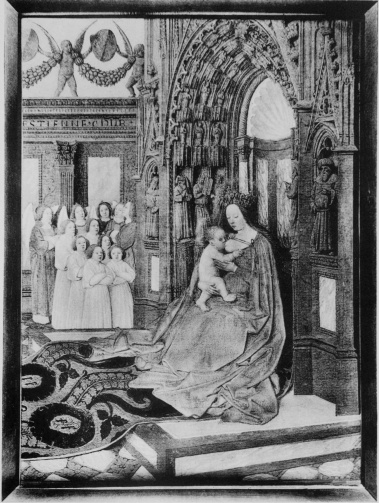
Photo. Giraudon.
THE VIRGIN AND CHILD RECEIVING HOMAGE
Jean Fouquet.
Musée Condé.
To face page 180.
We know that Fouquet painted the portraits of Charles VII and of
Juvenal des Ursins in the Louvre, and also a recently acquired
portrait of a Man with a Glass of Wine. The life-sized portraits of
Etienne Chevalier attended by his Patron Saint at Berlin and the
powerful likeness of an Unknown Personage in the Lichtenstein Gallery
are by his hand. But although he won great fame as a portrait-painter
during his lifetime it is upon his achievements as a worker in miniature
that his highest reputation is based.
Plate XLII.
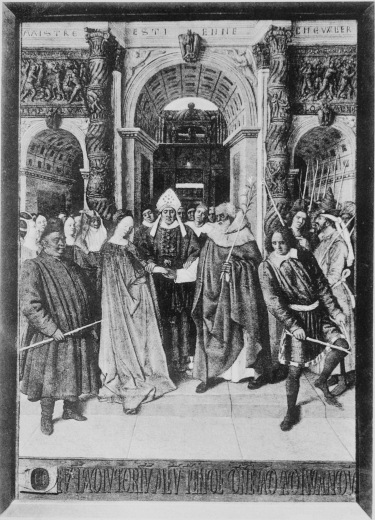
Photo. Giraudon.
THE MARRIAGE OF THE VIRGIN.
Jean Fouquet.
Musée Condé.
To face page 182.
A very large number of the collections of miniatures have fortunately
been spared to us, and they have come down to us in almost perfect
condition. The most important may be enumerated as follows: the
Statutes of the Order of St. Michael; the Boccaccio at Munich; the
Book of Hours painted for Etienne Chevalier; the Chronique de France
in the Bibliothèque Nationale; some MSS. now in the possession of Mr.
Yates Thomson; and, finest of all, the Antiquitates Judæorum of
Josephus. In the Statutes of the Order of St. Michael (MS. 19819
Bibl. Nat.) Louis XI, as Founder of the Order, is portrayed surrounded
by his thirty-six Knights. A similar miniature, but of somewhat greater
dimensions, forms the frontispiece of the Boccaccio, which was
executed for the Controleur Laurens Gyrart and is now in the Public
Library at Munich. Count Paul Durrieu believes—and not without
reason—that all the miniatures in this Codex are by Fouquet himself. On
the frontispiece, a leaf not more than 20 inches square, Charles VII is
depicted surrounded by about 150 dignitaries—judges, magistrates,
etc.—passing judgment on Duc Jean d’Alençon. The scene is laid at the
Castle of St. George in Vendôme, and amongst those present is Etienne
Chevalier and the artist himself.[55] Most realistically conceived are
the crowd of onlookers, some of whom, pushing forward, are being
vigorously repressed by the guards. The Chronique de France (MS.
Français 6465 Bibl. Nat.), in which fifty-five illustrations record
events in the Life of Philippe Augustus, one of them showing the
Coronation of Charlemagne in the old Basilica of St. Peter at Rome, is
another work by Fouquet which is full of points of interest. His
illustrations to the French translation of the Antiquitates Judæorum
of Josephus—now in the Bibliothèque Nationale, Paris—are usually
reckoned as his chef d’œuvre. The Duc de Berry had, in the first
instance, commissioned André Beauneveu to execute this MS., but
presently it came, by way of inheritance, into the hands of Jacques
d’Armagnac, Duc de Nemours, who engaged Fouquet to complete the
unfinished work. A note in the first volume of this MS. by François
Robertet, secretary to Pierre de Beaujeu, Duc de Bourbon, records that
the first three miniatures in that volume were by the Duc de Berry’s
artists, and the rest by Louis XI’s “good painter and illuminator—Jean
Fouquet of Tours.” It is by this note that we are enabled to identify
Fouquet’s work. Subsequently the Codex became the property of Catherine,
daughter of the murdered Duc de Nemours, who on her marriage to the Duc
de Bourbon brought the treasure to the Court of Moulins. When, a century
later, the last Duc de Bourbon, the famous Constable, was killed at the
Sack of Rome, since he had no heirs and was an exile and fugitive from
France, all his property, including this Codex, was confiscated and
passed to the Crown. In course of time the second volume became
separated from the first, and having strayed to England, eventually
found its way into the Library of Colonel Townley, whence it was sold in
1814. At that time it still contained thirteen miniatures. It was not,
however, until 1905 that it reappeared once more at a sale at Sotheby’s
when it contained but one miniature![56] Here it was secured by Mr.
Yates Thomson, who recognised its author. Two years later Mr. Warner,
Librarian of the Royal Library at Windsor, identified ten illuminated
miniatures, then in the possession of King Edward VII, as the work of
Fouquet and furthermore as belonging to the very MS. acquired by Mr.
Yates Thomson. His Majesty graciously consented to unite his precious
fragments with those of Mr. Yates Thomson, and the two owners agreed to
present the whole work to President Fallières. Thus the two volumes were
once more reunited after a separation of many centuries; but with two
sheets still missing. The illuminations harmonise in every respect
throughout, except that the designs in Volume I are somewhat superior to
those in Volume II. Amongst them one representing the Children of
Israel led into Captivity by King Shalmaneser is most interesting and
exhibits Fouquet at the zenith of his powers. We may specially notice
the exquisitely beautiful landscape and the horses, which recall the art
of Pisanello. Another scene labelled Clementia shows the Return from
the Captivity; and here we may observe a curious blending of classic
architecture with the French domestic style of the painter’s own day.
This Codex of Fouquet’s recalls the Belles Heures of Ailly mentioned
above, which is considered to be an early work of the Brothers Limbourg
(i.e. circa 1403-13).
Plate XLIII.
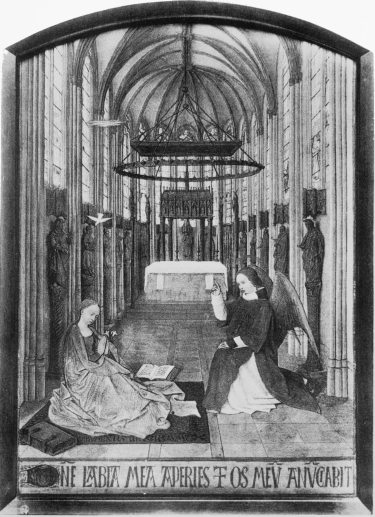
Photo. Giraudon.
THE ANNUNCIATION.
Jean Fouquet.
Musée Condé.
To face page 184.
But of all the MSS. illuminated by this artist the one which must most
particularly attract our attention is the Book of Hours executed for
Etienne Chevalier, the greater part of which is now preserved at
Chantilly. Almost all these miniatures are reminiscent of impressions
received by Fouquet during residence in Florence and Rome. They were
apparently executed during the years 1453 and 1460, soon after his
return from Italy and immediately after the completion of the celebrated
diptych of Etienne Chevalier and his Patron Saint and the Madonna and
Child commissioned by this same Chevalier in 1453 for the Cathedral at
Melun in memory of his wife Catherine Buti. One portion of this diptych
(the Madonna and Child) is now, as mentioned above, in the Antwerp
Museum, whilst the other has found its way into the Kaiser Friedrich
Collection at Berlin. The miniatures at Chantilly, forty in number,
represent, if not the greatest, at least the most fascinating period of
the master’s artistic career. Like the MS. of the Antiquitates
Judæorum they also suffered many vicissitudes before finally entering
the haven of the Musée Condé. Nicolas, Baron of Navarre and Bearn, a
descendant of Etienne Chevalier, in the year 1630, when at the point of
death entreated his nephew, to whom he bequeathed his manuscripts, to
preserve and augment them “en faveur des gens doctes.” Howbeit that
same nephew sold not only the Boccaccio to Munich, but also his
ancestor Etienne Chevalier’s Book of Hours. Whilst the former remained
intact the latter was mutilated by a dealer, who separated the text from
the miniatures in order to sell them individually. It is interesting to
note here that Gaignière in his Receuils had copies made of the
portraits of Etienne Chevalier and of Charles VII from this MS. and
attached to them explanatory notes, as follows: “Charles VII copié
après une miniature dans une prière d’heures faite pour Etienne
Chevalier, trésorier general de France sous ce Prince”; and again,
“Copie d’après une miniature dans un livre d’heures qu’il avait fait
faire.”
We may therefore gather from these notes that as late as the seventeenth
century the illustrations in this Book of Hours had not been divided
from the text. At the beginning of the eighteenth century, however, the
portraits were again reproduced by Montfaucon; but this time they were
not copied from the originals, proving that the learned Benedictine
writer was then unable to discover their existence. Eventually in 1805
forty of these treasures were discovered at Bâle and bought by George
Brentano la Roche of Frankfurt, whence in 1891 they passed to the Duc
d’Aumale. Besides these forty, four more pages have been identified as
belonging to this same book, as follows: one in the British Museum,
which represents David kneeling in prayer amid a beautiful landscape;
a Mariensippe (Genealogy of the Blessed Virgin) in the Bibliothèque
Nationale, Paris; a fragment in the Louvre representing St. Margaret
with a landscape background; and yet one more, St. Martin dividing his
mantle, in the Conches Collection.
Plate XLIV.
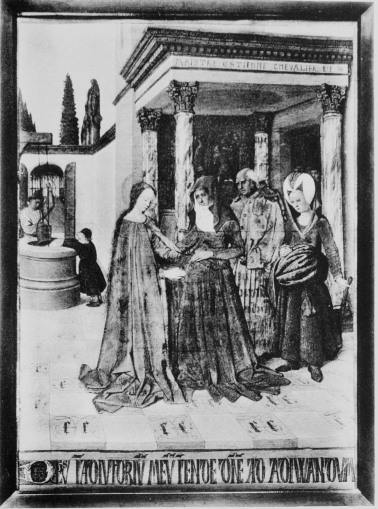
Photo. Giraudon.
THE VISITATION.
Jean Fouquet.
Musée Condé.
To face page 186.
The forty miniatures at Chantilly are hung upon the walls of the
Santuario—so called by the Duc d’Aumale because it sheltered his
greatest treasures—i.e. the forty Fouquets, Raphael’s famous
Graces, the beautiful painting of Esther before Ahasuerus and the
Madonna of the Maison d’Orléans.
The miniature representing Etienne Chevalier with his Patron St.
Stephen[57] was intended as a frontispiece for this beautiful book. The
powerful Lord High Treasurer of France is represented humbly kneeling,
his eyes fixed steadily upon the Divine Mother, who, crowned and seated
beneath a Gothic canopy, holds upon her lap the Holy Babe.[58] To the
left angels are singing and playing upon musical instruments, whilst a
band of children clad in white timidly adore their Infant Saviour. The
architecture in the rear of the composition is of special interest, for
Gothic niches enshrining figures of the Prophets are intermingled with
panels in the style of the Italian Renaissance and Corinthian columns
after the manner of Brunelleschi and Michelozzo. A rich display of gold
in this miniature gives to it a strongly symbolic character, and may be
likened to the dying rays of the sun of Mediæval Art, to which the
artist desired to be not wholly indifferent. These exquisite designs
clearly exhibit the genius of an artist who had been profoundly
impressed by a sojourn in Italy, who had greatly profited thereby and
who, by assimilating into his own individuality the fruit of his studies
abroad, became a pioneer of pictorial art in his native land. The
likeness of the donor himself is especially attractive, for it appears
to have been taken direct from life, and, in spite of its smaller
dimensions, is superior to the life-size portrait of the same person
now at Berlin. It is this smaller presentation that Gaignières has
copied in his Receuils.
Plate XLV.
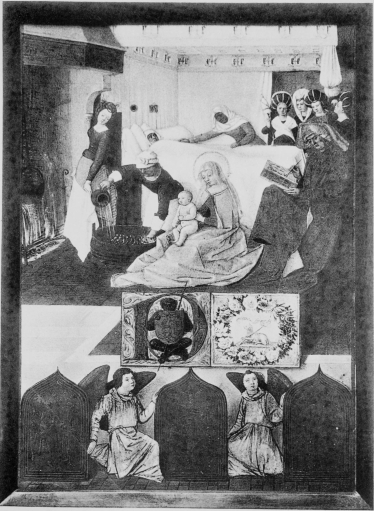
Photo. Giraudon.
THE BIRTH OF ST. JOHN THE BAPTIST.
Jean Fouquet.
Musée Condé.
To face page 188.
The Marriage of the Virgin[59] is another scene of great interest. The
high-priest, arrayed in mitre and vestments, places the hand of Mary in
that of Joseph, the chosen suitor, who bears his budding rod. Like so
many of the artists of that period, the painter has taken his scene from
the Legenda Aurea of Jacopo da Voragine, which tells us how Mary up to
the age of fourteen years had lived in the Temple and had there taken a
vow of virginity. Howbeit God commanded the High Priest Abiathar to
assemble all the unmarried men of the House of David and to give to each
a rod, upon which they were to inscribe their respective names. These
rods were then placed upon the Altar and to the owner of the one which
blossomed first the Blessed Virgin Mary was to be assigned. To this
extremely solemn act Fouquet gives a semi-humorous note by the
introduction of a realistic figure of Falstaffian proportions and a
group of disappointed suitors. In the background behind the principal
group St. Anne may be seen clad in exactly the same fashion as in the
Mariensippe in the Bibliothèque Nationale. The style of the Temple
architecture gives the artist opportunity for introducing reminiscences
of Rome. In the broad frieze of fighting warriors we can recognise part
of Trajan’s column; whilst the columns which flank the central arch
record the gilt bronze columns once grouped around the Confession of
St. Peter in the old Basilica. These were, of course, in Fouquet’s time
still in situ and they reappear in the miniatures of the Antiquitates
Judæorum in a scene where the victorious Pompey enters the Temple in
triumph.
As a strong contrast to this composition, where Renaissance and classic
architecture are happily blended, the Annunciation[60] transports us
to the Sainte-Chapelle in Paris; and we can recognise the long
stained-glass windows, the bronze lustres and the shrine which in
Fouquet’s day was raised on pillars behind the high altar. Here all is
pure French Gothic impressed with the spirit of St. Louis. The action
takes place in the foreground; Mary, modest and girlish of mien, and the
Archangel, a prototype of those heavenly beings who figure in Jean
Perréal’s triptych at Moulins.
The scene of the Visitation[61] is a portico supported by marble
columns, upon the frieze of which is inscribed the words “Maistre
Etienne Chevalier.” The graceful figure of Mary closely resembles that
in the preceding illumination, while St. Elisabeth is presented in the
garb of a Flemish housewife. An obviously French servant to the right,
with dress tucked up and broom in hand, strikes once more that note of
realism which attracts Fouquet so much. In the background is to be seen
a well, around which children are playing.
Next follows the Birth of St. John[62] in the chamber of a French
home. To the left neighbours come to present their congratulations. Two
women prepare the bath and the linen, whilst the new-born infant sits
quietly upright upon the Virgin’s lap, who gazes down upon him with
tender affection. That this figure is intended to represent the Mother
of God is indicated by the fact that her nimbus is unusually large. In
the Ghirlandajo frescoes of this scene at Santa Maria Novella there is
also a figure which appears to be intended for the Virgin Mary; but very
few artists besides Fouquet have introduced her into their presentations
of this episode. Zacharias is clad in the robes of a lawyer. Beneath the
scene are two quadrangles, in the first of which is inscribed the letter
D, and within it is a soldier holding a shield, which in turn bears the
initials E. C. (Etienne Chevalier). These initials occur repeatedly in
the frieze running round the page. In the second quadrangle, where
should have been the first words of the Magnificat, there is painted a
lamb and a tasteless wreath of roses, evidently an interpolation
introduced by the same hand that separated the text from the miniatures,
which we may observe again in no less than nineteen out of the forty
miniatures now at Chantilly. This composition of the Birth of St. John
exhibits, perhaps more than any of the preceding, the freedom with which
Fouquet treats these Biblical scenes.
Plate XLVI.
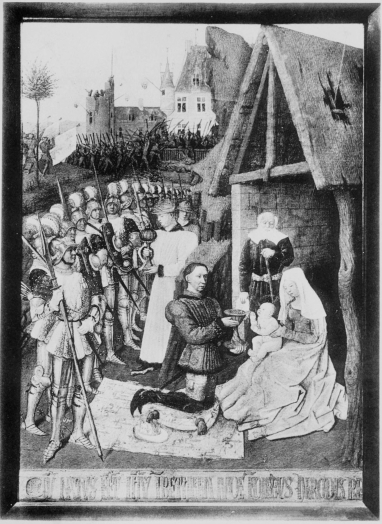
Photo. Giraudon.
THE ADORATION OF THE MAGI.
Jean Fouquet.
Musée Condé.
To face page 190.
The same free tendency may be observed also in the Nativity of Christ
and in the Adoration of the Magi. This time and in both these scenes
the artist has chosen neither the columns of a Gothic church nor a Roman
temple, but remains faithful to tradition and presents the stable of
Bethlehem. In the Nativity we may perceive to the right the angel
announcing to the shepherds the Birth of Christ. Hard by is a cavern, in
which, according to the legend, the shepherds took shelter from a
thunderstorm. The Infant Christ is extended upon the Madonna’s blue
mantle and St. Joseph kneels between the ox and the ass. A humorous note
is again introduced by a shepherd playing on the bagpipes.
The Magi in the next scene are personified by the French King, Charles
VII himself, and his two sons—the Dauphin, afterwards Louis XI, and his
younger brother, the Duc de Berry, then a mere boy. The presence of the
Royal Guard clad in white and wearing helmets, leaves no doubt as to who
the personages were whom Fouquet intended to represent. The fortified
castle in the background is the Château de Chinon, whither Charles VII
retired during the English occupation of Paris and where he received
Joan of Arc.
Another illumination worthy of note is the Betrayal. The light which
pierces the dark shadows and illuminates the scene itself is very
remarkably treated.
The Crucifixion in this series does not attain to the high level of
the similar episode in the Très Riches Heures. Its chief attraction
lies in the landscape, wherein, however, instead of Jerusalem and the
brook Cedron, Paris appears with the Sainte-Chapelle and the river
Seine. In the background the death of Judas Iscariot is most
dramatically represented. The Crucifixion scene in the Très Riches
Heures is, as we have already remarked, a most powerful creation, and
by the introduction of chiaroscuro Pol Limbourg succeeded in producing
an effect which Fouquet, however much he may have admired it, did not
attempt to imitate. He laid greater stress upon the Descent from the
Cross. Amongst the men and women grouped around the Dead Saviour the
mourning figures of the Holy Mother and near her of SS. Mary Magdalene
and John, are clearly indicated. Joseph of Arimathæa holds a vase of
ointment, while a man with a peaked turban close at hand has been
pointed out as Gamaliel, the teacher of St. Paul.
Plate XLVII.
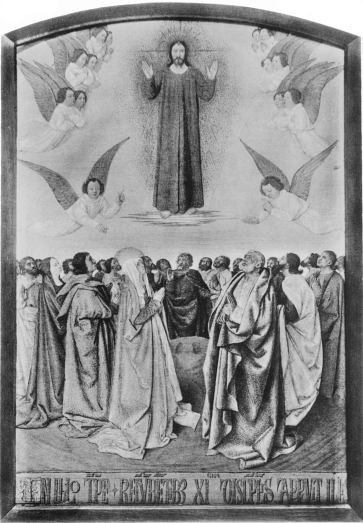
Photo. Giraudon.
THE ASCENSION.
Jean Fouquet.
Musée Condé.
To face page 192.
Fouquet’s power reaches its climax in the Ascension. Our Lord,
surrounded by angels, is borne to Heaven on a cloud, and beneath Him
golden rays apparently assist in raising Him upwards. Amongst the
disciples gazing Heavenwards may be singled out the powerful figure of
St. Peter, its simple grandeur reminding us of the creations of Masaccio
in the Brancacci Chapel in Florence, which Fouquet must have seen and
from which he seems to have drawn inspiration. The figure of the
Virgin Mary is also most impressive. No longer the sorrowing Mother
bowed down by grief as in the Descent from the Cross, she here appears
as the Mother of Christ the King of Heaven, and she shares His victory
over Hell and Death.
In the Descent of the Holy Ghost Our Lady is seated upon a golden
throne and takes a more prominent part than is usually assigned to her
in other representations of the same scene.
Next to this comes the Annunciation to the Blessed Virgin of her
approaching death; and in accordance with the Legenda Aurea the
Archangel Gabriel is presenting her with the palm of Paradise. This is a
somewhat unusual scene,[63] and proves that Fouquet must have studied
these legends with considerable care.
In the next illumination, representing Mary’s Obsequies, the same palm
is borne by St. John, whilst St. Peter is one of the bearers of the
bier.
Fouquet’s presentation of the Coronation of the Virgin does not, as
with the Limbourgs or Enguerrand Charonton, take place in Heaven, but in
a hall richly decorated in the Renaissance style where the same
Corinthian columns are introduced that appear in the Frontispiece.
But one of the most remarkable compositions of the entire series is the
Enthronement of the Virgin, a scene which Bossuet describes as
follows: “Le ciel aussi bien que la terre a ses triomphes, et
l’exaltation de la Sainte Vierge dans le trône que son fils lui destine
doit faire un des beaux jours de l’éternité.” And Fouquet does indeed
depict this scene in a glow of colour which affords a vivid idea of
triumphant festivity. The Virgin, clothed in white, is seated beneath a
Gothic canopy to the left of the Trinity. Above her are countless angels
and below saints, priests and prophets who are praising God in concert.
Anatol Gruyer speaks of this miniature as the most important of all:
“What Dante so well described in the Divina Commedia Fouquet painted
with masterly hand. It is a painting which may be described as sublime.”
This wonderful series is brought to a close with a representation of La
Toussaint.[64] Our Lord, surrounded by angels, is enthroned between the
Virgin and the beloved disciple St. John. Below are seated apostles and
saints, amongst whom we can again discover Etienne Chevalier clad in a
red mantle beside his Patron Saint. On the opposite side kneels his
wife, Catherine Buti.
Plate XLVIII.
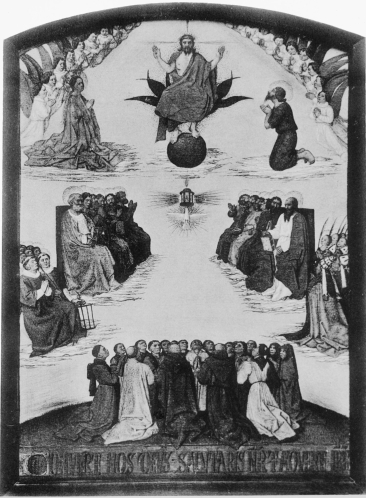
Photo. Giraudon.
ALL-SAINTS’-DAY.
Jean Fouquet.
Musée Condé.
To face page 194.
Hung separately in the Santuario at Chantilly these forty miniatures
of Fouquet form an important monument of French fifteenth-century Art
and provide strong evidence that French works of the highest merit
certainly existed at that time. Their present scarcity is no doubt due
to vandalism and wilful destruction. In these miniatures are apparent
all the qualities so characteristic of French Art, i.e. its exquisite
grace, its adaptability to foreign elements without loss of its own
individuality, its sense of humour, its restrained realism and its
overmastering love for Nature.
IT is hardly conceivable that a master like Fouquet, so famous as a
painter of miniatures and portraits, should really have left no
followers. Indeed, it has been said that he ought to have been succeeded
by a French Raphael. Unfortunately the adverse circumstances which
surrounded French Art at that period prevented Fouquet’s followers from
arriving at the eminence achieved by their master.
We hear of frescoes in the house of Joan of Arc, executed by some
unknown artist in 1481 (the year of Fouquet’s demise), which represented
that great heroine and her noble deeds. Had they but survived an
interesting page of history would have come down to us and we might have
even possessed an authentic likeness of her. Montaigne, when passing
through the country of Lorraine on his way to Italy, saw these
paintings, and makes mention of them in his Journal[65] as follows:
“La maisonette où naquit Jeanne d’Arc est toutes peintes de ses gestes;
mais l’orage en a fort corrompu la peinture”—a further proof of the
havoc played upon early French Art by time and neglect.
A younger contemporary of Fouquet was Simon Marmion, who lived at
Valenciennes and is chiefly known to us by his fine altarpiece at
Saint-Bertin: a composition now divided between Berlin and London.
Moreover, two of Fouquet’s sons served their father as assistants and to
them may be ascribed some of the works of his school—such, for
instance, as a miniature representing an Angelic Choir shown at the
Exhibition of Illuminated MSS. arranged by the Burlington Fine Arts Club
in 1908.
Bourdichon and Jean Perréal, Jean Payet and Jean Colombe may be
considered as followers of Fouquet; yet documentary evidence is very
scanty. It is true, however, that there exist some fragments of
historical information which would seem to allude to their work; as, for
example, the following fact. Some fifty years ago cartridges which had
been made up during the time of the Revolution in default of other
material out of old manuscripts and contracts were found in the arsenal
of the Hôtel des Invalides; and it was to Comte de Laborde that the idea
occurred of making a closer investigation of the composition of these
cartridges. After a careful study of those time-worn and crumpled
fragments he discovered upon one of them the name of Bourdichon and with
it the additional facts that he resided in the town of Tours, where
Fouquet was born; that his birth took place in 1457; that at the early
age of twenty-one he was entrusted with the execution of certain
frescoes in a chapel; and that he was Court-Painter to Charles VIII,
whose portrait he painted, as well as that of his Queen, Anne de
Bretagne. A small portrait of her son, Prince Orlant,[66] who died in
childhood, has been attributed to Bourdichon; and a similar portrait,
representing his younger brother Charles, which came to light only
recently[67] and was acquired by the Louvre, is evidently by the same
hand.[68]
Bourdichon’s skill can be traced with greater certainty in various
Books of Hours[69]: i.e. the “Heures d’Aragon,” a small volume
adorned with graceful miniatures considered by M. E. Mâle to be one of
his early works; while the Prayer Book of Anne de Bretagne, which is
authenticated by a document dated 1508 (Bibl. Nat.), is a later and more
finished achievement. Compared, however, with Fouquet’s style, the work
of Bourdichon seems like wine diluted with water, whilst the total
absence of landscape from the backgrounds of his miniatures gives to his
figures an unusually cold appearance. His Madonna is
distinguished-looking but rather rigid and devoid of expression; his
Magdalen though poetical seems lifeless; and as for the portrait of
Queen Anne herself and her companions on the Frontispiece it is
purely conventional without attempt at aiming at a likeness. Instead of
the landscapes which form so fascinating a part of the work of his
predecessors we find him introducing great masses of flowers on the
margins of the illuminations. The Queen who commissioned the book
evidently was devoted to flowers; and thus Bourdichon, probably at her
express command, brought them in wherever he could. We must indeed give
him credit for a vast amount of charm and delicacy in the execution of
these lovely flowers and they form a very perfect and beautiful
decoration.
Although M. Bouchot mentions the name of Bourdichon more than once in
reference to certain drawings at Chantilly there is nothing amongst the
treasures of the Musée Condé which really can be attributed to him with
any certainty.
With Jean Perréal it is different. He is the artist who has been
identified by some authorities with the mysterious Maître de Moulins.
It was M. de Maulde and Henri Bouchot who first propounded this theory;
and they were supported by Mr. Roger Fry and M. Hulin after the
Exhibition of the French Primitifs in 1904, where a number of works
supposed to be by this master were arranged in definite order for
comparison purposes.
We know that Perréal at the beginning of his career lived at Moulins,
where he held the post of Court-Painter to Duc Pierre de Bourbon; and
that there he had the opportunity of studying Fouquet’s miniatures in
the Antiquitates Judæorum, then an heirloom in the Ducal Library. Like
Bourdichon Perréal appears to have had no taste for landscape, and it
was chiefly portraiture that attracted him. This branch of art was, in
fact, the prevailing interest of his time, and that so-called
inquiétude du portrait manifested itself more or less strongly in the
miniature-painting of the fifteenth and sixteenth centuries until it
almost entirely superseded all landscape work. We find an excellent
portrait, for instance, of Charles V of France in the Heures
d’Anjou[70] and another in the Bible Historiée[71].
The well-known portrait of Jean le Bon, father of Charles V of France,
in the Bibliothèque Nationale is considered to be the prototype of
French portraits, and it is therefore not inopportune to compare it with
the later portraiture. It was discovered by Gaignières at Oyron, an old
château of the Gouffier family, and was the only painting which the
Regent in 1717 thought worth keeping out of the sale of this collector’s
treasures. It is ascribed to Girard d’Orléans, who is recorded as having
assisted Jean de Coste to decorate the Château de Vaudreuil. Girard is
also known to have accompanied the King to England, when the latter was
held prisoner there after the Battle of Poitiers. It is not improbable
that this portrait—which is one of a set of four—was painted during
his captivity.[72] Executed in England it no doubt gave an impulse to
English Art of the same kind; although it is an undisputed fact that at
that period there already existed the paintings in St. Stephen’s Chapel
at Westminster,[73] through which England would appear to have a reason
to claim—as suggested by Mr. Lionel Cust[74]—priority in time over
France. On the other hand, there is nothing in England to compare with
the exquisite miniature portrait of the Duc de Berry in the Très
Riches Heures or with the work of Fouquet half a century later. The
portrait in the Très Riches Heures of the Duc de Berry—who, by the
way, along with his brother Louis d’Anjou, shared their father’s
captivity in England—was most probably painted from life, since it has
that note of realism which is so characteristic of all French Art.
Another remarkable portrait is that of Louis II of Anjou, King of
Sicily, also copied by Gaignières. Its date is 1415 and a miniature of
it is to be found in the Livre d’Heures which once belonged to King
René.[75]
We hear also of an artist whom Charles VI, when choosing a consort, sent
to the various Courts of Europe to paint the portraits of eligible
Princesses. The name of this artist has, unfortunately, not come down to
us.
Plate XLIX.
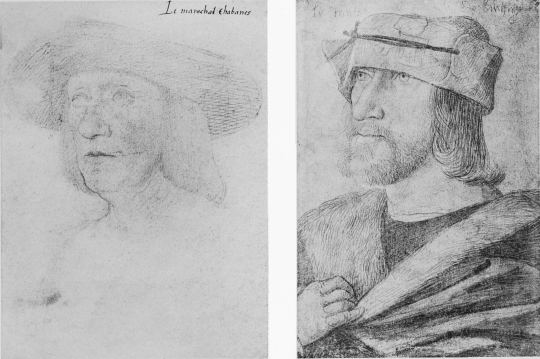
Photo. Giraudon.
SEIGNEUR DE PALISSE.
COMTE DE LIGNY.
Attributed to J. Perréal. (About 1515).
Attributed to J. Perréal. (About 1505).
Musée Condé.
To face page 202.
Fouquet, following in the steps of the Limbourgs, unquestionably gave
fresh impetus to French portraiture and it is not unreasonable to
suggest that the portraits of the so-called Preux de Marignan at
Chantilly are sufficiently similar to his style as to be attributable at
least to the same school. Before, however, bringing forward the
proposition that these drawings may reasonably be ascribed to Jean
Perréal we must first refer to the MS. de Saint Michel,[76] which is
assigned to that master by no less an authority than Comte Paul Durrieu.
And here, at least, we have some historical proof on which to rely. The
Dedication to the King on the first page shows that this manuscript was
a present from the Duc de Bourbon to his young Sovereign; and it is
unlikely that the Duke would have employed upon this occasion anyone
else rather than his own Court-Painter whom he might perhaps have
desired to bring under the King’s notice. On one of the pages of this
manuscript Charles VIII, who was delicate and small of stature,
appears wrapped in a wide mantle which imparts to him an air of
importance. As St. Michael, he stands between two courtiers and is
surrounded by angels, who bear a strong resemblance to the floating
angels in the triptych at Moulins attributed to Perréal. Moreover, in
the same MS. there is a drawing of a head in profile which recalls a
drawing at Chantilly attributed to Perréal, representing the Comte de
Ligny, a patron of the artist and confidant of Charles VIII, whom he
accompanied to Naples. It is not at all unlikely that de Ligny should
have commissioned Perréal to paint his portrait, in which he is
represented in a fur coat and cap, similar to that worn by his master
the King in the well-known bust in the Museo Nationale at Florence.
A drawing, also at the Musée Condé, representing Lescueur,
Bourdillon, and another which, although supposed by Bouchot to be
Anne de Montmorency, is apparently meant for Louis XII,[77] have
decided affinity with this portrait of de Ligny and with the
profile-head in the St. Michel manuscript assigned to Perréal. We must
remark, however, that these drawings are inferior in craftsmanship to
the supposed portrait of Louis XII. The supposition therefore arises
that they may be merely copies from lost originals. The interesting
drawing on which Moreau Nelaton[78] discovered the name of Erasmus in
the strange, almost illegible handwriting of Catherine de Medicis is
most likely by the same hand, and this group of drawings all betray an
unmistakeable relationship to another group likewise at Chantilly;
namely, the well-known portraits of the Preux de Marignan from which
the miniatures in the second volume of the MS. of the Gallic War are
reproduced. Bouchot and also Dimier have tentatively ascribed both
drawings and miniatures to Jean Clouet. But others, and amongst them
both M. de Maulde and the present author,[79] assign the original
drawings of the Preux to Perréal.
Plate L.
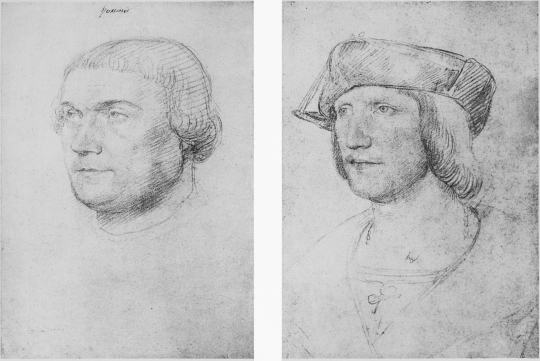
ERASMUS.
JUST DE TOURNON.
Attributed to J. Perréal.
Attributed to J. Perréal. (About 1515).
Musée Condé.
To face page 204.
It is strange that Bouchot and Dimier, and also Maulde La Clavière,
accept as a foregone conclusion that both drawings and miniatures must
necessarily be by the same hand. Yet everything points to the fact that
the miniatures in question were copied subsequently (about 1519-20) from
these very same drawings by Godfroy le Battave, the author of the
excellent grisailles with which this manuscript is ornamented. It
stands to reason that it was he who also reproduced the miniature of
Francis I on the frontispiece of the first volume of the MS. in
question. To judge from the costumes and headgears of these heroes they
cannot be dated later than 1514-15, a period anterior to Clouet. It is
therefore quite plausible to suggest that Perréal, who at the time of
the Battle of Marignan was Court-Painter, received from Francis I the
commission to portray his famous comrades, Artur and Guillaume
Gouffier, Just de Tournon,[80] Odet de Foix,[81] Fleuranges, the
Seigneur de la Palisse,[82] and Anne de Montmorency.
It is a curious fact that all the numerous sixteenth-century French
drawings at Chantilly and in other collections should have been formerly
attributed indiscriminately to “Janet,” a name employed to designate
both the Clouets, Jean and François. Yet we know that Perréal was
Court-Painter to Louis XII and that the latter was so enchanted with his
work that when he was in Italy he sent for them “pour monstrer aux
dames de par deça,” and referred to him as a “portraitiste de visages,
qui peint de petits portraits sur parchemin, et sans rival en
Italie.”[83] Some years later, after the death of his Queen, the aged
monarch sent Perréal to England to paint a portrait of his affianced
bride, Mary Tudor. He had previously been sent to Germany for a
similar object, so that it was the most natural thing in the world for
the young King Francis on ascending the throne to commission a painter,
who had already been employed by his predecessor, to portray also
himself and his warrior friends.
Yet another drawing at Chantilly may be attributed to Perréal
representing Guillaume de Montmorency,[84] father of the celebrated
Anne. Judging by the age and the attire this portrait must necessarily
be assigned to an artist working before Jean Clouet’s time.
After having adduced these proofs in support of our argument it would
seem to be going purposely out of our way not to prefer Perréal as the
author of the Preux de Marignan rather than Jean Clouet; and
especially as there are a vast number of drawings belonging to the
period when Clouet was Court-Painter—1523-39—which clearly prove the
greater elaboration of his style.
Plate LI.
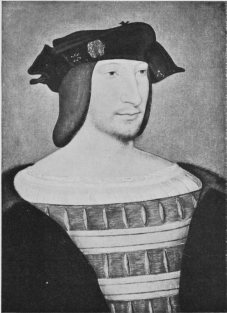
FRANCIS I.
Photo Braun & Co. Musée Condé. Attributed to Jean Perréal.
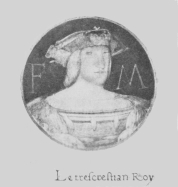
FRANCIS I.
British Museum.

CÆSAR.
British Museum.
As for the miniatures in the MS. of the Gallic War there can be no
doubt that they were reproduced from the original drawings at Chantilly,
not because the author of the grisailles in that manuscript was
unable to execute portraits himself—for he was evidently an excellent
draughtsman—but because it was the fashion of the time to have such
drawings taken from life and then reproduced in colour in order to spare
their noble patrons the inconvenience of sitting so often. We have
already stated that Godfroy le Battave reproduced in miniature on the
frontispiece of the first volume of this MS. the effigy of Francis I.
Beneath on the same page is a miniature of Cæsar, probably copied from
an old cameo; whilst the miniature of the King can be traced to a
painting now at Chantilly, attributed to Perréal, and formerly in the
possession of Gaignières. It represents Francis I at the time of his
accession and is so subtle in its representation of character that it
fascinates by its obvious verisimilitude.
Another circumstance in favour of our proposition is found in the notes
with reference to an intended execution in colours inscribed upon the
back of the drawing supposed to represent Louis XII.[85] These notes
are in a handwriting closely resembling the handwriting of Perréal in
the Comptes de Lyon and in his autographs in the Bibliothèque
Nationale, where he speaks of his “croions qui n’est que demy
couleurs.”[86]
From the above arguments we are led to the conclusion that this delicate
art of pencil drawing must have originated on French soil, and that it
was apparently practised by Jean Fouquet,[87] Perréal, and probably also
to a certain extent by Bourdichon, before Jean Clouet appeared in
France.
Nevertheless, the latter, when he came to Tours, adapted his style—till
then more closely resembling that of Holbein—to French requirements;
and his son, François Clouet, developed this art to its highest
perfection, combining his father’s methods with those of his French
predecessors. It is to be hoped, since some examples of the work of the
long-neglected Perréal have now come to light, that more proofs of his
versatility and power may yet appear, and that we may arrive at
something more definite regarding him. The portraits of Charles VIII
and Anne de Bretagne, discovered by Bouchot in a small MS. volume once
the property of Gaignières, recall the drawings in the Musée Condé which
we have assigned to Perréal; and so also does a small panel portrait of
Philip le Beau now in the Northbrook Collection.
Plate LII.
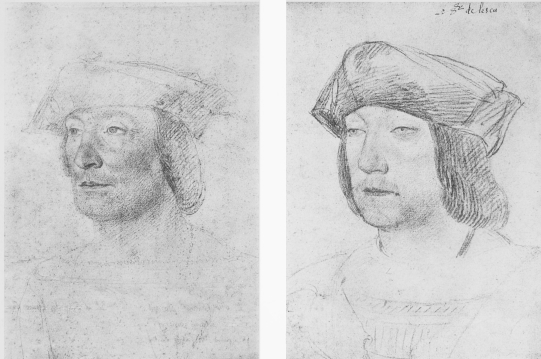
Photo. Giraudon.
LOUIS XII. (ABOUT 1514).
ODET DE FOIX.
Attributed to Jean Perréal.
Attributed to Jean Perréal.
Musée Condé.
To face page 2.
Furthermore, the so-called Tournois tapestry, which may be assigned to
the beginning of the sixteenth century, seems to reveal Jean Perréal’s
style. It is important to notice that documentary evidence proves that
Perréal presided as Master of the Revels on the occasion of the State
Entry into Lyons of Philip le Beau and his wife, Jeanne la Loca; on
which occasion they were received with great pomp by Louis XII and Anne
de Bretagne. We learn that he executed decorations for these
festivities, and it is therefore not impossible that his designs may
have been subsequently used for the tapestries in question, since they
present to us Louis XII and Anne de Bretagne with their Royal
guests and numerous suite.
Thus historical record also would seem to favour the theory which we
have endeavoured to establish—namely, that Jean Perréal as stated
worked with pencil and chalk some time before the appearance upon the
scene of Jean Clouet. In spite of the regrettable fact that most of his
work has either been swept away by time or is still attributed to other
artists enough evidence remains, if one will only accept it, of an
activity which it is not easy to discount.
Perréal is also mentioned in Royal Accounts as an architect and sculptor
in the service of Anne de Bretagne, who entrusted to him the design for
a tomb for her parents, François, Duc de Bretagne, and his wife
Marguerite de Foix, at Nantes—a monument subsequently executed by
Michel Colombe. The graceful angels who keep watch over the dead and the
noble figures of Justice and Temperance are silent tokens of Perréal’s
ability. He was also consulted by that noble patroness of the Arts,
Margaret of Austria, in connection with the tomb at Brou of her husband,
Philibert of Savoy, and for this monument also some of his designs were
used.
Amongst the French medals (1476-1515) in the Metropolitan Museum (New
York) there is a masterpiece which bears the portraits of Louis XII
and Anne de Bretagne. This fine work of art (of which there is another
example in the Wallace Collection) is known to have been designed by
Jean Perréal (draughtsman), modelled by Nicolas Leclerc and Jehan de
Saint-Priest (sculptors) and cast by Jehan Lepère (goldsmith). It is
considered to be one of the finest examples of this species of work
executed during the French Renaissance and was struck on the occasion of
the marriage of Louis XII with the widow of Charles VIII. It was
formerly supposed to be of Italian origin but is now authoritatively
assigned to Jean Perréal. Reproductions of these medals, but smaller in
size, are at the Victoria and Albert Museum. It would seem that the
artist’s fame received a final recognition in the fact that immediately
after his death in 1528 Francis I sent for Italian painters to decorate
Fontainebleau on account of the dearth of native talent.
Plate LIII.
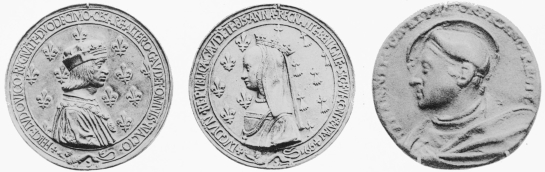
LOUIS XII.
ANNE OF BRITTANY.
JEAN CLOUET.
Victoria and Albert Museum.
To face page 210.
THE veil of oblivion which so undeservedly fell upon Perréal is
gradually lifted as we approach the period of Jean Clouet. Even if we
except some drawings which we are bound to assign to an earlier period
there still remain a great number which, judging by the age and style of
costume of the characters represented, must necessarily be reckoned as
falling within his period and may be reasonably attributed to him.
Mention is made of no less than four persons bearing the surname of
Clouet: Jean the grandfather, who painted for the Duke of Burgundy at
Brussels about 1485; Jean Clouet, Court-Painter to Francis I; and his
two sons—Clouet of Navarre[88] and François, who brought to its zenith
the art of drawing in sixteenth-century France.
Plate LIV.
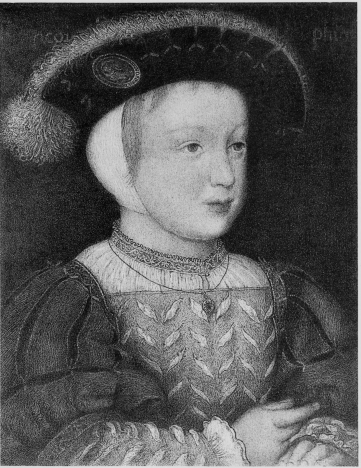
THE DAUPHIN FRANCOIS, ELDEST SON OF FRANCIS I.
Antwerp Museum.
To face page 212.
Jean Clouet,[89] also known as Jeannet, migrated to France and settled
at Tours, where he presently married Jeanne Boucault, the daughter of a
goldsmith. He first appears in the Royal Accounts in 1516 as receiving
160 livres per annum—a sum which, on the death of Bourdichon in 1522,
was increased to 240 livres. Subsequently we find special references to
several portraits by him, taken from life[90] which the King was so
anxious to see that he sent for them by “diligence and post-horses.”
Again we read further on that his wife, Jeanne, travelled expressly from
Paris[91] to Fontainebleau in order to convey to His Majesty portraits
done by her husband: “Pour apporter et monstrer au dict seigneur aucuns
ouvrages du dict Jeannet.” After the death of Perréal in 1528 Jean
Clouet remained practically without a rival. Only one artist—a certain
Jean Champion who seems to have been in receipt of a very small
salary—is mentioned besides him; but none of this man’s work is
actually recorded. Amongst the numerous works attributed to Jean Clouet
absolute certainty may be given to a portrait of Oronce Finé, which,
however, has only come down to us through a mediocre engraving in
Thevet’s series of Hommes Illustres. Thevet speaks of this portrait as
an authentic work by Jean Clouet on the authority of the mathematician’s
own son but it is not easy to judge fairly the work of any artist by an
engraving. We can, however, gather enough from it to justify us in
concluding that Jean Clouet’s craftsmanship was of a more elaborate
nature than that which may be observed in the portraits of the Preux
de-Marignan. The portrait of Oronce Finé, for example, bears far
more resemblance to that of Duc Claude de Guise,[92] of which there is
a drawing at Chantilly and a coloured copy in the Pitti Gallery at
Florence, both executed at about the same time. Then again there is at
Hampton Court an excellent portrait of an Unknown Man holding a volume
of Petrarch, which is attributed to Jean Clouet. The original drawing
for this somewhat later and more artistic piece of work is also at
Chantilly. Another drawing likewise at Chantilly (a capital example of
the artist’s methods) represents Francis I after his reverses at
Pavia, wherein His Majesty has lost that expression of youthful buoyancy
so conspicuous in the oil-painting in the same collection. He wears his
cap adorned with a white plume no longer close-set as formerly and
straight on his forehead, but according to the fashion of the day with
the hair projecting from underneath it and slightly tilted to the left.
His beard has also been allowed to grow, in order, it is said, to hide a
scar on his cheek. This drawing was unquestionably taken from life, and
was used for the portrait in oils now in the Louvre; which serves to
prove how much care and diligence Jean Clouet expended upon his
portraits. Just as a sculptor uses the clay for his models, so with
equal faithfulness the artist made his drawings serve for his final
portraits in a heavier medium. This small painting,[93] now recognised
as an original work, is infinitely superior to the larger portrait,[94]
also in the Louvre, although both have evidently been copied from one
and the same drawing. Both portraits were formerly at Fontainebleau,
where tradition had always assigned them to Jean Clouet. This likeness
of King Francis seems to have been a very favourite one for we find
numerous copies of it: for example, in the Méjanés Collection at Aix; in
the Recueil Marriette; and in the Recueil d’Orange in England.[95]
There are no less than eight copies of it in St. Petersburg, and the one
in Florence is said to have been made by Queen Catherine herself. A
later portrait of this King, likewise at Chantilly, represents him in
middle age, when years had already begun to tell upon him and the lines
of his face had become heavy and drawn. The original drawing for
this—perhaps also by Jean Clouet—is lost, but a copy survives in the
Recueil Lenoir. A miniature in oil at Florence, in which the King is
represented on horseback, seems to have been designed from this drawing;
whilst another similar miniature in the Louvre (Collection Sauvageot) is
generally considered to be the work of François Clouet, who had at that
time just begun his artistic career under his father’s direction. This
is probably the last likeness of Francis designed by Jean Clouet. It
appears to have been painted in 1539 and may be regarded as the official
portrait of this King. It is certainly vastly superior to another
even later portrait, of which there is a copy in the Louvre and a
miniature in the Recueil du Tillet (Bibliothèque Nationale), where His
Majesty is shown to have greatly increased in girth. Another similar
miniature is in the ante-room at Chantilly, the King being again
represented on horseback after a fashion affected by the succeeding
Valois Kings; and the same original reappears in the Book of Hours of
Catherine de Medicis, where Francis figures as King David; appearing
to be older than he really was, for he was but fifty-three when he died.
Both Thevet in his Hommes Illustres and Gautier in his Kings of
France reproduce this same portrait.
Plate LV.
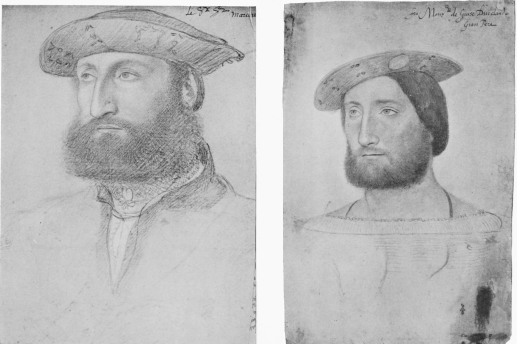
MONSIEUR DE NEVERS.
DUC DE GUISE.
Musée Condé. Jean Clouet.
The likeness of Francis I at Hampton Court, though painted by some
mediocre copyist, has a special interest, inasmuch as it once belonged
to Henry VIII of England. This portrait is reproduced in pencil in the
Recueil d’Arras, and another, though superior, presentation of this
same King in the Tribune at Chantilly seems to be of the same type. The
King is here shown in profile, a treatment copied repeatedly by
Limousin, an example being in the Gallerie d’Apollon at the Louvre,
where he is seen kneeling beside Queen Claude. The latest portrait of
all of this monarch is a drawing at Chantilly taken full face, which
seems to have been made as a post-mortem effigy, such as, according to
the Royal Accounts, François Clouet was commissioned to make. This again
is only a copy; so that of these many and varied types of portrait few
only can claim to be the original work of Jean Clouet. In this
connection we should like to mention an exquisite drawing recently
acquired by the British Museum which represents Marguerite
d’Angoulême, sister of King Francis, in the bloom of her youth.[96]
Portraits of Queen Claude[97] are as rare as those of her royal
husband are numerous. There is a slight drawing at Chantilly
representing the daughter of Louis XII: presumably taken soon after her
marriage to the heir to the French throne (which under the Salic Law she
could not ascend herself). This marriage took place after the death of
her mother, Anne de Bretagne, whose dearest wish it had been that she
should marry Charles V, a suitor to whom she had been affianced in
infancy. According to Brantôme the shrewd Queen Anne foresaw that her
timid little daughter could not have a particularly happy life between
so fickle a husband as Francis and so ambitious a mother-in-law as
Louise of Savoy; but King Louis thought otherwise and sacrificed his
daughter to his patriotism. This drawing, albeit very slight, is not
without considerable charm. It dates probably from the same period as
the portrait of the young King at Chantilly and may perhaps be
attributed to the same artist. It is nothing like so elaborately
finished as the drawing of Queen Claude’s sister Renée, which in
craftsmanship recalls the drawing of Duc Claude de Guise in the Musée
Condé. Another far more finished and far more elaborate drawing, now
in Florence, represents Queen Claude some ten years later as
Queen-Mother; and it bears upon it marginal notes in no less august a
hand than that of Catherine de Medicis herself, which enhances its
importance. Apparently this too is a copy of one of Jean Clouet’s lost
originals.
Plate LVI.
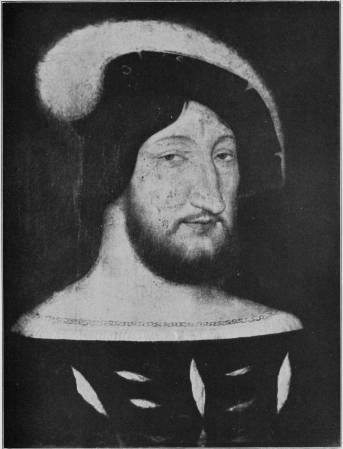
Photo. Giraudon.
FRANCIS I.
Louvre.
Jean Clouet.
The next drawings of interest by this artist in the portfolios at
Chantilly are likenesses of the two Dauphins of France[98] and of the
other Royal Children: a portrait of the Dauphin François, which was
repeated in colours in an exquisite little panel now at Antwerp,[99]
with the slight difference that the Royal Child has exchanged his simple
cap for a plumed hat; and likenesses of Monsieur d’Orléans (afterwards
the Dauphin Henri), and of the third son, Charles, so great a
favourite with his aunt Marguerite. This latter Prince had the good
fortune to be kept at home when his two elder brothers were given as
hostages to the Emperor Charles V after the disastrous defeat at Pavia
to be subjected by him to four years of most inhuman imprisonment.
Bodin, who was sent by their Royal Father to attend upon his unfortunate
sons, relates that he found them in a dark chamber seated upon small
wooden chairs. The hardest of straw mattresses were provided for them,
and they were not allowed to wear the plumed caps which he brought for
them, for fear that by some exercise of necromancy they might perhaps
contrive to fly away! According to Brantôme, the poor Dauphin had
almost forgotten his native French, so that his younger brother had to
assist him in making himself understood. The charming sketch at
Chantilly of the Dauphin François wearing a plumed hat was evidently
made after his safe return to France.
Plate LVII.
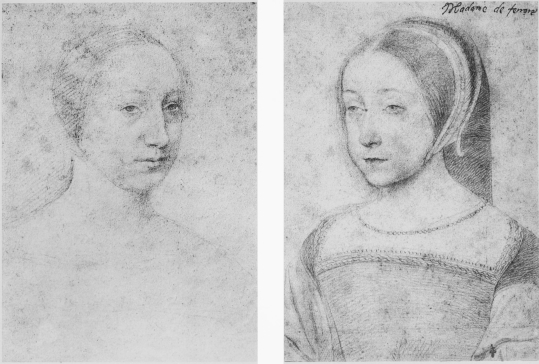
Photo. Giraudon.
QUEEN CLAUDE OF FRANCE.
RENEE OF FRANCE, DUCHESS OF FERRARA.
Attributed to J. Perréal. About 1515.
Attributed to Jean Clouet.
Musée Condé.
To face page 21.
A slight sketch shows Madeleine de Valois as a child. This princess
was married at the age of seventeen to King James V of Scotland; and she
is said to have been so delighted at the prospect of becoming a Queen
that she soon consoled herself for having to leave la douce France for
so rigorous a climate. She was, however, extremely delicate and died six
months later, to the unbounded grief of her husband, who for years could
not be persuaded to remarry. Princess Marguerite, on hearing of her
elder sister’s untimely death, shut herself up in her own apartments and
refused food to the great injury of her health; and it was only by the
urgent persuasions of her aunt Marguerite d’Angoulême that she was
induced to resume her morning walks in the gardens of Fontainebleau and
so by degrees to recover. A variety of drawings at Chantilly present
this young princess at different periods of her life; and in the earlier
of these, as in the portraits of her sister and two brothers, we can
trace the handiwork of Jean Clouet. A painted portrait of her (which
formerly belonged to Gaignières) in the Tribune at Chantilly, is
attributed to Corneille de Lyon, and on the margin is written “Marg. de
France, Duchesse de Berry.” She is represented with auburn hair and
blue eyes like her brother the Dauphin, whose portrait hangs in the
same room. The words “Corneille fecit” are written on the back of the
frame by Gaignières himself, who in so doing settled its authorship.
Whilst the Dauphin seems in his portrait to be but eighteen years of age
his sister Marguerite looks thirty, so that we may conclude that she sat
at a much later period. The numerous drawings that François Clouet made
of this Princess[100] reveal that amiable disposition so much praised by
Brantôme. He speaks of her as “la bonté du monde, charitable,
magnifique, liberale, sage, vertueuse, si accostayle et douce que rien
plus.” She remained unmarried until she had reached the age of
thirty-six, because she declined (it is said) to marry one of her
brother’s subjects and yet did not wish to leave her beloved France.
When quite young she had accompanied her aunt Marguerite to Nice, where
she fixed her choice upon the heir of the House of Savoy, to whom after
twenty-one years’ interval she was, when adverse political complications
had finally passed away, eventually united.
She was meanwhile much admired at the French Court for her learning. A
Latin and Greek scholar of merit, she studied Aristotle’s Ethics and
is reported to have sent to Paris for at least three different editions
of Cicero. She had no special gift in the use of the pen like her
versatile aunt,[101] the authoress of the Heptameron, although she
occupied her mind with continual study and much careful reading. She
patronised the poet Du Bellay, who translated for her Bembo and
Naugerius and she induced him to assert that no century would ever
extinguish the memory of Boccaccio and Petrarch. Moreover, she attracted
to the French Court Baccio del Bene, of whom Ronsard said that he was
the only Italian author worthy of earnest consideration at this period.
Her learning acquired for her the sobriquet of “Pallas”; her emblem
was an olive-branch; and she was looked upon as the symbol of Platonism
in its highest form. Her father, King Francis, paid but little attention
to her; but her brother, Henri II, loved and esteemed her greatly and
when she married ordered for her adornment magnificent robes, costly
lace and jewels, and organised great festivities. It was on the occasion
of these nuptials, however, that the terrible tragedy occurred which
brought about His Majesty’s death. Like her aunt Rénée at Ferrara
Marguerite[102] in her home in Piedmont never ceased to long for her
“sweet France”; and every Frenchman who passed through Turin, on
presenting himself at her Court, was warmly welcomed and munificently
entertained. With her enlightened views she was able to act as mediator
in the religious differences which raged so violently in France during
the sixteenth century, and which extended into the country of her
adoption; and she protected, as far as she was able, the persecuted
Waldenses. The last years of her life were devoted chiefly to the
education of her son, Charles Emmanuel of Savoy; and Michel de
l’Hôpital declared that this Prince owed the success of his career
entirely to her. The French Ambassador at Constantinople left to her his
entire fortune, and the poet Du Bellay on his death-bed wept bitterly
because he was unable to take a last farewell of her. When she herself
died there perished with her all that was best in the spirit of the
neo-Platonism initiated by her aunt, the first Marguerite; so that it
presently fell entirely to pieces under the influence of the third
Marguerite, youngest daughter of Catherine de Medicis.
Plate LVIII.
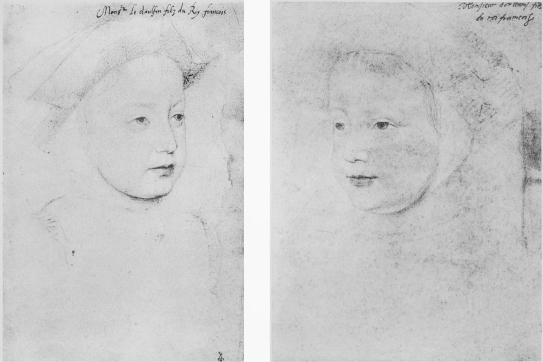
Photo. Giraudon.
THE DAUPHIN FRANCOIS, ELDEST SON OF FRANCIS I.
Jean Clouet.
| |
HENRI D’ORLEANS, AFTERWARDS HENRI II.
Attributed to Jean Clouet. |
Musée Condé.
To face page 220.
A likeness of Rénée de France[103] which bears some affinity to the
portrait of her sister Queen Claude is also to be found at Chantilly.
It represents her at the time of her marriage to Ercole, Duke of
Ferrara, son of Lucrezia Borgia: nuptials which were celebrated in the
Sainte Chapelle at Paris. Like the other French princesses of her day
she was extremely intelligent and studious, and during her time the
Court of Ferrara became renowned as an intellectual centre to which
French visitors were always warmly welcomed. To the complaints of her
Italian courtiers that she spent too much money upon her compatriots she
replied, “Que voulez-vous? Ces sont pauvres Français de ma nation
lesquelles si Dieu m’eut donné barbe au menton, et que je fusse homme,
seraient maintenant tous mes sujets, et si cette méchante loi Salique ne
me tenait trop de rigueur.” Rénée was a strong adherent of the
Reformed Faith and welcomed Calvin to her Court, thereby giving serious
annoyance to her husband, the Duke, whose policy it was to keep on good
terms with the Pope. The poor Duchess therefore presently found herself
compelled to part with all her French ladies-in-waiting on account of
their Protestant views. Furthermore, her brother-in-law, Cardinal
Ippolito d’Este, was sent to the French Court to discuss these matters
with the King, upon which occasion those two connoisseurs and patrons of
Art became fast friends.[104]
After the death of her husband the Dowager Duchess was exiled by her
son, Alfonso, to Montargis,[105] and there she was visited by the
Cardinal—who, in spite of her heretical leanings, had never ceased to
be on good terms with her. According to Brantôme she here provided
shelter and food for 300 Huguenots who had been despoiled of their
goods; and she even went so far as to remonstrate with her son-in-law,
François de Guise, for his cruel treatment of the Prince de Condé;
saying that “whoever had advised the King to take this course of action
had done a great wrong.” Notwithstanding her Calvinistic views she was
always reckoned by the Royal Family as a true Daughter of France and was
held in high honour by them. Her portraits, like those of her sister
Queen Claude, are extremely rare.
Plate LIX.
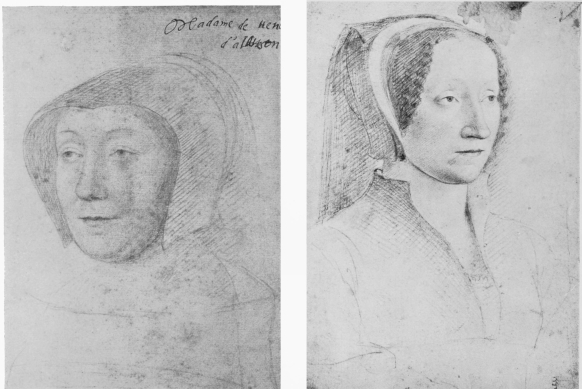
MADAME DE VENDÔME D’ALENÇON.
JEANNE BOUCAULT.
Photo. Giraudon.
Jean Clouet.
Musée Condé.
Besides the portraits of the Valois princes and princesses at Chantilly
there are a great number of likenesses of other interesting
historical personages. It would, however, lead us too far afield were we
to attempt to enumerate them all. Amongst them, however, the most
remarkable are as follows: Madame Vendôme d’Alençon,[106] mother of
Antoine de Bourbon and of Louis I Prince de Condé (a drawing on a larger
scale than most of the others); of the same size, Madame
l’Estrange,[107] a lady renowned for her beauty and greatly beloved by
the Dauphin François; Henri d’Albret, King of Navarre; Chandus, one
of King Francis’ most faithful officers; and various portraits of
Unknown Young Men. All these are excellently drawn, may be assigned to
Jean Clouet and are evidently taken from life. In some of the portraits
we can detect a point of transition between the joint work of father and
son: for example, in a drawing representing Louis de Nevers,[108] son
of a Princesse de Bourbon and related to the Princes of the House of
Cleves. This drawing is incorrectly designated Saint Marsault; but a
copy supplies the right name. There is a copy of it in colours in the
Lochis Collection at Bergamo, which long passed under the name of
Holbein until Dr. G. Frizzoni assigned it to François Clouet, who
evidently executed it from the drawing at Chantilly. In this same
connection may be mentioned the Sieur de Canaples,[109] and the
portrait of an Unknown Lady of singular force of expression, very
plainly clad and without ornaments, who may perhaps be Jeanne
Boucault[110] of Tours, Jean Clouet’s own clever and devoted wife.
Plate LX.
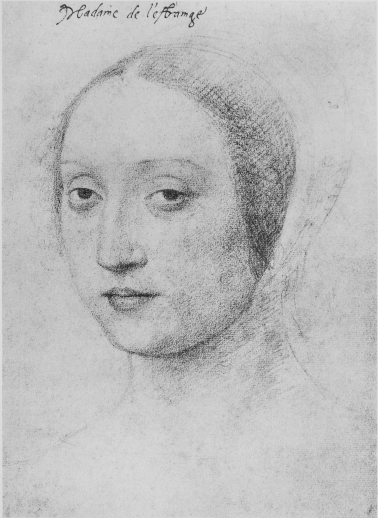
Photo. Giraudon.
MADAME L’ESTRANGE.
Attributed to Jean Clouet. About 1535.
Musée Condé.
To face page 224.
Before we take leave of Jean Clouet and pass on to his brilliant son
attention should be called to a fascinating portrait of a young girl
inscribed “la reine Jehanne de Navarre petite,”[111] which, on account
of its excellence, might well be attributed to the master himself. In
this instance history comes to our aid, for we are informed that
Princesse Jeanne (known as “la mignonne de deux rois” on account of
the marked affection shown to her by both King Francis, her uncle, and
King Henry of Navarre, her father) was in her fourth year removed from
the charge of her own parents and transported to Plessis-le-Tours, a
château on the Loire; where there was provided for her a suite
consisting of a lady-in-waiting, a master of the horse, two chaplains
and other attendants. The reason for this strange arrangement was
political, inasmuch as Francis feared that Henry of Navarre would
negotiate a marriage between this child and Philip of Spain, eldest son
of Charles V. In vain the little Princess wept and implored her Royal
uncle to allow her to rejoin her mother. Her wish was not to be granted
until she had reached her twelfth year, and then only on condition that
she should be betrothed at once to the Duke of Cleves, whose sister Anne
was wife of King Henry VIII of England—a political scheme to unite the
Protestant Princes of Germany and England against the Emperor Charles
V. It was probably at the moment when the Princess was about to leave
the lonely château on the Loire that Francis commissioned Jean Clouet to
secure for him a likeness of his niece before her departure for Béarn.
Jeanne, who was born at Fontainebleau in 1528, appears here to be about
twelve years of age; so that the drawing may perhaps have been executed
in 1539-40, and, since it was one of the artist’s last works it gains
greatly in interest.
That François Clouet succeeded his father as Court-Painter in 1541 is
proved by a document in the “Trésor des Chartres” which runs as
follows: “François par la grace de Dieu, roy de France, etc.... Savoir
faisons ... que voulant reconnoistre envers nostre cher et bien aimé
painctre et varlet de chambre ordinaire, François Clouet les bons et
agréables services que feu Me Jehannet Clouet, son père, aussi de son
vivant nostre painctre et varlet de chambre, nous a durant son vivant
faictz en son dict estat et art, auquel il estoit très expert et en quoy
son dict fils la jà très bien imité, et espérons qu’il fera et
continuera encores de bien en mieux cy après, a icelluy, François Clouet
pour ces causes et affin que de ce faire il ayt meilleure voullonté,
moïen et occasion, avons donné, octroïé, cedé et délaissé, tous et
chacuns les biens meubles et immeubles qui furent et appartendrent au
dict Me Jehannet Clouet, son père, à nous advenuy et escheuz, adjugez et
declarez appartenir par droit d’aubène au moïen de ce que le dict
deffunt estait estranger et non natif ne originaire des nostre royaume
et n’avoit obtenu de nos predecesseurs roys ny de nous aucunes lettres
de naturalité et congié de tester” (published by E. de Freville, Arch.
de l’art Français, t. iii, p. 98).
From the above document we learn the following important facts, namely:
(a) that Jean Clouet was not of French origin; (b) that he was
highly esteemed by the King; and (c) that after his death François
Clouet, his son, inherited all his privileges and favours.
Plate LXI.
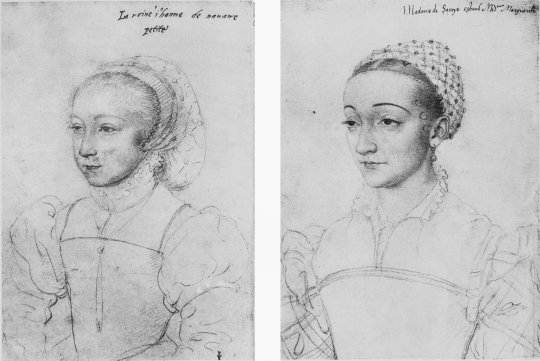
Photo. Giraudon.
JEANNE D’ALBRET, WHEN A CHILD.
MADAME MARGUERITE, SISTER OF HENRI II.
Attributed to Jean Clouet.
Attributed to François Clouet.
Musée Condé.
To face page 226.
FRANCIS I, King of France, survived Jean Clouet but a few years, so that
the artistic career of his celebrated son, François, chiefly developed
during the reigns of Henri II, Francis II and Charles IX.
It is difficult to determine what effect Jean Clouet’s death had upon
his son, but we are led to suppose that at first he continued closely to
adhere to parental teaching. Indeed from 1540 to 1545 it is scarcely
possible to discern any of those differences of style so conspicuous a
decade later.
Two female portraits, still existing, seem to give weight to this
argument. These likenesses, although in the style of the elder Clouet,
from the age and the attire of the sitters can only have been drawn
during the years 1544-5, by which date that artist had already vanished
from the scenes and his son was at work alone.
These drawings represent Jossine Pisseleu[112] (niece of the famous
Duchesse d’Estampe), better known under the name of “Hegli,” and the
beautiful daughter of Diane de Poitiers, called “Brasseu.”[113] Both of
these portraits are rendered specially interesting by the fact that
their respective names are written on the margin by Queen Catherine de
Medicis. These two ladies, Hegli and Brasseu, are known to have belonged
to that gay company known as la petite bande, of which the young
Catherine herself, when Dauphine, was also a member.
Francis I, thanks to his own great taste for Art, comprehended to the
full the different talents of the artists in his employ; and whilst he
commissioned Rosso and Primaticcio to execute the frescoes at
Fontainebleau, the two Clouets were successively entrusted with such
portrait painting as he required.
At Chantilly there is an exquisite portrait of Louise de Clermont,
Duchesse d’Uzez, another of the fair members of the petite bande whom
the King nicknamed “la Grenouille” on account of her husky voice and
projecting eyes: a drawing which belongs to the same series already
referred to; that is to say, an early work with which François Clouet
was commissioned after his father’s demise. A miniature taken from this
drawing is preserved in the Louvre.
Plate LXII.
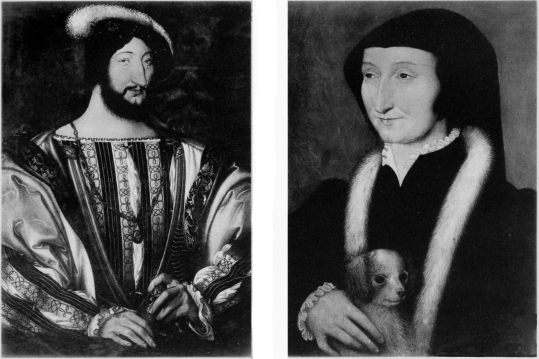
Photo. Hanfstaengl.
Photo. Giraudon.
Francis I.
Attributed to Jean Clouet.
Louvre. |
|
Marguerite of Angoulême.
(Sister of Francis I. and Queen of Navarre).
Attributed to François Clouet.
Musée Condé. |
Henri II, whilst Dauphin, had apparently not much chance to employ
either of the Clouets, since their time was almost entirely monopolised
by the King; but there is evidence to prove that Catherine de Medicis’
children were repeatedly painted by Germain le Mannier[114] and his
brother Alois. There exist pencil sketches of Francis II at the age of
five, and again at eight years and five months; to which latter there is
a pendant representing his fiancée, Mary, Queen of Scots, at the age
of nine and a half. There is another of Charles IX aged between four
and five years. All of these were executed by this artist and are now in
the portfolios at Chantilly.
With reference to these drawings there is a letter still extant, written
on June 1 1552 by Queen Catherine to M. Humières (who with his wife were
in charge of the Royal nurseries at Saint-Germain-en-Laye), in which she
expresses a desire to have all her children, sons and daughters,
including la Royne d’Ecosse,[115] painted “sans rien oublier de leur
visages.” There is also a letter from Henri II, written on the eve of
his accession, expressing a desire to recompense the painter Mannier.
This, however, did not prevent him, as soon as he became King, from
taking up François Clouet, whom he commissioned not only to make a
post-mortem effigy of the late King, but also to prepare an official
representation of himself. His own portrait bears a note upon it,
apparently in the artist’s own handwriting, “Le Roy Henry 2”[116]:
handwriting which bears close similarity to an existing quittance signed
F. Clouet. This drawing, now in the Bibliothèque Nationale at Paris,
became very popular. A version completed in colours, is now in the
Louvre: it was reproduced in miniature; and many copies were
subsequently made by lesser hands.
Contemporary with this portrait is a powerful likeness of the Grand
Connétable, Anne de Montmorency,[117] evidently taken from life. In
this drawing the individuality of the artist is very marked: more
realistic in his tendencies than his father, he is on that account more
French. This great warrior, the Lord of Chantilly, is shown here when at
the height of his fame, in high favour with the King and with l’amie du
roi, Diane de Poitiers.[118] This famous lady herself sat to François
Clouet, and so apparently about the same time did Catherine de Medicis,
and also Jeanne d’Albret,[119] Queen of Navarre. It is interesting to
compare the likeness of this latter princess, so eloquent of a noble
mind and a frank disposition, with that of Catherine de Medicis, past
mistress in the art of dissimulation.
Plate LXIII.
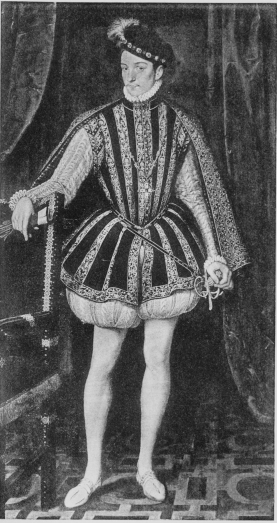
Photo. Hanfstaengl.
CHARLES IX.
François Clouet. About 1569.
Vienna Gallery.
To face page 230.
Drawings and portraits of Catherine as Dauphine and as Queen of France
are comparatively rare. It is as a Queen-Dowager, growing old and well
away on her career of dangerous intrigue, that we chiefly meet her in
the Galleries of Europe. No small value can therefore be attached to the
drawing in the British Museum which came to the nation through the
Salting Bequest, inasmuch as it brings her before us at the period when
her husband had just ascended the throne of France; and to another
likeness at Chantilly, attributed to Corneille de Lyon, which is
supposed to be the one executed when she passed through Lyons with Henri
II in 1564. Brantôme relates that upon this occasion the great Diane de
Poitiers received more homage than the Queen herself, and that portraits
were drawn of all the royal ladies, amongst whom was the King’s sister
Marguerite (soon to become Duchess of Savoy). The writer further tells
us how Catherine, when fifteen years later she revisited Lyons as
Queen-Mother, displayed much amusement at the old-fashioned attire in
which she and her Court ladies had then been portrayed.
To the years between 1559 and 1570 belong the drawings in the
Bibliothèque Nationale, which are considered as marking the height of
this artist’s power. Such, for instance, are the portraits of Maréchal
Strozzi (1567) and of Maréchal de Vielville[120] (1566), supposed to
have been dated by the artist himself, a circumstance which greatly adds
to their value.
We are on certain ground with regard to the genuineness of the signed
and dated portrait of Charles IX now at Vienna; but, strange to say,
the date has here clearly been tampered with. We can ascertain this from
the fact that the young King in the portrait seems certainly only about
twenty years of age, and since he was born in 1550 the date upon the
picture ought to be 1569 instead of 1563. Furthermore, the original
drawing (now at St. Petersburg) from which this finished painting was
executed is dated 1569. There is also a miniature taken from it in the
Louvre.
It would lead us too far if we were to mention all the drawings which
bear the stamp of this master’s own hand, but there are some on which we
ought to dwell as being examples of his finest work. Amongst these are
the drawings in the Bibliothèque Nationale of the boy-King Francis
II[121] and of his young and beautiful bride, Mary Stuart, Queen of
Scots.
In the delicate and subtle pencil drawing of the latter, more than in
all her other portraits, we can detect traces of her world-renowned
beauty; and this is how she must have looked when, with her young
husband beside her, and surrounded by the great dignitaries of State,
she entered the Cathedral of Notre Dame for her Coronation. Clouet has
succeeded in conveying to us something of the sweetness of her smile,
her wistful expression, and the thoughtful look in her eyes. In the
miniature at Windsor, which is said to have been reproduced from this
drawing, much of the refinement has been lost, and more attention has
been paid to accessories, i.e. her dress and her ornaments.[122]
Plate LXIV
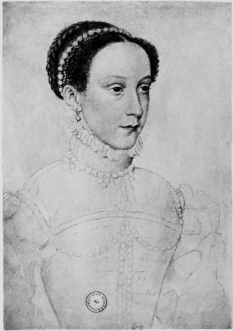
Mary Stuart
as Dauphine of France
From the drawing in the Bibliothèque Nationale at Paris.
A later drawing, in which the young Queen is represented in her deuil
blanc as a widow, is among the framed drawings at Chantilly: a portrait
probably executed by François Clouet when she was on the point of
leaving her beloved France. This is apparently a reproduction from a
lost original, and it found its way to Chantilly with the Lenoir
Collection. It is no doubt the last likeness of Mary Stuart made in
France. The charm which Clouet so deftly imparted to the portraits of
this unhappy Queen seems entirely absent from all the numerous
likenesses subsequently made in England by other artists. How hard and
set, for instance, do her features seem in the life-size oil-painting by
Oudry at Hardwick Hall. All that we can perceive in it is the only
too-evident havoc wrought by fate upon that beautiful face.
François Clouet’s highest capabilities may be traced in the water-colour
sketch at Chantilly which represents Margot de France,[123] youngest
daughter of Catherine de Medicis, in her girlhood. It is exhibited in
the Psyche Gallery and is considered one of the gems of the collection.
Since correct drawing from life was the artist’s first thought this
preparatory sketch is superior to the painting, also in all probability
executed by the artist himself, which a rare chance has brought into the
same gallery. This latter is supposed to be the actual portrait sent by
Catherine to her daughter Elizabeth, wife of Philip II of Spain, which
the Infante Don Carlos admired so much. Comparing the portrait with
those of the other marriageable princesses of Europe, he exclaimed,
“This little one is the prettiest of all”; whereat Elizabeth de Valois
in a letter to her mother writes: “Le Prince était demeuré en extase
devant le miroir délicieuse de la mignonne.”
Clouet has painted the little Princess in a robe of delicate silver
tissue adorned with pearls; more pearls are round her neck and
intertwined amid the tresses of her hair. Her expression displays that
joie de vivre which is known to have been one of her most marked
characteristics throughout her whole life.
It is, however, in the sketch that the high qualities of François Clouet
as a portrait-painter specially assert themselves. Here he appears as a
refined Holbein, endowed with graceful and elegant French qualities.
Light and shadow are barely perceptible but are nevertheless
sufficiently present to produce the necessary plastic feeling. The
costume and the jewels, though reproduced with closest accuracy, do not
mar the harmony, nor do they overpower the clearly defined features
which retain their fullest importance and prominence.
Plate LXV.
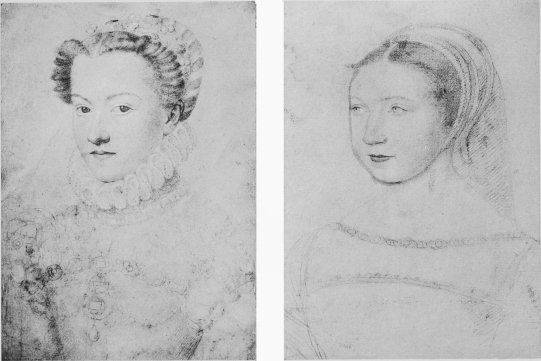
Photo. Giraudon.
ELISABETH OF AUSTRIA, QUEEN OF FRANCE.
François Clouet (About 1567).
Bibl. Nat. Paris. |
|
JOSSINE DE PISSELEU, NICKNAMED HEGLI.
François Clouet (About 1542).
Musée Condé. |
To face page 234.
Another portrait by François Clouet, equalling this in excellence, is
that of la bonne petite reine, Elizabeth of Austria in the Louvre—the
youthful consort of Charles IX, whose simple virtues shone out so
conspicuously during a most degenerate period in the history of the
French Court. The perfection of draughtsmanship in the delicate features
is astonishing; and the colouring, of a pale rosy hue, is most
effective. The hands, placed one over the other, have in their graceful
movements been justly likened to the petals of a white lily. There is a
copy of this picture at Chantilly, probably also by François Clouet, but
the exquisite hands are absent. Nor are they to be found in the
original drawing in the Bibliothèque Nationale, in the famous Lecurieur
album which once belonged to François Clouet’s own nephew, Benjamin
Foulon. Maréchal Strozzi, Madame de Retz, Albert de Gondi the Duc
de Retz, Robert de la Marck, the Duc de Bouillon, Jeanne d’Albret
in deep mourning, and many others, have the same provenance and all
bear notes in Foulon’s[124] handwriting. It has been suggested by Henri
Bouchot that these admirable designs came to the nephew from his uncle
who had preserved them in his studio in order to reproduce them
subsequently in colour. We may presume then that these original pencil
drawings were the immediate work of François Clouet, whilst the coloured
portraits were reproduced from them either by himself (as in the case of
the portraits of Elizabeth of Austria in the Louvre and at Chantilly)
or by the hands of his pupils.
There is, however, one exception to this proposition in the case of the
portrait of Pierre Quthe recently acquired for the Louvre. It
certainly appears to be a portrait painted direct from life and not
reproduced from a drawing; and it reveals to us a new and more intimate
characteristic of the artist; since he has here shown us one of his own
personal friends, with whom he, no doubt, had many tastes in common.
Had this not been so he would not have appended to the picture the
following inscription: FR. JANETT OPUS PE. QUTTIO. AMICO SINGULARI
ETATIS SVE XLIII, 1562. This portrait, therefore, when compared, for
instance, with that of Charles IX at Vienna, gives the impression of
being less conventional and more sympathetic. It has the same bluish
curtain in the background, and an open book lies on the table, in which
may be seen representations of certain plants, alluding to the fact that
the person represented was well known as a botanist.
Since the discovery of the portrait of Pierre Quthe we can have no
hesitation in attributing to François Clouet another life-size portrait
at Chantilly: namely, that of Cardinal Odet de Coligny,
hitherto—though with some reserve—assigned to Primaticcio on account
of a misleading signature evidently posterior to the painting. This
portrait and that of Henri II (Cabinet Clouet) (also attributed, and
with much more reason, to Primaticcio), clearly exhibit the difference
between the respective artists without need for any further comment. The
curtain in the background, for which François had so decided a
predilection, is also to be found in the portrait of Odet; and it
appears to have been Clouet’s latest work. It exhibits very decidedly
his appreciation for Italian methods, more especially those affected by
Morone and Moretto of Brescia, to whose work these two large portraits
by François Clouet bear a marked analogy.
Plate LXVI.
PIERRE QUTHE.
Louvre.
François Clouet.
Besides a fine drawing in red chalk of this same Cardinal, presented
to the Musée Condé by M. Moreau Nélaton, there exist two other drawings,
evidently preliminary sketches for the same picture. One of these is in
the British Museum (Salting Bequest) and the other in the Albertina at
Vienna. These form a further proof that the painting at Chantilly is by
François Clouet and not by Primaticcio.
Odet de Coligny, created a Cardinal by Clement VII at the early age of
seventeen, was the eldest brother of Admiral Coligny and of Dandelot. In
spite of the countless honours showered upon him by the Catholic party
he all at once in 1561 astonished the world by openly confessing the
Protestant Faith. Like his brothers he became a staunch supporter of
Calvin, proceeded publicly to marry Elizabeth de Hauteville—to whom he
had for many years previously been deeply attached—and presented her at
Court, where she received the title of Comtesse de Beauvais. The
scandalised Pope, Pius V, erased his name from the list of Cardinals,
whilst Catherine de Medicis merely smiled. It suited her purpose on the
death of Francis II to dismiss the Guises from her Court and to admit
thereto the Calvinistic party, even to the extent of attending their
sermons. This freak of hers did not, however, last long, but by it she
enticed the Protestants into her net. Odet de Coligny subsequently
retired to England, where in 1570, just when he was intending to return
to France, he died suddenly at Hampton Court, not without suspicion of
poison.
Plate LXVII.
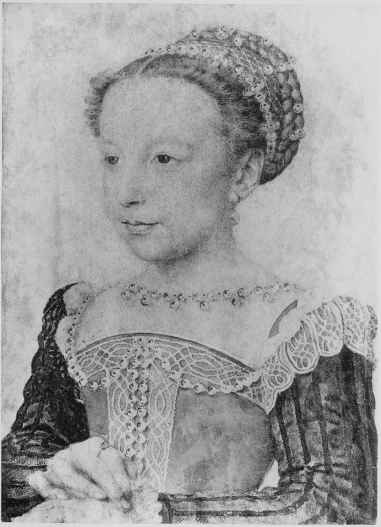
Photo. Giraudon.
MARGOT OF FRANCE.
François Clouet.
Musée Condé.
To face page 238.
Before concluding this chapter on François Clouet attention should be
directed to a specially interesting feature about these drawings. Upon
the margins, and also on the reverse sides of most of them, are to be
found annotations and legends of the utmost historical and iconographic
value. Sometimes they appear to be in the handwriting of the artists
themselves: often notes with regard to subsequent reproduction in
colours; but more often they seem to be the remarks of the connoisseurs
and collectors who at different times possessed the drawing—such as was
Catherine de Medicis herself. Her handwriting is to be found upon at
least sixteen of the drawings in the Musée Condé, easily identified by
existing fragments of her letters in the archives at Chantilly and
elsewhere. There is, for example, a drawing of Erasmus which had
hitherto passed unnoticed until Moreau Nélaton discovered that the Queen
had written his name upon it in her own hand. Her autograph is clear
enough also on the drawings which present her favourite
ladies-in-waiting Hegli[125] and Montchenu and la Romène; whilst she
has also annotated the drawings representing Monsieur de S. Valier,
“le père de la Grande Senechalle,” and “Monsieur de Nevers,” “le
père de Madame de Nevers.” Then upon a drawing of Brissac (so
celebrated for his good looks) she notes “brassac depuis maréchal.”
Again, “le fu roy de Navarre, Henri,” “Monsieur de Chateaubriand,”
“Monsieur de Voldemont,” and “Chandu, capitaine de la porte du Roy.”
Besides the sixteen drawings at Chantilly which so obviously bear the
Queen’s handwriting, there is as already mentioned in the Deligand
Collection a likeness of “Brasseu,” daughter of Diane de Poitiers, and
in the Uffizi a drawing representing Queen Claude, “mère du roi
Henri,” on both of which we also find Her Majesty’s angular writing.
She has corrected, moreover, the title upon one pencil drawing wrongly
entitled Madame de Nevers d’Albret into Madame de Vendôme d’Alençon.
Yet by far the larger number of the drawings bear notes in a variety of
different handwritings: at Chantilly, the Bibliothèque Nationale, in the
Uffizi and in the British Museum (Salting Bequest). M. Moreau Nélaton is
strongly of opinion that these notes were all made either by the Queen
herself or by secretaries written at her dictation. He is certainly
right in regard to one of these, for we can trace the same handwriting
in a private letter “a ma cousine Madame la Connetable” signed by the
Queen; and again on the margin of the three drawings representing
“François Dauphin,” “Marie Royne d’Ecosse,”[126] and “Charles
Maximilian d’Orleans” respectively. It is a well-formed caligraphy
with a peculiar trick of abbreviating “et” into “&,” which appears
both in the letter and in the notes. There is no proof, however, as to
who were the other annotators, whether Court secretaries or not. They
may just as well, as M. Dimier[127] suggests, be other collectors
through whose hands in the course of time the drawings have passed. This
much, however, is quite certain: that all are posterior to the drawings
themselves. The different handwritings—of which there are at least
four, if not five (including that of the Queen), have puzzled Bouchot as
much as Dimier and Moreau Nélaton, and all these authorities have their
own special theories upon the subject. It is evident that in most cases
the notes do identify the persons represented in the drawings upon which
they are found, and they are thus of greatest historical value: and more
especially is this the case with the drawings at Chantilly (many of
which are stained with blotches of colour), since they are the originals
from which were derived the copies and portraits found now in other
collections.
Plate LXVIII.
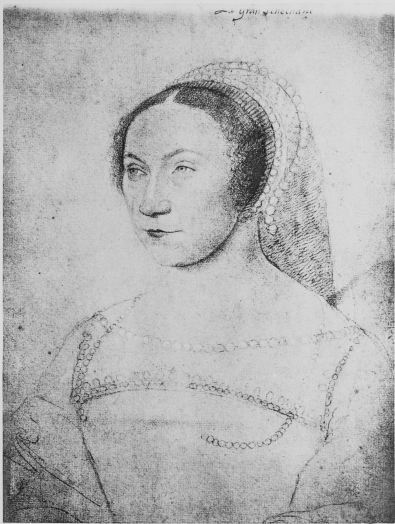
DIANE DE POITIERS.
François Clouet. About 1543.
Musée Condé.
To face page 240.
There is ample evidence to prove how much interest was taken by
Catherine de Medicis in French portrait-painting. A list has been found,
bearing the heading of “Les peintures qu’il faut,” of the pictures
which she desired should be reproduced. Numerous “gens de maîtres”
like Philibert Delormes, Jean Bullant, Scipion Bruisbal, and others were
busily employed in making these copies from Clouet originals, in
order to satisfy the great demand which then existed for them.
After Catherine’s death an Inventory of not less than 476 paintings
(amongst which were 341 portraits) was made at the Palais de Tournelle,
where she habitually resided; whilst another Inventory notes 39 small
pictures executed in enamel, and 32 portraits in colour, 1 foot square
each, of ladies and gentlemen of the Court.
An original drawing of Diane de Poitiers is preserved in the
portfolios at Chantilly; and a portrait of the same lady executed in
colour hangs in the next room (Cabinet Clouet). Similarly the Bethune
and Destailleur albums at Chantilly, as well as the Ashmolean collection
at Oxford, contain numerous copies from originals in the Musée Condé.
Many of these copies were made by enamellers and goldsmiths for the
purposes of their respective trades. These, however, are usually of
inferior workmanship, although they have a certain value attached to
them; especially when, as in the case of Mary Tudor, the original has
been lost.
In this connection the Mejanés album at Aix should not be forgotten; for
it is no doubt the most important amongst the various albums which
contain copies of these original drawings at Chantilly and elsewhere.
This collection is supposed to have been copied by Madame de Berry, wife
of Arthur de Gouffier, one of the Preux de Marignan. Francis I, whose
own portrait is at the beginning of the album, when on a visit to this
lady, is said to have composed the remarks which are written on the
margins. They are suggestive and often witty; indeed none but the King
himself would have dared to fling at Mary Tudor[128] of England the
insulting words “plus sale que royale”; whilst Diane de Poitiers is
greeted with the flattering remark, “fair to see and virtuous to
know.” Perhaps even more important especially, from an artistic point
of view, is the Hagford album bequeathed to the British Museum by Mr.
Salting, since it includes not only a number of old copies but also
several very valuable originals. This collection was made by an English
painter, Ignatius Hagford, who lived in Florence in the eighteenth
century. He believed them to be the work of Holbein, as is indicated by
the frontispiece; and he seems to have even bought also old copies of
originals which he already owned. Part of his collection is now in the
Pitti Palace; and seeing that the Howard Collection, now at Chantilly,
was also originally acquired in Florence, there is strong reason to
believe that probably these two collections were once united.
Plate LXIX.
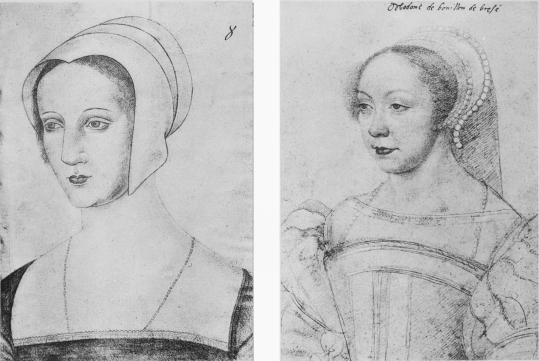
Photo. Giraudon.
MARY TUDOR, QUEEN OF FRANCE.
Copy after Perréal.
| |
MADAME DE BOUILLON.
Attributed to Jean Clouet. |
Musée Condé.
To face page 232.
Henri de Mesmes, a gentleman of whom Brantôme speaks as “un très grand
habile et subtil personnage d’état d’affaires de science et de toute
gentillesse,” often acted as go-between for Catherine in her art
dealings; and it was he who corresponded on her behalf with a certain
Claude de Hery, who had been commissioned to make a new engraving from a
portrait of Charles IX on his accession to the throne. This artist
had failed to satisfy the Queen-Mother and the King, in spite of the
fact that his work had been fully approved of by no less a personage
than François Clouet himself.
One of the last works of François Clouet was a miniature of Elizabeth
of Austria, executed in 1572 and destined for her sister-in-law, the
Queen of Spain. The goldsmith Dugardin designed for it a golden frame;
and here also Henri de Mesmes acted as medium, as is shown by a
memorandum referring to it in the handwriting of Catherine de Medicis
herself.
It was in this same year (1572) that the artist died; a year which was
also fatal to Jeanne d’Albret, Queen of Navarre, who did not live to
attend the nuptials of her son Henri IV with Margot de France. This took
place shortly after her demise and not long before the Massacre of St.
Bartholomew; a terrible event which reveals Catherine de Medicis in a
very different light from that of a connoisseur and collector of works
of art. There is a portrait of her in the Cabinet Clouet at Chantilly
which dates from about this period. From it the bloom of youth has fled,
the face has grown heavier and the smile is more than ever fixed and
conventional.
The ablest contemporary and follower of the Clouets was Corneille de
Lyon; but he in turn developed a decided individuality of his own. By
him are those small portraits, painted upon light-green or light-blue
backgrounds, which may be found scattered throughout the Galleries of
Europe. As already mentioned, a likeness of the Dauphin François[129]
at Chantilly (Tribune) has been attributed to him by Gaignières, to whom
it once belonged. It is on the authority of this connoisseur that other
portraits in the Musée Condé exhibiting the same style are by comparison
assigned to him: such, for instance, as Le Grand Ecuyer de Boisy,
Marguerite de France (sister of Henri II), Madame de Martigné Briant,
a portrait supposed to be of Madame de Canaples, and a portrait of a
young woman, erroneously styled Claude de Valois. [An authentic
portrait of this latter lady, attributed to Clouet himself, is at
Munich.] Madame d’Elbœuf, presented to the Louvre by the late
Rudolph Kahn, is a fine example of Corneille’s skill.
Another artist who followed the Clouet style was Jean de Court, Court
Painter to Henri III, the last of the Valois Kings, whose portrait in
the Cabinet Clouet at Chantilly is probably an example of his work. His
talent is much praised by Desportes; and this likeness of Henri III
does not suffer in comparison with the portraits of Charles IX
attributed to François Clouet. The pencil drawing of Marie Touchet,
Charles IX’s mistress, in the Bibliothèque Nationale is also attributed
to him.
Plate LXX.
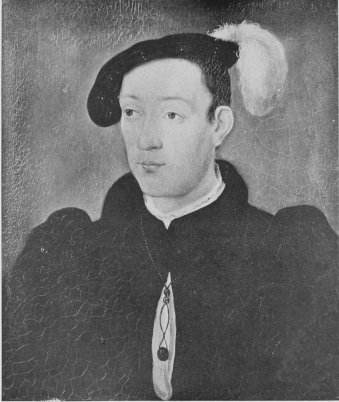
Photo. Giraudon.
FRANÇOIS, DAUPHIN.
Musée Condé.
Corneille de Lyon.
The painter who acquired the old Queen’s special favour after the death
of François Clouet was Carron, who made a series of designs
(reproduced in tapestry) from the History of Artemisia, in which
Catherine herself is represented mourning for Henri II in the guise of
the Queen of Caria. A drawing by Carron representing the Duc
d’Alençon, her youngest son, on horseback is in the passage of the
Tribune at Chantilly.
Pierre Gourdel, Dubois and Bussel, followers of François Clouet, are
only known to us by mediocre engravings, but numerous drawings by the
Brothers Lagneau have come down to us. These may be met with in the
Louvre, in the portfolios at Chantilly and elsewhere. They suffer from
an exaggerated taste for realism; and representations of old, wrinkled
men and women seem to have been their favourite themes. A good example
of their work is the portrait of an Old Man at Dijon, where, however,
it is erroneously assigned to Daniel Dumoustier. This latter artist, on
the contrary (according to his own statement), took particular pleasure
in representing his sitters as younger and more beautiful than they
really were. By him there are at Chantilly portraits of Louis XIII (in
coloured chalk), of Albert de Gondi Archdeacon of Paris, of Henri Duc
de Guise,[130] of the Princess Palatine (the devoted friend of the
Grand Condé), and an interesting portrait of Henriette de France in
her girlhood. Numerous other examples of his work are in the Louvre; and
he is certainly the most important of the artists who followed François
Clouet. In company with his sons Pierre and Nicolas he carried on the
art of pencil drawing in France from the sixteenth well into the
seventeenth century. Saint-Simon speaks of him as a man who was fond of
books and knew both Italian and Spanish. He lived in the Louvre, and
throughout his lifetime retained his hold upon public taste.
There is yet one more artist-family to be mentioned: that of the
Quesnels, who were held by the two first Bourbon Kings, Henri IV and
Louis XIII, in the same high estimation as were the Clouets by the
Valois. There are two portraits at Chantilly (Cabinet Clouet) which are
attributed to François Quesnel: that of the Duc de Sully and of his
brother Philippe de Bethune. These paintings markedly display the
strong tendencies to realism so characteristic of the Brothers Quesnel.
Plate LXXI.
HENRI DE GUISE.
Dumoustier.
Musée Condé. |
|
MARECHAL DE VIELVILLE.
François Clouet. (Salting Collection).
British Museum. |
To face page 246.
Yet another French picture at Chantilly of the Clouet School has to be
recorded, the authorship of which is uncertain. It represents Gabrielle
d’Estrées, mistress of Henri IV, seated in her bath, with her infant
sons (one being on the arm of his nurse) beside her. It is a composition
which occurs frequently and seems to be rather meant for an allegory
than for a portrait. Other versions of it are in the Louvre, at Doughty
House Richmond, and in the Collections of Baron Pichon and the
Viscomtesse de Zanzé. In this last example one of Gabrielle’s sisters is
also introduced. She turns her back to the spectator, whilst Gabrielle
herself—her bare neck adorned with a string of fine pearls—faces
full round. At the Musée Condé (Cabinet des Gemmes) there is a
miniature representing Gabrielle d’Estrées and her two Children, which
bears unmistakable likeness to this portrait. The late M. Gruyer in his
Catalogue Raisonnée of the Musée Condé justly points out that this
composition testifies to the decadent turn taken by the late
sixteenth-century French School; and we sadly miss the good taste and
the refinement which are such marked qualities in the portraiture of
François Clouet.
FRENCH seventeenth-century Art does not offer any such difficult
problems as those presented to us by the portrait-painters who lived and
laboured during the period of the Clouets, for the artists of this
latter period in most cases were accustomed to sign their names to at
least a certain number of their works, whereby they can be easily
identified.
On the very threshold of this new Art-development we find the Brothers
le Nain, who, choosing a totally different type of work, kept aloof from
kings, princes and courtiers and devoted their attention chiefly to
scenes of peasant life. Le Repos des Paysans at the Louvre is one of
their best and most characteristic works. So also are La Forge and a
portrait of Henry II de Montmorency, the last of his race, which ought
to be at Chantilly. There is in the Cabinet Clouet at the Musée Condé a
powerful portrait of Dr. Fagon, physician to Louis XIV, by Mathias le
Nain. Chardin, who continued in their tradition a century later, is
unfortunately not represented in the Musée Condé.
Nicolas Poussin also adopted a style of his own, although it was of a
different kind. He was greatly attracted by the antique and his heart
was set on visiting Rome, whither, after long struggles in Paris, he at
length found his way. There he received from the painter Domenichino the
necessary training for the work which he desired to take up. The French
sculptor Quesnoy befriended him, and the poet Marino introduced him to
Cardinal Barberini, who commissioned from him two pictures: The Death
of Germanicus and The Capture of Jerusalem. When fame came to him
France reclaimed him. He was greatly favoured by Richelieu and entrusted
with the decoration of the Louvre. He found, however, a rival in this
enterprise in the person of Simon Vouet; and difficulties arose, because
Poussin claimed his right to carry out the whole work independently and
on his own responsibility. Finding that he could not attain this object,
he returned to Rome under the pretext of fetching his wife and never
returned. He lived thenceforth in Italy; for, like the Brothers le Nain,
he had no desire to become a Court Painter. His pictures were,
nevertheless, greatly admired in France during his lifetime; and there
are no less than nine large canvases by him in the Galerie des Peintures
at the Musée Condé, besides numerous drawings. Amongst these may be
noted: The Infancy of Bacchus; Theseus finding his Father’s Sword
(with a striking architectural background); and Numa Pompilius and the
Nymph Egeria, a composition wherein the artist displays to the full
his skill in dealing with romantic landscape. A drawing of Daphne[131]
flying to her father’s protection who transforms her into a
laurel-bush, has special charm and shows those characteristics which he
handed on to his brother-in-law and pupil Dughet, called after him
“Gaspar Poussin.” There are two landscapes by the latter at Chantilly
(Galerie des Peintures): An Alley in a Wood, and A View of the Roman
Campagna, a subject of which he never tired. His sunsets foreshadow
those of Claude Lorraine, who in his power of rendering atmospheric
effect and the rays of the sun was only equalled by Turner some
centuries later. The National Gallery and the Louvre possess some of
Claude’s finest landscapes, while Chantilly has chiefly drawings,
amongst which the most noteworthy are the Castello di S. Angelo and
the Aqueducts of the Roman Campagna.[132]
Plate LXXII.
Photo. Giraudon.
DAPHNE METAMORPHOSED INTO A LAUREL TREE.
Musée Condé.
Nicolas Poussin.
Philippe de Champaigne, who came in his youth to France from Brussels,
was a college friend of Poussin at Laon in 1623; and shares with him
that same sense of freedom in his work. Poussin reached his goal in Rome
through classical work, whilst Philippe de Champaigne devoted himself to
portraiture, in which class of work he was most assiduous. His portraits
of Cardinals Richelieu and Mazarin in the Musée Condé came from
the Gallery in the Palais-Royal and are magnificent examples of his
methods.
Another portrait-painter who deserves mention here is Jacques Stella,
who painted the Grand Condé as the Hero of Rocroy, at the age of
twenty-two—a portrait which is singularly attractive and has a special
historical interest. This painting, which was always highly prized by
the Bourbon-Condé family, now hangs in the Galerie des Batailles.
Another portrait of the same personage, painted after he had reaped
further laurels at Fribourg and at Nördlingen, is by Beaubrun, the same
artist who painted his only sister Geneviève de Bourbon. Both these
pictures are in the Cabinet Clouet.
A figure which stands out with some insistence amongst French artists of
the seventeenth century is Charles Le Brun. He was first of all a pupil
of Simon Vouet, but becoming acquainted with Nicolas Poussin and urged
on by enthusiasm for his work, followed this master to Rome. Returning
to Paris with an established reputation, he fell in with Colbert, who
perceived in him the very person needed for the Gobelins Factory. Le
Brun fully realised these expectations since he not only organised this
great concern but subsequently, with the assistance of Van Meulen,
furnished designs for a History of the Kings of France, which was
presently reproduced in tapestry in those celebrated workshops. He was
also the founder of the French Academy in Rome; and Louis XIV, who
conferred on him the office of Court Painter, took him to Flanders
during the campaign of 1676. The portrait at Chantilly of Pomponne de
Bellièvre, first President of the Parlement of Paris (engraved by Van
Schuppen), represents his skill as a painter of portraits. His work can,
however, be more profitably studied in the Galerie d’Apollon at the
Louvre.
Eustache Le Sueur, another pupil of Simon Vouet, earned fame by his
decorative work in the Hotel Lambert at Paris and by his Scenes from
the Life of St. Bruno, now in the Louvre. He is represented at the
Musée Condé by some fine drawings.
When Colbert was supplanted by Louvois another painter came to the front
in the person of Mignard, also a pupil of Vouet. He studied in Rome,
where he copied a number of paintings in the Farnese Gallery for the
Cardinal of Lyons, Richelieu’s brother. He married the beautiful Anna
Avolara, daughter of a Roman architect and model for his Madonnas, for
which there was a great demand. No sooner had he acquired a certain
amount of fame than the King of France commanded him to return home. On
the way, however, he fell ill, and had to stop at Avignon. Here he first
became acquainted with Molière; and the portrait which he painted of
this great poet is beyond doubt his chef d’œuvre.[133] It occupies
a prominent position in the Tribune at Chantilly, where it commands
much attention and admiration. The great esteem in which the author of
Tartuffe was held by the Grand Condé is well known and it is by a
singular piece of good fortune that the best of all the existing
portraits of Molière should have found its way into the Musée Condé. If
Mignard—and not without reason—is sometimes accused of superficiality,
this complaint must surely be modified by the evidence of this portrait,
which displays an artist of very considerable power.
There is at Chantilly another portrait by Mignard of special interest.
It is that of Madame Henriette d’Angleterre, the beautiful and
ill-fated daughter of Charles I, first wife of Philippe, Duc d’Orléans,
the King’s brother. He also repeatedly painted likenesses of the young
King himself, including one sent to Spain to be shown to his intended
bride the Infanta Marie Thérèse.
At a maturer age Louis XIV was painted by Rigaud, a pupil of Le Brun.
The portrait of him at Chantilly (Cabinet Clouet) is a smaller replica,
signed by the painter himself, of the larger work executed in 1701 for
his son, Philip V of Spain—a painting which was, however, kept back at
Versailles and is now in the Louvre.
Hyacinthe Rigaud was considered a great portrait-painter and many
personages of note gave him commissions. There is also a fine portrait
at Chantilly by his younger contemporary and follower, Largillière, of
Mademoiselle Duclos, a celebrated tragédienne who made her début
at the Comédie Française in 1683. She is here portrayed in the rôle of
Ariane (Salle Caroline), and her sumptuous robes are painted with all
the care and minuteness so characteristic of this artist. These
qualities are again displayed in a portrait of the Princess Palatine,
Charlotte Elizabeth, second wife of Philippe d’Orléans and mother of
the Regent. In this portrait Largillière shows his highest talents, and
had it not been for the fact that “Liselotte” (although already
middle-aged) followed the taste of her time by permitting herself to be
painted as a Naiad this would perhaps have been one of the most faithful
likenesses of this interesting princess.
Plate LXXIII.
Photo Braun & Co.
LOUISE-HENRIETTE DE BOURBON CONTI.
J. M. Nattier. |
|
A FRIEND OF THE CONDÉS.
Largillière.
|
Largillière resided for many years in England and studied for some time
under Sir Peter Lely. On his return to Paris he was taken up by Charles
Le Brun. His style belongs as much to the seventeenth as to the
eighteenth century. Elegance and luxury, and a touch of serenity prevail
in all his portraits. Mariette was greatly struck by his personal vigour
and tells us that he went on working even up to his eighty-sixth year.
Although too often over-exuberant he generally succeeded in imparting to
his patrons great liveliness of aspect, and they live still, clad in
their most sumptuous apparel. Such is the portrait of the elegant
“Unknown”[134] at Chantilly, once in the Collection at the Palais
Bourbon; from which circumstance we may suppose that the sitter was some
intimate friend of the Condé family.
By Jean Marc Nattier there is at Chantilly a life-size portrait of
Mademoiselle Nantes, daughter of Louis XIV by Madame de Montespan, and
wife of the Duc de Bourbon, grandson of the Grand Condé. Her daughter
Louise Henriette, who married the Prince de Bourbon Conti, was also
painted by Nattier[135]; and by the same artist—one of his best
works—is the above-mentioned portrait of Charlotte Elizabeth
Soubise,[136] the young wife of Louis Joseph, Prince de Condé,
represented plucking carnations in the gardens at Chantilly.
Nattier’s portraits of the Royal Family of Bourbon, both in the Louvre
and at Versailles, are very numerous. He painted every one of Louis XV’s
daughters[137] and many other fair women, who, however, bear a strong
general resemblance to one another, whereby his portraits are often
rendered conventional and monotonous.
It is therefore rather refreshing to turn from Jean Nattier to Desportes
and Oudry, who both stand on the threshold of the eighteenth century and
who revived realistic landscape painting—an art which had practically
lain dormant since the days of Pol de Limbourg; for Claude Lorraine and
the Poussins had directed it into wholly diverse channels. Briados and
Balthazar, two Spanish hounds formerly belonging to the House of
Condé, are exquisitely painted by Desportes, who was highly thought of
by all lovers of the chase and was a constant guest at the
hunting-parties held in the various French châteaux. A painting by him
in the Louvre representing a Huntsman with his dog and bag of game
standing in a fine landscape shows his skill at its very best.
Oudry’s compositions come very near those of Desportes: for example, his
Chasse du Loup and Chasse du Renard at Chantilly, both of which are
noted in the Inventory of the Palais Bourbon. Oudry was encouraged by
Largillière to take up decoration also, which he did with conspicuous
success. He was admitted into the Academy in 1699, and being appointed
to the Directorship of the Tapestry Factory at Beauvais instilled new
life into that interesting branch of art, which had sadly decayed under
the direction of Charles Le Brun’s imitators. His graceful talent shows
itself in certain exquisite designs from La Fontaine’s Fables executed
in tapestry at this factory. His favourite abode was the forest around
Chantilly; and there he spent much time in painting animals direct from
nature. By insisting that his ideas should be accurately transcribed he
trained the weavers at Beauvais with much care, thus preparing the way
for Boucher, the decorative genius of the next generation. A splendid
Gobelins tapestry, executed after a cartoon by Boucher, adorns one side
of the Grand Staircase at Chantilly. It represents a young woman seated
in a garden to whom a boy and girl are offering fruit and flowers. On
the opposite wall there is another tapestry from the workshop of
Audran, executed after de Troy.
A copy in this collection (intended for the purposes of an engraving) by
Boucher of a portrait of Watteau by himself is not devoid of interest;
but it is in the Louvre, at Versailles, and above all in the Wallace
Collection, rather than at Chantilly, that we derive a clear idea of
Boucher’s light and graceful style. His Sunrise and Sunset on the
staircase of Hertford House are considered to be among the finest of his
creations. Madame de Pompadour, who was his enthusiastic patroness,
frequently sat to him in a variety of attitudes; although his great
talent was not portraiture, but decorative work, whereby he marks a
decidedly new phase in French Art.
After an exceptionally long reign Louis XIV had at last passed away. He
had asserted himself as strongly in Art as he had done in politics and
it is worthy of note that, immediately after his death, artists were
once more able to take their own independent courses. At this point,
therefore, in the history of French Art we come upon a somewhat sudden
change, visible also in the art of the cabinet-maker and the decorator.
The later Bourbon Kings and Queens left their gorgeous salons and took
refuge (with evident personal relief) in smaller and homelier chambers.
These less imposing apartments, however, also required suitable
decoration and serviceable furnishings: and it was here that Boucher
found his opportunity. The boudoir with its delicate colouring and
elegant upholstery played a significant rôle under the reigns of Maria
Leczinska and Marie Antoinette, and the petits appartements at
Versailles became examples of a new style. Paintings on a smaller scale
suitable for these graceful bonbonnières were soon in demand; and from
these it was but a step to the taste of Watteau, who is perhaps the most
typical artist of this period. Plaisir Pastoral, l’Amante Inquiète,
and l’Amour Désarmé at Chantilly are fine examples of this artist’s
work. Le Donneur des Sérénades in the Musée Condé, of which there is a
similar composition at Buckingham Palace belongs to his later period,
that is to say, to the last five years of his life. This work is said to
represent Mezetin (one of the leading actors at the Comédie Italienne
established at the Hôtel du Bourgogne) seated on a bench in a classic
garden tuning his guitar. The Amante Inquiète, which forms a pendant
to this picture, is of equal merit. Everything in these small paintings
is refined and elegant, even to Nature herself—a style far more typical
of Watteau, than the scenes of camp-life which mark his stay at
Valenciennes in 1709. A study in red chalk of a Warrior, preserved in
the Rotunda at Chantilly, recalls this period. In his sketches, of which
a great number are in the Louvre, Watteau exhibits his talent as a
draughtsman of the highest order and as a worthy pupil of Claude Gillot,
the earliest creator of the style for which Watteau became so famous.
His relations with Crozat, the famous financier and collector, who was
the first to recognise his genius, began in 1612, and it was in his
palace that he had an opportunity of studying paintings by the great
Venetian masters and landscapes by Rubens, both of which so decidedly
influenced his subsequent style. There are exquisite pictures by him in
the Louvre and in the Wallace Collection. His Ball under the Colonnade
at Dulwich is very famous.
Plate LXXIV.
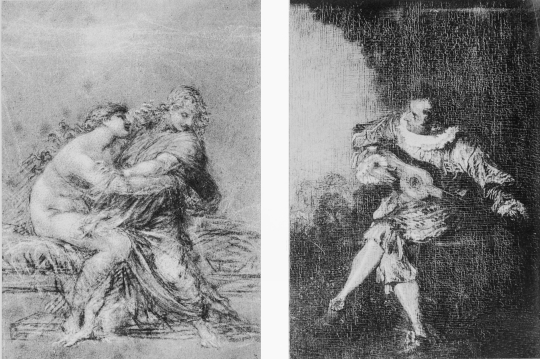
Photo. Giraudon.
JOSEPH AND POTIPHAR’S WIFE.
By Prud’hon. | |
THE GUITARPLAYER.
By Watteau. |
Musée Condé.
To face page 25
Lancret was a younger contemporary of Watteau, and observing his success
adopted his style; without, however, attaining to his eminence. His
Déjeuner de Jambon in the Galerie des Peintures at Chantilly presents
a company of merry-makers on the point of becoming riotous; and opposite
to it hangs a companion picture by de Troy entitled Le Déjeuner
d’Huîtres. The host in this latter composition—a figure dressed in
scarlet—is probably a Prince of the House of Orleans presiding at a
feast in the Palais Royal. Many of the guests represented are said to be
personages well known in their day: for King Louis Philippe was still
able to distinguish them by name. They are certainly enjoying their
oysters and iced champagne; and the satisfaction of the well-fed is
clearly exhibited in their features and gestures.
Together with this group of artists mention must be made of Christophe
Huet, designer and decorator of the Grande Chinoiserie at Chantilly.
These decorations in a style so much in vogue in the seventeenth and
eighteenth centuries were once attributed to Watteau, Gillot, Oudry,
and others until an Account, dated 1741, was found in the Archives of
Chantilly disclosing the name of Christophe Huet. They cover the panels
of the so-called “Salon des Singes.” Scenes and episodes from the chase
and the tea-party, architectural effects and other subjects, all are
carried out in a pseudo-Chinese style. Apes clad in Condé uniforms and
carrying flags act as outriders or grooms under the direction of
grim-looking mandarins robed in gorgeous Oriental apparel. Besides the
decorations here there is on the ground floor of the Château a “Petite
Singerie” decorated in very much the same style: humorous scenes,
wherein female monkeys are riding or occupied with their toilet. Jean
Baptiste Huet, son of this Christophe, was also repeatedly commissioned
by Prince Louis Joseph de Condé to paint pictures of his favourite
animals.
The celebrated painter of pastels, Latour, is represented at Chantilly
by a portrait of Madame Adelaide de France, daughter of Louis XV. His
portraits, now recognised as even superior to those of Boucher and
Lancret, are fine studies of character, but they are very rare. The
pastel of the handsome Marie Fel, an opera-singer from Bordeaux by
whom this artist was befriended, is very celebrated; and a group of
portraits at St. Quentin place him in the foremost rank of French
portrait-painters. His pre-eminent talents have been fully recognised by
modern students of the French School.
His contemporary, Peronneau—till recently known chiefly as an engraver
of the works of Boucher, Van Loo, and others—is now known to be the
artist who painted a charming Portrait of a Girl in the Louvre and
other pastels. Rosalba Carriera’s great success in that medium is also
well known. The young King Louis XV, the Regent, and many other
important personages were painted by her, and in her time she put into
the shade both Latour and Peronneau.
Duplessis brings us to the time of the Revolution, when ruin fell upon
so many of the artists of that day. His portrait of the Duchesse de
Chartres, mother of Louis Philippe and grandmother of the Duc d’Aumale,
is at Chantilly. She is seated in a garden, lost in profound sorrow at
the departure of her husband to a naval engagement, symbolised by a ship
disappearing in the distance: a refined and graceful presentation of a
charming woman capable of winning the hearts of all around her. The
portraits of Louis XVI and of the Comte de Provence by this painter
in the Musée Condé are considered to be among the best likenesses of the
last Bourbon Kings. Duplessis held the post of Administrator of the
Galleries at Versailles.
Greuze, like Watteau, marked out a special line of his own; and with him
French bourgeois Art reappears once more. His domestic scenes were
described by Diderot as follows: “Cet artist est le premier entre nous
qui se soit avisé de donner des murs dans l’art.” This remark applies
to his Malédiction Paternelle, l’Accordée du Village, etc.
Plate LXXV.
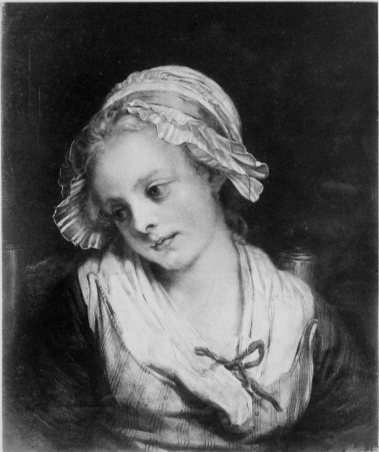
Photo. Giraudon.
Young Girl.
By Greuze.
Musée Condé.
His charming Portrait of a Young Girl in a little cap at Chantilly
represents Georgette, daughter of his concierge in Paris; and she can be
recognised again in the same artist’s l’Accordée du Village in the
Louvre, and perhaps also in the painting of a Young Girl winding Wool,
lately added to Mr. Pierpont Morgan’s Collection. The pendant to
Georgette in the Musée Condé is a portrait of a Young Boy, her
brother. These two paintings, together with Le Tendre Desir, belong to
the artist’s best period, whilst La Surprise is a work of his old age.
This last work exhibits to us the curious fact that a problem which had
steadily pursued him throughout his long life—namely, how to paint the
first awakenings of love in a maiden’s mind—still puzzled him at the
age of nearly eighty. It is certainly an irony of fate that after a
romantic attachment to a young Italian Countess—whose portrait he
painted, but whom he was prevented from marrying—he should have
returned to Paris, to become the husband of a woman much older than
himself, who presently made his life almost unendurable. It was perhaps
the memory of this youthful idyll which induced him to paint so often
those young maidens whose faces smile at us from the walls of so many
Galleries throughout Europe. The Young Woman in a Hat in the Wallace
Collection is perhaps the most fascinating of them all, since nothing
can surpass the grace and piquancy of expression in her lovely
countenance.
Greuze was in high favour with the Royal Family, and it is believed that
he painted a portrait of the Dauphin at the Tuileries after the
unfortunate flight to Varennes, and another of his elder sister, Madame
Royale, when in the Temple. The great upheaval of the Revolution struck
Greuze also, and as a painter he became no longer the fashion. His wife
squandered his fortune and he died in poverty, slaving to the very last.
The portraits at Chantilly of Marie Antoinette (in 1795) and of
Madame de Pompadour, two of the loveliest women of their day, are by
Drouais, a pupil of Van Loo and Boucher. The happy days of Trianon were
not yet over when these were painted, and the Dauphine of France,
presented here as Hebe, seems to be at the height of her glory and
charms. How different to the careworn and haggard woman whose portrait
hangs in the Musée Carnevalet over the very bed occupied by her in the
Temple before her execution!
Madame Vigée Le Brun carried the style of Greuze, at one time her
master, into the middle of the nineteenth century. She is represented in
the Musée Condé (Cabinet Clouet) by several small portraits: Marie
Caroline, Queen of Naples, painted in 1768, and her two daughters,
Marie Thérèse Caroline, wife of Francis II Emperor of Austria, and
Marie Louise Josephine, wife of the Grand Duke of Tuscany. Whilst the
first two of these appear to be copies of already existing pictures the
portrait of Marie Louise Josephine, Queen of Etruria, shows special
merits and seems to be taken directly from life, probably during one of
Madame Le Brun’s tours in Italy. A strong vitality is expressed in her
beautiful face, forming a marked contrast to the portrait of her mother,
the Queen of Naples. Madame Le Brun, who, in spite of her sex became a
member of the French Academy, was one of Marie Antoinette’s favourite
painters. After the Revolution she established herself in St. Petersburg
and did not return to Paris until 1801, when she was enthusiastically
welcomed. She painted many of the most celebrated beauties of her day,
but all these portraits seem to bear the mark of a period then fast
disappearing.
Louis Joseph de Bourbon, about 1787, commissioned Fragonard to paint
small portraits of the Princes and Princesses of the Royal House[138] of
Bourbon and the House of Bourbon Condé. Among these are portraits of the
Dauphin Louis, son of Louis XVI, and of the Duc d’Enghien by whose
tragic death the Condé family became extinct. Fragonard was a pupil of
both Boucher and Chardin. He went to Italy with the Prix de Rome and in
1765 was elected a member of the Academy. He excelled in every style of
painting—genre, landscape, portraits, interiors, and historical
subjects. When in 1765 he exhibited his Callirhoé and Corésus (a
subject taken from the poet Roy) Diderot and Grimm thought for a moment
that he might resuscitate the art of historical painting in France. This
picture was bought by King Louis XV but was never paid for, and
Fragonard returned to his portrait-painting, which he accomplished with
very great brilliance and rapidity. There is a series of these portraits
in the La Caze section of the Louvre, chiefly representing the actors
and actresses of his day. His remarkable talent for decorative painting
reveals itself in certain designs destined for Madame Du Barry’s
pavilion, but stupidly condemned by her advisers. When the Revolution
broke out, the artist fled to Grasse to escape imprisonment and the
scaffold taking these paintings with him, and there completed the series
by a fifth composition. The whole set are now in the collection of the
late Mr. J. F. Pierpont Morgan.
Fragonard in some of his work rose to the level of Watteau and he
certainly surpassed Boucher: but, like Greuze, he suffered the
humiliation of seeing himself pass out of fashion, supplanted by the
rising sun of Louis David.
It certainly is to be regretted that Fragonard was not also commissioned
to paint the above-mentioned life-size portrait of Louis Joseph de
Bourbon at the Musée Condé. This privilege was given to a Madame de
Tott, an artist quite unknown in the history of Art. She was a
contemporary of Bartolozzi, who engraved her picture, and thus handed
down her name to posterity; for we read upon it, “Madame de Tott
pinxit—Bartolozzi sculpsit.”
Louis Petit, another indifferent painter of the same period, executed a
portrait of the last Prince de Conti in hunting costume. This Prince
left France with his Orleans cousins during the Revolution and died in
Spain. To the same artist is attributed the portrait of Louis Henri de
Bourbon, Duc d’Enghien. He has an interesting face, recalling that of
his ancestor the Great Condé, but there is a touch of melancholy in his
expression, telling of adversity endured and apparently foreshadowing
his tragic death. His father, the last Prince de Condé, who during the
French Revolution lived chiefly in England, was painted by Danloux, a
Frenchman who had also sought shelter on the hospitable shores of Great
Britain. This Prince is here represented as leader of the Condé forces,
that is, of the French émigrés; and we can detect the influence of
Reynolds and Gainsborough in the light, harmonious colouring of the
composition, which was bought by the Duc d’Aumale from a descendant of
Robert Claridge, in whose house the last Condé lived during his exile.
By Charles Vernet, son of the celebrated marine painter Joseph Vernet,
there is at Chantilly a large landscape with a hunting scene. It was
painted during the Directoire, and Philippe Egalité and his son the
Duc de Chartres (afterwards Louis Philippe) may be distinguished in
the foreground. Charles Vernet delighted in depicting horses and scenes
of sport, a style rendered even more famous by his son Horace Vernet.
There are no less than four pictures by the latter in the Musée Condé:
The Duc d’Orleans (Louis Philippe) asking for hospitality from the
Monks of St. Bernard; a portrait of Louis Philippe, while still Duc
d’Orléans; Le Parlementaire et le Medjeles, in which the various
Algerian types are represented in glowing colours; and Louis Philippe
entering the gates of Versailles attended by his sons. This latter is a
reduced copy by Perrault of the large original at Versailles, painted to
commemorate the occasion when Louis Philippe handed over the Palace of
Versailles, with all its treasures of art and historical reminiscences,
to the French Nation as a Public Museum.
We now come to an artist whose place is upon the threshold of the
nineteenth century—namely, Pierre Prudhon. A sketch of a Venus at
Chantilly is a study for the picture Venus and Adonis, which made his
name at the Salon of 1812. Most fascinating are Le Sommeil de Psyché,
Homage à Beauté, and a sketch[139] of Joseph and Potiphar’s Wife:
elegant and graceful creations recalling the style of Greuze; who in
point of fact admired his work greatly, and said of him, “This man will
go farther than I have done.” David and his set contemptuously
designated him as the “Boucher of to-day”; but Napoleon commissioned
him to paint portraits of both his Empresses, Josephine and Marie
Louise, and conferred upon him the Cross of the Legion of Honour.
For his own portrait the Emperor chose his official painter, Gérard,
who was at that time considered so great an exponent of this branch of
art that he was styled “the painter of kings” and “the king of
painters.” Napoleon is represented by him as First Consul; and the
expressive eyes, the mouth displaying power to command and the broad
forehead partially concealed by a mass of hair, recall the great Roman
whom he emulated and with whom he loved to be compared. The painter, no
doubt, purposely accentuated in this portrait such facial resemblances
as he was able. This commission was executed at the Tuileries in 1803.
At the Fall of the Empire Gérard was presented by Talleyrand to Louis
XVIII; and later still in 1820 Louis Philippe commissioned him to paint
a portrait of the Duchesse d’Orléans (afterwards Queen Marie Amélie)
in a white robe adorned with pearls. This painting was highly treasured
by the Duc d’Aumale, who out of filial affection hung it above his bed,
where it still remains.
Another portrait by Ary Scheffer of the same royal lady as a widow is
also here. This was painted at Claremont during the exile of the Orleans
family; and by the same artist is a portrait of the Duc d’Orléans,
Louis Philippe’s eldest son, who met with an untimely end in a carriage
accident. But Ary Scheffer’s chef d’œuvre at Chantilly is a
portrait of Talleyrand, the most renowned and brilliant man of the
Revolution,—a painting bequeathed to the Duc d’Aumale by his friend
Lord Holland.
Ary Scheffer’s greatest pupil was Puvis de Chavannes, who far surpassed
his master in the art of exquisite line—a characteristic especially
noticeable in his painting of Ste. Geneviève in the Pantheon, where he
shows us the Patron Saint of Paris watching over her beloved city; and
again in another painting of St. Mary Magdalen at Frankfort. This
artist is unfortunately not represented at Chantilly; nor is Jacques
Louis David, whose vast canvases, the Sacre et l’Intronisation de
l’Empereur and La Distribution des Aigles, are so conspicuous in the
Louvre. In spite of the comments of Diderot—who very wisely pointed out
that the chief aim of the ancients was to reproduce Nature and that
those who merely copied archaic painters were doing just the reverse of
those whom they were trying to imitate,—public taste followed David and
discarded their former favourites, Greuze and Watteau.
Ingres, David’s pupil, is represented at Chantilly by some of his finest
work. There is in the first place His Own Portrait painted at the age
of twenty-four—a fine work, grand in its very simplicity—which Prince
Napoleon always desired to possess and which the artist could hardly
refuse to present to him. It passed thence into the possession of Reiset
in 1868 and eventually in 1879 became the property of the Duc d’Aumale.
A most impressive picture is Stratonice (Tribune), painted for the Duc
d’Orléans, who desired it as a pendant for Delaroche’s Assassination of
the Duc de Guise. It was painted at the Villa Medici in Rome, where it
aroused great enthusiasm. His princely patron generously gave him 63,000
francs for it, which was double the price agreed upon.
Another greatly admired composition by him at Chantilly is a Venus
Anadyomène, which bears close affinity to the famous La Source in the
Louvre.
The genius of Paul Delaroche brings us into the nineteenth century. His
style has been characterised as the juste milieu; for he neither
affected the manner of the Neo-Classics nor did he lean too much toward
the Romantics. Never was a cowardly and dastardly murder better depicted
than in his treatment of the Assassination of Henri, Duc de Guise. The
King, Henri III, pale and trembling, emerges from behind a curtain to
gaze upon his slaughtered victim, whilst the hired assassins gloat over
their ghastly deed. This picture, which hangs in the Tribune, was
painted by Delaroche specially for the Duc d’Orléans.
We now come to Eugène Delacroix, who, in company with Gericault, is
considered as the pioneer of Romanticism. His Capture of Constantinople
by the Crusaders at Chantilly is a vividly composed representation of
this important event. The Two Foscari (Tribune) depicts one of the
greatest tragedies in Venetian history. The Doge Francesco Foscari is
shown to us sitting in judgment upon his own son, whom he is condemning
to torture and banishment as a traitor to his country. The anguish of
the son and the stern despair of the old father are suggested with
wonderful skill. Delacroix’s greatest efforts were, however, directed
against the paralysing influences of Academism; and his paintings in the
Palais Bourbon and in the Galerie d’Apollon in the Louvre prove him to
have been the finest colourist of the later French School.
Another artist of the Romantic School is Descamps, who is represented at
Chantilly by no less than ten paintings and several water-colours.
Amongst these a Turkish Landscape, painted during the artist’s early
period, is perhaps the most attractive. On one side of the picture all
is mystery and darkness, whilst upon the other fall the rays of a golden
sunset. The problems of light and shade, to which he devoted himself so
earnestly up to the very end of his career, are here treated with great
effect. The same idea pervades his painting of Turkish Guards on their
way from Smyrna to Magnesia. A town with minarets is to be seen in the
background; a dark blue sky flecked with luminous white clouds; camels
and their riders; all breathing that dreamy oriental sensation which
appealed to him so strongly, and which he was never weary of
reproducing.
Eugène Fromentin, who was as celebrated as a writer as he was as a
painter, is represented in the Musée Condé by one of his finest
landscapes. Transported to the Marshes of Medeah, a country so well
described by him in his book Un Éte dans le Sahara, we see in the
foreground three Bedouin chiefs, mounted on splendid Arab steeds,
engaged in hawking. The atmosphere is transparent and clear, refreshed
as it were by a recent shower, and the sky is flecked by white clouds.
This artist, who died in 1876, was one of the most accomplished men of
his time.
By his contemporary Meissonier there are several paintings at Chantilly;
the most important being Les Cuirassiers de 1805 avant le Combat. The
moment is just before a projected attack; and the look of strained
expectation upon the faces of the combatants is admirably expressed.
Napoleon, surrounded by his staff, is easily recognised; and in the
varying expressions of the long line of horsemen we perceive looks of
determination to win or die. The reproach made by Mauclair to Meissonier
that his style suffered from lack of originality and was copied from
Dutch artists, if sometimes well founded, may at any rate be questioned
by this picture. His La Vedette des Dragons sous Louis XV, though
small in dimensions, is another important historical picture, whilst
Les Amateurs des Tableaux recalls a similar composition in the Wallace
Collection.
Plate LXXVI.
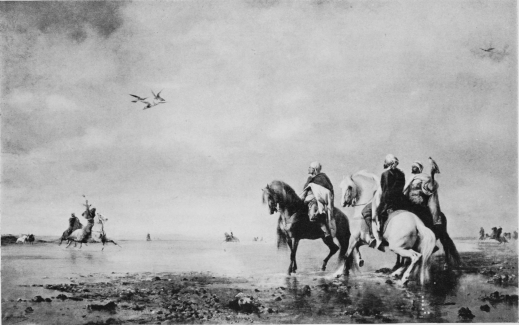
Photo. Giraudon.
ARAB CHIEFS HAWKING IN THE DESERT.
Musée Condé.
Eugène Fromentin.
Meissonier’s best pupil was Jean Baptiste Detaille, the famous painter
of battle-pieces. There is a picture of his at Chantilly entitled Les
Grenadiers à cheval à Eylau,[140] where a gallant French officer with
the cry “Haut les Têtes” leads his regiment on to victory. This is
one of the chef d’œuvres of this artist, whose recent death is so
much to be deplored.
Of quite a different nature are the allegorical paintings of P. J. Aimé
Baudry. The excellence of this master lies principally in decoration, as
may be seen by his Vision of St. Hubert in the Galerie des Cerfs; and
he may be considered one of the most talented of the French artists who
flourished during the second half of the nineteenth century.
Winterhalter, who, although a native of Baden, acquired his artistic
education in Paris and Rome, was one of the Court Painters to both Louis
Philippe and Napoleon III. His portrait of the Duc d’Aumale at the age
of eighteen, as Commander of his regiment before his victorious campaign
in Algiers, is at Chantilly; and there is here also a companion portrait
of the Duchesse as a young bride. She is clad in white, with a single
rose in her fair hair, and her face is full of refinement and delicacy.
Landscape-painting in France at the beginning of the nineteenth century
had undeniably become conventional and tame; but quite suddenly this
stagnant condition came to an end, and a revolution set in, caused by
the exhibition of Constable’s paintings The Hay Wain and A View near
London in the Paris Salon of 1827. These pictures, purchased and
exhibited in Paris by a French connoisseur, created intense interest in
the French World of Art; and it is alleged that they were the immediate
cause whereat French artists suddenly emerged from the studios wherein
they had lingered so long and proceeding to the woods of Fontainebleau,
began working from Nature herself. They awoke to recognise their own
defects, already denounced by Chateaubriand, who had declared that
French landscape-painters ignored Nature.
Throughout the studios French artists warmly discussed the work of
Constable, upon whom Charles X, at their special desire, conferred the
Médaille d’Or; and it was suggested that the Charette (The Hay Wain,
now in the National Gallery) should be acquired by the French Nation.
S. W. Reynolds, Constable’s friend and pupil, whose exquisite little
picture of the Pont de Sèvres hangs in the Tribune at Chantilly, at
this time also removed to Paris in order to satisfy the general demand
for engravings of his master’s works.
But if the Barbizon School owed much to Constable, it is also certain
that Constable and Wilson owed an equal debt to Claude Lorraine; and
Turner perhaps even more so.
By Corot there is but one painting at Chantilly, but it is one of his
finest works. Everything in this picture breathes a spirit of peace and
joy; the sky, the earth and the graceful young women—one of whom is
playing a viola and another singing, whilst their companions listen or
are plucking fruit—give a cheerful note to this vision of content.
Plate LXXVII.
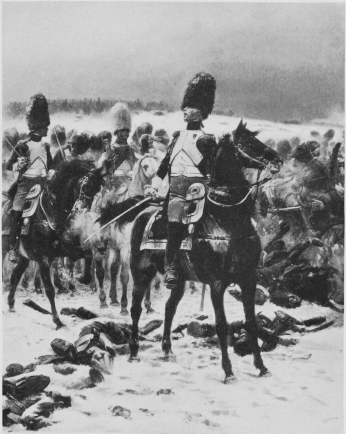
Photo. Giraudon.
THE GRENADIERS AT EYLAU.
Détaille.
It is styled Le Concert Champêtre[141] and recalls his series of
paintings entitled Souvenir d’Italie. Corot appears to have commenced
his studies in the woods at Fontainebleau even before Millet, Rousseau
and Diaz, so that he may fairly be styled the doyen of the now famous
Barbizon School.
By his pupil A. P. C. Anastasi there are several landscapes at the Musée
Condé, one of which represents Amsterdam at Eventide.
That Millet is absent from this collection is much to be regretted; but
by Theodore Rousseau there are several landscapes, small in point of
size, but nevertheless exhibiting this artist at his best; as for
example, Le Crépuscule en Sologne and Fermes en Normandie. Ary
Scheffer was the first artist to understand and befriend Rousseau when
he started away on lines of his own, and it was through the kind offices
of this painter that one of his first pictures was bought by the Duc
d’Orléans. His landscapes in Auvergne are early works; and those painted
at Barbizon—such as the pictures above named—are later and more
finished achievements.
Dupré, by whom there are three early works, Port St. Nicholas, Paris
and Le Soleil Couchant, accompanied Rousseau in 1841 to the
neighbourhood of Monsoult, where they were frequently visited by Barye,
Corot, and Daubigny. There is at Chantilly by this last artist a sketch
of the Château de St. Cloud, a charming record of a spot full of
memories, now no more. By Diaz de la Pena, the last of this group of
painters, there is a wreath of flowers and birds painted in vivid
colours upon the ceiling in the boudoir of the Petit Château once used
by the Duchesse d’Aumale; and by Ziem (known as the “Painter of Venice”)
there is a landscape, Les Eaux Douces d’Asie, a subject magnificently
treated by Diaz in a composition now in the Wallace Collection.
Monticelli, Diaz’s greatest pupil, the leading painter of the Second
Empire and a great admirer of the Empress Eugenie, is unfortunately not
represented here; nor are there any examples of the early French
Impressionists. For here the Hand of Death intervened.
Plate LXXVIII.
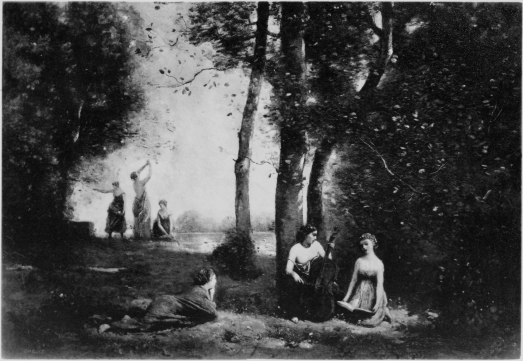
Photo. Giraudon.
“Concert Champêtre.”
By Corot.
Musée Condé.
With Léon Bonnat’s fine portrait of the Duc d’Aumale our description
of the paintings at Chantilly comes to an end; but attention should yet
be drawn to various pieces of sculpture exhibited in the apartments of
the Château, on the terraces, in the gardens and in the Park. A fine
figure of Jeanne d’Arc by Chapu is in the Rotunda, whilst a group of
Pluto and Proserpine plucking daffodils by the same sculptor is on the
Great Terrace. Here also is the equestrian statue of the Grand
Montmorency by Dubois; and not far from it a life-size figure of the
Grand Condé by Coysevox, surrounded by busts of Bossuet, La
Bruyère, Molière and Le Nôtre. Copies in marble from the antique
and the renaissance adorn the niches and plinths of the mansion and the
avenues of the Park. A figure of St. Louis by Marqueste surmounts
the roof of the Chapel and Jean Goujon’s reliefs ornament the Altar
within. The famous portrait in wax of Henri IV is in the Galerie de
Psyché; and busts in marble of the Grand Condé and of Turenne by
Derbais, of Richelieu and of the last Princes of the House of
Bourbon-Condé, are placed in the Cabinet des Livres and in various other
rooms. Fine bronzes by Barye, Mène, Fremiet and Cain, adorn the
mantel-pieces and consoles; whilst some exquisite enamel portraits by
Limousin are exhibited in the Salle des Gardes.
Most interesting, and worthy of more than a passing notice, is the
collection of Chantilly Porcelain, an industry founded in 1730 by the
Duc de Bourbon. A set of porcelain made at that time was placed in the
King’s Bedroom.[142]
In the centre of the Galerie des Peintures stands a fine bust of the
Duc d’Aumale by Dubois, and in the Marble Hall lies his recumbent
figure in full uniform by the same artist, a cast[143] of the marble
figure upon his tomb in the Cathedral at Dreux.
And so with the death of the man his work came to a close. But his
genius as a collector has furnished France with one of the finest Homes
of Art in the World; and she does well to remember with gratitude this
scion of the Bourbon race, who stretched out his hand to expiate much.
Every lover of Art throughout the world, and every wayfarer who in his
wanderings finds his way to Chantilly, may well stand amazed at this
collection and praise its creator. Nor in passing out should he fail to
give a last glance at the silent effigy: a glance in which gratitude
should be mingled with that emotion which ever holds the thoughtful
spectator of departed greatness.
Plate LXXIX.
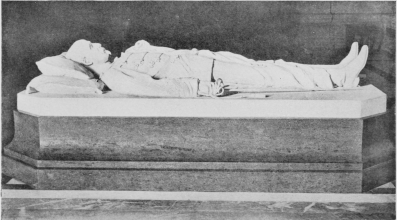
TOMB OF THE DUC D’AUMALE.
In the Cathedral at Dreux. Cast at Chantilly.
Paul Dubois.
A,
B,
C,
D,
E,
F,
G,
H,
I,
J,
K,
L,
M,
N,
O,
P,
Q,
R,
S,
T,
U,
V,
W,
Y,
Z
Abdul Kader, Duc d’Aumale’s victory over, 117
Accordée du Village, Le, by Greuze, 262
Adoration of the Magi, by Jean Fouquet, 190, 191
Ahasuerus. See King
Ailly, Heures de. See Books of Hours
Aix-la-Chapelle, Peace of, 79
Albano, a work by, 132
Albret, Duc de. See Condé, fifth Prince de
Albret, Henri de, King of Navarre, portraits of, 136, 141, 223
Albret, Jeanne de, Queen of Navarre, marriage, 16;
a Protestant, 17;
helps the Huguenots, 21;
sudden death, 22, 243;
portraits of, 22, 141, 224, 225, 226, 230, 235
Aldine editions in the Standish Library, 129
Alençon, Duc de, portraits of, 141, 182, 245
Alençon, Mme. Vendôme de, portraits of, 222, 223, 239
Alençon, Mlle. de, and Duc d’Enghien, 69
Alexandra, Queen, visits Chantilly, 122
Alley in the Wood, An, by Dughet, 250
Allori, Alexander. See Bronzino
All Saints’ Day, by Fouquet, 194
Amante Inquiète, by Watteau, 258
Amateurs des Tableaux, Les, by Meissonier, in the Wallace Collection, 272
Amazon of the Vatican, a statuette, 137
Amboise, Cardinal George de, owner of Valere Maxime, 158
Ambrogio di Spinola, Marchese. See Spinola
Amélie, Queen, and the Duc d’Aumale’s marriage, 117
“Amico di Sandro,” 149
Amour Désarmé, Le, by Watteau, 258
Amphitryon, poem by Molière, 75
Amsterdam at Eventide, by Anastasi, 275
Anastasi, A. P. C., 275
Angelic Choir, miniature by Simon Marmion, 197
Angers, disaster of, 25
Angleterre, Mme. Henriette de, portrait of, 253
Angoulême, Duc de. See Francis I
Angoulême, Duchesse de (formerly Diane de France), marriage, 9;
portrait of, 151
Angoulême, Marguerite (sister of Francis I), portraits of, 141, 216, 228;
manuscript of, 158
Anjou, Duc de. See Henri III
Anjou, Louis II of, King of Sicily, portrait of, 201
Anne of Austria, character, 40;
and the Grand Condé, 44, 45, 47, 55, 56, 64;
and Princesse de Condé, 52, 54
Anne of Bavaria, marriage of, 69
Anne de Bretagne (wife of Louis XII), miniature of, 138;
Prayer Book of, 198;
portrait of, 208;
Tournois tapestry, 208, 209;
medal of, 210;
her daughter’s marriage, 216
Annunciation, by Francia, 145;
by the Limbourgs, 173;
by Jean Fouquet, 184, 189, 193
Antioch, Jean de, translates Cicero’s Rhetorics, 157
Antiochus and Stratonice, The Story of, by Ingres, 135
Antiquitates Judæorum of Josephus, miniatures by Jean Fouquet, 155, 181, 182, 185, 189, 200
Arab Chiefs Hawking in the Desert, by Fromentin, 272
Architecture, Treatise on, by Filarete, 180
Ariane. See Duclos Mille.
Aristotle’s Ethics, 157
Armagnac, Comte de, war with Duc de Bourbon, 162
Arsenal MS., 159 n.
Artemisia, History of, 244
Artois, Duc de (afterwards Charles X), marriage, 101, 102;
leaves France, 104;
at Coblenz, 109, 110
Ascension, The, by Jean Fouquet, 192
Ashmolean Collection at Oxford, 241
Assassination of the Duc de Guise, The, by Delaroche, 134, 269, 270
Athena of Lemnos, famous bronze, 136
Aumale, Duc de (Henri d’Orléans), Lord of Chantilly: Histoire des Princes de Condé, 38, 40, 74, 132;
military success in Algiers, and marriage, 117;
birth of a son, 118;
an exile in England and return to Chantilly, 119-123;
his scheme to bestow Chantilly on the French nation, 122-124;
his second banishment, 124;
return and welcome back to Chantilly, 124, 125;
equestrian statue of, 125;
portraits of, 126, 137, 177 n., 220, 273, 276, 277;
collects the art treasures of the Musée Condé, 129-153;
Victor Hugo’s letter, 147;
on Raphael’s Three Graces, 149;
French illuminated manuscripts at Chantilly, 154-164;
the Cabinet des Livres, 156;
Les Très Riches Heures du Duc de Berry, 165-178;
works of Jean Fouquet, 179-195;
Jean Perréal, Bourdichon, and others, 196-210;
Jean Clouet, 211-226;
François Clouet, 225-247;
from Nicholas Poussin to Corot, 248 et seq.;
tomb of, 278
Aumont, Duc de, portrait by Quesnel, 142
Auneau, Victory of, 26
Austria, Elizabeth of, portrait of, 234, 235;
miniature of, 243
Austria, Margaret of, and the Très Riches Heures, 162, 163;
and Jean Fouquet, 181;
and Jean Perréal, 209
Autumn, by Botticelli, 145
Avant et après le Combat, by Protais, 135
Averoldi family, Ecce Homo purchased from, 135
Ayr Collection, portrait of Prince Orlant, 198
Bacchus and Ariadne, antique sarcophagus, 137
Baccio del Bene, Italian author, 220
Ball under the Colonnade, by Watteau, 259
Balthazar, a Spanish hound, by Desportes, 255
Bandol, Johannes, painter, 200
Barbançon, Princesse de, by Van Dyck, 132
Barberini, Cardinal, and Quesnoy the sculptor, 249
Barbizon school, 274, 275
Bardon, M., painter, 8
Baroccio, Federigo, painter, 132
Bartolozzi, Louis Joseph de Bourbon, 265
Barye, bronzes by, 277
Bassompère, Maréchal de, his marriage, 11
Battave, Godfrey le, his work, 204
Baudrey, P. J. Aimé, allegorical painter, 273
Bavaria, Marie Anne of, portrait of, 138
Béarn, Henri de, and the Protestants, 21
Beaubrun, his portraits of Comte de Cossé Brissac, Mme. and Mlle. de Longueville, 12, 133;
the Grand Condé, 251
Beaujeu, Anne de, and Jean Perréal, 207 n.
Beaujeu, Pierre de, 183
Beauneveu, André, a Book of Hours, 177 n.;
Antiquitates Judæorum, 182
Bellay, Du, poet, and Marguerite de France, 220, 221
Belles Heures de Jean de Berry. See Book of Hours
Bellièvre, Pomponne de, portrait of, 252
Benedict XIV, Pope, portrait by Subleyras, 142
Berenson, Bernard, A Sienese Painter of the Franciscan Legend, 145 n.
Berghe, Comte de, portrait by Van Dyck, 132
Bernal Sale, 133, 134
Berry, Duc de, Les Très Riches Heures, 130, 160, 161, 165 et seq.;
his illuminated manuscripts, 157;
portrait of, 201
Berry, Duchesse de, at Chantilly, 91
Bersuire, Pierre, translator of Livy’s Second Decade, 157
Bethune album, 241
Bethune, Philippe de, portrait by François Quesnel, 246
Betrayal, by Jean Fouquet, 191
Bible Historiée, 200
Bible Moralisée, 179
Birth of St. John the Baptist, by Jean Fouquet, 188, 190
Bissolo, Madonna holding the Infant Christ, 145
Boccaccio at Munich, 181, 182, 185
Bodleian Library (Oxford), 151
Boileau, N., celebrated French poet, a guest at Chantilly, 75
Boissy, Gouffier de, Battle of Marignan, 6
Boisy, Le Grand Ecuyer de, portrait of, 244
Bonheur, Rosa, A Shepherd in the Pyrenees, 135
Bonnat, Léon, portrait of Duc d’Aumale, 126, 276
Bonnivet, Gouffier de, Battle of Marignan, 6
Book of Hours:
(1) of fourteenth century, owned by François de Guise, 150
(2) of Anne de Beaujeu, 198 n.
(3) of Anne de Montmorency, 158
(4) of Catherine de Medicis, 215
(5) of Étienne Chevalier, miniatures by Jean Fouquet, 152, 181
(6) belonging to Maurice de Rothschild, 160
(7) Belles Heures de Jean de Berry, also called Heures d’Ailly, by Limbourg brothers, 179, 184, 185
(8) Heures d’Anjou, 200
(9) Heures d’Aragon, by Bourdichon, 198
(10) Livres d’Heures, 202
(11) Très Belles Heures, or Hours of Turin, by Hesdin, 165, 177 n.
Book of Hours—Cont.
(12) Très Riches Heures du Duc de Berry, by the Limbourg brothers, 130, 152, 154, 156, 158, 160, 162, 164 et seq.
Bora, Catherine de, portrait by Pourbus, 142
Bordeaux, Claire-Clemence at, 52, 53;
as a Republic, 59, 60;
surrenders to the King, 62
Bossuet, Jacq., the famous Prelate, at Chantilly, 83;
and the Grand Condé, 86-88;
statue of, 89;
on Fouquet’s Enthronement of the Virgin, 194;
bust of, 276
Botticelli, Sandro, Autumn, 145;
Simonetta Vespucci, 146;
other drawings, 147
Boucault, Jeanne, wife of Jean Clouet, 211, 224;
portrait of, 222
Boucher, François, French painter, Watteau, 143, 257;
cartoon by, 256
Bouchot, Henri, 199, 204, 208, 235
Bouillon, Duchesse, joins the Fronde, 45;
portrait of, 242
Bourbon, Anne Marie de, death of, 92
Bourbon, Antoine de (afterwards King of Navarre);
portraits of, 16, 136;
and the Guises, 18, 20
Bourbon, Caroline Auguste de, marriage to the Duc d’Aumale, 117
Bourbon, Charles de, the famous Constable, death, 16
Bourbon, Duc de. See Bourbon, Louis Henry Joseph;
Condé, sixth, seventh, and eighth Princes de
Bourbon, Geneviève. See Longueville, Mme. de
Bourbon, Henri I de. See Condé, second Prince de
Bourbon, Henri II de. See Condé, third Prince de
Bourbon, Henri de, King of Navarre. See Henri IV
Bourbon, Henri Jules de. See Condé, fifth Prince de
Bourbon, Jacob de, 16
Bourbon, Louis I de. See Condé, first Prince de
Bourbon, Louis II de. See Condé, fourth Prince de
Bourbon, Louis Henry Joseph de (Duc d’Enghien, son of eighth Prince de Condé, known as Duc de Bourbon, last of the Condés), birth, 96;
early marriage, 97;
at Chantilly, 98, 99;
separated from his wife, 100;
leaves France, 104, 105;
return to Chantilly, 111;
death of his father, 113;
reconciliation with and death of his wife, 113;
and his godson, 114;
death, 114, 115;
portraits of, 114, 266
Bourbon, Louis Joseph de. See Condé, eighth Prince de
Bourdelot, Jean, and the Grand Condé, 84
Bourdichon, a follower of Jean Fouquet, 197, 207;
his works, 198, 199
Bourdillon, Lescueur, portrait of, 203
Bourgogne, Antoine de, the Grand Bâtard, portraits of, 62, 142
Bouts, Dierick, Procession, 146
Braganza, Duc de (afterwards King of Portugal), betrothal, 124;
assassination, 124 n.
Brandenburg, William, Margrave of, guards the Rhine, 82
Brantôme, P. de: Diane de France, 9;
Louis de Bourbon, 19;
Duc d’Anjou, 24 n.;
the Dauphin, 217;
Diane de Poitiers, 231;
Henri de Mesmes, 242
“Brasseu,” daughter of Diane de Poitiers, a member of la petite band, 228;
portrait of, 239
Brentano, Herr, purchase and sale
of forty miniatures by Jean Fouquet, 152, 186
Bretagne, Anne de. See Anne de Bretagne
Bretagne, François, the Duke of, tomb of, 42, 209
Breviary, fourteenth century, 150, 151;
of Belleville, 160;
Grimani, sixteenth century, 162, 163, 168
Brézé, Maréchal de, 35
Briados, a Spanish hound, by Desportes, 255
Bridgewater Madonna, 140
Brignole, Marie Catherine de, the widowed Princess of Monaco, marries eighth Prince de Condé, 109
Brissac, Maréchal, portrait of, 238, 239
British Museum, the Gallic War, 157;
Book of Hours, 186;
Salting Collection, 230, 231, 242
Bronzes, 136, 277
Bronzino, Le (Alexander Allori), painter, 132
Broussel, Councillor, and Cardinal Mazarin, 44, 45
Bruges, Jean de, 200 n.
Bruisbal, Scipion, 240
Brun, Charles Le, Court-painter to Louis XIV, 84;
and the Gobelin Factory, 251, 252
Brun, Mme. Vigée Le, her works, 137, 263, 264
Bruyère, La, educates the Condés, 85;
and Mme. de Langeron, 87;
bust of, 276
Budos, Louis de, death of, 9
Buffant, Jean, once possessor of Breviary Grimani, 163
Bugato, Zanetta, 148
Bugenhagen, Jean de, portrait of, 142
Bullant, Jean, architect, 6, 240;
altar of Senlis marble, 123
Bussel, a follower of François Clouet, 245
Buti, Catherine, in La Toussaint, 194
Cabinet des Livres at Chantilly, 156
Cabotière, La, 32
Cæsar’s Commentaries, 157
Cain, bronzes, 277
Calendar of months in Book of Hours, 152, 154, 156, 158, 160, 162, 164, 166 et seq., 178
Callirhoé and Corésus, by Fragonard, 264
Canaletto, Antonio, 147
Canaples, Mme. de, portrait of, 244
Canaples, Sieur de, portraits of, 223
Cantillius, a Gallo-Roman, origin of name Chantilly, 3
Capture of Constantinople by the Crusaders, by Delacroix, 270
Capture of Jerusalem, by Poussin, 249
Carlisle, Lord, his collection of French drawings, 151
Carmontelle, M., collection of, 143, 144;
portrait of, 144
Carracci, Annibale, paintings in Musée Condé, 84, 132, 135
Carriera, Rosalba, 261
Carron, M., his designs from the History of Artemisia, 244
Castello di S. Angelo, by Claude, 250
Cellini, Benvenuto, Apollo guiding the Chariot of the Sun, 141;
Life of, by R. H. Cust, 222 n.
Champaigne, Philippe de, portraits of Mazarin and Richelieu, 134;
his work, 250
Champion, Jean, 212
Chandus, portrait of, 223
Chantilly, Château of (see also Musée Condé), owners of, 1 et seq.;
origin of name, 3;
the Montmorencys, 3-15;
improvements and restorations, 5, 66 et seq., 89, 90, 92, 118, 119, 121;
windows, 5, 8;
pictures of, 6, 50;
the Petit-Château, 7;
its beauty, 9, 10;
and the Condés, 16 et seq.;
confiscation and restoration of, 32, 106, 109, 111, 112, 119, 121, 124, 125;
the Grand Condé, 33-46;
portraits, 42, 50;
return of Prince and Princesse de Condé, 56;
festivities at, 69-77, 90-92, 97, 99;
illustrious visitors, 83, 90, 92, 97-99, 118, 121-123;
famous waterworks at, 84;
pictures, 84;
used as a prison, 106, 108;
during the French Revolution, 106 et seq.;
races at, 116;
Duc d’Aumale, Lord of Chantilly, 116 et seq.;
Musée Condé erected, 122, 123;
bequeathed to the nation, 124, 125;
Grand Chinoiserie, 259
Chapeau-Rouge party, 61
Chapu, Jeanne d’Arc, 276
Chariot of the Sun, 167
Charlemagne, Coronation of, 182
Charles IV of Germany, portrait of, 201 n.
Charles V of France, portraits of, 142, 200;
his Inventory, 159;
imprisons the two Dauphins, 217
Charles VII, portraits by Fouquet, 181, 182, 185, 186, 191
Charles VIII, by Perréal, 203, 208
Charles IX and Prince de Condé, 23;
death, 24;
portraits by François Clouet, 141, 229, 230, 231, 244
Charles X confers the Médaille d’Or on Constable, 274
Charlotte, Elizabeth. See Princess Palatine
Charolais, Count de, at Chantilly, 95, 96
Charonton, Enguerrand, works by, 42, 146, 176, 193
Charost, by Quesnel, 142
Chartres, Duc de (afterwards Louis Philippe), portrait by Charles Vernet, 266
Chartres, Duchesse de, portrait by Duplessis, 261
Chasse au Faucon en Algérie, La, by Fromentin, 139
Chasse du Loup and du Renard, by Oudry, 256
Château de St. Cloud, by Daubigny, 275
Chateaubriand, Monsieur de, 239
Châteauroux, Castle of, Claire-Clemence exiled to, 73
Châtillon, Mme. de, 50
Chaudin, capitaine de la porte du Roy, 239
Chavannes, Puvis de, his works, 269
Chavignard, Lechevallier, cartoon by, 123
Chess. See Game of
Chevalier, Étienne, Book of Hours, executed for, 152, 184;
portraits of, 180, 181, 182, 185, 187, 189, 194
Chevreuse, Duchesse de, 55
Chiaroscuro, introduction of, 177, 192
Chigi, Prince, collection of, 150
Children of Israel led into Captivity by King Shalmaneser, 184
Chinon, Château de, 191
Christ, Life of, scenes from, 173
Christ on the Cross, miniature, 139
Christina of Denmark, Queen, at Chantilly, 123
Christina of Sweden, Queen, and Claire-Clemence, 54
Chronique de France, 181, 182
Cicero’s Rhetorics, 157
Cigongue, Armand, collection of, 130
Cité de Dieu, 157
Claire-Clemence (wife of the Grand Condé), early marriage and excellent qualities of, 34;
retires to a convent, 35;
with her son at Chantilly, 41;
sudden departure, 45;
her husband’s imprisonment, 49;
her escape, 51;
at Bordeaux, 52, 53, 59, 60;
obtains her husband’s freedom, 54, 55;
entry into Paris, 56;
retirement to Saint-Maur, 57;
birth of second son, 61;
retires to Flanders, 62;
return to France, 64, 75;
and her son’s marriage, 69;
ill-health, 70;
and the page Duval, 71;
her husband’s ill-treatment, 71, 72;
exile and death, 73, 74
Claridge, Robert, and the Condés, 266
Claude, Queen (wife of Francis I), portraits of, 216, 217, 218, 239
Clementia, 184
Clermont, Louise de, portrait of, 228, 255
Clève, Marie de, marriage, 22;
and Charles IX, 23;
death, 24
Clève, Philippe de, portrait by Holbein, 142
Clouet, François, his works, 8, 20, 22, 26, 141, 151, 205, 208, 214, 215, 219, 223, 226-243, 246;
succeeds his father as Court-painter to François I, 225, 226;
his style of work, 227, 234, 238, 247;
death, 243
Clouet, Jean, painter to the Duke of Burgundy, 211
Clouet of Tours, Jean (son of above), court-painter to Francis I, 151, 204-208;
medal of, 210;
marriage, 211;
his methods and works, 212-226, 228, 242;
death, 227
Clouet of Navarre (son of above), 211
Clovio, Giulio, Christ on the Cross, 139
Coche de Marguerite, de la, manuscript, 158
Codex with Fouquet’s miniatures, 182-184
Colbert, pastel of, 142;
and Le Brun, 251
Coligny, Admiral de, portrait of, 141
Coligny, Dandelot de, 42
Coligny, Gaspard, on the death of Francis II, 19;
and the Condés, 21;
death, 23
Coligny, Odet de, a Cardinal, portrait of, 133, 236;
history of, 237
Colnaghi, Messrs., sell portraits and pictures to Duc d’Aumale, 133, 138
Colombe, Jean de, works of, 162, 171, 178, 197
Colombe, Michel, 209
Colonel Lepic à Eylau, by Détaille, 152
Comptes de Lyon, by Perréal, 207
Concert Champêtre, by Corot, 152, 275, 276
Conches Collection, 186
Condé family, the, 4, 16 et seq.
Condé, first Prince de (Louis de Bourbon), 16;
religion and marriage, 17;
imprisonment, 17, 18;
release, 19;
infidelities, 19;
death, 20;
portraits of, 18, 136
Condé, second Prince de (Henri I de Bourbon), portrait of, 18;
and Mlle. de Saint-André, 19;
and his mother, 20;
succeeds his father, 21;
marriage, 22;
and the Protestant faith, 23, 24;
death of his wife, 24;
second marriage, 24, 25;
the War of the Four Henris, 25, 26;
becomes heir-presumptive, 27;
death, 28
Condé, third Prince de (Henri II de Bourbon), portrait of, 12;
marriage and its result, 12-15, 30;
imprisonment, 31;
and Louis XIII, 32;
death, 43;
bronze monument of, 123
Condé, fourth Prince de (Louis II de Bourbon, Duc d’Enghien, the “Grand Condé”), baptism and education, 33;
early marriage, 34;
life in Burgundy, 35, 36;
elected general, 37;
victor of Rocroy, Thionville, and Nordlingen, 38-41;
illness, 41;
influence of women on, 42;
death of his father, 43;
victor of Lens, 43, 44;
reception by the King, 44;
puts down the Fronde, 45;
Mazarin an implacable enemy, 47 et seq.;
imprisoned at Vincennes, 48, 49;
removed to Havre, 54;
his wife obtains his freedom, 55, 56;
betrayed by his enemies, 57;
his faults, 57;
retires to Montroux, 58;
alliance with Spain, 59 et seq.;
entry into and retreat from Paris, 60;
financial difficulties, 61, 62;
a lost battle, 63;
returns to France, 64;
his regrets, 65;
retires to Chantilly, 66;
improvements at Chantilly, 66, 67;
refuses Crown of Poland, 69;
cruel treatment to his wife, 70-73;
her death, 73;
illustrious visitors and festivities at Chantilly, 75-77, 83;
war with Holland, 78 et seq.;
wounded, 81;
return to Chantilly and death, 83;
interest in scientific discoveries and passion for the chase, 84;
protects the Huguenots, 85;
and his grandson, 85;
a free-thinker, 87;
his death, 88;
statues of, 89, 276;
portraits of, 251;
bust of, 277
Condé, fifth Prince de (Henri Jules de Bourbon, Duc d’Albret, Duc d’Enghien), son of the Grand Condé, 41;
escapes with his mother, 50, 51;
educated by Jesuits, 62;
Louis XIV’s entry into Paris, 65;
at Chantilly, 67;
marriage, 69;
sad interview with his mother, 73;
his mother’s death, 73;
his father wounded, 81;
character, 81, 85, 90;
death of his father, 87;
succeeds and carries out his father’s improvements at Chantilly, 89;
violent temper and death, 90
Condé, sixth Prince de (Louis III, Duc de Bourbon), early marriage and education, 85, 86;
death, 91
Condé, seventh Prince de (Louis Henri, Duc de Bourbon), early succession, 91;
improvements and illustrious visitors at Chantilly, 91, 95;
Prime Minister of France, 92;
death of his wife, 92;
and the Marquise de Prie, 92-94;
resignation, 94;
second marriage, 94, 95;
death, 95
Condé, eighth Prince de (Louis Joseph), condemns the Grand Condé’s treatment of his wife, 74;
early succession, 95;
marriage and birth of a son, 96;
gained victories of Grinningen and Johannesberg, 97;
death of his wife, 97;
illustrious visitors at Chantilly, 98-104;
leaves France owing to Revolution, 104;
at Worms, 109;
retires to Wanstead House, Wimbledon, 109;
second marriage, 109;
returns to Chantilly, 111;
restores Chantilly, 111, 112;
death, 113;
and Jean Baptiste Huet, 260;
and Fragonard, 264;
portrait of, 265
Condé, ninth Prince de. See Bourbon, Louis Henri Joseph, Duc de
Condé, Henriette de Bourbon (Mme. de Vermandois), Abbess, 100
Condé, Histoire des Princes de, by Duc d’Aumale, 38, 74
Condé, Louise de (daughter of eighth Prince de Condé), birth, 96;
life at Chantilly, 100, 101;
and the Marquis de Gervaisais, 102, 103;
the French Revolution, 104;
retires to a convent, 109;
tragic death of Duc d’Enghien, 109, 110;
reception in England, 110;
death, 115
Condé, Mme. la Princesse Douarière de, 35
Condé, Musée, erection of, 122, 123;
bequeathed to the French nation, 124, 125;
art treasures of, and how they were brought together, 129 et seq.;
French illuminated manuscripts at, 154-164;
Les Très Riches Heures du Duc de Berry, 165-178;
works of Jean Fouquet of Tours, 179-195;
of Jean Perréal and Bourdichon, 196-210;
of Jean Clouet, 211-226;
of François Clouet, 227-248;
Catalogue Raisonnée of, 247;
works of painters from Nicolas Poussin to Corot, 248-278
Condé, Sur la femme du Grand, 34
Confession of St. Peter, 189
Constable, John, effect of his work on French painters, 273, 274
Constantine, Emperor, medal of, 175
Conti, Prince de, brother of the Grand Condé, 48;
illness, 49;
at Bordeaux, 60, 61;
and Mazarin, 64
Conti, François, Prince, nephew of the Grand Condé, 85
Conti, Louise Henriette de Bourbon, portrait by Nattier, 254
Corneille de Lyon, his works, 26, 141, 147, 218, 231, 242, 244
Corneille, Pierre, the Poet at Chantilly, 75, 83
Coronation of Charlemagne, by Fouquet, 82
Coronation of the Virgin, the. See Virgin
Corot, Jean B. C., Le Concert Champêtre, 152, 274, 275, 276
Cosimo, Piero di, Simonetta Vespucci, 146
Coste, Jean de, the Château de Vaudreuil, 200
Court, Jean de, Court-painter to Henri III, 244
Courtils de Merlemont, M. des, Knight of St. Louis, imprisoned at Chantilly, 106
Coutras, Battle of, 26
Cowley, Lord, occupies Chantilly, 119
Coysevox, statue of the Grand Condé, 276
Crépuscule en Sologne, Le, by Rousseau, 275
Croix, Mlle. de la, 35
Crozat, M., the financier and collector, owned the Orleans Madonna, 140;
and Watteau, 259
Crucifixion, The, in Les Très Riches Heures, 177, 192
Cuirassiers, Les, by Meissonier, 152, 272
Cupid and Psyche, in windows at Chantilly, 5
Cust, H. Hobart, The Life of Benvenuto Cellini, 222 n.
Cust, Lionel, History of Art in England, 201
Czartoysky, Prince Ladislas, marriage, 121
Damartin, Guy de, architect, 166
Dance of Angels, 135
Danloux, M.;
portraits by, 114, 266
Danté’s Inferno with Commentary by Guido of Pisa, 157
Daphne flying to her father’s protection, by Poussin, 250
Daumet, M., rebuilds the Grand Château, 122
Dauphin, the Grand (only son of Louis XIV.), at Chantilly, 90;
portraits of, 138, 217
Dauphin François, portraits of, 212, 217, 218, 220, 239, 244
Dauphin Louis (son of Louis XVI), portrait of, 264
David, Jacques Louis, and Prud’hon, 267;
his works, 269
Dawes, Sophie, known as Baronne de Feuchères, 115
Death of Germanicus, The, by Poussin, 249
Déjeuner d’Huîtres, by de Troy, 134, 259
Déjeuner de Jambon, by Lancret, 134, 259
Delacroix, Eugène, his works, 141, 270, 271
Delaroche, Paul, his works, 134, 269, 270
Delessert Sale, 139
Deligand Collection, 228 n., 239
Delisle, Count Leopold, 161
Delormes, Philibert, 240
Denmark and Louis XIV, 81
Derbais, M., his works, 277
Descamps, Jean Baptiste, painter, works of, 134, 139, 271
Descartes, René, and the Grand Condé, 87
Descent from the Cross, by Fouquet, 192, 193
Descent of the Holy Ghost, by Fouquet, 193
Desportes, P., poet, his works, 132, 255, 256;
and Jean de Court, 244
Detaille, Jean Baptiste, his works, 272, 273, 274
Détaille, M., his finest work, 152;
album, 241
Devançay, Mme. de, by Ingres, 147
Diane de France. See Angoulême, Duchesse de
Diane de Poitiers. See Poitiers
Diaz de la Pena, works of, 275, 276
Diderot, M., on Greuze, 261;
on David, 269
Dimier, L., 204;
Bulletin de la Société Nationale des Antiquaires de France, 240 n.
Dinier, Louis, Les Portraits peints de François I, 151 n.
Diodorus Siculus, translation of, 158
Disraeli, Benjamin, in praise of Duc d’Aumale, 131
Distribution des Aigles, La, by David, 269
Divina Commedia, by Dante, 194
Domenichino, Domenico, and Poussin, 249
Donato, San, Sale, 139
Donneur des Sérénades, La, by Watteau, 258
Dourdan, Castle of, in Les Très Riches Heures, 168
Dragons sous Louis XV, Les, 138
Dream of a Knight, The, by Raphael, 148
Drouais, M., portraits by, 142, 263
Duban, M., architect, 118, 122
Dubois, P., a follower of François Clouet, 245;
statue of the Grand Montmorency, 276;
bust and tomb of Duc d’Aumale, 277, 278
Duccio’s famous altar-piece at Siena, 193 n.
Dûchatel, Comte, at Chantilly, 119
Duclos, Mlle., portrait of, 254
Dudley, Earl of, owner at one time of The Three Graces, 148, 149
Duel après le Bal, Le, by Gérome, 135
Duff-Gordon-Duff Collection, 144
Dugardin, the goldsmith, frames the miniature of Elizabeth of Austria, 243
Dughet, Gaspar, works by, 133, 146, 250
Dumoustier, M., works by, 42, 143, 147, 151, 245, 246
Dunes at Scheveningen, by Ruysdael, 139
Duplessis, M., administrator of the galleries at Versailles, 261
Dupré, M., works by, 275
Duras, Duchesse de, a prisoner at Chantilly, 107
Dürer, Albert, celebrated artist, Virgin, 131
Durrieu, Comte Paul, 148;
and the Très Riches Heures, 161, 163;
made reproduction of Hours of Turin, 165;
and the medal of Emperor Constantine, 175;
and the Fouquet miniatures, 182;
and the MS. de Saint Michel, 202
Eaux Douces d’Asie, Les, by Diaz, 276
Ecce Homo, by Titian, 135
Edward III, portrait of, 201 n.
Edward VII, visits Chantilly when Prince of Wales, 122;
presentation of Fouquet’s miniatures to President Fallières, 184
Elbœuf, Mme. de, by Corneille, 244
Eleonore, Queen, portrait of, 133
Elizabeth of Austria, portraits of, 133, 234
Enghien, Duc de (see also Bourbon, Louis Henri Joseph), son of Louis Henri, Duc de Bourbon, 103;
the French Revolution, 104, 105;
execution by Napoleon, 110;
portrait of, 264
Enthronement of the Virgin, by Fouquet, 193, 194
Epéron, Duc de, the hated Governor of Bordeaux, 52
Erasmus, portrait of, 204
Estampes, Château de, in the Calendar of Months, 170
Estampes, Duchesse de (mistress of Francis I), intrigues of, 6
Este, Cardinal Ippolito de, 222
Esther as Queen, walking in her garden, in the Lichtenstein Gallery at Vienna, 150, 151
Estrange, Madame le, portrait by Clouet of, 223, 224
Estrées, Gabrielle de (mistress of Henri IV), portraits of, 136, 142, 246, 247
Eugenius IV, Pope, portrait of, 180
Eve and the Apple, in Les Très Riches Heures, 173
Everdingen, the master of Ruysdael, 146
Evreux, Jeanne de (wife of Charles IV), Breviary executed for, 151, 160
Eyck, Hubert Van, works by, 146, 165 n.
Fables de Marie de France, Les, 130
Fabre Collection, 149
Fagon, Dr. (physician to Louis XIV), portraits of, 248
Fall of the Rebel Angels, 175, 176
Fallières, President, presentation of the Fouquet MSS. to, 184
Faure Sale, 141
Fel, Marie, opera singer, pastel of, 260
Fénélon, François, at Chantilly, 83
Ferdinand III, Emperor, Peace of Westphalia, 44
Fermes en Normandie, by Rousseau, 275
Ferrara, Ercole, Duc de, marriage, 221
Ferrara, Duchesse de. See Rénée de France
Filarete, Treatise on Architecture, 180
Flanders, invaded by Louis XIV, 78
Fleuranges, Maréchal de, portrait of, 205
Fleury, Cardinal, and the Marquise de Prie, 94
Fleury, Robert, works by, 138
Foix, Odet de, portraits of, 205, 208
Fontaine, La, at Chantilly, 75;
designs executed in tapestry from his Fables, 256
Foscari, The Two, by Delacroix, 141, 270, 271
Foulon, Benjamin, and the Lecurieur album, 235
Fouquet of Tours, Jean (Court-painter to Louis XI), his works, 152, 153, 155, 156, 179-195, 202, 207 n.;
early history of, 180
Four Evangelists, 173
Fragonard, J. Honoré, painter, his works, 264, 265
France, Chronique de. See Chronique
France, Diane de. See Angoulême, Duchesse de
France, Henriette de, portrait of, 245
France, Histoire litteraire de la, 157
France, History of the Kings of, 251, 252
France, Jeanne de (Queen of Navarre, daughter of Charles VII), 148;
Book of Hours designed for, 160
France, Les Fables de Marie de, 130
France, Margot de (daughter of Catherine de Medicis), engagement, 22;
portraits of, 233, 234, 238;
marriage, 243
France, Marguerite de (sister of Henri II), portraits of, 141, 218, 244;
history of, 218-221;
marriage, 219
France, Mme. Adelaide de, portrait of, 260
France, Rénée de. See Rénée
France, war with Spain, 38 et seq.;
the Fronde rising, 44, 45;
civil war, 55, 59;
Peace of the Pyrenees, 64;
invasion of Holland, 78-82;
Revolution, 104, 105;
gift of Musée Condé to the nation, 124
Francia, his Annunciation, 145
Francis I (formerly Duc d’Angoulême), Battle of Marignan, 6;
jealous of Anne de Montmorency, 6;
portraits of, 138, 141, 151, 158, 204, 206, 207, 213-215, 216, 228, 241;
and Jean Perréal, 205;
his daughter Marguerite de France, 220;
Princesse Jeanne, 224
Francis II, imprisonment of Louis de Bourbon-Condé, 17, 18;
illness, 18;
death, 19;
portraits of, 20, 229, 232
Fremiet, M., bronze by, 277
Fresnes, Comte de, 150
Frizzoni, Dr. G., 146
Froissart, Jean, French poet, manuscript, 143;
description of the castle of Mehun-sur-Yevre, 177
Fromentin, Eugène (a celebrated writer and painter), his works, 139, 271, 272
Fronde, outbreak of the, 44, 45
Fry, Roger, and the Maître de Moulins, 199
Gaignière, Robert, collection of French drawings, 141, 151, 156;
his Receuils, 185, 188, 201;
discovers portrait of Jean le Bon, 200;
miniatures, 207;
portraits, 208, 218, 245
Gallic War, manuscript history of, 157, 204, 206
Game of Chess, A, by Carmontelle, 144
Gardiner, Mrs. John, owner of The Virgin and the Holy Child, 150
Gautier, Leonard, Cupid and Psyche, 6;
Kings of France, 215
Gazette des Beaux Arts, 172, 198, 203 n.
Genealogy of the Blessed Virgin, a Mariensippe, 186
George I, portrait of, 142
Georgette, by Greuze, 262
Gerard, François (styled “the painter of Kings” and “King of Painters”), Queen Marie Amélie, 137;
Napoleon, 146, 268
Gericault, M., 147;
a pioneer of Romanticism, 270
Gérome, M., Le Duel après le Bal, 135
Gervaisais, Marquis de, and Princess Louise de Condé, 102, 103
Ghirlandajo frescoes, 190
Gillott, Claude, earliest creator of the Watteau style, 258, 259
Giorgione, M., The Woman taken in Adultery, 135
Giotto’s Death of the Virgin, 145
Giovanni del Ponte di San Stefano, The Coronation of the Virgin, 145
Gobelins tapestry, the, 132, 251, 256
Goes, Ugo Van der, the Grand Bâtard, 142
Goldschmidt, Leopold, 149, 150
Gondi, Albert de, portrait of, 235
Gondi, Henri, Archdeacon of Paris, portrait of, 245
Gondi, Paul (subsequently known as Cardinal Retz), Archbishop of Paris and the Fronde rising, 44;
and the Queen Regent, 56, 57
Gonzague, Princesse Anne de (known as Princesse Palatine), and the Grand Condé, 42, 43, 54, 70;
at Chantilly, 75;
a free-thinker, 87;
death, 87
Gonzague, Princesse Louise Marie de (afterwards Queen of Poland), and the Grand Condé, 42, 43, 54;
and the Crown of Poland, 69;
a free-thinker, 87
Gouffier, Artur and Guillaume, portraits of, 205
Goujon, Jean, the altar of Senlis marble, 123;
his altar reliefs, 277
Gourdel, Pierre, a follower of François Clouet, 245
Graces, The Three, by Raphael, 148, 149, 187
Grammont, Duchesse de, on the death of Henri de Bourbon-Condé, 28
Grammont, Maréchal de, at Chantilly, 75
Grenadiers à Cheval à Eylau, Les, by Detaille, 272, 274
Greuze, J. B. (French painter), his style and works, 139, 261-263, 267
Grimani. See Breviary
Grinningen, victory of, 97
Gros, Antoine Jean, Baron, painter, 139
Gruyer, M. F., a Catalogue Raisonnée of the Musée Condé, 144, 247;
on Les Très Riches Heures, 160;
his works, 251
Guercino, works of, 84, 132
Guido of Pisa, Commentary, 157
Guido Reni, a celebrated Italian painter, 132
Guifard, M., 9
Guise, Duc de (son of Duc d’Aumale), at Chantilly, 120, 121;
death, 122;
portrait by Clouet, 214
Guise, Duc de (le Balafré), miniature of, 138
Guise, Duc Claude de, portrait of, 213
Guise, Henri, Duc de, the War of the Four Henris, 25, 26;
death, 26, 27;
Assassination of, by Delaroche, 134, 269, 270;
portrait by Dumoustier, 245, 246
Guises of Lorraine, the, 17
Guitar Player, The, by Watteau, 258
Hagford album, in Salting Bequest, 242
Hainau, Count, 165 n.
“Hameau,” a, at Chantilly, 98
Hamilton Palace Sale, 147, 150
Haros, Louis de (minister of Philip IV), Peace of the Pyrenees, 64;
portrait of, 143
Hauteville, Elizabeth de (afterwards
Comtesse de Beauvais), marries Cardinal Coligny, 237
Hawking, art revived by the Grand Condé, 84
Hay Wain, The, by Constable, 273
“Hegli,” 6
Heidelberg, Capture of, 82
Henri I de Bourbon. See Condé, second Prince de
Henri II creates Anne de Montmorency a Duke, 8;
portraits of, 26, 133, 151, 236
Henri II de Bourbon. See Condé, third Prince de
Henri III (formerly Duc d’Anjou), admiration for Marie de Clève, 22, 24;
and the Huguenots, 23;
battle at Coutras, 26;
assassination of, 27;
portraits of, 133, 141, 244
Henri IV (Henri de Bourbon, King of Navarre), admiration for Charlotte de Montmorency of Chantilly, 10, 11, 28;
murder of, 15;
marriage, 22, and the Protestant faith, 23, 24;
War of the Four Henris, 25, 26;
succeeds to the throne, 27;
portraits of, 138, 142, 277
Henri, Duc de Guise. See Guise
Henri of Navarre. See Henri IV
Herbert of Cherbury, Lord, his Memoirs, 9
Hery, Claude de, 242
Hesdin, Jaquemart de, executes Très Belles Heures, 165, 177 n.
Heseltine Collection, 207 n., 214 n.
Heures d’Ailly. See Book of Hours
Heures d’Anjou. See Book of Hours
Heures d’Aragon. See Book of Hours
Heuzey, Léon, on date of Minerva, 136
Histoire des Princes de Condé, by Duc d’Aumale, 38, 74
Histoire litteraire de la France, 157
History of Art in England, 201 n.
Hoe, Robert, sale of his collection, 198 n.
Holbein, Jean, portrait by, 131;
Jean de Bugenhagen, 142;
the Hagford Collection, 242
Holland submerged to stay the French advance, 79
Holland, Lord, presents Talleyrand’s portrait to Duc d’Aumale, 138
Holy Family, by Jacopo Palma, 145
Hommes Illustres, Thevet’s, 212, 215
Hôpital, Michael de le, resignation of, 20
Hortense, Queen, owner of Chantilly, 109
Hours of Anne de Beaujeu. See Book of Hours
Hours of Turin. See Book of Hours
Howard Collection, 151, 152, 242
Huet, Christophe, works by, 132;
designer and decorator of the Grande Chinoiserie at Chantilly, 259, 260
Huet, Jean Baptiste (son of above), painter, 260
Hugo, Victor, his letter to the Duc d’Aumale, 147, 148
Huguenots, Prince de Condé one of their leaders, 17;
religious wars, 20, 21, 23-26;
protected by the Grand Condé, 85
Hulin, M., 199
Huntsman with his dog and bag of game, by Desporte, 256
Husband and Wife, 146
Infancy of Bacchus, by Poussin, 135, 249
Inferno, Dante’s, 157
Ingeburge, Psalter of Queen, 158, 159
Ingres, Jean D. A., works by, 133, 135, 147;
his pupil David, 269
Inventory of Charles V, 159;
of the Palais de Tournelle, 241
Isabella, Archduchess, and the Princesse de Condé, 14, 15
Italian enamel, 141
Italian manuscripts, 138
James V of Scotland, marriage, 218
Jarnac, Battle of, 20
Jean II, Baron de Montmorency, 4
Jean le Bon (father of Charles V of France), portrait of, 200
Jeanne d’Arc, by Chapu, 276
Joconde, La, Reiset Collection, 131
Johannesberg, Grand Condé’s victory at, 97
Jones Collection in Victoria and Albert Museum, 232
Joseph and Potiphar’s Wife, by Prud’hon, 258, 267
Josephine, portrait by Prud’hon, 267
Josephus, Antiquitates Judæorum of, 155, 181, 182, 185, 189, 200
Jott, Madame de, portrait by, 104
Joyeuse, Duc de, battle of Coutras, 26
Jupiter, a bronze, 136
Just de Tournon. See Tournon
Juvenal des Ursins, portrait of, 181
Kahn, Rudolph, presented Madame d’Elbœuf to the Louvre, 244
Kaiser Friedrich Collection at Berlin, 185
King Ahasuerus and Esther, 149
Kings of France. See Gautier
Laborde, Comte de, his discoveries, 197
Laborde, Jean de, Songs of, 130;
La Renaissance and Comptes des Bâtiments, 212 n.
Labruyère, Jean de, statue of, 89
Lagneau Brothers, their work, 245
Lami, Eugène (painter), his work, 118
Lansac, Madame de, portrait by Corneille, 141
Lancret, Nicolas, his Déjeuner de Jambon, 134, 259
Langeais, Châteaux of, bequeathed to the French nation, 7
Langeron, Mme. de, hostess at Chantilly, 87
Largillière, Nicolas, his works, 133, 254
Last Judgment, by Signorelli, 131
Latour, Maurice Quentin de (painter), his works, 260
Lawrence, Sir Thomas, 149
Leclerc, Nicolas, sculptor, 210
Lecomte, Sauveur, painter of the Grand Condé’s famous deeds, 39, 68, 90
Lecurieur Album, the famous, 235
Leczinska of Poland, Maria, marriage with Louis XV, 93;
at Chantilly, 95
Legenda Aurea of Jacopo da Voragine, the property of Charles V of France, 158, 188, 193
Lenet accomplishes with Claire-Clemence the release of the Grande Condé, 49, 50, 52, 54;
at Bordeaux, 61;
financial difficulties of the Grand Condé, 62, 63
Lenoir, Alexander, a faithful guardian of French treasures during French Revolution, 112, 141
Lens, Battle of, 43
Lepic à Eylau, Le Colonel, by Détaille, 152
Leprieur, M., Gazette des Beaux Arts, 198 n.
Lestrange, Madame, portrait by Clouet, 223, 224
Leyden, Lucas van, The Return of the Prodigal Son, 131
Lichtenstein Gallery at Vienna, 150, 181
Ligny, Comte, portraits by Perréal, 202, 203
Lille made a French town, 78
Limbourg, Pol, and his brothers, miniatures by, 153, 155, 172;
illuminated manuscripts by, 162;
Très Riches Heures, 152, 154, 156, 158, 160, 162, 164-179, 192, 193;
Belles Heures, 184
Limeuil, Isabelle de, and the Grand Condé, 19
Limoges enamel, portraits in, 136
Limousin, M., painter, 215;
enamel portraits by, 277
Lippi, Filippo, his works at Chantilly, 145;
Filippino, 149
Liselotte as a Maid, by Largillière, 254
Livres d’Heures. See Book of Hours
Livy’s Second Decade translated by Pierre Bersuire, 157
Lochis Collection at Bergamo, 223
Longhi, Luca (painter), 132
Longueville, Duc de, and Grand Condé’s arrest, 48;
death, 64
Longueville, Duc de (son of above), death 80
Longueville, Duchesse de (formerly Geneviève de Bourbon), portraits of, 12, 133, 251;
birth, 31;
beautiful but vain, 34;
and Claire-Clemence, 34, 35, 73;
joins the Fronde, 45;
escape from Mazarin, 49;
at Saint-Maur, 57;
wins over her brother the Grand Condé to ally himself with Spain, 58;
at Bordeaux, 61, 62;
retires to a convent on death of her husband, 64;
her son’s death, 81;
becomes a pious Jansenite, 87
Loo, Van, portraits by, 133, 147
Lorraine, Cardinal de, and Queen Mary Stuart, 21 n.
Lorraine, Catherine de, portrait of, 136
Lorraine, Claude, his wonderful atmospheric effects, 250
Louis II of Anjou, King of Sicily, portrait of, 201
Louis XI, portrait as founder of the Order of St. Michael, 181;
as one of the Magi, 191
Louis XII, portraits of, 203, 207-210;
appoints Jean Perréal Court-painter, 205;
Tournois tapestry, 208;
medal of, 210
Louis XII, Lettres de, by Just de Tournon, 205
Louis XIII regrets his cruelty to the Condé family, 32;
and Richelieu, 37;
last words and death, 39;
portraits of, 143, 245
Louis XIV and Isabelle de Montmorency, 42;
reception of the Grand Condé, 44, 64, 66;
the Fronde rising, 45;
proclaimed King, 57;
recovers Paris, 60;
entry into Paris, 65;
refuses a lettre de cachet against Claire-Clemence, 71;
at Fontainebleau, 75;
and Mme. de Montespan, 75;
at Chantilly, 76, 77;
war with Holland and Spain, 78-82;
portrait of, 134;
and the Gaignières bequest, 156;
appoints Charles Le Brun Court-painter, 252;
death, 257
Louis XV at Chantilly, 92, 95;
intrigues of Mme. de Prie, 93, 94;
and the Duchesse de Bourbon, 95;
and the pacte de famine, 101;
portrait of, 261
Louis XVI and the French Revolution, 104, 105, 107;
portrait of, 261
Louis Bordeaux (son of the Grand Condé), rejoicings at his birth, 61;
early death, 62
Louis Philippe. See Orléans, Duc de
Lucifer, 175
Luignes, Duc de, his Mémoires, 95
Luini, Bernardino, his paintings at Chantilly, 145
Lusignan, Fortress in the Calendar of Months, 168
Lustrac, Marguerite de, and Louis de Bourbon, 19
McCall, Colonel, administers the estate of Chantilly, 119
Madonna, by Sassoferrata, 133;
the Maison d’Orléans, by Raphael, 140, 187;
the Bridgewater, 140;
by Bissolo, 145;
by Fouquet, 181, 185;
by Bourdichon, 198;
by Mignard, 252
Magdalen, portrait by Mignard, 198
Magi. See Adoration and Procession of
Maison de Sylvie, 32
Maison, Marquis, collection of, 139
Maître de Moulins, 199
Malatesta. See Paolo
Malebranche, Nicolas, philosopher and theologian, 83
Malediction Paternelle, by Greuze, 262
Malonel, M., Court-painter to the Duke of Burgundy, 173
Man and Woman, A, 131
Man with a Glass of Wine, by Fouquet, 181
Mangin, Jean, Cupid and Psyche, 6
Mannheim, Capture of, 82
Mannier, Les le, by G. Moreau Nélaton, 229
Manuscripts, French illuminated, 154 et seq., 204
Marchand, insults the Duchesse de Duras, 107
Marck, Robert de la, portrait of, 235
Margot de France. See France, Margot de
Marguerite, Princesse (daughter of Duc de Nemours), marriage, 121;
portrait of, 226
Marie Amélie, Princesse (daughter of Comte de Paris), betrothal to Duke of Braganza, 124
Marie Amélie, Queen (wife of Louis Philippe), portrait by Gerard, 137;
her collection, 138;
visit from her son the Duc d’Aumale, 160
Marie Anne of Bavaria, portrait of, 138
Marie Antoinette (wife of Louis XVI), visits Chantilly, 97;
portraits of, as Hebe, 142, 263
Marie Caroline, Queen of Naples, portrait by Mme. Vigée Le Brun, 263
Marie de Medicis, portrait of, 138
Marie Louise (wife of Napoleon), portrait by Prud’hon, 267
Marie Louise Josephine (wife of Grand Duke of Tuscany), portrait by Mme. Vigée le Brun, 263, 264
Marie Thérèse of Spain, Infanta, marriage to Louis XIV, 64;
portrait of, 138
Marie Thérèse Caroline (wife of Francis II, Emperor of Germany), portrait by Mme. Vigée Le Brun, 263
Mariensippe, a, 186, 188
Mariette, M., his bequests to the Louvre, 156;
on Largillière’s personal vigour, 254
Marignan. See Preux de
Marilhat, M., his works at Musée Condé, 139
Marmion, Simon, his fine altar-piece at Saint-Bertin, 178, 197
Marqueste, M., his figure of St. Louis, 276
Marriage of St. Francis of Assisi to Poverty, by Sassetta, 145
Marriage of the Virgin, The, 188
Mars and Venus, by Paolo Veronese, 135
Martel, M. le Comte, 145
Martigné Briant, Madame de, portrait of, 244
Martini, Simone, 173
Martyrdom of St. Stephen, The, by Carracci, 135
Mary Stuart, portraits of, Frontispiece, 229, 232, 241;
King’s insulting words to, 242
Mary’s Obsequies, by Fouquet, 193
Mary Tudor, portrait of, 242
Masaccio, Tomaso, 171 n.; his work in the Brancacci Chapel in Florence, 192
Massacre of the Innocents, by Poussin, 135
Maulde, M. de, and the Maître de Moulins, 199
May Day, miniature of, 168
Mazarin, Cardinal, created Cardinal, 36;
an implacable enemy to the Grand Condé, 40, 47-49, 53, 55, 57, 59-66;
his attempt to force taxation on merchandise, 44;
his exile, 55, 56, 57;
helps the King to recover Paris, 60;
Peace of the Pyrenees, 63, 64;
reconciliation with Grand Condé, 65;
portraits of, 134, 142, 251
Mazzola, Giuseppe, his works in the Musée Condé, 132
Mecklenburg-Schwerin, Duke of, marriage, 42
Medici, Giuliano del, and Simonetta Vespucci, 146
Medicis, Queen Catherine de (wife of Henri II), her dislike for Anne de Montmorency, 8;
appointed Regent, 18-20;
her character, 22;
her son’s treachery, 26;
portraits of, 26, 141, 151, 230;
her Book of Hours, 215;
and M. Humières, 229;
and Cardinal Odet de Coligny, 237;
as a collector and severe critic, 238-245
Medicis, Queen Marie de (wife of Henri IV of France), 12;
murder of Henri IV, 15;
and the Grand Condé, 38;
miniature of, 138
Mehun-sur-Yèvre, Castle of, 177
Meissonier, Jean L. E., his works, 138, 152
Méjanés Collection at Aix, 214
Mely, M. de, Gazette des Beaux Arts, 172 n.
Memling, painting by, 62
Mène, M., bronzes by, 277
Mercure de France, description of entertainments at Chantilly, 90
Mesangère, Pierre de la, his collection, 144
Mesmes, Henri de, Psalter of Queen Ingeburge presented to, 159;
and Catherine de Medicis, 242, 243
Meulen, Van, History of the Kings of France, 251
Michelangelo’s Slaves, 276
Michel de l’Hôpital, resignation of, 20
Mierevelt’s, Elizabeth Stuart, 133
Mignard, Pierre, and the Grand Condé, 84;
portraits by, 84, 133, 142;
life of, 252, 253
Millet, François, painter of the Barbizon School, 169, 275
Minerva, a famous bronze, 136, 137
Miracle of the Loaves, 177
Missal of St. Denis in the Victoria and Albert Museum, 160
Molière, J., at Chantilly, 75, 83;
his poem Amphitryon, 75;
portraits of, 84, 142, 253;
statues of, 89, 276
Monatshefte für Kunstwissenschaft, by Louise M. Richter, 204 n.
Montaigne, Michel de, portrait of, 147;
his Journal du voyage, 196
Montbas, the Dutch General, and William of Orange, 80
Montecucoli, Comte de, Austrian General, battle of Salzbach, 82
Montespan, Mme., mistress of Louis XIV, 75;
her daughter’s marriage, 85, 86;
portrait of, 143
Montfaucon, Bernard de, and the Book of Hours, 186
Months. See Calendar
Monticelli, painter of the Second Empire, 276
Montjoies, 175
Montmorency, Anne de (known as the Grand Connétable), history of, 5 et seq.;
his artistic taste, 5, 6;
as a warrior, 6, 8;
jealousy of Francis I, 6;
Diane de Poitiers, 7;
created Duke, and death, 8;
portraits of, 8, 205, 230;
and Emperor Charles V, 10;
Book of Hours, 158;
statue by Dubois, 276;
bust, 277
Montmorency, Charlotte de (wife of third Prince de Condé), her beauty, 9;
Henri IV’s admiration for, 10-15;
marriage and retirement to the country, 12;
flight to the Netherlands and life there, 12-14;
shares her husband’s imprisonment, 30, 31;
flight from Paris, 45;
at Chantilly, 50
Montmorency, François de, succeeds Anne de Montmorency as Lord of Chantilly, and marriage, 9
Montmorency, Guillaume de, history of, 4, 5;
portraits of, 4, 206
Montmorency, Henri II de, Lord of Chantilly, imprisonment and execution of, 4, 31;
portrait of, 248
Montmorency, Isabelle de, her pernicious influence over the Grand Condé, 42
Montmorency, Jean de, 4
Montmorency, Jean II de, marriage, 4
Montroux, escape of Claire-Clemence to, 51, 52, 54
Mordecai on Horseback in the Lichtenstein Gallery in Vienna, 150
Morgan, J. F. Pierpont, his collection, 262, 265
Moro, Antonio, his works in the Musée Condé, 84
Moroni, Giovanni, a portrait by, 132
Moulins, Maître de, 199, 200
Mulhouse, victory at, 82
Munich Public Library, works by Fouquet at, 181, 182
Musée Carnevalet, 263
Musée Condé. See Condé
Museo Nationale at Florence, 203
Mystic Marriage of St. Francis, The, Gassetta, 146
Nain, Brothers le, their paintings, 248
Nantes, Edict of, 85
Nantes, Mlle. (daughter of Louis XIV), child marriage, 85, 86;
portrait of, 255
Naples, Queen of. See Marie Caroline
Napoleon I, his Memoirs, 105;
Chantilly the property of the State, 109;
portraits by Gérard, 146, 268;
by Meissonier, 272;
and Prud’hon, 267
National Gallery, Claude Lorraine’s finest landscapes in, 250
Nativity of Christ, by Fouquet, 191
Nattier, Jean Marc, his paintings, 96, 254, 255
Navarre, Henri de. See Henri IV
Navarre, King of. See Bourbon, Antoine de
Navarre, Queen of. See Albret, Jeanne de
Navarre, Nicholas Baron, his manuscripts, 185
Nélaton, Moreau, 203, 239;
his drawing in red chalk of Cardinal Odet de Coligny, 237;
Erasmus, 238;
Le Portrait à la cour des Valois, 239 n.
Nemours, Duc de, 56; portraits by Fouquet, 141;
Antiquitates Judæorum, 183
Nemours, Duchesse de, her description of the Grand Condé, 57
Neubourg, Duc of, portrait by Van Dyck, 133
Nevers, Louis de, portraits of, 214, 223, 238
Nieuwenhuys, M., sells Mars and Venus, 135
Nolivos Sale, 137
Nord, Comte du (afterwards Emperor Paul of Russia), his visit to Chantilly, 98-100
Nördlingen, Battle of, 40
Northbrook Collection, 208
Northwick Sale, 135
Nôtre, André Le, lays out the Gardens at Chantilly, 66, 67;
statues of, 89, 276
Numa Pompilius and the Nymph Egeria, by Poussin, 249
Oberkirch, Baroness, describes the visit of the Comte du Nord to Chantilly, 99, 100
Odet de Foix. See Foix.
Old Man, by Brothers Lagneau, 245
Orgemont, Pierre de (Chancellor to Charles V of France), owned Chantilly, 3
Orlant, Prince, portrait of, 198
Orléans, Charles Maximilian, 239
Orléans, Duc de (afterwards King Louis Philippe), death of Louis Joseph de Condé, 113;
breeds English racehorses in France, 116;
visit to Chantilly, 118;
abdication, 118, 119;
portraits of, 137, 266, 267
Orléans, Duchesse de (wife of above), portrait by Gérard, 268
Orléans, Duc de (son of above), portrait of and death, 268
Orléans, Gaston, Duc de (brother of Louis XIII), and the Grand Condé, 55, 56, 57, 60;
portraits of, 137, 143;
owned Vierge de la Maison d’Orléans, 139
Orléans, Girard de, assists Jean de Coste to decorate the Château de Vaudreuil, 200
Orléans, Henri de. See Aumale, Duc de
Orléans, Louise Marie Thérèse Bathilde de, marriage, 97
Orme, Nicolas, translates Aristotle’s Ethics, 157
Oronce Finé, portrait by Clouet of, 212, 213
Orsini, Marie Felice, pleads in vain for her husband Henri de Montmorency’s life, 31, 32
Otto I, Emperor, portrait of, 138
Oudry, M., his works, 132, 256;
Mary Stuart, 233;
character of his work, 255, 256
Oursine, meaning of name, 174;
portrait of, 176
Palatine, Princess. See Princess
Palisse, Seigneur de la, portraits of, 202, 205
Pallavicini, villa at Pegli, illness of Queen Marie Amélie, 161
Palma, Jacopo, Holy Family, 145
Panizzi, Sir Antonio, Principal Librarian of the British Museum, 161
Paolo Malatesta and Francesca da Rimini, by Ingres, 133
Paon, Le, a hunting-scene by, 100
Papal Legate, by Fouquet, 207 n.
Parement de Narbonne, now in the Louvre, 154
Paris, breaking out of the Fronde, and blockade of, 44, 45;
welcome of the Grand Condé, 55;
capture of Paris by the Grand Condé and retreat from, 60;
entry of Louis XIV, 65;
painting by Dupré, 275
Paris, Comte de. See Louis Philippe
Paris, Comte de, abdication of his grandfather Louis Philippe in his favour, 119
Paris, Gaston, Histoire litteraire de la France, 157
Pazet, Jean, a follower of Fouquet, 197
Pembroke, Earl of, owner of the Parement de Narbonne, 154
Penni, Luca, his works in Musée Condé, 132
Peronneau, M., his works, 261
Perrault, M., 267
Perréal, Jean (Court-painter to Louis XII), his works, 4, 151, 189 et seq., 199-210, 218;
a follower of Fouquet, 197;
history of, 199, 202-210
Perugino, 135
Petit-Château, 6, 123
Philip II, King of Spain, and the Princesse de Condé, 14
Philip le Beau, portrait of, 208
Philippe Augustus, illustrations of events in his life in Chronique de France, 182
Philippe Egalité, portraits by Sir Joshua Reynolds, 134;
by Fleury, 137;
by Vernet, 266
Philobiblon Miscellanies, The, 164
Pichius, Albertus, The Gallic War, 157
Pichon, Baron, his collection, 246
Pierre des Iles, known as “Macon” of Chantilly, 8
Pisanello, 131
Pisseleu, Jossine (niece of Duchesse d’Estampes), portraits of, 227, 234
Pitt, William, reception in England of Louise de Condé, 110
Pius V, Pope, and Cardinal Odet de Coligny, 237
Plaisir Pastoral, by Watteau, 258
Pluto and Proserpine plucking Daffodils, by Chapu, 276
Poitiers, Castle of, in Calendar of Months, 170
Poitiers, Diane de (mistress of Henri II), intimate friend of Anne de Montmorency, 7, 230;
portraits of, 141, 240, 241;
her beautiful daughter “Brasseu,” 228;
reception at Lyons, 231
Poliziano, writer of sonnets on Simonetta Vespucci, 146
Pollaiuolo, Antonio, 146
Pompadour, Mme. de, and Boucher, 257;
portraits of, 257, 263
Pompey enters the Temple in Triumph in Antiquitates Judæorum, 189
Pont de Sèvres, by S. W. Reynolds, 274
Porcelain, collection of Chantilly, 277
Port St. Nicholas, by Dupré, 275
Pot, Anne de (mother of Anne de Montmorency), marriage, 5
Pourbus, portrait of Henri IV, 142
Pourtales vase, the famous, 136
Poussin, Nicolas, his works, 135, 146, 249, 250;
history of, 249, 250;
and Simon Vouet, 251
Prayer Book of Anne de Bretagne, 198
Precieuses Ridicules, The, acted at Chantilly, 75
Presler, Raoul de, translates St. Augustine’s Cité de Dieu, 157
Preux de Marignan, 151, 157, 202, 204;
painted by Perréal, 204, 206
Prie, Mme. de (mistress of the Duc
de Bourbon), charms and machinations of, 93, 94;
exile and death, 94
Primaticcio, Francesco, his portrait of Henri II, 133, 236;
the frescoes at Fontainebleau, 228
Princess Palatine, Charlotte Elizabeth (devoted friend of the Grand Condé), portrait of, 245;
Charlotte Elizabeth (second wife of Philippe d’Orléans), 254
Procession, A, by Bouts, 146;
of the Magi, by the Limbourgs, 174, 201 n.
Prophets, by Michael Angelo, 131
Protais, Avant et après le Combat, 135
Protestant cause in France, 17-19, 21, 23, 85;
disaster at Vimory and Auneau, 26
Provence, Comte de, portrait by Duplessis, 261
Prud’hon, Pierre, works by, 139, 147, 258, 267;
Napoleon confers the Legion of Honour on, 267
Psalter of Queen Ingeburge of Denmark, 150, 158
Pucelle, Jean, 160
Pyrenees, Peace of the, 64
Quesnel, Brothers, works by, 142, 143, 246
Quesnoy, M. (French sculptor), and Poussin, 249
Quitaut, Captain, arrests the Grand Condé, 48
Quthe, Pierre, portraits by François Clouet, 235, 236
Racine, Jean, at Chantilly, 75, 76, 83
Raimondi, Marc Antonio, works of, 134
Raphael, works by, 130, 139, 140, 148, 149
Ravaillac assassinates Henri IV, 15
Reading Monk, A, by Raphael, 130
Reboul’s Collection, 149
Recueils, Gaignière, 185, 186;
Lenoir, 214;
Marriette, 214;
d’Orange, 214;
du Tillet, 215;
d’Arras, 215
Reine de Mai, La, 168
Reiset Collection, 130, 144-146, 156, 269
Rembrandt, Paul, Mountainous Landscape, 131;
other works, 134
Renaissance, distinction between French and Italian, 7;
architecture, 187
Renaissance, La, by Laborde, 212
René, King, owned Livre d’Heures, 202
Rénée de France (Duchesse de Ferrara), her marriage, 221;
portraits of, 218, 221
Reni, Guido, his work at Musée Condé, 132
Repos des paysans, Le, by Brothers le Nain, 248
Resurrection, 138
Return from the Captivity, 184
Return of the Prodigal Son, by Lucas van Leyden, 131
Retz, Cardinal de. See Gondi, Paul
Retz, Duc de, portraits of, 142, 235
Retz, Mme. de, portrait of, 235
Reynolds, Sir Joshua, portraits of Philippe Egalité, 134;
Maria Lady Waldegrave with her daughter, 138
Reynolds, S. W. (Constable’s friend and pupil), works by, 138, 274
Rheno-Byzantine painting of King Otto I, 138
Rhetorics. See Cicero
Richelieu, Cardinal, imprisonment of third Prince de Condé, 31;
marries his niece to the Grand Condé, 34-36;
selects the Grand Condé
as Commander-in-Chief, 37;
portraits of, 134, 250, 277
Richter, Louise M., Monatshefte für Kunstwissenschaft, 204
Riesener, M., a splendid cabinet at Chantilly by, 134
Rigaud, Hyacinthe, portrait painter, 134, 253
Riom, Castle of, 169
Robertet, François (secretary to Duc de Bourbon), on Josephus’ Antiquities, 155, 183
Robinson, Sir Charles, sells Italian manuscripts to Duc d’Aumale, 138
Rochefoucauld, Duc de, 56
Rochelle, La, Huguenots’ flight to, 21, 23
Rocroy, Battle of, 39
Rohan, Princesse Charlotte de, 110
Roman Campagna, A View of, by Dughet, 250
Roman Campagna, Aqueducts of, by Claude Lorraine, 250
Romano, Giulio, his works at Musée Condé, 132
Rome, Plan of, 152, 177
Rosa, Salvator, works by, 133
Rosso executes frescoes at Fontainebleau, 228
Rothschild, Baron Adolph de, his collection, 165
Rothschild, Baron Edmond de, owner of Belles Heures de Jean de Berry, 179
Rothschild, Maurice de, owner of Book of Hours, 160
Roye, Eleanore de (wife of first Prince de Condé), marriage and imprisonment of her husband, 17;
his release, 19;
her death, 20
Russell, Fuller, sells the Jean de France diptych to Duc d’Aumale, 148
Ruysdael, Jacob, Dunes at Scheveningen, 139;
other works, 147
St. Augustine’s Cité de Dieu, 157
St. Bartholomew, Massacre of, 20, 22, 243
St. Bertin, fine altarpiece at, 197
St. Bruno, Scenes from the Life of, by Le Sueur, 252
St. Catherine on the Louvre, 130
St. Chapelle, 169, 189
St. Denis, Convent of, Claire-Clemence at, 35, 36
St. Denis, Missal of, in Victoria and Albert Museum, 160
St. Etienne, Guillaume de, a monk, 157
St. Evremond, his praise of the Grand Condé, 87, 88
St. Francis. See Mystic Marriage of Ste. Geneviève, by Chavannes, 269
St. John, Birth of, by Fouquet, 188, 190
St. Louis, by Marqueste, 276
St. Margaret, by Fouquet, 186
St. Martin dividing his Mantle, in the Conches Collection, 186
St. Mary Magdalen, at Frankfort, 269
St. Michel, Mont, 177
St. Michel, MS. de, 202
St. Priest, Jehan de, sculptor, 210
St. Simon’s Mémoires, 91, 246
St. Stephen’s Chapel at Westminster, paintings in, 201
Sacre et l’Intronisation de l’Empereur, by David, 269
Salerno, Prince de, his collection, 132, 133
Salière du Pavillon, by Pol Limbourg, 167
Salting Collection, in the British Museum, 152, 230, 231, 242
San Donato Sale, 139
Santuario at Chantilly, 186
Sarcophagus, antique, Bacchus and Ariadne, 137
Sarrazin, Jacques, bronze monument
of Henri II de Bourbon, 123
Sarto, Andrea del, his works at Chantilly, 132
Sassetta, The Marriage of St. Francis of Assisi to Poverty, 145, 146
Sassoferrato, Giambattista, Madonna, 133
Saumur, Castle of, in Calendar of Months, 170
Sauvageot Collection, 214
Savoy, Charles of, owned The Breviary, 162
Savoy, Charles Emmanuel, education of, 221
Savoy, Philibert, and Perréal, 209
Scheffer, Ary, works by, 138, 268;
his pupil Puvis de Chavannes, 269;
and Rousseau, 275
Schlestadt, Battle of, 82
Second Appearance of Esther before Ahasuerus, 149
Second Decade, Livy’s, translated by Pierre Bersuire, 157
Secretan Sale, 152
Seillier, Baron, 150
Senlis, Seigneurs of, also named Bouteillers, 3
Sévigné, Mme. de, Letters of, describes Chantilly, 76, 83
Shepherd in the Pyrenees, A, by Rosa Bonheur, 135
Sienese School, 139
Sieur de Canaples, portraits of, 223
Signorelli frescoes, 176
Simonetta Vespucci, portrait of, 146
Sixtine Chapel, 131
Soleil Couchant, by Dupré, 275
Soltykoff Sale, 136
Sommeil de Psyche, by Prud’hon, 267
Sotheby, auctioneer, sale of Antiquitates Judæorum, 183
Soubise, Princesse Charlotte de, marriage to sixth Prince de Condé, 96;
portraits of, 96, 255;
character and death, 97
Souvenir d’Italie, by Corot, 275
Spada, Lionello, his work at Musée Condé, 132
Spain, war with France, 38 et seq., 78;
Grand Condé’s alliance with, 61;
a lost battle, 63;
Peace of Pyrenees, 64
Spain, Elizabeth, Queen of, portrait, 142
Spain, Infanta of, 93
Spinola, General, the captor of Breda, 163
Spinola, Marchese Ambroglio di, history of, 13, 14
Spinoza, Benedict, his Pantheistic doctrines, 87
Standish Library, the famous, 129, 130
Statutes of the Order of St. Michael, The, 181
Stella, Jacques, his portrait of the Grand Condé, 251
Stratonice (Tribune), by Ingres, 269
Strozzi, Maréchal, portraits of, 231, 235
Stuart, Elizabeth, Queen of Bohemia, portrait of, 133
Stuart, Mary, Queen of Scots, 21
Sueur, Eustache le, his work, 252
Subleyras, M., his portrait of Pope Benedict XIV, 142
Sully, Maximilien, Duc de, Minister of Finance, portraits of, 138, 142, 246
Sunrise and Sunset, by Boucher, 257
Surprise, La, by Greuze, 262
Sutherland Collection, the, 141-143
Table Ronde, 157
Talleyrand-Périgord, Charles Maurice de, portraits of, 138, 268
Tanagra figures, four, 141
Temptation of our Lord, The, 176
Tendre Desir, Le, by Greuze, 262
Teniers, David, the younger, 36, 139
Terrestrial Paradise, 173
Thérèse, Marie, Queen of Louis XIV, portrait of, 138
Thésée découvrant l’épée de son père, by Poussin, 135, 249
Thevet’s series of Hommes Illustres, 212, 215
Thionville, Battle of, 40
Thomson, Mr. Yates, his collection, 160, 181;
The Romance of a Book, 183 n.
Thouars, Duc de, 24
Three Graces, The, by Raphael, 148, 149, 187
Tiburtine Sybil prophesying to Augustus, 173
Tiepolo, his works at Musée Condé, 147
Titiens, Tiziano Vecelli, the celebrated painter, Ecce Homo, 135
Tixier, Père, and Claire-Clemence, 73
Tott, Mme. de, her portrait of Louis Joseph de Bourbon, 265
Touchet, Marie (mistress of Charles IX), portrait of, 244
Tour d’Auvergne, Henri de la. See Turenne
Tournon, Just de, portraits by Perréal of, 204, 205
Toussaint, La, by Fouquet, 194
Trémoille, Charlotte Catherine de la, portrait of, 16;
history and marriage of, 24, 25;
her husband’s death, 27;
compromising conduct of, 28;
imprisonment, and birth of a son, 29;
abjures the Protestant faith, 30
Trémoille, Duc de la, occupies Chantilly, 119
Très Belles Heures. See Book of Hours
Très Riches Heures de Duc de Berry, Les. See Book of Hours
Triqueti, Baron, buys the famous Pourtales vase, 136
Trivulzio, Prince, his collection, 165
Troy, De, Déjeuner d’Huîtres, 134
Tudor, Mary, portrait by Perréal, 205
Turenne (Henri de la Tour d’Auvergne), Vicomte de, Commander-in-Chief, 37;
war between France and Spain, 38;
Battle of Rocroy, 39;
Battle of Nördlingen, 40;
imprisonment of the Grand Condé, 49;
reception of Claire-Clemence at Bordeaux, 52;
compels the Grand Condé to retreat from Paris, 60;
defeats the Grand Condé in battle near Dunkirk, 63;
Peace of the Pyrenees, 64;
reception of the Grand Condé, 65;
at Chantilly, 75;
marches into Flanders, 78;
advance on Holland, 79 et seq.;
his death, 82, 83;
bust by Derbais of, 277
Turkish Guards on their way from Smyrna to Magnesia, by Descamps, 271
Turkish Landscape, by Descamps, 271
Unknown Lady, by Clouet, 223
Unknown Young Men, by Clouet, 223
Utterson Sale, 134
Vaga, Perin del, his works at Musée Condé, 132
Valere Maxime, French translation of, 157
Valier, De S., portrait of, 238
Valois, Claude de, portrait of, 244
Valois, Elizabeth de, 233
Valois, Madeleine de, history and portrait of, 218
Valois, Princes of, hostages in hands of the Emperor Charles V, 6
Van der Velde, sea-piece by, 139
Van Dyck, Sir Anthony, his works, 84, 132, 133, 137
Van Loo’s portrait of a Young Woman, 133
Vâtel, the maître d’hôtel at Chantilly, commits suicide, 76
Vaudreuil, Château de, 200
Vauldy, M. de, the escape of Claire-Clemence, 51, 52
Vedette des Dragons sous Louis XV, La, by Meissonier, 272
Venus Anadyomène, by Ingres, 147, 270
Venus and Adonis, by Prud’hon, 267
Vermandois, Comtesse Eleanore de, 158.
Vermandois, Mme. de, 100
Vernet, Joseph, celebrated marine painter, 266
Vernet, Charles (son of above), his works at Musée Condé, 266
Vernet, Horace (son of above), his works at Musée Condé, 266, 267
Veronese, Paolo, his paintings, 84, 135
Verrochio, his drawings, 131
Vespucci, Simonetta, portrait of, 146
Victoria and Albert Museum, Missal of St. Denis, 160;
Mary Stuart, Queen of Scots, 232 n.;
Chantilly porcelain, 277 n.
Vielville, Maréchal de, portraits of, 231, 246
Vierge de la Maison d’Orléans, by Raphael, 139
View near London, A, by Constable, 273
Vilatte, M., painting by, 42, 146
Vimory, Battle of, 26
Vincennes, Château of, 159
Virgin, by Dürer, 131
Virgin and the Holy Child, 150
Virgin as Protector of the Human Race, The, 42, 146
Virgin, Coronation of the, by San Stefano, 145;
by Limbourg Brothers, 178
Virgin, Death of the, by Giotto, 145
Virgin, Marriage of the, by Fouquet, 182, 188
Virgin with the Infant Christ, by Fouquet, 181
Vision of St. Hubert, by Baudry, 273
Visitation, The, by Fouquet, 186, 189
Voldemont, Monsieur de, portrait by François Clouet of, 239
Volterra, Daniele di, his works in Musée Condé, 132
Voragine, Jacopo da, Legenda Aurea, 188
Vouet, Simon, and the decoration of the Louvre, 249;
Charles Le Brun his pupil, 251
Waagen, Dr. G. F., 161
Waldegrave with her daughter, Maria Lady, by Sir Joshua Reynolds, 138
Wallace Collection, compared with Musée Condé, 152;
Louis XII and Anne de Bretagne, medal by Jean Perréal, 209;
Watteau’s works, 257, 259;
Greuze’s works, 262;
Meissonier’s works, 272
Walpole, Horace, his collection, 151
Warner, Mr., Librarian of Royal Library of Windsor, and the Antiquitates Judæorum, 183
Warrior, A, by Watteau, 258
Warrior on horseback, 131
Watteau, Ant., his paintings, 139, 143, 257, 258
Westphalia, Peace of, 44
William of Orange submerges Holland to withstand attacks of France, 79, 81, 82
Winterhalter, F. (Court-painter to Louis Philippe and Napoleon III), Louis Philippe, 137;
Duc d’Aumale, 273
Wirty, De, the Dutch General, 80
Woman taken in Adultery, The, by Giorgione, 135
Woodburn Collection, 149
Würmser, the Austrian General, and Condé’s regiment, 105
Yates-Thomson. See Thomson
Young Boy, by Greuze, 262
Young Girl winding Wool, by Greuze, 262
Young Girl in a Cap, by Greuze, 262
Zanzé, Vicomtesse de, collection of, 246
Ziem, the painter of Venice, Les Eaux Douces d’Asie, 276
Zodiac, The, in Très Riches Heures, 172
PRINTED BY
HAZELL, WATSON AND VINEY, LD.,
LONDON AND AYLESBURY.
ERRATA
(corrected in etext)
- Page 6, line 6. Boisy instead of Boissy.
- Page 7, line 5. Viollet le Duc instead of Violet le Duc.
- Page 25, line 8. Angers instead of Angera.
- Page 28, line 21. la bague instead of la bagoc.
- Page 105, line 9. Würmser instead of Würmer.
- Page 141, last line. Madame de Lansac instead of Lançai.
- Page 142, line 13. Subleyras instead of Suleyras.
- Page 152, line 11. Détaille instead of Détailleur.
- Page 155, line 8. 1416 instead of 1516.
- Page 157, line 4. Raoul de Presles instead of Raoul de Presler.
- Page 157 , line 5. Nicolas Oresmes instead of Nicolas Orme.
- Page 162, line 13. 1454 instead of 1545.
- Page 165, line 2 of Note. Hours instead of Horus.
- Page 275, line 23. Dupré instead of Duprés.


