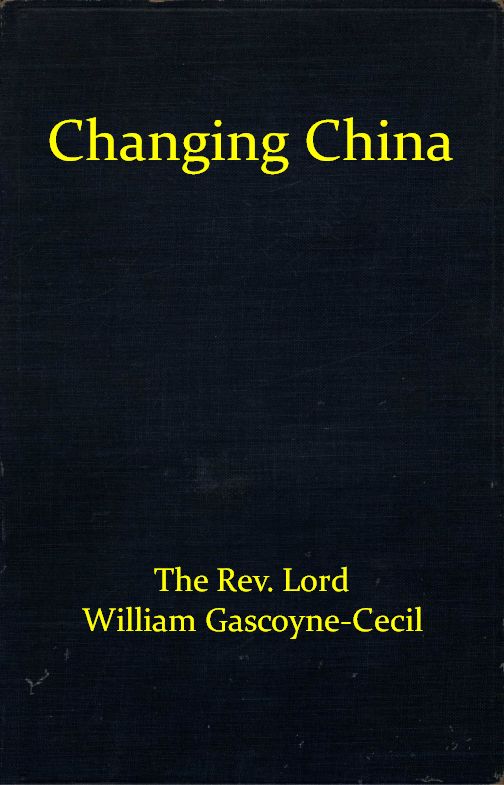
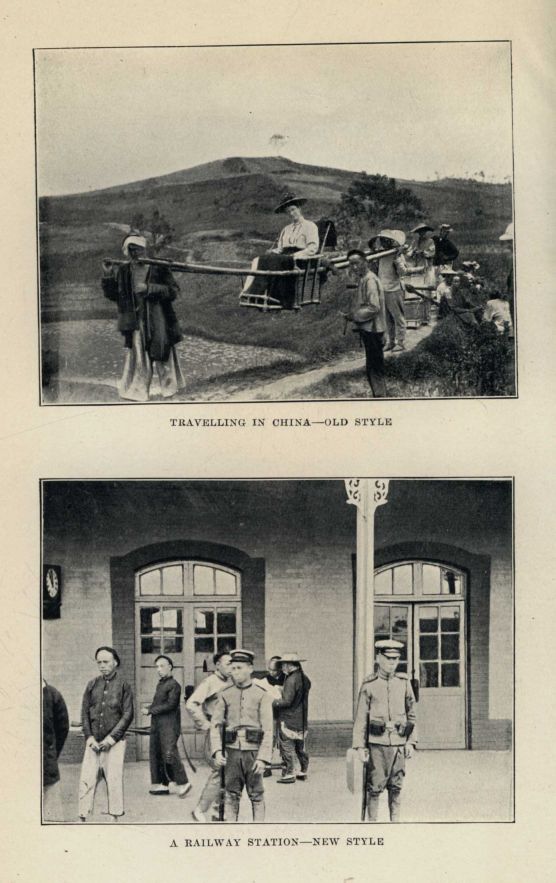
For centuries China has been the land that never
moved. It had a political history full of wars and
bloodshed, of intrigue and murder; periods of
prosperity and enlightenment; periods of darkness and
desolation; but the country remained essentially the
same country. There might be some small alteration
in its customs, but China was distinctly unprogressive.
And everybody who knew China ten or fifteen years
ago was prepared to prophesy that it would continue
to remain unprogressive.
Many a missionary speaks of the China that he
used to know as a very different land from the China
of to-day. It used to be a sort of Rip Van Winkle
land that had slept a thousand years, and showed
every sign of remaining asleep for another thousand.
Mrs. Arnold Foster told us that when she first
came to Wuchang she used to see the soldiers
dressed mediævally, learning to make faces to inspire
terror in the hearts of the adversary. Monseigneur
Jarlin, the head of the French mission in Peking,
described the China of olden times by saying that
in his young days all Chinamen had a rooted
contempt for everything Western. Theirs was the
only civilised land. The West was the land of
barbarism. Now, he added, the positions are reversed;
every Chinaman despises China, and is convinced that
from the West comes the light of civilisation.
Arch-deacon Moule tells how he sailed out to China in a
sailing ship, and found a land absolutely indifferent
to the existence of the West—more ignorant of the
West than the West was of the East, and that, when
he was young, was saying a great deal; and now he
finds himself in a land that has telephones and
motor cars and takes an active interest in flying
machines.
China has fundamentally altered. She used to be
absolutely the most conservative land in the world.
Now she is a land which is seeing so many radical
changes, that a missionary said, when I asked him
a question about China, "You must not rely on me,
for I left China three months ago, so that what I say
may be out of date."
China is now progressive; yes, young China
believes intensely in progress, with an optimistic spirit
which reminds the onlooker more of the French
pre-Revolution spirit than of anything else. And this
intense belief in progress shows itself at every turn;
the Yamen runner has become a policeman, towns are
having the benefit of water-works, schools are being
opened everywhere, railways cover the land. One
may well ask what has accomplished this change, what
has awakened China?
Perhaps, like many other great events in history,
this change of opinion in China should be attributed
to more than one cause. There are two chief causes.
One may be small, but it is not insignificant; the other
is certainly great and obvious. The less appreciated
factor that is causing the regeneration of China is
Christianity; the larger and more obvious factor is
the new national movement.
The cause of the new national movement was the
sense of humiliation brought about by political events
culminating in the battle of Mukden, where a flagrant
act of insolent contempt for the laws of neutrality was
felt all the more deeply because China had to submit
to that which she was powerless to resist.
The events of the last few years are so well known
that I must ask the indulgence of the reader in
recapitulating them. China, confident in the number
of her people, which reached to a quarter of the
world's population, attempted to assert her rights
of suzerainty over Korea against Japan. She had
not realised then that Japan was no longer an Eastern
power, where knights with two-handed swords did
deeds of valour and won for themselves everlasting
renown. And when at Ping-yang the armies met,
the Chinese General ascended a hill that he might
direct the armies of the Celestial Empire with a fan.
He conceived the battle to be merely a small affair,
where a fan could be seen by all the officers engaged.
The result was, of course, that the German-trained
Japanese army had a very easy victory. The war
ended in the taking of Port Arthur by the Japanese,
and China was in the humiliating position of having
to appeal to Western countries to secure her territory.
So far, however, the sting of her humiliation gave
to China a sense of resentment against all foreigners,
rather than a sense of repentance for her own
shortcomings, and the missionaries found hostility to their
work in every part of China. That hostility resulted
in the murder of two German Roman Catholic
missionaries in Shantung. The well-known action
of Germany in demanding a cession of territory as
a punishment for this murder may have been a good
stroke of policy, but it has brought but little honour
either to Germany or to Christianity. In fact it may
be regarded as a most regrettable action from a
missionary point of view, for it convinced the Chinese
that the missionary was but a part of the civil
administration of a hostile country, and that if China
was to be preserved from the foreigner, missionaries
must be induced to leave the country. A deep feeling
of national resentment spread over the land, which
was encouraged by some in authority. The direct
connection between Government patronage of the
anti-foreign movement and the German occupation
of Kiauchau can be deduced from the fact that the
Governor who was responsible for the awful murders
in Shansi had been Governor of Shantung when
Germany took Kiauchau.
The result of this bitter feeling was the creation
of a secret and patriotic society which concealed the
nature of its propaganda under a name with a double
meaning. The Boxer Society was, as its name suggests,
apparently an athletic society—a society which had
for its object the encouragement of the art of
self-defence. But the name had another signification.
Its real object, as a Chinaman explained to me, was
to "knock the heads of the foreigners off." It was
a religious as well as a political movement, however.
It had its prophets, who did wonders or were thought
to do them, and its disciples were believed to be
invulnerable to any Western weapon. It protested
against the movement towards Western ideas, which
it regarded as immoral; it condemned and destroyed
everything Western, from straw hats and cigarettes
to mission houses and railways; its disciples believed
that the spirits that defend China were angry at
the introduction of Western things, that they were
withholding the rain so necessary to the light loess
land of that district, and that the only way they
could be propitiated was by the sacrifice of a Western
life or by the destruction of a Western building.
One of the things that precipitated the siege of
Peking was the apparent success of such an action.
In pursuance of their faith, the Boxers set a light to
the rail-head station of the half-made Hankow-Peking
railway, a place called Pao-ting-fu; the station was
a mere wooden barrack, and blazed up merrily with
an imposing column of smoke; hardly had the smoke
reached the heavens, when the sky was overcast with
heavy thunder-clouds, and in a short time the thirsty
land received the long-wished-for rain, and the Boxer
prophets pointed with sinister effect to the heavenly
confirmation of their doctrine.
It is necessary to remind the reader of the
religious aspect of Boxerdom, so that he shall realise
what its fall meant to many Chinese. Really their
faith in it was wonderful. A Boxer, for instance, at
the siege of Peking walked composedly in front of
the Legation, waving his sword and performing
mystic signs; the soldiers first of one then of another
Legation fired on him with no effect; probably his
coolness put out their aim. Another example of their
credulity was told me at Newchwang. The Russians
had occupied Newchwang, and, more suo, were pacifying
it; they were shooting all the Boxers on whom they
could lay hands, and, I am afraid, a great number
who were not Boxers. They chained one of these
fanatics to a stone seat with the intention of executing
him; but they thought they might get some useful
information out of him, so they asked an Englishman
who spoke Chinese perfectly to make inquiries
of him, giving him authority to offer a respite as a
reward. He went to the prisoner, and sitting down
by him, tried to induce him to save his life by giving
information, but he was met by a contemptuous
refusal; and when he pointed out that the firing
party was there, the misguided man merely said,
"I am a Boxer, and their bullets cannot hurt me." Another
minute, of course, proved his error. But his
firmness showed the reality of his conviction.
Sometimes this fanaticism had curious results.
A Boxer prophet assured the village that no
works of the West could hurt him, no bullet could
harm him, no train could crush him. As a railway
ran near the village, he and all the inhabitants
adjourned thither to put his invulnerability to the test.
The daily train came puffing along, as the Boxer,
waving his sword, stood right in its path. The driver
was a European, and seeing some one on the line,
pulled up his train to avoid running over him. The
Boxer pointed to the train triumphantly, and the
astonished villagers became Boxers. There was,
however, a sceptic who refused to believe, so next
day they repaired again to the line, and the Boxer
again made his passes and uttered his charms. Alas
for him! this time the driver was a Chinaman, and
he was not going to stop his master's train because
a coolie fellow got in the way, so he put on full steam
and cut him to pieces, and the village deserted the
Boxer faith to a man.
With the relief of Peking, the Boxer Society
fell; but the popular view was not that Boxer
teaching was false, but that the spirits behind
Western religion were stronger than those behind
Boxerdom. So one of the immediate results of the
fall of the Boxers was to establish the spiritual
prestige of Christianity; the second result was to
inspire the Chinese with a respect for the military
power of the foreigner. The Boxers had failed,
the foreign powers had taken Peking, the Son of
Heaven had become a fugitive; all this was gall and
wormwood to the Chinaman. The sack of Peking
was especially felt, both because of the wanton
destruction that was committed—one informant told
me he saw a vase worth £200 smashed into a
thousand atoms by a drunken soldier—and because
the enlightened Chinese knew very well that no
civilised city is sacked at the present time, and
that they were being treated as no other race is
now treated.
Yet the old spirit of pride prevented them learning
completely the full truth. The thinking Chinaman
was still disposed to attribute the victory of the West
to the superior fighting powers of Western men. A
Chinese gentleman, explaining the fear his people
have of Europeans, said, "They regard you as
tigers." The troops who sacked Peking were to
the thinking Chinaman but another example of
the well-known truth, that those nearer the savage
state fight better than civilised men, and really,
considering the behaviour of some of the European
troops, no surprise can be felt at this conclusion;
it needed another lesson to make them finally and
thoroughly realise the superiority of our civilisation.
The bitterness of their next humiliation made
them ready to learn as they had never been before
in the whole of their history, and events provided
them with teachers who taught them that the
cause of this humiliation was their refusal to accept
Western ideas, and that if they would maintain
their independence they must learn the art of war
from their conquerors.
After the siege of Peking came the Russo-Japanese
war. The Russians had long been known
and feared by the Chinese; they were to the Chinese
mind the embodiment of the warlike and blood-thirsty
spirit of the West; they were hated for their
cruelty and feared for their prowess. The awful
story of the massacre of Blagovestchensk in 1900
was still present to the popular mind. The story
was this. The Amur divides China from Siberia.
When the Boxer movement broke out the Russians
required all the Chinese to go to their side of the
river; but with sinister intent, they removed all the
boats, so that no one could cross. The Chinese
pointed this out, and the respectable merchants of
the town presented a petition saying they were ready
to obey the Russian Government in everything, but
without the boats they could not do so; but the
Russians insisted that boats or no boats, they must cross
the Amur; they protested, but in vain; a half-circle
was formed round them by the soldiery, and the
whole Chinese population of the city was driven into
the river at the point of the bayonet.
The Japanese were also well known to the
Chinese; they had been till lately, when the
Western movement had altered everything in Japan,
their pupils in civilisation. The Japanese believed
in Confucius, used Chinese characters, worshipped
in Buddhist temples, sacrificed to ancestors, in fact
were in Chinese estimation a civilised race, though
inferior of course to themselves.
When these two antagonists met in Manchuria,
the war could not fail to make a deep impression
on China. To begin with, it was an insult
surpassing that of the sack of Peking to the Chinese
amour propre, to have the war carried on in
Manchuria. Russia and Japan were disputing over
Korea, and both nations were at peace with China.
Russia might have invaded Japan; Japan might
have invaded Russia, or both might have met in
Korea, but what they did was to select a province
of a neutral State and decide that there should
be the scene of conflict. What made this more
striking was that they agreed to respect the
neutrality of the rest of China; in fact they selected
their battle-ground with the same equanimity as if
China and her national rights did not exist.
But the deepest impression made on the Chinese
was by the victory of the Eastern over the Western.
The Japanese demonstrated that there was no essential
inferiority of the East to the West, and that when an
Eastern race adopted Western military methods it
proved itself superior to the most powerful of the
Western races. This was the lesson the battle of
Mukden taught the Chinese, and which convinced
the anti-foreign party in China, that however much
they might hate the foreigner, they must adopt
Western methods if they would retain their
independence. The result was that the progressive and
anti-foreign parties found themselves at one. Both
agreed that Western ideas were necessary. The
first, because they believed in Western progress; the
second, because they felt that the only way to
preserve China from the hated foreigner was to learn
the secret of his military power. The first thing to
be done was to study Western education, and then
they could hope to hold their own against the
Western races, as Japan had more than held her
own against the Russians.
I believe the battle of Mukden will prove one
of the turning points in the history of the world.
Few of us have any conception of the bitterness of
the humiliation of China. People speak of Russia
as having been humiliated, but my experience is
that the Russians looked at the whole question as
a colonial war in which a bungling Government
embroiled their country—a war which, if it
demonstrated the incapacity of their officers, proved the
courage of their soldiers. But the humiliation of
China was intense. When one remembers the
position that the Emperor occupies in China; when
one also remembers the reverential feeling that
exists towards ancestors, one realises what it must
have meant to the Chinaman that the site of the
tombs of their Emperors should have been the
scene of that titanic struggle between the East
and the West. But the result of that humiliation
was to burn in the lesson that Japan had taken
the right course, and that, however hateful were
Western ways, they were a necessity, and that
every lover of China must do his best to introduce
them into the Empire.
Of course there are many Chinamen—nay, I
should think a vast majority—who intend to
preserve to China the essential points of the Confucian
civilisation; they mean to accept Western ideas only
in so far as they are necessary to struggle against
the West. Some, no doubt, definitely admire the
West, but most are anxious for a compromise;
they want to preserve China with its customs,
with its essential thought, but to strengthen it by
foreign knowledge and a foreign military system.
The exact degree of what should be preserved in
China and what should be destroyed and replaced
by Western innovations, differs according to the
age and the temperament of the thinkers, but
the principle is most generally accepted—Western
thought must be grafted on to Eastern civilisation.
When we remember the size of China, we
may well ask ourselves what effect this policy will
have on the rest of the world. We have at present
a period of reflection, for how long we cannot tell.
The task of welding East and West into one whole
is in practice proving difficult, and at present failure
is very often the result; but with Japan as a
successful example, and with the threat of national
extinction and foreign domination before them, the
Chinese can never give up the effort; and whatever
the exact result may be, I think one may assert
without rashness that not only will it fundamentally
alter the whole of China, but through China affect
the whole world.
While detailing the causes which have created
the national movement which is now inducing China
to make every effort to perfect her defences against
foreign aggressions, we must not forget that the
awakening of China has a higher side, and one
which we can attribute directly and indirectly to
Christianity. The influence of Christianity can be
traced back to the seventh century when missions
of Nestorian Christians came to Thibet and China;
they left behind them, it is true, no converts, but
their influence was probably felt through the power
that Lamaism had had over a great part of the
Eastern world. A learned Japanese, discussing this
subject, said that no one could study Lamaism and
Buddhism without realising how intimately it had
been in touch with some form of Christianity. Later
on the great Roman Catholic missions, initiated by
St. Francis Xavier in the thirteenth century, began
to work in China, and have slowly but surely raised
up a large population who have been Christians for
many generations. Their missions were interrupted
by persecutions, but with varying and lately
increasing success they have maintained themselves ever
since. In 1807 the pioneer of Protestant missions,
Dr. Morrison, began his work and the translation
of the Bible into Chinese. The work increased, his
mission was followed by other missions, which pursued
a policy even more influential in altering the opinion
of China; not only did they with great heroism
preach the Gospel in every province of China, but
they took two actions which have affected China in
a very special degree.
First the American missions made the very greatest
effort to get hold of intelligent Chinese men, both
Christian and non-Christian, to teach them Western
knowledge, so that they might understand how
intimately Christianity was connected with Christian
thought. The result of their efforts has been that
there are a considerable number of enlightened
Chinese gentry who are either Christians or who
have a great sympathy with the Christian side of
Western civilisation. Sometimes they educated these
men in China, sometimes they induced them to go
to America for their education; and there they were
brought into contact with the intense, yet rather
narrow, New England Christianity. I had the
honour of meeting many of these men in China,
and I was convinced that they have no small part
in her awakening.
The English and American missionaries, under the
leadership of Dr. Williamson, inaugurated a second
policy, which has had far-reaching results in causing
the changes in China. The Christian Literature
Society was started to supply the Chinese with
translations of the best Western literature. They
were followed by Chinese imitators who were also
Christians, and who founded a Chinese Commercial
Press. These two bodies have given to China a
vast amount of Western literature, the first on
philanthropic lines with the definite intention of
spreading Christianity, the second on a commercial
basis but with the intention of presenting to their
fellow-countrymen the purer and more beautiful side
of Western thought. The publications of these two
bodies reach, I am told, to every educated man in
China. If the humiliations of public events made
the Chinese willing to study Western civilisation, it
was these men who afforded them the means of
studying and understanding the best side of that
civilisation.
But perhaps those who have done most to give
the Chinese a proper conception of Christianity are
the Bible Societies, especially the British and Foreign
Bible Society. Ever since, with the optimism of faith,
the translation of the Scriptures by Dr. Morrison
was published in 1814, they have been scattering the
Christian Scriptures throughout the whole of China,
from Mongolia to Tonkin, and I am told that those
Scriptures are read by men in the highest positions
and with the most conservative antecedents in the
whole empire. It cannot be doubted that the
indirect fruit of their work has been very great indeed.
China has, through the agencies of these bodies, been
brought into close contact with Christian thought,
and has at last realised the true nature of our
religion.
Lastly, there has been the influence of those who
died for the Christian faith during the many
persecutions to which Christianity has been exposed, and
which culminated in the Boxer persecution. If
Germany, by her action in Shantung, put before China
a false and most repellent view of Christianity, the
heroic sufferings of the martyred missionaries, both
yellow and white, presented Christianity to a
wondering world in its purest aspect. After those
thousands of Christians had suffered in Shan-si, the
Home bodies, especially the China Inland Mission,
refused to take any compensation for the blood that
had been shed in the cause of the Gospel. The
Chinese were then convinced that the German
presentation of Christianity was not the only one; if
Germany could look on Christianity only as a stalking
horse behind which she could creep up to her prey,
the English-speaking races had a holier ideal to teach
and one which was more consonant with the words
of the Founder of our religion. The sufferings of the
Christians were intense, their heroism was great,
but the result has been commensurate with their
efforts, and an awakening China looks to our
countries, not solely to teach her the art of war
and of killing men, but also to teach her the great
thoughts and the great religion which has before
her very eyes proved capable of producing such
noble men and women.
The awakening of China has two aspects. From
one aspect China is awakening to the value of the
science and the arts of the West; from the other
China is awakening to the fact that there is in the
West a power which comes from goodness, and that
goodness has its root in Christian faith. It is this
twofold aspect of the awakening of China which
is so important to bear in mind, for if she is to
share in our civilisation in the future, it is both
our duty and our interest to see that this great
world-movement is encouraged to develop on its
higher side.
The day is past when any one in Europe, whether
Christian or non-Christian, can be indifferent to
what is happening in China. The Christian has
indeed been for a long time alive to the importance of
these developments, but the ordinary citizen with no
strong religious views has usually neither displayed
nor felt any interest in a country separated from
us by so many miles and by such an untraversable
gulf in thought and language. If the Christian
has urged the importance of Chinese missions, his
neighbours have answered by asking him why he
cannot leave the Chinese to themselves and to
their own religion. Whatever justice the opponent
of missions in times past may have thought he had
for this view, he cannot now maintain that the
Chinese question is one which may be put on one
side by any thoughtful man. The movements of
this vast mass of humanity, amounting to a quarter
of the population of the world, cannot but fail to
have a very real and vital effect on the whole
civilised world.
The revolution that is affecting China brings
Europe and America into close contact with a
country equal to Europe in size, and not far inferior
in productive power. A few years ago China was
so far away that except as an outlet for trade it
had little interest for people here. The voyage
occupied many months and was esteemed a hazardous
journey, owing to the dangerous coasts and typhoons
of the China seas. Now a train-de-luxe conveys the
traveller in a fortnight across Asia to Peking, and
if the accommodation on the Chinese part of the
railway is not altogether luxurious, the traveller
remembers that it is far superior to that on the first
railways opened in our own land. The journey is
of course tedious, but the fact that business men in
the north of China are talking of always spending
their summer holidays in England, will show how
close China is now to Europe. It is no exaggeration
to say that in reckoning distance by the time
it takes to complete the journey, China is nearer
to England than London was to Scotland in the
days of Dr. Johnson, while in point of comfort and
convenience there is no comparison. The journey
from London to Peking is far easier at the present
day than the journey from London to Edinburgh
in the days of Johnson's famous trip to the
Hebrides.
If in this way we are getting closer to China,
we are still more growing closer in thought. No
longer can we speak of a gulf that separates us
from China. Every year English is becoming more
and more the language of educated men in
East; even though we cannot read their books,
they are reading ours either in translations or in
the original. Japan has set the example of having
English taught universally in her high schools,
and now China is following her example. A
foreigner, talking about Esperanto, remarked: "What
would be the use of making an universal language?
English, at any rate in the East, is the universal
language." That barbarous patois, "pidgin" or
business English, lives still in China. It consists of
English roots, enlarged by the addition of Portuguese
words, put into Chinese idiom and pronounced Chinese
fashion. But "pidgin" English is fast giving way
to pure English, spoken most commonly with a
marked American accent.
If this growing proximity of China compels the
attention of the civilised world, the virgin wealth of
her mineral resources and the cheapness of her labour
have excited the cupidity of the Western capitalist,
and it is daily more obvious that China must become
the centre of international politics, therefore the extent
to which she will affect the rest of the world should be
a matter for careful consideration. India, it will be
urged, has long been in contact with Europe, and the
effect on Europe is small. Why should there be any
difference when another Oriental race comes in close
proximity with Europe? Putting on one side the
fact that India has, both in trade and in politics, had
a very great effect on England, it can be answered
that there is an essential difference between the
brown inhabitants of India and the yellow race.
The former are, through religion or custom, unable
to accommodate themselves to the conditions of
Western civilisation; the latter have shown
themselves such adepts at accepting Western life that
they have excelled the white man, to his great
annoyance, in his own civilisation. The Chinaman, who
is forbidden to enter America, Australia, and South
Africa, is refused admittance, not because he has been
untried or because he has been tried and found
wanting, but because he has been tried in the three
continents and found by all who have tried him
eminently efficient—so efficient that if he were
allowed to continue in those countries, he would soon
render the presence of the white settler unnecessary.
He has been tried in three just balances and been
found of such value that the white voter is unanimous
in demanding his exclusion. But even the most
aggressive Chinese exclusionist can scarcely hope to
exclude him from his own country, and the Chinaman
who stays at home is probably a better man than
the Chinaman who goes abroad.
Western civilisation may be expected to grow with
equal rapidity in China as it has in Japan. Obviously
Japan is the precedent that China will follow rather
than India, whether Hindu or Mohammedan.
A few years ago a man would have been classed
as an eccentric who dared foretell that Russia would
be defeated by Japan. When Japan talked about
going to war with Russia, Russia laughed. Who
can tell how we shall speak of China a few years
hence? For Japan after all is only the same size
in population as Great Britain, but China is eight
times as large.
There are three ways in which China may affect
Europe. Militarily, she may menace her by her
enormous armies enlisted from her vast population.
Commercially, she may afford an outlet for our trade
far greater than we possess at the present time, and
perhaps be a competitor in trade and a place where
the capital of Europe will be invested. Morally,
she may either depress or elevate our social morals.
Perhaps the reader may be inclined to smile at the
idea of China being in a higher moral condition than
Europe, so as to be able to react on her beneficially,
but stranger things have happened; and if Europe
follows the example of France in deterioration, and
China continues to advance with the same rapidity,
China might easily excel Europe in morals.
Let us first deal with the question from the
military point of view. The military authorities who
know the Chinese seem to be equally divided in
opinion; many are confident that they are an
unwarlike race, others maintain and bring evidence to
prove that under competent officers they have great
military qualities.
A few years ago, for instance, the development of
the military power of China was regarded as a possible
danger to the world, and especially to England or
Russia. It was pointed out that China might easily
descend with a huge army on to India in the distant
future, or she might turn her arms northward and
conquer the wide districts of Siberia. Now the
popular view is the reverse, and the military power
of China is regarded as a thing incapable of great
development. A Japanese diplomatist with whom
we discussed the question ridiculed the idea of the
yellow peril and smiled at the suggestion that China
could ever be a nation great in war. Certainly her
present military power can be safely ignored except
in Manchuria; whether that power is capable of
development is a moot point. Believers in the
war-like possibilities of China point out that as a matter
of fact China is by right of conquest suzerain to such
warlike races as the Tibetans and the Ghurkas, and
that her empire reaches as far as Turkestan. In
answer it is urged that the victors were not the
Chinese, but the conquerors and present rulers of
the Chinese, the northern Manchus; who, till they
were absorbed by Chinese civilisation, spoke a different
language and wrote a different character.
The Manchus are far from being extinct, though
through years of sensual indulgence they have lost
their virility; but the discipline of religion or the
call of a national emergency might restore the
war-like qualities of the race. It was only in 1792 that
the Chinese, under Sund Fo, defeated the Ghurkas,
and we must allow that a race who could defeat these
gallant soldiers must be skilled and brave in war.
On the other hand I was assured that the Manchus,
so far from showing any courage in the war with
Japan, were the first to flee, and that they differ
in nothing from the Chinese except that they are
pensioners and ride horses. Those who disbelieve in
the courage of the Chinese say the Chinese never
had any courage except of a passive order; that they
would endure suffering against any race on earth,
and that their whole history tells that tale; that
they have been subject in turn to the Mongols, the
Kins, and the Manchus; and that the period of the
Ming dynasty when they were free, was only because
the Mongols had reduced every nation within many
thousands of miles to subjection, and then they
themselves had fallen a prey, not to the Chinese arms
directly, but to the enervating and destructive effects
of Chinese civilisation which rendered them absolutely
unable to fight.
Those who argue in this way point to that great
feature of Chinese scenery, the fortified wall. That
Great Wall of China, climbing hill and dale, was
built to keep the northern and warlike tribes from
harrying the peace-loving and industrious Chinaman.
Behind that wall lie nothing but fortress after
fortress; every city is walled, and those walls tell their
own tale. A warlike race never dwells in walled
cities. When the traveller enters Japan after
visiting China, the first thing which strikes him is the
absence of walled cities. The villages and towns lie
along the roads as they do in our own country instead
of clustering behind the tall and gloomy walls of China.
Again, those who say the Chinese will never fight,
point out that they have never been able to reduce
two savage races right in their midst, the Maios and
Lolos. One devoted missionary who had spent many
years of his life in the thankless task of attempting
to approach these savage Lolos, gave us an interesting
account of the relation between the Lolos and
the Chinese which certainly does not show that the
Chinese have much military skill. The Lolos are a
sort of Highland caterans who live in the mountains
in the west of China, and from time to time raid
the peace-loving Chinese villages. The Chinese then
retaliate by organising a large force, who advance
on the Lolo country and burn their villages. The
Lolos rarely offer any direct resistance, as they realise
they are hopelessly outnumbered, but take an
opportunity to raid another village and to slaughter
hundreds of defenceless Chinese. If the forces are
anything like equal, the Lolos will fight, and even
sometimes when the forces are wholly unequal. On
one occasion seven Lolos and two women put to flight
three hundred Chinese soldiers, killing forty and
wounding many more. The Chinese consequently
live in considerable fear of those Highland barbarians,
whose fierce yells and savage onslaught produce
absolute panic in their troops.
Officers who have commanded Chinese troops seem
generally to believe in their capabilities. Gordon, for
instance, spoke in the highest terms of the soldiers
who formed his "ever victorious army," and the
English officers who commanded the Weihaiwei
regiment and those who commanded the Chinese
volunteers at the siege of Peking spoke equally well
of their men. It is reported that the Chinese soldiers
at the siege of Tientsin would carry the wounded
back out of the range of fire when no European
soldiers could be found ready to perform this dangerous
task, but of this story I could find no first-hand
confirmation. But whether the Chinese in times to
come will develop an efficient army or whether they
do not, the most competent judges affirm that Chinese
military greatness will always make for peace; that
they will never wage a war of aggression; and that,
so far from being a menace to the world, they will
prove to be a security for the world's peace in the Far
East. In fact it is the continuance of China's
military weakness rather than the growth of her military
power which is most likely to disturb the political
atmosphere. China is far too rich a prize to be safe
if unguarded, and the acquisition of her wealth will
always prove a temptation to her needy neighbours.
The integrity of the Chinese empire is for many
reasons a most desirable thing, and that integrity can
best be maintained by an increase of China's military
power.
One of the reasons why this is so much to be
desired is from the commercial effect which China
may have on the rest of the world. If the vast masses
of her singularly excellent workmen are to be
exploited by powers who have no thought for either
hers or the world's welfare; if the sweated den of
the alien is a menace to the healthy conditions of the
working man in London; if the policy of such
philanthropists as Lord Shaftesbury has been at all beneficial
to the world at large, the sudden introduction of
hundreds of thousands of ill-paid but efficient working
men to the great Western market will have a deleterious
effect on the social conditions of the civilised
world. It is obviously far more simple to bring the
factories to China than to bring the Chinaman to the
factories, and this will be freely done if ever the flag
of the foreigner waves over China. The great advantages
that China can offer of cheap labour, cheap
coal and cheap carriage, coupled with the security
of a European flag, will have the effect of attracting
to China a very large number of the world's industries.
If this is done gradually, so that the internal
market in China increases proportionally, this will
not result in any evil to other nations. China will
share in the wealth of the world, and will be at
once a large producer and a large consumer; but if
before Western civilisation has been assimilated by
the working classes Western factories are extensively
started in China the result will be one of those
dislocations of social conditions which we include under
the name of sweating.
Western conditions of labour in Western countries
may be deemed by some to be hard, but no one can
doubt that if Western conditions of labour were forced
on a population which did not understand them, they
would have a tendency to become definitely oppressive.
The Chinese coolie will, I fear, be as little able
to maintain his ground against the foreign contractor
supported by the arms of a foreign power, as the
Congo native is to maintain his rights against his
Belgian oppressor; and unless Western powers have
the humanity and wisdom to resist those of their own
nations who will clamour to make money out of
Chinese labour, Western dominance in China is not
to be desired by Western wage-earners.
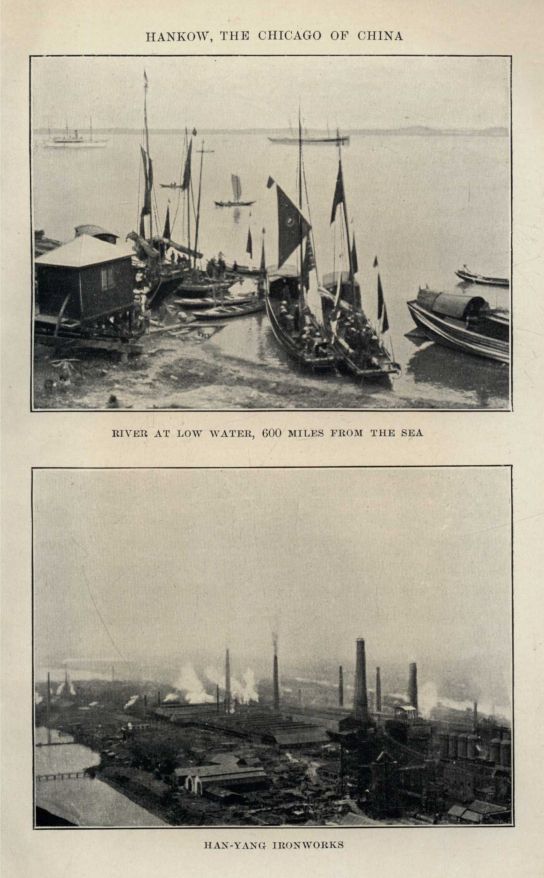
HANKOW, THE CHICAGO OF CHINA. RIVER AT LOW WATER, 600 MILES FROM THE SEA. HAN-YANG IRONWORKS
One of the most impressive sights in China is the
Han-yang Ironworks. They employ three thousand
men, and are owned by a body of Chinese capitalists.
They have found it worth while to triple their plant
within the last two or three years, and one can hardly
wonder when one realises that, though the labourers
are paid a very high rate according to Chinese scale,
they only get sixpence a day, and even allowing that
it requires three Chinamen to do the work of one
Englishman, which is a higher proportion than is
generally claimed, obviously there is a very large
margin of profit to be made by the owners of the
works. It is worthy of note that the Chinese have
been unable at present to produce any native
engineers; sixteen Europeans of various nationalities
manage and control the works, though they are
owned by Chinese, but the skilled work is all done
by Chinese. For instance, we saw a man straightening
the rails with a steam hammer; it was very
skilled work, and I was told he was making 7d. or
8d. a day. If any social reformer, if any one interested
in the condition of the working classes, has time to
consider this question and to escape from that
parochial mind which so distorts the importance of
things, he will see that the conditions of the working
classes in Europe will depend to a greater degree on
the proper development of the social conditions of
China than on any factor at home. To put it briefly,
if the fourth of the labour of this world is living under
sweating conditions, the other three-fourths may
consider themselves lucky if their income is not cut down
by 25 per cent.
On the other hand, if the development of China is
allowed to pursue its normal course, and education
and enlightenment are encouraged to proceed by equal
steps with material well-being, the commercial
conditions of China, so far from being injurious, will prove
beneficial to the world at large. The internal market,
for one thing, will tend to keep pace with China's
productions. If China exports, she will also import;
the volume of trade will no doubt be enormously
increased, and that trade will bring prosperity to
China and to those other countries who are trading
with her. Her people will gradually grow
accustomed to Western conditions, and, if China maintains
her independence, those conditions will not be allowed
to become too onerous to the poorer classes. The
wealth of another country does not injure her
neighbours; it is rather her poverty which injures them.
There is always the danger that the poorer country
will drain the capital from the richer country, and
that a rich country becomes harsh to a poor country
in the same way that the creditor is harsh to the
debtor; certainly it would be most undesirable if
a sudden industrial expansion in China paralysed
many industrial undertakings in England by depriving
them of the capital they needed for enlargement, and
it would be equally undesirable to have any industrial
undertaking in China controlled by a Board of Directors
in London, whose one object was to increase their
dividends, and who were ignorant of and therefore
indifferent to the injury that might be incidentally
done to the welfare of thousands of Chinese who fell
under their power.
And this brings me to the third point of how
China may affect the rest of the world. She may,
and most probably will, degrade the moral tone of
Europe. On the other hand, it will be quite possible
that she may act as a moral tonic. We scarcely realise
the nature of the chains that bind one part of our
civilisation to another. To hear men talk, one would
suppose that the great factors in the government of
mankind are the laws and regulations made by kings
and popular assemblies; but a deeper inquiry must
show that it is only the smaller part of a man's life
that is controlled by law, the greater part is controlled
by custom or fashion which is enforced, to use the
technical term, by the sanction of public opinion.
Consider, for instance, the customs of dress, or of
manners, or the hours we keep, or the way we
refer to things, or even our very thoughts—they
are all subject to this power; the State does not
generally command any particular dress, yet there
is a large and increasing measure of uniformity in
dress. You may go from Asia to America, from
Vancouver to Vladivostock, and you will see
uniformity in the rules of dress. This uniformity is all
the more remarkable, because its laws, instead of being
fixed and stationary, are constantly altered; indeed,
in comparison with the power of fashion, the powers
of the greatest autocrat or of the most efficient public
office are as nothing. The autocrat may give an order;
the public office, with its endless clerks and forms,
with its miles of red-tape, may try to see that order
carried out; but may quite possibly fail. But fashion,
issuing her capricious orders, has no office, no clerks,
no printed forms that have to be filled up to secure
obedience, yet her subjects yield such willing service
that they seek for information from every quarter as
to the nature of her commands, and when they know
them, they count neither money nor comfort to be of
importance compared with obedience to their mistress.
The world, while it wonders at its own submission,
enlarges or reduces its clothes, alters its head-gear,
and further, will even change its manners, its speech,
and its thoughts. The latest fashion-book is but the
exaggeration of a world-power; the same power that
compels women to tighten their skirts and widen their
hats, makes their husbands talk about socialism and
observe Empire Day. The power of fashion lies in
this, that while every one obeys, no one is conscious
of any difficulty in obeying; the chains with which
fashion binds this world may be so strong that the
strongest nature cannot break them, yet they are so
light that the most sensitive natures are not conscious
of their restraint.
But this great power of fashion has its limits, and
those are the limits of our civilisation. The mandate
of the dressmaker may reach from Siberia to Peru, but
it has no power in Mohammedan, Hindu, or Confucian
lands; the Turkish lady still veils her face, the
Hindu still adheres to his caste, the Confucian up to
this moment still preserves his queue and his blue
robe, but if China accepts our civilisation this must
change. The modern Chinaman dresses in Western
fashion; the loose flowing garment of China acts as
a sort of barometer by which the extent of European
pressure can be tested; up-country they are as loose
as ever, but in Shanghai, wherever Chinese dress is
still preserved, it has grown tight. A change typical
of what may happen if the union between the
civilisations takes place without any guidance may now be
seen in the streets of Shanghai; the dress of the
women is shaped in the Chinese fashion, they wear
the traditional coat and trousers, but the cut of those
garments offends both East and West alike by their
great exiguity.
Every one would allow that Western fashions, or,
at any rate, men's fashions, must to a great extent
affect China, but there is a deeper thought beyond;
Western fashions will not merely affect Chinese dress,
but they will also affect Chinese thought, and when
they have incorporated Chinese thought into Western
civilisation, when the conquest is complete and China
and the West are one, a reaction will take place, and
that which has subdued China to the yoke of Western
fashion will give in its turn power to China to control
the Western world. Without suggesting for a moment
that Peking fashions will take the place of Paris
fashions, or that the Englishman will grow a queue,
I do suggest that there are many precedents in history
for expecting that such a moral force as the Chinese
reverence for parents, or such an immoral position as
the Chinese contempt for the working-man, will not
be without its effect on the Western world. Again
and again it has been pointed out by both missionary
and Government official, that so great is the power of
China, that she brings into subjugation to her thought
any one who is long resident in her country. If it
should happen that the Western world should neglect
the Chinaman when it has the opportunity of teaching
and directing him, longing as he is to learn about
Western civilisation, the punishment of the West will
be that she will, in years to come, be influenced for
evil by the power of the great Celestial Empire. If, on
the other hand, the East should turn towards Christianity,
and, taught by Christianity, should learn to
live a higher life, the example of her faith and of her
morality will in years to come react beneficially on the
Western world.
The West cannot either by right or through
self-interest ignore the problem that China has to solve.
From being the most conservative country in the
world, she has become a country in which there is
rapid change. The whole civilisation of this vast
country of 400,000,000 is becoming fundamentally
altered by the importation into it of ideas and
thoughts which are not native to her, and which
have been created by a system of religion and by a
history belonging to nations very different to herself.
The full difficulty does not present itself till after
some thought. The problem is quite different from
that which has been before mankind in other parts
of the world. China is trying to accept Western
civilisation, but there is a danger that it will be
without Christianity. I know that many Europeans
living in Tientsin and Shanghai, who give but little
thought to the problems before them, somewhat
vaguely hope that in the near future China will
become a European nation; but a little consideration
must convince everybody that this is impossible.
We have also already shown that China is quite
determined—in fact, she has no alternative—not to
remain the old conservative country that lives on
ancient traditions, that looks back two thousand
years for all teaching in the arts of government.
If China, therefore, is neither to become Western
nor to remain what she is, of necessity she will have
to blend the two civilisations together and to take a
part from each. The Chinese themselves, with a
sanguineness for which they have no warrant, are
quite certain that this is an easy matter. They tell
the inquirer that they have considered it well, and
that they see their way completely through it. They
intend to select from Europe only those things that
are advantageous to the race, and they expect to have
no difficulty in weaving these incongruous elements
into their own very complete system of thought.
Statesmen seriously say that three or four months'
extra study will enable the educated Chinaman to
learn all that is necessary of Western civilisation,
and then those who have acquired this knowledge
can return to China and teach their fellow-countrymen;
and it is impossible to convince the Chinese
that the uniting together of two different webs of
thought is a matter of extreme difficulty, and, it may
be added, of extreme risk. The pleasing dream that
you can arbitrarily select the good points of West and
East and weave them into one is the very reverse of the
truth. What naturally happens is the very opposite.
There is a tendency to preserve that which is bad and
not that which is good in two different systems of
thought when they are united into one. The reason
probably is that as the bad has its common origin in
the wickedness of human nature, it belongs to both
systems of thought, and therefore both the Chinaman
and the Western meet on common ground when they
meet in vice or vileness. On the other hand, the
virtues of both are the result of moral cultivation
resting on authorities which are not recognised by
either. Therefore the tendency is to waive all moral
obligations as resting on controverted grounds.
Whatever may be the cause, the result is obvious—the
Westernised Oriental, unless a Christian, is as a rule
only one shade better than the Orientalised Western.
While the careless thinker hopes generally that
good will come out of the union of the two, he is as
a rule terrified lest there should be any tendency to
mingle Western with Eastern thought in any one of
whom he is fond. A leading man at Tientsin,
extolling the healthy climate of the place, related how
he had kept his children there ever since they were
born. His friend from home, ignorant of life in a
Chinese port, said in an appreciative way, "How nice
it must be for your children to be able to speak
Chinese; I suppose you encourage them to learn it?" The
dweller in China turned on him in anger and said,
"Thank God, my children do not know one word of
Chinese; I would send them home to-morrow if I
caught them learning a single sentence." This
enthusiasm for ignorance of the language of a great nation
is extraordinarily difficult to understand until the
danger of the mixture of Eastern and Western thought
is realised. Experience has taught those who have
lived in China that it is only a few that can come
unscathed through the terrible trial of having to live
in two moral atmospheres.
One of the most striking books that has ever been
written is "Indiscreet Letters from Peking." The
book is marvellous in the power it has of bringing
before the eyes of its reader those awful scenes during
the siege of Peking, but it is far more wonderful in
the character that it imputes to the hypothetical
narrator—a character typical of a man who is equally
at home in England and in China; and in that
character is portrayed a true but curiously unpleasant
picture of the characteristics of both races. The
narrator has the courage of a lion; he is
absolutely without any sense of honour. He fires at an
adversary under the flag of truce. He misuses a
Manchu woman who in the horrors of the sack
throws herself on his mercy. He connives at the
breaking of a solemnly pledged word of honour by a
soldier. The character is not overdrawn; characters
such as these are common in a mixed world, and it
is natural that English people should fear that their
children should grow up so unutterably vile. But if
the Englishman fears for his child, ought he to ignore
the welfare of the country in which he lives, and can
we pass over this whole problem as something that
does not concern us; for what he fears for his child
will happen to the whole Chinese nation.
The blending together of the East and the West
may be accomplished with the ease which the
Chinaman expects—but not in the way in which he or
anybody else could wish—it may be accomplished by
the eradication of all that is good in either race, on
the common ground of vice and sin and evil and
cruelty; unless, indeed, the efforts of those who are
now labouring to weave together that which is good
in both civilisations are supported. The difficulty
of preserving the good points and high qualities of
Chinese thought is only equalled by the difficulty of
introducing the splendid traditions of the West and
grafting them on to the Chinese stock. What success
has followed the efforts of those who are thus labouring
is rather to be credited to the intensity of their
efforts, to their single-hearted purpose, to their ready
self-denial, than to the ease or simplicity of their task.
No man of any feeling or any conscience could
pass indifferently by a single individual eating the
berries of a deadly plant, unconscious that they were
poison. What shall be said, then, if we allow, not
only one individual but a fourth of the population
of the world, to eat of a deadly poison which must
deprive them of all happiness and of life, which must
condemn them by millions to the misery of the very
blackest darkness, where the only motives known are
selfishness, lust, pride, and cruelty, for this is what
certainly will happen to China if she accepts the
materialism of the West.
Western thought is very powerful. The way it
has dominated the forces of nature gives it a great
prestige. As the Chinaman learns about steam and
electricity, about the telephone, the flying machine,
radium, and a thousand more Western inventions, he
cannot fail to be impressed, he must admit that these
people have knowledge. Do not for a moment imagine
that, after such an illumination, he will be able to go
back to the works of Confucius and learn again the old
maxims, many of which are antipathetic to Western
thought—yes, even more incongruous to Western
than they are to Christian thought. How will he,
for instance, read Confucius' condemnation of war
when the Japanese and Germans and Russians are
shouting into his ears, "By war ye shall live and
by war alone."
In an interview I had with that great statesman,
Tong-Shao-Yi, he said, "We respect Confucius
because he has never taught any man to err." Unlike
the teaching of Christianity, Confucius
preaches that the test of truth is worldly success, and
therefore by that test his preaching will be tried and
found wanting by the materialist. The materialist
will say, if Confucius never taught men to err, how is
it that the Western nations who are ignorant of his
teaching have succeeded, and that China, who
outnumbers them greatly, and who after years of
education and training and of following faithfully his
teaching, has failed? How is it, they will ask, that
she is so powerless, that were it not for European
jealousies she could not stand a day before the least
warlike of these Western nations? The Confucian
will answer, "He taught us to despise war, and that
is why we are weak." The materialist will certainly
retort, "So he has taught you to err." Confucianism
must fall before Western materialism. I do not
speak of Buddhism, for that is falling so quickly that
its influence may be said to be almost gone. China
will be left stripped of religion, robbed of her old ideas,
and not clothed with new ones, wandering into all
the misery and humiliation that vice and sin can
bring upon mankind, till the curse of her millions in
misery will go out against the harsh unfeeling West,
who could leave her thus blind and helpless without
a guide.
The call is great. Those who have knowledge
have no right to keep it to themselves. The Christian
and the Confucian agree in this, as they do in much
else, that all knowledge must be shared. One of the
purposes of this book is to arouse my readers to the
importance of taking some action. Had they had an
opportunity of going to China and seeing things for
themselves, I would only have asked them to think;
but as there are many who have not had that
opportunity, I would try and show them the transitional
condition through which China is passing, the danger
of that condition ending in disaster, a disaster wide
as the world itself. I hope to show them what is
being done at the present time to lead the Chinese
empire into safe paths, and to illuminate her with
the highest knowledge of the West. Many efforts
have been made, and there has been much success. I
am glad to testify publicly to the heroic and
self-denying character of the missions, but those who are
most successful are those who frankly say China can
never be led by aliens.
No race loves the alien, and the further away the
alien is in blood and language the less he is loved;
therefore the Chinese above all races are least fitted
to be led by the European, as they differ from him in
most racial characteristics. If they are to be led by
their own race, their own race must be fit to lead
them. They must have leaders who understand the
whole of Western knowledge, and will be able to
take what is true and leave what is false. A
Japanese thinker said the other day, "Our people have
made a great mistake—they have taken the false and
left the true part of Western thought." Let us hope
that China may be preserved from such an error, that
she may learn Western knowledge so thoroughly and
so well that she may be able to distinguish the good
from the bad, the beautiful from the vile in our system
of thought.
It is impossible to study any Chinese question and
ignore the relations of China with foreign powers.
They are always curious and generally unique.
Certainly any one who goes to China for the
purpose of studying the mission question cannot
but be struck at the extraordinary treaty rights
possessed by missionaries. In most countries the
teacher of religion has no peculiar rights. He is,
alas! more often bullied than favoured by the
modern State, even if that State should profess
itself well inclined towards religion. Therefore one
would naturally expect in China, where Christianity
is reputed to be disliked, that those who teach it
would have to contend with every form of disability
that a hostile State could inflict.
A feeling of marvel comes over the mind when
one realises that in this land of contradictions the
persecuted missionary enjoys quite peculiar
privileges. The ordinary foreigner cannot, for instance,
travel in China except by the courtesy of the
Government—a courtesy, indeed, which is never
refused; but a missionary may travel freely. The
ordinary foreigner has no right to stay in any
town in China with the exception of the treaty
ports; a missionary may stay where he likes. The
ordinary man cannot buy land; the missionary has a
right to purchase land for the purpose of teaching
Christianity.
So it came about, when we were in China, that
His Majesty's Consul, with all the might of England
at his back, was unable to buy a suitable site to
erect a house where he could bring his wife. He
was living in a temple, and temples in China are
not very comfortable. I should explain to the
uninitiated that every Buddhist temple has
guest-rooms attached to it—Chinese rooms largely
composed of wooden screens; and these temples are let
out as residences by a people whose faith has less
hold upon their affections than their purse. Now,
ladies are not as a rule prepared to live in a house
with paper partitions in a climate where the winters
are extremely cold; so the Consul asked a missionary
to buy a piece of land on which he could erect a
suitable house, and he had almost succeeded when
the Chinese Government found out that the land
was not to be used for missionary purposes and
refused to allow the sale. This does seem a strange
situation when one remembers that had that Consul
resigned his appointment and joined a missionary
body, he could have bought the land and settled
his wife comfortably in four solid stone walls, but
because he was England's representative and not
a missionary he had to shiver between wood and
paper screens, and this in a country which is
supposed to hate missionaries.
The explanation of this curious situation is really
twofold. First, the hatred that the official bears for
the missionary is not of such an intense character as
to induce him to offer a very strenuous resistance to
the missionaries who desire to buy land; and secondly,
missionaries have peculiar and special rights secured
to them by a series of treaties among the most
curious in the history of diplomacy.
In 1844 the Americans got by treaty a right to
the free exercise of the Christian religion in the open
ports. This right, sufficiently remarkable in itself, has
often been stipulated by a State for its own nationals
resident in a foreign country, but I doubt if it has
ever before been known for a country to insist on
the right of preaching a religion to somebody else's
citizens. This was obviously an interference of the
sovereign rights of China.
It was pushed even further in 1860. The French
and English had just completed the sack of the
"Summer Palace," and whatever the justice or the
injustice of the war may have been, China had tasted
her first great lesson of humiliation from the hand
of Western powers, and was in no condition to resist
any of their demands. The English and the French
made treaties, most of them concerned with
commercial and military matters with which it is not
necessary to trouble the reader, and the French had
a condition which was quite reasonable, that the
Chinese should restore all the buildings that had
been destroyed in the late troubles; the wording
of the clause was so vague that it could be made
to apply, and did apply, to any building which had
been destroyed at any previous time in the history
of China, but the most remarkable part of the clause
needs further explanation. The French had as their
interpreter a very able Jesuit, Père Delamarre, and
as the French Minister could not read Chinese, he
had to trust his interpreter with regard to the
Chinese version, and this man inserted into the
treaty two other provisions, one securing that
Christians should have a right to the free exercise
of their religion all over China, and the other that
French missionaries should have the right to rent
land in all the provinces in the empire and to buy
and construct houses. When this pious fraud was
discovered, the French Minister thought it would
do no good to denounce his interpreter, and
therefore the treaty was treated by the French as
binding and never questioned by the Chinese; the other
powers profited by it under the "most favoured
nation" clause.
The Roman Catholics a few years later pushed
the wording of this treaty to its uttermost. Their
missions had been at work for 150 years or more,
and they could prove a great number of confiscations
which had to be made good by the Chinese.
Just at that time in France Napoleon III. was trying
to establish a doubtful title by the help of the Pope,
and it was his policy to push in every way the
interests of the Roman Catholics. China had felt
the weight of European armies and she was unable
to resist these claims, and so it came about that
the very country which now is the centre of free
thought was the means of forcing Christianity upon
the Chinese through fear of her armed power.
Can you be surprised at the answer I got when
I asked a Chinese statesman, who I knew was
sympathetic with the teaching of Christianity, why China,
who had always professed, and to a very great extent
had practised tolerance, should persecute Christianity?
His reply was, the Chinese did not hate Christianity,
and were indeed tolerant of missions, but they still
disliked them, because Christianity is the religion of
the military races, and they had a historical tradition
that the advance of Christianity was connected with war.
This bad reputation has been intensified by
the action of the Germans. No reasonable man
can condemn the Germans for wishing to enlarge
and develop their trade. We can understand the
patriotic German saying that it was the duty of
Germany to establish good government in Shantung,
but it is very hard to understand how any one can
defend the taking of Kiauchau on the ground that
certain German missionaries had been murdered.
The taking of Kiauchau by the Germans has
completed the work begun by the French. Christianity
and the foreign relations of China are
inextricably mixed up, and every Chinaman, believed
till lately that Christianity was the religion which
has led foreign nations to enter his land. "First
the missionary, then the trader, lastly the
gunboat," has been too often the order of advance. I
am happy to be able to say that the Americans and
the English have made great efforts to dissociate
themselves from this evil, and have tried to avoid
any appearance of such a connection. I was told
that in Shansi, owing to the indemnity for the
murders of missionaries being retained to China and
spent on founding a University instead of being
accepted by the missions, Protestant missions are very
popular. "You have only to say you are an English
clergyman," said my Chinese informant, "and every
door will be open to you."
The present aspect of foreign affairs has tended
to destroy the unfortunate connection between
Christianity and foreign aggression. The two great powers
whose armies have met in Manchuria have neither of
them any interest in missions. Russia has never had
any missions in China. She forbade them, I
understand, because they were likely to embroil her in
unnecessary wars. Japan, of course, has none. The
Germans, who made the murder of missionaries the
reason of aggression, have not many missionaries in
China belonging to their nationality. China, therefore,
is coming to look upon Christianity as not quite so
dangerous a thing as it seemed when it was
essentially the religion of the French and of the English
whose armies and navies then held China in fear.
Still the political situation cannot but have great
interest to the missionary. Even while he rejoices
that the foreign relations of China and his work are
not so intimately connected as they used to be, he
must ask himself, what will the result to my work be,
if in the great world struggle Japan or Russia should
dominate? At present he fears Japan more than
Russia; and his fears are shared, but for other reasons,
by the Chinese.
The wildest and most ambitious schemes are
accredited to Japan, I cannot say with how much
truth. Her purse is empty, but she has far more
courage and skill in war than most nations. If she
possessed even one part of China she might add to
her wealth to such an extent that no race could dare
to oppose her, while if she governed China, her armies,
supported by the wealth of that mighty empire, might
threaten the stability of Europe. She is reported to
have two regiments working as private individuals in
Fukien, and to be prepared to seize the province in
case of any disorder. The fact that there are many
Japanese in the province, and that all the Japanese are
trained soldiers, gives some cloak to this suggestion.
The Fukienese speak a different dialect to the rest of
China, and they have a natural geographical frontier,
which would enable the Japanese to maintain
themselves there if they were once established.
Again, the recent events have shown that they are
preparing to exercise sovereign rights over Chinese
territory in Manchuria. On the other hand, Russia is
arming; she is double-tracking the railway from
St. Petersburg to Irkutsk, and she is getting ready again
for a struggle in Manchuria; the gossip among the
officers there is that there is to be a war; the
Russians do not for a moment regard themselves as
defeated; they think of the late campaign merely as
an "unfortunate incident."
But the most important development in Russian
policy is the proposed railway across Mongolia which
will give Russia an entrance to the west of China
and into Peking. It is hard to see how, if an advance
were made along that line, Japan could in any way
resist Russia; the whole breadth of China would lie
between them. Meanwhile the Germans of the east
have perfected a railway system which converts
Kiauchau from being an out-of-the-way place which no
one cared about, to a door into the very heart of
China. In commercial circles in China it is reported
that the Commandant of the Tientsin garrison
suggested that the object of the building of the German
Fleet was not so much to conquer England as to
ensure that Germany should be able to maintain her
position in the Far East and make full use of
Kiauchau as a way by which her armies might enter
China. When one looks at the map and sees how
China is surrounded by these powers, and how they
are pressing upon her, one realises why the Chinese
are feeling that Western education is an absolute
necessity, and that if they are to maintain their
independence they must understand the arts of war.
A great Viceroy was reported to have said that
he frankly expected China to be conquered, and to
learn from her conquerors the Western arts which
would in turn enable her to dominate the West;
for this has been her history in the past, that may
be her history in the future, and I think that the
nations, who propose to conquer her, will do wisely
if they consider what might be the result of her
influence on them.
China is trying to defend herself by building a
navy and creating an army. The navy is rather
an opéra bouffe concern; every now and then she
talks of having ships; the representatives of all
the shipbuilders of the world fly to Peking and
try in every way to induce China to buy a fleet
which they offer to provide at the very shortest
notice, but at present she has none. She has, as a
practical step, created a training school of officers.
It consists only of some 140 men, and is taught by
two British officers lent her by our navy. They said
that there was the greatest difficulty in getting the
Chinese to be practical; they induced the Government
at last to put an old ship at their disposal. For
a long time this was refused, and when it was granted
it was regarded as a most wonderful and original
departure. The Chinese way of training naval
officers would have been to have instructed them
on literary subjects, and to encourage them to write
essays and poems on the sea. To take them out on
the Yangtsze in a ship and actually to show them
how a ship was managed, was a wholly new idea,
but one of which they approve under the impulse
of the modern fashion of doing things in accordance
with Western traditions.
As to the army, its exterior is certainly not
prepossessing; far and away the most efficient part of
it has been created by Yuan-Shi-Kei in Manchuria,
and the Chinese are very anxious to show it to the
passing traveller. Both times when we passed
through Manchuria, on every station were armed
guards, and in one case they were inspected by a
General who was travelling in our train. He was
saluted by the officers in charge in Chinese fashion,
which is a modified form of a kow-tow, and consists
to all intents and purposes of a curtsey. It had a
distinctly funny appearance to see the officers in
charge of the guards curtseying as we steamed into
the stations. Down at Nanking the army was far
less smart—in fact, it had the appearance of being
a very disorderly rabble; I understand when the
Empress died it was regarded as such a danger
that those in authority put the broad Yangtsze
between them and a possible mutiny.
The real danger to China as regards foreign
relations is that her bad finance or her own want
of discipline may bring about a state of internal
disorder which may compel the interference of
foreign powers. Last year this nearly did happen.
Two regiments mutinied and seized a town on the
Yangtsze; they stopped all communications with
the outside world, and to all intents and purposes
were in a fair way to commence a rebellion. Close
by them were several other regiments who might
be expected to throw in their lot with them, and
the position was very critical. The missionaries
inside the town were in fear of their lives, and with
difficulty managed to communicate with the British
Consul and to tell him of their plight. He ordered a
gunboat to go down, and the presence of the gunboat
intimidated the mutineers. At the same time the
Governor of the city showed remarkable courage in
going round the town pacifying the mob. The
authorities were able to move in two other
regiments, who had no sympathy with the mutiny. The
mutineers were disarmed and the incident closed.
But such an incident may occur at any moment. The
condition of the country is such that anywhere a
rising may occur, and the fire once alight may be
hard to extinguish; the result of the conflagration
must be that the powers must enter to secure the
safety of their nationals.
Altogether poor China is in a dangerous position
in regard to her foreign relations; all round her
echoes the cry, "You must reform or disappear." Every
railway that is made, every loan that is
floated, every trade that is opened up, bring to
China increased responsibilities in her foreign
relations. If she by her good government and readiness
to reform can show that she is able to maintain
order in her own land, and to give to foreigners an
equal security to that they have in any other country,
her empire may endure for many hundred years;
but if she be found wanting at the present time and
the corruption of her officials renders her unable
to maintain order in her country or to fulfil her
financial obligations, a new phase in Chinese history
will be reached, which will, I believe, be of
extraordinary danger to Europe; China will yield to the
military might of the West only to rise again
to dominate those who dominated her.
The missionary who looks at these dark clouds
which surround China, the land of his adoption, feels
that there is only one course to take, namely, the
course that he is taking, to try and build up in China
a high tone of morality, founded on religion, which
may enable her to accept necessary reforms and to
put herself abreast of other nations.
I do not suppose that we can have any conception
of the amount of suffering which goes on at the
present time in China. The first time we were in
China I had the honour of meeting a Mr. Ede,
who had just returned from distributing food in
a famine-stricken district, and his description was
truly terrible; the young men had walked away
and found work in other districts, but the old
people and the children had to remain. What had
caused the famine in this case was characteristic
of unreformed China; "China's sorrow," the river
Hoang-ho, had done what it is ever doing, that
is, it had flooded a district. When you pass over
it, it looks most innocuous. It is wholly unable, as
a rule, to fill its own vast bed, which is covered
with delightful sands, reminding one more than
anything else of the sea-shore at low tide; but this
sand is what makes it dangerous, for it is not good
heavy English sand, but a light sand which is
called "loess," and when the river comes down in a
flood—that is to say, when they have rainy weather
in Thibet or the sun shines unduly on Himalayan
snows—this sand is carried along with the water,
and it is asserted indeed that the river consists
more of sand than of water; as the river slackens
the sand is deposited and the bed is filled up, with
the result that the next flood, taking the Chinese
unawares, overflows its banks and reduces a huge
district to poverty; they cannot sow their fields
because they cannot see them. Of course the
authorities should not be taken by surprise and
the banks should be made up, and canals should
be cut to take away the water in case of a flood;
an enlightened Chinese engineer assured me he had
a scheme for raising the level of huge districts of
China by using this peculiar character of the
Hoang-ho and turning its sand and water flood on to bare
places, and he asserted that the results were most
wonderfully successful, and that districts which were
unfertile before, when well washed and covered up
with this loess, became fertile. Still, however
beneficial a flood may be to the land in the end, its
immediate result is to starve the population who
are flooded out, for they have no reserves of food.
In the case already referred to, the country was a
long time under water, because a canal which should
have drained it away was not kept clear. The
money had been paid, but, as often happens in
China, the work had not been done. The action
that the authorities took was characteristic of
Chinese government. China possesses the system
of internal custom-houses—a system which the
wildest advocate of Tariff Reform would hardly like
to see introduced into Europe; these custom-houses
are called "Likin," and are a source at once of a
great deal of profit to the provinces and of
irritation to all traders. The Chinese used these
custom-houses to engineer a corner in rice by which the
area of scarcity of food was enormously increased
and several officials amassed considerable sums of
money; by the law of China it is illegal to export
rice even from one province to another; this law
was put in force, and the rice supply was cut off;
at the same time early in the famine certain rich
men bought up rice freely, with the result that it
rose to a very high figure, so that round the area
of famine and desolation there was an area of
scarcity and shortage.
A large amount of food from all parts of the
world was sent by the famine funds, but it was
very difficult to induce the officials to allow the
food to enter the famine district. They were filled
with all sorts of scruples. They were afraid, for
instance, that the steamers towing the barges full
of food on a canal which had not before been opened
for steamers, might excite the hostility of the
population; they were courteous, they were diplomatic,
but they were obstructive; and so it came about
that while there was a famine in one district of
China, in the other districts there was a very heavy
surplus, of which they had difficulty in disposing.
All this did not create the slightest surprise in
those who knew China. When the story was told
us all the old Chinese hands merely said, "How
like China," or "Just like them." This was our
first insight into what the civilisation of China
means, and therefore for the first time we realised
the problem that is before the world—the problem
which missionaries, with great devotion, are trying
to solve.
Chinese civilisation is not, as many people imagine
it to be, a mere courtesy title for a state in reality
only a degree off barbarism. Many of my humbler
parishioners, for instance, when we left for China,
ranked the Chinese as something very near cannibals,
and I do not think they would have been in the
least surprised to hear that we had been roasted
and eaten by the natives. The Chinese have
perhaps a greater right to be called civilised than we
have on this side of the world; their civilisation
dates from eras we are accustomed to call Biblical.
Confucius and Ezra represent contemporaneous
ideas—ideas that are not wholly different in thought.
While on the other side of the globe civilisation
has been handed from nation to nation, and a
civilised race has become barbarous and a barbarous
race civilised, the Chinese, without making any very
great advance, have steadily proceeded along a path
of progress, and at the present time they possess a
very carefully organised system of society. On paper
the whole thing is perfect: the Emperor at the top,
the Viceroys over each province, under them the
Prefectures, and so down to the village community
in the country or the trade guild in the town.
The system of government is so perfect that they
claim that they are able to discover any individual
wanted among those 400,000,000 of Chinese, unless
his disguise is very perfect. When we were chatting
over the revolutionaries and talking about a certain
doctor dodging in and out of China at the risk of
his life, I said that I wondered that there was any
difficulty at all for a man who was bred in the
country wandering where he liked, and I was
assured that such was the organisation of the
Chinese Government that they could lay hands even
in the remotest village on anybody if they required
him, and that the only way a revolutionary could
hope to escape arrest was by a most perfect and
complete disguise.
With this splendid organisation is joined great
solidarity. The Chinese race are essentially one. If
it were your duty to look through reports coming
from China, as it has been mine, the first thing that
would strike you would be its essential oneness; you
will not find more difference between different parts
of China than there is between England and Ireland.
I do not for a moment mean to say that there are
no differences between the Chinese—that would be
untrue; but you will not find such a difference as one
might expect from the diversity of geographical
conditions. The civilisation is essentially similar. It is
a civilisation with great merits. The population is
sober, industrious, and perhaps I might add honest,
all lovers of China will certainly agree; but if you
are writing, as I am, to people who have never been
out of England, I think you will have to qualify the
phrase with some such a one as "honest as compared
with other Orientals," or "honest when contrasted
with the Japanese."
They are also extremely obedient; their idea of
the respect which should be paid to authority far
exceeds that which prevails on this side of the globe.
I think we may add with truth that great numbers
of them are very loyal to their employers. But when
this much has been said, the dark side of their
civilisation must be added—it is essentially corrupt
and cruel; the ideas of honour, purity, mercy are
but too little understood. Missionaries assured us
that there was no word for purity that could be
applied to a man, while the same word stands for
honesty and stupidity.
Yet this nation is in many ways well fitted for
the mechanical age in which we live. What the
owner of the factory wants is an industrious, sober,
and obedient man, and he does not want, or at least
does not realise that he wants, an honourable, pure,
and merciful man. The Chinaman will be in his
element in the factory; the long hours of monotonous
toil will not be unpleasant to him; he is always
sober—in fact, he is by nature and culture the ideal factory
hand; and yet this is what constitutes his danger.
He will tend to introduce into Europe the vices which
are now desolating his own country, unless, indeed,
the European teacher can help him to eradicate those
vices.
I have given you some idea of his corruption by
the story told at the beginning of this chapter, but
we heard many others all to the same effect. We
went up the Yangtsze in one of the China Merchants'
boats with an old Swedish captain who liked the
Chinese and rather disliked the missionaries, so his
evidence was not biassed by any wish to prove that
our civilisation was more perfect than that of the
Chinese. We asked him why it was that he being
a European should be captain of a ship that was
owned by Chinese, and largely used by them. He
told us that the Chinese merchants had once tried
to have a Chinese captain, but the moment the ship
reached the first port of the Yangtsze, the custom
officers were on board rummaging here and rummaging
there. Very soon a large amount of contraband was
found on the ship, put there with the knowledge
of the captain. The consequence was the ship was
fined and delayed. They tried Chinese captains
again and again with the same result, and so they
have been reduced to employ Europeans to secure
honourable officers. He, however, had to confess that
the Chinese distrusted the sobriety of the European
officers, and assured us that the old comprador on
board, one of whose duties apparently was to look
after the passengers and take their tickets, was in
reality a spy on them.
Perhaps the best instance of the corruption of the
Chinese is their action with regard to the currency.
In the good old days the currency of China was the
silver shoe or ingot, which had no exact weight, and
had therefore to be weighed at every transaction.
Below that was the copper currency, which had no fixed
relation to the silver currency, but only the relation
of copper to silver. A copper cash, therefore,
represented only its actual value in copper. It was
naturally a most unwieldy coin. The old books of travel
in China give lamentable pictures of the traveller
riding about with huge strings of copper cash almost
crushing him with their weight. When the whites
began to trade in China they introduced the Mexican
dollar with its subsidiary coinage, and this was the
common currency in all the ports until a few years
ago; but when the Chinese began to Westernise they
considered it inconsistent with their dignity not to
have a coinage of their own. Led by the Japanese,
and assisted by several firms whose speciality was
the erection of mints and mintage machinery, they
started mints all over the country, and they have
kept these mints busy with the most funeste results.
To begin with, they coined a dollar in imitation of the
Mexican dollar, but even in this the mints did not
agree. Some dollars are very light, some slightly
below value, and some are nearly true. The first
experience of the traveller is that he possesses in his
pocket a set of coins which no one will accept, except
at a great reduction. But the muddle goes further
than that. It was very profitable coining light coins,
but it was still more profitable to do so in the lower
denominations. The Chinese thought, or chose to
think, that it did not matter what the intrinsic value
of a 10-cent piece was as long as you wrote on it
10 cents. They have no bank or post-office where
you have a legal right to get a dollar for ten 10-cent
pieces, and the result therefore of recklessly coining
the base 10-cent pieces has been not only to
depreciate it with regard to the dollar, but to make
it an uncertain value, so that you must go to the
money exchangers almost every morning and ask
for the rate of exchange between the dollar and
the small silver pieces.
Of course at every step on this downward path the
officials concerned made a great deal of money; their
next step was to deal with the copper coin in the same
way, so now there is no fixed relation between the
copper coinage and the silver coinage, nor between
the large copper and the small, and this is still
further confusing, as the provinces having different
mints have dollars of different values. And now I
hear that they have begun to make money by debasing
the old silver shoe coinage, which, though it is sold
by weight, used to have a certain standard of purity,
and they have issued cash which have no intrinsic
value at all, and that do not represent the fraction
of a coin having any intrinsic value. The result of
this currency "Rake's Progress" has been to
produce what corruption always does produce—widespread
poverty. Everybody cheats. The stationmasters
along the line assure the European superintendents
that the fares are always paid in the most debased
coinage, and it is very hard to deny the probability
of this. But of course the stationmasters take care
if any coin comes to their hand which is not debased
to do a bit of exchange on their own account.
If Chinese civilisation is corrupt, it is also cruel,
not with the wild tempestuous cruelty of the savage,
but with the cruelty of the civilised man who at once
uses human suffering as the best engine for human
government, and never cares to cure it unless he has
some pecuniary object in view. The Chinese are inured
to pain, and some people argue that they do not feel it
to the same degree as Western nations. No doubt
the sensation of pain is intensified in people of highly
developed nervous organisation, and the Chinese have
a nervous organisation of a very quiescent kind. I
remember, when we first landed at Hong-Kong, being
struck by a Chinaman who had chosen as his bed
for his midday siesta an ordinary piece of granite
curbing; and as you go along in the train every
freight car that you pass has some one sleeping on
it to protect it from robbery, and a truck of coals or
a load of stone is obviously regarded as a most
comfortable resting-place. Some of the doctors
maintained that this was the case throughout their
nervous system—they were insensitive to pain;
others said that pain, like everything else, is a thing
to which you can get accustomed, and that pain has
played so large a part in their lives that they are
accustomed to it, and are not therefore afraid of it.
Take, for instance, the foot-binding of the women;
every family in China must be accustomed to hear
the sobs and cries of the little girls as they are going
through the first stages of foot-binding. Or take
again the public flogging; all the working classes of
China must be quite accustomed to the idea that
men are flogged for certain offences till their flesh
is of the consistency of a jelly. A doctor, describing
the state in which men are brought into the hospital
after such floggings, said that it was a difficult matter
to avoid mortification setting in, and it was only with
very careful treatment that they could be cured, the
whole flesh having to slough away, being absolutely
crushed and battered.
Yet this strange people are so indifferent to
these horrors, that even those who suffer will laugh
amidst their sufferings. We were told the following
tale, whether true or not I cannot say. A man was
being bambooed for an offence, and astonished the
officials by laughing all the time; the more he was
flogged the harder he laughed, till at last those who
were punishing him stopped to ask him the reason
of his mirth. "You have got the wrong man," he
said. It is always a comfort to have a keen sense
of humour.
I do not think there is anything more awful than
the descriptions one has as to the indifference to
suffering that is displayed by the average Chinaman.
I remember a story told me by a sailor. As a ship
was being loaded, a man, obviously on the verge of
death, came and asked for work, but failed to get it.
Shortly after he was seen hanging about the ship,
and at night they found him lying between some
bales. He was turned out, but he constantly crept
back, first to one place, then to another, till at last
the sailor came to know his face quite well. One
day, as the sailor went ashore, he was attracted by
a little crowd looking at something, and this proved
to be the poor fellow in his death struggle, lying in a
gutter of water. He called the attention of a Chinese
policeman to him. The Chinese policeman explained
that he would move him when he was dead, as he
had orders to remove all corpses, but that he could
not move him while he was alive.
Dr. Macklin of Nanking told us story after story
of the way in which the Chinese would leave people
in a dying condition on the road. A little time ago
he had ridden into an old temple, and there he saw
a man apparently asleep, but on looking at him more
closely, he saw that his eyes were wide open and
that the flies were walking right across his eyeballs,
showing that he was quite insensitive. He called
to one or two men and asked them to help him to
carry this poor sufferer to some house near, but they
could not or would not find a house to keep him in;
and so in the end Dr. Macklin determined to take
him straight back to Nanking, which he did. There
he administered a very heavy dose of quinine
hypodermically, with the result that the man soon showed
signs of returning consciousness. It was a case of
malignant malaria, and had he not been found by
Dr. Macklin, the man must have been eaten by wild
dogs or have died from the disease; as it was he
recovered, and proved to be a hard-working young
farmer who was in search of work, as his home had
been ruined by a local failure of crops. He had
apparently contracted malaria, and owing to his
poor and ill-nourished condition it had gone hardly
with him.
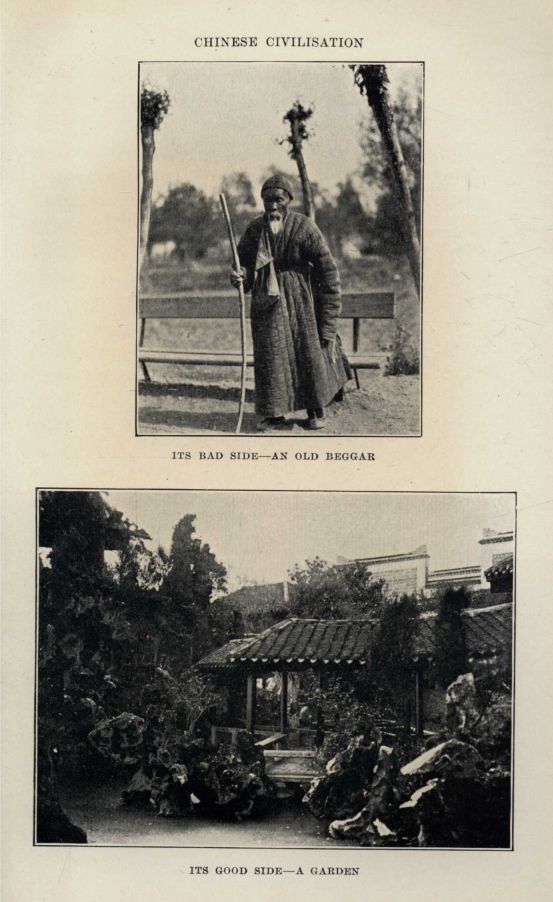
CHINESE CIVILISATION: ITS BAD SIDE—AN OLD BEGGAR. ITS GOOD SIDE—A GARDEN
But story after story was told us always to
the same effect—that the quality of mercy is not
highly esteemed by the Chinese. The appeal the
beggar makes to you as he runs after you is the
old Buddhist appeal, which after all is essentially
selfish, as he beseeches you "to acquire merit" by
helping him; we must remember that even this
reason for mercy is despised by the gentry and
literati of China as essentially belonging to Buddhism.
Perhaps the most lurid stories that we heard were
up river. One came from the country of the Lolos.
The Chinese were going out to fight the Lolos, and
the missionary saw them carrying a handsome young
man bound on a plank so that he could not
move—so bound that his head was thrown back. After
certain ceremonies they cut the man's throat, and
scattered the blood on the flags; it was a sort of
human sacrifice. Another story we heard from some
devoted Franciscan Sisters up at Ichang. They
assured us that if a mother found her children
weakly, and she lost one or two, she would make
up her mind that the reason they were ill was
because an evil spirit had a grudge against her.
She would then take one of her remaining children,
and, in the hope of propitiating the evil spirit, she
would burn that child alive. We could not believe
this story was true; but that evening we saw
some hard-working Presbyterian ladies, common-sense
efficient Scotchwomen, and they assured us that it
was quite true.
It would give a very false idea of the Chinese if great
stress were not laid on the good side of their
civilisation. They have many fine qualities, and in more
than one point they are superior to the nominal
Christianity of some Western countries. The first
thing perhaps that strikes a foreigner when he is
brought into contact with the Chinese is their great
courtesy; their literati are such gentlefolk. Even the
less cultured people have most refined manners; no
one is ever rude; and one of the things they cannot
understand is how we can esteem a rough, frank, honest
man. There is a case when they would not appoint
a certain Englishman to a commercial post, preferring
a man of far less attainments and of much shorter
service, because the former was rude. That was
enough. It was no use telling them that his honesty
was above suspicion, that he was a reliable business
man, that he was very hard working, that he had
many years of hard service behind him; they allowed
all this freely, but they shrugged their shoulders and
said, "The truth is, he is such a rude fellow, and he
will give such very great offence by his bad manners,"
so they would not have him.
When a visitor enters a Yamen, he realises that his
manners must be those of a most polished diplomat.
Before him walks a servant, holding aloft his visiting
card. One really ought to have special Chinese cards
printed on beautiful sheets of red paper with
queer-looking characters on them setting forth one's rank
and name. However, in these days of admiration of
the West, our poor little white cards are considered
adequate. The Viceroy or official meets the visitor,
enthusiastically shaking his own hands—the Chinese
salutation—and bowing low; the particular door at
which he meets his guest marks the amount of respect
he wishes to pay him, and is therefore of some
importance. In my case, when my host was favourable to
higher education, I was received in the outer court.
At every door there was a polite contest as to who
should go through it first, and at last we found
ourselves in a room where tea, dessert, champagne, and
cigarettes were offered, although of the two latter
I was unworthy. Then began the conversation. I
found less stiffness once I had explained that I came
to gather opinions about a scheme for education.
After the stately interview was over there was an
equally ceremonious leave-taking.
Though the methods of the Chinese in doing business
may be exasperating to a Western whose time is
money and who wants them to come to some
immediate decision, they are invariably delightful and
courteous in all their negotiations. This courtesy is
all the direct result of Confucian teaching. Stress is
laid there on courteous behaviour, perhaps even to
a degree which may strike the Western traveller as
absurd. This courtesy, I understand, extends even
to those of lower degree. Your servant in speaking
to another calls him brother, and nothing makes
the servant despise his master so much as seeing
him lose his temper: it is to his mind a mark of our
savagery.
The Chinese have higher virtues than courtesy.
They are essentially industrious. You have only to
look at a Chinaman's garden to realise the extent to
which he possesses this quality. I am certain that
those people who are proud of the culture of their
kitchen gardens would be surprised and ashamed if
they could compare them with those of a Chinaman.
One passes garden after garden with rows of
plants placed at even distances and every plant
exactly the right distance in those rows, with never
a weed to be seen all over the whole plot. Again
in handicraft there is the same industry; you buy
Chinese embroidery for a song in such a place as
Changsha. No one will tell you that Chinamen ever
object to length of hours; they are ideal men for work
that needs care and accuracy.
Again they are very patient. A monotonous task
is not at all unpleasing to them. An acute French
observer used the word routinière in describing this
characteristic. Even in intellectual work this liking
for monotonous repetition will show itself. One of
the doctors told us that he had the very greatest
difficulty in inducing his pupils not to perpetuate his
most casual gestures when he was demonstrating.
For instance, when teaching bacteriology, quite
unconsciously he might from time to time put an
instrument down on the table, and just touch it again.
Months after he would find one of his pupils when
doing the same experiment repeating every gesture
he had accidentally made with careful imitation. It
was clear that the student had monotonously
continued to practice these gestures for no other reason
but that he had seen his master make them. All
those words which our writers on social subjects are
so fond of inditing against the modern factory system
have no meaning to the Chinaman. Those complaints
about long hours at mechanical work rendering the
worker little better than a machine are doubtless true
of the white race, but are quite beside the point as
applied to the Chinese. If the Chinaman is well paid
in the factory he will prefer rather than otherwise
that the work should be mechanical; he will not mind
if the hours are long.
Again, he is cheerful and contented under very
adverse circumstances. When we were being rowed
in a native boat up the Yangtsze, and the men were
straining every nerve against the current, while they
were chilled by a drizzling rain, there was never a
word of discontent; they were always cheerful and
bright, good-tempered and merry.
Their highest quality is obedience, which is the
result of their Confucian culture. The central virtue
of that teaching is obedience to parents, and they
hold that doctrine to a degree which to the Western
mind seems exaggerated. One of the grown-up sons
of a Chinese clergyman did something which he
considered unbecoming in a Christian; to the surprise of
the missionary, he did not hesitate to administer a
sound thrashing to his son, which the young man
took without the slightest resistance, and in this
action the clergyman was supported by the public
opinion of the congregation. This quality gives to
China its great power, and it is one of the points in
which there is the greatest divergence between the
teaching of the West and of the East. Every
Chinaman points out to you how little Westerns care for
their parents. I remember a Chinese gentleman
explaining in a patronising way to the other Chinese
that, strange though it seemed, he knew it as a
fact that one of the commandments of our religion
really was that we should honour our parents.
Were it not for this principle of obedience which
is implanted in the mind of every Chinaman, the
government of China would scarcely endure for a
day; but he is taught from his earliest youth to
obey his father, not as we teach in the West
because the child is unable to think and understand,
so that obedience to parents is a virtue which must
fall into disuse as knowledge increases, but as an
absolute duty, a duty equally incumbent on a man
of forty as on a child of four. This principle is
extended to that of civil government; the local
official is in their quaint phrase "the father and
mother of his people," and the obedience to parents
taught in childhood is therefore extended to those
who govern. No Chinaman has any doubt but that
the first duty of man is obedience to authority. Let
us hope these qualities will ever endure.
What may happen, and, alas, I am afraid, is at the
present moment happening, is that the two civilisations
may be so blended together that the qualities
of each may be lost and its peculiar virtues destroyed
while its characteristic vices are preserved. The
great qualities of obedience to parents, of courtesy to
strangers, are being forgotten. The Chinaman
educated in the States is rude and abrupt; he fancies that
it is Western and business-like. Every Chinese
gentleman to whom I talked, allowed that one of the worst
results of Western teaching had been that a Westernised
Chinaman was less obedient and respectful to his
parents. On the other hand, the Westernised
Chinaman does not acquire the peculiar virtues of the
Englishman.
The superficial Chinese thinker wants China to
learn only the material side of our civilisation, to
profit by our mechanical excellence without learning
anything of our ethics. His view is that the West is
immoral but wealthy; he regards Europe as the place
where there is no principle excepting money-worship,
and therefore he argues that if you would Westernise
China you must despise morality and seek for money.
Chang-Chih-Tung voiced this thought when he said,
"Western education is practical, Chinese education is
moral." If you try to argue with a thoughtless
Chinaman who has perhaps never left China, and
whose only experience of Western life is what he has
seen in a treaty port, you will find that it is hard to
convince him that Western education produces a high
moral tone. After all we may, to a certain extent,
be to blame for their want of appreciation of the
morality of the West, for too often we show to the
Chinese a very degraded side of our civilisation; and
though I do not think that Shanghai at the present
merits the term that was applied to it fifty years
ago of being a "moral sink," yet undoubtedly the
treaty ports, both by their constitution and by their
geographical position, collect very unpleasant
specimens of white civilisation. There are a certain
number of men who spend a great part of their
existence being deported from Shanghai to
Hong-Kong, and from Hong-Kong to Shanghai.
One of the comedies in the tragedy of the
extinction of the independence of Korea is illustrative
of this point. The Emperor of Korea heard that the
Western races were far more trustworthy than those
of the East, and so fearing assassination after the
murder of the Queen, he determined to enrol a corps
of Europeans as a body-guard; he sent over officers to
Shanghai with orders to enlist Europeans. Unfortunately
for himself he did not take the precaution of
sending with them any Western to help in the
selection of the men. To Korean eyes all Westerns
look alike, and as they were offering good pay, they
soon had their corps complete; they returned to Seoul,
and the corps was installed with suitable uniforms,
and, alas, rifles and ammunition. The moment the
corps was paid, the greater bulk of them got drunk,
and for the next few hours Seoul was distinctly an
undesirable place of residence, filled with drunken
men of all nationalities shouting and shrieking and
firing loaded rifles recklessly in every direction. The
poor Emperor trembled as he looked from his palace
windows at his body-guard out on the drink, and he
made up his mind that it would be better to take
a reasonable chance of assassination by the Japanese
than to risk the danger of being guarded by this
inebriate troop of Westerns. With the help of the
Consul the body-guard when sober were returned to
Shanghai, and let us trust the Chinese heard the
story and were convinced that in accepting Western
civilisation they must be careful to avoid accepting
the vices of the West.
At Changsha I heard a similar story, but with a
tragic side, which one felt exonerated the Chinese for
being rather incredulous as to the morality of our
civilisation. Changsha, I should explain, is reputed
one of the most bigoted cities in China; even at the
present moment white women are advised not to walk
through the streets. The Hunanese have a bold
independent character, which makes them rather
hostile to any foreigner or to foreign ways, and I am
afraid that the story I am going to repeat will have
confirmed them in their conviction that foreigners are
undesirable. Two white men belonging to one of the
South European races—Greeks, I think—settled
themselves down in defiance of treaty rights in Changsha,
and at once opened a gambling hell. Very soon they
taught the Chinese, who are as a race very addicted
to gambling, new and most pernicious forms of that
hateful vice. The Governor complained to the Consul;
the Consul sent his officer down, accompanied by the
police, to arrest the Greeks; the Private Secretary to
the Governor informed the Consul of the tragedy that
followed. The Consular officer warned the Greeks that
they must give up their gambling establishment and
go back to Hankow. They said they would not. He
told them that if they refused he would arrest them,
take them to the boat, and send them down by force
to Hankow. They still refused, and he advanced, upon
which one of the Greeks shot the officer dead. The
Chinese police after their manner vanished, while the
Governor's Private Secretary, according to his own
account, spent most of the time of the interview under
the table. The Greeks, seeing the coast clear, and
realising that vengeance must come, took to the open
country. The Chinese were told to arrest them
if they could. Of course they had no difficulty in
finding them, but to arrest them was a different
matter. They mobilised two or three regiments, and
surrounding the house in which the Greeks had taken
refuge, they kept on firing at long range till they
judged, from there being no signs of life, that they
must have killed them. They then carried off the
bodies, but thought it better to describe the incident
in an official document as a case of suicide from fear
of arrest, lest they should be held responsible for
the death of these murderers. The next Greeks that
came up the river were sent down with a guard of
forty men, and so terrified were the Chinese that they
had to put them first-class, as no Chinese would have
dared to have travelled with them.
There were several other stories told at Changsha
to the same effect. The European that the Chinaman
sees in that sort of place is too often one of those
worthless men who has found his own country
impossible to live in, and who hopes that his vices and
crimes may escape unnoticed in distant China. Can
one wonder that the Chinese are liable to misunderstand
the West, and were it not for the saintly life of
many missionaries, the high character and strict justice
of our Consuls—yes, and the admirable discipline and
management of such great undertakings as that of
Butterfield and Swire—the evil would be incurable;
but though there are many specimens of the bad,
there are also not a few men who by their lives have
testified before the Chinese to the greatness of our
social and moral traditions and to the religion by
which they are inspired.
The rivers and railways of China form a very marked
contrast. The rivers represent the old means of
communication, the railways the new, and the
comparison between the river and the railway enables
the traveller to compare new with old China and to
realise the great changes that are taking place there
and the transitional character of the phase through
which the country is now passing.
Ancient China, as compared to ancient Europe,
was a most progressive country, a very essential point
to remember when we have to consider what will be
the attitude of the Chinese with regard to modern
progress. Theoretically they have always been
progressive; practically they have passed through an age
of progress and reached the other side. That age of
progress improved very much their means of
communication. China is naturally well endowed with
rivers, and those rivers were infinitely extended by a
system of canals. Of these the Grand Canal is the
most perfect example. The traveller cannot sail
along the Grand Canal and look at the masonry
walls of that great work, or the high bridges that
span it, without realising that in its time it was one
of the greatest works the world had ever seen. That
canal, typical of modern China, is now in disrepair,
but the spirit of the men who built it is not gone;
it is the same spirit that now welcomes railways all
over China.
The greatest of China's natural waterways is the
Yangtsze-Kiang; it cuts right through the centre of
China from the sea to Chungking and further; it
has many important tributaries, which lead through
great lakes and afford a very useful means of
communication to vast districts in Central China.
Along that great river for six hundred miles, ships
of the largest size can sail in the summer; battleships,
though not of the largest class, can ascend to Hankow.
Beyond Hankow the river is much shallower, and
communication with Ichang is often interrupted in
the winter by want of water. A thousand miles
from the sea begin those wonderful gorges of the
Yangtsze which are among the greatest wonders of
the world.
Up to Ichang, the Yangtsze is still a big, rather
dull yellow river, a vastly overgrown Thames, a mass
of sandbanks, running through almost consistently
uninteresting country; but after that thousand miles,
it develops into a sort of huge Rhine. The river
is still yellow, but it runs through green mountains
and grey rocks. At times it swirls along with an
oily surface dented here and there by whirlpools
which tell of some sunken rock; at other times the
grey rocks creep closer together and the yellow
Yangtsze foams itself white in its effort to squeeze
through the narrow opening left. In quieter reaches
of the river a house-boat or luban can be rowed or
sailed. The rowing is rather jerky, the sailing
delightful, and so the advance of the traveller is
pleasant and uneventful; but when the boat reaches
the rapids, the only way to get her through is by
towing.
There is a temptation always to delay putting
men ashore to tow—a temptation which ended in
our house-boat being bumped upon a rock.
Our captain (we call him "lowdah" in China)
had cleverly devised, by creeping along the side of
the river under shelter of projecting rocks and then
by dodging round the points, everybody shrieking
and yelling as they strained at the oar, to avoid
the necessity of towing; but a more malign whirlpool
than the rest twisted us round till the oars on
one side of the boat could not row because they
were fouled on the rocks, and then another twisted
us sideways on to a submerged rock, and there the
current held us till the police-boat the Chinese
Government supplies to foreign travellers kindly
took our rope ashore and we were hauled off without
apparently having suffered any damage.
These police-boats, or "red boats," are a great
feature in travelling on the Yangtsze. They add
enormously, to begin with, to the artistic effect, as
they are furnished with an art-blue sail, which would
rejoice the heart of an artist, but the nervous traveller
regards them with feelings of a warmer nature than
those their æsthetic effect would arouse. They
guarantee, if not the safety of boats and goods, at
least the safety of his person amidst the terrible
rapids of the river. If his boat should be wrecked
and his goods become the property of the fishes, he
knows that the "red boat" will dart into the rapids,
and owing to its peculiar construction and the skill of
the boatmen, will be able to rescue and return him, a
washed and grateful traveller, to Ichang.
The excitement of passing the rapids is intense.
It is a pleasurable sensation when you watch from
the shore some one else passing through them; it is
more exciting but less pleasurable to be on the boat
itself at that moment. The excitement is largely
a question of the size of the boat, whence the wisdom
of taking a small boat even if it is less comfortable.
To watch an eighty-ton junk being hauled through a
narrow passage of foaming water is intensely thrilling.
It is a matter of great difficulty owing to the rocky
nature both of the channel and the shore.
The Yangtsze rises and falls some hundreds of
feet in the year, and at low water the banks are a
mass of rough rocks which remind one more of the
sea than of a river. The men who tow are called
trackers, and they have to climb over these rocks
tugging and straining at the rope while a certain
number of them, stripped to nudity, try to keep the
rope clear of the rocks which constantly entangle it
both on shore and in the water. It is splendid to
watch these men as they bound from rock to rock
to disengage the rope from some projecting point, or
as, leaping into the stream, they swim across to
isolated rocks and extricate it from all sorts of
impossible situations. Meanwhile the junk creeps up
inch by inch, at times standing almost still while the
water surges past her and makes a wave at her bow
which would not misbecome a torpedo-destroyer in
full steam. Woe betide the junk if the rope should
foul and break in spite of the efforts of these men, for
then she would be at the mercy of the current, and
if it should so happen that there was no wind, the
mariners on board have no command over her, and
she must drift as chance will guide her till quieter
water is reached. Of course if there is a wind they
can haul up their sail, and then, though they will
descend backwards down the stream, they will do
it with dignity and safety. We passed a junk doing
this. Her rope had apparently broken, her huge sails
were set to a stiff breeze; as you watched her by
the water she seemed to be sailing at a good rate
forwards; as you watched her by the land she was
travelling a good steady pace down stream. If she
cannot hoist her sail because the wind is unfavourable,
then she will rush back, inadequately guided by three
huge strange-looking oars. The one at the bow, worked
by six men, can twist her round like a teetotum, so
that as she dashes down stream, the captain can
select which part of her shall bump against the
submerged rocks, which after all is but a poor
privilege, when you remember that eighty tons of
woodwork banged against massive granite rock must
be resolved into its constituent boards, whatever part
of it strikes the rock first. The two other oars are
even less helpful. With eight men at each, they can
propel the boat at the rate of about three miles an
hour; but what use is that when the stream is bearing
the junk to destruction at twenty miles an hour. If
the rope breaks, it is rather a question of good luck
than good guidance. If there is no rock in the way,
the junk happily sails down and is brought up in
the quieter waters below the rapids. If there is a
rock in the way, the junk arrives at the end of the
rapid in a condition which would please firewood
collectors but no one else. Those of the crew who
can swim get ashore, and those who cannot are
either picked up by the "red boat," or if there is
not one there, they disappear; their bodies are
recovered several days later lower down the river.
From a Chinese point of view this is all a small
matter; what is important is that a junk
containing a valuable cargo has been lost. So
frequent have been these losses that five per
cent. insurance is demanded for cargoes going above
Ichang.
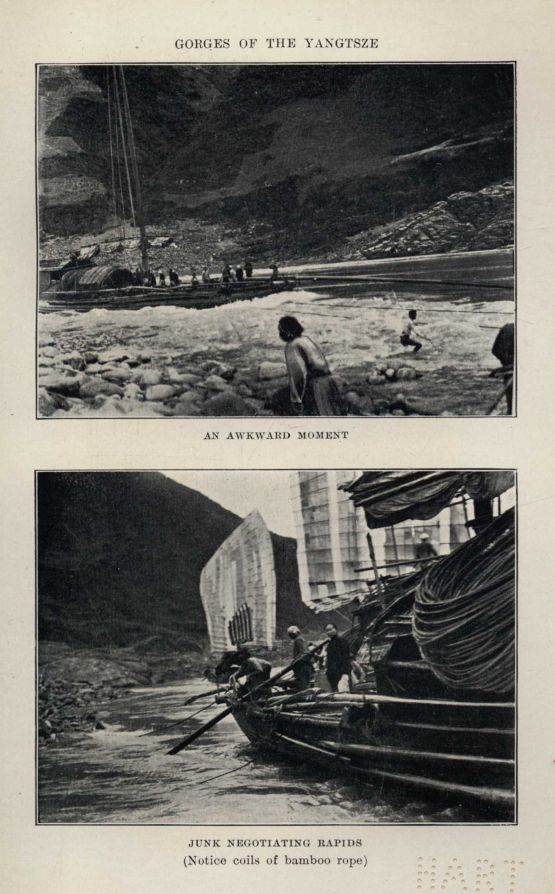
GORGES OF THE YANGTSZE: AN AWKWARD MOMENT. JUNK NEGOTIATING RAPIDS. (Notice coils of bamboo rope)
Perhaps I ought to say one word about the rope
on which the safety of the junk depends. It is
made of plaited bamboo, which is extraordinarily
light, and does not fray, though it is so stiff that
it behaves like a wire rope. Its great lightness
allows of the use of ropes of enormous length. I
do not think it is an exaggeration to say that some
of them are a quarter of a mile long. They are very
strong, and therefore can be of wonderfully narrow
diameter, but apparently they last but a short time,
and every boat is furnished with coil after coil of
bamboo rope ready for all emergencies. A horrible
accident happens when owing to bad steering the
trackers are pulled back off the narrow ledges cut into
the face of the precipices, which at times border the
river, so that they fall into the rapid.
They are an attractive body of men, these trackers.
They leap over the most incredible chasms in the
rocks, they climb like cats up the precipices, they
pull like devils, while one master encourages them
by beating a drum on board the junk, and another
belabours them on shore with a bit of bamboo rope,
which makes an excellent substitute for a birch rod,
and yet withal they are cheerful. When it rains
or snows they are wet through; when the sun is
hot—and remember the Yangtsze is in the same
latitude as North Africa—they expose their bent backs
to the scorching sun; yet apparently they never
grumble, but they wile away the hours of their labour
with cheerful song. When they row or pull easily,
the song is a weird antiphonal chant—it seems to be
sometimes a solo and a chorus, sometimes two equally
balanced choruses; but when the work becomes hard,
the song changes into a wild snarl and they laugh
a savage laugh as they strain and sweat to the
uttermost. I will complete their description by saying
that their views of decency are those of Adam before
the Fall, and that they preserve their strength by a
diet of rice and beans with a handful of cabbages as a
relish. At night they sleep on the deck of the junk
on their rough Chinese bedding with only a mat
roofing to keep the rain off them. And as I watched
their cheerful demeanour, I felt more convinced than
ever that the natural virtues of the Chinese are of the
very highest order.
Perhaps I ought to say one word about the beauty
of the gorges. I think in two points they excel. First,
in the height of the massive cliffs, through which the
Yangtsze has cut its way like a knife; the size of the
river and the size of the cliffs are so much in
proportion that the eagle circling above the gorge looks like
a swallow, and the crowd of trackers appears as a
disturbed ant colony. The other way in which the
gorges excel in beauty is in colouring; at one point
especially it was most remarkable—the rocks were red,
the mountains when we saw them were purple, and
the purple and red harmonising with the fresh green
foliage of early summer and the deep yellow of the
river, made a rich combination of tints in the
landscape which could hardly be surpassed. It is typical
of the state in which China is at the present day that
a scheme should be on foot for building a railway
which no doubt will render the gorges of the Yangtsze a
silent highway, and, instead of hearing the wild song
of the tracker or the savage beating of the tom-tom,
the lonely eagle will circle above a silent river on
which the fisherman's bark alone will sail in the
future.
For all schemes to tame the wild and fierce
Yangtsze are clearly impossible. The river rises and
falls more than a hundred feet with great rapidity,
and no human hand could ever throw a dam across
this mass of surging water. Possibly it might be
used as a source of power for electrical work, but it is
far more probable that the smaller rivers which fall
into the Yangtsze will be chosen for that purpose.
This district may be a tourist resort, and dwellers in
the plains of China may seek coolness and beauty on
one of the crags that overhang the river; the modern
hotel may perch itself beside the ancient Buddhist
temple; but the days of the river as a great
commercial route of China are numbered as soon as the
railway linking far-western Szechuan to the rest of
China is completed. One wild scheme proposes that
the railway should come from Russia straight down
from Szechuan, in which case more than probably
Szechuan will fall completely under the influence of
the Russian Government.
One of the results of Westernising China must be
to produce an industrial revolution. All those men,
for instance, who make a living by leaping from crag
to crag, from rock to rock, and swimming, struggling,
rowing in that river Yangtsze will find their living
gone. But not only will the railway make many poor
who had a competence, but it must make many rich
who before were poor. In this case, for instance, all
those commodities which are now extremely dear in
Szechuan, because of the cost of transit, will fall in
price, and there will be a period when there will be
a wide margin of profit between the cost of importation
and the conventional price the people are used
to pay, and those who live by trade will grow rich.
What has happened in the West must also happen
in the East. The introduction of steam did not make
the official classes or even the working classes
immediately rich. The people who immediately
profited by improved means of production and
communication were the great middle class; afterwards
as the working class realised that the margin of profit
would allow of larger wages, they compelled the
masters to share these advantages with them. So it
will probably happen in China. With the railway
will come a rich middle class who will be a factor of
growing importance in future China.
A great contrast between the Yangtsze and its
wild gorges is the great trunk line from Peking to
Canton which runs at right angles through the
Yangtsze north and south, and must make Hankow,
the place where it crosses the Yangtsze, one of the
greatest cities in the whole world. The railway is
only completed as far as Hankow. It runs from
Peking right across the plains of China, which are so
desolate in the spring and so fertile in the summer,
and which depend for their fertility on the July rains.
At every station a great Chinese inn is erected—that
is to say, a big courtyard with rooms round. At
first, of course, trade was small; the Chinese village
community has but little that it wants either to buy
or sell; each community is to a great extent
self-supporting. A farmer reckoned, I was told by a
Chinese official, that if he had made 30s. a year,
he had done well. That does not mean that he lived
on 30s. a year, though in a country where men are
paid threepence a day, one would almost have been
ready to believe it; but it means that he had fifteen
dollars a year to spend on things outside his daily
food. His farm supplies him with food and drink
and his vicious luxury, opium; his women make his
clothes; it only remains for him to buy material for
the clothes and the little extras that they cannot
make, besides salt. He pays for the few things that
he has bought, probably with the opium he
produces, or in Manchuria with beans; but the trade has
been of microscopical dimensions owing to the
difficulties of transit.
When the railway is made he finds at the railway
inn the Chinese merchant ready to buy and sell
anything that he on his part is ready to trade. At
first, such things as sewing cotton and cigarettes are
the things that are traded against silk or opium, and
then comes Chinese medicine and mineral oil, and so
trade begins, and soon the Chinese inn becomes a
market-place, and the railways begin carrying goods.
Of course the full development of the railway
system must depend on the feeding lines and in what
we had in Europe before the railway system, and
what the Chinese have not got, the feeding roads.
In Manchuria—for China, like England, is more
go-ahead in the north than in the south—they are
already moving in this direction. The Russian
railways, possessed now by the Japanese, are very busy
carrying beans to Dalny, and soon the Japanese lines
from Mukden to Antung will be equally busy, and
the line from Mukden to Tientsin also will carry this
crop. What they are now considering at Mukden
is how they can arrange a feeding system of light
railways, by which a bigger area of ground can be
brought within reach of the railway system. To
give some idea of the energy and progressive character
of the officials in those parts, I may mention that they
are already making inquiries as to the mono-rail
system for such railways.
The Chinese have made up their minds to welcome
railways, and though they would far prefer railways
to be built with Chinese capital, they are of necessity
compelled to accept European capital, since their
fellow-countrymen want very high interest for their
money. The Germans have taken very full
advantage of the Chinese desire for railways, and have
linked Kiauchau with the railway system of China.
The effect of all this must be very far reaching.
To begin with, it will alter the influence of foreign
powers. As the railway service is completed, Kiauchau
will become a very much more important centre than
it is now. If a railway that links Peking to Nanking,
or, to be accurate, to a town on the Yangtsze
opposite to Nanking, is cut by a railway from
Kiauchau, the result will be that Kiauchau will
become the nearest ice-free port for an enormous
district of China. This cannot fail to strengthen the
German influence, and the German influence is
connected, as we have already explained, too much with
that political side of missions which has caused
them to be distrusted by peace-loving Chinese. The
Chinese will ask themselves, will there not soon be
a missionary incident which will justify a further
aggression by Germany along the railway, which lies
so handy for a military advance, and they will be
suspicious of any German missionary effort in that
quarter.
But the effect of the railways is much more far
reaching than any casual advantage that it may give
to various powers, whether it be to Germany in
Shantung, or to Russia or Japan in Manchuria, or
to France in Yunnan, or to Russia in Szechuan. It
will have two main effects. First and foremost it
must place the whole of China in the same position
that Shanghai and Tientsin occupy at the present
moment—that is, it must make the whole of China
a mixture of Eastern and Western civilisation. It
may be urged that the rivers of China have already
been the means of bringing East and West into close
contact with one another, and yet that China remains
still a separate and different country to the treaty
ports.
The answer is, firstly, that it is comparatively
only a short time since the river has been opened to
foreign trade, and that a great advance has been made
in the treaty ports, so much so that a man in the
customs service living by the gorges of the Yangtsze
described the difference between the treaty ports and
the rest of China by saying, "A man who has only
seen Shanghai and Hankow has never seen China." Secondly,
a railway has a great educational effect.
When a railway is first opened the Chinese crowd
to see it; they get in the way of the engine, they
are run over, they accuse it of malign powers, and
then they come to the conclusion that it is after
all only a machine, and they take readily to travelling
by rail.
For instance, the railway from Tientsin up to
Manchuria has already completely altered the
conditions of culture in the north. It has enabled a
large number of labourers to migrate every year to
cultivate the fertile but icy districts of Manchuria,
so that it is quite a sight to see truck-load after
truck-load of farm labourers travelling like cattle,
going up from the south to the districts of the north
at the rate of three dollars for a twenty-two hours'
journey.
Not only does the railway carry the Tientsin
labourer in a truck to the Manchurian beanfield, but
it also carries first-class the Chinese merchant who
will buy the crop of beans to the advantage of the
farmer and to his own greater advantage. The
Chinese are rich in traders, and such an opportunity
would never be allowed to pass. Every year will
produce a greater number of wealthy Chinese
merchants, many of them very ignorant both of Western
and Eastern knowledge, but probably some of them
owning a respect for that knowledge whose lack they
have felt in proportion to their own ignorance, for
there is no man more inclined as a class to endow
educational institutions than he who in his youth
has felt the need of them.
China now needs help to found a University
teaching Western knowledge. Once it is formed, there
is every reason to believe that it will be endowed by
the same class that has endowed similar institutions
in our own country.
Nowhere is the transitional period through which
China is passing more obvious than in the cities of
China; many towns are still completely Chinese, but
as you approach the ports you find more and more
Western development. The contrast between towns
is extremely marked. Shanghai or Tientsin are
Western towns and centres of civilisation; the
difference between them and such towns as Hangchow
or Ichang is very great. The true Chinese city is
not without its beauty—in fact, in many ways it is
a beautiful and wonderful place. But to appreciate
it eyes only are wanted, and a nose is a misfortune.
The streets are extremely narrow passages, which
are bordered on either side by most attractive shops,
particularly in the main street. The stranger longs
to stop and buy things as he goes along, but the
difficulty is that it takes so much time; he must
either be prepared to pay twice the value of the
things he wants, or to spend hours in negotiation.
There is one curious exception to this rule; the silk
guild at Shanghai does not allow its members to
bargain, and therefore in the silk shop the real price
is told at once.
The shopkeepers are charming, and there are
numbers of salesmen—salesmen who do not mind
taking any amount of trouble to please. It is
delightful, if insidious, to go into those shops; and
one can well believe that if a Chinese silk shop
were opened in London, and silk sold at Chinese
prices, the shop would have plenty of customers.
The quality of Chinese silk far exceeds that of the
silks of the West. A Chinese gentleman mentioned as
an example of this superiority that one of his gowns
was made of French silk, and that it was torn and
spoilt after two or three years; but that he had had
gowns of Chinese silk for twenty years or more which
were quite as good as on the day he bought them,
and that he had only put them on one side because
the fashions in men's garments change in China as
they do elsewhere for ladies. The same gentleman
related many interesting things about the silk trade.
The quality of the silk is determined by the silk
guild. This is much more like the guilds in mediæval
Europe than anything that we have nowadays, and
that is why China is not exporting more silk than
she is at present. These silk guilds to a certain
extent prevent the Chinese catering for European
customers, as they will not allow or at any rate
encourage the production of silks that would take on
the European market. The West has many faults
as well as many virtues, and one of its faults is that
it no longer cares for articles of sterling value, which
last long and for which a high price must be paid,
but it delights in attractive articles of poor quality
at a low price. It is to be feared that the West
may spoil some of China's great products as she has
spoilt the great arts and productions of India.
But to return to Chinese streets. Next the silk
shop will be the silver shop. Here again the work
is admirable. At such a place as Kiukiang you can
spend an hour or more bargaining, and watching the
wonderful skill of the silversmiths as they turn out
beautiful silver ornaments. It is pleasant to wander
along and to look into the shops and see the strange
things that are for sale—fish of many kinds in one
shop, rice and grain in another, strange vegetables,
little bits of pork, flattened ducks; or to glance at
the clothes and the coats hung out, many of them
of brilliant colours. The signs over the shops and
the names of the merchants are a feature in
themselves, illuminated as they are in vivid hues of red
and gold, in those wonderful characters so full of
mystery to the foreigner.
In a native city up-country the traveller is
practically forced to go through the city in a chair.
There are no wheel conveyances except wheelbarrows,
and, except where there are Manchus, horses are
quite unknown. Walking is profoundly unpleasant
for a European, for as he walks along he is
constantly jostled by porters carrying loads of goods
on a bamboo across their shoulders; or cries are
heard, and a Chinese Mandarin is carried past
shoulder high, leaning forward looking out of his
chair perhaps with a smile, of contempt for the
foreigner who can so demean himself as to go on
foot like a common coolie; or perhaps it is a lady
with her chair closely covered in and only a glimpse
to be seen of a rouged and powdered face, for the
Chinese women paint to excess, as part of their
ordinary toilette. Next comes the water-carrier
hurrying past with his two buckets of water; or
perhaps it is some malodorous burden which makes
a Western long to be deprived of the sense of smell.
But in a chair a ride through a Chinese town is
delightful; the chair-coolies push past foot-passengers
who accept their buffets with the greatest
equanimity, and from a comparatively elevated position
the traveller can look down on the crowd.
But when the Chinese city is near a port, all
this begins to change. The chair is replaced by the
ricksha, and though in many ways it is less
comfortable than a chair, the ricksha is after all the
beginning of the rule of the West, being a
labour-saving machine. One coolie or two at the most can
drag a man quickly and easily where with a chair
three or four bearers would be needed. Outside the
old town will be built the new native town, and
the new native town is built on European lines,
with comparatively wide streets. In a treaty port
the completed specimen of the transitional stage
through which all China is passing is to be seen.
Shanghai is a most delightful town, although it
seems commonplace to those who live there, but
to a stranger it is a place full of contradictions
and eccentricities. The first thing that strikes one
in Shanghai is that none of the natives know any
of the names of the streets. It is true they are
written up in large letters both in English and in
Chinese; but as not one of the coolies can read,
they have not the very slightest idea that that is
the name of the street—they call it quite a different
name; and as they speak a different language both
to that of the educated Chinaman and to the Englishman,
there is no reason why they should ever learn
the names given by them. The habitual way of
directing a ricksha coolie is by a sort of pantomime,
and there is always a great element of uncertainty
as to whether he will get to his destination even
with the oldest resident unless he knows the way
himself. I arrived at Tientsin and tried to go and
see Dr. Lavington Hart, whose college is known
all over China, I may say all over the world, but
the Chinese porter was quite unable to make the
coolie understand where it was, and so we wandered
about for some time till the coolie got tired and put
me down opposite what fortunately turned out to
be the house of a Japanese gentleman. I entered
the house, and was surprised that the Chinese
servant who met me did not altogether seem to
expect me; but as he could not speak English and
I could not speak Chinese, it was impossible to
inquire if anything was wrong. I was just
wondering why Dr. Hart should live in a Japanese house,
when the door opened and a Japanese gentleman
walked in. Fortunately for me he spoke both Chinese
and English well; so after explanations I was again
sent on my road, and found Dr. Lavington Hart
waiting dinner for me, and wondering how I had
got lost. He then told me that I should have asked
not for his college but for the hospital opposite, and
that I should have asked not for the street but for
the Chinese name of the doctor of the hospital who
had been dead ten or fifteen years.
There is a moral in all this: it shows the state
of confusion that exists in small as well as in large
things. I asked several Englishmen why they did
not accept the native names of the streets; their
answer was that the coolies could not read them;
and when I suggested that common sense would
expect that the coolies' names should be taken for
the streets, for after all that is how most of the
streets in England were originally named, the
suggestion met with no approval. These small matters
show what a great gulf there is between the thoughts
of the two races. If the coolies had been Italians or
Germans or Russians, their names would have been
accepted, or they would have been compelled to
learn the new names.
Another example of the difficulty of carrying on
the details of city life is afforded by a common
spectacle at Shanghai. In the crowded streets you
see a little crowd of policemen. The group consists
of three splendid men, typical of three different
civilisations. First there is the English policeman;
next to him is a black-bearded man, bigger than
the first, a Sikh, every gesture and action revealing
the martial characteristics of his race; then a
Chinaman completes the group, blue-coated and wearing
a queue and a round Chinese hat as a sign of office.
The traveller wonders why this trio is needed till
he sees them in action. A motor car rushes down
one road, a ricksha comes down another, and a
Chinese wheelbarrow with six women sitting on it
slowly progresses down a third. All three
conveyances are controlled by Chinamen, and when they
meet, all shout and shriek at the top of their
voices; no one keeps the rule of the road, with
the probable result that the wheelbarrow is upset,
the ricksha is forced against the wall, and the
motor car pulled up dead. Then the police force
comes into action. The Chinese policeman objurgates
vociferously and makes signals indifferently to
everybody; the Sikh policeman at once begins to thrash
the Chinese coolie; meanwhile the English
policeman at last gets the traffic on the right side of
the road, quiets his subordinates, sees justice done,
and restores order. Possibly if the matter had
been left to the Chinese policeman, he would have
arranged it in the end; the traffic in Peking was
controlled entirely by Chinese policemen and was
fairly well managed.
There is an extraordinary example of the want
of consideration for the feelings of the Chinese to
be seen in the public gardens at Shanghai. There
stands a notice which contains, among several
regulations, first, that "no dogs or bicycles shall be
admitted"; secondly, that "no Chinese shall be admitted
except servants in attendance on foreigners." Considering
that the land is Chinese soil, one cannot but
wonder that any one who had dealings with the
Chinese should allow so ill-mannered a notice to be put
up. No Chinese gentleman would object for a moment
if the notice had been to the effect that unclean
persons and beggars should be excluded from the
gardens; but to exclude the cultured Chinese
merchant who is every whit as clean as his Western
neighbour, or to exclude the respectable people of
the middle class whose orderly behaviour is beyond
suspicion, is as unreasonable as it is regrettable.
Again, the Shanghai municipality has no Chinese
representatives upon it, though the great bulk of the
population is Chinese, with the result that from time
to time they come across Chinese prejudices and
quite unnecessarily irritate the population which
they govern. The Chinese have a principle that
a woman shall be publicly punished only for adultery
and open shameless theft; her "face" or dignity must
be preserved; and therefore she should never be made
to answer for her offences in open court, her husband
or her father being held responsible for her behaviour
and for her punishment. The right way of dealing with
any woman who is charged with an offence is to do as
we do in England with regard to children, to summon
not her but those responsible for her behaviour. I
was assured by a Chinese official that the trouble
which culminated in the Shanghai riots originated
from disregard of this principle. The refusal of the
Shanghai municipality to have Chinese representatives
upon it is the more remarkable, as I was informed
at Hong-Kong that they have such representatives,
and find them most useful in assisting in the
government of the Chinese. It is not surprising that
Shanghai is a town to which it is diplomatic to
make no reference in conversation with a Chinese
gentleman.
There is more to be said for the mistrust of the
Chinese Post-office and for the continuation of the
curious system by which each nation has its own
post-office. Nothing is more annoying to the traveller
in Shanghai than the trouble he has to get his letters.
If it should so happen that he has correspondents in
many countries, he has to go to every one of the many
post-offices in Shanghai, and they are situated in
different parts of the town and in places very difficult
to find. There is the Imperial Chinese Post-office, to
which he first repairs, and where he will find letters
from any correspondent in China; then with the
greatest difficulty he reaches the English Post-office;
after which he remembers that some of his friends may
be on a holiday in France, therefore he must go to the
French Post-office, and so on. When he asks why
the Chinese Post-office cannot be trusted, he is told
that the Chinese themselves will not trust their
post-office unless there be a European official in control,
and that the old Chinese system by which letters are
forwarded by private companies still continues in
many parts of China, although they possess branches
of the Imperial Chinese Post-office. Still the traveller
wearily thinks at the end of his day's journey that
without undue trust in another nationality, or any
loss of national prestige, an International Post-office
might be arranged in a town like Shanghai, with its
vast travelling population.
Shanghai with its mixture of races, with its
national antipathies and jealousies, is indeed one of
the most attractive but strangest towns in the whole
world. Every race meets there; and as one wanders
down the Nanking road, one never tires of watching
the nationalities which throng that thoroughfare.
There walks a tall bearded Russian, a fat German,
jostling perhaps a tiny Japanese officer, whose whole
air shows that he regards himself as a member of
the conquering race that has checkmated the vast
power of Europe; there are sleek Chinese in Western
carriages, and there are thin Americans in Eastern
rickshas; the motor cycle rushes past, nearly colliding
with a closely-curtained chair bearing a Chinese lady
of rank, or a splendid Indian in a yellow silk coat is
struck in the face by the hat of a Frenchman, who
finds the pavements of Shanghai too narrow for his
sweeping salute; one hears guttural German
alternating with Cockney slang; Parisian toilettes are
seen next half-naked coolies; a couple of sailors on
a tandem cycle almost upset two Japanese beauties
as they shuffle along with their toes turned in; a
grey gowned Buddhist priest elbows a bearded Roman
missionary; a Russian shop where patriotism rather
than love of gain induces the owners to conceal the
nature of their wares by employing the Russian
alphabet overhead, stands opposite a Japanese shop
which, in not too perfect English, assures the wide
world that their heads can be cut cheaply; an English
lady looks askance at the tightness of her Chinese
sister's nether garments, while the Chinese sister
wonders how the white race can tolerate the
indecency that allows a woman to show her shape and
wear transparent sleeves.
Yes, Shanghai on a spring afternoon is a most
interesting place; and yet as you turn your eyes to
the river and catch sight of the dark grey warship,
you realise that beneath all this peace and busy
commerce lies the fear of the grim realities of war.
China may assimilate the adjuncts of Western life,
but she will never welcome the Western. The racial
gulf that divides them is far too deep. It may be
temporarily bridged by the heroism of a missionary;
the enthusiasm of Christianity may make those who
embrace it brothers; but the feeling of love will not
extend one inch beyond the influence of religion; and
those who ponder on the future as they watch the
many-hued crowd that passes must grow more and
more sure that the future of China lies with the
Chinese alone; and however much as a race they may
be willing to learn from the West, they will as a race
be led only by their own people. The Westerner
may be employed; Western teaching may be learnt;
Western garments may be worn; but, as a Chinese
professor said, "The wearer will be a Chinaman all
the same."
There was one marked difference in the cities of
China as we saw them in our two visits, and this
was the change that had taken place in the matter
of opium-smoking. Opium-smoking in 1907 was
such a common vice that you could see men smoking
it at the doors of their houses. In 1909
opium-smoking hid itself, and those that smoked, smoked
secretly, or at any rate less ostentatiously. I doubt
whether so great an alteration has taken place in
any country, certainly not of late years.
Each race has its peculiar vice; in fact, we may
go further than that, we may say that it is a
remarkable fact that the great bulk of mankind insists
on taking some form of poison; in fact, it is only a
minute minority which wholly abstains from this
practice. The poisons used by mankind have different
effects and have a different degree of toxic power, but
the reason they are used is because in some way they
stimulate or soothe the nervous system. Opium,
alcohol, tobacco, tea, coffee, hashish, are examples
of this widespread habit of humanity; but these
different drugs have the most different effects on
the welfare of man. Some seem to be wholly
innocuous if not beneficial, and others seem to be
absolutely pernicious and to do nothing but evil;
and further than that, one may say that a different
preparation of the same drug or a different way of
taking it produces differing results. A still more
curious thing is that though all mankind is agreed
in taking some poison, there is a marked, racial
tendency to accept one particular poison and to
detest others, and at times it seems as if the habit
of taking one was sufficient to prevent another
having any attraction.
As we went to China we passed through the
Suez Canal, and heard what a curse hashish was in
Egypt, and how the Egyptian Government had
endeavoured to secure total prohibition of the use of
this obnoxious drug, a course which was impossible
owing to the great amount of smuggling that was
facilitated by the wide deserts that surround Egypt.
When we arrived at Saigon (we were travelling
by the French mail) we first came in contact with
the terrible vice of the Chinese. A French lady
was pointed out to us by a doctor, and he asked us
to observe the odd glassy look of her eyes, the
intense suavity of her manner and the contempt which
she evinced for truth, and he told us that these were
all symptoms of the vice of opium-smoking that she
had contracted from association with the Annamites.
The French for some mysterious reason seem more
prone to acquire this vice than do our own countrymen,
for though in 1907 it was rife in South China,
no one ever suggested that any English smoked
opium at Hong-Kong.
As we went up to Canton crowds of people were
smoking opium on the Chinese deck, and when we
wandered round they had no objection to our
standing watching the lazy process of dipping the needle
into the treacle-like mixture, turning it round till a
bead was formed, then putting it into the lamp to
light and thence transferring it to the opium pipe,
when after three whiffs or so the process had to be
begun again.
The first effect of opium-smoking is to make a
man intelligent and amiable. It is for this reason
that opium-smoking—so the Chinese explained to
us—is used largely in business. When business is
difficult, and you cannot get three or four men to
agree, the opium pipe is brought out, and after two
or three whiffs the cantankerous people are
reasonable, and the people whose dignity is hurt are
forgiving, and business is easily and rapidly
transacted. The next stage of smoking is stupidity. As
you watch an opium-smoker in that condition he
nods amiably at you with a rather imbecile look.
The last stage is one of heavy senseless sleep. The
habitual opium-smoker rarely passes the first stage,
and its apparently beneficial influence constitutes its
danger. Each man says to himself: "I will never
take it to excess; I will merely use it and not abuse
it; it makes life sweet to me and business easy."
I have always thought that those who condemn
opium have a tendency to prove too much in their
argument. If it could be shown that the effects of
opium-taking were invariably pernicious, it would be
very hard to see how the vice could take such a hold
as it has taken on the Chinese race; if the young
men regularly saw that the older men were brought
to inanity and death by the use of opium, they
would themselves be terrified of contracting the
vice, and it would not have spread as rapidly as it
has done. The vice is essentially modern. Opium
has only been grown in China for about seventy or
eighty years, and it has only been imported in large
quantities for a scarcely longer period of time. An
inhabitant of Shansi told us that though every
one smoked opium, and it was a terrible curse,
his father remembered its introduction. Opium is
certainly deleterious to the moral fibre of a race,
and in many cases it produces death and misery;
but there are a certain number of cases where no
obvious evil effects follow from its consumption—cases
when as a rule a man is well-nourished, for it acts
most deleteriously on a man's powers of digestion.
Men who have good food can better tolerate the
effects of the drug, so a mission doctor explained,
and their comparative immunity tempts others to
follow their example. Men do not see at once the
evil that will result, and so its use has spread by
leaps and bounds. The Chinese Government have
always theoretically resisted it, but their action has
been hampered by their not being permitted to
prohibit its importation. For many years the pro-opium
party in China used those treaty obligations by which
China was bound to permit the importation of opium
as a reason for stopping any efforts to extirpate the
vice in the country. Not only were there always a
great number of people in high places addicted to
the vice, who were naturally unwilling to remove
from themselves the opportunity of its gratification,
but also there was a vast number of people who
rapidly acquired a great pecuniary interest both in
the maintenance and extension of this trade.
Unfortunately for humanity, opium was not only
very injurious but extremely portable, and it
therefore formed in a country where means of communication
are bad a very useful article of exchange. The
peasant farmer will grow most things on his little farm
which he and his family consume—in most respects
they will be a self-supporting community—but there
must be a certain number of things which they will
need to buy, and for which they must give something
in exchange; that something must be portable. In
many cases the only way of bringing your goods to
the market is by carrying them on your own back.
Opium, alas, forms, in soils which it suits, a most
remunerative crop. The whole product of several
fields can be carried quite easily on a man's back and
can be sent down to the market, where it will find
a ready sale, and the result of that sale will be
invested in articles of which the farmer and his
family have need.
Not only the farmer, but the trader, both
Chinese and European, find it a most profitable
source of trade. It was hard, and it is hard, to
persuade the European trader that it is injurious
to China, and to understand the reason we must
turn back to the thought which was suggested at
the beginning of the chapter, namely, that it is
very doubtful whether the English race has any
natural desire for the vice, while it is most patent
that the Chinese have a peculiar national tendency
towards this form of dissipation. When people have
no desire for an intoxicant themselves, it is hard to
persuade them that others may have a desire which
may be beyond all power of restraint. The trading
class mixes but little socially with the Chinese, and
the people with whom they are brought in contact
are very generally pecuniarily interested in the opium
trade, and therefore they have neither the evidence
of the Chinese nor of their own temptation to
convince them of the insidious and dangerous character
of this vice to the Chinese race.
The English race has long been conversant with
opium. In the form of laudanum it used to be sold
freely in the eastern counties. I have heard people
describe years ago how the old women from the fen round
Lowestoffe, or the marshes as they are there called,
would call on market day at the chemist for their
regular supply of laudanum, which they would take in
quantities sufficient to make any ordinary person go
fast asleep. It was used there, as it is used in many
countries, as a prophylactic against ague. The
doctors now deny that it has any beneficial effect,
but the people in the eastern counties used to think
differently. But when I was a curate at Yarmouth
I could find no traces of this vice; it had apparently
been exterminated not by any social reform or moral
movement, but by the superior attraction of alcohol;
and in my day Yarmouth and the district round was
terribly addicted to the national vice of intemperance.
I noticed the same thing in Shanghai. The English
know opium; most of them have out of curiosity
tried a pipe; and they describe the effects as trifling
or very unpleasant. One man said that he felt as if
all his bones were a jelly; another that he felt as if
he was floating between heaven and earth; a third
that he found no pleasure in it at all, but that he
had a "filthy headache" next day. On the other
hand, if you go into the Shanghai Club you can see
at once what is the attractive vice to the European
at Shanghai; the whole of one side of the entrance
hall was nothing more than the bar of an overgrown
public-house. You will hear story after story which
tells the same old tale that alcohol, especially in its
strongest form, is the greatest pleasure and the worst
danger to the Englishman abroad as at home.
If opium is unattractive to the white man, on the
other hand alcohol is equally unattractive to the
yellow man; in fact, their relative position is much
the same. The yellow man has known of alcohol
from the very earliest ages. Dr. Ross quotes the
second ode of the Book of Poetry as showing how
well known drunkenness was to the Chinese:
"Before they drank too much, they were dignified
and grave; but with too much drink their dignity
changed to indecency, their gravity to rudeness; the
fact is, that when they have become drunk they lose
all sense of order. When the guests have drunk too
much, they shout, they brawl, they upset the orderly
arrangement of the dishes, they dance about
unsteadily, their caps are set awry and threaten to fall
off, they dance about and do not know when to stop.
Had they gone out before drinking so deeply, both
host and guest would have been happier. Drinking
gives real happiness only when it is taken in
moderation according to propriety."
Drunkenness seems to have been extirpated from
China by the same process that laudanum-taking was
from the eastern counties, namely, it has given way
before the more entrancing vice of opium-smoking.
I was assured that the Tibetans do not share with
the Chinese this preference for opium, and this is all
the more remarkable because from their geographical
position they have always been in close contact with
India, which is apparently the home of the opium
vice, but they have adhered steadily to the vice of
drunkenness. The Chinese have free trade in drink;
they have no licensing laws; any one may sell alcohol
at any time of the day, in any place they like; and
yet alcohol has so few votaries that you will scarcely
see a drunken man from one end of China to another.
If the English commercial world is incredulous
to the danger of opium to the Chinaman, not so the
Chinese world. People will tell you that Orientals
love to agree with you in whatever you say, but I
heard a British Vice-consul flatly contradicted by a
Chinese official when the Vice-consul expressed a
doubt as to the danger of the vice, and I must say
the Chinese disputant supported his contradiction
with an argument which seemed to me perfectly
unanswerable. He said: "Look at the Japanese; they
are impartial spectators of the vice of alcoholism and
opium-smoking; they are conversant with the worst
forms of alcoholism that white men can show them.
It is well known that white sailors are great offenders
in this respect. Every port in Japan knows what it
is to see a drunken sailor finding his way to his ship.
They are equally conversant with the vice of
opium-smoking. They have intimate contact with the
Chinese; they know both the recent origin of this
vice and its terrible ravages; and what do they do?
Do they forbid both vices equally? No; they are so
convinced that opium is so much more dangerous than
alcohol, that they will not allow it to be introduced
into their country for smoking purposes, and the
smuggler is liable to five years' penal servitude.
But the vice of alcoholism they treat as something
which, though harmful, can never threaten their
national existence."
Perhaps we who have suffered much more from
the vice of alcoholism than of opium-smoking may be
inclined to think that while the Japanese are right in
the opium question, they are acting imprudently in
allowing alcoholism to gain such a hold on their
people; but whether they are right or wrong, there
can be no doubt that the Chinese official had justice
on his side when he pointed out that to the Japanese
mind the evils that opium-smoking had done to China
were of a most serious character.
His Excellency Tang-K'ai-Sun spoke the Chinese
mind when, in an eloquent speech at the Shanghai
Conference, he told of the awful desolation that
opium was bringing to his land. But it is
unnecessary to quote the opinion of individual Chinamen;
they are practically unanimous on this subject. One
has only got to point to what China has done to
show two things. First, that the curse of
opium-smoking was far greater and more horrible than
anything that we have experienced on this side of
the globe; next, that there is latent in the Chinese
character a vigour and an energy which, when it is
called into action, despises all obstacles and acts so
efficiently as to leave the world lost in astonishment.
Realise what China has done. China is addicted to
a vice which has a far greater hold upon her than
alcoholism has upon us; she determines that within
ten years that vice is to cease. The production of
the poppy is to be diminished till none is produced;
opium-smokers are to be held up to public scorn;
opium dens—which are really the equivalent of our
public-houses—are to be closed; all officials who take
opium are to be turned out of Government employ;
the only exception that is made is for old men, and
that exception was quite unavoidable. So vigorous
was the action of the Government that men who have
for forty or fifty years of their lives taken opium,
tried to give it up; the result was in several cases
that they were unable to support the physical strain;
a great illness, even death, ensued; and so the edict
was relaxed; men over sixty were allowed to
continue smoking. When all this was published, every
one smiled. They argued that China was trying to do
the impossible. A vice like opium-smoking may be
extirpated, but only after years of struggle. A
generation must come and a generation must go before
opium or any similar vice shows appreciable diminution.
We ourselves have not been unsuccessful in
struggling against the vice of alcoholism; but
consider the number of years since Father Mathew
first spoke against drink. England may be growing
sober, but it is by slow if steady degrees. But China
hopes to accomplish in ten years what has taken
England so many patient years of toil to effect
partially. The idea that China could do this was
regarded by most Westerns as almost laughable. In
1907, when the edict was first put forth, all those we
met in China held this view; even missionaries, while
they gave every credit to the Government for what
it intended, shook their heads and foretold
disappointment. We noticed as we passed along that
wonderful line that links Hankow to Peking and
Peking to Harbin in 1907 that the country was
beautiful with the white and pink crops of poppy,
till at times one might imagine that the transformation
scene of a London theatre was before us rather
than the land of China, and remembering what we
had been told, we also confidently expected failure to
the edict which requires the destruction of so many
miles of this pernicious if beautiful crop.
In 1909, when we again traversed the same country,
we could not see a single poppy flower; not only so,
but we made every effort to see if we could find a field.
We went for a twenty mile walk at Ichang through
the country, where no one could have expected a
foreigner to come, and we only found one tiny patch
of poppy, and one in which the ruthless hand of
the law had rooted up the growing crop. As we
went up the Gorges of the Yangtsze we scanned
with a strong glass the hillside, and never once on
those glorious mountains did we see any sign of
opium cultivation. We asked about the officials;
not only was the Government enforcing the law that
officials must give up opium-smoking, but they were
taking a more effectual action; they were requiring
all those who were going to be officials to spend some
time under supervision, to ensure that they should
not be opium-smokers. Could any Western power
hope to accomplish such a feat? Would the most
extreme temperance reformer suggest that all
public-houses should be closed, that the amount of barley
should be diminished every year till within ten years
none should be grown, and that all the Government
officials, from the Prime Minister downwards,
should become total abstainers within that period?
The reason of this vigorous action of China and its
present success is to be attributed to two things:
first, to the terrible and very real national fear that
this vice will destroy the nation, as it has destroyed
countless families and individuals; secondly, to the
vast store of energy which enables China to accept
new ideas and act vigorously on them.
The great revolution of thought that is going on
has called forth this vigour. The China of yesterday
was fainéant and unprogressive. The China that is
emerging out of this revolution of thought is
energetic, though possibly unpractical. The old
traditions of Government are not lost, and they wait but
for the man and the hour to enable China to act as
vigorously as she has done in time past. Her action
in this opium question may be ill-considered in some
details; it may even fail; but it has shown the
world that China is in earnest, and that she can act
with a vigour which will cause wonder and envy on
this side of the world. Every missionary reports that
even high officials are coming asking to be cured of
the opium habit. The missionaries have founded
refuges where they receive and cure those who are
ready to submit to the terrible ordeal, for their
suffering is intense. Many quack cures are advertised.
Some are definitely pernicious; for instance, the
morphia syringe has become a common article for sale
in some parts of China. Some few may be beneficial.
There is no doubt that the movement against opium
is a great national movement, and is not the result
of the action of any small or fanatical party. What
China has done proves that this is so.
Let me close the chapter by a quotation from the
ablest of the foreign representatives at Peking, Sir
John Jordan. Writing to Sir Edward Grey, he
says: "It is true that the Chinese Government
have in recent years effected some far-reaching
changes, of which the abolition of the old
examination system is perhaps the most striking instance;
but to sweep away in a decade habits which have
been the growth of at least a century, and which
have gained a firm hold upon 8,000,000 of the adult
population of the empire, is a task which has, I
imagine, been rarely attempted with success in the
course of history; and the attempt, it must be
remembered, is to be made at a time when the Central
Government has largely lost the power to impose its
will upon the provinces. The authors of the
movement are, however, confident of success, and China
will deserve and doubtless receive much sympathy
in any serious effort she may make to stamp out
the evil."
The desire for radical change is never so much to be
dreaded as when it attacks the home life of a nation.
That quiet life so often hidden away because of its
very sacredness by the Eastern races is like
everything else in China disturbed by the introduction of
Western civilisation, and in no other part of human
life will its two different sides be more apparent.
Western civilisation without Christianity will destroy
the home life as it destroys most Eastern things it
touches, and will do little to construct a new life to
take the place of the one it destroys. The Japanese
complain that Western civilisation has destroyed
both the modesty and the religion of their women,
and Christianity has not yet been able to any great
extent to reconstruct on the basis of true religion
new ideals of feminine life. Therefore the Chinese,
with all their enthusiasm for Western culture, are
looking a little nervously at what they see has
happened in Japan. They say that their home life
is not now unbeautiful; even those who are disposed
to admit that the life of the Western woman is founded
on higher ideals than their own will not allow that
their national home life deserves unmixed
condemnation. Everybody agrees that the wanton destruction
of the laws which govern women's life in China may
have a terrible result when Western civilisation is
unwisely introduced, especially if it is made to appear
to be a civilisation without religion. The missionaries
see in this crisis the necessity for vigorous action;
while thankful for the movement, they realise the
responsibility it puts upon Christians to see that that
movement is wisely directed. In the memorial from
the Centenary Conference at Shanghai in 1907 to
the Home Churches, they say:—
"The changed attitude of China towards female
education and the place of woman, lays upon us great
responsibilities. The uplifting of woman is a first
need in the moral regeneration of a people, and one
of the things in which Christianity has a totally
different ideal from that which the religions of China
have encouraged. The present change of national
sentiment on the subject is one of the indirect but
none the less striking changes that the slow but
steady dissemination of Christian ideas in China
during the past century has led to. Let it be
remembered, however, that it requires the Christian
motive power to make it successful and fruitful."
It is somewhat difficult to obtain information from
the Chinese themselves as to the position of women.
They are very averse to discussing the subject; in
fact, it is not even regarded as good manners for
a man to ask after the health of his most intimate
friend's wife; and all the information that we could
get had for the most part to be obtained by Lady
Florence Cecil through feminine sources. We may
generally state, however, that the position of women
in China is neither so low as that which they occupy
in India or among the Mohammedans, neither is it
in any degree so high as the position of women in
Western lands. The woman is completely subject
to the man; till she marries she is subject to her
father, when she is married she is subject to her
husband, and if her husband dies she is then subject
to her son, and rarely re-marries. These are called
the three obediences. She is not educated as a rule,
because both public opinion and Chinese philosophy
regard her as mentally far inferior to the man. We
shall explain later on how in Chinese thought
everything is divided into a good and an evil
principle—a Yang and a Yin. The woman is distinctly Yin.
She is therefore necessary to man, but at the same
time inferior.
Again, with regard to the question of polygamy,
her position is an intermediate one between the
avowed polygamy of Moslem countries and the
ill-maintained monogamy of many a Latin country.
In Hong-Kong the position was explained by a
Chinaman to me thus: that when a woman grew old
it was regarded as her duty to provide a secondary
wife for her husband's pleasure and as a companion
for herself—a companion with a sense of servitude in
it. If this was done in an orderly manner, it was
absolutely approved by Chinese public opinion. If,
on the other hand, the husband, ignoring the wife's
rights, should choose a secondary wife for himself and
set her up in another house, his attitude would be
regarded as distinctly doubtful by the respectable
Chinese. In the same way if an official were
appointed to a distant post he would probably not
think of imposing upon his wife with her deformed
feet the pain and discomfort of a long journey; he
would most likely take a natural-footed woman, who
will be for that reason a slave; in fact, one gentleman
went so far as to say that he thought that the
squeezed feet had a great deal to do with this
institution of a secondary wife, because he noted that
the secondary wives of all the officials when they
were travelling were natural-footed women.
The secondary wife would be rarely a woman of
good class; it is allowed to be an inferior position.
On the other hand, if she bears her husband a son,
and that son is recognised, all that son's relations,
and therefore all his mother's relations, become
relations of the father.
The curious tangle which such a position begets
when brought into contact with the Christian idea
is exemplified in this story. A rich Chinaman had
three wives. By his lawful wife he had nine children;
by the other two he had none; but his second wife
was a woman of very strong character, and she was
brought in touch with the missionaries by the
Chinese wife of a European. She apparently ruled
the house with a kindly rule to which all the others
bowed. She did everything in an energetic and
vigorous way, and she studied Christianity till she
was convinced of its truth, and then she demanded
baptism. There was a great difficulty; she must
leave her husband before she could be baptized.
After considerable delay she accepted the condition,
but resistance came, not alone from the man, but
from the other two wives. They could not possibly
get on without her; they were like sisters; and she
must be allowed to return to the house. She refused,
though the pressure was extreme. The man said that
he had promised his ancestors that none of his children
should be Christians, and that his own mother would
not forgive him; but the woman held firm, and at
last she was baptized. Her face was beautiful to
behold while she was accepting Christianity and
renouncing all that made life sweet to her. The
husband was so moved by her fortitude that he
signed a paper promising not to molest her, and yet
to support her apart, so that she should not be in
any need.
At the Shanghai Conference there were, curious
to relate, many women who wished the Christian
body to recognise existing polygamy among the
Chinese. A sentence of the resolution proposed was
that "secondary wives may be admitted to membership
if obviously true Christians." Mr. Arnold Foster
resisted the inclusion of these words, and they were
lost. No doubt the Conference was wise in taking
this line. It is most essential to maintain the purity
of the home life, and the difficulty that arises from
secondary wives desiring to join the Christian Church
can never be a very important one, as the vast
majority of Chinese are monogamous.
A serious evil this custom creates is that of
female slavery. Both in Japan and China one of
the awful penalties of poverty is that a man is
sometimes forced to sell his female children. These
little girls are bought by prudent Chinamen, first
to be servants to their own wives and then to act
as secondary wives to their sons to prevent them
going elsewhere. Sometimes they are kidnapped by
men who make a regular business of this cruel traffic.
Stories are told of boat-loads of these children being
brought down the Yangtsze, concealed below the
deck and terrorised to keep them quiet by one of
their number being killed before their eyes. On one
occasion a missionary suddenly saw a hand thrust
through the planks of the deck, and on investigation
he discovered a dozen children hidden below, and as
it turned out they had been kidnapped, not bought,
he was able to get them released. These slaves are
the absolute property of their owners, and many are
the tales told of the cruel and neglectful treatment
to which they are subjected. In Shanghai the
Chinese police will report such cases, and in
consequence the ladies of the settlement have founded
an admirable institution to which they can be brought.
The Slave Refuge deserves all support. There the
little girls are taught and cared for, and helped to
forget the terrible experiences some of them have
gone through. Sad to relate, many of them have
to be taken first to the hospital to be cured from
the effects of the ill-treatment they have received.
One poor little thing went into convulsions when a
fire was lit in the ward; it was difficult to
understand the reason, but when it happened again and
the poor child uttered incoherent appeals for mercy,
it was discovered that she thought the fire was lit
to heat opium needles with which to torture her.
Her system was too shattered for recovery, but
many others get quite well and form a pleasing sight
at work and play in the bright cheerful Refuge, with
the happy elasticity of youth forgetting the injuries
which in some cases have left on them permanent
scars. But I fear the system of slavery continues
very commonly all over China, and such a philanthropic
effort as the Shanghai Slave Refuge can touch
but a very small proportion of them. Probably when
the little slaves are destined to be wives to their
mistresses' sons they are treated less cruelly, and
though employed as household drudges, do not live
actively unhappy lives.
Without stating that women as a whole are
miserable, I think it would be no exaggeration to
say that they are infinitely less happy than their
Western sisters. Many of the national customs
militate against their happiness. The custom of child
betrothal, for instance, condemns a woman to live
completely subject to a man for whom she perhaps
has the greatest natural antipathy. Stories are
told of brides committing suicide rather than
leave their father's house to be married to men for
whom they feel no affection; yet as a whole they
accept their position, and a Chinese woman has
neither the will nor the power to be untrue to her
husband.
Again, the rule of the husband's mother is very
often extremely harsh; the child-wife is little better
than her drudge. On the other hand, when a
woman grows older, her position is one of
considerable strength. I was assured that they
take a keen interest in the management of their
husbands' properties, and often show themselves
excellent business women. The position which the
late Empress of China acquired shows that women's
position is the very reverse of inferior when dignified
by age.
And now before all this woman's world glitters
Western civilisation; the greater dignity which is
accorded therein to women is envied and the laws
which restrain her are misunderstood. The Chinese
women hear stories of Western life. At first such
strange perversions are believed as that in the West
women rule. One missionary explained that this
absurd figment came from the rule of the late Queen;
another attributed it to the custom men have when
travelling in China of walking while their wives
remained in the carrying chair. To the Chinaman
such a course admits of but one explanation: the
woman must be greater than the man because she is
carried while he walks.
Again, in Western China they learnt through
their local press that girls and boys received a
similar education in England, and they concluded that
the dress must be also similar, and the missionaries
were more amused than scandalised at seeing a
Government girls' school turned out in boys' clothes.
It was explained to us that this was far from being
an uncommon custom in China; slave-girls who have
been brought up with natural feet are habitually
dressed as boys, and it is common now for fathers
of small daughters with unbound feet to avoid the
unpleasant taunts of the ignorant by allowing their
daughters while they are children to wear boys'
clothes.
Still on the whole the desire for imitation of the
West has been very beneficial to the women of China,
especially in this matter of foot-binding. This
disgusting custom is going out of fashion among the
enlightened and educated classes; two or three
Chinese gentlemen assured us that this was so;
and in a place like Shanghai, where the Western
movement is very strong, the number of women with
unbound feet is quite remarkable; the greater number
of them naturally have had their feet bound, and as
feet bound from infancy never become quite normal,
they still have something of the tottering walk which
used to be the admiration of every Chinaman; in fact,
this tottering walk is preserved as a piece of
affectation. A lady told us that even her Christian girls'
school was not above such a feminine weakness. As
they walked to Church they would step out with
the swinging stride that regular gymnastic
exercises and a most comfortable dress have encouraged;
suddenly the lady would see the whole of her school
struck with a sort of paralysis which made them
exchange their easy gait for the "tottering-lily" walk
of the Chinese small-footed women. The cause is
that the boys' school has just come into sight. I
fear it must be admitted that foot-binding
continues to be practised in the interior amongst the
poorer women, who cling to the custom for fear of
ridicule.
The most beneficial effect of the admiration of
the West is the earnest desire that it has given to
Chinese women for education. So keen is this desire
that even married women will become children again
and take their position in the class. Husbands who
have received Western education are most anxious
that their wives should share somewhat in their
interests.
Lady Florence could see over girls' schools where
a man's visit would not have been acceptable, so she
visited many of all varieties, including two at Peking
of a rather unusual description. One of them was
carried on by a Manchu lady of high position, connected
with a great Manchu prince. Her attitude generally
towards the forward women's movement offends her
family, as she lectures publicly on topics of the time.
Her school is small, and, alas, not very efficient, she
having fallen into the usual fallacy amongst the
Chinese of believing that a Japanese instructress
must of necessity be efficient. Still her desire to
give education to the children of the poor is worthy
of nothing but commendation. She looked most
impressive, being a fine big handsome woman, attired
in the Manchu long robe with the ornate Manchu
head-dress. The second school my wife saw was
managed by another Manchu lady, and it seemed more
orderly and more successful than the other. These
two schools testified to a desire to improve the status
of women. My wife visited many other schools, some
belonging to missions of various denominations, which
attracted the daughters and even the wives of
upper-class men, who mixed quite happily with girls of
lower degree, being all united in a fervent desire for
education, the ruling desire now in China among
women of all classes.
This desire for education is a great opportunity for
the missionaries, and they appeal most eloquently in the
message from which we have already quoted for help
from their sisters in England. "We need more schools
for girls and more consecrated and highly trained
women competent to conduct such schools and
gradually to give higher and higher instruction in them.
We need more training schools, also, for Chinese
women, to fit them to work among their sisters,
and we need educated Christian ladies from our
homelands for Zenana work in the houses of the
well-to-do. Such work would have been impossible
a few years ago; now the visits of such workers
would in many cases be cordially welcomed by
Chinese ladies, and frequently they would be
returned, for the seclusion of women in China is
not at all as strict as it is in India. This, so far,
has been a comparatively unworked sphere of
usefulness in China, but it is one full of promise and of
gracious opportunity in the present."
The difficulty of education is in one way increased
and in another way decreased by the ignorance which
many women have of reading the Chinese characters.
A new system has been invented by which Chinese
can be written in our letters as pronounced. This is
called by the rather uncouth name of "Romanised." At
the Shanghai Conference we were told wonderful
stories of the incredibly short space of time in which
women learnt to read by this system. A woman
of sixty-seven learnt in two months; while one
lady asserted that she had taught a boy to read
between Friday and Wednesday, I may add inclusive.
This extraordinary achievement is not quite so
impossible as it would be with our more complicated
languages. The Chinese have extremely few sounds,
and their language is monosyllabic in formation.
However, we do not ask our readers to accept this
as the normal rate of education; still the thing is
worth mentioning, because it is possibly the beginning
of a great movement which may alter the whole of
education in the Far East. The extreme ease with
which Chinese can be written in our letters may
induce some daring spirit to advocate it as a system
fitted for the education of the poor, though this is at
present quite improbable.
A far darker side to the introduction of Western
ways is the gradual naturalisation of the social evils
of the West. Lady Florence had the privilege of
seeing some of the rescue work undertaken by devoted
missionary ladies in Shanghai. Being an open port,
this town, in common, I believe, with the other
semi-Westernised ports in China, bears a very bad
character as regards purity of morals. The advent of the
foreigner has done nothing but harm in this respect.
Wonderful and horrible though it may seem, the
vice-mart exists in the ports mainly in connection
with the foreigners, who appear to have shown the
way to the Chinese. There is a street in Shanghai,
the Foochow Road, where terrible scandals occur
almost openly; signs whose intention is veiled to
the outsider by his ignorance of Chinese characters,
boldly advertise the merits of various houses and
their inmates. Formerly these wretched girls were
even paraded in open chairs, but this has been
stopped, though they are still carried about in closed
chairs. The scenes in this street as night falls are
a sad witness to the ill effect of Western ideas without
Christianity. It must never be forgotten that the
victims of this condition of things are literally
victims. They have no choice in the matter. They
are sold by their parents, even by their husbands,
into their terrible position; and though some may
live a life of luxury, most of them are cruelly
treated, beaten, tortured to prevent flight, and, as
is proved by their subsequent conduct, they regard
the life with absolute loathing.
Inspired by profound pity for these poor creatures,
these excellent ladies started a Refuge for them with
a receiving-house in the very midst of this locality
of ill-fame. To this haven the poor things often
flee even in the middle of the night, facing
the unknown, undeterred by rumours of the evil
intentions of the foreigners put about by their
owners, rather than endure longer the life of
degradation and misery to which they have been
condemned. The missionaries receive them and pass
them on to the "Door of Hope," the appropriately
named Refuge, which restores them to hope and peace
and happiness. There were to be seen some eighty
young women living a hard-working simple life,
contented and merry, and apparently never regretting
for one moment the fine clothes and lazy luxury
which many of them had renounced. The ladies
teach them useful arts, instruct them in Christianity,
and fit them for wives to Chinese Christians who
will be good to them, and, understanding well that
their former life was involuntary, are glad to have
wives with a modicum of education. The ladies will
allow non-Christians to mate with non-Christians,
if of good character; but they will not permit any
of their rescued flock to become secondary wives.
Two things are remarkable in this work of almost
divine compassion—a relapse is practically unknown;
and it is the Chinese who are most helpful in
encouraging it—more so than foreigners; the Chinese
often themselves suggest the "Door of Hope" to
these girls, and help in police cases to save them
from their brutal owners.
The risk that China runs at this moment in the
home-life is the same as the risk that she is running
in every other department of her national existence.
If the materialist side of Western civilisation is the
one that is the most apparent, it is scarcely possible
that it will fail to do great damage to her home-life.
A thoughtful Chinaman, talking about the whole
question, argued in favour of a complete acceptance of
Western ideas. He was afraid of a half measure.
He said that there was no question that women in
the West are restrained by a mass of conventions of
whose value they are perhaps unconscious, but which
are very apparent to those who have been brought
up in a different civilisation. It is the existence of
these conventions that makes their liberty possible.
If the Chinese are to accept Western civilisation for
their women, and he regarded this as inevitable, they
must learn the conventions; and therefore his
solution to the problem was that Chinese girls should be
brought to England and brought up as English girls.
But many missionaries plead for the opposite
policy. They say: "Let us preserve what is good
in the Chinese home-life, let Christianity permeate
that life and make it beautiful, but do not destroy
it. The Chinese home-life fits the Chinese race. The
Westernised Chinawoman will combine the errors of
both civilisations and the virtues of neither."
Without giving an opinion on this very vexed
question, we may express a hope that a policy of
prudence and moderation will govern the action of
those who are concerned with women's education, for
the degree of alteration which may be necessary in
women's life to make them fitted to receive Western
civilisation will be a matter rather of experiment
than of theory. At any rate let Christianity precede
any large alterations, for Christianity alone can make
the life of a Western woman intelligible and
consistent to her Eastern sister.
Among the many ways a nation has of expressing its
thoughts and of showing its individuality, none is
more valuable to mankind in general than its art.
Perhaps it can be said that every civilised nation
has contributed to the common stock of art, and
certainly China has done her share. The porcelain
which is called after her name testifies to her
pre-eminence in ceramic art, and should make Westerns
cautious in expressing their contempt for a race which
is generally acknowledged to be the originator of
this industry. I will not attempt to express an
opinion about the mysteries of this art, except to
regret that the name of the country should be so
attached to this product of her skill as constantly to
cause confusion. When my friend Archdeacon Moule
published his interesting book on "New China and
Old," a lady wrote to him to say that she did not
care for new china, but as she was a collector of old
china, she would much like to read his book.
China has contributed to other forms of art as
well. Her embroideries and her lacquer work are
well known; her ivory carving and silver work have
found a place in every collection. Her art, as we
might expect from a race which has been under
artificial conditions of civilisation for many years, is
distinctly artificial. In it you can see the spirit of a
race who for many centuries have been taught to
control themselves and to avoid the natural expression
of their feelings. If it is artificial in form, it is
pleasing in colour and superb in workmanship. There are
few who will not agree that every effort should be
made to preserve these arts from being injured by a
false admiration of Western models. The only possible
exception being modern embroideries, which might
be considerably improved if more harmonious colours
were blended together.
China excels in another art, though her excellence
is not admitted either by the foreign resident or even
by the native student. In certain forms of
architecture she is unequalled. Yet when the Westerner
comes to China he glories in bringing with him
Western architecture, indifferent as to whether it is
suited to the climatic conditions or is in itself
beautiful. Take, for instance, the English churches of
China. Could any form of architecture be less suited
to a country like China, where the sun is frequently
oppressively hot, than Gothic architecture? The
large windows, the pointed arch, and the weak, open,
high-pitched roof may be suitable in a country like
ours which has little sunlight, and where a wet
drifting snow will often force an entrance into the
best-designed roof; but in a country like China,
where the sun is the chief difficulty, some construction
should be preferred which renders a heavy and
heat-proof roof possible. If antipathy to the Chinese
necessitated a Western type of building, Italian or
even Romanesque architecture might be selected, and a
building with a massive roof supported on solid arches
might resist the rays of the sun. But why not accept
the Chinese architecture as eminently fitted for the
climate?
If Christianity is to be assimilated by China and
become part of their national existence, the
buildings in which it is proclaimed should be essentially
national. The intention of the Christian should be
written clearly on the face of every landscape where
the new and beautiful Chinese building rises up for
the religion which is, as we maintain, as essentially
fitted for the Chinese as it is for the English. We
do not worship in a Roman basilica, but in the
buildings that the northern architects have devised
as suitable, both for Christian worship and for our
climate. The new Chinese churches need not be
replicas of the Chinese temples; the object of the
building is different, therefore the building should
differ, but there are many other forms in which it
is possible for the architect to express in Chinese
architecture the eternal truths of Christianity.
Again, why are all the schools and colleges erected
on Western patterns. The Chinese are used to and
prefer their own architecture, and from a sanitary
point of view I hardly think it is inferior. The
average Westerner in China has but one idea, and
that is that the Chinese must become like a Western
nation or must remain untouched by Western civilisation.
He absolutely refuses the suggestion that the
architecture of China can be altered to suit modern
conditions.
It is said that the thoughts of all nations are
written in their architecture; that you can see the
nobility of the Middle Ages in the Gothic cathedral,
or the fulness of the thought of the Renaissance
in the Palladian facade; certainly on the modern
Chinese town the story of their change of thought
is being rapidly written, perhaps with truth, but
certainly not with beauty. The Western man
absolutely despising all things Chinese refuses to
erect any building which preserves even a detail
of the national architecture; the Westernising
Chinaman in faithful imitation erects Western buildings,
but with this difference; whereas the buildings of
the Western have some beauty—for instance, the
cathedral at Shanghai is a noble building and
the Pe-T'ang at Peking would not disgrace an
Italian town, even the bankers' palaces at Hankow
are not unworthy dwellings for merchant princes—the
Chinese imitations of these Western buildings
have but little beauty to commend them, and as
far as I could understand they are really less
serviceable than a true Chinese building.
No European resident in China will ever allow
that Chinese buildings are either beautiful or useful,
and if any one suggests that a Western house shall
be built in the Chinese style the suggestion is scouted
as absurd; yet the British Legation at Peking is an
old Chinese palace, and no one who has seen it ever
doubts that it is one of the most beautiful buildings
in the whole of China, and if this building has
been found fitting for His Majesty's Representative,
surely some such building might serve for others
of less high station.
As to the spiritual ideals in Chinese architecture,
who can doubt them when they look at some of the
pagodas that the reverence of Buddhism has
produced. These pagodas tell in every line of a nation
that would reach up above mere utilitarianism to
higher thoughts. The uselessness of the pagoda
which so often annoys the practical Englishman is
one of its chief merits. It stands there in all its
beauty pleading with mankind for a love of beauty
for its own sake and a belief in a beautiful spirit
world. The whole of Buddhist thought is intimately
connected with the love of beauty. When a Chinese
gentleman was asked if the Chinese had any love
of beauty, he said: "You will notice that their
temples are always built in beautiful spots, so that
they who worship in them should satisfy their love
of beauty."
Even if the pagoda is merely regarded as a thing
to bring luck to a town, it still merits admiration,
for there must be something fine in a race that
believes a beautiful thing can bring the blessing
of the heavenly bodies on the earth. No one can
study the details of any of these pagodas without
being confident that those who erected them had
as their main object the erection of a beautiful
building.
Or again, take the Temple of Heaven. Is there
any monument in the whole world that has more
feeling of beauty about it? The white altar lying
uncovered testifies to the fundamental faith of the
Chinese that there is a God in heaven who dwelleth
not in temples made with hands, while the detail
of the carving, though showing a certain sameness,
yet indicates their belief that God must love beauty.
To see the white Altar of Heaven together with
the blue-roofed Temple beyond on some sunny day
when the flowers are blooming and the dark green
of the pine grove is in strong contrast with the
light green of the spring herbage, is one of those
visions of beauty which make a man dream and
dream again of the noble future that may be before
a race which has its holiest places in such lovely
surroundings.
As most of the readers of this book may never
have seen a Chinese building, perhaps it should be
described. The architecture of the Chinese differs
from that of the West in almost every detail. A
Chinese town is a town without chimneys, and yet
the absence of those chimneys which Renaissance
architects made such a feature of domestic architecture
is never missed, for Chinese roofs are curved
and decorated with quaint figures; they are often
coloured, bright yellow if the building is an imperial
building, or bright blue or blue and green with yellow
lines, as taste may direct. Common houses have not
such ornate roofs, but I am speaking of the houses
which have some claim to architectural excellence.
This great roof is carried directly on pillars, so that it
is possible to have a Chinese house without walls,
and these wall-less houses are most suitable to a
country where the summer is hot. The massive
character of the roof prevents the heat of the sun
penetrating, and the absence of walls allows of a
free current of air; if there are walls they are
generally wooden screens filled in with paper, and the
effect in some old Chinese houses is very lovely.
For winter weather these houses seem cold to us,
but the Chinese have always believed in the open-air
policy. They never heat their houses; they rely
either on warm clothing or on a flue-heated bed at
night; and as they are as a race very subject to
consumption, probably this policy is one which is
best suited to their constitutions. At any rate it
seems strange that while we in England are advocating
open-air schools, open-air cures, and sleeping
with the window open, in China Western influence
should be destroying the admiration for a splendid
form of architecture, the characteristic of which was
that while it was of great beauty, it also shielded
the inmates from the intense heat of summer and
gave them ample fresh air.
When some Chinese literati were questioned
about this architecture they freely confessed that
they preferred their native buildings, but they
seemed to think that a Western school could not
be efficient unless it was held in a Western building.
Missionaries and others being questioned on this
point maintained that Western houses were in the
end the cheapest, but the Chinese would not allow
this. They said that a Chinese house would cost far
more than a Western house if it were beautifully
adorned with carving, but if it was built simply it
would work out at less cost.
Chinese architecture is obviously a construction
which lends itself to the use of iron. A Chinese
building with iron substituted for wood would look
as well, for they always paint their wood; this
ought to be a very cheap form of construction in a
land which is going to produce iron at a very low
rate. The truth is that it is neither a question of
cost nor of efficiency which makes the Chinese
architecture despised; it is part of the great movement
which expresses itself in stone and brick—a movement
which is tending to bring the Eastern countries
into misery—a movement which is planting in the
East all that is commonplace, all that is hideous in
the West, and that is destroying all that is beautiful
in the East both in thought and colour and form.
It is the counterpart of the movement which is
destroying the faith of the Eastern nations and is
only substituting the materialism which has degraded
the West.