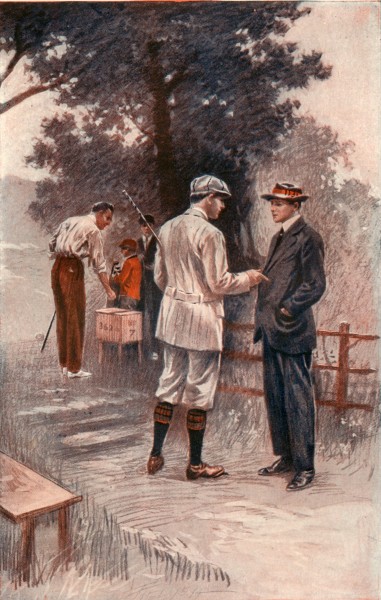
What puzzled Kendall was why Ned Tooker
had gone out of his way to be nice to him.
Of course it was plainly to be seen that
Ned was a creature of impulse, one who did about
what came into his head, but, allowing all that, it
wasn’t quite explained. Kendall was not impulsive
himself, and while he had a strong capacity
for affection, it was not his way to form
friendships very readily. This made Ned Tooker’s
behavior all the more strange to Kendall.
Perhaps it had been just an evening’s prank, a
means to pass an hour before bedtime, and perhaps
Ned would have forgotten all about it to-morrow.
But there was the promise to teach him
golf, and, still more tangible evidence, there was
one of Kendall’s lamentably few clean collars
curled about the mirror-post and bearing the
scrawling legend in the blackest of soft pencil
marks, “2 Dudley.” Kendall put aside the problem
for the moment with a sigh of despair and
got ready for bed. But he hoped that Ned had
been sincere, for the older boy had quite won
Kendall’s heart.
If Kendall had known of a conversation which
passed in Mr. Collins’s study that evening Ned’s
sudden attachment would have been more understandable.
Mr. Collins had asked Ned to come
early as he had something to say to him, and Ned
had arrived ten minutes before any of the others.
Mr. Collins was standing in front of the little coal
fire and Ned had shaken hands with him ceremoniously,
a performance he always went through with
on such occasions.
“Good evening, sir,” said Ned. “I trust I find
you in good health.”
Mr. Collins replied that he was in the best of
condition. Then Ned proceeded to hand an imaginary
cane to an imaginary servant, draw off
two imaginary gloves which in imagination followed
the cane, remove an imaginary top hat
with an air and finally, with a hitch of his shoulders,
allowed the imaginary servant to remove
an imaginary Inverness cape. It was a very
clever bit of pantomime and never failed of applause.
To-night Mr. Collins laughed appreciatively,
laid a hand on Ned’s shoulder and drew him
to the fire:
“Well, everything all right, Tooker? The Optimist
Society making converts?”
“Turning ’em away, sir, at every performance.”
“Good. I’ve got a new recruit for you, or perhaps
it would be better to say a new subject for
you.”
“All right, sir. Who is it?”
“A fellow named Burtis, a new boy this fall.
He rooms upstairs here in Number 21. I think
you’ll like him. I do. He seems to have more
than the usual amount of common sense, for one
thing. And he has principles. I believe, Tooker,
that he’s the sort we like, you and I; the sort that
becomes a credit to the school. But he needs a
little help right now. I can’t go into particulars,
but Burtis hasn’t been altogether fortunate since
he came. I think he’s a bit down-in-the-mouth
just now and he needs some fellow to chum up
to him a bit. I’ve asked him here this evening
and I want you to look him over and, if you possibly
can, get acquainted with him and tide him
over the next month or so. You’re the man for
the job, Tooker. Will you take it?”
“Why, of course, sir. You’ll see us to-morrow
wandering away to the woods arm in arm, to carve
our initials on the tree trunks. Fever near, sir!”
“I won’t,” replied Mr. Collins with a smile.
“I’ll leave him to you, Tooker. By the way, I
neglected to say that Burtis is not yet—er—what
we might call a tasteful dresser. There remains
about him a strong suggestion of the—er—bucolic.”
Ned shook his head. “I’ve never had that,
sir.”
“Had what?”
“The bucolic. Is it catching?”
“I don’t think so,” Mr. Collins laughed. “And,
anyhow, Tooker, I don’t believe it could ever catch
you!”
And so during the evening Ned had been studying
Kendall most of the time, even when it seemed
that he hadn’t a thought beyond creating a laugh.
And what he had seen he had liked. He hadn’t
been surprised, for he had found that Mr. Collins’s
judgment in such matters usually coincided
with his. Ned’s verdict by the time the group
broke up was something like this: “Rather homely
in a nice way. Good eyes and looks straight at
you. Well-behaved. Rather shy. Doesn’t butt
in. Sees a joke before it knocks him down. Has
a good voice. Dresses like a farmer and needs
a hair-cut and a manicure, but looks as though he
knew the use of bath-tubs. On the whole an interesting
subject. Get busy.”
And he had got busy, with what results we
know. If there was some measure of duplicity in
Ned’s first evidences of interest and friendship,
the duplicity was in a good cause. Before he had
taken himself away, however, Ned had ceased to
play a part, and his disconcerting “Do you know,
Burtis, I like you!” had been very genuine. But
on the way back to his room Ned had owned to
himself that it might not prove an easy task to
convert the outward appearance of his new protégé
to Yardley standards.
“He must have some other clothes,” murmured
Ned as he crossed the Yard to Dudley. “And first
of all he must have his hair cut. The hair-cut
won’t be difficult, but it’s a mighty delicate matter
to tell a chap that his clothes aren’t right.
Well, I’ll go at it gently. Tact, Ned, tact and
diplomacy!”
“I wonder,” he reflected after he was in bed and
listening to the musical efforts of his slumbering
roommate, “I wonder what the dickens that kid
did to get probation! He doesn’t strike you as
much of a cut-up. I can’t just see him putting
a tack in Bertie’s chair!” (Bertie was Mr. Albert
Von Groll, Instructor in Modern Languages.)
“Besides, he said the secret concerned others. I
suppose that’s what Collins meant when he said
the chap hadn’t been altogether fortunate since
he came. I should say not! It’s going some to
get on probation within three weeks of the opening
of school! Well, I’ll look him up again
to-morrow. I simply must know why he’s on
pro!”
Yardley played her third football game the next
afternoon. Her opponent was Forest Hill School.
Forest Hill was not considered very dangerous
and there was a rumor that Payson meant to put
in a team of substitutes in the last two periods.
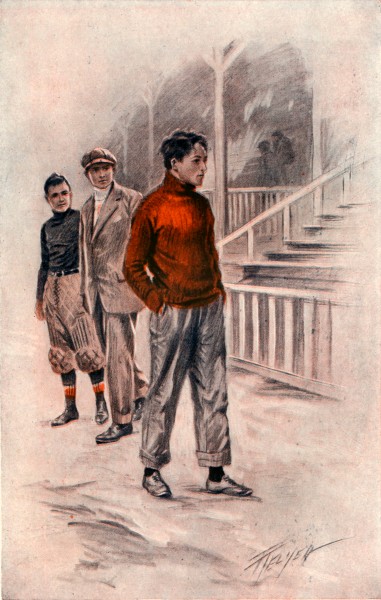
Ned Tooker reached the field only a few minutes
before the time of starting the game and the two
teams were already running through signals and
punting. As he turned the corner and walked
along in front of the crowded stand many hails
reached him:
“Ned, come on up; here’s a seat!”
“Oh you Took! Come and sit in my lap, Ned!”
But Ned only waved and smiled and went on,
searching the stand with his gaze. It was not
until the whistle had sounded and Sandy Fogg
had lifted the ball from the tee with the toe of
his shoe that Ned found whom he was looking for.
Then he climbed the stairs, nodding and eluding
the detaining hands thrust toward him, and
crowded his way along one of the seats until he
reached Kendall. The latter, absorbed in the
game—the Forest Hill left half-back was charging
back up the field with the pigskin nestled in his
arm—hadn’t seen Ned’s approach, and when the
latter crowded down beside him and Kendall
turned to see who it was the smile that came into
his face was well worth seeing.
“Hello!” he said rather shyly.
“Hello, Bendall Kurtis,” replied Ned. “How
are you to-day? Who’s going to win the game?
You’re a football sharp, aren’t you?”
“Why, we are, of course,” returned Kendall
confidently. “But I wish you had seen that Forest
Hill fellow run that ball back. He must have
made twenty yards!”
“Good stuff! Who’s playing for us?”
“Most of the regulars. Fogg’s at center, Ridge
and Merriwell are the guards, Jensen and Mitchell
tackles, Vinton and Norton ends, Roeder and
Stearns half-backs, Simms quarter, and the full-back
I don’t know.”
“That’s Marion. What’s the matter with Hammel,
I wonder? That isn’t Jensen at right tackle,
though, Curt; that’s Stark.”
“Is it? But it looks like Jensen. No, he’s got
dark hair, hasn’t he? And there’s Jensen on the
bench down there; next to Holmes.”
“Jensen’s hair, by the way, is about the same
color as yours, Curt. I don’t like to see them wear
it as long as that, though. Nowadays, when headguards
are the fashion it isn’t necessary.” Ned
glanced at Kendall’s hair and displayed much embarrassment.
“I didn’t mean— Honest, Curt, I
hadn’t— You wear yours long, too, don’t you?”
he ended lamely.
“Me? Why, no; at least, not like Jensen’s. I
guess mine needs trimming.” Kendall laughed.
“Mother’s always after me to have my hair cut,
and now that I’m away from home I guess it’ll
be down on my shoulders if I don’t watch out.
It grows awfully fast.”
“Then you don’t wear it long because you’re a
footballist?” asked Ned. “I’m glad of it, because
you’ll look better when it’s trimmed a little.
I’ve got to have mine done, too. We might
go through the agony together next week, eh?
Hello, look at that for a punt!”
“A dandy!” sighed Kendall. “Simms has got
it. No! Missed it! Got it again, though. He’s
down!”
“Now let’s see what our chaps can do with the
ball,” said Ned. “Here we go! Good work,
Roeder! Five yards easy! And right through
the center! Watch that Forest Hill left end, Curt.
He was off-side about a yard that time. There he
goes again. I thought so! Penalty for you, Mr.
Man!”
The whistle had blown and now the umpire was
carrying the ball five yards nearer the Forest
Hill goal.
“Now will you behave?” murmured Ned.
“This is a fake. Marion can’t punt. I thought
so. Stearns outside tackle for three yards. That
was very neat. Hello! What’s wrong?”
“Stearns fumbled,” said Kendall sadly. “It’s
Forest Hill’s ball.”
“And rather too near our goal to be comfortable.
About the thirty-five yard line, isn’t it?”
“I think so,” answered Kendall, sitting forward
on the edge of his seat. Three cheer leaders
jumped from their places and called for “A regular
cheer, fellows, and get into it!”
And then, while the cheer was crashing forth,
a brown-clad youth hurled himself against the
Yardley line, broke through, eluding player after
player, and circled toward the center of the field
and the Yardley goal. The watchers leaped to
their feet. Pandemonium reigned. Then Simms
dived for him and brought him fiercely to earth
on the twenty yards.
But it was first down again and only four white
lines separated the eager opponents from a touchdown.
The cheering began again, the leaders,
their commands drowned in the noise, waving
their arms in frantic encouragement. From
around Kendall and Ned cries of “Hold ’em!
Hold ’em!” arose and gathered rhythm and volume.
The Forest Hill quarter, hand to mouth,
was bellowing his signals. Then back went the
ball, confusion reigned for a moment and another
scant two yards had been conquered.
“Right through Stark that time,” said Ned.
“I guess they’d better bring Jensen on. Second
down and eight to gain. Hold ’em, Yardley!”
But Yardley couldn’t, it seemed. What looked
like another plunge at the line resolved itself into
a delayed pass to left half, who tore along behind
the line, squirmed past Mitchell and got away
around the end for a good twelve yards. It was
first down again then, and Forest Hill, despite
the frenzied implorations of the Yardley supporters
and the best efforts of Yardley’s players,
gained the three yard line in two plays and
crashed through and over for the final distance
and a touchdown amidst the ecstatic cheers of
some twenty Forest Hill rooters. Unluckily for
the visitors they had secured their touchdown near
the side of the field and the subsequent punt-out
was lost. But five points looked pretty big at
that stage of the game and pessimists amongst
the audience were already predicting defeat for
the home team.
The first period ended after four more plays
and the teams donned blankets and rested. Then
the whistle blew again and the game went on.
Yardley pulled herself together then and managed
to stop the Forest Hill plunges, although the
latter twice won her distance in that second
period. Once Yardley got to Forest Hill’s thirty
yards, but only to lose the ball on a fumble. The
second period ended with the score still five to
nothing and the two teams trotted off the field
and up the hill to the gymnasium.
A boy further along the row engaged Ned in
conversation, and Kendall, leaning back in his
seat, studied his new friend. Although Ned was
two years Kendall’s senior he was scarcely any
taller; there was perhaps the difference of an
inch between the two. Ned was fleshy without
being fat, carried himself very straight and had
a round, good-natured face from which a pair of
shrewd brown eyes twinkled. Kendall had already
learned that it was only by watching Ned’s
eyes that he could tell whether the latter was in
earnest or only joking, for Ned could, and did,
say the most outlandish things with the face of a
truthful undertaker. Ned always looked trim.
To-day he wore a suit of blue serge, a soft flannel
shirt of gray, a blue knitted silk tie, black socks
and rubber-soled tan Oxford shoes. And there
was a little gold pin in his tie, a plain seal ring
on one finger and from his watch dangled a leather
fob with a Yardley seal in silver and enamel.
Kendall mentally resolved to have one just like
it. He had seen them in a jeweler’s window in
Greenburg. And Kendall wondered why Ned’s
clothes fitted him so well, and why his lisle socks
showed never a hint of a wrinkle over his ankles.
Kendall knew that some persons had their clothes
made to order by tailors, and came to the conclusion
that Ned was one of these fortunate mortals,
a conclusion quite erroneous. Ned’s talk
with the other boy was all about golf, and much
of it Kendall couldn’t understand. When the
teams trotted back to the field and Ned settled
into his seat again Kendall asked:
“Are you at the head of the golf, Tooker?”
Ned looked amused. “I’m captain of the Golf
Team,” he explained. “We’ve got a five-man
match on with Broadwood here next Saturday.
That’s what Kirk was talking about. We’ve
never won a match from Broadwood yet, although
we’ve met them three times.”
“Why is that?” Kendall asked.
“We haven’t the players they have. As a matter
of fact, although it sounds like boasting, Curt,
I’m the only member of our team that has a show
with those chaps. Kirk isn’t bad, but he’s always
unlucky, and he’s been beaten every time. This
year he says he’s going to get revenge. He’s been
practicing every day except Sundays, I guess,
since school opened. Last spring he played a
dandy game but drew Frost, who is Broadwood’s
best player, and so didn’t have any show from
the start. By the way, don’t forget that you’re
coming out to learn the game Monday. There
goes the ball. Now, Yardley, get down to business.”
Perhaps the talk they had received from Payson
in the gymnasium helped. At all events,
Yardley’s players did get down to business, almost
with the sound of the whistle, and in the
ensuing ten minutes of playing time scored two
touchdowns. Hammel missed both goals. It was
Tom Roeder who proved the hero of that game.
Tom tore through the Forest Hill line for short
and steady gains that took the ball down the field
in short order. Once Stearns got loose for an end
run and once Simms worked a very pretty forward
pass to Dan, but for the most it was persistent
line-bucking that won the day.
In the fourth period, with the score 10 to 5,
Yardley sent in many substitutes, one of them
Arthur Thompson, who went in for Stearns.
Arthur did very well, especially on defense.
Holmes took Simms’s position at quarter-back
and ran the team in good shape. He was a gingery
chap, and, while he knew less football than
did Simms, and was a less spectacular player,
he got more speed from the team in spite of the
fact that, towards the last, it held six substitutes.
Yardley added a third touchdown to her score
in the final minute of play, and Dan elected to
try the goal himself. The handful of Forest Hill
supporters jeered derisively as the ball left his
toe, for it was apparently much too low. But
some happy chance took it over the bar by an
inch or so—there were some who declared the ball
actually brushed the beam—and added another
point to the final score of 16 to 5.
On the whole the game had been encouraging
to Yardley’s hopes. Clearly outplayed in the first
period, the Blue had managed to hold her adversary
in the second and then, in the last two
periods, “come back” and rush Forest Hill off her
feet. It was what Ned, walking up the hill with
his arm linked in Kendall’s, called “a fine
recovery.”
Ned led Kendall across the Yard to Dudley and
down the corridor to Number 2. Sanford was
not at home. The room was small in comparison
with those in Clarke, but it was more comfortable
and had an open fireplace which Kendall envied
Ned the possession of. For a half hour Ned
showed golf clubs and explained their uses, told
stories of matches won or lost and managed to
get Kendall quite interested in the ancient and
royal game. He even illustrated strokes with his
clubs, to the imminent danger of the furniture.
Then Kendall discovered a line of mugs on the
mantel and had to know about each. And about
that time Teller Sanford came in, and Kendall,
after a few moments, took himself off, Ned’s last
words being, “Don’t forget, Curt; Monday at half-past
three!”
There was a gathering of the talent in Number
28 Clarke that evening after supper; Tom Roeder,
Al Simms, Sandy Fogg, Arthur Thompson, Grafton
Holmes and, of course, Dan and Gerald. They
replayed the game, as boys will, and gave and
took criticism in good part. Neglected opportunities
were regretted, mistakes explained and
many “ifs” indulged in.
“I don’t believe,” said Sandy Fogg, the broad-shouldered,
good-natured center, “I ever played
in a game where there was less punting.”
“That’s so,” said Dan. “It was ‘old-fashioned
football’ from start to finish. We should have
had another score, though. In the second period
we had a dandy chance down there on their thirty
yards.”
“That was me,” said Simms. “I don’t know
how it happened. Seemed as though that ball
just jumped away from me!”
“I don’t regret what didn’t happen so much
as what did,” observed Tom. “We ought never
to have let them get that touchdown.”
Everyone assented more or less gloomily to
that.
“Oh, well,” said Holmes cheerfully, “what’s
the good of post mortems? We beat ’em, and could
have done it again right afterwards. We were
slow in getting started, that’s all.”
“It won’t do to be so slow next Saturday,” said
Dan. “Carrel’s has a pretty good team this year,
I hear.”
“They’re light, though,” said Tom.
“There’s one thing we ought to find, Dan, if
you don’t mind my butting into your affairs,” said
Fogg, “and that’s some fellow who can kick a
goal once out of twenty times.”
“I know,” assented Dan with a frown. “And
don’t you think I’m not worrying about that as
much as you are, Sandy. We all thought last year
that Hammel was going to make good, but he
doesn’t seem to get down to it at all. Payson’s
going to have him out for morning practice next
week and says all he needs is a little more confidence.
I wish I’d let you try those goals this
afternoon, Al.”
But Simms shook his head. “I’m glad you
didn’t, Dan. I’d have slipped up sure on ’em. I
was so afraid you were going to, after that second
score, that I was afraid to look at you!”
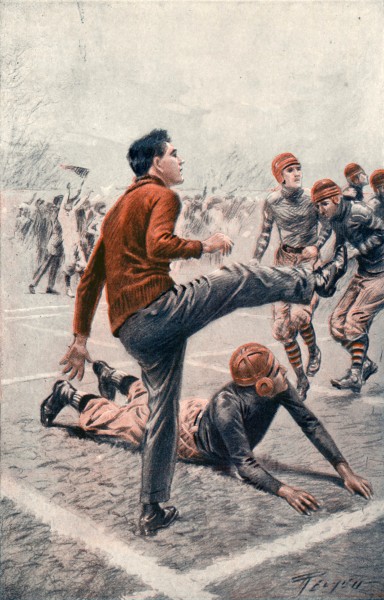
“You should have put in the chap who was kicking
goals down at the field one morning last
week,” said Arthur. “I watched him from the
window for about ten minutes and it looked as
though he couldn’t miss them.”
“Who was it?” asked Dan.
“I don’t know. I couldn’t make him out. One
of the subs, I suppose.”
“Where was he kicking from?” asked Gerald.
“The five yard line?”
“About thirty, I think. And from an angle,
too.”
“Oh, come, Arthur,” laughed Dan, “you were
looking through one of those crazy panes of glass
in Oxford.”
“I was in Oxford, all right; Room C, it was; but
there wasn’t anything the matter with my eyesight.
I guess the fellow made ten or twelve tries
and kicked more than half as many goals.”
Dan glanced about the room questioningly.
“Who the dickens could it have been, fellows?”
he asked in perplexity. “I don’t know any sub
who can do that.”
“Or any regular, either,” murmured Tom.
“This was in the morning, you say?” asked
Sandy Fogg.
“Yes, just after my Latin. I was waiting for
some papers that Collins had.”
“Well, I don’t like to cast asparagus on your
eyesight, Arthur,” said Tom, with a smile, “but
your story sounds fishy.”
“What was he kicking, Thompson, drop or
place?” asked Simms.
“Drop at first, and then he tried placement.”
“From the thirty yards?” asked Dan skeptically.
“Yes; certainly not nearer, Dan; I wouldn’t
swear it wasn’t nearer forty.”
“What did he look like? Had you ever seen
him before? Was he alone?”
“Yes, he was all by his lonesome, and he looked
sort of tall; about your height, maybe. He had
his coat off and wore darkish clothes. That’s all
I could see.”
“But why the dickens didn’t you say something
about it? Have you seen him since?”
“No, but I haven’t looked for him. I didn’t
say anything about it because I forgot it. And,
anyway, I supposed you knew; thought you’d sent
him down there to practice.”
“I wish I did know! A chap who can kick
five goals out of ten would be a find. You’re not
joking, Arthur?”
“Of course I’m not,” responded Arthur impatiently.
“If you really don’t know who he is I
advise you to find him, for he certainly could kick
goals that day!”
“You bet I’ll find him! I’ll find him if I have
to hire a regiment of detectives! Anyone guess
who he is?”
But they all shook their heads.
“The only explanation I can offer,” said Tom,
“is that Arthur went to sleep and dreamed it. I
don’t believe there’s a fellow in school who can
stand on the thirty yard line and drop-kick a goal
from an angle once out of two tries. Either you
were dreaming, Arthur, or what looked like goals
weren’t.”
“That’s so,” agreed Dan. “At that distance it
would be hard to tell. Sometimes you’re mistaken
from the end of the field.”
“You fellows have it your own way,” said
Arthur with a sigh of resignation. “I know what
I saw.”
“Well, we will have to keep a lookout and see
if we can catch him at it again,” said Dan. “And,
for goodness’ sake, fellows, ask everyone you
know. If there really is a goal-kicker in our
midst we can surely find him.”
“Well, he will have to show me,” said Tom,
still unconvinced. “Look here, Arthur, it wasn’t
Wallace, was it?”
“No, I’d know Hammel a mile off. Besides, I
met and spoke to him ten minutes later in the corridor.
No, it wasn’t he.”
“Let’s advertise,” suggested Holmes. “A notice
in Oxford might fetch him.”
“Sure,” Simms agreed. “‘If the student who
practiced goal-kicking on the field last week will
call on Dan Vinton he will hear of something to
his advantage.’ Something like that, eh?”
“I’ll try that if everything else fails,” said Dan
grimly. “A good drop- or place-kicker will be
worth about a million dollars to me this season.”
“We’ll find him all right,” said Fogg. “He’s
probably one of the subs who has discovered he
can kick and hasn’t the sense to say anything
about it.”
“As for me,” said Tom, “I’m like the countryman
at the menagerie when he saw the hippopotamus;
I don’t believe there’s no such critter!”