Gregory arrived at his hotel in the Latin Quarter about ten. Loneliness
oppressed him, and he went to the couple of attics upon the top floor
tenanted by himself and Deschamps. He hoped that the latter was in, and
in a better mood. He wanted an explanation from him, and he was haunted
by some half-formed fear that the Frenchman knew of some calamity that
might be about to overtake them—that something had gone wrong, perhaps,
with the great invention, or that their positions at the Société
Générale Electrique were jeopardised.
There was no one in Deschamps' room as he switched on the electric
light, so he crossed the landing and entered his own.
This room also was untenanted, but the light was full on. He started,
for it could not have been turned on by him, and electric lights burning
at unnecessary hours were viewed with great disfavour and the
subsequent result in the monthly bill by the hotel proprietor. Almost
immediately, however, he understood, for a note in Deschamps'
handwriting, and addressed to him, lay upon the table.
He picked it up, and tore open the flimsy envelope, his hand trembling as he did so.
For some reason or other he felt strangely excited, and he experienced
the feeling that something is about to happen which comes to everyone at
certain times. The note was quite short. It stated that Deschamps had
gone again to the Rue Petite Louise to visit the Carnet brothers, and
told Basil, in terms that were imperative, to proceed there immediately
upon his return. That there might be no doubt whatever of Deschamps'
meaning, the letter concluded by saying, "The matter is most urgent. I
can say no more, but come."
As Basil walked the considerable distance towards the woods quarter, he
was ill at ease and also in a bad temper. It was impossible to disregard
such a summons, but he saw no use nor meaning in it, while it seemed to
him almost an impoliteness to trouble the kindly entertainers of the
night before so soon again. He found his way to the long, narrow street
of the wood-sheds and wood-workers without much difficulty, only once
having to ask the way. As before, the street was ill-lit, and perfectly
quiet, though this time he could see it much more plainly owing to the
absence of fog and the light of a watery moon. He entered the little
passage, and rapped on the counter. Almost immediately that he had done
so the door behind flew open and Brother Charles came out.
The little man was apparently delighted to see him. He was cordiality itself.
"Monsieur Deschamps is within," he said. "Enter, monsieur. We have been expecting you."
Greatly wondering what this might mean, Basil Gregory passed through
into the workshop, where he found Edouard Carnet and Deschamps sitting by the fire.
On this occasion one of the principal workbenches had been cleared of
lumber, and a white cloth was spread upon it, with a salad and boned
chickens from some neighbouring restaurant, flanked by several bottles
of that execrable sweet champagne beloved by the unsophisticated
Parisian at times of festival—the Parisian being at once the most
accomplished gourmet, and the worst judge in Europe of sparkling wines.
Deschamps, who rose with his hosts as Basil entered, was no longer surly
or depressed. On the contrary, Gregory saw at once that he was in a
state of intense excitement. There was a high colour upon his swarthy
face, and the big black eyes were glittering.
In fact, there was an unusual atmosphere of excitement about everyone
present in the workshop, and insensibly, in the first few moments even,
it began to communicate itself to the Englishman.
"We were waiting for you to begin supper," said Brother Edouard in his
twittering voice. "Afterwards we will tell you—what we have to tell."
Basil was not hungry, but he sat down with the others. Both Deschamps
and the Carnets ate quickly and said very little. It was as though they
wished to be done with the meal, but when the first bottle of champagne
was opened and the sweet wine creamed in the glasses Brother Charles
rose and lifted his glass on high. "To the success of the greatest
scheme that human genius ever evolved!" he piped. "To the ruin and
overthrow of that vast and evil power whose slaves and victims we have
been!" With a sudden gesture, he drained his glass and flung it on the
floor, where it crashed into a hundred pieces.
Then he stood there trembling, his bird-like face twisted into a
grotesque mask of hatred, which was reflected by his brother.
Gregory looked at one and the other with amazement and then turned to
Deschamps. He saw that the latter's face was more deeply flushed than
before, the whole expression was one of quivering eagerness and almost
ferocious hope. Gregory leant back in his chair and very deliberately lit a cigarette.
"I do not want to be unduly inquisitive," he said, in a quiet and
measured voice, "but if one of you gentlemen would kindly give me the
slightest inkling of what you are talking about, and why you are all so
excited, then perhaps I shall feel a little less bewildered than I do at the moment."
At this Deschamps broke into a torrent of words.
"My friend," he said, "our troubles are at an end! As Monsieur Charles
has just said, one of the most stupendous schemes that has ever entered
the human brain has come to me. By its means we shall all become
fabulously wealthy in a short time if all goes well."
Basil was staring at his friend, wondering whether he had taken leave of
his senses, when Charles Carnet interposed. "We shall not all become
wealthy," he said. "Edouard and I have enough; we want no more. You will
become wealthy, and we shall have our revenge."
"I am listening," said Gregory rather stolidly.
As if by common consent the other three rose from the table. "Come to
the fire," Deschamps said, speaking now in a low voice, "and you shall
hear everything."
They sat round the fire very close together, and, looking round as if to
be quite certain that there was no one lurking in the recesses of the
workshop, Deschamps began:
"Mon ami," he said, putting his hand upon Basil's arm, "we are going
to take a journey, you and I."
"A journey?" Gregory said.
"To Monte Carlo," Deschamps replied.
Then there was a silence; Basil felt his brain whirling. "What do you
mean?" he said at length.
"I mean this," Deschamps answered, "that fortune is within our grip at
last, that we can now make as much money as we like, enough to conduct
all our experiments and get out perfect models of our invention to place
before the world. I will explain."
He threw away the cigarette which he had been smoking and began to
outline a plan so novel, a conspiracy so absolutely without precedent in
the history of the world, that his three listeners remained spell-bound.
"Chance, and chance alone," he began, "has placed the opportunity for
the most sensational coup of modern times in our hands. In the first
place, chance—the Spirit of Fortune, or what you will—led us to this
room in which we are sitting. The Messieurs Carnet, as you know, have
for years been employed in making roulette wheels for the Casino at
Monte Carlo. As you have also heard, they have resolved to give up their
occupation. The tragedy which has saddened their lives has been directly
due to the existence of the great gambling establishment. Both our
friends would give anything to be revenged upon the organisation which
has wrecked their hopes, and owing to the existence of which their so
beloved nephew met his untimely death."
A low mutter of assent broke from both the little Frenchmen.
"Very well, then," Deschamps continued, "you have wondered at my
abstraction during the last twenty-four hours. I could not speak to you.
I was absorbed. I hardly heard anything you said. The whole forces of my
intellect were focussed upon one thought, one aim. The germ of an idea
came to me. It was like a lightning flash, illuminating with sudden
splendour the dark skies of night. The flash came and went, but the germ
of the idea remained behind. Since then I have been working unceasingly
at it, and now I believe I have it perfected. You, yourself, my dear
friend, will be able to seize on any flaw, to improve upon my original
idea. Very well, then; I came to our friends here, and told them that I
believed I could, if I would, deal the Administration of Monte Carlo an
almost fatal blow. It was, I explained to them, by means of science, and
more especially of your and my new invention, that this could be done. I
pointed out to them that it would require their co-operation. I think I
may say"—here he looked interrogatively at the Carnets—"that directly
I made my proposal they agreed."
"We welcomed it with joy," said Brother Edouard instantly. "To us also
it came as a lightning flash, illuminating the dark and showing the word
'Revenge' in letters of fire upon the horizon!"
Basil leant forward, deeply interested. As yet he had not the slightest
idea of what was coming. Nevertheless, he was so impressed by Deschamps'
firm and confident manner that hope was beginning to rise high within
him, and an excitement to which he had been a stranger for many days,
began to flow over him like a tide.
Moreover, he knew Deschamps so well that he was certain that this was
no vision. The Frenchman was a Southerner, it is true, given to
pictorial flights of fancy in many ways. But when he began to speak of
any matter connected with science or their invention, he never made the
slightest overstatement. Science was his life and his religion.
"As yet," Deschamps said, "Monsieur Edouard and Monsieur Charles know
nothing of the actual means I propose to employ. I am going to divulge
my plan in such a way that they, knowing nothing of electricity and its
powers, will be able to understand my project in every detail. I shall
not use any technicalities beyond what are absolutely necessary. But
you, mon ami, will understand everything from the scientific point of
view, and you will see how perfectly feasible and likely of success is
what I propose to do."
He paused, and going to the table, poured out a little water into a
glass and drank it off. He did not sit down again, but walked up and
down a measured beat of four yards, talking with intense earnestness.
"You know, gentlemen," he said to the two wood-carvers, "what wireless
telegraphy means?"
"But, yes," said Brother Charles, "have they not just installed the
Marconi system in the Eiffel Tower? Of course, we know, but not, I
think, more than any ordinary member of the public."
"Very well," said Deschamps. "Now I must tell you that Monsieur Gregory
here and myself have for years been at work upon a system of
transmitting messages without wires, which, we believe, and indeed are
certain, surpasses the invention of Signor Marconi as a modern
battleship surpasses an ancient wooden frigate. It is this system of
ours that I propose to employ in the secret war against the
Administration at Monte Carlo. By its means we shall be able to win an
enormous sum of money at roulette. We shall be able to win exactly how
much, and when, we please. Every detail is perfectly clear in my mind,
and discovery is almost impossible with the precautions I shall take.
You must remember that the capital of Monte Carlo is unlimited. You
know nothing of the place, Basil?"
Gregory shook his head.
"Then, pardon a short digression," Deschamps continued, looking at the
Carnets. "The gambling rooms of Monte Carlo pay the Prince of Monaco a
yearly subsidy of eighty thousand pounds for permission to carry on
their business in his territory. There are no rates and taxes in Monte
Carlo, the Casino pays them all. Education is free. The Casino itself is
a glittering white palace upon the edge of the Mediterranean, erected at
an enormous cost, and decorated with the most lavish splendour. Few
kings have such vast halls and salons in their palaces as those in the
temple of the Goddess of Chance. The Casino is free to all the world,
though, of course, the Administration reserves the right of declining
admission. The gardens that surround this palace are the most beautiful
in the world. Sometimes, as if by touch of an enchanter's wand, the
thousand gardeners steal out in the night, and in the morning vast
parterres of flowers, which had been all red and gold as the sun sank,
are changed to blue and white. In addition to this—and the expenses of
the Principality are incalculable—the company pays a revenue to its
shareholders of over twenty-five million francs!"
Basil had been listening with absorbed interest. He started now.
"Twenty-five million francs!" he said, in an awed voice. "Clear profit
after those colossal expenses? A million English pounds!"
"Exactly," Deschamps returned, "and I have told you this so that you can
see that the resources of the company are practically unlimited. The
amount of their funds no one knows, but many a national bank could not
equal it. So you see, the authorities are pledged for the sake of their
own continuance to pay any player his winnings, however enormous they
may be. There have been several cases of players quite recently winning
sums of two and a half million francs—a hundred thousand pounds of your
English money. But we"—here his voice for the first time began to
tremble with excitement—"we can win whatever we please! And now to the
way in which it is to be done."
Deschamps stopped short in his walk up and down. He leant against the
work-table upon which were the remains of the supper.
The eyes of the other three were fixed upon him with an intense regard.
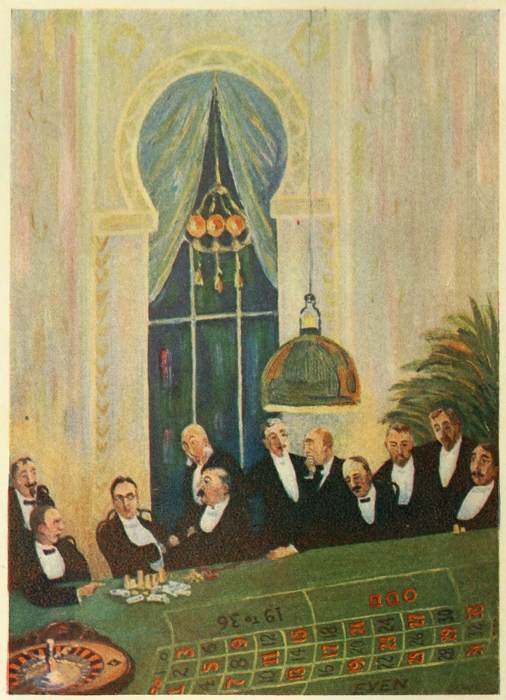
"You understand," he said to Basil, "the principle of roulette, do you not?"
"Roughly," Basil answered; "the little ivory ball about the size of a
large marble is spun as you spun it the other night, and falls into a
numbered slot. The people who have placed their money upon a square of
the table with a number corresponding to that of the slot into which the
ball falls are the winners of varying amounts."
"That is more or less it," Deschamps replied. "I am not concerned at the
moment with anything but the bare mechanical operation. The whirling of
the wheel at the bottom, the opposite course of the ball, and the
triangular silver stars which break it, all make it a pure matter of
chance into which apartment upon the wheel the ball is going to fall. It
is obvious, therefore, that if by some means the player could determine
into which slot the ball is to fall, he would have the bank at his mercy."
"Precisely," Basil said.
"Very well, then. It is a means by which this may be attained that I
have discovered. Of course, you, as an electrical engineer, can easily
see that a roulette wheel might easily be constructed by the bank by
which it could control the falling of the ball and so prevent players
who had backed a particular number from winning. This has often been
done by dishonest people who run private gambling hells. Upon the
surface everything appears all right, but, of course, an expert
examination would very speedily result in the discovery of the secret
mechanism—generally, by the way, electrical. Wires can be hidden in the
leg of the table upon which the wheel stands, and controlled by the foot
of the croupier who spins it. But never before—and I wish you to keep
this point most carefully in mind—has it been possible for the player
to control the wheel in action without the connivance of the croupier or
the bank. Now listen." He began to address himself now more particularly
to the Carnet Frères.
"The first detail in my plan is that the little ivory ball, while
remaining to all appearance a solid ball of ivory, is not really so. It
will contain a core or heart of steel. The very finest workmanship alone
could accomplish this without any possibility of detection. I assume—am
I right in assuming?—that our friends, Messieurs Charles and Edouard,
could make a ball or balls of this description."
The two little men, who had been listening with rigid attention, spoke
to one another rapidly for a moment or two, using technical terms which
the others could not understand.
Then Brother Charles looked up. "We can do it," he said proudly. "It
will be difficult, very difficult. First of all, there is the weight to
be considered, for the ball must not exceed a normal weight. Then there
must be a special quality of ivory, and work in turning and hollowing so
extraordinarily fine and delicate that perhaps only one of the Indian or
Chinese carvers could do it so that the operation showed no trace. I am
certain that no one in France but myself and my brother are capable of
this feat, but you may rest content—it is not beyond our powers!"
The little man concluded with quiet pride, and Deschamps showed
unmistakable relief.
"I was certain of it," he said, "but, naturally, I had some little
anxiety. Everything, in the first instance, depends upon that."
"We then have our prepared ball or balls—for a whole set must be made.
The next point is the peculiar construction of the rotating wheel upon
which the slots are fixed. Then, you, Basil, will immediately
understand, but I must explain it carefully to our friends, they will
have to work under my instructions, and with material which I supply.
The prepared wheel will be constructed quite differently from the
ordinary ones, though it will look exactly the same, when painted with
the numbers. Each slot, messieurs, will be constructed of metal varying
very slightly in composition. To all outward appearance the metal will
be just the ordinary tin amalgam generally employed. In reality, as far
as the metal goes, each slot will have, so to speak, a personality of
its own—a certain power of receptivity of certain influences which no
other slot has."
He stopped for a moment, and suddenly Basil Gregory rose from his
chair, and gave a great shout of excitement. A glimmering, a faint
glimmering, of the stupendous idea had come to him, and he trembled all
over with excitement.
The two little men were no less excited than he, though as yet they were in the dark.
Deschamps made a movement with his hand, Basil sat down again, and the
Frenchman went on speaking.
"My colleague here," he said, "is already beginning to grasp the idea.
In a very few more words you will understand it also. I mentioned
wireless telegraphy to you just now. I also told you that my friend and
I had improved enormously upon the present system, though, owing to lack
of money, we have never been able as yet to place our invention upon the
market or get it recognised, while if we took it to quarters where it
would be appreciated and understood, we should be robbed of nearly all
the profits, as has happened with many another inventor.
"Well, then, messieurs, the invention of my friend and myself—I speak
purposely in non-technical terms—makes it possible for the mysterious
electrical power which sends messages over thousands of miles of
space—the Hertzian waves in short—to penetrate through any amount of
material resistance in the form of the walls of buildings, or barriers
of any kind. Marconi has already accomplished something of this; we have
perfected it. Now, in wireless telegraphy it is already possible to
'tune' sets of instruments so that the message sent at one end of the
transmitter will only be received at the other by a similarly tuned
receiver, this preventing the message being picked up by other receivers
as it flies through space. I am about to apply this principle, greatly
facilitated by our invention, to the slots of the roulette wheel. Each
slot will be tuned separately from its fellow. Having got thus far, let
me explain to you that, by means of the Hertzian waves, the operator
will be able to turn a slot into a temporary magnet of low power at any
moment he desires. That is to say, that when the prepared wheel is being
used upon the tables at Monte Carlo, an operator with his instrument may
be three or four hundred yards away in the upper room of a neighbouring
hotel, or, if necessary, two miles away up upon the mountains of the
Maritime Alps, and will be able to turn any slot he desires into a
magnet for just as long a period as he wishes it to remain so. There
will be no visible connection between the distant operator and the
wheel. It is absolutely impossible that the people clustered round the
wheel can know what is going on. The great secret, silent power of
electricity will be at work, and yet entirely unsuspected and unknown."
He paused again, and triumph dawned upon his face as he saw that now not
only did Basil Gregory thoroughly understand the plan, but that the
brothers Carnet also had grasped the idea. Their faces were blazing with
amazement, their bodies tense and rigid, there was no sound in the
workshop but that of his own voice.
"The rest is easy to explain," he said. "If, say, at a given moment, the
slot painted seven is converted into a low-power magnet directly the
wheel begins to revolve, then, as a natural consequence, as soon as the
velocity of the ball begins to die away, and the attractive power of the
magnet, which slot number seven has become, proves greater than the
impelling force of the ball, the ball which has a steel core will fall
into slot number seven.
"You will observe, then, that the unseen operator any distance from the
Casino is absolute master of the play at the particular table where the
prepared wheel is.
"His confederate will play at this table. He and the operator will carry
watches that are absolutely and utterly reliable, and which are
synchronised to a hundredth second of time. A course of play is
determined on. A sequence of certain numbers is agreed upon between the
two. Let us say that the player enters the rooms at twelve o'clock in
the morning and secures his place at the special table. At ten minutes
past twelve to the instant it is agreed that number seven, let us say,
is to receive the force of the Hertzian waves for a certain definite
period. As a usual thing, so rapid is the paying out and gathering in of
money at the tables at Monte Carlo, the wheel is spun every minute and a
half. Of course, if the stakes are very high, or if there is a dispute,
a coup may take a little longer. That, however, is a fair working
average. For a little less than a minute and a half, then, from the time
agreed upon, i.e., ten minutes past twelve, seven will remain a magnet.
For that particular spin seven must infallibly prove the winner. The
thing can be repeated over and over again."
"It is marvellous!" the brothers shouted out in chorus. "It will be
impossible to detect. Monsieur, you are the greatest mechanical genius
the world has ever seen!"
It was a great moment for Emile Deschamps. All the theatrical instincts
so deeply implanted within him were gratified. To watch the faces of his
audience, to see the dawn of understanding and admiration as he talked,
had been to him like cool water to one in the desert.
He stood still now, one hand upon his heart, and bowed. He had no
thought of mockery, the gesture was perfectly spontaneous and sincere.
He turned to Basil.
"And you, my friend, what do you think of it?" he asked.
Basil started. He had been thinking furiously, and the question came unexpectedly.
"It is, of course, extremely brilliant," he said. "Naturally I can see
that even more readily than our friends here. I don't believe any brain
but yours, Emile, would ever have thought of it. Properly worked, and
there are a good many details I should like to discuss with you, it's
almost certain the scheme will succeed. But——"
"Ah," Deschamps burst in, "the usual English reservation! The invariable
'but' of caution! What is it now, you cold-blooded islander?"
"Oh, it is not caution," Basil answered. "Haven't I just told you that
the thing must succeed with a few modifications upon your original idea?
It is the morality of the thing I am thinking of."
Deschamps had sat down. He jumped up now like a Jack-in-the-box.
"Tiens!" he cried. "Morality? Morality?"
"I thought you had forgotten the meaning of the word," Basil answered
dryly. "It seems to me—I only offer the opinion for what it is
worth—that while this little plan is about as alluring a proposition as
I ever heard, one of the most elementary problems of life has been quite
lost sight of. We are going to steal—to put it quite frankly. It is an
iridium-pointed, hot-pressed, wire-wove, jewelled-in-every-hole sort of
steal, I know, but it is a steal all the same, isn't it? I am open to
conviction, of course, and, by the way, if anything goes wrong,
conviction is just what will occur. We have a little poem in England
which sums up the question in a nutshell—
He who prigs what isn't his'n,
When he's cotched will go to prison;
or, to put it in simpler form still, 'the penalty for abstracting quids
by electricity will be quod'—you are a Latin scholar, I believe, Emile?"
The Frenchman made an impatient and angry gesture of his hands.
"There is no time for blague," he said, "with your quids and your
quods. I know nothing of your piggish English play upon words. Of
course, if it is the fear of discovery that deters you, and the
possibilities of arrest, well——"
He did not conclude, but shrugged his shoulders, and puffed out his lips
with a peculiarly French contempt.
Basil was quite unmoved. "It is not that," he said, "as you know very
well, Emile. I would risk anything upon any chance. Our lives at the
present moment are very like two puddings in a fog. Prison could not be
much worse. But I do not quite see how one is going to reconcile this
marvellously ingenious plan of yours with ordinary morals. There have
been lots of times when you and I have wanted a bottle of wine or a
packet of cigarettes very badly, and hadn't the money to pay for them.
If I had proposed to you to take a bottle of chambertin while the
wine-merchant was not looking—well!"
The two little Frenchmen had been listening with keen attention to this
dialogue. Basil's English irony had been lost upon them, but they
understood the main lines of his objections well enough.
It was Brother Edouard who came to the rescue.
"Permit me to say a word," he interrupted in his gentle, high-pitched
voice. "The cases of robbing a wine-merchant and the Administration of
Monte Carlo have not the slightest analogy. Your premises are false,
Monsieur Gregoire. This organisation at Monte Carlo is simply a soulless
machine for the making of money by exploiting one of the baser passions
of men. I and my brother—I freely confess it—have been parts of that
machine for years. But you know the sad event"—his voice trembled a
little—"which opened our eyes. We said to each other, 'If our hopes in
life have all been utterly swept away in an instant by the Casino at
Monte Carlo, how many other homes have been ruined, young lives
sacrificed, prospects blighted?' A soldier who assists to exterminate,
or, at any rate, to harass and injure a dangerous and unfriendly tribe
of savages is generally looked upon as doing a fine and meritorious
thing. Nor does he disdain to take the pay of his country for so doing.
You and Monsieur Deschamps will be in exactly the same case. You will be
seriously injuring the Casino. It may be that when the idea is developed
roulette will become impossible, though that is only a side issue, and
also—here you must listen to me carefully—you are not proposing to
obtain a large sum of money for the mere gratification of low
pleasures, to acquire a soulless ease and comfort. You have invented
something which will be of the highest benefit to mankind. Want of
fortune alone prevents you conferring that benefit upon the world. As
inventors, it is your duty—at least, so it appears to me—to take
advantage of the opportunity which the genius of Monsieur Deschamps has
provided. No one will be hurt except people who can well afford to suffer."
His voice had gathered strength as he went on, and as he concluded there
was an almost prophetic note in it, a gravity and seriousness of
conviction which had an instant effect upon Basil Gregory's wavering mind.
He thought for a minute, and then looked up.
"So be it," he said. "You have convinced me, though I will say I was
ready enough to be convinced. We will try it. Like all other gamblers,
we will risk everything upon a single throw."
As if by common consent, they all rose to their feet.
"And now," said Brother Charles, who had hitherto been silent, "let us
form ourselves into a committee of ways and means."
Deschamps' face grew pale. "Mon Dieu!" he cried, "fool that I am! I
have been carried away by the splendour of the prospect, and have
forgotten the most essential fact of all. Our friends here"—he was
speaking to Basil—"can prepare the wheel with my assistance. But how
about the apparatus, which, as you know, is costly enough for ordinary
purposes? The particular apparatus I shall want with all our own
modifications and specialities will cost about five thousand francs. And
then there is the getting to Monte Carlo, the putting up at an expensive
hotel to avoid suspicion—for the Administration has its spies and
detectives everywhere. It may be necessary to bribe, a thousand
emergencies may occur, which only money can overcome."
He dived one hand into the pocket of his trousers, and withdrew four
coins. He flung them on the floor with a curse.
"Three francs fifty!" he cried; "three francs fifty! Basil, I am a fool
and a dreamer! You can preserve your morality unspotted, after all!"
Basil looked blankly at his friend, who was now limp with an almost
ferocious dejection and self-contempt. He nodded slowly.
"Same old thing," he said; "we ought to have expected it. We are
stumped, old chap, for want of three or four hundred pounds."
An odd hissing noise, like the escape of steam from a very small pipe,
recalled him to his surroundings. The brothers Carnet were regarding the
two young men with pity. "Ah!" said Brother Charles, almost wringing his
hands, "What fools these men of genius are, Edouard! Messieurs!
Messieurs! my brother and I will, of course, provide the funds. Haven't
we already told you that we are quite well-to-do for people in our
position? You will draw on us for any money you may require. Nor must
you spare the francs. This is a great affair, conduct it greatly, and
you will earn our undying gratitude."
Once more the volatile Deschamps was transformed from limp dejection to
painful excitability. He leapt at both the little men, and embraced each
in turn. He called down blessings upon their heads, and then, in an
instant, assumed the manner of a calm business-like man.
He took a fountain-pen and an envelope from his pocket.
"You will, of course, take whatever proportion of our winnings you think
fit, gentlemen," he said, "and as far as the amount of the winnings is
concerned, you have only to say the word. It will be as well to make a
note of the terms at once, and we will have a proper agreement drawn out."
The Carnets looked at Basil Gregory as much as to say, "What a hopeless
person this Southerner is!" Basil, far quicker than Deschamps to
understand the odd little men, changed the subject at once. "Never mind
about that now, Emile," he said. "Our friends have very kindly offered
to advance the money necessary for the great coup. We had now better go
into other details, so as not to lose time. Financial affairs can be arranged later."
Deschamps nodded. "Very well, then," he said, "let us recapitulate what
is absolutely necessary to be done, immediately. In the first place, you
and I must give up our positions at the Société Générale."
Basil started at this. "Is that really necessary?" he asked. "Couldn't
we get leave?"
Deschamps shook his head. "I feel almost sure they won't give us leave,"
he said. "We are only members of the rank and file, remember. But
'nothing venture, nothing have,'—we must resign."
"Very well," Basil replied, "we will give them notice to-morrow." But as
he said it he had a curious heart-pang as he thought of Ethel, and that,
if anything went wrong, he must resign for ever any hopes of calling her his own.
"Now, about experiments and the construction of the apparatus,"
Deschamps continued. "We must have a workshop, to begin with."
"This is at your service," the brothers said eagerly.
Deschamps bowed. "A thousand thanks," he said. "Nothing could be better
fitted for the purpose. Here we shall be absolutely secret. You have a
forge and many appliances which will be useful. To-morrow I must buy
other machinery and certain tools. Fortunately you have the electric
light here, and I can tap one of the plugs for all the current that I
shall require for experimental purposes."
Basil snapped his fingers as if an idea had just come to him. "By Jove,
Emile!" he said, "how on earth shall we manage at Monte Carlo? We cannot
work with batteries. First of all, we could never get them into the
hotel without being seen, and even if we did, we shouldn't have enough power."
"You don't know the Principality," Emile answered. "All the hotels have
the completest installation of electric light possible. It will be the
simplest thing to tap one of the mains and connect it with our new
portable transformer. We can get exactly what current we require."
"Good," Basil said, realising how deeply his friend had gone into the
technical side of the great coup.
Edouard Carnet spoke. "If you will come here to-morrow at midday," he
said, "having already resigned your posts at the Société Générale, I
will have drawn a sufficient sum of money from the bank to enable you to
make all necessary purchases. Then we can go ahead as fast as we like."
"But don't forget this, brother," Charles Carnet interposed, "our new
wheels must be dispatched to Monaco. As a matter of fact, they are
expecting them immediately, but a telegram saying that we require
another fortnight will put that right. We have had to take a little
extra time before now, during the past years. A fortnight, however, is
as much grace as we shall be able to get and preserve our friendly
relations with the Administration. Will you be able to do all that is
necessary in the construction of the apparatus within a fortnight?"
"It will be quick work," Deschamps replied, "but it can be done. My
friend and myself can construct the necessary apparatus for sending the
waves, and we can also, with your co-operation, prepare the wheel and
tune the slots for the reception of the vibrations."
Then Basil spoke. "Look here, Emile," he said, "a thought strikes me. Of
course, I don't know anything about the Casino, and I have never been to
the South of France, but won't it look strangely suspicious if we win
day by day at the same table? Won't they change the wheel?"
"That is exactly what they will do, monsieur," Edouard Carnet replied to
him. "Of course, when a man wins a large sum at one table he always goes
to the same table to play. It is his lucky table. But there was a case
some years ago when a little syndicate of players—by means of the most
careful calculations—noticed that the wheel of the table where they
made their game had a slight bias. They traded on the fact for several
days, and won an enormous sum of money. It was one of our wheels, but
there must have been a flaw in the wood, or we had not allowed for the
expansion of the metal, owing to the greater heat of the South. At any
rate, as a result, the wheels have been constantly changed ever since."
"Then, how can we carry out our plan?" Basil asked.
"The wheels are not taken away entirely," Edouard went on; "they are
simply changed from table to table. The prepared wheel will have some
distinguishing mark by which you will know it. We must think that out;
it must be some very slight thing—a knot in the wood, a mere scratch on
the outside, would do."
A dry little chuckle came from Brother Charles.
"We are getting on! We are getting on!" he said, with a grotesque mirth.
"My brother, what is to prevent us preparing three wheels? They should
be 'tuned'—as Monsieur Deschamps calls it—exactly alike. Each will be
marked in some way, so that our friends can distinguish them from the
unprepared wheels. There are twelve roulette wheels in all used in the Salle des Jeux."
"Bien!" Edouard replied; "your brain moves quickly. By this means our
friends will be able to move from table to table as they wish."
"And I would suggest," Deschamps broke in, "that we do not play for more
than a week in all. In a week's time we shall be able to win an enormous
sum of money, without unduly exciting suspicion. Great runs of luck, I
have observed, generally last for about seven or eight days. If, as
Monsieur Charles suggests, we move from table to table, a week should
be sufficient. We can go away with enormous sums, and no one will be any the wiser."
"And another thing," Edouard Carnet said, "which of you is going to be
the actual operator of the telegraphic instrument, and which the player at the tables?"
"Oh, I'd much better play," Deschamps answered, "and Basil work the instrument."
Both the Carnets shook their heads at this.
"No," they said together, "that will be unwise. Monsieur Gregoire is
typically English. It is always best for a foreigner to make these great
coups. Moreover, the luck of the English and the Americans is
proverbial. Monsieur Gregoire must be thought an English millionaire. No
one thinks it strange when a millionaire wins another million! But, to
safeguard the future, it would be as well that monsieur were disguised."
Basil shook his head. "Disguised!" he cried. "Oh, I don't like that idea at all!"
"It is necessary," Edouard Carnet said firmly; "but all that you have to
do, monsieur, is to shave off that blonde moustache, darken your skin a
little, and wear pince-nez. It is only ordinary caution, after all.
When you return with the spoils of war and grow your moustache again,
nobody will ever connect you with the winner of millions upon the Côte d'Azur."
"And I have another idea," twittered Brother Charles, his little face
beaming with joy. "Monsieur Deschamps shall go to Monte Carlo as the
valet of Monsieur Gregoire. It will all seem so natural—the assiduous
valet, the heavy luggage, which the man-servant must guard! You see it?"
The situation struck Basil as humorous. He threw back his head and
laughed aloud. "Emile," he said.
Deschamps entered into the spirit of the thing. "Bien, monsieur," he answered.
"Sit down at the table and teach me the rules of the game of roulette!"