Transcriber’s Note: images outlined in blue (like this note is)
are clickable for a larger version.
CHAMPIONS OF THE FLEET
BY THE SAME AUTHOR.
FAMOUS FIGHTERS OF THE FLEET.
THE ENEMY AT TRAFALGAR.
THE ROMANCE OF THE KING’S NAVY.
ETC. ETC.
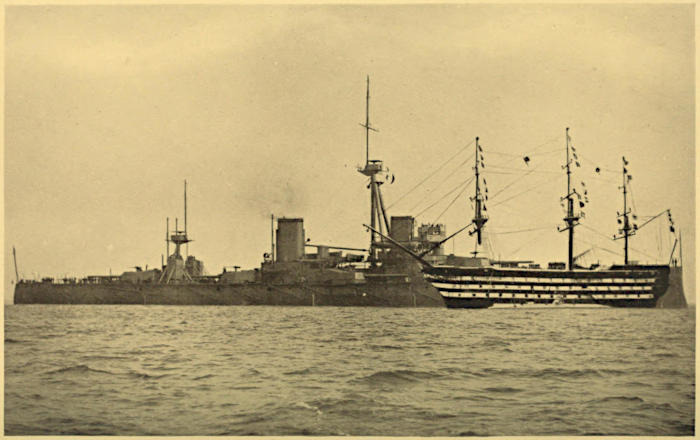
CHAMPIONS THEN AND NOW: THE VICTORY AND THE DREADNOUGHT
Both ships, and the submarine alongside the “Victory,” are shown
on the same scale. The picture is reproduced by kind permission
of the Proprietors of the “Illustrated London News.” Photos by
Stephen Cribb, Southsea.
CHAMPIONS
OF THE FLEET
CAPTAINS AND MEN-OF-WAR
AND DAYS THAT HELPED TO
MAKE THE EMPIRE
BY EDWARD FRASER
WITH 19 ILLUSTRATIONS
LONDON: JOHN LANE THE BODLEY HEAD
NEW YORK: JOHN LANE COMPANY MCMVIII
WM. BRENDON AND SON, LTD., PRINTERS, PLYMOUTH
PREFACE
These tales of the navy of the fighting
days of old are to some extent, it may
seem, cruises in rather out-of-the-way
waters. At the same time, they may
claim present-day associations that should render
them not out of place just now. How and why, for
instance, the world-famous name Dreadnought came
into the Royal Navy is a story of interest on its own
account that ought to be timely. With that also is
told something of what our Dreadnoughts of old did
under fire in the fighting days of history: with
Drake; against the Armada; with Sir Walter
Raleigh; against De Ruyter and the Dutchmen;
at La Hogue; how one gave the sobriquet “Old
Dreadnought” to the famous Boscawen; how Nelson’s
uncle and patron Maurice Suckling captained
the same ship in battle; of Collingwood in the
Dreadnought; and of the Dreadnought at Trafalgar.
We get, too, a passing glance at certain of the
“points” of our mighty battleship the Dreadnought
of the present hour. Again, in the year
that has seen the name of Clive recalled to the
memory of his countrymen by an ex-Viceroy of
India in connection with the hundred and fiftieth
anniversary of Plassey, what the navy did for Clive
at the most critical moment of his fortunes, how
without its active support on the field of battle Clive
would have been powerless, the forgotten, or certainly
little appreciated, part that the navy took in the
founding of our Indian empire—should be of interest
to English readers. This year again sees a new
Téméraire, one of our “improved Dreadnoughts,”
added to the Royal Navy. The fine story of how
the never-to-be-forgotten name Téméraire—immortalized
alike by Turner and by Trafalgar—first came
to appear on the roll of the British fleet is told here.
And it should be of interest to recall certain incidental
matters concerning the old Victory herself:
among others the circumstances in which she came
to be built and was safely sent afloat in spite of
expected incendiarism; where too those who fought
on board at Trafalgar came from, and how many
representatives each of our counties had with Nelson
in his last fight. Such are some of the matters dealt
with in these pages, which of themselves should
afford entertainment and help also to make this book
useful.
On Board our Flagships at Trafalgar:—Captain
Hardy and those who Manned the Victory—Under Fire with
Collingwood—“Old Ironsides” and the Third in Command
Both ships, and the submarine alongside the
Victory, are shown on the same scale. The picture is
reproduced by kind permission of the proprietors of the
Illustrated London News. Photos by Stephen Cribb,
Southsea.
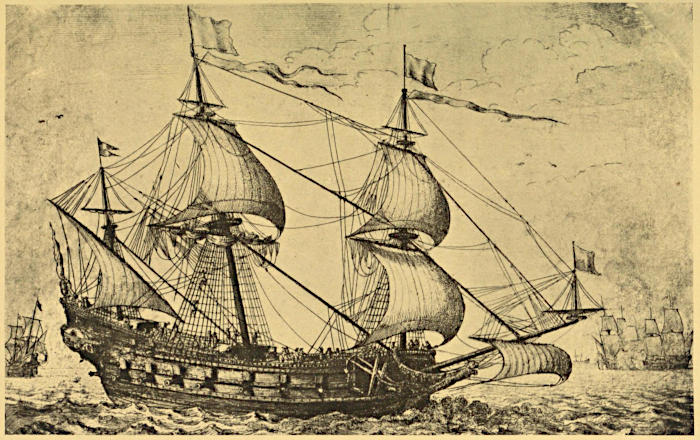
From a contemporary print kindly lent by Mr.
Wentworth Huyshe. The Dreadnought is shown as she
appeared when serving in the “Ship Money” Fleet of Charles
the First—circ. 1637.
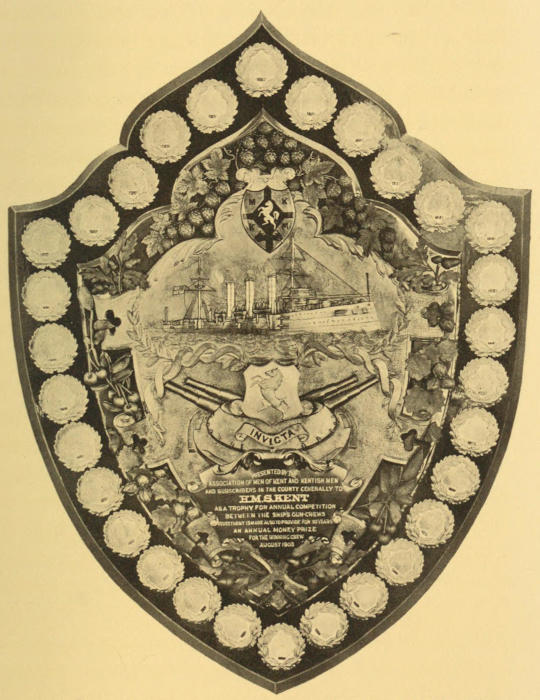
From a photograph kindly lent by the designers
and manufacturers of the trophy, Messrs. George Kenning &
Son, Goldsmiths, Little Britain and Aldersgate Street, London.
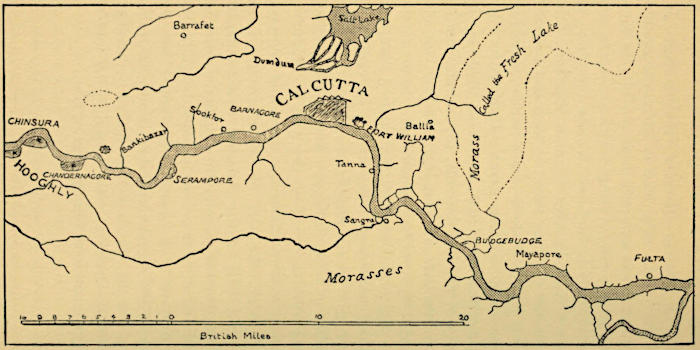
The Scene of the Operations under Admiral
Watson and Clive
In the foreground to the right is seen the
Warspite attacking the Téméraire. Boscawen’s
flagship, the Namur, is in the centre flying the Admiral’s
Blue Flag at the main, and at the fore the red battle-flag, the
“Bloody Flag” of the Old Navy. Painted by Swaine. Engraved and
published in 1760.
The picture shows the Royal George (in the
centre) sinking the Superbe, and the Formidable
(immediately beyond the Superbe and in the background)
lowering her colours to the Resolution (the ship coming
up astern of the Royal George). Painted by Swaine. Engraved
and published in 1760.
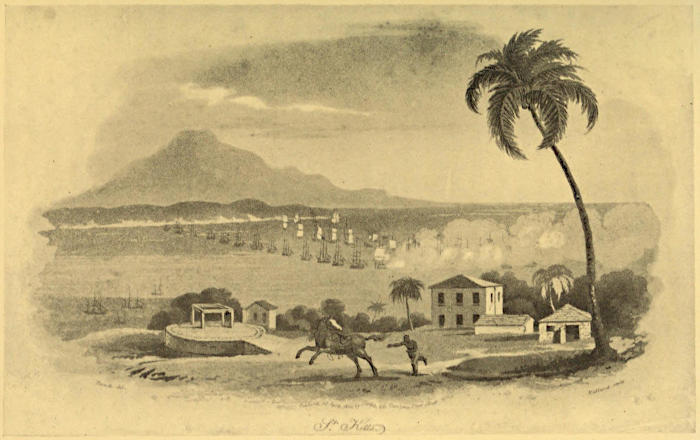
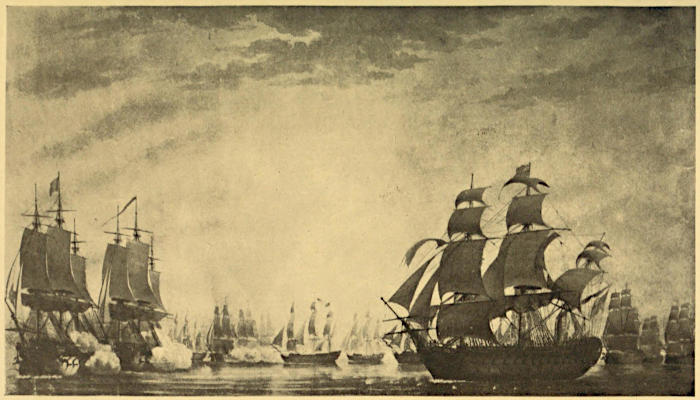
Admiral Sir Samuel Hood’s squadron of 22 ships (at
anchor) beating off De Grasse’s opening attack with 28 ships (shown
coming into the bay under full sail) at 2.30 p.m. on January 25th,
1782. Drawn by N. Pocock, “from a sketch made by a gentleman who
happened at the time to be on a visit at a friend’s, on a height
between Basse Terre and Old Road.”
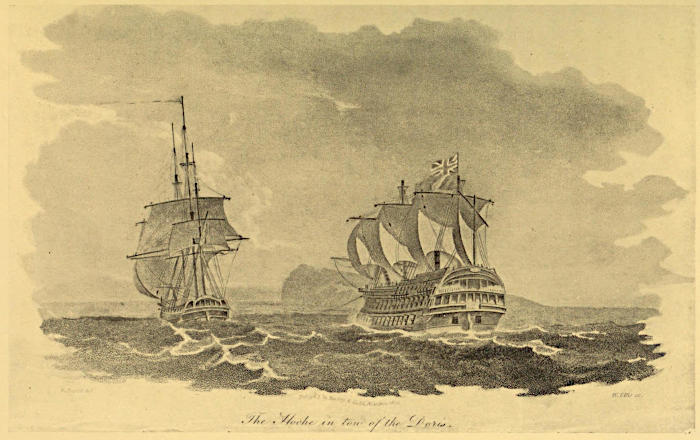
The captured French line-of-battle ship Hoche,
being towed by the Doris, 36, Lord Ranelagh, into Lough Swilly.
Drawn by N. Pocock, from a sketch made from the Robust
by Captain R. Williams of the Marines.
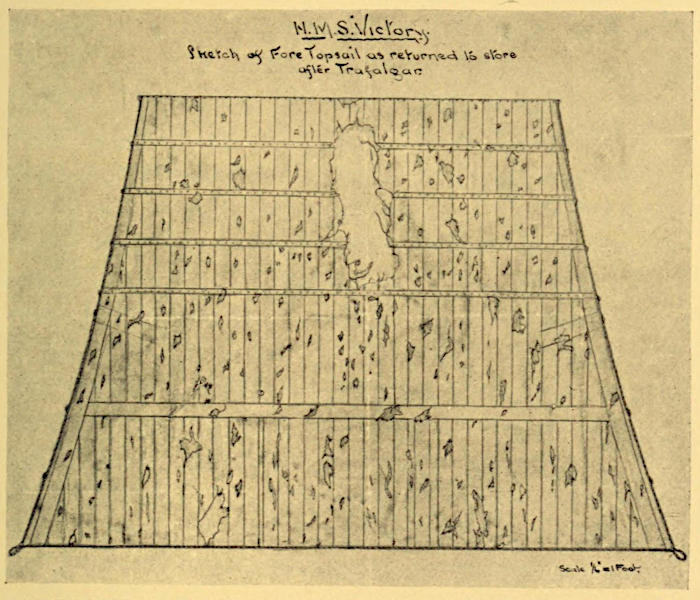
Reproduction of the Official Drawing
of the Victory’s foretopsail after Trafalgar as Returned into Store
at Chatham Dockyard in March, 1806
From a photograph of the original sepia drawing now
in the possession of a descendant of Captain Lucas of the Redoutable.
CHAMPIONS OF THE FLEET
To the fame of your name
When the storm has ceased to blow;
When the fiery fight is heard no more,
And the storm has ceased to blow.
I OUR DREADNOUGHTS :— THEIR NAME AND BATTLE RECORD
A name through all the world renown’d,
A name that rouses as a trumpet sound.
The “Massacre of Saint Bartholomew’s
Day”—on the 24th of August, 1572—was
directly the cause of the coming into
existence of our first Dreadnought.
Startled and horrified at the terrible news, as the
details of the ghastly story crossed the channel,
Queen Elizabeth replied by instantly calling the
forces of England to arms. John Hawkins, at the
head of twenty ships of war, was sent to cruise off
the Azores. The rest of the fleet was ordered to mobilize
and be ready to concentrate in the Downs. Instructions were
issued for the beacons to be watched.
The militia were ordered to muster and march to the
coast. A subsidy was sent over to the Protestants
in Holland, and a rush of volunteers followed to
join those from England already in the field.
Huguenot refugees in this country were given leave
to fit out vessels to help their co-religionists at
La Rochelle. Four men-of-war for the Royal Navy
were ordered to be laid down forthwith. They comprised
the most important effort in shipbuilding
that England had made for ten years.
To facilitate rapidity of building, the work on the
four vessels was divided between the two chief
master-shipwrights—or, as we should say, naval
constructors—of the day: two ships to Matthew
Baker, two ships to Peter Pett. Both men were at
the top of their profession. Peter Pett was a distinguished
member of the great family of naval shipwrights,
whose fame has come down to our own
times. Baker, who was also of a family of naval
shipwrights of repute, was considered by many of
the naval officers of the day as the better man.
“Mr. Baker,” wrote one, “for his skill and surpassing
grounded knowledge in the building of the
ships advantageable to all purposes hath not in any
nation his equal.” Pett and Baker were keen
business rivals, and their rivalry came into play on
the present occasion.
The names of the new ships were announced in due
course, and represented Her Majesty’s mood on the
occasion. She herself selected and appointed them
with intention. It was Queen Elizabeth’s way to
give her ships “telling” names. “The choice of
energetic names for the ships of her Royal Navy,”
it has been said, “was one of the means employed
by the heroic and politic Elizabeth to infuse her
own dauntless spirit into the hearts of her subjects,
and to show to Europe at large how little she
dreaded the mightiest armaments of her enemies.”
More than that, however, needs to be said. As
a rule, in the cases of her bigger ships, the Queen
chose names that carried, in addition, an underlying
meaning, that bore direct allusion to some national
event of the hour. According to one who lived at
the time, writing about the first ship launched by
the Queen, to which, in accordance with old custom,
the sovereign’s name was given: “The great
Shipp called the Elizabeth Jonas was so named by
Her Grace in remembrance of her owne delyverance
from the furye of her Enemys, from which in one
respect she was no less myraculously preserved
than was the prophet Jonas from the Belly of the
whale.” In like manner our first Victory and our
first Triumph were given those ever famous names,
in the first place, of set intention to commemorate
the historic double-event of the year in which they
both joined the Queen’s fleet. The Aid, or Ayde,
another Elizabethan man-of-war, was so called to
commemorate Elizabeth’s first expedition to help
the Huguenots of Normandy in their forlorn hope
struggle for liberty of conscience, which was just
setting out when the Aid went off the stocks. Our
first Revenge, of immortal renown, did not receive
that name at haphazard in the year of Don John of
Austria’s insolent threat to invade England and
depose Elizabeth by force of arms. Our first
Repulse was appointed that name—extant to this
day in the Royal Navy for one of our older battleships—in
memory of the defeat of the Spanish
Armada:—Dieu Repulse was the earlier form of the
name as the Queen gave it. And to take at random
two other names from the list, it was to commemorate
the same overthrow of the arch-enemy of
England in those times that Queen Elizabeth chose the
names Defiance and Warspite—in curious reference,
this latter name, to an incident during the fighting
with the Armada—for two others of her men-of-war.
It was of set purpose that Queen Elizabeth, in the
year of the Massacre of Saint Bartholomew, chose
the name Dreadnought for one of her ships of war.
The intentions of the Catholic League towards
England were an open secret in every council chamber
of Europe. The papal Bull, excommunicating
and deposing Elizabeth, had been nailed on the
doors of Lambeth Palace. It was at their disposal.
Alva’s butcheries in the Netherlands were fresh in
the recollection of the world, and the memory of
other dark doings came still more closely home to
our own people; how Englishmen had been “seized
in Spain and the New World to linger amidst the
tortures of the Inquisition or to die by its fires.”
Burghley and Walsingham, and others as well, had
fully understood the menace for England and the
warning of Lepanto only two years before. Their
secret agents had supplied them with a copy of
De Spes’ confidential report to Alva and King
Philip to the effect that the ports of England were
poorly fortified, and that only eleven at most of
Queen Elizabeth’s twenty ships of war were worth
taking into account. They had not forgotten what
had happened three years before, when, under the
guise of an escort for the new Queen of Spain from
Flanders to the Tagus, an extremely formidable
Spanish fleet, fully equipped for war, had come
north and lain for some weeks in the Scheldt, acting
throughout in a very suspicious way. That was
a twelvemonth before Lepanto. Now the situation
seemed even more menacing for England. The
Queen’s so-called Agreement with Spain, lately
come to, for practical purposes was hardly worth the
paper it was drafted on. There was Mary Stuart
and her partizans to be reckoned with also; the
restless intriguing of the Roman Catholics all over
England; open rebellion in Ireland. What might
not the consequences of the Paris massacre involve
in the near future? It was at such a moment that
the name Dreadnought was first appointed to an
English man-of-war, and the Queen’s choice in the
circumstances partook of the nature almost of an
Act of State, specially designed to express the temper
of the nation. In the same spirit of exalted
patriotism in which, at a later day, Elizabeth, from
Tilbury camp, with proud scorn bade King Philip
and the Prince of Parma and all other enemies
of the realm do their worst, the great Queen, of her
own royal will and pleasure, named for the Royal
Navy its first Dreadnought.
Swiftsure was the name given to the second ship of
the set. “Swift-suer” was the way the Queen Elizabeth
spelled it—“Swift-pursuer,” that is—not an inappropriate
name for the sister ship of a Dreadnought.
The pair were intended as ships of the line, to use a
later day term. The other two ships of the group
were smaller vessels of the light cruiser class of the
period, intended for service as scouts, as the “eyes
and ears of the fleet” at sea. Their names were the
Achates and the Handmaid, expressive names both
in their way.
Matthew Baker’s men had the Dreadnought and
Handmaid to build; Pett’s men the Swiftsure and
the Achates. They all started work within three
weeks, and Pett’s men won the race by just a month.
The Swiftsure and the Achates were both sent afloat
on the 11th of October, 1573; the Dreadnought and
the Handmaid on the 10th of the following month.
An Arctic explorer of those times, whose name lives
on our maps—the man, indeed, who named the North
Cape for us, Captain Stephen Borough (or Borogh,
as he himself usually wrote it), one of “ye foure
Principall Masters in Ordinarye of ye Queene’s
Maᵗⁱᵉˢ Navye Royall,” by special appointment also
the Master of the Victory, and a son of North Devon
in her proudest day—had naval charge and supervision
over the building of the Dreadnought and the
other ships at Deptford. He lodged meanwhile
at Ratcliffe, across the river, and his “traveylinge
chardges,” with the waterman’s receipt for rowing him
to and fro on his weekly visits of inspection, signed
“Richard Williams of Ratcliff, Whyrryman,” is
still in existence.
The marshmen and labourers at the dockyard
began their digging, “working upon ye opening of
ye dockhedde for ye launchynge,” during the first
days of November. That was the first of the preliminaries,
necessitated by the primitive arrangements
of those times. The dock at Deptford in
which the timbers of the Dreadnought were put
together was of the crudest type: practically an
oblong excavation in the river bank, the sides and
inner end of which were shored up and kept from
falling in by wooden planks. The outer end, or
river end, was closed and sealed when a ship was
inside by a water-tight dam of brushwood-faggots,
clay, and stones filled in and rammed down between
the overlapping double gates of the dock. An
“ingyn to drawe water owte of ye dokke,” worked by
relays of labourers, pumped out the water inside the
dock after it was closed. Before the dock could be
re-opened the stones, faggots, etc. of the “tamping”
or stopping had to be dug up and removed.
Then at low water the gates would be swung back,
and the water from the river flow in as the tide rose
for the launch or float-out of the ship into the
river.
On board the Dreadnought, meanwhile, the finishing
touches were being put by the contractors’ workmen—Thomas
Hodges, of “Parris Garden,” and
Thomas Wells, of Chatham, and their men seeing to
the ironwork fittings, “ye workmanshipp and making
of lockes and boltes, keyes and haidges [sic] for ij
newe cabbons, as also for hookes, and stockelockes,
porthaidges [sic], revetts and countre-revetts, shuttynges
with rings, greate dufftayles and divers
other necessaries”; joiners sent by “Jullyan
Richards of London, widdow,” who had a contract
for certain other fittings; other joiners from Lewys
Stocker, also of London, seeing to “ye sellynges
[sic] and formysling ye cabbins and makyng casements
for windows, seelings, awmeryes [sic], cupboards,
settes, bedsteddes, formes, stools, trisstelles,
tables,” etc. “for her Grace’s newe shippe ye
Dreadnaughte.” Hard by, alongside Deptford creek,
were lying the masts for the ship, ready to be put in
place after she was afloat; with “toppes greate and
small, mayne-tops, ffore-toppe, mizzen-toppe, and
toppe-galantes;” besides barge loads from Richard
Pope, of “Ereth,” of “gravaille for ye ballistynge
of hur highness Shipe called ye Dreadnaughte at iiijᵈ
every time.” Prest-master Thomas Woodcot was
meanwhile hard at work elsewhere, “travailling
about the presting of marynnars within the River of
Theames for ye Launchynge and Rigging of Hur
highnes’ ij newe shippes at Deptfordstraund [sic] by
the space of viii daies at iijs iiijd per diem.”
The future “nucleus crew” of the Dreadnought,
who were to act as ship-keepers on board when the
ship went round to moor with the rest of the fleet
laid up in the Medway, had been warned to be at
Deptford by the morning of the 10th of November.
They were drawn apparently from the ships lying
off Gillingham, just below Chatham, or “Jillingham
Ordinarie”—the “Fleet Reserve,” as we say nowadays—and
numbered, all told, ten men and a boy.
These were the names of our original “Dreadnoughts”
of three hundred and thirty-three years
ago, and their quarterly pay, according to “The
Accompte as well Ordinarie as Extraordinarie of
Benjamin Gonson, Treasurer of ye Quene’s Majestie’s
Maryn cawses,” 1574, a quaint, bulky, ponderous,
parchment covered volume, of massive proportions,
laced with faded green silk, and bound with leather
straps, now well worn and in parts frayed nearly
away:
THE “DREADNAUGHTE.”
MARYNERS.
Robarte Baxster, boteson:—xij wekes vj daies
xxxvijˢ
vjᵈ
Richard Boureman, cooke: xij wekes vj daies
xxixˢ
vᵈ
John Awsten: xij wekes vj daies
xxjˢ
vᵈ
Nicholas Francton: xij wekes vj daies
xxjˢ
vᵈ
Christofer Parr, gromett: xij wekes vj daies
xxjˢ
jᵈ
Henry Osbourne: xij wekes vj daies
xxjˢ
vᵈ
James Laske: xij wekes vj daies
xxjˢ
vᵈ
Richard Shutt: xij wekes vj daies
xxjˢ
vᵈ
Robartt Woodnaughtt: xij wekes vj daies
xxjˢ
vᵈ
William Appleford: xij wekes vj daies
xxjˢ
vᵈ
John Huntt, master gonner: xij wekes vj daies
xxxijˢ
ijᵈ
This is what the Dreadnought looked like as she
lay in the dock on the Tuesday morning that saw the
ship take the water. Imagine a solid-looking heavily-timbered
hull, round bowed, with long, raking forward
prow or beak, reaching out some ten or twelve
yards ahead of the actual vessel, and with at the
after-end a lofty towering poop with shallow overhanging
balustraded gallery. Amidships the vessel
is of a width equal to nearly a third of her length.
From the “greate beaste,” the figure-head—a
dragon—“gilded and laid with fine gold,” representing
one of the supporters of the Queen’s arms,
set up on the tip of the beak, away aft to the stern
gallery is a distance of, over all, about a hundred and
twenty feet. The body of the hull itself has a keel
length of some eighty feet—from rudder post to
fore-foot. Along the water-line the bends are all
tarred over, with varnished side planking above,
tough oak timber from the Crown lands of the
Sussex Weald by Horsham. The topsides above
are varnished to the bulwarks, where a touch of
colour shows; ornamental carved and painted work
in royal Tudor green and white, laid on in
“colours of oil” and garnished with Her Majesty’s
family badges in gold, and with here and there, on
the balustrades of the quarter-rails and stern gallery,
an additional touch of red. On the stern, “painted
in oils,” are the arms of England, with the Lion and
the Dragon, the Queen’s royal supporters, and
below, on a scroll, Her Majesty’s motto, Semper
Eadem.
OUR FIRST DREADNOUGHT
From a Contemporary Print kindly lent by Mr. Wentworth Huyshe.
(The “Dreadnought” is shown as she appeared when serving in the
“Ship Money” Fleet of Charles the First:—circ. 1637).
These are other things about the ship that would
strike the Deptford visitor of that day. The square-headed
forecastle is low and squat in appearance,
compared with the piled-up, narrow poop right aft,
looking over from which a foreign visitor to the
Queen’s fleet once declared that “it made one
shudder to look downwards.” The bottom of the
ship is coated with “tallow and rosin mingled with
pitch.” The square-cut, wide portholes, out of which
the guns will point when they are on board—the
Tower lighters will bring them down for mounting in
a week or two—were the idea, they say in the yard,
of Master Shipwright Baker’s father, old James
Baker, many years ago King Harry’s shipwright,
improving on the original French style. It was old
Baker too, they say, who “first adapted English
ships to carry heavy guns.” The Reformers wanted
to send the old man to the stake for “being in
the possession of some forbidden books”; but King
Harry could not afford to let them burn England’s
best naval architect even for the benefit of Protestantism.
The Dreadnought’s gun-ports should open some
four feet clear of the water. People have not forgotten
the horror of the Mary Rose; what happened
to her; how she came to go down one summer’s day
at Spithead. The waist bulwarks of the Dreadnought,
if she swims as she ought, will be some
twenty feet above the water-line. Nearly four hundred
tons in burden is our new man-of-war—five
tons heavier than the Swiftsure, than which ship too
she is six feet longer, though the pair reckon as
sister ships. Upwards of six thousand pounds out
of Queen Elizabeth’s treasury (about £30,000 at present
day value) will have been the cost of the Dreadnought
when she leaves Deptford dockyard.
We will go on board for a brief look round the
Dreadnought within. As we enter the ship we note
how both the half-deck and the fore and aft castles
are loopholed for both arrow-fire and musketry, so as
to sweep the waist should an enemy board and get
a footing amidships. Some of the lighter guns
would be able to help. The heavier guns are mostly
on the broadside, and are mounted on the decks
below in a double tier. The Dreadnought altogether
carries forty-two guns. Sixteen of them are heavy
guns: two “cannon-periers” of six-inch bore, hard
hitters, firing twenty-four pounder stone shot; four
“culverins,” seventeen and a half pounders, twelve
feet long and five and half inches in the bore, firing
iron shot, and able to throw a ball upwards of
three miles—“random shot.” There are also ten
“demi-culverins,” nine-pounders, firing four and a
half inch iron shot. The lighter guns are six
“sakers,” pieces nine feet long (five-pounders, of
three and a half inch bore) and two “fawcons”
(three-pounders). The heavier guns are all muzzle-loaders.
Distributed over the upper decks are
eighteen breech-loading guns, for fighting at
close quarters and rapid firing: “port-pieces,”
“fowlers,” and “bases,” as they are called. They
are on swivel mountings, and fire stone and iron
shot.
All told, the Dreadnought’s armament weighs
thirty-two tons. The guns are from Master Ralphe
Hogge, “the Queen’s gunstone maker, and gunfounder
to the Council.” They are of Sussex iron,
from Master Hogge’s own foundry at Buxted. At
this moment they are waiting at the Tower, together
with the Dreadnought’s supplies of iron shot and
cannon balls of Kentish ragstone from Her Majesty’s
quarries at Maidstone, stacked “in ye Bynns upon
ye Tower Wharfe each side Traitor’s Gate.”
When the Dreadnought goes into battle she will
carry some two hundred officers and men all told:
a hundred and thirty “maryners”—“Able men for
topyard, helme and lead,” and “gromets,” or boys
and “Fresh men”; with twenty gunners and
fifty soldiers. To keep her at sea will cost the
Queen £303. 6s. 8d. a month for sea-wages and
victualling. Three weeks provisions and water is
the most that the ship can stow, owing to the space
wanted for the ballast, the cables for the four anchors,
and the ammunition and sea stores. That is why
victualling ships have to attend Her Majesty’s fleets
on service outside the Narrow Seas. The “cook
room,” of bricks and iron and paving stones, is in
the hold over the ballast. Two more notes may be
made as we return on deck and quit the ship. The
captain’s cabin, opening on the gallery aft, is neatly
wainscoted and garnished with green and white
chintz, and with curtains of darnix hung at the
latticed cabin windows. There are three boats for
the Dreadnought: the “great boat,” which tows
astern at all times, the cock-boat and the skiff, both
of which stow inboard. John Clerk, “of Redryffe,
Shipwrighte,” built the “great boat,” being paid
£24, in the terms of his bill, “For the Workmanshipp
and makeinge of a new Boate for her Highness’
Shipp, the Dreadnought; conteyninge xi foote
Di. in lengthe; ix foote Di. in Breadthe; and iij
foote ij inches in Depthe.—By agrement.”
A brave show should our gallant Dreadnought
make when she goes forth to war, with her varnished
sides and rows of frowning guns and painted top-armours
(the handiwork, according to his bill, of
Master Coteley, of Deptford), and all her wide
spreading sails set (“John Hawkins, Esquire, of
London,” supplied these), and at the masthead,
high above all, her flag of St. George of white
Dowlas canvas with a blood-red cross of cloth
sewn on.
The appointed day has come, and the time for the
sending afloat and formal naming of the Dreadnought:
Tuesday afternoon, the 10th of November,
1573.
The ship lies ready for launching at the appointed
moment, having been duly “struck” upon the launching
ways a day or two before, under the supervision
of Master Baker himself, in the dock where she has
been building; shored up on either side, and with
the lifting screws and “crabs” prepared to heave her
off. The dockhead has been dug out and finally
cleared at low tide on Monday, leaving the double
gates free and in order, ready to be swung back and
opened as soon as the tide begins to make on
Tuesday morning.
We will imagine ourselves on the spot at the time
and looking on at what took place. It is possible to
do so, thanks to a manuscript left by Phineas Pett,
Peter’s son and successor at Deptford royal yard.
All is ready for the day’s proceedings by a little
after noon, when the important personages taking
part at the launch, “by commandement of ye officers
of Her Grace’s Maryn Causys,” and the invited
guests and superior officials of the dockyard assemble
for a light refection of cake and wine in the
Master Shipwright’s “lodging,” preliminary to the
ceremony.
Who named the Dreadnought on that day? Unfortunately
that one detail is not mentioned in any
existing record, and the Navy Office book for the year,
where the name would certainly have been found, together
with the honorarium or fee, paid according to
custom, is missing. Most probably it was Captain
Stephen Borough himself, and we may imagine him
there, apparelled for the day in crimson velvet and
gold lace, in the full uniform of one entitled to wear
“Her Maᵗⁱᵉˢ cote of ordinarie.” His rank and
standing as one of the “Principall Masters of the
Queen’s Maᵗⁱᵉˢ Navie in Ordinarie” qualified him for
performance of so dignified a duty. The Principal
Masters were often deputed by the Lord High
Admiral to preside on his behalf at the launches of
men-of-war and perform the name-giving ceremony.
While the high officers are having their refreshments
in Master Shipwright Baker’s lodging, Boatswain
Baxster and the assistant shipwrights are
stationing the men on board and at the launching
tackles. The customary “musicke” then makes its
appearance, “a noyse of trumpetts and drums,” who
post themselves on the poop and the forecastle of
the ship. Next, a “standing cup” of silver-gilt,
filled to the brim with Malmsey of the best, is set up
on a pedestal fixed prominently on the poop, and the
Queen’s colours are hoisted on board, together with
the flag of St. George. At the same time pennons
and streamers of Tudor green and white, and
decorated with royal emblems and badges, are
ranged here and there along the ship’s sides and on
the forecastle.
All is ready ere long, and then, forthwith,
word is sent to Master Shipwright Baker and the
gentlemen of the company. Forthwith the procession
forms itself and sets out in stately fashion to go
on board.
With his grey hair unbonneted
The old sea-captain comes;
Behind him march the halberdiers,
Before him sound the drums.
So escorted and attended the personage of the
hour paces his way forth and proceeds on board the
new ship, passing along the decks and ascending to
the poop where the company group themselves
according to precedence, near by the glittering silver-gilt
wine cup. Master Shipwright Baker then gives
the signal, and Boatswain Baxster’s whistle shrills
out. At once the gangs of men standing ready
at the crabs and windlasses heave taut, and a
moment later, as the ship begins her first movement
outwards, the trumpets and drums sound forth. So,
at a leisurely rate at the outset, gliding off foot by
foot into deeper water, the new man-of-war hauls
gradually out and clears past the dock gates till well
into the stream. The anchor is then let go and she
brings up. Now it is for Captain Borough—allowing
it to have been he—to do his part.
Stans procul in prorâ, pateram tenet extaque salsos
Porricit in fluctus ac vina liquentia fundit.
The trumpets and drums cease as the “Principall
Master” steps forward and takes up his position
beside the standing cup. He raises the gleaming
cup on high so that all around may see. Then, amid
universal silence, he proclaims, in a clear resonant
voice that every one may hear: “By commandment
of Her Grace, whom God preserve, I name this ship
the Dreadnought! God save the Queen!” As the
Lord High Admiral’s representative utters the last
word, he drinks from the cup, and a moment after
ceremoniously pours out a portion of the wine upon
the deck. The next moment, with a wide sweep
of the arm, he heaves the standing cup, with a little
wine left in it, into the river—a sacrifice, as it were,
on behalf of the bride newly-wedded to the sea, or
that the Queen’s cup might never be put to base
uses—perhaps, indeed, as a sort of propitiatory act.
So it was done, says Master Phineas Pett, “according
to the ancient custom and ceremony performed
at such times.” Again there is a blare of trumpets
and a ruffle from the drums, with cheers afloat and
ashore for Her Grace, and hearty congratulations to
Master Matthew Baker on the occasion. After
that the Dreadnought is formally inspected between
decks and below, and the crew’s health is drunk by
the high officers in ship’s beer—sure to be of a good
brew on a launching day.
By the time that all is over the ship has been warped
back alongside the shore again, and the company
adjourn thereupon to wind up the day’s proceedings
with a good old English dinner, given to the Master
Shipwright and the officials of the yard at the Lord
High Admiral’s expense.
Such is a passing glimpse of the memorable scene—as
far as one may venture to reconstruct it—on
“Dreadnought Day” at Deptford Royal Dockyard,
that Tuesday afternoon, in Tudor times, three hundred
and thirty-three years ago. It is hard to fancy
such doings, at Deptford of all places, now. Oxen
and sheep for the London meat market nowadays
stand penned in lairs on the site of the filled-in
dock whence the Dreadnought was floated out—the
same dock whence the Armada Victory had preceded
her, whence Grenville’s Revenge followed her.
Master Shipwright Baker’s lodging is nowadays
a cattle drovers’ drinking bar. The old-time navy
buildings—their origin even now easily recognisable,
at any rate externally—serve as slaughterhouses,
and so forth, among which rough butcher
lads, reeking of the shambles, jostle daily to and
fro. On every side is bustle and clatter and
hustling, the rumbling of Smithfield meat vans
over the old-time cobble stones, the jargon of
Yankee bullock-men, the bleating of sheep under
sentence of death. Strange and hard is the fate that
in these material times of ours has overtaken what was
once the premier Royal Dockyard of England, this
former temple, so to speak, of the guardian deity of
our sea-girt realm:
This ruined shrine
Whence worship ne’er shall rise again:—
The owl and bat inhabit here
The snake nests in the altar stone,
The sacred vessels moulder near—
The image of the god is gone!
Fallen indeed from its high estate of former days
is the ancient royal establishment of “Navy-building
town.” Where bluff King Hal used to walk and
talk with Matthew Baker’s father, “old honest Jem”;
where our sixth Edward paid a long-remembered
visit, to be “banketted” (as the royal spelling has
it) and see two men-of-war go off the ways; where
Elizabeth knighted Francis Drake, and James and
Charles rode down in state on many a gala day;
where Cromwell paid his second naval visit—his
“grandees” attending him, and escort of clanking
Ironsides—to see the vindictively named Naseby take
the water; where our second Charles liked to saunter
on occasion with Rupert at his side, and chattering
Pepys and John Evelyn in his train; where James
the Second, dull and morose of mood, for the sands
of his monarchy were already running out, paid his
last historic visit one gloomy autumn afternoon of
1688; where brave old Benbow liked best to spend
the mornings of his half-pay life on shore, and
Captain Cook set out on his last voyage; where
George the Third drove down with Queen Charlotte
to do honour to the naming of a Prince of Wales
man-of-war; where, too, Royalty of our own time
has more than once visited—is now “a market for
the landing, sale, and slaughtering of foreign cattle.”
The glory has departed—the image of the god is
gone!
The Dreadnought and Swiftsure and the two
smaller ships were masted and rigged and completed
for service during November and the early
days of December, after which, with the help of a
hundred and fifty extra hands, “prested in ye river
of Theames for ye transportyngs about,” they set off
on the twentieth of the month to join the fleet lying
“in ordinary” in the Medway—an eight days’ voyage
as it proved, owing to squally weather and an east
wind. The Queen was to have seen the Dreadnought
and her squadron pass the palace at Greenwich and
salute the royal standard with cannon and a display
of masthead flags, as was the Tudor naval usage
when the sovereign was in residence, but there had
been a domestic misadventure at Placentia just a few
days before. While talking with her maids of
honour one afternoon, one of the Queen’s ladies—“the
Mother of the Maids”—had suddenly dropped
dead in the royal presence, and the Court had hastily
removed to Whitehall. So the Dreadnought had no
royal standard to salute. Three days after Christmas
the Deptford squadron took up their moorings
in “Jillingham water.”
“Powerful vessels ... with little tophamper and
very light, which is a great advantage for close
quarters and with much artillery, the heavy pieces
being close to the water,” reported, in a confidential
letter now in the royal archives at Simancas, one of
the King of Spain’s agents in England who saw the
Dreadnought and Swiftsure not long after they had
joined the Medway fleet. So too, indeed, some of
King Philip’s sailors were destined to find out for
themselves.
The Dons, indeed, were destined to taste something
of the Dreadnought’s quality more than once;
beginning with the memorable event of the “Singeing
of the King of Spain’s Beard.” There, Drake’s
right-hand man on many a battle day, commanded
the Dreadnought, Captain Thomas Fenner, a sturdy
son of Sussex and a seaman who knew his business.
How thoroughly Drake—“fiend incarnate; his
name Tartarean, unfit for Christian lips; Draco—a
dragon, a serpent, emblem of Diabolus; Satanas
himself”—did his work among the Spaniards at
Cadiz, burning eighteen of their finest royal galleons,
and carrying off six more in spite of fireships and
all the shooting of the Spanish batteries, is history.
The Dreadnought, after experiencing a narrow
escape from shipwreck off Cape Finisterre at the
outset of her cruise, took her full share of what
fighting there was. She was present, too, at the
second act of the drama, which took place off the
Tagus with so fatal a sequel for the hapless Commander-in-Chief
designate of the Armada, the
Marquis de Santa Cruz—the “Iron Marquis,”
“Thunderbolt of War,” the real Hero of Lepanto,
by reputation the ablest sea-officer the world had
yet seen. First, the news that his flagship and the
finest fighting galleons of his own picked squadron—all
named, too, after the most helpful among the
Blessed Saints of the Calendar—together with his
best transports and victuallers, had been boarded
and taken and sacrilegiously set ablaze to, burned
to the water’s edge, one after the other, by those
“accursed English Lutheran dogs.” Worse still.
To be then defied to his face, he, Spain’s “Captain-General
of the Ocean”; to be audaciously challenged
to come out and fight and have his revenge then
and there—Drake and the Dreadnought and the rest
openly waiting for him—in the offing. The shame
of the disaster was enough to kill the haughty
Hidalgo, to make him fall sick and turn his face
to the wall and die, without Philip’s espionage
and unworthy insults goading him to the grave.
The Dreadnought had a hand in shaping the destinies
of England, for, in the words of the Spanish popular
saying, “to the Iron Marquis succeeded the Golden
Duke,” whose hopeless incompetence gave England
every chance in the next year’s fighting.
In the opening encounter with the Spanish
Armada that July Sunday afternoon of 1588, no
ship of all the Queen’s fleet bore herself better than
did the Dreadnought. Captain George Beeston, of an
ancient Surrey family, held command on board the
Dreadnought. He was a veteran officer of the
Queen’s fleet—more than twenty-five years had gone
by since he first trod the quarter-deck as a captain.
Leading in among the enemy, after the first hour of
long-range firing between the English van and the
Spanish rear had brought both sides to closer
quarters, the Dreadnought with the ships that followed
Drake’s flagship the Revenge, for nearly three hours
fought first with one and then with another of the
most powerful of the Spanish rear-guard ships.
After that, forcing their way among the Spaniards
as they gave back and began to crowd on their
main body, she had a sharp set-to with the big
galleons, led by Juan Martinez de Recalde, perhaps
the best seaman in all King Philip’s navy, commander
of the rear-division of the Armada. On
the Santa Ana and her consorts the Revenge and
Dreadnought and the rest made a spirited attack,
pushing Recalde so hard that eventually Medina
Sidonia himself, the Spanish Admiral, had to turn
back and come to the rescue with every ship at his
disposal. It was enough; Drake and his men had
played their part. Before Medina Sidonia’s advance
in force, the Revenge and Dreadnought left the Santa
Ana, and with the rest of the attacking English
van drew off. They had done an excellent day’s
work.
There was harder work for the Dreadnought in the
great battle of Tuesday off Portland Bill. First
came the fierce brush in the morning, when Drake
and Lord Howard and the leaders of the English
fleet, after a daring attempt to work in between the
Spanish fleet and the Dorset coast, had to tack at
the last moment, baffled for want of sea room, and
were closed with by the enemy in the act of going
about. On came the galleons exultantly, their crews
shouting and cheering, amid a blare of trumpets and
ruffle of drums, in full confidence to run down and sink
the lighter built English vessels. It was a moment
of extreme peril:—but at the very last, suddenly, the
fortune of the day changed. As the Spaniards
seemed to be upon them the wind shifted, the
English sails filled, ship by ship and all together,
and then stretching out with bowsprits pointing seaward,
the Revenge, Victory, Ark Royal, Dreadnought,
and the others safely cleared the enemy, pouring in
so fierce a fire as they passed that the Spanish ships
had to sheer off. This was the first fight of the
day. Later, when the wind, going round with the
sun, shifted again and gave Drake and Howard the
weather gage, came on the most desperate encounter
with the Armada that our ships had yet seen. Lord
Howard in the Ark Royal and Drake in the Revenge,
with the Dreadnought, the Lion, the Victory, and the
Mary Rose near at hand, driving ahead before the
wind, pushed into the thick of the Spanish main
body, and attacked the enemy, in a long and furious
battle that lasted until the afternoon sun was nearing
the horizon.
A third day of battle was yet to come—Thursday’s
hot fight off the back of the Isle Wight, and here
again the Dreadnought took her full share of what
was done, until the long summer day drew to its
close and the Armada “gathered in a roundel,”
sullenly stood off eastward, proposing to fight no
more until the coast of Flanders had been made.
Next morning the Dreadnought’s captain was
summoned on board Lord Howard’s flagship, the
Ark Royal. He returned “Sir George,” knighted
by the Lord High Admiral on the quarter-deck, in
the presence of the enemy.
Sunday night saw the fireship attack, so disastrous
to the Armada, and next morning followed the
crowning victory of the week’s campaign, the great
fight off Gravelines of Monday, the 29th of July, “the
great battle which, more distinctly perhaps than any
battle of modern times, has moulded the history of
Europe—the battle which curbed the gigantic power
of Spain, which shattered the Spanish prestige and
established the basis of England’s empire.” Here
the Dreadnought distinguished herself again, fighting
in the thick of the fray from eight in the morning to
four in the afternoon, within pistol-shot of the enemy
most of the time.
From six till nearly eight the ships of Drake’s
squadron had to bear the brunt of the fight, with, for
antagonists, Medina Sidonia himself and his chief
captains, who had gathered to stand by their admiral.
Trying to rally the Armada after the panic of the
night, this gallant band had at first, from before daybreak,
anchored in a group, to act as rear-guard to
the Spanish fleet, firing signal guns to stop their
flying consorts, and sending pinnaces to order the
fugitives back. Then Hawkins in the Victory, with the
Dreadnought, the Mary Rose, and Swallow, and other
ships unnamed, came up and struck in. Now
moving ahead through her own smoke to plunge into
the mêlée and come to the rescue of some hard-pressed
consort, now working tack for tack parallel with and
firing salvo after salvo at short range into some towering
galleon or huge water-centipede-like galleass—so
the hours of that eventful forenoon wore through
on the Dreadnought’s powder-begrimed decks. “Sir
George Beeston behaved himself valiantly,” records
the official Relation of Proceedings, drawn up for the
Lord High Admiral. In vain did the most formidable
of the Spanish galleons try to close and board.
Ship after ship was forced back with shattered
bulwarks and splintered sides, and with their
scuppers spouting blood, after each English broadside,
as the round shot crashed in among the masses
of Spanish soldiery, packed on board the galleons
as closely almost as they could stand.
More Spaniards joined their admiral as Sidonia
passed north, the Spanish rear and centre squadrons
forming together a long straggling array, among
the ships of which, from nine to after one o’clock,
the Revenge, Victory, Dreadnought, Triumph, Ark
Royal, and the rest charged through and through
fighting both broadsides. Shortly after two o’clock,
the English ships passed on, pressing forward to
overtake the Spanish van group of galleons. By
four o’clock the battle was won, but firing went on
till nearly six, “when every man was weary with
labour, and our cartridges spent and our ammunition
wasted” (i.e. used up).
Once more the Dreadnought followed the fortunes
of Drake’s flag to battle; again, too, as Captain
Fenner’s ship. In the year after the Armada she
had her part in escorting the Corunna expedition,
the “counter-Armada,” designed to beat up the
quarters of the enemy at home and attempt the
wresting of Portugal from the Spanish yoke. A
landing party of “Dreadnoughts” fought ashore.
Led by Drake and the general of the soldiers, Sir
John Norris, they drove the Spaniards before them.
“Unto every volly flying round their ears,” says
old Stow, “the generall, turning his face towards the
enemie would bow and vale his bonnet, saying ‘I
thank you, Sir! I thank you, Sir!’ to the great
admiration of all his campe and of Generall Drake.”
The wine vaults of Corunna, however, interposed on
behalf of Spain. Soldiers and sailors alike broke in
and got drunk, and all that could be done after that
was to reship the men and write the campaign down
a failure.
In the attack on Brest in 1594, when Sir Martin
Frobisher met his death, the Dreadnought had her
share. Two years after that she fought with Essex
and Raleigh in the grand attack on Cadiz—this time
as one of the picked ships of Sir Walter Raleigh’s
own “inshore squadron.” She sailed with Sir
Walter again after that in the celebrated “Islands
Voyage”; and then the curtain rings down on the
memorable days of the story of the Dreadnought
of the Great Queen’s fleet. The old ship lasted
afloat (after an expensive rebuild in James the First’s
reign) until the time of the Civil War. She figured
in the interim in the Rochelle Expedition and also in
one of Charles the First’s Ship-money fleets. The
Dreadnought of St. Bartholomew’s Day and Matthew
Baker made her last cruise of all in the year of
Marston Moor.
Six Dreadnoughts in all have flown the pennant
since England’s Armada Dreadnought passed
away.
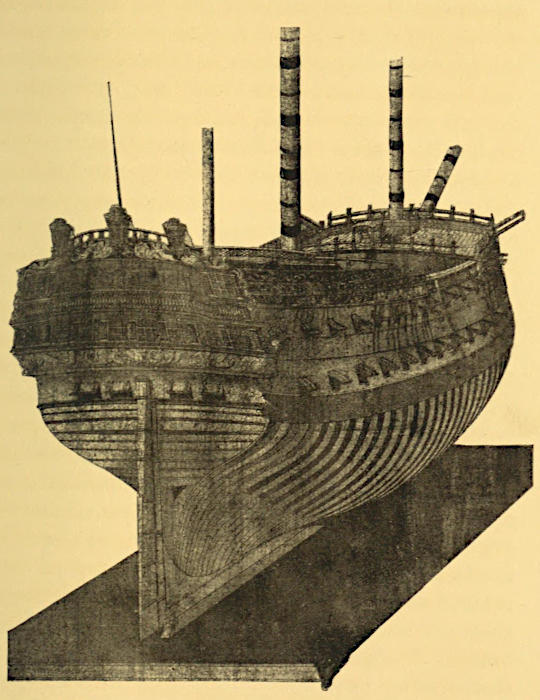
“OLD DREADNOUGHT’S” DREADNOUGHT
From the original drawing made in 1740 for the official dockyard
model. Now in the Author’s Collection.
Charles the Second’s Dreadnought was our second
man-of-war of the name. Originally the Torrington,
one of Cromwell’s frigates, and named, after the
Puritan usage, to commemorate a Roundhead victory
over the hapless Cavaliers, Restoration Year saw the
ship renamed Dreadnought, under which style she
rendered the State good service for many a long
year to come. In that time the Dreadnought fought,
always with credit, in no fewer than seven fleet
battles. She was with the Duke of York when he
beat Opdam off Lowestoft in 1665; with Monk,
Duke of Albemarle, and Prince Rupert in the “Four
Days’ Fight” of 1666; at the defeat of De Ruyter in
the St. James’s Day Fight of the same year. Solebay,
in the Third Dutch War, was another of our second
Dreadnought’s notable days, and also Prince Rupert’s
three drawn battles with De Ruyter off the Banks
of Flanders in 1673. Worn out with thirty-six
years’ service (reckoning from the day that the Torrington
first took the water), the Dreadnought had
set forth to meet the famous French corsair, Jean
Bart, in the North Sea, when, one stormy October
night of 1690, she foundered off the South Foreland.
Happily, the boats of her squadron had time to
rescue those on board.
Our fourth Dreadnought, William the Third’s ship,
fought the French at Barfleur and La Hogue, and
after that did good service down to the Peace
of Ryswick as a Channel cruiser and in charge
of convoys. She served all through “Queen Anne’s
War,” by chance only missing Benbow’s last fight.
Later, the Dreadnought was with the elder Byng—Lord
Torrington—at the battle off Cape Passaro, in
the Straits of Messina, in 1718, where one, if not
two, Spaniards lowered their colours to her. The
Dreadnought on that occasion formed one of Captain
Walton’s detached squadron, whose exploit history
has kept on record, thanks to Captain Walton’s
dispatch to the admiral, as set forth in the popular
version of it: “Sir, we have taken all the ships
on the coast, the number as per margin.” Of that
dispatch more will be said elsewhere.[1] The Dreadnought
ended her days in George the Second’s reign,
at the close of the war sometimes spoken of as
“The War of Jenkins’ Ear.”
Two Dreadnought officers, Sir Edward Spragge,
who captained our second Dreadnought in the “Four
Days’ Fight,” and Sir Charles Wager, a very famous
admiral in his day, First Lieutenant of our third
Dreadnought in the year before La Hogue, have
monuments in Westminster Abbey.
Boscawen’s Dreadnought comes next, a sixty-gun
ship built in the year 1742. She was the first ship
of the line that Boscawen had the command of, and
she gave him his sobriquet in the Navy, “Old Dreadnought,”
the name of his ship just hitting off the
tough old salt’s chief characteristic—absolute
fearlessness. An incident that occurred on board the
Dreadnought while Boscawen commanded the ship
gave the sobriquet vogue. It is, too, a fine sample of
what Carlyle calls “two o’clock in the morning
courage.”
It was in the year 1744, when we were at war with
both France and Spain, one night when the Dreadnought
was cruising in the channel. The officer of
the watch, the story goes, came down after midnight
to Captain Boscawen’s cabin and awoke him,
saying, “Sir, there are two large ships which look
like Frenchmen bearing down on us; what are we to
do?” “Do?” answered Boscawen, turning out of
his cot and going on deck in his nightshirt, “Do?
why, d⸺ ’em; fight ’em!” The fight did not
come off, however, as the suspicious strangers disappeared.
On board Boscawen’s Dreadnought it was that,
fourteen years later, Nelson’s uncle, Maurice Suckling,
who got Nelson his first appointment in the Royal
Navy, and under whose command the boy Nelson
first went to sea, made his mark as a post-captain.
It was in the West Indies in 1757, the year in
which Byng was shot, and the day was the 21st of
October.
The Dreadnought with two consorts met seven
French men-of-war, four of them individually bigger
and more heavily gunned ships than ours, and the
other three powerful frigates, and gave them a sound
thrashing.
The news was received in England with exceptional
gratification as the first sign of the turn of the
tide since Byng’s defeat off Minorca. That was one
thing about it that stamped the event in popular
memory. A second memorable thing was the incident,
according to the popular story, of the
“Half Minute Council of War” that preceded the
fight.
The three British ships were the Augusta, Captain
Forrest; the Dreadnought, Captain Maurice Suckling;
and the Edinburgh, Captain Langdon. The three
had been sent by the admiral at Jamaica to cruise off
Cape François, in order to intercept a large French
homeward merchant convoy reported to be weakly
guarded. The available French naval force on the station
was believed to be too weak to face our little squadron.
But, unknown to Admiral Cotes at Port Royal,
fresh men-of-war had just arrived from France purposely
to see the convoy home. In the result, when our
three ships arrived off Cape François, seven French
ships stood out to meet them. In spite of the odds
the British three held on their course.
These were the forces on either side, in ships and
men:—
British Line of Battle.
Dreadnought
60
guns
Capt. Suckling
375
men
Augusta
60
”
Capt. Forrest
390
”
Edinburgh
64
”
Capt. Langdon
467
”
184
guns.
1232
men.
French Line of Battle.
La Sauvage
30
guns
206
men
L’Intrépide (Commodore)
74
”
900
”
L’Opiniâtre
64
”
640
”
Le Greenwich (formerly British)
50
”
400
”
La Licorne
30
”
200
”
Le Sceptre
74
”
750
”
L’Outarde
44
”
350
”
366
guns.
3446
men.
Directly the French came in sight the senior
officer, Captain Forrest of the Augusta, signalled
to the other two captains to come on board for a
council of war. They came, and, the story goes,
arrived alongside the Augusta together and mounted
the ship’s side together. As they stepped on to the
Augusta’s gangway, Captain Forrest, it is related,
addressed the two officers in these terms: “Gentlemen,
you see the enemy are out; shall we engage
them?” “By all means,” said Captain Suckling. “It
would be a pity to disappoint them,” said Captain
Langdon. “Very well, then,” replied Forrest;
“will you gentlemen go back to your ships and
clear for action?” The two captains bowed, and
turned and withdrew without having, as it was said,
actually set foot on the senior officer’s quarter-deck.
Within three-quarters of an hour they were in
action, the Dreadnought leading in and attacking
the French headmost ship as the squadrons closed.
Captain Suckling opened the fight by throwing the
Dreadnought right across the bows of the Intrépide,
a 74, and much the bigger ship, forcing her to sheer
off to port to avoid being raked.
Backed up by the Augusta and the Edinburgh,
the Dreadnought was able to overwhelm the French
commodore with her fire, and force the crippled
Intrépide back on the next ship, the Opiniâtre.
That vessel in turn backed into the fourth French
ship, and she into another, the Sceptre. The four
big ships of the enemy were accounted for. Our
three ships seized the opportunity. Well in hand
themselves, they pounded away, broadside after
broadside, into the hapless Frenchmen, who were
too much occupied in trying to disentangle themselves
to do more than make a feeble and ineffective
reply. By the time that they got clear the British
squadron had so far got the upper hand that the
French drew off, leaving the British squadron
masters of the field. All of our three ships suffered
severely, the Dreadnought most of all.
In Nelson’s lifetime the day was always observed
by the family at Burnham Thorpe with
special festivities, and Nelson himself often called
it, it is on record, “the happiest day of the year.”
More than that too, Nelson himself more than once
half playfully expressed his conviction that he too
might some time fight a battle on another 21st of
October, and make the day for the family even more
of a red-letter day. As a fact, during the last three
weeks of his life on board the Victory off Cadiz, in
October, 1805, Nelson, with a prescience that the event
justified, used these words both to Captain Hardy
and to Dr. Beatty the surgeon of the flagship:
“The 21st of October will be our day!”
Captain Maurice Suckling’s “Dreadnought” sword
was bequeathed to Nelson and was ever kept by him
as his most treasured possession. He always wore
it in battle, it is said; notably at St. Vincent, when
he boarded and took the two great Spanish ships the
San Nicolas and the San Josef; and his right hand
was grasping it when the grape shot shattered his
arm at Teneriffe.
The Dreadnought of Boscawen and Maurice
Suckling ended her days at perhaps England’s
darkest hour of national trial—at the time of the
American War. She was doing harbour duty at
Portsmouth at the time, as a guard and receiving
ship.
At no period, perhaps in all our history did the
future and the prospects of the British Empire seem
so absolutely hopeless. We were fighting for existence
against France and Spain, the two chief maritime
Powers of Europe; and at the same time the
vitality of the nation was being sapped by the never-ceasing
struggle with the American colonists, now in
its seventh year. Holland had added herself to our
foes; Russia and the Baltic Powers were banded
together in a league of “armed neutrality,” and
stood by sullen and menacing. That, however, was
not the worst. The price of naval impotence had to
be paid. Great Britain was no longer mistress of
the sea. She had lost command of the sea, and
was drinking the bitter cup of consequent humiliation
to the dregs.
THE RED-LETTER DAY OF NELSON’S CALENDAR. HOW THE
DREADNOUGHT LED THE ATTACK ON THE 21st OF OCTOBER, 1757
“Edinburgh.”
“Augusta.”
“Dreadnought.”
Painted by Swaine. Engraved and Published in 1760.
It was the direct outcome of party politics and
short sighted naval retrenchments in time of peace,
pandering to the clamour of ministerial supporters
in the House of Commons. The printed Debates
and Journals of the House between 1773 and 1781
are extant, as are also the summaries of the Gentleman’s
Magazine, for those who care to learn what
passed.
Out-matched and out-classed at every point, the
British fleet found itself held in check all the world
over. Colony after colony was wrested from us, or
had to be let go, while our squadrons in distant seas
had not strength enough to do better than fight
drawn battles.[2] Gibraltar, closely beset by sea and
land, was still holding out, but no man dared
prophesy what news of the great fortress might not
arrive next. Minorca, England’s other Mediterranean
possession, had to surrender. The enemy
were masters of the island, after driving the garrison
into their last defences at St. Philip’s Castle.
Nearer home, Ireland, in the enjoyment of Home
Rule, was using the hour of Great Britain’s difficulty
as her opportunity for demanding practical independence,
with eighty thousand Irish volunteers under
arms to back up the threats of the Dublin Parliament.
The Channel Fleet, though reinforced with every
ship it was possible to find crews for, held the
Channel practically on sufferance. Once it had to
retreat before the enemy and seek refuge at Spithead.
On another occasion the enemy were on the
point of attacking it in Torbay with such preponderance
of force that overwhelming disaster must have
befallen it. Fortunately for England the French
and Spanish admirals disagreed at the last moment
and turned back.
Hanging in a frame on the walls of the Musée de
Marine at the Louvre the English visitor to Paris
to-day may see a draft original “State,” giving the
official details of the divisions and brigades and the
ships to escort them, of one of the French armies
which was to be thrown across into England. It
was no empty menace, and for three years the
beacons along our south and east coasts had to be
watched nightly; while camps of soldiers, horse and
foot and artillery—the few regulars that had not
been sent off to America—with all the militia regiments
in the kingdom, extended all the way round,
at points, from Caithness to Cornwall. To safeguard
London there were camps of from eight to
ten battalions each, mostly militia, at Coxheath,
near Maidstone, at Dartford, at Warley, at Danbury
in Essex, and at Tiptree Heath. To secure
the colliery shipping of the Tyne two militia battalions
were under canvas near Gateshead. A camp
at Dunbar and Haddington watched over Edinburgh.
The West Country was guarded by a big
camp of fifteen militia battalions at Roborough,
near Plymouth, with an outlying camp on Buckland
Down, near Tavistock. To prevent the enemy
making use of Torbay, Berry Head was fortified,
the ruins of the old Roman camp of Vespasian’s
legionaries there being utilized to build two twenty-four
pounder batteries overlooking the passage into
the bay. Every town almost throughout England
had its “Armed Association” or “Fencibles,”
volunteers, the men of which, by special permission
from the Archbishop of Canterbury, drilled after
church time every Sunday.
The effect on the oversea commerce of the
country, penalized by excessive insurance rates,
was calamitous. From 25 to 30 per cent premium
was paid at Lloyds on cargoes from Bristol, Liverpool,
and Glasgow to New York (still in British
hands); and 20 per cent to the West Indies. As
to the reality of the risk. On one occasion the
enemy captured an Indiaman fleet bodily off
Madeira, only eight vessels out of sixty-three escaping,
with a loss to Great Britain of a million and
a half sterling, including £300,000 in specie. We
have, indeed, at this moment a daily reminder of
the disaster. One of the unfortunate underwriters
was a Mr. John Walter. His whole fortune swept
away, he took to journalism, and the Times newspaper
was the result. Home waters were hardly
more secure. Rather than pay the excessive extra
premium demanded for the voyage up Channel,
London merchants had their goods unladen at
Bristol, and carried in light flat-bottomed craft
called “runners,” built specially for the traffic, up
the Severn to Gloucester, thence to be carted across
to Lechlade for conveyance to their destination by
barge down the Thames. At the same time the
North Sea packets from Edinburgh (Grangemouth)
to London refused all passengers who would not undertake
to assist in the defence of the vessel in emergency.
Printed notices were pasted up at the wharves
announcing that no Quakers would be carried.
To such a pass had the loss of her supremacy at
sea reduced Great Britain in the closing year of our
fourth Dreadnought’s career.
Our fifth Dreadnought fought at Trafalgar. She
was a 98-gun ship, one of the same set as the
famous “fighting” Téméraire. The newspapers of
the day made a good deal of her launch, which
took place at Portsmouth Dockyard, on Saturday,
the 13th of June, 1801. Here is an extract from one
account:—
“At about twelve o’clock this fine ship, which has
been thirteen years upon the stocks, was launched
from the dockyard with all the naval splendour that
could possibly be given to aid the grandeur and
interest of the spectacle. She was decorated with
an Ensign, Jack, Union, and the Imperial Standard,
and had the marine band playing the distinguished
martial pieces of ‘God save the King,’ ‘Rule Britannia,’
etc. etc. A prodigious concourse of persons,
to the amount, as is supposed, of at least 10,000,
assembled, and were highly delighted by the magnificence
of the ship and the beautiful manner in which
she entered the watery element. But what afforded
great satisfaction was, that, in the passage of this
immense fabric from the stocks, not a single accident
happened. She was christened by Commissioner Sir
Charles Saxton, who, as usual, broke a bottle of wine
over her stem. Her complement of guns is to be 98,
and she has the following significant emblem at her
head; viz.—a lion couchant on a scroll containing
the imperial arms as emblazoned on the Standard.
This is remarkably well timed and adapted to her as
being the first man-of-war launched since the Union
of the British Isles.”
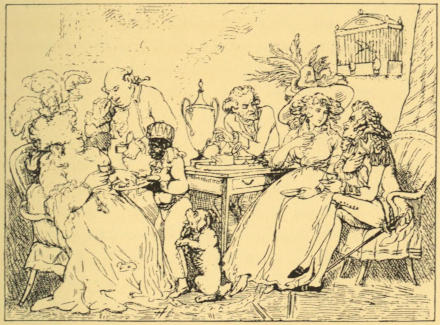
WHEN GEORGE THE THIRD WAS KING. OFFICERS AT AFTERNOON TEA ASHORE.
Thomas Rowlandson. 1786.
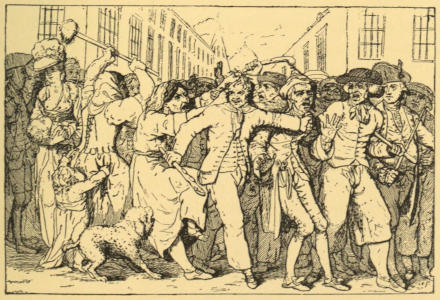
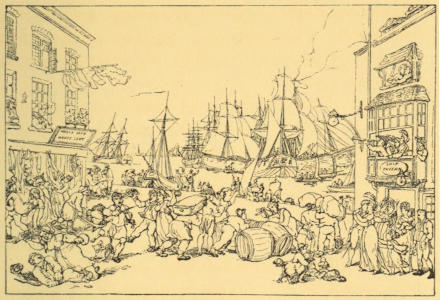
MANNING THE FLEET IN 1779. A WARM CORNER FOR THE PRESS GANG.
James Gillray. Oct. 15, 1779.
For twelve months before Trafalgar, the Dreadnought
was Collingwood’s flagship in the Channel
Fleet. Collingwood passed most of the time cruising
on blockade duty in the Bay of Biscay, where
he used to spend his nights pacing on deck to and
fro restlessly, expecting the enemy at any moment,
and snatching intervals of sleep lying down on a
gun-carriage on the quarter-deck. Collingwood
only changed from her into the bigger Royal
Sovereign ten days before the battle. Under the
eye of the former captain of our first Excellent
man-of-war, the Dreadnought’s men had been trained
to fire three broadsides in one minute and a half—a
gunnery record for that day.
At Trafalgar the Dreadnought fought as one of the
ships in Collingwood’s line, and did the best with
what opportunity came her way.
“This quiet old Dreadnought” wrote Dickens of
his visit to the ship in her last years, “whose fighting
days are all over—sans guns, sans shot, sans
shells, sans everything—did fight at Trafalgar under
Captain Conn—did figure as one of the hindmost
ships in the column which Collingwood led—went
into action about two in the afternoon, and captured
the San Juan in fifteen minutes.”
While fighting the San Juan—the San Juan Nepomuceno,
a Spanish seventy-four—the Dreadnought
had to keep off two other Spaniards and a Frenchman
at the same time; Admiral Gravina’s flagship,
the Principe de Asturias, of 112 guns, and the San
Justo and Indomptable, two seventy-fours. The San
Juan in the end proved an easy prize, for she had
been already severely mauled by some of Collingwood’s
leading ships. On being run alongside of
she gave in quickly. Without staying to take
possession, the Dreadnought pushed on to close
with the big Principe de Asturias, and gave her
several broadsides, one shot from which mortally
wounded Admiral Gravina. The Spanish three-decker,
however, managed to disengage, and made
off, to lead the escaping ships in their flight for
Cadiz. Thus the Dreadnought was baulked of her
big prize.
It was the Trafalgar Dreadnought that gave the
name to that great international institution, the
Dreadnought Seamen’s Hospital, at Greenwich.
This, of course, was long after Trafalgar, for the
“wooden whopper of the Thames,” as Dickens
called the old three-decker in her old age, did not
make her appearance off Greenwich until a quarter
of a century later. The fine old veteran of “Eighteen
Hundred and War Time,” lasted until 1857,
and to the end they preserved on board as the
special relic of interest, “a piece of glass from a
cabin skylight scrawled over, with somebody’s
diamond ring, with the names of those officers who
were in her at Trafalgar.” Another old three-decker
replaced the Trafalgar ship until 1870, when the
institution was removed on shore. At Chatham
to-day, in the dockyard museum, visitors may see
the Dreadnought’s bell which was on board the old
ship during the battle, and was removed from her
when the Dreadnought was broken up. Yet another
memento of the Trafalgar Dreadnought exists in the
Eton eight-oar Dreadnought, one of the “Lower
Boats,” and so-called originally, together with the
boat that bears the name Victory, in honour of Nelson
and Trafalgar.
Our sixth Dreadnought is a still existing ironclad
turret-ship, mounting four 38-ton muzzle loaders,
launched in 1875. She is a ship of 10,820 tons, and
cost to complete for sea £619,739. She served for
ten years—from 1884 to 1894—in the Mediterranean,
and after that as a coast-guard ship in Bantry Bay.
Paid off finally in 1905, the Dreadnought now lies
at her last moorings in the Kyles of Bute, awaiting
the final day of all for her naval career, and the
auctioneer’s hammer.
To conclude with a flying glance at our mighty
battleship, the Dreadnought of to-day, the seventh
bearer of the name until now, and as all the
world knows by far the most powerful man-of-war
that has ever sailed the seas. She is the biggest
and the heaviest and the fastest and the hardest-hitting
vessel that any navy as yet has seen afloat.
And more than that. The Dreadnought has been
so built as to be practically unsinkable by mine or
torpedo; while at the same time her tremendous
battery of ten 12-in. guns—huge cannon, each forty-five
feet long—makes her absolutely irresistible in
battle against all comers; a match for any two—probably
any three—of the biggest battleships in foreign
navies afloat at the present hour.
These are some of the “points”—some of the
leading features—of this grim mastodonte de mer
of ours, His Majesty’s battleship, the Dreadnought.
With her coal, ammunition, and sea stores on board,
the Dreadnought weighs—or displaces in equivalent
bulk of sea water, according to the present-day
method of reckoning the size of men-of-war—17,800
tons.
Put the Dreadnought bodily inside St. Paul’s and
she would fill the whole nave and chancel of the
Cathedral from reredos to the Western doors. Her
length would take up the whole of one side of Trafalgar
Square. Her width would exactly fill Northumberland
Avenue, leaving only some half-dozen
inches between the house fronts on either side and
the outside of the hull. Two Victorys and a frigate
of Nelson’s day, fully manned and rigged, could be packed
away within the Dreadnought’s hull.
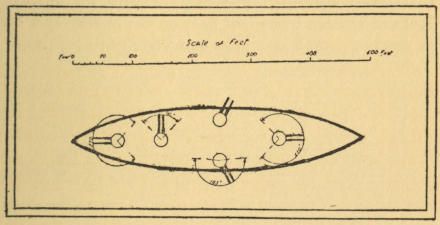
[Our Dreadnought of to-day: deck-plan
to scale; showing the disposition of the 12-in. 58-ton turret-guns
and their arcs of training. (Bows to the right.)][3]
Measured from end to end, from bows to stern,
the ship’s hull extends 490 feet. From forecastle to
keel, measuring vertically, is a matter of some 60
feet down, equivalent to about the normal height of
a church tower.
What, however, above everything else, specially
distinguishes the Dreadnought from all other warships
afloat, is her terrific battery. Hitherto four
12-inch guns have formed the standard main armament
for all battleships. The Dreadnought carries
ten 12-inch guns of a new and more powerful type
than any heretofore in existence. They are mounted
in pairs in “redoubts,” armoured with Krupp steel
eleven inches thick, and are so grouped on board
that when fighting broadside-on with an enemy,
eight of the ten guns will bear on the enemy and be
in action throughout. In chase, or fighting end-on,
six of the guns are available at all times. The
firing charge per gun of “modified” cordite weighs
by itself 2 cwt.—the weight of a sack of coals on a
street coal-cart. In the hour of battle each discharge
from the Dreadnought’s broadside will hurl
into the enemy three tons of “metal”—bursting
shells—each shell being from three to four feet long,
and weighing singly 7½ cwt. With each shot also,
bang goes £80, the cost of the cartridge and its projectile.
Twelve thousand yards will be the Dreadnought’s
chosen range for engaging—six miles—about
as far as clear vision is possible above the horizon.
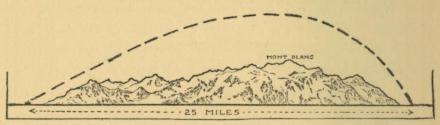
[Curve of flight, or trajectory, of 850 lb.
projectile from a Dreadnought
12-in. turret-gun fired with full service charge.]
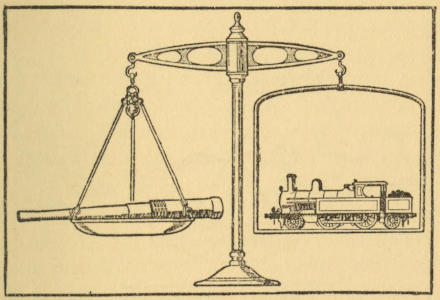
[The 12-in. gun is about the same weight as an ordinary
railway passenger train engine.]
“Mark X” is the official style for the Dreadnought
class of 12-inch gun. It is the most powerful piece
of ordnance in the world. It weighs upwards of fifty-eight
tons, about the weight of a larger “tank” railway
engine of the kind that brings the suburban
bread-winner up to London every morning. Its
muzzle velocity—the speed at which the shot flashes
forth from the gun—is 2900 feet (966⅔ yards, or well
over half a mile) in a second. The force with which
the shot starts off is enough to send it through a
solid slab of wrought iron set close up in front of
the muzzle of the gun 4¼ feet thick. When fired
with full charges, each gun develops a force able to
lift the Dreadnought herself bodily nearly a yard up,
exerting a force equivalent to 47,697 “foot-tons,” in
gunnery language. The entire broadside of eight
12-inch guns, fired simultaneously, as at the gun
trial off the Isle of Wight, develops a force sufficient
to heave the huge vessel herself, 21 feet up—nearly
out of the water, in fact.
[Extreme range of the Dreadnought’s turret-guns:—Fired from
in front of St. Paul’s Cathedral.]
As an instance of the tremendous range of the
Dreadnought’s guns: mounted on one of the Dover
forts, they could easily drop shells on the deck of a
Channel packet in the act of leaving Calais harbour.
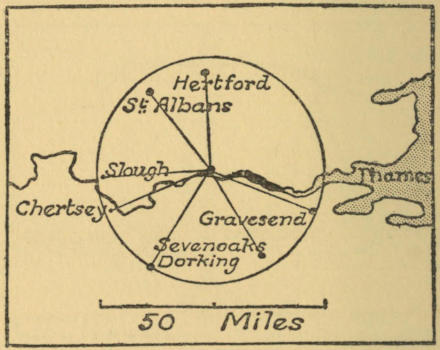
Imagine one of them mounted in front of St. Paul’s
and firing with full charges in any direction. Its
shells would burst over Slough in one direction
and over Gravesend in the other. Hertford, St.
Albans, Chertsey, Sevenoaks, would all be within
range. Twenty-five miles is the extreme estimated
range of a shot fired with a full service charge, and
the trajectory of the projectile would, at its culminating
point, attain a height in the air of nearly six
miles, twice the height of Mont Blanc.
They are “wire guns,” as the term goes, constructed
in each case by winding coil on coil of steel
ribbon or “tape” (a quarter of an inch wide and ·06
of an inch thick), round and round on an inner steel
tube, the barrel of the piece; just as the string is
wound round the handle of a cricket bat. The tape
or “wire” is then covered by outer “jackets,” or
tubes of steel. Upwards of 228,800 yards of wire—a
length of 130 miles—weighing some 15 tons, are
required for each of the Dreadnought’s 12-inch
guns, and it takes from three to four weeks to wind
on the wire. The rifling of the barrel comprises forty-eight
grooves, varying in depth from ·08 of an inch at
the muzzle to ·1 at the breech. Each of the Dreadnought’s
guns, separately, employs in its manufacture
from first to last upwards of five hundred men in
various capacities, and costs, as turned out ready to
send on board, but without sighting and other vital
appliances, between £10,000 and £11,000.
The Dreadnought carries eleven inches of Krupp
steel armour on her sides, turrets, and conning
tower, and rather thinner armour at the bows and
stern. Her speed of twenty-one knots makes her a full
two knots faster than any existing battleship. She
is the first battleship in any navy to be propelled by
the Parsons turbine, to which her speed is due.
Lastly, the cost of the Dreadnought is officially
stated at £1,797,497.
Exceptional in themselves, and of exceptional
historic interest as well, are the honours that have
fallen to the Dreadnought’s lot within the few months
that our great naval masterpiece has been in existence.
At the outset the Dreadnought had the good fortune
to be named and sent afloat by His Majesty King
Edward personally. That in itself was an exceptional
honour, and one that has fallen to the lot of
very few ships of the Royal Navy—to be named and
sent afloat by the reigning sovereign. There have
been just six instances in all, from the earliest times
to the present day. Queen Victoria launched four
men-of-war during her long reign; but no King of
England ever launched a ship in the four hundred
years between King Edward and Henry the Eighth:
King Edward with the Dreadnought and Henry the
Eighth with the Great Harry are the two historic
instances. Many of our sovereigns, of course—practically
all of them: Edward the Sixth, Queen
Elizabeth, the Stuart kings, Cromwell also, George
the Third, and William the Fourth—attended in
state on various occasions to witness the launch of
some notable man-of-war, but they were present only
as spectators, and took no part in the actual proceedings.
Charles the First was to have personally
named the famous Sovereign of the Seas, with the
same ceremonial used at the launch of our first
Dreadnought, and rode down with his Court to
Woolwich to do so; but they could not get the ship
out of dock, and the King rode back to Whitehall
disappointed, deputing the Lord High Admiral to
name the ship when she did get clear—not till
between eight and nine in the evening. Charles the
Second, in like manner, was to have personally
named our first Britannia, but His Majesty was taken
ill on the day before. Again too, as it also happened,
there was a hitch at the launch. The
Britannia stuck fast for twelve hours, and then went
off at midnight to the flare of torches and cressets,
after which a courier was hurried off at gallop to
Whitehall, to acquaint the King, “lest certain base
reports (i.e. that the Britannia had fallen over in
dock) may have reached your Majesty.”
Yet another exceptional honour that befel the
Dreadnought was after the great review of the Home
Fleet off Cowes, on the first Monday of August this
year, when King Edward, with Queen Alexandra,
the Prince of Wales, and Prince Edward of Wales,
with Sir John Fisher and members of the Royal suite,
went out on board the Dreadnought to beyond
Spithead to witness target-practice with the Dreadnought’s
turret-guns; the memorable occasion on
which, at 2640 yards’ range, the four 12-in. guns
that fired, scored within two and a half minutes nine
bull’s-eyes and two “outers” out of twelve rounds
discharged. Never to be forgotten was the scene as
the Dreadnought passed down the double lines of the
Home Fleet in the brilliant sunshine; the ships all
dressed with flags, and with decks manned, and
cheering, and firing salutes—the giant ship herself
flying the Royal Standard at the masthead and at
either yard-arm the Union Flag, symbol of His
Majesty’s rank as Admiral of the Fleet, and the
Admiralty Anchor Flag, a combination not seen on
board a British man-of-war of the fighting-line, even
in those historic waters, for over a century—not,
indeed, since that summer’s morning of 1794, when
the three flags flew together at the mastheads of the
famous Queen Charlotte, denoting King George the
Third’s presence on board, with his Queen, on his
visit to present a diamond-hilted sword of honour to
Lord Howe, then just arrived with the prizes taken
on the Glorious First of June. That also was the
last occasion, until the other day, on which a King
and Queen of England were together on board a
British man-of-war at sea.
The guns fired before the King and Queen were
those in the two after-turrets, and the targets used
were the usual service ones, 16 ft. by 20 ft., with
a central bull’s-eye 14 ft. square. The range was
about a mile and a half, and six rounds were fired
from each turret. Of the three shots placed outside
the bull’s-eye, two went through the target, whilst
the third, which missed, cut away the rope fastening
the canvas of the target to the framework. Two
of the shots in the bull’s-eye went through the very
centre, through a small circle, about thirty inches in
diameter, marked in the middle of the target.
We will conclude this outline of our Dreadnoughts’
story with a brief tabular statement of certain points
in detail of comparison and contrast between the
Dreadnought of to-day and the historic Victory.
THE DREADNOUGHT AND VICTORY COMPARED
DREADNOUGHT.
VICTORY.
Time Building
16 months
Five years ten months
Total Cost
£1,797,497
£89,000
Displacement
17,900 tons
3400 tons.
Total Weight Broadside
6800 lb.
1160 lb.
Extreme Range of Guns
25 miles
3 miles.
Penetration of armour at six miles
9 in. Krupp Steel
Penetration at all distances
Nil.
Heaviest Gun
12 inch
6 inch.
Weight of Charge
265 lb. (M.D. cordite).
10½ lb. (gunpowder).
Time to make Gun
12 to 15 months
Four guns a week.
Cost per Gun
£11,000
£57. 15s.
Average Weight per Gun
58 tons
56 cwt.
Complement
780 men
850 men.
Length
490 ft.
226 ft. 6 in.
Breadth
82 ft.
52 ft.
Mean Load Draught
26 ft. 6 in.
25 ft.
Number of Guns
37
104
Speed
21½ knots
10 knots.
II “KENT CLAIMS THE FIRST BLOW!”
“The Kentishe Menne in Front!”
“Kent claims for itself the first blow in
battle against alien enemies.” The
hand that penned these words has lain
in the grave for over seven centuries;
but old William Fitz-Stephen of Canterbury
knew what he meant, and meant what he wrote.
They are words that our fine “county cruiser”
the Kent of to-day—to which the ladies of Kent
have presented a silken battle flag and the Men
of Kent a silver shield and other gifts, to incite the
Kent’s bluejackets to shoot straight—might well
adopt and make the ship’s motto. It was from the
County of Kent that the initiative came in the movement
which has had such excellent results in inducing
the county people in other counties all over
Great Britain and Ireland to display a practical
interest in the warships that bear the county names;
and the idea has since spread in other cases throughout
the Empire.
The county “Association of Men of Kent and
Kentish Men” of their own accord took the initial
step in the spring of 1899 by approaching the late
Lord Goschen, then First Lord of the Admiralty,
with a request that one of four cruisers of a new
type, to be built under the supplemental programme
of the previous August, might be named after the
County of Kent. The request was heartily received,
and in response the name Kent was announced for
the first of the new ships. A little later the Men of
Kent made a second proposal. They asked permission
to establish among themselves a “county
memorial for the new county-cruiser Kent,” expressing
their “desire and intention to do something
to keep up a continual connection between
the county and the good ship, and to cause a
sustained interest to be taken in her fortunes and the
welfare of those on board.” Lord Goschen acceded
to that request, and a county subscription was
immediately set on foot by Lord Harris, the president
of the Association for the year, to form a Kent county
trophy fund for the cruiser Kent. It was proposed to
present the ship, on commissioning, with a challenge
trophy in silver, to be competed for annually among
the gun crews of the ship, the champion gun team
for each year to have their names inscribed on the
trophy and receive a special monetary reward from a
county fund established with the trophy. The trophy
itself was to be kept on board and to be displayed on
special and festive occasions in the mess of the winning
team. Whenever the Kent was out of commission
the trophy would be cared for by the Captain of the
Royal Naval Barracks, Chatham, or at Greenwich
Naval College.[4] The movement received cordial support
from Lord Selborne, Lord Goschen’s successor
at the Admiralty, and from the late Earl Stanhope,
the then Lord Lieutenant of Kent, and the late Lord
Salisbury, then Lord Warden of the Cinque Ports.
More than that, indeed. Interested by the patriotic
action taken by the County of Kent on behalf of its
cruiser namesake, His Majesty the King was himself
graciously pleased to command that in the cases of
future ships bearing the names of counties the Lords
Lieutenant of the counties concerned were to be
requested by the Admiralty to nominate in each case
some lady connected with the county to perform the
naming and launching ceremony.
THE COUNTY AND ITS SHIP. THE KENT TROPHY CHALLENGE SHIELD
From a photograph kindly lent by the Designers and Manufacturers
of the Trophy, Messrs. George Kenning & Son, Goldsmiths, Little Britain
and Aldersgate Street, London.
The trophy-shield subscribed for by the Men of
Kent, together with an album for the names and
scores of its winners from time to time, was formally
handed over to the captain and ship’s company of the
Kent at Sheerness by representatives of the County
Association, the gift being received with every mark
of regard and genuine welcome. Following on that,
a deputation of county ladies, headed by the Countess
Stanhope, the wife of the Lord Lieutenant, presented
the favoured ship with two flags, a beautiful silken
ensign and a silken Union Jack, subscribed for by
the County Association of “Maids of Kent and
Kentish Maids.” The flags were brought on board
in the beautiful box of Kentish Heart of Oak in
which they are now kept under the sentry before the
captain’s cabin. The ensign was bent on the halyards
and ceremoniously hoisted to the peak by
Countess Stanhope in the presence of the assembled
officers and crew of the Kent, and the Jack was
hoisted by the Hon. Secretary of the Ladies’ Committee,
Mrs. Bills, the proceedings winding up with
a luncheon to the ladies on the after-deck by Captain
Gamble and his officers, and an afternoon dance on
board.
That the name of the ancient maritime county of
England should be borne in the fleet to-day by a
modern British warship is in itself a matter of historic
interest. There are, indeed, very excellent
reasons why the County of Kent should receive distinguished
treatment from the Admiralty, why its
name deserves to be honourably commemorated in
the British fleet of to-day.
Kent has a place of its own in regard to the naval
annals of England, old-time associations with the
oversea defence of England and the national navy,
that stand quite by themselves. The associations
indeed go back across fifteen centuries, to the earliest
days of our “rough island story”; so far back, indeed,
as the old old times of the “Counts of the
Saxon Shore.”
Dover and Reculver, the two principal Kentish
ports of the days when Britain was a Roman
province, were central stations in the widespread
line of outposts along the coast whence watch and
ward were kept for the coming of the Norseland
raiders oversea in the springtime year by year.
Bared to the sun and soft, warm air,
Streams back the Norseman’s yellow hair,
I see the gleam of axe and spear,
The sound of smitten shields I hear,
Keeping a harsh, barbaric time
To Saga’s chant and Runic rhyme.
From the pharos on the Foreland in those strenuous
times of long ago keen-sighted men of Kent kept
look-out daily, scanning the horizon from sunrise
to sunset; ever on the alert to start the alarm and
pass it on to where the Roman coast defence galleys
lay at their moorings off the mouth of the Wantsum
Channel by Richborough Castle.
Alike on land and sea theirs was the post of honour.
At Hastings, led by the stout Earl Leofwine, as we
know—
A standard made of sylke and jewells rare
Was borne near Harold at the Kenters Head.
And centuries after that, whenever the King of England
was in the field, they claimed the right to lead
the van—“The Kentishe Menne in front!”
The Kentish contingent—the “Eastern Ports”
contingent—formed the bulk and the backbone of the
Cinque Ports fleets of the Middle Ages, both in
ships and men. Four of the five “Head Ports” in
the famous confederation were Kentish ports—Sandwich,
Dover, Romney, and Hythe. The “Eastern
Ports” counted twenty-one limbs, “Members”; the
“Western Ports”—Hastings with the two “Ancient
Towns” attached—ten “Members.” The old Cinque
Ports Navy, in these times of ours it may be, is little
more than a name, a faded memory of a dim and
distant past, a perished institution of a dead old time;
yet it was once an actual fact, a living hot-blooded
reality, the chief guarantee of our national existence,
a very real bulwark, the foremost defence of England
from foreign invasion. “The courage of those
sailors who manned the rude barks of the Cinque
Ports first made the flag of England terrible on the
seas.” For all that we have to thank, in the first
place, the Men of Kent, that Kent of which old
twelfth-century Fitz-Stephen, monk of Canterbury
and historian of his own times, was thinking when
he wrote, “Kent claims for itself the first blow in
battle against alien enemies.”
The Kentish ships of the Cinque Ports, “Ships of
Kent” they are explicitly called, took a leading part
with the Crusaders’ fleet which on its way to the
Holy Land for the Second Crusade, in the year 1147,
captured Lisbon from the Moors. Kentish men
fought with that fine leader, William Longsword,
Earl of Salisbury, “Warden of the Cinque,” when
he fell on the French King’s fleet at Damme—just
three years before King John put his mark to Magna
Charta.
It was a squadron of the Kentish ships of the
Ports’ federation that, in the year after Magna
Charta, under one of England’s finest heroes and
greatest men, that grand fellow, stout-hearted
Hubert de Burgh, Earl of Kent, Chief Justiciar of
England and Constable of Dover Castle, Cœur
de Lion’s favourite pupil in arms, saved England
from invasion by rounding up the fleet with which
the renegade leader Eustace the Monk—“pirata
nequissimus” one old chronicler calls him—was
making for the Thames, and dealing the French the
first of the series of knock-down blows of which
Nelson struck the last at Trafalgar. The story of the
“Battle of Bartholomew’s Day,” the 24th of August,
1217, is one we ought not willingly to let die. There
is hardly a finer tale in all our history than that
which tells how De Burgh’s sixteen Cinque Port
warships from Dover, with nineteen or twenty small
craft, stood out to meet the Monk’s hundred and odd
ships—eighty of them the largest vessels of the time—off
the North Foreland; swept round them astern,
weathered them and closed, grappled them fast,
under cover of a stinging fire of archery and crossbow
bolts, cut down their sails, and then, flinging
up in the air handfuls of quicklime to blow into the
faces of the Frenchmen, boarded and overpowered
the enemy in hand-to-hand fight with falchion and
pike and battle-axe. They fought it out from early
morning until the afternoon was spent, when fifty-five
ships of the Monk’s fleet had been taken, and
the rest, except fifteen ships that ran away, all sent
to the bottom.
Again, in the tremendous Midsummer Day’s battle
in the harbour of Sluys, the “Trafalgar of the
Middle Ages,” although to most people the event is
barely a schoolbook memory—the great naval victory
that made Creçy possible—once more the Ship-and-Lion
flag at the masthead of vessels from the
four Kent ports was to the fore, well up in the van
of King Edward’s attacking fleet and in the thickest
of the fighting. And at the battle of “Espagnols-sur-Mer,”
off Winchelsea, where again Edward the
Third fought in person, together with the Black
Prince; off St. Mahé; and at Harfleur, covering
Henry the Fifth’s landing for the march that ended
at Agincourt, and in many another hard-fought
action in the Narrow Seas after that, Kentish men in
the Kentish ships of the Ports’ Navy full well played
their part.
It was oak from the Weald of Kent for the most
part that built the men-of-war of Queen Elizabeth’s
fleet which drove the Spanish Armada through the
Channel and North Sea to its doom on the reefs of
Stornaway and the quicksands of Connemara—ships
timbered and planked with oak from the Kentish
Weald, and shaped and framed and clamped together
in the Kentish Dockyards of Deptford and Woolwich.
Phineas Pett, a Kentish man by birth,
designed and built the famous Sovereign of the
Seas; and his grandson, Sir Phineas Pett, designed
and built our first Britannia. The Great Harry was
mostly built of Kentish oak; as was, at a later
day, Sir Richard Grenville’s “little” Revenge, and,
at a still later day, Nelson’s Victory, launched at
Chatham.
It was a Man of Kent who, as admiral in chief
command, planned and gave the order for the capture
of Gibraltar. It was another Man of Kent
who, as admiral second in command, carried that
order out. Sir George Rooke, one of the Rookes of
Monk’s Horton, Kent—by far the ablest sea-officer
in the British service in the hundred years between
Blake and Hawke—was the Commander-in-Chief
before Gibraltar. Byng, Sir George Byng, was the
second in command—the elder of the two Byngs
known to naval history, “Mediterranean Byng,” as
he was called in the Navy in connection with a later
exploit of his, and remembered nowadays as the
Byng who beat the enemy and was not shot. He
became Lord Viscount Torrington, and may, in like
manner, be distinguished from the other Lord Torrington
of naval history (Arthur Herbert) as the
Torrington who beat the enemy and was not court-martialled
and broke.
A famous family of old-time Kent were the Byngs,
seated at Wrotham ever since the fifteenth century,
more than one member of which came to the front
in the reigns of Queen Elizabeth and the Stuart
kings. Such as, for instance, the fine old Kentish
cavalier of Browning’s rousing song:
Kentish Sir Byng stood for his King,
Bidding the crop-headed Parliament swing,
And, pressing a troop unable to stoop
And see the rogues flourish and honest folk droop,
Marched them along,
Fifty score strong,
Great-hearted gentlemen, singing this song!
Fifty score strong! Fifty score strong!
Great-hearted gentlemen, singing this song!
Other Kentish men of note associated directly
with the Old Navy were Sir Thomas Spert, founder
of Trinity House, and captain of the Harry Grace à
Dieu when Henry the Eighth crossed the Straits of
Dover in her to the Field of the Cloth of Gold; Sir
William Hervey, of Kidbrooke, “who greatly distinguished
himself in boarding one of the vessels
composing the Spanish Armada,” and was raised to
the peerage as Lord Hervey; old Captain Dick
Fogg, of Repton, near Ashford, captain under
Charles the First of the tenth whelp and the Victory
and of other men-of-war of note; Kit Fogg, his
son, who fought for England in half a score of sea-fights
under Charles the Second and down to the
time of Queen Anne; Christopher Gunman, a bold
fireship and frigate captain in the Dutch wars,
captain of the Duke of York’s flagship at Solebay,
who later on nearly drowned the future James the
Second; George Legge, afterwards the Earl of
Dartmouth, whose valour in battle at Solebay made
his fortune, a member of a Kent county family of
long descent; two notable Commodores, two St. Lo’s
of Northfleet; Commodore Boys of the Luxborough
galley; Sir Piercey Brett, who as a lieutenant went
round the world with Anson, and lived to be one
of the most distinguished officers of his day; Sir
Thomas Boulden Thompson, who fought under
Nelson at Teneriffe, at the Nile, and at Copenhagen.
These are a few names taken at random.
Sir Sidney Smith, the “Hero of Acre,” the man
who made Bonaparte, as the Emperor himself put
it, “miss his destiny,” was of Kentish birth and
family, and learned his “three R’s” at Tunbridge
School; and it was to Lord Barham, as First Lord
of the Admiralty, that Nelson reported himself in
September, 1805, when he volunteered to shorten
his leave at home and go out at once to fight the
enemy at Trafalgar.
It was Kent, too, that gave England Captain
John Harvey—one of the Harveys of Eastrey, a
family that for generations had sent its sons into the
Navy—captain of the Brunswick on Lord Howe’s
famous day, the “Glorious First of June,” 1794,
who fell mortally wounded in close action with the
French Vengeur. When the two ships first collided,
the master of the Brunswick proposed to cut the
Vengeur clear. “No,” answered Captain Harvey;
“we’ve got her, and we’ll keep her!” After he
received his mortal wound he refused to let himself
be carried off the quarter-deck. He dragged himself
down to the cockpit, saying as he went off the
deck, “Remember my last words: the colours of
the Brunswick must never be struck!” A brother,
Henry Harvey, was the admiral whose name is still
to be met with on old tavern signboards here and
there in East Kent. Henry Harvey, captain of the
Ramillies, came to his brother’s aid on the 1st of
June, and with three terrific broadsides finished off
the Vengeur for the Brunswick, amid resounding
cheers from the Brunswick’s men, and giving occasion
to an officer in another ship who was looking on to
improvise on King David: “Behold how good and
joyful a thing it is for brethren to fight together in
unity!”
It was this same Henry Harvey who, as a rear-admiral,
later in the Great War (in 1797), took
Trinidad. That the conquest proved an easy business
was not his fault. The Commander-in-Chief of
the Spanish squadron at Trinidad, Admiral Apodoca,
when he saw Admiral Harvey coming, without clearing
for action or firing a shot set fire to his ships
and escaped ashore. He took horse and galloped
off, and presented himself, excited and panting with
his exertions, before the Governor of the island,
General Chacon. “I have burnt my ships, sir,” he
burst in with, “in case they should fall into the
power of the English.” “Burnt them?” exclaimed
the astonished Governor; “destroyed them! Have
you saved nothing?” “Oh, yes I have!” Apodoca
replied. “Yes I have! I have! I have saved”—drawing
a carved and painted wooden image, some
fifteen inches long, from under his cloak as he spoke—“my
flagship’s patron saint—I have saved San
Juan de Compostella!” That Apodoca’s flagship
was the San Vincente, and that there was no San
Juan de Compostella on the Spanish Navy List at
the time, are details the story does not concern itself
with.
Yet another interesting connection between Kent
and the sea service of bygone times is this. H.M.S.
Kent’s name is not the only man-of-war name associated
with the county that has figured in the fighting
days of old. No fewer than eighteen other man-of-war
names connected with the county of Kent have from
time to time been borne on the roll of the British
fleet. It was on board a Canterbury that a notable
naval officer of the earlier part of the eighteenth
century, Captain George Walton, penned words
which have been quoted over and over again as a
masterpiece of conciseness. He had been in pursuit
of a Spanish squadron, and on his return, as most
of us have read, reported as follows:—
“To Admiral Sir George Byng, Commander-in-Chief.
“Sir,
“We have taken and destroyed all the
Spanish ships and vessels which were upon
the coast, as per margin.
“I am, etc.,
“George Walton.
“Canterbury, off Syracusa, August 16, 1718.
“One of 60 guns, one of 54, one of 40, one of 24—taken;
one of 54, two of 40, one of 30 guns, with
a fireship and two bomb vessels—burnt.”
As a fact, unfortunately, Captain Walton’s “dispatch”
was written in quite another way. The
captain of the Canterbury really sent the admiral a
letter of two pages. What is passed off as his whole
“dispatch,” is actually only the concluding sentence
of the letter, excerpted and dressed up. An unscrupulous
admiralty official, for the purposes of a
book on the campaign, manipulated the letter and
printed its last paragraph by itself as the entire
despatch. Historians following one another have
since then simply copied Secretary Corbett.
Our first Sandwich broke the French line at the
battle of La Hogue, and lost her gallant captain in
doing it. Another bore Rodney’s flag in five battles—two
with the Spaniards and three with the French—and
was at the first relief of Gibraltar during the
Great Siege. Our first Dover was present at the
taking of Jamaica. Another won fame as Captain
Cloudesley Shovell’s ship. Commodore Trunnion
served on board another Dover, if Smollett spoke by
the card in making him express a wish to be buried
“in the red jacket which I wore when I boarded the
Renummy.” Apart from the taking of Louis the
Fifteenth’s frigate Renommée, if we count in other
French and Spanish frigates and privateers taken,
our various Dovers, in their time, must have brought
home captured flags enough to deck the town out
from end to end. All, of course, have long since
rotted out of existence. People in old times set
little store by such trophies. “What are you going
to do with all these flags?” a friend once asked of a
frigate captain who, in his barge, gaily decorated
from bows to stern with the colours of ships taken
during the commission, was being pulled in from
Spithead to land at the old Sally Port, Portsmouth.
“Do with them?” came the reply. “Why, take ’em
home and hang ’em on the trees round father’s
garden.”
It was a Chatham whose twenty-four pounders,
one May morning, just a hundred and forty-eight
years ago, gave the Royal Navy our first, and the
original, “Saucy” Arethusa. One Maidstone fought
with Blake at Santa Cruz de Teneriffe. Another,
acting as “guide of the fleet,” led Hawke to victory
on that stormy November afternoon among the reefs
of Quiberon Bay, which the French Navy, pillorying
the memory of its unfortunate admiral, has ever
since called “la journée de M. Conflans.”
A Greenwich fought at La Hogue, and was one of
Benbow’s squadron in his last fight. One Deptford
was also at La Hogue, and another with Byng off
Minorca, where the Deptford, at any rate, did her
duty. A Romney, in Queen Anne’s war, after a
career of distinction, went down with all on board
to westward of St. Agnes, Scilly, on the night of
the catastrophe to Sir Cloudesley Shovell. Rochester,
and Medway, and Sheerness, are also man-of-war
names that have attaching to them interesting memories
of the fighting days of old, as have too, in one
way or other, in differing degrees, the remaining
names of the group, Woolwich and Faversham,
Eltham and Deal Castle, Margate, Queenborough,
and Folkestone.
Our modern-day cruiser the Kent has her own
story also as a man-of-war, a notable and interesting
historic reputation of her own, to uphold. This
summary will give its points, the “battle honours”
which the Kent would be entitled to bear on her
ship’s flag were our ships authorized to follow the
practice of the army in regard to regimental flags.
Recapture of Calcutta and bombardment of Chandernagore
Feb.,
1757
Alexandria
Mar.,
1801
Service with Nelson off Toulon
1803-4
In the Mediterranean
1807-12
A peculiarly interesting memento of the Kent in
connection with one of these battles is in existence.
It refers to the part played by the Kent of Charles
the Second’s navy just before the battle of June, 1666,
“The Four Days’ Fight,” in which Monk, Duke
of Albemarle, during Prince Rupert’s temporary
absence with a third of the fleet in the Channel,
without waiting for Rupert to rejoin, rashly flung
his weaker force on De Ruyter with the whole of
the Dutch fleet at hand and brought about a general
engagement.
The Kent had been sent off on the 27th of May on
a scouting cruise between “Blackness” (the old
name for Cape Grisnez) and Ostend. Late in the
evening of the 30th of May the following letter was
handed to the Duke of Albemarle from the captain
of the Kent, sent across by a Dutch ketch that the
Kent had taken:—
“May it please yr Grace,
“This morning being off Gravelines in chase
of a small ship and a ketch belonging to Newport,
as they pretend, whom I have sent into the Downs
to your Grace, I mett with a Swede who came from
Amsterdam on Sunday last in his ballast, bound for
Bordeaux, who relates that 75 sayle of the Flemish
Fleet sett sayle out of the Texel the 21st present,
and 28 more from Zealand, leaving 6 ships behind
them, whose men they tooke out to man the rest of
the Fleet, & stoode away to the Northwest, which
as my duty binds me I have thought fit to acquaint
yr Grace with: & humbly kissing your hands I
remain
“Yr Grace’s most humble servant to be commanded,
“Thos. Ewens.
“From aboard his Matⁱᵉˢ shipp Kent:
this 30th May, 1666.”
The captain of the Kent’s letter was considered
so important that Albemarle at once sent it off by
express to the Admiralty. It is still in existence;
a stained sheet of yellowish paper with the writing
crabbed and not easily decipherable, and brown
with age and faded. The letter, with Albemarle’s
covering note, was found many years afterwards
among some correspondence that had belonged
to King James the Second, just as the letter had
been filed on its receipt at the Admiralty in 1666,
when James, Duke of York, was Lord High
Admiral. It is endorsed:—
“For his Grace the Duke of Albemarle, aboard
the Royall Charles this ⸺ d.dd. In the Downes.”
Albemarle’s covering letter to the Admiralty bears
the curiously scrawled endorsements of the various
postmasters on the Dover Road as they passed
the courier along on his hurried journey up to
London:—“Received ye packett at Canterbury, att
past 5 in ye Morneing, by Mee, Edw Wheiston”;
“Sittingborne, past 8 in ye morning, by mee Wm
Webb”; “Rochester, past ten Before noon, Wm
Brooker”; “Gravesend at nowne, Hen White.”
Albemarle was roughly handled and had to beat
a retreat for the mouth of the Thames—fighting a
rear-guard action, skilfully conducted and gallantly
contested. Rupert joined him just in time to avert
disaster, but one of the English flagships, the
Prince, grounded at the last moment on the
Galloper Shoal, and was taken by the Dutch and
burned as she lay. This was just as the Kent rejoined
the flag, in time for the last day’s battle.
Cromwell, it is curious to note, first gave the name
Kent to the navy for a man-of-war; one November
day of the year 1652. On that day—Saturday, the
6th of November—an application from the Admiralty
Committee as to the names for four frigates,
two of which were to be launched in the following
week, was laid before the Lord General Cromwell
and the Commonwealth Council of State. The reply
was that the following would be the names: Kentish,
Essex, Hampshire, and Sussex. So a State Paper,
now among the national archives in the Record
Office, explicitly states. In their selection the
Council made thereby a new departure, and introduced
a set of man-of-war names entirely different
from any before known at sea. The little group of
four ships named in November, 1652, leads the way
at the head of the long series of British men-of-war
which have borne the names of our counties in
battle on the sea with distinction on so many historic
days.
Why the form “Kentish” was preferred to
“Kent” for the first of the four ships, is a
matter that is not quite obvious. The name, of
course, may have been appointed for no particular
reason. The four names chosen were names of four
seaboard counties, locally interested in maritime
affairs, and it may well have been thought that to
call one of the ships the “Kentish” was much the
same thing as calling her the “Kent.” On the
other hand, there may have been in addition something
behind, in regard to the name appointed.
Everybody knows, teste Lord Macaulay, why the
Puritan authorities put down bull-baiting; not because
it hurt the bull, but because it pleased the
people. The Puritans rather liked, it is to be feared,
making themselves deliberately offensive to those
who saw otherwise to them. It is certainly curious,
if not significant, that at the Restoration the name
“Kentish” disappears forthwith from off the official
Navy List, and “Kent” appears instead. This
was just at the time, too, that certain distinctly
obnoxious names, bestowed on men-of-war by the
Puritan authorities, as, for instance, Naseby, Marston
Moor, Worcester, Torrington, Newbury, Dunbar,
Tredagh (the vernacular for Drogheda), were replaced
by names such as Royal Charles, York,
Dunkirk, Dreadnought, Revenge, Henry, and Resolution.
Was any reference intended in the form “Kentish,”
as originally appointed for the new ship of 1652, to
the “Kentish Rising” of 1648, and its hard fate
under the sword blades of Fairfax’s troopers? Was
the name designed as a reminder to the Royalists
of South-Eastern England? Was it meant as a
memento of the penalty that had been paid by so
many who, only four years before, had buckled on
sword and ridden forth so blithely to the county
marching song:—
Kentish men, keep your King,
Long swords and brave hearts bring,
Down with the rebels, and slit their crop ears!
Hell now is wanting rogues,
Send there the canting dogges,
Ride to the scurry, my Kent cavaliers!
God and our King for grace,
Leave now your wives’ embrace,
Up and avenge all their insults for years!
Ironsides! Who’s afear?
Pack ’em to Lucifer,
Ride to the scurry, my Kent cavaliers!
The name “Kentish,” if introduced with such intention,
would help in serving to recall in the stately
mansions of the squires of Kent, and in many a
humble yeoman’s home as well, why there were
vacant places round the family board.
A brief comparison between Cromwell’s Kentish
and her lineal successor of our own day, His Majesty’s
ship the Kent, may be of interest in conclusion.
The Kentish was of 601 tons burthen, 187 feet in
length of hull, 32½ feet beam, and 15 feet draught.
Our modern Kent is 440 feet between perpendiculars
(463½ feet over all), 66 feet beam, and 24½ feet depth.
The first Kent, under full sail, might perhaps do
nine knots at her best speed; the present Kent, with
her engines of 22,000 horse power, has done twenty-three
knots an hour. The first Kent’s guns, forty in
number, were identical with the guns that Queen
Elizabeth’s fleet carried when it fought the Spanish
Armada; the same kind of guns, practically, that
Henry the Eighth’s Mary Rose had on board when
she capsized at Spithead. The same quaint old
mediæval style of nomenclature, indeed, was still in
vogue for the Kentish’s guns. They were called
culverins (18-pounders), demi-culverins (9-pounders),
and sakers (6-pounders). The heaviest of them, the
culverins, weighed 48 cwt. each, and were 5½ inches
in calibre. The Kentish’s guns also were of brass,
specially cast for her; refounded, for the most part,
according to an existing Ordnance order, out of
condemned pieces and captured Royalist cannon.
According to a curious manuscript list of the ship’s
equipment, the Kentish when ready for sea had on
board as her establishment of war stores—908 round
shot, 468 double-headed shot, 100 barrels of powder,
60 muskets; and for close-quarter fighting, 7
blunderbusses, 60 pikes, and 40 hatchets. The
modern Kent carries as her main armament 6-inch
quick-firing steel guns, each firing 100-pounder shot
and shell, and able to discharge, each piece in half a
minute, heavier metal than the whole broadside
(270 lb.) of the original Kentish. The old ship, of
course, was built of wood, oak timber; most of
which, as a curious fact, seems to have been cut on
the confiscated estates of delinquent Royalists in the
County of Kent. The new Kent, built of steel, and
with 4-inch Krupp armour along her water line, cost
to complete for sea upwards of three-quarters of a
million sterling; the Kentish frigate, guns and all,
cost £5000, or in present-day money from £20,000 to
£25,000.
That the gallant “Kents” of His Majesty’s navy
at the present hour are quite ready to give a satisfactory
account of themselves before the enemy,
should occasion arise, may be judged from their
firing record in the “gunlayers competition” for
1907. With the 12-pounder, the average per
gun for the whole ship was 11·18 hits a minute.
Petty Officer Nash achieved fourteen hits in fourteen
rounds, the run, during which the score was
made, being only of fifty-five seconds duration. In
his fifty-five seconds Able Seaman Ramsden fired
fifteen rounds, the time taken to load and fire each
time being just over three and a half seconds, and
he hit the target thirteen times. During the light
quick-firing gunlayers’ test, the Kent fired, in the
short space of fifty-five seconds, 107 rounds, scoring
83 hits, from her 12-pounders; and 42 rounds,
scoring 35 hits, from her 3-pounders. Some of the
guns hit the target with every shot they fired, and
the loading was wonderfully smart, averaging 15
rounds per gun for the fifty-five seconds.
The Kent of King Edward’s fleet was laid down
at Portsmouth Dockyard on the 12th of February,
1900, as a first-class armoured cruiser, and launched
on Wednesday, the 6th of March, 1901, Lady
Hotham, the wife of the Admiral Commander-in-Chief
at Portsmouth, naming the ship in the orthodox
way, with wine grown and produced within the
British Empire, and specially presented for the
ceremony by the Agent General of South Australia.
The Kent was the first to be launched of our modern
set of County Cruisers. She was also the first to
hoist the pennant and join the fleet at sea.
The Scene of the Operations under
Admiral Watson and Clive
[From Major James Rennell’s “Bengal Atlas,”
published in 1781. Reproduced
by the courtesy of the Royal Geographical Society.]
III THE AVENGERS OF THE BLACK HOLE:— WHAT THE NAVY DID FOR CLIVE
The fathers in glory do sleep
That gathered with him to the fight,
But the sons shall eternally keep
The tablet of gratitude bright.
This year, 1907, has witnessed the coming
round of the hundred and fiftieth anniversary
of the establishment of British rule
in India. It has recalled to memory too,
among some of us at any rate, the name of one of
the great Englishmen of history, Clive, and how he
set his hand to the work which, in its ultimate outcome,
placed the realms of the Great Mogul beneath
the sovereignty of the British flag. The part that
the Royal Navy took side by side with Clive and his
soldiers is perhaps hardly as fully recognized as it
should be, considering all that it meant. For that
reason, among others, the fine story of what took
place, of the help that our bluejackets of that time
gave when the situation was most critical, finds its
place here. The navy had its own rôle to take in
the stirring drama, and it fulfilled it—completely,
faultlessly, resistlessly. Without the navy—the
squadron then on duty in Indian waters—Clive
would have been powerless, and the golden hour for
England, with its opportunities, would have had to
be let go by.
In the summer of 1757 the British East Indies
Squadron had not long arrived in the Bay of Bengal.
It had come out from England four or five months
previously in anticipation of the outbreak of a war
with France. After carrying out operations against
the pirate strongholds of the Malabar coast, it had
gone round to take post off Madras, at that time the
most important of the British settlements in the
East. It was in the neighbourhood of Fort St.
George when, absolutely as a bolt from the blue,
came the news of the catastrophe at Calcutta, which
led to the tragedy of the Black Hole.
At that moment news was expected by every ship
from England that war had been declared with
France, and part of the British squadron was on the
watch down the coast, off St. David’s. It seemed
quite possible, indeed, that the first intelligence of
war might be the appearance on the scene of a
French squadron from Mauritius, cleared for action.
All were keenly on the alert, almost from the first
arrival of the British force on the coast. There was
no means of knowing whether the French were not
already on their way, and every precaution was taken
against surprise. A daily masthead look-out was kept
for six weeks, the ships being maintained in readiness
every night to clear for action at short notice.
So little was trouble from the north expected, that
month of July, 1757, that an expeditionary force
under Clive to assist the Subahdar of Hyderabad
in his quarrel with M. Bussy was on the point of
setting out.
To help the Subahdar a force of three hundred
European soldiers and fifteen hundred Sepoys of
the Madras army was told off, and to counteract the
consequent weakening of the garrison of Madras,
Admiral Watson, the Commander-in-Chief of the
East Indies Squadron, was requested to bring his
squadron higher up the coast so as to keep guard in
the immediate vicinity of Fort St. George.
The Admiral did as he was asked, after which,
just as the Hyderabad column was on the point of
marching off, the blow from Bengal fell.
In the second week of July a letter came from
Governor Drake at Calcutta with the news that the
new Nawab-Vizier of Bengal, Suraj-u-daulah, had
seized the Honourable East India Company’s
factory at Cossimbazar and made the officials there
prisoners. There was great anxiety at Madras, and
Major Kilpatrick, of the East India Company’s service,
with three companies of European troops, was
at once sent north, on board a Company’s ship, to
render what assistance he could. The Bengal military
establishment at that time comprised only five
hundred men—two hundred Europeans and three
hundred Sepoys. The dispatch of the soldiers for
Calcutta delayed the start of the expedition for
Hyderabad; and then, just as marching orders were
about to be given for the second time, on the 5th of
August, a second letter from Bengal arrived.
To the amazement and consternation of all, they
learnt that Calcutta had fallen. Suraj-u-daulah had
swooped down on the settlement with seventy thousand
men, with cannon and four hundred elephants,
and had captured Fort William. Governor Drake
sent the message from a place called Fulta, a riverside
village in the Sunderbunds, some forty miles
below Calcutta. The garrison of Fort William,
he said, had made a defence for five days, after
which, ammunition failing, he and the higher
officials had taken refuge on board what ships there
were in the Hooghly and retreated with them to
Fulta. The women were safe on board the ships,
said the Governor, but all were in the utmost distress
and great danger. They appealed for help at
the earliest possible moment. Not a word was said
of any one being left behind in Fort William; not a
syllable about the tragedy of the Black Hole. News
of that apparently had not yet reached Fulta. But
without the crowning tragedy, the news, as it reached
Madras, was bad enough. It came with stunning
effect: “A blow as filled us all with inexpressible
consternation,” to use the words of Dr. Ives, the
surgeon of Admiral Watson’s flagship, the Kent.
To recover Calcutta and take vengeance on the
Nawab were the thoughts uppermost in every one’s
mind at Madras. A sloop-of-war, the Kingfisher,
was hastily dispatched northward on the day after
the receipt of the news to render assistance to the
ships with the refugees on board, which would probably
be found lying weather-bound in the Hooghly.
The troops for Hyderabad were ordered to stand
fast. An urgent message was sent to Fort St. David
to summon Clive to the Presidency. Clive hurried
to Madras, and with Governor Pigott and the
Council discussed the situation.
Discussion, however, soon disclosed a difference
of opinion as to what should be done. Some of the
leading people at Madras were nervous for themselves.
Certain members of the Council objected to
any weakening of the garrison. War with France,
they said, was imminent. It was quite possible
indeed, according to late advices from Hyderabad,
that the Subahdar and M. Bussy might settle their
quarrel and combine against Madras. With that
possibility before them, was it wise to strip Madras
entirely of its garrison, now that the worst had
already happened in Bengal? The Council met day
after day, and adjourned without coming to any
decision. Fortunately in the end the bolder spirits
prevailed. By a majority the Council decided to
equip an expedition and send help to Bengal as soon
as the weather—it was the monsoon season—would
let the expedition start.
It was agreed, after a consultation with Admiral
Watson, that Colonel Adlercron’s regiment (39th
Foot) and 1500 Sepoys should be shipped on board
the men-of-war and some Indiamen then in the
Roads, and proceed to Balasore, at the mouth of the
Hooghly. There the vessels then housing the Calcutta
refugees would transfer them on board the
three larger men-of-war, the flagship Kent, the
Cumberland, and the Tyger, which ships, it was
held, drew too much water to cross the shoals at the
mouth of the Hooghly. The Indiamen and the
Calcutta ships would then transport the soldiers
up the river and recapture Calcutta, escorted and
assisted by three smaller men-of-war, the Salisbury,
the Bridgewater, and the Kingfisher.
These arrangements had all been completed when
something totally unexpected happened. A Bombay
runner arrived with dispatches from the Admiralty,
sent overland, recalling the whole of Admiral
Watson’s squadron to England at once. “It was,”
as Dr. Ives describes, “a terrible blow.” But the
Admiral proved equal to the situation. He held an
informal consultation in his cabin with his second in
command, Rear-Admiral Pocock, and Flag-Captain
Speke. Taking all responsibility on himself, the
Admiral decided to postpone his departure until
after the expedition to Bengal had been successfully
carried through. An emergency had arisen, he
wrote in his reply to England, which the Admiralty
could not have foreseen, which imperatively required
the continued presence of the squadron on the
station. Then Admiral Watson went ashore to
communicate his dispatches to the Governor in
Council. His opening intimation that the men-of-war
had been recalled created, in the words of Dr. Ives,
“blank consternation.” It would mean, as
the Council formally resolved, “the total ruin of
the Company’s affairs in the Indies.” They expressed
themselves as helpless without the Navy, and
were overwhelmingly grateful when they learned
that the Admiral had decided, on his own responsibility,
to disobey his orders.
At the last moment, though, there was further
delay; it was over a question of military etiquette.
Who should command the expedition—Colonel
Adlercron, a King’s officer, or Lieutenant-Colonel
Clive, a Company’s officer, who had local rank as
colonel? There was further wrangling over this
matter, and valuable time was lost, until it was finally
settled that the supreme command of both sea and
land forces should be vested in Vice-Admiral Watson
as senior commissioned officer in the East, with
Clive in charge of the troops—both King’s and
Company’s.
The expedition finally set sail on the 16th of
October, two months and ten days after the news
of the Black Hole first reached Madras. It comprised
five men-of-war—the Kent, Cumberland, Tyger,
Salisbury, Bridgewater, and the Blaze, a fireship;
three Company’s Indiamen, and two country ships.
All the ships carried soldiers and army stores.
Vice-Admiral Charles Watson, the Commander-in-Chief
in the East Indies, was a capable and zealous
leader. He was a naval officer of the very best type,
and in addition, it was admitted on all hands, a noble-hearted,
considerate English gentleman. He had
been very seriously ill while on the way out from
England—so ill indeed that, on learning soon after
his first arrival at Bombay that there was a possibility
of the expected war with the French not
breaking out for some time, he had applied to go
home again at once on sick leave. When he reached
Madras he learnt officially that war was imminent,
and he wrote off at once cancelling his application.
If that were so there was no going home now for
Admiral Watson. Ill as he was, he would stay out
to fight the French once more. It was characteristic
of the man—of the captain of the Dragon in 1743—who,
as the Navy of those days well remembered,
when detached by Admiral Mathews from off Toulon,
as a special favour to a smart officer, to cruise off
Cadiz just when the treasure galleons from the
Spanish Main were expected to arrive, with additional
instructions to go on afterwards to Lisbon and carry
the merchants’ treasure thence to England—the most
lucrative employment a naval man could possibly
look for—deliberately, on hearing at Gibraltar that a
battle was likely to take place off Toulon, turned his
back on a sum of prize-money that would have made
him wealthy for life, saying, “He thought his ship
would be wanted with the fleet.” The old heroic
spirit of a captain who had been specially mentioned
in dispatches for gallantry in every battle that he
fought in—by Mathews off Toulon, and in 1747 by
both Anson and Hawke—overcame the bodily weakness
of an invalid.
It took six weeks to reach Balasore Roads, a
distance of only seven hundred miles on a direct
course. Owing to the delay at Madras they had, as
the phrase went, “lost the passage.” With the
south-west monsoon, which held from May to the
middle of September, it took ordinarily from ten
days to a fortnight to sail from Madras to Calcutta.
Now they had the north-east monsoon to face—head
winds all the way. It was not until the first
week of December that the leading ships of the
squadron were able to reach Balasore. They had
sailed, with the wind, according to the flagship’s log,
at west-north-west. Next day the wind shifted to
north-east, dead against them. The strong current
in the Bay of Bengal, which at that time of year sets
down the Coromandel coast at one to five knots
an hour, swept the squadron down until they came
within sight of Point San Pedro, in Ceylon, thirteen
leagues east of Trincomalee. On some days there
were dead calms, when they barely made from three
to five miles’ progress in twenty-four hours. Between
the 28th of October and the 5th of November
only six leagues’ advance was made altogether.
Rough weather set in, during which the Salisbury
sprang a dangerous leak, and the whole squadron
had to shorten sail and stand by for a whole day
until the leak had been found and stopped. Finally,
a storm scattered the squadron far and wide. The
Kent and Tyger, the two leading ships, arrived
at Balasore Roads on the 3rd of December by
themselves. The rest of the squadron were at
that time miles astern, trying to weather Palmyras
Point. Two of the ships, indeed, never got to
Balasore at all; they had to bear away until
they drifted right round Ceylon and anchored at
Bombay.
At Balasore Admiral Watson got fresh news about
what had been happening in Bengal. He now heard,
for the first time, details of the taking of Fort William
and of the grim tragedy of the Black Hole. Two
English pilots who boarded the flagship told the
story. The attack, said the men, opened on June
15th, Tuesday, and after a vain attempt to hold the
gaol and Court House and a small redoubt in front
of the city, the garrison had been driven into the
fort. There it was found they had only ammunition
for three days’ fighting. The women and children
were thereupon sent on board the ships in the river,
lying off the Maidan, and in the confusion that
followed their departure, Governor Drake and most
of the leading civilians—according to the pilots—deserted
their posts, and stole off on board ship to
join the women, after which they induced the skippers
to weigh anchor and drop down the river, leaving
the garrison cut off and without means of escape.
These under Mr. Holwell, a member of the Council,
had fought on gallantly, keeping the enemy off until
the afternoon of Sunday the 20th, when, being at
their last cartridge, they beat a parley. While they
were talking from the walls, the enemy by treachery
got possession of one of the fort gates (that in the
rear), rushed the guard, and compelled the garrison
to surrender at discretion. That night the prisoners,
a hundred and seventy-five in number, were crammed
all together into the Black Hole, whence next morning
only sixteen were left alive. Of the sixteen,
Mr. Holwell and Mr. Burdett, a writer, with two
others, had been heavily ironed and sent to the
Nawab’s camp. Such was the tale told to Admiral
Watson.
The refugees at Fulta, added the pilots, were in a
deplorable state; fever-stricken and short of food; in
terror of their lives; living, some in tents on shore,
some on board the ships in the river. The Nawab,
it was reported, had withdrawn to Moorshedabad,
but his general, Manikchand, was at Calcutta with
nearly four thousand men. He was busy throwing
up batteries at various points along the river bank to
bar any approach by ships.
Admiral Watson, on hearing that, made up his
mind to try and get up the Hooghly to Fulta with
the Kent at once, without waiting for the rest of the
squadron or the troops.
The pilots, however, made objection to carrying
the flagship into the river. It was impossible, they
said, to get so big a ship over the Braces, the belt of
shoals across the mouth of the Hooghly on the
Balasore side, with the tides as they were. They
doubted, indeed, if it could be done at all, even at
spring tides. On the usual “crossing track” over
the Western Brace, the deepest channel, they said,
was only three fathoms. But Admiral Watson had
made up his mind to try. On the pilots finally declining
to assist in taking the flagship into the river
Captain Speke, the captain of the Kent, volunteered
to make the attempt. He had been up the Hooghly
once before, and he could, he believed, find a channel
deep enough to carry the Kent over the Braces.
The Tyger was to remain behind to bring on the rest
of the squadron on their arrival.
The flagship set out, after a week’s further detention
at Balasore owing to strong north easterly
winds, her boats towing her. Captain Speke navigated
the ship, and with such success that a channel
was found through the Western Brace that gave four
fathoms of water at half-tide. It proved sufficient to
float the ship over safely. On the 12th of December,
they were at anchor off Kedgeree (Khichri), sixty-seven
miles from Fort William by water. After this
the wind changed to westerly and the Kent was able
to work up the estuary under sail.
Fulta was reached on the 15th, and the rescue of
the fugitives from Calcutta effected. Major Kilpatrick
and his men were found there, and the Kingfisher.
The flagship herself had on board two
hundred and fifty men of the 39th Foot under Captain
Eyre Coote, afterwards the celebrated General
Sir Eyre Coote. There was also a detachment of
Sepoys, who had arrived two days before by the
Protector, a Bombay cruiser, which had touched at
Madras just after the squadron left there, and had
since got ahead of them. At Fulta Governor Drake,
the ex-Governor of Calcutta, came on board to see
the Admiral.
The Tyger reached Fulta on the 16th, and the
Salisbury and the rest of the men-of-war and the
Indiamen with the troops on board, between then
and the 26th. The Cumberland and the Marlborough
Indiaman were still missing.
The tides, meanwhile, were too low to allow any
of the ships to cross the sand-bar above Fulta and
proceed further up the Hooghly until after the 27th.
Admiral Watson used the interval to send a
letter to Suraj-u-daulah. He wrote courteously,
but firmly, demanding the immediate restoration of
Calcutta and compensation for property looted and
destroyed. The letter was sent off on the 18th of
December, but no reply came. None had arrived
ten days later, when the forward movement up the
river began. The Kent, Tyger, Salisbury, Bridgewater,
and Kingfisher comprised the ships told off
for the recovery of Calcutta. They carried up with
them eight hundred soldiers and twelve hundred
Sepoys—all that were available in the absence of the
detachments on board the belated ships.
The first fight took place at Baj-Baj, or Budge-Budge,
as the name was spelled by the English,
where a fort on the right bank of the Hooghly
threatened to bar their passage. Owing to the
narrow and tortuous channel the ships could only
move up in line ahead. They sailed with the Tyger
leading, and the flagship next. The Nawab’s troops
were reported to be in force at Budge-Budge, which
mounted eighteen 24-pounders, and was built with
bastions and curtains and a wet ditch.
Clive and his Sepoys were put ashore at Mayapore,
ten miles below Budge-Budge, to act against Manikchand,
whose army had taken post in the neighbourhood
of the fort. Manikchand’s men, though,
made only a poor stand, and fell back, their position
being turned by the steady advance of the Tyger
and Kent.
The ships anchored that night, and proceeded
next morning, the enemy on shore at the same time
falling back before them on Budge-Budge.
Between seven and eight o’clock, as the Tyger
and Kent rounded into the reach in front of the fort,
the Nawab’s gunners opened a brisk cannonade.
The two ships took no notice, beyond firing a few
guns to cover their approach and shroud themselves
in smoke, until they had come abreast of the ramparts.
Then, at three minutes past eight by the
Kent’s log, both ships let go anchor, and as the
Kent ran up the red flag at the fore, the first broadside
thundered out. The battle lasted for an hour
and a half before the nearest ships astern, the Salisbury
and Bridgewater could join in. About the same
time Clive’s Sepoys got again into action with
Manikchand’s troops on the further side of Budge-Budge.
Captain Coote and men of the 39th Foot on
board the Kent were now landed to reinforce Clive,
while the navy dealt with the fort, the key of the
position. The Nawab’s gunners for their part fought
their pieces bravely, and the tough chunam and
brick of the walls of Budge-Budge stood four hours
more hard battering. By half-past one, however,
the breastwork rampart facing the river had been
almost smashed down all along its length, and the
guns there all either dismounted or disabled.
The Nawab’s troops on shore had by this time
begun to draw off, and the action slackened down to
a casual musketry fire here and there. The fort,
however, still held out, and a sharp fusillade came
from its walls. Apparently the garrison were looking
for Manikchand’s return to their relief. Admiral
Watson on that sent for Clive, and a Council of War
was held on board the Kent. It was decided to storm
Budge-Budge at daybreak next morning. Clive’s
soldiers were given the afternoon to rest after their
work of the past twenty-four hours. To assist in
the storming a naval battalion, made up of an officer,
two midshipmen, and forty men from each of the
men-of-war, was landed, with two of the Kent’s
9-pounders which were to batter in the main gate.
As things turned out there was no need of the
storming party. That evening, while the troops
were bivouacking before the fort, a sailor from the
Kent took Budge-Budge all by himself. The story
is best told in the words of Dr. Ives, our correspondent
on the spot:
“All was now quiet in the camp,” he begins,
“and we on board the ships, which lay at their
anchors but a small distance from the shore, had
entertained thoughts of making use of this interval
to refresh ourselves with an hour or two of sleep, but
suddenly a loud and universal acclamation was heard
from the shore, and soon afterwards an account was
brought to the Admiral that the place had been
taken by storm.”
Great was the astonishment on board at the news,
and “great joy” as Dr. Ives relates, “the more so
as it was quite unexpected.” Then, as it would
seem, when they heard what had actually taken place,
everybody affected to be scandalized rather than
pleased. “When the particular circumstances that
ushered in this success were related,” continues the
worthy surgeon of the Kent, “our exultation was
greatly abated, because we found that the rules so
indispensably necessary in all military exploits had
been disregarded in the present instance, and therefore
could not help looking upon the person who had
the principal hand in this victory rather as an object
of chastisement than of applause.”
This, to resume with the Doctor, is how Budge-Budge
fell:
“During the tranquil state of the camp, one
Strahan, a common sailor, belonging to the Kent,
having been just served with grog (arrack mixed
with water), had his spirits too much elated to think
of taking any rest: he therefore strayed by himself
towards the fort, and imperceptibly got under the
walls. Being advanced thus far without interruption,
he took it into his head to scale it at a breach that
had been made by the cannon of the ships, and
having luckily gotten upon the bastion, he there discovered
several Moors[6] sitting upon the platform, at
whom he flourished his cutlass and fired his pistol,
and then, after giving three loud huzzas, cried out—“The
place is mine.” The Moorish soldiers immediately
attacked him, and he defended himself with
incomparable resolution, but in the rencounter had
the misfortune to have the blade of his cutlass cut in
two, about a foot from the hilt. This mischance,
however, did not happen until he was near being
supported by two or three other sailors who had
accidentally straggled to the same part of the fort on
which the other had mounted. They, hearing
Strahan’s huzzas, immediately scaled the breach likewise,
and echoing the triumphant sound roused the
whole army, who, taking the alarm, presently fell on
pell-mell, without orders and without discipline,
following the example of the sailors.”
Completely taken by surprise and scared out of
their wits the garrison bolted en masse, and Budge-Budge
was ours. It was found to mount in all
eighteen guns, mostly 24-pounders—the average size
of a siege piece of the day—and to have a well
stocked magazine.
Neither the Admiral’s official dispatch nor the flagship’s
log, as it happens, make any mention whatever
of Strahan or his exploit. Admiral Watson says:
“At half-past eight the body of the fort was on fire,
and immediately after news was received that the
Place was taken, but the few people in it had all
escaped.” The flagship’s log is briefer still. It
simply notes: “At forty-five minutes past eight
Captain Bridge came on board with an account of
our being in possession of the Fort.”
Next morning, according to the etiquette of the
time, the British flag was hoisted on the ramparts of
the fort and a seventeen-gun salute to Admiral
Watson, as commander-in-chief of the expedition,
was ceremoniously fired.
That being done, Strahan was brought before the
Admiral by the master-at-arms to explain matters.
Admiral Watson, we are told, “thought it necessary
to show himself displeased with a measure in which
the want of all discipline so notoriously appeared.
He therefore angrily accosted this brave fellow
with: ‘Strahan, what is this you have been doing?’
The untutored hero, after having made his bow,
scratched his head and, with one hand twirling his
hat, replied: ‘Why, to be sure, sir, it was I who
took the fort, but I hope there was no harm in it.’
The Admiral with difficulty suppressed a smile
excited by the simplicity of the answer, and the
language and the manner which he used in recounting
the several particulars of his mad exploit.
Admiral Watson then expatiated on the fatal consequences
that might have attended his irregular
conduct, and with a severe rebuke dismissed him,
but not without dropping some hints that at a proper
opportunity he would certainly be punished for his
temerity. Strahan, amazed to find himself blamed
for an action that he thought deserved praise and
for which he expected to have received applause, in
passing from the Admiral’s cabin muttered, ‘If
I’m flogged for this here action, I’ll never take
another fort by myself as long as I live!’”
Some of the Kent’s officers, as we are told, afterwards
interceded with the Admiral for Strahan.
They were prompted, according to Dr. Ives, by
Admiral Watson himself, who made that the excuse
for openly pardoning the man. The Admiral, it
would seem, was also desirous of promoting Strahan
to boatswain’s mate, with the idea of advancing him
later on to full boatswain; but unfortunately Strahan
was too fond of his grog. His irregular ways
in other respects were against him, and nothing
could be done to reclaim him. His own highest
ambition, as Strahan himself afterwards declared,
was to get a cook’s berth on board a first rate.
Whether he ever got one history has not recorded.
All that is known of him for certain is that twenty
years afterwards he was alive and a Greenwich
Hospital pensioner.
The troops were re-embarked on the evening of
the 30th, all except the Sepoys, who were ordered to
keep advancing along the river bank. Then next
morning the squadron moved forward again, keeping
the English soldiers on board. On the 31st the
whole day was spent in laboriously working up the
river, a difficult and intricate piece of navigation,
owing to cross currents and dangerous shoals.
New Year’s Day promised to be interesting, for
they had Tanna just ahead of them, where there was
a fort on one side of the river and a battery on the
other. A stiff fight was looked for here, the position
being a good one to make a stand at. But news
of what had happened at Budge-Budge had gone in
advance of them. As the Tyger and Kent drew
near the works the garrisons on both sides suddenly
abandoned their guns and bolted. Not a shot was
fired. The boats of the squadron were promptly
sent ashore, and the fort and battery taken possession
of. Forty pieces of cannon in all, many of
them heavy guns, were found mounted and all well
supplied with ammunition. In the afternoon the
boats were again called away and dispatched up the
river, manned and armed. It was reported that
the enemy had had some half dozen native vessels
prepared as fireships, and were waiting with them a
little higher up, all ready to float down with the ebb
of the tide that night on the squadron at its anchorage.
The fireships were boarded and destroyed
without serious opposition being offered.
Calcutta was in sight next morning. The squadron
now comprised the Tyger, Kent, Bridgewater, and
Kingfisher. The Salisbury had been left behind at
Tanna to demolish the fortifications there and
prevent their being re-occupied. Admiral Watson
had also with him an extra vessel, the Thunder, a
bomb-vessel, one of the country-ships found at Fulta
and converted there for emergency purposes, in case
bombardment might be needed to drive the enemy
out of Fort William.
As before the attack on Budge-Budge, Clive and
the Company’s European troops were put ashore
early. They were to move on the place overland
while the ships attacked along the waterside.
Firing began at a quarter to ten from some
batteries recently thrown up a little below Fort
William, but, cowed by the experiences of their
comrades at Budge-Budge, as the Tyger and Kent
closed on them the gunners in the outlying batteries
cleared out and made off. Fort William itself was
within range at ten o’clock, and twenty minutes later
the Tyger and Kent let go anchor abreast of the
ramparts and opened fire. The fort replied briskly,
and kept up a hot fire for an hour and fifty minutes.
Then suddenly the garrison, numbering some five
hundred men ceased firing and deserted their guns,
streaming off to the rear out of the fort. Clive’s
soldiers on shore were beginning to work round on
the further side, and fearful at the idea of their retreat
being cut off, the garrison gave way and fled in
confusion. With the recapture of Fort William the
main object of the expedition had been achieved.
On board the squadron the casualties from first to
last had been nine seamen and three soldiers killed
and twenty-six seamen and five soldiers wounded.
Admiral Watson landed a party of seamen and the
men of the 39th Foot serving on board the squadron,
all in charge of Captain Richard King (afterwards
Sir Richard), of the Royal Navy, a volunteer on
board the Kent, who took formal possession of Fort
William in the King’s name. Later in the day
Clive took over the charge of the place until the next
morning, when he formally delivered the keys of
Fort William over to the Admiral, who in turn
formally handed them to Governor Drake. The
ceremony of officially declaring war against the
Nawab was at the same time ceremoniously
performed, Governor Drake proclaiming war in the
name of the Honourable East India Company, after
Admiral Watson had declared it in the name of His
Majesty King George. Upwards of ninety guns
were found in Fort William and a large store of
ammunition.
The Navy in the events of the six weeks campaign
against Suraj-u-daulah that followed, bore the brunt
of the hard work and had their share in the fighting.
First, a week after the taking of Calcutta, an
expedition was sent up the Hooghly to attack the
fort at the city of Hooghly, thirty miles up the
river, the Nawab’s capital of Lower Bengal. All
the boats of the squadron, manned and armed, with
the Bridgewater and the Kingfisher carrying two
hundred European soldiers and two hundred and
fifty Sepoys formed the expeditionary force. The fort
at Hooghly was stormed, a midshipman of the
Kent, Mr. William Hamilton, and two seamen of
the flagship being among the killed, and several
men were wounded. The Nawab’s treasury was
looted and the town burned. After that the sailors,
under Captain Speke of the Kent, and with a small
military detachment, went three miles higher up and
burned the immense storehouses and granaries of
the Nawab’s army at Goongee. Suraj-u-daulah’s
advanced guard of some five thousand men was
encamped close by in force, and attacked the little
column, but the enemy were handsomely beaten off
and the work carried through with complete success.
Again we have from Dr. Ives, incidentally, a
curious story of much the same kind as that already
told of Strahan at Budge-Budge. Three men from the
flagship, as it would seem, on the force returning to
Hooghly, were missed. There was no trace of them
or their fate. Nobody had seen them after the opening
of the fight. Their disappearance could in no
way be accounted for, except that they had been shot
and overlooked in some extraordinary way. They
were therefore entered as “killed.” Next morning,
to the general surprise, the three men made their
appearance safe and sound, with an extraordinary
tale of adventure. “Early the next morning,” to
quote the doctor’s words, “a raft was observed floating
down the river, and on it sat with the greatest
composure possible our three missing sailors, who
after they were taken off and brought on board their
ship, gave the following account of their adventure.”
After the fighting they had straggled and
gone to sleep. “Awakening in the beginning of
the night, and perceiving their companions had left
them, they judged it expedient to set fire to all the
villages in order to intimidate the enemy and make
them believe the whole detachment still continued on
shore which had done them so much mischief the
previous day. As soon as the day broke they repaired
to the water’s edge to search for a boat, in
which they hoped to be conveyed on board their
ship. No such thing, however, could be found,
but luckily for them this raft at length presented
itself, on which they resolved to trust themselves.”
The men’s story explained at the same time certain
mysterious fires on shore during the previous night
which it had considerably puzzled those on board
the ships to account for.
For the remainder of the month the squadron lay
quietly at its anchorage off Fort William. Things
meanwhile were shaping themselves elsewhere for
more fighting.
Incensed beyond measure at having Calcutta
wrested back from him and at the destruction of his
State granaries at Hooghly, Suraj-u-daulah vowed
vengeance. He would not rest, he swore, until he
had driven every Englishman out of Bengal, and he
promptly set to work to assemble his soldiery and
make good his words. While his forces were
mustering, to gain time the Nawab wrote to Admiral
Watson, and expressed himself desirous of coming
to an arrangement on friendly terms. When his
preparations were completed he abruptly broke off
the negotiations, and marched with his whole force
directly on Calcutta. The Nawab’s army was estimated
at between forty and fifty thousand horse and
foot, with forty guns.
Colonel Clive, on the first information of the
enemy being on the move, on the 4th of February
took post near Dum-dum with all the available
troops—seven hundred Europeans, thirteen hundred
Sepoys, and fourteen 6-pounders. He was outflanked
though at the outset by the pushing forward
of the Nawab’s advanced guard, and had to send off
to Admiral Watson for help. It was at once
afforded. Within less than an hour a strong naval
brigade of nearly six hundred men, had landed
under arms. It was a night march to get to the
army, and the seamen reached Clive at two in the
morning, just as his little force was on the point of
setting out with the idea of surprising Suraj-u-daulah
in his quarters. The sailors joined the
column, and they started. All promised well until
they neared the enemy’s lines. Then, at the critical
moment, a dense fog, “thicker than on the Banks of
Newfoundland,” suddenly rolled up. The fog upset
the native guides. Instead of striking the Nawab’s
camp they bore off to the left. That brought Clive
front to front with a long field work, behind which
the right wing of Suraj-u-daulah’s army lay entrenched.
Almost at the same moment the sun rose,
and the fog thinned off and dispersed, leaving the
small English force in a position that at the first
glance looked well-nigh desperate.
It was not Clive’s way, however, to lose his head.
He fell back quickly and steadily, making a rear-guard
fight of it for six hours, all the time keeping
the enemy off and dealing great slaughter among
their pursuing columns by the continuous cannonade
from his 6-pounders, until at noon he regained the
camp. In the fighting two of the guns had to be
abandoned owing to their carriages breaking down.
The loss on the English side was: a lieutenant of
the Salisbury mortally wounded, twelve seamen and
twenty-nine soldiers and Sepoys killed, including two
captains of the Company’s troops, fifteen seamen and
between forty and fifty soldiers and Sepoys wounded.
Suraj-u-daulah’s loss was reported by a spy as being
upwards of thirteen hundred, including some of his
best officers. At any rate, it staggered the Nawab.
Startled at the audacity of Clive’s attempt on his
camp and its near approach to success, when the
names of his fallen captains were told him he lost
what little nerve he possessed, and in a state of
abject fright sent a flag of truce to Calcutta declaring
his readiness to treat for peace. To prove his good
faith, as he said, he at the same time ordered his
troops to break camp and withdraw up-country.
The Calcutta Council, for their part, were quite
ready to come to terms. Their demands included
the restoration of their trading rights and of the
status quo generally, together with the payment by
the Nawab of a lump sum as compensation for property
seized at Calcutta in the previous June. The
terms were acceded to by Suraj-u-daulah, and
articles of peace were ratified on the 9th of February.
The Council had agreed with their adversary
quickly. They had reason to do so. A yet more
threatening cloud was lowering on the horizon.
The settlement with the Nawab came almost as a
God-send to the Company’s politicians at Calcutta,
for the long-expected war between England and
France had broken out.
Official intimation of the declaration of war had
been received at Fort William five weeks before, but
for very urgent reasons it had been deemed advisable
to keep the news secret if possible. The authorities
at Calcutta understood that the French garrison
at Chandernagore—barely twenty-five miles off up
the Hooghly river—numbered some five hundred
Europeans and a thousand Sepoys, and the French
also had another garrison at Cossimbazaar (Kasim
Bazar), within touch of Chandernagore. What if
the French should make common cause with Suraj-u-daulah,
then on his march down country, and
reinforce his horde of armed men with their drilled
troops, officered by men who had seen service. The
bare idea was a nightmare to the Council of Calcutta.
As it happened, Governor Renault at Chandernagore
had received the news of war with England on
the very day (the 6th of January) that the officials at
Fort William had their information. They, too, for
their own particular reasons, had decided for the
time being to say nothing about it. The French at
Chandernagore were, as a fact, in a very different
position from what they were thought to be at
Calcutta. The garrison actually numbered only a
hundred and forty-six European soldiers, many of
whom were invalids, and some three hundred
Sepoys. In addition there were between three and
four hundred officials, traders, and sailors belonging
to ships from France in the river. What was to be
done was a very difficult question. There seemed to be
two courses open. One was to join with the Nawab
in his campaign against Calcutta then—in January—just
about to open. Suraj-u-daulah had himself
already pressed them to side with him. He had
heard rumours as to the relations between England
and France. The other course for the French was to
temporize, and try to form a private treaty of neutrality
between Chandernagore and Calcutta. This course
the French adopted, and they sent an emissary to
Calcutta to make propositions for a treaty. The
emissary arrived at Fort William in the third week
of January, and found the Calcutta Council not indisposed
to listen to the suggestion. A deputation was
then sent to Calcutta and negotiations begun. It
took some little time, however, to settle on terms;
and then came the sudden collapse of the Nawab’s
campaign and his treaty with the English of the 9th
of February.
That altered the situation entirely. The authorities
at Calcutta now saw matters in quite another
light. With the Nawab out of the way, and with
Clive and the pick of the Madras army at their
disposal on the spot, why should they not take the
opportunity of ridding themselves of their most
formidable trade rivals once for all?
It was considered politic, however, not to break
off the negotiations with the French for the moment.
The Nawab’s sanction to the carrying on of hostile
operations within his territories ought to be obtained.
The negotiations with the French deputation were
meanwhile protracted on various pretexts. Again
the unexpected happened. Suraj-u-daulah’s reply
was a peremptory refusal to permit operations of
war in Bengal. The Calcutta Council on that again
took up the question of a treaty with Chandernagore.
It was duly drafted and made ready for signature,
when Admiral Watson himself, as representing
the British Government, intervened. The negotiations
hitherto had been no concern of his. Now he
was asked to sign the treaty. The Admiral declined
to assent to any terms with the French. The French
settlement at Chandernagore, he pointed out, was
legally a dependency of Pondicherry, where any
arrangement come to would have to be ratified.
At that moment, early in March, a fresh letter
from Suraj-u-daulah came, in the form of an appeal
for assistance against Ahmed Shah, news of whose
capture of Delhi had reached Moorshedabad. In
mortal dread of an Afghan raid on the rich plains
of Bengal, Suraj-u-daulah offered Clive a hundred
thousand rupees a month if he would march to his
assistance. If Clive would do so, the English might
have a free hand with the French. Two days after
the receipt of the Nawab’s letter at Fort William, a
message came up the river that three ships, bringing
a reinforcement of three companies of infantry and
one of artillery, sent round from Bombay on the
news of the Black Hole reaching there, had arrived
in the Hooghly, and that the long-delayed Cumberland,
with two hundred European infantry on board,
which had had to put back to Vizagapatam, was at
Balasore. Now all thought of an accommodation with
Chandernagore, or of neutrality, was flung to the
winds. The French envoys were packed off home
with a curt message that parleying was at an end.
They might take it that war with Chandernagore
had already begun.
Preparations for an immediate advance on Chandernagore
were taken in hand forthwith, and pushed
on apace. At the last moment yet another letter,
the third, came in from Suraj-u-daulah, who had
got over his alarm about the Afghans. The Nawab
once more forbade interference with Chandernagore.
But it was too late.
The formal declaration of war with France was
read on board the flagship Kent, as the ship’s log
records, on the 14th of March. Here is the entry:—
“March 14—At an anchor off Calcutta. P.M.
Cut up 373 Pounds of Fresh Beef. Punish’d Joseph
Vatier and Thomas Holderness with a Dozen lashes
each for Disorderly Behaviour on Shore and Read
His Majesty’s Declaration of War against the French
King.”
Clive and his troops, numbering, with the reinforcement
of three hundred men of the Bombay army
that had been hastened up to Fort William, seven
hundred Europeans and sixteen hundred “Blacks,”
as Admiral Watson termed the Sepoys, had already
crossed the river. They had crossed some days
before—before, in fact, the French envoys had
left Calcutta, it being given out that the movement
was with a view to be ready to march off up-country
and assist Suraj-u-daulah against the Afghans. Clive
camped a little distance up the river, with the Bridgewater
and the Kingfisher sloop to keep him in easy
touch with Calcutta.
On the 15th the squadron began to move forward.
It comprised three men-of-war in this order: the
Tyger ahead, then the Kent, lastly the Salisbury.
Following them came Clive’s heavy artillery in flats
towed by row-boats. The ships advanced towing
and warping their way up for three days, until they
came within sight of Chandernagore. Then they
had to anchor two miles below Fort d’Orleans, as
the entrenched work forming the defence of the
settlement was called. Until the tides became higher
it was impossible to make further progress with such
big ships. The artillery were now landed, together
with a hundred and forty of the seamen, who were
to throw up the siege batteries and fight the guns.
These moved across and joined Clive, who, since
the early morning of the 14th, had been carrying on
a skirmishing attack on the outworks of Chandernagore
on the western or landward side.
At Chandernagore itself, meanwhile, during the
brief lull before the bursting of the storm, the French
were working night and day on their defences. The
news of the breaking off of the negotiations had
come on the settlement like a thunderbolt from an
apparently clearing sky. Blank dismay fell on all,
from the Governor downwards, when they learned
what had happened. For days past they had been
confidently looking forward to see the envoys arrive
from Calcutta with the signed treaty in their hands.
The envoys returned with the message: “Delenda
est Carthago.” It was a staggering set-back. But
the Governor and his officers were men. They
set themselves to work with the energy of despair to
make the best fight for it they could. Messengers
were sent galloping off to the Nawab and to Cossimbazaar,
where the French agent, M. Lawson, had
a small detachment of picked Europeans, imploring
immediate help.
Field works and entrenched positions were thrown
up at the most exposed points outside the main fort,
which constituted the stronghold of the settlement,
Fort d’Orleans. Six trading ships were sunk across
the fairway of the Hooghly, a hundred and fifty yards
below the fort, to stop the English men-of-war coming
up, and a covering battery, heavily gunned, was
placed to enfilade the channel at close range and
bring a punishing fire on any ships trying to pass
the sunken obstacles. A double boom, moored fast
with chains, was also laid across the river. Two
bomb-vessels were anchored broadside-on across the
fairway, close to the sunken vessels, and three fireships
were made ready to let drift down stream on
the enemy. Chandernagore Fort itself was a four-sided
brick-faced work, two hundred yards each way,
with walls fifteen feet high, constructed on the
regular Vauban system, with a dry ditch and
bastions, and a curtain between the bastions, and
with a ravelin covering the main gate. It mounted
ten 32-pounders along each curtain, and eight 32-pounders
on the ravelin. Besides these there was
a six-gun battery of lighter pieces erected on the
roof of the high-terraced church of St. Louis, inside
the fort.
To man his defences M. Renaud de St. Germain,
the French Governor, had in all a hundred and forty-six
European soldiers and three hundred Sepoys, with
an auxiliary body of some three hundred Europeans,
“men with muskets,” raised from among the Chandernagore
traders and the crews of the French
vessels.
Chandernagore in itself seemed capable of making
a good defence, and the Governor, indeed, as his
arrangements drew towards completion, was not
without hope of being able to hold his own until
help, of which at an early date he received promise,
should arrive from the Nawab. Clive and his army
gave him little anxiety—or comparatively little.
The preliminaries of the attack on the land side
showed that the French heavy guns on the ramparts
had a command of fire that gave the defence the
mastery on that side. It was the broadsides of the
men-of-war that M. Renaud was anxious about. If
only he could stand up against the sailors, he thought
it possible to hold out until the relief he anticipated
should arrive.
The British men-of-war in the river had to wait
at anchor for four days until the tides suited their
further advance. Admiral Watson used the opportunity
to announce the declaration of war to the
Governor of Chandernagore, demanding at the same
time the surrender of the fort. Lieutenant Hey, of
the flagship, carried the letter. The reply was
an offer to ransom the place. It was refused flatly.
Unconditional surrender, Admiral Watson sent
back word, were his only terms, though private
property would be respected. To that the French
made no reply, but pressed on with their preparations.
The interval was profitably spent otherwise. It
so happened that the French officers responsible for
blocking the fairway had either neglected to remove
the masts of the sunken vessels or were unable to
do so before the English squadron came in sight.
Anyhow, they were left sticking up out of the water—in
the cases of five of the six vessels—and
showed what the enemy’s plans in that direction
were. Admiral Watson’s first step was to remove
the boom and the two bomb-vessels behind the
line of the sunken vessels, together with the fireships.
The boats of the men-of-war were sent up
with muffled oars after dark on the first night after
the arrival of the squadron and cleared these off, by
cutting through the boom and sending the bombs
and fireships adrift, causing them to run ashore and
ground hard and fast. “Mr. Delamotte, the master
of the Kent,” relates Dr. Ives, “on the second day
sounded between the sunken vessels, whose masts
were above water, under continuous cannon shot
from the fort, and found room for our ships to pass
between.”
Treachery, as the French afterwards said, enabled
him to do this. One of their artillery officers, according
to French accounts, had a quarrel with the
Governor, deserted and sold the secret of the passage
for a large sum to Admiral Watson. He sent the
money, so the story proceeds, to help his father in
France, an aged and poor man, only, however, to
receive back again the price of his treason, together
with a bitter letter of reproach on the receipt of
which the traitor hanged himself. On the other
hand, Dr. Ives, on board the flagship, says nothing
of any traitor. Admiral Watson in his dispatch
simply says that he was delayed “until ... I
could further discover by sounding a proper channel
to pass through, which the pilots found out without
being at the trouble of weighing any of the vessels.”
There was hardly need for a traitor, and no need at
all to pay for information with the masts of the
sunken French vessels in the river standing up in
the air, right across the bed of the Hooghly, for
every man and boy in the English squadron to
see. There was a traitor at Chandernagore, De
Terraneau, an artillery officer; but he deserted to
Clive’s camp, and, useful as his information proved
to the land attack, he knew nothing about the river
defences.
By midday on the 22nd all was in order for the
squadron to go forward to the final fight. The tides
now were running higher every day, and the next
tide would probably serve. That afternoon Rear-Admiral
Pocock (afterwards Sir George, and a very
distinguished commander), the Second in Command
of the East Indies squadron, came up the Hooghly
rowing up from Calcutta in his barge. He had
hurried up to join, in the hope of being in time to see
something of the fighting. He had left his flagship,
the Cumberland, at Balasore, unable to enter the
river owing to the same low tides that had during the
past few days delayed the Kent and her two consorts
in approaching Chandernagore. With Admiral
Watson’s sanction, Pocock hoisted his flag for the
battle on board the Tyger, to lead the line.
At dusk that evening, as soon as it could be done
without observation by the enemy, boats crept ahead
quietly and lashed lanterns to the masts of the
sunken vessels, so screened as to show their light
only in the direction of the English ships. By
means of these the ships were to be guided before
daybreak next morning between the obstacles and
across the danger zone where the French had marked
the range, past the heavy battery that overlooked the
sunken ships.
The order to go forward was given at daybreak.
Within five minutes they were on the move.
Anchors were silently weighed between 5 and
6 a.m., and on the top of the flood tide the three
ships, the Tyger leading, and the Kent and Salisbury
in her wake, glided ahead through the water with
the least possible noise. Apparently their getting
under way was not observed.
Admiral Watson’s plan of battle was to bring-to
directly opposite the river face of Fort d’Orleans
within pistol shot. The Tyger was to lead on until
she came in front of the further bastion of the river
face of the fort, the north-east or “flagstaff bastion,” as
it was called, and then drop anchor. The Kent was
to anchor between the two river front bastions at the
north-west and south-east angles of the fort, directly
facing the curtain and the eight-gun ravelin covering
the main gate. The Salisbury was to post herself
opposite the south-east, or St. Joseph, bastion.
As the Tyger, a few minutes before six o’clock,
neared the battery covering the sunken ships, the
French ashore sounded the alarm. Apparently they
were surprised. The soldiers in the first battery
merely fired a few rounds at the leading ship as she
passed by, a dim spectre in the half-light, and then
the men in the battery cleared out at a run, and fell
back to join the main garrison inside the fort. For
their part the three British men-of-war passed on for
their appointed stations without replying with a
single shot.
The main garrison now were quickly on the qui
vive, and the south-east bastion took up the firing;
but for the moment the light was too uncertain for
the gunners in Fort d’Orleans to shoot with much
effect, until the Tyger and Kent had nearly drawn up
abreast of the fort. Then, however, they got their
chance.
The French gunners took advantage of it to the
full before the men-of-war were in position. As it
were by signal, a tremendous burst of artillery fire
flashed out all along the ramparts from end to end,
from bastions and curtain and ravelin. The tornado
of iron beat on the Tyger heavily, but she stood up
to it, forging her way ahead stolidly, and then let
go anchor within her allotted station to a yard. The
flagship was not so lucky. She was following at a
half cable’s length astern—a hundred yards—when,
almost at the moment that the Tyger anchored, the
tide turned, and began to race back, swirling down
the river. It checked the Kent’s way instantly,
and she hung back at a dead standstill, unable to
breast her way against it. At the same moment a
heavy concentrated fire from the ramparts beat upon
her, and the ship, reeling under the terrific battering
began to drift down, stern first. First one anchor
was let go, then another. Both anchors dragged,
and the big seventy-gun ship drove down astern
right across the bowsprit of the smaller Salisbury.
The Frenchmen yelled and cheered and redoubled
their efforts, and there was for a space intense excitement.
Would the two ships collide and get foul? At
the moment that the flagship first checked her way,
Captain Speke had fallen severely wounded, with,
close to him, his little son, a boy midshipman, acting
as aide-de-camp to his father, who was struck down
by the same shot and mortally wounded.
In a few seconds the Kent’s anchors held, and the
ship was brought up; but she had got into a bad
position. The forward-half of the ship lay partially
opposite the south-east bastion, with the after-half
overlapping the southern face of the fort in such a
way that some of the guns of the further bastion on
that side, the south-west bastion, could play upon
the quarters and stern. Most of the guns mounted
on the ravelin and along the curtain of the river
front could at the same time train on her bows with
a raking fire, assisted by some of the guns on the
north-east or flagstaff bastion, facing the Tyger,
some of which could be brought to bear. More
serious still was this. The Salisbury had been
pushed entirely out of the fight: had been placed
practically out of action for the day. The channel
was not wide enough to let the Salisbury tow ahead
and pass the flagship, and the Salisbury had to
anchor at a spot whence only one or two of her guns
could engage. Thus it came about that the whole
brunt of fighting Fort d’Orleans fell on two ships,
the Tyger and the Kent, by themselves.
Not a shot, according to Dr. Ives, had so far
been fired in reply to the enemy’s “tremendous
cannonade.” The Tyger was waiting for the Kent
to hoist the red flag. It went up as soon as the
Kent’s anchors held. “As soon as the ships came
properly to an anchor, they returned it with such
fury as astonished their adversaries.” “Our ships
lay so near the fort,” says the doctor also, that “the
musket balls fired from their tops, by striking against
the chunam walls of the Governor’s palace, which
was in the very centre of the fort, were beaten as
flat as a half-crown.”
Clive’s men were at work meanwhile on the land
side. They had begun pushing the enemy hard on
the previous afternoon, and had opened a brisk
attack on the outworks before daylight that morning,
under the pressure of which the French outposts fell
back, until they had abandoned practically all their
landward positions beyond the walls of Fort d’Orleans.
Clive’s soldiers after that occupied some bungalows
that stood not far from the walls, from under
cover of which they plied the enemy on the ramparts
with a continuous fusillade of musketry, and with
six light guns they had pushed forward. The
soldiers, however, could make little further progress
for the present.
“For three hours nothing was heard but an incessant
roll of artillery and musketry, the crashing of
timbers and masonry, the shouts and cheers of the
combatants, and the shrieks and groans of the
wounded.”
Describing the scene on board his own ship
during the first two hours, Dr. Ives says: “The
fire was kept up with extraordinary spirit. The
flank guns of the south-west bastion galled the
Kent very much, and the Admiral’s aides-de-camp
being all wounded, Mr. Watson went down himself
to Lieutenant William Brereton, who commanded
the lower-deck battery, and ordered him
particularly to direct his fire against those guns, and
they were accordingly soon afterwards silenced.”
Then he relates this incident, which occurred on
board just afterwards. “At eight in the morning,”
says the doctor, “several of the enemy’s shot struck
the Kent at the same time; one entered near the
foremast, and set fire to two or three 32-pound cartridges
of gunpowder as the boys held them in their
hands ready to charge the guns. By the explosion
the wad-nets and other loose things took fire between
decks, and the whole ship was so filled with smoke
that the men in their confusion cried out she was
on fire in the gunner’s store-room, imagining from
the shock they had felt from the balls that a shell
had actually fallen into her. This notion struck a
panic into the greatest part of the crew, and seventy
or eighty jumped out of the portholes into the boats
that were alongside the ship. The French presently
saw this confusion on board the Kent, and resolving
to take the advantage, kept up as hot a fire as possible
upon her during the whole time. Lieutenant Brereton,
however, with the assistance of some other brave
men, soon extinguished the fire. Then running to the
ports he begged the seamen to come in again, upbraiding
them for deserting their quarters; but finding
this had no effect on them, he thought the more
certain method of succeeding would be to strike
them with a sense of shame. He therefore loudly
exclaimed, ‘Are you Britons? You Englishmen!
and fly from danger! For shame! For shame!’
This reproach had the desired effect; to a man they
immediately returned into the ship, repaired to their
quarters, and renewed an inspirited fire into the
enemy.”
The end was in sight by nine o’clock, and it came
within a very few minutes of the hour.
“In about three hours from the commencement of
the attack, the parapets of the north and south
bastions were almost beaten down, the guns were
mostly dismounted, and we could plainly see from
the main-top of the Kent that the ruins from the
parapet and merlons had entirely blocked up those
few guns which otherwise might have been fit for
service. We could easily discern, too, that there
had been a great slaughter among the enemy, who
finding that our fire against them rather increased,
hung out the white flag, whereupon a cessation of
hostilities took place, and the Admiral sent Lieutenant
Brereton (the only commissioned officer on
board the Kent that was not killed or wounded) and
Captain Coote of the King’s regiment with a flag of
truce to the fort, who soon returned, accompanied
by the French Governor’s son, with articles of
capitulation.”
At the moment that the Governor hung out the
flag of truce (“waved over their walls a flag of
truce,” in the Admiral’s own words) the landward
side of the fort was still holding Clive’s soldiers at
bay. The firing from the ramparts there continued
for some little time after the flag on the Governor’s
palace had been lowered.
The formal surrender and giving up of the fort
took place at three o’clock in the afternoon. Says
Admiral Watson in his dispatch: “I sent Captain
Latham of the Tyger ashore to receive the keys and
take possession of the fort. Col. Clive marched in
with the King’s troops about five in the afternoon.”
The Kent’s log notes this: “5.30 p.m. The Fort at
Chandernagore fired 21 guns as a salute to H.M.
Colours, after being hoisted half an hour before.”
So Chandernagore fell. “It must be acknowledged,”
to use the words of Dr. Ives once more,
“that the French made a gallant defence, as they
stood to their guns as long as they had any to fire.
We never could learn how many of their men were
killed and wounded on the whole, though they confessed
they had forty dead carried from the south-east
bastion. The north-east bastion was also
cleared of its defenders twice.”
“The fire of the ships,” says the Indian military
historian Orme, “did as much execution in three
hours as the batteries on shore would have done in
several days.” “Few naval engagements have excited
more admiration,” says Sir John Malcolm,
writing three-quarters of a century afterwards, “and
even at the present day, when the river is so much
better known, the success with which the largest
vessels of the fleet were navigated to Chandernagore
and laid alongside the batteries of that settlement is a
subject of wonder.” Summing up results, Colonel
Malleson says: “The capture of Chandernagore was
not less a seal to French dominion in Bengal than it
was the starting-point of British supremacy in that
province.”
Admiral Watson in his dispatch states the enemy’s
force thus: “They had in the fort 1200 men, of which
500 were Europeans and 700 Blacks; 183 pieces of
cannon, from 24-pounders and downwards; three
small mortars, and a considerable quantity of ammunition.
Besides the ships and vessels sunk below,
to stop up the channel, they sank and ran ashore five
large ships above the fort, and we have taken four
sloops and a snow.”
Dealing with the casualties on the British side,
Admiral Watson proceeds in these words: “The
Kent had 19 men killed and 49 wounded, the Tyger
13 killed and 50 wounded. Among the number killed,
was my first lieutenant, Mr. Samuel Perreau, and
the master of the Tyger. Among the wounded was,
Mr. Pocock slightly hurt, Captain Speke and his son,
by the same cannon-ball, the latter had his leg shot
off. Mr. Rawlins Hey, my third lieutenant, had his
thigh much shattered, and is in great danger. Mr.
Stanton, my fourth lieutenant, slightly wounded by
splinters; but the greatest part of the wounded have
suffered much, being hurt chiefly by cannon shot:
Several of them cannot possibly recover.”
According to the Kent’s log the flagship had three
lower-deck guns dismounted and three on the upper
deck, and had 138 shot holes through her engaged
side, besides suffering severe damage aloft to masts
and rigging.
Next morning Chandernagore paid its formal salute
to the victor. From the Kent’s log: “March 24th,
10 a.m., the Fort saluted the Admiral with 19 guns.”
Then follows: “Fired 18 guns for the burial of the
1st Lieutenant Perreau.” Lieutenant Rawlins Hey
and Midshipman Speke died a few days later.
After a ten days’ stay at Chandernagore, to rest the
troops, arrange for the occupation of the place and
the disposal of the prisoners, the men-of-war and the
rest of the expedition returned to Fort William.
Further trouble with Suraj-u-daulah was looming
ahead. The Nawab’s troops that had started to intervene
at Chandernagore had halted at Plassey and
gone into camp there. It was less than a hundred
miles from Calcutta, and the authorities strongly
objected to their being so near. There were no signs
of any immediate withdrawal, although letters passed
continuously to and fro between the Council and
Suraj-u-daulah. Each side distrusted the other.
Then began the series of intrigues between certain
members of the Council and Clive with Mir Jafier
and disaffected officials of the Nawab’s entourage,
which led to the battle of Plassey two months
later. With the ramifications of the plot, the
treachery of the crafty Hindu go-between Omichand
and how it was foiled, our narrative does not
concern itself, beyond the passing reference. Everybody
knows the ugly story of the “White” treaty
and the “Red”; one genuine and the other sham;
one honestly signed at the Council table by Admiral
Watson, the other with the Admiral’s signature to it
forged secretly, either by the hand of Clive himself
or by some underling at his instigation. The battle
of Plassey, from which the British raj in the East,
by common consent, dates its rise, was the sequel, on
the 23rd of the following June.
To strengthen Clive’s small army the Royal Navy
took over the garrisoning of Chandernagore for the
time being; occupying the place with a hundred and
forty of the flagship’s men, under Lieutenant Clarke
of the Kent. Communication between Clive’s army
in the field and Calcutta was kept open by way of
Chandernagore and the Bridgewater, which ship was
sent some miles higher up the river and anchored
there.
Fifty seaman from the East Indies Squadron with
a lieutenant and seven midshipmen in charge, accompanied
Clive’s army, attached to the artillery. Most
of them were from the flagship, and one of the Kent’s
midshipmen, Mr. Shoreditch, was wounded in a hand-to-hand
encounter with one of the Nawab’s French
officers.
More than that, however, the sailors had no small
share in winning the battle for England. At Plassey
Clive, as he said, put his trust in God. It was the
sailors who kept his powder dry. It was their guns
that did the work in smashing up the dense masses
of the Nawab’s levies in the critical second stage of
the battle, after the deluging monsoon rain-storm
that burst at noon, swamped the ammunition of
Suraj-u-daulah’s artillerymen. On such a detail as
the smartness of Admiral Watson’s handy-men with
their tarpaulins and budge-skin powder-covers did
the fate of the epoch-making day of Plassey practically
hinge. Only after it had become plain with
which side the fortune of the day rested did Mir
Jafier and his corps pass over and throw in their lot
with Clive.
Within two months of Plassey Admiral Watson
was dead. The climate killed him in the end. For
more than four months past he had been ailing, and
for the past four months had had among his papers
the Admiralty’s permission to return home on sick
leave. But, like Nelson during the last eighteen
months of his glorious life while watching the
enemy off Toulon, he would not leave his post while
there was duty to be done. The inactivity after
Chandernagore, in the sultry, steamy heats of the
rainy season in Lower Bengal, killed Admiral
Watson.
A plain obelisk on a heavy square base in the
graveyard compound of St. John’s Cathedral,
Calcutta, marks the Admiral’s resting-place. It
was erected by Mr. Holwell, the survivor of the Black
Hole, during his governorship a few years later, and
is thus inscribed:—
Here lies interred the Body of Charles Watson, Esquire,
Vice Admiral of the White,
Commander in Chief of His Majesty’s
Naval Forces in the East Indies,
Who departed this life
On the 16th day of August, 1757,
In the 44th year of his age. Geriah taken, February 13th, 1756.
Calcutta freed, January 11th, 1757.
Chandernagore taken, March 23rd, 1757.
Exegit monumentum aere perennius.
Monumentum aere perennius? Hardly that.
Modern India has no place for naval memories.
Clive—and Clive only—holds the field.
Hos ego versiculos feci: tulit alter honores
—wrote Virgil once, in a moment of literary bitterness.
If it be given to those beyond the Veil to
know of things on earth, and think, the Shade of the
gallant admiral might well express itself in terms
hardly less strong.
The East India Company erected a monument to
the Admiral in Westminster Abbey, and King
George bestowed a baronetcy of the United Kingdom
on his only son—then a boy—in consideration of his
father’s “great and eminent services.”
Est procul hinc—the legend’s writ,
The frontier grave is far away,
Qui ante diem periit
Sed miles, sed Prô Patriâ.
Is it too extravagant to suggest that, with things as
they then were, with nearly five years of continuous
war yet to come, and with enemies’ fleets in every
sea, Admiral Watson, a man young in years for his
high position,[7] might, had he been spared, have well
found opportunity for achieving yet higher fame,
even wider renown? His, too, in 1757, was surely
in a real sense a “frontier grave”—the grave of one
Who might have caught and claspt Renown,
And worn her chaplet here:—and there,
In haunts of jungle-poisoned air,
The flame of life went wavering down.
The flagship Kent, it so happened, did not long
outlast her chief. She had for some time past
shown signs of being nearly worn out, and an
official survey of her, shortly after Admiral Watson’s
death, resulted in her condemnation as unfit for sea.
She was “cast” and ordered to be broken up, and on
the 15th of September, a month all but a day from
the death of her Admiral, the pennant was hauled
down on board the Kent—still lying off Fort
William—and the ship’s company were paid off and
drafted into the Cumberland, Tyger, and Salisbury.
So with the passing of the Admiral and his ship
our story reaches its end.
Chandernagore, of course, is nowadays a French
possession, a tiny territory of three and a half square
miles, with a railway station on the line to Calcutta,
where very few people ever get out. It was restored
to France six years after Admiral Watson took it, for
no particular reason it would appear, except that
there had been a General Election in England, and
the new Ministry was desirous of reversing the
policy of its predecessors. Our beaten enemies got
back almost everything that the valour of our
sailors and soldiers had won for England, in order
that the Treasury Bench might score a point in
party politics. But we for our part have no right
to throw stones. We of the present day have seen
much the same thing happen elsewhere. Chandernagore
has been twice retaken since 1763, and twice
given back. It was finally handed back to France in
1816, after the Napoleonic War, the Foreign Office
being under the impression—so, at any rate, the story
goes—that it was one of the West India islands!
IV BOSCAWEN’S BATTLE:— THE TAKING OF THE TÉMÉRAIRE
Over the seas and far away
“Old Dreadnought” steers to his fight to-day!
One of the best known of all our man-of-war
names reappears on the roll of the
British fleet in the name Téméraire, now
borne by one of our new giant 18,000-ton
battleships of the Dreadnought type. This is the
story of how it came to be a British battleship name
in the first place, the story of the act of war which in
the sequel led to that historic man-of-war the “Fighting”
Téméraire figuring on another day among the
ships of Nelson’s fleet at Trafalgar, to fight there
as the Victory’s chief supporter in the fiercest of the
fray.
How we came to have a Téméraire in the British
Navy the name of course bears on its face. It was
originally borne by one of Louis the Fourteenth’s
men-of-war, and at the date of its adoption by capture
into the British service, in 1759—“The Wonderful
Year”—had been honourably known in the
French Navy for upwards of ninety years. The first
Téméraire to sail the seas was so named, it would
appear, by the Grand Monarque himself, the name
being appointed to a man-of-war of fifty-two guns,
built by contract in Holland for the French service,
in the year 1668, when a war with England seemed
at hand. King Louis, it is said, further appointed
to the Téméraire on her naming, as a special and
distinctive figure-head, an elaborately carved and
gorgeously coloured effigy of himself in his celebrated
“Lion’s Mane” wig, sworded and spurred and
wearing a military just-au-corps tunic of cloth of gold
over a scarlet vest with crimson breeches and crimson
stockings—the orthodox attire of a French sea officer
of the Grand Corps.
This first French Téméraire was a ship that the
British Navy of her time saw something of. She
formed one of the men-of-war present with the allied
French squadron which played so very peculiar a
part when attached to the Duke of York’s fleet in the
battle of Solebay in 1672, and in the same way also
she was present at Prince Rupert’s three drawn
battles with De Ruyter in the following year. As an
enemy a few years later, the first French Téméraire
fought against us both at Beachy Head and in the
battle off Cape Barfleur, after which the Téméraire
escaped and found refuge under the harbour batteries
of St. Malo.
“The Rash” is what an official return on the
French Navy, presented to Parliament on the 9th of
February, 1698, calls the Téméraire, in accordance
with the custom then in vogue of translating foreign
men-of-war names appearing in British official documents.
It seems a curious disguise for the name
Téméraire perhaps, although even then it is hardly
so grotesque as the names under which some of the
Téméraire’s consorts figure in various House of Commons
returns: “The Without Danger,” for instance,
for Le Sans Pareil; “The Undertaker” or “The
Understanding” (as two different official lists give it)
for L’Entreprenante, another ship; “The Jolly” for
Le Joli; “The Fire” for Le Fier; “The Fiddle”
for La Fidelle, a frigate; the “Turkish Lady” for
another frigate, La Turquoise, and so on.
Two years after Barfleur—on the 28th of November,
1694—a crippled French man-of-war was met
with, a few miles to the south of the Lizard, by the
British man-of-war Montagu. She had been dismasted
in a storm out in the Atlantic and was nearly waterlogged
and sinking; and after a few shots in reply to
the Montagu’s challenging gun hauled her colours
down. The enemy’s ship was the “Timmeraire, of
fifty-six guns,” in the words of the Montagu’s log.
They found it impossible to save the prize, either to
rig jury masts or to take her in tow, as the weather
came on thick and stormy, and in the end cleared
the crew out, and on the 3rd of December abandoned
the ship and set her on fire. That was the
end of the first French Téméraire.
Two other Téméraires followed in the French
Navy, and then we come to the ship that became our
own first Téméraire. This was the Téméraire, of
seventy-four guns, built in 1748, which, after fighting
against us in the battle which cost Admiral
Byng his life, became prize of war three years later
to the man whose hand signed the order for Byng’s
firing party, Admiral Boscawen, on the day of Boscawen’s
defeat of the French Toulon fleet in Lagos
Bay, on Monday, the 19th of August, 1759.
The taking of our future first Téméraire was one
result of the determined attempt at the invasion of
England that the French made in 1759. They had
prepared a large army, and transports were assembled
to carry it across the Channel as soon as their
Toulon fleet, by coming round and joining hands
with their Brest fleet, had given France the command
of the Channel by providing a sufficient force,
as the French counted, to hold the British fleet in
check, and see the expedition safely over. To leave
port, however, was what the French Toulon fleet—among
which was the Téméraire—could not do and
would not try, until the British force blockading
Toulon under Admiral Boscawen was out of the
way. The Brest fleet, at the same time, watched
closely by Hawke’s powerful fleet, as a mouse in its
hole is watched by a cat, could not put to sea with
hope of success unless the Toulon fleet evaded Boscawen
and joined hands with it.
Chance threw an opportunity of escape in the way
of the Téméraire and her consorts. Various reasons—damage
to three of his ships in a somewhat
venturesome attack on some outlying vessels of
the French fleet anchored under the batteries that
guarded the entrance to Toulon Roads, and a
general want of water and provisions on board all
his ships—induced Boscawen, in the last week of
July, to withdraw temporarily to Gibraltar. De la
Clue, the French Admiral, on learning by chance
where Boscawen had gone and why, snatched at the
offered occasion to make his sally. He put to sea
on the 5th of August, determined to risk the passage
round.
The fortune of war at the outset, and for nearly
half-way, made a show of favouring the French.
They managed to escape being sighted by the frigates
that Boscawen had posted on the look-out
between Malaga and the Straits. Not an English
sail was sighted; nothing to cause disquietude happened,
until just as de la Clue’s ships were in the
act of passing Gibraltar.
With a brisk Levanter blowing over their taffrails
and a thick haze on the sea, towards dusk on Saturday
evening, the 17th of August, the Toulon fleet, after
standing well over to the Barbary shore so as to give
Boscawen’s ships at Gibraltar the go-by, was being
carried rapidly past where the British fleet was
lying, when suddenly, just as the elated Frenchmen
were assuring themselves of good success for the
rest of their cruise, almost by accident, as it were,
at the eleventh hour they stumbled on the only
one of Boscawen’s look-outs that they had yet to
pass. Just off Ceuta, a little to the eastward of that
place, the Gibraltar, a twenty-gun ship, quite unexpectedly
to both sides, loomed out of the mist close
alongside the passing French fleet.
The mischief, from the French point of view, was
done. The captain of the Gibraltar realized at once
that the strange fleet he saw heading out of the
Mediterranean and close at hand could only be
the enemy from Toulon. He promptly went about
and hauled in for the Spanish coast, firing signal
guns of alarm. The French for their part seemed to
have been too much taken aback to act. As much
surprised at the meeting apparently as was Captain
McCleverty of the Gibraltar himself, Admiral de la
Clue made no effort to stop or to silence the tell-tale
British scout, although he might have done so. He
simply contented himself with putting out all his
lights, and then he continued to stand on with all
sail set, heading west-north-west, so as to get clear
away and out into the Atlantic.
It was indeed the slip ’twixt the cup and the lip for
the Téméraire’s Admiral. When, at half-past seven
that evening, the alarm guns of the frigate Gibraltar
were heard, and the ship herself came into the bay to
report what she had seen, practically half Boscawen’s
fleet of fourteen ships were undergoing refit, lying
with sails unbent and topmasts struck. The energy
of the British Admiral and his captains recovered the
situation for England. Taken at a disadvantage
as Boscawen’s fleet was, all hands turned to with
such smartness that within two hours of the alarm
guns being first heard every ship in Boscawen’s
command was in sea-going trim, ready for the order
to weigh anchor. Before ten that night, within two
and a half hours of the Gibraltar coming in, every
line-of-battle ship of the British Fleet was at sea,
together with two frigates and a fireship, heading
through the Straits in chase of the French under
all sail.
They had their reward before many hours had
passed.
At seven next morning, when off Cape Trafalgar,
Boscawen got sight—although for the moment they
were far ahead—of the French fleet: what bad seamanship
during the night had left of it. No fewer
than five ships of de la Clue’s original fleet of twelve
had parted company with their Admiral and gone
astray in the night after getting out of the Straits.
They straggled and dropped astern, and found
themselves in the morning out of sight, some
leagues distant from their flagship and only off
Cadiz.
This again led to a disastrous mistake on the part
of the French Admiral. De la Clue, when about
seven o’clock he first sighted the leading ships of
Boscawen’s fleet in the distance, coming up astern,
took them for his own missing five, and hove-to
his whole fleet to give them time to join. Worse
still: after waiting awhile for them he went about and
actually stood back slowly to meet them—seven
French men-of-war in war time bearing up for fourteen
English! He refused to believe that Boscawen
could possibly have got out of Gibraltar so quickly.
The French Admiral, in fact, held on towards the
advancing enemy until, when escape had become
impossible, on finding his private signals unanswered,
the horrifying truth of the situation dawned on the
unfortunate de la Clue.
It was then too late.
He turned and ran for it. He would try and outsail
his pursuers if he could; if not he would seek a
refuge and shelter in some neutral Portuguese port.
Boscawen followed promptly, clearing for action as
he neared, and catching up the enemy all the morning
hand over hand.
At noon, a fresh gale helping Boscawen along, he
was almost within gunshot of the French. At two
in the afternoon his headmost ships were near enough
to open a long-range fire.
All that Sunday afternoon a running fight went
on, protracted by the wind suddenly dying away
to nearly a calm. The rearmost of the French
squadron, the Centaure, a ship of seventy-four guns,
practically held the leading pursuers in check during
most of that time. Nothing could be more courageous
than the Centaure’s defence, regardless of the odds
against her. Until nearly nightfall she kept Boscawen’s
leading ships from closing on her and her
consorts. The Centaure, under orders to cover the
retreat, exchanged a never-ceasing cannonade with
the ships of the English van for five hours, the
fight becoming hotter and ever closer until just before
sunset. Then at length, with her three topmasts
and the mizen-mast shot away, and the ship herself
so shattered and holed between wind and water that
she was with difficulty kept afloat, the well-fought
Centaure had to lower her colours. She had played
her part. She had gained time for her Admiral to
seek the shelter of Lagos Bay. In so doing the
Centaure had lost over two hundred men in killed
alone, including her gallant captain, de Sabran.
Although he had received no fewer than eleven
wounds, he still kept the quarter-deck until he received
his twelfth, and death wound.
A little ahead of the Centaure was Admiral de la
Clue’s flagship L’Océan, with the Téméraire, and the
Redoutable and the Modeste near by, sailing in a
cluster just ahead of her. All four had every now
and then been assisting the Centaure, as now one,
now another, of the English ships came within range
of their guns. Away in the van of the French
squadron were two more ships, the Souverain and
the Guerrière, which were pushing on at some distance
ahead of all.
To escape into neutral waters was the only course
practicable to the French ships, and all they now
aimed at, as they held on during the afternoon,
crowding canvas to make land—the coast of Portugal
near Cape St. Vincent—which soon began to
rise ahead of them more and more distinctly.
A few minutes before the Centaure surrendered
there was a sharp interchange of broadsides between
the two flagships, Boscawen’s Namur and de
la Clue’s Océan, both three-deckers. The Namur
pushed past the Centaure, then plainly in extremis,
within gunshot of his chief antagonist. Boscawen
fastened on his chosen opponent and engaged the
French Admiral hotly, until a series of mishaps for
the Namur, lucky hits on the part of the French
gunners, temporarily disabled the British flagship by
shooting down her mizen-mast and main-topsail yard.
That forced the Namur to drop back out of action.
Admiral Boscawen, the story goes, at once quitted
his crippled ship to go on board the Newark, a
seventy-four, the nearest ship among the leaders in
the British van, and had a narrow escape from
drowning in his passage from ship to ship; through
a cannon-ball which struck his barge and smashed a
hole in it. The Admiral saved his own life and those
of the men with him, as it is related, by his presence
of mind. The barge began to fill and would have
sunk under them, had not Boscawen smartly whipped
off his wig and stuffing it into the hole stopped the
inrush of water, enabling them to keep afloat until
they could get alongside the Newark.
There was little more firing that evening after the
Centaure had made her submission, but the pursuit
of the Téméraire and the other French ships coastwise
went steadily on.
All that night Boscawen chased, keeping the
enemy well in sight, although, as on the night
before, they showed no lights.
Early next morning only four French ships were
to be seen. The Souverain and the Guerrière, the
two headmost of the enemy, had altered course after
dark. Being far ahead already, they managed to
slip off unobserved and got clear away. The four
ships still before Boscawen were in themselves,
however, sufficient prize. These were now heading
in directly for the land, and were only a short way
ahead of the British Fleet.
De la Clue was about to make his second mistake.
Admiral Boscawen, he apparently imagined,
would think twice about following him into neutral
waters and attacking him there. But the neutrality
of Portugal was of little account at such a moment.
Might was right that August day for “Old Dreadnought.”
International proprieties notwithstanding,
the British Admiral “in a very Roman style made
free with the coast of Portugal,” as Horace Walpole
put it. Boscawen swept straight down after de la
Clue, with his men at quarters and his guns run out.
The final phase opened about eight o’clock on the
19th of August, Monday morning, when the French
flagship L’Océan was seen to run heavily aground.
She brought up hard and fast, and the next moment
her three masts went crashing over the side. Boscawen
instantly signalled to the leading British ship,
a seventy-four, the America, to deal with the French
flagship. The order was carried out promptly.
The America closed nearly alongside the wrecked
three-decker and opened fire on her; whereupon
the doomed L’Océan lowered her flag. In the brief
interval before the America’s boats, sent off to take
possession of the prize, could board the French flagship,
M. de la Clue himself, mortally wounded and
with one leg broken, was hastily got away and rowed
ashore, to die there a little later. Almost at the same
time that L’Océan wrecked herself, the Redoutable
ran on shore close by, breaking her back.
ADMIRAL BOSCAWEN’S VICTORY
Painted by Swaine. Engraved and Published in 1760.
In the foreground to the right is seen the “Warspite” attacking
the “Téméraire.” Boscawen’s flagship the “Namur” is in the centre
flying the Admiral’s Blue Flag at the main; and at the fore the red
battle-flag,—the “Bloody Flag” of the Old Navy.
There remained the Téméraire and the Modeste,
which two ships, for their part, let go anchor close
under the guns of a Portuguese fort on shore. The
Warspite, a seventy-four of equal strength with the
bigger French ship, was told off to deal with the
Téméraire. She closed on her antagonist forthwith,
in spite of warning shots from the Portuguese fort,
and attacked at pistol-shot range. Hopeless as his
case was, with no possibility of escape open to him,
for upwards of an hour M. de Chastillon, the
Téméraire’s captain, made a fight of it. Then having
done all he could he gave up his ship. The Modeste
surrendered not long afterwards, and so Boscawen’s
battle ended.
It was Captain Bently, of the Warspite, who gave
the Royal Navy its first Téméraire. The story of
that morning’s work is told in the Warspite’s log:
“August 19th: 4 a.m.—Saw 4 sail of the enemy
about 4 or 5 leagues from us, running inshore. The
other two having altered their course in the night
were out of sight. Continued chase and before
8 a.m. the French admiral ran ashore 6 leagues E. of
St. Vincent. All his masts went by the board.
Soon after saw another ashore, 4 miles W. of the
French admiral, and his masts too went by the board.
The other two anchored close inshore.
“9 a.m.—Little wind and fair weather. Admiral
anchored 3 leagues from shore and signalled for all
captains. At the same time signalled to the Conqueror
and Jersey to chase N.W. Warspite brought-to.
“Captain Bently returned from the Admiral and
stood inshore for the easternmost of the enemy’s
ships at anchor. The America stood for the French
admiral. Little wind, hazy. Great swell from S.E.
1 p.m. America anchored to eastward of the Ocean.
“We continued standing for the other French
ships at anchor 2 m. to W. of the Ocean. Soon after
a fort fired several shot at the Warspite, but hoisted
no colours. Several of the shots struck the ship and
did us some damage.
“We continued standing in near the French ship
and fired a few shot at her, imagining she would
immediately strike her colours; but finding she did
not, stood on and tacked and came close under her
stern, and ¼ before 3 we began to engage her: ¼ before
4 she struck.
“At that time the Vice-Admiral with the Jersey,
Guernsey, and St. Albans stood in to westward of
us after another ship on shore and fired some guns,
when she struck; after which they set her on fire
and stood in towards the Cape where another French
ship was at anchor which they brought off. On our
beginning to fire, the America fired some guns on
the Ocean: she instantly hauled down her colours.
“We sent a boat on board and took possession of
our prize, which proved to be the Téméraire, 74 guns,
716 men. At ¼ to 5 we cut her cables and carried
her down to the Admiral.
“In the evening the Intrepid and America set fire
to the Ocean.”
Boscawen, with his work accomplished and the
Toulon fleet accounted for, sailed away for England,
carrying the Téméraire and the Modeste with him
under British colours, to add both ships, in their
original French names, to the British Navy. His
battle in Lagos Bay under the shadow of the cliffs
of Cape St. Vincent, if perhaps few people nowadays
remember it, perhaps have ever heard of it,
yet, in the words of Captain Mahan, “saved England
from invasion,” and the Téméraire’s name should
always stand for us as a memento of that fact.
At the time the event made a widespread impression
throughout Europe. It caused great enthusiasm,
as we are told, in the camps of the allied armies
fighting the French beyond the Rhine, and was
honoured by a cannon salute. “We were entertained,”
wrote a British officer in the army which
had just fought at Minden, “with a feu de joie
within hearing of the French camp, in honour of
Admiral Boscawen’s success against the Toulon
squadron.”
The little difficulty with Portugal that ensued was
settled amicably. The elder Pitt, then Prime Minister,
had his own way of dealing with matters that would
upset the feebler nerved politicians of our modern
House of Commons. The Opposition in the House
tried, of course, to make party capital over Boscawen’s
breach of Portuguese neutrality. “Very
true,” was all the answer Pitt deigned to make,
“but the enemy’s ships were burned.” He sent
Lord Kinnoull to Lisbon with a polite expression
of regret at the unavoidable necessity of the case,
and the incident was not heard of again.
For many years after her capture by Boscawen
the Téméraire was reckoned one of the finest seventy-fours
in King George’s service, and among the
“crack” ships of the British Navy. She served
England both in European waters and across the
Atlantic, with all the most notable admirals of the
time—with Hawke and Boscawen himself; in the
Channel Fleet blockading Brest; and under Keppel,
Rodney, and Pocock in the West Indies. After
being for nearly twenty years in commission, the
old war-prize in her closing days—at the beginning
of the war with France and Spain, when the two
nations combined against England to assist the rebel
American colonists—was converted into a floating-battery
hulk for harbour defence, on which duty our
first Téméraire ended her career. In June, 1784, she
was sold out of the service for breaking up.
That is the story of our first Téméraire, the immediate
predecessor of the famous “Fighting”
Téméraire of Trafalgar fame, which formed the
subject of Turner’s masterpiece.
One battleship of our ironclad fleet has borne the
name. That was the Téméraire which was with Sir
Geoffrey Hornby when he passed the Dardanelles in
1878. She took part also at the bombardment of
Alexandria in 1882, and still exists, converted for use
as a floating workshop at Devonport, under the
unrecognizable label of Indus II.
Our new “improved Dreadnought” Téméraire of
1907 is the fourth bearer of the name under the
British flag.
V HAWKE’S FINEST PRIZE:— HOW THE FORMIDABLE CHANGED HER FLAG
The guns that should have conquered us they rusted on the shore,
The men that would have mastered us they drummed and marched no more,
For England was England, and a mighty brood she bore—
When Hawke came swooping from the West!
How the British Navy came by its first
Formidable man-of-war, the predecessor
in the direct line of the fine first-class
battleship, the Formidable of our
modern Navy, is one of the most exciting tales
in our naval annals. It serves too to commemorate
one of the most brilliant victories ever won at sea—the
dashing encounter on that eventful winter’s afternoon
in the Bay of Biscay, “When Hawke came
swooping from the West”:—
’Twas long past noon of a wild November day
When Hawke came swooping from the West;
He heard the breakers thundering in Quiberon Bay,
But he flew the flag for battle, line abreast.
Down upon the quicksands, roaring out of sight,
Fiercely beat the storm-wind, darkly fell the night.
But they took the foe for pilot and the cannon’s glare for light,
When Hawke came swooping from the West.
How the Formidable passed that day from France
to England is, indeed, something of which both
England and France may be jointly proud. Never
fought men more heroically on both sides—the enemy
to keep, we to take—amid all the horrors of a furious
storm and ever imminent shipwreck and catastrophe.
This is the story of how, where, and when the
Royal Navy won its first Formidable, the first of
a famous line.
It was the afternoon of the 20th of November,
1759, a Tuesday. The scene was among the black-fanged
reefs of granite rock, and the treacherous
quicksands that fringe the “sickle-shaped sweep” of
Quiberon Bay on the coast of the Morbihan, in
Lower Brittany, in the north-eastern quarter of the
Bay of Biscay. The battle was fought in the
height of a wild raging storm from the Atlantic,
a tremendous gale from the north-west, howling
blasts of wind, and torrents of hissing rain, and
thick, dark weather, with the sea lashed to fury all
round, and gigantic breakers running “so high
that no boat could live for a moment among them,”
as one who was present described. “A network of
shoals and sandbanks” is what a French writer calls
Quiberon Bay, “with heavy surf breaking along the
shore on the calmest days of summer, and ugly
cross-currents swirling to and fro with the strength
and rush of a mill race”; a place “lined with reefs
that the navigator never sees without alarm, and
never passes without emotion.”
Hawke and his captains swept down on the
French fleet, cornered between the storm and the
shore, in the midst of the rocks and quicksands; without
charts themselves, and for the most part without
pilots, or, at least, pilots that they could trust; flinging
themselves on the enemy heedless of gale and
breakers, attacking ship after ship of the French as
each was met with, “to make,” in Hawke’s own expressive
words, “downright work of them.”
De Conflans, Maréchal de France, commanded
the French Fleet. He was one of a batch of eight
marshals created, honoris causa, some two years
before; a boon companion of royalty, one of the
“flying tables” set, a fine figure of a man to look
at, as his portrait at Versailles shows him, handsome,
tall, and well made, a hard rider to hounds at
Compiègne or Fontainebleau, with a pretty wit in
the boudoir and over the card table; also one of the
Pompadour’s courtier friends, which was perhaps
the main reason why a man of de Conflans’ stamp
as a naval officer found himself in chief command at
that place that day. There were marshals of the
French Navy as well as of the army under the
ancien régime. The rank was first instituted by
Louis XIV when he solaced Admiral Tourville with
the bâton and its consequences—a big salary, the
title of “Monseigneur,” and court precedence at
the head of the Grand Officers of State—to make up
for his ill-fortune at La Hogue.
As an admiral Conflans proved an utter failure.
That morning, when he first, some forty miles to
westward of Belleisle, saw Hawke approaching, he
formed line and brought-to. He would fight the
English, he said, in the open sea to the south of Belleisle.
As Hawke came nearer, when it was too late,
he changed his mind and ran off pell-mell to take
shelter among the reefs and shoals of Quiberon.
With Conflans were de Beauffrement, Vice-Admiral,
the second in command, and the Comte de Verger,
Rear-Admiral, the third in command, who had his
flag in the Formidable. De Verger’s squadron formed
up astern, its place in the line of battle.
As Hawke’s leading ships began to overtake the
French the gallant Rear-Admiral shortened sail
and dropped back. He would await his fate at
what in the circumstances was the post of honour,
as rearmost ship of all. There, practically single-handed,
the Formidable bore the brunt of Hawke’s
opening attack.
Hawke’s van ships caught up the rear of the
French Fleet just to the south-east of Belleisle, as it
was in the act of heading to round the Cardinals, a
chain of dangerous rocks and outlying islets, and
stand in for Quiberon Bay, then still ahead of them
some eighteen to twenty miles. Conflans was that
distance from his intended refuge when the first
shots went off. Both fleets began to fight as they
overlapped, the British coming up under every
stitch of canvas which their masts could stand—“not
a topsail was reefed”—the ships now wallowing
in the trough of the waves, now plunging and
rolling and staggering forward on the crest, while
heavy surging cross-seas burst and broke in deluges
of seething foam over the ships’ bows. So terrible
was the weather that on board some of the British
ships men were flung down on deck or hurled helplessly
about and seriously injured and maimed. In
one or two men were washed overboard and never
seen again. The guns were double-breeched; eight
men were at the wheel in every ship. So on that
awful November afternoon did Hawke swoop down
to strike.
On the French side there were twenty-one ships—with
Hawke, twenty-three; but the French ships
were on the average bigger vessels than ours, and
carried heavier guns. That for fighting purposes in
such weather gave Conflans the advantage. Another
thing was this: all the fighting that day was done
by barely two-thirds of Hawke’s fleet. A full third
of the British Fleet were too far in rear—out-paced
in the chase—and were unable to come up in time
to have any influence on the fortune of the fight.
Ship after ship of the advancing British Fleet as
they reached the enemy attacked the Formidable
hotly. First, the Dorsetshire, of seventy guns, captained
by Peter Denis, an Irishman (Anson’s dashing
lieutenant of the old Centurion days), gave her a
flying broadside as she swept by to windward; passing
on then and driving ahead, making for the
French van. Then the Defiance, another seventy-gun
ship, following fast in the Dorsetshire’s wake,
gave the Formidable a second broadside.
Lord Howe, in the Magnanime, a powerful seventy-four
and a prize from the French on a former day,
came next. Thierri, best of pilots for that coast,
was at the con. He had volunteered for the Magnanime,
as he explained, “parceque le capitaine ’Owe
est jeune et brave!” Howe as he came on meant
merely to brush past the Formidable with as brisk
interchange of fire as might be, and then push ahead
like the others to wing the flyers in the van; but a
shot from the French, as he came abreast de Verger,
carried his foreyard away and checked the Magnanime.
“Black Dick”—Howe’s name in the Navy—closed
with the Formidable instantly. He “bore
down upon the Rear Admiral,” in the words of an
eye-witness, “and getting under his lee opened a
most tremendous fire from his thirty-twos and twenty-fours.”
“Lord Howe, who attacked the Formidable,”
says Horace Walpole, “bore down upon her with
such violence that her prow forced in his lower tier
of guns.” In the collision, as we are told by some
one else, the Formidable’s port lids “were wrenched
clean away.”
Ten minutes later up came the Warspite, Sir John
Bently, the captor of the Téméraire in Boscawen’s
battle, who had recently joined the Channel Fleet.
Hauling up near at hand, she joined with the Magnanime
in the attack. The two ships were two of the
smartest in all the British Navy, and under their
terrific pounding the Formidable was dismasted and
reduced almost to a wreck. “In half an hour,” says
our eye-witness, “they made a dreadful havoc in the
Formidable, whose fire began to slack.”
De Verger’s flag, though, still flew defiantly, as
did the French ensign at the staff astern, although
the gallant Admiral had already fallen, as well as his
first captain (de Verger’s younger brother), and
most of the other officers, with, in addition, upwards
of two hundred men. The Comte de Verger himself,
we are told, was badly wounded at the outset of the
fighting. He was carried below, and had his wounds
dressed, but he refused to stay in the cockpit. He
had himself brought up again in a chair and set
down on the quarter-deck. There a little later a
second shot struck him dead.
Standing up valiantly to Captain Bently and
Lord Howe, the Formidable was as yet to all appearances
far from being subdued. She was still gallantly
resisting when a third British ship, the
Montagu, arrived on the scene. Her arrival gave
the Frenchmen a breathing space. In trying to cut
in between the other two British ships and the Formidable
she ran foul of both her two consorts and
caused a serious collision. The Montagu, “instead
of pursuing ahead, must needs run between Lord
Howe and the French Admiral, and fell on board the
Magnanime and forced her upon the Warspite; thus
our three ships were entangled and totally prevented
from continuing the action, but lay all of a heap
alongside the Formidable, who might have torn
them to pieces if she had not been almost a wreck
herself.” What made the Formidable’s position
much the worse was that she was practically isolated,
cut off from the rest of her fleet. No fewer than
seven French ships in her part of the line had refused
combat from the first. They had run off without firing
a single gun—“sans avoir,” in the words of the
French naval historian Troude, “reçu un seul coup
de canon.”
It was now about three in the afternoon. By that
time eight or nine of Hawke’s ships had got into
action, and were engaging the enemy as they overhauled
them all along their line.
The pick of the French army meanwhile was looking
on from the shore, as big a crowd of spectators,
from all accounts, as ever watched a naval battle.
Duplessis-Richelieu, Duc d’Aiguillon, Commander-in-Chief,
watched it from the windmill of St. Pierre,
as did from another point the Second in Command,
De La Tour D’Auvergne, father of the “First
Grenadier of France,” then a schoolboy of fourteen.
Along the beach forty regiments of soldiers, horse
and foot, were looking on. They formed the army
that the Formidable and her consorts had come to
escort across the Channel, in the transports lying
at anchor in Quiberon Bay, for that projected invasion
of England with which all Europe had
been ringing for months past. There they stood,
drenched to the skin, all anxiously looking out
over the tumbling waste of waters to see what was
to come of it; motley masses of men crowding out
of camp and massed along the sand dunes and rock
ledges of the Quiberon peninsula, or lining the
batteries and ramparts of the forts round the bay—a
medley of cocked-hatted, white-coated officers and
men from every arm of the French king’s service;
come down to the shore to see the show. Sturdy
linesmen of Boulonnais and Contis, of Saint Chamond,
and old d’Artois stood there—marching regiments
these, that had seen more than one battlefield
elsewhere, but never anything like this. Here were
the red waistcoats of de Bourbon and de Cossé and
de Quercy; there the green collars and cuffs of
Beauvoisis, the blue of de Foix, the red coats with
yellow facings of the Irish regiment of Clare; all
intermingled with Dragoons de la Rochefoucauld
and de Tessé; Dragoons de la Reine, in their queer-looking
“bonnets de guerre” of royal blue; Dragoons
du Dauphin in green coats with violet facings, silver
buttons and silver lace, and helmets covered with
leopard’s skin; Dragoons de Mailly, and the long
red cloaks of the Penthièvre horsemen, adding a
flower-bed touch of colour to the scene. Coast
militiamen were in the throng, garbed like the
regulars in the white coats of the line; heavy
artillerymen, in sombre blue and dull red—there
were two brigades of them on shore at Quiberon,
de Chabrie, and de la Brosse—the whole mingled
together in a motley crowd that stretched for miles
round the bay, gazing their hardest to seaward and
facing the gusts of blinding rain in their anxiety to
see what they might of the battle thundering out
in the storm over yonder. Quite a third of the
“État Militaire de France,” of King Louis’ army list,
formed the audience for Hawke and Conflans on
the day that saw the Formidable’s name entered on
the roll of the British Fleet. The soldiers, indeed,
too, had a personal interest in the battle beyond
the general issue. Some of their comrades were
on board the fleet with Conflans, doing duty as
marines; among them two whole battalions of
Saintonge, and a draft or two of the regiment
de Guyenne. They had been shipped at Brest. Poor
wretches! If it was bad for the lookers-on to stand
here in the open, drenched to the skin and chilled
to the marrow, what was it over there, out yonder—heaving
and pitching and rolling, at the mercy
of a raging storm, sea-sick and helpless and hopeless,
and being shot at with English cannon balls
all the while!
It was not until some little time after their collision
that the Montagu and the two other British ships,
the Warspite and the Magnanime, got clear of one
another. By that time they had drifted to leeward of
the Formidable, and were too far off to reopen their
attack. But fresh foes for the brave de Verger’s
ship were soon at hand.
First of these the Torbay, Commodore Keppel’s
ship, a smart and powerful seventy-four, ranged
alongside. Setting-to briskly by himself, Keppel
gave the Frenchmen a cruelly trying quarter of an
hour, after which the Resolution and the Swiftsure,
both seventy-gun ships, drew near to take their part.
Keppel, according to his own log, “had silenced
her,” and without waiting to see her colours come
down, as the new arrivals neared the spot he moved
off, intent on finding a single-handed fight for himself
further ahead.
Keppel did so immediately, and settled the fate
of the hapless Thesèe, a seventy-four, the same size
as his own ship, which went to the bottom with awful
suddenness as they were fighting yard-arm to yard-arm,
struck by a fierce squall that burst on her and
heeled her over just as she had opened her lower-deck
ports to leeward in order to give the Torbay a
broadside. Swamped by a tremendous sea, the
luckless Thesèe filled and sank like a stone. Out of
eight hundred men on board, not twenty in all were
saved, picked up from floating wreckage. The
Torbay herself narrowly escaped sharing the Thesèe’s
fate. Her lower-deck ports had just been opened
too. “Keppel’s,” relates Horace Walpole, “was
full of water, and he thought he was sinking; a
sudden squall emptied his ship, but he was informed
all his powder was wet. ‘Then,’ said he, ‘I am
sorry I am safe.’ They came and told him a small
quantity was undamaged. ‘Very well,’ said he,
‘then attack again.’”
The Resolution and Swiftsure were in turn joined
by the Revenge, and then the Essex added herself to
the long suffering Formidable’s foes. Still, though,
the Formidable kept her colours flying, while shot
after shot—at intervals—came sullenly from her
tiers of ports. She was practically silenced, but not
as Keppel had thought, absolutely. There was
little satisfaction in such odds, and three of the
British ships moved away, leaving the Resolution to
finish the business off.
HAWKE’S VICTORY IN QUIBERON BAY
Painted by Swaine. Engraved and Published in 1760.
The picture shows the “Royal George” (in the centre) sinking the
“Superbe,” and the “Formidable” (immediately beyond the “Superbe” and
in the background) lowering her colours to the “Resolution” (the ship
coming up astern of the “Royal George”)
The Formidable was plainly at her last gasp, as it
were; a wreck above and below, her masts down
and her rigging lying in tangled heaps of torn
canvas and cordage over the side, the bulwarks
shattered to the level of the deck, the hull gashed
with gaping holes from which streams of sea water
spouted in cascades at every roll of the ship. Still,
with all that, her gallant first lieutenant, the sole
surviving naval officer on board, would not give in.
The Formidable was a flagship, he declared, and, as
a point of honour, to a flagship only should she
strike. Manning what guns he could, he made his
final effort to hold out just a little longer. It was
magnificent, but it was hardly war. It was heroic,
but it proved impossible. The gallant young
Frenchman’s ambition was destined not to be
realized. There was no time for it. The big Royal
George, with Hawke’s blue flag flying out at the
main, could be seen approaching, but she was not
yet quite alongside. Before the Royal George could
challenge, the deadly fire of the Resolution’s guns had
done its work, and all hope of further resistance was
at an end. Yet another British ship also, the
Burford, was fast approaching the scene, intent
apparently on joining in with the Resolution. It
was hopeless now to wait for the Royal George, and
the heroically defended ensign of the Formidable
had to come down. The Formidable lowered her
colours to the Resolution—exactly at five minutes to
four o’clock.
Towards the end, Conflans himself in the Soleil
Royal, with de Beauffremont and one of his captains,
tacked and doubled back as if to the rescue
of the Formidable, but they were too late.
What took place elsewhere on the scene of battle,
during the short three-quarters of an hour that
the waning daylight of the stormy winter’s afternoon
lasted, before the fighting had of necessity to
cease, are beyond our limits. How, for instance, the
master of the Royal George, getting anxious about
the reefs and sandbanks that showed up amid the
breakers on either side as they surged ahead into
the fight, declared that he dared not take the big
three-decker further inshore, and drew from Hawke’s
lips the heroic words, “You have done your duty in
pointing out the danger; now go on and lay me
beside the French Admiral!”; how the Royal George
herself after that came within an ace of shipwreck as
she fought; of the catastrophe to the French Superbe,
sent to the bottom in attempting to keep the Royal
George from closing with her flagship, by one terrific
broadside from the Royal George, to the horror of
the British flagship’s crew themselves as the smoke
of the guns blew off and they saw three topmasts
disappear under water, “in a hideously sudden
manner,” where thirty seconds earlier had floated a
noble man-of-war; how finally Conflans himself
sheered off before the Royal George’s guns, and ran
away to wreck his flagship and burn her next morning:—to
recount in detail these and the many other
dramatic incidents of that “thunderous miscellany
of cannon and tempest,” as Carlyle called the
battle of Quiberon Bay, are beyond our present
scope.
All was over about five o’clock. As soon as might
be after that, victors and vanquished alike let go
anchors where they lay, each ship where best she
could, as the guns gave over firing in the dark, to
ride the fearful night out as well as it was possible
on both sides, each holding to her anchor for dear
life, and powerless to help others. “In the night
we heard many guns of distress fired, but, it blowing
hard, want of knowledge of the coast, and whether
they were fired by a friend or an enemy, prevented
all means of relief.”
As the result to England of the afternoon’s work,
two French ships were sunk and one was burned;
two surrendered (one stole away before the weather
would allow a boat from an English ship to take
possession of her), one—the Formidable—was taken
and secured. Of the rest of the enemy some scraped
over the mud-flats at the mouth of the little river
Vilaine, a few miles off, and lay there with broken
backs, unable ever to put to sea again; a small
remnant got into Rochfort, losing one of their
number by shipwreck on the way. In killed and
wounded and drowned, the total loss to France in
the battle, it has been calculated, numbered between
four and five thousand men. It was probably nearer
the higher figure, for most of the French ships were
crammed with men. There were twelve hundred, it
was said, sailors and soldiers, on board Conflans’
flagship, the Soleil Royal, alone. A thousand
officers and men were returned as on board the
Formidable.
The French wounded, with a few men rescued
from the ships that were sunk, were sent on shore
by cartel to the Duc D’Aiguillon, as soon as the
weather had moderated sufficiently. With them
were sent also a hundred and twenty French soldiers,
the poor remnant of a half-battalion of the regiment
of Saintonge, and a company of militiamen gunners
from Brest, who had served on board the Formidable.
Two of our own ships were wrecked in Quiberon
Bay, one on the night of the battle. That was the
Resolution, to which ship the Formidable had hauled
down her flag. The other was the Essex, which
was cast away early next morning while trying to
secure Conflans’ flagship. The storm continued to
rage with unabated fury during the whole of the
day after the battle. To Hawke, though, their fate
was only part of the price for the risk incurred in
bringing the French to battle.
This was the victor’s summing up on the day’s
work. “When I consider the season of the year,”
wrote Hawke to the Admiralty, in his modestly
worded dispatch, “the hard gales on the day of
action, the shortness of the day, and the coast they
were on, I can boldly affirm that all that could
possibly be done has been done. As to the loss we
have sustained, let it be placed to the account of the
necessity I was under of running all risks to break
this strong force of the enemy. Had we had but
two hours more daylight the whole had been totally
destroyed or taken, for we were almost up with their
van when night overtook us.” In this plain way did
the victor of Quiberon Bay render his account to the
nation, this grand old fighting seaman and leader to
whom England has not yet found room for a monument,
either at the Abbey or in St. Paul’s.
The battle of Quiberon Bay sealed the fate of
France at sea for the Seven Years’ War. The building
of “flat bottoms” stopped after that; there
was no more mustering of armies along the French
coast, no more discussion in the Pompadour’s boudoir
of schemes for the invasion of England.
The guns that should have conquered us they rusted on the shore,
The men that would have mastered us they drummed and marched no more,
For England was England, and a mighty brood she bore—
When Hawke came swooping from the West!
“It seems as though France is never to have a
navy,” said King Louis morosely, while sitting at
supper with the Pompadour on the night that the
Quiberon dispatches reached Versailles.
A British officer who went on board the Formidable
on the morning after the battle, wrote down a
description of the scene that met his eyes there.
“A lieutenant and 80 men,” he says, “being
ordered from our ship on board the Formidable to
assist in repairing her rigging, etc., I embraced the
opportunity of seeing the havoc that had been made
by the fire of so many large ships who had battered
her. The destruction of her upper works was
dreadful, and her starboard side was pierced like a
cullender by the number of shots she received in
the course of the action. The loss of men was
prodigious in killed and wounded, amounting to
more than 500; among the former the Admiral,
M. St. André de Verger and his brother, the first
captain, all the other officers either killed or
wounded, except a lieutenant-colonel, who assured
me that every man of his detachment, drawn up on
the quarter-deck and forecastle, etc., had been either
killed or wounded but himself; that he had served
in the army for thirty years, had been present at the
bloody field of Fontenoy, but had never before
witnessed such a scene of carnage. The grand-chamber
was filled with wounded officers, many of
whom had suffered amputation.... Monsieur
major invited me below to certify the number of
his patients, and there a melancholy scene presented
itself. The large gun-room and every space
between the guns on the lower deck was crammed
with wounded soldiers and sailors, besides three
rows of cradles in the hold, containing 60 seamen,
and many not yet dressed.... I am
afraid that few of the wounded could recover,
considering their very miserable situation and circumstances.”
As soon as the weather would allow her to start
the Formidable was sent off to England under escort.
She arrived at Plymouth “almost in a sinking state,
from the shot-holes she had received, and only kept
afloat with great difficulty.” She rolled away her
jury masts, we are told, and the cook’s coppers were
washed out of the ship. The prize crew, the officers
and men from the wrecked Essex, and the prisoners,
had to live for four days on the boatswain’s tallow.
The Formidable was taken into the British Navy,
and the name was registered on the roll of King
George’s fleet in its original form; but the ship had
suffered too severe a mauling to be fit for sea service
again. Some ten years after her capture Hawke,
as First Lord of the Admiralty, signed the death
warrant of his old prize—the order that delivered his
old Quiberon trophy over to the shipbreaker.
One final word. The Formidable’s magnificent
defence was the redeeming event for the other side
of the “Journée de M. Conflans,” as the French
Navy, pillorying the memory of its unfortunate
Admiral, has ever since called the battle. So, too,
France has recognized it. A new Formidable was
laid down in France at the first fitting opportunity,
so named in honour of the Comte de Verger’s
gallant man-of-war. The French battleship Formidable
of to-day—not so long since, with her armour
plates of 44 tons weight each and 75-ton guns, the
pride of her fleet, and still, as reconstructed, a ship
capable of striking a hard blow for the honour of
her flag—commemorates the heroism of de Verger
and his gallant men for the twentieth-century
French Navy.
VI WHEN THE VICTORY FIRST JOINED THE FLEET — HOW THEY BUILT THE VICTORY AT CHATHAM
Thou great vessel, whose tremendous claim
So well is proved to Victory’s famous name!
In stately guise, all smart and trim, rides the
Victory to-day at the flagship’s moorings in
Portsmouth Harbour, flying at her masthead
the red St. George’s Cross flag of the Admiral
holding the chief command at the principal naval
port of the British Empire. To see her now, spick
and span and as smart as paint can make her, she
looks at the first glance barely a day older than the
latest launched of the old style wooden men-of-war
that are yet left among us doing harbour duty in
various capacities. The old St. Vincent, which
passed away only the other day, a worn-out veteran,
was launched ten years after the Victory had fired
her last shotted gun. The still existing Asia, at
Portsmouth, was launched thirteen years after the
Victory had finally retired from the sea. The Victory
as a fact had been some years afloat and had fought
her first battle long before the great-great-grandfathers
of most of us were old enough to trundle
a hoop or spin a top. She forms in herself, indeed,
a direct and actual link between our own day and
the times of George the Second.
Two famous Admirals of the Seven Years’ War
time, Anson and Boscawen, were the Lords of the
Admiralty who signed the order to lay the Victory’s
keel. The names themselves take us back into
history well over a century and a half. And the
difference between things then and now is wider
than the gap of years. It is difficult indeed, as we
nowadays see the Victory in Portsmouth Harbour,
amidst the stir and activity of a modern naval port,
to realize how wide a space her lifetime really
covers.
Imagine yourself as a visitor at Portsmouth on
any afternoon almost of the present year of grace, and
observing what takes place in the harbour round the
Victory. Here comes along, sliding swiftly past between
ship and shore, a long, low-built black torpedo-boat;
or a yet more grim-looking sleuthhound of
the sea, a thirty-knot destroyer, with squat funnels
and high-raised forecastle, from which peers forward
the long barrel of a twelve-pounder, shearing
its way ahead on business of its own. Now a
snub-nosed gunnery-school gunboat passes, returning
from a day’s target-practice out beyond the
Warner lightship, with a weapon that can fire from
twelve to twenty aimed shots in a minute. Then, it
may be, a brand new twenty-three-knot cruiser passes,
coming back from a trial run, or a huge high-sided
four to five hundred feet long battleship of from
fifteen to eighteen thousand tons, stern and resolute
of appearance, her giant barbette guns of massive
bulk and enormous length, weighing each from fifty
to sixty tons, and able to send an eight hundredweight
twelve-inch shell from fifteen to twenty miles,
and with the certainty of being able to hit the mark
with each shot at half that range—the horizon limit
from on board. It was not so long ago that one of
our battleships (the Commonwealth), firing at eight
thousand yards at a target representing an enemy’s
battleship, dropped successive twelve-inch shells into
a space the size of a lawn-tennis court, and, at the
same distance at the third round, shot away a boat’s
flagstaff that topped the target. At all times, too,
there is a passing and repassing of Navy steam-launches
and pinnaces, and now and again the busy
forging to and fro of puffing harbour tugs and yard
craft of all sorts. Such are every-day sights in
Portsmouth Harbour in these times of ours.
Then carry your mind back to the year in which
the Victory first figured on the Estimates of the
Navy—1758. Imagine yourself standing on the
Hard as a sightseer in the Portsmouth of the Seven
Years’ War time—on, say, a day in October of the
year when my Lords at Whitehall were making their
final decision about the ship’s dimensions.
At this same moment, by the way, there is lying
in a far-off parsonage, in an out-of-the-world locality
on the Norfolk coast, a puny baby boy, a fortnight
or three weeks old, so sickly that he is not thought
likely to live. So weakly, indeed, is the child that
his baptism—at which the name Horatio was given
to the small babe—has taken place privately, just six
days after his birth.
You would, in Portsmouth Harbour on that
October afternoon of 1758, have seen something
very much like this.
First of all, almost opposite the Hard, and just
where the Victory herself now lies, there is moored a
big yellow-sided two-decker of foreign build flying
the British flag. Just now, perhaps, there is no man-of-war
name all the world over of more unpleasant
notoriety than hers. She is the Monarque, a seventy-four,
taken from the French, and it was on her
quarter-deck, some eighteen months ago, on a dull and
cloudy March day, that they shot Admiral Byng.
The Monarque has now just returned from “Straits”
service, and if you went on board her you would see,
still there, and part of the ship’s company, the men
of the platoon of marines who formed Byng’s firing
party.
Near the Monarque lies a big ninety-gun three-decker—a
yellow-sided vessel also, for all men-of-war
are so painted. It is the St. George. In her cabin
Byng’s court martial sat some twenty months ago.
The court, by a grim coincidence, was held in the
very cabin that had been Byng’s own thirteen years
before that, when Byng was captain of this same St.
George. There, on a snowy January day, as plenty
of people at Portsmouth can tell you, for they were
looking on, Byng stood to hear his sentence in his
own old cabin, crowded almost to suffocation with
spectators, stuffy and close, and the walls “sweating
down” with trickling beads of water; the hapless,
doomed British Admiral, standing there, firm and
erect, with squared shoulders, calmly facing his
judges, with his own sword lying on the table, its
point turned towards himself.
To the very last, they say, Byng expected an acquittal.
He had not anticipated, at the worst, a sentence
more severe than a reprimand. So he himself
said in the cabin of the Monarque, on the very morning
of the 27th January, when the Admiralty Marshal
came to accompany him on board the St. George to
hear the finding of the court. He learnt the dread
reality first as he came up the side of the St. George.
At the entering port a personal friend, instructed
privately by the President of the Court to do so,
stood waiting to give the Admiral a word of warning.
As he met his friend, Byng saw instantly from his
downcast countenance and embarrassed manner that
things had gone adversely and that the sentence was
a hard one. “What is the matter,” asked the
Admiral, “have they broke me?” The bearer of
the news, convinced that Byng had no idea of
what was coming, hesitated and stammered. Byng
stopped short. He gazed fixedly at his friend for a
few seconds, and then changed colour as he seemed
to take in the situation. A moment later he had recovered
himself. Exclaiming in a calm tone, “Well,
well, I understand: if nothing but my blood will
satisfy them, let them take it,” he passed with set
countenance into the presence of the Court.
THE EXECUTION OF ADMIRAL BYNG
From a Contemporary Print
Beyond the St. George lies another “Mediterranean
ship,” just returned home—the Revenge, one
of the ships in Byng’s battle. It was the damning
evidence of the Revenge’s captain—Frederick Cornwall,
now at home on half-pay—as they all say in
the fleet, that settled Byng’s fate. “If I cannot disprove
what you have said, Captain Cornwall,” exclaimed
Byng, as the one-armed captain of the
Revenge turned to leave the cabin, after a futile
attempt at cross-examination on the part of the
Admiral, “may the Lord have mercy on me.”
There is no need to go further.
If you could look round to Spithead from the
Hard, you would see the old Royal Sovereign on
duty as the port flagship. On board her it was that,
on the morning of the execution, Admiral Boscawen
put his signature to Byng’s death warrant, and the
order for the firing party. She is the oldest ship in
the King’s Navy, in which connection the Sovereign
has other memories of her own. The great Duke of
Marlborough named her at her launch in the year
that William the Third died, and it was in her great-cabin,
during the Sovereign’s first cruise, that Rooke’s
council of war planned the swoop on the Vigo treasure
galleons, which Vigo Street, in London, serves to
commemorate. Some of the old ship’s timbers, it
is the fact, formed part of the frame of Charles the
First’s world-renowned Sovereign of the Seas, and
were salved, by special Admiralty order, out of the
débris when the Sovereign of the Seas was burned at
Chatham in January, 1696, by the carelessness of a
sleepy bos’un’s mate.
Out yonder at Spithead, too, at this moment, rides
at anchor yet another veteran of our old-time navy,
the Royal Anne. They have a really marvellous
continuity of service, some of these ancient men-of-war.
The Anne carries us back to the time of the
Dutch raid up the Medway. She was launched as
the Royal Charles to fill the place of the Royal
Charles that the Dutchmen carried off. William the
Third renamed her the Queen, in honour of his consort,
and the ship kept that name until George the
First came over. King George, having at that time
his legal consort under lock and key in Germany,
promptly renamed the ship. He called her after
himself, Royal George—the first of the series. Three
kings, indeed, have been present at this ship’s
various “christenings.” Charles the Second was
present at her first naming as the Royal Charles;
William the Third saw her renamed the Queen.
George the First paid a special visit to Woolwich
when she received the name Royal George, and
gave £300 to be divided among the dockyard
men employed at the float-out, in honour of the
occasion. The name Royal Anne was given to the
ship only two years ago, when the present Royal
George, Hawke’s flagship in the Channel Fleet, was
launched. She exchanged the name for that borne
on the stocks by the Royal George.
Within sight from the Hard is an 80-gun three-decker,
the Royal William, just back from the
capture of Louisbourg, Cape Breton. She, too,
was launched as long ago as Charles the Second’s
reign, under the name Royal Prince, and she fought
her first battle at Solebay, eighty-six years ago. She
carried James Duke of York’s flag during part of
the battle, and Prince Rupert in turn had his flag in
her in a later battle. William the Third gave the
ship her present name, and under it she fought at La
Hogue as Sir Cloudesley Shovell’s flagship, not
without distinction.
If one might dip into the future and witness events
just one year later, the visitor to Portsmouth would
then see the Royal William there again, and again
just arrived from across the Atlantic. This time she
would be in other guise—a ship “in mourning,” all
over funereal black, with yards set to point in all
directions—“a-cockbill,” as the old term went—and
colours at half-mast, firing minute guns, and with
a funeral procession of boats putting off from alongside
to bear to the shore the body of General
Wolfe.
Off the dockyard, on this October afternoon of
1758, awaiting their turn for repair, are two jury-rigged
ships. One is a small, old-fashioned sixty-four,
firing a broadside of some 540 lb. weight of
metal. The other is a giant 80-gun ship of French
build, and brand new. She is bigger than the finest
first-rate in King George’s service, a fair match for
the new Royal George, and fires the tremendous
broadside of 1136 lb. weight of metal. Yet the
little ship took the big one in a midnight battle last
February. It was as fine a feat of arms as the
Navy has seen. The two are the Monmouth and the
Foudroyant. They have just come into port, and
both show plenty of marks by way of battle scars.
If you were to row round the Foudroyant you would
find her, on her larboard side, where the Monmouth
made her attack, battered almost to splinters. The
fight lasted four and a half hours, from eight till after
midnight, and went on for most of the time within
pistol-shot. The Monmouth in that time used up
four tons of powder and about ten tons of cannon-balls.
At Gibraltar, where they repaired the
Foudroyant to bring her to England, they had to
plug over seventy shot-holes at the water-line—and
two or three cannon-balls had gone through some of
the holes.
One more word of the Foudroyant. It would
seem as though, in the Portsmouth of these times,
we cannot lay the shade of Admiral Byng. The
Foudroyant was flagship of the fleet that Byng failed
to beat, and Arthur Gardiner, who later commanded
the Monmouth when she took the Foudroyant, was
Byng’s flag-captain. Captain Gardiner, after Byng’s
battle, it is said, swore that if ever he got another
ship, however small, and met the Foudroyant, he
would attack her and take her, or sink alongside.
He got the Monmouth and met the Foudroyant and
kept his word; meeting himself a heroic death on
his own quarter-deck in the heat of the battle.
A second French man-of-war, taken on the same
occasion and also badly mauled—the Orphèe, a smart
70-gun ship, prize to the Revenge—lies near the
Foudroyant; also recently brought to England from
up the Straits.[8]
All the day long there keeps on a continuous
passing up and down the harbour of small war-vessels
and dockyard craft of every sort. Here a
fireship goes by, a small two-masted vessel, readily
distinguishable by the heavy iron double hooks
and grapnels that tip the yard-arms; and that little
boat towing astern. The hooks are meant to grip
and hold fast the fireship’s destined prey as she
sheers alongside. The fireship’s crew set the quick
match-train leading to the stacks of pitch-barrels
and other combustibles all over the vessel, ablaze at
several points just as they are closing the enemy,
and the little boat is for them to escape in at the last
moment. Now a bomb-ketch passes, a clumsy craft
with masts set well aft and two heavy 13-inch mortars,
trained for firing over the bows right ahead,
set side by side in the fore part of the ship, where
the foremast would stand in an ordinary vessel. A
rakish-looking Portsmouth privateer, it may be, now
comes by, towing a prize astern of her—some captured
French “sugar ship” from Martinique, snapped
up off Ushant. Then there passes, on the way to one
of the guardships or “receiving” ships, a press-gang
tender, coming in from a run along the South Coast.
She has been out for some days to pick up hands for
the fleet, and some of those on board could tell
more than one ugly story of high-handed doings
among the villages and farmsteads on the coast,
within a night’s march from the sea. In confinement
under hatches on board, it is quite possible, is also
the unfortunate crew of some homeward-bound
merchantman, waylaid and boarded almost within
sight of home, off the back of the Isle of Wight. It
is very sad, but this is war time, and the fleet must
be manned.
All day long duty-boats keep going up and down.
Now it is an admiral’s twelve-oared barge with the
flag at the bows; now a captain’s gig, or a pinnace,
pulling between ship and shore; now a midshipman’s
boat scurrying off to answer the flagship’s signal.
Ships’ long-boats with water-casks and pursers’
stores for various men-of-war in harbour, pass and
repass, and beer hoys and yard craft of all kinds.
You can always tell a dockyard boat by the heavy
way in which the “maties” row, giving their elbows a
curious lift with each stroke. At intervals, also, ships’
launches and wherries go past, and lighters carrying
cables or anchors, spars and sailcloth, or gangs of
shipwrights from the yard on their way to Spithead
to attend to pressing repairs to some Channel Fleet
ship or frigate just come in and impatient to be off
again.
PORTSMOUTH IN THE YEAR THAT THE VICTORY JOINED THE FLEET
1. North Dock.
2. Boat-Houses.
3. Officers’ Houses.
4. Dock Clock.
5. Commissioner’s House.
6. Sail and Mould Loft.
7. Rope House.
8. Royal Academy.
9. Landing Place at the Dock.
10. Rigging House.
11. The Common.
12. Officers’ Lodging in the Gun-Wharf.
13. Lamport Gate.
14. Portsmouth Church.
15. The Point.
16. Flag on the Platform.
17. Round Tower.
18. Spit-Head.
From a Contemporary Print.
Now and again, two or three times a month perhaps,
a line of ships’ launches from newly arrived
vessels from Spithead are to be seen following one
another up the harbour, crammed with men—swarthy
foreigners, poor, ragged, dejected-looking wretches
for the most part. Each boat has its guard of red-coated
marines, standing under arms at the head and
stern, all with bayonets fixed. The boatloads comprise
prisoners of war, taken at sea and on their
way to undergo confinement in Porchester Castle,[9]
going to join their two thousand compatriots already
there. A favoured few in due course may obtain
exchange by cartel, but the greater number must
perforce endure their captivity to the end of the
war.
Such were some of the every-day scenes to be
witnessed in Portsmouth Harbour at the very time
that the Admiralty order for the building of the
Victory was being drafted.
Ashore in the streets of Portsea, old salts who had
fought with Vernon when he took Porto Bello, are
to be met with any day of the week. You may come
across, indeed, an occasional old fellow who can
remember Benbow, and how the news first came to
England of the taking of Gibraltar. And sitting at
his door on a sunny morning you may yet find an
old Portsmouth grandsire here and there who can
carry his memory further back still, and tell you how
the bonfires blazed in High Street in honour of the
battle of La Hogue.
Turn away now from the harbour and the Hard
and take a short walk through the streets of Portsmouth
town. Soldiers in the uniform that Corporal
John’s men wore at Blenheim and Ramillies, rub
shoulders with you every hour of the day. Some are
for Canada, some for the West Indies, some for
Northern Germany. All are passing through Portsmouth
on the way to the great depôt camp in the
Isle of Wight where the troops for oversea service
assemble. Most are men of the foot regiments, with
long-skirted red coats, red waistcoats, and red
breeches with high white gaiters. Some wear the
big cocked hat that came in with George the First;
others the tall sugar-loaf grenadier cap of the
Prussian pattern. Those with buff facings are
“Howard’s” men; those with yellow facings, “Kingsley’s”;
those with willow green, “Rufane’s”; those
with blue, “Duroure’s.” For six or seven years past
our regiments have had numbers, but the men still
hold to the old way, and each regiment calls itself
for preference according to the custom of the army
for these eighty years past. Now and then a party
of dragoons pass through the streets, red coated and
wearing black leather fur-crested helmets and long
jack-boots. These come from one of the cavalry
camps at Chichester or Southampton. Occasionally,
too, cocked-hatted artillerymen are to be met with, in
blue coats with red waistcoats and breeches and
white gaiters.
Batches of men of the standing garrison of the
Fortress of Portsmouth, the “Royal Invalids,” as the
corps they belong to is called, are to be seen about
the streets at all hours; veterans drafted from off the
Chelsea Hospital out-pension list as being sufficiently
able-bodied for home-service fortress duty, old war-worn
warriors bearing scars, many of them got in
action at Dettingen and Fontenoy.
A Portsmouth visitor would certainly, too, have
seen in and about the town a personage of some
notoriety in those times: Governor Hawley, Commandant
of the Garrison, the Duke of Cumberland’s
hard-riding, hard-drinking friend. “Bloody Hawley”
was what the soldiers called him, taking the
sobriquet from the name that years before the hapless
clansmen of the north gave the man who led
“Butcher” Cumberland’s dragoons in the merciless
chase after Culloden. In General Hawley you
would have seen perhaps as badly hated an officer as
ever held a King of England’s commission. “Chief
Justice Hawley” the rank and file also called him:
and the reason for it any one would have seen for
himself by walking round Governor’s Green any day
of the week, or passing beyond the postern and
strolling out across the Portsmouth ramparts to the
glacis on an execution morning.
The talk of the place—and of all England too at
the moment—is of a French invasion.
England, in 1758, had not yet recovered from her
last bad fit of nerves, brought on by truculent vapourings
from Versailles at the outset of the Seven Years’
War. Government was urgently pushing on arrangements
for forming an efficient militia force
to fill the place of the regular battalions fighting
abroad in Germany and in America, in view of the
invasion scare that was threatening in the near
future. Already reports had come to hand from
France of the building of flat-bottomed beach-boats
and preparations for large encampments next summer
in the vicinity of the French Channel ports—at Dunkirk
and Calais, Havre and St. Malo, and in Lower
Brittany on the shores of Quiberon Bay. In every
county of England and Wales the local authorities
were getting ready for the early muster of the new
militia levies—now, for the first time in our history,
to be formed into regiments. Along the coasts of
Sussex and Kent, from Selsea to beyond Dungeness
and Hythe, where the open coast-line might seem to
invite attack—at Littlehampton, Brighton, Blatchington,
Seaford, Hastings, Rye, Hythe, Folkestone—the
sites for four- and six-gun batteries were being
pegged out by military engineers, to be thrown up
by local labourers under expert supervision. At
every point along the seashore from Spurn Head
to the Lizard the beacons were being watched night
and day, while the local authorities of every seaboard
district had standing orders to be ready, on the first
alarm of a hostile landing, to transport the women
and children in farm carts to the nearest towns, and
drive inland the horses and sheep and cattle.
We have to turn over many pages of the world’s
history to get to the year that saw the Victory brought
into the British Navy. The Seven Years’ War itself,
the exigencies of which called the Victory into existence,
is nowadays but a schoolbook term. Frederick
the Great, in the year that the Victory first figures in
the Navy Estimates, was the man of the hour. Peter
the Great’s daughter ruled in Russia. The “Old Pretender”—the
“warming-pan baby” of Whitehall, of
the year 1688—was still alive, dragging out his last
years in Rome as a pensioner of the Pope. Captain
Cook was as yet an unknown master’s mate, serving
on board a man-of-war away across the Atlantic with
Boscawen. Nelson, as has been said, was a long-clothes
baby; Napoleon and Wellington were not
yet born. The Commander-in-Chief of the British
Army, Viscount Ligonier, was a French Huguenot
refugee, born a subject of the Grand Monarque,
who first saw war under Marlborough at Blenheim.
Wolfe was an unheard of Major-General, nearly at
the bottom of the list. News of Clive’s victory at
Plassey had not long reached England. The elder
Pitt, “the Great Commoner,” had only been in
power for little over a twelvemonth. William Pitt
was not yet born. Smeaton was building the Eddystone
Lighthouse. James Watt was a Glasgow
mathematical instrument maker, his ideas about
steam hardly yet in embryo. Burke was a young
Irishman in London, making a poor living out of
essays for Grub Street magazines. Lord Chesterfield
was still writing his letters. Dr. Johnson’s
Dictionary was a new book, being advertised in
publishers’ announcements, in two bulky quarto
volumes at £4. 10s. Garrick was playing nightly
at Drury Lane.
It was still the custom at Bath to announce the
arrival of lords and ladies and “nabobs” with peals
on the Abbey bells and serenadings by the Assembly
band. Brighton was hardly on the map as yet; it
was merely Brighthelmstone, a Sussex fishing village,
just beginning to be visited for sea bathing by the
handful of people who had heard of it through
Dr. Russell’s pamphlets. Old London Bridge still
had houses on it. Traffic in imported merchandise
throughout the country was still carried on by pack-horse.
One coach—or “machine”—a month, ran
between London and Edinburgh, and took a fortnight
on the road. A similar conveyance between London
and Portsmouth took, under the most favourable
conditions, two whole days. The mails went by
postboy, and hardly a week passed without people
failing to get their letters, because the local postboy
had been stopped by a highwayman. Gibbets,
indeed, with the bleached bones of these gentry in
chains, stood on every main road out of London.
Pirates were still from time to time publicly borne
from the Old Bailey down the Thames in boats,
heavily chained, to be hanged at Execution Dock
and gibbeted at Galleons Point—on the average half
a dozen a year. Just as the Admiralty draughtsmen
were outlining the plans of the Victory, the news
of the hour for nine people out of ten in England
was the committal of Eugene Aram to York Castle
for the murder of Daniel Clark.
AT PORTSMOUTH POINT
Thomas Rowlandson.
IN PORTSMOUTH HARBOUR
Thomas Rowlandson.
On the day that the Victory’s keel was laid two
men were pilloried in Cheapside for blackmailing a
City merchant, and a bad egg accidentally hitting
the Sheriff’s officer in charge of the proceedings led to
a riot and fighting with drawn swords. On the day
before the Victory was launched, one Mary Norwood,
an unfaithful wife, condemned at Taunton Assizes
for poisoning her husband, was publicly strangled in
the market-place of Ilverston, her home, and her
body tied to the stake and burned before several
hundred spectators.
So far back does the life-story of our “old” Victory
take us, touching at either end the middle of the
eighteenth century and the opening years of the
twentieth, directly linking King George the Second
with King Edward the Seventh.
This is the story of the building of the Victory at
Chatham Dockyard, and how, why, and when the
order to set to work on this particular first-rate man-of-war
was given.
On the 20th of September, 1758, Lord Anson,
First Lord of the Admiralty, after commanding at
sea on Special Service off the coast of France all
the summer, arrived in London to resume his duties
on the Board. Nine days later, in the old parsonage
house of Burnham Thorpe in Norfolk, was
born into this world the infant boy to whom six days
later was given the name Horatio Nelson. The two
dates are a coincidence of interest in our story of the
Victory.
Anson came back to town to hold conference with
Mr. Secretary Pitt, the War Minister. Pitt had laid
his plans for the future, and was ready. There were
first of all to be no more half-military, half-naval
expeditions up and down the coast of France. They
had done little real harm to the enemy, and in two
cases had ended in downright failure. The wits of
St. James’s were not to get a second chance for a
sneer that “the French were not to be conquered by
every Duke of Marlborough” (an allusion to the
general commanding the troops employed—the
second Duke). The Channel Fleet was not to be
received a second time on returning to Spithead
with a dumb peal on the bells of Portsmouth Church.
That plan of campaign had been to some extent a
legacy to Pitt from the previous Ministry; he was
prepared now to set on foot his own scheme. Great
Britain would henceforward take the offensive
vigorously and deal with the enemy at all points.
Pitt’s plan was to make it first and foremost a naval
war, to attack the oversea possessions of France all
the world over, utilizing every ship at the disposal of
the nation. The striking success achieved by Boscawen
at Louisbourg had shown the way, and what
could be done.
The War Minister’s projects made known to him,
Anson acted. On the 14th of October the First
Lord called on the Navy Board—the Department
charged with the general administration and dockyard
business of the Navy—for a detailed return of
every seaworthy ship in the fleet, and of every ship
capable of being made seaworthy. On the 24th of
October he called for a Supplementary Return of the
older ships, which, if for the present available,
would necessarily, through wear and tear, go off the
effective within three years and need replacing.
Both returns, from details specially supplied by each
dockyard, were presented to the Admiralty on the
last day of November. They were considered forthwith,
and a decision in regard to them was come to
on the 13th of December. Five days later, as the
result, a shipbuilding programme to add twelve
ships of the line to the fleet was laid, with the Navy
Estimates for the coming year, on the table of the
House of Commons. Nine of the twelve men-of-war
proposed were to be put in hand at once—five
in the dockyards and four in merchants’ yards. At
the head of the list was a new first-rate of a hundred
guns, as to the preparations for which the Commissioner
of Chatham Dockyard had already received
instructions. That ship was the future Victory.
They were ready at Chatham. They had been
expecting an order of the kind for some years. Ever
since, indeed, the autumn of 1746, when the Admiralty
had made inquiries at Chatham in regard to a new
first-rate that it was then proposed to build at Chatham,
“in the room,” as the official term went, of the
three-decker Victory, old Admiral Balchen’s ship,
lost with nine hundred men and officers on board,
on the Casquets in the terrible shipwreck of October,
1744. The project for various reasons had been
shelved, but the dockyard authorities at Chatham
had not lost sight of it. To that fact, probably, we
owe it that the next Victory, when she at length did
come into existence, lasted to fight at Trafalgar, and
also, in some degree, that the Victory remains afloat
at the present hour.
Any summer’s day in the early Fifties of the
eighteenth century the wayfarer among the uplands
of the Kent and Sussex Wealds would have met
processions of “tugs,” as the local timber conveyances
were called, drawn by teams of oxen, laboriously
hauling along the rough oak trunks, lopped
and barked, stamped with King George’s broad
arrow, and each numbered with a smear of red
paint, that were in the course of events to form the
frame and side timbers of the Victory. From Frant
and Ashdown, Eridge and Mabledon, over all the
wooded country round Tunbridge Wells where Kent
and Sussex march, by Wadhurst, Buxted, and Mayfield,
from Horsham on the north to nearly as far
south as Lewes, they might have been seen working
slowly along the clay-bound forest roads, two-and-twenty
oxen to one trunk in wet weather sometimes,
in charge of smock-frocked, leather-breeched
Wealden peasants (“them leather-legged chaps o’
the Weald”), toiling from cross-road to cross-road
towards Maidstone, where, alongside Messrs. Prentice’s
wharves, the Medway timber hoys for Chatham
lay in waiting. Kent and Sussex oak was proverbial
at that day as being without equal in strength
and toughness for the frame timbers and sides and
upper works of a man-of-war—the fighting parts of
a ship. And, at the same time, the wayfarer in
another land, wandering where the Vistula rolls its
sluggish course northwards to the Baltic, would
have met a great part of the rest of the future Victory
in the long rafts drifting downstream from the oak
forests of Poland and East Prussia, floating slowly
along, to arrive at length at the Dantzic contractor’s
yard, and thence finally pass oversea to the saw-pits
of Chatham. For the under-water timbers and
planking of our old-time men-of-war and other parts
of a ship exposed to salt water there was no
timber in the world, so it was generally considered
at that time, to compare in durability with “East
Country” oak—“‘K’ brand, Dantzic,” in particular.
Also it was cheap. By the end of the year
1754 the pick of the best shipbuilding timber in
England and in all Europe had been placed in store
on the berths and racks at Chatham, available for
the expected big ship, thenceforward to season
gradually and improve in keeping year by year.
The order to the Dockyard Commissioner at Chatham
to get ready to take the Victory in hand was
dated the 13th of December, 1758. It directed Commissioner
Cooper to “prepare to set up and build a
new ship of 100-guns as soon as a dock shall be
available for the purpose.” A sum of £3200, it also
informed the Commissioner, would be set aside in
the coming Navy Estimates for preliminaries. It was
the custom at that time to build first-rates in a dock;
they were thought too big to build on a slip.
The new ship—no name was as yet officially
announced for her—was to be, as we should nowadays
say, an “improved” Royal George (the Royal
George was our latest completed big ship, the same
Royal George that came at a later day to so unfortunate
an end), and for six months the draughtsmen
in the office of the Surveyor of the Navy, under the
supervision of Mr. Thomas Slade (afterwards Sir
Thomas), Senior Surveyor of the Navy, the designer
of the Victory, were busy on the working plans.
These were completed by the first week of June,
1759, and laid before the Admiralty. They were
formally passed on the 14th of June, and a few days
later the Rochester stage-waggon from London
stopped at the dockyard gates to deliver the box
with the duplicate plans, all ready to be laid off and
chalked down in detail, each part of the ship the
actual size, on the mould loft floor. Master-Shipwright
Lock would then get his mould-boards and
have the saw-pits set going, in readiness for the
arrival of the regulation Navy Board Order to commence
building. That order came on the 7th of
July.
The dock allotted for the building of the new ship
at Chatham was that then known as the “Old
Single Dock,” the dock now called “No. 2 Dock,”
near the Admiral Superintendent’s Office and opposite
the old yard clock and bell turret. There, on a
Monday morning, the 23rd of July, 1759—an auspiciously
bright and sunny morning as it befell—the
keel of the Victory was laid.
The ship was to be afloat, according to Admiralty
calculations, within thirty-three months—by the 31st
of March, 1762. That meant, in the existing state
of things at Chatham, working on her, at any rate
during the earlier stage of getting the vessel into
frame, day and night. They had two 90-gun
three-deckers and two seventy-fours in various
stages of building, besides the Victory to take in
hand; and in addition they had nearly every week
extra refits or repairs to undertake for ships coming
in from the fleets at sea—a complication of tasks
which involved the keeping of every man and boy of
the two thousand and odd hands then on the muster-sheets
of Chatham yard hard at work from Monday
at daylight to Saturday at dusk. Half the establishment
alternately were on overtime, working on
Sundays and nightly through the week, for spells of
three or five hours after bell-ringing—in dockyard
lingo, “double tides” and “nights.” It was the
same just then in all our dockyards; the day-gangs
as they worked having each man’s meals brought
from home into the yard to him, to eat in the half-hour
allowed, near by his job; the night-gangs all
toiling on under the flaring light of cressets and
links, without a break, until past ten o’clock.
Amid such surroundings at Chatham they began
building the Victory, a hundred and fifty men being
employed on the ship at first, to set up and bolt
together the various frames and floor timbers, and
fit and fix together in place the stem and stern pieces
and brackets and the huge rib timbers and beams, as
fast as the converter and the sawyers could supply
them. So things went on from August to the
following January (1760). Then the gangs of shipwrights
employed on the Victory were reduced, and
the rate of working allowed to slacken down. With
the French Mediterranean Fleet broken up by Boscawen—one
half taken or burned and the other half
cut off and shut up at Cadiz—and the French
Channel Fleet shattered by Hawke, and its refugee
ships lying broken-backed and stranded up the
Vilaine, on the sandbanks above the bar, the stress
of the war was past. And there was little need to
trouble for the immediate future with only M. Berryer
at the Ministry of Marine.
By August, 1760, the hull timber-work had been
put together into the outline of a ship, and was
practically complete in frame, the skeleton of the
future man-of-war. The workmen were then almost
all called off, and the ship, according to custom, was
left aside for a space, to “stand in frame” and
season. She had cost so far, according to the Navy
Estimates, upwards of £14,000 in materials and
labour.
Two months later, on the 28th of October, the
Admiralty officially named the Victory. On that
day their lordships signed an order that “the new
100-gun ship building at Chatham,” as the vessel
had hitherto been styled in all official documents,
should take the name of the Victory. At the same
time a notification was sent to the Navy Board,
directing them “to cause the name appointed by
my Lords to be so registered in the List of His
Majesty’s Navy,” and “communicated” to Chatham
Dockyard.
The name, of course, from the first had been an
open secret. There were at that period seven British
warship names which were tacitly accepted as set
apart for first-rate ships of war. They were: Royal
Sovereign, Britannia, Royal William, Royal Anne,
Royal George, London, and Victory. These seven
had stood at the head of the Navy List as a group
by themselves, in successive ships, for some seventy
years and more. The name Victory, in 1760, was
the only one not appropriated to any existing ship.
It had been wanting ever since the disaster of 1744,
and the new 100-gun ship, as a first-rate, had a
right to it in accordance with the custom of the
service. Thus our present Victory man-of-war is
linked directly with the old-time veterans of her
name; thus, indeed, from the Armada to Trafalgar,
in a line of continuous succession—
Victory to Victory ever
Hands the torch of Glory on.
But that is not quite all. In a special sense no
more appropriate name could have been given to
the British man-of-war laid down as the special
first-rate of the year 1759. In that sense the Victory
commemorates in her name the most brilliant year
of warlike achievement in our annals, the most successful
year for British arms that the world ever
saw. In her name, in this regard, our Nelson’s
Victory of to-day stands as an abiding national
memorial of England’s greatest year of victory; the
“Wonderful Year,” as our forefathers themselves
called it, the year of Minden and Lagos Bay and
Quiberon and Quebec. “We are forced,” wrote
Horace Walpole, in October, 1759, “to ask every
morning what victory there is for fear of missing
one.”
March 31st, 1762, came—the date by which the
Victory was to have been afloat. She was, though,
still in frame, hardly advanced beyond that; her
bottom planked over, but all above practically as
yet only in skeleton, little advanced, in fact, beyond
the stage at which the shipwrights had left her
eighteen months before. The Admiralty’s change
of plans after the French collapse at sea at the end
of 1759 had put her completion off for two years.
It was, however, not entirely lost time. An additional
£12,000 had been laid out meanwhile for the
ship in preparing and working up materials to be
used in her, and seasoning them in readiness to push
on with the building when work on the vessel was
resumed.
THE VICTORY ON HER FIRST CRUISE
Drawn by Captain Robert Elliot, R.N.
Engraved and Published in 1780.
The new date for completion, March, 1764, came
in its turn, but again the Victory was not ready.
Upwards of £50,000 had by now been spent on
her, and the ship was four-fifths finished, her sides
planked to the upper works and the decks laid.
They had slackened off considerably in regard to
new construction at Chatham after the war ended.
The dockyard establishment had been reduced by
two-thirds and overtime stopped. General repairs
were the order of the day, to make good the wear-and-tear
of war service at all the dockyards, and
practically a third part of the whole sea-going navy
fell to Chatham’s share of mending.
Another six months was then officially granted for
the finishing of the Victory; but this time the
Admiralty themselves, and the French incidentally,
caused fresh delay. My Lords did their share by
coming down to Chatham at the end of May, 1764, on
a visit of inspection, walking over the Victory and
leaving suggestions for alterations to be made which
would take at least four additional months to carry
out. The French hindered the intended progress by
a display of aggressiveness towards England over
the Newfoundland fisheries question, as left arranged
by the recent Treaty of Paris. That trouble at the
outset looked so serious that the workmen at the
dockyards were drawn off all ships building and
repairing in order to get part of the Ordinary, the
ships in reserve, into sea-going state at once. So
the Victory had her completion again put off.
In the midst of this French “disturbance”—as
our ancestors of that time termed international
unpleasantnesses of the kind—we may conveniently
take our leave of the Victory on the stocks at
Chatham, in the midst of a series of strange scenes
the like of which, happily, have not often been
witnessed in an English dockyard.
The Newfoundland difficulty was still unsettled,
when, at the end of October, 1764, secret information
of a startling nature suddenly reached the Admiralty
from abroad. It was to the effect that a plot was on
foot, with the connivance of the French Government,
to destroy the English dockyards by incendiarism
and fire the ships of war under construction. There
proved to be reason to consider the news in a most
serious light, and extraordinary measures of precaution
were forthwith ordered at all the yards.
At Chatham, the nightly guard-boats patrolling
the line of ships laid up at moorings in the Medway
Ordinary, were doubled. Strict orders were issued
to those in charge of the ships in Ordinary to keep
their gun-room ports close shut all night, to send
adrift before dark all shore boats lying astern, to
hoist in all the ship’s boats, to haul up on board at
night all the Jacob’s ladders over the stern used by
the ship-keepers for getting on board. All fishing
boats and hoys passing up and down the Medway
were kept under observation. All doubtful or strange
boats of any kind on the river were to be challenged
and reported. Special dockyard guard-boats were
told off to patrol from sunset to sunrise along the
river front of the yard. All persons landing at the
yard from the guardships after dark were to come
alongside and disembark only at certain specified
points. Strangers visiting the yard on business
during the day were to be accompanied throughout
their stay; no foreigner of whatever quality or rank
was to be allowed to pass the gates without a written
permit from the Commissioner. The yard-warders
posted ashore on look-out round the walls of the
yard were doubled, and marines were drafted into
the yard to keep watch at night, “conformable to
the strictest rules of Garrison duty.” A captain’s
guard was posted at the dockyard gates, and a
subaltern’s guard at the North-East Tower. A
special parole with countersign was given out by
the Commissioner every twenty-four hours. Constant
patrols of marines were kept on the move round
and about the yard all night. Armed sentries were
posted on the river front, by the workshops and
storehouses, the hemp and rope houses, and the
timber berths. No fewer than twenty-two of these
sentry-posts were appointed in and about Chatham
dockyard, and each man going on duty was supplied
with three rounds of ball.
To safeguard the Victory, the pride of Chatham,
“the finest man-of-war ever built for the Royal Navy,”
as they already spoke of her, a cocked-hatted, high-gaitered
marine sentry, loaded firelock on shoulder,
was kept pacing up and down with steady tramp alongside
the dock where the ship lay, all the night long.
His orders were to challenge all suspicious persons
and loiterers, and all persons approaching the ship,
twice—“Halt, who comes there!” If not answered
after that, he was to fire. To prove himself on the
alert, at every quarter of an hour, when the warders
on the wall look-out towers struck their bells, the
sentry had to call out the number of his post, passing
it on to the next sentry, and echoing back the hail
“All’s well!” A fresh man came on duty every two
hours. To further ensure the safety of the Victory,
once at least during every night a “visiting rounds”
patrol, comprising an officer from the main guard
and a corporal and file of marines with lantern and
jingling keys, boarded the ship to explore between-decks
and below for lurking evil-doers or any combustibles
that might be secreted.
But Jack the Painter’s time had not yet come.
Nothing in the way of incendiarism happened at
Chatham, or at any of the other dockyards in 1764,
and after two or three months of unrest, things
resumed their normal state of tranquillity.
Nothing more happened after that to hinder or
delay the completion of the Victory, and by the
following March her bulkheads and magazines were
fitted, the port-lids and the rudder hung, and the
poop lanterns in place, and the caulkers and painters
were getting through with their finishing touches.
On St. George’s day, April 23rd, 1765, the Commissioner
at Chatham reported the Victory to the
Admiralty as ready to be launched. The requisite
order in reply, dispatched through the Navy Board,
arrived on the 30th of April. It directed the launch
to take place at the next spring tides These were
due on the 7th of May.
VII ON VALENTINE’S NIGHT IN FRIGATE BAY
If we go forward, we die;
If we go backward, we die;
Better go forward—and live!
The story of what happened once in Frigate
Bay, St. Kitts, in the West Indies, recalls
one of our “forgotten glories”; a feat of
arms that nine out of ten people, one may
be quite certain, have never heard of. Nor do our
general histories say much of it, even of those whose
pages make reference to it. Yet it is one of the very
smartest, and neatest, and cleverest displays that, it
may be, any British Admiral ever made, and it was
managed, too, in the face of heroic odds. In every
sense it was a daring and dashing deed of arms, and
its moral effect on the enemy at the time was immense
and widespread. It was in February of the year
1782, in the closing year of England’s long war with
France and Spain in alliance with the rebel American
Colonists. At that moment the French under the
Comte de Grasse were in overpowering force in the
West Indies, and were about, as they loudly vaunted,
to make a sweeping attack on the five remaining
British Islands, which, they declared openly, would
prove an easy prey.
Rodney, the British Commander-in-Chief in the
West Indies, had gone home on sick leave for a
short time at the end of the preceding season. He
was now on his way out again, with what reinforcements
the sorely-tried Admiralty, at their wits’ end
for ships and the men to man them with, could get
together for him; but he had not yet arrived. Sir
Samuel Hood (the famous Lord Hood of a later
day), Rodney’s second in command, was in charge
of the station in Rodney’s absence. It was by him
that the brilliant exploit which forms our story here
was achieved in Frigate Bay, St. Kitts.
Hearing in December, 1781, that the French
Admiral, de Grasse, who had been co-operating with
Washington in the Chesapeake, had arrived with his
whole force at Martinique, and was on the point of
sailing thence, or had already sailed, with a large
force of troops on board to attack and capture Barbados,
Hood at once followed; to try and hold the
enemy in check till Rodney joined. He had only
twenty-two ships of the line to de Grasse’s twenty-six,
but he meant to make a fight of it in any event.
Six of Hood’s ships, it should be noted, were only
64-gun ships, the smallest class of vessels placed in
the line of battle; and two of the fleet, also, the
Invincible and the Prudent, were old vessels, worn
out and crazy. Both, indeed, had been officially
reported on as unfit for sea. Hood’s biggest ship
was his own flagship, the Barfleur, a 90-gun ship.
De Grasse’s ships, on the other hand, comprised the
most powerful man-of-war in the world—the gigantic
Ville de Paris of 112 guns; and the French had
as well twenty seventy-fours and three sixty-fours.
On his way to Barbados, Hood put into English
Harbour, Antigua, the naval head-quarters of the
Leeward Islands Station. There he heard fresh
news. The blow had fallen elsewhere. De Grasse
had been delayed on his way to Barbados by bad
weather. He had turned aside, and swooped down
on St. Kitts. He had already begun a fierce attack,
it was reported, and the small British garrison of
regulars in the island were in a very precarious
position. They were, however, still holding out.
They occupied an impregnable position on Brimstone
Hill, but their supplies were short and there
was treachery among the islanders.
Hood received details at Antigua of the attack
on St. Kitts. Taking on board the 28th and 69th
Foot and two companies of the 13th, part of the
garrison of the island, and arranging also to form
two battalions of marines, made up from the marines
serving on board his fleet, Hood sailed at once to
try and save the island. “He sailed,” to use the
words of one of Hood’s officers, “with the inadequate
force of 1500 troops, which was all he could get from
the general commanding at Antigua, on the 23rd of
January, to relieve St. Christopher’s, attacked by 9000
Frenchmen under the Marquis de Bouville” [sic] (i.e.
de Bouillé).
Hood proposed to surprise de Grasse at anchor
and attack him at daybreak on the morning of the
24th of January. He knew that the enemy were
lying in Basseterre Roads, a few miles from Brimstone
Hill. To counterbalance the numerical superiority
of the French fleet, Hood, in his plan of
attack, proposed to throw the entire British squadron
on one portion of the enemy, which he hoped to
overwhelm before the rest could weigh and come
to the rescue. Then he would be able, he expected,
to match himself effectively against what would
remain of the French. The plan was foiled at the
outset by the blundering of the officer of the watch
on board the Nymphe, a frigate, which, during the
night of the 23rd, in the dark got across the bows
of the Alfred, a seventy-four, the leader of the battle-line.
She caused a collision that damaged the
Alfred very seriously, and nearly cut the Nymphe
in two.
Owing to the collision Hood’s entire plan had to
be altered. The repairs to the Alfred took all day
on the 24th and until ten o’clock on the morning of
the 25th, before the ship was again fit for service, and
during that time the rest of the British fleet lay-to.
They were already in sight of St. Kitts, with
the result that the news of Hood’s arrival in the
neighbourhood, up to then unsuspected, reached the
French Admiral. Now there was no longer a question
of surprise. Before he actually sighted the
British fleet, de Grasse had got ready for Hood, and
had had time to get under way and stand out to
meet him.
Hood, disappointed though he was, was not
baffled. He had a second plan of action in his
mind. He next began to manœuvre as if he did not
wish to come to close quarters with de Grasse—as,
indeed, might well be the case, looking at the
odds. He made a series of feints, as though he
desired to shirk a battle and slip away, on which the
French Admiral, becoming more and more confident,
stood boldly out to sea after him. That was Hood’s
game. He drew de Grasse clear of St. Kitts and to
leeward of the island, manœuvring meanwhile so as
to keep the weather-gage for himself. Then, suddenly
hauling his wind, Hood dashed in, making for
the anchorage the French had quitted in Basseterre
Roads.
He swept in so close along the shores of Nevis—to
prevent the enemy getting within him—that one
of his frigates, the Solebay, “was wrecked from not
having room to pass between the line-of-battle ship
she was abreast of and the western point of Nevis.”
Holding his way ahead, Hood slipped right past
the French and raced de Grasse for his own anchorage.
Hood won the race on the post. After a flying
interchange of broadsides he brought in his whole
fleet, well in hand, right into Frigate Bay, Basseterre
Roads, exactly where de Grasse had been
lying previously, and occupied the very moorings
that the French had originally had. In that way he
placed the British fleet between the French troops
on shore and their supporting fleet It was a masterstroke.
Hood had turned the tables exactly. He
completely cut off the French troops on shore from
receiving aid from their fleet.
Completely surprised and outwitted by the British
Admiral’s daring move, all that de Grasse could do
was to attempt to overpower Hood while he was
in the act of anchoring. What happened is described
by the officer in the British fleet who has
already been quoted.
“When he perceived the whole fleet following
their leader, he tacked his fleet together ... and,
in consequence, the French fleet approached within
gunshot at a little before three o’clock. De Grasse,
who was in the centre of his line, fetched in the Ville
de Paris nearly abreast of the Canada, while the
headmost ship of his fleet was drawing in abreast of
Sir Samuel Hood’s ship, the Barfleur. Their whole
van boldly advanced towards the Barfleur, which reserved
her fire until the brave Frenchman approached
within musket shot, when she opened such a well-directed
and quickly repeated fire, that in a few
minutes the French ship had her jib-boom shot away,
her sails nearly cut into ribbons, and her rigging so
cut up that she quickly put her helm a-weather, and
bore away from her redoubted antagonist. De
Grasse perceiving an opening in our line, boldly
attempted to sever it; but Cornwallis placed himself
in the breach, which he so ably defended that his
gigantic opponent was glad to relinquish the
hazardous enterprise. Hood looked on undismayed
at this attack upon his rear, knowing that he could
confide in every individual captain, and very coolly
ordered the signal to be made for the ships ahead to
make more sail, in order to hasten their anchoring as
soon as possible. In the meantime, the St. Albans
(the leading British ship) had taken up her station,
and anchored at 3 p.m., and the other ships did
the same in succession, while the centre and rear
were closely engaged with the enemy, who pressed
them close until every ship was anchored, when the
French wore in succession and stood out to sea.”
De Grasse made two fierce attacks on Hood next
day.
“On the morning of the 26th, at half-past eight,”
continues our officer eye-witness, “the French fleet
were seen coming round Nevis Point, intending to
force a passage, but so singularly felicitous was the
position taken up by the British Admiral, that
when the enemy’s leading ship approached, the
wind headed her, so that she could not fetch above
the third ship in our line. The springs of our van
ships were so admirably attended to that the broadsides
of four of them were brought to bear at the
same time upon the unfortunate Frenchmen, and
were opened with tremendous effect.
“The crash occasioned by their destructive broadsides
was so tremendous on board the ship (the
Pluton), that whole pieces of plank were seen flying
from her off side ere she could escape. The French
ships generally approached the British van with more
caution, with the exception of some, among them
being the Ville de Paris. De Grasse, in order to
prolong the individual encounter as much as possible,
counterbraced his after-yards to retard his ship’s way
through the water along the British line; and so the
French flagship was detained a considerable time
abreast of the Resolution, Prudent, Canada, and Alfred
in succession, as the Ville de Paris slowly forged
ahead and fired upon them.
“During this short but tremendous conflict between
the respective combatants, nothing whatever could be
seen of them for upwards of twenty minutes, save
De Grasse’s white flag gracefully floating above the
immense volume of smoke, or the pendants of the
other ships.
“In the afternoon the French made a second attack
on our line. It commenced at fifty minutes past two,
and was principally directed against the centre and
rear, the morning attack having convinced them that
the British van was not to be assailed with impunity.
Never, perhaps, was a superior enemy so completely
foiled as de Grasse was on this occasion.”
Hood used all the means in his power to make
good the advantage that he had gained, as we are
further told:
“Sir Samuel Hood not only secured his fleet from
any assault by sea, but also took measures to prevent
the enemy from molesting it from the land, where it
was infinitely more vulnerable: for could they have
thrown up any batteries on the hill situated above
Green Point, his position would have been no longer
tenable. To prevent such an attempt on the part of
the enemy, he landed the troops that accompanied
the fleet in Frigate Bay, where they took post on the
eminence that commanded the narrow neck, which
continues the southern point of St. Christopher’s
with the main island.”
THE FIRST FIGHT IN FRIGATE BAY, ST. KITTS
Admiral Sir Samuel Hood’s squadron of 22 ships (at anchor) beating
off De Grasse’s opening attack, with 38 ships (shown coming into the
bay under full sail) at 2.30 p.m. on January 25th, 1782.
Drawn by N. Pocock, “from a sketch made by a gentleman who happened
at the time to be on a visit at a friend’s, on a height between Basse
Terre and Old Road.”
The troops made an effort to join hands with the
garrison on Brimstone Hill as soon as possible after
they had landed. They advanced rapidly, and in their
first fight with the French covering force met with
some success. Driving in the enemy’s outlying detachments,
they advanced some way towards the
French main position. Then the situation altered.
De Bouillé himself, at the head of 4000 men, came on
the scene. General Prescott, the British army officer
in charge of the relief operations, had with him
only 1,500 men, the soldiers from Antigua. He had
refused to take the two battalions of marines (each
of 500 men) which Hood had had prepared for service
on shore and had urged him to take as well. Hopelessly
outnumbered General Prescott had to fall back.
In the end he was compelled to evacuate his camp
near the sea and re-embark all his soldiers on board
the fleet. That meant the doom of Brimstone Hill,
and the colony of St. Kitts with it.
The garrison under Governor Shirley and Brigadier
Fraser—comprising the 1st Battalion of the
Royals, and the flank companies of the 15th Foot
and a detachment of Royal Artillery, with a handful
of local militiamen—from a thousand to twelve
hundred men in all, still held out, doing their best.
As long as they held out Hood made up his mind
to stay where he was. Rodney was overdue now
with his promised reinforcement from England, a
dozen ships of the line. If Rodney arrived while
the British flag was still flying in the island and
could join hands with Hood, there was yet a chance
of checkmating the enemy and of saving St. Kitts.
But could Brimstone Hill hold out? It was more
than doubtful.
The place was naturally an impregnable fortress,
but the fortifications had been badly placed. The
garrison were not numerous enough to line the walls.
They had no heavy guns mounted, and the enemy
were day after day bombarding them with a pitiless
fire that closed in on them more and more, and became
fiercer and more deadly and destructive every
hour.
It is an ugly story—the tale of the fortifications
of Brimstone Hill. Strong entrenchments had been
planned a year before, and heavy guns sent out from
England to be mounted on the ramparts. But the
local authorities had not troubled to follow the plans,
and what fortifications had been built had been run
up incompletely and carelessly. The guns specially
sent out from Woolwich for the works—brass
24-pounders and 13-inch mortars—had never been
mounted at all. They had, as a fact, been left
lying at the foot of the hill near the seashore, just
as they had been landed, together with their gun
carriages and every kind of equipment complete,
besides tons of shot and shell. For over a year the
local authorities had paid no heed to the repeated
requests of the governor, and the general in command
of the garrison in the island, to provide the
labour and appliances indispensable for transporting
the guns and material to the top of Brimstone Hill.
Rodney himself during the previous summer had
repeatedly urged the island local authorities, as a
matter of public safety, to do their duty in the
matter, but all had been in vain. The result was
that de Bouillé and his army had on landing seized
the guns and their ammunition, all lying there
ready to hand. The French, in fact, had formed
out of them the very siege train by means of which
they were now able to batter down the weak fortifications
on the hill above. The garrison, on the other
hand, had only the few light 3-pounder and 6-pounder
field pieces belonging to the Royal Artillery, with
which to reply.
With the heavy guns provided from England
in position, Brimstone Hill might well have held
out till Rodney and his reinforcements had arrived
and joined Hood, when the enemy must have paid
dearly for their attempt. And, at the same time,
without the English garrison guns at his disposal,
de Bouillé would have been harmless. By an
extraordinary coincidence the ship carrying the
French siege train for St. Kitts had been wrecked
on its way, and the second ship, carrying the
French siege ammunition, had been captured by
Hood. The French had actually no other siege
artillery or ammunition nearer than in the gun park
on shore at Martinique.
Rodney, indeed, on learning the facts of the case
at St. Kitts after his arrival, did not hesitate to
write to England and to make other serious imputations
on the loyalty of the colonials all through
the whole business. “The inhabitants of Basseterre
in St. Christopher’s,” he wrote, “suffered the enemy
to land without firing a single gun, though they had
three good batteries which might have done good
service and destroyed many of the enemy, and
certainly prevented their landing at Basseterre.”
“Nor during all the time that Hood was lying off
the capital, in Frigate Bay,” added Rodney, “did
a single inhabitant come on board or afford the
least intelligence.”
The disaffection at St. Kitts, unfortunately, was
no isolated case, as Rodney reported in the same
dispatch. Actual treason, indeed, was rife among
the white populations throughout the British West
Indies, except in loyal Jamaica and at Antigua.
The planter-militia forces in the various islands were
worse than useless. “Barbados,” wrote Rodney,
“is in no state of defence, and their legislature will
not raise a penny to repair the fortifications....
They wish to be taken, but the rogues shall be disappointed
while I remain here!” Dominica fell
into the enemy’s hands through the vilest treachery.
There the garrison of the principal fort defending
the island, near Roseau, the capital, were made
drunk by the colonials, who at the same time plugged
up the touch-holes of their cannon and rendered the
soldiers’ muskets useless by putting sand into the
gun locks; after which they signalled to a French
expeditionary column, which had secretly been assisted
ashore that same night, to advance and take
possession.
At sea, meanwhile, off Frigate Bay, de Grasse
watched and waited, contenting himself with “observing”
Hood from just outside gunshot range of
the British fleet. During the three weeks between
the 26th of January and the 13th of February, Hood’s
men were, as the Admiral described, “under arms
night and day,” but doing their duty all the time, as
Hood put it, “with a cheerfulness and good humour
which charmed me.” This was in spite of much
privation. They were deficient in provisions and
stores, having had but little time to take in anything
at Antigua—short of water and “practically without
bread, living on yams and country flour to eke out
their own.” Powder and shot, too, were short in
some of the ships. None of the fleet, indeed, had
had an opportunity of replenishing magazines since
they arrived in the West Indies after the fighting in
the Chesapeake in the previous September.
“The enemy’s fleet made frequent demonstrations
of attacking us, but never came near enough to
engage. On the 12th February their fleet amounted
to thirty-two ships of the line, a strong reinforcement
from France having joined, which not only
supplied the place of their disabled ships, but contributed
to swell their numbers. On the 13th the
Comte de Grasse despaired of being able to assail
with any prospect of success our little fleet of twenty-two
ships, and prudently anchored off Nevis.”
The end came for the Brimstone Hill garrison on
the 13th of February. Further resistance was hopeless,
and there seemed no prospect of relief reaching
them. The ramparts had been beaten down; their
ammunition was exhausted, most of their guns were
disabled. De Bouillé summoned the place, announcing
his intention of storming the works. Unable to
offer more resistance the garrison surrendered, on
terms that were complimentary to the very gallant
resistance that they had made.
Hood, at his anchorage in Frigate Bay, learned
the unwelcome news by a flag of truce from the
French camp near Basseterre next morning, Wednesday,
the 14th of February. It meant that he must
now look out for himself. The situation had changed
to one of very serious danger for him. Not only was
there de Grasse outside, with a fleet that was being
reinforced almost daily with fresh ships from Martinique,
but there was also the French army on shore.
They had already begun throwing up batteries in
which they were mounting the same heavy long
range English guns by means of which they had
reduced Brimstone Hill. The shot and shell from
these would speedily render further continuance at
the anchorage impossible. The enemy, moreover,
had found an excellent position for their purpose on
a lofty bluff whence they could sweep the anchorage
from end to end.
De Grasse’s fleet numbered ten ships more than
Hood had; and most of the recent arrivals were
80-gun ships.
De Grasse’s withdrawal to Nevis for a few hours
in order to refit his fleet out of some storeships that
had just arrived from France gave Hood his chance.
The French Admiral made sure that in the circumstances
there was no possibility of the British fleet
escaping complete destruction. Off Nevis he could
keep the English fleet in sight, and only a couple of
hours sail from him. Hood seemed, as it were, between
the upper and nether millstones: between the
French fleet in overpowering force on one side, and
the batteries on shore on the other, which also, as
de Grasse knew, were to be ready to open fire next
day.
Once more, though, it was to be the old story of
the slip between the cup and the lip. Hood essayed
one desperate chance, and won it. He proved himself
a good deal more than a match for de Grasse
and de Bouillé on shore combined.
The British Admiral lost no time over his preparations.
He had made up his mind what to do within
an hour of receiving the news of the fall of Brimstone
Hill. And then he acted forthwith.
At noon on the 14th Hood signalled for a lieutenant
from every ship to come on board the flagship
Barfleur. Certain special instructions were given
out, and the officers were directed to come on board
for further orders after dark—at nine o’clock that
night. In accordance with the admiral’s instructions,
at four in the afternoon every ship ostentatiously
lowered top-gallant yards, making things snug
for the night to all appearances, to spectators at a
distance. Immediately it was dark, as quickly as
possible stream-anchors were got in, and every
preparation was rapidly made for putting to sea.
These left every ship riding with only one anchor
down, the small bower. At nine o’clock, as had been
ordered also, top-gallant yards were quietly rehoisted
and crossed on board every ship. Then the officers
told to return for further orders, pulled silently off to
the Barfleur again and reported everything ready.
Each officer on arriving was requested to go down
to the Barfleur’s cabin. Hood was there, and he
saw each one set his watch exactly by the flagship’s
clock. Then all were ordered to return on board
their respective ships. As the hands of the officers’
watches pointed to eleven, every ship was to cut her
cable, come to sail at once, and get under way in
line of battle ahead, every ship moving out to sea
independently, steering to the westward, keeping on
a given line of bearing. On no account must there
be any noise—no hailing, no signalling whatever.
Not a match must be struck on board, and all lights
must be screened.
Not a single mishap, not one mistake, from all accounts,
marred the execution of the bold manœuvre.
It was a black and moonless night. As six bells—eleven
o’clock—clanged out on board the Barfleur,
the other ships each struck six bells. The next
moment a couple of heavy blows with an axe chopped
the bower cable through on board every ship. Then,
simultaneously, sails were let fall silently from the
yards everywhere, and were swiftly and silently
sheeted home. At once now, in unison, the whole
fleet began to forge ahead, moving all together
through the water. To aid in deceiving the enemy
as to what was happening, lighted ship’s lanterns
were left behind, lashed to poles set up on the casks
that had served as cable buoys, making it appear
from a very short distance off as though the fleet
were still there, riding at anchor in the roads.
The masterly ruse succeeded to the full. The
watch on board the English fleet could see the lights
of some of de Grasse’s ships away to seaward.
They themselves, one and all, entirely unobserved,
passed out in the darkness. Not a trace of Hood’s
twenty-two ships was visible when de Grasse came
on deck on board his flagship, the Ville de Paris,
next morning.
They met Rodney at sea a few days later;—and
then, in due course Rodney and Hood together
smote the French once for all for that war, in the
great battle of “The Glorious Twelfth of April,”
1782.[10]
VIII THE PAGEANT OF THE DONEGAL :— A MEMORY OF ’98
Joy! joy! the day is come at last, the day of hope and pride—
And see! our crackling bonfires light old Bann’s rejoicing tide,
And gladsome bell and bugle-horn from Newry’s captured towers,
Hark! how they tell the Saxon swine this land is ours—is OURS!
Come, trample down their robber rule, and smite its venal spawn,
Their foreign laws, their foreign Church, their ermine and their lawn,
With all the specious fry of fraud that robbed us of our own;
And plant our ancient laws again beneath our lineal throne!
The name Donegal has a significance to
the Royal Navy that is all its own. It
was designated by the Admiralty as a
county cruiser name, for one of the ships
of the Kent and Monmouth group; but there is more
than that behind the name. Donegal lettered on the
stern of a man-of-war has its own traditions—associations
of a yet wider interest to the British fleet.
The name, as a fact, owes its appearance on the
Navy List to a very special occasion. H.M.S.
Donegal, in its origin, is only incidentally connected
with County Donegal. The cruiser through her
name stands, in fact, to remind the world that the
Royal Navy does not “fear to speak of ’98.”
It is quite a little drama how this particular man-of-war
name first came to make its appearance on the
roll of the British fleet; and in that form, perhaps,
one may most effectively tell the story—as a sort of
pageant, bringing the details forward in, as it were,
a series of tableaux.
First we have the opening scene, in bustling Paris,
in the month of August, 1798, something after this
fashion:
The Marseillaise is pealing! the crowds are mad with joy,
With flags and failtë fêting the gallant Paris Boy,
Who leads the bright procession of Frenchmen gay and bold?,
The Students of the Quarter, the Latin Quarter Old;—
They’re girt with dainty rapiers, they’re gloved with gloves of white,
The knightly Gallic Swordsmen who love the People’s Right!
They bear in bright procession a pledge from France’s shore,
The busts of Hoche and Humbert beneath the Tricolour!
Then we have a September scene far away. We
are now among the wild, unkempt kerns and peasants
of County Donegal, in their villages and rude
moorland huts of turf and boulders, dotted among
the lonely valleys far away amid the bare, desolate,
wind-swept uplands and bleak, gaunt, long-backed
ridges, shrouded for half the year in rolling grey
mists from off the ocean, that range along the
coasts of North-Western Ireland. Everywhere the
men are hard at work, seated in groups round their
peat fires, all actively engaged in pointing pikes and
grinding axes, lashing scythe-blades to short poles,
and putting a fresh edge to ugly crooked knives;
crooning to themselves the while over their toil:—
Oh, the Frinch are on the say,
Says the Shan Van Voght—
Oh, the Frinch are on the say,
Says the Shan Van Voght—
The Frinch are in the Bay,
They’ll be here without delay,
And the Orange will decay,
Says the Shan Van Voght.
Again we are on the coast; by Donegal Bay. It is
the morning of Friday, the 12th of October, ’98,
between seven and eight o’clock. Eager-faced, excited
watchers line the crags of Bloody Foreland.
From the wide, flat expanse of sea below comes up
on the wind the dull, heavy, throbbing sound of a
distant cannonade. It has been getting nearer since
daybreak. It now comes nearer and nearer still; and
by degrees, from the direction of Tory Island, on the
horizon over yonder, where a grey rolling cloud of
powder-smoke lies heavy over the sea, two squadrons
of men-of-war, two straggling lines of ships,
most of them firing fiercely, come dimly into view.
One is assuredly the long-looked-for French—Commodore
Bompart’s squadron from Brest, bringing
three thousand French soldiers and Wolfe and
Matthew Tone. They were to have landed at Lough
Swilly yesterday and raised the country-side. The
other is the English fleet—a British squadron that
has followed round from Cawsand Bay under press
of sail to look after M. Bompart. They picked up
news of him off the Fastnet and Achill Island, and
pushed on here. On the previous day at noon—as
we learn later on—off Malin Head in a
stiff north-westerly gale, the British look-outs
sighted the French squadron; and they have been
working to bring Monsieur Bompart to battle ever
since.
It looks likely to go hard with the French. At
the last moment a mishap checked their attempt to
give the British the go-by. Their best ship, the
Hoche, a fine 80-gun two-decker, and M. Bompart’s
own flagship, got disabled in a squall last
night. Her maintopmast carried away, bringing
down with it the main and mizen top-gallant masts
and tearing a gaping rent in the mainsail. So
Sir John Borlase Warren, the British Commodore,
has been able to get level with his enemy,
on whom he is now tacking to bring the fight to
close quarters, in conditions where his superior
force—three line-of-battle ships and five frigates
to one line-of-battle ship, eight frigates, and a
schooner—ought to decide M. Bompart’s fate before
dinner-time.
Eleven o’clock. The inevitable has happened.
The Frenchmen have been overpowered at all points
and broken up. The French Commodore is now
only holding out as long as possible pour l’honneur
du pavillon. In the centre of the battle, a dismantled
wreck, with the scuppers running blood at every
heave of the vessel on the swell, lies M. Bompart’s
flagship, the hapless Hoche. Three British ships
together—a sixty-four and two frigates—are pouring
broadside after broadside into her without ceasing
for a moment.
Wolfe Tone, the story goes, was on board the
Hoche, and refused at the outset a chance that was
offered him to get away by a boat to the Biche, a
fast-sailing schooner then about to make off, or to
one of the French frigates, by which means alone it
was possible for him to escape. “The action is
hopeless,” said the French officers to him on the
quarter-deck; “with the odds against us it can only
have one end. We shall be prisoners of war;
but what will become of you?” “No!” replied
Tone. “Shall it be said that I fled when the
French were fighting the battle of my country?
No; I shall stand by the ship.” He went below
and took charge of a division of guns in one of
the batteries.
The end, as the watchers on land soon see, comes
swiftly. Further resistance would be murder. Beaten
to a standstill, riddled like a sieve, with twenty-five
guns disabled, more than half her men put hors de
combat, her lower masts shot through and every
moment threatening to go over the side, her rudder
smashed to splinters, with five feet of water in the
hold—down perforce has to come the Hoche’s tricolor.
So the battle ends.
OUR FIRST DONEGAL
The captured French line of battle ship “Hoche,” being towed by the
“Doris,” 36, Lord Ranelagh, into Lough Swilly. Drawn by N. Pocock, from
a sketch made from the “Robust” by Captain R. Williams of the Marines.
It is just twenty minutes past eleven. Three other
French ships, overtaken at their first attempt at
flight, have already surrendered. The rest are making
off, scattering over the horizon with British
frigates in pursuit, to be run down and taken in the
end—all of them except two.[11]
The fourth tableau rings down on the piece. The
last scene closes some weeks later in the quiet waters
of the Hamoaze off Devonport Dockyard, whither
the Hoche was taken round, with the arrival of an
Admiralty messenger at the Port Admiral’s office.
He brings in his dispatch wallet an official memorandum
that “My Lords have been pleased to direct
Sir J. B. Warren’s prize to be registered in the List
of the Navy by the name of the Donegal.”
In this way it was that the name Donegal came
originally into the Royal Navy for a man-of-war,
and the battle of October, ’98, off the coast of
Donegal is our present cruiser’s principal bond of
connection with the county.
The luckless Wolfe Tone passed from the quarter-deck
of the Hoche to the condemned cell and a
suicide’s grave. It came about in this way. The
Hoche was towed into Lough Swilly and the prisoners
were landed and marched to Letterkenny. The Earl
of Cavan invited the French officers to breakfast.
Tone was amongst the guests. He was in a French
military uniform. An old college companion at
T.C.D., Sir George Hill, recognized him. “How
do you do, Mr. Tone?” said Hill pointedly. “I am
very happy to see you.” Tone greeted Hill cordially,
and said, “How are you, Sir George? How are
Lady Hill and your family?” The police, who had
had information that Tone would be among the
prisoners, lay in waiting in an adjoining room. Hill
went to them, pointed to Tone, and said, “There is
your man.” Tone was called from the table. He
knew what it meant—that his hour had come, but
he went cheerfully to his doom. Entering the next
apartment, he was surrounded by police and soldiers,
arrested, loaded with irons, and hurried off to Dublin
Castle. There he was tried by court-martial and
sentenced to be hanged within forty-eight hours.
His request for a firing party was curtly refused.
Curran got a writ of habeas corpus from Lord
Chief Justice Kilwarden. But he was too late. Tone
anticipated the execution of the law, and died by his
own hand—with a penknife.
The Donegal man-of-war served Great Britain for
forty-seven years, keeping up to the last her reputation
of being one of the swiftest two-deckers
afloat.
Trafalgar should have been one of her battle
honours. One of the very smartest captains that
ever trod a British quarter-deck, “a dear Nelsonian”
of exceptional ability and merit, the gallant and
chivalrous Sir Pulteney Malcolm, commanded the
Donegal at that time. The Donegal had been sent
by Nelson to Gibraltar to shift the low tier of water-casks
just four days before the battle. While there,
at two o’clock on the morning of Trafalgar day,
Monday, the 21st of October, the Weazle sloop-of-war
came bustling into Gibraltar Bay, and firing
alarm guns. She brought the fateful news that the
enemy had left Cadiz and were at sea. Captain
Blackwood, of the Euryalus, in command of Nelson’s
inshore frigate squadron, had packed the Weazle
off to Gibraltar to call up the six ships of the line,
recently detached from Nelson’s fleet, that had gone
in there to fill up water-casks and refit.
The Donegal was lying with her sails unbent from
the yards, her bowsprit out, and her fore-topmast
and foreyard struck. All her powder had been
landed, and the ship was fast alongside the Mole.
The crew had not turned in, as Captain Malcolm
was keen to rejoin Nelson off Cadiz at the earliest
moment. When the Weazle’s guns were first heard,
they were hard at work shifting the lower tier of
casks in the hold.
Instantly the order was given to prepare for sea.
With extraordinary celerity the casks were got back
into their tiers, and the powder was hurried into the
magazines. The foremast was set up and the bowsprit
replaced, the running rigging rove, and the
sails were bent to the yards. Every man of the seven
hundred on board the Donegal was working his
hardest in one way or another. It proved, though,
a twenty-two hours’ job; it would have been a four
days’ business in ordinary times. Before one o’clock
on the morning of the 22nd they were hauling out
from the Mole into the bay. Then sea-stores and
provisions were taken on board. Before noon the
Donegal was ready for battle; a performance on
which all concerned might justly pride themselves.
Not one of the other five ships was nearly so well
advanced, although they also had been striving their
hardest. Gibraltar is distant from the scene of the
battle off Cape Trafalgar, as the crow flies, just fifty
miles; but no sound of the firing reached there as it
would appear, although at places further off, both in
Spain and on the African coast, they heard the
cannonading plainly. All on board the ships at
Gibraltar still hoped to be in time for the expected
battle, as it was to them.
A new spar had been ordered from the dockyard
for the foreyard. It had not arrived by noon on the
23rd. It was forthcoming only at the last moment,
just indeed as the Donegal was in the act of weighing
anchor. Sail was made at once, and they went
out of Gibraltar Bay with the foreyard towing in
the water alongside the ship, not yet hoisted on
board.
They had to beat out in the teeth of the wild
storm, blowing a hard gale from the south-west,
that, up the coast beyond Tarifa, was wrecking our
Trafalgar prizes. Clawing out against the head
wind, the Donegal won her way foot by foot, and by
nightfall had gained the mouth of the Straits. Then
they had to let go anchor, so as not to be swept
back in spite of themselves. Next morning they
weighed anchor, and once more went forward,
forcing their way ahead against wind and storm
and swamping seas.
Damaged British ships began, one by one, to
come in sight during the forenoon. The Belleisle
was made out, totally dismasted, in tow of a frigate.
Then the Victory was seen, partially dismasted and
also in tow. The Donegal made her number to the
flagship as she passed. A little time afterwards a
third British man-of-war, with her three topmasts
gone, came into view. It was the Téméraire. The
Donegal passed quite near, and hailed across:
“What news?” The answer was shouted back
from the Téméraire through a speaking trumpet:
“Nineteen sail of the line taken and Lord Nelson
killed!”
On board the Donegal all were listening with
straining ears. As the trumpet bawled the direful
intelligence across, a shudder, we are told, seemed
to run through the whole ship, followed by a deep,
long drawn-out groan, plainly heard on board the
Téméraire as that ship swept past on her way.
They reached Collingwood and the rest of the fleet
off San Lucar a few hours later. At once the Donegal
found work to do in finishing off and taking possession
of the stricken and dismasted Spanish three-decker
El Rayo, one of the forlorn-hope squadron
that had made the sortie from Cadiz on the 23rd,
hoping to find the British fleet in serious distress
after the battle and the storm, and to be able to
recapture some of the prizes.
Most of El Rayo’s men were taken on board the
Donegal. In connection with one of them, Captain
Brenton tells this story. “A man fell overboard
from the Donegal in a gale of wind on this occasion;
the usual cry was raised, when some one thoughtlessly
called out, ”He is only a Spaniard.” “Supposing
he is only a Spaniard?” said a gallant English seaman,
seizing the end of a rope, and darting into the
sea at the same time; “no reason the poor ⸺ should
be drowned!” Happy am I to say, from
the information of Sir P. Malcolm, both men were
picked up.
Besides that, the Donegal rendered invaluable assistance
to several of the badly-damaged British ships
during the second gale between the 25th and the
28th; and in rescuing men from some of the prizes
that had been driven ashore, or were in peril among
the reefs here and there along the rock-bound
coast.
Wrote Collingwood a day or two afterwards:
“Everybody was sorry that Malcolm was not there,
because everybody knows his spirit and skill would
have acquired him honour. He got out of Gibraltar
when nobody else could, and was of infinite service
to us after the action.”
By way also of appreciation and acknowledgment
of the magnificent services rendered by the Donegal
after the battle, the officers and men of the Trafalgar
fleet, without one dissentient voice, agreed that the
Donegal should be specially permitted to have a
share, equally with themselves, in the Nelson Monument,
which the ship’s companies that fought at
Trafalgar immediately after the battle jointly subscribed
for, as their own personal tribute to their
dead chief—the tall obelisk on Portsdown Hill at
the back of Portsmouth Harbour.
The Donegal, three months later, was in the thick
of the fighting in the brilliantly successful battle in
the West Indies, when Vice-Admiral Sir John Duckworth,
with a squadron detached by Collingwood
off Cadiz, on special service, captured or destroyed
an entire French squadron of five ships of the line
from Brest, including the finest three-decker in the
world, the great 110-gun ship L’Impérial, so named
in honour of Napoleon himself. It was in this battle
that the British flagship Superb led down into the
fight with a portrait of Nelson lashed to the mizen
stay, and her band playing “Nelson of the Nile.”
Three of the five French ships lowered their
colours to Captain Malcolm and the Donegal. First
she led off with a rattling exchange of broadsides
with the mighty French flagship L’Impérial. Then
she fastened on a second French ship, and after a
sharp set to at close quarters made her give in.
Passing on, the Donegal engaged another French
ship till her colours in turn came down. Then she
ran on board one more Frenchman, the Jupiter, a
ship that had already been hotly engaged. The
Jupiter surrendered to the Donegal after next to no
defence. Such was the Donegal’s work that day, in
a battle that is really unique in the completeness of
its results, but which, owing to its having taken place
within three months of Trafalgar, the world paid
little heed to at the time, and we have since quite
forgotten—lost sight of in the dazzling lustre of the
greater event near home.
Until after Waterloo had been won, the Donegal
helped to keep the seas for England, and on more
than one occasion with shotted guns in the face of
the enemy.
Our second Donegal, a wooden 91-gun two-decker,
built in the Fifties of the last century, was one of the
very last sent afloat of our old “wooden walls.” She
still exists, under the name of the Vernon, torpedo
school ship at Portsmouth.
The direct association between the Donegal of the
Royal Navy and County Donegal came into existence
first of all in the case of the present armour-clad
cruiser, the Donegal of King Edward’s fleet.
She is a sister ship of the Kent, and was launched
and named by the Duchess of Abercorn, as wife of
the Lord Lieutenant of Donegal, and at express
desire of the King. The Donegal of to-day was the
second ship of our county cruisers to receive the
honour of a special county presentation in commemoration
of the name she bore. The presentation
was made before the assembled officers and men
of the ship by the Marquess of Hamilton, as M.P.
for Derry City, and comprised a service of silver
plate, inscribed as the gift of “the King’s subjects
in the County of Donegal and the City of Derry.”[12]
IX ON BOARD OUR FLAGSHIPS AT TRAFALGAR — CAPTAIN HARDY AND THOSE WHO MANNED THE VICTORY — “OLD IRONSIDES” AND THE THIRD IN COMMAND
Heard ye the thunder of battle,
Low in the South and afar?
Saw ye the flush of the death-cloud,
Crimson o’er Trafalgar?
Such another day, never,
England shall look on again,
When the battle fought was the hottest,
And the hero of heroes was slain!
This is a glance at Captain Hardy, the
captain of the Victory at Trafalgar, his
lieutenants and other quarter-deck officers
of Nelson’s flagship, and also something
of the men who manned the Victory and where they
came from.
Incidentally this should be said of Nelson’s own
personal connection with the Victory. Nelson’s first
association with the Victory dated back to many
years before Trafalgar—ever since, indeed, the year
in which he entered the Navy as a boy of twelve.
At that time the Victory, in her seventh year afloat,
was lying up in reserve at Chatham, the pride of the
Medway, as the finest and biggest first-rate man-of-war
in the British Navy. The boy Nelson while at
Chatham saw her day after day for months, and must
have gone on board her. Later on, during the four
years that Nelson served in the Mediterranean under
Hood and Jervis, between 1793 and 1797, the Victory
was flagship of the fleet, and Nelson, as we know,
was constantly on board her on business with the
Admiral. It was on the Victory’s quarter-deck also
that Sir John Jervis, after the battle of Cape St.
Vincent, publicly embraced Nelson and congratulated
him on the magnificent display of heroic daring
that he had made that day. In October, 1805,
Nelson had flown his flag on board the Victory for
two and a quarter years, ever since the war began,
having at the outset gladly accepted the offer of her
for his flagship from what he knew of her as the
fastest three-decker afloat.
At Trafalgar “Nelson’s Hardy,” Captain Thomas
Masterman Hardy, was captain of the Victory. He
was not the “Captain of the Fleet,” that post being
officially vacant during Captain George Murray’s
absence on leave in England owing to urgent private
affairs. Hardy’s charming manner and tact, however,
and his pleasant way of “getting on” with
everybody he had to do with in all circumstances,
enabled Nelson to manage for the time being without
so invaluable an aid as “Friend Murray” had
ever proved himself. Hardy and Nelson had served
together for nearly nine years on and off, ever since
they first met, when Hardy was a lieutenant in the
Meleager, a frigate in Nelson’s flying squadron off
the Eastern Riviera. When Nelson hoisted his
broad pennant on board the Minerve, towards the
end of 1796, Hardy went with him, and he owed
something to Nelson during the cruise. Just before
the battle off Cape St. Vincent, when the Minerve
was passing the Straits off Gibraltar, with the
Spanish fleet in pursuit of her, Hardy, then first
lieutenant, put off in a boat to rescue a man who had
fallen overboard. The man was picked up, but the
boat was swept by the current right across the bows
of the fast approaching enemy. On board the Minerve
they gave the boat up for lost, when Nelson, risking
the capture of the ship and all on board, brought-to.
“By God,” he called out, “I’ll not lose Hardy!”
“Back the mizen topsail!” They picked the boat
up almost under the bowsprits of the enemy, and got
off scot-free. After that, the brilliant way in which
Hardy led the Minerve’s boats at the cutting out
of the French brig-of-war Mutine won him his post-captaincy
and the command of his prize, in which he
served until after the battle of the Nile when Nelson
moved him into the Vanguard in place of Flag-Captain
Berry, sent home with the dispatches.
Ever since the battle of the Nile Hardy had followed
Nelson’s fortunes as his flag-captain in the
various ships on board which Nelson had his flag—in
the Vanguard first of all, then in the Foudroyant,
the San Josef, and the St. George. It was Hardy also
who, on the night before the attack on Copenhagen,
with cool daring, pulled with muffled oars close
alongside the ships of the Danish line and took the
soundings which practically enabled Nelson to win
the battle.
“A bachelor of 35, rather stout in build, with
light eyes, bushy eyebrows, square broad face,
plenty of chin, and a mouth whose corners played
between humour and grimness,” is the portrait that
a contemporary gives of Captain Hardy in 1805.
Hardy—he lived to be Sir Thomas and K.C.B.—now
lies in the mausoleum of the old pensioners’
burial ground at Greenwich Hospital—a veteran laid
to his rest among veterans. No more fitting last
abode surely could have been found for “Hardy of
the Victory” than amongst those with whom he had
lived and fought and had his being.
And this be the verse that you grave for me,
Here he lies where he wished to be;
Home is the sailor, home from the sea,
And the hunter home from the hill.
He has his monument elsewhere: in his native
Dorset, where there stands a massive column of
stone, which the men and women of his county in
their pride and affection subscribed for, and set up
on a spur of Blackdown (or Blagdon) Hill, overlooking
the little village of Portisham where Hardy
lived as a boy, whence also he set out to accompany
Nelson to Trafalgar. It stands in sight of the house
where the Captain of the Victory was born, on
the one hand; while on the other it looks out
across the vales towards the sea, not many miles
away: a lonesome, wind-swept spot; a place to visit
by oneself, say on some calm December afternoon,
a little before the shortening winter twilight closes
round, and look out from, seaward for choice—
... where afar
The grey sky pales to the dim horizon,
And the murm’ring Channel with its wand’ring sails,
Drifts down through the winter’s day.
Looking seaward from the top of the monument,
standing there over nine hundred feet above the sea—twice
and a quarter the height of St. Paul’s Cathedral—“the
eye rests on an unbroken panorama
of coast-line, extending from the Isle of Wight and
St. Katherine’s Point on the east, to Start Point
and the Tors of Dartmoor on the west.... Far
down below lie, clearly spread out as if on a map,
Weymouth and the Backwater, as well as Portland
and the Chesil Beach, whilst St. Aldhelm’s Head
and the Purbeck Hills to the left, and Thorncombe
Beacon with Golden Cap beyond it to the right, stand
out in prominent grandeur.”
These were Captain Hardy’s officers on board
Nelson’s flagship, a complete list of the lieutenants
and other quarter-deck officers serving in the Victory
on the 21st of October, 1805:—
Lieutenants—John Pasco [Flag-Lieutenant]
(wounded); John Quilliam; John Yule; Edward
Williams; Andrew King; George Miller Bligh
(wounded); George L. Brown; Alexander Hills;
William Ram (killed).
Master—Thomas Atkinson.
Surgeon—William Beatty.
Purser—Walter Burke.
Chaplain—Rev. John A. Scott.
Secretary—John Scott (killed).
Gunner—William Rivers.
Boatswain—William Wilmet.
Carpenter—Wm. Bunce.
Marine Officers—Captain—Charles W. Adair
(killed); Lieutenants—Lewis Buckle Reeves
(wounded); James G. Peake (wounded); Lewis
Roteley.
Master’s Mates and Midshipmen—William Chaseman;
J. R. Walker; Thomas L. Robins; Samuel
Spencer; Wm. H. Symons; Robt. C. Barton;
James Green; Richard Bulkeley (wounded); John
Carslake; Henry Carey; John Felton; Festing
Grindall; Daniel Harrington; John Lyons; David
Ogilvie; Alexander Palmer (killed); John Pollard;
James Poad; Oliver Picken; William Rivers
(wounded); James Robertson; Richard F. Roberts:
Robert Smith (killed); Philip Thovez; Thomas
Thresher; James Sibbald; Daniel Salter; Francis
E. Collingwood; George A. Westphal (wounded).
Surgeon’s Mates—Neil Smith; William Westenburgh.
Clerk—Thomas Whipple (killed).
First Class Volunteers—Henry Lancaster; Charles
Chapell; J. R. Walker.
Midshipman William Ward Perceval Johnson of
the Childers sloop-of-war, a former first-class Volunteer
in the Victory, was on board the flagship at
Trafalgar as the guest of his former messmates.
He died in December, 1880, at the age of ninety,
one of the five last survivors of Trafalgar, and the
last surviving officer of those on board the Victory.
At Trafalgar the Victory’s nominal complement as
a first-rate, comprising the “ship’s company,” numbered
837 officers and men, including in the total as
well, 40 boys, 145 marines, and 8 “widows’ men.”
She had actually on board on the 21st of October
804 of all ranks and ratings, with, in addition, 26
“supernumeraries for victuals”—under which category
Nelson himself and his secretary and personal
suite and certain others were returned. There
were 24 officers, including Captain Hardy and 9
lieutenants, and the various warrant officers; and
31 mates, midshipmen, and clerks. In action 50
men were at the quarter-deck guns; 20 were
stationed on the forecastle; 150 on the main-deck;
180 on the middle-deck; and 225 on the lower-deck,
where the heaviest guns were. These, it may be
observed, had 15 men told off to each, as compared
with 12 men each to the middle-deck guns, and 10
men each to the guns on the main-deck, quarter-deck,
and forecastle. The signal-staff, comprising a
lieutenant, with a mate, 3 midshipmen and 9 men,
were on the poop, where the marines had also their
post. Forty-eight men and boys were employed in
and about the ship’s three magazines in handing
and passing cartridges, besides 19 more at the
hatchways. All these were in addition to the
powder-men—one man to each gun—employed on
the battery decks in supplying the guns’ crews in
action. Six men were told off to attend to the
wounded in the cockpit under the orders of the
surgeon and his mates—not a very large number in
the circumstances; and there were also the small-arm
men, the carpenter’s gangs to stop shot-holes
and attend to leaks, men told off to see to the state
of the rigging, and others in the various storerooms,
at the helm, and so on. This brief résumé
will give an idea of the distribution of the Victory’s
ship’s company at quarters.
REPRODUCTION OF THE OFFICIAL DRAWING OF THE
VICTORY’S FORETOPSAIL AFTER TRAFALGAR AS RETURNED INTO
STORE AT CHATHAM DOCKYARD IN MARCH, 1806
The ship’s books account for the nationality, or
place of birth, of 633 of the officers and men on
board the Victory, as mustered on the 17th of
October, the last muster day before the battle (the
Thursday before Trafalgar), not taking into reckoning
the marines or the boys and supernumeraries.
Of the total, 411 were of English birth, 64 were
Scotsmen, 63 Irishmen, and 18 Welshmen. Three
men were from Orkney and Shetland, 2 from the
Channel Islands and 1 (Lieutenant Quilliam) from
the Isle of Man. The remainder—71 men, were
foreigners, from all quarters of the known world
almost, got together, for the most part, out of
merchant ships under impress warrants: 7 Dutchmen,
22 Americans, 2 Danes, 3 Frenchmen, 1
Russian, 3 Norwegians, 6 Swedes, 2 North Germans
from Hamburg and 1 Prussian, 9 from
various islands in the West Indies, 2 Swiss, 2
Portuguese, 1 African, 1 from Bengal and 1 from
Madras, 4 Italians, and 4 Maltese.[13]
Of the Englishmen on board: Kent, the old maritime
county of England in the day of the Cinque Ports,
and the county of Admiral Rooke, who won Gibraltar
for the British Empire, contributed twenty-seven;
Devonshire, the county of Drake and Raleigh,
twenty-four; Hampshire, twenty; Somerset, the
county of Blake and Rodney and the Hoods, four;
Hardy’s county, Dorset, sent fourteen, one of them
from Captain Hardy’s own native village of Portisham;
Nelson’s county, Norfolk, contributed fifteen;
Suffolk, whence came Admiral Vernon and Broke of
the Shannon, twelve; Essex, nine; Sussex, five;
Cornwall, the county of Grenville of the Revenge,
and “the great twin brethren” of the Seven Years’
War, Hawke and Boscawen, seven; Northumberland,
Yorkshire (the county of Martin Frobisher
and Captain Cook), and Lancashire, eighteen each;
Durham, seventeen; Lincolnshire, seven; Herefordshire
and Oxford, six each. Wiltshire and Gloucester,
five each. Old Benbow’s county of Shropshire had
one representative on board the Victory at Trafalgar.
The other counties, men from which were in Nelson’s
flagship that day, represented by four men each, or
fewer, were Berkshire and Bedford, Worcestershire,
Hereford and Cheshire, Surrey, Cambridgeshire,
Notts, Middlesex, Leicester, Staffordshire (the county
of Anson and St. Vincent), Derby, Northampton,
Cumberland, and Westmoreland. London was represented
on the Victory’s books by a hundred and
fifteen men, Liverpool and Shields by ten each,
Newcastle by fourteen, Bristol by five, Sunderland
by four, Manchester by three. Birmingham, Leeds,
Bury, Winchester, Canterbury were among other
places represented on board; and nearly every coast
town from Tweedmouth, Hull and Grimsby, and
round to Falmouth and St. Ives, had two or three
men with Nelson. There were Scotsmen there from
nearly every Scottish county, from Caithness and
Banff, Ross, and Cromarty, Aberdeen and Inverness,
Fife and Forfar, Berwick, Renfrew, Galloway,
Lanark, the county of that preux chevalier among
British naval officers, Cochrane, Lord Dundonald,
“the daring in war,” Ayr and Argyll. Eleven men
from Edinburgh were on board; five from Glasgow;
seven from Dundee, the birthplace of Duncan of
Camperdown; with men from Leith, and Peterhead,
Dumbarton, and Greenock. From Ireland, in like
manner, men from Donegal fought the Victory’s guns
side by side with men from County Down and
Roscommon, Meath and Carlow, Galway and Sligo,
Cavan, Wexford and Waterford, Tipperary and
County Cork. Fourteen men from Dublin were in
the British flagship at Trafalgar; eleven from Cork;
ten from Waterford City and Belfast; Carrickfergus
and Kinsale were also represented on board.
There were men of all ages between twenty and
fifty in the crew of the Victory at Trafalgar, and boys
from ten years old—the age of little Johnnie Doag,
an Edinburgh boy, rated as a “First Class Boy,”
and probably the youngest person present on either
side at Trafalgar—to lads of eighteen or nineteen.
Four others of the thirty-one in the flagship (nine
short of the complement) were just twelve years old,
and six others, thirteen. The great majority of the
men on board were from twenty to thirty years
of age. About 10 per cent were over forty, the
majority of these being between forty-seven and
fifty. One of the “powder-monkeys” on board the
Victory, it was discovered later, was a woman. Her
husband was also on board the ship. She was a
native of Port Mahon, and an officer who saw her
there in 1841 described her as being then “a sturdy
woman of 70.” The last survivor of the seamen
and marines on board the Victory at Trafalgar died
at Dundee in November, 1876.
This interesting detail in regard to the Victory’s
crew should be mentioned in addition. Practically
30 per cent of the seamen were volunteers, so
the ship’s muster-book states. It records in the
column headed “Whence and whether Prest or not,”
the word “Vol” against 181 of the names, out of a
total of 628 able and ordinary seamen and landsmen.
There were, of course, men of all callings in civil
life among the crew—as swept on board by the press-gang
for the most part. According to inquiries
made by officers on their own account, almost every
trade and calling of every-day life contributed its
quota in those times to the assortment on board our
men-of-war. Collingwood, it is on record, had
among the impressed men sent to one of his ships, a
black San Domingo general, who had somehow
found his way across the Atlantic; and also a Sussex
market gardener, and a milkman, these last sent to
him for top-gallant-yard men—poor fellows!
On board the Elizabeth, a seventy-four, for instance,
out of a ship’s company 395 in number, only
177, it is on record, were seamen or of callings connected
with the sea: merchantman-sailors, fishermen,
watermen, and dockyard hands. The other
218 were stated thus: 108 labourers, 5 joiners, 6
tailors, 14 weavers, 5 coopers, 6 blacksmiths, 3
whitesmiths, 1 slater, 1 umbrella-maker, 1 butcher,
10 shoemakers, 1 poulterer, 2 stocking-makers, 1
dry-salter, 7 farmers, 1 coppersmith, 4 servants, 3
gardeners, 2 curriers, 1 mattress-maker, 1 tobacco
manufacturer, 1 fustian-cutter, 1 cotton manufacturer,
1 clockmaker, 1 watchmaker, 2 waiters, 1
brickmaker, 2 bricklayers, 1 soldier, 1 stonecutter,
2 sawyers, 7 painters, 1 corn-factor, 1 staymaker,
1 glassmaker, 2 hatters, 1 wiremaker, 1 potter, 1
miller, 1 mason, 1 miner, 1 chimney sweep. The
same kind of mixture was found on board another
seventy-four, with these additional items: 1 linen
draper, 1 artificial flower-maker, 1 milliner, 1 hinge-maker,
6 more hatters, 5 more barbers, and another
umbrella-maker, 1 button-maker and 1 thimble-maker,
2 flax and hemp dressers, 3 coach and harness
makers, 4 dyers, 1 tanner, 1 maltster, 1 calendarman,
2 wool-combers, 1 pipe-borer, 1 warehouseman,
1 tallow-chandler, 1 sadler, 3 pedlars, 1 violin-maker,
1 schoolmaster, and 1 optician. All was fish that
came to the press-gang’s net.
Again, too, to take another case. Captain T. Byam
Martin (afterwards Sir Thomas and Admiral of the
Fleet), of the Implacable, in May, 1808, checked the
composition of his ship’s company man by man,
and sent the results of his investigation to his
brother. “I have just now,” he wrote, “been
amusing myself in ascertaining the diversity of
human beings which compose the crew of a British
ship of war, and as I think you will be entertained
with a statement of the ridiculous medley, it shall
follow precisely as their place of nativity is inserted
in the ship’s books: English 285, Irish 130, Welsh
25, Isle of Man 6, Scots 29, Shetland 3, Orkneys 2,
Guernsey 2, Canada 1, Jamaica 1, Trinidad 1, St.
Domingo 2, St. Kitts 1, Martinique 1, Santa Cruz
1, Bermuda 1, Swedes 8, Danes 7, Prussians 8,
Dutch 1, Germans 3, Corsica 1, Portuguese 5, Sicily
1, Minorca 1, Ragusa 1, Brazils 1, Spanish 2,
Madeira 1, Americans 28, West Indies 2, Bengal 2.
This statement does not include officers of any description,
and may be considered applicable to every
British ship, with the exception that very few of them
have so many native subjects.”
Of those who fought on board the Victory’s
special companion-in-arms at Trafalgar, the “Fighting”
Téméraire, Ireland contributed just two-fifths of
the total ship’s company—220 men out of 550.[14] They
came from all parts, according to the ship’s books,
mostly from Waterford, Belfast, Limerick, and
Wexford; and about a third from Dublin, Newry,
Kildare, Galway, Kilkenny, and Cork. Scotland
supplied the Téméraire with 58 men; hailing, the
greater number of them, from Aberdeen, Inverness,
Dundee, Greenock and Glasgow, Leith and Edinburgh.
Wales contributed 38 men all told; from
Swansea, Cardiff, Pembroke, and Milford, for the
most part. Of all the Englishmen on board the
“Fighting” Téméraire at Trafalgar, one county by
itself contributed practically a third of the number—Devonshire.
They counted 52 men, drawn from all
over the county: Bideford and Barnstaple, Exeter,
Tavistock, Dorlish [sic], Ilfracoome [sic], Tiverton,
and Dartmouth and Paignton. From London came
30 men in all. Lancashire had as many representatives
in the ship as all Wales, 38—all except three
hailing from Liverpool or Manchester. Somerset
had 24, Cornwall 20, Yorkshire 13, Northumberland
and Durham 10 each. These are the numbers from
the other English counties: Norfolk 8 men, Hampshire
7, Kent 6, Cumberland and Gloucestershire
each 5; Essex, Dorset, Chester each 4; Middlesex 3;
Derbyshire, Warwick, Sussex, Cambridge, Worcester,
and Suffolk each 2; Oxfordshire, Buckinghamshire,
Shropshire, Leicester, Surrey, Hereford, and
The Isle of White [sic] 1 man each. There were
8 Manxmen at Trafalgar on board the “Fighting”
Téméraire; 2 Jerseymen, and 1 man from Guernsey.
Jamaica had 1 man on board, and Newfoundland
2 men. As usual, a number of foreigners figure on
the books—66 altogether. They included: 28
Americans, 9 Germans (mostly from Hamburg and
Emden), 6 Swedes, 5 Portuguese, 3 Frenchmen,
3 Spaniards, 1 Dutchman, 1 Cape-Dutchman, 1 from
“Sclavonia” (Peter Valentine by name), 1 Viennese
(Emil Joaquim), 1 from Old Calabar (a negro named
Ephraim) and the remainder from Santa Cruz and
other non-British islands in the West Indies.
The log of the Victory for the day after the battle
accounts for all who fell on board Nelson’s flagship,
whether killed or wounded. It sets out the full list
in this form:—
“A return of men killed and wounded on board
his Majesty’s ship Victory, bearing the flag of the
Right Honourable Lord Viscount Nelson, K.B.,
Duke of Bronté, Vice-Admiral of the White and
Commander-in-Chief, on the 21st day of October,
1805, in an engagement with the combined fleets of
France and Spain off Cape Trafalgar. Thomas
Masterman Hardy, Esq., Captain.
KILLED
Names
Quality
The Right Hon. Lord Viscount Nelson, K.B., Duke of Bronté
One or two eye-witnesses’ accounts from on board
the Victory, at and immediately after Trafalgar, give
interesting glimpses of what went on in the ship
during the fight. First of all, there is the formal,
matter-of-fact tale as set out in the log:—
“At 11.30 the enemy opened upon the Royal
Sovereign. At 11.40 the Royal Sovereign commenced
firing on the enemy. At 11.50, the enemy began
firing on us and the Téméraire.
“At noon, standing for the enemy’s tenth ship,
with all possible (sail) set. Light airs and cloudy.
Standing towards the enemy’s van with all sail set.
At 4 minutes past 12, opened our fire on the enemy’s
van in keeping down their line. At 20 minutes
past 12, in attempting to pass through the enemy’s
line, we fell on board of the 10th and 11th ships,
when the action became general. About 1.15, the
Right Honourable Lord Viscount Nelson, K.B.,
and Commander-in-Chief was wounded in the
shoulder.
“At 1.30 the Redoutable having struck her
colours we ceased firing our starboard guns, but
continued engaging the Santisima Trinidad and
some of the enemy’s ships on the larboard side.
Observed the Téméraire between the Redoutable and
another French ship of the Line, both of which had
struck. Observed the Royal Sovereign with the loss
of her main and mizen-masts, and some of the
enemy’s ships around her dismasted. At 3.10
observed four sail of the enemy’s van tack and stand
along our line to windward. Fired our larboard
guns at those which could reach them. At 3.40
made the signal for our ships to keep their wind and
engage the enemy’s van coming along our weather
line. At 4.15 the Spanish Rear-Admiral to windward
struck to some of our ships which had tacked
after them. Observed one of the enemy’s ships
blow up, and 14 sail of the enemy standing towards
Cadiz, and 3 sail of the enemy standing to the southward.
Partial firing continued until 4.30, when a
victory having been reported to the Right Honourable
Lord Viscount Nelson, K.B., and Commander-in-Chief,
he then died of his wound.”
Then we have this personal narrative from one of
the men on deck, as told in a quaint letter which
James Bagley, a marine of the Victory, wrote home
to his sister, while the ship was lying at Spithead
with Nelson’s body on board, awaiting orders to
proceed round to the Nore:—
“Victory, Spithead, Dec. 5, 1805.
“Dear Sister,
“Comes with my kind love to you are in good
health so thank God I am; for I am very certain
that it is by his mercy that me and my country is,
and you and your religion is kept up; for it has
pleased the Almighty God for to give us a complete
victory of the combined fleets of France and Spain;
for there was a signal for them being out of Cadiz
the 19th of October, but we did not see them till the
21st, in the morning, and about 12 o’clock we gave
three cheers, and then the engagement began very
hot on both sides, but about five o’clock the victory
was ours, and twenty sail-of-the-line struck to us. They
had 34 sail-of-the-line and we had 27 of the line,
but the worst of it was, the flower of the country,
Lord Nelson, got wounded at twelve minutes past
one o’clock, and closed his eyes in the midst of
victory. Dear sister, it pleased the Lord to spare
my life, and my brother Thomas his, for he was with
the same gentleman. It was very sharp for us, I
assure you, for we had not a moment’s time till it
was over, and the 23rd of the same instant we got a
most shocking gale of wind, and we expected to go to
the bottom, but, thanks be to God, He had mercy on
us, for every ship of ours got safe into harbour, and
all the French but four got knocked to pieces on the
rocks. So that is the most I can tell you of it, for
the English is in a right cause you may depend on
it, or else the Lord would not have had the mercy on
us as He has had, for we made five ships strike to
the ship has I am in. We had 125 killed and
wounded, and 1500 in the English fleet killed and
wounded, and the enemy 12,000; so I shall leave
you to judge how your country fight for the religion
you enjoy, the laws you possess, and on the other
hand how Bounaparte has trampt them causes down
in the places he has had concern with, for nothing
but torment is going forward. So never think it is
disgrace to having brothers in service; but I have
had pretty well on it, and when you write to our
mother, give my love to my sister Betty and my
poor mother, and send me word about her and you
shall have your loving brother’s thanks. So must
conclude with hoping this will bring you peace and
love and unity. Then you and me and our dear
mother will meet together to enjoy the fruits of the
island as I have been fighting for. My dear, I shall
just give you a description of Lord Nelson. He is a
man about five feet seven, very slender, of an affable
temper; but a rare man for his country, and has
been in 123 actions and skrimmages, and got
wounded with a small ball, but it was mortal. It
was his last words, that it was his lot for me to go,
but I am going to heaven, but never haul down
your colours to France, for your men will stick to
you. These words was to Captain Hardy, and so
we did, for we came off victorious, and they have
behaved well to us, for they wanted to take Lord
Nelson from us, but we told Captain as we brought
him out we would bring him home; so it was so,
and he was put into a cask of spirits. So I must
conclude. Your loving brother,
After her arrival in English waters with Nelson’s
body on board, the Victory, while on her way round
to the Nore, was delayed for some days by head
winds in the Downs. A very interesting letter from
a visitor to her, dated from Dover, the 16th of
December, 1805, is in existence.
“I am just come from on board the Victory,” says
the writer. “She is very much mauled, both in her
hull and rigging, has upwards of 80 shot between
wind and water: the foremast is very badly wounded
indeed, and though strongly fished, has sunk
about six inches: the mainmast also is badly
wounded, and very full of musket shots: she has a
jury-mizen mast, and fore and main top masts, and
has a great many shot in her bowsprit and bows;
one of the figures which support the Arms has both
the legs shot off. I clearly ascertained that Lord
Nelson was killed by a shot from the main top of the
Redoutable: he was standing on the starboard side
of the quarter-deck with his face to the stern when
the shot struck him, and was carried down into
one of the wings: he lived about one hour, and was
perfectly sensible until within five minutes of his
death. When carrying down below, although in
great pain, he observed the tiller ropes were not
sufficiently tight, and ordered tackles to be got on
them, which now remain. The ship he engaged was
so close that they did not fire their great guns on
board the enemy, but only musketry; and manned
the rigging on board; but nearly the whole that left
the deck were killed. The ship had 25 guns dismounted
by the Victory’s fire. A shot carried away
four spokes from the wheel of the Victory, and never
killed or wounded any of the men steering. Temporary
places have been fitted up between the decks
for the wounded men, which are warmed by stoves.”
We will take our leave of the Victory for the
present with a second letter, dated “Sheerness, the
24th of December,” on the Victory’s arrival in the
Medway, bound for her home port, Chatham, to
repair there after the battle. It was just two days
after Nelson’s remains had been removed to Greenwich
Hospital on the way to St. Paul’s.
“The inhabitants of this place had yesterday the
satisfaction of welcoming the old Victory and her
gallant crew to the River Medway: the noble ship
passed close to the Garrison Point, and was received
with an enthusiastic cheering from the shore, which
was returned by her crew. The civilities of the
officers of the Victory have been beyond belief in
satisfying the anxious curiosity of numbers who
have been on board to see the ship and the spot
where our gallant Nelson fell and died. The fatal
bullet that deprived him of his valuable life is in the
possession of the surgeon of the Victory, just as he
extracted it from the body, with part of the epaulet
and coat adhering to it. Many of the poor wounded
fellows are on board, nearly well and in good spirits.
The bullets in the lower part of the mainmast are so
thick that it is surprising how anyone on the quarter-deck
could have escaped, especially the brave Captain
Hardy, whose amiable character seems to be the
greatest alleviation the officers and crew of the
Victory have for the loss of their Nelson.”
UNDER FIRE WITH COLLINGWOOD
And when the loving cup’s in hand,
And Honour leads the cry,
They know not old Northumberland
Who’ll pass his memory by.
When Nelson sailed from Trafalgàr
With all his country’s best,
He held them dear as brothers are,
But one beyond the rest!
The splendid service that the Royal Sovereign rendered
on the 21st of October, 1805, should appeal
to every British man and boy. In the words of
Captain Blackwood—“Nelson’s Blackwood”—who
watched the fight, written immediately after the
battle, “of the Victory and the Royal Sovereign it is
impossible to say which achieved the most.” The
Royal Sovereign had been with Nelson off Toulon in
1804. She had gone home to refit when Nelson went
across the Atlantic in pursuit of Admiral Villeneuve.
She rejoined the British fleet off Cadiz just ten days
before Trafalgar, when Collingwood, who had
hitherto had his flag in the Dreadnought, moved into
her.
Two interesting preliminary glimpses of Admiral
Collingwood on board the Royal Sovereign, on the
morning of Trafalgar Day, are given us by his biographer,
Mr. G. L. Newnham Collingwood, who
had access to the Admiral’s papers and letters after
his death, and took all possible pains to get together
everything that could be gathered about him from
those who served with Collingwood in the great battle.
Admiral Collingwood’s “personal conduct on that
memorable day well deserves to be recorded. It has
been said that no man is a hero in the eyes of his
valet de chambre, but that this is not universally
true is proved by the account which was given ... by
Mr. Smith, Admiral Collingwood’s valued servant.
‘I entered the Admiral’s cabin,’ he observed, ‘about
daylight, and found him already up and dressing.
He asked if I had seen the French fleet, and on my
replying that I had not, he told me to look out at
them, adding that in a very short time we should see
a great deal more of them. I then observed a crowd
of ships to leeward, but I could not help looking with
still greater interest at the Admiral, who, during all
this time, was shaving himself with a composure
that quite astonished me.’”
This is what Collingwood said to his flag-lieutenant
and the other officers, on the Admiral’s first coming
up on deck: “Admiral Collingwood dressed himself
that morning with peculiar care, and soon after,
meeting Lieutenant Clavell, advised him to pull off
his boots. ‘You had better,’ he said, ‘put on silk
stockings, as I have done; for if one should get a
shot in the legs, they would be so much more
manageable for the surgeon.’ He then proceeded to
visit the decks, encouraged the men to the discharge
of their duty, and, addressing the officers, said to
them, ‘Now, gentlemen, let us do something to-day
which the world may talk of hereafter.’”
Then we have this incident, which occurred in the
forenoon, as the British fleet was closing on the
enemy:—
“Lord Nelson had been requested by Captain
Blackwood (who was anxious for the preservation of
so invaluable a life) to allow some other vessel to
take the lead, and at last gave permission that the
Téméraire should go ahead of him, but resolving to
defeat the order which he had given, he crowded
more sail on the Victory and maintained his place.
The Royal Sovereign was far in advance when Lieutenant
Clavell observed that the Victory was setting
her studding-sails, and with that spirit of honourable
emulation which prevailed between the squadrons, and
particularly between these two ships, he pointed it out
to Admiral Collingwood, and requested his permission
to do the same. ‘The ships of our line,’ replied
the Admiral, ‘are not yet sufficiently up for us to
do so now, but you may be getting ready.’ The
studding-sail and royal halliards were accordingly
manned, and in about ten minutes the Admiral,
observing Lieutenant Clavell’s eyes fixed upon him
with a look of expectation, gave him a nod, on which
that officer went to Captain Rotherham and told him
that the Admiral desired him to make all sail. The
order was then given to rig out and hoist away, and
in one instant the ship was under a crowd of sail,
and went rapidly ahead. The Admiral then directed
the officers to see that all the men lay down on the
decks and were kept quiet.”
The Royal Sovereign’s captain at Trafalgar, Collingwood’s
flag-captain, was, like his Admiral, a
gallant Northumbrian, Edward Rotherham, the son
of a Hexham doctor. Of him that day the following
story is told. As the battle was about to open, it
was pointed out to Captain Rotherham that the unusually
big cocked hat that he wore would probably
render him a special target for the marksmen in the
enemy’s tops. “Let me alone,” was all Rotherham’s
reply, “Let me alone. I’ve always fought in a
cocked hat and I always will!”
As pre-arranged by Nelson, the British lee column
at Trafalgar, fifteen ships strong, began the action
before the weather column, by leading down and
breaking the enemy’s line near its centre. The
manœuvre was begun a few minutes before noon,
when, at Collingwood’s order, the Sovereign, with
every sail set and every reef shaken out, dashed
forward by herself, sailing “like a frigate,” ahead of
the whole British fleet. Taking on herself the fire
of the enemy’s line, centre and rear, as she advanced,
she swept resistlessly under the stern of the Spanish
flagship Santa Anna, a gigantic 112-gun three-decker,
nearly a mile in front of Collingwood’s
second astern, the Belleisle—“the most remarkable
incident of the battle, a feat unparalleled in naval
history,” as it has been called. “See,” exclaimed
Nelson with delight to Captain Hardy, as he
watched the Sovereign’s advance; “see how that
noble fellow Collingwood carries his ship into
action!” Just at the moment, as it happened, on
the Royal Sovereign’s quarter-deck, Collingwood
himself was saying to his captain, “Rotherham,
what would not Nelson give to be here!”
We know from what a French officer at Trafalgar
wrote, that the confident daring of the Sovereign’s
single-handed advance “positively appalled
Villeneuve!”[18]
King George the Third, in effigy, led his own
fleet that day. The Royal Sovereign’s figure-head
was an immense full-length carving of the King,
represented in the battle-day panoply of a Roman
Emperor, his sword at his side and a sceptre in hand,
his red war cloak (paludamentum) on his shoulders,
with two attendant winged figures, Fortune and
Fame, blowing trumpets on either side.
As the Sovereign closed on the enemy, a French
ship, the Fougueux, ranged up close under the stern
of the Santa Anna, as though to bar the passage
through the line to Collingwood. Captain Rotherham
noted this, and pointed it out to the Admiral.
Collingwood’s reply was: “Steer straight for the
Frenchman and take his bowsprit!” So they closed,
and then, driving through the line just under the
towering Spanish’s ship’s stern, the Sovereign opened
the fight with her full broadside treble-shotted. The
terrific discharge, at one blow, it has been related,
disabled fourteen guns, and put a large part of the
crew hors de combat. “El rompio todos” were the
words of an officer of the Santa Anna. After that the
Sovereign ranged alongside the big Spaniard to leeward
to fight the battle out gun-muzzle to gun-muzzle.
TRAFALGAR—12 NOON: AS SKETCHED ON THE SPOT BY A FRENCH OFFICER
French flagship, “Bucentaure,” 80 guns.
“Redoutable,” 74 guns, from which Nelson was shot.
Collingwood in the “Royal Sovereign” opening the attack.
The “Victory” (Nelson’s flag should be at the fore, not as here.)
From a photograph of the original sepia drawing now in the possession
of a descendant of Captain Lucas of the “Redoutable.”
“In passing the Santa Anna” relates Mr. Newnham
Collingwood, “the Royal Sovereign gave her a
broadside and a half into her stern, tearing it down,
and killing and wounding 400 of her men. Then,
with her helm hard a-starboard, she ranged up
alongside so closely that the lower yards of the two
vessels were locked together. The Spanish Admiral,
having seen that it was the intention of the Royal
Sovereign to engage to leeward, had collected all his
strength on the starboard, and such was the weight
of the Santa Anna’s metal, that her broadside made
the Sovereign heel two strakes out of the water.”
Even a moment like that, though, did not in the
least perturb Collingwood. “Her studding-sails
and halliards were now shot away, and as well as a
top-gallant studding-sail were hanging over the
gangway hammocks. Admiral Collingwood called
out to Lieutenant Clavell to come and help him to
take it in, observing that they should want it again
some other day. These two officers accordingly
rolled it carefully up and placed it in a boat.”
No sooner was the Sovereign alongside the Santa
Anna than four other enemies—two French ships,
the Fougueux and the Indomptable, and two Spanish,
the San Leandro and the San Justo—closed round and
joined in to help the Santa Anna.
So hot a cross fire did these four ships keep up on
the single British ship during her, at first, unsupported
fight, that, in the words of those on board the
Sovereign, “We could see their shots meeting and
smashing together in mid-air round us.” The Fougueux,
we are also told, “at one time got so much on
the quarter of the Sovereign that she almost touched.”
It was indeed a battle of the giants—a heroic defiance
of heroic odds.
So magnificent, indeed, did the situation of the
Royal Sovereign appear, fighting single-handed in
the thick of the enemy, that it drew remarks from
some of our captains, for the time being lookers-on,
on board the nearest ships that were then coming up
astern. “The English ships,” to quote Admiral
Collingwood’s biographer again, “were pressing forward
with their utmost speed in support of their leader,
but doubtful at times of his fate, and rejoicing when,
on the slackening of the Santa Anna’s fire, they discerned
his flag still flying above the smoke. One of
his most gallant followers and friend, the captain of
the Tonnant, has often expressed the astonishment
with which he regarded the Royal Sovereign as she
opened her fire, which, as he declared, ‘so arrested his
attention, that he felt for a few moments as if he himself
had nothing to do but to look on and admire!’”
How Collingwood bore himself in the battle we
hear from two sources. Both accounts speak of
Collingwood’s unmoved demeanour and cool courage
under fire.
“The Admiral,” says one, “directed Captain
Vallack, of the Marines, an officer of the greatest gallantry,
to take his men from off the poop, that they
might not be unnecessarily exposed; but he remained
there himself much longer. At length, descending to
the quarter-deck, he visited the men, enjoining them
not to fire a shot in waste; looking himself along the
guns to see that they were properly pointed, and commending
the sailors, particularly a black man, who
was afterwards killed, but who, while he stood beside
him, fired ten times directly into the portholes of the
Santa Anna.”
“The Admiral spoke to me,” related Smith,
Collingwood’s servant, “about the middle of the
action and again for five minutes immediately after
its close; and on neither occasion could I observe
the slightest change from his ordinary manner. This,
at the moment, made an impression on me which will
never be effaced, for I wondered how a person whose
mind was occupied by such a variety of most important
concerns could, with the utmost ease and
equanimity, inquire kindly after my welfare, and talk
of common matters as if nothing of any consequence
were taking place.”
Twenty minutes after the Sovereign had by herself
beaten off the Fougueux, the leading British ships
following astern of the Sovereign began to reach the
spot, and to take off her enemies one by one, except
the Santa Anna. With Admiral Alava’s flagship the
Royal Sovereign continued in close encounter, until
the Santa Anna’s colours came down. It was just
at that moment that Collingwood received, by an
officer of the Victory, Captain Hardy’s first message
that Lord Nelson had been “dangerously wounded.”
The stubborn stand that the Santa Anna made was
a disappointment, it would appear, to the Sovereign’s
men. Their terrible raking broadside at the outset
had plainly “sickened” the Spaniards—as our men
expressively put it—and many on board believed
that the enemy must surrender forthwith. Captain
Rotheram, indeed, “came up to the Admiral, and,
shaking him by the hand, said: ‘I congratulate
you, sir; she is slackening her fire, and must soon
strike!’” The gallant fellows who were fighting at
the Royal Sovereign’s guns actually thought, it is on
record, that their ship would have the proud distinction
of capturing an enemy’s flagship in the
midst of her own fleet before another British ship
had got into action. In the end, though, they had
this consolation: when at length the Santa Anna did
surrender; “No ship besides ourselves fired a shot
at her,” wrote one of the Sovereign’s officers, “and
you can have no conception how completely she was
ruined.” “Her side,” wrote Collingwood himself,
“was almost entirely beat in.”
“The Santa Anna,” to quote Mr. Newnham
Collingwood, “struck at half-past two o’clock, about
the time when the news of Lord Nelson’s wound
was communicated to Admiral Collingwood, but the
Royal Sovereign had been so much injured in her
masts and yards by the ships that lay on her bow
and quarter that she was unable to alter her position.
Admiral Collingwood accordingly called the
Euryalus to take her in tow, and make the necessary
signals. He dispatched Captain Blackwood to convey
the Spanish Admiral on board the Euryalus,
but he was stated to be at the point of death, and
Captain Blackwood returned with the Spanish captain.
That officer had already been to the Royal
Sovereign to deliver his sword, and on entering had
asked one of the English sailors the name of the
ship. When he was told that it was the Royal Sovereign,
he replied, in broken English, while patting
one of the guns with his hand, ‘I think she should
be called the Royal Devil!’”
The Royal Sovereign, on the Santa Anna surrendering,
pushed off from her giant prize—so big a ship, indeed,
that, in Collingwood’s own words, she “towered
over the Sovereign like a castle.” She moved away
to seek another enemy. But the fall of her main
and mizen-masts, cut through and through by shot,
prevented her from taking a further part in the
battle until after being taken in tow by the Euryalus
frigate, Captain Blackwood’s ship. The Sovereign
was able after that, during the rest of the action, to
employ her broadsides here and there. Her last
piece of work was at the very close of the battle,
when she formed one of the group of ships that
Captain Hardy summoned round the Victory to support
the dying chief’s flagship against a threatened
attack on the Victory from the fresh ships of the
French van squadron as they passed down the
line.
The Royal Sovereign’s list of casualties, as officially
reported on the morning after Trafalgar, amounted
to forty-seven men killed and ninety-four wounded.
How Collingwood first heard of Nelson’s fate he
himself has told us:
“When my dear friend received his wound,”
wrote the Admiral, “he immediately sent an officer
to tell me of it, and give his love to me. Though
the officer was directed to say the wound was not
dangerous, I read in his countenance what I had
to fear, and before the action was over Captain
Hardy came to inform me of his death. I cannot
tell you how deeply I was affected; my friendship
for him was unlike any thing that I have left in
the Navy—a brotherhood of more than thirty years.”
Writing to the Duke of Clarence, an old service
friend of Collingwood’s and of Nelson’s as well, he
said this:
“He (Nelson) sent an officer to inform me that
he was wounded. I asked the officer if his wound
was dangerous. He hesitated, then said he hoped
it was not; but I saw the fate of my friend in his
eye, for his look told what his tongue could not
utter. About an hour after, when the action was
over, Captain Hardy brought me the melancholy
account of his death.”
Another detail of Trafalgar that may be news to
some of us is the fact that Collingwood was wounded
in the battle. He said nothing about himself to any
one in any of his letters at the time, nor did he
include himself in the return of wounded sent to the
Admiralty. It was only in response to an anxious
inquiry from his wife, who, some months afterwards,
heard a rumour about it and wrote to inquire, that
Collingwood, five months after the battle, first made
mention of the matter. His letter to Lady Collingwood
is dated March 29, 1806, and in it the Admiral
says:
“Did I not tell you how my leg was hurt? It was
by a splinter—a pretty severe blow. I had a good
many thumps, one way or the other: one on the
back, which I think was the wind of a great shot,
for I never saw anything that did it. You know
nearly all were killed or wounded on the quarter-deck
or poop but myself, my Captain, and Secretary,
Mr. Cosway, who was of more use to me than any
officer after Clavell.
“The first inquiry of the Spaniards was about
my wound, and exceedingly surprised they were
when I made light of it, for when the captain
of the Santa Anna was brought on board, it was
bleeding and swelled, and tied up with a handkerchief.”
What was really troubling the frugal north-country
mind of Admiral Collingwood at that moment, as
far as he was individually concerned, far more than
his wound, was his out-of-pocket expenses owing to
the damage that the enemy’s shot had done in his
steward’s store-room. Writing to Lady Collingwood,
he tells her this:—
“I have had a great destruction of my furniture
and stock. I have hardly a chair that has not a shot
in it, and many have lost both legs and arms, without
hope of pension. My wine was broke in moving,
and my pigs were slain in battle, and these are heavy
losses where they cannot be replaced.”
One gets an idea of the kind of man Collingwood
was also from the characteristically sympathetic way
in which he wrote in a private letter about one of his
officers (Mr. William Chalmers, the master of the
Royal Sovereign) who was killed near the Admiral,
on the quarter-deck, at his post by the wheel.
“I have written to Lloyd’s about Mr. Chalmers’
family. He left a mother and several sisters, whose
chief dependence was on what this worthy man and
valuable officer saved for them from his pay. He
stood close to me when he received his death. A
great shot almost divided his body; he laid his head
upon my shoulder, and told me he was slain. I
supported him till two men carried him off. He
could say nothing to me, but to bless me; but as
they carried him down, he wished he could but live
to read the account of the action in a newspaper.
He lay in the cockpit, among the wounded, until the
Santa Anna struck, and joining in the cheer which
they gave her, expired with it on his lips.”
The only personal description of Collingwood’s
appearance in existence is from the pen of a young
officer (Midshipman Crawford, of the Royal George)
who had an audience of him, to present a letter of
introduction, in October, 1806, just a year after
Trafalgar:
“Being provided with a letter of recommendation
to Lord Collingwood, the Commander-in-Chief, I
took an early opportunity to wait upon his Lordship....
Lord Collingwood was between fifty and
sixty, thin and spare in person, which was then
slightly bent, and in height about five feet ten inches.
His head was small, with a pale, smooth, round face,
the features of which would pass without notice,
were it not for the eyes, which were blue, clear,
penetrating; and the mouth, the lips of which were
thin and compressed, indicating firmness and decision
of character. He wore his hair powdered, and tied
in a queue, in the style of officers of his age at that
time; and his clothes were squared and fashioned
after the strictest rules of the good old sea school.
To his very ample coat, which had a stiff, stand-up
collar, were appended broad and very long skirts—the
deep flaps of his single-breasted white waistcoat, descending
far below his middle, covered a portion of his
thighs; and blue knee-breeches, with white stockings,
and buckles to his shoes, completed his attire....
“On entering his presence, he took a rapid searching
survey of me from head to foot; then ... in a
quiet tone, amounting almost to gentleness, he put
a few questions to me in nautics, which I believe I
answered to his satisfaction.”
Of Collingwood in lighter vein we also get a
glimpse. How, a short time after Trafalgar, he got
one of his officers to write up his biography for a
pertinacious newspaper editor is a story that the
Admiral himself tells in a letter to his wife.
“The editors of the Naval Chronicle have written
to me for the history of my life and progress, for which
they are pleased to say the world is very impatient.
Now this rather embarrasses me, for I never could
bear the trumpeter of his own praise. So, to get
rid of it as well as I can, I have employed ⸺ to
write a history for me. For my birth and parentage
he has selected two or three chapters of Bamfylde
Moore Carew; for my service in the West Indies
and on the Spanish Main he has had good assistance
in the History of the Buccaneers; and for my shipwreck
he has copied a great deal out of Robinson
Crusoe; all which, with a few anecdotes from the
Lives of the Admirals, a little distorted, will make,
I am inclined to think, a very respectable piece of
biography.”
Collingwood’s dog, Bounce, was on board the
Royal Sovereign at Trafalgar, tied up out of the way
below, in comparative safety, on the orlop deck.
According to Collingwood himself, Bounce did not
like cannon firing. Wrote Collingwood about him,
before the battle: “Bounce is my only pet now, and
he is indeed a good fellow; he sleeps by the side of
my cot, whenever I lie in one, until near the time of
tacking, and then marches off, to be out of the hearing
of the guns, for he is not reconciled to them
yet.” After the battle, on his master being raised to
the peerage, Bounce—as Collingwood whimsically
describes in one of his home-letters—seemed to
grasp the new situation and took to giving himself
airs. “I am out of all patience with Bounce. The
consequential airs he gives himself since he became
a right honourable dog are insufferable. He considers
it beneath his dignity to play with commoners’
dogs, and truly thinks that he does them grace when
he condescends to lift up his leg against them.
This, I think, is carrying the insolence of rank to
the extreme, but he is a dog that does it!”[19]
As all the world knows, Collingwood never set
foot in England after Trafalgar, doomed, poor homesick
fellow, never more to see—
The pleasant strand of Northumberland
And the lordly towers thereby.
He wore out his life on duty, waiting and watching
at sea for nearly five long and weary years, for an
enemy who did not dare to face him. The Admiralty
could not spare him to come home.
“He stepped into his boat from Plymouth Dock,”
says the writer of a biographical sketch of Collingwood
published shortly after the Admiral’s death,
“on the last day of April, 1805, and returned, five
years after, a peer and a corpse.” Immediately
before he embarked, Collingwood had been conversing
with a brother officer, who records an affecting
incident. “The last time I ever saw Lord Collingwood,”
wrote Sir T. Byam Martin, “he was on the
point of stepping into his boat, never again to touch
the British shore. We walked together for half an
hour, and as long as I live I shall remember the
words with which, in his accustomed mildness of
expression, he alluded to the sacrifices our professional
duties exact of us. He told me the number of
years he had been married, and the number of days
he had been with his family since the war commenced
(then of many years duration). ‘My family
are actually strangers to me.’ He was greatly overcome
by the feelings thus excited, and, taking me
by the hand, he said, ‘What a life of privation is
ours—what an abandonment of everything to our
professional duty, and how little do the people of England
know the sacrifices we make for them!’ With
this he turned from me to hide the tear which ran
down his manly cheek, and saying ‘Farewell!’
walked to his boat.”
Slowly killed, if ever man was, by downright
hard work, Collingwood died on the 7th of March,
1810, on board his flagship in the Mediterranean.
On the day before he died his old spirit flickered up
once more, and he murmured to his captain, who
bent down over the brave old face, “I may live to
fight the French once more.” The end drew on
apace after that, and the soul of one of the grandest
veterans of England at her best, passed calmly away
to the presence of the God in Whom throughout
every hour of his blameless life his trust had been
as that of a little child for its earthly father. “He
met death,” said the surgeon who attended Collingwood,
“as became him, with composure and a fortitude
which have seldom been equalled and never
surpassed.”
We know something of how his sailors loved
“Old Cuddy,” as the whole fleet called Collingwood,
from what happened at Collingwood’s funeral
on that May day of 1810, when Nelson’s brother-in-arms
was laid to his rest beside his old messmate,
friend, and companion in the crypt of St. Paul’s
Cathedral. Lord Chancellor Eldon, beside whom,
as a little boy of nine, the Admiral had sat in class at
school, was a mourner at the funeral. “It was very
affecting,” he describes, “his sailors crowded so
around, all anxious to see the last of their commander.
One sailor seized me by the arm, and entreated
that I would take him in with me that he
might be there to the end. I told him to stick fast
to me, and I did take him in; but when it came
to throwing some earth on the coffin (you know the
part of the service ‘dust to dust’), he burst past me
and threw himself into the vault!”
No truer description of the man as a fact was ever
penned than the words that Thackeray years afterwards
used of Collingwood: “Another true knight
of those days was Cuthbert Collingwood, and I think
since heaven made gentlemen, there is not record of
a better one than that.”
Collingwood’s officers at Trafalgar, those who
served with him on board the Royal Sovereign, were
these. According to the muster book the ship was
two lieutenants short on the 21st of October.
Captain—Edward Rotherham.
Lieutenants—John Clavell, Joseph Simmons,
James Bashford (wounded), Edward Barker, Brice
Gilliland (killed), Francis Blower Gibbes.
Master—William Chalmers (killed).
Surgeon—Richard Lloyd.
Purser—Brinsley S. Oliver.
Chaplain—Rev. John Rudall.
Secretary—W. R. Cosway.
Gunner—Nicholas Brown.
Boatswain—Isaac Wilkinson (wounded).
Carpenter—George Clines.
Marine officers:—
Captain—Joseph Vallack.
Lieutenants—Robert Green (killed), Armiger W.
Hubbard, James Le Vescomte (wounded).
Assistant Surgeons—Primrose Lyon, Henry Towsey.
Master’s Mates and Midshipmen—Thomas Altoft,
Charles A. Antram, Richard Davison Pritchard,
William Sharp, William Watson (wounded), John
Aikenhead (killed), John Doling Morey, Sam
Weddle, Thomas P. Robinson, Charles Coucher,
Joseph Del Carrotto, John Chaldecott, Henry
Davis, William Budd Boreham, Gilbert Kennicott
(wounded), Thomas Currell, Granville Thompson
(wounded), George Castle, John Parr, Thomas
Dickinson (wounded), John Campbell (wounded),
Thomas Braund (mortally wounded), John Farrant
(wounded), John Redwood, John Dobson, William
Stock, James Rudall.
First Class Volunteers—Meredith Milnekoff,
Robert Julian, Archibald Nagle, Robert Duke
Hamilton, John Hill, Claudius Charles, William
Lloyd, Charles Lambert, Charles Chiswick.
From the officers we proceed in natural sequence
to the men, and with regard to these, at the outset,
there hangs a tale.
A very curious story is related of Collingwood on
the morning of Trafalgar Day which most of those
who have written about him have repeated. Collingwood,
we are told, as the British fleet was approaching
the enemy, went round the decks of the Royal
Sovereign and bade the men at the guns “show
those fellows what the tars of the Tyne can do!”
More than that, there is an old print in existence
(a copy of which is in the possession of Earl Nelson)
artistically depicting the story, and labelled with the
legend, “Tars of the Tyne.” The ship’s books unfortunately
give quite another version. There were
fewer North countrymen on board the Royal Sovereign
at Trafalgar, perhaps, than in any other ship
of the British fleet. Altogether, according to the
muster book, there were in the ship hardly thirty
all told, including Collingwood himself and Captain
Rotherham and the youngsters, “the northern
boys,” as Collingwood called them. Of the seamen—A.B.’s,
ordinary, and landmen—the Sovereign’s
books name only four as coming from Newcastle,
two as coming from Shields, and one as coming
from “Northumberland” at large. Sunderland
sent four men, and the rest were from Durham, three
men, with from Berwick-on-Tweed two, Whitehaven
six, Westmorland one. That exhausts the North-country
contingent in the Royal Sovereign.
More than a third of the entire ship’s company on
board were Irishmen—240 men and boys. Scotland,
including Shetland and the Hebrides, contributed
forty men, and Wales twenty-one. The London
contingent with Collingwood at Trafalgar was the
next largest after the Irishmen—seventy-five men
and boys altogether. Lancashire was represented
by forty-six men, Devon by thirty-four, Hampshire
with thirty, Cornwall with twenty-four, Gloucester
(Bristol) and Somerset each by eighteen, Yorkshire
and Kent by ten men each; Lincolnshire, Cheshire,
and Dorset each by eight; Norfolk and Suffolk by
seven men each; and so on down to Cambridge,
Bedford, Leicester, Hertfordshire, and Worcester
with one man each.
Yet another interesting point is brought out by
the muster book of the Royal Sovereign. We have
been told how Collingwood, in the middle of the
fighting, commended a “black man” for his straight
shooting. Apparently the man was a West Indian.
There were no fewer than seventy foreigners and
aliens on board Collingwood’s flagship at Trafalgar,
according to the ship’s books, the list being thus
made up: Twenty-four Americans (hailing for the
most part from New York, Boston, Philadelphia,
Baltimore, and New Jersey); seven Dutchmen—Dirks
and Franz’s and Hendriks and Rutters—from
Friesland, Delft, Maestricht, Amsterdam, and
Rotterdam; one Belgian, from Brussels; three
Portuguese from the Azores and Lisbon; four
Prussians and one Pole from Dantzic; two Danes, two
Frenchmen, one Norwegian, one Venetian, one
Neapolitan, one Maltese, seven Lascars—two of
them entered as “Jonan” and “Lowannah”—from
the East Indies; two Malays from Batavia, entered
as “Soloman” and “Ballee”; one from Bengal,
one from Madras, a third Malay entered as “George”;
fifteen West Indians, from St. Kitts, Barbados,
Jamaica, and from Berbice, in British Guiana.
Two interesting letters from the Royal Sovereign
may serve to conclude our narrative. One was from
a Hampshire lad, one of those fighting below at the
guns. It runs thus:—
“Honoured Father,—This comes to tell you I am
alive and hearty except three fingers; but that’s not
much, it might have been my head. I told brother
Tom I should like to see a greadly [sic] battle, and I
have seen one, and we have peppered the Combined
rarely; and for the matter of that, they fought us pretty
tightish for French and Spanish. Three of our mess
are killed, and four more of us winged. But to tell you
the truth of it, when the game began, I wished myself
at Warnborough with my plough again; but when
they had given us one duster, and I found myself
snug and tight, I ... set to in good earnest, and
thought no more about being killed than if I were at
Murrell Green Fair, and I was presently as busy and
as black as a collier. How my fingers got knocked
overboard I don’t know, but off they are, and I never
missed them till I wanted them. You see, by my
writing, it was my left hand, so I can write to you and
fight for my King yet. We have taken a rare parcel
of ships, but the wind is so rough we cannot bring
them home, else I should roll in money, so we are
busy smashing ’em, and blowing ’em up wholesale.
“Our dear Admiral Nelson is killed! so we have
paid pretty sharply for licking ’em. I never sat eyes
on him, for which I am both sorry and glad; for, to
be sure, I should like to have seen him—but then, all
the men in our ship who have seen him are such
soft toads, they have done nothing but blast their
eyes, and cry, ever since he was killed. God bless
you! chaps that fought like the devil, sit down and
cry like a wench. I am still in the Royal Sovereign,
but the Admiral has left her, for she is like a horse
without a bridle, so he is in a frigate that he may be
here and there and everywhere, for he’s as cute as
here and there one, and as bold as a lion, for all he
can cry!—I saw his tears with my own eyes, when
the boat hailed and said my lord was dead. So no
more at present from your dutiful son,—Sam.”
A pathetic interest attaches to the other letter. It
was written on the morning of the battle by a midshipman
of the Royal Sovereign, Mr. John Aikenhead,
who was killed in the action. It was apparently
meant for his parents and family in general:—
“We have just piped to breakfast; thirty-five sail,
besides smaller vessels, are now on our beam, about
three miles off. Should I, my dear parents, fall in
defence of my King, let that thought console you.
I feel not the least dread on my spirits. Oh my
parents, sisters, brothers, dear grandfather, grandmother,
and aunt, believe me ever yours!
“Accept, perhaps for the last time, your brother’s
love; be assured I feel for my friends, should I die
in this glorious action—glorious, no doubt, it will
be. Every British heart pants for glory. Our old
Admiral (Admiral Collingwood) is quite young with
the thoughts of it. If I survive, nothing will give
me greater pleasure than embracing my dearest
relations. Do not, in case I fall, grieve—it will
be to no purpose. Many brave fellows will no doubt
fall with me on both sides.”
The letter added that the writer had made his will
and put it in his desk. It gave also a statement
of the property deposited in his chest, with £10
savings, added since the will was made. “Do not
be surprised,” says the lad in his letter, “to find £10
more—it is mine.”
“Britannia Victrix”
The 100-gun three-decker Britannia, was the flagship
of the third in command at Trafalgar, Rear-Admiral
the Earl of Northesk. In honour of the
part that the Britannia took in the battle Lord
Northesk was created a Knight of the Bath, and was
granted by George the Third the right to place the
name “Trafalgar” on his coat-of-arms, with special
heraldic augmentations. Ever since 1805 the supporters
of the heraldic shield of the earls of
Northesk have each borne a staff with a Rear-Admiral
of the White’s flag on it bearing the
inscription, “Britannia Victrix.”
“Old Ironsides” was the Britannia’s every-day
name in Nelson’s fleet, due to the fact, it is said, that
the Britannia was the oldest man-of-war in the
fighting line of the Navy. The veteran three-decker
on the 21st of October, 1805, had been
afloat just forty-three years and two days. She
was our second Britannia, and the first three-decker
launched in George the Third’s reign, the
launch taking place at Portsmouth Dockyard on the
19th of October, 1762, in the presence of twenty
thousand spectators, “who all had the pleasure of
seeing as fine a launch as ever was seen.”
Trafalgar was the Britannia’s fifth battle. She had
had her first meeting with the enemy as flagship of
the Second in Command in the “Grand Fleet” under
Lord Howe, which achieved the relief of Gibraltar in
1782—a feat that nowadays perhaps we think little of,
but which was thought enough of at the time for such
a personage as Frederick the Great to write an autograph
letter of congratulation on it to the British
Admiral. After that she had taken part at Lord
Hood’s occupation of Toulon, in Admiral Hotham’s
two actions off Genoa and off Hyères, as commander-in-chief’s
flagship, and on the 14th of February, 1797,
“Glorious Valentine’s Day,” as flagship of the second
in command in the battle off Cape St. Vincent.[20]
At Trafalgar the Britannia went into action as the
fifth or sixth ship astern of the Victory. She had
three of the enemy’s ships firing on her as she
ranged forward into the battle under full sail. She
broke the enemy’s line, firing both broadsides as
she drove through, after which she engaged an
80-gun ship and promptly dismasted her opponent.
A little later, we are told, a French officer “was
seen to wave a white handkerchief from the quarter-deck
in token of surrender.” Leaving another of
our ships to take possession, the Britannia passed
on forthwith to deal with others of the enemy, and
was constantly engaged, we are told, sometimes with
two or three ships of the enemy at once and fighting
on both broadsides.
This is how the Britannia’s log records her part
at Trafalgar, in the dry, matter-of-fact style usual
with such documents:—
“12.50. We began to engage three of the enemy’s
ships, having opened their fire upon us while running
down. 1.10. Observed the ship we were engaging
on our larboard quarter totally dismasted,
continued our course in order to break through the
centre of the enemy’s line, engaging on both sides
in passing between their ships. At 3 passed
through the line. 4.30. Hauled to the wind on
the larboard tack per signal. 5.30. Ceased firing.
Observed the Achille, a French line-of-battle ship,
on fire, which soon after blew up.”
Fortunately the log is not all that we have to
rely upon for the story of the Britannia’s doings
at Trafalgar. Some of the officers wrote down their
experiences and impressions, from which we get a
remarkably interesting idea of how things fared on
board during the battle. Says, to begin with,
Lieutenant John Barclay in his journal:—
“½ past 12. Vice-Admiral Collingwood, in the
Royal Sovereign, commenced the action, by an attack
upon the whole of the enemy’s rear, in the most
gallant manner, and without any immediate prospect
of support, from being so far ahead of the lee division.
Took in our studding sails. About ¼ before 1, Lord
Nelson, after having sustained a most galling fire
in running down, opened both sides of the Victory
on the headmost ships of their centre division. He
was close followed up by the Téméraire, Neptune,
Conqueror, Leviathan, and this ship, and pushed
through their line about the 14th from the van.
Several raking shot called forth exertions about 10
minutes after our noble chief. Here began the din
of war. It became impossible to trace farther except
at intervals, when the smoke cleared away a little.
At ¼ past 1 the masts of the ship we were most
particularly engaging (larboard side) fell by the
board: supposed to be the Bucentaure, but without
any flag observed flying. Continued edging on
slowly, for there was very little wind, and our main
topsail in particular was shot almost entirely from
the yard. At 3, got to leeward of their line and
hauled up a little on the larboard tack. Until ¼
past 4 kept up a heavy fire occasionally on both
sides on every French or Spanish ensign flying near
us, when we hauled to the wind on the larboard
tack per signal. ½ past 5, all firing ceased except
from the Achille, a very fine French ship—wrapt in
flames. The cutters instantly repaired to her assistance,
and saved the crew, soon after which she blew
up with a tremendous explosion.”
Signal-Midshipman John Wells, in a letter
home, written during the week following the
battle, has this to say of what he went through
and witnessed:
“I am very happy to say that the Britannia was
certainly a very fortunate Ship during the whole
time, as we had not above 10 killed and 41 wounded
although we were the fourth Ship in Action and the
last out of it, and I doubt not that it will be found
that she does honour to all who belong to her, as
our fire was not directed to One particular Ship, but
as soon as one had struck to us we immediately
made to others and at one time had five ships blazing
away upon us, but we soon tired them out. As I
told you before, I was stationed at the Signals and
Colours in the time of Action and being on the
Quarter Deck I had an opportunity of seeing the
whole of the Sport, which I must own rather daunted
me before the first or second broadside; but after
then I think I never should have been tired of
drubing [sic] the Jokers, particulary [sic] when my
ship mates began to fall arround [sic] me, which in
the room of disheartening an Englishman only encourages
him, as the sight of his Country Man’s
blood makes his heart burn for revenge.
“I am very sorry to inform you that my worthy
friend our signal Lieutenant was knocked down by
a double-headed shot close by my side and immediately
expired, much lamented by his brother Officers
and every one in the Ship; I had several very narrow
escapes from the Enemy’s Shot, but thanks be
to the Lord he [sic] has still spared me thro’ his great
goodness.
“Too much credit cannot be given to Lord Northesk
and Captain Bullen for their gallant Conduct
during the Engagement, indeed it was the case with
every Officer and Man in the Ship. Immediately
the Enemy had struck I went on board one of the
French prizes to take possession of her, and when
I got there I may well say I was shocked to see the
sight as I believe there was not less than 3 or 400
Bodies lying about the Decks, cut and mangled all
to pieces, some dying and others Dead. We took
the remainder of the men that were alive on board
of our own Ships, at which they seemed very glad.
And from the Information that we can get from them
they really came out of Cadiz with an intention of
fighting, not thinking us to be above 17 sail of the
line and them under the command of Sir Robt.
Calder (but he was not with us at all), and that Lord
Nelson was in England sick. So they thought they
were an equal match for our 17 with there [sic] 37—and
in fact made themselves so sure of taking us
into Cadiz that several Private Gentlemen came out
of Cadiz as passengers on purpose to see the Action
and have the pleasure of towing us in, but they
were once more deceived in our Wooden Walls.
Amongst the prisoners in our Ship there are 5 or 6
of these Gentlemen of pleasure, and I think they are
in a fair way for seeing an English prison before
they return to Cadiz again.”
Another of the Britannia’s officers, who made use
of his opportunities for seeing what was going on
round him, was 2nd Lieutenant L.B. Halloran of
the Royal Marines. He noted this down in his
private diary from his own personal experiences and
observations:
“We piped to breakfast at eight o’clock, and the
ship being clear and ready about nine o’clock, we
went to quarters. The Fleet then formed in two
lines, standing slowly and steadily, with every sail
set, before the light breeze, with ensigns and
colours flying. Our ship, the Britannia, was the
third from the Victory, which led the Larboard or
Lee line; we were next the Neptune, 98 guns.
For some time after the men were at quarters, before
the firing began we heard many of them amusing
themselves with nautical jokes, or reciting scraps
from a Prologue which I had spoken at one
of our last Dramatic performances. Among the
lines repeatedly quoted the following seemed the
favourite:—
We have great guns of Tragedy loaded so well,
If they do but go off, they will certainly tell.
“About 11.30, the Royal Sovereign, Admiral
Collingwood, which led the Starboard or Weather
line, after sustaining for nearly half an hour severe
firing from the enemy as she approached without
returning a shot, opened her tremendous Broadsides
close alongside the Sta. Anna, a Spanish Admiral’s
ship. Our people were highly amused, and passed
many jokes on seeing the Sta. Anna, almost
immediately dismasted and falling out of line with
her colours down. We had not much time to
admire the gallantry of the Royal Sovereign and the
ships succeeding her, for it was our turn to commence,
and in passing we poured a most destructive
fire (the guns being double-shotted) into the
Bucentaur, which ship had already received the
first fire of the Victory and Neptune. Her masts
were at once swept away, and her galleries and stern
broken to pieces; her Colours being shot away,
some-one waved a white handkerchief from the
remains of the Larboard Gallery in token of Surrender.
“We then encountered the Santisima Trinidada,
240 guns [sic] on four decks (the largest ship then
known). We passed under stern of this magnificent
Ship, and gave her a Broadside which shattered the
rich display of sculpture, figures, ornaments, and
inscriptions with which she was adorned. I never
saw so beautiful a ship. Luffing up alongside her
four-decked side, of a rich lake colour, she had an
imposing effect.
“We proceeded, and now got into the middle
of the Action, where the denseness of the smoke, the
noise and din of Battle, were so great as to leave little
time for observation. Nearly about this time, between
one and two o’clock, a shot struck the muzzle
of the gun at which I was stationed (the aftermost
gun on the larboard side of the lower deck), and
killed or wounded every one there stationed, myself
and Midshipman Tompkins only excepted. The
shot was a very large one, and split into a number
of pieces, each of which took its victim. We threw
the mangled body of John Jolley, a marine, out
of the stern port, his stomach being shot away; the
other sufferers we left to be examined. The gun
itself was split, and our second lieutenant, Roskruge,
who came down at that moment with some orders,
advised me to leave the Gun as useless. He had
scarcely left us, when he was brought down senseless
with a severe wound in his head: he breathed, but
continued senseless until nine o’clock, when he
died.
“The Battle continued until five o’clock. Seeing
no signal from the Victory, and also missing Admiral
Collingwood’s flag, we were in much uneasiness on
Board. The scene presented a strange contrast
to the morning; twenty-one or twenty-two sail of
the Enemy’s Line, Prizes and dismasted, one
(L’Achille) burning furiously, which soon after
blew up, the sky lowering in the distance, a heavy
sea rising, and an awful kind of pause succeeding
the crash of falling yards and masts and the roar
of the guns.
“Having sent a boat to the Victory, we ascertained
the death of Lord Nelson, our Commander-in-Chief.
“With hearts fraught with blended feelings of
sorrow and of triumph, we set about putting the
ship to rights. The evening was fine, though a
storm seemed to be coming up, and around us
as the darkness closed in the scattered and forlorn
wrecks lay floating in disorder, while the conqueror’s
ships were repairing damages, shifting prisoners, or
making sail. It was a scene of desolation, helpless
prizes and dismantled victors rolling heavily, as the
sea began to roughen with the breeze....
“The whole night was occupied in receiving
prisoners, and preparing for stormy weather, which
was coming on.”
This is from the letter that a seaman on board the
Britannia, James West, an A.B., wrote to his parents
at Newhaven in Sussex:—
“I am sorry to inform you that I am wounded in
the left shoulder, and that William Hillman was
killed at the same time: the shot that killed him and
three others wounded me and five more. Another of
my messmates, Thomas Crosby, was also killed;
they both went to their guns like men, and died close
to me. Crosby was shot in three places. Pray inform
their poor friends of their death, and remind
them that they died at the same time as Nelson, and
in the moment of glorious victory. Remember me
to all my relations and friends; tell them I am
wounded at last, but that I do not much mind it, for
I had my satisfaction of my enemies, as I never fired
my gun in pain I was sure to hit them; I killed and
wounded them in plenty. Should have written you
sooner, but the pain in my shoulder would not let
me.”
During the week following Trafalgar the Britannia
received 381 French prisoners on board: 48 from
L’Aigle, a captured seventy-four; 140 from the
recaptured Berwick, a former British seventy-four;
the rest from the captured Intrépide, another
seventy-four. The names of all the prisoners are
carefully entered in the Britannia’s books, and
among them appears the name of a Turk, mentioned
also by Lieutenant Halloran as being received
on board—Abdalla Fadalla, a prisoner from
the Intrépide.
According to the ship’s books these were the
officers, in addition to Lord Northesk, serving on
board the Britannia at Trafalgar:—
Captain—Charles Bullen.
Lieutenants—Arthur Atchison; Francis Roskruge
(killed); John Houlton Marshall; Charles Anthony;
Richard Lasham; William Blight; John Barclay;
James Lindsay.
Marine Officers.—Captain—Alexander Watson.
Lieutenants—William Jackson; L. B. J. Halloran;
John Cooke.
Master—Stephen Trounce (wounded).
Surgeon—Allen Cornfoot.
Purser—James Hiatt.
Chaplain—Rev. Lawrence H. Halloran.
Gunner—Michael Aylward.
Boatswain—(not joined).
Carpenter—John Simpson.
Master’s Mates and Midshipmen—John Adamson;
Thos. Goble; James Sudbury; Silvester Austin;
James Rattray; Henry Canham; Em. Blight; John
Lang; William Snell; John W. Pritchard; William
Grant (wounded); Francis D. Lauzun; William
Geikie; Josh. Thorndyke; John Coulthred; Andrew
Parry; Charles Thornbury; James L. Peyton;
John Brumfield; George Hurst; George Morey;
Charles Pitt; James Robinson; Radford G. Meech;
Richard Molesworth; Charles Wilson; John Bidgood;
John Lawrence; William Pinet; Richard B.
Bowden; Benjamin Sheppard; William Pyne.
Surgeon’s Mates—John Evans; John Owen
Martin.
Clerk—Richard Whichelo.
First-class Volunteers—James R. Sulivan; Bowkum
Tomkyns; Josh. Bailey.
A glance at the composition of the ship’s company
of the Britannia, according to the muster book,
shows that the foreigners among the seamen on
board numbered 53 in all. Of that total 18 were
Americans, 11 Germans, 6 Danes, 4 Frenchmen,
1 Swede, 4 Dutchmen, 1 East Indian, 2 Africans,
2 Italians, and 4 from the West Indies. Ireland
contributed 189 seamen ratings (the total number of
seamen on board the Britannia, as mustered by the
ship’s books on Sunday morning, the day before
the battle, was 599); Scotland, 42; Wales, 25; the
Isle of Man, 6; the Channel Islands, 5; and the
Scilly Isles, Shetland, and Skye, 1 each. The full
total of all ranks and ratings on board the Britannia
at Trafalgar, as mustered on the 20th of October,
numbered 31 officers, 599 seamen ratings (petty
officers, able seamen, ordinary seamen, and landmen),
28 boys, 126 marines, 5 supernumeraries, and
8 “widows’ men,” making 797 in all. The ship’s
official complement as a first rate was 837, so that
the Britannia was really 40 men short in the
action.
One incidental fact that we learn from the Britannia
may be added. It throws a useful sidelight on
life and ways at sea in the navy of Nelson’s day,
dealing as it does with the relations that existed
between officers and men on board while waiting
off Cadiz for the expected battle. It proves for
one thing also that Lord Northesk’s flagship quite
deserved the designation of a “happy ship.”
This was their favourite way of passing the time
off duty, according to Lieutenant Halloran’s
journal.
“August 22nd. Heard that enemy had gone into
Cadiz. We steered direct for that port. Here we
remained blockading the place until the arrival of
Lord Nelson in the Victory. During this time the
officers and ship’s company amused themselves with
dramatic performances. Our first drama, acted in
the Admiral’s cabin, was as appears in the following
playbill:—
This evening, September 4th, 1805, will be performed
a drama called
‘LORD HASTINGS.’
Duke of Gloucester, Mr. Hurst.
Earl of Derby, Mr. Martin, assistant surgeon.
Ratcliffe, Mr. Rattray.
Catesby, Mr. Thorndyke, midshipman.
Hastings, Lieut. Halloran.
After which will be performed a drama called
‘THE TRIUMPH OF FRIENDSHIP; or,
DAMON AND PYTHIAS.’
Dionysius, Mr. Hurst.
Gelon, Lieut. Halloran.
Palnurius, Mr. Austen.
Argus, Mr. Rattray.
Damon, Mr. Martin.
Pythias, Mr. Thorndyke.
Doors to be opened at 6.30. To begin at 7.
“Wednesday, September 4th. Off Cadiz. The
ship’s company also performed two or three plays on
the main deck, one of them called ‘Miss in her
Teens’: very well done.
“Thursday, September 12th. We acted another
play, called The Siege of Colchester, in which Rattray,
Wilson, Bowden, and I took part. Between the acts
I recited the romance of Alonzo and Imogene. On
this occasion, the Admiral’s fore-cabin being found
too small to hold stage and audience both, the fore
bulk-head of the cabin was taken down, and the
cabin itself turned into a stage, leaving the two side
doors for the stage exits, and the cabin open to the
main deck. The stage being decorated with colours,
festoons, wings, etc., with front lights, had a very
pretty effect. The main deck, fitted up with seats,
made a capacious theatre, and all the officers and
ship’s company attended. All the future performances
will be represented in the same manner.
“September 27th. Another party of the officers,
under Lieut. Blight’s direction, performed (with the
addition of some good scenery, painted by Mr.
Adams, master’s mate) The Mock Doctor. Characters
taken by Messrs. Pitt, Laurence, Johnstone, Geikie,
Martin, and Peyton, with Masters Lauzun and Snell
as Dorcas and Charlotte. The ship’s company,
whose theatre was amidships, near the main mast
on the main deck, also performed The Tragedy of
Pizarro and at the end of the first act was recited
The Soliloquy of Dick the Apprentice.
“Wednesday, October 9th. We had the play of
Columbus; or, A World Discovered, and Rattray,
Thorndyke, Wilson, Hurst, Pitt, Austin, Bidgood,
and myself acted, the character of the High Priest of
the Sun being taken by Wichelo, and ladies by Midshipmen
Pinett and Pyne, Priestessess by Masters
Shepherd, Bowden, Lever, Jones, etc. On the playbill
it was announced, ‘In the course of the Performance
will be two splendid Processions—a view of the Interior
of the Temple of the Sun, with a Grand Altar
burning Incense, etc. Grand Hymn of the Priestesses,
etc. Towards the close of the Play the Destruction
of the Temple by an Earthquake accompanied
by Thunder, Lightning, and Hail-Storm! with the
rescue of Cora from the Ruins by Alonzo!!
“Catherine and Petruchio was the last performance,
a few days before the action of Trafalgar,
together with a Play called The Village, which I
wrote.
“It was on the evening of the 19th of October—Saturday—while
I was with some officers in my
cabin in the Gunroom, where we were preparing for
another Play for the following Monday, and we were
rehearsing, when one of the Midshipmen came to inform
us that a Frigate was joining the Fleet, with
signals flying ‘That the Enemy were at sea.’ We
immediately broke up our theatrical conference.
That night was partly passed in the bustle of preparation,
while we stood under easy sail towards
Cadiz.”[21]
We have in addition the text of a prologue to one
of the midshipmen’s plays, presented before Lord
Northesk and the officers. It gives one the best possible
idea of the magnificent self-confidence with
which the British Fleet anticipated the issue of
Trafalgar.
Address.
[Spoken on board his Majesty’s ship “Britannia,” off Cadiz.]
My Lord and Gentlemen,—Alas! off Cadiz,
How hard it is we can’t address the ladies,
For “if the brave alone deserve the fair,”
Britannia’s sons should surely have their share!
But, since their valour, tho’ upon record,
Like other merits, is its own reward,
Tho’ female charms inspire us not—again
We welcome you—my Lord and Gentlemen!
You, too, brave fellows! who the background tread,
Alike we welcome—jackets blue or red;
And humbly hope that while we give our aid
“To cheer the tedium of a dull blockade,”
To banish ennui for a few short hours,
However feeble our theatric powers,
Our well-meant efforts to amuse awhile,
Will meet the wish’d reward—your fav’ring smile.
For tho’, while thro’ our parts we swell and pant,
We stun your ears with mock-heroic rant;
We trust “to pay their suff’rings through your eyes,”
By the bright splendours of the gay disguise
In which our heroes (nor let critics grin),
Bedight in robes of “bunting laced with tin,”
As kings or emperors, with mimic rage,
Strut their short hour upon this “floating stage.”
In times of yore, as grave old authors write,
Poets possess’d a kind of “second sight,”
And could (tho’, entre nous, ’twas all a hum)
Inform you clearly of “events to come.”
Oh! could the Bard, who, to amuse your time,
Has manufactur’d all this “doggerel rhyme,”
From mortal mists clear his desiring eyes,
And pry into your future destinies:
He would foretell (nor ask you, as a charm,
Like other soothsayers, “to cross his palm”)
What—yes, he sees!—must on your courage wait,
“An happy fortune, and a glorious fate!”
Yes!—he foresees—confirm his prospects, Heav’n,
“Yon coop’d up boasters,” to your wishes giv’n;
Sees their proud ensigns from their standards torn,
Their vanquish’d navies in glad triumph borne;
Sees added laurels grace our Nelson’s brow,
And Victory hovering o’er his glowing prow;
His conqu’ring banners o’er the waves unfurl’d,
And Britain’s thunder rule the wat’ry world.
If aught of prescience to the Muse belong,
Soon, soon, the scenes that animate her song,
In glowing colours shall salute your eyes,
And Heav’n shall bid th’ auspicious morn arise;
When France and Spain shall be again subdued,
And your “brave leader’s” victories renew’d.
Then, to reward your persevering toils,
With honours crown’d—enrich’d with hostile spoils—
(Her bravest sons—her guardian sailors’ friend)
“Your grateful country” shall her arms extend,
To greet your glad return with conscious pride,
And in her bosom bid your cares subside.
And, while our fam’d “Britannia” shall resort,
In awful grandeur to her wished-for port,
Her loveliest daughters shall with pleasure meet,
And bless “the heroes of the British fleet!”
Your wives, your children, and your friends shall come,
With tears of joy to bid you “welcome home.”
Nor storms nor battle more your bliss shall mar,
But “Peace and Plenty crown the toils of war!”
At this point we may fitly end the story of “Old
Ironsides” at Trafalgar—and this book.
[2] Our West India possessions, except Jamaica, Barbados, and
St. Lucia, and Antigua were lost; and the four named were about
to be attacked when Rodney’s victory saved them. Demerara, our
West African settlements, Trincomalee and Ceylon, Minorca, and
the American Colonies went also—all because the Ministry of the
day refused to keep the Fleet up to the “Two Power standard” of
those times, “superior to the combined forces of the House of
Bourbon,” i.e. France and Spain, who had the two next powerful fleets
after Great Britain. In cash, the war cost England £200,000,000.
[3] I am indebted to the courtesy of the proprietors of the Graphic
for permission to reproduce the diagrams here given.
[4] The Kent Trophy Challenge Shield, of which an illustration is
given, is of silver. In the centre chief point appears a representation
of H.M.S. Kent, taken from a drawing supplied by the
Admiralty. This is embossed and oxydized. It is surmounted by
an enamelled shield, bearing the Arms of the Association of “Men
of Kent and Kentish Men.” Underneath the ship, entwined with
branches of laurel, are scrolls to take the names of the Officers
Commanding. The lower part of shield shows the arms and motto
of the County of Kent, while turrets with protruding guns form an
artistic background. Below is a large ornamental tablet displaying
the presentation inscription, and round the edge of the shield flows
a beautifully modelled pattern of Kentish Hops, Cherries, Oakleaves,
and Cob-nuts, each spray of which is separately modelled and bent
into position, forming an excellent contrast with the white and
burnished groundwork shield. The whole is mounted on a stout
polished-oak shield, size 2 ft. 6 in. by 2 ft., and surrounded by thirty
silver wreath-medallions, to be inscribed each year with the name of
the winning gun-crew’s captain. The total weight of silver used
is 146 ozs.
[5] A Kent should have been with the two Kentish admirals Rooke
and Byng at the taking of Gibraltar. She was with the fleet, but
during the bombardment was stationed to keep watch off Cape de
Gata, for the possible appearance on the scene of the French Toulon
Fleet, which Rooke fought at Malaga, a month later. From on
board the Kent, as the officers’ journals describe, they heard the
sound of Rooke’s guns attacking Gibraltar, and uncertain whether
the Toulon Fleet might not have got round by hugging the African
coast, and the firing be that of the fleet in action with them, the
Kent turned back to Gibraltar, arriving in time to witness the first
hoisting of the British flag on the fortress.
[6] The usual term with Europeans in the East at that time for the
“natives,” as we say nowadays.
[7] Nelson was forty-seven when he fell; three years older than
Admiral Watson was at his death. They were both also Vice-Admirals
of the White.
[8] For a full account of the Monmouth’s midnight battle and Captain
Gardiner’s fate, see “Famous Fighters of the Fleet,” pp. 16-35.
[9] Visitors to modern Southsea, going over what remains of the old
keep of Porchester Castle, will find scrawled all over the stonework
of the walls of the upper apartments many names of the French
prisoners of this time, with sometimes the names of their ships and
the dates of their capture added.
[10] A full narrative of the campaign and battle is given in “Famous
Fighters of the Fleet,” pp. 52-161.
[11] Mr. William Stuart, who died at Gortley, Letterkenny, in April,
1903, at the reputed age of one hundred and twenty, used often to
relate how he, as a boy, saw a British frigate arrive in Lough Swilly
towing the French captured flagship, and with Wolfe Tone among
the prisoners.
[12] Incidentally, and to end the present story, it may be interesting
to recall to mind that the Marquess of Donegall is Hereditary Admiral
of Lough Neagh, the largest lake in the United Kingdom. The office
had a real significance formerly, for Lough Neagh in the past, well
within historic times, had a fleet of its own. Sir John Clotworthy,
the ancestor of Viscount Massereene, who lived at Antrim Castle,
had a patent for building as many vessels as might be needed for the
King’s service on Lough Neagh. His fleet set out from Antrim
Castle in 1642 to attack the Irish in their fort at Charlemont. The
battle between the fleet on the lake and the land forces resulted in the
defeat of the men on shore, with their fort, and important consequences.
The second Viscount Massereene was as strong a supporter
of William of Orange as his ancestor had been of the Stuarts. He
was made captain of Lough Neagh, and received 6s. 8d. a day, being
bound to build and maintain a gunboat on the lake. The Lough
Neagh Navy has disappeared, but the lake has still its admiral in the
Marquess of Donegall.
[13] Having regard to the number of foreigners on board the Victory,
these facts are in point. For more than fifty years previous to 1794,
foreigners were permitted by Act of Parliament to enter on board
British merchantmen trading overseas to the extent of three-quarters
of the crew. After 1794, “for the encouragement of British seamen,”
an Act was passed reducing the proportion of foreigners to one-quarter
of the ships’ companies, which, however, still left a large
number available at various places for the purposes of impressment
for the Navy. As to the “Impress Service”: in 1805, to keep up the
supplies of men, forty-three permanent stations or “rendezvous”
were maintained in Great Britain and Ireland, with an establishment
of twenty-seven captains and sixty-three lieutenants, permanently on
duty, established “in those parts of the United Kingdom where seamen
chiefly resort, at which stations volunteers and impressed men
are asked, and deserters from the Naval Service are apprehended.”
They were distributed as follows: London and Thames, two captains
and ten lieutenants; Deal and the Downs, Liverpool, and Dundee, a
captain and three lieutenants at each place; Falmouth, Hull, Cork,
Cowes, Poole, Waterford, Bristol, Londonderry, Leith, Shields,
Dublin, Portsmouth, and Gosport, a captain and two lieutenants at
each place; Newcastle, Sunderland, Yarmouth, Glasgow and
Greenock, Dunbar, Limerick, Southampton, Romsey, Exeter, Lynn,
Swansea, Folkestone, Ramsgate, Margate, Lerwick, and the Isle of
Man, a captain and one lieutenant, or a lieutenant independently, at
each place.
[14] How the Téméraire played her part at Trafalgar is fully related
in “Famous Fighters of the Fleet,” pp. 231-275.
[15] “Ab.” stands for Able Seaman; “Ordinary” for Ordinary
Seaman; “L.M.” for Landman or Landsmen, the lowest general
rating on board a man-of-war, comprising new and raw hands for
the most part not yet worked up into shape, though capable of deck
duties and at the guns.
[16] Died of their wounds in the week following the battle.
[17] The letter was published in some of the newspapers in the last
week of December, 1805. According to the Victory’s muster book
there was a “James Bagley” among the Marines.
[18] See “The Enemy at Trafalgar” for what they witnessed from
the French and Spanish fleet; also for a Spanish picture of Collingwood’s
duel with the Spanish admiral.
[19] Bounce remained Collingwood’s faithful companion to the end;
all through those five long, weary years of continuous cruising
between Cadiz and the Dardanelles and off Toulon, until just before,
for the worn out, prematurely-aged warrior himself, death came at
length to close his sufferings, poor Bounce one dark night fell overboard
and was seen no more.
[20] Trafalgar was also, as it happened, the Victory’s fifth fight.
Collingwood’s Royal Sovereign had been eighteen years launched,
and had been twice in battle. The Sovereign also was actually the
biggest ship in the British fleet that day, 2175 tons burthen, as compared
with the 2162 tons of the Victory, and the 2091 tons of the
Britannia. The Téméraire, again, was the hardest hitter in the
whole fleet, owing to the exceptionally heavy ordnance that she
carried on her upper deck. Of other ships, the Agamemnon, the third
oldest ship present at Trafalgar, had fought her first two battles
with Kempenfelt and Rodney—names that already had passed into
history. Other ships of Nelson’s fleet, contemporaries mostly of the
Royal Sovereign, had taken part in as many as four fleet battles.
Four of them had been in Lord Howe’s fleet on the “Glorious First
of June,” three at St. Vincent, five with Nelson at the Nile, three at
Copenhagen. Three of the Britannia’s consorts—the Belleisle, the
Tonnant, and the Spartiate—were French-built ships, prizes won in
battle. Two of them, indeed, had been captured by Nelson himself
at the Nile. The average age of the ships of Nelson’s Trafalgar
fleet was seventeen years, an age at which in the case of our modern-day
battleships they are reckoned as off the active list and in sight of
the sale list. Only six were less than five years old. One ship only
was, so to speak, a new ship, the Revenge, in October, 1805, serving
her first commission within seven months of leaving the stocks at
Chatham Dockyard.
[21] Of the names mentioned, Mr. Johnstone may possible have been
John Johnson, an ex-midshipman, rated an A.B. in July, 1805.
Mr. Jones may have been Mr. Charles S. Jones, the captain’s coxswain.
There were sixteen Jones’s altogether on the Britannia’s
books, but none were among the officers, master’s mates, and midshipmen,
or the first-class volunteers. There was no Lever on board
the Britannia in any capacity.
A HISTORY OF THE ADMINISTRATION
OF THE ROYAL NAVY
AND OF MERCHANT SHIPPING
IN RELATION TO THE NAVY
From 1509 to 1660
By M. OPPENHEIM
With an Introduction treating of the earlier period
With Illustrations. Demy 8vo. 15s. net
Times.—“Full of historic detail of great interest and novelty
derived from a variety of documentary sources hitherto unexplored.”
Athenæum.—“The first thing that will strike the reader of
the ‘History’ is the extreme amount of original research which
is embodied in it.”
Daily News.—“This admirable first volume of an exhaustive
work.... The subject has never been dealt with adequately
by any previous historian.... All students of English naval
history will look forward with eagerness to Mr. Oppenheim’s
subsequent volumes.”
Pall Mall Gazette.—“This is a wholly admirable book. It
is based upon patient and careful work done in this much-neglected
subject for the first time. The mass of information
he has gathered and digested is simply appalling.... Though
the subject sounds an astonishingly dry one, Mr. Oppenheim has
managed to make it interesting.... He is impartial and
exhaustive, and in his investigations sheds very considerable sidelight
upon various debatable points in English history.”
Army and Navy Gazette.—“One of the most important contributions
to naval history lately issued from the press....
Hitherto naval histories have avowedly been devoted to executive
operations, and never before have we had a history concerned
with that organisation which renders executive operations possible....
Mr. Oppenheim’s knowledge of his special subject is unrivalled,
and he is admirable in the careful and exhaustive manner
in which he deals with the details of it. These are marshalled
with consummate skill. We shall look with interest for the
appearance of his next volume.”
THE
SPANISH CONQUEST IN AMERICA
By SIR ARTHUR HELPS
Edited, with an Introduction, Maps, and Notes, by
M. OPPENHEIM
In Four Volumes. Crown 8vo. 3s. 6d. net each
Athenæum.—“A handsome reprint.... Mr. Oppenheim has
provided a sensible and suggestive introduction and additional
notes of a useful type. We are glad to see he does not join in the
wholesale condemnation of Spanish rule in America that is
common among ill-informed writers.”
Literature.—“A book, apart from its literary value, of great
interest in the history of the dealings of conquering civilised
nations with aborigines.”
Spectator.—“A very welcome new edition. The book has
a singular charm of its own. It catches that romance, that
strange mixture of brightness and melancholy, which belongs to
all early American history.... Sir Arthur Helps’s literary
enthusiasm and his charming touch were made to deal with such
a subject.... The introduction is very interesting, and the
maps, a new feature of this edition, are quite invaluable to a
student of early American history.”
Saturday Review.—“The publisher is wisely bringing out a
new edition of a standard work. Mr. Oppenheim has written a
judicious introduction.”
Literary World.—“The editor of the volume before us—we
await with pleasure the three that are to follow—has written an
illuminative introduction, but that is the least of his contributions.
Many notes, additional or corrective, greatly add to the value of
this edition, and, a most important concession to practical usefulness,
Helps’s notes, when consisting of quotations in foreign
tongues, have been translated.”
Literary World (re Vol. II.).—“In all that goes to make a
book pleasant to eye and hand it leaves nothing to be desired....
Our renewal of long-time acquaintance warrants a hearty
recommendation of this best edition of the ‘Spanish Conquest.’
In it intrinsic worth and literary excellence are supplemented
by the capable work and business enterprise of editor and
publisher.”
JANE AUSTEN’S
SAILOR BROTHERS
By J. H. and F. C. HUBBACK
Being the Life and Adventures of Sir Francis
Austen, G.C.B., Admiral of the Fleet,
and Rear-Admiral Charles Austen.
With numerous Illustrations. Demy 8vo. 12s. 6d. net.
PRESS OPINIONS.
Daily Telegraph.—“This pleasant book ... an unpretentious
but really interesting volume; a volume which, although its chief
attractions are literary, has also distinct value for its glimpses of
life abroad during the early years of the nineteenth century ... a
capital series of portraits and facsimiles.”
Daily Chronicle.—“It is a pleasant picture this book gives of
English life a hundred years ago ... clear-cut little pictures of
what it meant to serve the king at sea in the days when Napoleon
was pictured in the imagination of all British subjects as waiting to
spring like a tiger across the ‘ruffled strip of salt.’”
Morning Post.—“Contains many letters from Jane Austen and
the sailors, a number of interesting portraits, so that this volume
may be welcomed as an important addition to Austeniana; but it is
besides valuable for its glimpses of life in the Navy, its illustrations
of the feelings and sentiments of naval officers during the period
that preceded and that which followed the great battle of just one
century ago.”
Westminster Gazette.—“The worshipping company of dear
Jane’s friends will, without a doubt, hail this volume with
unmixed delight.”
Pall Mall Gazette.—“In this timely issued book we get a
tolerably clear idea of the home life of the Austens, and of life in
the Navy in the opening years of the nineteenth century.”
Daily News.—“A very interesting book ... much interesting
historical matter. The illustrations from portraits and original
drawings are excellent.... It deserves to be read for the fascinating
glimpses it gives of life at sea under our great admirals in eighteen
hundred, and war time.”
NAPOLEONIC LITERATURE
NAPOLEON AND THE INVASION OF ENGLAND.
By H. F. B. Wheeler and A. M. Broadley, Author of
“The Three Dorset Captains at Trafalgar,” etc. With 108
Illustrations (8 in colours). 2 vols. 32s. net.
THE FALL OF NAPOLEON. By Oscar Browning,
Author of “The Boyhood and Youth of Napoleon.” With
numerous Illustrations. 10s. 6d. net.
THE BOYHOOD AND YOUTH OF NAPOLEON.
Some Chapters on the Early Life of Buonaparte, 1769-1793.
By Oscar Browning. With Portraits. Crown 8vo. 5s. net.
THE DUKE OF REICHSTADT. A Biography
compiled from new sources of information. By Edward de
Wertheimer. With numerous Illustrations, 2 Photogravure
Portraits, and a Facsimile Letter. Demy 8vo. 21s. net.
2nd Edition.
WOMEN OF THE SECOND EMPIRE. Chronicles
of the Court of Napoleon III. By Frederic Loliée.
Translated by Alice Ivimy. With an Introduction by
Richard Whiteing. 51 Portraits, 3 in Photogravure.
Demy 8vo. 21s. net.
MEMOIRS OF THE COUNT DE CARTRIE.
A Record of the Extraordinary Events in the Life of a French
Royalist during the War in La Vendée, and of his Flight to
Southampton, where he followed the Humble Occupation of
Gardener. With an Introduction by Frédéric Masson,
Appendices and Notes by Pierre Amédée Pichot and
others, and numerous Illustrations, including a Photogravure
Portrait of the Author. Demy 8vo. 16s. net.
NAPOLEON’S CONQUEST OF PRUSSIA, 1806.
By F. Loraine Petre, Author of “Napoleon’s Campaign in
Poland, 1806-1807.” With an Introduction by Field-Marshal
Earl Roberts, K.G., V.C., etc. With numerous Maps, Battle
Plans, Portraits, and other Illustrations. Demy 8vo. 12s. 6d. net.
NAPOLEON’S CAMPAIGN IN POLAND, 1806-1807.
By F. Loraine Petre. A Military History of Napoleon’s
First War with Russia, verified from unpublished official
documents. With Maps and Plans. New Edition. Demy 8vo.
12s. 6d. net.
RALPH HEATHCOTE. Letters of a Young Diplomatist
and Soldier during the Time of Napoleon, giving an Account
of the Dispute between the Emperor and the Elector of Hesse.
By Countess Günther Gröben. 20 Illustrations. Demy
8vo. 12s. 6d. net.
BY EDWARD FRASER
THE
ENEMY AT TRAFALGAR
Illustrated. Price16s.
EXTRACTS FROM PRESS NOTICES
“The idea of the book is ‘to render tribute to the gallant men
at whose expense Nelson achieved fame,’ and this idea is admirably
realized.”—Times.
“Mr. Fraser has achieved the apparently impossible feat of
presenting the battle of Trafalgar to the British public from an
entirely new point of view.”—Morning Post.
“Its dramatic pages cannot fail to be of absorbing interest.”—Daily
Telegraph.
“It indirectly adds to the glory of the victory.”—Daily Graphic.
“The tone and spirit of the book are worthy of the two nations
whose death-grip in 1805 has at last resulted in the embrace of
friendship.”—Daily Chronicle.
“A notable and most fascinating addition to the literature of
the grand deliverance.”—Globe.
“The book has a strong and lively interest for general readers
who like to find in true stories things more sensational and strange
than come within the invention of romance.”—Scotsman.
“This fascinating and useful book.”—Saturday Review.
“Mr. Fraser has discovered a gap in our knowledge, and filled
it in a very interesting manner.”—Athenæum.
“English history would gain if there were more books like
Mr. Fraser’s.”—Manchester Guardian.
“There is a manly ring about the honest enthusiasm that pervades
the pages of this bulky volume, and it is not possible to read them
without being carried away by it.”—Graphic.
“A series of tableaux and portraits which are as vivid as they are
important.”—Royal Navy List.
“To say that the work is interesting is to pay it a poor
compliment. It is interesting and instructive, and, above all, it
breaks new ground.”—Irish Times.
BY EDWARD FRASER
FAMOUS FIGHTERS
OF THE FLEET
Illustrated. Price6s.
EXTRACTS FROM PRESS NOTICES
“A graphic and instructive book.”—Times.
“We heartily commend the book.”—Standard.
“Full of life and action.”—Daily Telegraph.
“Mr. Fraser has told the story clearly and vividly. His book
is a good book.”—Morning Post.
“It is just such history as this that goes to make patriotism.”—Daily Graphic.
“It will help all who read it to realise upon what a foundation
of solid glory our present Navy is built up.”—Daily Chronicle.
“Full of rich narrative quality and the stuff that moves the blood
to new patriotism and new hopes.”—Pall Mall Gazette.
“A volume teeming with romance, adventure, excitement; the
picturesque detail of personal heroism.”—Globe.
“Admirably forcible and clear.”—Spectator.
“Mr. Fraser’s book is one to live.”—Athenæum.
“These are noble stories and Mr. Fraser tells them admirably.”—Guardian.
“More attractive than any imaginary narrative.”—British Weekly.
“It stirs the blood to read.”—Literary World.
“Brisk, strong, and spirited, full of the subtle flavour of the
past, and crammed from cover to cover with picturesque incident
brilliantly told.”—Navy League Journal.
“It combines in admirable form matters of present-day interest
and historic renown.”—Leeds Mercury.
“It will be read with a keen zest by everyone.”—Scotsman.
“The reader is made to feel like an actual spectator.”—Dundee Advertiser.
“Admirers of dashing bravery on the high seas will find delight
in Mr. Fraser’s volume.”—New York Daily Tribune.
“All capital yarns, chock-full of salt, sulphur, and saltpetre.”—The Nation (U.S.A.).
“Fraser’s Buch lässt nicht zu wünschen.”—Allgemeine Sport-Zeitung.
THE LIBRARY OF
GOLDEN THOUGHTS
Pott 8vo (6 × 3¾ in.)
Bound in Cloth. Price 1s. net
Bound in Leather. Price 2s. net
First Volumes
GOLDEN THOUGHTS FROM THE GOSPELS
GOLDEN THOUGHTS FROM THOREAU
GOLDEN THOUGHTS FROM SIR THOS. BROWNE
Printed upon a paper specially manufactured for the
series, with end papers and cover design by Charles
Ricketts, and border designs by Laurence Housman. Each
volume has a frontispiece, and is bound in a manner which
will recommend the series specially appropriate for presents.
JOHN LANE, The Bodley Head, Vigo St., London, W.
Flowers of Parnassus
A Series of Famous Poems Illustrated
Under the General Editorship of Francis Coutts
Size 5½ × 4½ in., gilt top
Bound in Cloth. Price 1s. net
Bound in Leather. Price 1s. 6d. net
List of Volumes
GRAY’S ELEGY AND ODE ON A DISTANT PROSPECT OF ETON COLLEGE