THE American who goes to England as part of the invasion which we have
lately heard so much of must constantly be vexed at finding the Romans
have been pretty well everywhere before him. He might not mind the
Saxons, the Danes, the Normans so much, or the transitory Phœnicians,
and, of course, he could have no quarrel with the Cymri, who were there
from the beginning, and formed a sort of subsoil in which conquering
races successively rooted and flourished; but it is hard to have the
Romans always cropping up and displacing the others. He likes well
enough to meet them in southern Europe; he enjoys their ruins in Italy,
in Spain, in France; but the fact of their presence in Britain forms too
great a strain for his imagination. By dint of having been there such a
long time ago they seem to have anticipated any novelty there is in his
own coming, and by having remained four hundred years they leave him
little hope of doing anything very surprising in a stay of four months.
He is gnawed by a secret jealousy of the Romans, and when he lands in
Liverpool, as he commonly does, and discovers them in possession of the
remote antiquity of Chester, where he goes for a little comfortable
mediævalism before pushing on to wreak himself on the vast modernity of
London, he can hardly govern his impatience. Their vestiges are less
intrusive at Plymouth and Exeter than at Chester, but still I think the
sort of American I have been fancying would have been incommoded by a
sense of them in the air of either place, and, if he had followed on
with us to Bath, would have found no benefit from the springs which they
frequented two thousand years earlier, so fevered must have been his
resentment.
The very beginnings of Bath were Roman, for I suppose Prince Bladud is
not to be taken as serious history, though he is poetically important as
the putative prototype of King Lear (I believe he had also the personal
advantage of being a giant), and he is interesting as one of the few
persons who have ever profited by the example of the pigs. Men are
constantly warned against that, in every way, but Prince Bladud, who
went forth from his father’s house a leper, and who observed the swine
under his charge wallowing in the local waters and coming out cured from
his infection, immediately tried them himself, and recovered and lived
to be the father of an unnatural family of daughters. By inspiring
Shakespeare with the theme of his great tragedy, he was the first to
impart the literary interest to Bath which afterwards increased there
until it fairly rivalled its social and pathological interest. But the
Romans have undoubtedly a claim to the honor of building a city on the
site of the present town; under their rule it became the favorite resort
of the gayety which always goes hand in hand with infirmity at medicinal
springs, and if you dig anywhere in Bath, now, you come upon its
vestiges. A little behind and below the actual Pump Room, these are so
abundant that, if you cannot go to Herculaneum or Pompeii, you can still
have a fair notion of Roman luxury from the vast tanks for bathing, the
stone platforms, steps, and seats, the vaulted roofs and columns, the
furnaces for heating the waters, and the system of pipes for conveying
it from point to point. The plumbing, in its lavish use of material,
attests the advance of the Romans in the most actual and expensive of
the arts; and the American invader must recognize, with whatever of gall
and bitterness, that his native plumbers would have little to teach
those of the conquerors who possessed Britain two thousand years before
him.
If he had been coming with us from Exeter the morning we arrived, he
might, indeed, have triumphed over the Romans in the comfort of his
approach, for, after all, there are few trains like the English trains
to give you a sense of safety, snugness, and swiftness. I like getting
into them from the level of the platform, instead of climbing several
steps to reach them, as we do with ours, and I like being followed into
my compartment by one of those amiable porters who abound in English
stations, and save your arms from being pulled out of their sockets by
your hand-baggage. They are the kindest and carefullest of that class
whom Lord Chesterfield nobly called his unfortunate friends, and who in
England are treated with a gentle consideration almost equal to their
own, and as porters they are so grateful for the slightest recompense of
their service. I have seen people give them twopence, for some slight
office, or nothing when they were people who could not afford something;
but I never saw an English porter’s face clouded by the angry resentment
which instantly darkens the French porter’s brow if he thinks himself
underpaid, as he always seems to do. It did not perceptibly matter to
the English porter whether he followed me into a first-class or a
third-class carriage, and it was from a mere love of luxury and not from
the hope of gratifying any sense of superiority to the fellow-being
with my hand-baggage that I ended by travelling first-class for short
hauls in England. On the expresses, like those from London to Edinburgh,
you can make the journey third-class in perfect comfort, and with no
great risk of overcrowding, but not, I should say, in the way-trains.
We had come third-class from Plymouth to Exeter in a superstition
preached us before leaving home, that everybody now went third-class in
England, that to go first-class was sinfully extravagant, and that to go
second-class was to chance travelling with valets and lady’s-maids. But
in coming on from Exeter we thought we would risk this contamination,
and, not realizing that the first-class rate was no greater than ours
with the cost of a Pullman ticket added, I boldly “booked” second-class.
But so far from finding ourselves in a compartment with valets and
lady’s-maids, in whose company I hope we should have avouched our
quality by promptly perishing, we were quite alone, except for the
presence of a lady who sat by the window knitting, knitting, knitting.
She did not look up, but from time to time she looked out, till our
interchanges of joy in the landscape seemed to win upon her, and then
she looked round. Her glance at the member of our party whose sex seemed
to warrant her in the overture was apparently reassuring. She asked if
we would like the window closed, and we pretended that we would not, but
she closed it, and then she arranged her needles in her knitting, and
folded her knitting up, and put it firmly away in her bag, and began to
talk. Evidently she liked talking, but evidently she liked listening,
too, and she let us do our share of both in confirming the tacit treaty
of amity between our nations. She spoke
of the Americans, not as cousins, but as brothers and sisters; and I
began to be sorry for all the unkind things I had said of the English,
and mutely to pray that she might never see them, however just they
were. She had been in America, as well as most other parts of the world,
and we tried hard for some mutual acquaintance. Our failure did not
matter; we were friends for that trip and train at least, and when we
came to Bristol, where our own party was to change, we were fain to run
away from our tea in the restaurant to take the hand held out to us from
the window of her parting train.
It was very pretty, and we said, If the English were all going to be
like that! I do not say that they actually were, and I do not say they
were not; but no after-experience could affect the quality of that
charming incident, and all the way from Bristol to Bath we turned again
and again from the landscape, that lay soaking in the rains of the year
before, and celebrated our good-fortune. We were still in its glamour
when our train drew into Bath; and in our wish to be pleased with
everything in the world to which it rapt us, we were delighted with the
fitness of the fact that the largest buildings near the station should
be, as their signs proclaimed, corset-manufactories. We read afterwards
that corset-making was, with the quarrying of the Bath building-stone,
the chief business interest of the place, as such a polite industry
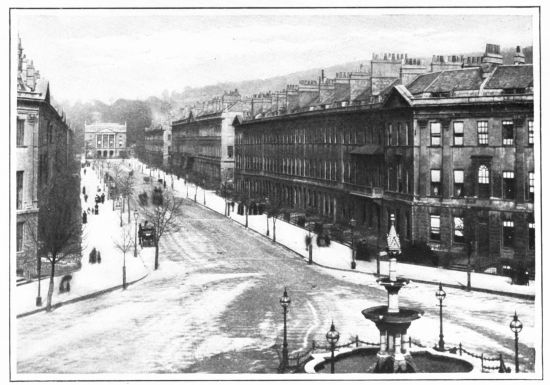
should be in a city which was for so long the capital of fashion. Our
pleasure in it was only less than our joy in finding that our hotel was
in Pulteney Street, where the Allens of “Northanger Abbey” had their
apartment, and where Catherine Morland had so often come and gone with
the Tilneys and the Thorpes, and round the farthest corner of which the
dear, the divine, the only Jane Austen herself had lived for two years
in one of the large, demure, self-respectful mansions of the
neighborhood.
Our hotel scarcely distinguished, and it did not at all detach itself
from the rank of these handsome dwellings; and everything in our happy
circumstance began at once to breathe that air of gentle association
which kept Bath for a fortnight the Bath of our dreams. There was a
belief with one of us that he had come to drink the waters, but an early
consultation with possibly the most lenient of the medical authorities
of the place, who make the doctors of German springs seem such tyrannous
martinets, disabused him. Since he had brought no rheumatism to Bath,
his physician owned there was a chance of his taking some away; but in
the mean time he might go once a day to the Pump Room, for a glass of
the water lukewarm, and be a little careful of his diet. A little
careful of his diet, he who had been furiously warned on his peril at
Carlsbad that everything which was not allowed was forbidden! But he
found that the Bath medical men said the same thing to the patients whom
he saw around him, at the hotel, doubled up with rheumatism, and eating
and drinking whatever their stiffened joints could carry to their
mouths. All the greater was the miraculous virtue of the waters, for the
sufferers seemed to make rapid recovery in spite of themselves and their
doctors. There were no lepers among them, and since Prince Bladud’s day
few are noted as having resorted to Bath; but there is rheumatism enough
in England to make up the defect of leprosy, and the American, who had
come with only a mild dyspepsia, found himself quite out of the running,
or limping, with his fellow-invalids.
He had apparently not even brought an American accent with his malady,
and that was a disappointment to one of the worst sufferers, who
constantly assured him, in a Scotch burr so thick that he had to be
begged to speak twice before he could be understood, that he was the
only American without a twang whom he had ever met. The twangless
dyspeptic wished at times to pretend that he was only twangless in
British company, and that when his party went to their rooms they talked
violently through their noses till they were out of breath, as a slight
compensation for their self-denial in society. But, upon the whole, the
Scotch gentleman was so kind and sweet a soul, and seemed, for all his
disappointment, to value the American so much as a phenomenon that he
forebore, and in the end he was not sorry.
He would have been sorry to have put himself at odds with any of the
pleasant people at that hotel, who seemed to regard their being thrown
together as a circumstance that justified their speaking to one another
much more than the wont is in American hotels. They were more
conversible even than those at the Plymouth hotel; the very women talked
to other women without fear; and the Americans, if they had been
nationally vainer than they were, might have fancied a specially
hospitable consideration of their case. In hotels of that agreeable type
there is, besides the more formal drawing-room, a place called the
lounge, where there are writing-desks and stationery, and a large table
covered with the day’s papers, and a comfortable fire (or, at least, the
most comfortable in the house) burning in the grate; and here people
drop in before breakfast and after dinner, and chat or read or write, as
they please. It is all very amiably informal and uncommitting, and in
our Bath hotel there were only two or three kept at a distance in which
they were not molested. There was all the while a great nobleman in the
house who was apparently never seen even by those superior people. He
came, sojourned, and departed in as much secrecy as a great millionaire
would at home, and I could not honestly say that he psychologically
affected the others any more than the presence of a great millionaire
would have affected the same number of Americans. Perhaps they were less
excited, being more used to being avoided by great noblemen in the
course of many generations. What I know is that they were very friendly
and intelligent, and, if their talk began and ended with the weather,
there was plenty of weather to talk about.
There was almost as much weather and as various as the forms of cabbage
at dinner, which here first began to get in their work on the
imagination, if not the digestion. Whatever else there was of vegetable
fibre, there was always some form of cabbage, either cabbage in its
simple and primitive shape, or in different phases of cauliflower,
brussels sprouts, broccoli, or kale. It was difficult to escape it, for
there was commonly nothing else but potatoes. But one night there came a
dish of long, white stems, delicately tipped with red, and looking like
celery that had grown near rhubarb. We recognized it as something we had
admired, longingly, ignorantly, at the green-grocers’, and we eagerly
helped ourselves. What was it? we had asked; and before the waiter could
answer that it was sea-kale we had fallen a prey to something that of
the whole cabbage family was the most intensely, the most passionately
cabbage.
Apart from the prevalence of this family, the table was very good and
well-imagined, as I should like to say once for all of the table at
every English hotel of our experience. Occasionally the ideal was
vitiated by an attempted conformity to the raw American appetite, as it
arrived unassorted and ravenous from the steamers. In a moist cold that
pierced to the marrow you were offered ice-water, and sometimes the
“sweets” included an ice-cream of the circumference and thickness of a
dollar, which had apparently been put into the English air to freeze,
but had only felt its well-known relaxing effect. One drinks, of course,
a great deal of the excellent tea, and, indeed, the afternoon that
passes without it is an afternoon that drags a listless, alexandrine
length along till dinner, and leaves one to learn by experience that a
thing very essential to the local meteorology has been omitted. With us,
tea is still a superfluity and in some cases a naughtiness; with the
English it is a necessity and a virtue; and so apt is man to take the
color of his surroundings that in the rare, very rare, occasions when he
is not offered tea in an English house, the American comes away
bewildered and indignant. I suppose nothing could convey the feelings of
an equally defrauded Englishman, who likes his tea, and likes it good
and strong; in fact, tea cannot be good without being strong. While I am
about this business of noting certain facts which are so essential to
the observer’s comfort, but which I really disdain as much as any reader
can, I will say that the grates of the hotel in Bath were distinctly
larger than those at Plymouth and were out of all comparison with those
at Exeter. They did not, indeed, heat our rooms, even at Bath, but if
they had been diligently tended I think they would have glowed. In the
corridors there were radiators, commonly cold, but sometimes perceptibly
warm to the touch. The Americanization of the house was completed by the
elevator, which, being an after-thought, was crowded into the well of
the staircase. It was a formidable matter to get the head porter, in
full uniform, to come and open the bottom of the well with a large key,
but it could be done; I saw rheumatic old ladies, who had come in from
their Bath chairs, do it repeatedly.
When, however, you considered the outside of our hotel, you would have
been sorry to have it in any wise Americanized. The front of it was on
Pulteney Street, where it leaves that dear Laura Place which blossomed
to our fancy with the fairest flowers of literary association; but at
the back of it there was a real garden, and the gardens of other houses
backing upon it, and the kitchen doors of these houses had pent-roofs
which formed sunny exposures for cats of the finest form and color. When
there was no sun there were no cats; but they could not take the rest of
the prospect into the warm kitchens (I suppose that even in England the
kitchens must be warm) with them, and so we had it always before our
eyes. With gardens and little parks, and red-tiled house-roofs,
bristling with chimney-pots and church-spires, it rose to a hemicycle of
the beautiful downs, in whose deep hollows Bath lies relaxing in her
faint air; and along the top the downs were softly wooded, or else they
carried deep into the horizon the curve of fields and pastures, broken
here and there by the stately bulk of some mansion set so high that no
Bath-chairman could have been induced by love or money to push his chair
to it. All round Bath these downs (a contradiction in terms to which one
resigns one’s self with difficulty in the country where they abound)
rise, like the walls of an immense scalloped cup, and the streets climb
their slope, and can no otherwise escape in the guise of country roads,
except along the bank of the lovely Avon. By day, except when a
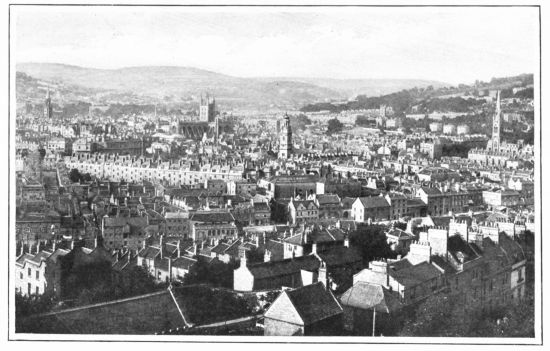
THE RED-TILED HOUSE-ROOFS AND CHURCH SPIRES OF BATH
fog came down from the low heaven and took them up into it, the form of
the downs was a perpetual pleasure to the eye from our back windows, and
at night they were a fairy spectacle, with the electric lamps starring
their vague, as if they were again part of the firmament.
When, later, we began to climb them, either on foot or on tram-top, we
found them in command of prospects of Bath which could alone have
compensated us for the change in our point of view. The city then showed
large out of all proportion to its modest claim of population, which is
put at thirty or forty thousand. But in the days of its prosperity it
was so generously built that in its present decline it may really be no
more populous than it professes; in that case each of its denizens has
one of its stately mansions to himself. I never like to be extravagant,
and so I will simply say that the houses of Bath are the handsomest in
the world, and that if one must ever have a whole house to one’s self
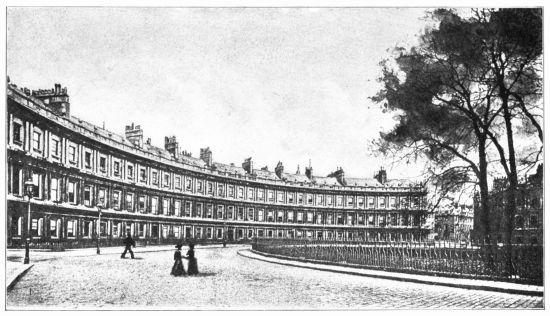
one could not do better than have it in Bath. There one could have it in
a charming quiet square or place, or in the shallow curve of some
high-set crescent, or perhaps, if one were very, very good, in that
noblest round of domestic edifices in the solar system—I do not say
universe—The King’s Circus. This is the triumph of the architect Wood,
famous in the architectural annals of Bath, who built it in such beauty,
and with such affectionate mastery of every order for its adornment,
that his ghost might well (and would, if I were it) come back every
night and stand glowing in a phosphorescent satisfaction till the
dreaming rooks, in the tree-tops overhead, awoke and warned him to fade
back to his reward in that most eligible quarter of the sky which
overhangs The King’s Circus. I speak of him as if he were one, and so he
is, as a double star is one; but it was Wood the elder who, in the
ardor of his youth at twenty-three, imagined the Circus which his son
realized. Together, or in their succession, they wrought the
beautification of Bath from an amateur meanness and insufficiency to the
effect for which the public spirit of their fellow-citizens supplied the
unstinted means, and they left the whole city a monument of their glory,
without a rival in unity of design and completeness of execution.
In the fine days when Bath was the resort of the greatness to which such
greatness as the Woods’ has always bowed, every person of fashion
thought he must have some sort of lodgment of his own, and, if he were a
greater person than the common run of great persons, he must have a
house. He might have it in some such select avenues as Milsom Street and
Great Pulteney Street, or in St. James’s Square or Queen’s Square, or in
Lansdowne Crescent or the Royal Crescent, but I fancy that the ambition
of the very greatest could not have soared beyond a house in the Circus.
As I find myself much abler to mingle with rank and fashion in the past
than in the present, I was always going back to the Circus after I found
the way, and making believe to ring at the portals set between pillars
of the Ionic or Corinthian orders, and calling upon the disembodied
dwellers within, and talking the ghostly scandal which was so abundant
at Bath in the best days. In that way one may be a ghost one’s self
without going to the extreme of dying, and then may walk comfortably
back to dinner at one’s hotel in the flesh. In my more merely tourist
moments I went and conned all the tablets let into the walls of the
houses to record the memorable people who once lived in them. In my
quality of patriot I lingered longest before that where
CIRCUS FROM BENNET STREET
the great Earl of Chatham had lived: he who, if he had been an American
as he was an Englishman, while a foreign foe was landed on his soil
would never had laid down his arms—never, never, never! The eloquent
words filled my own throat to choking, and the long struggle fought
itself through there on the curbstone with an obstinate valor on the
American side that could result only in the independence of the revolted
colonies. Then, in a high mood of impartial compassion, I went and paid
the tribute of a sigh at that other house of the Circus, so piteously
memorable for us Americans, where Major André had once sojourned. Was it
in Bath, and perhaps while he dwelt in the Circus, that he loved Honora
Sneyd? Almost anything tender or brave or fine could have been there;
and I was not surprised to find that Lord Clive of India and
Gainsborough of all the world were in their times neighbors of Lord
Chatham and Major André. What other famous names were inscribed on those
simple tablets (so modestly that it was hard to read them), I do not now
recall, but when one is reminded, even by his cursory and laconic
Baedeker, that not only the first but the second Pitt was a sojourner in
Bath with other such sojourners as Burke, Nelson, Wolfe, Lawrence,
Smollett, Fielding, Sheridan, Goldsmith, Fanny Burney, Jane Austen,
Southey, Landor, Wordsworth, Cowper, Scott, and Moore, and a whole
nameless herd of titles and royalties, one perceives that many more
celebrities than I have mentioned must have lived in the Circus.
Many very nice people must live there yet, but it has somewhat gone off
into business of the quieter professional type, and I would not swear
that behind the tracery of a transom here or there I did not find a
lurking suggestion of Apartments. I am quite ready to make oath to at
least one such suggestion in the very centre of Lansdowne Crescent,
where I was about buying property because of its glorious site and its
high, pure air. I instantly transferred my purchase to the Royal
Crescent, where I now have an outlook forever over the new Victoria Park
and down into the valley of the Avon, with the river running as of old
between fields and pastures in a landscape of insurpassable loveliness.
But you cannot anywhere get away from the beautiful in Bath. For the
temperate lover of it, the soft brownish tone of the architecture is in
itself almost of a delicate sufficiency; but if one is greedier there is
an inexhaustible picturesqueness in the winding and sloping streets, and
the rounding and waving downs which they everywhere climb as roads when
they cease to be streets. I do not know that Bath gives the effect of a
very obvious antiquity; a place need not, if it begins in the age of
fable, and descends from the earliest historic period with the tradition
of such social splendor as hers. She has a superb mediæval abbey for her
principal church which is a cathedral to all æsthetical intents and
purposes; for it is not less beautiful and hardly less impressive than
some cathedrals. Mostly of that perpendicular Gothic, which I suppose
more mystically lifts the soul than any other form of architecture, it
is in a gracious sort of harmony with itself through its lovely
proportions; and from the stems of its clustered columns, the tracery of
their fans spreads and delicately feels its way over the vaulted roof as
if it were a living growth of something rooted in the earth beneath. The
abbey began with a nunnery founded by King Osric in 676 and rose through
a monastery founded later by King Offa to be an abbey in 1040, attached
to the bishopric of Wells; but it waited its final grandeur and glory
from Bishop Oliver King, who while visiting Bath in 1499 saw in a dream
angels ascending and descending by a ladder set between the throne of
God and an olive-tree, wearing a crown, and heard a voice saying, “Let
an Olive establish the crown, and a King restore the church.” Moved by
this vision, which was as modest as most dreams of charges delivered
from on high, the bishop set vigorously about the work, but before it
was perfected, the piety of Henry VIII. being alarmed by the pope’s
failure to bless his divorces, the monastery was with many others
suppressed, and the church stripped of everything that could be detached
and sold. The lands of the abbey fell into private hands, and houses
were built against the church, of which an aisle was used as a street
for nearly a hundred years, even after it had been roofed in and
restored, as it was early in the seventeenth century, by another bishop
who had not been authorized in a dream.
The failure of Cromwell’s troopers to stable their horses in it is
another of those conspicuous instances of their negligence with which I
was destined to be confronted in the sacred edifices so conscientiously
despoiled by Henry VIII. But among the most interesting monuments of the
interior is one to that Lady Waller, wife of the Parliamentary general,
Sir William Waller which more than repairs the oversight of the Puritan
soldiery. Her epitaph is of so sweet and almost gay a quaintness that I
will frankly transfer it to my page from that of the guide-book, though
I might easily pretend I had copied it from the tomb.
“Sole issue of a matchless paire,
Both of their state and virtues heyre;
In graces great, in stature small,
As full of spirit as voyd of gall;
Cheerfully grave, bounteously close,
Holy without vain-glorious showes;
Happy, and yet from envy free,
Learn’d without pride, witty, yet wise,
Reader, this riddle read with mee,
Here the good Lady Waller lies.”
There is almost an exultant note in this, and in its rendering of a most
appreciable personality is a hint of the quality of all Bath annals.
These are the history less of events than characters, marked and wilful,
and often passing into eccentricity; and in the abbey is the municipal
monument of the chiefest of such characters, that Beau Nash—namely, who
ruled the fashion of Bath for forty or fifty years with an absolute sway
at a period when fashion was elsewhere a supreme anarchic force in
England. The very sermon which I heard in the abbey (and it was a very
good and forcible homily), was of this personal quality, for taking as
his theme the divine command to give, the preacher enlarged himself to
the fact that the flag of England was then flying at half-mast on the
abbey, and that all the court would presently be going into mourning for
the death of the Duke of Cambridge, in obedience to the King’s command;
and “How strange,” the preacher reflected, “that men should be so prompt
to obey an earthly sovereign, and so slow to obey the King of Kings, the
lord of lords.” But he did not reflect as I did for him, though I had
then been only a week in England, and was very much less fitted to do
it, that in the close-knit system which he himself was essentially part
of, there was such a consciousness of social unity, identity, as has
never been anywhere else on earth, much less spiritually between the
human and divine, since Jehovah ceased conversing with the fathers of
the children of Israel. I do not report it as a message, then and there
delivered to me in round terms, but I had in my cheap sympathy with the
preacher, a sense of the impossibility of his ideal, for between any
decently good King of England and his subjects there is such affiliation
through immemorial law and custom as never was between a father and his
children, any more than between a God and his creatures. When the King
wills, in beautiful accordance with the laws and customs, it is health
for the subjects to obey, as much as for the hands or feet of a man’s
body when he wishes to move them, and it is disease, it is disorder, it
is insanity for them to disobey, whereas it is merely sin to disregard
the divine ordinances, and is not contrary to the social convention or
the ideals of loyalty. But I could not offer this notion to the preacher
in the Abbey of Bath, and I am not sure that my readers here will
welcome it with entire acceptance.
From time to time, in those first days the sense of England (not the
meaning, which heaven forbid I should attempt to give) sometimes came
upon me overwhelmingly; and I remember how once when I sat peacefully at
dinner, a feeling of the long continuity of English things suddenly rose
in a tidal wave and swept me from my chair, and bore me far away from
the soup that would be so cold before I could get back. There, like one
“Sole sitting by the shores of old romance,”
I visualized those mostly amiable and matter-of-fact people in their
ancestral figures of a thousand years past, and foresaw them
substantially the same for a thousand years to come. Briton and
Phœnician and Roman and Saxon and Dane and Norman, had come to a result
so final in them that they would not change, if they could, and for my
pleasure I would not have had them change, though in my American
consciousness I felt myself so transient, so occasional, so merely
provisional beside them. Such as I then saw them, passing so serenely
from fish to roast, from salad to sweets, or as I could overhear them,
talking of the weather with an effect of bestowing novelty upon the
theme by their attention to it, they had been coming to Bath for untold
generations with the same ancestral rheumatism which their humid
climate, their inclement houses, and their unwholesome diet would enable
them to hand down to a posterity remote beyond any horizons of the
future. In their beautiful constancy, their heroic wilfulness, their
sublime veracity, they would still be, or believe themselves, the first
people in the world; and as the last of the aristocracies and monarchies
they would look round on the classless equalities of the rest of the
world with the pity which being under or over some one else seems always
to inspire in master and man alike. The very gentleness of it all,
testified to the perfection of their ultimation, and the universally
accepted form by which the servant thanked the served for being served,
and the served thanked the servant for serving, realized a social ideal
unknown to any other civilization. There was no play of passion; the
passions in England mean business; no voice rose above the high chirpy
level, which all the voices reached; not a laugh was heard; the
continental waiters who were there to learn the English language had
already learned the English manner, which is a supreme self-containment;
but the result was not the gloom which Americans achieve when they mean
to be very good society in public places; far less was it a Latin
gayety, or a Germanic fury of debate. The manner was such indeed that in
spite of my feeling of their unity of nature and their continuity of
tradition, I could scarcely believe that the people I saw in these
psychological seizures of mine were one with the people who had been
coming to Bath from their affairs in the towns, or from their pleasures
in the country, ever since the English character had evolved itself from
the blend of temperaments forming the English temperament. Out of what
they had been how had they come to be what they were now, and yet not
essentially changed? None of the causes were sufficient for the effect;
the effect was not the logic of the causes.
History is rather darkling after the day of Prince Bladud and his pigs,
and the Romans testify of their resort to the healing waters by the mute
monuments left of the ancient city, still mainly buried under the modern
town, rather than by any written record, but after the days of Elizabeth
the place begins to have a fairly coherent memory of its past. In those
days the virtue of the waters was superior to such material and moral
tests as the filth of streets where the inhabitants cast the sewage of
their houses and the butchers slaughtered their cattle and left the
offal to rot, and the kine and swine ran at large, and the bathers of
both sexes wallowed together in the springs, after the manner of their
earliest exemplars, and were pelted with dead cats and dogs by the
humorous spectators. This remained much the condition of Bath as late as
the first quarter of the seventeenth century, and it was not till well
into the eighteenth that the springs were covered and enclosed. Even
then they were not so covered and enclosed but that the politer public
frequented them to see the bi-sexual bathing which was not finally
abolished till the reign of the good Beau Nash.
If any one would read all about Nash and the customs (there were no
manners) which he amended, I could not do better than commend such a one
to the amusing series of sketches reprinted from the Bath Chronicle,
by William Tyte, with the title of Bath in the Eighteenth Century, its
Progress and Life described. It is only honest (but one is honest with
so much effort in these matters) to confess my indebtedness to this most
amusing and very valuable book, and to warn the reader that a great deal
of the erudition which he will note in my page can be finally traced to
Mr. Tyte’s. He will learn there at large why I call Beau Nash good
though he was a reprobate in so many things, a libertine and gambler,
and little better than a blackguard when not retrieving and polishing
others. It seems to be essential to the civic and social reformer that
he should more or less be of the quality of the stuff he deals with; we
have seen that more than once in our municipal experience; and Nash, who
reformed Bath, might in turn have asked a like favor of Bath. He was, in
the English and the eighteenth century terms, that familiar phenomenon
which we know as the Boss; and his incentive was not so much the love of
virtue as the love of rule. By the pull on the reins he knew just how
close he might draw them, and when and where he must loose the curb. He
could refuse to allow the royal Princess Amelia a single dance after the
clock struck eleven; he could personally take off the apron of the
Duchess of Queensbury and tell her that “none but Abigails appeared in
white aprons,” as he threw it aside; he could ask a country squire who
wore his spurs to the ball, if he had not forgotten his horse; he could
forbid ladies coming in riding-hoods; he could abolish the wearing of
swords; he could cause the arrest of any one giving or accepting a
challenge; but he could not put down gaming or drinking, and he did not
try, either by the irony of the written rules for the government[A] of
Bath Society, or by the sarcastic by-laws which he orally added on
occasions. He was one of those Welshmen who, at all periods have
invaded England so much less obviously than the Scotch, and have come so
largely into control of the Sassenach, while seeming to merge and lose
themselves in the heavy mass. He had the hot temper of his race; but he
was able to cool it to a very keen edge, and he cut his way through
disorder to victory. He wished to establish an etiquette as severe as
that of the French or English court, and he succeeded, in a measure. But
though not an easy Boss, he was a wise one and he really moulded the
rebellious material to a form of propriety if not of beauty. When he
passed to his account, insolvent both morally and financially, it lapsed
again under the succeeding Masters of Ceremony to its elemental
condition, and social anarchy followed; a strife raged between the old
and new assembly rooms for primacy, and at a ball, where the partisans
of two rival candidates for the mastership met in force, a free fight
followed the attempt of a clergyman’s wife to take precedence of a
peer’s daughter; “the gentlemen fought and swore; the ladies, screaming,
tore each other’s garments and headgear; the floor was strewn with
fragments of caps, lappets, millinery, coat-tails and ruffles. The
non-combatants hurried to the exits, or mounted the chairs near the
walls to be out of danger or to watch the foes mauling and bruising each
other.” Before the fight ended the Mayor of the city had to appear and
read the Riot Act three times.
Of course matters could not go on so. Both the contestants for the
Master of the Ceremonies retired and a third was chosen. The office
though poorly paid, and wholly unremunerative except in hands so skilled
as those of Nash (who died poor by his own fault, but who lived rich),
was honored in him by a statue in the Pump Room and a monument in the
Abbey. This to be sure was after his death, but the place was always of
such dignity that in 1785 Mr. J. King, “who had highly distinguished
himself in the British army during the American war,” by no means
disdained to take it. His distinction does not form any ornament of our
annals as I recall them, but that is perhaps because it was achieved to
our disadvantage. He had indeed the rare honor of introducing Jane
Austen’s most charming hero to her sweetest and simplest heroine; but
though he could fearlessly present Henry Tilney to Catherine Morland,
his courage was apparently not equal to upholding his general authority
with the satirical arrogance of Nash. Where Nash would have laid down
the law and enforced it if need be with his own hands, King “humbly
requested,” though in the matter of wearing hats “at the cotillions or
concerts or dress balls,” our distinguished enemy plucked up the spirit
to warn any lady who should “through inattention or any other motive
infringe this regulation, that she must not take it amiss if she should
be obliged to take off her hat or quit the assembly.”
From Nash’s time onward several Masters of Ceremonies were scandalized
by people’s giving tickets for the entertainments to their domestics,
and one of them took public notice of the evil. “Servants,
hair-dressers, and the improper persons who every night occupy some of
the best seats, and even presume to mix with the company, are warned to
keep away, and to spare themselves the mortification of being desired to
withdraw, a circumstance which will inevitably happen if they continue
to intrude themselves where decency, propriety and decorum forbid their
entrance.”
Apparently in spite of all the efforts of all the Masters of Ceremonies,
society in Bath was not only very fast, which society never minds
being, but a good deal mixed, which it professes not to like, though it
was at the same time always very gay. When at last the respective nights
of the New Assembly Rooms and the Old Assembly Rooms were ascertained,
the fashionable week began on Monday with a Dress Ball at the New Rooms;
it continued on Tuesday with Public Tea and Cards at the New Rooms; on
Wednesday with a Cotillion Ball at the Old Rooms; on Thursday with a
Cotillion Ball at the New Rooms, and Tea and Cards at the Old Rooms; on
Friday with a Dress Ball at the Old Rooms; on Saturday with Public Tea
and Cards at the Old Rooms; and it ended on Sunday with Tea and Walking,
alternately at the New Rooms and the Old Rooms. The cost of all these
pleasures either to the person or the pocket, was not so great as might
be imagined from their abundance. The hours were early, and except for
the gaming, and the drinking that slaked the dry passion of chance, the
fun was over by eleven o’clock. Then the last note was sounded, the last
step taken, the last sigh or the last look exchanged, so that those who
loved balls might not only tread the stately measures of that time with
far less fatigue than the more athletic figures of our period cost, but
might be at home and in bed at the hour when the modern party is
beginning. For their pleasure they paid in the proportion of a guinea
for twenty-six dress balls, and half a guinea for thirty fancy balls.
Two guineas supplied two tickets for twelve concerts, and sixpence
admitted one to the Rooms for a promenade and a cup of tea.
It will be seen that with that “large acquaintance” which Mrs. Allen so
handsomely but hopelessly desired for Catherine Morland at her first
ball, where they had no acquaintance at all, one could have a very good
time at Bath for a very little money, and every one apparently who had
the money could have the good time. There were many public gardens,
where all sorts of people went for concert-breakfasts, and for tea and
for supper, at a charge of a shilling, or the classic one-and-six. Jane
Austen writes in one of her charming letters that she liked going to the
concerts of Sydney Gardens because, having no ear for music, she could
best get away from it there; but there were besides the Villa Gardens,
the Bagatelle, and the Grosvenor Gardens, which were most resorted to
because they were so convenient to the Pump Rooms. Some of the lawns, if
not the groves of these gardens still remains, and hard by the Avon
babbles still, rushing under the walls and bridges of the town, with a
busy air of knowing more than it has time to tell of the old-time
picnics on its grassy shores, and the water-parties on its tumultuous
bosom, as well as the fireworks and illuminations in its bowers. The
river indeed is one of the chief beauties of Bath, winding into it
through a valley of the downs, and curving through it with a careless
grace which leaves nothing to be asked.
The highest moment of fashion in Bath seems to have been when the
Princess Amelia, daughter of George II., came to drink its waters and
partake its pleasures in 1728. She was rather a plain body, no longer
young, very stout, and with a simple taste for gambling, fishing,
riding, and beer. “Her favorite haunt,” says Mr. Tyte, “was a
summer-house by the riverside in Harrison’s Walk, where she often was
seen attired in a riding-habit and a black velvet postilion-cap tied
under her chin.” But she also liked to wear when on horseback “a
hunting-cap and a laced scarlet coat,” which must have set off her red
face and portly bulk to peculiar advantage. Her particular friend was a
milliner in the abbey church-yard who wrote verses in praise of the
princess and of Bath, but she seems to have been friendly enough with
people of every kind and she went freely to the dress balls, the fancy
balls, the teas, the walks, the breakfast-concerts, the gardens, and
whatever else there was of elegant or amusing in the place. One of the
customs of Bath was the ringing of the abbey bells to welcome visitors
of distinction, who were expected to pay the vergers in proportion to
the noise made for them. This custom was afterwards abused to include
any comer from whom money could reasonably or unreasonably be hoped for,
as the supposed writer in the New Bath Guide records. But the custom
has long been obsolete, and no American invader arriving by train need
fear being honored and plundered through it.
It would be idle to catalogue the princes and princesses, dukes and
duchesses, lords and ladies, and titles of all degrees who resorted to
Bath both before and after the good Amelia, and if one began with the
other and real celebrities, the adventurers, and authors, and artists,
and players, there would be no end, and so I will not at least begin
yet. We were first of all concerned in looking up the places which the
divine Jane Austen had made memorable by attributing some scene or
character of hers to them, or more importantly yet by having dwelt in
them herself. I really suppose that it was less with the hope of being
helped with the waters that I went regularly to the Pump Room and sipped
my glass of lukewarm insipidity, than with the insensate expectation of
encountering some of her people, or perhaps herself, a delicate elusive
phantom of ironical observance, in a place they and she so much
frequented. I cannot say that I ever did meet them, either the
characters or the author, though it was here that Catherine Morland
first met the lively but unreliable Isabel Thorpe, and vainly hoped to
meet Henry Tilney after dancing with him the night before. “Every
creature in Bath except himself was to be seen in the room at different
periods of the fashionable hours; crowds of people were every moment
passing in and out, up the steps and down.”
I reconciled myself to a disappointment numerically greater than
Catherine’s for there was not only no Tilney, but no crowd. At mid-day
there would be two or three score persons scattered about the stately
hall, so classically Palladian in its proportions, and so fitly heavy
and rich in decoration, all a dimness of dark paint and dull gold, in
which the sufferers sat about at little tables where they put their
glasses, and read their papers, after they became so used to coming that
they no longer cared to look at the glass cases full of Roman and Saxon
coins and rings and combs and bracelets. There was nothing to prevent
people talking except the overwhelming tradition of the talk that used
to flow and sparkle in that place a century ago. But they did not talk;
and in the afternoon they listened with equal silence to the music in
the concert-room. In the Pump Room there was the largest and warmest
fire that I saw in England, actually lumps of coal, openly blazing in a
grate holding a bushel of them; in the withdrawal of the others from it
one might stand and thaw one’s back without infringing anybody’s
privileges or preferences. Under the Pump Room were the old Roman Baths
with the old Romans represented in their habits of luxury by the
goldfish that swam about in the tepid waters, and, as I was advised by a
guide who started up out of the past and accepted a gratuity, liked it.
I visited these baths as a tourist, but as a patient whose prescription
did not include bathing I saw nothing of the modern baths. There the
sexes no longer bathe together, and in their separation and seclusion
you have no longer the pleasure enjoyed by the spectator in the days of
the New Bath Guide, when—
“’Twas a glorious sight to behold the fair sex
All wading with gentlemen up to their necks.”
The modern equipment of the baths is such that the bathers are not now
put into baize-lined sedan-chairs and hurried to their lodgings and sent
to bed there to perspire and repose; and the chances of seeing a pair of
rapacious chairmen settling the question of a disputed fare by lifting
the lid of the box, and letting the cold air in upon the reeking lady or
gentleman within, are reduced to nothing at all. In the ameliorated
conditions, unfavorable as they are to the lover of dramatic incident,
many and marvellous recoveries from rheumatism are made in Bath, and we
saw people blithely getting better every day whom we had known at the
beginning of the fortnight very gloomy and doubtful, and all but audibly
creaking in their joints as they limped by. This was in spite of a diet
which must have sent the uric acid gladly rioting through their systems,
and of a capricious variety of March weather which was everything that
wet and cold, and dry and raw, could be in an air notoriously relaxing
to the victim whom it never released from its penetrating clutch.
I put it in this way so as to be at ease in the large freedom of the
truth rather than bound in a slavish fidelity to the fact. The fact is
that in the succession of days that were all and more than here
suggested, there were whole hours of delicious warmth when one could
walk out or drive out in a sunny mildness full of bird-song and
bee-murmur, with the color of bloom in one’s eyes and the odor of
flowers in one’s nostrils. It is not from having so rashly bought
property right and left in every eligible and memorable quarter of Bath
the very first day that I now say I should like to live there always.
The reader must not suspect me of wishing to unload upon him, when I
repeat that I heard people who were themselves in the enjoyment of the
rich alternative say that you had better live in Bath if you could not
live in London. A large contingent of retired army and navy officers and
their families contribute to keep society good there, and it is a
proverb that the brains which have once governed India are afterwards
employed in cheapening Bath. Rents are low, but many fine large houses
stand empty, nevertheless, because the people who could afford to pay
the rents could not afford the state, the equipment of service and the
social reciprocity so necessary in England, and must take humbler
dwellings instead. Provisions are of a Sixth Avenue average in price,
and in the article of butcher’s meat of a far more glaring and offensive
abundance. I do not know whether it is the tradition of the Bath bun
which has inspired the pastry-shops to profuse efforts in
unwholesome-looking cakes and tarts, but it seemed to me that at every
third or fourth window I was invited by the crude display to make way
entirely with the digestion which the Bath waters were doing so little
to repair. When one saw everywhere those beautiful West of England
complexions, the wonder what became of that bilious superfluity of
pastry was a mystery from which the mind still recoils.
But this is taking me from the social conditions of Bath, of which I
know so little. I heard it said, indeed, that the wheels of life were
uncommonly well-oiled there for ladies who had to direct them unaided,
and it seemed to me that the widowed or the unwedded could not be more
easily placed in circumstances of refinement which might be almost
indefinitely simplified without ceasing to be refined. There are in fact
large numbers of single ladies living at Bath in the enjoyment of that
self-respectful civic independence which the just laws of Great Britain
give them; for they vote at all elections which concern the municipal
spending of their money, and are consequently not taxed without their
consent, as our women are. Such is their control in matters which
concern their comfort that it is said the consensus of feminine feeling
has had force with the imperial government to prevent the placing of a
garrison in Bath, on the ground that the presence of the soldiers
distracted the maids, and enhanced the difficulties of the domestic
situation.
The glimpse of the Bath world, which a happy and most unimagined chance
afforded, revealed a charm which brought to life a Boston world now so
largely of the past, and I like to think it was this rather than the
possession of untold real estate which made me wish to live there
always; and advise others to do so. Just what this charm was I should be
slower to attempt saying than I have been to boom Bath; but perhaps I
can suggest it as a feminine grace such as comes to perfection only in
civilizations where the brightness and alertness of the feminine spirit
is peculiarly valued. Bath could not have been so long a centre of
fashion and infirmity, of pleasure and pain, without evolving in the
finest sort the supremacy of woman, who is first in either. The
lingering tradition of intellectual brilliancy, which spreads a soft
afterglow over the literary decline of Boston, is of the same effect in
the gentle city where the mere spectacle of life became penetrated with
the quality of so many spritely witnesses. If the grace of their humor,
the gayety of their spirit, the sweetness of their intelligence have
remained to this time, when the spectacle of life has so dwindled that
the observed are less than the observers, it would not be wonderful, for
the essential part of what has been anywhere seems always to haunt the
scene, and to become the immortal genius of the place. In a more literal
sense Bath is haunted by the past, for it is the favorite resort of
numbers of interesting ghosts, whose characters are well ascertained and
whose stories are recounted to you, if you have so much merit, by people
who have known the spectres almost from childhood. Some of them have the
habit of preferably appearing to strangers; but perhaps they drew the
line at Americans.
I forget whether the almond-trees were in bloom or not when we came to
Bath, but I am sure they continued so throughout our stay, and I found
them steadily blossoming away elsewhere for a month afterwards. There is
no reason why they should not, for they have no work to do in the way of
ripening their nuts, and they lead a life as idle and unfinal as the
vines and fig-trees of Great Britain, which also blossom as cheerfully
and set their fruit, and carry it through the seasons in a lasting
immaturity. I never thought the almond in bloom as rare a sight as the
peach, whose pale elder sister it is; but in the absence of the peach, I
was always glad of it, in a dooryard or over a garden wall. Where the
walls were low enough to lean upon, as they sometimes were round the
vegetable gardens, it was pleasant to pause and contemplate the infinite
variety of cabbage held in a green arrest by the mild winter air, but
destined to an ultimation beyond the powers of the almond, the grape and
the fig. There seemed to be a good many of these gardened spaces in the
town, as well as in the outskirts where more new houses were going up,
in something of the long leisure of the vegetation. The famous Bath
building-stone is in fact so much employed elsewhere that there may not
be enough of it for home use, and that may account for the slow growth
of the place; but if I lived there I should not wish it to grow, and if
I were King of Bath, in due succession from Beau Nash, I would not
suffer one Bath-stone to be set upon the other within its limits. The
place is large enough as it is, and I should hate to have it restored to
its former greatness. There was indeed only too little decay in it, but
there was at least one gratifying instance in the stately mansion at the
end of our street,—falling or fallen to ruin, with its Italian style
rapidly antedating the rough classic of the Roman baths, in the effect
of a sorrowful superannuation,—which I could not have rescued from
dilapidation without serious loss. The hollow windows and broken doors
and toppled chimneys, the weather-stained walls and pillars painted
green with mould, were half concealed, half betrayed, by the neglected
growth of trees, and a wilding thicket had sprung up over the lawn,
penetrated by wanton paths in spite of warnings against trespassing by
severely worded sign-boards. Whose the house was, or why it was
abandoned I never learned, and I do not know that I wished to learn; it
was so satisfying as it was and for what it was. It stood on the borders
of Sydney Gardens, which the authorities were slowly, too slowly for
our pleasure, putting in order for some sort of phantasmal season.
We never got into them, though we longed to make out where it was that
Jane Austen need not hear the music when she went to the concerts. But
it was richly consoling, in these failures to come unexpectedly upon the
house in which she had lived two years with her mother, and to find it
fronting the ruining mansion and the tangled shrubbery that took our
souls with so sorrowful a rapture. At the moment we discovered it, there
was a young girl visible through the dining-room window feeding a quiet
gray cat on the floor, and a gray parrot in a cage. She looked kind and
good, and as if she would not turn two pilgrims away if they asked to
look in over the threshold that Jane Austen’s feet had lightly pressed,
but we could not find just the words to petition her in, and we had to
leave the shrine unvisited. It occurs to me now that we might have
pretended to mistake the tablet in the wall for a sign of apartments,
but we had not then even this cheap inspiration; and we could only note
with a longing, lingering look, that the house was very simple and
plain, like the other houses near.
The literary tradition of the neighborhood is supported in one of these
by the presence of a famous nautical novelist, who has often shipwrecked
and marooned me to my great satisfaction, on reefs and desolate islands,
or water-logged me in lonely seas. He lived even nearer the corner of
Pulteney Street where we were in our hotel, and where we much imagined
taking one of the many lodgings to let there, but never did. We looked
into some, and found them probably not very different from what they
were when the Allens went into theirs with Catherine Morland. We
decided that this was just across the way from our hotel, and that Mrs.
Allen saw us from her window whenever we went or came. We were sure also
that we met Lady Russell and Anne Elliot driving out of Persuasion
through Pulteney Street, when Anne noticed Captain Wentworth coming
towards them, and supposed from Lady Russell’s stare, that she was
equally moved by the vision, but found she was “looking after some
window curtains, which Lady Alicia and Mrs. Frankland were telling” her
of as “being the handsomest and best hung of any in Bath.”
Our hotel fronted not only on Pulteney Street, but also on Laura Place,
a most genteel locality indeed where we knew as soon as Sir Walter
Elliot that his cousin “Lady Dalrymple had taken a house for three
months and would be living in style.” I do not think we ever made out
the house, and we were more engaged in observing the behavior of the
wicked John Thorpe driving poor Catherine Morland through Laura Place
after he had deceived her into thinking Henry Tilney, whom she had
promised to walk with, had gone out of town, and whom she now saw
passing with his sister. On a happier day, as the reader will remember,
Catherine really went her walk with the Tilneys, and in sympathy and
emulation we too climbed the steep slopes of “Beechen Cliff, that noble
hill whose beautiful verdure and hanging coppice render it so striking
an object from almost every opening in Bath.” You now cross the railroad
to reach it, and pass through neighborhoods that were probably
pleasanter a hundred years ago; but the view of the town in the bottom
of its bowl must be as fine as ever, though we found no hanging coppice
from which to commend it. Still, as our wont was, we bought several
pieces of property that pleased us, and I still have a few suburban
houses in that quarter which I could offer the reader at a sacrifice.
The truth is that in spite of having the Tilneys and Catherine for
company we did not like the Beechen Cliff as well as its rival
acclivity, Sion Hill, which forms the opposite rim of Bath, and is not
so arduous of approach. A lady who lived not quite at the top, but above
the Bath chair line, declared it the third-best air in England, without
indicating the first or second. The air was at least more active than we
were in our climb, but with a driver who got down and helped his horses
walk up with us, we could enjoy there one of the loveliest prospects in
the world. The fineness of the air was attested probably by the growth
of ivy, which was the richest I saw in England, where the ivy grows so
richly in every place. It not only climbed all the trees on that down,
and clothed their wintry nakedness with a foliage perpetually green, but
it flung its shining mantles over the walls that shut in the mansions on
the varying slopes, and densely aproned the laps of the little hollows
of the lawns and woods. It had the air of feeling its life in every
leaf, and of lustily reaching out for other conquests, like the true
weed it is in Old England, and not the coddled exotic which people make
it believe it is in New England. I do not know that I ever lost the
surprise of it in its real character; I only know that this surprise was
greatest for me on those happy heights.
The modern hand-book which was guiding our steps about Bath advised us
that if we would frequent Milsom Street about four o’clock we should
find the tide of fashion flowing through it; but the torrent must have
been very rapid indeed, for we always missed it, and were obliged to
fill the rather empty channel with the gayety of the past. There are
delightful shops everywhere in Bath, and so many places to buy old
family silver that it seems as if all the old families must have poured
all their old silver into them, till you visit other parts of England,
and find the same superabundance of second-hand plate everywhere. But it
is in Milsom Street that most of the fine shops are, and I do not deny
that you will see some drops of the tide of fashion clustered about
their windows. Other drops have percolated to the tea-rooms, where at
five o’clock there is a scene of dissipation around the innocent cups.
But there was no reason why we should practise the generous self-deceit
of our hand-book regarding the actual Milsom Street, when we had its
former brilliancy to draw upon. Even in the time of Jane Austen’s people
it was no longer “residential,” though it was not so wholly gone to
shops as now. The most eligible lodgings were in it, and here General
Tilney sojourned till he insisted on carrying Catherine off to
Northanger Abbey with his children. “His lodgings were taken the very
day after he left them, Catherine,” said Mrs. Allen, afterwards. “But no
wonder; Milsom Street, you know.” Still, the finest shops prevailed
there, then, and when Isabella Thorpe wished to punish the two young men
who had been so impertinently admiring her, by following them, she
persuaded Catherine that she was taking her to a shop-window in Milsom
Street to see “the prettiest hat you can imagine ... very like yours,
with coquelicot ribbons instead of green.” In Milsom Street, sweet Anne
Elliot first meets Captain Wentworth after he comes to Bath, and he is
much confused. But it is no wonder that so many things happen in or
through Milsom Street in Bath fiction, for it leads directly, or as
directly as a street in Bath can, from the New Assembly to the Old
Assembly which were called, puzzlingly enough for the after-comer, the
Upper Rooms and the Lower Rooms, as if they were on different floors of
the same building, instead of separated a quarter of a mile by a rise of
ground. The street therefore led also to the Pump Room and to the divers
parades and walks and gardens, and was of prime topographical
importance, as well as literary interest.
We could not visit the Lower Rooms because they were burned down a great
while ago, but for the sake of certain famous heroines, and many more
dear girls unknown to fame, we went to the Upper Rooms, and found them
most characteristically getting ready for the Easter Ball which the
County Club was to give, and which promised to relume for one night at
least the vanished splendors of Bath. The Ballroom was really noble, and
there were sympathetic tea-rooms and cloakrooms, and the celebrated
octagonal room in the centre, where workmen were hustling the pretty and
gallant ghosts of former dances with their sawing and hammering, and
painting and puttying, and measuring the walls for decorations. I do not
know that I should have minded all that, though I hate to have the
present disturbing the past so much as it must in England; but something
very tragical happened to me at the Upper Rooms which branded that visit
in my mind. A young fellow civilly detached himself from the other
artisans and showed us through the place, and though we could have
easily found the way ourselves, it seemed fit to return his civility in
silver. Sixpence would have been almost too much, but in my pocket there
was a sole coin that enlarged itself to my dismay to the measure of a
full moon. I appealed to my companion, but when did ever a woman have
money unless she had just got it from a husband or father? The thought
struck me that for once I might behave as shabbily as I should always
like to do; but I had not the courage. Slowly, with inward sighs, I drew
forth my hand and bestowed upon that most superfluous youth, for five
minutes’ disservice, a whole undivided half-crown, received his brief
“Thankyesir,” rendered as if he took half-crowns every day for that sort
of thing, and tottered forth so bewildered that I quite forgot the
emotion proper to the place where Catherine Morland went to her first
ball, and Anne Elliot first met Captain Wentworth after coming to Bath.
It was there that Catherine had to sit the whole evening through without
dancing or speaking with a soul, and was only saved by overhearing two
gentlemen speak of her as “a pretty girl.” Such words had their due
effect; she immediately thought the evening pleasanter than she had
found it before, her humble vanity was contented; she ... went to her
chair in good humor with everybody, and perfectly satisfied with her
share of public attention.
I should have liked immensely to look on at the County Ball which was to
assemble all the quality of the neighborhood on something like the old
terms, and I heard with joy the story of ten gay youths who returned
from one of the last balls in Bath chairs, drawn through the gray dawn
in Milsom Street by as many mettlesome chairmen. Only when one has
studied the Bath chair on its own ground, and seen the sort of gloomy
veteran who pulls it, commonly with a yet gloomier old lady darkling
under its low buggy-top, can one realize the wild fun of such an
adventure. It might not always be safe, for the chairman sometimes
balks, and in case of sharp acclivities altogether refuses to go on, as
I have already told.
In paying our duty to the literary memories of the town we did not fail
to visit the church of St. Swithin, in the shadow of which Fanny Burney
lies buried with the gentle exile who made her Madame d’Arblay, and a
very happy wife after the glory of Evelina and Cecilia began to be
lost a little in the less merited success of Camilla and The
Wanderer. The gate was locked and we were obliged to come away without
getting into the church-yard, but we saw “about where” one of the great
mothers of English fiction lay; and the pew-opener, found for us with
some difficulty and delay by an interested neighbor, let us into the
church, and there we revered the tablets of the kindly pair. They were
on the wall of the gallery, and I thought they might have been nearer
together, but hers was very fitly inscribed; and one could stand before
it, and indulge a pensive mood in thoughts of the brilliant girl’s first
novel, which set the London world wild and kept Dr. Johnson up all
night, mixed with fit reflections on her father’s ambition in urging her
into the service of the “sweet Queen” Charlotte, where she was summoned
with a bell like a waiting-maid, and the fire of her young genius was
quenched.
If one would have a merrier memory of literary Bath, let him go visit
the house, if he can find it, of the Reverend Dr. Wilson, in Alfred
Street, where the famous Mrs. Macaulay, the first English historian of
her name, presided as a species of tenth muse, and received the homage
of whatever was academic in the rheumatic culture of Bath. She was
apparently the idol of the heart as well as the head (it was thought to
have been partially turned) of the good man whose permanent guest she
was. He put up a marble statue to her as History in his London parish
church, and had a vault made near it to receive her remains when she
should have done with them. But before this happened, History fell in
love with Romance in the person of a young man many years her junior,
and on their marriage the reverend doctor irately removed her statue
from the chancel of St. Stephen’s, and sold her vault for the use of
some less lively body. Her new husband was the brother of a Dr. Graham
who had formerly travelled with Lord Nelson’s beautiful Lady Hamilton
and exhibited her “reclining on a celestial bed” as the Goddess of
Health and Beauty. On the night of Mrs. Macaulay’s birthday the
physician presented her with an address in which he claimed, by virtue
of his mud baths, “the supreme blessedness of removing under God, the
complicated and obstinate maladies your fair and very delicate frame was
afflicted with.” The company danced, played, and talked, and went out to
a supper of “syllabubs, jellies, creams, ices, wine-cakes, and a variety
of dry and fresh fruits, particularly grapes and pineapples.”
The literary celebrities who visited Bath, or sojourned, or lived there
were not to be outnumbered except in London alone, if in fact the
political capital exceeded in them. Mr. Tyte mentions among others De
Foe, who stopped at Bath in collecting materials for his Tour of Great
Britain; and who met Alexander Selkirk there, and probably imagined
Robinson Crusoe from him on the spot. Richard Steele came and wrote
about Bath in the Spectator. Gay, Pope and Congreve, Lady Mary Wortley
Montague, Fielding and Mrs. Radcliffe came and went; and Sheridan dwelt
there in his father’s house, and met the beautiful Miss Linley, woed,
won, went off to Paris with her and wedded her, and returned to fight
two duels in defence of her honor. Goldsmith and Johnson and Boswell
resorted to the waters; Lord Chesterfield wrote some of his letters from
a place where worldly politeness might be so well studied; Walpole some
of his where gossip so abounded. De Quincey was a school-boy in Bath;
Southey spent his childhood there, and Coleridge preached there, as he
did in many other Unitarian pulpits in England; Cowper wrote his “Verses
on finding the Heel of a Shoe at Bath” after coming to see his cousin,
Lady Hesketh, there; Burke met his wife there, and so did Beckford, who
wrote Vathek, meet his. Christopher Anstey, the author of that
humorous, that scandalous, that amusing satire, the New Bath Guide,
lived most of his life in the city he delighted to laugh at.
The list might be indefinitely prolonged, but the name which most
attracts, after the names of Jane Austen and Fanny Burney, is the name
of Charles Dickens. He must have come to Bath when he was very young,
and very probably on some newspaper errand; for when he wrote The
Pickwick Papers he was still a reporter. His genius for boisterous
drollery was not just the qualification for dealing with the pathetic
absurdities of a centre of fashion which was no longer quite what it had
been. The earlier decades of the nineteenth century found Bath in a
social decline which all her miraculous waters could not medicine. But
the members of the Pickwick Club went to a ball at the Upper Rooms where
some noble ladies won a good deal of Mr. Pickwick’s money; and he had
already visited the Pump Room. Dickens derides the company at both
places with the full force of his high spirits and riots in the
description of Mr. Pickwick’s introduction to the Master of the
Ceremonies, Angelo Cyrus Bantam, Esq. The exaggerated caricature
preserves some traits of the M.C.’s, his illustrious predecessors; and
perhaps some such bold handling as Dickens could best render the
personal effect of a beau of the period. He “was a charming young man of
not more than fifty, dressed in a very bright-blue coat with resplendent
buttons, black trousers, and the thinnest possible pair of highly
polished boots. A gold eyeglass was suspended from his neck by a short,
broad black ribbon, a gold snuff-box was lightly clasped in his left
hand ... and he carried a pliant ebony cane with a heavy gold top. His
linen was of the very whitest, finest and stiffest; his wig of the
glossiest, blackest and curliest.... His features were contracted into a
perpetual smile. ‘Welcome to Ba-ath, sir. This is indeed an acquisition.
Most welcome to Ba-ath.... Never been in Ba-ath, Mr. Pickwick?... Never
in Ba-ath! He! he! Mr. Pickwick, you are a wag. Not bad, not bad. Good,
good. He! he! he! Re-mark-able!’”
This might have happened, but it does not seem as if it had happened,
and one sighs amid the horse-play for “the touch of a vanished hand,”
like Jane Austen’s, to give delicacy and precision to the picture. The
Pickwick Club first put up at the White Hart, just opposite the Pump
Room, but it was while living in “the upper portion of the Royal
Crescent,” that Mr. Winkle had his amusing adventure with Mrs. Dowler,
whose husband had fallen asleep after promising to sit up for her return
from a ball. The elderly reader will probably remember better than the
younger how Mr. Winkle went down-stairs in his bed-gown and slippers to
let the lady in, and then had the door blown to behind him, and was
obliged to plunge into her sedan-chair to hide himself from the
mockeries of a party coming into the
Crescent; how he fled to escape her infuriated husband, and in Bristol
found Mr. Dowler, who had also fled from Bath to escape Mr. Winkle and
the consequences of his own violent threats. It was at the house of the
Master of Ceremonies in Queen’s Square that “a select company of Bath
footmen” entertained Sam Weller at a “friendly swarry consisting of a
boiled leg of mutton and the usual trimmings,” but I am unable to give
the number where Sam’s note of invitation instructed him to ring at the
“airy bell.”
In fact, on going back to the Bath episode of the Pickwick Papers, one
finds so much make-believe required of him that the remembrance of one’s
earlier delight in it is a burden and a hindrance rather than a help.
You could get on better with it if you were reading it for the first
time, and even then it would not seem very like what he probably saw.
You would be sensible of the elemental facts, but in the picture they
are all jarred out of semblance to life. The effect is quite that of a
Cruikshank illustration, abounding in impossible grotesqueness, yet
related here and there to reality by an action, an expression, a figure.
It is screaming farce, or it is shrieking melodrama; the mirror is held
up to nature, but nature makes a face in it. Nevertheless, on an earlier
visit to England, I had once seen a water-side character getting into a
Thames steam-boat who seemed to me exactly like a character of Dickens;
and in Bath I used often to meet a little, queer plinth of a man, whose
nationality I could not make out, but every inch of whose five feet was
full of the suggestion of Dickens. His face, topped by a frowzy cap, was
twisted in a sort of fixed grin, and his eyes looked different ways,
perhaps to prevent any attempt of mine to escape him. He carried at his
side a small wicker-box which he kept his hand on; and as he drew near
and halted, I heard a series of plaintive squeaks coming from it. “Make
you perform the guinea-pig?” he always asked, and before I could answer,
he dragged a remonstrating guinea-pig from its warm shelter, and
stretched it on the cage, holding it down with both hands. “Johnny die
queek!” he commanded, and lifted his hands for the instant in which
Johnny was motionlessly gathering his forces for resuscitation. Then he
called exultantly, “Bobby’s coming!” and before the police were upon
him, Johnny was hustled back into his cosy box, woefully murmuring to
its comfort of his hardship; and the queer little man smiled his triumph
in every direction. The sight of this brief drama always cost me a
penny; perhaps I could have had it for less; but I did not think a penny
was too much.