In the gardens of Versailles, as everywhere else within the
freezing influence of the Grand Monarque, nature herself
seemed to accept the situation, and succumbed inevitably
under the chain of order and courtly etiquette. The grass
grew, indeed, and the Great Waters played, but the former
was rigorously limited to certain mathematical patches,
and permitted only to obtain an established length, while
the latter threw their diamond showers against the sky with
the regular and oppressive monotony of clockwork. The
avenues stretched away straight and stiff like rows of lately-built
houses; the shrubs stood hard and defiant as the
white statues with which they alternated, and the very sunshine
off the blinding gravel glared and scorched as if its
duty were but to mark a march of dazzling hours on square
stone dials for the kings of France.
Down in Touraine the woods were sleeping, hushed, and
peaceful in the glowing summer’s day, sighing, as it were,
and stirring in their repose, while the breeze crept through
their shadows, and quivered in their outskirts, ere it passed
on to cool the peasant’s brow, toiling contented in his clearing,
with blue home-spun garb, white teeth, and honest
sunburnt face.
Far off in Normandy, sleek of skin and rich of colour,
cows were ruminating knee-deep in pasturage; hedges were
loaded with wild flowers, thickets dark with rank luxuriance
of growth, while fresh streams, over which the blue kingfisher
flitted like a dragon-fly, rippled merrily down towards
the sea. Through teeming orchards, between waving cornfields,
past convent-walls grown over with woodbine and
lilac and laburnum, under stately churches, rearing Gothic
spires, delicate as needlework, to heaven, and bringing
with them a cool current of air, a sense of freedom and
refreshment as they hurried past. Nay, even where the
ripening sun beat fiercely on the vineyards, terraced tier
upon tier, to concentrate his rays—where Macon and
Côte-d’Or were already tinged with the first faint blush of
their coming vintage, even amidst the grape-rows so orderly
planted and so carefully trained, buxom peasant-girls could
gather posies of wild flowers for their raven hair, to make
their black eyes sparkle with merrier glances, and their
dusky cheeks mantle in rich carnation, type of southern
blood dancing through their veins.
But Versailles was not France, and at Versailles nothing
seemed free but the birds and the children.
One of the alleys, commanded from the king’s private
apartments, was thickly crowded with loungers. Courtiers
in silk stockings, laced coats, and embroidered waistcoats
reaching to their thighs, wearing diamond hilts on their
rapiers, and diamond buckles in their shoes, could not move
a step without apology for catching in the spreading skirts
of magnificent ladies—magnificent, be it understood, in
gorgeousness of apparel rather than in beauty of face or
symmetry of figure. The former, indeed, whatever might
be its natural advantages, was usually coated with paint
and spotted with patches, while the latter was so disguised
by voluminous robes, looped-up skirts, falling laces, and
such outworks and appendages, not to mention a superstructure
of hair, ribbon, and other materials, towering so
high above the head as to place a short woman’s face somewhere
about the middle of her whole altitude, that it must
have been difficult even for the maid who dressed her to
identify, in one of these imposing triumphs of art, the slender
and insignificant little framework upon which the whole
fabric had been raised. Devotion in woman is never more
sublime than when sustaining the torture of dress.
It was all artificial together. Not a word was spoken but
might have been overheard with entire satisfaction by the
unseen sovereign who set the whole pageant in motion.
Not a gesture but was restrained by the consciousness of
supervision. Not a sentiment broached but had for its
object the greater glorification of a little old man, feeble
and worn-out, eating iced fruit and sweetmeats in a closet
opening from a formal, heavily-furnished, over-gilded saloon,
that commanded the broad gravel-walk on which the courtiers
passed to and fro in a shifting, sparkling throng. If a compliment
was paid by grinning gallant to simpering dame, it
was offered and accepted with a sidelong glance from each
towards the palace windows. If a countess whispered scandal
to a duchess behind her fan, the grateful dish was sauced
and flavoured for the master’s palate, to whom it would be
offered by the listener on the first opportunity. Marshals
of a hundred fights tapped their jewelled snuff-boxes to
inhale a pinch of the King’s Mixture. Blooming beauties,
whose every breath was fragrance, steeped their gossamer
handkerchiefs in no other perfume than an extract from
orange-flowers, called Bouquet du Roi.
For Louis the Fourteenth, if he might believe his household,
Time was to stand still, and the Seasons brought no
change. “I am the same age as everybody else,” said a
courtier of seventy to his Majesty at sixty-five. “The rain
of Marly does not wet one,” urged another, as an excuse
for not covering his head in a shower while walking with
the king. By such gross flattery was that sovereign to be
duped, who believed himself a match for the whole of Europe
in perceptive wisdom and diplomatic finesse.
But though powdered heads were bowing, and laced hats
waving, and brocades ruffling in the great walk, swallows
skimmed and darted through the shades of a green alley
behind the nearest fountain, and a little girl was sitting on
the grass, making daisy-chains as busily as if there were no
other interest, no other occupation at Court or in the world.
Her flapping hat was thrown aside, and her head bent
studiously over her work, so that the brown curls, silken
and rich and thick, as a girl’s curls should be, hid all of her
face but a little soft white brow. Her dimpled arms and
hands moved nimbly about her task, and a pair of sturdy,
well-turned legs were stuck out straight before her, as if she
had established herself in her present position with a resolution
not to stir till she had completed the long snowy chain
that festooned already for several yards across the turf.
She had just glanced in extreme content at its progress
without raising her head, when a spaniel scoured by, followed
at speed by a young gentleman in a page’s dress, who,
skimming the level with his toe, in all the impetuous haste
of boyhood, caught the great work round his ankles, and
tore it into a dozen fragments as he passed.
The little girl looked up in consternation, having duly
arranged her face for a howl; but she controlled her feelings,
partly in surprise, partly in bashfulness, partly perhaps
in gratification at the very obvious approval with which the
aggressor regarded that face, while, stopping short, he begged
“Mademoiselle’s pardon” with all the grand manner of the
Court grafted on the natural politeness of France.
It was indeed a very pretty, and, more, a very lovable
little face, with its large innocent blue eyes, its delicate
peach-like cheeks, and a pair of curling ruddy lips, that,
combined with her own infantine pronunciation of her baptismal
name Thérèse, had already obtained for the child
the familiar appellation of “Cerise.”
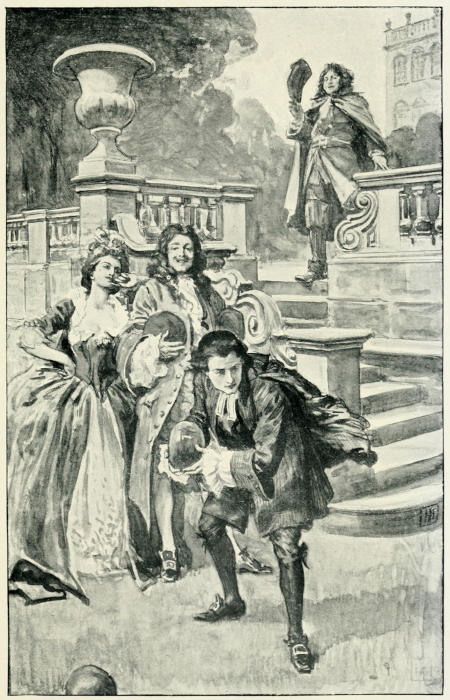
“Pardon, mademoiselle!” repeated the page, colouring
boy-like to his temples—“Pardon! I was running so fast;
I was in such a hurry—I am so awkward. I will pick you
a hatful more daisies—and—and I can get you a large slice
of cake this evening when the king goes out of the little
supper-room to the music-hall.”
“Mademoiselle” thus adjured, rose to her full stature of
some forty inches, and spreading her short stiff skirt around
her with great care, replied by a stately reverence that would
have done credit to an empress. Notwithstanding her dignity,
however, she cast a wistful look at the broken daisy-chain,
while her little red lips quivered as if a burst of tears
was not far off.
The boy was down on his knees in an instant, gathering
handfuls of the simple flowers, and flinging them impetuously
into his hat. It was obvious that this young gentleman
possessed already considerable energy of character, and
judging from the flash of his bold dark eyes, a determined
will of his own. His figure, though as yet unformed, was
lithe, erect, and active, while his noble bearing denoted
self-reliance beyond his years, and a reckless, confident
disposition, such as a true pedagogue would have longed
and failed to check with the high hand of coercion. In a
few minutes he had collected daisies enough to fill his laced
hat to the rims, and flinging himself on the turf, began
stringing them together with his strong, well-shaped, sunburnt
fingers. The little girl, much consoled, had reseated
herself as before. It was delightful to see the chain thus
lengthening by fathoms at a time, and this new friend seemed
to enter heart and soul into the important work. Active
sympathy soon finds its way to a child’s heart; she nestled
up to his side, and shaking her curls back, looked confidingly
in his face.
“I like you,” said the little woman, honestly, and without
reserve. “You are good—you are polite—you make daisy-chains
as well as mamma. My name’s Cerise. What’s
your name?”
The page smiled, and with the smile his whole countenance
grew handsome. In repose, his face was simply that of a
well-looking youth enough, with a bold, saucy expression
and hardy sunburned features; but when he smiled, a
physiognomist watching the change would have pronounced,
“That boy must be like his mother, and his mother must
have been beautiful!”
“Cerise,” repeated the lad. “What a pretty name!
Mine is not a pretty name. Boys don’t have pretty names.
My name’s George—George Hamilton. You mustn’t call
me Hamilton. I am never called anything but George at
Court. I’m not big enough to be a soldier yet, but I am
page to Louis le Grand!”
The child opened her eyes very wide, and stared over her
new friend’s head at a gentleman who was listening attentively
to their conversation, with his hat in his hand, and
an expression of considerable amusement pervading his old,
worn, melancholy face.
This gentleman had stolen round the corner of the alley,
treading softly on the turf, and might have been watching
the children for some minutes unperceived. He was a small,
shrunken, but well-made person, with a symmetrical leg
and foot, the arched instep of the latter increased by the
high heels of his diamond-buckled shoes. His dress in
those days of splendour was plain almost to affectation; it
consisted of a full-skirted, light-brown coat, ornamented only
with a few gold buttons; breeches of the same colour, and
a red satin waistcoat embroidered at the edges, the whole
suit relieved by the cordon bleu which was worn outside.
The hat he dangled in his pale, thin, unringed hand was
trimmed with Spanish point, and had a plume of white
feathers. His face was long, and bore a solemn, saddened
expression, the more remarkable for the rapidity with which,
as at present, it succeeded a transient gleam of mirth.
Notwithstanding all its advantages of dress and manner,
notwithstanding jewelled buckles, and point lace, and full
flowing periwig, the figure now standing over the two children,
in sad contrast to their rich flow of youth and health, was
that of a worn-out, decrepid old man, fast approaching,
though not yet actually touching, the brink of his grave.
The smile, however, came over his wrinkled face once
more as the child looked shyly up, gathering her daisy-chain
distrustfully into her lap. Then he stooped to stroke her
brown curls with his white wasted hand.
“Your name is Thérèse,” said he gravely. “Mamma
calls you Cerise, because you are such a round, ruddy little
thing. Mamma is waiting in the painted saloon for the
king’s dinner. You may look at him eating it, if your bonne
takes you home past the square table in the middle window
opposite the Great Fountain. She is to come for you in a
quarter of an hour. You see I know all about it, little one.”
Cerise stared in utter consternation, but at the first sound
of that voice the boy had started to his feet, blushing
furiously, and catching up his hat, to upset an avalanche of
daisies in the action, stood swinging it in his hand, bolt
upright like a soldier who springs to “attention” under the
eye of his officer. The old gentleman’s face had resumed
its sad expression, but he drew up his feeble figure with
dignity, and motioned the lad, who already nearly
equalled him in height, a little further back. George
obeyed instinctively, and Cerise, still sitting on the grass,
with the daisy-chain in her lap, looked from one to the other
in a state of utter bewilderment.
“Don’t be frightened, little one,” continued the old gentleman,
caressingly. “Come and play in these gardens
whenever you like. Tell Le Notre to give you prettier
flowers than these to make chains of, and when you get older,
try to leave off turning the heads of my pages with your
brown curls and cherry lips. As for you, sir,” he added,
facing round upon George, “I have seldom seen any of you
so innocently employed. Take care of this pretty little
girl till her bonne comes to fetch her, and show them both
the place from whence they can see the king at dinner.
How does the king dine to-day, sir? and when?” he concluded,
in a sharper and sterner tone. George was equal to
the occasion.
“There is no council to-day, sire,” he answered, without
hesitation. “His Majesty has ordered ‘The Little Service’[1]
this morning, and will dine in seventeen minutes exactly,
for I hear the Grey Musketeers already relieving guard in
the Front Court.”
“Go, sir,” exclaimed the old gentleman, in great good-humour.
“You have learnt your duty better than I expected.
I think I may trust you with the care of this pretty child.
Few pages know anything of etiquette or the necessary
routine of a Court. I am satisfied with you. Do you
understand?”
The boy’s cheeks flushed once more, as he bowed low and
stood silent, whilst the old gentleman passed on. The
latter, however, had not gone half-a-dozen paces ere he
turned back, and again addressed the younger of the children.
“Do not forget, little one, to ask Le Notre for any flowers
you want, and—and—if you think of it, tell mamma you
met the honest bourgeois who owns these gardens, and that
he knew you, and knew your name, and knew how old you
were, and, I dare say, little one, you are surprised the
bourgeois should know so much!”
That Cerise was surprised admitted of small doubt. She
had scarcely found her voice ere the old gentleman turned
out of the alley and disappeared. Then she looked at her
companion, whose cheeks were still glowing with excitement,
and presently burst into a peal of childish laughter.
“What a funny old man!” cried Cerise, clapping her
hands; “and I am to have as many flowers as I like—what
a funny old man!”
“Hush, mademoiselle,” answered the boy, gravely, as
though his own dignity had received a hurt, “you must not
speak like that. It is very rude. It is very wrong. If a
man were to say such things it should cost him his life.”
Cerise opened her blue eyes wider than ever.
“Wrong!” she repeated, “rude! what have I done?
who is it, then?”
“It is the King!” answered the boy, proudly. “It is
Louis le Grand!”
CHAPTER II THE MONTMIRAILS
Ladies first. Let us identify the pretty little girl in the
gardens of Versailles, who answered to the name of Cerise,
before we account for the presence of George Hamilton the
page.
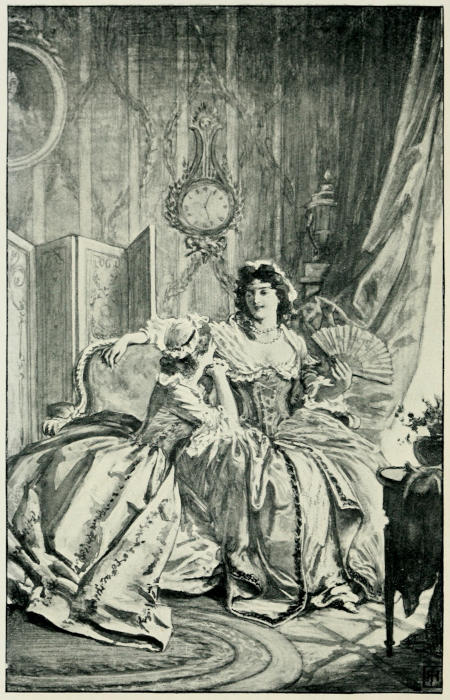
It is a thing well understood—it is an arrangement
universally conceded in France—that marriages should be
contracted on principles of practical utility, rather than on
the vague assumption of a romantic and unsuitable preference.
It was therefore with tranquil acquiescence, and
feelings perfectly under control, that Thérèse de la Fierté,
daughter of a line of dukes, found herself taken out of a
convent and wedded to a chivalrous veteran, who could
scarcely stand long enough at the altar, upon his well-shaped
but infirm old legs, to make the necessary responses for the
conversion of the beautiful brunette over against him into
Madame la Marquise de Montmirail. The bridegroom was
indeed infinitely more agitated than the bride. He had
conducted several campaigns; he was a Marshal of France;
he had even been married before, to a remarkably plain
person, who adored him; he had undergone the necessary
course of gallantry inflicted on men of his station at the
Court and in the society to which he belonged; nevertheless,
as he said to himself, he felt like a recruit in his first
“affair” when he encountered the plunging fire of those
black eyes, raking him front, and flanks, and centre, from
under the bridal wreath and its drooping white lace veil.
Thérèse had indeed, in right of her mother, large black
eyes as well as large West Indian possessions; and her
light-haired rivals were good enough to attribute the rich
radiance of her beauty to a stain of negro blood somewhere
far back in that mother’s race.
Nevertheless, the old Marquis de Montmirail was really
over head and ears in love with his brilliant bride. That
he should have indulged her in every whim and every folly
was but reasonably to be expected, but that she should
always have shown for him the warm affection of a wife,
tempered by the deference and respect of a daughter, is only
another instance, added to the long score on record of
woman’s sympathy and right feeling when treated with
gentleness and consideration.
Not even at Court did Madame de Montmirail give a
single opportunity to the thousand tongues of scandal during
her husband’s lifetime; she was indeed notorious for sustaining
the elaborate homage and tedious admiration of
majesty itself, without betraying, by the flutter of an eyelash,
that ambition was roused or vanity gratified during the
ordeal. It seemed that she cared but for three people in the
world. The chivalrous old wreck who had married her, and
who was soon compelled to move about in a wheeled chair;
the lovely little daughter born of their union, who inherited
much of her mother’s effective beauty with the traditional
grace and delicate complexion of the handsome Montmirails,
a combination that had helped to distinguish her by the
appropriate name of Cerise, and the young Abbé Malletort,
a distant cousin of her own, as remarkable for shrewd
intellect and utter want of sentiment as for symmetry of
figure and signal ugliness of face. The Grand Monarque
was not famous for consideration towards the nobles of his
household. Long after the Marquis de Montmirail had commenced
taking exercise on his own account in a chair, the
king commanded his attendance at a shooting-party, kept
him standing for three-quarters of an hour on damp grass,
under heavy rain, and dismissed him with a pompous compliment,
and an attack of gout driven upwards into the region
of the stomach. The old courtier knew he had got his
death-blow. The old soldier faced it like an officer of France.
He sent for Madame la Marquise, and complimented her
on her coiffure before proceeding to business. He apologised
for the pains that took off his attention at intervals, and
bowed her out of the room, more than once, when the
paroxysms became unbearable. The Marquise never went
further than the door, where she fell on her knees in the
passage and wept. He explained clearly enough how he
had bequeathed to her all that was left of his dilapidated
estates. Then he sent his duty to the king, observing that
“He had served his Majesty under fire often, but never
under water till now. He feared it was the last occasion
of presenting his homage to his sovereign.” And so, asking
for Cerise, who was brought in by her weeping mother, died
brave and tranquil, with his arm round his child and a gold
snuff-box in his hand.
Ladies cannot be expected to sorrow as inconsolably for
a mate of seventy as for one of seven-and-twenty, but the
Marquise de Montmirail grieved very honestly, nevertheless,
and mourned during the prescribed period, with perhaps
even more circumspection than had she lost a lover as well
as, or instead of, a husband. Wagers were laid at Court
that she would marry again within a year; yet the year
passed by and Madame had not so much as seen anybody
but her child and its bonne. Even Malletort was excluded
from her society, and that versatile ecclesiastic, though
pluming himself on his knowledge of human nature, including
its most inexplicable half, was obliged to confess
he was at a loss!
“Peste!” he would observe, taking a pinch of snuff, and
flicking the particles delicately off his ruffles, “was not the
sphinx a woman? At least down to the waist. So, I
perceive, is the Marquise. What would you have? There
is a clue to every labyrinth, but it is not always worth while
to puzzle it out!”
After a time, when the established period for seclusion
had expired, the widow, more beautiful than ever, made her
appearance once more at Court. That she loved admiration
there could not now be the slightest doubt, and the self-denial
became at length apparent with which she had
declined it during her husband’s lifetime, that she might
not wring his kind old heart. So, in all societies—at balls,
at promenades, at concerts—at solemn attendances on the
king, at tedious receptions of princes and princesses, dukes
and duchesses, sons and daughters of majesty, legitimate
or otherwise—she accepted homage with avidity, and returned
compliment for compliment, and gallantry for
gallantry, with a coquetry perfectly irresistible. But this
was all: the first step was fatal taken by an admirer across
that scarce perceptible boundary which divides the gold and
silver grounds, the gaudy flower-beds of flattery from the
sweet wild violet banks of love. The first tremble of interest
in his voice, the first quiver of diffidence in his glance, was
the signal for dismissal.
Madame de Montmirail knew neither pity nor remorse.
She had the softest eyes, the smoothest skin, the sweetest
voice in the bounds of France, but her heart was declared by
all to be harder than the very diamonds that became her so
well. Nor, though she seldom missed a chance of securing
smiles and compliments, did she seem inclined to afford
opportunity for advances of a more positive kind. Cerise
was usually in her arms, or on her lap; and suitors of every
time must have been constrained to admit that there is no
duenna like a daughter. Besides, the child’s beauty was
of a nature so different from her mother’s, that the most
accomplished coxcomb found it difficult to word his admiration
of mademoiselle so as to infer a yet stronger approval
of madame herself. The slightest blunder, too, was as
surely made public as it was quickly detected. The Marquise
never denied herself or her friends an opportunity for a
laugh, and her sarcasm was appropriate as pitiless; so to
become a declared admirer of Madame de Montmirail
required a good deal of that courage which is best conveyed
by the word sang-froid.
And even for those reckless spirits, who neither feared
the mother’s wit nor respected the daughter’s presence,
there was yet another difficulty to encounter in the person
of the child’s bonne, a middle-aged quadroon to whom Cerise
was ardently attached, and who never left her mistress’s
side when not employed in dressing or undressing her charge.
This faithful retainer, originally a slave on the La-Fierté
estates, had passed—with lands, goods, and chattels—into
the possession of the Marquise after the death of her mother,
the duchess, who was said to have a black drop of blood in
her veins, and immediately transferred her fidelity and
affections to her present owner. She was a large, strong
woman, with the remains of great beauty. Her age might
be anything under fifty; and she was known at Court as
“The Mother of Satan,” a title she accepted with considerable
gratification, and much preferred to the sweeter-sounding
name of Célandine, by which she was called on the
West Indian estate and in the family of her proprietors.
Notwithstanding her good looks, there was something
about Célandine that made her an object of dread to her
fellow-servants, whether slaves or free. The woman’s
manner was scowling and suspicious, she suffered from long
fits of despondency; she muttered and gesticulated to
herself; she walked about during the night, when the rest
of the household were in bed. Altogether she gave occasion,
by her behaviour, to those detractors who affirmed that,
whether his mother or not, there was no doubt she was a
faithful worshipper of Satan.
In the island whence she came, and among the kindred
people who had brought with them from Africa their native
barbarism and superstitions, the dark rites of Obi were still
sedulously cultivated, as the magic power of its votaries was
implicitly believed. The three-fourths of white blood in the
veins of Célandine had not prevented her, so they said, from
becoming a priestess of that foul order; and the price paid
for her impious exaltation was differently estimated, according
to the colour of those who discussed the revolting
and mysterious question, even amongst the French domestics
of Madame de Montmirail, and in so practical an age as
the beginning of the eighteenth century. The quadroon,
finding herself shunned by her equals, was drawn all the
closer to her mistress and her little charge.
Such was the woman who pushed her way undaunted
through the crowd of courtiers now thronging the Grand
Alley at Versailles, eliciting no small share of attention by
the gorgeousness of her costume; the scarlet shawl she
had bound like a turban round her head, the profusion
of gold ornaments that serpentined about her neck and arms,
together with the glaring pattern of white and orange conspicuous
on her dress, till she reached the secluded corner
where Cerise was sitting with her broken daisy-chain and
her attendant page, as she had been left by the king.
The quadroon’s whole countenance brightened into beauty
when she approached her darling, and the child bounding
up to meet her, ran into her arms with a cry of delight
that showed their attachment was mutual. George,
extremely proud of his commission, volunteered to guide
them to the spot whence, as directed, they could witness
the progress of the king’s dinner, and the strangely-matched
trio proceeded through the now decreasing crowd, to all
appearance perfectly satisfied with each other.
They had already taken up their position opposite the
window which his Majesty had indicated, and were in full
enjoyment of the thrilling spectacle he had promised them,
namely, a little old man in a wig, served by half-a-dozen
servants at once, and eating to repletion, when Cerise, who
clung to Célandine’s hand, hid her face in the bonne’s
gown, to avoid the gaze of two gentlemen who were staring
at her with every mark of approval. “What is it, my
cherished one?” said the quadroon, in tender accents.
“Who dares frighten my darling?” But the fierce voice
changed into coaxing tones when the bonne recognised a
familiar face in one of her charge’s unwelcome admirers.
“Why, it’s Monsieur l’Abbé! Surely you know Monsieur
l’Abbé! Come, be a good child, then; make Monsieur
l’Abbé a reverence, and wish him good-day!”
But Cerise persistently declined any friendly overtures
whatever to Monsieur l’Abbé; hanging her head and turning
her toes in most restively; so the three passed on to
witness the process of eating as performed by Louis le
Grand; and Monsieur l’Abbé, crumpling his extremely
plain features into a sneer, observed his companion, “It is
droll enough, Florian, children never take to me, though I
make my way as well as another with grown-up people.
They seem to mistrust me from the first. Can it be because
I am so very ugly?”
The other smiled deprecatingly. “Good looks,” said
he, “have nothing to do with it. Children are like their
elders—they hate intellect because they fear it. Oh,
Malletort! had I the beauty of Absalom, I would give it all
willingly to possess your opportunities and your powers of
using them!”
“Thank you,” replied Malletort, looking gratified in
spite of himself at the compliment, but perhaps envying
in his secret heart the outward advantages which his friend
seemed so little to appreciate.
Florian de St. Croix, just on the verge of manhood, was
as handsome a youth as might be met with amongst the
thousand candidates for the priesthood, of whom he was one
of the most sanguine and enthusiastic. Not even the
extreme plainness of his dress, appropriate to the sacred
calling he was about to enter—not even his close-cut hair
and pallid hue, result of deep thought and severe application—could
diminish the beauty of his flashing eyes, his clear-cut
features, and high, intellectual forehead, that denoted
ideality and self-sacrifice as surely as the sweet womanly
mouth betrayed infirmity of purpose and fatal subservience
to the affections. His frame, though slender, was extremely
wiry and muscular; cast, too, in the mould of an Apollo.
No wonder there was a shadow of something like jealousy
on his companion’s shrewd, ugly face, while he regarded one
so superior in external advantages to himself.
The Abbé Malletort was singular in this respect. He
possessed the rare faculty of appreciating events and
individuals at their real value. He boasted that he had no
prejudices, and especially prided himself on the accuracy
with which he predicted the actions of his fellow-creatures
by the judgment he had formed of their characters. He
made no allowance for failure, as he gave no credit to success.
Men, with him, were capable or useless only as they conquered
or yielded in the great struggle of life. Systems
proved good or bad simply according to their results. The
Abbé professed to have no partialities, no feelings, no
veneration, and no affections. He had entered the Church
as a mere matter of calculation and convenience. Its prizes,
like those of the army, were open to intellect and courage.
If the priest’s outward conduct demanded more of moderation
and self-restraint, on the other hand the fasts and vigils
of Rome were less easily enforced than the half-rations of a
march or the night-watches of an outpost.
Moreover, the tonsure in those days might be clipped (not
close enough to draw attention) from a skull that roofed
the teeming brain of a politician; and, indeed, the Church
of Rome not only permitted but encouraged the assumption
of secular power by her votaries, so that the most important
and lucrative posts of the empire were as open to Abbé and
Cardinal as to a Colonel of the Body-guard or a Marshal of
France; while the soldier’s training fitted him far less than
the priest’s to countermine the subtleties of diplomacy or
unravel the intricacies of finance. There remained, then,
but the vow of celibacy to swallow, and, in truth, the vow
of celibacy suited Malletort admirably well. Notwithstanding
his ugly face, he was an especial favourite with women,
on whom his ready wit, his polished manners, and, above
all, his imperturbable coolness, made a pleasing impression.
They liked him none the less that his reputed hardness of
heart and injustice towards themselves were proverbial.
While, as for his plain features, why, to quote the words of
Ninon de l’Enclos, who ought to have been a good judge in
such matters, “A man’s want of beauty is of small account
if he be not deficient in other amiable qualities, for there is
no conquest without the affections, and what mole can be
so blind as a woman in love?”
CHAPTER III MONSIEUR L’ABBÉ
The crowd had passed on to witness the king’s dinner, now
in full progress, and the two soberly-clad friends found themselves
the only occupants of the gardens. Side by side they
took their seats on a bench under a row of lime-trees, and
continued the conversation which had originated in little
Cerise and her childish beauty.
“It is a face as God made it,” said Florian, his boyish
features lighting up with enthusiasm. “Children are surely
nearer Heaven than ourselves. What a pity to think that
they should grow into the painted, patched, powdered
hypocrites, of whom so many have passed by us even now.”
“Beautifully dressed, however,” answered his worldly
senior, placidly indifferent, as usual, to all that did not concern
his own immediate comfort. “If there were no women,
Florian, there would be no children, I conclude. Both seem
necessary evils. You, I observe, prefer the lesser. As for
being near Heaven, that, I imagine, is a mere question of
altitude. The musketeer over there is at least a couple of
inches nearer it than either of us. What matter? It will
make little difference eventually to any one of the three.”
Florian looked as if he did not understand. Indeed, the
Abbé’s manner preserved a puzzling uncertainty between
jest and earnest. He took a pinch of snuff, too, with the
air of a man who had thoroughly exhausted the question.
But his companion, still harping on the beauty of the child,
continued their conversation.
“Is she not a cousin of yours, this little angel? I know
you are akin to that beautiful Marquise, her mother. Oh,
Malletort, what advantages you possess, and how unconscious
you seem of them!”
“Advantages!” repeated the Abbé, musing. “Well,
perhaps you are right. Handsome women are the court-cards
of the game, if a man knows how to play them. It is
a grand game, too, and the stakes are well worth winning.
Yet I sometimes think if I had foreseen in time how entirely
you must devote body and soul to play it, I might never
have sat down at all. I could almost envy a boy, like that
merry page who passed us with my baby-cousin—a boy,
whose only thought or care is to spend the time gaily now,
and wear a sword as soon as his beard is grown hereafter.”
“The boy will carry a sword fairly enough,” answered
Florian; “for he looks like a little adventurer already.
Who is he? I have remarked him amongst the others for
a certain bold bearing, that experience and sorrow alone will,
I fear, be able to tame.”
“It will take a good deal of both to tame any of that
family,” answered Malletort; “and this young game-chick
will no doubt prove himself of the same feather as the rest
of the brood when his spurs are grown. He’s a Hamilton,
Florian; a Hamilton from the other side of the water, with
a cross of the wildest blood in France or Europe in his veins.
You believe the old monkish chronicles—I don’t. They
will tell you that boy’s direct ancestor went up the breach
at Acre in front of Cœur de Lion—an Englishman of the
true pig-headed type, who had sense enough, however, to
hate his vassal ever after for being a bigger fool than himself.
On the mother’s side he comes of a race that can
boast all its sons brave, and its daughters—well, its
daughters—very much the same as other people’s daughters.
The result of so much fighting and gasconading being,
simply, that the elder branch of the family is sadly impoverished,
while the younger is irretrievably ruined.”
“And this lad?” asked Florian, interested in the boy,
perhaps because the page’s character was in some respects
so completely the reverse of his own.
“Is of the younger branch,” continued Malletort, “and
given over body and soul to the cause of this miserable
family, whose head died, not half-a-dozen years ago, under
the shadow of our grand and gracious monarch, a victim to
prejudice and indigestion. Well, these younger Hamiltons
have always made it their boast that they grudged neither
blood nor treasure for the Stuarts; and the Stuarts, I need
hardly tell you, Florian, for you read your breviary, requited
them as men must expect to be requited who put their trust
in princes—particularly of that dynasty. The elder branch
wisely took the oaths of allegiance, for the ingratitude of a
reigning house is less hopeless than that of a dethroned
family. I believe any one of them would be glad to accept
office under the gracious and extremely ungraceful lady who
fills the British throne, established, as I understand she is,
on so broad a basis, there is but little room for a consort.
They are scarce likely to obtain their wish. The younger
branch would scout the idea, enveloped, one and all, in an
atmosphere of prejudice truly insular, which ignorant people
call loyalty. This boy’s great-grandfather died in a battle
fought by Charles I., at a place with an unpronounceable
name, in the province of ‘Yorkshires.’ His grandfather
was shot by a platoon of musketeers in his own courtyard,
under an order signed by the judicious Cromwell; and his
father was drowned here, in the channel, carrying despatches
for his king, as he persisted in calling him, under the
respectable disguise of a smuggler. I believe this boy was
with him at the time. I know when first he came to Court,
people pretended that although so young he was an accomplished
sailor; and I remember his hands were hard and
dirty, and he always seemed to smell of tar. I will own
that now, for a page, he is clean, polished, and well dressed.”
Florian’s dark eyes kindled.
“You interest me,” said he; “I love to hear of loyalty.
It is the reflection of religion upon earth.”
“Precisely,” replied the other. “A shadow of the
unsubstantial. Well, all his line are loyal enough, and I
doubt not the boy has been brought up to believe that in the
world there are men, women, and Stuarts. The fact of his
being page here, I confess, puzzles me. Lord Stair protested
against it, I know, but the king would not listen, and used
his own wise discretion, consenting, however, that the lad
should drop his family name and be called simply—George.
So George fulfils the destiny of a page, whatever that may
be—as gaudy, as troublesome, and to all appearance as
useless an item in creation as the dragon-fly.”
“And has the child no relations?” asked Florian; “no
friends, nobody to whom he belongs? What a position;
what a fate; what a cruel isolation!”
“He is indeed in that enviable situation which I cannot
agree with you in thinking merits one grain of pity. You
and I, Florian, with our education and in our career, should,
of all people, best appreciate the advantages of perfect
freedom from those trammels which old women of both
sexes call the domestic affections.”
“So young, so hopeful, so spirited,” continued Florian,
speaking rather to himself than his informant, “and to
have no mother!”
“But he had a mother, I tell you,” replied Malletort,
“only she died of a broken heart, as women always do
when a little energy is required to repair their broken
fortunes. Our mother, my son,” he proceeded, still in
the same half-mocking, half-impressive tone, “our mother
is the Church. She provides for us carefully during life,
and when we die in her embrace, at least affords us decent
burial and prayers for our welfare hereafter. I tell you,
Florian, she is the most thoughtful as she is the most
indulgent of mothers. She offers us opportunity for
distinction, or allows us shelter and repose according as
our ambition soars to heaven, or limits itself, as I confess
mine does, to the affairs of earth. Who shall be found
exalted above their kind in the next world? (I speak as
I am taught)—Priests. Who fill the high places in
this? (I speak as I learn)—Priests. The king’s wisest
councillors, his ablest financiers, are men of the sober
garment and the shaven crown; nay, judging from the
simplicity of his habits, and the austerity of his demeanour,
I cannot but think that the bravest marshal in our armies is
only a priest in disguise.”
“There are but two careers worthy of a life-sacrifice,”
observed Florian, his countenance glowing with enthusiasm,
“and glory is the aim of each. But who would compare
the soldier of France with the soldier of Rome?—the banner
of the Bourbon with the cross of Calvary? How much less
noble is it to serve earth than heaven?”
Malletort looked in his young friend’s face as if he thought
such exalted sentiments could not possibly be real, and
shrewdly suspected him of covert sarcasm or jest; but
Florian’s open brow admitted of no misconstruction, and
the elder man’s features gradually relaxed into the quiet
expression of amusement, not devoid of pity, with which a
professor in the swimmer’s art, for instance, watches the
floundering struggles of a neophyte.
“You are right,” said he, calmly and after a pause;
“ours is incomparably the better profession of the two,
and the safer. We risk less, no doubt, and gain more.
Persecution, in civilised countries at least, is happily all
the other way. It is extremely profitable to be saints, and
there is no call for us to become martyrs. I think, Florian,
we have every reason to be satisfied with our bargain.
Why, the very ties we sever, the earthly affections we
resign, are, to my mind, but so many more enforced
advantages, for which we cannot be too thankful.”
“There would be no merit were there no effort,”
answered the other. “No self-denial were there nothing
to give up; but with us it is different. I am proud to
think we do resign, and cheerfully, all that gives warmth
and colouring to the hard outlines of an earthly life. Is it
nothing to forego the triumphs of the camp, the bright
pageantry, the graceful luxuries of the Court? Is it
nothing to place yourself at once above and outside the
pale of those sympathies which form the very existence of
your fellow-men? More than all, is it nothing, Malletort,”—the
young man hesitated, blushed, and cast his eyes
down—“is it nothing to trample out of your heart,
passions, affections—call them what you will—that seem
the very mainspring of your being? Is it nothing to deny
yourself at once and for ever the solace of woman’s companionship
and the rapture of woman’s love?”
“You declaim well,” replied Malletort, not affecting to
conceal that he was amused, “and your arguments would
have even more weight were it not that you are so palpably
in earnest. This of itself infers error. You will observe,
my dear Florian, as a general rule, that the reasoner’s
convictions are strong in direct proportion to the weakness
of his arguments. But let us go a little deeper into this
question of celibacy. Let us strip it of its conventional
treatment, its supposed injustice, its apparent romance.
To what does it amount? That a priest must not marry—good.
I repeat, so much the better for the priest. What
is marriage in the abstract?—The union of persons for the
continuation of the species in separate and distinct races.
What is it in the ideal?—The union of souls by an unphilosophical
and impossible fusion of identity, which
happily the personality of every human being forbids to
exist. What is it in reality?—A fetter of oppressive
weight and inconvenient fabric, only rendered supportable
from the deadening influence of habit, combined with its
general adoption by mankind. Look around you into
families and observe for yourself how it works. The
woman has discovered all her husband’s evil qualities, of
which she does not fail to remind him; and were she a
reflective being, which admits of argument, would wonder
hourly how she could ever have endured such a mass of
imperfections. The man bows his head and shrugs his
shoulders in callous indifference, scorning to analyse the
disagreeable question, but clear only of one thing—that if
he were free, no consideration would induce him to place
his neck again beneath the same yoke. Another—perhaps!
The same—never! Both have discovered a dissimilarity
in tastes, habits, and opinions, so remarkable that it seems
scarcely possible that it should be fortuitous. To
neither does it occur that each was once the very reflection
of the other, in thought, word, and deed; and that a
blessing pronounced by a priest—a few years, nay a few
months, of unrestricted companionship—have wrought the
miraculous change. Sometimes there are quarrels, scenes,
tears, reproaches, recriminations. More often, coldness,
self-restraint, inward scorn, and the forbearance of a
repressed disgust. Then is the separation most complete
of all. Their bodies preserve to each other the
outward forms of an armed and enforced neutrality, but
their souls are so far asunder that perhaps, of all in the
universe, this pair alone could, under no circumstances,
come together again.”
“Sacrilege!” broke in Florian, indignantly. “What
you say is sacrilege against our very nature! You speak
of marriage as if it must be the grave of Love. But at
least Love has lived. At least the angel has descended and
been seen of men, even though he touched the mountain
only to spring upward on his flight again towards the skies.
He who has really loved, happily or unhappily, married or
alone, is for that love ever after a wiser, a nobler, and a
better man.”
“Not if he should happen to love a Frenchwoman,”
observed the other, taking a pinch of snuff. “Thus much I
will not scruple to say for my countrywomen: their coquetries
are enough to drive an honest man mad. With regard to
less civilised nations (mind, I speak not from personal experience
so much as observation of my kind), I admit that
for a time, at least, the delusion may possess a charm,
though the loss must in all cases far exceed the gain. Set
your affections on a German, for instance, and observe
carefully, for the experiment is curious, if a dinner with
the idol does not so disgust you that not a remnant of
worship is left to be swept away by supper-time. A Pole
is simply a beautiful barbarian, with more clothing but less
manner than an Indian squaw. An Italian deafens you
with her shrill voice, pokes your eye out with her fingers,
and betrays your inmost secrets to her director, if indeed she
does not prefer him to you in every respect. An Englishwoman,
handsome, blonde, silent, and retiring, keeps you
months in uncertainty while you woo, and when won, believes
she has a right to possess you body and soul, and becomes,
from a sheer sentiment of appropriation, the most exacting
of wives and the most disobliging of mistresses. To make
love to a Spaniard is a delicate phrase for paying court to a
tigress. Beautiful, fierce, impulsive—with one leap she is
in your arms—and then for a word, a look, she will stab
you, herself, a rival, perhaps all three, without hesitation
or remorse. Caramba! she considers it a compliment no
doubt! Yet I tell you, Florian, were I willing to submit
to such weaknesses, I had rather love any one of these, or
all of them at once for that matter, than attach myself to a
Frenchwoman.”
Florian opened his dark eyes wide. This was new
ground to the young student. These were questions
more interesting than the principles of Aristotle or the
experiences of the Saints. He was penetrated, too, with
that strange admiration which the young entertain for
familiarity with evil in their elders. The other scanned
him with half-pitying interest; broke a branch from the
fragrant lime-tree under which they sat, and proceeded to
elucidate his theory.
“With all other women,” said Malletort, “you have
indeed a thousand rivals to out-do; still you know their
numbers and can calculate their resources; but with the
Frenchwoman, in addition to these, you have yet another,
who changes and multiplies himself day by day—who
assumes a thousand Protean forms, and against whom
you cannot employ the most efficient weapons—such as
vanity, gaiety, and love of dissipation, by which the others
are to be subdued. This enemy is dress—King Chiffon
is the absolute monarch of these realms. Your mistress
is gay when you are sad, sarcastic when you are plaintive,
reserved when you are adventurous. All this is a matter
of course; but as Monsieur Vauban told the king the
other day in these gardens, ‘no fortress is stronger than
its weakest place,’ and every citadel may be carried by a
coup de main, or reduced by the slower process of blockade.
But here you have a stronghold within a stronghold; a
reserve that can neither be tampered with in secret nor
attacked openly; in brief a rival who owns this incalculable
advantage, that in all situations and under all circumstances
he occupies the first place in your mistress’s thoughts.
Bah!” concluded the Abbé, throwing from him the branch
which he had stripped of leaves and blossoms, with a
gesture that seemed thus to dismiss the subject once
for all; “put a Frenchwoman into what position you
will, her sympathies indeed may be with her lover, but
her first consideration is for her dress!”
As the Abbé spoke he observed a group of four persons
passing the front of the palace, under the windows of the
king’s dining-saloon. It consisted of little Cerise, her
mother, Célandine, and the page. They were laughing
and chatting gaily, George apparently taking his leave of
the other three. Florian observed a shadow cross the
Abbé’s face, that disappeared, however, from those obedient
features quickly as it came; and at the same moment the
Marquise passed her hand caressingly over the boy’s dark
curls, while he bent low before her, and seemed to do
homage to her beauty in the act of bidding her a courteous
farewell.
CHAPTER IV TANTARA!
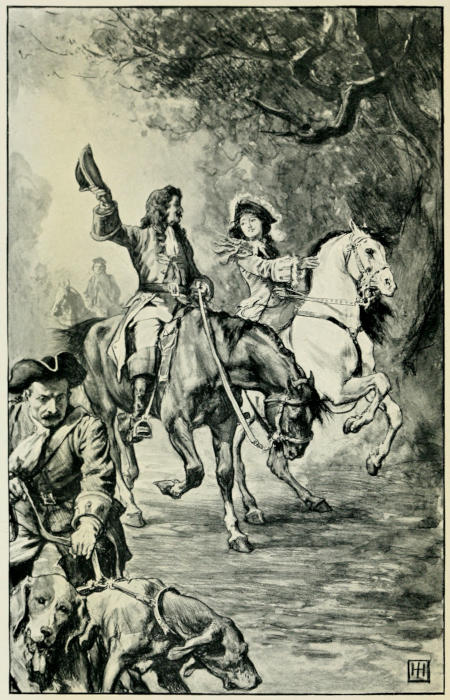
Year by year a certain stag had been growing fatter and
fatter in the deep glades and quiet woodlands that surrounded
Fontainebleau. He was but a pricket when Cerise
made her daisy-chain in the gardens of Versailles, but each
succeeding summer he had rubbed the velvet off another
point on his antlers, and in all the king’s chase was no
finer head than he carried the day he was to die. Brow,
bay, and tray, twelve in all, with three in a cup at the summits,
had been the result of some half-score years passed in
the security and shelter of a royal forest; nor was the
lapse of time which had thus brought head and haunch to
perfection without its effect upon those for whose pastime
the noble beast must fall.
Imagine, then, a glowing afternoon, the second week in
August. Not a cloud in the sky, a sun almost tropical in
its power, but a pure clear air that fanned the brow wherever
the forest opened into glades, and filled the broad nostrils
of a dozen large, deep-chested, rich-coloured stag-hounds,
snuffing and questing busily down a track of arid grass that
seemed to have checked their steady, well-considered unrelenting
chase, and brought their wondrous instinct to a
fault. One rider alone watched their efforts with a preoccupied
air, yet with the ready glance of an old sportsman.
He had apparently reached his point of observation before
the hounds themselves, and far in advance of the rest of the
chase. His close-fitting blue riding-coat, trimmed with
gold-lace and turned back with scarlet facings, called a
“just au corps,” denoted that he was a courtier; but the
keen eye, the erect figure, the stateliness, even stiffness of
his bearing, smacked of the old soldier, more, the old
soldier of France, perhaps the most professional veteran in
the world.
He was not so engrossed with his own thoughts, however,
but that his eye gleamed with pleasure when a tan-coloured
sage, intent on business, threw a square sagacious head
into the air, proclaiming in full deep notes his discovery of
the line, and solemn conviction that he was right. The
horseman swore a good round garrison oath, and cheered
the hound lustily. A cry of tuneful tongues pealed out to
swell the harmony. A burst of music from a distant glade
announced that the stag had passed yet farther on. A
couple of royal foresters, in blue and red, arrived on foot,
breathless, with fresh hounds struggling in the leash; and
a lady on a Spanish barb, attended by a plainly-dressed
ecclesiastic, came cantering down the glade to rein up at
the veteran’s side, with a smile of greeting on her face.
“Well met, Monsieur le Prince, once more,” said she,
flashing a look from her dark eyes, under which, old as he
was, he lowered his own. “Always the same—always
successful. In the Court—in the camp—in the ball-room—in
the field—if you seek the Prince-Marshal, look in the
most forward post, and you will find him.”
She owed him some reparation for having driven him from
her side in a fit of ill-humour half an hour before, and this
was her way of making amends.
“I have won posts in my time, madame,” said the old
soldier, an expression of displeasure settling once more on
his high worn features, “and held them, too, without dishonour.
It is perhaps no disgrace to be worsted by a
woman, but it is humiliating and unpleasant all the same.”
“Dishonour and disgrace are words that can never be
coupled with the name of Chateau-Guerrand,” returned the
lady, smiling sweetly in his face, a process that appeared to
mollify him considerably. Then she completed his subjection
by caressing her horse with one hand, while she reined
him in so sharply with the other, that he rose on his hind-legs
as if to rear straight on end.
“You are a hard mistress, madame,” said the gentleman,
looking at the beautiful barb chafing and curveting to
its bit.
“It is only to show I am mistress,” she answered in a
low voice, that seemed to finish the business, for turning to
her attendant cavalier, who had remained discreetly in the
background, she signed to him that he might come up and
break the tête-à-tête, while she added gaily—
“I am as fond of hunting as you are, prince. Hark!
The stag is still forward. Our poor horses are dying with
impatience. Let us gallop on together.”
The Marquise de Montmirail had considerably altered in
character since she tended the infirmities of her poor old
husband, or sat in widow’s garments with her pretty child
on her knee. A few years at the Court of France had
brought to the surface all the evil of her character, and
seemed to have stifled in her everything that was good.
She had lost the advantage of her daughter’s companionship,
for Cerise (and in this perhaps the Marquise was
right) had been removed to a distance from the Court and
capital, to bloom into womanhood in the healthier atmosphere
of a provincial convent. She missed her darling
sadly, no doubt, and for the first year or two contented herself
with the gaieties and distractions common to her companions.
She encouraged no lover, properly so called, and
had seldom fewer than three admirers at a time. Nor had
the king of late taken special notice of her; so she was only
hated by the other Court ladies with the due hatred to which
she was entitled from her wealth, beauty, and attractions.
After a while, however, she put in for universal dominion,
and then of course the outcry raised against her was loud
and long sustained. She heeded it little; nay, she seemed
to like it, and bandied sarcasms with her own sex as joyously,
to all appearance, as she exchanged compliments
with the other.
She never faltered. She never committed herself. She
stood on the brink, and never turned giddy nor lost her
presence of mind. What she required, it seemed, what she
could not live without, was influence, more or less, but the
stronger the better, over every male creature that crossed
her path. When this was gained, she had done with them
unless they were celebrities, or sufficiently frivolous to be
as variable as herself. In either of such cases she took considerable
pains to secure the empire she had won. What
she liked best was to elicit an offer of marriage. She was
supposed to have refused more men, and of more different
ranks, than any woman in France. For bachelor or widower
who came within the sphere of her influence there was no
escape. Sooner or later he must blunder into the net, and
the longer he fought the more complete and humiliating
was his eventual defeat. “Nothing,” said the Abbé Malletort,
“nothing but the certainty of the king’s unacknowledged
marriage to Madame de Maintenon prevented his
cousin from obtaining and refusing an offer of the crown of
France.”
She was beautiful, too, no doubt, which made it so much
worse—beautiful both with the beauty of the intellect and
the senses. Not strictly by any rules of art, but from grace
of outline, richness of colouring, and glowing radiance of
health. She had all the ways, too, of acknowledged beauty;
and even people who did not care for her were obliged to
admit she possessed that strange, indefinite, inexplicable
charm which every man finds in the woman he loves.
The poor Prince-Marshal, Hector de Chateau-Guerrand,
had undergone the baptism of fire at sixteen, had fought
his duels, drank his Burgundy, and lost an estate at lansquenet
in a night before he was twenty. Since then he
had commanded the Musketeers of the Guard—divisions of
the great king’s troops—more than once a French army in
the field. It was hard to be a woman’s puppet at sixty—with
wrinkles and rheumatism, and failing health, with
every pleasure palling, and every pain enhanced. Well, as
he said himself, “le cœur ne vieillit jamais!” There is
no fool like an old one. The Prince-Marshal, for that was
the title by which he was best known, had never been
ardently attached to anybody but himself till now. We
need not envy him his condition.
“Let us gallop on together,” said the Marquise; but ere
they could put their horses in motion a yeoman-pricker,
armed to the teeth, rode rapidly by, and they waited until
his Majesty should have passed. Their patience was not
tried for long. While a fresh burst of horns announced
another view of the quarry further on, the king’s little
calèche turned the corner of the alley at speed, and was
pulled up with considerable dexterity, that its occupant might
listen for a moment to determine on his future course.
Louis sat by himself in a light, narrow carriage, constructed
to hold but one person. He was drawn by four cream-coloured
horses, small, well-bred, and active. A child of
some ten years of age acted postilion to the leaders, but
the king’s own hand drove the pair at wheel, and guided
them with all the skill and address of his early manhood.
Nevertheless, he looked very old and feeble when he returned
the obeisance of the Prince-Marshal and his fair
companion. Always punctiliously polite, Louis lifted his
hat to salute the Marquise, but his chin soon sank back on
his chest, and the momentary gleam died out in his dull and
weary eyes.
It was obvious his health was failing day by day; he was
now nearly seventy-seven years of age, and the end could
not be far off. As he passed on, an armed escort followed
at a few paces distance. It was headed by a young officer
of the Grey Musketeers, who saluted the Prince-Marshal
with considerable deference, and catching the eye of the
Marquise, half halted his horse; and then, as if thinking
better of it, urged him on again, the colour rising visibly in
his brown handsome face.
The phenomenon of a musketeer blushing was not likely
to be lost on so keen an observer as Madame de Montmirail,
particularly when the musketeer was young, handsome, and
an excellent horseman.
“Who is that on guard?” said she, carelessly of course,
because she really wanted to know. “A captain of the Grey
Musketeers evidently. And yet I do not remember to have
seen his face at Court before.”
Now it was not to be expected that a Marshal of France
should show interest, at a moment’s notice, in so inferior an
official as a mere captain of musketeers, more particularly
when riding with a “ladye-love” nearly thirty years younger
than himself, and of an age far more suitable to the good-looking
gentleman about whom she made inquiries. Nevertheless,
the Prince had no objection to enter on any subject
redounding to his own glorification, particularly in war, and
it so happened that the officer in question had served as his
aide-de-camp in an affair that won him a Marshal’s baton;
so he reduced his horse’s pace forthwith, and plunged into
the tempting subject.
“A fine young man, madame,” said the Prince-Marshal,
like a generous old soldier as he was, “and a promising
officer as ever I had the training of. He was with me while
a mere cadet in that business when I effected my junction
with Vendôme at Villa-Viciosa, and I sent him with despatches
from Brighuega right through Staremberg’s uhlans,
who ought to have cut him into mince-meat. Even Vendôme
thanked him in person, and told me himself I must
apply for the brave child’s promotion.”
Like other ladies, the Marquise suffered her attention to
wander considerably from these campaigning reminiscences.
She roused herself, however, enough to answer, not very pertinently—
“What an odious man the Duke is, and how hideous.
Generally drunk, besides, and always disagreeable!”
The Prince-Marshal looked a little put out, but he did
not for this allow himself to be diverted from his subject.
“A very fortunate soldier, madame,” he replied, pompously;
“perhaps more fortunate than really deserving.
Nevertheless, in war as in love, merit is of less importance
than success. His Majesty thought well to place the Duke
over the head of officers whose experience was greater, and
their services more distinguished. It is not for me to offer
an opinion. I serve France, madame, and you,” he added,
with a smile, not too unguarded, because some of his teeth
were gone, “I am proud to offer my homage to both.”
The Marquise moved her horse impatiently. The subject
did not seem to amuse her, but the Prince-Marshal had got
on a favourite theme, and was not going to abandon it without
a struggle.
“I do not think, madame,” he proceeded, laying his hand
confidentially on the barb’s crest—“I do not think I have
ever explained to you in detail the strategical reasons of my
forced march on Villa-Viciosa in order to co-operate with
Vendôme. I have been blamed in military circles for evacuating
Brighuega after taking it, and abandoning the position
I held at the bridge the day before the action, which I
had caused to be strengthened during the night. Now there
is much to be urged on both sides regarding this movement,
and I will endeavour to make clear to you the arguments for
and against the tactics I thought it my duty to adopt. In
the first place, you must bear in mind that the enemy’s
change of front on the previous morning, which was unexpected
by us, and for which Staremberg had six cogent
reasons, being as follows―”
The Marquise looked round to her other cavalier in despair;
but no assistance was to be expected from the cynical
Abbé—for it was Malletort in attendance, as usual, on his
cousin.
The Prince-Marshal was, doubtless, about to recount the
dispositions and manœuvres of three armies seriatim, with
his own advice and opinions thereon, when relief came to
his listener from a quarter in which she least expected it.
She was preparing herself to endure for the hundredth
time the oft-told tale, when her horse started, snorted,
trembled violently, and attempted to wheel round. In
another instant an animal half as big as itself leaped
leisurely into the glade, and went lurching down the dry
sunny vista as if in utter disregard and contempt of its
pursuers.
The stag had been turned back at several points by the
horns of the foresters, who thus melodiously greeted every
appearance of their quarry. He was beginning to think
some distant refuge would be safer and more agreeable;
also his instinct told him that the scent would improve while
he grew warmer, and that his noisy pursuers would track
him more and more unerringly as the sun went down.
Already he felt the inconvenience of those fat haunches
and that broad russet back he carried so magnificently;
already he heard the deep-mouthed chorus chiming nearer
and nearer, full, musical, and measured, like a death-bell.
“En avant!” exclaimed Madame de Montmirail, as the
stag, swerving from a stray hound, stretched into an honest,
undisguised gallop down the glade, followed by the straggler
at its utmost speed, labouring, over-paced, distressed, but
rolling on, mute, resolute, and faithful to the line. The love
of rapid motion, inseparable from health, energy, and high
spirits, was strong in the Marquise. Her barb, in virtue of
his blood, possessed pace and endurance; his mistress called
on him to prove both, while she sped along on the line of
chase, accompanied by several of the hounds, as they
straggled up in twos and threes, and followed by most of
the equestrians.
Thus they reached the verge of the forest, and here stood
the king’s calèche drawn up, his Majesty signing to them
feebly yet earnestly that the stag was away over the
plain.
Great was now the confusion at so exciting and so unexpected
an event. The foresters, with but little breath to
spare, managed to raise a final flourish on their horns.
The yeoman-prickers spurred their horses with a vigour
more energetic than judicious; the hounds, collecting as it
seemed from every quarter of the forest, were already stringing,
one after another, over the dusty plain. The king, too
feeble to continue the chase, yet anxious to know its result,
whispered a few words to his officer of the guard, and the
Musketeer, starting like an arrow from a bow, sped away
after the hounds with some half-dozen of the keenest equestrians,
amongst whom were the Marquise and the Prince-Marshal.
Many of the courtiers, including the Abbé,
seemed to think it disloyal thus to turn their backs on his
Majesty, and gathered into a cluster to watch with interjections
of interest and delight the pageant of the fast-receding
chase. The far horizon was bounded by another range of
woods, and that shelter the stag seemed resolved to reach.
The intervening ground was a vast undulating plain, crossed
apparently by no obstacles to hounds or horsemen, and
varied only by a few lines of poplars and a paved high-road
to the nearest market-town.
The stag then made direct for this road, but long ere he
could reach it, the chase had become so severe that many
of the hounds dropped off one by one; and of the horses,
only those ridden by the Marquise, the Prince-Marshal, and
the Grey Musketeer, were able to keep up the appearance of
a gallop.
Presently these successful riders drew near enough to distinguish
clearly the object of their pursuit. The Musketeer
was in advance of the others, who galloped on abreast, every
nerve at its highest strain, and too preoccupied to speak a
syllable.
Suddenly a dip in the ground hid the stag from sight;
then he appeared again on the opposite rise, looking darker,
larger, and fresher than before.
The Musketeer turned round and pointed towards the
hollow in front. In a few more strides his followers perceived
a fringe of alders serpentining between the two
declivities. Madame de Montmirail’s dark eyes flashed,
and she urged her barb to yet greater exertions.
The Musketeer sat back in his saddle, and seemed to
collect his horse’s energies for an effort. There was an
increase of speed, a spring, a stagger, and he was over the
rivulet that stole deep and cool and shining between the
alders.
The Marquise followed his horse’s footmarks to an inch,
and though the barb threw his head up wildly, and galloped
furiously at it, he too cleared the chasm and reached the
other side in safety.
The Prince-Marshal’s old blood was warmed up now, and
he flew along, feeling as he used in the days of the duels,
and the Burgundy, and the lansquenet. He shouted and
spurred his steed, urging it with hand and voice and leg,
but the highly-broken and well-trained animal felt its
powers failing, and persistently declined to attempt the feat
it had seen the others accomplish; so the Prince-Marshal
was forced to discontinue the chase and remain on the safe
side of the rubicon, whence he turned his horse unwillingly
homewards, heated, angry, and swearing many strange oaths
in different languages.
Meanwhile the other two galloped on, the Marquise,
though she spared no effort, finding herself unable to overtake
the captain of Grey Musketeers.
All at once he stopped short at a clump of willows, through
which the chase had disappeared, and jumping off his horse,
left the panting beast to its own devices. When she
reached the trees, and looked down into the hollow below,
she perceived the stag up to its chest in a bright, shallow
pool, at bay, and surrounded by the eager though exhausted
hounds.
The Musketeer had drawn his couteau de chasse, and was
already knee-deep in the water, but hearing her approach,
turned back, and, taking his hat off, with a low obeisance,
offered her the handle of his weapon.
It was the customary form when a lady happened to be
present on such an occasion, though, as now, the compliment
was almost always declined.
He had scarcely gone in and given the coup de grace,
which he did like an accomplished sportsman, before some
of the yeomen-prickers and other attendants came up, so
that the disembowelling and other obsequies were performed
with proper ceremony. Long, however, ere these had been
concluded the Marquise was riding her tired horse slowly
homeward through the still, sweet autumn evening, not the
least disturbed that she had lost the Abbé and the rest of
her escort, but ruminating, pleasantly and languidly, as her
blood cooled down, on the excitement of the chase and the
events of the day.
She watched the sunset reddening and fading on the
distant woods; the haze of twilight gradually softening, and
blurring and veiling the surrounding landscape; the curved
edge of the young moon peering over the trees, and the
evening-star hanging, like a golden lamp, against the purple
curtain of the sky.
With head bent down, loose reins, and tired hands resting
on her lap, Madame de Montmirail pondered on many
matters as the night began to fall.
She wondered at the Abbé’s want of enterprise, at the
Prince-Marshal’s activity—if the first could have yet reached
home, and whether the second, with his rheumatism, was
not likely to spend a night in the woods.
She wondered at the provoking cynicism of the one and
the extraordinary depressive powers possessed by the other;
more than all, how she could for so long have supported the
attentions of both.
She wondered what would have happened if the barb had
fallen short at his leap; whether the Musketeer would have
stopped in his headlong course to pity and tend her, and
rest her head upon his knee, inclining to the belief that he
would have been very glad to have the opportunity.
Then she wondered what it was about this man’s face
that haunted her memory, and where she could have seen
those bold keen eyes before.
CHAPTER V THE USHER OF THE BLACK ROD
For the courtiers of Louis le Grand there was no such
thing as hunger or thirst, want of appetite, heat, cold,
lassitude, depression, or fatigue. If he chose they should
accompany him on long journeys, in crowded carriages, over
bad roads, they were expected, nevertheless, to appear fresh,
well-dressed, exuberant in spirits, inclined to eat or content
to starve, unconscious of sun and wind; above all, ready to
agree with his Majesty upon every subject at a moment’s
notice. Ladies enjoyed in this respect no advantage over
gentlemen. Though a fair amazon had been hunting the
stag all day, she would be required to appear just the same
in grand Court toilet at night; to take her place at lansquenet;
to be present at the royal concerts, twenty fiddles
playing a heavy opera of Cavalli right through; or, perhaps,
only to assist in lining the great gallery, which the king
traversed on his way to supper. Everything must yield to
the lightest whim of royalty, and no more characteristic
reply was ever made to the arbitrary descendant of St. Louis
than that of the eccentric Cardinal Bonzi, to whom the king
complained one day at dinner that he had no teeth.
“Teeth, sire!” replied the astute churchman, showing,
while he spoke, a strong, even well-polished row of his own.
“Why, who has any teeth?”
His Majesty, however, like mortals of inferior rank, did
not touch on the accomplishment of his seventy-seventh
year without sustaining many of the complaints and inconveniences
of old age. For some time past not only had his
teeth failed, but his digestion, despite of the regimen of iced
fruits and sweetmeats, on which he was put by his physician
Fagon, became unequal to its task. Everybody but himself
and his doctor perceived the rapidity with which a change
was approaching. In vain they swaddled him up in feather-pillows
at night, to draw the gout from him through the
pores of his skin; in vain they administered sage, veronica,
cassia, and Jesuit-bark between meals, while they limited
his potations to a little weak Burgundy and water, thereby
affording some amusement to those present from the wry
faces made by foreign lords and grandees who were curious
to taste the king’s beverage. In vain they made him begin
dinner with mulberries, and melons, and rotten figs, and
strong soups, and salads. There is but one remedy for old
age, and it is only to be found in the pharmacopœia, at the
last chapter of the book. To that remedy the king was fast
approaching—and yet hunting, fiddling, dining, promenades,
concerts, and the whole round of empty Court gaiety went
on all the same.
The Marquise de Montmirail returned to her apartments
at the palace with but little time to spare. It wanted but
one hour from the king’s supper, and she must attend with
the other ladies of the Court, punctual as clockwork,
directly the folding-doors opened into the gallery, and his
Majesty, in an enormous wig, should totter in at one end to
totter out again at the other. Nevertheless, a good deal of
decoration can be done in sixty minutes, when a lady,
young and beautiful, is assisted by an attendant whose
taste becomes chastened and her activity quickened by the
superintendence of four distinct toilets every day. So the
Marquise and Célandine between them had put the finishing
touches to their great work within the appointed time. The
former was going through a gratifying revision of the whole
at her looking-glass, and the latter was applying to her
mistress’s handkerchief that perfume of orange-flowers which
alone his Majesty could endure, when a loud knocking at
the outer door of the apartment suspended the operations
of each, bringing an additional colour to the Marquise’s
cheek, and a cloud of displeasure on the quadroon’s
brow.
“See what it is Célandine,” said the former, calmly,
wondering in her heart, though it seemed absurd, whether
this disturbance could relate in any manner to the previous
events of the day.
“It is the Abbé, I’ll be bound,” muttered Célandine,
proceeding to do as she was bid; adding, sulkily, though
below her breath, “He might knock there till his knuckles
were sore if I was mistress instead of maid!”
It was the Abbé, sure enough, in plain attire, as became
his profession; but with an expression of hope and elation
on his brow which even his perfect self-command seemed
unable to conceal.
“Pardon, madame!” said he, standing, hat in hand, on
the threshold; “I was in attendance to conduct you to the
gallery, as usual, when the intelligence that reached me,
and, indeed, the confusion I myself witnessed, induced me to
take the liberty of waiting on you at once.”
“No great liberty,” answered the Marquise, smiling,
“seeing that I must have encountered you, at any rate,
within three paces of my door. But what is this alarming
news, my cousin, that agitates even your imperturbable
front? Nothing wrong with the barb, I hope!”
“Not so bad as that, madame,” replied the Abbé, who
was rapidly recovering his calmness. “It is only a matter
affecting his Majesty. I have just learned the king is taken
seriously ill. Fagon crossed the courtyard five minutes
ago. Worse than that, Père Tellier has been sent for.”
“Père Tellier!” repeated the Marquise. “The king’s
confessor! Then the attack is dangerous?”
“There is no doubt that his Majesty’s state is precarious
in the extreme,” answered the Abbé, seriously. “It is a
severe and exhausting malady from which he suffers, and at
his time of life we may anticipate the gravest results.
Madame, I must be in Paris by break of day to-morrow, to
wait on the Duke of Orleans.”
She looked at him with a half-contemptuous indulgence,
and laughed.
“So soon?” said she. “Nay, then, I am satisfied you
think the worst. My cousin, you are wise in your generation,
no doubt; and it would be a sudden blow, indeed, that
should fall and find you unprepared. Nevertheless, is not
this haste indecent? Worse; is it not ill-judged? The
king has a wonderful constitution; Fagon is a cautious
physician. His Majesty may recover in spite of the
doctor.”
“And sin again in spite of his confessor,” added the
Abbé. “Nevertheless, I think both have foreseen a crisis
for some time past. Fagon has called in Marechal to help
him; and Père Tellier has been asking for every vacant
benefice during the last three weeks.”
“It was very polite of you, my cousin,” observed the
Marquise, after a pause, “to come and tell me at once;
though the only immediate result of all this confusion to
me is, that I suppose I may undress and go to bed. I have
had a fatiguing day.”
“Pardon again,” answered the Abbé. “I fear you must
attend as usual in the gallery; and, indeed, it would be a
thousand pities that such a toilette should be wasted, for
you look beautiful, and are charmingly dressed. You know,
besides, that only the king’s own order can rescind the daily
regulations for the Court.”
“We had better proceed, then,” said Madame de
Montmirail. “Célandine has revised me thoroughly, and
the sooner I go the sooner I shall get it over. Believe me,
it would require some excitement stronger than common to
keep me awake to-night.”
“One instant, madame,” replied the Abbé. “I will not
detain you longer; but at a crisis like the present what I
have to say merits your most earnest attention. In the
first place, will you permit Célandine to examine if the
outer door be shut?”
The scowl on the quadroon’s brow grew deeper, while, in
obedience to a sign from her mistress, she retired into the
outer chamber. The Marquise seated herself on a couch
near the toilet-table, spreading her skirts out carefully, lest
their freshness might sustain damage in that position, and
prepared to receive her cousin’s confidences, as he stood
near, cool, polished, smiling, but obviously repressing, with
an effort, the strong agitation under which he laboured.
While she sat in that graceful attitude, her head turned
up towards his face, one beautifully moulded arm and hand
resting in her lap, the other yet ungloved holding a closed
fan against her lips, it may have occurred to the Abbé that
so many charms of person and manner might be applied to
a worthier purpose than the furtherance of Court intrigues
or the advancement of any one man’s ambition. It may
even have occurred to him, though doubtless if it did so the
thought had to be stifled as it rose, that it would be no
unpleasant task, however difficult, to woo and win and wear
such beauty for himself and his own happiness; and that
to be his cousin’s favoured lover was a more enviable
position than could be afforded by comptroller’s wand, or
cardinal’s cap, or minister’s portfolio. For a moment his
rugged features softened like a clearing landscape under a
gleam of sun, while he looked on her and basked, as it
were, in the radiance of her beauty, ere he turned back to
the chill, shadowy labyrinth of deceit in which he spent his
life.
Madame de Montmirail’s exterior was of that sparkling
kind which, like the diamond, is enhanced by the richness
of its setting. In full Court toilette as he saw her now, few
women would have cared to enter the lists as her rivals.
The dress she wore was of pale yellow satin, displaying,
indeed, with considerable liberality, her graceful neck and
shoulders, glowing in the warm tints of a brunette. It
fitted close to her well-turned bust, spreading into an enormous
volume of skirts below the waist, overlaid by a delicate
fabric of black lace, and looped up here and there in strings
of pearls. Her waving hair, black and glossy, was turned
back from a low, broad forehead, and gathered behind her
ears into a shining mass, from which a ringlet or two escaped,
smooth and elastic, to coil, snake-like, on her bosom. One
row of large pearls encircled her neck, and one bracelet of
diamonds and emeralds clung to her ungloved arm. Other
ornaments she had none, though an open dressing-case on
the toilet-table flashed and glittered like a jeweller’s shop.
And now I have only made an inventory of her dress after
all. How can I hope to convey an idea of her face? How
is it possible to describe that which constitutes a woman’s
loveliness? that subtle influence which, though it generally
accompanies harmony of colouring and symmetry of feature,
is by no means the result of these advantages; nay, often
exists without them, and seems in all cases independent of
their aid. I will only say of her charms, that Madame de
Montmirail was already past thirty, and nine men out of
every ten in the circle of her acquaintance were more or less
in love with her.
She had a beautiful foot, besides. It was peeping out now
from beneath her dress. The Abbé’s eyes unconsciously
fixed themselves on the small white satin shoe, as he proceeded
with his confidences.
“It is good to be prepared, my cousin,” said he, in a
low, hurried voice, very different from his usual easy, careless
tone. “Everything will now be changed, if, as I
expect, the indisposition of to-night is but the beginning of
the end. You know my situation; you know my hopes; you
know the difficulties I have had to contend with. The king’s
suspicions, the courtiers’ jealousy, the imprudence of my
patron himself; and you know, too, that through good and
evil I have always stood firm by the Duke of Orleans. It
is evident that in a few days he will be the most powerful
man in France.”
“Afterwards?” asked the Marquise, apparently unmoved
by the contingency.
“Afterwards!” repeated Malletort, almost with indignation.
“Do you not see the career that opens itself before
us all? Who is best acquainted with the Duke’s early
history?—Abbé Malletort. Who is the Duke bound to
serve before the whole world? Not from gratitude—bah!
that is a thing of course—but from motives of the clearest
self-interest?—Abbé Malletort. In brief, in whom does
he confide?—In Abbé Malletort. And to whom does
the Abbé lay bare his hopes, his aspirations, his ambition?—To
whom but to his sweet cousin, Madame de Montmirail?”
“And what would you have me do?” asked the Marquise,
yawning, while she carelessly fastened the bracelet
on her arm.
“I would have you guard your lips with a clasp of iron,”
answered the Abbé. “I would have you keep watch to-night
and to-morrow, and every day till the end comes—on
your words, your looks, your gestures—the very trimmings
and colour of the dresses you wear. Be polite to all; but
familiar, cordial, even communicative with none. In brief,
have no friends, no enemies, no dislikes, no predilections,
till the old state of affairs is ended and the new begun.”
“I think you can trust me,” answered the Marquise.
“My feelings are little likely to betray me into indiscretion;
and though I have plenty of lovers at Court, I do not imagine
I have many friends.”
She spoke wearily, and finished with something like a
sigh.
The Abbé’s eyes sparkled. “I know I can!” said he.
“My cousin has none of the weaknesses of her sex, and all
its beauty for her own share.” Then he opened the door
and spoke loud enough for Célandine to hear. “We must
have mademoiselle back from her pension. She is old
enough now to take her place as an ornament to society
and the Court.”
Malletort understood true economy, and he knew that this
bribe, while it cost him nothing, would purchase favour with
the quadroon, whose dislike he had observed and resolved
to efface.
Madame de Montmirail bowed and took his arm. It was
now high time they were both in attendance on his Majesty,
should the concert fixed for that night be permitted to take
place.
As they walked through the corridor, however, a great
confusion was heard in the gallery they were about to enter.
There was a scuffling of feet, a murmur of agitated voices
suppressed to whispers, and the smothered sobs of women,
denoting some sad catastrophe. When the door opened,
the musicians crowded hurriedly out, carrying with them
their instruments, and tumultuously impeding the progress
of a spare grave man in a priest’s dress, who pushed his
way through, with every appearance of anxiety and dismay.
It was Père Tellier, the king’s confessor, summoned in
mortal haste to the bedside of his dying master.
The Marquise and the Abbé had that day looked their
last upon the face of Louis le Grand. Already, through
pale attendants and anxious courtiers, through valets and
chamberlains and musketeers of the guard, might be seen
approaching the real Usher of the Black Rod.
CHAPTER VI A JESUIT’S TASK
Of all armies on earth, there is none with a discipline so
perfect as exists in the ranks of the Jesuits. No similar
brotherhood embraces so extensive a scheme; no society
spreads its ramifications so wide and deep. The soldier
who enlists under that black banner abandons at once and
for ever his own affections, his own opinions, his own
responsibilities; nay, his very identity becomes fused in the
general organisation of his order. Florian de St. Croix,
with his warm, impulsive disposition, his tendency to self-sacrifice,
and his romantic temperament, had better have
hanged round his neck any other millstone than this.
As he walked rapidly down a long perspective of paved
road, between two lofty rows of poplars, his head bent low,
his hands clenched, his lips muttering, and his swift unequal
strides denoting both impetuosity and agitation, he
seemed strangely and sadly altered from the bright enthusiastic
youth who sat with Abbé Malletort under the limes
at Versailles.
His very name had been put off, with every other
association that could connect the past life of the layman
with the future labours of the priest. He was known as
Brother Ambrose now in the muster-rolls of the order;
though, out of it, he was still addressed as Florian by his
former friends. It was supposed, perhaps, in the wisdom
of his superiors, that the devoted knight could fight best
under a plain shield on which no achievements might ever
be emblazoned, but which, in theory at least, was to be
preserved pure and stainless, until he was carried home on
it from his last field.
For Florian, indeed, the battle had already commenced.
He was fighting it now, fiercely, under that smiling summer
sky, between those fragrant meadows, fringed with flowering
hedges, amongst the clustering orchards and smiling
farms, the green nooks, the gleaming waters, and the free,
fresh range of wooded hill and dale in pleasant Normandy.
Little thought the buxom peasant-woman, with her clean
white cap, long earrings, and handsome weather-beaten
face, as she crossed herself in passing, and humbly received
the muttered benediction—how much of war was in his
breast who proffered peace to her and hers; or the
prosperous farmer riding by on his stamping grey stallion,
with tail tied up, broad, well-fed back, huge brass-bound
saddle, and red-fronted bridle—how enviable was his own
contented ignorance compared with the learning and
imagination and aspirations running riot in the brain
of that wan hurrying priest. The fat curé, thinking
of his dinner, his duties, and the stone-fruit ripening on his
wall, greeted him with professional friendliness, tempered by
profound respect; for in his person he beheld the principle
of self-devotion which constitutes the advance, the vanguard,
the very forlorn hope of an army in which he felt
himself a mere suttler or camp-follower at the best; but
his sleep that afternoon over a bottle of light wine in his
leafy arbour would have been none the sounder could he
have known the horror of doubt and darkness that weighed
like lead on his brother’s spirit—the fears, the self-reproaches,
the anxieties that tore at his brother’s heart.
Yet the same sun was shining on them all; the same
glorious landscape of wood and water, waving corn and
laughing upland—gold, and silver, and blue, and green,
and purple—spread out for their enjoyment; the same
wild-flowers blooming, the same wild-birds carolling, to
delight their senses; the same heaven looking down in
tender pity on the wilful blindness and reckless self-torture
of mankind.
Florian had entered the order, believing that in so
doing he adopted the noblest career of chivalry below,
to end in the proudest triumph of victory above. Like
the crusaders of the Middle Ages, he turned to his profession,
and beheld in it a means of ambition, excitement,
influence over his fellow-men, purchased—not at the
sacrifice—but in the salvation of his soul. Like them,
he was to have the best of it both for earth and heaven;
like them, he was to submit to labour, privation, all the
harassing exigencies of warfare; but, like them, he was
upheld by the consciousness of power which springs from
discipline and cohesion, by an unselfish sentiment of professional
pride, not more peculiar to the soldier than the
priest.
He took the vows of obedience—the blind, unreasoning,
unhesitating obedience exacted by the order—with a thrill
of exultation. As a Jesuit, he must henceforth know
neither friendship nor affection; neither sentiment, passion,
nor self-regard. His brain must be always clear, his eye
keen, his hand ready; but brain must think, eye see, and
hand strike only in conformity with the will of a superior.
He was to preserve every faculty of nature except volition.
He was to become a galvanised corpse rather than a living
man.
And now these hideous vows, this impossible obedience,
must be put to the test. Like the demoniacs of old, he
writhed in torture as he walked. It seemed that the evil
spirit rent and tore the man because it could not come out
of him.
He was hurrying on foot to the convent of our Lady of
Succour. He knew every stone in that paved road as he
knew the fingers on his own hand. His superior had lately
installed him confessor to the establishment; him, young,
handsome, impressionable, with his dark eyes and his
loving smile. There was another confessor, too, a stout
old man, with a rosy face and a kind heart, altogether, as it
would seem, a far more judicious appointment; but Florian’s
duties brought him little in contact with the nuns and lay
amongst the young ladies, several of whom were daughters
of noble families, receiving their education in a pension
attached to the convent.
Of these, Brother Ambrose had been specially enjoined
to turn his attention to Mademoiselle de Montmirail; to
obtain all the influence in his power over the frank, innocent
mind of that engaging girl; to win her affections as much as
possible from earthly vanities, to which, as she was on the
verge of womanhood, it is probable she was not disinclined;
and to lead her gradually into a train of thought that
might at last bring her home to the bosom of the Church as
a nun. That Church would at the same time protect her from
temptation, by relieving her of the earthly dross with which
she would be encumbered, and which would pass into its
holy keeping the day the heiress should assume the black
veil.
Besides the reversion of her mother’s wealth, she would
inherit considerable property of her own when she came of
age. Had it been otherwise, it is possible the same
interest might not have been shown for the insurance of
her salvation, and Brother Ambrose might have been
making fires of camel’s dung in Tartary, or bearing
witness by martyrdom in Morocco, instead of hurrying
through the shade of those quivering poplars in homely,
happy Normandy.
But as he approached the convent of our Lady of Succour,
Brother Ambrose—or Florian, as we shall call him for the
present—reduced his walk to a much slower step, and
became conscious of a hot feeling about his eyes, a cold
moisture in the palms of his hands, that had no connection
with theology, polemics, or the usual duties of a priest.
There are proverbs used in the world, such as “Tit-for-tat;”
“The biter bit;” “Go for wool, and come back
shorn,” which are applicable to ecclesiastics as to laymen.
It is no safer to play with edged tools in a convent than in a
ball-room, and it is a matter of the merest hazard who shall
get the best of an encounter in which the talents and education
of a clever but susceptible man are pitted against the
bright looks and fresh roses of girlhood at eighteen.
Florian had been enjoined to use every effort for the
subjugation of Mademoiselle de Montmirail. He was to
be restricted by no considerations such as hamper the proceedings
of ordinary minds, for was not this one of the
fundamental principles of his order—“It is lawful to do
evil that good may come”? He had not, indeed,
swallowed this maxim without considerable repulsion, so
utterly at variance, as it seemed, not only with reason, but
with that instinctive sentiment of right which is often a
surer guide than even reason itself; but he had been convinced
against his will by those under whose feet he had
chosen to place his neck, and had at last brought his
opinions, if not his feelings, to the necessary state of
control. A few interviews with Mademoiselle de Montmirail
in the cool dark convent parlour—a few calm, still
evenings in the quiet convent garden, under the shade of
the trellised beeches, amidst the fragrance of the flower-beds
and the heavy perfume of the syringa, waiting for the
rustle of that white dress along the gravel-walk—a few
questions and misgivings from the penitent—a few phrases
of advice or encouragement from the priest—and Florian
found himself wildly, hopelessly, wickedly in love with the
girl whom it was his duty, his sacred duty on which his
soul’s salvation depended, to persuade, or lure, or force
into a cloister. These things come by degrees. No man
can complain that timely warning is not given him; yet
the steps are so gradual, so easy, so imperceptible, by
which he descends into the pleasant flood, that it is only
when his footing is lost he becomes really aware of danger,
or knows he is sentenced, and must swim about in it till he
drowns.
Florian’s task was to obtain influence over the girl.
Thus he salved his conscience till it was too late, and
thus excused himself for the eagerness with which he
caught every glance of her eye and drank in every
tone of her voice. It was only when his own looks fell
before hers, when he trembled and turned pale at the
sound of her step—when her image—serene, and fair, and
gracious—rose between him and the Cross at which he
knelt, that he knew his peril, his weakness and his
sin.
But it was too late then; though he wrestled with the
phantom, it overcame him time by time. Prostrate,
bleeding, vanquished, he would confess with something of
the bitterness of spirit and plaintive proud self-sacrifice
of a lost angel, that he had given his soul to Cerise and
did not grudge her the gift.
Not even though she refused to love him in return.
Perhaps, after all, this was the poisoned edge of the
weapon—the bitter drop in the cup; and yet had it
been otherwise, it may be the young Jesuit could have
found strength to conquer his infatuation, self-sacrifice, to
give up freely that which was freely his own.
It was not so, however. The very innocence that
guarded the girl, while it lured him irresistibly to destruction,
was the most insurmountable barrier in his path;
and so he hovered on, hoping that which he dared not
realise—wishing for all he felt he would yet be unwilling
to accept; striving for a prize unspeakably precious, though,
perhaps I should say, because impossible of attainment,
and which, even if he could win it, he might not wear it so
much as an hour. No wonder his heart beat and his
breath came quick, while he passed with stealthy gait
into the convent garden, a pitfall for the feet that walked
in innocence—a black sheep in a stainless flock—a leper
where all the rest were clean.
But Cerise, radiant in her white dress, crossed the sunny
lawn and came down the accustomed path with more than
their usual light shining in her blue eyes, with a fresher
colour than common on her soft young cheeks. To him
she had never looked so beautiful, so womanly, so attractive.
The struggle had been very fierce during his solitary walk;
the defeat was flagrant in proportion. He ought to have
known a bitter disappointment must be in store to balance
the moment of rapture in which he became conscious of
her approach. Some emanation seemed to glorify the air
all around her, and to warn him of her presence long before
she came. To the lady-superior of the convent, to her
elders and instructors, Mademoiselle de Montmirail was
nothing more than a well-grown damsel, with good eyes
and hair, neither more nor less frivolous and troublesome
than her fellows, with much room for improvement in the
matters of education, music, manners, and deportment;
but to the young Jesuit she was simply—an angel.
Cerise held both hands out to her director, with a greeting
so frank and cordial that it should have undeceived him
on the spot. The lady-superior, from her shaded windows,
might or might not be a witness to their interview, and there
is no retreat perhaps of so much seclusion, yet so little
privacy, as a convent garden; but Cerise did not care though
nuns and lay-sisters and all overlooked her every gesture
and overheard every word she spoke.
“I am so pleased!” she burst out, clapping her hands,
as soon as he released them. “Wish me joy, good father!
I have such happy news! My dear kind mamma! And
she writes to me herself! I knew the silk that fastened it
even before I saw her hand on the cover. Such good news!
Oh, I am so pleased! so pleased!”
She would have danced for pure joy had she not remembered
she was nearly eighteen. Also perhaps—for a girl’s
heart is very pitiful—she may have had some faint shadowy
conception that the news so delightful to herself would be
less welcome to her companion.
He was looking at her with the admiration in his heart
shining out of his deep dark eyes.
“You have not told me what your good news is, my
daughter,” he observed, in a tone that made her glance into
and away from his face, but that sobered the effervescence
of her gaiety like a charm.
“It is a long letter from mamma!” she said, “and a
whole month before I expected one. Judge if that is not
charming. But, better still, I am to go back to her very
soon. I am to live with her at the Hôtel Montmirail. She
is fitting up my apartment already. I am to quit the convent
when my quarter is out!”
He knew it was coming. There is always consciousness
of a blow for a moment before it falls.
“Then you have but a few more days to remain in Normandy,”
replied the young priest; and again the change in
his voice arrested her attention. “My daughter, will you
not regret the happy hours you have spent here, the quiet,
the repose of the convent, and—and—the loving friends you
leave behind?”
He glanced round while he spoke, and thought how
different the white walls, the drooping branches, the lawn,
the flower-beds, and the walk beneath the beeches would
look when she was gone.
“Of course I shall never cease to love all those I have
known here,” she answered; and her eye met his own fearlessly,
while there was no tinge of sorrow such as he would
have liked to detect in her voice. “But I am going home,
do you see! home to my dear mamma; and I shall be in
Paris, and assist at operas, and balls, and fêtes. My father!
I fear, I shall like it—oh! so much!”
There remained little time for further explanations. The
refectory bell was ringing, and Cerise must hurry in and
present herself for her ration of fruit and chocolate; to which
refreshment, indeed, she seemed more than usually inclined.
Neither her surprise nor her feelings had taken away her
appetite, and she received her director’s benediction with a
humility respectful, edifying, and filial, as if he had been her
grandfather.
“I shall perhaps not visit you at the convent again, my
daughter,” he had said, revolving in his own mind a thousand
schemes, a thousand impossibilities, tinged alike with fierce,
bitter disappointment; and to this she had made answer
meekly—
“But you will think of me very often, my father; and, oh,
remember me, I entreat of you, in your prayers!”
Then Florian knew that the edifice he had taken such
pains to rear was crumbling away before his eyes, because,
in his anxiety to build it for his own habitation, he had laid
its foundations in the sand.
CHAPTER VII ST. MARK’S BALSAM
The death of the great king, and the first transactions of the
Regency, left little leisure to Abbé Malletort for the thousand
occupations of his every-day life. With the busy
churchman, to stagnate was a cessation of existence. As
some men study bodily health and vigour, carefully attending
to the development of their frames by constant and
unremitting exercise, so did the Abbé preserve his intellect
in the highest possible training by its varied use, and seemed
to grudge the loss of every hour in which he either omitted
to learn something new or lay a fresh stepping-stone for
the employment of knowledge previously acquired. Like
Juvenal’s Greek, he studied all the sciences in turn, but his
labour was never without an object, nor had he the slightest
scruples in applying its results to his own advantage.
Malletort was qualified to deal with the most consummate
knave, but he might have been unconsciously out-manœuvred
by a really honest man, simply from his own
habitual disregard of the maxim, as true in ethics as in
mathematics, which teaches that the shortest way from any
one given point to another is a straight line.
The Abbé had therefore many irons in his fire, careful,
however, so to hold them that he should preserve his own
fingers from being burnt; and amongst others, he often
applied his spare hours to the study of chemistry.
Now in the time of which I am speaking the tree of
knowledge had not been entirely denuded of its parasite
credulity. Science and superstition were not yet finally
divorced, and the philosopher’s stone was still eagerly sought
by many an enthusiast who liked to regenerate the world in a
process of which the making a colossal fortune for himself
should be the first step. Not that the Abbé quite believed
in the possibility of creating gold, but that, true to his
character, he was prepared to be satisfied with any glittering
substitute which the world could be induced to accept
in its stead. So he too had his little laboratory, his little
forge, his little crucibles, and vials, and acids, and essences,
all the rudiments of science, and some faint foreshadowings
of her noblest discoveries.
If a man goes into his garden, and seeks eagerly on hands
and knees, we will suppose, for a four-leaved shamrock, I am
not prepared to say that he will succeed in finding that rare
and abnormal plant; but in his search after it, and the close
attention thereby entailed, he will doubtless observe many
beauties of vegetation, many curious arrangements of nature
that have hitherto escaped his notice; and though he fails to
discover the four-leaved shamrock, he makes acquaintance
with a hundred no less interesting specimens, and returns
home a wiser naturalist than he went out. So was it with
the adepts, as they called themselves, who sought diligently
after the philosopher’s stone. They read, they thought,
they fused, they dissolved, they mingled; they analysed
fluids, they separated gases; they ascertained the combinations
of which one substance was formed, and the ingredients
into which another could be resolved. They missed the
object of their search, no doubt, but they lost neither for
themselves nor their successors all the result of their labours;
for while the precious elixir itself escaped them, they
captured almost everything else that was worth learning for
the application of chemistry to the humbler purposes of
every-day life. Unfortunately, too, in tampering with so
many volatile essences, they became familiar with the
subtler kinds of poison. A skilful adept of that school knew
how to rid a patron of his enemies in twenty-four hours without
fail, and to use the while no more overt weapon than the
grasp of a gloved hand, a pinch of scented snuff, or the
poisoned fragrance of a posy of flowers.
Such men drove a thriving trade in Paris during the
Regency, and our Abbé, himself no mean proficient in the
craft, was in the habit of spending many an hour in the
laboratory of one who could boast he was a match for the
most skilful of the brotherhood.
It was for this purpose that Malletort crossed the Seine,
and penetrated into one of the loftiest, gloomiest, and
narrowest streets of Old Paris—how different from Imperial
Paris of to-day!—to thread its windings, with his accustomed
placid face and jaunty step, ere he stopped at the door of
the tallest, most dilapidated, and dirtiest building in the
row.
The Abbé’s face was, if possible, more self-satisfied, his
step even lighter than usual. He was in high favour with
the Regent, and the Regent, at least among the lower
classes, was still the most popular man in France. They
were aware of his vices, indeed, but passed them over in a
spirit of liberality, bordering on want of principle, with
which the French, in this respect so unlike ourselves, permit
their leading men a latitude of private conduct proportioned
to their public utility. Had the Abbé doubted his patron’s
popularity, he need only have listened to an impudent little
urchin, who ran almost between his legs, shouting at the top
of his voice a favourite street song of the day called “The
Débonnaire.”
“’Tis a very fine place to be monarch of France,
Most Christian king, and St. Louis’s son,
When he takes up his fiddle the others must dance,
And they durstn’t sit down till the music’s done.
But I’d rather be Regent—eh! wouldn’t you, Pierre?
Such a Regent as ours, so débonnaire.
Tra-la-la—tra-la-la—such a mien, such an air!
Oh, yes! our Regent is débonnaire.
“A monarch of France, when they bring him to dine,
They must hand him a cloth, and a golden bowl;
But the Regent can call for a flagon of wine,
And need never sit down till he’s emptied the whole.
He wouldn’t give much for your dry-lipped fare,
This Regent of ours, so débonnaire.
Tra-la-la—tra-la-la—how he’ll stagger and swear,
Oh, yes! our Regent is débonnaire.
“A monarch of France has a mate on the throne,
And his likings and loves must be under the rose;
But the Regent takes all the sweet flowers for his own,
And he pulls them by handfuls wherever he goes.
Of the bright and the fair, the rich and the rare,
Our Regent, you see, is so débonnaire.
Tra-la-la—tra-la-la—he puts in for his share,
Oh, yes! our Regent is débonnaire.
“A monarch of France has his peers in a row,
And they bring him his boots with the morning light;
But our Regent is never caught bare-footed so,
For his roués and he, they sit booted all night!
And they drink and they swear, and they blink and they stare—
And never a monarch of France can compare,
Neither Louis the Fat, nor yet Philip the Fair,
With this Regent of ours, so débonnaire.
Tra-la-la—tra-la-la—let us drink to him, Pierre!
Oh, yes! our Regent is débonnaire.”
“Tra-la-la, tra-la-la, he is débonnaire!” hummed the
Abbé, as he mounted the wooden staircase, and stopped at
the first door on the landing. “Monsieur le Duc is welcome
to make all the music for our puppet dance so long as he
leaves it to Monsieur l’Abbé to pull the strings.”
Two gaudily dressed footmen answered Malletort’s
summons and admitted him obsequiously, as being a well-known
friend of their master’s, before he had time to ask if
Signor Bartoletti was within. The Abbé had visited here
too often to be surprised at the luxuries of the apartment
into which he was ushered, so little in character with the
dirt and dilapidation that prevailed outside; but Signor
Bartoletti, alleging in excuse the requirements of his
southern blood, indulged in every extravagance to which
his means would stretch, was consequently always in
difficulties, and therefore ready to assist in any scheme,
however nefarious, provided he was well paid.
The Signor’s tastes were obviously florid. Witness the
theatrical appearance of his lackeys, the bright colour of
his furniture, the gaudy ornaments on his chimneypiece,
the glaring pictures on his walls; nay, the very style and
chasing of a massive flagon of red wine standing on the
table by a filagree basket of fruit for his refection.
The man himself, too, was palpably over-dressed, wearing
a sword here in the retirement of his chamber, yet wearing
it as one whose hand was little familiar with its guard.
Every resource of lace, velvet, satin, and embroidery had
been employed in vain to give him an outward semblance
of distinction, but there was an expression of intellect and
energy in his dark beetle-browed face, with its restless
black eyes, that, in spite of low stature and ungainly make,
redeemed him from the imputation of utter vulgarity.
His hands, too (and there is a good deal of character
in the hand), were strong, nervous, and exceedingly well-shaped,
though sadly stained and scorched by the acids he
made use of in the prosecution of his art.
A less keen observer than the Abbé might not have
remarked beneath the signor’s cordial greeting symptoms of
anxiety, and even apprehension, blended with something of
the passive defiance which seems to say, “I am in a corner.
I have no escape. I don’t like it; but I must make the
best of it.”
A less keen observer, too, might not have detected a ring
of bravado in the tone with which he accosted his visitor as
a disciple and fellow-labourer in the cause of science.
“Welcome, monsieur,” said he—“welcome to the teacher
who needs the assistance of his pupil every step he travels
on the radiant path. Have you made discoveries, Monsieur
l’Abbé? Fill your glass, and impart them. Have you
encountered difficulties?—Fill your glass, and conquer
them. Have you seen the true light glimmering far, far
off across the black waters?—Fill your glass, I say, and
let us drink success to our voyage ere we embark once more
in search of the Great Secret.”
“Faith, I believe we’re nearer it than you think for,
Bartoletti,” answered Malletort, smiling coldly; “though
I doubt if you could look to the right point of the
compass for it with all your geography. What do you
think of the Scotchman’s banking scheme, my gold-seeking
friend? Is not Monsieur Las[2] a better alchemist than
either of us? Has he not discovered the Great Arcanum?
And without fire or bellows, crucible, alembic, or retort?
Why, the best of us have used up every metal that the earth
produces without arriving—though I grant you we have come
very near it—yet without arriving at perfection; and here’s
an Englishman only asks for a ton or so of paper, a Government
stamp, and—presto!—with a stroke of the pen he
turns it all to gold.”
“Have you, too, bought Mississippi Stock?” asked the
Signor, eagerly. “Then the scheme is prospering; the
shares will rise once more. It is good to hold on!”
“Not quite such a fool!” answered the Abbé; and
Bartoletti’s swarthy face fell several inches, for he had a
high opinion of his visitor’s financial perceptions.
“And yet the Rue Quincampoix was so thronged
yesterday, I was compelled to leave my coach, and bid
my lackeys force a passage for me through the crowd,”
urged the Signor. “Madame was there, and the Duc du
Maine, and more peers of France than you would see at the
council. There must be life in it! All the world cannot be
dupes. And yet the shares have fallen even since this
morning.”
“All the world are not likely to be on the winning side,”
replied the Abbé, quietly, “or who would be left to pay the
stakes? From whom do you suppose Monsieur Las makes
his profits? You know he has bought the Hôtel Mazarin.
You know he has bought Count de Tessé’s house, furniture,
pictures, plate, and all, even to the English carriage-horses
that his coachman does not know how to drive. Where do
you suppose the money comes from? When a society of
people are engaged in eating one another, it seems to me
that the emptiest stomach has the best chance.”
His listener looked thoughtfully on his scorched, scarred
fingers. It might be that he reflected in how many ways
he had burnt them.
“What do you advise me to do?” he asked, after a
pause, during which he had filled and emptied a goblet of
the red wine that stood at his elbow.
“Realise,” was the answer. “Realise, and without
delay. The game is like tennis, and must be played with
the same precision. If your ball be not taken at the first
rebound, its force is so deadened that your utmost skill
falls short of cutting it over the net.”
The Abbé’s metaphor, drawn from that fashionable pastime
which had been a favourite amusement of the late king,
was not without its effect on his listener. Like a skilful
practitioner, he suffered his advice to sink into the adept’s
mind before he took advantage of its effects. In other
sciences besides chemistry and cookery, it is well to let
your ingredients simmer undisturbed in the crucible till
they are thoroughly fused and amalgamated.
He wanted the Signor malleable, and nothing, he knew
by experience, rendered Bartoletti so obliging as a conviction
that he lacked means to provide for his self-indulgence.
Like the general public, he had been tempted
by the great Mississippi scheme, and had invested in its
shares the small amount of ready money at his command.
It was gradually dawning on him that his speculations
would entail considerable loss—that loss he felt, and
showed he felt, must be made good. This was the Abbé’s
opportunity. He could offer his own price now for the
co-operation of his friend.
“We are wasting time sadly,” said the visitor, after a
pause. “Let us go to our studies at once,” and he led
the way to an inner apartment, as though he had been host
and teacher rather than visitor and disciple.
The Signor followed, obedient though unwilling, like a
well-trained dog bid to heel by its master.
Malletort turned his cuffs back, seized a small pair of
bellows, and blew a heap of powdered coal, mingled with
other substances, into a deep violet glow.
“By the by,” he asked as if suddenly recollecting
something of no importance, “have you ever had any
dealings with negroes? Do you know anything of the
superstitions of Obi?”
“I know something of every superstition in the world,”
answered the other, “Christian as well as pagan, or how
could I afford to drink such wine as you tasted in the next
room?”
He laughed while he spoke, heartily enough, and so did
Malletort, only the mirth of the latter was assumed. He
believed in very little, this Abbé, very little indeed, either
for good or evil; but he would have liked, if he could, to
believe in the philosopher’s stone.
“I have made acquaintance with an Obi-woman lately,”
pursued he; “she may be useful to us both. I will
bring her to see you in a day or two, if you will refresh
your mind in the meantime with what you can
remember of their mysteries, so as to meet her on equal
terms.”
Bartoletti looked much relieved, and indeed gratified, when
informed that this Obi-woman, instead of being a hideous
old negress, was a fine-looking quadroon.
“Is that all you wanted?” said he, quite briskly; but
his countenance fell once more on perceiving that the Abbé
made no preparations for departure.
“Not quite,” replied the latter. “I am hardly perfect
yet in the nature of those essences we studied at my last
lesson. Let us go over their powers and properties
again.”
The Signor turned a shade paler, but taking down some
phials, and two or three papers of powders from a shelf, he
did as he was bid, and proceeded systematically enough to
explain their contents, gaining confidence, and even growing
enthusiastic in his subject as he went on.
At the third packet the Abbé stopped him.
“It is harmless, you say, as a perfume when sprinkled in
the form of a powder?”
The Signor nodded.
“But a deadly poison, mixed with three drops of St.
Mark’s balsam?”
“Right!” assented the Italian.
“And combined with any vegetable substance, its very
odour would be dangerous and even fatal to animal life?”
“You are an apt pupil,” said the other, not without
approval, though he turned paler still. “It took me seven
weeks’ close study, and a hundred experiments, to find that
out.”
“You worked with the glass mask on, of course,” continued
the Abbé; “what would have been the effect had you
inhaled the odour?”
“I should have come out in red spots at the first inspiration,
turned black at the second, and at the third Monsieur
l’Abbé should have been lost to the world, to science, and
to you,” was the conclusive reply.
“I am not quite satisfied yet,” said Malletort. “I will
take a packet home with me for further examination, if you
please, and ten drops of St. Mark’s balsam as well.”
“It is worth a thousand francs a drop,” observed the
adept, producing at the same time a tiny sealed phial from
a drawer under his hand.
“Of course you name your own price,” replied Malletort,
snatching up his purchase with impatience, and leaving in
its place a purse through which the gold shone temptingly,
and which clanked down on the table as if the weight of its
lining was satisfactory enough.
The two men seemed to understand each other, for almost
before the Signor’s grasp was on the purse his visitor had
left the house; but Bartoletti, locking up the drawer,
returned to his gaudy sitting-room, with a twitching lip and
a cold sweat bursting from his brow.
Till the adept had summoned his theatrical footman, and
ordered another flagon of the red wine, he gasped and
panted like a man awaking from a nightmare; nor did he
recover his equanimity till the flagon was three-parts
emptied.
By that time, however, he was scarce in a condition to
pursue his researches after the philosopher’s stone.
CHAPTER VIII THE GREY MUSKETEERS
A bugler, thirteen years of age, and about three feet high,
a veritable “Child of the Regiment,” was blowing “The
Assembly” for the Grey Musketeers with a vigour that
made itself heard through the adjoining Faubourg.
The miniature soldier, who had already smelt powder,
strutted and swelled like a bantam-cock. His plumage, too,
was nearly as gorgeous, and he seemed more than satisfied
with himself and his advantages. In no other country,
perhaps, could a combination so ridiculous, yet so admirable,
have been found as in this union of innocence and precocity;
this simplicity of the child, underlying the bearing of a
giant, the courage of a hero, and the coquetry of a girl.
Ten minutes precisely were allowed by the regulations of
the late king between the mustering call and the “fall-in,”
or final summons for the men to take their places in the
ranks.
The Musketeers lounged and straggled over their parade-ground,
laughing, chatting, bantering each other; fastening
here a buckle, there a shoulder-strap; humming snatches
of bivouac songs, fixing flints, adjusting belts, and pulling
their long moustaches, as they conversed, disrespectfully
enough it must be admitted, in hoarse, short murmurs of
Vendôme, Villeroy, Staremberg, Prince Eugène, Malbrook,
the great military authorities of the day, and how old Turenne
would have arranged them one and all.
The Grey Musketeers were so called from their uniform,
which, except for its sober hue, shone as splendid as was
compatible with the possibility of manœuvring. The men
were all veterans; that is to say, had fought through one or
more campaigns, so that many a young, delicate face in the
ranks was seamed and scarred by the shot and shell of the
enemy. The majority, however, were grim, and grey, and
bronzed; men who could eat ammunition-bread and suttlers’
beef without fear of colic; who could sleep round a bivouac
fire, and rise refreshed and ready to be killed; who had
looked death in the face and laughed at him in a score of
fields.
A large proportion were of noble birth, and all were at
home in the drawing-room, the refinements and delicate airs
of which it was their affectation to carry with them under
fire. They could be rough and outspoken enough, jesting
with each other over the wine-cup, or arguing as now while
waiting for parade; but put them before an enemy, the
nearer the better, and they became lambs—ladies—perfect
dancing-masters in the postures and graces they assumed.
If the baggage was not too far in the rear, they dressed
and scented themselves for a battle as for a ball. They
flourished lace handkerchiefs, wore white gloves, and took
snuff from gold boxes in the act of advancing to charge a
column or to storm a battery. Marlborough’s grenadiers had
many a tussle with them, and loved them dearly. “Close
in, Jack,” these honest fellows would say to each other,
when they saw the laced hats, with their jaunty grey cockades,
advancing through the smoke. “There’ll be wigs on
the green now—here’s the Dandies a-coming!”
And in good truth, ere the Dandies and they parted,
many a comely head was down to rise no more.
There were several companies of these picked troops, distinguished
by the different colours of their uniforms. It
was their pride to vie with each other in daring, as in extravagance
and dissipation. If a post were unusually formidable,
a battery in a peculiarly strong position, one or other
of these companies, black, red, or grey, would entreat
permission to storm it. The Grey Musketeers had of late
esteemed themselves very fortunate in opportunities for
leaving half their number dead on the field.
They were commanded by the young officer whose acquaintance
Madame de Montmirail made during the stag-hunt at
Fontainebleau. Captain George, as he was called, had
obtained this enviable post, no less by skill and conspicuous
bravery, than by great good luck, and perhaps, though last
not least, by an affection of coolness and danger, so exaggerated
as to be sublime while it was ridiculous.
The little bugler was waiting for him now. When the
ten minutes should have elapsed, and the silver lace on the
Captain’s uniform come gleaming round the corner, he was
prepared to blow his heroic soul into the mouthpiece of his
instrument.
Meanwhile he stood aloof from his comrades. He looked
so much taller thus than when oppressed by comparison
with those full-grown warriors.
The men were grouped about in knots, talking idly enough
on indifferent subjects. Presently the majority gathered
round a fresh arrival—a tall, forbidding-looking soldier, with
iron-grey moustaches that nearly reached his elbows—who
seemed to have some important news to communicate. As
the circle of his listeners increased, there was obviously a
growing interest and excitement in his intelligence.
“Who is it?” panted one, hurrying up.
“Killed?” asked another, tightening his sword-belt and
twisting his moustaches fiercely to his eyes.
“It’s a credit to the bourgeois!” “It’s a disgrace to
the corps!” exclaimed a couple in a breath; while, “Tell
us all about it, Bras-de-Fer!” from half-a-dozen eager
voices at once, served to hush the noisy assemblage into
comparative silence.
Bras-de-Fer was nothing loth. A pompous old soldier,
more of a martinet and less of a dandy perhaps than most
of his audience, he loved, above all things, to hear himself
speak. He was a notorious duellist, moreover, and a formidable
swordsman, whence the nickname by which he was
known among his comrades. He entered on his recital with
all the zest of a professor.
“I was sitting,” said he, with an air of grave superiority,
“immediately in front of the coffee-house, Louis-Quatorze, a
little after watch-setting. I was improving my knowledge of
my profession by studying the combinations in a game of
dominoes. By myself, Adolphe? Yes—right hand against
left. Yet not altogether by myself, for I had a bottle of great
Bordeaux wine—there is nothing to laugh at, gentlemen—on
the table in my front. Flanconnade had just entered, and
called for a measure of lemonade, when a street-boy began
singing a foolish song about the Regent, with a jingle of
‘Tra-la-la,’ ‘Débonnaire,’ and some rubbish of that kind.
Now this poor Flanconnade, you remember, comrades, never
was a great admirer of the Regent. He used to say we
Musketeers of the Guard owed allegiance, first to the young
king, then to the Duc du Maine, lastly to the Marshal de
Villeroy, and that we should take our orders only from those
three.
“So we do! So we should!” interrupted a dozen voices.
But Bras-de-Fer, raising a brown, sinewy hand, imposed
silence by the gesture, and continued.
“Flanconnade, therefore, was displeased at the air of
gasconnade with which the urchin sang his song. ‘What!
thou, too, art a little breechless roué of the Regent!’ said
he, turning round from his drink, and applying a kick that
sent the boy howling across the street. There was an outcry
directly amongst the cuckold citizens in the coffee-house;
half of them, I have no doubt, were grocers and
haberdashers in the Regent’s employ. ‘Shame! shame!’
they exclaimed. ‘Down with the bully!’ ‘Long live the
Grey Musketeers!’ I was up, and had put on my hat, you
may well believe, gentlemen, at the first alarm; but with
their expression of good-will to the corps, I sat down again
and uncovered. It was simply a personal matter for Flanconnade,
and I knew no man better able to extricate himself
from such an affair. So, leaving the dominoes, I filled
my glass and waited for the result. Our friend looked about
him from one to the other, like a man who seeks an antagonist,
but the bourgeoisie avoided his glances, all but one
young man, wrapped in a cloak, who had seemed at first to
take little part in the disturbance. Flanconnade, seeing this,
stared him full in the face, and observed, ‘Monsieur made
a remark? Did I understand clearly what it was?’
“‘I said shame!’ replied the other, boldly. ‘And I
repeat, monsieur is in the wrong.’
“By this time the bystanders had gathered round, and I
heard whispers of—‘Mind what you do; it’s a Grey Musketeer;
fighting is his trade;’ and such friendly warnings;
while old Bouchon rushed in with his face as white as his
apron, and taking the youth by the arm, exclaimed in
trembling accents, ‘Do you know what you’re about, in
Heaven’s name? It’s Flanconnade, I tell you. It’s the
fencing-master to the company!’
“Our poor friend appeared so pleased with this homage
that I almost thought he would be pacified; but you remember
his maxim—‘Put yourself in the right first, and
then keep your arm bent and your point low.’ He acted
on it now.
“‘Monsieur is prepared for results?’ he asked, quietly;
and raising the tumbler in his hand, dashed its contents
into his antagonist’s face.”
There was a murmur of applause amongst the Musketeers,
for whom such an argument combined all the elements
of reasoning, and Bras-de-Fer proceeded.
“I rose now, for I saw the affair would march rapidly.
‘It is good lemonade,’ said the young man, licking his lips,
while he wiped the liquor from his face. ‘Monsieur has
given me a lesson in politeness. He will permit me in
return to demand five minutes’ attention while I teach him
to dance.’
“The youth’s coolness, I could not but admit, was that
of a well-bred man, and surprised me the more because,
when he opened his cloak to get at his handkerchief, I perceived
he wore no weapon, and was dressed in plain dark
garments like a scholar or a priest.
“Flanconnade winked at me. There was plenty of
moonlight in the garden behind the coffee-house, but there
were two difficulties—the youth had no second and no
sword.
“By great good fortune, at this moment in stepped
young Chateau-Guerrand of the Duc du Maine’s dragoons,
with his arm still in a sling, from the wound he received at
Brighuega, when serving on his uncle’s staff. He had
been supping with the Prince-Marshal, and of course was
in full-dress, with a rapier at his belt. He accepted the
duty willingly, and lent our youth the weapon he could not
use. We measured their swords. They were right to a
hair’s-breadth, but that the guard of Chateau-Guerrand’s
hilt was open; and as he and I could not possibly exchange
a pass or two for love, we set ourselves to watch the affair
with interest, fearing only that Flanconnade’s skill would
finish it almost ere it had well commenced.
“The moon was high, and there was a beautiful fighting-light
in the garden. At twenty paces I could see the faces
of the guests and servants quite distinctly, as they crowded
the back door and windows of the house.
“We placed the adversaries at open distance on the level.
They saluted and put themselves on guard.
“The moment I saw the young man’s hand up, I knew
there would be a fight for it. I observed that his slight
frame was exceedingly muscular, and though he looked very
pale, almost white in the moonlight, his eyes glittered and
his face lost all its gravity when the blades touched. I was
sure the rogue loved the steel-clink in his heart.
“Moreover, he must have been there before. He
neglected no precaution. He seemed to know the whole
game. He bound his handkerchief round his fingers, to
make up for Chateau-Guerrand’s open sword-hilt, and feeling
some inequality of ground beneath his feet, he drew his
adversary inch by inch, till he got him exactly level with
his point.
“Flanconnade’s face showed me that he was aware of his
antagonist’s force. After two passes, he tried his own
peculiar plunging thrust in tierce (I never was quick enough
for it myself, and always broke ground when I saw it
coming), but this youth parried it in carte. In carte! by
heavens! and Flanconnade was too good a fencer to dare
try it again.”
“In carte!” repeated the listeners, with varied accents
of interest and admiration. “It’s incredible!” “It’s
beautiful!” “That is real fencing, and no sabre-play!”
“Go on! Flanconnade had met with his match!”
“More than his match,” resumed Bras-de-Fer. “In a
dozen passes he was out of breath, and this youth had never
moved a foot after his first traverse. I tell you his defence
was beautiful; so close you could hardly see his wrist move,
and he never straightened his arm but twice. The first
time Flanconnade leaped out of distance, for it was impossible
to parry the thrust; although, as far as I could see, he
made a simple disengagement and came in outside. But
the next time he drew our comrade six inches nearer, and
I knew by his face he was as certain as I was that he had
got him at last.
“Bah! One—Two! That single disengagement—a
lunge home; and I saw six inches of Chateau-Guerrand’s
sword through our poor comrade’s back ere he went down.
The youth wiped it carefully before he returned it, with a
profusion of thanks, and found time, while Bouchon and his
people gathered round the fallen man, to express his regrets
with a perfect politeness to myself.
“‘Monsieur,’ said he, ‘I am distressed to think your
friend will not profit by the lesson he has had the kindness
to accept. I am much afraid he will never dance again.’”
“And where was the thrust?” asked Adolphe, a promising
young fencer, who had been listening to the recital
of the duel, open-mouthed.
“Through the upper lung,” answered Bras-de-Fer.
“In five minutes Flanconnade was as dead as Louis
Quatorze! Here comes the Captain, gentlemen. It is
time to fall in.”
While he finished speaking, the little bugler blew an
astonishing volume of sound through his instrument. The
Musketeers fell into their places. The line was dressed
with military accuracy. The standard of France was displayed;
the ranks were opened, and Captain George walked
through them, scanning each individual of that formidable
band with a keen, rapid glance that would have detected
a speck on steel, a button awry, a weapon improperly
handled, as surely as such breach of discipline could have
been summarily visited with a sharp and galling reprimand.
Nevertheless, these men were his own associates and equals;
many of them his chosen friends. Hardly one but had
interchanged with him acts of courtesy and kindness at the
bivouac or on the march. Some had risked life for him;
others he had rescued from death in the field. In half an
hour all would be on a footing of perfect equality once more,
but now Captain George was here to command and the
rest to obey.
Such was the discipline of the Grey Musketeers—a
discipline they were never tired of extolling, and believed
to be unequalled in the whole of the armies of Europe.
There was little room for fault-finding in the order or
accoutrements of such troops, and in a short space of time—easily
calculated by the bystanders outside, from the
arrival of sundry riding-horses and carriages of these gentlemen
privates to throng the street—their inspection was
over—their ranks were closed. The duties for the day,
comprising an especial guard for the young king’s person
were told off—Bras-de-Fer reported the death of the
fencing-master—the commandant observed they must
appoint another immediately—the parade was dismissed, and
Captain George was at liberty to return to his quarters.
CHAPTER IX EUGÈNE BEAUDÉSIR
It was no wonder the Marquise de Montmirail, amid the
hurry and excitement of a stag-hunt, failed to recognise the
merry page who used to play with her child in that stalwart
musketeer whom she pressed her eager barb so hard to
overtake. The George Hamilton of royal ante-chambers
and palace stairs, with eyes full of mirth and pockets full
of bon-bons, laughing, skipping, agile, and mischievous as
a monkey, had grown into a strong, fine-looking man, a
distinguished soldier, well known in the army and at Court
as Captain George of the Grey Musketeers. He had dropped
the surname of Hamilton altogether now, and nothing
remained to him of his nationality and family characteristics
but a certain depth of chest and squareness of shoulder,
accompanied by the bold keen glance that had shone even
in the boy’s eyes, and was not quenched in the man’s,
denoting a defiant and reckless disposition which, for a
woman like the Marquise, possessed some indescribable
charm.
As he flung his sword on a couch, and sat down to breakfast
in his luxurious quarters—booted, belted, and with his
hat on—the man seemed thoroughly in character with the
accessories by which he was surrounded. He was the
soldier all over—but the soldier adventurer—the soldier of
fortune, rather than the soldier of routine. The room in
which he sat was luxurious indeed and highly ornamented,
but the luxuries were those of the senses rather than the
intellect; the ornaments consisted chiefly of arms and such
implements of warfare. Blades of the finest temper, pistols
of exquisite workmanship, saddles with velvet housings,
and bridle-bits embossed with gold—decked the wall which
in more peaceful apartments would have been adorned by
pictures, vases, or other works of art. One or two military
maps, and a model of some fortified place in Flanders,
denoted a tendency to the theoretical as well as practical
branches of his profession; and a second regimental suit of
grey velvet, almost covered with silver lace, hanging on a
chair, showed that its gaudier exigences, so important in
the Musketeers, were not forgotten. There were also two
or three somewhat incongruous articles littered about
amongst the paraphernalia of the soldier—such as a chart
of the Caribbean Sea, another of the Channel, with its
various soundings pricked off in red ink, a long nautical
telescope, and a model of a brigantine more than half rigged.
Captain George was possessed of certain seafaring tastes
and habits picked up in early life, and to which he still
clung with as much of sentiment as was compatible with
his character. He was not an impressionable person, this
musketeer; but if a foreign shoot could once be grafted on
his affections, it took root and became gradually a part of
the actual tree itself: then it could neither be torn out nor
pruned away. Youthful associations, with such a disposition,
attained a power hardly credible to those who only
knew the external strength and hardness of the man.
Captain George’s predilections, however, seemed to be at
present completely engrossed by his breakfast. Venison
steaks and a liberal flagon of Medoc stood before him; he
applied himself to each with a vigorous industry that denoted
good teeth, good will, and good digestion. He was so intent
on business that a knock at his door was twice repeated ere
he answered it, and then the “Come in!” sounded hardly
intelligible, hampered as were the syllables by the process
of mastication.
At the summons, however, Bras-de-Fer entered, and
stood opposite his captain. The latter nodded, pointed to
a seat, pushed a plate and wine-cup across the table, and
continued his repast.
Bras-de-Fer had already breakfasted once; nevertheless
he sat down and made almost as good play as his entertainer
for about ten minutes, when they stopped simultaneously.
Then Captain George threw himself back in his chair,
loosened his belt, undid the two lower buttons of his heavily-laced
grey just au corps, and passing the Medoc, now at
low ebb, to his comrade, asked abruptly—
“Have you found him?”
“And brought him with me, my captain,” answered
Bras-de-Fer. “He is at this moment waiting outside.
’Tis a queer lad, certainly. He was reading a Latin book
when I came upon him. He would have no breakfast, nor
even taste a pot of wine with me as we walked along.
Bah! The young ones are not what they used to be in
my time.”
“I shouldn’t mind a few recruits of your sort still,”
answered his captain, good-humouredly. “That thick head
of yours is pretty strong, both inside and out; nevertheless,
we must take them as we find them, and I should not like
to miss a blade that could out-manœuvre poor Flanconnade.
If he joins, I would give him the appointment. What
think you, Bras-de-Fer? Would he like to be one of us?
What did he say?”
“Say!” repeated the veteran, “I couldn’t understand
half he said—I can’t make him out, my captain. I tell you
that I, Bras-de-Fer of the Grey Musketeers, am unable
to fathom this smooth-faced stripling. Eyes like a girl’s,
yet quick and true as a hawk’s; white, delicate hands, but
a wrist of steel, that seems to move by machinery. Such
science, too! and such style! Who taught him? Then
he rambles so in his talk, and wept when I told him our
fencing-master never spoke after that disengagement.
Only a simple disengagement, my captain; he makes no
secret of it. I asked him myself. And he wouldn’t taste
wine—not a mouthful—not a drop—though I offered to treat
him!” And Bras-de-Fer shook his head solemnly, with
something of a monkey’s expression who has got a nut too
hard to crack.
Captain George cut short his friend’s reflections by
calling for a servant.
“There is a gentleman outside,” said he, when the lackey
appeared. “Ask his pardon for keeping him waiting, and
beg him to step in.”
The well-drilled lackey, all politeness, threw the door
open for the visitor, who entered with a diffident bow and a
timid, hesitating step. Bras-de-Fer could not help remarking
how much less assured was his manner now than when
he crossed swords last night with the best fencer in the
company.
The Musketeers both rose at his entrance, and all three
continued standing during the interview.
Captain George scanned the new-comer from head to
foot, and from foot to head, as a sergeant inspects a recruit.
Its subject blushed painfully during the examination. Then
the officer inquired, abruptly—
“You wish to join the Musketeers? As a cadet, of course?”
Something stern in the tone recalled the youth’s firmness,
and he answered, boldly enough—
“Under certain circumstances—yes.”
“Your name?”
“Eugène Beaudésir.”
“Your age?”
“More than twenty-five.”
The Musketeers exchanged looks. He did not appear
nearly so much. Captain George continued—
“Your certificates of baptism and gentle birth?”
Again the young man changed colour. He hesitated—he
looked down—he seemed ill at ease.
“You need not produce these if other particulars are
satisfactory,” observed the Captain, with a certain rough
sympathy which won him a gratitude he little suspected;
far more, indeed, than it deserved.
“Reach me that muster-roll, Bras-de-Fer,” continued
the officer. “We can put his name down, at least for
the present, as a cadet. The rest will come in time.
But look you, young sir,” he added, turning sharply
round on the recruit, “before going through any more
formalities, I have still a few questions to ask. Answer
them frankly, or decline to answer at all.”
The visitor bowed and stole another look in his
questioner’s face. Frank, romantic, impressionable, he
had become strangely prepossessed with this manly,
soldier-like captain of musketeers—younger in years than
himself, yet so many more steps up the social ladder, he
thought, than he could now ever hope to reach.
“I will answer,” he said, with a hesitation and simplicity
almost boyish, yet engaging in its helplessness—“if you
will promise not to use my answers to my injury, and to
take me all the same.”
Captain George smiled good-humouredly.
“Once on the roll of the King’s Musketeers,” he replied,
“you are amenable to none but his Majesty and your own
officers. As we say ourselves, you need fear neither duke
nor devil.”
The other looked somewhat relieved, and glancing at
Bras-de-Fer, observed timidly—
“I had a misfortune last night. It was a broil I could
not avoid without great dishonour. I killed my adversary,
I fear—and—and—he belongs to your company.”
“So it is reported to me,” answered the Captain, coolly;
“and if you are capable, it may perhaps be your good
fortune to find yourself promoted at last into his place.”
Beaudésir looked as if he scarcely understood, and Bras-de-Fer
gladly seized the opportunity to explain.
“You do not know us yet, young man. In a short time
you will be better acquainted with the constitution and
discipline of the Grey Musketeers. It is our study, you
will find, to become the best fencers in the French army.
To this end we appoint our fencing-master by competition,
and he is always liable to be superseded in favour of a
successful adversary. It cost Flanconnade twenty-three
duels to obtain his grade, and in his last affair—(pardon—I
should say his last but one) he killed his man. You,
monsieur, have disposed of Flanconnade scientifically, I
must admit, and our captain here is likely enough to promote
you to the vacant post.”
“Horror!” exclaimed Beaudésir, shuddering. “Like
the priests of Aricia!”
It was now Bras-de-Fer’s turn to be puzzled, but he rose
to the occasion. Quaffing the remains of the Medoc, he
nodded approvingly, and repeated—
“Like the priests of Aricia. The same system precisely
as established by His Holiness the Pope. It works remarkably
well in the Grey Musketeers.”
Beaudésir looked at the Captain, and said in a low,
agitated voice—
“I am most anxious to serve under you. I can be faithful,
attentive—above all, obedient. I have no friends, no
resources, nothing to care for. I only wish for an honest
livelihood and an honourable death.”
“We can find you both, I doubt not,” answered George,
carelessly opening once more the muster-roll of the company.
“I have your name down and your age; no further particulars.
Where were you educated?”
“In a school of silence, vigilance, self-restraint, and
implicit obedience,” answered the recruit.
“Good,” observed his captain; “but we must put down
a name.”
“At Avranches, in Normandy,” said the other, after a
moment’s hesitation.
George closed the roll. “Enough for the present,”
said he; “and now tell me, monsieur, as between friends,
where did you learn to fence with so much address?”
“Wherever I could find a foil with a button on,” was
the reply. “I never had a naked sword in my hand till
last night.”
Something in the ready simplicity of such an answer
pleased the captain of musketeers, while it interested him
still more in his recruit.
“You must be careful of your parries amongst your new
comrades,” said he; “at least till you have measured the
force of each. I warn you fairly, one-half the company
will want to try your mettle, and the other half to learn
your secret, even at the cost of an awkward thrust or two.
In the meantime, let us see what you can do. There are
a brace of foils in the cupboard there. Bras-de-Fer, will
you give him a benefit?”
But Bras-de-Fer shook his head. What he had seen
the night before had inspired him with an extraordinary
respect for the youth’s prowess, and being justly vain of his
own skill, he was averse to expose his inferiority in the
science of defence before his captain. He excused himself,
therefore, on the ground of rheumatism which had settled
in an old wound.
Captain George did not press the veteran, but opening
the cupboard, pulled out the foils, presented one to his
visitor, and put himself in position with the other.
Beaudésir performed an elaborate salute with such grace
and precision as showed him a perfect master of his weapon.
He then threw his foil in the air, caught it by the blade,
and returned it courteously to the captain.
But George was not yet satisfied. “One assault at
least,” said he, stamping his right foot. “I want to
see if I cannot find a parry for this famous thrust of
yours.”
The other smiled quietly and took his ground. Though
within a few inches of the chamber-door, he seemed to
require no more room for his close and quiet evolutions.
Ere they had exchanged two passes, the captain came
over his adversary’s point with a rapid flanking movement,
like the stroke of a riding-whip, and lending all the strength
of his iron wrist to the jerk, broke the opposing foil short
off within six inches of the guard. It was the only
resource by which he could escape a palpable hit.
“Enough!” he exclaimed, laughing. “There are no
more foils in the cupboard, and I honestly confess I should
not wish to renew the contest with the real bloodsuckers.
You may be perfectly tranquil as regards your comrades,
my friend. I do not know a musketeer in the whole guard
that would care to take a lesson from you with the buttons
off. What say you, Bras-de-Fer? Come, gentlemen,
there is no time to be lost. The Marshal de Villeroy will
not yet have left his quarters. Do you, old comrade, take him
the fresh appointment for his signature. He never requires
to see our recruits till they can wait on him in uniform;
and you, young man, come with me to the Rue des Quatres
Fripons, where I will myself order your accoutrements, and
see you measured for a just au corps. Recollect, sir, next
to their discipline on parade, I am most particular about
the clothes of those I have the honour to command.
Slovenliness in a musketeer is a contradiction as impossible
as poltroonery; and it is a tradition in our corps that
we never insulted Malbrook’s grenadiers by appearing
before them in anything but full-dress; or by opening
fire until we were close enough for them to mark the
embroidery on our waistcoats. I congratulate you, my
young friend: you are now a soldier in the pick of
that army which is itself the pick of all the armies in
the world!”
With such encouraging conversation Captain George
led his lately-enlisted recruit through a variety of winding
streets, thronged at that busy hour with streams of
passengers. These, however, for the most part, made
way, with many marks of respect, for the officer of
Musketeers; the women especially, looking back with
unfeigned admiration and interest at the pair, according
as they inclined to the stately symmetry of the one or
the graceful and almost feminine beauty of the other.
Perhaps, could they have known that the pale, dark-eyed
youth following timidly half a pace behind his leader had
only last night killed the deadliest fencer in Paris, they
would have wasted no glances even on such a fair specimen
of manhood as Captain George, but devoured his comrade
with their bold black eyes, in a thrill of mingled horror,
interest, and admiration, peculiar to their sex.
To reach the Rue des Quatres Fripons, it was necessary
to pass a barrier, lately placed by Marshal de Villeroy’s
directions, to check the tide of traffic on occasion of the
young King’s transit through his future capital. This
barrier was guarded by a post of Grey Musketeers, and at
the moment Captain George approached it, one of his
handsomest young officers was performing a series of bows
by the door of a ponderous, heavily-gilt family coach, and
explaining with considerable volubility his own desolation at
the orders which compelled him to forbid the advance of
this unwieldy vehicle. Six heavy coach-horses, two postilions,
a coachman, four footmen, and two outriders,
armed to the teeth—all jammed together in a narrow
street, with a crowd of bystanders increasing every minute,
served to create a sufficient complication, and a very pretty
young lady inside, accompanied by one attendant, was
already in tears. The attendant, a dark woman with a
scarlet turban, scolded and cursed in excellent French,
whilst one of the leaders took immediate advantage of
the halt to rear on end and seize his comrade by the crest
with a savage and discordant scream.
In such a turmoil it took George a few moments to
recognise Madame de Montmirail’s liveries, which he knew
perfectly well. To his companion, of course, fresh from
Avranches, in Normandy, all liveries in Paris must have
been equally strange. Nevertheless he followed close
behind his leader, who pushed authoritatively through
the crowd, and demanded what was the matter. The
officer of Musketeers, seeing his own captain, fell back
from the carriage-door, and Cerise, with her eyes full of
tears, found a face she had never forgotten staring in at
the window scarcely six inches from her own.
They recognised each other in an instant. For the first
sentence it was even “George!” and “Cerise!” Though,
of course, it cooled down to “Monsieur” and “Mademoiselle”
as they talked on. She was very little altered, he
thought, only taller and much more beautiful; while for
her, it was the same brave brown face and kind eyes that
she had known by heart since she was a child, only braver,
browner, kinder, nobler, just as she had expected. It was
wonderful she could see it so distinctly, with her looks cast
down on the pretty gloved hands in her lap.
The affair did not take long. “You can pass them by
my orders, Adolphe,” said his captain; and ere the savage
stallion had time for a second attack, the huge vehicle
rolled through and lumbered on, leaving handsome Adolphe
ejaculating protestations and excuses, believing implicitly
that he had won the beautiful mademoiselle’s affections at
first sight during the process.
Except by this voluble young gentleman, very little had
been said. People do say very little when they mean a
great deal. It seemed to George, mademoiselle had offered
no more pertinent remark than that “She had made a long
journey, and was going to the Hôtel Montmirail to stop.”
Whilst Cerise—well, I have no doubt Cerise could have
repeated every word of their conversation, yet she did
nothing of the kind neither to Célandine then, nor to
mamma afterwards; though by the time she reached
home her eyes were quite dry, and no wonder, considering
the fire in her cheeks.
Altogether, the interview was certainly provocative of
silence. Neither Captain George nor Beaudésir uttered
a syllable during the remainder of their walk. Only on
the threshold of the tailor’s shop in the Rue des Quatres
Fripons the latter awoke from a deep fit of musing, and
asked, very respectfully—
“My captain, do you think I should have got the best
of it this morning if we had taken the buttons off the
foils?”
CHAPTER X THE BOUDOIR OF MADAME
There was plenty of room in the Hôtel Montmirail when it
was opened at night for Madame’s distinguished receptions.
Its screen of lights in front, its long rows of windows,
shedding lustrous radiance on the ground and second floors,
caused it to resemble, from outside, the enchanted palace of
the White Cat, in that well-known fairy tale which has
delighted childhood for so many generations. Within, room
after room stretched away in long perspective, one after
another, more polished, more decorated, more shining, each
than its predecessor. The waiting-room, the gallery, the
reception-room, the dining-hall, the two withdrawing-rooms,
all with floors inlaid by the most elaborate and slippery of
wood-work, all heavy with crimson velvet and massive
gilding in the worst possible taste, all adorned by mythological
pictures, bright of colour, cold of tone, and scant of
drapery, led the oppressed and dazzled visitor to Madame’s
bed-chamber, thrown open like every other apartment on the
floor for his or her admiration. Here the eye reposed at
last, on flowers, satin, ivory, mirrors, crystal, china—everything
most suggestive of the presence of beauty, its influence
and the atmosphere that seems to surround it in its home.
The bed, indeed, with lofty canopy, surmounted by ciphers
and coronets, was almost solemn in its magnificence; but
the bath of Madame, her wardrobe, above all, her toilet-table,
modified with their graceful, glittering elegance the
oppressive grandeur of this important article in a sleeping-apartment.
At each of the four corners strips of looking-glass reached
from ceiling to floor, while opposite the bed the first object
on which Madame’s eyes rested in waking was a picture
that conveyed much delicate and appropriate flattery to herself.
It represented the Judgment of Paris. That dangerous
shepherd of Mount Ida was depicted in appropriate costume
of brown skin, laughing eyes, a crook, and a pair of sandals,
with a golden apple in his hand. Juno stood on one side—Minerva
on the other. The ox-eyed goddess, with her rich
colouring and radiant form, affording a glowing type of those
attractions which are dependent on the senses alone; while
Minerva’s deep grey eyes, serene, majestic air, and noble,
thoughtful brow, seemed to promise a triumph, glorious in
proportion to the wisdom and intellect to be overcome.
Paris stood between them, somewhat in front of the
immortal rivals, his right arm skilfully foreshortened, and
offering the apple—to whom? To neither of these, but to
the Marquise, as she got out of bed every morning; thereby
inferring that she was the Olympian Venus, the Queen of
Love and Beauty both for gods and men!
Malletort, in his many visits to the Hôtel Montmirail,
never passed this picture without a characteristic grin of
intense amusement and delight.
Traversing the bed-chamber, one arrived at last in a small
apartment which concluded the series, and from which there
appeared no further egress, though, in truth, a door, concealed
in the panelling, opened on a narrow staircase which
descended to the garden. This room was more plainly
furnished than the others, but an air of comfort pervaded it
that denoted the owner’s favourite retreat. Its tables were
littered, its furniture was worn. The pens and portfolio
were disordered; a woman’s glove lay near the inkstand;
some half-finished embroidery occupied the sofa; and a
sheet of blotted music had fallen on the floor. There was
no kind of mirror in any part of the apartment. It was an
affectation of the Marquise, pardonable enough in a handsome
woman, to protest that she hated the reflection of her
own features; and this little chamber was her favourite
retreat—her inner citadel, her sanctuary of seclusion—or,
as the servants called it, the Boudoir of Madame.
It was undoubtedly the quietest room in the house, the
farthest removed from the noise of the courtyard, the
domestics, even their guests. Profound silence would have
reigned in it now, but for the ring of a hooked hard beak
drawn sharply at intervals across a row of gilt wires, and a
ghastly muttering, like that of a demoniac, between whisper
and croak, for the encouragement of somebody or something
named “Pierrot.”
It was Madame’s West Indian parrot, beguiling his
solitude by the conscientious study of his part. Presently
the bird gave a long shrill whistle, for he heard a well-known
step on the garden stair, and his mistress’s voice singing—
“Non, je te dis
Ma sœur, c’est lui,
C’est mon Henri,
A l’habit gris
Des Mousquetaires, des Mousquetaires,
Des Mousquetaires
Du roi Louis.
“Amant gentil
Qui chante, qui rit,
Joli, poli,
Fidèle? Mais, Oui
Comme Mousquetaire, comme Mousquetaire,
Comme Mousquetaire,
Du roi Louis.”
At which conclusive point in its argument Pierrot interrupted
the ballad with a deafening shriek, and Madame,
sliding the panel back, passed into the apartment.
She was dressed in a simple morning toilet of white,
with scarlet breast-knots, and a ribbon of the same colour
gathering the shining masses of her black hair. It suited
her well. Even Pierrot, gazing at her with head on one
side, and upturned eye, seemed to be of this opinion, though
bigger and better talkers by rote had probably long ago
informed her of the fact. She had a large bouquet of
flowers, fresh gathered, in her hand, and she gave the bird a
caressing word or two as she moved through her boudoir,
disposing of them here and there to the best advantage;
then she selected a few of the rarest, and put them carefully
in water, telling the parrot “these are for Cerise, Pierrot,”
and endeavouring to make it repeat her daughter’s name.
Of course, without success; though on other occasions this
refractory pupil would shriek these well-known syllables,
time after time, till the very cook, far off in the basement,
was goaded to swear hideously, wishing in good Gascon he
had the accursed fowl picked and trussed and garnished with
olives in the stew-pan.
Cerise had been brought back from her pension in Normandy,
as we have seen, partly by Malletort’s advice, partly
because her mother longed to have the girl by her side once
more. They had been inseparable formerly, and it is possible
she was conscious, without confessing it, that her
whole character deteriorated during her daughter’s absence.
So the heavy family coach, postilions, outriders, footmen,
and all, rolled into the courtyard of the Hôtel Montmirail,
after a slight delay, as we have seen, at one of the barriers,
and deposited its freight to the great jubilation of the
whole household. These were never tired of praising
mademoiselle’s beauty, mademoiselle’s grace—her refinement,
her manners, her acquirements, her goodness of heart,
were on every lip. But though she said less about it than
the domestics, nobody in her establishment was so alive to
the merits of Cerise as her mother. In good truth, the
Marquise loved her daughter very dearly. She never
thought she could love anything half so much, except—except
perhaps, the germ of a new idea that had lately been
forming itself in her heart, and of which the vague shadowy
uncertainty, the shame, the excuses, the unwillingness with
which she acknowledged it, constituted no small portion of
the charm. Is it possible that Love is painted blind
because, if people could see before them, they would never
be induced to move a step along the pleasant path?—the
pleasant path that leads through cool shades and clustering
roses, down the steep bank where the nettles grow, through
briar and bramble, to end at last in a treacherous morass,
whence extrication is generally difficult, sometimes impossible,
and always unpleasant. Nevertheless, to get Cerise
back from her pension, to find that she had grown into a
woman, yet without losing the child’s blue eyes, fond and
frank and innocent as ever—to watch her matured intellect,
to feel that the plaything was a companion now, though
playful and light-hearted still—lastly, to discover that she
was a beauty, but a beauty who could never become a rival,
because in quite a different style from her mother—all this
was very delightful, and the Marquise, seldom low-spirited
at any time, had become perfectly sparkling since her
daughter came home.
So she carolled about the boudoir like a girl, coaxing
Pierrot, arranging the flowers, and warning Célandine,
between the notes of her foolish love-song, not to let
mademoiselle’s chocolate get cold. Mademoiselle, you see,
was tired and not yet down; indeed, to tell the truth, not
yet up, but pressing a soft flushed cheek against her laced
pillow, having just awoke from a dream, in which she was
back at the convent in Normandy once more, sauntering
down the beech-walk with her director, who somehow,
instead of a priest’s habit, wore the uniform of the Grey
Musketeers, an irregularity that roused the wrath of the
Lady Superior and made her speak out freely; whereat the
Musketeer took his pupil’s part, looking down on her with
a brave brown face and kind eyes, while he clasped her hand
in fond assurance of his aid. Waking thus, she tried hard
to get back to sleep, in hopes of dreaming it all over again.
The mother, meanwhile, having disposed her chamber to
her liking, sank into the recesses of a deep arm-chair, and
began to speculate on her daughter’s future. It is not to
be supposed that such an important consideration as the
child’s marriage now occupied her attention for the first
time. Indeed her habits, her education, the opinions of
that society in which she lived, even her own past, with its
vicissitudes and experiences, seemed to urge on her the
necessity of taking some step towards an early settlement
in life for her attractive girl. Cerise was beautiful, no
doubt, thought the Marquise; not indeed in her mother’s
wicked, provoking style, of which that mother well knew the
power, but with the innocent beauty of an angel. At
such a Court, it was good she should be provided as soon as
possible with a legitimate protector. Of suitors there would
be no lack, for two strains of the best blood in France
united in the person of this fair damsel, whose wealth,
besides, would make her a desirable acquisition to the
noblest gentleman in the realm. Then she reviewed in
turn all the eligible matches she could think of in the large
circle of her acquaintance; scanning them mentally, one
after another, with the proverbial fastidiousness that,
looking for a perfectly straight stick, traverses the wood from
end to end in vain. The first man was too young, the
second too old, a third too clever, a fourth too stupid.
Count Point d’Appui had been hawked at by all the beauties
in Paris, and owned half Picardy; but she was afraid of
him. No, she could not trust him with her Cerise. He
was worn out, debauched, one of the roués, and worse than
the Regent! Then there was the Marquis de la Force
Manquée, he would have been the very thing, but he had
sustained a paralytic stroke. Ah! she knew it. The
family might hush it up, talk of a fall in hunting, a shock
to the system, a cold bath after exercise, but Fagon had
told her what it was. The late king’s physician should
understand such matters, and she was not to be deceived!
To be sure, there was still the Duc de Beaublafard left—noble
rank, tolerable possessions, easy temper, and a
taste for the fine arts. She wavered a long time, but decided
against him at last. “It is a pity!” said the Marquise, in
a half-whisper, shaking her head, and gazing thoughtfully
at Pierrot; “a thousand pities! but I dare not risk it.
He is too good-looking—even for a lover—decidedly for a
husband!”
It was strange that, with her knowledge of human nature,
her experience, by observation at least, of human passions,
she should so little have considered that person’s inclinations
who ought to have been first consulted in such a
matter. She never seemed to contemplate for an instant
that Cerise herself might shrink from the character of the
Count, appeal against becoming sick-nurse to the Marquis,
or incline to the excessive and objectionable beauty of the
Duke. It seemed natural the girl should accept her mother’s
choice just as that mother had herself accepted, without
even seeing, the chivalrous old Montmirail whom she had
so cherished and respected, whose snuff-box stood there
under glass on her writing-table, and for whom, though he
had been dead more years than she liked to count, she sometimes
felt as if she could weep even now.
Such a train of reflection gradually brought the Marquise
to her own position in life, and a calculation of the advantages
and disadvantages attendant on marriage as regarded
herself. She could not but know she was in the full meridian
of her beauty. Her summer, so to speak, was still in its
July; the fruit bright, glowing, and mature; not a leaf yet
changed in colour with forewarning of decay. She might
take her choice of a dozen noble names whenever she would,
and she felt her heart beat while she wondered why this
consideration should of late have been so often present to
her mind. It could only arise from an anxiety to settle
Cerise, she argued with herself; there could be no other
reason. Impossible! absurd! No—no—a thousand times—No!
She went carefully back over her past life, analysing,
with no foolish, romantic, tendencies, but in a keen,
impartial spirit, the whole history of her feelings. She
acknowledged, with a certain hard triumph, that in her
young days she had never loved. Likings, flirtations,
passing fancies she had indulged in by hundreds, a dozen
at a time, but to true feminine affection her nearest approach
had been that sentiment of regard which she entertained for
her husband. She did not stop to ask herself if this was
love, as women understand the word.
And was she to be always invulnerable? Was she
indeed incapable of that abstraction, that self-devotion
which made the happiness and the misery of nearly all
her sex? She did ask herself this question, but she did
not answer it; though Pierrot, still watching her out of one
eye, must have seen her blush.
Certainly, none of her declared suitors had hitherto
inspired it. Least of all, he to whom the world had lately
given her as his affianced wife. Brave he was, no doubt,
chivalrous in thought and action; stupid enough besides;
yes, quite stupid enough for a husband! generous too, and
considerate—but oh! not like the kind, unselfish, indulgent
old heart she mourned for in widow’s weeds all those years
ago. She could almost have cried again now, and yet she
laughed when she thought of the united ages of her late
husband and her present adorer. Was it her destiny, then,
thus ever to captivate the affections of old men? and were
their wrongs to be avenged at last by her own infatuation
for a lover many years younger than herself? Again the
burning blushes rose to her brow, and though Pierrot was
the only witness present, she buried her face in her
hands.
Lifting her eyes once more, they rested on a picture that
held the place of honour in her boudoir. It was a coloured
drawing of considerable spirit, and had been given her by
no less a favourite than the Prince-Marshal himself, for
whose glorification it had been executed by a rising artist.
It represented a battle-field, of which the Prince de
Chateau-Guerrand constituted the principal object; and
that officer was portrayed with considerable fidelity,
advancing to the succour of the Count de Guiches, who
at the head of the Guards was covering Villeroy’s retreat
before Marlborough at Ramillies. Two or three broad,
honest faces of the English grenadiers came well out from
the smoke and confusion in the background, ingeniously
increased by a fall of rafters and conflagration of an
imaginary farm-house; but the Count de Guiches himself
occupied no prominent place in the composition, dancing
about on a little grey horse in one corner, as if studious not
to interfere with the dominant figure, who was, indeed, the
artist’s patron, and who presided over the whole in a full-bottomed
wig, with a conceited smile on his face and a
laced hat in his hand. There lay, also, a dead Musketeer
in the foreground, admirably contrived to impart reality to
the scene of conflict; and it was on this figure that the eyes
of the Marquise fixed themselves, devouring it with a
passionate gaze, in which admiration, longing, self-scorn,
and self-reproach, seemed all combined.
For a full minute the wild, pitiful expression never left
her face, and during that minute she tore her handkerchief
to the coronet near its hem. Then she rose and paced the
room for a couple of turns, restless as a leopard; but ere
she had made a third, footsteps were heard approaching
through the bed-chamber. The door opened, and one of
her servants announced “Monsieur l’Abbé Malletort!”
CHAPTER XI WHAT THE SERPENT SAID
HE came in smiling, of course. When was the Abbé to be
caught without his self-possessed smile, his easy manner,
and his carefully-arranged dress? On the present occasion
he carried with him some rare flowers as well. The
Marquise sprang at them almost before he had time to offer
his elaborate homage, while he bent over her extended
hand. He snatched the nosegay away, however, with
great quickness, and held it behind his back.
“Pardon, madame,” said he, “this is forbidden fruit.
As such I bring it into the garden of Paradise; where my
cousin dwells there is Eden, and the resemblance is the
more striking that neither here are found mirrors to offend
me with the reflection of my own ugly face. Consequently,
my attention is concentrated on yourself. I look at you,
Marquise, as Adam looked at Eve. Bah! that father of
horticulture was but a husband. I should rather say, as
the subtle creature who relieved their domestic tête-à-tête
looked at the lady presiding over that charming scene. I
look at you, I say, with delight and admiration, for I find
you beautiful!”
“And is it to tell me this important news that you are
abroad so early?” asked the Marquise, laughing gaily,
while she pointed to the easy-chair she had just left. “Sit
down, Monsieur l’Abbé, and try to talk sense for five minutes.
You can be rational; none more so, when you choose. I
want your opinion—nay, I even think I want your advice.
Mind, I don’t promise to take it, that of course! Don’t
look so interested. It’s not about myself. It’s about
Cerise.”
“How can I look anything else?” asked the Abbé,
whose face, to do him justice, never betrayed his thoughts or
feelings. “Madame, or Mademoiselle, both are near and
dear to me—too much so for my own repose.”
He sighed, and laid his white hand on his breast. She
was so accustomed to his manner that she never troubled
herself whether he was in jest or earnest. Moreover, she
was at present engrossed with her daughter’s future, and
proceeded thoughtfully.
“Cerise is a woman now, my cousin. Her girlhood is
past, and she has arrived at an age when every woman
should think of establishing herself in life. Pardon! that
bouquet is in your way; put it down yonder in the window-sill.”
The Abbé rose and placed the flowers in the open window,
whence a light air from without wafted their sweet and heavy
perfume into the apartment.
When he reseated himself the Marquise had relapsed into
silence. She was thinking deeply, with her eyes fixed on
the dead musketeer in the picture.
The Abbé spoke first. He began in a low tone of emotion,
that, if fictitious, was admirably assumed.
“It is not for me, perhaps, madame, to give an opinion
on such matters as concern the affections. For me, the
churchman, the celibate, the man of the world, whose whole
utility to those he loves depends on subjection of his love at
any cost—at any sacrifice; who must trample his feelings
under foot, lest they rise and vanquish him, putting him to
torture, punishment, and shame. My cousin, have not I
seemed to you a man of marble rather than a creature of
flesh and blood?”
The Marquise opened her black eyes wide. He had
succeeded at least in rousing her attention, and continued
in the same low, hurried voice.
“Can you not make allowance for a position so constrained
and unnatural as mine? Can you not comprehend a
devotion that exists out of, and apart from self? Is not
the hideous Satyr peering from behind his tree at the nymph
whose beauty awes him from approach, an object more touching,
more to be respected than vain Narcissus languishing,
after all, but for the mere reflection of himself? Is not that
a true and faithful worship which seeks only the elevation of
its idol, though its own crushed body may be exacted to raise
the pedestal, if but by half a foot? Do you believe—I ask
you, my cousin, in the utmost truth and sincerity—do you
believe there breathes a man on earth so completely consecrated
to your interests as myself?”
“You have always been a kind counsellor—and—and—an
affectionate kinsman,” answered the Marquise, a little
confused; adding, with an air of frankness that became her
well—“Come! Abbé, you are a good friend, neither more
nor less, staunch, honest, constant. You always have been,
you always will be. Is it not so?”
His self-command was perfect. His face betrayed neither
disappointment, vexation, nor wounded pride. His voice
retained just so much of tremor as was compatible with the
warm regard of friendship, yet not too little to convey the
deeper interest of love. He did not approach his cousin by
an inch. He sat back in the arm-chair, outwardly composed
and tranquil, yet he made it appear that he was pleading a
subject of vital importance both to her welfare and his own.
“Pass over me, madame!” he exclaimed, throwing both
his white hands up with a conclusive gesture. “Walk over
my body without scruple if it will keep you dry-shod. Why
am I here; nay, why do I exist at all but to serve you—and
yours? Nevertheless it is not now a question of the daughter’s
destiny—that will arrive in course of time—it is of the
mother I would speak. For the mother I would plead, even
against myself. What temptation is there in the world like
ambition? What has earth to offer compared to its promises?
The draught of love may be, nay, I feel too keenly must be,
very sweet, but what bitter drops are mingled in the cup!
Surely I know it; but what matters its taste to me? the
Abbé! the priest! Marquise, you have a future before you
the proudest woman in Europe might envy. That fair hand
might hold a sceptre, that sweet brow be encircled by a
crown. Bah! they are but baubles, of course,” continued
the Abbé, relapsing without a moment’s warning into his
usual tone; “the one would make your arm ache and the
other your head; nevertheless, my cousin, you could endure
these inconveniences without complaint, perhaps even with
patience and resignation to your fate?”
The Marquise, it must be confessed, was relieved at his
change of tone. Her feelings had been stimulated, her
sympathies enlisted, and now her curiosity was aroused.
This last quality is seldom weak in her sex, and the Abbé,
though it is needless to inquire where or how he learned the
trade, was far too experienced a practitioner to neglect so
powerful an engine as that desire for knowledge which made
shipwreck of Eve and is the bane of all her daughters.
Madame de Montmirail was proud—most women are. She
loved power—most women do. If a thought flashed through
her mind that the advancement of her own position might
benefit those in whom she felt interest, what was this but a
noble instinct, unselfish as are all the instincts of womanhood?
“You speak in parables, my good Abbé,” said she, with
a laugh that betrayed some anxiety to know more. “You
talk of crowns and sceptres as familiarly as I do of fans and
bracelets. You must expound to me what you mean, for I am
one of those who find out a riddle admirably when they
have been told the answer.”
“I will instruct you, then,” was his reply, “in the form
of a parable. Listen and learn. A certain Sultan had a
collection of jewels, and he changed them from time to time—because
he could not find a gem that sparkled with equal
brilliance by day and by night. So he consulted every
jeweller in his dominions, and squandered great sums of
money, both in barter and in a search for what he required.
Nay, he would trample under foot and defile the treasures
he possessed, passionate, languishing, wretched, for want of
that he possessed not. So his affairs went to ruin, and his
whole country was in want and misery.
“Now, a Dervish praying at sunset by a fountain, saw a
beautiful bird fly down to the water to drink. Between its
eyes grew a jewel that flamed and glittered like the noonday
sun on the Sultan’s drawn scimitar. And the Dervish
bethought him, this jewel would be a rare addition to the
collection of his lord; so he rolled his prayer-carpet into
a pillow, and went to sleep by the side of the fountain, under
a tree.
“At midnight the Dervish woke up to pray, and on the
branch above his head he saw something flash and sparkle
like the sun on the Sultan’s scimitar at noonday. So he said,
‘This is the gem for which my lord pineth. Lo! I will
take the bird captive, and bring it with me to the feet of my
lord.’
“Then the Dervish took the bird craftily with his hand,
and though the fowl was beautiful, and the gem was precious,
he kept neither of them for himself, but brought them both
for his lord, to be the delight of the Sultan and the salvation
of the land.”
“And suppose the poor bird would rather have had her
liberty,” replied the Marquise. “It seems to me that in
their dealings with men the birds get the worst of it from
first to last.”
“This bird was wise in her generation, as the goose that
saved Rome,” answered the Abbé; “but the bird I have in
my thoughts wants only opportunity to soar her pitch, like
the falcon, Queen of Earth and Air. Seriously, madame—look
at the condition of our Sultan. I speak not of the
young king, a weak and rickety boy, with all respect be it
said, ill in bed at this very moment, perhaps never to leave
his chamber alive. I mean the Regent, my kind patron,
your devoted admirer—the true ruler of France. And look
at the jewels in his casket. Do you think there is one that
he prizes at the value of a worn-out glove?”
The subject possessed a certain degree of interest, trenching
though it was upon very delicate ground.
“He has plenty to choose from, at any rate,” observed
the Marquise; “and I must say I cannot compliment him
on the taste he has displayed in these valuables,” she added,
with a mischievous laugh.
“He would throw them all willingly into the Seine to-morrow,”
continued Malletort, “might he but possess the
gem he covets, and set it in the Crown-royal of France.
Yes, madame, the Crown-royal, I repeat it. Where are the
obstacles? Louis XV. may not, will not, nay, perhaps, shall
not live to be a man. Madame d’Orleans inherits the feeble
constitution, without the beauty of her mother, Madame
de Montespan. Fagon himself will tell you her life is not
worth nine months’ purchase, and since she has quarrelled
with her daughter she has less interest with the Regent
than one of the pages. Her party is no longer in power,
the Comte de Toulouse is in disgrace, the Duc du Maine is
in disgrace. Illegitimacy is at a discount, though, parbleu,
it has no want of propagators in our day. To speak frankly,
my cousin, a clever woman who could influence the Regent
might sway the destinies of the whole nation in six weeks,—might
be Queen of France in six months from this
time.”
The Marquise listened, as Eve may have listened to
the serpent when he pressed her to taste the apple. For
different palates, the fruit, tempting, because forbidden,
assumes different forms. Sometimes it represents power,
sometimes pique, sometimes lucre, and sometimes love.
According to their various natures, the tempted nibble at it
with their pretty teeth, suck it eagerly with clinging lips,
or swallow it whole, like a bolus, at a gulp. The Marquise
was only nibbling, but her cheek glowed, her eyes shone,
and she whispered below her breath, “The Queen of
France;” as if there was music in the very syllables.
The Abbé paused to let the charm work, ere he resumed,
in his half-jesting way—
“The Queen, madame! Despite the injustice on our
Salic law, you may say the King! Such a woman, and I
know well of whom I speak, would little by little obtain all
the real power of the crown. She might sway the council—she
might rule the parliament—she might control the
finances. In and out of the palace she would become the
dispenser of rank, the fountain of honour. Nay,” he
added, with a laugh, “she might usurp the last privileges
of royalty, and command the very Musketeers of the Guard
themselves!”
Did he know that he had touched a string to vibrate
through his listener’s whole being? She rose and walked
to the window, where the flowers were, while at the same
moment he prepared to recall her hastily. It was needless,
for she started, turning very pale, and came quietly back to
her seat. The Abbé’s quick ear detected the tramp of a
boot crunching the gravel walk outside, but it was impossible
to gather from his countenance whether he suspected
the passer-by to be of more importance than one of the
gardeners. The Marquise, however, had caught a glimpse
of a figure she was beginning to know by heart too well.
Captain George had of late, indeed ever since Cerise came
home, contracted a habit of traversing the gardens of the
Hôtel Montmirail to visit a post of his musketeers in the
neighbourhood. These guards were permitted to enter
everywhere, and Madame de Montmirail was the last person
to interfere, in this instance, with their privileges. So
little annoyance, indeed, did she seem to experience from
the intrusion, that the windows of her boudoir were generally
wide open at this hour of the day. Though to visit this
post might be a necessary military precaution, it was
obviously a duty requiring promptitude less than consideration.
Captain George usually walked slowly through the
garden, and returned in a very short time at the same
deliberate pace. The Marquise knew perfectly well that it
took him exactly ten minutes by the clock in her boudoir.
When she sat down again, Malletort, without noticing her
movement or her confusion, proceeded in a sincere and
affectionate tone—
“I need not explain more clearly, madame; I need not
urge my motives nor dwell upon my own self-sacrifice. It
is sufficient for the Abbé to see his peerless cousin set out
on her journey to fame, and to feel that he has indicated the
shortest path. There are obstacles, no doubt; but for
what purpose do obstacles exist save to be surmounted or
swept away? Let us take them as they come. I can
count them all on the fingers of my hand.” The Abbé
began systematically at his thumb. “The young King
and Madame d’Orleans are already disposed of, or, at worst,
soon will be, in the common course of events. Remain—the
roués—Madame de Sabran, and Madame Parabére. Of
these, I can manage the first without assistance. I have
influence with the whole gang. Some may be persuaded,
others intimidated, all can be bribed. I anticipate no
opposition worth speaking of from the male element, fond of
pleasure, fond of wine, and embarrassed as they are good
for nothing. With the last two it is different. Madame de
Sabran is witty, handsome, and well-bred; but she spares
no person, however exalted, in her sarcasm, and the Regent
fears her tongue while he is oppressed with her society.
One or two more of her cutting sayings, and she will sever
the cord, already frayed very thin, by which she holds on to
fortune. Then she becomes but yesterday’s bouquet, and
we need trouble ourselves no more with her! Exit
Madame de Sabran. Enter—whom shall we name, my
beautiful cousin? Whoever it is will have it in her power
to become Queen of France. Now there is only Madame
de Parabére left; but alas! she is the most dangerous and
the most powerful of all. It is against her that I must ask
you, madame, to lend me your assistance.”
“Mine!” repeated the Marquise, half surprised and half
unwilling, though with no especial liking for the lady in
question. “Mine! what can I do?”
“Much,” replied Malletort, earnestly. “Indeed, everything!
Yet, it is very little I will ask you to undertake,
though it must eventually lead to the greatest results.
Listen. The Regent, while he has confessed to me over
and over again that he grows weary of Madame de Parabére,
is yet fascinated by her beauty—the beauty, after all,
of a baby-face with a skin like cream. Such beauty as even
the devil must have possessed when he was young. She
has neither wit, nor grace, nor intellect, nor form, nor even
features. But she has her skin, and that I must admit
is wonderfully clear and soft. This attraction possesses
some incredible fascination for the Duke. If she went out
in the sun to-morrow and came home tanned, adieu to her
power for ever! I cannot make her go out in the sun, but
I think if you will help me I can arrange that she shall
become tanned—aye, worse than tanned, speckled all over
like a toad. Do you remember once when they praised
your beauty at the late King’s dinner, she said, ‘Yes, you
were very well for a mulatto?’”
“I have not forgotten it!” replied the Marquise, and
her flashing eye showed that neither had she forgiven the
offence.
“That little compliment alone would make me her
enemy,” continued the Abbé, “if I allowed myself such
luxuries as likes and dislikes; but she is in our way, and
that is a far better reason for putting her aside. Now my
beautiful cousin has admired those flowers in the window
more than once. She thinks they are an offering from her
faithful kinsman. It is not so. I have procured them with
no small trouble for Madame de Parabére!”
“Then why bring them here?” asked the Marquise,
with a spice of pardonable pique in her tone.
“Because, if I sent them to her with the compliments of
Monsieur l’Abbé Malletort, the Swiss would probably not
take them in; because if I offered them to her myself, I,
the cynic, the unimpressionable, the man of marble, who
has eyes but for his kinswoman, she would suspect a trick,
or perhaps some covert insult or irony that would cause her
to refuse the gift point-blank. No, my plan is better laid.
You go to the masked ball at the opera to-night. She will
be there on the Regent’s arm. Jealous, suspicious, domineering,
she will never leave him. There is not another
petal of stephanotis to be procured for love or money within
thirty leagues of Paris; I have assured myself of this.
They are her favourite flowers. You will appear at the ball
with your bouquet; but for the love of heaven, my cousin,”
and the Abbé’s countenance was really in earnest while he
thus adjured her, “do not, even with a mask on, put it
within six inches of your face!”
“It is poisoned!” exclaimed the Marquise, walking,
nevertheless, to the open window where the flowers stood.
“Poisoned! I will have nothing to do with it. If we were
men, I would force her to cross swords with me on the turf
down there. But poison! No, my cousin. I tell you no.
Never!”
“Poison is entirely a relative term,” observed the Abbé,
philosophically. “All drugs in excess become poisons.
These pretty flowers are not poisoned so much as medicated.
There is no danger to life in smelling them—none. But
their effect on the skin is curious, really interesting from a
scientific point of view. A few hours after inspiration, even
of one leaf, the complexion loses its freshness, fades, comes
out in spots—turns brown.”
The Marquise listened attentively.
“Brown! Deep brown! Browner than any mulatto!”
The Marquise wavered.
“It really would not be a bad joke, and I think she
deserves it for what she said of you.”
The Marquise consented.
“I will take them to the ball,” said she, “and if
Madame de Parabére asks for them, why, in common
politeness, she must have them. But mask or no mask, I
will take care to let her know who I am!”
“Better not,” said the more cautious Abbé, and would
have explained why, but the Marquise paid no attention to
what he said. She seemed uneasy, and moved behind the
window-curtain with a nervous gesture and a rising colour
in her cheek. “Another complication,” muttered her
companion, catching once more the measured boot-tramp
on the gravel-walk. “So be it! The more cards dealt,
the better chance for the player who can peep at his adversary’s
hand!”
Looking into the garden, he perceived the Musketeer’s
tall figure moving leisurely along the walk. His pace
became slower and slower, and the Marquise, behind the
curtain, blushed deeper and deeper as he came directly
below the window, peering up at the house with an air of
caution, not lost on Malletort’s observation.
“I will force one of them to play a court card,” thought
the Abbé, and muttering something about “stifling heat,”
pushed the window noisily, as far open as it would go.
The Musketeer looked quickly up, and at the same
moment something white and buoyant fluttered lightly to
the ground at his very feet.
The Marquise was trembling and blushing behind her
window-curtain.
The ruffles at Malletort’s wrist had brushed a cluster of
blossoms from the stephanotis, and it fell within six inches
of Captain George’s boot.
He picked it up with a murmur of delight. In another
moment he would have pressed it to his lips, but the Marquise
could keep silence no longer. Shrouding herself in
the window-curtain, she exclaimed in a hoarse whisper,
“Hold! Monsieur, in Heaven’s name! It is poisoned!”
He cast a rapid penetrating glance, up, down, all round.
His monitress was invisible, and the Abbé had shrunk back
into the room. Then he examined the blossoms minutely,
though at arm’s-length, holding them in his gloved hand,
and so twirling them carelessly about, as if to avoid observation,
went on a few paces, ere he threw them on the
walk and crushed them to pieces beneath his heel. For
two minutes Madame Montmirail had been hot and cold by
turns, giddy, choking—the Abbé, the room, the gardens,
swimming before her eyes—now she drew a long breath of
relief and turned to her cousin.
“By my faith, Monsieur l’Abbé,” said she, “that soldier
down there is a true gentleman!”
And Malletort took his leave, reflecting that in research
after general information, his last hour’s work had been by
no means thrown away.
CHAPTER XII OUT-MANŒUVRED
Captain George was not the only soldier of France whom
a visit to the Hôtel Montmirail affected that morning with
the slighter and premonitory symptoms of fever, such as
dry mouth, irregular pulse, and a tendency to flush without
physical exertion. While the Musketeer was visiting his
outposts in anything but a warlike frame of mind, his former
general was working his temper up to a state of nervous
irritation more trying than usual to the valets and other
domestics of his household. The Prince-Marshal busied
himself to-day with preparations for his grand attack, and,
contrary to the whole practice of his lifetime, in the event
of failure, had made no disposition for retreat.
He felt, indeed, a good deal more agitated now than when
he led a forlorn-hope of Black Musketeers at twenty, an
exploit from which he came off with three flesh wounds
and a broken collar-bone, owing to the usual mistake of too
short a scaling-ladder; but he consoled himself by reflecting
how this very agitation denoted that the fountain of
youth was not yet dried up in his heart.
He rose early, though he could not decently present
himself at the Hôtel Montmirail for hours to come. He
stormed and swore because his chocolate was not ready,
though he hardly tasted it when it was served, and indeed
broke his fast on yolk of egg and pounded sugar, mixed
up with a small glass of brandy.
This stimulating refreshment enabled him to encounter
the fatigue of dressing, and very careful the veteran was to
marshal his staunch old forces in their most imposing array.
The few teeth he could boast were polished up white and
glistening. Their ranks indeed had been sadly thinned,
but, like the last survivors of a beleaguered garrison, though
shattered and disordered, they mustered bravely to the
front. His wrinkled cheeks and pointed chin were shaved
trim and smooth, while the moustaches on his upper lip,
though nearly white, were carefully clipped and arranged
in the prevailing fashion. More than once during the
progress of the toilet, before a mirror which, he cursed repeatedly
for a dull and unbecoming glass, his heart misgave
him, and he treated his valets to a few camp compliments
current amongst the old die-hards of Turenne; but when
at last his cravat was fastened—his frills adjusted, his just
au corps fitted on, his delicate ruffles pulled over his wasted
hands, with their swollen knuckles and magnificent rings,
his diamond-hilted rapier hung exactly at his hip, and his
laced hat, cocked jauntily à la Mousquetaire, he took one
approving survey in the mirror, unbecoming as it was, and
marched forth confident and resolved to conquer.
His carriage was waiting for him at the porter’s lodge of
his hotel. A nobleman of those days seldom walked afoot
in the streets, and it took four horses at least, one coachman,
one postilion, and two or three footmen in laced coats, to
convey a single biped the distance of a couple of hundred
metres.
As the door of his heraldry-covered coach closed on him
with a bang, quoth Auguste, who had dressed him, to
Etienne, who had handed the clothes and shared impartially
in his master’s maledictions—
“Come, that’s not so bad, Etienne! Hein? What
would you have at sixty-three? And without me, Bones of
St. Martin! what is he? A monkey, a skeleton, a heap
of rugs and refuse! Ah! What it is! the toilet!—when
a man is really master of his work.”
The Prince-Marshal, you see, like other heroes, was none
to his valet de chambre; but Auguste, a true artist, having
neglected none of the minutiæ, on which success depended,
looked to general results, and exulted in the masterpiece
that he felt was a creation of his own genius.
Now it fell out that the Prince de Chateau-Guerrand,
hereditary Grand Chasseur to the King, Master of the
Horse to the Dauphin, State Exon to the sons and daughters
of France, Marshal of its armies, and chevalier of half-a-dozen
orders in his own and other countries, with no
decoration on earth left to wish for but the Golden Fleece
of Spain, which he coveted greedily in consequence, and
prized above them all, arrived at the Hôtel Montmirail
almost in the moment when Abbé Malletort quitted it at
the front entrance, and Captain George of the Grey Musketeers
left it by the garden door.
Though the Prince’s chance of victory must have been
doubtful at any time, I do not think he could have chosen
a more unfavourable moment to deploy into line, as it were,
and offer battle in the open field. His fair enemy had
already been skirmishing with one foe, and caught sight of
another, whom she would willingly have engaged. Her
trumpets had sounded the Alerte, her colours were displayed,
her artillery was in advance, guns unlimbered, matches
lighted, front cleared, all her forces ready and quivering for
action—woe to the veteran when he should leave his entrenchments,
and sally forth to hazard all his past successes
on the rash issue of one stand-up fight!
His instincts told him he was wrong, even while he
followed the obsequious lackey, in the Montmirail livery,
through the glittering suite of rooms that led him to his
fate. Followed, with cold hands and shaking knees, he
who had led stormers and commanded armies! Even to
himself there was a something of ridicule in the position;
and he smiled, as a man smiles who is going to the dentist,
while he whispered—“Courage, my child! It is but a
quarter of an hour, after all! and yet—I wish I had put
that other glass of brandy into my Lait de Poule!”
The Marquise received him more graciously than usual,
and this, too, had he known it, was an omen of ill-success.
But it is strange how little experience teaches in the
campaigns of Cupid, how completely his guerilla style of
warfare foils all regular strategy and established system of
tactics. I believe any school-girl in her teens to be a match
for the most insidious adversary of the opposite sex; and
I think that the older the male serpent, and the oftener he
has cast his skin, the more easily does his subtlety succumb
to the voice of the innocent and unconscious charmer.
What chance then had an honest, conceited, thick-headed
old soldier, with nothing of the snake about him but his
glistening outside, and labouring under the further disadvantage
of being furiously in earnest, against such a
proficient as the Marquise—a coquette of a dozen years’
standing, rejoicing in battle, accustomed to triumph, witty,
scornful, pitiless, and to-day, for the first time, doubtful of
her prowess, and dissatisfied with herself?
She had never looked better in her life; the flushed
cheeks, the brilliant eyes, the simple white dress, with its
scarlet breast-knots, these combined to constitute a very
seductive whole, and one that, had there been a mirror in
which she could see it reflected, might have gone far to
strengthen the Abbé’s arguments, and to convince her that
his schemes, aspiring though they seemed, were founded on
a knowledge of human nature, experience, and common
sense. Neither, I imagine, does a woman ever believe in
her heart that any destiny can be quite beyond her reach.
Though fortune may offer man something more than his
share of goods and tangible possessions on this material
earth, nature has conferred on woman the illimitable inheritance
of the possible; and no beggar maiden is so lowly
but that she may dream of King Cophetua and his crown-matrimonial
laid at her shoeless feet.
To see the chance, vague, yet by no means unreasonable,
of becoming Queen of France looming in the future—to
entertain a preference, vague, yet by no means doubtful, for
a handsome captain of Grey Musketeers—and to be made
honourable love to at a little past thirty by a man and a
marshal a little past sixty—was not all this enough to impart
a yet deeper lustre to the glowing cheeks and the bright
eyes, to bid the scarlet breast-knots heave and quiver over
that warm, wilful, and impassioned heart?
It was not a fair fight; far from it. It was Goliath
against David, and David, moreover, with neither stone nor
sling, nor ruddy countenance, nor the mettle of untried
courage, nor youthful confidence in his cause.
He came up boldly, however, when he confronted his
enemy, and kissed her hand with a ponderous compliment
to her good looks, which she cut short rudely enough.
Then he took his hat from the floor, and began to smooth
its lace against his heavy coat-cuff. She knew it was
coming, and though it made her nervous, she rather liked
it, notwithstanding.
“Madame!” said the Prince-Marshal, and then he
stopped, for his voice sounded so strange he thought he had
better begin again.
“Madame, I have for a long period had the honour and
advantage of your friendship. Nay, I hope that I have, in
all that time, done nothing to forfeit your good opinion?”
She laughed a little unmeaning laugh, and of course
avoided a direct answer to the question.
“I always stand up for my friends,” said he, “and yourself,
monsieur, amongst the number. It is no light task, I
can assure you!”
The veteran had opened fire now, and gained confidence
every moment. The first step, the first plunge, the first
sentence. It is all the same. Fairly in deep water, a
brave man finds his courage come back even faster than it
failed him.
“Madame,” he resumed, laying his hat on the floor again,
and sitting bolt upright, while his voice, though hoarser
than usual, grew very stern, “madame, I am in earnest.
Seriously in earnest at present. Listen. I have something
of importance to say to you!”
In spite of herself she was a little cowed. “One moment,
Prince!” she exclaimed, rising to shut the door and window
of her boudoir, as if against listeners. It was a simple
feminine manœuvre to gain time; but, looking into the
garden, she spied a remnant of the Stephanotis left where
George had trodden it, and when she sat down again she
was as brave as a lioness once more. Her change of position
rather disordered her suitor’s line of battle, and as she
had skilfully increased the distance between them, his
tactics were still further impeded. In his love affairs the
Prince-Marshal’s system had always been to come as soon
as possible to close quarters; but it was so long since he
had made a regular formal proposal of marriage, that he
could not for the life of him remember the precise attitude
in which he had advanced. Some vague recollection he
entertained, strengthened by what he had seen on the stage,
of going down on his knees, but the floor was very slippery,
and he was not quite confident about getting up again. It
would be ridiculous, he felt, to urge his suit on all-fours,
and he knew the Marquise well enough, besides, to be quite
sure her paroxysms of laughter in such a difficulty would
render her incapable of returning an intelligible answer.
Altogether, he decided on sitting still, and though it was
obviously a disadvantage, doing his love-making at arm’s
length.
“Madame!” he repeated for the fourth time, “I am a
soldier; I am a man of few words; I am, I hope, a gentleman,
but I am no longer young. I do not dissemble this;
I am even past my prime. Frankly, madame, I am getting
an old man.”
It was incontestable. She smothered a smile as she
mentally conceded the position, but in reply she had
nothing to say, and she said it.
The Prince-Marshal, expecting the disclaimer that perhaps
politeness demanded, seemed here a little bothered.
He had no doubt gone through many rehearsals of the
imaginary scene, and it confused him to lose his anticipated
cue. Seeking inspiration once more, then, from his hat, he
proceeded rather inconsequently. “Therefore it is that I
feel emboldened in the present instance to lay before you,
madame, the thoughts, the intentions, the wishes, in brief—the
anticipations that I had formed of my own future, and to
ask your opinion, and, indeed, your advice, or perhaps, I
should say, your approval of my plans.”
What a quick ear she had! Far off, upstairs, she heard
the door of her daughter’s bedroom shut, and she knew that
Cerise, after stopping at every flower-stand in the gallery,
would as usual come straight to her mamma’s boudoir.
Such a diversion would be invaluable, as it must for the
present prevent any decided result from her interview with
the Prince-Marshal. She had resolved not to accept him
for a husband, we know, and sooner or later, she must come
to a definite understanding with her faithful old suitor; but
she seemed in this instance strangely given to procrastination,
and inclined from time to time to put off the evil day.
Why she did not prefer to have done with it once for all,
why she could not wait calmly for his proposal and refuse
him with a polite reverence, as she had refused a score of
others, it is not for me to explain. Perhaps she would not
willingly abdicate a sovereignty that became year by year
more precious and more precarious. Perhaps she loved a
captive, as a cat loves a mouse, allowing it so much liberty
as shall keep it just within reach of the cruel velvet paw.
Perhaps she shrunk from any decided step that would force
her own heart to confess it was interested elsewhere. A
woman’s motives may be countless as the waves on the
shore, her intention fathomless as mid-ocean by the deep-sea
lead.
Hearing the march of her auxiliaries, she made light of
an engagement at closer quarters now. Looking affectionately
in the Prince-Marshal’s face, she drew her chair
a little nearer, and observed in a low voice—
“I am pretty sure to approve of any plan, my Prince,
that conduces to your comfort—to your welfare, nay”—for
she heard the rustle of her daughter’s dress, and the lock
of the door move—“to your happiness!”
The tone and accompanying glance were irresistible.
Any male creature must have fallen a victim on the spot.
The Prince-Marshal, sitting opposite the door, dropped his
hat, sprang from his chair a yard at a bound, made a pounce
at the white hand of the Marquise, and before he could
grasp it, stopped midway as if turned to stone, his mouth
open, his frame rigid, his very moustaches stiffening, and
his eyes staring blankly at the figure of Cerise in the doorway,
who, although a good deal discomposed, for she thought
to find mamma alone, rose, or rather sank, to the occasion,
and bestowed on him the lowest, the most voluminous, and
the longest reverence that was ever practised for months
together at their pension by the best brought-up young
ladies in France. The Prince-Marshal was too good a
soldier to neglect such an opportunity for retreat, and retired
in good order, flattering himself that though he had suffered
severely, it might still be considered a drawn battle with
the Marquise.
When he had made his bow with a profusion of compliments
to the fresh and beautiful Mademoiselle, whom he
wished at a worse place than back in her convent, mother
and daughter sat down to spend the morning together.
Contrary to custom, the pair were silent and preoccupied;
each, while she tried to seem at ease, immersed in her own
thoughts, and yet, though engrossed with the same subject
or meditation, it was strange that neither of them mentioned
it to the other.
CHAPTER XIII THE MOTHER OF SATAN
Malletort, leaving his cousin’s house by its principal
egress, did not enter his coach at once, but whispering
certain directions to the servants, proceeded leisurely down
a narrow lane or alley, leading, after a variety of windings,
into one of the great thoroughfares of Paris. The street
was well adapted for such an interview, either of love or
business, as it was desirable to keep secret, consisting, on one
side, only of the backs of the houses, in which the windows
were built up, and on the other, of the high dead wall that
bounded the extensive premises of the Hôtel Montmirail.
Casting a hasty glance before and behind, to make sure he
was not watched, the Abbé, when he reached the narrowest
part of the narrow passage—for it was hardly more—halted,
smiled, and observed to himself: “A man’s character must
be either very spotless or very good for nothing if he can
thus afford to set the decencies of life at defiance. A
churchman with an assignation! and at noon in this
quarter of Paris! My friend, it is rather a strong
measure, no doubt! And suppose, nevertheless, she
should fail to appear? It would be the worse for her,
that’s all! Ah! the sweet sultana! There she is!”
While he spoke, a woman, wrapped in a large shawl,
with another folded round her head, came swiftly down the
alley, and stopped within two paces of him. It was the
Quadroon, agitated, hurried, a good deal out of breath, and,
perhaps, also a little out of temper.
“It’s no use, Monsieur l’Abbé!” were the first words
she gasped. “I cannot, and I dare not, and I will not.
Besides, I have no time, I must be back directly. There’s
Mademoiselle, most likely, wanting me this minute. The
idea of such a thing! It’s out of the question altogether!”
Malletort laughed good-humouredly. He could afford to
be good-humoured, for the woman was in his power.
“And the alternative?” said he. “Not that I want to
drive you, my Queen of Sheba, but still, a bargain is a
bargain. Do you think Mademoiselle would engross your
time much longer if the Marquise knew all I know, and,
indeed, all that it is my duty to tell her?”
Célandine clasped her hands imploringly, and dropped at
once into complete submission.
“I will go with you, Monsieur l’Abbé,” said she, humbly.
“But you will not forget your promise. If you were to
betray me I should die.”
“And I, too,” thought Malletort, who knew the nature
with which he had to deal, and treated it as a keeper treats
the tigress in her cage. “It is no question of betrayal,”
he said, aloud. “Follow me. When we reach the carriage,
step in. My people know where to drive.”
He walked on very fast, and she followed him; her black
eyes glancing fierce misgivings, like those of a wild animal
that suspects a snare.
Two or three more windings with which he seemed
thoroughly familiar, a glance around that showed not a
passenger visible, nor indeed a living soul, save a poor old
rag-picker raking a heap of refuse with her hook, and the
Quadroon suddenly emerged in mid-stream, so to speak,
surrounded by the life and bustle of one of the main streets
in Paris. At a few paces distant stood a plain, well-appointed
coach, and the Abbé, pointing to its door, which
a servant was holding open, Célandine found herself, ere
she could look round, rumbling, she knew not where, over
the noisy pavement, completely in that man’s power, for
whom, perhaps, of all men in the world, she entertained the
strongest feelings of terror, stronger even than her aversion.
She did not take long, however, to recover herself. The
strain of savage blood to which she owed those fierce black
eyes and jetty locks gave her also, with considerable physical
courage, the insensibility of rude natures to what we may
term moral fear. She might shudder at a drawn knife if
she were herself unarmed, or cower before a whip if her
hands were tied and her back bared; but to future evil, to
danger, neither visible nor tangible, she was callous as a
child.
They had not travelled half a mile ere she showed her
delight in every feature of her expressive face at the rapid
motion and the gay scenes through which she was driven.
In a few minutes she smiled pleasantly, and asked their
destination as gaily as if they had been going to a ball.
Malletort thought it a good opportunity for a few impressive
words.
“Célandine,” said he, gravely, “every one of us has a
treasure somewhere hidden up in the heart. What is it
that you love better than everything else in the world?”
The dark face, tanned by many a year of sun, yet comely
still, saddened and softened while he spoke, the black eyes
grew deeper and deeper as they seemed to look dreamily
into the past. After a pause she drew a sorrowful sigh,
and answered, “Mademoiselle!”
“Good,” replied the Abbé. “You are bound on an
errand now for which Mademoiselle will be grateful to you
till her dying day.”
She looked curiously in his face. “Cerise is dear to me
as my own,” said she. “How can I do more for her to-day
than yesterday, and to-morrow, and every day of my
life?”
He answered by another question.
“Would you like to see your darling a Princess of
France?”
The Quadroon’s eyes glistened and filled with tears.
“I would lay down my life for the child,” was all she
said in reply.
But he had got her malleable now, and he knew it.
Those tear-drops showed him she was at the exact
temperature for fusion. A little less, she would have
remained too cold and hard. A little more, and over-excitement
would have produced irritation, anger, defiance:
then the whole process must have been begun again. It
was a good time to secure her confederacy, and let her see
a vague shadowy outline of his plans.
In a few short sentences, but glowing and eloquent,
because of the tropical nature to which they were
addressed, Malletort sketched out the noble destiny he
had in view for her mistress, and the consequent elevation
of Cerise to the rank of royalty. He impressed on his
listener the necessity of implicit, unquestioning obedience
to his commands. Above all, of unbroken silence and unvaried
caution till their point was gained.
“As in your own beautiful island,” said the Abbé,
soaring for the occasion to the metaphorical; “if you
would pass by night through its luxuriant jungles, you
must keep the star that guides you steadily in view, nor
lose sight of it for an instant; so in the path I shall
indicate, never forget, however distant and impracticable
it may seem, the object to which our efforts are directed.
In either case, if your attention wanders for a moment, in
that moment your feet stray from the path; you stumble
amongst the tangled creepers—you pierce yourself with the
cruel cactus—you tread on some venomous reptile that
turns and stings you to the bone; nay, you may topple
headlong down a precipice into the deep, dark, silent waters
of the lagoon. Once there, I tell you fairly, you might wait
for a long while before the Marquise, or Mademoiselle, or
myself would wet a finger to pull you out!”
Thus urging on his listener the importance of her task,
now in plain direct terms, now in the figurative language
of parables, their drive seemed to have lasted but a few
minutes, when it was brought to an abrupt termination by the
stoppage of the coach before Signor Bartoletti’s residence.
It appeared that the visitors were expected, for a couple
of his heavily-decorated footmen waited on the stairs, and
Célandine, following the Abbé with wondering eyes and
faltering steps, found herself received with as much
pomp and ceremony as if she had been a Princess of
the Blood.
They were ushered into the room that communicated
with his laboratory. It was empty, but wine and fruit
stood on the table. Malletort pressed the Quadroon to
taste the former in vain. Then he passed without ceremony
into the adjoining apartment, assuring her of his speedy
return.
Left to herself, Célandine drank greedily from the water-jug
ere she crossed the floor on tiptoe, stealthy as a wild
cat, and pressing her ear to the door, applied all her
faculties intently to the one act of listening.
She heard the Abbé’s greeting distinctly enough, and
the sentence immediately following, spoken laughingly, as
usual.
“The parts are cast,” said he, “and the stage prepared.
It remains but to dress the principal actress and make her
perfect in her cue.”
“Have you brought her?” answered an eager voice,
hurried, agitated, and scarcely above a whisper.
Indistinct as were the syllables, their effect on the
Quadroon was like magic. She started, she passed her
hand wildly across her face; her very lips turned white,
and she trembled in every limb. Her attitude was no
longer the simple act of listening. In concentrated
eagerness it resembled the crouch of a leopard before
its spring.
The door opened, and she sprang in good earnest. As
Bartoletti crossed the threshold she flew at him, and with
one pounce had him fast by the throat.
“Where is he?” she screamed, with foaming lips and
flashing eyes. “Where is he? What have you done with
him? I will kill you if you do not tell me. Man! Beast!
Monster! Where have you hid my child?”
It took all the Abbé’s strength, combined with the
Italian’s own efforts, to untwine those nervous fingers.
At last he shook himself free, to stand gasping, panting,
wiping his face, exhausted, terror-stricken, and unmanned.
When her physical powers yielded, her nervous system
gave way as well. Sinking into a chair, she sobbed and
wept hysterically, rocking herself to and fro, murmuring—
“My baby! My fair-faced baby! My own! My only
child!”
Bartoletti had by this time found his voice, though still
husky and unstrung.
“Célandine!” he exclaimed, and the tone denoted fear,
anxiety, surprise, even disgust, yet a something of tenderness
and interest ran through it all.
Malletort lifted his eyebrows, shrugged his shoulders, and
had recourse to his snuff-box. A few words had settled his
business with the Adept, and his fine perceptions told him
that in a scene like the present, however it originated, the
interference of a third person would do more harm than
good. Had he permitted himself such weaknesses, he felt
he could have been astonished; but the Abbé had long
established as an axiom, that, “he might be disgusted, but
could never be surprised.” He had skill to distinguish,
moreover, the nice point at which a delicate piece of workmanship
may be quite spoiled by one additional touch, and
knew the exact moment when it is advisable to leave both
well and ill alone; so he pocketed his snuff-box, and made
a bow to the agitated pair.
“An unexpected recognition,” said he, politely, “and
agitating, I perceive, to both. My introduction is then
unnecessary. Pardon! You will permit me to wish you
good-day, and leave you to arrange matters between yourselves!”
Insensibly Bartoletti opened the door for his guest. Insensibly
he returned the parting salutation, and insensibly,
like a sleep-walker, he sat down opposite and gazed blankly
in the Quadroon’s face.
She at least was awake, and on the alert. The storm of
her emotion had subsided. She summoned all her energies
for the object she had in view.
“Stefano!” she said, in a kindly conciliating tone,
“forgive my violence. You and I have been friends for
years. You know my quick temper of old. I can trust
you. You can never be indifferent to my welfare.”
He was sufficiently reassured by this time to fill a large
goblet of wine, which he half emptied at a gulp. His cheek
regained its swarthy bloom, and his little black eye glistened
fondly, while he answered—
“Never indifferent, Célandine! Never false! Never
changed in all these years!”
She was, as we know, one-fourth a negress, and past
middle age—of an exterior so wild and weird, that the
courtiers called her, as we also know, “The Mother of
Satan.” He was turned fifty, self-indulgent, dishonest,
with oily skin and beady eyes; short, swarthy, thick-set,
and altogether not unlike a mole! Yet was there a spark
of true love for his visitor lurking somewhere not entirely
smothered amongst all the mass of impurities with which
the man’s heart was filled.
She was too much a woman to be quite unconscious of
her power. She spoke in soft and coaxing accents now,
while she replied—
“I know it, Stefano. I believe it. I have also a good
memory, and am not likely to forget. And, Stefano, you
have a kind heart—you will not keep me longer in suspense
about the child. He is here? In this house? In the
next room? Oh! let me see him! Let me only see him,
and I will do anything you ask!”
She had slid from her chair, and knelt before him, holding
the Adept’s scarred, burned fingers to her lips.
His face betrayed the pain he suffered in inflicting pain
on her. “What can I tell you?” he answered. “It is cruel
to deceive you. It is cruel to speak the truth. I have never
seen the boy since he left me. Do you think I would have
kept him from you? How can I find him? How can I
bring him back? You talk as if I was King of France!”
A horrible fear came across her. She rose to her feet,
and shook both fists in his face.
“Man!” she exclaimed, “do not tell me he is dead!
You shall answer for it, if heaven or hell have any power
on earth!”
There were tears in his little beady eyes, unaccustomed
tears, that vouched for his truth, even to her, while he
replied—
“You are unjust, Célandine; and you would see your injustice
if you did but think for a moment. What had I to
gain by taking care of the boy? What had I to gain by
ridding myself of him? Had I been to blame, do you
suppose I should have sent you the earliest information of
his flight? Have I not felt your sorrows keenly as if they
were my own? Do I not feel for you now? Listen. I
am the same Stefano Bartoletti who told you the secret of
his life, the desire of his heart, by the side of that sweet
serene lagoon, in the beautiful island which probably neither
of us may ever see again. I have learned many strange
lessons—I have witnessed many strange scenes since then.
Many years have passed over my head, and wisdom has not
despised me as the least apt among her pupils. Statesmen,
nobles, princes themselves have been glad to visit me in
person, and reap the fruit of my studies and my experience.
But I tell you, Célandine,” and here the little man smote
his breast, and for the moment looked every inch a champion,
“I am the same Stefano Bartoletti. I swear to you
that if you will but join me heart and hand in this, the last
and greatest of my schemes, I will never rest till I have
found the boy, and brought him back into his mother’s arms!”
She gave a wild, fierce cry of joy, and was hugging the
brown hand to her bosom once more.
“Money,” observed the Signor, walking thoughtfully up
and down the room as soon as she had sufficiently composed
herself to listen, “money, you perceive, is the one thing
we require. Money alone can overcome this, like all other
difficulties on earth. Money in sufficient quantity would
make me independent, contented, perhaps happy.” Here
he stole a tender look in the Quadroon’s face. “Money
would enable me to quit these cold, dull regions; this constrained,
confined, unnatural life. Money would restore me
my liberty, and you your child. Célandine, will you help
me to get it?”
He had touched the right chord. There was eager
hope and wild unscrupulous energy in her face while she
answered—
“I will! I swear it! Heart and hand I go in with you
for this object, and neither fire nor water, nor steel nor
poison shall turn me now. You know me, Stefano. I will
shrink from nothing. But it is—it is not a question of
blood?”
“No, no!” he replied, laughing. “You, too, are
unchanged, Célandine. Always in extremes. Make yourself
easy on that score. It is but a trick of your former
trade. None but yourself can do it half so well. I will
explain it all in five minutes when I have finished this cup
of wine. But, Célandine,” and here her old admirer drew
closer and whispered in her ear.
“I cannot tell,” she laughed. “It is impossible to give
an answer yet.”
“And the price?” continued he, earnestly. “Surely it
must have fallen now, though the Marquise is hard to deal
with on such matters.”
The Quadroon shook her head archly, indeed, coquettishly
for her years and replied—
“Certainly not less than a couple of thousand francs?”
“But suppose she knew everything!” urged the lover.
“Then I think she would be so angry, she would have
me flogged and give me away for nothing!”
He shook his head, pondering deeply. The flogging was
indeed a serious consideration. But then, what a reduction
it would make in the price!
There was grave matter, he thought, for reflection in the
whole business, and his manner was more sedate than usual,
while he instructed Célandine in a certain part that the
Abbé and he had agreed she should perform.
CHAPTER XIV THE DÉBONNAIRE
“It is good to be superior to mortal weakness,” said
Malletort to himself as he re-entered his coach and drove
from Bartoletti’s door. “In the human subject I cannot
but observe how few emotions are conducive to happiness.
That which touches the heart seems always prejudicial to
the stomach. How ridiculous, how derogatory, and how
uncomfortable to turn red and pale, to burst into tears, to
spring at people’s throats, nay, even to feel the pulse beat,
the head swim, the voice fail at a word, a look, a presence!
What, then, constitutes the true well-being of man, the
summum bonum, the vantage point, the grand desideratum
to which all philosophy is directed? Self-command! But
self-command leads to the command of others—to success,
to victory, to power! and power, with none to share it, none
to benefit by it, is it worth the labour of attainment? Can
it be that its eminence is but like the crest of a mountain,
from which the more extended the horizon the flatter and
the more monotonous appears the view. It may, but what
matter? Let me only get to the summit, and I can always
come down again at my leisure. Basta! here we are.
Now to gain a foothold on the slippery path that leads to
the very top!”
The Abbé’s carriage was brought to a halt while he spoke
by a post of Grey Musketeers stationed in front of the
Palais-Royal. The churchman’s plain and quiet equipage
had no right of entrance, and he alighted to pass through
the narrow ingress left unguarded for foot-passengers.
Hence he crossed a paved court, turned short into a wing
of the building with which he seemed well acquainted, and
stopped at the foot of a narrow staircase, guarded by one
solitary sentry of the corps.
It was our acquaintance, Bras-de-Fer, beguiling the
tedium of his watch by a mental review of his own adventures
in love and war.
The Abbé knew everybody, and the grim Musketeer
saluted his holy friend cordially enough, excusing himself,
while he balanced his heavy weapon across his breast, that
his orders forbade him to allow any one to pass.
“Lay down your arms, my son,” said the churchman,
good-humouredly. “How your wrists must ache by supper-time!
I have but three words to say to your captain, and
if you will bend your tall head lower by a few inches I can
give you the countersign.”
With that he whispered it in his ear, and Bras-de-Fer,
again excusing himself, bade him pass on, regaining an
attitude of extreme stiffness and martial severity, as if to
make amends for past civility somewhat at variance with
established discipline.
A green-baize door at the head of the staircase swung
open to the Abbé’s push, admitting him to an ante-room,
of which Captain George was the only occupant. He, too,
seemed weary of his watch, which was tedious from its dull
unvarying routine—void of excitement, yet entailing grave
and oppressive responsibilities. His greeting to Malletort,
however, was more cordial, so thought that keen observer,
than is afforded by a man who merely wearies of his own
society; and the Abbé was right in his general impression,
only wrong in detail.
Captain George was indeed favourably affected to everybody
connected, however distantly, with the house of
Montmirail. So far the Abbé judged correctly enough, but
he missed the true cause by a hair’s-breadth, and attributed
to the magic of black eyes an effect exclusively owing to
blue.
There was little leisure, however, for exchange of compliments,
and the Musketeer’s solitude was to be relieved
but for a few precious moments at a time.
“His Highness has already twice asked for you,” said
he, in the tone of an injured man. “You had better go in
at once.” So Malletort, leaving the ill-used warrior to his
own companionship, passed on to an inner apartment, taking
with him a stool in his hand, as was the custom, in case
the interview should be protracted, and the Regent require
him to sit down.
The room he entered was small, gloomy, panelled with a
dark-coloured wood, octagonal in shape, relieved by very
little furniture, and having another door, opposite that
which admitted the visitor, concealed by heavy velvet
curtains. At the solitary table, and on the single chair
the apartment contained, a man was seated, writing busily,
with his back to the Abbé. A general air of litter pervaded
the place, and although the table was heaped with papers,
several more were scattered in disorder over the floor.
The writer continued his occupation for several minutes,
as if unconscious of the Abbé’s presence. Suddenly he
gave a sigh of relief, pushed his chair back from the table,
and looked up joyously, like a schoolboy interrupted in his
task.
“You are welcome, monsieur, you are welcome,” said he,
rising and pacing to and fro with short, quick steps, while
Malletort performed a series of courtly and elaborate bows.
“I am about wearied of figures, and I have been saying to
myself, with every passing step for the last half-hour, ‘Ah!
here comes my little Abbé, who confines himself exclusively
to facts—my material and deep-thinking churchman, the
best judge in Christendom of wine, pictures, carriages,
cutlets, ankles, eyelashes, probabilities, dress, devilry, and
deeds of darkness. Here are calculations of Las, to show
us all how we need only be able to write our names, and so
acquire boundless wealth; but the miserable Scotchman
knows no more than the dead how to spend his millions.
Would you believe it, my dear fellow, Vaudeville dined with
him last night, and they served olives with the stewed
ortolans? Olives, I tell you, with ortolans! The man
must be a hog!” And the Regent wrinkled up his forehead
while he spoke in a favourite grimace, that he flattered
himself resembled the portraits of Henri Quatre.
He bore, indeed, a kind of spurious resemblance to that
great king and gallant soldier, but the resemblance of the
brach to the deer-hound, the palfrey to the war-horse, the
hawk to the eagle. He made the most of it, however, such
as it was; brushed his dark hair into a cluster on the top of
his head, contracted the point of his nose, elongated his
chin, and elevated his eyebrows, till he almost fancied himself
the first Bourbon who sat on the throne of France.
Nay, he even went so far as to wear his stockings and the
knees of his breeches extremely tight, while the latter were
gathered and puckered loosely about the waist, to approach
as nearly as possible the costume in which the hero was
usually portrayed.
In all the worst points of his paragon’s character he
copied him to the life, only exaggerating to habitual vice the
love of pleasure that was Henry’s principal weakness. As
the Duke’s face was broad, high-coloured, good-humoured,
nay, notwithstanding the marks it bore of his excesses,
tolerably well-favoured, while his figure, though scarcely tall
enough for dignity, was robust and in fair proportion, the
imitation seemed, perhaps, not entirely unfaithful to its
original. Both possessed in a high degree the charm of an
exquisite manner; but while the King of Navarre combined
with a monarch’s condescension the frank and simple bearing
of a soldier, the Duke of Orleans was especially distinguished
for the suavity and external ease that mark the
address of an accomplished gentleman.
This prince possessed, no doubt, the germ of many good
qualities, but how could the most promising seed bear fruit
when it was choked up and overgrown by such rank weeds
as gluttony, drunkenness, and sensuality? vices which seem
to sap the energy of the mind as surely, if not so rapidly,
as they destroy the vigour of the body.
Yet the Regent was gifted with a certain persuasive
eloquence, a certain facility of speech and gesture, invaluable
to those who have the conduct of public affairs. He
possessed a faithful memory, ready wit, imperturbable good-humour,
and quickness of perception in seizing the salient
points of a subject, which made him appear, at least, a
capable politician, if not a deep and far-seeing statesman.
Neither was he wanting in that firmness which was so
much required by the state of parties at the time when he
assumed the Regency, and this was the more remarkable,
that his nervous system could not but have been much
deteriorated and deranged by the frequency and extravagance
of his debauches. Meantime, we have left the Abbé
bowing and the Duke grimacing at the bare idea of brown
game and olives in the same stew-pan, a subject that occupied
his attention for several minutes. Rousing himself
after a while, he began, as usual, to detail the proceedings
of the morning’s council to Malletort, who had grown by
degrees, from a mere comrade of his pleasures, into the confidential
and principal adviser of his schemes. It promised
to be a long report, and he motioned the Abbé, who had
fortunately prepared himself with a stool, to sit down.
There were many complaints to make—many knots to
unfasten—many interests to reconcile, but the Abbé listened
patiently, and suggested remedies for each in turn.
The parliament had been refractory. Nothing could bring
them to subjection but a Bed of Justice, or full assemblage
of peers and representatives in presence of the young king.
The Keeper of the Seals was unreasonable. He must be
forced into collision with the parliament, whom he had
always held in antagonism, and they might be left to punish
each other.
The Duc du Maine and Marshal de Villeroy, constant
thorns in the Regent’s side, had applied for more powers,
more pomp, and, worse still, more money, on the score of
the young king. His Majesty must be set against his
governors, and it could best be done by making a festival
for him to which these would not trust his person, and from
which an enforced restriction would cause the royal pupil to
feel himself shamefully aggrieved. In short, conflicting
interests were to be reconciled, if their disunion seemed to
threaten the Government; political parties to be dissolved
by a judicious apple of discord thrown in their midst at the
Abbé’s instigation; and a general balance of power to be
established, in which the Regent could always preponderate
by lending his own weight to the scale. Altogether
a dozen difficulties of statecraft were disposed of in as
many minutes, and the Duke, rising from the table, pressed
his hand familiarly on the confidant’s shoulder, to keep him
in his seat, and exclaimed, gaily—
“They may well call me the ‘Débonnaire,’ little Abbé.
Hein! There have been but two Bourbons yet who ever
understood France. One was a king, and the other—well,
the other is only a regent. No matter. Cric! Crac! Two
snaps of the fingers, and everything fits into its place like
a game at dominoes. But, little Abbé,” added the exulting
politician, while his brow clouded and he forgot to look like
Henri Quatre, “to govern the nation signifies but ruling
men. Such matters arrange themselves. The state machine
can go without a push. But I have worse complications
than these. Counsel me, my dear Abbé. There is discord
dire this morning throughout the women. I tell you the
whole heap are at daggers drawn with one another, and my
life is hardly safe amongst them all.”
Malletort smiled and shook his head. The difficulty was
natural enough, but the remedy required consideration. So
he opened his snuff-box.
“There is a tribe of Arabs,” he replied, “Highness, far
up in the desert, of whom I have heard that their religion
permits each man to marry two wives, but with the stipulation,
at first sight reasonable enough, that he should live
with them both in one tent. The practice of bigamy, I
understand, has in that tribe so fallen into disuse as to be
completely unknown.”
The Regent laughed loudly. “I believe it,” said he, “I
believe it implicitly. Powers of strife! and parts of speech.
A man should be blind and deaf also to endure the Parabére
and the Sabran in neighbouring faubourgs, not to speak of
the same tent! Ah! these Orientals understand domestic
government thoroughly. The harem is a place for repose,
and a noisy woman soon quits it, I believe, by the river-gate.
We too have the Seine, but alas! where is the sack?
I tell you, Malletort, I am tired of them both. I am tired
of them all. Madame la Duchesse may be cold, pompous,
stiff, contradictory, and, oh! as wearisome as a funeral! but
at least she remains half the day in her own apartments,
and can command herself sufficiently to behave with decency
when she leaves them.”
“Madame la Duchesse,”replied the Abbé, bowing reverentially,
“is an exemplary and adorable princess. She has
but one fault, perhaps I should say less her fault than her
misfortune—she is your Highness’s wife.”
The Débonnaire laughed again, loud and long. “Well
said, little Abbé!” he exclaimed. “My fault, her misfortune.
Nevertheless the crime is unpardonable—so no more
of her. How shall I reconcile Madame de Sabran and
Madame de Parabére? I tell you, they sup with us this
very night. You make one, Abbé, of course!” Malletort
bowed lower than ever. “But think of these two at enmity
across my narrow table! Why the Centaurs and Lapithæ
would be a love-feast compared to it. Like my ancestor of
Navarre, Monsieur l’Abbé, I fear neither man nor devil, but
there are some women, I honestly confess, whose anger I
dare not encounter, and that is the truth!”
“I know nothing of women and their ways,” answered
Malletort, humbly. “It is a science my profession and my
inclinations forbid me alike to understand, but I imagine
that in gallantry as in chemistry, counteracting influences
are most effectual when of a cognate nature to the evil.
Similia similibus curantur; and your Highness can have
no difficulty, surely, in applying a thousand smiling soft-spoken
antidotes to two scowling women.”
The Regent shook his head gravely. It was a subject of
which he had diligently studied both theory and practice, yet
found he knew little more about it than when he began.
“They are all so different,” he complained, peevishly,
“and yet all so alike in their utter insensibility to reason,
their perverted wilfulness in looking on impossibilities as
accomplished facts. There is Madame de Sabran wants me
to make her a duchess of France! ‘How can I make you
a duchess of France, madame?’ said I. ‘Would you have
your “mastiff,” as you call him, created a duke for your
services?’ ‘He would make a better than so and so, and
so and so,’ she answered, as coolly as possible, naming half-a-dozen,
who it must be confessed are not one bit more
respectable! That is another thing about the woman, she
always contrives to have a distorted shadow of reason, like
a stick in the water, on her side. It was only the other
day I made him one of my chamberlains, and now she
declares he ought to be given a step of rank to uphold the
dignity of the office. How can you reason with such a
woman as that?”
“Waste of time, Highness!” answered Malletort, composedly.
“They are born not to be instructed, but admired!”
“I used to admire her more than I do now,” observed
the Regent, thoughtfully. “Still the woman is amusing
and witty; there is no denying it. Besides, she speaks her
mind freely, and however violent the passions she puts
herself in, they are over in five minutes. But what am I to
do with the other? I give you the honour of a Bourbon,
my friend, she has not uttered a syllable beyond ‘Yes,
monsieur,’ ‘No, monsieur,’ since yesterday afternoon, when
she dropped at once from the height of good-humour into a
fit of impenetrable sulks.”
“Without the slightest cause, of course!” observed the
Abbé.
“Without the slightest cause,” repeated the Prince, “at
least that I could discover. There was indeed a slight
difficulty about some flowers. I had promised her a
bouquet of stephanotis for the masked ball to-night. It
is rare—its smell is to me overpowering, but it is her
favourite perfume. Well, my people scoured the country
for half-a-dozen leagues round Paris, and none was to be
procured. With you or me, Abbé, the conclusion would
seem natural enough, that if the stephanotis has not yet
bloomed, the stephanotis cannot yet be in flower. But to
a woman—bah—such an argument is no reason at all! It
is quite possible she may even refuse to accompany me to
the ball to-night!”
Malletort did not think so, and his hopes, just now so
buoyant, lost nothing by a suggestion which only betrayed
his patron’s ignorance of the female mind.
“Ah, Highness,” he exclaimed, throwing a gleam of
sympathy into his eyes, which contrasted much with their
usual expression, “how completely is your condescension
misjudged! how utterly your kind heart thrown away!
You say truly, women are so different. These think of
their own aggrandisement even while they bask in your
affection. Others here at Court would throw themselves
body and soul at your feet were you to-morrow changed into
a simple page from Duke of Orleans and Master of France!”
“How?” exclaimed the Regent, unable to conceal that
his vanity was gratified. “Do you speak from your own
knowledge? Are you laughing at me? How can you
possibly have found this out?”
“It is indeed a matter quite beyond my province,”
answered the Abbé; “but circumstances have thrown me
so frequently into the society of one of the ladies in question,
that I must indeed have been blind not to perceive the
truth. Excuse me, Highness, I had rather not pursue the
subject any farther.”
But the Regent was not so to be put off. With all his
shrewdness, he had considerable personal vanity, and but
for his debaucheries, might perhaps have shown some
sensibility of heart. In his mind he ran over the leading
beauties of the Court, and as he had been little scrupulous
in paying them attention, one and all, the riddle was perhaps
the less difficult to solve. His eye sparkled, and he
clapped his hands like a schoolboy, while he shouted out—
“I have it! I have it! Little Abbé, you have let the
cat out of the bag. Now I know why the proudest names
in France have been offered her in vain. Now I understand
her defiance, her coldness, her unapproachable dignity.
Do you know, my friend, what you tell me is a veritable
romance, and, in return, I assure you I have never been
insensible to the charms of Madame de Montmirail!”
“You are speaking of my kinswoman, Monsieur le
Duc,” replied the Abbé, haughtily; “and a member of
the proudest house in the kingdom. Your Highness will
be good enough to reflect that I mentioned no names, and
I have been too faithful a servant, I think, to deserve a
gratuitous insult.”
“Pardon, my dear Abbé!” exclaimed the Regent, with
an affectation of deep concern, though accepting Malletort’s
protest, no doubt, at its real value. “None can respect
the house of Montmirail more than I do. None can value
the friendship of Abbé Malletort so much; but these women
and their whims turn my poor head. What did you advise
about the Parabére? I forget.”
“Dismiss her!” answered the churchman, shortly. “It
will be one embarrassment the less in your Highness’s
career.”
“But she is so beautiful,” whimpered the Regent.
“There is not such another complexion in France. If I
were to leave her, do you not think half my nobility would
be mad to pay their court to her? She is so white, you
see—so exceedingly white and soft. Such a skin, my dear
Abbé. Such a skin!”
“Skin her then!” replied Malletort, “and make a
covering of her integument for your arm-chair. It is the
best advice I can offer your Highness, and what I should
do myself in your case.”
Then they both laughed at the brutal jest. The one
because he was in high good-humour with the prospect of
his hinted conquest; the other because he had not forgotten
the bouquet, of which a few inhalations could turn the whole
face black; and because, reflecting on the rapid progress of
his schemes, he thought it only fair that those should laugh
who win.
But in order thoroughly to act his part out, he returned
to business before he took his leave. “Those Lettres de
Cachet!” he exclaimed, as if he had just recollected them.
“Did your Highness express your views on the subject to
your council?”
“I did indeed,” answered the Regent, significantly;
“and the good old custom is revived by an edict. But
though he who seeks finds, I think he is more sure to find
who hides, and I will take care no man in France shall
use them but myself.”
Then Malletort bowed himself out, well satisfied, and
found Captain George in the ante-room, putting on his
belts to receive the Black Musketeers, whose band could be
heard playing and their arms clashing as they marched into
the court to relieve guard.
CHAPTER XV THE MASKED BALL
That night much noise and confusion reigned outside the
Grand Opera House. Torches flared, linkmen shouted,
horses plunged, backed, and clattered; oaths flew here and
there, whips were plied, carriage-wheels grated, coachmen
swore, and, at short intervals, tall figures of the Black
Musketeers were called in to keep order, a duty they fulfilled
in a summary manner, with little forbearance to the
public, dealing kicks, cuffs, and such remonstrances freely
around, and clearing a space, wherever space was required,
by dropping the butts of their heavy weapons on the feet of
the recoiling crowd. With such powerful assistance, coach
after coach deposited its load at the grand entrance, around
which were congregated valets and lackeys wearing the
liveries of the noblest families in France.
Beautiful and gorgeous were the dresses thus emerging
for an instant under the red glare of torchlight, to disappear
through the folding-doors within. Shimmering the satin,
and sparkling with jewels, the loveliest women of the capital
passed in review for three paces before the populace, little
loth, perhaps, to submit their toilets to the scientific
criticism of a Parisian crowd, a criticism that reached,
however, no higher than the chin, for every one of those
fair French faces was hidden in a black mask. Their
gallants, on the contrary, came unprovided with these
defences, and the male bird, indeed, though without
question the uglier animal, was on the present occasion
equal in brilliancy of plumage to his mate.
It is, however, with the interior that we have to do;
behind the folding-doors that swallowed up these radiant
visions in succession so greedily. That interior was flooded
in a warm yellow light. A hundred glittering lustres shone
and twinkled at narrow intervals, to stud the curves of
white and gold and crimson that belted the ample circle of
the building, while high in the centre of its dome an enormous
chandelier flashed and gleamed and dazzled, like some
gigantic diamond shivered into a thousand prismatic fragments.
From roof to flooring fresh bright colours bloomed
in the boxes, as bloom the posies on a flower-stall; while
pit, stage, and orchestra, boarded to a level, had become a
shifting sea of brilliant hues, whirling, coiling, undulating,
ebbing, flowing, surging into a foam of light and snowy
plumes, bearing in turn each colour of the rainbow to its
surface—flashing and glistening through all its waters with
a blaze of gems and gold.
Captain George was wading about in it, more preoccupied
and less inclined to take advantage of its gaieties than a
musketeer usually found himself in such a scene of revelry.
His distinguished air and manly bearing drew on him,
indeed, gibes and taunts, half-raillery, half-compliment,
from many a rosy mouth smiling under its black mask; but
to these he answered not a word.
He was unlike himself to-night—dull, abstracted, and out
of spirits. Even Bras-de-Fer, he felt, would have composed
and propounded his heaviest retorts in less time than it
took his captain to understand any one of the jests levelled
at a taciturnity so out of place. He was in no mood for
banter, nor intrigue, nor amusement—not even for supper.
He wanted to see Cerise; he confessed it to himself without
reserve, yet he neither expected nor wished to find her in
such a scene as this.
An attachment between two young persons, if of a nature
to arrive at maturity, seems to gain growth and vigour in an
inverse proportion to the amount of care bestowed on its
cultivation. The plant is by no means an exotic, scarce
even a garden-flower. Nay, I think a chance seedling of
this tribe comes to fuller perfection than either graft or
cutting. It is good for it also to be crushed, mangled, mown
over, or trodden down. Storms and snows and bitter frosts
bring it rapidly into flower, and it is astonishing, though a
tropical blaze could not satisfy its wants, how little sunshine
is required to keep it alive.
Captain George’s meetings with Cerise were indeed as
numerous as five or six in the week; but they took place at
an interval of twenty feet, and consisted of low bows and
eager glances from a gentleman on a gravel walk, returned
by the formal reverence and deep blush of a young lady in
a window-seat. On the principle that half a loaf is better
than no bread, I presume crumbs are acceptable when
crusts are not to be obtained. So the Musketeer had felt
ill at ease all day, and was now in the most unsuitable
frame of mind possible for a masquerade, because the girl
had been absent from her window when he passed, which
was indeed his own fault, since, in his impatience, he had
crossed the gardens of the Hôtel Montmirail a quarter of an
hour before his usual time, and had thus perhaps inflicted
as much disappointment as he sustained.
Now people in the irritable frame of mind caused by a
little anxiety, a little disappointment, and a good deal of
uncertainty, seldom betake themselves to solitude, which is
indeed rather the resort of real happiness or the refuge of
utter despair. The simply discontented are more prone to
rush into a crowd, and Captain George had no idea of
abstaining from the Great Masked Ball at the Opera House,
but rather made his appearance somewhat earlier than his
wont at this festivity, though when there, he roamed about
in a desultory and dissatisfied manner, first dreading, then
faintly hoping, and lastly ardently desiring to meet Mademoiselle
de Montmirail amongst that brilliant, shifting,
bantering, and mysterious throng. Disguised indeed!
He would know her, he felt sure, by her pretty feet alone,
if she were masked down to her very ankles.
He was not so well versed in feminine arts but that he
had yet to learn how a lady who really wished to remain
unknown at these gatherings would alter her voice, her
gestures, her figure, her gait—nay, the very shape of her
hands and feet, to deceive those on whom she wished to
practise.
The majority, on the contrary, were most unwilling thus
to sink their identity, and only wore masks, I imagine, to
hide the absence of blushes at such direct compliments as
were sure to be addressed to them, also as an excuse for
considerable freedom of speech in return.
The orchestra was pealing out a magnificent “Minuet de
la Cour,” and that stately measure, performed by a few
couples of the handsomest gallants and ladies of the Court,
was eliciting the applause of a large and critical circle,
amongst whom Captain George made one, when a voice
thrilled in his ear, the tone of which brought the blood to
his cheek, while a masked figure beside him passed her
hand lightly through his arm. A tremendous flourish of
brass instruments rendered the moment well-chosen for
secret communication; but the mask had apparently nothing
more confidential to say than this—
“Qui cherche trouve! You seek something, fair Musketeer.
If you are in earnest, you shall find what you require!”
The voice reminded him almost painfully of Cerise, yet
was it deeper and fuller than the girl’s in tone. He
scanned the figure at his side with a quick penetrating
glance; but she was so shrouded in a black satin cloak
reaching to the flounces of her ball-dress, that he gathered
but little from her inspection. He noted, however, a leaf
of the stephanotis, peeping from under the folds that concealed
her bouquet, and recollecting the events of the
morning, made a shrewd guess at his companion.
Perhaps she would have thought him very stupid had it
been otherwise. All this elaborate artifice of disguise may
have been for her own deception, not his. She might talk
to him more freely under protest, as it were, that he had no
right to know her; and she was, moreover, so well enveloped
and altered, that she could scarcely be identified by passing
acquaintances, or, indeed, by any one with whom she refused
to converse.
“I seek only amusement,” answered the Musketeer, with
the natural instinct of mankind to disavow sentiment. “I
have not yet found much, I confess, though Point d’Appui’s
airs and graces in the dance there would afford it to any
one who had not seen them as often as I have.”
She laughed scornfully, leaning on his arm. “And they
call that thing a Man!” said she, with an accent on the
substantive extremely uncomplimentary to Count Point
d’Appui, who was indeed a handsome, conceited, pleasant,
young good-for-nothing enough; “and these are the objects
women break their hearts about—dress for them, dance for
them, die for them; nay, even come to masked balls, disfigured
and disguised for their unworthy sakes. What fools
you must think us, Captain George; and what fools we
are!”
“You know me, madame,” exclaimed the Musketeer,
affecting surprise, rather as entering into the spirit of the
scene than with any deeper motive. “You must know,
then, that I am amongst the most devoted and respectful
admirers of your sex.”
She laughed again the low soft laugh that was one of her
greatest charms, and lost, moreover, none of its attraction
from her disguise.
“Know you!” she repeated, still leaning on his arm
perhaps a little heavier than before. “What lady in Paris
does not know you as the citadel to resist all her efforts of
attack?—as the Orson, the woman-hater, the man of
marble, who has no vanity, no feelings, no heart?—the
only creature left in this uninteresting town worth conquering?
And all those who have tried it, no small number,
vow that victory is impossible.”
“It shows how little they comprehend me,” he replied,
in a tone of jest, and still pretending not to recognise his
companion, who held her head down and took refuge
studiously beneath her mask. “If you, madame, would
condescend to become better acquainted with me, you
would soon learn the falsehood of these ladies’ reports to
my discredit!”
“Discredit!” she echoed, and to his surprise, nay, to
his dismay, a tear fell on the gloved hand within his arm.
What could he do but dry it with a kiss? “Discredit!”
she said again, in a tone of increasing emotion. “How
little you must understand us if you can make use of such
a term! Who would care to possess that which half the
town has worn and thrown away? What is the value of a
heart that has been cut into little scraps and shreds, and
left in portions at different friends’ houses like gifts on
New-year’s-day? No, monsieur, if I must give all I am
worth for a diamond, let it be such a diamond as the
Regent’s—large, clear, and entire—not a collection of fragments
only held together by their golden setting, like a
necklace of Madame de Sabran or Madame de Parabére.”
Captain George did not quite follow out the metaphor,
his attention being at this moment somewhat distracted by
a figure that reminded him of Cerise, yet that he felt was
as unlike Cerise as possible. The Musketeer was also a
very moderate proficient in the lighter accomplishments of
gallantry, being of a self-contained though energetic nature,
that was disposed to do its work thoroughly or not at all.
He was one of those men, of whom there are more in the
world than ladies suppose, whose respect for the sex restrains
them from taking that initiative which they forget the latter
are especially privileged to decline. Unless, therefore, a
woman throws herself at their heads, they make no advances
at all, and then these wretches are just the sort of characters
with which such a course, repugnant to their instinctive
sense of fitness, is least likely to succeed, after all. They
are consequently very difficult birds to tame, and either
escape altogether, or are lured into the cage, accidentally
as it were, by a pretty face, a shy manner, and some rare
combination of circumstances which nobody on earth could
have foreseen. When a lady has fairly started, however,
and got warmed to her subject, I imagine little is to be
gained by interrupting her, and that no efforts of eloquence
find so much favour as the forbearance of a good listener.
The Marquise thought she had turned her last phrase
very prettily, and applied the image of the necklace with
considerable art, so she continued, without waiting for an
answer, “You do not know me, Captain George, though I
know you. Also, I mention no names, therefore I break no
confidences. Do you remember the day the late king was
taken ill, and brought home, never to recover?”
His English blood stirred at the recollection of that
gallant stag-hunt, and his eye brightened. She observed
it, and not sharing the insular passion for an innocent
pursuit, drew her conclusions accordingly.
“I have not forgotten it,” he replied, calmly, “nor the
beautiful Marquise and her barb!”
She trembled with pleasure, but commanded her voice,
and repeated indifferently, “Ah! the beautiful Marquise!
I fancy she nearly rode the poor barb to death that day.
What will a woman not do when her heart is interested?
Well, monsieur, have you ever spoken since to the beautiful
Marquise, as you call her, doubtless in ridicule?”
He began to think he had been somewhat remiss,
and that to prosecute his intimacy with the mother would
have been the easiest way of obtaining access to the daughter.
He was not given to self-examination, and did not perceive
that his very love for Cerise had prevented him yet entering
the house. “Do you know the Marquise de Montmirail?”
was all he could find at the moment to say.
“A little!” answered the mask, nodding her head.
“But I have an intimate friend who is very intimate with
her indeed. You think women cannot be friends, monsieur;
you think they have no hearts; you little know the lady of
whom we speak. You see her as the world does, and you
judge her accordingly. How blind men are! If your eyes
are not dazzled by self-conceit, they are bandaged by an
impenetrable and cold egotism. A thing must touch your
very noses, close like that,” and she thrust her pretty hand
up within an inch of his face, “or you will not believe in
its existence. Nevertheless, I could sometimes find it in
my heart to envy you your callousness, your stupidity, your
indifference, and to wish that I had been born a man.”
I think at the moment he almost wished it too, for
although the voice was very fascinating, and the situation
not without its charm, she encumbered him sadly in his
search for the young lady whom yet he did not the least
expect to find.
The Marquise, however, was quite satisfied with her
position, and disposed to improve the occasion.
“A woman can have no friends,” she proceeded, speaking
in a low tone that the music rendered inaudible to all
but her companion. “How I wish she could! I know the
sort of one I should choose—brave, steadfast, constant,
self-controlled; a gallant soldier, a loyal gentleman; above
all, a man uninfluenced by every eye that flashes, every lip
that smiles. And yet—and yet,” she added, while her soft
voice sank to a whisper as the music rose and swelled,
“such an one would soon cease to be a friend. Because—because―”
“Because why?” he asked, bending tenderly over her,
for it was not in man’s nature to remain uninfluenced by
such words now spoken.
The dark eyes flashed through their mask, and the hand
that rested on his arm clenched tight while she replied—
“Because I should love him foolishly, madly, if he cared
for me; and if not—I should hate him so fiercely that―”
“You come with me from here!” said a loud good-humoured
voice at this interesting juncture, while a man’s
hand was laid familiarly on the Musketeer’s shoulder.
“In a quarter of an hour my coach will be waiting at the
stage entrance. Not one of my roués dare face it! I want
a fellow like you, who fears neither man nor devil!”
Captain George bowed low, with the mask, still leaning
on his arm curtsied to the ground.
“Highness,” said he, “I shall have the honour! It is
a mere duty to serve under his orders but it becomes a
pleasure when Monsieur le Duc commands in person.”
“And to supper afterwards, of course,” added very
graciously a lady who was hanging on the Regent’s arm,
and who carried her mask in her hand. “Captain George
is always welcome, as he knows, and we shall not be more
than a half-a-dozen at the outside.”
Again the Musketeer bowed low, and the Marquise,
scanning the last speaker intently, could not but acknowledge
that to-night Madame de Parabére looked more than usually
beautiful. The brunette, too, probably overrated the charms
of the blonde, the exceeding delicacy of complexion, the
softness of skin, and the innocent baby face which so
fascinated the Regent. Also she thought she detected on
that baby face a decided preference for the Musketeer, and
Madame de Montmirail was not a woman to entertain the
strongest passions of her sex and leave out jealousy.
Had it not been for these suspicions, the bouquet of
stephanotis might have remained all night innocuous
beneath her cloak, to be consumed in the stove that warmed
her chocolate when she got home. But the Marquise
allowed no one to cross her designs with impunity, and
watching her new enemy narrowly, began to handle her
weapons and prepare for action.
The Regent had been traversing the throng of revellers
with Madame de Parabére on his arm; the latter, proud of
her disgrace, and exulting in her infamous position as his
acknowledged mistress, had bared her face, in order to receive
the full tribute of admiration which her beauty really
deserved. Now, while the Duke stood still for a moment,
and exchanged a few jesting compliments and well-bred
sarcasms with the passing maskers, an encounter in which
he acquitted himself with considerable tact and ingenuity,
his companion, dearly loving mischief, turned all her
batteries on Captain George.
The Marquise was, therefore, left planted as one too
many; a situation to which she, the spoiled child of society,
was so unaccustomed, that she could have cried with vexation,
but for the revenge now literally within her grasp.
So she peered, and watched, and waited, like a Grey
Musketeer skirmishing.
Madame de Parabére, observing the Regent’s attention
engaged elsewhere, whispered something to George, looking
insolently the while at his companion, and laughed.
Then the Marquise primed her weapon, as it were, and
shook the powder well up in the pan. A leaf of the rare
bouquet peeped from under its covering.
Madame de Parabére, flirting and ogling outrageously, as
was her custom, whispered again in Captain George’s ear,
with a little affected laugh. It seemed to the eager watcher
that her lips shaped the hated syllables—“Mulatto.”
It was time to take aim now, sure and deadly, preparatory
to giving fire. A cluster of stephanotis showed out like
ivory against the smooth black satin.
Madame de Parabére clapped her hands, and exclaimed
with a child’s glee, “But madame, what a bouquet!
Madame is indeed fortunate! Such flowers are not to be
procured within leagues of Paris. How exquisite! How
ravishing! Madame is so good. Madame will permit
me to have one little breath of their fragrance. Only one!”
The Marquise hesitated. An instinct of womanly forbearance
prompted mercy even to another woman.
Vindictive as she felt, and with her finger on the trigger,
she would yet spare her, she thought; but the insolent
creature should know her enemy, and should be taught
that even the Regent’s favourite could not command such
bouquets as the acknowledged beauty of the Court.
“They were sent me as a gift, madame,” she observed,
haughtily, and withholding the flowers. “I value them
because ours are not yet blown at the Hôtel Montmirail.”
“Pardon, madame!” retorted the other, unable, now
that she knew her, to forego this opening for a thrust.
“Tropical, of course! From an admirer, madame? or
perhaps a kinsman? Very dark, no doubt, and with close
curled hair. I offer you my compliments from the bottom
of my heart!”
No quarter now. She had rushed upon her fate, and
must be shot down without the least compunction. “If
madame will deign to accept my bouquet,” said the
Marquise, “she will do me the highest honour.” And she
displayed the whole of it, a wonder of nature, brought to
perfection by art.
Madame de Parabére, giddy, thoughtless, fond of flowers,
stretched her hand out eagerly, and Captain George,
whose attention the Regent’s conversation had diverted
from this passage of arms between the ladies, turned round
while she was in the act of putting them enthusiastically to
her face.
He saw the situation at a glance, and his promptitude
served him as usual.
“I must be ready for your Highness!” he exclaimed
hurriedly, addressing the Regent, but with his eye fixed on
the treacherous flowers. “Madame, I have the honour of
wishing you a good-night!” he added in the same breath;
while with an energetic flourish of his cocked hat he
knocked them clean out of the lady’s hands to a few paces’
distance on the floor, letting the hat follow; and as he
recovered the latter, crushing the bouquet to pieces, as if
inadvertently, beneath his foot. It was the second time he
had practised this manœuvre within twelve hours, and he
was perfect in his lesson.
Rising with an affectation of great confusion, he made his
excuses to Madame de Parabére, contriving, amongst a
torrent of phrases, to convey, unobserved, the single word
“Beware!” And she understood him, contenting herself
with a glance of intense gratitude, and an inward vow she
would never rest till she had found opportunity to repay
both friend and foe.
The Regent laughed heartily at the joke. “You must
have supped already, my friend,” said he, “and not spared
the wineflask. So much the better; you are all the fitter
for your night’s work. Come! let us be moving. It is
time we were off!”
Madame de Montmirail stood a while, stupefied, paralysed,
as it were, at the failure of an attack thus foiled by the last
person in whom she expected to find an opponent. The
first instant she could have hated him with all the fierceness
of baffled rage. The next, she felt she had never loved him
half so well as now. He had thwarted her; he had tamed
her; he had saved her from crime, from ruin, from herself!
All in one glance of the keen eye, one turn of the ready
hand. She acknowledged him for her master, and to her
such a sentiment was as fascinating as it was new. She
would have liked to burst out crying, and kneel at his feet,
imploring to be forgiven, had time and place permitted so
romantic an exhibition. At least, she could not let him go
without another word, and Captain George, following the
Regent through the crowd towards the door, felt a hand laid
timidly on his arm, heard a broken voice whispering softly
in his ear.
She trembled all over. Her very lips shook while she
murmured, “Forgive me, monsieur! I must explain all.
I must see you again. Where do you go to-night?”
“To sup with his Highness,” answered the Musketeer,
keeping the Duke’s figure in sight as it threaded the jostling,
shifting throng of noisy revellers.
“But that is not till midnight,” she urged. “He said
something about duty. You are brave! You are rash!
For heaven’s sake, promise you will not rush into needless
danger!”
He laughed good-humouredly, and reassured her at once.
“Danger! madame! Nothing of the kind. I can trust
you not to gossip. It is a mere frolic. We are going a
league or two out of Paris, to raise the devil!” And
observing the Duke turning back for him, he escaped from
her and was lost in the crowd.
She looked longingly after him, and sighed. “To
raise the devil!” she repeated, pressing both hands on
her heart. “And not the only one to-night. Alas!
you have raised one here that none but yourself can
lay!”
Then the Marquise, still retaining her disguise, passed
hastily through the ball, till she reached the street, and
gaining her carriage, was driven straight home to the Hôtel
Montmirail, weeping, softly and patiently, behind her
mask.
CHAPTER XVI RAISING THE DEVIL
The Black Musketeers on duty cleared a lane for the Regent
at the door, and the lower orders, with whom, despite his
bad character, a certain joviality of manner made him no
small favourite, cheered vociferously as he passed. “The
Débonnaire goes home early,” said one. “He has a child
in the pot for supper,” shouted another. “I wish his Highness
would ask me to eat with him!” exclaimed a third.
“Or drink with him!” added a fourth. While a little
hunchback, hideous and distorted, observed, in a dry, shrill
voice, that made itself heard above all the clamour, “His
Highness has a rendezvous, I tell you! Lads, where are
your manners? Débonnaire! send me the bones to pick
when you’ve done with them!”
A peal of laughter and a volley of cheers followed his state-coach
as it rolled off at a slow, lumbering trot, with which
a man on foot could easily keep up. Captain George had
been directed to do so, and accompanied it to the entrance
of a gloomy narrow street, where the tall cloaked figure of
Bras-de-Fer was waiting, according to orders. Here it
stopped, the Regent alighted rapidly, and signing to his
coachman to drive on, dived into a gulf of darkness, closely
attended by the Musketeer and his comrade.
A few paces brought them to an open calèche, drawn by
a pair of English horses, driven from the saddle, and containing
one solitary occupant, also enveloped in a cloak, who
leaped out when he heard footsteps, and uncovered while
he assisted the Regent to his place. He then seated himself
opposite; Bras-de-Fer followed, his example; Captain
George, at a signal from the Duke, placed himself by his
Highness; and in a few minutes the whole party were
across the Seine, beyond the barrier, which had been thrown
back, and clattering along a paved road at a gallop through
the open country.
The moon came out as they cleared Paris, and each man
looked in the other’s face to read, according to their respective
temperaments, signs of amusement, self-confidence, anxiety,
or alarm. The Duke, though nervous, seemed strung to a
certain pitch of resolution. Bras-de-Fer swelled with pride
at the royal confidence thus reposed in him; and Captain
George smiled quietly to mark the trepidation of their fourth
companion, none other than Signor Stefano Bartoletti—chemist,
philosopher, astrologer, professor of medicine,
mathematics, and magic—black or white as required.
It is strange how the most effective impostors become so
saturated, as it were, with their profession, that they cannot
resist the influence of a vague enthusiasm which breeds
artificial belief, fascinating, though transparently absurd,
in the tricks they themselves practise. Perhaps there is
something of the true artist in every man who succeeds,
whatever be the nature of his enterprise; and the true artist
can never place himself entirely apart from, or outside of,
his art. Signor Bartoletti, who had engaged to raise the
enemy of mankind for the Regent’s gratification, was unquestionably
the most nervous of the whole party lest they
should be taken at their word.
Captain George, to begin with, anticipated nothing but
a trick, and took the matter, therefore, as coolly as he did
everything else unconnected with Cerise de Montmirail.
Bras-de-Fer, on the contrary, was persuaded he should be
called on to confront the arch-fiend in person; but believing
himself a good Catholic, while he knew he was an excellent
swordsman, his courage rose, and he smiled grimly in his
moustache at the thought of so distinguished an adversary.
Even the devil, he argued, could not be much worse than
Marlborough’s Grenadiers, and he had faced them many a
time without getting the worst of the encounter. He even
calculated whether he might not bring into play, with considerable
effect, the thrust lately introduced into the corps
by Beaudésir, but postponed further consideration of the
point till he should know what kind of weapons were to be
used in the field. The Regent, excited, credulous, impressible,
loving the marvellous, and inclined to believe anything
that was not in the Bible, found his spirits rise with the
anticipation of a new distraction; and being in that exalted
state which those experience at rare intervals whose orgies
are alternated with strong intellectual labour, found himself
actually dreading a disappointment in the vision he anticipated.
Bartoletti felt how uncomfortably it would turn out, if,
after all the pains of Malletort and himself to instruct the
actress in her part, after all their care in scenery, decorations,
and rehearsal, the original should take it into his head to
assist at the performance in person!
Ere they were a league out of Paris his teeth began to
chatter, though his breath smelt strong of the last suck
of brandy that had comforted him before they
started.
The English horses drew them swift as the wind. It
seemed but a short half-hour ere they stopped at a gate
opening into a wood, shadowy, dark, and dreadful, after the
dusty road and level meadows glistening silver-white in the
moonlight. The two Musketeers, accustomed to look about
them, perceived at their feet a track of wheels, which had
obviously preceded their carriage. Bras-de-Fer felt a little
disappointed.
“L’affaire commence!” whispered the Regent, loosening
his sword, as he prepared to follow Bartoletti through the
wood. “Keep close to me, gentlemen, and look that we be
not taken in rear!”
The path was narrow, winding, and exceedingly dark;
but after a furlong or two the party emerged on an open
space, and found their progress stopped by a level wall of
rock, hewn perfectly smooth, and several yards in height.
Bathed in a strong moonlight, every particle on its gritty
surface glistened like crystal, and its crest of stunted trees
and thick-growing shrubs cut clear and black against the
cloudless sky.
Here the adept halted and looked round. “Highness,”
he whispered, “we have reached our journey’s end; have
you courage to enter the cave?”
The Duke’s face was pale, but he glanced at his two
Musketeers, and answered, “After you, monsieur!”
Then the four, in Indian file, turned through an opening,
or rather a mere hole in the rock, to follow a low, narrow
passage, in which, ere they had advanced three paces, the
darkness became impenetrable. They groped their way in
silence, each listening to the hard breathing of his predecessor.
Bras-de-Fer, who was last, fervently hoping their
ghostly enemy might not attack them until, as he would
have expressed it, they could “deploy into line.”
The corridor, however, as we may call it, grew wider and
loftier at every step. Presently they marched upright, and
two abreast. There was a constant drip from the damp stone
that encircled them, and the hard smooth surface on which
they trod felt cool and refreshing to their feet.
Bras-de-Fer could not restrain a sneeze. It resounded
above their heads, and died away farther and fainter in a
hundred whispering echoes.
Bartoletti started violently, and the Duke’s hand went to
his sword. Then the magician halted, pulled a vial from
his breast, and dipping a match in it, produced a strong
rose-coloured flame, from which he lit the small lamp that
hung at his belt.
Whilst the match flared and shone, they saw plainly for
several yards in every direction. They were in a low vaulted
cavern, hewn, to all appearance, by no mortal hands, out of
the rock. They stood on a slightly-elevated platform, and
at their feet lay a glistening sheet of black that could only
be water. It was, however, a hasty examination, for the
match soon spent itself, and Bartoletti’s lamp gave but
light enough, as Bras-de-Fer observed, “to show how dark
it was.”
“Are we on the banks of the Seine or the Styx?” asked
the Regent, jestingly, yet with a slight tremor in his voice.
“Man knoweth not whither this dark stream may lead,”
replied Bartoletti, solemnly, lighting at the same time a
spare wick of his lamp, to embark it on a morsel of wood
which he pushed into the current.
For several minutes, as it seemed to their watching eyes,
the light floated farther and farther, till swallowed up by
degrees in the black distance.
All were now somewhat impressed with the gloom and
mysterious silence of the place. Bartoletti took courage,
and informed the Regent he was about to begin.
“Not till you have drawn a pentacle!” objected the
Duke, apprehensively. “Such a precaution should on no
account be neglected.”
“It is unnecessary, Highness,” answered the other.
“Against the lesser fiends, indeed, it forms an impregnable
defence; but he who is approaching now, the very Prince
of Darkness himself, cares no more for a pentacle than you
do!”
The Regent would not be satisfied, however, till, under
Malletort’s superintendence, he had drawn with the point
of his sword a circle and triangle in magic union on the bare
rock. Then he ensconced himself carefully within his lines,
and bade the magician “go on.”
After a considerable display of mummery, and the repetition
of many sentences, which, as they were couched in
Latin, Bartoletti felt would be liable to little criticism from
his listeners, he produced a small bundle of shavings from
under his cloak, and piling these on the water’s edge, poured
over the heap certain essences, ere he set the whole on
fire. The cavern now became filled with a thick cloud of
smoke, fragrant in smell, and though stupefying to the
senses, not suffocating the lungs. Reflected in the black
water beneath, as the flames waved and leaped and flickered,
the unsteady light produced an effect of vast and shadowy
distance on the dim recesses of the cavern, and prepared
the minds of the spectators for some vague, uncertain, yet
awful result.
Plunging it once more into his bundle, Bartoletti spread
his hand over the embers. A blue lurid glare, that turned
all their faces ashen white, now replaced the shifting
wavering light of the flames.
“It is the death-fire!” whispered the Italian; and
touching the Duke’s shoulder, he pointed to the roof of the
cavern.
A gigantic arm and hand, with forefinger pointed downwards,
were shadowed distinctly on its ribbed and slimy
surface.
The Duke trembled, and sweat stood on his brow;
Bartoletti, too, shivered, though with less reason. Captain
George nodded approvingly, and Bras-de-Fer pulled the
buckle of his sword-belt to the front.
“You may ask three questions,” whispered the shaking
Italian. “Not another syllable, if you would leave the cave
alive!”
The Duke cleared his throat to speak, and his voice came
dry and husky, while he formed the words with effort, like
a man using a foreign tongue.
“I adjure you, tell me truly, who is my chief enemy?”
Not one of them drew breath whilst they waited for the
answer; and the questioner himself looked down to see that
his feet were scrupulously within the pentacle.
It came sad, solemn, and as if from a distance, chanted
in a full, mournful and melodious tone:—
“The foes a prince behoves to dread, that turn and tear their lord,
Are those that haunt about his bed, and blush beside his board.”
Then the Regent, gaining courage, asked in a firmer voice,
“Who is my best friend?”
The reply was more distinct, and its clear emphasis
seemed to vouch for the speaker’s truth, Father of Lies
though he might be called:—
“One friend is thine, whose silent kiss clings subtle, sure, and fast;
When all shall fail, yet shall not this, the swiftest, though the last.”
Thus encouraged, the royal questioner gathered heart
with every fresh answer, and it was in his customary unrestrained
tone that he propounded his last inquiry, “Shall I
live to wear the crown of France?”
This time, however, the phantom arm waved backwards
and forwards, clenching its gigantic hand, while the demon’s
voice seemed again to rise from distant and mysterious
depths, as it replied:—
“When woman’s love can trust thy vows, when woman’s guileless glance
Can thrill thy breast, bind on thy brows the diadem of France!
Enough! For more I dare not tell. Glad life, and lusty reign!
Predestined Prince, and fare thee well!—till we shall meet again!”
In five minutes all were once more in the open air. The
Regent, grave and preoccupied, spoke not a word while they
passed swiftly through the wood to gain their carriage; but
Bras-de-Fer whispered in his comrade’s ear, “It seems the
devil is like the rest, and had rather not come to close
quarters with the Grey Musketeers.” To which professional
remark Captain George replied, thoughtfully—
“He is an adversary for whom I would choose a weapon
that kept me as far off him as possible!”
CHAPTER XVII A QUIET SUPPER
In less than an hour, how changed the scene for two of the
actors in that mysterious drama—of which Bartoletti was
chief manager and Malletort sat in the prompter’s box! The
Captain of Musketeers had been invited to sup with the
Regent, and found in his prince’s private apartments a little
party collected, whose mirth and high spirits were well
calculated to drive away any remains of superstitious gloom
left by the incantations of the cavern and their result.
The select suppers of the Duke of Orleans were conducted
with an absence of ceremony or restraint that indeed degenerated
on occasion into the grossest license; but even under
the Regency men did not necessarily conclude every night
in the week with an orgy, and the mirth of the roués themselves
was not always degraded into drunkenness, nor their
wit pushed to profanity and shameless indecency of speech.
Captain George found himself seated at a round table in
an oval room, of which the only other occupants, besides his
royal host, were Madame de Parabére, Madame de Sabran,
Malletort, and Count Point d’Appui. The latter, be it
observed, excelled (for no one was admitted to these reunions
who had not some marked speciality) in the grace with
which he danced a minuet and the gravity with which he
propounded the emptiest and silliest remarks. Some of the
courtiers affected to think this simplicity only masked an
intriguing disposition, and that Point d’Appui was, after
all “not quite such a fool as he looked.” A charitable
suggestion, endorsed by Madame de Sabran, with the observation,
“The saints forbid he should be!”
Altogether it was generally admitted that the Count’s
strong point must be sought rather in his heels than his
head. He sat directly opposite the Musketeer, and next to
Abbé Malletort, who was between him and Madame de
Sabran. The latter was thus placed opposite the Regent,
at whose right hand Madame de Parabére had taken up her
usual post. Captain George found himself accordingly with
a lady on either side, and as he was distinguished, manly,
quiet in manner, and above all, supposed to be impenetrable
of heart, he became an object of interest to both.
These hated each other, of course, but in a treacherous,
well-bred manner, and not so rancorously as to spoil their
appreciation of an excellent repast, served in pleasant company,
under all the most promising conditions for success.
They were therefore, outwardly, wondrous affectionate, and
under protest as it were, with the buttons on their foils,
could be good companions enough.
The Duke prided himself on his suppers. Working at
state affairs during the day, and with a digestion considerably
impaired by habitual excess, dinner was a mere matter
of form, often restricted indeed to a morsel of bread and a
cup of chocolate, served in the cabinet where he wrote. But
when the hours of business were past, and his system, too
much gorged over-night, had recovered from the fumes of
wine and the torpor of repletion, it was his delight to rush
once more into those excesses of appetite which unfitted his
mornings for exertion, which robbed him of half his existence
while he lived, and killed him in the prime of manhood at
last.
But he understood well how the sacrifice should be offered.
The supper-room, we have said, was oval, panelled in a light
cheerful wood, highly-varnished, and decorated only by short
pithy sentences, inlaid in gaudy colours, of which the purport
was to crop the flower while it bloomed, to empty the
cup while it sparkled, practically, to eat the cutlet while it
was hot, and consume as eagerly as possible the good things
provided for the senses. No pictures, no vases, no works
of art were suffered upon the walls to distract the attention
of the guests from their main object. The intellect, as
seated at the farthest distance from the stomach, might
indeed be gently stimulated with wit, but the imagination,
the feelings, above all, the emotions that affect the heart,
were on no account to be disturbed during the ecstacies of
the palate or the pleasing languor and subsequent comfort
of digestion. Not a lackey nor servant of any kind entered
the room. When one course had been consumed, deliberately,
methodically, and with much practical comment on
its merits, the table sank slowly through the floor, to be
replaced by another, bearing fresh dishes, fresh flowers,
fresh napkins, everything fresh prepared, to the very bills
of fare, beautifully emblazoned, that lay beside the cover of
each guest. A strong light from above was shaded to throw
its rays directly on the board; but as plenty of this enlivener
is conducive to festivity, numerous lamps with bright
reflectors flashed at short distances from the walls. No
pealing band deafened the ears of the sitters, or drowned
their conversation in its overpowering strains; only ever
and anon a faint long-drawn note, like the tone of a far-distant
organ, rose and fell and wavered, ere it died sweetly
and calmly away.
On these occasions, Point d’Appui never failed to pause,
even with a tempting morsel on his fork, and intimate to
his neighbours that “he was passionately given to music,
and it reminded him of heaven!”
The Regent seemed much impressed with the visit he had
made to the cavern before supper, and it was not till he had
emptied several goblets of champagne that he regained his
usual spirits. With the influence of wine, however, his
nerves recovered their tone, his eye brightened, his hand
steadied, and he joined in conversation as heretofore.
By this time a favourite dish had made its appearance,
which went by the name of the pâté d’Orleans. It consisted
of the wings of pheasants and other white game, boned,
stuffed, and so manipulated as to resemble the limbs of
children; a similarity that gave rise to the most hideous
rumours amongst the lower classes. Many a worthy gossip
in Paris believed firmly that two or three infants were consumed
nightly at the Regent’s table, and none seemed to
relish the report more than himself. He ate vigorously
of the pâté, emptied another goblet, and began to talk.
Madame de Parabére watched him closely. Something was
going on she had not fathomed, but she resolved to be at
the bottom of it.
“Abbé!” shouted the Duke, “what are you about? Do
you think I would suffer little heathens on my table, that
you baptize them with water? They are the best of
Christians, I tell you, my friend, and should be well soused,
like all good Christians, in wine.” Malletort, who had
been pouring stealthily out of a carafe at his elbow, accepted
his host’s challenge, and filled up from a flask.
“To your health, Highness! and confusion to your
enemies—White and Red,” said he, pointing to two
measures of those Burgundies that happened to stand
before the ladies.
The Duke started. Malletort’s observation, simple as it
seemed, brought the diabolical prophecy to his mind, and
again he sought courage from his glass.
“Do you mean that for us, monsieur?” asked Madame
de Sabran; “since his Highness loves the Burgundy too
well to count it a foe, though it has put him on his back, I
doubt not, often enough.
“Nay, madame,” answered the Abbé, bowing politely;
“such as you can never be foes, since you are born to be
conquerors. If it did come to a fight, I presume you would
grant no quarter.”
“None,” said she, laughing. “Church and laymen, we
should put you all to the sword.”
“But the Church are non-combatants,” interposed Count
Point d’Appui, with perfect sincerity. “You would be
excommunicated by our Father the Pope. It is a different
species, madame, altogether—a separate race.”
“Not a bit of it!” answered the lady. “Men to the
tips of their fingers, every one of them! Are you not,
Abbé? No! When all is said and done, there are but
two distinct creations, and I never can believe they have a
common origin. Men and women I put in the one, princes
and lackeys in the other. What say you, madame?”
But Madame de Parabére said nothing. She sat in
silence, pouting, because it suited the shape of her mouth,
and listening, for other reasons of her own.
The Regent, who had now drunk wine enough to be both
easily offended and appeased, felt that the shaft aimed at
him was not entirely undeserved. So he asked, in anger,
“How mean you, madame? I see not the drift of your
jest. In what are princes and lackeys so alike, and so
different from the rest of mankind?”
“Other bipeds” answered the lady, bitterly, “lie from
habit, with intention, or on occasion; but this variety
never speaks the truth at all, even by accident.”
The Duke’s face turned purple. Captain George, hoping
to divert an explosion, and feeling that he had been invited
rather as a compliment than for the sake of his society,
rose and took his leave, on the score of military duty;
receiving, as he went out, a glance from Madame de Parabére’s
beautiful eyes, that assured him of her gratitude,
her interest, and her good-will.
His departure changed the subject of conversation. In
two minutes the Regent forgot he had been offended, and
Madame de Sabran was busied in the unworthy task of
mystifying Count Point d’Appui, an employment which her
rival contemplated with a drowsy, languid air, as if she
could hardly keep herself awake.
The Abbé had watched her for some time with increasing
interest and considerable misgivings; the poison, he thought,
should long ere this have taken effect, and he expected
every moment to observe a disturbance of the placid
features, a discolouration of the beautiful skin. Before
supper was over, he concluded that, as far as the flowers
were concerned, his plot had failed; but Malletort did not
now need to learn the archer’s want of another arrow in
the quiver, a spare string for the bow: it behoved him
only to make the more use of such implements as he had
kept in reserve.
All his energy and all his cunning had been brought into
play during the night. Without his assistance, he felt
sure the mummery of the cavern must have failed, for he
could trust neither the shaking nerves of the Italian nor
the superstitious self-deception of the quadroon. It was no
easy task to return to Paris so swiftly as to change his
dress, show himself at a reception in the Faubourg St.
Germain, and thence proceed leisurely to sup with the
Regent. Well-bred horses, however, and a well-broke
valet, had accomplished this part of the undertaking, with
a few seconds to spare. It now remained to play the last
and most difficult strokes of the game. He felt equal to
the occasion.
Moving round the table with his glass, in unceremonious
fashion, he took advantage of George’s departure to place
himself between Madame de Parabére and her host, whispering
in that lady’s ear, “I have a favour to ask of the
Regent, in which you, too, are interested!” She made
room for him carelessly, listlessly, and her face looked so
innocent and unsuspicious as to delude even his acuteness
into the belief that the few faculties she could command
were engrossed by Point d’Appui and his tormentor.
These were in full swing at a game called, in England,
Flirtation. It is an elastic process, embracing an extensive
area in the field of gallantry, and so far resembling the
tournaments of the Middle Ages, that while its encounters
are presumed to be waged with weapons of courtesy, blunted
for bloodless use, such fictitious conflicts very frequently
bring on the real combat à l’outrance with sharp weapons,
and then, as in other death-struggles, væ victis! If girth
breaks, or foot slips, the fallen fighter must expect no
mercy.
Pitted against Point d’Appui, Madame de Sabran might
be likened to an accomplished swordsman practising cut and
thrust on a wooden trunk. But the block was good-natured
and good-looking. When such is the case, I have observed
that a witty woman takes no small delight in the exercise
of her talent. There is a generosity about the sex not
sufficiently appreciated, and if a man will only keep quiet,
silent, receptive, and immoveable, it will pour its treasures
at his feet in a stream of lavish and inexhaustible profusion.
Point d’Appui contented himself with looking very handsome
and drinking a great deal of Burgundy. His neighbour
hacked and hewed him without intermission, and Madame
de Parabére’s attention seemed entirely engrossed by the
pair.
Malletort, in possession of the Regent’s ear, proceeded
diligently with the edifice for which he had so artfully laid
the foundations.
“I must ask permission to take my leave early to-night,
Highness,” observed the churchman. “Like our friend
the Musketeer, who has served his purpose, by the way, as
I learn, so may I be rubbed out of the calculation; and I
must drink no more of this excellent Burgundy, for I have
promised to present myself in a lady’s drawing-room, late
as it is, before I go to bed.”
Though somewhat confused by wine, the Regent understood
his confidant’s meaning perfectly well, and his eye
kindled as he gathered its purport. “I will accompany
you, little Abbé,” he whispered with a hiccough, and a
furtive glance at the ladies, lest they should overhear.
“Too late, my Prince,” answered the other, “and useless
besides, even for you, since I have not yet obtained permission.
Oh! trust me. The fortress is well guarded, and
has scarce ever been summoned; much less has it offered a
parley.”
The Duke looked disappointed, but emptied another
bumper. He was rapidly arriving at the state Malletort
desired, when a well-turned compliment would have induced
him to sign away the crown of France.
“To-morrow then,” he grunted, with his hands on the
Abbé’s shoulder. “The great Henry used to say—what
used he to say? Something about waiting; you remember,
Abbé. Basta! Reach me the Burgundy.”
“To-morrow, Highness,” answered Malletort, more and
more respectfully, as his patron became less able to enforce
respect. “At the hour agreed on, I will be at your orders
with everything requisite. There is but one more detail,
and though indispensable, I fear to press it with your
Highness now, for it trenches on business, and your brain,
like mine, must be somewhat heated with the Burgundy.”
Probably no other consideration on earth would have
induced the Duke to look at a paper after supper, but this
remark about the Burgundy touched him nearly.
He took pride in his convivial powers, and remembering
that Henri Quatre was said to have drunk a glass of red
wine before his infant lips had tasted mother’s milk, always
vowed that he inherited from that ancestor a constitution
with which the juice of the grape assimilated itself harmlessly
as food.
“Burgundy, little Abbé!” he repeated, staring vacantly
at Malletort, who had produced a small packet and an ink-horn
from his pockets. “Burgundy, Beaune, brandy—these
do but serve to clear the brains of a Bourbon! Give
me the paper!”
“It is only your signature, Highness,” said Malletort,
sitting completely round, so as to interpose his person
between Madame de Parabére and the sheet under his
hand. “I can fill it up afterwards, to save you further
trouble.”
But a drunkard’s cunning is the last faculty that forsakes
him. Though the paper danced and wavered beneath his
gaze, he detected at once that it was a Lettre de cachet,
formidable, henceforth, from the edict issued that day in
Council.
Without troubling himself to inquire how the document
came into Malletort’s possession, who had indeed free
access to his bureau, he wagged his head gravely, exclaiming,
with the good-humoured persistency of inebriety—
“No! no! little Abbé. A thousand times no! I fill in
the names myself. Oh! I am Regent of France. I know
what I am doing. Here, give me the pen.”
He scrawled his signature on the page, and waited for
Malletort to speak.
The latter glanced furtively round—Madame de Sabran
was laughing, the Count listening, Madame de Parabére
yawning. No one seemed to pay attention. Nevertheless
he was still cautious. Mentioning no names, he looked
expressively at the Musketeer’s vacant place, while he
whispered—“We have done with him. He has fulfilled
his task. Let him be well taken care of. He deserves it,
and it is indispensable.”
“What is indispensable, must be!” answered the Duke
carelessly, and filled in the name of the victim on the blank
space left for it.
Then he sprinkled some blue sand from the Abbé’s portable
writing-case over the characters; and because they
did not dry fast enough, turned the sheet face downwards
on the white table-cloth, and passed his wrist once or twice
across the back.
When he lifted it, the ink had marked the damask, which
was of the finest texture and rarest pattern in Europe.
Malletort never neglected a precaution. Reaching his
hand to a flask of white Hermitage, and exclaiming, “We
chemists are never without resource,” he was about to pour
from it on the table, when a soft voice murmured languidly,
“Give me a few drops, monsieur, I am thirsty,” and
Madame de Parabére, half turning round, held her glass
out to be helped.
He was forced to comply, but in another second had
flooded the ink-marks with Hermitage, and blurred the
stains on the cloth into one faded shapeless blot.
Madame de Parabére’s face remained immoveable, and
her fine eyes looked sleepy as ever, yet in that second she
had read a capital G, with a small r, reversed, and had
drawn her own conclusions.
There is but one sentiment in a woman’s mind stronger
than gratitude—its name is Love. Nevertheless, her love
for the Regent was not so overpowering as to shake her
determination that she would save the Captain of Musketeers
at any sacrifice.
Meanwhile, the object of her solicitude returned to his
quarters by way of the Hôtel Montmirail, coasting the dead
wall surrounding that mansion very slowly, and absorbed
in his own reflections. To reach it he diverged considerably
from his direct road, although the guard posted in its
vicinity consisted that night of Black Musketeers, who were
not to be relieved till the next afternoon by their comrades
of the Grey Company. To prove their vigilance seemed,
however, the aim of Captain George’s walk, for after a brief
reconnoitre, he retired quietly to rest about the time that his
royal host, with the assistance of two valets, staggered from
banqueting-room to bed-chamber.
And no wonder, for notwithstanding a liberal consumption
of champagne, the flasks of red and white Burgundy
stood empty on the supper-table.
CHAPTER XVIII BAITING THE TRAP
In transactions with womankind, the sharpest of men are
apt to overlook in their calculations the paramount influence
of dress.
Malletort had long ago expressed an opinion on the
despotism of King Chiffon, but he little expected to be
thwarted by that monarch in dealing with one of his most
devoted subjects. When Captain George knocked the
poisoned bouquet out of Madame de Parabére’s hand, with
a happy awkwardness seldom displayed in ball-rooms, a
cluster of its blossoms caught in the flounces of her dress.
Despite languor of manner and immobility of feature, this
lady possessed coolness, resolution, and resource in
emergency. She concealed the stray cluster in her handkerchief,
said nothing about it, took it home, put it under
glass, and then locked it carefully away in a cabinet.
After she had heard mass next morning, she walked quietly
off to Bartoletti’s house, attended by two armed domestics
and accompanied by her maid, as if going to buy cosmetics,
and produced the blossoms for that unwilling chemist to
analyse. The Signor, to tell the truth, was always averse
to tampering with poisons, although in the way of business
it was difficult to keep clear of them. As, on the present
occasion, he felt nothing was to be gained by falsehood, as
Madame de Parabére was a dangerous enemy to provoke,
and above all, as she paid him liberally, he produced his
tests without delay, and informed her she had narrowly
escaped loss of beauty, if not of life, by the inhalation of a
subtle and effectual poison.
The Signor argued in this way. He compromised nobody,
neither was it any business of his that certain ingredients,
sold to a brother student in separate quantities, had been
scientifically mingled and sprinkled over these treacherous
exotics. With the sums he had lately received from the
Abbé on different accounts—with the liberal reward now
brought him by Madame de Parabére—with the proceeds
from his shares in Mississippi stock, of a feverish rise in
which he had, by his friend’s advice, taken immediate advantage—with
the sale of his wine, pictures, plate, and furniture—lastly,
with the firm determination to abscond promptly,
leaving his debts unpaid, he should find himself master of
so much wealth as would enable him to purchase the freedom
of Célandine (at a damaged valuation), to marry her,
and settle down somewhere, perhaps under the glowing sky
of the tropics, in luxury and scientific indolence for the rest
of his life.
Sensualist and impostor though he was, the man had yet
some glimmering of a better and nobler existence than his
necessities had hitherto permitted him to lead. He saw
himself basking in the sun, sleeping in the shade, eating
luxuriantly, drinking of the best, lying soft, yet devoting
his leisure to the interests of science, and, when it did not
interfere with his gratifications, giving those who needed
help the benefit of his medical experience and advice.
There are few but can be pitiful while they want occupation,
and generous while it costs them nothing but a word.
When Bartoletti attended his visitor to the door, he felt
it would be neither wise nor prudent to remain longer in
Paris.
Madame de Parabére did not act without reflection. She
possessed in his own handwriting, with his own signature
attached, the chemist’s analysis of the noxious essences that
had been offered her in a nosegay; and although Bartoletti
extorted the price of a necklace for it, she felt the document
was cheap at the money. Instinct told her that in the
Marquise de Montmirail she had found a rival; but reason
assured her also that with such proofs as she now possessed
she could ruin any rival in the Regent’s good graces as soon
as he had slept off the effects of last night’s wine. Though
his whole afternoon, as often happened, might be engaged,
she must meet her royal admirer that evening at the opera.
He should then be put in possession of the facts, and woe
to the traitress when he knew the truth!
“We shall see, madame!” said the lady, between her
small white teeth, under the sweet, calm face, and crossing
herself as she passed a crucifix in the street. “We shall
see! A lettre de cachet is a very compromising billet-doux,
but it may be sent to a lady quite as appropriately as a
gentleman. That reminds me! Business first—pleasure
afterwards; gratitude to-day—vengeance to-night. I will
preserve that brave Musketeer, if it costs me my rank and
my reputation. Oh! if men were all prompt, generous,
honourable, like him, how differently we poor women should
behave; I wonder if we should be much better or much
worse?”
The maid walking at her side thought she was repeating
an “Ave,” and appreciating the temptations of her mistress,
greatly admired so edifying a display of piety under difficulties.
Madame de Parabére was perfectly right in believing she
would have no opportunity for conversation with the Regent
till they met at the opera. The whole of that prince’s
morning was employed in struggling with the drowsy fiend
who on a sensualist’s couch represents sleep, and is such a
hideous mockery of its original. At these hours the tendency
to apoplexy, which the Duke strengthened and pampered by
indulgence, displayed itself in alarming colours, and none
of his attendants could have been surprised when, a few
years later, the destroyer swooped down and carried off his
prey at a stroke. It took him many an hour of heavy, unhealthy,
and disturbed slumber to regain sufficient clearness
of mind for the duties of the day, but once in exercise, his
intellect, which was doubtless above mediocrity, soon reasserted
itself, and the Prince, shaved, bathed, dressed, and
seated over a pile of papers in his cabinet, seemed quite
capable of grasping the political helm, and guiding with a
steady hand the destinies of France. But it was only by a
strong mental effort he thus overcame the effects of his
pernicious habits; such an effort as, when often repeated,
saps the vital energies beyond the power of nature to restore
them, and the wasting effects of which are best conveyed by
the familiar expression—“burning the candle at both
ends.”
When business was concluded, and the Regent, leaving
his cabinet, entered the adjoining dressing-room to prepare
for amusement, he was generally much fatigued, but in
excellent spirits. A thorough Bourbon, he could work if it
was necessary, but his native element was play. When he
shut up his portfolio the virtual King of France felt like
a boy out of school.
It was in such a mood the Abbé Malletort found him the
afternoon succeeding his necromantic visit to the cavern.
The valets were dismissed, the wardrobe stood open, various
suits of clothes hung on chairs or lay scattered about the
floor, yet it seemed the visitor was expected; for no sooner
did he enter than the door was locked, and his Highness,
taking him by the shoulders, accosted him with a rough,
good-humoured welcome.
“True to time,” said he, in a boisterous yet somewhat
nervous tone. “True and punctual as a tailor, a confessor,
and a creditor should be!—since for me, little Abbé, you
combine these several characters in one! A tailor, for you
must dress me; a confessor, for you know most of my sins
already, and I have no desire to conceal from you the
remainder; and a creditor, because I owe you a heavy debt
of gratitude which you need not fear I shall forget to pay!”
“Tailor and confessor as much as your Highness pleases,”
answered the Abbé, “but creditor, no! I had rather
possess the free assurance of the Regent’s good-will than
his name to a blank assignment on the Bank of France!
It is my pride and my pleasure to be at your service, and
only when the Duke shall propose a scheme to his own
manifest disadvantage will the Abbé find courage to expostulate
or refuse.”
“I can trust you, I believe,” answered the Regent,
“none the less, my friend, that your interests and mine are
identical. If d’Orleans were at Dourlens, and Du Maine at
the Tuileries, it is just possible Malletort might find himself
at Vincennes. What say you, my adventurous Abbé?
Such an alerte would call every man to his post! No;
where I gain an inch I pull you up a metre; but in return,
if I make a false step in the entresol, you tumble down two
pair of stairs and break your neck in the street! Yes—I
think I can trust you.”
Malletort laughed pleasantly. “Your Highness’s ethics
are like my own,” said he. “There is no tie so close as self-interest,
and it is certainly none the looser when accompanied
by inclination. I trust the events of to-night will
render it yet more binding on us both.”
“Have you prepared everything?” asked the Regent,
with anxiety. “The slightest omission might be not only
inconvenient, but dangerous.”
“I have but a short note to write,” answered the Abbé,
“and I can accomplish that while your Highness finishes
dressing. It must be sealed with the arms of the royal
Body-guard, and you may believe I have no such uncanonical
trinkets in my possession.”
The Duke looked in a drawer and shook his head. Then
he called a valet, who appeared from the adjoining chamber.
“Go to the officer of the guard,” said he, “and ask him
for the regimental seal. Say it is for me.”
The man returned almost immediately, indeed before the
Abbé had finished a note on which he was engaged, writing
it slowly and with great care.
“Who is on guard?” he asked, carelessly, while the
servant set the massive seal on the table.
“Monsieur George,” was the answer, “Captain of the
Company of Grey Musketeers.”
The Abbé did not look up, but continued assiduously
bent over his task, smiling the while as at some remarkable
and whimsical coincidence.
When he had folded his letter carefully, and secured it
with the military seal, he begged his Highness, in a tone of
great simplicity, to lend him an orderly.
“As many as you please,” answered the Regent; “but
may I ask the nature of a missive that requires so warlike
a messenger?”
“It is a challenge,” answered the Abbé, and they both
laughed heartily; nor was their mirth diminished when the
required orderly, standing gaunt and rigid in the doorway,
turned out to be the oldest, the fiercest, and the ugliest
veteran in the whole Body-guard.
The sun was now declining, and it would soon be dusk.
Malletort urged on the Regent to lose no time in preparing
for his enterprise.
“And the opera?” observed the latter, suddenly recollecting
his appointment with Madame de Parabére at that
entertainment.
“Must be given up for to-night,” answered Malletort.
“There is no time for your Highness to show yourself in
public, and return here for a change of dress. Moreover,
your disguise cannot be properly accomplished in a hurry,
and to be late by five minutes would render all our plans
useless. You have promised to trust everything to me, and
if your Highness will be guided by my directions, I can
insure you an undoubted success. Give me your attention,
I entreat, monsieur, whilst once more I recapitulate my
plan.”
“You dismiss, now, on the instant, all your valets, except
Robecque, on whom we can depend. With his assistance
and mine, you disguise yourself as an officer of Musketeers—Grey,
of course, since that company furnishes the guard
of to-night. Your Highness can thus pass through their
posts, without remark, on giving the countersign supplied
this morning by yourself. An escort will be provided from
the barracks, at the last moment, by Marshal de Villeroy’s
orders, without consulting the officer of the guard. This
arrangement is indispensable in case of accidents. Every
contingency has been anticipated, yet swords might be
drawn, and though your Highness loves the clash of steel,
the most valuable life in France must not be risked even
for such a prize. Ah! you may trust us men of peace to
take precautions; and, in our profession, when we act with
the strong hand, we think we cannot make the hand too
strong.
“Nevertheless, I anticipate no difficulties whatever.
Your Highness, as a gallant Musketeer, will enter the
garden of the Hesperides without opposition. There is no
dragon that I know of, though people sometimes pay your
humble servant the compliment of believing him to hold
that post; and once within, it wants but a bold hand to
pluck the fruit from the bough. Win it then, my Prince,
and wear it happily. Nay, forget not hereafter, that many
a man less favoured would have bartered life willingly but
to lie prostrate under the tree and look his last on the
tempting beauty of the golden apple he might never hope
to reach.”
There was something unusual in the Abbé’s tone, and
the Duke, glancing in his face, thought he had turned very
pale; but in another moment he was smiling pleasantly at
his own awkwardness, while he assisted the Regent into the
uniform, and fitted on the accoutrements of a Musketeer.
It took some little time, and cost many remonstrances
from Robecque, who was not gifted with a military eye, to
complete the transformation. Nevertheless, by dint of
persuasion and perseverance, the moustaches were at length
blacked and twisted, the belts adjusted, the boots wrinkled,
and the hat cocked with that mixture of ease, fierceness,
good-humour and assumption, which was indispensable to a
proper conception of the character—a true rendering of the
part.
It was somewhat against the grain to resign for a while
the attitudes and gestures of Henri Quatre, but even such
a sacrifice was little regretted when the Duke scanned himself
from top to toe in a long mirror, with a smile of undisguised
satisfaction at the result of his toilet.
“’Tis the garrison type to the life!” said he, exultingly.
“Guard-room, parade, and bivouac combined. Abbé!
Abbé! what a flower of Musketeers she spoiled when blind
Fortune made me Regent of France!”
CHAPTER XIX MATRE PULCHRÂ, FILIA PULCHRIOR
Since Horace wrote that musical ode in which he expresses
a poet’s admiration pretty equally divided between mother
and daughter, how many similes have been exhausted, how
many images distorted to convey the touching and suggestive
resemblance by which nature reproduces in the bud a beauty
that has bloomed to maturity in the flower! Amongst all the
peculiarities of race, family likeness is the commonest,
the most prized, and the least understood. Perhaps, because
the individuality of women is more easily affected by
extraneous influences, it seems usually less impressed upon
the sons than the daughters of a House. Then a girl often
marries so young, that she has scarcely done with her girl’s
graces, certainly lost none of her woman’s charms, ere she
finds a copy at her side as tall as herself; a very counterpart
in figure, voice, eyes, hair, complexion; all the externals
in which she takes most pride; whose similarity and companionship
are a source of continual happiness, alloyed only
by the dread of a contingency that shall make herself a
grandmother!
As they sat in the boudoir of the Hôtel Montmirail,
enjoying the cool evening breeze at an open window, the
Marquise and her daughter might have been likened to a
goddess and a nymph, a rose and a rosebud—what shall I
say?—a cat and her kitten, or a cow and her calf! But
although in voice, manner, gestures, and general effect,
this similarity was so remarkable, a closer inspection might
have found many points of difference; and the girl seemed,
indeed, an ideal sketch rather than a finished portrait of
the woman, bearing to her mother the vague, spiritualised
resemblance that memory bears to presence—your dreams
to your waking thoughts.
Cerise was altogether fairer in complexion and fainter in
colouring, slenderer, and perhaps a little taller, with more
of soul in her blue eyes but less of intellect, and a pure,
serene face that a poet would have fallen down and worshipped,
but from which a painter would have turned to
study the richer tones of the Marquise.
Some women seem to me like statues, and some like
pictures. The latter fascinate you at once, compelling your
admiration even on the first glance, while you pass by the
former with a mere cold and critical approval. But every
man who cares for art must have experienced how the
influence of the model or the marble grows on him day by
day. How, time after time, fresh beauties seem to spring
beneath his gaze as if his very worship called them into life,
and how, when he has got the masterpiece by heart, and
sees every curve of the outline, every turn of the chisel in
his dreams, he no longer wonders that it was not a painter,
but a sculptor, who languished to death in hopeless adoration
of his handiwork. These statue-women move, in no
majestic march, over the necks of captive thousands to the
strains of all kinds of music, but stand in their leafy,
shadowy nooks apart, teaching a man to love them by
degrees, and he never forgets the lesson, nor would he if he
could.
It is scarcely necessary to say that the Marquise loved
her daughter very dearly. For years, the child had occupied
the first place in her warm impassioned heart. To send
Cerise away was the first lesson in self-sacrifice the proud
and prosperous lady had ever been forced to learn, and
many a tear it used to cost her, when her ball-dress had
been folded up and Célandine dismissed for the night. Nor,
indeed, was the Quadroon’s pillow quite dry when first she
lost her nursling; and long after Cerise slept calmly and
peacefully between those quiet convent walls, far off in
Normandy, the two women would lie broad awake, calling to
remembrance the blue eyes and the brown curls and the
pretty ways of their darling, till their very hearts ached
with longing to look on her once more. Now, since
mademoiselle had returned, the Marquise thought she loved
her better than ever, and perhaps all the feelings and
impulses of a heart not too well disciplined had of late been
called into stronger play.
Madame de Montmirail threw herself back in her chair
with an exclamation of pleasure, for the cool, soft breeze
lifted the hair from her temples, and stirred the delicate
lace edging on her bosom. “It is delightful, my child!”
she said, “after the heat of to-day, which was suffocating.
And we have nothing for to-night, I thank the saints with
my whole heart! Absolutely nothing! Neither ball, nor
concert, nor opera (for I could not sit out another of
Cavalli’s), nor even a horrid reception at the Luxembourg.
This is what I call veritable repose.”
Like all people with a tinge of southern blood, the
Marquise cried out at the slightest increase of temperature.
Like all fashionable ladies, she professed to consider those
gaieties without which she could not live, duty, but
martyrdom.
Mademoiselle, however, loved a ball dearly, and was not
ashamed to say so. She entered such gatherings, indeed,
with something of the nervousness felt by a recruit in his first
engagement. The prospect of triumph was enhanced by
the chance of danger; but the sense of personal apprehension
forcibly overcome, which is, perhaps, the true
definition of courage, added elasticity to her spirits, keenness
to her intellect, and even charms to her person.
Beauty, moving gracefully amongst admiring glances, under
a warm light in a cloud of muslin, carries, perhaps, as high
a heart beneath her bodice as beats behind the steel cuirass
of Valour, riding his mailed war-horse in triumph through
the shock of opposing squadrons.
“And I like going out so much, mamma,” said the girl,
sitting on a footstool by her chair, and leaning both elbows
on her mother’s lap. “With you I mean; that must, of
course, be understood. Alone in a ball-room without the
petticoats of Madame la Marquise, behind which to run
when the wolf comes, I should be so frightened, I do believe
I should begin to cry! Seriously, mamma, I should not
like it at all. Tell me, dear mother, how did you manage
at first, when you entered a society by yourself?”
“I was never afraid of the wolf,” answered the Marquise,
laughing, “and lucky for me I was not, since the late king
could not endure shy people, and if you showed the slightest
symptoms of awkwardness or want of tact you were simply
not asked again. But you are joking, my darling; you who
need fear no criticism, with your youth, your freshness, the
best dressmaker in Paris, and all that brown hair which
Célandine talks of till the tears stand in her eyes.”
“I hate my hair!” interrupted Cerise. “I think it’s
hideous! I wish it was black, like yours. A horrid man
the other night at ‘Madame’s’ took me for an Englishwoman!
He did, mamma! A Prince somebody, all over
decorations. I could have run a pin into the wretch with
pleasure. One of the things I like going out for is to
watch my beautiful mamma, and the way to flatter me is to
start back and hold up both hands, exclaiming, ‘Ah!
mademoiselle, none but the blind could take you for anything
but the daughter of Madame la Marquise!’ The
Prince-Marshal does it every time we meet. Dear old man!
that is why I am so fond of him.”
The young lady illustrated this frank confession by an
absurd little pantomime that mimicked her veteran admirer
to the life, causing her mother to laugh heartily.
“I did not know he was such a favourite,” said the
Marquise. “You are in luck, my daughter. I expect him
to pay us a visit this very evening.”
Cerise made a comical little face of disgust.
“I shall go to bed before he catches me, then,” she
answered; “not that he is in the least out of favour; on
the contrary, I love him dearly; but when he has been
here five minutes I yawn, in ten I shut my eyes, and long
before he gets to that bridge which Monsieur de Vendôme
ought, or ought not, to have blown up—there—it’s no use!
The thing is stronger than I am, and I go fast asleep.”
“And so my little rake is disappointed,” said the elder
lady, taking her child’s pretty head caressingly between her
hands. “She would like to have a ball, or a reception, or
something that would make an excuse for a sumptuous
toilet, and she finds it very wearisome to sit at home, even
for one night, and take care of her old mother!”
“Very!” repeated the girl playfully, while her tone
made so ungracious an avowal equivalent to the fondest
expression of attachment. “My old mother is so cross and
so tiresome and so very very old. Now, listen, mamma.
Shall I have a dress exactly like yours for the ball at the
Tuileries? The young king is to dance. I know it, for my
dear Prince-Marshal told me so while I was still awake. I
have never seen a king, only a regent, and I do think Monsieur
d’Orleans so ugly. Don’t tell him, mamma, but our writing-master
at the convent was the image of him, and had the
same wrinkles in his forehead. He used to wipe our pens
in his wig, and we called him ‘Pouf-Pouf!’ I was the
worst writer amongst all the girls, and the best arithmetician.
‘Pouf-Pouf’ said I had a geometrical head! Well,
mamma, you must order me a dress the exact pattern of
yours; the same flounces, the same trimmings, the same
ribbons, and I will present myself before the Prince-Marshal
the instant he arrives in the ball-room, to receive his accustomed
compliment. Perhaps on that occasion he will take
me for you! Would it not be charming? My whole
ambition just now is to be exactly like my mother in every
respect!”
As she finished, her eyes insensibly wandered to the
picture of the Prince de Chateau-Guerrand, which adorned
the boudoir, but falling short of its principal figure, rested
on the dead musketeer in the foreground. The Marquise
also happened to be looking at the same object, so that
neither observed how the other’s gaze was employed, nor
guessed that besides figure, manner, features, voice, and
gestures, there was yet a stronger point in which they bore
too close and fatal a resemblance. Deep in the heart of each
lurked the cherished image of a certain Grey Musketeer. The
girl draping her idol, as it were, even to herself, not daring
so much as to lift a corner of its veil; yet rejoicing unconsciously
in its presence, and trusting with a vague but
implicit faith to its protection. The woman alternately
prostrating herself at its pedestal, and spurning it beneath
her feet, striving, yielding, hesitating, struggling, losing
ground inch by inch, and forced against her judgment,
against her will, to love him with a fierce, eager, anxious
love, embittered by some of the keenest elements of hate.
These two hearts were formed in the same mould, were
of the same blood, were knit together by the fondest and
closest of ties, and one must necessarily be torn and bruised
and pierced by the happiness of the other.
It was so far fortunate that neither of them knew the
very precarious position in which Captain George found
himself placed. Under such a ruler as the Débonnaire, it
was no jesting matter for any man that his name should be
written in full on a lettre de cachet, formally signed, sealed,
and in possession of an ambitious intriguer, who, having no
feelings of personal enmity to the victim, would none the
less use his power without scruple or remorse. A woman
was, of course, at the bottom of the scrape in which Captain
George found himself; but it was also to a woman that he
was indebted for timely warning of his danger. Madame de
Parabére had not only intimated to him that he must make
his escape without delay, but had even offered to sell her
jewels that he might be furnished with the means of flight.
Such marks of gratitude and generosity were none the less
touching that the sacrifice proved unnecessary. A Musketeer
was seldom overburdened with ready money, but our Captain
of the Grey Company not only bore a Scottish surname, he
had also a cross of Scottish blood in his veins. The first
helped him to get money, the second enabled him to keep
it. Monsieur Las, or Law, as he should properly have been
called, like his countrymen, “kept a warm side,” as he
expressed it, towards any one claiming a connection, however
remote, with his native land, and had given Captain
George so many useful hints regarding the purchase and
sale of Mississippi stock, that the latter, who was by no
means deficient in acuteness, found himself possessed of a
good round sum, in lawful notes of the realm, at the
moment when such a store was absolutely necessary to his
safety.
He laid his plans accordingly with habitual promptitude
and caution. He knew enough of these matters to think it
improbable he would be publicly arrested while on guard,
for in such cases profound secrecy was usually observed, as
increasing the suddenness and mystery of the blow. He
had, therefore, several hours to make his preparations, and
the messenger whom he at once despatched to prepare relays
of horses for him the whole way to the coast was several
leagues on his road long before the sun went down. A
valise, well packed, containing a change of raiment, rested
on the loins of his best horse, ready saddled, with pistols
in holsters and bridle hanging on the stall-post, to be put
on directly he was fed. Soon after dark, this trusty animal
was to be led to a particular spot, not far from the Hôtel
Montmirail, and there walked gently to and fro in waiting
for his master. By daybreak next morning, the Musketeer
hoped to be half-way across Picardy.
Having made his dispositions for retreat like a true
soldier, he divested his mind of further anxiety as to his
own personal safety, and turned all his attention to a subject
that was now seldom absent from his thoughts. It weighed
on his heart like lead, to reflect how soon he must be parted
from Cerise, how remote was the chance of their ever
meeting again. In his life of action and adventure he had
indeed learned to believe that for a brave man nothing was
impossible, but he could not conceal from himself that it
might be years before he could return to France, and his
ignorance in what manner he could have offended the Regent
only made his course the more difficult, his future the more
gloomy and uncertain. On one matter he was decided.
If it cost him liberty or life he would see the girl he loved
once more, assure her of his unalterable affection, and so
satisfy the great desire that had grown lately into a necessity
of his very being.
So it fell out that he was thinking of Cerise, while Cerise,
with her eyes on the Musketeer in the picture, was thinking
of him; the Marquise believing the while that her child’s
whole heart was fixed on her ball-dress for the coming
gaieties at the Tuileries. With the mother’s thoughts we
will not interfere, inasmuch as, whatever their nature, the
fixed expression of her countenance denoted that she was
keeping them down with a strong hand.
The two had been silent longer than either of them
would have allowed, when Célandine entered with a note—observing,
as she presented it to her mistress, “Mademoiselle
is pale; mademoiselle looks fatigued; madame takes her
too much into society for one so young; she had better go
to bed at once, a long sleep will bring back the colour to her
cheeks.”
The Marquise laughed at her old servant’s carefulness.
“You would like to put her to bed as you used when she
was a baby. Who brought this?” she added, with a start,
as, turning the note in her hand, she observed the royal
arms of the Body-guard emblazoned on its seal; bending
her head over it the while to conceal the crimson that rose
to her very temples.
What a wild gush of happiness filled her heart while she
read on—her warm wilful heart, that sent tears of sheer
pleasure to her eyes so that she could scarcely decipher the
words, and that beat so loud, she hardly heard Célandine’s
disapproving accents in reply.
“The fiercest soldier, and the ugliest I have yet set eyes
on. Nine feet high at least, and the rudest manners I ever
encountered, even in a Musketeer!”
Cerise was no longer to be pitied for want of colour, but
Célandine, though she observed the change, took no notice
of it, only urging on her young lady the propriety of going
immediately to bed.
Meanwhile, the Marquise read her note again. It was
not (what letter ever was?) so enchanting on the second
perusal as the first.
It ran thus:—
“Madame,
“I am distressed beyond measure to trouble a lady
with a question of military discipline. I cannot sufficiently
regret that my duty compels me to post a sentry in the
grounds of the Hôtel Montmirail. In order that this inconvenient
arrangement may interfere as little as possible with
the privacy of Madame, I urgently request, as the greatest
favour, that she will indicate by her commands the exact
spot on which she will permit one of my Musketeers to be
stationed, and I will be at Madame’s orders at the usual
time of going my rounds to-night. I have the honour to
remain, with assurances of the most distinguished consideration,
the humblest of Madame’s humble servants.
(Signed) “George,
“Captain, Grey Musketeers of the King.”
It was a polite document enough, and obviously the merest
affair of military arrangement, yet the Marquise, after a
third perusal, kept it crumpled up in her hand, and when
she thought herself unobserved, hid it away, probably for
security, in the bosom of her dress.
“There is no answer, Célandine,” said she, with well-acted
calmness, belied by the fixed crimson spot in each
cheek. “My darling,” she added caressingly, to her
daughter, “your old bonne is quite right. The sooner you
are in bed the better. Good-night, my child. I shall come
and see you as usual after you are asleep. Ah! Cerise,
how I used to miss that nightly visit when you were at the
convent. You slept better without it than your mother did,
I am sure!”
Then, after her daughter left the room, she moved the
lamp far back into a recess, and sat down at the open
window, pressing both hands against her bosom, as though
to restrain the beating of her heart.
How her mind projected itself into the future! What
wild inconceivable, impracticable projects she formed,
destroyed, and reconstructed once more! She overleaped
probability, possibility, the usages of life, the very lapse of
time. At a bound she was walking with him through her
woods in Touraine, his own, his very own. They had given
up Paris, the Court, ambition, society, everything in the
world for each other, and they were so happy! so happy!
Cerise, herself, and him. Ah! she felt now the capabilities
she had for goodness. She knew what she could be with a
man like that—a man whom she could respect as well as
love. She almost felt the pressure of his arm, while his
kind, brave face looked down into her own, under just such
a moon as that rising even now through the trees above the
guard-house. Then she came back to her boudoir in the
Hôtel Montmirail, and the consciousness, the triumphant
consciousness that, come what might, she must at least see
him and hear his voice within an hour; but recalling the
masked ball at the Opera House the night before, she
trembled and turned pale, thinking she would never dare to
look him in the face again.
There was yet another subject of anxiety. The Prince-Marshal
was to come, as he often did of an evening, and
pass half-an-hour over a cup of coffee before he retired to
rest. It made her angry to think of her old admirer, as if
she did indeed already belong to some one else. How long
that some one seemed in coming, and yet she had sat there,
hot and cold by turns, for but five minutes, unless her clock
had stopped.
Suddenly, with a great start, she sprang from her chair,
and listened, upright, with parted lips and hair put back.
No! her ear was not deceived! It had caught the clink of
spurs, and a faint measured footfall, outside in the distant
street.
CHAPTER XX A GENERAL RENDEZVOUS
Meanwhile Cerise, not the least sleepy, though sent prematurely
to bed, dismissed her attendant protesting vehemently,
and sat herself down also at an open window, to
breathe the night air, look at the moon, and dream, wide-awake,
on such subjects as arise most readily in young ladies’
minds when they find themselves alone with their own
thoughts in the summer evening. However exalted these
may have been, they can scarcely have soared to the actual
romance of which she was an unconscious heroine, or foreseen
the drama of action and sentiment she was about to
witness in person. Little did she imagine, while she leaned
a sweet face, pale and serene in the moonlight, on an arm
half hidden in the wealth of her unbound hair, that two men
were watching every movement who could have kissed the
very ground she trod on; for one of whom she was the type
of all that seemed best and loveliest in woman, teaching him
to look from earth to heaven; for the other, an angel of
light, pure and holy in herself, yet luring him irresistibly
down the path to hell.
The latter had been hidden since dusk, that he might
but see her shadow cross the windows of the gallery, one by
one, when she sought her chamber; the other was visiting
his guard two hours earlier than usual, with a silent caution
that seemed mistrustful of their vigilance, in order that he
might offer her the heart of an honest man, ere he fled for
his life to take refuge in another land.
Captain George, entering the garden through a private
door, could see plainly enough the figure of Mademoiselle de
Montmirail brought into relief by the lamp-light in her room.
She must have heard his step in the street, he thought,
for she had risen and was looking earnestly out into the
darkness; but from some cause or another, at the instant
the door in the garden wall closed behind him, she shrank
back and disappeared.
His heart beat high. Could she have expected him?
Could she know intuitively why he was there to-night?
Was it possible she would run down and grant him a meeting
in the garden? The thought was rapture! Yet
perhaps with all its intoxication, he scarcely loved her so
dearly as he had done a moment before, as he did a moment
after, when he actually distinguished a white dress flitting
along the terrace at the farthest corner of the building.
Then indeed he forgot duty, danger, exile, uncertainty,
the future, the past, everything but the intense happiness
of that moment. He was conscious of the massive trees,
the deep shadows, the black clusters of shrubs, the dusky
outlines of the huge indistinct building traversed here and
there by a broad shimmer of light, the stars above his head,
the crescent moon, the faint whisper of leaves, the drowsy
perfume of flowers, but only because of her presence who
turned the whole to a glimpse of fairyland. He stole
towards the terrace, treading softly, keeping carefully in
the shadow of the trees. So intent was he, and so cautious,
that he never observed Cerise return to her post of observation.
She had resumed it, however, at the very moment when
the Musketeer, having advanced some ten paces with the
crouching stealthy gait of a Red Indian drawing on his
game, stopped short—like the savage when he has gone a
step too far—rigid, motionless, scarcely breathing, every
faculty called up to watch.
The attention of Mademoiselle de Montmirail was
aroused at the same moment by the same cause.
It is scarcely necessary to observe that the Duke of
Orleans, Regent of France, was no less ambitious of
distinction in the fields of love than of war. That in the
one, though falling far short of his heroic ancestor, whom
he so wished to resemble, his prowess was not below the
average, scandal itself must admit; but that, if experience
ought to count for anything, his encounters in the other
should have made him the most successful campaigner of
his time, history cannot conscientiously deny.
Like all such freebooters, however, he met with many a
bitter reverse, many a signal defeat never mentioned in
despatches. His rebuffs, we may be sure, were written on
water, though his triumphs were carved in stone; and it
was for those on whom he could make least impression
that he cherished the greatest interest. The way to
captivate the Regent was not so much to profess, as to
entertain a thorough contempt for his character, an utter
disregard of his position. The noble mind, the stout
heart, the strong will, the sagacious, deep-thinking, yet
open disposition, true type of manhood, is to be won by
love; but the sensualist, the coward, the false, the wicked,
and the weak, are all best tamed by scorn. With a new
face, the Regent was captivated, as a matter of course, for
an hour or two; seldom during a whole day; though on
occasion, if the face were very beautiful, and strictly guarded,
he besieged its owner for a week; but Madame de Montmirail
was the only long-established beauty of the Court
who had seriously captivated his fancy, and, indeed, what
little was left of his miserable self-indulgent heart. This
triumph she owed to her perfect unconsciousness of it, and
complete disregard for her admirer, therefore it became
more firmly established day by day; and when Malletort,
who thoroughly comprehended the nature he wished to rule,
hinted that his kinswoman was not insensible to the Prince’s
merits, he did but blow into flame a fire that had been
smouldering longer than even he was aware.
Now the Abbé had sufficient confidence in her powers
and her attractions to be sure that if Madame de Montmirail
once obtained an acknowledged and ostensible
influence over the Regent she would become the virtual
ruler of France; and the Abbé, in his own way, loved his
cousin better than anything but the excitement of ambition
and the possession of political power. He believed that
her disgrace would be of infinite advantage to herself as
well as to him, and thought he could see her way clearly,
with his own assistance, to an eventual throne. He was
a man without religion, without principle, without honour,
without even the common sympathies of humanity. It is
difficult in our days to conceive such a character, though
they were common enough in France during the last
century; but in his views for his cousin, evil as they
were, he seemed at least honest—more, self-sacrificing,
since she was the only creature on earth for whom he
cared.
With his knowledge of her disposition, he did not conceal
from himself that great difficulties attended his task.
However lightly the cynical Abbé might esteem a woman’s
virtue, his experience taught him not to underrate the
obstinacy of a woman’s pride. That his cousin, in common
with her family, possessed an abundance of the latter
quality, he was well aware, and he played his game accordingly.
It was his design to compromise her by a coup-de-main,
after he had sapped her defences to the utmost by
the arguments of ambition and self-interest. Like all
worldly men in their dealings with women, he undervalued
both her strength and her weakness—her aversion to the
Regent, and her fancy for the Musketeer; this even while
he made use of the latter to overcome the former sentiment.
If she could be induced by any means, however fraudulent,
to grant the Prince an interview at night in her own
gardens, he argued, that first step would have been taken,
which it is always so difficult to retract; and to bring this
about, he had forged Captain George’s signature to the
polite note which had proved so effectual in luring the Marquise
down the terrace steps, and across the velvet lawn,
under the irresistible temptation of a meeting by moonlight
with the man she loved. As a measure of mere politeness,
connected with certain military precautions, of course!
But under such circumstances it would appear that one
Musketeer ought to be company enough for one lady at a
time. Cerise, viewing the performances from her window
above, might have come to the conclusion, had she not been
too anxious, agitated, terrified, to retain full possession of
her faculties, that the arrival of a few more of these guardsmen
on such a scene, at such a crisis, was conducive rather
to tumult and bloodshed than appropriate conversation.
Captain George, stopping short in his eager though
stealthy advance towards the white figure flitting noiselessly
across the lawn, first thought he was dreaming; next, that
he beheld a spectral or illusive image of himself, denoting
near approach of death; lastly, that the discipline of the
corps had become relaxed to a degree which his military
indignation resolved should be severely visited within an
hour, though he abandoned his command the next.
A Grey Musketeer, hatted, cloaked, booted precisely like
himself, was advancing from the direction of the guard-house
towards the white figure, that now stopped short as
if expecting him. While yet a few feet apart, both stood
still, and Captain George, in dark shadow at ten paces’
distance, not only recognised the Marquise by her voice,
but saw her face distinctly, as she turned it towards the
moonlight, framed in its masses of black hair.
His heart beat calmly now, and he was the cool resolute
man of action once more.
She was the first to speak, and though they trembled a
little, very soft and musical fell her tones on the listener’s
ear.
“I received monsieur’s note. It was most kind and considerate
on his part. I have been expecting him for this
hour past.”
The cloaked figure uncovered. George, watching Madame
de Montmirail, observed her start and raise her head
defiantly.
“Madame will forgive the intrusion then,” said her
companion, “since it is not unexpected. She will consider
also the temptation, and the discretion of her visitor.”
There was no mistaking the tones of the Regent, good-humoured,
easy, and, though a little husky, pleasant as if
mellowed by Bourdeaux. She drew back hastily, but the
speaker at the same time possessed himself of her hand,
almost by force, and, drawing her towards him, whispered
in her ear.
The Marquise broke from him furiously. Her eyes
glittered like steel, and she stamped upon the turf, while
she exclaimed—
“What have I ever done that your Highness should offer
me this insult? And here, in the midst of my own people!
The Montmirails have been always loyal,” she added, in a
tone of bitter scorn, “and know how to spare a Bourbon!
Quit the garden instantly by that door, and your Highness
shall suffer no further humiliation for an act that is at once
a folly and an impertinence.”
She extended her white hand with the gesture of one
who orders a disobedient hound to kennel, and Captain
George, in his hiding-place, felt the blood mounting to his
brain. But the Regent was not so easily discouraged. Clasping
both her hands in his own, he knelt at her feet, and while
cloak and hat fell off, proceeded to pour out a stream
of professions, promises, and protestations, with a good-humoured
carelessness that was in itself an outrage.
Nevertheless, though she struggled fiercely to get free,
cool, courageous, and self-possessed, she made no outcry;
but in her efforts a bracelet flew from her arm, and the skirt
of her muslin dress was torn to its hem.
Captain George could stand it no longer. In two strides
he was upon him, hovering over the aggressor with his
drawn sword.
Then the Regent’s nerve failed. Shaken, excited,
irritated, he suspected a plot; he shrank from assassination;
he imagined himself surrounded.
“Help! help!” he shouted loudly, staggering to his
feet, and looking wildly about him. “To me! my
Musketeers, to me! Down with them! fire on them all!
The traitors! the assassins!”
Lights twinkled in the hotel, and servants came rushing
out in great alarm, but long ere they could reach the scene
of action, half-a-dozen Musketeers had arrived, with Bras-de-Fer
at their head.
“Why, ’tis the Captain!” exclaimed the latter, stopping
short with his point lowered, in sheer bewilderment—a
lack of promptitude that probably saved his officer’s life.
“Arrest him, I tell you, idiots!” shrieked the Regent,
with a horrible oath, trembling and glaring about him for a
fresh enemy.
The Marquise had plenty of courage. Still she was but a
woman, and not actually hemmed in a corner; so, when
the Musketeers ran in with levelled weapons, she turned
and fled; only as far as the terrace steps, however, where
she took up her post and watched the sequel with a wild
fixed face, white and stony as the balustrades themselves.
The servants hovered round, chattering, flinching, and
doing nothing.
Half-a-dozen blades flashed in Captain George’s eyes;
as many points were levelled at his heart. His own men
had been bid to take him, and they must obey. He knew
well they were some of the best swordsmen in the French
army; but his good horse should by this time be waiting
in the street beyond, and if he could fight his way to the
garden-gate there was yet a chance left.
Even in this extremity he was conscious that the light
still streamed from Cerise’s window. Catching a couple of
thrusts in his cloak, and engaged with a third adversary,
he was aware of Bras-de-Fer’s tall figure advancing upon
him. For an instant his heart sank, and he felt he was
over-matched.
But an unexpected auxiliary, who seemed to have risen
out of the very ground, stood at his side. With a thrill of
triumph he recognised Beaudésir’s voice in his ear.
“Courage, my captain!” said the professional coolly, as
if giving a lesson. “Carte and counter-carte—carte and
counter-carte! Keep the wrist going like a windmill, and
we shall fight through them all.”
He was yet speaking when Bras-de-Fer went down with
an ugly thrust through the lower ribs, exclaiming as he
lost his footing—
“Peste! Had I known you were in it, I’d have parried
your blade with a pistol-shot!”
A few flashing passes, a clink of rapiers, an oath or two,
a shriek from upstairs, shouts, groans, a scuffling of feet,
and George was safe through the garden-door and out in
the street. He looked for Beaudésir: the youth had disappeared.
He looked for his horse; the good beast was
walking quietly off in the custody of two Musketeers. A
patrole of the same corps were entering the street from the
other end. It seemed hard to be taken here after all.
But, once more to-night, Captain George found a friend
where he least expected one. A coach was drawn up
within six paces. A lackey, with a lighted torch in one
hand, held the door open with the other. Old Chateau-Guerrand
caught him by the arm.
“You are a brave lad,” said he, “and, Regent or roué,
I am not going to turn my back on my aide-de-camp! I
watched you from the roof of my coach over the wall. By
the cross of St. Louis, I never saw so good a fight, and I
have had fifty years of it, my boy. Here! take my
carriage. They dare not stop that at their barriers.
Those English horses can go like the wind: bid them
carry you where you will.”
George pressed his hand and whispered in his ear.
“Relays!” exclaimed the Prince-Marshal. “Then you
are safe. Shut him in! And you, coachman, be off!
Drive as if you had the devil or old Turenne in your
rear!”
It was about this moment that Célandine, rushing into
her young lady’s room to comfort her, in the alarm, found
Cerise extended, motionless and unconscious, on the floor.
CHAPTER XXI THE FOX AND FIDDLE
Three dirty children with blue eyes, fair locks, and round,
chubby faces, deepened by a warm peach-like tint beneath
the skin, such as are to be seen in plenty along our
southern seaboard, were busily engaged building a grotto
of shells opposite their home, at the exact spot where its
construction was most in the way of pedestrians passing
through the narrow ill-paved street. Their shrill cries and
blooming looks denoted the salubrious influence of sea air,
while their nationality was sufficiently attested by the
vigour with which the eldest, a young lady less than ten
years of age, called out “Frenchie! Frenchie! Froggie!
Froggie!” after a foreign-looking man with a pale face
and dark eyes, who stepped over the low half-door that
restrained her infant brothers and sisters from rolling out
into the gutter, as if he was habitually a resident in the
house. He appeared, indeed, a favourite with the children,
for while they recalled him to assist their labours, which
he did with a good-nature and address peculiarly winning
to architects of that age, they chanted in his praise, and
obviously with the intention of doing him high honour, a
ditty of no particular tune, detailing the matrimonial
adventures of an amphibious animal, supposed in the last
century to bear close affinity to all Frenchmen, as related
with a remarkable chorus by one Anthony Rowley; and
the obliging foreigner, suspecting neither sarcasm nor
insult, but only suffering torture from an utter absence
of tune, hummed lustily in accompaniment.
Over the heads of these urchins hung their paternal
sign-board, creaking and swinging in the breeze now
freshening with an incoming tide. Its representation of
a fox playing the fiddle was familiar to seafaring men as
indicating a favourite house of call for the consumption of
beer, tobacco, and that seductive compound known to
several generations by the popular name of punch.
The cheerful fire, the red curtains, the sanded floor, the
wooden chairs, and liberal measures of their jovial haunt,
had been present to the mind’s eye of many an honest tar
clinging wet and cold to a slippery yard, reefing topsails in
a nor’-wester, or eating maggoty biscuit and sipping six-water
grog, on half rations, homeward bound with a headwind,
but probably none of them had ever speculated on
the origin of the sign they knew so well and thought of so
often. Why a fox and fiddle should be found together in a
seaport town, what a fox had to do with a fiddle, or, however
appropriate to their ideas of jollity the instrument
might appear, wherefore its player should be represented
as the cunning animal whom destiny had already condemned
to be hunted by English country gentlemen, was a
speculation on which they had no wish to embark. Neither
have I. It is enough to know that the Fox and Fiddle
sold loaded beer, strong tobacco, and scalding punch, to an
extent not even limited by the consumer’s purse; for when
Jack had spent all his rhino, the landlord’s liberality
enabled him to run up a score, hereafter to be liquidated
from the wages of a future voyage. The infatuated debtor,
paying something like two hundred per cent. on every
mouthful for this accommodation, by a farther arrangement,
that he should engage with any skipper of the landlord’s
providing, literally sold himself, body and soul, for a
nipperkin of rum and half-a-pound of tobacco.
Nevertheless, several score of the boldest hearts and
readiest hands in England were to be bought at this low
price, and Butter-faced Bob, as his rough-spoken customers
called the owner of the Fox and Fiddle, would furnish as
many of them at a reasonable tariff, merchant and man-of-war’s
men, as the captain wanted or the owners could
afford to buy. It was no wonder his children had strong
lungs, and round, well-fed cheeks.
“That’s a good chap!” observed a deep hoarse voice,
which made the youngest grotto-builder start and shrink
behind its sister, while a broad elderly figure rolled and
lurched after the obliging foreigner into the house. It
would have been as impossible to mistake the new-comer
for a landsman as Butter-faced Bob himself for anything
but a publican. His gait on the pavement was that of one
who had so thoroughly got his sea-legs that he was, to the
last degree, incommoded by the uneven though stable
surface of the shore; and while he trod the passage, as
being planked, with more confidence, he nevertheless ran
his hand, like a blind man, along tables and other articles
of furniture while he passed them, seeming, in every
gesture, to be more ready with his arms than his legs.
Broad-faced, broad-shouldered, broad-handed, he looked
a powerful, and at the same time a strong-constitutioned
man, but grizzled hair and shaggy eyebrows denoted he
was past his prime; while a reddened neck and tanned
face, with innumerable little wrinkles round the eyes,
suggested constant watchfulness and exposure in hard
weather afloat, no less than swollen features and marked
lines told of deep drinking and riotous living ashore.
The seamen of that period, though possessing an undoubted
claim to the title, were far more than to-day a class
distinct and apart from their fellow-countrymen. The
standing army, an institution of which our parliaments had
for generations shown themselves so jealous, could boast,
indeed, a consolidation and discipline under Marlborough
which made them, as the Musketeers of the French king
allowed, second to no troops in Europe. But their triumphs,
their organisation, even their existence, was comparatively
of recent date. The navy, on the other hand, had been a
recognised and constitutional force for more than a century,
and had enjoyed, from the dispersion of the Spanish Armada
downwards, a series of successes almost uninterrupted. It
is true that the cannonade of a Dutch fleet had been heard in
the Thames, but few of the lowest seamen were so ignorant
as to attribute this national disgrace to want of courage in
their officers or incapacity in themselves.
Their leaders, indeed, were usually more remarkable for
valour than discretion, nor was this surprising under the
system by which captains were appointed to their ships.
A regiment and a three-decker were considered by the
Government equivalent and convertible commands. The
cavalry officer of to-day might find himself directing the
manœuvres of a fleet to-morrow. The relics of so untoward
an arrangement may be detected in certain technical phrases
not yet out of use. The word “squadron” is even now
applied alike to a handful of horse and a powerful fleet,
numbering perhaps a dozen sail of the line. Raleigh, himself,
began his fighting career as a soldier, and Rupert
finished his as a sailor.
With such want of seamanship, therefore, amongst its
commanders, our navy must have possessed in its construction
some great preponderating influence to account for its
efficiency. This compensating power was to be found in its
masters, its petty-officers, and its seamen.
The last were thoroughly impregnated with the briny
element on which they passed their lives. They boasted
themselves a race apart. “Land-lubber” was for them a
term conveying the utmost amount of derision and contempt.
To be an “old salt” was the ideal perfection at which
alone it was worth while for humanity to aim. The seaman,
exulting in his profession, was never more a seaman
than when rolling about on shore, swearing strange oaths,
using nautical phrases, consuming vast quantities of beer
and tobacco, above all, flinging his money here and there
with a profuse and injudicious liberality especially distinctive
of his kind.
The popularity of such characters amongst the lower
classes may be readily imagined; for, with the uneducated
and unreflecting, a reckless bearing very generally passes
for courage; a tendency to dissipation for manliness; and a
boastful expenditure for true generosity of heart. Perhaps,
to the erroneous impressions thus disseminated amongst
the young, should be attributed the inclination shown
towards a service of which the duties entailed continual
danger, excessive hardship, and daily privation. Certainly
at a period when the worst provision was made, both
physical and moral, for the welfare of men before the mast,
there never seems to have been found a difficulty in keeping
up the full complement of the British navy.
They were, indeed, a race apart, not only in their
manners, their habits, their quaint expressions, their simple
modes of thought, but in their superstitions and even their
religious belief. They cultivated a rough, honest kind of
piety, well illustrated in later years by Dibdin, himself a
landsman, when he sang of
“The sweet little cherub that sits up aloft
To take care of the life of poor Jack.”
But it was overloaded and interspersed with a thousand
strange fancies not more incongruous than unreasonable
and far-fetched.
No power would induce them to clear out of port, or,
indeed, commence any important undertaking on a Friday.
Mother Carey’s chickens were implicitly believed to be
messengers sent express from another world to warn the
mariner of impending storm, and bid him shorten sail ere
it began to blow. Carlmilhan, the famous pirate, who,
rather than be taken alive, had in default of gunpowder
scuttled his own ship and gone down with it, all standing,
was still to be heard giving notice in deep unearthly tones
from under her very keel when the ship approached shoal
water, shifting sands, or treacherous coral reefs in the
glittering seas beneath the tropics. That phantom Dutchman,
who had been provoked by baffling winds about the
Cape to speak “unadvisedly with his lips,” was still to be
seen in those tempestuous latitudes careering through the
storm-drift under a press of sail, when the best craft that
swam hardly dared show a stitch of canvas. The speaking-trumpet
was still to be heard from her deck, shouting her
captain’s despairing request to take his letters home, and
the magic ship still disappeared at half-a-cable’s length
and melted into air, while the wind blew fiercer and the sea
rose higher, and sheets of rain came flashing down from
the black squall lowering overhead.
Nor was it only in the wonders of this world that the tar
professed his unaccountable belief. His credulity ran riot
in regions beyond the grave, or, to use his own words, after
he had “gone to Davy Jones.” A mystical spot which he
called Fiddler’s Green was for him both the Tartarus and
Elysium of the ancients—a land flowing, not indeed with
milk and honey, but with rum and limejuice; a land of
perpetual music, mirth, dancing, drinking, and tobacco; a
land in which his weary soul was to find an intervening
spell of enjoyment and repose, ere she put out again for her
final voyage into eternity.
In the meantime, the new arrival at the Fox and Fiddle,
seating himself at a small table in the public room, or tap
as it would now be called, ordered a quart of ale and half-a-pint
of rum. These fluids he mingled with great care, and
sipped his beverage in a succession of liberal mouthfuls,
dwelling on each with an approving smack as a man drinks
a good bottle of claret. Butter-faced Bob, who waited on
him, remarked that he pulled out but one gold piece in
payment, and knowing the ways of his patrons, concluded
it was his last, or he would have selected it from a handful.
The landlord remembered he had a customer in the parlour
who wanted just such articles as this burly broad-shouldered
seaman, with pockets at low water.
The man did not, however, count his change when it was
brought him, but shovelled it into his seal-skin tobacco
pouch, a coin or two short, without looking at it. He then
filled carefully, drank, and pondered with an air of grave
and imposing reflection. Long before his measure was
finished a second guest entered the tap-room, whose
manners, gait, and gestures were an exact counterpart
of the first. He was taller, however, and thinner,
altogether less robust and prosperous-looking, showing a
sallow face and withered skin, that denoted he had spent
much of his life in hot climates. Though he looked
younger than the other, his bearing was more staid and
solemn, nor did he at once vociferate for something to
drink. Beer seemed his weakness less than ’baccy, for he
placed a small copper coin on a box ingeniously constructed
so that, opening only by such means, it produced exactly
the money’s worth of the fragrant weed, and loading a pipe
with a much-tattooed hand, proceeded to puff volumes of
smoke through the apartment.
Butter-faced Bob, entering, cheerfully proffered all kinds
of liquids as a matter of course, but was received with surly
negatives, and retired to speculate on the extreme of wealth
or poverty denoted by this abstinence. A man, he thought,
to be proof against such temptations must be either so rich,
and consequently so full of liquor that he was unable to
drink any more, or so poor that he couldn’t afford to be
thirsty.
So the last comer smoked in silence at a little table of
his own, which he had drawn into a corner, and his predecessor
drank at his table, looking wiser and wiser, while
each glanced furtively at the other without opening his lips.
Presently the eyes of the elder man twinkled: he had got
an idea—nay, he actually launched it. Filling his glass,
and politely handing it to the smoker, but reserving the jug
to drink from himself, he proposed the following comprehensive
toast—
“All ships at sea!”
They both drank it gravely and without farther comment.
It was a social challenge, and felt to be such; the smoker
pondered, put out the glass he had drained to be refilled,
and holding it on a level with his eyes, enunciated
solemnly—
“All ships in port!”
When equal justice had been done to this kindred sentiment,
and the navies of the world were thus exhausted,
they came to a dead-lock and relapsed into silence once more.
This calm might have remained unbroken for a considerable
time but for the entrance of a third seaman, much
younger than either of the former, whose appearance in the
passage had been received by a round of applause from the
children, a hearty greeting from the landlady—though that
portly woman, with her handsome face, would not have left
her arm-chair to welcome an admiral—and a “good-morrow,”
louder, but not more sincere, from Bob himself.
It appeared that this guest was well known and also trusted
at the Fox and Fiddle, for, entering the public room with a
sea-bow and a scrape of his foot on its sanded floor, he
called lustily for a quart of strong ale and a pipe, while he
produced an empty purse, and shook it in the landlord’s
face with a laugh of derision that would have become the
wealthiest nobleman in Great Britain.
“Ay, lad,” said Bob, shaking his head, but setting before
his customer the beer and tobacco as desired. “’Tis well
enough to begin a fresh score when the old one’s wiped out;
but I saw that purse, with my own eyes, half full of broad
pieces at the ebb. See now; you’ve gone and cleared it out—not
a blessed groat left—and it’s scarce high-water yet!”
“What o’ that, old shiney?” laughed the other. “Isn’t
there plenty more to be yarned when them’s all gone?
Slack water be hanged! I tell you I’ll have a doubloon for
every one of these here rain-drops afore a month’s out. I
know where they grows, old man; I know where they grows.
My sarvice to ye, mates! Here’s ‘Outward bound and an
even keel!’”
While he spoke he whirled the rain-drops off his shining
hat upon the floor, and nodding to the others, took a long
pull at his ale, which nearly emptied the jug; then he filled
a pipe, winked at the retiring landlord, and smoked in
silence. The others scanned him attentively. He was an
active, well-built young fellow of two or three-and-twenty,
with foretopman written on every feature of his reckless,
saucy, good-looking face—in every gesture of his wiry,
loose, athletic limbs. He was very good-looking; his eyes
sparkled with fun and his teeth were as white as a lady’s;
his hair too might have been the envy of many a woman,
clustering as it did in a profusion of curls over a pair of real
gold earrings—a fashion now beginning to find considerable
favour amongst the rising generation of seamen, though
regarded with horror by their seniors as a new and monstrous
affectation, proving, if indeed proof were needed for so self-evident
a fact, that, as in all previous and subsequent ages,
“the service was going to the devil.”
Even his joviality, however, seemed damped by the taciturnity
of his comrades. He too smoked in silence and
gave himself up to meditation. The rain pattered outside,
and gusts of wind dashed it fitfully against the window-pane.
The tide moaned sullenly, and a house-dog, chained
in the back-yard, lifted up his voice to howl in unison.
The three seamen smoked and drank and brooded, each
occasionally removing his pipe from his mouth as if about
to break the silence, on which the others looked in his face
expectant, and for a time this was the whole extent of the
conversation.
CHAPTER XXII THREE STRANDS OF A YARN
As in a council of war, the youngest spoke first. “Mates!”
said he, “here be three of us, all run for the same port,
and never a one sported bunting. I ain’t a chap, I ain’t,
as must be brought to afore he’ll show his number. When
I drinks with a man I likes to fit his name on him ship-shape,
so here’s my sarvice to you messmates both! They
calls me Slap-Jack. That’s about what they calls me both
ashore and afloat.”
It was absolutely necessary after such an exordium that
more liquor should be brought in, and a generous contention
immediately arose between the three occupants of the tap-room
as to who should pay for it; at once producing
increased familiarity, besides a display of liberality on the
part of the eldest and first comer, who was indeed the only
one possessing ready money. Butter-faced Bob being
summoned, the jugs were replenished and Slap-Jack continued
his remarks.
“I’ve been cruising about ashore,” said he, between the
whiffs of his pipe, “and very bad weather I made on it
standing out over them Downs, as they calls ’em, in these
here latitudes. Downs, says I, the Downs is mostly smooth
water and safe anchorage; but these here Ups and Downs
is a long leg and a short one, a head wind and an ebb tide
all the voyage through. I made my port, though, d’ye
mind me, my sons, at last, and—and—well, we’ve all had
our sweethearts in our day, so we’ll drink her health by
your leave. Here’s to Alice, mates! and next round it
shall be your call, and thank ye hearty.”
So gallant a toast could not but be graciously accepted.
The second comer, however, shook his head while he did it
justice, and drank, so to speak, under protest, thereby in no
measure abating the narrator’s enthusiasm.
“She’s a trim-built craft is my Alice,” continued the
other reflectively. “On a wind or off a wind, going large
or close hauled, moored in dock or standing out in blue
water, there’s not many of ’em can show alongside of she.
And she’s weatherly besides, uncommon weatherly she is.
When I bids her good-bye at last, and gives her a bit of a
squeeze, just for a reminder like, she wipes her eyes, and
she smiles up in my face, and, ‘God bless you, Jack!’
says she; ‘you won’t forget me,’ says she; ‘an’ you’ll
think of me sometimes, when it’s your watch on deck;
and as for me, Jack, I’ll think of you every hour of the
day and night till you comes back again; it won’t be so
very long first.’ She’s heart of oak, is that lass, mates,
and I wouldn’t be here now but that I’m about high and
dry, and that made me feel a bit lubberly, d’ye see, till
I got under weigh for the homeward trip; an’ you’ll never
guess what it was as raised my spirits, beating to windward
across them Downs, with a dry mouth and my heart shrunk
up to the size of a pea.”
“A stiff glass of grog nor’-nor’-west?” suggested the
oldest sailor, with a grunt. “Another craft on the same
lines, with new sails bent and a lick of fresh paint on,”
snarled the second, whose opinion of the fair sex, derived
chiefly from seaport towns, was none of the highest.
“Neither one nor t’other,” replied Slap-Jack, triumphantly.
“Scalding punch wouldn’t have warmed my heart
up just then, and I wasn’t a-goin’ to clear out from Alice
like that, and give chase to a fresh sail just because she cut
a feather across my fore-foot. It was neither more nor less
than a chap swinging in chains; a chap as had been
swinging to all appearance so long he must have got used to
it, though I doubt he was very wet up there in nothing but
his bones. He might have been a good-looking blade
enough when he began, but I can’t say much for his figure-head
when I passed under it for luck. It wanted painting,
mates, let alone varnish, and he grinned awful in the teeth
of the wind. So I strikes my topmast as I forges ahead,
and I makes him a low bow, and, says I, ‘Thank ye kindly,
mate,’ says I, ‘for putting it in my mind,’ says I; ‘you’ve
been “on the account,” in all likelihood, and that’s where
I’ll go myself next trip, see if I won’t;’ and I ask your
pardon, by sons, for you’re both older men than me by a
good spell, if that isn’t the trade for a lad as looks to a
short voyage and good wages, every man for himself, grab
what you see, an’ keep all you can?”
Thus appealed to, the elder seaman felt bound to give an
opinion; so he cleared his throat and asked huskily—
“Have you tried it, mate? You seems like a lad as has
dipped both hands in the tar-bucket, though you be but
young and sarcy. Look ye, now, you hoisted signals first,
an’ I ain’t a-going to show a false ensign, I ain’t. You
may call me Bottle-Jack; you won’t be the first by a many,
and I ain’t ashamed o’ my name.”
The next in seniority then removed the pipe from his
lips, and smiting the table with a heavy fist, observed, sententiously—
“And me, Smoke-Jack, young man. It’s a rum name,
ain’t it, for as smart a foretopman as ever lay out upon a
yard? but I’ve yarned it, that’s what I sticks to. I’ve
yarned it. Here’s your health, lad; I wish ye well.”
The three having thus gone through all the forms necessary
to induce a long and staunch friendship amongst men
of their class, Slap-Jack made a clean breast of it, as if he
had known his companions for years.
“I have tried it, mates,” said he; “and a queer game it
is; but I don’t care how soon I try it again. I suppose I
must have been born a landsman somehow, d’ye see?
though I can’t make much of that when I come to think it
over. It don’t seem nat’ral like, but I suppose it was so.
Well, I remember as I runned away from a old bloke wot
wanted to make me a sawbones—a sawbones! and I took
and shipped myself, like a young bear, aboard of the ‘Sea
Swallow,’ cabin-boy to Captain Delaval. None o’ your
merchantmen was the ‘Sea Swallow,’ nor yet a man-o’-war,
though she carried a royal ensign at the gaff, and six brass
carronades on the main-deck. She was a waspish craft as
ever you’d wish to see, an’ dipped her nose in it as though she
loved the taste of blue water, the jade!—wet, but weatherly,
an’ such a picture as you never set eyes on, close-hauled
within five points of the wind. First they gammoned me
as she was a slaver, and then a sugar-merchant’s pleasure-boat,
and sometimes they said she was a privateer, with
letters of marque from the king; but I didn’t want to
know much about that; King George or King Louis, it
made no odds, bless ye; I warn’t a goin’ to turn sawbones,
an’ Captain Delaval was my master, that was enough for
me! Such a master he was, too! No seaman—not he.
His hands were as white as a lady’s, an’ I doubt if he knew
truck from taffrail; but with old Blowhard, the master, to
sail her, and do what the skipper called swabbing and dirty
work, there wasn’t a king’s officer as ever I’ve heard of
could touch him. Such a man to fight his ship was Captain
Delaval. I’ve seen him run her in under a Spanish battery,
with a table set on deck and a awning spread, and him
sitting with a glass of wine in his hand, and give his orders
as cool and comfortable as you and me is now. ‘Easy,
Blowhard!’ he’d sing out, when old ‘Blow’ was sweating,
and cursing, and stamping about to get the duty done.
‘Don’t ye speak so sharp to the men,’ says he; ‘spoils their
ear for music,’ says he. ‘We’ll be out o’ this again afore
the breeze falls, and we’ll turn the fiddles up and have a
dance in the cool of the evening.’ Then he’d smile at me,
and say, ‘Slap-Jack, you little blackguard, run below for
another pineapple; not so rotten-ripe as the last;’ and by
the time I was on deck again, he’d be wiping his sword
carefully, and drawing on his gloves—that man couldn’t
so much as whistle a hornpipe without his gloves; and let
who would be second on board the prize, be she bark,
schooner, brig, galleon, or square-rigged ship, Captain
Delaval he would be first. Look ye here, mates: I made
two voyages with Captain Delaval, and when I stepped on
the quay at Bristol off the second—there! I was worth a
hundred doubloons, all in gold, besides as much silk as
would have lined the foresail, and a pair of diamond
earrings that I lost the first night I slept ashore. I thought,
then, as perhaps I wasn’t to see my dandy skipper again,
but I was wrong. I’ve never been in London town but
once, an’ I don’t care if I never goes no more. First man
I runs against in Thames Street is Captain Delaval, ridin’
in a cart with his hands tied; and old Blowhard beside
him, smelling at a nosegay as big as the binnacle. I don’t
think as old ‘Blow’ knowed me again, not in long togs;
but the skipper he smiles, and shows his beautiful white
teeth as he was never tired of swabbing and holystoning,
and ‘There’s Slap-Jack!’ says he; ‘Good-bye, Slap-Jack;
I’ll be first man over the gunwale in this here scrimmage,
too,’ says he, ‘for they’ll hang me first, and then Blowhard,
when he’s done with his nosegay.’ I wish I could find such
another skipper now; what say ye, mates?”
Smoke-Jack, who was sitting next him, did not immediately
reply. He was obviously of a logical and argumentative
turn of mind, with a cavilling disposition, somewhat
inclined to speculative philosophy; such a character, in
short, as naval officers protest against under the title of a
lawyer. He turned the matter over deliberately ere he
replied, with a voluminous puff of smoke between each
sentence—
“Some likes a barky, and some wouldn’t touch a rope
in any craft but a schooner; and there’s others, again,
swears a king’s cutter will show her heels to the liveliest of
’em, with a stiffish breeze and a bobble of sea on. I ain’t
a-goin’ to dispute it. Square-rigged, or fore-and-aft, if so
be she’s well-found and answers her helm, I ain’t a-goin’
to say but what she’ll make good weather of it the whole
voyage through. Men thinks different, young chap; that’s
where it is. Now you asks me my opinion, and I’ll give it
you, free. I’m a old man-of-war’s man, I am. I’ve eat
the king’s biscuit and drank the king’s allowance ever since
I were able to eat and drink at all. Now I’ll tell you,
young man, a-cause you’ve asked me, free. The king’s
sarvice is a good sarvice; I ain’t a-goin’ to say as it isn’t,
but for two things: there’s too much of one, and too little
of the other. The fuss is the work, and the second is the
pay. If they’d halve the duty, and double the allowance,
and send all the officers before the mast, I ain’t goin’ to
dispute but the king’s sarvice would be more to my fancy
than I’ve ever found it yet. You see the difference atwixt
one of our lads when he gits ashore and the Dutch! I
won’t say as the Dutchman is the better seaman, far from
it; though as long as he’s got a plank as’ll catch a nail,
an’ a rag as’ll hold a breeze, he’ll weather it somehow;
nor I won’t say but what Mynheer is as ugly a customer as
a king’s ship can get alongside of, yard-arm to yard-arm,
and let the best man win! But you see him ashore!
Spree, young man? Why, a Dutchman never has his
spree out! You take and hail a man before the mast, able
seaman or what not, when he’s paid off of a cruise—and
mind ye, he doesn’t engage for a long spell, doesn’t
Mynheer—and he’ll tow you into dry dock, and set you
down to your grub, and blow you out with schnaps as if he
was a admiral. Such a berth as he keeps ashore! Pots
and pans as bright as the Eddystone; deck scoured and
holystoned, till you’d like to eat your rations off of it.
Why, Black Sam, him as was boatswain’s mate on board of
the ‘Mary Rose,’ sitting with me in the tap of the Golden
Lion, at Amsterdam, he gets uneasy, and he looks here
and there an’ everywhere, first at the white floor, then at
the bright stove, turning his quid about and about, till at
last he ups and spits right in the landlord’s face. There
was a breeze then! I’m not a-goin’ to deny it, but Sam he
asks pardon quite gentle and humble-like, ‘for what could
I do?’ says he; ‘it was the only dirty place I could find
in the house,’ says he. Young chap, I’m not a-goin’ to
say as you should take and ship yourself on board a Dutchman;
’cause why—maybe if he struck his colours and you
was found atween decks, you’d swing at the yard-arm, but
if you be thinking of the king’s sarvice, and you asks my
advice, says I, think about it a little longer, says I. Young
chap, I gives you my opinion, free. What say you, messmate?
Bear a hand and lower away, for I’ve been payin’
of it out till my mouth’s dry.”
Bottle-Jack, who did not give his mouth a chance of
becoming dry, took a long pull at the beer before he
answered; but as his style was somewhat involved, and
obscured besides by the free use of professional metaphors,
applied in a sense none but himself could thoroughly
appreciate, I will not venture to detail in his own words the
copious and illustrative exposition on which he embarked.
It was obvious, however, that Bottle-Jack’s inclinations
were adverse to the regular service, and although he would
have scouted such a notion, and probably made himself
extremely disagreeable to the man who broached it, there
was no question the old sailor had been a pirate, and deserved
hanging as richly as any ghastly skeleton now bleaching in
its chains and waving to the gusts of a sou’-wester on the
exposed sky-line of the Downs. By his own account he had
sailed with the notorious Captain Kidd, in the ‘Adventure’
galley, originally fitted out by merchants and traders of
London as a scourge for those sea-robbers who infested
the Indian Ocean, and whose enormities made honest men
shudder at their bare recital. The ‘Adventure,’ manned by
some of the most audacious spirits to be procured from the
banks of the Thames and the Hudson, seemed, like her stout
commander, especially qualified for such a purpose. She
carried heavy guns, was well found in every respect, and
possessed the reputation of a fast sailer and capital sea
boat. Kidd himself was an experienced officer, and had
served with distinction. He was intimately acquainted
with the eastern seas, and seemed in all respects adapted
for an expedition in which coolness, daring, and unswerving
honesty of purpose were indispensable qualifications.
Accordingly, Captain Kidd sailed for the Indian coast,
and Bottle-Jack, by his own account, was boatswain’s mate
on board the ‘Adventure.’
There is an old proverb, recommending the selection of a
“thief to catch a thief,” which in this instance received a
new and singular interpretation. Kidd was probably a
thief, or at least a pirate, at heart. No sooner had he
reached his destination off the coast of Malabar, than he
threw off his sheep’s clothing, and appeared at once the
master-wolf in the predatory pack he was sent to destroy.
Probably the temptation proved too much for him. With
his seamanship, his weight of metal, and his crew, he could
outsail, out-manœuvre, and outfight friends and foes alike.
It soon occurred to him that the former were easy and
lucrative prizes, the latter, bad to capture, and often not
worth the trouble when subdued. It was quicker work to
gain possession at first hand of silk and spices, cinnamon
and sandal-wood, gold, silver, rum, coffee, and tobacco, than
to wait till the plunder had been actually seized by another,
and then, after fighting hard to retake it, obtain but a
jackal’s share from the Home Government. In a short space
of time there was but one pirate dreaded from the Cape of
Good Hope to the Straits of Malacca, and his name was
Kidd.
From Surat down to the mouth of the Tap-tee, Captain
Kidd ruled like a petty sovereign; Bottle-Jack, if he was to
be believed, like a grand vizier. Not only did they take tax
and toll from every craft that swam, but they robbed,
murdered, and lorded it as unmercifully on dry land.
Native merchants, even men of rank and position, were put
to torture, for purposes of extortion, by day; peasants
burned alive in their huts to illuminate a seaman’s frolic by
night. Her crew behaved like devils broke loose ashore,
and the ‘Adventure,’ notwithstanding a certain discipline
exacted by her commander, was, doubtless, a hell afloat.
Money, however, came in rapidly. Kidd, with all his
crimes, possessed the elements of success in method,
organisation, and power of command. His sailors forgot
the horrors they had inflicted and their own degradation
when they counted the pile of doubloons that constituted
their share of plunder. Amongst the swarm of rovers who
then swept the seas, Captain Kidd was considered the most
successful, and even in a certain sense, notwithstanding his
enormities, the most respectable of all.
Bottle-Jack did not appear to think the relation of his
adventures in any way derogatory to his own credit. He
concluded with the following peroration, establishing his
position in the confident tone of a man who is himself convinced
of its justice:—
“Wot I says, is this here. The sea was made for them
as sails upon it, and you ain’t a-goin’ to tell me as it can be
portioned out into gardens an’ orchards, and tobacco plantations,
like the dirt we calls land. Werry well, if the sea be
free, them as sails upon it can make free with wot it offers
them. If in case now, as I’m look-out man, we’ll say, in
the maintop, and I makes a galleon of her, for instance,
deep in the water under easy sail, you’re not to tell me as
because she shows Spanish colours I’m not to take what I
want out of her. Stow that, mates, for it’s clean nonsense!
The way old Kidd acted was this here—First, he got her
weather-gage; then he brought her to with a gun, civil and
reasonable; arter that, whether she showed fight, or whether
she showed friendly, he boarded her, and when he’d taken
all he wanted, captain, crew, and passengers just walked the
plank, easy and quiet, and no words about it.”
“And the craft?” asked Slap-Jack, breathless with
interest in the old pirate’s reminiscences.
“Scuttled her!” answered the other, conclusively.
“Talking’s dry work. Let’s have some more beer.”
CHAPTER XXIII THE PARLOUR-LODGER
There was a tolerably snug parlour under the roof of the
Fox and Fiddle, notwithstanding that its dimensions were
small, its floor uneven, and its ceiling so low that a solitary
inmate could not but feel enlivened by the company of the
landlord’s family, who inhabited the rooms overhead. This
apartment, which was usually occupied by some skipper
from beyond seas, put forward certain claims to magnificence
as well as comfort; and although the vaguest attempts at
cleanliness seemed to have been suppressed, there was no
little pretension apparent in the furniture, the chimney
ornaments, and the “History of the Prodigal Son” on the
walls. China shepherdesses stood on the mantelpiece, surmounted
by the backbone of a shark. Two gilt chairs, with
frayed velvet cushions, supported an unframed representation
of a three-decker, with every available sail set, and British
colours flying at the main, stemming a grass-green sea,
under a sky of intense blue. A contracted square of real
Turkey carpet covered a few feet in the middle, and the rest
of the floor, ornamented at regular intervals by spittoons,
stood inch-deep in dust. The hearth could not have been
swept for days, nor the smouldering fire raked out for hours;
but on a mahogany sideboard, that had obviously sustained
at least one sea-voyage, stood a dozen different drinking-measures,
surrounding a punch-bowl capacious enough to
have baptized a full-grown pirate.
The occupant of this chamber was sitting at the table
engrossed by a task that seemed to tax all his energies and
employ his whole attention. He was apparently no adept
at accounts, and every time he added a column afresh, and
found its result differed from his previous calculation, he
swore a French oath in a whisper and began again. It was
nearly dusk before the landlord came in with the candles,
when his guest looked up, as if much relieved at a temporary
interruption of work.
Butter-faced Bob was a plausible fellow enough, well fitted
for the situation he filled, crimp, publican, free-trader, and,
on occasion, receiver of stolen goods. From the seaman in
the tap, to the skipper in the parlour, he prided himself on
his facility in making conversation to his customers, saying
the right thing to each; or, as he expressed it, “oiling the
gear so as the crank should work easy.”
Setting down the candles, therefore, he proceeded to
lubrication without delay.
“Sorry shall we be to lose ye, Captain! and indeed it
will drive me out of the public line at last, to see the way
as the best o’ friends must part. My dame, she says to
me, it was but this blessed day as I set down to my nooning,
says she, Bob, says she, whatever we shall do when the
Captain’s gone foreign, says she, I, for one, can’t tell no
more than the dead. You step round to the quay, says she,
when you’ve a-taken a drink, and see if ‘The Bashful Maid’
ha’n’t histed her blue-Peter at the fore, and the Captain
he’ll make a fair wind o’ this here sou’-wester, see if he
won’t, and maybe weigh at the ebb; an’ it’ll break my
heart, let alone the chil’en’s, to wish him a good voyage, it
will. She’s about ready for sea, Captain, now; I see them
gettin’ the fresh water aboard myself.”
The Captain, as his host called him, smiled good-humouredly.
“Your dame will have many a better lodger than I have
been, Bob,” said he, fixing his bold eyes on the landlord,
which the latter, who never seemed comfortable under an
honest man’s gaze, avoided by peering into every corner of
the room; “one that will stay longer with you, and entertain
more friends than I have done. What of that? The
heaviest purse makes the best lodger, and the highest score,
the merriest landlord, at every hostelry in Europe. Well,
I shall be ready for sea now, when I’ve got my complement;
but I’m not going to cruise in the”—here the speaker
stopped short and corrected himself—“not going to cruise
anywhere, short-handed.”
Bob’s eyes glistened, and he stole a look in the Captain’s
face.
“How many would you be wanting?” said he, cautiously,
“and where would they have to serve? First-class men is
very bad to get hereaway, just now.”
“If I had a gunner, a boatswain’s-mate, and a good
captain of the foretop, I’d weigh next tide, and chance it,”
replied the other, cheerfully, but his chin fell while his
eye rested on the pile of accounts, and he wondered how
he could ever comb them into shape for inspection.
Bob thought of the seamen still drinking in his tap-room,
and the obviously low state of their finances. It would work
he decided, but it must be done under three influences,
viz., beer, secrecy, and caution.
“Captain,” said he, shutting the door carefully, “I’d
rather do you a turn than any lodger I’ve had yet. If I
can help you to a hand or two, I’m the man as’ll do it.
You’ll be willing to pay the expenses, I suppose?”
The Captain did not appear totally inexperienced in such
matters, for, on asking the amount and receiving for answer
a sum that would have purchased all the stock of liquors in
the house over and over again, he showed neither indignation
nor surprise, but observed quietly—
“Able seamen, of course?”
“Of course!” repeated Bob. “Honour, you know,
Captain, honour!” If he had added “among thieves,” he
would none the less clearly have expressed the situation.
Reflecting for a moment, he approached his guest and
whispered in his ear, “For the account?”
“Ask me no questions,” answered the Captain,
significantly. “You know as well as I do that your price
covers everything. Is it a bargain?”
“That would make a difference, you see, Captain,”
urged Bob, determined to get all he could. “It’s not what
it used to be, and the Government is uncommon hard upon
a look-out man now, if he makes a mistake in the colours of
a prize. In King James’s time, I’ve seen the gentlemen-rovers
drinking at this very table with the mayor and the
magistrates, ay, and sending up their compliments and
what not, maybe, to the Lord-Lieutenant himself. Why,
that very mug as you see there was given me by poor
Captain Delaval; quite the gentleman he was! An’ he
made no secret where he took it from, nor how they cut the
Portuguese chap’s throat as was drinking from it in the
after-cabin. And now, it’s as likely as not the Whigs
would hang a man in chains for such a thing. I tell you,
Captain, the hands don’t fancy it. They can’t cruise a
mile along-shore without running foul of a gibbet with a
pi—I mean, with a skeleton on it, rattling and grinning
as if he was alive. It makes a difference, Captain—it
makes a difference!”
“Take it or leave it,” replied the other, looking like a
man who had made his highest bid, which no consideration
would induce him to increase by a shilling.
Bob evidently thought so. “A bargain be it,” said he,
with a villainous smile on his shining face, and muttering
something about his wish to oblige a customer and the
high respect he entertained for his guest’s character, in all
its relations, public, private, and nautical, he shambled out
of the room, leaving the latter to tackle once more with his
accounts.
A shade of melancholy crossed the Captain’s brow, deeper
and darker than was to be attributed to the unwelcome nature
of his employment or the sombre surroundings of his position.
The light of two tallow-candles, by which he worked was
not indeed enlivening, bringing into indistinct relief the
unsightly furniture and the gloomy pictures on the walls.
The yard-dog, too, behind the house, had not entirely
discontinued his lamentations, and the dip and wash of a
retiring tide upon the shingle no farther off than the end
of the street was like the voice from some unearthly mourner
in its solemn and continuous wail. It told of lonely nights
far out on the wild dark sea; of long shifting miles of surf
thundering in pitiless succession on the ocean shore; of
mighty cliffs and slabs of dripping rock, flinging back their
defiance to the gale in the spray of countless hungry, leaping
waves, that toss and madden round their prey ere she
breaks up and goes to pieces in the storm. More than all,
it told of desolation, and doubt, and danger, and death, and
the uncertainty beyond.
But to him, sitting there between the candles, his head
bent over his work, it seemed the voice of a counsellor and
a friend. Each wave that, fuller than ordinary, circled up
with a fiercer lash, to ebb with a louder, angrier, and more
protracted hiss, seemed to brighten the man’s face, and he
listened like a prisoner who knows the step that leads him
out to life, and liberty, and love. At such times he would
glance round the room, congratulating himself that his
charts, his instruments, his telescope, were all safe on
board, and perhaps, would rise, take a turn or two, and open
the window-shutter for a consoling look at a certain bright
speck in the surrounding darkness, which might be either
in earth, or sea, or air, and was indeed the anchor-light in
the foretop of his ship. Then he would return, refreshed
and comforted, to his accounts.
He was beginning to hope he had really got the better
of these, and had so far succeeded that two consecutive
columns permitted themselves to be added up with an
appearance of probability, when an unusually long-drawn
howl from the house-dog, following the squeak of a fiddle,
distracted him from his occupation, and provoked him to
swear once more in a foreign tongue.
It was difficult to make calculations, involving a thousand
probabilities, with that miserable dog howling at regular
intervals. It was impossible to speculate calmly on the
value of his cargo, the quantity of his powder, and the
chances of peace and war. While he sat there he knew
well enough that his letters of marque would bear him out
in pouncing on any unfortunate merchantman he could
come across under Spanish colours, but there had been
whispers of peace in London, and the weekly news-letter
(substitute for our daily paper), read aloud that afternoon
in the coffee-house round the corner, indorsed the probability
of these rumours. By the time he reached his cruising-ground,
the treaty might have been signed which would
change a privateer into a pirate, and the exploit that would
earn a man his knighthood this week might swing him at
his own yard-arm the next. In those times, however, considerable
latitude, if not allowed, was at least claimed by
these kindred professions, and the calculator in the parlour
of the Fox and Fiddle seemed unlikely to be over-scrupulous
in the means by which he hoped to attain his
end.
He had resolved on earning, or winning, or taking, such
a sum of money as would render him independent of fortune
for life. He had an object in this which he deemed worthy
of any sacrifice he could offer. Therefore he had fitted out
and freighted his brigantine partly at his own expense,
partly at that of certain confiding merchants in Leadenhall
Street, so as to combine the certain gains of a peaceful
trader with the more hazardous venture of a licensed sea-robber
who takes by the strong hand. If the license
should expire before his rapacity was satisfied, he would
affect ignorance while he could, and when that was no
longer practicable, throw off all disguise and hoist the
black flag openly at the main.
To this end he had armed his brigantine with the
heaviest guns she could carry; had taken in store of provisions,
water, spare tackle, gunpowder, pistols, cutlasses,
and musquetoons; had manned her with the best seamen
and wildest spirits he could lay hands on. These items
had run up a considerable bill. He was now preparing a
detailed statement of the cost, for the information of his
friends in Leadenhall Street.
And all this time, had he only known it, fortune was
preparing for him, without effort on his part, the independence
he would risk life and character to gain. That very
sou’-wester wailing up the narrow street was rattling the
windows of a castle on a hill hundreds of miles away, and
disturbing the last moments of a dying man in his lordly
bed-chamber; was driving before it, over a bleak, barren
moor, pelting storms of rain to drench the cloaked and
booted heir, riding post to reach that death-bed; sowing
in a weak constitution the seeds of an illness that would
allow him but a brief enjoyment of his inheritance; and
the next in succession, the far-off cousin, was making up
his accounts in the humble parlour of a seaport pot-house,
because he was to sail for the Spanish main with the next
tide.
“One, two, tree!”—thump—“one, two, tree!”—thump—“Balancez!
Chassez. Un, deux, trois!” Thump
after thump, louder and heavier than before. The rafters
shook, the ceiling quivered. The Captain rose, irritated
and indignant, to call fiercely for the landlord.
Butter-faced Bob, anticipating a storm, wisely turned a
deaf ear, ensconcing himself in the back kitchen, whence
he refused to emerge.
The Captain shouted again, and receiving no answer
walked into the passage.
“Stow that noise!” he hallooed from the foot of the
half-dozen wooden steps that led to the upper floor.
“Who is to get any business done with a row like that
going on aloft, as if the devil was dead and the ship gone
overboard?” The Captain’s voice was powerful and his
language plain, but the only reply he received was a
squeak from the fiddle, a wail from the dog, and a “One,
two, tree”—thump—louder than ever.
His patience began to fail.
“Zounds! man,” he broke out; “will you leave off
that cursed noise, or must I come up and make you?”
Then the fiddle stopped, the dog was silent, and
children’s voices were heard laughing heartily.
The last sound would have appeased the Captain had his
wrath been ever so high, but a strange, puzzled expression
overspread his features while he received the following
answer in an accent that denoted the speaker was no
Englishman.
“You are a rude, gross man. I sall continue my instructions
to my respectable young friends in the dance
wizout your permission. Monsieur, you are insolent.
Tiens!”
The last word carried with it such an amount of anger,
defiance, and contempt as can only be conveyed in that
monosyllable by a Frenchman. The Captain’s frown
changed to a broad smile, but he affected wrath none the
less, while he exclaimed in a coarse, sailor-like voice—
“Insolent! you dancing dog of a Mounseer! Insolent!
I’ll teach you manners afore I’ve done with you. If you
don’t drop it now, this instant, I’ll come aloft in a pig’s
whisper, and pull you down by the ears!”
“Ears! Les oreilles!” repeated the voice above stairs,
in a tone of repressed passion, that seemed to afford his
antagonist intense amusement. “Soyez tranquil, mes
enfants. My children, do not derange yourselves. Sir,
you have insulted me; you have insulted my society. You
shall answer me. Monsieur! vous allez me rendre
raison!”
Thus speaking, the dancing-master, for such was the
foreign gentleman whose professional avocations the
parlour-lodger had interrupted, made his appearance at
the head of the stairs, with a small fiddle under his arm
and a sheathed rapier in his hand; the passage below was
quite dark, but the light from an open door behind him
brought his figure into relief, whilst the skipper, on the
contrary, remained unseen in the gloom. Notwithstanding
that the one was in a towering passion, the other shook
with suppressed laughter.
“Come on,” he shouted roughly, though he could scarce
command his voice, adding in a more natural tone, and
with a perfect French accent—“On prétend, dans les
Mousquetaires du Roi, que Monsieur est de la première
force pour l’epée!”
The effect was instantaneous. With one spring the
dancing-master was upon him, kissing both his cheeks,
hugging him in his arms, and repeating, with eyes full of
tears—
“Captain George! Captain George! My comrade, my
captain, my officer; and I thought I was without a friend
in this miserable country; without a friend and without a
sou! Now I have found the one, I don’t care about the
other. Oh, what happiness! What fortune! What
luck!”
The former Captain of Musketeers seemed equally pleased,
if in a less demonstrative manner, at this unexpected meeting,
though he had been better prepared for so strange a
termination of their dispute by his recognition of the
other’s voice before he caught sight of his figure. Now he
pulled him into the parlour, sent for Butter-faced Bob to
fill the capacious punch-bowl, pressed him into a chair
with both hands on his shoulders, and looked gravely into
his face, saying—
“Eugène, I owe you my life, and I am a man who
never left a debt unpaid.”
CHAPTER XXIV A VOLUNTEER
Beaudésir, by the wretched light of two tallow-candles,
looked paler, thinner, more dejected, than even that pale,
thin, anxious recruit who had joined the Grey Musketeers
with so formidable a character as a master of defence some
months before. No wonder. He was an enthusiast at
heart, and an enthusiast can seldom withstand the pressure
of continuous adversity. A temporary gleam of sunshine,
indeed, warms him up to the highest pitch of energy,
daring, and intellectual resource; nay, he will battle
nobly against the fiercest storm so long as the winds blow,
the thunder peals overhead, and less exalted spirits fly
cowering to the nearest shelter; but it is in a bitter,
bleak, protracted frost that he droops and fades away.
Give him excitement, even the excitement of pain, and he
becomes a hero. Put him to mere drudgery, though it be
the honest drudgery of duty, and he almost ceases to be a
man.
There is, nevertheless, something essentially elastic in
the French character, which even in such a disposition as
Beaudésir’s preserved him from giving way to utter despair.
Though he might well be excused for repining, when thus
compelled to gain his bread by teaching the landlord’s
children to dance at a low pot-house, yet this young man’s
natural temperament enabled him to take interest even in
so unworthy an occupation, and he was jealous enough of
their progress to resent that rude interruption he experienced
from the parlour with a flash of the old spirit
cherished in the King’s Musketeers.
Still he looked pale and wan, nor was it till George had
forced on him a beaker of steaming punch that his eye
recovered its brightness and the blood mantled once more
in his clear sallow cheek.
“And you escaped them?” said the Captain, reverting
to the fatal night of their affray in the Montmirail gardens.
“Escaped them without a scratch! Well, it was ten to one
against you, and I cursed the Duke with all my heart as I
galloped on towards the coast when I thought of your predicament.
Guard-room, court-martial, confession, and a
firing party was the best I could wish you; for on the
reverse of the card I pictured a lettre de cachet, and imprisonment
for life in Vincennes or the Bastile! But how
did you get away? and above all, how did you elude the
search afterwards?”
Eugène wet his lips with the hot punch, which he seemed
to relish less than his more robust comrade, and looked distrustfully
about him while he replied—
“I had little difficulty in extricating myself from the
gardens, my Captain, for when I had disposed of Bras-de-Fer,
there was no real swordsman left. The Musketeers
fight well, no doubt; but they are yet far from true perfection
in the art, and their practice is more like our fishermen’s
cudgel-play than scientific fencing. I wounded two of them
slightly, made a spring at the wall, and was in the street at
the moment you entered the Prince-Marshal’s carriage.
My difficulty then was, where to conceal myself. I do not
know Paris thoroughly, to begin with, and I confess I
shuddered at the idea of skulking for weeks in some squalid
haunt of vice and misery. I think I had rather have been
taken and shot down at once.”
“You would not have been safe even in dens like those,”
interrupted the other. “Our Débonnaire is not so refined
in his orgies but that I believe every garret in the Faubourgs
is frequented by himself and his roués. Bah! when we
drew pay from Louis le Grand at least we served a gentleman.
The Jesuits would have been your best chance.
Why did you not take refuge with them?”
Eugène shuddered, and the pale face turned paler still,
but he did not answer the question.
“When we used to hunt the hare in Normandy,” he
resumed, “I have observed that, if hard pressed, she would
return to her form, and often thus made her escape, whereas
the wolf and the stag, flying straight away, were generally
run down. Like the hare, then, I doubled back and lay
hid in the very house where I habitually lodged. It was
the first place they searched, but they never came near it
again; and the second day an old comrade found me out,
took me to his own home, and furnished me with a disguise.”
“An old comrade!” repeated the Captain. “Bravo!
Ah! we had always plenty of esprit de corps in the
Musketeers. It was Adolphe, I’ll wager a crown, or the
young Count de Guiches, or Bellegarde!”
“None of these, my Captain,” explained Eugène. “It
was no Musketeer; Black, Red, or Grey. When I said
comrade, I meant an old college friend. It was an Abbé.
I know not why I should keep it secret. Abbé Malletort.”
The Captain pondered. “Abbé Malletort!” said he.
“That is more than strange. The Regent’s confidant;
his chief adviser, men said; his principal favourite! He
must have had some reason—some deep-laid scheme of
double treachery. I know the man. A smooth-spoken
churchman; a pleasant fellow to drink with, and a good
judge of drill. But if it was his interest to betray the poor
thing, I wouldn’t trust him with the life of a dog!”
“You little know him,” urged the other, eagerly. “Generous,
kind, and secret—had it not been for his advice and
his exertions I should never have got away alive. He kept
me a fortnight in his apartment, till the heat of the pursuit
was over and Paris had ceased to talk of our affray, which
everybody believed an organised conspiracy of the Huguenots—of
the Jansenists—of the young King’s party—of the
British Government. What shall I say?—of the Great
Mogul. I did not dare show myself, of course. I could
only hear the news from my friend, and I saw him but
seldom. I was forced to leave Paris at last without knowing
how far the disturbance affected the ladies in whose
grounds it took place. I tried hard to find out, but it was
impossible.”
The Captain glanced sharply in his face, and took a
strong gulp at the punch. Eugène continued:—
“I got through the barrier with an Italian company of
jugglers, disguised as a Pantaleone. It was not too
amusing to be obliged to perform antics for the amusement
of the Guard, fortunately they were of the Prince de Condé’s
regiment, which had just marched into Paris. But the
mountebanks were good people, kindly, and perfectly trustworthy.
They were polite enough to say that I might make
an excellent livelihood if I would but take in earnest to the
business. I left them at Rouen, and from that place reached
the seaboard on foot. My object was to take refuge in
England. Here alone I felt I should be safe for a time,
and when the storm should blow over I hoped to return
again. I little knew what a climate it is! what a country!
what people! They are somewhat better when you are used
to them, and I own I accustom myself more easily than I
could have believed to their beef, their beer, their barbarous
language, and their utter want of politeness. But they
have been kind to me, these rough islanders. It was an
English fishing-boat that landed me from Havre, and the
fisherman made me stay a week in his house for nothing
because he discovered accidentally that I had exhausted my
purse to pay for my passage. Since then, my Captain, I
have supported myself by teaching these awkward English
to dance. It is a noble exercise after all, were they not so
stiff, so ungraceful! And yet my pupils make progress!
These children above stairs have already begun the minuet.
Egotist that I am! Tell me, my Captain, how you too
come to find yourself in this miserable town, without gardens,
without barriers, without barracks, without Hôtel de Ville,
without a church, even without an opera!”
The Captain smiled. “You have a good right to ask,”
said he, “since, but for you, I should not have been here at
this moment. When I drew on the Regent that night, as
I would have drawn on the young King himself had I seen
him guilty of such an outrage, I was, as you know,
surrounded and attacked by an escort of my own men. I
tell you, Beaudésir, I never expected to leave the gardens
alive, and I do not believe there is another fencer in France
who could have helped me out of so awkward a scrape. I
was sorry to see our old Bras-de-Fer go down, I admit;
but what would you have? When it’s give and take,
thrust and parry, ten against two, one cannot stand on
these little delicacies of feeling. As I vanished through
the garden-gate I looked for you everywhere, but there was
no time to lose, and I thought we could escape more easily
separate than in company. I knew you were neither down
nor taken, because there was no shout of triumph from
the men to announce the fact. The Prince du Chateau-Guerrand,
my old general, was standing at the door of his
coach when I gained the street. How he came there I am
at a loss to guess, for you may believe I asked no questions;
but that you and he should have dropped from the clouds
at the Hôtel Montmirail, in the moment of my need, is one
of those happy strokes of accident by which battles are won,
and which we call fortune of war. I thought him a martinet
when I was on his staff, with his everlasting parades,
and reports, and correspondence, to say nothing of his
interminable stories about Turenne, but I always knew his
heart was in the right place. ‘Jump in!’ said he, catching
me by the arm. ‘Drive those English horses to death, and
take the coach where you will!’ In five minutes we were
out of Paris, and half a league off on our way to the
coast.
“I hope the English horses may have survived the
journey, but they brought me to my first relay as fast as ever
I went in the saddle, and I knew that with half an hour’s
start of everything I was safe. Who was to question a
Captain of King’s Musketeers riding post for England on
the Regent’s business? The relays were even so good
that I had time to stop and breakfast comfortably, at
leisure, and to feed my horse, half-way through the longest
stage.
“I had little delay when I reached the Channel. The
wind was easterly, and before my horse had done shaking
himself on the quay, an honest fellow had put his two sons,
a spare oar, and a keg of brandy, on board a shallop about
as weatherly as an egg-shell, hoisted a sail the size of a
pocket-handkerchief, and stood out manfully with a following
wind and an ebb tide. I know the Channel well, and
I was as sure as he must have been that the wind would
change when the tide turned, and we should be beating
about, perhaps in a stiffish breeze, all night. It was not
for me to baulk him, however, and I only stipulated for a
loaf or two of bread and a beaker of water in the bows. I
tell you before they led my horse to the stable, we were a
cable’s length off shore.
“A fair wind, Eugène, does not always make a short
voyage. At sundown it fell to a dead calm. The lads and
the old man, and I, who speak to you, took our turns, and
pulled like galley-slaves at the oars. With the moon-rise,
a light breeze came up from the south-west, and it
freshened by degrees till at midnight it was blowing half a
gale. The egg-shell behaved nobly, and swam like a duck,
but it took all the old man’s time to steer her, and the
sons said as many Aves before dawn as would have lasted
a whole convent for a month.
“At one time I feared we must put her head about, and
run for it, on the chance of making Ambleteuse, or even
Calais, but the old fellow who owned her had a conscience,
and to give him his due he was a first-rate sailor. The
wind moderated at sunrise, drawing round by the south,
and at noon we had made Beachy Head, when it fell a dead
calm, with a ground swell that was no child’s play when we
laid out on our oars. By dint of hard pulling we
ran her ashore on the English coast about sundown, and
my friend put off again with his two sons, none the worse
for the voyage, and all the better for some twenty gold
pieces with which I paid my passage. He deserved it, for
he earned it fairly. She was but an egg-shell, as I said
before, but she swam like a duck; it’s only fair to allow
that.”
“And now, my Captain,” asked Beaudésir, looking round
the strangely-furnished apartment, “you are living here?
you are settled? you are a householder? Are you reconciled
to spend your life in this dirty little town, ill-paved,
ill-lighted, smelling of salt water and tar, where it always
rains, and they bring you nothing to drink but black beer
and hot punch?”
Captain George laughed heartily. “Not such a bad
thing that hot punch,” said he, “when you can get neither
Chambertin, Burgundy, nor Bourdeaux. But I understand
you nevertheless, comrade. It is not likely that a man who
has served Louis le Grand in the Musketeers would be
content to vegetate here like a wisp of seaweed left at
high-water mark. It was lucky I met you to-night. In
twenty-four hours, at most, I hope to be off the Needles if
the wind holds.”
Beaudésir looked interrogatively at the pile of accounts
on the table.
“You have turned trader, my Captain?” said he. “You
will make a fortune in two voyages. At College they
pretended I had some skill in reading characters. You
have luck written on your forehead. I wish I was going
with you, were it only as a clerk.”
Captain George pondered for a while before he answered,
nay, he filled and emptied his glass, took two or three
turns in the narrow apartment, which admitted indeed but
of what sailors called “a fisherman’s walk—two steps and
overboard,” and finally, pulling back the shutter, pointed
to the light in the foretop of his brigantine.
“You won’t catch me afloat again,” said he, “in a craft
like a walnut-shell, with a scrap of paper for a sail. No,
no. There she rides, my lad, the lady that would take me
round the world, and never wet a stitch on my back from
head to heel. Why, close-hauled, in a stiff breeze, there’s
not a King’s cutter in the Channel can hold her own with
her; and off a wind, she’d have the whole fleet hull-down
in six hours, making such good weather of it, too, all the
while! I wish you could see her by daylight, with her
straight run, and her raking masts, and bran new spars,
and a fresh lick of paint I gave her in dock before we came
round. She looks as trim as a pincushion, and as saucy as
a dancing-girl. She carries a few popguns too, in case of
accidents; and when she shows her teeth, she means to
bite, you may take your oath! I’ll tell you what, Eugène,
you must come on board to-morrow before I weigh. I
should like to show you over ‘The Bashful Maid’ myself,
and I hope to get my anchor up and shake out my foretopsail
with the afternoon tide.”
Landsman, Frenchman, though he was, Beaudésir’s eyes
kindled, and he caught his friend’s enthusiasm like wildfire.
“I would give my right arm to be going with you,” said
he. “Excitement, adventure, storms, seamanship, and all
the wonders of the tropics! While for me, muddy beer,
gloomy fogs, dirty streets, and clumsy English children
learning to dance! Well! every man to his trade. Here’s
a good voyage to you and my best wishes!”
Again he wet his lips with the punch, now grown cold
and sticky in his glass. Captain George was so preoccupied,
he forgot to acknowledge the courtesy.
“Can you keep accounts?” he asked abruptly, pointing
to the papers on the table.
“Any schoolboy might keep such as these,” answered
Eugène, running his eye over one of the columns, and
adding, as he examined it, “Nevertheless, my Captain,
here is an error that will falsify the whole sum.”
He pointed to a mistake in the numerals that had
repeatedly escaped the other’s observation, and from which
much of his labour had arisen. In a few minutes, he had
gone through, and corrected as many pages of calculation.
The figures came right now, as if by magic. Captain
George had found what he wanted.
“Where did you learn all this?” he inquired in astonishment.
“At Avranches, in Normandy,” was the answer.
“Where they taught you to fence?”
“Precisely; and to shoot with musquetoon or pistol. I
can pick the ace of diamonds off a card at fifteen paces
with either weapon.”
He spoke modestly, as he always did of his proficiency in
such feats of skill. They came so easily to him.
“Will you sail with me?” asked George frankly. “You
can help me with my papers, and earn your share of the
plun―I should say of the profits. No, my friend! you
shall not leap blindfold. Listen. I have letters of marque
in my cabin, and I mean them to hold good whether peace
be proclaimed or not. It may be, we shall fight with a rope
round our necks. The gains are heavy, but the risk is
great.”
“I never count risk!” was the reply.
“Then finish the punch!” said Captain George; and
thus the bargain was ratified, which added yet one more to
the rôle of characters Beaudésir was destined to enact on
the stage of life.
CHAPTER XXV THREE PRESSED MEN
While the occupants of the parlour were sipping punch
those of the tap-room had gone systematically through the
different stages of inebriety—the friendly, the argumentative,
the captious, the communicative, the sentimental, the
quarrelsome, the maudlin-affectionate, and the extremely
drunk. By nightfall, neither Smoke-Jack, Bottle-Jack, nor
Slap-Jack could handle a clay-pipe without breaking it, nor
fix their eyes steadily on the candle for five consecutive
moments. Notwithstanding, however, the many conflicting
opinions that had been broached during their sitting, there
were certain points on which they agreed enthusiastically—that
they were the three finest fellows under the sun, that
there was no calling like seamanship, no element like salt
water, and no craft in which any one of them had yet sailed
so lively in a sea-way as this, which seemed now to roll
and pitch and stagger beneath their besotted senses. With
a confirmed impression, varied only by each man’s own
experience, that they were weathering a gale under considerable
difficulties, in a low latitude, and that it was their
watch on deck, though they kept it somewhat unaccountably
below, all three had gone through the abortive ceremony
they called “pricking for the softest plank,” had pulled
their rough sea-coats over their heads, and lain down on the
floor among the spittoons, to sleep out the dreamless sleep
of intoxication.
Long before midnight, Butter-faced Bob, looking in,
well satisfied, beheld his customers of the afternoon now
transformed into actual goods and chattels, bales of bone
and sinew and courage, that he could sell, literally by weight,
at an enormous price, and for ready money. While he
turned the light of his candle from one sleeper to another,
he was running over a mental sum comprising all the
elementary rules of arithmetic. He added the several prices
of the recumbent articles in guineas. He subtracted the
few shillings’-worth of liquor they had consumed. He
multiplied by five the hush-money he expected, over and
above, from the purchaser, and finally, he divided the total,
in anticipation, between himself, his wife, the tax-gatherer,
and the most pressing of his creditors.
When he had finished these calculations, he returned to
the parlour, where Captain George sat brooding over the
remains of his punch, the late enlisted recruit having retired
to pack up his fiddle and the very small stock of clothes he
possessed.
Their bargain was soon concluded, although there was
some little difficulty about delivering the goods. Notwithstanding,
perhaps in consequence of, the many cases of
oppression that had stained the last half of the preceding
century, a strong reaction had set in against anything in
the shape of “kidnapping”; and a press-gang, even for a
king’s ship, was not likely to meet with toleration in the
streets of a seaport town. Moreover, suspicions had already
been aroused as to the character of ‘The Bashful Maid.’
A stricter discipline seemed to be observed on board that
wicked-looking craft than was customary even in the regular
service, and this unusual rigour was accounted for by the
lawless conduct of her “liberty-men” when they did come
ashore. Nobody knew better than her Captain that, under
the present aspect of political affairs in London, it would be
wise to avoid notice by the authorities. The only thing he
dreaded on earth and sea was a vision, by which he was
haunted daily, till he could get all his stores shipped. It
represented a sloop-of-war detached from the neighbouring
squadron in the Downs, coming round the Point, dropping
her anchor in the harbour, and sending a lieutenant and
boat’s crew on board to overhaul his papers, and, maybe,
summarily prevent his beautiful craft from standing out to
sea.
Neither was Butter-faced Bob rash or indiscreet where
his own interests were affected. Using a metaphor he had
picked up from his customers, it was his boast that he could
“keep a bright look-out, and steer small” with the best of
them; and he now impressed on Captain George, with great
earnestness, the necessity of secrecy and caution in getting
the three fresh hands down to the quay and tumbling them
up the side of the brigantine.
Had the Captain known their inclinations, he might
have made his own bargain, and saved three-fourths of the
expense, but his landlord took care that in such cases the
principals should never come together, telling the officers
they could make what terms they chose when the men
found themselves fairly trapped and powerless in blue water,
while he kept the latter in a state of continuous inebriety
so long as they dwelt in his house, which rendered them
utterly reckless of everything but liquor and tobacco.
His shining face wore the well-satisfied expression of a
man who has performed a good action, while he motioned
with his thumb to the adjoining tap-room.
“I’ve a cart ready in the back yard,” said he, “and a
few empty casks to tumble in along with our chaps. It
will only look like the fresh water going aboard, so as you
may weigh with the morning tide. Will they send a boat
off if you show a light?”
Captain George nodded. The boatswain whom he had
left in charge, and on whom he could rely, had directions
for a certain code of signals, amongst which, the waving of
a lantern thrice from the end of the quay was to be answered
by a boat ashore.
“We’d best get them in at once, then,” said Bob, only
anxious now to be rid of his guests. “I’ll go and put the
horse to, and perhaps you and me and the French gentleman,
as he seems a friend of yours, can manage it between
us.”
Accordingly, Bob betook himself to the back yard and
the stable, while Beaudésir was summoned to assist the
process of embarkation. In ten minutes all was prepared,
and it was only necessary to lift the three drunken tars into
the carriage provided for them.
With the two elder and heavier men there was no difficulty.
They grunted, indeed, impatiently, though without
opening their eyes, and seemed to sleep as soundly, while
being dragged along a dusty passage and hoisted into a
narrow cart amongst empty water-casks, as if they took
their rest habitually under such disadvantages; but Slap-Jack’s
younger constitution had not been so completely overcome,
and it was necessary to soothe him by a fiction which
has possessed in all times an indescribable charm for the
seafaring imagination.
Bob whispered impressively in his ear that he had been
sent for, thus in the dead of night, by the Admiral’s
daughter, who had conceived for him a fatal and consuming
passion, having seen him in his “long togs” in the street.
Muttering inarticulately about “Alice,” Slap-Jack at once
abandoned himself to the illusion, and dropped off to sleep
again, with delightful anticipations of the romantic fate in
store for him.
As the wheels rumbled over the rough streets, through
the rainy gusts and the dark night, followed by Captain
George and Beaudésir, the latter could not but compare the
vehicle to a dead-cart, carrying away its burden through
some city stricken with the plague. This pleasing fancy
he communicated to his comrade, who made the following
inconsequent reply—
“I only hope the harbour-watch may be as drunk as they
are. It’s our best chance to get them aboard without a
row. There’s her light Eugène. If the sky would lift a
little, you might make out her spars, the beauty! but I’m
almost afraid now you’ll have to wait for dawn.”
The harbour-watch was drunk, or at least fast asleep in
the sentry-box on wheels that afforded him shelter, and the
sky did not lift in the least degree; so very soon after the
waving of the lantern a boat from ‘The Bashful Maid’
touched the stone steps of the quay, having been cunningly
impelled thither by a screw-driving process, worked with
one oar at the stern, and which made far less noise than
the more powerful practice of pulling her with even strokes.
Two swarthy ill-looking fellows sat in the boat, and a scowl
passed over their features when they saw their Captain’s
attitude of precaution, with one hand on the pistol he wore
at his belt. Perhaps they were disappointed not to be
able to elude his vigilance, and have one more run on shore
before they sailed. It was no use trying to “gammon the
skipper,” though. They had discovered that already, and
they lent their aid with a will, when they found it must be so,
to place their future comrades in the same predicament as
themselves.
The whole affair was managed so quietly that, even had
the harbour-guard, a brandy-faced veteran of sixty, remained
wide-awake and perfectly sober, he might have been excused
for its escaping his vigilance. Bob himself, standing with
his empty cart on the quay, could hardly hear the dip of the
oars as his late guests were pulled cautiously away. He did
not indeed remain there very long to listen. He had done
with them one and all—for was not the score paid? and it
behoved him to return home and prepare for fresh arrivals.
He turned, therefore, with a well-satisfied glance towards
the light in the foretop of the brigantine, and wished ‘The
Bashful Maid’ a good voyage, while at the same moment
Beaudésir stumbled awkwardly up her side. To the latter
this was, indeed, a new and startling phase of life, but it
was full of excitement, and consequently very much to his
taste. Captain George, taking him below, and pointing out
a couch in his cabin on which to pass the rest of the night,
though he had seen a good deal of worse material for a
privateer’s-man, or even a pirate, than this pale gentle
young adventurer, late of the Grey Musketeers.
Covered by a boat-cloak, and accommodated with two or
three cushions, Eugène’s bed was quite as comfortable as
that which he occupied at the Fox and Fiddle. It was
long past sunrise when he awoke, and realising his position
he ran on deck with a landsman’s usual conviction that he
was already miles out at sea. It was startling, and a little
disappointing, to observe the quay, the straggling buildings
of the town, the lighthouse, and other well-known objects
within musket-shot, and to find that the brigantine, in
spite of her lively motions, still rode at anchor, not half a
cable’s length from a huge, smooth, red buoy, which was
dancing and dipping in the morning sun as if it were alive.
There was a fresh breeze off shore, and a curl on the green
sparkling water that, far away down Channel, beyond the
point, swelled into a thousand varying lines of white, while
a schooner in the offing might be observed standing out to
sea with a double reef in her topsails. One of the crew,
sluicing the deck with a bucket of water, that eddied round
Eugène’s feet, pointed her out to his mate with an oath,
and the mate, a tall strong negro, grinning hideously, replied
“Iss! very well!”
‘The Bashful Maid’ herself, rising buoyantly to each
succeeding wave, ere with a dip and toss of her bows she
sent the heavy spray-drops splashing over her like a seabird,
seemed chafing with eagerness to be off. There was
but little of the bustle and confusion on board usually produced
by clearing out of port. The deck, though wet and
slippery, was as clean as a dinner-plate, the yards were
squared, the ropes coiled, new sails had been bent, and the
last cask of fresh water was swinging over the hold: trim
and taut, every spar and every sheet seemed to express
“Outward bound,” not to mention a blue-Peter flying at
the fore.
All this Eugène observing, began to suffer from an uncomfortable
sensation in the pit of his stomach, which
parched his mouth, depressed his spirits, and destroyed his
appetite. He was not, however, so much affected by it
but that he could take note of his fellow-voyagers, an occupation
sufficiently interesting when he reflected on the
probable result of their preparations. In his experience of
life he had never yet seen such an assemblage. The crew
had indeed been got together with considerable care, but
with utter disregard to nationality or uniformity of any
kind. The majority were Englishmen, but there were also
Swedes, Dutch, French, Portuguese, a negro, and even a
Spaniard on board. The brigantine was strongly manned
for her size, and the hands, with scarcely an exception, were
stout daring fellows, capable of any exploit and a good
many enormities, but such as a bold commander, cool,
judicious, and determined, might bring into a very efficient
state of discipline. Eugène could not but remark, however,
that on the face of each was expressed impatience of delay,
and an ardent desire to be in blue water. The liberty to
go on shore had been stopped, and indeed the pockets of
these gentlemen-adventurers, as the humblest of them
called themselves, were completely cleaned out. Obviously,
therefore, it would be well to lose no time in refilling them.
Leaning over the side, lazily watching the lap and wash
of the leaping water, Eugène was rapidly losing himself in
his own thoughts, when, rousing up, he felt the Captain’s
hand on his shoulder, and heard the Captain’s voice whisper
in his ear:—
“Come below with me; I shall want your assistance by-and-by,
and you have had no breakfast yet.”
His qualms took flight at the prospect of fresh excitement,
though the offer of breakfast was received with little
enthusiasm, and he followed the Captain into his comfortable
and well-furnished cabin. Here he learned that,
while he was sleeping, George had hailed a fishing-boat
returning warily into harbour, and, under pretence of
buying fresh fish, boarded her with a bottle or two of
spirits and a roll of tobacco. In ten minutes he extracted
all the fisherman had to tell, and discovered that a large
King’s ship was cruising in the offing, watching, as his
informant opined, the very port in which they lay. Under
these circumstances, Captain George considered it would
be prudent to wait till midnight, when they might run out
of the harbour, with wind and tide in their favour, and so
showing the man-of-war a clean pair of heels, be hull-down
and out of sight before sunrise.
“There’s nothing that swims can touch her in squally
weather like this,” continued the Captain, “if she can get
an hour’s start; and I wouldn’t mind running under his
very boltsprit, in the dark, if this wind holds. My chief
difficulty is about the men. There will be black looks, and
something very like mutiny, if I keep them twelve more
hours in sight of the beer-shops without liberty for shore.
Those drunken rascals too, that we hove aboard last night,
will have come to themselves by that time, and we shall
perhaps have some trouble in persuading them they are
here of their own free will. You must help me, Eugène,
all day. Between us we must watch the crew like a cat
watches a mouse. Once we’re in blue water, you’ll have
nothing to do but sit in my cabin and amuse yourself.”
The skipper understood the nature of those with whom
he had to deal. When the men saw no disposition to get
the anchor up, when noon passed and they went to
dinner as usual with the brigantine’s head pointing steadily
to windward, when another tide ebbed and flowed, but
failed to waft them away from the temptations of port, they
began to growl freely, without however proceeding to any
overt acts of insubordination, and towards evening they
became pacified with the anticipation of weighing anchor
before the following day. The hours passed wearily to all
on board, excepting perhaps the three Jacks, who, waking
simultaneously at sunrise, turned round, perfectly satisfied,
to go to sleep again, and so recovered complete possession
of their faculties towards the dusk of the evening.
They had been stowed away on some spare bunting outside
the door of the Captain’s cabin. Their conversation,
therefore, though carried on in a low tone, was distinctly
audible both to him and Beaudésir, as they sat waiting for
midnight and the turn of the tide.
After a few expressions of astonishment, and vague
inquiries how they got there, each sailor seemed to realise
his position pretty clearly and without much dissatisfaction.
Bottle-Jack shrewdly suspected he was once more at the old
trade. Smoke-Jack was comforted by the prospect of
refilling his empty pockets, and Slap-Jack, whilst vowing
eternal fidelity to Alice, seemed impressed with the flattering
notion that somehow his own attractions and the good taste
of the Admiral’s daughter were at the bottom of it all.
The craft, they agreed, was a likely one, the fittings ship-shape
Bristol-fashion, the cruise promised to be prosperous;
but such an unheard-of solecism as to weigh without one
more drinking bout in honour of the expedition, was not to
be thought of; therefore Bottle-Jack opined it was indispensable
they should immediately go ashore.
The others agreed without scruple. One difficulty alone
presented itself: the quay stood a good quarter of a mile off,
and even in harbour it was rather a stormy night for a
swim. As Slap-Jack observed, “it couldn’t be done comfortable
without a plank of some kind; but most like, if
they waited till dark, they might make free with the
skipper’s dingy hanging over the starn!”
“’Tis but totting up another figure or two on the score
with old Shiney-face,” argued Smoke-Jack, who, considering
his profession, was of a frugal turn of mind, and who
little knew how completely the purchase-money of his own
body and bones had wiped off the chalk behind the door.
“Such a voyage as we’re a-goin’ to make will square longer
accounts than ours, though I am uncommon dry, considerin’.
Just one more spree on the quiet, you know, my sons, and
back to duty again as steady as a sou’-wester. There’s no
fear they’ll weigh without us, a-course?”
“A-course not,” grunted old Bottle-Jack, who could
scarce have been half sober yet, to hazard such a suggestion.
“The skipper is quite the gentleman, no doubt, and most
like when he misses us he’ll send the ship’s pinnace ashore
with his compliments.”
“Pinnace be blowed!” retorted Slap-Jack; “anyway
you may be sure he won’t sail without the dingy;” and in
this more reasonable conclusion the others could not but
acquiesce.
With a smile on his face, the Captain listened to the
further development of their plan. One by one they would
creep aft without their shoes, unobserved by the anchor-watch,
now sure to be on the forecastle (none of the Jacks
had a clear idea of the craft in which they were plotting);
if any one could put his hand on a bit of grease it would be
useful to make the tackle work noiselessly. When they
reached the stern, Slap-Jack should seat himself in the
dingy, as being the lightest weight; the others would lower
away, and as soon as she touched water, shin down after
him, and shove off. There was no time to lose, best set
about it at once.
Captain George whispered in his companion’s ear, “Take
my hat and cloak, and go forward to the hold with a lantern
in your hand. Make plenty of noise as you pass those
lubbers, but do not let them see your face.”
Eugène obeyed, and Captain George, blowing out the
lights, set himself to watch at the stern windows.
CHAPTER XXVI “YO-HEAVE-YO!”
It was pitch dark in the cabin, but although under a cloudy
sky there was light enough to discern objects on deck or
alongside. As Smoke-Jack observed, stealing aft with bare
feet, and in a louder whisper than was prudent, “A good
pair of eyes might see as far as a man could heave a bull by
the tail.” George had determined to give the crew a lesson,
once for all, in the matter of discipline, and felt well pleased
to make example of the new-comers, who must be supposed
as yet ignorant of his system.
So he sat in the dark, pistol in hand, at the stern
window, which was open, and watched like the hunter for
his prey.
He heard the three Jacks creeping along the deck overhead,
he heard low whispers and a smothered laugh, followed
by a few brief expostulations as to priority of disembarkation,
the language far less polite than the intention; lastly,
he heard the tackle by which his boat was made fast
running gently over its blocks.
Then he cocked his pistol without noise, and laughed to
himself.
Gradually the cabin window was obscured. A dark
object passed smoothly down, and revealed in its progress a
human figure indistinctly visible above its black horizontal
mass, which was indeed the slow-descending boat, containing
no less a personage than the adventurous Slap-Jack;
also two lines of tackle were dimly visible supporting that
boat’s head. A turn of the body, as he covered them steadily
with his pistol, enabled the Captain to bring these two lines
into one.
Hand and eye were equally true. He was sure of his
mark before he pulled the trigger. With a flash that
lighted up the cabin, and an explosion that filled it with
smoke, the bullet cut clean through the “falls,” or ropes,
supporting the boat’s head, bringing her perpendicularly on
end, and shooting every article she contained—planks,
bottom-boards, stretchers, oars, boat-hook, an empty hen-coop,
and the astonished occupant—plump into seven fathom
of water.
Nor was the consternation created by this alarming capsize
confined to the unfortunate Slap-Jack. His comrades,
lowering away industriously from the taffrail, started back
in the utmost bewilderment, the anchor-watch rushed aft,
persuaded a mutiny had broken out, and in grievous indecision
whether to take the skipper’s part or assist in cutting
his throat. The crew tumbled up the hatchway, and blundered
about the deck, asking each other absurd questions,
and offering wild suggestions, if anything were really amiss,
as to breaking open the spirit-room. Nay, the harbour-guard
himself awoke from his nap, emerged from his sentry-box,
took a turn on the quay, hailing loudly, and receiving no
answer, was satisfied he had been dreaming, so swore and
turned in again.
Captain George reloaded his pistol, and sang out lustily,
“Man overboard! Show a light on the deck there, and
heave a rope over the side. Bear a hand to haul him in,
the lubber! I don’t much think he’ll want to try that
game in a hurry again!”
Meanwhile, hapless Slap-Jack was incapacitated for the
present from that, or indeed any other game involving physical
effort. A plank, falling with him out of the boat, had
struck him on the head and stunned him; seventy fathom
of water would have floated him no better than seven, and
with the first plunge he went down like a stone. Captain
George had intended to give him a fright and a ducking;
but now, while he stretched his body out of the cabin
window, peering over the gloomy water and listening eagerly
for the snort and gasp of a swimmer who never came up, he
wished with all his heart that his hand had been less steady
on the pistol.
Fortunately, however, Beaudésir, after he had fulfilled the
Captain’s orders by personating him at the hold, remained
studiously on watch. It was a peculiarity of this man that
his faculties seemed always on the stretch, as is often to be
observed with those over whom some constant dread impends,
or who suffer from the tortures of remorse. At the moment
he heard the shot, he sprang to the side, threw off hat and
cloak, as if anticipating danger, and kept his eyes eagerly
fixed on the water, ready, if need be, for a pounce. The
tide was still flowing, the brigantine’s head lay to seaward,
where all was dark, and fortunately the little light on the
ruffled surface was towards the shore. Slap-Jack’s inanimate
form was carried inwards by the flood, and crossed the
moorings of that huge red buoy which Eugène remembered
gazing on listlessly in the morning. Either the contact
with its rope woke an instinctive consciousness in the
drowning man, or some swirl of the water below brought his
body to the surface, but for a few seconds Slap-Jack’s form
became dimly visible, heaving like a wisp of seaweed on a
wave. In those few seconds Eugène dashed overboard,
cleaving the water to reach him with the long springing
strokes of a powerful swimmer.
A drowning man is not to be saved but at the imminent
risk of his life who goes in for the rescue, and this gallant
feat indeed can only be accomplished by a thorough proficient
in the art; so on the present occasion it was well that
Beaudésir felt as much at home in the water as on dry land.
How the crew cheered the Frenchman while he was
hauled on board with his dripping burden; how the two
Jacks who had remained in the brigantine, and were now
thoroughly sobered, vowed eternal gratitude to the landsman
who had dived for their messmate; how the harbour-guard
was once more disturbed by the cheering, and cheered
lustily in reply; how Captain George clapped his comrade
on the shoulder while he took him below to change his wet
garments, and vowed he was fit to be King of France,
adding, with a meaning smile, “If ever I go to school
again, I’ll ask them to give me a berth at Avranches in
Normandy!”—all this it is unnecessary to relate; but if
the Captain gained the respect of the crew by the promptitude
with which he resented an attempt at insubordination,
the gallant self-devotion of his friend, clerk, supercargo,
cabin-passenger, or whatever he was, won their affection and
good-will for the rest of the voyage.
This was especially apparent about sunrise, when Captain
George beat to quarters and paraded his whole crew on
deck, preparatory to weighing anchor and standing out down
Channel with a fair wind and a following tide. He calculated
that the King’s ship, even if on watch, must be still some
distance from land, and he had such implicit confidence in
the sailing qualities of his brigantine that if he could only
get a fair start he feared a chase from no craft that swam.
Owing to his early education and the experiences of his
boyhood, notwithstanding his late career in the service of
King Louis, he was a seaman at heart. In nothing more
so than a tendency to idealise the craft he commanded as if
it were a living creature, endowed with feelings and even
reason. For him ‘The Bashful Maid,’ with her exquisite
trim, her raking masts, her graceful spars, her long fluttering
pennon, and her elaborately-carved figure-head, representing
a brazen-faced beauty baring her breast boastfully to the
breeze, was less a triumph of design and carpentering, of
beams, and blocks, and yarn, and varnish, and tar, than a
metaphorical mistress, to be cajoled, commanded, humoured,
trusted, above all, admired. He spoke of her as possessing
affections, caprices, impulses, and self-will. When she
answered her helm steadily, and made good weather of it,
in a stiff breeze and a heavy sea, she was “behaving admirably”—“she
liked the job”—“a man had only to trust
her, and give her a new coat of paint now and then, she’d
never fail him—not she!” While, on the other hand, she
might dive and plunge, and dip her boltsprit in the brine,
shipping seas that swept her decks fore and aft, and she
was “only a trifle saucy, the beauty! Carried a weather-helm
like the rest of her sex, and must be humoured a bit,
till she came round!”
As was the skipper, so were the crew. All these different
natures, men of various nations, dispositions, and characters,
were equally childlike in their infatuation about ‘The
Bashful Maid.’ The densest of them had imagination
enough to invest her with a thousand romantic qualities;
even the negro would have furiously resented a word in her
disparagement—nay, the three newly-shipped Jacks themselves,
men of weighty authority in such matters, caught
the infection, and were ready to swear by the brigantine,
while it was yet so dark they could scarcely see whether she
was a three-masted merchantman or a King’s cutter.
But when the breeze freshened towards sunrise, and the
tide was once more on the turn, the regard thus freely
accorded to their ship was largely shared by their new shipmate.
Beaudésir, passing forward in the grey light of morning,
truth to tell moved only by the restlessness of a man
not yet accustomed to perpetual motion, accompanied by the
odours of bilge-water and tar, was greeted with admiring
glances and kind words from all alike. Dutchman, Swede,
Spaniard, vied with each other in expressions of good-will.
Slap-Jack was still below, swaddled in blankets, but his two
comrades had tumbled up with the first streaks of dawn,
and were loud in their praises, Bottle-Jack vowing Captain
Kidd would have made him first-lieutenant on the spot for
such a feat, and Smoke-Jack, with more sincerity than
politeness, declaring “he couldn’t have believed it of a
Frenchman!” Nay, the very negro, showing all his teeth
as if he longed to eat him, embarked on an elaborate oration
in his honour, couched partly in his native language as
spoken on the Gold Coast, partly in a dialect he believed to
be English, obscured by metaphor, though sublime doubtless
in conception, and prematurely cut short by the shrill
whistle of the boatswain, warning all hands without delay
to their quarters.
It was an enlivening sight, possessing considerable
attractions for such a temperament as Beaudésir’s. The
clear gap of morning low down on the horizon was widening
and spreading every moment over the sky; the breeze, cold
and bracing, not yet tempered by the coming sun, freshened
sensibly off shore, driving out to sea a grand procession of
dark rolling clouds, moving steadily and continuously westward
before the day. The lighthouse off the harbour showed
like a column of chalk against the dull background of this
embankment, vanishing so imperceptibly into light; while
to landward, far beyond the low level line of coast, a faint
quiver of purple already mingled with the dim grey outline
of the smooth and swelling downs.
In harbour, human life had not yet woke up, but the white
sea-birds were soaring and dipping, and wheeling joyously
on the wing. The breeze whistled through the tackle, the
waves leaped and lashed merrily against her sides, and the
crew of the brigantine took their places, clean, well dressed,
brown-faced, and bare-footed, on her deck. While the
boatswain, who from sheer habit cast an eye continually
aloft, observed her truck catch the first gleams of the morning
sun, Captain George, carefully attired, issued from his cabin
with a telescope under his arm, and made his first and last
oration to the crew.
“My lads!” said he, “I’ve beat to quarters, this fine
morning, before I get my anchor up, because I want to say
a few words to you, and the sooner we understand each
other the better! You’ve heard I’m a soldier. So I am!
That’s right enough; but, mark, you! I dipped my hand
in the tar-bucket before I was old enough to carry a sword;
so don’t you ever think to come over me with skulking, for
I’ve seen that game played out before. Mind you, I don’t
believe I’ve got a skulker on board; if I have, let him step
forward and show himself. Over the side he goes, and I
sail without him! Now, my lads, I know my duty and I
know yours. I’ll take care both are done. I’ll have no
grumbling and no quarrelling. If any man has a complaint
to make, let him come to me, and out with it. A quarrelsome
chap with his messmates is generally a shy cock when
you put him down to fight. I’ll have man-of-war’s discipline
aboard. You all know what that is, and those that don’t
like it must lump it. Last night there were three of you
tried to take French leave and to steal my boat; I stopped
that game with a little friend I keep in my belt. Look ye,
my sons, next bout I’ll cover the man instead of the tackle!
I know who they are, well enough, but I mean to forget as
soon as ever the anchor’s up. I’ll have a clean bill of
health to take out into blue water. Now, my lads, attend
to me! We’ve a long cruise before us, but we’ve a craft
well-provisioned, well-found, and, I heartily believe, well-manned.
Whatever prizes we take, whatever profit we
make on the cargo, from skipper to ship’s boy, every one
shall have his share according to the articles hung up in my
cabin. We may have to fight, and we may not; it’s the
last job you’re likely to shirk; but mind this—one skipper’s
enough for one ship. I’ll have no lawyer sail with me, and
no opinions ‘whether or no’ before the mast. If you think
of disobeying orders, just remember it’s a short walk from
my berth to the powder-room, and the clink of a flint
will square all accounts between captain and crew. If I’m
not to be skipper, nobody else shall, and what I say I mean.
Lastly, no man is to get drunk except in port. And now,
my lads, here’s a fair wind, and a following tide! Before
we get the fiddle up for a ‘Stamp and go, cheerily ho!’
we’ll give three cheers for ‘The Bashful Maid,’ and then
shake out every rag of canvas and make a good run while
the breeze holds!”
The men cheered with a will. The Captain’s notions of
sea-oratory were founded on a knowledge of his audience,
and answered his purpose better than the most finished style
of rhetoric. As the shouting died out, a strong voice was
heard, demanding “one cheer more for the skipper.” It
was given enthusiastically—Slap-Jack, who had sneaked
on deck with his head bandaged, having taken this sailor-like
method of showing he bore no malice for a ducking,
and was indeed only desirous that his late prank should be
overlooked. Nevertheless, in the hurry and confusion of
getting the anchor up, he contrived to place himself at
Beaudésir’s side and to grasp him cordially by the hand.
“You be a good chap,” said this honest seaman, with a
touch of feeling that he hid under an affectation of exceeding
roughness; “as good a chap as ever broke a biscuit!
Look ye, mate; my name’s Slap-Jack; so long as I can
show my number, when anything’s up, you sings out ‘Slap-Jack!’
and if I don’t answer ‘Slap-Jack it is!’ why―”
The imprecation with which this peculiar acknowledgment
concluded did not render it one whit more intelligible to
Beaudésir, who gathered enough, however, from the
speaker’s vehemence to feel that he had made at least one
stanch friend among the crew. By the time he had
realised this consoling fact, the brigantine’s head, released
from the restraint of her cable, swung round to leeward, her
strong new sails filled steadily with the breeze, and while
the ripple gurgled louder and louder round her bows, already
tossing and plunging through the increasing swell, the quay,
the lighthouse, the long low spit of land, the town, the
downs themselves seemed to glide quietly away; and Beaudésir,
despite the beauty of the scene and the excitement of
his position, became uncomfortably conscious of a strange
desire to retire into a corner, lay himself down at full length,
and die, if need be, unobserved.
A waft of savoury odours from the cook’s galley, where
the men’s breakfasts were prepared, did nothing towards
allaying this untimely despondency, and after a short
struggle he yielded, as people always do yield in such cases,
and staggering into the cabin, pillowed his head on a couch,
and gave himself over to despair.
Ere he raised it again ‘The Bashful Maid,’ making an
excellent run down Channel in a south-westerly course,
was already a dozen leagues out at sea.
CHAPTER XXVII ‘THE BASHFUL MAID’
If Captain George kept a log, as is probable, or Eugène
Beaudésir a diary, as is possible, I have no intention of
copying it. In the history of individuals, as of nations, the
exception is Stir, the rule Stagnation. There are long
links in the Silver Cord, smooth, polished, uniform, one
exactly like the other, ere its sameness is varied by the
carving of a boss or the flash of a gem. It is only here
and there that life-like figures and spirit-stirring scenes
start from the dead surface of the Golden Bowl. Perhaps,
when both are broken, neither brilliancy nor workmanship,
but sterling worth of metal, shall constitute the true value
of each.
‘The Bashful Maid’ found her share of favouring winds
and baffling breezes; trim and weatherly, she made the
best of them all. Her crew, as they gained confidence in
their skipper and became well acquainted amongst themselves,
worked her to perfection. In squally weather, she
had the great advantage of being over-manned, and could
therefore carry the broadest surface of canvas it was
possible to show. After a few stormy nights all shook into
their places, and every man found himself told off to the
duty he was best able to perform. The late Captain of
Musketeers had the knack of selecting men, and of making
them obey him. His last-joined hands were perhaps the
best of his whole ship’s company. Bottle-Jack became
boatswain’s mate, Smoke-Jack gunner, and Slap-jack
captain of the foretop. These three were still fast friends
and sworn adherents of Beaudésir. The latter, though he
had no ostensible rank or office, seemed, next to the skipper
himself, the most influential and the most useful person on
board. He soon picked up enough knowledge of navigation
to bring his mathematical acquirements into play. He
kept the accounts of stores and cargo. He possessed a
slight knowledge of medicine and surgery. He played the
violin with a taste and feeling that enchanted the Spaniard,
his only rival in this accomplishment, and caused many a
stout heart to thrill with unaccustomed thoughts of green
nooks and leafy copses, of laughing children and cottage-gardens,
and summer evenings at home; lastly, the three
Jacks, his fast friends, found him an apt pupil in lessons
relating to sheets and tacks, blocks and braces, yards
and spars, in fine, all the practical mysteries of seamanship.
During stirring times, such as the first half of the
eighteenth century, a brigantine like ‘The Bashful Maid,’
well-armed, well-manned, commanded by a young adventurous
captain having letters of marque in his cabin, and
no certain knowledge that peace had yet been proclaimed
with Spain, was not likely long to preserve her sails
unbleached by use nor the paint and varnish undimmed on
her hull. Not many months elapsed ere she was very
different in appearance from the yacht-like craft that ran
past the Needles, carrying Eugène Beaudésir prone and
helpless as a log in her after-cabin. He could scarcely
believe himself the same man when, bronzed, robust, and
vigorous, feeling every inch a sailor, he paced her deck
under the glowing stars and the mellow moonlight of the
tropics. Gales had been weathered since then, shots fired,
prizes taken, and that career of adventure embarked on
which possesses so strange a fascination for the majority of
mankind, partly, I think, from its permanent uncertainty,
partly from its pandering to their self-esteem. A few more
swoops, another prize or two taken, pillaged, but suffered
to proceed if not worth towing into port, and the cruise
would have been so successful, that already the men were
calculating their share of profit and talking as if their
eventual return to Britain was no longer a wild impossibility.
Everything, too, had as yet been done according to fair
usage of war. No piracy, no cruelty, nothing that could
justify a British three-decker in capturing the brigantine,
to impress her crew and hang her captain at his own yard-arm.
Eugène’s counsels had so far prevailed with George
that he had resolved on confining himself to the legitimate
profits of a privateer, and not overstepping the narrow line
of demarcation that distinguished him from a pirate.
While, however, some of her crew had been killed and
some wounded, ‘The Bashful Maid’ herself had by no
means emerged scatheless from her encounters. Eugène
was foolish enough to experience a thrill of pride while he
marked the grim holes, planked and caulked, in her sides;
the workmanlike splicing of such yards and spars as had
not suffered too severely for repair, and the carefully-mended
foresail, now white and weather-bleached, save
where the breadths of darker, newer canvas betrayed it had
been riddled by round-shot.
But soon his impressionable temperament, catching the
influence of the hour, threw off its warlike thoughts and
abandoned itself to those gentler associations that could
hardly fail to be in the ascendant.
The night was such as is only to be seen in the tropics.
Above, like golden lamps, the stars were flaming rather
than twinkling in the sky; while low down on the horizon
a broad moon, rising from the sea, spread a lustrous path
along the gently-heaving waves to the very ship’s side; a
path on which myriads of glittering fairies seem to dance
and revel, and disappear in changing sparkles of light.
Through all this blaze of beauty, the brigantine glided
smoothly and steadily on her course. For several days
and nights not a sail had been altered, not a rope shifted,
before that soft and balmy breeze. The men had nothing
to do but tell each other interminable yarns and smoke.
It was the fair side of the medal, the bloom on the fruit, the
smooth of the profession, this enchanted voyage over an
enchanted sea.
Eugène revelled in its charm, but with his enjoyment
was mingled that quiet melancholy so intimately associated
with all beauty in those hearts (and how many of them are
there!) which treasure up an impossible longing, a dream
that can never come to pass. It is a morbid sentiment, no
doubt, which can thus extract from the loveliest scenes of
nature, and even from the brightest triumphs of art, a
strange wild ecstasy of pain, possessing a fascination of its
own; but it is a sentiment to which the most generous and
the most noble minds are peculiarly susceptible; a sentiment
that in itself denotes excessive capability, for the
happiness denied or withheld. Were it better for them to
be of duller spirit and coarser fibre, callous to the spur,
unequal to the effort? Who knows? I think Beaudésir
would not willingly have parted with the sensibility from
which he experienced so much pain, from the memories on
which, at moments like these, under a moonlit sky, he
brooded and dwelt so fondly, yet so despondently, to have
obtained in exchange the inexhaustible good-humour of
Slap-Jack or the imperturbable self-command of Captain
George.
Immersed in his own thoughts, he did not observe the
latter leave his cabin, walk from sheer habit to the binnacle
in order to satisfy himself the brigantine was lying her
course, and glance over the side to measure her speed
through the water, and he started when the Captain placed
his hand familiarly on his shoulder, and jeered him good-humouredly
for his preoccupation. These men, whose
acquaintance had commenced with important benefits conferred
and received on both sides, were now thrown together
by circumstances which brought out the finer qualities of
both. They had learned thoroughly to depend on each
other, and had become fast friends. Perhaps their strongest
link was the dissimilarity of their characters. To Beaudésir’s
romantic and impressionable temperament there
had been, from the first, something very imposing in the
vigorous and manly nature of Captain George, and the
influence of the latter became stronger day by day, when he
proved himself as calm, courageous, and capable on the
deck of a privateer as he had appeared in his quarters at
Paris, commanding a company of the Royal Guards.
For George, again, with his frank, soldier-like manner
and somewhat abrupt address, which seemed impatient of
anything like delicacy or over-refinement, there was, nevertheless,
an unspeakable charm in his friend’s half-languid,
half-fiery, and wholly romantic disposition, redeemed by a
courage no danger could shake, and an address with his
weapons few men could withstand. The Captain was not
demonstrative, far from it, and would have been ashamed
to confess how much he valued the society of that pale,
studious, effeminate youth, in looks, in manner, in simplicity
of thought so much younger than his actual years; who
was so often lost in vague day-dreams, and loved to follow
up such wild and speculative trains of thought; but who
could point the brigantine’s bow-chasers more accurately
than the gunner himself; who had learned how to hand,
reef, and steer before he had been six weeks on board.
Their alliance was the natural consequence of companionship
between two natures of the same material, so to speak,
but of different fabric. Their respective intellects represented
the masculine and feminine types. Each supplying
that which the other wanted, they amalgamated accordingly.
Beaudésir looked up to the Musketeer as his ideal of perfection
in manhood; Captain George loved Eugène as a
brother, and trusted him without reserve.
It was pleasant after the turmoil and excitement of the
last few weeks to walk the deck in that balmy region under
a serene and moonlit sky, letting their thoughts wander
freely to scenes so different on far-distant shores,
while they talked of France, and Paris, and Versailles, and
a thousand topics all connected with dry land. But
Eugène, though he listened with interest, and never
seemed tired of confidences relating to his companion’s
own family and previous life, frankly and freely imparted,
refrained from such confessions in return, and George was
still as ignorant of his friend’s antecedents as on that
memorable day when the pale, dark youth accompanied
Bras-de-Fer to their Captain’s quarters, to be entered on
the roll of the Grey Musketeers, after running poor Flanconnade
through the body. That they had once belonged
to this famous corps d’élite neither of them seemed likely to
forget. Its merits and its services formed the one staple
subject of discourse when all else failed. As in his quarters
at Paris he had kept the model of a similar brigantine for
his own private solace, so now, in the cabin of ‘The Bashful
Maid,’ the skipper treasured up with the greatest care, in
a stout sea-chest, a handsome full-dress uniform, covered
with velvet and embroidery, flaunting with grey ribbons,
and having a coating of thin paper over its silver lace.
There was one topic of conversation, however, on which
these young men had never yet embarked, and this is the
more surprising, considering their age and the habits of
those warriors amongst whom they were so proud to have
been numbered. This forbidden subject was the charm of
the other sex, and it was perhaps because each felt himself
so constituted as to be keenly alive to its power that neither
ventured an allusion to the great influence by which, during
the first half of life, men’s fortunes, characters, happiness,
and eventual destiny, are more or less affected. It required
a fair breeze, a summer sea, and a moonlight night in the
tropics to elicit their opinions on such matters, and the
manly, rough-spoken skipper was the first to broach a theme
that had been already well-nigh exhausted by the watch on
deck—gathered on the forecastle in tranquil enjoyment of a
cool, serene air and a welcome interval of repose.
Old Turenne’s system of tactics had been declared
exploded; the Duke of Marlborough’s character criticised;
Cavalli’s last opera canvassed and condemned. Captain
George took two turns of the deck in silence, stopped short
at the taffrail, and looked thoughtfully over the stern—
“What is to be the end of it?” he asked abruptly.
“More fighting, of course! More prizes, more doubloons,
and then? After all, I believe there are things to make
a man’s life happier than even such a brigantine as
this.”
“There is heaven on earth, and there is heaven above,”
answered the other, in his dreamy, half-earnest, half-speculative
way; “and some men, not always the hardest-hearted
nor the most vicious, are to be shut out of both.
Calvin is a disheartening casuist, but I believe Calvin is
right!”
“Steady there!” replied George. “Nothing shall make
me believe but that a brave man can sail what course he
will, provided his charts are trustworthy and he steers by
them. Nothing is impossible, Eugène. If I had thought
that I should have lost heart long ago.”
“And then?” asked Beaudésir, sadly.
“And then,” repeated the Captain, with a shudder, “I
might have become a brute rather than a man. Do you
remember the British schooner we retook from those
Portuguese rovers, and the mustee,[3] who commanded
them? I tell you I hate to think it possible, and yet
I believe a man utterly without hope might come to be
such a wretch as that!”
“You never would,” said Beaudésir, “and I never should;
I know it. Even hope may be dispensed with if memory
remains. My pity is for those who have neither.”
“I could not live without hope,” resumed the Captain,
cheerily. “I own I do hope most sincerely, at some future
time, for a calmer and happier lot than this; a lot that
would also make the happiness of another; and that other
so gentle, so trusting, and so true!”
Eugène looked in his face surprised. Then he smiled
brightly, and laid his hand on his friend’s shoulder.
“It will come!” he exclaimed; “never doubt it for a
moment. It will come! do you remember what I said to
you of my skill in fortune-telling? I repeat, success is
written in your face. What you really wish and strive to
attain is as sure to arrive at last as a fair wind in the trades
or a flood-tide at full moon.”
“I hope so,” returned the Captain; “I believe it. I
suppose I am as bold as my neighbours, and luckily it never
comes across me when there’s anything to do; but sometimes
my heart fails when I think, if I should go down and
lose my number, how she’ll sit and wonder, poor thing, why
I never come back!”
“Courage, my Captain!” said Eugène, cheerily, affecting
the tone and manner of their old corps. “Courage. En
arant! à la Mousquetaire! You will lose nothing, not
even the cargo; we shall return with both pockets full of
money. You will buy a château. There will be a fête at
your wedding: I shall bring there my violin, and, believe
me, I shall rejoice in your happiness as if it were my own.”
“She is so young, so beautiful, so gentle,” continued the
Captain; “I could not bear that her life should be darkened,
whatever comes of me. If, at last, the great happiness does
arrive, Eugène, I shall not forget my friend. Château or
cottage, you will be welcome with your violin. You would
admire her as I do; we both think alike on so many subjects.
So young, so fresh, so beautiful! I wish you could see
her. I am not sure but that you have seen her. Do you
remember the day―?”
What further confidences the skipper was about to impart
were here cut short by a round of applause from the forecastle,
apparently arising from some proposal much approved
by the whole assemblage. The Captain, with his friend,
paused to listen. It was a request that Bottle-Jack would
sing, and seemed not unfavourably received by that veteran.
After many excuses, and much of a mock modesty to be
observed under similar conditions in the most refined
societies, he took his quid from his cheek, and cleared his
voice with great pomp ere he embarked on a ditty of which
the subject conveyed a delicate compliment to the proclivities
of his friend Smoke-Jack, who had originated the call, and
which he sang in that flat, monotonous, and dispiriting key,
only to be accomplished, I firmly believe, by an able seaman
in the daily exercise of his profession. He designated it
“The Real Trinidado,” and it ran as follows:—
“Oh! when I was a lad,
Says my crusty old dad,
Says he,—‘Jack! you must stick to the spade, oh!”
But he grudged me my prog,
And he grudged me my grog,
And my pipe of the real Trinidado.
“Says my Syousan to me,—
‘Jack, if you goes to sea,
I’ll be left but a desolate maid, oh!’
Then I answers her—‘Sue!
Can’t I come back to you
When I’m done with the old Trinidado?”
“So to sea we clears out,
And the ship’s head, no doubt,
Sou’-west and by sou’ it was laid, oh!
For the isles of the sun,
Where there’s fiddlers and fun,
And no end of the real Trinidado.
“Says our skipper, says he,
‘Be she close-hauled or free,
She’d behave herself in a tornado!’
So he handles the ship
With a canful of flip,
And a pipe of the real Trinidado.
“She’s a weatherly craft,
Werry wet, fore-and-aft,
And she rolls like a liquorish jade, oh!
But she steers werry kind,
On a course to her mind,
When she’s bound for the isle Trinidado.
“Soon a sail we espies,
Says the skipper—‘My eyes!
That’s the stuff for us lads of the trade, oh!
Bales of silk in his hold,
Casks of rum—maybe gold—
Not forgetting the real Trinidado!’
“Then it’s ‘Stand by! My sons!
Steady! Run out your guns—
We’ve the Don’s weather-gage. Who’s afraid, oh!’
So we takes him aback,
He is ours in a crack,
And we scuttles him off Trinidado!
“Now, here’s to the crew!
And the skipper! and Sue!
And here’s ‘Luck to the boys of the blade, oh!
May they ne’er want a glass,
A fair wind, a fair lass!
Nor a pipe of the real Trinidado!’”
The applause elicited by this effort was loud and long.
Ere it subsided, George looked more than once anxiously to
windward. Then he went to his cabin and consulted the
barometer, after which he reappeared on deck and whispered
in Eugène’s ear—
“I am going to caulk it for an hour or two. Hold on,
unless there’s any change in the weather, and be sure you
come below and rouse me out at eight bells.”
CHAPTER XXVIII DIRTY WEATHER
At eight bells the Captain came on deck again, glancing
once more somewhat anxiously astern. Not a cloud was to
be seen in the moonlit sky, and the breeze that had blown so
steadily, though so softly, for weeks, was sinking gradually,
dying out, as it were, in a succession of gentle, peaceful
sighs. Eugène, with the weather-wisdom of a man who
had been but a few months at sea, rather inclined to think
they might be becalmed. The crew did not trouble themselves
about the matter. Every rag the brigantine could
show was already set, and if a sail flapped idly against the
mast, it soon drew again as before, to propel them smoothly
on their course.
Moreover, a topic had been lately broached on the forecastle,
of engrossing interest to every man before the mast.
It affected no less delicate a subject than the beauty of
‘The Bashful Maid’ herself, as typified by her figure-head.
This work of art had unfortunately suffered a slight defacement
in one of their late exploits, nearly the whole of its
nose having been carried away by an untoward musket-shot.
Such a loss had been replaced forthwith by the ship’s carpenter,
who supplied his idol with a far straighter, severer,
and more classical feature than was ever yet beheld on the
human countenance. Its proportions were proclaimed perfect
by the whole crew; but though the artist’s execution was
universally approved, his florid style of colouring originated
many conflicting opinions and much loud discussion on the
first principles of imitative art. The carpenter was a man
of decided ideas, and made large use of a certain red paint
nearly approaching vermilion in his flesh tints. ‘The
Bashful Maid’s’ nose, therefore, bloomed with a hue as
rosy as her cheeks, and these, until toned down by wind and
weather, had been an honest scarlet. None of the critics
ventured to dispute the position that the carpenter’s theory
was sound. Slap-Jack, indeed, with a lively recollection of
her wan face when he took leave of his Alice, suggested that
for his part he liked them “a little less gaudy about the
gills”; but this heresy was ignominiously coughed down at
once. It was merely a question as to whether the paint
was, or was not, laid on a trifle too thick, and each man
argued according to his own experience of the real human
subject.
All the older hands (particularly Bottle-Jack, who protested
vehemently that the figure-head of ‘The Bashful
Maid,’ so far from being a representation of feminine beauty,
was in fact an elevated ideal of that seductive quality, a
very model to be imitated, though hardly possible to be
approached) were in favour of red noses, as adding warmth
and expression to the female face. Their wives, their sweethearts,
their sisters, their mothers, their grandmothers, all
had red noses, and were careful to keep up the colouring by
the use of comforting stimulants.
“What,” said the principal speaker, “was the pints of a
figur’-head, as laid down in the song? and no man on this
deck was a-goin’ to set up his opinion again that, he should
think! Wasn’t ’em this here?—
‘Eyes as black as sloes,
Cheeks like any rose.’
And if the song was played out further, which it might or it
might not, d’ye see, wouldn’t the poet have naturally added—
‘With a corresponding nose?’”
It was a telling argument, and although two or three of the
foretopmen, smart young fellows, whose sweethearts had
not yet taken to drinking, seemed disinclined to side with
Slap-Jack, it insured a triumphant majority, which ought to
have set the question at rest, even without the conclusive
opinion delivered by the negro.
“Snowball,” said Bottle-Jack, “you’ve not told us your
taste. Now you’re impartial, you are, a-cause you can’t
belong to either side. What say ye, man? Red or white?
Sing out and hoist your ensign!”
The black nodded, grinned, and voted—
“Iss! berry well,” said he; “I like ’em white berry well;
like ’em red berry better!”
At this interesting juncture the men were a good deal
surprised by an order from the Captain to “turn all hands
up and shorten sail.” They rose from the deck, wondering
and grumbling. Two or three, who had been sleeping below,
came tumbling up with astonished faces and less willing steps
than usual. All seemed more or less discontented, and
muttered to each other that “the skipper must be mad to
shorten sail at midnight with a bright moon, and in a light
breeze, falling every moment to a calm!”
They went about the job somewhat unwillingly, and
indeed were so much less ready than usual as to draw a
good deal of animadversion from the deck. Something in this
style—
“Now, my lads, bear a hand, and look smart. Foretop
there! What are you about with that foretopsail? Lower
away on your after-haulyards! Easy! Hoist on those
forehaulyards, ye lubbers! Away with it, men! Altogether,
and with a will! Why, you are going to sleep over it!
I’d have done it smarter with the crew of a collier!”
To all such remonstrances, it is needless to say, the
well-disciplined Slap-Jack made no reply; only once, finding
a moment to look to windward from his elevated position as
captain of the foretop, and observing a white mist-like scud
low down on the horizon, he whispered quietly to his mate,
then busied himself with a reef-knot—
“Blowed if he bain’t right, arter all, Jem! We’ll be
under courses afore the sun’s up. If we don’t strike
topmasts, they’ll be struck for us, I shouldn’t wonder. I
see him once afore,” explained Slap-Jack, jerking his head
in the direction of the coming squall; “and he’s a snorter,
mate, that’s about wot he is!”
The Captain’s precautions were not taken too soon. The
topsails were hardly close reefed, all the canvas not absolutely
required to steer the brigantine had been hardly
taken in, ere the sky was darkened as if the moon had been
suddenly snuffed out, and the squall was upon them. ‘The
Bashful Maid’ lay over, gunwale under, driving fiercely
through the seething water, which had not yet risen to the
heavy sea that was too surely coming. She plunged, she
dived, she strained, she quivered like some living thing
striving earnestly and patiently for its life. The rain hissed
down in sheets, the lightning lit up the slippery deck, the
dripping pale-faced men, the bending spars, the straining
tackle, and the few feet of canvas that must be carried at
any price. In the quick-succeeding flashes every man on
board could see that the others did their duty. From the
Captain, holding on by one hand, composed and cheerful,
with his speaking-trumpet in the other, to the ship’s boy,
with his little bare feet and curling yellow hair, there was
not a skulker amongst them! They remembered it long
afterwards with honest pride, and ‘The Bashful Maid’
behaved beautifully! Yes, in defiance of the tempestuous
squall, blowing as it seemed from all points of the compass
at once; in defiance of crackling lightning, and thunder
crashing overhead ere it rolled away all round the horizon,
reverberating over the ocean for miles; in defiance of black
darkness and lurid gleams, and drenching rain, and the
cruel raging sea rising every moment and running like a
mill-race, Captain and crew were alike confident they would
weather it. And they did.
But it was a sadly worn, and strained, and shattered
craft that lay upon the fast subsiding water, some six hours
after the squall, under the glowing sun of a morning in the
tropics; a sun that glinted on the sea till its heaving surface
looked all one sheet of burnished gold; a sun that was
truly comforting to the drenched and wearied crew, although
its glare exposed pitilessly the whole amount of damage the
brigantine had sustained. That poor ‘Bashful Maid’ was
as different now from the trim yacht-like craft that sailed
past the Needles, gaudy with paint and gleaming with
varnish, as is the dead seabird, lying helpless and draggled
on the wave, from the same creature soaring white and
beautiful, in all its pride of power and plumage, against the
summer sky.
There was but one opinion, however, amongst the crew
as to the merits of the craft, and the way she had been
handled. Not one of them, and it was a great acknowledgment
for sailors to make, who never think their present
berth the best—not one of them had ever before sailed in
any description of vessel which answered her helm so
readily or could lay her head so near the wind’s eye—not
one of them had ever seen a furious tropical squall weathered
so scientifically and so successfully, nor could call to mind
a captain who seemed so completely master of his trade.
The three Jacks compared notes on the subject before
turning in about sunrise, when the worst was indeed over,
but the situation, to a landsman at least, would have yet
appeared sufficiently precarious: The brigantine was still
driving before a heavy sea, showing just so much canvas as
should save her from being becalmed in its trough, overtaken
and buried under the pursuing enemy. The gale was still
blowing with a fury that offered the best chance of its force
soon becoming exhausted, and two men were at the helm
under the immediate supervision of the skipper himself.
Nevertheless, the three stout tars betook themselves to
their berth without the slightest anxiety, well aware that
each would be sleeping like a child almost before he could
clamber into his hammock.
But while he took off and wrung his dripping sea-coat,
Bottle-Jack observed sententiously to his mates—
“Captain Kidd could fight a ship, my sons, and Captain
Kidd could sail a ship. Now if you asks my opinion, it’s
this here—In such a squall as we’ve a-weathered, or pretty
nigh a-weathered, Captain Kidd, he’d a-run afore it at once,
an’ he’d a bin in it now. This here young skipper, he laid
to, so long as she could lay to, an’ he never run till he
couldn’t fight no more. That’s why he’ll be out on it afore
the middle watch. Belay now, I’m a-goin’ to caulk it for a
spell.”
Neither Smoke-Jack nor Slap-Jack were in a humour for
discussion, and each cheerfully conceded the Captain’s
judicious seamanship. The former expressing his opinion
that nothing in the King’s navy could touch the brigantine,
and the latter, recurring to his previous experience, rejoicing
that he no longer sailed under the gallant but unseamanlike
Captain Delaval.
The honest fellows, thoroughly wearied, were soon in the
land of dreams. Haunted no more by visions of dancing
spars, wet slippery ropes, yards dripping in the waves, and
flapping sails struggling wildly for the freedom that must be
their own destruction, and the whole ship’s company’s doom.
No, their thoughts were of warm sanded parlours, cheerful
coal-fires, endless pipes of tobacco, messmates singing,
women dancing, the unrestrained festivities and flowing
ale-jugs of the Fox and Fiddle. Perhaps, to the imagination
of the youngest, a fair pale face, loving and tearful,
stood out from all these jovial surroundings, and Slap-Jack
felt a purer and a better man while, though but in imagination,
he clasped his true and tender Alice to his heart once
more.
CHAPTER XXIX PORT WELCOME
It was a refreshing sight to behold Slap-Jack, “rigged,” as
he was pleased to term it, “to the nines,” in the extreme
of sea-dandyism, enacting the favourite part of a “liberty-man”
ashore.
Nothing had been left undone for the brilliancy of his
exterior that could be achieved by scrubbing, white linen,
and robust health. The smart young captain of the foretop
seemed to glow and sparkle in the vertical sun, as he stood
on the quay of Port Welcome, and cast a final glance of
professional approval on the yards he had lately squared to
a nicety and the trim of such gear and tackle aloft as
seemed his own especial pride and care.
‘The Bashful Maid,’ after all the buffetings she had
sustained, particularly from the late squall, having made
her port in one of the smallest and most beautiful of the
West India islands, now lay at anchor, fair and motionless,
like a living thing sleeping on the glistening sea. It yet
wanted some hours of noon, nevertheless the sun had
attained a power that seemed to bake the very stones on
the quay, and warmed the clear limpid water fathom deep.
Even Slap-Jack protested against the heat, as he lounged
and rolled into the town, to find it swarming with negroes of
both sexes, sparingly clothed, but with such garments as they
did wear glowing in the gaudiest colours, and carrying on
their hard, woolly heads baskets containing eggs, kids,
poultry, fruit, vegetables, and every kind of market produce
in the island. That island was indeed one of those jewels
of the Caribbean Sea to which no description can do justice.
For the men left on board ‘The Bashful Maid,’ now
heaving drowsily at her anchor, it realised, with its vivid
and varied hues, its fantastic outlines, its massive brakes,
its feathery palms, its luxuriant redundancy of vegetation,
trailing and drooping to the sparkling water’s-edge, a
sailor’s idea of Paradise; while for the three Jacks rolling
into the little town of Port Welcome, with its white houses,
straggling streets, frequent drinking-shops, and swarming
population—black, white, and coloured, it represented the
desirable haven of Fiddler’s Green, where they felt, no
doubt, they had arrived before their time. Slap-Jack
made a remark to that effect, which was cordially endorsed
by his comrades as they turned into the main thoroughfare
of the town, and agreed that, in order to enjoy their holiday
to the utmost, it was essential to commence with something
to drink all round.
Now, ‘The Bashful Maid’ having been already a few
days in port, had in that time disposed of a considerable
portion of her cargo, and such an event as the arrival of a
saucy brigantine, combining the attractions of a man-of-war
with the advantages of a free-trader, not being an every-day
occurrence among the population of Port Welcome, much
stir, excitement, and increase of business was the result.
The French storekeepers bid eagerly for wares of European
manufacture, the French planters sent their slaves down in
dozens to purchase luxuries only attainable from beyond
sea, while the negroes, grinning from ear to ear, jostled
and scolded each other in their desire to barter yams,
plantains, fruit, poultry, and even, on occasion, pieces
of actual money, for scarfs, gloves, perfumes, and ornaments—the
tawdrier the better, which they thought might add
to the gloss of their black skins, and set off their quaint,
honest, ugly, black faces to advantage.
Here and there, too, a Carib, one of the aboriginal lords
of the island, distinguished by his bronze colour, his grave
demeanour—so unlike the African, and his disfigured nose,
artificially flattened from infancy, would stalk solemnly
away, rich in the possession of a few glass beads or a bit
of tinsel, for which he had bartered all his worldly wealth,
and which, like more civilised people, he valued, not at its
intrinsic worth, but at its cost price. The three Jacks
observed the novelties which surrounded them from different
points of view according to their different characters, yet
with a cool imperturbable demeanour essentially professional.
To men of their calling, nothing ever appears
extraordinary. They see so many strange sights in different
countries, and have so little time to become acquainted
with the wonders they behold, that they soon acquire a
profound and philosophical indifference to everything
beyond their ordinary range of experience, persuaded
that the astonishment of to-day is pretty sure to be
exceeded by the astonishment of to-morrow. Neither
can they easily discover anything perfectly and entirely
new, having usually witnessed something of the same
kind before, or heard it circumstantially described at
considerable length by a messmate; so that a seaman
is but little impressed with the sight of a foreign town, of
which, indeed, he acquires in an hour or two a knowledge
not much more superficial than he has of his native
village.
Bottle-Jack was in the habit of giving his opinion, as he
expressed it, “free.” That it was complimentary to Port
Welcome, his comrades gathered from the following sentiment:—
“I’m a gettin’ strained and weatherworn,” observed the
old seaman, impressively, “and uncommon dry besides.
Tell ye what it is, mates—one more cruise, and blowed if I
won’t just drop my anchor here, and ride out the rest of my
time all snug at my moorings.”
Smoke-Jack turned his quid with an expression of intense
disgust.
“And get spliced to a nigger, old man!” said he,
argumentatively. “Never go for to say it! I’m not
a-goin’ to dispute as this here’s a tidy bit of a island
enough, and safe anchorage. Likewise, as I’ve been told
by them as tried it, plenty to drink, and good. Nor I
won’t say but what a craft might put in here for a spell to
refit, do a bit of caulking, and what not. But for dry-dock,
mate, never go for to say it. Why you couldn’t get anything
like a decent missis, man, hereaway; an’ think o’ the
price o’ beer!”
“Regardin’ a missis,” returned the other, reflectively,
“’tain’t the craft wot crowds the most canvas as makes the
best weather, mate, and at my years a man looks less to
raking masts an’ a gay figur’-head than to good tonnage
and wholesome breadth of beam. Now, look ye here, mates—wot
say ye to this here craft?—her with the red ensign
at the main, as is layin’ to, like, with her fore-sheet to
windward and her helm one turn down?”
While he spoke, he pointed to our old acquaintance,
Célandine, who was cheapening fancy articles at a store
that spread its goods out under an awning far into the
middle of the modest street. The Quadroon was, as usual,
gorgeously dressed, wearing the scarlet turban that covered
her still black hair majestically, as a queen carries her
diadem. Like the coloured race in general, she seemed
to have renewed her youth under a tropical sun, and at a
short distance, particularly in the eyes of Bottle-Jack,
appeared a fine-looking woman, with pretensions to the
remains of beauty still.
The three seamen, of course, ranged up alongside for
careful criticism, but Célandine’s attention was by no
means to be distracted from the delightful business of
shopping she had on hand. Shawls, scarfs, fans, gloves,
tawdry jewels, and perfumery, lay heaped in dazzling profusion
on a shelf before her, and the African blood danced
in her veins with childish glee at the tempting sight. The
storekeeper, a French Creole, with sharp features, sallow
complexion, and restless, down-looking black eyes, taking
advantage of her eagerness, asked three times its value for
every article he pointed out; but Célandine, though profuse,
was not inexperienced, and dearly loved, moreover, the
feminine amusement of driving a bargain. Much expostulation
therefore, contradiction, wrangling, and confusion
of tongues was the result.
The encounter seemed at the warmest, and the French
Creole, notwithstanding his villainous countenance and
unscrupulous assertions, was decidedly getting the worst
of it, when Slap-Jack’s quick eye detected amongst the
wares exposed for sale certain silks and other stuffs which
had formed part of ‘The Bashful Maid’s’ cargo, and had,
indeed, been wrested by the strong hand from a Portuguese
trader, after a brisk chase and a running fight, which cost
the brigantine a portion of her boltsprit and two of her
smartest hands. The chest containing these articles had
been started in unloading, so that its contents had sustained
much damage from sea-water. It was a breadth
of stained satin out of this very consignment that the
Creole storekeeper now endeavoured to persuade Célandine
she would do well to purchase at an exorbitant
valuation.
Slap-Jack, like many of his calling, had picked up a
smattering of negro-French, and could understand the
subject of dispute sufficiently to interfere, a course from
which he was not to be dissuaded by his less impressionable
companions.
“Let her be!” growled Smoke-Jack. “Wot call have
you now to come athwart-hawse of that there jabbering
mounseer, as a man might say, dredging in his own
fishing-ground? It’s no use hailing her, I tell ye, mate,
I knows the trim on ’em; maybe she’ll lay her foresail
aback, and stand off-and-on till sundown, then just when
a man least expects it, she’ll up stick, shake out every rag
of canvas, and run for port. Bless ye, young and old, fair
and foul, black, white, and coloured, nigger, quadroon, and
mustee—I knows ’em all, and not one on ’em but carries a
weather-helm in a fresh breeze, and steers wild and wilful
in a sea-way.”
But Slap-Jack was not to be diverted from his purpose.
With considerable impudence, and an impressive sea-bow,
he walked up to Célandine under the eyes of his admiring
shipmates, and, mustering the best negro-French at his
command, warned her in somewhat incomprehensible jargon
of the imposition intended to be practised. Now it happened
that Port Welcome, and the island in which it was
situated, had been occupied in its varying fortunes by
French, Spaniards, and English so equally, that these
languages, much corrupted by negro pronunciation, were
spoken indiscriminately, and often altogether. It was a
great relief, therefore, to Slap-Jack that Célandine thanked
him politely for his interposition in his native tongue, and
when she looked into the young foretopman’s comely brown
face, she found herself so fascinated with something she
detected there as to continue the conversation in tolerably
correct English, for the purpose of improving their acquaintance.
The seaman congratulated himself on having made
so happy a discovery, while his friends looked on in mute
admiration of the celerity with which he had completed his
conquest.
“He’s a smart chap, mate,” enunciated Bottle-Jack,
with a glance of intense approval at the two figures
receding up the sunny street, as Célandine marched their
companion off, avowedly for the purpose of refreshing him
with cooling drinks in return for his good-nature—“a
smart young chap, and can hold his own with the best
of ’em as ever hoisted a petticoat, silk or dowlas. See
now, that’s the way to do it in these here latitudes! First
he hails ’em, speaking up like a man, then he ranges
alongside, and gets the grapplers out, and so tows his prize
into port in a pig’s whisper. He’s a smart young chap, I
tell ye, and a match for the sauciest craft as ever sailed
under false colours, and hoisted a red pennant at the
main.”
But Smoke-Jack shook his head, and led his shipmate,
nothing loth, into a tempting store-house, redolent with the
fragrance of limes, tobacco, decaying melons, and Jamaica
rum. He said nothing, however, until he had quenched
his thirst; then after a vigorous pull at a tall beaker, filled
with a fragrant compound in which neither ice nor alcohol
had been forgotten, observed, as if the subject still occupied
his thoughts—
“I knows the trim on ’em, I tell ye; I knows the trim
on ’em. As I says to the young chap now, I never found
one yet as would steer kind in a sea-way.”
Meanwhile, Célandine, moved by an impulse for which
she could not account, or perhaps dreading to analyse a
sentiment that might after all be founded on a fallacy, led
the young seaman into a cool, quiet room in a wooden
house, on the shady side of the street, of which the apparent
mistress was a large bustling negress, with a numerous
family of jet-black children, swarming and crawling about
the floor like garden-snails after a shower. This proprietress
seemed to hold the Quadroon in considerable awe,
and was delighted to bring the best her house afforded for
the entertainment of such visitors. Slap-jack, accommodated
with a deep measure of iced rum-and-water, lit his
pipe, played with the children, stared at his black hostess
in unmitigated astonishment, and prepared himself to
answer the questions it was obvious the Quadroon was
burning to put.
Célandine hovered restlessly about the room, fixing her
bright black eyes upon the seaman with an eager, inquiring
glance, that she withdrew hastily when she thought herself
observed, and thereby driving into a state of abject terror
the large sable hostess, whose pity for the victim, as she
believed him, at last overcame her fear of the Quadroon,
and impelled her to whisper in Slap-Jack’s ear—
“Obi-woman! bruxa,[4] buckra-massa, bruxa! Mefiez-vous!—Ojo-malo.[5]
No drinkee for drunkee! Look out!
Gare!” A warning utterly incomprehensible to its object,
who winked at her calmly over his tumbler, while he drank
with exceeding relish the friendly mother’s health, and that
of her thriving black progeny.
There is nothing like a woman’s tact to wind the secrets
out of a man’s bosom, gradually, insensibly, and by much
the same smooth, delicate process as the spinning of flax
off a distaff. With a few observations rather than questions,
a few allusions artfully put, Célandine drew from Slap-Jack
an account of his early years, and an explanation, offered
with a certain pride, of the manner in which he became a
seaman. When he told her how he had made his escape
while a mere child from his protector, whom he described
as “the chap wot wanted to bind him ’prentice to a sawbones,”
he was startled to see the Quadroon’s shining black
eyes full of tears. He consoled her in his own rough, good-humoured
way.
“What odds did it make after all,” argued Slap-Jack,
helping himself liberally to the rum-and-water, “when I
was out of my bed by sunrise and down to the waterside to
get aboard-ship in the British Channel, hours afore he was
up, and so Westward-ho! and away? Don’t ye take on
about it. A sailor I would be, and a sailor I am. You ask
the skipper if I’m not. He knows my rating I should
think, and whether I’m worth my salt or no. Don’t ye
take on so, mother, I say!”
But the Quadroon was weeping without concealment now.
“Call me that again!” she exclaimed, sobbing convulsively.
“Call me that again! I have not been called
mother for so long. Hush!” she added, starting up, and
laying her hand forcibly on his lips. “Not another word.
Fool! Idiot that I am! Not another word. She
can hear us. She can understand;” and Célandine
darted a furious glance at the busy negress, which caused
that poor woman to shake like a jelly down to her misshapen
black heels.
Slap-Jack felt considerably puzzled. His private opinion,
as he afterwards confided to his messmates, was, that the
old lady not being drunk, must be mad—a cheerful view,
which was indeed confirmed by what occurred immediately
afterwards.
In struggling to keep her hand upon his mouth, she had
turned back the deep, open collar of his blue shirt till his
brawny neck was exposed nearly to the shoulder. Espying
on that neck a certain white mark, contrasting with the
ruddy weather-browned skin, she gave a half-stifled shriek,
like that with which a dumb animal expresses its rapture of
recognition; and taking the man’s head in her arms,
pressed it to her bosom, rocking herself to and fro, while
she wept and murmured over him with an inexplicable
tenderness, by which he was at once astonished and
alarmed.
For a few moments, and while the negress’s back was
turned, she held him tight, but released him when the
other re-entered the room, exacting from him a solemn
promise that he would meet her again at an indicated place,
and adding that she would then confide to him matters in
which, like herself, he was deeply interested, but which
must be kept religiously secret so long as he remained in
the island.
Slap-jack, after he had finished his rum-and-water,
rejoined his comrades, a more thoughtful man than he had
left them. To their jests and inquiries he returned vague
and inconclusive answers, causing Bottle-Jack to stare at
him in solemn wonder, and affording Smoke-Jack another
illustration of his theory as to the wilfulness of feminine
steerage in a sea-way.
Célandine, on the contrary, walked through the town
with the jaunty step and bright vigilant eye of one who has
discovered some treasure that must be guarded with a care
proportioned to its value. She bought no more trinkets
from the storekeepers now, she loitered no more to gossip
with sallow white, or shining negro, or dandy coloured
man. At intervals her brow indeed clouded over, and the
scowl of which it was so capable deepened ominously, while
she clenched her hands and set her teeth; but the frown
soon cleared away, and she smiled bright and comely once
more.
She had found her boy at last. Her first-born, the image
of her first love. Her heart warmed to him from the very
moment he came near her at the store. She was sure of it
long before she recognised the mark on his neck—the same
white mark she had kissed a thousand times, when he
danced and crowed on her knees. It was joy, it was
triumph. But she must be very silent, very cautious. If
it was hard that a mother might not openly claim her son,
it would be harder still that such acknowledgment should
rivet on him the yoke of a slavery to which he was born by
that mother, herself a slave.
CHAPTER XXX MONTMIRAIL WEST
At a distance of less than a league from Port Welcome
stood the large and flourishing plantation of Cash-a-crou,
known to the European population, and, indeed, to many
of the negroes, by the more civilised appellation of Montmirail
West. It was the richest and most important
establishment on the island, covering a large extent of
cultivation, reclaimed at no small cost of labour from the
bush, and worked by a numerous gang of slaves. Not a
negro was purchased for these grounds till he had undergone
a close inspection by the shrewd and pitiless overseer,
who never missed a good investment, be it Coromantee,
Guinea-man, or Congo, and never bought a hand, of however
plausible an appearance, in whom his quick eye
could detect a flaw; consequently, no such cheerful faces,
fresh lips, sound teeth, strong necks, open chests, sinewy
arms, dry, large hands, flat stomachs, powerful loins, round
thighs, muscular calves, lean ankles, high feet, and similar
physical points of servile symmetry, were to be found in
any other gang as in that which worked the wide clearings
on the Cash-a-crou estate, which, for convenience, we will
call by its more civilised name. It was said, however, that
in the purchase of female negroes this overseer was not so
particular; that a saucy eye, a nimble tongue, and such an
amount of good looks as is compatible with African colouring
and features, found more favour in his judgment than
size, strength, substance, vigorous health, or the prolific
qualities so desirable in these investments. The overseer,
indeed, was a married man, living, it was thought, in
wholesome dread of his Quadroon wife, and so completely
did he identify himself with the new character he had
assumed, that even Célandine could hardly believe her
present husband was the same Stefano Bartoletti who had
wooed her unsuccessfully in her girlhood, had met her
again under such strange circumstances in France, eventually
to follow her fortunes, and those of her mistress, the
Marquise, and obtain from the latter the supervision of her
negroes on the estate she had inherited by her mother’s
will, which she chose to call Montmirail West.
Bartoletti had intended to settle down for the rest of his
life in a state of dignified indolence with Célandine. He
had even offered to purchase the Quadroon’s freedom,
which was generously given to her by the Marquise with
that view; but he had accustomed himself through the whole
of his early life to the engrossing occupation of money-making,
and like many others he found it impossible to leave
off. He and his wife now devoted themselves entirely
to the acquisition of wealth; she with the object of discovering
her long-lost son, he, partly from inborn covetousness,
and yet more from force of habit. Quick, shrewd, and
indeed enterprising, where there was no personal risk, he
had been but a short time in the service of the Marquise
ere he became an excellent overseer, by no means neglecting
her interests, while he was scrupulously attentive to his
own. The large dealings in human merchandise which
now occupied his attention afforded scope for his peculiar
qualities, and Signor Bartoletti found few competitors in
the slave-market who, in caution, cupidity, and knowledge
of business, could pretend to be his equals. Moreover, he
dearly loved the constant speculation, amounting to actual
gambling, inseparable from such transactions, nor was he
averse, besides, to that pleasing sensation of superiority
experienced by all but the noblest natures from absolute
authority, however unjustifiable, over their fellow-creatures.
The Signor was a great man in the plantation, a great
man in Port Welcome, a great man on the deck of a trader
just arrived with her swarthy cargo from the Bight of Benin
or the Gold Coast; but his proportions seemed to shrink
and his step to falter when he crossed the threshold of his
own home. The older negroes, who knew he had married an
Obi-woman, and respected him for his daring, were persuaded
that he had been quelled and brought into subjection
through some charm put upon him by Célandine. To the
same magical influence they attributed the Quadroon’s
favour with her mistress, and this superstitious dread had
indeed been of service to both; for a strong feeling of dissatisfaction
was gaining ground rapidly amongst the blacks,
and then, as now, notwithstanding all that has been said
and written in their favour, they were less easily ruled by
love than fear.
It is not that they are naturally savage, inhuman, brutal.
Centuries of Christianity and cultivation might probably
have done for the black man what they have done for the
white; but those centuries have been denied him; and if
he is to be taken at once from a state of utter ignorance and
degradation to be placed on a footing of social equality with
those who have hitherto been his masters—a race that has
passed gradually through the successive stages he is expected
to compass in one stride—surely it must be necessary to
restrain him from the excesses peculiar to the lusty adolescence
of nations, as of individuals, by some stronger
repressive influence than need be applied to the staid and
sober demeanour of a people arrived long ago at maturity, if
not already past their prime.
Signor Bartoletti did not trouble himself with such speculations.
Intimidation he found answered his purpose
tolerably, corporal punishment extremely well.
Passing from the supervision of some five-score hoes,
picking their labour out with great deliberation amongst the
clefts and ridges of a half-cleared mountain, clothed to its
summit in a tangle of luxuriant beauty, he threaded a line of
wattled mud cottages, cool with thick heavy thatch, dazzling
in whitewash, and interspersed with fragrant almond-trees,
breaking the scorching sunlight into a thousand shimmering
rays, as they rustled and quivered to the whisper of the
land-breeze, not yet exhausted by the heat.
At the door of one of these huts he spied a comely negro
girl, whose duties should have kept her in the kitchen of
the great house. He also observed that she concealed something
bulky under her snowy apron, and looked stealthily
about as if afraid of being seen.
He had a step noiseless and sure as a cat; she never
heard him coming, but started with a loud scream when she
felt his hand on her shoulder, and incontinently began to
cry.
“What have you got there, Fleurette?” asked the overseer,
sternly. “Bring it out at once, and show it up!”
“Nothing, Massa,” answered Fleurette, of course, though
she was sobbing all the time. “It only Aunt Rosalie’s
piccaninny, I take him in please, just now, to his mammy,
out of the wind.”
There was but such a light breath of air as kept the
temperature below actual suffocation.
“Wind! nonsense!” exclaimed Bartoletti, perspiring
and exasperated. “Aunt Rosalie’s child was in the baby-yard
half an hour ago; here, let me look at him!” and the
overseer snatched up Fleurette’s apron to discover a pair of
plump black hands, clasped over a well-fattened turkey,
cleaned, plucked, and ready for the pot.
The girl laughed through her tears. “You funny man,
Signor!” said she, archly, yet with a gleam of alarm in
her wild black eyes; “you no believe only when you see.
Piccaninny gone in wash-tub long since; Fleurette talkee
trash, trash; dis lilly turkey fed on plantation at Maria
Gralante; good father give um to Fleurette a-cause dis nigger
say ‘Ave’ right through, and spit so at Mumbo-Jumbo.”
This story was less credible than the last, inasmuch as
the adjoining plantation of Maria Galante, cultivated by a
few Jesuit priests, although in a thriving condition, and
capable of producing the finest poultry reared, was more
than an hour’s walk from where they stood, and it was
impossible that Fleurette could have been absent so long
from her duties at that period of the day. So Bartoletti,
placing his hand in his waistcoat, pulled out a certain roll,
which the slaves called his “black book,” and inserted
Fleurette’s name therein for corporal punishment to the
amount of stripes awarded for the crime of theft.
It was a common action enough; scarce a day passed,
scarce even an hour, without the production of this black
book by the overseer, and a torrent of entreaties, couched in
the mingled jargon of French, Spanish, and British, I have
endeavoured to render through the conventional negro-English,
which, indeed, formed its basis, from the unfortunate
culprit whose name was thus inscribed; but on this
occasion Fleurette seemed to entertain a morbid terror of the
ordeal quite out of proportion to its frequency, and, indeed,
its severity—for though sufficiently brutal, the lash was not
dangerous to life or limb. She screamed, she wept, she
prayed, she caught the overseer by his knees and clasped
them to her bosom, entreating him, with a frantic earnestness
that became almost sublime, to spare her this
degradation! to forgive her only this once! to bid her work
night and day till crop-time, and then to send her into the
field-gang for the hardest labour they could devise—nay, to
sell her to the first trader that touched at Port Welcome,
never to look on her home at Cash-a-crou again—anything,
anything, rather than tie her to a stake and flog her like a
disobedient hound!
But Bartoletti was far too practised an overseer to be in
the slightest degree moved by such entreaties. Replacing
the black book in his waistcoat, he walked coolly away,
without deigning to look back at his despairing suppliant,
writhing under such a mixture of grief and shame as soon
maddened into rage. Perhaps, had he done so, he would
have been frightened into mercy, for a bolder man than the
Italian might have been cowed by the glare of that girl’s
eyes, when she drew up her slender figure, and clenching
her hands till the nails pierced them, spat after him with an
intensity of hatred that wanted only opportunity to slake
its fierce desire in blood.
The Signor, however, wiping his brow, unconscious, passed
quietly on, to report his morning’s work to the Marquise,
and obtain her sanction for Fleurette’s punishment, because
the mistress never permitted any slave on her estate to be
chastised but by her own express command.
Long years ago, when his heart was fresh and high, the
Italian had spent a few months in this very island, a period
to which he still looked back as to the one bright ray that
gilded his dreary, wandering, selfish life. It was here he
met Célandine while both were young, and wooed her with
little encouragement indeed, for she confessed honestly
enough that he was too late, yet not entirely without hope.
And now in gleams between the cane-pieces he could catch
a glimpse of that silver-spread lagoon by which they had
walked more than once in the glowing evenings, till darkness,
closing without warning like a curtain, found them together
still.
He had conceived for himself then an ideal of Paradise,
which had never in after years faded completely away. To
win the Quadroon for his own—to make himself a peaceful
home in easy circumstances, somewhere amidst this tangled
wilderness of beauty from which Port Welcome peeped out
on the Caribbean Sea—to sit in his own porch and watch
the tropical sunset dying off through its blended hues of
gold, and crimson, and orange, into the pale, serene depths
of opal, lost ere he could look again, amongst the gathering
shades of night—such were his dreams, and at last he had
realised them to the letter; but he never watched the sunset
now, nor walked by the cool glistening lagoon with the
woman whom in his own selfish way he had loved for half a
lifetime. She was his wife, you see, and a very imperious
wife she proved. When he had leisure to speculate on such
matters, which was seldom, he could not but allow that he
was disappointed; that the ideal was a fallacy, the romance
a fiction, the investment a failure; practically, the home
was dull, the lagoon damp, and the sunset moonshine!
Therefore, as he walked on, though the material Paradise
was there, as it had always been, he never wasted a look or
thought on its glowing beauties, intent only on the dust that
covered his shoes, the thirst that fired his throat, and the
perspiration that streamed from his brow. Yet palm, cocoa,
orange, and lime-tree were waving overhead; while the wild
vine, pink, purple, and delicate creamy-white, winding here
about his path, ran fifty feet aloft round some bare stem to
which it clung in a succession of convolvulus-like blossoms
from the same plant he trod beneath his very feet. Birds
of gaudy feather—purple, green, and flaming scarlet, flashed
from tree to tree with harsh, discordant cries, and a Louis
d’or flitted round him in its bright, golden plumage, looking,
as its name implies, like a guinea upon wings.
The grass-grown road he followed was indeed an avenue
to the great house, and as he neared his destination he
passed another glimpse of tropical scenery without a glance.
It was the same view that delighted the eyes of the Marquise
daily from her sitting-room, and that Cerise would
look at in quiet enjoyment for hours.
A slope of vivid green, dotted with almond-trees, stretched
away from the long, low, white building to a broad, clear
river, shining between the plantains and bananas that
clothed its banks; beyond these, cattle pasture and cane-pieces
shot upward in variegated stripes through the tangled
jungle of the steep ascent, while at short intervals hog-plum,
or other tall trees of the forest, reared their heads against
the cloudless sky, to break the dark thick mass that clothed
the mountain to its very summit—save where some open,
natural savannah, with its crop of tall, rank, feathering
grass, relieved the eye from the vivid colouring and gaudy
exuberance of beauty in which nature dresses these West
Indian islands.
Bartoletti knew well that he should find the Marquise in
her sitting-room, for the sun was still high and the heat
intense; none therefore but slaves, slave-drivers, or overseers
would be abroad for hours. The Signor had however
been reduced to such proper subjection by Célandine
that he never ventured to approach the Marquise without
making a previous report to his wife, and as the Quadroon
had not yet returned from the visit to Port Welcome, in
which she made acquaintance with Slap-Jack, some
considerable delay took place before the enormity of
Fleurette’s peculations could be communicated to her
mistress.
Mother and daughter were inseparable here, in the glowing
tropical heat, as under the cool breezes and smiling skies of
their own beautiful France, a land to which they constantly
reverted with a longing that seemed only to grow more and
more intense as every hour of their unwelcome banishment
dragged by.
They were sitting in a large low room, with the smallest
possible amount of furniture and the greatest attainable of
air. To insure a thorough draught, the apartment occupied
the whole breadth of the house, and the windows, scarcely
closed from year’s-end to year’s-end, were placed opposite
each other, so that there was free ingress on all sides for
the breeze that, notwithstanding the burning heat of the
climate, blows pretty regularly in these islands from
morning till night and from night till morning. It wafted
through the whole apartment the fragrance of a large
granadilla, cut in half for the purpose, that stood surrounded
by a few shaddocks, limes, and pomegranates, heaped
together like a cornucopia on a small table in the corner;
it fluttered the leaves of a book that lay on Mademoiselle
de Montmirail’s knee, who was pretending to read, with her
eyes resting wearily on a streak of blue sea, far off between
the mountains; and it lifted the dark hair from the temples
of the Marquise, fanning with grateful breath, yet scarce
cooling, the rich crimson of her cheek.
The resemblance between these two grew closer day by
day. While the mother remained stationary at that point
of womanly beauty to which the daughter was approaching,
figure and face, in each, became more and more alike; and
though the type of the elder was still the richer and more
glowing, of the younger, the more delicate and classical,
Cerise seemed unaccountably to have gained some of that
spirit and vitality which the Marquise seemed as unaccountably
to have lost.
Also on the countenance of each might be traced the same
expression—the longing, wistful look of those who live in
some world of their own, out of and far beyond the present,
saddened in the woman’s face with memory as it was
brightened in the girl’s by hope.
“It is suffocating!” exclaimed the former, rising
restlessly from her seat, and pushing the hair off her temples
with a gesture of impatience. “Cerise, my darling, are you
made of stone that you do not cry out at this insupportable
heat? It irritates me to see you sit reading there as calmly
as if you could feel the wind blowing off the heights of
Montmartre in January. It seems as if the sun would
never go down in this oven that they call an island.”
Cerise shut her book and collected her scattered ideas
with an obvious effort. “I read, mamma,” she answered
smiling, “because it is less fatiguing than to think, but I
obtain as little result from the one process as the other.
Do you know, I begin to believe the stories we used to hear
in Paris about the West Indies, and I am persuaded that
we shall not only be shrivelled up to mummies in a few more
weeks, but that our tongues will be so dry and cracked as
to be incapable of expressing our thoughts, even if our poor
addled brains could form them. Look at Pierrot even, who
is a native; he has not said a syllable since breakfast.”
Pierrot, however, like the historical parrot of all ages,
though silent on the present occasion, doubtless thought the
more, for the attitude in which he held his head on one side,
peering at his young mistress with shrewd unwinking eye,
implied perceptions more than human, nay, even diabolical
in their malignant sagacity.
“What can I do?” said the Marquise, vehemently,
pacing the long room with quick steps ill suited to the
temperature and the occasion. “While the Regent lives I
can never return to Paris. For myself, I sometimes fancy
I could risk it; but when I think of you, Cerise—I dare
not—I dare not; that’s the truth. An insult, an injury, he
might forgive, or at least forget; but a scene in which he
enacted the part of the Pantaleone, whom everybody kicks
and cuffs; in which he was discovered as a coxcomb, an
intruder, and a polisson, and through the whole of which he
is conscious, moreover, that he was intensely ridiculous—I
protest to you I cannot conceive any outrage so horrible as
to satisfy his revenge. No, my child, for generations my
family have served the Bourbons, and we should know
what they are: with all their good qualities there are certain
offences they can never forgive, and this Regent is the worst
of the line.”
“Then, mamma,” observed Cerise cheerfully, though
she smothered a sigh, “we must have patience and live
where we are. It might be worse,” she added, pointing to
the streak of deep-blue sea that belted the horizon. “This
is a wider view and a fairer than the dead wall of Vincennes
or the gratings of the Bastile, and some day, perhaps, some
of our friends from France may drop in quite unexpectedly
to offer their homage to Madame la Marquise. How the
dear old Prince-Marshal would gasp in this climate, and
how dreadfully he would swear at the lizards, centipedes,
galley-wasps, red ants, and cockroaches! He who, brave
as he is, never dared face a spider or an earwig! Mamma,
I think if I could see his face over a borer-worm, I should
have one more good laugh, even in such a heat as this.”
“You might laugh, my dear,” answered her mother,
“but I think I should be more inclined to cry—yes, to cry
for sheer joy at seeing him again. I grant you he was a
little ridiculous; but what courage! what sincerity! what
a true gentleman! I hear that he too is out of favour at
the Palais Royal, and has returned to his estates at Chateau-Guerrand.
His coach was seen near the Hôtel Montmirail
the night of Monsieur le Duc’s creditable escapade, and
that is crime enough, I conclude, to balance a dozen battles
and forty years of loyal service to the throne. No, Cerise,
I tell you while the monster lives we must remain exiled in
this purgatory of fire. But my friends keep me well informed
of passing events. I hear his health is failing. They tell
me his face is purple now in the mornings when he comes
to Council, and he drinks harder than ever with his roués
at night. Of course, my child, it would be wicked to wish
for the death of a fellow-creature, but while there is a
Regent in France you and I must be content with the
lizards and the cockroaches for society, and for amusement,
the supervision of these miserable, brutalised negro slaves.”
“Poor things!” said the younger lady, tenderly. “I
am sure they have kind hearts under their black skins. I
cannot but think that if they were taught and encouraged,
and treated less like beasts of burden, they would show as
much intelligence as our own peasants at La Fierté or the
real Montmirail. Why, Fleurette brought me a bouquet of
jessamines and tuberoses yesterday, with a compliment to
the paleness of my complexion that could not have been
outdone by Count Point-d’Appui himself. Oh! mamma, I
wish you would let me establish my civil code for the
municipal government of the blacks.”
“You had better let it alone, my child,” answered the
Marquise, gravely. “Wiser brains than yours have puzzled
over the problem, and failed to solve it. I have obtained
all the information in my power from those whose experience
is reliable, and considered it for myself besides, till my
head ached. It seems to me that young colonists, and all
who know nothing about negroes, are for encouragement
and indulgence; old planters, and those who are well
acquainted with their nature, for severity and repression.
I would not be cruel; far from it; but as for treating them
like white people, Cerise, in my opinion all such liberality
is sheer nonsense. Jaques and Pierre, at home, are ill-fed,
ill-clothed (I wish it were not so), up early, down late, and
working often without intermission from sunrise till sunset;
nevertheless, Jaques or Pierre will doff his red cap, tuck up
his blouse, and run a league bareheaded, after a hard day’s
work, if you or I lift up a finger; and why?—because we
are La Fiertés or Montmirails. But Hippolyte or Achille,
fat, strong, lazy, well-fed, grumbles if he is bid to carry a
message to the boiling-house after his eight hours’ labour,
and only obeys because he knows that Bartoletti can order
him a hundred lashes by my authority at his discretion.”
“I do not like the Italian, mamma! I am sure that
man is not to be trusted,” observed Cerise, inconsequently,
being a young lady. “What could make my dear old bonne
marry him, I have never been able to discover. He is an
alchemist, you know, and a conjuror, and worse. I shudder
to think of the stories they told about him at home, and I
believe he bewitched her!”
Here Mademoiselle de Montmirail crossed herself
devoutly, and her mother laughed.
“He is a very good overseer,” said she, “and as for his
necromancy, even if he learned it from the Prince of
Darkness, which you seem to believe, I fancy Célandine
would prove a match for his master. Between them, the
Signor, as he calls himself, and his wife, manage my people
wonderfully well, and this is no easy matter at present, for
I am sorry to say they show a good deal of insubordination
and ill-will. There is a spirit of disaffection amongst
them,” added the Marquise, setting her red lips firmly
together, “that must be kept down with the strong hand.
I do not mind your going about amongst the house negroes,
Cerise, or noticing the little children, though taking anything
black on your lap is, in my opinion, an injudicious
piece of condescension; but I would not have you be seen
near the field-gang at present, men or women, and above
all, never trust them. Not one is to be depended on except
Célandine, for I believe they hate her as much as her
husband, and fear her a great deal more.”
The Marquise had indeed cause for uneasiness as to the
condition of her plantation, although she had never before
hinted so much to her daughter, and indeed, like the generality
of people who live on the crust of a volcano, she
forced herself to ignore the danger of which she was yet
uncomfortably conscious. For some time, perhaps ever
since the arrival of the Italian overseer, there had been
symptoms of discontent and disaffection among the slaves.
The work indeed went on as usual, for Bartoletti was unsparing
of the lash, but scarce a week passed without a
runaway betaking himself to the bush, and vague threats,
forerunners of some serious outbreak, had been heard from
the idlest and most mutinous of the gang when under
punishment. It would not have been well in such difficulties
to relax the bonds of discipline, yet it was scarcely wise to
draw them tighter than before. The Marquise, however,
came of a race that had never yet learned to yield, and to
which, for generations, the assertion of his rights by an
inferior had seemed an intolerable presumption that must
be resisted to the death. As her slaves, therefore, grew
more defiant she became more severe, and of late the
slightest offences had been visited with the utmost rigour,
and under no circumstances passed over without punishment.
It was an unfortunate time therefore that poor Fleurette
had chosen to be detected in the abstraction of a turkey
ready plucked for cooking, and she could not have fallen
into worse hands than those of the pitiless Italian overseer.
The Marquise had scarce concluded her warning, ere
Bartoletti entered the sitting-room with his daily report.
His manner was extremely obsequious to Madame de
Montmirail, and polite beyond expression to Mademoiselle.
The former scarcely noticed his demeanour at any time;
the latter observed him narrowly, with the air of a child
who watches a toad or any such object for which it feels an
unaccountable dislike.
Cerise usually left the room soon after the Signor entered
it, but something in her mother’s face on the present
occasion, as she ran her eye over the black book, induced
her to remain.
The Marquise read the punishment list twice; frowned,
hesitated, and looked discomposed.
“It is her first offence?” said she, inquiringly. “And
the girl is generally active and well-behaved enough.”
“Pardon, Madame la Marquise,” answered Bartoletti.
“Madame forgave her only last week when she lost half-a-dozen
of Mademoiselle’s handkerchiefs, that she had taken
to wash; or said she lost them,” he added pointedly.
“Oh, mamma!” interposed Cerise, but the Marquise
checked her with a sign, and Bartoletti proceeded.
“One of her brothers is at the head of a gang of
Maroons,[6] who infest the very mountains above our cane-pieces,
and another ran away to join him last week. They
say at the Plantation we dare not punish any of the family,
and I am pledged to make an example of the first that
comes into my hands.”
“Very well,” said the Marquise, decidedly, returning his
black book to her overseer, and observing to Cerise, who
was by this time in tears, “A case, my dear, that it would
be most injudicious to pardon. After all, the pain is not
much, and the disgrace, you know, to these sort of people
is nothing!”
CHAPTER XXXI BLACK, BUT COMELY
Transplanted, like some delicate flower from her native
soil, to this glowing West Indian Island, Mademoiselle de
Montmirail had lost but little of the freshness that bloomed
in the Norman convent, and had gained a more decided
colouring and a deeper expression, which added the one
womanly grace hitherto wanting in her beauty. Even the
negroes, chattering to one another as they hoed between the
cane-rows, grinned out their approval of her beauty, and
Hippolyte, a gigantic and hideous Coromantee, imported
from Africa, had been good enough to express his opinion
that she only wanted a little more colour, as he called it,
meaning a shade of yellow in her skin, to be handsome
enough for his wife; whereat his audience shouted and
showed their white teeth, wagging their woolly heads
applauding, while the savage shook his great black
shoulders, and looked as if he thought more unlikely events
might come to pass.
Had it not been for these very slaves, who gave their
opinions so freely on her personal appearance, Cerise would
have been tolerably happy. She was, indeed, far from the
scenes that were most endeared to her by memory and
association. She was very uncertain when or how she
should return to France, and until she returned, there was
apparently no hope, however remote, that she could realise
a certain dream which now constituted the charm of her
whole life. Still the dream had been dreamed, vague,
romantic, wild, and visionary; yet the girl dwelt upon it
day by day, with a tenderness and a constancy the deeper
and the more enduring that they seemed so hopeless and so
thrown away.
I would not have it supposed, however, that Mademoiselle
de Montmirail was a foolish love-sick maiden, who allowed
her fancies to become the daily business of her life. On
the contrary, she went through her duties scrupulously,
making for herself occupation where she did not find it,
helping her mother, working, reading, playing, improving
her mind, and doing all she could for the negroes on the
estate, but tinging everything unconsciously, whether of joy
or sorrow, trouble or pleasure, with the rosy light of a love
she had conceived without reason, cherished without reflection,
and now brooded over without hope, in the depths of
her own heart.
But although the welfare of the slaves afforded her continual
occupation, and probably prevented her becoming
utterly wearied and overpowered by the sameness of her
daily life, their wilfulness, their obstinacy, their petulant
opposition to every experiment she was disposed to try for
their moral and physical benefit, occasioned her many an
hour of vexation and depression. Above all, the frequency
of corporal punishment, a necessity of which she was dimly
conscious, but would by no means permit herself to acknowledge,
cut her to the heart. Silently and earnestly she
would think over the problem, to leave it unsolved at last,
because she could not but admit that the dictates of her
feelings were opposed to the conclusions of her reason.
Then she would wish she had absolute power on the plantation,
would form vague schemes for the enlightenment of
their own people and the enfranchisement of every negro as
he landed, till, having once entered on the region of romance,
she would pursue her journey to its usual termination, and
see herself making the happiness of every one about her,
none the less earnestly that the desire of her own heart was
granted, her schemes, her labours, all her thoughts and
feelings shared by the Grey Musketeer, whom yet it seemed
so improbable she was ever to see again.
It wanted an hour of sunset. The evening breeze had
set in with a refreshing breath that fluttered the skirt of her
white muslin dress and the pink ribbons on her wide straw
hat, as Mademoiselle de Montmirail strolled towards the
negro-houses, carrying a tisane she had herself prepared for
Aunt Rosalie’s sick child. The slaves were already down
from the cane-pieces, laughing, jesting, singing, carrying
their tools over their shoulders and their baskets or calabashes
on their heads. A fat little negro of some eight
years old, who reminded Cerise of certain bronze casts that
held wax-lights in the Hôtel Montmirail, and who was
indeed little less sparingly clad than those works of art,
came running by, his saucy features shining with a merry
excitement, in such haste that he could only pull himself
up to make her a droll little reverence when he was almost
under her feet. She recognised him as an elder brother of
the very infant she was about to visit, and asked if baby
was any better, but the child seemed so intent on some
proceeding of his own that she could not extort an
answer.
“What is it, Hercule?” said she, laying her white hand
on the little knotted woolly head. “Where are you off to
in such a hurry? Is it a dance at the negro-houses, or a
merry-making in the Square?”
The Square was a clear space, outside the huts of the
field negroes, devoted to occasions of unusual display, and
Hercule’s thoughts were as obviously turned in that direction
as his corpulent little person.
“Better bobbery nor dance,” answered the imp, looking
up earnestly in her face. “M’amselle Fleurette tied safe
to howling-tree! Massa Hippolyte, him tall black nigger,
floggee criss-cross. So! Make dis good little nigger laugh,
why for, I go see!” and away scampered Hercule as fast
as his short legs would carry him, followed by Cerise,
who felt her cheek paling and her blood tingling to her
fingers’-ends.
But Aunt Rosalie’s baby never got the tisane, for Mademoiselle
de Montmirail spilt it all as she hurried on.
Coming beyond the rows of negro-houses, she found a
large assemblage of slaves, both men and women, ranged in
a circle, many of the latter being seated on the ground, with
their children crawling about their feet, while the fathers
looked over the heads of their families, grinning in curiosity
and delight.
They were all eager to enjoy one of those spectacles to
which the Square, as they chose to call it, was especially
devoted.
In the centre of this open space, with the saffron light of
a setting sun full upon her closed eyes and contracted
features, cowered poor Fleurette, naked to the waist,
secured hand and foot to a strong upright post which prevented
her from falling, with her wrists tied together and
drawn to a level somewhat higher than her head, so that she
was unable even to contract her shoulders for protection from
the lash. Though her shapely dark form and bosom were
thus exposed, she seemed to feel less shame than fear;
but the reason was now obvious why she had shrunk with
such unusual terror from her odious and degrading punishment.
Looking on with callous indifference, and holding his
black book in his hand, stood Bartoletti, austerely satisfied
with this public recognition of his authority, but little
interested in the result, save as it affected the length of
time, more or less, during which the victim would be
incapacitated from service.
Behind the girl, and careful to remain at such a distance
as allowed room for the sweep of his right arm, was
stationed the most hideous figure in the scene: a tall
powerful Coromantee negro, African-born, with all his
savage propensities intensified by food, servitude, and the
love of rum. He brandished a long-lashed, knotted whip
in his broad hand, and eyeing the pliant shrinking figure
before him, grinned like a demon in sheer desire of blood.
He was to take his cue from the overseer. At the
moment Cerise rounded the last of the negro-houses and
came into full view of this revolting spectacle, Bartoletti’s
harsh Italian voice grated on the silence—“One!”
Hippolyte, such was the Coromantee’s inappropriate
name, drew himself back, raised his brawny arm, and the
lash fell with a dull jerk, deadened by the flesh into which
it cut.
There was a faint moan, and the poor back quivered in
helpless agony.
Cerise, in her white dress, burst through the sable circle
like a flash.
“Two!” grated that harsh voice, and again the cruel
lash came down, but it was dripping now with blood, and a
long wailing shriek arose that would not be suppressed.
“Halte là!” exclaimed Mademoiselle de Montmirail,
standing in the midst, pale, trembling, dilated, and with
fire flashing from her blue eyes. “Take that girl down!
this instant! I command it! Let me see who will dare
to disobey!”
Even Hippolyte shrunk back, like some grotesque fiend
rebuked. Bartoletti strove to expostulate, but somehow he
was awed by the beauty of that holy wrath, so young, so
fair, so terrible, and he dared not lift his eyes to meet
those scorching looks. He cowered, he trembled, he
signed to two negro women to obey Mademoiselle, and then
slunk doggedly away.
Cerise passed her arm caressingly round Fleurette’s neck,
she wiped the poor torn shoulders with her own laced handkerchief,
she rested the dark woolly head on her bosom,
and lifting the slave’s face to her own, kissed her, once,
twice, tenderly and pitifully on the lips.
Then Fleurette’s tears gushed out: she sank to her
young mistress’s knees, she grovelled at her very feet, she
kissed them, she hugged them, she pressed them to her
eyes and mouth; she vowed, she sobbed, she protested,
and, at least while her passion of gratitude and affection
lasted, she spoke no more than the truth when she declared
that she asked no better than to consecrate every drop of
blood in her body, her life, her heart, her soul, to the
service of Mademoiselle de Montmirail.
CHAPTER XXXII A WISE CHILD
‘The Bashful Maid’ was still lying peacefully at anchor in
the harbour of Port Welcome, yards squared, sails furled,
decks polished to a dazzling white, every article of gear
and tackle denoting profound repose, even the very pennon
from her truck drooping motionless in the heat. Captain
George spent much of his time below, making up his
accounts, with the invaluable assistance of Beaudésir, who,
having landed soon after their arrival, remained an hour or
two in the town, and returned to the brigantine, expressing
no desire for further communication with the shore.
George himself postponed his visit to the island until he
had completed the task on which he was engaged. In the
meantime he gave plenty of liberty to the crew, an indulgence
of which none availed themselves more freely than
Slap-Jack and his two friends.
These last indeed seldom stirred beyond the town. Here
they found all they wanted in the shape of luxury or
amusement: strong tobacco, new rum, an occasional scrape
of a fiddle with a thrumming accompaniment on the banjo,
nothing to do, plenty to drink, and a large room to smoke
in.
But the foretopman was not so easily satisfied. Much
to the disgust of his comrades, he seemed to weary of their
society, to have lost his relish for fiery drinks and sea
stories; nay, to have acquired diverse tastes and habits
foreign to his nature and derogatory to his profession.
“Gone cruisin’ thereaway,” observed Bottle-Jack, vaguely
waving his pipe in the direction of the mountains. “Never
taken no soundings, nor kept no dead reckoning, nor
signalled for a pilot, but just up foresail, drive-ahead,
stem on, happy-go-lucky, an’ who cares!” While Smoke-Jack,
puffing out solemn clouds of fragrant Trinidado,
enunciated sententiously that he “Warn’t a-goin’ to
dispute but what every craft should hoist her own ensign,
an’ lay her own course; but when he see a able seaman
clearing out from such a berth as this here, leaving the
stiffest of grog and the strongest of ‘bacca’ a-cause of a
old yaller woman with a red burgee; why, he knowed the
trim on ’em, that was where it was. See if it wasn’t.
Here’s my service to you, mate—All ships at sea!”
Long ere the two stanch friends, however, had arrived at
this intelligible conclusion, the object of their anxiety was
half-way up the mountain, in fulfilment of the promise he
had made Célandine to meet her at an appointed place.
In justice to Slap-Jack, it is but fair to admit that his
sentiments in regard to the Quadroon were those of keen
curiosity mingled with pity for the obvious agitation under
which she seemed to labour in his presence. Fair Alice
herself, far off in her humble home among the downs, need
not have grudged the elder woman an hour of her young
seaman’s society, although every minute of it seemed so
strangely prized by this wild, energetic, and mysterious
person, with her swarthy face, her scarlet head-dress, and
her flashing eyes, gleaming with the fierce anxious tenderness
of a leopardess separated from her whelps.
Slap-Jack’s sea legs had hardly time to become fatigued,
ere at a turn in the mountain-path he found Célandine
waiting for him, and somewhat to his disgust, peering
about in every direction, as if loth to be observed; a
clandestine interpretation of their harmless meeting which
roused the young seaman’s ire, and against which he
would have vehemently protested, had she not placed her
hand over his mouth and implored him urgently, though in
a whisper, to keep silence. Then she bade him follow, still
below her breath, and so preceded him up the steep ascent
with cautious, stealthy steps, but at a pace that made the
foretopman’s unaccustomed knees shake and his breath
come quick.
The sun was hot, the mountain high, the path overgrown
with cactus and other prickly plants, tangled with creepers
and not devoid of snakes. Monkeys chattered, parrots
screamed, glittering insects quivered like tinsel in the sun,
or darted like flashes of coloured light across the forest-shade.
Vistas of beauty, such as he had never dreamed of,
opened out on either side, and looking back more than once
to take breath while he ascended, the deep blue sea lay
spread out beneath him, rising broader and broader to meet
the blue transparent sky.
But Slap-Jack, truth to tell, was sadly indifferent to it
all. Uneasiness of the legs sadly counteracted pleasure of
the eye. It was with considerable gratification that he
observed his leader diverge from the upward path, and
rounding the shoulder of the hill, take a direction somewhat
on the downward slope. Then he wiped his brows, with
a sigh of relief, and asked audibly enough for something to
drink.
She seemed less afraid of observation now, although she
did not comply with his request, but pointed downward to
a dark hollow, from which ascended a thin, white, spiral
line of smoke, the only sign denoting human habitation in
the midst of this luxuriant wilderness of tropical growth
and fragrance. Then, parting the branches with both
hands, she dived into the thicket, to stop at the door of a
hut, so artfully concealed amongst the dense luxuriant
foliage that a man might have passed within five yards and
never known it was there but for the smoke.
Célandine closed the door cautiously behind her visitor,
handed him a calabash of water, into which she poured
some rum from a goodly stone jar—holding at least a
gallon—watched him eagerly while he drank, and when he
set the measure down, flung both arms round his neck, and
kissing him all over the eyes and face, murmured in fondest
accents—
“Do you not know why I have brought you here? Do
you not know who and what you are?”
“I could have told you half an hour back,” answered
Slap-Jack, with a puzzled air, “but so many queer starts
happen hereaway, mother, that I’m blessed if I can tell you
now.”
Tears shone in the fierce black eyes that never left his
face, but seemed to feast on its comeliness with the desire
of a famished appetite for food.
“Call me mother again!” exclaimed the Quadroon.
“You called me mother down yonder at the store, and my
heart leaped to hear the word. Sit ye down, my darling,
there in the light, where I can see your innocent face.
How like you are to your father, my boy. You’ve got his
own bold eyes, and broad shoulders, and large, strong
hands. I could not be deceived. I knew you from the
first. Tell me true; you guessed who I was. You would
never have gone up to a stranger as you did to me!”
Slap-Jack looked completely mystified. Wisely reflecting,
however, that if a woman be left uninterrupted she will
never “belay,” as he subsequently observed, “till she has
payed-out the whole of her yarn,” he took another pull at
the rum-and-water, and held his peace.
“Look about you, boy,” continued Célandine, “and mark
the wild, mysterious retreat I have made myself, on your
account alone. No other white man has ever entered the
Obi-woman’s hut. Not a negro in the island but shakes
with fear when he approaches that low doorway; not one
but leaves a gift behind when he departs. And now,
chance has done for the Obi-woman that which all her
perseverance and all her cunning has failed to effect.
Influence I have always had amongst the blacks, for I am
of their kindred, and they believe that I possess supernatural
powers. You need not smile, boy. I can sometimes
foretell the future so far as it affects others, though
blindly ignorant where it regards myself; just as a man
reads his neighbour’s face clearly, though he cannot see
his own. All my influence I have devoted to the one great
object of making money. For that, I left my sunny home
to live years in the bleak, cold plains of France; for that,
I sold myself in my old age to one whom I could not care
for, even in my youth; for that I have been tampering of late
with the most desperate and dangerous characters in the
island; and money I only valued because, without it, I
feared I could never find my boy. Listen, my darling, and
learn how a mother’s love outlives the fancy of youth, the
devotion of womanhood, and the covetousness of old age.
Look at me now, child. It is not so long since men have
told me—even in France, where they profess to understand
such matters—that I retained my attractions still. You
may believe that thirty years ago the Quadroon of Cash-a-crou,
as they called her, had suitors, lovers, and admirers
by the score. Somehow, I laughed at them all. It seemed
to me that a man’s affection for a girl only lasted while
she despised him, and I resolved that no weakness of my
own should ever bring me down a single step from the
vantage-ground I held. Planters, overseers, councillors,
judges, all were at my feet; not a white man in the island
but would have given three months’ pay for a smile from
the yellow girl at Cash-a-crou; and the yellow girl—slave
though she was—carried her head high above them all.
“Well, one bright morning, a week before crop-time, a
fine large ship, twice the size of that brigantine in the
harbour, came and dropped her anchor off the town. The
same night her sailors gave a dance at one of the negro-houses
in Port Welcome. I never hear a banjo in the still,
calm evenings but it thrills to my very marrow still, though
it will be five-and-twenty long years, when the canes are
cut, since I went into that dancing-room a haughty, wilful
beauty, and came out a humble, love-stricken maid. Turn a
bit more to the light, my boy, that I may look into your blue
eyes; they shine like his, when he came across the floor
and asked me to dance. I’ve heard the Frenchwoman say
that it takes a long time for a man to win his way into a
girl’s heart. Theirs is a cold country, and they have no
African blood in their veins. All I know is, that your
father had not spoken half-a-dozen words ere I felt for him
as I never felt for any creature on earth before. I’d have
jumped off the Sulphur Mountain, and never thought twice
about it, if he had asked me. When we walked home together
in the moonlight—for he begged hard to see me safe
to my own door, and you may think I wasn’t very difficult
to persuade—I told him honestly that I had never loved
any man but him, and never would love another, come what
might. He looked down into my eyes for a moment
astonished, just as you look now, and then he smiled—no
face ever I saw had such a smile as your father’s—and
wound his great strong arm round my waist, and pressed
me to his heart. I was happy then. If I might live over
just one minute of my life again, it should be that first
minute when I felt I belonged no more to myself, but to
him.
“So we were married by an old Spanish priest in the
little white chapel between the lighthouse and the town—yes,
married right enough, my boy, never doubt it, though
I was but a slave.
“I do not know how a great lady like our Marquise feels
who can give herself and all her possessions, proudly and in
public, to the man she loves, but she ought to be very happy.
I was very happy, though I might only meet your father by
stealth, and with the fear of a punishment I shuddered to
think of before my eyes. I thought of it very often, too, yet
not without pride and pleasure, to risk it all for his sake.
What I dreaded far worse than punishment—worse than
death, was the day his ship would sail, and though she lay
weeks and months refitting in the harbour, that day arrived
too soon. Never tell me people die of grief, my boy, since
I came off the hill alive when I had seen the last of those
white sails. I could have cursed the ship for taking him
away, and yet I blessed her for his sake.
“There was consolation for me too. I had his solemn
promise to come back again, and I’ll never believe but he
would have kept it had he been alive. Nothing shall persuade
me that my brave, blue-eyed Englishman has not been
sleeping many a year, rolled in his hammock, under the
deep, dark sea. It was well the conviction came on me by
degrees that I was never to see him again. I should have
gone mad if I had known it that last night when he bade
me keep my heart up, and trust him to the end. After a
while I fretted less, for my time was near, and my beautiful
boy was born. Such an angel never lay on a mother’s knees.
My son, my son, you have the same eyes, and the same
sweet smile still. I knew you that day in the street, long
before I turned your collar down, and saw the little white
mark like an anchor on your neck. How proud I was of
you, and how I longed to show my sturdy, blue-eyed boy,
who began to speak at eleven months, to every mother in
the island, but I dared not—I dared not, for your sake more
than for my own. I was cunning then—ay, cunning, and
brave, and enduring as a panther. They never found me
out—they never so much as suspected me. I had money,
plenty of it, and influence too, with one man at least, who
would have put his hand in the fire, coward as I think he is,
if I had only made him a sign. With his help, I concealed
the existence of my boy from every creature on the plantation—black
or white. In his house I used to come and
nurse you, dear, and play with you by the hour together.
That man is my husband now, and I think he deserves a
better fate.
“At last he was forced to leave the island, and then came
another parting, worse than the first. It was only for
myself I grieved when I lost your father, but when I was
forced to trust my beautiful boy to the care of another, to
cross the sea, to sleep in strange beds, to be washed and
dressed by other hands, perhaps to meet with hard words
and angry looks, or worse still, to clasp his pretty arms
about a nurse’s neck, and to forget the mother that bore
him, I thought my heart would break. My boy, there is no
such thing—I tell you again, these are fables—grief does
not kill.
“For a long time I heard regularly of your welfare, and
paid liberally for the good news. I was sure the man to
whom I had entrusted you looked upon me as his future
wife, and though I hated him for the thought, I—who loved
that bold, strong, outspoken sailor—I permitted it, I encouraged
it, for I believed it would make him kinder to my
boy. When you were a little older, I meant to buy my own
freedom, and take you with me to live in Europe—wherever
you could be safe.
“At last a ship sailed into Port Welcome, and brought
no letter for me, no news of my child. Another, and yet
another, till months of longing, sickening anxiety had grown
to years, and I was nearly mad with fear and pain. The
father I had long despaired of, but I thought I was never to
be used so hardly as to lose the child.
“I tell you again, my boy, grief does not kill. I lived on,
but I was a different creature now. My youth was gone,
my beauty became terrible rather than attractive. I possessed
certain powers that rendered me an object of dread
more than love, and here, in this very hut, I devoted myself
to the practice of Obi, and the study of that magic which has
made the name of Célandine a word of fear to every negro
in the island.
“One only aim, one only hope, kept me from going mad.
Money I was resolved to possess, the more the better, for by
the help of money alone, I thought, could I ever gain tidings
of my boy. The slaves paid well in produce for the amulets
and charms I sold them. That produce I converted into
coin, but it came in too slow. In Europe I might calculate
on better opportunities for gain, and to Europe I took the
first opportunity of sailing, that I might join the mistress I
had never seen, as attendant on her and her child. In their
service I have remained to this day. The mother I have
always respected for her indomitable courage; the daughter
I loved from the first for her blue eyes, that reminded me of
my boy.
“And now look at me once more, my child—my darling.
I have found you when I had almost left off hoping; I have
got you when I never expected to see you again; and I am
rewarded at last!”
Slap-Jack, whose sentiments of filial affection came out
the mellower for rum-and-water, accepted the Quadroon’s
endearments with sufficient affability, and being naturally a
good-hearted, easy-going fellow, gladly enacted the part of
dutiful son to a mother who had suffered such long anxiety
on his account.
“A-course,” said he, returning her embrace, “now you’ve
got a son, you ain’t a-goin’ to keep him in this here round-house,
laid up in lavender like, as precious as a Blue Mountain
monkey pickled in rum. We’ll just wait here a bit,
you and me, safe and snug, while the land-breeze holds, and
then drop easily down into the town, rouse out my shipmates,
able seamen every man of them, and go in for a regular
spree. ’Tain’t every day as a chap finds his mother, you
know, and such a start as this here didn’t ought to be passed
over without a bobbery.”
She listened to him delighted. His queer phrases were
sweet in her ears; to her they were no vulgar sea-slang, but
the echo of a love-music that had charmed her heart, and
drowned her senses half a lifetime ago; that rang with
something of the old thrilling vibration still; but the wild
look of terror that had scared him more than once gleamed
again in her eyes, and she laid her hand on his shoulder as
if to keep him down by force, while she whispered—“My
child, not so! How rash, how reckless! Just like your
father; but he, at least, had not your fate to fear. Do you
not see your danger? Can you not guess why I concealed
your birth, hid you up in your babyhood, and smuggled you
out of the island as soon as you could run? Born of a
slave, on a slave estate, do you not know, my boy, that you,
too, are a slave?”
“Gammon! mother,” exclaimed Slap-Jack, nothing
daunted. “What me?—captain of the foretop on board
‘The Bashful Maid,’—six guns on the main-deck, besides
carronades—master and owner, Captain George! and talk
to me as if I was one of them darkies what does mule’s work
with monkey’s allowance! Who’s to come and take me, I
should like to know? Let ’em heave ahead an’ do it,
that’s all—a score at a spell if they can muster ’em. I’ll
show ’em pretty quick what sort of a slave they can make
out of an able seaman!”
“Hush, hush!” she exclaimed, listening earnestly, and
with an expression of intense fear contracting her worn
features; “I can hear them coming—negroes by the footfall,
and a dozen at least. They will be at the door in five
minutes. They have turned by the old hog-plum now. As
you love your life, my boy; nay, as you love your mother,
who has pined and longed for you all these years, let me
hide you away in there. You will be safe. Trust me, you
will be safe enough; they will never think of looking for you
there!”
So speaking, and notwithstanding much good-humoured
expostulation and resistance from Slap-Jack, who, treating
the whole affair as a jest, was yet inclined to fight it out all
the same, Célandine succeeded in pushing her son into an
inner division of the hut, containing only a bed-place, shut
off by a strong wooden door. This she closed hurriedly, at
the very moment a dozen pattering footsteps halted outside,
and a rough negro voice, in accents more imperative than
respectful, demanded instant admission.
CHAPTER XXXIII JACK AGROUND
Opening the door with a yawn, and stretching her arms
like one lately roused from sleep, the Quadroon found herself
face to face with the Coromantee, backed by nearly a
score of negroes, the idlest and most dissolute slaves on the
estate. All seemed more or less intoxicated, and Célandine,
who knew the African character thoroughly, by no means
liked their looks. She was aware that much disaffection
existed in the plantation, and the absence of this disorderly
gang from their work at so early an hour in the afternoon
argued something like open revolt. It would have been
madness, however, to show fear, and the Obi-woman possessed,
moreover, a larger share of physical courage than is
usual with her sex; assuming, therefore, an air of extreme
dignity, she stationed herself in the doorway and demanded
sternly what they wanted.
Hippolyte, who seemed to be leader of the party, doffed his
cabbage-tree hat with ironical politeness, and pointing over
his shoulder at two grinning negroes laden with plantains
and other garden produce, came to business at once.
“We buy,—you sell, Missee Célandine. Same as storekeeper
down Port Welcome. Fust ask gentlemen step in,
sit down, take something to drink.”
There was that in his manner which made her afraid to
refuse, and inviting the whole party to enter, she accommodated
them with difficulty in the hut. Reviewing her
assembled guests, the Quadroon’s heart sank within her;
but she was conscious of possessing cunning and courage,
so summoned both to her aid.
A negro, under excitement, from whatever cause, is a
formidable-looking companion. Those animal points of
head and countenance, by which he is distinguished from
the white man, then assume an unseemly prominence. The
lips thicken, the temples swell, the eyes roll, the brow
seems to recede, and the whole face alters for the worse,
like that of a vicious horse, when he lays his ears back,
prepared to kick.
Célandine’s visitors displayed all these alarming signs,
and several other disagreeable peculiarities, the result of
partial intoxication. Some of them carried axes, she
observed, and all had knives. Their attire too, though of
the gaudiest colours, was extremely scanty, ragged, and
unwashed. They jested with one another freely enough, as
they sat huddled together on the floor of the hut, but showed
little of the childish good-humour common among prosperous
and well-ordered slaves; while she augured the worst
from the absence of that politeness which, to do him justice,
is a prominent characteristic of the negro. Nevertheless,
she dissembled her misgivings, affected an air of dignified
welcome, handed round the calabash, with its accompanying
stone bottle, to all in turn, and felt but little
reassured to find that the rum was nearly exhausted when
it had completed the circle.
“Thirteen gentlemen, Missee Célandine,” observed the
Coromantee, tossing off his measure of raw spirits with
exceeding relish; “thirteen charms, best Obi-woman can
furnish for the price, ’gainst evil eye, snake-bite, jumbo-stroke,
fire, water, and cold steel, all ’counted for, honourable,
in dem plantain baskets. Hi! you lazy nigger, pay
out. Say, again, missee, what day this of the month?”
Célandine affected to consider.
“The thirteenth,” she answered gravely; “the most
unlucky day in the whole year.”
Hippolyte’s black face fell. “Golly?” said he. “Unlucky!
for why? for what? Dis nigger laugh at luck,”
he added, brightening up and turning what liquor was left
in the stone bottle down his own throat. “Lookee here,
missee; you Obi-woman, right enough; you nigger too,
yaller all same as black: you go pray Jumbo for luck.
All paid for in dat basket. Pray Jumbo no rain to-night,
put um fire out. Our work, make bobbery; your work,
stay up mountain where spirit can hear, and pray Jumbo
till monkeys wake.”
A suspicion that had already dawned on the Quadroon’s
mind was now growing horribly distinct. It was obvious
some important movement must be intended by the gang
that filled her hut, and there was every fear a general rising
might take place of all the slaves on the plantation, if indeed
the insurrection spread no further than the Montmirail
estate. She knew, none better, the nature of the half-reclaimed
savage. She thought of her courageous, high-souled
mistress, of her delicate, beautiful nursling, and
shivered while she pictured them in the power of this huge
black monster who sat grinning at her over the empty
calabash. She even forgot for the moment her own long-lost
son, hidden up within six feet of her, and the double
danger he would run in the event of detection. She could
only turn her mind in one direction, and that was,
where Madame and Mademoiselle were sitting, placid and
unconscious, in the rich white dresses her own fingers had
helped to make.
Their possible fate was too horrible to contemplate. She
forced it from her thoughts, and with all her power of self-concentration,
addressed herself to the means of saving
them at any cost. In such an emergency as the present,
surrounded, and perhaps suspected, by the mutineers, dissimulation
seemed her only weapon left, and to dissimulation
she betook herself without delay.
“Hippolyte,” said she, “you are a good soldier. You
command all these black fellows; I can see it in your walk.
I always said you had the air of an officer of France.”
The Coromantee seemed not insensible to flattery. He
grinned, wagged his head, rolled his eyes, and was obviously
well pleased.
“Dese niggers make me deir colonel,” said he, springing
from the floor to an attitude of military attention. “Hab
words of command like buckra musketeer. Par file à droite—Marche!
Volte-face! Run for your lives!”
“I knew it,” she replied, “and you ought to have learned
already to trust your comrades. Are we not in the same
ranks? You say yourself, yellow and black are all one.
You and I are near akin; your people are the people of my
mother’s mother; whom you trust, I trust; whom you hate,
I hate, but far more bitterly, because my injuries are older
and deeper than yours.”
He opened his eyes wondering, but the rum had taken
effect, and nothing, not even the Quadroon’s disloyalty to
her mistress, seemed improbable now. An Obi-woman too,
if really in earnest, he considered a valuable auxiliary; so
signed his approval by another grin and a grunt of acquiescence.
“I live but for one object now,” continued Célandine, in
a tone of repressed fury that did credit to her power of
acting. “I have been waiting all my life for my revenge,
and it seems to have come at last. The Marquise should
have given me my freedom long ago if she wished me to
forgive. Ay, they may call me Mustee, but I am black,
black as yourself, my brave Hippolyte, at heart. She
struck me once,—I tell you, struck me with her riding-whip,
far away yonder in France, and I will have her
blood.”
It is needless to observe this imputed violence was a
fabrication for the especial benefit of Hippolyte, and the
energy with which he pronounced the ejaculation, “Golly!”
denoted that he placed implicit reliance on its truth.
“You are brave,” continued Célandine; “you are
strong; you are the fine tall negro whom we call the
Pride of the Plantation. You do not know what it is
to hate like a poor weak woman. I would have no
scruple, no mercy; I would spare none, neither Madame
nor Mademoiselle.”
“Ma’amselle come into woods with me,” interrupted
Hippolyte, with a horrible leer. “Good enough wife for
Pride of Plantation. Lilly-face look best by um side of
black man. Ma’amselle guess me come for marry her.
When floggee Fleurette, look at me so, afore all de niggers,
sweet as molasses!”
Again Célandine shivered. The wretch’s vanity would
have been ludicrous, had he not been so formidable from
his recklessness, and the authority he seemed to hold over
his comrades. She prepared to learn the worst.
“They will both be in our power to-night, I suppose,”
said she, repressing with a strong effort her disgust and
fierce desire to snatch his long knife and stab him where
he stood. “Tell me your plan of attack, my brave colonel,
and trust me to help you to the utmost.”
The Coromantee looked about him suspiciously, rolling
his eyes in obvious perplexity. The superstition inherent
in his nature made him desirous of obtaining her assistance,
while the Quadroon’s antecedents, and particularly her
marriage with the overseer, seemed to infer that she would
prove less zealous than she affected to be in the cause of
insurrection. He made up his mind therefore to bind her
by an oath, which he himself dictated, and made her swear
by the mysterious power she served, and from which she
derived her influence, to be true, silent, and merciless, till
the great event had been accomplished, all the whites in
authority massacred, and the whole estate in the power of
the slaves. Every penalty, both horrible and ludicrous,
that the grotesque imagination of a savage could devise,
was called down upon her head in the event of treachery;
and Célandine, who was a sufficiently good Catholic at
heart, swallowed all these imprecations imperturbably
enough, pledging herself, without the slightest hesitation,
to the conspiracy.
Then Hippolyte was satisfied and unfolded his plans,
while the others gathered round with fearful interest,
wagging their heads, rolling their eyes, grinning, stamping,
and ejaculating deep gutturals of applause.
His scheme was feasible enough; nor to one who knew
no scruples of gratitude, no instincts of compassion, did it
present any important obstacles. He was at the head of
an organised body, comprising nearly all the male slaves
on the plantation; a body prepared to rise at a moment’s
notice, if only assured of success. The dozen negroes who
accompanied him had constituted themselves his guards,
and were pledged to strike the first blow, at his command.
They were strong, able-bodied, sensual, idle, dissolute, unscrupulous,
and well enough fitted for their enterprise, but
that they were arrant cowards, one and all. As, however,
little resistance could be anticipated, this poltroonery was
the more to be dreaded by their victims, that in the hour
of triumph it would surely turn to cruelty and excess.
Hippolyte, who was not deficient in energy, had also
been in communication with the disaffected slaves on the
adjoining estates; these too were sworn to rise at a given
signal, and the Coromantee, feeling that his own enterprise
could scarcely fail, entertained a fervent hope that in a few
hours the whole of the little island, from sea to sea, would
be in possession of the negroes, and he himself chosen as
their chief. The sack and burning of Port Welcome, the
massacre of the planters and abduction of their families,
were exciting little incidents of the future, on which he
could hardly trust himself to dwell; but the first step in
the great enterprise was to be taken at Montmirail West,
and to its details Célandine now listened with a horror
that, while it curdled her blood, she was forced to veil
under a pretence of zeal and enthusiasm in the cause.
Her only hope was in the brigantine. Her early associations
had taught her to place implicit reliance on a boat’s
crew of English sailors, and if she could but delay the
attack until she had communicated with the privateer,
Mademoiselle, for it was of Mademoiselle she chiefly
thought, might be rescued even yet. If she could but
speak to her son, lying within three feet of her! If she
could but make him understand the emergency! How she
trusted he overheard their conversation! How she prayed
he might not have been asleep the whole time!
Hippolyte’s plan of attack was simple enough. It would
be dark in a couple of hours. Long before then, he and
his little band meant to advance as far as the skirts of the
bush, from whence they could reconnoitre the house. Doors
and windows would all be open. There was but one white
man in the place, and he unarmed. Nothing could be
easier than to overpower the overseer, and perhaps, for
Célandine’s sake, his life might be spared. Then, it was
the Coromantee’s intention to secure the Marquise and her
daughter, which he opined might be done with little risk,
and at the expense of a shriek or two; to collect in the
store-room any of the domestic slaves, male or female, who
showed signs of resistance, and there lock them up; to
break open the cellar, serve out a plentiful allowance of
wine to his guards, and then, setting fire to the house, carry
the Marquise and her daughter into the mountains. The
former, to be kept as a hostage, slain, or otherwise disposed
of, according to circumstances; the latter, as the African
expressed it with hideous glee, “for make lilly-face chief
wife to dis here handsome nigger!”
Célandine affected to accept his views with great
enthusiasm, but objected to the time appointed.
“The moon,” said she gravely, “is yet in her first
quarter. Her spirit is gone a journey to the mountains of
Africa to bless the bones of our forefathers. It will be back
to-morrow. Jumbo has not been sufficiently propitiated.
Let us sacrifice to him for one night more with jar and
calabash. I will send down for rum to the stores. Brave
colonel, you and your guards shall bivouac here outside her
hut, while the Obi-woman remains within to spend the night
in singing and making charms. Jumbo will thus be
pleased, and to-morrow the whole island may be ours without
opposition.”
But Hippolyte was not to be deceived so easily. His
plans admitted of no delay, and the flames ascending from
the roof of Montmirail West, that same night, were to be
the signal for a general rising from sea to sea. His short
period of influence had already taught him that such a blow
as he meditated, to be effectual, must be struck at once.
Moreover, the quality of cunning in the savage seems
strong in proportion to his degradation; the Coromantee
was a very fox for vigilance and suspicion, nor did he fail
to attribute Célandine’s desire for procrastination to its true
motive.
“To-night, Obi-woman!” said he resolutely. “To-night,
or no night at all. Dis nigger no leave yaller woman
here, fear of accidents. Perhaps to-morrow free blacks
kill you same as white. You come with us down mountain-side
into clearing. We keep you safe. You make prayer
and sing whole time.”
With a mischievous leer at a couple of his stalwart
followers, he pointed to the Quadroon. They sprang from
the ground and secured her, one on each side. The
unfortunate Obi-woman strove hard to disarm suspicion by
an affectation of ready compliance, but it was obvious they
mistrusted her fidelity and had no intention of letting her
out of their sight. It was with difficulty that she obtained
a few moments’ respite, on the plea that night was about
to fall, for the purpose of winding her shawl more carefully
round her head, and in that brief space she endeavoured to
warn her son of the coming outbreak, with a maddening
doubt the while that he might not understand their purport,
even if he could hear her words. Turning towards the
door, behind which he was concealed, under pretence of
arranging her head-gear at a bit of broken looking-glass
against the panel, she sang, with as marked an emphasis as
she dared, a scrap of some doggrel sea-ditty, which she had
picked up from her first love in the old happy days, long
ago:—
“The boatswain looked upon the land,
And shrill his whistle blew,
The oars were out, the boat was manned,
Says he, ‘My gallant crew,
“‘Our captain in a dungeon lies,
The sharks have got him flat,
But if we fire the town, my boys,
We’ll have him out of that!
“‘We’ll stop their jaw, we’ll spike their guns!
We’ll larn ’em what they’re at—
You bend your backs, and pull, my sons,
We’ll have him out of that!’”
This she sang twice, and then professed her readiness to
accompany Hippolyte and his band down the mountain,
delaying their departure, however, by all the means she
could think of, including profuse offers of hospitality, which
had but little effect, possibly because the guests were personally
satisfied that there was nothing left to drink.
Nay, even on the very threshold of the hut she turned
back once more, affecting to have forgotten the most important
of the amulets she carried about her person, and,
crossing the floor with a step that must have awakened the
soundest sleeper, repeated, in clear loud tones, the boatswain’s
injunction to his men—
“You bend your backs, and pull, my sons,
We’ll have him out of that!”
CHAPTER XXXIV JACK AFLOAT
But Slap-Jack was not asleep; far from it. His narrow
hiding-place offered but little temptation to repose, and
almost the first sentence uttered by Hippolyte aroused the
suspicions of a man accustomed to anticipate, without fearing,
danger, or, as he expressed it, “to look out for squalls.”
He listened therefore intently the whole time, and although
the Coromantee’s jargon was often unintelligible, managed
to gather quite enough of its meaning to assure him that
some gross outrage was in preparation, of which a white
lady and her daughter were to be the victims. Now it is
not only on the boards of a seaport theatre that the British
sailor vindicates his character for generous courage on behalf
of the conventional “female in distress.” The stage is,
after all, a representation, however extravagant, of real life,
and the caricature must not be exaggerated out of all likeness
to its original. Coarse in his language, rough in his
bearing, reckless and riotous from the very nature of his
calling, there is yet in the thorough-going English seaman
a leavening of tenderness, simplicity, and self-sacrifice,
which, combined with his dauntless bravery, affords no
ignoble type of manhood. He is a child in his fancies, his
credulity, his affections; a lion in his defiance of peril and
his sovereign contempt for pain.
With regard to women, whatever may be his practice,
his creed is pure, exalted, and utterly opposed to his own
experience; while his instincts prompt him on all occasions,
and against any odds, to take part with the weaker side.
Compared with the landsman, he is always a little behind
the times in worldly knowledge, possessing the faults and
virtues of an earlier age. With both of these in some excess,
his chivalry is unimpeachable, and a sense of honour that
would not disgrace the noblest chapters of knighthood is to
be found nerving the blue-streaked arms and swelling the
brawny chests that man the forecastle.
Slap-Jack knew enough of his late-discovered mother’s
position to be familiar with the name of the Marquise and
the situation of Montmirail West. As he was the only
seaman belonging to ‘The Bashful Maid’ who had been
tempted beyond the precincts of the port, this knowledge
was shared by none of his shipmates. Captain George
himself, postponing his shore-going from hour to hour, while
he had work in hand, little dreamed he was within two
leagues of Cerise. Beaudésir had never repeated his visit
to the town; and every other man in the brigantine was
too much occupied by duty or pleasure—meaning anchor-watch
on board, alternated by rum and fiddlers ashore—to
think of extending his cruise a yard further inland than the
nearest drinking-house.
On Slap-Jack, therefore, devolved the task of rescuing
the Marquise and her daughter from the grasp of “that big
black swab,” as the foretopman mentally denominated him,
whom he longed ardently to “pitch into” on the spot.
He understood the position. His mother’s sea-song was
addressed to no inattentive nor unwilling ears. He saw
the difficulties and, indeed, the dangers of his undertaking;
but the latter he despised, while the former he resolved to
overcome; and he never lay out upon a yard to reef topsails
in the fiercest squall with a clearer brain or a stouter heart
than he now summoned to his aid on behalf of the ladies
whom his mother loved so well.
Creeping from his hiding-place, he listened anxiously
to the retreating footfall of the blacks, and even waited
several minutes after it had died away to assure himself the
coast was clear. Discovery would have been fatal; for
armed though he was with a cutlass and pistols, thirteen to
one, as he sagely reflected, was long odds; and “if I should
be scuttled,” thought he, “before I can make signals, why,
what’s to become of the whole convoy?” Therefore he
was very cautious and reflective. He pondered, he calculated,
he reckoned his time, he enumerated his obstacles, he laid
out his plans before he proceeded to action. His only chance
was to reach the brigantine without delay, and report the
whole matter to the skipper forthwith, who he was convinced
would at once furnish a boat’s crew to defend the ladies,
and probably put himself at their head.
Emerging from the hut, he observed to his consternation
that it was already dusk. There is but a short twilight in
these low latitudes, where the evening hour—sweetest of
the whole twenty-four—is gone almost as soon as it
arrives—
“The sun’s rim dips,
The stars rush out,
At one stride comes the dark.”
And that dark, in the jungle of a West Indian island, is
black as midnight.
It was well for Slap-Jack that a seaman’s instinct had
prompted him to take his bearings before he came up the
mountain. These, from time to time, he corrected during
his ascent, at the many places where he paused for breath.
He knew, therefore, the exact direction of the town and
harbour. Steering by the stars, he was under no apprehension
of losing his way, and could make for the brigantine
where she lay. Tightening his belt, then, he commenced
the descent at a run, resolving to keep the path as long as
he could see it, and when it was lost in the bush at last, to
plunge boldly through till he reached the shore.
The misadventure he foresaw soon came to pass. A
path which he could hardly have followed by daylight, without
Célandine to pilot him, soon disappeared from beneath
his feet in the deepening gloom. He had not left the hut
many minutes ere he was struggling, breast-high, amongst
the wild vines and other creepers that twined and festooned
in a tangle of vegetable network from tree to tree.
The scene was novel and picturesque, yet I am afraid he
cursed and swore a good deal, less impressed with its beauty
than alive to its inconveniences. Overhead, indeed, he
caught a glimpse of the stars, by which he guided his
course through the interlacing boughs of the tall forest
trees, and underfoot, the steady lamp of the glow-worm,
and the sparks of a thousand wheeling fire-flies shed a light
about his path; but these advantages only served to point
out the dangers and difficulties of his progress. With their
dubious help, every creeper thicker than ordinary assumed
the appearance of some glistening snake, swinging from the
branch in a grim repose that it was death to disturb;
every rotten stump leaning forward in its decay, draped
with its garment of trailing parasites, took the form of a
watchful savage, poising his gigantic form in act to strike;
while a wild boar, disturbed from his lair between the roots
of an enormous gum-tree, to shamble off at a jog-trot,
grumbling, in search of thicker covert, with burning eye,
gnashing tusks, and most discordant grunt, swelled to the
size of a rhinoceros. Slap-Jack’s instincts prompted him
to salute the monster with a shot from one of the pistols
that hung at his belt, but reflecting on the necessity of
caution, he refrained with difficulty, consoling himself by
the anticipation of several days’ leave ashore, and a regular
shooting party with his mates, in consideration of his
services to-night.
Thus he struggled on, breathless, exhausted, indefatigable—now
losing himself altogether, till a more open space in
the branches, through which he could see the stars, assured
him that he was in a right direction—now obtaining a
glimpse of some cane-piece, or other clearing, white in the
tender light of the young moon, which had already risen,
and thus satisfying himself that he was gradually emerging
from the bush, and consequently nearing the shore—now
tripping over a fallen tree—now held fast in a knot of
creepers—now pierced to the bone by a prickly cactus, torn,
bleeding, tired, sore, and drenched with perspiration, but
never losing heart for a moment, nor deviating, notwithstanding
his enforced windings, one cable’s length from
the direct way.
Thus at last he emerged on a clearing already trenched
and hoed for the reception of sugar-canes, and, to his
infinite joy, beheld his own shadow, black and distinct, in
the trembling moonlight. The bush was now behind him,
the slope of the hill in his favour, and he could run down,
uninterrupted, towards the pale sea lying spread out like a
sheet of silver at his feet. He crossed a road here that he
knew must lead him into the town, but it would have taken
him somewhat out of his course for the brigantine, and he
had resolved to lose no time, even for the chance of obtaining
a boat.
He made, therefore, direct for the shore, and in a few
minutes he was standing on a strip of sand, with the retiring
tide plashing gratefully on his ear, while his eyes were fixed
on the tapering spars of ‘The Bashful Maid,’ and the light
glimmering in her foretop.
He stepped back a few paces to lay his arms and some of
his garments behind a rock, a little above high-water mark.
There was small chance he would ever find them again, but
he belonged to a profession of which the science is essentially
precautionary, and the habit of foresight was a second nature
to Slap-Jack. In a few more seconds he was up to his
knees, his middle, his breast-bone, in the cooling waters,
till a receding wave lifted him off his feet, and he struck out
boldly for the brigantine.
How delightful to his heated skin was the contact of the
pure, fresh, buoyant element! Notwithstanding his fatigue,
his hurry, his anxiety, he could have shouted aloud in joy
and triumph, as he felt himself wafted on those long, regular,
and powerful strokes nearer and nearer to his object. It
was the exultation of human strength and skill and daring,
dominant over nature, unassisted by mechanical art.
Yet was there one frightful drawback, a contingency which
had been present to his mind from the very beginning, even
while he was beating laboriously through the jungle, but
which he had never permitted himself to realise, and on
which it would now be maddening to dwell: Port Welcome
was infested with sharks! He forced himself to ignore the
danger, and swam gallantly on, till the wash and ripple of
the tide upon the shore was far behind him, and he heard
only his own deep measured breathing, and the monotonous
plash of those springing, regulated strokes that drove him
steadily out to sea. He was already tired, and had turned on
his back more than once for relief, ere the hull of the brigantine
rose black and steep out of the water half a cable’s length
ahead. He counted that after fifty more strokes he would
summon breath to hail the watch on deck. He had scarce
completed them ere a chill went curdling through his veins
from head to heel, and if ever Slap-Jack lost heart it
was then. The water surged beneath him, and lifted his
whole body, like a wave, though the surrounding surface
was smooth as a mill-pond. One desperate kick, that shot
him two fathoms at a stroke, and his passing foot grazed
some slimy, scaly substance, while from the corner of his
eye he caught a glimpse the moment after of the back-fin of
a shark. Then he hailed in good earnest, swimming his
wickedest the while, and ere the voracious sea-scourge, or
its consort, could turn over for a leisurely snap at him, Slap-Jack
was safe in the bight of a rope, and the anchor-watch,
not a little astonished, were hauling their exhausted shipmate
over the side.
“Come on board, sir!” exclaimed the new arrival,
scrambling breathless to his feet, after tumbling head-foremost
over the gunwale, and pulling with ludicrous courtesy
at his wet hair. “Come on board, sir. Hands wanted
immediate. Ax your honour’s pardon. So blown I can
hardly speak. First-class row among the niggers. Bobbery
all over the island. Devil to pay, and no pitch hot!”
Captain George was on deck, which perhaps accounted
for the rapidity of the foretopman’s rescue, and although
justly affronted by so unceremonious a return on the part
of a liberty-man who had out-stayed his leave, he saw at a
glance that some great emergency was imminent, and prepared
to meet it with habitual coolness.
“Silence, you fool!” said he, pointing to a negro amongst
the crew. “Lend him a jacket, some of you. Come below
at once to my cabin, and make your report. You can be
punished afterwards.”
Slap-Jack followed his commander nothing loth. The
after-punishment, as being postponed for twenty-four hours
at least, was a matter of no moment, but a visit to the
Captain’s cabin entailed, according to the etiquette of the
service, a measure of grog, mixed on certain liberal principles,
that from time immemorial have regulated the
strength of that complimentary refreshment.
In all such interviews it is customary for the skipper to
produce his spirit-case, a tumbler, and a jug of water. The
visitor helps himself from the former, and esteems it only
good breeding that he should charge his glass to the depth
of three fingers with alcohol, filling it up with the weaker
fluid. When the thickness of a seaman’s fingers is considered,
and the breadth to which he can spread them out
on such occasions, it is easy to conceive how little space is
left near the rim of the vessel for that insipid element, every
additional drop of which is considered by competent judges
to spoil the beverage. Slap-Jack mixed as liberally as
another. Ere his draught, however, was half-finished, or
his report nearly concluded, the Captain had turned the
hands up, and ordered a boat to be manned forthwith,
leaving Beaudésir to command in his absence; but true to
his usual system, informing no one, not even the latter, of
his intentions, or his destination.
CHAPTER XXXV BESIEGED
In the meantime poor Célandine found herself hurried
down the mountain by Hippolyte and his band, in a state
of anxiety and alarm that would have paralysed the energies
of most women, but that roused all the savage qualities
dormant in the character of the Quadroon. Not a word of
her captors, not a look escaped her; and she soon discovered,
greatly to her dismay, that she was regarded less
as an auxiliary than a hostage. She was placed in the
centre of the band, unbound indeed, and apparently at
liberty; but no sooner did she betray, by the slightest
independence of movement, that she considered herself a
free agent, than four stalwart blacks closed in on her with
brutal glee, attempting no concealment of a determination
to retain her in their power till they had completed their
merciless design.
“Once gone,” said Hippolyte, politely affecting great
reverence for the Obi-woman’s supernatural powers, “never
catchee no more!—Jumbo fly away with yaller woman,
same as black. Dis nigger no ’fraid of Jumbo, so long as
Missee Célandine at um back. Soon dark now. March on,
you black villains, and keep your ranks, same as buckra
musketeer!”
With such exhortations to discipline, and an occasional
compliment to his own military talents, Hippolyte beguiled
their journey down the mountain. It seemed to Célandine
that far too short a space of time had elapsed ere they
reached the skirts of the forest, and even in the deepening
twilight could perceive clearly enough the long low building
of Cash-a-crou, now called Montmirail West.
The lamps were already lit in the sitting-room on the
ground floor. From where she stood, in the midst of the
band, outwardly stern and collected, quivering with rage
and fear within, the Quadroon could distinguish the figures
of Madame la Marquise and her daughter, moving here and
there in the apartment, or leaning out at window for a
breath of the cool, refreshing evening air.
Their commander kept his men under covert of the
woods, waiting till it should be quite dark. There was
little to fear from a garrison consisting of but two ladies,
backed by Fleurette and Bartoletti, for the other domestic
slaves were either involved in the conspiracy or had been
inveigled out of the way by its chief promoters; yet notwithstanding
the weakness of the besieged, some dread of
their ascendancy made the negroes loth to encounter by
daylight even such weak champions of the white race as
two helpless women and a cowardly Italian overseer.
Nevertheless, every moment gained was worth a purse of
gold. Célandine, affecting to identify herself with the
conspirators, urged on them the prudence of delay.
Hippolyte, somewhat deceived by her enthusiasm, offered
an additional reason for postponing the attack, in the
brilliancy of a conflagration under a night sky. He intended,
he said, to begin by setting fire to the house—there
could then be no resistance from within. There
would be plenty of time, he opined, for drink and plunder
before the flames gained a complete ascendancy, and he
seemed to cherish some vague half-formed notion that
it would be a fine thing to appear before Cerise in the
character of a hero, who should rescue her from a frightful
death.
A happy thought struck the Quadroon.
“It was lucky you brought me with you,” said she
earnestly. “Brave as you are, I fancy you would have
been scared had you acted on your own plan. You talk of
firing Cash-a-crou, as you would of roasting a turtle in its
shell. Do you know that madame keeps a dozen barrels
of gunpowder stowed away about the house—nobody knows
where but herself. You would have looked a little foolish,
I think, my brave colonel, to find your long body blown
clean over the Sulphur Mountain into the sea on the other
side of the island. You and your guard here are as handsome
a set of blacks as a yellow woman need wish to look
on. Not a morsel would have been left of any one of you
the size of my hand!”
“Golly!” exclaimed Hippolyte in consternation.
“Missee Célandine, you go free for tanks, when this
job clean done. Hi! you black fellows, keep under
shadow of gum-tree dere—change um plan now,” he
added, thoughtfully; and without taking his keen eyes
off Célandine, walked from one to the other of his band,
whispering fresh instructions to each.
The Quadroon counted the time by the beating of her
heart. “Now,” she thought, “my boy must have gained
the edge of the forest—ten minutes more to cross the new
cane-pieces—another ten to reach the shore. He can swim
of course—his father swam like a pilot-fish. In forty
minutes he might be on board. Five to man a boat—and
ten more to pull her in against the ebb. Then they have
fully a league to march, and sailors are such bad walkers.”
At this stage of her reflections something went through her
heart like a knife. She thought of the grim ground-sharks,
heaving and gaping in the warm translucent depths of the
harbour at Port Welcome.
But meanwhile Hippolyte had gathered confidence from
the bearing of his comrades. Their numbers and fierceness
inspired him with courage, and he resolved to enter the
house at the head of his chosen body-guard, whilst he surrounded
it with a score of additional mutineers who had
joined him according to previous agreement at the head of
the forest. These, too, had brought with them a fresh supply
of rum, and Célandine observed with horror its stimulating
effects on the evil propensities of the band.
While he made his further dispositions, she found herself
left for a few seconds comparatively unwatched, and at once
stole into the open moonlight, where her white dress could
be discerned plainly from the house. She knew her husband
would be smoking his evening tobacco, according to custom,
in the verandah. At little more than a hundred paces he
could hardly fail to see her; and in an instant she had
unbound the red turban and waved it round her head, in the
desperate hope that he might accept that warning for a
danger signal. The quick-witted Italian seemed to comprehend
at once that something was wrong. He imitated
her gesture, retired into the house, and the next minute his
figure was seen in the sitting-room with the Marquise and
her daughter. By this time Hippolyte had returned to her
side, and she could only watch in agony for the result.
Completely surrounded by the intoxicated and infuriated
negroes, there seemed to be no escape for the besieged,
while the looks and gestures of their leader, closely copied
by his chosen band, denoted how little of courtesy or
common humanity was to be expected from the Coromantee,
excited to madness by all the worst passions of
his savage nature bursting from the enforced restraints that
had so long kept them down.
A bolder spirit than the Signor’s might have been excused
for betraying considerable apprehension in such a crisis, and
in good truth Bartoletti was fairly frightened out of his wits.
In common with the rest of the whites on the island, he had
long suspected a conspiracy amongst the negroes, and feared
that such an insurrection would take place; but no great
social misfortune is ever really believed in till it comes, and
he had neither taken measures for its prevention, nor
thoroughly realised the magnitude of the evil. Now that he
felt it was upon him he knew not where to turn for aid.
There was no time to make phrases or to stand on ceremony.
He rushed into the sitting-room with a blanched cheek and
a wild eye, that caused each of the ladies to drop her work
on her lap, and gaze at him in consternation.
“Madame!” he exclaimed, and his jaw shook so that he
could hardly form the syllables, “we must leave the house
at once—we must save ourselves. There is an émeute, a
revolt, a rebellion among the slaves. I know them—the
monsters! They will not be appeased till they have drunk
our blood. Oh! why did I ever come to this accursed
country?”
Cerise turned as white as a sheet—her blue eyes were
fixed, her lips apart. Even the Marquise grew pale, though
her colour came back, and she held her head the more erect
a moment afterwards. “Sit down,” she said, imperiously,
yet kindly enough. “Take breath, my good man, and take
courage also. Tell me exactly what you have seen;” and
added, turning to Cerise, “don’t be frightened, child—these
overseers are sad alarmists. I daresay it is only
what the negroes call a ‘bobbery,’ after all!”
Then Bartoletti explained that he had seen his wife
waving a red shawl from the edge of the jungle; that this
was a preconcerted signal by which they had agreed to warn
each other of imminent danger; that it was never to be
used except on great emergencies; and that he was quite
sure it was intended to convey to him that she was in the
power of the slaves, and that the rising they had so often
talked about had taken place at last.
The Marquise thought for a moment. She seemed to
have no fear now that she realised her danger. Only once,
when her eye rested on her daughter, she shuddered visibly.
Otherwise, her bearing was less that of a tender woman in
peril of her life, than of some wise commander, foiled and
beset by the enemy, yet not altogether without hope of
securing his retreat.
So might have looked one of her warlike ancestors when
the besiegers set fire to his castle by the Garonne, and he
resolved to betake himself, with his stout veterans, to the
square stone keep where the well was dug—a maiden
fortress, that had never yet succumbed to famine nor been
forced by escalade.
“Is there any one in the house whom we can trust?” said
the Marquise; and even while she spoke a comely black
girl came crawling to her feet, and seized her hand to cover
it with tears and kisses.
“Iss, missis!” exclaimed Fleurette, for Fleurette it was,
who had indeed been listening at the door for the last five
minutes. “You trust me! Life for life! Blood for blood!
No fear Jumbo, so lilly ma’amselle go out safe. Trust
Fleurette, missis. Trust Fleurette, ma’amselle. Fleurette
die at um house-door, so! better than ugly black floggee-man
come in.” The Marquise listened calmly.
“Attend to me, Fleurette,” said she, with an authoritative
gesture. “Go at once through the kitchen into the
dark path that leads to the old summer-house. See if the
road to Port Welcome is clear. There is no bush on that
side within five hundred paces, and if they mean to stop us,
they must post a guard between the house and the gum-trees.
Do not show yourself, girl, but if they take you, say
Célandine sent you down to the negro-houses for eggs.
Quick, and come back here like lightning. Bartoletti—have
you any firearms? Do not be afraid, my darling,”
she repeated, turning to her daughter, “I know these
wretched people well. You need but show a bold front,
and they would turn away from a lady’s fan if you only shook
it hard at them.”
“I am not afraid, mamma,” answered Cerise, valiantly,
though her face was very pale, and her knees shook. “I—I
don’t like it, of course, but I can do anything you tell me.
Oh, mamma! do you—do you think they will kill us?” she
added, with rather a sudden breakdown of the courage she
tried so gallantly to rally.
“Kill us, mademoiselle!” exclaimed the overseer, quaking
in every limb. “Oh, no! never! They cannot be so bad
as that. We will temporise, we will supplicate, we will
make terms with them; we will offer freedom, and rum, and
plunder; we will go on our knees to their chief, and entreat
his mercy!”
The girl looked at him contemptuously. Strange to say,
her courage rose as his fell, and she seemed to gather
strength and energy from the abject selfishness of his
despair. The Marquise did not heed him, for she heard
Fleurette’s footsteps returning, and was herself busied
with an oblong wooden case, brass-bound, and carefully
locked up, that she lifted from the recess of a cupboard
in the room.
Fleurette’s black feet could carry her swiftly and lightly
as a bird. She had followed her instructions implicitly, had
crept noiselessly through the kitchen, and advanced unseen
to the old summer-house. Peering from that concealment
on the moonlit surface of the lawn, she was horrorstruck to
observe nearly a score of slaves intently watching the house.
She hurried back panting to her mistress’s presence, and
made her discouraging report.
Madame de Montmirail was very grave now. The affair
had become more than serious. It was, in truth, desperate.
Once again, as she looked at her daughter, came that strange
quiver over her features, that shudder of repressed horror
rather than pain. It was succeeded, as before, by a moment
of deep reflection, and then her eye kindled, her lips
tightened, and all her soft voluptuous beauty hardened
into the obstinate courage of despair.
Cerise sank on her knees to pray, and rose with a pale,
serene, undaunted face. Hers was the passive endurance
of the martyr. Her mother’s the tameless valour of the
champion, inherited through a long line of the turbulent La
Fiertés, not one of whom had ever blenched from death nor
yielded an inch before the face of man.
“Bartoletti!” said the Marquise. “Bar the doors and
windows; they can be forced with half-a-dozen strokes, but
in war every minute is of value. Hold this rabble in parley
as long as you can. I dare not trust you with my pistols,
for a weak heart makes a shaking hand, and I think fighting
seems less your trade than mine. When you can delay
them no longer, arrange your own terms with the villains.
It is possible they may spare you for your wife’s sake.
Quick, man! I hear them coming now. Cerise, our bedroom
has a strong oaken door, and they cannot reach the
window without a ladder, which leaves us but one enemy to
deal with at a time. Courage, my darling! Kiss me!
Again, again! my own! And now. A woman dies but
once! Here goes for France, and the lilies on the White
Flag!”
Thus encouraging her child, the Marquise led the way to
the bed-chamber they jointly occupied, a plainly-furnished
room, of which the only ornament was the Prince-Marshal’s
portrait, already mentioned as having occupied the place of
honour in Madame’s boudoir at the Hôtel Montmirail.
Both women glanced at it as they entered the apartment.
Then the Marquise, laying down the oblong box she carried,
carefully shaded the night-lamp that burned by her bedside,
and peered stealthily from the window to reconnoitre.
“Four, six, ten,” said she, calmly, “besides their leader,
a tall, big negro, very like Hippolyte. It is Hippolyte.
You at least, my friend, will not leave this house alive! I
can hardly miss so fair a mark as those broad black
shoulders. This of course is the corps d’élite. Those at
the back of the house I do not regard so much. The
kitchen door is strong, and they will do nothing if their
champions are repulsed. Courage again, my child! All is
not lost yet. Open that box and help me to load my
pistols. Strange, that I should have practised with them
for years, only to beat Madame de Sabran, and now to-night
we must both trust our safety to a true eye and a steady
hand!”
Pale, tearless, and collected, Cerise obeyed. Her mother,
drawing the weapons from their case, wiped them with her
delicate handkerchief, and proceeded to charge them carefully,
and with a preoccupied air, like a mother preparing
medicine for a child. Holding the ramrod between
her beautiful white teeth, while her delicate and
jewelled fingers shook the powder into the pan, she
explained to Cerise the whole mystery of loading and
priming the deadly weapons. She would thus, as she
observed, always have one barrel in reserve. The younger
woman listened attentively. Her lip was steady, though
her hand shook, and now that the worst was come she
showed that peculiar quality of race which is superior to the
common fighting courage possessed indiscriminately by all
classes—the passive concentrated firmness, which can take
every advantage so long as a chance is left, and die without
a word at last, when hope gives place to the resignation of
despair.
She even pointed out to her mother, that by half closing
the shutter, the Marquise, herself unseen, could command
the approach to the front door. Then taking a crucifix
from her bosom, she pressed it to her lips, and said, “I am
ready now, mamma. I am calm. I can do anything you
tell me. Kiss me once more, dear, as you used when I
was a child. And if we must die, it will not seem so hard
to die together.”
The Marquise answered by a long clinging embrace, and
then the two women sat them down in the gloomy shadows
of their chamber, haggard, tearless, silent, watching for
the near approach of a merciless enemy armed with horrors
worse than death.
CHAPTER XXXVI AT BAY
In obedience to his mistress, Bartoletti had endeavoured to
secure the few weak fastenings of the house, but his hands
shook so, that without Fleurette’s aid not a bolt would have
been pushed nor a key turned. The black girl, however,
seconded his efforts with skill and coolness, so that Hippolyte’s
summons to surrender was addressed to locked doors
and closed windows. The Coromantee was now so inflamed
with rum as to be capable of any outrage, and since neither
his band nor himself were possessed of firearms, nothing
but Célandine’s happy suggestion about the concealed
powder restrained him from ordering a few faggots to be
cut, and the building set in a blaze. Advancing with an
air of dignity, that would at any other time have been
ludicrous, and which he would certainly have abandoned
had he known that the Marquise covered his body with her
pistol the while, he thumped the door angrily, and demanded
to know why “dis here gentleman comin’ to pay compliment
to buckra miss,” was not immediately admitted; but
receiving no answer, proceeded at once to batter the panels
with an iron crowbar, undeterred by the expostulations of
Fleurette, who protested vehemently, first, that her mistress
was engaged with a large party of French officers; secondly,
that she lay sick in bed, on no account to be disturbed;
and lastly, that neither she nor ma’amselle were in the
house at all.
The Coromantee of course knew better. Shouting a
horrible oath, and a yet more hideous threat, he applied
his burly shoulders to the entrance, and the whole wood-work
giving way with a crash, precipitated himself into the
passage, followed by the rest of the band, to be confronted
by Fleurette alone, Bartoletti having fled ignominiously to
the kitchen.
“I could have hit him through the neck,” observed the
Marquise, withdrawing from her post behind the shutter,
“but I was too directly above him to make sure, and every
charge is so valuable I would not waste one on a mere
wound. My darling, I still hope that two or three deadly
shots may intimidate them, and we shall escape after all.”
Cerise answered nothing, though her lips moved. The
two ladies listened, with every faculty sharpened, every
nerve strung to the utmost.
A scream from Fleurette thrilled through them like a
blow. Hippolyte, though willing enough to dally with the
comely black girl for a minute or two, lost patience with
her pertinacity in clinging about him to delay his entrance,
and struck her brutally to the ground. Turning fiercely on
him where she lay, she made her sharp teeth meet in the
fleshy part of his leg, an injury the savage returned with a
kick, that after the first shriek it elicited left poor Fleurette
stunned and moaning in the corner of the passage, to be
crushed and trampled by the blacks, who now poured in
behind their leader, elated with the success of this, their
first step in open rebellion.
Presently, loud shouts, or rather howls of triumph,
announced that the overseer’s place of concealment was
discovered. Bartoletti, pale or rather yellow, limp, stammering,
and beside himself with terror, was dragged out of
the house and consigned to sundry ferocious-looking negroes,
who proceeded to amuse themselves by alternately kicking,
cuffing, and threatening him with instantaneous death.
The Marquise listened eagerly; horror, pity, and disgust
succeeding each other on her haughty, resolute face. Once,
something like contempt swept over it, while she caught the
tone of Bartoletti’s abject entreaties for mercy. He only
asked for life—bare life, nothing more; they might make a
slave of him then and there. He was their property, he
and his wife, and all that he had, to do what they liked
with. Only let him live, he said, and he would join them
heart and hand; show them where the rum was kept, the
money, the jewels; nay, help them cheerfully to cut every
white throat on the island. The man was convulsed with
terror, and the negroes danced round like fiends, mocking,
jeering, flouting him, exulting in the spectacle of a buckra
overseer brought so low.
“There is something in race after all,” observed the
Marquise, as if discussing an abstract proposition. “I
suppose it is only the canaille that can thus degrade themselves
from mere dread of death. Though our families have
not always lived very decently, I am glad to think that
there was never yet a Montmirail or La Fierté who did not
know how to die. My child, it is the pure old blood that
carries us through such moments as these; neither of us
are likely to disgrace it now.”
Again her daughter’s lips moved, although no sound
escaped them. Cerise was prepared to die, but she could
not bring herself to reason on the advantages of noble birth
at such a moment, like the Marquise; and indeed the girl’s
weaker frame and softer heart quailed in terror at the prospect
of the ordeal they had to go through.
From their chamber of refuge the two ladies could hear
the insulting jests and ribald gibberish of the slaves, now
bursting into the sitting-room, breaking the furniture,
shivering the mirrors, and wantonly destroying all the
delicate articles of use and ornament, of which they could
neither understand the purpose nor appreciate the value.
Presently a discordant scream from Pierrot announced that
the parrot had protested against the intrusion of these
riotous visitors, while a shout of pain, followed by loud
bursts of laughter, proclaimed the manner in which he had
resented the familiarity of one more daring than the rest.
Taking the bird roughly off its perch, a stout young negro
named Achille had been bitten to the bone, and the cross-cut
wound inflicted by the parrot’s beak so roused his
savage nature, that twisting its neck round with a vindictive
howl, he slew poor Pierrot on the spot.
The Marquise in her chamber above could hear the
brutal acclamations that greeted this exploit, and distinguished
the smothered thump of her favourite’s feathered
body as it was dashed into a corner of the room.
Then her lips set tight, her brows knit, and the white
hand clenched itself round her pistol, firm, rigid, and pitiless
as marble.
Heavy footsteps were now heard hurrying on the stairs,
and whispered voices urging contrary directions, but all with
the same purport. There seemed to be no thought of
compassion, no talk of mercy. Even while hearing their
victims, Hippolyte and Achille, who was his second in
command, scrupled not to discuss the fate of the ladies
when they should have gained possession of their persons—a
fate which turned the daughter’s blood to ice, the
mother’s to fire. It was no time now to think of compromise
or capitulation, or aught but selling life at the
dearest, and gaining every moment possible by the sacrifice
of an enemy.
Even in the last extremity, however, the genius of
system, so remarkable in all French minds, did not desert
the Marquise. She counted the charges in her pistol-case,
and calculated the resources of her foes with a cool,
methodical appreciation of the chances for and against
her, totally unaffected by the enormous disproportion of the
odds. She was good, she argued, for a dozen shots in all.
She would allow for two misses; sagely reflecting that in
a chance medley like the present she could hardly preserve
a steadiness of hand and eye that had heretofore so discomfited
Madame de Sabran in the shooting galleries of
Marly and Versailles. Eight shots would then be left,
exclusive of two that she determined at all risks to reserve
for the last. The dead bodies of eight negroes she considered,
slain by the hand of one white woman, ought to
put the whole black population of the island to the rout;
but supposing that the rum they had drunk should have
rendered them so reckless as to disregard even such a
warning, and that, with her defences broke down, she found
herself and daughter at their mercy, then—and while the
Marquise reasoned thus, the blood mounted to her eyes,
and a hand of ice seemed to close round her heart—the two
reserve shots should be directed with unerring hand, the
one into her daughter’s bosom, the other through her own.
And Cerise, now that the crisis had arrived at last, in so
far as they were to be substantiated by the enforced composure
of a passive endurance, fully vindicated her claims
to noble blood. She muttered many a prayer indeed, that
arose straight from her heart, but her eyes were fixed on
her mother the while, and she had disposed the ammunition
on a chair beside her in such a manner as to reload for the
Marquise with rapidity and precision. “We are like a
front and rear rank of the Grey Musketeers,” said the latter,
with a wild attempt at hilarity, in which a strong hysterical
tendency, born of over-wrought feelings, was with difficulty
kept down. “The affair will soon commence now, and, my
child, if worst comes to worst, remember there is no surrender.
I hear them advancing to the assault. Courage!
my darling. Steady! and Vive la France!”
The words were still upon her lips, when a swarm of
negroes, crowding and shouldering up the narrow passage,
halted at her door. Hippolyte commenced his summons to
the besieged by a smashing blow with the crowbar, that
splintered one of the panels and set the whole wood-work
quivering to its hinges. Then he applied his thick lips to
the keyhole, and shouted in brutal glee—
“Time to wake up now, missee! You play ’possum no
longer, else cut down gum-tree at one stroke. Wot you say
to dis nigger for buckra bridegroom? Time to come out
now and dance jigs at um wedding.”
There was not a quiver in her voice while the Marquise
answered in cold imperious tones—
“You are running up a heavy reckoning for this night’s
work. I know your ringleaders, and refuse to treat with
them. Nevertheless, I am not a severe mistress. If the rest
of the negroes will go quietly home, and resume their duties
with to-morrow’s sunrise, I will not be hard upon them. You
know me, and can trust my word.”
Cheers of derision answered this haughty appeal, and
loud suggestions for every kind of cruelty and insult, to
be inflicted on the two ladies, were heard bandied about
amongst the slaves. Hippolyte replied fiercely—
“Give in at once! Open this minute, or neither of you
shall leave the house alive! For the Marquise—Achille!
I give her to you! For lilly ma’amselle—I marry her this
very night. See! before the moon goes down!”
Cerise raised her head in scornful defiance. Her face
was livid, but it was stamped with the same expression as
her mother’s now. There could be no question both were
prepared to die game to the last.
The blows of Hippolyte’s crowbar resounded against the
strong oaken panels of the door, but the massive wood-work,
though it shook and groaned, resisted stoutly for a time.
It was well for the inmates that Célandine’s imaginative
powers had suggested the concealed gunpowder. Had it
not been for their fears of an explosion the negroes would
ere this have set fire to the building, when no amount of
resistance could have longer delayed the fate of the two
ladies. Bartoletti, intimidated by the threats of his captors,
and preoccupied only with the preservation of his own life,
had shown the insurgents where the rum was kept, and
many of these were rapidly passing from the reckless to the
stupefied stage of intoxication. The Italian, who was not
deficient in cunning, encouraged their potations with all his
might. He thus hoped to elude them before morning, and
leaving his employers to their fate, reach Port Welcome in
safety; where he doubted not he should be met by Célandine,
whose influence as an Obi-woman, he rightly conjectured,
would be sufficient to insure her safety. A coward rarely
meets with the fate he deserves, and Bartoletti did indeed
make his eventual escape in the manner he had proposed.
Plying his crowbar with vigorous strokes, Hippolyte succeeded
at length in breaking through one of the door panels,
a measure to be succeeded by the insertion of hand and arm
for withdrawal of the bolts fastened on the inside. The
Coromantee possessed, however, a considerable share of
cunning mixed with the fierce cruelty of a savage. When
he had torn away enough wood-work to make a considerable
aperture, he turned to his lieutenant and desired him to
introduce his body and unbar the door from within. It is
difficult to say what he feared, since even had he been aware
that his mistress possessed firearms, he could not have
conceived the possibility of her using them so recklessly in
a house that he had reason to believe was stored with
powder. It was probably some latent dread of the white
race that prompted his command to his subordinate. “You
peep in, you black nigger. Ladies all in full dress now.
Bow-’ticks rosined and fiddlers dry. Open um door, and
ask polite company to walk in.”
Thus adjured, Achille thrust his woolly head and half
his shining black body through the aperture. Madame de
Montmirail, standing before her daughter, was not five paces
off. She raised her white arm slowly, and covered him with
steady aim. Ere his large thick hand had closed round the
bolt for which it groped, there was a flash, a loud report, a
cloud of smoke curling round the toilet accessories of a
lady’s bed-chamber, and Achille, shot through the brain,
fell back stone dead into the passage.
“A little lighter charge of powder, my dear,” said the
Marquise, giving the smoking weapon to her daughter to be
reloaded, while she poised its fellow carefully in her hand.
“I sighted him very fine, and was a trifle over my mark even
then. These pistols always throw high at so short a distance.”
Then she placed herself in readiness for another enemy,
and during a short space waited in vain.
The report of her pistol had been followed by a general
scramble of the negroes, who tumbled precipitately downstairs,
and in some cases even out of the house, under the
impression that every succeeding moment might find them
all blown into the air. But the very cause of the besiegers’
panic proved, when their alarm subsided, of the utmost
detriment to the garrison. Hippolyte, finding himself still
in possession of his limbs and faculties, on the same side
of the Sulphur Mountain as before, argued, reasonably
enough, that the concealed powder was a delusion, and with
considerable promptitude at once set fire to the lower part
of the house; after which, once more mustering his followers,
and encouraging them by his example, he ascended
the staircase, and betaking himself to the crowbar with a
will, soon battered in the weak defence that alone stood
between the ladies and their savage enemies.
Cerise had loaded her mother’s pistol to perfection; that
mother, roused out of all thought of self by her child’s
danger, was even now reckoning the last frail chance by
which her daughter might escape. During the short respite
afforded by the panic of the negroes, they had dragged with
desperate strength a heavy chest of drawers, and placed it
across the doorway. Even when the latter was forced, this
slight breast-work afforded an additional impediment to the
assailants.
“You must drop from the window, my child,” whispered
the Marquise, when the shattered door fell in at length
across this last obstruction, revealing a hideous confusion
of black forms, and rolling eyes, and grinning fiendish faces.
“It is not a dozen feet, but mind you turn round so as to
light on your hands and knees. Célandine must be outside.
If you can reach her you are safe. Adieu, darling! I can
keep the two foremost from following you, still!”
The Marquise grasped a pistol in each hand, but she
bent her brow—the haughty white brow that had never been
carried more proudly than now—towards her child, and the
girl’s pale lips clung to it lovingly, while she vowed that
neither life nor death should part her from her mother.
“It is all over, dear,” she said, calmly. “We can but
die together as we have lived.”
Their case was indeed desperate. The room was already
darkening with smoke, and the wood-work on the floor below
crackling in the flames that began to light up the lawn outside,
and tip with saffron the sleeping woods beyond. The
door was broken in; the chest of drawers gave way with a
loud crash, and brandishing his crowbar, Hippolyte leaped
into the apartment like a fiend, but stood for an instant
aghast, rigid, like that fiend turned to bronze, because the
white lady, shielding her daughter with her body, neither
quailed nor flinched. Her eye was bright, her colour raised,
her lips set, her hand steady, her whole attitude resolute
and defiant. All this he took in at a glance, and the
Coromantee felt his craven heart shrink up to nothing in
his breast, thus covered by the deadly pistol of the Marquise.
CHAPTER XXXVII JUST IN TIME
Moments are precious at such a time. The negro, goaded
by shame, rage, and alcohol, had drawn his breath for a
spring, when a loud cheer was heard outside, followed by
two or three dropping shots, and the ring of a hearty
English voice exclaiming—
“Hold on, mates! Don’t ye shoot wild a-cause of the
ladies. It’s yard-arm to yard-arm, this spell, and we’ll give
these here black devils a taste of the naked steel!”
In another moment Slap-Jack was in the passage, leaving
a couple of wounded ruffians on the stairs to be finished by
his comrades, and cutting another down across the very door-sill
of the Marquise’s bed-chamber. Ere he could enter it,
however, his captain had dashed past him, leaping like a
panther over the dead negroes under foot, and flashing his
glittering rapier in the astonished eyes of the Coromantee,
who turned round bewildered from his prey to fight with the
mad energy of despair.
In vain. Of what avail was the massive iron crowbar,
wielded even by the strength of a Hercules, against the
deadliest blade but one in the Great Monarch’s body-guard?
A couple of dazzling passes, that seemed to go over, under,
all round the clumsier weapon—a stamp—a muttered oath,
shut in by clenched, determined teeth, and the elastic steel
shot through Hippolyte’s very heart, and out on the other
side.
Spurning the huge black body with his foot, Captain
George withdrew his sword, wiped it grimly on the dead
man’s woolly head, and, uncovering, turned to the ladies
with a polite apology for thus intruding under the pressure
of so disagreeable a necessity.
He had scarcely framed a sentence ere he became
deadly pale, and began to stammer, as if he, too, was
under the influence of some engrossing and incontrollable
emotion.
The two women had shrunk into the farthest corner of
the room. With the prospect of a rescue, Madame de
Montmirail’s nerves, strung to their utmost tension, had
completely given way. In a state of mental and bodily prostration,
she had laid her head in the lap of Cerise, whose
courage, being of a more passive nature, did not now fail
her so entirely.
The girl, indeed, pushing her hair back from her temples,
looked wildly in George’s face for an instant, like one who
wakes from a dream; but the next, her whole countenance
lit up with delight, and holding out both hands to him, she
exclaimed, in accents of irrepressible tenderness and self-abandonment,
“C’est toi!” then the pale face flushed
crimson, and the loving eyes drooped beneath his own. To
him she had always been beautiful—most beautiful, perhaps,
in his dreams—but never in dreams nor in waking reality
so beautiful as now.
He gazed on her entranced, motionless, forgetful of everything
in the world but that one loved being restored, as it
seemed, by a miracle, at the very time when she had been
most lost to him. His stout heart, thrilling to its core from
her glance, quailed to think of what must have befallen had
he arrived a minute too late, and a prayer went up from it
of hearty humble thanksgiving that he was in time. He
saw nothing but that drooping form in its delicate white
dress, with its gentle feminine gestures and rich dishevelled
hair; heard nothing but the accents of that well-remembered
voice vibrating with the love that he felt was deep and
tender as his own. He was unconscious of the cheers of
his victorious boat’s crew, of the groans and shrieks uttered
by wounded or routed negroes, of the dead beneath his feet,
the blazing rafters overhead, the showers of sparks and
rolling clouds of smoke that already filled the house; unconscious
even of Madame de Montmirail’s recovery from
her stupor, as she too recognised him, and raising herself
with an effort from her daughter’s embrace, muttered in
deep passionate tones, “C’est lui!”
But it was no time for the exchanges of ceremonious
politeness, or the indulgence of softer emotions. The house
was fairly on fire, the negroes were up in arms all over the
island. A boat’s crew, however sturdy, is but a handful
of men, and courage becomes foolhardy when it opposes
itself voluntarily at odds of one against a score. Slap-Jack
was the first to speak. “Askin’ your pardon, ladies,” said
he, with seamanlike deference to the sex; “the sooner we
can clear out of this here the better. If you’ll have the
kindness to point out your sea-chests, and possibles, and
such like, Bottle-Jack here, he’ll be answerable for their
safety, and me an’ my mates we’ll run you both down to
the beach and have you aboard in a pig’s whisper. The
island’s getting hot, miss,” he added confidentially to
Cerise, who did not the least understand him. “In these
low latitudes, a house afire and a hundred of blacks means
a bobbery, just as sure as at home four old women and a
goose makes a market!”
“He is right,” observed the Captain, who had now
recovered his presence of mind. “From what I saw as I
came along, I fear there is a general rising of the slaves
through the whole island. My brigantine, I need not say,
is at the disposal of madame and mademoiselle (Cerise
thanked him with a look), and I believe that for a time at
least it will be the only safe place of refuge.”
Thus speaking, he offered his hand to conduct the
Marquise from the apartment, with as much courtliness and
ceremony as though they had been about to dance a minuet
at Versailles, under the critical eye of the late king. Hers
trembled violently as she yielded it. That hand, so steady
but a few minutes ago, while levelling its deadly weapon
against the leader of a hundred enemies, now shook as if
palsied. How little men understand women. He attributed
her discomposure entirely to fright.
There is a second nature, an acquired instinct in the
habits of good-breeding, irrepressible even by the gravest
emergency. Captain George, conducting Madame de Montmirail
down her own blazing staircase, behaved with as
ceremonious a politeness as if they had been descending in
accordance with etiquette to a formal dinner-party. Cerise,
following close, hung no doubt on every word that came from
his lips, but it must be confessed the conversation was somewhat
frivolous for so important a juncture.
“I little thought,” said the Captain, performing another
courtly bow, “that it was Madame la Marquise whom I
should have the honour of escorting to-night out of this
unpleasant little fracas. Had I known madame was on the
island, she will believe that I should have come ashore and
paid my respects to her much sooner.”
“You could not have arrived at a more opportune moment,
monsieur,” answered the lady, whose strong physical energy
and habitual presence of mind were now rapidly reasserting
themselves. “You have always been welcome to my
receptions; never more so than to-night. You found it a
little hot, I fear, and a good deal crowded. The latter
disadvantage I was remedying, to the best of my abilities,
when you announced yourself. The society, too, was hardly
so polite as I could have wished. Oh, monsieur!” she
added, in a changed and trembling voice, suddenly discarding
the tone of banter she had assumed, “where should we
have been now, and what must have become of us, but for
you? You, to whom we had rather owe our lives than to
any man in the world!”
He was thinking of Cerise. He accepted the kind words
gratefully, happily; but, like all generous minds, he made
light of the service he had rendered.
“You are too good to say so, madame,” was his answer.
“It seemed to me you were making a gallant defence enough
when I came in. One man had already fallen before your
aim, and I would not have given much for the life of that
ugly giant whom I took the liberty of running through the
body without asking permission, although he is probably,
like myself, a slave of your own.”
The Marquise laughed. “Confess, monsieur,” said she,
“that I have a steady hand on the pistol. Do you know,
I never shot at anything but a playing-card till to-night.
It is horrible to kill a man, too. It makes me shudder
when I think of it. And yet, at the moment, I had no pity,
no scruples—I can even imagine that I experienced something
of the wild excitement which makes a soldier’s trade
so fascinating. I hope it is not so; I trust I may not be
so cruel—so unwomanly. But you talk of slaves. Are we
not yours? Yours by every right of conquest; to serve and
tend you, and follow you all over the world. Ah! it would
be a happy lot for her who knew its value!”
The last sentence she spoke in a low whisper and an
altered tone, as if to herself. It either escaped him or he
affected not to hear.
By this time they were out of the house, and standing on
the lawn to windward of the flames, which leaped and
flickered from every quarter of the building; nor, in escaping
from the conflagration, had they by any means yet placed
themselves in safety. Captain George and the three trusty
Jacks, with half-a-dozen more stout seamen, constituting a
boat’s crew, had indeed rescued the ladies, for the moment,
from a hideous alternative; but it was more than doubtful,
if even protected by so brave an escort, they could reach the
shore unmolested. Bands of negroes, ready to commit
every enormity, were ere now patrolling all parts of the
island. It was too probable that the few white inhabitants
had been already massacred, or, if still alive, would have
enough to do to make terms for themselves with the infuriated
slaves.
A slender garrison occupied a solitary fort on the other
side of the mountains, but so small a force might easily be
overmastered, and even if they had started on the march it
was impossible they could arrive for several hours in the
vicinity of Port Welcome. By that time the town might
well be burned to the ground, and George, who was
accustomed to reason with rapidity on the chances and
combinations of warfare, thought it by no means unlikely
that the ruddy glare, fleeting and wavering on the night-sky
over the blazing roof of Montmirail West, might be
accepted as a signal for immediate action by the whole of
the insurgents.
Hippolyte had laid his plans with considerable forethought,
the result, perhaps, of many a crafty war-path—many a
savage foray in his own wild home. He had so disposed
the negroes under his immediate orders, that Madame de
Montmirail’s house was completely surrounded in every
direction by which escape seemed possible. The different
egresses leading to the huts, the mills, the cane-pieces,
were all occupied, and a strong force was posted on the high
road to Port Welcome, chiefly with a view to prevent the
arrival of assistance from that quarter. One only path was
left unguarded; it was narrow, tangled, difficult to find,
and wound up through the jungle, across the wildest part of
the mountain.
By this route he had probably intended to carry off
Mademoiselle de Montmirail to some secure fastness of his
own. Not satisfied with the personal arrangements he had
made for burning the house and capturing the inmates, he
had also warned his confederates, men equally fierce and
turbulent, if of less intelligence than his own, that they
should hold themselves in readiness to take up arms the
instant they beheld a glare upon the sky above Cash-a-crou;
that each should then despatch a chosen band of
twenty stout negroes to himself for orders; and that the
rest of their forces should at once commence the work of
devastation on their own account, burning, plundering,
rioting, and cutting all white throats, without distinction
of age or sex.
That this wholesale butchery failed in its details was
owing to no fault of conception, no scruples of humanity on
the part of its organiser. The execution fell short of the
original design simply because confided to several different
heads, acted on by various interests, and all more or less
bemused with rum. The ringleader had every reason to
believe that if his directions were carried out he would find
himself, ere sunrise, at the head of a general and successful
revolt—a black emperor, perhaps, with a black population
offering him a crown.
But this delusion had been dispelled by one thrust of
Captain George’s rapier, and the Coromantee’s dark body lay
charring amongst the glowing timbers of Madame de
Montmirail’s bed-chamber.
The dispositions that he had made, however, accounted
for the large force of negroes now converging on the burning
house. Their shouts might be heard echoing through the
woods in all directions. When George had collected his
men, surrounded the two ladies by a trusty escort of blue-jackets,
and withdrawn his little company, consisting but
of a dozen persons, under cover of the trees, he held a
council of war as to the best means of securing a rapid
retreat. Truth to tell, the skipper would willingly have
given the whole worth of her cargo to be once more on her
deck, or even under the guns of ‘The Bashful Maid.’
Slap-Jack gave his opinion unasked.
“Up foresail,” said he, with a characteristic impetuosity:
“run out the guns—double-shotted and depressed; sport
every rag of bunting; close in round the convoy; get plenty
of way on, and run clean through, exchanging broadsides
as we go ahead!”
But Smoke-Jack treated the suggestion with contempt.
“That’s wot I call rough-and-tumble fighting, your
honour,” he grumbled, with a sheepish glance at the ladies;
for with all his boasted knowledge of their sex, he was
unaccustomed to such specimens as these, and discomfited,
as he admitted to himself, by the “trim on ’em.”
“Them’s not games as is fitted for such a company as this
here, if I may make so bold. No, no, your honour, it’s
good advice to keep to windward of a nigger, and it’s my
opinion as we should weather them on this here tack; get
down to the beach with a long leg and a short one—half-a-mile
and more below the town—fire three shots, as agreed
on, for the boat, and so pull the ladies aboard on the quiet.
After that, we might come ashore again, d’ye see, and have
it out comfortable. What say you, Bottle-Jack?”
That worthy turned his quid, and looked preternaturally
wise; the more so that the question was somewhat
unexpected. He was all for keeping the ladies safe, he
decided, now they had got them. Captain Kidd always did
so, he remembered, and Captain Kidd could sail a ship and
fight a ship, &c.; but Bottle-Jack was more incoherent
than usual—utterly adrift under the novelty of his situation,
and gasping like a gudgeon at the Marquise and her
daughter, whose beauty seemed literally to take away his
breath.
George soon made up his mind.
“Is there any way to the beach,” said he, addressing
himself rather to Cerise than her mother, “without
touching the road to Port Welcome? It seemed to me,
as we marched up, that the high road made a considerable
bend. If we could take the string instead of the bow
we might save a good deal of time, and perhaps escape
observation altogether.”
The Marquise and her daughter looked at each other
helplessly. Had they been Englishwomen, indeed, even in
that hot climate, they would probably have known every
by-road and mountain path within three leagues of their
home; but the ladies of France, though they dance exquisitely,
are not strong walkers, and neither of these,
during the months they had spent at Cash-a-crou, had
yet acquired such a knowledge of the locality as might now
have proved the salvation of the whole party.
In this extremity a groan was heard to proceed out of
the darkness at a few paces’ distance. Slap-Jack, guided
by the sound, and parting some shrubs that concealed her,
discovered poor Fleurette, more dead than alive, bruised,
exhausted, terrified, scarcely able to stand, and shot through
the ankle by a chance bullet from the blue-jackets, yet
conscious enough still to drag herself to the feet of Cerise
and cover them with kisses, forgetting everything else in
her joy to find her young mistress still alive.
“You would serve me, Fleurette, I know,” said Mademoiselle
de Montmirail, in a cautious whisper; for, to her
excited imagination, every shrub that glistened in the
moonlight held a savage. “I can trust you; I feel it.
Tell me, is there no way to the sea but through our
enemies? Must we witness more cruelties—more bloodshed?
Oh! have we not had fighting and horrors
enough?”
The black girl twined herself upwards, like a creeper, till
her head was laid against the other’s bosom; then she wept
in silence for a few seconds ere she could command her
voice to reply.
“Trust me, lilly ma’amselle,” said she, in a tone of
intense feeling that vouched for her truth. “Trust poor
Fleurette, give last drop of blood to help young missee safe.
Go to Jumbo for lilly ma’amselle now. Show um path safe
across Sulphur Mountain down to sea-shore. Fleurette
walk pretty well tank you, now, if only buckra blue-jacket
offer um hand. Not so, sar! Impudent tief!” she added,
indignantly, as Slap-Jack, thoroughly equal to the occasion,
at once put his arm round her waist. “Keep your distance,
sar! You only poor foretopman. Dis good daddy help
me along fust.”
Thus speaking, she clung stoutly to Bottle-Jack, and
proceeded to guide the party up the mountain along a path
that she assured them was known but to few of the negroes
themselves, and avoided even by these, as being the resort
of Jumbo and several other evil spirits much dreaded by
the slaves. Of such supernatural terrors, she was good
enough to inform them, they need have no fear, for that
Jumbo and his satellites were fully occupied to-night in
assisting the “bobbery” taking place all over the island;
and that even were they at leisure they would never
approach a party in the centre of which was walking such
an angel of light as Ma’amselle Cerise.
CHAPTER XXXVIII MÈRE AVANT TOUT
The path was steep and narrow, leading them, moreover,
through the most tangled and inaccessible parts of the
jungle. Their progress was necessarily tardy and laborious.
Fleurette took the lead, supported by Bottle-Jack, whose
sea-legs seemed to carry him uphill with difficulty, and
who stopped to take breath more than once. The black
girl’s wound was painful enough, but she possessed that
savage spirit of endurance which successfully resists mere
bodily suffering, and walked with an active and elastic,
though limping step. Blood, however, was still oozing
from her wound, and a sense of faintness, resisted by sheer
force of will, threatened at every moment to overpower her.
She might just reach the crest of the hill, she thought, and
then it would be all over with poor Fleurette; but the rest
would need no guide after that point was gained, and the
faithful girl struggled on.
Next came Smoke-Jack, in attendance on the ladies,
much exhilarated by the dignity of his position, yet
ludicrously on his good behaviour, and afraid of committing
himself, on the score of manners, by word or
deed. The Marquise and her daughter walked hand
in hand, wasting few words, and busied each with her
own thoughts. They seemed to have exchanged characters
with the events of the last few hours. Cerise, ever since
her rescue, had displayed an amount of energy and resolution
scarcely to be expected from her usual demeanour,
making light of present fatigue and coming peril in a true
military spirit of gaiety and good-humour; while her mother,
on the contrary, betrayed in every word and gesture the
languor of subdued emotion, and a certain softened,
saddened preoccupation of manner, seldom to be remarked
in the self-possessed and brilliant Marquise.
Captain George, with Slap-Jack and the rest of the blue-jackets,
brought up the rear. His fighting experience
warned him that in no previous campaign had he ever
found himself in so critical a position as at present. He
was completely surrounded by the enemy. His own force,
though well-armed and full of confidence, was ridiculously
weak in numbers. He was encumbered with baggage (not
to speak it disrespectfully) that must be protected at any
sacrifice, and he had to make a forced march, through
ground of which he was ignorant, dependent on the
guidance of a half-savage girl, who might after all turn out
to be a traitress.
Under so many disadvantages, the former captain of
musketeers showed that he had not forgotten his early
training. All eyes and ears, he seemed to be everywhere
at once, anticipating emergencies, multiplying precautions,
yet finding a moment every now and then for a word of
politeness and encouragement to the ladies, to regret the
roughness of the path, to excuse the prospective discomforts
of the brigantine, or to assure them of their speedy
arrival in a place of safety. On these occasions he
invariably directed his speech to the Marquise and his
looks to her daughter.
Presently, as they continued to wind up the hill, the
ascent grew more precipitous. At length, having crossed
the bed of a rivulet that they could hear tumbling into a
cascade many hundred feet below, they reached a pass on
the mountain side where the path became level, but seemed
so narrow as to preclude farther progress. It turned at a
sharp angle round the bare face of a cliff, which rose on
one side sheer and perpendicular several fathoms above
their heads, and on the other shelved as abruptly into a
dark abyss, the depth of which, not even one of the seamen,
accustomed as they were to giddy heights, dared measure
with his eye. Fleurette alone, standing on the brink,
peered into it without wavering, and pointing downwards,
looked back on the little party with triumph.
“See down there,” said she, in a voice that grew fainter
with every syllable. “No road round up above; no road
round down below. Once past here all safe, same as in
bed at home. Come by, you! take hands one by one—so—small
piece more—find white lagoon. All done then.
Good-night!”
Holding each other by the hand, the whole party, to use
Slap-Jack’s expression, “rounded the point” in safety.
They now found themselves in an open and nearly flat
space, encircled but unshadowed by the jungle. Below
them, over a level of black tree tops, the friendly sea was
shining in the moonlight; and nearer yet, a gleam through
the dark mass of forest denoted that white lagoon of which
Fleurette had spoken.
On any other night it would have been a peaceful and a
lovely sight; but now a flickering glare on the sky showed
them where the roof-tree of Montmirail West was burning
into ashes, and the yells of the rioters could be heard,
plainer and plainer, as they scoured the mountain in pursuit
of the fugitives, encouraging each other in their search.
Some of these shouts sounded so near in the clear still
night, that Captain George was of opinion their track had
been already discovered and followed up. If this were
indeed the case, no stand could be made so effectually as
at the defile they had lately threaded, and he determined
to defend it to the last. For this purpose he halted his
party and gave them their directions.
“Slap-Jack,” said he, “I’ve got a bit of soldier’s work
for you to do. It’s play to a sailor, but you attend to my
orders all the same. If these black devils overhaul us,
they can only round that corner one at a time. I’ll leave
you with a couple of your own foretopmen here to stop that
game. But we soldiers never want to fight without a support.
Smoke-Jack and the rest of the boat’s crew will
remain at your back. What say ye, my lads? It will be
something queer if you can’t hold a hundred darkies and
more in such a post as this, say, for three-quarters of an
hour. I don’t ask ye for a minute longer; but mind ye, I
expect that, if not a man of you ever comes on board again.
When you’ve killed all the niggers, make sail straight away
to the beach, fire three shots, and I’ll send a boat off.
You won’t want to break your leave after to-night’s work.
At all events, I wouldn’t advise you to try, and I shall get
the anchor up soon after sunrise. Bottle-Jack comes with
me, in case the ladies should want more assistance, and
this dark girl—what d’ye call her?—Fleurette, to show us
the way. God bless ye, my lads! Keep steady, level low,
and don’t pull till you see the whites of their eyes!”
Bottle-Jack, slewing his body about with more than customary
oscillation, declared his willingness to accompany
the Captain, but pointing to Fleurette, expressed a fear
that “this here gal had got a megrim or something, and
wanted caulkin’ very bad, if not refittin’ altogether in dry
dock.”
The moon shed a strong light upon the little party, and
it was obvious that Fleurette, who had now sunk to the
ground, with her head supported by Bottle-Jack as tenderly
and carefully as if the honest tar had been an experienced
nurse of her own sex, was seriously, if not mortally
wounded, and certainly unable to proceed. The Marquise
and her daughter were at her side in an instant, but she
took no heed of the former, fixing her filmy eyes on Cerise,
and pressing her young mistress’s hand to her heart.
“You kiss me once again,” said she, faintly, and with a
sad smile on her swarthy face, now turning to that wan
leaden hue which makes a pale negro so ghastly an object.
“Once again, so sweet! ma’amselle, same as before. You
go straight on to white lagoon—see! Find canoe tied up.
Stop here berry well, missee—Fleurette camp out all night.
No fear Jumbo now. Sleep on long after monkeys wake!
Good-night!”
It was with difficulty that Cerise could be prevailed on
to leave the faithful girl who had sacrificed herself so willingly,
and whom, indeed, she could hardly expect to see
again; but the emergency admitted of no delay, even on
the score of gratitude and womanly compassion. George
hurried the ladies forward in the direction of the lagoon,
leaving Fleurette, now prostrate and unconscious, to the
care of Slap-Jack, who pitied her from the depths of his
honest heart.
“It’s a bad job,” said he, taking off his jacket and folding
it into a pillow for the poor girl’s head, with as much
tender care as if she had been his own Alice, of whom,
indeed, he was thinking at the moment. “A real bad job,
if ever there was one. Such a heart of oak as this here;
an’ a likely lass too, though as black as a nor’-easter.
Well, somebody’ll have to pay for this night’s work, that’s
sartin. Ay! yell away, you black beggars. We’ll give
you something to sing out for presently—an’ you shall have
it hot and heavy when you do get it, as sure as my name’s
Slap-Jack!”
Captain George, in the meantime, led the two ladies
swiftly down the open space before them, in the direction
of the lagoon, which was now in sight. They had but to
thread one more belt of lofty forest-trees, from which the
wild vines hung in a profusion of graceful festoons, and
they were on the brink of the cool, peaceful water, spread
like a sheet of silver at their feet.
“Five minutes more,” said he, “and we are safe. Once
across, and if that girl speaks truth, less than a quarter of
a league will bring us to the beach. All seems quiet, too,
on this side, and there is little chance of our being intercepted
from the town. The boat will be in waiting within
a cable’s length off shore, and my signal will bring her in
at once. Then I shall hope to conduct you safe on board,
but both madame and mademoiselle must excuse a sailor’s
rough accommodation and a sailor’s unceremonious welcome.”
The Marquise did not immediately answer. She was
looking far ahead into the distance, as though she heard
not, or at least heeded not, and yet every tone of his voice
was music to her ears, every syllable he spoke curdled like
some sweet and subtle poison in her blood. Notwithstanding
the severe fatigue and fierce excitement of the night,
she walked with head erect, and proud imperious step, like
a queen amongst her courtiers, or an enchantress in the
circle she has drawn. There was a wild brilliancy in her
eyes, there was a fixed red spot on either cheek; but for
all her assumption of pride, for all her courage and all her
self-command, her hand trembled, her breath came quick,
and the Marquise knew that she had never yet felt so
thoroughly a weak and dependent woman as now, when
she turned at last to thank her preserver for his noble
efforts, and dared not even raise her eyes to meet his
own.
“You have saved us, monsieur,” was all she could
stammer out, “and how can we show our gratitude enough?
We shall never forget the moment of supreme danger, nor
the brave man who came between those ruffians and their
prey. Shall we, Cerise?”
But Cerise made no answer, though she managed to
convey her thanks in some hidden manner that afforded
Captain George a satisfaction quite out of proportion to
their value.
They had now reached the edge of the lagoon, to find,
as Fleurette had indicated, a shallow rickety canoe,
moored to a post half-buried in the water, worm-eaten,
rotten, and crumbling to decay. The bark itself was in
little better preservation, and on a near inspection they
discovered, much to their discomfiture, that it would hold
at best but one passenger at a time. It had evidently not
been used for a considerable period, and after months of
exposure and ill-usage, without repair, was indeed, as a
means of crossing the lagoon, little better than so much
brown paper. George’s heart sank while he inspected it.
There was no paddle, and although such a want might
easily be remedied with a knife and the branch of a tree,
every moment of delay seemed so dangerous, that the
Captain made up his mind to use another mode of propulsion,
and cross over at once.
“Madame,” said he to the Marquise, “our only safety is
on the other side of this lagoon. Fifty strokes of a strong
swimmer would take him there. No paddle has been left in
that rickety little craft, nor dare I waste the few minutes it
would take to fashion one. Moreover, neither mademoiselle
nor yourself could use it, and you need only look at your
shallop to be sure that it would never carry two. This, then,
is what I propose. I will place one of you in the canoe,
and swim across, pushing it before me. Bottle-Jack will
remain here to guard the other. For that purpose I will
leave him my pistols in addition to his own. When my
first trip is safely accomplished, I will return with the canoe
and repeat the experiment. The whole can be done in a
short quarter of an hour. Excuse me, madame, but for
this work I must divest myself of coat, cravat, and waistcoat.”
Thus speaking, Captain George disencumbered himself
rapidly of these garments, and assisted by Bottle-Jack, tilted
the light vessel on its side, to get rid of its superfluous
weight of water. Then standing waist-deep in the lagoon,
he prepared it for the reception of its freight; no easy
matter with a craft of this description, little more roomy
and substantial than a cockle-shell, without the advantage of
being water-tight. Spreading his laced coat along the
bottom of the canoe, he steadied it carefully against the
bank, and signed to the ladies that all was now in readiness
for embarkation.
They exchanged wistful looks. Neither seemed disposed
to grasp at her own safety and leave the other in danger.
Bottle-Jack, leaning over the canoe, continued bailing the
water out with his hand. Notwithstanding the Captain’s
precautions it leaked fast, and seemed even now little calculated
to land a passenger dry on the farther shore.
“Mamma, I will not leave you,” said Cerise, “you shall
go first with George. With monsieur, I mean.” She corrected
herself, blushing violently. “Monsieur can then
return for me, and I shall be quite safe with this good old
man, who is, you perceive, armed to the teeth, and as brave
as a lion besides.”
“That is why I do not fear to remain,” returned the
Marquise. “Child, I could not bear to see this sheet of
water between us, and you on the dangerous side. We can
neither fly nor swim, alas! though the latter art we might
have learned long ago. Cerise, I insist on your crossing
first. It may be the last command I shall ever lay upon
you.”
But Cerise was still obstinate, and the canoe meanwhile
filled fast, in spite of Bottle-Jack’s exertions. That worthy,
whose very nose was growing pale, though not with fear,
took no heed of their dilemma, but continued his task with
a mechanical, half-stupefied persistency, like a man under
the influence of opium. The quick eye of the Marquise had
detected this peculiarity of manner, and it made her the
more determined not to leave her daughter under the old
seaman’s charge. Their dispute might have been protracted
till even Captain George’s courtesy would have given way;
but a loud yell from the defile they had lately quitted, followed
by a couple of shots and a round of British cheers,
warned them all that not a moment was to be lost, for that
their retreat was even now dependent on the handful of
brave men left behind to guard the pass.
“My daughter shall go first, monsieur? Is it not so?”
exclaimed the Marquise, with an eagerness of eye and
excitement of manner she had not betrayed in all the
previous horrors of the night.
“It is better,” answered George. “Mademoiselle is
perhaps somewhat the lightest.” And although he strove
to make his voice utterly unmoved and indifferent, there
was in its tone a something of intense relief, of deep, heartfelt
joy, that told its own tale.
The Marquise knew it all at last. She saw the past now,
not piece by piece, in broken detail as it had gone by, but
all at once, as the mariner, sailing out of a fogbank, beholds
the sunny sky, and the blue sea, and the purple outlines of
the shore. It came upon her as a shot goes through a wild
deer. The creature turns sick and faint, and knowing all is
over, yet would fain ignore its hurt and keep its place, erect,
stately, and uncomplaining, amongst the herd; not the less
surely has it got its death-wound.
How carefully he placed Cerise in the frail bark of which
she was to be the sole occupant. How tenderly he drew the
laced coat between the skirt of her delicate white dress and
the flimsy shattered wood-work, worn, splintered, and dripping
wet even now. Notwithstanding the haste required,
notwithstanding that every moment was of such importance
in this life and death voyage, how he seemed to linger over
the preparations that brought him into contact with his
precious freight. At last they were ready. A farewell
embrace between mother and daughter; a husky cheer
delivered in a whisper from Bottle-Jack; a hurried thanksgiving
for perils left behind; an anxious glance at the
opposite shore, and the canoe floated off with its burden,
guided by George, who in a few yards was out of his depth
and swimming onward in long measured strokes that pushed
it steadily before him.
The Marquise, watching their progress with eager restless
glance, that betrayed strong passions and feelings kept down
by a stronger will, observed that when within a pistol-shot
of the opposite shore the bark was propelled swiftly through
the water, as if the swimmer exerted himself to the utmost—so
much so as to drive it violently against the bank.
George’s voice, while his dripping figure emerged into sight,
warned her that all was well; but straining her eyes in the
uncertain light, the Marquise, though she discerned her
daughter’s white dress plainly enough, could see nothing of
the boat. Again George shouted, but she failed to make
out the purport of what he said; though a gleam of intelligence
on the old seaman’s face made her turn to Bottle-Jack.
“What is it?” she asked anxiously. “Why does he not
come back to us with the canoe?”
“The canoe will make no more voyages, my lady,”
answered the old man, with a grim leer that had in it less
of mirth than pain. “She’s foundered, that’s wot she’s
been an’ done. They’ll send back for us, never fear; so you
an’ me will keep watch and watch till they come; an’ if you
please, my lady, askin’ your pardon, I’ll keep my watch
first.”
CHAPTER XXXIX ALL ADRIFT
The Marquise scarcely heard him. She was intent on those
two figures scrambling up the opposite shore, and fast disappearing
into the darkness beyond. It seemed that the
darkness was closing in around herself, never again to be
dispelled. When those were gone what was there left on
earth for her? She had lost Cerise, she told herself, the
treasure she had guarded so carefully; the darling for whom
she would have sacrificed her life a thousand times, as the
events of the last few hours proved; the one aim and object
of her whole existence, without which she was alone in the
world. And now this man had come and taken her child away,
and it would never be the same thing again. Cerise loved
him, she was sure of that. Ah! they could not deceive her;
and he loved Cerise. She knew it by his voice in those
few words when he suggested that the girl should cross the
water first. The Marquise twined her fingers together, as
if she were in pain.
They must be safe now. Walking side by side on the
peaceful beach, waiting for the boat that should bear them
away, would they forget all about her in the selfishness of
their new-found happiness, and leave her to perish here?
She wished they would. She wished the rioters, coming on
in overwhelming numbers, might force the pass and drive
these honest blue-jackets in before them to make a last desperate
stand at the water’s edge. She could welcome death
then, offering herself willingly to ensure the safety of those
two.
And what was this man to her that she should give him
up her daughter, that she should be ready to give up her
life rather than endanger his happiness? She winced, she
quivered with pain and shame because of the feelings her
own question called up. What was he to her? The
noblest, the dearest, the bravest, the best-beloved; the
realisation of her girl’s dreams, of her woman’s passions,
the type of all that she had ever honoured and admired and
longed for to make her happiness complete! She remembered
so well the boy’s gentle brow, the frank kind eyes
that smiled and danced with delight to be noticed by her, a
young and beautiful widow, flattered and coveted of all the
Great King’s Court. She recalled, as if it were but yesterday,
the stag-hunt at Fontainebleau; the manly figure and
the daring horsemanship of the Grey Musketeer; her own
mad joy in that wild gallop, and the strange keen zest life
seemed to have acquired when she rode home through those
sleeping woods, under the dusky purple of that soft autumnal
night. How she used to watch for him afterwards, amidst
all the turmoil of feasts and pleasures that constituted the
routine of the new Court. How well she knew his place
of ceremony, his turn of duty, and loved the very sentries at
the palace-gate for his sake. Often had she longed to hint
by a look, a gesture, the flirt of a fan, the dropping of a
flower, that he had not far to seek for one who would care
for him as he deserved; but even the Marquise shrank, and
feared, and hesitated, woman-like, where she really loved.
Then came that ever-memorable night at the Masked Ball,
when she cried out aloud, in her longing and her loneliness,
and never knew afterwards whether she was glad or sorry
for what she had done.
It was soon to be over then, for ere a few more days had
elapsed the Regent ventured on his shameless outrage at the
Hôtel Montmirail, and lo! in the height of her indignation
and her need, who should drop down, as it seemed, from
the skies, to be her champion, but the man of all others
whom most she could have loved and trusted in the
world!
Since then, had she not thought of him by day and
dreamt of him by night, dwelling on his image with a fond
persistency none the less cherished because sad and desponding—content,
if better might not be, to worship it in
secret to the last, though she might never look on its
original again?
The real and the ideal had so acted on each other, that
while he seemed to her the perfection of all manhood
should be, that very type was unconsciously but a faithful
copy of himself. In short, she loved him; and when such
a man is loved by such a woman it is usually but little conducive
to his happiness, and thoroughly destructive of her own.
If I have mistaken the originator of so beautiful and
touching an illustration, I humbly beg his pardon, but I
think it is Alphonse Karr who teaches, in his remarks on
the great idolatry of all times and nations, that it is well
to sow plenty of flowers in that prolific soil which is fertilised
by the heart’s sunshine and watered by its tears—plenty
of flowers, the brighter, the sweeter, the more
fragile, perhaps, the better. Winter may cut them down
indeed to the cold earth, yet spring-time brings another
crop as fair, as fresh, as fragile, and as easily replaced as
those that bloomed before. But it is unwise to plant a
tree; because, if that tree be once torn up by the roots, the
flowers will never grow over the barren place again!
The Marquise had not indeed planted the tree, but she
had allowed it unwittingly to grow. Perhaps she would
never have confessed its existence to herself had it not
thus been forcibly torn away by roots that had for years
twined deeper and deeper among all its gentlest and all its
strongest feelings, till they had become as the very fibres
of her heart.
It is needless to say that the Marquise was a woman
elevated both by disposition and education above the
meaner and pettier weaknesses of her sex. If she was
masculine in her physical courage and moral recklessness
of consequences, she was masculine also in a certain generosity
of spirit and noble disdain for anything like malice
or foul-play. Jealousy with her—and, like all strong
natures, she could feel jealousy very keenly—would never
be visited on the object that had caused it. She would
hate and punish herself under the torture; she might even
be goaded to hate and punish the man at whose hands she
was suffering; but she would never have injured the woman
whom she preferred, and, indeed, supported by a scornful
pride, would have taken a strange morbid pleasure in enhancing
her own pain by ministering to that woman’s happiness.
Therefore she was saved a keen pang now. A pang that
might have rendered her agony too terrible to endure.
She had not concealed from herself to-night that the thrill
of delight she experienced from the arrival of succour was
due rather to the person who brought it than to the assistance
itself; but almost ere she had time to realise its
charm the illusion had been dispelled, and she felt that,
dream as it all was, she had been wakened ere she had
time to dream it out.
And now it seemed to her that nothing would be so good
as the excitement of another skirmish, another struggle,
and a sudden death, with the cheers of these brave Englishmen
ringing in her ears. A death that Cerise would
never forget had been encountered for her safety, that he
would sometimes remember, and remembering, accord a
smile and a sigh to the beauty he had neglected, and the
devotion he had never known till too late.
Engrossed with such thoughts, the Marquise was less
alive than usual to surrounding impressions. Presently a
deep groan, forced from her companion by combined pain
and weakness, against which the sufferer could no longer
hold out, roused her to a sense of her situation, which was
indeed sufficiently precarious to have warranted much
anxiety and alarm.
Hastening to his side, she was shocked to perceive that
Bottle-Jack had sunk to the ground, and was now endeavouring
ineffectually to support himself on his knees in an
attitude of vigilance and defence. The Captain’s pistols
lay beside him, and he carried his own in each hand, but
his glazing eye and fading colour showed that the weapons
could be but of little service, and the time seemed fast
approaching when the old sailor should be relieved from
his duty by an order against which there was no appeal.
The Marquise had scarcely listened to the words while
he spoke them, but they came back now, and she understood
what he meant when he told her that, if she pleased,
“he would keep his watch first.”
She looked around and shuddered. It was, indeed, a
cheerless position enough. The moon was sinking, and
that darkest hour of the night approached which is followed
by dawn, just as sorrow is succeeded by consolation,
and death by immortality. The breeze struck damp and
chill on her unprotected neck and bosom, for there had
been no time to think of cloaks or shawls when she
escaped, nor was the air sufficiently cold before midnight
to remind her of such precautions. The surrounding
jungle stirred and sighed faintly, yet sadly, in the night
air. The waters of the deep lagoon, now darkening with a
darkening sky, lapped drearily against their bank. Other
noises were there none, for the rioters seemed to have
turned back from the resistance offered by Slap-Jack with
his comrades, and to have abandoned for the present their
search in that direction. The seamen who guarded the
defile were peering stealthily into the gloom, not a man
relaxing in his vigilance, not a man stirring on his post.
The only sounds that broke her solitude were the restless
movements of Bottle-Jack, and the groans that would not
be suppressed. It was no wonder the Marquise shuddered.
She stooped over the old seaman and took his coarse,
heavy hand in hers. Even at such an extremity, Bottle-Jack
seemed conscious of the contrast, and touched it
delicately, like some precious and fragile piece of porcelain.
“I fear you are hurt,” said she, in his own language, which
she spoke with the measured accent of her countrywomen.
“Tell me what it is; I am not a bad doctor myself.”
Bottle-Jack tried to laugh. “It’s a flea-bite, my lady,”
said he, setting his teeth to conceal the pain he suffered.
“’Tis but a poke in the side after all, though them black
beggars does grind their spear-heads to an edge like a
razor. It’s betwixt wind and water, d’ye see, marm, if I
may be so bold, and past caulking, in my opinion. I’m a-fillin’
fast, that’s where it is, askin’ your pardon again for
naming it to a lady like you.”
She partly understood him, and for the first time to-night
the tears came into her eyes. They did her good. They
seemed to clear her faculties and cool her brain. She examined
the old man’s hurt, after no small resistance on his
part, and found a deep wound between his ribs, which even
her experience warned her must be mortal. She stanched it
as well as she could, tearing up the lace and other trimmings
of her dress to form a temporary bandage. Then
she bent down to the lagoon to dip her coroneted handkerchief
in water and lay it across his brow, while she supported
his sinking frame upon her knees. He looked in
her face with a puzzled, wandering gaze, like a man in a
dream. The vision seemed so unreal, so impossible, so
unlike anything he had ever seen before, Bottle-Jack began
to think he had reached Fiddler’s Green at last.
The minutes dragged slowly on. The sky became
darker, the breeze colder, and the strangely matched pair
continued in the same position on the brink of the white
lagoon, the Marquise dipping her handkerchief at short
intervals, and moistening the sailor’s mouth. It was all she
could do for him, and like a faithful old dog, wounded to
the death, he could only thank her with his eyes. More
than once she thought he was gone, but as moment after
moment crept by, so sad, so slow, she knew he was still alive.
Would it never be day? She could scarcely see him
now, though his heavy head rested on her knees, though
her hand with the moistened handkerchief was laid on his
very lips. At last the breeze freshened, sighing audibly
through the tree-tops, which were soon dimly seen swaying
to and fro against a pale streak of sky on the horizon.
Bottle-Jack started and sat up.
“Stand by!” he exclaimed, looking wildly round.
“You in the fore-chains! Keep you axe ready to cut
away when she rounds to. Easy, lads! She’ll weather it
now, and I’ll go below and turn in.”
Then he laid his head once more on Madame de Montmirail’s
knees, like a child who turns round to go to sleep.
The grey streak had grown to a wide rent of pale green,
now broadening and brightening into day. Ere the sky
flecked with crimson, or the distant tree-tops tinged with
golden fire, the life of the whole jungle was astir, waking
the discords of innumerable menageries. Cockatoos
whistled, monkeys chattered, parrots screamed, mockingbirds
reproduced these and a thousand other sounds a
thousandfold. All nature seemed renewed, exulting in
the freshened energies of another day, but still the Marquise
sat by the lagoon, pale, exhausted, worn out, motionless,
with the dead seaman’s head in her lap.
CHAPTER XL HOMEWARD BOUND
“But, madame, I am as anxious as you can be! Independent
of my own feelings—and judge if they be not
strong—the brigantine should not lie here another hour.
After last night’s work, it will not be long before a Spanish
man-of-war shows herself in the offing, and I have no desire
that our papers should be overhauled, now when my cruise
is so nearly finished. I tell you, my dearest wish is to
have it settled, and weigh with the next tide.”
Captain George spoke from his heart, yet the Marquise
seemed scarcely satisfied. Her movements were abrupt
and restless, her eyes glittered, and a fire as of fever
burned in her cheeks, somewhat wasted with all her late
excitement and suspense. For the first time, too, he
detected silver lines about the temples, under those heavy
black locks that had always seemed to him only less
beautiful than her child’s.
“Not a moment must be lost,” said she, “not a
moment—not a moment,” and repeating her words, walked
across the deck to gaze wistfully over the side on Port
Welcome, with its white houses glistening in the morning
sun. They were safe on board ‘The Bashful Maid,’ glad to
escape with life from the successful revolt that had burned
Montmirail West to the ground, and destroyed most of the
white people’s property on the island. Partly owing to its
distance from the original scene of outbreak, partly from its
lying under the very guns of the brigantine, of which the
tonnage and weight of metal had been greatly exaggerated
by the negroes, Port Welcome was yet standing, but its
black population were keeping high holiday, apparently
masters of the situation, and its white residents crept about
in fear and trembling, not knowing how much longer they
might be allowed to call their very lives their own. It had
been a memorable night, a night of murder and rapine,
and horror and dismay. Few escaped so well as Madame
de Montmirail and her daughter. None indeed had
the advantage of such a rescue. The negroes who
tracked them into the bush, and who had delayed their
departure to appropriate such plunder as they could snatch
from the burning house, or to drink from its cellars success
to the revolt, only reached that defile through which the
fugitives were guided by Fleurette after these had passed
by. The disappointed pursuers were there received by a
couple of shots from Slap-Jack and his shipmates, which
drove them back in disorder, yelling, boasting, vowing
vengeance, but without any thought of again placing themselves
in danger of lead or steel. In the death of Hippolyte,
the revolt had lost its chief, and became from that
moment virtually a failure. The Coromantee was the only
negro concerned really capable of directing such a movement;
and when his leadership was disposed of by a rapid
thrust from Captain George’s rapier, the whole scheme was
destined to fall to pieces of itself, after the reaction which
always follows such disorders had taken place, and the
habits of every-day life began to reassert themselves. In
the meantime, the blacks had more congenial amusements
in store than voluntary collision with an English boat’s
crew, and soon desisted from a search through the jungle,
apparently as troublesome and hazardous as a hunt for a
hornet’s nest.
By sunrise, therefore, Slap-Jack was able to draw off his
party from their post, and fall back to where the Marquise
sat watching by the dead seaman, on the brink of the
lagoon. Nor was Bottle-Jack the only victim of their
escape, for poor Fleurette had already paid the price of her
fidelity with her life.
A strong reinforcement from ‘The Bashful Maid,’ led by
her Captain in person, who had returned at once, after
placing Cerise in safety, enabled Madame de Montmirail
and her defenders to take the high road to Port Welcome
in defiance of all opposition. They therefore rounded the
lagoon at once, and proceeding by an easier route than that
which her daughter followed, reached the quay at their
leisure, thence to embark on board the brigantine unmolested
by the crowds of rioters with whom the town was
filled.
Therefore it was that Madame de Montmirail now found
herself on the deck of ‘The Bashful Maid,’ urging with a
strange persistency, unusual and even unbecoming in a
mother, Captain George’s immediate marriage to her
child, who was quietly sleeping off the night’s fatigues
below.
“There is the chapel, madame,” said George, pointing
to the little white edifice that stood between the lighthouse
and the town, distinguished by a cross that surmounted
its glistening roof, “and here is the bride, safe, happy,
and I hope sound asleep beneath the very spot where we
are standing. I know not why there should be an hour’s
delay, if indeed the priest have not taken flight. There
must have been a prospect of martyrdom last night, which
he would scarce wish to inspect too closely. Ah! madame,
I may seem cold and undemonstrative, but if you could
look into my heart you would see how happy I am!”
His voice and manner carried with them a conviction
not to be disputed. It probed the Marquise to the quick,
and true to her character, she pressed the instrument
deeper and deeper into the wound.
“You love her then, monsieur?” she said, speaking
very clearly and distinctly through her set teeth. “You
love her as a woman must be loved if she would be happy—unreservedly,
with your whole heart?”
“I love her so well,” he answered, “that I only ask to
pass my life in contributing to her happiness. Mine has
been a rude wild career, in many scenes and many
countries. I have lived in society and out of society, afloat
and ashore, at bivouac fires and Court receptions, yet I
have always carried the portrait of that one gentle loving
face printed on my heart.”
“I compliment you on your constancy,” she answered,
rather bitterly. “Such gallants have been very rare of
late both at the old and new Courts. You must have seen
other women too, as amiable, as beautiful, who could have
loved you perhaps as well.”
Something like a sigh escaped her with the concluding
sentence, but there is no egotist like a happy lover, and he
was too preoccupied with his own thoughts to perceive it.
Smiling in his companion’s face, with the old honest
expression that reminded her of what he had been as a
boy, he took her hand and kissed it affectionately.
“Madame,” said he, “shall I make you a frank
avowal? Ever since I was a wild page at Versailles, and
you were so kind to me, I have believed in Madame de
Montmirail as my ideal of all that woman should be, and
perhaps might never have loved Cerise so well had she not
resembled her mother.”
The Marquise was not without plenty of self-command,
but she wanted it all now. Under pretence of adjusting
her glove, she snatched away the hand he held, that he
might not feel it tremble, and forced herself to laugh while
she replied lightly—
“You are complimentary, monsieur, but your compliments
are somewhat out of date. An old woman, you
know, does not like to be reminded of her age, and you
were, yes, I honestly confess you were, a dear, mischievous,
good-looking, good-for-nothing boy in that far-off time so
long ago. But all this is nothing to the purpose. Let us
send ashore at once to the priest. The ceremony may take
place at noon, and I can give the young couple my blessing
before wishing them good-bye.”
“How, madame?” replied he, astonished. “You will
surely accompany us? You will return with us to Europe?
You will never trust yourself amongst these savages again,
after once escaping out of their hands?”
“I shall be safe enough when the garrison has crossed
the mountain,” she answered, “and that must be in a few
hours, for they are probably even now on the march. Till
then I will take refuge with the Jesuits on their plantation
at Maria-Galante. I do not think all my people can have
rebelled. Some of them will escort me faithfully as far as
that. No, monsieur, the La Fiertés have never been accustomed
to abandon a post of danger, and I shall not leave
the island until this rising has been completely put down.”
She spoke carelessly, almost contemptuously, but she
scarcely knew what she said. Her actual thoughts, had
she allowed herself to utter them, would have thus framed
themselves: “Can there be anything so blind, so heartless,
so self-engrossed—shall I say it?—so entirely and hopelessly
stupid as a man?”
It was not for George to dispute her wishes. Though
little given to illusions, he could scarcely believe that he
was not dreaming now, so strange did it seem to have
achieved in the last twelve hours that which had hitherto
formed the one engrossing object of his life, prized,
coveted, dwelt on the more that it looked almost impossible
of fulfilment. There was but one drawback to his
joy, one difficulty left, perplexing indeed, although simple,
and doubly annoying because others of apparently far
greater moment had been surmounted. There was no
priest to be found in Port Welcome! The good old
Portuguese Curé who took spiritual charge of the white
inhabitants, and such negroes as could be induced to pay
attention to his ministering, had been nearly frightened
out of his wits by the outbreak. This quiet meek old
man, who, since he left his college forty years before, had
never known an excitement or anxiety greater than a visit
from his bishop or a blight in his plantain-ground, now
found himself surrounded by swarms of drunken and
infuriated slaves, yelling for his life. It was owing to the
presence of mind shown by an old coloured woman who
lived with him as housekeeper, and to no energy or activity
of his own, that he made his escape. She smuggled him
out of the town through a by-street, and when he had once
got his mule into an amble he never drew rein till he
reached the Jesuits’ establishment at Maria-Galante, where
he found a qualified welcome and a precarious refuge.
From this shelter, defenceless and uncertain as it was,
nothing would induce him to depart till the colours of a
Spanish three-decker were flying in the harbour, and ere
such an arrival could restore confidence to the colony it
would behove ‘The Bashful Maid’ to spread her wings and
flee away.
Captain George was at his wits’ end. In such a dilemma
he bethought him of consulting his second in command.
For this purpose he went below to seek Beaudésir, and
found him keeping guard at the cabin door within which
Mademoiselle de Montmirail was reposing, a post he had
held without stirring since she came on board before dawn,
and was confided by the Captain to his care. He had not
spoken to her, he had not even seen her face; but from
that moment he had exchanged no words with his comrades,
standing as pale, as silent, and almost as motionless
as a statue. He started violently when the Captain spoke,
and collected his faculties with an obvious effort. George
could not but observe his preoccupation.
“I am in a difficulty,” said the latter, “as I have
already told you more than once. Try and comprehend
me. I do not often ask for advice, but I want yours
now.”
“You shall have it at any cost,” replied the other.
“Do not I owe everything in the world to you?”
“Listen,” continued George. “The young lady whom
my honest fellows rescued last night, and whom I brought
on board, is—is—Mademoiselle de Montmirail herself.”
“I know—I know,” answered Beaudésir, impatiently.
“At least, I mean you mentioned it before.”
“Very likely,” returned the Captain, “though I do not
remember it. Well, it so happens, you see, that this is
the same young lady—the person—the individual—in
short, I have saved the woman of all others who is most
precious to me in the world.”
“Of course—of course,” repeated Beaudésir, impatiently,
“she cannot go back—she shall not go back amongst
those wretches. She must stay on board. You must take
her to Europe. There should be no delay. You must be
married—now—immediately—within two hours—before we
get the anchor up.”
He seemed strangely eager, restless, excited. Without
actually acknowledging it, George felt instinctively that
something in his friend’s manner reminded him of the
Marquise.
“There is a grave difficulty,” said the Captain. “Where
can we find a priest? That fat little Portuguese who
looked like a guinea-pig is sure to have run away, if the
negroes have not cut his throat.”
The other reflected, his pale face turning paler every
moment. Then he spoke, in a low determined voice—
“My Captain, there is a Society of Jesuits on the
island: I know it for certain; do not ask me why. I have
never failed you, have I? Trust me yet this once. Order
a boat to be manned; I will go ashore instantly; follow in
an hour’s time with a strong guard; bring your bride with
you; I will undertake that everything shall be ready at the
chapel, and a priest in waiting to perform the ceremony.”
George looked him straight in the face. “You are a
true friend,” said he, and gave him his hand. The other
bent over it as if he would have put it to his lips, and
when he raised his head again his eyes were full of tears.
He turned away hastily, sprang on deck, and in five
minutes the boat was lowered and Beaudésir over the side.
George tapped humbly at the cabin door, and a gentle
face, pale but lovely, peeped out to greet him. After his
whisper the face was anything but pale, and although the
little monosyllable “No” was repeated again and again
in that pleading, yielding tone which robs the negative of
all its harshness, the boon he begged must have been
already nearly accorded if there be any truth in the old
Scottish proverb which affirms that “Nineteen nay-says
make half a grant.”
In less than two hours the bridal procession was formed
upon the quay, guarded by some score of stalwart, weather-beaten
tars, and presenting an exceedingly formidable
front to the crowds of grinning negroes who were idling
in the sun, talking over the events of the past night,
and congratulating themselves that no such infliction as
field-work was ever to be heard of in the island again.
It was a strange and picturesque wedding, romantic
enough in appearance and reality to have satisfied the
wildest imagination. Smoke-Jack and certain athletic
able seamen marched in front; Slap-Jack and his foretopmen
brought up the rear. In the centre walked the
Marquise and her daughter, accompanied by the bridegroom.
Four deep on each side were the special attendants
of the bride, reckless in gait, free in manner, bronzed,
bearded, broad-shouldered, and armed to the teeth, yet
cherishing perhaps as deep a devotion for her whom they
attended to the altar as could have been entertained by the
fairest bevy of bridesmaids that ever belonged to her own sex.
Cerise was very grave and very silent; happy indeed
beyond expression, yet a little frightened at the extent as
at the suddenness of her own happiness.
It seemed so strange to be besieged, rescued, carried off
by a lover, and married to him, all within twenty-four
hours. The Marquise, on the contrary, was gay, talkative,
brilliant, full of life and spirits; more beautiful too than
usual, in the bright light of that noonday sun. Slap-Jack,
who considered himself no mean judge of such matters,
was much distracted by the conflict in his own mind as to
whether, under similar circumstances, he would have
chosen the mother or the child.
Taking little notice of the crowd who followed at a
respectful distance, having received from the free-handed
sailors several very intelligible hints not to come too near,
the bridal procession moved steadily through the outskirts
of the town and ascended the hill on which the chapel stood.
Halting at its door, the crew formed a strong guard to
prevent interruption, and the principal performers, accompanied
only by Smoke-Jack, Slap-Jack, and the Marquise,
entered the building. There were flowers on the altar,
with wax tapers already lighted, and everything seemed
prepared for the ceremony. A priest, standing with his
back to them, was apparently engaged in putting a finishing
touch to the decorations when they advanced. Cerise,
bewildered, frightened, agitated, clung to her mother’s arm.
“Courage, my child,” said the Marquise, “it will soon
be over, and you need never do this again!”
There was something in the voice so hard, so measured,
so different from its usual tone, that the girl glanced
anxiously in her face. It betrayed no symptoms of emotion,
not even the little flutter of maternal pride and anxiety
natural to the occasion. It was flushed, imperious, defiant,
and strangely beautiful. Slap-Jack entertained no longer
the slightest doubt of its superiority to any face he had
ever seen. And yet no knightly visor, or Eastern yashmak
ever concealed its real wearer more effectually than that
lovely mask which she forced to do her bidding, though
every muscle beneath was quivering in pain the while.
Nor was the Marquise the only person under this consecrated
roof who curbed unruly feelings with a strong and
merciless hand. That priest, with his back to the little
congregation, adjusting with trembling gestures the sacred
symbols of his faith, had fought during the last hour or two
such a battle as a man can only fight once in a lifetime; a
battle that, if lost, yields him a prey to evil without hope
of rescue; if won, leaves him faint, exhausted, bleeding,
a maimed and shattered champion for the rest of his
earthly life. Since sunrise he had wrestled fiercely with
sin and self. They had helped each other lustily to pull
him down, but he had prevailed at last. Though one
insuperable barrier already existed between himself and
the woman he loved so madly at the cost of his very soul,
it was hard to rear another equally insurmountable, with
his own hand; but it would insure her happiness—he
resolved to do it, and therefore he was here.
So when Cerise and her lover advanced to the altar, and
the Jesuit priest, whom they had imagined to be a stranger
from Maria-Galante, turned round to confront them, in
spite of his contracted features, in spite of the wan, death-like
hue of his face, they recognised him at once, and
exclaimed simultaneously, in accents of intense surprise,
“Brother Ambrose!” and “Beaudésir!”
The sailors, too much taken aback to speak, gasped at
each other in mute astonishment, nor did Slap-Jack, who
had constituted himself in a manner director of the proceedings,
recover his presence of mind till the conclusion
of the ceremony.
If a corpse could be galvanised and set up in priest’s
robes to bless a loving couple whom Heaven has joined
together, its benediction could scarcely be more passionless
and mechanical than was that which Florian de St. Croix—the
Brother Ambrose who had been the bride’s confessor,
the Beaudésir who had been the bridegroom’s lieutenant—now
pronounced over George Hamilton and Cerise de
Montmirail. Not an eyelash quivered, not a muscle
trembled, not a tone of emotion could be detected in his
voice. Still young, still enthusiastic, still, though it was
wild and warped and wilful, possessing a human heart, he
believed honestly that he then bade farewell at once and
for ever to earth and earthly things.
When they left the chapel, he was gone; gone back, so
said some negroes lounging in the neighbourhood, to the
other Jesuits at Maria-Galante. They believed him to be a
priest of that order, resident at their plantation, who had
simply come across the island, and returned in the regular
performance of his duty. They cheered him when he
emerged from a side door and departed swiftly through
their ranks. They cheered the bridal party a few minutes
later, leaving the chapel to re-embark. They even cheered
the Marquise, when, after bidding them farewell, she
separated from the others, and sought a house in the
town, where Célandine had already collected several faithful
slaves who could be trusted to defend her, and in the
cellars of which refuge the Italian overseer was even then
concealed. They cheered Slap-Jack more than any one,
turning round to curse them, not without blows, for crowding
in too close. Lighthearted and impressionable, they
were delighted with the glitter, the bustle, the parade of
the whole business, and thought it little inferior to the
“bobbery” of the preceding night.
So Cerise and her husband embarked on board the
brigantine without delay. In less than an hour the
anchor was up, and with a following tide and a wind
off shore, ‘The Bashful Maid’ stood out to sea, carrying
at least two happy hearts along with her, whatever
she may have left behind.
Before sunset she was hull-down on the horizon, but
long after white sails vanished their last gleam seemed yet
to linger on the eyes of two sad, wistful watchers, for whom,
henceforth, it was to be a gloomier world.
They knew not each other’s faces, they never guessed
each other’s feelings, nor imagined how close a link between
the two existed in that sunny speck, fading to
leeward on the deep blue sea.
None the less longingly did they gaze eastward; none
the less keenly did the Marquise de Montmirail and Florian
de St. Croix feel that their loves, their hopes, their better
selves-all that brightened the future, that enhanced the
past, that made life endurable—was gone from them in the
Homeward Bound.
CHAPTER XLI LADY HAMILTON
The daisies we string in chains before ten, we tread under
foot without compunction after twenty. Cerise, pacing a
noble terrace rolled and levelled beneath the windows of her
husband’s home, gave no thought to the humble petals
bending to her light footfall, and rising again when it passed
on; gave no thought to the flaring hollyhocks, the crimson
roses, all the bright array of autumn’s gaudier flowers
flaunting about her in the imposing splendour of maturity;
gave no thought even to the fair expanse of moor and
meadow, dale and dingle, copse and corn-field, wood, wold,
and water, on which her eyes were bent.
She might have travelled many a mile, too, even through
beautiful England, without beholding such a scene. Overhead,
the sky, clear and pure in the late summer, or the
early autumn, seemed but of a deeper blue, because flecked
here and there with wind-swept streaks of misty white.
Around her glowed, in Nature’s gaudiest patch-work, all the
garden beauty that had survived July. On a lower level by
a few inches lay a smooth, trim bowling-green, dotted with
its unfinished game; and downward still, foot by foot, like
a wide green staircase, row after row of terraces were
banked, and squared, and spread between their close-cut
black yew hedges, till they descended to the ivy-grown
wall that divided pleasure-ground from park. Here, slopes
of tufted grass, swelling into bolder outlines as they
receded, rolled, like the volume of a freshening sea, into
knolls, and dips, and ridges, feathered in waving fern—dotted
with goodly oaks—traversed by deep, narrow
glades, in which the deer were feeding—shy, wild, and
undisturbed. Beyond this, again, the variegated plain,
rich in orchards, hedgerows, and enclosures studded with
shocks of corn, seamed too by the silver of more than one
glistening stream, was girdled by a belt of purple moorland;
while, in the far distance, the horizon was shut in by
a long low range of hills, lost in a grey-blue vapour, where
they melted into sky.
Behind her stood the grim and weatherworn mansion,
with its thick stone walls, dented, battered, and defaced, as
if it had defied a thousand tempests and more than one
siege, which, indeed, was the fact. Every old woman in
the country-side could tell how the square grey keep, at the
end of the south wing, had resisted the Douglas, and there
was no mistaking Cromwell’s handwriting on more than one
rent in the comparatively modern portions of the building.
Hamilton Hill, though it had never been called a fort, a
castle, or even a hall, was known far and wide for a stronghold,
that, well supplied and garrisoned, might keep fifty
miles of the surrounding district in check; and the husband
of Cerise was now lord of Hamilton Hill.
No longer the soldier adventurer, the leader of Grey
Musketeers, compound of courtier and bravo—no longer
the doubtful skipper of a suspicious craft, half-trader, half-pirate—Sir
George Hamilton, with position, property,
tenants, and influence, found himself a very different person
from the Captain George who used to relieve guard at the
Palais Royal, and lay ‘The Bashful Maid’ broadside on
to a Spanish galleon deep in the water, with her colours
down and her foresail aback, a rich prize and an easy prey.
Ere the brigantine had dropped her anchor in the first
English port she made, George received intelligence of his
far-off kinsman’s death, and his own succession to a noble
inheritance. It came at an opportune moment, and he was
disposed to make the most of it. Therefore it was that
Cerise (now Lady Hamilton) looked from the lofty terrace
over many a mile of fair English scenery, much of which
belonged, like herself, to the man she loved.
They were fairly settled now, and had taken their established
place—no lowly station—amongst their neighbours.
Precedence had not, indeed, been yielded them without a
struggle; for in the last as in the present century,
detraction claimed a fair fling at all new-comers, and
not what they were, but who they were, was the important
question amongst a provincial aristocracy, who made up by
minute inquiry for the limited sphere of their research. At
first people whispered that the husband was an adventurer
and the wife an actress. Well, if not an actress, at least a
dancing-girl, whom he had picked up in Spain, in Paris,
in the West Indies, at Tangiers, Tripoli, or Japan! Lady
Hamilton’s beauty, her refined manners, her exquisite
dresses, warranted the meanest opinion of her in the minds
of her own sex; and although, when they could no longer
conceal from themselves that she was a Montmirail of the
real Montmirails, they were obliged to own she had at least
the advantage of a high birth, I doubt if they loved her any
better than before. They pitied Sir George, they said, one
and all—“He, if you like, was charming. He had been
page to the great King; he had been adored by the ladies
of the French Court; he had killed a Prince of the Blood
in a duel; he had sacked a convent of Spanish nuns, and
wore the rosary of the Lady Abbess under his waistcoat;
he had been dreadfully wicked, but he was so polite! he had
the bel air; he had the tourneur Louis Quatorze; he had
the manners of the princes, and the electors, and the archdukes
now passing away. Such men would be impossible
soon; and to think he could have been entrapped by that
tawdry Frenchified Miss, with her airs and graces, her fans
and furbelows, and yards of the best Mechlin lace on the
dress she went gardening in! It was nothing to them, of
course, that the man should have committed such an
absurdity; but, in common humanity, they could not help
being sorry for it, and, unless they were very much deceived,
so was he!”
With the squires, again, and county grandees of the male
sex, including two or three baronets, a knight of the shire,
and the lord-lieutenant himself, it was quite different.
These honest gentlemen, whether fresh or fasting in the
morning, or bemused with claret towards the afternoon,
prostrated themselves before Cerise, and did homage to her
charms. Her blue eyes, her rosy lips, the way her gloves
fitted, the slender proportions of her feet, the influence of
her soft, sweet manner, resulting from a kindly, innocent
heart—above all, the foreign accent, which added yet
another grace, childish, mirth-inspiring, and bewitching, to
everything she said—caused men of all ages and opinions
to place their necks voluntarily beneath the yoke. They
swore by her; they toasted her; they broke glasses innumerable
in her honour; they vowed, with repeated
imprecations, nothing had ever been seen like her before;
and they held out to her husband the right hand of fellowship,
as much for her sake as for his own.
Sir George’s popularity increased on acquaintance. A
man who could fly a hawk with science—who could kill his
game on the wing—who could ride any horse perfectly
straight over any part of their country—who seemed to care
very little for politics, except in so far as that the rights of
venerie should be protected—who was reputed a consummate
swordsman, and seen, on occasion, to empty his bottle
of claret with exceeding good-will—was not likely to remain
long in the background amongst the hardy northern gentlemen
with whom his lot was cast. Very soon Sir George
Hamilton’s society was sought as eagerly by both sexes, as
his wife’s beauty was admired by the one and envied—shall
I say denied?—by the other.
Notwithstanding female criticism, which female instinct
may possibly rate at its true value, Cerise found herself
very happy. Certainly, the life she led was very different
from that to which she had been accustomed in her youth.
An English lady of the last century devoted much of her
time to duties that are now generally performed by a
housekeeper, and Cerise had resolved to become a thorough
English lady simply, I imagine, because she thought it
would please George. So she rose early, inspected the
dairies, betrayed contemptible ignorance in the manufacture
of butter and cream, reviewed vast stores of linen,
put her white arms through a coarse canvas apron, and
splashed little dabs of jam upon her delicate nose, with
the conviction that she was a perfectly competent and
efficient housewife. Such occupations, if more healthy,
were certainly less exciting than the ever-recurring gaieties
of the family hotel in Paris, less agreeable than the
luxurious tropical indolence of Montmirail West.
There were servants, plenty of them, at Hamilton Hill,
who would literally have shed their blood in defence of
their mistress, but they showed neither the blind obedience
of the negro nor the shrewd readiness of the Parisian
domestic. On the contrary, they seemed persuaded that
length of service entitled them to be obstinate, perverse,
and utterly negligent of orders. There were two or three
seniors of whom Lady Hamilton positively stood in awe,
and an old grey-headed butler, perfectly useless from gout
and obesity, would expostulate angrily with his mistress for
walking bareheaded on the terrace in an east wind. That
same east wind, too, was another trial to Cerise. It gave
her cold, it made her shiver, and she was almost afraid it
sometimes made her cross. There were drawbacks, you
see, even to a love-match, a fortune, and Hamilton Hill!
Yet she was very happy. She continually repeated to
herself how happy she was. To be sure, she missed her
mother’s society, missed it far more than she expected
when at first she acquired the freedom of the Matron’s
Guild. Perhaps, too, she may have missed the incense
of flattery so delicately offered at the receptions of the
Marquise; nay, even the ponderous and well-turned compliments
of the Prince-Marshal, who, to do him justice,
treated her with a chivalrous affection, compounded of
romantic devotion to her mother, and paternal regard for
herself. But I am sure she would never have allowed that
a drop could be wanting in the full cup of her happiness,
for was not George the whole world to her, and had she
not got him here all to herself?
She walked thoughtfully on the terrace, surrounded by
the glorious beauty of earth and sky, looking, and seeing
not. Perhaps she was back in Touraine amongst the vineyards,
perhaps she was in the shady convent-garden, cooling
her temples in the pure fresh breeze that whispered to the
beeches how it had gathered perfumes from the orchards
and the hedgerows and the scented meadows of pleasant
Normandy. Perhaps she was rustling through a minuet in
the same set with a daughter of France, or fanning mamma
in the hot West Indian evening, or straining her eyes to
windward from the deck of ‘The Bashful Maid,’ with
George’s arm round her waist, and his telescope pointing
to the distant sail, that seemed plain to every eye on board
but hers. At any rate, she appeared to be leagues off in
mind, though her dainty feet, with slow, measured steps,
were pacing to and fro on the terrace at Hamilton Hill. All
at once her colour came, her eyes sparkled, she brightened
up like one who wakes from sleep, for her heart still leaped
to the trample of boot and jingle of spur, as it had leaped
in the days gone by, when a certain Musketeer would visit
his guard at unseasonable hours, that he might have an
excuse for passing under her window.
She ran across the terrace to meet him, with a little
exclamation of delight. “How long you have been,
George!” she said, smiling up in his face; “why did
you not ride faster? It is so dull here without you.”
She had him by the arm, and clasped her pretty white
hands across his sleeve, leaning her weight on his wrist.
He looked affectionately down in the fair young face, but
he had come at a gallop for five or six miles across the
moor, as the state of his boots no less than his flushed face
indicated, and he did not feel inclined to admit he had
been dilatory, so his answer was less that of the lover than
the husband.
“Dull, Cerise! I am sorry you find this place so dull,
seeing that you and I must spend the greater part of our
lives here. I thought you liked England, and a country
life!”
Why is a man flattered by those exactions in a mistress
that gall him so in a wife? Perhaps it is because a generous
nature concedes willingly the favour, but is stern to resist
the claim. When his mistress says she cannot do without
him, all the protective instincts, so strong in masculine
affection rise in her behalf, but the same sentiment expressed
by one who assumes a right to his time and
attention, rather awakes a sense of apprehension, and a
spirit of revolt. Where woman only sees the single
instance, man establishes the broad principle. If he
yields on this occasion, he fears his time will never again
be his own, and such misgivings show no little ignorance
of the nature with which he has to deal, a nature to be
guided rather than taught, persuaded rather than convinced,
sometimes advised, but never confuted, and on
which close reasoning is but labour thrown away. I think
that woman wise who is careful never to weary her husband.
The little god thrives well on smiles, and is seldom stronger
than when in tears. While he frowns and sets his teeth,
he is capable of a lion’s efforts and a mule’s endurance,
but when he begins to yawn, he is but like other children,
and soon falls fast asleep.
Cerise hated George to speak to her in that grave tone.
It grated on the poor girl’s nerves, and frightened her
besides, which was indeed unreasonable, for he had never
said a harsh word to her in his life. She looked timidly in
his face, and answered meekly enough—
“Every place is dull to me, George, without you. I
wish I could be always with you—to help you with the
tenants, to dine with you at the court-house, to sit behind
you on Emerald when you go for a gallop across the moor.
Why could I not ride with you this morning?”
He laughed good-humouredly, and stroked the hands
clasped on his wrist.
“It would have been the very thing, Cerise!” said he.
“I think I see you assisting at a cock-fight, placing the
fowls, picking them up, and counting them out! I think I
can see Sir Marmaduke’s face when you walked into the
pit. I think I can hear the charitable remarks of all our
county ladies, who are not disposed to let you off more
easily, my dear, because you are so much better-looking
and better dressed than anything they ever saw north of
the Trent. Yes, my darling, come to the next cock-fight
by all means. Il ne manquerait que ça!”
The little French sentence was music to her ears. It
was the language in which he had wooed her; and though
she spoke his language now assiduously, and spoke it
well, the other was her mother-tongue. She laughed,
too.
“Perhaps I shall take you at your word,” said she,
“though it is a cruel, horrid, wicked amusement. Did
you win, George?”
“Fifty gold pieces!” was his answer; “and the same
on a return match next week, which I am equally sure of.
They will get you two new dresses from Paris.”
“I want no dresses from Paris,” said she, drawing him
towards the bowling-green. “I want you to help me in
my garden. Come and look at my Provence roses.”
But Sir George had no time to spare even for so tempting
a pursuit. A fresh horse was even now waiting to carry
him ten miles off to a training of the militia, in which
constitutional force, as became his station, he took a proper
interest. He was the country gentleman now from head
to heel, and frequented all gatherings and demonstrations
in which country gentlemen take delight. Of these, a
cock-fight was not the most refined, but it was the fashion
of his time and class, so we must not judge him more
severely than did Cerise, who, truth to tell, thought he
could not possibly do wrong, and would have given him
absolution for a worse crime, in consideration of his accompanying
her to the garden to look at her Provence roses.
“To-morrow,” said he; husbandlike, missing the chance
of a compliment about the roses, which a lover would not
have let slip; the latter, indeed, if obliged to depart, would
probably have ridden away with one of the flowers in his
bosom. “To-morrow, Cerise. I have a press of business
to-day, but will get back in time for dinner.” And touching
her forehead lightly with his lips, Sir George was gone
before she could stop him, and in another minute his horse’s
hoofs were clattering out of the stable-yard.
From the terrace where she stood, Cerise watched his
receding figure as he galloped merrily down the park, knee-deep
in fern, threading the old oaks, and sending the deer
scampering on all sides across the open; watched him with
a cloud upon her young face, and a quiver about her mouth,
that was near akin to tears; watched long after he was out
of sight, and then turned wearily away with a languid step
and a deep-drawn sigh.
She was but going through the ordeal that sooner or
later must be endured by every young wife who dearly
loves her husband. She was but learning the unavoidable
lesson that marriage is not courtship, that reality is not
illusion, that the consistent tenderness of a husband, if
more practical, is less flattering than the romantic adoration
of a lover. She was beginning to shape into suspicion
certain vague misgivings which had lately haunted her, that
although George was all the world to her, she was only
part of the world to George! It is from the sweetest
dreams that we are most unwilling to awake, and therefore
it is no wonder that Lady Hamilton’s preoccupation prevented
her observing a strange horseman riding up the
avenue, slowly and laboriously, as though after a long
journey, of which the final destination seemed to be
Hamilton Hill.
CHAPTER XLII THE DESIRE OF THE MOTH
In the year 1540, five Spaniards and a Savoyard, styling
themselves “Clerks of the Company of Jesus,” left Paris
under the leadership of the famous Ignatius Loyola, to
found an establishment at Rome.
Here Pope Paul III. presented them with a church, and
in return these half-dozen of energetic priests gave in an
unqualified adhesion to the Sovereign Pontiff. Their
avowed intention in thus forming themselves into a
separate and independent body (except in so far as they
owed allegiance to its supreme head), was the propagation
of the Roman Catholic faith, the conversion of heathens,
the suppression of heresy, and the education of the young.
For these purposes a system was at once organised which
should combine the widest sphere of action with the closest
surveillance over its agents, the broadest views with the
most minute attention to details, an absolute unquestioned
authority with a stanch and implicit obedience. To attain
universal rule (possibly for a good motive, but at any
sacrifice to attain it) over the opinions of humanity, however
different in age, sex, character, and nationalities, was
the object proposed; and almost the first maxim laid down,
and never departed from in the Order, established that all
means were justifiable to such an end. It was obvious
that to win universal dominion over the moral as over the
physical world, every effort must not only be vigorous, but
combined and simultaneous, such waste of power must
never be contemplated as the possibility of two forces
acting in opposite directions, and therefore a code of discipline
must be established, minute, stringent, and comprehensive,
like that of an army before an enemy, but with
this difference, that its penalties must never be modified by
circumstances, nor its bonds relaxed by conquest or defeat.
In the Order of Jesus must be no speaking, no questioning,
no individuality, and—no forgiveness!
Their constitution was as follows: A “General,” as he
was styled, resided in perpetuity at Rome, and from that
central spot sent forth his directions over the whole civilised
world, enjoying absolute authority and exacting unqualified
obedience. Even to the supreme head, however, was
attached an officer entitled his “Admonisher.” It was his
duty to observe the conduct of his chief, and report on it to
the five “Assistants,” who constituted that chief’s council.
These, again, were instructed to watch each other carefully,
and thus, not even at the very head and fountain of supreme
authority, could any single individual consider himself a free
agent, even in the most trifling matters of dress, deportment,
or daily conversation.
In every country where the Jesuits obtained a footing
(and while there are few in which they have not been
notoriously powerful, even in those which betray no traces
of their presence, who shall say that their influence has not
been at work below the surface?) a “Provincial,” as he
was called, assumed the direction of affairs within a certain
district, and on his administration every one of his subordinates,
temporal and spiritual, was instructed to report.
There were three degrees in the Order, according to the
experience and utility of its votaries—these were “Professors,”
“Coadjutors,” both priests and laymen, for their
ramifications extended from the highest to the lowest,
through all classes of society, and “Novices.”
To enter the Order, many severe examinations had to be
passed, and while it numbered among its votaries men of
superlative abilities in a thousand different callings, every
member was employed according to his capacity of useful
service.
With such an organisation it may be imagined that the
society has been a powerful engine for good and for evil.
It has planted Christianity in the most remote corners of
the earth, and has sent missionaries of skill, eloquence,
piety, and dauntless courage, amongst savages who otherwise
might never have heard the faintest echo of the Glad
Tidings, in which all men claim interest alike; but, on the
other hand, it has done incalculable mischief in the households
of Christian Europe, has wormed itself into the confidence
of women, has destroyed the concord of families,
has afforded the assailants of religion innumerable weapons
of offence, and in its dealings with those whom it was
especially bound to succour and protect, has brought on
them desolation rather than comfort, remorse where there
should be hope, and war instead of peace.
It is necessary to remember the effect of a constant and
reciprocal supervision, not only on the outward actions and
conduct, but on the very thoughts and characters of men
unavoidably fettered by its influence, to understand the
position of two priests walking side by side along one of the
narrow level banks that intersect the marshy country lying
near the town of St. Omer.
These old friends, if, indeed, under such conditions as
theirs men can ever be termed friends, had not met since
they sat together, many years before, beneath the limes at
Versailles, when the younger had not yet taken orders, and
the elder, although he accepted the title of Abbé, neither
led the life of an ecclesiastic, nor admitted openly that he
was in any way amenable to the discipline observed by the
Jesuits. Now, both were ostensibly votaries of the Order.
Its impress might be seen in their measured steps, their
thoughtful faces, and their downward looks, taking no
heed of the peaceful scene around: the level marshes, the
ripening orchards, the lazy cattle knee-deep in rich wet
herbage, the peasant’s punt pushed drowsily and sluggishly
along the glistening ditches that divided his fields, the
mellow warmth of the autumnal sun, and the swarms of
insects wheeling in his slanting, reddening rays.
They saw, or at least they heeded, none of this—deep in
conversation, their subject seemed of engrossing interest;
yet each looked only by stealth in the other’s face, withdrawing
his glance and bending it on the path at his feet
the instant it met his friend’s.
At times neither spoke for several paces, and it was
during such periods of silence that the expression of habitual
mistrust and constraint became painfully apparent. In the
elder man it was softened and smoothed over, partly by
effort, partly by the acquired polish of society, but the
younger seemed to chafe with repressed ardour, like a rash
horse, impatient but generous, fretting under the unaccustomed
curb.
After a longer pause than usual, this one spoke with
more energy than he had yet displayed.
“I only wish to do right. What is it to me, Malletort,
that the world should misjudge me, or that I should sink in
the esteem of those whose good opinion I value? I only
wish to do right, I say, always in compliance with the
orders of my superiors.”
The other smiled. “In the first place,” said he, “you
must not call me Malletort, at least not within so short a
distance of those college chimneys; but we will let that
pass; for though a novice, still you are worthy of speedy
promotion, and it is only for ‘novices’ in the first period
of probation that our rules are so exacting. You wish to
do right. So be it. You have done very wrong hitherto,
or you might have been a ‘provincial’ by this time.
Well, my son, confession is the first step to amendment,
and then―”
He paused, and bit his lip. It was difficult to keep down
the old sarcastic smile, but he did it, and looked gravely in
the other’s face.
“Penance!” replied the younger. “I know it too well.
Ah! mea culpa! mea culpa! I have been a great sinner.
I have repented in sackcloth and ashes. I have confessed
freely. I wish, yes, I repeat I wish to atone humbly, and
yet, oh! for mercy’s sake, tell me, is there no way but
this?”
His agony of mind was too apparent on his face. Even
Malletort felt a momentary compunction when he remembered
the hopeful enthusiastic youth who had sat
with him under the limes at Versailles all those years ago;
when he remembered the desperate career on which he had
embarked, his insubordination, his apostasy, and those
paroxysms of remorse that drove him back into the bosom
of the church. Could this depressed and miserable penitent
be the once bright and happy Florian de St. Croix?
and had he been brought to this pass simply because he
possessed such inconvenient superfluities as a heart and
a conscience? Malletort, I say, felt a twinge of compunction,
but of pity very little, of indecision, not one bit.
“Would you go to a doctor,” said he, gravely, “and
teach him how to cure you of a deadly malady? Would
you choose your own medicine, my son, and refuse the
only healing draught prescribed, because it was bitter to
the taste? There is but one way of retracing your steps.
You must go back along the very path that led you into
evil. That the effort will be trying, I admit. All uphill
work is trying to the utmost, but how else can men attain
the summit? That the task is painful I allow, but were
it pleasant, where would be the penance? Besides, you
know our rules, my son, the time is not far off when I
shall be permitted to say, my brother. We have got you.
Will you dare to hesitate ere you obey?”
An expression of intense fear came over Florian’s face,
but it seemed less the physical fear of danger from without
than an absorbing dread of the moral enemy within.
“I must obey,” he answered in a low voice, shuddering
while he spoke. “I must obey, I know, readily, willingly.
Alas! Malletort, there is my unforgiven sin, my mortal
peril. Too willingly do I undertake the task. It is my
dearest wish to find myself addressed to it—that is why I
entreat not to be sent—that is why I implore them to spare
me. It is my soul that is in danger. Heart, hope, happiness,
home, liberty, identity, are all gone from me, and now
I shall lose my soul.”
“Your soul!” repeated the other, again repressing a
sneer. “Do not distress yourself, my son, about your soul.
It is in very safe keeping, and your superiors are, doubtless,
the best judges of its value and eventual destination. In
the meantime, do not give way to a far-fetched casuistry, or
a morbid delicacy of sentiment. If your heart is in your
task, and you go to it willingly, it will be the more easily
and the more effectually accomplished. Congratulate yourself,
therefore, that your penance is not distasteful as well
as dangerous, a torture of bodily weakness, rather than a
trial of spiritual strength. Remember, there is no sin of
action where there is none of intention. There can be none
of intention where a deed is done simply in compliance with
the superior’s will. If that deed be pleasurable, it is but so
much gained on the chances of the service. Enjoy it as you
would enjoy the sun’s rays if you were standing sentry on a
winter’s day at the Louvre. It is not for you, a simple
soldier of the Order, to speculate on your own merits or
your own failures, those above you will take care that neither
are overlooked. Eat your rations and be thankful. Your
duty, first and last, is but to obey!”
It will be seen by these phrases, so carefully worded
according to the rules of the Order, yet bearing the while a
covert sarcasm for his own private gratification, that the real
character of Malletort was but little changed, since he
intrigued at the council table or drank at the suppers of
the Regent.
He was a Jesuit priest now in garb and outward semblance;
he was still the clever, unscrupulous, unbelieving,
pleasure-loving Abbé at the core. So necessary had he
become to the Regent as the confidant of his secret schemes,
whether their object were the acquisition of a province or
the dismissal of a mistress, that he would have found little
difficulty in making his peace with his Prince, even after
the untoward failure of the Montmirail Gardens, had he
chosen to do so. The Regent, maddened with disappointment,
and especially sore because of the ridicule created by
the whole business, turned at first fiercely enough on his
trusty adviser, but found, to his surprise, that the Abbé was
beforehand with him. The latter assumed an air of high-minded
indignation, talked of the honour of an ancient
house, of the respect due, at least in outward courtesy, to
a kinswoman of his own, hinted at his fidelity and his services,
protested against the ingratitude with which they had
been requited, and ended by tendering his resignation, with
a request for leave to absent himself from Paris. The result,
as usual with the Duke of Orleans, was a compromise. His
outraged servant should quit him for a time, but would
remain at least faithful in heart to the master who now
entreated his pardon. In a few weeks the matter, he
thought, would be forgotten, and for those few weeks he
must manage his own affairs without the Abbé’s assistance.
Malletort had several good reasons for thus detaching
himself from the Court. The first, and most important,
was the state of the Duke’s health. The Abbé had not
failed to mark the evil effects produced even by so slight an
excitement as the affair at the Hôtel Montmirail. He perceived
the Regent’s tendency to apoplexy growing stronger
day by day; he observed that the slightest emotion now
caused him to flush a dark red even in the morning, and he
knew that at supper his fulness of habit was so obvious as to
alarm the very roués, lest every draught should be his last.
If sudden death were to carry off the Regent, Malletort felt
all his labour would have been thrown away, and he must
begin at the lowest round of the ladder again.
His connection with the Jesuits, for he had long ago
enlisted himself as a secret member of that powerful Order,
was now of service to him. They had influence with the
advisers of the young king, they were ardent promoters of
the claims to the British crown, laid by that James Stuart,
whom history has called the Old Pretender. It was quite
possible that under a new state of things they might hold
some of the richest rewards in France and England to
bestow on their adherents. Above all, the very keystone of
their system, the power that set all their machinery in
motion, was a spirit of busy and unremitting intrigue. Abbé
Malletort never breathed so freely as in an atmosphere of
plots and counterplots. With all the energy of his nature,
he devoted himself to the interests of the Order, keeping up
his connection with the Court, chiefly on its behalf. He
was as ready now to betray the Regent to his new allies, as
he had been a few months before to sacrifice honour and
probity for the acquisition of that prince’s good-will.
There are few men, however, who can thoroughly divest
themselves of all personal feelings in pursuit of their own
interest. Even Malletort possessed the weaknesses of pride,
pique, and certain injudicious partialities which he could
not quite overcome. He hated his late patron for many
reasons of his own, for none more than that his persecution
had compelled Madame de Montmirail and her daughter to
leave France and seek a refuge beyond the sea. If he cared
for anything on earth, besides his own aggrandisement, it
was his kinswoman; and when he thought of the Marquise,
a smile would overspread his features that denoted anything
but Christian charity or good-will to her royal
admirer.
He spent much of his time at St. Omer now, where
several provincials and other influential members of the
Order were assembled, organising a movement in favour
of the so-called James III.; these were in constant correspondence
with the English Jacobites, and according to their
established principle, were enlisting every auxiliary, legitimate
or otherwise, for the furtherance of their schemes.
They possessed lists of surprising accuracy, in which were
noted down the names, resources, habits, and political
tendencies of many private gentlemen in remote countries,
who little dreamed they were of such importance.
An honest squire, whose ideas scarcely soared beyond his
harriers, his claret, and his fat cattle, would have been
surprised to learn that his character, his income, his pursuits,
his domestic affections, and his habitual vices were
daily canvassed by a society of priests, numbering amongst
them the keenest intellects in Europe, who had travelled
many hundred leagues expressly to meet in a quiet town in
Artoise, of which he had never heard the name, and give
their opinions on himself. Perhaps his insular love of isolation
would have been disgusted, and he might have been
less ready to peril life and fortune, had he known the truth.
But every landholder of importance was the object of considerable
discussion. It was Abbé Malletort’s familiarity with
previous occurrences, and the characters of all concerned,
that led him now to put the pressure on the renegade who
had lost his rank with his desertion, and returned in the
lowest grade as a novice, to make his peace with the Order.
“My friend,” resumed the Abbé, after another long
silence, during which the sun had reached the horizon, and
was now shedding a broad red glare on his companion’s
face, giving him an excuse to shade it with his hand;
“your penance has been well begun, and needs but this
one culminating effort to be fully accomplished. I have
been at Rome very lately, and the General himself spoke
approvingly of your repentance and your return. The provincial
at Maria-Galante had reported favourably on your
conduct during the disturbances in the island, and your
unfeigned penitence, when you gave yourself up as a deserter
from the Order. We have no secrets, you know, amongst
ourselves; or rather, I should say nothing is so secret but
that it has its witnesses. Here, at Paris, in Rome, will be
known all that you do in England; more, all that you leave
undone. I need scarcely charge you to be diligent, trustworthy,
secret; but I must warn you not to be over-scrupulous.
Remember, the intention justifies the deed. It is
not only expedient, but meritorious to do evil that good
may come.”
They were now approaching the town, and the sentry was
being relieved at its fortified gate. The clash of arms, the
measured tramp, the martial bearing of the soldiers, called
up in Florian’s mind such associations as for the moment
drowned the sentiments of religious penitence and self-accusation
that had lately taken possession of his heart.
He longed to throw off the priest’s robe, the grave deportment,
the hateful trammels of an enforced and professional
hypocrisy, and to feel a man once more—a man, adventurous,
free, desperate, relying for very life on the plank beneath
his foot or the steel in his hand, but at least able to carry
his head high amongst his fellows, and to know that were
it but for five minutes, the future was his own. It was sin
even to dream of such things.
“Mea culpa, mea culpa!” he muttered in a desponding
tone, and beat his breast, and bent his eyes once more upon
the ground.
“When am I to go?” said he meekly, reverting to their
previous conversation, and abandoning, as though after deep
reflection, the unwillingness he had shown from the first.
“This evening, after vespers,” answered the Abbé, with
a scarce perceptible inflection of contempt in his voice that
denoted he had read him through like a book. “You will
attend as usual. Everything is prepared, even to a garb
less grave than that you wear, and a good horse (ah! you
cannot help smiling now) will be waiting for you at the little
gate. You ought to be half way to Calais before the moon
is up.”
His face brightened now, though he strove hard to conceal
his satisfaction. Here was change, freedom, excitement,
liberty, at least for a time, and an adventurous journey, to
terminate in her presence, who was still to his eyes the
ideal of womankind. All, too, in the fulfilment of a
penance, the execution of a duty. His heart leaped
beneath his cassock, and warned him of the danger he
incurred. Danger, indeed! It did but add to the intoxication
of the draught. With difficulty he restrained the
bounding impatience of his step, and kept his face averted
from his friend.
The precaution was useless. Malletort knew his thoughts
as well as if he had been his penitent in the confessional,
and laughed within himself. The tool at least was sharp
and ready, quivering, highly-tempered, and flexible; it
needed but a steady hand to drive it home.
“You will come to the provincial for final instructions
half an hour before you mount,” said he gravely, and added,
without altering his tone or moving a muscle of his countenance,
“Your especial duty is to gain over Sir George.
For this object it is essential to obtain the good-will of
Lady Hamilton.”
CHAPTER XLIII FOR THE STAR
He ought to have known, he did know, his danger. If he
was not sure of it during his ride to the coast, while he
crossed the Channel, and felt the wild spray dash against
his face like the greeting of an old friend, nor in the long
journey that took him northward through many a smiling
valley and breezy upland of that country which he had once
thought so gloomy and desolate, which seemed so fair and
sunny now, because it was hers, he ought to have realised
it when he rode under the old oaks at Hamilton Hill, and
dreaded, even more than he longed, to see her white dress
glancing among their stems. Above all, he ought to have
been warned, when, entering the house, though Lady
Hamilton herself did not appear, he felt surrounded by
her presence, and experienced that sensation of repose
which, after all his tumult of anxiety and uncertainty,
pervades a man’s whole being in the home of the woman
he loves. There were her gardening gloves, and plain straw
hat, perhaps yet warm from her touch, lying near the door.
There were flowers that surely must have been gathered by
her hands but a few hours ago, on the table where he laid
his pistols and riding-wand. There was her work set aside
on a chair, her shawl thrown over its back, the footstool she
had used pushed half across the floor, and an Iceland
hawk, with hood, bell, and jesses, moving restlessly on the
perch, doubtless in expectation of its mistress’s return.
He tried hard to deceive himself, and he succeeded. He
felt that in all his lawless infatuation for this pure, spotless
woman, he had never loved her so well as now—now, that
she was his friend’s wife! But he argued, he pleaded, he
convinced himself in his madness, that such a love as his,
even a husband must approve. It was an affection, he
repeated, or rather a worship, completely spiritualised and
self-sacrificing, to outlast the material trammels of this life,
and follow her, still faithful, still changeless, into eternity.
So true, so holy, however hopeless, however foolish, could
such a love as this, deprived of all earthly leaven, be criminal,
even in him, the priest, for her, the wedded wife? No, no,
he told himself, a thousand times, no! And all the while
the man within the man, who sits, and mocks, and judges,
and condemns us all, said Yes—a thousand times—Yes!
There is but one end to such debate, when the idol is
under the same roof with the worshipper. He put the
question from him for the present, and only resolved that,
at least, he might love all belonging to her, for her sake.
All, even to the very flowers she gathered and the floor she
trod. He took up the work she had set aside, and pressed
it passionately to his lips, his heart, his eyes. The door
opened, and he dropped it, scared, startled, guilty, like a
man detected in a crime. It was a disappointment, yet he
felt it a relief, to find that the intruder was not Cerise. He
had scarcely yet learned to call her Lady Hamilton. There
was no disappointment, however, in the new-comer’s face,
as he stood for a moment with the door in his hand, looking
at Florian with a quaint comical smile, in which respect for
Sir George’s guest was strangely mingled with a sailor’s
hearty welcome to his shipmate. The latter sentiment
soon predominated, and Slap-Jack, hurrying forward with
a scrape of his foot and a profusion of sea-bows, seized the
visitor by both hands, called him “my hearty!” several
times over; and, finally, relapsing with considerable effort
into the staid and confidential servant of the family, offered
him, in his master’s absence, liquid refreshment on the spot.
“It’s a fair wind, whichever way it blowed, as brought
you here,” exclaimed the late foretopman, when the energy
of his greeting had somewhat subsided; “and so the skipper,
I mean Sir George, will swear, when he knows his first
lieutenant’s turned up in this here anchorage, and my lady
too, askin’ your reverence’s pardon once more, being that
I’m not quite so sure as I ought to be of your honour’s
rating.”
Slap-Jack was becoming a little confused, remembering
the part played by Beaudésir on the last occasion of their
meeting.
“Sir George does not expect me,” answered Florian,
returning the seaman’s greeting with cordial warmth; “but
unless he is very much altered, I think his welcome will be
no less hearty than your own.”
“That I’ll swear it will—that I’ll swear he doesn’t,”
protested Slap-Jack, taking upon himself the character of
confidential domestic more and more. “Sir George never
ordered so much as a third place to be laid at dinner; but
we’ll make that all ship-shape with a round turn in no
time; an’ if you don’t drink ‘Sweethearts and Wives’ to-day
in a flagon of the best, why, say I’m a Dutchman!
When I see them towing your nag into harbour, and our
old purser’s steward, butler, as we calls him ashore, he hails
me and sings out as there’s a visitor between decks, I
knowed as something out of the common was aboard. I can’t
tell you for why; but I knowed it as sure as the compass.
I haven’t been pleased since I was paid off. If it wasn’t
that my lady’s in the room above this, and it’s not discipline
to disturb her, blowed if I wouldn’t give three such cheers
as should shake the acorns down at the far end of the
west avenue. But I’ll do it to-night after quarters, see if I
won’t, Lieutenant Bo―askin’ your pardon, your honour’s
reverence.”
Thus conversing, and occupying himself the whole time
with the guest’s comforts, for Slap-Jack, sailor-like, had
not forgotten to be two-handed, he showed Florian into a
handsome bed-chamber, and unpacked with ready skill the
traveller’s valise, taken off his horse’s croup, that contained
the modest wardrobe, which in those days of equestrian
journeys was considered sufficient for a gentleman’s requirements.
He then assured him that Sir George’s arrival
could not be long delayed, as dinner would be served in
half an hour, and the waiting-woman had already gone upstairs
to dress her ladyship; also, that there was a sirloin
of beef on the spit and ale in the cellar brewed thirty-five
years ago next October; with which pertinent information
he left the visitor to his toilet and his reflections.
The former was soon concluded; the latter lasted him
through his labours, and accompanied him downstairs to
the great hall, where Slap-Jack had told him he would find
dinner prepared. His host and hostess were already there.
Of Lady Hamilton’s greeting he was unconscious, for his
head swam, and he dared not lift his eyes to her face; but
Sir George’s welcome was hearty, even boisterous. Florian
could not help thinking that, had he been in the hospitable
baronet’s place, he would have been less delighted with the
arrival of a visitor.
Whatever people’s feelings may be, however, they go to
dinner all the same. Slap-Jack, an old grey-headed butler,
and two or three livery servants stood in attendance. The
dishes were uncovered, and Florian found himself seated at
a round table in the centre of the fine old hall like a man
in a dream, confused indeed and vaguely bewildered, yet
conscious of no surprise at the novelty of his situation, and
taking in all its accessories with a glance. He was aware
of the stag’s skeleton frontlet, crowned by its gigantic
antlers, beetling, bleached, and grim, over the door; of the
oak panelling and stained glass, the high carved chimneypiece,
with its grotesque supporters, the vast logs smouldering
in embers on the hearth, the dressed deer-skins, that
served for rug or carpet wherever a covering seemed needed
on the polished floor; nay, even of a full-length picture
by Vandyck, representing the celebrated Count Anthony
Hamilton, looking his very politest, in a complete suit of
plate armour, with a yard or two of cambric round his neck,
and an enormous wig piling its hyacinthine curls above his
forehead, to descend in coarse cascades of hair below his
waist.
All this had Florian taken note of before he could conscientiously
declare that he had looked his hostess in the
face.
It made him start to hear the sweet voice once more,
frank, cordial, and caressing as of old. One of the many
charms which Cerise exercised over her fellow-creatures was
the gentle, kindly tone in which she spoke to all.
“You have just come from France, you say, Father
Ambrose. Pardon, Monsieur de St. Croix. How am I to
address you? From our dear France, George. Only think.
He has scarcely left it a week.”
“Where they did not give you such ale as that, I’ll be
bound,” answered Sir George, motioning Slap-Jack to fill
for the guest, a hospitable rite performed by the old
privateer’s-man with extreme good-will, and a solemn wink
of approval, as he placed the beaker at his hand. “What!
You have not learned to drink our vin ordinaire yet?
And now, I remember, you were always averse to heavy
potations. Here, fill him a bumper of claret, some of you!
Taste that, my friend. I don’t think we ever drank better
in the ‘Musketeers.’ Welcome to Hamilton Hill, old comrade.
My lady will drink to your health too, before she
hears the latest Paris news. She has not forgotten her
country; and as for me, why, you know our old principle,
Mousquetaire avant tout!”
Sir George emptied his glass, and Cerise, bowing
courteously, touched hers with her lips. Florian found
himself at once, so to speak “enfant de la maison,” and
recovered his presence of mind accordingly.
He addressed himself, however, chiefly to his host.
“You forget,” said he, “that I have been living in the
seclusion of a cloister. Though I have carried a sword
and kept my watch under your command, and spent
almost the happiest days of my life in your company, I was
a priest before I was a Musketeer, and a priest I must
always remain. Nevertheless, even at St. Omer, we are
not utterly severed from the world and its vanities; and
though we do not participate in them, we hear them freely
canvassed. The first news, of course, for madame (pardon!
I must learn to call you by your English name—for Lady
Hamilton), regards the despotism of King Chiffon. The
farthingale is worn more oval; diamond buckles are gone
out; it is bad taste just now to carry a fan anywhere
except to church.”
In spite of his agitation he adopted a light tone of jest
befitting the subject—for was he not a Jesuit?—and stole
a look at Cerise while he spoke. Many a time had he
dreamt of a lovely girl blooming into womanhood, in the
Convent of our Lady of Succour. Ever since the tumult of
her hasty wedding, after the escape from Cash-a-crou, he
had been haunted by a pale, sweet, agitated face, on which
he had invoked a blessing at the altar from the depths of
his tortured heart; but what did he think of her now? She
had reached that queenly standard to which women only
attain after marriage; and while she had lost none of her
early charms, her frankness, her simplicity, her radiant
smile, her deep truthful eyes, she had added to them that
gentle dignity, that calm, assured repose of manner, which
completes the graces of mature womanhood, and adorns the
wedded wife as fitly as her purple robe becomes a queen.
She could look him in the face quietly and steadily
enough; but while his very heart thrilled at her voice, his
eyes fell, as though dazzled, beneath her beauty.
“You forget, monsieur,” said she, with an affectionate
glance at her husband, “I am an Englishwoman now;
and we have deeper interests here even than the change
of fashions and the revolutions in the kingdom of dress.
Besides, mamma keeps me informed on all such subjects,
as well as those of more importance; but she is in
Touraine now, and I am quite in the dark as regards
everything at Paris; above all, the political state of the
Court. You see we are no longer Musketeers.”
She smiled playfully at George, in allusion to the sentiment
he had lately broached, and looked, Florian thought,
lovelier than ever.
The excitement of conversation had brought a colour to
her cheek. Now, when she ceased, it faded away, leaving
her perhaps none the less beautiful, that she was a little
pale and seemed tired. He observed the change of course.
Not an inflection of her voice, not a quiver of an eyelash,
not one of those silken hairs out of place on her soft
forehead, could have escaped his notice. “Was she
unhappy?” he thought; “was she, too, dissatisfied with
her lot? Had she failed to reach that resting-place of the
heart which is sought for eagerly by so many, and found
but by so few?” It pained him; yes, he was glad to feel
that it pained him to think this possible. Yet would he
have been better pleased to learn that her languor of
manner, her pale weariness of brow, were only the effects
of her morning’s disappointment, when she waited in vain
for the company of her husband?
But such an under-current of reflection in no way affected
the tide of his conversation; nor had he forgotten the
primary cause of his journey, the especial object for which
he was now sitting at Sir George Hamilton’s table.
“I cannot pretend,” said he, “to be so well informed
on political matters as Madame la Marquise. I can only
tell you the news of all the world—the gossip that people
talk in the streets. The Regent is unpopular, and grows
more so day by day. His excesses have at last disgusted
the good bourgeoisie of the capital; and these honest
citizens, who think only of selling spices over a counter,
will, as you know, endure a good deal before they venture
to complain of a prince who throws money about with both
hands. As the young King grows older, they are more
encouraged to cry out; and in Paris, as in Persia, they tell
me, it is now the fashion to worship the rising sun. Of
course France will follow suit; but we are quiet people at
St. Omer; and I do not think our peasantry in Artois have
yet realised the death of Louis Quatorze. When Jean
Baptiste is thoroughly satisfied on that point, he will, of
course, throw up his red cap, and shout, “Vive Louis
Quinze!” Till then the Regency assumes all the indistinct
terrors of the Unknown. Seriously, I believe the
Duke’s day is over, and that the way to Court favour lies
through Villeroy’s orderly-room into the apartment of the
young King!”
“And the Musketeers?” asked Sir George, eagerly.
“That must be all in their favour. They have stood so
firm by the Marshal and the real throne, their privileges
will now surely be respected and increased.”
“On the contrary,” replied Florian, “the Musketeers
are in disgrace. The grey company was actually warned
to leave Paris for Marly, although neither the King nor
the Regent were to be there in person. At the last
moment the order was revoked, or there must have been
a mutiny. As it was, they refused to parade on the Duke’s
birthday, and were only brought to reason by Bras-de-Fer,
who made them a speech as long as that interminable
sword he wears at his belt.”
“Which was not long enough to reach my ribs, however,”
interrupted Sir George, heartily, “with the Cadet Eugène
Beaudésir at my side to parry it. Oh! that such a fencer
should be thrown away on the Church! Well, fill your
glass, Sir Priest, and never blush about it. Cerise here
knows the whole story, and has only failed to thank you
because she has not yet had the opportunity.”
“But I do now,” interposed Lady Hamilton, bending on
him her blue eyes with the pure tenderness of an angel.
“I thank you for it with my whole heart.”
He felt at that moment how less than trifling had been
his service compared with his reward. In his exaltation
he would have laid his life down willingly for them both.
“That was a mere chance,” said he, making light of
his exploit with a forced laugh. “The whole affair was
but the roughest cudgel-play from beginning to end. I, at
least, have no cause to regret it, speaking in my secular
capacity, for it led to an agreeable cruise and a sight of
the most beautiful island in the world, where, I hope, I was
fortunate enough to be of some service to Sir George in a
manner more befitting my calling.”
Again he forced himself to smile, addressing his speech
to Lady Hamilton, without looking at her.
“And what of the new Court?” asked Cerise, observing
his confusion with some astonishment, and kindly endeavouring
to cover it. “Will the young King fulfil all
the promise of his boyhood? They used to say he would
grow up the image of Louis le Grand.”
“The new Court,” answered Florian, lightly, “like all
other new Courts, is the exact reverse of the old. To be
in favour with the Regent is to be an eyesore to the King;
to have served Louis le Grand faithfully, is to be wearisome,
rococo, and behind the times; while, if a courtier wishes to
bid for favour with the Duke, he must forswear the rest of
the Royal family—go about drunk by daylight, and set at
open defiance, not only the sacred moralities of life, but all
the common decencies of society.”
“The scum, then, comes well to the surface,” observed
Sir George, laughing. “It seems that in the respectable
Paris of to-day there is a better chance than ever for a
reprobate!”
“There is a way to fortune for honest men,” answered
the Jesuit, “that may be trodden now with every appearance
of safety, and without the loss of self-esteem. It
leads, in my opinion, directly to success, and keeps the
straight, unswerving path of honour all the time. ‘The
Bashful Maid,’ Sir George, used to lay her course faithfully
by the compass, and I have often thought what a
good example that inanimate figure-head showed to those
who controlled her movements. But I must ask Lady
Hamilton’s pardon,” he added, with mock gravity, “for
thus mentioning her most formidable rival in her presence.
If you can call to mind, madame, her resolute front, her
coal-black hair, her glaring eyes, her complexion of rich
vermilion, mantling even to the tip of her nose, and the
devotion paid to her charms by captain as well as crew, you
must despair of equalling her in Sir George’s eyes, and can
never know a moment’s peace again.”
Slap-Jack, clearing the table with much ceremony,
could scarcely refrain from giving audible expression to
his delight.
Lady Hamilton laughed.
“As you have chosen such a subject of conversation,”
said she, “it is time for me to retire. After you have
done justice to the charms of ‘The Bashful Maid,’ whom,
when she was not too lively, I admired as much as any one,
and have exhausted your Musketeer’s reminiscences, you
will find me, and, what is more to the purpose, a dish of
hot coffee, in the little room at the end of the gallery.
Till then, Sans adieu!” And her ladyship walked out,
laying her hand on Sir George’s shoulder to prevent his
rising while she passed, with an affectionate gesture that
was in itself a caress.
The Jesuit gazed after her as she disappeared, and,
resuming his place at the table, felt that whatever difficulties
he had already experienced, the worst part of his task was
now to come.
CHAPTER XLIV “BOX IT ABOUT”
When the door had closed on his wife, Sir George settled
himself comfortably in his chair, filled a bumper from the
claret jug, and, passing it to Florian, proposed the accustomed
toast, drank at many hundred tables in merry
England about the same hour.
“Church and King!” said the baronet, and quaffed off
a goodly draught, as if he relished the liquor no less than
the pledge.
It gave the Jesuit an opening, and, like a skilful fencer,
he availed himself of it at once.
“The true Church,” said he, wetting his lips with wine,
“and the true King.”
Sir George laughed, and looked round the hall.
“Ashore,” he observed, “I respect every man’s opinions,
though nobody has a right to think differently from the
skipper afloat; but let me tell you, my friend, such
sentiments as your qualification implies had better be kept
to yourself. They might shorten your visit to Hamilton,
and even cause your journey to end at Traitor’s Gate in the
Tower of London.”
He spoke in his usual reckless, good-humoured tone.
Despite the warning, Florian perceived that the subject was
neither dreaded nor discouraged by his host. He proceeded,
therefore, to feel his ground cautiously, but with confidence.
“Your English Government,” said he, “is doubtless
on the watch, and with good reason. In the Trades, I
remember, we used to say that ‘The Bashful Maid’ might
be left to steer herself but when we got among the squalls
of the Caribbean Sea, we kept a pretty sharp look-out, as
you know, to shorten sail at a moment’s warning. Your
ship up there in London is not making very good weather
of it even now, and the breeze is only springing up to-day
that will freshen to a gale to-morrow. At least, so we
think over the water. Perhaps we are misinformed.”
Sir George raised his eyebrows, and pondered. He had
guessed as much for some time. Though with so many
new interests, he had busied himself of late but little with
politics, yet it was not in his nature to be entirely unobservant
of public affairs. He had seen plenty of clouds
on the horizon, and knew they portended storms; but the
old habits of military caution had not deserted him, and he
answered, carelessly—
“That depends on what you think, you know. These
Jesuits—pardon me, comrade, I cannot help addressing
you as a Musketeer—these Jesuits sometimes know a great
deal more than their prayers, but rather than prove
mistaken, they will themselves create the complications
they claim to have discovered. Frankly, you may speak
out here. Our oak panels have no ears, and my servants
are most of them deaf, and all faithful. What is the last
infallible scheme at St. Omer? How many priests are
stirring hard at the broth? How many marshals of France
are longing to scald their mouths? Who is blowing the
fire up, to keep it all hot and insure the caldron’s bubbling
over at the right moment?”
Florian laughed. “Greater names than you think for,”
he replied; “fewer priests, more marshals. Peers of
France to light the fire, and a prince of the blood to take
the cover off. Oh! trust me this is no soupe maigre. The
stock is rich, the liquid savoury, and many a tempting
morsel lies floating here and there for those who are not
afraid of a dash with the flesh-hook, and will take their
chance of burnt fingers in the process.”
“That is all very well for people who are hungry,”
answered Sir George; “but when a man has dined, you
can no longer tempt with a ragoût. The desire of a full
man is to sit still and digest his food.”
“Ambition has never dined,” argued the other; “ambition
is always hungry and has the digestion of an ostrich.
Like that insatiable bird, it can swallow an earl’s patent,
parchment, ribbons, seals, and all, thankfully and at a
gulp!”
The baronet considered, took a draught of claret, and
spoke out.
“Earls’ patents don’t go begging about in a Jesuit’s
pocket without reason; nor are they given to the first
comer who asks, only because he can swallow them. Tell
me honestly what you mean Eugène—Florian. How am
I to call you? With me, you are as safe as in the
confessional at St. Omer. But speak no more in parables.
Riddles are my aversion. A hidden meaning is as irritating
as an ugly woman in a mask, and I never in my life could
fence for ten minutes with an equal adversary, but I longed
to take the buttons off the foils!”
Thus adjured, Florian proceeded to unfold the object of
his mission.
“You were surprised, perhaps,” said he, “to learn from
Slap-Jack, who no doubt thought me a ghost till I spoke
first, that your old comrade would be sitting with his legs
at the same table as yourself this afternoon. You were
gratified, I am sure, but you must have been puzzled.
Now, Sir George, if you believe that my only reason for
crossing the Channel, and riding post a couple of hundred
miles, was that I might empty a stoup of this excellent
claret in your company, you are mistaken.” He stopped,
blushed violently, somewhat to his host’s astonishment, and
hid his confusion by replenishing his glass.
“I had another object of far more importance both to
yourself and to your country. Besides this, I am but
fulfilling the orders of my superiors. They employed me—Heaven
knows why they employed me!” he broke out
vehemently, “except that they thought you the dearest
friend I had on earth. And so you are! and so you shall
be! Listen, Sir George. The last person I spoke with
before leaving France, had dined with Villeroy, previous to
setting out for St. Omer. The young King had just seen
the Marshal, the latter was charged with his Majesty’s
congratulations to the King of England (the real King of
England) on his infant’s recovery. The boy who had been
ailing is still in arms, and his Majesty asked if the young
Prince Charles could speak yet? ‘When he does,’ said
Villeroy, who has been a courtier for forty years, ‘the first
sentence he ought to say is ‘God bless the King of France.’
‘Not so,’ answered his Majesty, laughing, ‘let him learn
the Jacobite countersign, “Box it about, it will come to my
father!” If they only “box it about” enough,’ he added,
‘that child in arms should be as sure of the British crown
as I am of the French!’ This is almost a declaration in
form. It is considered so in Paris. The King’s sentiments
can no longer be called doubtful, and with the strong party
that I have every reason to believe exists in England
disaffected to your present Government, surely the time for
action has arrived. They thought so at St. Omer, in a
conclave to which I am a mere mouthpiece. I should
think so myself, might a humble novice presume to offer
an opinion; and when the movement takes place, if Sir
George Hamilton is found where his blood, his antecedents,
his high spirit and adventurous character are likely to lead
him, I have authority to declare that he will be Sir George
Hamilton no longer. The earl’s patent is already made
out, which any moment he pleases may be swallowed at a
gulp, for digestion at his leisure. I have said my say; I
have made a clean breast of it; send for Slap-Jack and
your venerable butler; put me in irons; hand me over to
your municipal authorities, if you have any, and let them
drag me to prison; but give me another glass of that excellent
claret first, for my throat is dry with so much talking!”
Sir George laughed and complied.
“You are a plausible advocate, Florian,” he observed,
after a moment’s thought, “and your powers of argument
are little inferior to your skill in fence. But this is a
lee-shore, my good friend, to which you are driving, a lee-shore
with bad anchorage, shoal water, and thick weather
all round. I like to keep the lead going on such a course,
and only to carry sail enough for steerage-way. As far as
I am concerned, I should wish to see them ‘box it about’
a little longer, before I made up my mind how the game
would go!”
“That is not like you!” exclaimed the Jesuit hotly.
“The Hamiltons have never yet waited to draw till they
knew which was the winning side.”
“No man shall say that of me,” answered the other, in
a stern, almost an angry tone, and for a space, the two old
comrades sat sipping their wine in silence.
Sir George had spoken the truth when he said that a full
man is willing to sit still—at least as far as his own
inclinations were concerned. He had nothing to gain by
a change, and everything to lose, should that change leave
him on the beaten side. Moreover, he relished the advantages
of his present position far more than had he been
born with the silver spoon in his mouth. Then, perhaps,
he would have depreciated the luxury of plate and believed
that the pewter he had not tried might be equally agreeable.
People who have never been really hungry hardly understand
the merits of a good dinner. You must sleep on the
bare ground for a week or two before you know the value of
sheets and blankets and a warm soft bed. Sir George had
got into safe anchorage now, and it required a strong
temptation to lure him out to sea again. True, the man’s
habits were those of an adventurer. He had led a life of
action from the day he first accompanied his father across
the Channel in an open boat, at six years old, till he found
himself a prosperous, wealthy, disengaged country gentleman
at Hamilton Hill. He might grow tired of that
respectable position—it was very likely he would—but not
yet. The novelty was still pleasant; the ease, the leisure,
the security, the freedom from anxiety, were delightful to a
man who had never before been “off duty,” so to speak,
in his life. Then he enjoyed above all things the field
sports of the wild country in which he lived. His hawks
were the best within a hundred miles. His hounds, hardy,
rough, steady, and untiring, would follow a lean travelling
fox from dawn to dark of the short November day, and
make as good an account of him at last as of a fat wide-antlered
stag under the blazing sun of August. He had
some interest, some excitement for every season as it
passed. If all his broad acres were not fertile in corn, he
owned wide meres covered with wild-fowl, streams in which
trout and grayling leaped in the soft May mornings, like
rain-drops in a shower, where the otter lurked and vanished,
where the noble salmon himself came arrowing up triumphant
from the sea. Woods, too, in which the stately red
deer found a shelter, and swelling hills of purple heather,
where the moorcock pruned his wing, and the curlew’s
plaintive wail died off in the surrounding wilderness.
All this afforded pleasant pastime, none the less pleasant
that his limbs were strong, his health robust, and the
happy, hungry sportsman could return at sundown to a
comfortable house, an excellent table, and a cellar good
enough for the Pope. Such material comforts are not to
be despised—least of all by men who have known the want
of them. Ask any old campaigner whether he does not
appreciate warmth, food, and shelter; even idleness, so long
as the effects of previous fatigue remain. These things
may pall after a time, but until they do so pall they are
delightful, and not to be relinquished but for weighty
motives, nor even then without regret.
Sir George, too, in taking a wife, had “given pledges
to fortune,” as Lord Bacon hath it. He loved Cerise very
dearly, and although an elevating affection for a worldly
object will never make a man a coward, it tones down all
the wild recklessness of his nature, and bids the boldest
hesitate ere he risks his earthly treasure even at the call of
ambition. It is the sore heart that seeks an anodyne in
the excitement of danger and the confusion of tumultuous
change.
Moreover, men’s habits of thought are acted on far more
easily than they will admit, by the opinions of those
amongst whom they live.
Sir George’s friends and neighbours, the honest country
gentlemen with whom he cheered his hounds or killed his
game abroad, and drank his claret at home, were enthusiastic
Jacobites in theory, but loyal and quiet subjects of
King George in practice. They inherited, indeed, much of
the high feeling, and many of the chivalrous predilections
that had instigated their grandfathers and great-grandfathers
to strike desperately for King Charles at Marston
Moor and Naseby Field, but they inherited also the sound
sense that was often found lurking under the Cavalier’s
love-locks, the dogged patriotism, and strong affection for
their church, which filled those hearts that beat so stoutly
behind laced shirts and buff coats when opposed to Cromwell
and his Ironsides.
With the earlier loyalists, to uphold the Stuart was to
fight for principle, property, personal freedom, and liberty
of conscience, but to support his grandson now was a
different matter altogether. His cause had but one argument
in its favour, and that was the magic of a name. To
take up arms on his behalf was to lose lands, position,
possibly life, if defeated, of which catastrophe there seemed
every reasonable prospect; while, in the event of victory,
there was too much ground to suppose that the reward of
these efforts would be to see the Church of England, the
very institution for which they had been taught by their
fathers to shed their blood, oppressed, persecuted, and
driven from her altars by the Church of Rome.
As in a long and variable struggle between two wrestlers,
each of the great contending parties might now be said to
stand upon the adversary’s ground, their tactics completely
altered, their positions exactly reversed.
It was only in the free intercourse of conviviality, with
feelings roused by song, or brains heated by claret, that the
bulk of these Northern country gentlemen ever thought of
alluding to the absent family in terms of affection and
regret. They were for the most part easy in their circumstances
and happy in their daily course of life; their heads
were safe, their rents rising, and they were satisfied to
leave well alone.
George had that day met some dozen of his new companions,
neighbouring gentlemen with whom he was now
on friendly and familiar terms, at a cock-fight; this little
assemblage represented fairly enough the tone of feeling
that prevailed through the whole district, these jovial
squires might be taken as fair representatives of their order
in half a dozen counties north of the Trent. As he passed
them mentally in review, one by one, he could not think of
a single individual likely to listen favourably to such proposals
as Florian seemed empowered to make, at least at an
earlier hour than three in the afternoon.
When dinner was pretty well advanced, many men, in
those days, were wont to display an enthusiastic readiness
for any wild scheme broached, irrespective of their inability
to comprehend its bearings, and their impatience of its
details; but when morning brought headache and reflection,
such over-hasty partisans were, of all others, the least
disposed to encounter the risk, the expense, and especially
the trouble, entailed by another Jacobite rising in favour
of the Stuarts. Sir George could think of none who, in
sober earnest, would subscribe a shilling to the cause, or
bring a single mounted soldier into the field.
There was also one more reason, touching his self-interest
very closely, which rendered Sir George Hamilton essentially
an upholder of the existing state of things. He had broad
acres, indeed, but the men with broad acres have never in
the history of our country been averse to meddling with
public affairs—they have those acres to look to in every
event. If worst comes to worst, sequestration only lasts
while the enemy remains in power, and landed property,
though it may elude its owner for a while, does not vanish
entirely off the face of the earth. But Sir George had
made considerable gains during his seafaring career, with
the assistance of ‘The Bashful Maid,’ and these he had
invested in a flourishing concern, which, under the respectable
title of the Bank of England, has gone on increasing
in prosperity to the present day. The Bank of England
had lent large sums of money to the Government, and as a
revolution would have forced it to stop payment, Sir George,
even if he had chosen to accept his earl’s patent, must have
literally bought it with all the hard cash he possessed in the
world.
Such a consideration alone would have weighed but little,
for he was neither a timid man nor a covetous; but when,
with his habitual quickness of thought, he reviewed the
whole position, scanning all its difficulties at a glance, he
made up his mind that unless his old lieutenant had some
more dazzling bait to offer than an earl’s coronet, he would
not entertain his proposals seriously for a moment.
“And what have you to gain?” he asked, good-humouredly,
after a short silence, during which each had been
busy with his own meditations. “What do they offer the
zealous Jesuit priest in consideration of his services,
supposing those services are successful? What will they
give you? The command of the Body-Guard in London, or
the fleet at Sheerness? Will they make you a councillor,
a colonel, or a commodore? Lord Mayor of London, or
Archbishop of Canterbury? On my honour, Florian, I
believe you are capable of filling any one of these posts
with infinite credit. Something has been promised you,
surely, were it only a pair of scarlet hose and a cardinal’s
hat.”
“Nothing! as I am a gentleman and a priest!” answered
Florian, eagerly. “My advocacy is but for your own sake!
For the aggrandisement of yourself and those who love you!
For the interests of loyalty and the true religion!”
“You were always an enthusiast,” answered the baronet,
kindly, “and enthusiasts in every cause are juggled out of
their reward. Take a leaf from the book of your employers,
and remember their own watchword: ‘Box it about, it will
come to my father.’ Do you let them box it about, till it
has nearly reached the—the—well—the claimant of the
British crown, and when he has opened his hands to seize
the prize, you give it the last push that sends it into his
grasp—the Pope could not offer you better counsel. If you
have drunk enough claret, let us go to our coffee in Lady
Hamilton’s boudoir.”
But Florian excused himself on the plea of fatigue and
business. He had letters to write, he said, which was
perfectly true, though they might well have been postponed
for a day, or even a week—but he wanted an hour’s
solitude to survey his position, to look steadily on the
future, and determine how far he should persevere in the
course on which he had embarked. Neither had he courage
to face Cerise again so soon. He felt anxious, agitated,
unnerved, by her very presence, and the sound of her voice.
To-morrow he would feel more like himself. To-morrow he
could learn to look upon her as she must always be to him
in future, the wife of his friend. Of course, he argued, this
task would become easier day by day; and so, to begin it,
he leaned out of window, watching the stars come one by
one into view, breathing the perfume from the late autumn
flowers in her garden, and thinking that, while to him she
was more beautiful than the star, more loveable than the
flower, he might as well hope to reach the one as to pluck
her like the other, and wear her for himself.
Still, he resolved that his affection, mad, hopeless as it
was, should never exceed the limits he had marked out.
He would watch over her steps and secure her happiness;
he would make her husband great and noble for her sake;
everything belonging to her should be for him a sacred and
inviolable trust. He would admire her as an angel, and
adore her as a saint! It was good, he thought, for both of
them, that he was a priest!
Enthusiasm in all but the cause of Heaven is, indeed,
usually juggled out of its reward, and Sir George had read
Florian’s character aright when he called him an enthusiast.
CHAPTER XLV THE LITTLE RIFT
From Lady Hamilton to Madame la Marquise de Montmirail.
“My very dear Mamma,—
“You shall not again have cause to complain of my
negligence in writing, nor to accuse me of forgetting my
own dear mother, amongst all the new employments and
dissipations of my English home.
“You figure to yourself that both are extremely engrossing,
and so numerous that I have not many moments to
spare, even for the most sacred of duties. Of employments,
yes, these are indeed plentiful, and recur day by day.
Would you like to know what they are? At seven every
morning my coffee is brought by an English maid, who
stares at me open-mouthed while I drink it, and wonders I
do not prefer to breakfast like herself, directly I am up, on
salt beef and small beer. She has not learned any of my
dresses by name; and when she fastens my hair, her hands
tremble so, that it all comes tumbling about my shoulders
long before I can get downstairs. She is stupid, awkward,
slow, but gentle, willing, and rather pretty. Somehow I
cannot help loving her, though I wish with all my heart
she was a better maid.
“If George has not already gone out on some sporting
expedition—and he is passionately fond of such pursuits,
perhaps because they relieve the monotony of married life,
which, I fear, is inexpressibly tedious to men like him, who
have been accustomed to constant excitement—I find him
in the great hall eating as if he were famished, and in a
prodigious hurry to be off. I fill him his cup of claret with
my own hands, for my darling says he can only drink wine
in the morning when I pour it out for him myself; and
before I have time to ask a single question he is in the
saddle and gallops off. Mamma, I never have time to ask
him any questions. I suppose men are always so busy. I
sometimes think I too should like to have been a man.
Perhaps, then, this large, dark, over-furnished house would
not look so gloomy when he is gone.
“Perhaps, too, the housekeeper would not tell me such
long stories about what they did in the time when Barbara,
Lady Hamilton, reigned here. By all accounts she must
have been an ogress, with a mania for accumulating linen.
You will laugh at me, dear mamma—you who never feared
the face of any human being—but I am a little afraid of
this good Dame Diaper, and so glad when our interview is
over. I wish I had more courage. George must think me
such a coward, he who is so brave. I heard him say the
other day that the finest sight he ever saw in his life was
the beautiful Marquise (meaning you, mamma) at bay. I
asked him if he did not see poor frightened me at a sad
disadvantage? and he answered by—No, I won’t tell you
how he answered. Ah! dear mother, I always wished to
be like you from the time I was a little girl. Every day
now I wish it more and more. After my release from Dame
Diaper I go to the garden and look at my Provence roses—there
are seven buds to flower yet; and the autumn here,
though finer than I expected, is much colder than in France.
Then I walk out and visit my poor. I wish I could understand
their patois better, but I am improving day by day.
“The hours do not pass by very quick till three o’clock;
but at three we dine, and George is sure to be back, often
bringing a friend with him who stays all night, for in this
country the gentlemen do not like travelling after dinner,
and perhaps they are very right. When we have guests I
see but little of George again till supper-time, and then I
am rather tired, and he is forced to attend to his company,
so that I have no opportunity of conversing with him.
Would you believe it, mamma, for three days I have
wanted to speak to him about an alteration in my garden,
and we have never yet had a spare five minutes to go and
look at it together?
“Our employments in England, you see, are regular, and
perhaps a little monotonous, but they are gaiety itself, compared
with our amusements. I like these English, or rather,
I should say, I respect them (mind, mamma, I do not call
my husband a regular Englishman), but I think when they
amuse themselves they appear to the greatest disadvantage.
“We were invited, George and I, the other day, to dine
with our neighbour, Sir Marmaduke Umpleby. Heavens!
what a strange name! We started at noon, because he
lives three leagues off, and the roads are infamous; they are
not paved like ours, but seem mere tracts through the fields
and across the moor. It rained the whole journey; and
though we had six horses, we stuck twice and were forced
to get out and walk. George carried me in his arms that I
might not wet my feet, and swore horribly, but with good
humour, and only, as he says, en Mousquetaire! I was not
a bit frightened—I never am with him. At last there we
are arrived, a party of twenty to meet us, and dinner
already served. I am presented to every lady in turn—there
are nine of them—and they all shake hands with me;
but, after that, content themselves with hoping I am not
wet, and then they stare—how they stare! as if I were
some wild animal caught in a trap. I do not know where
to look. You cannot think, mamma, what a difference
there is between a society in England and with us. The
gentlemen are then presented to me, and I like these far
better than the ladies; they are rather awkward perhaps
and unpolished in manner, but they seem gentlemen at
heart, terribly afraid of a woman, one and all, yet
respecting her, obviously because she is a woman; and
though they blush, and stammer, and tread on your dress,
something seems to tell you that they are really ready to
sacrifice for you their own vanity and convenience.
“This is to me more flattering than the external politeness
of our French gallants, who bow indeed with an air
of inimitable courtesy, and use the most refined phrases,
while all the time they are saying things that make you
feel quite hot. Now, George never puts one in a false
position—I mean, he never used. He has an Englishman’s
heart, and the manners of a French prince; but then,
you know, there is nobody like my own Musketeer.
“At last we go to dinner. Such a dinner! Enormous
joints of sheep and oxen steaming under one’s very nose! In
England, to amuse oneself, it is not only necessary to have
prodigious quantities to eat, but one must also sit among
the smoke and savour of the dishes till they are consumed.
“It took away my appetite completely, and I think my
fan has smelt of beef ever since. I sat next Sir Marmaduke,
and he good-naturedly endeavoured to make conversation
for me by talking of Paris and the Regent’s Court.
His ideas of our manners and customs were odd, to say the
least, and he seemed quite surprised to learn that unmarried
ladies never went into general society alone, and even
married ones usually with their husbands. I hope he
has a better opinion of us now. I am quite sure the
poor old gentleman thought the proprieties were sadly
disregarded in Paris till I enlightened him.
“The English ladies are scrupulously correct in their
demeanour; they are, I do believe, the most excellent of
wives and mothers; but oh! mamma, to be virtuous, is it
necessary to be so ill-dressed? When we left the gentlemen
to their wine, which is always done here, and which,
I think, must be very beneficial to the wine-trade, we
adjourned to a large cold room, where we sat in a circle,
and had nothing to do but look at each other. I thought
I had never seen so many bright colours so tastelessly put
together. My hostess herself, a fresh, well-preserved
woman of a certain age, wore a handsome set of
amethysts with a purple dress—Amethysts and purple!
great Heaven! It would have driven Célandine mad!
“It was dull—figure to yourself how dull—nine women
waiting for their nine husbands, and not a subject in
common except the probability of continued rain! Still
we talked—it must be admitted we contrived to talk—and
after a while the gentlemen appeared, and supper came;
so the day was over at last, and next morning we were to
go home. Believe me, I was not sorry.
“Yesterday we had a visitor, and imagine if he was
welcome, since he brought me news of my dear mamma.
He had seen Madame la Marquise passing the Palais Royal
in her coach before she left Paris for Touraine. ‘How was
she looking?’ ‘As she always does, avowedly the most
beautiful lady in France.’ ‘Like a damask rose,’ says
George, with a laugh at poor pale me. Our visitor did
not speak to Madame, for he has not the honour of her
acquaintance; ‘but it is enough to see her once in a season,’
said he, ‘and do homage from a distance.’
“Was not all this very polite, and very prettily expressed?
Now can you guess who this admirer of yours may be? I
will give you ten chances; I will give you a hundred.
Monsieur de St. Croix! the priest who was my director at
the convent, and who appeared so opportunely at the little
white chapel above Port Welcome. Is it not strange that
he should be here now? I have put him into the oak-room
on the entresol, because it is warm and quiet, and he looks
so pale and ill. He is the mere shadow of what he used to
be, and I should hardly have known him but for his dark
expressive eyes. So different from George, who is the
picture of health, and handsomer, I think, than ever. He
(I mean Monsieur de St. Croix) is very agreeable and full
of French news. He is also an excellent gardener, and
helps me out-of-doors almost every day, now that George is so
much occupied. He says that the priests of his Order learn
to do everything; and I believe if I asked him to dress an
omelette, he would manage to accomplish it. At least, I
am sure he would try. To-day he is gone to see some of
his colleagues who have an establishment far up in the
Dales, as we call them here, and George is out with his
hawks, so I am rather dull; but do not think that is the
reason I have sat down to write you this foolish letter.
Next to hearing from you, it is my greatest pleasure to tell
you all about myself, and fancy that I am speaking to you
even at this great distance. Think of me, dear mamma,
very often, for scarcely an hour passes that I do not think
of you.”
The letter concluded with an elaborate account of a
certain white dress, the result of a successful combination,
in which lace, muslin, and cherry-coloured ribbons formed
the principal ingredients, which George had admired very
much—not, however, until his attention was called to it by
the wearer—and which was put on for the first time the
day of Monsieur de St. Croix’s arrival.
Madame de Montmirail received this missive in little
more than a week after it was written, and replied at
once.
Madame de Montmirail to Lady Hamilton.
“It rejoiced me so much to hear from you, my dear
child. I was getting anxious about your health, your
spirits, a thousand things that I think of continually;
for my darling Cerise is never out of my mind. What you
say of your society amuses me, and I can well imagine my
shy girl feeling lost amongst an assemblage of awkward
gentlemen and stupid ladies, far more than in a court ball
at the Palais Royal, or a reception at Marly as it used to
be; alas! as it will be no more. When you are as old as
I am—for I am getting very old now, as you would say if
you could see me closeted every morning over my accounts
with my intendant—when you are as old as I am, you will
have learned that there is very little difference between one
society and another, so long as people are of a certain class,
of course, and do not eat with their knives. Manner is
but a trick, easily acquired if we begin young, but impossible
to learn after thirty. Real politeness, which is a
different thing altogether, is but good nature in its best
clothes, and consists chiefly in the faculty of putting oneself
in another person’s place, and the wish to do as one
would be done by. I have often seen people with very bad
manners exceedingly polite. I have also even oftener seen
the reverse. If you do not suffer yourself to find these
English tedious, you will extract from them plenty of
amusement; and the talent of being easily entertained is
one to be cultivated to the utmost.
“Even in Paris, they tell me to-day, such a talent would
be most enviable; for all complain of the dulness pervading
society, and the oppressive influence of the Court. I cannot
speak from my own observation, for I have been careful
to go nowhere while in the capital, and to retire to my
estates here in Touraine as quickly as possible. I have
not even seen the Prince-Marshal, nor do I feel that my
spirits would be good enough to endure his importunate
kindness. I hear, moreover, that he devotes himself now
to Mademoiselle de Villeroy, the old Marshal’s youngest
daughter; so you will excuse me of pique rather than
ingratitude.
“I am not unhappy here, for I think I like a country
life. My intendant is excessively stupid, and supplies me
with constant occupation. I pass my mornings in business,
and see my housekeeper too, but am not the least afraid of
her, and I write an infinity of letters, some of them to
Montmirail West. Célandine is still there with her husband,
and they have got the estate once more under cultivation.
Had I left it immediately after the revolt, I am
persuaded every acre of it would have passed out of our
possession. We had a narrow escape, my darling, though
I think I could have held out five minutes longer; but I
shall never forget the flash of Sir George’s sword as he
leaped in, nor, I think, will you. He is a brave man, my
child, and a resolute. Such are the easiest for a woman to
manage; but still the art of guiding a husband is not
unlike that of ruling a horse. You must adapt yourself
instinctively to his movements; but, although you should
never seem mistrustful, you must not altogether abandon
the rein. Whilst you feel it gently, he has all imaginable
liberty; but you know exactly where he is. Above all,
never wound yours in his self-love. He would not show he
was hurt, but the injury with him would, therefore, be incurable.
I do not think he would condescend to expostulate,
or to give you a chance of explanation; but day by day you
would find yourselves farther and farther apart. You
would be miserable, and perhaps so would he.
“You will wonder that I should have studied his character
so carefully; but is not your happiness now the first, my
only object, in the world?
“Monsieur de St. Croix seems to be an agreeable addition
to your family tête-à-tête. Not that such an addition
can be already required; but I suppose, as an old comrade
and friend, your husband cannot but entertain him so long
as he chooses to remain. Was not he the man with the
romantic story, who had been priest, fencing-master, pirate,
what shall I say? and priest again? I cannot imagine
such avocations imparting a deeper knowledge of flowers
than is possessed by your own gardener at home; and if I
were in your place, I should on no account permit him
to interfere with the omelette in any way. Neither in
a flower-garden nor a kitchen is a priest in his proper place.
I think yours would be better employed in the saddle en
route for St. Omer, or wherever his college is established.
“Talking of the last-named place reminds me of Malletort.
The Abbé, strange to say, has thrown himself into
the arms of the Jesuits. Though I have seen him repeatedly,
I cannot learn his intentions, nor the nature
of his schemes, for scheme he will, I know, so long as
his brain can think. He talks of absence from France, and
hints at a mission from the Order to some savage climes;
but if he anticipates martyrdom, which I cannot easily
believe, his spirits are wonderfully little depressed by the
prospect, and he seems, if possible, more sarcastic than
ever. He even rode with me after dinner the last time he
was here, and asked me a thousand questions about you. I
ride by myself now, and I like it better. I can wander
about these endless woods, and think—think. What else
is left when the time to act is gone by?
“You tell me little about Sir George; his health, his
looks, his employments. Does he mingle with the society
of the country? Does he interest himself in politics?
Whatever his pursuits, I am sure he will take a leading
part. Give him my kindest regards. You will both come
and see me here some day before very long. Write again
soon to your loving mother. They brought me a half-grown
fawn last week from the top of the Col St. Jacques, where
you dropped your glove into the waterfall. We are trying
to tame it in the garden, and I call it Cerise.”
No letter could be more affectionate, more motherly.
Why did Lady Hamilton shed the first tears of her married
life during its perusal? She wept bitterly, confessed she
was foolish, nervous, hysterical; read it over once more, and
wept again. Then she bathed her eyes, as she used at the
convent, but without so satisfactory a result, smoothed her
hair, composed her features, and went downstairs.
Florian had been absent all the morning. He had again
ridden abroad to meet a conclave of his Order, held at an
old abbey far off amongst the dales, and was expected back
to dinner. It now occurred to her, for the first time, that
the hours passed less quickly in his absence. She was provoked
at the thought, and attributed her ill-humour, somewhat
unfairly, to her mother’s letter. The tears nearly
sprang to her eyes again, but she sent them back with an
effort, and descended the wide old staircase in an uncomfortable,
almost an irritable, frame of mind, for which she
could give no reason even to herself.
Strange to say, George was waiting for her in the hall.
He had returned wet from hunting, and was now dressed
and ready for dinner a few minutes before the usual time.
Florian had not yet made his appearance.
“What has become of our priest?” called out the
baronet, good-humouredly, as his wife descended the stairs.
“I thought, Cerise, he was tied to your apron-strings, and
would never be absent at this hour of the day. I wish he
may not have met with some disaster,” he added more
gravely; “there are plenty of hawks even in this out-of-the-way
place, to whom Florian’s capture, dead or alive,
would be worth a purse of gold!”
It was impossible to help it, coming thus immediately on
her mother’s letter, and although she was fiercely angry
with herself for the weakness, Cerise blushed down to the
very tips of her fingers. George could not but remark her
confusion, and observed, at the same time, that her eyelids
were red from recent tears. He looked surprised, but his
voice was kindly and reassuring as usual.
“Good heavens, my darling! What has happened?” he
asked, putting his arm round her waist. “You have had
bad news, or you are ill, or something is amiss!”
She was as pale now as she had been crimson a moment
before. How could she explain to him the cause of her
confusion? How could she hope to make a man understand
her feelings? Her first impulse was to produce her mother’s
letter, but the remarks in it about their guest prevented her
following so wise a course, and yet if she ignored it altogether
would not this be the first secret from her husband? No
wonder she turned pale. It seemed as if her mother’s
warning were required already.
In such a dilemma she floundered, of course, deeper and
deeper. By way of changing the subject, she caught at her
husband’s suggestion, and exclaimed with her pale face and
tearful eyes—
“Capture! Monsieur de St. Croix captured! Heavens,
George, we cannot go to dinner unconcerned if our guest is
in real danger. You can save him, you must save him!
What shall we do?”
He had withdrawn his arm from her waist. He looked
her scrutinisingly in the face, and then turned away to the
window.
“Make yourself easy, Cerise,” he answered, coldly. “I
see him riding up the avenue. Your suspense will be over
in less than five minutes now.”
Then he began to play with the hawk on its perch,
teasing the bird, and laughing rather boisterously at its
ruffled plumage and impotent anger.
She felt she had offended, though she scarcely knew how,
and after a moment’s consideration determined to steal behind
him, put her arms round his neck and tell him so. The
very conflict showed she loved him, the victory over her own
heart’s pride proved how dearly, but unfortunately at this
moment Florian entered full of apologies for being late,
followed by Slap-Jack and a line of servants bringing
dinner.
Unfortunately, also, and according to the usual fatality in
such cases, Monsieur de St. Croix addressed most of his
conversation to Lady Hamilton during the meal, and she
could not but betray by her manner an embarrassment she
had no cause to feel. Sir George may possibly have
observed this, some womanly intuition told Cerise that he
did, but his bearing was frank and good-humoured to both,
though he filled his glass perhaps oftener than usual, and
laughed a little louder than people do who are quite at ease.
The wife’s quick ear, no doubt, detected so much, and
it made her wretched. She loved him very dearly, and it
seemed so hard that without any fault of her own she should
thus mark “the little rift within the lute,” threatening her
with undeserved discord; “the little pitted speck in the
garnered fruit,” eating into all the bloom and promise of
her life.
CHAPTER XLVI THE MUSIC MUTE
When Cerise found herself alone, she naturally read her
mother’s letter once again, and made a variety of resolutions
for her future conduct which she could not but
acknowledge were derogatory to her own dignity the while.
It was her duty, she told herself, to yield to her husband’s
prejudices, however unreasonable; to give way to him in
this, as in every other difference of married life—for she
felt it was a difference, though expressed only by a turn of
his eyebrow, a contraction of his lip—and to trample her
own pride under foot when he required it, however humiliating
and disagreeable it might be to herself. If George
was so absurd as to think she showed an over-anxiety for
the safety of their guest, why, she must bear with his folly
because he was her husband, and school her manner to
please him, as she schooled her thoughts. After all, was
she not interested in Florian only as his friend? What
was it, what could it be to her, if the priest were carried off
to York gaol, or the Tower of London, to-morrow? Lady
Hamilton passed very rapidly over this extreme speculation,
and perhaps she was right; though it is easy to convince
yourself by argument that you are uninterested in any one,
the actual process of your thoughts is apt to create something
very like a special interest which increases in proportion
to the multitude of reasons adduced against its
possibility, and that which was but a phantom when you sat
down to consider it has grown into a solid and tangible
substance when you get up. Lady Hamilton, therefore,
was discreet in reverting chiefly to what her husband
thought of her, not to what she thought of Monsieur de
St. Croix.
“He is jealous!” she said to herself, clasping her hands
with an emotion that was not wholly without pleasure.
“Jealous, poor fellow, and that shows he loves me. Ah!
he little knows! he little knows!”
By the time the two gentlemen had finished their wine,
and come to her small withdrawing-room, according to
custom, for coffee, Cerise had worked herself up into a high
state of self-sacrifice and wife-like devotion. It created
rather a reaction to find that Sir George’s manner was as
cordial and open as ever. He was free with his guest, and
familiar with herself, laughing and jesting as if the cloud
that had overshadowed his spirits before dinner was now
completely passed away and forgotten. She was a little
disappointed—a little provoked. After all, then, what
mountains had she been making of mole-hills! What a
deep grief and abject penitence that had been to her,
which was but a chance moment of ill-humour, an unconsidered
thoughtless whim of her husband, and what a
fool had she been so to distress herself, and to resolve
that she would even relax the rules of good breeding—fail
in the common duties of hospitality, for such a trifle!
She conversed with Florian, therefore, as usual, which
was a little. She listened to him also as usual, which was
a good deal. Sir George forced the thought from his mind
again and again, yet he could not get rid of it. “How
bright Cerise looks when he is talking to her! I never
saw her so amused and interested in any one before!”
Now, Monsieur de St. Croix’s life at Hamilton Hill
ought to have been sufficiently agreeable, if it be true that
the real way to make time pass pleasantly is to alternate
the labour of the head and the hands; to be daily engaged
in some work of importance, varied by periods of relaxation
and moderate excitement. Florian’s correspondence usually
occupied him for several hours in the morning, and it was
remarked that the voluminous packets he received and
transmitted were carried by special couriers who arrived
and departed at stated times. Some of the correspondence
was in cipher, most of it in French, with an English
translation, and it seemed to refer principally to the
geological formation of the neighbourhood, though a line
or two of political gossip interspersed would relieve the
dryness of that profound subject. Perhaps many of these
packets, ciphers, scientific information, and all, were
intended to be read by the authorities at St. James’s.
Perhaps every courier was entrusted with a set of
despatches on purpose to be seized, and a line in the
handle of his whip, a word or two spoken in apparent jest,
a mere sign that might be forwarded to a confederate
looker-on, signifying the real gist of his intelligence.
At any rate the papers required a deal of preparation,
and Florian was seldom able to accompany his host on the
sporting expeditions in which the latter took such delight.
Sir George, then, would be off soon after daylight, to
return at dinner-time, and in a whole fortnight had not yet
found that spare five minutes for a visit to Lady Hamilton’s
garden, while Florian would be at leisure by noon, and
naturally devoted himself to the service of his hostess for
the rest of the day.
They read together—they walked together—they
gardened together. Some of those special packets that
arrived from France, even contained certain seeds which
Cerise had expressed a wish to possess, and they talked
of their future crop, and the result of their joint labours
next year, as if Florian had become an established member
of the family, and was never to depart.
This mode of life might have been interrupted by her
ladyship’s misgivings at first, but she reflected that it
would be absurd for her to discontinue an agreeable companionship
of which her husband obviously approved, only
because she had misapplied her mother’s letter, or her
mother had misunderstood hers; also it is difficult to
resume coldness and reserve, where we have given, and
wish to give, confidence and friendship, so Florian and
Cerise were to be seen every fine day on the terrace at
Hamilton Hill hard at work, side by side, like brother
and sister, over the same flower-bed.
“Florian!” she would say, for Cerise had so accustomed
herself to his Christian name in talking of him with
her husband, that she did not always call him Monsieur
de St. Croix to his face. “Florian! come and help me to
tie up this rose-tree—there, hold the knot while I fasten it—now
run and fetch me the scissors, they are lying by my
flowers on the step. Quick—or it will slip out of my
hands! So there is my Provence rose at last—truly a rose
without a thorn!”
And Florian did her bidding like a dog, watched her eye,
followed her about, and seemed to take a dog’s pleasure in
the mere fact of being near her. His reward, too, was
much the same as that faithful animal’s, a kind word, a
bright look, a wave of the white hand, denoting a mark of
approval rather than a caress. Sometimes, for a minute or
two, he could almost fancy he was happy.
And Sir George—did Sir George approve of this constant
intercourse, this daily companionship? Were his hawks
and his hounds, his meetings with his neighbours for the
administration of justice and the training of militia, for the
excitement of a cock-fight or the relaxation of a bowling-match,
so engrossing that he never thought of his fair young
wife, left for hours in that lonely mansion on the hill to her
own thoughts and the society of a Jesuit priest? It was
hard to say—Sir George Hamilton’s disposition was shrewd
though noble, ready to form suspicion but disdaining to
entertain it, prone more than another to suffer from misplaced
confidence, but the last in the world to confess its
injuries even to himself.
He had never seemed more energetic, never showed
better spirits than now. His hawks struck their quarry,
his hounds ran into their game, his horses carried him far
ahead of his fellow-sportsmen. His advice was listened to
at their meetings, his opinions quoted at their tables, his
popularity was at its height with all the country gentlemen
of the neighbourhood. He cheered lustily in the field, and
drank his bottle fairly at the fire-side, yet all the time,
under that smooth brow, that jovial manner, that comely
cheek, there lurked a something which turned the chase to
penance, and the claret to gall.
He was not jealous, far from it. He jealous—what
degradation! And of Cerise—what sacrilege! No, it was
not jealousy that thus obtruded its shadow over those
sunny moors, athwart that fair autumn sky; it was more a
sense of self-reproach, of repentance, of remorse, as if he
had committed some injustice to a poor helpless being, that
he could never now repay. A lower nature incapable of the
sentiment would in its inferiority have been spared much
needless pain. It was as if he had wounded a child, a
lamb, or some such weak loveable creature, by accident,
and could not stanch the wound. It would have been
cowardly had he meant it, but he did not mean it, and it
was only clumsy; yet none the less was he haunted by the
patient eyes, the mute appealing sorrow that spoke so
humbly to his heart.
What if this girl, whose affection he had never doubted,
did really not love him after all? What if the fancy that
he knew she had entertained for him was but a girl’s fancy
for the first man who had roused her vanity and flattered
her self-esteem? It might be that she had only prized him
because she had seen so few others, that her ideal was
something quite different, he said in bitterness of spirit, to
a rough ignorant soldier, a mere hunting, hawking, north-country
baronet, whose good qualities, if he had any, were
but a blunt honesty, and an affection for herself he had not
the wit to express; whose personal advantages did but
consist in a strong arm, and a weather-browned cheek,
like any ploughman on his estate. Perhaps the man who
would really have suited her was of a different type
altogether, a refined scholar, an accomplished courtier, one
who could overlay a masculine understanding with the
graceful trickeries of a woman’s fancy, who could talk to
her of sentiment, romance, affinity of spirits, and congeniality
of character. Such a man as this pale-faced
priest—not him in particular, that had nothing to do with
it! but some one like him—there were hundreds of them
whom she might meet at any time. It was not that he
thought she loved another, but that the possibility now
dawned of her not loving him.
He did not realise this at first. It was long before he
could bring himself to look such a privation in the face—the
blank it would make in his own life was too chilling to
contemplate—and to do him justice his first thought was
not of his own certain misery, but of her lost chances of
happiness. If now, when it was too late, she should find
one whom she could really love, had he not stood between
her and the light? Would he not be the clog round her
neck, the curse rather than the blessing of her existence?
Of all this he was vaguely conscious, not actually thinking
out his reflections, far less expressing them, but aware,
nevertheless, of some deadening, depressing influence that
weighed him down like a nightmare, from which, morning
after morning, he never woke.
But this inner life which all men must live, affected the
outer not at all. Sir George flung his hawks aloft and
cheered his hounds with unabated zest, while Florian held
Lady Hamilton’s scissors, and helped to tie up her roses,
under the grey and gold of the soft autumnal sky.
They had a thousand matters to talk about, a thousand
reminiscences in common, now that the old intimacy had
returned. On many points they thought alike, and discoursed
pleasantly enough, on many they differed, and it
was to these, I think, that they reverted with the keenest
relish again and again.
Cerise was a rigid Catholic—the more so now that she
lived in a Protestant country, and with a husband whose
antecedents had taught him to place little value on the
mere external forms of religion. One of the dogmas
on which she chiefly insisted was the holiness of the
Church, and the separation of the clergy from all personal
interests in secular pursuits.
“A priest,” said Cerise, snipping off the ends of the
matting with which she had tied up her rose-tree, “a priest
is priest avant tout—that of course. But in my opinion
his character is not one bit less sacred outside, in the street,
than when he is saying high mass before the altar. He
should never approach the line of demarcation that separates
him from the layman. So long as he thinks only the
thoughts of the Church, and speaks her words, he is infallible.
When he expresses his own opinions and yields to
his own feelings, he is no longer the priest, but the man. He
might as well, perhaps better, be a courtier or a musketeer!”
He stooped low down over the rose-tree, and his voice
was very sad and gentle while he replied—
“Far better—far better—a labourer, a lackey, or a shoe-black.
It is a cruel lot to bear a yoke that is too heavy for
the neck, and to feel that it can never be taken off. To sit
in a prison looking into your empty grave and knowing
there is no escape till you fill it—perhaps not even then—while
all the time the children are laughing at their play
outside, and the scent of the summer roses comes in through
the bars—the summer roses that your hands shall never
reach, your lips shall never press! Ah! that is the ingenuity
of the torture, when perhaps, to wear one of these
roses in your bosom for an hour, you would barter your
priesthood here, and your soul hereafter!”
“It must be hard sometimes,” answered Cerise, kindly—“very
hard; but is not that the whole value of the ordeal?
What do we give up for our faith—even we poor women,
who hold ourselves good Catholics?—three hours at most in
the week, and a slice of the sirloin or the haunch on Friday.
Oh, Florian, it is dreadful to me to think how little I can
do to further the work of the Church! I feel as if a thousand
strong men were pulling, with all their might, at a load, and
I could only put one of my poor weak fingers on the rope
for a second at a time.”
“My daughter,” he answered, assuming at once the
sacerdotal character, “the weakest efforts, rendered with a
will, are counted by the Church with the strongest. St.
Clement says that ‘if one, going on his daily business, shall
move out of his way but two steps towards the altar, he
shall not be without his reward.’ Submit yourself to the
Church and her ministers, in thought, word, and deed, so
will she take your burden on her own shoulders, and be
answerable for your welfare in this world and the next.”
It was the old dangerous doctrine he had learned by rote
and repeated to so many penitents during his ministration.
He saw the full influence of it now, and wished, for one
wild moment, that he could be a better Christian, or a
worse! But when she turned her eyes on him so hopefully,
so trustfully, the evil spirit was rebuked, and came out of
the man, tearing him the while, and almost tempting him
to curse her—the woman he worshipped—because, for the
moment, her face was “as the face of an angel.” He had
a mind then to return to St. Omer at once—to trust himself
no longer with this task, this duty, this penance, whatever
their cruelty chose to call it—to confess his insubordination
without reserve, and accept whatever penalty the Order
might inflict! But she put her hand softly on his arm, and
spoke so kindly, that evil desires and good resolutions were
dispelled alike.
“Florian,” said she, “you will help me to do right, I
know. And I, too—I can be of some small aid even to you.
You are happy here, I am sure.”
“Happy!” he repeated, almost with a sob; and, half-conquering
his enemy, half-giving in, adopted at last that
middle course, which runs so smooth and easy, like a tram-way
down the broad road. “I am happy in so far as that,
by remaining at Hamilton, I can hope to speed the interests
of the true Church. You say that a priest should never
mix himself with secular affairs. You little know how, in
these evil days, our chief duties are connected with political
intrigue—our very existence dependent on the energy we
show as men of action and men of the world. Why am I
here, Lady Hamilton, do you think? Is it to counsel you,
as I used at the convent, and hold your gloves, and look in
your face, and tie up your roses? It would be happy for
me, indeed, if such were all my duties; for I could live and
die, desiring no better. Alas! it is not so. My mission to
England does not affect you. Its object is the aggrandisement
of your husband.”
“Not affect me!” she exclaimed, clasping her hands
eagerly. “Oh, Florian! how can you say so? Tell me
what it is, quick! I am dying to know. Is it a secret?
Not now. Here he comes!”
Sir George may, perhaps, have heard these last words, as
he ascended the terrace steps. Whether he heard them or
not, he could scarce fail to mark his wife’s excited gestures—her
brightened eyes—her raised colour—and the sudden
check in the conversation, caused by his own arrival.
Again that dull pain seemed to gnaw at his heart, when
he thought how bright and eager and amused she always
seemed in Florian’s company.
He had seen the two on the terrace as he rode home
across the park, and joined them by the shortest way from
the stable, without a tinge of that suspicion he might not
be wanted, which was so painful now. Still he kept down
all such unworthy feelings as he would have trampled an
adder under his heavy riding-boots.
“Bring me a rose, Cerise,” he said, cheerily, as he
passed his wife. “There are not many of them left now.
Here, Florian,” he added, tossing him a packet he held in
his hand. “A note from pretty Alice at the ‘Hamilton
Arms.’ Have a care, man! there are a host of rivals in
the field.”
Florian looked at the writing on the cover, and turned
pale. This might easily be accounted for, but why should
Cerise, at the same instant, have blushed so red—redder
even than the rose she was plucking for her husband?
Perhaps that was the question Sir George asked himself
as he walked moodily into the house to dress.
CHAPTER XLVII THE “HAMILTON ARMS”
Like many old country places of the time, Hamilton Hill
had a village belonging to it, which seemed to have nestled
itself into the valley under shelter of the great house, just
near enough to reap the benefits of so august a neighbourhood,
but at such a distance as not to infringe on the
sacred precincts of the deer-park, or on the romantic privacy
of the pleasure-grounds.
Where there is a village there will be thirst, and thirst
seems to be an Englishman’s peculiar care and privilege;
therefore, instead of slaking and quenching it at once by
the use of water, he cherishes and keeps it alive, so to
speak, with the judicious application of beer. A public-house
is, accordingly, as necessary an adjunct to an English
hamlet as an oven to a cookshop, a copper to a laundry, or
a powder-magazine to a privateer.
The village of Nether-Hamilton possessed, then, one of
these indispensable appendages; but, fortunately for the
landlady, its inhabitants were obliged to ascend a steep
hill, for the best part of a mile, before they could fill their
cans with beer;—I say fortunately for the landlady, because
such an exertion entailed an additional draught of this
invigorating beverage to be consumed and paid for on the
spot. The “Hamilton Arms,” for the convenience of
posting, stood on the Great North Road, at least half a
league, as the crow flies, from that abrupt termination of
upland, the ridge of which was crowned by the towers and
terraces of Hamilton Hill. Twice a week a heavy lumbering
machine, drawn by six, and in winter, often by eight
horses, containing an infinity of passengers, stopped for a
fresh relay at the “Hamilton Arms”; and when this
ponderous vehicle had once been pulled up, it was not to
be set going again without many readjustments, inquiries,
oaths, protestations, and other incentives to delay.
The “Flying-Post Coach,” as it was ambitiously called,
did not change horses in a minute and a half; a bare-armed
helper at each animal to pull the rugs off, almost
before the driver had time to exchange glances with the
barmaid, in days of which the speed, esteemed so wondrous
then, was but a snail’s crawl compared with our rate of
travelling now. Nothing of the kind. The “Flying-Post
Coach” was reduced to a deliberate walk long before it
came in sight of its haven, where it stopped gradually, and
in a succession of spasmodic jerks, like a musical-box
running down. The coachman descended gravely from his
perch, and the passengers, alighting one and all, roamed
about the yard, or hovered round the inn door, as leisurely
as if they had been going to spend the rest of the afternoon
at the “Hamilton Arms,” and scarcely knew how to get
rid of the spare time on their hands. Till numerous
questions had been asked and answered—the weather, the
state of the roads, and the last highway robbery discussed—packets
delivered, luggage loaded or taken off, and
refreshments of every kind consumed—there seemed to be
no intention of proceeding with the journey. At length,
during a lull in the chatter of many voices, one lumbering
horse after another might be seen wandering round the
gable-end of the building; two or three ostlers, looking
and behaving like savages, fastened the broad buckles and
clumsy straps of harness, in which rope and chain-work
did as much duty as leather, and after another pause of
preparation, the passengers were summoned, the coachman
tossed off what he called his “last toothful” of brandy
and ascended solemnly to his place, gathering his reins
with extreme caution, and imparting a scientific flourish to
the thong of his heavy whip.
The inexperienced might have now supposed a start
would be immediately effected. Not a bit of it. Out
rushed a bare-armed landlady with streaming cap-ribbons—a
rosy chambermaid, all smiles and glances—a rough-headed
potboy, with a dirty apron—half-a-dozen more
hangers-on of both sexes, each carrying something that had
been forgotten—more oaths, more protestations, more discussions,
and at least ten more minutes of the waning day
unnecessarily wasted—then the coachman, bending forward,
chirped and shouted—the poor sore-shouldered horses
jerked, strained, and scrambled, plunging one by one at
their collars, and leaning in heavily against the pole—the
huge machine creaked, tottered, wavered, and finally
jingled on at a promising pace enough, which, after about
twenty yards, degenerated into the faintest apology for a
trot.
But the portly landlady looked after it nevertheless well
pleased; for its freight had carried off a goodly quantity of
fermented liquors, leaving in exchange many welcome
pieces of silver and copper to replenish the insatiable
till.
Mrs. Dodge had but lately come to reside at the “Hamilton
Arms.” Originally a plump comely lass, only daughter
of a drunken old blacksmith at Nether-Hamilton, and
inheriting what was termed in that frugal locality “a tidy
bit of money,” she was sought in marriage by a south-country
pedlar, who visited her native village in the exercise
of his calling, and whose silver tongue persuaded her to
leave kith and kin and country for his sake. After many
ups and downs in life, chiefly the result of her husband’s
rascality, she found herself established in a southern seaport,
at a pot-house called the “Fox and Fiddle,” doing,
as she expressed it, “a pretty business enough,” in the
way of crimping for the merchant service; and here,
previous to the death of her husband, known by his
familiars as “Butter-faced Bob,” she made the acquaintance
of Sir George Hamilton, then simple captain of ‘The
Bashful Maid,’ little dreaming she would ever become his
tenant so near her old home.
Mrs. Dodge made lamentable outcries for her pedlar
when she lost him; but there can be no question she was
much better off after his death. He was dishonest, irritable,
self-indulgent, harsh; and she had probably no
better time of it at the “Fox and Fiddle” than is enjoyed
by any other healthy, easy-tempered woman, whose husband
cheats a good deal, drinks not a little, and is generally
dissatisfied with his lot. He left her, however, a good
round sum of money, such as placed her completely beyond
fear of want; and after a decent term of mourning had
expired, after she had received the condolences of her
neighbours, besides two offers of marriage from publicans
in adjoining streets, she took her niece home to live with
her, sold off the good-will of the “Fox and Fiddle,” wished
her rejected suitors farewell, and sought the hamlet of her
childhood, to sit down for life, as she said, in the bar of the
“Hamilton Arms.” “It would be lonesome, no doubt,”
she sometimes observed, “without Alice; and if ever Alice
took and left her, as leave her she might for a home of her
own any day, being a good girl and a comely, why then;”
and here Mrs. Dodge would simper and look conscious,
bristling her fat neck till her little round chin disappeared
in its folds, and inferring thereby that, in the event of such
a contingency, she might be induced to make one of her
customers happy, by consenting to embark on another
matrimonial venture before she had done with the institution
for good and all. Nor, though Mrs. Dodge was fifty
years of age, and weighed fifteen stone, would she have
experienced any difficulty in finding a second husband, save,
perhaps, the pleasing embarrassment of selection from the
multitude at her command. And if her aunt could thus
have “lovyers,” as she said, “for the looking at ’em,” it
may be supposed that pretty Alice found no lack of
admirers in a house-of-call so well frequented as the
“Hamilton Arms.” Pretty Alice, with her pale brow, her
hazel eyes, her sweet smile, and soft gentle manners, that
made sad havoc in the hearts of the young graziers, cattle-dealers,
and other travellers that came under their comforting
influence off the wild inhospitable moor. Even Captain
Bold, the red-nosed “blood,” as such persons were then
denominated, whose calling nobody knew or dared ask him,
but who was conspicuous for his flowing wig, laced coat,
and wicked bay mare, would swear, with fearfully ingenious
oaths, that Alice was prettier than any lady in St. James’s;
and if she would but say the word, why burn him, blight
him, sink him into the lowest depths of Hamilton Mere, if
he, John Bold, wouldn’t consent to throw up his profession,
have his comb cut, and subside at once into a homely,
helpless, henpecked, barndoor fowl.
But Alice would not say the word, neither to Captain
Bold nor to any honester man. She had been true to her
sailor-love, through a long weary time of anxiety, and now
she had her reward. Slap-Jack was domiciled within a
mile of her, by one of those unforeseen strokes of fortune
which he called a “circumstance,” and Alice thanked
heaven on her knees day and night for the happiness of
her lot.
It may be supposed that her sweetheart spent much of
his leisure at the “Hamilton Arms.” Though he got
through half the work of Sir George’s household, for the
foretopman never could bear to be idle, his occupations did
not seem so engrossing as to prevent a daily visit to Alice.
It was on one of these occasions that, gossiping with Mrs.
Dodge, as was his wont, he observed a gold cross heaving
on her expansive bosom, and taxed her with a favoured
lover and a speedy union forthwith.
“Go along with you,” wheezed the jolly landlady, in no
way offended by the accusation. “It’s our new lodger as
gave me this trinket only yesterday. Lovyers! say you.
‘Marry!’ as my poor Bob used to say, ‘his head is not
made of the wood they cut blocks from;’ an’ let me tell
you, Master Slap-Jack, a man’s never so near akin to a
fool as when he’s a-courting. Put that in your pipe, my
lad, and smoke it. Why Alice, my poppet, how you blush!
Well, as I was a sayin’, this is a nice civil gentleman, and a
well spoken. Takes his bottle with his dinner, and, mind
ye, he will have it o’ the best. None of your ranting,
random, come-by-chance roysterers, like Captain Bold,
who’ll sing as many songs and tell as many—well, lies I
call ’em, honest gentleman—over a rummer of punch, as
would serve most of my customers two gallons of claret and
a stoup of brandy to finish up with.”
“There’s not much pith in that Captain Bold,” interposed
Slap-Jack, contemptuously. “You put a strain on
him, and see if he don’t start somewhere. Captain, indeed!
It’s a queer ship’s company where they made him skipper,
askin’ your pardon, Mrs. Dodge.”
Slap-Jack had on one occasion interrupted the captain
in a warmer declaration to his sweetheart than he quite
relished, and hated him honestly enough in consequence.
“Hoity-toity!” laughed the landlady. “The captain’s
nothing to me. I never could abide your black men; and
I don’t know that they’re a bit better set off by wearing a
red nose. The captain’s Alice’s admirer, not mine; and I
think Alice likes him a bit too sometimes, I do!”
This was said, as the French express it, “with intention.”
It made Alice toss her head; but Slap-Jack only
winked.
“I know better,” said he. “Alice always was heart-of-oak;
as true as the compass; wasn’t you, my lass? See
how she hoists her colours if you do but hail her. No, no,
Aunt Dodge—for aunt you’ll be to me afore another year is
out—it’s your broad bows and buxom figure-head as brings
the customers cruising about this here bar, like flies round
a honey-pot. Come, let’s have the rights now of your gold
cross. Is it a keepsake, or a charm, or a love-token, or
what?”
“Love-token!” repeated Mrs. Dodge, in high glee.
“What do you know of love-tokens? Got a wisp of that
silly girl’s brown hair, may be, and a broken sixpence done
up in a rag of canvas all stained with sea-water! Why,
when my poor Bob was a-courtin’ me, the first keepsake as
ever he gave me was eighteen yards of black satin, all off of
the same piece, and two real silver bodkins for my hair, as
thick a’most as that kitchen poker. Ay, lass! it was something
like keeping company in my day to have a pedlar for
a bachelor. Well, well; our poor sailor lad maybe as good
as here and there a one after all. Who knows?”
“Good enough for me, aunt,” whispered Alice, looking
shyly up at her lover from the dish she was wiping, ere she
put it carefully on the shelf.
Mrs. Dodge laughed again. “There’s as good fish in
the sea, Alice, as ever came out of it; and a maid may take
her word back again, ay, at the church door, if she has a
mind. The foreign gentleman in the blue room, him as
gave me this little cross, he says to me only yesterday
morning, ‘Madame,’ says he, as polite as you please, ‘no
man was ever yet deceived by a woman if he trusted her
entirely. I repose entire confidence in madame,’ that was
me, Alice; ‘her face denotes good manners, a good heart,
a good life.’ Perhaps he meant good living; but that’s
what he said. ‘I am going to ask madame to charge herself
with an important trust for me, because I rely securely
on her integrity.’ Oh! he spoke beautiful, I can tell you.
‘In case of my absence,’ says he, ‘from your respectable
apartments, I will confide to you a sealed packet, to be
delivered to a young man who will call for it at a certain
hour on a certain day that I shall indicate before I leave.
If the young man does not appear, I can trust madame to
commit this packet to the flames.’ He was fool enough to
add,” simpered Mrs. Dodge, looking a little conscious,
“‘that it was rare to see so much discretion joined to so
much beauty,’ or some such gammon; but of course I
made no account of that.”
“If he paid out his palaver so handsome,” observed
Slap-Jack, “take my word for it the chap’s a papist.”
But Mrs. Dodge would not hear of such a construction
being put on her lodger’s gallantry.
“Papist!” she repeated angrily; “no more a papist
than you are! Why, I sent him up a slice o’ powdered
beef was last Friday, with a bit of garnishing, parsnips
and what not, and he eats it up every scrap, and asks for
another plateful. Papist! says you! and what if he
were? I tell you if he was the Pope o’ Rome, come to
live respectable on my first floor, he’s a sight more to my
mind for a lodger than his friend the captain! Papists,
indeed! If I wanted to lay my hand on a papist, I
needn’t to travel far for to seek one. Though, I will say,
my lady’s liker a hangel nor a Frenchwoman, and if all the
papists was made up to her pattern, why for my part, I’d
up and cry ‘Bless the Pope!’ with the rankest on ’em
all!”
It was obvious that this northern district took no
especial credit to itself for the bigotry of its Protestantism,
and Mrs. Dodge, though a staunch member enough of the
reformed religion, allowed no scruples of conscience to
interfere with the gains of her hostelry, nor perhaps
entertained any less kindly sentiments towards the
persecuted members of the Church of Rome, that they
formed some of her best customers, paying handsomely for
the privacy of their apartments, while they ate and drank
of the choicest during their seclusion.
But this unacknowledged partiality was a bone of contention
between his sweetheart’s aunt and Slap-Jack.
The latter prided himself especially on being what he
termed True-Blue, holding in great abhorrence everything
connected with Rome, St. Germains, and the Jacobite
party. He allowed of no saints in the calendar except
Lady Hamilton, whom he excepted from his denunciations
by some reasoning process of his own which it is needless
to follow out. Nevertheless Alice knew right well that
such an argument as now seemed imminent was the sure
forerunner of a storm. “Aunt,” said she softly, “I’ve
looked out all the table linen, and done my washing-up till
supper-time. If you want nothing particular, I’ll run out
and get a breath of fresh air off the moor before it gets
dark.”
“And it’s time for me to be off, Aunt Dodge!”
exclaimed Slap-Jack, as Alice knew full well he would.
“Bless ye, we shall beat to quarters at the Hill, now in
less than half an hour, and being a warrant-officer, as you
may say, o’ course it’s for me to set a good example to the
ship’s company. Fare ye well, Mrs. Dodge, and give the
priest a wide berth, if he comes alongside, though I’ll
never believe as you’ve turned papist, until I see you barefoot
at the church door, in a white sheet with a candle in
your hand!”
With this parting shot, Slap-Jack seized his hat and ran
out, leaving Mrs. Dodge to smile blandly over the fire,
fingering her gold cross, and thinking drowsily, now of her
clean sanded floor, now of her bright dishes and gaudy
array of crockery, now of her own comely person and the
agreeable manners of her lodger overhead.
Meanwhile it is scarcely necessary to say, that although
Slap-Jack had expressed such haste to depart, he lingered
in the cold wind off the moor not far from the house door,
till he saw Alice emerge for the mouthful of fresh air that
was so indispensable, but against which she fortified
herself with a checked woollen shawl, which she muffled in
a manner he thought very becoming, round her pretty head.
Neither need I describe the start of astonishment with
which she acknowledged the presence of her lover, as if he
was the very last person she expected to meet; nor the
assumed reluctance of her consent to accompany him a
short distance on his homeward way; nor even the
astonishment she expressed at his presumption in
adjusting her muffler more comfortably, and exacting for
his assistance the payment that is often so willingly
granted while it is so vehemently refused. These little
manœuvres had been rehearsed very often of late, but had
not yet begun to pall in the slightest degree. The lovers
had long ago arrived at that agreeable phase of courtship,
when the reserve of an agitating and uncertain preference
has given way to the confidence of avowed affection. They
had a thousand things to talk about, and they talked about
them very close together, perhaps because the wind swept
bleak and chill over the moor in the gathering twilight. It
was warmer no doubt, and certainly pleasanter, thus to
carry two faces under one hood.
It is impossible to overhear the conversation of people
in such close juxtaposition, nor is it usually, we believe,
worth much trouble on the part of an eavesdropper. I
imagine it consists chiefly of simple, not to say idiotic
remarks, couched in corresponding language, little more
intelligible to rational persons than that with which a
nurse endeavours to amuse a baby, whose demeanour, by
the way, generally seems to express a dignified contempt
for the efforts of its attendant. When we consider the
extravagances of speech by which we convey our strongest
sentiments, we need not be surprised at the follies of which
we are guilty in their indulgence. When we recall the
absurdities with which an infant’s earliest ideas of conversation
must be connected, can we wonder what fools
people grow up in after life?
It was nearly dark when they parted, and a clear streak
of light still lingered over the edge of the moor. Alice
indeed would have gone further, but Slap-Jack had his own
ideas as to his pretty sweetheart being abroad so late, and
the chance of an escort home, from Captain Bold returning
not quite sober on the wicked bay mare; so he clasped her
tenderly in his arms, receiving at the same time a hearty
kiss given ungrudgingly and with good-will, ere she fleeted
away like a phantom, while he stood watching till the last
flutter of her dress disappeared through the gloom. Then
he, too, turned unwillingly homeward, with a prayer for the
woman he loved on his lips.
If Alice looked round, it was under the corner of her
muffler, and she sped back to her gleaming saucepans, her
white dishes, and the warm glow of her aunt’s kitchen, with
a step as light as her happy maiden heart.
But there were only two ways of re-entering the “Hamilton
Arms”—up a gravel-walk that led straight to the front
door across a washing green, separated from the high road
by a thick close-cut hedge, or through the stable-yard and
back entrance into the scullery. This last ingress was
effectually closed for the present by the arrival of Captain
Bold, rather more drunk than common, swearing strings of
new and fashionable oaths, while he consigned his wicked bay
mare to the charge of the admiring ostler. Alice heard his
reckless treble screaming above the hoarse notes of the
stableman before she turned the corner of the house, and
shrank back to enter at the other door. But here, also,
much to her dismay, she found her retreat cut off. Two
gentlemen were pacing up and down the gravel path in
earnest conversation. One of them, even in the dusk, she
recognised as the inmate of their blue room, who had given
her aunt the gold cross. The other was a younger, taller,
and slimmer man than his companion. Both were dressed
in dark plain garments, gesticulating much while they
spoke, and seemed deeply engrossed with the subject under
discussion. Foolish Alice might well have run past unnoticed,
and taken shelter at once in the house, but the
girl had some shy feeling as to her late tryst with her
sweetheart, and shrank perhaps from the good-humoured
banter of the elder man, whose quiet sarcastic smile she
had already learned to dread. So she stopped short, and
cowered down with a beating heart under shelter of the
hedge, thinking to elude them as they turned in their walk,
and glide by unobserved into the porch.
They talked with such vehemence, that had they been
Englishmen she would have thought they were quarrelling.
Their arms waved, their hands worked, their voices rose
and fell. The elder man was the principal speaker, and
seemed to be urging something with considerable vehemence
to which the other was disinclined; but none of his arguments,
pointedly as they were put, arrested Alice’s attention
so much as two proper names muttered in a tone
of deprecation by his companion. These were “Lady
Hamilton” and “Slap-Jack.” Of the first she was almost
sure, in the latter she could not be mistaken.
Her experience on a southern seaboard, to which many
smugglers from the opposite coast resorted, had taught
Alice to understand the French language far better than
she could speak it. With her ears sharpened and her
faculties roused, by the mention of her lover’s name, she
cowered down in her hiding-place, and listened, rapt,
fearful, attentive, like a hare with the beagles on its track.
CHAPTER XLVIII PRESSURE
“Do you suppose I came here to amuse myself?” asked
Malletort, passing his arm under his companion’s so as to
turn him round on the gravel walk within a yard of Alice’s
hiding-place. “Do you think it is agreeable to reside in a pot-house
where eggs and bacon form the ne plus ultra of cookery,
and if a man cannot drink sour claret he must be satisfied
with muddy ale? Every one of us has to sacrifice his own
identity, has to consecrate himself entirely to such an effort
as ours. Look at me, Florian, and ask yourself, was I born
for such a life as this, to vegetate by the wayside in the
dullest province of the dullest country in Europe—my only
society, that awful landlady, my only excitement, the daily
fear of a blunder from that puzzle-headed brigand who calls
himself Captain Bold, and whom I can hang at any
moment I please, or I would not trust him five yards from
my side. If I should be discovered, and unable to get out of
the way in time, why it might go very hard with me, but
even against this contingency I have provided. You would
find all the directions you need drawn out in our own cipher,
and consigned to my respectable hostess. I have left the
money for her weekly account sealed up and addressed to
Mrs. Dodge on my chimneypiece, also the day and hour of
your visit, as we have agreed. If we both fall into difficulties,
which is most improbable, the packet will be burned,
for I can trust the woman, I believe, and with so much the
more confidence, that I doubt if any one on this side the
Channel has the key to our cipher. So far, you observe,
I have provided for all contingencies; and now, my good
Florian, what have you done? You tell me you have
failed with his confidential servant.”
“What, Slap-Jack!” answered Florian, and the name
brought Alice’s heart to her mouth as the two priests again
approached her hiding-place. “Impossible! I tell you
he is as true as steel. Why, he sailed with us in the
brigantine. We were all like brothers. Ah, Malletort,
you cannot understand these things!”
“I can understand any scruple, any superstition, any
weakness of humanity, for I see examples every day,”
replied the Abbé, “but I cannot and will not understand
that such imaginary obstacles are insurmountable. Bah!
You have carte blanche in promises, you have even a round
sum to draw upon in hard cash. Will you tell me that
man’s honesty or woman’s virtue is not to be bought if you
bid high enough? The whole business is simply a game
of bouillote. Not the best card, nor even the deepest
purse, but the boldest player sweeps the stakes. Florian,
I fear you have done but little in all these long weeks;
that was why, at great risk, I sent you a note, begging an
interview, that I might urge on you the importance of
despatch.”
“It was a risk,” observed Florian. “The note was
brought by Sir George himself.”
Malletort laughed. “He carried his fate without
knowing it,” commented the Abbé. “After all, it is the
destiny of mankind. Every one of us bears about with
him the germ of that which shall some day prove his
destruction. I don’t know that one’s step is the heavier
till palsy has begun to tingle, or one’s appetite the worse
till digestion already fails. Come, Florian, the plot is
nearly ripe now, and there is little more time to lose. We
must have Sir George in it up to his neck. He carries this
district with him, and I am then sure of all the country
north of the Trent. You have impressed on him, I trust,
that it is an earldom to begin with, if we win?”
“And if we lose?” asked the other wistfully.
Malletort smacked his tongue against the roof of his
mouth, making, at the same time, a significant gesture
with his hand under his ear.
“A leap from a ladder would finish it,” he remarked
abruptly. “For that matter we are all in the same boat.
If a plank starts, it is simply, Bon soir la compagnie!”
Florian could control himself no longer. “Are you a
man?” he burst out. “A man? Are you anything less
devilish than the arch-fiend himself, to bid me take part in
such a scheme? And what a part! To lure my only
friend, my comrade, whose bread has fed me in want, whose
hand has kept me in danger, down, down, step by step, to
crime, ruin, and a shameful death. What am I? What
have I done, that you should ask me to join in such a plot
as this?”
“What you are, is a novice of the Society of Jesus,”
answered Malletort coldly, “degraded to that rank for what
you have done, which I need hardly remind you. Florian,
it is well that you have to deal with me, who am a man of
the world no less than a priest, instead of some stern
provincial who would report your disobedience to the Order,
even before he referred you to its statutes. Look your task
firmly in the face. What is it? To make your friend,
the man for whom you profess this ludicrous attachment,
one of the first subjects in England. To raise his charming
wife—they tell me she has grown more charming than ever—to
a station for which she is eminently fitted; and all
this at a certain risk of course, but what risk?—that the
best organised movement Europe has seen for a hundred
years, should fail at the moment of success, and that Sir
George should be selected for a victim, amongst a score of
names nobler, richer, more obnoxious to the Government
than his own. And even then. If worst came to worst,
what would be Lady Hamilton’s position? An heiress in
her own right, a widow further enriched by marriage,
beautiful, unencumbered, and free. I cannot see why you
should hesitate a moment.”
Florian groaned. “Have mercy on me!” he muttered
hoarsely, writhing his hands in despair. “Can you not
spare me this one trial, remit this one penance? Send me
anywhere—Tartary, Morocco, Japan. Let me starve in a
desert, pine in a dungeon, suffer martyrdom at the stake;
anything but this, and I submit myself cheerfully, willingly,
nay, thankfully. Malletort, you must have a human heart.
You are talented, respected, powerful. You have influence
with the Order. You have known me since I was a boy.
For the love of Heaven have pity on me, and spare me
this!”
The Abbé was not one of those abnormal specimens of
humanity who take pleasure in the sufferings of their fellow-creatures.
It could not be said of him that his heart was
cruel or malicious. He had simply no heart at all. But it
was a peculiarity he shared with many governing spirits,
that he grew cooler and cooler in proportion to the agitation
with which he came in contact. He took a pinch of
snuff, pausing for the refreshment of a sneeze before he
replied:
“And with the next report I furnish to the Order send in
your refusal to obey? Your refusal, Florian; you know
what that means? Well, be it so. The promotion to a
coadjutor’s rank is revoked, the former novice is recalled,
and returns to St. Omer at once, where I will not enlarge
on his reception. Riding post to the seaboard he meets
another traveller, young, handsome, well provided, and
unscrupulous, hurrying northward on a mission which
seems to afford him considerable satisfaction. It is
Brother Jerome, we will say, or Brother Boniface! the one
known in the world as Beauty Adolphe of the King’s
Musketeers, the other as Count Victor de Rosny, whose
boast it is that love and credit are universally forced on
him, though he has never paid a tradesman nor kept faith
with a woman in his life. Either of these would be an
agreeable addition to the family party up there on the hill.
Either would labour hard to obtain influence over Sir
George, and do his best or worst to be agreeable to Lady
Hamilton. Shall I forward your refusal by to-morrow’s
courier, Florian, or will you think better of it, and at least
take a night to consider the subject in all its bearings?”
Florian pondered, passed his hand across his brow, and
looked wildly in his adviser’s face.
“Not a moment!” said he, “not a moment! I was
wrong—I was impatient—I was a fool—I was wicked,
mea culpa, mea culpa. What am I that I should oppose
the will of the Order—that I should hesitate in anything
they think fit to command? What is a Jesuit priest, what
is any one, after all, but a leaf blown before the wind—a
bubble floating down the stream? There is no free agency—Destiny
rules the game. The Moslem is not far wrong
when he refuses to stir out of the destroyer’s way, and says,
‘It is ordained!’ I am wiser now—I seem to have woke
up from a dream. What is it you would have me do?
Am I to put poison in his wine, or cut Sir George’s throat
to-night when he is asleep? You have only to say the
word—are you not my superior? Am I not a Jesuit? I
must obey!”
Alice, still crouching behind the close-cut hedge, might
well be alarmed at the scraps she overheard of such a
dialogue as this. Malletort, on the contrary, watched his
junior with the well-satisfied air of a cook who perceives
the dish on which his skill is concentrated bubbling
satisfactory towards projection. He allowed the young
man’s emotion to exhaust itself ere he plied him again with
argument, and knowing that all strong feelings have their
ebb and flow like the tide, trusted to find him more
malleable than ever after his late outbreak.
It was difficult to explain to Florian that his superiors
desired him to make love to Lady Hamilton, in order that
he might bring her husband into their hands; and the task
was only rendered the more delicate by the young Jesuit’s
hopeless yet sincere attachment to his hostess—an attachment
which had in it the germ of ruin or salvation according
to his own powers of self-control—such an attachment as
the good call a trial and the weak a fatality.
At times the Abbé almost wished he had selected some
less scrupulous novice for the execution of this critical
manœuvre—one like Brother Jerome or Brother Boniface,
who would have disposed himself to it with all the relish
and good-will of those who resume a favourite occupation
which circumstances have obliged them, for a time, to forego.
Such tools would have been easier to manipulate; but
perhaps, he reflected, their execution would not be so
effectual and complete. The steel was dangerously flexible
and elastic, but then it was of the truest and finest temper
forged. He flattered himself it was now in the hands of a
workman.
“Let us talk matters over like men of the world my
dear Florian,” said the Abbé, after they had made two
turns of the walk in silence, approaching within a foot of
Alice while he spoke. “We are neither of us boys, but
men playing a game at bouillote, ombre, picquet, what you
will, and holding nearly all the winning cards in our
hands. You are willing, I think, to believe I am your
friend?”
Florian shuddered, but nodded assent.
“Well, then, as friends,” continued the Abbé, “let
there be no concealment between us. I have already gone
over the details of our programme. I need not recapitulate
the plan of the campaign, nor, to a man of intelligence like
yourself, need I insist on the obvious certainty of success.
All dispositions of troops and such minor matters are left
to our commanders, and they number some of the first
soldiers of the age. With such affairs we need not meddle.
Intellect confines itself to intrigue, and leaves hard knocks
to the hard-fisted, hard-headed fools whose business it is to
give and take them. I have been busy since I came here—busier
almost than you could believe. I have made
acquaintance with ―, and ―, and ―.”
Here the Abbé sank his voice to a cautious whisper, so
that Alice, straining her ears to listen, could not catch the
names he enumerated.
“Although they seemed lukewarm at first, and are
esteemed loyal subjects of King George, they are ripe for a
restoration now. By the by with these people never forget
to call it a Restoration. Nothing affects an Englishman
so strongly as a phrase, if it be old enough. I have seen a
red-nosed squire of to-day fidget uneasily in his chair, and
get quite hot and angry if you mentioned the Warrant
of the Parliament; call it the law of the land and he
submits without a murmur. They eat beef, these islanders,
and they drink ale, muddy ale, so thick, my dear Florian,
you might cut it with a knife. Perhaps that is what makes
them so stupid. It is hard work to drive an idea into their
heads; but when once there, it must be admitted, you
cannot eradicate it. If they are the most obstinate of
opponents, they are also the staunchest of partisans. Well,
I have a score of names here in my pocket—men who have
pledged themselves to go through with us, even if it comes
to cold steel, sequestration—ay, hanging for high treason!
Not a man of them will flinch. I can undertake to say so
much; and this, you observe, my dear Florian, would
greatly facilitate our escape in the event of a failure. But
in the entire list I have none fit to be a leader—none
whose experience would warrant him in taking command of
the others, or whose adventurous spirit would urge him to
assume such authority. Sir George Hamilton is the very
man I require. He is bold, reckless, ambitious, not entirely
without brains, and has been a soldier of France. Florian,
we must have him at the head of the movement. It is your
duty to put him there.”
Florian bowed submissively.
“I can only persuade,” said he; “but you do not know
your man as well as I do. Nothing will induce Sir George
so much as to have a horse saddled until he can see for
himself that there is a reasonable prospect of success. I
have heard him say a hundred times, ‘Never show your
teeth till your guns are shotted;’ and he has acted up to
his maxim, ever since I have known him, in all the relations
of life. It is, perhaps, presumptuous in me to advise one
of your experience and abilities, but I warn you to be
careful in this instance. On every account I am most
anxious that our undertaking should not miscarry. I am
pledged to you myself, but, believe me, I must have
something more than empty assurances to enlist my
friend.”
“Quite right,” answered the other, slapping him cheerfully
on the shoulder; “quite right. A man who goes
blindly into these matters seldom sees his way very clearly
afterwards. But what would your friend have? We
possess all the material of success, only waiting to be set in
motion; and this I can prove to him in black and white.
We have men, arms, artillery, ammunition, and money.
This insurrection shall not fail, like some of its predecessors,
for lack of the grease that keeps all human machinery in
motion. A hundred thousand louis are ready at an hour’s
notice, and another hundred thousand every week till the
new coinage of James the Third is issued from the mint.
Here, in the next province, in Lancashire, where the sun
never shines, every seigneur, squire—what are they called?—has
mounted his dependents, grooms, falconers, huntsmen,
tenants—all horsemen of the first force. Five
thousand cavalry will be in the saddle at twenty-four hours’
notice. Several battalions of Irish soldiers, brave and well-disciplined
as our own, are assembled on the coast of
Normandy, waiting only the signal to embark. Our
infantry have shoes and clothes; our cavalry are provided
with farriers and accoutrements; our artillery, on this
occasion, not without draught-horses and harness. Come
to me to-morrow afternoon, and I will furnish you with a
written statement of our resources for Sir George’s information.
And, Florian, you believe honestly that he might be
tempted to join us?”
The other was revolving a thousand probabilities in his
mind.
“I will do my best,” he answered, absently.
“Then I will risk it,” replied Malletort. “You shall
also have a list of the principal noblemen and gentlemen
who have given their adhesion to their rightful sovereign.
I have upstairs a manifesto, to which these loyal cavaliers
have attached their signatures. I never trust a man by
halves, Florian, just as I never trust a woman at all.
Nothing venture, nothing have. That paper would hang
us all, no doubt; but I will confide it to you and take
the risk. Yours shall be the credit of persuading Sir
George to subscribe to it in his own hand.”
Florian assented, with a nod. Too much depressed to
speak, he felt like some poor beast driven to the shambles,
blundering on, dogged and stupefied, to its fate.
Malletort’s keen perceptions detected this despondency,
and he endeavoured to cheer him up.
“At the new Court,” said he, “we shall probably behold
our retired Musketeer commanding the Guards of his
Sovereign, and carrying his gold baton on the steps of the
throne. A peer, a favourite, a Councillor of State—what
you will. His beautiful wife the admired and envied of the
three kingdoms. They will owe their rank, their grandeur,
their all, to Florian de St. Croix. Will not he—will not
she be grateful? And Florian de St. Croix shall choose
his own reward. Nothing the Church can offer will be
esteemed too precious for such a servant. I am disinterested
for once, since I shall return to France. In
England, a man may exist; were it not for the climate he
might even vegetate; but it is only in Paris that he can be
said to live. Florian, it is a glorious prospect, and the
road to fortune lies straight before us.”
“Through an enemy’s country,” replied the other,
gravely. “Nothing shall persuade me but that the mass
of the people are staunch to the Government.”
“The mass of the people!” repeated Malletort, contemptuously;
“the mass of the people neither make
revolutions nor oppose them. In point of fact they are
the women and children who sit quietly at home. It is
the highest and the lowest who are the discontented
classes, and if you set these in motion, the one to lead in
front, the other to push behind, why, the mass of the
people, as you call them, may be driven whichever way
you please, like a flock of sheep into a pen. Listen to
those peasants singing over their liquor, and tell me if
their barbarian ditties do not teach you which way the tide
of feeling acts at present amongst the rabble?”
They stopped in their walk, and through the open
window of the tap-room could hear Captain Bold’s treble
quavering out a Jacobite ballad of the day, no less popular
than nonsensical, as was attested by the stentorian chorus
and wild jingling of glasses that accompanied it.
“We are done with sodden kale,
Are we not? Are we not?
We are done with sodden kale,
Are we not?
And the reptile in his mail,
Though he tore with tooth and nail,
We have got him by the tail,
Have we not?
“We will bring the Stuart back,
Will we not? Will we not?
We will bring the Stuart back,
Will we not?
With a whip to curl and crack
Round the Hanoverian pack,
And ’twill lend King George a smack,
Will it not?
“We are done with rebel rigs,
Are we not? Are we not?
We are done with rebel rigs,
Are we not?
We will teach them ‘Please the pigs!’
English tunes for foreign jigs,
And the devil take the Whigs!
Will he not? Will he not?
And the devil take the Whigs!
Will he not?”
While the priests were thus occupied, Alice darting past
them unobserved, took refuge in the house.
CHAPTER XLIX POOR EMERALD
Of all passions that tear and worry at the human heart,
jealousy seems to be not only the most painful but the
most contradictory. Anger, desire, avarice, revenge, all
these propose to themselves a certain end, in the accomplishment
of which there is doubtless an evil satisfaction
for the moment, however closely remorse may tread on the
heels of indulgence, but jealousy, conscious only of its own
bitterness, knows not even what to hope or what to fear.
It hates itself, though its torture is purely selfish; it hates
another whom all the while it madly loves. It is proud,
yet stoops to meanness—cruel, yet quivers with the pain
it inflicts, desperate while cowardly, pitiless though sensitive,
obstinate and unstable, a mass of incongruities, and a
purgatory from which there is neither present purification
nor prospective escape.
It may please a woman to feel that she can make her
lover jealous, it may even please her, in her feminine relish
for dominion, to mark the painful effect of her power; but
if it were possible to love and be wise, he would know that
he had better hold his hand in the fire without wincing, than
let her discover the force of the engine with which she can
thus place him on the rack. Some women are generous
enough not to inflict a torture so readily at command, but
even these take credit for their forbearance, and assume,
in consequence, a position of authority, which is sometimes
fatal to the male interest in such a partnership. The
sweetest kisses to a woman are those she gives on tiptoe.
A man, at least such a one as is best worth winning, cares
for a woman because she loves him. A woman, I imagine,
is never so devoted as when she feels there is yet something
more to be gained of that dominion at which she is
always striving, but which she is apt to undervalue when
attained.
Now, if she has taken it into her head to make her lover
jealous, and finds his equanimity utterly undisturbed, the
result is a mortifying and irremediable defeat to the aggressive
Amazon. She has hazarded a large stake and won
nothing. Worse than this, she is led to suspect the stability
of her empire, and sees it (because women always jump to
conclusions) slipping like ice out of her grasp. Besides,
she has put herself in the wrong, as after a burst of tears
and a storm of unfounded reproaches, she will herself
acknowledge; and the probable result of her operations will
be a penitent and unqualified submission. Let the conqueror
be high-minded enough to abstain from ever casting this
little vagary in her teeth, and he will have reason to congratulate
himself on his own self-command for the rest of
the alliance.
But if the indulgence of jealousy be thus impolitic in a
lover, it is not only an unworthy weakness, but a fatal
mistake on the part of a husband. The doubts and fears,
the uncertainties and anxieties, that are only ludicrous in
the outer courts of Cupid, become contemptible at the fire-side
of Hymen, derogatory to the man’s dignity, and insulting
to the woman’s faith. There are few individuals of either
sex, even amongst the worst natures, but can be safely
trusted, if only the trust be complete and unqualified. It is
the little needless reservation, the suspicion rather inferred
than expressed, that leads to breach of confidence and
deceit. With ninety-nine women out of every hundred,
the very fact of possessing full and unquestioned freedom
constitutes the strongest possible restraint from its abuse.
To suspect a wife, is to kindle a spark of fire that eats into,
and scorches, and consumes the whole comfort of home; to
let her know she is suspected, is to blow that spark into a
conflagration which soon reduces the whole domestic edifice
to ruins.
There are some noble natures, however, that unite with
generosity of sentiment, keen perceptive faculties, and a
habit of vigilance bordering on suspicion. These cannot
but suffer under the possibility of betrayal, the more so that
they despise themselves for a weakness which yet they have
not power to shake off. They stifle the flame indeed, and
it burns them all the deeper to the quick—they scorn to cry
out, to groan, even to remonstrate, but the sternest and
bravest cannot repress the quiverings of the flesh under
the branding-iron, and perhaps she, of all others, from
whom it would be wise to conceal the injury, is the first to
find it out. Wounded affections chafe in silence on one
side, insulted pride scowls and holds aloof on the other;
the evil festers, the sore spreads, the breach widens, the
gloom gathers; it is well if some heavy blow falls to bring
the sufferers to their senses, if some grand explosion takes
place to clear the conjugal atmosphere, and establish a
footing of mutual confidence once more.
Cerise could hardly keep her tears back when Sir George,
passing hastily through the hall, booted as usual for the
saddle, would stop to address her in a few commonplace
words of courtesy, with as much deference, she told herself
bitterly, as if she had been an acquaintance of yesterday.
There were no more little foolish familiarities, no more
affected chidings, betraying in their childish absurdities the
overflowing of happy affection, no more silly jests of which
only themselves knew the import. It was all grave politeness
and ceremonious kindness now. It irritated, it maddened
her—the harshest usage had been less distressing.
If he would only speak cruel words! If he would only give
her an excuse to complain!
She could not guess how this change had been caused, or
if she did guess, she was exceedingly careful not to analyse
her suppositions; but she hunted her husband about wistfully,
looking penitent without a fault, guilty without a crime,
longing timidly for an explanation which yet she had not
courage to demand.
The room at Hamilton in which Sir George spent his
mornings on those rare occasions when he remained
indoors, was, it is needless to observe, the gloomiest and
most uncomfortable apartment in the house. Its furniture
consisted chiefly of guns, fishing-rods, and jack-boots. It
was generally very untidy, and contained for its only ornaments
a model of a brigantine and a sketch in crayons of
his wife. Whenever Sir George thought he had anything
very particular to do, it was his habit to retire here and
barricade himself in.
The morning after Florian’s interview with Malletort,
Cerise took up her post at the door of this stronghold, with
a vague hope that chance might afford an opportunity for
the explanation she desired.
“If he is really angry,” thought poor Cerise, “and I am
sure he must be, perhaps he will have taken my picture
down, and I can ask him why, and he will scold me, and I
shall put my arms round his neck, and he cannot help
forgiving me then! Nobody else would be so unkind
without a reason. And yet he is not unkind; I wish he
were; and I wish, too, I had courage to speak out!
Ah! it would be so much easier if I did not care for
him!”
Lady Hamilton’s hands were very cold while she stood
at the door. After waiting at least five minutes she took
courage, gave a timid little knock, and went in.
Nothing in the aspect of the apartment or its inmate
afforded the opportunity she desired. Sir George, tranquilly
engaged with a pair of compasses and a foot-rule,
was whistling softly over a plan of his estates. Her own
picture hung in its usual place. Glancing at it, she
wondered whether she had ever been so pretty, and if so,
how he could have got tired of her already. His calmness,
too, was in irritating contrast to her own agitation.
Altogether she did not feel half so meek as on the other
side of the door.
He looked up from his employment, and rose.
“What is it, my lady?” he asked, pushing the implements
aside. “Can I be of any service to you before I get
on my horse? Emerald is at this moment saddled and
waiting for me.”
The tone was good-humoured enough, but cool and
unconcerned as if he had been speaking to his grandmother.
Besides, scarcely yet more than a bride, and to
be called my lady! It was unbearable!
“If you are in such a hurry,” she answered, angrily,
“I will not detain you. What I had to say was of no
importance, and probably would not in the least interest
you. I am sorry I came in.”
“Not at all,” he replied, in the same matter-of-course
voice. “When I am at leisure I am always glad of your
society. Just now, I fear, I cannot take advantage of it.
I must be absent all the morning, but St. Croix is,
doubtless, at home, and will keep you company.”
Guarded as was his tone, either her woman’s ear detected
a false note in the mention of Florian’s name, whom he
seldom spoke of so ceremoniously, or her woman’s intuition
taught her to suspect the true grievance. At any rate, she
persuaded herself she ought to be more displeased than she
really felt. It would have been only right to show it.
Now was the time to get upon her high horse, and she
would have mounted at once, but that her blushes would
not be kept down. It was too provoking! What must
her husband think of them? She could have burst out
crying, but that would be infinitely worse. She turned away,
therefore, and assuming all the dignity she could muster,
walked off to her own apartment without another word.
Sir George did not follow. Had he done so, it might
have altered his whole morning’s employment, to see his
young wife fling herself down on her knees at the bedside,
and weep as if her heart would break.
No, he flung himself into the saddle, and in five minutes
was alone with Emerald on the moor.
I wonder what the good horse thought of his rider, when
he felt his head steadied by the strong familiar hand, the
well-known limbs grasping his sides with pliant energy, the
caressing voice whispering its cheering words of caution
and encouragement? Did he know that his master urged
him to his speed because the care that is proverbially said
to sit behind the horseman cannot keep her seat on a fine
goer, in good condition, when fairly in his swing? Did he
know that while that smooth, powerful stride, regular and
untiring as machinery, swept furlong by furlong over the
elastic surface of the moor, she must be left panting behind,
to come up indeed at the first check, rancorous and
vindictive as ever, but still beaten by a horse’s length at
least so long as the excitement of the gallop lasted and the
extreme pace could hold?
Emerald enjoyed it as much as his master. When
pulled up, he stopped willingly, his whole frame glowing
with health and energy, his eye glancing, his ear alert, his
broad red nostril drinking in the free moorland air like a
cordial, and his bit ringing cheerfully, while he tossed his
head in acknowledgment of the well-earned caress that
smoothed the warm supple skin on his swelling neck.
The horse seemed a little puzzled too, looking round in
vain for his friends the hounds, as if he wondered why he
had been brought thus merrily over the moor, good fun as
it was, without any further object than the ride.
In this matter there was little sympathy between man
and horse. Sir George was thinking neither of hounds,
nor hawks, nor any other accessories of the chase. He
neither marked the secluded pool in which he had set up
the finest stag of the season at bay last month, nor the
ledge of rocks into which he ran his fox to ground last
week. He was far back in the past. He was a young
Musketeer again, with neither rank, nor wealth, nor broad
acres, but with that limitless reversion of the future which
was worth all his possessions ten times told. Yet even thus
looking back to his earliest manhood, he could not shake
himself free from the memory of Cerise. Ever since
he could remember, that gentle face and those blue eyes
had softened his waking thoughts and haunted him in his
dreams; there was no period in his life at which she had
not been the ideal of his imagination, the prize he desired.
Even if he had not married her, he thought with a groan,
he would still be cursed with this gnawing, festering pain
that drove him out here into the wilderness for the mere
bodily relief of incessant action. If he had not married
her! Another thought stung him now. Perhaps then she
might have continued to love him. Were they all alike,
these women? All vain, unstable, irrational creatures;
best acted on by the jugglery of false sentiment, alive only
to the unworthy influence of morbid pique or unbridled
passion, tempted to evil by an infamous notoriety, or
dazzled by the glare of an impossible romance? He
asked himself these questions, and his own observation
afforded no satisfactory reply.
He had lived much at the Court of France, when that
Court, with all its splendour and all its refinement, was
little distinguished by self-denial in man, or self-restraint
in woman. Amongst those of his own age and sphere, he
was accustomed to hear conjugal fidelity spoken of as a
prejudice not only superfluous but unrefined and in bad
taste. The wife as a wife was to be considered a proper
object of pursuit, the husband to be borne with as an
encumbrance, but in right of his office habitually to be
derided, out-witted, and despised. That a woman should
care for the man to whom she had plighted her faith at the
altar seemed an absurdity not to be contemplated; that a
man should continue to love the girl he had chosen was a
vulgarity to which no gentleman would willingly plead
guilty. Such were the morals of the stage, such was the
too common practice of real life. And George had laughed
with the rest at the superstition of matrimony, had held its
sanctity in derision, perhaps trifled with its vows en
mousquetaire.
And now was the punishment overtaking him at last?
Was the foundation of his happiness, like that of others,
laid in sand, and the whole edifice crumbling to pieces in
his very sight? It was hard, but he was a man, he
thought, and he must bear it as best he might. As for the
possibility that Cerise should actually love another, he
dismissed such an idea almost ere it was formed. That
was not the grievance, he told Emerald aloud, while he
stood by the good horse on the solitary moor, it was that
Cerise should not love him! He could scarcely believe it,
and yet he could see she was unhappy, she for whose
happiness he would sacrifice so willingly wealth, influence,
position, life itself, everything but his honour. When he
thought of the pale pining face, it seemed as if a knife was
driven into his heart.
He sprang into his saddle, and once more urged his
horse to a gallop. Once more the brown heathery acres
flew back beneath his eyes, but Emerald began to think
that all this velocity was a waste of power when unaccompanied
by the music of the hounds, and stopped of his own
accord to look for them within a bow-shot of the great
north road where it led past the “Hamilton Arms.”
Ordinary people do not usually talk to themselves, but I
believe every man speaks aloud to his horse.
“Quite right, old fellow!” said Sir George, as if he
were addressing a comrade. “I may as well stop and have
a glass of beer, for I am as hot as you are, and I dare say
twice as thirsty.”
Emerald acquiesced with a snort and a prolonged shake
the moment his rider’s foot touched the ground, and Sir
George, filling the whole of the narrow passage to the bar,
bounced against Florian de St. Croix returning from an
interview with the Abbé on the first floor. Each must
have been thinking of the other, for both exclaimed
mentally, “The very man!” while at the same instant
Slap-Jack, looking rather sheepish, and not in his usual
spirits, slunk out of another room and tried to leave
unobserved.
“Foretop, there!” hallooed Sir George, good-humouredly,
“as you are aloft, look smart and make yourself useful.
See that lubber gives Emerald a go-down of chilled water,
and tows him about at a walk till I come out.”
“Ay, ay, sir,” replied Slap-Jack, his whole face
brightening up. He loved to be so addressed by his old
commander; and although he was to-day not without his
own troubles, or he would scarce have been here so early,
he set to work to obey instructions with a will.
Florian accompanied the new arrival into the bar, where
Mrs. Dodge, all smiles and ribbons, drew for this honoured
guest a measure of the best with her own fat hands; while
Alice, who looked as if she had been crying, hovered about
admiringly, watching Sir George quench his thirst as if he
had been some rare and beautiful animal she had paid her
penny to see.
“Good stuff!” said the baronet, setting down his jug
with a sigh. “Better than vin ordinaire, or even three-water
grog. Eh, Florian?”
But Florian’s mind was bent on other matters. “You are
always so occupied,” said he, “that I can never catch you
for half an hour alone. Will you have your horse led home,
and walk back the short way with me? We had more
leisure on board ‘The Bashful Maid,’ after all; especially
in the ‘Trades.’”
Sir George assented cheerily. For the moment his
gloomy thoughts fled at the sound of the other’s voice.
They were tried comrades in many a rough adventure, and
it takes a good deal to turn a man’s heart from an old
friend.
“Of course I will,” he assented, putting his arm through
Florian’s. “We can cross the deer-park, and go over the
footbridge above the waterfall. It saves nearly half a mile.
Slap-Jack,” he added, emerging from the house, “take
that horse home, under easy sail, d’ye mind? and see him
well dressed over when you get to the stable.”
Then he and Florian strolled quietly away to cross the
deer-park and thread a certain picturesque dingle adorned
by the above-mentioned waterfall. It was the show bit
of scenery at Hamilton Hill, and the track leading to it
was so precipitous as to be impassable by any four-footed
animal less nimble than a goat.
It was Slap-Jack’s duty to conduct Emerald by an easier
route to his own stable; and for this purpose the adventurous
seaman proceeded to “get up the side,” as he called
it, an ascent which he effected with some difficulty, and
so commenced his voyage with considerable prudence,
according to orders, “under easy sail.”
But Emerald’s blood was up after his gallop. The seaman’s
awkward seat and unskilled hand on the rein
irritated him considerably. He fretted, he danced, he
sidled, he snatched at his bridle, he tossed his head, he
showed symptoms of mutiny from the very beginning.
“I knowed as we should make bad weather of it,” said
Slap-Jack, relating his adventure that evening in the
servants’ hall, “when we come into open sea. Steer he
wouldn’t, and every time I righted him he broached-to, as
if he was going down stern foremost. So I lashed the
helm amid-ships, and held on by my eyelids to stand by for
a capsize.”
In truth the horse soon took the whole affair into his
own management, and after one or two long reaching
plunges, that would have unseated Slap-jack had he not
held on manfully by the mane, started off at a furious
gallop, which brought him to his own stable-yard in about
five minutes from the time he left the inn door.
Cerise, wandering pale and listless amongst her roses,
heard the clatter of hoofs entering at this unusual pace,
and rushed to the stables in some alarm. She was relieved
to find that no serious casualty had occurred, and that
Slap-Jack, very much out of breath, with his legs trembling
and powerless from the unwonted exercise, was the only
sufferer. He gasped and panted sadly; but she gathered
that he had been ordered to bring the horse quietly home,
at which she could not forbear smiling, and that Sir
George was going to walk back the short way. It was a
chance to be seized eagerly. She had been very low and
dispirited all the morning, wishing she had spoken out to
him before he went, and now here came another opportunity.
Cerise was still young, and, to use the graphic
expression of her own country, “a woman to the very tips
of her fingers.” She ran upstairs, put on her prettiest hat,
and changed her breast-knots for fresh ribbons of newer
gloss and a more becoming colour. Then she fluttered out
through her garden, and crossing the home-park with a
rising colour and a more elastic step, as the fresh air told
upon her animal spirits, reached one end of the wooden
footbridge as the two gentlemen arrived at the other.
She had only expected one. It was a disappointment;
more, it was an embarrassment. She coloured violently,
and looked, as she felt, both agitated and put out. Sir
George could not but observe her distress, and again his
heart ached with the dull, wearing, unacknowledged pain.
He jumped to conclusions; a man under such an influence
always does. It seemed clear to him that his wife
must have chosen this direction for her walk in order to
meet the Jesuit. He did not blame Florian, for the priest
had himself proposed they should return together, and
could not, therefore, have expected her. Stay! Was
this a blind? He stole a glance at him, and thought he
seemed as much discomposed as her ladyship. All that he
could disentangle afterwards. In the meantime one thing
alone seemed clear. That Cerise, contrary to her usual
habits, had come this distance on foot to meet her lover,
and had found—her husband! He laughed to himself
fiercely, with a grim savage humour, and felt as once or
twice formerly in a duel, when his adversary, taking unfair
advantage, had been foiled by his own act. Well, he would
fight this battle at least with all the skill of fence he knew;
patiently, warily, scientifically, without loss of temper or
coolness, neglecting no precaution, overlooking no mistake,
and giving no quarter.
He could not help thinking of his old comrade, Bras-de-Fer,
as he remembered him, one gloomy morning in Spain,
stripped and in silk stockings on the wet turf outside the
lines, with the deadliest point in three armies six inches
from his throat, and how nothing but perfect self-command
and endurance had given his immoveable old comrade the
victory. His heart softened when he thought of those
merry campaigning days, but not to Lady Hamilton nor to
the pale thoughtful Jesuit on the other side.
It was scarcely a pleasant walk home for any one of the
three. Florian, though he loved the very ground she trod
on, was disconcerted at her ladyship’s inopportune appearance
just as he thought he was gaining ground in his
canvass, and had prepared the most telling arguments for
the conversion of his proselyte. Moreover, he had now
passed the stage at which he could converse freely with
Cerise in company, and grudged her society even to the man
who had a right to it. Alone with her he had plenty to
say; but, without approaching forbidden topics, he had
acquired a habit of conversing on abstruse and speculative
subjects, interesting enough to two persons in the same
vein of thought, but which strike even these as exaggerated
when submitted to the criticism of a third. Many a
pleasant and harmonious duet jangles painfully when
played as a trio. He was impatient now of any interference
with Lady Hamilton’s opinions. These he
considered his own, in defiance of a thousand husbands;
and so strangely constituted is the human mind, he could
presume to be jealous even of the vague, shadowy, unsubstantial
share in her mind that he imagined he
possessed.
So he answered in monosyllables, and took nothing off
the constraint under which they all laboured. Sir George
conversed in a cold formal tone on indifferent matters, and
was as unlike himself as possible. He addressed his
remarks alternately to Florian and Cerise, scanning the
countenance of each narrowly the while. This did not
tend to improve their good understanding; and Lady
Hamilton, walking with head erect and set face, looking
straight before her, dared not trust herself to answer. It
was a relief when they reached the house, and most of all
to her, for she rushed upstairs and locked herself into her
own room, where she could be miserable to her heart’s
content.
It was hard for this fair young wife, good, loving, and
true, to seek that refuge, so cruelly wounded, twice in
one day.
CHAPTER L CAPTAIN BOLD
I have mentioned that Slap-Jack, too, while he rode perforce
so rapidly homewards, was pursued by a black Care of
his own, waiting for a momentary halt to leap up behind.
Even with a foretopman, though, perhaps, no swain ought
to have a better chance, the course of true love does not
always run smooth. There was a pebble now ruffling Slap-Jack’s
amatory stream, and that pebble was known at the
“Hamilton Arms” as Captain Bold.
He might have had a score of other designations in a
score of other places; in fact, he was just the sort of
gentleman whom one name would suffice less than one
shirt; but here, at least, he was welcomed, and, to a certain
extent, trusted under that title.
Now Captain Bold, if he ever disguised himself for the
many expeditions in which he boasted to have been engaged,
must have done considerable violence to his feelings by suppressing
the three peculiarities for which he was most
conspicuous, and in which he seemed to take the greatest
pride. These specialities were the Captain’s red nose, his
falsetto voice, and his bay mare. The first he warmed and
comforted with generous potations at all hours, for though
not a deep, he was a frequent drinker; the second, he
exercised continually in warbling lyrics tending to the
subversion of morals—in shrieking out oaths denoting a
fertile imagination, with a cultivated talent for cursing—and
in narrating interminable stories over his cups, of
which his own triumphs in love and war formed the
groundwork; the third—he was never tired of riding to
and fro over the moor, of going to visit in the stable, or of
glorifying in the tap-room for the edification of all comers,
expatiating on her shape, her qualities, her speed, her
mettle, and her queer temper, amenable to no authority but
his own.
The captain’s first acquaintance with Mrs. Dodge dated
some two months back, when he entered the hostelry one
stormy evening, and swaggered about the stable-yard and
premises as if thoroughly familiar with the place. This did
not astonish the landlady, who, herself a late arrival, concluded
he was some old customer of her predecessor’s; but,
hazarding that natural supposition to an ancient ostler,
who had been at the “Hamilton Arms” from a boy, and
never slept out of the stable since he could remember, she
was a little surprised to learn old Robin had no recollection
whatever of the captain, though he was perfectly well
acquainted with the mare. That remarkable animal had
been fed and dressed over by his own hands, he declared,
only last winter, and was then the property of a Quaker
from the East Riding, a respectable-looking gentleman as
ever he clapped eyes on—warm, no doubt, for the mare was
in first-rate condition, and her master paid him from a purse
full of broad pieces—a wet Quaker, old Robin thought, by
reason of his smelling so strong of brandy when he mounted
before daylight in the morning.
Mrs. Dodge, conversing with her guest of the wonderful
mare, mentioned her old servant’s reminiscences.
“Right!” exclaimed the captain, with his accustomed
flourish—“right as my glove! or, I should say, my dear
madam, right as your own bodice! A Quaker—very true!
A man about my own size, with a—well, a prominent nose.
Pale, flaxen-haired; would have been a good-looking chap
with a little more colouring; and respectable—most
respectable! Oh, yes! that’s the Quaker I bought her of
and a good bargain I made. We’ll drink the Quaker’s
health, if you please. A very good bargain!”
And the captain laughed heartily, though Mrs. Dodge
could not, for the life of her, see the point of his jest.
But, while she reprobated his profane conversation, and
entertained no very profound respect for his general
character, the captain was yet a welcome guest in Mrs.
Dodge’s sanctum. His anecdotes were so lively—his talk
was so fluent—he took off his glass with so gallant a flourish
to her own and her niece’s health, paying them, at the same
time, such extravagant compliments of the newest town
mode—that it was impossible to damp this genial spirit
with an austerity which must have been assumed, or
rebukes uttered by lips endeavouring to repress a smile.
But with Alice it was not so; she held the captain in a
natural abhorrence, and shrank from him as people sometimes
do from a toad or other reptile, when she happened
to meet him in passages, staircases, or out-of-the-way
corners, never permitting him to approach her unless protected
by the company of her aunt.
Mrs. Dodge, however, would sometimes spend an hour
and more in certain household duties upstairs, leaving Alice
to mind the bar during her absence. The girl was singing
over her needlework, according to custom, thinking, in all
probability, of Slap-Jack, when, much to her annoyance,
the captain’s red nose protruded itself over the half-door,
followed, in due course, by his laced coat, his jack-boots,
and the rest of his gaudy, tarnished, and somewhat dissipated
person.
Seeing Alice alone, he affected to start with pleasure,
made a feint of retiring, and then insinuated himself towards
the fireplace, with a theatrical gallantry that was to
her, of all his airs and graces, the most insupportable.
“Divine Alice!” he exclaimed, flourishing his dirty
hand, adorned with rings, “alone in her bower, and singing
over her sampler like a siren. The jade Fortune owed
honest Jack Bold this turn. Strike him blind if she didn’t!
He comes for a vulgar drain, and lo! a cordial—the elixir
of life—the rosy dew of innocence—the balmy breath of
beauty!”
“What d’ye lack, sir?” asked Alice, contemptuously
ignoring this rhodomontade, and stretching her pretty hand
towards a shelf loaded with divers preparations of alcohol
well known to the visitor.
“What I lacked, my sweetest,” said the unabashed captain,
“when I entered this bower of bliss and bastion of
beauty, was a mere mortal’s morning draught—a glass of
strong waters, we will say, with a clove in it, or perhaps a
mouthful of burnt brandy, to keep out the raw moorland
air. What I lack now, since I have seen your lovely lips,
seems to be the chaste salute valour claims from beauty.
We will take the brandy and cloves afterwards!”
So speaking, the captain moved a little round table out
of his way, and, taking off his cocked hat with a flourish,
advanced the red nose and forbidding face very close to
Alice, as if to claim the desired salute. In his operations,
the skirt of his heavily laced coat brought work, work-box,
thimble, and all to the ground.
Alice stooped to pick them up. When she rose again
her colour was very bright, possibly from the exertion, and
she pointed once more to the bottles.
“Give your orders, sir,” said she, angrily, “and go! I
am sure I never—I never expected to be rude to a
customer, but—there—it’s too bad—I won’t stand it, I won’t—not
if I go up to my aunt in her bedroom this very
minute!”
Poor Alice was now dissolved in tears, but, true to her
instincts, filled the captain his glass of brandy all the
same.
The latter drank it slowly, relishing every drop, and,
keeping his person between Alice and the half-door,
seemed to enjoy her confusion, which, obviously, from the
conceited satisfaction of his countenance, he attributed to
an unfortunate passion for himself. Suddenly her face
brightened, a well-known footstep hastened up the passage,
and the next moment Slap-Jack entered the bar.
Alice dashed away her tears, the captain assumed an
attitude of profound indifference, and the new arrival
looked from one to the other with a darkening brow.
“What, again?” said he, turning fiercely on the
intruder, and approaching very close, in that aggressive
manner which is almost equivalent to a blow. “I thought
as I’d given you warning already to let this here young
woman be. You think as you’re lying snug enough, may
be, in smooth water, with your name painted out and a
honest burgee at your truck; but I’ll larn you better afore
I’ve done with you, if you comes cruising any more in my
fishing-ground. There’s some here as’ll make you show
your number, and we’ll soon see who’s captain then!”
Honest Jack Bold, as he called himself, was not
deficient in self-command. Sipping his brandy with the
utmost coolness, he turned to Alice, and, motioning towards
Slap-Jack, boiling over within six inches of him, observed,
in his high-quavering voice:
“Favoured lover, I presume! Visits here, I hope,
with our good aunt’s sanction. Seems a domestic servant
by his dress, though I gather, from the coarseness of his
language, he has served before the mast!—a sad come-down,
sweet Alice! for a girl with your advantages. These
seaman, I fancy, are all given to liquor. Offer your
bachelor something to drink, and score it, if you please,
to my account. A sad come-down!—a sad come-down!
Why burn me, Mistress Alice, with your good looks, you
might almost have married a gentleman—you might,
indeed! Sink me to the lowest depths of matrimonial
perdition, if you might not!”
Slap-Jack could have stood a good deal, but to be offered
a dram by a rival in this off-hand way, through the medium
of his own sweetheart, was more than flesh and blood
could swallow. In defiance of Alice’s entreaties, who was
horribly frightened at the prospect of a quarrel, and as
pale now as she had been flushed a few minutes back, he
shook a broad serviceable fist in the captain’s face, and
burst out—
“A gentleman! you swab! What do you know about
gentlemen? All the sort as you’ve seen is them that
hangs at Tyburn; and look, if you’re not rove up there
yourself some fine morning, my saucy blade, with your
night-cap over your ears, and a bunch of rue in your hand.
Gentlemen indeed! Now look you here, Captain John
Bold, or whatever other alias your papers may show when
they’re overhauled, if ever I catches of you in here alone,
a parsecutin’ of my Alice, or even hears o’ your so much
as standing’ off-and-on, a watchin’ for her clearin’ out, or
on the open moor, or homeward bound, or what not, I’ll
smash that great red nose of yours as flat as a Port-Royal
jelly-fish, you ugly, brandy-faced, bottle-nosed, lop-sided
son of a gun!”
The captain had borne with considerable equanimity his
adversary’s quarrelsome gestures and threats of actual
violence, keeping very near the door, corporeally, indeed,
and entrenching himself morally, as it were, in the dignity
of his superior position, but at these allusions to his
personal appearance he lost all self-control. His face
grew livid, his very nose turned pale, his eyes blazed, and
his hand stole to the short cutlass or hanger he carried at
his side. Something in Slap-Jack’s face, whose glance
followed the movement of his fingers, checked any resort to
this weapon, and even in his fury, the captain had the
presence of mind to place himself outside the half-door of
the bar; but when there he caught hold of it with both
hands, for he was trembling all over, and burst forth—
“You think the sun is on your side of the hedge, my
fine fellow, I dare say, but you’ll know better before a
week’s out. Ay, you may laugh, but you’ll laugh the other
side of your mouth when the right end is uppermost, as
uppermost it will be, and I take you out on the terrace with
a handkerchief over your eyes, and a file of honest fellows,
with carbines loaded, who are in my pay even now. Ay,
you’ll sing small then, I think, for all your blare and
bluster to-day. You’ll sing small, d’ye hear? on the wet
grass under the windows at Hamilton Hill, and your
master’ll sing small with his feet tied under his horse’s
belly, riding down the north road and on his way to Tyburn,
under a warrant from King Ja― Well, a warrant from
the king; and that Frenchified jade, your missus’ll sing
small―”
But here the captain sprang to the door, at which his
mare was standing ready, leaped to the saddle, and rode off
at a gallop, cursing his tongue the while, which, in his
exasperation, he had suffered to get so entirely the better
of his discretion.
It was high time; Slap-Jack, infuriated at the allusion
to his lady, had broken from the gentle grasp of Alice, and
in another moment would have been upon him. He even
followed the mare for a few paces and shook his fist at the
retreating figure fleeting away over the moor like the wind;
then he returned to his sweetheart, and drowned his wrath
in a flagon of sound ale drawn by her sympathising hands.
He soon ceased to think of his opponent’s threats, for
when the excitement of action was over, the seaman bore
no malice and nursed no apprehensions; but Alice, who,
like many silent, quiet women, was of a shrewd and
reflective turn of mind, pondered them deeply in her heart.
She seemed to see the shadow of some great danger
threatening her lover and the family whose bread he ate.
CHAPTER LI SIR MARMADUKE
A woman’s wits are usually quick to detect intrigue, and
are sharpened all the more keenly when she suspects
danger to the one she loves.
The threats Captain Bold had been so indiscreet as to
utter afforded an explanation of much that had hitherto
puzzled Alice in the habits and demeanour of her aunt’s
guests. It seemed clear enough now, that the shrewd,
dark-clothed gentleman upstairs, and his friend from the
Hill, were involved in a treasonable plot, of which her
abhorred suitor with the bay mare was a paid instrument.
From the hints dropped by the last, it looked that some
signal vengeance was contemplated against Sir George
Hamilton, and worse still, against her own beloved Slap-Jack.
Alice was not the girl to sit still with folded hands
and bemoan herself in such a predicament. Her first
impulse was at once to follow Sir George home and warn
him of all she knew, all she suspected; but reflecting how
little there was of the former, and how much of the latter;
remembering, moreover, that one chief conspirator was his
fast friend, and then in his company, she hesitated to oppose
her own bare word against the latter’s influence, and
resolved to strike boldly across the moor till she saw the
chimneys of Brentwood, and tell her tale to Sir Marmaduke
Umpleby, a justice of the peace, therefore, in all probability,
a loyal subject of King George.
It was a long walk for a girl accustomed to the needlework
and dish-scouring of an indoor life, but Alice’s legs
had been stretched and her lungs exercised on the south-country
downs, till she could trip over a Yorkshire moor as
lightly and as gracefully, if not so swiftly, as a hind.
Leaving word, then, for her aunt, that she should not be
back till after dark, she put on her best shoe-buckles, her
lace pinners, her smartest hat, and tucking her red stuff
gown through its pocket-holes, started boldly on her
mission in the teeth of an east wind.
Brentwood was a snug-looking long grey house, lying
low amongst tall trees in a little green nook of the moor,
sheltered by brown swelling undulations that rose all
round. A straight road, rough in some places, swampy in
others, and execrable in all, led up to the door, between
two dilapidated stone walls coped with turf. There was no
pretence of porch or other abutment, as in newer residences,
nor were there curves round clumps of plantation,
sweeps to coast flower-beds, nor any such compromise from
a direct line in the approach to the house. The inmates of
Brentwood might see their visitors for a perspective of half
a mile from the front windows, and at these windows would
take up their position from dawn till dark.
Dame Umpleby and her five daughters were at their
usual station when Alice appeared in sight. These young
ladies, of whom the eldest seemed barely fifteen, were being
educated under their mother’s eye, that is to say, they were
writing out recipes, mending house-linen, reading the
“Pilgrim’s Progress,” and working samplers, according to
their several ages. They had a spinet also, somewhat out
of repair, on which the elder girls occasionally practised,
but father would not stand this infliction within ear-shot,
and father was now enjoying his after-dinner slumbers in
their common sitting-room.
Sir Marmaduke did not appear to advantage in the
attitude he had chosen. His wig was off, and hung stately
on its own account over a high-backed chair. His round
smooth head was discoloured in patches like the shield of a
tortoise, his heavy features looked the heavier that they
were somewhat swollen after eating, the lower jaw had
dropped comfortably to its rest, and his whole frame was
sunk in an attitude of complete and ungainly repose.
A half-smoked pipe had dropped from his relaxed fingers
to the floor, and a remnant of brown ale stood at his elbow
in a plain silver tankard on the table.
The apartment was their usual family parlour, as it was
then called, and therefore plainly, not to say meanly,
furnished. Sir Marmaduke being a gentleman of ancient
blood and considerable possessions, owned flocks and herds
in plenty, fertile corn land under the plough, miles of
pasturage over the hill. He kept good horses in his stable,
fleet greyhounds in his kennel, and a cast of hawks in his
mews, only surpassed by those of Sir George Hamilton;
but he could not afford, he said, to waste his substance on
“Frenchified luxuries,” and this opprobrious term seemed
to comprise all such vanities as carpets, curtains, couches,
pictures, and ornaments of every description. For indoors,
he argued, why, he didn’t frequent that side of the house
much himself, and what had been good enough for his
mother must be good enough for his wife and the girls.
When hard pressed, as be sure he was by these on the score
of certain damask hanging and gorgeous carpets at Hamilton
Hill, he would reply that Lady Hamilton was the sweetest
woman in Europe, whereat his audience dissented, but that
extravagance was her crying fault, only excusable on the
ground of her foreign birth and education, and it couldn’t
go on. It could not go on! He should live to see his
neighbour ruined, and sold up, but he should be sorry for
it, prodigiously sorry! for Hamilton was a good fellow, very
strong in the saddle, and took his bottle like a man!
He had spoken to the same effect just before he dropped
asleep, and Dame Umpleby with her daughters had continued
the subject in whispers till it died out of itself just
as the far-off figure of Alice, coming direct to the house,
afforded fresh food for conversation.
Margery being the youngest, saw the arrival some half-second
before her sisters, and for one rapturous moment
believed her dearest visions were realised, and little Red
Riding Hood was coming to pay them a visit in person;
but this young woman being about five years of age, and of
imaginative temperament, was already accustomed to disillusions,
and felt, therefore, more disgusted than surprised
when her eldest sister Janet suggested the less startling
supposition that it was Goody Round’s grand-daughter on
an errand for red salve and flannel, offering, at the same
time, to procure those palliatives in person from the store-room.
Janet, like most elder girls in a large family, was
as steady as a matron, taking charge of the rest with the
care of an aunt, and the authority of a governess. But the
mother’s sight was sharper than her children’s. “Bessie
Round’s not half the height of that girl,” said she, rising
for a better look. “See how she skims across the stepping-stones
at the ford! She’s in a hurry, whoever she is!
But that is no reason, Margery, why you shouldn’t learn
your spelling, nor that I should have to unpick the last
half-dozen stitches in Marian’s sampler. Hush! my dears,
I pray you! Less noise, or you will wake father.”
Pending this discussion, Alice, whose pace was at least
twice as good as Bessie Round’s, had reached the house.
She looked very pretty, all flushed and tumbled out of the
moorland breezes, and Dame Umpleby’s heart reproached
her for the hundredth time that she had allowed her husband
to establish as a rule the administration of justice in his
own room, unhampered by her presence. He had once in
their early married life admitted her assistance to his
judicial labours, but such confusion resulted from this
indulgence that the experiment was never repeated.
Though Sir Marmaduke had been married a score of
years, and was the model of a steady-going, middle-aged
gentleman, such is the self-tormenting tendency of the
female mind that his wife could not mark without certain
painful twinges, the good looks of this visitor waiting at
the hall-door, lest her errand should prove as usual—“A
young woman, if you please, wants to see Sir Marmaduke
on justice business!”
Such twinges are generally prophetic. Long before
Margery and Marian had settled a disputed point as to the
identity of the wolf and little Red Riding Hood’s grandmother
in the story-book, a plethoric serving-man, who had
obviously been employing his leisure in the kitchen, like
his master in the parlour, entered with a red shining face,
and announced Alice’s arrival in the very words his mistress
knew so well.
Sir Marmaduke woke up with a start, rubbed his eyes,
his nose, the whole of his bald head, and replied as usual—
“Directly, Jacob, directly. Offer the young woman a
horn of small ale, and show her into the justice-room.”
It was a tradition at Brentwood that no visitor, however
humble, should walk six steps within the threshold dry-lipped,
and old Jacob, who loved a gossip only less than a
drink, was exceedingly careful not to break through this
hospitable practice.
Sir Marmaduke, blinking like an old owl in the daylight,
adjusted his wig, shook himself to rights, and, ignoring his
wife’s uneasiness, wandered off scarce half-awake, to receive
the new arrival in the justice-room.
There were few eavesdroppers at Brentwood, least of
all at that hour of the day. A general stagnation habitually
pervaded the establishment from dinner-time till dusk.
The men slumbered over the fire in the hall, the women,
at least the elder ones, crossed their arms under their
aprons, and dozed in the kitchen; the younger maids stole
out to meet their bachelors in the wood-house of the
cattle-sheds. Even Rupert, the old mastiff, retired to his
kennel, and unless the provocation was of an extraordinary
nature, refused to open more than one eye at a time, so
that fear was uncalled-for, which Alice obviously entertained,
lest her communication to Sir Marmaduke should
be overheard.
The latter concluding it was the usual grievance, cast a
hasty glance at the girl as he passed on to the leathern
arm-chair that formed his throne, but seating himself
thereon, and obtaining a full view of her face, gave a start
of recognition, and exclaimed in surprise—
“Why, it’s Mistress Alice! Take a chair, Mistress
Alice, and believe me, you’re welcome. Heartily welcome,
however tangled be the skein you’ve brought me to
unravel.”
Pretty Alice of the “Hamilton Arms” was as well
known as the sign of that hostelry itself to every hard-riding,
beer-drinking, cattle-jobbing, country gentleman
within fifty miles. Sir Marmaduke often said, and sometimes
swore, that “he didn’t care how they bred ’em in London
and thereabouts, but to his mind Alice was the likeliest
girl he saw north o’ Trent, be t’other who she might!”
The object of his admiration, standing very near the
door, hoped “Lady Umpleby and the young ladies were
well,” a benevolent wish it seemed she had walked all this
distance to express, for she immediately broke down, and
began to adjust plaits in the hem of her pinners with
extreme nicety.
Sir Marmaduke, marking her confusion, suspected it
must be the old business after all.
“Take a seat, my dear,” repeated he paternally.
“Don’t ye be frightened; nobody will hear ye here. Take
your own time, and tell your own story.”
Thus adjured, Alice still close to the door, looked
anxiously round, and whispered—
“Oh! Sir Marmaduke, are you quite sure nobody can
hear us?”
The justice smiled, and pulled his wig straight. It was
evident she had something very secret to confide. He was
glad she had come to him at once, and what a pretty girl
she was! Of course, he would stand her friend. He told
her so.
“Oh! Sir Marmaduke,” said Alice, “it’s something
dreadful. It’s something I’ve found out. I know I shall
get killed by some of them! It’s a plot, Sir Marmaduke!
That’s what it is. There!”
The justice started. His brow clouded, and his very
wig seemed to come awry. He was a stout-hearted gentleman
enough, and feared danger certainly less than trouble.
But a plot! Ever since he could remember in his own
and his father’s time, the word had been synonymous with
arrests, imprisonments, authorised oppression, packed
juries, commissions of inquiry, false witness, hard swearing,
and endless trouble to justices of the peace.
It was, perhaps, the one thing of all others that he most
dreaded, so his first impulse was, of course, to ignore the
whole matter.
“Plot! My dear. Pooh! Nonsense! What do you
know of plots, except a plot to get married, you little
jade? Hey? Plot! There’s no such thing in these
days. We smothered the whole brood, eggs and all, in
Fifteen. We’ll give you a drop of burnt sherry, and send
you home behind Ralph on a pillion. Don’t ye trouble
your pretty head about plots, my dear. If you’d seen as
many as I have, you’d never wish for another.”
Alice thought of Slap-Jack, and collected her ideas.
“I’m sure,” said she, “I wouldn’t have taken the liberty
of coming to trouble your honour, but I thought as you
would like to know, Sir Marmaduke, being as it concerns
Sir George Hamilton, who’s aunt’s landlord, you know, Sir
Marmaduke, and his sweet lady; and if they were to come
for to be taken and carried to London town with their feet
tied under their horses’ bellies, Sir Marmaduke, why whatever
would become of us all?”
The picture that Alice conjured up was too much for her,
and she dried her tears on her apron.
Sir Marmaduke opened his eyes wider than he had done
since he closed them for his afternoon nap. “Sir George
Hamilton!” he repeated, in great astonishment; “how can
he be implicated? What d’ye mean, my dear? Dry your
eyes, there’s a good girl, and tell your story from the
beginning.”
She had recovered her composure now, and made her
statement lucidly and without reserve. She detailed the
whole circumstances of her lover’s dispute with Captain
Bold, and the latter’s threats, from which she gathered,
reasonably enough, that another Jacobite rising was imminent,
in which their party were to be successful, whereby
the loyal subjects of King George, including the Hamiltons,
Slap-Jack, her aunt, and herself, were to be ruined, and
utterly put to confusion. She urged Sir Marmaduke to lay
his hands at once on the conspirators within reach. Three
of them, she said, would be together at the “Hamilton
Arms” that very evening. She did not suppose two of the
gentlemen would make much resistance, as they seemed to
be priests; and fighting, she thought, could not be their
trade; while as for the red-nosed captain, with his bay
mare, though he talked very big, and said he had served in
every country in Europe, why, she would not be afraid to
promise that cook and herself could do his business, for
that matter, with a couple of brooms and a slop-pail.
Sir Marmaduke laughed, but he was listening very
attentively now, altogether changed from the self-indulgent
slumberer of half an hour ago. As she continued her
story his interest became more and more excited, the expression
of his face cleared from lazy indifference into
shrewd, penetrating common sense, and denoted the importance
he attached to her communication, of which not a
word escaped him.
At the mention of the red-nosed captain with his bay
mare, he interrupted her, dived into a table-drawer, from
which he produced a note-book, and referred to an entry
amongst its red-lined pages.
“Stop a moment, Mistress Alice,” said he, turning over
the leaves. “Here it is. Bay mare, fast, well-bred, kicks
in the stable, white hind-foot, star, and snip on muzzle.
Owner, middle height, speaks in a shrill voice, long nose,
pale face, and flaxen hair in a club.”
Alice’s eyes kindled with the first part of this description,
but she seemed disappointed when he reached the end.
“That’s not our captain, Sir Marmaduke,” said she.
“Our captain’s got a squeaky voice, sure enough; but his
hair is jet-black, and his face, especially his nose, as red,
ay, red as my petticoat. It’s the moral of the mare, to be
sure, and a wicked beast she is,” added Alice, reflectively.
Sir Marmaduke pondered. “Is your captain, as you call
him, a good-looking man?” said he, slyly.
Alice was indignant. “As ugly as sin!” she exclaimed.
“Bloodshot eyes, scowling eyebrows, and a seam down one
cheek that reaches to his chin. No, Sir Marmaduke, to do
him justice, he’s a very hard-featured gentleman, is the
captain.”
Sir Marmaduke, keeping his finger between the leaves of
his note-book, referred once more to the entry.
“Tastes differ, Mistress Alice,” said he, good-humouredly.
“I think I can recognise the gentleman, though I’ve got
him described here, and by one of your sex too, as ‘exceedingly
handsome-featured, of commanding presence,
with an air of the highest fashion.’ Never mind. I knew
he was somewhere this side of the Border, but did not
guess he was such a near neighbour. If it’s any satisfaction,
I don’t mind telling you, my dear, he’s likely
enough to be in York gaol before the month’s out. In the
meantime, don’t you let anybody know you’ve seen me,
and keep your captain, if you possibly can, at the
‘Hamilton Arms’ till I want him.”
Alice curtsied demurely. She had caught the excitement
inseparable from everything that resembles a pursuit by
this time, and had so thoroughly entered into the spirit of
the game, that she felt she could let the captain make love
to her for an hour at a stretch, red nose and all, rather
than he should escape out of their clutches.
“And the other gentleman?” she asked, glancing at the
note-book, as if she thought they too might be inscribed on
its well-filled pages. “Him that sits upstairs writing all
day, and him that lives up with Sir George at the Hill, and
only comes down our way about dusk. There can’t be much
harm about that one, Sir Marmaduke, I think. Such a
pale, thin, quiet young gentleman, and for all he seems so
unhappy, as meek as a mouse.”
“Let the other gentlemen alone, Alice,” answered the
justice. “You’re a good girl, and a pretty one, and you
showed your sense in coming over here at once without
saying a word to anybody. Now, you’ll take my advice, my
dear; I am sure you will. Get home before it’s dark. I’d
send you with Ralph and old Dapple, but that it would make
a talk. Never mind, you’ve a good pair of legs, I know; so
make all the use you can of them. I don’t like such a
blooming lass to be tramping about these wild moors of
ours after nightfall. Tell your aunt to brew you a posset
the moment you get home. If she asks any questions, say
I told you to come up here about renewing the license.
Above all, don’t tattle. Keep silence for a week, only a
week, and I’ll give you leave after that to chatter till your
tongue aches. And now, Alice, you’re a sensible girl, I
believe, and not easily frightened. Listen to what these
two priests say. Hide behind the window-curtain, under
the bed, anywhere, only find out for certain what they’re at,
and come again to me.”
“But they speak French,” objected Alice, whereat her
listener’s face fell, though he smiled well-pleased when she
added, modestly; “not but what I know enough to understand
them, if I don’t have to answer.”
“Quite right, quite right, my dear,” assented the justice;
“you’re a clever girl enough. Mind you show your cleverness
by keeping your tongue between your teeth. And now
it’s high time you were off. Remember what I’ve told you.
Mum’s the word, my dear; and fare ye well.”
So the justice, opening the door for Alice with all
courtesy, imprinted such a kiss upon her blooming face, as
middle-aged gentlemen of those days distributed liberally
without scandal, a kiss that, given in all honour and kindliness,
left the maiden’s cheek no rosier than before.
Then, as soon as the door was shut, Sir Marmaduke
pulled his wig off, and began pacing his chamber to and fro,
as was his custom when in unusual perplexity.
“A plot,” he reflected; “no doubt of it. Another veritable
Jacobite plot, to disturb private comfort and public
credit; to make every honest man suspect his neighbour,
and to set the whole country by the ears.”
Though he had wisely concealed from Alice the importance
he really attached to her information, he could not
but admit her story was very like many another that had
previously warned him of these risings, in one of which,
long ago, he had himself been concerned on the other side.
His sympathies even to-day were not enthusiastically with
his duty. That duty doubtless was, to warn the executive
at once.
He wished heartily that he knew which of his friends and
neighbours was concerned in the business. It would be
terrible if some of his intimates (by no means an unlikely
supposition) were at its head. He thought it extremely
probable that Sir George Hamilton was only named as a
victim for a blind, and had really accepted a prominent part
in the rising. Could he not give him a hint he was suspected,
in time to get out of the way? Sir Marmaduke
was not very bitter against the Jacobites; and perhaps
it occurred to him, moreover, that if they should get the
upper hand, it would be well to have such an advocate as
Sir George on the winning side. He might tell him what
he had heard, under pretence of asking his assistance and
advice.
At all events he thought he had shut Alice’s mouth for
the present, by setting her to watch the conspirators closely
in her aunt’s house. “If she finds them out,” said Sir
Marmaduke, rubbing his bald head, “I shall have timely
notice of their doings, and if they find her out, why, they
will probably change the scene of operation with all haste,
and I shall have got an exceedingly awkward job off my
hands.”
CHAPTER LII THE BOWL ON THE BIAS
It was Sir Marmaduke’s maxim, as he boasted it had been
his father’s and grandfather’s, to sleep on a resolution before
putting it in practice. He secured, therefore, a good night’s
rest and a substantial breakfast ere he mounted his best
horse to wait upon his neighbour at Hamilton Hill, ordering
the grey to be saddled, because Sir George had
sometimes expressed his approval of that animal. The
lord of Brentwood was sufficiently a Yorkshireman to seize
the opportunity of “a deal,” even while more important
matters were under consideration.
“He was getting on,” he meant to tell Sir George.
“His nerve was beginning to fail. The grey was as good
as gold, but a little too much of a horse for him now. He
was scarce able to do the animal justice like a younger
man.”
And as this suggestion could not but be flattering to the
younger man, he thought it not improbable his friend might
be tempted to purchase on the spot.
So he rode the horse quietly and carefully, avoiding the
high road, which would have taken him past the “Hamilton
Arms,” and, threading a labyrinth of bridleways through
the moor, very easy to find for those who were familiar with
them, but exceedingly puzzling to those who were not.
The grey looked fresh and sleek, as if just out of the
stable, when Sir Marmaduke rode into the courtyard at
Hamilton Hill, whence he was ushered by Slap-Jack, who
had a great respect for him as a “True Blue, without any
gammon,” to the terrace where Sir George, her ladyship,
and Monsieur de St. Croix were engaged in a game of
bowls.
Sir Marmaduke followed boldly, although, finding he had
to confront Lady Hamilton, he was at some pains to adjust
his neckcloth and tie-wig, wishing, at the same time, he had
got on his flowing “Steinkirk” cravat and a certain scarlet
waistcoat with gold-lace, now under repair.
The game was proceeding with much noise and hilarity,
especially from Sir George. Florian, an adept at every
pastime demanding bodily skill, had already acquired a
proficiency not inferior to his host’s, who was no mean performer.
They were a capital match, particularly without
lookers-on; but the baronet remarked, with prim inward
sarcasm, that he could generally beat his adversary in the
presence of Cerise. The very sound of Lady Hamilton’s
voice seemed to take Florian’s attention off the game.
She was watching the players now with affected interest—smiling
encouragement to her husband with every successful
rub—bringing all her artless charms to bear on the man
whom she had resolved to win back if she could. She was
very humble to-day, but no less determined to make a
desperate struggle for her lost dominion, feeling how
precious it was now, and that her heart would break if it
was really gone for ever.
And Sir George saw everything through the distorted
glass of his own misgivings.
“All these caressing ways—all these smiles and glances,”
thought he, bitterly, “only prove her the most fickle of
women, or the most hypocritical of wives!”
He could not but acknowledge their power, and hated
himself for the weakness. He could not prevent their
thrilling to his heart, but he steeled it against her all the
more. The better he loved her, the deeper was her
treachery, the blacker was her crime. There should be
no haste, no prejudice, no violence, and—no forgiveness!
All the while he poised his bowl with a frank brow and a
loud laugh. He sipped from a tankard on the rustic table
with a good-humoured jest. With a success which surprised
him, and for which he hated himself while he
admired, he acted the part of a confiding, indulgent
husband towards Cerise—of a hearty, unsuspicious friend
towards St. Croix.
And the latter was miserable, utterly and confessedly
miserable! Every caress lavished on her husband by the
wife, was a shaft that pierced him to the marrow. Every
kind word addressed by the latter to himself, steeped that
shaft in venom, and sent the evil curdling through his blood.
“Penance,” he murmured inwardly. “They talk of
penance—of punishment for sin—of purgatory—of hell!
Why, this is hell! I am in hell already!”
The arrival of Sir Marmaduke, therefore, with his broad
brown face, his old-fashioned dress, and his ungainly
manners, was felt as a relief to the whole party; and,
probably, not one of them separately would have given him
half so gratifying a reception as was now accorded him by
all three.
Nevertheless, his greeting to Lady Hamilton was so
ludicrous in its ceremonious awkwardness, that she could
scarcely repress a laugh. Catching Florian’s eye, she did,
indeed, indulge in a smile, which she hoped might be unobserved.
So it was by Sir Marmaduke, whose faculties
were completely absorbed in his bow; but her husband
noted the glance of intelligence exchanged, and scored it up
as an additional proof against the pair.
“Good-morrow, Sir George,” continued the new arrival,
completing his salutations, as he flattered himself, in the
newest mode; “and to you sir,” he added, turning rather
sternly upon Florian, whom he was even then mentally
committing, under a magistrate’s warrant, to take his trial
for high treason. “I made shift to ride over thus early in
order to be sure of finding my host before he went abroad.
Harbouring our stag, as we say, my lady, before he rouses;
for if I had come across his blemish in the rack as I rode
up the park, it would have been a disappointment to myself,
and a disgrace to my reputation as a woodsman.”
Cerise did not in the least understand, but she bowed
her pretty head and answered—
“Therefore,” continued Sir Marmaduke, somewhat inconsequently,
for the sweet foreign accent rang in his ears
and heated his brain, as if he had been a younger man.
“Therefore St. George, I thought you might like to have
another look at Grey Plover before I send him to Catterick
fair. He stands ready saddled at this present speaking in
your own stable, and if you would condescend to mount and
try his paces in the park, I think you must allow that you
have seldom ridden a more gallant goer.”
Sir Marmaduke was pleased with his own diplomacy.
Casting his eyes on her ladyship’s pretty feet, he had quite
satisfied himself she was too lightly shod to accompany her
husband through the most luxuriant herbage of the park.
The priest, too, being a Frenchman, would be safe to know
little, and care less, about a horse. He could thus secure
an uninterrupted interview with his friend, and might,
possibly, make an advantageous sale into the bargain.
“Oh, go with him, George!” exclaimed Cerise, thinking
to please her husband, who was, as she knew, still boy
enough dearly to love a gallop. “Go with him, and ride
round by the end of the garden into the park. We can
watch you from here. I do so like to see you on horseback!”
He laughed and assented, leaving her again alone with
Florian. Always alone with Florian! He ground a curse
between his teeth, as he strode off to the stable, and, trying
Grey Plover’s speed over the undulating surface of the
home-park, took that animal in a grasp of iron that made
it exert its utmost powers, in sheer astonishment.
Sir Marmaduke scanning from underneath a clump of
trees, thought he had never seen his horse go so fast.
Once round the home-park—once across the lower end at
speed—a leap over a ditch and bank—a breather up the hill—and
Sir George trotted Grey Plover back to his owner,
in an easy, self-satisfied manner that denoted the horse was
sold. Never once had he turned his head towards the
terrace where Cerise stood watching. She knew it as well
as he did, but made excuses for him to herself. He was so
fond of horses—he rode so beautifully—nobody could ride
so well unless his whole attention was fixed on his employment.
But she sighed nevertheless, and Florian, at her
side, heard the sigh, and echoed it in his heart.
“Fifty broad pieces,” said Sir George, drawing up to the
owner’s side, and sliding lightly to the ground.
“He’s worth more than that,” answered the other,
loosening the horse’s girths and turning his distended
nostrils to the wind. “But we’ll talk about the price
afterwards. We are not likely to differ on that point.
You never rode behind such shoulders, Sir George; and
did you remark how he breasted the hill? Like a lion,
Ah! If I was twenty years younger, or even ten! But it’s
no matter for that. I want your advice, Sir George. You
carry a grey lining, as we say, to a green doublet. Give
me the benefit. There’s something brewing here between
your house and mine that will come to hell-broth anon, if
we take not some order with it in the meantime!”
The other turned his back resolutely on the terrace
where his wife was standing, and shot a penetrating glance
at the speaker.
“Let it brew!” said he. “If it’s hot from the devil’s
caldron, I think you and I can make shift to drink it out
between us.”
Sir Marmaduke laughed.
“I don’t like the smell of it,” he answered, “not to
speak of the taste. Seriously, my friend, I’ve lit on a nest
of Jacobites, here, on your own property, at the ‘Hamilton
Arms’! They’ve got another of their cursed plots hatching
in the chimney-corner, about fit to chip the shell by now.
There’s a couple of priests in it, of course; a lad, I know
well enough, with a good bay mare, that has saved his neck
in more ways than one, for a twelvemonth past. He’s only
put to the dirty work, you may be sure, and I can guess,
though on this point I have no certain information, there
are two or three more honest gentlemen, friends of yours
and mine, whom I had rather meet at Otterdale Head with
the hounds than see badgered by an attorney-general at
the Exchequer Bar or the Old Bailey, with as many
witnesses arrayed against them, at half a guinea an oath,
as would swear away the nine lives of a cat! A murrain of
their plots! say I; there’s neither pleasure nor profit in
’em, try ’em which side you will, and I’ve had my experience
o’ both!”
Sir George’s brow went down, and his lips closed. In
his frank, manly face came the pitiless expression of a
duellist who spies the weakness of his adversary’s sword,
and braces his muscles to dash in. He had got the Jesuit,
he told himself, “on the hip”!
It was all over with the scheme, he felt. Ere such
intelligence could have reached his thick-witted neighbour,
he argued, it must be known in other, and more dangerous
quarters. If he had ever suffered the promised earldom to
dazzle him for an instant, his eyes were opened now; that
bit of parchment was but a patent for the gallows. He
could hang the tempter who had offered it him, within a
week! At this reflection the whole current of his passions
turned—the man’s nature was of the true conquering type—stern,
fierce, almost savage, while confronted with his
adversary; generous, forbearing, even tender, when the
foe was at his feet.
The noblest instincts of chivalry were at work within
his bosom; they found expression in the simple energy with
which he inwardly ejaculated, “No! D―n it! I’ll
fight fair!”
“My advice,” said he, quietly, “is easily followed. Do
nothing in a hurry—this country is not like France; these
cancers often die out of themselves, because the whole
body is healthy and full of life, but, for that very reason,
if you eradicate them with the knife, your loss of blood,
is more injurious than the sore itself. Get all the
information you can, Sir Marmaduke, and when the time
arrives, act with your usual vigour and good sense. Come!
Fifty pieces for the grey horse? my man shall fetch him
from Brentwood to-morrow.”
Sir Marmaduke was well pleased. He flattered himself
that he had fulfilled his delicate mission with extraordinary
dexterity, and sold Grey Plover very fairly, besides. His
friends were warned now, and if they chose to persist in
thrusting their heads through a halter, why he could do no
more. He was satisfied Sir George had taken the hint he
meant to offer. Very likely the conspiracy would come to
nothing after all, but, at any rate, it was time to hang
Captain Bold. He must see about it that afternoon, so he
would take his leave at once, and return to Brentwood by
the way he came.
Conscious of the disadvantage under which he laboured
for want of the red waistcoat, Sir Marmaduke sturdily
refused his host’s hospitable offer of refreshment, and was
steering Grey Plover through the oaks at the end of the
avenue by the time George had rejoined his wife and
Florian on the terrace. Walking back, the latter smiled
and shook his head. He was thinking, perhaps, how his
neighbour’s loyalty was leavened with a strong disinclination
to exertion, and no little indulgence for those
whose political opinions differed from his own.
But the smile clouded over as he approached the terrace.
Together again—always together! and in such earnest
conversation. He could see his wife’s white hands waving
with the pretty trick of gesticulation he loved so dearly.
What could they have to say? what could she have to say
that demanded so much energy? If he might only have
heard. She was talking about himself; praising his
horsemanship, his strength, his courage, his manly
character, in the fond, deprecatory way that a woman affects
when speaking of the man she loves. Every word the
sweet lips uttered made Florian wince and quiver, yet her
husband, striding heavily up the terrace-steps, almost
wished that he could change places with the Jesuit priest.
The latter left her side when Sir George approached;
and Cerise, who was conscious of something in her
husband’s manner that wounded her feelings and jarred
upon her pride, assumed a colder air and a reserved
bearing, not the least natural to her character, but of late
becoming habitual. Everything conspired to increase the
distance between two hearts that ought to have been knit
together by bonds no misunderstanding nor want of
confidence should ever have been able to divide.
Sir George, watching his wife closely, addressed himself
to Florian—
“Bad news!” said he, whereat she started and
changed colour. “But not so bad as it might have been.
The hounds are on the scent, my friend. I told you I
expected it long ago, and if the fox breaks cover now, as
Sir Marmaduke would say, they will run into him as sure
as fate. Halloa, man! what ails you? You never used
to hoist the white ensign thus, when we cleared for action!”
The Jesuit’s discomposure was so obvious as to justify
his host’s astonishment. Florian felt, indeed, like a man
who, having known an earthquake was coming, and wilfully
kept it out of his mind, sees the earth at last sliding from
beneath his feet. His face grew livid, and the drops
stood on his brow. In proportion to his paleness, Lady
Hamilton’s colour rose. Sir George looked from one to the
other with a curling lip.
“There is no occasion for all this alarm,” he observed,
rather contemptuously. “The fox can lie at earth till the
worst danger of the chase is over. Perhaps his safest
refuge is the very hen-roost he has skulked in to rob!
Cheer up, Florian,” he added, in a kinder tone. “You
don’t suppose I would give up a comrade so long as the old
house can cover him! I must only make you a prisoner,
that is all, with my lady, here, for your gaoler. Keep close
for a week or two, and the fiercest of the storm will have
blown over. It will be time enough then to smuggle you
back to St. Omer, or wherever you have to furnish your
report. Don’t be afraid, man. Why, you used to be made
of sterner stuff than this!”
Florian could not answer. A host of conflicting feelings
filled his breast to suffocation, but at that moment how
cheerfully, how gladly, would he have laid down his life for
the husband of the woman he so madly loved! Covering
his face in his hands he sobbed aloud.
Cerise raised her eyes with a look of enthusiastic approval;
but they sank terrified and disheartened by the hard, inscrutable
expression of Sir George’s countenance. Her gratitude,
he thought, was only for the preservation of Florian. They
might congratulate each other, when his back was turned,
on the strange infatuation that befriended them, and perhaps
laugh at his blind stupidity; but he would fight fair. Yes,
however hard it seemed, he was a gentleman, and he would
fight fair!
CHAPTER LIII FAIR FIGHTING
So the duel began. The moral battle that a man wages
with his own temper, his own passions, words, actions, his
very thoughts, and a few days of the uncongenial struggle
seemed to have added years to Sir George’s life. Of all the
trials that could have been imposed on one of his nature,
this was, perhaps, the severest, to live day by day, and
hour by hour, on terms of covert enmity with the woman
best loved—the friend most frankly trusted in the world.
Two of the chief props that uphold the social fabric seemed
cut away from under him. Outward sorrows, injuries,
vexations can be borne cheerfully enough while domestic
happiness remains, and the heart is at peace within. They
do but beat outside, like the blast of a storm on a house
well warmed and water-tight. Neither can the utmost
perfidy of woman utterly demoralise him who owns some
staunch friend to trust, on whose vigorous nature he can
lean, in whose manly counsel he can take comfort, till the
sharp anguish has passed away. But when love and friendship
fail both at once, there is great danger of a moral
recklessness which affirms, and would fain believe, that no
truth is left in the world. This is the worst struggle of all.
Conduct and character flounder in it hopelessly, because it
affords no foothold whence to make an upward spring, so
that they are apt to sink and disappear without even a
struggle for extrication.
Sir George had indeed a purpose to preserve him from
complete demoralisation, but that purpose was in itself
antagonistic to every impulse and instinct of his nature. It
did violence to his better feelings, his education, his principles,
his very prejudices and habits, but he pursued it
consistently nevertheless, whilst it poisoned every hour of
his life. He went about his daily avocations as usual.
He never thought of discontinuing those athletic exercises
and field sports which were elevated into an actual business
by men of his station at that period, but except for a few
thrilling moments at long intervals, the zest seemed to be
gone from them all.
He flung his hawks aloft on the free open moor, and
cursed them bitterly when they failed to strike. He cheered
his hounds in the deep wild dales through which they
tracked their game so busily, and hurried Emerald or Grey
Plover along at the utmost speed those generous animals
could compass, but was with a grim sullen determination
to succeed, rather than with the hearty jovial enthusiasm
that naturally accompanies the chase. Hawks, hounds,
and horses were neither cordials nor stimulants now. Only
anodynes, and scarcely efficacious as such for more than a
few minutes at a time.
It had been settled that for a short period, depending on
the alarm felt by the country at the proposed rising, and
consequent strictness of search for suspected characters,
Florian should remain domiciled as before at Hamilton
Hill. It was only stipulated that he should not show himself
abroad by daylight, nor hold open communication with
such of his confederates as might be prowling about the
“Hamilton Arms.” With Sir Marmaduke’s good-will,
and the general laxity of justice prevailing in the district,
he seemed to incur far less peril by hiding in his present
quarters than by travelling southward even in disguise on
his way to the coast.
There were plenty more of his cloth, little distinguished
by the authorities indeed, from non-juring clergymen of the
Church of England, who remained quietly unnoticed, on
sufferance as it were, in the northern counties. Even if
watched, Florian might pass for one of these, so his daily
life went on much as before Sir Marmaduke’s visit. He
did not write perhaps so many letters, for his correspondence
with the continent had been discontinued, but
this increase of leisure only gave him more time for Lady
Hamilton’s society, and as he could not accompany her
husband to the moor, for fear of being seen, he now spent
every day till dinner-time under the same roof with Cerise.
Sir George used to wonder sometimes in his own heavy
heart what they could find to talk about through all those
hours that seemed so long to him in the saddle amongst
the dales—the dales he had loved so dearly a few short
weeks ago, that seemed so wearisome, so gloomy, and so
endless now—wondered what charm his wife could discover
in this young priest’s society; in which of the qualities, he
himself wanted, lay the subtle influence that so entwined
her when Florian first arrived, that had changed her
manner and depressed her spirits of late since they had
been more thrown together, and caused her to look so
unhappy now that they were soon to part. Stronger and
stronger, struggle as he might, grew a horrible conviction
that she loved the visitor in her heart. Like a gallant
swimmer, beating against the tide, he strove not to give
way, battling inch by inch, gaining less with every effort—stationary—receding—till,
losing head and heart alike, and
wheeling madly with the current, he struck out in sheer
despair for the quicksands, instinctively preferring to meet
rather than await destruction.
Abroad all the morning from daybreak, forcing himself to
leave the house lest he should be unable to resist the
temptation of watching her, Sir George gave Cerise ample
opportunities to indulge in Florian’s society, had she been
so inclined. He thought she availed herself of them to the
utmost, he thought that while he was away chafing and
fretting, and eating his own heart far away on those bleak
moors, Lady Hamilton, passing gracefully amongst her
rose-trees on the terrace, or sitting at ease in her pretty
boudoir, appreciated the long release from his company,
and made the most of it with her guest. He could fancy
he saw the pretty head droop, the soft cheek flush, the
white hands wave. He knew all her ways so well. But
not for him now. Not for him!
Then Grey Plover would wince and swerve aside, scared
by the fierce energy of that half-spoken oath, or Emerald
would plunge wildly forward, maddened by the unaccustomed
spur, the light grasp bearing suddenly so hard upon
the rein. But neither Emerald nor Grey Plover, mettled
hunters both, could afford more than a temporary palliative
to the goad that pricked their rider’s heart.
Sir George had better have been more or less suspicious.
Had he chosen to lower himself in his own eyes by ascertaining
how Lady Hamilton spent her mornings, he would
have discovered that she employed herself in filling
voluminous sheets with her neat, illegible French hand,
writing in her boudoir, where she sat alone. Very unhappy
poor Cerise was, though she scorned to complain. Very
pale she grew and languid, going through her housekeeping
duties with an effort, and ceasing altogether from the
carolling of those French ballads in which the Yorkshire
servants took an incomprehensible delight.
She seemed, worst sign of all, to have no heart even for
her flowers now, and did not visit the terrace for five days
on a stretch. The very first time she went there, George
happened to spend the morning at home.
From the window of his room he could see one end of
the terrace with some difficulty, and a good deal of inconvenience
to his neck; nevertheless, catching a glimpse of
his wife’s figure as she moved about amongst her rose-trees,
he could not resist watching it for a while, neither
suspiciously nor in anger, but with something of the dull
aching tenderness that looks its last on the dead face a
man has loved best on earth. It is, and it is not. The
remnant left serves only to prove how much is lost, and
that which makes his deepest sorrow affords his sole consolation—to
feel that love remains while the loved one is
for ever gone.
Half a dozen times he rose from his occupation. It was
but refitting some tackle on the model brigantine, yet it
connected itself, like everything else, with her. Half a
dozen times he sat down again with a crack in his neck,
and an inward curse on his own folly, but he went back
once more just the same. Then he resumed his work,
smiling grimly while his brown face paled, for Monsieur
de St. Croix had just made his appearance on the terrace.
“As usual, I suppose,” muttered Sir George, waxing an
inch or two of twine with the nicest care, and fitting it into
a block the size of a silver penny. But somehow he could
not succeed in his manipulation; he was inventing a self-reefing
topsail, but he couldn’t get the four haulyards taut
enough, and do what he would the jack-stay came foul of
the yard. “As usual,” he repeated more bitterly. “Easy
it is! He’s the best helmsman who knows when to let
the ship steer herself!” Then he applied once more to
his task, whistling an old French quickstep somewhat out
of time.
Florian had been watching his opportunity, and took
advantage of it at once. He, too, had suffered severely
during the past few days. Perhaps, in truth, his greatest
torture was to have been deprived of Lady Hamilton’s
society. He fancied she avoided him, though in this he
was wrong, for lately she had hardly given him a thought,
except of friendly pity for his lot. Had it been otherwise,
Cerise would have taken care to allow no such interviews
as the present, because she would have suspected their
danger. Young, frank, and as little of a coquette as it was
possible for her mother’s daughter to be, she had never
yet even thought of analysing her feelings towards Florian.
And he, too, was probably fool enough to shrink from the
idea of her shunning him, forgetting (as men always do
forget, the fundamental principles of gallantry in regard to
the woman they really love) that such a mistrust would
have been a step, and a long one, towards the interest he
could not but feel anxious to inspire.
Had she been more experienced or less preoccupied, she
must have learned the truth from his changing colour, his
faltering step, his awkward address, to all others so quiet,
graceful, and polite. She was thinking of George, she was
low-spirited and unhappy. Florian’s society was a change
and a distraction. She welcomed him with a kind greeting
and a bewitching smile.
The more anxious men are to broach an interesting
subject, the more surely do they approach it by a circuitous
route. Florian asked half a dozen questions concerning
the budding, grafting, and production of roses in general,
before he dared approach the topic nearest his heart.
Cerise answered good-humouredly, and became more cheerful
under the influence of fresh air, a gleam of sun, and the
scent of her favourite flowers.
Bending sedulously over an especial treasure, she did
not remark how long a silence was preserved by her companion,
though rising she could not fail to observe the
agitation of his looks nor the shaking hands with which he
strove to assist her in a task already done.
“These are very late roses,” said he, in a tone strangely
earnest for the enunciation of so simple a remark. “There
are still half a dozen more buds to blow, and winter has
already arrived.”
“That’s why I am so fond of them,” she replied.
“Winter comes too early both in the garden and in the
house. I like to keep my flowers as long as I can, and my
illusions too.”
She sighed while she spoke, and Florian, looking tenderly
in her face, noticed its air of languor and despondency. A
wild, mad hope shot through his heart, and coming close
to her side, he resumed—
“It will be a week at least before this green bud blows,
and in a week, Lady Hamilton, I shall be gone.”
“So soon?” she said, in a low, tender voice, modulated
to sadness by thoughts of her own in no way connected
with his approaching departure. “I had hoped you would
stay with us the whole winter, Monsieur de St. Croix.
We shall miss you dreadfully.”
“I shall be gone,” he repeated, mournfully, “and a
man in my position can less control his own movements
than a wisp of seaweed on the wave. In a day or two,
perhaps in a few hours, I must wish you good-bye, and—and—it
is more than probable that I shall never see you
again.”
Clasping her hands, she looked at him with her blue eyes
wide open, like a child who is half-grieved, half-frightened,
to see its plaything broken, yet not entirely devoid of
curiosity to know what there is inside. Like a flash came
back to him the white walls, the drooping laburnums, the
trellised beech-walk in the convent garden, and before him
stood Mademoiselle de Montmirail, the Cerise of the old,
wild, hopeless days, whom he ought never to have loved,
whom least of all should he dare to think of now.
“Do you remember our Lady of Succour?” said he;
“do you remember the pleasant spring-time, the smiling
fields, and the sunny skies of our own Normandy? How
different from these grey, dismal hills! And do you remember
the day you told me your mother recalled you to
Paris? You cannot have forgotten it! Lady Hamilton,
everything else is changed, but I alone remain the same.”
The broken voice, the trembling gestures betrayed deep
and uncontrollable emotion. Even Cerise could not but
feel that this man was strangely affected by her presence,
that his self-command was every moment forsaking him,
and that already words might be hovering on his lips to
which she must not listen. Perhaps, too, there was some
little curiosity to hear what those words could be—some
half-scornful reflection that when spoken it would be time
enough to disapprove—some petulant triumph to think that
everybody was not distant, reserved, impenetrable, like Sir
George.
“And who wishes you to change?” said she, softly.
“Not I for one.”
“I shall remember those words when I am far away,” he
answered, passionately. “Remember them! I shall think
of them day by day, and hour by hour, long after you have
forgotten there was ever such a person in existence as
Florian de St. Croix. Your director, your worshipper.
Cerise! your slave!”
She turned on him angrily. All her dignity was aroused
by such an appeal in such a tone, made to her, a wedded
wife, but her indignation, natural as it was, changed to
pity when she marked his pale, worn face, his imploring
looks, his complete prostration, as it seemed, both of mind
and body. It was no fault of hers, yet was it the wreck
she herself had made. Angry! No, she could not be
angry, when she thought of all he must have suffered, and
for her; when she remembered how this man had never so
much as asked for a kind word in exchange for the sacrifice
of his soul.
The tears stood in her eyes, and when she spoke again
her voice was very low and pitiful.
“Florian,” said she, “listen to me. If not for your own
sake, at least for mine, forbear to speak words that can
never be unsaid. You have been to me, I hope and believe,
the truest friend man ever was to woman. Do you think I
have forgotten the white chapel above Port Welcome, or
the bright morning that made me a happy wife?” Her
face clouded, but she resumed in a more composed tone,
“We have all our own burdens to bear, our own trials to
get through. It is not for me to teach you that this world
is no place of unchequered sunshine. You are right. I
shall, perhaps, never see you again. Nay; it is far better
so. But let me always remember you hereafter as the
Florian St. Croix, on whose truth, and unselfishness, and
right feeling Cerise Hamilton could rely, even if the whole
world besides should fail, and turn against her at her
need!”
He was completely unmanned. Her feminine instinct
had taught her to use the only weapon against which he
was powerless, and she conquered, as a woman always does
conquer, when madly loved by him who has excited her
interest, her pity, and her vanity, but who has failed to
touch her heart.
“And you will remember me? Promise that!” was all
he could answer. “It is enough; it is my reward. What
happiness have I, but to obey your lightest wish?”
“You go to France?” she asked, cheerfully, opining
with some discretion that it would be well to turn the conversation
as soon as possible into a less compromising
channel. “You will see the Marquise? You will be near
her, at any rate? Will you charge yourself with a packet
I have been preparing for days, hoping it would be conveyed
to my dear mother by no hand but yours?”
It was a masterly stroke enough. It not only changed
the whole conversation, but gave Cerise an opportunity of
escaping into the house, and breaking up the interview.
He bowed assent of course. He would have bowed
assent had she bid him shed his own blood then and there
on the gravel-walk at her feet; but when she left him to
fetch her packet, he waited for her return with the open
mouth and fixed gaze of one who has been vouchsafed a
vision from another world, and looks to see it just once
again before he dies.
The rigging of the brigantine proceeded but slowly. Sir
George could not apply himself to his task for five minutes
at a time; and had the tackle of the real ‘Bashful Maid’
ever become so hopelessly fouled and tangled as her model’s,
she must have capsized with the first breeze that filled her
sails. His right hand had forgotten its cunning, and his
very head seemed so utterly confused that, to use his own
professional metaphor, “He didn’t know truck from taffrail;
the main-brace from the captain’s quadrant.”
What a lengthened interview was held by those two on
the terrace! Again and again rising and dislocating his
neck to look—there they were still! In the same place, in
the same attitude, the same earnest conversation! What
subject could there be but one to bear all this discussion
from two young people like these? So much at least he
had learned en mousquetaire, but it is difficult to look at
such matters en mousquetaire, when they affect oneself.
Ha! She is gone at last. And he, why does he stand
there watching like an idiot? Sir George turned once more
to the brigantine, and her dolphin-striker snapped short off
between his fingers.
Again to the window. Florian not gone yet! And with
reason, too, as it seems; for Lady Hamilton returns, and
places a packet in his hand. He kisses hers as he bends
over it, and hides the packet carefully away in his breast.
Zounds! This is too much. But Sir George will command
himself. Yes, he will command himself from respect to his
own character, if for nothing else.
So with an affectation of carelessness, so marked as to be
utterly transparent, the baronet walked down to the garden-door,
where he could not fail to meet his wife as she re-entered
the house for a second time, leaving Florian without. It
added little to his peace of mind that her manner was flurried,
and traces of recent tears were on her face.
“Cerise,” said he, and she looked up smiling; “I beg
your pardon, Lady Hamilton, may I ask what was that
packet you brought out even now, and delivered to Monsieur
de St. Croix?”
She flashed at him a glance of indignant reproach, not,
as he believed, to reprove his curiosity, but because he had
checked himself in calling her by the name he loved.
“They are letters for Madame le Marquise, Sir George,”
she answered, coldly; and, without turning her head, walked
haughtily past him into the house.
CHAPTER LIV FRIENDS IN NEED
“What a sky! what weather! what a look-out! what an
apartment, and what chocolate!” exclaimed Madame de
Montmirail to her maid, in an accent of intense Parisian
disgust; while the latter prepared her mistress to go abroad
and encounter in the streets of London the atmosphere of a
really tolerably fine day for England at the time of year.
“Quick, Justine! do not distress yourself about costume.
My visits this morning are of business rather than ceremony.
And what matters it now? Yet, after all, I suppose a
woman never likes to look her worst, especially when she is
growing old.”
Justine made no answer. The ready disclaimer which
would indeed have been no flattery died upon her lips; for
Justine also felt aggrieved in many ways by this untoward
expedition to the English capital. In the first place, having
spent but one night in Paris, she had been compelled to
leave it at the very period when its attractions were coming
into bloom: in the next, she had encountered, while crossing
the Channel, such a fresh breeze, as she was pleased to
term, “un vent de Polichinelle!” and which upset her
digestive process for a week; in the third, though disdaining
to occupy a hostile territory with her war material disorganised,
she was painfully conscious of looking her worst;
while, lastly, she had no opportunity for resetting the
blunted edge of her attractions, because in the whole household
below-stairs could be discovered but one of the opposite
sex, sixty years old, and obviously given, body and soul, to
that mistress who cheers while she inebriates.
So Justine bustled about discontentedly, and her expressive
French face, usually so pleasant and lively, now looked
dull, and bilious, and cross.
She brightened up a little, nevertheless, when a chair
stopped at the door, and a visitor was announced. The
street, though off the Strand, then a fashionable locality,
was yet tolerably quiet and retired.
It cheered Justine’s spirits to bring up a gentleman’s
name for admission; and she almost recovered her good-humour
when she learned he was a countryman of her own.
The Marquise, sipping chocolate and dressed to go out,
received her visitor more than cordially. She had been
restless at Chateau-la-Fierté, restless in Paris, restless
through her whole journey, and was now restless in London.
But restlessness is borne the easier when we have some
one to share it with; and this young man had reason to be
gratified with the welcome accorded him by so celebrated a
beauty as Madame de Montmirail.
She might almost have been his mother, it is true; but
all his life he had accustomed himself to think of her as the
brilliant Marquise with whom everybody of any pretence to
distinction was avowedly in love, and without looking much
at her face, or affecting her society, he accepted the situation
too. What would you have? It was de rigueur. He
declared himself her adorer just as he wore a Steinkirk
cravat, and took snuff, though he hated it, from a diamond
snuff-box.
The Marquise could not help people making fools of themselves,
she said; and perhaps did not wish to help it. She
too had dreamed her dream, and all was over. The
sovereignty of beauty can at no time be disagreeable, least
of all when the bloom begins to fade, and the empire grows
day by day more precarious. If young Chateau-Guerrand
chose to be as absurd as his uncle, let him singe his wings,
or his wig, or any part of his attire he pleased. She was
not going to put her lamp out because the cockchafer is a
blunderer, and the moth a suicide.
He was a good-looking young gentleman enough, and in
Justine’s opinion seemed only the more attractive from the
air of thorough coxcombry with which his whole deportment,
person, and conversation were imbued. He had
quarrelled with his uncle, the Prince-Marshal, on the score
of that relative’s undutiful conduct. The veteran had paid
the young soldier’s debts twice, and lo! the third time he
remonstrated. His nephew, under pretext of an old wound
disabling the sword-arm, obtained permission to retire from
the army, thinking thus to annoy his uncle, and accepted
an appointment as attaché to the French embassy at the
Court of St. James’s, for which he was specially unfitted
both by nature and education.
“You arrived, madame, but yesterday,” said he, bowing
over the hand extended to him, with an affectation of
extreme devotion. “I learned it this morning, and
behold I fly here on the instant, to place myself, my chief,
and all the resources of my country, at the disposition of
madame.”
“Of course,” she answered, smiling; “but in the meantime,
understand me, I neither want yourself, however
charming, nor your chief, however discreet, nor the
resources of your country and mine, however powerful.
I am here on private affairs, and till they are concluded I
shall have no leisure to enter society. What I ask of your
devotion now is, to sit down in that chair, and tell me the
news, while I finish my chocolate in peace.”
He obeyed delighted—evidently, she was rejoiced to meet
him here, so unexpectedly, and could not conceal her
gratification. He was treated like an intimate friend, an
established favourite—Justine had retired. The Marquise
loitered over her chocolate. She looked well, wonderfully
handsome for her age, and she had never appeared so kind.
“Ah, rogue!” thought this enviable youth, apostrophising
the person he most admired in the world, “must it always
be so? mothers and daughters, maids, wives, and widows.—No
escape, parbleu, and no mercy. What is it about
you, my boy, that thus prostrates every creature in a petticoat
before the feet of Casimir de Chateau-Guerrand? Is
it looks, is it manners, is it intellect? Faith, I think it
must be a happy mixture of them all!”
“Well!” said the Marquise with one of her victorious
glances, “I am not very patient, you know that of old.
Quick! out with the news, you who have the knack of telling
it so well.”
He glanced in an opposite mirror, and looked as
fascinating as he could.
“It goes no further, madame, of course; and indeed I
would trust you with my head, as I have long since trusted
you with my heart.” An impatient gesture of his listener
somewhat discomfited him, but he proceeded, nevertheless,
in a tone of ineffable self-satisfaction.
“We are behind the scenes, you know, we diplomatists,
and see the players before the wigs are adjusted or the
paint laid on. Such actors! madame, and oh! such
actresses! the old Court is a comedy to which no one pays
attention. The young Court is a farce played with a tragic
solemnity. Even Mrs. Bellenden has thrown up her part.
There is no gooseberry bush now behind which the heir-apparent
fills his basket. Some say that none is necessary,
but Mrs. Howard still dresses the Princess, and―”
“Spare me your green-room scandal,” interrupted the
Marquise. “Surely I have heard enough of it in my time.
At Fontainebleau, at Versailles, at Marly. I am sick to
death of all the gossips and slanders that gallop up and
down the backstairs of a palace. Talk politics to me, for
heaven’s sake, or don’t talk at all!”
“I know not what you call politics, madame,” answered
the unabashed attaché, “if the Prince’s likings and vagaries
are not to be included in the term. What say you to a
plot, a conspiracy, more, a Jacobite rising? In the north
of course! that established stronghold of legitimacy. Do
I interest you now?”
He did indeed, and though she strove hard not to betray
her feelings, no observer, less preoccupied with the reflection
of his own beloved image in the looking-glass, could have
failed to remark the gleam of her dark eyes, her rising
colour, and quick-drawn breath. Though she recovered
herself with habitual self-command, there was still a slight
tremor in her voice, while she repeated as unconcernedly
as she could—
“In the north, you say? Ah! it is a long distance
from the capital. Your department is very likely misinformed,
or has itself dressed up a goblin to frighten idle
children like yourself, monsieur, into paying more attention
to their lessons.”
But Casimir, who laid great stress on his own diplomatic
importance, vehemently repudiated such an assumption.
“Goblin, indeed!” he cried, indignantly. “It is a
goblin that will be found to have body and bones, and blood
too, I fear, unless I am much misinformed and mistaken.
We have nothing to do with it of course, but I can tell you,
madame, that we have information of the time, the locality,
the numbers, the persons implicated. I believe if you put
me to it, I could even furnish you with the names of the
accused.”
She bowed carelessly. “A few graziers, I suppose, and
cattle-drivers,” she observed, “with a Scottish house-breaker,
and a drunken squire or two for leaders. It is
scarcely worth the trouble to ask any more questions.”
“Far graver than that, madame,” he answered, determined
not to be put down. “Some of the best names in
the north, as I am informed, are already compromised
beyond power to retreat. I could tell them over from
memory, but my tongue fails to pronounce the barbarous
syllables. Would you like to have them in black and
white?”
“Not this morning, monsieur,” she answered with a
shrug of the shoulders. “Do you think I came to London
in order to mix myself up in an unsuccessful rebellion? I,
who have private affairs of my own that require all my
attention. You might as well suppose I had followed yourself
across the Channel because I could not exist apart
from Casimir de Chateau-Guerrand! Frankly, I am glad
to see you too. Very glad,” she added, stretching her
white hand to the young man, with another of her bewitching
smiles. “But I must hunt you away now. Positively
I must; I ought to have sold an estate, and touched the
purchase-money by this time. I am a thorough woman of
business, monsieur, I would have you know; which does
not prevent my loving amusement at the right season, like
other people.”
He took his hat to depart, feeling perhaps, for the first
time, that there were women in the world to whom even he
dare not aspire, and that it was provoking such should be
the best worth winning. The Marquise had not yet lost the
knack of playing a game from which she had never risen a
loser but once, and indeed if her weapons were a little less
bright, her skill of fence was better than ever. Few women
have thoroughly learned the art of man-taming till they are
past their prime, and even then, perhaps the influence that
subdued his fellows, is powerless alone on him whom most
they wish to capture.
Admiration from young Chateau-Guerrand gratified the
Marquise as some stray woodcock in a bag of a hundred
head, gratifies a sportsman. It hardly even stimulated
her vanity. She wanted him though, like the woodcock for
ulterior purposes, and shot him, therefore, so to speak,
gracefully, neatly, and in proper form.
“I should fear to commit an indiscretion by remaining one
moment longer, madame,” said he, “but—but—” and he
looked longingly, though with less than his accustomed
assurance, in the beautiful eyes that met his own so kindly.
“But—but—” she interposed laughing, “you may come
again to-morrow at the same time; I shall be alone. And,
Casimir, I have some talent for curiosity, bring with you
that list you spoke of—at least if no one else has seen it.
A scandal, you know, is like a rose, if I may not gather it
fresh from the stalk, I had rather not wear it at all!”
“Honour,” said he, kissing the hand she extended to
him, and in high glee tripped downstairs to regain his chair
in the street.
Satisfied with the implied promise, Madame de Montmirail
looked wistfully at a clock on the chimneypiece and
pondered.
“Twenty-four hours gained on that young man’s gossiping
tongue at least. To-morrow night I might be there—the
horses are good in this country. I have it! When I
near the place I must make use of their diligence. I shall
overtake more than one. I cannot appear too quickly. I
shall have a famous laugh at Malletort, to be sure, if my
information is earlier than his—and at any rate, I shall
embrace my darling Cerise, and see her husband—my
son-in-law now—my son-in-law! How strange it seems!
Well, business first and pleasure afterwards.”
“Justine!”
“Madame!” replied Justine, re-entering with a colour in
her cheek and a few particles of soot, such as constitute an
essential part of a London atmosphere, on her dainty forehead,
denoting that she had been leaning out at window to
look down the street.
“Madame called, I think. Can I do anything more for
madame before she goes out?”
Much to Justine’s astonishment, she was directed to
pack certain articles of wearing apparel without delay.
These were to be ready in two hours’ time. Was madame
going again to voyage? That was no business of Justine’s.
Was Pierre not to accompany Madame? nor Alphonse?
nor even old Busson? If any of these were wanted,
madame would herself let them know. And when was
madame coming back? Shortly; Justine should learn
in a day or two. So, without further parley, madame
entered her chair and proceeded to that business which
she imagined was the sole cause of her journey to
London.
After some hesitation, and a few tiresome interviews
with her intendant, the Marquise had lately decided on
selling her estates in the West Indies, stipulating only, for
the sake of Célandine, that Bartoletti should be retained
as overseer at Cash-a-crou. The locality, indeed, had but
few agreeable associations connected with it. Months of
wearisome exile, concluded by a night of bloodshed and
horror, had not endeared Montmirail West in the eyes of
its European owner.
It is not now necessary to state that Madame de Montmirail
was a lady of considerable enterprise, and especially
affected all matters connected with business or speculation.
In an hour she made up her mind that London was the
best market for her property, and in twenty-four she was
in her carriage, on the road to England. Much to her
intendant’s admiration, she also expressed her decided
intention of managing the whole negotiations herself. The
quiet old Frenchman gratefully appreciated an independence
of spirit that saved him long journeys, heavy
responsibilities, and one or two of his mistress’s sharpest
rebukes.
To effect her sale, the preliminaries of which had been
already arranged by letter, the Marquise had to proceed as
far as St. Margaret’s Hill in the borough of Southwark.
Her chairmen, after so long a trot, felt themselves doubtless
entitled to refreshment, and took advantage of her
protracted interview with the broker whom she visited, to
adjourn to a neighbouring tavern for the purpose of recruiting
their strength. The beer was so good that,
returning past the old Admiralty Office, her leading bearer
was compelled to sit down between the poles of his chair,
taking off his hat, and proceeding to wipe his brows in a
manner extremely ludicrous to the bystanders, and equally
provoking to the inmate, who desired to be carried home.
His yokefellow, instead of reproving him, burst into a
drunken laugh, and the Marquise inside, though half-amused,
was yet at the same time provoked to find herself
placed in a thoroughly false position by so absurd a
casualty.
She let down the window and expostulated, but with no
result, except to collect a crowd, who expressed their
sympathy with the usual good taste and kind feeling of a
metropolitan mob. Madame de Montmirail’s appearance
denoted she was a highborn lady, and her accent proclaimed
her a foreigner. The combination was irresistible;
presently coarse jests and brutal laughter rose to hootings
of derision, accompanied by ominous cries—“Down with
the Pretender! No Popery! Who heated the warming-pan?”
and such catchwords of political rancour and
ill-will.
Ere long an apple or two began to fly, then a rotten egg,
and the body of a dead cat, followed by a brickbat, while
the less drunken chairman had his hat knocked over his
eyes. That which began in horse-play was fast growing
to a riot, and the Marquise might have found herself
roughly handled if it had not been for an irruption of
seamen from a neighbouring tavern, who were whiling
away their time by drinking strong liquors during the
examination of their papers at the Admiralty Office,
adjoining. Though not above half a dozen in number,
they were soon “alongside the wreck,” as they called it,
making a lane through the crowd by the summary process
of knocking down everybody who opposed them, but before
they had time to give “three cheers for the lady,” their
leader, a sedate and weatherworn tar, who had never
abandoned his pipe during the heat of the action, dropped
it short from between his lips, and stood aghast before the
chair window, rolling his hat in his hands, speechless and
spell-bound with amazement.
The Marquise recognised him at once.
“It is Smoke-Jack! and welcome!” she exclaimed.
“I should know you amongst a thousand! Indeed, I
scarcely wanted your assistance more the night you saved
us at Cash-a-crou. Ah! I have not forgotten the men of
‘The Bashful Maid,’ nor how to speak to them. Come,
bear a hand, my hearty! Is it not so?”
The little nautical slang spoken in her broken English,
acted like a charm. Not a man but would have fought
for her to the death, or drank her health till all was blue!
They cheered lustily now, they crowded round in
enthusiastic admiration, and the youngest of the party,
with a forethought beyond all praise, rushed back to the
tavern he had quitted, for a jorum of hot punch, in case
the lady should feel faint after her accident.
Smoke-Jack’s stoicism was for once put to flight.
“Say the word, marm!” exclaimed the old seaman,
“and we’ll pull the street down. Who began it?” he
added, looking round and doubling his great round fists.
“Who began it?—that’s all I want to know. Ain’t
nobody to be started for this here game? Ain’t nobody to
get his allowance? I’ll give it him, hot and hot!”
With difficulty Smoke-Jack was persuaded that no
benefit would accrue to the Marquise from his doing
immediate battle with the bystanders, consisting by this
time of a few women and street-urchins, for most of the
able-bodied rioters had slunk away before the threatening
faces of the seamen. He had to content himself, therefore,
with administering sundry kicks and cuffs to the chairmen,
both of whom were too drunk to proceed, and with carrying
the Marquise home, in person, assisted by a certain elderly
boatswain’s mate, on whom he seemed to place some
reliance, while the rest of the sailors sought their favourite
resort once more, to drink success and a pleasant voyage to
the lady, in the money with which she had liberally
rewarded them.
“It is droll!” thought Madame de Montmirail, as she
felt the chair jerk and sway to the unaccustomed action of
its maritime bearers. “Droll enough to be thus carried
through the streets of London by the British navy! and
droller than all, that I should have met Smoke-Jack at a
time like the present. This accident may prove extremely
useful in the end. Doubtless, he is still devoted to his old
captain. Everybody seems devoted to that man. Can I
wonder at my little Cerise? And Sir George may be none
the worse of a faithful follower in days like these. I will
ask him, at any rate, and it is not often when I ask
anything that I am refused!”
So when the chair halted at last before Madame de
Montmirail’s door, she dismissed the boatswain’s mate
delighted, with many kind words and a couple of broad
pieces, while Smoke-Jack, no less delighted, found himself
ushered into the sitting-room upstairs, even before he had
time to look round and take his bearings.
The Marquise prided herself on knowledge of mankind,
and offered him refreshment on the spot.
“Will you have grog?” she said. “It is bad for you
sailors to talk with the mouth dry.”
Smoke-Jack, again, prided himself on his manners, and
declined strenuously. Neither would he be prevailed upon
to sit down, but balanced his person on either leg
alternately, holding his hat with both hands before the
pit of his stomach.
“Smoke-Jack,” said the Marquise, “I know you of old;
brave, discreet, and trustworthy. I am bound on a
journey in which there is some little danger, and much
necessity for caution; have you the time and the inclination
to accompany me?”
His impulse was to follow her to the end of the world,
but he mistrusted these sirens precisely because it was
always his impulse so to follow them.
“Is it for a spell, marm?” he asked; “or for a long
cruise? If I might make so free, marm, I’d like to be told
the name of the skipper and the tonnage of the craft!”
“I start in an hour for the north,” she continued,
neither understanding nor heeding his proviso. “I am
going into the neighbourhood of your old captain, Sir
George Hamilton.”
“Captain George!” exclaimed the seaman, with
difficulty restraining himself from shying his hat to the
ceiling, and looking sheepishly conscious, he had almost
committed this tempting solecism. “What! our Captain
George? I’m not much of a talking chap, marm; I
haven’t got the time, but if that’s the port you’re bound for,
I’ll sail round the world with you, if we beat against a
headwind the whole voyage through!”
With such sentiments the preliminaries were easily
adjusted, and it was arranged that Smoke-Jack should
accompany the Marquise on her journey with no more
delay than would be required to purchase him landsman’s
attire. He entered into the scheme with thorough good-will,
though expressing, and doubtless feeling, some little
disappointment when he learned that Justine, of whom he
had caught a glimpse on the stairs, was not to be of the
party.
Avowedly a woman-hater, he had, of course, a real
weakness for the softer sex, and with all his deference to
the Marquise, would have found much delight in the
society of her waiting-maid. Such specimens as Justine
he considered his especial study, and believed that of all
men he best understood their qualities, and was most
conversant with “the trim on ’em.”
CHAPTER LV FOREWARNED
It is needless to follow Madame de Montmirail and her new
retainer through the different stages of their journey to the
north. By dint of liberal pay, with some nautical eloquence
on the part of Smoke-Jack, who, being a man of few words,
spoke those few to the purpose, they overtook the ‘Flying
Post’ coach by noon of the second day at a town some
fifteen miles south of Hamilton Hill. Calculating to arrive
before nightfall, they here transferred themselves and their
luggage to that lumbering conveyance; and if the Marquise
wished to avoid notice, such a measure was prudent enough.
In the masked lady closely wrapped up and silent, who sat
preoccupied inside, no one could suspect the brilliant and
sumptuous Frenchwoman, the beauty of two consecutive
Courts. Nor, so long as he kept his mouth shut, did
Smoke-Jack’s seafaring character show through his shore-going
disguise, consisting of jack-boots, three-cornered hat,
scratch-wig, and long grey duffle greatcoat, in which he
might have passed for a Quaker, but that the butt-end of a
pistol peeped out of its side-pockets on each side.
Their fellow-passengers found their curiosity completely
baffled by the haughty taciturnity of the one and the surly
answers of the other. Even the ascent of Otterdale Scaur
failed to elicit anything, although the rest of the freight
alighted to walk up that steep and dangerous incline. In
vain the ponderous coach creaked, and strained, and
laboured; in vain driver flogged and guard expostulated;
the lady inside was asleep, and must not be disturbed.
Smoke-Jack, on the roof, swore that he had paid his
passage, and would stick to the ship while a plank held.
It was impossible to make anything satisfactory out of this
strangely-assorted couple, and the task was abandoned in
despair long before the weary stretch of road had been
traversed that led northward over the brown moorland past
the door of the “Hamilton Arms.”
The lady was tired—the lady would alight. Though
their places were taken for several miles further, she and
her domestic would remain here. It was impossible she
could proceed. Were these rooms vacant?
Rooms vacant! Mrs. Dodge, in a pair of enormous
earrings, with the gold cross glittering on her bosom, lifted
her fat hands in protestation. Theoretically, she never
had a corner to spare in which she could stow away a
mouse; practically, she so contrived that no wealthy-looking
traveller ran a risk by “going further—of faring
worse.” On the present occasion “she was very full,” she
said. “Never was such markets; never was such a press
of customers, calling here and calling there, and not to be
served but with the best! Nevertheless, madam should
have a room in five minutes! Alice, lay a fire in the
Cedars. The room was warm and comfortable, but the
look-out (into the stable-yard) hardly so airy as she could
wish. Madam would excuse that—madam—” Here
Mrs. Dodge, who was no fool, pulled herself short up.
“She begged pardon. Her ladyship, she hoped, would
find no complaints to make. She hoped her ladyship
would be satisfied!”
Her ladyship simply motioned towards the staircase, up
which Alice had run a moment before with a red-hot poker
in her hand, and, preceded by Mrs. Dodge, retired to the
apartment provided for her, while a roar of laughter, in a
tone that seemed not entirely strange, reached her ears
from the bar, into which her new retainer had just dragged
her luggage from off the coach.
Now the Marquise, though never before in England, was
not yet ignorant of the general economy prevailing at the
“Hamilton Arms,” or the position of its different apartments.
She had still continued her correspondence with
Malletort, or rather she had suffered him to write to her,
as formerly, when he chose.
His very last letter contained, amongst political gossip
and protestations of friendship, a ludicrous description of
his present lodgings, in which the very room she now
occupied, opening through folding-doors into his own, was
deplored as one of his many annoyances.
Even had she not known his step, therefore, she would
have no difficulty in deciding that it was the Abbé himself
whom she now heard pacing the floor of the adjoining
apartment, separated only by a thin deal door, painted to
look like cedar-wood.
She was not given to hesitation. Trying the lock, she
found it unfastened, and, taking off her travelling mask,
opened the door noiselessly, to stand like a vision in the
entrance, probably the very last person he expected to
see.
Malletort was a difficult man to surprise. At least he
never betrayed any astonishment. With perfectly cool
politeness he handed a chair, as if he had been awaiting
her for an hour.
“Sit down, madame,” said he, “I entreat you. The
roads in this weather are execrable for travelling. You
must have had a long and fatiguing journey.”
She could not repress a laugh.
“It seems, then, that you expected me,” she answered,
accepting the proffered seat. “Perhaps you know why I
have come.”
“Without presumption,” he replied, “I may be permitted
to guess. Your charming daughter lives within half a league
of this spot. You think of her day by day. You look on
her picture at your château, which, by the way, is not too
amusing a residence. You pine to embrace her. You fly
on the wings of maternal love and tired post-horses. You
arrive in due course, like a parcel. In short, here you are.
Ah! what it is to have a mother’s heart!”
She appreciated and admired his coolness. The man had
a certain diplomatic kind of courage about him, and was
worth saving, after all. How must he have suffered, too,
this poor Abbé, in his gloomy hiding-place, with the insufferable
cooking that she could smell even here!
“Abbé,” she resumed, “I am serious, though you make
me laugh. Listen. I did not come here to see my daughter,
though I hope to embrace her this very night. More, I came
to see you—to warn you that the sooner you leave this
place the better. I know you too well to suppose you
have not secured your retreat. Sound the alerte, my brave
Abbé, and strike your tents without delay. Your plot has
failed—the whole thing has exploded—and I have travelled
night and day to save a kinsman, and, I believe, as far as
his nature permits, a friend! There is nothing more to be
said on the subject.”
Malletort was moved, but he would not show it any more
than he would acknowledge this intelligence came upon him
like a thunderclap. He fidgeted with some papers to hide
his face for a moment, but looked up directly afterwards
calm and clear as ever.
“I know—I know,” said he. “I was prepared for this—though,
perhaps, not quite so soon. I might have been
prepared too, for my cousin’s kindness and self-devotion.
She has always been the noblest and bravest of women.
Madame, you have by this as by many previous benefits,
won my eternal gratitude. We shall be uninterrupted here,
and cannot be overheard. Detail to me the information
that has reached you in the exact words used. I wish to
see if it tallies with mine.”
The Marquise related her interview with young Chateau-Guerrand,
adding several corroborative facts she had learned
in the capital, none of which were of much importance
apart, though, when taken together, they afforded strong
evidence that the British Government was alive to the
machinations of the Abbé and his confederates.
“It is an utter rout,” concluded the Marquise, contemptuously;
“and there is no honour, as far as I can
see, to save. Best turn bridle out of the press, Abbé, like
a defeated king in the old romances, put spurs to your
horse, and never look over your shoulder on the field you
have deserted!”
“Not quite so bad as that, madame,” replied he. “’Tis
but a leak sprung as yet, and we may, perhaps, make shift
to get safe into port after all. In the meantime, I need
scarcely remain in such absolute concealment any longer.
It must be known in London that I am here. Once more,
madame, accept my heartfelt thanks. When you see her
this evening, commend me humbly to your beautiful
daughter and to her husband, my old friend, the Captain
of Musketeers.”
So speaking, the Abbé held open the door of communication
and bowed the Marquise into the adjoining room,
where food and wine were served with all the ceremonious
grace of the old Court. His brow was never smoother, his
smile never more assured; but as soon as he found himself
alone, he sat down at the writing-table and buried his face
in his hands.
“So fair a scheme!” he muttered. “So deep! So
well-arranged! And to fail at last like this! But what
tools I have had to work with! What tools! What
tools!”
Meantime two honest voices in the bar were pealing
louder and louder in joyous interchange of questions, congratulations,
and entreaties to drink. The shouts of
laughter that had reached the Marquise at the top of the
stairs came from no less powerful lungs than those of
Slap-Jack, who had stolen down from the hill as usual
for the hindrance of Alice in her household duties. He
was leaning over her chair, probably to assist her in mending
the house linen, when his occupation was interrupted
by the arrival of a tall, dried-up looking personage dressed
in a long duffle coat, who entered the sanctum with a valise
and other luggage in his hands. Something in the ship-shape
accuracy with which he disposed of these roused
Slap-Jack’s professional attention, and when the stranger
turning round pushed his hat off his forehead, and shut one
eye to have a good look, recognition on both sides was
instantaneous and complete.
“Why, Alice, it’s Smoke-Jack!” exclaimed her sweetheart,
while volumes would have failed to express more of
delight and astonishment than the new-comer conveyed
in the simple ejaculation, “Well! Blow me!”
A bowl of punch was ordered, and pipes were lit forthwith,
Alice filling her lover’s coquettishly, and applying a
match to it with her own pretty fingers. Smoke-Jack
looked on approving, and winked several times in succession.
Mentally he was scanning the damsel with a critical
eye, her bows, her run, her figure-head, her tackle, and the
trim of her generally. When the punch came he filled
three glasses to the brim, and observed with great
solemnity—
“My sarvice to you, shipmate, and your consort. The
sooner you two gets spliced the better. No offence, young
woman. If I’d ever come across such a craft as yourn,
mate, I’d have been spliced myself. But these here
doesn’t swim to windward in shoals like black fish, and I
was never a chap to take and leap overboard promiscuous
after a blessed mermyed ’a-cause she hailed me off a reef.
That’s why I’m a driftin’ to leeward this day. I’ll take it
as a favour, young woman, if you’ll sip from my glass!”
This was the longest speech Slap-Jack ever remembered
from his shipmate, and was valued accordingly. It was
obvious that Smoke-Jack, contrary to his usual principles,
which were anti-matrimonial, looked on his old friend’s
projected alliance with the utmost favour. The three
found themselves extremely pleasant company. Alice,
indeed, moved in and out on her household duties, rendered
the more engrossing that her aunt was occupied in the
kitchen, but the two seamen stuck to the leeside of their
bowl of punch till it was emptied, and never ceased smoking
the whole time. They had so much to talk about, so many
old stories to recall, questions to ask, and details to furnish
on their own different fortunes since they met, to say
nothing of the toasts that accompanied each separate glass.
They drank ‘The Bashful Maid’ twice, and Alice three
times, in the course of their merry-making. Now it came
to pass that during their conversation the name of Captain
Bold was mentioned by Slap-Jack, as an individual whose
head it would give him extreme gratification to punch
on some fitting occasion; and that his friend showed some
special interest in the subject appeared by the cock of his
eye and the removal of his pipe from between his lips.
“Bold!” repeated Smoke-Jack, as if taxing his memory.
“Captain Bold you calls him. Not a real skipper, but
only a soger captain, belike?”
“Not even good enough for a soger to my thinking,”
answered the other, in a tone of disgust. “Look ye here,
brother, I’ve heard some of the old hands say, though,
mind ye, I doesn’t go along with them, that sogers is like
onions, never looks so well as when you hangs them up in
a string. But this here captain’s not even good enough for
hanging, though he’ll come to the yard-arm at last, or I’m
mistaken.”
Again Smoke-Jack pondered, and took a pull at his
punch.
“A flaxen-haired chap,” inquired he, “with a red nose
and a pair of cunning eyes? As thirsty as a sand-bank,
and hails ye in a voice like the boatswain’s whistle?”
“That’s about the trim, all but the hair,” answered his
friend. “To be sure, he may have hoisted a wig. This
beggar’s got the gift of the gab, though, and pays ye out a
yarn as long as the maintop bowline.”
“It must be the same,” said Smoke-Jack, and proceeded
to relate his grievances, which were as follows:—
Paid off from a cruise, and finding he was pretty well to
do in the world, Smoke-Jack had resolved to amuse himself
in London, by studying life in a more enlarged phase than
was afforded at his usual haunts near the river-side. For
this purpose he had dressed himself in a grave suit, which
made him look like some retired merchant captain, and in
that character frequented the more respectable ordinaries
about the Savoy and such civilised parts of the town.
Here he made casual acquaintances, chiefly of sedate
exterior, especially affecting those who assumed a wise port
and talked heavy nonsense in the guise of philosophy.
Not many weeks ago he had met a person at one of these
dinner-tables with whose conversation he was much
delighted. Flaxen-haired, dark-eyed, red-nosed, with a
high voice, and of quasi-military appearance, but seeming
to be well versed in a spurious kind of science, and full of
such grave saws and aphorisms as made a deep impression
on a man like Smoke-Jack, reflective, uneducated, and
craving for intellectual excitement. That he could not
understand half the captain said did but add to the charm
of that worthy’s discourse, and for two days the pair were
inseparable. On the third they concluded a dry argument
on fluids with the appropriate termination of a debauch,
and the landsman drugged the sailor’s liquor, so as to rob
him of his purse, containing twenty-five broad pieces, with
the utmost facility, whilst he slept.
Waking and finding his companion and his money gone,
while the score was left unpaid, Smoke-Jack remembered to
have seen the captain stroke the neck of a bay mare held by
a boy at the door of the tavern they entered, though he
denied all knowledge of the animal. After this the sailor
never expected to set eyes on his scientific friend again.
The mention of the bay mare proved beyond a doubt that
the two shipmates owed a grudge to the same individual.
They laid their heads together to pay it off accordingly, and
called Alice, who was nowise unwilling, into council.
Her feminine aversion to violence dissuaded them from
their first intention of avenging their grievances by the strong
hand.
“It’s far better that such boasters as the captain should
be frightened than hurt,” observed gentle Alice. “If I’d
my way, he should be well scared once for all, like a naughty
child, and then perhaps he’d never come here any more.”
Smoke-Jack listened as if spell-bound to hear a woman
speak so wisely; but her sweetheart objected—
“It’s not so easy to frighten a man, Alice. I don’t quite
see my bearings how to set about it.”
“He’s not like you, dear,” answered Alice, with a loving
smile, and showing some insight into the nature of true
courage. “It would be easy enough to scare him, for I’ve
heard him say many a time he feared neither man nor devil,
and if Satan himself was to come across him, he’d turn him
round and catch him by the tail.”
“I should like to see them grapple-to!” exclaimed both
seamen simultaneously.
“Well,” answered Alice, in her quiet voice, “old Robin
skinned our black bullock only yesterday. Hide, and horns,
and tail are all together in the corner of the cow-house now.
I’m sure I quite shuddered when I went by. It’s an ugly
sight enough, and I’m very much mistaken if it wouldn’t
frighten a braver man than Captain Bold!”
CHAPTER LVI FOREARMED
Notwithstanding the excitement under which she laboured,
and the emotion she painfully though contemptuously kept
down, Madame de Montmirail could not but smile at the
unpretending mode in which she reached her daughter’s new
home. Slap-Jack, leading an old pony, that did all the odd
work of the “Hamilton Arms,” and that now swayed from
side to side under the traveller’s heavy valises, showed the
way across the moor, while the Marquise, on a pillion, sat
behind Smoke-Jack, who, by no means at home in the
position, bestrode a stamping cart-horse with unexampled
tenacity, and followed his shipmate with perhaps more
circumspection, and certainly less confidence than if he had
been steering the brigantine through shoal water in a fog.
He was by no means the least rejoiced of the three to
“make the lights” that twinkled in the hospitable windows
of Hamilton Hill.
It is needless to enlarge on the reception of so honoured
a guest as Lady Hamilton’s mother, or the delighted welcome,
the affectionate inquiries, the bustle of preparation,
the running to and fro of servants, the tight embrace of
Cerise, the cordial greeting of Sir George, the courteous
salute of Florian, and the strange restraint that, after the
first demonstrative warmth had evaporated, seemed to lour
like a cloud over the whole party. Under pretext of the
guest’s fatigue, all retired earlier than usual to their apartments;
yet long before they broke up for the night the
quick perception of the Marquise warned her something was
wrong, and this because she read Sir George’s face with a
keener eye than scanned even her daughter’s. How handsome
he looked, she thought, standing stately in the doorway
of his hall, to greet her with the frank manly courtesy
of which she knew the charm so well. Yes, Cerise was
indeed a lucky girl! and could she be unworthy of her
happiness? Could she have mismanaged or trifled with
it? This was always the way. Those who possessed the
treasure never seemed to appreciate its worth. Ah! It
was a strange world! She had hoped Cerise would be so
happy! And now—and now! Could the great sacrifice
have been indeed offered up in vain?
Cerise was a good girl too; so kind, so truthful, so affectionate.
Yet in the present instance, if a shadow had
really come between husband and wife, Cerise must be in
the wrong!
Women generally argue thus when they adjudicate for
the sexes. In the absence of proof they almost invariably
assume that their own is in fault. Perhaps they decide
from internal evidence, and know best.
Lady Hamilton accompanied the Marquise to her bedroom,
where mother and daughter found themselves together
again as they used to be in the old days. It was not quite
the same thing now. Neither could tell why, yet both
were conscious of the different relation in which they stood
to each other. It was but a question of perspective after
all. Formerly the one looked up, the other down. Now
they occupied the dead level of a common experience,
and the mother felt her child was in leading-strings no
more.
Then came the old story; the affectionate fencing match,
wherein one tries to obtain a full and free confession without
asking a single direct question, while the other assumes
an appearance of extreme candour, to cover profound and
impenetrable reserve. The Marquise had never loved her
child so little as when the latter took leave of her for the
night, having seen with her own eyes to every appliance
for her mother’s comfort, combining gracefully and fondly
the solicitude of a hostess with the affectionate care of a
daughter; and Lady Hamilton, seeking her own room, with
a pale face and a heavy heart, wondered she could feel so
little inspirited by dear mamma’s arrival, and acknowledged
with a sigh that the bloom was gone from everything in life,
and the world had grown dull and dreary since this cold
shadow came between her and George.
He alone seemed satisfied with the turn affairs had
taken. There need be no more hesitation now, and it was
well to know the worst. Sir George’s demeanour always
became the more composed the nearer he approached a
disagreeable necessity. Though Madame de Montmirail’s
arrival had exceedingly startled him, as in the last degree
unexpected, he received her with his customary cordial
hospitality. Though he had detected, as he believed, a
deliberate falsehood, told him for the first time by the wife
of his bosom, he in no way altered the reserved, yet good-humoured
kindness of manner with which he forced himself
to accost her of late. Though he had discovered, as he
thought, a scheme of black and unpardonable treachery on
the part of his friend, he could still afford the culprit that
refuge which was only to be found in his protection; could
treat him with the consideration due to every one beneath
his own roof.
But none the more for this did Sir George propose to
sit down patiently under his injuries. I fear the temper
cherished by this retired Captain of Musketeers savoured
rather of a duellist’s politeness than a philosopher’s contempt,
or the forgiveness of a Christian. When he sought
his chamber that night, the chamber in which stood the
unfinished model of his brigantine, and from the window of
which he had watched his wife and Florian on the terrace,
there was an evil smile round his lips, denoting that thirst
of all others the most insatiable, the thirst for blood. He
went calmly through the incidents of the past day, as a
man adds up a sum, and the wicked smile never left his
face. Again he saw his wife’s white dress among the roses,
and her graceful figure bending over the flower-beds with
that pale dark-eyed priest. Every look of both, every
gesture, seemed stamped in fire on his brain. He remembered
the eagerness with which she brought out her packet
and confided it to the Jesuit. He had not forgotten the
cold, haughty tone in which she told him, him, her husband,
who perhaps had some little right to inquire, that it
contained letters for her mother in France. In France!
And that very night her mother appears at his own house
in the heart of Great Britain!
He shuddered in a kind of pity to think of his own
Cerise descending to so petty a shift. Poor Cerise! Perhaps,
after all, this coquetry was bred in her, and she could
not help it. She was her mother’s own daughter, that was
all. He remembered there used to be strange stories about
the Marquise in Paris, and he himself, if he had chosen—well,
it was all over now; but he ought never to have
entrusted his happiness to that family. Of course if a
married woman was a thorough coquette, as a Montmirail
seemed sure to be, she must screen herself with a lie! It
was contemptible, and he only despised her!
But was nobody to be punished for all the annoyances
thus thrust upon himself; the disgrace that had thus overtaken
his house? The smile deepened and hardened now,
while he took down a glittering rapier from the wall, and
examined the blade and hilt carefully, bending the weapon
and proving its temper against the floor.
His mind was made up what to do, and to-morrow he
would set about his task.
So long as Florian remained under his roof, he argued,
the rights of hospitality required that a host should be
answerable for his guest’s safety. Nay more, he would
never forgive himself if, from any undue haste or eagerness
of his own, the satisfaction should elude him of avenging
his dishonour for himself. What gratification would it be
to see the Jesuit hanged by the neck on Tower Hill? No,
no. His old comrade and lieutenant should die a fairer
death than that. Die like a soldier, on his back, with an
honourable man’s sword through his heart. But how if it
came about the other way? Florian’s was a good blade,
the best his own had ever crossed. He flourished his wrist
involuntarily, remembering that deadly disengagement
which had run poor Flanconnade through the body, and
was the despair of every scientific fencer in the company.
What if it should be his own lot to fall? Well, at least,
he should have taken no advantage, he would have fought
fair all through, and Cerise, in the true spirit of coquetry,
would love him very dearly when she found she was never
to see him again.
He resolved, therefore, that he and Florian should depart
forthwith. His own character for loyalty stood so high, his
intimacy with Sir Marmaduke Umpleby and other gentlemen
in authority was so well known, that he anticipated no
danger of discovery to any one who travelled under his protection.
Monsieur St. Croix should simply assume the
ordinary dress of a layman; they would not even ride on
horseback. Every precaution should be taken to avoid
notice, and the ‘Flying Post’ coach, with its interminable
crawl, and innumerable delays, would probably answer the
purpose of unpretending secrecy better than any other mode
of conveyance, especially when they approached London.
Thence, without delay, they would post to the seaboard,
charter a fast-sailing lugger, and so proceed in safety to
the coast of France. Once there, they would be on equal
terms, and no power on earth should come between them
then. He liked to think of the level sand, the grey sky
overhead, the solitary shore, the moaning wave, not a soul
in sight or hearing but his enemy and his own point within
six inches of that enemy’s throat!
Sir George’s night was disturbed and restless, but he
slept sound towards morning, as he had accustomed himself
in his former life to sleep at any given time, after
he had placed his sentries on an outpost, or gone below
to his cabin for an hour’s rest while giving chase to a prize.
When he awoke a cold grey sky loured overhead, and a
light fall of snow sprinkled the ground. It was the first
morning of winter, come earlier than usual even to those
bleak moorlands, and strange to say, a foolish, hankering
pity for Lady Hamilton’s roses was the feeling uppermost
in his mind while he looked gloomily out upon the terrace.
“Poor Cerise!” he muttered. “Bleak sky and withered
flowers—lover and husband both gone by this time to-morrow!
She will be lonely at first, no doubt, and it is
fortunate her mother should have arrived last night. But
she will console herself. They always do. Ah! these
women, these women! That a man should ever be such an
idiot as to entrust his honour. Psha! his honour has
nothing to do with it—his happiness, nay, his mere comfort
in their hands. There is something even ludicrous in the
infatuation. It reminds me of Madame Parabére’s monkey
playing with the Regent’s porcelain flower-basket!—a
laugh, a chatter, a stealthy glance or two, and down goes
the basket. What does it matter? They are all alike, I
suppose, and cannot help themselves. A man’s dog is
faithful, his horse is honest, his very hawk stoops to no lure
but her master’s, while his wife. And I loved her—I loved
her. Fool that I am, I love her still! By the faith of a
gentleman, Monsieur de St. Croix, you will need every trick
of the trade to keep my point off your body if I once get
you within distance!”
Then Sir George descended to meet his guest with a
quiet manner and an unclouded brow, though the murderous
smile still hovered about his mouth.
“Florian,” said he, “do not condemn my hospitality if
I announce that you must depart this evening. Hamilton
Hill is no longer a sure refuge, though I believe that my
company can still afford you protection—therefore I travel
with you. I do not leave you till I see you landed in
France. Till I have placed you in safety it concerns my
honour that you should be my care. But not a moment
longer—not a moment longer, remember that! You
had better walk quietly down to the ‘Hamilton
Arms’ during the day. I will follow with your
luggage and my own. We shall proceed to London in the
weekly coach, which passes southward to-night. We can
be across the water by the fifth day. Do you understand?
The fifth day. You must be well armed. Take any sword
of mine that pleases you, only be sure you choose one with
two feet six inches of blade, and not too pliant; you might
meet with an adversary who uses brute force rather than
skill. A strong arm drives a stiff blade home. In the
meantime I recommend you to make your farewell compliments
at once to the Marquise and—and Lady Hamilton.”
Florian assented, confused and stupefied like one in a
dream. The hour he had expected was come at last, and
seemed none the more welcome for his expectation. He
must go—must leave the woman he worshipped, and the
man whom, strange to say, he loved as a brother, though
that woman’s husband. His senses seemed numbed, and
he felt that to-day he could scarcely appreciate his desolate
condition. To-morrow it would not matter. There was
no to-morrow for him. Henceforth everything would be a
blank. What was it Sir George had said about a sword?
Ah! the weapon might prove his best friend. One home-thrust
would put an end to all his sufferings. His heart
was dead within him, but he would see Cerise once more
before he left. A quick sharp pang warned him that his
heart was not yet paralysed, when he reflected how the
Marquise was here, and he would not, therefore, see Lady
Hamilton alone.
But the latter, pitiful, perhaps, because of her own
sorrow, met him by one of those accidents that are
essentially feminine, as he traversed the hall, booted and
cloaked for his departure. She gave him her hand kindly,
and he pressed it to his lips. He knew then, while she
passed on, that never in this world was he to set eyes on
her again.
The door clanged to, the wind moaned, the crisp brown
leaves eddied round his feet on the frozen path, the cold
struck to his very heart. How dreary looked the white
outline of those swelling moors against the black laden
clouds that scowled behind the hill.
But Sir George was careful to avoid an uninterrupted
interview with his wife. He shut himself into his own
apartment, and found the time pass quicker than he
expected, for he had many dispositions to make, many
affairs of business to arrange. If he came alive out of that
prospective conflict, he meant to be absent from England
for an indefinite period. Come what might, he would
never see Cerise again. Not that he believed her guilty—no,
he said to himself, a thousand times, but she was as
bad as guilty—she had deceived him—she could never
have loved him. It was all over. There was nothing
more to be said.
The early night began to close ere his last pile of papers
was burned, his last packet sealed. Then Sir George took
the compromising list of his friends and neighbours with
which Florian had entrusted him, and placed it carefully in
his breast. It might be an effective weapon, he thought, if
the Jesuit should prove restive about leaving England, or
if he himself should meet with opposition from any of the
confederates. A brace of pistols were now to be loaded and
disposed in the large pockets of his riding-coat, the trusty
rapier to be buckled on, hat, gloves, and cloak to be placed
on the hall-table, Slap-Jack summoned to be in readiness
with the luggage, and Sir George was prepared for his
journey.
Not till these arrangements were made did he seek Lady
Hamilton’s withdrawing-room, where, perhaps to his disappointment,
he found the Marquise alone.
His wife, however, soon entered, and accosted him with
a very wife-like inquiry—
“Have you had no dinner, George? and before travelling,
too? We would have waited, but the servants said you
had given orders not to be disturbed.”
“Sleep is food,” observed the Marquise. “I believe
you have been preparing for your journey with a siesta?”
How homelike and comfortable looked the pretty room,
with its blazing fire and its beautiful occupants! And
perhaps he was never to see it again; was certainly never
again to hear the voice he loved in that endearing and
familiar tone.
But he would not pain his wife even now. As far as he
could spare her she should be spared. They must not part
on any terms but those of kindness and good-will. He
drew her towards his chair and called her by her Christian
name.
“I would have dined with you, indeed, but I had not
a moment to bestow,” said he, “and the Marquise will
excuse ceremony in such a family party as ours. You will
take care of Cerise, madame, when I am gone? I know I
can trust her safely with you.”
The tears were standing in Lady Hamilton’s eyes, and
she bent her face towards her husband.
“You will come back soon, George?” said she in a
broken voice. “London is not so far. Promise me you
will only be a week away.”
He drew her down and kissed her, once, twice, fondly,
passionately, but answered not a word. Then he took
leave of the Marquise with something less than his usual
composure, which she did not fail to remark, and notwithstanding
a certain delay in the hall, of which Cerise tried
in vain to take advantage for another embrace, he summoned
Slap-Jack and departed.
“My head must be going,” thought Sir George, as he
walked with his old foretopman across the frozen park. “I
could have sworn I put both gloves on the hall-table with
my hat. Never mind, I have one left at least for Monsieur
de St. Croix to take up. Five days more—only five days
more! and then―”
Slap-Jack, looking into his master’s face under the
failing light, saw something there that strangely reminded
him of the night when the captain of ‘The Bashful Maid’
passed his sword through Hippolyte’s black body at
Cash-a-crou.
CHAPTER LVII AN ADDLED EGG
“Go ahead, Jack!” said the baronet, after they had
crunched the frozen snow in silence for a quarter of a mile.
“See that everything is ready, and secure a couple of
berths in the ‘Weekly Dispatch,’ or whatever they call
that lumbering ‘Flying Post’ coach’s consort, for the
whole trip. I’ll be down directly.”
“For you and me, Sir George?” asked Slap-Jack,
exhilarated by the prospect of a voyage to London. “Deck
passengers, both, if I may be so bold? The fore-hold of
a slaver’s a joke to them London coaches between decks.”
“Do as you’re ordered,” answered his master, “and be
smart about it. Keep your tongue between your teeth,
and wait at the ‘Hamilton Arms’ till I come.”
Sir George was obviously disinclined for conversation,
and Slap-Jack hastened on forthwith, delighted to have an
hour or two of leisure in his favourite resort, for reasons
which will hereafter appear.
No sooner was his servant out of sight than the baronet
retraced his steps, and took up a position under some yew-trees,
so as to be completely screened from observation.
Hence he could watch the door opening on his wife’s
garden, and the windows of the gallery, already lighted,
which she must traverse to reach her own room.
It was a pitiful weakness, he thought, but it could do no
harm just to see her shadow pass once more for the last,
last time!
Meanwhile Slap-Jack, arriving all in a glow at the
“Hamilton Arms,” found that hostelry in a great state of
turmoil and confusion; the stables were full of horses, the
parlours were crowded with guests, even the bar was
thronged with comers and goers, most of whom had a
compliment to spare for mistress Alice. It was some
minutes before she could find an opportunity of speaking
to him, but the whisper must have been ludicrous as well
as affectionate, for her sweetheart burst out laughing, and
exploded again at intervals, while he sat with Smoke-Jack
over a cup of ale in the tap.
The two shipmates adjourned presently to the stable,
where they were followed by Alice, with a lanthorn, an
armful of waxed twine, and a large needle, furnished by the
elder seaman, such as is used for thrumming sails.
Their occupation seemed to afford amusement, for they
laughed so much as greatly to endanger the secrecy
enjoined by their feminine assistant, who was so pleased
with its progress that she returned to visit them more than
once from her avocations in the bar.
The press of company to-night at the “Hamilton
Arms” consisted of a very different class from the usual
run of its customers; the horses in the stable were well-bred,
valuable animals, little inferior in quality to Captain
Bold’s bay mare herself; the guests, though plainly
dressed, were of a bearing that seemed at once to
extinguish the captain’s claims to consideration, and
caused him to slink about in a very unassuming manner
till he had fortified his failing audacity with strong drink.
They threw silver to old Robin the ostler, and called for
measures of claret or burnt sack with an unostentatious
liberality that denoted habits of affluence, while their
thoughtful faces and intellectual features seemed strangely
at variance with the interest they displayed in the projected
cock-fight, which was their ostensible cause of
gathering. A match for fifty broad pieces a side need
scarcely have elicited such eager looks, such anxious
whispers, such restless, quivering gestures, above all,
such morbid anxiety for the latest news from the capital.
They wore their swords, in which there was nothing remarkable,
but every man was also provided with a brace of
pistols, carried on his person, as though loth to trust the
insecurity of saddle-holsters.
Malletort walked about from one to the other like the
presiding genius of the commotion. For these he had a
jest, for those a secret, for all a word of encouragement, a
smile of approval; and yet busy as he was, he never took
his eye off Florian, watching him as one watches a wild
animal caught in a snare too weak to insure its capture,
and likely to break with every struggle.
Without appearing to do so, he had counted over the
guests and found their number complete.
“Gentlemen,” said he, in a loud, open voice, “I have
laid out pen and ink in the Cedars, as my poor apartment
is loftily entitled. If you will honour me so far, I propose
that we now adjourn to that chamber, and there draw out
the conditions of our match!”
Every man of them knew he had a halter round his neck,
and the majority were long past the flush of youth, yet they
scuffled upstairs, and played each other practical jokes, like
schoolboys, as they shouldered through the narrow doorway
into the room.
Malletort, signing to Captain Bold, and taking Florian’s
arm, brought up the rear.
“How now, Mrs. Dodge?” he called out, as he crossed
the threshold. “I ordered a fire to be lighted. What
have you been about?”
“Alice must be sent for! Alice had been told! Alice
had forgotten! How careless of Alice!” And Mrs. Dodge,
in the presence of such eligible customers, really felt much
of the sorrow she expressed for her niece’s thoughtlessness.
When Alice did arrive to light the fire, her candle went
out, her paper refused to catch, her sticks to burn;
altogether, she put off so much time about the job, that,
despite her good looks, the meeting lost patience, and
resolved to go to business at once; Captain Bold, who
had recovered his impudence, remarking that, “If what he
heard from London was true, some of them would have
warm work enough now before all was done!”
The captain seemed a privileged person: all eyes turned
on him anxiously, while several eager voices asked at
once—
“What more have you heard?”
Bold looked to the Abbé for permission, and on a sign
from the latter, handed him a letter, which Malletort
retained unopened in his hand.
Sensations of excitement, and even apprehension, now
obviously pervaded the assembly. Rumours had as usual
mysteriously flown ahead of the real intelligence they were
about to learn, and men looked in each other’s faces, for
the encouragement they desired, in vain.
“Gentlemen,” said the Abbé, taking his place at the
table, and motioning the others to be seated, whilst he
remained standing, “if I fail to express myself as clearly
as I should wish, I pray you attribute my shortcomings to
a foreign idiom, and an ignorance of your expressive language,
rather than to any doubt or hesitation existing in
my own mind as to our line of conduct in the present
crisis. I will not conceal from you—why should I conceal
from you—nay, how can I conceal from you, that the
moment of action has now arrived. I look around me,
and I see on every countenance but one expression, a noble
and courageous anxiety to begin.”
Murmurs of applause went through the apartment, while
two or three voices exclaimed, “Hear! hear!” “Well
said!” “Go on!”
“Yes, gentlemen,” resumed the Abbé, “the moment
has at last arrived, the pear is ripe, and has dropped off
the wall from its own weight. The first shot, so to speak,
has been fired by the enemy. It is the signal for attack.
Gentlemen, I have advices here, informing me that the
Bishop of Rochester has been arrested, and is now imprisoned
in the Tower.”
His listeners rose to a man, some even seizing their
hats, and drawing the buckles of their sword-belts, as if
under an irresistible impulse to be off. One by one,
however, they sat down again, with the same wistful
and even ludicrous expression of shame on the countenance
of each, like a pack of foxhounds that have
been running hare.
The reaction did not escape Malletort, who was now in
his element.
“I should have been unworthy of your confidence,
gentlemen,” he proceeded, with something of triumph in
his tone, “had such a blow as this fallen and found me
unprepared. I was aware it had been meditated, I was
even aware that it had been resolved on, and although the
moment of execution could only be known to the government,
I learned enough yesterday to impress on me the
policy of calling together this influential meeting to-night.
Our emissary, Captain Bold, here, will tell you that the
intelligence had only reached his colleague at the next post
two hours ago, though it travelled from London as fast as
your English horses can gallop and your English couriers
can ride. It must be apparent to every gentleman here
that not another moment should be lost. My lord, I will
ask your lordship to read over the resolutions as revised
and agreed to at our last meeting.”
He bowed low to an elderly and aristocratic-looking
personage, who, taking a paper from the Abbé’s hands,
proceeded somewhat nervously to read aloud as follows:—
“Resolved—No. 1. That this Meeting do constitute
itself a Committee of Direction for the re-establishment
of public safety, by authority of His Majesty King
James III., as authorised under his hand and seal.
“No. 2. That the noblemen and gentlemen whose
signatures are attached to the document annexed, do
pledge themselves to act with zeal, secrecy, and unanimity,
for the furtherance of the sacred object declared above.
“No. 3. That for this purpose the oath be administered,
jointly and severally, as agreed.
“No. 4. That the person now officially in correspondence
with His Majesty’s well-wishers in Artois be
appointed Secretary to the Committee, with full powers, as
detailed under the head of Secret Instructions for Committee
of Safety, No. 7.
“No. 5. That the Secretary be authorised in all cases
of emergency to call a meeting of the entire Committee at
his discretion.”
His lordship here paused to take breath, and Malletort
again struck in.
“By authority of that resolution, I have called you
together to-night. I cannot conceive it possible that
there is present here one dissentient to our great principle
of immediate action. Immediate, because thus only
simultaneous. At the same time, if any nobleman or
gentleman at this table has a suggestion to make, let
him now submit his views to the meeting.”
Several heads were bent towards each other, and a good
deal of conversation took place in whispers, ere a stout,
good-humoured looking man, constituting himself a mouthpiece
for the rest, observed bluntly—
“Tell us your plan, Mr. Secretary, and we’ll answer at
once. Not one of us is afraid of a leap in the dark, or we
should scarcely be here now; but there is no harm in
taking a look whilst we can!”
A murmur of applause denoted the concurrence of the
majority in this prudent remark, and Malletort, still with
his eye on Florian, rose once more to address them.
“I need not recapitulate to this meeting, and especially
to you, Sir Rupert (saluting the last speaker), all the details
set forth in those secret instructions of which each man
present has a copy. The invasion from the Continent will
take place on the appointed day, but with this additional
assurance of success, that three thousand Irish troops are
promised from a quarter on which we can implicitly rely.
His lordship here, as you are aware, following the instincts
of his illustrious line, assumes the post of honour and the
post of danger amongst us in the north, by placing himself
at the head of a loyal and enthusiastic multitude, only
waiting his signal to take up arms. You, Sir Rupert, have
pledged yourself and your dalesmen to overawe the Whigs
and Puritans of the east. Other gentlemen, now listening
to me, are prepared to bring their several troops of an
irregular, but highly efficient cavalry, into the field. To
you, who are all intimately acquainted with our military
dispositions, I need not insist on the certainty of success.
Let each man read over his secret instructions and judge
for himself. But gentlemen, the scheme of a campaign on
a grand scale is not all with which we have to occupy
ourselves. Something more than a military triumph,
something more than a victorious battle is indispensable
to our complete success. And I need not remind you
that there is no compromise between complete success and
irremediable disaster. It is an unavoidable choice between
St James’s Palace and Temple Bar. I now come to the
germ of the undertaking—the essence of the whole
movement—the keystone of that bridge we must all pass over to
reach the wished-for shore. I allude to the suppression of
the Usurper and the fall of the House of Hanover.”
A stir, almost a shudder, went through the assemblage.
Men looked askance at the papers on the table, the buckles
of their sword-belts, the spur-leathers on their boots,
anything rather than betray to their neighbours either too
eager an apprehension of the Abbé’s meaning, or too cold
an approval of his object. He was speaking high treason
with a vengeance, and the one might place them in too
dangerous a prominence, while the other might draw down
the equally dangerous mistrust of their fellow-conspirators.
Malletort knew well what was passing in his hearers’
minds, but he never expected to get the iron hotter than it
was to-night, and he struck at it with his whole force.
“The arrangements for our great blow,” said he, “have
been confided to a few zealous loyalists, with whose plans,
as your Secretary, I have been made acquainted. In five
days from the present, King George, as he is still called,
returns to Kensington. He will arrive at the palace about
dusk. What do I say? He will never arrive there at all!
Captain Bold here, whom I have had the honour to present
to this meeting, has organised a small body of his old comrades,
men of tried bravery and broken fortunes, who are
pledged to possess themselves of the Usurper’s person.
His guard will be easily overpowered, for it will be outnumbered
three to one. The titular Prince of Wales and
his children will at the same time be made prisoners, and
the chief officers of state secured, if possible without bloodshed.
Such a bold stroke, combined with a simultaneous
rising here in the north, cannot but insure success. It is
for you, gentlemen, to assemble your followers, to hold
yourselves in readiness, and trusting implicitly to the co-operation
of your friends in London, to declare on the same
day for His Majesty King James III.!”
The enthusiasm Malletort contrived to fling into his last
sentence caught like wildfire.
“Long live James the Third!”—“Down with the
Whigs!” exclaimed several of his listeners; and Sir
Rupert flung his hat to the low ceiling ere he placed it on
his head, as if preparing to depart; but the tall figure of
the elderly nobleman, as he rose from his chair, seemed
to dominate the tumult, and every syllable was distinctly
audible, while he inquired, gravely—
“Can this be accomplished without violence to the
person of him whom we deem a Usurper?”
Only the narrowest observers could have detected the
sneer round Malletort’s mouth, while he replied—
“Certainly, my lord!—certainly! With as little personal
violence as is possible when armed men are fighting
round a king in the dark! My lord, if you please, we will
now pass on to a few trifling matters of finance, after which
I need detain the meeting no longer.”
The meeting, as usual, was only too happy to be
dissolved. In less than ten minutes hats and cloaks were
assumed, reckonings paid, horses led out from the stable,
and riders, with anxious hearts, diverging by twos and
threes on their homeward tracks.
There was no question, however, about the cock-fight
which was supposed to have called these gentlemen
together.
Malletort, Florian, and Captain Bold remained in the
Cedars. The two priests seemed anxious, thoughtful, and
preoccupied; but the Captain’s eye twinkled with sly
glances of triumphant vanity, and he appeared extremely
self-satisfied, though a little fidgety, and anxious for his
employer to leave the room.
CHAPTER LVIII HORNS AND HOOFS
“There is nothing but the Declaration to be provided for
now,” observed Malletort, after a pause. “You had
better give it me back, Florian, even without Sir George’s
name subscribed. He is a man of mettle, and will be in
the saddle as soon as he hears steel and stirrup ring.”
Although the Abbé did not fail to observe how strange
an alteration had to-day come over his young friend’s
manner, he simply attributed it to the qualms of conscience
which are often so embarrassing to beginners in the science
of deception, but which, as far as his own experience served
him, he had found invariably disappeared with a little
practice. He never doubted that Florian was equally
interested with himself in the success of their undertaking,
though for different reasons. He attributed it to nervousness,
anxiety, and a foolish hankering after Lady Hamilton,
the wildness of the young priest’s dark eye—the fixed spot
of colour in his cheek, lately so pale and wan—the resolute
expression of his feminine mouth, denoting some desperate
intention—and the general air of abstraction that showed
as well unconsciousness of the present as recklessness of
the future into which he seemed to project his whole being.
The Abbé simply expected that Florian would place his
hand in his bosom and bring out the roll of paper required.
He was surprised, therefore, to receive no answer; and
repeated, hastily, for he had still a press of business to get
through—
“The manifesto, my friend—quick! It must be retained
in my care till it is printed!”
Florian woke up from a brown study, and looked vacantly
around.
“It is still in Sir George’s hands,” said he. “I believe I
have asked him for it more than once, but I could not get it
back.”
“In Sir George’s hands!” repeated the Abbé, almost
losing patience, “and without Sir George’s signature! Do
you know what you are saying? Florian, listen, man, and
look up. Are you awake?”
The other passed his hand wearily across his brow.
“I have slept little of late,” was all he answered. “It
is as I tell you.”
Even Captain Bold could not but admire the Abbé’s self-control,
that kept down the impatience naturally resulting
from such a confession, so composedly announced. He
mused for a moment with his peculiar smile, and observed,
quietly—
“You travel to London to-night, I believe, and you
travel together?”
Florian only bowed his head in reply.
“I wish you a pleasant journey,” continued the Abbé.
“Had you not better go now and make the necessary
preparations?”
Then, as soon as the door closed on Florian, who
walked out dejectedly, without another word, he grasped
Captain Bold’s arm, and laughed a low, mocking laugh.
“Business increases, captain,” said he. “Yours is a
trade sure to thrive, for its occasions come up fresh every
day. Did you hear that Sir George Hamilton possesses
a paper I require? and that he proceeds to London to-night?”
“I heard it,” answered the captain, doggedly.
He, too, knew something of Sir George, and did not much
relish the job which he began to suspect was provided for
him.
“That paper must be in my hands before daybreak,”
continued the Abbé, speaking in such low, distinct accents,
as his emissary had already learned admitted of no appeal.
“You will name your own price, Captain Bold, and you
will bring me what I require—as little blood on it as
possible—at least two hours before dawn.”
The captain pondered, and his face fell.
“Do you know how Sir George travels?” said he, in
his high, quavering voice, more tremulous than its wont.
“There has been such a press of work lately that I am
rather short both of men and horses. If he takes anything
like a following with him it might come to a coil; and
such jobs won’t bear patching. They must be done clean
or let alone. That’s my principle! He’s a cock of the
game, this, you see,” added the captain, apologetically;
“and you’ll not cut his comb without a thick pair of gloves
on, I’ll warrant him!”
“Permit me to observe, my friend,” replied Malletort,
coolly, “that this is a mere matter of detail with which I
can have no concern. It is not the least in my line,
but exclusively in yours. Must I repeat? You name
your own price, and work in your own way.”
“It cannot be done without cutting his throat,” said
Bold, despondingly, regretting the while, not so much a
necessity for bloodshed, as his own sorry chance of carrying
out the adventure with a whole skin.
“Of course not,” assented the Abbé. “Why, he was
in the Grey Musketeers of the King!”
“To-night, you say,” continued the captain, in the same
mournful tone. “I wonder if he rides that bay with the white
heels. I’ve seen him turn the horse on a sixpence, and
he’s twice as heavy as my mare.”
Again Malletort laughed his low, mocking laugh.
“Fear not,” said he; “there need be no personal
collision on foot or on horseback. Sir George travels by
the heavy post-coach, like any fat grazier or cattle-dealer,
whom you may bid ‘Stand and deliver’ without a
qualm.”
“By the coach!” repeated Bold, his face brightening.
“That’s a different job altogether. That makes the thing
much more like business, especially if there’s many passengers.
You see, they frighten and hamper one another.
Why, if there’s a stoutish old woman or two anyways near
him, it’s as likely as not they’ll pinion Sir George by both
arms, and hold on till we’ve finished, screaming awful, of
course! But you won’t make any difference in the price
on account of the coach, now, will you? Even chancing
the old women, you see, we’re very short-handed to do it
clean.”
“I have said more than once, name your own price,”
answered the Abbé. “I deduct nothing for a friend whom
I will myself place by Sir George’s side, and who will do
the pinioning you speak of more effectually, if with less
noise, than a ton of old women. How many hands can
you muster?”
“Mounted, of course?” replied the captain. “There’s
myself, and Blood Humphrey, and Black George. I don’t
think I can count on any others, but we ought to have one
more to do it handsome.”
“I will come with you myself,” said the Abbé. “I have
a horse here in the stable, and better arms than any of
you.”
The captain stared aghast, but so great was the respect
with which Malletort inspired his subordinates, that he
never dreamed for an instant of dissuading the Abbé from
an adventure which he might have thought completely out
of a churchman’s line. On the contrary, satisfied that
whatever the chief of the plot undertook would be well
accomplished, he looked admiringly in his principal’s face,
and observed—
“We’ll stop them at the old thorns, half-way up Borrodaile
Rise. The coach will back off the road, and likely
enough upset in the soft moor. I’ll cover Sir George, and
pull the moment he’s off his seat to get down. The others
will rob the passengers, and—and I suppose there is nothing
more to arrange?”
The Abbé, folding up his papers to leave the room,
nodded carelessly and replied:—
“We mount in half an hour. Through the heart, I think,
Bold. The head is easily missed at a dozen paces from the
saddle.”
“Through the heart,” answered the captain, but Malletort
had already quitted the room and closed the door.
“Half an hour,” mused Bold, now left to himself in the
cold and dimly-lighted apartment. “In half an hour a
good deal may be done both in love and war. And Alice
promised to be here by now. I thought the gentleman
never would go away. What a time they were, to be sure!
We make quicker work of it in our trade. How cold it is!
I wish I’d a glass of brandy; but I dursn’t, no, I dursn’t,
though I’m all of a shake like. I’ll have one ‘steadier’
just before I get on the mare. If I’m over-primed I shall
miss him, and he’s not the sort to give a chap a second
chance. I wish this job was over. I never half-liked it
from the first. Hush! I think that’s Alice’s cough. Poor
little girl! She loves the very boots I wear. I wish she’d
come, though. This room is cursed lonesome, and I don’t
like my own company unless I can have it really to myself.
I always fancy there’s somebody else I can’t see. How my
teeth chatter. It’s the cold. It must be the cold! Well,
there’s no harm in lighting the fire, at any rate.”
So speaking, or rather muttering, the captain, on whose
nerves repeated glasses of brandy at all hours of the day
and night had not failed to make an impression, proceeded
to collect with trembling hands certain covers of despatches
and other coarse scraps of paper left on the floor and table,
which litter he placed carefully on the hearth, building the
damp sticks over them skilfully enough, and applying his
solitary candle to the whole.
His paper flared brightly, but with no other effect than
to produce thick, stifling clouds of smoke from the saturated
fuel and divers oaths spoken out loud from the disgusted
captain.
“May the devil fly away with them!” said he, in a
towering rage, “to a place where they’ll burn fast enough
without lighting. And me, too!” he added yet more
wrathfully, “for wasting my time like a fool waiting for
a jilt who can’t even lay a fire properly in an inn chimney.”
The words had scarce left his lips when a discordant roar
resounded, as it seemed, from the very wall of the house,
and a hideous monster, that he never doubted was the Arch
Fiend whom he had invoked, came sprawling on all-fours
down the chimney which the smoke had refused to ascend,
and made straight for the terrified occupant of the apartment,
whose hair stood on end, and whose whole senses were
for a moment paralysed with horror and dismay.
In a single glance the captain beheld the black shaggy
hide, the wide-spreading horns, the cloven hoofs, the long
and tufted tail! That glance turned him for one instant
to a man of stone. The next, with an irrepressible shout
that denoted the very anguish of fear, he sprang through
the door, upsetting and extinguishing the candle in his
flight, and hurried downstairs, closely, though silently
followed by the monster, who thus escaped from the room
before Malletort, alarmed at the disturbance, could re-enter
it with a light.
“He’s not heart of oak, isn’t that chap!” said Slap-Jack,
as he turned noiselessly into the stable, where he proceeded
to divest himself of the bullock’s hide he had worn for his
masquerade, and so much of the filth it had left as could be
effaced by scraping his garments and washing face and
hands with soap and water. But the jest which had been
compiled so merrily with his friend and sweetheart seemed
to have lost all its mirth in the execution, for the seaman
looked exceedingly grave and thoughtful, stealing quietly
into the bar in search of his shipmate, with whom he
presently disappeared to hold mysterious conference outside
the house, secure from all eavesdroppers.
Captain Bold, though for a short space well-nigh frightened
out of his wits, was not so inexperienced in the maladies of
those who, like himself, applied freely and continuously to
the brandy bottle, to be ignorant that such jovial spirits are
peculiarly subject to hallucinations, and often visited by
phantoms which only exist in their own diseased imaginations.
He had scarcely reached the bar, therefore—a refuge
he sought unconsciously and by instinct—ere he recovered
himself enough to remember that alcohol was the only
specific for the horrors, and he proceeded accordingly to
swallow glass after glass till his usual composure of mind
should return. He was nothing loth to use the remedy,
yet each succeeding draught, while it strung his nerves,
seemed to increase his depression, and for the first time in
his life, he felt unable to shake off an uncomfortable conviction,
that whether the phantom was really in the chimney
or only in his own brain, he had that night received a warning,
and was doomed.
There was little leisure, however, either for apprehension
or remorse. Malletort, booted and well armed beneath his
cassock, was already descending the stairs, and calling for
his horse. To judge by his open brow and jaunty manner,
his final interview with Florian, whom he had again summoned
for a few last words, must have been satisfactory in
the extreme. The latter, too, carried his head erect, and
there was a proud glance in his eye, as of one who marches
to victory.
“You will not fail at the last moment?” said the Abbé,
pressing St. Croix’s hand while they descended the wooden
staircase in company, and Florian’s reply, “Trust me, I
will not fail!” carried conviction even to the cold heart of
the astute and suspicious churchman.
So Captain Bold tossed off his last glass of brandy,
examined the priming of his pistols, and swung himself into
the saddle. His staunch comrades were at his side. The
Abbé, of whose administrative powers he entertained the
highest opinion, was there to superintend the expedition.
It was easy, it was safe. Once accomplished, his fortune
was made for life. As they emerged upon the snow, just
deep enough to afford their horses a sure foothold, the bay
mare shook her bit and laid her ears back cheerfully. Even
Black George, usually a saturnine personage, acknowledged
the bracing influence of the keen night air and the exhilarating
prospect of action. He exchanged a professional jest
with Blood Humphrey, and slapped his commander encouragingly
on the shoulder; but, for all this, a black shadow
seemed to hover between Captain Bold and the frosty stars—something
seemed to warn him that the hour he had so
often jested of was coming on him fast, and that to-night he
must look the death he had so lightly laughed at in the
face.
CHAPTER LIX A SUBSTITUTE
We left Sir George watching in the cold, under a clump of
yews, for the chance of seeing his wife’s shadow cross one
of the lighted windows in the gallery. He remained there
far longer than he supposed. So many thoughts were
passing through his mind, so many misgivings for the
future, so many memories of the past, that he was conscious
neither of bodily discomfort nor lapse of time, the chill
night-wind nor the waning evening. At length he roused
himself from his abstraction with a smile of self-contempt,
and, wrapping his cloak around him, would have departed
at once, but that his attention was arrested by a muffled
figure passing swiftly and stealthily into the garden
through the very door he had been watching so long. A
thrill of delight shot through him at the possibility of its
being Cerise, followed by one of anger and suspicion, as he
thought she might, in sheer despair at her lover’s absence,
be preparing to follow Florian in his flight. But the figure
walked straight to his hiding-place, and long before it
reached him, even in the doubtful light, he recognised the
firm step and graceful bearing of the Marquise.
How did she know he was there? How long could she
have been watching him? He felt provoked, humiliated;
but all such angry feelings dissolved at the sound of her
sweet voice, so like her daughter’s, while she asked him
softly, as if it was the most natural thing in the world that
he should be waiting outside within twenty paces of his own
house—
“George, what is it? You are disturbed; you are
anxious. Can I help you? George, I would do anything
in the world for you. Are you not dear to me as my own
child, almost?”
He tried to laugh it off, but his mirth was forced and
hollow.
“I have so many preparations to make. There are so
many trifles to be thought of, even in leaving a place like
this, that really, madame, I was only waiting here for a
while to remember if I had forgotten anything.”
She laid her hand on his arm, as she had laid it long ago
at the masked ball, and perhaps the gesture brought back
that time to both.
“Even if you can blind Cerise,” she said, “you cannot
deceive me. And Cerise, poor child, is crying her eyes out
by herself; miserable, utterly miserable, as if you had
gone away from her for ever. But it is no question now of
my daughter; it is a question of yourself, George. You
are unhappy, I tell you. I saw it as soon as I came here.
And I have been watching ever since you left the house,
till it should be quite dark, to come and speak to you before
you go, and ask for the confidence that Heaven only knows
how fully I, of all people, deserve.”
There was a world of suppressed feeling in her voice
while she spoke the last sentence, but he marked it not.
He was thinking of Cerise. “Miserable,” said her
mother, “utterly miserable, as if he had gone away from
her for ever.” Then it was for Florian she was grieving,
of course. Bah! he had known it all through. Of what
use was it thus to add proof to proof—to pile disgrace upon
disgrace? It irritated him, and he answered abruptly—
“You must excuse me, madame; this is no time for
explanations, even were any necessary, and I have already
loitered here too long.”
She placed herself directly in his path, standing with her
hands clasped, as was her habit when moved by any unusual
agitation.
“If you had gone away at once,” said she, “I was prepared
to follow you. I have watched you from the moment
you crossed the threshold. Am I blind? Am I a young
inexperienced girl, who has never felt, never suffered, to be
imposed on by a haughty bearing and a forced smile?
Bah! Do people stand for an hour in the snow reflecting
if they have forgotten their luggage? You men think
women have no perception, no mind, no heart. You are
going, George, and I shall never set eyes on you again—never,
never; for I could not bear to see you miserable,
and I alone of all the world must not endeavour to console
you. Therefore I do not fear to speak frankly now.
Listen; something has come between you and Cerise.
Do not interrupt me. I know it. I feel it. Do not ask
me why. It is not your hand that should add one stripe
to my punishment. George, my poor girl is breaking her
heart for your sake; and you, you the man of all others
qualified to make a woman happy, and to be happy with
her yourself, are destroying your home with your own
hands. Look at me, George. I have seen the world, as
you know. My lot has been brilliant, fortunate, envied by
all; and yet—and yet—I have never had the chance that
you so recklessly throw away. No, no; though I may
have dreamed of it, I never so deceived myself as to fancy
for a moment it was mine! Cerise loves you, George,
loves the very ground you walk on, and you are leaving her
in anger.”
“I wish I could believe it,” he muttered, in a hoarse,
choking voice; for he was thinking of the pale, dark-eyed
priest bending over the rose-trees with his wife.
“Do you think I can be deceived?” broke out the
Marquise, seizing his hand with both her own, and then
flinging it off in a burst of sorrowful reproach. “Wilful!
heartless! cruel! Go, then, if go you must, and so farewell
for ever. But remember, I warned you. I, who
know by bitter experience, the madness, the shame, the
agony of an impossible love!”
She turned from him and fled into the house, muttering,
as she crossed its threshold, “The poor pelican! how it
must hurt when she digs her beak into her bosom, and
feeds her young with her own heart’s blood!”
Sir George Hamilton stood looking after her for a
moment; then he shook his head, drew his cloak tighter
round him, and strode resolutely across the park to the
“Hamilton Arms.”
Thus it fell out that when he arrived there, he found the
hostelry, lately so full of guests, occupied only by Florian
and the two seamen; the first depressed, silent, preoccupied;
the others obviously swelling with importance,
and bursting to communicate some great intelligence at
once.
It was fortunate that the former commander of ‘The
Bashful Maid,’ retained enough of his old habits to comprehend
the tale Slap-Jack had to tell, garnished as it was
with professional phrases and queer sea-going metaphors
that no landsman could have followed out. From his
faithful retainer the baronet learned all the particulars of
the Jacobite meeting, and the conspiracy so carefully
organised against the throne, discovered by no less futile
a contingency than the freak of a barmaid to frighten a
highwayman. Sir George believed it his duty now to warn
the Government at once. Yet even while reflecting on
the importance of his information, and the noble reward
it might obtain, he was pondering how he could escape
the delay of an hour in London, and longing for the
moment when he should find himself face to face with
Florian on the coast of France.
It was characteristic of the man that he gave little
thought to the attack meditated upon his own person,
simply examining his arms as usual, and desiring Slap-Jack,
who had come unprovided, to borrow a brace of pistols
wherever he could get them, while he bestowed on Smoke-Jack,
who piteously entreated leave to “join the expedition,”
a careless permission “to take his share in the
spree if he liked.”
So these four men waited in the warm inn-parlour for
the roll of the lumbering coach that was to bear them, so
each well knew, into a struggle for life and death.
When their vehicle arrived at last, they found themselves
its only passengers. The burly coachman descending from
his seat to refresh, cursed the cold weather heartily, and in
the same breath tendered a gruff salutation to Sir George.
The guard, whose face was redder, whose shoulders were
broader, and whose voice was huskier even than the coachman’s,
endorsed his companion’s remarks, and followed
suit in his greetings to the baronet, observing, at the same
time, that he should “take a glass of brandy neat, to drive
the cold out of his stomach.” This stimulant was accordingly
administered by Alice, and paid for by Sir George,
who had not lived at Hamilton Hill without learning the
etiquette of coach travelling as practised on the north road.
While he placed some silver on the counter, it did not
escape him that both functionaries had been drinking freely,
possibly to console them for the lack of company, while
Slap-Jack, grinning in delight, whispered to his mate—
“If you an’ me was to go for to take our spell at the
wheel, half-slewed, like them chaps, my eyes, wot a twistin’
we should get to-morrow mornin’ afore eight bells!”
With so light a freight there was less delay in changing
horses than usual. Scarcely a quarter of an hour had
elapsed since its arrival ere four moderate-looking animals
were harnessed to the coach. The luggage was hoisted on,
old Robin rewarded, Mrs. Dodge paid, Alice kissed with
much energy by her sweetheart, and Sir George, with
Florian, invited to take their places on the front seat behind
the driver; then the two seamen clambered up beside the
guard, the whip cracked, the hoofs clattered, the whole
machine creaked and jingled, while Smoke-Jack, removing
the pipe from his mouth with a certain gravity, expressed
his devout hope that “old brandy-face would keep her well
up in the wind and steer small!”
It was a cold night, and a cheerless, though light as day,
for the moon had risen and the ground was white with snow.
Sir George, wrapped in his cloak, with his hand on the butt
of a pistol, after some vague remarks about the weather,
which Florian appeared not to hear, relapsed into the silence
of one who prepares all his energies for an approaching crisis.
The Jesuit seemed unconscious of his companion’s existence.
Pale as death, even to the lips, his face set, his
teeth clenched, his eyes fixed on the horizon before him, as
his mental sight projected itself into the unknown future he
had this night resolved to penetrate, there pervaded the
whole bearing of the man that unearthly air of abstraction
peculiar to those who are doomed, whose trial is over, whose
sentence is recorded, for whom henceforth there can be
neither hope nor fear.
Sir George meditated on a thousand possible contingencies.
Already his mind had overleaped the immediate
affairs of the night, the coming skirmish, and its possible
disaster. These were but every-day matters, familiar to his
old habits, and scarce worth thinking of. But there was
one scene beyond which his imagination could not be forced;
it seemed, as it were, to limit his future in its bounds, and
afterwards there would be no aim, no purpose, no relish in
life. It represented a spit of sand on the coast of Picardy,
and a man with shirt-sleeves rolled up, grasping a bloody
rapier in his hand, who was smiling bitterly down on a dead
face white and rigid at his feet.
Florian, too, sitting by his side, had his own vision.
This, also, was of blood, but blood freely offered in atonement
to friendship, and expiation for love.
The night was still, and the moonlight tempered by a
misty sky that denoted there would be more snow before
morning. The coachman dozed over his wheelers. The
guard, overcome with brandy, laid his head on a hamper,
and went fast asleep. The two seamen, silently consoling
themselves with tobacco, shut an eye apiece, and screwed
their faces into the expression of inscrutable sagacity
affected by their class when they expect bad weather of
any kind. The horses, taking counsel together, as such
beasts do, jogged on at the slowest possible pace that could
not be stigmatised for a walk, and the heavy machine
lumbered wearily up the gradual ascent, which half a mile
further on, where the hill became steeper and the road
worse, was known as Borrodaile Rise.
Now the Abbé, in command of his little troop, had
intended to conceal them behind a clump of thorns that
diversified the plain surface of the moor, almost on the
summit of this acclivity, and so pounce out upon his prey
at the moment it was most hampered by the difficulties of
its path; but, like other good generals, he suffered his
plans to be modified by circumstances, and would change
them, if advisable, at the very moment of execution.
On the right of the road, if road that could be called,
which was but a soft and deeply-rutted track through the
heather, stood the four walls of a roofless building, uninhabited
within the memory of man, about twenty paces
from a deep holding slough, through which the coach must
pass; this post, with the concurrence of Bold and his confederates,
the Abbé seized at once. It offered them some
shelter against the storms of sleet that drove at intervals
across the moor, while it afforded a covert from which,
though mounted, they could reconnoitre unseen, for two
miles in every direction, and rush out at a moment’s notice
on their unsuspecting prey.
So, behind those grey, weather-stained walls, the little
party sat their horses, erect and vigilant, reins shortened,
firearms primed, swords loosened in the sheath, like a
picket of light-cavalry when the alarm has sounded, and its
outposts have been driven in.
The advancing coach made but little noise as it crept
slowly onward through the snow, nevertheless a muttered
oath from Blood Humphrey, and the scowl on Black
George’s brow, announced its arrival ere it came in sight.
By the time it could emerge from a certain hollow at fifty
yards’ distance, and gain the slough, through which it
moved heavily and wearily, like a hearse, its huge black
mass brought out against the dead white of the misty,
moonlit sky, afforded as fair a target for close shooting as a
marksman need desire.
Captain Bold had been trembling all over but a few
minutes back, now he was firm as a rock, but it cost him a
desperate effort thus to man himself, and even while he
cocked the pistol in his right hand, gathering his mare at
the same time, for a dash to the front, he wished, from the
bottom of his heart, he had undertaken any job but this.
“Steady, my friend!” whispered the Abbé. “In ten
more paces the whole machine must come to a halt. At
the instant it stops, cover your man, and level low!”
Then Malletort placed himself behind the others in
readiness for any emergency that should arrive.
The slough reached nearly to the axles, the wheels scarce
moved, the horses laboured—failed—stopped; the coachman,
waking with a jerk, swore lustily as he nearly fell
from his seat; the guard jumped up and shook himself;
Florian’s eyes flashed, and a strange, wild smile played
over his wan face, while Slap-Jack protested angrily, that
“the lubber was aground, d’ye see? and however could he
expect the poor thing would answer her helm, when she
hadn’t got no steerage-way!”
Even while he spoke, a horseman, rising, as it seemed,
from the earth, dashed out before the leaders, followed by
three more, who, in the hurry and confusion of the moment,
looked like a dozen at least.
“Stand and deliver!” exclaimed the foremost, in the
customary language of “the road”; but, without waiting
to see if this formidable command would be obeyed, he
pulled his bay mare together, till she stood motionless like
a statue, covered the larger of the two figures behind the
coachman, as it rose from its seat, and—fired!
Bold’s hand and eye had never served him better than
in this, his last crime; but he was anticipated, foiled by a
quicker eye, a readier hand than his own. With the very
flash of the pistol, even ere the smoke that curled above
their heads had melted into air, a heavy body, falling
across Sir George’s knees, knocked him back into his seat,
and Florian, shot through the lungs, lay gasping out his
life in jets of blood with every breath he drew.
It was instinct, rather than inhumanity, that caused the
old Musketeer to take steady aim at the assassin over the
very body of his preserver. Ever coolest in extremity of
danger, Sir George was, perhaps, surer of his mark than
he would have been shooting for a wager in the galleries of
Marly or Versailles. Ere a man could have counted ten,
his finger pressed the trigger, and Bolt, shot clean through
the heart, fell from the saddle in a heap, nor, after one
quiver of the muscles, did he ever move again.
The bay mare, snorting wildly, would not leave her
master, but snuffed wistfully and tenderly round that
tumbled wisp of tawdry clothes, from which a crimson
stain was soaking slowly into the snow.
Then Sir George turned to Florian, and rested the dying,
drooping form against his own broad breast. Where was
the spit of sand, the lonely duel, now?—the pitiless arm,
the bloody rapier, and all the hideous vision of revenge?
Gone—vanished—as if it had never been; and, in its
stead, a tried, beloved comrade, pale, sinking, prostrate,
bleeding helplessly to death.
“Courage, Florian!” whispered Sir George, tenderly.
“Lean on me while I stanch the blood. You will pull
through yet. We will have you back at the Hill in an
hour. D― it, man! Lady Hamilton shall nurse you
herself till you get well!”
A gleam came over the dying face, like a ray of sunlight
gilding the close of a bleak winter’s day.
“I have never been false,” he murmured, “never false
really in my heart. I swore to save you, George, life for
life, and I have kept my oath. I shall not live to see
Lady Hamilton again, but—but—you will tell her that it
was my body which―”
He turned fainter now, and lay half-propped against the
seat he had lately occupied, holding Sir George’s hand,
and effectually preventing the baronet from taking any
further part in the fray.
It is not to be supposed that the two seamen in the back
of the coach had been idle witnesses of a tumult which so
exactly coincided with their notions of what they termed
“a spree.” Protected from the fire of the horsemen by a
pile of luggage on its roof, or, as Slap-Jack called it, by
the deck-cargo, they had made an excellent defence, and
better practice than might have been looked for with a
brace of borrowed pistols, apt to hang fire and throw high.
The guard, too, after a careful and protracted aim, discharged
his blunderbuss, with a loud explosion; and the
result of their joint efforts was, that the highwaymen, as
the last-named functionary believed them, were beaten off.
Blood Humphrey’s horse was shot through the flank,
though the poor brute made shift to carry his rider swiftly
away. Black George had his ankle-bone broken, but
managed to gallop across the moor after his comrade,
writhing in pain, and with his boot full of blood. Bold lay
dead on the ground. There was but one of the assailants
left—a well-armed man in a cassock, who had kept somewhat
in the background; and his horse, too, was badly
wounded behind its girths.
Sir George was occupied with Florian, but the others
sprang down to take the last of their foes captive; ere they
could reach him, however, he had leaped into the bay
mare’s saddle, and was urging her over the heather at a
pace that promised soon to place him in safety, for the bay
mare was the fastest galloper in Yorkshire, and her rider
knew it was a race for life and death.
“By heavens, it is Malletort!” exclaimed Sir George,
looking up from his charge, at sound of the flying hoofs, to
observe something in the fugitive’s seat and figure that
identified him with the Abbé, and gazing after him so
intently, that he did not mark the expression of satisfaction
on Florian’s pain-stricken face when he learned the other
had escaped. “I never thought he could ride so well,”
muttered the baronet, while he watched the good bay mare
speeding steadily over the open, and saw the Frenchman
put her straight at a high stone wall, beyond which he
knew, by his own experience, there was a considerable drop
into a ravine. The mare jumped it like a deer, and after
a time rose the opposite slope at a swifter pace than ever.
Sir George could only make her out very indistinctly now,
yet something in the headlong manner of her career caused
him to fancy she was going without a rider.
He had more important matters to occupy him. It had
begun to snow heavily, and Florian was growing weaker
every minute. With a dying man for their freight; with
the absence of other passengers; above all, with the
prospect of increased difficulty in progression at every yard
they advanced, for the sky had darkened, and the flakes
fell thicker, guard and driver were easily persuaded to turn
their horses’ heads, and make the best of their way back
to Hamilton Hill.
It was but a few miles distant, and Sir George, hoping
against hope, tried to persuade himself that if he could
only get Florian under his own roof alive, he might be
saved.
They were good nurses, that tried campaigner and his
two rough, hardy seamen. Tenderly, like women, they
stanched the welling life-blood, supported the nerveless,
drooping figure, and wiped the froth from the dry, white
lips that could no longer speak, but yet made shift to
smile. Tenderly, too, they whispered soothing words, in
soft, hushed voices, looking blankly in each other’s faces
for the hope their hearts denied; and thus slowly, sadly,
solemnly, the dark procession laboured back, taking the
road they had lately travelled, passed the well-known
hostelry, and so wearily climbed the long ascent to the
grim, looming towers of Hamilton Hill.
Not a word was spoken. Scarce a sound betrayed their
progress. The air was hushed—the flakes fell softly,
heavily—the earth lay wrapped in a winding-sheet of snow—and
Florian was dead before they reached the house!
CHAPTER LX SOLACE
Bad news proverbially flies apace, and it is strange how
soon the intelligence of any catastrophe pervades an entire
household.
Though it was towards the small hours of morning
that the coach arrived, with its dead freight, at the gates
of Hamilton Hill, the whole establishment seemed to arouse
itself on the instant, and to become aware, as though by
instinct, that something had occurred productive of general
confusion and dismay.
Cerise, pale and spiritless, was sitting in her bed-chamber,
over the embers of a dying fire, thinking wearily
of her husband, wondering, with aching heart and eyes full
of tears, what could be this shadow that had of late come
up between them, and now threatened to darken her whole
life.
How she wished, yes, she actually wished now, she had
never married him. He would have remembered her then
as the girl he might have loved. For his own happiness,
she protested, she could give him up readily, cheerfully
even, to another woman. Then she reviewed all the
women of her acquaintance, without, however, being able
to fix on one to whom she could make this sacrifice ungrudgingly.
She thought, too, how forlorn she would feel
deprived of George. And yet, was she not deprived of him
already? Could any separation be more complete than
theirs? It was torture to reflect that he could not really
have loved her, or it would never have come to this. And
to leave her thus, without an opportunity for inquiry or
explanation. It was careless, unkind, unpardonable.
Better to have been sure of his affection, to have known
his last thought was for her, and to have seen him brought
in dead before her very eyes into the house!
A hurried step was on the stair, a trembling hand flung
open the door, and Lady Hamilton’s maid rushed into the
room, pale, scared, and incoherent, to exclaim—
“Oh! my lady—my lady! Whatever are we to do?
The coach has been robbed, and they’ve brought him back
home! They’re carrying him up the front stairs now.
Stone dead, my lady! He never spoke, Ralph says, nor
moved after the shot. Such a home-coming! such a home-coming!
Oh dear! oh dear!”
Lady Hamilton’s jaw dropped, and her whole face
stiffened, as if she had been shot herself. Then she
wailed out, “He was angry with me when he went away,”
repeating the same words over and over again, as though
attaching no meaning to the sounds, and staggering, with
hands extended, like a blind woman to the staircase, while,
numbed and palsied, as it was by the cruel pain, a silent
prayer went out from her heart that she might die.
A strong form caught her in its arms, and she looked up
in her husband’s face, living, unhurt, and kindly; but
saddened with a grave and sorrowing expression she had
never seen there before.
“Cerise,” he whispered, “a great grief has come upon
us. There has been a skirmish on the moor, and Florian,
poor Florian, has lost his life.”
She was sobbing in his embrace, sobbing with an intense
and fearful joy.
“Thank God!” she gasped, putting her hair back from
her white face, and devouring him with wild, loving eyes.
“Darling, they told me it was you—they told me it was
you.”
Nearer, nearer, he clasped her, and a tear stole down his
cheek. It was him, then, all the time she had loved with
her whole heart in spite of his being her husband. It was
for his departure she had been grieving in patient silence;
it was his displeasure, and no unhallowed fondness for
another, that had lately dimmed the soft blue eyes, and
turned the sweet face so pale.
“My love!” he whispered; but, notwithstanding his
past suspicions, his injustice, his cruel condemnation, this
seemed all the amends he was disposed to make; for he
went on to tell her how the coach had been beset, and how
he must himself have been killed, but for Florian’s self-devotion—Florian,
who was now lying dead in the very
room that had lately come to be called his own.
She wanted no explanation, no apology. She had forgiven
him long before he spoke. She had thought him
estranged; she had believed him dead; and now he was
alive again, and he was her own.
“I care not! I care not!” she exclaimed, wildly.
“Let them live or die; what is it to me, so that you
are safe! Shame on me,” she added, with more composure,
“how selfish I am—how heartless! Let us go
to him, George, and see if nothing can be done.”
Nothing could be done, of course. Hand in hand,
husband and wife visited the chamber of death, hand in
hand they left it, with saddened faces and slow, reverential
step. But Sir George never forgot the lesson of that night;
never again doubted the woman who had given him her
whole heart; nor joined in the sneer of those who protest
that purity and self-sacrifice are incompatible with earthly
love.
But for the snow, Madame de Montmirail would have left
Hamilton Hill next day. It was delightful, no doubt, to
witness the perfect understanding, the mutual confidence,
that had been re-established between Cerise and her
husband; but it was not amusing. “Gratifying, but a
little wearisome,” said the Marquise to herself, while she
looked from her window on the smooth undulating expanse
of white that forbade the prospect of travelling till there
should come a thaw. Never perhaps in her whole life had
this lady so much felt the want of excitement, intrigue,
business, dissipation, even danger, to take her out of herself,
as she expressed it, and preserve the blood from
stagnating in her veins. It is only doing her justice also to
state that she was somewhat anxious about Malletort.
With half a yard of snow on the ground, however, not to
mention drifts, it was hopeless to speculate on any subject
out of doors till the weather changed.
For Slap-Jack, nevertheless, whose whole life had been
passed in conflict with the elements, even a heavy fall of
snow seemed but a trifling obstacle, easily to be overcome,
and on no account to interfere with so important a ceremony
as a seaman’s wedding. Assisted by his shipmate,
who had consented to officiate as “best man” on the
occasion, he set to work, “with a will,” so he expressed it,
and cleared away a path four feet broad from the Hill to
the “Hamilton Arms.” Down this path he proceeded in
great state to be married, on the very day the thaw set in,
attended by Sir George and Lady Hamilton, the Marquise,
Smoke-Jack, and all the servants of the establishment.
Ere the ceremony was accomplished, the wind blew high
and the rain fell in torrents, omens to which the old foretopman
paid not the slightest attention, but of which his
best man skilfully availed himself to congratulate the
bridegroom on his choice.
“It looks dirty to windward,” he proclaimed, in a
confidential whisper, heard by the whole company; “and a
chap ain’t got overmuch sea-room when he’s spliced. But
she’s weatherly, mate; that’s what she is—wholesome and
weatherly. I knows the trim on ’em.”
At a later period in the afternoon, however, when I am
sorry to say, he had become more than slightly inebriated,
Smoke-Jack was heard to express an equally flattering
opinion as to the qualities, “wholesome and weatherly,” of
Mrs. Dodge, not concealing his intention of making a return
voyage, “in ballast o’ coorse,” as he strongly insisted, to
these latitudes, when he had delivered a cargo in London.
Shrewd observers were of opinion, from these compromising
remarks and other trifling incidents of the day, that it was
possible the hostess of the “Hamilton Arms” might be
induced to change her name once more, under the irresistible
temptation of subjugating so consistent a woman-hater as
Smoke-Jack.
But in the last century, as in the present, death and
marriage trod close on each other’s heels. The customers
at the “Hamilton Arms” had not done carousing to the
health of bride and bridegroom, the wintry day had not
yet closed in with a mild, continuous rain, and Smoke-Jack
was in the middle of an interminable forecastle yarn, when
a couple of labouring men brought in the body of a darkly-clad
foreign gentleman, who had lately been lodging at this
roadside hostelry. They had found him half covered by a
waning snow-wreath just under the wall in the “stell,”
said these honest dalesmen, below Borrodaile Rise. He
must have been dead for days, but there was no difficulty in
identifying the Abbé, for the frozen element in which he
was wrapped had kept off the very taint of death, and
preserved him, to use their own language, “in uncommon
fettle, to be sure!” Except the Marquise, I doubt if any
one regretted him, and yet it seemed a strange and piteous
fate for the gifted scholar, the able churchman, the
polished courtier, thus to perish by breaking his neck off a
Yorkshire mare on a Yorkshire moor.
“Men are so different!” observed Cerise, as she and
George discussed the Abbé’s death, and, indeed, his
character, walking together through the park, after the
snow was gone, in the soft air of a mild winter’s day,
nowhere so calm and peaceful as in our English climate.
“And women, too,” replied George, looking fondly in
the dear face he had loved all his life, and thinking that
her like could only be found amongst the angels in heaven.
Cerise shook her head.
“You know nothing about us,” said she. “My own,
how blind you must have been when you went away and
left me nothing of your cruel self but a riding-glove.”
He laughed, no doubt well pleased.
“It was you, then, who had taken it? I looked for it
everywhere, and was forced to go away without it.”
“You did not look here,” she answered, and warm from
the whitest bosom in the world she drew the missing glove
that had lain there ever since the night he left her.
“George,” she added, and the love-light in her eyes
betrayed her feelings no less than the low, soft accents of
her voice, “you know now that I prize your little finger
more than all the rest of the world. I never saw another
face than yours that I cared twice to look upon, and it is
my happiness, my pride, to think that I was never loved by
any man on earth but you!”
She raised her head and looked around in triumph while
she spoke. Her eye, resting on the church of the distant
village, caught a gleam of white from a newly-raised tomb-stone
amongst its graves. An old man wrapping up his
tools was in the act of leaving that stone, for he had finished
his task. It was but to cut the following inscription:—