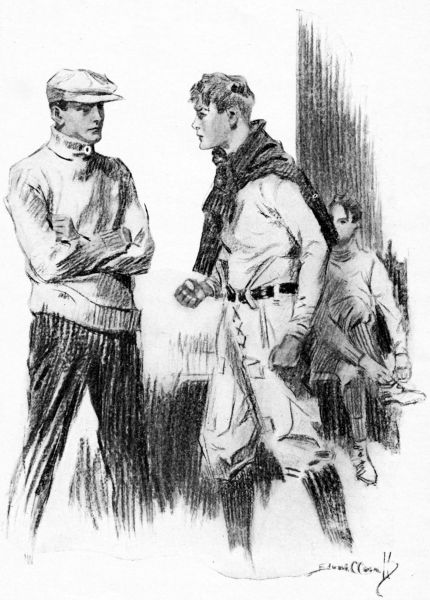
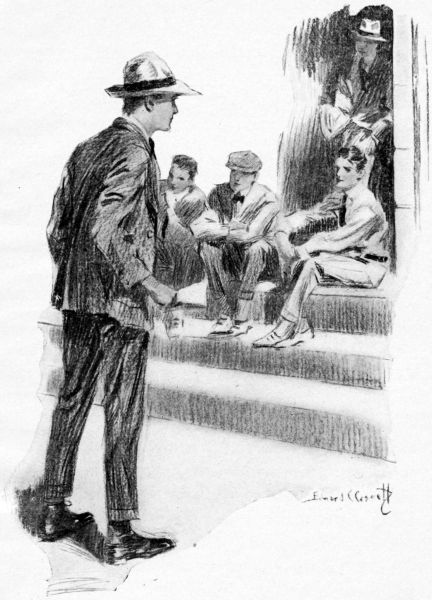
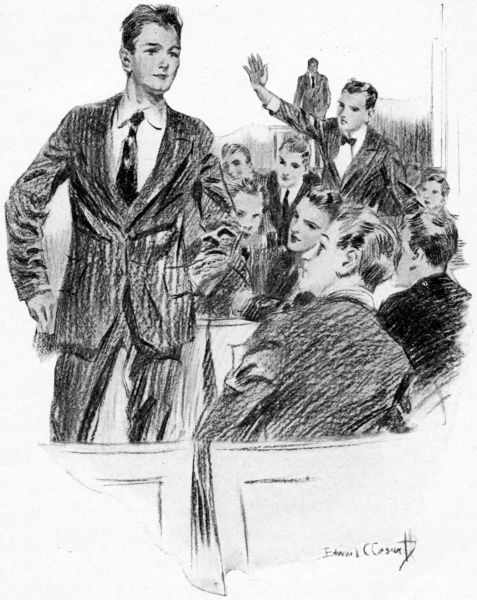
“Not what you’d call a very good beginning,”
thought Ira, ruefully, as, followed by the somewhat
puzzled looks of the group in front of the
gymnasium, he made his way across the campus.
“It was his fault, though. There wasn’t any call
for me to stand around idle and get jabbed in the
nose. Just the same, it would have been better
if I’d gone on about my business instead of trying
to get a rise out of them. Guess what you need
to do, son, is keep your hands in your pockets and
your mouth shut!”
For the following hour he was very busy. Mrs.
Anstruther regretfully informed him that all her
rooms were engaged, and the same announcement
awaited him at Baker’s. It was at the latter
house that the mysterious symbols were satisfactorily
explained. “R,” he was told, meant
that the house offered rooms only, while “R & B”
stood for room and board. Ira mentally called
himself an idiot for not having guessed as much.
At a little past one he gave up the search long
enough to perch himself at a counter in a lunch-room
on School Street. A sign over the doorway
held the inscription “The Eggery,” and, judging
from the fact that fully half the patrons in sight
were boys of ages from fourteen to twenty, it was
the favourite resort for hungry Parkinsonians.
There were many small tables at the back, but all
were occupied, and Ira finally found an empty
stool in front of the long counter. The school
colours, brown and white, were lavishly displayed,
and there were many framed photographs of
school teams and numerous unframed posters on
the walls. These, however, interested Ira less
than the neat sign which proclaimed the restaurant’s
offerings, for he had eaten his breakfast
on alighting from the Portland train in Boston,
and that had been quite early, and he was now
extremely hungry in spite of the warmth of the
day.
While the electric fans overhead spun dizzily
and the clatter of crockery and the babel of a
hundred voices made a cheerful pandemonium, he
thoughtfully contemplated the signs. One thing
he knew he was going to have, and that was iced
tea, but beyond that he was open-minded. Corn-beef
hash sounded too warm. The same was true
of roast beef and lamb stew with dumplings.
Eggs didn’t sound appealing, although they were
offered in more styles than he had ever heard of.
He was still undecided when a voice said: “Try
the cold ham and potato salad. It isn’t bad.”
Ira looked around to find the boy with whom
he had collided at the door of the Administration
Building sitting beside him.
“All right,” said Ira. “I guess I will. It looks
good.”
“It’s too hot to eat today,” went on his neighbour,
“but you sort of get the habit. This iced
coffee is the best thing I’ve found. Do you like
it?”
“I never tried it. I thought I’d have some iced
tea.”
“No one can blame you. I saw you over at
Ad, didn’t I?”
“‘Ad’?”
“Administration. What’s your class?”
“Third.”
“Mine, too. Here’s Alphonse. Tell him what
you’re risking.”
“Alphonse” proved to be a sandy-haired
waiter who grinned at the speaker as he ran a
towel over the counter. “Sure, take a chance,”
he said cheerfully. “What’s it going to be, sir?”
“Some of the cold ham and potato salad and
a glass of iced tea,” replied Ira. “Got any
lemon?”
“I don’t know. I’ll see,” was the sober response.
“We did have one last week.” Then,
applying his mouth to a tube: “One-cold-ham-potato-salad!”
he called. “Ice-tea-with-lemon!”
“Do you eat here regularly?” asked Ira of his
neighbour.
“Dear, no! I eat in hall, but they don’t start
until supper tonight. Lots of the fellows don’t
come until afternoon, you see. Them as does has
to eat where they can, and this is as good a joint
as any. How do you like the place, as far as
you’ve got?”
“All right. I haven’t seen much of it, though.
I’ve been tramping around looking for a room
most of the time.”
“Any luck?”
Ira shook his head. “There was one at—” he
refreshed his memory by glancing at the slip—“at
Parent’s, but it was pretty small and awfully
hot.”
“Keep away from that dive,” advised the
other. “You’d freeze to death in Winter there.
Besides, we come to school to get away from
them.”
“To get away from——”
“Parents,” chuckled the other. “Asterisk.
See footnote. Joke intended. Have you tried
Maggy’s?”
“No. I don’t think it’s on my list.”
“Let’s see. Yes, here it is: ‘D. A. Magoon,
200 Main Street.’”
“Oh! I thought you said——”
“Maggy’s? Yes, they call her that for short.
She’s got some good rooms, but you have to
more than half furnish them. About all Maggy
gives you is a carpet and a bed. If you like I’ll
go around there with you when you’re through.”
“Why, thanks, that’s very kind, but I don’t
want to trouble you.”
“You don’t. I haven’t a thing to do until the
boat comes in.”
“Boat?” ejaculated Ira.
“Figure of speech, meaning that the afternoon
stretches before me devoid of—of—Say, what do
I call you?”
“Rowland’s my name.”
“Mine’s Johnston. There’s a t in it to make
it harder to say. Here’s your grub. Guess I’ll
have a piece of pie, Jimmy.”
“What kind?” asked the waiter as he slid Ira’s
repast before him.
“Why the airs? You know you’ve only got
apple.”
Jimmy grinned. “Got you this time, Johnston!
There’s cream and cocoanut, too.”
“Make it cream, Jimmy, and tell the Pie
Specialist downstairs to let his hand slip a
little.”
“Do they give board at this place you spoke
of?” asked Ira when he had sampled his
dinner.
“No, they don’t. You can eat in hall, though,
or you can get your meals around. There are four
or five places like this and a lot of boarding houses.
The way I did my first year was live at the
restaurants and quick-lunch joints for the first
term and then, when I was sick to death of them,
go to a regular boarding house. Smith’s is pretty
fair. A lot of fellows eat there.”
“They give you pretty good meals at the school
dining hall, don’t they?”
“Y-yes, but they charge for them.” Johnston
shot a swift, appraising glance over Ira. “If you
can stand six dollars a week, all right. Some
fellows can’t.” Jimmy presented his slice of pie
at that moment and Johnston observed it
gloomily. “That fellow’s got perfect control,
hasn’t he, Jimmy?”
“Oh, they cut the pies with a machine,” replied
the waiter airily. “Want some more
coffee?”
“Walk around! Think I’m a millionaire?
Make it a glass of water instead.” Then, addressing
Ira again: “What are you going in
for?” he asked.
“Going in where?”
“My fault! I mean what are you going to do
with your spare time? Football? Tennis? Golf?
What’s your line?”
“Oh! I don’t know. I’ve never played anything
except a little baseball. I guess I won’t
try any of those things yet.”
“You look as though you’d make a football
player,” said Johnston. “If you don’t intend
to try it you’d better keep out of sight. If
Driscoll sees you he will get you sure.”
“Is he the captain?” asked Ira.
“Coach. Ever played it?”
“Football? No.” Ira shook his head. “I
never thought I’d care to. I saw a game once
at Lewiston.”
“Where’s that?”
“Maine. I live in Cheney Falls.”
“No one can blame you. How’s the grub?”
“Fine, thanks. Who is Goodloe?”
“Gene Goodloe? Track Team captain. Know
him?”
“Not very well. I—I sort of met him awhile
back.”
“You’ll like him, I guess. Most of us do. He’s
a corking runner. Good fellow to know, Rowland.
Better cultivate him. Meet all the fellows you
can, old man. The more the merrier. You can’t
know too many at school, especially if you’re a
new boy. I had a perfectly miserable time of it
here my first year. I was horribly shy, you see.
Yes, I got over it!” He laughed as he caught
Ira’s quick glance of surprise. “Had to. I used
to get red clear around to the back of my face
if anyone spoke to me. The second year I realised
that it wouldn’t do and I made up my mind to get
cured. How do you think I did it? I got up one
morning and went out and spoke to every fellow
I met, whether I’d ever seen him before or not.
It nearly killed me at first and I got all sorts of
snubs and funny looks, but it cured me. Now I—I’d
slap Jud himself on the back if it would do me
any good.”
“Jud?” asked Ira.
“Otherwise Doctor Judson Lane, principal of
this here school. All through? Going to have
desert? No? Come along then. There’s your
check. Might as well pay it if you’ve got the
money. They have a nasty way of going out on
the street after you and bringing you back if you
get absent-minded.”
They slid off their stools and made their way
to the cashier’s desk, Johnston hailing many
acquaintances on the way and once pausing in
response to the invitation of one. Ira had an
uncomfortable suspicion that he was the subject
of the short, whispered dialogue that ensued.
“It’s probably these clothes,” he thought.
“They are different from other fellows’. I’ll
have to get some new ones, I guess.”
Outside, Johnston chatted merrily as he conducted
his companion around the corner of Main
Street and finally brought up before a three-story
house set close to the sidewalk. It showed evidences
of past grandeur, but the buff paint was
peeling away from the narrow porch and stores
had been built close to it on either side. The first
floor was occupied by a tailor’s establishment on
the right and by the agency of a spring-water
company on the left. Johnston gaily pointed out
the convenience of having your trousers pressed
on the premises as they waited in the hallway.
Presently, in response to the tinkling of a faraway
bell, footsteps creaked on the stairs
and a tall and angular woman came into
sight.
“Good afternoon and everything,” greeted
Johnston. “You don’t remember me, Mrs.
Magoon, but we were very dear friends once. I
used to come here to call on Dan Phillips a couple
of years ago.”
“I remember you very well,” was the reply in
a dry voice. “You’re the young man that broke
the newel post one time when you was sliding
down the——”
“My fault! I see you do remember me, after
all. I feared you didn’t. Now——”
“It wasn’t ever paid for, either, although you
said time and again——”
“You’re perfectly right, ma’am. It just somehow
slipped my memory. I’m glad you mentioned
it. Everybody ought to pay his just debts, I
should think. I’ve brought you a lodger, Mrs.
Magoon. This is Mr. Rowland, Mr. Thomas
Chesterfield Rowland, of Cheerup Falls, Maine,
a very personal friend of mine. He was about to
take a room over on Linden Street, but I prevailed
on him to come to you. I told him that
you had just the room for him. You have, haven’t
you?” Johnston beamed ingratiatingly.
“Well, I dunno,” said Mrs. Magoon, folding
her hands in a blue checked apron and looking
doubtfully from one boy to the other. “Everything’s
pretty well taken now. There was a
young man in here not ten minutes ago to look
at the only room I’ve got left. I dunno will he
be back, though. He said he would, but they
always say that. If you’d care to look at it,
sir——”
“He would,” declared Johnston. “He would
indeed. After you, Rowland. One flight and turn
to your left.”
“Two flights and turn to your right, if you
please,” corrected the landlady. “All the second
floor rooms are taken.” She toiled upstairs at
their heels and directed the way to a large,
scantily furnished room at the back of the house.
“It’s a nice, cheerful room,” she said pantingly.
“Two good windows and a fine view. There’s a
washstand goes in here yet.”
The fine view consisted of several backyards,
the roof of a shed and a high board fence in the
immediate foreground, but beyond the fence lay
the trim, green lawn of a residence on Washington
Avenue, while, by stretching his neck a little, Ira
could see a few gravestones in the cemetery
around the corner of the next-door building. Just
now the foliage hid the school, but Mrs. Magoon
predicted that in the Winter he would have a fine
view of it. There were two big windows on the
back of the room, a sizable closet, a fireplace with
a dingy, white-marble mantel and a rusted grate
and a few oddments of furniture all much the
worse for wear. Ira tested the bed and shuddered
inwardly. It was like a board. There was a
green plush rocking-chair, a battered walnut table
with an ink-stained top, a bureau of similar
material and condition, two straight-backed chairs
and an ornate black walnut bookcase with one
glass door missing. A faded, brown ingrain
carpet covered the centre of the floor, the wide
expanse of boards surrounding it having at some
far distant time been painted slate-grey.
Johnston expatiated warmly, even with enthusiasm,
on the room’s attractions. “How’s
that for a fireplace, old man?” he asked. “It’s
real, mind you. No stage fireplace, with a red
lantern in it, but the genuine thing. Lots of room
here, too. Must be twenty feet each way, eh?
Of course, you’ll need a few more things. A
window seat would help. And another easy-chair,
maybe. Then, with the family portraits on the
walls and a fire crackling cheerily—what ho!
‘Blow, wintry winds! What care we?’ Or words
to that general effect. You say there’s a washstand,
too, Mrs. Magoon? Fine! Imagine a
washstand over there in the corner, Rowland.
Sort of—sort of finishes it off, eh? Useful little
affairs, washstands. No home should be— How
about the bathroom, Mrs. Magoon? Adjacent or
thereabouts, I presume?”
“One flight below, sir. It’s a very nice bathroom,
with an enamelled tub, sir. If you’d care
to look at it——”
“By all means, ma’am, as we descend. You
said the rent was——”
“Four a week, sir.”
“Oh, no, indeed! For the school year, Mrs.
Magoon.”
“I said four a week, sir.”
“And I said—Oh, I see! Four dollars a week!
You will have your joke, eh? The lady has a
sense of humour, Rowland. You can’t deny
it.”
“It doesn’t seem to me that it’s worth that
much,” said Ira dubiously.
“Bless us, no!” said Johnston. “That was
only her joke. Now, Mrs. Magoon, seriously,
what do you ask by the month for this palatial
apartment?”
“It’s four dollars a week, young man, whether
you pay weekly or monthly; although I have to
insist on the bills not running no longer than a
month.”
“No one can blame you. But you’ll find my
friend here very prompt, ma’am, in such matters.
I have never known him to let a bill run longer
than a month. You might almost call him finicky
in money matters. Considering that, now, suppose
we say three dollars a week, with—” he shot
a questioning glance at Ira—“two weeks paid in
advance?”
“I couldn’t do it, sir,” replied the landlady
firmly, arms akimbo. “Three-seventy-five is my
lowest figure, and nothing you could say——”
“I don’t think I want the room, thanks,” interrupted
Ira. “I’d have to buy a good many
things for it to make it comfortable. Much
obliged, ma’am.”
“Don’t be hasty, old man. Think well. Rooms
are scarce, as Mrs. Magoon will tell you, and at
three and a half——”
“Three-seventy-five,” corrected the landlady.
“You couldn’t do better. I’ll take you to a
place where you can get anything you need for
half of nothing and pay when you like. With
another chair and a couch and a few pictures—why,
you wouldn’t know the place! He wouldn’t
know the place, would he, ma’am?”
“’Twould look better, no doubt. There’s the
washstand yet, sir, and it helps to fill up, so to
speak.”
“We-ell,” began Ira, doubtfully.
“That’s decided, then!” exclaimed Johnston
gaily. “Have the room all ready in an hour,
Mrs. Magoon. If you’ve got seven dollars where
you can put your hand on it, Rowland, you might
bind the bargain, eh?”
“If the lady wants to let me have it at three
dollars and a half——”
“She does! Hasn’t she said so? You said
three and a half, didn’t you, Mrs. Magoon?”
“I did not!”
“No? My fault! But you’re going to, eh?
Rather than lose a tenant?” Mrs. Magoon wavered.
“Here it is the last day, ma’am. School
begins tomorrow. I guess everyone’s settled by
this time. You wouldn’t want the room to stay
empty, now would you? Of course not! A bird
in the hand, and all that, eh? Well, that’s settled,
what?”
Mrs. Magoon nodded without enthusiasm.
“It’s less than I ever took for it before,” she
said sadly. Then, brightening: “Maybe the
young man would want his breakfasts in?” she
asked hopefully. “Many of them does.”
Johnston was shaking his head violently, but
neither the landlady nor Ira saw it.
“Why, thanks, I—How much are breakfasts?”
said Ira.
“Twenty-five cents, sir. Coffee and toast and
two eggs or a bit of meat.”
“Perhaps it would be more convenient than
going out,” mused Ira. “All right, ma’am, I’ll
take breakfasts.”
“Fine! Come along, Rowland. Remember
that Doctor Lane was very particular about
having you let him know what you decided on.
He will be anxious. Back in an hour, Mrs.
Magoon.”
“If you’d care to see the bathroom—” began
Mrs. Magoon as they descended.
“Not now,” said Johnston, shoving Ira along
toward the next flight. “I’m sure it’s absolutely
perfect, ma’am.” When they were once more on
the street he turned sorrowfully to Ira. “You
shouldn’t have let yourself in for the breakfasts,
old man,” he said. “They’re fierce. I tried to
give you the sign, but you wouldn’t look. Still,
you can cut them out after a week or so. They
all do.”
“I dare say the room will look better when
there’s more in it,” said Ira.
“Rather! You’ll be crazy about it, old man.”
“Or in it,” said Ira drily. Johnston preferred
not to notice the remark.
“And three-fifty isn’t bad these days, either.”
“I guess I’d rather pay her what she asked,
Johnston. She says she never let it for so little,
and——”
“Yes, but her memory’s failing her. Johnny
Grew had that room two years ago, and I happen
to remember that he paid exactly three and a half
for it. Besides, she’ll make it up on the breakfasts.
Now let’s run around to Jacobs’ and see
what we can pick up. Better leave the buying to
me, old man, for in spite of being a Maine Yankee,
you’re a mighty poor bargainer!”
“I’m taking up a lot of your time,” Ira
demurred.
“I like it. Besides, I’ve got nothing on until
the five-twelve gets in.” He was silent for a full
minute, something so unusual that Ira viewed him
in surprise. Then, with an odd lack of assurance,
he said: “About that newel post now, Rowland.
I—you see——”
“All right,” said Ira. “I understand.”
“Eh?” asked the other startledly. “Hold on,
though! No, you don’t, old man.”
“All right. I don’t care, anyway.”
“But you mustn’t think I took you around
there on that account. Fact is, I’d quite forgotten
about it.” Johnston chuckled. “Guess if I’d
remembered it I’d have stayed away. But when
she sprang it on me, why—why, then I thought I
might as well square myself.” He looked uncertainly
at Ira. “See what I mean?”
“Oh, yes.”
“Well—well—Oh, hang it, Rowland! Now,
look here. You don’t need to take that room if
you’d rather not. I guess I did sort of force your
hand. We’ll go back now and get the money and
tell her it’s off. Come on! I’d feel a lot better.
Then we’ll look somewhere else. Hang it, it was
only a dollar, and I’m switched if I want to look
like a piker for just a little old dollar! Come on
back!”
But Ira shook his head. “When you know me
better, Johnston,” he said with a smile, “you’ll
find that it’s awfully hard to make me do anything
I don’t want to. If I hadn’t thought the room
would answer I’d never have taken it, no matter
what you might have said. I don’t think it’s
palatial, but I do think it will do well enough, and
if Mrs. Magoon lets you off about the newel post
on my account I’m glad of it. I owe you that
much, anyhow, for all your trouble. Just the
same, I’m glad you didn’t—didn’t take me around
there on purpose.”
“I didn’t, honestly, old man. I’d forgotten all
about it. But you’re quite sure it’s all right, eh?
Sure you really want to take the room?”
“Certain sure.”
“Well, you’re a brick. I guess I’ll drop around
and pay Maggy her money, just the same. Any
fellow ought to, I should think. I’ll do it this
afternoon while I’ve got it. Well, that’s settled.
And here’s the emporium of our friend Jacobs.
“‘Open the door and tinkle the bell:
You want to buy and I want to sell!’”