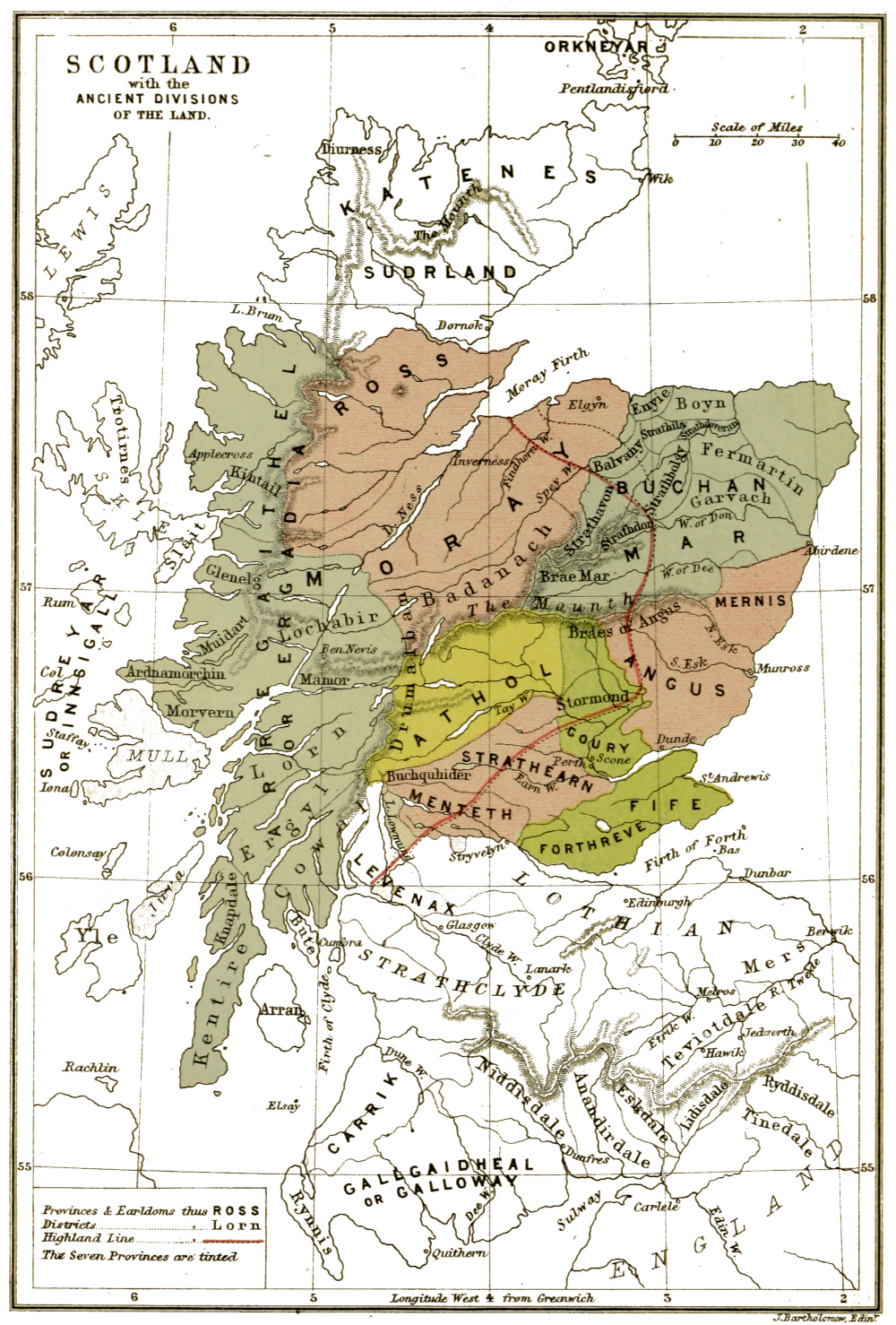
BOOK III. LAND AND PEOPLE . — CHAPTER I. SCOTLAND IN THE REIGN OF ALEXANDER THE THIRD. — CHAPTER II. THE SEVEN PROVINCES OF SCOTLAND. — CHAPTER III. LEGENDARY ORIGINS. — CHAPTER IV. THE TUATH OR TRIBE IN IRELAND. — CHAPTER V. THE FINÉ OR SEPT IN IRELAND, AND THE TRIBE IN WALES. — CHAPTER VI. THE TRIBE IN SCOTLAND. — CHAPTER VII. THE THANAGES AND THEIR EXTINCTION. — CHAPTER VIII. THE FINÉ OR CLAN IN SCOTLAND. — CHAPTER IX. THE CLANS AND THEIR GENEALOGIES. — CHAPTER X. LAND TENURE IN THE HIGHLANDS AND ISLANDS SUBSEQUENT TO THE SIXTEENTH CENTURY.
1
Consolidation of the provinces of Scotland into one feudal monarchy completed in this reign.
The brightest and most prosperous period in the annals of
Scotland was undoubtedly that during which she was under
the rule of the dynasty of kings which sprang from the union
of the Celtic king Malcolm Ceannmor with the Saxon princess
Margaret. It was during this period of upwards of a
century and a half that the different provinces of Scotland
were welded into one feudal monarchy, and the various races
which inhabited them, and upon the allegiance of each of
whom the kings of this race had hereditary claims, were
fused into one mixed population combining the peculiar
qualities of each.
The reign of Alexander the Third, the last king of this
old Celtic dynasty of Scottish kings, saw the concentration of
the various provinces of Scotland into one compact kingdom
finally completed by the cession of the Isles in the year 1266.
Scotland now presented the same geographical platform which
it ever after possessed. The various races which composed
its population occupied in the main the same relative position.
The kingdom of Scotland could now be no longer
viewed as a limited Gaelic kingdom, possessing dependencies
peopled by British, Anglic, or Scandinavian communities,
but had become a feudal monarchy, the dominant element of
2which was Teutonic, while the Celtic population was either
restricted to the wilder and more mountain regions, or
formed the under class of serfs and tillers of the soil.
It would seem as if the task of amalgamating the discordant
elements of the population, and of concentrating the
semi-independent provinces which they peopled, had no
sooner been completed than the dynasty which effected it
was to pass away, and a war of succession was to follow,
which was still further to root up her ancient institutions,
and to throw the kingdom still more into the hands of kings
and nobility of an alien race.
By the death of his only daughter, who had been married
to the king of Norway, and of his only son in the same year,
Alexander the Third found that unless he had a male heir by
a second marriage the succession to the throne would devolve
upon a little grand-daughter, the Princess of Norway, then
only two years old, and on her the succession was settled in a
Parliament held at Scone on the 5th February 1283-4, failing
such male issue. In the instrument by which the succession
was so settled the magnates of Scotland bound themselves to
receive Margaret, daughter of Eric, king of Norway, and of
Margaret, daughter of King Alexander, as their lady and heir
of the kingdom of Scotia; and to acknowledge her and her
heirs as their liege lady, and the true heir of their sovereign
in the whole kingdom, and in the island of Man, and all the
other islands pertaining to the kingdom of Scotia, as well as in
Tynedale and Penrith, and other dependencies of the kingdom.[1]
Such were the enlarged limits to which the name of
Scotia, once confined to the districts between the Firth of
Forth and the river Spey, had now extended; and the dependencies
of the kingdom, which had then embraced large
3semi-independent provinces on the south and west of these
boundaries, were now reduced to the recently-acquired
Western Isles, and to the small districts of Tynedale and
Penrith lying beyond her southern frontier.
If this process of consolidation, however, may be said to
have been completed in the reign of Alexander the Third, it
can only be held to have properly commenced with that of
David the First. Prior to his accession, although the rule of
the Scottish monarchs had extended itself by degrees over
the districts south of the Forth and Clyde, and then west
of the Drumalban range and the river Spey, yet the name
of Scotia was still confined to the eastern districts between
these limits. These districts formed the real nucleus and
heart of the kingdom, and were more directly associated
with her monarchs as kings of the Scots.
Southern frontier of Scotland.
The extension of their power over the southern districts
commenced about a century after the establishment of the
Scottish dynasty on the Pictish throne, when, in the year 946,
the districts forming the kingdom of Cumbria were ceded by
Edward the elder to Malcolm king of the Scots. This
kingdom extended, at that time, from the river Clyde to the
river Derwent in Cumberland, and to the cross at Stanmore
on the borders of Westmoreland and Yorkshire, which
separated it from the Northumbrian territories. It embraced
the western districts of Scotland from the Clyde to the
Solway, the present county of Cumberland, with the exception
of that part of it which lies on the south of the river
Derwent and formed the barony of Copeland, and the whole
of Westmoreland exclusive of the barony of Kendal, which,
with Copeland and the western districts as far as the borders
of Wales, belonged to the Northumbrian kingdom.
Within eighty years afterwards, the districts on the east
coast extending from the Forth to the Tweed, and consisting
of Lothian and Teviotdale, were ceded to his grandson,
4another Malcolm. These southern territories were, however,
in the position of dependencies on the kingdom of Scotland,
lying beyond her proper southern frontier and within that
of England, and were on three different occasions entirely
separated from the Scottish kingdom:—First during the
usurpation of Macbeth and the possession of the greater part
of Scotland by the Norwegian Earl of Orkney, whose joint
rule certainly did not extend beyond the Forth, while the
southern districts remained faithful to the family of Duncan;
again during the short reign of Donald Ban; and for a third
time after the death of Eadgar, when the territories over which
he had ruled as king were divided between his brothers
Alexander and David, the former reigning as king over the
kingdom north of the Forth and Clyde, while the latter ruled
with the title of Earl over these southern dependencies. The
southern frontier of the Cumbrian kingdom did not, at this
time, extend beyond the Solway, for the Norman king, William
Rufus, had, in the year 1092, wrested that part of it which lay
between the Solway and the Derwent from Malcolm Ceannmor,
and given it to the Norman baron Ranulph de Meschines,
while Henry I. erected it, with Westmoreland, in 1132, into
the bishopric of Carlisle. The southern boundary of Earl
David’s possessions had thus become coincident with the
southern frontier of the later kingdom of Scotland. It was
only on the accession of David to the throne of Scotland
that they became permanently united to the kingdom, and
the name of Cumbria, or Cumberland, was restricted to that
part of the ancient kingdom of Cumbria which now belonged
to England. The connection of the royal family with the
ancient line of the Saxon kings, the training and Norman
tendencies of David himself, and his marriage with the
daughter of an Earl of Northumbria, and widow of an Earl
of Northampton, whose mother was a niece of the Conqueror,
created a tie between them and the Anglic population of the
5southern districts which was closer than that which now
connected him with the Celtic population of the other portions
of the kingdom; and Lothian assumed that prominent
position as the most valuable and cherished centre of the
interests of the monarchy, which had hitherto belonged
to the region between the Forth and the Spey.
English possessions of the Scottish kings.
But while David the First may be held to have established
the Solway, the range of the Cheviots, and the Tweed, as the
proper southern boundary of the kingdom of Scotland, his
marriage gave him claims to territories beyond it, which he
was disposed to assert when opportunity offered. During
the life of Matilda, his queen, he had enjoyed in her right
the earldoms of Northampton and Huntingdon; but on her
death, seven years after he had succeeded to the throne of
Scotland, the earldom of Northampton passed to her son by
her first marriage, Simon de Senlis, while Henry, her son
by King David, succeeded to the earldom of Huntingdon.
The death of Henry, king of England, in 1135, and the
disputed succession between his daughter the empress of
Germany and his sister’s son Stephen, Earl of Mortaigne,
presented the opportunity King David longed for. He
embraced the cause of the empress, who was his niece, and in
her name took possession of Northumberland, with the exception
of the castle of Bamborough, which he soon after surrendered
to Stephen, who confirmed the Honor of Huntingdon
to Prince Henry, with Doncaster and the castle of Carlisle in
addition to it. In the following year King David again claimed
the northern provinces in name of his son Prince Henry, and
both Northumberland and Cumberland were yielded to him;
but on peace being made between him and Stephen he surrendered
Northumberland, retaining, however, Cumberland
in England. An attempt, two years afterwards, to regain
Northumberland led to the battle of the Standard, in which
David was defeated; but a peace was concluded in 1139,
6when Northumberland was made over to Prince Henry,
except the fortresses of Newcastle and Bamborough, which
he retained to his death in 1152, when King David had Malcolm,
the eldest son of Prince Henry, proclaimed heir to the
crown, and presented his second son, William, to the Northumbrian
barons as their ruler. Malcolm had not been four
years on the throne when he surrendered Northumberland
and Cumberland to the king of England, which were annexed
to the English crown, while the king restored to him the
Honor of Huntingdon. An attempt on the part of his brother
and successor, William the Lion, to regain these provinces,
led to the war in which he was defeated and taken
prisoner in 1173, and Huntingdon was taken from him and
given to Simon de Senlis; but on the death of the latter
in 1184 it was restored to King William, who bestowed
it upon his youngest brother David, afterwards known as
David, Earl of Huntingdon, in whose family it remained.[2]
The claims of the Scottish kings upon the northern provinces
of England were renewed by Alexander the Second,
but through the mediation of Cardinal Otho, the Pope’s
legate, all questions in dispute between England and Scotland
were finally settled by an agreement concluded at York
in September 1237. In lieu of the claims made by Alexander
upon the earldoms of Northumberland, Cumberland, and
Westmoreland, as his hereditary right, and for the dowry he
ought to have received with Johanna, the sister of the king
of England, whom he had married, King Henry undertook to
convey to the King of Scotland in property, lands in the
earldoms of Northumberland and Cumberland to the yearly
value of two hundred pounds.[3] The lands so settled upon
him were Tynedale, also called the barony of Werk, in
7Northumberland, and the crown demesne in Cumberland,
consisting of Penrith and other lands, with the exception of
the castle of Carlisle.
Such is a short sketch of the attempts made by the kings
of Scotland to extend their frontiers to the south; and the
result was that in the reign of Alexander the Third the
southern boundary of Scotland was the same as it is at present,
but Alexander was left in possession of the lands of
Tynedale and Penrith beyond it, as a dependency of the kingdom,
and they remained with his successor John Baliol, when
they were finally lost to Scotland in the war of independence
which followed his short and disastrous reign.
Northern boundary of Scotland.
But if the kings of this dynasty struggled vainly to
enlarge their boundaries on the south, they were more successful
in gradually extending the power of the crown over
the northern and western provinces. David I. by successfully
defeating and crushing the rebellion of Angus, Earl of Moray,
in 1130, terminated the semi-independent state of that province,
and no earl of this province was permitted to exist till
King Robert Bruce bestowed it upon his nephew Randolph,
but its guardianship was committed to different Scottish
nobles, under the title of Custos Moraviæ.[4] The son of Malcolm
MacHeth, who called himself the son of Earl Angus,
attempted on the accession of Malcolm IV. to regain the
province with the aid of the powerful Regulus of Argyll, but
unsuccessfully, and their failure was followed by the northern
seaboard, between Inverness and the Spey, where David I.
had already planted the royal castle, being to a great extent
taken from the native chiefs and given to strangers—a policy
still further followed out by his successor William the Lion,
who added the district of Ross, in which he built two castles;
8and the crown continued to maintain its control over these
provinces, notwithstanding occasional attempts on the part
of the Celtic inhabitants to regain their independence by
supporting the pretensions of the families of MacWilliam
and MacHeth. The province of Caithness too, which at this
time included Sutherland, and had for generations belonged
to the Norwegian earls of Orkney, who held it nominally
under the king of Scotland with the title of Earl, was at
length brought by the same monarch more directly under
the power of the crown, and placed in the same position
as the other Scottish provinces. By his son Alexander the
Second the still more extensive province of Argathelia or
Argyll, forming the western seaboard of Scotland, and extending
from Loch Long, opening off the Firth of Clyde, to the
borders of Caithness, was brought under subjection, so that
in the reign of this king the power of the crown was firmly
established over the whole mainland of Scotland north of the
Firths of Forth and Clyde. The islands, however, which
surrounded it still belonged to the kingdom of Norway. The
Orkney and Shetland Islands had been colonised by the
Norwegians as early as the ninth century. They had been
ruled by a line of Norwegian Jarls, who owed submission to
the king of Norway alone, and though the succession to these
Jarls opened in the reign of William the Lion to two families
of Scottish descent, they were still considered as Jarls under
the Norwegian crown, and the islands did not become connected
with the Scottish kingdom till long after the period
we are dealing with. The Western Isles, however, stood in a
different position. Although the Norwegian Vikings had to
a great extent taken possession of them at the same time that
they colonised Orkney, and they had been the subject of frequent
contest between the Norwegian Jarl and the Danish
kings of Dublin, who had acquired possession of the island of
Man, they were still claimed by the Scottish kings as belonging
9to their kingdom, till the reign of Edgar, when they were
formally ceded to the king of Norway. They were at this
time along with the Isle of Man under the rule of petty kings
of Norwegian descent, and this line of Norwegian kings of the
Isles retained the whole till the year 1154, when the kingdom
of the Isles was divided, and the islands south of the Point of
Ardnamurchan passed under the rule of the Celtic ruler of
Argyll, whose claim was derived through a descent in the
female line from one of the Norwegian kings of the Isles, but
who still held them nominally under the king of Norway.
The tie to Norway, however, was becoming weaker and the
connection with Scotland stronger, when the unsuccessful
attempt of Hakon, king of Norway, to firmly re-establish his
power over the whole of the islands in the reign of Alexander
the Third, and his defeat and death, led to the cession of Man
and the Isles in the year 1266 to the Scottish monarch. And
in 1284 we find them settled upon the Maid of Norway
as a dependency of the Scottish kingdom. The Western
Islands became from this time firmly united to the rest of
Scotland, while the island of Man, after being in the following
century alternately in the possession of the Scots and the
English, finally passed over to the English crown.
Physical aspect of Scotland in the reign of Alexander the Third.
Such then was, in extent, the Scotland of Alexander the
Third, and of its physical aspect at this time we can also
form a very fair conception. As early as the third century
we are told that the Barbarian tribes beyond the bounds of
the Roman province in Britain ‘inhabit mountains wild
and waterless, and plains desert and marshy, having neither
walls nor cities, nor tillage, but living by pasturage, the chase,
and certain berries;’ and that ‘many parts being constantly
flooded by the tides of the ocean become marshy.’[5] Had
the writer of this description ever seen the Scotch mountains,
probably ‘waterless’ is the very last epithet he would have
10thought of applying to them; and though the inhabitants
are said to have had neither walls nor cities, yet no doubt
every rock and height showed the rude fortification or hill fort,
the remains of so many of which are still seen, and every
rising ground, with its rude collection of huts, would be
surrounded with its rampart of earth and stones. Adamnan,
writing in the seventh century, tells us of the fortified residence
of the king of the Picts on the banks of the river Ness,
with its royal house and gates, of a village on the banks of a
lake, and of the houses of the country people. Of the leading
physical features of the country he tells us too, of the large
inland lakes, Loch Ness and Loch Awe, and of the range of
mountains forming the backbone of Britain, or great watershed
dividing the eastern and western waters, and separating the
Scots from the Picts;[6] and Bede, in the succeeding century,
talks of the mountains which separated the southern from
the northern Picts, and within which the former had seats.[7]
To some extent these features must have still characterised
the Scotland of Alexander the Third. The aspect of the
country became gradually altered by the hand of man as he
advanced in civilisation. The introduction of Christianity, and
its rapid spread over the country, would fill it with those rude
Celtic monasteries which were everywhere established, and
with small Christian colonies, who practised a rude agriculture;
forests would be cut down and mosses drained; and in place
of ‘those marshy parts of the country, constantly flooded by
the tides of ocean,’ would appear those rich carses which border
the estuaries of her great rivers. The climate would become
ameliorated, towns and villages would spring up, and a more
settled mode of life become established among the Celtic tribes
11which formed her population. An old description of Scotland
north of the Firths, written in the first year of the reign of
William the Lion, exhibits of course the same great physical
landmarks, which do not alter, as still forming the leading
territorial boundaries. ‘This region is said to exhibit the form
and figure of a man. The chief part of the figure, that is,
the head, is in Arregaithel, or Argyll, in the west part of
Scotland, on the Irish Sea. His feet are upon the German
Ocean. The mountains and deserts of Arregaithel form his
head and neck, and his body is the range of mountains called
Mound, or the Mounth, which extends from the western to
the eastern sea. His arms are the mountains which separate
Scotia from Arregaithel. His right side is formed from
Moray, Ross, Marr, and Buchan. His legs are these two
great and principal rivers the Tay and the Spey. Between
the legs are Angus and Mearns, on this side of the Mounth,
and other districts on the other side,’ that is, Marr and
Buchan, ‘between the Spey and the Mounth.’[8] This description,
which is fanciful enough, would place the head of the
supposed figure at Ben Nevis, the highest mountain in Scotland.
The body is formed by the great range of hills which
separated Inverness-shire and Aberdeenshire from the counties
of Perth, Forfar, and Kincardine, and which forms, as it were,
the backbone of the Grampians, and these are the mountains
obviously alluded to by Bede as separating the northern from
the southern Picts. The arms are formed by the range of
hills which run at right angles, and are the great watershed
dividing the eastern and western waters. The southern part
forming the left arm now separates Argyllshire from Perthshire,
and the northern part, or right arm, divides the western
seaboard of Inverness-shire and Ross-shire, which then formed
part of Argyllshire, from the eastern districts of these counties,
12and these are equally plainly the Drumalban range, which
in Adamnan’s time divided the Scots from the Picts.
Upon this scene, during the period when Scotland was
under the rule of this dynasty, two great additional features
were introduced. The first consisted of those Norman castles
or strongholds, either built by the Norman barons to whom
grants of land had been made, and which contributed so
greatly to their power in the country, or by the kings of this
race upon the crown lands; and around the latter would
cluster those groups of dwellings, inhabited by traders and
artisans, which, on the banks or at the mouths of navigable
rivers, formed the burghs and seaport towns in which the
trade and commerce of the country was carried on. The
second great feature consisted of those monasteries founded
by these kings for communities of regular canons or other
monastic orders of the Roman Catholic Church, which, with
their stone-and-lime buildings, the extensive tracts of land
attached to them, and the industrial habits they fostered,
would tend greatly to extend the cultivation of the soil, and to
promote the social condition of the people under their influence.
We have a somewhat imperfect description of Scotland
as it was in the time of Alexander the Third, compiled not
long after his death. It commences at the eastern border
between England and Scotland, and first names Tyvidale,
that is, Teviotdale, with its two royal castles of Rokesborow
or Roxburgh, and Geddeworth or Jedburgh, the latter a
favourite residence of Alexander the Third. Then follows
Lothian, with its castles of Berwick, Edinburgh, Dunbar, and
Strivelyn or Stirling. These two provinces extend, it tells
us, from the border to Erlesferie and Queneferie, that is, to
the Firth of Forth. In the districts which extend in the
west from the Clyde to the Solway it names only the new
castle built upon the Ayr water, and in Galewey, Anandale
the land of the Lord Robert de Brus, the royal castle of
13Dounfres or Dumfries, that of Kirkcudbright, belonging to
William de Ferrers, and the castle of Baleswynton, belonging
to John de Cumyn. The central districts are not named, but
here was the extensive forest of Ettrick and Traquair separating
the eastern from the western districts. Beyond Lothian,
it tells us, lay the land of Fif or Fife, in which were the
burgh of St. Andrews and the castle of Locres or Leuchars.
Beyond the Firth of Tay was the land of Anegos or Angus,
in which were the castles of Dundee and Forfar; and then
follows ‘a certain waste called the Mounth, upwards of sixty
miles long and sixteen broad, across which a most wretched
passage can be taken to the north, without food’ (ubi est pessimum
passagium sine cibo). Then follows Mar, and Bouwan or
Buchan, in which is the burgh of Aberdene with its royal castle.
Followed by the land of Morref or Moray, with the castles of
Elgyn and Spiny, and then Ross and Cateneys or Caithness.[9]
This description seems to follow the coast, as the central
districts of Gowry, Atholl, Stratherne, and Menteath are
omitted, as well as the district of Arregaithel or Argyll, and
the enumeration of the castles is very imperfect. Fordun,
however, gives a view of Scotland in his day which is
probably equally applicable to the time of Alexander the
Third, and in which he seems to break out into enthusiastic
admiration of his native country. ‘It is a country,’ he says,
‘strong by nature, and difficult and toilsome of access. In
some parts it towers into mountains; in others it sinks down
into plains. For lofty mountains stretch through the midst
of it from end to end, as do the tall Alps through Europe,
and these mountains formerly separated the Scots from the
Picts, and their kingdoms from each other,’—a very accurate
description of the Drumalban chain, extending through
Scotland from south to north. ‘Impassable as they are on
horseback, save in very few places,’ he proceeds, alluding
14here to the passes into Argyll, ‘they can hardly be crossed
even on foot, both on account of the snow always lying on
them, except in summer-time only, and by reason of the
boulders torn off the beetling crags, and the deep hollows in
their midst. Along the foot of these mountains are vast
woods, full of stags, roe-deer, and other wild animals and
beasts of various kinds.... Numberless springs also well
up, and burst forth from the hills and the sloping ridges of
the mountains, and trickling down with sweetest sound in
crystal rivulets between flowery banks, flow together through
the level vales, and give birth to many streams; and these
again to large rivers, in which Scotia marvellously abounds
beyond any other country; and at their mouths, where they
rejoin the sea, she has noble and secure harbours. Scotia
also has tracts of land bordering on the sea, pretty level and
rich, with green meadows, and fertile and productive fields of
corn and barley, and well adapted for growing beans, peas,
and all other produce; destitute, however, of wine and oil
though by no means so, of honey and wax. But in the
upland districts, and along the highlands, the fields are less
productive, except only in oats and barley. The country is
there very hideous, interspersed with moors and marshy
fields, muddy and dirty. It is, however, full of pasturage
grass for cattle, and comely with verdure in the glens along
the watercourses. This region abounds in wool-bearing sheep,
and in horses; and its soil is grassy, feeds cattle and wild
beasts, is rich in milk and wool, and manifold in its wealth
of fish in sea, river, and lake.’lake.’[10]
We can thus, in some degree, picture to ourselves the
Scotland of this period. Instead of the large tracts of cultivated
land and the modern mansions of its possessors surrounded
by plantations, we should see forests of trees of
native growth, from amid which, or on their margin, would
15rise the towers of the royal castles, or those of the Norman
barons. We should see small patches of cultivated land, interspersed
with long stretches of barren heath. In sheltered
valleys we should find the seats of the early bishoprics of the
Celtic Church, and the more imposing monasteries of the
regular clergy and monastic orders subsequently introduced,
surrounded by a greater extent of cultivated land, and with
the huts of the occupiers of the soil clustering round. On the
banks of the navigable rivers, or at their mouth, we should
find settlements of the trading and industrial population protected
by rude walls; and we should find the northern and
western districts exhibiting very much the same characteristics
as they did during the succeeding centuries:—the two
great leading mountain chains of the Mounth and Drumalban
forming a succession of hunting-grounds or forests, left to the
red-deer and other game; the minor chains leading from them
to the south-east and north-east terminating abruptly on the
lowland plains, and forming a great mountain barrier, extending
on the south in an oblique line from Ben Lomond to the
great range of the Mounth near Stonehaven, and on the north
from the same range at Ballater to the river Nairn, through
which the great rivers rising among the western hills pour
their waters, through narrow gorges which form the passes
into the mountain region. Within this line the country
would be mainly used for pasturage, and its natural defences
would render but few artificial fortifications necessary.
Population of Scotland in the reign of Alexander the Third composed of six races.
During the period when the boundaries of Scotland had
been thus extended by the kings of this dynasty, its population
was composed of several distinct races, partly of Teutonic
and partly of Celtic origin, forming a people of very mixed
descent, in which the Teutonic element was gradually predominating
more and more over the Celtic, and either absorbing
the latter or confining it to the more barren and mountain
regions of the country. The constituent elements of this
16population bore six different names. These were the Picts and
the Cumbrians or Britons, the Scots and Angles, the Norwegians,
and the Franks or Normans, and we find them distinguished
by these names under the rule of the Scoto-Saxon monarchs,
till they gradually become merged in the general name of
Scots. Thus the charters of Eadgar and Alexander the First
are addressed to their subjects, both Scots and Angles. Those
by David the First and Malcolm the Fourth sometimes to
Scots and Angles, at other times to Franks or Normans and
Angles, and frequently to Franks and Angles, Scots and Galwegians
or Picts, while in the charters of the subsequent
kings these distinctions disappear. When the whole force of
the kingdom was called out by David the First at the invasion
of England which terminated in the disastrous battle of
the Standard, we find that his army, according to Richard
of Hexham, was composed of Normans, Germans, Angles,
Northumbrians and Cumbrians of Teviotdale, of Lothian, of
Picts commonly called Galwegians, and of Scots,[11] while,
according to Ailred, the army was arranged in the following
battalions. The first was composed of the Galuenses or Galwegian
Picts; the second of the Cumberenses and Teviotdalenses
or Britons of Strathclyde and Teviotdale; the third
of the Laodonenses, Insulani, and Lauernani, that is, a mixed
battalion of Angles of Lothian, Norwegians of the Isles, and
the Gaelic people of the Lennox; and the king had in his own
battalion the Scotti and Muravenses, that is, the people of
Scotland between the Forth and the Spey and of the great
province of Moray, which he had recently subjected, beyond
it, and along with them ‘Milites Angli et Franci,’[12] or Saxon
and Norman barons.
Indigenous races of the Britons and Picts.
Of these races two only were indigenous, and the rest
17were intruders. To the indigenous races belonged the Cumbrians
or Britons south of the Firths of Forth and Clyde, and
the Picts, who originally inhabited the whole country north
of these estuaries, as well as Galloway and a considerable
part of Ireland. Both belonged to the Celtic race, the former
to that branch of it, the dialect of which is represented by the
Welsh, Cornish, and Breton, and perhaps in the main most
nearly approached the Cornish in the form of their speech.
But whether the Picts were altogether a homogeneous people
may perhaps be a question. From the time when they first became
known to the Romans, they appear throughout as divided
into two branches; but whether the expression of the Roman
historian, when he terms these two divisions of the Pictish
people two nations, indicates any diversity of race, or whether,
as the language of Bede rather implies, the distinction was
simply geographical, certainly in one important respect they
for a time showed a material difference, for the southern Picts
adopted Christianity at a much earlier period than the northern
Picts, and they were so far disunited that the conversion
of the former did not imply that of the whole nation, and for
a century and a half, while the southern portion were nominally
Christian, the northern half remained Pagan. Every
circumstance, however, connected with them, tends to show
that the Picts who inhabited the northern and western regions
of Scotland, as well as Galloway and the districts in Ireland,
belonged to the Gaelic race and spoke a Gaelic dialect, while
the southern Picts, placed between them and a British people,
present features which appear to assimilate them to both;
and the conclusion we came to was that they were probably
originally of the same Gaelic race, while a British element had
entered into their language, either from mixture with that
people, or from some other influence arising from their contact.
Colonising races of Scots and Angles.
The sixth century brought in both an additional Gaelic
and a Teutonic element into the population of this part of
18Britain, for in the beginning of that century a colony of Scots
from Ireland, who were undoubtedly a Gaelic people, settled
on the barren coasts on the north side of the Firth of Clyde,
and the same century saw the eastern seaboard, extending
from the Tweed to the Firth of Forth, in possession of the
Angles of Northumberland; while there is reason to believe
that some parts of the country between these limits had been
previously partially settled by Frisian tribes belonging to the
great Saxon confederation.
Intruding races of Danes, Norwegians, and Normans.
In the ninth century the great outburst of piratical adventurers
from the Scandinavian shores brought first the
Danes and afterwards the Norwegians to Scotland, and the
latter not only colonised the Orkney and Shetland Islands
but became masters of the Western Isles, and from time to
time of considerable districts on the mainland of Scotland.
During the reigns of the earlier kings of this dynasty the
Saxon influence was largely increased by those who either
took refuge in Scotland from the power of the Norman Conqueror
or were attracted by the connection of these kings
through their mother with the Saxon royal family; while
David the First introduced the Norman barons, who obtained
large tracts of land on both sides of the Firths of Forth and
Clyde under his auspices and that of his immediate successors.
Influence of foreign races on native population.
In estimating the extent to which these foreign elements
influenced the original inhabitants, and how far they formed
a permanent ingredient in the mixed population, it is necessary
to keep in view the circumstances under which they
obtained a footing in the country, and the peculiar features
which characterised the intruders. Did they enter the
country as colonists or as conquerors? If the former, did
they come as military colonists? or did they bring their
wives and families with them? Or, if the latter, did they
amalgamate with the conquered population so as to form one
people, the language and institutions of one or other obtaining
19the mastery over the whole? or did they exterminate or drive
them out? or were the remains of the conquered people retained
as a servile class under the conquerors? The first
recorded settlements which have a historical basis were those
of the Scots on the west coast and of the Angles on the east.
Of these the Scots appear to have come more as colonists than
as invaders. They were a tribe of Scots who came from the
district of Dalriada in Ireland in the beginning of the sixth
century, and brought that name with them which was applied
to the southern part of the great western district of Argyll.
They belonged to the same Gaelic race as the Pictish tribes
among whom they were settled, and the oldest tradition as
reported by Bede cannot tell whether ‘they secured to
themselves these settlements by fair means or by force of
arms.’[13] The conversion of the northern Picts to Christianity
by the Irish missionary St. Columba, and the establishment
of a Christian church among them under Scottish clergy, now
formed a bond of union between them; and it is recorded by
Bede that up to the time when he wrote his History their
mutual boundaries had remained unaltered. In the same
century the Angles of Bernicia, under the sons of Ida, who
had founded that kingdom, obtained possession of the districts
extending along the east coast as far as the Firth of Forth.
They were a Pagan people, conquering a Christian population
of a different race and language from themselves; and there
seems little reason to question that this settlement was only
effected after a fierce and prolonged struggle between the
Angles and the native population, by which, after varied fortunes
on either side, the latter were eventually either exterminated
or driven into the more hilly and barren regions on
the west. There were thus formed four distinct kingdoms,
which remained independent of each other during the sixth,
20seventh, and eighth centuries, viz. those of the Picts and of the
Cumbrian Britons consisting of the two indigenous races, and
those of the Scots of Dalriada and Angles of Bernicia established
by two of the intruding peoples; and their mutual
boundaries had remained unaltered down to the period when
Bede wrote in the eighth century.
Foreign elements introduced into population of Pictish and Cumbrian territories.
It was not till the ninth century that those changes in
their relative position commenced which ultimately led to
their fusion into one mixed population. A revolution in
that century led to a dynasty of kings of Scottish descent
being permanently placed on the Pictish throne, and to a
Scottish element being largely and to an increasing extent
introduced into the Pictish population. The capital of the
Pictish kingdom had at this time been Scone, and around
this central point the new Scottish monarchy had its chief
influence, and in the neighbouring districts the new Scottish
population would be most numerous. The province of Fife
seems to have been considered as their main seat, and they
appear to have spread over the central districts of the region
extending from the Forth to the great barrier of the Mounth,
while the more independent portion of its Pictish population
appear at its two extremities in the firu Fortren or men of
Fortren, who had their chief stronghold in Dundurn at the
eastern end of Lochearn, and in the viri de Moerne or men of
Mearns, whose principal fortress was Dunfother or Dunnottar
at Stonehaven. These Scots and Picts, belonging to the same
Gaelic race and speaking kindred dialects, would amalgamate
readily enough, and they would probably be found at this
time established alongside of each other in homesteads some
of which would be Scottish and others Pictish,—a state of
matters of which we find examples in northern Russia, where
the earlier Finnish population and the intruding Slavs occupy
respective villages, and in parts of Greece, where the distribution
of the Albanian and the Greek population presents
21the same features. This view of the distribution of the Scottish
and Pictish communities in the new kingdom of Alban,
to which the name of Scotia was soon applied, will to some
extent account for the strange interlacing in this part of
the country of the three earliest dioceses of Dunkeld, of
Abernethy, afterwards represented by the dioceses of Dunblane
and Brechin, and of St. Andrews,—the two former
being traditionally connected with the Pictish name, and the
latter closely identified with the Scottish people. Diocesan
boundaries are usually found to reflect more ancient ethnic
divisions.
The Scottish dynasty of kings had not occupied the
Pictish throne for more than sixty or seventy years when
the failure of the line of British kings of the Strathclyde
Britons, and the election of a brother of the Scottish king to
be their successor, placed a similar dynasty of Scottish kings
on the throne of the Cumbrian kingdom, and made its
eventual cession to the Scottish monarch a more natural and
easy arrangement; and the cession of Lothian in the following
century completed the territorial formation of the later
Scottish kingdom.
Spread of Teutonic people over them.
Such being the state of matters when the dynasty of kings
sprung from the union of Malcolm Ceannmor with the Saxon
Princess Margaret ruled over this kingdom, we find when
we reach the reign of Alexander the Third that a great change
has taken place. The British speech has entirely disappeared
from the district forming the ancient Strathclyde kingdom,
and their population now speak the same Northumbrian or
northern dialect of English with the people of Lothian; while
this Teutonic language has likewise spread over the eastern
districts extending from the Forth to the Moray Firth, where
in the reign of Malcolm Ceannmor that Celtic king had had
to interpret the Saxon speech of his queen to its inhabitants,
and the indigenous Gaelic vernacular was now confined to
22the mountain regions of the North and West north of the
Firths of Forth and Clyde, while the people of Lennox and
Galloway, within the limits of the ancient Cumbrian kingdom,
likewise retained their Gaelic speech. There had, therefore,
taken place in these districts a silent revolution, of
which history has taken little note.
Besides the violent or organic changes produced in a
population by the invasion or colonisation of a foreign people
which history marks, and the effects of which we can trace
in the events recorded in the annals of the country, there is
another silent and inorganic spread of one race over the
territory of another, the eventual results of which are apparent
enough, and the causes which led to it may be divined,
but the steps of its progress are less easily marked. In the
one, whole nations or tribes take possession of part or the whole
of new districts; in the other, they spread not collectively
but in families or groups. In the one, the inroad is effected
by force or by direct convention. In the other, it is the
result of natural causes arising from the contact of two races
possessing different qualities and states of civilisation, and
from the influence which the force of character of one people
may exercise over another. Their influence, too, upon the
spoken language and the place-names of the people presents
itself in different aspects. In the one, the language of the
invading people is established as the language of the country
when the subject population has been exterminated or driven
out, and the older place-names are either adopted into the
language or changed at once. In the other, the silent and
gradual inorganic colonisation changes by degrees the spoken
language, but not the bulk of the place-names. The great
natural features of the country usually retain the names
imposed upon them by its original inhabitants, but those of
the homesteads occupied by the colonising race assume the
forms of their language, and those applicable to the dwellings
of man only remain unchanged when the original people have
23lingered longer, or when the name is expressive of some
common natural feature, which has been readily adopted as
such by the intruders. Topography thus affords us some help
in indicating the presence of the stranger, and marking the
extent to which the race to which he belongs has spread
over the country.
When Earl David, as Prince of Cumbria, proposed to
restore the ancient church of Glasgow, and asked the elders
and wise men of Cumbria to inquire into the ancient possessions
of that church, they told him that after Kentigern, the
founder of the church, and several of his successors, had
passed to God, ‘various seditions and insurrections rising all
around not only destroyed the church and its possessions,
but, laying waste the whole country, delivered its inhabitants
into exile. Thus, also, all good being exterminated,
after a considerable interval of time different tribes of different
nationalities pouring in from different parts inhabited this
deserted country, but being of separate race, speaking a dissimilar
language, and living after different fashion, not easily
agreeing among themselves, they maintained paganism rather
than the cultivation of the faith. The Lord, however, who
wills that none should perish, was pleased to visit, in his
clemency, these unhappy inhabitants of a condemned habitation,
irrationally dwelling after the manner of beasts. In the
days of Henry, king of England, Alexander reigning as king
in Scotia, God sent them David, brother-german of the foresaid
king, as prince and leader, who corrected their obscene
and wicked contagion, and bridled their contumelious contumacy
with nobleness of soul and inflexible severity.’[14] This
picture, coloured no doubt to deepen the shade of the past,
24and to brighten the prospects of the country under David’s
rule, still sufficiently indicates the belief that the British
inhabitants had to a great extent deserted the country, and
that it had been repeatedly laid waste by foreign nations, who
had eventually settled in the country. The allusion to the
paganism of some refers probably to the Norwegians and
Danes, the former of whom in 870 besieged their capital
Alclyde, now Dumbarton, and destroyed it after a few months’
siege, and carried a great host of prisoners with them to
Ireland into captivity, and five years afterwards the Britons
of Strathclyde and Picts of Galloway were ravaged by the
Danes of Northumberland. A Welsh chronicle, attributed
to Caradoc of Llancarvan, tells us that in ‘891 the men of
Strathclyde, who would not unite with the Saxons, were
obliged to leave their country, and go to Gwynedd or North
Wales.’[15] In 945 it was ravaged by Edmund, king of
Wessex, and ceded to the Scots. In 1000, Ethelred, king of
Wessex, entered Cumbria, ravaged it nearly all, and it was
again laid waste; and in 1070, Gospatric, Earl of Northumbria,
having collected a considerable force, made a furious
incursion into the Cumbrian kingdom, then under the dominion
of the Scottish king Malcolm, spreading slaughter
and conflagration on all sides. These notices sufficiently
25bear out that feature in the dark picture of the past history
of the British kingdom, and we may well believe that under
these repeated devastations, and under the Scottish dominion,
its Welsh population, isolated in the north between Picts,
Scots, and Angles, and harassed by incessant invasions,
would gradually retreat to their mother country of Wales,
and that their neighbours would gradually settle in the
partially deserted country.
There are some indications of earlier settlements among
them of Frisians, who left their name in Dunfres, the town
of the Frisians, as Dunbreatan or Dumbarton is the town of
the Britons,[16] and the subjection of the Cumbrian kingdom
to the Angles of Northumbria for thirty years prior to 685
must have had an effect on its population; but, be this as it
may, the neighbouring Anglic population, attracted by her
fertile plains and valleys, appear at a later period to have
made their way into the upper valley of the Tweed and Teviot,
and along the banks of the great watercourse of the Clyde,
and to the plains of Renfrew and Ayr, where they have left
evidence of their settlements in the numerous Saxon place-names
ending with the generic terms of ton and hame, while
the northern district, where the limits of the Cumbrian kingdom
penetrated into the mountains—the district surrounding
the romantic lake of Loch Lomond—seems soon to have acquired
a Gaelic population, and became known as the Levenach
or Lennox. The Gaelic population of Galloway at the same
time appear to have encroached upon the southern limit of
Ayrshire and peopled the district of Garrick with a Gaelic
race. Extensive territories too were granted by Earl David
to his Norman followers. The great district of Annandale
was given to De Bruce. The adjacent districts of Eskdale
26and Ewisdale were filled with Normans. The De Morevilles
obtained Cuninghame or the northern district of Ayrshire,
and the Norman Fitzallan, who became the Steward of Scotland,
acquired Strathgryff, or Renfrew and part of Kyle.
These Norman barons settled their Northumbrian followers
on their lands, and thus almost the whole of the ancient kingdom
of the Cumbrian Britons became soon entirely Saxonised.
A similar process seems to have commenced in the eastern
districts north of the Forth after the union of the Celtic
monarch with the Saxon princess had given the Saxon influence
predominance in the country, and stamped his children with
the character and feeling of Saxon monarchs, which soon produced
a similar result. We find Saxon barons, who fled to
Scotland from the power of the Norman Conqueror, acquiring
lands in the province of Fife. The burghs founded by the
kings of this race on the crown lands were filled with Saxon
and Flemish traders, and the latter people obtained grants of
land. Thus we find Malcolm the Fourth granting the lands of
Innes ‘Beroaldo Flandrensi,’ and David, Earl of Huntingdon,
grants lands in Garrioch to Malcolm, son of Bertolf, a Flemish
name, and his charter is addressed to ‘all good men of his
kingdom, French or Normans, English or Angles, Flemish
and Scotch.’[17] The great religious houses established by them
brought southern ecclesiastics into the northern parts of the
kingdom, who were accompanied by a southern following; and
on the extensive church lands we find the sole remains of the
Celtic population appearing as serfs, under the Celtic appellations
of ‘Cumlawes’ and ‘Cumherbes,’[18] and large territories
speedily passed into the possession of Norman barons, who
settled them with their own followers.
In the scanty records which throw light upon the history
of the land in these districts, we can see the Gaelic name of
the land-owners gradually becoming more and more restricted,
27and retreating before the Teutonic settlers. We can see
more and more of the land becoming feudalised, and being
held by the followers of the barons in military tenure. The
church lands, forming a large proportion of the whole,
became in fact agricultural colonies of strangers. In the
crown lands alone the older land tenures maintained their
position for a time, though there too the increasing importance
of the royal burghs, and the gradual advance of
their Saxon inmates into the surrounding land, soon carried
the Saxon tongue into them; and thus the old Celtic kingdom
of Alban or Scotia, extending from the Firth of Forth
to the river Spey, had in the reign of Alexander the Third
assumed an entirely Teutonic aspect, while what Fordun tells
us of Malcolm the Fourth, that ‘having gathered together
a large army, the king removed the rebel nation of the
Moravienses from the land of their birth, as of old Nebuchadnezzar,
king of Babylon, had dealt with the Jews, and scattered
them throughout the other districts of Scotland, both beyond
the mountains,’ that is, the Mounth,‘and on this side thereof,
so that not even one native of that land abode there, and
installed therein his own peaceful people,’[19] is probably to
some extent true in so far as regards the inhabitants of the
plain country extending from the Spey along the southern
shore of the Moray Firth to the river Nairn, in which the
royal castles of Elgin, Forres, and Nairn were situated, and
which formed the three small sheriffdoms of these names.
It is not at all unlikely that that king, or his successor William
the Lion, should have adopted the policy of interposing
between the native population, ‘who,’ Fordun tells us, ‘would,
for neither prayers nor bribes, neither treaties nor oaths, leave
off their disloyal ways, or their ravages among their fellow-countrymen,’
and the frontier of the province a tract of
country, garrisoned, as it were, with the more settled people
of the lowlands.
Norwegian kingdom of the Isles.
28But if this silent and gradual immigration of the Teutonic
people thus took place into the southern and eastern districts
of the country north of the Forth and Clyde, and either absorbed
its Celtic inhabitants or gradually drove them back
into the more mountainous regions, the latter were exposed
to a more direct assault from another people of Teutonic race
on the north and west, which, however, did not produce the
same permanent effect upon the population. This was that
strange and sudden appearance in the northern and western
seas of a piratical horde of sea-robbers, which issued from the
Scandinavian countries lying to the north of Germany. The
first to make their appearance were the Danes, and though
they repeatedly ravaged the Western Isles and destroyed the
Christian monasteries, they effected permanent settlements
only in Ireland, and in the northern provinces of England
forming the ancient kingdom of Northumbria. They were
followed by the Norwegians, who appear to have been more
attracted by the islands surrounding Scotland, and thus came
more immediately in contact with the Gaelic population of
Scotland. They entirely occupied the islands of Orkney and
Shetland, which they colonised; and took possession of the
Western Isles, without, however, driving out or absorbing the
previous inhabitants of Gaelic race.
By the Gaelic people these northern ravagers were termed
either Geinnte or Gentiles as being pagans, or Gall or Strangers
as being foreigners, and the two races of the Danes and
Norwegians were distinguished by the terms Dubhgeinnte or
Dubhgall, that is, black pagans or black strangers, and Finngeinnte
or Finngall,[20] white pagans or white strangers, and
the Western Islands were termed Innsigall, or the Islands of
the Strangers, while the Norwegians themselves called them
29the Sudreys or Southern Islands, to distinguish them from
the Nordereys or Northern Islands, that is, the Orkney and
Shetland Islands.[21]
The Gallgaidheal.
That the Norwegians did not so thoroughly colonise the
Western Isles and absorb its Gaelic population, as was the
case with the Orkney and Shetland Islands, may have arisen
from their finding in the former a more dense population,
and also that they appear to have used the Sudreys more as a
kind of stepping-stone to other settlements, or as temporary
strongholds, rather than as places for lasting settlements, and
thus their Norwegian population was generally of a more
transient and fluctuating character;[22] but this was mainly true
of the earlier period of their occupation only, and a more
important ground of difference arose from the Gaelic population
of the Western Isles more nearly assimilating themselves
to the character of the Norwegian sea-robbers. They seem to
have submitted easily to their rule, and to have adopted their
habits, so that when one of the great Norwegian Vikings,
Ketill Flatnose, succeeded in establishing a petty kingdom in
the Isles in opposition to the rapidly increasing power of
Harald Harfager, the first monarch who acquired the dominion
of all Norway, we find the Isles said by the Sagas to be in
the possession of Scotch and Irish Vikings, and Ketill appears
in the Irish Annals under the name of Caittil Finn as the
leader of a people called the Gallgaidheal, a name applied to
those Gaidheal who became subject to the Norwegians, and
conformed to their mode of life. Harald, however, eventually
conquered both the Orkney Islands and the Sudreys or Western
Isles. The former came under the rule of a line of Norwegian
Jarls, who, by the marriage of one of them with the
daughter of ‘Dungadr, Jarl of Katenes,’ that is, of Duncan,
30the Celtic Mormaer of Caithness, added that province to their
dominions; and the Norwegian population seem to have as
completely colonised the eastern and level part of Caithness
as they did the Orkney Islands.
Harald appears to have governed the Western Isles by
Norwegian Jarls, but his hold upon them was slight, and apparently
ceased with his death, and they became merely the
haunt of stray Vikings until the middle of the following century,
when their possession was contested between the Danes
of Dublin and Limerick, who had got a firm hold of the Island
of Man, and the Norwegian Jarls of Orkney. One of the
principal leaders of the Danes of Dublin, Anlaf Cuaran, had
become connected with the Scottish King Constantine, and
appears to have exercised some authority over the islands;
but at the great battle of Brunanburgh, in which he and his
father-in-law Constantine were engaged, we find the death of
Geleachan, King of the Isles, recorded, as well as that of
Cellach, a prince or Mormaer of Scotland,[23] names which undoubtedly
show a Gaelic form. Soon after we find Maccus
or Magnus, son of Aralt, a leader of the Danes of Limerick,
called King of Many Islands, and a struggle took place
between his brother and successor Godfred, son of Aralt,
called King of Innsigall, and Sigurd, Norwegian Jarl of
Orkney, for the possession of the western Isles, when the
former was slain by the Gaelic people of Dalriada or Argyll,
and the Isles were acquired by the Orkney Jarl, who soon
after added to his territories the western and northern districts
of Scotland. His territories are said in the Sagas to
have consisted, besides Orkney and the Sudreys, of Katanes,
Sudrland, Myrhaevi or Moray, and Dali or the glens of
Argyll, on the west, and we find a Jarl Gilli apparently ruling
the Isles, whose principal seat was the island of Coll, and
whose name has a Gaelic form.[24] He pays scatt or tribute to
31Sigurd, and obtained his sister in marriage. Under Sigurd’s
son Thorfinn, the most powerful of the Orkney Jarls, after the
defeat and death of King Duncan in 1040, the whole of the
northern districts of Scotland, as far as the river Tay, fell
under the power of the Norwegians, who likewise possessed the
Sudreys or Western Isles and the Gaelic district of Galloway,
while Macbeth, the Mormaer of Moray, ruled as king over
the dominions left to him, and the other districts south of the
Firths of Forth and Clyde adhered to the family of Duncan;
but on the death of Thorfinn, we are told that the additional
territories acquired by him fell back to their native lords.
Malcolm, the son and heir of Duncan, succeeded in defeating
and killing the usurper Macbeth, and his successor Lulach,
also of the family of the Mormaers of Moray, and establishing
himself as king over the same territories which had been possessed
by his father. The Western Isles pass for a time
under the power of an Irish king of Leinster, which shows
how powerful the Gaelic element in their populations still
was, and on his death fell under the authority of the Crown.
At this time the Isle of Man was in the possession of the
Danish kings of Dublin, but a powerful Norwegian Viking
who had joined the expedition of Harald, king of Norway,
in 1066, with his followers, and fought at the battle of
Stamford Bridge, succeeded after that defeat in driving the
Danes out of Man and extending his power over the Western
Isles, where he founded a new dynasty of Norwegian kings
of the Isles. He is termed in the Chronicle of Man Godred
Crovan, and, in the Irish Annals, Goffraig Meranach, king of
the Galls of Dublin and the Isles, where his death,[25] which,
according to the Chronicle of Man, took place in the island of
Isla, is recorded in 1095. The Isles had, however, two years
32before been invaded by Magnus, king of Norway, and brought
under his dominion, and were eventually formally ceded to
him by King Eadgar in the beginning of his reign, who thus,
for a time, terminated their nominal connection with the
Scottish kingdom. After the death of King Magnus, we find
the leading men of the Isles applying to the king of Ireland
to send them some person of worth of the royal family to act
as their king till Olave, the son of Godred, should grow up,
and Donald, son of Tadg, was sent, who is said in the Annals
of Innisfallen to have acquired the kingdom of Innsigall
by force,[26] but was driven out when the king of Norway sent
a Norwegian named Ingemund. But on his attempting
to have himself appointed king, he was attacked and slain
by the chief men of the Isles, and Olave, the son of Godred
Crovan, was established as king over all the Isles, and ruled
them for forty years. The Norwegians at this time still possessed
the western seaboard of Scotland north of the Firth of
Clyde, and the district of Galloway. According to the Red
Book of Clanranald, ‘All the islands from Manann, or the
Isle of Man, to Arca, or the Orkneys, and all the bordering
country from Dun Bretan, or Dumbarton, to Cata, or Caithness,
in the north, were in the possession of the Lochlannach or
Norwegians, and such of the Gaedhal of those lands as remained
were protecting themselves in the woods and mountains.’[27]
This is probably a true picture of the relative position
of the Norwegian and the Gaelic population at this
time, and is no doubt equally applicable to the district of
Galloway; but, during the rule of Olave over the Isles, a
simultaneous effort seems to have been made by the Gaelic
inhabitants of both districts to free this mainland border
country from the presence of the Norwegians. The
leader of the native Gaelic population of Argyll was
Somerled, and of that of Galloway was Fergus. The former
33bears certainly a Norwegian name, but the names of father
and grandfather have been preserved. He was son of Gillebride,
son of Gille-adomnan, and these names are of too
purely a Gaelic form to indicate anything but a Gaelic
descent, and they are said in the Book of Clanranald to have
taken refuge from the Norwegians in Ireland, and to have
had a hereditary right to the mainland territories possessed
by the latter. The name of the father of Fergus of Galloway
has not been preserved, but his own name is a purely Gaelic
form, and his personal qualities probably raised him to the
leadership of the Gaelic population. Macvurich describes
Gillebride, the father of Somerled, as being present at a conference
held by the Macmahons and Maguires in Fermanagh,
and obtaining help from them to regain his inheritance in
Scotland. He went over to Scotland with his son Somerled
and a band of followers, and when in the mountains and
woods of Ardgour and Morvern, they were surprised by a
large force of Norwegians, who were, however, eventually
defeated by Somerled and his party; and, adds Macvurich,
‘he did not halt in the pursuit until he drove them northward
across the river Sheil, and he did not cease from that work
until he cleared the western side of Alban from such of the
Norwegians as had acquired the dominion of the islands, with
the exception of the island called Innsigall, and he gained
victory over his enemies in every field of battle.’[28] We have
no record of what took place in Galloway, except that the
result appears to have been the same, for we find the people
of Galloway joining the army of King David at the Battle of
the Standard under their Celtic leaders, and Fergus fully
established in his reign as Lord of Galloway. The Norwegians,
however, were not allowed even to retain quiet
possession of the Isles, and Somerled, who now appears as
Regulus of Argyll, succeeded in eventually wresting the
34Southern Isles from them. Macvurich tells us that after he
had cleared the mainland of the Norwegians ‘he spent some
time in war, and another time in peace,’ and during one of
these intervals peace appears to have been concluded between
the leaders of the Gaelic population and the Norwegian king
Olave, for the latter married Afreca, daughter of Fergus, the
Celtic lord of Galloway, by whom he had a son, Godred, and
gave one of his own daughters to Somerled, the Celtic Regulus
of Argyll, in marriage, who had by her four sons, Dubhgal,
Reginald, Angus, and Olave.[29] During the reign of Olave he
is said by the Chronicle of Man to have ‘lived upon such
terms of union with all the kings of Ireland and Scotland
that no one dared to disturb the kingdom of the Isles as long
as he was alive;’ but after his death the two populations came
again into conflict, which resulted in the Gaelic population of
Galloway maintaining their independence, and those of Argyll
adding a large portion of the Islands to the dominions of their
leader. Olave was slain in the island of Man by the sons of
his brother Harold, who had formed a conspiracy against
him in the year 1152, upon which, we are told in the
Chronicle of Man, the conspirators divided the land among
themselves, and a few days afterwards, having collected a
fleet, they sailed over to Galloway, intending to conquer it
for themselves. The Galloway men, however, formed themselves
in a body and assailed them with great impetuosity;
whereupon they speedily fled in great confusion, and either
slew or expelled from it all the men of Galloway who were
resident within the island.’[30] In the following year Godred,
the son of Olave, arrived with some ships from Norway, and
was elected by the chiefs of the Isles as their king; but he
was no sooner secure in his kingdom than he became tyrannical
to his chief men, some of whom he dispossessed, and
others he degraded from their dignities. One of the most
35powerful of these, Thorfinn, son of Otter, went to Somerled
and asked to have his son Dubhgal, whose mother was King
Olave’s daughter, that he might set him on the throne of the
Isles, and taking him through the Isles he forced the chiefs to
acknowledge him for their sovereign, and to give hostages for
their allegiance. Another of these chiefs called Paul fled
privately to Godred, who seems to have been in Man, and
told him what had taken place, when he immediately collected
his followers, got his ships ready, and sailed to meet
the enemy. Somerled, too, collected a fleet of eighty vessels,
and a sea-battle was fought between Godred and Somerled,
during the night of the Epiphany, with great slaughter on
both sides, and next morning they came to a compromise,
and divided the sovereignty of the Isles, ‘so that from that
period they have formed two distinct monarchies till the
present time.’[31]
Somerled was slain, as we know, at Renfrew in the year
1164, and on his death his eldest son Dubhgal appears to
have succeeded him in his mainland territories, while his possessions
in the Isles fell to his second son Reginald with the
Norwegian title of king. Godred died in the Isle of Man in
the year 1187, and was succeeded by his eldest son Reginald.
There thus came to be two Reginalds reigning over the Isles
at the same time, the Norwegian Reginald the son of Godred,
and the Celtic Reginald the son of Somerled. Both bore the
title of King of the Isles, and thus they are often confounded.
There is preserved in the Book of Fermoy a curious poem
which throws some light on the state of the Isles at this
time.[32] It consists mainly of a panegyric on the Norwegian
Reginald, but appears to allude likewise to the other Reginald.
When the Isles were divided, those which lie south of
36the Point of Ardnamurchan appear to have fallen to the share
of Somerled, and his son Reginald seems to have had his chief
seat in the island of Isla. The Isles retained by the Norwegians
consisted of Skye, the Long Island, and the islands of
Tyree and Coll. The latter island of Coll, which we find was
the chief seat of the Jarls who had ruled the Isles under the
king of Norway prior to the establishment of the Norwegian
kingdom of the Isles, appears to have remained as the chief
seat of the Norwegian Reginald, for he is addressed in the
poem as king of Coll. The islands of Arran and Bute in the
Firth of Clyde appear to have been shared between the two
Reginalds, the Norwegian retaining Arran, which forms a
prominent feature in the poem under the poetic name of
Eamain Abhlach or Eamania of the apple-trees,[33] and Bute
passing over to the Celtic Reginald.
It is unnecessary for our present purpose to follow the
history of the Western Isles further. Suffice it to say that
Argyll came under the power of the Crown in 1222, when
Alexander the Second firmly established his authority over
this extensive western region. In 1196 William the Lion
had brought the great northern district of Caithness under
subjection, and severed the southern half of it, which he
placed under a Scotch lord, and in the same reign of Alexander
the Second, the restricted earldom of Caithness passed
into the possession of a branch of the Celtic family of the
Earl of Angus, and he died in the island of Kerreray while
endeavouring to wrest the Isles from Norway. In the following
reign the whole kingdom of the Isles passed into the
possession of the Scottish monarch, the last Norwegian king
of Man having died in 1265, and the Isles being formally
ceded to Alexander the Third in 1266; and thus the power of
37the Norwegians entirely disappeared from the mainland of
Scotland and from the Western Isles, the islands of Orkney
and Shetland alone remaining as a dependency of the kingdom
of Norway.
During the entire duration of this Norwegian kingdom
of the Isles, we see the frequent appearance of a subordinate
body termed the Princes or Chiefs of the Isles,[34] whose
recognition of the authority of the king was necessary to
his assumption of that position. We see them electing a
king and occasionally deposing a king; and that this body
consisted of persons partly of Norwegian and partly of
Gaelic descent is evident, from their sometimes deferring
to the authority of the king of Norway, and at other times
appealing to Ireland for aid. When the Norwegian influence
was paramount, they would accept the control of the Norwegian
monarch. When the Gaelic influence predominated,
they seem invariably to have fallen back upon the kindred
Gael of Ireland, and come under their influence. The inferior
population of the Isles throughout was probably Gaelic, who
formed the actual occupiers of the soil under superior lords,
some of Norwegian and some of native descent.
When the partition of the kingdom of the Isles took place
between Olave and Somerled, the Southern Isles, which thus
passed under the rule of a native lord, would naturally attract
to them the Gaelic population, both chiefs and people, while
the chiefs of Norwegian descent would as naturally withdraw
to the Northern Isles, which remained under Norwegian rule;
and thus the Norwegian population would become more
restricted to these islands, while that of the Southern Isles
would become more purely Gaelic; accordingly we find the
Norwegian place-names in Skye and the Long Island are more
numerous and more thoroughly spread over the Isles than in
the islands south of the Point of Ardnamurchan, a result we
38might also naturally expect from the Norwegian occupation
of the former having lasted a century longer than that of the
latter. We should also expect to find that after the partition
of the Isles the Northern Islands would become comparatively
deserted by the lower class of the population, the actual
occupiers of the soil; and the condition of these islands at
this time may be gathered from the Chronicle of Man, where
it tells us that the Norwegian king Reginald ‘gave his brother
Olave the island which is called Leodhus or Lewis, which
though larger than any of the other isles is mountainous,
rocky, and almost entirely inaccessible. It is of course thinly
peopled, and the inhabitants live mostly by hunting and
fishing. To this island Olave retired, and lived in the way
of poverty. Seeing the island could not support him and his
followers, he went confidentially to his brother Reginald, who
was at that time resident in the Islands, and thus accosted
him: Brother, my lord and sovereign, thou art conscious that
the kingdom of the Isles is my birthright, but as the Almighty
hath appointed thee to rule over them, I neither envy
nor begrudge thee this royal dignity. Let me now only
entreat thee to appoint me some portion of land in the
Islands, where I may live creditably with my people; for
the island of Leodhus, which thou hast given me, is insufficient
for my maintenance.’[35] Apparently Reginald saw no
way of satisfying his demand, and found an easier solution in
making him prisoner and sending him to King William the
Lion, who imprisoned him during the rest of his reign.
We likewise see from the Chronicle of Man that there
was frequent intermarriage between the two races who
occupied the islands, and this would not only lead to the
introduction of personal names of Norwegian form into
families of pure Gaelic descent in the male line, but must to
a great extent have altered the physical type of the Gaelic
39race in the islands; but there is no reason to suppose that,
after the entire defeat of the Norwegians in the reign of
Alexander the Third, and the cession of the kingdom of the
Isles to him, there remained in them many families of pure
Norwegian descent, and from the population of Scotland, as
we find it in his reign, the Norwegian element, never probably
a very permanent and essential ingredient, must now
have entirely disappeared.
The Estate of the Realm in 1283.
When the ‘Communitas’ or Estates of Scotland met at
Scone on the 5th of February 1283, to regulate the succession
to the crown, we find that the great holders of the land in
Scotland consisted at this time, first, of thirteen of the great
hereditary earldoms, one of which was held by a family of
Anglic descent, and four by Norman barons who had succeeded
by inheritance in the female line to the ancient Celtic
earls; and, secondly, of twenty-four barons, of whom eighteen
at least represented the Norman baronage of the kingdom,
while the Celtic element is represented only by three families
descended from Somerled, the great Celtic Lord of Argyll;[36]
and when Edward the First placed the whole of Scotland
under four justiciaries in 13051305, we find the country south of
the Firths of Forth and Clyde still divided into the two great
districts of Lothian and Galloway, but the lands beyond the
Scottish Sea, that is, north of these firths, are now for the
first time differently grouped, one division consisting of the
country between the river of Forth and the mountains, and
the other of the lands beyond the mountains, or that part of
the country to which the Gaelic population was now restricted.[37]
Distinction of population into Teutonic Lowlanders and Gaelic Highlanders.
The account given by Fordun of the distribution of the
40population in his day entirely corresponds with this. He
says—‘The manners and customs of the Scots vary with the
diversity of their speech, for two languages are spoken
amongst them, the Scottish and the Teutonic, the latter of
which is the language of those who occupy the seaboard and
plains, while the race of Scottish speech inhabits the highlands
and outlying islands. The people of the coast are of
domestic and civilised habits, trusty, patient, and urbane,
decent in their attire, affable and peaceful, devout in divine
worship, yet always prone to resist a wrong at the hands of
their enemies. The highlanders and people of the islands,
on the other hand, are a savage and untamed nation, rude
and independent, given to rapine, ease-loving, of a docile and
warm disposition, comely in person but unsightly in dress,
hostile to the English people and language, and, owing to
diversity of speech, even to their own nation, and exceedingly
cruel. They are, however, faithful and obedient to their king
and country, and easily made to submit to law if properly
governed.’[38]
This description is no doubt to some extent coloured by
the predilections of one who himself belonged to the low-country
population, but it is not greatly unlike the prejudiced
view taken of the characteristics of the Celtic population
by late historians, and the struggle between the prejudices
of the old historian against the Highland population and
his reluctant admission of their better qualities is apparent
enough.
We thus find a Gaelic-speaking people in the Highlands
41and a Teutonic-speaking people in the Lowlands. The language
of the former is at an earlier period termed Albanic,
and afterwards Scotch, the language of the latter is by
the native writers prior to the sixteenth century usually
termed Inglis; but in the sixteenth the progress of a literature
in the latter tongue led to those who used it calling it
Scotch, while they applied to the Celtic dialect, formerly
called Scotch, the epithet of Irish corrupted into Erse. The
Celtic part of the population has never given any other name
to their language than Gaelic, and term the language of the
Lowlanders Beurla Sassannach, or the Saxon tongue.
It is the social history and position of this portion of the
population with which we have now to do.
42
Old division of Scotia into provinces.
During the Celtic period of her history we find Scotland
exhibiting a distribution of her population in separate districts,
which is very analogous to what existed in Ireland at
the same period. The latter country appears from a very
early period to have been divided into five provinces, and
these provinces of Udlah or Ulster, Laighean or Leinster,
Mumhan or Munster, and Connacht or Connaught, with
Midhe or Meath, were ruled by provincial kings under the
Ardri, or supreme king of Ireland, who had his royal seat
at Teamhar or Tara in Meath.
Seven provinces in the eighth century.
In the same way the earliest account we possess of the
provincial distribution of the population of Scotland tells us
that Transmarine Scotland,[39] or the country north of the
Firths of Forth and Clyde, was anciently divided by seven
brothers into seven provinces, and that the principal of
these was Enegus with Moerne, so called from Enegus, the
firstborn of the brothers. This name of Enegus or Angus,
now represented by the county of Forfar, is no doubt the
same with the ancient Celtic personal name of Angus; and
Moerne, now called Mearns, or the county of Kincardine,
is a corruption of the old Gaelic name Maghgherghin, that
is, the plain of Gergin, and is alluded to under that name
43in one of the old Lives of St. Patrick.[40] The second province
was Adtheodle and Gouerin, or Atholl and Gowry.
The old form of this name of Adtheodle was Athfodla,
in which form it appears in the Annals of Tighernac,
and Gouerin was probably Gabhrin, a name analogous to
the old name of the district of Ossory in Leinster, which
is called Gabhran, pronounced Gowran.[41] The third was
Sradeern and Meneted, or Stratherne and Menteath, and
there seems no doubt that the former is the district which
appears so frequently in the Irish Annals under the name of
Fortren.[42] The fourth was Fif with Fothreve. The old form of
the former name was Fibh. The latter name has entirely disappeared,
but was preserved in the deanery of Fothri, in the
diocese of St. Andrews. The two together embraced the entire
peninsula between the Firths of Forth and Tay, and the line
of division between Fibh on the east and Fothreve on the
west extended from the eastern boundary of the county of
Fife on the Tay to the mouth of the river Leven on the Forth.
The fifth province consisted of Mar and Buchan, which still
bear these names and form the modern county of Aberdeen.
The sixth was Muref and Ros. The old form of the former
name was Moreb, and was applied to a large territory extending
along the southern shore of the Moray Firth from the river
Spey, and across the entire country to the Western Sea. It
was anciently separated from Ros by the river of Beauly, the
passage across which was by a ford termed the Stockford,[43]
and the name, which signifies in old Gaelic a promontory, was
very applicable to the peninsula stretching into the Moray
Firth between the Firths of Cromarty and Dornoch. The
44seventh province was Cathanesia, within and beyond the
mountains, for the mountain called Mound divides Cathanesia
into two parts. This is the range now called the Ord of
Caithness. The old form of the name is Caith, from which
the Norwegians formed the name Katanes, compounded of
that syllable with the Norwegian word nes, signifying a promontory,
and applied it to that part of the province which
lay to the north of the mountains, while they termed the
southern half Sudrland, from which comes the modern name of
Sutherland. Each province thus consisted of two districts,
forming in all fourteen, and the old description proceeds
to tell us that these seven brothers who thus divided the
country might be considered as seven kings who had under
them seven inferior kings, making fourteen in all, and that
the seven kings divided the kingdom of Alban into seven
kingdoms, in which each reigned in his own time.[44]
As the western region, which formed the Scottish
kingdom of Dalriada, is here omitted, while it includes the
district of Caithness, which soon after the ninth century
passed into the possession of the Norwegian Earls of Orkney,
it is obvious that this description applies in the main to the
territory of the Pictish kingdom prior to the accession of the
Scottish dynasty which united it with Dalriada; and we find
mention during this time of the petty kings of Athfodla or
Atholl, and of Fortren or Stratherne,[45] while during the last
century of the independent existence of the Pictish monarchy,
the Ardri, or supreme king, had his principal seat
at Scone in the district of Gowry.
Seven provinces in the tenth century.
The old descriptions then give us another legendary version
of these seven provinces, which the author says were
described to him by Andrew, bishop of Caithness, a Scotsman
45by birth, and a monk of Dunfermlyn, who flourished at the
time it was compiled, viz., in the first year of the reign of
William the Lion; and if the first account applies to the
Pictish kingdom prior to the ninth century, it is equally clear
that this latter account must be referred to the kingdom of
Alban or Scotia which succeeded it, for it omits altogether
the province of Cathanesia, which had now passed into the
possession of the Norwegians, and substitutes for it a province
termed Argathelia, which must have included within its
bounds the territory which had formed the ancient Scottish
kingdom of Dalriada.
The bishop describes the provinces more by their natural
boundaries than by the two large districts included in each.
According to his account, the first kingdom or province extended
from that great water, termed in Scotch Froch, that
is, Forth, in British or Welsh Werid, in Roman (by which he
evidently means Anglic) Scottewatre, or the Scottish Water,
which divides the kingdoms of Scotland and England, and
flows past the town of Strivelin or Stirling, as far as that other
great river which is called Tae, or the Tay. This province
corresponds in extent with the third province of the first list,
which includes Stratherne and Menteath. His second province
extends to Hilef, as the sea encircles it till it reaches
a mountain on the north plain of Strivelin or Stirling, which
is called Athrin, by which Athrie in the gorge of the Ochils
can alone be meant. The district of Gowry is situated between
the river Tay and the Isla, if that river be meant by
the Hilef, but its eastern boundary is the small stream called
the Liff, which is believed to have been formerly the channel
through which the Isla reached the sea instead of flowing
into the Tay, and that part of this province which is encircled
by the sea points plainly to the great peninsula between the
Firths of Tay and Forth. This province, therefore, does not
entirely correspond with any of the provinces in the first list,
46but is formed of its fourth province of Fife and Fothreve, with
the addition of Gowry. The bishop’s third province extends
from Hilef to the Dee, and corresponds with the first province
in the first list, containing the district of Angus and Mearns.
His fourth province extends from the Dee to that great and
wonderful river termed the Spe or Spey, the greatest and best
of all Scotia. This province, therefore, corresponds with the
fifth province in the first list containing Mar and Buchan.
The fifth province extended from the Spey to the mountain
Bruinalban or Breadalbane, and corresponds with that part
of the second province of the first list termed Adtheodle or
Atholl. The sixth province is Muref and Ros, which is the
same with the sixth province in the first list; and the seventh
is Arregaithel. The changes thus produced upon the provincial
distribution of the population by the formation of the
kingdom of Alban or Scotia in the ninth century were, first,
that in place of the province of Fife and Fothreve, we now
find a larger province, including Gowry, with Scone, the royal
seat of the Ardri, or supreme king; and here, probably, the
chief settlements of the Scots had been made, and the chief
power and influence of the kings of Scottish race were formed.
It lay between the provinces of Stratherne and Menteath or
Fortren on the south-west, and of Angus and Mearns or Maghgherghinn
on the north-east, where, during the period of this
dynasty, the men of Fortren on the one hand and the men of
Mearns on the other appear as a separate people, and probably
represented those remains of the older population which still
preserved a separate existence.
The separation of Atholl from Gowry, and the fact that
the first five provinces are described by their natural
boundaries, while the sixth retains its older designation of
Muref and Ros, rather points to the great mountain barrier
which separates the Highlands from the Lowlands now assuming
greater significance in the tribal distribution, the
47population within it being less affected by the change of
dynasty and retaining more of their older constitution.
Thus we find at this period the older title of Ri or king still
appearing in the province of Moray only.[46]
The great change, however, in this list is the disappearance
of Cathanesia or Caithness and Sutherland from the
provinces, and the substitution of Arregaithel for it. The
former had become in the tenth century a possession of the
Norwegian Jarls of Orkney, and the separate petty kingdom
of Dalriada had ceased to exist. The name of Arregaithel,
however, must not be held as synonymous with that
of Dalriada, but appears to have been applied to a much
larger district than that which formed that small kingdom.
In a former part of the description, the author terms it the
principal or largest part of the country on its west side, over
against the Irish Sea, and talks of the mountains which
separate it from Scotia; and we can see from the references
to it in one of the statutes of William the Lion, in the first
year of whose reign this description was written, that it comprised,
in fact, the entire western seaboard of Scotland, and
included not only the territory which had formed the kingdom
of Dalriada, but also the western districts of the province of
Moray and Ross. In this statute a distinction is drawn between
the country situated between the Forth, the river Spey,
and Drumalban, and the districts beyond these limits, which
consist of Moravia or Moray, Ros, Katanes or Caithness,
Ergadia, and Kintyre. Ergadia here is merely the Latin
form of Arregaithel, and Kintyre had been separated from it
when the Western Isles were ceded in the end of the eleventh
century to Magnus, king of Norway, who, by a stratagem,
included it in the Norwegian kingdom of the Isles. We find,
however, in the same statute ‘Ergadia which belongs to Scotia’
48or the southern part of it, distinguished from ‘Ergadia which
belongs to Moravia,’ or that part which formed the western
districts of Moray; and in a charter by King Robert the Bruce
reviving the old earldom of Moravia, it is said to extend to
the boundary of ‘northern Ergadia, which belongs to the Earl
of Ross.’[47]
The author of the description, who is usually supposed to
have been Giraldus Cambrensis, but whose etymologies show
him to have been evidently a Welshman and acquainted with
the Welsh language, gives us four interpretations of the name
Arregaithel. He says it is so called as ‘the margin of the
Scots or Irish,’ for all the Irish and Scots are generally called
Gattheli, from their original leader Gaithelglas; or because the
Scotti Picti first peopled it after their return from Ireland;[48]
or because the Irish occupied these parts after the Picts; or,
what is more certain, because that part of the country of
Scotia is more closely connected with the country of Ireland.
In the Irish Annals the form of the name is Airergaidhel,
49Airer signifying a district.[49] The Scotch form is Earrgaoidheal
from Earr, a limit or boundary, and this approaches
most nearly to the form of the name in the old description,
with its etymology of margin or limit of the Gael. The
oldest name is that probably in the Albanic Duan, where it
is termed Oirir Alban, or the coast lands of Alban, from
Oirthir, a coast or border; and we find the name Oirir
applied to it in the Book of Clanranald, which distinguishes
the Oirir a tuath, or northern Oirir, and the Oirir a deas, or
the southern Oirir, from each other. The name given to this
district by the Norwegians was Dali or Dalir, the Dales,
and Somerled, the Regulus of Arregaithel, and his family,
are termed in the Orkneyinga Saga the Dalveria Aett, or
family of the Dales.[50]
Districts ruled by kings and afterwards by Mormaers.
Such being the territorial divisions of Scotland at this
period, we find, in place of each province being under the rule
of a Ri or king, with a subordinate division under a sub-king
that, with the exception of Arregaithel or Argyll, the rulers of
the whole of these districts now bear the name of Mormaer or
great Maer or Steward, while the Mormaer of Moreb or Moray
appears occasionally under the title of Ri or king. These
Mormaers held a position in the scale of power and dignity
inferior only to the Ardri or supreme king. Thus, in narrating
the great battle fought in 918 between the Danes and the
people of Alban, in the reign of Constantin, son of Aedh, king
of Alban, the Irish Annals tell us that neither their king nor
any of their Mormaers fell by him;[51] and the Pictish Chronicle
mentions in the same reign the death of Dubucan, son of
Indrechtaig, Mormaer Ængusa, or of Angus.[52] In 965
Dubdon Satrapas Athochlach, that is, Governor of Athole, by
which title the Mormaer is probably meant, fell in battle,
according to the Pictish Chronicle. The same chronicle
50records in the reign of Cullen, who died in 970, the death
of Maelbrigdi, son of Dubucan the Mormaer of Angus; and
in 976 Tighernac tells us that three Mormaers of Alban,
whose names he gives us as Cellach son of Findgaine, Cellach
son of Baredha, and Duncan son of Morgaind, took part
in a foray by one of the petty kings of Ireland against
another.[53]
The reign of Malcolm the Second, who ascended the throne
in 1004, and whose thirty years’ rule over Alban was distinguished
by the acquisition of the cismarine territories south
of the Firths of Forth and Clyde, throws still further light
upon the position of these provincial rulers. In the early
part of his reign the great conflict took place between the
Danes of Dublin and the native Irish under their great king
Brian Boroimhe, which was to determine whether the Galls
or foreign hordes of Scandinavia or the native Gaedheal
were to retain possession of Ireland; a conflict terminated
in favour of the Gaedheal when the battle of Clontarf was
won in the year 1014 by Brian, the Ardri, or supreme king
of Ireland, though, like some other victorious generals, he
lost his own life in the struggle. In this great conflict we
find the people of the provinces taking part on both sides;
those in the possession of the Norwegians siding with the
Danes, and those under native rule taking part with King
Brian. To the assistance of the Danes came Sigurd, Norwegian
Earl of Orkney, with the host of the Orkneys and
of the Norwegian Islands, the Galls or Norwegians of Caithness
and Mann. Skye, Lewis, Kintyre, and Oirergaidhel
or Argyll, are especially mentioned as being on the Danish
side. On the other hand, ten Mormaers followed Brian with
foreign auxiliaries, who probably represented the districts
in Alban under native rule, and the leading man among
them appears to have been Donald, son of Eimin, son
51of Cainnech, Mormaer of Mar, who fell in the battle of
Clontarf.[54]
In this reign the Mormaers of Moreb or Moray come very
prominently forward, and show us the title hereditarily borne
by a very powerful family, which eventually placed two of
its members on the throne. The first who appears is Findlaec
the son of Ruadri, Mormaer Moreb, whose death is
recorded at 1020, when he was slain by the sons of his
brother Maelbrigdi. This Findlaec is obviously the Finnleikr
Jarl who is mentioned in one of the Norse Sagas as defending
his district in Scotland against Sigurd the Norwegian Jarl of
Orkney, who eventually conquered Myrhaevi of Moray and
Ross.[55] In 1029 the death of Malcolm, son of Maelbrigdi,
son of Ruadri, is recorded, when he bears the title of Ri or
king. He is obviously the son of that Maelbrigdi, the brother
of Findlaec; and in 1032 Gillacomgan, son of Maelbrigdi,
Mormaer of Moreb, was burnt with fifty of his men. The son
of Findlaec was Macbeth, who afterwards usurped the throne
of Scotland, and the son of Gillacomgan was Lulach, who succeeded
him for the short space of three months.[56]
Petty kings of Argyll and Galloway.
In the same reign we find also the petty kings of Arregaithel
or Argyll and Gallgaithel or Galloway making their
first appearance. In the year 1031, when Cnut, the Danish
king of England, invaded Scotland, he is said to have received
the submission of Malcolm, king of the Scots, and of two
other kings, Maelbaethe and Iehmarc. These kings appear
to have represented the districts beyond the rivers Spey
and Drumalban, which at this time formed the boundary of
Scotland proper on the north-west and west; for Maelbaethe
can be no other than the celebrated Macbeth, who was then
Mormaer of Moreb or Moray, and Iehmarc may be identified
52with Imergi, who appears in the old Irish Genealogies as
ancestor of Somerled the petty king of Argyll.[57] The Irish
Annals record in the same year in which king Malcolm died,
the death also of Suibne, son of Kenneth, Ri or king of Gallgaidel.
This name, which appears to have been applied in the
Irish Annals as a general name of the Gaedhel or Gael of the
Western Isles and of the districts lying along the coast, who
became subject to and adopted the manners of the Norwegian
pirates or Galls, was, as a territorial name, used in a more
restricted sense, and appropriated to the district of Galloway,
a name which in its Latin form of Galwethia is derived from
the Welsh equivalent of Galwyddel. The Norwegians knew
it by the name of Gaddgeddla, a district said in the Orkneyinga
Saga to be ‘at the place where Scotland and England
meet.’[58]
Jarl Thorfinn.
On the death of Malcolm the Second in the year 1034
the dynasty of Scottish kings, which had been established on
the Pictish throne nearly three centuries previously, came to
an end. There appears to have been no male descendant left
who could claim the crown, and the succession opened to his
grandson by his eldest daughter. So far as the districts south
of the Firths of Forth and Clyde were concerned, his claim
was not opposed to the law of succession which previously
prevailed there, and though inconsistent with the law of
tanistry which regulated the succession to the crown among
the Scots, it had been so far modified that the right of the
heir-female to succeed in default of heirs-male appears to
have been recognised in such an emergency, but the change
53was too recent to have acquired a firm and permanent place
in the law of the country; and here the right of Duncan, the
son of the eldest daughter, was contested by Thorfinn, the
most powerful of the Norwegian Jarls of Orkney, whose
mother was likewise a daughter of Malcolm II.; and a war of
succession followed, which was terminated by the death of
King Duncan in 1040. According to a contemporary writer,
he was slain by the commander of his own army, Macbethad,
son of Findlaech, who succeeded him.[59] This was Macbeth,
the Ri or Mormaer of Moray, who appears to have treacherously
joined the Norwegian Jarl and slain his king, in hopes
of obtaining, with the assistance of the former, the Scottish
crown.
We are told by the Orkneyinga Saga that Thorfinn then
followed the routed army, and subjected the land to himself
as far south as Fifi or Fife; that he drove those who resisted
him to the deserts and the woods, and subdued the country
wherever he went; and that till the day of his death he possessed
nine jarldoms in Scotland and the whole of the
Sudreys or Western Isles.[60] These jarldoms were no doubt
the districts ruled by the native Mormaers, and, if his conquest
embraced merely the low country as far south as
Fife, the districts which he had not subjected consisted
merely of the province composed of Gowry, Fife, and Fothreve,
the province of Athol, and that consisting of Stratherne
and Menteath. Over these, within which Scone, the capital
of the kingdom, was situated, Macbeth appears to have ruled
as king, while the districts of Lothian and Cumbria recognised
the son of Duncan as their legitimate monarch, with
the exception of the Gaelic territory of Galloway, which was
under Norwegian rule.
54In 1054, Malcolm, the eldest son of Duncan, who is
termed by the historians son of the king of the Cumbrians,
with the assistance of Siward, earl of Northumbria, drove
Macbeth from his kingdom and regained possession of its
capital, Scone; and on the death of Thornfinn in 1057 Macbeth
was driven north and slain within no great distance from
the frontier of his native province of Moray, and Malcolm’s
rule was extended over the whole kingdom as its legitimate
monarch. We are told in the Orkneyinga Saga that Thorfinn
‘was much lamented in his own land, but in those lands
which he had subjected to himself by conquest the natives
were no longer content under his government; consequently
many rikis which the earl had subjected fell off, and their
inhabitants sought the protection of those native chiefs who
were territorially born to rule over them.’[61] These rikis
were no doubt the districts subdued by Thorfinn, which now
passed again under the rule of their native Mormaers, and it
is rather remarkable that, with the exception of the districts
of Stratherne and Menteath, when we can trace the position
of the remaining districts, consisting of Athol, Gowry, Fife,
and Fothreve, we find them in the possession of the Crown,
and ruled over by members of the royal family.[62]
Mormaers termed by Norwegians Jarls.
By the Norwegians these Mormaers seem to have been
viewed as holding the same position as the Norwegian Jarls,
and this name is invariably given to them in the Sagas.
55Like them, they were viewed as the hereditary rulers of the
territory with which they were connected, and as protecting
the rights of the Crown within its bounds. That the office,
whatever it was, was held hereditarily by the same family we
see in the notices of two of these families preserved in the
Pictish Chronicle and in the Irish Annals. In the one we find
Dubucan, son of Indrechtaig, Mormaer of Angus, succeeded
by his son Maelbrigdi; and in the other we see the family of
Ruadri filling the office of Mormaer of Moray, and the succession
apparently following the Irish law of tanistry, and
alternating between the descendants of his two sons Maelbrigdi
and Findlaec; and when this family was finally
driven from the throne in the person of Lulach, the grandson
of the former, we find his son Maelsnectai appearing as Ri
Muireb or king of Moray, from whom it passed through his
sister to Ængus, termed in the Annals ‘son of the daughter
of Lulaig.’[63]
Mormaers of Buchan from the Book of Deer.
A more complete revelation, however, is made to us with
regard to the Mormaers of another district, that of Buchan, in
the Book of Deer, which contains the usual memoranda of the
old grants made to that monastery while still retaining its
character as an old Celtic foundation. Here the names of
seven of the old Mormaers during the five centuries and a
half which elapsed between the foundation of the Celtic
monastery in the time of Columcille and the reign of David
the First are given. We are told that Bede Cruthnech,
or the Pict, Mormaer of Buchan, gave the cathair or city
Abbordoboir, now Aberdour, on the south shore of the
Moray Firth, to Columcille and Drostan, and afterwards
certain lands called also a cathair or city, to which Columcille
gave the name of Dear. He seems to have been
followed by Comgall, son of Aeda, who made a grant
to Columcille and Drostan. After him we have Matan
56son of Cearill, Domhnall son of Giric, and Domnall
son of Ruadri, but there is nothing to show what the
connection of these Mormaers with each other was or
when they lived, but the dignity then passes to a family
called Mac Dobharcon.[64] Two brothers, Domhnall son of
Mac Dobharcon, and Cainneach son of Mac Dobharcon,
follow each other as Mormaers, and the latter is succeeded
by his son Gartnait, who, with his wife Ete, daughter of
Gillemichel, makes a grant in the eighth year of King
David, that is, in 1132.
The succession among these latter Mormaers seems to
follow the same rule of tanistic succession which we have
seen among the Mormaers of Moray.
Toisechs of Buchan.
The same valuable record, however, makes a further revelation
regarding the organisation of those districts ruled over
by the Mormaers. It shows us that the next rank under the
Mormaers of Buchan was held by persons termed Toisechs,
who possessed a similar relation in a subordinate capacity to
the land and the people. Thus we find that Bede the Pict
grants Abbordoboir free from the claim of Mormaer and of
Toisech, and in the grants of land by the subsequent Mormaers
there is usually associated with them the Toisech as
having an interest in the subject of the grant. Among these
Toisechs a family descended from Morcunn or Morgan appears
very prominent. Thus Comgall, son of Aeda, grants the
land from Orti to Furerie, and Mondac, son of Morcunn, gave
Pette mic Garnait and Achad Toche Temni, and it is added
that ‘one was Mormaer and the other was Toisec.’[65] Then
Cathal, son of Morcunt, gives Achadnagleree; and Domhnall
57mac Giric, the fourth Mormaer named, and Maelbrigdi, son of
Cathal the Toisech, gives Pett in Mulenn; and finally Colban,
Mormaer of Buchan, and Eva, daughter of Garnait (the previous
Mormaer), his wife, and Donnachac, Toisech of the clan
Morgainn, mortmained all the foregoing offerings to God,
Drostan, Colcumcille, and Peter, free of all burdens except
four davachs of such burdens as come upon chief residences
of Alban and chief churches. Among the witnesses to this
grant are Morgunn and Gillepetair, sons of Donnachach, and
others who are called Maithi, that is, good men or nobles of
Buchan. Another family of Toisechs which appears is that
descended from Batni. Thus Matan, son of Cairill, who is
the third-named Mormaer, gives the Mormaer’s share in
Altere, now Altrie; and Culi, son of Batni, gives the Toisech’s
share. Then Domhnall, son of Ruadri, the fifth-named
Mormaer, and Malcolm, son of Culi, give Bidhen, now Biffie;
and here the king comes in as also possessing rights in these
lands, for Malcolm, son of Cinaetha, or Malcolm II., gives
the king’s share in Bidhen, Pett mic Gobroig, and the two
davachs of Upper Rosabard. Then Domhnall, son of Mac
Dubhacinn, mortmains all these offerings to Drostan upon
giving the whole of them to him, and Cathal mortmains in
the same way his Toisech’s share. They also give Eddarun,
and Cainnech, son of Mac Dobharcon, and the same Cathal
give Alterin of Ailvethenamone; and then it is added
Cainnech, Domhnall, and Cathal mortmained all these offerings
free from Mormaer and Toisech. It is unnecessary to notice
the other grants further than that Comgall, son of Cainnaig,
Toisech of Clan Canan, gives certain lands free from Toisech.
Thus in the organisation of these districts we find a gradation
of persons possessing territorial rights within them, consisting
of the Ardri or supreme king, the Mormaer, and the Toisech,
and the latter of these appears as not only possessing rights
in connection thawith the land, but also standing in a relation
58to the tribe or clan which occupied them as their leader.[66]
The same record discloses a similar connection between the
Mormaer and the land in the person of two of the Mormaers
of Moray. Thus Malcolm, the son of Ruadri, who died in
1029, gives the Delerc, and Malsnectai, the son of Lulach,
the successor of Macbeth as usurper of the throne, gives
Pettmalduib to Drostan. These lands were probably within
the province of Moray ruled by them, and we are told by the
Saxon Chronicle that ‘in 1078 King Malcolm won the mother
of Maelslaht or Maelsnectai and all his best men,’ an expression
similar to that of the Maithi or good men of Buchan,
which, as we have seen, included the Toisech ‘and all his
treasure and his cattle,’ and he himself escaped with difficulty.
His death as Ri Moreb, or king of Moray, is recorded, as we
have seen, in 1080.
Seven earls first appear in reign of Alexander the First.
On the death of Eadgar, the successor of Malcolm III., his
brother Alexander the First ruled as king over Scotland
proper, while Lothian and Cumbria or Strathclyde fell to his
brother David. From the time when the Celtic king Malcolm
had married the Saxon princess Margaret there had been an
increasing Saxon influence in the government of the Celtic
provinces; and when his sons by that princess had been
firmly established on the throne by foreign aid, in opposition
to the attempt of their father’s brother to maintain his right
under the older law of succession, with the assistance of the
Gaelic population, and found their chief support in the Anglic
population of Lothian and the Merse, the reigns of Eadgar and
Alexander the First must be viewed as essentially those of
Saxon monarchs modelling their kingdom in accordance with
Saxon institutions; while the object of David from the first,
59both while he governed the southern districts as earl and
the whole of Scotland as king, was to introduce the feudal
system of Norman England into Scotland, and adapt her institutions
to feudal forms.
The charters of Eadgar relate mainly to land south of the
Firths of Forth and Clyde, and we find that the immediate
dependants of the Court, who formed the witnesses to these
charters, were certainly Saxons; and when Alexander the
First founded the monastery of Scone after the attempt made
upon his life by the Gaelic population of the northern provinces,
we find that the foundation charter is framed upon
the model of the Saxon charters. Like the latter, which were
granted with the assent of the members of the Witenagemot,
who subscribe the charter as consenting parties with the
designation of Episcopus and Abbas if churchmen, and of
Comes or Dux if earls, without the addition of the diocese,
monastery, or earldom with which they were connected; so
we find this charter granted with the consent of nine persons,
two of whom have the simple designation of Episcopus, who
are followed by seven others, six of whom have the word
Comes or Earl after their names; and the only one who
is not so designated is Gospatrick, whom we know to have
been at the time Earl of Dunbar, and who probably represented
that part of Lothian attached to Alexander’s kingdom.
The other six must of course have represented the
districts of transmarine Scotland, which properly formed
Alexander’s dominions. We thus find in his reign a body
constituted somewhat similarly to that portion of the
Witenagemot of the Saxon monarchs, and exercising similar
functions.[67] The six persons, however, who bear the title of
Comes are Beth, Mallus, Madach, Rothri, Gartnach, and
Dufagan, and of these we can identify four. Mallus is undoubtedly
the Mallus Comes Stradarniæ or Earl of Stratherne,
60who took such a prominent part in the Battle of the Standard.[68]
Madach is that Maddach, Jarl of Atjoklum, or Earl
of Atholl, said in the Orkneyinga Saga to be the son of
Melkolfr or Melmare, brother of Malcolm the Third.[69] Rothri
appears in a charter in the Book of Deer, granted in the
eighth year of King David, as Ruadri, Mormaer of Mar;
and Gartnach is the Gartnait, son of Cainnech, Mormaer of
Buchan, who grants the charter. The remaining two, Beth
and Dufagan, cannot be identified with certainty, but the resemblance
of the name of the latter to Dubican, who appears
at an earlier date as Mormaer of Angus, leads to the supposition
that he may have filled that position. At all events there
is enough to show that the six persons who appear with the
title of Comes as representing the districts north of the
Firths, were the same persons whom we have hitherto found
in connection with these districts bearing the title of Mormaer;
and thus the great Celtic chiefs of the country, to
whom the Norwegians applied the Norwegian title of Jarl,
which was a personal dignity though given in connection with
a territory, now appear bearing the Saxon title of Comes or
Earl, and the Celtic title of Mormaer, probably official in its
origin, was now merged in a personal dignity.[70]
61In one of the earliest charters in King David’s reign, we
find a slight change in the position of these comites. It
is the first of David’s charters to the monastery of Dunfermline,
and in this charter five bishops appear who alone prefix
to their names the word ‘Ego,’ and add the title of Episcopus
simply with the word confirmed; and then follows a list of
names of persons who are said to be ‘hujus privilegii testes
et assertores,’ and these are headed by five earls—viz., Ed
Comes, Constantinus Comes, Malise Comes, Rotheri Comes,
and Madeth Comes.[71] The last three are obviously the same
with three of the earls who subscribe the Scone charter, and
who, we have seen, had been Mormaers of Stratherne, Mar,
and Atholl. Constantin appears in a subsequent charter,
where King David grants to Dunfermlin ‘the whole shyre of
Kirkcaldy, which Earl Constantine held from them by force,
in perpetual charity,’ and this charter is simply witnessed by
three bishops and three earls—viz., Madeth Comes, Malis
Comes, Head Comes.[72] Constantin, however, appears in two
documents in the Chartulary of St. Andrews, in which he is
described as Earl of Fife. In the first, which is the memorandum
of the grant by Edelrad, son of Malcolm, king of
Scotland, abbot of Dunkeld, and also Earl of Fife, of the
lands of Admore, it is said to have been confirmed by his
brothers David and Alexander ‘in presentia multorum virorum
fide dignorum scilicet Constantini Comitis de Fyf viri
discretissimi.’ The second is a perambulation of the boundaries
of Kirkness and Lochore, when the king sends his
messengers through the province of Fyf and Fothrithi, and
62summons many of their people in one place—viz., Constantinem
Comitem de Fyf virum discretum et facundum cum
satrapys et satellitibus et exercitu de Fyf et Macbeath Thaynetum
de Falleland (Falkland), etc. The dispute is then
referred to ‘tres viros legales et idoneos,’ the first of whom is
‘Constantinus Comes de Fyf magnus judex in Scotia.’[73] We
thus see that one of the principal functions of these old Mormaers,
who now appear as comites or earls, was judicial, and
it is probable that the title of Magnus judex, or great judge,
given to Constantin, is simply the Latin equivalent of the
Celtic title of Mormaer, or great maer, and by the ‘satrapes,’
probably the same persons are meant who appear in the Book
of Deer with the Celtic title of Toiseach. The ‘Ed comes’ who
precedes Constantin in the first of King David’s charters may
possibly be the same person as the ‘Head comes’ who witnesses
the second, but neither can be identified.[74]
63During the entire reign of David the First these earls
appear simply with the designation of Comes without any
territorial addition, with two exceptions, which occur towards
the end of his reign. In the earliest charter the earls who
witness it, among whom is Constantin, are followed by other
witnesses, partly officers of state, as the chancellors, partly
Norman barons, and a few Celtic names which have no designation,
and the first witness who follows the earls and precedes
the chancellor is Gillemichel Makduf. In the foundation
charter of Holyrood, granted not long after, he follows
the chancellor and the chamberlain as Gillemichel Comes,
and in a subsequent charter to Dunfermline he again precedes
them as Gillemichel Comes de Fif. In a charter in the Book
of Deer, which must have been granted in the last year of
David’s reign, the earl who succeeded Gillemichel appears as
Dunchad, Comes de Fif, and along with him, for the first time,
appears Gillebride, Comes de Angus. Gillemichel has usually
been supposed to be the son of Constantin, but this has arisen
solely from the preconceived notion that all the ancient Earls
of Fife bore the name of Macduff. There is, however, no
evidence of any connection between them, and it is obviously
quite inconsistent with the character of their appearance as
witnesses in the same charter.
Policy of David I. to feudalise Celtic earldoms.
There is no doubt that David’s object, on his accession to
the throne, was to feudalise the whole kingdom, by importing
feudal forms and feudal holdings into it, and to place the
leading dignitaries of the kingdom in the position of Crown
vassals, as well as to introduce a Norman baronage. The
relation of those old Celtic earls or Mormaers towards the
Crown on the one hand, had hitherto been purely official, and
that towards the districts with which their names were connected
64was not a purely territorial one. It was more a
relation towards the tribes who peopled it than towards the
land. David’s desire, certainly, would be to place them,
whenever opportunity offered in the position of holding the
land they were officially connected with as an earldom of the
Crown in chief, in the same manner as the barons held their
baronies, and in these cases he may have inaugurated the
policy undoubtedly followed, as we shall see, by his successors.
Gillemichel Macduff, from his position in the earliest
charter, must have held a high position as a follower of the
king, and may have rendered him great services, which legend
drew back to the usurpation of the throne of his ancestor
Duncan by Macbeth, and led to the creation of the fictitious
Macduff, who makes his first appearance in Fordun’s Chronicle,
and after Constantin’s death Gillemichel may first have had
the personal title of Comes or Earl bestowed upon him, and then
been feudally invested with the Earldom of Fife, which thus
may have become a territorial title in his person. It certainly
did so in that of his successor Duncan, who received from
David a charter of the earldom, which was confirmed to his
successors by the subsequent kings;[75] and a similar feudal
investiture of the earldom of Angus in the person of Gillibride
may have added that old Celtic earldom likewise to the
number, as from this time, when we find the older earldoms
still conferring no territorial designation on their earls, Gillibride
invariably appears along with them as Earl of Angus.
During the earlier part of the reign of Malcolm IV. no
change appears to have been made in the position of the
existing earldoms. His first charter after his accession appears
to have been his confirmationconfirmation of the grants to the
65monastery of DunfermlineDunfermline, and this charter is witnessed first
by six bishops, then by twelve barons, most of whom were
Normans, and other foreigners, and then by six of the earls
(De Comitibus), who are thus named: Gospatricius Comes,
Ferteth Comes, Duncanus Comes, Morgund Comes, Melcolmus
Comes, et Comes de Engus. The five preceding earls were
those of Dunbar, Stratherne, Fife, Mar, and Athol, the earl
of Buchan, who would make up the number of the seven
earls, not appearing among them. To this number a temporary
addition was made by Malcolm, when, on making
peace with Malcolm macHeth, the pretended son of Earl
Angus of Moray, in 1157, he gave him the district of Ros
with the title of earl; but the inhabitants soon rose against
him and drove him out.
An event, however, took place soon after, which led to
the policy inaugurated by David the First, of feudalising
these earldoms, being resumed by Malcolm and still further
carried out by his successor. This was the attack made
upon the king by six of the old Celtic earls, when, under
the leadership of Ferteth, earl of Stratherne, they besieged
him in Perth in the year 1160. Fordun, quoting from the
Chronicle of Melrose, says, ‘Six earls—Ferchard, Earl of
Stratherne, to wit, and five other earls—being stirred up
against the king, not to compass any selfish end, or through
treason, but rather to guard the common weal, sought to
take him, and laid siege to the keep of that town (Perth).
God so ordering it, however, their undertaking was brought
to nought for the nonce, and after not many days had
rolled by, he was, by the advice of the clergy, brought
back to a good understanding with his nobles.’[76] An
expression in the Orkneyinga Saga would lead us to infer
that the object of the six Celtic earls was to put up the
young son of William Fitz Duncan, who was usually called
66the Boy of Egremont, and as grandson of King Duncan, the
eldest son of Malcolm III. by Ingibiorg, widow of Earl
Thorfinn of Orkney, had a direct claim to the throne, which
would commend itself both to the Gaelic and to the Norwegian
population in preference to the descendants of the Saxon
princess Margaret.[77] Wyntoun gives us the following account
of this occurrence:—
A mayster-man called Feretawche,
Wyth Gyllandrys Ergemawche,
And other mayster-men thare fyve,
Agayne the king than ras belyve;
For caws that the past till Twlows,
Agayne hym thai ware all irows:
Forthi thai set thame hym to ta
In till Perth, or than hym sla.
But the kyng rycht manlyly
Swne skalyd all that cumpany,
Wyntoun here associates with the five earls who followed
Ferteth, the Earl of Stratherne, Gillandrys Ergemawche. If
two persons are meant, Ergemawche may be a corruption of
Egremont, and Gillandres may have represented the old
Celtic earls of Ross, as the clan bearing the name of Ross are
called in Gaelic Clan Ghilleanrias, or descendants of Gillandres,
and may have led the revolt which drove Malcolm
macHeth out of the earldom.
Creation of additional earldoms.
Each of the seven provinces of Scotland consisted, as we
have seen, of two districts, and we find a Mormaer ruling over
each: but when they appear in the reign of Alexander the First,
under the name of Comes or Earl, we find the number reduced
to six; and with the exception of the province consisting of
67the two districts of Mar and Buchan, each of which is represented
by an earl, the other provinces appear with one of its
two districts possessing an earl, and the other remaining unrepresented.
It was these six earls, no doubt, who formed
the party who attacked the king in Perth, and one feature of
the new policy appears to have been to increase their number
by appointing new earls to the vacant districts, who were
feudally invested with their earldoms, and thus introducing a
large feudal element into the old Celtic earldoms, while those
which retained their original character would be gradually
feudalised as opportunity offered. Malcolm had thus restored
one of these vacant districts when he made Malcolm macHeth
Earl of Ross; and when that earl was driven out by the
inhabitants, he endeavoured to connect it still more closely
with the Crown, by giving the earldom to Florence, Count
of Holland, in marriage with his sister Ada in 1162, but this
grant, too, did not practically take effect.[79] Two years after
he added another in the district of Menteath, which, along
with Stratherne, formed one of the old provinces of Scotland.
‘Gillechrist, Comes de Menteth,’ makes his first appearance
as witness in a charter granted by King Malcolm to the canons
of Scone in 1164; and in the same charter we have Gillebride
Comes de Angus and Malcolm Comes appearing for the first
time with the territorial designation of ‘De Ethoel.’
The policy thus inaugurated by David the First as entering
into his plan for transforming the old Celtic kingdom of the
Scots into a feudal monarchy, and to some extent carried out
by Malcolm the Fourth, was still more vigorously prosecuted
by his successor William the Lion; and we find that during
68his reign he converted two of the old earldoms into feudal
holdings, that a third had passed by gift and a fourth by
succession into the hands of Norman barons, and that he
added four new earldoms to the number.
Earldom of Mar.
We have seen that during the reign of Alexander the
First and the early part of the reign of David, Ruadri or
Rotheri, who had been Mormaer of Mar, appears witnessing
the royal charters, with the personal title of Comes or Earl.
He was followed, during the latter part of the reign of David
and during that of his successor Malcolm IV., by Morgundus
or Morgund, who also bears the personal title of Comes or Earl;
but in the early part of the reign of William the Lion, when
the territorial designations became more common, he is
superseded by a certain Gilchrist, Earl of Mar, and Gilchrist,
in his turn, makes way in 1171 for Morgund again. The
explanation of this apparent contest for the position of earl
is furnished us by the controversy which afterwards took
place between the family of De Lundin, who were the kings
hereditary Hostiarii or doorkeepers, and from that office took
the name of Doorward or Durward. It appears from this
controversy that Morgund was alleged to be illegitimate, and
King William had probably taken advantage of this flaw in
his title to break the succession of the old Celtic earls by
recognising Gilchrist, the next lawful heir, as earl. This
Gilchrist had married Orabilis, the daughter of Ness, son of
William, one of the foreign settlers in Fife, and his daughter
was the mother of Thomas de Lundin, the king’s Hostiary or
Doorward, and carried the claims of the lawful heirs into this
family.[80] It is probable, however, that this illegitimacy,
69though possibly well founded according to the canon law,
was not recognised as such by the Celtic customs, and an
arrangement seems to have been come to by which Morgund
agreed to receive from the king the investiture of the earldom
as a feudal holding, while the claims of the rival party were
satisfied by a large tract of land between the rivers Dee and
Don, which was withdrawn from the earldom and became the
property of the Durwards. There is preserved a deed by
King William, in which he narrates that Morgund, son of
Gillocher, formerly Earl of Mar, appeared before him in June
1171 and was invested with the earldom of Mar, in which
his father had died vest and seized, and which was now
granted to him and his heirs whatsoever.[81] It may perhaps
be doubted whether this is an original deed; but there can
be little doubt that it contains the record of a real transaction
by which the earldom was converted into a purely feudal
holding, which, like all such holdings created at this time,
was descendible to heirs-female.
Earldoms of Garvyach and Levenach.
The policy followed by King William, with regard to
these earldoms, was checked for a time by the unfortunate
result of his attempt in 1174 to recover possession of the
northern provinces of England, when he was taken prisoner,
and only recovered his liberty by surrendering the independence
of his kingdom; but soon after his liberation, when
he returned to Scotland, he appears to have created two
new earldoms, which he bestowed upon his brother David.
The first was the earldom of Garvyach or Garrioch in Aberdeenshire,
formed from the districts surrounding the ancient
fortification of Dunideer, and extending between the river
Don and its tributary the Ury. The second was the earldom
of Levenach or Lennox, and consisted of the northern part of
70the old Cumbrian kingdom, which appears to have received a
Gaelic population, and is nearly represented by the county of
Dumbarton.[82] These districts were probably at the time in
the hands of the Crown. The earldom of Garvyach passed
on David’s death to his son John the Scot, after whose death
it again reverted to the Crown, and was eventually granted as
a lordship to the earls of Mar. The earldom of Levenach
does not appear to have remained long in Earl David’s possession,
as we find it emerging in the possession of a line of
Celtic earls, the first of whom, Aluin, must have received it
as early as the year 1193. Earl David was invested with
the English earldom of Huntingdon on the death of its then
possessor, Simon de Senlis, in 1184; and it is probable that
on that occasion he resigned the earldom of Lennox in favour
of the head of its Gaelic population.[83]
Earldoms of Ross and Carrick.
In 1179 William the Lion brought the people of Ross
under more complete subjection to the Crown, and built two
royal castles within its bounds, but he appears to have
retained the earldom in his own hands, as the Count of
Holland complains that he had been deprived of it, although
he had never been forfeited. His grievance was probably
not a very substantial one, as it is very unlikely that he
either had obtained or could obtain practical possession of it.
Seven years after the king formed a second earldom out of
the territory of the old Cumbrian kingdom, at its southwestern
extremity, where it bordered upon the Gaelic district
of Galloway, and appears to have received a Gaelic population
from thence. This was the district of Carrick, which he
71bestowed as an earldom upon Duncan, son of Gilbert, and
grandson of Fergus, the Celtic Lord of Galloway.
Earldom of Caithness.
Ten years after this he took advantage of the slaughter of
the bishop of Caithness by the Norwegian earl of Orkney and
Caithness, to extend his power over that district likewise, and
to reduce its earl to submission. Harald, the earl at this time,
was not a very distant relation of the king by paternal descent,
being the son of Madach, earl of Atholl, whose father was a
brother of Malcolm the Third, but he inherited the earldom of
Orkney to which Caithness at this time was attached, through
his mother, Margaret, the daughter of a previous earl, of Norwegian
descent, and he had married a daughter of Malcolm
MacHeth, the so-called earl of Moray, and was thus associated
with that family in their opposition to the Crown. The result
of two separate invasions of Caithness by the royal army was,
that Caithness, north of the great range called the Ord of
Caithness, was eventually restored to Earl Harald, to be held
by him on payment to the Crown of a large sum of money;
while the district south of that range, which has the Norwegian
name of Sudrland or Sutherland, was retained by the
king, and bestowed upon Hugo, a scion of the house of De
Moravia, as a lordship, and eventually made an earldom in
the person of his son William. Before the death of William
one of the old Celtic earldoms had passed by succession into
the hands of a foreign baron, for William Cumyn, the head of
the Norman house of that name, became possessed of the
earldom of Buchan by his marriage with Marjory, daughter
of Fergus, the last of the Celtic earls.
Seven Earls in the reign of Alexander the Second.
Alexander the Second, the successor of William, followed
out the same policy, but during his reign, notwithstanding
the increase in the number of the earldoms, and the feudalisation
of some of the older ones, we find the seven earls of
Scotland frequently making their appearance, apparently as a
constitutional body whose privileges were recognised. They
72first appear as taking an important part in the coronation of
Alexander as king of Scotland, and then consisted of the
earls of Fife, Stratherne, Atholl, Angus, Menteath, Buchan,
and Lothian.[84] With the exception of Menteath, which was a
more recent earldom, these are the same earldoms whose earls
gave their consent to the foundation charter of Scone; but
Menteath comes now in place of Mar, perhaps owing to the
controversy as to the rightful possessor of the latter earldom,
and Buchan was, as we have seen, now held by a Norman baron.
Another of these ancient earldoms, however, soon after
terminated in the male line, and this raised a question which
throws some light upon their character and relation to the
law of feudal tenures. When Fergus, the last of the old
Celtic earls of Buchan, died in the end of King William’s
reign, there seems to have been no doubt that the earldom
devolved upon his daughter Marjory, which she carried
to her husband, William Cumyn; but when Henry, the last
of the old Earls of Atholl, died, soon after the accession of
Alexander the Second, his heirs were two sisters, Isabella
and Forflissa, and the question at once arose whether the
earldom was partible between them, as was the case with any
feudal barony, or whether it devolved in its entirety upon
the elder sister, Isabella, who had married Thomas of Galloway,
brother of Alan, Lord of Galloway. This question, and
the decision of the Curia regis or royal court, consisting of
the tenants in chief of the Crown, are incidentally mentioned
when the same discussion took place before Edward the First
between three of the competitors for the crown on the death
of the Maid of Norway. These were John Baliol, who
claimed as grandson of Margaret, the eldest daughter of
David, earl of Huntingdon; Robert de Bruce, who claimed as
son of his second daughter Isabella; and John de Hastings,
as grandson of Ada, the youngest daughter. The competition
73for the crown came eventually to be between Baliol, who
claimed as representing Earl David through his eldest
daughter, and Bruce, who asserted that being his grandson
he was one step nearer, and should be preferred to his great-grandson,
notwithstanding that he was thus connected through
the second daughter. John de Hastings, who, like Baliol,
stood only in the relation of great-grandson, admitted the
right of the latter to the throne, if the kingdom was maintained
in its entirety, but asserted that being held under the
English Crown, it was partible like any other feudal holding,
and that he ought to be preferred to one-third of the territory
of the kingdom; and Robert Bruce put in a further claim,
that in the event of his right to the whole being rejected, he
was likewise entitled to one-third. His argument was this—‘The
land of Scotland, albeit it is called a kingdom, ought to
be partible, by reason that the event which has now happened
to Scotland, seeing that it is held in fee of our lord the king
of England by homage, is no other than similar to what it
would have been as to an earldom or a barony of the realm
of England which had descended in such case. And if an
earldom or barony had descended to three daughters, with
the issue of them, each would have her purpart, seeing that
the three daughters represent but one heir of all the heritage
of their father; so that no advantage ought to accrue unto
the eldest, or unto the issue of her, except solely the name of
the dignity, and especially of the chief messuage.’[85] The
king of England referred this question to the eighty Scotch
arbiters, who had been elected by the parties, who were
asked to decide—‘first, whether the kingdom of Scotland is
partible; second, although it be that the kingdom is not
partible, whether the lands acquired and the escheats are
74partible or not. The third, whether the earldoms and the
baronies of the kingdom are partible of right; and the fourth,
seeing that the kingdom is not partible, in case the right to
the kingdom falls to daughters, whether any consideration
ought to be paid to the younger ones, by reason of the equality
of right which descended to all, as though in acknowledgment
of their right,’ This discussion only bears upon our
subject in so far as it affects the position in this respect of
the old earldoms, and it is unnecessary to refer to the answers
of the arbiters, except to the third and fourth questions.
‘To the third they say that an earldom in the kingdom of
Scotland is not partible; and this was found by judgment in
the Court of the king of Scotland as to the earldom of Astheles,
or Atholl; but as to baronies, they say that they are partible.
To the fourth they say that as to a kingdom they never saw
the like; but if an earldom falls to daughters in Scotland, the
eldest takes it wholly. But if either of the other sisters has
not been provided for, in the life of the father, it is proper
that the eldest, who takes the inheritance, makes her a payment
and assignment. And this is of grace, not of right.’[86]
They thus adopt the argument of Robert the Bruce as to
baronies but not as to earldoms. It is, however, unlikely
that the eighty arbiters, forty of whom were named by Baliol
and forty by Bruce, should have been unanimous in rejecting
the claim of the latter; and the qualification contained in
the fourth answer has much the appearance of a compromise
between two conflicting views, and like most compromises is
inconsistent with the grounds upon which either must be
based. In point of fact both views had a substance of truth
in them. So far as the old Celtic earldoms of the kingdom
were concerned, the arbiters pronounced a correct judgment,
for such earldoms were rather official and personal than territorial
dignities, and the territory of the earldom, which afterwards
75formed its demesne, was more of the nature of mensal
land appropriated to the support of the dignity. The decision,
founded on as having been given by the court of the king,
that the earldom of Atholl was not partible, must have
reference to that time when the last Celtic earl was represented
by two co-heirs, and it appears to have been viewed as
being governed by Celtic and not by feudal law. Hence the
eldest sister, Isabella, was held to have right to the whole
earldom.[87] Isabella married Thomas de Galloway, brother of
Alan, Lord of Galloway, by whom she had a son, Patrick; and
after her first husband’s death, in 1232, Alan de Lundin, the
Hostiarius or Doorward, and one of the most powerful barons
of the time, appears as earl of Atholl, from which we may
infer that he had married the widow, and held the title during
her life. Patrick, the young earl, was, on his accession, miserably
burnt to death at Haddington in the year 1242, and then
we are told the earldom passed to his aunt Forflissa, who
had married David de Hastings, a Norman baron.[88]
While the succession to the earldom of Atholl thus shows
the light in which the ancient Celtic earldoms were regarded,
76and the position they occupied in the eye of the common law
of the land, those which had been either feudalised or created
by the districts being erected into earldoms by the Crown,
were in no different position from an ordinary barony, and
were regulated by the feudal law, which was correctly laid
down by Bruce, the lands being partible between co-heirs, but
the dignity and the chief messuage belonging to the eldest
co-heir. Of the former we have an example in the earldom
of Caithness, which had become feudalised after the war
between William the Lion and Harald, who, though of Scottish
descent, had inherited through a Norwegian mother. On
the death of John, earl of Caithness, the last of this line, in
1231, the title of earl passed with only one half of the lands
of the earldom to Magnus, a son of the earl of Angus, while
we find the other half of the earldom in the possession of the
family of De Moravia, and on the death of the last earl of
the Angus line this half was again divided, and Malise, earl
of Stratherne, became earl of Caithness, possessing, however,
one-fourth only of the lands of the earldom.[89] In the same
manner, when the earldom of Buchan, which had passed by
marriage into the hands of the Norman family of Cumyn,
was forfeited to the Crown, and the last earl was represented
by two co-heirs, one-half of the lands of the earldom was
given by King Robert Bruce to Sir John de Ross, son of the
earl of Ross, who had married the younger daughter; and
the other half, with the title of earl, was afterwards conferred
upon Sir Alexander Stuart, second son of King Robert II.
Of the additional earldoms which had been created by the
Crown and added to the older earldom, the earliest, that of
Menteath, affords an example. This earldom, like that of
Buchan, had passed by marriage into the hands of a Cumyn,
77and Walter Cumyn is termed Earl of Menteath as early as
the year 1255. On his death in 1257 his widow married
John Russell, an unknown Englishman, and the nobles of
Scotland, irritated at this, accused her of the murder of her
former husband, and imprisoned both her and her second
husband. Walter Stewart then claimed the earldom in right
of his wife, and by the favour of the nobles obtained it. On
the death of the first Countess her right passed to William
Cumyn, who had married her daughter, and a controversy
arose between him and Walter Stewart, which terminated
in the title being confirmed to the latter, with one half of
the earldom, while the other half was erected into a barony
in favour of William Cumyn. The partition at a later
period of the earldom of Lennox, another of these created
earldoms, likewise affords an example.
Such being the distinction between the old Celtic earldoms
represented by the seven earls and those subsequently
constituted, we learn also from the discussions which took
place in the competition for the crown somewhat of the
rights which they claimed as their privilege; for among the
documents still preserved connected with the competition
is an appeal on behalf of the seven earls of the kingdom of
Scotland to Edward I., in which it is stated that, ‘according
to the ancient laws and usage of the kingdom of Scotland,
and from the time whereof the memory of man was not to
the contrary, it appertained to the rights and liberties of the
seven earls of Scotland and the “communitas” of the same
realm, whenever the royal throne should become vacant de
facto et de jure, to constitute the king, and to place him in
such royal seat, and to confer upon him all the honours belonging
to the government of the kingdom of Scotland.’[90]
And this function we find them evidently performing at the
coronation of Alexander the Second.
Province of Argyll.
78The only one of the seven provinces which was required
to be brought into more direct connection with the Crown
was the great district of Arregaithel or Argyll, and early in
his reign Alexander annexed the northern part to the earldom
of Ross, and placed that earldom in possession of a devoted
adherent of his person. The district forming what was then
called North Argyll consisted in a great measure of the territory
of the old and powerful Celtic monastery of Apercrossan,
and had passed into the hands of a family of hereditary lay
abbots, who termed themselves Sagarts or priests of Applecross;
and Ferquard Macintaggart, or the son of the Sagart
or priest who had aided the young king in suppressing an
insurrection of the Gaelic people of Moray and Ross in support
of the pretensions of the MacWilliam and MacHeth
families in the early part of his reign, was now created Earl
of Ross, which thus became a feudal earldom held of the Crown,
by a family who were among its most loyal supporters.[91]
The insurrection which took place a few years after in
favour of Gillespic mac Eochagan, also of the family of MacWilliam,
led to the rest of this great district being subdued
and brought into the same relation with the Crown. The
king, we are told by Fordun, led an army into Argyll. The
men of Argyll were frightened. Some gave hostages and a
great deal of money, and were taken back in peace, while
others, who had more offended against the king’s will, forsook
their estates and possessions and fled. But our lord the king
bestowed both the land and the goods of these men upon his
own followers ‘at will’; or, as Wyntoun expresses it—
‘And athe tuk off thare fewté
Wyth thare serwys and thare homage,
That off hym wald hald thare herytage;
Bot the eshchetys off the lave
To the lordys off that land he gave.’
79Those who fled appear to have taken refuge in Galloway, as
we find Gilescop Macihacain witnessing a charter in Galloway
with a cluster of Gaelic names along with him;[92] and as one
of these names can be connected with the district of Lochaber,
while the family of that Roderic who joined with him in his
rebellion appear to have had their main possessions in the district
of Garmoran, extending from Ardnamurchan to Glenelg,
the main seat of the rebellion appears to have been that
central portion of the great region of Argyll which was said to
pertain to Moravia or Moray, of which these districts formed a
part. The native lords of this district were apparently those
whom the king dispossessed, and whose possessions he gave
to his own followers, and accordingly we find Lochaber soon
after in the possession of the Cumyns. In South Argyll, on
the other hand, the native lords appear to have submitted to
the king, as the family of Dubhgal, the eldest son of Somerled,
the great Celtic Lord of Argyll, seem to have remained in
possession of the extensive district of Lorn; and it is at this
time that we may fairly place a grant which appears to have
been made of the lands in the interior which afterwards
formed the lordship of Lochow to Duncan Mac Duine, the
ancestor of the Campbells, a clan the head of which appears
in the following reign as a close adherent of the Crown.[93]
The seven earls of Scotland appear again as a body taking
part in important transactions on two different occasions in
this reign. In the first, which was the agreement between
the kings of England and Scotland, by which a settlement of
the claims of the latter was concluded in 1237, the seven
earls among others became bound by oath to maintain the
80agreement. These were the earls of Dunbar, of Stratherne,
of Lennox, of Angus, of Mar, of Atholl, and of Ross; and
here we find the earls of Lennox, of Mar, and of Ross, coming
in place of those of Fife, Menteath, and Buchan; but when
the agreement was renewed seven years afterwards, in 1244,
the seven earls who became bound that King Alexander
would observe good faith were, Patrick Earl of Dunbar,
Malcolm Earl of Fife, Malise Earl of Stratherne, Walter
Cumyn Earl of Menteath, William Earl of Mar, Alexander
(younger) Earl of Buchan, and David de Hastings Earl of
Atholl;[94] the Earls of Fife, Menteath, and Buchan again
appearing among them, and those of Lennox, Angus, and
Ross being omitted. We thus see that though the number of
seven was always retained, the constituent members were not
always the same, the latter being probably regulated by the
respective positions of the earldom at the time, for in 1237
the earldom of Angus had passed by marriage into possession
of one of the powerful family of Cumyn, but he had died in
1242, and the Countess of Angus had in 1243 replaced him
with a Norman Baron, Gilbert de Umphraville, whom she
took as her second husband.
Seven Earls in the reign of Alexander the Third.
In the elaborate and picturesque account which Fordun
gives us of the coronation of Alexander the Third when a
boy of eight years old, he does not give the seven earls, as a
body, a part in the ceremonial, but simply says that the royal
boy was accompanied by a number of earls, barons, and
knights. The only earls he mentions by name are Walter
Cumyn Earl of Menteath, Malcolm Earl of Fife, and Malise
Earl of Stratherne; but it is probable that in a coronation in
which the Celtic element loomed so largely, he did not intend
to imply that this body did not play the same part which
they did in the coronation of his father; and this we may
reasonably infer, for he tells that in the second year of his
81reign a solemn ceremony took place at Dunfermline, when,
in the presence of bishops and abbots, earls and barons, and
other good men both clerics and laymen, the relics of Saint
Margaret were enshrined at Dunfermline. The record of this
transaction in the Chartulary of Dunfermline bears that it
was done in presence of the seven bishops and seven earls of
Scotland.[95] It is obvious, however, that this body of the
seven earls were gradually losing their separate corporate
existence, and were no longer able to maintain in this reign
the functions they exercised in previous reigns; for when the
succession to the throne was settled upon the daughter of
Alexander in 1284, we find them merged in the general
‘communitas,’ or feudal community of the kingdom, in which
the entire body of the earls, now amounting to thirteen, appear.
They take a part, but apparently not an influential one, in
the discussions that took place after the death of the Maid of
Norway between the competitors for the crown; and probably
the last attempt they made to repossess themselves of the
important position they formerly occupied in the affairs of
the kingdom was when in 1297 they, in conjunction with John
Comyn of Badenoch, invaded England at the head of a powerful
army which met in Annandale and besieged Carlisle.
The seven earls engaged in this expedition were the earls of
Buchan, Menteath, Stratherne, Lennox, Ross, Atholl, and
Mar;[96] but the attempt resulted disastrously for them, for
they were obliged to raise the siege and return to Scotland;
and then again assembling at Roxburgh they made a second
raid into the eastern part of England as far as the priory of
Hexham, which they destroyed, and returned with a great
82booty to Scotland. They then besieged and took the castle
of Dunbar, the earl of Dunbar having submitted to the king
of England, but being besieged by the English in their turn
the castle was taken, and three of the earls, viz., those of
Menteath, Atholl, and Ross, were taken prisoners, with John
Comyn and five other barons, with twenty-nine knights, two
clerics, and eighty-three esquires, and confined in different
castles in England.[97]
After this we hear no more of the seven earls of
Scotland. As a constitutional body possessing, or claiming
to possess, separate privileges, they are merged in the
general ‘Communitas regni,’ or Estates of the kingdom,
the feudal ‘Curia regis’ consisting of all who held lands in
chief of the Crown. As we have seen, when the succession
to the Crown was settled towards the end of the reign of
Alexander the Third, they take no part as a separate body,
but are merged in the general assembly of the feudal baronage
of the kingdom, consisting of thirteen earls and twenty-four
barons, and six years afterwards there is a still fuller
representation of the Estates of the kingdom, when a letter is
addressed to Edward the First by the Communitas regni
urging him to arrange a marriage of his son with the Maid of
Norway. The body from whom this letter proceeds consists
of the two bishops of St. Andrews and Glasgow, John Cumyn,
and James, High Steward, the guardians of the kingdom;
ten diocesan bishops; twelve of the thirteen earls, the earl of
Fife being then a minor; twenty-three abbots of monasteries,
eleven priors, and forty-eight barons holding of the Crown.[98]
Neither do they appear as a separate body in the great
national protest addressed by the Communitas regni to the
Pope in 1320, and signed on their behalf by eight of the earls
and twenty-eight of the barons.[99]
State of the land in the reign of Alexander the Third.
83The state, then, of the land, as thus exhibited to us in the
reign of Alexander the Third, appears to have been this.—A
large portion of the territory of the kingdom was now held
in chief of the Crown by barons, very few of whom were
of Celtic descent, on the feudal tenure of military service.
Another portion of the territory formed the domain of the
Crown. A third portion formed the territory possessed by
the old earls of Scotland, and presented, in miniature, the
same characteristics as the Crown land, being partly held of
the earls by the vassals of the earldom, and partly forming
his domain; and a very large extent of territory, probably not
less than a third of the whole land, belonged to the Church,
and formed the possessions either of the bishoprics, or of the
great monasteries which had been founded by the kings of
this dynasty, while the lands which had formed the territory
of the old Celtic monasteries and had become secularised,
now appear either in the possession of the Crown or of the
monasteries under the name of ‘abthaniæ’ or abthainries.
In that part of Scotland which still retained, in the main,
a Celtic population, we may expect to find the Celtic tenures
still prevailing to a large extent, and still exhibiting many of
their peculiar characteristics; but where the population had
become in a large measure Teutonic, and where so much of
the land was now held on feudal tenures by the great barons
of the Crown, and by the Roman monastic orders, and where
so many of the earldoms had passed by marriage into Norman
families, it is more difficult to discover the traces of a Celtic
occupation, and the peculiarities of the Celtic tenures under
the feudal forms which shrouded them from observation.
These we can only expect to find on that portion of land
which formed the proper demesne of the Crown and of the
old earls, and had been retained in their own possessions
without the interposition of any feudal vassals between them
and the actual occupiers of the soil.
The Crown demesne.
84Of the mode in which the demesne land of the Crown
was actually possessed, we have fortunately a very distinct
account given to us by the old chronicler, John of Fordun.
He refers it back to the period of Malcolm the Second, to
whom nine spurious laws have been attributed, and supposes
it to have originated with him; but this may be regarded
as a mere theory, framed on the basis of the
spurious history of Scotland, to account for a state of
matters which existed in his own day, and we have only
to separate the mythic part of his statement from what is
obviously the result of his own observation. He tells us
that ‘histories relate the aforesaid Malcolm to have been so
open-handed, or rather prodigal, that while, according to
ancient custom, he held as his own property all the lands,
districts, and provinces of the whole kingdom, he kept nothing
thereof in his possession but the Moothill of the royal
seat of Scone, where the kings, sitting in their royal robes
on the throne, are wont to give out judgments, laws, and
statutes to their subjects. Of old, indeed, the kings were
accustomed to grant to their soldiers in feu-farm more or less
of their own lands, a portion of any province, or a thanage;
for at that time almost the whole kingdom was divided into
thanages. Of these he granted to each one as much as he
pleased, either on lease by the year as tillers of the ground,
or for ten or twenty years, or in liferent, with remainder to
one or two heirs, as free and kindly tenants, and to some
likewise, though few, in perpetuity, as knights, thanes, and
chiefs, not however so freely, but that each of them paid a
certain annual feu-duty to their lord the king,’[100]
The first or mythic part of this statement corresponds
with the spurious laws of Malcolm the Second, which thus
commence—‘1. King Malcolme gave and distributed all his
lands of the realm of Scotland amongst his men; 2. and reserved
85nathing in propertie to himselfe but the Royale dignitie
and the Mute hill in the town of Scone,’[101] and may be
disregarded as belonging to the spurious history of Scotland.
Whether there ever was a time when it could be said that the
king possessed nothing but the Moothill of Scone, and in
what sense it could be said that the whole kingdom was
divided into thanages, and that the whole lands of the kingdom
once belonged to the Crown, is a question that must be
determined in the course of this inquiry; but when the old
chronicler tells us by what class of persons the Crown lands
were actually possessed, and by what species of tenure they
held them, he is dealing with matters which still existed in
his own day, and the characteristics of which he had every
means of ascertaining if they were not perfectly familiar to
him, and he gives us a very distinct account of them. He discriminates
between three classes of persons as possessing these
lands. The lowest class were the agricolæ or husbandmen,
the actual cultivators of the soil, who were regarded as yearly
tenants, and are, no doubt, the same class with those who are
termed bondi and nativi in feudal charters. They were, in
the eastern districts, the remains of the old Celtic population.
The class next above them consisted of the liberi and generosi,
who held land either on lease for ten or twenty years, or
in liferent renewable for one or two lives. The former were
probably equivalent to the liberi firmarii or free farmers,
and the latter to the Rentallers or kindly tenants of the feudal
holdings. The third class, who held directly of the Crown, were
either milites or knights, who held a knight’s fee for military
service, or thani, who held a thanage, or principes or magnates.
And he defines a thanage to be a portion of the land of
a province held ad feodofirmam,[102] or in feu-farm, the holder
86of which was subject in payment of an annual ‘census’ or
feu-duty. By the principes, he probably refers either to the
Mormaers or Earls of the old Celtic earldoms, or to the position
of the great Celtic vassals in the western districts as
chiefs of clans.[103] Fordun was himself connected with the
northern counties of Kincardine and Aberdeen, where the
older holdings of the thanage still maintained their position
in the greatest degree even to his own day. He was a chaplain
in the diocese of Aberdeen, and the Chartulary of that
bishopric has preserved to us a rental of the Crown lands
in the reign of Alexander the Third, which shows their
extent and the nature of the holdings. In this rental we
find the lands of Aberdeen, Belhelvy, Kintore, Fermartyn,
Obyne, Glendowachy, Boyn, Munbre, and Natherdale, which
are termed thanages; Convalt, which is termed a ‘dominium’
or lordship; Lydgat, Uchterless, and Rothymay, called
baronies; and other lands which have no particular designation,
with the towns of Aberdeen, Cullen, and Banff.[104]
We also learn that the upper part of the vales of the rivers
Dee and Don formed the domain of the earldom of Mar,
which consisted of the districts of Braemar, Strathdee, Cromar,
and Strathdon, while an extensive territory on the Dee, which
had formerly belonged to the earldom, was held in the reign
of Alexander the Third by one of his most powerful feudal
vassals, Alan the Doorward, to whose father it had been given
as a compensation for a claim he had to the earldom of Mar;
but though we do not find any of the lands of this earldom
bearing the name of thanages, this denomination was still retained
in the demesne of two of the more westerly earldoms.
In Atholl we have the thanages of Glentilt, Crannich, Achmore,
Candknock, while the great abthanrie of Dull belonged
87to the Crown; and in Stratherne we find the thanages of
Strum and Dunning held under the earls, and that of Forteviot
with the abthanrie of Madderdyn or Madderty in the
Crown.
While in the eastern districts we find the older holdings
which survived from the Celtic period though disguised
under a Saxon nomenclature, which owes its origin probably
to the reigns of Edgar and Alexander the First, explained in
language more appropriate to feudal holdings, when we pass
over to the western districts which still possessed a Celtic
population where the Saxon terminology has not penetrated,
we come in contact at once with the realities of the Celtic
tribal system which the adoption of feudal forms little
affected, and whose customs are therefore less disguised by
feudal forms, while the relation of the different classes to
each other, though nominally feudal, are practically tribal.
Although, when the great district of Argyll was annexed to
the Crown and other insurrections among the Gaelic tribes
were repressed, grants of land were, to some extent, given to
Norman barons, with a view to the more effectual suppression
of the unruly inhabitants, they conveyed little beyond a bare
feudal superiority and introduced no foreign resident element,
and thus hardly influenced the Celtic tribes who remained
the actual holders of the soil; and when, by the cession of the
Isles in the reign of Alexander the Third, the Norwegian
dominion over them was transferred to Scotland, we find that
the great Celtic lords of the Southern Isles, who had held them
as kings under the Norwegian Crown, retained the same
position under the Scottish king. At the great meeting of
the Community of Scotland, which settled the succession of
the Crown in 1283, we see the heads of three great families
descended from Somerled—viz. Alexander de Ergadia, Angus,
son of Dovenald, and Alan, son of Rotheric—appearing among
them, the first being the powerful Lord of Lorn, and the
88second the Lord of the Isles, while the third owned large
territories both on the mainland and in the Isles.
District of Argyll divided into sheriffdoms.
One of the first acts of John Baliol, when his claim to the
throne was preferred, was to assimilate the district of Argyll
and the kingdom of the Isles to the system which prevailed
in the rest of the kingdom, which was divided into sheriffdoms,
in which the king was represented by the vicecomes or
sheriff, and the Act of Parliament by which this was done
will show how the land in these western regions was then
held within eight years of the death of Alexander the Third.[105]
By this Act, which was passed in 1292, the sheriffdom of
Skye was to consist of the lands of the earls of Ross in North
Argail, that is, the western part of the present county of Ross,
the lands of Glenelg, the Crown lands of Skye and Lewis (here
the principal lords were the Macleods of Harris and Lewis
though they are not named), the lands of Garmoran, with the
islands of Egg and Rume (this had been the chief seat of the
Lords of the Isles descended from Roderic, son of Reginald),
and the islands of Uist and Barra, where the MacNeills were
the principal possessors. The sheriffship of Lorn was to consist
of the lands of Ardnamurchan and Kinnelbathyn or Morvern;
the lands of Alexander de Ergadia, Lord of Lorn; of John
de Glenurchy, of Gilbert M‘Naughton, of Malcolm MacIvor,
89of Dugald of Craignish, of John, son of Gilchrist of Radulph
of Dundee, who was a Scrymgeour, whose ancestor had received
a grant of Glassrie from Alexander the Second; of
Gillespie M‘Lachlan, of the earl of Menteath who had a
right to Knapdale, of Anegus, son of Dovenald the Lord of
the Isles, and of Colin Campbell, Lord of Lochow; and the
sheriffdom of Kintyre was to consist, besides the possessors
of the district of Kintyre, of the lands of the Lamonts, of
Thomas Cambel, and of Dunkan Duff, in Cowall, and of the
island of Bute.
90
The problem to be solved.
The occupation of the lands which formed the territory of
the kingdom of Scotland in the reign of Alexander the
Third, the mutual relation of the different races by which it
was held, the connection of the Celtic portion of the population
with the soil, the tenure by which they possessed it, and the
different classes in their social organisation which it discloses,
present to us the problem which we have to solve, and we
have now to trace the history of the early institutions from
which its phenomena were derived, and the extent to which
they have been affected by internal change or by external
influence.
Early traditions.
But before entering upon this inquiry it may be well to
see what legend or tradition tells us with regard to the Celtic
portion of the population, with which we have now mainly to
do. Such legends or traditions are either intended as a means
of conveying some early facts in the history of the race in a
popular form, or of clothing some truths in a symbolic dress,
or they are merely the picturesque imaginations of their early
sennachies or native historians. Those which relate to the
Celtic population of Scotland are derived from two different
sources. They are either Welsh or Irish, that is, they are the
legends of either the Cymric or the Gaelic race, and in estimating
their relative value it is necessary to take their probable
origin and character into account. Some of them are
91what may be termed ethnic legends. They are designed to
perpetuate the popular conception of the origin and early
settlements of the race, but they are the creation of a period
when there had been some progress in the culture of the
people, and when they possessed a rude literature derived in
the main from the spread of Christianity and the establishment
of Christian institutions among them. Their authors
felt the necessity of connecting the early history of the
country with the events of Biblical or Classical history, and
it assumed the shape of a fictitious narrative which belongs
to the mythic period of their annals. Others again may
be called linguistic legends, and were rude attempts to
account for peoples nominally distinct, and from pride of
race regarding each other as independent races, possessing
the same language and using a cognate form of speech.
Others were what may be truly called historical legends,
and handed down in a more or less modified shape events
which we have reason to think actually took place; while
others again were purely artificial, and were simply the rude
and fantasticfantastic creations of the popular mind, which felt the
necessity of filling up the dark period of the annals of
their race with imaginary events calculated to gratify
their national feeling and their natural love of the marvellous.
Ethnic legends.
The ethnic legends invariably connect the origin of the
people with Biblical or Classical history, and assumes that
some of the races which formed the oldest population of the
country, and were really indigenous, had immigrated from
some foreign land. We find it assuming two different shapes.
In the one the different nations constituting the early
population were separate colonies which proceeded from
foreign countries and entered the land at different periods.
Thus Bede tells us of the early population of Britain
that it was first peopled by a colony of ‘Brittones’ who
92came from Armorica; that then the Picts came from
Scythia, and the nation of the Scots came from Ireland;
and he places these successive colonies prior to the Roman
invasion of Britain. The legendary history of Ireland presents
the early history of its population in the same aspect.
The account of the successive colonies which occupied
Ireland is supposed to have been narrated to Saint Patrick
by her earliest historian Fintan, who lived before the Flood,
and remained alive during the whole of the centuries which
elapsed till the introduction of Christianity. The Book of
Ballimote contains a poem supposed to have been written
by him. If he was a real personage, he may have been
Fintan Munnu, a celebrated Irish saint who died on 25th
October 634, but the poem is no doubt a later composition,
and a translation is here inserted as giving in short compass
these successive peoplings of the island, and as a good
specimen of their early legends.
As the learned historian has related, namely Fintan:—
‘Should any one inquire of me about Eire,
I can tell most accurately
Respecting every invasion which took place
From the beginning of all pleasing life.
‘Ceasair set out from the East,
The woman who was daughter of Beatha,
Accompanied by fifty daughters,
As also by three men.
‘The deluge came on.
Bith resided at his mountain without secrecy,
Ladra at Ard Ladran,
And Ceasair at her corner.
‘As to me, I remained a year under the flood
At Tul Tinnde of strength.
There had not been slept, nor will there be slept,
A sleep better than that which I had.
‘I was then in Ireland;
Pleasant was my condition
When Partholon arrived
From the Grecian country in the East.
‘I was also in Ireland
While it was uninhabited,
Until the son of Agnoman arrived,
Neimead of pleasant manners.
‘Fir Bolg and Fir Gaillian
Arrived a long period afterwards.
The Fir Domnan then arrived,
And landed in Irrus westward.
‘After them the Tuatha De arrived
Concealed in their dark clouds
I ate my food with them,
Though at such a remote period.
‘Then came the sons of Milead
From Spain southward.
I lived and ate with them,
Though fierce were their battles.
‘A continuity of life
Still remained with me,
For in my time Christianity was here established
By the king of heaven of the clouds.’
The history of these successive colonies is elaborated with
many details in the fictitious history of Ireland during the
94mythic period, but it is unnecessary for our purpose to enter
into these details except in so far as they bear upon the
legendary history of the people of Scotland.[106]
Another form of the ethnic legend is one common to the
early history of all countries during the mythic period. In it
the race is personified in an eponymus who is the supposed
ancestor and founder of it, and their supposed settlement in
the country in which they are first found is prefigured in a
marriage with a female whose name has an obvious relation
to it, and thus an ethnic family is produced, the sons of which
usually represent the territorial divisions of the country.
This family has therefore a territorial as well as an ethnic
meaning, and the filiation does not always imply affinity of
race, but may indicate no more than the joint occupation of
the country by the different tribes personified in the members
of the ethnic family. We have an instance of this form of
the legend in the well-known fable contained in Geoffrey of
Monmouth’s fabulous history, where Brutus, the eponymus
of the Britons, appears as the first colonist in the island, and
has three sons, Locrinus, Camber, and Albanactus, representing
the Lloegry of England, the Cymry of Wales, and the
people of Alban or Scotland, as well as in the older form of
the legend, where Brutus and Albanus are brothers. In the
Irish form Gathelus or Gaidelglas, the eponymus of the Gael,
marries Scota the daughter of Pharaoh, by which the settlement
of the Gael in Scotia or Ireland is prefigured, and his
period is brought back so as to connect his history and that
of his race with the Biblical narrative. His descendant
Milesius, son of Bile, son of Breogan, is also said to have
married Scota, daughter of Pharaoh, and actually settles the
race in Ireland. We find, however, this feature of the legend,
95which represents the territorial divisions of the country by
the sons of the supposed colonist, running through the whole
of the first form of the legend. Thus Partholan, the first
colonist after the flood, arrives with three sons, Rughruidhe,
Slainge, and Laighlinne, and after their death he divides
Ireland between four sons, Er, Orba, Fearann, and Feargna.
The second colonist, Nemead, has a wife, Macha, from whom
Ardmacha or Armagh takes its name, thus signifying the
principal seat of the race; and he has three sons, Iarbheineoil,
Fergus Leithdearg, and Starn, and Ireland is divided into three
parts between Beothach son of Iarbheineoil, Briotan son of
Fergus Leithdearg, and Simon son of Beoain son of Starn.
The people of Nemead are then driven out of Ireland by the
Fomoraigh or sea pirates, and depart in three bodies. One
under Beothach goes to the north of Europe, another under
Briotan to the north of Britain, and the third under Simon to
Greece. The third colonists, the Firbolg, come from Greece
under Dela, a descendant of Simon, and by him Ireland is
divided into five districts between his five sons, Slainge,
Gann, Seangan, Geannan, and Rughruidhe; and these were
the five provinces of Ireland—Leinster, possessed by Slainge;
Thomond and Desmond, the two divisions of Munster, by
Gann and Seangan; Connaught by Geannan, and Ulster by
Rughruidhe. Here we have a reproduction of two of the
sons of Partholan in Slainge and Rughruidhe. We have
again a threefold division of Ireland under the fourth colonists,
the Tuatha De, supposed to be the descendants of
Beothach, son of Iarbheineoil; and the three sons of Cearmadha
Milbeoil their king—MacCuil, MacCeacht, and MacGreine—have
three queens, Eire, Fodla, and Banba, which are simply
the three oldest names in Ireland. Milesius too has three
sons, Eber, Heremon, and Ir, of whom the former possessed
the two Munsters, Heremon Leinster and Connaught, and Ir
Ulster; and here again we find the same reproduction of
96previous names, for Eber has the same four sons, Er, Orba,
Fearann, and Feargna,[107] who are attributed to Partholan, and
the descendants of Ir who occupied Ulster were termed the
race of Rughruidhe from a descendant of that name. We
also find that this filiation from the same parents does not
imply identity of race, for the descendants of Ir, to whom the
name of Rughruidhe especially belongs, and who peopled the
north of Ireland, appear throughout the Irish Annals under
the name of Cruithnigh, and were no other than the Picts
who were settled in Ireland.
Linguistic legends.
The form which the linguistic legend usually assumes
is that of a colony of soldiers obtaining wives from another
people whose language they adopt, and perhaps the most
curious specimen is that told of the Britons of Armorica by
Nennius. He tells us that when Maximus, who was declared
emperor in Britain, went over to Gaul to maintain his pretensions,
he withdrew from Britain its military force, and,
unwilling to send his soldiers back to their wives, children,
and possessions in Britain, settled them in Armorica, where
they became the Armorican Britons, and some MSS. have
the following addition:—These Armorican Britons, having
laid waste and depopulated the country, took the wives and
daughters of the previous inhabitants in marriage, but cut
out their tongues that their children might not learn their
mother tongue. Hence they were called Letewiccion or half
speech.[108] The meaning of this tale is, that identity of language
is implied by the marriage of the leaders of one people
with the wives and daughters of another, and a dialectic difference
could only be accounted for by depriving the females
97of the power of speech. The story told by Bede that the Picts
had no wives, and first asked them of the Britons and were
refused, and then obtained them from the Scots, is likewise a
legend, intended to account for that people, or at least the
greater portion of them, speaking a Gaelic dialect; and in the
same manner the oldest poem which narrates the settlement
of the Milesian Scots in Ireland tells us that ‘Cruithne, the
son of Cinge, took their women from them;’ and then after—
There were no charming noble wives
For their young men.
Their women having been stolen, they made affinity
With the Tuatha Dea.
[109]
Here we have the same story of the Picts, as personified
in their eponymus Cruithne taking their wives from the
Milesians, and the latter replacing them by wives taken from
the previous inhabitants of the Tuath De. The meaning is
obviously linguistic, and such legends are intended simply
to express a community of language between the supposed
military colonies and the people from whom they obtained
their wives.
Historical legends.
Some of these legends have, however, a historical basis,
such as those which relate to supposed settlements of the
race of the Scots in Britain. These contain an element of
truth, in so far as temporary settlements of the Scots took
place in Britain in the fourth century, when they first appear
in history, and joined the Picts, Saxons, and Attacotti in
assailing the Roman province in Britain; and still more
when a permanent settlement of the Scots on the west coast
north of the Firth of Clyde undoubtedly took place in the
beginning of the sixth century, and the small Scottish
kingdom of Dalriada was formed.
Artificial character of early Irish history.
Others of these legends, however, are undoubtedly purely
artificial, and the entire legendary history of Ireland prior to
98the establishment of Christianity in the fifth century partakes
largely of this character. It presents us with a minute
detail of the colonies supposed to have preceded the settlement
of the Scots, with the names and families of their leaders, the
exact period, even to the day of the week, of their settlement,
the duration of their occupation of the country, the succession
of their kings, and the history of the extinction of the colony
either by pestilence or expatriation. Then we have the reigns
of 116 pagan kings of the Scots, who reigned during twenty-one
centuries, given with an extraordinary minuteness and
elaboration of detail, and the accompaniment of marvellous
incidents, which betrays its legendary character. Ethnic and
linguistic legends are of course interwoven in it, and it may
contain fragments of history, such as the revolt of the Attachtuatha
or servile classes against their lords, and the territorial
changes in the divisions of the land and the location of the
tribes which took place from time to time; but the marvellous
character of the events continues to the establishment of
Christianity, as we see in the narrative of the reigns of three
last pagan kings, the first of whom, Niall, who reigned from
379 to 405, subjected all Britain and a great part of the
Continent to his sway, and received hostages from nine kingdoms,
whence he was called Niall of the nine Hostages; Dathy,
who was killed by a flash of lightning at the foot of the Alps
in the year 428; and Laogaire, who was slain by the elements
between two mountains called Erin and Alban for refusing
obedience to the mission of St. Patrick. The chronology of
this legendary history, too, is entirely artificial, and though
some parts of the narrative may have a historic basis, the dates
assigned to them are as little to be trusted as the rest of the
history itself. One of the tales contained in the Book of
Ballimote, by which the knowledge of this wonderful history
was supposed to have been preserved to historic times, will
furnish a good example of what the imagination of its framers
99was capable of producing, and it has an interest for us from
the connection it had with the great apostle of Scotland, as
that of Fintan had with the apostle of Ireland. We are
there told that the entire colony of Partholon’s people were
destroyed by the plague, excepting one man, Tuan the son of
Starn, the son of Seara, Partholon’s brother’s son, and God
metamorphosed him into various forms, so that he lived from
the time of Partholon to that of Columcille, to whom he
related all the information, history, and conquests of Ireland
that took place from Ceasair’s time to that period, and then
we have the following poem:—
Tuan, son of Cairill, as we are told,
Was freed from sin by Jesus;
One hundred years complete he lived,
He lived in blooming manhood.
Three hundred years in the shape of a wild ox
He lived on the open extensive plains;
Two hundred and five years he lived
In the shape of a wild boar.
Three hundred years he was still in the flesh
In the shape of an old bird;
One hundred delightful years he lived
In the shape of a salmon in the flood.
A fisherman caught him in his net,
He brought it to the king’s palace;
When the bright salmon was there seen,
The queen immediately longed for it.
It was forthwith dressed for her,
Which she alone ate entire;
The beauteous queen became pregnant,
The issue of which was Tuan.
Cymric legends.
100These legends, however, though it has been thought to
indicate their real character and to inquire how far they may
be supposed to embody ethnologic and linguistic facts or to
contain an element of historic truth, in reality concern us
only in so far as they tend to throw light upon the constituent
elements of the Celtic population of Scotland and the corresponding
territorial divisions of the land. So far as regards
the early Celtic peoples south of the Firths of Forth and
Clyde, we must turn in the first instance to the Cymric
legends.[110] They tell us that this population may be referred
to three races, the Brython, the Romani, and the Gwyddyl.
Thus in a poem contained in the Book of Taliessin we find
them thus alluded to:—
Three races cruel from true disposition,
Gwyddyl and Brython and Romani,
Create discord and confusion;
101And about the boundary of Prydain, beautiful its towns,
There is a battle against chiefs above the mead
vesselsvessels[111]
Although the word Gwyddyl is in modern Welsh usually
translated Irish, yet there can be no doubt that it was originally
used in a much wider sense as the equivalent of the
Irish word Gaidheal, and was applied to the whole Gaelic
race wherever located. Of this there is ample evidence in
the old Welsh poems. The Brython are, of course, the
Brettones of Bede, or rather here that part of them which
occupied the districts extending from the Derwent to the
Clyde, and formed the ancient Cumbria. In the same poem
they appear under their national name of Cymry, when it is
said,
From Penryn Wleth to Loch Reon (that is, from Glasgow to Loch Ryan),
The Cymry are of one mind, bold heroes.
By the Romani, those leaders of the Britons are meant
who were supposed to have derived their descent from the
Roman military or civil commanders, as when Gildas tells us
that the Britons ‘took arms under Ambrosius Aurelianus as
their leader, who was of the Roman nation, and whose parents
had been adorned with the purple;’purple;’[112] and Nennius, who calls
him Embres Guletic, says that his father was a consul of the
Roman nation.[113] We find also many of the great leaders of
the Britons termed Guledig, the equivalent of the Latin
Imperator, and usually expressed by the epithet Aurelius or
Aurelianus; and to them no doubt the great national hero
Arthur also belonged, who, according to Nennius, led the
kings of the Britons against the Saxons as their Dux Bellorum,[114]
and whose actions, so far as they are historical, belong
to this part of Britain. Of the last two races, the Brython
and the Romani, we have an account in an old document,
102‘The Descent of the Men of the North.’[115] Here the Cymry,
who occupied the northern districts, are said to be the descendants
of Coel Hen, or the aged, whose name is preserved in the
central district of Ayrshire, now termed Kyle, and of his son,
Ceneu. Their descendants appear to have consisted principally
of three tribes. They are thus noticed: ‘Three hundred
swords of the tribe of Kynvarch, and three hundred shields of
Kynwydyon, and three hundred spears of the tribe of Coel.
Whatever object they entered into deeply, that never failed.’
The leader of the tribe of Cynvarch, whose grandfather, Gorust
Ledlwm, was either son of Coel or of his son Ceneu, was the
celebrated Urien Reged, whom Nennius mentions under the
name of Urbgen as fighting against Roderic, son of Ida, the
founder of the Anglic kingdom of Bernicia, and known in the
Welsh poems by the name of Flamddwyn or the Flamebearer.
This tribe appears to have occupied the districts lying between
the Northern Wall and the Forth, to which the names of
Reged and of Mureif were applied. The second tribe was
that of Kynwydyon, whose grandfather Garthwys was grandson
of Ceneu. The four sons of Kynwyt Kynwdyon are
given as the leaders, two of whom are termed Clydrud Eiddyn
and Cadrod Calchvynyd, from which we may infer that this
tribe was located partly in the district extending from the Esk
to the Avon, in which Duneyddyn or Edinburgh, and Caereiddyn
or Caredin, are situated, and partly in the district of
which Calchvynyd or Kelso was the chief seat. The latter
were probably the people afterwards termed the Tevidalenses.
The rest of the descendants of Coel were grouped under the
name of Coeling, and extended from the Clyde to Loch Ryan,
their principal territories being the districts of Carrawg, Coel,
and Canawon, which, under the modern form of Garrick, Kyle,
and Cuningham, form the county of Ayr.
103After thus noticing the three tribes under which the supposed
descendants of Coel were ranged, the descent of the
Men of the North proceeds to give the pedigrees of those said
to be of Roman descent. They are all deduced from Dyfnwal
Hen, or the aged, who, in this document, is made the grandson
of Macsen Guledig, or Maximus the Roman Emperor, but
in the genealogies annexed to Nennius is said to be the
grandson of Ceredig Guledig, whose ancestor Confer or Cynvor
was the mythic father of Constantius, the father of the
Emperor Constantine. These were obviously the Romani of
the poem, and can be mainly traced in connection with the
central districts of Annandale, Clydesdale, and Tweeddale.
The principal race included among them was that of the provincial
kings of Strathclyde, descended from Rydderch Hael,
who is mentioned in Adamnan’s Life of Saint Columba as
reigning in Alclyde or Dumbarton, and whose history is
so intimately connected with that of Kentigern, the great
apostle of Strathclyde.[116]
To the race of the Gwyddyl or Gaidheal the old Welsh
traditions undoubtedly attach the Ffichti or Picts, to whom
they invariably give the name of Gwyddyl Ffichti.[117] They
occupied the small district extending from the Pentland or
104Pictland Hills to the river Carron, which was known to the
Welsh as Manau Guotodin or Gododin, and to the Irish as
the Plain of Manann, from whence they are said by Nennius
to have driven out the sons of Cunedda, from whom the kings
of North Wales were descended. They also possessed the
larger district of Galloway, from the mouth of the Nith to
the Irish Sea. This district takes its name from the term
applied by the Welsh to its inhabitants, of Galwydel, from
which the Latin form of Galwethia was formed;[118] and we
find the name of Scoti Picti, which is obviously a Latin
rendering of the Welsh term Gwyddyl Ffichti, applied by the
author of the Descriptio Albaniæ, who was certainly a Welshman,
to the Picts, who, Bede tells us, formed the population
of the western districts north of the Clyde, afterwards known
by the name of Arregaithel, before the Scots formed their
settlement of Dalriada there.
Legendary origin of transmarine tribes.
For the legendary origins of the tribes of transmarine
Scotland, or the districts north of the Forth and Clyde, we
must, however, mainly look to Irish sources, and we find
them pervading nearly the whole of the mythic history of
Ireland, and cropping up here and there in the course of its
artificial chronology.
The Nemedians in Scotland.
Alban, or Scotland, is first brought into connection with
these legendary narratives of the primitive colonisation of
105Erin, or Ireland, in the history of the second colony—that of
the Nemedians, or sons of Neimead. After a great battle
with the sea-robbers termed the Fomoraigh, they were
defeated, and none escaped save the crew of one ship,
consisting of thirty men under three chiefs, Simon Breac,
son of Starn, son of Neimead; Iobaath, son of Beothuigh,
son of Iarbhanieoil, son of Neimead; and Briotan Maol, son
of Fergus Leithdearg, son of Neimead. They then resolve
to leave Ireland, and taking seven years to prepare for this
emigration, they fit out three fleets, under their three leaders.
One fleet, under Simon Breac, goes to Thrace. A second,
under Iobaath, to the north of Europe; and the third, under
Briotan Maol, to Dobhar and Iardobhar in the north of
Alban, where they dwelt with their posterity. Now from
this third colony the oldest legendary accounts bring two of
the West Highland clans. These are the Clan O’Duibhn, or
Campbells, and the Clan Leod, or MacLeods.[119] The former
clan first appear in the occupation of the central district of
Dalriada encircling the lake of Lochaw, around which lay
territories of the Dalriadic tribes of Lorn and Gabhran, and
their oldest genealogies bring them from this Briotan, son of
Fergus Leithdearg. The Clan Leod emerge, after the termination
of the Norwegian kingdom of the Isles, in possession
of Lewis, Harris, and the northern districts of Skye,
and they are deduced from Laigh Laider, his brother, also
a son of Fergus Leithdearg.
The Firbolg and Tuath De Danan in Scotland.
After remaining in Greece two hundred and sixteen years,
the followers of Simon Breac, the first of the three leaders of
the sons of Neimead, return to Ireland in three tribes—the
Firbolg, Fir Domnan, and Fir Gaileoin, under five brothers,
who divide Ireland into five provinces. They are in their
turn conquered by the Tuatha De Danan, the descendants of
106the second tribe of the Nemedians, who, after remaining a
long time in the north of Europe, where they possessed four
cities—Falias, Gorias, Finias, and Murias—pass over into the
north of Alban, where they remain seven years in the same
districts of Dobhar and Iardobhar, which had been colonised
by Briotan Maol, bringing with them from Falias the Lia Fal,
or celebrated Coronation Stone; from Gorias, the sword used
by their leader; from Finias, his spear; and from Murias,
the mystic caldron of the Dagda. After remaining seven
years in Alban, they go to Ireland and conquer the Firbolg
in the great battle of Magh Tuireadh; and the few Firbolg
who escaped this battle fly to the Western Isles, and occupy
Arran, Isla, Rachrain, and other islands, where they remained
till they were driven out by the Cruithnigh or Picts, and
returned to Ireland, when they were received by Cairbre
Niadhfher, king of Leinster under the Milesian Scots. Then
follows the legendary settlement of the Scots under the three
sons of Milesius, Heber, Heremon, and Ir, and their cousin
Lughadh, son of Ith, before whom the mythic race of the
Tuatha De Danan gave way. The transactions between them
form one of the most picturesque of these Irish legends, the
details of which need not be given here;[120] but the Tuatha De
Danan yield the plains of Erin to the Scots, retaining only
the green mounds, known by the name of Sidh, and then
107being made invisible by their enchantments, became the Fir
Sidhe, or Fairies, of Ireland.
Pictish legends.
With the mythic settlement of the Milesian Scots in Ireland
commence the legends of the settlements of the Cruithnigh
or Picts in Scotland; and as Ireland was divided into
five provinces between five brothers, sons of the leader of
Firbolg, and afterwards by the sons of Milesius, so we find in
the legend an early division of Alban into seven provinces
between the seven sons of Cruithne, the ‘eponymus’ of the
Pictish race. Five of these provinces can be identified.
Fibh, the eldest of the seven brothers, represents Fife; Fodla,
the third, Athfhotla or Atholl; Fortrenn, corresponds with
the district between the Tay and the Forth, consisting of
Stratherne and Menteath, and which, as at one time the seat
of the monarchy, gave its name to the kingdom of the Picts;
Caith, with Caithness; and Circinn, with that district which
included Maghghirghinn, or the plains of Circinn, a name
corrupted into Moerne or the Mearns. The remaining two,
Fidach and Ce, though the names cannot now be identified,
obviously represent the intermediate districts of Ross, Moray,
Buchan, and Mar. Another form of the legend represents the
Cruithnigh or Picts coming from Ireland in the time of the
sons of Milesius, under Cruithnechan, son of Cinge, son of
Lochit, to assist the Britons of Fortrenn to fight against the
Saxons, and the Britons yielded their clans and their swordland
to them, that is, Cruithentuath, and they took possession
of the land. The same legend assumes the form, in connection
with the Picts of Dalaradia in Ulster, from whence they came,
of twice eighteen soldiers of the tribes of Thracia who accompanied
the sons of Milesius to Ireland, and cleared a swordland
among the Britons, consisting first of Maghfortrenn or the
plains of Fortrenn, and then of Maghghirghinn or the plains
of Cirginn, or as another edition has it of Cruithentuath.[121]
The Milesians in Scotland.
108In the long line of mythic pagan monarchs sprung from
the sons of Milesius, two come prominently forward as
waging war in Scotland, and hence termed kings of Erinn and
Alban, and under the second of these a settlement is said to
have been made. The first of these imaginary monarchs is
Aengus, of the line of Heremon, termed Ollmucadh, from oll
great, and mucadh swine, because he is said to have possessed
the largest swine in his time in Ireland. According to the
Annals of the Four Masters he reigned in the year of the
world 3773, or 1421 years before the birth of Christ. He is
said to have fought fifty battles against the Cruithentuath,
or Picts of Scotland, and the Firbolg; twelve battles against
the Longbardai, and four battles against the Colaisti, whoever
they may be.[122] The second was Reachtaidh Righdearg, or red-wristed,
of the line of Heber, who is said in the same Annals
to have reigned in the year of the world 4547, or 647 years
before the birth of Christ. He led his forces to Alban under
Forc and Iboth. ‘They gained great battles, so that great
districts were laid waste in Alban, until the men of Alban
submitted to Reachtaidh Righdearg, so that he was king of
Erinn and Alban, and it was from them sprang the two tribes
Tuath Forc and Tuath Iboth in Alban.’[123]
These supposed settlements, however, become more frequent
and distinct as we pass the birth of Christ and approach
the historic period of this early Irish history. Between the
Christian era and the fifth century, when Christianity was
introduced into Ireland, and something like a true chronological
history may be said to commence, two events come
prominently forward in this mythic history. The first is the
rising of the Attachtuatha or servile class of the population
of Ireland, and their massacre of the nobles of Ireland. These
Attachtuatha are said to have been the remains of the Firbolg
109and other colonists who preceded the arrival of the Milesian
Scots and formed a population of subject tribes under them,
and they have been improperly identified by the Irish historians
with the Attacotti of the Roman historians, who were a
British nation and belonged to a later period. The story as
given in the Leabhar Gabhala, or Book of Conquests, is this.—On
the death of Crimthan Nianair, king of Ireland, of the
race of Heremon, about ten years after the birth of Christ,
the nobility of Ireland were massacred at a great feast
at Magh Cro, where they were entertained by the Attachtuatha.
They were all cut off except three queens who were
pregnant, and went over the sea. One was Baine, daughter
to the king of Alban, who gave birth to Feredach Finn Fechtnach,
the son of Crimthan. The second was Cruife, daughter
to the king of Britain, and mother of Corb Olum of Munster;
and the third was Aine, daughter of the king of Saxony, who
was mother of Tipraide Tireach, king of the Cruithnigh of
Ulster. The Attachtuatha then set up Cairpre Caitcheann,
or cat-headed, one of their own race, as king, who reigned five
years over Ireland. He was succeeded by his son Morann, who
was a just and learned man, and he resolved to recall the three
legitimate heirs. Feradach Finn Fechtnach was elected king,
and the Attachtuatha swore by heaven and earth, the sun, the
moon, and all the elements, that they would be obedient to them
and their descendants as long as the sea surrounded Ireland.
Feradach was succeeded by Fiatach Finn, also of the line
of Heremon, and he by Fiacha Finnfolaidh, son of Feradach,
who, after a reign of seventeen years, was killed by the provincial
kings, at the instigation of the Attachtuatha, at the
slaughter of Maghbolg. And again we have a repetition of
the same story. The only person who escaped was his wife
Ethne, daughter of the king of Alban, who was pregnant of
his son Tuathal. Elim, son of Conra, king of the Cruithnigh
of Ulster, who had on this occasion joined the Attachtuatha,
110then became king, and after a reign of twenty years was
slain in the battle of Aichill by Tuathal, called Teachtmar or
the acceptable, who came from Alban with a large force.
Tuathal is said to have fought 133 battles against the Attachtuatha,
whom he reduced to obedience in the various provinces.
He altered the arrangement of the five provinces by
uniting the two Munsters into one province, and formed a
fifth province of Meath as mensal lands for the monarchy, by
taking four portions from each of the other four provinces.
Upon the portion taken from Munster he built Tlachtga, now
called the Hill of Ward, and there the festival of the Fire of
Tlachtga was held, and the Druids were wont to assemble
On the portion taken from Connaught he established the chief
seat at Uisneach, now Usnagh Hill, and there the great fair
called the Convention of Uisneach was annually held in
May. On the portion taken from Ulster he constructed
Taillte, now Telltown, as the chief residence. It was here
that alliances were made and contracts ratified, and the fair
of Taillte was held. On the portion taken from Leinster the
royal capital of Teamhar or Tara was established where the
Feis Temrach was held every third year, the laws were
ordained and published, and the Ardri or sovereign of Ireland
was inaugurated. Tuathal is then said to have celebrated the
Feis Temrach, at which the princes and chieftains of the
kingdom assembled, who all swore by the sun and moon, and
all the elements, visible and invisible, that they would never
contest the sovereignty of Ireland with him or his race. Undoubtedly
this formation of the province of Meath, with its
four royal residences, survived to historic times, and has an
unquestionable historic basis.
Another of its great landmarks is the contest which is
supposed to have taken place in the second century between
Conn Ced Cathach, or of the hundred battles, of the line of
Heremon, and Eoghan Mor, called Modha Nuadhat, of the
111line of Heber, and which led to a division of Ireland into two
parts separated from each other by a ridge termed Eisgir
Riada, leading from Dublin across the island to Galway,
composed of a line of gravel hills which existed long after.
The northern half was termed Leth Cuinn or Conn’s half, and
the southern Leth Mogha or Mogha’s half. This division is
mentioned by the old chronicler Tighernac as having been
made in the year 165,[124] and is undoubtedly recognised by
Bede when he distinguishes the northern province of the
Scots from the nations of the Scots who dwell in the southern
parts of Ireland.[125] Cormac, son of Art, and grandson of Conn,
is said to have sent a fleet across Magh Rein, or the plain of
the sea, in the year 240, so that it was on this occasion that
he obtained the sovereignty of Alban.[126] He is said by Tighernac
to have obtained the name Ulfata, or ‘the people of
Ulster at a distance,’ because he banished the Pictish tribes
of Ulster to Manann and Innsigall in the year 254.[127]
The race of Ith in Scotland.
These supposed settlements in Scotland during this mythic
period were, however, not entirely confined to the kings of
the lines of Heber and Heremon, sons of Milesius, but are also
attributed to another line of kings descended from Lughaidh,
son of Ith, who was father’s brother of Milesius. We read in
an ancient tract that ‘these are the tribes of the Gael that
are not of the sons of Miledh, nor of the Tuatha De Danann,
nor of the Firbolg, nor yet of the Clann Neimhead, and that
widely did this tribe spread throughout Erin and Alban. For
it is boasted that Maccon obtained sway over the world, and
it is certain that he conquered the west of Europe, without
doubt that is Alban and France and Saxon land and the island
112of Britain. And it is boasted concerning Daire Sirchreachtach
that he obtained sway over all the west of Europe; and
some of the learned say that he won the whole world. And
it is stated that Fathadh Canann obtained the government of
the whole world from the rising to the setting sun, and (if it
be true) that he took hostages of the streams, the birds, and
the languages.’[128] The first of these conquerors of the line of
Ith, in point of time, was said to be this Daire Sirchreachtach.
He had six sons, all called Lughaidh. The eldest was
Lughaidh Laidhe. Another was Lughaidh Mal, ‘who won
the world from Breatain Leatha or Armorica to Lochlann or
Scandinavia, and from Innsi Orc or the Orkneys to Spain.’
The old tract called the Dinnseanchas, says of Carnn Mail
in Ulster, ‘Whence was it named? It is not difficult to tell.
It was otherwise called Carnn Luighdheach, from Lughaidh
Mal, who was driven from Erinn with a fleet of seven ships;
and from Alban he set out for Erinn with the great fleet of
Alban, and they give battle to the Ulster men and defeated
them. Every man that came into battle with Lughaidh carried
a stone, and thus the carn was formed, and it was on
it Lughaidh was standing while the battle was fought;’ and
an old poem quoted in this tract says,
Lughaidh Mal, who destroyed much,
Was banished out of Erinn.
With a fleet of seven ships the king’s son sailed
From Erinn to the land of Alban.
He fought for the eastern country
In battles, in conflicts,
From Eadain to the wide-spreading Lochlann,
From the islands of Orc to Spain.
When he obtained the powerful kingdom,
He brought with a numerous army,
So that the harbours of Uladh were filled,
With the barks of a fierce champion.
[129]
113Lughaidh Laidhe, the eldest son of Daire Sirchreachtach,
was also called Macniadh, or son of the champion, and had a
son Lughaidh, called Maccon, or the son of the dog. He is
said by the Four Masters to have reigned in Ireland from the
year 196 to 225. His sons were said to be the three Fothadhs—Fothadh
Airctheach, Fothadh Cairptheach, and Fothadh
Canann. The first is said to have been king of Ireland for
one year in 289, and to have slain his brother; and of the third,
Fothadh Canann, we are told that he obtained the government
of the whole world from the rising to the setting sun, and
took hostages of the streams, the birds, and the languages, and
that from him descended the tribe of Mac Cailin, or the
Campbells, in Scotland.[130] These three brothers are by other
books stated to be of the race of the Ui Eachadh of Uladh
or Ulster, that is, of Pictish descent.
The race of Colla in Scotland.
In the fourth century before Christ the three Collas play
a great part in the mythic history of Ireland, and are likewise
connected with a supposed settlement in Scotland.
Cormac, the son of Aet, and grandson of Conn of the hundred
battles, whom we have already adverted to, has a son,
Cairbre Liffechair, so called from the river Liffey near which
he was nursed, who likewise becomes Ardri of Erinn. He has
two sons, Fiacha Sraibtaine and Eochaidh Doimlein. The
former marries Aeifi, daughter of the king of the Gallgael,
and was the father of Muredach Tirech, from whom the subsequent
kings of Ireland of the race of Niall derived their
descent. The latter marries Oilich, daughter of the king
of Alban, called by some Vadoig, by others Uigari, and has
three sons, Caerill, Muredach, and Aedh. These take the
name of Colla, and are called respectively Colla Meann, Colla
da Crioch, and Colla Uais. These Collas slay their uncle
Fiacha, and Colla Uais becomes king of Ireland, but is
driven from thence with his brothers in 326 by Muredach
114Tirech, and takes refuge with his paternal grandfather the
king of Alban, from whom he receives Buannacht or military
maintenance. Three hundred warriors were his host. After
remaining three years in Alban the three brothers return to
Erinn, each with a following of nine warriors, and having been
reconciled with Muredach Tirech, who tells them they ought
to conquer some territory as an inheritance, they are joined
by seven ‘catha’ or battalions of the Firbolg of Connaught, and
with their assistance attack the king of Ulster, march to the
Carn of Achadhleithderg, from whence they fought seven
battles, one on each day of the week, and on the last slay the
king of Ulster, plunder and burn his capital, of Emania, and
acquire a large territory as their swordland, which was termed
Oirgialla, and was possessed by their descendants. This is the
story of the three Collas, and in this manner the great Pictish
kingdom, of which Emania was the capital, was supposed to
come to an end in the year 331, and the Cruithnigh of Ulster
confined to the district of Dalaradia on the east coast of Ulster.
From Colla Uais the Sennachies both of Erinn and Alban
deduced the descent of Somerled, who became the Regulus of
Arregaidhel and of half of the Western Isles, and from whom
sprang the potent clan of the MacDougalls, Lords of Lorne,
and the MacDonalds, Lords of the Isles.[131]
The last three pagan kings of Ireland in Scotland.
The long line of mythic pagan kings of Ireland terminates
with a group of three monarchs who succeeded each other, and
are each said to have made extensive conquests beyond the
bounds of their island kingdom. The first of these is Crimthan
Mor mac Fidhaig, of the line of Heber, who reigned
from 366 to 378, and is said to have extended his sway over
Alban, Britain, and Gaul. Of him one of the oldest of the
Irish documents, Cormac’s Glossary, says, under the word
Mugeime, ‘that is the name of the first lapdog that was in
115Ireland. Cairbre Musc, son of Conaire, brought it from the
east from Britain, for when great was the power of the Gael
on Britain, they divided Alban between them into districts,
and each knew the residence of his friend, and not less did
the Gael dwell on the east side of the sea, as in Scotia or
Ireland, and their habitations and royal forts were built
there. Hence is called Duin Tradui, or the triple-fossed fort
of Crimthan Mor, son of Fidach, king of Erinn and Alban to
the Ictian Sea.’[132] His successor was Niall Mor, or the great,
who reigned from 378 to 405. He also extended his conquests
over Alban, Britain, and Gaul, and was slain at the
mouth of the Loire on the shore of the Ictian Sea. He was
termed Niall naoighialla, or ‘of the nine hostages,’ as he
received hostages from nine nations which he had subjected
to his rule. The last of these great conquerors was Dathi,
who reigned from 405 to 428. He, too, extended his conquests
over Alban, Britain, and Gaul, and was killed by a
flash of lightning at Sliabh Ealpa, or the foot of the Alps.[133]
He is said, in another document, to have been king of
Erinn, Alban, Britain, and as far as the mountains of the Alps,
where he went to revenge the death of his predecessor Niall,
and was said by some to have been slain by the same arrow
which killed the latter. His body was brought back to Erinn
by his son, who gained nine battles by sea and ten by land
by means of it, for when they exhibited the body they crushed
their foes. Dathi is said to have fought many battles in
Alban, viz., the battle of Magh Circain and the battle of
Srath.[134] A tale called ‘The Expedition of Dathi to the Sliabh
n-Ealpa’ gives the following account of his invasion of Scotland:—‘He
invites all the provincial kings and chiefs of Erinn
to a great feast at Tara, and there decides upon making an
expedition into Alban, Britain, and Gaul, following the foot-steps
116of his predecessors Crimthan Mor and Niall. His fleet
assembles at Oirear Caoin, probably Donaghadee, where he
embarks with his troops and sets sail for Alban. Immediately
upon his landing Dathi sends his Druid to Feredach
Finn, king of Alban, who was then at his palace of ‘Tuirrin
brighe na Righ,’ calling on him for submission and tribute, or
an immediate reason to the contrary on the field of battle.
The king of Alban refused either submission or tribute, and
accepted the challenge of battle, but required a few days to
prepare for so unexpected an event. The time for battle at
last arrived; both armies marched on Magh an Chairthé (the
plain of the pillar stone) in Glenfeadha, Dathi at the head of
his Gael, and Feredach leading a large force composed of
Scots, Picts, Britons, Gauls, Northmen, and Gallgaidheal. A
fierce and destructive fight ensued between the two parties, in
which the forces of Alban were at length overthrown and
routed with great slaughter. When the king of Alban saw
the death of his son and the discomfiture of his army, he
threw himself headlong on the ranks of his enemies, dealing
death and destruction around him, but in the height of his
fury he was laid hold of by Conall Gulban, a son of Niall
naoighialla, who, taking him up in his arms, hurled him
against the pillar stone and dashed out his brains.’brains.’ The scene
of this battle has ever since been called Gort an Chairthé (the
field of the pillar stone), and the Glen Glenn an Chatha or
the battle glen. ‘Dathi set up a surviving son of the late
king on the throne of Alban, and receiving hostages and submission
from him, passed onwards into Britain and Gaul, in
both of which countries he still received hostages and submissions
wherever he proceeded on his march.’[135]
Another of the legendary settlements in Alban is connected
with the same Feredach Finn, king of the Cruithnigh of
Alban, and may be placed about the same time. The story
117is this:—‘Daol, the daughter of Fiachra, king of Musgry, was
the wife of Lughaidh, son of Oillill Flannbeg, king of Munster.
She became enamoured of her stepson Corc, son of Lughaidh
by a former wife, and on his refusal follows the example of
Potiphar’s wife with Joseph, when Corc is banished by his
father. He goes to Feredach, king of Alban, from whom he
received great honours and his daughter in marriage, by whom
he had two sons, Cairbre Cruithnecan and Maine Leamhna.
The mother’s name was Leamhan Mongfionn, and these sons
were settled in their mother’s patrimony. Cairbre Cruithnecan
fixed on Maghghirghinn, or the plain of Circinn, and from him
descended Ængus Eamhan, king of Alban. Maine fixed on
Maghleamhna, or the plain of Leamhan, and from him are
the Luimnigh Albain or people of the Levenach or Lennox.’Lennox.’
The river Leamhan or Leven took its name from Leamhan,
daughter of Feredach Finn, who was drowned in it, and an old
poem has been preserved by Muredach Albanach, several of
whose compositions have been preserved in the Book of the
Dean of Lismore, and who appears to have lived between
1180 and 1220.[136] It was written in the time of Aluin og,
Mormaer of Leamhain, or Lord of Lennox, who, there can be
little doubt, was the same person with Alwyn, first Earl of
Lennox, who was his contemporary. It is addressed to the
river Leamhan or Leven, and refers to the same legend. The
poem is so curious that it may be given at length.
Muredach Albanach sang thus:—
Noble thy spouse, O Leamhan!
Alun oge, the son of Muireadhach,
His waving hair without blackness,
Descendant of Lughaidh of Liathmhuine.
Good thy luck in white-skinned spouses,
Since the time thou didst love thy first spouse,
For the son of the king of Bealach it was ordained
That Leamhain should be his spouse.
118Gearr-Abhann was thy name of old,
In the reign of the kings,
Until Corc of Munster came over the sea
With waving hair above his eyes.
When came Fearadhach Fionn,
Son of the king of Alban of the Carpets of Gold,
When he made with Corc alliance.
Upon coming into his lordship
Fearadhach gave—to me it seems well—
His daughter to fair-haired Corc.
Full of his renown is Tara of Meath,
Leamhain was the name of the daughter.
A queenly birth brought forth Leamhan,
Maine, son of Corc of the long hair.
She cherished in her bosom the bird
For Corc of Cashel of the hounds.
One day that Leamhain was
(The mother of Maine of the slender fingers)
With fifty maidens of white soles,
Swimming in the river’s mouth,
She is drowned in the bosom of the port.
Leamhain, the daughter of Fearadhach,
Thou art named Leamhain after that,
A remembrance not bad to be related.
Seldom was the tramp of a Gall battalion
Upon thy green borders, O river!
Oftener with thee, O Leamhain!
The son of a hind above thy Innbhears.
There has grown up to thee Alun oge,
Son of Mureadhach of the smooth roads,
Splendid the colour of his pure fresh hands,
A scion of the wood of the first Aluin.
Not alone drinking ale
Is Alun oge, descendant of Oilleall.
The branch of the race of Alun sits
With an hundred to drink from the same gallon.
119Though there should be but one tun of wine
To the race of Corc of the comely kings,
Not happy the fair-headed son of Corc
Should he save the wine from death.
The Mormaer of Leamhan of the smooth cheek,
The worthy son of Ailin’s daughter,
His white hand, his side, his foot;
Noble is thy spouse, O Leamhan!
[137]
Such, then, being the record of these supposed conquests
of Alban and settlements in the country presented to us in
the early history of Ireland, their general effect upon the
Gaelic population of Scotland is thus given in another ancient
document preserved to us by the Sennachie McFirbis:—
‘The Clan Domnall, Clann Ragnall, Clann Alasdair, Clann Tsithig
(Sheehy), Clann Eachan, Clann Eadhain, Clann Dubhghal, and Clann
Ragnall mic Domnall Ghlais, are of the race of Eremon.
‘MacGille-Eoin or MacGille a Ea-in (MacLean), the two MacLeods
(Harris and Lewis), MacConnigh (Mackenzie), Mac a Toisigh (Macintosh),
Murmor Hundon (Mormaer of Moray?), are of the race of Conaire.
‘Murmor Abhaill (Mormaer of Atholl), Murmor Mair (Mormaer of
Mar), Murmor Gall (Mormaer of Galloway), MacCenedig (Kennedys),
Muirgeach og, Lord of Granta (Grants), MacCregan (MacGregor?), are
also of the race of Eremon.’[138]
The first group here given evidently belongs to the supposed
settlement by Colla Uais of the race of Heremon, and
consists of the great clans of the MacDonalds and MacDougalls,
and their branches, descended from Somerled, the great Lord
of Argyll, whose traditionary pedigree is deduced from Colla.
The second as certainly comprises those supposed to be descended
from the six sons of Erc, whose pedigree is deduced
from Conaire, a king of Ireland;[139] but among them are included
120the MacLeods, whose legendary origin, as we have seen, belongs
to an older race. The third, said to be also descended from
the race of Eremon, seems to be composed of those who could
not be included in either of the two former groups, and likewise
presents inconsistencies. The Mormaers of Athol were
of the royal family, and afterwards Stewarts, and under the
title of the Mormaer of Mair, and of Muirgeach og, by whom
the earls of Lennox descended from Aluin og, son of Muredach,
seem meant the race deduced from Corc, king of Munster,
who was of the line of Heber, are here included among the
descendants of the line of Heremon.
How far have these legends a historic basis?
The turning-point in the chronology of the early history
of Ireland may with some reason be fixed at the battle of
Ocha, which was fought in the year 478, and placed the first
Christian monarch on the throne of Ireland. It obviously
separates the artificially-constructed history of the pagan
period which makes so large a demand upon the assent of the
historian from that succession of events which corresponds
with all the historic dates we possess, and commends itself
readily enough to our belief. With the change produced by
that event all that is fantastic, improbable, and artificial
ceases, and the incidents recorded are more natural and in
better accordance with what we should expect to find. In
the oldest records of Irish history it appears as a great era
from which the dates of its events were reckoned, and is connected
as such with another settlement of Scots in Alban.
We are told by the synchronist Flann Mainistrech that
twenty years elapsed from the battle of Ocha till the
children of Erc, son of Echach Muinremhair, passed over
into Alban, viz., the six sons of Erc, the two Anguses, the
two Loarns, and the two Ferguses[140].
The question then at once arises, To what extent have
these legends a historic basis, and how far may we accept
121them as true elements in the history of the population of
Scotland?
This question we may at once answer in so far as regards
the last settlement in the series which we have extracted from
that history. The passing over of the sons of Erc into Alban
twenty years after the battle of Ocha is undoubtedly a true
event. It was the foundation of the small Scottish kingdom
of Dalriada on the west coast north of the Firth of Clyde by
a colony of Scots, which took place in the year 498, and the
death of its first king, Fergus mor mac Erce, is recorded by
Tighernac in the year 501. The annals of this little kingdom
may now be considered as well ascertained. But can we
attribute the same certainty to the conquests supposed to have
been made prior to the battle of Ocha? These present several
features calculated to lead us to a different conclusion. On
looking over the entire succession of those supposed conquests
and settlements in Alban, we can hardly fail to recognise the
same legends repeated at different times and cropping up in
different forms. Thus the supposed conquests of the race of
Lughadh, son of Ith, who were a different race from the
Milesian Scots, and the settlement of Fothadh Canann, from
which sprang the Clann Mhic Cailin or Campbells, seems
merely a repetition of the much older settlement of the sons
of Neimhead in the districts of Dobhar and Iardobhar in
Alban, who were likewise a different race from the Milesian
Scots, and from whom also sprang the Clann Mhic Cailin or
Campbells; and when the Fothadhs appear not as of the race
of Ith but as of the race of the Ui Eachach of Ulster, that
is, Irial Glunmhar, son of Conall Cearnach, who had two
sons, Forc and Iboth, they become Cruithnigh, and their
settlement the same as that of the two tribes Tuath Forc and
Tuath Iboth; and this again connects them with the supposed
conquest by the mythic king Rechtgidh Righdearg, who in
another document appears as Fothadh Righdearg. In the
122name Forc we can recognise the old name of the river Forth,
which again connects them with the district between the
Tay and the Forth, which appears to have been intended by
the Dobhar and Iardobhar; but this is the same district
which was called by the Picts Fortrenn, and to which, according
to the Pictish legend, Cruithnechan, the son of Lochit, son
of Cinge, came with his Picts to help the Britons of Fortrenn,
and superseded them there; and this again corresponds with
the statement that the descendants of Braodn, son of Fergus
Leithdearg, who had occupied Dobhar and Iardobhar with his
Nemedians, were driven out by the Cruithnigh. And when
we are told that Cruithnechan settled his Picts in Magh
Fortrenn and Maghghirghinn, we surely have the same legend
repeated in the supposed settlement of the sons of Corc, king
of Munster, when Cairpre Cruithnechan and Maine Leamhna
settle in Maghghirghinn and Maghleamhna. We can see that
under these legends there simply lies an attempt to express
in these stories the popular conception of the ethnic relations
of local tribes. While in these tales the true localities which
form the scene of them are veiled under fictitious names
which it is difficult to identify, there are others where the
apparent distinctness and accuracy with which the localities
are given cast an air of verisimilitude over the narrative, and
lead to the supposition that there must have been some
historic foundation for them; but in these cases it will generally
be found that they are real historic events, which belong
to the historic period, but have been transported to the
imaginary realm of mythic narrative by some process arising
from some fancied resemblance in the names of the actors.
The most striking instance of this is in the tale of the conquests
in Alban by the Dathi, the second last of the pagan
monarchs of Ireland. The scene is laid in Maghghirghinn, but
this name we know is the original form of the name corrupted
into Mearns, and belongs to a district now represented by
123Kincardineshire, but which formerly appears to have included
part of Forfarshire south of it and Mar on the north. Here
he fought the battles of Srath and Maghghirghinn, and the
other names mentioned in the story can also be identified.
Tuirrin, the palace of the Pictish king Feredach Finn, is
no doubt the hill of Turin in the parish of Rescobie in Forfarshire,
about 600 feet high, on the top of which, according
to the writer in the old Statistical Account, ‘there has evidently
been anciently a stronghold or place of defence, consisting
of various extensive contiguous buildings, with a
circular citadel of about forty yards in diameter. The situation
has been well chosen, being secured by an impregnable
rock in front, much like the face of Salisbury Crags, and of
difficult access all around. It is now called Kemp or Camp
Castle.’[141] Glenfeadha finds its modern representative in
Fithie in the adjoining parish of Farnell, where too we find
Gort an Chairthé corrupted into Carcary. This battle seems,
however, to have been an historic event, and to have really
taken place in the eighth century, for the old chronicler
Tighernac records, in the year 752, the battle of Strath, in
the land of Circinn or Maghghirghinn, between the Pictones,
in which Bruidhi, son of Maelchon, was slain.[142] There,
by an anachronism which it is difficult to explain, the well-known
Bruidhe mac Maelchon, who died 200 years before,
takes the place of Feredach Finn. This battle really took
place in the reign of the great Pictish king Angus, son of
Fergus; but we find in 763, eleven years after this battle was
fought, the Pictish throne occupied by Cinadon, son of Feredach,
and, at the same time, the prince who ruled over Dalriada,
after its conquest by the Pictish monarch, is Muredach
ua Dathi, or grandson of Dathi. The same battle appears a
century later in Hector Boece’s fictitious narrative, where the
124Scots under their king Alpin defeat and slay on the same
spot Feredach, king of the Picts.
When we see these Irish monarchs, however, not only
conquering Alban and making settlements there, but extending
their conquests over Britain and Gaul, and carrying their
arms even to the foot of the Alps, it is difficult to avoid the
suspicion that we have here localised as Irish kings some of
the Roman emperors connected with the Roman province in
Britain, and some of their acts transferred to Ireland, and
that this is the true source of many of these fabulous
events, so far as there is any foundation for them at all.
Thus we find a parallel to the revolt of the Attachtuatha,
or servile tribes of Ireland, against the Milesian kings, which
was finally suppressed by Tuathal Teachtmhar, in the insurrection
of the serf population of Gaul, called the Bagaudæ in
the reign of the emperor Diocletian, which was suppressed by
his colleague Herculius Maximian. Cairbre Cinncait, who
was enabled to seize the throne of Ireland as their leader, and
reigned five years, has his counterpart in Carausius, who, by
the help of these Bagaudæ, revolted against Maximian, and
ruled for seven years in Britain as an independent emperor.
Conn of the hundred battles, under whom Ireland became
divided into two provinces, may be a shadow of Constantine
the Great, in whose time the provinces of Britain were divided;
and in Niall of the Nine Hostages, and Dathi the fighter of so
many battles, who carried their arms to the foot of the Alps,
we may possibly recognise Theodosius and Maximus, the
emperors who preceded the termination of the Roman power
in Britain, and fought battles in North Britain.
The Conquests in Alban under Crimthan Mor mac Fidhaigh,
and his designation as king of Erinn and Alban, have
perhaps a historic foundation of a different kind. The first
really historical appearance of the Scots in Britain is in the
year 360, when, in conjunction with the Picts, they attacked
125the Roman province in Britain. The attack was repeated by
the Scots and Picts, who were now joined by the Attacotti
and Saxons in 364, and they ravaged the whole province till
the year 369, when they were driven back by Theodosius,
and the province restored. Now the Annals of the Four
Masters place the commencement of Crimthan’s reign in 366,
and he reigned twelve years. The period of his supposed
conquests in North Britain synchronises with the appearance
of the Scots in Britain, as recorded by the Roman historian.
So also the subsequent conquests under Niall Mor and Dathi,
and the supposed settlement of the Munster Scots under Corc,
king of Munster, with the three devastations of the province
by the Picts and Scots recorded by Gildas, the first two of
which were repelled by the Roman general Stilicho, and the
last by the provincial Britons themselves. The period of
these attacks extended from the year 360 to 409, but it is
quite clear, from the concurrent testimony of all the authorities
which record them, that the Scots were driven back to
Ireland, and that they effected no permanent settlement in
Britain till the end of the sixth century, when the Dalriadic
colony was established in the southern part of the great
western district of Arregaithel or Argyll.
Early connection between Scotland and Ireland.
We have then, prior to that date, merely temporary conquests
in the province of Britain, commencing in 360, which
afford the sole historic basis to these supposed settlements, and
there is no reason to suppose that prior to 360 a single Scot ever
set foot in North Britain. The connection between the two
countries of Scotland and Ireland was, notwithstanding, a very
intimate one. It is quite clear that prior to the settlement of
the Scots in Dalriada, the great nation of the Cruithnigh or Picts
formed the sole inhabitants of Britain north of the Firths of
Forth and Clyde; but while we find them during the historic
period likewise in possession of that part of the province of
Ulster known as Dalnaraidhe or Dalaradia, and Uladh, extending
126from the Boyne along its eastern shore to the border of Irish
Dalriada, and likewise of that part of Meath termed Maghbreg
or Bregia, yet these early legends present them to us
as forming the original inhabitants of the north of Ireland,
and as constituting one great nation peopling the northern
districts of Britain and Galloway on the east side of the
Channel, and the whole province of Ulster and part of Meath
on the western, while the Scots occupied the rest of Leinster
and the whole of Connaught and Munster. The Cruithnigh
of both countries were thus substantially one people, and remained
so till the beginning of the seventh century, and
during this time there must have been a constant intercommunication
between the tribes on both sides of the Channel,
as well as a community of early legends among them. Thus
the Pictish Chronicle tells us that thirty kings of the name of
Bruide ruled over Hibernia and Albania during a period of
150 years, and the Irish Nennius derives the statement from
the books of the Cruithnigh, while an early legend of the
Picts of Dalnaraidhe states that ‘thirty kings of the Cruithnigh
ruled over Erin and Alban, viz., of the Cruithnigh of Alban
and of Erin, viz., of the Dalnaraidhe from Ollamhan, from
whence comes Mur Ollamhan at Teamhair or Tara to Fiacha
mac Baedan, who fettered the hostages of Erin and Alban.’
This latter event was in the historic time, and must have
occurred between 589 and 626, when Fiacha mac Baedan was
king of Ulster. From this period may therefore be dated the
political separation of the Picts of Alban from those of Erin,
who had hitherto been governed as one nation. The same
legend likewise informs us that ‘seven kings of the Cruithnigh
of Alban governed Erinn in Teamhair or Tara. Ollamh
was the name of the first king that governed Erinn at Teamhair
and in Cruachan thirty years. It is from him Mur
Ollamhan at Teamhair is; by him was the feast of Teamhair
first instituted.’ Then, after naming his six successors, the
127legend adds, ‘These then are the seven kings that ruled over
Erin of the Cruithnigh of Alban.’[143] These seven kings, however,
appear in the list of the mythic pagan kings of Ireland,
and are placed as such by the Annals of the Four Masters as
far back as from the year of the world 3883 to 4019, that is,
from the year 1317 to 1181 before Christ, each of the seven
kings reigning exactly thirty years. The first was Ollamh
Fodla, who is, of course, said to be of the race of Ir, and to
him is attributed the tribal organisation of his people; for
according to the Annals of the Four Masters, ‘it was he also
that appointed a Toisech over every Triocha Ceud or barony,
and a Bruighigh over every Baile or township, who were all
to serve the king of Erin.’ Under the name of Fodla he
appears in the Pictish Chronicle as one of the seven sons of
Cruithne, and two of his successorssuccessors, viz., Gede Ollgudach and
Finnachta, appear in the list of the Pictish kings of Scotland
among his immediate successors, and precede the thirty kings
of the name of Brude. The numbers peculiar to the Pictish
legends are seven, and thirty, and have, of course, no chronological
significance.
But the most brilliant period of the mythic history of these
Cruithnigh of Ulster was that when the champions of the
Order of the Red Branch at Eamhain or Emania were supposed
to have performed their great achievements. They are
placed in the fabulous history about the commencement of
the Christian era, and here we find abundant indications of
the close connection between the Cruithnigh of Erin and of
Alban. Among these ancient Irish tales are three which are
termed the Three Sorrowful Stories of Erin, namely the story
of the tragical fate of the children of Lir, the story of the
children of Uisneach, and the story of the sons of Tuirinn.[144]
128From the second of these tales we learn that about this
time Cathbad, a Druid of the Picts of Ulster, has three
daughters. The eldest, Dectcum, was the mother of the
celebrated champion Cuchullin; the second, Albe, was the
mother of Naisi, Ainle, and Ardan, the three sons of Uisneach;
and the third, Finncaemh, was the mother of Conall Cearnach.
These champions were all trained in a military school at
Sgathaig in the island of Skye, kept by Aife and her father
Scathaidh, and by Aife Cuchullin had a son, Connlaoch, whose
history forms one of the Fenian tales. The place called
Sgathaig can be still identified. On the west side of the
parish of Slate in Skye, on an isolated rock overhanging the
arm of the sea termed Loch Eishart, are the remains of an
old castle now termed Dunscaich; and below it, at a little
distance from the shore, is a small island on which is still to
be seen one of those ancient vitrified forts which are so closely
connected with these Fenian tales. It is likewise called
Dunsgathaig or Dunscaich, and was no doubt the site of
Aife’s supposed school. Looking across this arm of the sea,
the magnificent and most picturesque range of the Coolins
form the principal feature in the landscape, and hence the
three sons of Uisneach, supposed to have been trained to the
use of arms here, are termed in the tale ‘The Three Falcons
of Sleibhe Cuillinn,’ that is, of the Coolin hills, now improperly
termed Cuchullin hills.[145] On their return to Ulster, Naisi,
the eldest, falls in love with a fair girl Deirdri, who had
been reared in a tower by Conchubhar, king of Ulster, with
the view of making her his wife. Naisi carries her off, and,
129accompanied by his two brothers and one hundred and fifty
warriors, goes to Alban, where they settled in a wild therein,
and obtained maintenance of quarterage, that is, an appanage
or land of maintenance to be held for service from the king
of that country. The sons of Uisneach are said in the tale to
have defended by the might of their hands a district and a
half of Alban, and are called ‘the Three Dragons of Dunmonadh,’
which seems to have been the residence of the kings, as it
afterwards was of the Scottish kings of Dalriada, and may be
identified as the isolated hill in the Crinan Moss on the
banks of the river Add, the top of which bears the remains of
a strong fortification, and which was also called Dunadd. In
another poem Naisi is said to have visited the daughter of
the Lord of Duntreoin on his return from the north of Invernois
or Inverness, and this is Duntroon, an old castle on the
north side of Loch Crinan.
The place where the sons of Uisneach settled, and where
they obtained their land of maintenance, was on the north
shore of the arm of the sea called Loch Etive, where their
seat was no other than that remarkable vitrified fort crowning
the summit of a considerable hill on the shore of the bay of
Ardmuchnish, now called Dun mac Sniochan, a corruption of
the name Dun mhic Uisneachan, and to which Hector Boece
gave the fanciful name of Beregonium. Here they are said
to have had three booths of chase—one in which they prepared
their food, one in which they ate it, and one in which they
slept. Conchubhar now resolves to tempt them to return to
Ulster, with the treacherous purpose of killing them and
taking Deirdre, but is told that they will not come unless
either Cuchullin, or Conall Cearnach, or Fergus, son of Roigh,
another of the champions of the Red Branch, will go for them
and ensure their safety. Cuchullin and Conall Cearnach both
refuse, but Fergus agrees to go, finds them at Loch-n-Eite or
Loch Etive, and at the Dainghion mhic n-Uisnech or fastness
130of the sons of Uisneach, and persuades them to return, much
against the wish of Deirdre, who expresses her regret at leaving
that eastern land with its delightful harbours and bays, its
dear beauteous plains of soft verdure, and its sprightly green-sided
hills, and then utters a beautiful lament on leaving that
‘beloved land, that eastern land, Alban with its wonders.’[146]
Deirdre tells Fergus that the sway of the sons of Uisneach in
Alban is greater than that of Conchubhar in Erin, and her
lament bears this out, for the scenery of it embraces the
whole of the eastern part of Argyllshire from the Linnhé Loch
to Loch Long, and among the places mentioned we can
identify Glen Etive at the head of Loch Etive, Inistrynich in
Loch Awe, Dun Suibhne or Castle Swen in Knapdale,
Glenlaidhe, or Glenlochy, and Glenurchy at the east end of
Loch Awe, Glenmasan and Glendaruel in Cowall.[147] Alban
now drops out of the tale, and it is unnecessary for our
purpose to follow further the tragical fate of the sons of
Uisneach after their return to Ulster. We find, however,
that Conall Cearnach, another of these heroes of the Cruithnigh
of Ulster, has left his traces in the same part of the
country, for Dean Munro, in his description of the Western
Isles in 1549, tells us of Dunchonill, one of the group of the
Garveloch Isles which lie off the coast of Lorne—‘Dunchonill,
are iyle so namit from Conal Kernache, are strength, which
is alsmeikle as to say in Englische, are round castle.’ One of
the legends of the Cruithnigh of Ulster tells us that Conall
Cearnach married Loncetna, the daughter of Echdhe Eachbeoil
of Alban, who was a Cruithnigh, by whom he had
Irial Glinmar, and adds, ‘This was the cause which brought
Cuchulain and Curoi son of Daire from Alban to Erin.’[148]
The mother of Curoi, we learn from other legends, was Moran
131Mannanach, the sister of Loncetna. A curious notice of the
Pictish king Echdhe Eachbeoil and the intimate connection
between the Cruithnigh on both sides of the Irish Channel
has been preserved to us in the very ancient document called
Cormac’s Glossary, where, under the word ‘Fir, i.e. find’ or
white, we are told—‘This, then, was the appearance of the
cows of Echaid Echbel from Alban which Curoi captured,
that is, white cows with red ears;’ and another MS. adds—‘These
cows, then, of Echaid Echbel used to come to graze
from Ard-Echdai Echbeil, from Alban into the district of
Dalriatta, and they used to be in Seimne Ulad. Curoi,
however, carried them off by force from the Ulad or Ulster
men.’[149]
We thus see how completely the idea of a close connection,
amounting to identity both of race and nation, between the
Pictish inhabitants of North Britain and the Cruithnigh of
Ireland, runs through these popular tales, and expresses a
true state of matters which goes far to explain the supposed
conquests and settlements under the Irish kings of the mythic
and heroic period in Scotland. Although attributed to kings
of the different races into which the descendants of Milesius
were supposed to be divided, we can see that there is always
a tendency to connect them with the Cruithnigh of Ulster.
Thus the Fothadhs are by one account of the race of Ith, and
by another Cruithnigh of Ulster. When we read of the sons
of Nemhead settling in Dobhar and Iardobhar in North
Britain, under Braodn the son of Fergus Leithderg, we are
reminded at once of the historic king of the Picts, Brude, son
of Urgust or Fergus. When we are told that the Tuatha De
Danaan proceeded from the same district and bestowed upon
Ireland the three designations of Eire, Fodla, and Banba, from
the names of the three queens of their three last kings, we
cannot avoid noticing that these three names are likewise
132preserved in Scotland in the river Earn;[150] in Fodla, one of
the seven districts named after the seven sons of Cruithnigh,
and which is preserved in Athfotla, the old name of Atholl;
and in Banff. We see too that whenever a Scot is said
during this mythic period to have settled in Alban he is
usually said to be the son of the daughter of a Pictish king,
and to have inherited through his mother. Thus Colla Uais,
of the race of Eremon, has a Pictish mother, and so have the
two sons of Corc, king of Munster; and there is reason to
suppose that among the Pictish tribes marriage was exogamous
and that the son of a Pictish mother even by a stranger was
held to belong to the tribe of his mother. Other points of a
connection between these Irish legends and those of Scotland
also suggest themselves. In the story of the insurrection of the
Attachtuatha, or servile tribes of Ireland, against the Milesian
Scots, we are told that the nobility of the latter were cut off
at a great banquet given by the Attachtuatha, and that none
escaped except three nobles who were in their mothers’ womb.
This same legend is reproduced in the legendary history of
Scotland, when the supposed destruction of the Picts by the
Scots in the ninth century is said to have been effected in the
same manner, the nobles of the Picts having been cut off by
the Scots at a great banquet.[151]
The twofold division of the Picts and the establishment of Scone as the capital of the kingdom.
The twofold division of the Scots, supposed to have taken
place in the reign of Conn of the hundred battles, has also its
parallelism in Scotland; and if Bede recognised the division
of Ireland into the two provinces of the Northern and the
Southern Scots, he equally viewed the territory occupied by
the great Pictish nation as consisting of the two provinces of
the Northern and the Southern Picts, who were separated
from each other ‘by steep and rugged mountain chains, within
133which the latter had seats,’ a description which can only
apply to the great chain of the Mounth, extending from the
Eastern Sea to the Western Sea, and separating the counties
of Aberdeen and Inverness from those of Kincardine, Forfar,
and Perth; and to those minor chains proceeding from it on
the south, which, as they terminate in the more level country,
form the great barrier of the so-called Grampians. Towards
the end of the great Pictish kingdom we find Scone appearing
as the principal seat and central point of the monarchy, and
Fordun gives as one tradition ‘that it had been anciently fixed
as the principal seat of the kingdom by both the Pictish and
Scottish kings;’ and as another ‘that the ancient kings, even
from the time of Cruithne, the first king of the Picts, had
made it the seat of the kingdom of Alban.’[152] Scone is situated
on the left bank of the river Tay, and within the ancient
district of Gouerin or Gowry, and the circumstances connected
with this district, and with Scone as the ancient capital of
Scotland, present features very analogous to those recorded in
the legend by which the province of Meath was formed, and
Teamhair or Tara constituted the chief seat of the monarchy.
As Meath was situated where the four ancient provinces of
Ulster, Connaught, Munster, and Leinster meet, so also Gowry
is placed in a central position where the four ancient provinces
of Alban—namely those of Stratherne and Menteath, of
Atholl (to which it appears at one time to have been attached),
of Angus and Mearns, and of Fife and Fothreve—touch each
other. As the originally small district of Meath was enlarged
into a province by adding four districts, each of which was
taken from one of the other districts, so we find that there
were four royal manors of Gowry, viz. those of Scone, Cubert,
Forgrund, and Straderdel.[153] These too surround a small
134central district, and each lies contiguous to one of the four
provinces. Scone, forming the western district of Gowry, is
separated by the river Tay from the old province of Fortrenn;
Cubert or Coupar-Angus, on the north-east, adjoins Angus or
Forfarshire; Forgrund, now Longforgan, on the south-east, is
separated by the Tay from a parish in Fife bearing the same
name; and Stratherdel or Strathardle, on the north, lies
within the barrier of the Grampians, and stretches along the
eastern boundary of Atholl. As Meath was the old mensal
land set apart for the support of the Crown, so we find
Gowry too appears to have been a Crown demesne; and as
Teamhair or Tara was not only the place where the Ardri
or sovereign of Ireland was inaugurated, and the laws of the
kingdom framed and published, but was so completely regarded
as the central point of the monarchy that the kingdom
was often termed the Kingdom of Tara, so we find the ancient
kings of Alban inaugurated and the laws of the kingdom
promulgated at Scone; and when Kenneth, the first of the
Scottish line, overthrew the Pictish dynasty, he is said in
the oldest chronicler who records the event to have acquired
‘the kingdom of Scone.’[154]
135
Mixed population of Scotland.
The population of Scotland in the reign of Alexander the
Third was, as we have seen, of a very mixed character. The
southern frontier of the kingdom had by this time been
advanced to the Solway and the Cheviots, while the annexation
of the Isles in his reign had extended its western
boundary to its utmost limits. Over the whole of this
extended territory the name of Scotland, originally limited to
the country north of the Forth and Clyde, had now spread,
and we find the area of this extended kingdom occupied by a
population consisting of three different races. These were, in
the mountainous region of the north and west, the Gael or
Highlanders, the descendants of the Northern Picts of pure
Gaelic race, and of the Gaelic Scots who had settled among
them. The more fertile and level plains forming the eastern
seaboard, extending from the Moray Firth to the Cheviots,
had originally been possessed by the Southern Picts, a mixed
race partly of Gael and partly of Britons, but the Angles of
Northumberland had by degrees colonised the whole of it.
On the west the Britons of Strathclyde had extended from
the Clyde to the Solway, but had likewise given way to the
Anglic colonisation; while Galloway west of the Nith was
still occupied by a Gaelic people, who had encroached upon
the British territory by occupying the district of Carrick in
the south, the Northern Gael having likewise encroached on
its northern frontier by spreading over the district of Lennox.
Sources of information as to their early social state.
136The actual population of Scotland had thus consisted of
three races—the two Celtic peoples of the Gael and the
Brython or Britons, and the Teutonic people of the Angles.
To these races had been added by King David the First and
his successors the Norman barons, who were overlords of a
great part of the territory of the kingdom, while a Norwegian
population may to some extent have still lingered in the
Western Isles. In endeavouring to ascertain the early social
organisation of these three races, besides the few hints which
historical documents afford, we have the advantage of an
ancient code of laws of each race. For the Angles we have
the Anglo-Saxon laws, and for the Britons the early laws and
institutions of Wales, both published by the Record Commission.[155]
For the Gael we have the ancient laws of Ireland,
commonly called the Brehon Laws, now in course of publication;[156]
and besides these there has been preserved a small
code in Scotland termed the Laws of the Picts and Scots,
and some fragments of ancient law retained in the hands of
the different kings of the race of David I.[157]
Tribal organisation of the Gaelic race.
It is with the Celtic races alone that we have to do in
this work, and principally with those of Gaelic race, who
alone preserved a separate and independent existence in
Scotland; and an examination of all those documents which
tend to throw light upon the early social organisation of the
Gaelic as well as of the Cymric race leads us to the conclusion
that it was not territorial or purely patriarchal, but was based
on the community or tribe. Among the people of Gaelic race
the original social unit appears to have been the Tuath, a
name originally applied to the tribe, but which came to
137signify also the territory occupied by the tribe community;[158]
but when we endeavour to ascertain the original constitution
of the Tuath or tribe of the Gaelic race, we are met by a difficulty
analogous to that which we have to encounter in
investigating the history of their language. ‘The formation
of the mother tongue belongs to the prehistoric period, and it
is a process which, carried on in the infancy and growth of
the social state, is concealed from observation. When its
possessors first emerge into view and take their place among
the history of nations, counter-influences have already been
at work, their language has already entered upon its downward
course, and we can only watch it in its process of decomposition
and alteration, and reach its primitive condition through
the medium of its dialects.’[159] So it is with the tribe. We
nowhere see it in its primitive form. When it first emerges
in the historic period it has already entered upon a course
of modification and change. Various influences have been
at work, both internal, arising from the natural progress of
society, and external, produced from the contact of foreign
organisations, to alter existing forms and introduce new
elements, and thus it undergoes a process of change
which leads it further and further from its primitive constitution.
Influences affecting the tribe.
Two leading features of this process can, however, without
difficulty be detected, and may be assumed as tolerably certain.
These are, first, that private property in land did not exist at
first, but emerged from a right of common property vested in
the community. Personal property or individual property in
moveables must at all times have existed, but real property
or individual property in the soil is of much later origin, and
138is an excrescence upon the common use or property of the
land occupied by the tribe, and is inconsistent with its original
constitution. The second feature is, that the social unit
was not the individual or the family but the community or
tribe. The original bond of union between the members of
the tribe was no doubt the belief in a common origin, a
common descent from the eponymus, whether mythic or historic,
from whom it took its name; but in the early period to
which we must refer the pure primitive tribe, when the sanctions
of marriage were unknown, and a loose relation between
the sexes existed, which is faintly shadowed forth in a few
scattered notices by the Roman authors of this relation among
the Celtic inhabitants of Britain and Ireland, descent through
the females rather than the males must have been viewed as
the more certain link; and it is probable that here as elsewhere
female succession preceded a representation through males,
and that the sons belonged to the tribe of their mothers.[160]
Effect of the introduction of Christianity.
The early state of the tribe, however, soon became modified
not only by internal changes but also by external influences.
Of these external influences not the least powerful, and probably
the first in order, was the introduction of Christianity
and the adaptation of the Christian Church to the tribal
system. The tribe was thus brought into contact with a
higher civilisation and a purer code of morals. The lax relations
between the sexes, which still survived, must have been
checked and controlled, the sanction of marriage enforced,
by which the father is placed in his legitimate position as
head of the family, and the rights of the children were
clearly defined, and the older connection of the members of
the tribe through females reduced in some cases to an occasional
right of succession through the mother, while in
others it entirely disappeared.
Land originally held in common.
139The oldest tenure by which land was held was that by the
tribe in common. When the tribes passed from the hunting
and nomad state to the pastoral, and became possessed of
large herds of cattle, it was a natural consequence that each
tribe should appropriate a special territory for their better
management. The whole of the regulation of these ancient
laws is evidently based upon the fact that cattle formed the
principal property of the original tribes; and long after individual
property in land had become an essential element in
the constitution of the tribe, cattle still formed the standard
of value by which everything was estimated. That a right
of individual property in the cattle existed at a very early
period seems very evident, but the land on which they were
pastured was the common property of the tribe, and, after the
cultivation of land began, the arable land was annually divided
into lots, to one of which each member of the tribe had a
right. The special district occupied by the tribe would thus
consist of pasture land held by the tribe in common, on which
each member had a right to pasture the cattle which belonged
to him; arable land divided into lots which were annually or
at certain periods assigned to him; and unoccupied and waste
land remaining as the common property of the tribe.
Distinction of ranks in the tribe.
These rights belonged, however, to the proper members of
the tribe only, who were as such on an equality with each
other; but there soon came, from other external influences,
to be a distinction between those dwelling within the bounds
of the Tuath of Saor or free, and Daor or unfree. The freemen
of the tribe were alone recognised as possessing rights
derived from the original constitution of the tribe. The
origin of the class of the unfree is thus stated in connection
with the legendary history of Ireland:—‘The first race of
them were the remnant of the Firbolg themselves, together
with the remnant of the Tuath De Danaan,’ the legendary
people who preceded the Milesian Scots. ‘The second race,
140the people who passed from their own countries, they being
descended from Saor chlann (or free tribes), who went under
Daor-chios (servile rent) to another tribe. The third people
were the race of the Saor chlann, whose land was converted
into Fearann-chlaidhimh (sword-land or conquered country)
in their own territory, and who remained in it in bondage
under the power of their enemies. The fourth race were
people of Saor chlann who passed into bondage for their evil
deeds, and who lost their blood and their land through their
evil deeds, according to the law. The fifth people were those
who came from stranger soldiers, i.e. from external mercenaries
who left property in Erin. The sixth race were the
people who were descended from the bondmen who came
with the Milesians into Erin,’ that is, who and their forefathers
had always been bondsmen.[161]
The Ri or king.
Besides this great distinction between the free and the
unfree, the free members of the tribe contained within themselves
one distinction which must have always existed
among them, and the germs of others which became gradually
more prominent as the operation of the causes which led to
them more and more influenced the constitution of the tribe.
That combination which produced the tribe must from the
beginning have had leaders and other necessary office-bearers;
some one among them must have had supreme authority as
judge in time of peace, and the tribe must have had a competent
leader in time of war. Such functionaries were necessary
as bonds of union; without them the tribe could not
have been kept together in anything like social union; and as
the tie which bound the free members of the tribe together
was the belief in a common origin—a common descent from a
mythic eponymus from whom the tribe took its name—so the
Ri or king, who was at the head of the tribe, held that position
not merely by election but as the representative in the senior
141line of the common ancestor, and had a hereditary claim to
their obedience. As the supreme authority and judge of the
tribe he was the Ri or king. This was his primary function.
Thus we are told that ‘it is lawful for a king to have a judge
though he himself is a judge.’[162] As the leader in war he was
the Toisech or Captain, and bore the one or the other title as
either function became most prominent, while in some cases
these functions might be separated and held by different
functionaries. Although the Ri or king derived his authority
from his claim to be the senior representative of the common
ancestor, the office was still, from the necessity of being filled
by a properly qualified person, to a certain extent elective.
It was hereditary in a certain family, but elective among the
members of that family; and an additional safeguard against
the tribe being left without a proper head was provided by
another member of the family being elected Tanaist or successor
to the Ri or king in the event of his death. That the
hereditary character of this office existed from primitive times
is apparent from this, that a somewhat similar law of succession
prevailed in the early Irish Church, the abbot or head of
the monastery being chosen from a particular family; and
while the influence of the Church may have confirmed, if it did
not establish, a strict descent in the male line in the tribe,[163] a
hereditary succession in the Church must have been derived
from the close connection which had been formed between
the Church and the tribe, and from the influence of the tribe
upon the Church and not of the Church upon the tribe.
While the whole of the land was still the common property of
the tribe, the Ri or king had no separate possession of land,
but in this respect was on an equality with the free members
of the tribe, and entitled only to the same right of pasturage
for his cattle on the pasture land and to the share of the
142arable land annually allotted to him; but in addition to this
he was maintained in the dignity of his office at the expense
of the tribe, and this right of maintenance, according as the
tribe and its wealth increased, assumed various forms, one of
which may have arisen from the influence of the Church, and
given the first impulse to something like separate possession
of land. When the Church was established in connection
with a tribe, a grant of part of the tribe land and its separation
from the rest became a necessity for the maintenance
of the Church, and thus those Termon lands which form so
marked a feature in the territorial position of the Irish Church,
came into existence. Analogous to this, one form which this
right of maintenance on the part of the Ri or king assumed
was, that a portion of land was likewise separated from the
common land of the tribe as mensal land for the support of
the dignity of the Ri or king for the time being.
Distinction of ranks arising from possession of cattle.
Another cause must also of necessity have produced
distinction of position between the free members of the tribe.
Such an equality as may be held to have existed originally
among the members of the tribe can hardly have been preserved
unless there was also an equality in their personal
characteristics and their wealth in cattle. The natural
operation of differences of character and wealth was to create
distinctive classes among them. Those of superior abilities
soon take the lead of others, and those whose prudence and
sagacity enabled them to increase their possession of cattle
must soon have occupied a more important position in the
tribe, as their share of the annual allotment of land was regulated
by the size of their herd. Thus there came to be recognised
in the tribe a gradation of ranks founded upon the possession
of personal wealth and importance. The lowest grade
in the tribe was the Fer Midba or inferior man, of whom
there were two classes. As soon as a member of the tribe
reached the age of fourteen he was emancipated from the control
143of his parents and acquired certain rights, but was not
vested with his full privileges till the encircling of the beard,
that is, till he became twenty years old, when he was entitled
to a separate residence (Sain trebhta) and a share of the tribe
land (Sealbh). Above the Fer Midba was the Boaire or
Cowlord, whose superior wealth in cattle, with the exclusive
possession of a homestead, gave him a kind of nobility over
the tribe’s man. Of the Boaire class there were six grades.
The lowest rank, to which the title of Aire was given, was the
Ogaire or young lord who had ‘newly taken householdship
upon him.’ His property was reckoned by the number seven.
He had seven cows with their bull, seven pigs with a boar,
seven sheep, and a horse for work and riding. He possessed
a house but no land in property. The land required for the
support of seven cows was termed a Cow-land, and he left
one cow at the end of the year in payment for it. He had
the fourth part of a plough, and therefore his possession with
the arable land attached to it formed probably the fourth part
of a ploughgate, or thirty acres, equivalent to the husbandland
in Scotland. The next higher grade was the tenant
resident (Aithech ar athreba). He represented a small community
of four or five, occupying jointly as much land and
possessing in common as much stock as would entitle a
single person to be a Boaire. He had ten cows, ten pigs, ten
sheep, but, like the Ogaire, the fourth part of ploughing
apparatus, which is here defined to be an ox or ploughshare,
a goad, and a bridle. He was so named as occupying a part
only of as much land as would entitle him to be called a
Boaire along with others, the joint possession being sufficient
for the purpose. Above him was the Boaire febhsa, so called
‘because it is from cows his rank as an Aire and his honor
price are derived.’ He had land of the value of twice seven
Cumhals, or forty-two cows. He had a house with a back
house or kitchen, a share in a mill, a kiln, a barn, a sheephouse,
144a calf-house, and a pigstye. These are the seven houses
from which each Boaire was rated, and formed the complete
Rath or homestead. It was surrounded by a precinct or
Maigne, which was a space as far as the Boaire could cast a
spear with an iron head, or hammer, sitting at the door of his
house, and was inviolable. The whole was usually enclosed
by a ditch and earthen rampart. And he possessed twelve
cows and half a plough. Land of the value of three times
seven Cumhals or sixty-three cows, and the possession of
twenty cows, two bulls, six bullocks, twenty hogs, twenty
sheep, four house-fed hogs, two sows, and a riding-horse,
made him a Bruighfer, and entailed upon him the burden
of ‘receiving the king, bishop, poet, or judge from off the
road,’ as well as all travellers. And here too the court of
judgment was held for the tribe and the assembly of the
tribe’s men. When the Boaire possessed so large an amount
of stock as to be obliged to give off some to others he
becomes a Ferfothla, and ‘the excess of his cattle which his
own land cannot sustain, which he cannot sell for land, and
which he does not himself require, he gives as the proportionate
stock of tenants’ (Ceile). The highest grade of the
Boaire was the Aire-coisring, who represented the people
before the king and the synod.
Origin and growth of private property, and creation of Fan order of territorial chiefs.
The superior position in which the Boaire was placed
towards the other members of the tribe, his more extensive
stock, and the exclusive possession of his homestead, must
have naturally led to a desire to retain the same land in his
family, instead of being subjected to annual change; and the
larger his possession the more easily he would obtain this,
which was an inevitable step to the introduction of rights of
private property in the land of the tribe. When the same
family had retained possession of land for three generations
it came at length to constitute a right of property, and thus a
class of territorial lords was created whose position as Aires
145was based upon property in land. This right of property and
all the privileges connected with it was termed Deis, and they
formed a superior class of territorial magnates, who were
termed Flaith or chieftains, and constituted an order termed
the Grad Flaith, in contradistinction to the Grad Feine or
inferior order.
In the division of these respective orders, if not in the
actual introduction of an individual right of property in land,
we can again trace the influence of the Christian Church. In
one of the tracts forming the collection of laws termed the
Brehon, but not one of the most ancient, the following account
of these divisions is given:—‘How many divisions are there
of these?—Seven. What is the division of the grades of a
Tuath derived from?—From the similitude of ecclesiastical
orders, for it is proper that for every order which is in the
Church there should be a corresponding one in the Tuath.’
But this number of seven is purely arbitrary, for we are
told that the grades of the Tuath consist of the ‘Fer Midba,
the Boaire, the Aire desa, the Aire ard, the Aire tuise, the
Aire forgaill, and the Ri or king. If it be according to the
right of the Feinechus law, it is in such manner these seven
grades are divided.’ But then follows—‘What is the division
if it be not the Boaire with his eight divisions?’ that is, if
the ‘Grad Feine,’ or inferior order consisting of eight divisions,
is excluded; and the answer is—‘The Aire desa, the
Aire echta, the Aire ard, the Aire tuise, the Aire forgaill, the
Tanaist of the Ri or king, and the Ri or king.’ Here the
number of seven is made up by adding to the Grad Flaith
an Aire echta and the Tanaist.[164]
The Ceile or tenants of a chief.
As these ranks of the Grad Flaith possessed an increasing
amount of stock beyond what their own land could maintain,
one great characteristic of the order was their possessing
146tenants or Ceile, that is, persons of the inferior order to whom
they gave their surplus stock in return for a food-rent, services,
and homage; the gift being termed Taurcreic and the food-rent
Besa. And as the territorial lords appropriated more
and more land of the tribe as individual property, it is obvious
that the land remaining for division among the freemen of
the tribe must have been proportionately diminished, while
the natural increase of the population must have increased
the evil. An ancient tract tells us that ‘numerous were the
human beings in Ireland at that time (A.D. 658-694), and such
was their number that they used not to get but thrice nine
ridges for each man in Ireland, viz., nine of bog, and nine of
smooth or arable, and nine of wood;’ and we read in the
Lebor na huidre that ‘there was not ditch nor fence nor stone
wall round land till came the period of the sons of Aed Slane
(the same period), but smooth fields. Because of the abundance
of the households in their period, therefore it is that
they introduced boundaries in Ireland.’[165] Thus, as the land
and the wealth in cattle of these Flaith or territorial lords
increased, the freemen of the tribe who were still independent
became poorer, and their lots diminished, and by degrees they
began voluntarily to place themselves under these lords by accepting
stock from them, in return for which they became their
dependants. Where the Flath contributed merely an addition
to the stock of the freeman who already possessed some, he
became his Saer Ceile or free tenant, and had to return the
value of a third of the stock annually for seven years; and
besides this the tenant might be called upon to give certain
services termed Manchaine, such as assisting in building a
fort, reaping the harvest, or going on hostings, and had to pay
a food-rent for his house, termed Bestigi, likewise did homage
on paying his rent, termed Ureirge. Where the Flath furnished
the entire stock for the tenant he had to give security
147for its return, and became his Daer Ceile or Bond-tenant, and
had to pay a food tribute termed Biathad twice a year.[166]
The Aire desa had ten such tenants, five bond and five
free. He is described as ‘the son of an Aire and the grandson
of an Aire, with the property of his house.’ The Aire echta
seems to have ranked with the Aire desa. The Aire ard had
twenty tenants or Ceile, ten bond and ten free. The Aire
tuise, so called ‘because his race has precedence, and he takes
precedence of the Aire ard,’ had twenty-seven tenants or Ceile,
fifteen bond and twelve free; and the Aire forgaill or highest
rank has forty tenants or Ceile, twenty bond and twenty free.
Besides these Ceile or tenants, so constituted by voluntary
contracts between the freemen and the Flath or chief, he had
likewise Bothach or Cottiers and Fuiddhir, strangers, or broken
men from other tribes, whom he settled upon his waste land
in return for homage and service, and these, if they had remained
nine times nine years on the land, became what were
called Sencleithe or old standers.[167]
This account of how the constitution of the tribe became
modified and altered by the effect of internal change and
external influence pretends to be nothing more than a speculative
view of it, but we have now reached that stage in its
progress when it fairly enough represents the tribe in the
form in which we find it in the ancient Irish laws; but as
these laws with their commentaries belong to different periods,
some branches of them being obviously more modern than
others, this must be borne in mind in endeavouring to extract
a view of the organisation of the tribe from them.
State of the Tuath or territory of a tribe.
The territory belonging to a tribe is now termed Tuath,
the tribe itself Ciniol, as implying a race of men sprung from
a common ancestor. The land of the tribe is now found in
three different positions. There was first that part of the
original territory of the tribe which still remained the Feacht
148Finne or common property of the tribe, and consisted of the
common pasture lands, on which each freeman of the tribe
had a right to pasture his cattle, and of the common tillage
lands annually divided among those freemen who possessed
cattle, a possession which entitled them to the usufruct of a
share of the arable land and to a habitation in each township.
The cattle each person had were termed his Cro, a name also
applied to the enclosure in which they were housed, and the
entire cattle of the tribe were termed their Creaght. Then,
secondly, there was the official or mensal land set apart for the
maintenance of the Ri or Toisech, the Tanist, and the other
functionaries of the tribe, as the Bard, the Brehon or judge,
the Sennachy or historian, etc.; and along with this land may
be classed the Church land or Termon land given to the
Church free of all imposition, which land was held to form a
sanctuary. Lastly, there was the land held by individual
ownership. This land was the Orba or inheritance land,
which belonged to the Flaith or chiefs, and which was
transmissible to their successors. The principal part of this
land was retained by the chief in demesne, and on it he had
settled the strangers called Fuidhir who consisted of two
classes, Free and Bond, and formed a body of retainers
entirely under his control; and here too were the Bothach or
Cottiers, and those who by length of residence had become
Sencleithe. The land not retained by himself was given off
to freemen of the tribe to whom he had given stock either
by Saer or by Daer stock tenure, and who thus became his
Ceile or tenants.
The Dun or fort.
The stronghold of the tribe was the Dun or fort, which
the Ri alone had a right to occupy, and of which each king
was bound to have at least three. The description given of
it is as follows:—‘Seven score feet are the dimensions of the
Dun every way; seven feet the thickness of the mound at
top; twelve feet at bottom. Then only is he king, when
149he is encircled by the moat of servitude. Twelve feet is the
breadth of its mouth and of its bottom, and its length is the
same as the Dun. Thirty feet is its length on the outside.’[168]
The average number of fighting men which a tribe turned out
on ordinary occasions appears to have been 700.[169] The possessions
of the Church within the territory of the tribe varied in
extent from half a Ballyboe or ploughgate, till in some cases
the Dun itself and the possessions of the king or chief were
granted to found a monastery, and in those cases where the
monastery was said to have consisted of 3000 monks, the
tribe itself appears to have merged in the Church. There
came to be a lay and a clerical progenies, and the head of the
tribe appears to have been chosen alternately from the tribe
of the land and the tribe of the patron saint.[170] The free
and bond Ceile then became free and bond Manachs, their
position being substantially the same.
The Mortuath.
Such being the aspect in which the tribe is presented to
us in the ancient laws of Ireland, it must not be assumed
that these tribes, thus possessing a complete organisation in
themselves, were at this period independent of each other.
From even a much earlier period they seem to have been
united in a constitutional framework, by which they formed
a kind of federal nation. Several of these Tuaths were
grouped together to form a still larger tribe, termed a Mortuath
or great tribe, over whom one of the kings presided as
Ri Mortuath. The normal number forming a Mortuath is in
one place stated as three, and in another seven.
The Cuicidh or province.
Then several of these Mortuath formed a province, called
in Irish Cuicidh, or a fifth. The name is interpreted as
implying that the Mortuath thus united were five in number,
but the usual explanation is more probable, that as there
were five provinces in Ireland—Meath, Leinster, Munster,
Connaught, and Ulster—it means that each was the fifth part
150of Ireland. Over each province was the Ri Cuicidh, or
provincial king, and then over the whole was the Ardri,
or sovereign of all Ireland.
The law of Tanistry.
The succession to these several grades of Ri or king was
the same as that of the Ri Tuath, and was regulated by the
law of Tanistry, that is, hereditary in the family but elective
in the individual, the senior of the family being usually preferred;
but as, when the king was chosen, the Tanist would
naturally be selected from the next most powerful branch of
the family, it fell at length into an alternate succession between
the two most powerful branches. This becomes at once
apparent when we examine the actual succession of these kings
as recorded in the Annals. The sovereignty over the whole of
Ireland fell for several centuries into one branch of the great
family called the Northern Hy Neill, and the throne was
filled alternately from two branches of it. The succession of
the kings of Munster shows the same peculiarity of an alternate
succession between the descendants of two sons of the
mythic founder of that kingdom, and furnished the illustration
upon which a Dissertation on the Law of Tanistry, attributed
to General Vallancey, but really written by Doctor John
O’Brien, Bishop of Cloyne, was founded. The province of
Ulster, where an ancient Pictish population was encroached
upon and gradually superseded by Scottish tribes, exhibits the
remarkable peculiarity of an alternate succession of the kings
of Ulster between a family descended from its old Pictish
kings and one of the earliest colonies of Scots, that of the
Dalfiatach, who settled among them.[171]
Connection between superiors and dependants.
The tie which bound these groups together, and united
the chain which connected the Ardri with the Ri Tuath, was
the same which linked the latter with his dependent chiefs,
and those with their Ceile. The dependence of one upon
151another possessed the invariable feature of a gift or subsidy
from the superior to the inferior, and corresponding duties
from the inferior to the superior. In one of the law tracts the
gift from the superior appears as Taurcreic, or proportionate
stock, and the return as Bestighi, or food-rent of the house,
and ranges from a Taurcreic of five Seds, and a Bestighi of a
wether, with its accompaniments, consisting of cakes, milk,
and butter, as the lowest for the Fermidba to a Taurcreic of
fifteen Cumhals, or forty-five cows, and a Bestighi of eight
cows for the Ri Tuath.[172] We derive the fullest information
on this subject from the ancient tract termed the Book of
Rights. We there see the gift or Tuarastach, as it is there
called, made by the Ardri to the different provincial kings,
by them to the kings of the respective Mortuath, and by the
latter to the Ri Tuath; while the corresponding returns made
by the inferior to the superior king consisted first of a small
fixed rent, which in one case consisted of a Sgreaball, or threepence,
from each Baile or township,[173] and a tribute termed
Cobhach, which included, in the case of Munster, a submission
paid in cattle, termed Smacht, and a Biathad or refection;
and each king was entitled to a maintenance when going
beyond his own territory, called Coinnim, corrupted into
Coigny; and besides these, service in war was due from each
inferior tribe to the superior, distinguished into Feacht or
expedition, and Sluaged or hosting. The number of fighting
men each Tuath had to provide was 700, and each Mortuath
three companies, or 2100 men.
The system of fines.
Another feature of the ancient tribal system in Ireland,
presented to us in the Brehon Laws, must not be overlooked,
and that is the system of fines, in which respect it closely
resembled not only similar regulations in the Welsh Laws
but likewise in those of the Anglo-Saxons. In that early
152state of society the idea that the slaughter or injury of any
of its members was a crime against the State, which required
the punishment of the criminal in vindication of the law of
the land, was entirely unknown. The slaughter or injury of
the member of the tribe was considered as a loss to the tribe
itself, which must be compensated for, and when compensation
was made and accepted the criminal was free. Originally
the compensation was probably simple retaliation, but afterwards
this right of retaliation might be bought off by payment
of a fine. That a tradition of this kind existed appears from
a passage in the Introduction to the Senchus Mor, in which
we are told that ‘retaliation prevailed in Erin before Patrick,
and Patrick brought forgiveness with him. At this day we
keep between forgiveness and retaliation; for as at present
no one has the power of bestowing heaven as Patrick had at
that day, so no one is put to death for his intentional crimes,
so long as Eric fine is obtained; and whenever Eric fine is
not obtained, he is put to death for his intentional crimes,
and placed on the sea for his unintentional crimes.’ Sir
Henry Maine, in commenting on this passage, justly remarks,
that ‘it is impossible, of course, to accept the statement that
this wide-spread ancient institution, the pecuniary fine levied
on tribes or families for the wrongs done by their members,
had its origin in Christian influences; but that it succeeded
simple retaliation is in the highest degree probable.’[174]
The Honor price.
The system of fines was based in the main upon a fixed
value put upon each person, estimated according to his position
and rank, and expressed by a standard of value in cattle.
This was his Enechlann or Honor price, and it enters as an
element into all the pecuniary relations of the different
members of the tribes with each other. This standard of
value was expressed in two forms. First by what was termed
a Set or Sed, by which single animals of different value were
153meant. The next was the Ri Set or milch cow, which was
equal to two Samaiscs or three-year-old heifers or mules, and
each Samaisc was equal to two Dairts or Colpachs, that is, two-year-old
heifers or bulls, and the rule was that of every three
Sets one must be of each kind.[175] The other standard of
value was the Cumhal, which originally meant a female
bondslave, and was equal in value to three milch cows.
The Honor price of the Ogaire was three Seds, but they
must be Seds of the cow kind. Five Seds that of a Boaire;
ten Seds that of the Aire desa; fifteen that of the Aire ard;
twenty that of the Aire tuisi; twenty-four that of the Aire
forgaill; thirty Seds that of the Tanist or successor to the
king of the tribe; and seven Cumhals, or twenty-one cows,
that of the king himself. The king of a Mortuath has an
additional Cumhal, or three cows more, to make up his Honor
price. The Honor price of a son of each rank was equal to
that of the rank immediately below it. The intentional
slaughter, then, of one of these persons might be compensated
by payment of the Eric fine, which was equal to the Honor
price of the person slain. Other fines were the Dire fine for
injury to a man’s property, and the Smacht or body fine. A
share of these fines fell to the Flath or chief under whom the
person injured was, and also to the king of the tribe, which
formed no insignificant portion of his revenue.
System of land measures.
In combination with the tribal organisation, there was
also in Ireland an ancient system of fixed land measures
adapted to it. The largest of these divisions was the Trichaced,
which was considered as the normal extent of the Tuath
or territory of a tribe. It contained thirty Bailebiataghs, and
each Bailebiatagh twelve Seisrighs or ploughlands, also termed
Ballyboes, and these were the townships, and the distribution
154of the land among the freemen of the tribe appears to have
been separately allotted in each township to its occupants.
An ancient poem,[176] printed by Mr. O’Donovan in his edition
of the Battle of Magh Lena, gives probably the oldest view
of these land divisions over all Ireland, as it is attributed to
the same Finntan who is said to have preserved the record
of the ancient mythic colonisation of Ireland. The poem
is thus translated by Mr. O’Donovan, the denomination of
land being, however, retained untranslated:—
1. How many Trichas in noble Erinn,
How many half Trichas to accord,
How many Bailes in linked array,
How many doth each Baile sustain.
2. How many Bailes and Tricha-ceds,
In Erinn the abundant in wealth.
I say unto thee—an assertion with sense—
I defy all the learned to confute it.
3. Do not say that you defy me,
Said Finntan, the man of sense;
I am the most learned that has been
In Alban, in Erinn.
4. Ten Bailes in each Tricha-ced,
And twenty Bailes (thirty in all), it is no falsehood;
Though small their number to us appears,
Their extent form a noble country (Crich).
5. A Baile sustains three hundred cows,
With twelve Seisrighs, it is no lie;
Four full herds may therein roam,
With no cow of either touching the other.
6. I enumerate eighteen Trichas
In the country of Meath of ample wealth.
And thirty Trichas more
In the country of Connaght yellow-haired.
1557. I enumerate fifteen Trichas,
And twenty Trichas; without falsehood
This I say to you—a saying bold—
In the great province of Ulster.
8. Eleven Trichas in Leinster,
And twenty of teaming wealth,
From Inbher Duibhlinne hither
Unto the road of the Boroimhe.
9. Ten Trichas in Munster,
And threescore in full accordance,
In the two proud provinces (N. and S. Munster),
In the great extensive Munster.
10. I enumerate four Tricha-ceds,
And ninescore (184 in all), it is no falsehood,
Without the deficiency to any Tricha of them,
Of one Baile or half a Baile.
11. Twenty Bailes, too, and five hundred
And five thousand (5520 in all), it is no falsehood
Since I have taken to divide them,
Is the number of Bailes in Erinn.
12. Two score acres three times,
Is the land of the Seisrigh;
The land of three Seisrighs, therefore,
Is the quarter of a Bailebiataigh.
13. To twelve Seisrighs in full,
The Bailebiataigh alone is equal;
As I am Finntan, a man of sense,
The tenth generation from Adam.
14. The history of Erinn in memory,
As it is in all the books,
Finntan, the truly intelligent, hath.
Of him is asked how many.
The Seisrigh or ploughgate, which represents the sown
land, is here stated to contain 120 acres and twelve ploughgates,
with as much pasture land as sustained 300 cows, or
156four herds of seventy-five each formed the Bailebiatagh.
Thirty Bailebiataghs constituted a Tricha-ced, which would
thus contain 43,200 acres; and as, according to the poem,
there were 184 Tricha-ceds in Ireland, this represents about
one-half of the acreage of the whole country, assuming that
the ancient and modern acre was the same in extent. The
other half would thus represent the waste lands, which were
turned to no profitable account.
These measures of land make their appearance at an early
period in the mythic history of Ireland, for it is recorded of
Ollamh Fodla, one of the most remarkable figures who appears
in this extraordinary catalogue of shadowy monarchs,
and who is said to have flourished twelve centuries before
Christ, that ‘it was he also that appointed a Toisech over
every Tricha-ced, and a Brughaidh over every Baile, who were
all to serve the king of Erinn.’[177] They emerge also in the
historic period in the tenth century, when a great fleet of
Danes landed at Limerick and plundered and ravaged Munster,
both churches and tribes (Cella ocus Tuatha), and their king
is said to have ‘ordained kings (Rigu), chiefs (Taishechu),
Maers and Reactdairidu or stewards in each land (Tir) and in
each Tuath, as well as levied the Cis rigda, or dues of the
kingdom,’ that is, confirmed the old tribal organisation, substituting
Danes for Gael, so that there was ‘a king (Ri) for each
Tir, a Toisech for each Tuath, an abbot for each Cill or church,
a Maer for each Baile, and a Suairtleach in each Tigi or
homestead.[178] In the succeeding century it is told of Brian
Boroimhe, the Munster king who reigned over Ireland from
1002 to 1014, and defeated the Danes in the great battle of
Clontarf, that ‘during his time surnames were first given, and
territories (Duchadha) allotted to the surnames, and the boundaries
of every Tuath and every Tricha-ced were fixed.’[179]
157But although these ancient measures of land are represented
as possessing a definite and fixed extent, yet there
seems to be little doubt that they varied very much in
different parts of Ireland. Thus the unit of the Seisrigh or
ploughgate seems to have been of two kinds—a larger measure
of 120 acres in some parts of Ireland, and a smaller measure
of 60 acres in other parts. We also find the Ballybiatagh
consisting of sixteen Taths in place of twelve ploughgates,
the Tath containing sixty acres.
Later state of the tribes.
But not only do these measures of land vary in size and
denomination, but the Tuath or tribe territory appears also to
have varied in different parts of Ireland as well as the constitution
of the tribe possessing it. The publications of the Irish
Archæological and Celtic Societies afford specimens of this in
four of the provinces in Ireland. Thus the preface to the
poems of John O Dugan, who died in 1372, opens with reference
to Meath with the general statement—‘His country
(Duthaidh) to every Ardrigh and to every Urrigh and to every
Taoisech of a Tuath in Erin.’[180] In the district of Corca Laidhe
in Munster, which represented a Mortuath, instead of containing
merely three or seven Tuaths, we find eight Tuaths mentioned,
and of seven of these the head of the tribe is termed
its Toisech, and bears the same name, while the Flaith or chiefs
are called Oclaich Duthaich, or the champions of the territory.
The first is the Duthaich or country of O Gillamichil, with
seventeen Oclaich. Then we have the Tuath Ui Chonneid, with
O Conneid as its Toisech, and five Oclaich. Then Tuath Ruis,
with O Laeghaire as its Toisech, and eleven Oclaich or chiefs.
Then Tuath O’n-Aenghusa, with O h-Aenghusa as its Toisech,
and fourteen Oclaich. Then Tuath O’Fithcheallaigh, with
O’Fithcheallaigh as its Toisech, and eight Oclaich. Then
Tuath O’n Dunghalaigh, with O Dunghaill as its Toisech, and
nine Oclaich. Then Tuath Ui-Dubhdaleithe, with O Dubhdaleithe
158as its Toisech and seven Oclaich. The boundaries
of these several Tuaths are likewise given.[181]
In the province of Connaught we have also an account
of four of the great territories, which furnishes us also with
some information regarding the constitution of the tribes
there. In a tract printed in the appendix to ‘The Tribes
and Customs of Hy Fiachraich’ we find the following statement:—‘Connaught
(and, I suppose, other provinces) was
anciently distinguished into countries called Doohie (Duthaidh)
or Tyre (Tir), named from such and such families or
nations inhabiting them, as in the barony of Athlone,
Doohie Keogh, the country or nation of the Keoghs. In the
barony of Ballintobber, Doohie Hanly, the country of the
Hanleys, and betwixt Elphin and Jamestown, that sweet
country Teer O Ruin (Tir Briuin) and Teer O Byrne, the
country of the Beirns. These countries were subdivided into
townlands (in some other parts of Ireland known by the
name of ploughlands), which were called Ballys, as in Doohie
Hanley Bally nengulluh, or Gyllstown, Ballygilleclinne, (the(the
town of the Chlinnes), Ballyfeeny, etc.; and each townland
was divided again into quarters, which are generally known
and distinguished by certain meares and bounds, and for
that reason the name of quarter is used as though it signified
a certain measure; and now the lands here are generally set
and let, not by the measure of acres but by the name of
quarters, cartrons, and gnieves, a quarter being the fourth
part of a townland, and a gnieve the sixth part of a quarter,
and a cartron also the fourth part of a quarter (although in
other parts of Ireland a quarter is the same part that a
cartron is here, and a gnieve the fourth part of a cartron). I
have been sometimes perplexed to know how many acres
a quarter contains, but I have learned it is an uncertain
measure, and anciently proportioned only by guess, or
159according to the bigness of the townland whereof it was a
parcel.’[182]
From the tract termed the ‘Hereditary Proprietors (Duthchusaigh)
of the Clann Fiachrach’ we obtain some further
information. The territory possessed by the tribe appears
under different names. These are Triocha Cheud, Taoisidheacht,
or territory ruled over by a Taoisech, Tuath, and
Duthaidh.[183] The first is the Triocha Ceud of Ceara, and over
it were three kings, O’Muireadhaigh, O’Gormog, and O’Tighernaigh.
It seems to have been exceptionally large. Then we
have five districts termed Taoisidheacht. The first is that of
O’h-Uada and O’Cinnchnamha. Then that of O’Cearnaigh,
containing the twenty-four Ballys of the termon of Balla, and
therefore nearly as extensive as a Triocha Ceud, but the expression
Termon indicates it as being church land. Then
that of Ui Ruadin and of him is the Dudhchus of O’Culachan.
Then that of O’Birn and that of O’Gorrmghiolla, the latter
containing seven Ballys and a half, or the fourth part of a
Triocha Ceud. Then there are three Tuaths mentioned.
First the Tuath of Partraighe, co-extensive with the parish of
Ballyovey. Of this Tuath we have two accounts. The first
shows us the Ri tuath and the Taoisech distinct, for
O’Gaimiallaigh was its Ri and O’Dorchaidhe its Taoisech.
By the second account it was the Taoisigheacht of O’Dorchaidhe
alone. O’Banan of Bally Ui Banan and Magilin of
Muine were two Mac Oglaichs or inferior chiefs. The Tuath
of Magh na bethighe contained the seven Ballys of Lughortan,
the Duthaidh of Mac an Bhainbh. The Tuath of Magh
Fhiondalbha, containing fifteen Ballys or half a Triocha Ceud,
was the Duthaidh of O’Cearnaigh. Then twelve Duthaidhs
160or Estates are given, all connected with surnames. Of these
seven consist of one Bally only. The Duthaidh of O’h-Edhneachan
consisted of three divisions, each containing three
Ballys. The Duthaidh of O’Faghartaigh contained three
Ballys, and that of O’Caomhan containing the seven Ballys
of Roslaogh. All of these tribes possessed a common origin
with one exception, for it is added ‘that there was found no
Tuath without its hereditary proprietor of the race of Earc
Culbhuidhe except this well-known Tuath Aitheachda,’ that
is, tribe of the older subjected inhabitants, called Tuath
Ruisen, the old name of Roslaog.[184]
The Tribes and Customs of Hy Many, another great district
of Connaught, throw further light on the subject. This
district was considered to be a third part of the province of
Connaught, and the patrimony of the Clann Ceallaigh or
O’Kellys. In a tract giving an account of its boundaries we
are told that it consisted of ‘seven Tricha, seven Tuaths, seven
Ballys, and seven half Ballys;’[185] and in the tract called the
‘Customs of Hy Many’ we read: ‘These are the tributaries
of the Clann Ceallaigh: the O’Duibhginns, the O’Geibhennaighs,
the MacCathails, the MacFloinns, Muintir Murchadhan,
and the Clann Aedhagain, until they become Ollamhs to
the Ardri or head of the whole race. These seven tributaries
correspond with the seven Tricha;’ and it is added, that ‘the
third part of the Cuigid or province of Connaught, that is,
Hy Many, is to be their Duthaidh for ever.’ They have
also the ‘marshalship of the forces’ (Marasgalacht a Sluag),
as Saer clann or free tribes, and they are freed from the
Sluaged, or hostings of spring and autumn. The seven Tuaths
were apparently smaller divisions, and corresponding with
them we have ‘the seven Oirrighi or sub-kings of Hy Many,
viz., O’Conaill, and he has the same patrimony as Mac
161Chnaimhin and O’Dubhurrla; the Oirrighs of the Sil Anmchadha
are the O’Madudhains; the Righs or rather Oirrighs
of Maenmaigh are the Muintir Neachtain and the O’Maelallaidhs;
the six Soghans with their Tricha; to whomsoever of
them they cede the lordship he is called Oirrigh during
his lordship,’ and this makes up the seven. Corresponding
with the seven Ballys we find that ‘the seven Flaiths of Hy
Many are these, viz., Mac Eidhigan, Flath of Clann Diarmada;
MacGelli-Enan, Flath of Clann Flaithemael and of
the Muintir Chinait; the Flaith of Clann Bresail is the
Muintir Domhnallan, and the Flaith of Clann Duibgind is
O’Duibgind, and O’Gabhrain is over Dal n-Druithne, and
O’Docomhlan over RinnnaRinnna h-Eignide, and O’Donnchadha over
Aibh Cormac Maenmuighe, and O’Mailbrigdi is Flath of
Bredach.’ The seven half Ballys correspond with the seven
principal Comharbas of Hy Many, and were the lands
attached to seven churches. We have then the following
curious account of the termination of the tribal system in
Hy Many. An agreement is entered into in the reign of
Queen Elizabeth, on the 6th of August 1589, between ‘the
Irish chieftains and inhabitants of Imany called the O’Kellie’s
country,’ consisting of, first, the O’Kelly or head of the race;
two O’Kellys, competitors for the name of Tanistshippe of
O’Kelly; two other O’Kellys, and different chiefs bearing the
names of O’Mannine, O’Concannon, O’Naghten, Mac Keoghe,
O’Murry, O’Fallone, and Mac Gerraghte. It is there stated
that ‘the territory of Imany, called O’Kelly’s Country, is
divided into five principal barronyes, all which contain 665-1/2
quarters of land, each at 120 acres;’ and they agree ‘that
the Captainshippe and Tanistshippe of the said country, heretofore
used by the said O’Kellys, and all elections and Irish
customary division of lands, shall be utterly abolished and
extinct for ever.’ The O’Kelly is to have four quarters of
land then in his possession, with a chief-rent out of other
162lands during his life, and the other two O’Kellys four quarters
each.[186]
The third great district or Mortuath of Connaught was that
called ‘West, or H-Iar Connaught, the country of the O’Flahertys,’
and in connection with it we have a tract on the
‘territories of the hereditary proprietors of Muintir Murchadha
of Clanfergail and Meadruidhe and Hy Briuin Seola and Hy
Briuin Ratha and Muintir Fathy; their Toiseachs and high
Mac Oglachs and Ollaves, that is, O’Halloran is Toiseach of the
twenty-four Ballys of Clanfergail (or nearly a Triocha Ceud),
and of these are O’Antuile and O’Fergus of Roscam. Mac
Cingamain and Mac Catharnaigh are the two Toiseachs of
Meadruidhe, having each their own people of the tribe subject
to them. O’Dathlaoich is the Toiseach of the fourteen Ballys
of the Hy Briuin Ratha (or half a Triocha Ceud), and of these
are the O’Kennedies and the O’Duinns and the O’Innogs
of Cnoctuadh and O’Laighin of Lackagh and O’Callanan,
Comharba of Kilcahil,’ the latter being an ecclesiastical sept
occupying church land. ‘O’Canavan was medical Ollamh of
O’Flaherty in the Tuath of Toibrineadh, but others say it was
O’Laighidh. The Flaith or chiefs of Hy Briuin Seola, with
their correlatives, are O’Fechin, O’Balbhain, O’Duff, and
O’Madudhain.’ This last tribe does not appear united under
one head but broken up into septs. ‘O’Flaharty is Toiseach
of the fourteen Ballys of Muintir Fathy, with their correlatives
under them.’ We have then a list of the hereditary
office-bearers of O’Flaherty, which it may be useful to insert
as showing that this designation of Toiseach was not only
applied to the hereditary leaders of tribes, but when coupled
with a qualifying word designated a hereditary officer; thus
Mac Gillagannain of Moyleaslainn is Toiseach scuir, or Master
of the Horse to O’Flaherty. The O’Colgam of Bally Colgan
are standard-bearers (go m-brataigh) of O’Flaherty. MacGinnain
163is the Comharba of Kilcoona. O’Maelampaill of
Donaghpatraic is the Brehon or judge of O’Flaherty. O’Cleircin
of Rathbuidbh, O’Laibacain, and O’Maoilin, are the Erenachs
of Cillbile. The O’Dubains are the attendants (Lucht Comhideachta)
of O’Flaherty at his common house. The MacKilkellys
are the Ollamhs of O’Flaherty in history and poetry,
and for this they have three half Ballys. O’Domnall of Ardratha
is the Toiseach Comoil, or Master of the Feast of O’Flaherty,
with his own correlatives under him—viz., O’Daigean
of Ardfintain, who was O’Domhnall’s steward (Reachtaire),
and O’Chichearan of Lis-chicheran, and O’Conlachtna of
Ballyconlachtna, are the Beachadoir, or beekeepers, of O’Flaherty.
O’Murgaile of Muinne-inradain is the high steward
(Ardreachtaire) of O’Flaherty.’[187] The king of Connaught, the
head of the O’Connors, had similar officers; for we are told
by O’Ferrall, in his Book of Pedigrees, under the O’Conor
family, ‘that the king of Connaught kept twelve prince officers
of the chief families of his country in his court, attending
his person as his council, and to rule and govern as well his
household as to manage the affairs of his kingdom in war and
peace, and were called in Irish Taoisigh na Cruachan, or Toiseachs
of Cruachan, the royal residence, which officers were
hereditary from father to son. These chief lords had from
the king certain subsidies for their services.’[188]
These are given in detail in an ancient tract among the
Stowe MSS. Four of them—viz., O’Flanagan, MacGerachty,
O’Finnachty, and O’Maolbrennan—were termed royal Taoiseachs,
and had each a subsidy of fifty milch cows and fifty
sheep at Beltane, and fifty heifers and fifty pigs at Samheinn,
as well as a domain of forty-eight Ballys; and of these officers,
O’Flannagain had the high stewardship (Ardmaoraidacht),
164O’Feorinachtaigh was the Hostiarius or doorkeeper, and
O’Maolbrennan was joint steward, and commanded the bodyguards.
The other eight Toiseachs of inferior rank had a
domain of twenty-four Ballys each, and of these O’Hanly had
the guardianship of hostages and prisoners, O’Floinn the
stewardship of the horse (Maoras Each), O’Flaithbertaigh and
O’Maille the command of the fleet, MacDiarmad was high
marschal, O’Teige was Taoiseach Teaghlach or marshal of
the household, and O’Kelly was Taoiseach Seud or steward
of the jewels.[189]
The province of Ulster likewise presents us with the Tuath
or tribe, several of which form a larger territory equivalent to
the Mortuath. Thus a vast territory, consisting of the two
districts of the Route and Glynnes, was granted by James I.
in 1603 to the Earl of Tyrone, and was at that time subdivided
into sixteen smaller districts termed Tuoghs or Tuaths,
which are recited in the patent. The Route, which was co-extensive
with the ancient territory of Dalriada—from which
name indeed the modern word Route is a corruption—contained
nine Tuoghs. These were the Tuogh between the
Bandy or Bann and the Boys or Bush, containing six parishes;
the Tuogh of Dunseverick and Ballenatoy; the Tuogh of Ballelagh;
the Tuogh of Loughgill; the Tuogh of Ballemoney and
Dromart, containing two parishes; the Tuogh of Killeoconway
(Coil na g-Connmuigh), or the wood of O’Conway; the
Tuogh of Killioquin, or the wood of O’Conn; the Tuogh of
Killiomorrie, or the wood of O’Murry; and the Tuogh of
Magheredunagh (Machaire Dun Eachdach), or plain of the fort
of Eachdach, consisting of the parish now called Dunaghy.
The district of the Glynnes consisted of seven baronies,
six of which are termed Tuoghs. These were the Tuogh of
Munerie, the Tuogh of Carey, the Tuogh of Glenmiconogh, the
Tuogh of the Largie, the Tuogh of the Parke, and the Tuogh
165of the Larne. The entire acreage of the two districts of
the Route and the Glynnes was 333,907 acres, giving an
average of 20,869 acres to each.
The names of the tribes which were connected with these
Tuoghs or Tuaths have not been preserved, but they are still
retained in the district of North Clandeboy, which with South
Clandeboy represented the ancient Dalnaraighe or territory
of the Picts of Ulster. We find from an inquisition in 1605
that North Clandeboy consisted of twenty subdivisions,
thirteen larger and seven smaller; the former are termed
Tuoghs or Tuaths, and are named after the tribes occupying
them. These are the Tuogh of Clanaghartie, containing the
entire parish of Kilconriola and part of Ahoghill, and the
Tuogh of Muntir Callie (Muintir Ceallaigh), or the tribe of
Kelly, containing the rest of Ahoghill parish. These two
together formed the barony of Lower Toome, and contained
36,000 acres. The Tuogh of Muntir Rividy, and the Tuogh
na Fuigh. These two formed the barony of Upper Toome,
and contained 64,000 acres. The Tuogh of Muntir Murigan
(Muintir Mhuireagan), or the tribe of Murrigan. The Tuogh
na Keart. The Tuogh of Moylinny, which is co-extensive
with the barony of Upper Antrim, and contained 36,000
acres. The Tuogh of Killelagh. The Tuogh of Maghery-morne,
the Tuogh of Braden IlandIland, and the Tuogh of Ballinlyny.
These three formed the barony of Lower Belfast,
and contain 56,000 acres. The Tuogh Cinament, containing
part of the parish of Shankill, and the Tuogh of the Fall,
containing the rest of Shankill and the parish of Drumbeg.[190]
We have then a very instructive account of the counties
of Monaghan and Fermanagh in a letter addressed by Sir
John Davis, Attorney-General of Ireland, to the Earl of
Salisbury in the year 1606. He states that Monaghan,
otherwise called M‘Mahon’s country, ‘was divided into
166five baronies, viz., Dartry, Monaghan, Cremorne, Trough,
and Donamayne; that these five baronies contain an hundred
Ballybetaghs, viz., Dartrey 21, Monaghan 21, Cremorne
22, Trough 15, and Donamayne 21.’ These obviously represent
Tuaths, four being about two-thirds, and the fifth the
half of a Triocha Ceud. He then proceeds to tell us ‘that
every Ballibetagh (which signifieth in the Irish tongue a
town able to maintain hospitality) containeth 16 taths, each
tath containeth 60 English acres or thereabout; so as every
Ballibetagh containeth 960 acres, the extent of the whole
containing 100 Ballibetaghs is 96,000 acres, besides the
church lands.’ This territory having been forfeited to the
Crown, four of the baronies were thus regranted to the
M‘Mahons. ‘In the Dartrey five Ballibetaghs were granted
in demesne to Bryan McHugh Oge McMahon, then reputed
chief of his name, and the heirs-male of his body, rendering
£30 rent, viz., £6 for each Ballibetagh; the other 16 Ballibetaghs
were divided among the ancient inhabitants of that
barony, some having a greater portion allotted and some a
less; howbeit every one did render a yearly rent of 20s. out
of every tath, whereof 12s. 6d. was granted to Bryan McHugh
Oge McMahon as a chief rent in lieu of all other duties, and
7s. 6d. was reserved to the Crown; which plot was observed
in every of the other baronies, so as out of every Ballibetagh
containing 16 taths the lord had £10 and the king £6. In
Monaghan, Ross Bane McMahon had likewise five Ballibetaghs
granted unto him, with the like estate, rendering
to the queen £30 rent, and the like chief rent out of nine
Ballybetaghs more, and in the same barony Patrick McArt
Moyle had three Ballybetaghs allotted unto him with the
like estate, rendering £18 rent to the queen, and the like
chief rent out of the other four.
‘In Cremorne, Ever McColla McMahon had five Ballybetaghs
in demesne granted unto him, and the heirs-male of
167his body, rendering £30 rent to the Crown, and the like chief
rent out of twelve other Ballybetaghs; and in the same barony
one Patrick Duffe McColla McMahon had two Ballybetaghs
and a half assigned to him in demesne, rendering £15 rent, and
the like chief rent out of two other Ballybetaghs and a half.
‘In the Tuough, containing only fifteen Ballybetaghs, Patrick
McKenna had three Ballybetaghs and twelve taths in
demesne, given unto him, with the like estate, rendering
£22 rent as aforesaid, and the like chief rent out of seven
other Ballybetaghs; and in the same barony one Bryan Oge
McMahowne, brother to Hugh Roe, had the like estate
granted unto him in three Ballybetaghs, rendering £18 rent
in like manner, and the like chief rent out of two other
Ballybetaghs.’
These grants no doubt reflect the ancient occupation of
the district, the various returns in kind and in service being
commuted for a money payment, and the holdings being made
direct from the Crown, part of each barony being held in
demesne by the chiefs, and the rest by what Sir John calls
the inferior inhabitants, who had, he says, likewise ‘their
demesne and rents allotted to them, and their several portions
of land granted unto them and to their heirs.’ Besides these
temporal lands there were, he says, ‘the spiritual lands, which
the Irish call Termons, which were granted to sundry
servitors rendering 10s. to the Crown for every tath; which
out of all the church lands amounted to £70 per annum or
thereabouts,’ that is, to 140 taths, equal to about nine Ballybetaghs.
From the return with regard to the county of Fermanagh
we obtain similar information, with some additional particulars
deserving of notice. ‘For the lands of inheritance in Fermanagh,’
otherwise called Maguire’s Country, he says, ‘they
stood not in the same terms as the lands in Monaghan. For
the signorie or chiefry and the demesne lands, that were the
168inheritance of MacGuire himself, were reduced and vested in
the Crown.’... But forasmuch as the greatest part of the
inhabitants of that country did claim to be freeholders of
their several possessions, who, surviving the late rebellion,
had never been attainted, so as we could not clearly entitle
the Crown to their land;’ and he adds, that ‘they held the
same not according to the course of common law but by the
custom of tanistry, whereby the eldest of every sept claimed
a chiefry over the rest, and the inferior sort divided their
possessions after the manner of gavelkind.’ Sir John tells us
that, ‘First we thought it meet to distinguish the possessions,
next to inquire of the particular possessors thereof. Touching
the possessions,’ he says, ‘we found Fermanagh to be
divided into seven baronies, viz., Magheryboy, Clanawley,
Clankelly, Maghery, Stephanagh, Tirkennedy, Knockrinie,Knockrinie,
and Lough Lurgh. Every of these baronies contains seven
Ballybetaghs and a half of land, chargeable with McGuire’s
rent, and other contributions of the country. Every Ballybetagh
is divided into four quarters of land, and every quarter
into four taths, so as a Ballybetagh containeth sixteen taths, as
it doth in Monaghan, but the measure of this country is far
larger; besides the freeland, whereof there is good quantity
in every barony, is no parcel of the seven Ballybetaghs and
a half, whereof the barony is said to consist. For these
reasons Fermanagh, containing but fifty-one Ballybetaghs and
a half of chargeable lands, is well-nigh as large an extent as
Monaghan, which hath in it an hundred Ballybetaghs.’
‘Touching the freeland we found them,’ he says, ‘to be
of three kinds—
‘1. Church land or termon lands, as the Irish call it.
‘2. The mensal land of McGuire.
‘3. Land given to certain septs privileged among the
Irish, viz., the lands of the chroniclers, rimers, and gallo-glasses.
169‘The Church land was either monastery land, Corbe land,
or Erenach’s land. The monastery land lay in the barony
of Clanawley, and did not exceed two Ballybetaghs, but the
lands belonging to the Corbes and Erenachs are of far greater
quantity, and are found in every barony. They told me,’
he adds, ‘that the word Termon doth signify in the Irish
tongue a liberty or freedom, and that all church lands whatsoever
are called termon lands by the Irish, because they were
ever free from all impositions and cuttings of the temporal
lords, and had the privilege of sanctuary.’
McGuire’s mensal lands, he tells us, were ‘free from all
common charges and contributions of the country, because
they yielded a large proportion of butter and meal and other
provisions for McGuire’s table, ‘and that though lying in
several baronies did not in quantity exceed four Ballybetaghs,
the greatest thereof being in the possession of one M‘Manus
and his sept.’ The certainties of the duties or provisions
yielded unto McGuire out of these mensal lands were set
forth in an old parchment roll in the hands of one O’Brislan,
a chronicler and principal Brehon of that country. It was
not very large, but was written on both sides in a fair Irish
character, and contained not only ‘the certainty of McGuire’s
mensal duties, but also the particular rents and other services
which were answered to McGuire out of every part of the
country.’ ‘Besides these mensals,’ he adds, ‘McGuire had
two hundred and forty beeves or thereabouts yearly paid unto
him out of the seven baronies, and about his castle at Iniskillen
he had almost a Ballybetagh of land, which he manured
with his own churles. And this was McGuire’s whole estate
in certainty, for in right he had no more, and in time of peace
did exact no more. In time of war he made himself owner
of all, cutting what he listed, and imposing as many bonachts
or hired soldiers upon them as he had occasion to use. Concerning
the free land of the third kind—viz., such land as is
170possessed by the Irish officers of this country, viz., chroniclers,
galloglasses, and rimers—the entire quantities if it were
laid down together, as it is scattered in sundry baronies, doth
well-nigh make two Ballybetaghs and no more.’[191]
This presents us with a graphic enough account of the
state of the Irish tribe as it existed at the time Sir John
Davis wrote; and we may supplement what he says as to the
position of the Termon or Church lands, and their freedom
from the burdens to which the other lands were subject, by
two charters preserved in the Book of Kells. The first is a
grant by Conchobhar O’Maelsechlann, king of Meath, in the
eleventh century, by which he gave Kildelga with its territory
and lands to God and to Columkille for ever, free of all
claim for Cis or rent, Cobach or tribute, Fecht and Sluaged or
expedition and hosting, and Coinnim from king or Toiseach,
and the precise signification of Coinnim appears from the
second charter granted in the succeeding century, by which
the freedom of Ardbreacain was granted by Muirchertach
O’Lochlainn, king of Ireland, Diarmaid O’Maelsechlann, king
of Meath, and Aedh Mac Cu-Uladh, king of Laeghaire. The
people of Laeghaire had a certain tribute on the Church, viz.,
one night’s Coinnmeda every quarter of a year. O’Lochlain,
king of Ireland, and O’Maelsechlann, king of Meath, induced
the king of Laeghaire to sell this night’s Coinnmeda for three
ounces of gold. The Church, therefore, with its territory and
lands, is free for two reasons, viz., on account of the general
freedom of all churches, and on account of this purchase.’[192]
We thus see that the leading features of the Irish tribes,
as we have gathered them in the ancient laws, can to a great
extent be recognised in the state of the native population of
the country, as we find it presented to us at a later period in
four of her great provinces.
171
Origin of the Finé or Sept.
Among the changes produced in the social organisation of the
tribe by external influence and internal progress, not the
least striking was the gradual development within it of the
Finé or septs. Though the word Finé is undoubtedly used for
the whole confraternity of the members of the tribe, viewed
as a community united together by a supposed common origin,
yet, in its strict technical sense, it was applied to those divisions
of the tribe which may be called septs or clans.
As soon as the superior advance of some members of the
tribe over the others in wealth and importance produced a
relation of superior and dependant by the latter becoming
Ceile or tenants of the former, while their possessions became
hereditary in their families, the germ of the Finé or sept was
formed. When the Boaire, or cow-lord, was led by wealth in
cattle to give over the excess of his stock to other members
of the tribe, who became his Ceile or dependants, a Finé in
its most restricted sense was formed, and the Aire Coisring,
as he was called, became also the Aire Finé, or head of an
inferior sept.[193]
The Ciné or kinsfolk.
The acquisition of part of the tribe land as the absolute
property of individuals, and their advance as wealthy land
as well as cattle owners, led to its further development. The
Aire who owned an estate in land which raised him to the
position of a Flath or chief, and was enabled to transmit it
to his descendants, led to the settlement of his family and
172kinsfolk on the land. He was not considered as fully entitled
to the privileges of a territorial lord unless his father and
grandfather had likewise been an Aire; and when three
generations had thus been settled on the land, the offshoots
of these generations formed a group consisting of the nearest
agnates of the chief, which would increase in number as the
generations went on. These were the Ciné, or kinsfolk of
the head of the tribe, and to them were added those freemen
of the tribe who claimed a common origin with them, and who
placed themselves under the chief as his Ceile or dependants.
The Ceile or tenants.
The same causes which operated in the feudal system to
lead the odal proprietors to commend themselves to an overlord
as his vassals, and gradually extinguished the more
ancient class of independent landholders, tended likewise in
the Irish tribal system to absorb the original freemen of the
tribe in the class of the Ceile or dependants of the chief, and
thus to add to his following and to form a constituent part
of the Finé or sept.
With the Saor Ceile, or free dependants, the basis was a
mutual contract for a fixed period usually of seven years, by
which the Flath or chief gave a portion of stock proportionate
to the food-rent he was to receive in return, and was entitled
along with this to the homage of the tenant during the subsistence
of the contract, and to a certain amount of service in
the erection of a Dun or fort, the reaping of his harvest, and
the Sluaged or hosting; but the contract could be terminated
and the parties to it return to their original relation to each
other, either by the Ceile or tenant returning the stock he had
received, or by the Flath reclaiming it. A more permanent
connection was formed between him and the Daor Ceile or
bond tenant. Here the Ceile placed himself formally under
the protection of the Flath as his permanent follower, and
this relation was formed by his receiving a certain number of
Seds or cows, by way of subsidy or gift from the superior, and
173paying him a certain tribute termed Sed Taurclothe, or returnable
Seds, as the price of his protection. This servitude
was termed Aicillne, and the amount of the Seds was regulated
by the Honor price. As soon as this relation was constituted,
he received an additional amount of stock in proportion
to the food-rent he had to return, in the same manner as in
the case of the free Ceile.[194] The real distinction probably was,
that in the one case the Ceile was in a more independent
position, and possessed stock of his own as well as a share of
the tribe land, besides what he received from the Flath. In
the other he was dependent upon what he received from the
Flath for the whole of his stock. When the Flath reclaimed
his stock from the free Ceile, the latter had the option of
becoming a bond Ceile, if he preferred doing so to returning
his stock, and the Flath was then bound to add the returnable
Seds to the stock he had originally given, which constituted
the relation between him and the Ceile as a permanent dependant.
This process, therefore, not only led to the freemen
of the tribe being gradually absorbed into the class of the
dependants or following of the chief, but placed a powerful
weapon in the hands of the latter, by which he could transform
his temporary free Ceile into permanent and more
servile dependants.
The Fuidhir or stranger septs.
As the Flath, however, increased in wealth and power and
his territory extended, he was not satisfied with drawing his
dependants from the tribe of which he was himself a member,
but added to his followers by settling stranger septs upon
his waste lands, and thus still further augmented his power.
These stranger septs formed that class termed Fuidhir, a name
which from its resemblance to the word feud, and from the
apparent analogy between the position of the Fuidhir with
174the vassals of the feudal system, has given rise to much
speculation. These analogies are, however, more apparent
than real, and there is probably no connection whatever beyond
casual resemblance between the terminology of the two
systems. In the oldest Glossary, that of Cormac, the term is
applied to the superior instead of the dependant, and the name
Fuithir is said to be from fo thir, he who gives land (tir) to
a stranger; but in the Brehon Laws it is applied to those
stranger septs settled upon the land, and, like all the dependants,
consisted of the two classes of Saer and Daer, free and
bond, according to the temporary or permanent character of
the connection. With the exception that they were broken
men from stranger tribes instead of members of the same
tribe, their connection with the chief presented the same
features with that of the native Ceile. Of these Fuidhir
there were said to be seven classes, ranging from those
who had land or wealth and became detached from their
tribe, to those who fled to the chief of another tribe for
protection, and had nothing to give but their labour. The
better class, termed Fuidhir Grian, obtained possession of a
Rath consisting of the usual five houses, received stock from
the Flath similar to that given to the Ceile, and had a
Lagenech or Honor price. These formed subordinate septs or
Finé under the chief,[195] and we are told that they ‘do not bear
the liability of relationship unless there be five houses (Treabba)
to relieve each other. If there be five houses with complete
stock, they share the property of the Finé’ (Finnteada),
and this is explained in the commentary to mean that ‘the
Fuidhir gabla—that is, the Fodaor or natural bondsman
(Daor)—does not bear the crimes of his relatives unless he
has five houses to relieve him, that is, five who have stock
consisting of a hundred head of cattle, and unless they belong
to one chief. If there be five men of them, each man having
175a hundred of cattle, every one of them obtains his share of
the dibadh land of each other, and pays for the crimes of
others, like every free native, that is, when they have the
five stocks of a hundred cattle and are under one chief.[196]
The lower class of Fuidhir were of four kinds, termed grui,
gola, gabla, and gill de bas, and consisted of strangers who
had lost their land by wars, or fled from having been guilty
of bloodshed, and of hostages saved from death. Lower than
these again were the Bothach or cottiers, likewise divided
into the two classes of Saer and Daer according as they
were either small occupiers of land or were prædial slaves,
and probably were remains of the oldest population of the
land.
Territorial basis of Finé.
The formation of the Finé or sept had thus a territorial
basis, and the possession of the Deis or inheritance land,
which gave its owner the rank of Aire, was also essential to
his acquiring the privileges of the chief of a Finé. Thus we
are told in one of the law tracts that ‘there are four deis
rights prescribed for flaith or chiefs. The ancient protection
of the Tuath is his office in the Tuath; the office of Tuisig or
leader, or Tanaist Tuisig, whichever it be, of his Ceile gialnai
or bond Ceile, his Saer Ceile, and his Sencleithe or ancient
adherents; the punishment of every imperfect service; and
the following of Bothach or cottiers and Fuidhir, whom he
brings upon his land, because his wealth is greater and
better. If there is service from them to the Flaith during
nine times nine years, they are Bothach and Fuidhir, but
after that they are ranked as Sencleithe or old adherents.’[197]
The Finé, as thus constituted, was formed of two distinct
classes;—one being members of the same tribe as the Flath,
and consisted of his own immediate family and relations, and
of his Saor and Daor Ceile; the other of stranger septs and
broken men from other tribes, who were settled on the land,
176and formed a class of subordinate followers. The basis was
a territorial one; but while the authority and privileges of
the chief were derived from his deis, there was likewise a
bond of union between him and the former class, derived
from community of blood, and he added to his territorial
rights the natural claim to their allegiance arising from his
position as a hereditary chief of their Tuath, as well as the
right to punish imperfect service. The most important of
these services on the part of the Ceile was the duty of following
their chief to war. The Book of Aicill, one of these law
tracts, tells us, ‘A chief may enforce a Sloiged or hosting;’
and the commentator explains, ‘That is, there is a smacht
fine, upon a Daor Ceile of the Gradfeine, that is, of the ranks
below the Aires, for not going to it, and for coming away
from it; double work upon the Saor Ceile of the Grad Feine
for not going to it, and Honor price for coming away from
it.’ Another and perhaps more ancient tract in the Brehon
Laws gives us likewise a view of the Finé. There we are
told, ‘These are the divisions of the Finé of each Flath or
chief. His Fuidhir, his Ciniud or kinsfolk, his Gabail fodagniat
(under which name his Ceile are comprised), all of whom
go by the name of Flaith Finé, or the chiefs Finé or sept.’[198]
The four families of the Ciné or kinsfolk.
That division of the Finé which was formed of those of
the same tribe as the Flath or chief consisted of two distinct
elements, the first being the Ciniud or near kinsmen of the
Flath, and the second of those of the tribe who became his
dependants and followers. The first, as descended from the
original founder of the sept, had hereditary claims upon his
land, as well as duties and privileges derived from kin to the
chief, while the rights and duties of the latter were founded
on contract; and here we come in contact with one of the
177most difficult and obscure features of the Finé constitution,
viz., that institution by which the duties and the privileges
arising from kindred with the chief are limited to an artificial
group of seventeen persons, which again was divided into four
lesser groups, termed respectively Geilfiné, Deirbhfiné, Iarfiné,
and Indfiné. These formed the Duthaig Finé, or the sept in
its narrowest sense. The Geilfiné consisted of five persons,
and each of the others of four, making seventeen in all.
Upon these four groups of kinsmen appears, in the first place,
to have been imposed a joint responsibility for each member
of it. Thus, we find in the Senchus Mor, that ‘the four
nearest Finé bear the crimes of each kinsman of their stock,
Geilfiné and Deirbhfiné, Iarfiné and Indfiné;[199] and in a commentary
on the Senchus Mor, they are termed ‘the four
nearest Finé or families,’ that is, ‘because it is four Finés that
sustain the liabilities of every person that is related to them
intimately.’[200] They likewise possessed mutual rights of succession
in the dibad of the chief, or the land which passed to
his kinsfolk. These rights are very elaborately stated in the
Book of Aicill, but it is necessary to give them in detail in
order to understand the nature of this grouping of the kinsfolk.
In answer to the question, ‘What is the reciprocal
right among Finé?’ we are told that ‘if the Geilfiné division
become extinct, three-fourths of the dibad of the Geilfiné
shall go to the Deirbhfiné, and one-fourth to the Iarfiné and
the Indfiné—viz., three-fourths of the fourth to the Iarfiné,
and one-fourth of it to the Indfiné.
‘If the Deirbhfiné division has become extinct, three-fourths
of its dibad goes to the Geilfiné, and one-fourth to
the Iarfiné and Indfiné’—that is, three-fourths of the fourth
to the Iarfiné, and a fourth of it to the Indfiné.
‘If the Iarfiné division has become extinct, three-fourths of
its dibad shall go to the Deirbhfiné, and one-fourth of it to
178the Geilfiné and Indfiné—that is, three-fourths of the fourth
to the Geilfiné, and one-fourth of it to the Indfiné.
‘If the Indfiné has become extinct, three-fourths of its
dibad shall go to the Iarfiné, and one-fourth of it to the
Geilfiné and Deirbhfiné—that is, three-fourths of the fourth
to the Deirbhfiné, and one-fourth of it to the Geilfiné.
‘If the Geilfiné and Deirbhfiné both become extinct, three-fourths
of their dibad shall go to the Iarfiné, and one-fourth
to the Indfiné.
‘If the Indfiné and Iarfiné both become extinct, three-fourths
of their dibad shall go to the Deirbhfiné, and one-fourth
to the Geilfiné.
‘If the Deirbhfiné and Iarfiné have both become extinct,
three-fourths of their dibad shall go to the Geilfiné, and one-fourth
to the Indfiné.
‘If the Geilfiné and Indfiné have both become extinct,
three-fourths of the dibad of the Geilfiné shall go to the
Deirbhfiné, and one-fourth of it to the Iarfiné; three-fourths
of the dibad of the Indfiné shall go to the Iarfiné, and one-fourth
to the Deirbhfiné.’
This seems to exhaust all possible combinations, and
some provisions follow which are not very easily understood;
but when it is added, ‘And the whole number of the seventeen
men are then forthcoming, and if they be not, there
shall be no partition, but the nearest of kin shall take it,’
the meaning seems to be that the group of seventeen persons
must be made up in each case, but if that cannot be done,
there is no partition of the dibad to the person nearest in
degree to the extinct family.
We are also told that ‘the Geilfiné is the youngest and
the Indfiné the oldest,’ and that ‘if one person has come up
into the Geilfiné so as to make it excessive, that is, more
than five persons, a man must go out of it up into the
Deirbhfiné, and a man is to pass from one Finé into the
179other up as far as the Indfiné, and a man is to pass from
that into the Duthaig n-Daine or community.’[201]
It is exceedingly difficult to form anything like a clear
conception of the true nature of what appears to be so highly
artificial an arrangement, and it is probable that if it ever
really existed in its entirety, it must soon have broken down
under the various modifications which the natural progress of
society brought to bear upon the community. So far as we
can gather, there seems undoubtedly to have been the tie of
kindred among themselves, and between them and the chief;
and a portion of the territory of the Flath appears to have
been assigned to them under the name of dibad, the portion
occupied by each group being possessed in common by its
members, so that it was only when the subordinate groups
became extinct that a redistribution of it took place.
Members of the four families.
Of what members of the Finé, then, did each of these
groups really consist? There seems to be no doubt as to the
number which formed the members of each. The Geilfiné
consisted of five persons only, who were nearest of kin to the
chief, but these might be found either in the descending or
ascending line, or were, in the strictest sense of the term,
collateral. The descending line was termed Belfiné, and the
Geilfiné consisted of the father, the son, the grandson, the
great-grandson, and the great-great-grandson, to the fifth
generation. The ascending line was termed Culfiné, or back
family, and we are told that, viewed in this connection, the
Geilfiné consisted of the father’s brother, and his son, to the
fifth generation.[202] The collateral relationship was termed
Taobhfiné, or side family; and, according to Mr. O’Donovan
and the authorities he refers to, the Geilfiné is defined as
‘the first or direct family; the father and his two sons, and
two grandsons; collateral tribe.’ The Deirbhfiné as ‘the
second tribe; the next in point of dignity to the Geilfiné;
180the two grandsons and their two sons.’ The Iarfiné as ‘the
after family; two sons of grandsons and their sons, making
four persons;’ and Indfiné as ‘the fourth and lowest division
of a tribe.’[203] He does not define the members of which it
consists, but it may be inferred that he held it to consist of
the two sons of great-grandsons and their sons, corresponding
to the five generations of the Brehon Laws.
The Geilfiné chief.
The father, who in each case was the head of the Geilfiné,
is evidently the person frequently referred to in these Laws as
the Geilfiné chief, and the other four members of this group
were evidently his nearest agnates, according to the position
of the family, but the members of the other three groups, as
presented to us in these Laws, cannot be viewed as his
descendants. The Deirbhfiné, Iarfiné, and Indfiné, were
obviously collateral and contemporary with the Geilfiné,
otherwise it is impossible that they could, on the one hand,
have been jointly responsible for a kinsman, or, on the other,
have shared in the succession of each as they became extinct;
and we can gather from several expressions in the Laws that
such was the case. Thus we find in the Senchus Mor the
seventeen persons are termed relatives, and are defined in
the commentary as ‘kinsmen’ (Bleogain),[204] and these are
distinguished as Tobach, Saigi, and Bleogain, or kinsmen in
general.[205] In another commentary these terms are thus
defined: ‘Tobach, that is, the nearest kinsman, that is, the
liability of his son and grandson. Saigi, that is, the middle
kinsman, that is, the liability of a kinsman as far as seventeen.
Bleogain, that is, kinsman, that is, the farthest kinsman or
Cin.’[206] The first obviously refers to the constituent members
of the Geilfiné; the second to the three other groups; and
the third to the remainder of the kin of the chief who did
not belong to these artificial groups.
181Again, we are told that ‘the tribe property (Finntiu) is
claimed backwards; it is divided between three Finé; an
extern branch stops it, if the five persons perish. Except as
regards the liability of relationship, if the family become
extinct; except a fourth part to the Findfiné. From seventeen
men out it is decided that they are not a Duthaig Finé,
or tribe community,’ and this is explained in the commentary
to mean that ‘the hereditary right of the Geilfiné group goes
backwards to the Deirbhfiné, who have their share of it
when it is divided among the three Finé, that is, the dibad
land is divided between the three Finé groups, viz., the
Deirbhfiné, the Iarfiné, and the Indfiné. An extern branch
stops it, that is, the branch by which the land is detained is
a branch that is hitherto extern to the Geilfiné, that is, the
Deirbhfiné.’ The liability of relationship is explained that,
‘as they share the dibad land, so they shall pay for the
crimes of their relatives.’ It is added that, ‘from the seventeen
men out, it is then they are distinguished, so that they
are not a Duthaig Finé or tribe community, but a Duthaig
n-Daine, or a community of people.’[207]
From these notices it is apparent that there underlies
the formation of these groups the idea of five generations.
These were expressed by the terms Athair, father, Mac, son,
Ua, grandson, Earmua, great-grandson, Innua, great-great-grandson,
and that each of the four groups was one generation
less than the other, the Geilfiné, or white family, being
the chiefs immediate family, including himself;[208] but it
must not be supposed that these degrees of relationship implied
descent from the same individual, otherwise it would
require that the five generations were alive at the same time.
The idea rather is that it required five generations from the
founder of the Finé to complete the group of seventeen
persons. Thus his own immediate family, to the number of
182four, constituted his Geilfiné. Then as each new person was
born into the Geilfiné, the older member passed into a new
group termed Deirbhfiné, and this went on till the group
extended to nine persons; then, as new members were born
to these two, older members passed into another group called
Iarfiné,; and so on, as new generations were added, till the
group of Indfiné was formed, and the whole number of seventeen
was completedcompleted, the members of each being fathers and
sons, and representing the fourth and fifth generations from
the common ancestor; and as generations went on, the kin
or kinsfolk of the chief passed through the alembic of these
four groups and disappeared into the commonalty of the
Finé, leaving always a residuum of seventeen persons behind
them. These relationships, then, meant not descent from
the same individual but from the founder of the Finé, and
expressed the distance of each group from the stem-line of
hereditary chiefs, and the degrees of relationship between
them and the chief for the time being. This view of
the degrees of relationship, as connected with the five
generations, seems to be implied in one of the regulations
regarding ‘Saer stock tenure.’ We are there told that ‘if
one chief has received stock from another, there shall be
no returning of the Saer stock without Seds, in that case
until one heir transmits to another.’ ‘If it is from the
chief next to him he has taken it, it is grandson upon
grandson, or great-grandson upon great-grandson, or the
son of a great-grandson upon the son of a great-grandson,
and the number of degrees which are between the person
who gave the stock and the person to whom it is given, is
the number of relatives who shall claim the stock without
Seds of Saer stock.’[209]
The Geilfiné were thus what was termed youngest cadets;
and the Indfiné, the oldest cadets, recognised as forming part
183of the kin, and as longest separated from the chief, were the
most powerful family next to his own.
The following table, in which the succession to the dibad
land is included, will show this conception of the nature of
these groups:—
| Common Ancestor, |
|
|
|
|
|
|
| Geilfiné Chief. |
|
|
|
|
|
|
|
|
|
| |
|
|
|
|
|
|
|
| Son, |
|
|
|
|
Son. |
| Geilfiné Chief. |
|
|
|
|
|
|
|
|
|
|
|
|
|
|
|
|
|
|
|
| Grandson, |
|
|
Son. |
Grandson. |
| Geilfiné Chief. |
|
|
|
|
|
|
|
|
|
|
|
|
|
|
|
|
|
|
|
|
|
| 1. Geilfiné chief, |
Son. |
Grandson. |
Great-grandson. |
| when complete. |
|
|
|
|
|
|
|
|
|
|
|
|
|
|
| 2, 3. Two sons. |
6, 7. Two grandsons. |
10, 11. Two great-grandsons. |
14, 15. Two great-great-grandsons. |
|
|
|
|
|
|
|
|
| 4, 5. Two grandsons. |
8, 9. Their two sons. |
12, 13. Their two sons. |
16, 17. Their two sons. |
| Geilfiné. |
Deirbhfiné. |
Iarfiné. |
Indfiné. |
| If extinct. |
Obtains 3-4ths. |
3-4ths of 1-4th. |
1-4th of 1-4th. |
| Obtains 3-4ths. |
If extinct. |
3-4ths of 1-4th. |
1-4th of 1-4th. |
| 3-4ths of 1-4th. |
3-4ths. |
If extinct. |
1-4th of 1-4th. |
| 1-4th of 1-4th. |
3-4ths of 1-4th. |
3-4ths. |
If extinct. |
| If extinct. |
If extinct. |
3-4ths of both. |
1-4th of both. |
| 1-4th of both. |
3-4ths of both. |
If extinct. |
If extinct. |
| 3-4ths of both. |
If extinct. |
If extinct. |
1-4th of both. |
| If extinct. |
34ths of Geilfiné. |
1-4th of Geilfiné. |
If extinct. |
| 1-4th of Indfiné. |
3-4ths of Infiné. |
| 17 men must in this case be made up. |
184It is hardly possible that so complicated a system should
have long remained intact through all the changes produced
in the social system of these tribes by the mere course of
time; and it probably, at least to some extent, broke down
under the growing importance of the family of the oldest
cadet, which became more and more independent the longer
it was separated from that of the chief, and so would narrow
the group which formed his kin; and thus we see that as
it became the most powerful family next to his, there came
to be alternate election of the king or chief from these two
families, the head of the one being always nominated Tanist
to the other.
Relation of Geilfiné chief to the Ri Tuath.
Such being probably the nature of these groups, it becomes
necessary to examine their relation to the Tuath and
that of the Flath Geilfiné or Geilfiné chief to the Ri Tuath.
We find in the Senchus Mor the following statement:—‘The head
of each Finé, or the Ceannfiné, should be the
man of the Finé who is the most experienced, the most
noble, the most wealthy, the wisest, the most learned, the
most powerful to oppose, the most steadfast to sue for profits
and for losses.’ The two qualities of ‘most noble’ in race
and ‘most wealthy’ in cattle can only be found united in
the Flath or chief, and he is expected to possess the rest.
We therefore find in the commentary ‘the head of each
Finé’ defined to be ‘every one who is head chief of the Geilfiné.’
We are then told that ‘every person in a Tuath accepts
equal stock or subsidy from the Flath Geilfiné or Geilfiné
chief, and the Flath Geilfiné accepts stock or subsidy from
the Ri Tuath, or else every person in the Tuath accepts it
from the Ri Tuath, though it is from him that the Flath
Geilfiné takes his Flaithius or chiefship.’[210] We have here
an alternative statement. In the one the members of the
tribe take stock from the Geilfiné chief, that is, are his
185dependants. In the other they take stock directly from the
Ri Tuath. These statements represent different states of the
tribe; the older state, when the members of the tribe were
equal and independent of each other, and the later when they
had become dependent upon the Flath or chief; but both
might exist at the same time, some taking stock from the
chief and some from the king. There was this distinction
between the chief and the king as regards Saer stock tenure,
that the connection between the Flath and the Ceile was
based upon contract, and the connection which was freely
entered into might be dissolved by either party; but we are
told in the Cain tsaorrthadh or law of Saer stock tenure, ‘a
man need never accept of Daer stock from any other unless
he likes it himself, and he need not accept even of Saer stock
from any but his own king, and he cannot refuse taking Saer
stock from his own king.’ And further, ‘he cannot separate
from his own king at any time, either while he holds by Saer
stock tenure or by Daer stock tenure.’[211] And in the Cain
Aigillne or law of Daer stock tenure we read, ‘The law does
not require of a man to accept of Daer stock from his own
chief or from an extern chief, or from his own king or from
an extern king, but the law requires of him to take Saer stock
from his own king. If he takes Daer stock, it should be from
his own king.’[212]
This power which the Ri Tuath possessed of forcing the
members of the tribe to become his dependants in Saer stock
tenure, and of retaining them permanently, enabled him to
increase his dependants to any extent; and besides the
Ceile whom he thus gathered around him he likewise settled
Fuidhir or stranger septs upon his waste land in proportion
to the extent of his territory and the amount of his wealth.
He thus not only occupied the position of Ri Tuath or
king of the tribe, with all its rights and privileges, but
186was likewise the Flath or chief of the most powerful sept
within it.
The Flath Geilfiné or Geilfiné chief was likewise the
chief of an entire Finé or sept. This is implied in a passage
in the tract ‘Of the judgment of every crime,’ where we are
told that ‘the reason why the crime goes upon the Deirbhfiné
and the Iarfiné before it goes upon the Flath or chief,
is because it is one chief that is over them, the Flath Geilfiné,
and he is chief of four Finés or groups.’ Another passage
in the Book of Aicill also shows that he was next in rank and
power to the king, for it apportions the fines for injuring the
roads of a Tuath between the Ri or king and the Flath Geilfiné,
and adds, ‘What is the reason that there is more due to
the Ri Tuath for injuring his principal road than his by-road,
and that there is more due to the Geilfiné chief for injuring
his by-road than his principal road? The reason is, the
principal road is more the peculiar property of the Ri Tuath
than the by-road, and the by-road is more the peculiar property
of the Flath Geilfiné than the principal road.’[213]
Where then are we to recognise the Flath Geilfiné among
the Aires of a Tuath of the Grad Flath? The Geilfiné
chief, as we see, received his stock or subsidy direct from
the Ri Tuath, but there were only two of the Aires who
were in this position, and in this respect the Aires of a
Tuath fall into two divisions. The Aire Desa and the Aire
Ard received their stock from a Flath, but the Aire Tuise
and the Aire Forgaill from the Ri Tuath direct, and it is in
this latter division we have to look for the Flath Geilfiné.
The Aire Forgaill was the highest grade of the Aires, and is
said to be so named ‘because it is he that testifies (Fortgella)
to the grades in every case in which denial of a charge is
sought, and because his quality is superior to that of his
fellows;’ while the Aire Tuise is said to be so called ‘because
187his race has precedence,’ or, as it may be more literally rendered,
‘because he is Tuisech or leader from race’ (Toisech
a Ciniul).[214] The former, as the superior of the two, may
probably be viewed as the Flath Geilfiné or Geilfiné chief, and
exercised the judicial functions of a chief; while the latter,
as the oldest cadet, led the forces of the clan when called
out either by the chief or by the king on a Sluaged or hosting.
Law of Succession.
Although the position of Flath or chief of a sept, as well
as that of Ri Tuath or head of the whole tribe, was hereditary
in the family but elective in the person, there can be little
doubt that the senior of the family, as representing the
founder of it, was usually elected as entitled to the position,
unless disqualified by some defect mental or physical, and
this principle is recognised in the tract on Succession, where
it is thus laid down:—‘The senior with the Finé or sept, dignity
with the Flath or chief, wisdom with the Eclais or church;’
and this rule is thus illustrated in the commentary: ‘Ignorance
was set aside for wisdom in the orders of the church. An
Aitech or tenant of the Grad Feiné was set aside for a Flath
or chief, a junior was set aside for the senior, that is, the
person who is junior shall rise or walk out of the kingship or
the abbacy or the Geilfiné chiefship before the person who is
senior.’ And again—‘Age is rewarded by the Feiné, for
where there are two Aires or lords of the same family who
are of equal dignity and property, the senior shall take precedence.’
And again—‘The senior is entitled to noble election,’
but ‘if the kings be equally old and good, lots are to be cast
between them respecting the kingship, but if one of them is
older than the other he shall go into it.’ Finally, it is laid
down that ‘the junior shares and the senior is elected,’ and
that ‘it is according to desert they come into power, and it is
according to the goodness of the branch itself and the goodness
of the grade also, and the most worthy person of the
188branch shall go into it, that is, the best person of that branch.
And the head of all according to the dera of the Finé,
that is, that every one who is a head should be afterwards
according to the Finé.’
The following commentary on the qualities required in a
chief further illustrates the principles on which the selection
is made:—‘The noblest, that is, in age or in race (Cenel).
The highest, that is, in grade. The wealthiest, that is, in
ploughing and reaping. The shrewdest, that is, in wisdom or
in mind. The wisest, that is, in learning. Popular as to compurgation,
that is, who has good friends with compurgators,
that is, good friends outside the territory adhering to him.
The most powerful to sue, that is, to prosecute for each of
them. The most firm to sue for profits, that is, of the
dibad property. And losses, that is, liabilities.’ Finally, ‘the
body of each is his Finé, that is, the body of each person
who is head is his Finé. There is no body without a head,
that is, of themselves, over them, according to law.’[215] It
was the operation of this rule that led to brothers being
preferred to sons, and when there was alternate succession
the collateral in the same degree was preferred to the son
of his predecessor, as being one degree nearer to the common
ancestor.
Sluaged or hosting.
The regulations for compelling attendance upon the
Sluaged or hosting still further illustrate the relations between
the king and the chief of a sept. They are contained
in the Book of Aicill, and are as follows:—‘If a man of the
Grad Flath, with his Daer Ceile, came away from it (that is,
the hosting), or if the Ceile came away from it, if ordered by
the chief, Honor price shall be paid for it, half of which goes
to the king of the province and the other half is divided into
three parts; one third goes to the king who is nearest the
king of the province in upward gradation (that is, the king
of a Mortuath), one-third to the Ri Tuath who is over those
189below, and one-third to the chiefs and intermediate chiefs
(Flathaibh) who are between them in the middle,’ by which
latter distinction the two divisions of the Aires of the Grad
Flath are intended.
‘If it was a man of the Grad Flath and one Ceile that
came away from it, Honor price is to be paid for it also; and
the share which the Ceile should pay, if all the Ceile had
been concerned in it, is what he is to pay now, and the remainder
is to be paid by him (that is, the chief), and the
same division is made of the half for the king of the province,
and the other half is divided into three parts.’
‘If it was the Ceile themselves that came away from it
without the chief’s leave, the Smacht fine or Honor price,
which is due for it, is to be paid by them; one-third of it
goes to the king of the province, and one-third to the chief
whose Ceile came away, and the other third is to be divided
into three parts, one-third of which goes to the king of the
Tuath who is over them, and one third to the chiefs and intermediate
chiefs who are in the middle between them;’ to
which is added, ‘Whenever it is Smacht fine that is paid, it
shall be paid according to the rank of the person who pays
it; and whenever Honor price is paid, it shall be paid
according to the rank of the person to whom it is paid.’
‘What is the reason that there is a greater fine upon the
Grad Flath for not going to the hosting than upon the Grad
Feiné? The reason is, The hosting or the Dun-building
suffers a greater loss from the absence of the Grad Flath
than from that of the Grad Feiné, and they are more needed,
and it is right there should be a greater fine upon them.’
‘What is the reason that there is a greater fine imposed
upon them for coming away from it than for not going to
it? The reason of it is, It is more dangerous for the king to
be deserted outside in an enemy’s territory, than that they
should not go out with him at first.’[216]
Fosterage.
190The tie between the chiefs and their dependants was still
further strengthened by the custom of fosterage, by which the
children of the upper classes were intrusted to a family belonging
to the inferior ranks to be brought up and trained
along with their own children. This custom prevailed from
an early period among the Irish tribes, but it is obvious that
such an institution could only have arisen after the distinction
of ranks had been fully organised in the tribe. The
influence of early association with the earlier stage in the
constitution of the tribe, when its free members were in a state
of independence and equality with each other, may have led
to their regarding the children under age, and before they had
acquired any independent rights and privileges, as occupying
no better position, and so created a sentiment that they ought
to be trained along with the children of a lower rank, long
after the reality which gave rise to the feeling had ceased to
exist. Be this as it may, we find the institution in full operation
in these Ancient Laws, and the regulations connected
with it forming part of the Senchus Mor. According to it
there were two kinds of fosterage with the Finé which had
not been annulled—fosterage for affection, and fosterage for
payment. The clothing and the food of the children given
to the inferior families to foster is minutely regulated. Those
of the children of the Grad Feiné were to be black or yellow
or grey, and old clothes were to be worn by the sons of an
Ogaire, and new by the sons of a Boaire. The sons of an
Aire desa were to wear clothes of a different colour every day,
and of two different colours on Sunday, and to have both old
and new clothes. The sons of the superior chiefs were to
wear clothes of two colours every day, both old and new, and
new clothes of two colours on Sunday; while the sons of the
Aire Forgill, the highest of all, and of the king, were to have
new coloured clothes at all times, and all embroidered with
gold and silver. How far such regulations were ever practically
191observed may well be doubted, but those regarding
food are probably enough. Porridge[217] was to be given to
them all, but the materials of which it is made and the
flavouring vary according to the rank of the parents of the
children. The sons of the inferior grades are fed to bare sufficiency
on porridge made of oatmeal and butter-milk or water
taken with salt butter. The sons of chiefs are fed to satiety
on porridge made of barley-meal, upon new milk with fresh
butter. The sons of kings are fed on porridge made of flour,
upon new milk taken with honey. The food of all, however,
was alike, till the end of a year or of three years.
The price of the fosterage of the son of an Ogaire is three
Seds or three Samhaiscs, that is, three-year-old heifers; and
for his daughter four Seds, a Sed in addition being given for
the daughter, because the household arrangements for her
accommodation are more extensive than for the sons. This
was the lowest price given, and the Fer Midbuid, or man of
the humblest rank, could not perform the fosterage for less.
The boys were to be taught the herding of lambs, calves, kids,
and young pigs, and kiln-drying, combing, and wood-cutting;
and the daughters the use of the quern, the kneading-trough,
and the sieve. The price of the fosterage of the son of a
Boaire was five Seds, or three cows. The price of the fosterage
of the son of an Aire was ten Seds, and instruction in
the usual sciences is given him; that is, the sons were taught
horsemanship, brann-playing, shooting, chess-playing, and
swimming; and the daughters sewing and cutting-out, and
embroidery. The price of the fosterage of the son of a king
was thirty Seds, and the foster-sons were to have horses
in time of races, and the foster-father was bound to teach
them horsemanship.
192The relationship thus formed was considered most
friendly, and was connected with the Geilfiné relationship,
but the passage which states it is so obscure that it is difficult
to attach a definite meaning to it. The children remained
with the foster-father till the boys were seventeen
and the girls fourteen. The age of the boys was divided into
three periods. The first extended till he was seven years old;
the second from seven to twelve years, and the third till
he was seventeen. During the first period the foster-father
might punish him for faults with castigation, and during the
second with castigation without food, but for his first fault
there were to be three threatenings without castigation, and
after the age of twelve he had to make compensation in the
usual way, with regard to which there are many minute
regulations. On the termination of the fosterage the foster-father
returned the children with a parting gift, which was
regulated according to the Honor price; and in return, the
foster-son was bound to maintain his foster-father in sickness
or old age, in the same manner as he would maintain his
own father and mother.
Such were the leading features of the system of fosterage
as presented to us in the Senchus Mor.[218]
Later state of the Finés.
The ancient topographical descriptions of some of the territories
in the three provinces of Munster, Connaught, and
Ulster, which have been printed by the Irish Archæological
and Celtic Society, and which have been already referred to
as affording illustrations of the tribe system, so far as preserved,
likewise indicate the existence of the Finé or sept.
Thus in the district of Corca Laidhe in Munster, which
consisted of eight Tuaths or tribe territories, in describing
the district of Cuil-Cearnadha, it is added, ‘These are its
hereditary tribes (Fineadha duchusa), O’Rothlain its Toiseach,
and Ua Cuinn, Ua Iarnain, and Ua Finain,’ three septs.
193Again, of the country or Duthaich of Gillamichil, which
formed a Tuath, we are told, ‘These were its hereditary
leaders (Oclaich Duthaich), O’Duibharda, O’Dunlaing, Oh-Ogain,
O’Dubhagan,’ etc. It is unnecessary to go through the
whole of them, or the Oclaich Duthaich of the other Tuaths,
as Mr. O’Donovan adds a note which sufficiently explains
their relation to the tribe. He says that these Oglaich ‘were
the petty chiefs, Kenfinies or heads of families,’ properly
septs, ‘who held their lands by the same right of descent
from the common ancestor as the chief, or rather Toiseach,
himself; and they were called ’Oglaich, young heroes, because
they were bound to assist him in his wars against his
enemies at the heads of their respective clans.’[219]
We have some information, too, regarding the Finé or sept
in Connaught. Thus in the ‘Tribes and Customs of Hy
Fiachraich’ we read that Fiachra, son of Eochaidh Muighmheadhoin,
Ardri of Erin, colonised this district, and had a son,
Amhalgaidh, from whose son, Fedhlim, sprang the Cineal
Fedhlimidh, which consisted of ‘O Ceallachain, O Caithniadh,
Mac Coinin, O Muimhneachain, Mac Fhionain, O Gearadhain,
O’Conboirne. These are the Cineal Fedhlimidh of
Jorrus.’ The Cineal Feidhlimidh here is the tribe occupying
a Tuath, and the others are the Finé or septs of which
it was composed. Then from ‘Aongus, son of Amhalgaidh,
came the Cineal Aongusa in Hy-Amhalgaidh, viz., O Muireadhaigh,
Taoisig of the Lagan.’ Here we have the Taoisech at
the head of the Cineal or tribe, and then we are told that ‘of
the descendants of Aongus are the people of Dun Finne, or
fort of the Finé, viz. O Cuinn, MagOdhrain, O Comhdhan,
O’Duibhlearga, O Bearga, O Blighe, O Duanma or Duanmaigh;’
and these were the Finé or septs. Amhalgaidh had
other sons by Earca, daughter of Eochaidh, king of Leinster,
the eldest of whom was Fergus, and his son Muireadhach
194was Rig Ua n-Amhalgaidh, or king of Hy-Amhalgaidh. The
descendants of this Muireadhach possessed ‘the Triocha
Ceud of Bac and of Gleann Nemthinne, and the half Triocha
Ceud of Breudach. These are the hereditary tribes (Fineadhoigh
Dudhchusa) of Bac, viz., O Lachtna, Taoisioc of the
two Bacs and of the Gleann, and of them O Dubhagain and
the Clann Firbisigh, O Maoilruaidh of Ardachaidh, and
O’Cuimin of Lios Cuimin on the Muaidh. These are the
families or septs (Fineada) of Breudach, viz., O Toghda,
Taoiseach of Breudach, O Glaimin, O Luachaidh, and O
Gilin.’[220] Here we have two groups of Finé or septs, with
a Toisech at the head of each. Lastly, from Aongus Fionn, another
son of Amhalgaidh, are O’Gaibhtheachan, O’Flainn, and
O’Maoilhiona, chiefs (Flaithe) of Calraighe Muighe h-Eleag.
In one of MacFirbis’s tracts he deduces the tribes and septs
descended from Brian, the son and successor of Eochaidh
Muighmeadoin, king of Connaught. He is said to have had
‘twenty-four‘twenty-four sons, and from Echean, one of them, descended
the Cinel n-Echean or tribe of Echean, consisting of the septs
of O’Biasta, O’Bli, O’Caisleorach, O’Ruanuidhen, and O’Fionnucain.
From Fergus came the Cinel Fergusa of Echtge,
consisting of the septs of O’Brain, O’Bruachain, O’Conrethe,
and O’Cairriodha, Taoiseachs of Cinel Fergusa. From Erc
Dearg, or the Red, came the Cinel Deirg in Connaught;
from Esse or Essile came the Tuath Esille; from Aongus
are the Cinel n-Aongusa of Galway, that is, the O’Hallorans
with their branches; from Tenedh the Corco-Tenedh,
and Muichead, from whom Corco-Muichead; from Cana,
the O’Cananans in Uaithne; Neachtain, from Tir Neachtain,
with their septs (Fineadhaibh); two Carbrys, viz.,
Carbry Conrith, from whom is descended St. Barry of Corc,
and Carbry Aircheann, from whom the Hy Briuin Ratha in
West Connaught; three Conalls, viz., Conall Oirisin, from
195whom the men of Umalia, Conall Glun, from whom the
O’Monahans, Taoiseachs of the three Tuaths, and Conall
Cortaine, from whom the O’Maolduibh; Eochaidh, from
whom the Cinel n-Eachach; and Enna Eamalach, from
whom Cinel n-Eanna; Duach Galach, the youngest, from
whom the kings of Rath Cruachan are descended.’[221]
In the province of Ulster we find, besides the Tuaths
which formed the subdivisions of the larger districts and were
equivalent to the tribe territories, that in some a smaller
division is mentioned termed a Cinement. Thus in the district
of the Glynnes, consisting of seven subdivisions, six are
termed Tuoghs or Tuaths, and one is the ‘Cynamond of
Armoy and Raghlin,’ containing the parish of Armoy and the
island of Rathlin. Again, among the Tuoghs in North
Clandeboy we find the ‘Cinament of Knockboynabrade;’ the
‘Cinament of Duogh Connor,’ containing the sixteen towns
of Connor; the Cinament of Kilmahevet; the Cinament of
Ballinowre, represented by the modern parish of Ballinowre,
and containing 8000 acres; the Cinament of Carntall, Monksland,
and Carnemony; the Cinament of Dirrevolgie, alias
Fealaogh; and the Cinament of Clandermot, containing four
Ballys or townlands.[222] This word Cinament is derived from
Cine, a sept, and Minand, a habitation or residence, and
these smaller districts were obviously the possessions of septs
or Finés which had become detached from their tribe, and
thus we find the name of the Clan Dermot connected with
one of them. Again, we find the Barony of Lower Castlereagh
in South Clandeboy consisted of five smaller territories
termed Slut Henrickies, Slut Kellies, Slut Hugh Bricks, Slut
Bryan Boye, Slut Durnings, and Slut Owen mac Quin, the
last two forming one district; but this word Slut is the Irish
Sliocht or sept, and the names are corrupted from Sliocht
196Enri Caoich, or the sept of Henry the Blind; Sliocht Ceallaigh,
or sept of the Kellies; Sliocht Aodh breac, or sept
of Hugh the Freckled; Sliocht Briuin buidhe, or sept of
Brian the Yellow; Sliocht Owen mhic Cuinn, or sept of
Owen son of Conn.[223]
Sir John Davis, in his Letter to the Earl of Salisbury,
written about the same time, gives us a very clear account of
the position of these septs in the counties of Fermanagh and
Cavan. In Fermanagh he derived his information from certain
of the clerks or scholars of that country, who knew all
the septs and families and their branches, and the dignity of
one sept above another, and what families or persons were
chief of every sept, and who were next, and who were of third
rank, and so forth, till they descended to the most inferior
man in all the barony. Moreover, they took upon them to
tell ‘what quantity of land every man ought to have by the
custom of their country, which is of the nature of gavelkind,
whereby, as their septs or families did multiply, their possessions
have been from time to time divided and subdivided,
and broken into so many small parcels as almost every acre
of land had a several owner, who termeth himself a lord and
his portion of land his country.’ ‘Notwithstanding, as
McGuire himself had a chiefry over all the country, and
some demesne that did ever pass to him only who carried
that title, so was there a chief of every sept who had certain
services, duties, and demesnes that ever passed to the Tanist
of that sept, and never was subject to division.’ And in his
return of the state of the county of Cavan he gives the following
general account:—‘In the Irish countries, where the
custom of Tanistry is not extinguished, the tenures are everywhere
alike. There is first a general chieftain of every
country or territory, which hath some demesne and some
household provisions yielded unto him by all the inhabitants
197under him; every sept or surname hath a particular chieftain
or Tanist, which hath likewise his peculiar demesne and
duties, and these possessions go by succession or election,
entirely without any division; but all the other lands holden
by the inferior inhabitants are partable in course of gavelkind,
wherein there is no difference made between legitimate
sons and bastards.’[224]
The Tribe in Wales.
Such, then, being the leading features of the Tuath or
tribe, and the Finé or sept, so far as we can gather them
from the Ancient Laws of Ireland, and as we find them exemplified
in the later condition of the country, which it is
essential for our purpose to indicate, we must now pass over
to the mainland of Great Britain, and examine how far we
can likewise trace them in the Ancient Laws of its Welsh
population; and here we see clearly enough that a tribal
system possessing in the main the same characteristics lies at
the foundation of their social organisation. It was likewise
modified in the main by the same influences, but that of the
Church was earlier encountered, and it could hardly escape
being affected by another influence to which the Irish tribe
was not exposed, viz., that of the Roman institutions during
the period when the Welsh population formed a part of the
Roman province—an influence, however, which would be more
intense in the southern and eastern districts, and more superficial
in the mountainous region of the west, and in the
frontier districts between the Roman walls, whose Welsh
population afterwards formed the kingdom of Strathclyde.
The Welsh codes which have been preserved are those of
Gwynedd or North Wales, and Dyved and Gwent, the west
and east divisions of South Wales. Besides these we have
some fragments of Commentaries printed under the title of
Anomalous Laws, and we have also the advantage of possessing
a Latin version of the Laws of Dyved, which gives us the
198equivalent of the Welsh terms in the Latin of the feudal
charters. The oldest of these codes are certainly the Laws
of Gwynedd or North Wales, and they recognise the influence
of the Church as establishing the sanction of marriage,
requiring legitimacy in the sons, and introducing a law of
primogeniture in the succession to land which did not exist
in the Irish system, when it declares, ‘An innate Bon-eddig
is a person who shall be complete as to origin in Wales
both by the mother and by the father. The ecclesiastical
law says again that no son is to have the patrimony but
the eldest born to the father by the married wife.’ The rule
was not, however, universally accepted, for it is added, ‘The
law of Howel, however, adjudges it to the youngest son
as well as to the oldest.’[225]
These laws present to us the Cymric people, or Welsh
population, who still maintained their independence, as in a
more advanced stage of organisation than the Irish tribes are
exhibited in the Brehon Laws. We find the land divided
into Talaeth, or provinces, each under its Brenhin, or king,
similarly to that of Ireland, and all under a Brenhin penrhaith,
or supreme king; but while we can trace the original
function of the king as judge of his people, the position of
king had assumed a more modern aspect both as relates to
his power and authority, and to his rights in connection with
the land. The whole people are termed the Cenedl y Gymry,
or race of the Cymry, and we can see that the organisation
of each province was based upon an earlier tribal
system, and that it must have been formed by a confederation
of tribes similar to that of the Irish province. Indications
of this earlier tribal system appear to be contained in ‘The
Heads of the Social State’ attributed to Dyvnwal Moelmud,
a mythic king. These tribes appear as Llwylh a Cenedl.
We find also the same distinction of the people into bond
199and free, Caithion and Rydyon, the Latin equivalents of
which were Nativi and Liberi, the latter alone representing
the ancient free members of the tribe. These are termed
in the Laws Boneddic Cancwynawl. They were pure Cymri
both by father and mother, and the Latin equivalent was
nobilis ingenuus. The head of the tribe was the Pencenedl,
or prefectus generis, who is still recognised as a functionary
in these Laws. According to the Triads of the Social State,
the Pencenedl must be the oldest in the Cenedl so far as the
ninth degree of kindred, who is in full strength of body and
mind. The same process which in the case of the Irish
tribe had created a class of territorial lords or Flaith, no
doubt gave rise to the similar class whom we find fully
developed in the Welsh law. These were the Uchelwyr or
Breyr, sometimes termed Mab Uchelwyr, just as the Irish
Flaith appear as Mac Oclaich, and their Latin equivalent
was Optimates. When a family succeeded in retaining possession
of the same portion of land for a certain period, they
were recognised as proprietors of it, and entered the class
of territorial lords. Thus in the Laws of Gwynedd, ‘Whosoever
shall claim land and soil by kin and descent, let him
show his kin and descent from the stock from whence he is
derived; and if he be a fourth man, he is a proprietor because
a fourth man becomes a proprietor;’ and in the Laws of
Gwent, ‘a dadenhudd is the tilling by a person of land tilled
by his father before him. In the fourth degree a person becomes
a proprietor,—his father, his grandfather, his great-grandfather,
and himself the fourth.’[226] The servile class
consisted of two kinds. First, those of native race termed
Taeog or Villanus, and the Caeth or prædial serf. The former
class was analogous to the Daer Ceile or bond tenants, and
the latter to the Sencleithe of the Irish.
Besides the occupiers of the soil, who were native members
200of the tribe, there was a class of foreign settlers analogous
to the Fuidhir of the Irish, who were termed Alltudion
or strangers, and were settled on the waste lands.
The land which formed originally the common property
of the tribe now appears as consisting of the Tir Gwelyawg
or inheritance land, similar to the Irish Orba. Part was
held in demesne and cultivated by the Alltudion or stranger
villains, and the Caethion, or prædial serfs; and part occupied
by the Taeog, or native members of the tribe, who had
become his tenants. There was also the Tir Bwrdd or
mensal land, and the Tir Cylladus or geldable land, also
termed Tir Cyfrif or register land, which was divided among
the Aillt or native members of the tribe.[227] The mode in
which the land was occupied will, however, be better understood
in connection with the system of land measurement
which appears in these laws.
It is thus given in the Laws of Gwynedd. The smallest
denomination of land was the Erw or acre. It was a ridge
of land. The measure was what was termed the long yoke
of sixteen feet, the breadth consisted of two yokes, and
the length was thirty times its breadth. It thus contained
3413 square yards, that is, somewhat less than three-fourths
of an imperial acre. The basis of this system is the number
four. Four of these Erws formed a Tyddyn or man’s house,
that is, the homestead of a single family, and four Tyddyns
made a Randir or division of land. Four Randirs formed
a Gavael, and four Gavaels the Tref or townland. Four
Trefs made a Maenawl. Twelve Maenawls and two Trefs
formed a Cymwd, and two Cymwds a Cantrev, so called
because it thus contained one hundred Trefs. The Cymwd,
however, appears to be the true unit in this system, for
we are told that the two Trefs which it contained, besides
the twelve Maenawls, were for the use of the Brenin or king.
201One was his Maertrev land, and the other for his waste and
summer pasture. There were thus, we are told, four legal
Erws of tillage in every Tyddyn; sixteen in every Randir;
sixty-four in every Gavael; two hundred and fifty-six in the
Tref; one thousand and twenty-four in every Maenawl;
twelve thousand two hundred and eighty-eight in the twelve
Maenawls. In the two Trefs which pertain to the court are
to be five hundred and twelve Erws; the whole of that, when
summed up, is twelve thousand and eight hundred Erws in
the Cymwd,[228] or about 9600 imperial acres.
The Tref thus, in the main, corresponds to the Ballyboe
or ploughgate of the Irish system, and the fifty Trefs of the
Cymwd were thus distributed among the people. Sixteen
Trefs formed the Tir Cyfrif or register land, occupied by the
Bonedic or free members of the tribe. Eight Trefs, or two
Maenawls, were assigned to the Cynghellawr and the Maer who
represented the king in the Cymwd, and divided the register
land among the people. Twenty-four Trefs, or six Maenawls,
were the Tir Gwelyawg or inheritance land, possessed by the
free Uchelwyr; and the two Trefs which remained over were
the king’s Tir Bwrdd or mensal land. Under the Uchelwyr
there was a similar distribution of land, and it is obvious
that what was originally the common land of the tribe, had
now come to be viewed as the property of the king; and the
Bonedic, or original free occupiers of the land, now appear as
the king’s Aillts. Though, like the Irish Ceile, they came to
occupy a dependent position in relation to the superior, their
original mode of occupation of the soil remained unchanged,
and the Maer and Cynghellawr are directed to share this
land equally between all in the Tref or township, and on
202that account it is called Tir Cyfrif or register land. On
the other hand, the sons succeeded equally to the Tir
Gwelyawg or inheritance land, and if they failed, it went
to their first and second cousins, after whom there was
no further division, a succession very similar to the Irish
Gavelcine.
This system of land-measures was not, however, uniform,
for we are told that Bleddyn, a prince of Gwynedd and Powis,
altered the size of the Tyddyn or smallest holding from four
Erws to twelve Erws when held by an Uchelwr, eight Erws
when held by an Aillt, and four when held by a Godaeog or
superior Taeog,[229] and in the Laws of Dyved we find a still
greater variety. In these laws the Tref or township in the
free manors is to consist of four Randirs, instead of sixteen as
in the Laws of Gwynedd, and the Randir is to contain three
hundred and twelve Erws, ‘so that the owner may have in
the three hundred Erws arable pasture and fuel wood and
space for buildings on the twelve Erws.’ The Erw, however,
is smaller than that in the Laws of Gwynedd, for while it is
of the same breadth, viz., the long yoke of sixteen feet, it is
only sixteen times as long in place of thirty. Again, in place
of the Maenawl containing a uniform quantity of four Trefs,
the lowland Maenawl, where the land is more fertile, is to
consist of seven Trefs, and the upland Maenawl thirteen.[230]
The land-measures as given in the Code of Gwent are very
similar, but with some variations. There is the same direction
that there are to be four Randirs in the Tref and three
hundred and twelve Erws in the Randir, but the Erw contains
eighteen rods of eighteen feet in place of sixteen yokes
in the length, and there are to be thirteen Trefs in every
Maenawl, except those of the Taeog Trefs, which contain only
seven. Of the four Randirs in the free Tref three are for
occupancy and the fourth pasturage for the three; but in
203the Taeog Tref there are only three Randirs, the third being
pasturage for the other two.[231]
The original rights of the free members of the tribe, on
which their possession of the register land is based, are thus
defined in the Triads of the Social State:—‘There are three
original rights of every native Welshman (Cymro Cynwhynawl),—first,
the possession, without restriction, of five Erws
of land; second, a right of determining the constitutional law
of the country under protection and in right of the Pencenedl;
and third, a right to the freedom of the country in
general, that is to say, that he be free to go whither he will
without loss of privilege or verdict, unless when in actual
service of the country, or of a court of law.’[232]
The burdens upon the land and its possessors were as
follows:—The sixteen Trefs in the Cymwd possessed by the
Aillt paid a rent in kind, termed Dawnbwyd, which was
similar to the Biatad or food-rent of the Irish system, and
were subject to the Cylch and Dovraith of the superior,
or refection and quartering, equivalent to the Conmedha
or Coigny of the Irish. From the Trefs possessed by the
Uchelwyr, and the two manors belonging to the Maer
and Cynghellawr, the king received a Gwestva or food-rent,
which corresponds to the Bestighi or food-rent of
the house paid by every rank in the Irish tribe to the Ri
Tuath; but in the Welsh system the payment in kind
was, in part, commuted for a money payment, and we find
no trace of the subsidy or gift of stock by the superior, in
proportion to the return in the shape of food-rent, which
characterises the whole relations of the different grades in
the Irish tribe to each other.[233]
Besides these regular burdens, there were two that may
be termed casual. These were the Ebidiw or relief, payable
204to the superior by the heir of a defunct vassal; and secondly,
the Amobr, Gobr Merch, or maiden fee, that is, a fee paid to
the superior by the person subject to that payment on the
marriage of a daughter. By the Welsh laws the Amobyrs
of the daughters are said to be of equal amount with the
Ebidiws of their fathers, and there were three Ebidiws—an
Ebidiw of a pound, an Ebidiw of six score pence, and an
Ebidiw of three score pence. The first was paid by the
principal officers of the palace—by the Pencenedl and by
the officers of the country, the Maer and the Cynghellawr.
The second by the superior officers, the Uchelwr or Breyr,
and the Gwahalaeth or son of a lord; and the third by the
king’s Taeog, an Arddelwman and an Alltud whom the king
has enfranchised.[234]
Fines for Slaughter.
Another important feature of the Irish tribe system is
exactly reflected in the Welsh laws. The compensation for
every injury, from the slaughter of a member of the tribe to
the smallest loss, was by fines based upon a value or price put
upon each person according to his position as regards rank and
wealth. The fines are the Galanas for slaughter, equivalent
to the Eric of the Irish; the Saraad, or fine for any personal
injury or insult, which seems to be the Smacht of the Irish;
the Dirwy and Camlwrw, equivalent to the Dire fines of the
Irish. The Gwerth or price of the different ranks, equivalent
to the Irish Honor price, and which regulated the Galanas,
was as follows:—That of a king is defined in the Laws of
Gwynedd as three times his Saraad. The Gwerth or value
and Galanas of a Pencenedl is to be paid by thrice nine kine
and thrice nine score kine, and his Saraad is thrice nine kine
and thrice nine score of silver. The Gwerth or price and the
Galanas of an Uchelwr was six score and six kine, and his
Saraad six kine and six score of silver. That of a native
Bonedic, or free member of a tribe, was three score and three
205kine, and his Saraad was three kine and three score of silver.
That of a king’s Alltudd, or foreign settler, was the same.
The Gwerth of the Alltudd of an Uchelwr, as well as his
Saraad, was one half that of the king’s Alltudd. The
Gwerth of a Caeth or bondman, if of the island, was one
pound; if from beyond sea, one pound and six score pence,
and his Saraad was twelve pence. The third of every
Galanas belongs to the king, ‘for to him pertains the enforcing
of it when the Cenedl may be unable to enforce it.’
The Dirwy was twelve kine or three pounds; and the Camlwrw,
or fine for wrong, three kine or nine score pence.
The sept in Wales.
So far the resemblance between the Irish and the Welsh
tribe seems sufficiently marked, and we can also trace in the
Welsh Laws the existence of the sept, though it does not
come so prominently forward as in the Irish Laws. The
Uchelwr or territorial lord, from which class alone the Pencenedl
was elected, had under him a class of native Cymri who
had become his Aillt or tenants, and had likewise settled
upon his land, the Alltudion or stranger tenants, both bond
and free, and his prædial serfs or Caethim. These formed
his Teulu or sept, which was sufficiently numerous to turn
out a military force of one hundred and twenty fighting
men;[235] and we find, though to a more limited extent, the
same system by which the nearer relations of the chief formed
an artificial group, which inherited his lands and were responsible
for the crimes of its members. The law of succession
in the Tir Gwelyawg or inheritance land was this—‘Three
times shall the same patrimony be shared between
three grades of a kindred. First, between brothers; the
second time between cousins; the third time between second
cousins; after that there is no propriate share of land;’land;’[236] and
in the Commentaries this is illustrated by the following figure,
206
| Great Grandfather |
| |
|
|
|
|
|
|
|
|
|
|
|
|
|
|
|
| Brother |
|
|
|
Grandfather |
|
|
|
Brother |
|
|
|
|
|
|
|
|
|
|
|
|
|
|
|
|
|
|
|
|
|
|
| Cousin |
Brother |
|
Father |
|
Brother |
Cousin |
|
|
|
|
|
|
|
|
|
|
|
|
|
|
|
|
|
|
|
|
|
|
|
|
|
|
|
| Second |
Cousin |
Brother |
Son |
Brother |
Cousin |
Second |
| Cousin |
|
|
|
|
|
|
|
|
|
|
Cousin |
| |
|
|
|
|
|
|
|
|
|
|
|
|
|
| |
|
Second |
Cousin |
Grandson |
Cousin |
Second |
|
|
| |
|
Cousin |
|
|
|
|
|
|
Cousin |
|
|
| |
|
|
|
Second Cousin |
Great Grandson |
Second Cousin |
|
|
|
|
| |
|
|
|
|
|
|
|
|
|
|
|
which shows the similarity of the system with the Irish.
The commentator adds, ‘The above figure guides a person
to understand the arrangement and connection existing
between him and his ancestors and his co-inheritors and
his children. For the ancestors of a person are his father,
his grandfather, and his great-grandfather; the co-inheritors
are brothers and cousins and second cousins; the heirs of
a person are those who proceed from his body, as a son, and
a grandson and a great-grandson; and if a person be skilful
in the use of the figure described above, when a person
descended from any one of the three kins of the body of the
original stock shall die without heir of his body, he will know
who is to obtain the land of such a one according to law.
For unto the third degree there is to be an appropriate
sharing of land in the court of a Cymwd or Cantrey.’[237]
These three kins of the Welsh Laws evidently represent
the first two Finés of the Irish Laws, viz., the Geilfiné and
Deirbhfiné, but the Welsh Law proceeds no further with the
distribution than the first nine persons of the Irish group of
seventeen. The same group was liable under the Welsh
Laws for the crimes of its members, and the fines incurred by
them, but the nine degrees are differently stated, in a manner
207which appears to extend it as far as the Irish system. We
find in the Laws that ‘whoever shall confess Galanas, he and
his kindred shall pay the whole of the Saraad and Galanas
of the person killed;’ and then the kindred is thus defined:
‘Thus the grades of kindred are denominated which are to
pay Galanas, or to receive payment. The first grade of the
nine is the father and mother of the murderer or of the murdered.
The second is a grandfather. The third is a great-grandfather.
The fourth is brothers and sisters. The fifth
is a cousin. The sixth is a second cousin. The seventh is a
third cousin. The eighth is a relation in the fourth remove.
The ninth is a relation in the fifth remove. The collateral
relations in these grades are the nephews and uncles of the
murderer or of the murdered. A nephew is a son of a brother
or sister or of a cousin or of a second cousin, male or female.
An uncle is a brother of a father or mother, or of a grandfather
or grandmother, or of a great-grandfather or great-grandmother.
This is the amount of the share of each of
these; whoever may be nearer by one degree to the murderer,
or to the murdered, than another, is to pay or to receive
twice as much as the other; and so in respect to all
the grades and their collateral members.’[238]
The head of the sept was termed the Penteulu, but we
have little information as to his relation towards the king or
the Pencenedl, except that it was from the class of Uchelwyr
that these were elected, and thus, as in the Irish system,
they too had each their Teulu or sept.
Fosterage in Wales.
There is but one allusion in the Welsh Laws to the system
of fosterage, but it is sufficient to show that this custom
also prevailed among the Welsh tribes. We find in the code
of Gwynedd that ‘if an Uchelwr place his son to be reared
with the Aillt of a lord, by the permission or by the sufferance
of the lord, for a year and a day, that son is to have a
208son’s share of the Aillt’s land, and ultimately of his property.’[239]
The age of the boy, however, is distinguished into
only two periods. First, from his baptism till he is seven
years of age, during which time his father is to swear and
pay for him, except the payment of Dirwy or Camlwrw for
him to the king; because the king is not to have any Dirwy
or Camlwrw for an error nor for the act of an idiot, and he
is not endowed with reason; he must, however, indemnify
the sufferer for his property. At the end of seven years he
himself is to swear for his acts, and his father is to pay.
From the time when a boy is born till he shall be fourteen
years of age, he is to be at his father’s platter, and his father
lord over him; and he is to receive no punishment but that
of his father, and he is not to receive one penny of his property
during that time, only in common with his father.
At the end of fourteen years the father is to bring his son
to the lord and commend him to his charge; and then the
youth is to become his man, and to be on the privilege of
his lord; and he is himself to answer every claim that may
be made on him; and is to possess his own property; thenceforward
his father is not to correct him, more than a stranger;
and if he should correct him, upon complaint made by the
son against him he is subject to Dirwy, and is to do him
right for the Saraad. ‘From that age onward he is of the
same privilege with an innate Boneddig.’[240]
The preceding short analysis of the tribal organisation in
its leading features, as presented to us in the ancient Irish
and Welsh laws, is an indispensable preliminary to any
inquiry into the ancient land tenure of the people of Scotland
in Celtic times. Without it we should have been at a
loss to discover the source and origin of many of the peculiar
features it presents in later times.
209
Early notices of tribal organisation.
In investigating the early social state of the Celtic inhabitants
of Great Britain, we possess an advantage which does not
attach to that of Ireland. For the Pagan period in the latter
country we have no information except what is derived from
native tradition; but in Britain we possess in addition a few
incidental notices by contemporary writers of other countries,
both as regards the native population of the Roman province
and the Barbarian nations beyond its limits. These notices,
few and general as they are, yet indicate the presence of a
social organisation very similar to that of Ireland.
When we are told by one Greek writer ‘that its aboriginal
tribes inhabit Britain, in their usages still preserving the
primitive modes of life, and that they have many kings and
princes;’[241] by another, ‘that there are several states amongst
them. Forests are their cities; for having enclosed an ample
space with felled trees, here they make themselves huts and
lodge their cattle;’[242] when Cæsar tells us of the inhabitants
of the interior, whom he calls indigenous, that ‘they did not
resort to the cultivation of the soil for food, but were dependent
upon their cattle and the flesh of animals slain in
hunting for their food;’[243] when Solinus reports of the
inhabitants of the five Western Isles forming the southern
group, that ‘they knew nothing of the cultivation of the
ground, but lived upon fish and milk,’ which latter implies
210the possession of herds of cattle, ‘and that they had one king,
who was not allowed to possess property;’[244] when Tacitus
speaks ‘of the numerous states beyond the Firth of Forth,’
and describes the great Caledonian army which Agricola
encountered at the Mons Granpius as a federation of
all the states of the northern population; and when we
are told of the two great divisions of them in the third
century—the Caledonians and the Mæatæ—‘that they inhabit
mountains wild and waterless, and plains desert and
marshy; that they live by pasturage and the chase, and
that their state is chiefly democratical;’[245]—we can see that
they consisted of an aggregation of tribes occupying the land
in common, and whose chief possessions consisted of cattle.
When these writers add that they had their wives in
common, they indicate at least that looser relation between
the sexes which usually prevailed before the introduction of
Christianity had invested a stricter rule of marriage with its
sanction, and which led to a connection through females as
being regarded with more favour than that through males.
The tribe among the Picts.
When we come down, however, to Christian times, we
find the existence of the Tuath both as the tribe and as the
tribe territory fully recognised as characterising the social
organisation of the population of Gaelic race. The ancient
tract, termed the Amra Choluim Chilli, of Dallan Forgaill,
preserved in the Liabhar na h-Uidre, contains repeated
references to the Tuaths both in the sense of tribes and of
their territories, and as regards the Pictish nation as well
as the Dalriadic colony. Thus we are told that Saint
Columba ‘illuminated countries and territories’ (Tir agus
Tuatha), and that from him ‘the Tuaths used to be disciplined.’
Again, when it is said, ‘Through an idolatrous
Tuath he meditated criminality,’ which is explained to
mean, ‘when going through the Tuath or territories of the
211idols he would know their criminality towards God,’ it can
only refer to the pagan nation of the Picts; and when we
are told that ‘he sought seven Tuaths, viz., the five Tuaths
of Erin, and two Tuaths in Alban,’ the latter must be identified
with the territory given him by the Picts, who, according
to Bede, inhabited the districts adjacent to Iona.
In another passage, when St. Columba is referred to as
‘the son of Fedelimid for whom used to fight or whom used
to serve the twenty Tuaths,’ the word is probably used in the
sense of tribes, and it is still more plainly used in this sense,
as existing among the southern Picts, when he is described
as ‘the teacher who used to teach the tribes who were around
Tai, that is, the name of a river in Alban,’ which can obviously
be identified with the river Tay. In another passage they
are referred to as the people of the Tay (Lucht Toi); and the
Tuaths or tribes are indicated as existing both among the
Dalriads and the Picts, when he is called ‘the champion who
bound new things for the alliance of Conall, that is, the
champion of the new things is not here for alliance, that is,
for confirming the alliance of Conall, that is, between the
Tuaths of Conall within, or at making their alliance with
other Tuaths externally.’[246] Conall was the king of Dalriada
at the time when St. Columba came over from Ireland to Scotland,
and the other Tuaths or tribes which were external to
his kingdom can only refer to the neighbouring tribes of the
Picts. The undoubted antiquity of this tract gives great
value to these incidental references to the existence of the
Tuath or tribe, not only among the Scots of Dalriada, where
we might expect to meet them, but also among the two great
races of the northern and southern Picts, and this is confirmed
by other authorities of a later date. Thus, in the tract called
‘The Genealogy of Corca Laidhe,’ referred to in a previous
212chapter, we read that ‘Irial Glumnar, son of Conall Cearnach,
had two sons, viz., Forc and Iboth. Rechtgidh Righdearg led
them into Alban. They gained great battles, so that great
districts were laid waste in Alban, until the men of Alban
submitted to Rechtgidh Righdearg, so that he was king of
Erin and Alban; and it was from them sprang the two
Tuaths or tribes, Tuath Forc and Tuath Iboth in Alban.’[247]
Rechtgidh Righdearg was one of the mythic pagan kings of
Ireland, and Irial Glumnar a traditionary hero of the Cruithnigh,
or Picts of Ulster; but it is a fair inference from it that
two Tuaths or tribes bearing the names of Forc and Iboth
were known in Scotland, and the name Forc, which is the old
form of that of the river Forth, indicates their situation on
the northern shore of that river or estuary, that is, among the
southern Picts. That a social organisation similar to the
Irish tribal system prevailed among the southern Picts, to
whom St. Columba’s mission was mainly directed, is confirmed
by the Gaelic entries in the Book of Deer, which open
with the statement that ‘Columba and Drostan, son of
Cosgrach, his pupil, came from Hi, as God had shown them,
unto Abbordoboir or Aberdour, and Bede the Cruthnech or
Pict, who was Mormaer of Buchan, gave them that town in
freedom for ever from Mormaer and Toisech;’ thus exactly
corresponding to the grant of land to the church of Kells,
quoted in a former chapter as free from rent, tribute, hosting,
coigny, or any other claim of king or Toisech. Where
there are Toisechs there are Tuaths, and the district of
Buchan probably formed a Mortuath like the other districts
ruled over by a Mormaer, the equivalent in Scotland of the
Ri Mortuath of the Irish system.
The tribe in Dalriada.
The Scottish kingdom of Dalriada was at this time confined
within very narrow limits, and could hardly claim a
higher position than that of a Mortuath, as we find that it
213consisted of three tribes, termed, in the tract ‘Of the History
of the Men of Alban,’ the three powerfuls in Dalriada. These
were the Cinel Gabran, the Cinel Angus, and the Cinel Loarn,
who traced their descent from the three sons of Eochaidh—Fergus,
Angus, and Loarn—who led the colony from Irish
Dalriada. We obtain from this tract some valuable information
as to the constitution of these tribes. The Cinel
Gabran occupied Kintyre in its old extent, including Knapdale,
the district of Cowall, and the islands, that is, of Arran
and Bute, and consisted of five hundred and sixty houses.
The Cinel Angusa possessed Isla and Jura, and consisted of
four hundred and thirty houses. The Cinel Loarn possessed
the extensive district of Lorn, extending from Lochleven
to the Point of Ashnish, and part of the opposite coast of
Morvern, and consisted of four hundred and twenty houses.
The districts thus occupied by these tribes surrounded an
inner region, extending from the range of mountains called
Drumalban to the arms of the sea termed Lochs Craignish
and Crinan, consisting of the two districts of Lochaw and
Ardskeodnish. This inner region seems to have been left to
the older inhabitants of the country, and to have borne the
name of Airgialla, possibly for the same reason that that name
was applied to the extensive region in the heart of Ulster,
wrested by the Scots under the three Collas from the Irish
Picts.[248] The houses of which these three tribes consisted
seemed to have formed groups of twenty houses each, as we
are told that their sea muster assigned twice seven benches
or seats for rowers to each twenty houses, but the armed
muster for the Sluaged or hosting was, for the Cinel Gabran
three hundred men, for the Cinel Angusa five hundred men,
and for the Cinel Loarn seven hundred men, but one hundred
of these were furnished by the people of Airgialla.[249]
The tribe in Galloway.
214The only other districts of modern Scotland in which a
Gaelic population remained are those of the Lennox and of
Galloway, and in the latter we can trace the remains of the
same tribal system. Thus in the year 1276 we find King
Alexander the Third confirming a charter by which Neil,
Earl of Carrick, granted and confirmed to Roland of Carrick
and his heirs the right of being head of their kin in all pleas
relating to kenkenoll and the office of bailie, and the leadership
of the men of the country under the earl. This shows
that the Cinel or tribe, with its head or Ceannchinel, had
formerly existed among the Gaelic population of Galloway;
and the same thing is indicated by some notices of lost
charters preserved in the ancient Index published in 1798.
Thus there is a charter by David II. to Donald Edzear of the
captainship of Clanmacgowin, and a charter ‘anent the Clan
of Muintircasduff,[250] John M‘Kennedy captain thereof;’ this
term of Captain being the equivalent of the Toisech of the
Irish and Scottish Gael,[251] and the word Muintir, or people,
being one of the appellations of a tribe.
Modification of original tribes under foreign influences.
These indications of the existence of a tribal organisation
analogous to that in Ireland among the Celtic population
during the period when, with the exception of Saxon Lothian,
both king and people were Celtic, comprise in the main the
information we are able to gain from the most trustworthy
sources available to us; but after the purely Celtic dynasty
of kings of Scottish race came to an end in the eleventh
215century in the person of Malcolm the Second, this tribal
system became exposed to powerful external influences, which
greatly modified its character, and finally resulted in its disappearance
in the eastern districts under feudal forms, and
its passing over in the mountainous regions of the north and
west into the clanship which was afterwards found there.
Passing of the Mortuath into the Earldom, and the Tribe into the Thanage.
Soon after the death of Malcolm the Second the northern
districts of Scotland fell under the dominion of the Norwegian
Earl of Orkney, while the Celtic Mormaer of Moray
reigned in a kingdom the centre of which was at Scone; but
when the usurper was expelled by the heir through a female
of the ancient line, and Malcolm Ceannmor was established
on the throne by the powerful aid of the Angles of Northumberland
under their Earl Siward, and the northern districts
reverted to his sway on the death of the Norwegian Earl,
Saxon influences became predominant; and the new dynasty,
still more closely connected with the Saxons through the
marriage of its founder with the Saxon Princess Margaret,
found its support mainly in the Anglic population of
Lothian, which now became the most important province of
the extended monarchy. His son Eadgar reigned in reality
as a Saxon monarch, and when on his death the kingdom
was divided between his brothers Alexander and David, the
former consolidated his kingdom north of the Firths of Forth
and Clyde upon the basis of Saxon institutions, while the
latter ruled over the districts of British Strathclyde and
Anglic Lothian as a feudal lord, with Norman sympathies
and supported by a powerful following of Norman nobles.
During the reigns of Eadgar and Alexander there was a silent
advance of Saxon colonisation, and a progressive assimilation
of the people to Saxon customs, which led to a Saxon nomenclature
being imposed upon their Celtic institutions which
found analogous forms in the Saxon laws; and thus in the
kingdom of Alexander the First we find the Celtic Mormaer
216appearing as Comes or Earl, while the name of Thanus or
thane was applied to the Toisech,[252] and the tribe territory is
now termed Thanagium or Thanage. In the British district
of Strathclyde the Celtic forms disappeared before the advancing
feudalism of David; and when upon the death of
his brother he became the first feudal king of all Scotland
and its first lawgiver, the constitution of his kingdom was
based upon the feudal system; and as its leading principle
was that the king was feudal superior of all the territory,
and all rights to land emanated from him, all land not given
out as feudal holdings was held to be Crown land, and the
tribe territories not placed under feudal lords, and now
termed Thanages, were regarded as royal demesnes.[253]
When Fordun, therefore, in the forty-third chapter of his
fourth book, tells us that ‘of old almost the whole kingdom
was divided into Thanages,’ he was not referring to that
fabulous state of matters described in a previous chapter,
when Thanes were supposed to be governors of provinces,
with an Abthane over them as high steward—a state of
matters which never existed in Scotland; but, as is evident
from the context, to those smaller territories termed Thanages
in his own day, and, viewing these Thanages as representing
the more ancient Tuaths or tribe territories, he is reporting a
genuine tradition of the tribal organisation which preceded
the Saxon and feudal forms.
Distinction of people into free and servile classes.
The principal fragments of the ancient tribal law which
we find still preserved in the subsequent legislation were
those relating to the fines paid in compensation for different
offences, analogous to those contained in the Irish and Welsh
Laws; and these afford us the best indications of the different
217ranks or grades of society in the old tribal system. We
find in Scotland, as in Ireland and Wales, the broad distinction
between the free and servile classes. Thus in the laws
of King William the Lion there is preserved this fragment
of the older system ‘of the law that is callyt weregylt. Of
euery thief through all Scotland the weregehede is xxxiiii.
ky and one half, whether he be a freeman or a serf (liber
sive servus).’[254]
Classes of freemen.
Of the classes of freemen these laws regarding fines afford
us complete information. Among the laws attributed to
King David I. is a fragmentary code termed ‘Leges inter
Brettos et Scottos.’ It is preserved in Latin, in Norman
French, and in the vernacular Scotch. By the Bretti are
meant the Britons of Strathclyde, and the term Scotti now
comprehended the whole inhabitants of the country north of
the Firths of Forth and Clyde. David had ruled over the
former as earl during the reign of Alexander the First, and
on his accession to the throne seems in this short code to
have recognised as law the system of fines which existed
among his Celtic subjects both of Gaelic and of British race,
and to have included them in a short code applicable to both.
It contains the fines paid in compensation for slaughter,
termed here Cro, a word signifying death; but it is said to
be equivalent to the Galnes or Galanas of the Welsh laws,
and also to the Enauch or Honor price of the Irish. Another
fine for slaughter is called Kelchyn, and the fines for ‘Blude
drawn’ seem to be the Saraad of the Welsh. They were
termed Bludwyts in Saxon and Fuilrath in Gaelic.[255]
The Cro of the King of Scotland is said to be one
thousand ‘ky’ or three thousand ‘ore’ or ounces of gold,
three ounces being the value of a cow, and his Kelchyn is
one hundred ‘ky.’
218The Cro of the king’s son,—that is, the Tanist of the
Irish Laws, or of an Earl of Scotland, who is thus placed
in the same rank,—is seven score ‘ky’ and ten ‘ky.’ His
Kelchyn is three score ky and six ky and two parts of a
cow; and for Blude drawn, nine ky.
The Cro of the son of an Earl, or of a Thane, who is placed
in the same rank, is one hundred ky. His Kelchyn, forty-four
ky and twenty-one pence and two-thirds of a penny;
and for Blude drawn, six ky.
The Cro of the son of a Thane is three score ky and six
ky and two parts of a cow. His Kelchyn is less by a third
than his father’s, and is twenty-nine ky and elevenpence and
the third part of a halfpenny; and for Blude drawn, three ky.
The Cro of the nevow or grandson of a Thane, or of ane
Ogethearn, is forty-four ky and twenty-one pence and two
parts of a penny. His Kelchyn is not given, but for Blude
drawn it is two ky and two parts of a cow.
We are then told that all these who are lower in the kyn
(parentela) are callit Carlis (rustici, vilayn), and that the Cro
of a Carl is sixteen ky, that he has no Kelchyn, and that
the ‘Blud’ of a Carl is one cow.
We have also in this code a section ‘Of thaim that are
slayn in the peace of the King and other lordis.’
‘Giff ony man be slayn in the peis of our lord the Kyng,
til him perteins nine score ky.’
If in the peace of the sone of the King or of an Earl, four
score and ten ky.
If in the peace of the son of an Earl or of a Thayn, three
score ky.
If in the peace of the son of a Thane, forty ky; and if
in the peace of a nevo or grandson of a Thane, twenty ky
and two parts of a cow.’[256]
The names of the different ranks here are analogous to the
Irish system, where the son of each grade occupied the rank
219of the next inferior grade.[257] The Earl was the Scottish Mormaer,
the Ri Mortuath of the Irish. The Thanus or thane was
the Toisech. The Ogethearn is the Irish word Ogthighearna,
one of the names applied to the second class of the Gradflatha,[258]
or those Aires who received stock from a superior
Aire. They were also called Oglaochs. The fines occupy an
intermediate place between those of the Irish and of the
Welsh Laws, but most resemble the latter; and the distinction
between the free and bond classes and the rights of the
kyn are clearly indicated from the following addition it made
to the account of the Kelchyn fine:—‘If the wife of a freeman
(liberi hominis) be slain, her husband shall have the
Kelchyn, and her kyn shall have the Cro and the Galnes.
If the wife of a Carl (rustici, vileyn) be slain, the lord in
whose lands he dwells shall have the Kelchyn, and her kyn
shall have the Cro and the Galnes.’
A fragment has also been preserved giving the merchet
or maiden-fee paid to the superior on the marriage of the
daughter of a dependant. It is the Amobr or Gobr merch of
the Welsh Laws:—‘According to the assize of the land of
Scotland, the merchet of every woman, whether she be a serf
or mercantile, was one calf or three shillings. If she was
the daughter of a freeman who was not lord of a township,
her merchet was one cow or six shillings. If the daughter of
the son of a thane or of a ochethiern, two cows or twelve
shillings. If the daughter of an earl, twelve cows.’[259]
The fines which were paid for abstaining from attending
the king’s hosting are preserved in the Statutes of Alexander
the Second, where the following ‘record was made at St.
Johnstoun or Perth before the king be all the “dempsteris”
(judices) of Scotland in the seventh year of the king’s reign,
or A.D. 1221,‘ after the king had been in hosting at Inverness
220against Donald Neilson.’ They thus declare that ‘of those
that remained away from the host, the king shall have the forfeiture
of the erlis if their thanes’ (that is, the earls’ thanes)
‘remained from the host; but how much that forfalture
should be was not determined. Of all others which remained
at home—that is to say, of the lands of bischopis, abbotis,
baronis, knychtis, and thaynis which hold of the king, the
king alone ought to have the forfalture; that is to say, of
a thane, vi cows and a calf; of an ochtyern, xv sheep or vi
shillings; but the king tharof shall have but the one half,
and the thane or the knycht the other half. Of a Carl, a
cow and a sheep; and they also are to be divided between
the king and the thane or the knycht.’ ‘But when by the
leave of the thane or the knicht they remained behind the
king, he shall have all the forfalt. For no earl nor sergand
of the erlis in the land of any man holding of the king
ought to come to raise that default but the Erl of Fyffe, and
he shall not come as earl but as the Mair of the king of his
rights to be raised within the earldom of Fyffe. Of the
Cairlis, however, where the king and the earl divide betwixt
them, the king and the earl shall have the one half
and the thane the other half; but where the thane falls in
forfalt it shall be divided between the king and the earl, as
in the laws of King William is declared.’[260]
The analogy between this arrangement and the system
of fines for withdrawing from hosting contained in the
Irish Laws will be apparent at once, and the different
grades here given are the same as those in the code of
David I., though adapted to a period when the thane appears
as the vassal of the king or of the earl, and the
ochtyern as the vassal of the thane.
Ranks of bondmen.
The different ranks of the bondmen or unfree class have
also been preserved in the code of laws termed Quoniam
attachiamenta. They are there termed native-men (nativi),
221and we are told that there are several kinds of nativity or
Bondage (nativitatis sive bondagii). For some are native-men
of their grandfather and great-grandfather, which is commonly
called de evo et trevo, whom their lord may claim to be
naturally his native-men by narrating their progenitors, if
their names are known, as his great-grandfather, his grandfather,
and his father, who are challenged, declaring them
to have been his native-men in such a township and in such
a spot in that township, and to have made and rendered to
him and his predecessors servile service in a servile land for
many years; and this nativity or bondage may be proved by
the kin of him who is challenged or by a good assize.
Another kind of bondage is similar to this, when any
stranger receives servile land from any lord doing servile
service for that land; and if he dies in that land and his
son likewise dies in that land, and afterwards his son lives in
the same land and dies there, then his whole posterity to the
fourth degree shall be of servile condition to his lord, and his
whole posterity may be proved in a similar manner.
The third kind of nativity or bondage is when a freeman,
in order to have a lord or the maintenance (manutenencia) of
any great man, gives himself up to that lord to be his native
or bondman (nativum seu bondum) in his court by the hair of
his forehead; and if he thereafter withdraws himself from
his lord, or denies his nativitie to him, his lord may prove
him to be his native-man before the justiciary by an assize,
challenging him that he in such a day in such a year came
to him in his court and gave himself up to be his man;
and if any one is adjudged to be the native or bondman to
any lord, that lord can seize him by the nose and reduce
him to his former servitude, taking from him all his goods
to the value of four pence.[261]
These definitions of the different kinds of nativi or bondmen
may no doubt apply to a later period than we are now
222referring to, and be more or less connected with feudal
forms, but we may, notwithstanding, infer that they preserve
the characteristics of the servile class in Celtic times;
for, although the upper classes may in the Lowland districts
have been superseded by Saxon or Norman proprietors
holding their lands in feudal tenure, the servile occupiers
of the soil of Celtic race who were attached to the
land would remain and become the villains of the feudal
lord; and so we find that wherever they appear in the
Chartularies they possess Celtic names.
We see from the above description that their connection
with their lord was of two kinds—first, by occupying under
him servile land; and second, by placing themselves under
him as personal bondmen; and of the former class, they
were either natives by descent or strangers who had taken
land from him, and the latter became native serfs after four
generations. Here we recognise at once the Sencleithe or
old adherents of the Irish law, and the Bond Fuidhir, who
became Sencleithe after four generations. The latter class of
personal serfs are the Mogha of the Irish and the Caeth of
the Welsh Laws. The Celtic names by which these two
classes were known in feudal times have also been preserved
to us. Thus, in the Chartulary of Scone, King William
the Lion grants a mandate directing that if the abbot
of Scone or his sergands shall find in the lands or in
the power of others any of the Cumlawes and Cumherbes
pertaining to his lands, he may reclaim them;[262] and in the
Chartulary of Dunfermline, the foundation charter by King
David the First grants that all his serfs and all his Cumerlache
from the time of King Edgar shall be restored to the
Church wherever they may be found, and the scribe interprets
the word Cumer lache by fugitivi on the margin; and
in a mandate by the same king to the same effect the title
is ‘Of the fugitivi which are called Cumerlache.’[263] In the
223last syllable of the name Cumherbes or Cumarherbe we can
recognise the Irish word Orba, applied to that part of the
tribe territory which had become the private property of
the chiefs; and this name was no doubt applied to that
class of serfs whose bondage was derived from their possessing
servile land. They were the ascripti glebae of feudal
times. The term Cumlawe or Cumarlawe is simply a translation
of the Latin term manutenencia, which characterised
the third kind of bondage above described, and whose tie
to their master being a personal one, led to their frequently
escaping from hard usage and being reclaimed as fugitives.[264]
Thus among the laws of King William the Lion we find
one declaring that any one who detains a native fugitive
man (nativi fugitivi) after he has been demanded by his
true lord or his bailie, shall restore the said native-man
with all his chattels, and shall render to his lord the
double of the loss he has sustained.[265]
Measures of land.
As in Ireland and Wales, so also in Scotland, the ancient
measures of land were closely connected with the tribal
system, but here too we find them more greatly affected by
external influences than in the two former countries. When
we examine the most ancient land-measures of that part of
Scotland lying north of the Firths of Forth and Clyde, we
do not find the same local varieties which can be traced in
the different provinces of Ireland and Wales, but instead, a
great and leading difference between those of the eastern
and the western districts. In the eastern districts there
is a uniform system of land denominations consisting of
Davachs, Ploughgates, and Oxgangs, the davach consisting
224of four ploughgates, and each ploughgate of eight oxgangs;
but as soon as we cross the great chain of mountains separating
the eastern from the western waters, we find a different
system equally uniform. The ploughgates and oxgangs
disappear, and in their place we find davachs and penny
lands. The portion of land termed a davach is here also
called a Tirung or ounce land (unciata terra), and each
davach or Tirung contains twenty penny lands.
The davach[266] being the only denomination common to
both parts of the country, we may infer that it belongs to
the old Celtic system of land-measures, and that the others
are foreign importations. Now we find in the ancient province
of Lothian, which originally formed part of the Anglic
kingdom of Northumbria and possessed an Anglic population,
the land-measures consisted of Carucates or ploughgates, and
Bovates or oxgangs. The oxgang contained thirteen acres,
two oxgangs made a husband-land, and eight oxgangs a
ploughgate, which thus consisted of 104 acres of arable land.
On the other hand, in the islands of Orkney and in the district
of Caithness, which were formerly a Norwegian earldom
under the king of Norway, we find the land was valued according
to a standard of value derived from the weight of
silver, the unit being the ounce or Eyrir, eight ounces forming
the Mörk or pound, and twenty pennings one ounce,[267] and
thus the land-measures consisted of Oers or ounce lands,
the ounce lands containing either eighteen or twenty penny
lands. They seem to have been so called, because under the
Norwegian rule each homestead paid one penny as scat.
225It is therefore a fair inference that, with the Saxon colonisation,
the Saxon denominations superseded the older Celtic
lesser denominations, as forming the subdivisions of the
Davach in the eastern districts, while in the western seaboard
and in the islands, which were for a time under Norwegian
rule, the Norwegian denominations replaced the Celtic, but in
both cases they were adapted to the existing divisions of land,
which could not be altered without interfering with the whole
framework of society. The Carucate or ploughgate was a
term known to the Irish system, and may likewise have
existed in Scotland in Celtic times, as it appears in Highland
charters under the name of Arachor, the Gaelic equivalent
of the Latin Aratrum,[268] but seems sometimes to have contained
160 acres in place of 104, and consisted of a definite
measure of arable land with common pasture;[269] and we find
from a charter of a Carucate or ploughgate of land on the
Nith, that the common pasture carried 24 cattle and 100
sheep,[270] and the minor terms can probably still be traced in
the topography of the districts. We have the words Ballin,
Bal, from Baile, a town, entering into many local names in
both parts of the country, as well as the word Teaghlach or
family, corrupted into Tully and Tilly, as in Tullynessle, Tillymorgan,
etc. Then in the east there are the Pits, the old form
226of which, as appears from the Book of Deer, was Pette or Pett.
It is there uniformly connected with a personal name, as if
it was applied to a single homestead, as in Pette mac Garnait,
Pett mac Gobrig, and Pett Malduib, and the affix Pitt seems
to have a similar meaning in the old entry in the Chartulary
of St. Andrews, where we read of the ‘villula’ or homestead,
which is called Pitmokane.[271] In the western districts we find
the penny land also entering into the topography, in the form
of Pen or Penny, in such names as Pennyghael, Pennycross,
Penmollach, while the halfpenny becomes Leffen, as in Leffenstrath;
and if the group of twenty houses, which we found
characterising the early tribe organisation in Dalriada, was
the Davach, then we obtain the important identification of
these houses or homesteads with the later penny lands.
We find notices in the charters connected with this part of
the country of the Shammark, equal to two penny lands, of
Cow lands, probably the Irish Ballyboe, and of Horsegangs.[272]
When these western districts fell under the rule of the
Scottish monarchs, the valuation of land called the Old Extent
seems to have been to some extent introduced. In the
eastern districts it corresponded so far with the land measures,
that the ploughgate was the same as the forty shilling or a
three-merk land;[273] but the merk land in the west appears to
have had no uniform relation to the penny land, though in
Lochaber we find that five penny lands were equal to a forty-shilling
land, which seemed to indicate that here also the
ploughgate was the fourth part of a Davach, and consisted
of five homesteads; on the other hand, we are told that each
227township in Isla consisted of two and a half merk lands.[274]
The state of these districts probably gave the Davachs and
penny lands a fluctuating value, which depended more upon
the pasture and the stock it carried than on the arable land.
There is an old tradition that the Davach was land capable
of pasturing 320 cows, and that a merk land was as much
land as would graze twelve milch cows, ten yeld cows, including
three-year-olds, twelve two-year-olds, twelve year-olds,
four horses, four fillies, mares and followers, one hundred
sheep, and eighty goats.[275] The two systems of land
measure appear to meet in Galloway, as in Carrick we find
the measure by Penny lands, which gradually become less
frequent as we advance eastward, where we encounter the
extent by merks and pounds, with an occasional appearance
of a penny land, and of the Bovate or oxgang in Church lands.
Burdens on the land.
The burdens upon the land held by the community in
Scotland seem to have been principally four. We find them
still attaching to the Crown and the Church lands during
the twelfth and thirteenth centuries, and they are analogous
to those connected with the Irish tribe system. They were
Cain, Conveth, Feacht, and Sluaged. The two former were
fixed payments in kind. The two latter were services to
which the possessor of the land was subject. They are rendered
in Latin by the words expeditio and exercitus. We
find these burdens in both of the leading divisions of the
country north of the firths. Thus, by a deed dated at Lismore
in the year 1251, Sir Ewen, son of Duncan de Erregathil
(Argyll), granted to William, bishop of Argyll, fourteen
penny lands in Lismore, free of all secular exactions and
228dues—viz., Cain, Coneveth, Feacht, Sluaged, and Ich—and of
all secular services;[276] and similarly Roger, bishop-elect of
St. Andrews, granted between 1188 and 1198, when he was
consecrated, the lands of Duf Cuper to the church and
canons of St. Andrews, free of ‘of ‘Can et Cuneveth et exercitu
et auxilio et ab omni servicio et exactione seculari.’[277]
The Cain or Can.
We find during this period that these dues and services
were derived by the king from the Crown lands, and by the
superiors from lands not held feudally. Thus King David
grants to the monks of Dunfermline the tithe of his whole
Can from Fif and Fothrif, likewise the tithe of his Can of
Clacmannan, and the half of his tithe of Ergaithel (Argyll)
and Kentir in that year, to wit, in which he receives Can
from it, and these grants are repeated by his successor Malcolm
IV.[278] King David likewise grants to the church of
Urchard (Urquhart) the tithe of the Can de Ergaithel de
Muref, that is, that part of the great province of Ergadia or
Ergaithel which belonged to Moray, extending from the
Leven to the border of North Argyll.[279] King William confirms
to the bishop of Moray the Cana et Coneveta which
his predecessors had received from those who held land of
the bishops during the time of King David and King Malcolm;[280]
and in an agreement in 1225 between the bishop
and Walter Cumyn of Badenoch, the bishop frees him from
any claim he had for the tithe of the Can of his lord the
king from the lands of Badenoch.[281]
In Aberdeenshire we find the Earl of Mar granting to the
bishop of St. Andrews the tithe of the ‘redditus’ or Can
of his whole lands;[282] and Thomas the Hostiary gives to the
canons of Monimusk ten bolls of meal and ten stones of
229cheese from his lands of Outherheicht, which is afterwards
called the Can of Houctireycht.[283]
In Mearns or Kincardine Earl David of Huntingdon
grants to the church and canons of St. Andrews the whole
Kan and Kuneveth, which they were due him, from the
lands of Ecclesgirg, and the services which his men of Eccleskirch
were bound to render him.[284] Then in the beginning of
the thirteenth century the record of a dispute between the
bishop of St. Andrews and the abbot of Arbroath is preserved
to us in the chartulary of that church, regarding the
lands of Fyvy, Tarves, Innerbondy, Munclere, Gamery, Inverugy,
and Monedin, and the Can or redditus and Conevet
of these lands, which the bishop resigns to the abbot free of
every exaction, reserving to himself the ancient ‘redditus’ of
Monedin, viz., three shillings and sixpence, and the portion
of the Conevet which was wont to be paid at Bencorin or
Banchory; and in the same Chartulary there is a grant by
King William to the abbey of Arbroath of the ferry and
ferrylands of Munros, to be held free ‘ab exercitu et expeditione
et operatione et auxilio et ab omnibus consuetudinibus
et omni servicio et exactione;’ and the earl of
Angus grants them the lands of Portincraig in similar terms,
as free ‘ab exercitu et expeditione et exactione multure
et ab omnibus auxiliis et geldis et omnibus serviciis et exactionibus;’
the ‘exercitus’ and ‘expeditio’ being the Sluaged
and Feacht of the Gaelic charters.[285]
Then in Fife we find in a rental of the earldom a certain
firma or rent which is termed Canus, with ten shillings
of the Can of Abernethy; and in Stratherne we find the
bishops of Dunkeld confirming to the canons of Inchaffray
the lands of Maderty, which is called Abthan, and the freedom
230from the Cane and Coneveth which the clerics of
Dunkeld were wont anciently to receive from these lands.
These notices will be sufficient to show that these Celtic
burdens on land prevailed over the whole of the country
north of the Firths, on the crown lands and those of the
church, and on all lands which had not become the subject
of feudal grants.
Passing then to the country south of the Firths, we find
them equally prevalent, except in the great Anglic province
of Lothian. Thus King David grants to the church of Glasgow
the whole tithe of his Chan in the beasts and pigs of
Strathegrive and Cuninghame, Kyle and Carrick, in each
year, unless the king himself shall go to dwell there and
consume his own Chan.[286] These districts formed the greater
part of the ancient British kingdom of Strathclyde, and this
was an appropriate grant to the church of Glasgow, which
had been its metropolitan church. Then we find the lords
of Galloway granting lands in that district to the canons of
Holyrood, free from all ‘Can and Cuneveht and from every
exaction, custom, and secular service;’[287] and finally, at a
court held by the judges of Galloway at Lanerch in the reign
of King William the Lion, in presence of the Lord of Galloway,
it was adjudged that ‘when the king ought to receive his
Can from Galloway he should issue his breve to the Mairs
of Galloway, and the Mairs should go with the royal breve
to the debtor of the Can and exact the Can from him. If
he fail to pay, the Mair was to take the rod or staff, called
the king’s staff, and take a distress for the king’s Can, and if
the debtor removed the subject of the distress he was to pay
for each ten cows fifteen cows, besides a hundred cows de
misericordia; but if he delivered part of the Can, till after the
Nativity he was to pay for each cow four shillings of cow-tax,
and for each pig sixteen pence, and before the Nativity
231the debtor was to deliver cows worth forty pence, and if he
stated on oath that he had no pigs, he was to pay for each
pig seventeen pence.’[288]
This last notice will explain in some degree what the
burden termed Cain or Can really was, and how it was
exacted. It consisted of a portion of the produce of the land,
in grain when it was arable land, and in cattle and pigs when
pasture land. It was in fact the outcome of the Bestighi
or food-rent of the Irish laws, and the Gwestva of the Welsh
laws, paid by every occupier of land to his superior. Over
the whole of Scotland, except in Lothian, it was a recognised
burden upon the crown lands and upon all land not held by
feudal tenure, but it ceased as soon as the possessor of the
land was feudally invested. Thus we find in the Moray
Chartulary an agreement between the bishop of Moray and
Thomas de Thirlestan, who had received a feudal grant of the
lands of Abertarff, regarding a half-davach of land, which the
bishop asserted belonged to the church, and regarding the
tithes of the royal Can payable from the lands of Abertarff
before his feudal investiture (ante infeodationem). There is
a similar agreement between the bishop and James, son of
Morgund, regarding certain lands in his fief of Abernethy,
and regarding the tithes of the Can which was wont to be
paid to the king from these lands before his feudal investiture,
and another between the bishop and Gilbert the
Hostiary regarding the tithes of the Can which he was wont
to pay annually to the king from the lands of Strathbroc and
Buleshe before his feudal investiture (ante infeodationem).[289]
The Can or Chan was so termed from the Gaelic word Cain,
the primary meaning of which was ‘law.’ It was the equivalent
of the Latin word canon, and like it was applied to any
fixed payment exigible by law.[290]
Conveth.
232Conveth was the Irish Coinmhedha or Coigny, derived,
according to O’Donovan, from Coinmhe, which signifies feast
or refection. It was the Dovraeth of the Welsh laws, and was
founded upon the original right which the leaders in the tribe
had to be supported by their followers. It came to signify
a night’s meal or refection given by the occupiers of the land
to their superior when passing through his territory, which
was exigible four times in the year, and when the tribe territory
came to be recognised as crown land, it became a fixed
food contribution charged upon each ploughgate of land.
Thus in the charter by King Malcolm the Fourth, confirming
the foundation of the abbey of Scone, he grants to the canons
from each ploughgate of the whole land of the church of
Scone in each year, at the Feast of All Saints, for their
Coneveth, one cow and two pigs, and four Camni of meal, and
ten threaves of oats, and ten hens and two hundred eggs,
and ten bundles of candles, and four pounds of soap, and
twenty half meales of cheese.[291]
In the reign of Alexander the Third this word seems to
have assumed the form of Waytinga, and appears in the
Chamberlain Rolls of his reign as a burden upon the
Thanages. Thus the Chamberlain renders an account of the
Waytingas of Forfar and Glammis, of the Waytinga of one
night of Fettercairn, of the Waytingas of four nights in the
year of Kinross, and ‘of the rent of cows of two years,’ that
is to say, of the Waytingas of two nights in the year of
Forfar, forty-eight cows, and of the Waytinga of (one) and a
half nights of the Thanage of Glammis, twenty-seven cows.[292]
233Another name for this exaction was Cuidoidhche, or a
night’s portion, corrupted into Cuddiche or Cuddicke. It
appears under this name mainly in the Highlands and Islands,
and was continued as a burden on the lands to a late period.
In the rentals of South and North Kintyre for 1505 we find,
besides firma or rent, each township charged with a certain
amount of meal, cheese, oats, and a mert or cow, pro le Cuddecht.
A description of the Western Isles written between
1577 and 1595, has preserved a record of these payments.
Lewis, a forty pound land, pays yearly 18 score chalders of
victuall, 58 score of ky, 32 score of wedderis, and a great quantity
of fishe, poultry, and white plaiding by their Cuidichies—that
is, feasting their master when he pleases to come in the
country, each one their night or two nights about, according
to their land or labour. In Uist each merk land paid 20 bolls
victual, besides other customs which are paid at the landlord’s
coming to the Isle to his Cudicht; and in Mull each merk
land paid yearly 5 bolls bear, 8 bolls meal, 20 stones of cheese,
4 stones of butter, 4 marts, 8 wedders, 2 merks of silver, and 2
dozen of poultrie by Cuddiche, whenever their master comes
to them. Under the name of Conyow or Coigny it appears in
Iona, when, in a contract between the bishop of the Isles and
Lauchlan M‘Lean of Dowart, in 1580, the latter becomes bound
that he ‘sall suffer na maner of persoun or personis to oppress
the saidis landis of Ycolmekill (Iona) and Rosse, or tenantis
thaireof or trouble or molest thame in ony sort with ather
stenting, Conyow, gerig service or ony maner of exactioun.’[293]
In Atholl we find the vassals of Strathtay and their tenants
ordered as late as in 1719 to pay their Cudeichs according to
ancient use and wont. These included two pecks of corn, one
threave of straw, and six shillings Scots for maintenance of
the superior’s horses and servants who wait on them, out of
each twenty shilling land; and in 1720 it is ordered that the
234accustomed corn and straw and other casualties paid yearly
as Cuddeichs out of each merk land be taken up, excepting
always the land laboured by the vassals for their own use.
A similar burden under different names emerges in Galloway,
when in a charter by David II. to Sir John Heris,
knight of the barony of Terreglis, in Dumfriesshire, in which
it is declared ‘free of Sorryn and Fachalos unless officers
come through it with a robber or with the head of a robber;
and if they, the king’s officers, can pass beyond the barony
before sunsetting, they shall have nothing for their expenses,
and if they cannot pass beyond the barony before sunsetting
they shall have hospitality for that night (hospicium ad hospitandum),’
etc. Sorren was a tax imposed in Ireland upon
the possession of land for the clothing, feeding, and supporting
the galloglasses and kernes. It was originally a night’s
meal upon land passed through, and Fachalos was probably
the Irish Fechtfele, which is explained as ‘the first night’s
entertainment we receive at each other’s house.’[294]
Expedition and hosting.
The Feacht and Sluaged (expeditio et exercitus) consisted
of a general obligation, originally upon the members of the
tribe, and afterwards upon the possessors and occupiers of
what had been tribe territory, to follow their superiors and
chiefs as well as the Ardri or sovereign in his expeditions
and wars. They are usually termed expedition and hosting,
and in Scotland the burden was apportioned upon the
davach of land. It is probably this burden that is referred
to in the Book of Deer, where we are told that the ‘Mormaer
and Toisech immolated all the offerings to God and to devotion,
and to Saint Columcille and to Peter the Apostle, free
235from all the burdens, for a portion of four davachs of what
would come on the chief tribe residences generally and on the
chief churches.’ These obligations seem to have constituted
what is called in charters Scottish service (servitium Scoticanum),
and were of two kinds, internal and external, the
one representing the Feacht or expedition, and the other the
Sluaged or hosting. We find them distinguished in a charter
by Waldevus de Stratheihan to the church of St. Andrews
of the lands of Blaregeroge, which are granted ‘free from all
exaction and service, internal and external’ (sine omne exactione
et servitio intrinseco et forinseco);[295] and their connection
with the Davach appears very clearly from three
Charters, one by Alexander II. to the abbey of Scone of the
lands of Magna et Parva Blar, which contains in the reddendo
the clause, ‘rendering the external service only which pertains
to five davachs of land, that pertaining to the sixth
davach being remitted.’[296] In another by the Earl of Stratherne
to Willelmus de Moravia, the lands are granted free of
‘every service except the external Scottish service of our
lord the king;’king;’[297] and in a third charter by Alexander the
Second to the abbey of Arbroath of the lands of Tarvays,
consisting of four davachs and a half davach and quarter
davach, they are granted ‘rendering the external service in
the army which pertains to the said lands.’[298] We have seen
that the Feachtmara or sea expedition of each tribe in
ancient Dalriada was attached to each twenty houses, corresponding
to the twenty penny lands which formed the davach
in the west, showing very clearly that even at this early
236period the Davach was the measure of land by which this
burden was regulated.
Such, then, were the burdens connected with the ancient
tribal organisation as depicted in the Irish and Welsh Laws
which we find still attached to the thanages, as well as to
all the crown and church lands not held on a feudal tenure.
They consisted of, first, a share of the produce of the land
and the stock, of the personal services of certain of the
tenants, and of various fines, which were all included in
the general term of Cain; secondly, of rights of entertainment
and support for a certain number of nights in the
year, under the name of Coinmhedha or Coneveth, Cuidoidhche
or Cuddechie, Waytinga, Sorren, and Fachalos, and
assessed on homesteads or penny lands in the west, twenty
of which made a davach; and on Carucates or ploughlands
in the east, four of which constituted the davach; thirdly,
of the Feacht or expedition,—the burden of joining in
expeditions within the kingdom or territory; and fourthly,
of the Sluaged or Scottish service of hosting,—that is, the
burden of attending the king’s army or host when assembled
for the defence of the kingdom or for hostile invasion; and
of all these burdens the various grades connected with the
land had their Cuid or share in definite proportions.
Assimilation to feudal forms.
These old Celtic tenures, however, became gradually more
and more assimilated to feudal forms as the kingdom with
its mixed population assumed more the aspect of a feudal
monarchy, and its kings adapted the customs of their subjects
of different race to the model of those of the feudal law. In
this progress of adaptation we can trace two distinct stages,—one
when the crown lands came to be considered as
held upon a distinct tenure termed in England fee-farm, in
Scotland feu-farm, and in Latin charters feodifirma; and
again, when the War of Independence which followed on
the death of the last of the kings of the race of Malcolm
237Ceannmor and the contest between the houses of Bruce and
Baliol led to numerous confiscations of the land held by
their partisans on both sides, and to the general conversion
of the crown grants into feudal tenures for military service.
Tenure in feu-farm.
The tenure of crown lands in feodifirma, or feu-farm,
appears in England as early as the reign of King John, and
must have then been already well established, as one of the
stipulations in the articles of the Barons which led to the
great charter of liberties or Magna Charta, and repeated in
the latter, is, that if any one holds of the king per feodifirmam,
or on sokage or burgage tenure, and of another for
military service, the king is not to have the custody of the
heir or of his land who holds of another in fee by reason of
his fee-farm, sokage, or burgage holding of the king, nor shall
he have the custody of the latter unless the fee-farm owes
military service;[299] and in Scotland it was evidently recognised
as a tenure holding of the Crown in the reigns of
William the Lion and of Alexander the Second. The tenure
in feu-farm or feodifirma was in fact an intermediate tenure
between those who had merely the usufruct of land the
right of property in which still remained with the granter,
and those who held land as his vassal by a formal feudal
grant for military service. Of the two words of which the
name is composed, Firma—derived from the Saxon feorm—was
the share of the produce of the land paid by a tenant
to his landlord by way of rent; and to hold land ad firmam
or in firma was equivalent to the modern leasehold
tenure: it was constituted by a lease and completed by
possession, and the tenant was called firmarius; but feodum
is the feudal fief granted by charter and completed by seisin
or infeftment. The tenure in feodifirma, therefore, was a
feudal grant of land, not for military service, but for a firma
or permanent rent, and was equally constituted by charter
238and seisin. Such lands were held ad feodifirmam, the
annual payment was the feodifirma, and the holder was
called feodifirmarius. These grants were supposed to resemble
the Roman Emphyteusis, and the form still exists
in Scotland in our modern feu-charter, in which the same
expressions are used. In these the land is conveyed ‘in
feu-farm, to be held in feu-farm fee and heritage for ever,’
for payment of an annual ‘feu-duty,’ and the granter is
called the ‘feuar.’ It is, however, essentially a feudal holding,
and differs from a mere tenancy by lease in this—that
in the former the dominium utile of the land is conveyed
by charter to the vassal, while in the latter the usufruct of
the land is solely given, and the property of the soil remains
with the granter.[300]
Ranks of society on Crown lands.
When the thanage came to be considered as crown land
it assumed an appearance, with its thane holding it under
the Crown and paying a share of the produce as Cain,
which was so analogous to that of the feu-farm holding, that
when feudal forms became more generally adopted it almost
unavoidably passed over into the latter; and it is at this
stage of the history of the thanage, when it was universally
recognised as a feu-farm holding, that the very important
description of the tenure of crown lands given us by Fordun
in his Chronicle, to which we have already adverted, more
directly applies. We must now examine this description
more in detail.
Fordun divides the possessors and occupiers of the crown
lands into three classes, beginning his description with the
lowest class, and proceeding through the different ranks till he
reaches the Thane; but it will be more convenient for our
purpose to invert the order in which he describes them.
239He introduces his description by stating that the kings
were accustomed of old to give to their soldiers more or
less of their lands in feu-farm a thanage or portion of some
province, of which, however, he gave to each as it pleased
him. Then follow the three classes. The highest he terms
principes, thani, and milites. To these, who were few in number,
he gave the land in perpetuity, but under the burden of
a certain annual payment to the king. The word principes
here, probably, means the earls of those ancient earldoms
who represented the old Mormaers, and whose demesne was
held to have been originally part of the crown land.[301] The
thani represented the older Toschachs, and here we find the
Toschachs or thanes holding the demesne of the thanage of the
king in feu-farm, and paying an annual feu-duty, first in kind,
and retaining its original name of Cain, but afterwards commuted
to a money payment. Accordingly, in the laws of
William the Lion and of Alexander the Second we find them
in the position of crown vassals holding of the king in capite.
Thus in an assize held at Perth by King William the Lion
there were present the bishops, abbots, earls, barons, thanes,
and whole community or estates of the kingdom. Again, a
law passed in A.D. 1220, regarding persons absenting themselves
from the king’s army, mentions those belonging to the
lands of bishops, abbots, barons, knights, and thanes who hold
of the king.[302] By milites, Fordun here means those who held
240a portion of the thanage termed a tenement or tenandry, either
direct from the king, or, as was more usual, under the thane
or lord as a sub-vassal, as distinguished from the demesne.[303]
These formed the class termed freeholders or libere tenentes,
and were bound to yield certain services as suit and service
in the court of the overlord and Scottish service to the king.
This class is frequently alluded to in the laws both of William
the Lion and of Alexander the Second. Thus in a statute
of King William the Lion in 1180, regarding the holding of
barony courts, it is provided that neither bishops nor abbots,
nor earls nor barons, nor any freeholders (libere tenentes)
shall hold courts unless the king’s sheriff is summoned, etc.
Again, in a statute regarding justice and sheriff moots, we
have barons, knights (milites), and freeholders (libere tenentes)
classed together; and a statute regarding the mode of citation
refers to persons cited to attend the moots of the justiciary
shiref, baron, vavasour (that is, of one holding of a baron), or
of any freeholder (libere tenentis) that has a court. Then a
declaration regarding the freedom of the Church is made by
King William at Scone, with the common consent and deliberation
of the prelates, earls, barons, and freeholders (libere
tenentium); and finally there is a statute by the same king
that the earls, barons, and freeholders (libere tenentes) of the
241realm shall keep peace and justice among their serfs, and
that they shall live as lords from their lands, rents, and
dues, and not as husbandmen or sheep-farmers, wasting their
property and the country with a multitude of sheep and
beasts, thereby troubling God’s people with penury, poverty,
and destruction; this curious statute showing not only the
position of the libere tenentes as proprietors, but that there
was a tendency even at this early period to withdraw land
from culture and convert it into pasture land.[304] Then in
the Statutes of Alexander the Second there is one de modo
duelli secundum conditionem personarum, in which reference
is made to the miles or knight, or son of a knight, or any
libere tenens or freeholder in feodo militari or knight’s fee.
Again, in another law, the king statutes that if any miles or
knight shall be indicted by inquest, he shall pass through an
assize of good and leil knights, or of freeholders of heritage
(libere tenentium hereditarie);[305] and their position is clearly
indicated by a provision in the Quoniam attachiamenta, that
any freeholder (libere tenens) whose tenement is by his infeftment
free from all service, shall fall to a lady by reason of
her terce, and unwittingly did service to her, shall not be
liable in similar service to his superior.[306] This view of the
position of the libere tenentes as freeholders holding land
under the thane or baron as sub-vassals of the Crown, is
corroborated by a few charters which may be noticed. Thus
Robertus de Keth, lord of the same and of the barony of
Troup and Marischall of Scotland, grants certain lands
within the barony of Troup to his son John de Keth, with
the bondmen, bondages, native-men, and their followers, but
reserving to himself the superiority and service of the freeholders
(libere tenentium) of the lands of Achorthi, Curvi,
and Hayninghill, lying within the barony of Troup. Again,
242Morgund, son of Albe, grants to his son Michael one davach
of his land of Carncors in Buchan, to be held of himself in
fee and heritage for ever, as freely as any freeman (liber
homo) can grant land; and Alexander Cumyn, Earl of
Buchan, grants to Fergus, son of John de Fothes, the tenement
of Fothes, with its bondmen, bondages, native-men,
and their followers, to be held of himself and his heirs in fee
and heritage for ever, as freely as any freeman (liber homo)
can hold (tenet) any tenement of any earl or baron within
the kingdom, rendering such form in service to the king as
pertains to their lands, and a half-pound of wax to us and
our heirs in lieu of all secular service or demand which we
can exact in future.[307]. This class appears to be meant by the
Ogethearn of the old laws, who ranked next after the thane.[308]
The second of Fordun’s groups consists of those whom
he terms liberi et generosi, who held portions of land either
for ten or for twenty years or during life, with remainder to
one or two heirs. These were the tenants in the modern
243sense of the term. The former were the liberi firmarii of
the statutes, or free farmers, and the latter the kindlie
tenants or tacksmen, who were usually near relations of the
lord of the land, and when they had a liferent possession of
land, occupied an intermediate position between the libere
tenentes or freeholders and the firmarii or farmers, and may
in fact be classed with either.[309] We find in this group a
resemblance to the Ceile or tenants of the Irish Laws in two
respects. First, in the steelbow tenancy, by which many of
these tenants held their land, and were sometimes called
steelbow-men. By this tenure the landlord provided the
stock and implements called steelbow goods, which were
transferred to the tenant on valuation; and he was bound
on the termination of his lease to return stock and implements
to the same value, while the rent paid for the land
was higher in proportion to the value of the steelbow goods.
Secondly, the smallest possession held by a free farmer
appears to have been two bovates or oxgangs of land, or the
fourth of a ploughgate, called in some parts of the country
a husband-land; and we find that in the north of Scotland
the name of Rath was given to this portion of land, a name
which in the Irish Laws signified the homestead, which
formed the lowest single tenancy. Thus William, son of
Bernard, grants to the monks of Arbroath ‘two‘two bovates of
land, which are called Rath (que vocantur Rathe), of the
territory of Katerlyn (in Kincardineshire), with the right
to pasture twenty beasts and four horses on the common
pasture of Katerlyn; and the same person grants to the
monks two other bovates of land in the territory of Katerlyn,
consisting of seven acres of land adjoining their land which
is called Rathe, on the north, and nineteen acres of land
adjoining these seven acres on the seaside towards the east,
244under that culture which is termed Treiglas, thus making
up the twenty-six acres of which a husbandland consisted.’[310]
The word Rath enters largely into the topography of Scotland,
under the forms of Rait, as in Logierait; Ra, as in
Ramorny; Rothy, as in Rothiemay and Rothiemurchus,
anciently Rathmorchus.
The last of Fordun’s groups consists of those termed
Agricolœ or husbandmen, holding land from year to year
for rent (ad firmam). They are distinguished from the liberi
or freemen, and belonged to the class of holders of servile
tenements termed in the laws Rustici. This class of servile
tenants seems to form the object of the first laws made by
Alexander the Second on his accession in A.D. 1214. They
are issued at Scone, with the common council of his earls,
for the profit of the country, and provide that the ‘Rustici in
those places and townships in which they were the previous
year shall exercise their agriculture and not neglect their
own profit, but shall begin to plough and sow their lands
with all diligence fifteen days before the Feast of the Purification
(second of February); and that those Agrestes who
have more than four cows shall take land from their lord
and plough and sow it, to provide sustenance for them and
theirs; and those who have less than five cows may not
use them in ploughing, but shall labour the land with hands
and feet, trenching and sowing as much as is necessary
for the sustenance of them and theirs. Those that have
oxen shall sell them to those that have land to plough and
sow. Earls not allowing those who have such lands on their
earldoms to do so shall forfeit eight cows to the king; and if
any one holding of the king shall neglect to do so, he shall
forfeit eight cows to the king. If he hold of an earl, he shall
245give the earl eight cows. If he be a serf, his lord shall
take from him one cow and one sheep, and thenceforth shall
force him who will not do it of free will; and the king adds
the following warning to them to take heed that that does
not happen to them which is taught in parables. He who
will not plough in winter owing to severe cold shall beg in
summer, and it shall not be given him, but rather according
to the judgment of the apostle—Let them labour with their
hands, working what is good, that they may have to give to
those who are in necessity.’[311]
The thanage then consisted, like all baronies, of two
parts, demesne and that part given off as freeholds (libera
tenementa) or tenandries. The demesne was held by the
Thane of the king in feu-farm, and cultivated by the servile
class, the bondmen and native-men, and the tenandries were
either held of him in fee and heritage by the sub-vassals
called freeholders or libere tenentes, or occupied by the kindlie
tenants and free farmers.
Such was their position prior to the death of Alexander
the Third, the last king of the old dynasty, and a similar
description would apply to those thanages which did not
form part of the crown lands, but were held under earls of
the ancient earldoms north of the Forth as part of their
demesne,[312] or of the Church.
246
Review of the Thanages and their conversion into Baronies.
Such being the process by which the ancient tribe in the
eastern districts passed into the thanage, the events which
followed the death of Alexander the Third produced a change
which entirely altered this position, so that the thanage in
its original form may be said to have ceased with the dynasty
of kings of which he was the last. The war with England
which followed, the conflict between two families of
Norman descent for the succession to the crown, the numerous
confiscations of their respective partisans which accompaniedaccompanied
it and led to their possessions falling to the Crown
and the final establishment of a Norman dynasty of kings,
naturally created a great revolution in the land-tenure of
Scotland; the extension of the feudal holding of ward and
relief became the established policy of the Crown, and the
ancient Celtic tenures gradually gave way before the advancing
feudalism, and eventually disappeared under its
influence.
After the wars of independence and succession we find
most of the thanages had reverted to the Crown, and they were
usually re-granted to Norman barons on a feudal tenure for
military service. This will be illustrated by three charters of
David the Second, all granted in the same year. By the first
he infefts his cousin, Walter de Lesly, knight, heritably in the
thanage of Aberkerdor and its pertinents in the county of
Banff, and in the thanages of Kyncardyn; and then follows
247this instructive clause:—‘Yet because perchance the heirs
of the thanes who anciently held these thanages in feu-farm
might recover these thanages to be held in future as their
predecessors held them, we grant to our said cousin, that if
these heirs, or any of them, recover these thanages, or any
of them, our said cousin and his heirs shall hold and possess
the services of the heirs or heir of the said thanes or thane,
and the feu-duties or feu-duty anciently due from the thanages
or thanage.’ This clause seems to have interposed no
obstacle to the feudal tenure of the thanages being completed,
for it is followed by two charters to Walter de Lesly,—one
of the fee of the thanages of Kyncardin, Aberluthnot,
and Fettercairn, with their bondmen, bondages, and followers,
and erecting the same into a feudal barony, with the
usual jurisdiction, and under the obligation of rendering
military service; and another of the thanage of Aberkerdor,
likewise erected into a barony in similar terms.[313]
A review of the thanages still existing at this time, with
such information as the records afford us, will complete this
view of their position.
Thanages in Moray and Ross.
Beginning with the north, we find in the great province
of Moray and Ross but one thanage situated north of the
Moray Firth, that of Dingwall; but we have merely a mention
of its name in 1382 and 1383, when Euphame, lady of
Ross, resigned the thanage and castle of Dingwall in the
hands of the king for a re-grant.[314] Of the mythic thanage
of Crumbachtyn or Cromarty, with which Wynton invests
the usurper Macbeth, we find no trace whatever. Proceeding
to the southern shores of the Moray Firth, we find a belt
of thanages extending from the river Nairn to the Spey.
Between the river Nairn and the burn of Lethen, which falls
into the Findhorn near its junction with the sea, lay the
four thanages of Dyke, Brodie, Moyness, and Cawdor. In
248a charter by Alexander the Second to the bishop of Moray,
in the twenty-fourth year of his reign (1238), he grants
twenty-four marks of the feu-duty (feodofirma) of Moythus
or Moyness and sixteen marks of the feu-duty of Dike and
Brothyn, by the hands of his feodifirmarii of these lands.[315]
In an Extent of the lands of Kylravoc and Estir Gedeys in
1295, William, thane of Moythes, and Donald, thane of
Kaledor or Caldor, are among the jurors; and in 1311
Michael, son of Malcolm, thane of Dyke and Brodie, is mentioned;
but it is only with regard to the thanedom of Caldor
that we have any information beyond the mere mention of
the name. There is preserved at Caldor an original charter
by Robert the First to William, thane of Caldor, in which
he grants to him in feu-farm (ad feodofirmam) the whole
thanage of Caldor, with its pertinents, for an annual payment
of twelve marks, as was wont to be paid in the time of
Alexander, king of Scotland, our predecessor last deceased,
to be held by him and his heirs of us and our heirs heritably
in feu-farm, rendering to us the service due and wont to be
rendered in the time of King Alexander.[316] This charter
refers back to the time before the war of independence,
when the thanage-tenure was still preserved intact. The
thanage appears afterwards to have been held of the earls
of Ross, but in the forfeiture of the earl of Ross in 1475 it
fell once more to the Crown, and is confirmed by King James
the Second to William, thane of Caldor; and his whole lands
are erected of new into a thanage, with the privileges of a
barony, and the feudal holding by ward and relief is combined
with the customary annual payment,—thus retaining
the name of a thanage while the character of the tenure is
altered.[317] Among the lands incorporated in the new thanage
were lands in the parish of Urquhart in the Black Isle,
249detached from the old thanage, and they afford a curious
instance of the retention of the old Celtic name by a Gaelic-speaking
population, for these lands became known by the
term of Fearintosh or the Toishach’s land. Between the
Lethen Burn and the Lossie lay the extensive thanage of
Moravia or Moray, of which the forest of Darnaway appears
to have formed a part.[318] We find this thanage mentioned
in the Records, but have no particulars of its history; but it
is no doubt from it that the family of De Moravia took
its name, the earliest possession of this family having been
Duffus, which, if not a part of it, was at least adjacent to
the thanage.
On both sides of the Lossie lay the thanage of Kilmalemnok,
the greater part of which forms the parish of St.
Andrews; and a charter by Archibald, Earl of Douglas, to
James Douglas of Balvany, confirmed by King James the
First, includes ‘all his lands lying in the thaynedomes in
the lordship of Kilmalaman.’[319] The only other thanage in
this province of which any mention is preserved was that
situated in the interior of the country, as in 1367 Joannes de
Dolais was thane of Cromdale, a district on the river Spey,
at some distance from its mouth.[320] Besides the mention of
these thanages, which are mainly to be found in the more
level districts adjacent to the sea, we are not without indications
that the different classes which, according to Fordun,
were connected with the thanages, likewise existed in the
interior districts of this province. Thus in an agreement
between the bishop of Moray and Walter Cumyn, between
A.D. 1224 and 1233, regarding lands in Badenoch, it is provided
with regard to the native-men (nativi), that the bishop
shall have all the cleric and two lay native-men—viz. Gyllemaluock
Macnakeeigelle and Sythad mac Mallon, with all
250their chattels and possessions, and with their children and
all their posterity, and the chattels of their children; and
Walter Cumyn to have all the other lay native-men of lands
in Badenoch; and when, after the war of independence,
Robert the Bruce erected the whole lands extending from the
Spey to the Western Sea into an earldom of Moray in favour
of his nephew Thomas Randolph, the earldom was granted,
with all its manors, burgh townships, and thanages, and all
the royal demesnes, rents, and duties, and all barons and freeholders
(libere tenentes) of the said earldom, who hold of the
Crown in capite, and their heirs were to render their homages,
fealties, attendance at courts, and all other services, to
Thomas Randolph and his heirs, and to hold their baronies
and tenements of him and his heirs, reserving to the barons
and freeholders the rights and liberties of their own courts
according to use and wont; and Thomas Randolph was to
render to the king the Scottish service and aid due as heretofore
for each davach of land.[321]
Thanages in Mar and Buchan.
Crossing the Spey and entering the province of Mar and
Buchan, a rental of the crown lands in the reign of Alexander
Third furnishes us with the names of ten thanages, with
their yearly values. These are Aberdeen, Kyntor, Fermartyn,
Obyne, Glendowachy, Aberkirdor, Conuath, Bugh, Munbre,
Natherdale.[322] Of these thanages we find a line extending
from the shore of the Moray Firth to the eastern sea at Aberdeen,
and separating the eastern portion of Buchan from the
inland districts on the west. The first of these thanages
extends along the shore from Cullen to Banff, and includes
the parishes of Boyndie, Fordyce, Deskford, and Ordiquhill,
forming the greater part of the district of Boyne, which, with
that of Enzie, makes up the modern county of Banff. It
consisted of two parts,—the thanage of Boyne properly so
251called, containing the parish of Boyndie and parts of Fordyce
and Banff, and the forest of Boyne adjoining it in the
south. Of the early history of this thanage we have no
information, till we find it converted into a feudal barony
by King David II., who grants a charter in 1368 to John
de Edmounstone of his whole lands of his thanage of Boyne,
with an annual rent of four pounds from the town of Banff,
to be held as a barony, with the tenandries and services and
homages of the freeholders (liberetenentium). The forest of
Boyne appears to have remained in the Crown.[323]
East of this thanage was that of Glendowachy, also
called Doune, which, in the Rental of Alexander the Third
is valued at twenty pounds yearly. It appears to have been
granted by Robert the First to Hugh, earl of Ross, but in
1382 Robert the Second grants to John Lyounn, knight, the
whole lands of the thanage of Glendowachy, which had
fallen to him by escheat from the late William, earl of Ross,
who had alienated it without the royal consent—to be held
by him for the accustomed services. Adjacent was the
small thanage of Munbre, valued in the Rental at thirty-four
pounds eight shillings and eightpence.[324]
South of these thanages lay those of Aberkerdor and
Natherdale, co-extensive with the parish of Marnoch, and
that of Conveth, with the parish of Inverkeithnie. Of these
thanages we have some information prior to the war of
independence. Between 1286 and 1289, Simon, thane of
Aberkerdor, founds the chapel of Saint Menimius on the
banks of the Dovern, and grants certain lands to it; and in
an inquisition regarding this foundation in 1369, it is found
that Simon was thane of the two thanages of Conveth and
Aberkerdor, and owing to derelict against the king he had
seized both thanages, on which Simon made over six davachs
252of Conveth to the earl of Buchan, in order that he might
recover the other thanage of Aberkerdor, and founded the
chapel in consequence. He appears to have had an only
daughter and heiress, and the thanage of Aberkerdor is
found in the Crown in the reign of David II., who includes
it in the grant to Walter de Leslie formerly noticed,[325] in
whose favour it was erected into a barony.
From the thanage of Conveth, co-extensive with the
parish of Inverkeithnie, to the eastern seaboard between the
Ythan and the Don, lay the extensive thanage of Fermartyn,
the principal seat of which was Fyvie. Its annual value in
the reign of Alexander the Third was 120 marks, and it
appears to have been farmed by a tenant, as Reginald Firmarius
de Fermartyn accounts in the Chamberlain Rolls of
that reign for its firma or rent.[326] It consisted, like other
large thanages, of thanage and forest, and among the missing
charters of Robert the First is one to Sir John Broun of the
thanage of Fermartyn, and another to Patrick de Monteath
of the office of forestership of Killanell and Fermartyn,
showing that the forest had become a royal forest; David
the Second, however, grants one-half of his thanage of Fermartyn
to William, earl of Sutherland, for his life, with its
tenandries and services of the freeholders (liberetenencium),
and with its bondmen, and their bondage services, native-men
and their followers, to be held in free barony, and his
heirs to hold it in ward and relief. The other half of the
thanage was held, as appears by the Chamberlain Rolls, by
Thomas Isaak, but it appears to have again fallen to the
Crown, and is finally granted by King Robert the Third as a
barony to Henry de Prestoune, with the town and castle of
Fyvie.[327] Adjacent to Fermartyn on the sea-coast was the
smaller thanage of Belhelvie. We know nothing of its
253history as a thanage prior to the war of independence, but
in 1323 Robert the Bruce confirms to Hugo de Barclay for
his homage and service the lordship of the thanage of Belhelvie,
with the lands of Westerton, Keer, and Egie, within
the said thanage, with the office of sergand, and the Can of
the church land of Belhelvie, extending to forty-pound land
and rent, to be held as a free barony, rendering the Scottish
service pertaining to a forty-pound land, and the lands to
return to the king on failure of heirs of the body.[328]
Between the rivers Dee and Don, which formed the old
earldom of Mar, were five thanages. The old town of
Aberdeen, on the south bank of the Don, near its junction
with the sea, appears as a thanage in the reign of Alexander
the Third. It is included as such in the Rental of the crown
lands with the annual value of fifty merks, and in the
Chamberlain Rolls for 1264 the sheriff accounts for twelve
pounds received from the thane of Aberdeen; while in 13581358
one-half of the thanage of Aberdeen appears in the Crown,
and the other half in the hands of John Herys by concession
of the king.[329] One of the missing charters of the reign of
Robert the First is one to the burgh of Aberdeen of the
forest of Stocket, which was no doubt the forest of the thanage.
It merges after this time in the town and town lands
of Aberdeen.
One of the most important and instructive thanages
between Don and Dee was that of Kyntor, now Kintore.
It appears in the Rental of the crown lands in the reign of
Alexander the Third, with the annual value of 101 merks,
and in the Chamberlain Rolls of 1264 the sheriff receives
£17 : 13 : 4 from the thane of Kintor. This thanage was of
considerable extent, and, with the exception of a small part
on the north side of the Don, extends along that river on its
south side for about ten miles, and approaches on the south-east
254to within a mile of the river Dee. In that part of the
thanage which is separated from the rest by the river Don
is the church of Kinkell, a name which signifies the chief
Cill or church. This church had several chapels dependent
upon it. Five of these were the chapels of Kintore, Kemnay,
Kinnellar, Skene, and Dyce, all now erected into separate
parishes, and this gives us the extent of the ancient thanage.
Part of the old parish of Kinkell lay on the south side of the
river Don, and this part formed the lands of Thaneston, or
the Thane’s town. South of it lay the forest of Kintore, with
the ancient keep of Hallforest. The name of the thanage,
Kintore, contains the same prefix of Kin or Ceann, signifying
chief, and the latter part of the word is probably Torr, a
mound or castle. These two names of Kinkell and Kintore—the
one the name of the principal church, the other that of
the thanage, or tribe territory which surrounded it—illustrate
a passage in the Book of Deer, where we find mention
of the burdens that fall ‘on the chief tribe residences of Scotland
generally and on the chief churches’ (Ardmandaidib,
Ardchellaib). The charters which follow the war of independence
show very clearly the different classes by whom
the thanage was occupied. In 1324 Robert the First confirms
to Robert de Keith all the lands and tenements he held
of the Crown in capite, and these include the forest of Kintore;[330]
but in the following reign it appears to have been
in the Crown, as David II. dates several of his charters
from his manor of the forest of Kyntor;[331] but in 1407
Robert, duke of Albany, confirms a charter by William de
Keith to his son Robert de Keith of the lands and barony of
Aldene, and of the forest of Kyntor, with the freeholders
(liberetenentibus) of said lands and their services.[332] The
thanage itself forms the subject of other grants. In 1375
255Robert the Second grants to John de Dunbarre, earl of
Moray, all and whole our lands of the thanage of Kyntor,
reserving, however, the tenandries, freeholders (liberetenentibus),
lands of the freeholders, and the Cans, due to us from
the said thanage, to be held as a barony, with the bondmen,
bond services, native-men and their followers, for military
service. This is followed by another charter in 1383, in
which the lands of the thanage of Kyntor are granted, along
with the tenandries, freeholders, and lands of the freeholders,
and Cans due from the thanage reserved in the previous
charter, but still reserving the tenandry of Thaynston. This
tenandry appears, however, to have passed likewise to the
earl of Moray, and to have been held under him by a family
of the name of Gothynnis, and to have fallen to co-heirs,
for in 1450 Katerina de Gothynnis sells to Thomas Wardrop
the fourth part of the lands of Thaneston, in the thanage of
Kyntor, and the fourth part of the annual rent of Kynkell.
In 1465 James III. confirms to Thomas Wardrope of Gottinys
the lands of Thaneston, with the annual rent of ten shillings
from the lands of Kynkell; and in 1467 Alexander Wardrope
sells the lands of Thaneston, and the annual rent of
thirty shillings from the lands of Kynkell, along with the
township of Foulartoun, adjacent to said lands of Thaneston,
in the thanage of Kyntor, and all Cans of oats and
cheese, and all money in name of Ferchane due to him and
his heirs from the lands of Kynkell and Dyse, within the
said thanedom, rendering to our lord the king the usual
and customary services.[333] The word here used of Ferchane
is the Gaelic equivalent of manred or manrent, the homage
and service due by a bondman, which was by this time very
generally commuted to a money payment, as we see from a
rental of the bishopric of Aberdeen, dated in 1511, where the
rent of each holding paid in kind concludes with a sum of
256money amounting to 3s. 4d. for each two ploughgates, pro
bondagio, in lieu of the services of the bondmen.[334]
On Deeside, at some distance from its mouth, were three
thanages—those of O’Neill, Birse, and Aboyne. The thanage
of O’Neill is merely mentioned in a list of the second
tithes due to the bishop of Aberdeen, who drew tithe from
it, but as it is not contained in the rental of the crown lands
in the reign of Alexander the Third, and the lands of O’Neill
had fallen in that reign to the great nobleman Alan Durward,
in part of a succession derived from the earls of Mar,
it is probable that was a thanage held of these earls. The
thanage of Birse lies on the south side of the river Dee, and
is separated from O’Neill by that river, and of this thanage
we have a very early notice, for King William the Lion in
1170 grants to the bishop of Aberdeen his whole lands of
Brass, now Birse, consisting of sixteen townships under the
kirkton or church land, and likewise the royal forest of
Brass, with all the native-men of these lands, the thanes, however,
being excepted. This exception is somewhat similar
to the grant of the thanage of Kyntor with the exception of
Thaneston, and as Thaneston was eventually conveyed by the
Crown, so by a subsequent charter in 1241 Alexander the
Second confers upon the bishops the right to hold the whole
lands of Birse in free forest without excepting the thane’s
land, and thus terminated the thanage.[335] Farther up the
Dee was the thanage of Obeyn, now Aboyne, from which
likewise the bishop draws second tithes. In 1328 we find
this thanage mentioned in the Exchequer Rolls as being
then in the hands of Sir Alexander Fraser heritably. The
257firma or rent of this thanage, amounting to £100, belonged
in 1348 to the queen.[336]
Thanages in Angus and Mearns.
Separated in part by the river Dee and in part by the
great chain of the Mounth, and extending south as far as the
Firth of Tay, lay the great province of Angus and Mearns.
The latter earldom, which was much the smaller of the two,
seems from an early period to have fallen to the Crown, and
upwards of two-thirds of its territory was composed of
thanages. These form two groups. The first extended from
the river Dee to the Eastern Sea at Stonehaven, cutting off
the north-east corner of the earldom, and consisted of the
two thanages of Durris and Colly or Cowie. Both thanages
were in the Crown as early as 1264, when we find the sheriff
of Kincardine charging the expense of repairing the houses
of Collyes and Durris, and both possessed forests which had
become royal forests, for we find John, earl of Buchan, custos
or keeper of these forests in 1292.[337] The earl of Buchan
was forfeited in 1305, and twenty years after, in 1328, King
Robert the First grants to Sir Alexander Fraser and his son
John, the king’s nephew, the forest of Cragy, in the thanage
of Cowie, afterwards called the forest of Cowie, and in
the same year there is the note of a missing charter to Sir
Alexander Fraser of the thanage of Cowie.[338] There is also
a notice of a missing charter of King David the Second to
William Fraser and Margaret Murray his spouse of the
thanage of Durris and thanage of Collie, which thanage
of Collie was Alexander Fraser his father’s, with the lands
of Eskyltul, in Kincardine. In 1359 we find the bishop of
St. Andrews accused of having unjustly obtained the Cans
of the kirkton of Durris, but the sheriff, William de Keth,
charges himself with the firma of the thanages of Colly
258and Durris, but not the forest of Colly, which is said to be
in his hands by concession of the king.[339] In 1369 King
David II. grants to Alexander Fraser the lands of the thanage
of Durris, which is erected into a barony,[340] and the thanage
of Cowie shared the same fate, as, though no charter is
extant, Alexander Fraser, lord of the baronies of Colly and
of Durris, grants in 1400 a charter in favour of his son of
certain lands in the barony of Durris, which is confirmed by
the king.[341] Robert de Keith, son of William de Keith and
Margaret Fraser, gets a charter from Robert II. of ‘the forest
of Colly, the forest called the forest of the Month, the lands
of Ferachy, Glastolach, Cragy, Clochnahull, whilk of old was
of the thanage of Colly and vicecom. Kincardin.’[342]
The other group of thanages forms the southern part of
Mearns, and extends from the Grampians to the sea. The
most westerly are those styled the thanages of Kyncarden,
and consist of those of Kyncarden, Fettercairn, and Aberbuthnot.
These three thanages, with the park of Kyncardyn,
the castle and the Cans of the same, appear in 1359 as in
the hands of the Earl of Sutherland by royal concession.[343]
Kincardine was from an early period a royal seat, and
Robert the First confirms to Alexander Fraser six arable
acres in the tenement of Auchincarie adjoining the royal
manor of Kincardine. It embraces the greater part of the
parish of Fordun, and as we find in it the name of Kinkell,
there may probably have been a chief church corresponding
to the name of Kincardine, as the same term of Kinkell did
to Kintore. The thanage of Fettercairn is co-extensive with
the parish of that name, and contained in it lands called the
259Thanestone, that of Aberluthnot with the parish of Marykirk.
How these three thanages became converted into
feudal baronies has already been noticed. On the west side
of Fettercairn was the small thanage of Newdosk, which
once formed a parish, now united to Edzell. Among the
notices of missing charters is one by David II. to Ronald
Chene of the thayndom of Newdoskis, and in 1365 he grants
to Sir Alexander de Lyndesay all his lands in the thanage of
Newdosk, to be held as a free barony.[344]
On the west side of Kincardine was the important
thanage of Aberbuthnot, now Arbuthnot. It contained
twenty-three townships, beside the kirkton or church land
of Arbuthnot. This thanage appears originally to have
been co-extensive with the parish of Arbuthnot, and to have
been broken up by King William the Lion, who grants the
lands of Altrethis, now Allardyce, to the ancestor of that
family, and the thanage itself to Osbert Olifard the crusader,
while the lands of Kair, consisting of four townships, and
those of Inchbreck, appear as separate possessions. The
entire parish appears to have contained fifty-four ploughgates
of land, giving an average of two ploughgates or a half
davach to each township; but in the eighteenth century
the separate possessions consisted of fourteen farms of two
ploughgates each, twenty-two of one ploughgate, five of half
a ploughgate, and six of a quarter ploughgate or husbandland.[345]
This is probably a fair enough picture of how the
land had been occupied in older days by the different classes
of its possessors, and if the ploughgate in the main represents
the Welsh Tref the entire thanage in its oldest state
was the equivalent of the Welsh Cymwd.
A curious insight into the ancient state of this thanage
is given us by a document, the original of which is preserved
at Arbuthnot House. It is a decreet of the Synod of
260Perth in a cause betwixt William, bishop of St. Andrews, and
Duncan de Aberbuthenot, in the year 1202. The church of
Arbuthnot was in the diocese of St. Andrews, and the question
related to the respective rights of the bishops of St. Andrews
and of the Arbuthnots, who represented the old thanes, in
the kirkton or church lands of Arbuthnot, and it preserves the
evidence of the witnesses who were examined. The inquiry
extends over a period of more than half a century, and during
the episcopate of four bishops. During the episcopate of
Richard, who became bishop in 1163, Osbertus Olifard
appears as lord of the land, and the kirkton is occupied by
a multitude of Scolocs. Then in the time of Bishop Hugo
his successor Osbertus Olifard goes on a crusade, and lets the
land to Ysaac de Bonevin for six years, who is termed firmarius,
and the kirkton was then occupied by eight holders
called personæ, having under them people having houses
and pasturing beasts. Then, in the time of Bishop Roger,
Walter Olifard, the next lord, gave his land of Arbuthnot to
Hugo Swintun for his service, and his son Duncan was called
De Aberbuthnot, removed the Scolocs, also called the native-men,
from the kirkton, and first cultivated their land, that
is, added it to his own demesne. These lords, from Osbert
Olifard to Duncan of Aberbuthnot, evidently represented the
old thanes, as it is said that no thane before Duncan had ever
cultivated this land, nor that any thane had put a plough
in that land before Duncan did so. Osbert Olifard, however,
was, from his name, a Norman intruder, who had obtained
it from the Crown after the thanages became crown land, and
it seems to have passed in this way through many hands, as
one witness had seen thirteen thanes possessing the land,
but none of whom had vexed the men of the kirkton before
Duncan. The result of the inquiry was that the bishop was
entitled to Conveth from the men of the kirkton, and to a
rent of two cows, and one-half of the blodwits and mercets,
but the thane received the Can and ten cheeses from each
261house in the kirkton, three men for harvest from each house,
and men for the Expeditio or Feacht.[346] This Duncan de
Aberbuthnot was the ancestor of the noble family of Arbuthnot,
who afterwards held the thanage as a barony.
Next to Aberbuthnot was the small thanage of Morphie.
It is mentioned in 1362 in the Exchequer Rolls, and among
the missing charters by David II. are two of annual rents
furth of the thanage of Morphie.[347] It is situated in the
parish of St. Cyrus, formerly called Ecclesgreig, and here we
come in contact with another designation of land which we
noticed in a previous volume, viz., that of the Abbacia or
Abthanrie.[348] This was land which had formerly belonged to
an abbey or monastery of the Columban Church, but had
fallen to the Crown either by the monastery falling into the
hands of lay abbots or by its extinction, and when they
became crown lands we find them classed with the thanages.
These Abthanries are in the main confined to the country
lying between the great mountain chain of the Mounth and
the Firth of Forth; and the first we meet with is that of
Ecclesgreig, which was granted by King William the Lion
to the priory of St. Andrews. By his charter the king
conveys the church of Ecclesgreig, with the chapel of St.
Regulus, and with the half carucate or ploughland in which
it is situated, and with the land of the abbacia of Ecclesgreig,
according to its ancient rights, and with its common pasture,
canons, and men, and with my thane and my men throughout
the whole parish of Ecclesgreig. The thane here
mentioned seems to have been the thane of Morphie, as that
thanage was within the parish, the rest of the land forming
the abbacia or abthanrie; and the thanage appears to have
passed into the hands of David, earl of Huntingdon, as King
Alexander the Second confirms the above grant with the
exception of his thane and his men, and Earl David grants
262to the priory of St. Andrews ‘the whole Can and Conveth
which the canons were due to him for the land of Ecclesgreig,
and the services which their men were bound to
render to him, which is confirmed by Earl John, his son.’[349]
When we enter the earldom of Angus, which forms the
southern and larger part of this province, we find that the
thanages lie more apart, and bear a less proportion in extent
to the whole land of the earldom. This arises from its
greater importance, from its situation, its size, and the
character of the land as a part of the territory in the heart of
the kingdom, and the greater extent to which the land had
been granted to foreign barons as feudal holdings. The oldest
mention of the thanages in this earldom is in connection
with the grants to the very ancient church of Restennot,
near Forfar. A charter by David the Second in 1344
narrates that the kings Malcolm (Ceannmor), Alexander (the
First), and David (the First), had granted to the prior and
canons of Restennot, besides other donations, the tithe of all
the fruits of their thanages and demesne lands, whether in
money or in kind, within the sheriffdom of Forfar, which he
confirms; and King Robert Bruce, in a charter confirming
various rights and privileges to the prior and canons of
Roustinot in 1322, which they had possessed in the time of
Alexander the Third, includes the sum of twenty shillings
and tenpence received annually from the thanage of Thanachayis
or Tannadyce, and the second tithes of the thanages
of Old Monros, Duney, Glammes, Kingaltevy, and Aberlemenach
or Aberlemno, and likewise of the three bondages or
servile lands of Forfar, viz., Trebog, Balmeshenor, and Esterforfar,
six merks from the barony of Ketnes, and forty
shillings and a stone of wax from the barony of Brechen;
while a decreet of the deputies of the earl of Ross, as Justiciary
of Scotland north of the Forth in 1347, finds that the
263prior was entitled to payment of the tithes of the thanages
of Monyfoth and Menmur, as well as the other thanages and
and royal lands within the shire of Forfar.[350]
The thanages within the earldom of Angus fall into two
groups in the northern and southern parts of the earldom
respectively. Of the northern group the beautiful valley of
Clova, through which flow the upper waters of the South Esk,
forms the most westerly of the thanages, that of Cloveth or
Clova. In 1328 King Robert Bruce grants to Donald, earl
of Mar, his whole thanage of Cloveth, with two pendicles of
land called Petnocys, to be held in fee and heritage for payment
of a firma of twenty pounds, and rendering the carriages
and other small services due and customary in the time of
Alexander the Third;[351] and in 1359 the sheriff of Forfar
debits himself with nothing from the thanage of Cloveth and
the two Lethnottys, which return annually forty-two pounds,
because it is in the hands of the earl of Mar, but by what
title he knows not.[352] Here we find the pendicles of land
termed Petnocys in the charter are called Lethnottys in the
rolls, which throws some light on the meaning of Pit as a
denomination of land. Leth means the half of anything, and,
as we have seen, was applied to the half of a penny land. It
here probably refers to the half of a ‘villa’ or township expressed
by ‘villula.’ Clova appears in the Record of Retours
as a barony containing the kirkton and other seven townships,
and as having a manor-place, mill, glens, and forests.[353]
Proceeding along the course of the South Esk, we find on
its north bank the thanages of Kingaltevy and Tannadyce,
forming the parish of that name. The thanage of Kingaltevy
appears to have remained in the Crown as late as the reign
of Robert the Second, as that king grants in 1386 to Sir
Walter de Ogilvy for his service an annual rent of twenty-nine
264pounds due and arising to him from the thanage of
Kyngaltevy in the sheriffdom of Forfar, but it appears in the
retours as a barony.[354] The thanage of Tannadyce, however,
was granted by David the Second first to Peter Prendergast,
and afterwards to Sir John de Logy and the heirs of his
body, to be held blank for payment of a red falcon; and in
connection with this thanage we have a manumission by the
same monarch, the terms of which it will be interesting to
preserve. It is termed a charter of liberty, and is addressed
to all good men to whom these presents may come, and proceeds
thus:—‘Be it known to you, that we have made
William the son of John bearer of these presents, who, as
we are told, was our serf and native man of our thanage of
Tannadyce, within the sheriffdom of Forfar, our free man, as
well as all who proceed from him, so that he and all proceeding
from him, with all his progeny, shall be free to dwell
within our kingdom wherever he will; and we grant to the
said William and all proceeding from him that they shall
be free and quit of all native servitude in future.’[355] In the
retours this thanage too appears as a barony.[356]
Adjoining Tannadyce on the east, but on the south bank
of the river, was the thanage of Aberlemenach or Aberlemno.
Among the missing charters of King Robert Bruce is one to
William Dishington of Balgassie, in the thanage of Aberlemnoche,
and two to William Blunt, one termed ‘ane bounding
infeft’ of the thanage of Aberlemnoche, and the other ‘of
the mains of Aberlemnoche bounding;’[357] but in 1365 King
David the Second grants to Sir William de Dysschynton his
lands of Balmany and mill of Aberlemnache, and his lands
of Tolyquonloch, and the annual rent of Flemyngton, in the
thanage of Aberlemnache, for military service.[358] North of
265Aberlemno, and separated from it by the parish of Brechin
lay the thanage of Menmuir. This thanage appears in the
reign of David the Second as possessed by three persons, for
he confirms a charter granted to the prior and canons of Rostynot
by Andrew Dempster, Finlay, son of William, and John
de Cullus, lords of the lands of Menmuir, regarding the tithes
of these lands,[359] and in the retours it appears as a barony.
On the shore in the north-east corner of Angus was
the thanage of Old Monros or Monrose, and like Morphie
this thanage was connected with an abthanrie, for King
William the Lion, in his foundation charter of the monastery
of Aberbrothok, includes in his grant the church of St. Mary
of Old Monros, with the church land, which in Scotch is
called Abthen; and in a subsequent charter grants to Hugo
de Robesburg, his cleric, the lands of the abbacy of Munros,
to be held of the monastery of Arbroath.[360] Two thanages
are mentioned in close vicinity to it. On the south bank of
the Esk was the thanage of Kynnaber, from which an annual
rent of seven merks was granted by King Robert I. in 1325
to David de Grame; and on the south side of the water of
Luan was the thanage of Edevyn, now Idvies. Two thanes
are mentioned, viz., Gilys Thayn de Edevy in 1219, and
Malys de Edevyn in 1254, but we have no further information
with regard to either.[361] On the shore farther south
was the thanage of Inverkeillor. This thanage appears as
early as the reign of William the Lion to have been held
feudally by the family of De Berkeley, for Walter de Berkeley
grants to the church of Saint Macconoc of Innerkeledur
(Inverkeillor), and Master Henry, its parson, the king’s cleric
and mine, the Grescane, and every service which the church
land and the men dwelling theron were wont to render to
the Thanes of Inverkeillor, and afterwards to myself; and
266frees them from the Grescane and every cane and rent belonging
to us or to any lay person, with the right of common
pasturage along with him and his men throughout the whole
territory of Inverkeillor. This grant is confirmed by King
William,[362] and presents an analogous case to that of Arbuthnot,
whose cane was payable by the kirkton or church land
to the thanes, and afterwards to the feudal lord.
Of the southern group of thanages the most westerly,
situated in the south-west corner of Angus, was the thanage
of Kathenes or Kettins, the only notice of which is the
appearance in 1264 of Eugenius, thane of Kathenes, as possessing
a large grange;[363] but there appears to have been in
connection with it an abthanrie, as certain lands in the parish
are termed in the retours ‘the lands called Abden of Ketins,’
They form but a small part of the parish, the larger portion
probably forming the thanage. North-east of Kettins, and
separated from it by the parish of Newtyle, was the much
more important thanage of Glammis, which possesses a fictitious
interest from its supposed connection with the career
of Macbeth. It too makes its first appearance in 1264,
when we find a payment of sixteen merks to the Thane of
Glammis for the lands of Clofer and Cossenys, subtracted
from the thanage of Glammis; and in 1290 the sheriff of
Forfar accounts for twenty-seven cows as the Waytinga of
one and a half nights of the thanage of Glammis during two
years.[364] After the war of independence this thanage appears
to have remained in the hands of the Crown till the reign
of Robert the Second, when in the second year of his reign
he grants to John Lyon his whole lands of the thanage of
Glammis, erected into a barony, with the bondmen, bondages,
native-men and their followers, and with the tenandries
and services of the freeholders (liberetenencium).[365]
267On the shore of the Firth of Tay we find the thanedom
of Monifieth, of which the only notice is a missing charter
by King Robert Bruce to Patrick, his principal physician, of
the lands of Balugillachie, within the thanage of Monifieth,
but here we likewise meet with an abthanrie; the distinction,
however, between the two is here apparent, for during the
reign of Alexander the Second we find that the former was,
like most thanages, held of the Crown, while the latter
belonged to the earls of Angus. Thus King Alexander
grants to the monastery of Arbroath ten merks annually,
paid each year from his firma or rent of Monifieth; while
Malcolm, earl of Angus, in the same reign, grants to Nicholas,
son of Bricius, priest of Kerimure, and his heirs, in fee and
heritage, the whole lands of the abthein of Munifeth.[366]
Adjoining Monifieth, in the adjacent parish of Monikie, was
the last of the Forfarshire thanages—viz., that of Duny or
Downie. In 1359 the sheriff charges himself with nothing
from the thanage of Duny, because it was then in the hands
of the earl of Sutherland heritably through his marriage
with the king’s sister.[367] But, at the same time, when Robert
the Second erected Glammis into a barony in favour of John
Lyon, he grants a similar charter in favour of Sir Alexander
de Lyndesay of all and whole his lands of the thanage of
Downy, erected into a barony, with the bondmen, bondages,
native-men and their followers, and with the services of the
freeholders (liberetenencium) of the said barony.[368] In connection
with this thanage we find the waste land termed the
Moor of Downie.[369]
Thanages in Fife and Fothriff.
Crossing the Firth of Tay and entering the province of
Fife and Fothriff, we find the thanages few in number and
at some distance from each other, and this arises from the
land having been extensively granted at an early period
268as feudal holdings to the Saxon and Norman followers of
the king. In Fife we find traces of three thanages, and in
Fothriff of two. Those of Fife are, first, Kinneir in the
parish of Kilmany. We have no early notice of Kinneir
as a thanage, but it was afterwards a barony; and among
the lands belonging to the barony we find mention of the
thainis lands, viz., those of Straburne, Fordell, and Fotheris.
Not far from it was the thanage of Dervesin or Dairsy. In
a charter granted by Ernald, bishop of St. Andrews, to the
church of St. Andrews, of the church of Dervesin, with a
carucate of land in that township, in his demesne, among
the witnesses is Hywan, son of Malcothen, Thain de Dervesin;
and in the retours it appears as the barony and
demesne lands of Dairsie.[370] In the parish of Cairnbee,
not far from the shore of the Firth of Forth, we find the
thanage of Kelly. When King David the First granted to
the priory of May the lands of Balugallin, they were perambulated
among others by Malmure, Thain de Chellin or
Kelly, and among the missing charters of Robert the First
is one to William Seward of the barony of Kelly.[371] In Fothriff
we find in the interior the thanage of Falkland, mentioned
at a very early period; for among those who perambulated
the marches between Kyrkness and Lochore in the reign of
Alexander the First was Macbeath, Thaynetus de Falkland,
and we find that it afterwards became a royal forest.[372]
The only other thanage was that of Kinross.[373] We find in
1264, I de Kynross, sheriff of Kynross, accounting for the
Waytinga of four nights in the year, amounting to forty
269cows, besides pigs, cheese, and grain. This burden indicates
that it had been a thanage, and it appears as such in the
reign of Robert the First, when an inquisition was held at
Kinross, on the 23d September 1323, regarding the lands of
the forest of Kinross, and these lands were separated from
the thanage of Kinross. It afterwards appears as a barony,
with the castle, lake, and fishings of Lochleven.[374]
Thanages in Stratherne.
Crossing the range of the Ochils and entering the ancient
earldom of Stratherne, we find one of the earliest residences
of the old Scottish kings appearing as a thanage. In the
reign of Alexander the Third the thane of Forteviot has to
answer to the king for twenty merks, and we find the sheriff
of Perth subsequently accounting for the firma or rent-charge
of the land of William of Forteviot;[375] while King
Robert the First grants in 1314 to the church and canons
of Inchaffray his lands of Cardnay and Dolcorachy in the
thanage of Forteviot. It appears in the retours as a barony.[376]
In this earldom we meet for the first time with a thanage
held of the earl and not of the Crown. The foundation-charter
of the abbey of Inchaffray, granted by Gilbert, earl
of Stratherne, in the year 1200, is witnessed among others by
Anechol Theinus or thane of Dunine, now Dunning; and in
a subsequent charter the same earl terms him ‘Anechol, my
thain of Dunyn.’ In 1247 a charter is granted by Malise,
earl of Stratherne, to the abbey of Inchaffray, of twenty
merks annually from the thanage of Dunyne and Peticarne,
to be received for all time in future from the hands of those
who hold the said lands for the time being; and in confirmation
of this grant he addresses a mandate to Bricius, thane
of Dunin, to see twenty merks at Dunin from the firma
due to the earl, paid to Inchaffray. The descent of these
270thanes of Duning can, however, be ascertained from the
Chartulary. The most powerful family next to the earls
was that of the seneschals or stewards of Stratherne. They
descend from Gilleness, seneschal of Stratherne in the time
of Earl Gilbert, who had two sons—Malise, who appears as
seneschal in 1220, and Anechol, who was thane of Duning.
From Malise proceeded a line of seneschals, the succession to
which was carried by a daughter to the Drummonds. Anechol
was succeeded as thane of Duning by Bricius, who likewise
appears as thane of Duning; but in the time of Robert, earl of
Stratherne, the son of Malise, the seneschalship had fallen to
him likewise, and he witnesses a charter of that earl as ‘Bricius
de Dunin, his seneschall.’[377] The lands of Duning and others
were erected into the barony of Duncrub in favour of
Andrew Rollo of Duncrub in 1540; and among the lands
we find the thane lands also called Edindonyng.[378] One of
the charters by Earl Gilbert, which is witnessed by Anechol,
thane of Dunin, is likewise witnessed by Duncanus, Thanus
de Struin. This is the only notice of this thanage, but the
name corresponds with that of the parish of Strowan on the
south bank of the Earn above Crieff. It is now united with
the parish of Monzievaird, from which it is divided by the
river. It was probably a thanage also held of the earl,
and the old family of the Toschachs of Monzievaird no doubt
derived their name and descent from its Toschach or thane.[379]
Thanages in Atholl.
North of the earldom of Stratherne, and within the range
of the Grampians, lay the ancient earldom of Atholl. It is
from this district that the royal dynasty emerged which terminated
with Alexander the Third, the founder of the house
having been lay abbot of Dunkeld, and possessor of the
abthanrie of Dull,[380] and from his son Duncan proceeded not
271only the kings of Scotland, but likewise the ancient earls of
Atholl. The abthanrie of Dull was a very extensive district,
and embraced a large portion of the western part of the
earldom, and may be viewed as the original patrimony of the
royal house. It contained within it two thanages, viz., those
of Dull and of Fothergill, now Fortingall. Thus we find Alexander
the Second issuing a mandate addressed to his theyns
and other good men of Dul and Forterkil, in which he grants
to the canons of Scon the right of taking materials from his
thanages of Dul and Forterkil for the work at their church of
Scon.[381] In the reign of Alexander the Third we find in 1264
Alan the Hostiary bound to account for the firma of Dull, and
in 1289, Duncan, earl of Fife, is Firmarius or renter of the
manor of Dull, the rent for two years being five hundred pounds
seven shillings and fourpence.[382] He is also keeper of the prison
of Dull, but while the abthanrie with its two thanages is thus
in the Crown, the church of Dull, with its chapels of Foss and
Branboth in Glenlyon, belonged to the earls of Atholl, and
was granted by Malcolm, earl of Atholl, to the priory of St.
Andrews after the death of William his cleric. This grant
is confirmed by the bishop of Dunkeld, reserving a right to
give the latter, to the extent of ten merks, to a vicar, and an
annual rent of twenty shillings due to him and his clergy
from the Abthanrie of Dull.[383] By king David the Second the
bailiary of the abthain of Dull was granted to John Drummond,
and in his reign the thanages began to be broken up,
for he grants a charter to John de Loorne, and Janet, his
spouse, and our cousin, of the whole lands of Glenlion;
another to Donald M‘Nayre of the lands of Estirfossach or
272Foss, in the abthanrie of Dull, which had been resigned by
Hugo de Barclay; and a third to Alexander Meinzies of the
barony of Fothergill, in the county of Perth.[384]
Besides these thanages held of the Crown, we find mention
of two held of the earl of Atholl, and two of the bishop of
Dunkeld. On the north bank of Loch Tay was the thanage of
Cranach, but it no sooner appears in the records than it vanishes
as a thanage, for it passed into the Menzies family, and
among their writs is a charter by David de Strathbogie, earl of
Atholl and Constable of Scotland, to Sir Robert de Meygnes,
knight, son of Sir Alexander de Meygnes, for his homage and
service, of the whole thanage of Cranach, in the earldom of
Atholl, with the lands of Cranach, Achmore, Kynknoc, the two
Ketherowes, and Achnechroish, as a feudal holding for military
service. The other thanage lay in the valley of Glentilt,
near Blair, and of it we have more particulars. The earldom
of Atholl had become vested in the person of Robert, Steward
of Scotland, and before he succeeded to the throne in 1371
he grants a charter, as Lord of Atholl, which is undated, to
Eugenius, thane of Glentilt, brother of Reginald of the Isles,
of the whole thanage of Glentilt, being three davachs of land,
for his faithful service, to be held of him in fee and heritage
for ever, for payment of eleven merks in money, and the carriage
of four horses once a year for hunting in the forest of
Bencromby if demanded. There is a provision that should
the yearly value of the thanage at any time not reach the
sum of eleven merks, he is to pay such sum as may be fixed
by an assize of the inhabitants of Strathguye and of those
dwelling in the thanage. There is then a retour at Logyraite
in the court of the earl of Athole, by which, on 29th July
1457, Andrew de Glentilt is served heir to his father John le
thane de Glentilt, in the lands of Petnacrefe in Strathguay;
and a charter of sale, in 1461, by Andrew, thane of Glentilt,
273to John Stewart of Fothergill, of the lands of Achnamarkmore,
to be held of himself; and this is followed by a notarial
instrument taken on the sale by Finlay ‘le thane de Glentilt,’
son and heir of the late Andrew le thane de Glentilt, on
27th April 1647, of the right of reversion of these lands for
twenty pounds, payable in one day between sunrise and sunset.
There is then a precept of sasine by Findlay, thane of
Glentilt, in favour of Neill Stewart of Fothergill, as son and
heir of Neill Stewart of Fothergill, of the lands of Achnamarkmore,
given at Glentilt on 4th June 1500, in presence of
John, Thane, son and heir-apparent of Findlay, and on 13th
August 1501 a charter of sale by Finlay, thane of Glentilt,
to Elenore, countess of Atholl, of Kincraigy. We have then
two charters of even date, granted by John, earl of Atholl,
and superior of All and Whole the lands of the Thanagium
Abnathie, or the thanedom of Glentilt, to John Stewart, his
son and heir, of the said lands Thanagii Abnathie, or le
thanedom of Glentilt, which formerly belonged to Finlay
Toschach, thane of Glentilt, and which he voluntarily
resigned, as is proved to us by his corporal oath sworn on
the holy evangels of God. The earl’s seal and the seal of
Finlay Toschach are appended, at Dunkeld, the last day of
May 1502, and these charters are confirmed by a charter
under the Great Seal on 2d July 1502, of the thanage, with
the bondmen, bondages, native-men and their issue.[385] According
to this charter the thanage contained seventeen townships,
including the two tenandries of Achnamarkmore and
Kincraigy, giving an average of about the sixth part of a
davach to each township; and we here see the family, which
originally descended from that of the Isles, adopting the
name of Toschach, from their designation of Thane. From
274them no doubt proceeded the M‘Intoshes of Tiriny in Glentilt,
which is included among the lands of the thanage.[386] We
find mention of two other thanages in Atholl, but it is not
very clear whether they were held under the earl, or under
the bishop of Dunkeld. King William the Lion confirms to
the church and canons of Scone a grant made to them by
Malcolm, earl of Atholl, of the church of Loginmahedd, now
Logierait, with its chapels of Kilchemi, Dunfolenthi, Kelkassin,
and Kelmichelde Tulimath, and with all its other
lawful pertinents; but John, bishop of Dunkeld, grants and
confirms to the abbots and canons of Sconie the church of
Logymahedd, in Atholl, with the full tithes, benefices, and
rights lawfully pertaining to said church, viz., of Rath, which
is the chief seat of the earldom (caput comitatus), and of the
whole thanage of Dulmonych, and of the whole thanage of
Fandufuith, and with these chapels, Kylkemy, Dunfoluntyn,
Kilcassyn, Kilmichell of Tulichmat, and all pertinents of
said chapels, and a toft in Logyn, with common pasture, as
is contained in a charter of Earl Henry.[387] The Rath or fort
is still visible on a height between the two rivers at the
junction of the Tay and the Tummel, and the modern names
of the places where the four chapels were situated are Killichangie,
Dunfallandy, Killichassy, and Tullimet, and they
are all within the parish of Logierait, but the two thanages
seem not to have been included in Earl Malcolm’s charter,
and are situated within the territory termed the bishopric of
Dunkeld, now the parish of Little Dunkeld, for Fandufuith
is now Fandowie in Strathbraan, and Dalmonych is probably
Dalmarnoch, on the south bank of the Tay, in the same
parish. We have no other notice of these thanages.
Thanages in Gowry.
Between the earldom of Atholl and the province of Fife
275and Fothriff, and separated from the latter by the Firth of
Tay, lay the earldom of Gowry. In the account of the seven
provinces of Scotland prior to the Scottish conquest, this
earldom formed one province along with that of Atholl; but
after the Scottish dynasty was seated on the throne it was
attached to the province of Fife and Fothriff. It was the
heart of the kingdom, as within it was situated the royal
seat of Scone, where, as Fordun rightly tells us, ‘both the
Scottish and Pictish kings had whilom established the chief
seat of government;’ and from an early period it appears
to have belonged to the royal family, as Bower makes the
curious statement that Alexander the First had received at
his baptism, as a donation from his father’s brother the earl
of Gowry, the lands of Lyff and Invergowry, where, after
he became king, he began to build a palace, and finally
conferred them upon the abbey of Scone. These lands are
in fact contained in the foundation-charter of Scone by
Alexander the First, and that the earldom had been the
appanage of Donald Bane, who alone can be meant, is probably
true enough.[388]
In the reign of Malcolm the Fourth, who confirms the
foundation-charter of Alexander the First, we find mention
of the four royal manors of Gouerin or Gowry paying Can
to the king, and these were Scon or Scone, Cubert or
Coupar-Angus, Forgrund or Longforgan and Stratherdel;
and these appear to have been likewise royal thanages.
Thus Alexander the Second grants to the canons of Scone,
in exchange for tithes which they exacted from the lands
of Forgrund, one net of his fishings in the thanage of Scone,
276two acres of land in the territory of Scone where the Canon’s
Well is situated, and a perpetual lease of his demesnes of
Rath and Kynfaunes in Gowry; and finally King Robert
the First grants to the abbot and canons of Scone the whole
thanage of Scone, with all its pertinents.[389] Strathardell, too,
was a thanage, as we find a charter granted in the reign of
William the Lion by Laurence of Abernethy of the church
of Abernethy to the monks of Arbroath is witnessed by
Macbeth, sheriff of Scon, thane of Strathardel;[390] and though
we have no notice of the royal manors of Cupar and Forgrund
being termed thanages, it is probable that they were so.
North of Cupar, however, was the thanage of Alyth, in
which was situated the royal castle of Invercuych, as we
find Robert the Second granting to Sir James de Lyndesay
All and Whole the lands of Aberbothry, as also the place of
the royal castle of Invercuyth and all the lands which belonged
to John de Welhame and John de Balcasky, in the
thanage of Alyth, to be held as a barony; and the same
monarch includes the thanage of Alyth with its pertinents
in a subsequent charter to Sir James de Lyndesay of the
castle and barony of Crawford and other lands;[391] and in
connection with this thanage there appears to have been
a forest, as in two charters of King David the Second to
the canons of Scone, Alyth is mentioned among the royal
forests.[392] As Alyth with its royal castle was at the north-east
extremity of Gowry, so we find at its north-west
boundary the thanage and royal castle of Kinclaven, on the
west bank of the Tay, near its junction with the river Isla.
We find notices of the repair of the castle in 1264, while
the sheriff of Perth accounts for its firma, and King Robert
the Second grants to his illegitimate son, John, his lands of
277Ballathys, Invernate, and Mukirsy in the thanage of Kynclevin,
with its tenandries and services of the freeholders, the
native-men, bondmen, and their bondages and followers.[393]
Thanages south of the Forth.
The thanages of which we have thus given shortly the
history were all situated north of the Firths of Forth and
Clyde, and in those eastern districts which formed originally
the seat of the Pictish tribes, and afterwards fell under the
dominion of a dynasty of kings of Scottish race. The Scots
were thus a dominant race over a subject population, and
under the succeeding dynasty, who adopted Norman customs
and assimilated the laws and institutions of the country to
those of a feudal monarchy, these districts became the
theatre of a Saxon colonisation and of a gradually increasing
settlement of Norman barons, who held the land on a feudal
tenure from the Crown; and thus the more ancient tenures
represented by the thanages were comparatively speaking
few in number, and scattered in isolated situations. But
while the thanages in general were thus situated, there was
one thanage south of the Firth of Forth which appears to
belong to the same class. It was situated on the south bank
of the river Carron, and represented that small district, distinguished
in the Irish Annals by the name of Calathros, and
in Latin documents and chronicles as Calatria,—a name
preserved in the more modern Callender. The name of
Ecclesbreac by which the church was known, and by which
it is still called in the Highlands, indicates that it was inhabited
by a Gaelic-speaking people, and the term Breac is
usually associated with those of Pictish race. They were
probably the remains of the old Pictish population which
gave their name to the Pentland Hills. Be this as it may,
the notices of this thanage are in entire harmony with
those of the thanages north of the Forth. A charter by
King David the First to the canons of Stirling is witnessed
278by Dufotir, sheriff of Stirling; and the same Dufotir witnesses
a charter of King David to the church of Glasgow, as
Dufoter de Calatria. About 1190 appears Dominus Alwynus
de Kalenter.[394] A charter by Herbert, son of Herbert de
Camera, of a half carucate of land in his territory of Dumfries,
consisting of four bovates or oxgangs near Louchbane,
is witnessed by Malcolm, thane of Kalentyr, and Alexander
the Second grants to the canons of Holyrood, in feu-farm, his
whole lands of Kalentyr, which had been in his hands since
the day on which he assigned to Malcolm, formerly thane
of Kalentyr; forty pound lands in Kalentyr, which lands are
reserved to the said thane. Then we find the old thanage
converted into crown demesne, and the thane bought off
with a feudal holding. In the same reign a charter by
Maldouen, earl of Lennox, is witnessed by P., Thane of
Kalentyr; and a missing charter of King David the Second
‘to William Livingston of the lands of Callanter by forfeiture
of Patrick Calentyre,’ appears to terminate the line
of the thanes, and to indicate the conversion of the lands
into a barony in favour of the Livingston family.[395] A
charter granted by David the First before his succession to
the throne, when the province of Lothian and the ancient
Cumbrian kingdom were under his rule, and addressed to all
his faithful Tegns and Drengs of Lothian and Teviotdale,[396]
shows that any thanes who appear in these districts where
the population was entirely Anglic, belong to the Saxon
organisation, and have no connection with the more northern
thanages.
Toshachdor and Toshachdera.
We have seen that the term Thane, in connection with
that portion of the crown land north of the Firths of Forth
and Clyde called a thanage, and considered as crown demesne,
279was the equivalent of the Gaelic Toisech or Toschach,
but we also find this word Toschach used in Scotland in
combination with two other words nearly resembling each
other, and thus forming the two denominations of Toschachdor
and Toschachdera, indicating in this form a person, and in the
form of Toschachdoracht and Toschachderacht, an office, just
as the function of the Toisech is expressed in the Irish system
by Toisecheacht. Sir John Skene, in his treatise De Verborum
Significatione, gives under the word Toscheoderache, several
interpretations of it. He says that it was ‘ane office or jurisdiction,
not unlike to a bailliarie, especially in the Iles and
Hielandes.’ ‘Some alleagis it to be ane office pertaining to
execution of summondis. Uthers understandis the same to
be ane crowner. Last, summe understandis it to be ane
searchour and taker of thieves and limmers.’ But it is obvious
from his references that he confounds the two offices together.
The Toschachdoracht was the office like a bailiary, and the
Toschachdor was considered the equivalent of the coroner,
and this office was mainly confined to the Highlands and
Islands. The Toschachdera he rightly explains, in his Notes
to the Old Laws, as a name given by the original Scots and
Irish to the serjeand or servitor of court who put the letters
of citation in force, and that this office was commonly called
‘ane Mair of Fee.’[397] We find the two offices existed distinct
from each other in the Isle of Man, and this throws some
light upon it. That island was divided into six sheadings,
and each sheading had two officers. The first was the
coroner, and this office, says Mr. Train, in his History of the
Isle of Man, is of the highest antiquity in the island. He is
called in Manks Toshiagh Jioarey, or chief man of the law.
There is likewise, says Mr. Train, an officer of unknown
280antiquity in every parish called a Maor, who collects all
escheats, deodands, waifs, and estrays.[398]
The Toischeachdor derives his name from Toisech, and
Dior, an old word signifying ‘of or belonging to law,’ and
is obviously the same as the Manks Toshiagh Jioarey, and
this office is not to be found in those eastern districts where the
thanages prevail, for the simple reason that it is there represented
by the Toschech or Thane himself, but the Toiseachdera
or Mair of Fee occurs repeatedly in connection with them.
Thus in the laws of King William the Lion, which gave the
form of citation, it is directed to be made by the serjeand
or coroner or Tosordereh or other summoner;[399] and that the
serjeand and Toshachdera are the same, will be evident on
comparing a charter of the thanage of Belhelvie, which
mentions the office of smith and the office of serjeand, with
one of the demesne lands of Davochindore in Kildrummy,
where the same offices are called Fabrisdera et Toshachdera.[400]
We find in connection with the thanage of Moravia the office
of Mair of Fee,[401] and in 1476 the lord of Strathawin, in
Banffshire, grants to Alexander Crom Makalonen the lands
of Invercahomore, with the office of Toshoderatus de Strathawin.[402]
We can trace the appearance of this office too in
connection with the church lands in this part of Scotland.
One of the earliest grants to the bishop of Aberdeen was the
schyra or parish of Rayne. It contained the lands of Ledyntoschach,
or the Toschach’s half, and Rothmaise, in which the
word Rath appears. These lands were held under the bishop
by a family of De Rane, and afterwards by a family called
Tulidef, but in 1544 the bishop feus to Mr. Walter Stewart
the lands of Invirquhaland, Newmore, and two parts of
281Rothtmaise cum ly Derachthowis.[403] The lands of Tarves,
within the thanage of Fermartin, were conferred upon the
abbey of Arbroath by Alexander the Second, and in 1384
the abbot of Arbroath confers the office of Derethy of Terwas
upon Thomas de Lochane and the heirs of his body in perpetuity.[404]
In the thanage of Fettercairn we find, besides
the thaneston, or mensal land of the thane, another portion
termed Deray lands, or the possession of the Toschachdera.[405]
These notices will be sufficient to show the existence of this
office in connection with the thanages, to which a portion of
the land was assigned as official demesne.
Result of survey of thanages.
We have now completed our survey of the thanages
which survived the war of independence, and we thus see
that there existed in the eastern Lowlands isolated territories,
scattered here and there among the feudal holdings,
still bearing the name of Thanagium, and preserving many
of the characteristics of the older Celtic tribe. These
thanages during the period of the rule of the kings of the
race of David the First were considered as forming part of
the crown demesne, and were held of the kings by persons
called Thanes in feu-farm for payment of an annual firma,
rent or feu-duty, but their connection with the ancient tribe
lands is indicated by the fact that the feuar bearing the
Saxon name of Thane was likewise known by the Celtic
name of Toschach, and therefore represented the ancient
Toisech of the Tuath or tribe, and that his annual feu-duty
was likewise known by the Celtic name of Cain, usually
amounting to about twelve merks, while the land was subject
to another burden termed Conveth, and afterwards Waytinga,
which was no other than the Coinmhedha or Coigny of the
Irish tribes. These thanages had therefore obviously replaced
282the more ancient Tuath, and what was now regarded as crown
land was the ancient tribe territory. It varied in size, as did
the Irish Tuath. Its principal measure of land bore the
Celtic name of Davach, a name also retained when the land
had passed into feudal holdings. Each davach contained
four ploughgates, equivalent to the Irish Bally and the
Welsh Tref, and the fourth part of the ploughgate seems
to have formed the smallest holding, and been known by the
Celtic term of Rath. The size of these thanages or tribe
territories held of the Crown varied from twelve to six
davachs, and those held of the earls seem in general not to
have exceeded three. Part of this territory was held by the
thane or Toschach in demesne, and was known as the Thanestown
or thane’s lands, and was cultivated by bondmen or
prædial serfs, of whom there were two kinds, the bondus, or
occupier of a servile tenement, amounting usually to the
fourth part of a ploughgate or township, and the native-man,
who was servile by race. Another part of the thanage consisted
of tenandries, or free tenements, held under the thane
by a class of sub-vassals called libere tenentes, or freeholders,
for payment of a Cain or feu-duty, and these were likewise
known by the Celtic name of Octhigern, the equivalent of
the Irish Oclach. They were in fact the lower of the two
divisions of the Flaith or nobles of the Irish tribe, consisting
of the Aire ard and the Aire desa, while from the upper
division the Ri Tuath or Toisech, as the case might be, was
chosen, and when we find the territorial name of Dyce connected
with some of the thanages, as Fordyce in the thanage
of the Boyne, Dyce in that of Kintore, Tannadyce in the
thanage of the same name, we can hardly avoid recognising
the Deis, or private property, which constituted the basis of
the Grad Flath, or territorial nobles of the tribe.
Between the class of freeholders and the servile class
part of the land was occupied by the liberi firmarii, or free
283farmers, who had a mere usufruct of their possessions, which
varied in size from the tenandry to the small holding of two
oxgangs, or the fourth part of a ploughgate. These farmers
usually held upon the system termed the Steelbow, when
the stock and implements belonged to the proprietor, and
were handed over to the tenant during his occupation of the
land, who was bound to return an equal value at the
termination of his tenure, his rent being usually paid in
kind. This tenure closely resembled that of the Saer, or
Ceile, of the Irish tribe, while the Daer, or bond Ceile, were
represented by the Bondi, or occupiers of a servile holding
in the thanage.
Another portion of the thanage was the church land.
When the church consisted merely of the Cill, or parish
church, it was known as the Terra ecclesiæ, kirkton or Pettintaggart,
and was cultivated by the Scolocs, who paid Cain
to the thane, and Conveth to the bishop in whose diocese it
was. It generally varied in size from a half davach to a
half ploughgate, but when a Columban monastery had been
founded in the thanage, it was of larger extent and fell into
lay hands under the name of abbatie, or abthanrie, paying,
however, both Cain and Conveth to the church. This was
in fact the termon lands of the Irish tribe. Lastly, what
had originally been the waste land of the tribe became
known as the forest, and became dissociated from the cultivated
land of the thanage. It either formed the subject of
a separate grant or was retained as a royal forest.
284
Clanship in the Highlands.
Those influences which led to the Tuath with its Toisech
passing over into the Thanage and the Thane in the eastern
districts were less felt in the more mountainous regions of
the north and west, where the power of the Crown was
comparatively weak, and more nominal than real, and here
the tribe went through a different process. While the large
districts continued to be ruled by their Mormaers and the
Mortuath, and the Province existed intact, there was little
of external influence to affect the social organisation of their
Celtic population; but the same internal modification which
led to the development of the sept or clan from the tribe
was no doubt silently at work, and when the break-up of
the great provinces and the alienation of the lands of the
tribe to feudal lords removed the veil, the clan appears
exhibiting in the main the characteristics of the Irish sept.
The clan organisation was in the main limited to that part
of modern Scotland known as the Highlands and Islands,
where the mountainous and rugged character of the former
and the comparative inaccessibility of the latter led to the
preservation of a population of pure Gaelic lineage, speaking
a Gaelic dialect. Here the introduction, by marriage or
royal grant, of feudal overlords with apparently feudal holdings
was purely nominal. It led to nothing like the Teutonic
colonisation which characterised the Lowlands, and
neither affected the Gaelic population nor the institution of
clanship among them.
The Highland line.
285The boundary line which separated the Highlands from
the Lowlands, and known as the Highland Line, was in the
main an imaginary line separating the Gaelic-speaking
people from those using the Teutonic dialect, but it likewise
coincides in part with the natural boundaries formed by
those physical features of the country which have influenced
the relative position of the Gaelic and Teutonic-speaking
portion of the population respectively. The southern part
of this boundary coincides with the great barrier formed by
the mountain range of the Grampians, and where this range
is intersected by rivers which take their rise in the interior
of the highland region, and flow through this range to the
eastern sea, in deep ravines or narrow glens, with high
mountains on each side, were narrow passes which formed
the entrances into the Highlands, and were easily defended,
rendering the country almost inaccessible, while similar
passes characterise the northern portion of the line where it
crosses the great rivers.
The Highland Line may be said at its southern end to
commence at Loch Lomond, in the earldom of Lennox, where
the Pass of Balmaha between the lake and the commencement
of the mountain region leads into the district of which
this lake is the centre. The line then enters the earldom of
Menteith, and crosses the Forth, here called the Avon dubh,
at Aberfoil, and proceeds from thence to Callander, where
the pass on the north side of Loch Vennachar leads into the
district formerly called Strathgartney, and the Pass of Leny
forms the entrance to Strathire and to the district of Balquhidder.
From Callander the line follows the range of the
Grampians, through the earldom of Stratherne, and crosses
the river Earn at Crieff, and the Almond at Findoch, where
passes lead to the upper part of the Vale of the Earn and to
Glenalmond respectively. From thence it follows the line of
the Grampians to Dunkeld, where the King’s Pass forms the
286entrance to Strathtay, and through the district of Stormont
in Gowry to Blairgowrie, where the passes lead into the district
of Strathardell. From thence it follows the line of the
Grampians till it crosses the Isla north-west of Alyth, and
enters the earldom of Angus, where the minor range of hills
forming the east side of Glenisla coincides with the line till
it reaches the great chain of the Mounth, or backbone of the
Grampians, at Cairn Bannoch. There it enters the earldom
of Mar, and proceeds along the west side of Glenmuich to
the Dee at Ballater, where the Pass of Ballater leads into
the districts of Strathdee and the Forest of Braemar. North
of these districts it includes likewise the district of Strathdon,
crossing the river Don at Boat of Forbes, whence it
proceeds to the river Spey at Craigellachie, including the
district of Strathavon, and here a pass leads into the district
of Strathspey, and separating the mountain region of the
earldom of Moray from the level plains forming the southern
seaboard of the Moray Firth, it terminates at the mouth of
the river Nairn, which flows through the town of Nairn, and
formerly separated the Gaelic-speaking people on its left
bank from the lowland population on the right. The Highland
Line thus intersects the old earldoms of Lennox, Menteith,
Stratherne, Gowry, Angus, Mar, Buchan, and Moray,
which represented the older great Celtic tribes or Mortuath,
governed by their Ri Mortuath or Mormaers, and the portion
of each earldom included in the Highland Line consisted of
that part which retained its Gaelic population intact, while
the rest of it became more or less colonised by foreign
settlers.
Break-up of the Celtic earldoms.
The earldoms of Atholl, Ross, and Sutherland were
entirely comprehended within the Highland Line, as well
as the great district of Arregaithel, or Argyll, in its most
extended sense, reaching from the Clyde to Lochbroom, and
a similar line drawn from the Ord of Caithness to Brinsness
287on the west side of Thurso Bay separated the Gaelic population
in the more mountainous part of the ancient province
of Cathanesia, which from an early period had passed into
the possession of the Norwegian earls of Orkney, from the
Teutonic settlers in the eastern and more level plains. As
long as the native race of the Mormaers remained, though
assuming the new character of earls, the connection between
them and the Gaelic population of the earldom remained
unimpaired; but when, by marriage or otherwise, the earldom
passed into foreign hands, the Gaelic population became
the subjects of a foreign overlord, the greater tribe
became broken up, and they emerged from it in the form of
clans or broken tribes.
Moray.
The first of these great Celtic tribes to break up was that
which formed the great earldom, or rather petty kingdom, of
Moray. Here we find a family making their appearance in
the eleventh century in the Irish Annals as Mormaers of
Moray, and occasionally bearing the title of Ri or king.
This line of Celtic kings or Mormaers terminated with Maelsnechtan,
son of that Lulach mac Gillcomgan who succeeded
Macbeth as king of Scotland for three months. He appears
as Ri or king of Moray in 1086, and after him Angus, the
grandson of Lulach by his daughter, bears the title of earl of
Moray, and by his defeat and death in the beginning of the
reign of David the First the line of the ancient kings or Mormaers
of Moray comes to an end, but the tribe appears
to have been still held so far together by their support of the
claims of the family of MacHeth to the earldom of Moray,
whose founder Wymund asserted himself to be the son of
Angus, and of that of MacWilliam who claimed to be the
nearer line of the royal family to the throne of Scotland; and
it was not till the year 1222 that the pretensions of these two
families were finally extinguished by Alexander the Second.
Buchan.
About the same period the line of the Celtic Mormaers or
288earls of Buchan had come to an end. The Book of Deer furnishes
us with a tolerably complete list of these Mormaers,
from Bede the Pict in the sixth century to Colban, earl of
Buchan, in the reign of David the First; and we can see from
the history of the last four that they followed in the main
the Pictish law of succession, which preferred daughters to
sons after brothers. Donald, son of Ruadri, appears as Mormaer
of Buchan in the reign of Malcolm the Second. He is
followed by Donald, son of MacDubhacain, who is succeeded
by his brother Cainneach. The next Mormaer mentioned was
his son Gartnait, but he appears to have derived his right
through his wife Ete, daughter of Gillamithil. He appears
with the title of earl in the reign of Alexander the First, and
his daughter Eva carries the earldom to her husband Colban.
He is followed by his son Roger, and he by his son Fergus,
whose only daughter Margaret carried the earldom to William
Cumyn, who became in his right earl of Buchan, and by
Alexander the Second was made guardian of the earldom of
Moray in 1222. Six years after, the districts of Badenoch
and Lochaber were conferred upon his son Walter Cumyn,
on the rebellion, defeat, and death of a certain Gillespic, by
whom they had apparently been forfeited.
Atholl.
The same reign of Alexander the Second witnessed the
termination of the line of the Celtic earls of Atholl and
Angus. The former earldom appears to have been an appanage
of the family from whom sprang the kings of the race of
Duncan, the son of Crinan, and its earls were descended from
his younger son, a younger brother of Malcolm Ceannmor.[406]
The last of this line was Henry, earl of Atholl, who died
before 1215, and the earldom passed to the eldest of two
sisters, Isabella and Forflissa, who married Thomas, earl of
289Galloway. On the death of his son Patrick in 1242 he was
succeeded by his aunt Forflissa, the other sister, who married
David de Hastings, and by his daughter it was carried to the
Strathbolgie family, a branch of the earls of Fife.[407] But while
the earldom passed into the hands of a succession of foreign
earls, a family bearing the title of De Atholia continued to
possess a great part of the earldom, and were probably the
descendants of the older Celtic earls. The Gaelic population
of the whole of the north-western portion of Atholl, bounded
on the east by the river Garry, and on the south by the
Tummel, remained intact under them, but the possession of
the great western territory of the abthanrie of Dull by the
Crown led to the introduction of a foreign element among
the landholders of the rest of the earldom, and much of the
land passed permanently into the possession of the families
of Menzies and Stewart, while the Celtic character of the
whole earldom was notwithstanding preserved.
Angus.
The same reign saw also the extinction of the old Celtic
earls of Angus. The Pictish Chronicle furnishes us with the
names of three of its Mormaers—Dubucan, son of Indrechtaig,
who died about 935, and Maelbrigdi, son of Dubucan,
and this name again occurs in the ‘Dufugan Comes’ who
appears among the seven earls in the reign of Alexander the
290First, and was no doubt earl of Angus. After him we have
a succession of four earls from father to son, viz., Gillebride,
Gilchrist, Duncan, and Malcolm; and Matilda, the daughter
and heiress of the last earl, carried the earldom by marriage
first to John Comyn, who died in 1242, and then to the Norman
family of De Umphraville. The family of Ogilvie, who
retained possession of a considerable portion of the earldom,
appear to have been the male descendants of these old Celtic
earls, and they likewise gave a line of earls to Caithness,
who possessed, with the title of earl, one half of the land of
the earldom. Of the land of the earldom of Angus the district
of Glenisla was alone included within the Highland
Line and preserved its Gaelic population.
Menteith and Stratherne.
The beginning of the reign of Alexander the Third saw
the termination too of the line of the old Celtic earls of
Menteith. No mention of the Mormaers of this Mortuath
has been preserved, and the first earl, Gilchrist, appears in the
reign of Malcolm the Fourth. He was succeeded by Murethac,
who was followed by two brothers, both bearing the
name of Maurice, between whom there was a contention for
the earldom in 1213, which ended in the elder Maurice resigning
the earldom to his brother and retaining some of
the lands for his life;[408] but Earl Maurice left two daughters
only, the eldest of whom married Walter Cumyn, and the
younger Walter Stewart, and carried the earldom to these
families. The western and more mountainous part of this earldom,
consisting mainly of the districts of Strathgartney and
Strathire, retained its Gaelic population. Of the early Mormaers
of the Mortuath of Stratherne we have no mention, but
the line of its Celtic earls continued unbroken till the reign
of David the Second, when the forfeiture of one interposed
for a time a Norman baron, and the succession terminated in
291co-heiresses, when the earldom came into the Crown, and was
re-granted to one of the Royal Stewarts; the western districts
within the Highland Line retained their Gaelic inhabitants.
Mar.
The only other of the frontier earldoms intersected by the
Highland Line was that of Mar, and here, like Buchan, we
are on historic ground, for a Mormaer of Mar—Donald mac
Emin mac Cainech—is recorded in a nearly contemporary
document as having been present at the battle of Clontarff
in Ireland, fought in the year 1014;[409] and Ruadri, Mormaer
of Mar, who is mentioned in the Book of Deer, appears
among the seven earls in the reign of Alexander the First
as ‘Rothri Comes.’ The line of the Celtic earls of Mar
continued till the reign of Robert the Second, when it was
carried by an heiress into the Douglas family, and afterwards
to one of the Stewarts, by whom it was resigned to
the Crown. A great part of the territory of the Celtic earls
was at an early period carried off from them by the family
of De Lundin or Durward, who claimed the earldom as
representing the earls through a female, and were thus compensated,
but this part consisted of Lowland districts, and
the Highland districts of Strathdee, Braemar, and Strathdon
constituted the ‘comitatus’ or demesne of the Celtic earls,
and preserved their Gaelic population.
Ross.
The history of the Mortuath or earldom of Ross is peculiar,
and became eventually connected with that of the Lords
of the Isles. Of the early Celtic Mormaers we have no
record, and the supposed connection of Macbeth with Ross
as its Mormaer, which originated with George Chalmers, has
no historic foundation. He was, as we have seen, Mormaer
of Moray. The name of Gillandres appears in Wyntoun as
one of the earls who besieged Malcolm the Fourth in Perth
in the year 1160; and the Gaelic name of the old Rosses as
Clanghillandres seems to connect him with this earldom, but
292it must have been immediately after in the Crown, for the
same Malcolm undoubtedly gave it to Malcolm MacHeth,
who appears as its earl, but was soon after expelled. It was
afterwards bestowed by William the Lion upon a foreigner,
the Count of Holland; but his successor, Alexander the
Second, created Ferchard Macintaggart, the heir of a line of
lay abbots of Applecross, earl of Ross, who thus united the
extensive possessions of that monastery in North Argyll to
the earldom, and from him the later earls are descended. It
became for a time broken up, when an heiress carried the
earldom to Walter de Lesly, and afterwards to Alexander
Stewart, earl of Buchan, but it reverted through her daughter
and heiress to the line of the Celtic Lords of the Isles.
The Gallgaidheal and their lords.
But while the eastern and central tribes became broken
up by the termination of the line of the Celtic earls of the
respective great districts or Mortuaths, and thus either reverting
to the Crown or passing by marriage to Norman barons,
those of the western seaboard and of the Isles were held
together for a longer period, and remained intact till towards
the end of the fifteenth century. These Gaelic inhabitants
of the Western Isles had been, as early as the ninth
century, brought under the rule of the Danes and Norwegians,
and the latter had in the eleventh century extended their
sway over the western districts of the highlands and over
Galloway. These Gael were termed Gallgaidheal, the word
Gall or foreigner being applied to both Danes and Norwegians,
both from being under their rule and from their having been
in some degree assimilated to their manners and become
connected with them by intermarriage; but the word Gallgaidheal
as a geographical term became limited to the district
of Galloway, which derived its name from them. The Islands
became known as Innsigall, or the islands of the strangers, and
western districts of the Highlands as Airer or Oirir Gaidheal,
the coast land of the Gael, from whence the name of Argyll
293is derived. Two Celtic chiefs, as we have seen, succeeded
at the same time in driving the Norwegians out from the
mainland of Scotland, and Somerled, establishing himself as
king over the whole of the extensive district known by the
name of Ergadia or Oirirgaidheal, extending from the Clyde
to Lochbroom, and had likewise wrested from the Norwegian
kings of the Isles the southern half of them lying to the south
of the promontory of Ardnamurchan, over which his descendants
ruled with almost regal sway, while Fergus founded
a line of Celtic lords of Galloway. Somerled left three sons—Dubhgal
or Dugald, Reginald, and Angus, among whom
his dominions were divided. Dubhgal received the district
of Lorn, extending from Lochleven to the Point of Ashnish,
and also that of Morvern; Reginald obtained the districts of
Kintyre and Cowall, and the islands which Somerled had possessed
were divided between them, Dubhgal having Mull and
the small islands adjacent to it, and Reginald the important
island of Isla, with those in the Firth of Clyde. Angus’s
possessions appear to have lain north of the others, but a
struggle seems to have taken place between him and Reginald,
which resulted in Angus being slain with his three sons in
1210 by the sons of Reginald. Soon after, the conquest of
the great district of Argyll by Alexander the Second took
place, and the descendants of Somerled appear to have been
among the lords who were confirmed in their possessions by
that monarch, but their possessions in the Isles were still held
of the Norwegians till the cession of the Isles in the reign of
Alexander the Third. Reginald had left two sons, Donald
and Ruaidri or Roderick, the former succeeding his father in
Kintyre and Isla, and the latter obtaining Bute and Arran,
and likewise the possessions which had been wrested from
Angus, and consisted mainly of the district extending from
Ardnamurchan to Glenelg, and known by the name of Garmoran;
while the district of Lochaber, which had been forfeited,
294passed into the possession of the Cumyns. The
descendants of Dugald and Reginald thus shared the possessions
of Somerled between them, and we find the heads of the
respective families—Alexander, son of Eogan, son of Duncan,
son of Dubhgal, Angus Mor son of Donald, and Allan son of
Roderic—appearing at the Scottish parliament in 1284, when
the crown was settled on the Maiden of Norway; but the
families having taken opposite sides in the war of succession—the
head of the line of Dubhgal, John of Lorn, supporting the
cause of Baliol, and the head of the line of Reginald that of
Bruce—the latter became the predominant family. Angus Og,
son of Angus Mor, the head of the family who had supported
Bruce, received from him when established on the throne the
lands of Morvern, Ardnamurchan, and Lochaber, with the
islands which had belonged to the Lords of Lorn. These lands
and islands, with Kintyre and Isla, were confirmed to his son
John by David the Second, who likewise confirmed to Reginald
son of Roderic, the lands of Garmoran, with the small
islands north of Ardnamurchan and the southern half of the
Long Island; but Reginald having been slain in a quarrel with
the earl of Ross at Perth in 1346, his possessions passed with
his sister Amie by marriage to John the son of Angus,[410] and
thus this latter family became known as the powerful Lords
of the Isles, ruling over the territories of the Macdonalds of
Isla and Kintyre, the MacRuaries of Garmoran and the North
Isles, and a great part of those which had belonged to the
Lords of Lorn. Their position was still further strengthened
by the marriage of John, Lord of the Isles, with the daughter
of Robert, High Steward of Scotland, for which connection he
had apparently repudiated his first wife Amie; and when the
line of the Lords of Lorn of the race of Dubhgal came to an
end, and the lordship of Lorn passed to the Stewarts of Innermeath
295by marriage with the daughter and heiress of John,
Lord of Lorn, before 1388, the Lords of the Isles were left without
a rival in their rule of the Gaelic population of Argyll
and the Isles. John, Lord of the Isles, had by his first marriage
with Amie MacRuarie, three sons, John, Godfrey, and
Ranald; and by his second marriage with the Lady Margaret
Stewart likewise three sons, Donald, John, and Alexander;
and when Robert the High Steward succeeded to the throne
in 1370, his influence led to an arrangement by which the
children of the Lord of the Isles by his second marriage, who
were the king’s grandsons, were to be preferred to the children
of the first marriage in the succession to the Isles, while the
possessions of the MacRuarie family, which he had inherited
through his first wife, were to be secured to the first family
as the price of their acquiescence. Accordingly, in the first
year of his reign, King Robert confirms to John, Lord of the
Isles, the territory on the mainland and the Isles which had
belonged to Alan, son of Roderic, and in the following year
confirms a grant by the Lord of the Isles of these possessions
to his son Reginald, the youngest of the three brothers, who
appears to have agreed to the arrangement, the eldest son,
John, having predeceased his father, and the second, Godfrey,
having apparently refused to surrender his rights; and a few
years later charters are granted to the Lord of the Isles and
to the heirs of his marriage with Margaret, the king’s daughter,
of the island of Colonsay with its pertinents, and the lands
of Lochaber, Kintyre, and one half of Knapdale. On the
death of the Lord of the Isles in 1380, Reginald fulfilled his
engagement by causing Donald to be recognised as Lord of
the Isles, and having him inaugurated by the usual Celtic
solemnities as such; while Godfrey appears to have for a
time maintained his right to his mother’s inheritance, which,
however, was soon extinguished by the failure of heirs-male.
Donald thus appears to have entered peaceably into possession
296of the lordship of the Isles, and his marriage with
Margaret, daughter of Walter Lesly, earl of Ross, added a
claim to that earldom on the death of her brother Alexander,
earl of Ross, who left an only daughter who became a nun.
This claim being contested by the Regent Duke of Albany,
who had obtained a renunciation from the nun, led to the
great battle of Harlaw, where the whole force of the Western
Highlands and Isles, as well as those of the earldom, was
pitted against the Government; and though the issue of the
battle was doubtful, the Lord of the Isles maintained his possession
of the earldom, and his title as Earl of Ross was eventually
admitted, and he was succeeded in 1420 by his son
Alexander, as Earl of Ross and Lord of the Isles. The position
of the Lords of the Isles, as virtually independent rulers
of nearly the whole of the Highlands with the Isles, was now
so powerful, that their authority and that of the Crown came
into constant collision, and it is necessary, for our purpose,
that the leading incidents should be shortly stated. On the
accession of James the First in 1424, he appears to have
strengthened his party against the family of the Regent
Albany by confirming the widow of the Lord of the Isles, and
her son Alexander, in the earldom of Ross; and the latter, as
Lord of the Isles and Master of the earldom of Ross, sat upon
the jury which condemned Murdoch, Duke of Albany, and
his father-in-law, the Earl of Lennox, to death; but after his
object was attained, this vigorous monarch seemed to feel the
necessity of bringing the Highlands more under his control.
The mode by which he endeavoured to accomplish this was
characteristic. He summoned, in 1427, a Parliament to meet
at Inverness, at which the Highland chiefs were invited to
attend, and as soon as they obeyed his summons, arrested them
to the number of fifty and committed them to prison. The
chroniclers enumerate among them—Alexander, Lord of the
Isles, and his mother the Countess of Ross; Angus Duff with
297his four sons, leader of four thousand men of Strathnaver;
Kenneth More with his son-in-law, leader of two thousand
men; John Ross, William Lesly, Angus of Moray, and Mackmahon,
leaders of two thousand men each; and he put to
death Alexander Makreury of Garmoran, leader of a thousand
men, and John Makarthur, a great chief among them, and
likewise leader of a thousand men, who were beheaded. The
rest were sent to various prisons, where, after a time, some
were put to death and others liberated.[411] Among those who
were liberated were the Lord of the Isles and his mother, and
he seems to have lost no time in endeavouring to revenge
himself, for in 1429 he summoned all his vassals in Ross and
the Isles, and advanced against the town of Inverness, which
he burnt to the ground after he had wasted the crown lands;
but on the appearance of the royal army, with King James
at its head, he retreated to Lochaber, where the king followed
him, and the Lord of the Isles having been deserted by part
of his troops, he was attacked and defeated, and eventually
surrendered himself unconditionally to the king, when he was
imprisoned in Tantallon Castle, and his mother was also arrested
and confined at Inchcolm, in the Firth of Forth. Along
with the earl of Ross, we find in prison Lachlane M‘Gillane,
Torkill M‘Nell, Tarlan MacArchir, and Duncan Persoun.[412]
The imprisonment of the earl of Ross and his mother led
to an insurrection in the west, when the Highlanders under
Donald Balloch, a cousin of the earl, defeated the royal troops,
under the earls of Mar and Caithness, at Inverlochy in Lochaber
in 1431, when the former was killed; but on the appearance
of the king himself with additional forces, Donald Balloch
298fled to Ireland, and the other chiefs made their submission.
In consequence of this insurrection, the king appears to have
seen the policy of setting the earl of Ross at liberty and attaching
him to his service by conferring upon him the important
office of Justiciar of Scotland north of the Forth, an office
which he held during the minority of James the Second. He
appears, however, to have entered into a league with the earls
of Douglas and Crawford, in 14551455, for the dethronement of
that monarch, but died in 1449 before any overt attempt had
been made to carry it into effect. Alexander, earl of Ross,
like his grandfather, seems to have formed one potent alliance
with the Lowland nobility by his marriage with Elizabeth
Seton, daughter of Alexander, Lord of Gordon and Huntly,
while he had—either before or after—added to his possessions
by marriage with daughters of Highland chiefs. By his countess
Elizabeth he had John, who succeeded him as Earl of
Ross and Lord of the Isles. By the daughter of Giollapadraig,
the last of the lay abbots of Applecross, and known to
tradition as the Red Priest, with whom he obtained the lands
of Lochalsh, Lochcarron, and others, he had a son Hugh, to
whom he gave the lands of Sleat in Skye; and by a daughter
of Mac Dubhshithe or Macphee, of Lochaber, he had Celestine
or Gilleaspic, to whom he gave the lands of Lochalsh. During
the reign of James the Second, John, earl of Ross, was occasionally
at variance with the Crown, and at other times on
good terms with the king, and under his influence was married
to the daughter of Sir James Livingston; but soon after
that king’s death, he entered into a league with the earl of
Douglas and King Edward the Fourth of England for the
conquest and partition of Scotland, in 1462, and immediately
raised the standard of revolt. Having assembled a large
force, he made himself master of the castle of Inverness, and
proclaimed himself supreme over the sheriffdoms of Inverness
and Nairn, which then embraced the whole of the north
299of Scotland over which he placed his natural son Angus as
lieutenant. In consequence of this act, and of the treaty
with England coming to light, he was summoned at his
castle of Dingwall to appear before a Parliament in Edinburgh
to answer to various charges of treason, and failing to
attend, sentence of forfeiture was pronounced against him in
1475. In order to carry this sentence into effect, an expedition
consisting both of a fleet and land force was sent against
him under the command of the earls of Crawford and Atholl,
and this led to his suing for pardon through the medium of
the earl of Huntly, and he eventually surrendered himself
to the royal mercy. He was restored to his forfeited estates,
which he immediately resigned to the Crown. The earldom
of Ross was annexed to the Crown, and the rest of his estates,
with the exception of Kintyre and Knapdale, were regranted
to him by royal charter, and he was created a baron banrent
and peer of Parliament by the title of Lord of the Isles, with
remainder to his two natural sons, Angus and John. The
old Celtic lordship of the Isles was thus converted into a
feudal barony in 1476.
Angus was soon after married to a daughter of the earl
of Argyll, by whom he had a son Donald Dubh, but was
treacherously slain in 1490 at Inverness by an Irish harper.
The repeated attempts which had been made to recover the
earldom of Ross, and other acts committed in name of the
aged Lord of the Isles, led to his being again forfeited and
deprived of his titles and estates in a Parliament held at
Edinburgh in May 1493, on which he retired to the monastery
of Paisley, and died there in 1498, and was interred in
the tomb of his royal ancestor King Robert the Second.
Although several attempts were made after his death by the
western chiefs to raise up his grandson Donald Dubh and
his nephew Donald Gallda, the son of Celestine, as Lords of
the Isles, this was the final termination of the dynasty of
300the Celtic Lords of the Isles, which practically ceased to
exist in 1476 at his first forfeiture, and the Gaelic population,
which had been kept together by the power and
authority of their great chiefs, became now broken up.[413]
Lennox.
The line of the Celtic earls of Lennox had come to an
end during the life of Alexander, earl of Ross, when Duncan,
earl of Lennox, was executed in 1425, and the earldom
passed into the hands of the Stewarts.
The Toshachdoracht.
The fifteenth century thus saw the last of the great Celtic
tribes broken up; but while this process of disintegration from
external influence had thus overtaken the greater tribes or
Mortuath one after another, their extinction as leading features
in the Celtic tribal organisation did not disclose the lesser
tribes or Tuaths in their entirety. They, too, had been undergoing
a process of internal change similar to that which had
affected the Irish tribes and led to the development of the
septs or clans, gradually severed more and more from the
parent tribe, till the bond of union between them became
impaired, and all tradition of their earlier existence as members
of a larger organisation became lost. But while the
original tribe had ceased thus to exist in that part of the
country which retained its Gaelic population, as an actual
element in its social organisation, it left an evidence of its
previous existence in the lesser districts into which the larger
territories were divided, and which still remained as a geographical
feature; where an officer bearing the name and some
of the functions of the ancient Toisech of the Tuath is still
found in connection with some of them. This was the Toshachdoracht
or office of Toschachdoir, which was considered
equivalent to Coroner. It was rendered in Latin by capitalis
legis, and signified in English, principal of law. Thus,
301in that part of the great district of Argyll which formed
the original kingdom of Dalriada, we find the districts of
Cowall, Kintyre in its largest sense, and Lorn, obviously
representing the ancient Tuaths into which the population of
the kingdom had been divided, and we likewise find Archibald,
Master of Argyll, granting in 1550 to Campbell of
Ardkinlas the office of Coroner, alias Thoshisdoir, viz.,
Tosheochdorachtie of the lands of Cowall, from Claychin
Toskycht to the Points of Toward and Ardlawmonth.[414] In
1539 Alane M‘Lane was appointed by King James V. Toschachdoir
of all Kintyre, from the Mull to Altasynach;[415] and
the same king appointed, in 1542, Neill mac Neill to the same
office.[416] In 1455, John, Earl of Ross and Lord of the Isles,
confirms to Neill mac Neillmac Neill a grant made by his father, Alexander,
Earl of Ross and Lord of the Isles, to Torquel M‘Neill,
constable of the castle of Swyffin, the father of Neill, of the
office called Toshachdeora of the lands of Knapdale.[417] In
1447 we find Sir Duncan Campbell as king’s lieutenant within
the parts of Argyll, granting to Reginald Malcolmson, of
Craignish, the offices of Steward, Tosachdoir, and Mair of the
whole land of Craignish, and the office of Tosachdoir, ex parte
regis, within the same bounds; when the heir was under age,
to be held by his tutor, with consent of his clan, viz., the
Clandowil Cragniche.[418] In 1572, Archibald, Earl of Argyll,
grants to Colin Campbell of Barbrek certain lands with the
coronership of the lands and baronies of Glenurquhay, the
two Lochaws, Glenaray, Glenshyro, Ardskeodnich, Melfort,
and Barbrek, that is, of the district forming the central part
of Argyll between Lorn and Lochfyne.[419] In another grant,
it is termed the office of Tosheadorach of the lands lying west
of Lochfyne.[420] That part of the great district of Argyll
302which pertained to the earldom of Moray contained the lesser
districts of Lochaber, Morvaren, Ardnamurchan, and Garmoran,
and here too we find the Lord of the Isles granting, in
1456, to his esquire Somerled, son of John, son of Somerled,
for life, and to his eldest son for five years after his death, a
davach of his lands of Gleneves, with the office commonly
called Tocheachdeora of all his lands of Lochaber, and he seems
to have derived from it the name of Toche or Toshach, as in
1553 or 1554 the same lands of Gleneves are granted to his
grandson, here called Donald Macallaster Mic Toche.[421]
There is no trace of the office of Toschachdor, under this
name, in connection with the more eastern districts of Moray,
but there is no reason to doubt that such districts as Badenoch,
Strathspey, Strathdearn, Strathnairn, Stratherrich, and
the Aird, represented what had formerly been tribe territories
or Tuaths, and the same may be predicated of similar districts
in the northern earldoms. In Atholl, as we have seen, the
thanages appear even though within the Highland Line, but
here we find the office of Toschachdor in connection with one
district in Breadalbane which was adjacent to one of these
thanages, for among the lands of the earldom of Breadalbane
we find the thanage of Cranach, with the office of Toshachdoiraship
of Ardtholony,[422] and the office likewise appears in
Lennox, where Malcolm, earl of Lennox, grants to Patrick
de Lindsay the office of Tosheagor of Lennox.[423] We find a
trace of it, too, in Galloway, where the office of coroner
between the rivers Dee and Nith and the Toshachdoracht of
Nithsdale appear to be the same.[424]
First appearance of clans.
But while the more ancient tribal forms had thus undergone
a process of change and modification similar to that
which characterised the Irish tribe, and left merely its shadow
303behind it in the geographical district and the function of
the Toshachdoracht, it is in the reign of David the First that
the sept or clan first appears as a distinct and prominent
feature in the social organisation of the Gaelic population,
and owing to the light thrown upon the ancient state of the
earldom of Buchan as a Celtic Mortuath by the Book of Deer
only. During the period of the Mormaers of Buchan prior
to Garnait and Colban, who were Mormaers or earls in the
reign of David, we find the Toisechs mentioned generally as
concurring in grants of land; but in the time of these two
Mormaers a grant of land is made by Comgill mac Caennaig,
Tosech of Clan Canan; and Colban, Mormaer of Buchan, and
Eva, daughter of Garnait his wife, and Donnachach mac
Sithig, Toisech of Clan Morgan, mortmained all the previous
offerings to God, Drostan, Columcille, and Peter, that is, to
the monastery of Deer, and this grant is witnessed, among
others, by the two sons of the Toisech. The Toisech of the
Tuath had thus by this time acquired a sufficient Deis to
form a sept of his kin and dependants, of which he now
appears as the head, but the clans in this district only show
themselves to disappear at once before the advancing colonisation
of the eastern districts by a Teutonic population.
Clan Macduff and its privileges.
In the same reign we find a Gaelic sept or clan appearing
where we might least expect to find it, viz., in the province
of Fife and Fothriff, where the Clan Macduff figures from
an early period in both the mythic and the real history of
Scotland, and has acquired a fictitious importance from the
supposed connection of its founders with the usurper Macbeth,
from which the privileges known as the law of the
Clan Macduff were supposed to be derived. The well-known
tale of how Macduff was Thane of Fife in the reign of Macbeth,
how he incurred the resentment of the usurper and fled
to England from his wrath, how his wife and children were
slaughtered, and how he brought back Malcolm, the son of
King Duncan whom Macbeth had slain, and how he killed
304Macbeth in the battle which placed Malcolm on the throne,
first appears in the Chronicle of John of Fordun,[425] but he
does not notice the privileges supposed to be conferred upon
him and his descendants. These first appear in an addition
made to the Chronicle by his interpolator Bower, the abbot
of Inchcolm. According to him, after Malcolm was crowned,
Macduff, thane of Fife, came to him, and requested and
obtained three privileges, in reward for his faithful service,
for himself and his successors, lords or thanes of Fife:—First,
that they should place the king in his royal seat or chair on
his coronation day; second, that they should lead the vanguard
in every battle in which the royal standard was unfurled;
third, that they, and every one of their kin, on the
occasion of any sudden and unpremeditated homicide, should
enjoy the privilege of the law of Macduff, the gentry on paying
twenty-four marks as kinbot, and the commonalty on
paying twelve marks receiving a plenary remission.[426] Wyntoun
gives the same account of the three privileges, but adds—
‘Off this lawch are thre capytale;
That is the Blak Prest off Weddale,
The Thayne off Fyffe, and the thryd syne
Quha ewyre be Lord of Abbyrnethyne.’
[427]
Sir John Skene, however, attaches the third privilege to
the Croce of the Clan Macduff which divides Stratherne from
Fife, as a privilege and liberty of girth in such sort that when
any manslayer, being within the ninth degree of kin and
blood to Macduff, sometime earl of Fife, came to that cross
and gave nine cows and a colpindach, or year-old cow, he was
free of the slaughter committed by him, and quotes a charter
by David the Second to William Ramsay of the earldom of
Fife, with the law called Clan Macduff.[428] The existence
305of this privilege is so far confirmed that in a Parliament of
King Robert the Second, held in 1384, in which certain laws
were enacted regarding Katheranes, the earl of Fife agreed
that as ‘principal of law of Clan Macduff’ (capitalis legis de
Clen m’Duffe), he would cause them to be observed within
his bounds;[429] and in the fragmentary code of laws it is
enacted that the duellum, or wager of battle, may be remitted
in three instances, the second being ‘by the law of
the Clan Macduff for the slaughter of one of the kin, if the
kin of the other party can come in the place of combat when
the appealer is proven, and his lance.’[430] We thus see that
when the line of the Celtic Earls of Fife, the hereditary
Toshachs of the tribe, failed, they were replaced by the Capitalis
legis, ‘Capytale of lawch,’ or Toshachdor, the principal
being the alien Earl, to whom Wyntoun joins the priest of
Wedale, a parsonage belonging to St. Andrews, and the Lord
of Abernethy, the descendant of the old abbots of the monastery
of that name. Hector Boece pushes the origin of the
clan as far back as the reign of Kenneth MacAlpin, the
founder of the Scottish dynasty, who, according to that
veracious chronicler, appointed governors of the different
provinces, that of Fife being a certain Fifus Duffus.
There were of course no thanes of Fife at any time. The
first appearance of the name on record is in the reign of
David the First, when Gillemichel Macduff witnesses an
early charter of that monarch to the monks of Dunfermline,
along with five earls, one of whom is Constantine, earl of
Fife, and he certainly is the same person who witnesses the
foundation charter of Holyrood shortly after as ‘Gillemichel
Comes,’ and had thus become earl of Fife.
The demesne of the earls of Fife of this race appears to
have consisted of the parishes of Cupar, Kilmany, Reres, and
Cameron in Fife, and those of Strathmiglo and Auchtermuchty
306in Fothriff,[431] near which Macduff’s Cross was situated,
but whether this sept were the remains of the old
Celtic inhabitants of the province, or a Gaelic clan introduced
into it when its chief was made earl, it is difficult to
say, but it is not impossible that it may have been a northern
clan who followed Macbeth when the southern districts were
subjected to his rule, and that there may be some foundation
for the legend that the founder of the clan had rebelled
against him, and adopted the cause of Malcolm Ceannmor,
and so maintained his position. The fact that the race from
whom the Mormaers of Moray derived their origin is termed
in one of the Irish Genealogical MSS. Clan Duff, and the
earls of Fife undoubtedly possessed from an early period
large possessions in the north, including the district of
Strathavon,[432] lends some probability to this supposition.
The privileges of the clan, however, stand on a different
footing. From the earliest period the territory of Fife
comes prominently forward as the leading province of
Scotland, and its earls occupied the first place among the
seven earls of Scotland. The first two privileges of placing
the king on the Coronation Stone, and of heading the van
in the army, were probably attached to the province of Fife,
and not to any particular tribe from which its earls might
have been derived, while on the other hand the third seems
derived from the institution connected with the ancient Finé,
by which the kin formed a class of seventeen persons, consisting
of the Geilfiné, Deirbhfiné, Indfiné, and Iarfiné, and
the nine degrees of kindred of the Clan Macduff correspond
to the first two, which consisted of nine persons, traces of
which can also be found in the Welsh Laws.
Whilst the sept or clan thus makes its appearance in
these few instances beyond the Highland Line, it no
307doubt had already assumed an equally distinct form within
that boundary; but whatever may have been the condition
of the clans in the more inaccessible region of the Highlands,
history throws little light upon their existence till they
emerge beyond it towards the end of the fourteenth century.
Description of Highlanders—1363-1383.
Fordun, who concludes his Chronicle immediately before
the first appearance of a Highland clan beyond the Highland
Line, gives the following description of the inhabitants of
the Highlands:—‘The Highlanders and people of the Islands
are,’ he says, ‘a savage and untamed nation, rude and independent,
given to rapine, ease-loving, of a docile and warm
disposition, comely in person but unsightly in dress, hostile
to the Anglic people and language, and, owing to diversity
of speech, even to their own nation, and exceedingly cruel.
They are, however, faithful and obedient to their king and
country, and easily made to submit to law, if properly
governed.’[433] This is a picture drawn by one who had no
friendly feeling towards them, but the good qualities with
which he credits them, of being of a docile and warm disposition,
and faithful and obedient to their king and country,
read as strangely to us when their subsequent history is
taken into account, as Fordun’s opinion that the dress is
unsightly hardly corresponds with modern taste. At the
time he wrote, however, he was warranted in what he said,
for from the time when Alexander the Second finally suppressed
the rebellion of the people of Moray, and conquered
Argyll in the early part of his reign, to his own day, they had
not broken out beyond their mountain barrier, and these
early rebellions arose from their adherence to a family which
they believed had a rightful claim to the throne, just as those
of the seventeenth and eighteenth centuries were the result
of their attachment to the cause of the Stewarts.
Raid into Angus in 1391.
This state of quiescence was not destined, however, to
308continue long, and within eight years after the death of the
chronicler the irruptions of the Highlanders into the low
country were renewed, and they now appear in the form of
separate septs or clans. Robert the Second had, in the first
year of his reign, granted the lands of Badenoch, which had
been forfeited by the Cumyns, to his fourth son, Alexander,
who, from his fierce disposition, became known as the Wolf
of Badenoch, and some years after he obtained grants of the
lands of Strathavon, which had belonged to the earls of Fife,
and of Abernethy in Strathtay. Alexander had no family
by his wife Eupham, countess of Ross, but a number of
illegitimate sons; and Bower tells us that in 1391 the
Caterans, as he calls them, invaded the Braes of Angus with
Duncan Stewart, one of his sons, at their head, and were
encountered by Walter Ogilvy, sheriff of Angus, with such
of the barons of Angus and their followers as he could
hastily summon, at a place called by him Glenbrereth, where
the sheriff was slain with sixty of his followers.[434] Wyntoun
gives a very graphic account of this raid, which he places in
the subsequent year, when he says, ‘There arose a great
discord between Sir David of Lindsay, son of Glenesk, and
the Highlandmen, and that in consequence of the former
sending a secret spy into the Highlands, a great company of
Highlandmen, to the number of three hundred and more,
came suddenly into Angus under three chieftains, Thomas,
Patrick, and Gibbon, whose surname was Duncanson, and
encountered the sheriff at Gasklune, in the Stormont, where
the latter was slain.’[435] It is unnecessary to enter into the
particulars of the conflict, striking though the details are, but
we have more certain information as to the leaders of the
Highlanders in a Brief issued by King Robert the Third at a
general council held at Perth on the 26th March 1392, and
addressed to the sheriff and bailiffs of Aberdeen, directing
309them to put to the horn as outlaws the following persons,
guilty of the slaughter of Walter de Ogilvy, Walter de
Lichton, and others of the king’s lieges:—viz., Duncan and
Robert Stewarts, Patrick and Thomas Duncansons, Robert de
Athale, Andrew Macnayr, Duncan Bryceson, Angus Macnayr,
and John Ayson junior, and all others their adherents; and
as taking part with them in the slaughter, Slurach and his
brothers, with the whole Clanqwhevil, William Mowat,
John de Cowts, Donald de Cowts, with their adherents;
David de Rose, Alexander M‘Kintalyhur, John M‘Kintalyhur,
Adam Rolson, John Rolson, with their adherents;
Duncan Neteraulde, John Mathyson, with their adherents;
Morgownde Ruryson and Michael Mathowson, with their
adherents.[436] They thus formed six groups. The first group
who were directly implicated, with the exception of the
Stewarts, belong to Athole; the Duncansons, with Robert de
Athale, were the heads of the Clan Donnachie, descended
from the old earls who possessed the north-western district
bordering upon that of Badenoch; the Macnairs possessed
Foss in Strathtummel, and the Aysons, Tullimet in Strathtay.
The other five were art and part. The first were Slurach and
his brothers, who with their followers formed a clan termed
the Clanqwhevil. This is the first appearance of a distinct
clan in the Highlands. The second group of the Mowats and
CowtsCowts belonged to Buchan, of which Alexander Stewart was
earl; and the third of David de Rose and his followers, must
have come from Strathnairn, where the Roses were situated.
These groups were, therefore, probably dependants of the
Wolf of Badenoch, and the cause of this raid seems to have
arisen from this, that Sir David de Lindsay had inherited
Glenesk in Angus and the district of Strathnairn from his
mother, one of the daughters and co-heirs of Sir John Stirling
of Glenesk, while another of the daughters had married
310Robert de Atholia. His possession of Strathnairn would
bring him into contact with the Wolf of Badenoch and the
northern clans, and a quarrel regarding the succession probably
brought the Clan Donnachie into the field.
Combat of two clans on North Inch of Perth in 1396.
The Wolf of Badenoch died in 1394, and two years after,
the only Highland clan hitherto mentioned with that designation,
came more prominently into the foreground in the
very remarkable combat which took place on the North Inch
of Perth in the year 1396, and from its peculiarity seems to
have attracted general notice, as well as given rise to a
controversy with regard to the actors in it, for which it is
difficult to provide any satisfactory solution.
The account given by the chroniclers of this remarkable
combat differs somewhat as to the details. The earliest
account of it is probably that given by Wyntoun, who wrote
his Chronicle between 1420 and 1424, or only about twenty-five
years after the event. He says that the combat took
place at Saint Johnstoun or Perth between sixty men, thirty
against thirty, who belonged to two clans who had been at
variance in old feud in which their fore elders were slain.
He names the clans Clahynnhe (or Clan) Qwhewyl, and
Clachiny (or Clan) Ha, and that their chieftains were Scha
Ferqwhareisone and Christy Johnesone; that they fought
within barriers with bow and axe, knife and sword; but that
who had the best of it he could not say, and that fifty or
more were slain, and but few escaped with life.[437]
Bower, who wrote nearly twenty-five years later, gives
further details. He says that a great part of the north beyond
the Grampians had been disturbed by two turbulent
caterans and their followers:—Scheabeg and his kin, who
were called Clan Kay, and Cristi Johnson, and his, called
Clanquhele, who could by no treaty or arrangement be
brought to peace, nor could they be brought under subjection
311to the government, upon which David de Lyndesay of Crawford,
and Thomas earl of Moray, interposed and treated between
them, so that they agreed to settle their quarrel before
the king at Perth, by a combat between thirty chosen men
of their kin on each side, armed only with their swords, bows
and arrows, and without their plaids or other arms. The
combat took place on the North Inch of Perth, in presence of
the king, the governor, and a great multitude, on the Monday
before Saint Michael’s day, when, of the sixty, all were slain
except one on the part of the Clan Kay and eleven on the
other part. He adds that as they were entering within the
barrier, one of the number dashed into the river and escaped
by swimming across, on which one of the spectators offered
to supply his place for half a mark, on condition that if he
survived he was to be maintained during the rest of his life,
which was agreed to. The result was that the north was for
many years after at peace, and there was no further outbreak
of the caterans.[438] The material difference between Bower’s
account and Wyntoun’s is, that he reverses the connection of
the chiefs with the clans, and adds the detail of the numbers
slain on both sides, and the aid of the volunteer.
The next account is given by Maurice Buchanan, in the
Book of Pluscarden, who wrote in 1461, and differs very
much from that of Bower. He connects this event with the
raid into Angus five years previously, and implies that the
same parties were concerned in both, but he does not name
the clans. This was so far the case, that the Clan Qwhele
took part in both. He says that in 1391 so great a contention
had arisen among the wild Scots (silvestres Scottos),
that their whole country was disturbed by it, and, on that
account, the king finding himself unable to restore peace,
arranged, in a council of the magnates of the kingdom, that
their two principal captains, with their best and most valiant
312friends, amounting on each side to thirty men, should fight in
an enclosed field after the manner of judicial combatants (more
duellancium),[439] with swords only, cross bows having each three
arrows only, and this before the king on a certain day on the
North Inch of Perth; and this, by the intervention of the earl
of Crawford and other nobles, was agreed upon and carried
out, when all on both sides were slain except seven, five on
the one side and two on the other escaping alive, of which
two one escaped by flying to the river and escaping across it,
and the other being taken was pardoned with the consent of
the other party, though some say that he was hung. In the
beginning of the conflict one of the number of one party disappeared
and could not be found, on which one of the spectators,
who happened to belong to the same clan (parentela)
and was hostile to the other party, agreed to supply his place
for forty shillings, fought most valiantly, and escaped with
his life.[440] As the writer of this account was himself a Highlander,
this is most probably the account given of the combat
on the Highland side, while that of Bower was the account
reported in the Lowlands; and the former has more appearance
of being the correct account, and agrees better with that
of Wyntoun, who could not tell which party gained. It also
indicates that the conflict was of the nature of a judicial
wager of battle, which is also probably the true view; for if
the contention between the clans was a mere ordinary feud,
it is difficult to see how this combat should have been the
means of restoring peace, but if the dispute related to some
difference as to some question of right or privilege which
both claimed, it is quite intelligible that it should have been
settled by judicial combat before the king.
The only other early notice of this event is in a short
chronicle contained in the Chartulary of Moray, which states
313that the combat took place on the 28th day of September at
Perth before the king and the nobles of Scotland, because
he found it impossible to establish peace between two clans
(parentelas) called the Clan Kay and the Clan Qwhwle,
whence there were daily slaughtering attacks committed by
them. Thirty men on each side without armour, but with
bows, swords, and dirks, met in conflict, when all on the
side of the Clan Kay were slain except one, and of the other
party ten survived.[441]
The Clan Chattan and Clan Cameron.
If this event was connected with the raid of Angus
which preceded it, the events which followed may likewise
tend to throw light upon the actors in this strange combat.
When the royal forces attacked Alexander, Lord of the Isles,
in 1429, and put him to flight in Lochaber, the chroniclers
tell us, that at the sight of the royal standard, he was deserted
by two tribes, who submitted to the royal authority.
They are termed by Bower the Clan Katan and Clan
Cameron, and by Maurice Buchanan, more correctly, the
Clan de Guyllequhatan and Clan Cameron. This was on the
eve of St. John the Baptist’s day, that is, on the 23d of June,
and on the following Palm Sunday, which is on the 20th day
of the following month of March, we are told by the chroniclers
that the Clan Chattan attacked the Clan Cameron
when assembled in a certain church, to which they set fire
and destroyed nearly the whole clan. Although the Clan
Chattan are here said, in general terms, to have deserted
the Lord of the Isles, it appears that a part of the clan still
adhered to his cause, for after his restoration to liberty, we
find him in 1443 granting a charter to Malcolm MacIntosh
of the forty merk lands of Keppoch and others in the lordship
of Lochaber, and in 1447 he confers upon him the
office of bailie or steward of the lordship of Lochaber.[442]
This Malcolm, who is called in the second charter his cousin,
314was related to the Lord of the Isles through his mother, who
was a daughter of his grandfather Angus, Lord of the Isles,
and was thus probably led to adhere to him. The same
lands are confirmed to his son Duncan MacIntosh in 1466,
by John, Lord of the Isles,[443] and in this charter he is termed
Captain of Clan Chattan, which is the first appearance of
this designation.
Neither were the Clan Cameron entirely destroyed, for
we find Alan, son of Donald Duff, appearing in 1472 as
Captain of the Clan Cameron, and in 1492, Alexander of
the Isles, Lord of Lochalsh and Lochiel, grants the lands
of Lochiel to Ewen, son of Alan, son of Donald, Captain of
Clan Cameron. It would thus appear that a part only of
these two clans had deserted the Lord of the Isles in 1429,
and a part adhered to him, that the conflict on Palm Sunday
was between the former part of these clans, and that the
leaders of those who adhered to the Lord of the Isles became
afterwards recognised as captains of the respective clans. It
further appears that there was, within no distant time after
the conflict on the North Inch of Perth, a bitter feud between
the two clans who had deserted the Lord of the Isles, and
there are indications that this was merely the renewal of an
older quarrel, for both clans undoubtedly contested the right
to the lands of Glenlui and Locharkaig in Lochaber, to
which William MacIntosh received a charter from the Lord
of the Isles in 1336, while they unquestionably afterwards
formed a part of the territory possessed by the Camerons.
By the later historians one of the clans who fought on
the North Inch of Perth, and who were termed by the earlier
chroniclers Clan Qwhele, are identified with the Clan Chattan,[444]
and that this identification is well founded, so far as
315regards that part of the clan which adhered to the royal
cause, while that in the part of the Clan Cameron who followed
the same course, and were nearly entirely destroyed on
Palm Sunday, we may recognise their opponents the Clan
Kay, is not without much probability.
The Clan Chattan in later times consisted of sixteen septs,
who followed MacIntosh as captain of the clan, but did not
recognise him as one of the race, and regarded MacPherson of
Cluny, head of the sept called Clan Vuireach, as the male
representative of the founder of the clan. The first of the
MacIntoshes who appears with the title of Captain of Clan
Chattan is Duncan MacIntosh, the son of Malcolm, in 1400
and in 1466, and he was probably placed by the Lord of the
Isles over that part of the clan who adhered to him. Eight
of the septs forming the later Clan Chattan may be put aside
as having been affiliated to the clan subsequently to the year
1429, as well as the family of MacIntosh, descended from
Malcolm. The remainder represent the clan as it existed
before that date. It consisted of an older sept of MacIntoshes,
who possessed lands in Badenoch, the principal of
which was Rothiemurchus, and appears to have claimed those
of Glenlui and Locharkaig in Lochaber. The eight septs who
then formed the Clan Chattan proper were the Clan Vuirich
or MacPhersons, and the Clan Day or Davidsons, who were
called the old Clan Chattan, and six stranger septs, who took
protection from the clan. These were the Clan Vic Ghillevray
or MacGillivrays, the Clan Vean or MacBeans, the Clan
Vic Govies, the Clan Tarrel, the Clan Cheanduy, and the
Sliochd Gowchruim or Smiths. The Clan Vic Govies, however,
were a branch of the Clan Cameron, and the Sliochd
Gowchruim were believed to be descendants of the person
who supplied the place of the missing member of the clan
at the combat on the North Inch of Perth, and who was
said to have been a smith.
316The Clan Cameron, on the other hand, consisted of four
septs. These were the Clan Gillanfhaigh or Gillonie, or
Camerons of Invermalie and Strone, the Clan Soirlie, or
Camerons of Glenevis, the Clan Vic Mhartain, or MacMartins
of Letterfinlay, and the Camerons of Lochiel. The latter
were the sept whose head became Captain of Clan Cameron
and adhered to the Lord of the Isles, while the three former
represented the part of the clan who seceded from him in
1429. Besides these there were dependent septs, the chief
of which were the Clan Vic Gilveil or M‘Millans, and these
were believed to be of the race of Clan Chattan. The connection
between the two clans is thus apparent. Now there
are preserved genealogies of both clans in their earlier forms,
written not long after the year 1429. One is termed the
‘Genealogy of the Clan an Toisig, that is, the Clan Gillachattan,’
and gives it in two separate lines. The first represented
the older MacIntoshes. The second is deduced from
Gillachattan Mor, the eponymus of the clan. His great-grandson
Muireach, from whom the Clan Vuireach takes its
name, has a son Domnall or Donald, called in Caimgilla, and
this word when aspirated would form the name Kevil or
Quhevil.[445] The chief seat of this branch of the clan can
also be ascertained, for Alexander, Lord of the Isles and Earl
of Ross, confirms a charter granted by William, earl of Ross,
in 1338 of the lands of Dalnafert and Kinrorayth or Kinrara,
under reservation of one acre of ground near the Stychan of
the town of Dalnavert, where was situated the manor of the
late Scayth, son of Ferchard,[446] and we find a ‘Tsead, son of
Ferquhar’ in the Genealogy at the same period. Moreover the
grandson of this Scayth was Disiab or Shaw, who thus was
contemporary with the Shaw who fought in 1396. The
317gravestone said to mark the grave of Shaw Corshiacloch, or
buck-toothed, whom tradition declares to be the Shaw who
led the clan at the combat, was, according to Shaw, still to
be seen in the adjacent church of Rothiemurchus. He is
also said to have married the daughter of Kenneth Macvuireach,
ancestor of the Macpherson of Cluny, and in him
and his father-in-law we may probably recognise the
‘Kenethus Mor with his son-in-law, leader of two thousand
men,’ who were arrested by James the First at his Parliament
at Inverness in 1427.[447] With regard to the Clan Cameron,
the invariable tradition is that the head of the MacGillonies
or MacGillaanaigh led the clan who fought with the Clan
Chattan during the long feud between them, and the old
Genealogy terms the Cameron’s Clan Maelanfhaigh, or the
race of the servant of the prophet, and deduces them from a
common ancestor the Clan Maelanfhaigh and the Clan Camshron,
and as the epithet an Caimgilla, when aspirated,
would become Kevil, so the word Fhaigh in its aspirated
form would be represented by the Hay of the chroniclers.[448]
John Major probably gives the clew to the whole transaction,
when he tells us that ‘these two clans’—the Clan Chattan
and Clan Cameron, which we have seen had a certain connection
through their dependent septs, ‘were of one blood,
having but little in lordships, but following one head of their
race as principal with their kinsmen and dependants.’[449] He
is apparently describing their position before these dissensions
broke out between them, and his description refers us back to
318the period when the two clans formed one tribe, possessing
the district of Lochaber as their Tuath or country, where the
lands in dispute—Glenlui and Locharkaig—were probably
the official demesne of the old Toisech or head of the tribe.
The Chief and the Kinsmen.
The clans are here described as consisting of two divisions:
The one of the Kinsmen, or those of the blood of the
sept; the other of the dependants or subordinate septs, who
might be of different race. The former clan are well defined
in the Gartmore MS., written in the year 1747. The writer
says that ‘the property of these Highlands belongs to a great
many different persons, who are more or less considerable in
proportion to the extent of their estates, and to the command
of men that live upon them, or follow them, on account of
this clanship, out of the estates of others. These lands are
set by the landlord during pleasure, or a short tack, to people
whom they call goodmen (Duine Uasail), and who are of a
superior station to the commonalty. These are generally
the sons, brothers, cousins, or nearest relations of the landlord
(or chief). This, by means of a small portion, and the
liberality of their relations, they are able to stock, and which
they, their children and grandchildren, possess at an easy
rent, till a nearer descendant be again preferred to it. As
the propinquity removes, they become less considered, till at
last they degenerate to be of the common people, unless some
accidental acquisition of wealth supports them above their
station. As this hath been an ancient custom, most of the
farmers and cottars are of the name and clan of the proprietor.’
This exactly describes the Irish Finé in its restricted
sense, where the immediate kin of the Ceannfiné or
chief consists of seventeen persons, forming the Duthach
Finé, from whence they pass by degrees into the Duthaign
Daine or commonalty of the Finé or sept.
The native-men.
The dependent septs, on the other hand, represent the
Fuidhir of the Irish tribal system. Their position will be
319best understood by the Bonds of Manrent or Manred, which
came to be taken by the chiefs from their dependants when
the relation constituted by usage and traditional custom was
relaxed by time, or when a new relationship was constituted
at a later period. Thus in a bond by a sept of M‘Gillikeyr
to John Campbell of Glenurchy, in 1547, he declares that
they have chosen him of their own free motive to their chief
to be their protector in all great actions, as a chief does in
the countries of the Highlands, and shall have lands of him
in assedation; and when any of them deceases shall leave to
him and his heirs ‘ane cawlpe of kenkynie,’ as is used in the
countries about. Again, in a bond by Duncan M‘Olcallum
and others of the Clan Teir to Colyne Campbell of Glenurchay
in 1556, they state that in consequence of the slaughter of
Johne M‘Gillenlay, foster-brother of Sir Colyne Campbell of
Glenurchay, their predecessor, for sythment and recompence
of said slaughter, had delivered to him one of the principal
committers of it called John Roy M‘Ynteir, to be punished at
his will; and moreover had elected and taken him and his
heirs for their chiefs and masters, and given to him their
calps, which calps the said Colyne, Sir Duncan Campbell of
Glenurchay, his son that deceased at Flodden (1513), and all
other lairds of Glenurchay had since taken up; and the said
Clan Teir of new ratify the bond in favour of Colyne, now of
Glenurchay. Again, we find in 1559 Archibald, earl of
Argyll, transferring to his cousin Colyne Campbell of Glenurchay
and his heirs-male the manrent, homage, and service
which his predecessors and he had and has of the ‘haill kyn
and surname of the Clanlaurane and their posteritie,’ together
with the uptaking of their calps, providing the said
Colyne obtain their consent thereto.[450]
It is unnecessary to quote more of these bonds, which are
320usually in the same terms; and we may conclude with the
following taken from ‘ane list of the native-men of Craignish.’
In 1592 Malcolme Moir Makesaig and his sons appeared at
Barrichbyan, and gave to their well-beloved Ronald Campbell
McEan VcDonald of Barrichbyan and his heirs their bond
of manred and calpis for ever, and shall follow and obey him
and his heirs in whatever place he and his foresaids transport
themselves in the country or without; and shall obey them
as native-men ought and should do to their chief; and
Ronald obliges himself and his heirs to be a good chief and
master to them as his native-men, and to give to them their
duty that they and their succession of men and women ought
to have after calpis, conform to the use of the country. In
1595 similar agreements were made by other small septs, and
in a bond of manrent granted by Gillicallum McDonchie
VcIntyre VcCoshen to Ranald Campbell of Barrechebyan in
1612, in which he states, ‘Forasmuch as I understand of gude
memorie that the surname of Clanntyre VcCoshen wer of
auld native-men, servandis and dependaris to the house and
surename of Clandule Cregnis, alias Campbellis in Cregnis,
and willing of my dewtie to renew the band and service of
my sadis forbearis war of auld, and dewtie to the sadis house
and surename, and acknowledging Rannald Campbell of
Barrichbyan to be of the samin house and surname,’ he
becomes bound, for himself and all others descended of his
body, ‘to be leill, trew, and of auld, native-men in all lawlieness
and subjection to the said Rannald and his airis-male
for ever, and that according as my predecessors were in use of
befoir, and as ony native-men are in use in Argyll, in special
sall serve be sea and land the said Rannald, etc.; and in
token to uplift from me at my decease the second but aucht
that I sall have at the time foresaid in name of calp, to wit,
ane hors, meir, or mart;’ and ‘providing alwayis the said
Rannald and his airis do the dewtie of ane chief or maister
321to me and my airis male and female, as use is; attour I
grant me, as use is, to haif gotten at the making heirof ane
guid and sufficient sword, ressavit and deliverit be the said
Rannald to remane as ane memoriall taikin of this my band
of manrent.’[451]
Fosterage.
Another feature in the relation between the chief and his
kinsmen with their dependent septs was the custom of
fosterage which prevailed among the Highland clans as it
characterised the Irish tribes. The written contracts of fosterage,
which, like the bonds of manrent, superseded the
unwritten usage during the transition period when the older
Celtic law was losing its influence, and when it became necessary
for the chiefs to secure their ancient privileges from passing
away under the pressure of other influences, will afford us
the best means of ascertaining the true nature of this custom.
We may refer to the terms of a few of those which have
been preserved. In 1510 we have an obligation by Johne
M‘Neill Vreik in Stronferna, and Gregoure his brother, to
receive Coleyne Campbell, lawful third son to Coleyne Campbell,
the eldest son and heir of Sir Duncan Campbell of
Glenurquhay, knight, in fostering, and to give him a bairn’s
part of gear; and giving to the said Sir Duncan and his heirs
their bonds of Manrent and Calps, that is, the best aucht in
their houses the times of their decease; the said Sir Duncan
and Coleyne his son being bound to defend the said John and
Gregour in the lands of Stronferna, and the rest of the
rowmis they possess, as law will.[452] Again, in 1580, there is
a contract between Duncane Campbell, fiar of Glenurquhay,
and his native servant Gillecreist Makdonchy Duff VcNokerd
and Katherine Neyn Douill Vekconchy his spouse, in which
the latter bind themselves to take in fostering Duncane
Campbell, son to the said Duncane, to be sustained by them
322in meat, drink, and nourishment till he be sent to the schools
with the advice of friends, and to sustain him at the schools
with reasonable support, the said father and foster-father
giving between them of Makhelve goods in donation to the
said bairn at Beltane thereafter, the value of two hundred
merks of ky and two horses or two mares worth forty merks;
these goods, with their increase, to pertain to the said bairn
as his own chance bears him to, but their milk to pertain to
the said foster-father and mother so long as they sustain the
said bairn, and until he be sent to the schools, except so
much of the milk as will pay the mails of pasture-lands for
the said cattle, which the said foster-father is bound to find
for them upon Lochaw, and until such be got he finding for
them the half of the lands of Auchakynnay, etc.[453]
The next contract in date, which we shall quote, takes us
to the Western Isles. It is a contract in 1612, by which Sir
Roderick Macleod of Dunvegan gives his son Norman to
John, son of the son of Kenneth, to foster; and it is a very
remarkable document, for it is written in Gaelic in the Irish
character of the time. The conditions are, that if John dies first
the child is to remain with the widow, but the guardianship
with John’s brother Angus, who is to have the entire charge
of the child if the widow marries again; and Sir Roderick is
to have a son’s share of the stock (the bairn’s part of the other
contracts) during the life of himself and his heir and the
foster-child, along with John’s heirs. The stock (Sealbh)
which is to be put into possession of the foster-child is four
mares given by the foster-father, and other four mares by the
father Sir Roderick, along with three which he promised him
when he took him to his bosom. The charge and keeping of
the seven mares given by the father to be with the foster-father,
in order to put them to increase for his foster-son;
and the care and keeping of the four mares given by the
323foster-father to be with the father, to put them to increase
for him in like manner. Among the witnesses to this contract
are the ministers of Duirinish and Bracadale.[454] The
last we shall notice is as late as the year 1665, and is a contract
betwixt George Campbell of Airds in Argyllshire and
Donald Dow M‘Ewin in Ardmastill and Roiss N’Odochardie
his wife, by which George Campbell gives in fostering to
Donald Dow and his wife, Isobell Campbell, his lawful
daughter, for the space of seven years from next Beltane, and
gives to her as M‘Heliff (Shealbh) two new-calved kyne with
a calf and a year-old stirk, a two-year-old quey at Beltane
next, and another two-year-old quey at Beltane 1667; and
Donald Dow and his spouse give to their foster-child two
farrow kyne, with a stirk and a two-year-old quey at Beltane,
and another two-year-old quey at Beltane 1667. The whole
of their cattle with their increase to be in the custody of the
foster-father and mother during these seven years, the milk
to belong to the foster-father and the increase of the cattle
to the foster-child; but the father is to grass the yeald kyne
yearly, if the foster-father have not sufficient pasturage for
them. In addition to this, the foster-father and his spouse
give the foster-child a bairn’s part and portion of their
whole goods and gear which shall belong to them at their
decease, as if she was their own lawful child.[455]
The Clan and its Members.
While the clan, viewed as a single community, thus consisted
of the chief, with his kinsmen to a certain limited
degree of relationship; the commonalty who were of the
same blood, who all bore the same name, and his dependants,
consisting of subordinate septs of native-men, who did
not claim to be of the blood of the chief, but were either
probably descended from the more ancient occupiers of the
soil, or were broken men from other clans, who had taken
324protection from him, the influence of the acquisition of the
right of property in land, which had originally developed
the septs out of the tribe, likewise tended to make smaller
septs within the clan. Those kinsmen of the chief who acquired
the property of their land founded families, in which
the land became hereditary, and which thus became the
centres of a new organisation within the clan. The most
influential of these was that of the oldest cadet in the family
which had been longest separated from the main stem, and
usually presented the appearance of a rival house little less
powerful than that of the chief. There is perhaps no better
description of the form which the clan ultimately assumed,
and of the spirit which animated its members, than that
given by an acute observer in the early part of last century.[456]
‘The Highlanders,’ he says, ‘are divided into tribes or clans,
under chiefs or chieftains, as they are called in the laws of
Scotland; and each clan again divided into branches from
the main stock, who have chieftains over them. These are
subdivided into smaller branches of fifty or sixty men, who
deduce their original from their particular chieftains, and
rely upon them as their more immediate protectors and
defenders. The ordinary Highlanders esteem it the most
sublime degree of virtue to love their chief and pay him a
blind obedience, although it be in opposition to the government,
the laws of the kingdom, or even to the law of God.
Next to this love of their chief is that of the particular branch
from whence they sprang, and, in a third degree, to those
of the whole clan or name, whom they will assist, right or
wrong, against those of any other tribe with which they are at
variance. They likewise owe goodwill to such clans as they
esteem to be their particular well-wishers; and, lastly, they
have an adherence one to another as Highlanders in opposition
325to the people of the Low Country, whom they despise as
inferior to them in courage, and believe they have a right to
plunder them whenever it is in their power. This last arises
from a tradition that the Lowlands, in old times, were the
possession of their ancestors. The chief exercises an arbitrary
authority over his vassals, determines all differences and disputes
that happen among them, and levies taxes upon extraordinary
occasions, such as the marriage of a daughter,
building a house, or some pretence for his support and the
honour of the name. This power of the chiefs is not supported
by interest as they are landlords, but as lineally descended
from the old patriarchs or fathers of the families.’
326
State of the Highlands in the sixteenth century.
The forfeiture of the last Lord of the Isles, and the annexation
of a great part of his territories to the crown, finally
brought the whole clans of the Highlands and Islands into
direct subjection to the royal authority, but the removal of
the old hereditary rulers of the provinces, and the substitution
of a central authority which could make itself but little
felt beyond the Highland Line, left the clans without any
practical control, and the sixteenth century is mainly characterised
by internal conflicts between the clans themselves,
which increased the power of some, and broke up the solidarity
of others, and by the gradual advance in influence and
extent of territory in Argyllshire of the Campbells, whose
astuteness and foresight led them to a uniform support of
the royal authority, while the Mackenzies acquired a hardly
less influential position in Ross-shire.[457]
From the early part of the fifteenth century, when Donald
of the Isles had invaded the Low Country at the head of a
Highland army of ten thousand men, till the outbreak of the
civil war in the reign of Charles the First, the clans had
never broken through the barriers which separated them
from the Lowlands in the form of one united army; and it was
327not till Montrose raised the Highland clans to make a diversion
in favour of the king in the north that their power as
a united people was at all recognised. The rapid and brilliant
campaigns of Montrose showed what the clans were
capable of effecting when brought together and skilfully
handled, though opposed by all the power and influence of
Gillespie Gruamach, the Earl of Argyll and head of the
Campbells. The normal relation of the Highlanders and
Lowlanders to each other is graphically put by one of the
greatest of modern writers, who was thoroughly acquainted
with the subject, when he says, ‘The inhabitants of the Lowlands
were indeed aware that there existed, in the extremity
of the island, amid wilder mountains and broader lakes than
their own, tribes of men called clans, living each under the
rule of their own chief, wearing a peculiar dress, speaking an
unknown language, and going armed even in the most ordinary
and peaceable vocations. The more southern counties
saw specimens of these men following the droves of cattle
which were the sole exportable commodity of their country,
plaided, bonneted, belted, and brogued, and driving their
bullocks, as Virgil is said to have spread his manure, with
an air of great dignity and consequence.[458] To their nearer
Lowland neighbours they were known by more fierce and
frequent causes of acquaintance; by the forays which they
made upon the inhabitants of the plains, and the tribute, or
protection-money, which they exacted from those whose
possessions they spared.’[459]
Names and position of the clans.
Repeated attempts were made by the kings to control the
turbulence of the clans, and to bring them under more complete
subjection to the government, but it was not till the
reign of James that a serious effort was made by Parliament
328to effect this, when three very important Acts were passed,
which put us in possession of detailed information as to the
number and names of the clans at the time. In 1587 an Act
was passed ‘for the quieting and keeping in obedience of the
disorderit subjectis inhabitants of the Borders, Highlands
and Isles.’ It is unnecessary to enter into any detail as to
the description given in this Act of the state of these parts of
the country, which is sufficiently highly coloured, and of the
remedies proposed by the statute; but annexed to it are two
rolls—one ‘of the names of the Landlords and Baillies of
lands dwelling on the Borders and in the Highlands where
broken men has dwelt and presently dwells;’ and the other,
‘of the Clans that have Captains, Chiefs, and Chieftains, on
whom they depend ofttimes against the will of their Landlords,
as well on the Borders as the Highlands, and of some special
persons of branches of the said clans.’[460] Here the landlord or
feudal overlord is distinguished from the captain, chief, and
chieftain, or tribal head of the clan, both characters being
sometimes united in the same person, and at other times
vested in different persons. Neither are the titles of captain,
chief, and chieftain synonymous. The captain was the person
who actually led the clan, whether representing the founder
of the clan in the male line or not, while the chief was the
Ceanncine, or hereditary head of the tribe, who possessed
that character, and the chieftain, the Ceanntighe, or head of
a subordinate sept. The chief was usually also the captain,
but when he was either set aside from incapacity, or the pre-eminent
military and administrative talents of a member of
the clan led to the tribe taking the unusual course of adopting
him to be their leader, as better able to protect them, he was
simply termed Captain of the Clan, and the position and title
usually remained with his descendants, especially if he had
obtained a feudal title to the lands.[461] The whole of the clan,
329however, seldom acquiesced in the adoption of a leader
separate from the hereditary chief, and in every clan where
the actual head of it bore the title of Captain we find a controversy
as to the right to the chiefship, and a part of the
clan holding off from the rest.[462]
Another statute was passed in 1594 ‘for punishment of
thift, reif, oppression, and sorning.’[463] It contains within it a
list of clans and surnames inhabiting the Highlands and
Isles, and likewise a list of broken men of surnames inhabiting
the sheriffdoms of Argyll, Bute, Dumbarton, Stirling,
Perth, Forfar, Aberdeen, Banff, Elgin, Forres, Nairn, Inverness,
and Cromarty; and stewartries of Stratherne and Menteith.
These lists of clans and broken men, with a list
furnished by MacVureach of the clans who joined Montrose,
gives us a tolerably complete view of the state of the Highland
clans at the time, and they may be thus stated, following
the order of the districts which they inhabited.
The Highland district of the earldom of Lennox was
occupied by the Clan Pharlane, undoubted descendants of
the old earls of Lennox. The clan takes its name from
Parlane or Bartholomew, a great-grandson of Gilchrist, third
son of Alain, earl of Lennox, and the steps of the pedigree
rest upon charter evidence. Next to them were the Clan
Gregor, on the east side of Lochlomond and around Loch
Katrine. In Balquhidder we find the Clan Labhran or
330Lauren, and in Atholl the clan possessing the largest territory
was the Clan Donnachie, whose descent from Duncan,
son of Andrew de Atholia, likewise rests upon charter evidence,
and whose name of De Atholia sufficiently indicates
that they were the male representatives of the old earls of
Atholl. With Glenshee and Glenisla is connected a clan
called the Clan M‘Thomas. Crossing the Mounth we find
the Highland districts of Mar and Buchan occupied by the
Clan Chattan, who likewise, with their branches and dependent
septs, extended over Strathdearn, Strathnairn, and Badenoch,
into the district of Lochaber. In Ross-shire were the
Clan Andres or Rosses and the Clan Kenneth or Mackenzies,
and in the Highland districts of Sutherland and Caithness,
forming the north-west corner of Scotland, were the Clan
Morgan or Mackays and the Clan Gunn. The clans which
occupied the principal position in the great district of Argyll
and the Isles were the different clans into which the descendants
of the powerful Lords of the Isles and Knights of Argyll
broke up on the termination of the main line. There were
the Clann Dubhgal or Macdougalls of Lorne, descended from
Dubhgal, the eldest son of Somerled; the Clandonald descended
from Domnall, son of Reginald or Ranald, his second
son; and this great sept was again broken up into six clans.
These were the Clandonald north and south, that is, the Clan
Hustain or MacDonalds of Slate, and the Clan Eoin Mor or
MacConnells of Isla and Kintyre, descended from Donald,
eldest son of John, Lord of the Isles, by the king’s daughter,
and from Eoin Mor, his second son, respectively. From Ranald,
son of Alaster, his third son, sprang the Clanranald of Lochaber,
or Macdonalds of Keppoch. From Eoin Sprangaigh and
Alaster Og, sons of Angus Mor, came the Clan Ian or MacIans
of Ardnamurchan, and the Clan Alaster or MacAlasters
of Loup in Kintyre. The most important clans after the Macdonalds
were, in Argyll, the Clan O’Duibhn or Campbells,
331whose original seat was the district of Lochow and Ardskeodnich,
and who succeeded to their power. In the Isles the Clan
Leod or Macleods of Dunvegan and Glenelg, and those of
Lewis, descended from two brothers, were the most powerful;
and next them the Clan Gilleoin or Macleans of Dowart and
Lochbowie, and the Clan Neill or Macneills of Gigha and of
Barra, and here we see the oldest cadets occupying quite as
prominent a position as the main line. The other clans of
Argyll and the Isles were, in Cowall, the Clan Lachlan, and
the Clan Ladmann or Lamont, and between Loch Fine and
Lochow the Clan Neachtan or MacNaughtons; while Glenorchy
was the original seat of the Clan Gregor, and in Lochaber
the Clanchamron, or Camerons of Lochiel, had their
home. In Lochaber and Colonsay were the Clan Dubhsithé
or Macduffies, and in Mull and Skye the Clan Fingaine or
Mackinnons and the Clan Guaire or Macquarries.
Meaning of Clann, and the personal names from which their patronymics were taken.
This word Clann signifies simply children or descendants,
and the clan name thus implies that the members of it are
or were supposed to be descended from a common ancestor
or eponymus, and they were distinguished from each other
by their patronymics, the use of surnames in the proper
sense of the term being unknown among them. These
patronymics, in the case of the Ceannciné or chief and the
Ceanntighs or heads of the smaller septs, indicated their
descent from the founder of the race or sept; those of the
members of it who were of the kin of the chief or chieftain
showed the personal relation; while the commonalty of the
clan simple used a derivative form of the name of the clan,
implying merely that they belonged to it. This system is
quaintly described by John Elder, clerk, in his letter to
King Henry the Eighth in 1542 or 1543. He says—‘Now
and pleas your excellent Majestie, the said people which
inhabitede Scotland afore the incummyng of the said Albanactus
(as I have said), being valiant, stronge, and couragious,
332although they were savage and wilde, had strange names, as
Morrdhow .i. Mordachus; Gillicallum .i. Malcolmus; Donyll
\.i. Donaldus, and so fourth. Then their sonnis followinge
theame in manheid and valianntnes, called theameselves
after this manner of wyse, leaving their proper names unexpressede,
Makconyll .i. filius Donaldi; Makgillecallum .i.
filius Malcolmi, etc., and so they have contenewide unto this
daye.’[464] Thus the head of the whole Clan Donald was simply
Macdonald, the chief of the Clan Ranald of Glengarry, Macmhicalastair,
the captain of Clan Ranald, Macmhicalain, and
one of the commonalty simply Domnaillach or a Macdonald.
Besides the clans the statutes distinguish what they term
surnames. There were in Lennox, Buchanans, M‘Cawlis or
Macaulays, and Galbraiths; Grahames in Monteith; Stewarts
in Atholl, Lorne, and Balquhidder; Menzieses, Fergusons,
Spaldings, and MacIntoshes in Atholl; Farquharsons in
Braemar; MacPhersons in Strathnairn; Grants in Strathspey;
Frasers in the Aird; Rosses and Monros in Ross; and
Neilsons in Sutherland. These surnames were of three
kinds. There were first names which had a Gaelic form, as
Macaulay and Macpherson; or the English equivalent of a
Gaelic form, as Farquharson, Ferguson, etc.; secondly, those
who had assumed a territorial name, or whose name bore
that appearance, as the Buchanans, who likewise bore the
name of Macaustelan, and took the former designation from
their lands, Grants, Rosses, and Monroes; and thirdly, those
which were foreign names and of foreign descent, but who
had become so assimilated to the Gaelic people as to be
identified with them in language, custom, and spirit of clanship,
as the Stewarts, Frasers, Menzieses, Spaldings, etc., who
had been long settled in the Highlands.
The system of nomenclature, therefore, which characterised
the clans and the surnames of Gaelic origin was one
333entirely based upon the personal name, and was in no respect
territorial; but we find, on examination, that the personal
names used by the Gaelic people were of different kinds, and
constituted upon different principles. The earliest personal
names used by the different branches of the Celtic people
appear to have been formed in the same manner, and resemble
each other in their structure. On analysing those
both of the Cymric and the Gaelic people, we can see that
they are compounded of two monosyllables, a certain number
of which is used to form the first half of the name and a
different set of monosyllables annexed as a termination, and
these are combined with each other in every variety of form.
The initial syllables are more numerous than the terminal,
and it will only be necessary to specify a few to illustrate the
formation of these names. Thus in Welsh, Ael, Aer, Arth,
Cad, and Cyn are common initial syllables; and Teyrn,
March, Gwyr, and Gwys common terminations. These form
in combination the names Aelgyvarch, Cadvarch, Cynvarch,
Aerdeyrn, Cyndeyrn, Arthwyl, Cynwys, etc. So in Gaelic
Aen, Art, Con, Dun, Dubh, Fear, Fin, and Gorm are common
initial syllables; and Gal[465] and Gus, common terminations,
and from them are formed Aengal, Artgal, Congal, Dungal,
Dubhgal, Feargal, Fingal, Gormgal, and Aengus, Congus, Feargus,
etc. Similar forms existed among the Pictish names, as
in Ungust, Urgust, Urgart, Dergart, Gartnaidh, etc.; and besides
the Pictish forms which are analogous to the Irish, we
find such Pictish names as Neachtain, Fingaine, etc., occurring
in the Highland Genealogies.
The introduction of Christianity among these Gaelic tribes
added another class of names to these older forms. These
were formed by prefixing the words Maol, that is, bald in the
334sense of tonsured, and Giolla, or servant, first to the words
Iosa or Jesus, Criosd or Christ, Faidh the prophet, Easpuig
the bishop; as in Maoliosa or Giolliosa, servant of Jesus,
Maolanfhaidh or Gillanfhaidh, servant of the prophet, Giollachriosd,
servant of Christ, and Gilleaspuig, servant of the
bishop: and secondly, to the names of the founders and
patron saints of the churches, as in Maolcoluim or Giollacoluim,
servant of St. Columba; Maolbride or Giollabride,
servant of St. Bridget; Giollachattan, servant of St. Cathan;
Gillanaemh, servant of the saints; Giollaeoin, servant of St.
John, etc. In these latter names, when combined with the
word Clan or Mac, if they commence with a consonant, the
prefix Giolla is usually omitted, as in Clanchattan, MacCallum,
etc.; but if they commence with a vowel, they form
that numerous class of names in which Mac is followed by
the letter L. Thus MacGiollaeoin becomes Maclean; MacGiolla
Adomnan, MacLennan, etc. The conquest of the
Western Isles, and the frequent occupation of parts of the
mainland by the Norwegians and Danes, and the intermarriages
between them, added to these forms, after the ninth
century, Norwegian and Danish names, such as Godfred,
Harald, Ragnall, Somarled, etc., which became Gofraidh,
Aralt, Ranald, Somhairle, in the Highland Genealogies. It
must not, however, be overlooked that the Norwegians frequently
gave to Gaelic names a Norwegian form significant
in their own language, as Dungadr for Donnachaidh, Griotgardr
for Gregair, Melkolfr for Maolcoluim, etc.
Original importance and position of Clan pedigrees.
In considering the genealogies of the Highland clans we
must bear in mind that in the early state of the tribal organisation
the pedigree of the sept or clan, and of each member
of the tribe, had a very important meaning. Their rights
were derived through the common ancestor, and their relation
to him, and through him to each other, indicated their position
in the succession, as well as their place in the allocation of
335the tribe land. In such a state of society the pedigree occupied
the same position as the title-deed in the feudal system,
and the Sennachies were as much the custodiers of the rights
of families as the mere panegyrists of the clan. As long as
the Gaelic tribes and the governing and dominant race were
of the same lineage, and regulated by the same laws, this
system must have remained unaltered; but when the kingdom
was formed by a combination of different races, and the
influential class consisted of a feudal nobility, while the laws
of the country were based upon feudal principles, the position
of the Gaelic tribes must have been that of a people possessing
a customary law, and an unrecognised social system
opposed to the law acted upon by the governing authority,
and the latter must always have prevailed in the long-run.
When the conflict of these laws in regulating succession, and
the frequent insurrections of the Gaelic population, with the
confiscations which followed upon them, led to the breaking
up of the Gaelic tribes, and to the severance of those ties
which bound the septs or clans which had been developed
within the tribe to each other, the pedigree would cease to
be of value as between clan and clan. The competition between
rival interests and rival races would lead to the gratification
of vanity becoming the ruling motive, in order to
maintain a quasi superiority, and likewise, when the exigencies
of their position required it, to a falsification and imposture
in order to enable the clans to maintain their ground in a
field of competition regulated by feudal principles. The pedigrees
must then have been greatly influenced by those into
competition with whom the clan families were thrown, and
by the interests affected in consequence; and when the governing
class belonged to a kindred but different race with a different
nationality and nomenclature, there must always have
been a tendency to assimilate their own traditions to those
of the ruling powers. Till the ninth century the Highland
336tribes and the ruling powers were of the same race. During
the two succeeding centuries these tribes appear to have remained
intact, while the dominating race and the clergy were
of a kindred race though of a different name and nationality,
and the name of Scotia became transferred from Ireland to
Scotland. Feudalism then commenced, and spread over the
country, and the reigns of the kings of the second Scottish
dynasty from the accession of David the First to the death
of Alexander the Third was the period of the breaking up
of the tribes, and the complete establishment of the clan
system; and this likewise was the period of the manipulation
of the Chronicles, and the gradual formation of that spurious
system of national history which, originating in the ecclesiastical
pretensions of St. Andrews, was developed during the
great controversy regarding the independence of Scotland,
and based upon a Scottish nationality and the supposed
colonisation of the country long before the Christian era by
Scota and her Scottish descendants, till it was finally reduced
to a system by John of Fordun. Its leading features were
the colonisation of the Highlands by Scots in the third century
before Christ, their conversion in the second century by
the relics of St. Andrew, the occupation of the mountain
region of the north by the Picts entirely ignored, and that
people relegated to the plains of the Lowlands, when they
were finally exterminated by the Scots in the ninth century.
First change in Clan pedigrees. Influence of legendary history of Scotland.
It is hardly to be expected that the clans should not have
claimed their share in these legendary glories, or that they
should have lost the wish to maintain a separate descent with
the gradual disappearance of its tradition, and thus this new
and preponderating influence would naturally produce the
first great change in the clan pedigrees. This change is very
clearly exposed in the remarkable letter already quoted of
John Elder, clerk, a Reddeshanke, to King Henry the Eighth.
In that letter he thus gives the origin of ‘the Yrische Lords
337of Scotland, commonly called the Reddshanckes, and by
historiographers, Picts.’ ‘Scotland,’ he says, ‘before the incoming
of Albanactus, Brutus’s second son, was inhabited, as
we read in ancient Yrische stories, with giants and wild people,
without order, civility, or manners, and speaks none other
language but Yrishe, and was then called Eyryn veagg, that
is to say, Little Irland, and the people were callit Eyrynghe,
that is to say, Irland men. But after the incoming of Albanactus,
in reducing them to order and civility they changed
the foresaid name Eyryn veagg, and called it Albon, and their
owne names also and called them Albonyghe; which two
Yrische wordes, Albon, that is to say Scotland, and Albonyghe,
that is to say Scottish men, be derived from Albanactus, our
first governor and king.’ At the time John Elder wrote,
Yrishe, afterwards corrupted into Erse, was currently used
for Gaelic; and deducting the nonsense about Eyryn veagg,
which seems a fancy of his own, this is the legendary story
contained in our earliest documents before the Chronicles
were tampered with; but then he gave in to say, ‘which derivation
the papistical cursed spirituality of Scotland will not
hear in no manner of wise, nor confess that ever such a king,
named Albanactus, reigned there. The which derivation all
the Yrische men of Scotland, which be the ancient stock,
cannot nor will not deny.’ ‘But our said bishops,’ he adds,
‘deriveth Scotland and themselves from a certain lady named
Scota, which came out of Egypt, a miraculous hot country, to
recreate herself amongst them in the cold air of Scotland,
which they cannot affirm by no probable ancient author.’[466]
Second change. Influence of Irish Sennachies.
The clans, however, were soon after thrown into rapidly-increasing
contact with those of Ireland, a people possessing
similar pedigrees, and Sennachies surpassing those of Scotland
in information and acquirements. The native Sennachies by
degrees fell into the background, and the clans began to take
338their Sennachies from the rival race. The first connection
between them which had this effect, was the marriage of
Angus, Lord of the Isles, who assisted Bruce in his struggle
for the crown, with the daughter of O’Kane, Lord of Fermanagh,
and widow of the great O’Neill. During the two
following centuries septs of the Highland clans were employed
as auxiliaries by the great northern Lords of Ireland,
under the name of Galloglach or foreign soldiers, commonly
called Galloglasses. There is ample evidence that during
this period a great proportion of the Highland Sennachies
were Irish, and that all reverted to Ireland for instruction in
their art. It could hardly have been otherwise than that,
with the disappearance of the old Highland pedigrees, every
presumption and analogy would have driven these Sennachies
to the better-preserved Irish pedigrees, to replace what had
been lost by connecting them more directly with the Irish
tribes, and thus the second great change in the character of
their pedigree would be produced. For the clan genealogies
at this time we must therefore refer to the Irish MSS., and
they are in fact the oldest pedigrees which have been preserved.
The MS. collections in which we find them are,
first, the Book of Ballimote compiled in the year 1383, the
Book of Lecain compiled in 1407, and a MS. belonging to
the Faculty of Advocates bearing the date 1467, but the
genealogies in which are obviously derived from the same
source as those in the Book of Ballimote.[467] To these may
be added a few genealogies in other MSS., and those preserved
by MacVurich in the Book of Clan Ranald.
Analysis of the Irish Pedigrees.
In these MSS. we find detailed pedigrees of most of the
clans enumerated in the Acts of Parliament of 1587 and 1594,
and of several clans not there mentioned, as well as of some
339of the surnames. The later portion of these pedigrees, as far
back as the eponymus or common ancestor from which the
clan takes its name, are in general tolerably well vouched,
and may be held to be authentic. The older part of the
pedigree will be found to be partly historical and partly
mythic. So far as these links in the genealogic chain connect
the clans with each other within what may be termed
the historic period, the pedigree may be genuine; but the
links which connect them with the mythic genealogies of the
elaborate system of early Irish history, when analysed, prove
to be entirely artificial and untrustworthy. In examining
the nature of these pedigrees it will be convenient to group
them according to their supposed connection with the
legendary races of early Irish history.[468]
The first group consists of the Clan Cailin or Campbells,
and the Clan Leod or MacLeods, who are brought from a
mythic personage, viz., Fergus Leith Derg, son of Nemedh,
who led a colony of Nemedians from Ireland to Scotland.
This Nemedian colony belongs to the older legendary history
of Scotland before the Chronicles were corrupted, and may
therefore indicate these clans as forming part of the older
inhabitants of the districts they occupy. On examining the
genealogy of the Campbells we may consider it as authentic
as far back as Duncan, son of Gilleaspic, son of Gillacolum,
son of Duibne, who is certainly the Duncan M‘Duibhn
mentioned in one of the Argyll charters as possessing
Lochow and Ardskeodnich, and who was contemporary with
Alexander the Second. As the Campbells were undoubtedly
known in Gaelic as the Clan O’Duibne,[469] the genealogy as far
back as that eponymus of the race is probably authentic;
but as soon as we pass that link we find ourselves in contact
340with Arthur and Uthyr Pendragon, and the other heroes of
the Arthurian legend. With the Macleods we cannot proceed
so far back, as Leod, the eponymus of the clan, cannot
be placed earlier than the middle of the thirteenth century;
and as soon as we pass these links in the chain of his
pedigree, which have Gaelic names, we plunge into a confused
list of names, partly Gaelic and partly of Norwegian
and Danish kings of the Isles, with which they are mixed
up, till we reach the mythic Fergus Leith Derg, whose
grandson bears the Norwegian name of Arailt or Harald,
centuries before the Norwegians made their appearance in
the Isles. The earlier portion then of these two genealogies
is obviously artificial.
The next group consists of the supposed descendants of
Colla Uais, son of Eochaidh Doimlein, king of Ireland, and
comprised the clans descended from Somerled, the petty king
of the great district of Argyll in the reign of Malcolm the
Fourth. These genealogies, as far back as their great ancestor
Somerled, are undoubtedly authentic. His father Gillabride,
and his grandfather Gillaadomnan, both purely Gaelic forms,
rest on the authority of the Irish Annals, and Imergi, the
grandfather of the latter, is probably the Jehmarc, who
appears as a Celtic petty king in the year 1031. Beyond
this we have no fixed date, but between him and Colla Uais,
whose death is placed at 323, we have only seven names
given for a period of 700 years, or one hundred years to a
generation, which is impossible, and betrays the artificial
character of this part of the pedigree.
The third group consists of clans supposed to be descended
from the Hy Neill or race of Neill naoi giallach,
king of Ireland, which brings us nearer historical times.
They consist of the Lamonds, the Clan Lachlan, the MacEwens
of Otter, and a Clan Somairle which has not been
identified. These clans are all taken back to a certain
341Aoda Alain, termed Buirche, son of Anrotan, son of Aodha
Atlamuin, ancestors of the O’Neills. From Aoda’s son Gillacrist
the Clan Lachlan came, and from another son Duinsleibe
the Lamonds, MacEwens, and Clan Somairle. The genealogy
of the Lamonds is authentic as far back as Fearchar,
the son of Duinsleibe, but Ferchar’s son and grandson are
mentioned in a charter in 1246,[470] while the death of Aodha
Alain is recorded in 1047, and thus only three generations
are placed in two centuries. This derivation too involves
the difficulty of supposing that Cowall was peopled from
Ireland in the eleventh century, a colony of which there is
not a trace in history; but as these clans are locally grouped
together we may accept the genealogies as indicating that
they had a common origin.
The fourth group consists of the old earls of Lennox and
Mar, said to be descended from Maine Leamna and Cairbre
Cruithneach, sons of Corc, son of Lughaigh, king of Munster;
but the artificial character of this descent is here very
apparent, for Ailin, the first earl of Lennox, who lived in
the beginning of the thirteenth century, is made the great-grandson
of Maine Leamna, whose father was a contemporary
of Saint Patrick in the fifth century.
The rest of the Highland clans, whose genealogies are to
be found in the Irish MSS., are all brought from the Dalriadic
Scots. These clans are mainly connected with the province
of Moray and Ross, and thus we have the great anomaly
presented to us that the clans forming the great bulk of the
inhabitants of Argyll and the Isles—such as the Campbells
and Macleods, the great race of the Macdougalls of Lorn,
and the Macdonalds of the Isles and Kintyre, and the MacLachlans
and Lamonds of Cowall—are not connected by
342their genealogies with the Dalriadic colony, but this origin is
reserved for the more eastern clans of the central Highlands.
There is too the further anomaly that these clans are not
deduced from the tribe of Gabhran, which furnished kings to
Dalriada, and from which the Scottish dynasty founded by
Kenneth MacAlpin probably sprang, but from the tribe of
Lorn, which furnished two kings only to Dalriada, and only
came to the front to be immediately annihilated by the
Pictish monarch in 736, and then disappear entirely from
history. The links in the chain of ancestry which connect
these clans with the tribe of Lorn, however, present the
same features of artificial construction which characterise
the other. In examining these we must group them in four
classes. First, those brought from Fearchar Fada, king of
Dalriada, of the tribe of Lorn, who died in 697. These are
first the Mormaers of Moray. This genealogy is probably
correct enough up to Ruadhri, who is made son of Airceallach,
son of Ferchar; but allowing the usual average of thirty
years to a generation, Ruadhri flourished about the year 840,
that is, was contemporary with Kenneth MacAlpin, while
the death of his supposed father Airceallach, by whom Ainbhcellach
is probably meant, is recorded in 719. Then follows
the genealogy of the MacNaughtons, whose eponymus Neachtain
Mor is made the son of Domnall Duinn, son of Fearchar
Fada; but Neachtain Mor cannot be placed earlier than the
beginning of the ninth century, and he too must have been
contemporary with Kenneth MacAlpin, while his supposed
grandfather died in 697. This is followed by the genealogy
of the Clan Chattan, and here the anomaly is still greater,
for Gillachattan, the eponymus of the race, must have flourished
in the eleventh century, but between him and Fearchar
Fada are only four links during three centuries and a half.
Of these links the father Gallbrait and the grandfather
Diarmada, called the Fearleighinn or Lector, are probably
343historical. Along with these the Clan Cameron are placed,
though their genealogy does not show the connection with
the Dalriads. They were undoubtedly a kindred tribe with
the Clan Chattan.
The next group is connected with a Fearchar Abraruadh
son of Feradach Finn, and therefore a brother of Fearchar
Fada, but unknown to history, and the only genealogy preserved
is that of the Clan Gillaeoin or Macleans. This genealogy
is given with so much minuteness up to a certain Sean
Dubhgal Sgoinne, or Old Dugald of Scone, and the ecclesiastical
character of the upper links are so obvious, that it is
difficult to avoid regarding it as so far trustworthy. This
Dubhgal has a son Raingce; and he has three sons—Cuduilig,
abbot of Leasamor, that is, lay abbot of the monastery
of Lismore in Argyllshire, from whom descended Gillaeoin,
the eponymus of the clan; Cuchatha, from whom sprang the
Clan Chonchatha, in the district of Lennox, by whom possibly
the Colquhouns are meant; and Cusithe, from whom came
the Clan Consithe of Fife, which has not been identified.
According to the usual calculation, old Dugald of Scone
must have flourished about 1100, and in a perambulation of
the lands of Kyrknesse and Lochow, in the district of Fortrenn,
not long after that date, we find the arbiters were
Constantine earl of Fife, Magnus Judex or Mormaer in Scotland,
Dufgal, son of Mocche, who was aged, just, and venerable
(senex, justus, et venerabilis), and Meldoinneth son of
Machedath, a good and discreet judge (judex bonus et discretus).[471]
It can hardly be doubted that this Dufgal senex is
the Sean Dubhgal of Scone of the pedigree, but in that genealogy
he is made the son not of Mocche but of Fearchar
Abraruadh, who must be placed four centuries earlier.
The next group is brought from Domnaill Duinn, son
of Fearadhach Finn, and consists of the Clan Labhran, or
344Maclarens, and the Clan Aidh. The Clan Labhran are
deduced from an abbot of Achtus, by which no doubt Achtow
in Balquhidder, where this clan had its seat, is meant,
and his pedigree is deduced from Domnall Og, son of
Domnall Duinn. According to the usual computation,
Domnall Oig must be placed in the ninth century, thus contemporary
with Kenneth MacAlpin, while his father is made
brother of Fearchar Fada, who died in 697. The same remark
applies to the genealogy of the clan Aidh. They cannot
be identified with any modern clan, but a Gillamithil, son of
Aidh, the eponymus of the clan, falls about the same time
with Gillemychel M‘Ath, father of Duncan, who, in 1232, excambs
a davach of land in Strathardel, called Petcarene,
with the bishop of Moray for the lands of Dolays Michel in
Strathspey.[472]
The remaining genealogies in these MSS. have one common
feature, that the genealogy of each of the clans contains
in it the name of Cormac, son of Airbertach, but he is
differently connected with the line of Lorn, and is placed in
many of the genealogies at a different period. They may be
thus grouped. The first consists of the Clan Andres or Rosses,
the Clan Cainig or Mackenzies, and the Clan Matgamma or
Mathesons. These are all brought from a common ancestor,
Gilleoin na hairde or Gilleon of the Aird, by which, no doubt,
the mountainous region in the centre of Ross-shire, the old
name of which was Airdross, or the Aird of Ross, is meant.
The Rosses and Mathesons are brought from his son Cristin,
and the Mackenzies from another son, Gilleon Og, father of
Cainig or Kenneth, the eponymus of the clan. Gilleon na
hAirde is made grandson of Loarn, son of Fearchar, son of
Cormac mac Airbertach, and the usual calculation would
place Cormac in the tenth century; but his father Airbertach
is made son of Feradach, and brother of Fearchar Fada,
345who died in 697. To this group may be added the Clan
Duibsithe or Macduffys of Lochaber and Colonsay, who are
brought from Fearchar, son of Cormac; but the connecting
links are shorter and bring him down to two centuries later.
The Macnabs are likewise brought from Loarn, son of Fearchar,
son of Cormac, which would relegate him also to the
tenth century; but in this genealogy, instead of placing
Cormac in immediate connection with Fearadach, he is made
son of Erc, son of Domnaill Duinn, son of Fearchar Abraruadh,
thus corresponding more with the early part of the
genealogy of the Clan Labhran and Clan Aidh. The Clan
Gregor is likewise brought from Cormac by a son Ainnrias
or Andrew, and by this genealogy he is placed in the twelfth
century, and is made son of Fearchar Oig, son of Fearchar
Fada, who died in 697. The last group consists of the Clan
Guaire or Macquarrys, the Clan Fingaine or Mackinnons,
the Clan Gillamhaol or Macmillans, and the Clan Gillaagamnan
or Maclennans, descended respectively from four sons
of Cormac—Guaire, Fingaine, Gillcrist called Gillamhaol,
and Gillaagamnan. By these genealogies Cormac is brought
down a century later, and this is probably his true date, and
as an ancestor of these clans he is also probably an historical
personage, for in the genealogy of the Clan Gillamhaol it is
added that his father Airbertach possessed twelve tribes or
septs (Treabh) among the Norwegians—viz., in Greagraidhe
of the warriors, commonly called Mull, and in Tiree, and in
Craobhinis, by which Iona is meant, while it is in Mull and
the neighbouring islands that the Maclennans and Macquarrys
had their possessions; but in these genealogies
Airbertach is made son of Murcertach, son of Fearchar Og,
and between the latter and Fearchar Fada, the names of
Macbeth and his father Finnlaoch, which really belong to
the genealogy of the Mormaers of Moray, are introduced.
Artificial character of these pedigrees.
It is thus obvious how artificial the earlier links of these
346genealogies are, and that none of them can in fact be pushed
further back than the reign of Kenneth MacAlpin, the oldest
link in many of them being contemporary with him, while
others fall short of that period. Between the oldest link of
those which reach that date and the Dalriadic king of the
race of Lorn with which they are connected there is a complete
blank, and it is thus plain that the same process of
manipulation and artificial construction had taken place with
these pedigrees, which had perverted the genealogy of the
kings of the line of Kenneth MacAlpin. In the latter case
an entire century, with all its events, from 740 to 840, had
been suppressed, and Kenneth, the founder of the new dynasty
in the ninth century, directly connected with the last of the
old kings of Dalriada, of the race of Gabhran, who lived a
century earlier. In like manner the genealogies of the clans
which reach only to the ninth century, were directly connected
with the last of the Dalriadic kings of the line of Lorn,
who died in 697. It is not without some significance too
that we find such Pictish forms as Neachtain, Fingaine, Morgainn,
etc., occurring in the early part of these pedigrees.
They may then be regarded as trustworthy only in so far as
they show the links of the descent of each clan from its
eponymus as believed in the fourteenth and fifteenth centuries,
and the grouping of certain clans together where a common
ancestor within the historic period is assigned to them.
Third change. Influence of Act of 1597.
During the sixteenth century the clans were brought into
direct contact with the Crown, and in the latter part of it
serious efforts were made by the Legislature to establish an
efficient control over them. These gave rise to the Acts of
1587 and 1594, already referred to; but they were followed
in a few years by an important Statute, which had a powerful
effect upon the position of the clans, and led to another
great change in the theory of their descent. In the Parliament
held at Edinburgh in December 1597, an Act was
347passed bearing the short but most pregnant title ‘That the
inhabitants of the Ilis and Hielandis shaw their haldings.’
This Act proceeds on the narrative ‘that the inhabitants of
the Highlands and Isles of this realm, which are for the most
part of his Highness’s annexed property has not only frustrated
his Majesty of the yearly payment of his proper rents
and due service addebted by them to his Majesty furth of the
said lands, but that they have likewise through their barbarous
inhumanity made and presently makes the said Highlands
and Isles, which are most commodious in themselves
as well by the fertility of the ground as by rich fishings, be so
altogether unprofitable both to themselves and to all others
his Highness’s lieges within this realm, they neither interfering
any civil or honest society amongst themselves neither
yet admitted others his Highness’s lieges to traffic within
their bounds with safety of their lives and goods;’ and in
order that they ‘may the better be reduced to ane godly
honest and civil manner of living It is statute and ordained
that all landlords chieftains and leaders of clans, principal
householders, heritors and others possessors or pretending
right to any lands within the Highlands and Isles shall betwixt
this and the fifteenth day of May next to come compear
before the Lords of his Highness’s Exchequer at Edinburgh
or where it shall happen to sit for the time and there bring
and produce with them all their infeftments rights and titles
whatsomever whereby they claim right and title to any part
of the lands and fishings within the bounds foresaid, and
then find sufficient caution acted in the books of Exchequer
for yearly and thankful payment to his Majesty of his rents
yearly duties and service addedit by them furth of the lands
possessed and occupied by them or any in their names and
that they themselves their men, tenants, servants, and dependants
shall be answerable to his Highness’s laws and
Justices.’ The penalty imposed upon them in case of their
348failure to appear and find caution was, that they were ‘to
forfeit amit and tyne (lose) all pretended infeftments and
other right and title they have or may pretend to have to
any lands whatever they have holden or pretend to hold of
his Majesty either in property or superiority which their
pretended infeftments and titles thereof in case of failure are
now as then and then as now declared by this present
Parliament to be null and of no avail force or effect in
themselves.’[473] It has been necessary to quote this Act at
some length, in order to show what a powerful weapon it
placed in the hands of the Crown, and the embarrassing and
precarious position in which it placed the greater proportion
of the clans. Many of them had received charters of their
lands which had perished during the troubles and conflicts
which had followed the forfeiture of the Lords of the Isles.
Others had no other right to their lands than what was
derived from the forfeited lords. In other cases, where the
right to the clan demesne was the subject of dispute between
different septs, both parties had received at different times a
quasi-title to them. In many cases the nominal superiority
was feudally vested in an alien family, while the land was
actually possessed by one of the clans; and in many others
they had no title but immemorial possession, which they
maintained by the sword; while, on the other hand, those who
already possessed a nominal right to the lands under feudal
titles which they had been unable to enforce, or who saw a
great prospect, through the threatened forfeitures, of acquiring
possessions in the Highlands and Isles, would eagerly avail
themselves of the opportunity afforded them by this Statute.
The chiefs of the clans thus found themselves compelled to
defend their rights upon grounds which could compete with
the claims of their eager opponents, and to maintain an
equality of rank and prestige with them in the Heralds’ Office,
349which must drive them to every device necessary to effect
their purpose; and they would not hesitate to manufacture
titles to the land when they did not exist, and to put forward
spurious pedigrees better calculated to maintain their
position when a native descent had lost its value and was
too weak to serve their purpose.
Spurious Pedigrees.
From this period manuscript histories of the leading
Highland families began to be compiled, in which these
pretensions were advanced and spurious charters inserted,
and from these manuscript histories were compiled the later
account of the clans contained in the Peerage and Baronage,
as well as in the ‘Inquiry and the Genealogy and Present
State of the Ancient Scottish Surnames, with the Origin and
Descent of the Highland Clans and Family of Buchanan, by
William Buchanan of Auchmar,’ published in the year 1723.
The form which these pretentious genealogies took was that
of making the eponymus or male ancestor of the clan a Norwegian,
Dane, or Norman, or a cadet of some distinguished
family, who succeeded to the chiefship and to the territory of
the clan by marriage with the daughter and heiress of the
last of the old Celtic line, thus combining the advantage of a
descent which could compete with that of the great Norman
families with a feudal succession to their lands; and the new
form of the clan genealogy would have the greater tendency
to assume this form where the clan name was derived not
from a personal name or patronymic but from a personal
epithet of its founder. Thus Hacken, a Norwegian, was said
from his prowess to have been termed Grandt, or great, and
his grandson Aulan, or Allan Grandt, marries Mora, daughter
and heiress of Neil Macgregor, a descendant of Gregory
the Great, king of Scotland, with whom he obtains the barony
of Bellachastell and Freuchie in Strathspey, the patrimony
of the Grants; Cambro, a Dane,[474] in the beginning of the reign
350of Alexander the Second, marries the daughter and heiress
of MacMartin, proprietor of that part of Lochaber now possessed
by Lochiel, chief of the Camerons;[475] Colin Fitzgerald,
son to the earl of Kildare in Ireland, marries the daughter
and heiress of Kenneth Matheson, from whom his son
Kenneth was called Mackenneth or Mackenzie, and obtained
with her the lands of Kintail;[476] Angus MacIntosh, descended
from Shaw Macduff, a second son of the earl of Fife, marries
Eva, daughter and heiress of Gilpatrick, son of Dougal Dall,
chief of the Clan Chattan, and obtained with her the lands
of Glenluy and Locharkaig;[477] and even the powerful family
of the Campbells, who had always supported the Crown, and
whose chief had been created earl of Argyll, caught the
infection, and now asserted that Malcolm, son of Duibhne,
the eponymus of the clan, had gone to Normandy, and there
married the daughter and heiress of the Norman family of
De Campobello, and took the name, which was corrupted
into Campbell, and his son marries the inevitable Eva,
daughter of Paul MacDuibhne, the last of the old line.[478]
The foundation of the Grant story seems merely to be
that the earliest Grant known was Gregory le Grant, whose
sons Laurence and Robert called Grant (dicti Grant) witness
an agreement between the bishop of Moray and John Bisset
in 1258. The name Grant is obviously a personal epithet,
and may as well be derived from the Gaelic Grannda, ill-favoured,
as from the Latin Grandis, or any other foreign
word which resembles it.
The Clan Chameron, as we have seen, formed originally
one tribe with the Clan Chattan, and their true ancestor in
the early part of the reign of Alexander the Second can be
351ascertained, for the Irish MSS. deduce their descent from a
certain Gillroid, son of Gillamartan, to whom a line of
Celtic progenitors is given, and he seems to be the same
person with the Gillroth who, according to Fordun, was the
chief supporter of Gillespic Macohegan, of the line of MacWilliam,
who raised an insurrection in 1222, as a charter
of lands in Galloway, about the same period, is witnessed
by Gillespic Macohegan and Gilleroth son of Gillemartan.[479]
But the most remarkable of these spurious origins is that
claimed by the Mackenzies. It appears to have been first put
forward by Sir George Mackenzie, first Earl of Cromarty, who
wrote an account of the family in the form of a letter, and
afterwards a shorter account under the title of ‘The Genealogie
of the Mackenzies preceding the year 1661, written in the year
1669 by a persone of qualitie,’[480] of which there is no doubt
he was the author. The story, as told by him in the first
account, is this:—‘Tradition informs us that our first was a
sone of the earl of Kildare’s, who came to Scotland in King
Alexander the Third’s time, called Coline Gerald, fought on
the side of the Scots at the battle of Largs;’ but finding that
there was no earl of Kildare till 1290, he corrects it by
making him son of John Fitz-Thomas, chief of the Geraldines
in Ireland, and father of John, first earl of Kildare, who was
slain in 1261. But in the second account, two sons of John
Fitz-Thomas, Colin and Galen, fled to Scotland, were graciously
received by Alexander the Third, and the next year
fought at the battle of Largs. After the battle Walter Stewart
was sent with forces to reduce the Isles, and builds a fort in
Kintail, called the Danting Isle, in which Colin Fitzgerald
is placed with a garrison. He then marries the daughter of
Kenneth MacMahon or Matheson, with whom he gets one-half
352of Kintail, the other half belonging to the earl of Ross, and
has a son Kenneth, from whom his descendants were called
M‘Channiches, taking their patronymic from the M‘Mahon
rather than from Colin, whom they esteemed a stranger. In
support of this story two documents are quoted. First, a
fragment of the records of Icolmkill, which he says were
preserved by him, and mention the principal actors in the
battle of Largs, among whom is ‘a stranger and Irishman of
the family of the Geraldines, who, driven from Ireland, was
in the following year graciously received by the king, remained
at his court, and valiantly fought in the foresaid battle, and
afterwards fought against the Islesmen, and was left among
them in garrison.’[481] The other is a charter by King Alexander,
granting, for faithful service rendered by Colin the Irishman
(per Colinum Hybernum) to the said Colin the whole lands
of Kintail as a barony. This charter bears to be granted in
the sixteenth year of his reign, before the following witnesses—Archibald,
bishop of Moray; Walter Stewart; Henry
de Balioth, chamberlain; Arnold de Campan; and Thomas
Hostiarius, sheriff of Inverness.[482] The same mistake is here
committed, as is usual in manufacturing these pedigree
charters, by making it a crown charter erecting the lands
into a barony. Kintail could not have been a barony at
353that time, and the earl of Ross and not the king was superior,
for in 1342 the earl of Ross grants the ten davachs of the
lands of Kintail to Reginald, son of Roderick of the Isles;[483]
and we find that the Mackenzies held their lands of the
earl of Ross, and afterwards of the duke of Ross till 1508,[484]
when they were all erected into a barony by King James
the Fourth, who gave them a crown charter. An examination
of the witnesses, too, usually detects these spurious
charters, and in this case it is conclusive against the charter.
Andrew was bishop of Moray from 1223 to 1242, and there
was no bishop of that name in the reign of Alexander the
Third. Henry de Baliol was chamberlain in the reign of
Alexander the Second, and not of Alexander the Third.
Thomas Hostiarius belongs to the same reign, and had been
succeeded by his son Alan long before the date of this charter.
The names of the witnesses seem to have been taken
from some charter of Alexander the Second, which may have
been granted in the sixteenth year of his reign. It may be
said that this was a genuine charter of Alexander the Second,
and that Colin Fitzgerald may have come over in his reign;
but then what becomes of the fragment of the Chronicle of
Icolmkill, which clearly connects him with the battle of
Largs? The two must stand or fall together, and the evidence
of the construction of a false legend is too palpable to
be disputed.[485] The earl of Cromarty refers to tradition; but
if not the actual inventor of the story, it must have taken
354its rise not very long before, for no trace of it is to be found
in the Irish MSS., the history of the Geraldine family knows
nothing of it,[486] and MacVureach, who must have been acquainted
with the popular history of the western clans, was
equally unacquainted with it. We have seen that in the
second edition of the story the earl gives Colin a brother
Galen, and he is claimed by the Macleans as their ancestor,
who likewise superseded their older traditionary history by
a Fitzgerald origin; but we can trace how this arose, and it
will illustrate how these later forms of the clan origins were
constructed. In the Irish MSS. the Mackenzies and Macleans
have quite a different origin assigned to them, and there is
no apparent connection between them. The Mackenzies are
brought from a certain Gilleon Og, son of Gilleon na hairde,
but in the genealogies of the Macleans there occurs at a later
period a Gilleon, whose pedigree is quite different. In a later
form of the genealogy, however, preserved by MacVureach,
the two Gilleons have been identified, and a new genealogy
manufactured from those of the two clans. The pedigrees of
the Mackenzies and Mathesons are combined till they reach
Gilleon na hairde, and they then merge into that of the
Macleans. The Mackenzies and Macleans are thus brought
from two brothers, and when the Mackenzies adopted the
Fitzgerald origin the Macleans naturally followed suit.
The earl, not content with putting forward this spurious
pedigree of his own clan, showed his talent for constructing
new pedigrees in the case of the Macleods, whom he took
under his protection in consequence of the acquisition by
the Mackenzies of the island of Lewis, the patrimony of one
of the two great branches of that powerful clan. Their pedigree,
as shown in the Irish MSS., had already been tampered
355with, for in a MS. history of the Rosses of Balnagown, written
prior to the Cromarty MS., it is stated that three sons of the
king of Denmark, called Gwine, Loid, and Leandres, came out
of Denmark and landed in the north of Scotland. ‘Gwine,
conquest the Hieland brayes of Cathness; Loid conquest the
Lewis, of whom M‘Loid is descended; Leandres conquest Braychat
be the sworde.’ By the Gwine here mentioned the ancestor
of the Clan Gunn seems to be meant, and Leandres is
obviously the Gilleandres from whom the Clan Andres, or
old Rosses, took their name. This derivation of the Macleods
did not satisfy the ingenious earl, and after narrating the
history of the Norwegian kings of Mann and the Isles, taken
entirely from the Chronicle of Mann, he adds that Harald, the
son of Godred Don, who usurped the kingdom in 1249, and
was arrested by the king of Norway when attending his court
and detained there, was succeeded by Leodus, his only son,
who married Adama, daughter to Ferquhar, earl of Ross, and
by her had Torkell and Tormoth, who founded the families
of Lewis and Harris.[487] Of this there is, however, not one
word in the Chronicle, which knows nothing of Harald after
his imprisonment in Norway. This is the first appearance
of the supposed descent of the Macleods from the Norwegian
kings of Mann, of which the ingenious earl was no doubt the
author, if he was not also the inventor of the Fitzgerald story;
but it is again improved upon by the account furnished to
Douglas for his Baronage, where Harald is given up, and
Olave the Black, king of Mann, who died in 1237, and whose
second wife was Christina, daughter of Ferquhard, earl of
Ross, is substituted, and said to have had by her three sons—‘Leod,
the undoubted progenitor of the Clan Macleod;
Guin, of whom the Clan Gunn in Sutherland are descended;
and Leandres, of whom the Clan Leandres in Ross-shire;’
but the Chronicle which mentions his marriage knows
356nothing of these sons, and this filiation must be regarded
as equally spurious with the other.[488] It is probable, however,
that we have a fragment of the true pedigree of the
Macleods in one of the Irish MSS., which places Leod in the
thirteenth century, and makes him son of Gillemuire, son of
Raice, son of Olbair Snoice, son of Gillemuire, whose mother
is said to have been Ealga of the Fair Locks, daughter of
Harold, king of Lochlan or Norway.[489] They were Celtic in
the male line, Norwegian in the female.
The supposed descent of the Macintoshes from the MacDuffs,
earls of Fife, was, no doubt, based on the interpretation
of the name, which means literally ‘the son of the
thane;’ but this theory of their descent could only have
arisen after the legend of Macduff, thane of Fife, assumed
a prominent place in the fabulous history of Scotland. He
was the thane par excellence, and the MacIntoshes were
naturally connected with him as such; but, as there were in
reality no thanes of Fife, and the old earls never bore that
title, this descent cannot be supported, and must fall along
with the supposed marriage with the heiress of Clan Chattan,
357and the charter said to have been granted in 1338 by
David II., which is no doubt a spurious pedigree charter,
and commits the usual blunder of making it a crown charter,
while the superiority of Lochaber was in the Lords of the
Isles. In the MS. histories of the MacIntoshes, the whole
race, including the old MacIntoshes, is brought from the thane
of Fife, but there is another form of it which attaches the
legend to the later family, the descendant of Malcolm MacIntosh,
who, by the influence of the Lords of the Isles, after
the secession of the old Clan Chattan in 1429, acquired the
position of Captain of the Clan; for we are told in the
Knock MS. that Angus of the Isles had, by the daughter of
John Gruamach Mackay, ‘the mother of the first Laird of
MacIntosh, for a son of MacDuff, thane of Fife, coming after
manslaughter to shelter himself in Macdonald’s house, got
her daughter with child, went to Ireland with Edward Bruce,
where he was killed; by which means MacIntosh is of natural
(illegitimate) descent, his progenitor being got in that manner.
MacIntosh in the ancient language signifies a Thane’s son.
The boy was brought up by Macdonald, who in process of time
procured a competent estate for him in the Braes of Lochaber
and Braes of Murray.’[490] This was Callum beg or Malcolm
MacIntosh, whose son Duncan was the first Captain of Clan
Chattan. The name MacIntosh, however, clearly implies
that they were the descendants of a thane. In the family
histories the MacIntoshes of Monzievaird in Stratherne and of
Tiryny in Athole are made cadets of the Macintosh, but we
know that they were in reality derived from the thanes of
Struan and of Glentilt respectively, and we must likewise
look elsewhere for the thane from whom the old Macintoshes
of Badenoch descended. Now we find that in 1170 King
William the Lion grants the lands of Brass, now Birse, in
Deeside, to the bishops of Aberdeen, ‘his thaynes being however
358excepted,’ that is, retaining their lands as thanes. In
1226 King Alexander the Second grants to the bishop of
Moray the lands of Rathmorcus or Rothymurchus to be held
in free forest; and in 1241 to the bishop of Aberdeen the
right to hold his lands of Brass or Birse in free forest.[491] These
grants in free forest would exclude the thanes of their lands,
but we find in 1382 a precept by King Robert the Second
directed to his son Alexander Stewart, Lord of Badenoch, requiring
him to restrain Farchard MacToschy and his adherents
from disturbing the bishop of Aberdeen and his tenants in
the lands of Brass, and to oblige him to prosecute his claim
by form of law.[492] This Farchard appears in the genealogy
of the old MacIntoshes at the time, and the Lord of Badenoch
must have been regarded as his overlord. The tradition of
the MacIntoshes is that Rothiemurchus was their earliest
possession, and when Alexander MacIntosh obtains a feudal
right to the lands in 1464 he is termed thane of Rothymurchus.[493]
It seems probable that the name was derived from
the thanes of Brass, who may also have been thanes of Rothiemurchus,
and from whom the old MacIntoshes were descended.
In their genealogy the name of Gillemichael, or
the servant of St. Michael, appears in place of the spurious
Angus, the supposititious husband of Eva, and St. Michael
was the patron saint of the parish of Birse.[494] As possessors
of Rothiemurchus they are brought into immediate contact
with that branch of the old Clan Chattan whose principal
seat was Dalnavert, and no doubt were, as indicated in the
older genealogies, a branch of that clan. The representatives
of these older MacIntoshes were, beyond doubt, the Shaws
of Rothiemurchus and the Farquharsons of Strathdee, who
359extended from Badenoch as far as Birse, and whose head in
1464 was Alexander Keir MacIntosh.
The resemblance of the name of Campbell in its more
modern form to De Campobello no doubt led to the supposed
descent of the Campbells from a Norman family of
that name, but in order to produce a close resemblance the
Norman name has been inverted. Its real form was not De
Campobello, but De Bello Campo, and in Norman French
Beauchamp. The resemblance is still further lost in the
older form of the name of the clan, which was Cambell.
The first of the race who appears on record with that designation
is Gillespie Cambell, who is mentioned in 1263 as
having received a grant of the lands of Mestreth and Salewhop,
that is, Menstry and Sawchop, from King Alexander
the Third.[495] In one of the Irish genealogies his father
Dubhgal, son of Duncan, who is termed M‘Duine in the
charter of David II., appears as ‘Dubhgal Cambel a quo’,
that is, from whom the clan is named, and there seems little
doubt that it was a personal epithet analogous to that of
Cameron, and that from him the family formerly called
MacDuibhne took his later name. His son was Cailin
Mor, and from him the head of the family bears the name
of MacCailin Mor, commonly corrupted to MacCallum Mor.
A foreign descent has likewise been attributed to the old
earls of Lennox, from whom the Clanpharlan and other Highland
families were undoubtedly descended, and it has been
supposed that Alwyn MacArchill, an Angle of Northumbria,
was father of the first earl of Lennox. The first known earl
of Lennox undoubtedly bore the name of Alwyn, who had a
son Alwyn, second earl, father of Maelduin, and it is equally
certain that an Alwyn MacArchill repeatedly appears as
witnessing charters of David the First. This latter Alwyn
first appears in the Lennox pedigree in Crawford’s Peerage,
360published in 1716, where he is identified with the first
Alwyn. The next step in the process was to connect Arkill,
the father of Alwyn, with a certain Archillus, son of Aykfrith,
a Saxon, who had large estates in Northumbria, and fled to
Scotland in 1070 to evade the vengeance of William the
Conqueror, and thus a Saxon origin is assigned to the earls
of Lennox. There is nothing, however, to support this
theory except the resemblance of names. Alwyn MacArchill
never appears bearing the title of Comes or Earl, and while
he flourished during the reign of David the First, and never
appears after the year 1155, the first mention of Alwyn, earl
of Lennox, cannot be placed earlier than the year 1193, and
between these dates we find David, earl of Huntingdon, the
brother of Malcolm the Fourth and William the Lion, in
possession of the earldom. There is therefore absolutely no
authority for this descent, and it was certainly unknown
prior to the eighteenth century.[496] On the other hand,
Muredach Albanach, who was contemporary with Alwyn,
earl of Lennox, gives him a Celtic father Muredach, and
thus supports the old Irish pedigree, which makes him son
of Muredach, son of Maeldobhen, a descent antecedently probable,
as this name of Maldoven or Maeldouen occurs among
361the later earls, while the Annals of Ulster record that in
1216 ‘Trad O’Mailfabhail, chief of Cinel Fergusa, with his
brothers and many others, was slain by Muireadhach, son
of the Mormaer of Lennox,’ and the Celtic title of Mormaer
could hardly be borne by a Saxon earl. This Maeldouen,
the grandfather of Alwyn, first earl, and the true ancestor
of the race, must have lived in the early part of the twelfth
century, and is thus contemporary with Meldoinneth, the
son of Machedach, the ‘judex bonus and discretus,’ who,
with Constantine earl of Fife, and Dufgal son of Mocche,
qui fuit senex, joined in perambulating the lands of Kyrknesse;
and as the latter appears in the old Irish genealogy
of the Macleans as the grandfather of a lay abbot of Lismore
and the ancestor of a Celtic clan, so in Meldoinneth, son of
Machedach, we may possibly recognise the Maldobhnaigh,
the grandfather of Alwyn, and the ancestor of the Gaelic
Lords of the Lennox.
The group of clans which sprang from the Lords of the
Isles had their origin within the historic period, and their
pedigree is too well authenticated to render a spurious version
of it possible; while as the lands they held of the Lords of the
Isles were in the main confirmed after the forfeiture of the
last lord by the Crown, they were left without any great
motive to do so; but two other clans, who were in reality
not connected with them, seem to have thought it for their
interest to claim likewise a descent from the Lords of the
Isles, and both were connected with the earldom of Athole.
These were the Clan Donnachie or Robertsons of Strowan, and
the MacNabs of Glendochart. The former clan simply exchanged
Andrew de Atholia, the undoubted father of Duncan
de Atholia, the eponymus of the clan, for Angus of the Isles,
but as Duncan is repeatedly designated in charters and other
documents the son of Andrew de Atholia, the supposed connection
with the Lords of the Isles is untenable. The MacNabs
362are stated by Buchanan of Auchmar to be descended
of a son of the first abbot of Inchaffray, whose surname was
M‘Donald, in the beginning of the reign of Alexander the
Second. Inchaffray, however, was founded in the reign of
William the Lion, and the first abbot was Malis, a pastor and
hermit, and the second was Innocent, who had been prior, and
neither could have been connected with the Macdonalds.
The name MacNab certainly means the son of the abbot,
but we must look elsewhere for the monastery of which he
must have been the lay abbot. In the seventh century St.
Fillan founded a monastery in Glendochart, the upper part
of which took its name of Strathfillan from him, and in the
reign of King William we find the abbot of Glendochart
ranking along with the earls of Atholl and of Menteath.[497]
As the property possessed by the MacNabs lay in Glendochart,
and we find the name of Gillafaelan, or servant of
St. Fillan, occurring in their oldest genealogy, we may certainly
recognise in them the descendants of the lay abbots
of Glendochart. To the same class we may probably add the
Clan Gregor. Besides the genealogy of this clan contained
in the Irish MSS., Dean Macgregor furnishes us with one
which may probably be viewed as the native tradition. In
it Gregor, the eponymus of the clan, has a different ancestry,
and his pedigree is taken up to a certain Aoidh Urchaidh, or
Hugh of Glenurchay, which, as Glenurchay was an old possession
of the MacGregors, may be viewed as the native tradition
and more probable descent. The usual calculation
would place him in the end of the twelfth century, but the
Dean connects him at once with Kenneth MacAlpin in the
ninth century,[498] and thus the supposed royal descent of the
363MacGregors must be relegated to the same category with
the descent of the other clans from the kings of Dalriada.
The son of this Aodh bore, however, the name of Gillafaelan,
or servant of St. Fillan, and as the MacGregors likewise possessed
property in Glendochart, they were more probably
connected with the MacNabs. The MacKinnons too were
closely connected with the abbacy of Iona, and repeatedly
furnished abbots to that monastery. The traditional connection
between these three clans—the MacNabs, the MacGregors,
and the MacKinnons—is further evidenced by two
bonds of friendship—one in 1606 between the MacKinnons
and the MacNabs, in which, as being come of one house and
being of one surname, Finlay MacNab of Bowane acknowledges
Lauchlan MacKinnon of Strathardel ‘as ane kynd
chieff and of ane house;’ the other somewhat later between
Lachlan MacKinnon of Strathardill and James MacGregor of
MacGregor, in which they are said to be ‘descended lawfully
frae twa brethren of auld descent.’[499] The Clan Lawren we
have seen were also descended from an abbot. The Clan
Mhic Duibhside or Macduffys may have derived their name
from Duibhside who appears in the Annals of Ulster in 1164
as Ferleighinn or lector of Iona, and Diarmada, the grandfather
of Gillachattan, the eponymus of the Clan Chattan,
is said in the old Irish genealogy to have been called the
Ferleighinn or lector. Tradition attaches to Gillachattan
the epithet of Clerech or Cleric, and he and his descendants
the Clan Vuireach are said to have been hereditary lay parsons
of Kingussie, one of whom, Duncan the son of Kenneth,
appears in 1438 as Duncan parson. From him the chief of
the Clan Vuireach takes his name of Macpherson. The
earls of Ross too descend from the lay priests of Applecross.
Result of analysis of pedigrees.
364The conclusion, then, to which this analysis of the clan
pedigrees which have been popularly accepted at different
times has brought us, is, that so far as they profess to show
the origin of the different clans, they are entirely artificial
and untrustworthy, but that the older genealogies may be
accepted as showing the descent of the clan from its eponymus
or founder, and within reasonable limits for some generations
beyond him, while the later spurious pedigrees must be rejected
altogether. It may seem surprising that such spurious
pedigrees and fabulous origins should be so readily credited
by the Clan families as genuine traditions, and receive such
prompt acceptance as the true fount from which they sprung;
but we must recollect that the fabulous history of Hector
Boece was as rapidly and universally adopted as the genuine
annals of the national history, and became rooted in those
parts of the country to which its fictitious events related as
local traditions. When Hector Boece invested the obscure
usurper Grig with the name and attributes of a fictitious
king, Gregory the Great, and connected him with the royal
line of kings, the Clan Gregor at once recognised him as
their eponymus ancestor, and their descent from him is now
implicitly believed in by all the MacGregors. It is possible,
however, from these genealogies, and from other indications,
to distribute the clans in certain groups, as having
apparently a closer connection with each other, and these
groups we hold in the main to represent the great tribes
into which the Gaelic population was divided before they
became broken up into clans. The two great tribes which
possessed the greater part of the Highlands were the Gallgaidheal
or Gael in the west, who had been under the
power of the Norwegians, and the great tribe of the Moravians,
or Men of Moray, in the Central and Eastern Highlands.
To the former belong all the clans descended of the
Lords of the Isles, the Campbells and Macleods probably representing
365the older inhabitants of their respective districts;
to the latter belong in the main the clans brought in the old
Irish genealogies from the kings of Dalriada of the tribe of
Lorn, among whom the old Mormaers of Moray appear. The
group containing the Clan Andres or old Rosses, the Mackenzies
and Mathesons, belong to the tribe of Ross, the Clan
Donnachy to Athole, the Clan Lawren to Stratherne, and the
Clan Pharlane to Lennox, while the group containing the
MacNabs, Clan Gregor, and MacKinnons, appear to have
emerged from Glendochart, at least to be connected with the
old Columban monasteries.[500] The Clans, properly so called,
were thus of native origin; the surnames partly of native
and partly of foreign descent.
Termination of Clanship in the Highlands.
It is not much more than a century and a half since the
Highland clans combined, in the eighteenth century, to alter
the dynasty of Great Britain, and shook the stability of the
throne, and since the President of the Supreme Court laid
before Government a memorial giving a detailed statement of
their names, their military strength, and the names of their
chiefs; and not much more than a hundred years later, the
same Court has been called upon to answer the question,
What is a clan? and to determine whether the word has any
legal significance whatever in the social organisation of the
Highlands. In 1632, James, earl of Moray, let the lands of
Faillie and others to Donald MacGillephadrich, head of the
sept of Clan Bean, one of the sixteen tribes which made up
the Clan Chattan, for his lifetime and the lifetime of the two
next heirs-male, and for three periods of nineteen years to his
heirs-male and assignees of the Clan Chattan, and this tack
was confirmed to his son Donald MacBean. In 1771 the
earl of Moray grants a feu-right of these lands to Donald MacBean,
366and his heirs-male and assignees whatsoever of the said
Clan of Clan Chattan, and in the same year Donald MacBean
sells the lands to Captain William Macgillivray, the head of
another of the sixteen clans, and to his heirs and assignees of
the Clan Chattan. His son, the last of the direct line of the
Macgillivrays of Dunmaglass, died in 1852, and the question
arose whether his heirs-at-law, who were not of the clan, could
succeed. In order to determine this question, the collateral
heir-male, John Macgillivray of Dunmaglass, raised an action
in the Supreme Court to have it declared that no person was
entitled to succeed to the late John Lachlan MacgillivrayMacgillivray of
Dunmaglass, who was not a member of the Clan Chattan, but
the Court held that clanship of Clan Chattan, as a condition
of heirship and a limitation of the succession of heirs, could
not be recognised or enforced by law. The Court thus
defined the modern position of a clan:—
‘The lapse of time and the progress of civilisation, with the
attendant influences of settled government, regular authority, and
the supremacy of law, have entirely obliterated the peculiar features,
and destroyed the essential qualities and character of Scottish clanship;
but whether they are viewed as they once were, or as they
now are, a Court of law is equally precluded from recognising clans
as existing institutions or societies with legal status, the membership
of which can be inquired into or acknowledged for ascertaining the
character of heirs called to succession.
‘The inquiry which the pursuer’s averments would here demand
must be attended with extreme practical difficulty; but the recognition
of a clan as an institution or society known to law, so that
membership thereof shall be a quality of heirship and a condition
of succession, is open to serious objection in point of principle.
‘In an earlier age, when feudal authority and irresponsible power
were stronger than the law, and formidable to the Crown, clans and
chiefs, with military character, feudal subordination, and internal
arbitrary dominion, were allowed to sustain a tolerated, but not a
legally recognised or sanctioned existence.
367‘In more recent times clans are indeed mentioned, or recognised
as existing, in several Acts of Parliament. But it is thought that
they are not mentioned or recognised as institutions or societies
having legal status, legal rights, or legal vocation or functions,
but rather as associations of a lawless, arbitrary, turbulent, and
dangerous character.
‘But nothing now remains either of the feudal power and independent
dominion which procured sufferance in one age, or of the
lawless and dangerous turbulence which required suppression in
another. When all military character, all feudal subordination, all
heritable jurisdiction, all independent authority of chiefs, are extracted
from what used to be called a clan, nothing remains of its
essential and peculiar features. Clans are no longer what they were.
The purposes for which they once existed, as tolerated but not as
sanctioned societies, are not now lawful. To all practical purposes
they cannot legally act, and they do not legally exist. The law
knows them not. For peaceful pageantry, social enjoyment, and
family traditions, mention may still be made of clans and chiefs of
clans; but the Highlands of Scotland, no longer oppressed by arbitrary
sway, or distracted by feudal contentions, are now inhabited
by loyal, orderly, and peaceful subjects of the Crown of Great
Britain; and clans are not now corporations which law sustains,
nor societies which law recognises or acknowledges.’
Such being the view of the Supreme Court of the country
as to the modern position of the clan, it remains for us to
inquire how far any of the features of the ancient tribal
land tenure are still preserved in the Highlands and Islands
of Scotland.
368
Changes in tenure of land.
If the position of the clans was, as we have seen, greatly
affected by the statutes passed towards the end of the sixteenth
century, the following century witnessed the commencement
of a process of change which no less affected
the position of the members of the clan as regarded their
tenure of the land, which was influenced partly by positive
enactments of the Legislature, partly by the increased efficacy
of the law of the land, which ignored all Celtic usages inconsistent
with its principles, and regarded all persons possessing
a feudal title as absolute proprietors of the land, and all occupants
of the land who could not show a right derived from
the proprietor as simply yearly tenants, and partly by changes
which took place in the profitable employment of the land.
Abolition of Calps.
The first relation which was assailed was that of the
position of the native-men and subordinate septs to the
chief, and in 1617 a statute was passed which proceeded on
the narrative, that ‘his Majestie’s lieges have sustained great
hurt and skayth these many years bygone by the chiefs of
clans within the Highlands and Isles of this kingdom, by the
unlawful taking from them their children and executors after
their decease under the name of Caulpes of their best aucht
whether it be on mare, horse, or cow, alleging their predecessors
to have been in possession thereof for maintaining
369and defending of them against their enemies and evil willars
of old and ordained that in no time coming none of his
Highness’s lieges presume nor take on hand to intromit
with nor uplift the said Caulpis within any part of this
kingdom.’[501] In the same Parliament a statute was passed
for the protection of the ‘forests within the realm in which
deer are kept, and which are altogether wasted and decayed
by sheallings, pasturing of horses, mares, cattle, oxen, and
other bestial cutting of woods within the bounds of the said
forests shooting and slaying of deer and wild fowls with
hagbuttis and with dogs in forbidden time.’[502]
Size of townships.
The land occupied by the members of the clan was
divided into townships or farms, each township consisting of
a certain portion of arable land, meadow, green pasture, and
muirland. They were of various sizes, and occupied the lower
part of the country, extending in the straths or valleys from
the stream, and from the shore of the sea, and the arms of the
sea or lochs, to the ridge of the hill behind. A stone fence,
called the head-dyke, or an imaginary line answering to it
ran along the brae or slope, and separated the arable, meadow-ground,
and pasture of the milch cows from the muirland or
hill pasture, where the horses, yeld-cattle, and sheep of the
farm ranged. The arable land of the township which lay
within the head-dyke was usually divided into infield and
outfield. In the former the steading, or town as it was
called, was situated, and it was kept in tillage, on which all
the manure was laid. The outfield consisted of such plots
at the bottom of the valleys as were level enough and free
of wood or stones to be ploughed, and were kept in corn and
lea alternately, the cattle being folded upon them for manure
called tathing. The meadows were patches among the fields,
too wet, woody, or stony, to be ploughed, and kept under
scythe and sickle for a scanty supply of hay; while the faces
370of the braes, roots of the hills, woody or stony wastes at the
bottom, with a small plot near the house, termed the door-land,
for baiting horses, were kept as pasture for cattle in
summer and sheep in winter; while the sheep and horses
were pastured during summer on the muirland or hill pasture,
which lay immediately above the head-dyke, and contiguous
to the green pasture-grounds.
Occupation of townships.
These farms or townships were occupied in three different
ways. They were either possessed by the tacksmen or goodmen
themselves, in which case they kept on them a number
of cottars, to each of whom they gave a house, grass for a
cow or two, and as much ground as would sow about a boll
of oats; or they were possessed by sub-tenants, to whom the
tacksmen sub-let the whole or a part of the farm, or else
they were held direct from the proprietor in joint tenancy by
a number of tenants. These tenants and sub-tenants formed
a sort of village community, having their houses together,
holding the arable land in runrig, which was divided annually
by lot among them, and the pasture land in common, each
tenant being entitled to pasture a certain number of cattle,
sheep, and horses, in proportion to his share of the arable
land, which was termed his souming and rouming. In most
cases the land was held on what was called a steelbow tenure,
when the stock on the farm was the property of the landlord
or tacksman, and was let along with the land, and at the end
of the lease the tenant or sub-tenant had to return an equal
amount of stock or pay the difference. In the Western Isles
there was also a kind of tenancy called half-foot, where the
possessor of the farm furnished the land and seed-corn, and
the other party cultivated the land, the produce being divided.
Average size of township in Central Highlands.
In the central Highlands the average township consisted
of about 90 acres within the head-dyke, of which 20 acres
were infield, 15 acres outfield, 10 acres meadow, 35 acres
green pasture, and 10 acres woody waste; and the muirland
371beyond the head-dyke 250 acres. The smaller township contained
within the head-dyke 5 acres infield, 4 acres outfield,
2½ acres meadow, 20 acres green pasture, 2½ acres waste, and
beyond the head-dyke 75 acres of muirland or hill pasture.
Township in the Islands.
In the Islands the township usually consisted of what
was called a penny land, but occasionally of the halfpenny
land, termed Leffen (Lethphein). These penny lands, however,
were of different sizes. Thus of three penny lands on
the south side of Loch Scriden, in the island of Mull, one
consisted of 64 acres of infield arable land, 16 of outfield
arable, 19 of green pasture, and 497 of hill pasture; another
contained 106 acres of infield arable land, 44 acres of outfield
arable, 19 acres of green pasture, and 704 of hill pasture
and the third consisted of 68 acres of infield arable
land, 27 of outfield arable, 29 of green pasture, and 872 of
hill pasture. This latter township was occupied by eight
tenants, each pasturing twelve cows, with their followers.[503]
Highland deer-forests.
The great mountain ranges and the groups of larger hills
either formed deer-forests or lay waste, and within their
bounds were shealings or summer pasture attached to farms,
when the contiguous muir was not sufficient for hill stock
in summer, and here the cows were brought in summer and
kept for six or seven weeks.[504] The peat-mosses furnished
the tenants of the farms with their fuel.
The principal deer-forests were to be found in the two
great mountain ranges of the Mounth, which extended across
the island from the eastern to the western sea, and Drumalban,
or the backbone of Scotland, which divided the eastern
from the western waters. These forests existed from time
immemorial. Thus we find that in 1630 the earldom of
Atholl was granted by Charles I. to John, earl of Atholl,
372with the free forest of Bynzecromby, and all the other free
forests of the earldom, the office of forester, and the privileges
of the same; and in the Acts of Parliament a statute regarding
a forest in the latter range in 1662, when Parliament
ratifies a charter granted by King James the Sixth in 1617,
constituting the Campbells of Glenurchay heritable foresters
and keepers of the forests and woods of Mamlorne, Berinakansauche
alias Bendaskerlie, Finglenbeg and Finglenmor;
and in order to protect the forest more effectually they have
power to escheat or forfeit all horses, mares, kyne, sheep,
goats, swine, and other cattle and bestials that shall be
found in any time coming feeding within the said woods
and forests, or any part of the bounds thereof.[505]
In the year 1695 a statute was passed to abolish the
system of holding land in runrig,[506] but it was so expressed as
to apply only to cases of joint proprietary of the runrig
lands, and not to that of a joint tenancy, as was the case in
these Highland townships.
Causes affecting the population in the eighteenth century.
In the following century the social position of the Gaelic
population in the Highlands and Islands became affected by
several causes. These were in the main the introduction of
sheep-farming and emigration of the people from various
districts; the increased manufacture of kelp; the extension
of the culture of the potato, and the system of crofting.
When the cessation of these causes, which had kept the
Highlands distinct from the rest of the country, brought all
classes into contact with a different and more advanced state
of society, and the old feudal relations of superior and dependant
gradually passed into those of proprietor and tenant,
the natural consequence was, from the conversion of services
and the different estimate of the relative value of land and
people, that the rents were everywhere raised; and this gave
rise to the extensive emigration of those who were unwilling
373to submit to or could not find a place in the new system.
Then followed the more profitable occupation of the hill
pasture under sheep stock, and the introduction of sheep-farming.
The farms held by the tacksmen were very generally
converted into sheep-farms, and new ones were created,
as opportunity offered, by throwing the townships occupied
by the joint tenants into larger farms, and adding extensive
ranges of hill pasture to them. So far as the latter was concerned,
the placing under sheep of extensive ranges of hill
country which had previously either lain waste or been
occupied as deer-forests, had no effect upon the population;
but it became necessary to remove the small tenants, in order
to convert their holdings into wintering for the sheep, and
this led to a large portion of the population being dispossessed.[507]
The emigration of the people which had been
created by these causes was checked by the American war,
but recommenced to even a greater extent after the peace,
and continued till the passing of the Emigration Act in 1803.
As this emigration had generally consisted of entire families,
and many of the tacksmen were accompanied by their
dependants, and thus, as the large farms were introduced on
the one hand, the dispossessed population emigrated on the
other, there was nothing in the change of policy, whether
it was desirable in itself or not, which was not in accordance
with the principles of social economy, so far as population is
concerned. It is estimated that of those who were dispossessed
from the sheep-farming, two-thirds emigrated in the
beginning of the present century. Various circumstances
led, however, to a check being then given to emigration, one
principal cause of which was the new source of wealth to the
proprietors, and of employment to the population of those
374districts bordered by the sea and of the Islands, which arose
from the increased manufacture of kelp. This manufacture
was first introduced so far back as the year 1734, but did
not rise into notice till the American war, when kelp reached
the remunerating price of £8 per ton. After the termination
of that war the price fell, owing to competition in barilla and
potash, and kelp was manufactured to but a limited extent
till the present century, when it again rose into importance,
and had reached in 1806 an average price of £16 per ton,
and in 1808, 1809, and 1810 the enormous price of £22 per
ton. The increased profits arising from this manufacture
caused a great demand for labour, and created a powerful
interest in all classes engaged in it to encourage population.
At the same time, as it only afforded employment during
two months in summer, and, from its being a great object
to bring a large quantity as quickly as possible to market,
demanded a large amount of labour at one season of the
year only, an additional resource was found in the potato,
introduced in 1743, but cultivated to a limited extent
till this period, when its culture extended as rapidly as
the manufacture of kelp had increased, until it became the
principal means of subsistence of a large portion of the
population.
Townships in the Inner Hebrides in 1850.
The increase of the population, and the extension of the
culture of the potato which accompanied it, may be illustrated
from the statistics of one parish in Skye. The population
of this parish in 1801 was 2555. In 1841 it had
increased to 3625. In 1801 the produce of the parish consisted
of 1600 bolls of oats and bere, and of 5000 barrels of
potatoes. In 1841,1618 bolls of grain and 32,000 barrels of
potatoes. Thus, while the population showed an increase of
1070, the produce of the cereal crops had undergone little
change during the forty years preceding 1841; but the
cultivation of the potato had increased sixfold, and consequently
375furnished the sole additional production to meet the
requirements of the additional population.
The crofting system was first introduced by the arable
portion of the small farms or townships previously held in
common and cultivated in runrig, being permanently divided
among the joint-tenants in separate crofts, the pasture remaining
in common. This, though an improvement with
reference to the cultivation of the farm, was unfortunately
not accompanied by any practical guarantee against subdividing,
by the security of leases, or by the encouragement
and attention which the crofters required. The previous
system, where the arable land was held in joint-tenancy,
though necessarily implying a low state of agriculture, yet
afforded some guarantees in the joint-interest created by it
against subdivision; but when the employment afforded by
the manufacture of kelp became the principal dependence of
all classes, and the cultivation of the land of secondary importance,
the comparative independence of the tenants on
each other, which resulted from the possession of separate
crofts, afforded fatal facilities for subdivision and sub-letting,
which were carried to a great extent. This result was likewise
increased by separate lotting on the part of the proprietors
or of those in the management of their estates. The
Fencible regiments had been raised, in many cases, on a promise
to give lots or possessions to the recruits, and, when disbanded,
these promises had to be redeemed. A system of
general and indiscriminate lotting was introduced and carried
on, by which separate lots were provided for the population
as they pressed still more upon the land, while the employment
afforded by the kelp and the increased culture of the
potato provided a resource for their occupants. The tendency
of all this was greatly to increase the cottar class, who were
sub-tenants under the tacksmen and small tenants, their
labour being usually taken in place of rent, in return for the
376lots they held; but with a limited potato-culture and no
extraordinary demand for labour, this class had hitherto not
been very numerous. Other circumstances still further
tended to add to this class of the community. The British
Fishery Society had established in 1788 the fishing villages
of Tobermory, Ullapool, Stein, and others, with a view of
prosecuting a permanent fishing trade; and proprietors had
followed their example in setting similar communities on
the sea-coast as a resource for the dispossessed population.
Small lots, generally about two acres, were given to the proposed
fishermen, but these villages failed in the main from
various causes, and formed a refuge for the dispossessed
population of neighbouring properties, till they furnished
examples of the poorest class of lotters or cottars. The extension
of the large farms and the removal of the former
occupants of the land unaccompanied by emigration—the
Highland clearing in the proper sense of the term—necessarily
added to the numbers of the same class, and any subsequent
enforced emigration was too often of a character
which not only did nothing to reduce the numbers of this
class, but rather tended to aggravate the evil, as the families
it removed were generally of the better class of small tenantry
able to provide some part of the cost of transit, while the land
they occupied was at the same time withdrawn from cultivation,
and those of its occupants who did not emigrate were
necessarily thrown upon the cottar population.
Such was the position of the population, when the manufacture
of kelp, after proving a source of wealth and employment,
ceased to be so remunerative after the repeal of the
salt-duty in 1817, and was finally prostrated under the competition
produced by the reduction of the duty on barilla.
The people had become to a great extent dependent on the
potato for a considerable portion of the year, and the employment
afforded by the kelp supplied the period between the
377consumption of the potato crop of one year and that of the
succeeding crop. All classes appear to have forgotten that
the profits of the kelp manufacture were not the legitimate
produce of the land, on which they could depend as proprietors
and tenants, but that they were in fact engaged in a
manufacture subject to the fluctuations of trade arising from
the state of the market, and might be placed in the same
position as a manufacturing population during one of the
periodical stagnations of trade. The sudden withdrawal of
this resource left the main part of the Highland population
in a similar situation, except that they had become rooted
to the soil and confirmed in habits which unfitted them to
meet the crisis. A considerable portion of the population
disclosed the appearance of a parasite class, pressing largely
upon the means of subsistence and the resources of others,
and the cottars having lost the resource of the kelp became
exposed to an annual destitution during the period which
intervened between the consumption of the produce of each
potato crop, until the partial failure of that crop in the years
1836-37, and the more extensive destruction of it in 1847
and three succeeding years, reduced a large portion of the
population to a state of absolute destitution for the time, and
brought their social position prominently under the notice of
all classes of the community.
The statistics of the same parish in Skye will afford a fair
illustration of their position during the failure of the potato
crop. The parish consisted then of 4826 acres of arable land,
4339 of green pasture, and 37,305 of hill pasture. There
were four large farms containing about 1200 acres of arable
land, and on these farms there were twenty-five families of
cottars. The remaining 3676 acres of arable land were distributed
among thirty-seven townships held by 334 families
of crofters; and upon these 334 families of crofters there was
a parasite population of 300 families of cottars. The particulars
378of two of these townships will show still more clearly
the state of the population at this time. One, consisting of
205 acres, was held by nine tenants, whose families amounted
to forty-three persons. Of these 205 acres, 42 were under
cultivation, the usual produce of which was sixty-one bolls.
They had twenty-four cows, sixteen sheep, and six horses, and
the total rent paid by them was £84, and upon this farm therethere
were besides ten families of cottars, giving a population of
eighty-six souls on a farm paying only £84 of rent. Another
township contained 161 acres, and was held by four families
of croft tenants. There were only 22 acres under cultivation,
yielding on an average thirty-two bolls. They had eight
cows, twenty-one sheep, and four horses, and paid £55 of
rent, and on this farm were seven families of cottars. In
another parish in the same island, a township paying £68
of rent was held by twenty-two families of crofter tenants,
while there were located in the township no fewer than
twenty-five families of cottars, giving a population of 250
souls dependent on the produce of the ground for subsistence.[508]
Existing townships in the Outer Hebrides.
It might, however, be expected that the features of the
older state of the occupants of the soil would be longer preserved
in the Outer Hebrides where there was less intercourse
with the mainland, and an account of the present state of
some of the townships in the Long Island has been kindly
communicated for this work by Mr. Alexander Carmichael, a
gentleman who has been long resident among them, and is
intimately acquainted with their condition, which will furnish
an appropriate conclusion to this chapter.
‘Old systems are tenacious. They linger long among a
379rural people, and in remote places. Of these is the land
system of runrig (Mor Earann), which characterises more
or less the land system of some of the Western Isles
(Innsi-Gall). The Outer Hebrides are called the Long
Island (Eileann Fada, Innis Fada). They are a series
of islands 119 miles in length, and varying from half-a-mile
to twenty miles in breadth. This kite-like chain of
40 inhabited and upwards of 150 uninhabited islands contains
a population of 40,000. Much of the land is held by
extensive tacksmen on leases (Fir-Baile), and, there being
no intermediate tenantry, the rest of the land is occupied
by small tenants at will without leases. These number
4500, the majority of whom fish as well as farm.
‘The country is divided into townlands of various extent.
The arable land (Fearann grainsich) occupied by the
small tenants of these townlands is worked in three ways—as
crofts wholly, as crofts and runrig combined, and as runrig
wholly. In Lewis and Harris the arable land is wholly
divided into crofts; in Uist and Barra the arable land is
divided, in part into crofts, and in part worked in runrig;
while in the townlands of Hosta, Caolas Paipil, and the island
of Heisgeir in North Uist, the arable land is worked exclusively
upon the runrig system of share and share alike. The
grazing ground of the tenants of each townland throughout the
Long Island is held in common (in Lewis called Comhpairt).
‘The soil varies from pure sand to pure moss. Along the
Atlantic there is a wide plain of sandy soil called Machair.
This merges into a mixture of sand and moss (Breacthalamh,
or mottled soil), which again merges into the pure
moss (Mointeach) towards the Minch. As the soil is dry
and sandy, if the summer is dry the crop is light. On the
other hand, if the summer is moist the crop is heavy and
good. In order that all may have an equal chance, the
Machair belonging to them is equally divided among the
380tenants of the township. Obviously the man who is restricted
to his croft has fewer advantages than the man who, together
with his croft, has his share of the Machair, and still fewer
advantages than the man who has, rig for rig with his neighbours,
the run of the various soils of his townland, which
gives name to the system. Consequently, a wet or a dry
season affects the tenant of the croft system more than the
tenant of the combined system, and the tenant of the combined
system more than the tenant of the runrig system.
‘The townland of Hosta is occupied by four, Caolas Paipil
by six, and the island of Heisgeir by twelve tenants. Towards
the end of autumn, when harvest is over, and the fruits
of the year have been gathered in, the constable (Constabal,
Foirfeadeach) calls a meeting of the tenants of the
townland for Nabachd (preferably Nabuidheachd, neighbourliness).
They meet, and having decided upon the portion
of land (Leob, Clar) to be put under green crop next year,
they divide it into shares according to the number of tenants
in the place, and the number of shares in the soil they
respectively possess. Thereupon they cast lots (Crannachuradh,
Cur chrann, Tilgeadh chrann, Crannadh), and the
share which falls to a tenant he retains for three years. A
third of the land under cultivation is thus divided every
year. Accordingly, the whole cultivated land of the townland
undergoes redivision every three years. Should a man
get a bad share he is allowed to choose his share in the next
division. The tenants divide the land into shares of uniform
size. For this purpose they use a rod several yards long,
and they observe as much accuracy in measuring their land
as a draper in measuring his cloth. In marking the boundary
between shares, a turf (Torc) is dug up and turned over
along the line of demarcation. The ‘torc’ is then cut along
the middle, and half is taken by the tenant on one side and
half by the tenant on the other side, in ploughing the subsequent
381furrow; similar care being afterwards exercised in
cutting the corn along the furrow. The tenant’s portion of
the runrig is termed Cianag and his proportion of the
grazing for every pound he pays Coir-sgoraidh.
‘There are no fences round the fields. The crop being
thus exposed to injury from the cattle grazing along the side,
the people leave a protecting rig on the margin of the crop.
This rig is divided transversely into shares, in order to subject
all the tenants to equal risk. The rig is called indiscriminately
Iomair ionailt browsing rig, Iomair a chruidh
the cattle rig, and Iomaire comachaidh the promiscuous rig.
The arrangement is named Comachadh, promiscuous. Occasionally
and for limited bits of ground, the people till, sow,
and reap in common, and divide the produce into shares
(Rainn, Ranntaichean) and draw lots. This too is called
Comachadh, promiscuous. The system was not uncommon
in the past, though now nearly obsolete.
‘In making their own land arrangements for the year,
the tenants set apart a piece of ground towards the support
of their poor. This ground is called Cianag nam bochd, the
Cianag of the poor, and Talamh nam bochd, the ground of
the poor. Farm produce given to the poor who go about
when the crop is being secured is termed Feigh, Faigh, or
Faoigh. The produce for which the suppliant travels denotes
the nature of the Faoigh or aid, as Faoigh cloimh wool-aid,
Faoigh arair corn-aid, or Faoigh buntata potato-aid.
‘In reclaiming moorland (Mointeach, Sliahb, Riasg), the
tenants divide the ground into narrow strips of five feet
wide or thereby. These strips, called lazy-beds (Feann-agan,
from Feann to scarify), the tenants allot among themselves
according to their shares or crofts. The people
mutually encourage one another to plant as much of this
ground as possible. In this manner much waste land is reclaimed
and enhanced in value, and ground hitherto the
382home of the stonechat, grouse, snipe, and sundew, is made to
yield luxuriant crops of potatoes, corn, hay, and grass. Not
unfrequently, however, these land-reclamations are wrested
without acknowledgment from those who made them.
‘The sheep, cattle, and horses of the townland (Spreidh
a bhaile) graze together, the species being separate. A
tenant can only keep stock conformably to his share in the
soil. He is, however, at liberty to regulate the proportions
of the different kinds, provided that his total stock does not
exceed his total grazing rights. He may keep a larger
number of one species and a corresponding smaller number
of another. Or he can keep a greater number of the young
and a corresponding less number of the old of the same
species, or the reverse. About Whitsuntide, when the young
braird appears, the people remove their sheep and cattle
to the grazing ground behind the arable land (Gearruidh,
Culcinn, Sliabh, or Beinn). This is called clearing the townland,
and is variously termed in various districts—Reiteach
a bhaile, Glanadh a bhaile, Fuadach, Cartadh, Cusgaradh,
Cursgaradh, Usgaradh, and Ursgaradh. The tenants bring
forward their stock (Leibhidh), and a souming (Sumachadh)
is made. The Leibhidh is the amount of the tenant’s
stock, the Sumachadh the number he is entitled to graze
in common with his neighbours. Should the tenant have
a croft, he is probably able to graze some extra stock
thereon, though this is demurred to by his neighbours.
Each penny (Peighinn) of arable land has grazing rights of
so many soums. Neither, however, is the extent of land in
the “penny” nor the number of animals in the soum uniformly
the same. The soum (Sum, Suim) consists of a cow
with her progeny (Bo le h-al).[509] Conformably to the code
of one district this includes only the cow and her calf, and
383according to the Gaelic distich the calf becomes a stirk at
All-Hallows—
La Samhna theirear gamhna ris na laoigh,
La ‘Illeain theirear aidhean riu na dheigh.
At Hallowmas the calf is called a stirk aye,
At Saint John’s the stirk becomes a quey.
‘In another district the soum (Bo le h-al) means the cow
and her three immediate descendants—the calf, the one-year-old
stirk, and the two-year-old quey.
‘In a third district the soum or Bo le h-al comprehends
five animals, viz., the cow, her calf, her one-year-old stirk,
her two-year-old quey, and her three-year-old heifer. When
the calf has attained four years of age it is ousted from the
soum and classed with the cows.
‘The people conform to their code in equalising their
stock. Different species of animals are placed against one
another, and the same species at different ages. This is
called Coilpeachadh, equalising. The grazing equivalents of
a cow are eight calves, four one-year-old stirks, two two-year-old
queys, one three-year-old heifer, and one stirk, eight
sheep, twelve hoggs,[510] sixteen lambs, or, sixteen geese. The
grazing equivalents of the horse are eight foals, four one-year-old
fillies, two two-year-old fillies, one three-year-old,
and one one-year-old filly, or two cows. The horse is deemed
to have arrived at grazing maturity at four years of age.
Three one-year-old hoggs are considered equal in grazing to
two sheep, and one two-year-old hogg is deemed equal to one
sheep. The cow is entitled to her calf. Should a tenant
have two cows without calves, the cows are entitled to get
one one-year-old stirk or its equivalent along with them.
And, should he have four cows without calves, the cows
claim two one-year-old queys, or their equivalents.
384‘If the stock, or soum, of a tenant be complete, it is
termed Leibhidh slan and Sumachadh slan, that is, whole
Leibhidh and whole soum, and Fiar slan, or whole grass.
The animals which go to complete the stock or soum are
called Slanuich, Slanuichean, completers. Should the stock
or soum be incomplete, it is Leibhidh briste, broken stock;
Sumachadh briste, broken soum, or Fiar briste, Bristiar,
broken grass. The odd animals beyond the complete
stock or soum are Bristich, Bristichean, or Beacha briste,
broken beasts.
‘In the event of a tenant having an overstock (Barr
leibhe), or an oversoum (Barr-suma, Barr-suime), he must
provide for it independently. He may buy grazing from a
neighbour in his own or contiguous townland who has an
understock (Gior-leibhe), or an undersoum (Gior-suime), or
the community may allow the overstock to remain on the
grass till he can dispose of it. If the latter, payment of the
grazing of the extra animals is exacted according to their
code. The amount is paid over to the fund of the community,
which is used for the common good towards buying fresh
stock, bulls, tups, or for some such purpose.
‘The souming is amended at Lammas (Lunastain), after
the first markets are held, and re-amended at Hallowtide,
after the last markets are over, when the final and winter
arrangements are made.
‘In Lewis and Harris the crofters keep stock according
to every pound of rent they pay. This system is termed
Cosgarradh, evidently Coir-sgoraidh, the right of grazing.
‘There being no fences to protect the fields, during summer
and autumn the herds are placed at night in enclosures to
secure them against trespassing on the crop. The enclosure
for horses is called Marclan, Comhlong; for cattle, Buaile,
Cuithe; for sheep, Cro, Fang, Faing; for goats, Mainnir, Cro;
and for calfs and lambs, Cotan.
385‘Lest any of these should break loose and damage the corn,
two men watch the folds together at night. This duty is
called Cuartachadh rounding the folds, and devolves upon
two of the tenants in rotation. Should the watchers become
remiss towards the dawn, when the herds begin to move,
some of the animals may break through the enclosure and
cause loss. If so, the two tenants are held liable, and are
required to make reparation (Dioladh). The damage is
appraised by the constable, who is sworn to do justice,
and in this capacity is termed Foirfeidach, the just one, or
Measaiche, the valuator. The constable’s valuation is held
final, unless he should be interested, when the eldest tenant
takes his place.
‘The crofters have a code of regulations, for which, if
broken, reparation is made. Should a crofter’s horse break
loose, or his fowls stray, and so destroy a neighbour’s corn,
the injury is valued and the amount paid into the common
fund. All fines and reparations (Cain, Dioladh) are paid
over to this fund, or used for the common good. The crofter
paying the fine does not lose all interest therein, nor does
the crofter to whom reparation is made derive the exclusive
benefit therefrom. This reparation is exacted by the farm
constable in his official capacity as representing the crofters
of the farm as a body.[511]
‘Having finished their tillage, the people go early in
June to the hill-grazing with their flocks. This is a busy
day in the townland. The people are up and in commotion
like bees about to swarm. The different families bring their
herds together and drive them away. The sheep lead, the
cattle go next, the younger preceding, and the horses follow.
The men carry burdens of sticks, heather, ropes, spades, and
386other things needed to repair their summer huts (Sgitheil,
Bothain). The women carry bedding, meal, dairy and cooking
utensils. Round below their waists is a thick woollen
cord or leathern strap (Crios-fheile, kilt-band), underneath
which their skirts are drawn up to enable them to walk
easily over the moors. Barefooted, bareheaded, comely boys
and girls, with gaunt sagacious dogs, flit hither and thither,
keeping the herds together as best they can, and every now
and then having a neck-and-neck race with some perverse
animal trying to run away home. There is much noise.
Men—several at a time—give directions and scold. Women
knit their stockings, sing their songs, talk and walk as free
and erect as if there were no burdens on their backs nor on
their hearts, nor sin nor sorrow in this world of ours, so far
as they are concerned. Above this din rise the voices of the
various animals being thus unwillingly driven from their
homes. Sheep bleet for their lambs, lambs for their mothers;
cows low for their calves, and calves low for their dams;
mares neigh for their foals, and foals reply as they lightly
trip round about, little thinking of coming work and hard
fare. All who meet on the way bless the trial, as this removing
is called. They wish it good luck and prosperity,
and a good flitting day, and, having invoked the care of
Israel’s Shepherd on man and beast, they pass on.
‘When the grazing-ground has been reached and the
burdens are laid down, the huts are repaired outwardly and
inwardly, the fires are rekindled, and food is prepared.
The people bring forward their stock, every man’s stock
separately, and, as they are being driven into the enclosure,
the constable and another man at either side of the gateway
see that only the proper souming has been brought to
the grazing. This precaution over, the cattle are turned out
to graze.
‘Having seen to their cattle and sorted their shealings,
387the people repair to their removing feast (Feisd na h-imrig
or shealing feast, Feisd na h-airidh). The feast is simple
enough, the chief thing being a cheese, which every housewife
is careful to provide for the occasion from last year’s produce.
The cheese is shared among neighbours and friends, as they
wish themselves and cattle luck and prosperity.
(‘Laoigh bhailgionn boirionn air gach fireach
Piseach crodh na h-airidh.)
‘Every head is uncovered, every knee is bowed, as they
dedicate themselves and their flocks to the care of Israel’s
Shepherd.
‘In Barra, South Uist, and Benbecula, the Roman Catholic
faith predominates; here, in their touching dedicatory old
hymn, the people invoke with the aid of the Trinity, that of
the angel with the cornered shield and flaming sword, Saint
Michael, the patron saint of their horses; of Saint Columba
the holy, the guardian over their cattle, and of the golden-haired
Virgin Shepherdess, and Mother of the Lamb without
spot or blemish.
‘In North Uist, Harris, and Lewis, the Protestant faith
entirely prevails, and the people confine their invocation to,
‘The Shepherd that keeps Israel,
He slumbereth not nor sleepeth.
(‘Feuch air Fear Coimhead Israeil,
Codal cha’n aom no suain.)
As the people sing their dedication, their voices resound from
their shealings, here literally in the wilderness, and as the
music floats on the air, and echoes among the rocks, hills,
and glens, and is wafted over fresh-water lakes and sea-lochs,
the effect is very striking.
‘The walls of the shealings in which the people live are
of turf, the roof of sticks covered with divots. There are
usually two shealings together; the larger the dwelling, the
smaller the dairy. This style of hut (Sgithiol) is called Airidh
388or shealing, and Both cheap, or Bothan cheap, turf bothy; to
distinguish it from the Both cloiche or Bothan cloiche, stone
bothy. This is entirely constructed of stone, the roof tapering
to a cone more or less pointed. The apex of the cone
roof is probably finished off with a flag, through the centre of
which there is a hole like that through an upper millstone,
the opening for the egress of smoke and the ingress of light.
There is a low doorway with a removable door, seldom used,
made of wicker-work, wattles, heather, or bent. In the walls
of the hut, two, three, or four feet from the floor, are recesses
for the various utensils in use by the people, while in the
bosom of the thick wall low down near the ground are the
dormitories wherein the people sleep. The entrance to these
dormitories, slightly raised above the floor, is a small hole,
barely capable of admitting a person to creep through. This
sleeping-place is called Crupa, from Crupadh, to crouch.
It was a special feature in the architecture of the former
houses of St. Kilda, the houses themselves being called
Crupa from this characteristic. These beehive houses are
still the shealings of the Lewis people. Invariably two or
three strong healthy girls share the same shealing. Here
they remain making butter and cheese till the corn is ripe
for shearing, when they and their cattle return home. The
people enjoy this life at the hill pasturage, and many of the
best lyric songs in their language are in praise of the loved
summer shealing.
‘A tenant is liable for his own rent only. Formerly the
rent was paid in four different ways. The first part was paid
in money, the second in meal, the third in butter and cheese
(Annlann), and the fourth part in cattle fit for selling or
killing (Crodh creic, Creiche, no Seiche). In Uist, where
kelp (Ceilp) is made, the kelp is placed to the credit for
rent of the tenants who make it. There was also a system
of labour. The people gave so many days’ work, the days
389being divided in certain proportions between the four seasons
of the year. When the land was held direct from the proprietor
the labour was called Morlanachd, occasionally
Borlanachd. Probably this term is from Mur a fortress
and Lann an enclosure. This system of labour may have
had its origin in return for the shelter the enclosed fortress
of the chief afforded the people in time of danger. When
the land was held under the tacksman or middleman, and
indirectly from the proprietor, the labour was called Cairiste,
from Caithris, unrest, a word sufficiently indicative of
the mode of its exaction.
‘The shepherd, cattle-herd, and march-keeper (Coimheadaidh,
Criochaire, Fear coimhid) are paid in kind, invariably
in seaweed, land, and grazing. This mode of payment
is called Fairthadh. The term is also applied to corn, meal,
or potatoes, given to men-servants in payment of wages,
and also to bits of extra tillage granted by their neighbours
to help poor tenants. In parts of Lewis the term is applied
to the ground set apart for the poor.
‘The shepherd, as his name implies, tends the sheep, the
cattle-herd the cattle, and the march-keeper, grass-keeper,
or watcher, watches the open marches of the townland to
prevent trespass. Having no interest in the matter, the
march-keeper is often sent out from the people to call out
the lots. The watcher may also be required to act as
perchman (Peursair, or shoreherd, Buachaille cladaich). His
duty is to erect a pole, on the top of which is a bundle of
seaweed (Gaelic, Topan todhair) to indicate that the seaware
is on the shore. When the people see the raised sign they
hasten to the shore with their horses and carts, and creels,
to land the spoils of the sea to put life in the land (an
tabhartas todhair a chuireas beatha an talamh,—an tabhartas
todhair chuireas cobhair an uir,—the seaweed offering that
feeds the land). No tenant is permitted to take seaweed
390till his neighbours have time to arrive. Occasionally the
sea-weed is divided into pennies, and lots drawn for the
different shares, as for land.
‘The people adhere to their traditional code, and if this
be transgressed in any part reparation is exacted. If a
tenant, through carelessness, allows his horse to go loose,
he is amerced in a fine (Cain). The fine is exacted where
no damage results. The shepherd, cattle-herd, and watcher
are subject to the same rigorous exactions if they allow
injury to the crop.
‘The proprietor is represented on the estate by a factor
(Bailidh). In Lewis the factor is called Chamberlain. The
factor is represented by a Maor in every district, and
the Maor by a constable in every townland. The factor
communicates with his Maors, the Maors with their constables,
who communicate with the tenants of their townlands.
The people, however, are allowed to apply their
own customs (Cleachdna) in working their land, and their
own regulations (Riaghailt) in managing their stock. The
Cleachdadh is their unwritten law, the Riaghailt their
unwritten regulations; and to these they are attached as
the result of experience and the wisdom of their fathers.
The Cleachdadh and Riaghailt differ in different parishes,
and occasionally in different districts of the same parish.
The closer the runrig system is followed, the more are
these customs and regulations observed. The more intelligent
tenants regret a departure from them. The people
defer to the wishes of the many as against the wisdom of
the few, and obey the decision of the majority.
‘When required by the proprietor or the people, the constable
convenes a meeting of the tenants. If the constable
presides, the meeting is Nabac; if the Maor presides, the
council is the more important, Mod or moot. Perhaps the
people have met to confer about making or repairing a district
391road (Utraid), the digging or deepening of a ditch, or
trench (Dig), the planting or repairing with bent (Muran)
the drifting sandbanks of their Machair, or the buying or
selling of a bull. The man who presides explains the business,
and makes a motion. If the people assent, the matter
is decided; if not, discussion ensues. Some of the people
speak well. They reason forcibly, illustrate fittingly, and
show complete mastery over their native Gaelic, which with
them is plastic, copious, and expressive. Everything calculated
to mar neighbourliness is discountenanced. Reasoning,
they say, shall obtain hearing, and sooner or later victory;
but the most contemptible of contemptible things are doggedliness
and vulgar abuse (Ghiobh comhdach buaidh agus luath
no mall eisdeachd, ach diubhaidh dubh an domhain, coinealachd
agus graisgealachd). Nevertheless, personalities occur,
offensive allusions and remarks are made, even the proprietor’s
representative in the second or third degree removed
being not always treated with immunity, though always with
respect. When contention is imminent, the people of the
townland, and possibly of other townlands, come to hear.
The council meet on a knoll at the house of the Maor or
the constable. The subject is decided by votes. Those who
approve go sunwise to the south and to the right of the
official presiding; while those who disapprove go sunwise
to the north and to the left of the representative. These
directions are symbolic—the one being propitious, the other
unpropitious. Should the votes be equal, lots are drawn
three times—the two times carrying against the one time. If
a man holds out against his neighbours, perhaps faithful
amongst the faithless, he is reproached as aon an aghaidh
pobuill, one against people, and is derisively addressed as
Fiacill gaibhre, goat-tooth.
‘Highlanders are essentially monarchical in their economic
institutions and social tendencies. In this they say they but
392follow the example or instincts of the lower animals, all of
which follow their chief. The leader of the herd or flock is
called Ceannard, Ceann-iuil, but more frequently Snaodaire.
The leader of the horses is Ceannmarc, Ceannmharc, Marccheann;
of the cattle, Ceannabha, Ceannabhoin, Boinecheann;
ceannnith; of the sheep, Ceannciora, Cioracheann; of the
goats, Ceannabhoc, Ceann-gaibhre, Ceannaghabhar, Gabhar-cheann;
of the swine, Ceann-cula, Cula-cheann, Speile-cheann;
of the deer, Ceanna-ghreigh, Grecheann; of birds, Ceann-ianlainn,
Iala-cheann, Iolcheann; and of the fish, Ceann-snaoth.
Ceann-snaoth is particularly applied to the salmon,
as Ceann snaoth an eisg, the leader of the fish, which is also
called Righ nan iasg, the king of the fish. The eagle is
called Righ nan ian, the king of the birds, and Righ na
h-ealtain, king of the bird universe. The eagle is also termed
Firein, true bird, an t-ian, the bird par excellence. Firein
is a symbolic name applied to a Christian.
‘The leader of the herd is the first to rise and the last to
lie down, and even when asleep would seem to be awake.
A male is not necessarily the leader. Among cattle this
position is often assumed by a cow.
‘An te is urranta dhe’n chrodh
Is i ghiobh a bhuaidh.
‘The ablest of the cows
Achieving victory.
But whether male or female the leader is the least despotic
animal in the herd, the most contemptible being invariably
the most despotic.
‘The houses of the tenants form a cluster (Gnigne, Grigne,
Griogsa, Creaga, Carigean). In parts of Lewis the houses
are in straight line called Straid, street, occasionally from
one to three miles in length. They are placed in a suitable
part of the townland, and those of the tenants of the runrig
system are warm, good, and comfortable. These tenants
393carry on their farming operations simultaneously, and not
without friendly and wholesome rivalry, the enterprise of
one stimulating the zeal of another.
‘Not the least pleasing feature in this semi-family system
is the assistance rendered by his neighbours to a tenant
whose work has fallen behind through accident, sickness,
death, or other unavoidable cause. When death occurs in a
family, all the other families of the townland cease working
till the dead is buried—gu’n cuirear uir fo uir—till earth is
placed under earth.
‘Compassion for the poor, consideration towards the distressed,
and respect for the dead, are characteristic traits of
these people. This is inculcated in their sayings—
‘Comhnadh ris a bhochd, cobhair ris a bhas, agus baigh ris a
bhron, tri nithe ris nach do ghabh duine glic aithreachas riabh.
‘Succour to the poor, aid to the dead (in burying), and sympathy
with the distressed, are three things which a wise man never regretted.
‘Their modes of dividing the land and of equalising their
stock may seem primitive and complex to modern views, but
they are not so to the people themselves, who apply these
amicably, accurately, and skilfully. The division of the land
is made with care and justice. This is the interest of all, no
one knowing which place may fall to himself, for his neighbour’s
share this year may become his own three years
hence. Portioning the stock according to the grazing rights
of individual tenants, and equalising (Coilpeachadh) the
stock so portioned, are evidently the result of accurate
observation.
‘Whatever be the imperfections, according to modern
notions, of this very old semi-family system of runrig husbandry,
those tenants who have least departed from it are
the most comfortable in North Uist, and, accordingly, in the
Outer Hebrides.’
394It will probably surprise many to find that a state of
society such as is above described should still exist in some
of the townships of the Outer Hebrides. It is not many
years since similar communities were to be found in the other
islands and on the mainland. Their customs and regulations
are obviously pervaded by the spirit of the old tribal communities,
as exhibited in the Brehon Laws, and still possess,
in more or less degree, some of its characteristic features.
These farm communities, as they may be called, holding
the arable land in runrig, and the pasture land in common,
are fast disappearing under the influence of modern agricultural
improvement, and it is well that this record of the
older system, with its characteristic features still existing in
some of the Highland townships, should be preserved ere it
passes away for ever.