BOOK II. CHURCH AND CULTURE. — CHAPTER I. THE CHURCHES IN THE WEST. — CHAPTER II. THE MONASTIC CHURCH IN IRELAND. — CHAPTER III. THE MONASTIC CHURCH IN IONA. — CHAPTER IV. THE FAMILY OF IONA. — CHAPTER V. THE CHURCHES OF CUMBRIA AND LOTHIAN. — CHAPTER VI. THE SECULAR CLERGY AND THE CULDEES. — CHAPTER VII. THE COÄRBS OF COLUMCILLE. — CHAPTER VIII. THE SCOTTISH CHURCH. — CHAPTER IX. EXTINCTION OF THE OLD CELTIC CHURCH IN SCOTLAND. — CHAPTER X. LEARNING AND LANGUAGE. — APPENDIX. — I. THE OLD IRISH LIFE OF ST. COLUMBA, — II. THE RULE OF SAINT COLUMBA. — III. CATALOGUE OF RELIGIOUS HOUSES, at the end of the Chronicle of Henry of Silgrave , c. A.D. 1272, so far as it relates to Scotland.
1
Early notices of the British Church.
In endeavouring to form a just conception of the history and
characteristics of the early Celtic Churches of the British
Isles, it is necessary at the very outset to discriminate
between three consecutive periods, which are strongly contrasted.
The first is that period which preceded the withdrawal
of the Roman troops from Britain and the termination
of the civil government of the Roman province there
in the beginning of the fifth century; the second, the period
of isolation which followed, when the invasion of the Roman
provinces in Gaul and Britain by the Barbarians interposed
a barrier of paganism between the churches of Britain and
the Continent, and for the time cut off all communication
between them; and the third, that which followed the
renewal of that intercourse, when they again came into contact
in the end of the sixth century.
During the Roman occupation of Britain the Christian
religion had unquestionably made its way under their
auspices into the island, and the Roman province in Britain
was, in this respect, no exception to the other provinces of
the empire. It can hardly be doubted that, as early as the
second century of their occupation, a Christian Church had
been established within its limits, and there were even
2reports that it had penetrated to regions beyond it. It is
unnecessary for the purpose of this work, and it would be
out of place here, to enter into any inquiry as to the actual
period and history of the introduction of the Christian
Church into the British province, a subject which has been
fully discussed by other writers.[1] Our more immediate
concern is with the churches founded beyond its limits,
among those tribes termed by the Roman writers Barbarians,
in opposition to the provincial Britons. Suffice it to say
that during the Roman occupation the Christian Church in
Britain was a part of the Church of the empire. It was
more immediately connected with that of Gaul, but it
acknowledged Rome as its head, from whom its mission was
considered to be derived, and it presented no features of
difference from the Roman Church in the other western
provinces.
Church of Saint Ninian.
Towards the end of the Roman occupation the Christian
Church seems to have penetrated in two directions beyond
the limits of the province, but in other respects to have
possessed the same character. During that troublous time
when the province was assailed by the barbarians on the
north and west, and its actual boundary had been drawn
back from its nominal limits, a Christian Church was established
in the district extending along the north shore of
the Solway Firth, where Ptolemy had placed the tribe of
the Novantæ, its principal seat being at one of their towns
situated on the west side of Wigtown Bay, and termed by him
‘Leukopibia.’ The fact is reported by Bede as one well
known to have taken place. The missionary was Ninian, a
bishop of the nation of the Britons, who had been trained at
3Rome in the doctrine and discipline of the western Church,
and who built at Leukopibia a church of stone, which was
vulgarly called Candida Casa, and dedicated to St. Martin of
Tours.[2] This is the earliest account we have of him, and
shows very plainly both his relation to Rome as the source
of his mission and his connection with the Church of
Gaul. It is probable that Ailred of Rievaulx, in his Life
of Ninian, written in the twelfth century, but derived from
older materials, repeats a true fact when he says that
Ninian heard of the death of Martin while he was erecting
this church; and this fixes the date of its foundation at the
year 397. From Bede’s statement we learn that the object
of his mission seems to have been the conversion of the
Pictish nation, with the view probably of arresting, or at
least mitigating, their attacks upon the provincial Britons.
He founded his church of Candida Casa among the people
occupying the district on the north side of the Solway Firth,
extending from the Nith to the Irish Channel, who afterwards
appear as the Picts of Galloway; and we are told that
through his preaching the Southern Picts, extending as far
north as the great mountain range of the Grampians, abandoned
their idolatrous worship and received the true faith.
While the Christian Church had thus been extended into
the southern province of the Pictish nation, it appears to
have by this time penetrated also to the Scots of Ireland.
If the old Irish Life of Ninian can be trusted, he is said to
have left Britain and spent the last years of his life in
Ireland, where he founded a church in Leinster called Cluain
Conaire, and it is certain that he was commemorated there
on the 16th of September under the name of Monenn.[3] The
4date of Ninian’s death is not recorded. It has been almost
uniformly stated by modern writers to have taken place on
the 16th September in the year 432, and has been given
by some on the authority of Bede, by others on that of
Ailred; but no such date is to be found in either writer, and
this supposed year of his death rests upon no authority
whatever.
The Roman dominion in Britain came to an end in 410,
when the troops were withdrawn from the province and the
provincial cities left to protect themselves. Roman Britain
thus ceased, to all intents and purposes, to form part of the
empire; her intercourse with the Continent was almost entirely
cut off by the incursions of the barbarian tribes into
Roman Gaul; and, with the exception of a few contemporary
notices of the Church during some years after the termination
of the Roman dominion, all is silence for a century and a
half, till it is broken in the succeeding century by the
querulous voice of Gildas. The few facts which we learn
from contemporary sources are these: that in the year 429
the churches of Britain had been corrupted by the ‘Pelagian
Agricola, son of the Pelagian bishop Severianus,’ who had
introduced the Pelagian heresy among them to some
extent;[4] that the orthodox clergy communicated the
fact to the Gallican bishops, by whom a synod was held,
when it was resolved to send Germanus bishop of Auxerre,
and Lupus bishop of Troyes, to Britain; and that, at the instance
of Palladius the deacon, Germanus received a mission
from Celestine, bishop of Rome, to bring back to the
Catholic faith the Britons tainted with this heresy.[5] Two
5years after, in 431, according to the same chronicler, Pope
Celestine ordained Palladius a bishop, and sent him to the
Christian Scots of Ireland as their first bishop; and thus,
‘having ordained a bishop to the Scots, while he endeavoured
to preserve Roman Britain as Catholic, he made the barbarian
island Christian,’[6] in this sense at least that he had formed
into a regular church those of its inhabitants who had already
become Christian. Whether the Christian religion had been
introduced into Ireland by the preaching of Ninian, or whether
it had existed there from even an earlier period, there are now
no materials to indicate;[7] but the mission of Palladius seems
to imply that Ninian was at this time dead.
Such are the few facts which we have from contemporary
sources at this time; and all other accounts which we possess
of the church among the barbarians are derived from
tradition or legend, which will be dealt with in its proper
place. These few isolated statements show us a church in
Roman Britain, which had been extended, in one direction,
into the districts north of the Roman wall, till arrested by
the great mountain barrier separating the northern from the
southern Picts, and, in another, to the island of Ireland, then
the only country inhabited by the people called Scots. We
find it in close connection with the Gallican Church, and
regarding the Patriarch of Rome as the head of the Western
6Church and the source of ecclesiastical authority and mission.
With the exception of the temporary prevalence of the
Pelagian heresy in Britain, we can discover no trace of any
divergence between them in doctrine or practice.[8] There now
follows a long period of utter darkness, during which all
connection with the Continent was broken off; and we learn
nothing further regarding the churches beyond the western
limits of the empire, till the church of the extreme west
came into contact with that of Gaul towards the end of the
sixth century.
Mission of Saint Columbanus to Gaul.
In the year 590 the ecclesiastical world in Gaul, in which
the Franks and Burgundians were already settled, was
startled by the sudden appearance of a small band of missionaries
on her shores. They were thirteen in number—a
leader with twelve followers. Their outward appearance was
strange and striking. They were clothed in a garment of
coarse texture made of wool, and of the natural colour of the
material, under which was a white tunic. They were tonsured,
but in a different manner from the Gaulish ecclesiastics.
Their heads were shaved in front from ear to ear, the anterior
half of the head being made bare, while their hair flowed
down naturally and unchecked from the back of the head.
They had each a pilgrim’s staff, a leathern water-bottle and
a wallet, and a case containing some relics. They spoke
among themselves a foreign language, resembling in sound
the dialect of Armorica, but they conversed readily in Latin
with those who understood that language.[9] When asked
7who they were and whence they came, they replied,—‘We
are Irish, dwelling at the very ends of the earth. We be
men who receive naught beyond the doctrine of the evangelists
and apostles. The Catholic faith, as it was first delivered by
the successors of the holy apostles, is still maintained among
us with unchanged fidelity;’ and their leader gave the
following account of himself,—‘I am a Scottish pilgrim, and
my speech and actions correspond to my name, which is in
Hebrew Jonah, in Greek Peristera, and in Latin Columba,
a dove.’[10] In this guise they appeared before the people,
addressing them everywhere with the whole power of their
native eloquence. Some learned the language of the country.
The rest employed an interpreter when they preached before
the laity. To ecclesiastics they spoke the common language
of the Latin Church. Their leader, Columbanus, was a man
of commanding presence and powerful eloquence, and endowed
with a determination of character and intensity of purpose
which influenced, either favourably or the reverse, every
one with whom he came in contact. From the kings he soon
obtained permission to settle in their territories and to erect
monasteries; and two monastic establishments soon arose
within the recesses of the Vosges mountains, which now
divide Alsace from France—those of Luxeuil and Fontaines,
to which the youth of the country flocked in numbers for
instruction, or for training as monks.
Controversy regarding Easter.
They had not been long established there when the
Gaulish clergy became aware that in the new monasteries
the festival of Easter was occasionally celebrated on a
different Sunday from that observed by the Roman Church,
8there being occasionally an interval of a week between the
two, and sometimes even the violent discrepancy of an entire
month. This arose from a difference in the mode of calculating
the Sunday on which Easter ought to fall, both in
regard to the week within which it ought to be celebrated
and the cycle of years by which the month was to be determined.
By the law of Moses the passover was to be slain
on the fourteenth day of the first month of the year, in the
evening (Exod. xii. 2, 3, 6), and the children of Israel were
further directed to eat unleavened bread seven days:—‘In
the first month, on the fourteenth day of the month, at even,
ye shall eat unleavened bread, until the one-and-twentieth
day of the month’ (Ib. xii. 18). It was further declared that
the month in which the fourteenth day or the full moon fell
first after the vernal equinox was to be their first month.
In applying this rule to the Christian Easter, the Eastern
Church, in the main, adopted it literally, and celebrated
Easter on the same day as the Jewish Passover, on whatever
day of the week it might fall. The Western Church, however,
held that, as our Saviour had risen from the dead on
the first day of the week after the Passover, the festival of
Easter should be celebrated on the Sunday between the
fourteenth and the twentieth day of the moon on the first
month of the Jewish lunar year. In order to bring the lunar
date into connection with the solar year so as to fix the day
of the month on which Easter was to be kept, various cycles
were framed by the Church; till at length the Easter cycle
of nineteen years was introduced at Alexandria by Anatolius,
bishop of Laodicea, in 270, by which Easter was celebrated
on the Sunday falling on the fourteenth day of the moon, or
between that day and the twentieth on a cycle of nineteen
years. In the Western Church, however, the time for
celebrating Easter was calculated on a cycle of eighty-four
years, which was improved by Sulpicius Severus in 410, and
continued to be used till 457, when a longer cycle of 532
9years was introduced by Victorius of Aquitaine, based upon
the cycle of nineteen years; and in the year 525 the
computation was finally fixed by Dionysius Exiguus on the
cycle of nineteen years. By this time it was likewise held
that, as the Passover was slain on the evening of the fourteenth
day of the moon, according to the Jewish system of
reckoning the days from evening to evening, the fifteenth,
and not the fourteenth, ought to be considered as the first
day of unleavened bread, and consequently Easter ought to
fall on the Sunday between the fifteenth and twenty-first
days of the moon; and by a canon of the fourth council of
Orleans, held in the year 541, it was directed that the Easter
festival should be observed by all at the same time, according
to the tables of Victorius.[11]
These changes in the mode of computation in the
Western Church took place after the connection between
Britain and the rest of the empire had ceased, and when the
British Churches were left in a state of isolation. They
therefore still retained the older mode of computation, which
had been once common to the whole Western Church; and
thus it came that when Columbanus went on his mission
to Gaul he found the continental Churches celebrating the
festival of Easter on the Sunday between the fifteenth and
twenty-first days of the moon, calculated on the cycle of
nineteen years, while the British and Irish Churches
celebrated the same festival on the Sunday between the
fourteenth and twentieth days of the moon, calculated
according to the cycle of eighty-four years; the difference
in the days of the moon causing an occasional divergence of
a week, and that of the cycles a possible divergence of a
month.[12] The prelates of Gaul seem to have eagerly caught
10at a ground upon which they could charge these strange
missionaries, who had taken such a hold upon the country,
with following practices at variance with the universal
Church, and thus pursuing a schismatical course. A council
was summoned for the purpose of considering what steps
they ought to take with regard to these strangers; but
Columbanus, though probably included in the summons,
contented himself by sending a letter, which is still extant,
addressed to ‘our holy lords and fathers or brethren in
Christ, the bishops, presbyters, and other orders of Holy
Church,’[13] in which he vindicates the mode of keeping
Easter which he had received from his fathers, according to
the cycle of eighty-four years, refers to Anatolius as having
been commended by Eusebius and St. Jerome, and denounces
the change made by Victorius as an innovation. He claimed
his right to follow the course derived from his fathers, and
remonstrated with them for endeavouring to trouble him on
such a point. What the result of this synod was we do not
know; but it was followed by an appeal by Columbanus to
the Pope himself. To Columbanus Rome was still the
traditional Rome of the fourth and fifth centuries. Since
then the Irish Church had not come into contact with her,
and inherited the same feelings of regard and deference with
which the early church had regarded her before the period of
their isolation, and while she was still to them the acknowledged
head of the churches in the western provinces of the
Roman empire. In this letter, which also is extant, he
11addressed Boniface IV. as ‘the holy lord and[14] Apostolic
Father in Christ, the Pope.’ He tells him that he had long
desired to visit in spirit and confer ‘with those who preside
in the apostolic chair, the most beloved prelates over all the
faithful, the most revered fathers by right of apostolic honour.’
He vindicates the doctrine of his church as no way differing
from that of other orthodox churches, but claims to be regarded
‘as still in his fatherland, and not bound to accept
the rules of these Gauls; but as placed in the wilderness and,
offending no one, to abide by the rules of his seniors;’ and
he appeals to ‘the judgment of the 150 fathers of the Council
of Constantinople, who judged that the churches of God
established among the Barbarians should live according to
the laws taught them by their fathers.’ This was the second
œcumenical council held at Constantinople in the year 381.
The second canon directs that the bishops belonging to each
diocese shall not interfere with churches beyond its bounds.
It then regulates the jurisdiction of the great patriarchates,
and concludes by declaring that the churches of God among
the Barbarian people—that is, beyond the bounds of the
Roman empire—shall be regulated by the customs of their
fathers.[15] The position which Columbanus took up was
substantially this—‘Your jurisdiction as Bishop of Rome
does not extend beyond the limits of the Roman empire. I
am a missionary from a church of God among the Barbarians,
and, though temporarily within the limits of your territorial
jurisdiction, and bound to regard you with respect and
deference, I claim the right to follow the customs of my
own church handed down to us by our fathers.’
It is unnecessary for our purpose to enter further into
the life and doings of Columbanus. They have been referred
to here at the very outset, because it was by his mission that
the churches of the extreme west were again, for the first
12time, brought into contact with the Roman Church; and he
has left behind him authentic writings which present to us at
once the points of contrast between the two churches, and
the relation they bore to each other, and thus afford us a fixed
point from which to start in our examination of the early
history and peculiar characteristics of these Celtic churches
during the dark period of their isolation, when all intercourse
with the Continent was cut off.
Three Orders of Saints in early Irish Church; Secular, Monastic, and Eremitical.
There are two ancient documents, both belonging to the
eighth century, which afford us, at the outset, a view of the
characteristic features of the early Irish Church. One is a
‘Catalogue of the Saints of Ireland according to their
different periods,’ in which they are arranged in three classes
corresponding to three periods of the church;[16] and the other
is the Litany of Angus the Culdee, in which he invokes the
saints of the early church in different groups.[17] The
Catalogue of the Saints proceeds thus:—‘The first order of
Catholic saints was in the time of Patricius; and then they
were all bishops, famous and holy and full of the Holy
Ghost; 350 in number, founders of churches. They had one
head, Christ, and one chief, Patricius; they observed one
mass,[18] one celebration, one tonsure from ear to ear. They
celebrated one Easter, on the fourteenth moon after the
vernal equinox, and what was excommunicated by one
church, all excommunicated. They rejected not the services
and society of women,’ or as another MS. has it, ‘they
excluded from the churches neither laymen nor women;
because, founded on the rock Christ, they feared not the
blast of temptation. This order of saints continued for four
13reigns.[19] All these bishops were sprung from the Romans,
and Franks, and Britons, and Scots. The second order was
of Catholic Presbyters. For in this order there were few
bishops and many presbyters, in number three hundred.
They had one head, our Lord; they celebrated different
masses,[20] and had different rules, one Easter on the fourteenth
moon after the equinox, one tonsure from ear to ear;
they refused the services of women, separating them from
the monasteries. This order has hitherto lasted for four
reigns.[21] They received a mass from Bishop David, and
Gillas and Docus, the Britons.[22] The third order of Saints
was of this sort. They were holy presbyters, and a few
bishops; one hundred in number; who dwelt in desert
places, and lived on herbs and water, and the alms; they
shunned private property,’ or, as the other MS. has it, ‘they
despised all earthly things, and wholly avoided all whispering
and backbiting; they had different rules and masses, and
different tonsures, for some had the coronal and others the
hair (behind); and a different Paschal festival. For some
celebrated the Resurrection on the fourteenth moon, or on
the sixteenth with hard intentions. These lived during four
reigns, and continued to that great mortality’[23] in the year
666. This document presents us with a short picture of the
church prior to the year 666, and it is hardly possible to
mistake its leading characteristic features during each of the
three periods. In the first period we find churches and a
secular clergy. In the second, the churches are superseded
by monasteries, and we find a regular or monastic clergy;
and in the third, we see an eremitical clergy living in
14solitary places. But while this seems to indicate, and may
to some extent have arisen from, a deepening asceticism—the
clergy passing from a life under the ordinary canonical
law of the church, through the discipline and strict rule of
monastic observances, to a solitary life of privation and self-denial
in what was called the Desert—there were probably
causes connected both with the social state of the wild people
among whom they exercised their clerical functions and with
the result of their labours, which led to the church being
reconstructed from time to time on a different basis, and
thus presenting a different outward aspect. The distinction
in order between the bishop and the presbyter, however,
seems to have been preserved throughout, though their relation
to each other, in respect to numbers and jurisdiction, varied
at different periods.
The Church of Saint Patrick.
The first order of Saints representing the Church during
the first period had Christ for their head, and St. Patrick for
their leader or chief. They claimed therefore to be peculiarly
the Church of Saint Patrick. And here we are struck at the
outset by the fact that there is no mention whatever of the
mission of Palladius; and if we turn to the few notices of
the early Irish Church in contemporary writers of other
countries, we find the equally striking contrast that, while
they record the mission of Palladius, they make no mention
of Patrick. The life of Patrick, as usually told and accepted
in history, is derived in the main from his acts, as contained
in Lives of the Saint compiled at different times ranging
from the eighth to the twelfth century. Seven of these
lives were published by Colgan in his Trias Thaumaturga,
and he has attempted to assign fixed dates to those which
are anonymous; but it is obvious that they are, to a large
extent, composed of legendary and traditional matter. The
Book of Armagh, which was compiled about the year 807,[24]
15presents us with two older narratives. One was compiled by
Muirchu Maccumachtheni, or the son of Cogitosus, at the
suggestion of Aedh, bishop of Sletty, who died in 698; the
other by Tirechan, who is believed to be the author of the
Catalogue of the Saints. Both, therefore, belong to the same
period. Muirchu’s life is imperfect, as we only possess a
short summary of the first part;[25] and we can gather from it
that Patrick had gone to Rome to prepare for his mission, but
went no farther than Gaul, as he there met the disciples of
Palladius, at a place called Ebmoria, who reported the death
of Palladius, who, having failed in his mission, had died on
his return to Rome in the territory of the Britons; and that
Patrick then received the episcopal degree from Matho the
holy king and bishop, and proceeded on his mission to
Ireland.[26] Tirechan’s account is more precise. He says,
‘In the xiii. year of Theodosius the emperor, Patricius the
bishop was sent by Bishop Celestine, Pope of Rome, for the
instruction of the Irish; which Celestine was the forty-second
bishop of the apostolic see of the city of Rome after
Peter. Palladius the Bishop was the first sent, who is
otherwise called Patricius, and suffered martyrdom among
the Scots, as the ancient saints relate. Then the second
Patricius was sent by an angel of God, named Victor, and
by Pope Celestine, by whose means all Ireland believed,
and who baptized almost all the inhabitants.’[27] This account
of his mission also appears in all the Irish Annals, and is
16apparently taken from the older chronicle of Marianus
Scotus, who died in the year 1084, and who gives it thus:—‘In
the eighth year of Theodosius, Bassus and Antiochus
being consuls, Palladius, being ordained by Pope Celestine,
was sent as first bishop to the Scots believing in Christ.
After him St. Patricius, a Briton by birth, was consecrated
by St. Celestine the Pope, and sent to the archiepiscopate of
Ireland. There during sixty years, preaching with signs and
miracles, he converted the whole island of Ireland to the
faith.’[28] As Pope Celestine died in July 432, this supposed
mission of Patrick must have taken place within a year at
least of that of Palladius; and while Probus records the
latter alone, without any hint of its sudden termination, we
are asked to believe that it had proved at once unsuccessful,
and that Palladius having either suffered martyrdom or died
within the year, a second mission, headed by Patrick, was sent
either directly by or during the life of Pope Celestine. If
this be so, if it be true that the mission of Palladius effected
nothing and came to an end either by his martyrdom or
flight within a year, and that Patrick’s mission, which
succeeded it, was followed by the conversion of the whole
island, it seems strange that nothing should have been known
on the Continent at the time of this great event, and that it
should be noticed by no contemporary author. Not a single
writer prior to the eighth century mentions it; and even
Bede, who quotes the passage in Probus recording the
mission of Palladius, and mentions those of Ninian and
Columba, is silent as to that of Patrick. Columbanus, and
the other missionaries from Ireland who followed him, seem
to have told their foreign disciples nothing about him, and
in the writings of the former which have been preserved,—in
his letters to the Popes and the Gaulish clergy, and in
his sermons to his monks,—the name of Patrick, the great
founder of his church, never appears. We should be
17tempted to conclude, as many have done, that the account
of Patrick and of his mission was entirely mythical, and that
neither the one nor the other had any real existence, were
it not that, when we turn to the writings of two of the contemporaries
of Columbanus at home, we do find an occasional
mention of Patrick at a sufficiently early date to leave no
reasonable doubt of his existence, and that two documents
are attributed to him which may fairly be accepted as
genuine. The oldest authentic notice of Patrick occurs in a
letter which is still extant, written by Cummian to Segienus,
abbot of Iona, in the year 634, regarding the proper time for
keeping Easter. In it he refers to the cycle ‘introduced
into use by our pope, Saint Patricius;’[29] and Adamnan,
writing in the end of the seventh century, in the second
preface to his Life of Columba mentions ‘Maucta, a pilgrim
from Britain, a holy man, a disciple of Saint Patricius the
bishop.’[30] These early notices, though few in number, seem
sufficient to prove his existence; but if we are to receive
as genuine documents his Confession and the Epistle to
Coroticus, as undoubtedly we ought, they not only afford
conclusive evidence of his own existence and the reality of
his mission, but give us his own account of the leading
particulars of his life.[31] The information he gives us may
be shortly stated thus:—Patricius was born of Christian
parents and belonged to a Christian people; for he ‘was the
son of Calpornius a deacon, son of the late Potitus a presbyter,
who lived in the village of Bannavem of Tabernia, where he
had a small farm.’[32] He was of gentle birth, his father
being also a ‘decurio,’ that is, one of the council or magistracy
18of a Roman provincial town.[33] He lived at this little farm
when, in his sixteenth year, he was taken captive and brought
to Hibernia or Ireland with many thousands; and he adds,
‘as we deserved, for we had forsaken God, and had not kept
his commandments, and were disobedient to our priests, who
admonished us for our salvation.’ He remained six years in
slavery in Ireland, where he was employed tending sheep;
and then he escaped in a ship, the sailors of which were
pagans, and after three days reached land, and for twenty-eight
days journeyed through a desert. He was again taken
captive, and remained two months with these people, when
on the sixtieth night he was delivered from their hands. A
few years after he was with his parents, or relations, in the
Roman province of Britain,[34] when he resolved, in consequence
of a vision, to leave his native country and his
kindred, and go to Ireland as a missionary to preach the
gospel, which, he says, he was able to accomplish after
several years.
Saint Patrick’s narrative of his early life conveys the
impression that he was a simple youth, of an earnest and
enthusiastic temperament, who, in the solitude of his
captivity in Ireland, had communed with his own spirit and
been brought under a deep sense of religion; and, when
again restored to his native country and his home, had
brooded over the desire which strong religious conviction
creates in many a youth to devote himself to missionary
labour, till he became persuaded that he had received a
divine call. If he was taken captive in his sixteenth year
and remained six years in captivity, he was twenty-two
when he escaped, and was probably now between twenty-five
and thirty years old. He had early been made
19a deacon,[35] and must at this time have gone to Ireland
probably in priest’s orders; for he tells us that he had
lived and preached among the Irish from his youth up,
and given the faith to the people among whom he dwelt.[36]
At the age of forty-five he was consecrated a bishop,
and in his epistle to Coroticus he designates himself
‘Patricius, a sinner and unlearned, but appointed a bishop
in Ireland.’[37]
It is clear from Patrick’s own account of himself that he
was a citizen of the Roman province in Britain;[38] that his
family had been Christian for at least two generations, and
belonged to the aristocracy of a Roman provincial town, and
that the district of Tabernia, in which it was situated, was
exposed to the incursions of the Scots; that he had laboured
among the Irish as a missionary for at least fifteen, if not
twenty, years before he was consecrated a bishop, and it was
only latterly that his labours were crowned with much
success. His Confession appears to have been written
towards the end of his life, as he concludes it by saying that
it was written in Ireland, and that this was his confession
20before he died;[39] and his epistle was written to Coroticus
while the Franks were still pagan—that is, before their
conversion in the year 496. In his Confession he tells us
that through his ministry clerics had been ordained for this
people newly come to the faith, and that in Hiberio or
Ireland ‘those who never had the knowledge of God, and
had hitherto only worshipped unclean idols, have lately
become the people of the Lord, and are called the sons of
God. The sons of the Scoti and the daughters of princes
are seen to be monks and virgins of Christ.’[40] In the
epistle to Coroticus he addresses his ‘beloved brethren and
children whom he had begotten in such numbers to Christ.’[41]
It is, however, remarkable that he does not in either document
make the slightest allusion to Palladius or his mission,
and this leads certainly to the inference that it had failed
and had never become an efficient and operative episcopal
mission in the country. Patrick’s episcopate must certainly
have followed that of Palladius, and that possibly at no
great distance of time; and if he was then forty-five years
of age, this would throw his sixteenth year, when he was
taken captive, to the first decade of the century, when the
Roman province was exposed to the incursions of the Scots,
and thus he must have himself already laboured as a missionary
among the Irish people, to whom Palladius was sent
as their first bishop.
Such is the account which Patrick gives of himself inhimself in
these documents, which we accept as undoubtedly genuine;
and we shall see how, at a later period, this simple narrative
21became incrusted with a mass of traditional, legendary, and
fictitious matter, which had gradually accumulated in the
minds of the people, and was brought into shape and added
from time to time to the story of Saint Patrick’s life and
labours by each successive biographer.
Patrick states in his Confession simply that he ordained
clerics, but we are told in the Catalogue of the Saints that
‘they were all bishops, famous and holy, and full of the Holy
Ghost, 350 in number, founders of churches;’ and this is
confirmed by Angus the Culdee, in his Litany, where he invokes
‘seven times fifty holy bishops, with three hundred
priests, whom Patraic ordained,’ and quotes the verse—
‘Seven times fifty holy cleric bishops
[42]The saint ordained,
With three hundred pure presbyters
[43]Upon whom he conferred orders.’
Upwards of one half of his clergy seem, therefore, to
have been bishops, and he appears to have placed a bishop,
consecrated by himself, in each church which he founded.
The difference in order between bishop and presbyter is here
fully recognised; and there was nothing in this very inconsistent
with the state of the primitive church before it
became a territorial church, and its hierarchical arrangements
and jurisdiction were adapted to and modelled upon the
civil government of the Roman empire.[44] In the earlier period
of the Christian Church there was, besides the chief bishop
in each city, whose consecration required the action of at least
three bishops, an order of ‘Chorepiscopi,’ or country bishops,[45]
22who were consecrated by the chief bishop; and the relative
proportion of bishops and presbyters was very different from
what it afterwards became. We find in the Apostolical
Constitutions in the ordinances of the church of Alexandria
that ‘if there should be a place having a few faithful men in
it, before the multitude increase, who shall be able to make
a dedication to pious uses for the bishop to the extent of
twelve men, let them write to the churches round about the
place, in which the multitude of believers are established.
If the bishop whom they shall appoint hath attended to the
knowledge and patience of the love of God, with those with
him, let him ordain two presbyters when he hath examined
them, or rather three;’[46] and we are told that in Asia Minor
alone there were upwards of four hundred bishops.[47] Such
a church as this could not have been very unlike the Irish
Church at this period—the relative proportion of bishops
and presbyters much the same; and Patrick seems to have
adapted it to the state of society among the people who were
the objects of his mission. Their social system was one based
upon the tribe, and it consisted of a congeries of small septs
united together by no very close tie. Anything like a territorial
church, with a central jurisdiction, was hardly possible
among them. Patrick tells us nothing of the mode in which
he was consecrated a bishop; but the expression in his
epistle to Coroticus, that he was constituted the bishop in
Ireland, seems to imply that he regarded himself as chief
bishop for the whole people. He founded churches wherever
he could obtain a grant from the chief of the sept, and appears
to have placed in each Tuath or tribe a bishop, ordained by
himself, who may have had one or more presbyters with him.
It was, in short, a congregational and tribal episcopacy, united
by a federal rather than a territorial tie under regular
jurisdiction; and this is implied by the statement that ‘what
23was excommunicated by one church was excommunicated by
all.’ During Patrick’s life, he no doubt exercised a superintendence
over the whole; but we do not see any trace of
the metropolitan jurisdiction of the church of Armagh over
the rest.
‘All these bishops,’ we are told in the Catalogue of the
Saints, ‘were sprung from the Romans, and Franks, and
Britons, and Scots.’ By the Romans and Britons probably
those are meant who belonged to the Roman province in
Britain, and followed Patrick in his mission; by the Franks
those who came from Gaul appear to be intended; and
whenever it was possible, he no doubt appointed a native
Scot, and one of the tribe among whom he founded a
church, to be its bishop. The extent to which the foreign
element entered into the clergy of his church may be
learnt from the Litany of Angus, who invokes ‘the Romans
in Achudh Galma, in Hy Echach; the Romans in Letar
Erca; the Romans and Cairsech, daughter of Brocan, in
Cill Achudh Dallrach; Cuan, a Roman, in Achill; the
Romans in Cluan Caincumni; and the Romans with
Aedan in Cluan Dartada; the Gauls in Saillidu; the Gauls
in Magh Salach; and the Gauls in Achudh Ginain; the
Saxons in Rigar; and the Saxons in Cluan Muicceda;
fifty men of the Britons with Monan, in Lann Leire.’
And, in another tract by Angus the Culdee on the Mothers
of the Saints, he has, ‘Dina, daughter of the king of the
Saxons, was the mother of the ten sons of Bracan, king of
Britain, son of Bracha Meoc: viz. St. Mogoroc of Struthuir;
St. Mochonoc, the pilgrim of Kil Mucraisse and of Gelinnia in
the region of Delbhna Eathra; Dirad of Eadardr uim; Duban
of Rinndubhain alithir; Carenn of Killchairinne; Carpre,
the pilgrim of Killchairpre; Isiol Farannain; Iust in Slemna
of Alban; Elloc of Kill Moelloc, near Lochgarman; Pian
of Killphiain in Ossory; Coeman, the pilgrim of Kill Choeman,
in the region of Gesille and elsewhere. She was also
24mother of Mobeoc of Gleanngeirg, for he was a son of
Brachan, son of Bracha Meoc.’[48]
The first order, too, ‘rejected not the services and society
of women,’ or, according to another MS., ‘they excluded from
their churches neither laymen nor women,’ which indicates
their character as secular clergy, in contradistinction to those
under a monastic rule. ‘They celebrated Easter on the fourteenth
moon after the vernal equinox,’ that is, as we have seen
elsewhere, from the fourteenth to the twenty-first day of the
moon; and there appears to have been no difference in this
respect between them and the Church of Rome prior to the
year 457. Their clergy were tonsured; but at this time there
were in the Church various forms of tonsure, and the first form,
‘from ear to ear,’ that is, having the hair removed from the
fore part of the head and leaving it to grow behind the ears, was
also practised in Gaul, from whence it was probably derived.[49]
Although Patrick alludes to the great numbers he converted,
there does not seem to have been anything like a
national adoption of Christianity. It is remarkable enough
that the Ardri or chief king of Ireland appears to have remained
pagan during the entire period of his mission, and it
was not till the year 513 that a Christian monarch ruled in
Tara. Neither did the arrangement by which isolated bishops
were placed in each sept or tribe whose chief or petty king
had been converted prove well calculated to disseminate
Christianity through the whole tribe, and to leaven the entire
people with its influence.
Collegiate Churches of Seven Bishops.
This appears to have led, towards the end of his life, to
the adoption of a very peculiar sort of Collegiate Church.
It consisted in a group of seven bishops placed together in
one church; and they were brought closer to the tribal
25system based on the family which prevailed in Ireland, by
these bishops being usually seven brothers selected from one
family in the tribe. We see the germs of something of the
kind in Tirechan’s Annotations, where it is said that towards
the end of his career ‘Patrick passed the Shannon three times,
and completed seven years in the western quarter, and came
from the plain of Tochuir to Dulo Ocheni, and founded seven
churches there.’ And again, ‘The seven sons of Doath—that
is Cluain, Findglais and Imsruth, Culcais, Deruthmar,
Culcais and Cennlocho—faithfully made offerings to God and
Saint Patrick.’[50] But Angus the Culdee in his Litany gives
us a list of no fewer than one hundred and fifty-three groups
of seven bishops in the same church, all of whom he invokes.
A few of these we can identify sufficiently to show that they
usually consisted of seven brothers living together in one
church, and that they belong to this period. For instance,
he invokes ‘the seven bishops of Tulach na’n Epscop,’ or
Tulach of the Bishops; and we find in the old Irish Life of
St. Bridget, who died in 525, that on one occasion at Tealagh,
in the west of Leinster, ‘pious nobles, i.e. seven bishops, were
her guests.’[51] Again he invokes ‘the seven bishops of Drom
Arbelaig;’ and in the Irish Calendar on 15th January we
have ‘seven bishops, sons of Finn, alias Fincrettan of Druimairbealagh.’
Again he invokes ‘the seven bishops in
Tamhnach;’ and in the Calendars on 21st July we have this
notice: ‘The seven bishops of Tamhnach Buadha, and we find
seven bishops, the sons of one father, and their names and
history among the race of Fiacha Suighdhe, son of Feidhlimidh
Reachtmhar, son of Tuathal Teachtmhar.’ Again he
invokes ‘the seven bishops of Cluan Emain;’ and we are
told in the Life of Saint Forannan that, after the Council of
Drumceatt Columba was met by a large concourse of
ecclesiastics, among whom the descendants of Cennaine, the
26aunt of St. Bridget, are alone enumerated, and among these
are ‘the seven bishops of Cluain-Hemain,’ now Clonown, near
Athlone, and they are represented in the Genealogy of the
Saints in the Book of Lecan as seven brethren, the sons of
the same mother.[52] Such appear to be in the main the
characteristics of the early Irish Church in this the first period
of its history; and we must now turn to Scotland to see to
what extent they are reflected there.
Church of the southern Picts.
The dark interval of a century between the death of
Ninian and the coming of Columba when we find ourselves
treading on firm ground, is thus filled up by Fordun:—
‘In A.D. 430 Pope Celestinus sent Saint Palladius into
Scotia, as the first bishop therein. It is therefore fitting that
the Scots should diligently keep his festival and church commemorations,
for by his word and example he with anxious
care taught their nation—that of the Scots to wit—the
orthodox faith, although they had for a long time previously
believed in Christ. Before his arrival, the Scots had, as
teachers of the faith and administrators of the Sacraments,
priests only or monks, following the rite of the primitive
church. So he arrived in Scotland with a great company of
clergy in the eleventh year of the reign of King Eugenius,
and the king freely gave him a place of abode where he
wanted one. Moreover, Palladius had as his fellow-worker
in preaching and administering the Sacraments a most holy
man, Servanus; who was ordained bishop and created by
Palladius his coadjutor—one worthy of him in all respects—in
order to teach the people the orthodox faith, and with
anxious care perfect the work of the Gospel; for Palladius
was not equal to discharging alone the pastoral duties over
so great a nation.’ And again: ‘The holy bishop Terrananus
likewise was a disciple of the blessed Palladius, who was his
godfather and his fostering teacher and furtherer in all the
27rudiments of letters and of the faith.’[53] This statement has
been substantially accepted as history by all historians of
the Church in Scotland; but when we examine the grounds
on which it rests, we shall see reason to doubt whether
Palladius ever was in Scotland, and to place Servanus at a
much later period. Terrananus alone appears to have any
real claim to belong to this period.
The only real information we possess as to the acts of
Palladius, in addition to the short notice of his mission given
us by the contemporary chronicler Prosper of Aquitaine, is
derived from the Lives of St. Patrick; and we shall see how
this statement of Palladius’ missionary labours in Scotland
grew out of these lives, combined with the fictitious character
of the early history of Scotland as it is represented by Fordun.
The oldest Lives of Patrick are those in the Book of Armagh;
and Tirechan, whose annotations contain our first notices of
his life, states that Palladius ‘suffered martyrdom among
the Scots’—that is, the Irish—‘as the ancient saints relate.’[54]
Muirchu, whose Life was compiled soon after, says, after
narrating his mission to Ireland, ‘Neither did those rude and
savage people readily receive his doctrine, nor did he wish
to pass his time in a land not his own; but returning hence
to him who sent him, having begun his passage the first
tide, little of his journey being accomplished, he died in the
territory of the Britons.’Britons.’[55] The next notice we have of him
is in the Life attributed to Mark the Anchorite which belongs
to the beginning of the ninth century, and is added to the
Historia Britonum of Nennius. Here Palladius is not allowed
to land in Ireland at all, ‘but tempests and signs from God
prevented his landing, for no one can receive anything on
earth except it be given him from above. Returning, therefore,
28from Ireland to Britain, Palladius died in the land of the
Picts.’[56] Probus, who had the Book of Armagh before him,
and embodies many passages of Muirchu’s Life in his own
narrative, repeats his account of Palladius, but substitutes
for the expression ‘in the territory of the Britons’ that of ‘in
the territory of the Picts.’[57] The Life termed by Colgan the
third follows that of Muirchu, and states that ‘he returned
to go to Rome, and died in the region of the Britons.’[58]
Another Life makes Palladius land in Ireland and found
three churches there; but ‘seeing that he could not do much
good there, wishing to return to Rome, he migrated to the
Lord in the region of the Picts. Others, however, say that
he was crowned with martyrdom in Ireland,’[59] alluding in
the latter part to the statement of Tirechan. The Tripartite
Life says that, ‘on turning back afterwards,
sickness seized him in the country of the Cruithne, and
he died of it.’[60]
Thus far we find that the oldest view was that he suffered
martyrdom in Ireland. This is followed by the statement
that he died in the territory of the Britons on his way back
to Rome. The territory of the Picts is then substituted for
that of the Britons; but this evidently points to Galloway
as the place where he landed and died, if he had not been
martyred in Ireland. Finally the storm, which Mark the
Anchorite tells us hindered his landing, is now made to
execute a more remarkable feat. One of the earliest lives
of Saint Patrick is the hymn attributed to Fiech of Sletty,
and in the Scholia attached to it we are told that Palladius
founded three churches in Ireland; ‘nevertheless he was not
29well received by the people, but was forced to go round the
coast of Ireland towards the north, until, driven by a great
tempest, he reached the extreme part of the Modhaid towards
the south, where he founded the church of Fordun and
Pledi in his name there.’[61] Another biographer, not satisfied
with thiswith this, removes his martyrdom from Ireland, and, after
narrating the founding of the three churches, tells us that
‘after a short time Palladius died in the plain of Girgin, in
a place which is called Forddun. But others say that he
was crowned with martyrdom there.’[62] The place meant is
undoubtedly Fordun in the Mearns, the Irish form of which
name was Maghgherginn, and the storm here drives him
from Ireland to the north, through the Pentland Firth, and
along the east coast southwards till he reaches the coast
of Kincardineshire, and dies at Fordun.
This form of the legend, which takes him round Scotland to
the territory of the Picts on the east coast, evidently owes its
origin to the fact that the church of Fordun in the Mearns
was dedicated to Palladius under the local name of Paldy,
and was believed to possess his relics. How then came his
dedication and his relics there if he had no mission himself
in Scotland? The notices of Terrananus may throw some
light upon this. He is said in the Breviary of Aberdeen
to have been a native of the province of the Mearns, to
have been baptized and instructed in the Christian faith by
Palladius, and to have died and been buried at Banchory on
the river Dee, called from him Banchory-Ternan. His day
in the Calendar is the 12th of June, and on that day Angus
the Culdee has in his metrical Calendar,—
‘Torannan, the long-famed voyager
Over the broad shipful sea.’
Now the scholiast upon this Calendar records a tradition that
he was the same person with Palladius. He says,‘Torannan,
30the far-famed voyager, that is, Palladius, who was sent from
the successor of Peter to Erin before Patraic. He was not
received in Erin, whereupon he went to Alban. He is buried
in Liconium.’[63] Liconium was probably the old name of
the place afterwards called Banchory-Ternan. The probable
solution is that Terrananus or Ternan really was a disciple of
Palladius, and brought his relics either from Ireland or from
Galloway to his native district in the territories of the southern
Picts, who, we know from Bede, had been converted, perhaps
not long before, by Ninian of Candida Casa, and, as the
founder of the church of Fordun in honour of Palladius,
became to some extent identified with him. Add to this
Fordun’s assumption that the Scots to whom Palladius was
sent as first bishop were the inhabitants of Scotland, and
we see upon what his statement was based. There were,
of course, no Scots in Scotland at that time. But, by thus
appropriating Palladius, Fordun brought himself into a
dilemma. According to his fictitious and artificial scheme of
the early history of his country, the Scots had colonised Scotland
several centuries before Christ, and had been converted
to Christianity by Pope Victor I. in the year 203. But if
Palladius was their first bishop in 430, what sort of church
had they between these dates? He is therefore driven to
the conclusion that it must have been a church governed by
presbyters or monks only. Hector Boece gave the name of
Culdees to the clergy of this supposed early church; and thus
arose the belief that there had been in Scotland an early
church of Presbyterian Culdees.
Although we may thus accept Terrananus as a disciple of
Palladius, Servanus has no claim to be regarded as possessing
the same character. Fordun tells us ‘In the History of Saint
Kentigern we read that Servanus was the disciple of the
31reverend bishop Palladius, almost in the very earliest days of
the Scottish Church;’ and again, ‘On his arrival in Scotia he
(Palladius) found Saint Servanus there, and called him to
work in the vineyard of the Lord of Sabaoth; and when afterwards
the latter was sufficiently imbued with the teaching of
the church, Palladius appointed him his suffragan over all
the nation of the Scots. So runs the story in that work.’
These passages are quoted from a Life of Kentigern, a fragment
of which, containing the passage in question, is still
preserved.[64] In this life the birth of Kentigern is placed
at Culross, where he is received and educated by Servanus.
Kentigern died in extreme old age in 603, which places his
birth towards the beginning of the sixth century; but unless
the life of Servanus had extended beyond the century, he
could not have been found in Scotland by Palladius if he
arrived in 430. It would be just possible that he might
have been a disciple, were it not that the Life of Servanus
has also been preserved. It is contained in the same MS.
with one of the lives of Kentigern, and seems to have been
recognised by the church of Glasgow as the life of the same
Servanus who was his instructor;[65] but when we turn to
this life, we do not find in it the least mention of either
Palladius or Kentigern. Servanus is there brought in contact
with Adamnan, abbot of Iona, who flourished in the seventh
century; and he founds the church of Culross in the reign
of Brude, king of the Picts, who filled the throne from 697
to 706 in the latter part of the life of Adamnan.[66] It is
obvious, therefore, that there is a great anachronism in
placing this Servanus as the instructor of Kentigern, and
32that he in reality belongs to the century after his death. We
are thus left with Terrananus or Ternan alone, as having:
any claim to belong to this period, and the dedications to
him show that the field of his labours was the territory of
the southern Picts, who are said by Bede to have been
converted some time before by Ninian.
Although we thus lose two traditionary apostles of the
early Scottish Church, we find, on the other hand, indications
of a connection between this church of the southern Picts
and the church in Ireland which belongs to the first period
in the Catalogue of the Saints of Ireland and is said to have
been founded by Patrick. Nectan, who is called in the
Pictish Chronicle king of all the provinces of the Picts, and
reigned from 458 to 482, is there said to have founded the
church of Abernethy in honour of St. Bridget; and we are
told in the Life of Boethius or Buitte, who founded the
church of Mainister Buitte in Ireland and died in 521, that
he arrived in Pictland with sixty followers, ten of whom
were brothers and ten virgins; and finding Nectan, king of
that land, just dead, he raised him to life, and received from
him a grant of the fortress in which his miraculous recovery
had taken place, where he founded a church.[67] In the dedications
of the churches in the territory of the southern Picts,
we find traces of the presence of two other saints who
belonged to this early period of the Irish Church. The
church of Inchmocholmoc, now Inchmahome, in the Loch of
Menteith, is dedicated to Mocholmoc, whose day in the
Calendar was the 6th of June, and this identifies him with
Colman of Dromore, in Ireland, who was called Mocholmoc.[68]
33He was an Irish Pict, a disciple of Ailbe of Emly, and
founded his monastery of Dromore at latest before the year
514. Fillan, called an lobar, or the leper, whose day is 20th
June, was also a disciple of Ailbe, and is said in the Irish
Calendar to have been of Rath Erenn in Alban, or ‘the fort
of the Earn, in Scotland;’ and the parish of Saint Fillans,
at the east end of Loch Earn, takes its name from him,
while the church of Aberdour, on the northern shore of the
Firth of Forth, is also dedicated to him.[69] Further than
this we can throw no light upon this early church among the
southern Picts.
Early Dalriadic Church.
Towards the end of the fifth century, however, there
took place among them a settlement of an Irish people who
were already Christian. These were Scots from the district
in Ireland termed Dalriada, forming the north-eastern part
of Ulster, and extending from the river Ravel to the Bann.
We are told in the Lives of St. Patrick that he visited this
district of Dalriada, and founded several churches in it; and
that when he again revisited it for the purpose of confirming
and extending the faith, he found the twelve sons of Erc in
possession of the sovereignty, and prophesied of one of
them, Fergus mor, son of Erc, that he should be a king, and
that the kings of that land, and also of Fortren, in the land
of the southern Picts, should descend from him;[70] and
Tighernac records that ‘Fergus mor, son of Erc, with the
people of Dalriada, takes possession of part of Britain and
dies there.’ They appear to have landed in Kintyre and
spread from thence along the coasts of Argyll, which from
them took the name of Dalriada. For sixty years they appear
to have gradually , until their extended their possessionspossessions
encroachment upon the land of the Picts, towards the
north, brought down upon them Brude, son of Maelcu, the
powerful king of the northern Picts, from whom they sustained
34a great defeat; and they were for the time driven back
into Kintyre. This Dalriadic people brought their Christian
religion with them, and, during this period of sixty
years of their advance into the country, appear to have
extended themselves as far as the island of Mull, so as to
embrace the island of Iona within their bounds, for in this
island we are told the three sons of Erc—Loarn, Fergus, and
Angus—were buried; and Fordun is probably recording real
events when he tells us that Domangart, the son of Fergus,
and Gabran his grandson, after whose death the Dalriads
were driven back to Kintyre, were buried here.[71] There
does appear, in fact, to have been in the island of Iona, even
at this early period, a Christian establishment of that peculiar
collegiate form which appears at this time in Ireland: for
among the groups of seven bishops whom Angus the Culdee
invokes in his Litany, we find ‘the seven bishops of Hii’;
and again, apparently the same group, as ‘the seven bishops
of the church of Ia,’ another form of the name of the
island.[72]
The extensive prevalence of the dedications to Bridget
or Bride in the West Highlands and Islands shows the
influence of the Irish Church at this period in the western
districts; and we learn from the old Lives of St. Bridget
that she was visited shortly before her death, which took
place in 525, by Nennidius, son of Ethath, ‘de partibus Mula,’
which Colgan rightly takes to mean the island of Mull.[73]
The dedications to Odhran or Oran, too, in the islands
connected with Dalriada, probably belong to this earlier
35Dalriadic Church. Besides the cemetery in Iona called Reilic
Odhrain, he appears in Tyree, where there is a burial-ground
called Claodh Odhrain, in Colonsay at Killoran, and in Mull
at Tiroran, on the north bank of Loch Scridan. He appears
to be the same person as Odhran or Oran of Leitrioch-Odhrain,
now Latteragh, in the barony of Upper Ormond
and county of Tipperary in Ireland, whose death is recorded
on the 2d October 548. He was of the same stock as the
people of Dalriada.[74]
Church south of the Firths of Forth and Clyde.
When we turn to the district south of the Firths of
Forth and Clyde, which contained a mixed population of
Britons, Picts, and Saxons, the former two of whom alone
professed Christianity, we find, as we might expect, that
36there was a connection between the Christian Church there
and both the British and the Irish Church. With the
British Church we may connect those sons of Brachan or
Brychan who are said to have founded churches in Manau.
These are Rhun Dremrudd and Rhawin, two of his sons
who are said to have founded churches there and to have
been slain by the Saxons and Picts. Another son, Arthur,
was buried in Manau; and Nevydd, the son of Rhun, is
said to have been a bishop in the north and likewise to
have been slain by the Saxons and Picts. In one account
his church is said to have been at Lechgelyddon, or ‘the
Stone of Celyddon’ or Caledonia, in the north; and his
name is probably preserved in Rosneveth, now Roseneath.[75]
The connection between this church and that of
37Ireland appears from the legend of St. Monenna, of which
we have three versions. She is said to have been consecrated
as a virgin by St. Patrick, and to have formed a
society consisting of eight virgins and one widow, and
founded the church of Cillsleibhe Cuillin, now Killevy in
the county of Armagh. In one of these legends she is said
to have sent one of her virgins called Brignat to Rosnat, a
name by which, as we shall afterwards see, Candida Casa, or
Whithern, was known. Three days after her death, one of
her virgins who succeeded her, called Tannat, dies. In
another form of the legend she is said to have founded
seven churches in Scotland: one at Chilnecase in Galloway,
a second on the hill of Dundonald in Ayrshire, a third on
Dumbarton rock, a fourth in the castle of Strivelyn or
Stirling, a fifth at Dunedene, ‘which in Anglic is called
Edeneburg,’ a sixth on the hill of Dunpelder in East-Lothian,
and the seventh at Lanfortin or Longforgund in
Gowrie, where she is said to have died; and her relics were
divided between the Scots, English, and Irish, the first
portion being at Lanfortin and the last at Cillsleibhe. In
the third form of the legend she founds many churches and
monasteries in Scotland: one in Strivelyn or Stirling, one at
Edeneburg on the top of the rock in honour of Saint
Michael, three in Galloway, and one at LanfortinLanfortin. Here we
see that her churches were mainly founded at the principal
fortified posts in the country. Her death is recorded in the
year 519.[76]
38Such are the few scattered notices of this church which
we are able to substitute for the fabulous missions of Palladius
and Servanus in Scotland at this time. It was confined
to the southern Picts, the Dalriads, and the population
south of the Firths of Forth and Clyde, the tribes forming
the nation of the northern Picts, and occupying the
39districts north of the great mountain range called the
Mounth, being still pagan; and we find indications that the
church, as then constituted, proved ineffectual to win over
the people to any great extent to a thorough adoption of
Christianity, and that a very general relapse to paganism
had taken place.
Apostasy of early churches.
Jocelin is probably reporting a genuine tradition when,
in his Life of Kentigern, he says that the Picts, who had
received the faith from Ninian, had lapsed into apostasy;
and so also the author of the older Life of Kentigern, when
he terms a king of the Picts of Lothian ‘semi-pagan.’[77] St.
Patrick, in his epistle to Coroticus, written probably towards
the end of his life, terms Coroticus, in whom we have
already recognised that Ceretic Guledig from whom the
kings of Alcluith or Alclyde were descended,[78] ‘a tyrant who
fears neither God nor his priests,’ and his followers ‘wicked
rebels against Christ, and betrayers of Christians into the
hands of the Scots and Picts.’ The latter, too, he repeatedly
terms the apostate Picts, and says that the people ruled
by Coroticus were no longer ‘his fellow-citizens, or the
fellow-citizens of pious Romans, but were the fellow-citizens
of demons,’ and the ‘associates of Scots and apostate Picts.’[79]
It is apparent that the churches founded by Ninian and
Patrick had in the main failed to effect a permanent conversion
of the native tribes to Christianity, and that the
latter was doomed to witness, even in his own life, a great
declension from the Christian Church and relapse into
paganism.
It required a different organisation to establish the
Christian Church on a firm and permanent basis among
40them, and to leaven the whole people with its doctrines and
rules of life. The introduction of the monastic element, and
its application to the entire organisation of the Church, not
only effected what a church with its secular clergy had
failed to do, but led to that remarkable outburst of
missionary zeal which sent from the shores of Ireland a
stream of Christian missionaries invading the Continent in
every direction, converting the people and founding
monasteries among them, of whom Columbanus was the
forerunner.
41
The second order of Catholic Presbyters.
Assuming that the three orders of the saints pictured the
leading characteristics of three periods of the Irish Church,
there can be no question that the great feature of the
second period was its monastic character. The principal
points of difference in the constitution of the Church
represented by the first two orders were these:—The first
order ‘was of Catholic saints,’ the second ‘of Catholic
presbyters.’ In the first they are said to have been ‘all
bishops, founders of Churches’; in the second there were
‘few bishops and many presbyters, in number 300.’ In the
first ‘they had one head, Christ, and one chief, Patricius’;
in the second ‘they had one head, our Lord,’ but no chief.
In the first ‘they observed one mass, one celebration’; in
the second ‘they celebrated different masses, and had
different rules.’ In the first ‘they excluded from the
churches neither laymen nor women’; in the second ‘they
refused the services of women, separating them from the
monasteries.’[80] The first, as we have said, exhibits a secular
clergy founding churches; the second a clergy observing
rules and founding monasteries. There were no doubt
42monasteries in the earlier church, and, as St. Patrick tells us
in his Confession, ‘sons of the Scots and daughters of the
princes are seen to be monks and virgins;’ but these were
accidental features in a church essentially secular, and the
monasteries were probably of the earliest type, when the
monks were laymen, while the clergy, in common with the
church at that period, consisted of bishops with their
presbyters and deacons; but in the second period the
entire church appears to have been monastic, and her whole
clergy embraced within the fold of the monastic rule.
The entire Church monastic. Relative position of Bishops and Presbyters.
Bede well expresses this when, in describing one of her
offshoots at Lindisfarne, he says, ‘All the presbyters, with
the deacons, cantors, lectors, and the other ecclesiastical
orders, along with the bishop himself, were subject in all
things to the monastic rule.’[81] The Irish Church was
therefore at this period a monastic church in the fullest
sense of the term, and the inevitable effect of this was
materially to influence the relation between the two grades
of bishops and presbyters, both as to position and as to
numbers. In order to estimate rightly the nature of this
change, it is necessary to keep in view the distinction
between the power of mission and that of orders. The
former is the source of jurisdiction, and the latter of the
functions of the episcopate. When the two are united, we
are presented with a diocesan episcopacy; but the union is
not essential. A monastic church requires the exercise of
episcopal functions within her as much as any other church,
and for that purpose possesses within her the superior
grade of the bishop according to canonical rule;[82] but when
43it became customary for the abbot of the monastery as well
as several of the brethren to receive the ordination of the
priesthood, for the purpose of performing the religious rites
within the monastery, the tendency of all monasteries
within a church was to encroach upon the functions of the
secular clergy, and not only to claim exemption from the
episcopal jurisdiction, but even to have within themselves a
resident bishop for the exercise of episcopal functions within
the monastery, to whose abbot he was subject as being
under the monastic rule.[83] The idea of transferring
monachism entirely to the clergy of a particular district was
not absolutely unknown in the Western Church.[84] But at
this period it was adopted by the Irish Church in its entirety;
and when the entire church became monastic, the
whole episcopate was necessarily in this position. There
was nothing derogatory to the power of episcopal orders,
nothing to reduce the bishops, as a superior grade, below or
even to the level of the presbyters; but the mission, and
the jurisdiction of which it is the source, were not in the
bishop, but in the monastery, and that jurisdiction was
44necessarily exercised through the abbot as its monastic
head. There was episcopacy in the church, but it was not
diocesan episcopacy. Where the abbot, as was occasionally
the case, was in episcopal orders, the anomaly did not exist.
But the presbyters greatly outnumbered the bishops, and the
abbot in general retained his presbyterian orders only.
The presbyter-abbot.
When this was the case, the bishop appears as a separate
member of the community, but ‘the presbyter-abbot was
the more important functionary.’ Bede, the most observant
as he is the most candid of historians, remarked this when
he says that Iona ‘was wont to have always as ruler a
presbyter-abbot, to whose jurisdiction the whole province
and even the bishops themselves were, by an unusual
arrangement, bound to submit;’[85] and again, that ‘the
monastery in Iona (not the abbot but the monastery) for a
long time held the pre-eminence over almost all those of
the northern Scots, and all those of the Picts, and had the
direction of their people.’[86] It was this inversion of the
jurisdiction, placing the bishop under that of the monastery,
which Bede pronounced to be an unusual order of
things. The episcopate was in fact in the Monastic Church
of Ireland a personal and not an official dignity; and we find
at a later period that inferior functionaries of the monastery,
as the scribe and even the anchorite, appear to have united
the functions of a bishop with their proper duties.[87]
Monastic character of the Church derived from Gaul.
45Whence then did the Irish Church at this period derive
its monastic character? Monasticism, as we know, took its
rise in the East; but when Athanasius, bishop of Alexandria,
took refuge in Rome from the persecution of the Arians in
the year 341, told of the life of the monks in the east, and
wrote a Life of St. Anthony, the monastic life became at
once popular in the west, and all Rome became filled with
monasteries. The term religio, or ‘religion,’ was given to the
monastic institutions, and that of ‘religious’ to all who
followed a monastic rule, in contradistinction to that of
‘secular,’ which was applied to the clergy whose lives were
regulated merely by the general law of the Church. From
Italy it was introduced into Gaul, and it was finally established
as an institution in that Church by Martin, monk
and afterwards bishop, who founded the monastery of
Ligugé, the most ancient monastery in Gaul, at the gates
of Poitiers, in 361; and afterwards, when he became
bishop of Tours in 372, a monastery near that city, which
bore the name of ‘Majus Monasterium,’ or Marmoutier; and
this monastery became the centre of monastic life in Gaul.[88]
Monachism reached the Irish Church through two different channels.
From Martin of Tours the monastic influence reached
the Irish Church through two different channels, and became
the means of infusing a new life into that Church, imparting
to it a character which harmonised better with the
tribal organisation of the social system and exhibited itself
in that marvellous burst of energy which not only filled
Ireland with monasteries, but was carried by its monkish
missionaries across the sea to Britain and the Continent.
The legend which connects Patrick with Martin, narrating
that Conchessa, Patrick’s mother, was his niece, and that
Patrick went to Martin at the age of twenty-five, and
after four years’ instruction received from him the monastic
46habit, must be abandoned as irreconcilable with the chronology
of St. Patrick’s life, and as introduced at a later period
into his acts, as we shall afterwards see. That, however, which
connects Ninian of Whithern with Martin is more trustworthy.
He undoubtedly went to Rome during the lifetime of Martin,
where, according to Bede, he was trained in the faith and
mysteries of religion. He is said, on his return, to have visited
that saint at Tours, and obtained from him masons for the purpose
of building a church after the Roman manner, which, says
Bede, was called Candida Casa, and dedicated to St. Martin.
First channel through the monastery of Candida Casa, or Whithern, in Galloway.
This monastery, under the name of the ‘Magnum
Monasterium,’ or monastery of Rosnat, became known as a
great seminary of secular and religious instruction. In the
legend of St. Cairnech we find it mentioned as ‘the house of
Martain,’ and as ‘the monastery of Cairnech.’ He was the
son of Sarran, king of the Britons, by Bobona, daughter of
Loarn son of Erc, who had another daughter, Erca, mother
of Murcertach, afterwards king of Ireland. As Murcertach
is said in the legend to have been at that time with the
king of Britain learning military science, the events there
narrated must be placed before the date of the great battle
of Ocha in 478, which was fought by Lughaidh, who then
became king of Ireland, and by Murcertach mac Erca, and
established the throne of Ireland in the line of the northern
Hy Niall. The legend adds that ‘Cairnech went to Erin
before him, and became the first bishop of the clan Niall
and of Teamhar, or Tara, and he was the first martyr and
the first monk of Erin, and the first Brehon of the men of
Erin also.’[89] In this legend the introduction of monachism
into Ireland is attributed to Cairnech, who had been bishop
and abbot of the monastery or house of Martin, or in other
words, of Candida Casa; and we find soon after several of
the saints, mentioned as belonging to this second order,
resorting thither for the purpose of being instructed and
47trained in the monastic life. We learn from the acts of
Tighernac of Clones and of Eugenius of Ardstraw, who were
both natives of Leinster, but connected with Ulster families
on the mother’s side, that, with a number of others of both
sexes, they had been carried off when boys by pirates and
brought to Britain, where they were sent by the king, at the
queen’s intercession, to a holy man, called in the Life of
Tighernac, ‘Monennus,’ and in that of Eugenius, ‘Nennio,
called also Mancennus’ and ‘Manchenius,’ and trained by
him in his monastery of Rosnat, which is also called alba, or
‘white.’[90] When set at liberty and enabled to return to
their own country, they both received episcopal orders; and
Tighernac founded the monastery of Galloon in Lough Erne,
and afterwards that of Cluain-eois or Clones in Monaghan;
while Eugenius founded Ardstrath, now Ardstraw, near
Derry. In the Acts of S. Enda of Aran, too, we are told that,
when a youth, he was sent by his sister to Britain, to the
monastery of Rosnat, where he became the humble disciple
of Mancenus, the ‘magister’ of that monastery.[91] He afterwards
founded in one of the Aran islands, on the west coast
of Ireland, a monastery containing one hundred and fifty
monks, of which he was the presbyter-abbot. Saint Monenna
too sends one of her family, named Brignat, to the British
island, to the monastery of Rosnat, in order that she might
be trained in the rules of monastic life, after which she
returns to Ireland.[92] Again we are told in the Acts of St.
48Finnian or Finbarr, of ‘Maghbile,’ or Moyville, that he went
as a boy to St. Caelan, abbot of Noendrum, who placed him
under the care of a most holy bishop called Nennio, who had
come in a ship with some of his people to the harbour of the
monastery; and by him he was taken to his own monastery,
termed the ‘Magnum Monasterium,’ and there trained for
several years in the rules and institutions of monastic life.[93]
In another Life, in which he is identified with St. Fridean
of Lucca, his master’s name is called Mugentius, and his
monastery ‘Candida.’[94] Finally, in the preface to the Hymn
or Prayer of Mugint, we are told that ‘Mugint made this
hymn in Futerna. The cause was this:—Finnen of Maghbile
went to Mugint for instruction, and Rioc, and Talmach, and
several others with him.’[95] Finnian, having received
episcopal orders, afterwards founded the monastery of
Magh Bile or Moyville, in the county of Down.
There can be little question that the monastery of Rosnat,
called also ‘Alba’ and ‘Candida’ and ‘Futerna,’ and known
as the ‘Magnum Monasterium,’ could have been no other
than the monastery of Candida Casa, known to the Angles as
Whithern, of which ‘Futerna’ is the Irish equivalent. The
future bishops and abbots who were trained there were all
more or less connected with Ulster; the monasteries founded
by them were in the north of Ireland; and Finnian, the
latest of them, was of the race of Dal Fiatach, occupying the
districts of Down and part of Antrim, separated by the Irish
Channel from Galloway. They would naturally resort to
the great school of monastic life established there by Ninian
49in honour of St. Martin of Tours, to be trained in the rules.
Whether Mancenus, or Manchenius, and Mugint were the
same person, or the latter the successor of the former, it is
difficult to say. Both appear to have borne the name of
Nennio; but this appellation may have been applied to the
abbots of Candida Casa as the successors of the founder
Ninian. The former name of Manchenius is obviously the
Irish name Manchan; and he is probably celebrated in the
Litany of Angus the Culdee, when he invokes ‘thrice fifty
disciples, with Manchan the master.’[96]
Second channel through Bretagne and Wales.
While this monastic life, which Ireland thus received from
Saint Ninian’s monastery in Galloway, affected mainly the
north of Ireland, the second great channel through which
monachism reached Ireland exercised a powerful and all-pervading
influence on her central and southern districts.
In the year 394 Tours was made the capital or civil metropolis
of the province of Lugdunensis Tertia, and became a
metropolitan city. Her ecclesiastical jurisdiction extended
over the provinces now called Bretagne, Maine, and Anjou,
with a part of Touraine; and Saint Martin became the
metropolitan bishop. The monachism introduced into Gaul
and fostered by him spread at once into Bretagne, where the
monasteries of Landouart and Landevenech were founded;[97]
and from thence it passed into Wales. In the Catalogue of
the Saints we are told that those of the second or monastic
order ‘received a mass from bishop David, and Gillas and
Docus, the Britons.’ Bishop David is of course the celebrated
Saint David who founded the church of Cillemuine, or
Menevia, now St. David’s. Gillas is no other than the
historian Gildas;[98] and by Docus is meant Saint Cadoc, who
50founded the great monastery of Nantgarvan, or Llancarvan,
in South Wales, where Gildas was also associated with him.
From these three eminent fathers of the monastic church of
Wales the monastic institution also passed into Ireland
through Finnian of Clonard. Finnian was of the race in
Ireland termed Cruithnigh, or Picts; and we are told in his
Acts, that after having been instructed in his youth by
Fortchern of Trim and Caiman of Dairinis, an island in the
bay of Wexford, he, in his thirtieth year, crossed the Irish
Channel to the city of Kilmuine, where he found the three
holy men, David and Cathmael[99] and Gildas, and became
their disciple. After remaining thirty years in Britain, partly
in the monastery of St. David and partly in other monasteries
in Wales, he returned to Ireland followed by several of the
‘religious’ Britons, ‘to gather together a people acceptable
to the Lord.’
The school of Clonard.
He eventually founded the great monastery of Cluain-Erard,
or Clonard, in Meath, which is said to have contained
no fewer than three thousand monks, and which
became a great training school in the monastic life, whence
proceeded the most eminent founders of the Irish monasteries.[100]
In an Irish Life of Finnian quoted by Dr. Todd in
his Life of Saint Patrick, we are told, that ‘after this a desire
seized Finnian to go to Rome when he had completed his
education. But an angel of God came to him, and said
unto him, “What“What would be given to thee at Rome shall be
given to thee here. Arise and renew sound doctrine and
51faith in Ireland after Patrick.”’Patrick.”’[101] And in the Office of
Finnian it is said that, ‘when he was meditating a
pilgrimage to Rome, he was persuaded by an angel to
return to Ireland, to restore the faith, which had fallen into
neglect after the death of Saint Patrick.’[102] These expressions
all point to an effete and decaying church restored
through the medium of Finnian and his monastic school of
Clonard, and to a great revival and spread of Christianity
through a new and living organisation based upon the
monastic institution.
Twelve apostles of Ireland.
This great work was carried out by twelve of his
principal disciples, who filled the land with monasteries,
and, as leaders of the new monastic church, became known
as the twelve apostles of Ireland. In the Martyrology of
Donegal Finnian is well described as ‘a doctor of wisdom
and a tutor of the saints of Ireland in his time; for he it
was that had three thousand saints at one school at Cluain
Eraird, as is evident in his life; and it was out of them the
twelve apostles of Erin were chosen;’ and it is added, ‘A
very ancient vellum-book, in which are contained the
Martyrology of Maelruain of Tamhlacht, and the list of the
saints of the same name, states that Finnian was in his
habits and life like unto Paul the apostle.’[103] Of these
twelve apostles the earliest were the two Ciarans—Ciaran
who founded the monastery of Saighir in Munster, and
Ciaran, called Mac-an-tsaor, or ‘the son of the artificer,’ who
founded, in 548, the more celebrated monastery of Clonmacnois
in King’s County; Columba, son of Crimthan, a
native of Leinster, who founded that of Tirrdaglas in the
52same year; Mobhi Clairenach, who founded the monastery
of Glais-Naoidhen in Fingall; and Ninnidh, whose monastery
was in an island in Lough Erne called Inismacsaint.
Somewhat later were Brendan of Birr; the other Brendan,
who became celebrated for his seven years’ voyage in search
of the land of promise, and founded the monastery of Clonfert,
where, like his master Finnian, he ruled as presbyter-abbot
over three thousand monks; and Laisren or Molaisse
of Devenish. Still later were Ruadhan of Lothra, Senell of
Cluaininnis and Cainnech of Achabo, who lived till the end
of the century. Of these, Brendan of Birr and Cainnech of
Achabo were, like their master, of Pictish descent.
Saint Columba, one of the twelve.
The number of the twelve apostles was made up by one
who was destined to become more celebrated, and to leave a
more extended and permanent impression on the church
than any of the others. This was a disciple termed Colum
or in Latin, Columba. By paternal descent he was a scion
of the royal house of the northern Hy Neill. His father,
Fedhlimidh, belonged to that tribe of them termed the
Cinel Conaill from Conall Gulban, one of the eight sons of
Niall, from whom they were descended, and was connected
in the female line with the kings of Dalriada. Columba
was born on the 7th December 521,[104] and was baptized
under that name by the presbyter Cruithnechan, but
became soon known as Columcille or ‘Columba of the
church,’ in consequence of the frequency of his attendance,
when a child, at the church of Tulach-Dubhglaise, now
Temple Douglas, near the place of his birth.[105] When he
had attained a proper age he became a pupil of Finnian, or
53Finbarr, of Maghbile, where he was ordained a deacon.[106]
He then, while yet a deacon, placed himself under the
instruction of an aged bard called Gemman, by whom no
doubt was fostered his taste for poetry, and that regard for
the bardic order instilled, which led to their subsequently
obtaining his warm support.[107] Thus far the account of his
youth is supported by Adamnan; but we must now trust
to the ancient Irish Life alone for the further particulars of
his early training. Leaving Gemman, he became a disciple
of Finnian of Clonard, under whom he completed his
training, and formed one of that band known as the twelve
apostles of Ireland. He then joined Mobhi Clairenach, one
of the number, at his monastery of Glaisnaoidhen, where he
found Ciaran and Cainnech, who had been his fellow-disciples,
and a third, Comgall, who belonged, like Ciaran
and Cainnech, to the race of the Irish Picts, and was
destined to become equally celebrated as a founder of
monastic institutions. Columba thus united in himself the
training of both monastic schools—that of Finnian of
Maghbile, derived from the great monastery of Candida
Casa, and that of his namesake of Clonard, derived from
David, Gildas, and Cadoc of Wales. On leaving Mobhi, he
probably obtained priest’s orders, having attained the age of
twenty-five years; but the fact is not recorded in the Irish
Life.[108] |A.D. 545. Founds the monastery of Derry.|We are told, however, that immediately after the
death of Mobhi, who died in 545, Columba founded the
54church of Derry. The account of it given in the old Irish
Life will furnish a good illustration of how these monasteries
were founded. ‘Columcille then went to Daire, that
is, to the royal fort of Aedh, son of Ainmire, who was king
of Erin at that time. The king offered the fort to
Columcille; but he refused it, because of Mobhi’s command.
On his coming out of the fort, however, he met two of
Mobhi’s people bringing him Mobhi’s girdle, with his
consent that Columcille should accept a grant of territory,
Mobhi having died. Columcille then settled in the fort of
Aedh, and founded a church there.’ Ainmire, the father of
Aedh, and Columba were cousins-german, the sons of
brothers. The grant of the royal fort to him as a commencement
to his ecclesiastical career was therefore not
unnatural. After this he is said to have founded the
church of Raphoe in Donegal, and ten years after the foundation
of Daire he founded at Dair-Mag, now Durrow, in
the diocese of Meath, another church, which is called in the
Irish Life a ‘Recles’ or monastery. It is termed by Bede a
noble monastery in Ireland, which, from the profusion of
oak-trees, is called in the Scottish language Dearmach, that
is, the plain of oaks.[109] Besides these, the first and last of
which were his principal monasteries in Ireland, he is said
in the Irish Life to have founded many others, as Cennanus,
55or Kells, in the north-west of the county of Meath, which
the Irish Life tells us was a fort of Diarmada, son of
Cerbaill, and ‘Columcille marked out the city in extent as
it now is, and blessed it all, and said that it would become
the most illustrious possession he should have in the land’—a
prophecy fulfilled after two centuries had elapsed from his
death; also Clonmore in the county of Louth; Rechra, now
Lambay, an island off the coast of the county of Dublin;
Swords, known as Sord-Choluimchille, in the county of
Dublin; Drumcliffe, a little to the north of Sligo; Drumcolumb
in the county of Sligo; Moone in the county of
Kildare; Eas mic n Eirc, or Assylyn, near the town of Boyle;
Easruadh, on the river Erne in Tyrconell; Torach, or Tory
island, off the coast of Donegal; and others not mentioned
in the Life.[110]
A.D. 558.
Foundation of Bangor.
In the year 558 the great monastery of Bennchar, or
Bangor, was founded in the county of Down, the ancient
territory of the Irish Picts, by Comgall, who was of that race
and had been a companion of Columba at Glaisnaoidhen.
It was situated on the south side of Belfast Lough; and the
following account of it is given in his Life:—‘So great a
multitude of monks then came to Comgall that they could
not be maintained in one place, and hence they possessed
several cells and many monasteries not only in the region of
the Ultonians, but throughout the other provinces of Ireland;
and in these different cells and monasteries three thousand
monks were under the care of the holy father Comgall; but
the greater and more memorable of them was the monastery
of Bennchar.’[111] St. Bernard, abbot of Clairvaux, in his Life
of St. Malachy, written in the twelfth century, tells us that
Bennchar was given to him by the lord of the land, that he
might build, or rather rebuild, a monastery there; ‘for,’ he
56says, ‘a most noble monastery had existed there under its
first father Comgall, which, as the head of many monasteries,
produced many thousand monks. This sacred place was so
fertile of saints and so abundantly bore fruit to God, that one
of the sons of that holy fraternity, called Luanus, is said to
have been alone the founder of no fewer than a hundred
monasteries, filling Ireland and Scotland with its offspring,
and not only in these, but even in foreign countries these
swarms of saints poured forth like an inundation, among
whom Saint Columbanus, penetrating thence to these our
Gallican regions, erected the monastery of Luxeuil.’[112] Angus
the Culdee in his Litany invokes ‘forty thousand monks,
with the blessing of God, under the rule of Comgall of Bangor,’
but this number has probably been written for four thousand
in the text.[113] The Luanus mentioned by St. Bernard was
Lugidus, or Molua, of Clonfert-Molua, now Clonfertmulloe,
on the boundary between Leinster and Munster, and his
monasteries were mainly founded in the southern half of
Ireland. It was, as we have seen, by the mission of Columbanus
to Gaul that this Monastic Church of Ireland was
57brought into contact with the Continental Church. We have
already adverted to some of the external peculiarities which
distinguished it from the Roman Church at this period; and
we must now consider more in detail the features which
characterised it in the aspect in which it presents itself to
us in its home in Ireland.
When we read of such a number of monasteries constructed
within a short period, so many of them, too, the work
of one saint, we must not suppose that they at all resembled
the elaborate stone structures which constituted the monastery
of the Middle Ages. The primitive Celtic monastery
was a very simple affair, and more resembled a rude village
of wooden huts. We find from the Irish Life of Columba
that, when he went to the monastery of Mobhi Clairenach,
on the banks of the river Finglass, where no fewer than fifty
scholars were assembled, their huts or bothies (botha) were
by the water, or river, on the west, and that there was an
ecclais, or church, on the east side of the river, which was no
doubt, as was usual at the time, made of no better material.
Thus it is told of Mochaoi, abbot of Nendrum, that on one
occasion he went with seven score young men to cut wattles
to make the ecclais, or church.[114] When Ciaran of Saighir,
who was one of the twelve apostles of Ireland, proceeded to
erect his huts and church, he is said to have constructed them
of the rudest materials, and when he went into the wood for
these a wild boar assisted him by biting off with his sharp
teeth the rods and branches for the purpose.[115] Coemgen of
Glendalough, too, built his oratory of rods of wood, planks,
and moss;[116] and in Conchubran’s Life of Monenna we are told
that ‘she founded a monastery, which was made of smooth
planks, according to the fashion of the Scottish nations, who
58were not accustomed to erect stone walls or get them erected.’[117]
The church in these early monasteries was thus, as well as
the huts or bothies for the accommodation of the monks,
frequently built of wood; and the usual name given to this
early wooden church was Duirthech, or Deirthech, of which
the Latin equivalent was ‘oratorium.’ Of this word various
etymologies are given; but the most probable is that contained
in an old glossary which tells us that Duirtheach comes
from Dairthech, a house of oak, and Deirthech from Dear, a
tear, that is, a house in which tears are shed.[118]
It was not till the end of the eighth century, when the
ravages of the Danes and their repeated destruction of the
churches by fire showed the great insecurity of these wooden
buildings, that they began, when reconstructed, to be built of
stone, and the cloicteach, or stone belfry, was then added to
the ecclesiastical buildings. Of the repeated destruction of
the wooden buildings by fire the Irish Annals afford sufficient
evidence, and that the cloicteachs were added through fear of
the Danes, is probable from the evidence that they were not
only used as belfries, but also as places of safety both for the
monks and for the valuables in possession of the monasteries.[119]
The stone churches were termed Damhliag, and are
usually rendered in Latin by ‘templum,’ ‘ecclesia,’ and
‘basilica.’[120] In an ancient tract of Brehon laws, which treats
of the different stipends given to artificers for their labours,
there is a statement of the payments to be made to the
59Ollamh Saer, or master builder, who was required to be
equally skilled in the art of building in stone and in wood,
which well brings out the distinction between the modes of
constructing these buildings. In this document we are told
that he was to be paid ‘for the two principal branches of the
art as from the beginning, that is, stone building and wood
building, the most distinguished of these branches to remain
as formerly—viz., the Daimhliag and the Duirthech. Twelve
cows to him for these, that is, six cows for each.’[121]
Attached to the Duirthech was usually a small side building
termed Erdam, or in Latin ‘exedra,’ which was used as a
sacristy.[122] There was also a somewhat larger house which
was the refectory, or common eating-hall, termed the
Proinntigh, and in connection with it a Coitchenn, or kitchen,
and when there was a stream of water fit for the purpose
there was a Muilinn, or mill, and in connection with it a
stone kiln for drying the corn. The Ollamh Saer was also to
receive ‘six cows for coicthigis, or kitchen-building, and six
cows for muilleoracht, or mill-building.’ Somewhat apart
from the cells of the monks were the abbot’s house and the
house set apart for the reception of guests, called the
Tighaoid-headh, or ‘hospitium,’ and these two were of wood,
as appears from the numerous notices in the Annals of those
buildings being burnt by the Danes;[123] while the Ollamh Saer
is to receive ‘two cows for houses of rods.’ The whole of these
buildings were protected by a circumvallation, sometimes of
earth, or of earth and stone, termed the Rath, or Lios, and
in Latin ‘vallum,’ at others of stone, or of earth faced with
stone, and termed Caiseal, the remains of which still exist in
connection with several of these foundations.[124]
60The size of these monasteries, as well as the number of
monks which they contained, varied very much, but this did
not affect their relative importance, which depended more
upon the position of their founder and the jurisdiction they
possessed from their foundation over other monasteries which
had emanated from the same founder, or his disciples. The
smallest in size appear to have usually contained one hundred
and fifty monks. This was the number in the monastery
founded in the Aran isles by Enda, who was one of
those founders of monasteries who were trained at the
‘Magnum Monasterium’ of Candida Casa, or Whithern. We
find the same number in the monastery of Lothra, founded
by Ruadhan, one of the twelve apostles of Ireland;[125] and
Angus the Culdee in his Litany invokes ‘thrice fifty true
monks under the rule of Bishop Ibar,’ ‘thrice fifty true monks
under the rule of Munnu, son of Tulchan,’ and ‘thrice fifty
true monks with the favour of God in Dairiu Chonaid.’ We
have then a monastery three times as large, when he
invokes ‘nine times fifty monks under the rule of Mochoe
of Nendrum.’ The numbers of seven hundred and eight
hundred occur in connection with Mochuda, when he invokes
61the ‘seven hundred true monks who were buried
at Rathinn before the coming of Mochuda, upon being
expelled thence to Lismore,’ and the ‘eight hundred
who settled in Lismore with Mochuda, every third of
them a favoured servant of God.’ Then we have a monastery
at Lethglin containing fifteen hundred monks, when
he invokes ‘the three hundred and twelve hundred true
monks settled in Lethglin, who sang the praises of God
under Molaisse, the two Ernas, and the holy martyr
bishops of Lethglin.’ Finally, the great monastery and
seminary of Clonard, from whence emanated the twelve
apostles of Ireland, contained, as we have seen, three
thousand monks.
The monastic family.
When Brendan, one of the twelve, is said to have been
the father of three thousand monks, and four thousand are
said to have been under the rule of Comgall of Bennchar, or
Bangor, it is probable that these numbers included the
inmates of other monasteries, either founded by them or
under their jurisdiction. The aggregate of monks in each
monastery was termed its Muintir, or ‘familia;’ but this
word seems to have been used both in a narrow sense for
the community in each monastery and also in a broader
signification, for the entire body of monks, wherever
situated, who were under its jurisdiction.[126] The monks
were termed brethren. The elders, termed seniors, gave
themselves up entirely to devotion and the service of the
church, while their chief occupation in their cells consisted
in transcribing the Scriptures. In the monastery of Lughmagh
there were under Bishop Mochta sixty seniors; and
of them it is said—
62Three-score psalm-singing seniors
Were his household, royal the number;
Without tillage, reaping, or kiln-drying,
Without work, except reading.
[127]
There was then a class of working brethren who were occupied
in the labours of the field, and from these were chosen
too those required for mechanical work in the monastery.
When Columba visited the monastery of Clonmacnois, some
of the monks, we are told, were at their little grange farms
near the monastery, and others within it.[128] An important
occupation, too, was the training of the young, and those
under instruction were termed ‘juniores’ or ‘alumni,’ and
were said to be ‘learning wisdom.’[129] These formed the congregation
of the monastery.
Island monasteries.
The larger monasteries were usually situated on the mainland;
but the small islands round the coast, or in the inland
lochs, appear to have possessed an irresistible attraction for
the founders of these monasteries, probably from the security
against danger and the protection from intrusion which they
afforded, and on them the smaller communities probably were
settled. Of the islands round the coast of Ireland, the three
Aran isles, which lie off the coast of Galway, seem to have at
once attracted these settlements. Among the class of saints
who were trained to the monastic life in the monastery of
Whithern, while Finnian founded the great monastery and
seminary of Maghbile or Moville in Ulster, Enda at once
directed his steps to these islands, and we are told in his
Acts that, having received a grant of the island of Aran from
King Angus of Munster, he collected a company of disciples,
and divided the island into ten parts, in which he constructed
ten monasteries, placing in each one superior, as father, and
another as second in power who should succeed the first on
63his death. He directed that the seniors should be buried
with the rest, but that the bishops who succeeded them
should be interred in their own proper cemeteries, and he
founded his own monastery at the east end of the island,
which is still called the Cell of St. Enda.[130] This island is
now known as Ara na Navach, or Aran of the Saints. Tory
Island, off the north-west coast; Rachra, off the north-east;
Rechra, or Lambay, in the Irish Channel, and other small
islands, became likewise the seats of similar foundations.
Of the twelve apostles of Ireland, we find that three—Molaisse
of Devenish, Senell of Cluaininnis, and Ninnidh
of Inismacsaint, founded their chief monasteries on three
small islands in Lough Erne; and on two other islands in
the same lake there were also monasteries. In Lough Ree,
a lake formed by the Shannon, there were five; and in
Lough Corrib and Lough Derg, both also formed by the
Shannon, there were, in the former, three, and in the latter
two monasteries. Wherever the river Shannon in its
course formed a small island there was also a monastery;
and the number of these island monasteries throughout
Ireland generally was very great.
Monasteries were Christian colonies.
The monastic system which thus characterised the Irish
Church in its second period and pervaded its organisation
in every part, forming its very life, presented features which
peculiarly adapted it to the tribal constitution of the social
system of the Irish, and led to their being leavened with
Christianity to an extent which no other form of the church
could have effected. These large monasteries, as in their
external aspect they appeared to be, were in reality Christian
colonies, into which converts, after being tonsured, were
brought under the name of monks. Thus we are told in the
Life of Brendan that, as soon as he had been ordained priest
by Bishop Erc ‘he also received from him the monastic garb;
and many leaving the world came to him, whom he made
64monks, and he then founded, in his own proper region, cells
and monasteries,’ till they reached the number of three
thousand.[131] There was thus in each tribe a Christian community
to which the people were readily drawn, and in which
they found themselves possessed of advantages and privileges
without their actual social position with reference to the tribe
and the land being essentially altered. They formed as it
were a great ecclesiastical family within the tribe, to which
its members were drawn by the attractions it presented to
them. These were, first, greater security of life and property.
Before the tribes were to any extent brought under the
civilising influences of Christianity, life must have been, in
a great measure, a reign of violence, in which every man had
to protect his life and property as he best might; and the
struggle among these small communities, either to maintain
their own rights, or to encroach on those of others, and the
constant mutual warfare to which it gave rise, must have
exposed the lives of their members to incessant danger. To
them the Christian community offered an asylum in which
there was comparative rest and relief from danger at the cost
of observing the monastic rule. An anecdote in Columba’s
early life, told us by Adamnan, will show clearly enough
what must have been the state of early society in Ireland in
this respect. ‘When the holy man,’ he says, ‘while yet a
youth in deacon’s orders, was living in the region of Leinster,
learning divine wisdom, it happened one day that an unfeeling
and pitiless oppressor of the innocent was pursuing
a young girl, who fled before him on a level plain. As she
chanced to observe the aged Gemman, master of the foresaid
65young deacon, reading on the plain, she ran straight to him
as fast as she could. Being alarmed at such an unexpected
occurrence, he called on Columba, who was reading at some
distance, that both together, to the best of their ability,
might defend the girl from her pursuer; but he immediately
came up, and without any regard to their presence, stabbed
the girl with his lance under their very cloaks, and leaving
her lying dead at their feet, turned to go away back. Then
the old man, in great affliction, turning to Columba, said,
“How long, holy youth Columba, shall God, the just judge,
allow this horrid crime and this insult to us to go unpunished?”
Then the saint at once pronounced this sentence
on the perpetrator of the deed; “At the very instant the
soul of this girl whom he hath murdered ascendeth into
heaven, shall the soul of the murderer go down into hell;”
and scarcely had he spoken the words when the murderer of
the innocent, like Ananias before Peter, fell down dead on
the spot before the eyes of the holy youth. The news of
this sudden and terrible vengeance was soon spread abroad
throughout many districts of Ireland, and with it the
wonderful fame of the holy deacon.’[132] Thus there soon
sprang up a belief that any violation of the protection to life
afforded by these Christian communities would draw down
on the perpetrator the vengeance of the Christian’s God.
Adamnan’s Life is pervaded by similar instances of the
insecurity of life and property through crime and oppression.
Privilege of sanctuary.
But these monasteries, or Christian communities, likewise
claimed the privilege of sanctuary within their bounds,
which was fenced by similar religious sanctions. The loss
of a battle, or any similar misfortune which befell any one
who had violated this right of sanctuary, was directly attributed
to such violation, till it became a confirmed belief that
it could not be infringed with impunity. Thus, when the
battle of Culdremhne was fought between Diarmaid, king
66of Ireland, and the northern Hy Neill, in 561, in which the
former was defeated, it was said to have been ‘in revenge
of the killing of Curnan, son of Aedh, son of Eochaidh
Tirmcharna, while under the protection of Colum-cille.’[133]
The same King Diarmaid, too, drew upon himself the curse
of Ruadhan of Lothra, one of the twelve apostles of Ireland,
by violating his sanctuary and carrying off by force to his
palace at Tara a person who had taken refuge with Ruadhan.
On his refusal to deliver him up, ‘Roadanus and a bishop
that was with him took their bells that they had, which they
rang hardly, and cursed the king and place, and prayed God
that no king or queen ever after should or could dwell in
Tarach, and that it should be waste for ever, without court
or palace, as it fell out accordingly,’ and as stated in an old
Irish poem,—
From the judgment of Ruadhan on his house
There was no king at
Teamraigh or Tara.
[134]
The belief that the violation of the sanctuary of a Christian
community would infallibly be avenged led to the fulfilment
of the prophecy.
Law of succession to the Abbacy.
But a still more powerful influence arose from the intimate
relation which the Christian community bore to the
organisation of the tribe, and the extent to which the one
was a reflection of the other. The publication of the Brehon
Laws of Ireland, and the details with which they supply us,
enable us now to understand better the precise nature of
this relation. In estimating this, two facts must be kept in
mind:—First, that the Irish Church of this second period
cannot be regarded as forming one united church under a
common hierarchy, recognising the authority of one central
head, as may have been true of the church of the earlier
period. While the first order of Catholic saints is said to
67have had ‘one head, Christ, and one chief, Patricius,’ the
second order of Catholic presbyters is only said to have had
‘one head, our Lord,’ The church of this period must be
viewed as consisting rather of different groups of monasteries,
founded by the respective saints, either bishops or presbyters,
of the second order, each group recognising the monastery
over which the founder of the group personally presided, or
which possessed his relics, as having jurisdiction over those
which emanated from him and followed his rule.[135] It was
thus not one great ecclesiastical corporation, but an aggregate
of separate communities in federal union. Secondly,
that the abbots of each monastery, whether bishops or presbyters,
were not elected by the brethren forming the community,
but succeeded one another by a kind of inheritance
assimilated to that of the tribe. As we have already seen,
the foundation of a monastery usually commenced by a
grant of a royal Rath or fort, or of a portion of land made
by the head of the tribe to which it belonged to the saint,
and in most instances the founder obtained this grant from
the head of the tribe to which he himself belonged. These
two tribes are in the Brehon Laws termed respectively the
Fine Grin, or Tribe of the Land, that is, the tribe to whom
the land belonged; and the Fine Erluma, or Tribe of the
Saint, that is, the tribe to whom the patron saint, or founder,
belonged. By the law of Tanistic succession in Ireland, the
right of hereditary succession was not in the individual, but
in the family to which he belonged. That is, it was hereditary
in the family, elective in the individual. When the
founder of the monastery belonged to the same tribe, or
family, as the owner of the land which had been granted to
68him, the abbacy remained with this family, who provided
from among the members of it a person duly qualified to
fulfil the functions of abbot. There was thus connected
with each monastery, to use the words of Dr. Reeves, a
‘Plebilis progenies,’ or lay family, ‘in‘in whom the tenancy of
the lands was vested, possessing a regular succession, and
furnishing from its members certain Coärbs, or successors, to
the first abbot, who formed the Ecclesiastica progeniesEcclesiastica progenies and
who, being unmarried, exhibit no lineal succession. In
fact, the rule was, on each avoidance of the abbacy, to fill
up the situation from founders’ kin, and, failing a qualified
person in the direct line, to choose a successor from a collateral
branch.’[136] The monastery of Derry is an instance of
this. Aedh, son of Ainmire, the king of Ireland who
granted the land, and Columba, the saint who founded the
monastery, both belonged to the same tribe—that of the
Cinel Conaill. The rule is thus stated in the Brehon Laws:
‘When it is a Church of the Tribe of the Land and the
Church of the Tribe of the Saint and of the Land at the
same time. That is, the tribe of the land succeeds to the
church—that is, the tribe of the saint and the tribe of the
land are one tribe in this case, and the saint is on his own
land,—
The saint, the land, the mild monk,
The Dalta Church of fine vigour,
The Compairche, and the Deoruid De,
When, however, the saint who founded the monastery
belonged to a different tribe from that of the chief from
whom the grant was obtained and in whose tribe it was
founded, the succession to the abbacy was often retained by
the family to whom the saint belonged, from the members
69of which the abbot was in the same manner supplied. The
monastery of Drumcliffe is an instance of this. It was
founded by Columba in a district which belonged to a
stranger tribe, and in the old Irish Life it is said that ‘he
gave the authority, and the clergy and the succession to the
Cinel Conaill for ever’—that is, to his own tribe. When
this was the case, instead of the same tribe forming a lay and
ecclesiastical ‘progenies,’ or family, the two families connected
with the succession—the tribe of the land and the
tribe of the saint—were different, and the following is the
rule in the Brehon Laws:—
‘The Church of the Tribe of the Saint. That is, the
tribe of the Saint shall succeed in the Church as long as
there shall be a person fit to be an abbot (Damna Apaidh,
or materies of an abbot), of the tribe of the saint, even
though there should be but a psalm-singer of these, it is
he that will obtain the abbacy. Where this is not the case,
it is to be given to the tribe of the land until a person fit to
be an abbot, of the tribe of the saint, shall be found; and
when he is, it is to be given to him if he be better than the
abbot of the tribe of the land who has taken it. If he be
not better, he shall take it only in his turn. If a person fit
to be an abbot has not come of the tribe of the saint or of
the tribe of the land, the abbacy is to be given to the tribe
of the monks (Fine Manach), until a person fit to be an
abbot, of the tribe of the saint or of the tribe of the land,
shall be found; and where there is such, he is preferable.
If a person fit to be abbot has not come of the tribe of the
saint, or of the tribe of the land, or of the tribe of the
monks, the Annoit shall take it in the fourth place; the
Dalta shall take it in the fifth place; the Compairche shall
take it in the sixth place; the nearest Cill shall take it in
the seventh place. If a person fit to be an abbot has not
come in any of these seven places, the Deoruid De shall take
it in the eighth place. If a person fit to be an abbot has not
70arisen of the tribe of the saint, or of the land, or of the
monks together, and the Annoit, or the Dalta, or the Compairche,
or the nearest Cill, or the Deoruid De, has the
wealth, it must be given to the tribe of the saint, for one of
them fit to be an abbot goes for nothing. The abbacy goes
from them.’[138] The untranslated terms in these passages are
used to designate the different churches which belonged to
the same monastic group. The Annoit is the parent church
or monastery which is presided over by the patron saint, or
which contains his relics.[139] The Dalta was a church affiliated
to it.[140] The Compairche was a church in the same
‘parochia.’[141] The Cill was the ‘Cella,’ as distinguished
from the ‘Monasterium.’[142] The Deoruid De, literally ‘God’s
stranger or pilgrim,’ was, as we shall afterwards see, the
anchorite or solitary who lived secluded from his brethren
in a stone cell.[143] The Cell Manach, or ‘Cella Monachorum,’
is thus explained. ‘That is, a cell of monks is held by the
tribe of monks; and the abbacy shall always belong to the
monks as long as shall be a person of them fit to be an
abbot; and whenever this is not the case, it is similar to
that before mentioned of the tribe of the land, binding the
tribe of the saint by a guarantee to the tribe of the land,
upon the Annoit.’[144]
The right of the church from the tribe.
71These notices as to the succession in which the abbacy
is held, obscure and fragmentary as are some of them, are
sufficient to show the close connection in this respect
between the church and the tribe; but that connection was
rendered still more intimate by the claims which the church
had now established upon the people of the tribe. They
are thus defined:—‘The right of the Church from the
Tuath or tribe is tithes and first fruits and firstlings; these
are due to a church from her members,’ Tithes probably
belong to a late period of the church; but the two others
seem to be more archaic, and are thus defined:—‘What are
lawful firstlings? Every first-born, that is, every first birth
of every human couple, and every male child that opens the
womb of his mother, being the first lawful wife, with confession
according to their soul-friend, by which a church and
souls are more improved; and also every male animal that
opens the womb of its mother, of small or lactiferous animals
in general. First fruits are the fruit of the gathering of
every new produce, whether small or great, and every first
calf and every first lamb which is brought forth in the year,’
‘Every tenth birth afterwards, with a lot between every two
sevens,[145] with his lawful share of his family inheritance to
the claim of the church, and every tenth plant of the plants
of the earth and of cattle every year and every seventh day
of the year to the service of God, with every choice taken
more than another after the desired order.’[146] It is very
characteristic of the spirit of these laws that the day of rest—the
seventh day—should form one of the demands of the
church upon the lay tribe, which its members were bound to
render for the service of God with their other dues. The
position of the son so given to the church is thus described:
72‘The son who is selected has become the tenth, or as the
firstling to the church; he obtains as much of the legacy of
his father, after the death of his father, as every lawful son
which the mother has, and he is to be on his own land outside,
and he shall render the service of a free monk (saermanuig)
to the church, and the church shall teach him
learning; for he shall obtain more of a divine legacy than of
a legacy not divine.’ The term Manach, or Monk, embraced
all who were connected with, or subject to, the ecclais or
monastery, and formed her muintir, or ‘familia,’ down to the
lowest grade of those who occupied the church lands; and
when they had any of the church orders conferred upon
them, there was attached to it a very valuable privilege
which must have powerfully attracted them to the service
of the church. It is thus stated:—‘The enslaved shall be
freed, the plebeians exalted, through the orders of the
church and by performing penitential service to God. For
the Lord is accessible; he will not refuse any kind of man
after belief, among either the free or the plebeian tribes; so
likewise is the church open for every person who goes under
her rule.’[147]
Right of the tribe from the church.
On the other hand, ‘the right of the Tuath or tribe
against the church’ is thus stated:—‘They demand their
right from the church, that is, baptism and communion and
requiem of soul, and the offering (oifrend) from every church
to every person after his proper belief, with the recital of
the Word of God to all who listen to it and keep it.’[148]
However difficult it may be for us now to comprehend the
full import of these arrangements, they still indicate clearly
enough how much the monastic church was a tribal institution,
and how completely her rights were interwoven with
those of the members of the tribe. This is implied, in a
tract on the legal constitution and rights of privileged classes,
when it is said, ‘It is no Tuath or tribe without three free
73neimhedh, or dignitaries—the Eclais, or church; the Flaith,
or lord; and the File, or poet.’[149]
Influence of the church.
The influence of the church, however, in her spiritual
and moral aspect was as great as that which arose from her
adaptation to the customs and laws of the tribe; and if we
would understand how she so rapidly attained so powerful a
position in the social organisation of the aggregate of tribes
forming the population of Ireland, we must advert to her character
and mode of operation as a missionary church. We
can readily understand that these large monastic churches
founded upon the mainland might at once exercise a great
influence among the surrounding population; but when we
consider the almost universal preference shown, in founding
these churches, towards placing them in small islands, either
near the coast or in the large inland lakes, and how numerous
these island monasteries were, it seems difficult now to
understand how there should have proceeded so great an
influence from a small body of monastic clergy living on
these isolated and unfrequented spots, as so rapidly to overthrow
the heathenism of a great people, and to bring them
so generally and speedily into subjection to the Christian
Church. The monastic character of the church gave, however,
a peculiar stamp to her missionary work which caused
her to set about it in a mode well calculated to impress a
people still to a great extent under the influence of heathenism.
It is difficult for us now to realise to ourselves what such
pagan life really was—its hopeless corruption, its utter disregard
of the sanctity of domestic ties, its injustice and
selfishness, its violent and bloody character; and these
characteristics would not be diminished in a people who had
been partially Christianised and had fallen back from it
into heathenism. The monastic missionaries did not
commence their work, as the earlier secular church would
have done, by arguing against their idolatry, superstition, and
74immorality, and preaching a purer faith; but they opposed
to it the antagonistic characteristics and purer life of
Christianity. They asked and obtained a settlement in some
small and valueless island. There they settled down as a
little Christian colony, living under a monastic rule requiring
the abandonment of all that was attractive in life. They
exhibited a life of purity, holiness, and self-denial. They
exercised charity and benevolence, and they forced the respect
of the surrounding pagans to a life the motives of which
they could not comprehend, unless they resulted from
principles higher than those their pagan religion afforded
them; and, having won their respect for their lives and
their gratitude for their benevolence, these monastic missionaries
went among them with the Word of God in their
hands, and preached to them the doctrines and pure morality
of the Word of Life. No wonder if kings and nations
became converted to Christianity and incorporated the
church into their tribal institutions in a manner which now
excites our wonder, if not our suspicion. The lives of the
saints show us these missionaries, owing to their devoted and
self-denying lives, first received with respect by some chief,
then obtaining a grant of land to found their monastery, and
the people soon after converted by the preaching of the Word
of God. Their influence, however, was soon enhanced by a
less legitimate feature. We know how readily a rude and
primitive people invest with superstitious and supernatural
power those claiming superior sanctity, and the newly converted
people soon surrounded these saints, as they termed
them, with the same old halo of reverence and awe which
had belonged to their pagan priests, such as they were. The
power with which the latter were supposed to be endowed,
of influencing the action of their native gods, was transferred
to the Christian missionary, who was believed to exercise a
similar power with regard to the Christian Deity. Their
intercession was sought for, their malediction dreaded, and
75the claims and rites of the Christian Church invested with
superstitious sanctions which brought the people more readily
and universally into subjection to her. We can trace this
feeling in the Brehon Laws. We are there told that ‘there
are three periods at which the world is worthless: the time
of a plague, the time of a general war, the dissolution of
express contracts. There are three things which remedy
them: tithes and first fruits and alms; they prevent the
occurrence of plague; they confirm peace between the king
and the people; they prevent the prevalence of war; they
confirm all in their good contracts and in their bad contracts;
they prevent the worthlessness of the world.’[150] And again,
in explaining the rights of the Graid Feine, or country people,
as to marriage, the commentary adds, ‘That is, the daughter
of each of them to the other, such a person as is not under
the word, or curse, of a patron saint.’[151]
Monasteries were seminaries of instruction.
But these monastic establishments probably acquired
a still greater influence from the extent to which they
had obtained possession of the instruction of the young.
They soon became, in fact, great educational seminaries to
which the youth of the tribe were sent, not only to be trained
to monastic life, but also for the purpose of receiving secular
education. Each monastic church had, besides her community
of monks, a body of young people who received instruction;
thus in one of the laws it is said, ‘purity benefits the church
in receiving every son for instruction, every monk to his proper
penance, with the proper payments of all to their proper
church.’[152] Even in the smaller monasteries, the number of
scholars was usually fifty.[153] In the larger, of course, a much
greater number were taught. Hence a single generation was
76sufficient to convert the mass of the people to be devoted
adherents of the Church.
Early Churches founded in the Western Isles.
The great evidence, however, of life and energy in a
church is her missionary spirit towards foreign countries, and
the irrepressible desire of her members to carry her teaching
and her institutions into the neighbouring countries; and this
evidence of her vitality the Irish Church at this period manifested
in a very remarkable degree. It was natural that the
opposite coast of North Britain and the islands which lay
between it and Ireland should attract these missionaries
at once to their shores. The first impulse seems to have
been given by Brendan of Clonfert, who, it is said, soon
after he had been ordained priest by Bishop Erc and assumed
the monastic habit, sailed with fourteen of his monks
in search of the land of promise of the saints, and spent
seven years in the search before he returned home. The
narrative of his seven years’ voyage became one of the most
popular tales of the Middle Ages, and numerous editions
exist of it. In its present shape it is, no doubt, a mere
romance or monkish dream, in which the narrator, under
the fiction of an imaginary voyage to different unknown
islands, endeavours to realise his ideal of monastic and eremitical
life, and it possesses some truly picturesque features.
But there must have been some historic foundation for it;
and such a romance could hardly have been interwoven into
the acts of a real Brendan, if there had not been in the
events of his life a missionary adventure in which he sought
to extend the Christian Church to some distant island. There
are not wanting some indications that this was so; but be
this as it may, there seems no reason to refuse credit to the
statement that, after his return from this voyage, he went
to Britain to visit St. Gildas,[154] who, as we have seen, was one
of those from whom the monastic life passed to Ireland
77through the medium of Finnian of Clonard and his twelve
disciples, of whom Brendan was one. After leaving Gildas,
Brendan appears to have gone to the Western Islands, and
to have founded in one of the islands a monastery called
Ailech, and a church and its surrounding village in the land
of Heth, and then returned to Ireland.[155] This land of Heth
we now know to have been the island of Tyree,[156] but the
precise situation of the other it is more difficult to fix. It
must, however, certainly be looked for in one of the islands
belonging to Britain.[157] The name of Brendan is connected
with more than one of the Western Isles. Fordun tells us
that the island of Bute bore the name of Rothesay ‘until,
when the faith of our Saviour had been diffused through all
the ends of the earth, and the islands which are afar off,
Saint Brandan constructed thereon a booth—in our idiom,
bothe, that is, a shrine.’[158] But though the old chronicler’s
etymology of the name of Bute is bad, the name of Brendan
is preserved in the designation given to the people of Bute
of ‘the Brandanes,’ and in the Kilbrandan Sound, which
separates the island of Arran from Kintyre. The principal
78church in the island of Seil, which lies off the coast of Lorn,
is also dedicated to Brendan, and one of the small islands
forming the group called the Garveloch Isles, bears the name
of Culbrandan, or the retreat of Brendan. This island is
next to that called Eilean na Naoimh, or the Island of the
Saints, and as the latter appears to have borne the name of
Elachnave,[159] it is not impossible that here may have been
the monastery of Aileach. This visit to the Western Isles
took place some time before the foundation of his principal
monastery in Ireland, that of Clonfert, the date of
which is known to have been 559; and we shall probably
not be far wrong if we fix the the year 545 as the probable
date.
Mission of Saint Columba to Britain.
The mainland of Argyll, off the coast of which these
islands lay, was at this time in the occupation of the Scots
of Dalriada, who had now possessed these districts for upwards
of forty years. Their king was Gabhran, grandson of that
Feargus Mor mac Erc who had led the colony from Ireland
to Scotland in the beginning of the same century. Ireland
had become nominally Christian before they left its shores,
and they were, in name at least, a Christian people, and,
during the first sixty years of the colony, had extended
themselves so far over the western districts and islands, as
to bear the name of kings of Alban. Whether Tyree was at
this time included in their possessions may be doubted, but
Seil certainly would be. They sustained, however, a great
reverse in the year 560. Brude, the son of Mailchu, whom
Bede terms a most powerful monarch, became king of the
northern Picts, and had his royal seat at Inverness. By him
the Dalriads were attacked, driven back, and their king
Gabhran slain. For the time their limits were restricted to
79the peninsula of Kintyre and Knapdale and probably Cowal;
but the islands were lost to them.[160] This great reverse
called forth the mission of Columba, commonly called
Columcille, and led to the foundation of the monastic church
in Scotland.
In investigating the lives of these great fathers of the
Church, and endeavouring to estimate the true character of
their mission, we have to encounter a very considerable
difficulty. They filled so large a space in the mind of the
people, and became in consequence the subject of so much
popular tradition, that the few authentic facts of their
history preserved to us became overlaid with spurious matter
stamped with the feelings and the prejudices of later periods;
and these popular conceptions of the character and history
of the saint and his work were interwoven by each of his
successive biographers into their narrative of his life, till we
are left with a statement of their career partly true and
partly fictitious, and a false conception is thus formed of
their character and mission. So it was with Patrick, the
Apostle of Ireland; and Columba, the Apostle of Scotland,
shared the same fate. In both cases it is necessary to
separate the older and more authentic tradition from the
later stratum of fable. For this purpose we possess, in the
case of Patrick, his own account of himself as contained in
his Confession and his epistle to Coroticus, and can test the
statements of his later biographers by their consistency
with these documents. In the case of Columba we have no
such record to appeal to, and can only bring the narratives
of the later biographers to the test of a comparison with the
statements of those who wrote more near to his own time.
Fortunately for us, his two earliest biographers, Cummene
and Adamnan, were both his successors in the abbacy of the
80monastery founded by himself, and collected its traditions
regarding its founder within so short a period after his
death that we may appeal to their statements of fact,
irrespective of the colouring given to them by the circumstances
of the time in which these biographers lived, with
some confidence as affording us the means of testing the
later narratives. Cummene became abbot just sixty years,
and Adamnan eighty-two, after Columba’s death. We are
warranted therefore in concluding that supposed facts in his
life, which either are ignored by them or are inconsistent
with their narrative, are the fruit of later and spurious
tradition.
In the old Irish Life, which Dr. Reeves considers to be a
composition probably as old as the tenth century, and which
was originally compiled to be read as a discourse upon his
festival, a few statements are found which bear this character;
but the grand repertory of all these later and questionable
additions to his biography is the elaborate Life by Manus
O’Donnell, chief of Tyrconnell, compiled in the year 1532,
which professesprofesses to be a chronological digest of all the
existing records concerning the patron of his family.[161] The
tale which it tells of the cause of Columba’s mission to Scotland,
and which is popularly accepted as true, is shortly
this:—In the year 561 a great battle was fought at a place
called Cuil-dremhne in Connaught, not far from the boundary
between that province and Ulster. The contending parties
were Diarmaid son of Cerbaill, head of the southern Hy
Neill and king of Ireland, on the one side, and, on the other,
the northern Hy Neill under the sons of Murcertach mac
Erca, chiefs of the Cinel Eoghain, Ainmere, son of Sedna
chief of the Cinel Conaill, and the people of Connaught
under their king Aedh. The king of Ireland was defeated
with great slaughter, and the cause of the battle was twofold:
First, that King Diarmaid had taken Curnan, the son of the
81king of Connaught, by force from under the protection of
Columba; and secondly, that he had given judgment against
Columba in a dispute between him and Finnian of Moyville
regarding the possession of a transcript of a copy of the Book
of Psalms belonging to the latter, which Columba had made
without his permission, and which the king had adjudged to
belong to Finnian on the ground of the adage, To every cow
belongs its calf. Columba, who himself belonged to the race
of the northern Hy Neill, was said to have incited his tribe
to avenge him upon the king of Ireland, and to have by his
prayers contributed to their success. A synod of the saints
of Ireland was held, before whom Columba was arraigned as
responsible for the great slaughter caused by this battle; and
they decided that he must win from paganism as many souls
as had been slain in this battle. The mode in which it was
to be fulfilled was referred to Laisren, or Molaisse, of Inishmurry,
who imposed as a penance upon Columba perpetual
exile from Ireland, whose shores his eyes were not again to
see and whose soil his feet were not again to tread. Columba
accordingly left Ireland for the Western Isles. He first
landed on the island of Colonsay and ascended the highest
ground, when, finding he could see the coast of Ireland from
it, he dared not remain there; and a cairn called Cairn Cul
ri Erin marks the spot. Proceeding farther east, he landed
on the south end of the island of Iona; and, ascending the
nearest elevation, where a cairn, also called Cairn Cul ri Erin
marks the spot, he found that Ireland was no longer in sight;
upon which he remained there, and founded his church
on the island. Such is the popular account of Columba’s
mission.
That he may have in some degree, either directly or indirectly,
been the cause of the battle of Culdremhne is not inconsistent
with the narrative of Adamnan. He not only twice
mentions the battle of Culdremhne, and on both occasions
in connection with the date of Columba’s departure for Scotland,[162]
82but he gives some countenance to the tale when he
tells us that Columba had been on one occasion excommunicated
by a synod held at Taillte in Meath; but that when he
came to this meeting, convened against him, St. Brendan of
Birr, when he saw him approaching in the distance, quickly
rose, and with head bowed down reverently kissed him; and
when reproached by some of the seniors in the assembly for
saluting an excommunicated person, he narrated that he had
seen certain manifestations connected with his appearance,
which convinced him that he was ‘foreordained by God to
be the leader of his people to life. When he said this, they
desisted, and so far from daring to hold the saint any longer
excommunicated, they even treated him with the greatest
respect and reverence.’[163] Adamnan does not connect this
synod with the battle of Culdremhne, and only states that he
had been excommunicated ‘for some pardonable and very
trifling reasons, and indeed unjustly, as it afterwards appeared
at the end’; but it is quite possible that these reasons may
have been an imputation of responsibility for the blood shed
at this battle. One of the causes given for the battle—that of
the judgment given against Columba with regard to the transcript
of the Book of Psalms—is, however, inconsistent with
the terms of affection and respect which appear from Adamnan
to have subsisted between Bishop Finnian and Columba,
and bears the stamp of spurious tradition;[164] but the other
cause, the violation of the protection of Columba, touched one
of the most cherished privileges of the Irish monastic church
at the time—the right of sanctuary; and it was not unnatural
that Columba should have deeply felt the necessity of vindicating
it, and his tribe, the Cinel Conaill, as well as the
whole race of the northern Hy Neill, should have considered
their honour involved in resenting its violation.
83The remainder of the tale is clearly at utter variance with
the narrative of Adamnan. So far from the excommunication
by the Synod of Taillte being followed by a sentence of
exile from Ireland, he expressly tells us that it was not
persisted in. He repeatedly alludes to Columba’s great
affection for Ireland, and the yearning of his heart towards
his early home; but not a word as to any prohibition against
returning thither, or that his exile was otherwise than
voluntary. He presents him to us as exercising a constant
and vigilant superintendence over his Irish monasteries, and
as repeatedly visiting Ireland, without a hint as to there being
any reason for his refraining from doing so.[165] We must
therefore entirely reject this part of the story. Adamnan
had no idea that Columba was actuated by any other motive
than that of a desire to carry the gospel to a pagan nation,
when he attributes his pilgrimage to a love of Christ.[166]
The old Irish Life knows no other reason than that ‘his
native country was left by the illustrious saint and illustrious
sage and son, chosen of God, for the love and favour of
Christ.’ The author of the prophecy of Saint Berchan admits
that he was responsible for the battle of Culdremhne:—
With the youth himself was the cause of
The great slaughter of the battle of Culdremhne;
but assigns as one reason of his going, the subjection of the
Dalriads to the Picts:—
Woe to the Cruithnigh to whom he will go eastward;
He knew the thing that is,
Nor was it happy with him that an Erinach
Should be king in the east under the Cruithnigh.
[167]
His real motives for undertaking this mission seem therefore
to have been partly religious and partly political. He
84was one of the twelve apostles of Ireland who had emerged
from the school of Finnian of Clonard; and he no doubt
shared the missionary spirit which so deeply characterised
the Monastic Church of Ireland at this period. He was also
closely connected, through his grandmother, with the line of
the Dalriadic kings, and, as an Irishman, must have been
interested in the maintenance of the Irish colony in the west
of Scotland. Separated from him by the Irish Channel was
the great pagan nation of the northern Picts, who, under a
powerful king, had just inflicted a crushing defeat upon the
Scots of Dalriada, and threatened their expulsion from the
country; and, while his missionary zeal impelled him to
attempt the conversion of the Picts, he must have felt that,
if he succeeded in winning a pagan people to the religion of
Christ, he would at the same time rescue the Irish colony of
Dalriada from a great danger, and render them an important
service, by establishing peaceable relations between them and
their greatly more numerous and powerful neighbours, and
replacing them in the more secure possession of the western
districts they had colonised.
85
A.D. 563.
St. Columba crosses from Ireland to Britain with twelve followers.
‘In those days the Saint, with twelve disciples, his fellow-soldiers,
sailed across to Britain.’[168] Such is the short and
simple statement of Columba’s earliest biographer. Adamnan
gives us the additional information that it was ‘in the
second year after the battle of Culdremhne, that is, in the
year 563, and in the forty-second of his age, that Columba,
resolving to seek a foreign country for the love of Christ,
sailed from Scotia, or Ireland, to Britain.’[169] In the same
year, which is again marked by Adamnan as being two years
after the battle of Culdremhne, we find him living in Britain
with King Conall, son of Comgall,[170] the successor of that
Gabhran who had met his defeat and death in the battle
with the powerful king of the Picts in 560. The territories
occupied by the Scots of Dalriada had in consequence been
much restricted, and for the time probably did not extend
much beyond the peninsula of Kintyre, and perhaps Cowal,
for while his predecessors are termed Ri Alban by the old
annalist Tighernac, Conall bears the title of Ri Dalriada only.
His chief seat appears at this time to have been at a place
which the annalist calls Delgon, or Cindelgend, in Kintyre;
and it seems to have been situated on the west coast of
Knapdale.[171] The curious cave chapel at Cove, on Loch
86Caolisport, which tradition says was Columba’s first church
in Scotland before he sailed to Iona, is probably connected
with his residence with King Conall.[172]
Columba seems to have followed the mode usual at the
time of commencing a missionary work, by exhibiting the
Christian life in its purity and self-denial, as well as by
preaching the Word; and accordingly Bede tells us that he
converted the Pictish nation ‘by example as well as by the
Word.’[173] His first object therefore would be to obtain the
grant of some island suitably situated for his purpose, where
he could found one of those primitive Celtic monasteries in
which alone it was at the time possible to lead the Christian
life. The island selected for the purpose was that small
island which is separated from the great island of Mull by
a narrow channel, and which bore the name of Ia or Hii,
now called Iona.[174] It has been made a subject of controversy
whether Columba received the donation of this island from
Conall, the king of Dalriada, or from Brude, the king of the
Picts; and a rather profitless discussion has followed upon
it. The principal authorities are, on the one side, the old
annalist Tighernac, and on the other, the Venerable Bede;
but although the latter historian preceded the former by at
least three hundred years, it is maintained that Tighernac
was likely to be better informed. In recording the death of
King Conall in 574, he adds that ‘it was he who immolated
the island of Ia to Columcille.’[175] Bede’s account, however,
87is very circumstantial. He says, on his first mention of the
island of Hii, ‘which island belongs indeed to the realm of
Britain, being separated from it by a sound of no great size;
but was, by the donation of the Picts who inhabit these
districts of Britain, given over to the Scottish monks from
whose preaching they had received the faith of Christ.’[176]
These accounts, though involving an apparent contradiction,
are not in reality inconsistent with each other. Before the
settlement of the Irish colonists in Dalriada, the districts
forming it were occupied by a Pictish population. The Scots
extended themselves by degrees, and some time prior to 560
their possessions had probably reached, at all events, the
islands of Mull and of Iona. The Dalriads were already
Christians. Whatever they won for themselves was also
won for the Christian Church; and there is reason to think
that there was an earlier Christian establishment on the
island. Still, because it was situated on the frontiers of the
Dalriads and the Picts, when the former were driven back
by Brude, the king of the Picts, in 560, this part of the
country must have been lost to them in actual possession.
They would, however, claim it as their right, and hope to
regain it. When Columba came on the avowed mission of
endeavouring to convert these Picts, the Dalriadic king
would naturally point to Iona as a suitable position for his
mission, and convey to him such right in it as he possessed.
On the other hand, Bede does not anywhere say that it was
given to him by the Pictish monarch, but that it was a
donation from the Picts who inhabited the districts of Britain
from which the island was separated by a narrow strait.
These would naturally form the first fruits of the saint’s mission,
and their donation would be one, not of the Pictish
nation at large, but of the tribe of the land, which we know
88was an essential preliminary to the foundation of these
monastic establishments in Ireland. Accordingly the
ancient tract called the Amra Choluimchilli describes
Columba as ‘a noble one who sought seven tuaths, and
definite for indefinite in it, or five tuaths of Erin and two
tuaths in Alban.’[177]
Founds a monastery in Iona.
Columba thus commenced his mission by founding his
monastery in the island of Iona. According to the old Irish
Life, it was on Whitsun Eve, which in that year fell on the
12th of May, that he arrived in the island, when, we are
further told, ‘two bishops who were in the island came to
lead him by the hand out of it; but God now revealed to
Columcille that they were not true bishops, whereupon they
left the island to him, when he told of them their history and
their true adventures.’[178] They were no doubt the remains
of that anomalous church of seven bishops which here, as
elsewhere, preceded the monastic church; and Columba
appears to have refused to recognise them as legitimately
entitled to the character of bishops, and the island was abandoned
to him. It was an island well adapted in situation for
his purpose, and must have possessed many attractions to one
who, like Columba, possessed an intense love of nature and
of natural objects, had the soul of a poet, and desired to
combine with his active missionary work a life of purity
and self-denial.
Description of the Island.
No one who pays merely a flying visit to Iona in an excursion
steamer, with a crowd of tourists, and sees apparently
a desolate-looking island with a few grey ruins, through
which he is hurried by the guide in order that he may return
in the steamer the same day, can form any conception of its
hidden beauties,—its retired dells, its long reaches of sand
89on shores indented with quiet bays, its little coves between
bare and striking rocks, and the bolder rocky scenery of its
north-western and south-western shores, where it opposes
wild barren cliffs and high rocky islets to the sweep of the
Atlantic. Columba could hardly find a spot better adapted
for the foundation of an island monastery which was to form
the centre of a great missionary work, and to exhibit the
Christian life in contrast with the surrounding paganism.
He would find himself in possession of an island lying north-east
and south-west, and separated from the island of Mull
by a narrow channel of about a mile broad. Its length,
about three miles and a half, and its breadth, about a mile
and a half. In the centre of the island he would see a plain
extending across it—at its narrowest part—from the eastern
to the western sea, presenting apparently fertile land well
adapted for agriculture or pasture, and, in the middle of it,
a small green hillock surmounted by a circle of stones.[179]
North of this plain, on the western shore, he would see a tract
of wilder ground consisting of small grassy patches, or dells
alternating with rocky elevations, culminating in the highest
hill in the island, now called Dunii;[180] and on the northern
shore, a strip of low land extending from the base of the hill
to the sea, and terminating at the north-east end of the island
in a stretch of the purest white sand, which was destined to
be afterwards the scene of a cruel slaughter of the monks by
the Danes. South of this plain he would see a tract of low
fertile land, extending along the eastern shore, and sloping
gently towards the sea; and through the centre of it a stream
issuing from some marshy ground which separates the level
fields from the bold barren tract on the west, and extends
from the foot of Dunii, and trickling through a small channel
90into the sea. On the south of this stream he would find the
plain hounded on the west by a natural bulwark of rocky
elevations, and between it and the sea he would probably
find the ancient cemetery in which the founders of the Dalriadic
colony and their successors, down to his own time,
were buried; and farther south, on the shore, a little harbour,
or landing-place, for persons crossing the channel from Mull.
If he ascended Dunii, he would find that Iona formed the
centre of an archipelago of islands. On the north he would
see the lofty island of Rum and the low shores of Canna, and
behind them the distant and striking forms of the Coollin
Hills in Skye.[181] Looking west, the horizon would be bounded
on the north-west by the island range consisting of the two
islands of Coll and Tiree, and on the south-west the distant
shores of Isla would be visible. Looking south over the
low land of the Ross of Mull, the hills called the Paps
of Jura would be very conspicuous, while the Garveloch
islands, lying between it and Mull, are hidden by the
intervening land. Below him, his eye would dwell on
that part of the level fertile plain which extends from
the foot of Dunii, where it is separated from the more
northern plain by a line of rocky knolls, to the stream which
flows from the marshy ground on the south. Here no object
would arrest his gaze on the sloping plain save two
isolated rocky hillocks on its highest level, and a large flat
boulder stone between them and the sea, which must have
travelled, in the glacial period of prehistoric times, across the
channel from the opposite coast of Mull. This part of the
plain would appear to him to present a favourable site for
91his monastery, while, by forming an artificial lake out of the
marsh from which the stream flowed, he might increase its
volume so as to enable it to turn a small mill, near which he
would place a kiln for drying the grain, and a barn for
storing it.[182] We may well suppose that Columba, when he
first surveyed his newly acquired island and thus looked
around him, would form the silent resolution that here he
would place his central monastery, and that he would not
rest till he had planted a Christian church in every island
within sight.
South of the central plain, the whole of the southern
part of the island consists of rocky elevations separating
small grassy ravines, and terminates in the bay called Port-a-churich,
where tradition places the arrival of Columba in
his curach; and at its south-west corner the island rises
into the very perfection of bold rocky scenery. Here the
rocky heights which bound the central plain on the south-west
are termed Uchdachan, or breasts; and on the highest
point overlooking the expanse of the western sea is the cairn
called Cul ri Erin, which marks the spot where he is said to
have ascended for the purpose of ascertaining if he could
discern from it the distant shores of his beloved Erin.
Among the several poems attributed to Columba, there is
one which so remarkably describes the scene from this spot
and the emotions it was calculated to excite in one of his
temperament, that it is hardly possible to avoid the conclusion
that it contains the genuine expression of his feelings.
It bears the title Columcille fecit, and has been thus
translated:—
92Delightful would it be to me to be in Uchd Ailiun
On the pinnacle of a rock,
That I might often see
The face of the ocean;
That I might see its heaving waves
Over the wide ocean,
When they chant music to their Father
Upon the world’s course;
That I might see its level sparkling strand,
It would be no cause of sorrow;
That I might hear the song of the wonderful birds,
Source of happiness;
That I might hear the thunder of the crowding waves
Upon the rocks;
That I might hear the roar by the side of the church
Of the surrounding sea;
That I might see its noble flocks
Over the watery ocean;
That I might see the sea monsters,
The greatest of all wonders;
That I might see its ebb and flood
In their career;
That my mystical name might be, I say,
Cul ri Erin (Back turned to Ireland);
That contrition might come upon my heart
Upon looking at her;
That I might bewail my evils all,
Though it were difficult to compute them;
That I might bless the Lord
Who conserves all,
Heaven with its countless bright orders,
Land, strand, and flood;
That I might search the books all,
That would be good for any soul;
At times kneeling to beloved heaven;
At times at psalm-singing;
At times contemplating the King of Heaven,
Holy the chief;
At times at work without compulsion;
This would be delightful.
93At times plucking duilisc from the rocks;
At times at fishing;
At times giving food to the poor;
At times in a carcair (solitary cell).
The best advice in the presence of God
To me has been vouchsafed.
The King, whose servant I am, will not let
Anything deceive me.
[183]
In this island, then, of Iona, Columba founded his church,
which not only for a time embraced within its fold the
whole of Scotland north of the Firths of Forth and Clyde,
and was for a century and a half the national church of
Scotland, but was destined to give to the Angles of Northumbria
the same form of Christianity for a period of thirty
years.
Character of the Columban Church.
In estimating the character of the Columban Church, it
has hitherto been too much regarded from a narrow point of
view, and its characteristics examined as if it stood alone—an
isolated church founded by Columba and unconnected
with any other. In addition to this, it has been made the
subject of controversy between the Episcopal and Presbyterian
churches, and their historians have regarded it
through the medium of their own ecclesiastical prepossessions,
and claimed it as possessing the essential characteristic
of their own church. It must be viewed, however, as in
reality a mission from the Irish Church, and as forming an
integral part of that church, with which it never lost its
connection. We should not therefore expect to find that, in
character, it materially differed from that church, and we
must interpret the indications afforded to us of the peculiarities
of the Columban Church, if we are rightly to estimate
94their nature, by the known institutions of the parent
Church of Ireland, of which it was an offshoot. We shall
find accordingly that in every respect it resembled the Irish
Church of this period. Like that church, it was essentially
a monastic church, and also like it we find in it neither a
territorial episcopacy nor anything like Presbyterian parity,
but the same anomalous position of the episcopal order.
The bishops were under the monastic rule, and as such
were, in respect of jurisdiction, subject to the abbot, even
though a presbyter, as the head of the monastery; but
the episcopal orders were fully recognised as constituting
a grade superior to that of the presbyters, and the functions
which, by the general law of the church, were the exclusive
privilege of the episcopate, were not interfered with. Thus
while Bede, on the one hand, tells us that the monastery
founded by Columba in Iona was wont to have always at its
head a presbyter-abbot, to whose jurisdiction the whole province
and even the bishops themselves were by an unusual
arrangement subjected,[184] Adamnan, on the other hand, records
two instances of the exercise of episcopal functions, in
which they are plainly recognised as the exclusive privilege
of a superior ecclesiastical grade. Thus we are told that
Findchan, a priest and founder of the monastery of Artchain
in Tiree, brought with him from Ireland, under the clerical
habit, a certain Aid the Black, who was of a royal family
and of the race of the Irish Picts, that he might remain in
pilgrimage in his monastery for several years, for Aid had
been a very bloodthirsty man, and had slain even the king
of Ireland; and that, after Aid had spent some time in his
retirement, Findchan, having called in a bishop, had him improperly
ordained a priest. ‘The bishop, however, would
not venture to lay his hands on the head of Aid, unless
Findchan, who was attached to Aid in a carnal way, would
place his right hand on his head as a mark of his approval.’
95When this ordination became known to Columba he disapproved
of it, not because there was anything irregular in
the intervention of the bishop, but ‘because Findchan had,
contrary to the laws of God and the Church, placed his
right hand upon the head of a son of perdition.’[185] On
another occasion, when a stranger from the province of
Munster, ‘who,’ says Adamnan, ‘concealed through humility
the fact that he was a bishop, was invited, on the next
Lord’s day, by Columba to join with him in consecrating the
body of Christ, that as two priests they might break the
bread of the Lord together, Columba, on going to the altar,
discovered his rank and thus addressed him:—“Christ bless
thee, brother; do thou break the bread alone, according to
the episcopal rite; for I know now thou art a bishop. Why
hast thou disguised thyself so long, and prevented our
giving thee the honour due to thee?”’[186] We thus see two
of the episcopal functions—viz., that of ordination and that
of celebrating the eucharist with the pontifical rite—as well
as the honour due to those possessing episcopal orders, as
fully recognised as was the jurisdiction of the presbyter-abbot
over them. The monastery founded by Columba in
the island was, like many others of the island monasteries,
one which was to consist of one hundred and fifty monks, or
persons under the monastic rule. It is thus described in a
stanza quoted in the old Irish Life:—
Illustrious the soldiers who were in Hii,
Thrice fifty in monastic rule,
With their curachs across the sea;
And for rowing threescore men.
Site of the original wooden monastery.
The principal buildings of this earliest monastery were,
as Adamnan clearly indicates, constructed entirely of wood
and wattles, and therefore we cannot expect to find any remains
of them to mark the precise spot on which they stood.
96The present ruins are the remains of stone buildings constructed
at a much later period; but we should expect to be
able to trace the course of the vallum, or rampart, which
bounded the original monastery, and must have been, as is
usual, either an earthen rampart, or one composed of mixed
earth and stones, if it was not a stone cashel. We should
expect, too, to find some indications of what formed its
cemetery or burial ground. Then the stream which issues
from the Lochan Mor, and is termed the Mill-stream, must
have turned the wheel of a small mill; and near it we
should find the remains of the kiln, which was of course a
stone building.[187] On the north side of the Mill-stream,
near its issue from the lake, is an elevated piece of ground,
rectangular in shape, flat on the top, and in part enclosed at
the sides, which does not appear to be artificial, though
adapted to some purpose. Where this abuts on the stream
are the remains of a stone kiln. On its western side, at a
little distance from where the stream issues from the lake,
is the commencement of an outer rampart, composed of
mixed earth and stones, which extends to the end of the
plateau and then proceeds north between the lake and the
plain, passing the two isolated rocky knolls on the east side,
and terminates in two parallel straight terraces about one
hundred and eighty yards long. These are termed Iomaire
nan achd ann an breithe, or ‘the Ridge of the Acts in judgment,’
and approach within about fifty yards of the rocky
knoll which bounds this plain on the north. Such indications
as Adamnan gives of the site of the monastic buildings
would place them on the sloping ground between this rampart
and the channel. He mentions the vallum, or rampart,
the canaba, or kiln, and the horreum, or barn by name; and,
97though he does not expressly mention a mill, he shows that
there was one, as he tells us that one of the crosses was
placed in a mill-stone as a pedestal.[188] He speaks of the
monasterium, or monastery proper, in terms which show
that it contained a refectory of considerable size, in which
was a fireplace and a vessel of water.[189] He mentions the
hospitium, or guest-chamber, which was wattled,[190] and the
houses, or cells of the monks, with the plateola, or little
court, which they surrounded,[191] and he indicates that these
monastic buildings were constructed of wood.[192] He repeatedly
mentions the church with its exedra, or side
chamber, and terms it an oratorium, which shows that it
was a Duirthech or oak building.[193] He frequently alludes
to the house, or cell, occupied by Columba himself, which
he says was built of planks and placed on the highest part
of the ground.[194] Although no remains of these buildings
exist, we can gather what their relative position probably
was from the buildings of another early monastery founded
by Columba, which appear to have been all constructed of
stone, and have thus left some remains behind them. In
one of the Garveloch islands termed Eilean na Naomh, or
the Isle of the Saints, are the remains of some very primitive
ecclesiastical buildings which, as we shall afterwards see, we
can identify with those of the first monastery Columba
founded after that of Iona, and which, fortunately for us,
owing to the island being uninhabited, not very accessible,
and little visited, have not disappeared before the improving
hand of man. The remains are grouped together about
the middle of the island, on its south-eastern side. Here
there is a small sheltered port or harbour, and near it a
98spring of water termed Tobar Challum na Chille, or
Columba’s well. Near the shore, south of this, in a
sheltered grassy hollow, are the remains of the cemetery,
with traces of graves of great age; and adjoining it a square
enclosure, or small court, on the east of which are the
remains of buildings of a domestic character. North of this
is the church, a roofless building, formed of slates without
mortar, and measuring twenty-five feet by fifteen. North-east
of this is a building resembling the cells appropriated to the
abbots of these primitive monasteries. Farther off, on higher
ground, are the remains of a kiln, and on a slope near the
shore are two beehive cells resembling those used by anchorites.[195]
Somewhat of the same arrangement characterised
the early monastic buildings at Iona, so far as the existing
remains and the indications afforded by Adamnan enable us
to fix their site. The small creek now called Port na
muintir, or the harbour of the community, considerably to the
south of where the mill-stream enters the sea, is, from its
situation opposite a similar harbour on the coast of Mull,
probably the portus insulæ, or landing-place of the island,
mentioned by Adamnan. The remains of the stone kiln fix
its site. Columba’s cell was, he tells us, on the highest
ground, and another passage shows that it was near a small
hillock overlooking the monastery.[196] On the east side of
the rampart, however, just where it passes near the isolated
rocky knoll called Cnoc na bristeadh clach, is an elevated
piece of level ground where the fragments of a cross were
found; and here it must have been, for Adamnan tells us
that Ernan the priest, who was Columba’s uncle, and
presided over the monastery he had founded in the
island of Hinba—that is, the very monastery the remains
of which we have been describing—feeling himself
seriously ill, desired to be taken back to Columba, who set
99out from his cell to the landing-place to meet him, while
Ernan, though feeble, attempted to walk from the landing-place
to meet Columba; and, when there were only twenty-four
paces between them, Ernan suddenly died before
Columba could see his face, and breathed his last as he fell
to the ground; and Adamnan adds, ‘that on the spot where
he died a cross was raised before the door of the kiln, and
another where Columba stood.’ It is obvious from this
narrative that the kiln was between Columba’s cell and the
landing-place, and the former must have been nearly as far
to the north as the latter was to the south-east of it. There
in his cell, overlooking the monastery, Columba sat and
wrote or read, having one attendant and occasionally two of
the brethren standing at the door and awaiting his orders;
and here he slept on the bare ground with a stone for his
pillow. From his cell there appears to have been a via or
road which crossed the mill-stream in front of the kiln, and
led from thence to the harbour or landing-place now called
Port na muintir.[197] Then the flat boulder stone fixes the site
of the refectory and the other conventual buildings which
formed the monastery proper. Adamnan indicates that it
was at some distance from the eminence immediately behind
Columba’s cell which overlooked it.[198] We learn from an
incident mentioned by Adamnan in connection with Cainnech’s
monastery of Achaboe in Ireland, that it contained a
refectory in which was a table whereon the eulogia, or blessed
bread, was divided;[199] and a curious passage in the preface to
an old poem attributed to Columba shows us that the same
custom was used at Iona, but that a large flat stone was used
100for a table. It is as follows:—‘On a certain day Columcille
was in Hii, and no one was with him except Boithin; and
they had no food except a sieve of oats. Then said Columcille
to Boithin, “Illustrious guests are coming to us to-day,
O Boithin;” and he said to Boithin, “Remain thou here
ministering to the guests, whilst I go to the Muillinn, or
mill.” He took upon him his burden from off a certain
stone that was in the Recles or monastery; Blathnat was its
name, and it exists still, and it is upon it that division is
made in the Proinntig, or refectory. However, the burden
was heavy to him; so that he made this hymn in alphabetical
order from that place until he arrived at the mill.’ Another
version of the preface says that ‘the name of that stone is
Moelblatha, and he left prosperity on all food which should
be placed upon it.’[200] The refectory, therefore, was at some
distance from the mill, and its site was marked by a stone
remarkable enough to have a special name, to be capable of
being used as a table, and to survive the building which
enclosed it. Between this spot and the sea are the remains
of an old burial-ground, marked by two upright pillar stones,
over which a third was once placed, resembling a rude
cromleac, or stone gateway. The Duirthech, or oratory, was
placed probably on a higher part of the sloping ground
between the conventual buildings and Columba’s cell. The
site thus indicated of the older wooden monastery places it
about a quarter of a mile north of the present ruins, which
are on the south side of the mill-stream and therefore between
the kiln and the shore. Outside of the vallum, or rampart,
was the Bocetum, or cowhouse, mentioned by Adamnan; and
101the land on the east side of the island, south of the mill-stream,
appears to have been used for pasture, while the
fertile land forming the western part of the central plain, as
well probably as the level land at the north end of the
island, was used for tillage; and there appear to have been
two granaries for storing the grain—one near the monastery,
and the other close to the fields under tillage.
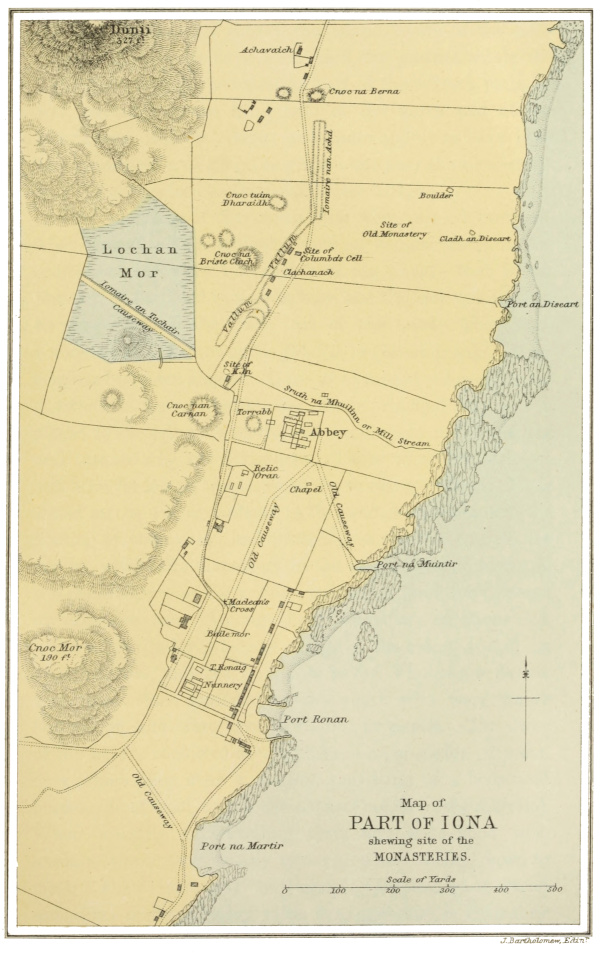
Map of
PART OF IONA
shewing site of the
MONASTERIES.
J. Bartholomew, Edin.r
Constitution of the monastery.
The members of this community were termed brethren.
They took a solemn monastic vow on bended knees in the
oratorium, and were tonsured from ear to ear—that is, the
fore part of the head was made bare, and the hair was allowed
to grow only on the back part of the head. They were
addressed by Columba as his familia or chosen monks. They
consisted of three classes. Those of advanced years and tried
devotedness were called seniors. Their principal duty was to
attend to the religious services of the church, and to reading
and transcribing the Scriptures. Those who were stronger
and fitter for labour were termed the working brothers. Their
stated labour was agriculture in its various branches, and the
tending of the cattle; and probably, in addition to this, the
service within the monastery in the preparation of food and
the manufacture of the various articles required for personal
or domestic use. Among these Adamnan mentions the
pincerna, or butler, who had charge of the refectory and its
appointments, and the pistor, or baker, who was a Saxon.
The third class consisted of the youth who were under
instruction, and were termed alumni, or pupils. The dress
of the monks consisted of a white tunica, or under garment,
over which they wore a camilla, consisting of a body and
hood made of wool, and of the natural colour of the material.
When working or travelling their feet were shod with
sandals, which they usually removed when sitting down to
meat. Their food was very simple, consisting of bread
sometimes made of barley, milk, fish, eggs; and in Iona they
appear to have also used seals’ flesh. On Sundays and
102festivals, and on the arrival of guests, there was an
improvement of diet; and an addition, probably of flesh
meat, as mutton or even beef, was made to the principal
meal.
With regard to divine worship, Adamnan does not specially
mention a daily service; but the recitation of the Psalter
is so repeatedly alluded to as an important part of the service,
that a part of the day was probably given to it, from which,
however, the working brethren were exempt. But the principal
service was unquestionably the celebration of the
Eucharist, which took place on the dies dominica, or Lord’s
day, on the stated festivals of the church, as well as on such
particular occasions as the abbot may have appointed. It is
termed by Adamnan ‘the Sacred Mysteries of the Eucharist,’
or ‘the Mysteries of the Sacred Oblation.’ The priest,
standing before the altar, consecrated the elements. When
several priests were present, one was selected, who might
invite a brother presbyter to break bread with him in token
of equality. When a bishop officiated, he broke the bread
alone, in token of his superior office. The brethren then
approached and partook of the Eucharist. The chief festival
in the year was the Paschal solemnity, or Easter. The practice
of making the sign of the cross is repeatedly mentioned
by Adamnan. One very important feature of this monastic
system was the penitential discipline to which the monks
were subjected. The ordinary discipline consisted of fasting
on Wednesday and Friday and during Lent, to which those
who practised extreme asceticism added the strange custom
of passing a certain time with the body entirely immersed
in water, and in that uncomfortable condition reciting the
whole, or part, of the Psalter; but when any one, whether
lay or cleric, desired to enter upon a special course of
exercises, it was usual to select a distinguished saint as his
Anmchara, soul-friend, or spiritual director, under whose
direction it was fulfilled. After the commission of any
103offence, the penitent was required to confess his sin before
the community, generally on his knees, and to perform such
penance as the abbot prescribed, when he was either
absolved or enjoined a more lengthened discipline. Adamnan
records two instances of this severer discipline. In one,
where the sin was a very great one, Columba imposed as a
penance perpetual exile in tears and lamentations, among
the Britons; and in another, the penitent, who had assumed
the clerical habit, was sentenced to do penance for seven
years in the island of Tiree, and accomplished his penance
in the monastery of Maigh Lunge in that island. In conclusion,
all the members of the community, as well as the
affiliated monasteries, were, by their monastic vow, bound to
yield prompt and implicit obedience to the abbot of the
mother church, who was termed holy father and holy
senior.[201]
Such is a short view of the character of the monastic
system established by Columba in the island of Iona. It
presented the same life of strict submission to a rule
enforcing observance of religious duty, ascetic practice and
self-denial, which characterised the monastic church in
Ireland, and its doctrines in no respect differed from those
of that church. Their doctrinal system was that common
to the Western Church prior to the fifth century, and it is
pervaded by the ecclesiastical language of that early period.
The divergence which took place between the Irish and the
Roman Churches related to points of doctrine, or matters of
observance, which emerged in the Western Church after
that date, when all intercourse between it and the Churches
104of Britain and Ireland, beyond the bounds of the Roman
empire, had been for the time interrupted; and to the
authority of the Church of Rome with regard to such matters
of faith and practice, when they again came into contact,
the Columban Church, in common with the Irish Church,
opposed the custom of their fathers, for which they
claimed the sanction of the second general council, held in
the year 381. To use the language of Columbanus, the
Columban Church ‘received nought but the doctrine of
the evangelists and apostles;’ and, as we learn from Adamnan,
the foundation of Columba’s preaching, and his great
instrument in the conversion of the heathen, was the
Word of God.[202]
St. Columba’s labours among the Picts.
Such then was the form in which, in the monastery
founded by him in the island of Iona, Columba exhibited
the Christian life to the surrounding heathen, and such the
spirit in which he proceeded to do battle with the paganism
which confronted him. Directly facing him to the east was
the great pagan nation of the northern Picts, occupying the
whole of Scotland north of the great range of the Mounth,
and extending from sea to sea. Immediately before him,
separated from Iona by a narrow channel, was the large
island of Mull, with its low flat promontory stretching
out towards the island; and behind it, on the mainland,
extended the western districts of Ardnamurchan, Morven,
and Lochaber, separated from the main body of the
Pictish kingdom by the western part of the range of Drumalban,
that part of it which was situated south of the
Mounth forming the eastern boundary of the Scottish
kingdom of Dalriada.
It was probably not long before the influence of the little
colony of Christian monks, and that of its founder, was felt
in the neighbouring districts occupied by a Pictish population.
Columba appears to have been two years on the
105island before he attempted to approach the powerful monarch
of the Pictish nation, who was the more direct object of his
mission, and in that period he probably won over the greater
part of the people of the districts of Ardnamurchan and
Lochaber. In Adamnan’s narrative he appears three times
in the former district, which he appropriately terms that
‘stony region;’ on one occasion, travelling through it with
two of his monks; on another, baptizing a child presented
to him by its parents, who must have been already converted;
and, on a third, denouncing some Scottish pirates, who had
robbed Columban, whose guest he was then, and who is
termed his friend.[203] In Lochaber he appears twice: once as
the guest of a man of humble condition, who was the owner
of five heifers, and whom the Saint blessed; and, a second
time, when he relieves a very poor peasant who had come to
him. These notices seem to indicate that Columba had at
an early period made his way as a missionary among the rural
population of these districts.[204]
A.D. 565.
Converts King Brude.
It was in the year 565, two years after he landed in
Iona, that he appears to have crossed the great mountain
barrier of Drumalban and made his way to the court of
King Brude,[205] whose royal palace was situated near the river
Ness.[206] Adamnan relates that, when the Saint made his first
journey to King Brude, the king would not open his gates
to him. When Columba observed this, ‘he approached the
106folding doors with his companions, and, having first formed
upon them the sign of the cross, he knocked at and laid his
hand upon the gate, which instantly flew open of its own
accord, the bolts having been driven back with great force.
The Saint and his companions then passed through the
gate thus speedily opened.’[207] Adamnan does not tell us who
his companions were, which is unusual with him; but we
learn from the Life of St. Comgall that they were, in point
of fact, two of the most distinguished saints of the period,—Comgall
of Bangor and Cainnech of Achaboe. They
both belonged to the race of the Irish Picts; and therefore
Columba probably thought that his mission to the king
of the Picts of Scotland would be materially aided by their
presence. According to this Life, Comgall made the sign of
the cross upon the gates of the castle, and they immediately
fell broken to the ground. Columba made the sign of the
cross on the door of the royal house, with the same effect.
107Cainnech, however, made the sign over the hand of the king,
which held a sword with which he intended to slay them,
and the king’s hand was instantly withered; and it so
remained till he believed in God, and, being made faithful
to God, his hand was restored.[208] The old Irish Life of
Columba, in narrating the same occurrence, says simply
that ‘the gate of the castle was shut against him, but the
iron locks of the town (Baile) opened instantly through the
prayers of Columcille;’ and we may well suppose that the
bolts may have been withdrawn and the anger of the king
disarmed through no greater miracle than the impression
created by the imposing presence of the three ecclesiastics
with their attendants. Adamnan implies this when he says
that, ‘when the king learned what had occurred, he and
his councillors were filled with alarm, and immediately setting
out from the palace, advanced to meet, with due respect,
the holy man, whom he addressed in the most conciliatory
and respectful language. And ever after from that day, as
long as he lived, the king held this holy and reverend man
in very great honour, as was due.’[209] Although Adamnan does
not specifically say that the king was then converted, we may
infer that it was so, on the authority both of the Life of St.
Comgall and of the Pictish Chronicle, which places the event
in the eighth year of King Brude, and expressly says that he
was in that year baptized by St. Columba.[210] The Irish Life
adds an incident which is nowhere else recorded, that
‘Mailcu, the son of the king, came with his Drui to contend
against Columcille, through paganism; but they perished
through the words of Columcille, both the king’s son and his
108Drui with him; and the name of God and Columcille was
magnified through it.’[211]
Character of the paganism of the Scots and Picts.
The indications which we receive from Adamnan and
from other sources, as to what the character of the paganism
of these northern Picts really was, are extremely slight;
but such as they are, we may infer that the pagan system
which Columba had to encounter among the heathen Picts
in no respect differed from that which characterised the
pagan tribes of Ireland, and which St. Patrick found opposed
to him when executing his own Christian mission.
The popular belief undoubtedly is that the so-called
Druidical religion preceded Christianity both in Scotland
and in Ireland; but, before examining the grounds of the
traditionary belief as to the leading features of this system,
it may be well to ascertain what we can really learn from
the oldest sources as to its real character. The ancient
metrical Life of St. Patrick, ascribed to Fiacc of Sleibhte,
says of him—
He preached threescore years
The Cross of Christ to the Tuatha of Feni.
On the Tuatha of Erin there was darkness.
The Tuatha adored the Side.
They believed not the true Godhead
Of the true Trinity.
[212]
And who these Side were we learn from the Book of Armagh,
which tells us that on one occasion St. Patrick and his
attendants assembled one morning at a well, or fountain,
near Crochan or Cruachan, the ancient residence of the
kings of Connaught, in the county of Roscommon; ‘and lo!
the two daughters of King Laoghaire, Ethne the Fair and
109Fedelm the Ruddy, came early to the well to wash, after
the manner of women, and they found near the well a synod
of holy bishops with Patrick. And they knew not whence
they were, or in what form, or from what people, or from
what country; but they supposed them to be men of Sidhe,
or gods of the earth, or a phantasm. And the virgins said
unto them, “Where are ye? and whence come ye?” And
Patrick said unto them, “It were better for you to confess
to our true God, than to inquire concerning our race.” The
first virgin said, “Who is God, and where is God, and of
what is God, and where is his dwelling-place? Has your
God sons and daughters, gold and silver? Is he everliving?
Is he beautiful? Did many foster his Son? Are his
daughters dear and beauteous to men of the world? Is
He in heaven or on earth? in the sea? in rivers? in
mountainous places? in valleys? Declare unto us the
knowledge of Him! How shall He be seen? How is He
to be loved? How is He to be found? Is it in youth? Is
it in old age He is to be found?”’[213]
Whatever may be the traces of a higher and more
advanced mythology among the Irish, we can see from the
questions of the king’s daughter that the objects of the
popular belief were rather the personified powers of nature.
Mysterious beings, who were supposed to dwell in the
heavens or the earth, the sea, the river, the mountain, or the
valley, were to be dreaded and conciliated. These they
worshipped and invoked, as well as the natural objects
themselves in which they were supposed to dwell; and this
conception of them runs through the early history of Ireland
during the pagan period. Thus Tuathal Teachmhar, a
mythic monarch of Ireland, is stated in the Book of
Conquests to have received as pledges from the nation ‘sun
and moon and every power which is in heaven and in
110earth,’ that the sovereignty should be for ever allowed in
his family;[214] and King Laogaire, the contemporary of St.
Patrick, when he attacked the people of Leinster in order to
exact from them the tribute called the Borumha, and was
defeated and taken captive, was obliged to give as pledges
‘sun and moon, water and air, day and night, sea and land,’
that he would not ask the Borumha as long as he lived;
but having again attempted to exact the Boroime, he was
killed by the ‘sun and wind and the other elements by
which he had sworn: for no one dared to dishonour them
at that time.’[215] By the Christian Church they were regarded
as demons. Thus in an ancient tract, contained in
the Leabhar na h-Uidhri, we are told that ‘the demoniac
power was great before the introduction of the Christian
faith; and so great was it, that they, that is, the demons,
used to tempt the people in human bodies, and that they
used to show them secrets and places of happiness, where
they should be immortal; and it was in that way they were
believed. And it is these phantoms that the unlearned
people call Sidhe and Aes Sidhe.’[216]
In connection with this belief was the class of people
called Druadh, who were supposed to be able to conciliate
these gods of the earth, or, by their influence with them,
practise incantations and work spells. Thus, in the ancient
hymn called Ninine’s Prayer, he says of St. Patrick—
He fought against hard-hearted Druide.
He thrust down proud men with the aid of our Lord of fair heavens.
He purified the great offspring of meadow-landed Erin.
We pray to Patrick, chief apostle, who will save us at the judgment from doom to the malevolence of dark demons.
[217]
St. Patrick himself, in the very old hymn attributed to him,
prays to be protected
111Against snares of demons,
Against black laws of heathenry,
Against spells of women, smiths, and Druadh.
And Fiacc in his poem says, ‘The Druids of Laogaire concealed
not from him the coming of Patrick.’[218] In the Book
of Armagh we find, from the indications there given of the
paganism which St. Patrick overthrew, that it bore the same
character. Thus we are told in the Life of St. Patrick that
‘the gentiles were about celebrating an idolatrous solemnity
accompanied with many incantations and some magical
inventions and other idolatrous superstitions; their kings
being collected, also their satraps with their chief leaders,
and the principal among the people, and Magi and enchanters
and soothsayers and doctors, inventors of all arts and gifts,
as being summoned before Laogaire in Temar.’[219] Again the
Magus of King Laogaire challenges St. Patrick ‘to perform
signs’ to show their respective powers. The Magus, in
presence of them all, ‘commenced his magical incantations,
and brought down snow upon the whole plain;’ but St.
Patrick blesses the plain, when ‘the snow immediately vanished
without rain, clouds, or wind.’ The Magus, ‘having
invoked the demons, brought down very thick darkness
upon the earth,’ which also St. Patrick dispelled.[220] In
Tirechan’s Annotations we are told that St. Patrick ‘came
to the fountain of Findmaige, which is called Slan, because
it was indicated to him that the Magi honoured this
fountain and made donations to it as gifts to God,’ and
further, ‘that they worshipped the fountain like a God.’[221]
And again we are told that St. Patrick ‘came to Muada; and
112behold the Magi of the sons of Amolngid heard that the Saint
came into the country, a very great crowd of Magi assembled,
with the chief Magus, named Recrad, who wished to slay
Patrick; and he came to them with nine Magi clad in white
garments, with a magical host.’[222] Besides the objects of
nature—the clouds of heaven, the water of the earth, the
trees and fountains—in which these gods of the earth were
supposed to dwell, they seem also to have been adored in
the shape of idols. The word in Fiacc’s Hymn translated
‘darkness’ is glossed by ‘the worship of idols;’ and the few
notices we have of them indicate that they were usually
pillar stones. Thus, in the Dinnsenchus, Magh-Sleacht is
said to have been thus called ‘because there was the principal
idol of Erin, that is, the Cromcruach and twelve idols
of stone around it, and himself of gold; and he was the God
of all the people which possessed Erin till the coming of
Padric;’[223] and in Cormac’s Glossary the word Indelba is
glossed as ‘the names of the altars of these idols, because
they were wont to carve on them the forms of the elements
they adored there.’[224]
Among the Picts of Ireland we find indications of the same
system. Thus, in an account of the foundation of Emain
Macha, the chief seat of their kings, which is contained in the
Book of Leinster, we are told that ‘three kings that were over
Erin in co-sovereignty, who were of the Ultonian, or Pictish,
race, made an arrangement that each man of them should reign
seven years. There were three times seven guarantors
between them: seven Druid, seven Filid, or poets, seven
Octighern, or military leaders—the seven Druid to scorch
them by incantations; the seven poets to satirise and denounce
them; the seven toisechs to wound and burn them, if
113each man of them did not vacate the sovereignty at the end
of his seven years.’[225]
The legendary accounts of the settlement of the Picts in
Scotland are pervaded by the same pagan system. According
to these legends, the Cruithnigh came from Thrace to Ireland
under six brothers, and the king of Leinster offered them a
settlement if they would expel a people called the Tuatha
Fidhbha. One of the brothers, ‘Drostan, the Drui of the
Cruithnigh, ordered that the milk of seven score white cows
should be spilled when the battle should be fought. This
was done, and the battle was fought by them, viz., Ardleamhnachta
in Ibh Ceinnselaigh. Every one, when wounded,
used to lie down in the new milk, and the poison did not
injure any of them.’ They are then driven out to Scotland,
but ‘six of them remained over Breaghmuigh. From them
are every spell, and every charm, and every sreod, and
voices of birds, and every omen.’[226] In the old poem which
is quoted in these legends, Drostan, a thoroughly Pictish
name, is called ‘the powerful diviner,’ ‘The plundering
host of Fea’ are said to have been aided by poison. Then
it is added—
The Drui of the Cruithnech in friendship
Discovered a cure for the wounded,
New milk in which they were washed
In powerful bathing.
The six who remained are thus described:—
There remained of them in Ealga,
With many artificers and warriors;
They would not leave Breaghmach—
Six demon-like Druadh—
Necromancy and idolatry, illusion,
In a fair and well-walled house.
114Plundering in ships, bright poems,
By them were taught;
The honouring of sreod and omens,
Choice of weather, lucky times,
The watching the voice of birds
They practised without disguise.
[227]
In another legend, when Cruithnecan, who had settled in
Pictland, demands wives for his people from the Irish, ‘he
swore by heaven and by earth, and the sun and the moon, by
the dew and the elements, by the sea and the land, that the
legal succession among them for ever should be on the
mother’s side.’[228] There is a poem, attributed to Columba,
in which the same account is given of the pagan system
opposed to him. He says—
It is not with the sreod our destiny is,
Nor with the bird on the top of the twig,
Nor with the trunk of a knotty tree,
Nor with a sordan hand in hand.
And again—
I adore not the voice of birds,
Nor the sreod, nor a destiny on the earthly world,
Nor a son, nor chance, nor woman;
My
Drui is Christ the Son of God.
[229]
The indications afforded by Adamnan of the characteristics
of the pagan system which Columba found opposed
to him among the northern Picts, are quite in harmony with
these notices. Thus, as we found King Laogaire with his
Druid opposed to Patrick during his mission, so we find,
in Adamnan’s account of Columba’s mission, Broichan the
‘Magus’ occupying an influential position at the court of
King Brude, whose tutor he had been.[230] We have already
115seen that in the Book of Armagh the term ‘Magi’ is applied
to those who in the Irish documents are termed Druadh;
and that the one is the recognised equivalent in Latin for
the other there can be no doubt, for in a tract contained
in the Leabhar Breac, giving an account of the visit of the
Magi to the infant Jesus, the title is, ‘Of the story of
the “Druad” incipit;’ and in another tract in the same
book, giving an account of the parentage and country of
King Herod, and of the ‘Magi,’ or Wise Men of the
East, the account of the latter begins, ‘It shall now be
inquired what was the family of these Druad, and what
country they came from.’[231] Adamnan too uses the name as
one well known, when he tells of a robber who dwelt in the
island of Colonsay and was in the habit of crossing to
Mull and stealing the young seals which were bred for
the use of the monastery of Iona, and whom he terms Erc
Mocudruidi, or Erc the Druid’s son.[232]
We find too, that their beliefs, so far as Adamnan indicates
them, possessed the same character. Thus he tells us that on
one occasion, when Columba had been tarrying some days in
the province of the Picts, he converted a certain peasant with
his whole family, through the preaching of the Word of Life;
and that the husband was, together with his wife, children
and domestics, baptized. A few days afterwards one of his
sons is attacked by a dangerous illness and brought to the
point of death; whereupon the ‘Magi,’ or Druadh, began with
great bitterness to upbraid the parents, and to extol their own
gods as more powerful than the God of the Christians, and
thus to despise God as though he were weaker than their
gods. The son dies; but Columba comes and raises him
from the dead, and thus confirms the faith of the peasant.[233]
These gods, too, appear as demons dwelling in fountains.
116Thus we are told that again, when Columba was staying
in the province of the Picts, he heard that there was a fountain
‘famous among the heathen people, which the foolish
men, having their senses blinded by the devil, worshipped
as God. For those who drank of this fountain, or purposely
washed their hands or feet in it, were allowed by God to be
struck by demoniacal art, and went home either leprous
or purblind, or at least suffering from weakness or other
kind of infirmity. By all these things the pagans were
seduced and paid divine honour to the fountain.’ Columba
blesses the fountain in the name of Christ; and, having
washed his hands and feet, he and his companions drank
of the water he had blessed. ‘And from that day,’ adds
Adamnan, ‘the demons departed from the fountain,’ and
people, instead of being injured, were cured of many diseases
by it.[234] Then we find Broichan, the ‘Magus,’ or Drui,
of King Brude, informing Columba that he will prevent
him from making his voyage along Loch Ness; ‘for,’ he
says, ‘I can make the winds unfavourable to thy voyage,
and cause a great darkness to envelope thee in its shade.’
The Saint goes to the lake with a large number of followers,
and the ‘Magi’ begin to exult, seeing that it had become
very dark and that the wind was very violent and contrary.
‘Nor should we wonder,’ says Adamnan, ‘that God
sometimes allows them, with the aid of evil spirits, to raise
tempests and agitate the sea.’ Columba calls on Christ
the Lord, and embarks in his small boat, which at once
carries him along against the wind.[235]
These Christian missionaries appear not to have denied
the reality of those powers exercised by the Druids through
their earth gods, but to have attributed them to the agency
of evil spirits, and to have believed that their gods were
demons; and this seems to have called forth the counter-superstition
that these old Celtic saints held familiar intercourse
117with the angels of God, and in their turn received
powerful aid from them—a belief which these saints themselves
perhaps were not unwilling to recognise. We can see
how such a belief would colour mere natural phenomena, and
we have perhaps a very striking instance of it in an incident
narrated by Adamnan. While Columba, he tells us, was
living in Iona, ‘he went to seek in the woods a place
more remote from men and fitting for prayer. And there,
when he began to pray, he suddenly beheld, as he afterwards
told a few of the brethren, a very black host of
demons fighting against him with iron darts. These wicked
demons wished, as the Holy Spirit revealed to the saint,
to attack his monastery and with the same spears kill many
of the brethren. But he, singlehanded against innumerable
foes of such a nature, fought with the utmost bravery,
having received the armour of the Apostle Paul. And thus
the contest was maintained on both sides during the greater
part of the day; nor could the demons, countless though
they were, vanquish him, nor was he able, by himself,
to drive them from his island, until the angels of God,
as the saint afterwards told certain persons, and those
few in number, came to his aid, when the demons in
terror gave way.’ On the same day, when the saint was
returning ‘to his monastery, after he had driven the devils
from his island, he spoke these words concerning the same
hostile legions, saying, Those deadly foes who this day,
through the mercy of God and the assistance of his angels,
have been put to flight from this small tract of land, have fled
to Tiree; and there, as savage invaders, they will attack the
monasteries of the brethren and cause pestilential diseases,
of which many will be grievously ill and die.’[236] We can
understand how such a persuasion should, to Columba’s
mind, have peopled a dark thunder-cloud with a host of
demons preparing to attack his monastery, and converted
118its flashes of lightning into iron darts; and how when as
it passed over to Tiree his prayers brought angels to his
assistance—a belief that would be confirmed if, after seeing
the thunder-clouds hang over Tiree, he received the news of
a sudden outbreak of sickness there. We may compare this
incident with the verses attributed to Columba, and believed
to have formed the prayer with which he aided his kinsmen
at the great battle of Culdremhne:—
O God! why wilt thou not drive from us
This mist which envelopes our number?
The host which has deprived us of our judgment,
The host which proceeds round the cairn?
He is a son of storm who betrays us.
My Drui—he will not refuse me—
Is the son of God and truth with purity.
[237]
We thus see that the paganism which characterised the
Irish tribes and the nation of the northern Picts exhibits
precisely the same features; and all the really ancient notices
we possess of it are in entire harmony with each other in
describing it as a sort of fetichism, which peopled all the
objects of nature with malignant beings to whose agency its
phenomena were attributed, while a class of persons termed
Magi and Druadh exercised great influence among the people
from a belief that they were able through their aid to practise
a species of magic or witchcraft, which might either be used
to benefit those who sought their assistance, or to injure those
to whom they were opposed. How unlike this is in every
respect to the popular conception of what is called the
Druidical religion will be at once apparent. The process by
which this monstrous system has been evoked was simply to
invest these same Druadh with all the attributes which Cæsar
and the classical writers give to the Druids of Gaul, and to
transfer to those northern regions all that they tell of Druidism
119in Gaul; to connect that with the stone monuments—those
silent records of a remote age, and possibly of a different
race, which have outlived all record of their time; and to
assume that the stone circles and cromlechs, which are undoubtedly
sepulchral monuments,[238] represent temples and
altars. Add to this some false etymologies of terms which
are supposed to contain the name of Bel or Baal,[239] and we
have at once the popular conception of the Druidical religion,
with its hierarchy of Archdruids, Druids, Vates, and
Eubates, and all its paraphernalia of temples, altars, human
sacrifices and the worship of Baal.[240]
Proceedings of St. Columba in converting the northern Picts.
Adamnan, unfortunately, gives us no details of the conversion
of the nation of the northern Picts from the pagan
system which prevailed among them; but so powerful a
monarch as their king, Brude mac Maelchon, having been
won over to the Christian faith, the task of spreading the
knowledge of the true religion among the nation at large
would be greatly facilitated, and less reluctance would
120be shown to follow his example. Columba, no doubt,
proceeded in the usual way by establishing monasteries, or
small Christian colonies, among the Pictish tribes. Adamnan
records but two instances of conversion beyond the districts
which more immediately surrounded Iona; but as we
find, in the former, Columba in friendly intercourse with the
families of peasants whom he had won over to the Christian
faith, so, in the latter, the conversions are of those in the
rank of chiefs. In the one case he was travelling near Loch
Ness, and hearing that an old man, who was a heathen, but
‘who had preserved his natural goodness through all his
life even to extreme old age,’ was at the point of death, he
hurried on to the district of Airchartan, or Glen Urquhard,
on the north side of the lake, where he found ‘an aged man
called Emchat, who, on hearing the Word of God preached
by the saint, believed and was baptized, and immediately after,
full of joy and safe from evil and accompanied by the angels
who came to meet him, passed to the Lord. His son Virolec
also believed and was baptized with all his house.’[241] In the
other instance he was staying for some days in the Island of
Skye, when ‘a boat came into the harbour, on the prow of
which sat an aged man, the chief of the Geona cohort. Two
young men took him out of the boat and laid him at the
feet of the saint. After being instructed in the Word of
God, through an interpreter, the old man believed and was
at once baptized by him; and when the baptism was
duly administered, he instantly died on the same spot,
and was buried there by his companions, who raised a heap
of stones over his grave.’grave.’[242] In both cases these old men,
who were obviously of the Flaith, or chieftain class,
seem to have been prepared to accept the true religion, and
probably partially instructed in its truth, and hastened to be
received into the church before death carried them off.
The position which Columba appears now to have held
121at the court of King Brude, and the disappearance of the
‘Magi,’ or Druadh, from the struggle, show the extent to
which the Christian Church had been adopted in the land;
for we find him staying among the Picts, and addressing
King Brude in the following terms, in the presence of the
ruler of the Orkneys:—‘Some of our brethren have lately
set sail, and are anxious to discover a desert in the pathless
sea. Should they happen, after many wanderings, to come
to the Orcadian islands, do thou carefully instruct this
chief, whose hostages are in thy hand, that no evil befall
them within his dominions. The saint took care to give
this direction because he knew that, after a few months,
Cormac would arrive at the Orkneys.’[243] This is the language
of one in a position of influence and authority. It
is unfortunate that Adamnan should tell us so little of
St. Columba’s real history and work among the heathen
Picts, and so much of his miracles, prophetic utterances,
and the manifestations of angels towards him; but his
work is rather a panegyric than a biography, and his object
is more to throw light upon his character, and to demonstrate
his superior holiness, than to contribute a detail of
historical events. The early period at which he wrote
makes every hint, however slight, of great value; and we
must be thankful for what we have got.
Columba seems to have been mainly engaged in the
work of spreading the truth among the Pictish tribes for
nine years after the conversion of King Brude, when he
appears to have at length also attained the political object
of his mission. In the year 574 died Conall, son of
Comgall, king of Dalriada, in the thirteenth year of his
reign.[244] The territories over which he ruled were, as we
have seen, greatly restricted in extent, as compared with
those of the previous rulers, who were termed kings of
Alban; and Saint Berchan says of him—
122Thirteen years altogether
Against the hosts of the Cruithnigh ruled the illustrious.
When he died he was not king,
On Thursday in Kintyre.
[245]
According to the law of Tanistry, the succession fell to his
cousin Eogan, son of that Gabran who had been defeated
and slain by King Brude in 560; and Columba would have
preferred to see him succeed, as he regarded him with
affection; but he probably thought that his brother Aidan
would suit his purpose better. Aidan was connected
through his mother with the Britons of Strathclyde, and had
played his part for a few years in the British wars.
Columba announced that he had seen, ‘on a certain night,
in a mental ecstasy, an angel sent to him from heaven, and
holding in his hand a book of glass, containing the
appointment of kings; and having received the book from
the hand of the angel, had read therein the name of Aidan;
and on his being reluctant to appoint him king, the angel
had struck the saint with a scourge,’ and added these
words,—‘Know for certain that by God am I sent to thee
with the book of glass, that in accordance with the words
thou hast read therein, thou mayest inaugurate Aidan into
the kingdom.’ This was repeated three times.
A.D. 574.
St. Columba inaugurates King Aidan and attends the assembly of Drumceatt.
There was no gainsaying such a statement by one in
Columba’s position. Aidan came to Iona, and Columba
there ordained him king. During the words of consecration,
he prophesied that the throne would remain to his children,
grandchildren, and great-grandchildren, and, laying his
hand upon his head, he consecrated and blessed him.[246]
Columba’s object in inaugurating Aidan with this solemn
rite was to place him in the rank of an independent king,
123and to induce the Pictish monarch to recognise him as
such over the whole of the Dalriadic territories. In order
to secure the former object, he took advantage of an
approaching synod, summoned to meet at Drumceatt, a
mound on the river Roe, in the county of Londonderry.
This great convention was called together by Aedh, son of
Ainmire, king of Ireland, in the year 575,[247] and consisted
of all the petty kings and heads of tribes, and of the
principal clergy of Ireland. Columba attended it, accompanied
by King Aidan, and by a retinue who are thus
described by the poet Dallan Forgaill:—
Forty priests was their number,
Twenty bishops, noble, worthy,
For singing psalms, a practice without blame,
Fifty deacons, thirty students.
[248]
The assembly was held not far from Columba’s monastery
of Derry; and no doubt this retinue would consist
of persons taken from his Irish monasteries, as well as of
those who accompanied him from Iona. Columba’s object
would be to make as imposing an appearance as possible;
and there is no improbability in its having been composed
not only of priests but of bishops.
According to the ancient tract called the Amra Columcille,
there were ‘three causes for which Columcille came
124from Alban to Erin at that time—viz., for the releasing of
Scannlan Mor, son of Cendfaelad, king of Ossory, with
whom he went in pledge; and for the staying of the poets
in Erin—for they were in banishment on account of their
burdensomeness, for there used to be thirty in the
company of each ollamh or chief poet, and fifteen in the
company of each anrad, or poet next in rank; and for
pacification between the men of Erin and Alban about
Dalriada.’ Columba then came to the assembly, and ‘all
rose up before him for welcome to him. According to
another tradition,[249] however, there rose not up one before
him but Domnall, the king’s son. For the king said there
should not rise up one before him; for he knew that about
which he had come, and his coming was not thought well of
by him; for the staying of the poets or the releasing of
Scannlan was not pleasing to him. So that it is then
Columcille blessed this Domnall, because he was reverent
to that extent.’ The burdensomeness of the poets arose
from their right to exact what was called coinmed, or refection
from the tribes for themselves and their retinue; and
Columba, who, as a poet himself, sympathised with them,
succeeded in having their sentence of banishment revoked
on condition of the retinue, for which coinmed could be
exacted, being reduced to twenty-four for each ollamh, and
twelve for each anrad. The chief ollamh of Erin at this
time was Dallan Forgaill; and out of gratitude for
Columba’s efforts on behalf of the poets, he composed the
poem termed the Amra, or praise of Columcille. The preface
from which this account is taken states the superstitious
use that was made of it. ‘Columcille promised to
Dallan the gifts and produce of the earth for this praising;
125and he took not them, but heaven, for himself and for every
one who would recite it each day, and would understand it
between sense and sound. Ut quidam dixit,
‘Amra Coluim—every day
Whoever will recite it completely,
Will reach the good bright kingdom,
Which God granted to Dallan.’
[250]
Columba did not, however, succeed in obtaining the
liberation of Scannlan Mor. With regard to Dalriada,
which was the main object of his attending the assembly,
the question was how far the colony, now that Aidan had
been solemnly inaugurated king, should be made independent
of the mother country. As a colony or subject state,
it was liable to the same burdens as were exacted from
all the petty principalities in Ireland. These consisted in
the payment of certain rents and tributes known as cain and
cobach, and certain military services which consisted of what
was called fecht, or the obligation of joining the superior
king in expeditions, and sloged, or ‘hosting,’ that is, taking
part in the general levy of the country for war. This
question was referred to Colman, son of Comgellan, who was
of Dalriada, ‘and Columcille said it is he who should make
pacification between the men of Erin and of Alban; and
this is the judgment he gave:—Their fecht and their sloged
with the men of Erin always, for there is sloged with
territories always; their cain and their cobach with the men
of Alban, or their sea gathering only with the men of
Alban, but all beyond that with the men of Erin.’[251] That
is, the kingdom of Dalriada in Scotland was to be freed
from all tribute towards the supreme king of Ireland, but
they were to join in expeditions and hostings when called
upon, with the exception of the sea gathering, or maritime
126expedition. This made Aidan practically independent,
and Dalriada ceased to be a subject state to Ireland. On
his return from the assembly, Columba had probably little
difficulty in obtaining from King Brude a recognition
of Aidan’s character as independent king over the western
districts which were occupied by the Scots of Dalriada.
127
What St. Columba had accomplished in twelve years; and meaning of the expression “Family of Iona.”
Twelve years had now elapsed since Columba first set foot
on the island of Iona, and he had already to a great extent
accomplished the task he had set before him. He had
founded his monastery in the island, as the central point
of his mission; and the exhibition of the Christian life, as
alone it was possible to present it in the state of society
which prevailed among these pagan tribes, as a colony of
tonsured monks following a monastic rule, had its usual
effect in influencing the population of the adjacent districts.
He had converted and baptized the most powerful monarch
that ever occupied the Pictish throne, and secured his
friendship and support; and this was soon followed by the
whole nation ostensibly professing the Christian faith. He
had succeeded in re-establishing the Irish colony of Dalriada
in the full possession of its territories, and obtained from
the Ardri, or supreme king of Ireland, the recognition of
its independence. He now found himself occupying a
position of great influence and authority both in Ireland
and Scotland—as the founder of numerous monasteries in
the former, and as the acknowledged head of the Christian
Church in the latter. Adamnan tells us that he had founded
monasteries within the territories both of the Picts and of
the Scots of Britain, who are separated from each other by
the great mountain range of Drumalban.[252] These monasteries,
128as well as those which he had founded in Ireland,
regarded the insular monastery of Iona as the mother
church, and as having, as such, a claim to their obedience;
and became subject to her jurisdiction, while their inmates
constituted the great monastic fraternity which was termed
the Muintir Iae, or family of Iona, in the extended sense
of the term. Adamnan mentions only a few of these
monasteries, and gives no details which might enable us to
fix the exact date of their foundation; though we can
gather from his narrative that some of them existed during
the earlier years of his mission, and all must, of course,
have been founded at some period during the thirty-four
years of his life in Iona.
Monasteries founded in the islands.
Among the islands in which he founded monasteries,
the two most important are those termed by Adamnan
‘Ethica terra’ and ‘Insula Hinba,’ or ‘Hinbina:’ the former
has been conclusively identified with the low-lying and
fertile island of Tiree, the Tireth, or ‘land of corn,’ which
lies about twenty miles to the north-west of Iona, and
whose dim outline would be barely seen on the horizon
were it not for the elevated promontory of Ceannavara at
the south end of the island. The name Hinba or Hinbina
seems to designate the group of islands called the Garveloch
Isles, situated in the centre of the great channel which
separates the island of Mull from the mainland of Lorn, and
which were the Imbach, or ‘sea-surrounded.’ The most
westerly of the four islands which constitute this group is
termed Elachnave and Eilean na Naomh, or the Island of
Saints. It is a grassy island rising to a considerable height,
and has at the west side a small and sheltered bay, on the
lower ground facing which are a fountain, called St. Columcille’s
Well, and the foundations of what must have been a
129monastic establishment, near which are the remains of two
beehive cells.[253] It is probable that on these two islands were
founded the two earliest monasteries by Brendan before
they were lost to the Scots of Dalriada by the defeat of the
year 560, by which event they were probably swept away.
In the year 565 Comgall of Bangor, who had come to the
assistance of Columba on his first visit to King Brude,
erected a monastery at a certain village in the land of Heth,
or Tiree, where he is said in his Life to have abode some
time; and that too was ruined by the Picts. We are told
in his Life that, ‘one day when Comgall was working in
the field, he put his white hood over his garment; and
about the same time a number of heathen plunderers from
the Picts came to that village to carry away everything that
was there, whether man or beast. Accordingly when the
heathen robbers came to Comgall, who was labouring in the
field, and saw his white hood over his cape, thinking that
this white hood was Comgall’s Deity, they were deterred
from laying hands on him, for fear of his God. However,
they carried off to their ship the brethren of Comgall and
all their substance.’ The pirates are of course shipwrecked
through the prayers of the Saint, and gave back their
plunder; but afterwards Comgall was conducted back to
Ireland by a company of holy men.[254] This took place
during the interval of fourteen years between the defeat of
the Dalriads in 560 and their re-establishment in 574; and
during this period the islands around Iona, which had been
occupied by the Scots and from which they were driven by
the Picts, seem to have formed a sort of debateable ground
with a mixed population of Scots and Picts, who carried on
a kind of guerilla warfare with each other; and any
Christian establishments which existed among them would
form points of attack for the heathen Picts. Thus we
130have here Pictish sea-robbers attacking the monastery in
Tiree; and Adamnan tells us of a noted pirate of the royal
tribe of Gabhran, and therefore a Scot, called Johan, son of
Conall, whose seat appears to have been the rude fort which
gave the name of Dunchonell to one of the Garvelochs,
and whom we find plundering in the district of Ardnamurchan.[255]
He also tells us of a robber, Erc, the Druid’s
son, who resided in Colonsay, and who plunders in the
island of Mull.
Of Columban monasteries in Tiree, Adamnan mentions
two. One he calls ‘Campus Lunge,’ or the plain of Lunge.
It was situated near the shore over-against Iona, and had
a portus, or harbour, which is probably the little creek or
bay still known as Portnaluing; and the site of the monastery
has been identified with that of Soroby on the south-east
side of the island, where a large churchyard with some old
tombstones and an ancient cross are the only remains of an
ecclesiastical establishment. The monastery is frequently
mentioned by Adamnan. It seems to have been founded at
an early period, and was under the charge of Baithen, afterwards
the successor of Columba in the abbacy of Iona.[256]
The second is termed by Adamnan Artchain, and said to
have been founded by Findchan, one of Columba’s monks,
whose name also appears in Kilfinichen in the island of
Mull.[257] The island, too, which he calls Hinba, is repeatedly
mentioned by Adamnan, and seems also to have been an
early foundation. He tells us that at one time Columba sent
Ernan, his uncle, an aged priest, to preside over the monastery
he had founded many years before in that island;[258] and
it seems to have been especially connected with the penitential
discipline of the order, and a place of retirement for
131those who wished to lead a more solitary life. Thus,
we find Columba on one occasion visiting Hinba, and
ordering that the penitents should enjoy some indulgence
in respect of food, which one of the penitents in that
place, a certain Neman, refused to accept.[259] Again, one
of the brethren, Virgnous, after having lived for some
time in the monastery of Iona, resolved to spend the
rest of his life in Hinba, and led the life of an anchorite
for twelve years in the hermitage of Muirbulcmar.[260] The
church and the house occupied by Columba are mentioned
by Adamnan, and it is not impossible that the hermitage
here referred to yet exists in one of the two beehive
cells, which is still entire.[261] Here, too, he tells us that
four holy founders of monasteries came from Ireland to
visit Columba, whom they found in Hinba. These were
Comgall of Bangor and Cainnech of Achaboe, the two
who had accompanied him in his first visit to King
Brude, Brendan of Clonfert, and that Cormac for whom,
when on a voyage in search of a solitary island in which to
found a hermitage, he asked King Brude to secure the protection
of the ruler of the Orkneys. This meeting must have
taken place before the year 577, when Brendan died. They
are termed by Adamnan ‘founders of monasteries,’ and he
probably means here monasteries in Scotland; for Cormac
is not known to have founded any monastery in Ireland,
where he was superior of the monastery of Durrow, founded
by Columba shortly before he began his mission in Iona;
but in Galloway the church of Kirkcormac probably takes
its name from him. The other three had all founded
monasteries in Scotland—Brendan one in Tiree, and
another probably in the island belonging to the Garveloch
group, called Culbrandon; Comgall, in Tiree; while Cainnech
132founded several monasteries in Scotland. In his Life
he is said to have lived in Heth, or Tiree, where the
remains of a church called Cillchainnech still exist. He
was also in Iona, where the remains of a burying-ground
are still called Cillchainnech. He is also said to have
dwelt at the foot of a mountain in the Drumalban range,
referring, no doubt, to the church of Laggankenney, at the
east end of Loch Laggan, and two islands are mentioned,
Ibdone and Eninis, or the ‘island of birds,’ one or other of
which was probably the island now called Inchkenneth,
on the west side of Mull.[262] Adamnan mentions one other
island monastery, that of Elena, of which one of Columba’s
twelve followers, Lugneus Mocumin, became superior—probably
Eilean Naomh on the west coast of Isla; and two
monasteries on the mainland, one called Cella Diuni, of
which Cailtan was superior, on the lake of the river Aba,
which is probably Lochawe; and the other called
Kailleauinde, of which Finten was superior, and which may
be Killundine in the old parish of Killintag in Morvern.[263]
A few of Columba’s other foundations in western districts
and islands can be traced by their dedications to him. In
the island of Skye, where he is mentioned by Adamnan as
having been twice, in the very remarkable ruins on an
island in a loch now drained, called Loch Chollumcille, in the
north of Skye. Also, on an island in the river of Snizort,
one which was of old called Sanct Colme’s kirk in Snizort;
and one on a small island in the bay of Portree, called
Eilean Columcille.[264] The church in Canna too bore his
name. In Morvern one of the two old parishes was
called Cillcholumchille, and within the limits of Dalriada,
on the mainland, were a few churches bearing the
same name.
Monasteries founded during St. Columba’s life by others in the islands.
133Of churches founded during his life, and no doubt in
connection with him by others, three were sufficiently
prominent to be occasionally mentioned in the Irish Annals.
The first was that of Lismore, founded on the long grassy
island of Lismore, lying between the coast of Lorn and that
of Morvern, by Lugadius, or Moluoc, a bishop. He is
termed by Angus the Culdee, under June 25th, ‘Lamluoc
the pure, the bright, the pleasant, the sun of Lismore;’ and
the gloss adds, ‘that is, Moluoc of Lismore in Alban.’ His
death is recorded by Tighernac in 592.[265] He is said by the
Breviary of Aberdeen to have been a disciple of Brendan;
but it is more probable that he was attached to Columba,
as his pedigree takes him up to Conall Gulban, the ancestor
of Columba and the founder of the tribe to which he
belonged.[266] The name of Kilmaluog in Lismore still commemorates
his church there. The second of these
monasteries is that of Cinngaradh, or Kingarth, a church
in the south end of the island of Bute, which was founded
by Cathan, who also was a bishop. He was of the race
of the Irish Picts, and the contemporary and friend of
Comgall and Cainnech;[267] and from him were named the
churches termed Cillchattan. The third was founded in
the island of Egea, or Egg, which, with its strangely-shaped
hill called the Scuir of Egg, can be seen from the north
end of Iona. The founder was Donnan. He is commemorated
by Angus the Culdee in his Felire, on the 17th
of April, as ‘Donnan of cold Eig,’ to which the gloss adds,
‘Eig is the name of an island which is in Alban, and in it is
Donnan. This Donnan went to Columcille to make him
his Anmchara, or soul-friend; upon which Columcille said
to him, I shall not be soul-friend to a company of red
martyrdom, for thou shalt come to red martyrdom and thy
134people with thee; and it was so fulfilled;’[268] and in his
Litany he invokes the ‘fifty-four who suffered martyrdom
with Donnan of Ega.’[269] This would place the settlement in
the island of Egg in the lifetime of Columba, and probably
during the interval between the defeat and death of Gabran
in 560 and the succession of Aidan in 574, when it
required no great gift of prophecy to anticipate such a fate
for a Christian establishment in one of the group of islands
which were at the time the scene of warfare between the
two nations, though this fate did not in fact overtake them
till some time after. The churches termed Cill Donnan
were either founded by him or dedicated to him. The
numerous churches in the west Highlands bearing the
names of Cillmaluag, Cillchattan, and Cilldonnan show that
these were centres of missionary work.
Monasteries founded by Columba and other among the northern Picts.
Of the monasteries which must have been founded by
Columba in the Pictish territories east of the Drumalban
range Adamnan gives us no account, nor does he even
mention any by name; but of the foundation of one we
have an instructive account in the Book of Deer, which
shows that they extended as far as the Eastern Sea. The
tradition of the foundation of the churches of Aberdour in
Banffshire and of Deer in the district of Buchan are thus
given. ‘Columcille and Drostan, son of Cosgrach, his
pupil, came from Hi, or Iona, as God had shown to them,
unto Abbordoboir, or Aberdour, and Bede the Cruithnech,
or Pict, was Mormaer of Buchan before them; and it was
he that gave them that cathair, or town, in freedom for
ever from Mormaer and Toisech. They came after that
to the other town; and it was pleasing to Columcille,
because it was full of God’s grace, and he asked of the
Mormaer—viz., Bede—that he should give it him, and he
did not give it; and a son of his took an illness after
135refusing the clerics, and he was nearly dead. Then the
Mormaer went to entreat the clerics that they should
make prayer for the son, that health should come to him,
and he gave in offering to them from Cloch in tiprat to
Cloch pette mic Garnait. They made the prayer, and health
came to him. Then Columcille gave to Drostan that
cathair, and blessed it, and left as his word “Whosoever
should come against it, let him not be many-yeared
victorious.” Drostan’s tears came on parting with Columcille.
Said Columcille, “Let Dear be its name henceforward.”’[270]
In this traditional account preserved by the
monks of Deer, we have a type of the mode in which these
monasteries, or Christian colonies, were settled among the
heathen tribes—the grant of a cathair, or fort, by the head
of the tribe, and its occupation by a colony of clerics,—which
is quite in accordance with what we learn as to
the settlements of this monastic church in Ireland. The
church of Rosmarkyn, now Rosemarky, on the northern
shore of the Moray Firth, and that of Muirthillauch,
or Mortlach, in the vale of the Fiddich, were dedicated
to Moluog of Lismore, and were probably founded by him,
as was that of Kildonan in Sutherland, by Donnan.
A.D. 584-597.
Monasteries founded by Columba among the southern Picts.
In 584 an event happened which appears to have opened
up an additional field for Columba’s missionary labour.
This was the death of his steady friend and supporter King
Brude, who died in that year.[271] Adamnan seems to be at a
loss to account for death having been allowed to overtake
King Brude while the powerful intercession of the great
saint might have been exercised on his behalf, and attributes
it to the disappearance of a mysterious crystal which
Columba had blessed, and which, when dipped in water, was
believed to impart to it a curative virtue. It was preserved
136among the king’s treasures, but could not be found, though
sought for in the place where it was kept on the day when
King Brude died in his palace near the river Ness.[272] His
successor was Gartnaidh, son of Domelch, who belonged to
the nation of the southern Picts, and appears to have had
his royal seat at Abernethy, on the southern bank of the Tay,
near its junction with the river Earn. The only fact recorded
of his reign is that he built the church of Abernethy two
hundred and twenty-five years and eleven months before the
church of Dunkeld was built by King Constantin.[273] The
statement is so specific, that it seems to embody a fragment
of real history contained in some early chronicle, and places
the date of the foundation of Abernethy during the first ten
years of Gartnaidh’s reign. The nation of the southern
Picts had, as we have seen, been converted early in the
previous century by Ninian; and the Pictish Chronicle
attributes the foundation of the church of Abernethy to an
early King Nectan, who reigned from 457 to 481; but the
Christianity established among them had no permanence,
and they gradually fell off, till hardly even the semblance
of a Christian church remained. What King Gartnaidh
did, therefore, was to found a new monastic church where
the earlier church had been, which, like it, was dedicated
to St. Bridget of Kildare, and this not only took place during
Columba’s life, but is, in the ancient tract called the Amra
Columcille, directly attributed to his preaching, for in alluding
to his death it contains this line: ‘For the teacher is
not, who used to teach the tuatha, or tribes, of Toi;’ and the
gloss upon it is, ‘The teacher who used to teach the tribes
who were around Tai. It is the name of a river in Alban;’
and again, ‘He subdued the mouths of the fierce who were at
Toi with the will of the king,’ which is thus glossed: ‘He
137subdued the mouths of the fierce with the Ardrig, or supreme
king of Toi; though it was what they wished—to say evil, so
it is a blessing they used to make, ut fuit Balam.’[274] Gartnaidh
is here called the supreme king of Toi, or of the Tay, and
the people whom Columba taught, the tribes about the Tay,
which leaves little doubt that the church of Abernethy on
the banks of the Tay, at this time the chief seat of government,
had been refounded in connection with his mission to
the southern Picts. In this work Columba had also the
assistance of his friend Cainnech, whose Pictish descent would
render his aid more effective. Cainnech appears to have
founded a monastery in the east end of the province of Fife,
not far from where the river Eden pours its waters into the
German Ocean at a place called Rig-Monadh, or the royal
mount, which afterwards became celebrated as the site on
which the church of St. Andrews was founded, and as
giving to that church its Gaelic name of Kilrimont. In the
notice of Cainnech on 11th October in the Martyrology of
Angus the Culdee, the following gloss is added: ‘And
Achadh-bo is his principal church, and he has a Recles, or
monastery, at Cill Rig-monaig in Alban. Once upon a time,
when Cainnech went to visit Finnin, he asked him for a
place of residence. I see no place here now, said Finnin,
for others have taken all the places up before thee. May
there be a desert place there, said Cainnech, that is, in
Alban;’[275] and this seems to be alluded to in the Life of
Cainnech when it is said, ‘Afterwards the Irish saints sent
messengers to Cainnech, having learnt that he was living as
a hermit in Britain; and Cainnech was then brought from
his hermitage against his will.’[276] The churches dedicated
138to Moluog, to Drostan, to Machut the pupil of Brendan, and
to Cathan, and the church founded at Dunblane by Blaan
of Cinngaradh, the son of King Aidan and nephew of
Cathan,[277] show the spread of the Columban Church in the
territory of the southern Picts.
Visit of Saint Columba to Ireland.
In the latter years of his life we find Columba residing
for a few months in the midland part of Ireland, and visiting
the brethren who dwelt in the celebrated monastery of
Clonmacnois. His reception there shows the estimation in
which he was now held. ‘As soon as it was known that he
was near, all flocked from their little grange farms near the
monastery, and, along with those who were within it, ranged
themselves with enthusiasm under the Abbot Alither; then,
advancing beyond the enclosure of the monastery, they went
out as one man to meet Columba, as if he were an angel of
the Lord; humbly bowing down, with their faces to the
ground, in his presence, they kissed him most reverently,
and, singing hymns of praise as they went, they conducted
him with all honour to the church. Over the saint, as he
walked, a canopy made of wood was supported by four men
walking by his side, lest the holy abbot Columba should be
troubled by the crowd of brethren pressing upon him.’[278]
In 593 Columba completed thirty years of his missionary
work in Britain, and this seems to have given him a foreboding
of his coming end;[279] but he survived four years
longer, and then his thirty-four years’ pilgrimage in Britain
was brought to its close with his life.
Last day of his life.
The touching narrative which both his biographers,
Cummene and Adamnan, give of his last days has been
139often quoted; but it presents such a charming picture of
what his life in the island was, that it may well be repeated
here. In the year 597 Columba had reached his seventy-seventh
year, and towards the end of May in that year, says
Cummene, the man of God, worn with age and carried in a
car, goes to visit the working brethren, who were, adds
Adamnan, then at work on the western side of the island,
and addresses them, saying, ‘During the Paschal solemnities
in the month of April just past I could have desired to
depart to Christ, but lest a joyous festival should be turned for
you into mourning my departure has been deferred,’ Hearing
these words, the brethren, or, as Adamnan calls them, the
beloved monks, were greatly afflicted. The man of God,
however, as he sat in his car, turned his face towards the
east and blessed the island with its insular inhabitants.
After the words of blessing, the saint was carried back to
his monastery. On Sunday the second of June we find him
celebrating the solemn offices of the eucharist, when, as his
eyes were raised to heaven, the brethren observed a sudden
expression of rapture on his face, which he explained to
them was caused by his seeming to see an angel of the Lord
looking down upon them within the church and blessing it,
and who, he believed, had been sent on account of the death
of some one dear to God, or, as Adamnan expresses it, ‘to
demand a deposit dear to God, by which he understood was
meant his own soul, as a deposit intrusted to him by God.’
Columba seems to have had a presentiment that the
following Saturday would be his last day on earth, for,
having called his attendant Diormet, he solemnly addressed
him—‘This day is called in the sacred Scriptures the
Sabbath, a day of rest; and truly to me this day will be
a day of rest, for it is the last of my life, and in it
I shall enter into my rest after the fatigues of my labours;
and this night preceding Sunday I shall go the way of
my fathers, for Christ already calls me, and thus it is
140revealed to me.’ These words saddened his attendant,
but the father consoled him. Such is Cummene’s short
narrative. Adamnan, who amplifies it, states that Columba
had gone with his attendant Diormet to bless the nearest
barn, which was probably situated close to the mill and not
far from the present ruins. When the saint entered it,
he blessed it and two heaps of winnowed corn that were
in it, and gave thanks in these words, saying, ‘I heartily
congratulate my beloved monks that this year also, if I am
obliged to depart from you, you will have a sufficient supply
for the year.’ According to Adamnan, it was in answer to
a remark which this called forth from his attendant that he
made the revelation to him, which he made him promise on
his bended knees that he would not reveal to any one before
his death. Adamnan then introduces after it the incident
that Columba, in going back to the monastery from the barn,
rested half-way at a place where a cross which was afterwards
erected, and was standing to his day fixed into a millstone,
might be observed at the side of the road; and there
came to him a white pack-horse, the same that used, as
a willing servant, to carry the milk vessels from the cowshed
to the monastery. It came up to the saint, and, strange
to say, laid its head on his bosom and began to utter
plaintive cries and, like a human being, to shed copious
tears on the saint’s bosom, foaming and greatly wailing.
The attendant, seeing this, began to drive the weeping
mourner away; but the saint forbade him, saying, ‘Let
it alone, as it is so fond of me—let it pour out its
bitter grief into my bosom. Lo! thou, as thou art a
man and hast a rational soul, canst know nothing of
my departure hence, except what I myself have just told
you, but to this brute beast devoid of reason the Creator
himself hath evidently in some way made it known that its
master is going to leave it;’ and saying this the saint blessed
the work-horse, which turned away from him in sadness.
141According to both Cummene and Adamnan, he then
went out, and, ascending the hillock which overhangs the
monastery,[280] he stood for some little time on its summit,
and, uplifting his hands, he blessed his monastery; and,
looking at its present position and future prospects, he
uttered a prophecy, the terms of which Adamnan alone
adds: ‘Small and mean though this place is, yet it shall
be held in great and unusual honour, not only by the
kings of the Scots with their people, but also by the
rulers of foreign and barbarous nations and by their subjects;
the saints also of other churches even shall regard it
with no common reverence.’ After this, both biographers
tell us, descending from the hill and returning to the monastery,
he sat in his cell and transcribed the Psalter. When
he came to that verse of the thirty-third Psalm (the thirty-fourth
of our version) where it is written, ‘They that seek
the Lord shall want no manner of thing that is good.’—‘Here,’
he said, ‘I think I can write no more: let Baithen
write what follows.’ Having thus written the verse at
the end of the page, he entered the holy church in order
to celebrate the nocturnal vigils of the Lord’s Day; and,
as soon as they were over, he returned to his cell and
spent the rest of the night on his bed, where he had for
his couch the bare ground, or, as Adamnan says, a bare
flag, and for his pillow a stone. While reclining there,
he commended his last words to his sons, or, as Adamnan
says, to the brethren. ‘Have peace always and unfeigned
charity among yourselves. The Lord, the Comforter of
the good, will be your helper; and I, abiding with Him,
will intercede for you that He may provide for you good
142things both temporal and eternal.’ Having said these words,
St. Columba became silent. Then, as soon as the bell
rang at midnight, rising hastily, he went to the church,
and, running more quickly than the rest, he entered alone
and knelt down in prayer beside the altar. Diormet, his
attendant, however, following more slowly, saw from a
distance the whole interior of the church filled at the
same moment with a heavenly light; but, when he drew
near to the door, the same light, which had also been
seen by some of the brethren, quickly disappeared. Diormet,
however, entering the church, cried out in a mournful voice,
‘Where art thou, father?’ and, feeling his way in the
darkness, the lights not having yet been brought in by
the brethren, he found the saint lying before the altar; and
raising him up a little, and sitting down beside him, he laid
his holy head on his bosom. Meantime the rest of the
brethren ran in, and, beholding their father dying, whom
living they so loved, they burst into lamentations. The
saint, however, his soul having not yet departed, opened wide
his eyes and looked around him from side to side as if seeing
the holy angels coming to meet him. Diormet then, raising
his right hand, urged him to bless the brethren; but the holy
father himself moved his hand at the same time as well as he
was able, and, having thus signified to them his holy benediction,
he immediately breathed his last. His face still
remained ruddy and brightened in a wonderful way from the
heavenly vision: so that he had the appearance not so
much of one dead as of one that sleepeth.’[281]
‘In the meantime,’ as both biographers inform us, ‘after
the departure of his saintly soul, the matin hymns being
143finished, his sacred body was carried, the brethren chanting
psalms, from the church to his cell, where his obsequies were
celebrated with all due honour for three days and as many
nights; and when these praises of God were finished, his holy
body, wrapped in fine clean linen cloths’cloths’ and, Adamnan
adds, placed in a coffin, or tomb,[282] prepared for it, was buried
with all due veneration. The stone which St. Columba had
used as a pillow was placed, as a kind of monument,
at his grave, where it still stood in Adamnan’s day. His
obsequies, which lasted three days and nights, were confined
to the inhabitants of the island alone; for there arose a storm
of wind without rain, which blew so violently during the
whole time that no one could cross the sound in his boat;[283]
but immediately after the interment the wind ceased and
the storm was quelled, so that the whole sea became calm.
Character of St. Columba.
Columba died on Sunday morning the 9th of June in the
year 597,[284] and left behind him an imperishable memory in
the affections and veneration of the people whom he first
144brought over to the Christian faith. It is unfortunately the
fate of all such men who stand out prominently from among
their fellows and put their stamp upon the age in which they
lived, that, as the true character of their sayings and doings
fades from men’s minds, they become more and more the
subject of spurious traditions, and the popular mind invests
them with attributes to which they have no claim. When
these loose popular traditions and conceptions are collected
and become imbedded in a systematic biography, the evil
becomes irreparable, and it is no longer possible to separate
in popular estimation the true from the spurious. This has
been peculiarly the case with Columba, and has led to a very
false estimate of his character. It has been thus drawn by
a great writer, in language at least of much eloquence:—‘He
was vindictive, passionate, bold, a man of strife, born a
soldier rather than a monk, and known, praised and blamed
as a soldier—so that even in his lifetime he was invoked in
fight; and continued a soldier, insulanus miles, even upon
the island rock from which he rushed forth to preach,
convert, enlighten, reconcile and reprimand both princes
and nations, men and women, laymen and clerks. He was
at the same time full of contradictions and contrasts—at
once tender and irritable, rude and courteous, ironical and
compassionate, caressing and imperious, grateful and revengeful—led
by pity as well as by wrath, ever moved by
generous passions, and among all passions fired to the very
end of his life by two which his countrymen understand
the best, the love of poetry and the love of country. Little
inclined to melancholy when he had once surmounted the
great sorrow of his life, which was his exile; little disposed,
save towards the end, to contemplation or solitude, but
trained by prayer and austerities to triumphs of evangelical
exposition; despising rest, untiring in mental and manual
toil, born for eloquence, and gifted with a voice so penetrating
and sonorous that it was thought of afterwards as one
145of the most miraculous gifts that he had received of God;
frank and loyal, original and powerful in his words as in
his actions—in cloister and mission and parliament, on land
and on sea, in Ireland as in Scotland, always swayed by
the love of God and of his neighbour, whom it was his will
and pleasure to serve with an impassioned uprightness.
Such was Columba.’[285] Or rather, such is the Columba of
popular tradition, described in the beautiful and forcible
language of his most eloquent biographer; but much of this
character is based upon very questionable statements, and,
as the facts which appear to sanction it do not stand the
test of critical examination, so the harder features of his
character disappear in the earlier estimates of it. Adamnan
says of him, ‘From his boyhood he had been brought up
in Christian training, in the study of wisdom, and by the
grace of God had so preserved the integrity of his body and
the purity of his soul, that, though dwelling on earth, he
appeared to live like the saints in heaven. For he was
angelic in appearance, graceful in speech, holy in work,
with talents of the highest order and consummate prudence;
he lived during thirty-four years an island soldier. He
never could spend the space even of one hour without study,
or prayer, or writing, or some other holy occupation. So
incessantly was he engaged night and day in the unwearied
exercise of fasting and watching, that the burden of each of
these austerities would seem beyond the power of all human
endurance. And still, in all these, he was beloved by
all; for a holy joy ever beaming on his face revealed the
joy and gladness with which the Holy Spirit filled his
inmost soul.’[286]
Dallan Forgaill, in the ancient tract called the Amra
Choluimchille, speaks of him in the same strain. He describes
146his people mourning him who was ‘their souls’ light, their
learned one—their chief from right—who was God’s messenger—who
dispelled fears from them—who used to explain
the truth of words—a harp without a base chord;—a perfect
sage who believed Christ—he was learned, he was chaste—he
was charitable—he was an abounding benefit of guests—he
was eager—he was noble—he was gentle—he was the
physician of the heart of every sage—he was to persons inscrutable—he
was a shelter to the naked—he was a consolation
to the poor;—there went not from the world one who was
more continual for the remembrance of the cross.’[287] There is
no trace here of those darker features of vindictiveness, love
of fighting, and the remorse caused by its indulgence; nor do
the events of his life, as we find them rather hinted at than
narrated, bear out such an estimate of it. He was evidently
a man of great force of character and determined zeal in effecting
his purpose—one of those master-minds which influence
and sway others by the mere force of contact; but he could
not have been the object of such tender love and implicit devotion
from all who came under the sphere of his influence, if
the softer and more amiable features pictured in these earlier
descriptions of him had not predominated in his character.
Three peculiarities he had, which led afterwards to a
belief in his miraculous powers. One was his sonorous
voice. Dallan Forgaill tells us
The sound of his voice, Columcille’s,
Great its sweetness above every company;
To the end of fifteen hundred paces—
Vast courses—it was clear.
[288]
Adamnan includes this among his miraculous gifts, and adds
that to those who were with him in the church his voice did
not seem louder than that of others; and yet, at the same
time, persons more than a mile away heard it so distinctly
147that they could mark each syllable of the verses he was
singing, for his voice sounded the same whether far or
near! He gives us another instance of it. Columba was
chanting the evening hymns with a few of his brethren, as
usual, near King Brude’s fortress, and outside the king’s
fortifications, when some ‘Magi,’ coming near to them, did
all they could to prevent God’s praises being sung in the
midst of a pagan nation. On seeing this, the saint began
to sing the 44th Psalm; and, at the same moment, so
wonderfully loud, like pealing thunder, did his voice become,
that king and people were struck with terror and amazement.[289]
Another trait, which was ascribed to prophetic
power, was his remarkable observation of natural objects
and skill in interpreting the signs of the weather in these
western regions. Dallan Forgaill says: ‘Seasons and storms
he perceived, that is, he used to understand when calm and
storm would come—he harmonised the moon’s cocircle in
regard to course—he perceived its race with the branching
sun—and sea course, that is, he was skilful in the course of
the sea—he would count the stars of heaven.’[290] When
Adamnan tells us that Baithene and Columban asked him
to obtain from the Lord a favourable wind on the next day,
though they were to sail in different directions, and how
he promised a south wind to Baithene next morning till
he reached Tiree, and told Columban to set out for Ireland at
the third hour of the same day, ‘for the Lord will soon change
the wind to the north,’[291] it required no more than great
skill in interpreting natural signs to foretell a south wind
in the morning and the return breeze three hours after.
The third quality was a remarkable sagacity in forecasting
probable events, and a keen insight into character and
motives. How tales handed down of the exercise of such
qualities should by degrees come to be held as proofs
148of miraculous and prophetic power, it is not difficult to
understand.
Primacy of Iona and successors of St. Columba.
After Columba’s death, the monastery of Iona appears
to have been the acknowledged head of all the monasteries
and churches which his mission had established in Scotland,
as well as of those previously founded by him in Ireland.
To use the words of Bede, ‘This monastery for a long time
held the pre-eminence over most of those of the northern
Scots, and all those of the Picts, and had the direction of
their people,’[292] a position to which it was entitled, as the
mother church, from its possession of the body of the patron
saint.[293] Of the subsequent abbots of Iona who succeeded
Columba in this position of pre-eminency, Bede tells us
that, ‘whatever kind of person he was himself, this we
know of him for certain, that he left successors distinguished
for their great charity, divine love and strict attention to
their rules of discipline; following, indeed, uncertain cycles
in their computation of the great festival (of Easter),
because, far away as they were out of the world, no
one had supplied them with the synodal decrees relating
to the Paschal observance; yet withal diligently observing
such works of piety and charity as they could find in the
Prophetic, Evangelic and Apostolic writings.’[294]
A.D. 597-599.
Baithene, son of Brendan.
149According to the law which regulated the succession
to the abbacy in these Irish monasteries, it fell to the tribe
of the patron saint to provide a successor; and Baithene,
the cousin and confidential friend and associate of Columba,
and superior of his monastery of Maigh Lunge in Tiree,
who was also of the northern Hy Neill, and a descendant
of Conall Gulban, became his successor, ‘for,’ says the
Martyrology of Donegal, ‘it was from the men of Erin the
abbot of I was chosen, and he was most frequently chosen
from the men of Cinel Conaill.’ He appears to have been
designated by Columba himself as his successor, and to have
been at once acknowledged by the other Columban monasteries;
for Adamnan tells us that Finten, the son of Tailchen,
had resolved to leave Ireland and go to Columba in Iona.
‘Burning with that desire,’ says Adamnan, ‘he went to an
old friend, the most prudent and venerable cleric in his
country, who was called in the Scotic tongue Columb
Crag, to get some sound advice from him. When he had
laid open his mind to him, he received the following
answer: “As“As thy devout wish is, I feel, inspired by God,
who can presume to say that thou shouldst not cross the
sea to Saint Columba?” At the same moment two monks
of Columba happened to arrive; and when they remarked
about their journey, they replied, “We have lately come
across from Britain, and to-day we have come from Daire
Calgaich,” or Derry. “Is he well,” says Columb Crag,
“your holy father Columba?” Then they burst into tears,
and answered, with great sorrow, “Our patron is indeed
well, for a few days ago he departed to Christ.” Hearing
this, Finten and Columb and all who were there present fell
on their faces on the ground and wept bitterly. Finten
then asked, “Whom did he leave as his successor?”
“Baithene, his disciple,” they replied. And we all cried
out, “It is meet and right.” Columb said to Finten, “What
wilt thou do now, Finten?” He answered, “With God’s
150permission, I will sail over to Baithene, that wise and holy
man; and if he receive me, I will take him as my abbot.”’[295]
Baithene enjoyed the abbacy, however, for two years only,
and died in the year 599, on the same day of the year as
Saint Columba, on which day his festival was likewise
held.[296]
A.D. 599-605.
Laisren, son of Feradhach.
His successor was Laisren, son of Feradhach, who was
also a descendant of Conall Gulban, and had been superior
of Durrow during Columba’s life. It was in his time that
the discussion commenced between the Roman and the Irish
Church regarding the proper time for keeping Easter. The
mission of Columbanus to Gaul in the year 590, and that of
Augustine to Britain in 597, had now brought the Roman
Church in contact with the British and Irish Churches, and
this—the most salient point of difference between them—became
at once the subject of a contest for the enforcement
of uniformity on the one part, and the maintenance of
their ancient customs, to which the Celtic mind clings
with peculiar tenacity, on the other. Augustine, on his
death in 604, was succeeded by one of his companions,
named Laurentius; and this prelate, Bede tells us, ‘did not
only attend to the charge of the new church that was
gathered from the English people, but also regarded with
pastoral solicitude the old natives of Britain, and likewise
the people of the Scots who inhabit the island of Ireland
adjacent to Britain. For observing that the practice and
sentiments of the Scots in their own country, and also those
151of the Britons in Britain itself, were contrary to church
order in many things, particularly because they used not to
celebrate the solemnity of Easter at the proper time, but
supposed, as we have shown above, that the day to be
observed in commemoration of the Lord’s resurrection was
included in the week from the fourteenth to the twentieth
day of the moon, he, in conjunction with his fellow-bishops,
wrote them a letter of exhortation, beseeching and entreating
them to keep the bond of peace and Catholic
observances with that church of Christ which is extended all
over the world. The beginning of his letter is here given:
“To“To our lords and most dear brethren the bishops or abbots
throughout all Scotia (or Ireland), Laurentius, Mellitus and
Justus, bishops, the servants of the servants of God. When
the Apostolic See, according to her practice in all the world,
stationed us in these western parts to preach to the pagan
nations here, and so it came to pass that we entered into
this island which is called Britain, before we were
acquainted with it, supposing that they walked in the ways
of the universal church, we felt a very high respect for the
Britons as well as the Scots, from our regard to their
sanctity of character; but when we came to know the
Britons, we supposed the Scots must be superior to them.
However, we have learned from Bishop Daganus coming
into this island and Abbot Columbanus coming into Gaul,
that the Scots differ not at all from the Britons in their
habits. For Bishop Daganus, when he came to us, would
not take meat with us, no, not so much as in the same
lodging where we were eating.”’eating.”’[297] This letter does not appear
to have had any effect; but it shows the spirit in which
the two churches came into contact with each other.
A.D. 605-623.
Fergna Brit, son of Failbhe.
Laisren died in the following year.[298] His successor
was Fergna Brit, or the Briton. From what he derived
this epithet it is impossible to say, for certain it is
152that he also was of the tribe of the patron saint and a descendant
of Conall Gulban. He had apparently been a
pupil in the monastery of Iona during Columba’s life, and
Adamnan mentions him as Virgnous—the Latin form of
Fergna—‘a youth of good disposition, and afterwards made
by God superior of this church in which I, though unworthy,
now serve.’[299] In his time we again hear of two of the three
great island monasteries which are specially mentioned in
the Irish Annals. In 611 Tighernac records the death of
Neman, bishop of Lismore; and in 617 of Donnan of Egg
having been burnt on the fifteenth day before the kalends
of May, or 17th April, with his martyr clerics.[300] The tale
of their martyrdom is thus told in the gloss upon the
Martyrology of Angus the Culdee already quoted. It says,
‘Donnan then went with his muintir, or monastic family,
to the Gallgaedalu, or Western Isles, and they took up their
abode there, in a place where the sheep of the queen of the
country were kept. This was told to the queen. Let them
all be killed, said she. That would not be a religious act,
said her people. But they were murderously assailed.
At this time the cleric was at mass. Let us have respite
till mass is ended, said Donnan. Thou shalt have it, said
they. And when it was over, they were slain every one of
them,’ The Calendar of Marian Gorman has the following
commemoration: ‘Donnan the great with his monks.
Fifty-two were his congregation. There came pirates of the
sea to the island in which they were, and slew them all.
Eig is the name of that island.’[301] The island of Egg is the
most easterly of a group of islands lying between the
promontory of Ardnamurchan and the island of Skye. It
faces a wild and rugged district on the mainland, extending
from Ardnamurchan to Glenelg, still known by the name
153of the Garbhcriochan, or rough bounds. The Christian
religion appears to have as yet hardly penetrated the
western districts north of Ardnamurchan, as is indicated by
the dedications of their churches. The island of Egg was
probably at this time connected with this district as a
pasture island reserved for their flocks of sheep; and, while
the people would seem to have been favourable to the
little Christian colony established in the island by Donnan,
the rule had passed into the hands of a queen who was
still pagan and employed pirates to destroy them, who
burnt the wooden church in which they were celebrating
the eucharist, and the whole community accordingly
perished. We have also at this time a slight trace of the
Columban Church in the eastern districts of the northern
Picts in the Irish Annals, which record in 616 the death of
Tolorggain or Talarican, who is associated in the Scotch
Calendars with the Church of Fordyce on the south shore of
the Moray Firth, and who gives his name to the great
district of Cilltalargyn, or Kiltarlity, in the district of the
Aird, extending from the river Ness to the bounds of
Ross-shire.[302]
The only other event which took place while Fergna
Brit was abbot was one which was destined to lead to a
great extension of the Columban Church. In the year 617
there arrived at Iona some young and noble Angles of
Bernicia. They were the sons of Aidilfrid, king of Bernicia,
who, while still pagan, as were his people, had been slain by
Aeduin, king of Deira. Bede tells us that his sons, with
many of the youth of the nobility, took refuge among the
Scots or Picts, where they lived in banishment during the
whole of Aeduin’s reign, ‘and,’ says Bede, ‘were there catechised
according to the doctrine of the Scots, and regenerated
by the grace of baptism.’[303] Many of them were no
154doubt sent to the monastery of Iona to receive this
catechetical instruction, and among them was certainly
Osuald, the second son of Aidilfrid, who was at that time
about thirteen years old, and who, we are expressly told,
with his followers had, ‘when in banishment, received the
sacraments of baptism among the seniors of the Scots,’
by whom those of the monastery of Iona are meant. He
appears to have remained there during the rest of Fergna’s
tenure of the abbacy, and the first ten years of that of his
successor.
A.D. 623-652.
Segine, son of Fiachna.
Fergna died in the year 623,[304] and was succeeded by
Segine, son of Fiachna and nephew of Laisren the third
abbot, who of course also belonged to the tribe of the patron
saint, the race of Conall Gulban. The presidency of Segine
over the family of Iona was chiefly remarkable for two
great events in two opposite directions. One was the
extension of the Columban Church into the Anglic kingdom
of Northumbria; the other, that a large section of the
Irish Church conformed to Rome: and both events appear
to have taken place at the same time.
A.D. 634.
Extension of Columban Church to Northumbria.
At the time that the sons of Aidilfrid fled from the face
of King Aeduin, the latter and his people were still pagans;
but the king having married the daughter of the Christian king
of Kent, in the eleventh year of his reign he was converted
to Christianity by the preaching of Paulinus, who had been
ordained bishop by Archbishop Justus of Canterbury, and
accompanied the queen to York. Aeduin was baptized at
York on Easter Sunday in the year 627, ‘in the church of
Saint Peter the apostle, which he himself had there built of
timber whilst he was being catechised and instructed in
order to receive baptism. In that city also he appointed the
see for the bishopric of his instructor and bishop, Paulinus.’[305]
The people of the two provinces of Bernicia and Deira followed
their king, and ostensibly embraced Christianity.
155As soon as the news reached Rome that the nation of the
Northumbrians with their king had been, by the preaching
of Paulinus, converted to the faith of Christ, Honorius I.,
who was at that time Pope, sent the ‘pallium’ to Paulinus,
and at the same time wrote letters of exhortation to King
Aeduin, exhorting him with fatherly charity that his people
should persist in and profess the faith of truth which they
had received.[306] When this letter reached York, King
Aeduin had been slain, the heathen Penda of Mercia and the
apostate Caedwalla of Wales were in possession of the
country, the infant Christian Church was trampled under
foot, and Paulinus, with his ‘pallium,’ had fled back to Kent.
After a year, in which the land had been given up to
paganism, Osuald, who was now thirty years old, and to
whom the right to the Anglic throne had opened by the
death of his brother Ainfrid, invaded Northumbria, and won
his kingdom by the battle of the Heavenly Field, at Denisburn,
near Hexham. His first object was to restore the
Christian Church which had been swept away; and for this
purpose he naturally turned to the church where he himself
had been trained in the Christian faith. As Bede tells us,
‘He sent to the seniors of the Scots, among whom himself
and his fellow-soldiers, when in banishment, had received
the sacrament of baptism, desiring they would send him a
bishop, by whose instructions and ministry the Anglic
nation which he governed might be taught the advantages
of faith in the Lord and receive its sacraments. Nor were
they slow in granting his request, but sent him Bishop
Aidan, a man of singular meekness, piety and moderation.’[307]
Bede further tells us that ‘it is reported that when King
Osuald had asked a bishop of the province of the Scots to
minister the word of faith to him and his nation, there was
first sent another man of more austere disposition, who, after
preaching for some time to the nation of the Angles and
156meeting with no success, and being disregarded by the
Anglic people, returned home, and in an assembly of the
seniors reported that he had not been able to do any good
in instructing that nation he had been sent to preach to,
because they were untameable men, and of a stubborn and
barbarous disposition. They, as is testified, in a great
council seriously debated what was to be done, being
desirous of the good of the nation in the matter which it
demanded, and grieving that they had not received the
preacher sent to them. Then said Aidan, who was also
present in the council, to the priest then spoken of, “I am
of opinion, brother, that you were more severe to your
unlearned hearers than you ought to have been, and did not
at first, conformably to the apostolic discipline, give them
the milk of more gentle doctrine, till, being by degrees
nourished with the Word of God, they should be capable of
greater perfection, and be able to practise God’s sublimer
precepts.” Having heard these words, all who sat with
him, turning on him their eyes, began diligently to weigh
what he had said, and presently concluded that he deserved
to be made a bishop, and ought to be sent to instruct the
unbelievers and unlearned, since he was found to be endowed
with the grace of a singular discretion, which is the mother
of other virtues; and accordingly, being ordained, they sent
him to preach.’[308] Bede adds that ‘most of those that had
come to preach were monks, and that Bishop Aidan was
himself a monk of the island called Hii, whose monastery
for a long time held the pre-eminence over almost all those
of the northern Scots, and all those of the Picts;’ and again,
‘that from the aforesaid island, and from this college of
monks, was Aidan sent to instruct the province of the
Angles in Christ, having received the episcopal grade. At
this time Segine, abbot and priest, presided over that
monastery.’ There can therefore be little doubt that the
157great council was held in Iona under the presidency of
Abbot Segine; and it would almost appear that he himself
had gone personally to Northumbria on the failure of the
first mission, as Adamnan refers to a conversation which he
says Abbot Failbe solemnly declared that he himself heard
between King Osuald and Abbot Segine after the battle of
the Heavenly Field had been fought.[309]
As the first missionary sent had been a priest, and the
result of Aidan’s interposition was that all declared him
worthy of the episcopate, there can be little doubt that, as
we have already had occasion to show, the distinction of the
orders and the superiority of the episcopal grade were fully
recognised. By the custom of the Scottish Church, only
one bishop was necessary for the consecration of another
bishop. That there were bishops in the Columban Church
we know, for Bede tells us that ‘all the province, and even
the bishops, were subject to the abbot of Iona;’ and, as we
have seen, two of the monasteries subject to Iona—Lismore
and Cinngaradh, or Kingarth—had episcopal heads. There
may have been an especial reason why it should be better
that Aidan should have episcopal orders, which did not
exist in the case of the Columban monasteries; for, as the
head of a remote church, he might have to ordain priests
from among his Anglic converts; while the Columban
Church had Ireland at its back as a great storehouse of
clerics, both bishops and priests. When, therefore, it is said
that he received the episcopal grade, no doubt a bishop had
been called in to consecrate him. But though he was thus
enabled to exercise episcopal functions, in other respects the
organisation of the church thus introduced into Northumbria,
both with respect to jurisdiction and to its monastic
character, was the same as that of the Columban Church at
158home; for, instead of fixing his episcopal seat at York, he
followed the custom of the monastic church by selecting a
small island near the Northumbrian coast, bearing the Celtic
name of Inis Metcaud,[310] but known to the Angles as Lindisfarne,
as the site of his monastery, which he was to rule as
episcopal abbot. Bede tells us that, ‘on the arrival of the
bishop, the king appointed him his episcopal see in the isle
of Lindisfarne, as he himself desired; which place, as the
tide flows and ebbs, twice a day is enclosed by the waves of
the sea like an island, and again, twice in the day, when the
shore is left dry, becomes contiguous to the land,’—a very
apt description of the island, which is now called Holy
Island; and Bede adds, in his Life of Cudberct, ‘And
let no man marvel that in this same island of Lindisfarne,
which is of very small extent, there should be, as we
mentioned above, the seat of a bishop, and, at the same
time, as we now state, the residence of an abbot and
monks. For so it is, in truth. For one and the same
habitation of the servants of God contains both at the same
time. Yea, all whom it contains are monks; for Aidan,
who was the first bishop of this place, was a monk, and
was always wont to lead a monastic life, with all his
people. Hence, after him, all the bishops of that place
until this day exercise the episcopal functions in such sort,
that, while the abbot, who is chosen by the bishop with the
consent of the brethren, governs the monastery, all the
priests, deacons, chanters, readers and the other ecclesiastical
orders, with the bishop himself, observe in all things the
monastic rule.’[311] This Northumbrian church was therefore
an exact counterpart of the monastic church of which Iona
was the head; and Bede bears a noble testimony to its
efficiency as a missionary church. He says, ‘From that
159time many from the region of the Scots came daily into
Britain, and with great devotion preached the word of
faith to those provinces of the Angles over which King
Osuald reigned; and those among them that had received
priests’ orders administered to the believers the grace of
baptism. Churches were built in several places; the people
joyfully flocked together to hear the Word; possessions and
lands were given of the king’s bounty to build monasteries;
the younger Angles were by their Scottish masters instructed;
and greater care and attention were bestowed upon the
rules and observances of regular discipline.’[312]
A.D. 634.
Church of the southern Scots of Ireland conforms to Rome.
The same year which brought to Segine this important
request from King Osuald of Northumbria brought him likewise
a letter of not less importance, but one of a very different
tenor, from the head of one of the dependent monasteries
in Ireland. This letter[313] was written by Cummian, one of
the most learned of the Irish ecclesiastics, and believed to
have been abbot of the monastery of Durrow in King’s
County, founded by Columba shortly before he passed over
from Ireland to Iona; and it is still extant. It is addressed
to the abbot ‘Segine, successor of Saint Columba, and other
holy men, and to Beccan the anchorite, his dear brother
according to the flesh and in the spirit, with his wise
companions.’ In this letter he tells him that, when the
Roman mode of computation was first introduced into
Ireland, he did not adopt it; but, retiring in private for
a year, he entered into the sanctuary of God, that is, the
holy Scripture, and examined it as well as he was able;
after that, works on history; lastly, whatever cycles he could
meet with. He then gives a very learned summary of
160the result of his investigations which led him to adopt the
Roman system as correct. When the year had expired,
he says, he applied to the successors of our ancient fathers,
of Bishop Ailbe, of Kieran of Clonmacnois, of Brendan,
of Nessan and of Lugidus, that they might tell him what
they thought of the excommunication directed against them
from the Apostolic See; and they having assembled together,
some in person, others by representatives, at Magh Lene,
or the plain of Lene, in which the monastery of Durrow was
situated, came to the resolution that they ought to adopt
without scruple the more worthy and approved practice
recommended to them by the successors of the apostles
of the Lord. They accordingly enjoined him to celebrate
Easter in the following year with the universal church.
Not long after, however, there arose up a certain whited
wall, pretending that he was for upholding the traditions
of his elders, which caused disunion and partly rendered
void what had been agreed to. Upon this it was
determined by ‘our seniors’ that if questions of a more
weighty character should arise, they ought to be referred,
according to the decree of the synod, to the head of
cities. They therefore sent some that they knew to be
wise and humble, as children to a mother, and having a
prosperous journey by the will of God, and some of them
having come to the city of Rome, they returned in the
third year, and they saw everything accord with what
they had heard, or rather they obtained a much clearer
view of the matter, as seeing instead of hearing; and,
being in one lodging with a Greek and a Hebrew, a Scythian
and an Egyptian, they all celebrated their Easter
together in St. Peter’s Church, while they differed from them
by a whole month. And they solemnly assured him of this,
saying, This Easter is celebrated to our knowledge all the
world over. ‘These statements,’ adds Cummian, ‘I have
made, not with a view to attack you, but to defend myself.’
161Such is the substance of Cummian’s letter;[314] and as the times
for celebrating Easter according to the Roman and to the
Irish computation would be separated by the interval of a
month in the year 631,[315] the synod must have been held
about 630, the return of the deputies taken place in 633, and
the letter have been written in the following year. According
to Bede, Pope Honorius in this year ‘wrote to the nation
of the Scots, whom he had found to err in the observance of
Easter, earnestly exhorting them not to esteem their small
number, placed in the utmost borders of the earth, wiser
than all the ancient and modern churches of Christ
throughout the world, and not to celebrate a different
Easter, contrary to the Paschal calculation and the synodical
decrees of all the bishops upon earth;’[316] and the result was
that, as Bede tells us, ‘the Scots which dwelt in the southern
districts of Ireland, by the admonition of the bishop of
the Apostolic See, learned to observe Easter according to
the canonical custom;’ while the northern province of the
Scots and the whole nation of the Picts adhered to the old
custom of the country.[317]
The distinction here drawn by Bede between the Scots
inhabiting the southern districts and the northern province
of the Scots obviously refers to the old traditional division
of Ireland into two parts, termed severally Leth Mogha and
Leth Cuinn, which were divided from each other by a ridge
extending from the mouth of the Liffey to Galway, and
termed Eisgir Riada.[318] The southern districts were Munster
and Leinster south of the Liffey. The northern division
contained the rest of Leinster, Ulster and Connaught.
Durrow, though a Columban monastery, was situated in the
162southern division, and probably now broke off from the
jurisdiction of Iona and, along with the rest of the Irish
Church in the southern division of Ireland, conformed to
Rome.
We meet with a passing notice of the monastery of
Lismore in the following year, when Tighernac records the
death of its abbot Eochaidh; and in the same year Abbot
Segine appears to have founded a church in Rechrann, or
the island of Rathlin off the north coast of Ireland.[319]
Some years after a letter appears to have been sent from
the Irish Church to Pope Severinus, who succeeded Honorius
in 640, but died within the year, which called forth a reply
from his successor John, while Pope-elect, by the person who
had taken the letter, which Bede tells us was ‘full of great
authority and erudition for correcting the same error,’ and at
the same time admonished them to be careful to crush the
Pelagian heresy, which, he had been informed, was reviving
amongst them. Bede gives us the opening of this epistle
thus:—‘To our most beloved and most holy Tomianus, Columbanus,
Cromanus, Dinanus, and Baithanus, bishops; to
Cromanus, Ernianus, Laistranus, Scellanus, and Segenus,
priests; to Saranus and the rest of the Scottish doctors or
abbots, greeting from Hilarius, the arch-priest and keeper of
the place of the holy Apostolic See; from John, the deacon
and elect in the name of God; from John the chief secretary
and keeper of the place of the holy Apostolic See, and
from John the servant of God and councillor of the same
Apostolic See.’[320] These Scottish doctors or abbots, with
Tomianus, who was bishop of Armagh, at their head, all
belonged to the northern province, and this appeal had
no effect in altering their relation towards the Church of
Rome. But it is instructive to observe that Segenus or
Segine, abbot of Iona, is placed among the clergy of the
163Irish Church, of which his monastery, with its dependent
monasteries in Scotland, was ranked as forming a part.
Ten years afterwards news came of the death of Aidan, after
a sixteen years’ episcopate over the church of Northumbria;
and Finan, ‘who had,’ says Bede, ‘been sent from Hii, the
island and monastery of the Scots,’ succeeded him.[321]
A.D. 652-657.
Suibhne, son of Cuirtri.
Segine’s own death followed a year after. His successor
was Suibhne, of whom we know nothing except that his
father’s name was Cuirtri, but it is unlikely that at this
early stage any one who did not belong to the tribe of the
patron saint could be elected an abbot, and the only notice
we have of him is his death after having been five years in
the abbacy.[322]
A.D. 657-669.
Cummene Ailbhe, son of Ernan.
He was succeeded in the abbacy by Cummene Ailbhe,
the nephew of his predecessor Segene, whose tenure of
office was signalised by equally important events. His first
year is coincident with the extension of the dominion of
Osuiu, the Northumbrian king, over the Britons of Strathclyde,
the southern Picts and the Scots of Dalriada; but,
though the latter ceased for a time to possess an independent
king, the rule of Northumbria could not have affected
the church to which her own church was affiliated.
Accordingly, when Finan, the successor of Aidan, died, we
find that Colman was also ‘sent out of Scotia,’ and succeeded
him as bishop.[323] Tighernac records, in the same year, the
death of Bishop Finan and of Daniel, bishop of Cinngaradh
or Kingarth, in Bute; and in the following year, a visit of
Abbot Cummene to Ireland;[324] and, as Bede says of Finan
that he was ordained and sent by the Scots, while, in the
case of Colman, he uses the expression that he was sent
164out of Scotia, or Ireland, this rather confirms our suspicion
that the bishops called in to consecrate these Northumbrian
missionaries were the bishops of Kingarth, and that the
death of Bishop Daniel in the same year rendered an appeal
to Ireland necessary.
A.D. 664.
Termination of Columban Church in Northumbria.
While, however, Segine’s tenure of the abbacy saw the
extension of the Columban Church into Northumbria, that of
his nephew Cummene was doomed to see its extinction after
it had for thirty years been the church of the country. The
cause was the controversy regarding the proper time for
celebrating Easter. It had been raised, during the episcopate
of Finan, by some ecclesiastics who came from Kent or
France; and among them, says Bede, ‘was a most zealous
defender of the true Easter, whose name was Ronan, a Scot
indeed by nation, but instructed in ecclesiastical truth either
in the parts of France or of Italy, who, by disputing with
Finan, corrected many, or at least induced them to make a
more strict inquiry after the truth; yet he could not amend
Finan, but on the contrary made him the more inveterate
by reproof, and an open opposer of the truth, he being of a
hot and violent temper.’[325] The royal family, too, were
divided. The queen, Eanfled, being from Kent and having
a Kentish priest, Romanus, with her, followed the Catholic
mode, so that one year the king and queen both celebrated
their Easter at different times. Under Colman the controversy
became more bitter, and the king Osuiu and his son
Alchfrid were now opposed to each other, the latter having
been instructed in Christianity by Wilfrid, a most learned
man, who had been originally trained in the Scottish
monastery of Lindisfarne, but had gone from thence to
Rome to learn the ecclesiastical doctrine, and spent much
time at Lyons with Dalfin, archbishop of Gaul, from whom
he had received the coronal tonsure. Agilberct, bishop of
the West Saxons, a friend to Alchfrid and to Abbot Wilfrid,
165having come to Northumbria, suggested that a synod should
be held to settle the controversy regarding Easter, the
tonsure and other ecclesiastical affairs. This was agreed to;
and it was accordingly held, in the year 664, at the
monastery of Streanashalch, near Whitby, where the abbess
Hilda, a woman devoted to God, then presided. The king
Osuiu and his son Alchfrid were both present. On the
Catholic side was Bishop Agilberct, with the priests Agatho
and Wilfrid, James and Romanus. On the Scottish side
was Bishop Colman with his clerics from Scotia, or Ireland,
the abbess Hilda and her followers, and Bishop Cedd of
Essex, who had been ordained by the Scots, and acted as
interpreter for both parties. The king called upon Colman
and Wilfrid to conduct the discussion. It is given at length
by Bede, but it is unnecessary to say more than that the
usual arguments were used. Colman pleaded that the
Easter he kept he received from his elders; and all his
forefathers, men beloved of God, are known to have celebrated
it after the same manner. Wilfrid opposed the
custom of the universal church and the authority of Rome.
Colman asks, ‘Is it to be believed that our most reverend
father Columba, and his successors, men beloved by God,
who kept Easter after the same manner, thought or acted
contrary to the divine writings? whereas there were many
among them whose sanctity is testified by heavenly signs
and the working of miracles which they performed, whose
life, customs and discipline I never cease to follow, nor
question their sanctity.’sanctity.’ Wilfrid replied, ‘Concerning your
father Columba and his followers, whose sanctity you say
you imitate and whose rule and precepts you observe, which
have been confirmed by signs from heaven, I might answer
that when many, on the day of judgment, shall say to our
Lord that in his name they prophesied and cast out devils
and wrought many wonders, our Lord will reply that He
never knew them. But far be it from me that I should say
166so of your father, because it is more just to believe what is
good than what is evil of persons whom one does not know.
If that Columba of yours—and I may say ours also, if he
were Christ’s—was a holy man and powerful in miracles,
yet should he be preferred before the most blessed prince of
the apostles, to whom our Lord had given the keys of the
kingdom of heaven?’ And as Colman admitted that these
words were spoken to Peter, and could not show that any
such power was given to Columba, the king decided to obey
the decrees of Rome, and all present gave their assent and,
renouncing the more imperfect institution, hastened to conform
themselves to that which they found to be better.[326]
Bede then tells us ‘that Colman, perceiving that his doctrine
was rejected and his sect despised, took with him such as
were willing to follow him and would not comply with the
Catholic Easter and the coronal tonsure—for there was
much controversy about that also—and went back into
Scotia, or Ireland, to consult with his people what was
to be done in this case.’ And he adds that Colman carried
home with him part of the bones of the most reverend
father Aidan, and left part of them in the church where
he had presided, ordering them to be interred in its
sacristy.[327]
The character which this most candid historian gives of
the church of the Scots in Northumbria so much reflects
that of the parent church of Iona, that it may be well to
insert it. He says of Bishop Colman, ‘How great was his
parsimony, how great his continence, the place which they
governed shows for himself and his predecessors, for there
were very few houses besides the church found at their
departure, indeed no more than were barely sufficient
for their daily residence. They had also no money but
cattle; for, if they received any money from rich persons,
they immediately gave it to the poor, there being no need to
167gather money or provide houses for the entertainment of the
great men of the world? for such never resorted to the
church except to pray and hear the Word of God. For this
reason the religious habit was at that time in great veneration,
so that, wheresoever any cleric or monk happened to
come, he was joyfully received by all persons, as God’s
servant; and, if they chanced to meet him as he was upon
the way they ran to him and, bowing, were glad to be
signed with his hand or blessed with his mouth. Great
attention was also paid to their exhortations; and on
Sundays the people flocked eagerly to the church or the
monasteries, not to feed their bodies, but to hear the Word
of God; and, if any priest happened to come into a village
the inhabitants flocked together forthwith to hear from him
the Word of Life. For the priests and clerics went into the
villages on no other account than to preach, baptize, visit
the sick and, in few words, to take care of souls; and they
were so free from the curse of worldly avarice, that none of
them received lands and possessions for building monasteries,
unless they were compelled to do so by the temporal
authorities.’[328]
Though Bede tells us in general terms that Colman returned
to Ireland, he did not actually do so till after four
years; for he mentions afterwards that Colman ‘repaired
first to the isle of Hii, or Iona, whence he had been sent to
preach the word of God to the Anglic nation. Afterwards
he retired to a certain small island which is to the west of
Ireland, and at some distance from its coast, called, in the
language of the Scots, Inisboufinde,’ and’ and Tighernac places
this event in the year 668.[329] As he had taken the relics of
Aidan with him, it was probably during this interval that
he founded the church of Fearn in Angus, dedicated to
168Aidan, and the church of Tarbet, in Easter Ross, with which
his own name is connected; and if he reported to Abbot
Cummene, as no doubt he would, the discussion he had held
with Wilfrid, and the appeal which he had made in vain to
the authority of Columba as a man whose sanctity was
testified by heavenly signs and the working of miracles, it
probably led to Cummene’s writing the Life of their great
saint, which Adamnan calls ‘the book which he wrote on the
virtues of St. Columba,’[330] in vindication of the assertion.
This Life is still extant, and the whole of it has been
embodied in Adamnan’s more elaborate production. Tighernac
records the death of Cummene in the year 669, and
along with it those of two saints who belonged to the church
among the southern Picts—Itharnan or Ethernanus, of
Madderdyn, now Madderty in Strathearn, and Corindu, or
Caran, of Fetteresso in the Mearns.[331]
A.D. 669-679.
Failbhe, son of Pipan.
His successor was Failbhe, son of Pipan, also a descendant
of Conall Gulban, and the first year of his tenure of
the abbacy also saw Wilfrid in possession of the diocese of
York. According to Bede, he at this time administered the
bishopric of York and of all the Northumbrians, and likewise
of the Picts as far as the dominions of king Osuiu
extended.[332] His diocese therefore comprehended the territories
of the southern Picts, the Britons of Strathclyde and
the Scots of Dalriada, over all of which King Osuiu had
extended his rule. Wilfrid retained this extensive diocese
during the entire period of Failbhe’s abbacy; and, so far as
he could make his power felt, his influence would no doubt
be exercised against the Columban Church; for, as Eddi
tells us, ‘under Bishop Wilfrid the churches were multiplied
both in the south among the Saxons and in the north among
the Britons, Scots and Picts, Wilfrid having ordained everywhere
169presbyters and deacons, and governed new churches.’[333]
But the territories of the northern Picts were beyond his
reach; and Failbhe’s tenure of the abbacy is chiefly remarkable
for the extension of the Columban Church to those
rugged and almost inaccessible districts which lay on the
western seaboard between Ardnamurchan on the south and
Loch Broom on the north.
A.D. 673.
Foundation of church of Applecross by Maelrubha.
The principal agent in effecting this was Maelrubha, who
was of the race of the northern Hy Neill, but belonged to a
different sept from that which had the right of furnishing
abbots to the monastery of Iona. He was connected through
his mother with Comgall of Bangor, and became a member
of that monastery which, as situated among the Picts of
Ireland, well fitted him to be a missionary to those of the
same race in Scotland. He came over to Britain in the year
671, and two years afterwards he founded the church of
Aporcrosan, now Applecross,[334] from which as a centre he
evangelised the whole of the western districts lying between
Loch Carron and Loch Broom, as well as the south and west
parts of the island of Skye, and planted churches in Easter
Ross and elsewhere. The dedications to him show that his
missionary work was very extensive. In the same year
Failbhe went to Ireland, where he appears to have remained
three years,[335] and was probably engaged in arrangements for
extending the missionary work; for it is probably at this
period that we must place the arrival of Comgan with his
sister Kentigerna and her son Fillan in the district of
Lochalsh, where they planted churches, as well as in the
districts south of it as far as Loch Sunart.[336] At this time
too the church in Egg appears to have been restored.[337] In
170the year 678 Wilfrid was ejected from his extensive
bishopric, but Failbhe only survived this event one year,
when his death is recorded; and at the same time we have
a trace of the church in the eastern territories of the
northern Picts, in the death of Neachtan Neir, who can be
identified with the great saint of Deeside in Aberdeenshire,
called by the people there, Nathalan, or Nachlan.[338]
A.D. 679-704.
Adamnan, son of Ronan.
We are now brought in our narrative to the very important
period when Adamnan, the biographer of Columba,
ruled over his monastery as ninth abbot. He was also a
descendant of Conall Gulban, and belonged to the tribe of
the patron saint. He was born in 624, just twenty-seven
years after the death of Saint Columba. During the first six
years of his abbacy, the rule of the Angles, under King
Ecgfrid, still extended as far as it did during the reign of his
father Osuiu. After the ejection of Wilfrid from the diocese
in this its fullest extent, it was divided between Bosa
and Eata, the latter being appointed bishop of the northern
part; and three years afterwards it was still further divided,
Trumuin being appointed bishop over the province of the
Picts which was subject to the Angles. The defeat and
death of King Ecgfrid, however, at the battle of Dunnichen
in the year 685 terminated this rule of the Angles,
and with it the interference of the Anglic bishops with the
Columban Church. The Scots of Dalriada recovered their
independence. The southern Picts were relieved from the
more direct yoke of the Angles, and Trumuin fled from
his diocese.
A.D. 686.
His first mission to Northumbria.
The new king Aldfrid had been long in exile in Ireland,
where he was known by the name of Flann Finn, and
Adamnan was on terms of friendly acquaintance with him.
His first proceeding was to go on a mission to him to ask
171the release of the Irish captives whom Berct, King Ecgfrid’s
general, had carried away from the plain of Breg; and the
Irish Life of Adamnan gives us the route he took. It says
‘The North Saxons went to him and plundered Magh Bregh
as far as Bealach-duin; they carried off with them a great
prey of men and women. The men of Erin besought of
Adamnan to go in quest of the captives to Saxonland.
Adamnan went to demand the prisoners, and put in at
Tracht-Romra. The strand is long, and the flood rapid; so
rapid that if the best steed in Saxonland ridden by the best
horseman were to start from the edge of the tide when the
tide begins to flow, he could only bring his rider ashore by
swimming, so extensive is the strand, and so impetuous is
the tide.’ Adamnan appears therefore to have gone in his
curach and entered the Solway Firth, which is evidently
the place meant, and landed on the southern shore. He
succeeded in his undertaking, and brought sixty of the
captives back to their homes.[339]
Adamnan repairs the monastery of Iona.
His next step was to repair the monastery, which had
probably fallen into disrepair during Failbhe’s time; and
for this purpose he sent twelve vessels to Lorn for oak
trees to furnish the necessary timber.[340] In this monastery
he received Arculfus, a bishop of Gaul, who had gone to
Jerusalem to visit the holy places, and returning home was
driven by a violent storm on the west coast of Britain and
made his way to Iona and passed the winter there.
During the dreary winter months, Adamnan committed to
writing all the information he could obtain from him as to
the holy places; and this work is still extant.[341]
A.D. 688.
His second mission to Northumbria.
172In 688 Adamnan proceeded on a second mission to King
Aldfrid, with what object is not known; but it appears to
have been connected with the affairs of Dalriada. This
second visit to Northumbria had very important consequences
both for himself and for his church; for Bede tells
us that ‘Adamnan, priest and abbot of the monks that
were in the isle of Hii, was sent ambassador by his nation to
Aldfrid, king of the Angles, where, having made some stay,
he observed the canonical rites of the church, and was
earnestly admonished by many who were more learned than
himself not to presume to live contrary to the universal
custom of the church in relation to either the observance of
Easter or any other decrees whatsoever, considering the
small number of his followers, seated at so distant a corner
of the world. In consequence of this he changed his mind,
and readily preferred those things which he had seen and
heard in the churches of the Angles to the customs which
he and his people had hitherto followed. For he was a
good and a wise man, and remarkably learned in the
knowledge of the Scriptures;’[342] and Abbot Ceolfrid of
Jarrow, in his letter to King Naiton of the Picts, who calls
him ‘Adamnan, the abbot and renowned priest of the
Columbans,’ says that he visited his monastery, and narrates
at length the conversation he had with him, to which he
attributes Adamnan’s conversion.[343] ‘Returning home,’ continues
Bede, ‘he endeavoured to bring his own people that
were in Hii, or that were subject to that monastery, into the
way of truth, which he himself had learned and embraced
with all his heart; but in this he could not prevail.’ We have
thus the anomalous state of matters that the abbot of the
monastery had conformed to Rome, but that his monks and
those of the dependent monasteries refused to go along with
him. In the year after his return to Iona, the death of
173Iolan, bishop of Cinngaradh, or Kingarth in Bute, is
recorded; and in 692, which the annalist marks as the fourteenth
after the decease of his predecessor Failbhe, he went
to Ireland, but for what especial purpose which might
render the reference to Failbhe appropriate, we do not
learn; and the following year we find him again in
Iona, when the body of Brude mac Bile, king of the Picts,
who died in 693, is brought for interment.[344]
A.D. 692.
Synod of Tara. The northern Scots, with the exception of the Columban monasteries, conform to Rome.
Four years after, in the year 697, he goes again to
Ireland, and on this occasion he was accompanied by Brude,
son of Derile, king of the Picts. His object was to obtain
the sanction of the Irish people to a law exempting women
from the burden laid upon all, of what was called Fecht and
Sluagad, or the duty attending hostings and expeditions.
For this purpose a synod was held at Tara, which was
attended by thirty-nine ecclesiastics presided over by the
abbot of Armagh, and by forty-seven chiefs of tribes, at the
head of whom was the monarch of Ireland. The law
exempting women from this burdensome duty was termed
‘Lex innocentium;’ and the enactments of the synod were
called Cain Adhamhnain or ‘Lex Adamnani,’ because
among its results was the privilege of levying contributions
under certain conditions.[345] In the list of those present
occurs the name of Brude mac Derili ri Cruithentuaithe, or
King of Pictland. It is to the occasion of this visit to
Ireland that must be referred the statement of Bede that
‘he then sailed over into Ireland to preach to those people,
and, by modest exhortation declaring the true time of
Easter, he reduced many of them, and almost all that were
not under the dominion of those of Hii, from their ancient
error to the Catholic unity, and taught them to keep the
174proper time of Easter. Returning to his island after
having celebrated Easter in Ireland canonically, he most
earnestly inculcated the observance of Easter in his
monastery, yet without being able to prevail; and it so
happened that he departed this life before the next year
came round. For the divine goodness so ordained it that,
as he was a great lover of peace and unity, he should be
taken away to everlasting life before he would be obliged,
on the return of the time of Easter, to have still more
serious discord with those that would not follow him in
the truth.’[346] It would therefore appear that Adamnan did
not return to Iona till the year of his death, which took
place on the 23d of September in the year 704, and in the
seventy-seventh year of his age.[347]
At what period of Adamnan’s abbacy he wrote his life
of the patron saint and founder of the monastery cannot
be fixed with any accuracy, but it was after his visit to
Aldfrid in 688; and, as he states that he did so at the
urgent request of his brethren, and alludes incidentally to
the discord which arose among the churches of Ireland on
account of the difference with regard to the Easter feast, it
was probably compiled before the same discord had arisen
between the brethren of Iona and himself as their abbot.[348]
Neither can the precise period be fixed when he founded
those churches in the eastern districts which are dedicated
to him; but no doubt, after the termination of the Anglic
rule over the southern Picts and Scots of Dalriada, he
would be desirous to strengthen the Columban Church;
and his relations with the kings of the Picts who reigned
after the overthrow of the Angles were, as we have seen,
175cordial and friendly. In this work he appears to have
been assisted by the family who had already evangelised
the rugged district termed the ‘Rough Bounds,’ as the
churches dedicated to them and him are found adjacent to
each other. Among the northern Picts, Adamnan’s principal
church was that of Forglen on the east bank of the
river Doveran, in which the Brecbannoch, or banner of
Columba, was preserved; and separated from it by the same
river is Turriff, dedicated to Comgan. South of the range
of the Mounth Adamnan’s most important foundation was
the monastery of Dull in the district of Atholl, which was
dedicated to him, and to which a very extensive territory
was annexed; and closely contiguous to it was the district
of Glendochart, with its monastery dedicated to Fillan,
whose name is preserved in Strathfillan. Fillan again
appears in Pittenweem on the south coast of the peninsula
of Fife; and in the Firth of Forth which it bounds is
Inchkeith, ‘on which Saint Adamnan the abbot presided.’[349]
A.D. 704-717.
Schism at Iona after death of Adamnan.
Adamnan, though, as Bede says, a man of peace and providentially
removed before the coming Easter, when matters
would have been brought to a crisis between him and
his recalcitrant monks, seems notwithstanding to have left
a legacy of discord behind him. For the first time since
the foundation of the monastery of Iona, we find in the
successor of Adamnan an abbot who was not a descendant
of Conall Gulban. Conmael, son of Failbhe, was of the tribe
of Airgialla in Ireland, who were descended from Colla
Uais; but three years after Adamnan’s death we find Duncadh,
who belonged to the tribe of the patron saint, obtaining
the abbacy. Then three years after we have the death
of Conmael as abbot of Iona. After his death appears
Ceode, bishop of Iona, who dies in 712, and in 713 Dorbeni
obtains the chair of Iona, but after five months’ possession of
176the primacy dies on Saturday the 28th of October in the
same year. During the whole of this time, however, Duncadh
is likewise abbot.[350] The explanation seems to be that
the community of Iona had become divided on the subject of
the Easter question, and that a party had become favourable
to Adamnan’s views. As he had not succeeded in bringing
over any of the Columban monasteries, they were driven to
obtain an abbot elsewhere, and procured the nomination of
Conmael; while the opposing party having got the upper
hand three years after, Duncadh, the legitimate successor of
the line of Conall Gulban, obtained the abbacy, and there
was thus a schism in the community—one section of
them celebrating their Easter after the Roman system,
who had at their head Conmael, Ceode the bishop, and
Dorbeni; and the other and more powerful section maintaining,
under the presidency of Duncadh, the old custom of
their church. After narrating how ‘at that time,’ that
is, in 710, ‘Naiton‘Naiton, king of the Picts who inhabit the northern
parts of Britain, taught by frequent study of the ecclesiastical
writings, renounced the error by which he and his nation
had till then been held in relation to the observance of
Easter, and submitted, together with his people, to celebrate
the Catholic time of our Lord’s resurrection,’ Bede closes his
notices of the monastery of Iona by telling us that ‘not long
after, those monks also of the Scottish nation who lived
in the isle of Hii, with the other monasteries that were subject
to them, were, by the procurement of our Lord, brought
to the canonical observance of Easter and the right mode of
tonsure. For in the year after the incarnation of our
Lord 716, the father and priest Ecgberct, beloved of God
177and worthy to be named with all honour, coming to
them from Ireland, was very honourably and joyfully received
by them. Being a most agreeable teacher and most
devout in practising those things which he taught, he was
willingly heard by all; and, by his pious and frequent exhortations
he converted them from the inveterate tradition
of their ancestors. He taught them to perform the principal
solemnity after the Catholic and apostolic manner;’ and Bede
adds, ‘The monks of Hii, by the instruction of Ecgberct,
adopted the Catholic rites, under Abbot Dunchad, about
eighty years after they had sent Bishop Aidan to preach
to the nation of the Angles.’[351] It is rarely, however, that,
when a change is proposed in matters of faith or practice, a
Christian community is unanimous, and there is always an
opposing minority who refuse their assent to it. So it must
have been here, for in the same passage in which Tighernac
notices the adoption of the Catholic Easter in 716 he adds
that Faelchu mac Dorbeni takes the chair of Columba in
the eighty-seventh year of his age, and on Saturday the 29th
of August; while he records the death of Abbot Duncadh
in the following year.[352] We have here again a schism
in the community; and no sooner does Abbot Duncadh
with his adherents go over to the Roman party, than the
opposing section adopt a new abbot.
A.D. 717
Expulsion of the Columban monks from the kingdom of the Picts.
The greater part, if not the whole, of the dependent
monasteries among the Picts seem to have resisted the
change, and to have refused obedience to the decree
which Bede tells us King Naiton had issued, when ‘the
cycles of nineteen years were forthwith by public command
sent throughout all the provinces of the Picts to
178be transcribed, learned and observed;’ for we are told
by Tighernac that in 717, when Abbot Duncadh had died
and Faelchu remained alone in possession of the abbacy,
the family of Iona were driven across Drumalban by King
Naiton. In other words, the whole of the Columban monks
were expelled from his kingdom;[353] and there is reason to
think that Faelchu had been at the head of one of these
dependent monasteries in the territories of the northern
Picts.[354] It is possible that the monks of the monasteries
recently established among the southern Picts by Adamnan
may have conformed; but those of the older foundations,
such as Abernethy and Cillrigmonadh, or St. Andrews, were
probably driven out; and thus with the expulsion of the
family of Iona terminated the primacy of its monastery over
the monasteries and churches in the extensive districts of
the east and north of Scotland which formed at that time
the kingdom of the Picts.
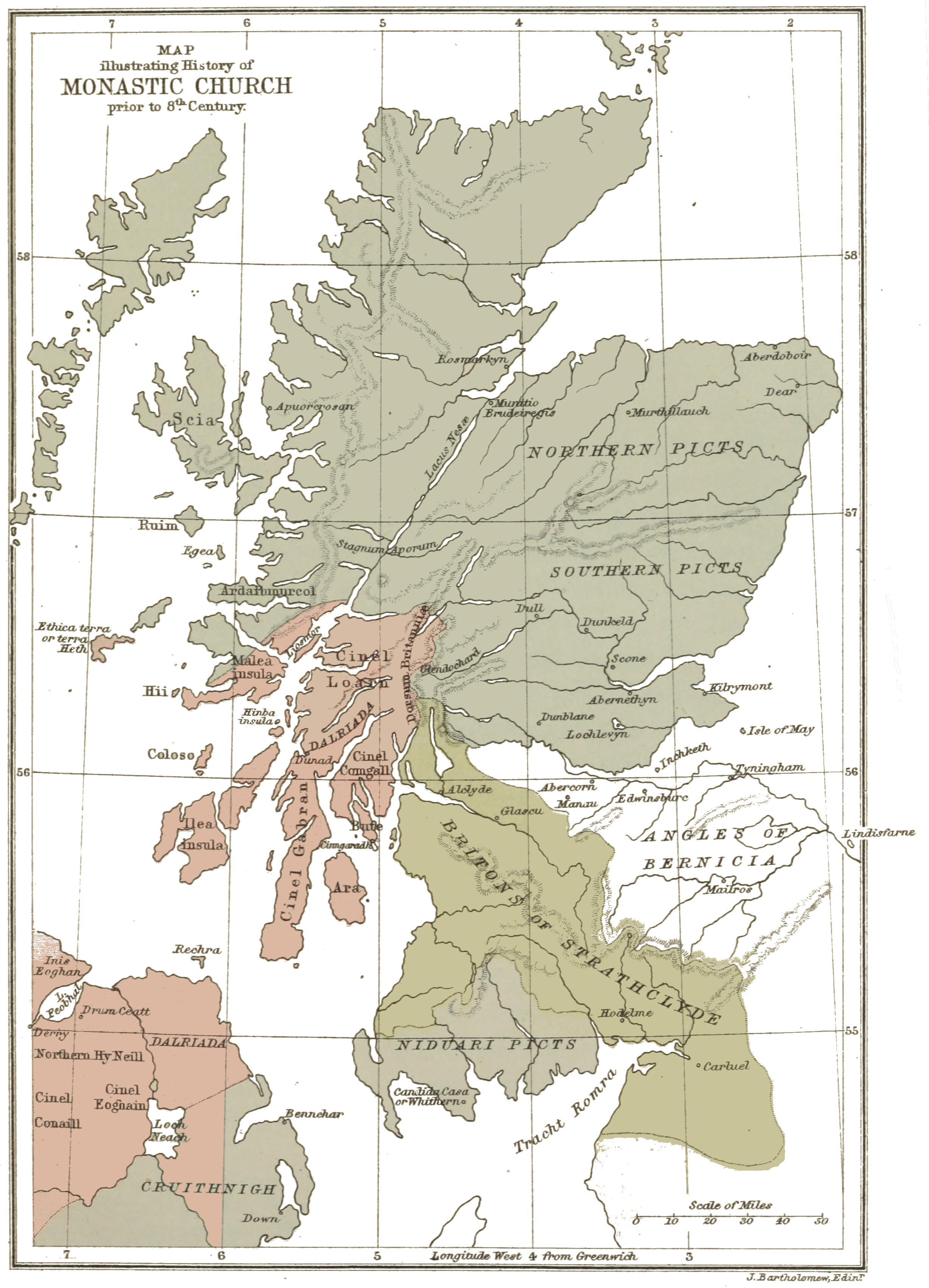
MAP
illustrating History of
MONASTIC CHURCH
prior to 8th. Century
J. Bartholomew, Edin.
179
A.D. 573.
Battle of Ardderyd. Rydderch Hael becomes king of Strathclyde.
Ten years after the landing of St. Columba in Iona the
great battle of Ardderyd, or Arthuret, was fought between
the pagan and the Christian parties in Cumbria; and the
same year which saw Aidan, who had taken part in it,
inaugurated by St. Columba as independent king of Dalriada,
likewise witnessed the establishment of another of the
chiefs who fought in that battle, Rydderch Hael, or the
Liberal, as Christian king of Strathclyde, and the restoration
of a Christian Church to its Cumbrian population. As
Columba was the founder of the Christian Church among
the northern Picts, so Kentigern was the great agent in the
revolution which again christianised Cumbria. We are not,
however, so fortunate in the biographers of Kentigern as we
are in those of Columba. While those of the latter lived
when the memory of his words and acts was still fresh in
the minds of his followers, Kentigern found no one to record
the events of his life till upwards of five centuries had
elapsed after his death. A fragment of the life which had
been used by John of Fordun and a complete biography by
Jocelyn of Furness are all we possess, but neither of them
was compiled before the twelfth century.[355]
Oldest account of birth of Kentigern.
180The older life, of which a fragment only remains, states
that ‘a certain king Leudonus, a man half pagan, from whom
the province over which he ruled in northern Britannia
obtained the name of Leudonia, had a daughter under a
stepmother, and the daughter’s name was Thaney.’ This
girl, having become Christian, ‘meditated upon the virginal
honour and maternal blessedness of the most holy Virgin
Mary,’ and desired, like her, to bring forth one who would
be for the honour and salvation of her nation in these
northern parts. She ‘had a suitor, Ewen, the son of
Erwegende, sprung from a most noble stock of the Britons,’
but she refused to marry him; upon which the king her
father gave her the alternative of either marrying him
or being handed over to the care of a swineherd, and she
chose the latter. The swineherd was secretly a Christian,
having been converted by Servanus, a disciple of Palladius,
and respected her wishes. Her suitor Ewen, however,
succeeded by a stratagem in violating her in a wood, and
she became with child, upon which her father ordered her
to be stoned according to the laws of the country; but as
none of the officers presumed to cast stones at one of the
royal family, she was taken to the top of a hill called
Kepduf and precipitated from it; having made the sign of
the cross, however, she came down to the foot of the
mountain unhurt. The king then ordered her to be given
over to the sea, saying, ‘If she be worthy of life, her God
will free her from the peril of death, if He so will.’ They
brought her, therefore, to the firth, which is about three
miles from Kepduf, to the mouth of a river called Aberlessic,
where she was put into a curach, that is, a boat made of
hides, and carried out into deep water beyond the Isle of
May. She remained all night alone in the midst of the sea,
and when morning dawned she was in safety cast on the
sand at Culenros, which, according to sailors’ computation, is
thirty miles distant from the Isle of May. Here she
181suffered the pains of labour; and, as she lay on the ground,
suddenly a heap of ashes which the day before had been
gathered together close to the shore by some shepherds, was
struck by a gust of the north wind, which scattered around
her the sparks which lay hid within it. When, therefore,
she had found the fire, the pregnant young woman dragged
herself at once, as best she could, to the place indicated by
God, and in her extreme necessity, with anxious groans, she
made a little heap with the wood which had been collected
the day before by the foresaid shepherds to prepare the fire.
Having lighted the fire, she brought forth a son, the
chamber of whose maturity was as rude as that of his conception.
Some herds found her there with the child, and
while some gave her food, others went straight to the blessed
Servanus, who at that time was teaching the Christian law
to his clerics, with one accord saying, ‘Sir, thus and thus
have we found;’ to whom the saint said, A Dia cur fir sin,
which in Latin means ‘O utinam si sic esset,’esset,’[356] and the youths
replied, ‘Yea, father, it is a true tale and no fable which we
tell; therefore we pray you, sir, come and see, that thy
desire may without delay be satisfied;’ and he also, when
he had learnt the order of the events, rejoiced with great
joy, and said, ‘Thanks be to God, for he shall be my dear
one.’ For as the child was being born, when he was in his
oratory after morning lauds, he had heard on high the
Gloria in excelsis being solemnly sung.sung. And after an
address to his clerics, in which he vindicates the manner in
which the conception of the blessed Kentigern had taken
place, and ‘praises Him who alone governeth the world, and
hath, among others, blessed our country Britain with such
a patron,’ this fragment unfortunately terminates.[357]
Jocelyn’s account of his birth.
Jocelyn, whose narrative, as the Bishop of Brechin well
182observes, is here directed at undoing the weird legend of
the earlier life, which gives the unedifying account of the
conception of Kentigern, does not name either father or
daughter. He calls Kentigern’s mother simply ‘the daughter
of a certain king, most pagan in his creed, who ruled in
the northern parts of Britannia.’ Neither does he name
the suitor who betrayed her, but declares that she had no
consciousness by whom, when, or in what manner she conceived,
and had possibly been drugged. He states that,
according to the law of the country, any girl in her situation
was to be cast down from the summit of a high
mountain, and her betrayer beheaded; that she was taken
to the top of a high hill called Dunpelder, and was cast
down, but came to the bottom uninjured; that she was
then taken out to sea by the king’s servants, and placed in
a little boat of hides made after the fashion of the Scots,
without any oar, and, ‘the little vessel in which the pregnant
girl was detained ploughed the watery breakers and eddies
of the waves towards the opposite shore more quickly than
if propelled by a wind that filled the sail, or by the effort of
many oarsmen;’ that the girl landed on the sands at a place
called Culenros, in which place at that time Servanus dwelt,
and taught sacred literature to many boys who went to be
trained to the divine service. The birth then takes place as
in the other narrative, and they are brought and presented
to Servanus, who ‘in the language of his country exclaimed,
Mochohe, Mochohe, which in Latin means “Care mi, Care mi,”
adding, Blessed art thou that hast come in the name of the
Lord. He therefore took them to himself, and nourished
and educated them as if they were his own pledges. After
certain days had passed, he dipped them in the laver of
regeneration and restoration, and anointed them with the
sacred chrism, calling the mother Taneu and the child
Kyentyern, which by interpretation is Capitalis Dominus.’
He then educates him, and the gifts of grace manifested by
183the boy were so great that ‘he was accustomed to call him,
in the language of his country, Munghu, which in Latin
means Karrissimus Amicus.’[358] Kentigern is brought up by
Servanus, and the usual boyish miracles are recorded as
evidences of his sanctity, till, having excited the jealousy
and hatred of his fellow-students, he resolves, under Divine
guidance of course, to leave the place. He accordingly
retreated secretly, and ‘journeying arrived at the Frisican
shore, where the river, by name Mallena, overpassing its
banks when the tide flows in, took away all hope of crossing;’
but the river is miraculously divided to enable him to pass,
the tide flowing back so that the waters of the sea and of the
river stood as walls on his right hand and on his left. He
then crosses a little arm of the sea near a bridge, which by
the inhabitants is called Servanus’s bridge; and on looking
back, he saw that the waters had not only flowed back and
filled the channel of the Mallena, but were overflowing the
bridge and denying a passage to any one. Servanus, who
had followed in pursuit of the fugitive, stood above on the
bank and endeavoured to persuade him to return, but without
success; and ‘having mutually blessed each other, they were
divided one from the other, and never looked in each other’s
face again in this world. And the place by which Kentigern
crossed became after that entirely impassable; for that
bridge, always after that covered by the waves of the sea,
afforded to no one any longer means of transit. Even the
Mallena altered the force of its current from the proper
place, and from that day to this turned back its channel into
the river Ledone; so that forthwith the rivers which till
then had been separate from each other now became mingled
184and united.’ Kentigern passes the night at a town called
Kernach, where he finds an old man, Fregus, on his death-bed,
who dies in the night; and ‘next‘next morning Kentigern,
having yoked two untamed bulls to a new wain, in which he
placed the body whence the spirit had departed, and having
prayed in the name of the Lord, enjoined upon the brute
beasts to carry the burden placed upon them to the place
which the Lord had provided for it. And in truth the bulls,
in no way resisting or disobeying the voice of Kentigern, came
by a straight road, along which there was no path, as far as
Cathures, which is now called Glasgu’, and halted near a
certain cemetery which had long before been consecrated by
Saint Ninian. Here Kentigern lives for some time; and
then ‘the king and clergy of the Cumbrian region, with
other Christians, albeit they were few in number, came together
and, after taking into consideration what was to be
done to restore the good estate of the church, which was
well-nigh destroyed, they with one consent approached Kentigern,
and elected him, in spite of his many remonstrances
and strong resistance, to be the shepherd and bishop of their
souls;’ and ‘having called one bishop from Ireland, after the
manner of the Britons and Scots of that period, they caused
Kentigern to be consecrated bishop.’[359]
Anachronism in connecting St. Servanus with St. Kentigern.
Such is the substance of these narratives; and here we
are met, at the very outset, by a great anachronism. Along
with the lives of Kentigern there is found a life of Servanus,
in which he is made the founder of the church of Culenros;
but there is not one syllable about his having been the
master of Kentigern, or in any way connected with him,
but the whole events of his life, as there given, indisputably
place him, as we shall afterwards see, nearly two centuries
later.[360] In spite, therefore, of the statements of his biographers
185and of the belief of popular tradition, the only conclusion we
can come to is that Servanus and St. Kentigern were divided
by a more impassable barrier than the river Mallena—the
stream of time, and that they had never looked in each
other’s face at all. The scenery, however, of the narrative
can be easily identified. The hill called in the one narrative
Kepduf, and in the other Dunpelder, is Traprain Law,
formerly called Dumpender Law, in the county of Haddington.
It is an isolated hill and, along with North Berwick
Law, forms a conspicuous object in the landscape. It is
about 700 feet above the level of the sea, and on the south
side it is nearly perpendicular. It is distant about seven or
eight miles from Aberlady Bay, the Aberlessic of the older
narrative. Culenros is Culross, on the north shore of the
Firth of Forth, here called the Frisican shore, as the Forth
itself is called by Nennius the Frisican Sea. The names of
the two rivers Mallena and Ledone are simply the Latin
terms for the flood and ebb tide, but the course of the two
rivers, the Teith and the Forth, seems to have suggested the
legend. They run nearly parallel to each other till they
approach within three miles of Stirling, when the southern
of the two rivers, the Forth, takes a sudden bend to the
north, as if it would flow backwards, and discharges its
waters into the Teith, the two forming one river, but adopting
the name of the former. Kernach is Carnock, in the
parish of Saint Ninian’s in Stirlingshire.
Earlier notices of St. Kentigern.
If, however, that part of the legend which introduces
Servanus must be rejected, the remainder derives some support
from the old Welsh documents. In the Triads of Arthur
and his Warriors, which are undoubtedly old, the first is
termed ‘Three tribe thrones of the island of Prydain;’ and
the third of the tribe thrones is ‘Arthur, the chief lord at
186Penrionyd in the north, and Cyndeyrn Garthwys, the chief
bishop, and Garthmwl Guledic, the chief elder.’[361] The chronology
of the life of Kentigern is not inconsistent with that
which here connects him with the historic Arthur, and the
epithet Guledic, which was applied to the chief among the
Cymric kings of the north, gives us Garthmwl as the name of
the king of the district in which Glasgow was situated. In
the Bonedd y Seint ynys Prydain, or Pedigrees of the Saints
of Britain, we find the following pedigree: ‘Kyndeyrn
Garthwys, son of Ywein, son of Urien Reged, son of Cynfarch,
son of Meirchiawngul, son of Grwst Ledlwm, son of
Cenau, son of Coel; and Dwynwen, daughter of Ladden
Lueddog of the city of Edwin (Ddinas Edwin, or Edinburgh),
in the north, was his mother.’[362] We have seen that prior to
this period Monenna had founded a church on the summit
of Dunpelder, in which she established nuns;[363] and it is
possible that Dwynwen or Taneu may have been one of
these nuns, who, by the violation of her religious vow, had
incurred the sentence of being exposed in a curach in the
adjacent firth. There is nothing impossible in a small boat
being driven before an east wind as far as Culross; and
certain it is that on the shore where she is said to have
landed there was a small chapel dedicated to Kentigern.[364]
We learn from the narrative that there had been an earlier
church at Glasgow founded by Ninian, which Kentigern may
have restored, and he makes his appearance in the martyrologies
in the ninth century as ‘Saint Kentigern, Bishop of
Glasgow and Confessor.’[365]
Kentigern driven to Wales.
Jocelyn, after describing Kentigern’s mode of life and
how he spread the faith of Christ in his diocese, tells us
187that, ‘a considerable time having elapsed, a certain tyrant,
by name Morken, had ascended the throne of the Cumbrian
kingdom,’ who ‘scorned and despised the life and doctrine
of the man of God in much slandering, in public resisting
him from time to time, putting down his miraculous power
to magical illusion, and esteeming as nothing all that he did.’
But after a time Morken dies and is buried in the royal
town, which from him was called Thorp Morken. ‘After
this,’ says Jocelyn, ‘for many days he enjoyed great peace
and quiet, living in his own city of Glasgow, and going
through his diocese;’ but, ‘when some time had passed,
certain sons of Belial, a generation of vipers of the kin of
the aforenamed King Morken, excited by the sting of intense
hatred and infected with the poison of the devil, took
counsel together how they might lay hold of Kentigern by
craft and put him to death.’ In consequence of this Kentigern
resolved to leave the north and proceed to Menevia in
South Wales, now Saint David’s, where St. David then
ruled as bishop. The Morken here mentioned is probably
one of the kings termed Morcant by Nennius; and it is
quite in accordance with the history of the period that the
increasing power of the pagan party in the northern districts
of Cumbria should have driven Kentigern from Glasgow and
forced him to take refuge in Wales. Jocelyn describes him
as proceeding by Carlisle, and says that, ‘having heard that
many among the mountains were given to idolatry or
ignorant of the divine law, he turned aside, and, God helping
him and confirming the word by signs following, converted
to the Christian religion many from a strange belief, and
others who were erroneous in the faith.’ ‘He remained
some time in a certain thickly-planted place, to confirm and
comfort in the faith the men that dwelt there, where he
erected a cross as the sign of the faith, whence it took the
name of, in English, Crossfeld, that is, Crucis Novale, in
which very locality a basilica, recently erected, is dedicated
188to the name of the blessed Kentigern.’ Jocelyn then
tells us that, ‘turning aside from thence, the saint directed
his steps by the sea-shore, and through all his journey
scattering the seed of the Divine Word, gathered in a
plentiful and fertile harvest unto the Lord. At length safe
and sound he reached Saint Dewi.’
Kentigern founds the monastery of Llanelwy in Wales.
St. David was, as we have already seen, one of the great
founders of the monastic church; and Kentigern had not
been long with him when he applied to the king for land
to build a monastery, where he might unite together a
people acceptable to God and devoted to good works; and
the king, whom Jocelyn calls Cathwallain, allowed him to
choose his own place. Kentigern, ‘with a great crowd of his
disciples along with him, went round the land and walked
throughout it exploring the situations of the localities, the
quality of the air, the richness of the soil, the sufficiency
of the meadows, pastures and woods, and the other things
that look to the convenience of a monastery to be erected;’
and is finally conducted by a white boar ‘to the bank of a
river called Elgu, from which to this day, as it is said, the
town takes its name.’ Here he commenced to construct his
monastery; ‘some‘some cleared and levelled the situation, others
began to lay the foundation of the ground thus levelled; some
cutting down trees, others carrying them and others fitting
them together, commenced, as the father had measured and
marked out for them to build a church and its offices of
polished wood, after the fashion of the Britons, seeing that
they could not yet build of stone, nor were so wont to do.’[366]
Here we are treading on somewhat firmer ground. The
monastery described is that of Llanelwy, afterwards called
St. Asaph’s. It is in the vale of Clwyd, at the junction of
the river Elwy with the Clwyd, a name possibly given to
it by Kentigern from some fancied resemblance to the river
and valley in the north where he had his original seat; and
189the Red Book of St. Asaph’s records several grants made to
Kentigern by Maelgwyn Gwyned, the king of North Wales
at this time.[367]
The description given by Jocelyn of the construction of
the monastery is probably not an inapt account of how
these early Irish monasteries were erected; and indeed it
may be considered a type of the larger monasteries, for
Jocelyn tells us, ‘There flocked to the monastery old and
young, rich and poor, to take upon themselves the easy yoke
and light burden of the Lord. Nobles and men of the
middle class brought to the saint their children to be trained
unto the Lord. The tale of those who renounced the world
increased day by day both in number and importance, so
that the total number of those enlisted in God’s army
amounted to 965, professing in act and habit the life of
monastic rule, according to the institution of the holy man.
He divided this troop, that had been collected together and
devoted to the divine service, into a threefold division of
religious observance. For he appointed three hundred, who
were unlettered, to the duty of agriculture, the care of the
cattle, and the other necessary duties outside the monastery.
He assigned another three hundred to duties within the
enclosure of the monastery, such as doing the ordinary work
and preparing food and building workshops. The remaining
three hundred and sixty-five, who were lettered, he appointed
to the celebration of divine service in church by day and by
night; and he seldom allowed any of these to go forth out
of the sanctuary, but they were ever to abide within, as if
in the holy place of the Lord. But those who were more
advanced in wisdom and holiness and who were fitted to
teach others, he was accustomed to take along with him
190when, at the urgent demand either of necessity or reason, he
thought fit to go forth to perform his episcopal office.’[368]
Allowing for some exaggeration in the numbers of those in
the second and third divisions, this is probably a very
correct picture of the monasteries in the early monastic
church of Ireland and Scotland when the head of the
monastery was also a bishop.
A.D. 573.
Rydderch Hael becomes king of Cumbria and recalls Kentigern.
After some account of Kentigern’s life at his monastery
in North Wales, Jocelyn returns to the north in order to
‘show what his adversaries suffered, how he returned to the
Cumbrian region, and what he did there.’ He tells us,
after an imaginative account of the fate of those who had
driven out Kentigern, that, ‘when the time of having mercy
had arrived, that the Lord might remove the rod of his
fierce anger and that they should turn unto Him and He
should heal them, He raised up over the Cumbrian kingdom
a king, Rederech by name, who, having been baptized in
Ireland in the most Christian manner by the disciples of
Saint Patrick, sought the Lord with all his heart and strove
to restore Christianity.’ ‘Wherefore,’ continues Jocelyn,
‘King Rederech, seeing that the Christian religion was
almost entirely destroyed in his kingdom, set himself
zealously to restore it; and, after long considering the
matter in his own mind and taking advice with other
Christians who were in his confidence, he discovered no more
healthful plan by which he could bring it to a successful
result than to send messengers to Saint Kentigern, to recall
him to his first see.’ It was by the great battle of Ardderyd,
fought at Arthuret on the river Esk a few miles north of
Carlisle, in which the pagan and Christian parties met in
conflict, and a decisive struggle for the supremacy took place
between them, that the victory of the Christian chiefs
placed Rydderch Hael, or the Liberal, on the throne; and
as this battle took place in the year 573, it gives us a fixed
191date for the recall of Kentigern. He responded to the
call, and, having appointed Asaph, one of the monks, his
successor, he enthroned him in the cathedral see; and,
‘blessing and taking leave of them all he went forth by the
north door of the church, because he was going forth to
combat the northern enemy. After he had gone out, that
door was closed, and all who witnessed and heard of his
egress and departure bewailed his absence with great lamentations.
Hence a custom grew up in that church that that
door should never be opened save once a year, on the day of
St. Asaph, that is, on the kalends of May, for two reasons—first
in deference to the sanctity of him who had gone forth,
and next that thereby was indicated the great grief of
those who had bewailed his departure.’ Jocelyn tells us
that six hundred and sixty-five of the monks accompanied
him, and that three hundred only remained with St.
Asaph.[369]
Kentigern fixes his see first at Hoddam.
King Rydderch and his people went forth to meet him,
and they encountered each other at a place called Holdelm,
now Hoddam, in Dumfriesshire, where Kentigern addressed
the multitude who had assembled to meet him; and in the
supposed address which Jocelyn puts in his mouth we have
probably a correct enough representation of the paganism
which still clung to the people and influenced their belief—a
sort of cross between their old Celtic heathenism and that
derived from their pagan neighbours the Angles, who
now occupied the eastern districts of their country. According
to Jocelyn, he showed them ‘that idols were dumb,
the vain inventions of men, fitter for the fire than for
worship. He showed that the elements, in which they believed
as deities, were creatures and formations adapted by
the disposition of their Maker to the use, help and assistance
of men. But Woden, whom they, and especially the Angles,
believed to be the chief deity, from whom they derived their
192origin, and to whom the fourth day of the week is dedicated,
he asserted with probability to have been a mortal man,
king of the Saxons, by faith a pagan, from whom they and
many nations have their descent.’ The ground on which he
sat there ‘grew into a little hill, and remaineth there unto
this day;’ and ‘men and women, old men and young men,
rich and poor, flock to the man of God to be instructed
in the faith.’ And here he fixed his see for a time; for
Jocelyn then tells us that ‘the holy bishop Kentigern, building
churches in Holdelm, ordaining priests and clerics,
placed his see there for a time for a certain reason; afterwards,
warned by divine revelation, justice demanding it,
he transferred it to his own city Glasgow.’[370]
Mission of Kentigern in Galloway, Alban, and Orkneys.
It was while his see was still at Hoddam, and before he
returned to Glasgow, that we are told by Jocelyn that
Kentigern, ‘after he had converted what was nearest to
him, that is to say, his diocese, going forth to more distant
places, cleansed from the foulness of idolatry and the contagion
of heresy the home of the Picts, which is now called
Galwiethia, with the adjacent parts.’ There are, however,
in Galloway proper no dedications to Kentigern, which
somewhat militates against the accuracy of this statement.
We are also told that ‘he went to Albania, and there with
great and almost unbearable toil, often exposed to death by
the snares of the barbarians, but ever standing undeterred,
strong in the faith, the Lord working with him and giving
power to the voice of his preaching, he reclaimed that land
from the worship of idols and from profane rites that were
almost equal to idolatry, to the landmarks of faith, and the
customs of the church, and the laws of the canons. For
there he erected many churches, and dedicated them when
erected, ordaining priests and clerics; and he consecrated
many of his disciples bishops. He also founded many monasteries
in these parts, and placed over them as fathers the disciples
193whom he had instructed.’[371] By Albania are meant
the eastern districts of Scotland north of the Firth of Forth,
and Jocelyn here entirely ignores the work of Columba; but
that the missionary labours of Kentigern were to some extent
carried into these northern districts appears from the dedications
to him; and, strangely enough, the traces of his
missionary work are mainly to be found north of the great
range of the Mounth, where, in the upper valley of the Dee,
on the north side of the river, we find a group of dedications
which must have proceeded from a Welsh source. These
are Glengairden dedicated to Mungo, or Kentigern, Migvie
and Lumphanan to Finan, the latter name being a corruption
of Llanffinan, and Midmar dedicated to Nidan; while
in the island of Anglesea we likewise find two adjacent
parishes called Llanffinan and Llannidan. In the Welsh
Calendar Nidan appears on 30th September, and his pedigree
in the Bonedd y Seint makes him a grandson of
Pasgen, son of Urien, and therefore a cousin of Kentigern.[372]
Jocelyn’s statement that Kentigern likewise sent forth missionaries
‘towards the Orcades, Norwagia and Ysalanda,’ or
Iceland, must be rejected as improbable in itself and
inconsistent with the older and more trustworthy account
given by Diciul, the Irish geographer, in the early part of
the ninth century, that the earliest Christian missionaries
to the northern islands were anchorites who had all proceeded
from Ireland.[373] ‘All this being duly done,’ says
Jocelyn, ‘he returned to his own church of Glasgow, where
as elsewhere, yea, where as everywhere, he was known to
shine in many and great miracles;’ and among those which
194he relates is the incident of the queen’s ring found in the
salmon, which appears in the arms of the city of Glasgow.
Meeting of Kentigern and Columba.
The only remaining incident which may be considered
as historical is the meeting of Kentigern with Columba.
Adamnan tells us that ‘King Roderc, son of Tothail, who
reigned on the rock of Cluaith,’ that is, at Alcluith, or Dumbarton,
‘being on friendly terms with the holy man, sent to
him on one occasion a secret message by Lugbe Mocumin, as
he was anxious to know whether he would be killed by his
enemies, or not,’ and received from the saint the assurance
that he should never be delivered into the hands of his
enemies, but would die at home on his own pillow; and,
says Adamnan, ‘the prophecy of the saint regarding King
Roderc was fully accomplished, for, according to his word,
he died quietly in his own house.’[374] It is plain, therefore,
on better authority than that of Jocelyn, that during King
Rydderch’s life some friendly intercourse had taken place
between him and his people and Columba, and that
clerics proceeded from Iona to Strathclyde. This could
hardly have taken place without a meeting between the
two saints, though Adamnan does not mention the name
of Kentigern. Kentigern could hardly have returned
to Glasgow much before 582; and we have seen that, after
584, Columba extended his missionary work into the
region about the river Tay. He would thus be brought
very near to the frontiers of the Strathclyde kingdom,
and so be led to visit Kentigern. Jocelyn’s description
of the meeting is too graphic to be omittedomitted. ‘Saint
Columba the abbot, whom the Angles call Columkillus,
a man wonderful for doctrine and virtues, celebrated for
his presage of future events, full of the spirit of prophecy,
and living in that glorious monastery which he had erected
in the island of Yi, desired earnestly, not once and away, but
continually, to rejoice in the light of Saint Kentigern. For,
195hearing for a long time of the fame in which he was estimated,
he desired to approach him, to visit him, to behold
him, to come into his close intimacy, and to consult the
sanctuary of his holy breath regarding the things which lay
near his own heart. And, when the proper time came, the
holy father Saint Columba went forth, and a great company
of his disciples and others, who desired to behold and look
upon the face of so great a man, went with him. When he
approached the place called Mellindonor, where the saint
abode at the time, he divided all his people into three bands,
and sent forward a message to announce to the holy prelate
his own arrival and that of those who accompanied him.
The holy pontiff was glad when they said unto him these
things concerning them, and, calling together his clergy
and people similarly in three bands, he went forth with
spiritual songs to meet them. In the front of the procession
were placed the juniors in the order of time; in the second,
those more advanced in years; in the third, with himself,
walked the aged in length of days, white and hoary,
venerable in countenance, gesture and bearing, yea, even
in grey hairs. And all sang “In the ways of the Lord how
great is the glory of the Lord;” and again they answered,
“The way of the just is made straight, and the path of the
saints prepared.” On Saint Columba’s side, they sang with
tuneful voices, “The saints shall go from strength to
strength, until with the God of gods appeareth every one
in Sion,” with the “Alleluia.”’ When they met, ‘they
mutually embraced and kissed each other, and,’ says
Jocelyn, naïvely enough, ‘having first satiated themselves
with the spiritual banquet of divine words, they after that
refreshed themselves with bodily food.’ Jocelyn then
narrates a miracle of the usual character, and concludes by
telling us that ‘they interchanged their pastoral staves, in
pledge and testimony of their mutual love in Christ. But
the staff which Saint Columba gave to the holy bishop
196Kentigern was preserved for a long time in the church of
Saint Wilfrid, bishop and confessor at Ripon, and held in
great reverence, on account of the sanctity both of him who
gave it and of him who received it.’[375] It mustIt must, however,
have reached Ripon after St. Wilfrid’s time, as otherwise he
could hardly have expressed ignorance of Columba, as he
did at the council of Whitby. Jocelyn concludes by saying
that, ‘during several days, these saints, passing the time
together, mutually conversed on the things of God and
what concerned the salvation of souls; then saying farewell,
with mutual love, they returned to their homes, never
to meet again.’
Death of Kentigern.
Of Kentigern’s death Jocelyn gives the following
strange account, which probably reports the tradition of
the church:—‘When the octave of the Lord’s Epiphany,
on which the gentle bishop himself had been wont every
year to wash a multitude of people in sacred baptism, was
dawning—a day very acceptable to Saint Kentigern and to
the spirits of the sons of his adoption—the holy man, borne
by their hands, entered a vessel filled with hot water, which
he had first blessed with the sign of salvation; and a circle
of the brethren standing round him awaited the issue of the
event. And when the saint had been some little time in it,
after lifting his hands and his eyes to heaven, and bowing
his head as if sinking into a calm sleep, he yielded up his
spirit.’ ‘The disciples, seeing what was taking place, lifted
the body out of the bath, and eagerly strove with each other
to enter the water; and so, one by one, before the water
cooled, they slept in the Lord in great peace; and, having
tasted death along with their holy bishop, they entered with
him into the mansions of heaven.’ ‘The brethren,’ continues
Jocelyn, ‘stripped the saint of his ordinary clothes, which
they partly reserved and partly distributed as precious relics,
and clothed him in the consecrated garments which became
197so great a bishop. Then he was carried by the brethren
into the choir with chants and psalms, and the life-giving
victim was offered to God for him by many. Diligently
and most devoutly, as the custom of the church in those
days demanded, celebrated they his funeral; and on the
right side of the altar laid they beneath a stone, with as
much becoming reverence as they could, that abode of
virtues, etc. The sacred remains of all these brethren were
devoutly and disposedly consigned to the cemetery for
sepulture, in the order in which they had followed the holy
bishop out of this life.’[376] He is thus said to have died on
the 13th of January, which is the octave of the Epiphany.
If we are to understand that he died on a Sunday, then the
year of his death may most probably be fixed as 603, in
which year the 13th of January fell upon a Sunday. The
Annales Cambriæ, however, record his death in the year 612,
which may otherwise be accepted as the true date.[377]
Jocelyn tells us that he died full of years, when he was one
hundred and eighty-five years old, but we cannot give him
so many years. Such long periods of life are not an unusual
feature in the traditionary acts of these early saints, and
are usually inserted to reconcile some anachronism in the
events of their life. The great anachronism in Kentigern’s
life is the tale that he was a disciple of Servanus, and the
latter of Palladius, and as Palladius died in the year 432,
one hundred and eighty years before the death of Kentigern
according to the Cambrian Annals, this long life was given
him in order to fill up the interval; but, if we drop the
198century which has been added to it, we shall find that a life
of eighty-five years is more consistent with the narrative,
and furnishes us with an unexceptionable chronology. This
would place his birth either at 518 or 527, according to the
date we assume for his death; and, as Jocelyn states that
he was twenty-five when he was consecrated a bishop, this
gives us 543 or 552 as the date of it. We have thus an
interval of about twenty or twenty-five years for his life at
Glasgow, his expulsion to Wales, and his foundation of the
monastery of Llanelwy, as his return under the auspices
of King Rydderch must have taken place soon after the
year 573.
A.D. 627.
Conversion of the Angles to Christianity.
Of the immediate successors of Kentigern we have no
record whatever; but a quarter of a century had not elapsed
from his death when the nation of the Angles were by the
conversion of their king Aeduin, brought over to the
Christian faith. Bede tells us that Aeduin was baptized at
York by Paulinus on the holy day of Easter in the year 627,
and that, ‘at a certain time, coming with the king and queen
to the royal seat which is called Adgefrin, now Yevering,
one of the Cheviots near Wooler, Paulinus stayed there with
them thirty-six days, fully occupied in catechising and
baptizing; during all which days from morning till night
he did nothing else but instruct the people resorting thither
from all villages and places in Christ’s saving word, and,
when instructed, he washed them with the water of remission
in the river Glen, which is close by.’ ‘These things,’
says Bede, ‘happened in the province of the Bernicians,’[378]
which at this time extended to the Firth of Forth. By the
continuator of Nennius, however, a different tradition has
been handed down to us. He states that ‘Eadguin received
baptism on Easter day, and that twelve thousand men were
baptized along with him;’ and adds, ‘If any one would
know who baptized them, Rum, son of Urbgen, baptized
199them, and for forty days did not cease to baptize the whole
nation of the Ambrones; and by his preaching many
believed in Christ.’[379] The Urbgen of Nennius is the Urien
of the Welsh pedigree of Kentigern, which would place Rum
in the position of being his uncle, which is hardly possible.
But the tradition seems to indicate that the Cumbrian
Church did play a part in the conversion of their Anglic
neighbours; and the Angles occupying the district between
the Tweed and Forth, being more immediately within their
reach and coming directly in contact with them, may have
owed their conversion to one who was of the same race as
Kentigern, and, as belonging to the tribe of the patron saint,
had succeeded him as head of the Cumbrian Church. Be
this as it may, the short-lived church of Paulinus could not
have had much permanent effect in leavening these Anglic
tribes with Christianity; and the whole of the Cumbrian and
Anglic districts were speedily thrown into confusion by the
revolution which restored paganism for a time under the
pagan Anglic king Penda and the apostate Welsh king
Ceadwalla. When Christianity was again revived in Northumbria,
it was in a different form, and one more assimilated
to the church of Kentigern; but the Cumbrian kingdom fell,
not long after, under the dominion of the Angles; and
during the period of their rule there was probably no independent
church there. It is to the Columban Church,
established in Northumbria by King Osuald in 635, that we
must look for the permanent conversion of the Angles who
occupied the eastern districts between the Tweed and the
Forth, and for the foundation of churches, or rather Columban
monasteries, among them. The two principal of these were
founded, the one by Aidan, the first of the Columban bishops;
the second, in the time of Finan, his successor. Bede tells
200us that on the arrival of Aidan, ‘the king appointed him his
episcopal see in the island of Lindisfarne, as he himself
desired,’ and that ‘churches were built in several places;
the people joyfully flocked together to hear the Word;
possessions and lands were given of the king’s bounty to
build monasteries; the younger Angles were by their
Scottish masters instructed.’[380] And in another place he
says that, when Aidan was first made bishop, ‘he received
twelve boys of the Anglic nation to be instructed in
Christ.’[381]
The monasteries in Lothian.
‘Among the monasteries so founded by him was that of
Mailros, situated on the banks of the Tweed not far from
the later foundation at the place, and called Old Melrose,
a peninsula nearly surrounded by the Tweed, which is
overhung on the farther side by its lofty precipitous banks,
and is strongly guarded by natural defences on every
quarter except the south, where a wall was drawn across
the narrow isthmus.’[382] And the first abbot we hear of in
connection with this monastery was Eata, one of the twelve
boys whom Aidan had instructed.[383] The other monastery
was that termed by Bede Urbs Coludi, the Saxon equivalent
of which is Coldingaham, now Coldingham, built on a
rock overhanging the sea, a short way south of the promontory
termed Saint Abb’s Head. The neck of land on which
it was built stretches into the sea, having for its three sides
perpendicular rocks of great elevation. The fourth side
was cut off from the mainland, and rendered impregnable,
by a high wall and deep trench.[384] This monastery was
founded by Aebba, daughter of King Aedilfrid, and half-sister
of the kings Osuald and Osuiu, who became its first
abbess.[385] It was a double monastery, and contained two
distinct communities of men and of women, who lived under
201her single government. It is from her that the promontory
of Saint Abb’s Head takes its name.
Saint Cuthbert.
But, if the great name in the Cumbrian Church was that
of Kentigern, that which left its greatest impress in Lothian,
and one with which the monastery of Mailros was peculiarly
connected, was that of Cudberct, popularly called Saint
Cuthbert. Several Lives of him have come down to us; but
undoubtedly the one which, from its antiquity, is most deserving
of credit, is that by the venerable Bede. In this respect
Cudberct was more fortunate even than Columba, for this
Life was written within forty years of his death. Bede, too,
was born in the lifetime of the saint whose life he records,
and must have been about thirteen years old when he died;
and he tells us himself that he had frequently shown his
manuscript to ‘Herefrid the priest, as well as to several other
persons who, from having long dwelt with the man of God,
were thoroughly acquainted with his life, that they might
read it and deliberately correct or expunge what they
judged advisable.’ ‘Some of these amendments,’ he adds,
‘I carefully adopted at their suggestion, as seemed good to
me; and thus, all scruples having been entirely removed,
I have ventured to commit the result of this careful research,
conveyed in simple language, to these few sheets of parchment.’[386]
Bede tells us nothing of the birth and parentage of
Cudberct; and, though he relates an incident which occurred
when the saint was in his eighth year, and which he says
Bishop Trumuini of blessed memory affirmed that Cudberct
had himself told him, he does not indicate where or
in what country he had passed his boyhood. When he first
connects Cudberct with any locality, he says that ‘he was
keeping watch over the flocks committed to his charge on
some remote mountains.’ These mountains, however, were
the southern slope of the Lammermoors, which surround the
upper part of the vale of the Leader, in Berwickshire; for the
202anonymous history of St. Cuthbert, which, next to his Life by
Bede, has the greatest value, says that ‘he was watching over
the flocks of his master in the mountains near the river
Leder.’[387] There ‘on a certain night, when he was extending
his long vigils in prayers, as was his wont,’ which shows the
bent of his mind towards a religious life, he had a vision in
which he saw the soul of Bishop Aidan of Lindisfarne being
carried to heaven by choirs of the heavenly host; and
resolved in consequence to enter a monastery and put himself
under monastic discipline. ‘And,’ says Bede, ‘although
he knew that the church of Lindisfarne possessed many holy
men by whose learning and examples he might well be
instructed, yet, allured by the fame of the exalted virtues of
Boisil, a monk and priest, he chose rather to go to Mailros.
And it happened, when he arrived there, as he leaped from
his horse and was about to enter the church to pray, that he
gave his horse to an attendant, as well as the spear which he
held in his hand (for he had not as yet laid aside his secular
dress), Boisil himself, who was standing at the gate of the
monastery, first saw him.’ Boisil ‘kindly received Cudberct
as he arrived; and, on his explaining the object of his visit,
viz., that he preferred a monastery to the world, he kindly
kept him near himself, for he was the provost of that same
monastery. And after a few days, on the arrival of Eata of
blessed memory, then a priest and the abbot of that monastery
of Mailros, and afterwards abbot of Lindisfarne, and likewise
bishop of the church of Lindisfarne, Boisil spoke to him of
Cudberct, and, telling him how well disposed he was, obtained
permission to give him the tonsure, and to unite him in
fellowship with the rest of the brethren;’brethren;’[388] and thus Cudberct
became a monk of the monastery of Melrose. As
203Bishop Aidan died in the year 651, this gives us the first
certain date in his life.
Irish Life of St. Cuthbert.
The only Life which professes to give his earlier history
is ‘The Book of the Nativity of Saint Cuthbert, taken and
translated from the Irish.’[389] According to this Life, Cuthbert
was born in Ireland, of royal extraction. His mother
Sabina, daughter of the king who reigned in the city called
Lainestri, was taken captive by the king of Connathe, who
slew her father and all her family. He afterwards violated
her, and then sent her to his own mother, who adopted her,
and, together with her, entered a monastery of virgins which
was then under the care of a bishop. There Sabina gave
birth to the boy Cuthbert, and the bishop baptized him,
giving him the Irish name of Mullucc. He is said to have
been born in ‘Kenanus,’ or Kells, a monastery said to have
been founded by Columba on the death of the bishop who
had educated him. His mother goes with him to Britain
by the usual mode of transit in these legends, that is, by
a stone which miraculously performs the functions of a
curach, and they land in ‘Galweia, in that region called
Rennii, in the harbour of Rintsnoc,’[390] no doubt Portpatrick
in the Rinns of Galloway. Then, leaving their stone curach,
they take another vessel and go to ‘a harbour called
Letherpen in Erregaithle, a land of the Scots. This harbour
is situated between Erregaithle and Incegal, near a lake
called Loicafan.’ A harbour between Argyll and the Isles
must be on its west side, and the inlet called Lochmelfort
may be meant, near the head of which is the lake called
Loch Avich; or, if Loch Awe is meant, it may have
been at Crinan, near which was Dunadd, the capital of
204Dalriada.[391] Here they landed, the mother and son and three
men, and wishing to warm themselves, they collect for the
purpose dry branches, and heap them up to light a fire. The
place, however, was much exposed to robbers, and the glitter
of the golden armlets of the mother attracted the notice of
some, who rushed upon her with lances, and would have
slain her, but were discomfited by the prayers of the holy
boy. From that day to this, when that spot is covered with
branches or pieces of wood, they ignite of themselves, which
the inhabitants attribute to the merits of the boy.[392] Then
they go to the borders of Scotia,[393] where Columba, the first
bishop of Dunkeld, receives the boy and educates him with
a girl, a native of Ireland, named Brigida, who tells him
that the Lord destines him for the Angles in the east of
this province, but reserves her for the western population
of the land of the Irish. Here he excites the envy of three
southern clerics from the region of the Angles.[394] They then
go to the island which is called Hy, or Iona, where they
remain some time with the religious men of that place.
Then they visit two brothers-german of the mother, Meldanus
and Eatanus, who were bishops in the province of the Scots,
in which each had an episcopal seat; and these take the
boy and place him under the care of a certain religious man
in Lothian, while the mother goes on a pilgrimage to Rome.
In this place in Lothian a church was afterwards erected in
his honour, which is to this day called Childeschirche, and
here the book of the nativity of St. Cuthbert, taken from
the Irish histories, terminates.[395] Childeschirche is the old
205name of the parish now called Channelkirk, in the upper
part of the vale of the Leader; and the Irish Life thus
lands him where Bede takes him up.
It is certainly remarkable that Bede gives no indication
of Cudberct’s nationality. He must surely have known
whether he was of Irish descent or not. He is himself far
too candid and honest a historian not to have stated the
fact if it was so, and it is difficult to avoid the suspicion
that this part of his narrative was one of those portions
which he had expunged at the instance of the critics to
whom he had submitted his manuscript. Unfortunately
Bede nowhere gives us Cudberct’s age. He elsewhere calls
him at this time a young man, and he says that his life had
reached to old age.[396] Cudberct resigned his bishopric in 686,
and died in 687. He could hardly have been under sixty at
that time, and it was probably on his attaining that age that
he withdrew from active life. This would place his birth
in the year 626, and make him twenty-five when he joined
the monastery at Mailros. The Irish Life appears to have
been recognised by the monks of Durham as early as the
fourteenth century,[397] and it is perfectly possible that these
events may have taken place before Bede takes up his history,
though they are characterised by the usual anachronisms.
Dunkeld was not founded till more than a century
after his death, and, as it was dedicated to St. Columba of
Iona, he no doubt appears here as its bishop half-a-century
after his death.[398] The Brigida there mentioned is also
obviously intended for St. Bridget of Kildare, who belongs
to a much earlier period; and the Bishop Eatanus, his
206mother’s brother, is surely no other than Eata, abbot of
Melrose, and afterwards bishop of Lindisfarne. The truth
may possibly be that he was the son of an Irish kinglet by
an Anglic mother; and this would account for her coming
to Britain with the boy, and his being placed under a master
in the vale of the Leader.
A.D. 651-661.
Cudberct’s life in the monastery of Melrose.
Bede gives us no particulars of Cudberct’s life in the
monastery of Melrose from 651, when he joined it, to the
year 661, when he accompanies Abbot Eata to Ripon, where
King Alchfrid had given the latter a certain domain to
found a monastery, which he did, and having instituted in
it the same monastic discipline which he had previously
established at Mailros, Cudberct was appointed provost of
the guest-chamber. During this period of ten years we
may place the events recorded in the chapter annexed to
the Irish Life. According to this chapter, ‘after the
blessed youth Cuthbert had arrived in Scottish land, he
began to dwell in different parts of the country, and
coming to a town called Dul forsook the world, and
became a solitary.’solitary.’ Not more than a mile from it there
is in the woods a high and steep mountain called by the
inhabitants Doilweme, and on its summit he began to
lead a solitary life. Here he brings from the hard rock
a fountain of water which still exists. Here too he
erects a large stone cross, builds an oratory of wood, and
out of a single stone, not far from the cross, constructs a
bath, in which he used to immerse himself and spend
the night in prayer, which bath still exists on the summit
of the mountain. Cuthbert remains some time in the
territory of the Picts leading a solitary life, till the daughter
of the king of that province accuses him of having violated
her; but, at the prayer of the saint, the earth opened and
swallowed her up at a place still called Corruen, and it was
on this account that he never permitted a female to enter
his church—‘a custom,’ says the writer, ‘which is still rigidly
207observed in the country of the Picts;[399] and churches were
everywhere dedicated in his honour.’ The saint, however,
would no longer remain in these parts, but exchanged them
for another part of the country.[400] The localities here mentioned
can be easily recognised. Dul is the village of Dull
in Strathtay in Atholl, where Adamnan, not long after
Cudberct’s death, founded a monastery; and about a mile
east of Dull is the church of Weem, situated under a high
cliff called the Rock of Weem, about six hundred feet high,
and in some places so steep as to be almost perpendicular.[401]
In the year 657 Osuiu, king of Northumbria, had extended
his sway not only over the Britons and Scots, but also over
the territories of the southern Picts. The district in which
these places are situated was now under the dominion of the
Angles, which may have led to Cudberct having proceeded
thither. Cudberct did not remain long at Ripon, for Bede
tells us that, ‘since the whole condition of this world is
fragile and unsteady as the sea when a sudden tempest arises,
the above-named abbot Eata, with Cudberct and the rest of
the brethren whom he had brought along with him, was
driven home, and the site of the monastery he had founded
was given for a habitation to the monks.’ This sudden
tempest, as we learn from Bede’s history, was the return of
St. Wilfrid to England, when King Alchfrid, ‘who had
always followed and loved the Catholic rules of the church,’
gave him ‘the monastery of thirty families at a place called
In Wrypum (Ripon), which place he had lately given
to those that followed the doctrine of the Scots to build
208a monastery upon. But forasmuch as they afterwards, being
left to their choice, would rather quit the place than adopt
the Catholic Easter and other canonical rites according
to the custom of the Roman and Apostolic Church, he
gave the same to him.’[402]
A.D. 661.
Cudberct becomes prior of Melrose.
Boisil having soon after died, Cudberct was appointed
prior of Mailros in his room, ‘and performed its functions
for several years with so much spiritual zeal, as became
a saint, that he gave to the whole community not only
the counsels, but also the example, of a monastic life.’
He was also zealous in converting the surrounding populace,
‘and frequently went out from the monastery, sometimes on
horseback, but more generally on foot, and preached the way
of truth to those who were in error, as Boisil had been
also wont to do in his time in the neighbouring villages.
He was also wont to seek out and preach in those remote
villages which were situated far from the world in wild
mountain places and fearful to behold, and which, as well by
their poverty as by their distance up the country, prevented
intercourse between them and such as could instruct their
inhabitants. Abandoning himself willingly to this pious
work, Cudberct cultivated these remote districts and people
with so much zeal and learning that he often did not return
to his monastery for an entire week, sometimes for two
or three, yea occasionally even for an entire month, remaining
all the time in the mountains, and calling back to
heavenly concerns these rustic people by the word of his
preaching as well as by his example of virtue.’[403] It was
during this time that we find him visiting Aebbe at Coludi or
Coldingham, and spending the greater part of the night in
prayer and prolonged vigils, ‘entering the sea till the water
reached to his arms and neck;’ and that on one occasion he
went to the land of the ‘Niduari Picts,’ or Picts of Galloway,
who were then under the dominion of the Angles. He
209is described as quitting his monastery on some affairs that
required his presence, and embarking on board a vessel
for the land of the Picts who are called Niduari, accompanied
by two of the brethren, one of whom reported the
incident. They arrived there the day after Christmas,
expecting a speedy return, for the sea was smooth and the
wind favourable; but they had no sooner reached the land
than a tempest arose, by which they were detained for several
days exposed to hunger and cold; but they were, by the
prayers of the saint, supplied with food under a cliff where he
was wont to pray during the watches of the night; and
on the fourth day the tempest ceased, and they were brought
by a prosperous breeze to their own country.[404] The traces
of this visit have been left in the name of Kirkcudbright, or
Church of Cuthbert.
A.D. 664.
Cudberct goes to Lindisfarne.
In the year 664 the Columban Church in Northumbria
was brought to an end by the adverse decision of the Council
of Whitby, and Bishop Colman left the country with those of
his Scottish clerics who would not conform to Rome. Eata,
the abbot, however, and his provost, Cudberct, gave in their
adhesion to the Roman party, and, at Bishop Colman’s suggestion,
the monastery of Lindisfarne was placed under
Eata’s charge, who thus became abbot both of Mailros and of
Lindisfarne. To the latter monastery Eata transferred Cudberct,
‘there to teach the rules of monastic perfection with
the authority of a superior, and to illustrate it by becoming
an example of virtue.’ He appears to have become zealous
in endeavouring to assimilate the Scottish system to the
customs of the Roman Church, for Bede tells us that there
still remained ‘in the monastery certain monks who chose
rather to follow their ancient custom than to obey the new
rule. These, nevertheless, he overcame by the modest power
of his patience, and by daily practice he brought them
210by little and little to a better disposition.’[405] In the meantime
Tuda, who had been initiated and ordained bishop
among the southern Scots of Ireland, having also the coronal
tonsure according to the custom of that province, and
observing the Catholic time of Easter, and had come from
thence while Colman was yet bishop, was appointed bishop
of the Northumbrians in his place. ‘He was a good and
religious man,’ says Bede, ‘but governed his church a very
short time,’ being cut off by the great pestilence of that
year.[406] King Alchfrid had sent Wilfrid to Gaul to be consecrated
bishop over him and his people, and being still
absent, King Osuiu sent Ceadda, abbot of the monastery
of Laestingaeu, who had been one of Bishop Aidan’s disciples,
to Kent to be ordained bishop of the church of York, where,
as the archbishop had just died, he was consecrated bishop
by Bishop Vini of Wessex, to whom were joined two bishops
of the British nation who adhered to the Roman party.
A.D. 669-678.
St. Wilfrid bishop over all the dominions of King Osuiu, and founds church of Hexham, which he dedicates to St. Andrew.
Wilfrid now returned from Gaul a consecrated bishop.
‘Whence it followed,’ says Bede, ‘that the Catholic institution
gained strength, and all the Scots that dwelt among the
Angles either submitted to these persons or returned to their
own country.’ Ceadda soon gave way to Wilfrid, and was
translated to the province of the Mercians; while from the
year 669 to 678, when he was expelled, Wilfrid administered
the bishopric of York and of all the Northumbrians, and
likewise of the Picts as far as the dominions of King
Osuiu extended. During the period of his episcopate,
Wilfrid, as we are informed by Eddi, founded the monastery
of Hagustald, or Hexham, in the valley of the Tyne, the district
having been given him by the queen Etheldreda, whose
property it appears to have been; and he dedicated it to St.
Andrew,[407] in commemoration of an early incident in his life
recorded by Eddi, who tells us that, when he first conceived
211the purpose of endeavouring to turn the Northumbrians
from the Columban institutions to Rome, he went in Rome
to a church dedicated to St. Andrew, and there knelt before
the altar and prayed to God, through the merits of his holy
martyr Andrew, that He would grant him the power of reading
the Gospels aright, and of preaching the eloquence of the
Evangelists to the people. His prayer was answered by the
gift of persuasive eloquence; and feeling himself peculiarly
under the guidance of that apostle, he dedicated his monastery
of Hexham to him. And thus were the dedications
to St. Andrew first introduced into the northern parts
of Britain.
A.D. 670.
Cudberct withdraws to the Farne island.
Returning to Cudberct, after he had been twelve years
in charge of the monastery of Lindisfarne, he resolved,
according to the custom of the time, to withdraw from the
monastery and lead a solitary life in some remote island.
Bede tells us that he had already ‘begun to learn the rudiments
of a solitary life, and that he used to withdraw into a
certain place which is yet discernible on the outside of his
cell, than which it is more secluded.’ This place can still be
identified. It is a low detached portion of the basaltic line
of rock which runs in front of the ruins of the priory at
the south-west corner of the island of Lindisfarne, which
becomes an islet at high-water, while at low-water it is
accessible by a ridge of stone covered with sea-weed. It
still bears his name; and here subsequently existed a small
chapel dedicated to him, which was called ‘the Chapel of St.
Cuthbert on the Sea.’[408] Bede tells us that ‘when he had for
a while learned as a recluse to contend thus with the invisible
enemy by prayer and fasting, then in course of time he
ventured still higher, and sought a place of conflict farther
off and more remote from the abode of men.’ For this purpose
he retired to the solitary island of Farne, at a greater distance
from the mainland than Lindisfarne, and then uninhabited.
212It is about two miles and a half from the mainland, and
presents to the land a perpendicular front of about 40 feet in
height, from which there extends a grassy plain. Here he
constructed an anchorite’s cell; and the description which
Bede gives of it affords us a good idea of what such establishments
usually were. ‘How this dwelling-place,’ says Bede,
‘was nearly circular, in measure from wall to wall about four
or five perches. The wall itself externally was higher than
the stature of a man, but inwardly, by cutting the living
rock, the pious inhabitant thereof made it much higher,
in order by this means to curb the petulance of his eyes as
well as of his thoughts, and to raise up the whole bent
of his mind to heavenly desires, since he could behold
nothing from his mansion except heaven. He constructed
this wall not of hewn stone, nor of brick and mortar, but
of unwrought stones and turf, which he dug out of the
centre of the place. Of these stones, some were of such a
size that it seemed scarcely possible for four men to lift
them; nevertheless it was discovered that he had brought
them from another place and put them on the wall, assisted
by heavenly aid. His dwelling-place was divided into two
parts—an oratory, namely, and another dwelling suitable for
common uses. He constructed the walls of both by digging
round, or by cutting out much of the natural earth, inside
and outwardly, but the roof was formed of rough beams and
thatched with straw. Moreover, at the landing-place of
the island there was a large house, in which the monks,
when they came to see him, might be received and rest; and
not far from this there was a fountain of water adapted
for the supply of their wants.’ The remains of this establishment
can still be traced on the island, and here, ‘having
constructed the above abode and outhouses with the aid of
the brethren, Cudberct, the man of God, began now to dwell
alone.’[409] He had hardly done so two years when a discussion
213broke out between Wilfrid and King Ecgfrid. Wilfred was
expelled from his see, ‘and two bishops were substituted in
his stead to preside over the nation of the Northumbrians—viz.,
Bosa, to preside over the province of the Deiri, and
Eata, over that of the Bernicians—the former having his
episcopal chair in the city of York, the latter, in the church
of Hagustald, or Hexham, or else in that of Lindisfarne, both
of them being promoted to the episcopal dignity from a
college of monks.’monks.’ Three years afterwards the great diocese
of York was still further divided, and two other bishops
were added to their number—‘Tunberct, in the church of
Hagustald, while Eata remained in that of Lindisfarne, and
Trumuini in the province of the Picts, which at that time
was subject to the Angles.’[410]
A.D. 684.
Cudberct becomes bishop of Lindisfarne.
Cudberct had remained eight years in his solitude when
Tunberct was for some cause deposed from his bishopric, and,
at a great synod assembled at Twyford on the Alne, in the
year 684, in presence of King Ecgfrid, and presided over by
Theodore, archbishop of Canterbury, Cudberct by the unanimous
consent of all was elected to the bishopric of Hagustald
in his place, and was consecrated bishop at the Easter
of the following year in the city of York, and in presence of
King Ecgfrid, ‘seven bishops meeting at the consecration,
among whom Theodore was primate;’ but, as he preferred
being placed over the church of Lindisfarne, in which he had
lived, it was thought fit that Eata should return to the see of
the church of Hagustald, over which he had been first ordained,
and Cudberct should take upon him the government
of the church of Lindisfarne. This was done, says the anonymous
history, ‘with the general assent of King Ecgfrid and
of the archbishop and these seven bishops and of all the
magnates.’[411] Two months after his consecration as bishop
King Ecgfrid was slain in the battle of Dunnechtain by the
214Picts, Trumuini fled from his diocese, and the dominion of
the Angles over the Picts, Scots and Strathclyde Britons
came to an end.
A.D. 684.
Cudberct becomes bishop of Lindisfarne.
Cudberct, who had accepted the bishopric with great
reluctance, after he had filled the office for two years from
his election, becoming aware that his end was drawing near,
resolved to lay down his pastoral office and return to his
solitary life; and after making a complete visitation not
only of his diocese but also of all the other dwellings of
the faithful, in order to confirm all with the needful word of
exhortation, he, soon after Christmas in the year 686, returned
to the hermit’s life he loved so well, in his cell in the island
of Farne. And as a crowd of the brethren stood around him
as he was going abroad, one of them asked him, ‘Tell us,
lord bishop, when we may hope for your return.’ And
Cudberct, who knew the truth, answered his simple question
as simply, saying, ‘When you shall bring my body hither.’
‘After he had passed nearly two months,’ says Bede, ‘greatly
exulting in the repose which he had regained, he was seized
with a sudden illness, and by the fire of temporal pain he
began to be prepared for the joys of everlasting happiness.’
The account which Bede gives us of his death was, he says,
narrated to him by Herefrid, a devout and religious priest,
who at that time presided over the monastery of Lindisfarne
as abbot, and was with Cudberct when he died. It is too
long for insertion, but one or two incidents recorded by him
throw light upon some points relevant to our inquiry.
A.D. 687.
Death of Cudberct.
‘After three weeks of continued wasting infirmity, Cudberct
came to his end thus. He began to be taken ill on the
fourth day of the week, and in like manner on the fourth
day of the week, his sickness having been accomplished, he
departed to the Lord.’ Herefrid visited him on the morning
after he was taken ill, and when he took leave of him, and
said, ‘Give us your blessing, for it is time for us to go on
board and return home,’—‘Do as you say,’ he said; ‘go
215on board and return home safe; and when God shall have
taken my soul bury me in this cell, at the south side of
my oratory, opposite the east side of the holy cross which
I have erected there. Now there is at the north of the
same oratory a stone coffin, hidden by sods,[412] which formerly
the venerable abbot Cudda presented to me. Place my
body in that, and wrap it in the fine linen which you will
find there.’ Herefrid was prevented from returning by a
storm which lasted five days, but, when calm weather
returned, he went back to the island and found that Cudberct
had left his monastery and was sitting in the house
built outside the enclosure for the reception of visitors, in
order that any of the brethren who came to minister to him
should find him there, and have no need to enter his cell.
When Herefrid returned to Lindisfarne, he told the brethren
that their venerable father had given orders that he should
be buried in his own island; they resolved therefore to ask
him to permit his body to be translated hither, and to be
deposited in the church with suitable honour. On his
coming to the bishop and laying this request before him he
replies, ‘It was my wish to rest in the body here, where I
have fought my little wrestling, such as it has been, for the
Lord, and where I desire to finish my course, and whence
I hope to be raised up by the merciful Judge to a crown
of righteousness. Moreover, I think it would be more
advantageous to you that I should rest here, on account of
the trouble you would have from fugitives and evil-doers,
who will probably fly to my tomb for refuge; for whatsoever
I am in myself, I know that the report will go abroad
of me that I am a servant of Christ; and you would necessarily
have very often to intercede with the powerful of
the world, and so to undergo much labour and trouble from
the possession of my body.’ But, on their pressing their
request, he says, ‘If you would really overcome what I had
216disposed, and should bear my body from this place, it seems
to me that it would be better, in that case, to bury me
inside your church, so that you may visit my tomb whenever
you please, and have it in your power to admit or not
to admit those that come thither.’ The monks thanked him
for his permission, knelt down, and then returned home,
from that time forth visiting him frequently. ‘And when,
his sickness continuing, he saw that the time of his
dissolution was at hand, he commanded that he should be
carried back to his little cell and oratory.’ Now it was at
the third hour of the day. ‘There we accordingly carried
him,’ says Herefrid, ‘for through his exceeding weakness,
he was unable to walk. But, when we came to the door,
we begged him to allow some one of us to enter along with
him and minister to him; for no one but himself, had for
many years, ever entered therein.’ He accordingly allowed
one of the brethren to remain. When Herefrid returned
about the ninth hour of the day, he found him reclining in
a corner of his oratory opposite the altar; and when he
pressed him ‘to leave some words which might be considered
as a bequest and as a last farewell to the brethren, he began
to speak a few words—but they were powerful—concerning
peace and humility, and cautioning us against those persons
that chose rather to wrestle against such things than take
delight therein. “Keep peace,” he said, “one“Keep peace,” he said, “one with another,
and heavenly charity; and, when necessity demands of you
to hold counsel as to your state, take great care that you
be of one mind in your conclusions; and, moreover, maintain
mutual concord with other servants of Christ, and despise
not the household of the faith who come to you seeking
hospitality, but be careful to receive such persons, to
entertain them, and to send them away with friendly
kindness; and do not think you are better than other
followers of the same faith and conversation.”conversation.” But, with
the spirit characteristic of one who had just emerged from
217an ecclesiastical controversy, he adds,—“But“But with those
that err from the unity of Catholic peace, either by not
celebrating Easter at the proper time, or by living perversely,
have no communion.”’communion.”’ ‘Thus he spent a quiet day till
evening, and tranquilly continued the wakeful night also
in prayer. Now when the wonted time of nocturn prayers
was come, having received the salutary sacraments at my
hands, he fortified his departure, which he knew had now
come, by the communion of the body and blood of our Lord;
and, having lifted up his eyes to heaven and extended his
hands on high, his soul, intent on heavenly praises, departed
to the joys of the kingdom of heaven.’[413]
The similarity of his death to that of Columba, both in
the time and manner of its occurrence and in the touching
simplicity of the narrative, is very striking, and not less
so the mode in which it was made known and received by
the monks of Lindisfarne. Herefrid says that he immediately
went out and ‘announced the death to the brethren, who
had in like manner been passing the night in watching and
prayer; and it happened that, in the order of nocturnal
lauds, they were at that moment chanting the fifty-ninth,’
or, as it is in our English prayer-books, the sixtieth psalm;
‘and forthwith one of them ran and lighted two candles,
and, holding one in each hand, he went up to a higher place,
to show to the brethren who remained in the monastery of
Lindisfarne that the holy soul of Cudberct had now departed
to the Lord; for such was the signal agreed upon among
them to notify his most holy death. And when the monk
who was intently watching afar off, on the opposite watch-tower
of the island of Lindisfarne, saw this, for which he
had been waiting, he ran quickly to the church, where the
whole congregation of the monks were assembled to celebrate
the solemnities of nocturnal psalmody; and it happened
that they also, when he entered, were singing the before-mentioned
218psalm,’ The body of Cudberct was then brought
in a boat to the island of Lindisfarne, where ‘it was received
by a great multitude of people, who, together with choirs of
choristers, met it, and it was deposited in a stone coffin in
the church of the blessed apostle Peter, on the right side of
the altar.’[414]
Α.D. 698.
Relics of Cudberct enshrined.
Eleven years after his death, the remains of Cudberct
were enshrined, and, as the custom of enshrining the relics
of their saints was now beginning in the Irish Church, the
circumstances here detailed are very instructive. The
Divine power, Bede tells us, ‘put it into the hearts of the
brethren to raise his bones, which they expected to have
found dry, as is usual with the dead when the rest of the
body has been consumed and reduced to dust, in order that
they might enclose his remains in a light chest; and they
intended, for the sake of decent veneration, to deposit them
in the same place, but above instead of below the pavement.
When they expressed this their desire to Eadberct, their
bishop, he assented to their proposal, and commanded that
they should remember to do this on the day of his deposition,
which occurred on the thirteenth of the kalends of April,
or the 20th of March. This they accordingly did; but, on
opening the sepulchre, they found his whole body as entire
as when he was yet living, and more like one in a sound
sleep, for the joints of the limbs were flexible, than one who
was dead.’ They hastened to inform the bishop, who was
at the time dwelling as a solitary in the island of Farne, of
what appeared to them a miraculous preservation of the
remains, and he desired them ‘to gird the body with fresh
wrappings instead of those which they had removed, and so
place him in the chest they had prepared.’ The monks
did as they were commanded; ‘and the body having been
wrapped in new raiment and laid in a light chest, they
deposited it upon the pavement of the sanctuary.’[415] This
219is a very early example of enshrining, and shows that
the shrine they had prepared was large enough to receive the
entire body, and that the custom then was to inter a saint in
a stone coffin under the pavement, at the right side of the
altar; but to place a shrine, enclosing his remains, above the
pavement.[416]
A.D. 688.
Strathclyde Britons conform to Rome.
Adamnan’s first visit to Northumbria was made in the
year 686; but we know nothing of it beyond the fact that
the object of it was to redeem from Aldfrid the captives
who had been carried off from Ireland by his predecessor,
King Ecgfrid. Cudberct was at this time bishop of
Lindisfarne, and it is extremely probable that they met.
Adamnan’s second visit, however, was in 688, after Cudberct’s
death, but while the whole kingdom was still full
of his memory and the report of his sayings and doings;
and these may have probably had their effect in bringing
Adamnan over to the adoption of the Roman system, of
which Cudberct had latterly been such a strenuous
supporter. Bede tells us that, through his efforts, a great
part of the Scots in Ireland, and some also of the Britons
in Britain, conformed to the proper and ecclesiastical time
of keeping Easter. By the latter expression, the Britons of
Strathclyde, who had recently regained their freedom from
the yoke of the Angles, are meant,[417] as the Britons of
North Wales did not conform till the year 768, nor those
of South Wales till the year 777. With the Britons of
Strathclyde, too, we may connect at this time Sedulius as
their bishop, who was present at a council held at Rome
in the year 721, under Pope Gregory II., and subscribes
its canons as Sedulius, a bishop of Britain of the nation of
220the Scots.[418] The Strathclyde Britons therefore, on regaining
their independence, appear to have obtained a bishop
from Ireland, probably from the southern Scots; and his
presence at this council proves that he was of the Roman
party.
A.D. 705-709.
Wilfrid founds chapels at Hexham, dedicated to St. Michael and St. Mary.
On Cudberct’s death, Wilfrid, who had been restored to
his bishopric of York by King Aldfrid in the previous year,
held the episcopal see of Lindisfarne one year, till such time
as a bishop was chosen to be ordained in his room,[419] and
seems to have not a little troubled the monks during his
short rule, as no doubt Bede alludes to his temporary government
of the monastery when he says, ‘For in truth, after the
man of God was buried, so violent a storm of temptation
shook that church, that several of the brethren chose rather
to depart from the place than to encounter such dangers.
Nevertheless Eadberct was ordained to the bishopric the
year after; and, as he was a man noted for his great virtues
and deep learning in the Scriptures, and above all given to
works of almsdeeds, he put to flight the tempest of disturbance
which had arisen.’[420] Wilfrid was not more fortunate in
the management of his restored diocese of York, for he was
again expelled after having held it five years.[421] Wilfrid, as
usual, appealed to Rome, and the Pope, as usual, decided in
his favour; and we learn both from Bede and Eddi that on
his return journey he was suddenly seized with illness in the
city of Meaux in Gaul, where he lay four days and nights as
if he had been dead; but on the dawn of the fifth day he sat
up in bed, as it were awakening out of a deep sleep, and saw
numbers of the brethren singing and weeping about him. He
asked for Acca the priest, and, when he came, told him that
he had a dreadful vision. ‘There stood by him,’ he said, ‘a
221certain person remarkable for his white garments, who told
him that he was Michael the Archangel, and was sent to
recall him from death; for the Lord had granted him life
through the prayers and tears of his disciples and the intercession
of the blessed Virgin Mary; and that he would recover
from his illness. “But be ready,” he added, “for I will return
and visit thee at the end of four years. Go home and rear a
church in her honour who has won for thee thy life. You
have already built churches in honour of St. Peter and St.
Andrew, but hast done nothing for St. Mary who interceded
for thee. Amend this, and dedicate a church to her.”’[422]
The bishop accordingly recovered, and setting forward on his
journey arrived in Britain. Notwithstanding the decision of
the Pope, King Aldfrid refused to admit him, but, on the
king’s death in 705, a synod was held near the river Nidd in
the first year of the reign of his successor Osred, and after
some contention he was, by the consent of all, admitted to
preside over his church, and his two principal monasteries—Ripon
and Hexham—were restored to him; and thus he lived
in peace four years, that is, till the day of his death. His
troubled life came to an end in 709; and he was carried to
his first monastery of Ripon, and buried in the church of the
blessed Peter the apostle close by the south end of the altar.
During this period of four years Wilfrid had, as we have
seen, regained possession of the monastery of Hexham,
which he had founded and dedicated to St. Andrew; and
now, according to the injunction of the archangel, as Eddi
tells us, the church of St. Mary at Hexham had its beginning;
and, as a thank-offering to St. Michael himself, another
temple in the same place, or near it, was erected soon
afterwards.
A.D. 709-731.
Relics of St. Andrew brought to Hexham by Acca.
Wilfrid was succeeded, as Bede tells us, in the bishopric
of the church of Hagustald by Acca his priest, who, ‘being
himself a most active person and great in the sight of God
222and man, much adorned and added by his wonderful works
to the structure of his church, which is dedicated to the
blessed apostle Andrew. For he made it his business, and
does so still (for Acca was still bishop of Hexham when Bede
wrote), to procure relics of the blessed apostles and martyrs
of Christ from all parts, to erect altars in honour of them,
dividing the same by porches in the walls of the church.
Besides which he very diligently gathered the histories of
their sufferings together with other ecclesiastical writings, and
erected there a most numerous and noble library.’ Bede adds
that ‘Acca was bred up from his youth and instructed among
the clergy of the most holy and beloved of God, Boza, bishop
of York. Afterwards coming to Bishop Wilfrid in the hope of
improving himself, he spent the rest of his life under him till
that bishop’s death, and, going with him to Rome, learnt
there many profitable things concerning the government of
the holy church which he could not have learnt in his own
country.’[423] Among the relics of the blessed apostles thus
collected and brought to Hexham by Acca were most certainly
the relics of St. Andrew,[424] and among the histories
gathered together by him would no doubt be the legend of
that apostle. When Bede finishes his history in the year
731, he tells us that at that time four bishops presided in
the province of the Northumbrians. Wilfrid (second of the
name) in the church of York, Ediluald in that of Lindisfarne,
Acca in that of Hagustald, or Hexham, and Pecthelm
in that which is called Candida Casa, or the White House,
‘which, from the increased number of believers, has
lately become an additional see, and has him for its first
prelate.’[425]
Monastery of Balthere at Tyninghame.
223From the time when the great diocese of York was
broken up in the year 681, its history has had no bearing
upon that of the churches of Cumbria or Lothian. The
diocese of Lindisfarne, however, extended to the Firth of
Forth; and about this time the monastery of Tyninghame,
at the mouth of the river Tyne in East Lothian, must have
been founded within it by Balthere the anchorite. Simeon
of Durham, in his History of the Kings, records in the year
756 the death of Balthere the anchorite, and, in his History
of the Church of Durham, he adds ‘in Tiningaham.’[426] He
is popularly known in the district as St. Baldred of the Bass.
By Bower St. Baldred is connected with Kentigern, and
said to have been his suffragan bishop; and he reports a
tradition that, a contest having arisen between the parishioners
of the three churches of Haldhame, Tyninghame, and
Lyntoun, in Lothian, for the possession of his body, and
arms having been resorted to, they were at night overcome
with sleep, and on awaking found three bodies exactly alike,
one of which was buried in each church. This sufficiently
connects St. Baldred with Tyninghame; and Alcuin, who
wrote in the eighth century, as clearly connects Balthere
with the Bass.[427] He was thus removed from Kentigern’s
time by more than a century, was in reality an anchorite,
and connected, not with the British diocese of Cumbria, but
with the Anglic see of Lindisfarne. This diocese contained
the territory extending from the Tyne to the Tweed, including
the district of Teviotdale; and we learn from the
anonymous history of Cudberct that its possessions beyond
224the Tweed consisted of the districts on the north bank from
the sea to the river Leader, and the whole land which belonged
to the monastery of St. Balthere, which is called
Tyningham, from the Lammermoors to the mouth of the
river Esk.[428] Beyond this western boundary the church of
Lindisfarne possessed the monastery of Mailros with its
territory; Tighbrethingham, which cannot be identified
with any certainty; Eoriercorn or Abercorn, on the south
shore of the Firth of Forth, and the monastery in which
Trumuini had his seat when he ruled over the province of
the Picts during their subjection to the Angles, and from
which he fled after the disastrous battle of Dunnichen;
and Edwinesburch, or Edinburgh, where the church dedicated
to St. Cuthbert still bears his name.[429] The history
of the church of Hagustald, or Hexham, will be found to
have an important bearing upon that of one of the more
northern churches.
Anglic bishopric of Whithern founded about A.D. 730, and comes to an end about 803.
Between the diocese of Lindisfarne and the Western Sea
lay that of Glasgow, or Strathclyde, now freed from the
yoke of the Angles and under an independent bishop; but
the district of Galloway was still under the rule of the
Angles of Northumbria, and here the church of Ninian
appears to have been revived under an Anglic bishop some
225few years before Bede terminates his History. By the
increased number of believers Bede no doubt means those of
the Anglic nation who had settled there. The line of the
Anglic bishops was kept up here for upwards of sixty years,
during which five bishops filled the see; and, when King
Eadberct added the plain of Kyle and other regions to his
kingdom, they would become more firmly seated. It was
probably at this time that the veneration of Cudberct and
Osuald was extended into Ayrshire, where there are
numerous dedications; but soon afterwards the power of
the Angles began to wane, and the Anglic diocese of
Candida Casa, or Whithern—owing, according to William of
Malmesbury, to the ravages of the Scots or Picts—came to
an end in the person of Beadulf, its last bishop, who lived
to about 803.[430] In other words, the disorganisation of the
Northumbrian kingdom at this time and the decrease of its
power enabled the native population to eject the strangers
and assert their independence.
226
No appearance of name of Culdee till after expulsion of Columban monks.
It is not till after the expulsion of the Columban monks
from the kingdom of the Picts, in the beginning of the
eighth century, that the name of Culdee appears. To
Adamnan, to Eddi and to Bede it was totally unknown.
They knew of no body of clergy who bore this name, and in
the whole range of ecclesiastical history there is nothing
more entirely destitute of authority than the application of
this name to the Columban monks of the sixth and seventh
centuries,[431] or more utterly baseless than the fabric which
has been raised upon that assumption. Like many of our
popular notions, it originated with Hector Boece, and, at a
time when the influence of his fabulous history was still
paramount in Scotland, it became associated with an
ecclesiastical controversy which powerfully engaged the
sympathies of the Scottish people; and this gave it a force
and vitality which renders it difficult for the popular mind
to regard the history of the early Scottish Church through
any other medium. At this most critical period of its
history we unfortunately lose the invaluable light afforded
227by the trustworthy narratives of Adamnan and Bede, but
their very silence shows that it was a name not identified
with the Monastic Church, which then not only prevailed in
Ireland, but embraced likewise the churches of the Scots
and the Picts, of the Cumbrians and the Northumbrians,
but rather associated with those influences which affected
the monastic system in both countries.
Monastic Church affected by two opposite influences:
The Monastic Church was broken in upon by two opposite
influences, which, though very different in their characters,
yet possessed one feature in common, and were eventually to
unite. One of these influences was external to the Monastic
Church. The other developed itself within it.
First, by secular clergy.
The first arose when the Irish Church came in contact
with that of Rome, and is associated with the controversy
regarding Easter, and other Roman usages which arose out of
it. Although the monastic system was an important and
recognised institution in the Roman Church at the time,
it was subordinated to a hierarchy of secular clergy; and a
church which not only possessed monasticism as a feature,
but was so entirely monastic in its character that its whole
clergy were embraced within its rule, not only was alien to
the Roman system, but necessarily produced peculiarities
of jurisdiction and clerical life which were repugnant to it.
Hence, where the Roman Church exercised a direct influence
upon this Monastic Church, its tendency necessarily was
to produce a return to the older system of a hierarchy of
secular clergy, with monachism as a separate institution
existing within the church, but not pervading the whole.
It was this influence, which had been brought to bear upon
the church of the Picts, originating with Wilfrid of York and
affecting them through their connection with the Angles of
Northumbria, that eventually severed their connection with
the Columban church, and brought to an end the primacy
of Iona over the churches of Pictland. We have hitherto
regarded this church as identified with that founded by
228Columba in Iona, and, as such, intimately connected with
the Church of Ireland. We have also found the interpretation
of the peculiarities of the former in the institutions
of the latter, and the leading facts of its history in the Irish
Annals. We must now, however, treat the history of the
church in the eastern districts, which formed the territory
of the Picts, separately from that of Iona; and as, with this
connection with the Irish Church, we likewise lose the invaluable
guidance of Bede, we must find our main source of
information in an analysis of those ecclesiastical traditions
applicable to this period, which have come down to us. We
have already seen, from the narrative of Bede, how Naiton, as
he calls him, or Nectan, king of the Picts who inhabit the
northern parts of Britain, taught by frequent study of the
ecclesiastical writings, renounced the error by which he and
his nation had till then been held in relation to the observance
of Easter, and submitted, together with his people, to
celebrate the Catholic time of our Lord’s resurrection; how
he sought assistance from the nation of the Angles, and sent
messengers to Ceolfrid, abbot of the monastery of Jarrow,
desiring him to write him a letter containing arguments by
the help of which he might the more powerfully confute those
that persevered in keeping Easter out of the due time, and
also concerning the form and manner of the tonsure for
distinguishing the clergy; how he prayed to have architects
sent him to build a church in his nation after the Roman
manner, which he promised to dedicate to St. Peter; how,
when he received the letter he requested, he had it read
in his presence and that of the most learned men, and
interpreted into his own language, and issued a decree
that, together with his nation, he would observe this time of
Easter, and that the coronal tonsure should be received by all
the clergy in his nation; how this decree, by public command,
was sent throughout all the provinces of the Picts
to be transcribed, learned and observed; and how all the
229ministers of the altar and monks adopted the coronal tonsure,
and the nation was placed under the patronage and
protection of St. Peter, the Prince of the Apostles. We
have also learned from the Irish Annals that this powerful
confutation, like many other efforts to enforce uniformity,
resulted in the resistance of the Columban monks and their
expulsion from his territories.
Legend of Bonifacius.
The legend which mainly deals with this revolution
is that of Bonifacius, preserved in the Aberdeen Breviary;
and his leading statements harmonise so well with Bede’s
narrative, and are so much supported by the dedications of
the churches mentioned in connection with it, that we may
safely import them into the history of this period.[432] It is
thus told:—Bonifacius was an Israelite by birth, descended
from the sister of St. Peter and St. Andrew, and born in Bethsaida.
In his thirty-sixth year he was ordained priest by
John, Bishop and Patriarch of Jerusalem. When he attained
his forty-sixth year he went to Rome, where he was made
a bishop and cardinal, and then, by the election of all
the cardinals, he was elevated to the papacy. He then called
some of his brethren into the oratory, and informed them
that he proposed to set forth on a mission to the ends of the
earth, for the love of God and those people who dwelt in the
northern regions beyond the bounds of Europe. They said,
‘Send religious men, as your predecessors Celestinus and
Gregorius sent Palladius, Patricius and Augustinus.’ But
Bonifacius replied that it had been revealed to him by
St. Peter, in an angelic vision, that he should undertake
this mission himself. Accordingly, after due preparation, he
shortly afterwards set out from Rome. The mission consisted
of Bonifacius, and of Benedictus, Servandus, Pensandus,
Benevolus, Madianus, and Principuus, bishops and most
devout men, who devotedly followed him, and two distinguished
230virgins, abbesses, Crescentia and Triduana; seven
presbyters, seven deacons, seven sub-deacons, seven acolytes,
seven exorcists, seven lectors, seven doorkeepers, and a great
multitude of God-fearing men and women. They had a
prosperous journey and voyage, and arrived in Pictavia,
sailed up the Scottish Sea or Firth of Forth, and proceeded
as far as Restinoth. Here they were met by Nectan, king of
the Picts, at the head of his army, who, seeing such a multitude
of strangers, was struck with astonishment, but finally,
with all his nobles and officers, received the sacrament of
baptism at the hands of Bonifacius and his bishops. The
king then dedicated the place of his baptism to the Holy
Trinity, and gave it to Bonifacius, who then performed
the usual miracles, ‘wrote one hundred and fifty books, and
founded as many churches, with an equal number of bishops
and a thousand presbyters, and converted and baptized thirty-six
thousand men and women; and finally, in the eighty-fourth
year of his age, on the 17th day before the kalends
of April, or 16th March, departed to Christ.’ Another form
of the legend states that his name was Albanus Kiritinus,
surnamed Bonifacius; that he founded a church at the
mouth of the river Gobriat, or Gowry, in Pictavia, after
baptizing Nectanus the king; that he preached sixty years
to the Picts and Scots, and, at the age of eighty, died at
Rosmarkyn, and was buried in the church of St. Peter.
These legends are borne out by the dedications, as we
find that the churches of Restennot, near Forfar, and Invergowry,
at the mouth of the water of Gowry, are dedicated to
St. Peter; and Rosemarky, on the north shore of the Moray
Firth, an old Columban monastery founded by Lugadius,
or Moluog, of Lismore, was dedicated to St. Peter and Bonifacius;
while the church of Scone, the chief seat of the kingdom,
was dedicated to the Holy Trinity. The legends are
obviously connected with the revolution by which King
Nectan and the entire nation of the Picts conformed to Rome.
231The earlier part of the narrative is of course fictitious, and Bonifacius
is here erroneously identified with one of the Bonifaces
who occupied the papal throne in the seventh century. The
object of this was no doubt to make more prominent and direct
his character as a missionary in the interest of the Roman
party. He was in reality a bishop from that party in the
Irish Church which had conformed to Rome. When Adamnan
went to Ireland and held the synod in which his law
was promulgated in the year 697, its canons were signed,
among others, by Cuiritan epscop, or Bishop Cuiritan, and also
by Bruide mac Derili Ri Cruithintuath, or king of Pictavia,
the brother and immediate predecessor of Nectan; and in
the old Irish Calendars he appears on the 16th March as
Curitan epscoip ocus abb Ruis mic bairend, that is, Curitan,
bishop and abbot of Rosmarkyn.[433] This is also the day in
which Bonifacius appears in the Scotch Calendars, and their
identity seems beyond doubt. It is equally clear that the
legend also shows the introduction of a body of secular clergy
into the kingdom of the Picts, and, as we found that at the
council on the banks of the Nidd, at which it was resolved
to appoint Cuthbert bishop, and to place him at Lindisfarne,
while Eata was transferred to Hexham, a body of seven
bishops were present and confirmed the arrangement, so
here the mission is composed of seven bishops, with an equal
number of presbyters, deacons, sub-deacons, acolytes, exorcists,
lectors and doorkeepers—that is, the entire hierarchy
of the secular clergy of Rome with its minor orders. Wynton,
in his notice of Boniface, well expresses this—
‘Sevyn hundyr wynter and sextene,
Quhen lychtare wes the Virgyne clene,
Pape off Rome than Gregore
The Secund, quham off yhe herd before,
232And Anastas than Empryowre,
The fyrst yhere off hys honowre,
Nectan Derly wes than regnand
Owre the Peychtis in Scotland.
In Ros he fowndyd Rosmarkyne,
That dowyd wes wytht kyngys syne,
And made was a place Cathedrale
Be-north Murrave severalle;
Quhare chanownys ar seculare
Wndyr Saynt Bonyface lyvand thare.’
[434]
Legend of Fergusianus.
Another legend which appears to belong to this period,
and which is likewise confirmed by the dedications, is that
of Fergus, or Fergusianus. His story is this: He was for many
years a bishop in Ireland, and then came to the western
parts of Scotland, to the confines of Strogeth, where he founded
three churches. Thence he went to Cathania, or Caithness,
where for some time he occupied himself in converting the
barbarous people. After that he visited Buchan, resting in a
place called Lungley, where he built a basilica, which still
exists, dedicated to himself. Then he came to Glammis, where
he consecrated a tabernacle to the God of Jacob, and where
he died full of years. His bones were afterwards enshrined in
a shrine of marble, and his head taken with all due honour
to the monastery of Scone, where many miracles were performed.[435]
Now, we find that among the bishops who were present
at the council held at Rome in the year 721, and signed the
canons, is ‘Fergus the Pict, a bishop of Ireland,’[436] who is no
doubt our Fergus before he passed over to Pictland in Britain,
which appears to have been his native country; and his
appearance at the council of Rome shows that he belonged
to the party who had conformed to the Roman Church. At
233Strageath, in the district of Stratherne, and in the immediate
neighbourhood, are three churches dedicated to St. Patrick—those
of Strageath, Blackford and Dolpatrick—which shows
that their founder had come from Ireland. In Caithness, the
churches of Wick and Halkirk are dedicated to St. Fergus. In
Buchan the village called in the legend Lungley is now named
St. Fergus, and the neighbouring parish of Inverugie, now
called Peterhead, is dedicated to St. Peter. At Glammis we
have St. Fergus’ cave and St. Fergus’ well, and the statement
that his head was preserved at Scone is confirmed by an
entry in the accounts of the Lord High Treasurer, of a payment
by James IV. for a silver case for it.
Churches dedicated to St. Peter.
The distribution of the churches among the Picts which
were dedicated to St. Peter will show the extent to which the
country at this time adopted him as their patron. Among
the southern Picts we have Invergowry, Tealing, Restennot,
and Meigle. Among the northern Picts we have in Aberdeen
and Banff, Cultyr, Fivy and Inverugie; and in Moray and Ross,
Drumdelgy, Ruthven, Glenbucket, Belty, Inverawen, Duffus
and Rosemarky. King Nectan himself is said by the Irish
annalist Tighernac to have become a cleric in the year 724,[437]
and probably retired to the church which he had built after
the Roman manner by the architects sent him from Northumbria,
and which, as he had promised to dedicate that church
to St. Peter, must have been one of these we have named,
either Restennot or Rosemarky.
Second influence: the Anachoretical life.
These legends having thus so far indicated the external
influence which led to the introduction of the secular clergy
into the church among the Picts, we must now advert to
another and more powerful influence of an opposite kind,
which arose within the Monastic Church itself, and equally
tended to break in upon the monastic character of that
234church. This influence was that increasing asceticism which
led the monks to forsake the cœnobitical life for the solitary
cell of the anchorite, and induced those who wished to pass
from a secular to a religious life to prefer this more ascetic
form of it. This form of the religious life had long existed
in the Christian Church, and, from a very early period, there
prevailed a feeling that the solitary life in the desert, or in
the anchorite’s cell, was a higher form of the religious life
than that afforded by the cœnobitical life of the monastery.
Thus St. Jerome, writing in the fourth century, tells us that
‘there were in Egypt three kinds of monks. First, the
Cœnobites, whom they call in the Gentile tongue Sausses
but whom we may term those living in common. Secondly,
the Anchorites, who live alone in desert places, and are so
called as living apart from men; and, thirdly, that kind
which are called Remoboth, the worst and most neglected;’[438]
and John Cassian, a native of Scythia, who founded two
monasteries at Marseilles, one for men and the other for
virgins, and died about the year 440, writing what he terms
‘Conferences with the Monks,’ speaks, in his eighteenth, of
the different sorts of monks in his day. He likewise distinguishes
them into three sorts. First the Cœnobites, who
live in common, under an abbot, imitating the life of the
apostles. Second, Anchorites, who, after they have been
instructed and educated in monasteries, withdraw into the
deserts. The authors of this order were St. Paul the hermit
and St. Anthony. And third, the Sarabaites, who pretended
to retire from the world, and joined themselves together by
two or three in a company, to live after their own humour,
not being subject to any man. He looks upon these but as
a corruption of the monastic state rather than a distinct
order. He adds to these a fourth sort of monks, made of
those who, not being able to endure the monastic life in a
convent, retreated alone into certain cells to live more at
235liberty, but praises the second as the most perfect. In his
nineteenth conference, an abbot called John, who had been
an anchorite and had entered a monastery, is asked which of
the two orders was to be preferred, and replies that he
thought the life of the cœnobites best for those who were
not absolutely perfect, and shows that none but those who
have attained to a degree of eminent perfection are capable
of living the life of a hermit.[439] Another of these ancient
fathers, Nilus, who had betaken himself to a solitary life in
the desert of Sinai, and died about the year 451, writes a
treatise upon the question whether the life of the Anchorites,
or Hermits, whom he also calls Hesycasts, or Quietists, who
dwell in solitude, is to be preferred before the life of those
religious who dwell in cities, and states that this is a
question about which the judgment of spiritual men is much
divided. Those who prefer the religious who live in communities
in cities before the anchorites, say that they have
more worth because they meet with more opposition;
whereas those who live in solitude being quiet and not
subject to temptations, have not so much virtue; to which
Nilus replies that there are as many temptations in solitude
as in cities, and that the reason why some persons argue so
is because they regard outward sins only, not considering
that there are infinite temptations and spiritual sins which
encounter us as well in privacy as in cities; and he therefore
supports the opinion that the solitary life is the higher form
of the religious life.[440] Isidore of Seville, too, in the seventh
century, distinguishes between the different kinds of monks,
and says that the Cœnobites are they that live in common,
like those in the days of the apostles, who sold their goods
and had all things in common; the Hermits, they that
withdraw into desert places and vast solitudes in imitation
236of Elias and John the Baptist, delighting, with a wonderful
contempt of the world, in total solitude; and the Anchorites,
they who, having perfected themselves in cœnobitical life,
shut themselves up in cells apart from the aspect of men,
inaccessible to all, and living in the sole contemplation of
God.[441] But Bede, who was a Benedictine monk, seems also
to regard the life of an anchorite as a higher form of religious
life, when in his History he says of Cudberct on his retiring
to the island of Farne, that, ‘advancing in the merits of his
devout intention, he proceeded even to the adoption of a
hermit life of solitary contemplation and secret silence;’
and, in his Life, that ‘he was now permitted to ascend to
the leisure of divine speculation, and rejoiced that he had
now reached the lot of those of whom we sing in the Psalm,
The saints shall go from virtue to virtue; the God of Gods
shall be seen in Sion.’[442]
The preference for this mode of life, as the highest form
of a religious life that could be attained, seems to have
arisen from an overstrained interpretation of some passages
of Scripture. Thus Bede, in the beginning of his Life of
Cudberct, tells us that he ‘would hallow its commencement
by quoting the words of the prophet Jeremiah, who, in
lauding the state of the perfection of the anchorite, says,
“It is good for a man who hath borne the yoke from his
youth; he shall sit alone and keep silent, because he shall
raise himself above himself.”’[443] But the preference of the
solitary life as the highest form of asceticism seems to have
been mainly founded upon two passages in the New
Testament. One is that passage in the Epistle of St. James
in which he winds up his exhortation by saying, ‘Pure
religion and undefiled, before God and the Father, is to visit
the widows and fatherless in their affliction, and to keep
237himself unspotted from the world;’world;’ or, as a literal rendering
of the old Latin version would be, ‘Pure and immaculate
religious service towards God and the Father is this, to visit
the infants and widows in their tribulation, and to keep
oneself immaculate from this world.’[444] By an overstrained
interpretation of this passage it was assumed that a person
could only keep himself immaculate from the world by withdrawing
himself from it altogether, and from all association
with his fellow-creatures, except in works of benevolence
to those in distress; and that this was a form of religion
peculiarly acceptable to God and the Father. The other
passage is that in the First Epistle of St. Peter, where it is
said, ‘But ye are a chosen generation, a royal priesthood,
an holy nation, a peculiar people; that ye should show forth
the praises of Him who hath called you out of darkness into
His marvellous light; which in times past were not a people,
but are now the people of God; which had not obtained
mercy, but now have obtained mercy. Dearly beloved, I
beseech you as strangers and pilgrims, abstain from fleshly
lusts which war against the soul.’[445] And this was interpreted
to mean that those who passed their lives in mortifying
the body and praising God by singing the psalter, in
living in this world as strangers from all society and as
pilgrims to a better world, were a peculiar people and
entitled to call themselves the people of God.
Anchorites called Deicolæ or God-worshippers.
They thus came to the conclusion that a solitary life
passed in devotion and self-mortification, accompanied by
acts of benevolence to the sick and bereaved, was a ‘cultus’
or ‘religio’ peculiarly acceptable to God and the Father;
238and hence they were called, if they did not call themselves
so, Deicolæ, or God-worshippers, in contrast to Christicolæ,
the name applied in a general sense to all Christians, and,
in a narrower application, to monks leading a cœnobitical
life. Thus in the Life of St. Anthony, written by Athanasius,
bishop of Alexandria, who introduced monachism into
the Western Church, and translated into Latin by Evagrius,
a priest of Antioch, in the year 358, we find it stated that
‘the neighbours and the monks whom he often visited,
seeing St. Anthony, called him a Deicola, and, indulging in
the expression of natural affection, they loved him, some as
a son, others as a brother.’[446] Again, Martinus, a bishop,
who terms himself Scotus, or a native of Ireland, writing to
Miro, king of Gallicia, in the sixth century, probably about
the year 560, regarding ‘the rules of an honest life,’ says
that he will not urge him to follow ‘those more arduous and
perfect rules which are practised by a few very excellent
Deicolæ.’[447] Columbanus, too, in his second instruction or
sermon to his monks, says, ‘Whosoever, therefore, willeth to
be made a habitation for God, let him strive to become
lowly and quiet, that not by glibness of words, nor by
suppleness of body, but by the reality of his humility he
may be recognised as a Deicola; for goodness of heart
requireth not the feigned religion of words;’[448] and a
disciple of Columbanus, who followed out this life after his
master had been driven out of Luxeuil with his monks,
retired to a solitary spot called Luthra in the midst of a
239forest, now Lure in the district of Besançon, ‘But his
virtues having attracted religious men to him from all
quarters, he formed a community of monks and erected
two oratories; and, after governing his monastery for
several years, he appointed one of his disciples abbot
in his stead, and again withdrew to a solitary cell,
where he devoted himself to divine contemplation till
his death about 625. This man bears no other name in
the calendars than Deicola, and his memory is still held
in high estimation by the people of that country, who call
him Saint Die.’[449]
Anchorites called the people of God.
We find, too, these solitaries also called the people of
God. In the ancient Life of St. Patrick written by Probus,
he tells us that, after Patrick had passed four years with
St. Martin of Tours, where he was trained in monastic life,
an angel appeared to him and said, ‘Go to the people of
God, that is, to the hermits and solitaries, with naked feet,
and live with them, that you may be tried for some time;
and he went into a solitude, and remained with the hermits
eight years.’[450]
The conception of this ‘cultus’ of God is well expressed
in a passage of Simeon of Durham, who, in his History of
the Kings, under the year 781, says, some 250 years after,
of a certain Dregmo, in the territory of the church at
Hexham, that ‘he greatly feared God and diligently devoted
himself, as far as his means allowed, to the exercise of works
of charity, leading a life in all respects apart from the
customs of his countrymen—a man of remarkable simplicity
240and innocence, and of profound devotion and reverence
towards the saints of God; on which account his neighbours
held him in great honour, and called him a true God-worshipper.’[451]
In the seventh century attempts were made by several
councils to bring the solitaries more under the monastic
rule. By the fifth canon of the Council of Toledo, held in
646, it was provided that ‘well-instructed monks alone
should be allowed to live separate from a cloister as recluses,
and become the trainers of others in the higher forms of
ascetic life. Those recluses and wanderers who are unworthy
must be brought within a cloister, and in future no
one must be devoted to this highest form of the ascetic life,
as a recluse, who had not first been trained in a monastery
to the knowledge and practice of the monastic life.’[452] By
the Council of Trullo, held in 692, it was provided, by
canon 41, that those who would live separate in their own
cells must have first passed three years in a monastery, and
that any one who has once withdrawn himself to a solitary
cell must not again leave it; and by canon 42 that, as there
are hermits who come to the towns in black clothing and
long hair, and associate with secular persons, it is ordered
that such persons shall be tonsured and enter a monastery,
wearing the monastic dress. If they will not do this, they
must be expelled from the town.[453]
A.D. 747.
Order of Secular Canons instituted.
Such attempts, however, seem to have had little effect,
and the next century was to see the Anchorites and Recluses,
241who lived apart from the monastic rule, and practised what
they considered the highest form of asceticism, and the
secular clergy, who had never come under the monastic
rule, but were subject only to the general canon-law of the
church, brought more together, a tendency to which indeed
had probably already manifested itself in the end of the
previous century, which the forty-second canon of the
Council of Trullo was designed to check. For though
nothing could be more opposed in spirit, than the secular
life of the ordinary clergy on the one hand and the ascetic
life of the anchorites on the other, forming, as it were, the
opposite poles of the ecclesiastical system, yet they had one
feature in common—that both lived separately, in opposition
to the cœnobitical life of the monks. The new institution
which thus brought them together was that of the secular
canons, founded by Chrodegang, bishop of Metz, in the year
747. His rule was at first intended for his clergy of Metz
alone, with a view of leading them to adopt a more regular
life in the ecclesiastical sense of the term. This rule
consists of thirty-four chapters. By the third he directs
that the canon clerics shall live together in a cloister, and
shall all sleep in one dormitory, with the exception of those
to whom the bishop shall give permission to sleep separately
in their own dwellings within the cloister; that no woman
or layman is to enter the cloister without an order from the
bishop, the archdeacon, or the ‘primicerius’; that they
shall eat in the same refectory, that laics shall only be
allowed to remain in the cloister as long as they have
work, and that those living separately within the cloister
must live alone and have no other cleric with them.
By the ninth chapter he enjoins them to perform the
bodily labours in common as well as in private. By
the thirty-first he enjoins his clerics to give to the church
what real property they have, retaining the income only,
but gives them leave to reserve to themselves their moveable
242property, for almsgiving, and to dispose of it as they
please by their wills.[454]
Deicolæ brought under canonical rule.
The object of this rule was certainly to bring the secular
clergy of this town to live a cœnobitical life, but with such
relaxations as would both allow it to be considerably
modified towards certain of the body, and to permit the
recluses, though not expressly named, to be included within
it; but the new canonical life became so popular, that the
rule was revised and enlarged, so as to adapt it to the state
of the clergy generally, and enable it to be extended over
the whole church. This revised rule consists of eighty-six
chapters. By the thirteenth it is provided that within the
cloisters there shall be dormitories, refectories, cellars and
other habitations; that all shall sleep in one dormitory,
living as brethren in one society, except those to whom the
bishop shall give leave to sleep separately on separate
couches in their own dwellings in the cloister, with seniors
among them to watch over them; and that no female or
laic shall enter the cloister. Chapter thirty-nine bears that,
as there is an evil zeal of bitterness which separates from
God and leads to destruction, so there is a good zeal which
separates from vice and leads to God and eternal life:
therefore they ought to exercise zeal with the most fervent
love, as servants of God (Servi Dei). The eighty-first
chapter, however, deals directly with the Deicolæ, with the
view of bringing them under the canonical rule. It consists
of ‘the epistle of a certain Deicola, sent in the name of
Christ to the priests and clerics for their instruction and
exhortation;’ and it is addressed ‘to the beloved priests in
the churches of Christ, the bishops and all the clergy
therein everywhere, and their servants, and to all the Deicolæ
living in the whole world.’[455] He begs of them that, ‘living
243justly, piously and holily, they should show a good example
to others, and live with soul, heart and body under the
canonical rule.’ He exhorts ‘all clerics under them to give
humble obedience, and endeavour to fulfil the canonical
rule without murmuring, serving the Lord willingly; seeing
that every man ought to be subject to the higher powers
and those put over them, how much more should they, as
servants of God (Servi Dei), humbly obey their provosts?’
He finally exhorts them to be mindful ‘of the canonical
rules, and to have their precepts always before their eyes.’[456]
By the General Council held at Aix-la-Chapelle in 816 and
817, this canonical rule was adopted, and a number of
canons were passed to give effect to it, with some modifications.
They begin with the 114th canon. The 117th
canon provides that each bishop must see that the cloister
in which his clerics live is enclosed with a strong wall; the
120th, that those clerics who possess property of their own
and an income from the church shall receive from the community
their daily food only, with a share of the oblations.
Those who have no private means are entirely supported and
clothed. By the 135th, the boys and youths who are educated
in the canonry shall be well cared for and instructed, be
placed under a senior canon and dwell together in the upper
floor of a house. By the 141st, each bishop must provide a
hospital for the poor and strangers, and each cleric shall give
the tenth of what he received for its support. By the 142d,
canons are allowed to have separate dwellings, and proper
places shall be provided for the aged and the sick within the
canonry; and by the 144th, women must not enter the dwellings
and the cloister, with the exception of the church.[457]
Deicolæ in the Saxon Church.
In the early English Church we find the name Deicola
in a Saxon form applied to a community of solitaries. We
find it stated in the Peterborough MS. of the Anglo-Saxon
244Chronicle, in the year 655, that ‘Peada, king of the Mercians,
and Oswiu, the brother of King Osuald, came
together and said that they would rear a monastery to the
glory of Christ and the honour of St. Peter; and they did so,
and gave it the name of Medeshamstede,’ now Peterborough.
In 657 the monastery was finished, and consecrated by
Deusdedit, archbishop of Canterbury, in the presence of King
Wulfhere, the brother and successor of King Peada, and his
earls and thanes. There were also present four bishops, and
Wilfrid, who was then only a priest; and the king endowed
it. Then ‘the abbot desired that he would grant him that
which he would desire of him, and the king granted it to
him. “I have here,” he said, “God-fearing monks, who
would pass their lives in an anchoretage, if they knew
where. But here is an island, which is called Ancarig,”
now Thorney Isle, “and I will crave this—that we may
there build a monastery to the glory of St. Mary, that they
may there dwell who may desire to lead their lives in peace
and in rest.”’ The king accordingly grants the request, and
endows this monastery also.[458] The expression Gode-frihte,
or God-fearing, here applied to these anchorite monks, is
obviously the Saxon equivalent of Deicola. In the following
century the canonical rule was introduced into England,
as we find in a legatine synod held in Northumberland, in
the year 787, that by the fourth canon bishops are required
to take care that all canons live canonically, and all monks
or nuns regularly—that is, according to monastic rule;[459]
and that the title of God-worshippers passed down to the
canon clerics, at least to those who lived separately, appears
from this, that, when King Athelstan was on his march
against the Scots in 936, he halted at York, and there
besought of the ministers of St. Peter’s church, who were
then called Colidei, to offer up their prayers on behalf of
245himself and his expedition. They are said to be ‘men of holy
life and honest conversation, then styled Colidei, who maintained
a number of poor people, and withal had but little
whereon to live.’ ‘It would appear,’ says Dr. Reeves, ‘that
these Colidei were the officiating clergy of the cathedral
church of St. Peter’s at York in 946, and that they discharged
the double function of divine service and eleemosynary
entertainment;’[460] in other words, they were canon
clerics, and the name Colidei is merely an inversion of that
of Deicolæ. Those of Canterbury we find called in a charter
by King Ethelred, in 1006, cultores clerici, or cleric God-worshippers,
the word Dei being evidently implied.[461]
Anchoretical life in Ireland and Scotland.
In the early Monastic Church of Ireland, this tendency
to prefer a solitary life, as a higher form of the religious life,
developed itself at a very early period. It seems to have
assumed two different aspects. One when the abbot or
one of the brethren of the monastery retired for a time
to a separate cell, for solitary prayer, or for penitential
exercises, during which time he held no intercourse with
the other inmates of the monasteries. The cells adopted
for this purpose were usually those primitive dwellings
called by the Irish Clochans, built of unmortared stone, with
walls of great thickness, circular in shape, with a dome-shaped
roof, somewhat of a beehive form, and hence often
called beehive cells. When used for such retirement they
were called Carcair, or prison cells. Thus, in an old poem
attributed to Cuimin of Coindeire, he says of Enda, who
founded the monastery on the principal of the Arann Isles:—
Enda of the high piety loved
In Ara, victory with sweetness,
A carcair of hard narrow stone,
To bring all unto heaven.
[462]
246Of Ultan of Arbreccan he says—
Ultan loves his children;
A carcair for his lean side,
And a bath in cold water
In the sharp wind he loved.
[463]
Of Molaissi of Devenish he says—
Molaissi of the lake loves
To be in a
carcair of hard stone.
[464]
Adamnan, too, tells us of Feargna, or Virgnous, who,
‘after having lived for many years without reproach in
obedience among the brethren, led an anchoretic life for
other twelve years, as a victorious soldier of Christ, in the
abode of the anchorites in Muirbulcmar.’[465] This was, he
also tells us, in the island of Hinba, which can be identified
with Eilean na Naomh, one of the Garveloch isles, and here,
in this solitary isle where there is little to disturb them, we
find the remains of this abode of the anchorites in connection
with other remains which are evidently the foundations
of an early monastic establishment. It consists of two circular
dome-shaped buildings joined together, built of uncemented
stone. The larger one is internally fourteen feet in
diameter; the other, a part of the beehive roof of which still
remains, is about a foot less. The two buildings communicate
with each other by means of a square-shaped doorway through
the points of contact, and the larger one with the outside
by another doorway of a similar kind facing south-west.[466]
The other form of this solitary life was one in which the
inmate of a monastery withdrew from it altogether, and
sought out some remote and desert spot or island in which
he might pass the rest of his life in total solitude. Such
247retreats were called emphatically ‘Deserts.’ Of this desire,
which with many became almost a passion, Adamnan gives
us an instance in Cormac ua Leathan. Adamnan calls him
‘a truly pious man, who no less than three times went in
search of a desert in the ocean, but did not find it;’ and he
says Columba thus prophesied of him: ‘In his desire to
find a desert, Cormac is this day, for a second time, now embarking
from that district which lies on the other side of the
river Moda, and is called Eirris Domno; nor even this time
shall he find what he seeks, and that for no other fault than
that he has irregularly allowed to accompany him on the
voyage a monk who is going away from his own proper abbot
without obtaining his consent.’[467] Again he tells us that
Cormac made another attempt to discover a desert in the
ocean, and Columba, who was then at the court of King
Brude, says to the king in the presence of the ruler of
the Orkneys, ‘Some of our brethren have lately set sail,
and are anxious to discover a desert in the pathless sea.
Should they happen, after many wanderings, to come
to the Orkney islands, do thou instruct their chief, whose
hostages are in thy hand, that no evil befall them within
his dominions;’ and Adamnan tells us he did arrive
in the Orkneys. On his third voyage, Cormac sailed for
fourteen days and nights due north, before a south wind,
without seeing land; and, when the wind changed to the
north, he returned again to Iona,[468] without having in any
of his three voyages succeeded in discovering such a ‘desert’
as he sought for.
Anchorites called Deoraidh De or God’s pilgrims.
Those who devoted themselves to such a solitary life were
said to give themselves up to God,[469] and the name of Deoraidh,
literally strangers, was applied to them as ‘strangers
and pilgrims’ in the religious sense of the term, and ‘Deoraidh
248De,’ or pilgrims of God.[470] But their connection with
the monastery from which they emerged was not entirely
severed; for, as we have seen, when the abbacy became
vacant, the Deoraidh De, or pilgrim, was entitled to succeed
in the fifth place; and the Brehon Laws provide that if a
bishop commit certain offences, ‘the Ferleginn, or lector,
shall be installed in the bishopric, and the bishop shall
go into the hermitage or pilgrimage of God’ (Aibilteoiracht
no in Deoruighecht De).[471]
The third order of Irish saints Eremitical.
Towards the end of the sixth century this passion for a
solitary life had increased so much that it tended greatly to
break up the monastic system, and became embodied in what
was termed the third order of saints; and, while the second
order expresses a purely monastic church, this third order
which succeeded it, was Eremitical. ‘It was,’ says the
Catalogue, ‘of this sort. They were holy presbyters and a
few bishops; one hundred in number; who dwelt in desert
places, and lived on herbs and water and the alms of the
faithful. They shunned private property; they despised all
earthly things, and wholly avoided all whispering and
backbiting; and they had different rules and masses, and
different tonsures—for some had the coronal and others the
hair; and a different paschal festival—for some celebrated
the Resurrection on the fourteenth moon, or sixteenth,
with hard intentions. These lived during four reigns, and
continued to that great mortality,’ that is, from about 600 to
666. In 634, as we have seen, the church of the southern
half of Ireland had conformed to Rome, while the northern
Irish were not brought over to the Roman system till the end
249of the century. What, therefore, is alluded to, when they
are said to have different masses and different tonsures,
is that this order consisted of two parties—one belonging to
the southern Irish which had adopted the coronal tonsure
and the Roman method of calculating Easter; while the
other in these respects adhered to the customs of their
fathers. They appear at this time not only to have lived
a hermit life in the desert, but to have founded eremitical
establishments, where a number of hermits lived in separate
cells within the same enclosures. To both the name of
Desert or Diseart was usually given; and Colgan mentions
no fewer than ten establishments, and the Annals of the
Four Masters fourteen, the names of which commence with
the word Diseart.
Among those who belonged to the party who adhered to
the customs of their fathers was that ‘Beccan Solitarius,’ or
the Solitary, to whom, along with Segine of Iona, Cumine
in 634 addressed his letter regarding the proper time for
keeping Easter; and it shows the importance now attached to
this mode of life, that he is placed on the same platform with
the abbot of Iona. Tighernac records, in the year 677, the
death of ‘Beccan Ruimean in an island of Britain;’ and
he appears in the Martyrologies as ‘Becan Ruim.’[472] His
hermitage was therefore in one of the Western Isles; and
what island that was we learn from his epithet of Ruimean or
Ruim, that is, of the island of Rum. The names of seven
bishops and eight presbyters who belonged to this order are
given in the Catalogue, but they were mainly connected
with the party which had conformed to Rome. The first of
the presbyters named is Fechin of Fore; he is the Vigeanus
of the Scottish Calendar, to whom the church of Arbroath was
dedicated, and probably that of Ecclefechan, or Fechan’s
church, in Dumfriesshire. In an island on the west coast of
250Ireland called Ardoilean, or High Island, an uninhabited
and almost inaccessible island off the coast of Connemara, is
one of the most interesting and best preserved specimens of
these Anchoretical or Eremitical establishments, which is
attributed to this Fechin. It consists of a Cashel, or uncemented
stone wall, nearly circular, enclosing an area of one
hundred and eight feet in diameter. Within this enclosure
there is an oratory, one of the widest of these ancient
structures, measuring internally twelve feet by ten, and ten
feet in height. The doorway is two feet wide and four feet
six inches high, having inscribed on its horizontal a cross
similar to one on the lintel of the doorway of St. Fechin’s
church at Fore. On the east side of the oratory is an ancient
stone sepulchre like a Pagan kistvaen. There are also
within the enclosure two clochans, or dome-roofed cells—one
externally round, but internally a square of nine feet, and
seven feet six inches high. The other is circular, and
internally seven feet by six, and eight feet high. The
doorways are two feet four in width, and only three feet six
in height. On the other side are a number of smaller cells,
about six feet long by three wide and four feet high, and
are mostly covered with rubbish.[473] There are no buildings
adapted for a cœnobitical life; and it is probably a good
specimen of the eremitical establishments of this third
order of the saints.
Deicolæ termed in Ireland Ceile De.
The ancient document termed the Catalogue of the
Saints, which affords us such a valuable clue to the main
characteristics of the Irish Church during these different
periods, leaves us at the period of the great pestilence in the
year 666; but we find that after that date the nomenclature
of the Continental anchorites begins to appear, in an Irish
form, attached to the eremitical class in the Irish Church.
In lieu of the term Deicolæ, which as we have seen, was from
251the earliest period the designation of those who adopted
what they considered the higher form of religious life, peculiarly
the ‘cultus’ of God and the Father, we find these
Irish anchorites having the term of Ceile De applied to them.
These terms, though not etymologically equivalent, may be
considered as correlative,[474] and intended to represent the
same class; and as Christicola becomes in Irish Celechrist, so
Deicola assumes in Irish the form of Ceile De.[475] There is a
poem in the Leabhar Breac attributed to St. Mochuda of
Rathen, who died in 636, which gives us a picture of the
constituent elements of the Irish Church at this period. It
bears this title: ‘Here begins the rule of Mochuta of Rathen,
inculcating ten commandments upon every person;’ and
consists of nine sections. Of these, the title of the second
252is, ‘Of the occupations of a bishop here;’ of the third, ‘Of
the abbot of a church;’ of the fourth, ‘Of the occupations
of a priest;’ of the fifth, ‘Shouldst thou be a person’s
anmchara, or soul’s friend?’ of the sixth, ‘Of the occupations
of a monk;’ and of the seventh, ‘Of the Cele De, or of
the clerical recluse,’[476] thus distinguishing the Cele De from
the monk.
Deicolæ and Ceile De show the same characteristics.
These Ceile De, however, show precisely the same characteristics
which belonged to the Deicolæ of the Continent.
Like the Deicolæ, they were Anchorites, for we find that,
when the name of Cele De appears as a personal title, it is
borne by one who had lived as a solitary in a desert, or who
is termed an Anchorite. Thus Angus the Hagiologist, who
founded a desert called after his name Disert Aengus, now
Disert Enos, is well known as Aengus Cele De; Comgan,
whose death is recorded in the Ulster Annals in 869 as
‘Comgan Fota, Anchorite of Tamhlacht,’ appears in the
Calendar of Tamhlacht as ‘Comgan Cele De;’ and in the
earliest notice of the Cele De at Clonmacnois, in 1031, we
find that Conn nambocht, or ‘of the poor,’ is termed Head of
the Cele De and anchorite of Clonmacnois.[477] Again, like the
Deicolæ, they are the ‘people of God.’ Thus the Ulster
Annals tell us that in 921 ‘Armagh was pillaged on the
Saturday before St. Martin’s Day, which was the 10th of
November, by Gofrith, grandson of Ivar, and his army, who
saved the houses of prayer with their people of God, that is,
Cele De, and their sick, and the whole church town, except
some houses which were burned through neglect.’[478] Like
the Deicolæ, they too claimed to be strangers and pilgrims in
253the religious sense of the term; hence Cele De is occasionally
used in the sense of stranger. Dr. Reeves gives us a curious
instance of this. In one of the Irish MSS. in the Bodleian
Library is an Irish translation of a Latin tract ‘de Bragmannis,’
containing a supposed correspondence between
Alexander the Great and Dindimus, king of the Brahmins.
In this tract occurs the sentence, ‘We are not, says Dindimus,
inhabitants of this world, but strangers. Nor did we come
into this world that we might remain, but that we might
pass through. We hasten to the lares of our fathers,’ etc.,
which is thus translated: ‘Not of the inhabitants of the
present world are we, I tell thee, O Alexander, said Dinnim;
but Cele De is our title. We do not accept land unnecessarily
in the world; for our patrimony is before us, namely
heaven, with its abodes and rewards.’[479] Thus fully expressing
the sentiment of the Brahmins being strangers and
pilgrims in the same sense as were the Cele De. In a lake
in the county of Tipperary, formerly called Lochcre, but
afterwards Monaincha, there were two islands: on one a
monastery was founded in the sixth century; and on the
other, termed Innisnambeo, or the island of the living, a
church was founded in the eighth century by St. Elair,
whose death is recorded on 7th September 807 as ‘anchorite
and scribe of Loch Crea.’[480] This island was visited by
Giraldus Cambrensis in the twelfth century, and his description
will show us the two churches—the ancient
monastic church and the anchorite church of the Cele De—side
by side. He says, ‘In South Munster is a lake containing
two isles; in the greater is a church of the ancient
religion; and in the lesser a chapel wherein a few celibates,
called Cœlicolæ or Colidei, devoutly serve. Into the
greater no woman or any animal of the feminine gender
ever enters but it immediately dies. This has been proved
254by many experiments. In the lesser isle no one can die;
hence it is called “insula viventium,”“insula viventium,” or the island of the
living.’living.’[481]
Ceile De brought under the canonical rule.
Like the Deicolæ, they evidently came under the canonical
rule. The Irish Annals record the following singular
entry:—‘In this year (811) the Cele De came over the sea
with dry feet without a vessel; and a written roll was given
him from heaven, out of which he preached to the Irish;
and it was carried up again when the sermon was finished.
This ecclesiastic (literally son of the church) used to go every
day southwards across the sea, after finishing his sermon.’[482]
Eliminating the miraculous element, we have here an ecclesiastic,
whose title is given in the Irish form of Cele De,
coming from the Continent with a written precept, which he
urged upon the Irish. This was sixty-eight years after
Saint Chrodegang framed his rule for the canonical life, and
also after the revised rule was framed containing the urgent
appeal of the Deicola to all the Deicolæ over the world, and
only five years before the Council of Aix-la-Chapelle. We
may therefore reasonably conclude that what the ecclesiastic
called the Cele De introduced into Ireland was the canonical
rule. There is also preserved in the Leabhar Breac a prose
rule attributed to Maelruain of Tamhlacht, who died in 792,
and the title is ‘Here beginneth the rule of the Cele De,
from what Maelruain composed.’[483] This rule, however, was
evidently not intended for a monastic body, and shows more
resemblance to the canonical rule.[484] The Cele De are only
mentioned in a few places in Ireland. Nine only are
enumerated by Dr. Reeves. These are Tamhlacht, if Maelruain’s
establishment belongs to this order, Armagh, Clonmacnois,
Clondalkin, Monaincha, Devenish, Clones, Pubble
255and Scattery. These could hardly then be the representatives
of the great monastic church, but must have been a new
order which had not spread very widely among the churches;
and Dr. Reeves admits that ‘possibly the institution of
Maelruain may have borrowed from or possessed some
features in common with the order of canons; for certain it
is that in after ages both the Keledei of Scotland and the
Colidei of Ireland exhibited in their discipline the main
characteristics of secular canons.’[485] Thus we find he again
says, ‘the Cele De of Armagh occupying very much the same
position as the Colidei of York, as canons of the cathedral,
and latterly having the name Latinised into the same
form.’
Cele De, called Keledei in Scotland, and first appear in territory of southern Picts.
Legend of Saint Servanus.
In Scotland the name takes the form of Keledei; and they
make their first appearance in the territory of the southern
Picts after the expulsion of the Columban monks. This we
learn from the history of Servanus or St. Serf. His life is
found in apparent connection with that of Kentigern, but
the tale that it tells is very different from that which we
find in the lives of the latter saint. Its story is as follows:
There was a king in the land of Canaan called Obeth, son
of Eliud, and his wife was Alpia, daughter of a king of
Arabia. As usual in such legends, the worthy couple had
no children for twenty years, and then, after they had often
prayed to God and offered alms, and the whole people had
fasted three days and nights, comes the usual vision, and
they have two sons. The name of the one was Generatius,
that of the other Malachias, or Servanus. He was called
Servanus because he served God day and night; and this
name was given him by Magonius, bishop of Alexandria,
who baptized him. His father dies when he was seven
years old. He then studies in Alexandria for thirteen years,
when he receives from the bishop the monastic habit. After
thirty years he receives priest’s orders from the same bishop,
256and then returns to Canaan, where all the Canaanites elect
him bishop. Here he remains twenty years erecting monasteries
and churches. An angel then appears and gives him
the usual mandate to leave his country and kindred. He
takes leave of all the clerics and laics of his bishopric,
and he goes with sixty soldiers (that is, of Christ) to the
banks of the Nile, crosses it and goes to the Red Sea, which
he crosses, as usual, dryshod, and thence to Jerusalem, where
he remains seven years as its patriarch, in room of bishop
Jacob, patriarch of Jerusalem. Here an angel takes him up
Mount Sion, and shows him the wood of the true cross, from
which he cuts three pastoral staves. Then he goes to Constantinople,
where he remains three years. Thence to Rome,
where he finds the papal throne vacant, and he is elected
pope and fills the vacant chair of St. Peter seven years. The
angel again tells him he must go forth to distant lands. He
goes forth followed by a great number of clerics and people,
men and women, and he tells them to divide themselves into
two parts, one of which must remain in Rome, and the other
accompany him on his mission. He crosses the Alps, and
after several adventures, arrives at the Ictian Sea or Straits
of Dover, with seven thousand soldiers (of Christ), and crosses
it dryshod. They then go from place to place till they arrive
at the river Forth. Adamnan, at this time an abbot in
Scotland, meets him on Inchkeith, and receives him with
much honour. Servanus asks him how he is to dispose of
his family and companions. Adamnan tells him they may
occupy Fife, and from the Mount of the Britons to the Mount
which is called Okhel, that is, the Ochil Hills. Servanus then
goes with a hundred followers to Kinel, and throws across
the sea his rod, which becomes an apple-tree, called Morglas
by the moderns. He then goes to the place called Culenros,
purposing to live there, and removes the thorns and brushwood
which abounded there. The king who then ruled over
the Picts, Brude, son of Dargart, is wroth because he resided
257there without his leave, and sends to have him killed. There
is then the usual deadly sickness of the king, and the cure
through the prayers of the saint; and the king gives him the
place where he inhabits as an offering for ever. Servanus
then founds and dedicates the church and cemetery at Culenros,
or Culross. Then he goes to Lochleven to see Adamnan,
who receives him there, and shows him an island in that lake
well adapted for his religious community which is granted
him. Servanus founds a monastery in that island in which
he remains seven years, and from thence he goes about the
whole region of Fife, founding churches everywhere. The
other places mentioned in this life in connection with him
are the cave at Dysart on the north shore of the Firth of
Forth, where he had his celebrated discussion with the devil,
and where the memory of St. Serf is still held in honour;
Tuligbotuan, or Tullybothy, Tuligcultrin, or Tillicoultry,
Alveth and Atheren, now Aithrey, all in the district on the
north side of the Forth, extending from Stirling to Alloa.
The only other place mentioned is his ‘Cella Dunenense,’ or
cell at Dunning in Stratherne, where he slew a dragon with
his pastoral staff, in a valley still called the Dragon’s Den.
Finally, ‘after many miracles, after divine virtues, after founding
many churches, the saint, having given his peace to the
brethren, yielded up his spirit in his cell at Dunning, on the
first day of the kalends of July;’ and his disciples and the
people of the province take his body to Culenros, and there,
with psalms and hymns and canticles, he was honourably
buried; and so ends the life.[486] Here we have the same
strange eastern origin, the same journey to the west, the same
occupation of the papal throne, as we found in the legend
of Boniface. This feature seems to characterise the legends
of those missionaries who promoted the great change by
which a new order of clergy, under the influence of the
258Roman Church, superseded the Columban monks in the
eastern and northern districts of Scotland; and probably the
invention had no greater motive than to separate them, in a
very marked manner, from the clergy of the older church,
and to give weight and authority to their promotion of the
influence of the Roman party.
Servanus introduces Keledei, who are hermits.
In this case, however, an older Irish document gives
him a closer connection with the west. In the tract on the
mothers of the saints, which is ascribed to Aengus the
Culdee, in the ninth century, we are told that ‘Alma, the
daughter of the king of the Cruithnech,’ or Picts, ‘was the
mother of Serb, or Serf, son of Proc, king of Canaan, of
Egypt; and he is the venerable old man who possesses
Cuilenros, in Stratherne, in the Comgells between the Ochill
Hills and the sea of Giudan.’[487] Here Alpia, a name which
has a very Pictish look, the daughter of the king of Arabia,
becomes Alma, the daughter of the king of the Picts, and the
husband of a Pictish princess must have belonged to a race
nearer home than the people of Canaan, here placed on the
west bank of the Nile and connected with Egypt. The
Scotch part of the legend, like that of Bonifacius, is supported
by the dedications, all the churches in the places mentioned
in connection with him being dedicated to St. Serf.
The chronology of this part of the Life, too, is quite consistent;
we find no anachronisms in it, and there is not a
syllable about his being a disciple of Palladius or the teacher
of Kentigern. The Brude, son of Dargart, of the Life, may
be identified with Brude, son of Derile, who reigned from
697 to 706, and preceded that Nectan, son of Derile, who
expelled the Columban monks from his kingdom. Brude
259appears in one of the chronicles, which seems to have been
connected with Lochleven, as Brude, son of DargartDargart; and
the chronicle adds, ‘in which time came Saint Servanus to
Fife.’[488] Then Adamnan, who is brought into such close
connection with Servanus, died in 704, only two years before
the death of Brude; and there were, as we know, the most
friendly relations between them. Now there is in the
Chartulary of St. Andrews a memorandum of some early
charters in the Celtic period, and one of them is a grant by
which ‘Brude, son of Dergard, who is said by old tradition
to have been the last of the kings of the Picts’—which
however he was not—‘gives the isle of Lochlevine to the
omnipotent God, and to Saint Servanus, and to the Keledei
hermits dwelling there, who are serving, and shall serve, God
in that island.’ In another, ‘Macbeth, son of Finlach, and
Gruoch, daughter of Bodhe, king and queen of the Scots,
give to God omnipotent, and the Keledei of the said island
of Lochlevine, Kyrkenes.’ And in a third, ‘Macbeth gives
to God and Saint Servanus of Lochlevyne, and the hermits
there serving God, Bolgyne.’[489] We thus see that the
establishment founded by Servanus about the beginning of
the eighth century was one of hermits, and that they bear
the name of Keledei. There is nothing inconsistent with probability
that they may have been introduced by Adamnan,
after he had himself conformed to Rome and was endeavouring
to bring over his brethren, and that that part of the
Life which brings him to the south shore of the Firth of
Forth—in other words, from Northumbria—when he is met
in Inchkeith by Adamnan, may be perfectly true.
Keledei of Glasgow, who were solitary clerics.
Jocelyn of Furness, in his Life of Kentigern, tells us
that he ‘joined to himself a great many disciples whom he
trained in the sacred literature of the Divine law, and
260educated to sanctity of life by his word and example. They
all with a godly jealousy imitated his life and doctrines,
accustomed to fastings and sacred vigils at certain seasons,
intent on psalms and prayers and meditation on the Divine
Word, content with sparing diet and dress, occupied every
day and hour in manual labour. For, after the fashion of the
primitive church under the Apostles and their successors, possessing
nothing of their own, and living soberly, righteously,
godly and continently, they dwelt, as did Kentigern himself,
in single cottages, from the time when they had become
mature in age and doctrine. Therefore these solitary clerics
were called in common speech Calledei.’[490] In assigning the
Calledei, or Keledei of Glasgow to the time of Kentigern,
Jocelyn is no doubt guilty of as great an anachronism as
when he assigned to him Servanus as a teacher; and the
statement belongs to the same period in Kentigern’s supposed
history, when he first became bishop of Glasgow; but this
part of his life is very problematical, ‘and the historical
part of his legend probably begins only when he returned
from Wales after the battle of Ardderyd. Here, however,
he appears connected with the Monastic Church of Wales,
he is followed by six hundred and sixty-six of his monks of
Llanelwy, and Jocelyn tells us that these monks all rest, as
the inhabitants and countrymen assert, in the cemetery of
the church of the city of Glasgow.’ Jocelyn, however, wrote
while there existed bodies of Keledei in Scotland, and he is
no doubt reporting a genuine tradition as to the original
characteristics of the Culdean clergy before they became
canons. What he here describes is simply a community of
anchorites, or hermits. Servanus was contemporary with
that Scottish Sedulius, bishop of the Britons, who had conformed
to Rome, and whom we find bishop of the Strathclyde
Britons after they had acquired their independence
and became freed from the yoke of the Angles. It is to this
261period that these Calledei of Glasgow properly belong; and
this connection with the real Servanus may have led to the
history of this period having been drawn back, and both
Calledei and Servanus associated with the great apostle of
Glasgow in popular tradition.
Legends connected with the foundation of St. Andrews.
We have seen that in the year 710, Nectan king of the
Picts placed his kingdom under the patronage of St. Peter,
and we have now reached the period when that apostle was
superseded by St. Andrew as the patron saint of the kingdom.
Two separate editions of the legend of the foundation
of St. Andrews have come down to us. The older of these
is a document of the twelfthtwelfth century, and appears in connection
with the earliest of the chronicles in which the century
which intervened between the last of the Scottish kings of
Dalriada and the first of the Scottish dynasty which ascended
the throne of the Picts is suppressed, and the line of the
Scottish kings of Dalriada made immediately to precede
Kenneth mac Alpin, the founder of the latter dynasty. The
second form of the legend is longer and more elaborate, and
emerges, at a somewhat later period, from St. Andrews
itself. The older legend bears this title: ‘How it happens
that the memory of St. Andrew the apostle should exist
more widely in the region of the Picts, now called Scocia,
than in other regions; and how it comes that so many
abbacies were anciently established there, which now in
many cases are by hereditary right possessed by laymen.’[491]
The legend itself obviously consists of five parts, very inartistically
put together. In the first, we are told that St.
Andrew, the brother-german of St. Peter, preached to the
northern Scythian nations, and sought the Pictones, then
the Achæans, and finally the town of Patras, where he was
crucified on the second day before the kalends of December,
and where his bones were kept down to the time of Constantine
the Great, and his sons Constantine and Constans, that
262is, for a space of two hundred and seventy years. In their
reign they were taken up and transferred to Constantinople
and there enshrined, and remained there till the time of the
Christian emperor Theodosius, a period of about one hundred
and ten years. In the second part we are told that a king of
the Picts, called Ungus, son of Urguist, rising with a great
army against the British nations inhabiting the southern part
of the island, and cruelly ravaging and slaying, came at last
to the plain of Merc, or the Merse. Here he wintered. Then
came nearly the whole of the natives of the island and surrounded
him, wishing to destroy him with his army; but,
next day, when the king was walking with his seven most
intimate companions, a divine light surrounded them, and,
falling on their faces, they heard a voice from heaven saying,
‘Ungus, Ungus, hearken unto me, the apostle of Christ called
Andrew, who am sent to defend and protect you. Behold
the sign of the cross in the air; let it advance against your
enemies. You must, however, offer up the tenth part of your
inheritance as an oblation to God omnipotent, and in honour
of St. Andrew.’ On the third day he divides his army into
twelve troops, each preceded by the sign of the cross, and
they were victorious. The king then returned home resolved
to immolate the tenth part of his inheritance to God and St.
Andrew the apostle. The third part of the legend tells us
that one of the custodians of the body of St. Andrew the
apostle at Constantinople, when he had taken counsel and
fasted for two, three, nay four days, and prayed for the
mercy of God, was admonished by a vision that he must
leave his country and kindred and home and go to a land
which would be shown him. Accordingly he went, conducted
by the angel, and arrived safely at the summit of the King’s
Mount, that is, Rigmund. The fourth part tells us that, in
the same hour in which he sat wearily with his seven
companions, a divine light overwhelmed the king of the
Picts, who with his army was coming to a particular place
263called Kartenan; and not bearing the light, they fell on
their faces, and deaf and blind were healed to the number of
seven; and one, who had been blind from his birth and
received sight, cried with a loud voice that he saw the place
full of the visitation of angels; and the king with his army
came to the place which the Lord had shown to the blind
man. The fifth part begins, ‘Regulus, therefore, a monk, a
pilgrim from the city of Constantinople, with the relics of
St. Andrew, which he had brought with him, met the king
at the gate which is called Matha, that is, Mordurus. They
saluted each other, and fixed their tents where now is the
Royal Hall.’ King Ungus then gave that place and city to
God and St. Andrew the apostle, that it should be the head
and mother of all the churches which are in the kingdom of
the Picts. ‘Regulus, therefore, abbot and monk, with his
dear companions, occupied that place, leading a monastic
life, and serving God day and night, in holiness and justice
all the days of his life, and their bodies rest there. Regulus
held in his hand and power the third part of the whole of
Scocia, and ordained and distributed it in abbacies. This
country commended itself, by the situation and amenity of
its localities, to Picts, Scots, Danes, Norwegians, and others,
who arrived to ravage the island; and, if they needed refuge,
it offered them always a safe receptacle, and received them
within her as in their own camp.’ The first part of this
legend may be put aside as connected with the history of
the relics of St. Andrew prior to the fifth century, and is
true enough; but it is obvious that the other parts are
inconsistent with each other, and appear to be derived from
different sources and to have been inartistically brought
together. Thus, in the third part, an unnamed custodier
of the relics brings them from Constantinople and lands
at Rigmund; but in the fifth part Regulus, a monk,
brings them from Constantinople and arrives at the gate
called Matha; and this last part seems unconnected and
264as if it belonged to a different narrative from those that
precede.
The second legend, which emanated from St. Andrews
itself, is much more elaborate.[492] The first part of this form
of the legend states that in the year 345 Constantine
collected a great army to invade Patras, in order to avenge
the martyrdom of St. Andrew and remove his relics; that
an angel appeared and ordered Regulus, the bishop, with
his clergy, to proceed to the sarcophagus in which the bones
of St. Andrew were enshrined, and to take a part of them,
consisting of three fingers of the right hand, a part of one of
the arms, the pan of one of the knees, and one of the teeth,
and conceal them; that the following day Constantine
entered the city and carried off to Rome the shrine containing
the rest of the bones; that he then laid waste
the Insula Tyberis and Colossia, and took from thence
the bones of St. Luke and St. Timothy, and carried them to
Constantinople along with the relics of St. Andrew. The
second part of this legend is an elaboration of the second
part of the other. The Pictish king is called Hungus, son
of Ferlon. His enemy is Adhelstan, king of the Saxons;
and he is encamped at the mouth of the river Tyne. The
night before the battle St. Andrew appears to Hungus in a
dream and promises him the victory, and tells him that his
relics will be brought to his kingdom, and the place where
they are brought will become honoured and celebrated. The
people of the Picts swear to venerate St. Andrew ever after
if they prove victorious. Adhelstan is defeated, and his
head is taken off and carried to a place called Ardchinnechun,
or Queen’s Harbour. According to the third part
of this form of the legend, some days after this victory the
angel of God appears a second time to the blessed bishop
Regulus, and warns him to sail towards the north with the
relics of St. Andrew which he had reserved, and, wherever
265his vessel should be wrecked, there to erect a church in
honour of St. Andrew. Bishop Regulus, accordingly,
accompanied by holy men, sails towards the north,
voyages among the islands of the Grecian Sea for a year
and a half, and wherever he lands erects an oratory in
honour of St. Andrew. At length they direct their sails
towards the north, and on the eve of St. Michael arrive at
the land of the Picts, at a place once called Muckros, but
now Kylrimont; and, his vessel being wrecked, he erects a
cross he had brought from Patras, and remains there seven
days and nights. Having intrusted the care of this place
to the seniors St. Damian and his brother Merinach, Regulus
and the rest go with the relics to Forteviot, and find there
the three sons of King Hungus—viz. Owen, Nectan, and
Finguine—who, being anxious as to the life of their father,
then on an expedition in the region of Argathelia, give a
tenth part of Forteviot to God and St. Andrew. They then
go to a place called Moneclatu, but now Monichi, and there
Finchem, the queen of King Hungus, is delivered of a
daughter called Mouren, who was afterwards buried at
Kylrimont; and the queen gives the place to God and St.
Andrew. They then cross the mountain called the Mounth,
and reach a place called Doldencha, but now Chondrohedalvan,
where they meet King Hungus returning from his
expedition. The king prostrates himself before the relics,
and this place also is given to God and St. Andrew. They
then return across the Mounth to Monichi, where a church
was built in honour of God and the apostle; thence to
Forteviot, where also a similar church is built. King
Hungus then went with the holy men to Chilrymont, and,
making a circuit round a great part of that place, immolated
it to God and St. Andrew for the erection of churches and
oratories. King Hungus and Bishop Regulus and the rest
proceeded round it seven times, Bishop Regulus carrying on
his head the relics of St. Andrew, his followers chanting
266hymns, and King Hungus following on foot, and after him
the magnates of the kingdom. Thus they commended that
place to God, and protected it with the king’s peace; and,
in commemoration, the holy men surrounded it with twelve
stone crosses. King Hungus afterwards gave to the basilica
of the holy apostle, as a parochia, the land between the sea
called Ishundenema and the sea called Sletheuma, and in
the district adjacent to it the land within a line drawn from
Largo through Ceres to Naughton. King Hungus gave this
place, viz. Chilrymont, to God and St. Andrew his apostle,
with waters, meadows, fields, pastures, moors and woods, as
a gift for ever, and granted the place with such liberty that
its inhabitants should be free and for ever relieved from
the burden of hosting, and building castles and bridges, and
all secular exactions. Bishop Regulus then chanted the
Alleluia, that God might protect that place in honour of the
apostle; and, in token of this freedom, King Hungus took a
turf in presence of the Pictish nobles, and laid it on the
altar of St. Andrew, and offered that same turf upon it.
This part of the legend concludes with the names of thirteen
Pictish witnesses of royal race, whose names have been
apparently taken at random from the earliest part of the list
of the Pictish kings.
Older legend belongs to foundation of monastery in sixth century.
Now these two forms of the legend are in very striking
contrast to each other, especially in the part which Regulus
plays in each. In the former and older legend, he makes
his first appearance when he meets the king at the gate
called Matha with the relics. In the latter he is introduced
into the history of the removal of the relics from Patras,
and reserves a portion to be conveyed to a distant land; and
thus, along with him, the whole history is removed back to
the fourth century. His character too, and that of his
foundation, is quite different in the two legends. In the
older he is presented to us as a monk and abbot. He and all
his people follow a monastic life at St. Andrews, and he
267founds abbacies or monasteries. He possesses the third part
of all Scotia, and devotes it to the foundation of abbacies or
monasteries throughout the whole of it. In the later legend
he appears as a bishop. He has two presbyters and two
Deacons among his followers, and he founds churches and
oratories which are dedicated to St. Andrew. In the one
we have a purely monastic foundation; in the other a
church with secular clergy. The older legend, therefore,
takes us back for Regulus to the Monastic Church which
had been founded among the southern Picts by Columba
towards the end of the sixth century, and to it we must
look for the Regulus of this form of the legend. Now, we
find it stated in the Acts of Farannan that, after the great
synod of Drumceitt in the year 573, which was attended
both by Columba and by Aidan, king of Dalriada, the
former, before he returned to Britain, founded a church in
the Region of Cairbre. This was the church of Drumcliffe,
situated a little to the north of Sligo, in the barony of Cairbury
and diocese of Elphin, the foundation of which is attributed
to Columba in the old Irish Life. We are then told
that on this occasion he was met by the leading ecclesiastics
of the neighbourhood, with the men and women most noted
for sanctity, who accompanied him in some of his wanderings.
Now, among these ecclesiastics we find recorded the
name of Regulus, or Riagail, of Muicinis, an island in the
lake formed by the river Shannon called Loch Derg;[493] and
this Regulus appears in the old Irish Martyrologies on the
16th day of October. In the Felire of Angus the Culdee
there is commemorated, on that day, ‘Riagail, gifted was his
career;’ and the gloss is, ‘that is, Riagail of Muicinish, in
Loch Derg.’[494] Regulus of St. Andrews, however, is commemorated
in the Scottish Calendar on the 17th of the
same month; and we find that there is usually a confusion
268in the celebrations on these two days, when the 16th day of
the month is also the 17th day before the kalends of the
next month.[495] We also find that, while the name of the
Irish Regulus’ foundation is Muicinis, or the isle of swine,
the name of St. Andrews, before it received that of Chilrymont,
is said in the second legend to have been Muicross, or
the promontory of swine. It seems, therefore, to be a
reasonable conclusion that the Regulus of Muicinis, commemorated
on the 16th October, and the Regulus of Muicross,
on the 17th of that month, were the same person, and
that the historic Regulus belongs to a Columban church
founded among those which Columba established among
the southern Picts during the last years of his life, and at
the same time when Cainnech of Achaboe had his hermitage
there; and to those older foundations must be appropriated
the churches dedicated to Regulus, or St. Rule.
The Columban monasteries among the Picts fell into the hands of laymen.
The title of the older legend states that the abbacies or
monasteries then founded ‘in the territory of the Picts,
which is now called Scotia,’ that is, in the districts between
the Firth of Forth and the river Spey, had to a great extent
passed into the possession of laymen; and the legend seems
to attribute this to the depredations of the occupiers of the
land—the Picts, Scots, Danes, Norwegians and others who
took possession of them as a safe refuge. The order in
which these occupiers are enumerated is historically correct;
and, though the expressions are somewhat obscure, they
seem to indicate that the expulsion of the Columban monks,
which terminated the Monastic Church in these districts,
had been followed by the same process as we learn from
Bede took place in Northumbria after the Scottish monks
had withdrawn from thence. The assimilation of the
church there to that of Rome, and the reaction towards a
269secular clergy, appear to have led there to a secularisation
of the monasteries to a great extent. Bede gives us an
account of this in a letter written in the last year of his
life, that is, in 735, to Bishop Ecgberct; and the picture
he draws shows a complete disorganisation of the monastic
institution in the land, and its usurpation by the secular
world. ‘As you yourself very well know,’ he says, ‘those
who are utterly regardless of a monastic life have got into
their power so many places under the name of monasteries,
that there is no place at all which the sons of the nobility
or of veteran soldiers may occupy.’ Again, ‘But there are
others guilty of a still more grievous offence. For, though
they are themselves laics, and neither habituated to nor
actuated by the love of a regular life, yet, by pecuniary
payments to the kings, and under pretext of founding monasteries,
they purchase for themselves territories in which
they may have freer scope for their lust; and, moreover,
they cause these to be assigned to them by royal edicts for an
hereditary possession;’ ‘and, though they themselves are laymen,
yet they have monks under their rule,—or, rather, they
are not monks when they assemble there, but such as, having
been expelled from the true monasteries for the crime of
disobedience, are found wandering up and down; or those
whom they themselves have succeeded in alluring from
these monasteries; or, at any rate, those among their own
servants whom they have been able to induce to take the
tonsure and make a promise of monastic obedience to them.
With these motley bands they fill the cells which they have
constructed.’ ‘Thus,’ says Bede further, ‘for about thirty
years, that is, from the time when King Aldfrid was removed
from the world, our province has been so demented by this
mad error, that from that period scarcely has there been a
single prefect who has not, during the course of his prefectship,
founded for himself a monastery of this description.
And, since this most wretched custom has become prevalent,
270the ministers also and servants of the king were content to
do the same. And thus, contrary to the established order,
numberless persons are found who style themselves indiscriminately
abbots and prefects, or ministers or servants of
the king; and, though laymen might have been instructed
in something of the monastic life, not indeed by experience
but by hearsay, yet these persons have nothing in common
with the character or profession whose duty it is to give the
instruction. And indeed such persons, at their own caprice,
suddenly receive the tonsure, as you are aware; and by
their own decision are made from laymen, not monks, but
abbots.’[496] This piteous wail of the true-hearted Bede seems
to find an echo in the title of the older legend of St. Andrew.
King Aldfrid died in 705, and the thirty years Bede refers
to extend to the year in which he wrote this account, and
which was indeed the last of his life. It was but twelve
years after King Aldfrid’s death that King Nectan expelled
the Columban monks from his dominions. The monasteries
would naturally fall into the possession of the tribe of the
land; and, if we substitute monasteries founded by the Columban
church, from which their monks were expelled, for
monasteries and cells directly founded by laymen, it is probable
enough that the withdrawal of the Columban monks in
the one country and their expulsion in the other, with the
introduction of a secular clergy in both, was followed by
similar results; and that the kingdom of the Picts may have
exhibited the greater part of these monasteries in the hands
of laymen, the semblance and the nomenclature of the
monastic institution being thus kept up without the reality.
Bede indicates that the motive for doing so was to preserve
the privileges of such foundations, such as exemption from
service and right of sanctuary, without the corresponding
obligations; and such grounds of action would be equally
powerful in the one country as in the other. Tighernac
271records in 747 the death of Tuathal, abbot of Cinnrighmonadh,[497]
or Kylrimont. He may have been one of those
titular abbots; but as this is the only instance in which
an abbot of Kilrymont is noticed in the Irish Annals, it
is more probable that he was the expelled abbot of the old
monastery, who had died in Ireland.
Second legend belongs to the later foundation to which relics of St. Andrew were brought.
But if the historic Regulus belongs to the older Columban
foundation at Muicross, and if the expulsion of the
Columban monks was followed by such results, it is equally
certain that King Hungus and the reception of the relics of
St. Andrew, which is inseparably connected with him in the
legend, must be brought down to a later period, to which
also the fictitious Regulus belongs. The lists of the Pictish
kings show no Angus or Hungus, son of Fergus, till we come
to the powerful king of that name who reigned from 731 to
761; and the events ascribed to him in the legend correspond
with those of his reign. He was engaged in war in the Merse,
and he had penetrated into those parts of Argathelia which
formed the Scottish kingdom of Dalriada, on an expedition
which had for its object the entire conquest of that kingdom,
and might well lead his sons to fear for his safety. The narrative
which Bede gives us of the circumstances which led
King Nectan to place his kingdom under the patronage of
St. Peter in 710 entirely excludes the possibility of the
national veneration of St. Andrew having been introduced
before that date; and, while it is obvious, from an analysis
of the legends, that a fictitious and artificial antiquity has
been given to it, yet the knowledge of its true date seems
not to have been entirely extinguished by the fabulous one:
for we find a record of it in one chronicle, though not a very
early one, when it is said, ‘The zeire of God sevynn hundir
lxi ye relikis of Sanct Androw ye Apostle com in Scotland;’[498]
272and this year synchronises with the last year of the reign of
Angus mac Fergus, who was one of the most powerful kings
of the Picts. If, then, the relics of St. Andrew were brought
into Scotland in the reign of this Angus, king of the Picts,
the question at once arises, Where did they come from?—and
here the mind naturally reverts to the church of Hexham.
It too was dedicated to St. Andrew. It too possessed relics
of St. Andrew. But in both it preceded in date the foundation
of St. Andrews in Scotland; for Hexham was founded in
674 by Wilfrid, who dedicated it to the apostle, and the
relics were brought there by his successor, Bishop Acca, whose
episcopate lasted from 709 to 732. In one remarkable
respect, too, one church was a reflection of the other; for
Wilfrid dedicated his church to St. Andrew in consequence
of his belief that he had received the gift of persuasive
eloquence through the intercession of the apostle, in answer
to his prayers offered up in the church of St. Andrew in
Rome; and he afterwards erected two chapels at Hexham,
dedicated to St. Mary and St. Michael, owing to his belief
that he had recovered from a mortal sickness through the
intercession of the Blessed Virgin Mary, announced to him
in a vision by Michael the Archangel. This peculiar combination,
therefore, at Hexham, of a principal dedication to
St. Andrew with chapels to St. Mary and St. Michael, arose
out of incidents in Wilfrid’s life. And yet we find the same
combination at St. Andrews in Scotland, for the second
legend tells us, after narrating the foundation of St. Andrews,
‘Afterwards in Chilrymont the holy men erected seven
churches—one in honour of St. Regulus, the second in honour
of St. Aneglas the Deacon, the third in honour of St. Michael
the Archangel, the fourth in honour of St. Mary the Virgin,
the fifth in honour of St. Damian, the sixth in honour of St.
Brigida the virgin, and the seventh in honour of a certain
virgin Muren.’ The first of these churches belongs, of course,
to the older foundation; but here we find that the third and
273fourth are chapels dedicated to St. Michael and St. Mary.
There seems, too, to have been a tradition that about this
time the foundation of an episcopal see among the Picts proceeded
from Hexham. When Bede wrote his history in 731,
Acca was still living at Hexham, and exercising his episcopal
functions there apparently without disturbance; but
Simeon of Durham tells us that in 732—that is, in the following
year—Acca was expelled from his see;[499] and Prior
Richard of Hexham adds to this statement, ‘By what urgent
necessity he was driven forth, or whither he directed his
steps, I do not find recorded. But there are some who say
that at that time he commenced and prepared the episcopal
see at Candida.’[500] or Whithern. He certainly founded no see
at Whithern, for we have the contemporary authority of Bede
for the fact that it had been founded some years before, and
that Pecthelm was its first bishop; but, at the time Prior
Richard wrote, the memory of the great Pictish kingdom had
passed away, the Picts of Galloway alone retained the name,
and writers of that period transferred to Galloway events
that truly belonged to the northern portion of the race.
Thus Florence of Worcester placed Trumuini as bishop of
Candida, though it is clearly stated by Bede that the Picts
he presided over were those north of the Firth of Forth; and
Prior Richard, in quoting the passage from Bede, where he
says that Wilfrid’s bishopric extended over the Picts as far
as Osuiu’s dominion extended, over whom Trumuini was
afterwards placed, adds the expression, ‘because Whithern
had not yet its own bishop,’[501] thus transferring what was intended
by Bede to apply to the Picts north of the Forth to
those of Galloway. The Hexham tradition was probably
274no more than that it was believed Acca had gone to the
nation of the Picts and founded a bishopric among them.
It is certainly a remarkable coincidence that Acca, the
venerator of St. Andrew, and the importer of his relics into
Hexham, should have fled in 732, and that a report should
have sprung up that he had founded a bishop’s see among
the Picts; and that St. Andrews should have been actually
founded by a Pictish king between the years 736 and 761,
and part of the relics of St. Andrew brought to it at that
time. Indeed, the correspondence between the church history
of the Northumbrian and Pictish kingdoms in this respect
is at this time very striking:—the Northumbrians expelling
the Columban clergy, introducing secular clergy with dedications
to St. Peter, and then dedicating Hexham to St.
Andrew, and receiving the relics of the apostle brought
there by one of its bishops; and, sixty years later, the Picts
expelling the Columban monks, introducing the secular
clergy, placing the kingdom under the patronage of St.
Peter, and then receiving from some unknown quarter the
relics of St. Andrew, and founding a church in honour of
that apostle, who becomes the national patron saint. The
second legend concludes with this statement:—‘These are
the names of those holy men who brought the sacred relics
of St. Andrew the apostle into Scotia—St. Regulus himself;
Gelasius the deacon; Maltheus the hermit; St. Damian,
presbyter, and his brother Merinach; Nervius and Crisenius
from the island Nola; Mirenus, and Thuluculus the deacon;
Nathabeus and Silvius his brother; Seven hermits from the
island of the Tiber—Felix, Juranus, Mauritius, Madianus,
Philippus, Eugenius, Lunus; and three virgins from Collossia,
viz., Triduana, Potentia, Cineria. These virgins are buried at
the church of St. Aneglas. Thana, son of Dudabrach, wrote
this document for King Pherath son of Bergeth, in the town
of Migdele.’ The king here meant is probably the last king
but one of the Picts, called in the Pictish Chronicle Wrad
275son of Bargoit, who reigned from 840 to 843; and Migdele
is Meigle in Perthshire.
Keledei of St. Andrews originally hermits.
The church of St. Andrews, then, is represented in this
legend as consisting of three groups—First, one of secular
clergy, viz., Bishop Regulus himself, with two priests and
two deacons, and three others, whose quality is not given;
secondly, a group of hermits, viz., Maltheus, with two from
the island of Nola, and seven from the island of Tiber—in
all, a community of ten; and, thirdly, three virgins. The
second group is that of the hermits, representing a community
of Keledei similar to those established by Servanus
in Lochleven. The legend of Triduana, which is preserved
in the Aberdeen Breviary, tells us that she led a heremitical
life, with her virgins Potentia and Emeria, in a desert place
at Roscoby (Rescobie in Forfarshire). The tyrant Nectanevus,
prince of the neighbourhood, pursued her, whereupon
she fled to Dunfallad (Dunfallandy) in Athol. There his
ministers coming to her and telling her that the beauty of
her eyes had attracted the prince, she plucked them out
and gave them to them. Triduana then devoting herself to
prayer and fasting in Lestalryk, now Restalrig, in Laudonia,
passed into heaven.[502] Here, as usual, the legend is supported
by the dedications. At Rescobie is St. Triduan’s fair.
Restalrig is also dedicated to her; and here too a connection
with Northumbria, to which it then belonged, seems
to peep out.
Canonical rule brought into Scotland, and Keledei become canons.
The canonical rule appears to have been adopted in
Scotland not long after it had been introduced into Ireland;
for, as we learn from the Chronicles, two hundred and
twenty-five years and eleven months after the church of
Abernethy had been founded by Gartnach, son of Domelch,
who reigned from 584 to 599, the church of Dunkeld was
founded by Constantin, son of Fergus king of the Picts, who
reigned from 790 to 820. This places the foundation of
276Dunkeld some time between the years 810 and 820, and the
tradition of Dunkeld, as reported by Alexander Mylne, a
canon of that church in 1575, is that he placed there
‘religious men who are popularly called Keledei, otherwise
Colidei, that is God-worshippers, who, according to the rite
of the Oriental Church, had wives, from whom, however,
they withdrew while ministering, as was afterwards the
custom in the church of St. Regulus, now St. Andrew;’[503]
while Wyntoun, the prior of Lochleven, tells us that
Awcht hundyr wyntyr and fyftene
Fra God tuk fleysch off Mary schene,
Leo and Charlys bath ware dede,
And Lowys than in Charlys stede.
The kyng off Peychtis Constantyne
Be Tay than foundyd Dwnkeldyne,
A place solempne cathedrale,
Dowyd welle in temporalle.
The byschape and chanownys thare
Serẅys God and Saynct Colme, seculare,
Off oure byschoprykis, off renowne
The thryd, and reputatyowne.
[504]
The date assigned by Wyntoun to the foundation of
Dunkeld is probably correct, and those religious men who
Mylne says were popularly called Keledei, Wyntoun here
calls ‘chanownys seculare.’
Conclusion as to origin of the Culdees.
The result, then, that we have arrived at is that the
Culdees originally sprang from that ascetic order who
adopted a solitary service of God in an isolated cell as the
highest form of religious life, and who were termed Deicolæ;
that they then became associated in communities of
anchorites, or hermits; that they were clerics, and might
be called monks, but only in the sense in which anchorites
were monks; that they made their appearance in the
eastern districts of Scotland at the same time as the secular
277clergy were introduced, and succeeded the Columban monks
who had been driven across the great mountain range of
Drumalban, the western frontier of the Pictish kingdom;
and that they were finally brought under the canonical
rule along with the secular clergy, retaining, however, to
some extent the nomenclature of the monastery, until at
length the name of Keledeus, or Culdee, became almost
synonymous with that of secular canon.
278
A.D. 717-772.
Schism still exists in Iona.
‘It appears to have been a wonderful dispensation of the
Divine goodness, that the same nation which had wittingly
and without envy communicated to the people of the Angles
the knowledge of the true Deity, should afterwards, by
means of the nation of the Angles, be brought, in those
points on which they were defective, to the rule of life;’
such is the reflection of the Venerable Bede when contemplating
the change which had taken place in the Columban
Church in the beginning of the eighth century, which he
thus expresses: ‘The monks of Hii, or Iona, by the instruction
of Ecgberct, adopted the Catholic rites under
Abbot Dunchad, about eighty years after they had sent
Bishop Aidan to preach to the nation of the Angles.’[505] He
had previously stated that, not long after the year 710,
‘those monks also of the Scottish nation who lived in the
island of Hii, with the other monasteries that were subject
to them, were, by the procurement of our Lord, brought to
the canonical observance of Easter and the right mode of
tonsure;[506] and this had been effected by the most reverend
and holy father and priest Ecgberct, of the nation of the
Angles, who had long lived in banishment in Ireland for
the sake of Christ, and was most learned in the Scriptures
and distinguished for the perfection of a long life, and who
came among them, corrected their error, and changed them to
the true and canonical day of Easter.’[507] Bede implies that
279this took place in the year 716; but the change was not so
general or so instantaneous as might be inferred from this
statement. The monks of Iona, or a part of them at least,
had certainly in that year adopted the Catholic Easter;[508]
but it is not till two years after that date, and a year after
the death of Abbot Dunchad, that they adopted the coronal
tonsure. The expression of the Irish annalist who records
the event rather implies that it had been forced upon an
unwilling community;[509] and, so far from the other monasteries
that were subject to them having generally submitted
to the change in 716, the resistance of those within the
territories of the Pictish king to the royal edict commanding
the adoption of the Catholic Easter and the coronal tonsure
throughout all the provinces of the Picts led to the expulsion
of ‘the family of Iona’—by which expression the Columban
monks are meant—from the Pictish kingdom in 717. This
conflict then appears to have led to two results. In the first
place, it separated the churches of the eastern districts from
Iona, broke up the unity of the Columban Church, and
terminated the supremacy of the parent monastery of Iona
over the churches in the Pictish kingdom, which had been
subject to them; and, in the second place, it seems undoubtedly
to have caused a schism in the community on the
island, as such innovations usually do when the attempt to
force upon an entire body the views of a majority is sure to
be met by a resisting minority.
Two
partiesparties with rival abbots.
There were thus at this time two parties among the
brethren in Iona. One party, who had reluctantly given way
on some points, but in the main adhered to the customs of
their fathers, and clung with tenacity to the monastic system
hallowed by their veneration for the founder Columba;
the other, and probably the larger and more influential, conforming
in everything to the Roman party, and leaning
280towards a modification of their monastic institution by the
introduction of a secular clergy—each party putting up a
rival abbot as soon as they found themselves sufficiently
powerful to do so. By the death of Dunchad, in 717,
Faelchu was left for the time sole abbot of Iona. He was
of the race of Conall Gulban, and the legitimate successor
of the old abbots according to the law which regulated the
succession to the abbacy in the Monastic Church; and his
party would be strengthened by those of the refugee monks
from the monasteries in King Nectan’s dominions who took
shelter in Iona. Of the monks who had been driven out of
the Pictish kingdom, some would merely pass over the
Drumalban range into the territory of the Scottish kings of
Dalriada, or seek a farther home among the Columban
monasteries in Ireland; but many would no doubt be drawn
to the parent monastery in Iona, which was beyond King
Nectan’s power, and add numbers and force to what might
be termed the Conservative party in the island. On the
other hand, Ecgberct was still alive and resident in Iona,
and would naturally be at the head of what may be called
the Reforming party, and use all his influence in promoting
and extending their authority in the island. The account
Bede gives of his life there shows that his efforts were not
so immediately and entirely successful as one would infer
from his other statements, and that his progress was slow.
He says, ‘This man of God, Ecgberct, remained thirteen
years in the aforesaid island which he had thus consecrated
again to Christ, by kindling in it a new ray of divine grace,
and restoring it to ecclesiastical unity and peace. In the
year of our Lord’s incarnation 729, in which the Easter of
our Lord was celebrated on the eighth day before the kalends
of May—that is, on the 24th April—when he had performed
the solemnity of the mass in memory of the same resurrection
of our Lord, on that same day he departed to the Lord;
and thus finished, or rather never ceases to celebrate, with
281our Lord, the apostles and the other citizens of heaven, the
joy of that greatest festival, which he had begun with the
brethren whom he had converted to the grace of unity. But
it was a wonderful provision of the divine dispensation that
the venerable man not only passed out of this world to the
Father at Easter, but also when Easter was celebrated on
that day on which it had never been wont to be kept in these
parts. The brethren, therefore, rejoiced in the certain and
Catholic knowledge of the time of Easter, and rejoiced in the
protection of their father, departed to our Lord, by whom
they had been corrected. He also rejoiced that he had been
continued in the flesh till he saw his followers admit and
celebrate with him as Easter that day which they had ever
before avoided. Thus the most reverend father, being assured
of their correction, rejoiced to see the day of our Lord; and
he saw it, and was glad.’[510] These expressions are hardly consistent
with the statement that he had brought the entire
community over to the adoption of the Catholic customs
thirteen years before, in 716; and we find that during his
life, after Faelchu had been left in sole possession of the
abbacy, it was not till he had possessed it for five years that
a rival abbot, Feidhlimidh, is put forward in the year 722,
who is recorded as holding the abbacy in that year,[511] though
Faelchu was still in life. His pedigree is not recorded, and
he could have had no claim as belonging to the tribe of the
saint, to whom the succession belonged. Again, when Faelchu
dies in 724, we find that a certain Cillene Fada, or the Long,
succeeds Faelchu in the abbacy,[512] and on his death, in 726,
another, Cilline, surnamed Droichteach,[513] appears as abbot,
though during the whole of this time Feidhlimidh also is
abbot of Iona. Ecgberct did not, therefore, see entire conformity
282during his life, and the schism was in full vigour up
to the day of his death.
Two missionaries, St. Modan and St. Ronan, in connection with Roman party.
We must place probably at this time and in connection
with these events two missionaries, who likewise appear to
have proceeded from the south towards the western districts
and the Isles. These are Modan and Ronan. Modan appears
in the Scotch Calendars as an abbot on the 4th February,
and as a bishop on the 14th November; but the dedications
to him are so much mixed up together that it is probable
that the same Modan is meant in both. Ronan appears as
bishop on the 7th of February. The dedications to them are
usually found so close together as to show that they both
belonged to the same mission. We first find Modan at Dryburgh,
on the south bank of the Tweed, and then at the
church called by the Celtic people Eaglaisbreac, and by the
Anglic population Fahkirk, now called Falkirk, both meaning
‘the speckled church.’ We then find him at Rosneath, in the
district of Lennox, and near it is the church of Kilmaronok
dedicated to St. Ronan.[514] They appear to have proceeded to
Lorn, where Balimhaodan, or ‘St. Modan’s town,’ is the old
name of Ardchattan, and where on the opposite side of Loch
Etive, is again Kilmaronog. Ronan appears then to have
carried his mission to the Isles. He has left his trace in
Iona, where one of the harbours is Port Ronan. The church,
afterwards the parish church, was dedicated to him, and is
called Teampull Ronaig, and its burying-ground Cladh Ronan.
Then we find him at Rona, in the Sound of Skye, and
another Rona off the coast of Lewis; and finally his death
is recorded in 737 as Ronan, abbot of Cinngaradh, or Kingarth,
283in Bute.[515] The church, too, in the island of Eigg
again appears about this time, when we hear in 725 of the
death of Oan, superior of Ego.[516]
A.D. 726.
An anchorite becomes abbot of Iona.
A new element seems now to have been introduced into
the controversies at Iona, and probably still further complicated
the state of parties there. This was the appearance,
after the death of Cillene the Long, but while Feidlimidh,
the rival abbot, was still alive, of an anchorite as abbot of
Iona. Tighernac tells us that in 727, the year after Cillene’s
death, the relics of St. Adamnan were carried to Ireland
and his law renewed,[517] that is, what was called the law of
the innocents, which exempted women from the burden of
hosting. An ancient document, however, in one of the
Brussels MSS. explains this to mean not that the bones of
Adamnan had been enshrined and carried to Ireland, but
other relics which had been collected by him. The passage
is this: ‘Illustrious was this Adamnan. It was by him was
gathered the great collection of the relics (martra) of the
saints into one shrine; and that was the shrine which
Cilline Droichteach, son of Dicolla, brought to Erin, to
make peace and friendship between the Cinel Conaill and
the Cinel Eoghain.’[518] Cilline Droichteach, however, appears
in the Martyrology of Tallaght as ‘Abb Iae,’ or abbot of
Iona; and the Martyrology of Marian expressly says,
‘Abbot of la Cholumcille was this Cilline Droichteach;’Droichteach;’[519]
while his death is recorded by Tighernac in 752 as
‘anchorite of Iona.’[520] Here then we have an anchorite who
284was abbot from 727 to 752 during the tenure of the same
office by Feidhlimidh. Cilline was not of the race of Conall
Gulban, and therefore not of the line of legitimate successors
to the abbacy, but belonged to the southern Hy Neill. The
collecting of the relics of the saints by Adamnan is clearly
characteristic of that period in his history when he had
conformed to Rome; and Cilline’s bearing the shrine as a
symbol of his authority in renewing Adamnan’s law
connects him also with the same party. The results then
of the controversy at Iona correspond with those which we
have already found among the Picts after the expulsion of
the Columban monks—that, besides the secular clergy who
made their appearance in connection with the Roman party,
there likewise came clergy belonging to the more ascetic
order of the anchorites; and they now appear as forming
one of the parties in Iona. The epithet of Droichteach means
literally bridger, or bridgemaker, a name apparently little
appropriate in an island where there are no streams large
enough to render bridges necessary; but behind the vallum
of the monastery, and extending from the mill-stream to the
hill called Dunii, was a shallow lake, occupying several
acres, which fed the stream, and which was probably partly
natural and partly artificial. Through the centre of this
lake, which is now drained, there runs a raised way pointing
to the hills. It is a broad and elevated causeway constructed
of earth and stones, and is now called Iomaire an
tachair, or ‘the ridge of the way.’ It is 220 yards long
and about 22 feet wide.[521] In a hollow among the hillocks
to which it points, and at some little distance, is the
foundation of a small oval house measuring about 18 feet
long by 14 broad, outside measure, now called Cabhan
Cuildeach; and from the door of the house proceeds a small
avenue of stones, which grows wider as it ascends to a
hillock; and there are traces of walls which appear to have
285enclosed it. It is difficult to avoid the conjecture that it
was the construction of this causeway which gave to Cillene,
the anchorite abbot, his epithet of Bridgemaker, more
especially as it points towards what appears to have been
an anchorite’s cell, to which it was probably designed to
give ready access across the lake; and, if he constructed it,
we have only to look to an old anchorite establishment in
Ireland to find what afforded him his pattern. In the
island of Ardoilen, on the west coast of Ireland, already
referred to as affording an example of an early anchorite
establishment, we find that ‘on the south side of the
enclosure there is a small lake, apparently artificial, from
which an artificial outlet is formed, which turned a small
mill; and along the west side of this lake there is an
artificial stone path or causeway, 220 yards in length,
which leads to another stone cell or house, of an oval form,
at the south side of the valley in which the monastery is
situated. This house is eighteen feet long and nine wide,
and there is a small walled enclosure joined to it, which
was probably a garden. There is also, adjoining to it, a
stone altar surmounted by a cross, and a small lake which,
like that already noticed, seems to have been formed by
art.’[522] There is no appearance of a stone altar near the
cell in Iona. In other respects the resemblance seems too
striking to be accidental.
The term Comhorba, or Coärb, applied to abbots of Columban monasteries.
It is during this period, while Feidhlimidh and Cilline
the anchorite appear as rival abbots, that a catastrophe is
recorded by Tighernac in 737,[523] in which Failbe, son of
Guaire, the heir of Maelruba of Apuorcrosan, was drowned
in the deep sea with twenty-two of his sailors. The monastery
founded by Maelruba at Apuorcrosan, now Applecross,
had therefore remained intact. The word ‘hæres,’ or heir,
286is here the equivalent of the Irish word Comharba, pronounced
coärb, signifying co-heir or inheritor,[524] which
occasionally appears as applied to the heads of religious
houses in Ireland during the preceding century, in
connection with the name of its founder, and which now
makes its first appearance in Scotland. In the Monastic
Church in Ireland, when land was given by the chief or
head of a family, it was held to be a personal grant to the
saint or missionary himself and to his heirs, according to
the ecclesiastical law of succession. Heirs of his body such
a founder of a monastery, who was himself under the
monastic rule, of course could not have; but, as we have
seen, when the tribe of the land and the tribe of the patron
saint were the same, the former supplied the abbacy with
a person qualified to occupy the position; and, when they
were different, the abbot was taken from the tribe to which
the patron saint belonged. These were his ecclesiastical
successors and co-heirs. As such they inherited the land
or territory which had been granted to the original founder
of the church or monastery, and as such they inherited, as
coärbs, or co-heirs, his ecclesiastical as well as his temporal
rights.[525] When the integrity of the monastic institutions
in Ireland began to be impaired in the seventh century
under the influence of the party who had conformed to
Rome, the heads of the religious houses found it necessary
to fall back more upon the rights and privileges inherited
from the founders; and hence in this century the term
of Coärb, in connection with the name of some eminent
saint, came to designate the bishops or abbots who were
287the successors of his spiritual and temporal privileges,
and eventually the possessor of the land, bearing the
name of abbot, whether he were a layman or a cleric.
Thus, at A.D. 590, the annals record the appointment of
Gregory the Great to be coärb of Peter the Apostle, that
is, bishop of Rome. At 606 we have the death of Sillan,
son of Caimin, abbot of Bangor and ‘coärb of Comgall,’
who was its founder. In 654 we find the superior of the
church of Aranmore called ‘coärb of Enda’ its founder; and
in 680 the superior of the monastery at Cork is termed coärb
of St. Barry, who founded it.[526] Here in 737 the abbot of
the monastery at Apuorcrosan is termed the heir, that is
coärb, of Maelruba, who founded it; and, as we shall see, the
abbots of Iona became known under the designation of coärbs
of Columcille. Twelve years afterwards a similar catastrophe
befell the family of Iona, who were drowned in a great storm
in the year 749,[527] a not unnatural occurrence if they were
caught in their curach between Iona and Colonsay in a southwesterly
gale; but which party suffered by this loss we do
not know—probably that which supported Cilline the
anchorite, as, on his death in 752, we find the abbacy
assumed by Slebhine, son of Congal, who was of the race
of Conall Gulban, and therefore belonged to what may be
termed the Columban party. In the same year Tighernac
records the death of Slebhine’s brother Cilline in Iona, and
of Cuimine, grandson or descendant of Becc the religious of
Ego, or the island of Eigg.[528] Slebhine, the Columban abbot,
appears to have endeavoured to get his authority as the
legitimate successor of Columba recognised by the Columban
monasteries in Ireland; for we find him going to Ireland in
754, and enforcing the law of Columcille three years after,
288when he seems to have returned to Iona, but again went to
Ireland in the following year.[529] Feidhlimidh, the rival abbot,
dies in the year 759, having completed the eighty-seventh
year of his age.[530] But this did not terminate the schism:
for we find a Suibhne, abbot of Iona, who goes to Ireland in
the year 765,[531] apparently for the purpose of endeavouring
to win the Columban monasteries there; but the death of
Slebhine two years after[532] leaves him sole abbot for five
years, when, on his own death in the year 772,[533] he is succeeded
by Breasal, son of Seghine, whose pedigree is unknown;
and in him the schism seems to have come to an
end. Slebhine appears to have been the last of the abbots
who at this time were of the race of Conall Gulban and had
thus a hereditary claim to the abbacy; and more than a
hundred years elapsed before another of the race obtained
the abbacy. The fall of the Scottish kingdom of Dalriada
about this time may have contributed to this suspension of
the rights of the tribe of the patron saint. But all opposition
to the entire conformity of the whole family of Iona to the
Roman Church appears now to have ceased, and there is no
indication of any further division among them.[534]
A.D. 772-801.
Breasal, son of Seghine, sole abbot of Iona.
Breasal appears to have held the abbacy without challenge
for nearly thirty years; and, five years after his accession,
he seems to have been fully recognised by the Columban
monasteries in Ireland, as we find that the law of Columcille
was enforced in 778 by Donnchadh, king of Ireland,
and head of the Northern Hy Neill, and by him as abbot of
289Iona.[535] In 782 we have the first notice of a new functionary
in Iona, in the death in that year of Muredach son of
Huairgaile, steward of Iona.[536] His functions were probably
connected with the law of Columcille, which involved the
collection of tribute. We find, too, during this period, some
incidental notices of two of the other foundations in the Isles.
In 775 dies Conall of Maigh Lunge,[537] the monastery founded
by Columba in Tyree. In 776 the death of Maelemanach,
abbot of Kingarth[538] in Bute, and in 790 that of Noe, abbot
of the same monastery, are recorded.[539] We learn, too, that
while Breasal was abbot two Irish monarchs retired to Iona
and died there. Niall Frosach, formerly king of all Ireland,
died there in 778.[540] Airtgaile, son of Cathail, king of Connaught,
assumed the pilgrim’s staff in 782, and in the following
year retired to Iona, and died there after eight years
290spent in seclusion.[541] The last connection of the Scots, too,
with Dalriada was severed for the time by the removal of
the relics of the three sons of Erc, the founders of the
colony, who had been buried in Iona, to the great cemetery
of Tailten in Ireland.[542]
A.D. 794.
First appearance of Danish pirates, and Iona repeatedly ravaged by them.
Breasal’s tenure of the abbacy, however, was to be characterised
by a greater event, which was to exercise a fatal influence
on the fortunes of the Scottish monasteries for many
a long and dreary year. This was the appearance in the
Isles, in 794, of a host of sea pirates from the northern kingdom
of Denmark, who were to render the name of Dane
equivalent in the ears of the Columban monks to the spoliation
of their monasteries and the slaughter of their inmates.
In 794 there appears in the Irish Annals the ominous entry
of the devastation of all the islands of Britain by the Gentiles,
as they were at first called, followed, in 795, by the spoliation
of Iae Columcille, or Iona, by them. Again, three
years after, the spoliation of the islands of the sea between
Erin and Alban by the Gentiles.[543] The Danes soon discovered
that the richest spoil was to be found in the monasteries,
and directed their destructive attacks against them.
Breasal, however, though doomed to witness these acts of
spoliation, was spared the sight of the total destruction of
his monastery; for in 801 he died, in the thirty-first year
of his tenure of the abbacy.[544]
A.D. 801-802.
Connachtach, abbot of Iona.
In the following year the monastery of Iona was burnt
291down by the Danes, and the Annals of the Four Masters
place in the same year the death of Connachtach, a select
scribe and abbot of Iona; and four years afterwards the community
of Iona, then consisting of only sixty-eight members,
were slain by the Danes,[545] |A.D. 802-814.
Cellach, son of Congal, abbot of Iona.| Cellach, son of Conghaile, the
abbot who succeeded Connachtach, having apparently taken
refuge in Ireland. The monastic buildings thus destroyed
belonged, no doubt, to the original monastery, which, as we
have seen, had been originally constructed of wood, and
repaired by Adamnan. Hitherto there had been no feeling
of insecurity in connection with such wooden buildings, but
since the ravages of the Danes began there is abundant
evidence of the frequent destruction of such buildings by
fire; and in the present instance there seems to have been
not only the entire destruction of the monastery, but also
the slaughter of those of the community who remained
behind. So complete was the ruin, and so exposed had the
island become to the ravages of the Danes, that the abbot
Cellach appears to have resolved to remove the chief seat of
the Columban order from Iona to Kells in Meath, of which
he had obtained a grant two years previously. The Irish
Annals record, in the year following the slaughter of the
community, the building of a new Columban house at Kells;
and we are told that in 814 Cellach, abbot of Iona, having
finished the building of the church at Kells, resigns the
abbacy, and Diarmicius, disciple of Daigri, is ordained in his
place.[546] This monastery at Kells, which thus took seven
years to build, was constructed of stone,[547] which now began
292universally to supersede wood in the construction of ecclesiastical
buildings, as less likely to suffer total destruction
from the firebrand of the Danes.
A.D. 802-807.
Remains of St. Columba enshrined.
At this time, too, the remains of St. Columba seem to
have been raised from the stone coffin which enclosed them,
and carried to Ireland, where they were enshrined. We know
from Adamnan that the body of the saint had been placed
in a grave prepared for it, and apparently enclosed in a stone
coffin, and that the place in which it lay was perfectly well
known in his day. We also know that, at the time Bede
wrote his History in 735, his remains were still undisturbed;
but, at the time the Book of Armagh was compiled, that is,
in 807, they were enshrined and preserved at the church of
Saul Patrick on the shore of Strangford Lough in the county
of Down in Ireland.[548] It is therefore between these dates,
735 and 807, that they must have been removed.
293Among the customs which sprang up in the Irish Church
after she had been brought into contact and more frequent
correspondence with the Roman Church, and had, to some
extent, adopted her customs, was that of disinterring the
remains of their saints and enclosing them in shrines which
could be moved from place to place, and which were frequently
used as a warrant for enforcing the privileges of the
monasteries of which the saint was the founder. Notices of
such enshrining of their relics first appear in the Irish
Annals towards the middle of the eighth century. Thus we
read, in 733, of the enshrining of the relics of St. Peter, St.
Paul and St. Patrick for enforcing his law;[549] in 743, of the
enshrining of the relics of St. Treno of Celle Delgon, and in
776, of those of St. Erc of Slane and St. Finnian of Clonard;[550]
in 784, of the relics of St. Ultan; in 789, of those of
St. Coemgin and St. Mochua.[551] Then, in 799, we have the
placing of the relics of Conlaid, who was the first bishop of
Kildare, and, in 800, of those of Ronan, son of Berich, in
shrines of gold and silver.[552]
We have already seen that the remains of St. Cuthbert
were enshrined eleven years after his death; and the circumstances
are given in so much detail by Bede, who is a contemporary
294authority, that the proceedings of the Lindisfarne
monks will throw light upon those of the monks of Iona.
St. Cuthbert had wished to be buried in a stone coffin which
had been given him by the abbot Cudda, and was placed
under ground on the north side of his oratory in the island of
Farne, but which he wished to be placed in his cell on the
south side of his oratory opposite the east side of the holy
cross which he had erected there.[553] However, he accedes to
the request of the Lindisfarne monks that they should bury
him in their church at Lindisfarne. Accordingly, after his
death his body was taken to Lindisfarne and deposited in a
stone coffin in the church on the right side, that is, the south
side, of the altar.[554] Eleven years later the Lindisfarne monks
resolved to enclose his remains in a light shrine, and, for the
sake of decent veneration, to deposit them in the same place,
but above, instead of below, the pavement.[555] On opening
his sepulchre they find the body entire, and they laid it in
a light chest and deposited it upon the pavement of the
sanctuary.[556] Bishop Eadberct, St. Cuthbert’s successor,
then died, and they deposited his body in the tomb of
St. Cuthbert, and placed above it the shrine which contained
the relics of the latter saint.[557]
We see then that at this time, and in a church which
derived its origin from Iona and preserved many of its Scottish
295customs, the place where the patron saint was buried
was on the right, or south, side of the altar, and that when his
remains were enshrined the shrine was placed in the same
situation, but above the pavement of the church, instead of
being sunk beneath it, that they might more readily be made
the object of veneration. As the saint’s body was said to
have been found entire, the light chest or shrine must have
been large enough to contain it. We know from Simeon of
Durham’s History of the Church of Durham that, when,
owing to the cruel ravagings of the Danes, the monks resolved
to abandon Lindisfarne, they took this shrine with them, and
that it was finally deposited at Durham. He then tells us
that in the year 1104 ‘the body of St. Cuthbert was disinterred,
on account of the incredulity of certain persons, and
was exhibited, in the episcopate of Bishop Ralph, in the presence
of Earl Alexander, who afterwards became King of
Scots, and many others. Ralph, abbot of Seez, afterwards
bishop of Rochester, and ultimately archbishop of Canterbury,
and the brethren of the church of Durham, having examined
it closely, discovered that it was uncorrupted, and so flexible
in its joints that it seemed more like a man asleep than one
dead; and this occurred four hundred and eighteen years, five
months and twelve days after his burial.’[558] The description
here given of the state of the body of St. Cuthbert is a verbatim
repetition of that given by Bede when his tomb was
opened eleven years after his death, and must be taken as
having no other foundation; but we have from Reginald of
Durham what is more material, an exact description of the
shrine which enclosed it. He says—‘We have hitherto
treated of the manner in which St. Cuthberct, the glorious
bishop of Christ, was placed in his sepulchre; we will now
give a description of the inner shrine (theca) itself. In this
inner shrine he was first placed in the island of Lindisfarne,
when he was raised from his grave; and in this his incorruptible
296body has been hitherto always preserved. It is quadrangular,
like a chest (archa), and its lid is not elevated in the
middle, but flat, so that its summit, whether of lid or sides, is
all along level and even. The lid is like the lid of a box,
broad and flat. The lid itself is a tablet of wood, serving for
an opening, and the whole of it is made to be lifted up by
means of two circles, or rings, which are fixed mid-way in its
breadth, the one towards his feet and the other towards his
head. By these rings the lid is elevated and let down, and
there is no lock or fastening whatever to attach it to the
shrine. The shrine is made entirely of black oak, and it may
be doubted whether it has contracted that colour of blackness
from old age, from some device, or from nature. The whole
of it is externally carved with very admirable engraving, of
such minute and most delicate work that the beholder, instead
of admiring the skill or prowess of the carver, is lost in
amazement. The compartments are very circumscribed and
small, and they are occupied by divers beasts, flowers, and
images, which seem to be inserted, engraved, or furrowed
out in the wood. This shrine is enclosed in another outer
one, which is entirely covered by hides, and is surrounded
and firmly bound by iron rails and bandages. The third,
however, which is decorated with gold and precious stones, is
placed above these, and, by means of indented flutings projecting
from the second, for which, in due order, similar projections
are fabricated in this, is closely attached and
fastened to it by long iron nails. This cannot possibly
be separated from the rest, because these nails can by
no device be drawn out without fracture.’[559]
The Irish shrine was probably not so elaborate, but it too,
as we have seen, was decorated with silver and gold; and in
the Life of St. Bridget, written probably in the first half
of the ninth century, and attributed to Cogitosus, an account
is given us of the shrines in the church of Kildare. We have
297seen that the remains of Conlaid, the first bishop of Kildare,
were disinterred and enshrined in the year 799; and
Cogitosus, in his description of the church of St. Bridget,
says, ‘in which the glorious bodies both of Bishop Conleath
and of this virgin St. Bridget repose on the right and left
sides of the altar, placed in ornamented shrines decorated
with various devices of gold and silver and gems and precious
stones, with crowns of gold and silver hanging above them.’[560]
If we are to look, then, to the period between the years 735
and 807 for the circumstances which led to the remains of
St. Columba being disinterred, taken over to Ireland, and
enshrined at the church of Saul Patrick, one of the nearest
churches to Iona on the Irish coast, the most natural inference
certainly is that they were connected with the piratical
incursions of the Danes and the destruction of the original
monastery by fire in 802.
A.D. 814-831.
Diarmaid abbot of Iona. Monastery rebuilt with stone.
In the year 818, Diarmaid, abbot of Iona, returned to the
island, bringing with him the shrine of St. Columba.[561] This
implies that there had been by this time a reconstruction of
the monastery at Iona. The same causes which led to the
new foundation at Kells being constructed of stone applied
with equal force at Iona; and, looking to the time which was
spent in erecting the buildings at Kells, which required seven
years to complete them, and that four years had elapsed
before Diarmaid could bring the shrine to Iona, there can be
little doubt that the new monastery there was now likewise
constructed of stone. The site, however, was changed. The
298position of the original wooden monastery was, we have seen,
in the centre of the open level ground which extends between
the mill-stream on the south and the rocky hillocks
which project from the east side of Dunii on the north, and
about a quarter of a mile to the north of the present ruins;
but of this no vestiges now remain, save the western vallum,
or embankment, which can still be traced, and the burying-ground
near the shore, marked by two pillar-stones about five
feet high and three feet apart, across the top of which a third
stone lay, forming a rude entrance or gateway.[562] This
monastery had never before been exposed to any hostile
attack; but, now that it had become the object of the
plundering and ravaging incursions of the Danes, it was discovered
to be in a very exposed situation. In front was the
sea, and behind it, on the west, from which it was separated
by the vallum, was the lake extending from the mill-stream
to the base of Dunii. The ground south of the mill-burn
presented a much more secure site, for here it was bounded
on the west by a series of rocky heights which could be fortified;
and here, where the present ruins of a late Benedictine
monastery are situated, can be discovered the traces of older
stone buildings, which must have belonged to an earlier
monastery.[563] These no doubt may not be part of a stone
monastery erected so long ago as the beginning of the ninth
299century, but the monastery then erected would merely
be repaired, and such parts as entirely gave way rebuilt from
time to time; and it may be assumed that, when the monastic
buildings were once constructed of stone, the monastery
would always be preserved in the same place. Here, then,
the new stone monastery was probably constructed, consisting
of an oratory or church, a refectory, the cells of the
brethren and an abbot’s house. Behind the latter is a small
rocky hillock called Torrabb, or the abbot’s mount, in which
is still to be found the pedestal of a stone cross; and on a
higher rocky eminence on the west, which overhangs the
monastery, are still to be seen the remains of entrenchments
and outworks by which it appears to have been strongly
fortified.[564]
Shrine of St. Columba placed in stone monastery.
300Here the brethren were reassembled, and hither was
brought the shrine containing the relics of St. Columba,
which, according to what we have seen was the usage of the
time, would be placed on the right, or south, side of the altar
in the church, so as to be exposed for the veneration of the
inmates of the monastery. It might be supposed that the
monks of Iona would have felt a reluctance to leave a site
hallowed by the memories of their venerated patron saint, even
though the new site may have promised greater security; but
it must be recollected that it is the presence of the saint’s
body that hallows the site of the monastery he has founded,
and confers upon it the privileges of an Annoid, or mother
church. Any spot to which his relics might be taken would
be equally sacred in the eyes of the community, and the new
monastery equally endowed with the privileges connected
with them. It was so with the monks of Lindisfarne, whose
veneration accompanied the body of St. Cuthbert when
forced to retreat from their monastery under very similar
circumstances; and it hallowed every spot in which it was
deposited, till it finally invested the church at Durham,
which held his shrine, with the same feeling of devotion and
reverence which had attached to their first seat in the island
of Lindisfarne.
A.D. 825.
Martyrdom of St. Blathmac protecting the shrine.
Whether the new stone monastery in Iona was to afford
them better security against their pagan plunderers the
Danes was now to be tested, as seven years had not elapsed
before they renewed their attack; and we now get a glimpse
into the state of the monastery at this time from a contemporary,
in the metrical life of St. Blathmac, written by
Walafrid Strabo, who himself died only in the year 849.[565]
He tells us that Blathmac was of royal descent, heir of a
throne in that rich Ireland which had given birth to him as
her future king; that, renouncing all secular prospects, he
301resolved to lead a religious life and do honour to his name,
which signifies in Latin ‘pulcher natus;’[566] that he surreptitiously
joined a certain monastery, which his biographer
does not name, but which was in his father’s principality,
and finally, as abbot, ruled a venerable body of monks;
that he finally, in order to attain the height of perfection,
coveted the crown of martyrdom, and, in order to attain his
desire, thought he could not do better than go to ‘a certain
island on the shores of the Picts placed in the wave-tossed
brine, called Eo,’ or Iona, ‘where Columba, the saint of the
Lord, rests in the flesh. This island he sought under his
vow to suffer the marks of Christ, for here the frequent
hordes of pagan Danes were wont to come armed with
malignant furies.’ He seems to have had the care of the
monastery intrusted to him, and had not long to wait, ‘for
the time soon came when the great mercy of God decreed to
associate his servant with his glorious hosts above the stars,
and confer a sure crown,’ viz. that of martyrdom, ‘upon the
pious victor.’ He became aware that an attack on the
island was about to be made by the Danes, and he thus
addressed the brethren:—‘“Ye, O companions, seek within
your own minds whether it be your determination to endure
with me the coming fate, for the name of Christ. Whoever
of you can face it, I pray you arm yourselves with courage;
but those who are weak at heart and panic-struck should
hasten their flight, that they may avoid the obvious danger,
arming their hands for better vows. Before us stands the
imminent trial of certain death. May a firm faith keep us
prepared for future events; may the careful guardian of the
flying protect those less strong.” The community, touched
by these words, determined to act according to their strength.
Some, with a brave heart resolved to face the sacrilegious
bands, and rejoiced to have to submit their heads to the
raging sword; but others, whom the confidence of mind had
302not yet persuaded to this, hasten their flight to known places
of refuge.’
Blathmac was aware that in attacking the monasteries
the great object of desire to the Danes was the shrines enriched
with precious metals; and therefore the monks ‘took
the shrine from its place,’ which was, no doubt, on the right
side of the altar, and ‘deposited it in the earth in a hollowed
tumulus, or grave, and covered it with sods.’[567] The fatal day
is then ushered in rather poetically, showing how thoroughly
the narrator realised the scene. ‘The golden aurora,’ he says,
‘dispelling the dewy darkness, dawned, and the glittering
sun shone again with glorious orb, when this pious cleric
stood before the holy altar, celebrating the holy offices of the
mass, himself a victim acceptable to God to be offered up to
the threatening sword. The rest of the brethren lay commending
their souls with prayers and tears, when, behold, the
cursed bands rushed raging through the unprotected houses,
threatening death to those blessed men, and, furious with
rage, the rest of the brethren being slain, came to the holy
father, urging him to give up the precious metals which
enclosed the sacred bones of Saint Columba,’—a description
which shows that there was a church or oratory, with an
altar—that the services of the church were again observed,
and that there were houses or cells for the monks. ‘This
booty,’ he proceeds, ‘the Danes coveted; but the holy man
stood firm with unarmed hand, by a stern determination of
the mind taught to resist battle and to challenge encounter,
unaccustomed to yield. He then poured out in the barbarous
tongue—that is, in Danish—the following words: “I know
not truly what gold ye seek, where it may be placed in the
ground, and in what recesses it may be hid; but, if it were
permitted me to know, Christ permitting, never would these
303lips tell this to your ears.[568] Savagely bring your swords,
seize their hilts and kill. O God, I commend my humble
self to Thy protection.” Hereupon the pious victim is cut
in pieces with severed limbs, and what the fierce soldier
could not compensate with a price he began to search for by
wounds in the stiffened entrails. Nor is it a wonder, for
there always were and always will arise those whom evil
rage will excite against the servants of the Lord.’ And so
Blathmac attained his desire, and was made ‘a martyr for
the name of Christ.’ This event, so graphically described
by the abbot of Augiadives, or Reichenau, took place in the
year 825.[569]
Four years after the martyrdom of Blathmac, we find
Diarmaid, the abbot of Iona of whose presence in Iona while
the Danes attacked the monastery in 825 we saw no trace,
coming to Scotland with the Mionna of Coluimcille.[570] The
word Mionna, as Dr. Reeves has pointed out, ‘signifies
articles of veneration, such as the crozier, books, or vestments
of a saint, upon which oaths used in after-times to be
administered,’ in contradistinction to the word Martra,
denoting the bones or remains of the body of the saint.
Thus we find Adamnan mentioning the brethren endeavouring
to avert the effects of a drought by walking round
a field, with the white tunic of St. Columba and some book
written in his own hand.[571] By this time, then, the brethren
who had escaped were reassembled at Iona under their
abbot; and to this period we may assign the construction,
over the spot where the shrine had been concealed, of a
small oratory for its reception. At the west end of the
present ruins of the abbey church, and attached to the west
304wall of the cloister, are the foundations of a small quadrangular
cell which goes by the name of St. Columba’s
tomb. The walls are about three and a half feet high, but
it has been partly excavated, as the interior floor is somewhat
below the surface of the surrounding ground. It has
at the west end a regularly formed entrance, and within it—at
the east end—are two stone cists placed along the north
and south walls, with the space of a few feet between them.
That this so-called cell is, in fact, the remains of a small
oratory, is at once evident when we compare these remains
of the building with oratories of this description in Ireland;
and of one of these, which is more entire, it seems to be almost
a reproduction. In the parish of Templemolaga and county
of Cork there are the remains of some ecclesiastical buildings.
They consist of a central or enclosing wall, within
which are the remains of a church about twenty-five feet
long by twelve feet broad inside measure, and on the north
side of this, at a little distance, is a small oratory, which
goes by the name of Leaba Molaga, or St. Molaga’s bed.
It measures internally ten feet by seven feet two inches
clear of walls, which are two feet nine inches thick. The
cell at Iona measures internally ten feet five inches by seven
feet, and the walls are about two feet thick. The west gable
of St. Molaga’s bed is partly preserved, and shows in the
centre a doorway formed of two upright stones for jambs,
which support a massive horizontal lintel. It is five feet
six inches in height and two feet four inches in width. The
entrance to the cell at Iona is in the same place and of the
same width. This kind of oratory in Ireland has one peculiarity,
and that is a prolongation of the side walls beyond
either gable to the extent of from eighteen inches to two
feet, which is carried up the gables on a line with the stone
roof, forming a species of pilaster. These exist in Leaba
Molaga, being about two feet three inches wide and one foot
four inches deep; and the same peculiar feature is seen in
305the cell at Iona. At the east end of Leaba Molaga there
were a small window and an altar of stone on which were
preserved two stones believed to have been candlesticks;
and on the south side of the altar, and along the south wall
of the oratory, was a stone cist, or tomb, which measures
five feet six inches in height, one foot eight inches in width,
and one foot in depth. Within the cell at Iona there are
two stone cists, one lying along the south wall of the oratory,
and the other along the north wall, with the space of a few
feet between them. The cist on the south wall is eight feet
ten inches in length, and that on the north wall six feet nine
inches, and both cists are also one foot eight inches broad.
The east end of the cell now forms the wall of the cloister,
and, if a window existed, it has been built up, but the
resemblance between the two buildings is so striking, that
we can hardly doubt that it was an oratory of the same
kind, and that the space between the two cists was once
filled, at the east end, by a stone altar.[572] The stone cist on
the right, or south, side of the altar would, according to
custom, contain the shrine of St. Columba, the patron saint;
that on the north side probably the remains of St. Blathmac,
who died a martyr in protecting it from the Danes
and who, we are told by his biographer, ‘reposes in the
same place, where, for his holy merits, many miracles are
displayed.’[573]
A.D. 831-854.
Innrechtach ua Finachta, abbot of Iona.
Abbot Diarmaid did not remain long in Iona, for we
find him in the year 831 returning to Ireland with the
306Mionna,[574] and we hear no more of him. In 849 Innrechtach,
abbot of Iona, is said to have gone to Ireland with the
Mionna of Columcille, from which we may infer that they
had been restored to Iona, and that some time between the
year 831 and 849 Innrechtach had become abbot. We
know nothing of his race except that his surname was Ua
Finachta, and nothing of his history except that he was
slain by the Saxons when on a journey to Rome in the year
854, and that he is then called heir, or coärb, of Columcille.[575]
In the meantime that great revolution had been effected
which placed a Scottish dynasty on the throne of the Picts.
This is the most obscure portion of the history of Scotland,
and it is now hardly possible to trace the circumstances
which combined to elevate a Scot, in the person of Kenneth
mac Alpin, to a position of so much power, or to ascertain
to what extent the ecclesiastical element entered into this
revolution; but we can gather that it led to the reintroduction
of the Scottish clergy into the eastern districts thus
added to Kenneth’s kingdom, and to an attempt to reclaim
for them these monasteries from which they had been expelled
in the preceding century. And this appears to have
extended even to the Scottish foundations in Lothian; for
Kenneth, we are told, invaded Saxonia, as the country south
of the Firth of Forth was still termed, six times, and burnt
Dunbarre and Mailros, which had been usurped. In whatever
sense Dunbarre was held to be usurped, or whether this
epithet was intended to apply to it as well as to Mailros, the
latter was unquestionably founded by the Scottish missionaries
from Iona, who were, as we know, expelled from the
monasteries they had founded, if they would not conform to
307Rome; and it is possible that Dunbar may also have been a
Scotch foundation. It was undoubtedly in the possession of
the Angles of Northumbria; but Melrose appears to have
been transferred to the Britons of Strathclyde, as we find it
afterwards in the diocese of Glasgow; and it was probably
in retaliation that the Britons burnt Dunblane.[576] Be this
as it may, Kenneth certainly resolved to re-establish the
Columban Church within the territories of the southern
Picts, which now formed the heart of his kingdom, on
a different basis; and, for this purpose, selected Dunkeld,
where Constantine, king of the Picts, had founded a church,
probably as being the nearest of the Pictish churches to the
former Scottish kingdom of Dalriada, and the most central
for the whole kingdom.
A.D. 850-865.
Tuathal, son of Artguso, first bishop of Fortrenn and abbot of Dunkeld. Cellach, son of Aillelo, abbot of Kildare and of Iona.
Here, we are told, he built a church, and removed to it
the relics of St. Columba—that is, probably, only a part of
them—in the seventh year of his reign,[577] which corresponds
with the year 850, the year after Innrechtach had departed
to Ireland with the Mionna. Iona, as we have seen, had
already lost her primacy over the Columban monasteries in
Ireland, which, in consequence of the destruction of her
monastery by the Danes, was transferred to Kells; and, in
taking the relics to Dunkeld, Kenneth constituted it too as
an Annoid, or mother church, over the Columbans in
308Scotland, and seems to have resolved to place the abbot
of his new monastery of Dunkeld as bishop over the church
in the territories of the southern Picts which had now
come under his rule, with a view to the more ready
reorganisation of Scottish monasteries within them, so that
it should form one diocese, as it were, under one bishop.
Accordingly, five years after Kenneth’s death, we find
recorded the death of Tuathal mac Artguso, abbot of
Dunkeld and first bishop of Fortrenn, as the kingdom of
the southern Picts was then called.[578] As abbot of Dunkeld,
a church dedicated to St. Columba and possessing part of
his relics, he thus occupied towards the Columban
monasteries in Scotland the same position as had belonged
to Iona, and would be regarded by them as coärb of
Columcille. As bishop of Fortrenn he was the recognised
head of the Pictish church.[579]
The same year in which the death of the first bishop of
Fortrenn is recorded contains also the record of the death
in the territory of the Picts of Cellach son of Aillel, abbot
of Kildare, and abbot of Iona.[580] Nothing can better show
how completely Iona had lost her position for the time, and
309how difficult it now was to find a person to occupy the post
of danger, than the abbacy falling to an abbot of Kildare;
but, though he is said to have been also abbot of Iona, he
did not die either there or in his own monastery of Kildare,
but in the country of the Picts. He had probably been
driven from his own monastery in the province of Leinster
by its exposure to the attacks of the Danes, by whom it
was plundered and its church burnt in the year 836; and
in 845 its vice-abbot was slain,[581] a title which seems to
indicate the absence of the abbot. Kildare was, as we
know, dedicated to the great virgin saint of Ireland, St.
Bridget, or St. Bride, and was the mother church of all her
foundations; but there was within the country of the Picts
one church in especial which was also dedicated to St. Bride,
and was held to be in a manner affiliated to that of Kildare,
and that was the church of Abernethy; and when we find
an abbot of Kildare seeking refuge in the Pictish kingdom
and dying peacefully within its bounds, it could hardly be
elsewhere than in this church of Abernethy that he took
refuge; and he appears, when Innrechtach had left his
monastery of Iona and been slain on his way to Rome in
854, to have been appointed abbot of Iona. Abernethy
thus comes again into view for the first time since it was
refounded by St. Columba at the end of the sixth century.
The Columban monks were, no doubt, expelled from it in
the beginning of the eighth century, but now, in the reign
of Kenneth mac Alpin, it was once again occupied by Irish
clergy. It is at this time probably that we may place the
erection of the round tower there, which could only have
been the work of Irish clergy; and this is the more
probable as it is undoubtedly of an older type than the
round tower at Brechin, the date of the building of which
can be placed with some degree of certainty late in the
succeeding century, and as a round tower had been erected
310at Kildare, which Dr. Petrie places at the close of the
preceding century.[582]
A.D. 865-908.
Primacy transferred to Abernethy, where three elections of bishops take place.
The year 865, which saw the deaths both of the first
bishop of Fortrenn and of the abbot of Kildare, corresponds
with the second year of the reign of Constantine, the son of
Kenneth; and he seems to have transferred the bishopric
from Dunkeld to Abernethy, for we find the next abbot of
Dunkeld, who died during this reign, called simply superior of
Dunkeld, while the title of bishop of Fortrenn is dropped;[583]
and Bower, the abbot of Inchcolm, tells us of Abernethy
that ‘in that church there had been three elections of
bishops when there was but one sole bishop in Scotland;
and at that time it was the principal royal and episcopal
seat, for some time, of the whole kingdom of the Picts.’Picts.’[584]
311He is surely here reporting a genuine tradition, and the
statement as to the three elections during the time when
there was one sole bishop is so specifically made that it
must have been derived from some authentic record. But
the time when there was one sole bishop cannot have been
before the nomination of the abbot of Dunkeld as first
bishop of Fortrenn. It must, however, have been before
the bishops of St. Andrews appear as sole bishops in the
succeeding century. We are driven, therefore, to place it
in this interval between the death of Tuathal, first bishop
of the Picts, in the year 865, and the first appearance of
that position being occupied by a bishop of St. Andrews,
which, as we shall see, was in the year 908. We have no
record of the three bishops elected at Abernethy during this
interval; but we may possibly find the name of one of them
in the dedication of a neighbouring parish. The church of
Lathrisk, now Kettle, was dedicated to St. Ethernascus,
whose day in the Scotch Calendar is the 22d December;
and we find on the same day in the Irish Calendar Saints
Ultan, Tua and Iotharnaisc, at Claonadh, now Clane, in the
county of Kildare, which too connects him with the mother
church of St. Bridget of Kildare.[585]
Legend of St. Adrian.
There is a legend which seems intimately connected with
the events of this very obscure portion of Scottish history.
It is the legend of St. Adrian, and, like all such legends,
possesses some features which may be considered historical.
It is thus told in the Aberdeen Breviary at 4th March, the
day of St. Adrian:—Adrian, a distinguished soldier of Christ,
derived his origin from the province of Pannonia, a part of
the region of Hungary. He was, as usual, of royal descent,
and, from his transcendent merits, was early raised to the
episcopate; and a large number of clerics and laymen can
testify to his labours among them. Desirous of extending
them to other countries, and inflamed with zeal for the
312Christian religion, he took with him a venerable company
and set out for the central parts of Scotia, which were then
occupied by the Picts, and landed there, having with him
confessors, clerics, and common people to the number of six
thousand and six, among whom the most notable were
Glodianus, who was crowned with martyrdom, Gayus and
Monanus, white-robed confessors, Stobrandus and other chief
priests adorned with the mitre. These men with their
bishop Adrian, the Pictish kingdom being destroyed, did
many signs and wonders among the people, but afterwards
desired to have a habitation of their own on the Isle of May,
at the entrance of the Firth of Forth. But the Danes, who
then devastated the whole of Britain, came to the isle and
there slew them. In this island of May there was anciently
a monastery founded, built of fair-coursed masonry in honour
of God and of his martyred saints, which was afterwards
destroyed by the nation of the Angles; but there still remains
a church often frequented by the faithful people on account
of their merits. There is also a celebrated cemetery where the
bodies of the martyrs repose.[586] At 1st March, on which day
St. Monanus was celebrated, the Breviary legend further tells
us that ‘Monanus, born in Pannonia, a province of the region
of Hungary, belonged to that company who, with the blessed
Adrian, came from the pagan inhabitants of Noricum to the
Isle of May, where they were crowned with martyrdom. But,
before that the aforesaid company was destroyed by the fury
of the Danes, blessed Monanus preached the Gospel to the
people on the mainland and in a place called Inverry in Fyf.
There his relics rest. Many miracles of healing were performed
there.’[587] The only other version we have of this
legend is that given by Wyntoun, who was prior of Lochleven
and there composed his Chronicle, and possessed no
doubt sources of information as to church legends now lost
313to us. He thus in his quaint verse tells the tale in connection
with Constantin, son of Kenneth, who reigned from
863 to 876:—
This Constantyne than regnand
Oure the Scottis in Scotland,
Saynt Adriane wyth hys cumpany
Come off the land off Hyrkany,
And arryẅed into Fyffe,
Quhare that thai chesyd to led thar lyff.
At the king than askyd thai
Leve to preche the Crystyn fay.
That he grantyd wyth gud will,
And thaire lykyng to fullfille,
And to duell in to his land,
Quhare thai couth ches it mayst plesand.
Than Adriane wyth hys cumpany
Togydder come tyl Caplawchy.
Thare sum in to the Ile off May
Chesyd to byde to thare enday.
And sum of thame chesyd be northe
In steddis sere the Wattyr off Forth.
In Invery Saynct Monane,
That off that cumpany wes ane,
Chesyd hym sa nere the sé
Till lede hys lyff: thare endyt he.
Hwb, Haldane, and Hyngare
Off Denmark this tym cummyn ware
In Scotland wyth gret multitude,
And wyth thare powere it oure-yhude.
In hethynness all lyvyd thai;
And in dispyte off Crystyn fay
In to the land thai slwe mony,
And put to dede by martyry.
And upon Haly Thurysday
Saynt Adriane thai slwe in May
Wyth mony off hys cumpany:
In to that haly Ile thai ly.
[588]
The chronology of this tale is quite clear. They came
just at the time when the so-called destruction of the Picts
314by Kenneth mac Alpin took place; and they themselves
perished by the Danes in the reign of his son Constantin.
Of so remarkable an event, however, as the invasion of Fife
by a body of six thousand and six Hungarians history knows
nothing, and it is obvious that we have here to deal with a
myth somewhat similar to that which brought St. Bonifacius
and St. Servanus from Palestine. It appears, however, that
there were two traditions as to the origin of these people, and
Boece, who reports the fact, may probably here be trusted.
He says—‘There are not wanting those who write that these
holy martyrs of Christ were Hungarians, who, flying from the
pagan fierceness which was then rampant in Germany, passed
into Scotland to preserve their religion. Others say they
were a company gathered together from Scots and Angles.’[589]
The first refers to the legend in the Breviary; the second
contains probably an admission of the truth; and an examination
of the legend will confirm this. The names of most of
the company are disguised under Latin forms, but one seems
to preserve its original shape. Monanus is simply the Irish
Moinenn, with a Latin termination. His relics are preserved
at Inverry, now St. Monans, and he is venerated on the 1st
of March; but this is the day of St. Moinenn in the Irish
Calendar, who was first bishop of Clonfert Brenain on the
Shannon, and whose death is recorded by Irish annalists in
571.[590] This leads us at once to Ireland as the country from
whence they came; and, so far from being accompanied by
a living St. Monan, who lived at Inverry, they had probably
brought with them the relics of the dead St. Moinenn,
bishop of Clonfert, of the sixth century, in whose honour the
315church, afterwards called St. Monans, was founded. But,
when we turn to the history of Ireland at this period, we
find Turgesius the Dane had placed himself at the head of
all the foreigners in Ireland, and had brought the whole of
the south of Ireland under subjection to him. In the year
832 he attacked Armagh and sacked it three times in one
month. During the next nine years he appears to have
remained content with his secular possession of the country,
and did not attempt to overthrow the power of the ecclesiastical
authorities; but in 841 he banished the bishop and
clergy and usurped the abbacy of Armagh, that is to say, the
full authority and jurisdiction in Armagh and the north of
Ireland; and he seems not only to have aimed at the
establishment of a permanent rule of the Northmen over
Ireland, but to have attempted the establishment of his
national heathenism in place of the Christianity which he
found in the country.[591] This continued for four years, till his
death in 845. Now, at this very time Kenneth mac Alpin
was establishing his Scottish kingdom in Pictland, and
reclaiming for the Scottish clerics their old ecclesiastical
foundations. This must naturally have led to an extensive
immigration of Scots, both lay and cleric, into his new
territories, and we find that, after Turgesius had usurped
possession of Armagh, he went to Loch Ree, with a fleet of
his countrymen, and from thence ‘plundered Meath and
Connaught; and Cluainmicnois was plundered by him, and
Cluain Ferta Brenain and Lothra, and Tirdaglas, and Inisceltra,
and all the churches of Loch Derg-dheirc, or Loch
Derg on the Shannon, in like manner.’[592] This took place
between 841 and 845; and under the latter year the Irish
Annals report the destruction as still more complete, for they
tell us that at Loch Ree ‘a fortress was erected by Turgesius
316for the foreigners, so that they spoiled Connaught and Meath,
and burned Cluain mic Nois with its oratories, and Cluainferta
Brennain, and Tirdaglas, and Lothra, and numerous
cities.’[593] Clonfert then was one of a group of monasteries
which were plundered and burnt by the Danes at the very
time when a body of clerics and laymen are said to have
arrived in Fife and erected a church at Inverry, which was
dedicated to St. Monenn, the first bishop of Clonfert, and
where his relics were deposited. It seems, therefore, a
reasonable conclusion that the two events were connected,
and that it was probably owing to the state into which the
church in Ireland had been brought by the Danes, and to
the coincident establishment of a Scottish dynasty on the
throne of the Picts, that we find an abbot of Kildare appearing
as also abbot of Iona, and dying in the country of the
Picts which had come under Scottish rule, and that the
arrival of so large a body of Scots in Fife is intimately connected
with the revolution which placed these Pictish
districts under the rule of a Scottish king.[594]
317The Caplawchy of Wyntoun is now called Caiplie, on the
shore of Fife opposite the Isle of May, and Inverry is now
called St. Monans. Both are within the eastern district of
Fife, which was said to have been given to St. Regulus as a
‘parochia.’ Wyntoun tells us that some of the company who
landed there chose to remain on the Isle of May, and others
in places beyond the north shore of the Forth; and we may
infer that, while the great body of them spread over Fife and
the neighbouring districts, some resorted to an eremetical life
and were slain by the Danes.[595]
A.D. 878.
Shrine and relics of St. Columba taken to Ireland.
In the meantime the security of Iona was threatened by
new enemies. These were the Norwegian Vikings who occupied
the Western Isles about the middle of this century, and
continued to do so from time to time, till their permanent
settlement in the Orkney Islands, towards the end of the
century, led to a more continued possession of the Isles; and
in the year 878 it appears to have been necessary to remove
the relics of St. Columba from Iona to Ireland for safety.
These consisted not only of the Mionna, or reliquaries, which
had been so frequently taken to Ireland, but also of the
shrine which contained the remains of his body; for we are
told that in this year ‘the shrine of Colum Cille and all his
reliquaries were taken to Ireland to escape the foreigners,’[596]
and two years later Feradach, son of Cormac, abbot of Iona,
dies.[597] He was, no doubt, the successor of Cellach, the abbot
of Kildare, but his pedigree is unknown, and there is nothing
to show whether he was connected with any other religious
house. The line of Conall Gulban, however, the ancestor of
the tribe of the patron saint, now comes in again, but merely
to give to the abbacy of Iona its last independent abbot for
318many a long year. Flann, the son of Maelduin, whose death
as abbot of Iona is recorded in the year 891,[598] was a descendant
of Conall Gulban; but one of the same tribe, Maelbrigde,
son of Tornan, having been in 888 elected abbot of Armagh,
the abbacy of Iona seems to have fallen under his rule also,
and thus he is described as ‘coärb of Patrick and of Columcille’
in the Martyrology of Donegal, which adds that he was
‘a man full of the grace of God, and a vessel of the wisdom
and knowledge of his time.’[599] His death is recorded in
927.[600]
In his time, however, the shrine of St. Columba must
have been restored to Iona, as we learn from the Life of St.
Cadroë, a work of the eleventh century. Cadroë was a native
of Scotia, or Scotland,[601] and was born about the year 900.[602]
His father was Faiteach, a man of royal blood; his mother,
Bania, of similar wealth and nobility. She had been
previously married and had sons by her first husband; but
after her marriage with Faiteach she continued childless, till,
with her husband, she applied to the merits of St. Columba,
and, going to his sepulchre and passing the night in prayer
and fasting, had hardly slept, when they saw themselves in
a vision holding two different candles, which suddenly
united into one light, and a man of shining apparel appeared
and told her that her tears had stained her stole and assisted
her prayers in the sight of God, and that she should bear a
son called Kaddroë, a future light of the church, who should
have courage like his name; a warrior in the camp of the
319Lord, he shall go up unconquered against the opposing wall,
prepared to stand in battle for the house of Israel.[603] They
awake full of joy, and after a time the woman has a son
whom, according to the divine command, they called Kaddroë.
When the child is old enough, his father’s brother Beanus,
an aged priest, wishes to put him to school, but the father
objects, and insists that the child must be dedicated to him
who gave it. The mother then has another child called
Mattadanus. They then go a second time to the tomb of
St. Columba, and offer to him the second boy, and deliver
the eldest to Beanus to be educated.[604] The expressions
used of the sepulchre and the tomb of St. Columba imply
that they went to Iona; and the small cell at the west end
of the abbey church, now called the tomb of St. Columba,
is, as we have seen, in all probability the remains of the
oratory in which the shrine of St. Columba was kept, and to
which it must have been restored when the parents of St.
Cadroë passed the night in prayer and fasting before it.
And this connection with Iona is further indicated; for,
when the boy reaches an age to require more advanced
instruction, he is sent to Armagh, the metropolitan town
of Ireland, to be further trained, at a time when, as we
have seen, the abbacy of Iona was under the rule of the
abbot of Armagh.
320
A.D. 878-889.
First appearance of the name ‘the Scottish Church’ when freed from servitude under Pictish law.
‘This is he who first gave liberty to the Scottish Church
which had been until now under servitude, according to the
law and custom of the Picts.’[605] Such is the almost unanimous
testimony of the chronicles as to King Giric, who reigned
from 878 to 889; and this is the first appearance of the
church under the name of ‘the Scottish Church.’ At this
time the kingdom ruled by the new dynasty of kings of
Scottish race was still the kingdom of the Picts, and the kings
were still called kings of the Picts. Giric therefore must be
regarded as such; and he seems also to have broken in upon
the Tanistic law of succession, and reintroduced the Pictish
law, by which the throne descended to the sister’s children
in preference to the son’s; while by ‘the Scottish Church’
could only be meant that church which his predecessor
Kenneth had constituted and placed under the rule of one
bishop. The first, as we have seen, was the abbot of
Dunkeld; but the election of this bishop was now in the
hands of the church of Abernethy. Giric’s object therefore
probably was to secure the support of the Scottish clergy by
conferring a boon upon their church. Whatever that boon
may have been, the expression ‘that he first gave it’ seems
to imply that it was something which the Pictish kings had
not previously given, but in which he was followed by his
321successors. What then was implied by the church being
under servitude, and having liberty given to it? These are
terms which, in connection with the church lands, have a
very definite meaning. About thirty years before this date
Ethelwulf, king of Wessex, as we are told in the Saxon
Chronicle, in the year 855, ‘chartered the tenth part of his
land, over all his kingdom, for the glory of God and his own
eternal salvation;’ and in the deeds rehearsing this grant
we find the same expressions used. Thus, in one grant he
says that he has not only given the tenth part of his lands
to the holy churches, but also ‘that our appointed ministers
therein should have them in perpetual liberty, so that such
donation shall remain permanently freed from all royal
service, and relieved from all secular servitude;’ and in
another there is a still more detailed explanation of it. He
grants the tenth part of his lands ‘to God and St. Mary,
and to all the saints, to be safe, protected and free from
all secular services, not only the greater and lesser loyal
tributes or taxations, which we call Witeredden, but also free
from every thing, for the remission of souls and my sins, to
the sole service of God, without hosting or construction of
bridges or fortification of citadels, that they may pray for
us without ceasing, in as far as we have freed them from
their servitude.’[606] In the early Irish Monastic Church, the
land granted for the endowment of a church or monastery
to its first founder or patron saint, was usually called its
Termon land, and was considered by right to have the
privilege of sanctuary and to be free from any rents, tributes,
or other exactions by temporal chiefs; but the close connection
between the church and the tribe, and the rights of the
latter in connection with the succession to the abbacy, led
to a constant attempt on the part of the secular chiefs to
bring these lands under the same obligations towards themselves
as affected the tribe lands; and, when they succeeded
322in this, they were held to have brought the church under
servitude. This appears even as late as the Synod of
Cashel, in 1172, the fourth act of which is as follows:—‘That
all church lands, and possessions belonging to them,
be wholly free from exaction on the part of all secular
persons, and especially that neither petty kings, nor chieftains,
nor any other powerful men in Ireland, nor their sons
with their families, are to exact, as has been customary,
victuals and hospitality in lands belonging to the church, or
presume any longer to extort them by force;’[607] and there
is an instructive passage in the Annals of the Four Masters,
about the same time, where we find it stated, in the year
1161, ‘It was on this occasion that the churches of Columcille
in Meath and Leinster were freed by the Coärb
of Columcille, Flaithbheartach Ua Brolchain; and their
tributes and jurisdiction were given to him, for they had
been previously enslaved.’[608]
When the Columban monks were expelled from the
Pictish territories in the beginning of the preceding century,
and a different system introduced, the church lands would
no doubt be brought under the same burdens and exactions
as applied to other lands. This appears to have taken
place about the same time in England; for St. Boniface,
archbishop of Mentz, who was himself an Englishman,
writes to Cudberht, archbishop of Canterbury about
745, regarding ‘the enforced servitude of the monks in royal
works and buildings, which is not heard of in the whole
Christian world save only among the nation of the Angles—which
cannot be acquiesced in or consented to by the priests
of God—which is an evil unknown to past ages.’[609] So it
seems also to have been among the Picts; and it had become
their custom and usage that the church lands and their
323occupants should not be exempted from secular services.
It is therefore probably by a prolepsis that the first grant of
St. Andrews by King Hungus is accompanied by exemptions
really due to King Giric, when we are told that the donation
is ‘with such freedom that its occupiers should always be free
and quit from all hosting and construction of castles and
bridges, and the vexation of all secular exactions.’ The ordinary
burdens of the land among the Picts were exigible by
their kings, mormaers and toiseachs; and the proportion
received by each was termed their share, as appears from the
grants in the Book of Deer. What King Giric did, therefore,
was probably to issue a decree, similar in terms to that of the
Synod of Cashel at a later period, ‘that all church lands and
possessions belonging to them be wholly free from exaction
on the part of all secular persons, and that neither kings nor
mormaers nor toiseachs are to exact, as has been customary
among the Picts, victuals and hospitality in lands belonging
the church, or presume any longer to extort them by force.’[610]
A.D. 908.
Primacy transferred to St. Andrews. Cellach first bishop of Alban.
Though the church benefited by this act of King Giric,
it does not appear to have availed much, so far as his personal
object was concerned; for he was, along with his pupil
the British son of Kenneth’s daughter, driven out, and the
throne was once more occupied by his male descendants.
They now were called no longer kings of the Picts, but
kings of Alban; and the districts between the Forth and
the Spey are no longer Fortrenn, or Pictland, but Alban.
The reign of the second of these kings of Alban was an
important one for the Church, for in his sixth year—that is,
about 908—a great meeting was held on the Moothill of
Scone, at which King Constantin and Bishop Cellach
‘solemnly vow to protect the laws and discipline of the
faith, and the rights of the churches and of the Gospel,
324equally with the Scots.’[611] Two facts may fairly be deduced
from the short notice of this meeting given in the Pictish
Chronicle; first, that it secured the rights and liberties of the
church as now amalgamated into one body; and secondly,
that the leading part taken in it by Bishop Cellach obviously
places him at the head of the church, and the primacy
must now have been transferred from Abernethy to St.
Andrews. There are two lists of the bishops of St. Andrews
given to us; one by Bower, who was abbot of Inchcolm, and
the other by Wyntoun, who was primate of Lochleven. These
lists agree, and in both Cellach appears as first bishop of St.
Andrews.[612] This meeting may be held to have in fact finally
constituted the Scottish Church under its then organisation,
in which it was placed under the government of one bishop,
who was designated Epscop Alban, or bishop of Alban.[613]
A.D. 921.
Introduction of canonical rule of Culdees.
It is followed in some dozen years after by another event,
which, though the notice of it from another source is short
enough, yet had evidently a very important influence upon
the church. We have already seen that a fraternity of Cele
De are mentioned in connection with the Church of Armagh
as early as the year 921, when we are told by the Irish
Annalists that in that year Armagh was pillaged, on the
Saturday before St. Martin’s day, which was the 10th of
November, by Gofirth, grandson of Ivar, and his army, who
spared the houses of prayer with their people of God, the
Cele De, and their sick, and the whole church town, except
325some houses which were burnt through neglect; but two of
the annalists add in the same year that ‘Maenach Cele De,
or the Culdee, came across the sea from the west, that is, from
Ireland, to establish the ordinances of Erinn.’[614] We have
thus the decrees of 908, followed by a Cele De, or Culdee,
coming over from Ireland and establishing laws, which can
only mean those rules which regulated the community of
the Cele De at the time in Ireland, who had now been for a
century under the canonical rule; and at this period we
must date the establishment in Scotland of the form of
canonical life which we find the Culdees in Scotland afterwards
exhibiting.
We get a glimpse into the state of the church in this
reign too in the Life of St. Cadroë. Having been fully
instructed at Armagh, he returned to Beanus, his uncle,
and ‘scatters the seeds of wisdom throughout the whole of
Scotland; for, though the Scots have had many teachers,
they have not had many fathers. He here trained them in
the knowledge of the arts, whence, because he instructed
many with his lips, he had no associates; for, from the time
of his arrival, none of the wise men had crossed the sea, but
still remained in Ireland. The old man rejoiced to possess
the youth, and had not his equal in anything which he tried.’
In the meanwhile time passed on, and, as usual, he received
a divine warning that he was to leave his native country
and go on a foreign mission. There flowed near his residence
a large river, close to which, as it happened, was the trunk
of a certain tree. Thither he went at night, and removing
326his garments entered the stream in the extreme rigour of
cold, and, holding by the tree, that he might not be carried
off by the current, he recited Psalms, from the 118th to the
123d Psalm. He then entered upon his pilgrimage, and as
grief filled the whole region, and the population assembled,
the king of the country, called Constantin, endeavoured to
retain him. In his journey Cadroë, desiring to pray, entered
the monastery of St. Bridget, when the people coming from
different parts completely fill the noble and rustic church.
All begged him not to quit the country, and after some discussion
a certain abbot, called Maelodarius, came with the
king and persuaded them to let him go, and he departed to
the land of the Cumbrians.[615] We need not follow him any
farther. As Cadroë was born about the year 900, his return
from Armagh was either coincident with or soon after the
arrival of the Culdee in 920, as is implied in his statement
that he was the last of the instructors who had come from
Ireland. The large river was no doubt the river Earn; and
we may thus identify Beanus with the St. Bean to whom the
church of Kinkell in Strathearne, on the north bank of the
Earn, was dedicated. He commenced his foreign mission
about the year 940. The monastery where he entered the
Church of St. Bridget can have been no other than that of
Abernethy, and Maelodarius, or Maelodhar, was no doubt
its abbot. The first notice of the Cele De at Armagh, as we
have seen, occurs in the same year in which Maenach the
Cele De came to Scotland, and during the tenure of the
abbacy by Maelbrigde, the instructor of Cadroë; and he too
probably was connected with the mission which brought the
Cele De to Scotland, and with the establishment of its rule.
Constantin, who so strenuously urged his not leaving
the country, makes a fitting termination to his own reign
when, according to the Pictish Chronicle, worn out with age,
he assumed the pilgrim’s staff, and served the Lord, and
327resigned the throne to Malcolm, son of Donald. This is
echoed by St. Berchan when he says—
Afterwards God did call him
To the monastery on the brink of the waves,
In the house of the apostle he came to death;
Undefiled was the pilgrim.
By the house of the apostle St. Andrews is meant, and here,
according to the testimony of the same chroniclers who
reported the grant in favour of the church by King Giric,
he becomes abbot of the Keledei, or Culdees.[616]
Fothad, son of Bran, second bishop of Alban.
Whether Cellach the bishop was alive at this time we do
not know, but his successor was certainly Fothad, son of
Bran. He appears in the Chartulary of St. Andrews as
having made an arrangement with the Keledei of Lochleven,
by which they gave the island of Lochlevyne to the bishop
of St. Andrews, who, in return, undertook to provide them
with food and clothing. This grant is said to have been
made by ‘Ronan, monk and abbot, a man of admirable
sanctity, who first conveyed the place, by a precaria, to the
bishop Fothath, son of Bren, who then and since was
celebrated throughout all Scotland, and was of a commendable
life. The bishop gave his benediction to all who
should observe that convention and the friendship
established between the bishop and the Keledei; and,
on the other hand, gave his malediction to all bishops
who should infringe or revoke that convention.’[617] Fothad
remained bishop during the whole of the reign of Malcolm,
who succeeded Constantin; but we are told that he was
expelled by his successor, Indulph, who reigned from 954 to
962, and that he lived eight years afterwards. As his death
is recorded in the year 963, this places his expulsion in the
328year 955. During the whole of this period the island of
Iona was in the main cut off from any connection with
Scotland, by the occupation of the Western Islands by the
Norwegians, and its monastery had to fall back upon Ireland
for such nominal connection with the Columban monasteries
as could be kept up. One of the abbots of these monasteries
was usually elected coärb of Columcille, and the abbacy of
Iona became a dependent monastery under his rule. As we
have seen, in the beginning of the century a descendant of
Conall Gulban, Maelbrigde, son of Tornan, had been elected
abbot of Armagh, and, as belonging to the tribe of the
patron saint, became coärb of Columcille; but on his death
in 927, Dubthach, son of Duban, who was also of the race
of Conall Gulban, became coärb of Columcille. He was
abbot of Raphoe, in Ireland, and as such was likewise coärb
of Adamnan, and accordingly his death is recorded by the
Ulster Annals in 938 as coärb of Columcille and Adamnan;
but he is styled by the Four Masters ‘coärb of Columcille
and Adamnan both in Erin and Alban.’[618] During his time,
however, the actual government of the abbacy as a dependent
monastery seems to have fallen to the Anchorite, or
Deorad as he is termed in the Brehon Laws; for we find
that an anchorite had been elected abbot, though he died
before his right was confirmed, as in 937 the death is
recorded of Angus, son of Murcertach, a learned man,
anchorite and abbot-elect of Iona.[619] Dubtach’s successor was
Robartach, who was likewise abbot of Raphoe, for his death
is recorded in 954 as coärb of Columcille and of Adamnan;
and during his time also we find an abbot of the dependent
monastery in 947, when Caen-comhrac, abbot of Iona, dies.[620]
A.D. 955-963.
Malisius bishop of Alban.
329An attempt seems now to have been made to connect
the monastery of Iona with the Scottish Church, for the
next two coärbs of Columcille, Dubhduin and Dubhscuile,
whose joint tenure of the coärbship extends from the year
954 to 964,[621] do not appear to have had any connection
whatever with Iona; while Bower betrays the cause of the
expulsion of Fothad, when he tells us that his successor
Malisius was a disciple of the blessed St. Duthacus in
Ireland, who had foretold of him that he would be the
future bishop of the Scots.[622] He quotes as his authority a
Life of St. Duthacus which does not now exist. This
Duthacus can be no other than that Dubhthach who was
coärb of Columcille both in Erinn and Alban from 927 to
938; and Indulph’s attempt was to bring Iona into connection
with the Scottish Church by placing a disciple of his in
St. Andrews as its bishop. The abbacy of Dunkeld, too, to
which a Columban monastery would naturally look as its
head in Scotland, seems now to have passed into the hands
of laymen, and to have been held by a lay abbot; for we
find Dunchad, abbot of Dunkeld, taking part in the war of
succession between the kings Dubh and Cuilean, and being
slain in the battle of Duncrub.[623] Malisius is said to have
been eight years bishop, which is the exact time Fothad is
said to have lived after his expulsion; and St. Andrews
seems at this time to have drawn pilgrims from Ireland; for
in 963 we find, in the Irish Annals, the death of Aedh, son
of Maelmithidh, in pilgrimage at Cinnrimonadh or St.
330Andrews.[624] But when Indulph was succeeded by Dubh,
in 962, he appears to have been restored in the last year of
his life, as the first event mentioned by the Pictish Chronicle
in the reign of Dubh is the death of Fothad the bishop, and
in the year 963 the Annals of the Four Masters record his
death as that of Fothadh, son of Bran, scribe and bishop of
Inis Alban.[625]
A.D. 963-970.
Maelbrigde bishop of Alban.
The succeeding bishop was Maelbrigde, and during his
time we find that Dubhscuile, who is simply styled coärb
of Columcille and died in 964, was succeeded by Mughron,
whose death is recorded in the Annals of Ulster in 980 as
‘coärb of Columcille in Erinn and in Alban,’[626] showing
that Iona had once more fallen back upon the coärb of
Columcille in Ireland. During the first two years of
Mughron’s possession of the coärbship, the government of
Iona as a dependent monastery seems to have again fallen
to the Anchorite, who joined with it the title of bishop, but
after his death, a new official makes his appearance—an
Aircinnech of Iona, whose death is recorded in 978.[627] The
name of Aircinnech first appears in the Irish Annals in the
ninth century, when it is occasionally mentioned, but more
frequently in the succeeding centuries. It was essentially a
lay office, though we find it combined with the titles of
bishop, of abbot and of priest. The duties of the office were
to superintend the lands and farms of the church or monastery
and their tenants, to collect the rents or other tributes
paid by them, and perhaps also to distribute amongst the
poor the alms or hospitality of the coärb and his ‘familia.’[628]
331When the functions of abbot were discharged by an anchorite,
such an office became necessary for the management
of the secular concerns of the monastery.
A.D. 970-995.
Cellach, son of Ferdalaig, bishop of Alban.
The short and unsatisfactory notices of the church given
in the Pictish Chronicle show, in the reign of Cuilean, from
967 to 976, indications of some disturbance in the church of
St. Andrews, the nature of which we can only guess at. We
learn that a Marcan, son of Breodolaig, was slain in the
church of St. Michael, which was one of the seven churches
of St. Andrews; that Leot and Sluagadach go to Rome; that
Bishop Maelbrigde died, and that Cellach, son of Ferdalaig,
ruled in his stead;[629] and when Bower adds that he was the
first who went to Rome for confirmation, and lived twenty-five
years after his confirmation,[630] we can see that all these
events were connected; but whether it was a violent attempt
to seize the bishopric, which ended in the pretender being
slain in the church, and whether Leot and Sluagadach went
to Rome to obtain absolution for the slaughter, or whether it
was a contested election on the death of Maelbrigde, and
they went to obtain for Cellach the additional authority
of the pope’s confirmation, we cannot tell. The reign of
Kenneth, who succeeded Cuilean, was an important one both
for the Scottish Church and for Iona. The important event
for the former was the foundation of the church of Brechin,
which appears to have taken place early in his reign, and to
have been dedicated to the Holy Trinity. The short statement
which the Pictish Chronicle gives us of this donation to
the church conveys no further information regarding it than
that Brechin was even then considered an important place.[631]
We can only infer, from its subsequent history, that it was a
332monastery after the Irish model, in which form the Scottish
foundations after the accession of Kenneth mac Alpin
appear to have been made, with which was now combined
a college of Cele De, and that it has left us, as a mark of its
early connection with Ireland, the only other specimen
of the round towers to be found in Scotland, besides that
which had been erected at Abernethy. The churches, too,
which afterwards formed the diocese of Brechin, were probably,
even at this early period, possessions of the new foundation
at Brechin. In the districts of Angus and Mearns the
churches were shared between the dioceses of Brechin and
St. Andrews, in a manner so irregular and unsystematic as
to point to a mixed population in which some of the villages
were still Pictish and others had now a Scottish colony. It
seems to have been through the medium of the recovery of
the old foundations, and the creation of new, that a Scottish
population was spread over the country; and the object of
King Kenneth in this foundation may have been to bring a
Pictish population more under the direct influence of the
Scots. The church of Brechin was founded during the time
that Mughron was coärb of Columcille both in Erinn and
Alban, when probably there was freer intercourse between
the Scotch and Irish Churches; but his death, after he had
held the coärbship for sixteen years, was followed by events
fatal for Iona.
Iona ravaged by Danes. Shrine of St. Columba transferred to Down.
At this time the Western Isles, including the Isle of
Man, were the subject of a constant struggle between the
Danes and the Norwegians, for their acquisition by the
former and their retention by the latter. The Danes of
Limerick had, during the latter part of this century, acquired
possession of the Isle of Man, and, as early as the year 973,
we find Maccus, son of Aralt, who was at their head, called
king of many islands;[632] but how far his sway over the
Western Isles extended we do not know. Of the two
333pagan races who infested Ireland and the West of Scotland,
the Danes were by far the more cruel and destructive in
their attacks upon the monasteries, and appear to have been
most dreaded. The last year of Mughron’s life had witnessed
the arrival at Iona of one of the most powerful kings of the
Danes of Dublin, Anlaf Cuaran, who in that year ‘went
on a pilgrimage to Hi Coluimcille,’ where he died, ‘after
penance and a good life;’[633] he was, however, closely connected
with the Scottish royal family, having been son-in-law
of King Constantin, and in close alliance with him,
and had been baptized when king of the Northumbrians;
but Mughron’s successor, Maelciarain ua Maigne, coärb of
Columcille, ‘suffered red martyrdom from the Danes at
Athcliath,’—that is, was slain by the Danes at Dublin in
986; and in the same year Iona is plundered by the Danes,
on the eve of the nativity, and the abbot and fifteen of the
clergy of the church were slain.[634] These were the Danes of
Limerick, who were now under the rule of Gofraigh mac
Aralt, the brother of Maccus, and who is termed by the Irish
Annalists king of Innsigall, or the Western Isles. But he
was encountered by Sigurd, earl of Orkney, and we find that
in the following year a great slaughter was made of the
Danes who had plundered Iona, and three hundred and
sixty of them were slain; while two years later their king,
Gofraigh, was himself killed in Dalriada, and the Isles once
more passed into the undisturbed possession of the Norwegians,
and were governed by the earls of Orkney.[635] The
monastery which had been plundered was of course that
stone monastery which had been built after the destruction
of the wooden monastery by fire, and the small number of
334monks slain indicates that the greater part had taken refuge
in the fort; but, like Blathmac, the abbot, whose name is
not recorded, remained at his post, and tradition still points
out a bay in the north end of the island, remarkable for its
pure white sand, and called Traith ban na manach, or the
White Bay of the Monks, as the scene where an abbot and
fifteen monks were slain by the Danes. As this was the
last time that Iona was plundered by the Danes, who not
many years after were converted to Christianity, it is
probably to this occasion that the tradition regarding the
shrine of Saint Columba, given by Colgan on the authority
of St. Berchan, may be referred. The story is this: ‘Manderus,
son of the king of Denmark and leader of a fleet of
Northmen, wasting the northern parts of Britain with fire
and sword, came to Iona, where these satellites of Satan,
mixing sacred things with profane, and pillaging everything
which they met, excavated the ground in search of
hidden treasure. Among others they found the sarcophagus,
or shrine, in which was a true treasure, viz. the body of Saint
Columba. They took the shrine on board, and on their way
to Ireland opened it; but, finding nothing but the bones
and ashes of a man, shut it again and threw it into the sea.
It was cast by the waves upon the shore at Downpatrick,
and the abbot, having found it, and being instructed by a
divine revelation that it contained the relics of Saint
Columba, placed it along with those of Saint Patrick and
Saint Bridget.’[636] Certain it is that in the following century
the shrine was believed to be at Downpatrick. In the old
tract called the Amra Coluimcille we find the following
statement:—‘In Dun’—that is Downpatrick—‘again, some
say, the resurrection of Coluimcille will be, as the poet
has said—
335Hy (Iona), with the multitude of its martra (relics),
Of which was Colum, beauteous disciple;
He went out yet at last,
St. Berchan, writing in the end of the eleventh or beginning
of the twelfth century, repeats as a saying of Saint Columba—
My grace on Hi (Iona) without crime,
And my soul in Derry,
And my body under the stone,
Under which are Bridget and Patrick.
[638]
And we find that in the year 1127 ‘the shrine of Coluimcille
was carried off into captivity by the Galls of Atacliath’—or
Danes of Dublin—‘and restored again to its house at
the end of a month,’[639] which certainly implies that it was
then in Ireland.
During the three years that followed this plundering of
the monastery, we find Dunnchadh Ua Robhacain coärb of
Columcille and Adamnan, which implies that he was abbot
of Raphoe; but, on his death in 989, we find that Dubdahthe,
the abbot of Armagh, takes the coärbship of Columcille by
the advice of the men of Erinn and Alban.[640] The monastery
of Iona, however, appears soon after in an efficient state, as
we find it governed by a local abbot whose death is recorded
in 1005.[641] In the same year Malcolm the Second commenced
his thirty years’ reign over Alban, now for the first time
called Scotia. He is said, in a chronicle of the twelfth
century, after the great battle of Carham in 1018, ‘to have
336on that day distributed many oblations to the churches as
well as to the clergy.’[642] In Iona he appears for the time to
have restored to the abbot the title of coärb of Columcille,
for we find that in 1007 ‘Muredach mac Crican resigns the
coärbship of Columcille for God’—that is, becomes a recluse;
and Ferdomnach is elected to the coärbship by the advice of
the men of Erinn at the fair of Taillten,[643] which implies that
his coärbship was limited to Ireland; and we find that he
was in fact abbot of Kells, as was his successor; while, on
the other hand, the death of Flannobra, coärb of Iona, is
recorded in 1025.[644] In the following year Maelruanaidh
Ua Maeldoraigh, lord of Cinel Conall, that is, of the tribe
of Conall Gulban, went over the sea on his pilgrimage.[645]
The expression ‘over the sea’ implies that he went to Iona.
A.D. 1025-1028.
Alwynun bishop of Alban.
Cellach, the bishop of Alban, is said to have filled that
office for twenty-five years, which brings his death towards
the end of the tenth century. The first bishop to whom we
can assign a fixed date after that is Alwynus, who is said to
have been bishop three years, and whose death must have
taken place in 1028, which places his election as bishop in
the year 1025. Between Cellach and Alwyn we have two
names given us by Bower and Wyntoun, those of Malmore
and Malisius; but we know nothing beyond their names.
During the tenure of one or other of them, the district of
Lothian was ceded to Malcolm the Second by Eadulf Cudel
after the battle of Carham in 1018, and the churches of
Lothian naturally fell under the superintendence of the
337bishop of St. Andrews as sole bishop in Scotland. But
not the least important event connected with Malcolm the
Second was that he gave his eldest daughter in marriage
to Crinan, lay abbot of Dunkeld, and by this marriage the
hereditary lay abbots of Dunkeld gave to the Scottish
throne a dynasty of kings who were destined to extinguish
that ancient church, with its peculiar institutions, from
which their ancestors had emerged.
Lay abbots of Dunkeld.
We can readily trace this descent of Dunkeld from a
high ecclesiastical position to a lay possession. We see
it first as a Culdee church, founded shortly before the
accession of the Scottish kings to the Pictish throne; then
as a Scottish monastery, its abbot filling the high office of
bishop of Fortrenn, the new kingdom acquired by the Scots.
Then the bishopric passes to Abernethy, and the successor
to the abbot who was first bishop, appears as ‘princeps,’
or superior, of Dunkeld, a term which leaves it doubtful
whether he was a cleric or a layman. Then we find Duncan,
abbot of Dunkeld, slain in battle while fighting for one of
the kings in a war of succession—evidently a layman. Then
we have Crinan, abbot of Dunkeld, marrying one of the
daughters of the king, while the other is given to Sigurd,
earl of Orkney. The possessions of Dunkeld were large and
situated in the very heart of the kingdom, but Crinan appears
to have held, along with them, those of the monastery of
Dull, also secularised, which extended from Strathtay to the
boundary between Atholl and Argyll. Between the two, a
large tract of country was in his hands, and his following of
men must have been very great. We find him under the
name of ‘Hundi jarl’ in the Orkneyinga Saga fighting with
the Norwegians along with other jarls, and in 1045 he is
slain in battle in a great contest between the people of
Alban. The character of these abbots as great lay lords
seems plain enough, and their hereditary descent equally so;
for the name of Crinan’s son being Duncan gives a strong
338presumption that he was himself the son or grandson of the
former abbot whose name was Duncan; and we find that
the abbacy of Dunkeld remained with his descendants. The
abbey, too, seems, during his time, to have come to an end,
for we are told that in 1027 Dunkeld was entirely destroyed
by fire.[646]
Hereditary succession in benefices.
This state of matters, however, was not peculiar to Scotland,
or very different from what existed both in Ireland and
in Wales at the time. In the early Monastic Church of Ireland
celibacy was enforced, at least upon one class of the
monks, for the saints of the second order ‘refused the services
of women, separating them from the monasteries;’ but still
there was a succession to the abbacy, the tribe or family in
whom it was vested providing a fit person in orders to fill the
office; but when the stringency of the monastic rule was
broken in upon, under the influence of the secular clergy,
marriage was gradually permitted or connived at, and at
length became general, the rebound towards a secular state
being great in proportion to the enforced strictness of the
previous system. The natural consequence was that a direct
descent from the ecclesiastical persons themselves came in
place of the older system of succession, and the church offices
became hereditary in their family. The next step in the
downward process was that the abbots and superiors did not
take orders, and became virtually laymen, providing a fit
person to perform the ecclesiastical functions, but retaining
the name and all the secular privileges and emoluments of the
abbacy. The performance of the church services was either
intrusted to a secular priest, who was called the ‘sacerdos,’
or sagart, or it fell to the Cele De, when there was such a
body connected with the monastery, or to both combined.
Church offices held by laymen, and retained by their heirs.
The great ecclesiastical offices thus became hereditary in
the persons of laymen in two ways; either by the usurpation
of the benefice by the lay chieftains from whose tribe or
339family it had been supplied, or in the family of the abbot by
whose direct descendants the office was filled, and who ceased
after a time to take orders. It must be borne in mind that
prior to 1139, though celibacy was enforced upon monks by
their monastic rule, and upon the clergy generally as a matter
of discipline, marriage, when it did take place, was not unlawful.
It was not till the second great Council of Lateran,
held in that year, declared all such marriages ipso facto null
and void, that they became so; and the effect of this, where
the benefice had become hereditary in a particular family,
was, instead of restoring the former clerical character of its
possessor, to stereotype their condition of laymen and to convert
them into a purely lay family. The well-known passage
in Giraldus Cambrensis’ Itinerary of Wales, in which, talking
of the church of Llanpadarn Vawr, he says ‘that this
church, like many others in Wales and Ireland, has a lay
abbot; for a bad custom has prevailed amongst the clergy,
of appointing the most powerful people of a parish stewards,
or rather patrons, of their churches, who in process of time,
from a desire of gain, have usurped the whole right, appropriating
to their own use the possession of all the lands,
leaving only to the clergy the altars with their tenths and
oblations, and assigning even these to their sons and relations
in the church. Such defenders, or rather destroyers, of the
church have caused themselves to be called abbots, and presumed
to attribute to themselves a title, as well as estates, to
which they have no just claim,’[647] gives us an illustration of
the first, and the equally well-known statement by St.
Bernard, in his Life of St. Malachy, as to the state of Armagh
when Celsus became coärb, or abbot, in 1105, affords an
illustration of the second. He says, ‘A scandalous custom
had been introduced by the diabolical ambition of certain of
the nobles, that the holy see should be obtained by hereditary
succession. For they allowed no one to be promoted to the
340bishopric unless such as were of their own tribe and family.
Nor was it for any short period this execrable succession had
continued, as nearly fifteen generations had already passed
away in this villainy; and so firmly had this wicked and
adulterous generation established their unholy right, or
rather wrong, which deserved to be punished with any sort
of death, that although, on some occasions, clergymen of their
blood were not to be found among them, yet bishops they
were never without. In fine, there had been already, before
the time of Celsus, eight individuals who were married and
without orders, yet literates.’[648] The church of Armagh was
situated in the territories of a tribe descended from Colla-da-Chrioch,
one of the founders of the Oirghialla, or Oriel race;
and Dr. Reeves tells us that a descendant of Colla, named
Sinach, founded a family, called from him the Clann Sinaich,
and that to this family the enjoyment of the abbacy
of Armagh, styled the coärbship of St. Patrick, became
limited, so that for a space of about two centuries it never
left it. He adds that ‘from the pedigrees of the Clann
Sinaich, preserved in the Books of Lecan and of Mac Firbis,
illustrated by the details and chronology of the Irish Annals,
we are able to construct a genealogical table of the abbots of
Armagh, which answers with wonderful exactness to the
statements of St. Bernard.’[649] His account, too, of the state
in which Malachy found the great monastery of Bangor
when he resolved to restore it, shows that it also had fallen
into the hands of a succession of lay abbots. After referring
to its ancient glory, and to its destruction by the Danes, in
which ninety of its inmates were slain in one day—which
probably refers to the event recorded in the Ulster Annals
in 823, when ‘Bennchair was plundered by the Gentiles, the
oratory destroyed, and the relics of St. Comgall shaken from
their shrine’—he adds, ‘Still, from the time when the monastery
341was destroyed, there were not wanting those who held
it, with its possessions; for they were appointed by the usual
mode of election, and called abbots, preserving in name, but
not in reality, what once existed.’[650] It was then possessed
by a rich layman who was St. Malachy’s uncle, and who
retained the lands while Malachy refounded the church.
The Irish Annals afford us several illustrations of the
hereditary succession, not only in abbacies, but in other
offices at this time. Thus, in the monastery of Lusk, in the
list of abbots between the years 731 and 927, we find that
the second and third abbots were brothers, and sons of
the first abbot named in it; that the fourth abbot and the
prior were brothers; that the son of the second abbot was
‘economus,’ or house-steward; that the fifth abbot was son
of the third; that the eighth abbot was son of the sixth;
and that the tenth abbot and the bishop of Duleek and Lusk
were brothers, and sons of the eighth abbot.[651] Again, in the
monastery of Gleann Uissean, near Carlow, we find between
874 and 1016 the names of eight abbots and one Aircinnech,
or Erenagh. Of these, the second and third are brothers,
and sons of the first; the fourth and fifth are brothers, and
sons of the third; the sixth was foster-son to the second,
while his son was Aircinnech, or Erenagh; the seventh
abbot was son of the fourth, and the eighth, grandson of the
second. Here the whole are direct descendants of the abbot
who died in 874.[652] Then we find also that the office of
‘economus’ or house-steward of Armagh was hereditary
from 779, when the death of Cearnach, son of Suibhne, who
was bishop of Armagh, is recorded, when he is called
‘economus’ of Armagh. He is succeeded by three sons, one
342after another. His grandson by the third son is bishop and
anchorite of Lann Leire. Another grandson is abbot of Lann
Leire. The son of the latter is abbot of Lann Leire and
‘economus’ of Armagh, whose son again is abbot of Lann
Leire.[653] But perhaps the most instructive example is connected
with the celebrated monastery of Clonmacnois. Torbach,
abbot or primate of Armagh in 812, was the son of one
abbot of Louth, and the father of another abbot of the same
place; and from him descended a family who filled many
offices connected with Clonmacnois, and among them we
shall find that even the Anchorites married and were succeeded
by sons. This family were called the Cinel Torbaigh.
Their connection with Clonmacnois began with his son
Aedhagan, who died on his pilgrimage at Clonmacnois in
834; and his son was Eoghan, the anchorite, who died in
845. Eoghan’s son Luchairen, scribe and anchorite at Clonmacnois,
died in 863; and in 893 his son Egertach, the
Aircinnech or Erenagh of Eaglais-beg, or the little church at
Clonmacnois, died. In 947 the son of the latter, Aenagan,
Erenagh of the little church, and bishop and pure virgin—that
is, unmarried—died; and in 953 his brother Dunadhach,
bishop of Clonmacnois; whose son Dunchadh, Ferleighinn,
or lector of Clonmacnois, and its anchorite, afterwards head
of its rule and history, died in 1005. He was father of
Joseph, who was anmchara, soul-friend or confessor of Clonmacnois.
Joseph’s son was Conn na-mbocht, or of the poor,
who appears in the Annals of the Four Masters in 1031 as
‘Head of the Cele De and Anchorite of Clonmacnois,’ the
first that invited a party of the poor of Cluain at Iseal
Chiarain, and who presented twenty cows of his own to it.
Of this it was said—
O Conn of Cluain! thou wert heard from Erinn in Alban;
O head of dignity! it will not be easy to plunder thy church.
And Conn was father of Maolchiarain, coärb of Ciaran, or
343abbot of Clonmacnois.[654] It is unnecessary to follow this
further, but it is obvious how prevalent at this time in
Ireland was the marriage of the clergy of all classes and
the perpetuation of their ecclesiastical offices in the lines of
their own descendants, and that it had even broken down
the asceticism of the Anchorite and the canonical rule of
the Cele De in this respect. In Scotland we find that the
territory of the old monasteries was called Abdaine, or
Abbacy, a word represented in Latin by ‘abbatia’ or
‘abthania,’ and had to a great extent passed into the hands
of laymen who often retained for several generations the
name of abbot.[655] The territory termed the Abthania of
Dull, which was of great extent and included the modern
parishes of Dull and Fortingall, seems to have been in the
hands of Crinan, the lay abbot of Dunkeld, and, along with
the possessions of the latter abbacy must have placed him
on a par as to power and position with the great Mormaers
of Alban.
A.D. 1028-1055.
Maelduin bishop of Alban.
During the reigns of his son Duncan, and of the usurper
Macbeth, we find that Maelduin, called by Bower son of
Gillandris, was bishop. He appears as Maldunus, bishop of
St. Andrews, granting the church of Markinch with all its
land to God, St. Servanus and the Keledei of the island of
Lochleven;[656] and his death is thus recorded in 1055 by
Tighernac, who was his contemporary: ‘Maelduin, son of
Gillaodran, bishop of Alban, the giver of orders to the Gael
of the clergy, died in Christ.’[657] Wyntoun tells us he was
344bishop twenty-seven years, which places the commencement
of his episcopate in 1028.
A.D. 1055-1059.
Tuthald bishop of Alban.
A.D. 1059-1093.
Fothad last bishop of Alban.
His successor was Tuthald, who is said by Bower to have
held the bishopric for four years only, and during his episcopate
he grants the church of Scoonie to the same Culdees.[658]
This brings us to the year 1059 when Fothad became bishop,
two years after Malcolm, surnamed Ceannmor or Great
Head, had, by the defeat and death of Macbeth, recovered
for his family the kingdom of Scotia; and Fothad’s tenure
of the bishopric lasted throughout the whole of his reign.
Probably the most important act he performed, and one
that exercised a most powerful influence on his church, was
the marriage of King Malcolm to the Saxon Princess
Margaret, which took place in the spring of 1069. Wyntoun
tells us—
Malcolme oure Kyng than till hys wyff
Weddyd Saynt Margret; wyth hyr hys lyff
In lele spowsale he thowcht to lede,
Departyd quhyll thai suld be wyth dede.
Off Saynt Andrewys the byschape than
The secund Fothawch, a cunnand man,
Devotly mad that sacrament,
That thai than tuk in gud intent.
[659]
Character of Queen Margaret and her reforms in the Church.
There is perhaps no more beautiful character recorded in
history than that of Margaret. For purity of motives, for
an earnest desire to benefit the people among whom her lot
was cast, for a deep sense of religion and great personal
piety, for the unselfish performance of whatever duty lay
before her, and for entire self-abnegation, she is unsurpassed,
and the chroniclers of the time all bear testimony to her
exalted character. Ordericus Vitalis says of her, in few
words, ‘This distinguished princess, descended from a long
345line of kings, was still more eminent for her great worth and
the sanctity of her life;’[660] and the Saxon Chronicle considers
that her marriage took place by divine appointment, for
‘the prescient Creator knew beforehand what He would
have done by her; for she was to increase the praise of God
in the land, and direct the king from the erroneous path,
and incline him, together with his people, to a better way,
and suppress the evil habits which the nation had previously
cultivated, as she afterwards did;’ and the Chronicle sums
it up by saying that she ‘performed many useful deeds in
the land to the glory of God, and also in royal qualities bore
herself well, as to her was natural.’[661] It was not unnatural
that her religion, though unquestionably pure and genuine,
and the all-pervading motive of her actions, should yet be
identified with the church in which this feature of her
character had been developed, and that the rites and
customs of that church formed the standard to which she
brought everything as the only rule of right; and thus
much that appeared strange to her in the customs of the
church of her adopted land could only present itself to her
mind as erroneous and as evil practices which required to
be corrected. Unfortunately the life of Queen Margaret
which has come down to us, and which has been attributed
to Turgot, her confessor, while it enters into details as to
her private life which amply bear out her personal
character as a religious, pious and devoted woman, is
extremely meagre and unsatisfactory in describing her
relations with the native church.[662] It tells us that in the
place where her nuptials were celebrated, that is, in Dunfermline,
she erected a noble church, which she dedicated to
the Holy Trinity; and she decorated it with many
ornaments, among which not a few of her gifts, which were
346designed for the most holy service of the altar, consisted of
vases of solid and pure gold. She also introduced the
crucifix into the church, having presented one to this church
richly ornamented with gold and silver intermixed with
precious stones; and similar crucifixes she left to other
churches, ‘as marks of her piety and devotion, of which the
church of St. Andrews affords an instance, where a
beautiful crucifix which she there erected is still to be
seen.’[663] Her attention, however, appears to have been soon
directed towards the state of the Scottish Church generally,
in which she naturally found many practices, peculiar to
the old Celtic Church, which differed from those she was
accustomed to see in the church in which she had been
reared. Estimated by the standard of that church, they
appeared to her ‘to be contrary to the rules of the true faith
as well as to the sacred customs of the universal church,’
and she sought, by frequent councils, to have them rectified.
Her biographer tells us that ‘at the principal council thus
held she, with a few of her own ecclesiastics, contended for
three days with the sword of the Spirit, which is the Word
of God, against the supporters of these strange customs;
while her royal husband, who was equally well acquainted
with the Anglic language and with his native Gaelic, acted
as interpreter.’[664]
Margaret began by pointing out that they who agreed
with the Catholic Church in worshipping one God, in one
faith, should not differ in regard to certain new and strange
practices. And she, first of all, ‘explained they did not
rightly observe the forty days’ fast, inasmuch as they did
not commence the fast, with holy church everywhere, on
Ash Wednesday, but on Monday in the following week.
To which they replied, that what they observed was a six
weeks’ fast, on the authority of the Gospels which narrate
the fast of Christ. The queen answers that they differed
347widely in this from the Gospel: for it is read thus, that our
Lord fasted forty days, which it is obvious you do not; for,
if the six Sundays during the six weeks are deducted from
the fast, there only remain thirty-six days for you to observe
the fast. It is necessary, therefore, to add four days to the
time at which you commence the fast, if you would follow
the Lord’s example by fasting forty days; otherwise you
alone repudiate the authority of our Lord and the tradition
of the entire holy church. Convinced by this clear exposition
of the truth, they thenceforward commenced the solemn
period of the Lenten fast at the same time with the holy
church everywhere.’ Here the whole point is whether, as
the Catholic Church at this time never fasted on the Lord’s
day, the Sundays should be counted in computing the forty
days’ fast of Lent, or not. That the forty days’ fast of our
Saviour was a continuous fast, is obvious, and in this the
Scottish Church followed the recognised practice of the
earlier church. The queen then urged another point, and
‘required them to explain why they refrained from partaking
of the sacrament of the body and blood of Christ on Easter
day, according to the custom of the holy and apostolic
church.’ To this they replied, ‘The apostle tells us, “He
that eateth and drinketh unworthily, eateth and drinketh
judgment to himself;” and, as we feel that we are sinners,
we are afraid to partake of that sacrament, lest we eat and
drink judgment to ourselves.’ ‘What then,’ said the queen,
‘shall all who are sinners refuse to partake of that holy
mystery? No one in that case ought to partake, for no one
is free from the stain of sin, not even the infant who has
lived but a single day upon earth. But, if no one ought to
partake, why does the Gospel proclaim the saying of our
Lord, “Unless ye eat the flesh of the Son of Man and drink
His blood, ye have no life in you”? But the saying of the
apostle, which you quote, must evidently, according to the
judgment of the Fathers, be otherwise understood; for he
348does not esteem all sinners to be unworthy to partake of the
sacrament of salvation. For when he said, “He eateth and
drinketh judgment to himself,” he added, “not discerning the
Lord’s body,” that is, not distinguishing it in faith from
ordinary food, he eateth and drinketh judgment to himself.
So he who without confession and penitence, with the stains
of his trespasses, presumes to approach these sacred mysteries,
he, I say, eateth and drinketh judgment to himself.
But we, who having, many days before, made confession of
our sins, are chastened with penance, worn with fasts, and
washed from the stains of our sins with alms and tears, on
the day of the Lord’s resurrection, approaching his table in
Catholic faith, partake of the flesh and blood of the immaculate
Lamb Jesus Christ, not to judgment but to the remission
of our sins, and to the salutary preparation for the enjoyment
of eternal blessedness.’ Having nothing to oppose to these
propositions, they afterwards observed the rules of the
church in the reception of this life-giving mystery. Besides
this, there were certain of the Scots who, in different parts
of the country, were wont to celebrate masses in I know not
what barbarous rite, contrary to the custom of the whole
church, which the queen—full of godly zeal—resolved to
suppress and abolish, so that henceforth no one in the whole
nation of the Scots should be found to presume to do such a
thing. They were wont also to neglect the due observance of
the Lord’s day, prosecuting their worldly labours on that as
on other days, which she likewise showed, by both argument
and authority, was unlawful. ‘Let us keep,’ she said, ‘the
Lord’s day in reverence, on account of the resurrection of our
Lord from the dead on that day, and let us do no servile
work on that day on which, as we know, we were redeemed
from the slavery of the devil. The blessed Pope Gregory
lays this down, saying that “we must cease from earthly
labour on the Lord’s day, and continue instant in prayer, so
that, if aught has been done amiss during the six days, it
349may be expiated by our prayers on the day of our Lord’s
resurrection.” Being unable to oppose anything to these
weighty arguments of the queen, they ever after observed
the due reverence of the Lord’s days, no one being allowed
to carry burdens, or to compel others to do so, on these
days.’
It cannot certainly be said to be very consistent with
modern theories to find the Roman Church reproving the so-called
pure Culdean Church for celebrating the eucharist
without communicating, and for desecrating the Sabbath. It
is obvious, however, from the mode in which these two points
are stated, that there was no neglect in the native church in
celebrating the eucharist; but that, while in the Catholic
Church the people were accustomed to communicate on the
great festivals, and especially that of Easter, the Scots
celebrated on that day without communicating; and that in
some parts of Scotland the eucharist was celebrated in a
manner contrary to the custom of the church. It is not
explained in what this peculiarity consisted, but it was
something done after a barbarous manner, so that it was
impossible to tell how it was celebrated, and it was entirely
suppressed. This is hardly applicable to the mere introduction
of some peculiar forms or ceremonies, and the most
probable explanation of these expressions is that in the
remote and mountainous districts the service was performed
in the native language and not in Latin, as was the custom
of the universal church. Her next point was that they did
not duly reverence the Lord’s day, but in this latter instance
they seem to have followed a custom of which we find traces
in the early Monastic Church of Ireland, by which they held
Saturday to be the Sabbath on which they rested from all
their labours, and on Sunday, on the Lord’s day, they celebrated
the resurrection by the service in church. Thus
Adamnan tells us that St. Columba, on the last Saturday of
his life, said to his attendant Diormit, ‘This day, in the holy
350Scriptures, is called the Sabbath, which means rest, and
this day is indeed a Sabbath to me, for it is the last day
of my present laborious life, and on it I rest after the
fatigues of my labours; and this night at midnight, which
commenceth the solemn Lord’s day, I shall, according to
the sayings of Scripture, go the way of our fathers.’[665] There
was no want of veneration for the Sunday, though they held
that Saturday was properly the Sabbath on which they
abstained from work.
The last point, one which also savoured somewhat of
Judaism, was that it was not unusual for a man to marry his
stepmother or his deceased brother’s wife; but Giraldus
Cambrensis accuses the Irish church of the very same custom—that
in some parts of Ireland men married the widows of
their brothers;[666] and it does not appear in either case that
this was a custom sanctioned by the church. ‘Many other
practices which were contrary to the rule of faith and the
observances of the church she persuaded the council to
condemn and to drive out of the borders of her kingdom.’[667]
It seems, however, strange that more important questions
than these were not touched upon. There is nothing said
about the marriage of the clergy, about high offices in the
church being filled by laymen, about the appropriation of the
benefices by the laity, and their being made hereditary in
their families. But possibly she was restrained by the
knowledge that the royal house into which she had married
owed its origin to the lay abbots of one of the principal
monasteries, and was largely endowed with the possessions
of the church; and if in the Council her eye lighted upon
her young son Ethelred, who, even in boyhood, was lay abbot
of Dunkeld, her utterances on that subject could hardly be
otherwise than checked.
Anchorites at this time.
351The biographer of St. Margaret bears testimony, however,
in favour of the Anchorites. He says that at this time ‘there
were many in the kingdom of the Scots, who, in different
places, enclosed in separate cells, lived in the flesh, but not
according to the flesh, in great straitness of life, and even on
earth lived the life of angels. In them the queen did her
best to love and venerate Christ, and frequently to visit them
with her presence and converse, and to commend herself to
their prayers; and, as she could not induce them to accept
any earthly gift from her, she earnestly requested them to
deign to prescribe for her some work of charity or of mercy.
Whatever was their desire she devoutly fulfilled, either
in recovering the poor from their poverty, or relieving the
afflicted from the miseries which oppressed them; and as the
religious devotion of the people brought many from all parts
to the church of St. Andrews, she constructed dwellings on
both sides of the sea which divides Lodoneia, or Lothian,
from Scotia—that is, the Firth of Forth—that the pilgrims
and the poor might put up there and rest and find there
ready everything required for the refreshment of the body.
Servants were placed there to minister to them, and vessels
provided in which they were ferried across without payment.’[668]
It is probable that among those anchorites who commended
themselves so much to her favour were the Cele De of Lochleven,
for we find Malcolm and Margaret, king and queen of
Scotia, giving devoutly the town of Ballechristin to God the
Omnipotent and the Keledei of Louchleven, with the same
liberties as before;[669] and Bishop Fothad too, here called
Modach, son of Malmykel, ‘a man of most pious memory,
bishop of St. Andrews, with whose life and doctrine the
whole region of the Scots was happily enlightened, gives
to God and St. Servanus and the hermit Keledei on the
352island of Lochleven, living there in the school of all virtues
devoutly and honourably, with the same liberties, the
church of Auchterderran.’[670]
Queen Margaret rebuilds the monastery of Iona.
The church of Iona, too, benefited by her. When, on the
death of Thorfinn, earl of Orkney, in 1057, the provinces of
Scotland which he had subjected to his sway reverted to their
natural rulers, the native population of the Western Isles
appear to have placed themselves under an Irish chief,
Diarmed, son of Maelnambo, who ruled them till his death
in 1072.[671] This led to a renewed connection with Ireland;
for, in the same year, 1057, Gilchrist Ua Maeldoraid, who
was of the race of Connal Gulban, became coärb of Columcille
both in Ireland and in Alban, and died in 1062,[672] and
three years later Dubhtach of Alban, the chief anmchara, or
soul-friend, of Erinn and Alban, died at Armagh.[673] This is
no doubt that St. Duthac who has left his name on the west
coast in Loch Duich, and in Bailedhuich or Tain. After
Gilchrist’s death we find the coärb of Columcille at Kells,
while there appears at Iona a separate abbot, who is simply
called grandson of Baetan; but in 1070 he is slain by Gilchrist’s
son,[674] and the absence of the Christian names of
both, with what appears to have been a violent attempt to
establish hereditary succession in the family of Ua Maeldoradh,
rather indicates that these were laymen. Two years
after, on the death of Diarmed, the Isles seem to have fallen
into the hands of King Malcolm, and the state of Iona with
353a ruined monastery, and the decay of its clergy, seems to
have attracted the attention of Margaret; for Ordericus
Vitalis tells us that, ‘among the other good deeds of this
illustrious lady, she restored the monastery of Iona, which
Columba, the servant of Christ, erected in the time of Brude,
son of Meilocon, king of the Picts. It had fallen to ruin in
the storms of war and the lapse of ages, but this faithful
queen rebuilt it, and furnished it with monks, with an
endowment for performing the Lord’s work.’[675] It is clear
from this statement that what the queen repaired was the
monastery. The existing ruins show no appearance of any
work of the time of Queen Margaret, but they are the remains
of a later monastery. What she restored was the older stone
monastery which preceded the present buildings. The church,
which is situated on the south side of the choir of the abbey
church, and the small oratory which had enclosed the shrine
of St. Columba, were probably still entire, and their remains
belong to a still older period; but the other buildings of the
monastery were no doubt in a ruinous state, and had perhaps
been so ever since the great attack of the Danes upon it in
986; and these she now rebuilt, and reorganised the establishment
of monks. It is probable, too, that she has left
traces of her restoration in the Norman doorway of the
chapel of St. Odhran. In the last year, however, of King
Malcolm’s life the Western Isles passed again under the rule
of the Norwegians, having been ceded by him to Magnus
surnamed Barefoot, king of Norway; and this cession was
renewed by his son Edgar in 1097. The two expeditions by
King Magnus to the Western Isles, which led to their cession
in these years, have been combined in the Norse Saga into
354one, so that it is difficult to know to which of them to refer
the following incident related in the Saga:—‘King Magnus
came with his army to the Holy Island, that is, to Iona, and
gave quarter and peace to all men that were there, and to the
property of every one. It has been said that King Magnus
opened the smaller church of Kollum-killa, but did not go
into it. He immediately locked the door, and said that no
man should be so bold as to go in there, and that church has
never been opened since.’[676] This was no doubt the small
oratory which had held the shrine of St. Columba. The Saga
was written about the year 1221, and it is unlikely that a
church used simply for the service of the monks should have
remained closed for a century and a quarter; but it is
probable that if, as in the case of Templemolaga, the ecclesiastical
buildings consisted only of the larger church, the
remains of which still exist in what is called the Nameless
Chapel, on the north side of the choir of the abbey, and of
the small oratory of the shrine, the latter would be meant
by the expression of the little church of Kollum-killa; and
the awe and reverence with which King Magnus regarded
it, and his motive for closing it, would be natural enough.
In the last year of the century but one, 1099, died Donnchad,
grandson of Moenaig, the last of the old abbots of Iona.[677]
A.D. 1093-1107.
After death of Fothad, no bishop for fourteen years.
The line of the native bishops of Alban, too, was to come
to an end in this century, for in the last year of King Malcolm’s
reign died also Fothad, who is termed high bishop of
Alban,[678] and no successor was appointed to him for fourteen
355years, when a stranger, the first of a line of bishops who
were of foreign descent, was placed in the see of St. Andrews.
We get a glimpse into the state of the church at this time
from a grant to the Keledei of Lochleven by Ethelred, a
younger son of King Malcolm. It runs thus:—‘Edelradus, a
man of venerated memory, son of Malcolm king of Scotia,
abbot of Dunkeld and likewise earl of Fyf, gave to God the
Omnipotent and St. Servanus and the Keledei of the island
of Louchleven, with the utmost reverence and honour, and
with every freedom, and without any exaction or demand
whatever in the world from bishop, king, or earl, Admore,
with its rightful boundaries and divisions; and, seeing that
this possession was given him by his parents while he was
yet in boyhood, he with the more affection and love immolates
it to God and St. Servanus and those men serving God there;
and this collation and donation, when first made, was confirmed
by the two brothers of Edelradus, David and Alexander,
in the presence of several men worthy of credit, such as
Constantin, earl of Fyf, a most discreet man, and Nesse; and
Cormac, son of Macbeath, and Malnethte, son of Beollan,
priests of Abernethy; and Mallebride, another priest; and
Thuadhel and Augustinus, a priest, who were Keledei; and
Berbeadh, rector of the schools of Abernethy; and before the
rest of the whole community of Abernethy then living there,
and before God the Omnipotent and all saints.’[679] Here we
find Edelradus, or Ethelred, the young son of King Malcolm
and Queen Margaret, appearing as lay abbot of Dunkeld, and
granting lands to the Keledei of Lochleven, who still continued
356to be the same community of hermits which they
were at the beginning. The grant appears to have been
confirmed at Abernethy. The community there were its
witnesses, and we find that they consisted, first, of secular
priests, of whom two are named; secondly, of a body of
Keledei, three of whom are named, two of them being
priests; and, thirdly, of a functionary here called rector, or
governor, of the schools, but who can have been no other
than the Ferleighinn, or lector, of the Irish churches.
Keledei of St. Andrews.
To the same period we may apply the description of the
church of St. Andrews given at the end of the larger legend
of St. Andrew. We there read that the ‘kingdom of the
Picts having been entirely destroyed and occupied by the
Scots, the substance and possessions of the church alternately
increased or decreased as kings and chiefs showed devotion
to St. Andrew. Of these we cannot speak in detail, but we
must treat compendiously of what relates to ourselves. The
royal city was called Rymont, or royal mount, which King
Hungus gave to God and the holy apostle. Those holy men
who brought the relics of the blessed apostle having departed
this life, as well as their disciples and followers, the religious
service there died away, as the people were barbarous and
uncultivated. There were kept up, however, by carnal succession,
in the church of St. Andrew, such as it then was,
thirteen, commonly called Keledei, whose manner of life was
shaped more in accordance with their own fancy and human
tradition than with the precepts of the holy fathers. Nay,
even to the present day their practice continues the same;
and although they have some things in common, these are
trifling in amount and value, while they individually enjoy
the larger and better portion, just as each of them happens
to receive gifts, either from friends who are united to them
by some unavoidable tie, such as kindred or connection, or
from those whose soul-friends, that is, spiritual advisers, they
are, or from any other source. And after they are made
357Keledei they are not allowed to keep their wives within their
lodgings, nor any other women who might give rise to injurious
suspicions. Moreover, there were seven “personæ,”
or beneficiaries, who divided among themselves the offerings
of the altar, of which seven portions the bishop used to
enjoy but one and the hospital another; the remaining five
were apportioned to the other five members, who performed
no duty whatever either at altar or church, and whose only
obligation was to provide, after their custom, lodging and
entertainment for pilgrims and strangers when more than six
chanced to arrive, determining by lot whom and how many
each of them was to receive. The hospital, it is to be
observed, had continual accommodation for a number not
exceeding six; but, from the time that, by God’s goodness,
it came into the possession of the canons, it has been open
to all comers. The above-mentioned beneficiaries were also
possessed of their private revenues and property, which, upon
their death, their wives whom they openly lived with, and
their sons or daughters, their relatives or sons-in-law used
to divide among themselves; even the very offerings of the
altar at which they did not serve—a profanation which one
would blush to speak of, if they had not chosen to practise
it.’ We are further told that at this time ‘there were none
who served at the altar of the blessed apostle, nor used mass
to be celebrated there, except upon the rare occasions when
the king or the bishop visited the place. The Keledei, however,
were wont to say their office after their own fashion in
a corner of a church, which was very small.’[680]
From this account we can gather that there were at St.
Andrews at this time in point of fact two churches, and that
the community consisted of two divisions, connected with
these churches respectively. The first was the church containing
‘the altar of the blessed apostle’ St. Andrew, and
358the revenues of this church were appropriated by seven persons,
one of whom was the bishop, the second the hospital,
and the other five laymen, or lay rectors as they might be
termed, who were married, and whose portions were inherited
by their families. The only burden imposed upon them
was to provide lodging and entertainment for pilgrims and
strangers beyond the number which the hospital could accommodate.
There was no provision for service in this church,
except on rare occasions when the king or bishop visited the
place. The second was a smaller church, which belonged to
a body of thirteen Keledei, probably the prior or provost,
and twelve brethren, who lived apart, had wives, and possessed
private property, as well as certain ecclesiastical dues which
were inherited by their families. In this church they performed
divine service according to their own rite, and they
also provided from their body an anmchara, soul-friend, or
confessor.[681] That this was one of their proper functions
appears from the Rule of the Cele De, attributed to Maelruain,
which contains the following passage: ‘Difficult indeed is the
duty of the anmchara, or soul-friend, because, if he give the
proper remedy, it is oftener violated than observed; but if
the soul-friend does not give it, its liability falls upon himself,
because several deem it enough to make the confession
without doing the penance; but it is better to proclaim their
welfare to them, though they do not respond to the penance
enjoined by the confessor. Another soul-friend may be gone
to, if necessary, after the permission of the first soul-friend.’[682]
The one party represented that portion of the community
which formerly consisted of secular clergy, but whose position
and revenues had, with the exception of those of the bishop
and the hospital, been usurped by laymen, while their clerical
duties remained unperformed. The other party consisted of
359the only clerical portion of the community. They represented
what had originally been a society of Anchorites or Hermits,
but now presented all the features of Secular canons, as
they became modified in Ireland on the introduction of the
canonical rule. The state of the church of St. Andrews, as we
find it here pictured, is almost an exact reproduction of what
we find at Armagh at the same time. Here, prior to 1126,
the abbacy was in the hands of laymen, and there is no
appearance of any of the usual officers of a great monastery.
The only clergy who are mentioned in connection with the
houses of prayer are the Cele De. Dr. Reeves gives us the
following account of the Cele De of Armagh. After stating
that the ‘community of the Culdees was originally a college
of secular clergy who lived together and submitted to a rule,
the principal requirement of which was a common table:’
‘that they were analogous to secular canons, who in many
instances formed the ancient chapters of cathedral and
collegiate establishments;’ and also that ‘the maintenance
of divine service, and, in particular, the practice of clerical
worship, seems to have been their special function, and on
this account they formed an important element in the
cathedral economy;’ he adds, ‘These Cele De, then, of
Armagh continued to be the officiating clergy of the churches
here, and by degrees grouped themselves around the great
church, where they became the standing ministers of the
cathedral. They were presided over by a prior, and numbered
about twelve individuals. This prior had the charge of the
services in church, and superintended the order of public
worship, which was principally choral;’[683] and this correspondence
between the Cele De of the metropolitan churches
of Ireland and Scotland is what we might expect, as we have
seen that the rules adopted in Ireland for the Cele De were
introduced into Scotland in 921 shortly after the church of St.
Andrews had been placed at the head of the Scottish Church.
The Cele De of Iona.
360The only other church where we obtain some insight into
its condition is the church of Iona. It remained for upwards
of half a century under Norwegian rule, and we hear nothing
of it after King Magnus’s visit to the holy island; but when,
along with the southern portion of the Western Isles, it again
reverted to their native rulers, we obtain a notice of the state
of the community, which we may well consider equally applicable
to this period. No abbot appears; but the goodmen,
or chiefs of the family of Iona, who claimed the right of
electing an abbot, were four in number. These were, first,
the Sacart mor, or great priest; secondly, the Ferleighinn, or
lector; thirdly, the Disertach; and fourthly, the Cenn, or
head, of the Ceile De, and the rest of the chiefs of the family.[684]
During this period, when Iona was in the hands of the Norwegians,
the coärbs of Columcille were the abbots of Kells,
and we find in that church the counterpart of the first three
of these chiefs of the family. In the Irish charters in the
Book of Kells we find mention of the Sacart and the Ferleighinn.
Thus, in the oldest charter, granted before 1084,
there is mention of ‘the coärb of Columcille, that is, Domnall
mac Robartaigh, with all the ecclesiastics of Kells, in
like manner, both Sacart, or priest, Epscop, or bishop, and
Ferleighinn, or lector.’[685] Again, a charter, some ten years
later, relates to ‘land which the Sacart, or priest of Kells and
his kinsmen purchased, that is, O’Breslen and his kinsmen,’[686]
which rather implies that the priesthood was hereditary in
his family. Then, in a charter granted between 1128 and
1138, we have the ‘coärb of Columcille, viz., Gilla Adomnan
O’Coirthen, and the Sacart of Kells, viz., Maelmartin
O’Breslen, and the Ferleighinn of Kells, viz., Guaire O’Clucan;’[687]
and finally, in a charter granted between 1128 and
1140, the goodmen, or chiefs, of Kells are mentioned. They
361are ‘Muredach O’Clucan, abbot of Kells; Conaing O’Breslen,
the Sacart; Guaire O’Clucan, the Ferleighinn; and Aedh, son
of Mac Rechtogan, the Vice-Erenagh.’[688] From these charters
we see that the office of Sacart, or priest, was hereditary in
the family of O’Breslen. The charters of Kells, too, throw
light upon the chief of the family of Iona termed the
Disertach; for the oldest charter in the Book of Kells is one
before 1084, in which the king of Tara, or of Ireland, Maelsechnaill,
and the coärb of Columcille, ‘with all the ecclesiastics
of Kells, both priest and bishop and lector, and also
the vice-erenagh, with the young clerics of the congregation
of Columcille, have all granted for ever Disert-Columcille
in Kells, with its garden, to God and to pious Deoradh, or
pilgrims, no pilgrim having any lawful possession in it at
any time until he devotes his life to God and is devout.’
This last clause is obviously to prevent the Disert falling
into the hands of a layman.[689] Then, in a later charter, ‘the
family of Kells have granted, for the support of Deoradh, or
pilgrims, Ardcamma, that is, Baile Ui Uidhrin, with its mill
and all its land, and Baile Ui Chomhgain, with all its land
and with its mill, to God and to Columcille and to the
bishop O’Cellaigh, the senior of all the men of Meath, and
to Malmaire O’Robhartaigh, the Cenn, or head, of the Disert,
on the third of the Ides of November, the feast of Martin, in
the year when the kine and swine of Ireland perished by a
pestilence. The Disert of Kells is granted to pious pilgrims for
ever. Whatever layman or clergyman shall oppose this grant,
he shall be accursed of Columcille and Finan and the clergy
of Ireland and of the Christian church in general.’[690] We
find then the name of Cenn na Disert, or Head of the Disert,
362appearing at Kells about the same time as that of Disertach
makes its first appearance in connection with the family of
Iona, and that in the former case it originated from the
abbot of Kells, Domnall Ua Robartaigh, in conjunction with
the king of Ireland, founding what was called a Disert for
pious Deoradh, or pilgrims, and that this Disert became
known by the name of Disert Coluimcille. The old burying-ground
in Iona, which, along with the remains of the vallum,
is the sole relic of the original monastery of Columcille,
bears the name of Cladh an Disert, or the burying-ground
of the Disert; and as Domnall, the abbot of Kells, was coärb
of Columcille from the year 1062 to 1098, that is, during the
entire life of Margaret as queen, who had shown such a warm
interest in the anchorites and pilgrims of Scotland, it is not
an unreasonable supposition that she too, in conjunction
with the coärb of Columcille, had included in her work of
restoration at Iona the foundation here of a Disert for
pious pilgrims.
Of the Cele De there is no trace at Kells, at least under
that name, for by this time the name of Cele De had long
passed in Ireland from the Deoradh, or pilgrims, to the Secular
canons, nor do they appear in connection with any of the
Columban monasteries in Ireland; but we find the type of
the Iona Cele De in another Irish monastery. This was the
celebrated monastery of Clonmacnois, which was founded on
the banks of the Shannon in the sixth century by St. Ciaran,
one of the twelve apostles of Ireland, and where St. Columba
had been received with so much honour in the later years of
his life. And here, with the exception of the Disert and its
Disertach, which, as we have seen, had been derived from the
Columban monastery of Kells, we find the same ecclesiastical
functionaries in the community as appear in that of Iona.
363The Sacart, or priest, makes his appearance at Clonmacnois
before the year 914, when the death of Maelbairrfinn, Sacart,
or priest, of Clonmacnois, is recorded. In 948 we have the
death of a prim-sacart, or chief priest of Clonmacnois; and
in 1109 he appears under the same designation as he bears
in Iona, and in the same position of being, in the absence
of an abbot, at the head of the community; for in that
year died Flaithbertach Ua Loingsigh, coärb of Ciaran, and
Sacart mor, or great priest, of Clonmacnois. We also find
the Ferleighinn frequently mentioned both under that title
and that of Scribnidh, or scribe, during the eighth, ninth,
tenth and eleventh centuries, as one of the community of
Clonmacnois; and here, as elsewhere, this office was
frequently combined with others in the community. But
the most remarkable feature of the community at Clonmacnois
is the appearance of a line of hereditary Anchorites,
descending from father to son for several generations, and
finally merging in the title of Cenn na Cele De, or head of
the Culdees. The first of these is Eoghan, Anchorite of
Clonmacnois, who died in 845. His son Luchairen appears
as scribe and anchorite at Clonmacnois. Egertach, the son
of the latter, is Erenagh of the little church of Clonmacnois,
and his son Dunadhach is bishop of Clonmacnois; but
Dunadhach’s son Dunchadh is first Ferleighinn, or lector, of
Clonmacnois and afterwards its Anchorite. His son Joseph
appears as Anmchara, or soul-friend, of Clonmacnois, and he
was father to Conn na mbocht, or of the poor, whose death is
recorded in 1031 as Cenn na Cele De, or Head of the Culdees,
and Anchorite of Clonmacnois.[691] A century later we find
this title of Head of the Cele De of Clonmacnois hereditary
in a family called Ua Neachtain; for in 1132 is recorded
the death of Uareirghe Ua Neachtain, Cenn Cele De, or Head
of the Culdees of Clonmacnois. In 1170 that of Maelmordha,
son of Uareirghe, ‘a learned charitable senior, the
364prosperity and affluence of Clonmacnois and Cenn na Chele
De,’ or Head of the Culdees; and in 1200 that of Uareirghe,
son of Maelmordha, son of Uareirghe Ua Neachtain, ‘one of
the noble sages of Clonmacnois, a man full of the love of
God and of every virtue, and Cenn Cele De,’ or Head of the
Culdees of Clonmacnois.[692]
We thus find this title of Head of the Culdees emerging
in the eleventh century out of that of Anchorite at Clonmacnois;
and at Iona we likewise find that there were
Anchorites in the tenth century who occupied an important
position in the community, while a century later the same
title of Cenn na Cele De, or Head of the Culdees, appears
there also. The origin and position of the Cele De were
probably the same in both communities.[693]
365
Causes which brought the Celtic Church to an end.
The causes which combined to bring the old Celtic Church
to an end may be classed under two heads—internal decay
and external change. Under the first head the chief cause
was the encroachment of the secular element upon the
ecclesiastic, and the gradual absorption of the latter by the
former. As long as the old monastic system remained
intact there was a vitality in its ecclesiastical organisation
which to a great extent preserved the essential character of
these monasteries as great ecclesiastical foundations; but
this was to some extent impaired by the assimilation of the
church to that of Rome in the seventh and eighth centuries,
which introduced a secular element among her clergy; and
the Danish invasions, with all their devastating and
destructive consequences, completed the total disorganisation
of the Monastic Church. The monasteries were
repeatedly laid waste and destroyed, and her clergy had
either to fly or to take up arms in self-defence; her lands,
with their ruined buildings and reduced establishment, fell
into the hands of laymen, and became hereditary in their
families; until at last nothing was left but the mere name
of abbacy applied to the lands, and of abbot borne by the
secular lord for the time. The external change produced in
the church was the result of the policy adopted towards it
by the kings of the race of Queen Margaret. It was in the
main the same policy as that adopted towards Ireland by
the Norman kings of England. It mainly consisted, first, in
366placing the church upon a territorial in place of a tribal
basis, and substituting the parochial system and a diocesan
episcopacy for the old tribal churches with their monastic
jurisdiction and functional episcopacy; secondly, in introducing
the religious orders of the Church of Rome, and
founding great monasteries as centres of counter influence to
the native church; and, thirdly, in absorbing the Culdees,
now the only clerical element left in the Celtic Church, into
the Roman system, by converting them from secular into
regular canons, and merging them in the latter order.
A.D. 1093-1107.
See of St. Andrews remains vacant and churches founded in Lothian only.
During the war of succession which followed the death
of Malcolm the Third and ended in the firm establishment
of the sons of the Saxon Queen Margaret upon the throne of
Scotland in the person of Edgar, her eldest son, no successor
appears to have been appointed to Fothad, the last native
bishop of St. Andrews, and no attempt appears to have been
made to follow out the policy which had been inaugurated
by that queen of assimilating the native church to that of
Rome. During this interval Scotland north of the Firths of
Forth and Clyde was left without a bishop, and the conflict
between the Celtic and the Saxon element in the population
of the country, which was to determine whether Scotland
was to remain a Celtic or a Teutonic kingdom, probably
threw the northern portion of it into too great a confusion
to render any attempt to reorganise the church possible.
The only ecclesiastical foundations made during this period
were confined to the southern districts, where the sons of
Malcolm, who owed to English assistance the vindication of
their right to the throne, showed their gratitude by grants
to the church of Durham. Duncan, the eldest son of
Malcolm, made over to the monks of Durham Tiningeham,
Aldeham, Scuchale, Cnolle, Hatherwich, and all right which
Bishop Fodan had in Broccesmuthe.[694] These lands are in
367East Lothian, and formed part of the possessions of St.
Balthere’s monastery of Tyningham. The allusion to the
rights of Bishop Fodan or Fothad shows that this part of
Lothian at least had by this time come under the bishops
of St. Andrews; and we find that these lands afterwards
reverted to that see.[695]
Edgar, the eldest son of Queen Margaret, had no sooner
made good his right to the throne by English assistance,
than we find him refounding the monastery of Coldingham,
which had been destroyed by the Danes. In his charter he
says that he had come to the dedication of the church of St.
Mary at Coldingham, which dedication had been honourably
completed to the praise of God and to his contentment, and
that he had immolated on the altar to the same church, in
endowment, and granted, the whole town of Swintun, to be
held for ever free and quit from all claim, and to be
disposed of at the will of the monks of St. Cuthbert. He
adds that he had ordained to the men of Coldinghamshire,
as they themselves have chosen and confirmed in his hand,
that they every year pay to the monks half a mark of silver
for each plough.[696] The mention of Coldinghamshire, and the
burden imposed upon the men of the district to contribute
to the support of the church, indicate something like a
parochial district attached to the church; and we find, in
another charter, the establishment of a parish church clearly
presented to us, as well as the process by which it was accomplished.
In this document, Thor informs his lord, Earl
David, that King Edgar had given him Ednaham, now Ednam,
in Berwickshire, waste; that he had inhabited it, and built
from the foundation the church which King Edgar caused
to be dedicated to Saint Cuthbert, and had endowed it with
one plough; and he prays his son to confirm the donation
368he had made of the church to St. Cuthbert and the monks of
Durham.[697] Here we have in fact a formation of a manor
with its parish church, and in a subsequent document it is
termed the mother church of Ednam.[698]
A.D. 1107.
Turgot appointed bishop of St. Andrews, and the Sees of Moray and Dunkeld created.
Edgar appears to have made no attempt to introduce a
parochial church north of the Forth, or even to fill up the
vacancy in the see of St. Andrews; but, on his death, when
the territory which formed his kingdom, with its heterogeneous
population, was divided between his two brothers—the
districts north of the Forth and Clyde, with Lothian as
far as the Lammermoors, falling, under his will, to Alexander
as king, and the districts of the Cumbrian Britons, with the
rest of Lothian, to David as earl—the policy which had been
inaugurated by their Saxon mother, Queen Margaret, of
assimilating the native church to that of England, was at
once resumed by both. Alexander’s first step was to fill up
the vacancy in the bishopric of St. Andrews, by the appointment,
in the first year of his reign, of Turgot, prior of
Durham, and at the same time to create two additional
bishoprics for the more remote and Celtic portion of his
kingdom. The first was that of Moray, to which he appointed
a bishop named Gregorius; and the second was that of
Dunkeld, which he revived in the person of Cormac.[699]
Establishment of the bishopric of Moray.
The districts beyond the Spey were at this time so
little under the influence of the Crown, and their connection
with what formed the kingdom proper so slender, that the
position of a bishop of Moray appointed by the king can
have been little more than nominal. In fact, we know very
369little of the state of the church in that great Celtic district
at this time, except what may be gathered from the dedications
of the churches. The low-lying portion of its territory,
extending along the south shore of the Moray Firth from the
Spey westward, with its fertile soil and temperate air, must
always have formed an attractive position for ecclesiastical
establishments; and in that part of it which lies between the
Spey and the Findhorn three churches come now rather prominently
forward. These are the churches of Brennach, or
Birnie, Spyny and Kenedor; and we learn something of this
last church from the legend of Saint Gervadius or Gernadius,
whose day is the 8th of November. He was a native of
Ireland, and leaving his home to preach the Word of Life in
Scotland, he came to the territory of Moravia or Moray, in
which place he associated with himself many fellow-soldiers
in Christ, and under angelic direction, as it is said, built an
oratory or cell in a place called Kenedor. Here he had a
stone bed, and led the life of an Anchorite.[700] A cave near
Elgin and a spring of water in the rock above bear his
name. An allusion in his legend to a war by the king of
the Angles against the Scots, which brought the Anglic
soldiers to his neighbourhood, fixes his date to the year 934,
when Athelstane, king of Northumbria, invaded Scotland
both by sea and land; and his establishment has all the
features of a Culdee church. There was no trace, however,
of the name of Culdee in this district when Alexander
founded his bishopric, and it was not till the time of
Bricius, the sixth bishop of Moray, who filled that position
from 1203 to 1222, that the bishops had any fixed residence
in the diocese. They are said before his time to have had
their episcopal seat in one or other of the three churches of
Birnie, Spyny and Kenedor. When Bricius became bishop
in 1203 he fixed his cathedral at Spyny, and founded a
chapter of eight secular canons, giving to his cathedral a
370constitution founded on the usage of Lincoln, which he
ascertained by a mission to England.[701] After his death the
seat of the bishopric was removed to Elgin.
Establishment of bishopric of Dunkeld.
The bishopric of Dunkeld was in a very different position,
and its relations with the Crown were of the most intimate
character. A church had been built there by Kenneth mac
Alpin, the founder of the Scottish dynasty, and a part at least
of the relics of St. Columba had been transferred to it by him.
The abbot, in his time, was the first bishop of his Pictish
kingdom. It had then, along with the great territory forming
the lay abbacy of Dull, passed into the possession of a line
of lay abbots, from whom the family on the throne were the
male descendants; and it had now, probably by the death of
Ethelred the young lay abbot, again reverted to the Crown,
as we hear no more of him after the reign of Edgar. Mylne,
who was a canon of Dunkeld in the fifteenth century,
tells us in his Lives of the Bishops of Dunkeld ‘that, when
it seemed good to the Supreme Controller of all Christian
religion, and when devotion and piety had increased,
St. David, the sovereign, who was the younger son of King
Malcolm Canmor and the holy Queen Margaret, having
changed the constitution of the monastery, erected it into a
cathedral church, and, having superseded the Keledei, created,
about the year 1127, a bishop and canons, and ordained that
there should in future be a secular college. The first bishop on
this foundation was for a time abbot of that monastery, and
subsequently a counsellor of the king.’[702] Mylne is, however,
wrong both in the date and in the name of the founder;
for, as we have seen, the bishopric was founded by Alexander,
the predecessor of King David, as early as the year 1107.
The possession of the ample territories belonging to the lay
abbacy of Dunkeld would enable him at once to refound the
bishopric with its cathedral and chapter in proper form. And
here we find the remains of the old Columban Church brought
371into sharp contact with the Culdee foundations. The church
which Kenneth had founded there certainly inherited, along
with a part of the relics of the great founder of the Columban
Church, to a certain extent also the primatial jurisdiction of
the monastery of Iona over the Columban monasteries on the
mainland. These monasteries had, with few exceptions, become
lay abbacies, and Mylne appears so far to have given a
correct representation of the revival of the episcopate, as we
find that the rights of the original monastery of Dunkeld
over the Columban foundations do appear to have been now
exercised by the bishop. Besides the two great lay abbacies
of Dull and Glendochart, founded respectively by St. Adamnan
and St. Fillan in the seventh century, whose united
territory comprised the entire western districts of Atholl,
bounded by Drumalban on the west, and the districts
beyond this range, which afterwards formed the diocese of
Argyll, we find the new bishopric possessing within the
limits of other dioceses disconnected parishes which represented
old Columban foundations. In Stratherne it
had the parishes of Madderty and Crieff, the former
dedicated to St. Ethernanus, whose death is recorded by Tighernac
in 669, and who therefore belonged to the Columban
Church; and here we find the bishop dealing with the
rights of Can and Conveth which the clerics of the
church of Dunkeld had from ‘the lands of Madderty,
which in Scotch are termed Abthen.’[703] In charters to the
monastery of Dunfermline the rights of Dunkeld in Fife
and Fotherif are specially reserved;[704] and here the
bishopric possessed Incholm, dedicated to St. Columba,
and adjacent lands on the mainland. In Angus it possessed
the parishes of Fearn and Menmuir, dedicated to St.
Aidan, the Columban bishop of Lindisfarne; and it even
penetrated beyond the Firth of Forth on the south, where it
372possessed Cramond dedicated to St. Columba, and on the
north beyond the Mounth, when we find in a charter granted
by the Mormaer, or earl of Buchan, in the earlier years of the
reign of King David, of the lands of Pet-mec-Cobrig ‘for the
consecration of a church of Christ and Peter the apostle
(at Deer) and to Columcille and to Drostan,’ that is, for
the reconsecration of the church of Deer to St. Peter, which
had previously been dedicated to St. Columba and St.
Drostan, and the lands are granted ‘free from all exactions
with their tie to Cormac, bishop of Dunkeld.’[705] This monastery
of Deer is one of the few Columban foundations
which preserved its clerical character intact down to this
period, and here we find no trace of the name of Culdee
in connection with it.
Rights of Keledei pass to St. Andrews.
On the other hand, and in contrast to these rights of
Dunkeld, Turgot was no sooner elected bishop of St. Andrews
than the fate and fortunes of the Culdee establishments
were committed into his hands; for we are told that ‘in his
days the whole rights of the Keledei over the whole kingdom
of Scotland passed to the bishopric of St. Andrews.’[706] The
appointment of Turgot, the prior of Durham, to the bishopric
of St. Andrews, in conformity with the policy adopted
towards the native church by the sons of Queen Margaret,
had one result which probably King Alexander did not
anticipate when he made it. It brought upon him the
claim of the archbishop of York to supremacy over the
Scottish Church, whose bishops he regarded as his suffragans.
It is not necessary for our purpose to enter at length on this
intricate subject. His claim was, no doubt, founded upon the
original commission by Pope Gregory to Augustine in the
373end of the sixth century, by which he placed all the churches
north of the Humber under the bishop of York, and to the
convention between the archbishops of Canterbury and York
in 1072, by which it was attempted to revive this arrangement,
and to place all the churches of the northern province,
as far as the extreme limits of Scotland, under the latter;[707]
but such a right had never been either recognised or exercised,
and the only substantial ground upon which it could be based
was one very similar to that on which the supremacy claimed
by the king of England over Scotland could be founded. It
is certain that the province of York extended ecclesiastically,
as the kingdom of Northumbria did civilly, to the Firth
of Forth; and so far as concerned the churches of Lothian
and Teviotdale, the former of which were now under the rule
of the bishop of St. Andrews, while the latter were claimed by
Glasgow, there may have been some ground for the assertion
of such a right, similar to that which the annexation of
Lothian to the kingdom of Scotland gave for the civil claim;
but beyond the Firths of Forth and Clyde the claims of both
were shadowy in the extreme, and Alexander, in his jealousy
for the independence of his kingdom, saw the necessity of
resisting the threatened encroachment of the ecclesiastical
jurisdiction of York. In the end Turgot was consecrated at
York on 1st August 1109, with reservation of the rights of
either see. He died on 31st August 1115, and during his
tenure of office, owing mainly to these disputes, he appears to
have done nothing to affect the rights of the Culdees. In
order to avoid a recurrence of this question, Alexander applied
to the archbishop of Canterbury to recommend him an English
cleric as bishop, stating that the bishops of St. Andrews
had hitherto been consecrated either by the Pope or by the
archbishop of Canterbury. The former assertion was probably
true in so far as regards the later bishops; but the
374incautious admission of the latter, which was totally inconsistent
with fact, led the king into a new and unprofitable
dispute, which had an equally awkward bearing upon the
more important question of the independence of the kingdom.
Eadmer, a monk of Canterbury, was sent, but was not elected
till 1120; and in the following year he returned to Canterbury,[708]
and the bishopric remained unfilled up for three years.
Canons regular introduced into Scotland.
During this time, however, while St. Andrews was,
practically speaking, without a bishop, Alexander commenced
to carry out another part of this policy, by introducing the
canons-regular of St. Augustine, or the black canons, as they
were called, into Scotland; and for this purpose he selected
the most central and important position in his kingdom, that
of Scone, which was peculiarly associated with the very heart
of the monarchy, and had been the scene of previous legislation
regarding the church. Here he brought a colony of
canons regular from the church of St. Oswald at Nastlay, near
Pontefract, in Yorkshire, and founded a priory in the year
1115, which was confirmed by the seven earls of his kingdom,
and by Gregory and Cormac, the bishops of the two additional
bishoprics he had created, who here term themselves bishops
by the authority of God, and of the holy apostles Peter and
Paul and of Saint Andrew the apostle. The church, which
was previously dedicated to the Trinity, was placed under the
patronage of the Virgin, St. Michael, St. John, St. Lawrence
and St. Augustine.[709] Some years later Alexander introduced
the regular canons into the diocese of Dunkeld. In the year
1122 he founded a priory of canons on an island near the east
end of Loch Tay, which became a cell of Scone, and here his
queen, Sibylla, died and was buried; and in 1123 he founded
a monastery for the same canons in the island of Inchcolm in
the Firth of Forth.[710] In the following year Alexander heard
375of the death of Eadmer, and filled up the bishopric of St.
Andrews by appointing Robert, the English prior of Scone;
but, four months after this appointment, and before Robert
was consecrated, he died in the April of that year. Probably
the last act of his life was the right which he conferred upon
the church of the Holy Trinity of Scone, to hold a court, in
a charter which is addressed to the bishops and earls of
Scotland, and is witnessed by Robert, bishop-elect of St.
Andrews, Cormac the bishop, and Gregory, bishop of Moray.[711]
Diocese of Glasgow restored by Earl David.
During the whole period of Alexander’s reign, his younger
brother David was carrying out the same policy in the southern
districts of Scotland, over which he ruled as earl. In
the year 1113 he founded a monastery at Selkirk, in which
he placed Benedictine monks of the order of Tyron; but his
great work there was the reconstitution of the bishopric of
Glasgow. This diocese he restored about the year 1115, and
caused an inquisition to be made by the elders and wise men
of Cumbria into the lands and churches which formerly
belonged to the see of Glasgow. In this document, which
has been preserved, and which may be placed in the year
1120 or 1121, its framers relate the foundation of the church
of Glasgow by St. Kentigern, and that he was succeeded by
several bishops in the see; but that the confusion and revolutions
of the country at length destroyed all traces of the
church, and almost of Christianity, till the restoration of the
bishopric by Earl David, and the election and consecration of
John, who had been his tutor, and is commonly called the
first bishop of Glasgow. The bishopric, as reconstituted after
the information derived from this inquisition, extended from
the Clyde on the north to the Solway Firth and the march
with England on the south, and from the western boundary
of Lothian on the east to the river Urr on the west; and it
included Teviotdale, which had remained a part of the diocese
of Durham while the Lothian churches north of the Tweed
376were transferred to St. Andrews, and which was now reclaimed
as properly belonging to Glasgow. Here we find no traces of
the Keledei, who had formerly formed the chapter of Glasgow;
but in the reign of Malcolm the Fourth the pope confirmed a
constitution of the dean and chapter, which had been introduced
after the model of Sarum by Herbert, elected bishop
in 1147.[712] Here, too, the foundation of the new bishopric
of Glasgow brought upon him the claims of the archbishop
of York, which were equally resisted, and the non-dependence
of the diocese on any metropolitan bishop established. The
rights of York were, however, recognised in the case of the
bishopric of Candida Casa, likewise restored some years
later, when Gilda Aldan was appointed its first bishop, as
this see had been first established by the Anglic king of
Northumbria in the eighth century. Galloway, though civilly
united to Scotland, was considered ecclesiastically to belong
to England, and its bishop owed obedience as one of his
suffragans to the archbishop of York, by whom Gilda Aldan
was consecrated soon after David’s accession to the throne
of Scotland.[713]
Bishoprics and monasteries founded by King David.
Ailred of Rivaux, who was King David’s contemporary,
tells us of him that ‘he seemed not undeservedly loved both
by God and men. He was plainly beloved by God, for at the
very outset of his reign he diligently practised the things
which belong to God in erecting churches and founding
monasteries, which he endowed with possessions and covered
with honours. For whereas he had found in the whole kingdom
of Scotland three or four bishops only, the other churches,
without a shepherd or bishop, going to wrack and ruin in
respect both of morals and substance; what with ancient ones
which he restored and new ones which he founded, he left
nine at his death. He left also monasteries of the Cluniac,
Cistercian, Tyronian orders (who were Benedictines), and the
377Arovensian, Præmonstratensian, and Belvacensian (who were
canons-regular from Aroise, Prémontré, and Beauvais), not few
in number or small in size, but full of brethren.’[714] There is
a catalogue of religious houses at the end of Henry of Silgrave’s
Chronicle, written about A.D. 1272, which belongs
however to an earlier period, and does not come down later
than the reign of William the Lion; and from it alone do we
obtain any information as to the Keledean character of these
foundations.[715] The bishoprics which he found at his accession
were those of St. Andrews, Moray, and Dunkeld, to which
Ailred, probably with some hesitation, adds Glasgow. Galloway
was not included, as it properly belonged to England.
We find no trace of Keledei in either Glasgow or Moray; and
the catalogue mentions only secular canons, that is, the
chapters established after their restoration. The greater part
of the new bishoprics which he added were founded in the
first few years of his reign; and he appears to have commenced
his proceedings by having Robert, bishop-elect of
St. Andrews, consecrated in 1128 by the archbishop of York,
in the same manner as Turgot had been consecrated, that is,
reserving the rights of both sees; and by completing the
division of Scotland north of the great range of the Mounth
into separate sees.
Establishment of bishopric of Ross.
The first of these appears to have been the diocese of
Rosemarky, or Ross. A charter granted by King David
to the monks of Dunfermline, between the years 1128 and
1130, is witnessed by Robert bishop of St. Andrews, who
had now been consecrated, John bishop of Glasgow, Cormac
bishop of Dunkeld, and Gregory bishop of Moray—these are
the four bishoprics alluded to by Ailred—and there now
appears as a witness an additional bishop—Makbeth, bishop
of Rosmarkyn, or Rosemarky.[716] This church, as appears by
378its dedication, was originally founded as a Columban monastery
by Lugadius, or Moluoc, abbot and bishop of Lismore,
whose death is recorded in 577; but, as we have seen,
Bonifacius refounded it in the eighth century, and dedicated
the church to St. Peter. Here he placed, according to Wyntoun,
secular canons, and we now find the canons designated
as Keledei in the catalogue of religious houses. The chapter,
however, was reconstituted early in the succeeding century,
when the term Keledei disappears, and instead there is a
regular cathedral body of canons under a dean.[717]
Establishment of bishopric of Aberdeen.
The next bishopric established appears to have been that
of Aberdeen, embracing the extensive districts between the
Dee and the Spey, and including the earldom of Mar and
Buchan. The memorandum of the charter by the Mormaer,
or Earl, of Buchan, refounding the church of Deer, which
has been already referred to, in which Cormac, bishop of
Dunkeld, is mentioned, is witnessed by Nectan, bishop of
Aberdeen; and this is the earliest notice of that see.
According to Fordun, it succeeded an earlier see founded
at Mortlach, on the banks of the river Fiddich, which falls
into the Spey, and therefore not far from the western
boundary of the diocese. Fordun gives the following
account of its foundation. After narrating a victory by
King Malcolm the Second over the Norwegian army in
the north, he proceeds:—‘In the seventh year of his
reign Malcolm, thinking over the manifold blessings continually
bestowed upon him by God, pondered anxiously
in his mind what he should give Him in return. At
length, the grace of the Holy Ghost working within him, he
set his heart upon increasing the worship of God; so he
established a new episcopal see at Murthillach, not far from
the spot where he had overcome the Norwegians and gained
the victory, and endowed it with churches and the rents of
many estates. He desired to extend the territory of the
379diocese, so as to make it reach from the stream or river called
the Dee to the river Spey. To this see a holy man and one
worthy the office of bishop, named Beyn, was at the instance
of the king appointed, as first bishop, by our lord the Pope
Benedict.’[718] The church of Aberdeen appears, however,
somewhat earlier to have had a tradition that the see was
originally founded at Mortlach, and was transferred to
Aberdeen by King David in the thirteenth year of his
reign; but the foundation of the church at Mortlach is
ascribed to Malcolm Canmore in the sixth year of his reign.
This tradition is contained in five charters, or memoranda
of charters, prefixed to the Chartulary of Aberdeen, and the
interval between Beyn, the supposed first bishop, and Nectan
is filled up by Donercius, the second bishop, and Cormauch,
the third bishop.[719] That a bishopric was founded there by
Malcolm the Second is clearly at variance with the undoubted
fact that there was at that time but one bishop in Scotland,
whose seat was at St. Andrews, and who was termed the Epscop
Albain, or Episcopus Scottorum; and the five documents
which contain the Aberdeen tradition have been shown by
the learned editor of the Chartulary to be unquestionably
spurious.[720] The first authentic writ in that Chartulary is a
bull by Pope Adrian IV. in 1157, confirming to Edward,
bishop of Aberdeen, the church of Aberdeen, the church of
St. Machar, with the town of Old Aberdeen and other lands,
in which are included the monastery of Cloveth and the
town and monastery of Murthillach, with five churches and
the lands belonging to them.[721] There is here no allusion to
Murthillach having been an episcopal see, the seat of which
had been transferred to Aberdeen. The designation of
monastery points unequivocally to these churches having
been old Columban monasteries; and accordingly we find
380that Murthillach was dedicated to St. Moluoc, the founder of
the churches of Lismore and Rosemarky in the sixth century.
Of the three bishops who are said to have preceded Nectan,
Beyn probably belongs to the Columban period,[722] Donercius
has all the appearance of a fictitious name, and Cormauch is
probably Cormac, bishop of Dunkeld, who, as we have seen,
appears in the charter in which Nectan is first mentioned as
having rights connected with the church of Deer, and who
may have possessed similar claims upon the monasteries of
Cloveth and Murthillach, as old Columban foundations,
from which probably any clerical element had by this
time disappeared.
Monasteries of Deer and Turiff.
We fortunately now possess an invaluable record in the
Book of Deer, which throws some light upon two Columban
foundations in the district of Buchan, forming the north-eastern
portion of the diocese of Aberdeen, as well as upon
the social organisation of the Celtic inhabitants of that district.
These are the monasteries of Deer and Turriff, the
one founded by St. Columba and placed under the care of his
nephew St. Drostan, the other founded by St. Comgan in the
following century; and the notices in the Book of Deer are
peculiarly valuable, as it shows these monasteries retaining
their clerical element and Celtic character unimpaired down
to the reign of David I. It is here, if anywhere, that we
should expect to find, according to popular notions, these
Columban clergy bearing the name of Culdees; but the term
Cele De nowhere appears in this record in connection with
381them. The peculiar value of this MS. consists in memoranda
of grants to the monastery of Deer, written in the Irish
character and language on blank pages or on the margins.
These are in two handwritings. The first contains notices of
grants preceding the time of Gartnait, Mormaer or Earl of
Buchan, who lived in the earlier years of King David’s
reign. These are written on three blank pages at the end of
the MS. and on the margin of the first page. The second
begins with the grant by Gartnait refounding the church
and dedicating it to St. Peter, and is followed by a short
notice of a grant, by the same earl, which probably preceded
it, as the grant is to Columcille and Drostan alone,
without mentioning St. Peter; and on the margin of the
second page, in the same handwriting, is a grant by Colban,
the son-in-law and successor of Gartnait. The scribe
appears to have added to two of the grants in the first handwriting
the important statement that they were made in
freedom from Mormaer and Toisech to the day of judgment,
with ‘his blessing on every one who shall fulfil, and his curse
on every one who shall go against it.’ The second of the
grants by Earl Gartnait, which appears to have immediately
preceded the reconstitution of the church, is witnessed by
‘Gillecalline the sacart, or priest, Feradach, son of Maelbhricin,
and Maelgirc, son of Tralin,’ in whom we have probably
the small society to which the clerics of Deer had by
this time been reduced, and which rendered a refoundation
necessary. As the grant refounding the church is witnessed
by the Ferleighinn, or man of learning, of Turbruad, or
Turriff, it is not a very violent supposition that he may have
been the scribe. The charter granted by King David towards
the end of his reign, declaring that the clerics of Deer
shall be free from all lay interference and exaction, as
written in their book, shows that they had become exposed
to the encroachments of the laity and required protection;
and the foundation by William, earl of Buchan, of the Cistercian
382abbey of Deer in the year 1219 seems to have brought
to a close its history as a Celtic monastery. The monastery
of Turbruad, or Turriff, appears also to have existed as a
Celtic monastery at the same time, and we have some incidental
notices of it in the Book of Deer. Domingart,
Ferleighinn Turbruad, or ‘lector of Turriff,’ witnesses one of
Earl Gartnait’s grants, and that by his successor Colbain is
witnessed by Cormac, Abb. Turbruad, or ‘abbot of Turriff;’
but it probably passed into lay hands before the end of
David’s reign, as his charter of confirmation is witnessed by
‘Cormac de Turbrud,’ or Cormac of Turriff, without any
designation implying a clerical character.[723] The charter
by Cainnech, Mormaer or Earl of Buchan, refounding the
church of Deer, contains the last notice of Cormac bishop of
Dunkeld; and Gregorius, the bishop of Moray, appears to
have been translated to Dunkeld, as in a charter by David
the First to Dunfermline, granted before the death of his
queen, Matilda, in 1130, we find as witnesses Robert bishop
of St. Andrews and Gregorius bishop of Dunkeld; and
along with them appears, for the first time, Andreas bishop
of Cataness, or Caithness.[724]
Establishment of bishopric of Caithness.
This great district, which comprised both the modern counties
of Caithness and Sutherland, and extended from the Dornoch
to the Pentland Firths, was at this time in the possession
of the Norwegian earl of Orkney; and, though he held the
earldom of Caithness nominally under the crown of Scotland,
its connection with the Scottish kingdom was as yet but a
slight one. The erection of it into a diocese and the appointment
of a bishop by the king of Scotland could have had
little reality in them till they were accepted by the
Norwegian earl; and David appears to have provided his
new bishop with the means of supporting his position by
383conferring upon him the church of the Holy Trinity at
Dunkeld, with its possessions of Fordouin, Dunmernoch,
Bendacthin, or Bendochy, Cupermaccultin, Incheturfin and
Chethec, or Keithock. Towards the end of David’s reign
Andrew probably obtained a footing in Caithness, as he
made over this church to the monks of Dunfermline;[725]
and we find his immediate successors, John and Adam,
living in Caithness, and claiming certain subsidies from the
people. The principal church of the diocese was that of
Dornoch, situated in the district of Sutherland, on the north
side of the Dornoch Firth. This church was dedicated to
St. Bar or Finbar, and his festival was held on thethe 25th
of September. This is the day of St. Bar or Finbar, bishop
of Cork in the Irish Calendar; but the legend given in the
Aberdeen Breviary obviously identifies him with St. Finbar
of Maghbile, the preceptor and friend of St. Columba, whose
day in the Irish Calendar is the 10th of September. There
seems, therefore, to be some confusion between the two, and
it is more probable that it was, like Rosemarky, a Columban
foundation. The name of St. Duthac, to whom the
church of Tain on the opposite shore of the firth is dedicated,
is connected also with the church at Dornoch, where he is
said to have performed a miracle on St. Finbar’s day;[726] and
in his time the Keledei may have been introduced here,
where we find them in the catalogue of religious houses.
In the year 1196 that portion of the earldom of Caithness
which lay between the Ord of Caithness and the Dornoch
Firth appears to have been taken from the Norwegian earl
and bestowed upon Hugh of Moray, of the then rising
family of De Moravia; and the appointment of another
member of the family, Gilbert de Moravia, soon after to the
bishopric of Moray led to the proper organisation of Dornoch
as a cathedral. But the Culdees had by this time disappeared,
and the clerical element reduced, as was usual, to
384a single priest; for his deed establishing a cathedral chapter
of ten canons, with the usual functionaries of dean, precentor,
chancellor, treasurer and archdeacon, proceeds on the
narrative ‘that in the times of his predecessors there was
but a single priest ministering in the cathedral, both on
account of the poverty of the place and by reason of frequent
hostilities; and that he desired to extend the worship of
God in that church, and resolved to build a cathedral
church at his own expense, to dedicate it to the Virgin
Mary, and, in proportion to his limited means, to make it
conventual.’[727]
The communities of Keledei superseded by regular canons.
As far as we have gone, the Celtic Church appears
mainly as dying out by internal decay, and as being superseded
by the bishoprics founded in the earlier years of
King David’s reign, and the establishment of the ordinary
cathedral staff of canons with their dean and other
functionaries. We have now arrived at that period of
David’s reign when an active war against the Culdee
establishments commenced, and every effort was made to
suppress them entirely, and when the process of internal
decay was accompanied by a course of external aggression
which we must now follow as it rolled from St. Andrews,
into whose hands their fate was committed, westward, till it
finally reached the far shores of the island of Iona.
Suppression of Keledei of St. Andrews.
In the year 1144, Robert, bishop of St. Andrews, who
had been prior of the monastery of regular canons of St.
Augustine at Scone, founded a priory for the same canons at
St. Andrews, and, besides various lands, granted to them
two of the seven portions of the altarage of St. Andrews,
which then belonged to lay persons, and likewise the
hospital of St. Andrews, with the portion which belonged to
it; and this grant was confirmed in the same year by the
pope Lucius II. The object of this foundation evidently
was that it should in time supersede the Culdees. Accordingly,
385in the same year King David grants a charter to the
prior and canons of St. Andrews, in which he provides that
they shall receive the Keledei of Kilrimont into the canonry,
with all their possessions and revenues, if they are willing
to become canons-regular; but, if they refuse, those who are
now alive are to retain them during their lives, and, after
their death, as many canons-regular are to be instituted in
the church of St. Andrews as there are now Keledei, and all
their possessions are to be appropriated to the use of the
canons. Three years later Pope Eugenius III., by a bull
directed to the prior of St. Andrews, deprived the Keledei of
their right to elect the bishop, and conferred it upon the
prior and canons of St. Andrews, and at the same time
decreed that, as the Keledei died out, their places were to
be filled up by canons-regular. The Keledei appear to have
resisted these changes, and to have continued to assert their
right to participate in the election of the bishop, as the
decree depriving them of it was renewed from time to time
by subsequent popes down to the year 1248. About the
year 1156, Robert, bishop of St. Andrews, granted to the
prior and brethren of St. Andrews the whole of the portions
of the altarage, with the exception of the seventh, which
belongs to the bishop, thus adding three more later to the
three portions they already possessed; and six years later
Bishop Arnald gave the whole of the altarage, which was
divided into seven portions, and had been held by seven
persons not living a conventual life, to the canons professing
a regular life and living in community.[728] Of the two bodies
into which the community of St. Andrews had been divided,
that one which had passed, with the exception of the
bishop’s share, into the hands of secular persons, thus came
to be represented by the priory of regular canons. In 1220
we find a bull by Pope Honorius III. requiring the legate
386of the apostolic see to inquire into a dispute between the
Prior and convent of St. Andrews on the one hand, and the
Bishop and those clerics of St. Andrews who are commonly
called Keledei on the other, in regard to their respective
possessions. The Keledean community at St. Andrews now
appears under the name of the Provost and Keledei of the
Church of St. Mary; and they are so designated in a
document connected with the controversy between the prior
and convent of St. Andrews and the provost of the church
of St. Mary of St. Andrews and the Keledei living there as
canons and their vicars;[729] and in the same year there is a
bull by Pope Innocent the Fourth to the prior and canons,
who are now termed the Chapter of St. Andrews in Scotland
of the order of St. Augustine, which narrates that it had
been ordained by his predecessors that, on the decease of the
Keledei, their place should be filled up by canons-regular,
and their prebends and possessions made over for their use;
but that, the prebend of Gilbert the Keledeus having become
vacant, the Keledei refused to give it up or to allow a regular
canon to be introduced in his place, contrary to these
statutes; and it directed the Keledei to be excommunicated
if they did not obey them. Master Richard Vermont,
Keledeus, appears on behalf of the Keledei, and resigns the
prebend, which is made over to the canons. Three years later
we find in another bull ‘the provost and chapter of the
Caledei of the church of St. Mary in the city of St. Andrews’
still claiming to participate in the election of the bishop, and
supported by the archdeacon. In a subsequent bull, two
years after, addressed to the prior and chapter of the
cathedral church of St. Andrews of the order of St. Augustine,
on the narrative that ‘two of the Keledei of the church of
Saint Mary of Kilrimont, who term themselves canons,’ had
been allowed to take part in the election of a previous
bishop, it is decreed, with consent of the Keledei, that this
387shall not operate to their prejudice.[730] In the year 1258
they are finally deprived of their parochial status as vicars
of the parish church of the Holy Trinity of St. Andrews.[731]
It is evident from these deeds that the Keledei asserted
their claim to be considered as canons, and did not submit
without a struggle to be deprived of the right of participating
in the election of bishop, from which they are finally excluded
in the year 1273. We again find them in a document in
1309, and the position which they had now come to occupy
is clearly defined. It is a decision given by Sir Thomas
Randulph, the guardian of Scotland north of the Firth of
Forth, in a controversy between the Keledei and the bishop
regarding territorial jurisdiction, in which he finds that
‘within the bounds of the district termed the Boar’s Chase
there are only three baronies, viz., the barony of the bishop
of St. Andrews, the barony of the prior of St. Andrews, and
the barony of the Keledei, and that these baronies with their
inhabitants are under the immediate jurisdiction of the
bishop of St. Andrews and of the church, and of no one
else.’[732] While, therefore, the priory of the canons-regular
of St. Andrews ‘soon took its place as first in rank and
wealth of the religious houses of Scotland, and the prior,
with the ring and mitre and symbols of episcopacy, had rank
and place in Parliament above abbots and all other prelates
of the regular clergy,’[733] the name of Keledei gradually disappears,
being mentioned for the last time in the year 1332,
when the usual formula of their exclusion in the election of
a bishop is repeated; and instead of them we hear only of
the provostry of ‘the church of Saint Mary of the city of
St. Andrews,’ of ‘the church of the blessed Mary of the
Rock,’ and of the ‘provostry of Kirkheugh,’ the society
consisting of a provost and ten prebendaries.[734]
Suppression of Keledei of Lochleven.
388The Keledei of Lochleven fared no better than those of
St. Andrews, and were extinguished in much the same manner
by being converted into canons-regular, though the process
was a shorter one. They were a small community, and preserved,
even as late as the reign of Malcolm Canmore, their
original character of an eremetical society. They were the
oldest Keledean establishment in Scotland, and thus exhibited
its earliest form. By an arrangement between them and the
bishop of St. Andrews, their establishment had been made
over to him prior to the year 961; and this enabled Bishop
Robert, when he established the priory of regular canons in
St. Andrews, to convey to the prior ‘the abbacy of the island
of Lochleven, with all its pertinents, in order that he might
establish in it a body of canons-regular. He conveys to him
all the lands which had from time to time been granted to
the Keledei of Lochleven, with all their revenues, and likewise
the ecclesiastical vestments which belonged to the Chelede,
as well as the books which constituted their library.’[735] This
was followed by a charter by King David, in which he
declared ‘that he had given and granted to the canons of
St. Andrews the island of Lochleven, that they might establish
canonical order there; and the Keledei who shall be
found there, if they consent to live as regulars, shall be permitted
to remain in society with and subject to the others;
but, should any of them be disposed to offer resistance, his
will and pleasure was that such should be expelled from the
island.’[736] A century later we find that the conversion of the
community of Keledei into a priory of canons-regular had
been fully accomplished, as in the year 1248 the prior and
convent of canons-regular of St. Andrews, on the narrative
that ‘Kings David and William of Scotland and Bishops
Robert and Richard of St. Andrews had given and confirmed
to them the abbacy of Keledei in Lochleven, and that it was
389desirable to improve the position of their priory of Lochleven
and of their brethren the canons-regular of the order of St.
Augustine instituted and dwelling there, make over to the
church of St. Servanus of Lochleven the property of the
island of St. Servanus situated on that lake;’[737] and we hear
no more of the Keledei of Lochleven.
Suppression of Keledei of Monimusk.
Another community of Keledei connected with the
church of St. Andrews was treated much in the same manner.
Among the possessions of that church beyond the great chain
of the Mounth was Monimusk, situated in the vale of the
river Don. The popular tradition of its foundation is that
Malcolm Canmore, when proceeding on a military expedition
against the people of Moray, came to Monimusk, and, finding
that the barony of Monimusk belonged to the crown, he
vowed it to St. Andrew in order to procure him victory.
This tradition is so stated by Hector Boece, and if it rested
upon no better authority it could hardly be received as
historical; but it is certain that Malcolm Canmore did make
an expedition against the race of Moray in 1078, from which
he returned victorious;[738] and in a bounding charter said to
have been transcribed from the Register of St. Andrews,
between the lands of Keig and Monimusk, there is added
that ‘these are the marches which King Malcolm gave to
God and the church of Saint Mary of Monimusk on account
of the victory granted to him.’[739] So far we may infer that
it was not an ancient Columban foundation; and it is certain
that the bishop of St. Andrews was termed the founder
of the house, and that it, like the church of Keledei at
St. Andrews, was dedicated to St. Mary, and contained a
community of Keledei which probably emanated from that
church. Their possessions, too, included those northern
churches which were connected with the legend of St.
390Andrew, or were dedicated to him, as Kindrochet in Mar,
Alford and Eglismenythok in Angus. The notices of these
Keledei are all to be found in the Register of the Priory of
St. Andrews, which contains various grants made to them.
They first appear in the year 1170 simply as the ‘Keledei of
Munimusc,’ when they receive a grant from Roger, earl of
Buchan; but their principal benefactor was Gilchrist, earl
of Mar, who flourished between the years 1199 and 1207.
He appears to have built them a convent, and enforced the
canonical rule upon the Keledei, who now call themselves
canons; for we find him granting the church of Loychel to
God and St. Marie of Munimusc and the Keledei serving
there, and the bishop of Aberdeen confirms this grant to the
church of the blessed Mary of Munimusc and the canons, who
are called Keledei, serving God there; and again the bishop
confirms the grant which Gilchrist, earl of Mar, had made to
this monastery which he had founded at Munimusc in the
church of St. Mary in which the Keledei previously were.
In another confirmation by the same bishop, as well as
in one by the bishop of St. Andrews, they are termed simply
the canons of Munimusc.[740] So far then the Keledei seem to
have been recognised and favoured, but the storm soon after
broke upon them. In 1211 a complaint was laid before
the pope by William, bishop of St. Andrews, that ‘certain
Keledei who professed to be canons, and certain others of the
diocese of Aberdeen in the town of Munimusc, which pertained
to him, were endeavouring to establish a regular
canonry, contrary to justice, to the prejudice of his church;’
whereupon a commission was issued to the abbots of Melrose
and Dryburgh and the archdeacon of Glasgow to inquire
into the matter, which resulted in a convention between the
bishop of St. Andrews and the Keledei of Munimusc to the
following effect:—‘That the Keledei in future should have
one refectory and one dormitory in common, and one oratory
391without a cemetery; and that the bodies of the Keledei and
of clerks or laymen who might die when with them should
receive the rights of sepulture at the parish church of Munimusc;
further, there were there twelve Keledei and a thirteenth,
Bricius, whom the Keledei were to present to the
bishop of St. Andrews for confirmation, in order that he
should be their master, or prior; that on his retirement or
death the Keledei were to choose three of their society, from
among whom the bishop was to select the one he considered
best suited to become their prior, or master, and who was to
do fealty to him as the founder of the house of the Keledei;’
that the election of the prior, or master, of the Keledei should
be so conducted in future, with this addition, that it should
not be lawful for them at any future time to profess
the life or order of monks or canons-regular without the
bishop’s consent, or to exceed the number; that, when a
Keledeus died or withdrew, those who remained were at
liberty to fill up the vacant place; but that such Keledeus
was, upon his admission, to swear before the bishop or his
deputy that he would observe the terms of this composition.
The Keledei were to retain the lands called Eglismenythok,
which they had received from Robert, bishop of St. Andrews,
and other dues commonly belonging to Keledei. They promised
to do nothing to the prejudice of the church of St.
Andrews or the parish church of Munimusc; and when the
bishop of St. Andrews came to Munimusc, the Keledei were
to receive him with a solemn procession.[741] They were thus
brought under the more direct control of the bishop of St.
Andrews, who is there called the founder of their house, and
assimilated to the state into which the Keledei of St. Andrews
had been brought. Like them, they consisted of a prior, or
head, with twelve members. Like them, they were excluded
from all parochial functions. As their position gave them
no claim to be considered as a capitular body, it was unnecessary
392to exclude them from participation in the election
of a bishop; and the same provision seems to have been
made, though in a more correct manner, for gradually superseding
them by regular canons and inhibiting them as each
Keledeus died. In a charter granted a few years after by
Duncan, earl of Mar, of the church of Loychel and other
possessions, they are termed Keledei or canons; but in the
confirmation by Alexander the Second the former term is
dropped, and they are called simply canons; and in 1245
the Keledei of Munimusk have entirely disappeared, and
instead we have, in a confirmation by Pope Innocent IV.,
‘the prior and convent of Munimusc, of the order of Saint
Augustine.’[742]
Monastic orders of Church of Rome introduced.
Another feature of the policy by which the kings of this
race endeavoured to assimilate the native church to that of
Rome, was that of introducing the monastic orders of that
church, and establishing monasteries which should form
centres of influence for the spread of the new system. Upon
these monasteries the remains of the old Columban foundations
were to a large extent conferred, and in this policy the
monarchs were very generally seconded by the great earls
and barons of Scotland. King David, soon after his accession,
remodelled the church at Dunfermline which had been
founded by Queen Margaret, and placed in it Benedictine
monks, consisting of an abbot and twelve brethren, brought
from Canterbury;[743] and he introduced the same monks into
the district of Moray, by founding at Urquhart, not far from
its eastern boundary, a priory of Benedictines which became
a cell of Dunfermline.[744] Towards the end of his reign, and
after the great district of Moray had been brought under
subjection to the Crown, he founded at Kinloss, somewhat
farther west, and not far from the mouth of the Findhorn, a
393monastery, in which he placed Cistertians brought from
Melrose.[745] In the following reign another colony of the
same monks was brought from Melrose by Malcolm IV., and
placed at Cupar-Angus, in the diocese of St. Andrews, where
he founded a monastery in the year 1164.[746] In the reign of
his successor another order of Benedictines—those of Tyron—who
had been established by King David at Kelso, was
introduced into the diocese of St. Andrews. Their principal
house was that of Aberbrothock, or Arbroath, founded by
King William the Lion in 1173, and dedicated to St. Mary
and St. Thomas the Martyr. The same year his brother
David, earl of Huntingdon, founded a monastery at Lindores
in Fife, for the same order, and in the following year the
earl of Buchan, founded at Fyvie, in the diocese of Aberdeen,
a priory which was affiliated to Arbroath, and belonged to
the same order.[747]
Columban abbacies, or Abthens, in possession of lay abbots.
During the reign of King William the possessions of
their principal monastery at Arbroath increased with great
rapidity, and estates in land, churches and tithes were
heaped upon the new foundation by the earls and barons of
Angus and the north. These included many of the old
Columban foundations; and, if the Book of Deer throws
much light upon the state of Buchan, both as regards the
position of its Columban monasteries and the social organisation
of its old Celtic population, the Chartulary of Arbroath
is in this respect the most important record we have, and we
derive from it much insight into the state and characteristics
of the old territorial system south of the great range of the
Mounth. Among the churches granted by King William,
we find in Angus the church of St. Mary of Old Munros,
with its land, called ‘in the Scottish speech Abthen,’ or, as it
394is afterwards termed, ‘the land of the abbacy of Munros,’
with other churches there; in Mar, the churches of Banchory
St. Ternan and Coul; in Buchan, Fyvie, Tarves and Gameryn;
and in Banff, the churches of St. Marnan of Abirchirdir,
Inverbondin, or Boindie, dedicated to St. Brandan, and Banff;
and the king likewise grants to them the lands of Forglen,
the church of which was dedicated to St. Adamnan, with
the custody of the Brecbennach, or banner of St. Columba.
Margery, countess of Buchan, grants to them the church of
Turfred, or Turriff, dedicated to St. Comgan, which, as we
have seen, had preserved its Celtic character as late as the
reign of David I. The grants by the earls of Angus give us,
however, the most interesting information; and in one of
these we come upon an incidental mention of the Culdees.
Gilchrist, earl of Angus, grants to the monks of Arbroath
‘the church of Monifod, with its chapels, lands, tithes and
oblations, and with the common pasturage and other privileges
belonging to it,’ which grant is confirmed by King William.[748]
Malcolm, earl of Angus, grants about the year 1220 the
land of the Abthein of Munifeth to Nicholas son of Bricius,
priest of Kerimure; and this grant is confirmed by his
daughter, Countess Matilda, whose charter is witnessed by
William, vicar of Monifeit. Another charter by the same
countess is witnessed by William vicar of Monifodh, and
Nicholas abbot of Monifodh. Countess Matilda then grants
to the monks of Arbroath ‘the land on the south side of
the church of Monifodh, which the Keledei held in the life
of her father, with a croft at the east end of the church;’
and finally Michael, lord of the Abbathania of Monifoth,
holds this croft in feu-farm from the monks of Arbroath.[749]
Here we see an old Abthen, or abbacy, granted to the son
of a priest, who then calls himself abbot, while the church is
served by a vicar; and a late descendant appears, as in other
395cases, with the simple designation of ‘de Monifoth,’ and
calls himself lord of the Abbathania, or territory of the
abbacy. The ancient monastery had therefore now passed
into the hands of a hereditary lay abbot, but we also find
part of the land held by a body of Keledei, who are only
once mentioned, and then pass away for ever. The dedications
throw some light on this. The church of Monifieth,
situated on the north shore of the Firth of Tay, was
dedicated to St. Regulus, or St. Rule; but within the parish
was the chapel of Eglismonichty, dedicated to St. Andrew.
The dedications, therefore, reflect the two legends of the
foundation of St. Andrews—the older Columban foundation
under St. Regulus, and the later Pictish one, when
the relics of St. Andrew were really introduced. The lay
abbacy represents the former. The Keledean establishment
belongs to the later foundation. We find, too,
John Abbe, son of Malise, granting to the monks the
privilege of taking charcoal in the wood of Edale, which
is confirmed by Morgund, son of John Abbe. The
church of Edale, now Edzell, was dedicated to St. Drostan,
the founder of the church of Deer; and here, too, we
find one of the old Columban foundations in the possession
of a lay family, who seem even to have adopted
Abbe as a surname.
Establishment of bishoprics of Dunblane and Brechin.
Among other churches granted to the monks of Arbroath
by King William was ‘the church of Abyrnythy, with its
chapels, lands, tithes and oblations, its common pasturage,
and all other privileges belonging to it;’[750] but this church
belonged to the diocese of Dunblane, one of the latest
bishoprics founded by King David I. Towards the end
of his reign he appears to have added two bishoprics to
those already founded by him. These were the bishoprics
of Dunblane and Brechin. They are mentioned as already
existing, in a bull by Pope Adrian addressed to the bishops
396of Glasgow, Whithern, St. Andrews, Dunblane, Dunkeld,
Brechin, Aberdeen, Moray, Ross and Caithness, ten in
number, in the second year after King David’s death, in
which he directs them to submit to the archbishop of
York,[751] a command which was not obeyed except by the
bishop of Candida Casa, or Whithern. The struggle for the
independence of the Scottish Church was, however, terminated
in the year 1188, when the pope, Clement III., in a
bull addressed to King William the Lion in that year,
recognised the independence of the Scottish Church, and
declared ‘the Church of Scotland to be the daughter of
Rome by special grace, and immediately subject to her.’[752]
In this bull the church is said to contain the following
episcopal sees—viz., St. Andrews, Glasgow, Dunkeld, Dunblane,
Brechin, Aberdeen, Moray, Ross and Caithness, that
is, nine of the bishoprics mentioned in the previous bull—that
of Candida Casa, or Whithern, remaining subject to the
archbishop of York; and these nine bishoprics are obviously
the episcopal sees referred to by Ailred of Rivaux, when he
states that King David found at his accession only three or
four bishops, and founded or restored so many as to leave
nine at his death. We find accordingly Samson, bishop of
Brechin, witnessing the charter granted by King David to
the Church of Deer in the last year of his reign; and
again, along with Laurence, bishop of Dunblane, a charter
granted by Malcolm IV. to the monks of Dunfermline
between 1160 and 1162;[753] but, although Laurence is first
mentioned in the bull of Pope Adrian in 1155, his
bishopric is included in the nine left by King David at his
death, and must have been founded shortly before and
probably at the same time as that of Brechin. The reorganisation
of the church under a diocesan episcopacy was
thus completed during the lifetime of King David; and
397during the subsequent reigns we find the occasional appearance
of a representative body of seven bishops, in obvious
connection with that other body termed the seven earls of
Scotland.[754] The seven bishops of Scotland appear to have
consisted of the bishops of St. Andrews and Glasgow, and
the five bishops added by King David himself during his
reign, omitting the bishops of Dunkeld and Moray, whose
bishoprics had been restored in the previous reign of Alexander
the First.
Bishoprics of Brechin and Dunblane formed from old see of Abernethy.
The two bishoprics of Brechin and Dunblane thus
founded towards the end of King David’s reign were
probably formed from the remains of the old Pictish
bishopric of Abernethy, in so far as the churches which
had been subject to it had not been absorbed by the growing
bishopric of St. Andrews which immediately succeeded it.
We may infer this from the facts that, though Abernethy
was within the limits of the diocese of St. Andrews and
surrounded on all sides by her churches, it belonged
ecclesiastically to the diocese of Dunblane; that Abernethy
was dedicated to St. Bridget, and that we find a Panbride in
the diocese of Brechin and a Kilbride in that of Dunblane,
indicating that the veneration of the patroness of Abernethy
had extended to other churches included in these dioceses.
Abernethy, too, was the last of the bishoprics which existed
while the kingdom ruled over by the Scottish dynasty was
still called the Kingdom of the Picts, while that of St. Andrews
was more peculiarly associated with the Scots; and it was
in Stratherne and in the northern part of Angus and in the
Mearns that the Pictish population lingered longest distinct
from that of the Scots, while the latter had their main seat
in the central region consisting of the rest of Angus, Gowrey,
Fife and Fothrif. The two bishoprics of Dunblane and
Brechin on the one hand, and that of St. Andrews on the
other, to some extent represented what had at one time been
398the main territory occupied by the two populations. Abernethy
has, by popular tradition, always been peculiarly
associated with the Pictish population, and its history, so
far as it can be ascertained, shows its connection with the
church among the southern Picts from the very earliest
period. The legend of its first foundation connects it with
the church of St. Ninian, when a church is said to have been
established there by King Nectan, who had, while in exile,
visited Kildare in the fifth century, and who dedicated his
church to St. Brigid, or St. Bride. When the Columban church
entered the province of the southern Picts in the end of the
sixth century, it was refounded by King Garnard for Columban
monks, while the dedication to St. Bride was preserved;
but, like Kildare itself, it now contained an establishment
of monks. What its fate was during the interval between
the expulsion of the Columban monks in the beginning of
the eighth century and their reintroduction under Kenneth
mac Alpin—whether the monks of Abernethy were expelled
and secular clergy introduced, or whether they conformed to
the decree of the Pictish king and were allowed to remain—we
do not know; but during the reign of the first king of
the Scottish dynasty, when the abbot of Dunkeld became
the first bishop of his kingdom, Abernethy appears to have
been visited and reorganised by the abbot of the mother
church of Kildare, and to this period the erection of its
round tower can be most probably assigned. On the death
of the bishop-abbot of Dunkeld, it became the seat of the
bishop of the kingdom, and three elections of these bishops
had taken place there when it was in its turn superseded by
St. Andrews.
Suppression of
KeledeiKeledei of Abernethy.
In the reign of Edgar the Keledei of Abernethy first
appear on record, but whether they were introduced, as at
Lochleven in the eighth century, or, as at St. Andrews, in
the tenth, we have no means of ascertaining; but we are
told by Bower that this community of Keledei, whom he
399terms the prior and canons, possessed the lands and tithes
which formerly belonged to St. Bridget and her times, and
that, as usual with the Keledei, their church had become
dedicated to St. Mary.[755] By King William the church of
Abernethy was granted to Arbroath; and we now find the
one half of the church and its dependencies in the possession
of a hereditary lay abbot, while the other half belonged to
the Keledei, for in that reign—some time between 1189 and
1198—Laurence, son of Orm de Abernethy, conveys to the
church and monks of Arbroath his whole right ‘in the
advowson of the church of Abernethy, with its pertinents,
that is, the chapel of Dron, the chapel of Dunbulcc, with
the chapel of Erolyn and the lands of Belache and Petenlouer,
and with the half of all the tithes which belonged to
him and his heirs, the other half belonging to the Keledei,
and with all the tithes of the territory of Abernethy and its
proper rights, with the exception of those tithes which are
appropriated to the churches of Flisk and Cultram and the
tithes from his lordship of Abernythy, which the Keledei
of Abernethy have and which properly belong to him, viz.,
those of Mukedrum and Kerpul and Balehyrewelle and
Ballecolly and Invernythy on the east side of the river,’
that is, the land extending along the south shore of the
Firth of Tay from the river Nethy to the east boundary by
Mugdrum. This very instructive grant thus presents to us
a picture of Abernethy in which the ancient abbacy is now
represented by a family of lay abbots, while the possessions
of the old nunnery are held by Keledei, and the lay lord
of the territory conveys his abbatial rights to Arbroath,
retaining the land, and becomes to all intents and purposes
a secular baron of Abernethy, from whom sprang the
400baronial house of Abernethy. In the succeeding century
we find a dispute between the abbot and monks of Arbroath
and the prior and Keledei of Abernethy regarding the tithes
of certain lands which the abbot declared belonged to their
parish church of Abernethy; but it was decided by the
bishop of Dunblane against the Keledei.[756] These Keledei
were eventually disposed of in the same manner as the
others had been, and were in 1272 converted into a
community of canons-regular of St. Augustine. We have
no record of the process; but there is no reason to doubt
the fact as stated by Bower,[757] and the name of Keledei no
longer occurs in connection with Abernethy.
Failure of the Celtic Church of Brechin.
The church of Brechin, which became the seat of the
bishopric founded by King David, has no claim to represent
an old Columban monastery; for its origin as a church is
clearly recorded in the Pictish Chronicle, which tells us that
King Kenneth, son of Malcolm, who reigned from 971 to
995, immolated the great town of Brechin to the Lord; and
its dedication likewise indicates a later foundation, for it
was dedicated to the Holy Trinity. Like the other churches
which belong to the period after the establishment of a
Scottish dynasty on the throne in the person of Kenneth
mac Alpin, it emanated from the Irish Church, and was
assimilated in its character to the Irish monasteries; and to
this we may, no doubt, attribute the well-known round
tower at Brechin. We hear nothing more of this church
till the reign of David the First; but one of the witnesses
to the charter granted by him, in the eighth year of his
reign, to the church at Deer, is ‘Leot, abbot of Brechin.’
The later charter granted by the same king to the church of
Deer is, as we have seen, witnessed by Samson, bishop of
Brechin; and that, in this case as well as that of Dunkeld,
401the abbot had become the bishop is probable, for a charter
granted by his successor Turpin, bishop of Brechin, is
witnessed by ‘Dovenaldus, abbot of Brechin;’ and the same
Dovenaldus, abbot of Brechin, grants a charter to the
monastery of Arbroath, of the lands of Ballegillegrand for
the health of the souls, among others, of his ‘father Samson,’
thus showing that though Samson had become bishop, the
abbacy passed to his son. The charter of Bishop Turpin,
which is witnessed by this Dovenaldus, contains among the
witnesses ‘Bricius, prior of the Keledei of Brechin,’ who
ranks immediately after the bishop of St. Andrews; and it
is apparent that the abbacy had now become secularised, for
Dovenaldus does not appear among the clerical witnesses,
but follows Gilbride, earl of Angus. Brechin thus presents
at this time the same features as Abernethy, and shows us
the abbacy in the possession of a lay abbot and a community
of Keledei under a prior. That the abbacy now passed into
the possession of a family of hereditary lay abbots, who, as
in other cases, bore the name of Abbe, appears from the
chartulary of Arbroath, where we find a grant to the
monastery by ‘Johannes Abbe, son of Malisius,’ which is
witnessed by Morgund and John, his sons, and Malcolm his
brother. He himself too witnesses a charter as ‘Johannes,
abbot of Brechin,’ and this grant is confirmed by
‘Morgundus, son of Johannes Abbe.’ The community
of Keledei with their prior appear as in other cases to have
formed the chapter of the diocese, till they were gradually
superseded by a regular cathedral chapter. In the charter
by Abbot Dovenaldus we find the prior, who in the earlier
charters ranked after the bishop, giving place to the archdeacon
of Brechin, while the appearance of ‘Andreas, parson
of Brechin,’ indicates that they had now lost their parochial
functions. They then appear conjoined with other clergy
in forming the chapter in a charter granted by the prior
and Keledei and the other clerics of the chapter of the
402church of Brechin to the monks of Arbroath, and a dean
appears among the witnesses. In a charter granted by the
bishop of Brechin, the archdeacon, the chaplain of Brechin,
and two other chaplains and the dean take precedence of
the prior of the Keledei. After the year 1218 we find the
Keledei distinguished from the chapter; and in 1248 they
have entirely disappeared, and we hear only of the dean and
chapter of Brechin.[758]
Failure of the Celtic Church in the bishopric of Dunblane.
The other bishopric, however, which had been formed by
King David from the old Pictish bishopric of Abernethy,
and to which that church was more immediately attached—the
bishopric of Dunblane—was undoubtedly connected
with an old Columban foundation. The church of Dunblane
dates back to the seventh century, and seems to have been
an offshoot of the church of Kingarth in Bute, for its
founder was St. Blane. He was of the race of the Irish
Picts, and nephew of that Bishop Cathan who founded
Kingarth; and was himself bishop of that church, and his
mother was a daughter of King Aidan of Dalriada.[759] The
church of Dunblane was situated in the vale of the river
Allan, not far from its junction with the Forth, and is
mentioned in the Pictish Chronicle under the reign of
Kenneth mac Alpin, when it was burnt by the neighbouring
Britons of Strathclyde. We hear no more of this church
till the foundation of the bishopric by King David. The
catalogue of religious houses places Keledei as the religious
community of the church, but the only Keledei we have any
record of appear as located at Muthill, situated farther north,
and not far from the river Earn; while a later record shows
403us that the Columban monastery, like many others, had
fallen into lay hands, and the clerical element then was
limited to a single cleric, who performed the service. In a
document containing the judgment of the pope’s delegates
in a question between the bishop of Dunblane and the earl
of Menteith, in the year 1238, we read that the bishop had
gone in person to Rome and represented to the pope ‘that
the church of Dunblane had formerly been vacant for a
hundred years and more, and almost all its possessions had
been seized by secular persons; and, although in process of
time several bishops had been appointed to her, yet by their
weakness and indifference the possessions thus appropriated
had not only not been recovered, but even what remained to
them had been almost entirely alienated; in consequence of
which no one could be induced to take upon himself the
burden of the episcopate, and the church had thus remained
without a chief pastor for nearly ten years; that
the present bishop, when appointed, had found the church
so desolate that he had not a cathedral church wherein to
place his head; that there was no collegiate establishment;
and that in this unroofed church the divine offices were
celebrated by a certain rural chaplain, while the bishop’s
revenues were so slender that they scarce afforded fitting
maintenance for half the year.’[760] This picture of clerical
desolation does not differ from what we have found in
other churches the possessions of which had fallen into
the hands of lay families, and it is quite inconsistent
with the statement that there was a body of Keledei in
the church of Dunblane. The Keledei referred to must
have been those at Muthill, which at this time was one
of the principal seats of the earls of Stratherne. We unfortunately
know little of the early history of this church.
It adjoins the old parish of Strageath, which has been united
to it from beyond the memory of man; and, as we have seen,
404after the expulsion of the Columban monks in the beginning
of the eighth century, St. Fergus or Fergusanius, a bishop of
the Roman party who came from Ireland, is said to have
founded three churches in the confines of Strageath. The
church of Strageath was dedicated to St. Patrick, and the
other two churches were probably those of Blackford, also
dedicated to St. Patrick, and of Muthill, within the bounds
of which parish were St. Patrick’s well and a chapel dedicated
to him; but whether we are to place the introduction
of the Keledei at this period or in the reign of Constantine,
the son of Kenneth mac Alpin, when the Keledei were re-established
under the canonical rule in Scotland, and when
St. Cadroë was reviving religion in Stratherne under the
auspices of his uncle St. Bean of Foulis and Kinkell, neighbouring
parishes, there is nothing now to show. We find
the Keledei with their prior at Muthill from 1178 to 1214,[761]
when they disappear from the records, and Muthill becomes
the seat of the dean of Dunblane, who had already taken
precedence of the prior of the Keledei. It is probable that
under the growing importance of Dunblane as a cathedral
establishment, the possessions of the Keledei had fallen into
secular hands. In the meantime the earls of Stratherne had
introduced the canons-regular from Scone into the diocese by
the foundation of the priory of Inchaffray, separated from the
parishes of Muthill and Strageath only by the river Earn.
This took place some time before the year 1198. The
founders were Earl Gilbert and his countess, and it was
dedicated to St. Mary and St. John the apostle, to whom
they give ‘Incheaffren, which is called in Latin Insula
Missarum,’ placing it under the care of Malise, the parson
and hermit, for canons under the rule of St. Augustine, and
bestowing upon it the ancient Columban foundations of St.
Cattan of Aberruthven and St. Ethernan of Madderdy, and
the more modern churches of St. Patrick of Strageath, St.
405Makessog of Auchterarder and St. Bean of Kinkell.[762] Bower,
whose authority in matters of church history at this period
must not be underrated, tells us that, when Earl Gilbert
founded this monastery, he divided his earldom into three
equal portions, one of which he gave to the church and
bishop of Dunblane, another to the canons of Inchaffray, and
the third he reserved for himself and his heirs;[763] but this is
inconsistent with the account which the bishop of Dunblane
gives of the state of the church five years after the death of
that earl, and probably its only foundation was the arrangement
proposed by the adjudicators, by which a fourth of the
tithes of all the parish churches in the diocese was to be
assigned to the bishop, in order that he might, after receiving
a sufficient part for his own maintenance, appropriate the
rest to the establishment of a dean and chapter; otherwise
the episcopal see was to be transferred to the monastery of
Inchaffray, whose canons were to form the chapter, and the
bishop was to receive the fourth part of the tithes of those
churches which had been appropriated by secular persons.
This alternative plan did not take effect; and what Bower
reports of the lands of the earldom may have been true in
so far as regards the tithes of the secularised churches.
Failure of the Celtic Church in the bishopric of Dunkeld.
The bishopric of Dunkeld prior to the thirteenth century
was not confined to the district of Atholl alone, with the
isolated churches which belonged to it within the limits of
other dioceses, but extended as far as the Western Sea, and
included the districts stretching along its shores, from the
Firth of Clyde to Lochbroom, and forming the great province
406of Arregaidhel, or Argyll. It possessed this extensive jurisdiction
as representing the primatial supremacy of Iona over
the Columban churches, though the monastery of Iona itself,
being within the bounds of the Norwegian kingdom of the
Isles, came to belong to the metropolitan diocese of Trontheim.
It is within the bounds of this diocese that, if popular
notions regarding the Culdees are correct, we ought to find
the most abundant traces of them; but, except in the church
of Iona itself, they have left no record of their presence, and
we do not find their name connected with any of the old
Columban foundations. The great abbacy of Dull, founded
in the seventh century by St. Adamnan, had, with its extensive
territory, long been in lay hands. The church of Dull
had been granted to the priory of St. Andrews by Malcolm,
earl of Atholl, in the reign of King William the Lion, ‘after
the decease of his own cleric,’ and the grant was confirmed
by his son Henry and by the bishop and chapter of Dunkeld;
and, in a memorandum of the proceedings of a court held
at Dull by the prior in 1264, we find mention of a vicar of
Dull and of a cleric of Dull. The names of William of
Chester and John of Carham, canons, indicate a foreign infusion,
and the name of a solitary clerauch witnesses for the
Celtic element, but there is no appearance of any Keledei.[764]
Another great Columban abbacy—that founded by St.
Fillan in the same century in the vale of Glendochart—appears
also to have passed into the hands of a lay abbot.
In one of the laws of King William, ‘called Claremathane,’
we find the abbot of Glendochart ranking as a great lord
with the earls of Atholl and Menteith, and sharing with the
former the jurisdiction over the dwellers of the adjacent part
of Argyll.[765] And, in 1296, among the barons holding of the
407crown who do homage to Edward the First are Malcolm of
Glendochart and Patrick of Glendochart,[766] of the county of
Perth, who are obviously simple laymen taking their name
from the abbacy. But while the lands of the monastery
thus passed into the possession of a secular family, the
monastery seems, like many others, to have had connected
with it a Deoradh, or anchorite, to whose descendants as
coärb, or heir, of St. Fillan, the ecclesiastic jurisdiction, with
the custody of his pastoral staff, called the Coygerach, seems
to have fallen, as we find from an inquest held at Kandrochid,
or Killin, on the 22d April 1428, that ‘the office of bearing
the said relique belonged hereditarily to the progenitor of
Finlay Jore, who appeared before the jury as the successor
of Saint Felan with that office, and that these privileges
had been preserved in the time of King Robert Bruce, and
in the time of the subsequent kings to the present day,’ in
virtue of which the family possessed a certain jurisdiction
which bears an obvious relation to that possessed in the
reign of King William by the abbot of Glendochart; and in
the year 1487 there is a letter by King James, in which the
king states that his ‘servitour Malice Doïre and his forebearis
has had ane relik of Sanct Fulane, called the quegrith, in
keping of us and of our progenitors’ since the time of ‘King
Robert the Bruys and of before, and made nane obedience
nor answer to na persone spirituale nor temporale in ony
thing concerning the said haly relik,’ and charging all and
sundry to ‘mak him nane impediment, letting, or distroublance
in the passing with the said relik throch the contre as
he and his forebearis wes wount to do.’[767]
Formation of the diocese of Argyll or Lismore.
408The districts, belonging to the bishopric of Dunkeld, which
lay to the west of the great range of Drumalban were, about
the year 1200, separated from it and formed into a new
bishopric termed first that of Argyll and afterwards that of
Lismore. Canon Mylne of Dunkeld tells us, in his Lives of
the Bishops,[768] that John, called the Scot, but an Englishman
by birth, who had been archdeacon of St. Andrews, was elected
bishop in the year 1167, and that he divided the diocese of
Dunkeld, and obtained letters from the pope constituting his
chaplain Eraldus bishop of Argyll. This name is no doubt
the Norwegian Harald, which had become naturalised among
the Gael in the form of Arailt or Erailt. The seat of the
bishopric appears to have been fixed first in the district of
Mucarn, or Muckairn, on the south side of Loch Etive, which
belonged in property to the bishop of Dunkeld, and here his
church bore the name of Killespeckerrill, or the church of
bishop Erailt. The catalogue of religious houses states
the community of the bishopric of ‘Argiul’ to have been
Keledei, but we find no trace of this name in connection
with any church in the diocese. It is possible, however, that
some of the Keledei from Dunkeld may have accompanied
the new bishop, and been established here. In 1230 or 1231
the priory of Ardchattan was founded, on the opposite shore,
for monks of the order of Vallis Caulium by Dunkan mak
Dougall, the head of the great family of lords of Lorn, and
like most of these foundations, had many of the older churches
bestowed upon it. The dependencies upon this priory were
the churches of Balivedan, within which parish it was
situated, and which was dedicated to St. Modan; of Kilninvir
in Lorn, Kilbrandan in Seil, Kirkapol in Tiree, Kilmanivaig in
Lochaber, and Kilmarow in Kintyre.[769] A few years later it
was resolved to remove the seat of the bishopric, probably for
greater security, to the island of Lismore. In this island a
Columban monastery had been founded by St. Lughadh, or
409Moluoc, but like many others, it had become secularised, and
the possessions of the monastery, including the territory on
the mainland which had formed part of the Abthania, or
abbey lands—a name corrupted into Appin—had now passed
into the hands of the great lords of Lorn. Like the abbacy of
Glendochart, the only vestige of its former character was
the existence of a family of hereditary custodiers of the old
bishop’s crozier, called bachuill more; and we find ‘in‘in 1544
Archibald Campbell, fiar of the lands of Argyll, Campbell
and Lorn, in honour of the blessed Virgin, and of his patron
saint Moloc, mortifying to John mac Molmore vic Kevir and
his heirs-male half the lands of Peynabachalla and Peynchallen,
extending to a half-merk land in the island of Lismore,
with the keeping of the great Staff of St. Moloc, as freely as
his father, grandfather, great-grandfather and other predecessors
held the same.’[770] In order to carry this resolution into
effect, the bishop of the Isles, within whose diocese the island
of Lismore was, prays the pope to relieve him from the care
of this episcopal church, which, he says, from the perverseness
of the times, had been brought into a state of extreme
destitution; and the pope addresses a mandate to the bishop
of Moray, in the year 1236, directing him to dissever the
church of Lismore from the bishopric of the Isles, in order that
another bishop might be placed there.[771] Lismore now became
the seat of the bishop, and the designation became changed
from that of Argyll to that of Lismore. On the death of
Bishop William, who was drowned in the year 1241, the
bishopric remained vacant for some years, and we find Pope
Innocent the Fourth directing the bishops of Glasgow and
Dunblane in 1249 to take steps for supplying the church of
Argyll, which had been deprived of a chief pastor for more
than seven years, with a canonically elected bishop; and in
another mandate he directs the same bishops, as the seat of
410the bishopric was now situated in a certain island in the
sea, and almost inaccessible from the stormy channel, across
which the people could not pass without danger, to transfer
it to a more convenient site.[772] The first mandate was carried
into effect by the election, in 1250, of Bishop Alan, but no
attempt was made to carry out the second; and the position
of the bishop in Lismore was improved by grants of land and
the institution of a cathedral chapter, for we find in 1249
Alexander the Second granted to the episcopal see of Argyll,
for the episcopal table, the parish church of St. Brigid the
Virgin in Lorn, that is, Kilbride; and two years after, in 1251,
Eugenius the knight, the son of Duncan of Erregeithill, or
Argyll, grants to William, bishop of Argyll, fourteen penny
lands in Lismore, free of all secular exactions; and this
charter is witnessed by Gillemeluoc, dean of Lismore, and the
whole chapter.[773]
Condition of Columban Church of Kilmun.
Of the Columban foundations in this great western district,
we find traces of only two which throw light upon the
condition of the church. In the southern division of the district,
which was usually termed ‘Argyll pertaining to Scotia,’[774]
on the north shore of the Holy Loch, was the church of Kilmun,
which had been founded by St. Fintan Munnu of Teach Munnu
in Ireland, whom St. Adamnan notices as having wished
to become a monk under St. Columba, but having arrived
in Iona only after his death.[775] We find this church in lay
hands in the thirteenth century, as, between 1230 and 1246,
Duncan, son of Fercher, and his nephew Lauman, son of
Malcolm, grant to the monks of Paisley lands which they
and their ancestors had at Kilmun, with the whole right of
patronage in the church of Kilmun; and in 1294 a charter to
the monks of Paisley is witnessed by Humfred of Kylmon;[776]
411and here, too, we have traces of certain lands on the west
side of Loch Long being held with the hereditary custody of
the staff of St. Mund, to which the name of ‘Deowray’
was attached.[777]
Condition of the Columban Church of Applecross.
We have also traces of the condition to which a much
more important monastery in the northern part of the district
had been brought. This was the monastery of Apurcrosan,
now Applecross, founded by St. Maelrubha, in the
year 673, in that part of the province which was termed
Ergadia Borealis, or North Argyll. Of the abbots of this
monastery the Irish Annals, as we have seen, notice three—Maelrubha,
who died in 822; Failbe, son of Guaire, termed
his heir, or coärb, who was drowned with twenty-two of
his crew, who were probably brethren of the monastery,
on his passage to Ireland in 736; and Macoigi of Apuorchrosan,
who became abbot of the monastery of Bangor
in Ireland, the monastery from which Maelrubha had proceeded
on his mission to Britain, and died there in 801.
The possessions of this monastery were very extensive,
and comprehended the entire district extending along the
shores of the Western Sea from Loch Carron on the south to
Loch Broom on the north. They appear to have fallen into
the hands of a family of hereditary sagarts or priests, who,
according to tradition, bore the name of O’Beollan. The
name of one of these priests is connected with an upright
slab in the churchyard, bearing the figure of a collared cross,
which is known as the stone of Ruairidh mor mac Caoigan,
who was said to have been proprietor of Applecross, and to
have been slain by the Danes. His name undoubtedly
connects him with abbot Macoigi; but we find ourselves on
412surer ground in the reign of Alexander the Second, when
Ferchar, called Macintsagart, that is, the son of the sagart, or
priest, gave such powerful support to the king in suppressing
insurrections both in the north and in Galloway, that he
was created earl of Ross as his reward. His position as
hereditary lord of the extensive possessions of the monastery
made him, in fact, a very powerful chief; and from him the
later earls of Ross were descended. From him, too, descended,
according to Mac Vurich, ‘Gillapatrick the Red, the son of
Ruairidh, the son of the green abbot,’ who is known in
tradition as the ‘red priest,’ and whose daughter brought the
possessions of the monastery into the family of the Macdonalds,
Lords of the Isles. Besides other churches dedicated
to St. Maelrubha, there was one in the parish of
Muckairn, on a small island in a lake called Kilvarie Loch;
and here was the usual relic of the crozier kept by the
possessors of a small portion of land; for, in 1518, Sir John
Campbell of Calder receives the services of some of the
small clans, ‘who were sworn upon the mess buik and the
relic callit the Arwachyll, at the isl of Kilmolrue;’ and
there is a township near it called Ballindore, that is, Baile-an-deoradh,
the town of the Deoradh, or Dewar, as he came
to be called.[778]
State of the Celtic monastery of Iona.
It only remains for us now to terminate this inquiry
into the decadence of the old Celtic Church with the island
of Iona, whence it originally took its rise; and here too we
shall find that the efforts made to preserve the old Celtic
establishment failed, and that it had to give way before the
invasion of one of the religious orders of the Roman Church.
The last of the old abbots, of whom we have any notice, died
413in the last year of the eleventh century; and for upwards of
fifty years there is an unbroken silence regarding Iona.
During this period the whole of the Western Islands were
under the rule of the Norwegian kings of the Isles, and the
connection between the church in the Isles and the mainland
of Scotland, on the one side, and Ireland, on the other, must
have been to a great extent cut off. The abbots of the Irish
monastery of Kells were at this time the coärbs of Columcille
there; but they do not appear to have had anything to do
with Iona, and there is no trace of the bishop of Dunkeld
having at this time exercised any jurisdiction over the island.
The Norwegian kings of the Isles, though professing Christianity,
showed no desire to foster the church; and the whole
establishment in Iona was probably in a state of decay. The
Norwegian king of the Isles was at this time Godred, who
succeeded his father, Olaf Bitling, in the year 1154; but
his rule becoming too tyrannical and oppressive to be borne,
a powerful Norwegian chief, Thorfinn, went to Somerled, the
Celtic kinglet of Argyll, who had already almost entirely
expelled the Norwegians from that mainland district, and
requested to have his son Dubgal, whose mother was the
daughter of Olaf Bitling, that he might set him on the throne
of the Isles. To this Somerled gladly consented, and Thorfinn
took the young prince, and, conducting him through
all the Isles, forced the chiefs to acknowledge him for their
king. This led to a war between Godred and Somerled,
and in 1156 a naval battle was fought between them during
the night of the Epiphany, with great slaughter on both sides.
Next morning, however, at daybreak, they came to a compromise,
and divided between them the sovereignty of the Isles,
‘so that,’ says the Chronicle, ‘from that period they have
formed two distinct kingdoms to the present day.’[779] The
part assigned to Somerled consisted of the islands which lay
to the south of the point of Ardnamurchan; and among them
414was the island of Iona. Somerled appears, some years after,
to have endeavoured to restore the abbacy of Iona to its
original state by placing it under the care of the abbot of
Derry, Flaithbertach O’Brolchan, who had been raised in
1158 to the dignity of a bishop, and had the coärbship of
Columcille conferred upon him; and we find in 1164 that
the chiefs of the family of Iona went to him and invited
him to accept the abbacy of Iona by the advice of Somerled
and the men of Argyll and the Isles, but the abbot of
Armagh, the king of Ireland and the chiefs of Cinel Eoghan
prevented it. The chiefs of the family of Iona, who thus
represented the community at this time, were the Sacart mor,
or great priest, the Ferleighinn, or lector, the Disertach, or
head of the Disert for the reception of pilgrims, and the
head of the Cele De or Culdees;[780] and the ground of the
opposition of the civil and ecclesiastical heads of the state in
Ireland is not told us. Somerled was slain two years afterwards,
and, in the division of his extensive territories among
his sons, the Isles and Kintyre fell to the share of his second
son Reginald or Ranald. Macvurich, the sennachy of the
clan, says of him that he was ‘the most distinguished of
the Galls (that is, the Norwegians) and of the Gaels for
prosperity, sway of generosity, and feats of arms;’ and
undoubtedly the church benefited largely by these qualities.
He appears to have rebuilt the ruined monastery of Iona
on a larger scale. The Catalogue of religious houses places
Keledei in the ‘abbatia in insula,’ or abbacy of Iona, at this
time; and apparently it was at this time under the charge
of Donald O’Brolchan, whose name is inscribed on one of
415the pillars of the abbey church as having built it, and whose
death as prior is recorded in the year 1202 as having taken
place on the 26th of April;[781] but the annalist who records
it does not tell us of what place he was prior. His name,
however, connects him with Derry; and, though the heads
of the Irish Church and State may have objected to the
bishop of Derry being also abbot of Iona, they may have
consented to Iona being placed under the prior.
A.D. 1203.
Foundation of Benedictine abbey and nunnery, and disappearance of Celtic community.
The Lord of the Isles seems, however, to have resolved
to adopt the policy of the Scottish kings, and to introduce
into his territories the religious order of the Roman Church;
and Macvurich tells us that ‘three monasteries were formed
by him—a monastery of black monks in I, or Iona, in honour
of God and Saint Columchille; a monastery of black nuns
in the same place; and a monastery of grey friars at Sagadul
or Saddle, in Kintyre.’ We learn from other sources that
Reginald did found a religious house at Saddle for Cistercian,
or white, monks;[782] and he appears to have established the
Benedictines, or black monks, in Iona in the year 1203,
after the death of the prior Donald O’Brolchan, and to have
founded in connection with it a nunnery for Benedictine, or
black, nuns, of which Beatrice or Bethok, the sister of Reginald,
was the first prioress. It is of this Benedictine monastery
and nunnery that the present ruins are the remains;
and they were formerly connected by a causeway which
extended in a straight line from the nunnery to the monastery.
On the west side of it, next the nunnery, was the
416church called Teampul Ronain, which became the parish
church; and on both sides of the causeway were the houses
which formed the town traditionally called Baile Mor, in
the middle of which stood the cross called Maclean’s Cross,
and between it and the abbey was, on the west side of the
causeway, Relic Odhrain, with its chapel termed Teampul
Odhrain. The deed of confirmation of the Benedictine
monastery still exists in the Vatican. It is dated on the 9th
December 1203, and is addressed to Celestinus, abbot of St.
Columba, of the island of Hy, and his brethren professing
a religious life; and the pope takes the monastery of St.
Columba under the protection of St. Peter and the Pope, in
order that the monastic order which has been instituted in
that place according to the rule of St. Benedict may be preserved
inviolate in all time to come; and he confirms to
them the place itself in which the said monastery is situated,
with its pertinents, consisting of churches, islands and lands
in the Western Isles.[783] King William at the same time
grants to the abbey of Holyrood four churches in Galloway
which had belonged to the abbacy of Hy Columcille.[784]
These churches are not included in the pope’s confirmation
of the possessions of the new monastery, and must have
belonged to the prior abbacy. This Benedictine monastery
was no sooner established than its abbot, Celestine, appears
to have attempted to thrust out the prior Celtic community
and place them in a separate building nearer the town; for
we are told in the Ulster Annals that in 1203 ‘a monastery
was erected by Cellach’—no doubt the Celestinus of the
417Benedictine monastery—‘in the middle of the Cro of Iona
(Croi Ia), without any legal right, and in despite of the
family of Iona, so that he did considerable damage to the
town (Baile). A hosting by the clergy of the north (of
Ireland), viz., by Florence O’Carolan, the bishop of Tyrone,
Maelisa O’Deery, bishop of Tyrconnell, and abbot of the
abbey church of Saints Paul and Peter at Armagh, and by
Aulay O’Ferghail, abbot of Derry, with a great number of
the family of Derry and of the northern clergy beside; and,
in obedience to the law of the church, they pulled down the
monastery.’[785] Although the right of the old Celtic community
to remain in the monastery which had been rebuilt
by Reginald was thus vindicated by the assistance of their
Irish brethren, we hear no more of the Keledei at Iona.
They probably adopted the Benedictine rule and became
amalgamated with the monks; while the functionary
formerly known as the Head of the Culdees was represented
by the prior of Iona, whom we afterwards find in
the monastery.
Remains of the old Celtic Church.
And thus the old Celtic Church came to an end, leaving
no vestiges behind it, save here and there the roofless walls
of what had once been a church, and the numerous old
burying-grounds to the use of which the people still cling
with tenacity, and where occasionally an ancient Celtic cross
tells of its former state. All else has disappeared; and the
418only records we have of their history are the names of the
saints by whom they were founded preserved in old
calendars, the fountains near the old churches bearing their
name, the village fairs of immemorial antiquity held on
their day, and here and there a few lay families holding a
small portion of land, as hereditary custodiers of the pastoral
staff or other relic of the reputed founder of the church,
with some small remains of its jurisdiction.
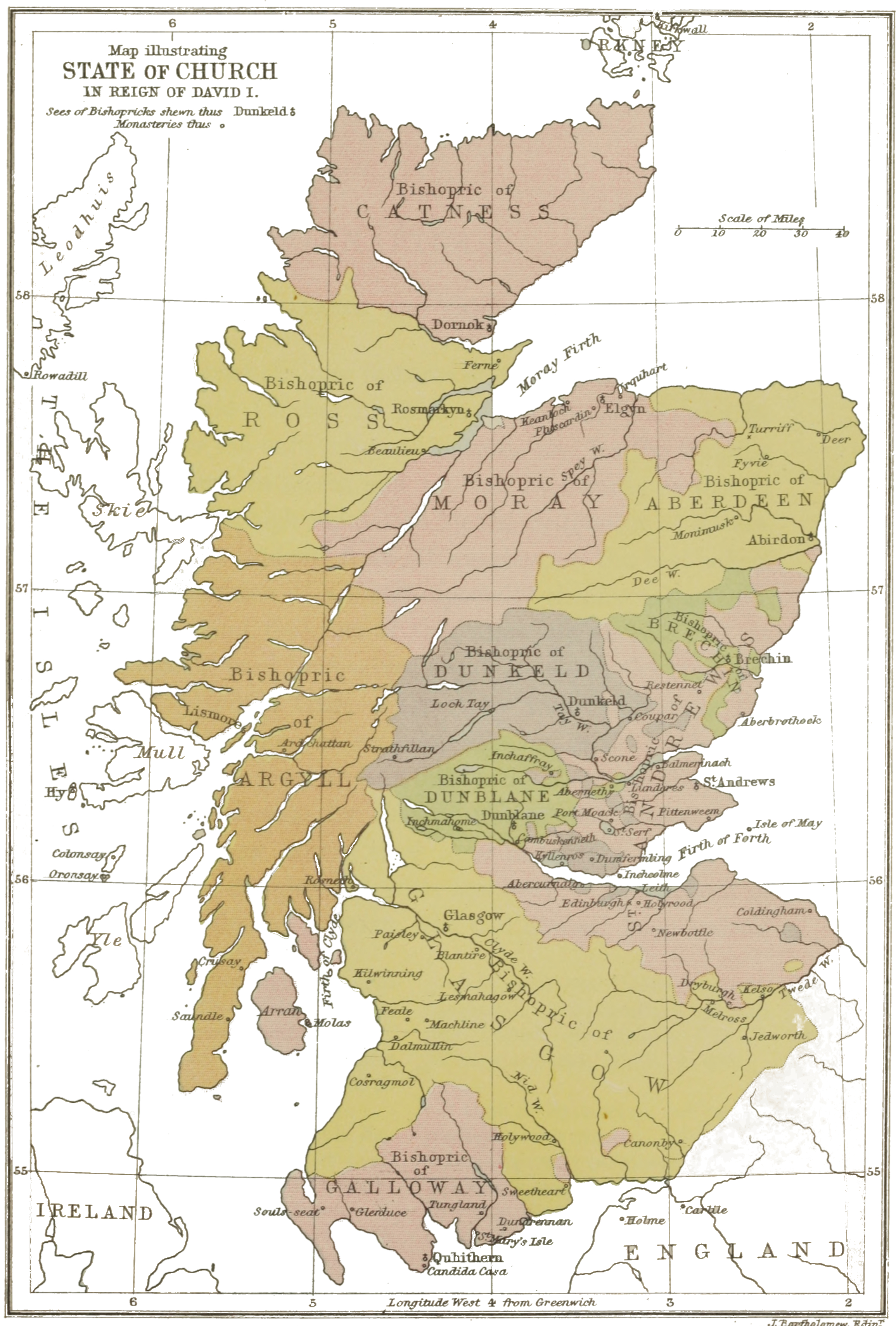
Map illustrating
STATE of CHURCH
IN REIGN OF DAVID I.
J. Bartholomew, Edinr.
419
Character of the Irish Monastic Church for learning.
One of the most striking features of the organisation of the
early Monastic Church in Ireland and Scotland was its
provision for the cultivation of learning and for the training
of its members in sacred and profane literature; so that it
soon acquired a high reputation for the cultivation of letters,
and drew to it students from all quarters, as the best school
for the prosecution of all, and especially theological, studies.
The fathers and founders of this Monastic Church had, as
we have seen, been themselves taught, some in the monastic
school of Candida Casa, where they were trained in the
rules and institutions of monastic life and in the knowledge
of the Holy Scriptures,[786] and others in the monasteries in
Wales, presided over by David, Gildas and Cadoc, wise
and learned men, where they were instructed in learning
and religion, and studied with assiduity.[787] The school of
Clonard, founded by Finnian, who had himself been trained
420in the Welsh monasteries, soon equalled them in reputation,
and from it issued those fathers of the Monastic Church
termed the Twelve Apostles of Ireland. We are told in the
life of one of them, Ciaran of Saighir, that he with other
saints of Ireland went to Finnian of Clonard, renowned for
his wisdom, and in his holy school used to read in the
divine Scriptures, and that he lived both to learn and to
hear the holy Scriptures.[788]
Resorted to by foreign students.
The Monastic Church of Ireland soon became so
celebrated as a school of learning that students flocked
to it from all quarters; and in the seventh and eighth
centuries, when intercourse between it and the continental
churches was renewed, it certainly occupied in this respect
the first position among them. Bede tells us that, when
the great pestilence devastated Ireland in the year 664,
‘many of the nobility and of the middle ranks of the Anglic
nation were there at that time, who, in the days of the
bishops Finan and Colman, forsaking their native island,
had retired thither, for the sake either of divine studies or
of a more continent life; and some of them presently
devoted themselves faithfully to a monastic life, others
chose rather to apply themselves to study, going about from
one master’s cell to another. The Scots most willingly
received them all, and took care to supply them gratuitously
with daily food, as also to furnish them with books to read
and their teaching, without making any charge;’[789] and of
Aldfrid, son of King Osuiu, who succeeded his brother
Ecgfrid, when he was slain by the Picts in 685, as king of
Northumbria, Bede says that ‘he was a man most learned in
Scripture,’ ‘that he at that time lived in exile in the islands
421of the Scots for the sake of studying letters,’ and that,
previous to his accession to the throne, ‘he had for a
considerable time gone into voluntary exile in the regions
of the Scots, for the sake of acquiring learning, through the
love of wisdom.’[790] We hear, too, in the Life of Senan, of
‘fifty Roman monks who came to Ireland for the purpose of
leading a life of stricter discipline, or improving themselves
in the study of the Scriptures then much cultivated in
Ireland, and became pupils of those holy fathers who were
most distinguished for sanctity of life and the perfection of
monastic discipline.’[791]
Iona as a school of learning.
The Monastic Church, founded by Columba in Iona, was
not behind its mother church of Ireland in this respect;
and we are told by his biographer, Adamnan, that Columba
‘never could spend even one hour without study, or prayer,
or writing, or some other holy occupation.’ He tells us,
also, of a book of hymns for the office of every day in the
week, which had been written by Columba, and of his
transcribing the Psalter. We read also of a prefect ‘learning
wisdom with them.’[792] Columba, too, appears to have
cultivated his own language and not to have despised his
native literature; for, according to a quatrain quoted in the
old Irish life,
Thrice fifty noble lays the Apostle made,
Whose miracles are more numerous than grass:
Some in Latin, which were beguiling;
Some in Gaelic, fair the tale.
And we learn, from the anonymous Life of Cuthbert, that
when King Aldfrid of Northumbria had, before his accession
422to the throne, resorted to the islands of the Scots for study,
one of these islands was that of Iona.[793]
Literature of the Monastic Church.
The remains of the literature of this period of the Monastic
Church which have come down to us bear ample
testimony to the intellectual development which characterised
it. Of these perhaps the most complete are the
works of Columbanus. Besides his monastic rule, we possess
six of his letters connected with important questions regarding
ecclesiastical matters, seventeen instructions or sermons
addressed to his monks, and one or two poetical pieces.
They are all written in Latin, and show a mastery of that
language as it was then used by ecclesiastical writers, a
thorough acquaintance with the holy Scriptures, with the
spirit and language of which they are indeed saturated, and
a perfect knowledge of the contemporary history and
literature of the church. He places the holy Scriptures
as the highest standard of authority in all matters of
Christian faith. As we have seen, he gives as the character
of his church that ‘it received nothing beyond the teaching
of the Evangelists and Apostles;’ and the same spirit is
manifested in one of his instructions, when he says,
‘Excepting those statements which either the Law or the
Prophets or the Gospels or the Apostles have made to us,
solemn silence ought to be observed, as far as other authorities
are concerned, with respect to the Trinity. For it is
God’s testimony alone that is to be credited concerning God,
that is, concerning himself.’[794] Cummian’s letter regarding
the Easter festival, also written in Latin, shows a perfect
mastery of his subject, and may compare with any ecclesiastic
423document of the time. Then we have the Latin lives
of Columba by two of the abbots of Iona; and, besides
Adamnan’s Life, we also possess his tract on the Holy
Places, works which give proof of his classical attainments
as well as his acquaintance with ecclesiastical writings.
The Scribhnidh, or scribes in the monasteries.
The seventh century, which had seen the church distracted
by the Easter controversy, the withdrawal of the Columban
monks from Northumbria, and the conformity of the church
of the northern Scots of Ireland to Rome, likewise witnessed
some other changes in its intellectual life. One was the
appearance, in the end of this century, of a functionary in the
monasteries, termed in Irish Scribhnidh, or Scribhneoir, and in
Latin ‘Scriba,’ a learned man among the monks, who was
selected for the purpose not only of transcribing and preserving
the ancient records of the monastery, but likewise
of exercising the functions of teacher and public lecturer.[795]
One of the earliest monuments of their industry is the MS.
termed the Book of Armagh. It was compiled by Ferdomnach,
‘a sage and choice Scribhnidh of the church of Armagh,’
at the instance of Torbach, abbot of Armagh, who had himself
been a scribe and lector of the church; and, as he was
only one year in the abbacy, and died in the year 808, this
fixes the date of the compilation of the book at the year
807.[796]
The Book of Armagh.
The contents of this MS. will show somewhat of the literature
424of the church at the time. The volume commences with
certain memoirs of St. Patrick, which are the oldest we now
possess, and they are followed by the Confession of St. Patrick,
an undoubtedly genuine work. After this comes St. Jerome’s
Preface to the New Testament; and then the Gospels in their
usual order. In the enumeration of the apostles in the Gospel
of St. Matthew, the name of Judas has opposite to it, on
the margin, the Irish word trogaun or wretch, and at the end
of the Gospel is the following prayer of the writer, in Latin:—‘O
God, whose mercy is unbounded, and whose holiness
passeth speech, with humble voice have I boldness to implore
that, like as Thou didst call Matthew to be a chosen
Apostle, from being a receiver of customs; so, of Thy compassion,
Thou wilt vouchsafe to direct my steps during this
life into the perfect way; and place me in the angelic choir
of the heavenly Jerusalem, that, on the everlasting throne
of endless joy, I may be deemed worthy to join with the
harmonious praises of archangels in ascribing honour to
Thee; through Thy only-begotten Son, who liveth with Thee,
in the unity of the Holy Spirit, throughout all ages. Amen.’
After the Gospels follow St. Paul’s Epistles, to which are
prefixed prefaces chiefly taken from the works of Pelagius.
Between the Epistle to the Colossians and the First Epistle
to Timothy is inserted the spurious Epistle to the Laodiceans,
which is found in a great variety of Latin MSS. of the New
Testament; and in the First Epistle of St. John the passage
concerning the witnesses (v. 7) is omitted, as it also is in the
oldest copy of the Vulgate. The Epistles are followed by the
Apocalypse, after which comes the Acts of the Apostles, an
order peculiar to this MS.; and the Book of Armagh closes
with the Life of St. Martin of Tours, written by Sulpicius
Severus, and with a short litany, or intercession, on behalf of
the writer.[797] This MS., compiled at Armagh in 807, probably
425contained the only memoirs of its patron saint which were
then known to exist.
Hagiology of the Irish Church.
The oldest lives of the Irish saints belong to the seventh
century, and the rise of the hagiology of the Irish Church
corresponds with that of the Easter controversy and with
the conformity of the church to that of Rome. It was
followed in the next century by the enshrining of the relics
of the saints most venerated. Prior to the conformity of part
of the Monastic Church to Rome in that century, we do not
find much appearance of the memory of the early fathers of
the church having been preserved in written memoirs. The
early Monastic Church, as we have seen, either knew or said
little about St. Patrick as the great apostle of Ireland; and
Cummian, who first mentions him in this century, belonged
to the Roman party, and does so in connection with the
Easter controversy. The oldest memoir of St. Patrick in the
Book of Armagh consists of what are called Annotations by
Tirechan, a bishop, who calls himself pupil of Bishop Ultan,
son of Conchubar, that is, of the bishop of Ardbraccan, whose
death is recorded in 657.[798] The second is a life of which
part only of the first book is preserved; but the second book
appears to be entire, and the headings of the chapters of the
whole of the first book are fortunately given, which affords
us some indication of the contents of the missing leaves. It
bears to be written by Muirchu Macumactheni, at the
dictation of Aedh, bishop of Sleibhte; and the names of
both appear among the subscribers to the Synod of Tara
in 697, while the death of the former is recorded in 699.[799]
Muirchu, however, prefaces his memoir by the following statement,
addressed to Bishop Aedh:—‘Forasmuch as many, my
lord Aedus, have taken in hand to set forth in order a narration,
namely this, according to what their fathers and they
who from the beginning were ministers of the Word have
426delivered unto them; but by reason of the very great difficulty
of the narrative, and the diverse opinions and numerous doubts
of very many persons, have never arrived at any one certain
track of history; therefore (if I be not mistaken, according
to this proverb of our countrymen, Like boys brought down
into the amphitheatre), I have brought down the boyish rowboat
of my poor capacity into this dangerous and deep ocean
of sacred narrative, with wildly-swelling mounds of billows,
lying in unknown seas between most dangerous whirlpools—an
ocean never attempted or occupied by any barks, save only
that of my father Cogitosus. But, lest I should seem to make
a small matter great, with little skill, from uncertain authors,
with frail memory, with obliterated meaning and barbarous
language, but with a most pious intention, obeying the
command of thy belovedness and sanctity and authority,
I will now attempt, out of many acts of Saint Patrick, to
explain them, gathered here and there with difficulty.’[800]
Now both Ultan of Ardbraccan and Aedh of Sleibhte belonged
to that part of the Church of Ireland which had
conformed to Rome; and this party seems to have fallen
back upon the traditions of the earlier church, which had preceded
the Monastic Church, and to have revived the veneration
of its great founder St. Patrick. The oldest lives of St.
Bridget, the other great saint of this earlier church, belong
also to the same period, and are attributed, one to Bishop
Ultan, and another to Cogitosus the father of Muirchu.[801]
The oldest memoir of Columba is that by Cummene, who
was abbot of Iona from 657 to 669, and it too was, as we
have seen, called forth by the Easter controversy, but was
written to maintain the authority of Columba, as the father
of the Columban Church against that of Rome, and to claim
for him a high position by the sanctity of his character and
427the possession of miraculous power and spiritual gifts.
Adamnan too, who writes the second life, was the first
abbot of Iona who gave his adhesion to the Roman party;
and it seems to have been called forth by his connection
with the Northumbrian Church. These early lives gave
rise to a great hagiologic literature, consisting of the lives of
all the leading saints and founders of churches, in which
every effort was made to magnify their power and sanctity
by a record of so-called miracles and prophecies. It is to
this literature that we are obliged in a great measure to
resort for the early history of the Celtic Church; but, for
historic purposes these lives must be used with great discrimination.
There is nothing more difficult than to extract
historical evidence from documents which confessedly contained
a mixture of the historical and the fabulous; but the
fiction, in the form in which it appears, pre-supposes a stem
of truth upon which it has become encrusted; and it is only
by a critical use of authorities of this kind that we can
hope to disentangle the historical core from the fabulous
addition.
Analysis of the Lives of St. Patrick.
The Lives of St. Patrick afford a good illustration of this.
There is a continuous series of them from the seventh
century to the twelfth. Space will, of course, not admit of
anything like a complete analysis of them, but a comparison
of the lives, in the order in which they appear to have been
compiled, will show the growth of the legendary and
fabulous additions to the real facts of his life, and the
process by which it passed, from the few leading features of
it which can be extracted from his own authentic writings,
to the extraordinary mixture of fact, legend and fable which
now makes up the popular conception of his life. The
oldest memoirs of St. Patrick are the Annotations of Bishop
Tirechan, ‘written from the mouth or book of Ultan the
bishop, whose pupil and disciple he was.’ He tells us that
he ‘found four names given to Patricius in the book of
428Ultan: Magonus, which is “clarus;” Succetus, which is
Patricius; and Cothirthiac, because he served four houses
of “magi,” and one of them, whose name was Miliuc, bought
him, and he served him seven years.’ That he was taken
captive in his seventeenth year, and obtained his liberty in
his twenty-second year, which corresponds with his own
statement in his Confession; but Tirechan adds ‘that in
seven other years he walked and sailed over the waves, and
over country parts, and through valleys and over mountains,
through Gaul and all Italy, and the islands which are in the
Terrene sea, as he says in the commemoration of his labours.’
There is no foundation, however, for this in his Confession,
except his sixty days’ wanderings through the desert before
he reached the house of his parents. Tirechan then adds,
‘He was in one of these islands, which is called Aralanensis,
for thirty years, as was testified by Bishop Ultan.’ He then
gives us the following chronological data:—‘All things which
happened you will find clearly written in his history, and
these latest wonders were fulfilled and brought to a close in
the second year of the reign of Loigaire mac Neill. From
the passion of Christ to the death of Patricius are four
hundred and thirty-six years. Loigaire reigned two or five
years after the death of Patricius. The whole period of
Loigaire’s reign was thirty-three years, as we think.’ Now
we may assume as a fixed point the death of Loigaire in the
year 463.[802] His reign, therefore, commenced in 430. His
second year brings us to 432 for the termination of St.
Patrick’s wanderings in foreign countries; and his death, if
it occurred five years before that of Loigaire, would fall in
the year 458, or, if two years only, in 461; but the Irish
Annals agree in placing under the year 458 the death of Sen
Patraic,[803] or old Patrick, which identifies him with the
Patricius of Tirechan’s Annotations. It is unnecessary for
429our purpose to advert to Tirechan’s account of his proceedings
in Ireland; but he adds at the end some further data. He
says ‘the age of Patricius, as it was delivered to us, may be
thus stated:—In his seventh year he was baptized. In the
tenth year (after) he was taken captive. Four years he
served. Thirty years he studied. Seventy-two years he
taught. His whole age was one hundred and twenty. In
four points he resembled Moses: 1st, He heard an angel
from a bush of fire. 2d, He fasted forty days and forty
nights. 3d, He accomplished one hundred and twenty
years in this present life. 4th, Where his bones are no
one knows. In the XIII year of Theodosius the emperor
Patricius the bishop was sent by Bishop Celestine, Pope of
Rome, for the instruction of the Irish, which Celestine was
the forty-second bishop of the apostolical see of the city of
Rome after Peter. Palladius the bishop was the first sent,
who is otherwise called Patricius, and suffered martyrdom
among the Scots, as the ancient saints relate. Then the
second Patricius was sent by an angel of God, named Victor,
and by Pope Celestine, by whose means all Ireland believed,
and who baptized almost all the inhabitants.’ Now here
Tirechan betrays at once the party in the church to which
he and Ultan belonged, by asserting that St. Patrick, as well
as Palladius, had been sent by Pope Celestine; and he gives
us the important fact that Palladius was also known to the
Irish by the name of Patricius. If St. Patrick had taught
for seventy-two years, and died in 458, it is plain that his
mission to the Irish must have long preceded that of
Palladius; but at the same time, as Palladius is termed by a
contemporary writer the first bishop sent to the Scots, St.
Patrick could not have been consecrated a bishop till after
him. He himself tells us that he was forty-five when he was
consecrated a bishop; and, if this took place in the year 432,
it would place his birth in the year 387; and, if he died in
458, the period of seventy-two years would thus represent
430his entire life. Tirechan has thus, by interpolating his
thirty years’ study in Gaul, and by taking seventy years as
representing his teaching in Ireland, lengthened out his life
to one hundred and twenty-three years, and thus obtained
his parallelism with Moses in this respect. If Palladius and
Patricius were known to the Irish by the same name, it is
hardly possible that, when the traditions regarding them
were first collected and formed into a regular biography in
the seventh century, they should not have been confounded
together. The mission from Pope Celestine and the thirty
years’ study in Gaul and Italy are entirely inconsistent with
St. Patrick’s account of himself, and no doubt truly belong
to the acts of Palladius.
The next life is that by Muirchu. The first membrane
of the Book of Armagh, containing the commencement of
the life, is unfortunately wanting; but the preface and the
headings of the chapters have been preserved in a different
part of the MS. The preface has already been given, and
the headings of the missing chapters are these:—
‘Concerning the birth of St. Patrick and his first
captivity.
Concerning his journeys and sea voyage to the Gentiles,
and his sufferings among the nations ignorant of
God.
Concerning his second captivity, which he suffered for
sixty days from hostile men.
Concerning his reception by his parents when they recognised
him.
Concerning his age when going to visit the apostolic see
where he wished to learn wisdom.
Concerning his discovery of holy men in Gaul, and that
therefore he went no farther.’
The fragment of the first book commences with his
journey to the apostolic see at Rome, and mentions that
Germanus ‘sent an elder with him, that is Segitius, that he
431might have a companion and witness, because he was not as
yet ordained by the holy lord Germanus to the pontifical
degree.’ It then mentions the mission of Palladius, and that
‘his disciples Augustinus and Benedictus and the rest, returning,
related in Ebmoria the circumstance of his death.’
Patrick then proceeds no farther, but goes to a certain man,
an illustrious bishop Amathorex,[804] living in a neighbouring
place, and receives from him the episcopal degree, after
which he returns to Britain. This statement, taken in connection
with the heading of the chapter, implies that St.
Patrick, though he intended to go to Rome, went no farther
than the town of Ebmoria, which must have been in Gaul,
and near it was consecrated bishop by Amathorex. St.
Patrick is in this life also brought into contact with Germanus;
but the connection with Rome is less directly stated
than in the previous life. The chronological summary at
the end of the life is as follows:—‘Patrick was baptized in
his sixth year, taken captive in his twentieth, served in
slavery twelve years, studied forty years, taught sixty-one.
His entire age was one hundred and eleven years.’ These
dates, however, when added together, make up a period of
one hundred and thirty-three years, and the process by
which his life is thus lengthened is apparent enough. His
captivity is placed in his twentieth in place of his sixteenth
year. The period of his slavery is doubled. The period of
his study with Germanus is increased from thirty to forty
years, and his mission reduced from seventy-two to sixty-one
years. But, if this latter period is deducted, his life
prior to his mission is here made to have been seventy-two
years. In the life itself, however, St. Patrick is said to
have died ‘on the sixteenth day of the Kalends of April,
having attained the age of one hundred and twenty years,
432as is celebrated every year over the whole of Ireland, and
kept sacred;’ and in the last paragraph it is more correctly
stated ‘that he was taken captive in the thirteenth year of
his age, and was in bondage six years.’ If these two numbers
are substituted for the twentieth year and the twelve years
of the summary, the entire years of his life will be reduced
from one hundred and thirty-three to one hundred and
twenty. This life also distinctly states that St. Patrick was
buried at Dunlethglaisse, or Down, while Tirechan as
distinctly states that ‘where his bones are no one knows.’
The tradition, therefore, which places his relics at Down
must have arisen after the time when Tirechan wrote. In
some additions to Tirechan’s Annotations, which appear to
have been made about the time when the rest was written,
another tradition is given. It is there said that ‘Columbcille,
instigated by the Holy Spirit, pointed out the sepulchre of
Patrick where he lies, that is to say, at Sabul Patricii,’
or ‘Saul Patrick, in the nearest church next the sea, where
the relics or bones of Columcille were brought from Britain,
and where the relics of all the saints of Ireland will be
brought in the day of judgment.’[805] The Annals of Ulster
contain the following curious entry under the year 552:—‘I
have found what follows in the Book of Cuanach,’ a
chronicle the date of which is unknown, but which cannot
be much earlier than the eighth or ninth century. ‘The
reliques of St. Patrick were deposited in a shrine, sixty years
after his death, by Columcille. Three precious swearing
reliques were found in his tomb, viz., the Coach, or cup, the
Gospel of the Angel, and the Bell of the Testament. The
angel thus showed to Columcille how to divide these reliques,
viz., the Coach to Down, the Bell to Armagh, and the Gospel
433to Columcille himself; and it is called the Gospel of the
Angel because Columcille received it at the angel’s hands.’
The church of Saul is on the sea-shore in the immediate
neighbourhood of Down; but that either Saul or Down
could have been marked out as the place where St. Patrick’s
bones were enshrined prior to the eighth century is quite
inconsistent with the distinct statement, by his first
biographer, that no one in his day knew where they were.
As we have seen, Cellach, abbot of Iona, appears to have
taken the relics of Columba to Ireland on the slaughter of
the community by the Danes in 806; and, as the Book of
Armagh was transcribed in 807, and the name of Cellach
appears on the margin of one of the leaves, it is probable
that this tradition owes its origin to him.[806]
About the same period when the Book of Armagh was
transcribed, or not long after, was written the short Life of
St. Patrick, by Marcus the Anchorite, annexed to Nennius’
History of the Britons. Marcus is said by Heric, in his
Life of St. Germanus, to have been a Briton by birth, but
educated in Ireland, where he was for a long time a bishop,
and to have at length settled in France, where he died;[807]
and his notices of St. Patrick show that he was acquainted
with the lives in the Book of Armagh. He states, correctly
enough, that Patrick had been captive in Ireland seven
years; but, when he says that ‘when he had attained the
age of seventeen he returned from his captivity,’ he confuses
his age when he was taken captive with that of his liberation.
He says that ‘by the divine impulse he was afterwards instructed
in sacred literature, and went to Rome, and remained
there a long time studying the sacred mysteries of God’—here
agreeing with Tirechan in bringing him to Rome; but
he adopts the statement of Muirchu in regard to the mission
434of Palladius, substituting the land of the Picts for that of
the Britons as the place of his death.[808] He also follows
Muirchu in Patrick’s being sent by Germanus with Segerus
to the bishop Amatheus, by whom he is consecrated bishop;
but he follows Tirechan in his statement that in four particulars
he resembled Moses, that he lived one hundred
and twenty years, and that no one knew where his sepulchre
was, adding that ‘he was buried in secret no one knowing.’[809]
He concludes his life by saying that ‘he was sixteen
years in captivity,’ here confusing the duration of his captivity,
435with his age when made captive, that ‘in his twenty-fifth
year he was consecrated bishop by King Matheus,’ and
that he was eighty-five years ‘apostle of the Irish,’ which
would give him a life of one hundred and ten years only;
but in another passage in Nennius four hundred and five
years are said to have elapsed from the birth of Christ to the
arrival of Patrick among the Scots, and sixty years from his
death to that of St. Bridget. As the latter event, moreover,
is said to have taken place four years after the birth of
Columba, which gives us a fixed date of 521, this would
place the death of Patrick in 465, and his birth, if he was
taken captive in 405, in 389, dates which very nearly correspond
with those of Tirechan, and of the older Patrick
termed Sen Patraic.
The next biography of the saint introduces some new
features into the legend. It is the hymn in praise of St.
Patrick, attributed to St. Fiacc of Sleibhte, who is said to
have been ordained by him. So early a date, however, cannot
be assigned to the poem, and it belongs in reality to the
ninth century.[810] This poem has formed the nucleus around
which a number of floating legends, whether founded on
genuine tradition or the fruit of supposititious narrative, have
clustered in the shape of a commentary or scholiasm, which
is, of course, of even later date;[811] and the two together have
given an entirely different aspect to the legendary life of the
apostle of Ireland. The so-called Fiacc commences his hymn
by giving a new name to the place of St. Patrick’s birth.
He tells us that
Patraicc was born in Nemthur, and it is this that has been declared
in tales;[812]
436And the scholiast adds, ‘That is a city which is in North
Britain—viz., Ailcluaide,’—the ancient name of Dumbarton.
This accords so far with what we gather from his own Confession,
that he was a native of the Roman province in
Britain; and we find the same place obviously referred to in
an old poem preserved in the Black Book of Caermarthen
under the name of Nevtur.[813]
The hymn then proceeds:—
A child of sixteen years when he was brought under tears.
Succat his name it was said; who was his father is to be known:
Son of Calpurn, son of Potitus, grandson of deacon Odisse.
He was six years in slavery....
437This corresponds with his own statement in his Confession;
but here the scholiast adds other names to his family, and
for the first time connects them with Armorica in Gaul.
His statement is as follows:—‘This was the cause of the
servitude of Patrick; his father was Calpuirnn; Conches,
daughter of Ochmuis, was his mother and of his five sisters,
namely, Lupait and Tigris and Liamain and Darerca, and the
name of the fifth was Cinnenum. His brother was Sannan.
They all went from the Britons of Alcluaid, across the Iccian
sea southwards, on a journey to the Britons who are in the
sea of Icht, namely, the Britons of Letha, because they had
brethren there at that time. Now, the mother of these
children, namely, Conches, was of the Franks, and she was
sister to Martin. At that time came seven sons of Sectmaide,
king of Britain, in ships from the Britons; and they made
great plunder on the Britons, viz., the Britons of Armuric
Letha, where Patrick with his family was, and they wounded
Calpuirnn there, and carried off Patrick and Lupait with
them to Ireland. And they sold Lupait in Conaille Muirthemne,
and Patrick in the north of Dal-araidhe.’[814] Here
Patrick is brought from Alcluaid, the place of his birth, to
Armorica, in order to be carried off from thence by Britons
and not by Scots; and Armorica is thus thrust somewhat
violently into his own narrative, where he distinctly implies
that he was made captive in the place of his birth.
438We are then introduced to Germanus, and told of Patrick
that
He went across all Alps—great God! it was a marvel of a journey,
Until he stayed with German in the south, in the south part of Latium.
In the isles of the Tyrrhene Sea he remained; therein he meditated;
He read canon with German; it is this that writings declare.
[815]
Here the scholiast introduces the mission of Palladius
and the consecration of Patrick by Amathorex the bishop,
whom he identifies with Amator, bishop of Auxerre, who was
the predecessor of Germanus, and died A.D. 418. He also
makes Patrick accompany Germanus to Great Britain in
429, leaving little doubt that the whole connection of Patrick
with Germanus has been transferred to him from the acts of
Palladius. The author of the hymn gives sixty years as the
period during which Patrick preached to the Irish.[816] He
mentions Armagh as the seat of his primacy, and Dun
Lethglasse, or Down, as a great church, and implies that he
died there; but the scholiast indicates Sabhall Patraic, or
Saul, as the place of his death. In the concluding lines of
the hymn we find the strange statement—
When Patrick departed, he visited the other Patrick:
It is together they ascended to Jesus, Mary’s Son.
And the comment of the scholiast is equally remarkable.
He says that the other Patrick was Sen Patrick. ‘It is what
Patrick, the son of Calpuirnn, promised to Sen Patrick, that
together they would go to heaven. And it is related that
Patrick was from the xiii. (xvi.) of the kalends of April to
the ninth of the kalends of September upon the field, and
angels around him, praying to Sen Patrick.’[817] We are here
439introduced to two Patricks, and a second Patrick has been
created, to whom the acts of the historic Patrick, so far as
they have as yet been compiled, have been transferred, while
the latter retires into the background under the designation
of Sen Patrick, or old Patrick. Their original identity,
however, is obscurely hinted at in the hymn, when they are
made to ascend to heaven together. The two Patricks
likewise appear in the ninth century in the Felire of Angus
the Culdee; and here the second Patrick comes forward,
under the 17th of March, as the great apostle of Ireland,
and the older Patrick retires to the 24th of August, when he
is designated the tutor of the former. The stanzas which
commemorate them may be thus rendered. On the 17th of
March we have
The blaze of a splendid sun,
The apostle of stainless Erinn,
Patrick with his countless thousands;
May he shelter our wretchedness.
[818]
On the 24th of August we have
The blaze of the people of Srenat
Is the tale which is heard.
Old Patrick, head of battle,
Mild tutor of our patron.
[819]
The chronology of the second Patrick was formed by
adding the sixty years, during which, according to the hymn
attributed to Fiacc of Sleibhte, he preached to the Irish, to
the year 432, when, according to Tirechan, his mission commenced,
which gives 492 as the termination of his work.
His death would thus fall on 17th March 493, and it is so
placed in an old quatrain quoted by Tighernac—
440From the birth of Christ, a true reckoning,
Four hundred and fair ninety,
Three years add to these,
Till the death of Patrick, chief Apostle.
[820]
The second Patrick thus created, with a life which lasted
one hundred and twenty years and terminated in 493, is
now regarded as the Apostle of Ireland, and to him are
appropriated the leading features of his career, while the
Patrick of the older lives retains nothing but his designation
of Sen Patrick. How much, however, the separate existence
of this older Patrick embarrassed the martyrologists, we see
from the glosses upon the Felire of Angus the Culdee, which
are comparatively of much later date, and now first connect
him with Glastonbury. The gloss on the word Srenat is
‘that is, in Gloinestir of the Gael in Saxan, that is, in
Britannia.’[821] The gloss on the last line is ‘Tutor of Patraic
of Macha;’[822] and on the margin of the MS. is written the
following note:—‘That is, old Patrick of Ros-dela in Magh
Locha; but it is more true that he is in Glastonbury of the
Gael, in the south of England, for the Scots were dwelling
there on a pilgrimage. But his reliques are in Ulster. Sen
Patraic in Armagh.’[823]
Besides the metrical life attributed to Fiacc of Sleibhte,
Colgan has collected and printed six prose lives, seven in
all. Four of the prose lives—the second, third, fourth and
seventh—are anonymous, the fifth life bears to be by a
certain Probus, and the sixth by Jocelyn of Furness, whose
date is known. It is the latest of the six, and must have
441been written about the year 1185. These lives fall naturally
into two groups.[824] The first, consisting of Colgan’s second
and fourth lives, must have been written after the Book of
Armagh and the metrical life attributed to Fiacc, but before
the compilation of the glosses added to the latter. They
give Nemthor as the place of Patrick’s birth, and place it in
the plain of Taburna, thus identifying it with the Bannaven
Taberniæ of his Confession. They make him to be carried
into captivity from thence by an Irish fleet; but they
442introduce a number of incidents, connected with his childhood,
which bear the usual miraculous character. They
know nothing of the story told by the scholiast in Fiacc’s
hymn, of the transference of the family from Alclyde to
Armorica; but the fourth life opens with the strange
statement that some thought St. Patrick was sprung from
the Jews; that, when they were dispersed after the fall of
Jerusalem, a part of them took refuge in Armorica among
the Britons, and from thence his parents migrated to the
regions of Strathclyde; but this statement is peculiar to this
life. Both of these lives make Patrick thirty years old
when he went to Germanus, with whom he studied thirty
years, and state that he preached to the Irish for sixty years,
thus adopting the chronology of the second Patrick.
The second group consists of the life by Probus, Colgan’s
third life, the Tripartite life, and that by Jocelyn. These
were all compiled later than the tenth century, and that by
Probus appears to be the oldest. He was acquainted with
the Book of Armagh, part of the lives contained in which
are inserted verbatim; but he was also acquainted with the
glosses to the hymn of Fiacc, for he inserts the story of the
migration of Patrick’s family to Amorica. He places his
birth in the Roman province (in Britanniis), in the village
of Bannauc of the Taburnian region, which region he
considers to be also the Nentrian province, where giants
are said to have formerly inhabited. But the main addition
to the incidents of Patrick’s life, which characterises this
group, is his connection with St. Martin of Tours. The
scholiast on the hymn attributed to Fiacc had already made
his mother Conches St. Martin’s sister, and St. Patrick is
now made to reside for four years with him at Tours, where
he was instructed in the rules of monastic life, and received
the tonsure; but, as St. Martin died in 397, the date is too
early for St. Patrick. On the other hand, it is probably
true of St. Ninian, who is also said to have been a nephew
443of St. Martin and associated with him, and with the dates
of whose life it is more consistent. Probus, however,
seems to have preserved one incident which is true of the
historic Patrick, when he states that, after he was ordained
priest by a bishop, whom he calls St. Senior, he preached
to the Irish before the mission of Palladius, and before his
own consecration as a bishop. This short analysis of the
lives of St. Patrick will be sufficient to show how the real
events in the life of the historic Patrick, so far as they can be
ascertained, were gradually overlaid by spurious additions,
till at length the legendary life of a spurious Patrick, as
we now have it, was developed out of it.
Lives of St.Bridget.
Besides the great legendary apostle of the Irish, the
virgin St. Bridget seems also to occupy a prominent place in
Irish hagiology. That she was a historic character, belonging
to the earliest period of the Irish Church, there seems
little reason to doubt, and it is exceedingly probable that St.
Patrick himself in his Confession alludes to her when he
says, ‘There was one blessed Scotic maiden, very fair, of
noble birth and of adult age, whom I baptized; and after a
few days she came to me, because, as she declared, she had
received a response from a messenger of God desiring her to
become a virgin of Christ and to draw near to God. Thanks
be to God, on the sixth day from that, she with praiseworthy
eagerness seized on that state of life which all the virgins of
God likewise now adopt;’ but her life too was now overlaid
with spurious tales and fabulous incidents, till it assumed an
aspect far removed from its probable reality. Space will not
permit us to analyse these lives, or to enter further into the
history of the origin and development of the great hagiologic
literature of Ireland; suffice it to mention that the two oldest
lives of Bridget are attributed to Bishop Ultan, under whose
auspices Tirechan compiled his Annotations, and to Cogitosus,
who can now be identified with the father of Muirchu, who
wrote the second life in the Book of Armagh.
Hagiology of the Scottish Church.
444Besides the Lives of St. Columba by Cummene and
Adamnan in the seventh century, the oldest lives in the
Scotch hagiology of which we can fix the dates, are the Life
of St. Ninian by Aelred, who died in the year 1166, the Life
of St. Kentigern, of which a fragment only remains, which
was written during the episcopate of Herbert, who was
bishop from 1147 to 1164, and that by Jocelyn of Furness,
written at the request of his namesake, who was bishop of
Glasgow from 1174 to 1199. These lives therefore belong
to the twelfth century, when the manipulation of the old
chronicles of Scotland had already commenced, which laid
the foundation of that fictitious scheme of history, both
civil and ecclesiastic, which was reduced to a system by
John of Fordun; and to some extent they bear the marks
of that influence. The Life of Servanus, however, which
has been preserved in the Marsh MSS. in Dublin, belongs
probably to a somewhat earlier period. With the exception
of these lives, we are dependent almost entirely upon the
lections in the ‘Propria Sanctorum’ of the Aberdeen
Breviary, and on the works of Dempster and Camerarius,
for notices of the Scottish saints; but the former were
compiled after Fordun’s great work, and are tainted
by the false chronology of his Chronicle; and the two
latter works, after the publication of Hector Boece’s
work, and are under the influence of the fictitious history
elaborated by him. The dates attached to the saints in
the Scotch Calendar are in the main fictitious, and cannot
be depended on.
Bearing of the Church on the education of the people. The Ferleiginn, or lector.
Such is a short view of the hagiologic literature of
Ireland and Scotland, which forms so remarkable a feature
in the literature of the church. Its bearing upon the education
of the people presents an equally important feature.
In the later part of the eighth and in the ninth centuries
we find a new functionary appearing in the monasteries,
and gradually superseding the Scribhnigh, or scribe. This
445was the Ferleiginn, lector or man of learning, whose functions
were more closely connected with education. He appears
first in Clonmacnois; and we find in 794 the death of ‘Colgu
Ua Duineachda Ferleiginn of Cluainmicnois, he who composed
the Scuaip-Chrabhaidh,’ recorded in the Annals of the
Four Masters. There is no doubt that he is the ‘Colcu
lector in Scotia,’ to whom Alcuin wrote an epistle.[825] It
appears from his life that he was ‘supreme moderator and
prælector of the school of Clonmacnois, and that he arrived
at such eminence in learning and sanctity that he was called
chief scribe and master of the Scots of Ireland.’[826] In the
following century the Ferleiginn appears also at Armagh,
and we are told that in the year 876 Maelrobha, son of
Cuimmhach, abbot of Armagh, was taken prisoner by the
Galls of Loch-Cuan, as was also the Ferleiginn, Mochta.[827]
During the tenth, eleventh and twelfth centuries these
lectors, or Ferleiginn, are repeatedly mentioned in the Irish
Annals in connection with the various monasteries in
Ireland.[828] They also appear in the Columban monasteries
both of Ireland and of Scotland. In 992 we find the death
of ‘Dunchadh ua h-Uchtain, Ferleighinn of Cenannus,’ or Kells,
recorded; and in 1034 ‘Macnia ua h-Uchtain, Ferleighinn of
Kells, is drowned coming from Alban with the bed of
Columcill and three of Patrick’s relics, and thirty persons
along with him.’[829] In Scotland he appears in the early
part of the reign of David I., in connection with the Columban
monastery of Turbruad, or Turriff, founded by Comgan,
where ‘Domangart, Ferleginn Turbruad, or of Turriff, witnesses
a charter by Gartnait, Mormaer of Buchan, and Eta his wife,
446to the church of Deer;’Deer;’[830] and we find him at Iona in 1164,
when the Ferleighinn Dubside appears among the prominent
functionaries of the monastery.[831] In the following century
the name of Ferleiginn is still preserved in connection with
the church of St. Andrews and its schools. Between the
years 1211 and 1216, a controversy which arose between
the prior of St. Andrews and his convent, on the one part,
and the master of the schools and the poor scholars of the
city of St. Andrews, on the other, in regard to certain
lands and dues which the latter claimed, was amicably
settled ‘with the assent and goodwill of Master Laurence,
who was both archdeacon and Ferleyn of the said city;’
and the prior and canons became bound ‘to pay to the
foresaid Laurence the Ferleighinn (Ferlano) and his
successors, at the house of the Ferleighinn (in domo Ferlani)
of the said city, for the use of the poor scholars,’ certain
dues from these lands. ‘Thus was agreement made between
the parties, and by authority confirmed, so that neither
archdeacon nor Ferleighinn (Ferlanus), nor master of the
schools, nor poor scholars, shall hereafter move controversy
against the same.’[832]
The Scolocs.
These scholars seem to have been the lowest order of
the ecclesiastical community, and to have been clerics who
were undergoing a course of training and instruction to fit
them for performing the service of the church. Their Pictish
name was Scolofthes, as we learn from Reginald of Durham,
who mentions the clerics of the church (of Kirkcudbright),
447the Scolofthes as they are called in the Pictish speech, and
gives ‘Scholasticus, a scholar,’ as its Latin equivalent. We
find them under the name of Scolocs in three of the churches
belonging to St. Andrews. In the church of Ellon, which
was of old the capital of the earldom of Buchan, they appear
in 1265 as holding certain lands under the bishop of St.
Andrews; and in 1387 the church lands of Ellon are called
the Scolog lands, and were hereditary in the families of the
Scologs who possessed them. An inquest regarding these
lands, held in that year, bears that from one quarter or fourth
part of these lands ‘there are to be found for the parish
church of Ellon four clerks with copes and surplices, able to
read and sing sufficiently;’ another quarter or fourth part ‘is
bound to find a house for the scholars;’ a third ‘is bound
to find twice in every year twenty-four wax candles for the
‘park’ or ‘perk,’ that is, the bracket or corbel before the
high altar; and the fourth quarter is bound to find a smithy.
These lands are indiscriminately called the ‘Scolog lands’
and the ‘Scholar lands,’ and are described as ‘lying in the
schoolry (Scolaria) of Ellon.’ The Scolocs are also found
in the church lands of Arbuthnot in the Mearns, which
they likewise held of the see of St. Andrews. Here, in
an inquest regarding the lands of the Kirkton of Arbuthnot,
held in the year 1206, we find the ecclesiastical territory
held by certain tenants called parsons, who had subtenants
under them, having houses of their own and cattle which they
pastured on the common; and the tenants of these lands are
termed by several of the witnesses Scolocs, and are also termed
the bishop’s men. These Scolocs were finally ejected altogether
from the land which they appear to have tilled. They
also appear at the neighbouring church of Fetteresso, likewise
belonging to the bishop of St. Andrews.[833] The name of Scoloc
is also found in connection with one of the Columban monasteries
448in Ireland; for in one of the charters preserved in
the Book of Kells, which must have been granted between
the years 1128 and 1138, we find that among the functionaries
of the monastery, after the Coärb of Columcille, or the
abbot, the Sacart or priest, the Ferleiginn or lecturer, the
Aircennech or Erenagh of the house of guests, and the Fosaircennech
or vice-Erenach, appears the Toisech na Scoloc, or
Chief of the Scologs, Aengus O’Gamhna.[834]
Influence of the Church on literature and language.
Whether there existed in Ireland a pagan literature, in
the proper sense of the term, prior to the introduction of
Christianity, and whether the art of writing was known in
any shape to its pagan population, is a very difficult question,
and one into which it is not necessary for our purpose to
enter. |Art of writing introduced.|But whether there existed among them an ante-Christian
civilisation of any kind or not, there can be no
doubt that the early Celtic Church, such as we have found
it to be, must have been a powerful agent in civilising the
people, and not less in fixing a standard of language; and
the earliest lives of St. Patrick certainly attribute to him the
introduction of the written alphabet. Thus Tirechan, having
449mentioned that Patrick had consecrated three hundred and
fifty bishops in Ireland, adds: ‘Of presbyters we cannot
count the number, because he used to baptize men daily,
and to read letters and abgetoriæ, or alphabets, with them;
and of some he made bishops and presbyters, because they
had received baptism in mature age.’[835] Of the two alphabets
known to have existed among the Irish, the one now called
the Irish alphabet, and supposed to be peculiar to the Irish
language, is, as Dr. Todd well remarks, nothing more than
the Roman alphabet, which was used over all Europe in the
fifth and some following centuries. The other, called the
Ogham, which is mainly confined to inscriptions upon stone
monuments, though it occasionally appears in MSS.,[836] is of
the same character as the Scandinavian Runes, and has now
also been clearly shown to have a post-Christian origin.[837]
Spoken dialects of Irish.
450Before letters were introduced, however, there could
have been no fixed standard of language. Each Tuath, or
tribe, had probably its own variety of the common speech;
but these all, no doubt, belonged to that branch of the
Celtic language called Gaelic. There would thus be as many
varieties of the spoken Gaelic as there were independent
tribes.[838] The tendency of language at this stage is to go
through a process of corruption and decay. It is then easily
modified by surrounding circumstances and affected by external
influences, which an oral literature, consisting of the songs
and legends of a rude people, is powerless to control. This
tendency would be arrested only when a written and cultivated
language was formed under the influence of the
Christian Church, and a common standard of the language,
in its most perfect shapes and preserving its older
forms, was established, which was spoken and written by
451the cultivated class of the community, and to a knowledge
of which a portion of the people were raised by education.
Under its influence the numerous varieties of the spoken
language became more assimilated, until at length we find
that in the main there remain only four forms of the vernacular
Irish, which were peculiar to the four great provinces
of Munster, Ulster, Leinster, and Connaught, into which the
country was divided. There was also an old division of
Ireland by a line drawn across the island from Dublin to
Galway into two parts, termed respectively Leth Cuinn and
Leth Mogha. This division was known to Bede, who distinguished
between the northern provinces of the Scots and
the nations of the Scots dwelling in the northern districts of
Ireland.[839] The northern half contained the provinces of
Connaught and Ulster and the old province of Meath, which
is now included in Leinster, and the seaboard of which
formed the plain of Bregia, or Magh Bregh, mentioned more
than once by Adamnan.[840] The southern half consisted of
the old provinces of Leinster and Munster; and the difference
in the spoken language between the northern and southern
Irish was somewhat more marked.
Peculiarities of Irish dialects.
The peculiarities in the spoken Gaelic of the four provinces
are thus expressed in the following sayings current
in most parts of Ireland:—
The Munster man has the accent without the propriety.
The Ulster man has the propriety without the accent.
The Leinster man has neither the propriety nor the
accent.
The Connaught man has both the accent and the propriety.[841]
The difference in these four dialects is mainly in words,
pronunciation, and idiom; but the grand difference between
452the vernacular Irish of the northern and that of the southern
part of Ireland consists in the position of the accent, in the
vowel sounds, and in the form of the verb. In the north
the primary accent is on the root of the word, or the first
syllable, and the secondary accent on the termination; but
in the south the primary accent is on the termination, and
the secondary accent on the root, if short.[842] The vowel
sounds vary very much, their most perfect pronunciation
being in Connaught. In the verb, the analytic form—or
that in which the verb has a common form for all the
persons, and these are expressed by separate pronouns,
while the auxiliary verb is more employed—is used in the
spoken language of the north, and principally in Ulster.
The synthetic or inflected form, which is the more ancient, is
generally used in the south of Ireland; and in this respect it
approaches more closely the forms of the written or cultivated
language, and shows a less degree of corruption than
the vernacular of the north.
Written Irish.
In the written Irish, the more ancient verbal forms have
been preserved in their entirety, and there is a complete
system of inflections, with a very copious vocabulary, of
which several glossaries have been preserved. The most
ancient is that attributed to Cormac mac Cuilennan, king
and bishop of Cashel, who was killed in the year 903; and
the greater part of it undoubtedly belongs to that period.[843]
There has also been preserved an ancient Grammar termed
Uraicecht na m-Eiges, or Precepts of the Poets, which is
certainly not much later in date;[844] but Zeuss’ great work,
the Grammatica Celtica, exhibits the grammar of this written
language in its most complete shape, as he has constructed
it from materials furnished by MSS. of the eighth and ninth
centuries.
Scotch Gaelic.
453Such being, in the main, the position of the Gaelic language
in Ireland and the relation between the written and
cultivated language and the spoken dialects, we find that
Scotland presents to us, in connection with the distribution
of her languages, somewhat peculiar phenomena, which are
more difficult of solution. If a line is drawn from a point
on the eastern bank of Loch Lomond, somewhat south of
Ben Lomond, following in the main the line of the Grampians,
and crossing the Forth at Aberfoil, the Teith at
Callander, the Almond at Crieff, the Tay at Dunkeld, the
Ericht at Blairgowrie, and proceeding through the hills of
Brae Angus till it reaches the great range of the Mounth,
then crossing the Dee at Ballater, the Spey at lower Craigellachie,
till it reaches the Moray Firth at Nairn—this
forms what was called the Highland Line, and separated
the Celtic from the Teutonic-speaking people. Within
this line, with the exception of the county of Caithness
which belongs to the Teutonic division, the Gaelic language
forms the vernacular of the inhabitants, and beyond it
prevails the broad Scotch. The one is as much a dialect of
Irish, and is substantially the same language, as the other is
of the Anglic or Anglo-Saxon. There are small and unimportant
provincial varieties observed in both; yet each
forms essentially one dialect; and Scotch Gaelic must be
viewed as simply a provincial variety of the spoken Gaelic,
of the same class as the provincial varieties of the vernacular
Gaelic in Ireland. It exhibits some differences which are
peculiar to itself. In other points it corresponds with one
or other of the Irish dialects. The primary accent in Scotch
Gaelic is invariably on the first syllable of the word, and
the analytic form of the verb, with the use of the auxiliary
verb, is preferred to the synthetic. In these respects it
corresponds with the spoken language of the north of Ireland,
and its vowel sounds approach most nearly to those of the
Connaught dialect. Scotch Gaelic is, in fact, so far, more
454closely allied to the northern Irish than the latter is to the
spoken language of the south; but there are other peculiarities
of Scotch Gaelic which seem due to influence from
another quarter. It forms the genitive plural of some nouns
by adding the syllable an, in which it resembles Welsh
forms. It does not use that phonetic change of the initial
consonant, termed by Irish grammarians ‘eclipsis.’ It drops
the final vowel in some substantives, and the future tense of
its verb resembles the present tense of the Irish verb, while
for the present it uses the auxiliary with the present participle.
These peculiarities Scotch Gaelic shares with Manx,
or the Gaelic of the Isle of Man; and it indicates that this
vernacular form of Gaelic had been arrested at a somewhat
later stage in its process of disintegration than the northern
dialects of Irish.
Origin of the Scotch Gaelic.
The whole of the mountain region of Scotland with its
islands within the Highland line, with the exception of Caithness,
thus possessing a dialect of spoken Gaelic which must
be ranked with the vernacular dialects of Ireland, the natural
inference is that it must at all times have been peopled by
a homogeneous race. But when we inquire into the elements
which enter into its early population, we find that, prior to
the ninth century, it consisted, in name at least, of two different
races. In that part of Argyllshire which formed the
kingdom of Dalriada, with the islands south of the promontory
of Ardnamurchan, were the Scots, who unquestionably
immigrated from Ireland in the beginning of the sixth
century; while the whole of the rest of this region, with the
islands north of Ardnamurchan, was peopled by the Pictish
tribes. If these two races were not homogeneous, the question
arises, How did this Gaelic dialect spread over the whole of
it? To this question Irish writers usually return a very
short and ready answer. They tell us that the Irish colony
of Scots spread gradually over the western districts; that
in the ninth century they subjugated the Picts; that the
455Pictish population was superseded by the Scottish; and that
the language spoken by the Highlanders was invariably
termed by them Erse or Irish. This solution will not,
however, stand the test of investigation. The former part
of the statement, when compared with the ascertained facts
regarding the relative position of the two races, requires an
assent to a philological proposition which is almost impossible;
and the latter assertion is not true. It is obvious
from the statements of both Adamnan and Bede that, as
late as the eighth century, the Scots of Dalriada were still
confined within those mountain barriers which separated
them from the great Pictish race; and, however we may
view the revolution which took place in their relative
position, it is obvious that the spoken dialect which prevailed
over the rest of the Highlands prior to the ninth
century, whatever it was, could not have been derived from
the Scots of Dalriada. But is it credible that a language
spoken in such a mountainous and inaccessible region as the
northern and eastern Highlands, with the islands north of
Ardnamurchan, could have so entirely disappeared as to
leave not a trace even in its topography? Though we do
not possess written evidence of the early speech of this part
of the country, we have a record in the names of its great
natural features—its mountains, its lochs, and its great
rivers; and all experience tells us that, though the population
of a country may change, these generally remain
unaffected by it, and retain the stamp of its earliest race, by
whom these names were imposed. We find that the names
of farms and homesteads, houses and villages, may change
and bear the impress of each succeeding population; but
those of the grand and unchangeable features of a country
bearing the physical aspect of Scotland remain unchanged,
and these names, throughout the whole of the districts
peopled by the northern Picts, are unmistakably Gaelic.
There may enter into these names some vocables which are
456not intelligible in the modern vernacular Gaelic; but it
must be recollected that the names were imposed at a much
earlier stage of the language, and we usually find that they
are obsolete words of the same language, and are preserved
in the old glossaries.[845]
But, further, the phenomena exhibited in these districts
of Scotland, in the relation of the early races which peopled
it to the language which we find at a later period pervading
the whole range of country, are not very dissimilar from those
which appear to have existed at a much earlier period in
the north of Ireland. There we find the tradition that the
Pictish race once extended over the whole of the north of
Ireland; and the remembrance of the Pictish kingdom of
Ulster, with its capital of Emhan Macha, or Emania, is
preserved almost to historic times. The remains of this
Pictish race still existed, within the historic period, in the
457smaller kingdom of Dalnaraidhe, or Dalaradia, and in the
plain of Bregia in Meath; and their close connection with
the Picts of Scotland was not dissevered till the middle of
the sixth century. Here, too, we have an extended Pictish
race, over which however the race of the Scots were more
rapidly, and at a much earlier period, superinduced, and the
same phenomena of the spoken language of the whole
country forming one dialect of that branch of Celtic termed
Gaelic, while there is no trace of any other language having
prevailed. We may therefore infer that the language spoken
by the Pictish race which peopled the Highlands and Islands
likewise belonged to the Gaelic branch of the Celtic, and
that, like the Irish, before a cultivated standard of language
was formed by the introduction of letters, it was characterised
by local varieties of speech, and that there were as
many dialects, in the most limited sense of the term, as
there were districts and tribes. We do not find, however,
that St. Columba, when he commenced his mission among
the Picts, had any difficulty in conversing freely with
them, or preaching the Word intelligibly to them. There
are only two instances mentioned by Adamnan where
he had to call in the aid of an interpreter, and in both
cases it was resorted to in preaching the Word of Life,
and not in conversing. These are the cases of the old
chief of the Geona cohort, who came by sea to the
north end of Skye, and of a peasant in the province of
the Picts;[846] but we are not told to what part of the
country these men belonged, and the dialect of one part
may have been more removed from the Irish form of it
than that of another.
A written language introduced by Scottish monks.
A very powerful agency, however, was soon brought to
bear upon the language of that part of the country, that,
namely, of the Christian Church. Whatever may have been
the case in Ireland, it is unquestionably to the Columban
458Church issuing from Ireland that the northern Picts owed
the introduction of letters and of a written language. For
centuries her clergy were entirely Scottish, and the instruction
of the people and the education of the young was
in the hands of the Scottish monks of the Columban Church.
By them the standard of the written Irish was introduced.
It became the language of the church, the monastery and
the school. There was, probably for generations, not a
Pictish child, who secured any education at all, who had not
learned his alphabet and been taught to read by a Scottish
monk. And with the spread of knowledge and of cultivation
there must have arisen a coalescing of the numerous
varieties of the vernacular into one spoken dialect, and the
assimilation of the whole to the cultivated language of
Ireland. Towards the close of the period during which this
Celtic Church was predominant, and just before its extinction,
we have a specimen of the written language of the
Columban Church in the Book of Deer. It is a MS. which
belonged to the church of Deer, one of the few Columban
monasteries in the Pictish territory which retained its
clerical character throughout. It contains the Gospel of
St. John, portions of the other three Gospels, the fragment
of an office for the visitation of the sick, and the Apostles’
Creed, all in Latin, and is written in a character which may
be ascribed to the ninth century. A few of the rubrics in
the office for the visitation of the sick are, however, in Irish,
and, as was usual in such monasteries, there are written on
the blank pages notices in Gaelic, written in the Irish
character, giving the legend of the foundation of the church,
and memoranda of the different grants of lands and
privileges made to it. These are all in the same handwriting,
and appear to have been written in the early part
of the reign of David I. They thus furnish us with a
specimen of the written language of the period, and, though
it possesses some unimportant peculiarities, it is unquestionably
459identic with the written Irish of the period.[847] Not
long after, we find the vernacular Gaelic appearing under
the name of the Albanic, or language of Alban, and exhibiting
some of the peculiarities of the Scotch Gaelic. Jocelyn
of Furness, who wrote in the twelfth century, gives us in
his Life of Kentigern two etymologies of the saint’s name.
One is unquestionably from Cymric, or the Welsh language;
but in the other the interpretation is derived from the
Gaelic. He says that ‘not in vain, but of set purpose, had
he been called Kentigern by Servanus, because by the will
of the Lord he sought to become the head lord of all, for
Ken is “caput” in Latin, and the Albanic Tyern is interpreted
“dominus.” in Latin.’[848] Cen, now Ceann, however, is
‘the head’ both in Irish and Scotch Gaelic, and Tyern is
the phonetic spelling of Tighearn, Lord, in Scotch Gaelic,
the Irish form of which is Tighearna, thus showing the elision
of the final vowel peculiar to Scotch Gaelic. The written
language, however, he appears to term Scotic, when he says
that he had ‘found a little volume, written in the Scotic
dialect, filled from end to end with solecisms, but containing
at greater length the life and acts of the holy
bishop.’[849]
Gaelic termed Scottish, and Lowland Scotch, English.
During the last two and a half centuries of this period
the intercourse between the north and west of Scotland and
Ireland had, to a great extent, been interrupted by the Norwegian
conquest of the Western Isles, and the formation of
the Norwegian kingdom of the Isles; but the rise of the
Celtic chief Somerled, and the foundation of the dynasty of
460Gaelic Lords of the Isles in his descendants, renewed the
intercourse with Ireland; and we find that, during the three
centuries in which these powerful Celtic kinglets ruled over
the western Highlands and Islands, there was not only a
close political connection with Ireland, but the literary influence
was equally close and strong, and Ireland was resorted
to for instruction in the literature and written language of
the country. It was at the commencement of this period,
that the name of Scotia became finally and absolutely transferred
from Ireland to Scotland, and superseded the older
name of Alban, or Albania; and, during the whole of this
period, the name applied to the Gaelic language of Scotland
was that of Scotic, or Scotch. We find abundant evidence
of this during the earlier portion of this period, when the
term ‘Scotice’ is invariably applied to the Gaelic forms of
the names of places. Thus, in the ‘Descriptio Albaniæ,’ in
the twelfth century, the river Forth is said to be called
‘Scottice Froch, Brittanice Werid, Romane vero Scottewattre,’
the term Roman being here curiously enough applied to the
Anglic. A charter by William the Lion mentions that
spring near Karel ‘quæ Scotice Tobari nuncupatur;’ and
the same designation for the Gaelic language of Scotland
appears frequently in the Chartularies, while the term Anglic
is used for the Teutonic. Thus, in a perambulation of the
lands of Kingoldrum in Forfarshire, in 1256, we have
‘Hachethunethouer quod Anglice dicitur Midefeld,‘ and
‘Marresiam quamdam quæ Scotice dicitur Moynebuche.’[850]
And in the fourteenth century Fordun gives us a very
distinct account of the distribution of the vernacular dialect
in his day. He says, ‘The manners and customs of the
Scots vary with the diversity of their speech. For two
languages are spoken amongst them, the Scottish (Scotica)
and the Teutonic (Theutonica); the latter of which is the
461language of those who occupy the seaboard and plains, while
the race of Scottish speech (Scoticæ linguæ) inhabits the
Highlands and outlying districts.’[851]
Α.D. 1478-1560.
Period of neglected education and no learning.
The dynasty of the Celtic kings of the Isles came to an
end in 1478, when the last Lord of the Isles was forfeited;
and there followed upon their fall a period of great confusion
in the Highlands, when the clans which had been
united under their sway were thrown loose, and struggled
for the possession of their lands. During this period of
darkness education was neglected, and all knowledge of the
cultivated or written Irish seems to have perished out of
the land. It is during this period that a solitary exception,
Dean Macgregor of Lismore, endeavoured to rescue from
oblivion the oral literature of the Highlands by transcribing,
in 1512, such poems as he could collect; but he was fain to
write them down in a phonetic spelling, which has rendered
his collection valuable, as indicating the pronunciation of
the language at the time, and the degree of divergence
between the spoken dialects and the standard Irish.[852] His
collection, however, contains also several poems by Irish
bards, and among others some of a religious cast by Teague
og O’Huggin, whose death is recorded in the Annals of the
Four Masters in 1448 as ‘chief preceptor of the poets of
Erin and Alban;’ and the same annals record in 1554 the
death of Teague O’Coffey, ‘chief teacher of poetry in Erin
and Alban.’ A contract of fosterage, by Sir Roderick
Macleod, in 1614, in Gaelic, has been preserved, which is
written in the Irish character; but it is evident that he had
to resort to Ireland for his scribe, as the writer of it is
obviously an Irishman, and he alone subscribes as a witness
in the Irish written language, the three other witnesses all
bearing Gaelic names, and two of them, respectively
462ministers of Duirinish and Bracadale, in Skye, being unable
to do so.[853]
After 1520 Scotch Gaelic called Irish, and the name Scotch passes over to Lowland Scotch.
The spoken language of the Highlands now begins to be
called Irish in place of Scotch. John Major, who wrote in
1520, not long after the Dean of Lismore had made his
collection, thus describes the languages in his day: ‘In the
island of Britain there are three different languages, as we
know, which are mutually unintelligible. The first towards
the south is the Welsh (Vallica), which the Britonised
Britons use. The second, more extended than the first, the
wild Scots and Islanders use, and this is Irish, though somewhat
broken (Hibernica licet quodammodo fracta). The
third language, the principal one in the island, is the English
(Anglicana), which the English and the civilised Scots have.’[854]
Thus, what Fordun called Scotica in the fourteenth century,
John Major calls Hibernica in the sixteenth; and what
Fordun termed Teutonica, Major calls Anglicana. The expression
used by John Major, with regard to the Gaelic
spoken in the Highlands and Islands, shows that the differences
between it and the written language of Ireland were then
quite apparent. While, however, all learning had perished
out of the Gaelic-speaking part of the country, there had
arisen a literature in the language of the lowlands. Barbour,
who was archdeacon of Aberdeen, leads the way not long
after Fordun’s time; but he terms the language in which he
wrote ‘Inglis,’ or English.[855] He was followed in the next
century by Wyntoun, prior of Lochleven, in his Metrical
Chronicle. But Gawin Douglas, who wrote in the same
Lowland dialect in 1516, terms the language in which he
wrote ‘Scottés,’ or Scotch. We thus find in the beginning
of the sixteenth century the term Scotic, or Scotch, passing
from the written Gaelic to the Anglican dialect of the Lowlands,
463and the spoken Gaelic of the Highlands coming to be
denominated Irish.
After Reformation Scotch Gaelic becomes a written language.
The Reformation, however, soon after gave rise to a
religious literature, which was printed for the use of the
Gaelic-speaking people; but here too it became necessary to
resort to Ireland for the written language. Bishop Carsewell
printed, in 1567, a translation of John Knox’s liturgy, with
a prefatory epistle, in which he says that ‘we, the Gael of
Alban and Erin, have laboured under the want that our
dialects of the Gaelic have never been printed;’ and the
language he uses is unquestionably the written Irish of the
time. In the following century translations of the metrical
version of the Psalms, of Calvin’s Cathechism, and of the
Bible, were printed in Gaelic by the Synod of Argyll and by
the Rev. R. Kirke of Balquhidder. These were thoroughly
Irish in form, and the latter was simply taken from the Irish
version of the Bible. Various editions of the Bible were issued
in the succeeding century by the Society for Propagating
Christian Knowledge in Scotland; but, from the divergence
which now existed between the spoken language of the
people and the written language of Ireland, it was found
that these translations were not readily understood, and in
each succeeding edition they were brought nearer to the
spoken idiom, till, for the cultivated Irish, which formed
their written dialect in common with Ireland, there was
now substituted a written Scotch Gaelic, in all respects
assimilated to the spoken language. There can be little
doubt that the spoken or vernacular language remained
throughout pretty much the same, exhibiting in a greater or
less degree those features which distinguished it from the
spoken dialects of Ireland; and to this language the
Highlanders themselves have never given any other name
than the simple designation of Gaelic. It possessed, too, an
oral literature in the popular poetry and prose tales of the
Highlanders, handed down by recitation; and in 1741 a
464vocabulary of this Scottish Gaelic was first printed by
Alexander Macdonald, schoolmaster of Ardnamurchan, a
scholar and a good Gaelic poet. Ten years later he printed
a collection of his own poems, written in the vernacular
dialect of the Highlands. To this work he gave the title of
‘Resurrection of the Ancient Language of Alban,’[856] and in
the preface announced that it was only the prelude to a
greater collection of poetry ‘from those of the earliest
composition to modern times; their antiquity either proved
by historical accounts, or ascertained by the best traditions;
with a translation into English verse, and critical observations
on the nature of such writings, to render the work
useful to those that do not understand the Gaelic language.’[857]
It is to be regretted that he never carried this intention into
effect. In 1764 the poems of Duncan Ban Macintyre, also
composed in the vernacular, were printed, and these collections
were followed by numerous others, till this oral
literature of the Scottish Gaelic, too, assumed a written
form.
And thus, at length, has been created a standard of
written Scotch Gaelic, which has stereotyped the language
spoken by the Highlanders in its native form and idiom.
465
467
BEING
A DISCOURSE ON HIS LIFE AND CHARACTER
DELIVERED TO THE BRETHREN ON HIS FESTIVAL.
TRANSLATED FROM THE ORIGINAL IRISH TEXT BY
W. MAUNSELL HENNESSEY, Esq., M.R.I.A.
The following is a literal translation of the Irish Life of St.
Colum Cille, as contained in the Leabar Breac (Royal Irish
Acad. Library, indicated by the letters L. B. in the foot-notes),
collated with another copy preserved in the Book of Lismore in the
same library (distinguished in the notes by the letter L.), and with
the text of a Gaelic MS. in the Advocates’ Library, Edinburgh
(indicated in the notes by the letters A. L.).
Of these texts, that of the Leabar Breac (L. B.), transcribed
about the year 1397, is certainly the oldest, not only as regards the
date of transcription, but also as regards the language, which is
remarkably pure, and may be considered as fairly representing a
text composed some three centuries before.
The second in point of age is the text of the Book of Lismore
(L.), which was copied about the year 1460. The narrative agrees
pretty closely with the account of St. Colum Cille’s Life in the
Leabar Breac; but the language in L. is much more modern than
that of the latter MS., and seems to have been reduced by the transcriber
of L. to the standard of the time in which he wrote.
The date of the Advocates’ Library MS. (A. L.) is apparently a
little more recent than that of the Book of Lismore (L.), with the
text of which, however, A. L. agrees, as far as the contents of both
MSS. correspond.
The Leabar Breac account may be regarded as the original from
468which the narrative in the Book of Lismore has been taken, notwithstanding
that the curious specimens of Latinity with which the
Leabar Breac text is interlarded are wanting from the latter, as
they are also wanting from the MS. A. L. But the copy in the
Advocates’ Library MS. must have been taken from some independent
authority, as it contains several paragraphs not found in the
Leabar Breac or Book of Lismore. This additional matter has
been included in the following translation, enclosed within brackets,
as at pp. 482, 488, 504, 505-507.
The insertion beginning with the bracket on p. 494, and ending
with the bracket on p. 502, has been translated from the copy of the
Amra (or Eulogy) of St. Colum Cille, composed by Dallan Forgall,
contained in A. L., compared with copies of the same curious tract
in the Leabar Breac and in the Yellow Book of Lecan (Trin. Coll.,
Dublin).
The following account of St. Colum Cille is rather a sermon than
a ‘Life,’ as the author here and there speaks as if addressing a congregation
on the occasion of commemorating the Saint’s festival.
(See pp. 473-507.)
Such as it is, however, the reader may regard it as a very literal
translation from the original.
Exi de terra tua, et de cognatione tua, et de domo patris
tui, et vade in terram quam tibi monstravero. ‘Leave thy
country and thy land, thy kindred and natural inheritance,[858] for
my sake, and go into the land which I shall show unto thee.’
The Lord Himself it was that gave this friendly counsel to
the head of the perfect faith and perfect religion—viz., to Abraham,
son of Thare—that he should leave his own country and
land, i.e. the land of the Chaldees, and go in pilgrimage into the
country which God had shown to him, viz., the Land of Promise.
Moses, also, the son of Amram, the leader of God’s people,
the man who was filled with the grace and abundance of the
Holy Spirit—’twas he that wrote this holy narrative[859] beyond in
469the genesis of the law, in order that the friendly counsel
which the Lord Himself gave to Abraham in imposing[860]
pilgrimage upon him might abide always with the church,
when He said, Exi de terra, ‘Leave thy country and thy land
for my sake.’
Haec quidem historia[861] nota est, Abraham a Domino
preceptum fuisse ut terram Caldeorum desereret et
terram repromissionis[862] adiret. ‘It is a famous story in the
Scriptures, the Lord Himself imposing it on Abraham to leave
the land of the Chaldees, which was his rightful patrimony,
and go in pilgrimage to the Land of Promise, because of the
benefits that would arise therefrom to himself, and to his
children, and to their race after them.’
Iste autem Abraham caput fidei est, et pater omnium
fidelium, sicut dicit Apostolus. ‘The man, moreover, to
whom God gave this counsel, viz., Abraham, he it is that is
reckoned in the Scriptures as father of all the faithful, as the
Apostle certifies when he says Omnes qui sunt ex fide, hii
sunt filii Abrahæ: “they are truly the sons of Abraham,”
says the Apostle, “all those who imitate the perfect faith.”’
Quod autem patri fidelium precipitur,[863] hoc omnibus
filiis ejus implendum relinquitur, ut terram suam
deserant et carnalem patriam derelinquant. ‘The
good [counsel],[864] then, that God enjoined here on the father of
the faithful, viz., on Abraham, is also required to be observed
by his sons after him, viz., by all the faithful, to wit, that
they should abandon their country and land, their wealth and
worldly delight, for the Lord of the elements, and go in
perfect pilgrimage after his example.’example.’
Tres autem sunt modi vocationum. ‘In three ways,
moreover, the people[865] are called to the knowledge and friendship
of the Lord.’
470Primus ex Deo. ‘The first way is, firstly, the inciting[866] and
inflaming of the people by the divine grace, that they may come
to serve the Lord, after the example of Paul and the monk
Anthony, and of the other faithful monks who served God
yonder in Egypt.’
Secundus per hominem. ‘The people are called, then, in
the second way through man, viz. through the holy preceptors
who preach in the divine Scriptures to the people, after the
example of the Apostle Paul, who preached to Gentiles, until he
brought them by the net of the Gospel to the harbour of life.’
Tertius ex necessitate. ‘The people are called, then, in
the third way, through necessity, viz., when they are forced to
serve God through tribulations and perils of death, or through
parting with their temporal goods,[867] according to the example of
the people of Israel, who frequently turned to the Lord from the
worship of idols and images when forced to do so by the troubles
and hardships they suffered[868] from the stranger tribes, as is related
in the Holy Scriptures.’ Hinc David dicit. ‘And it is to illustrate
this the prophet David says, “Clamaverunt ad Dominum
cum tribular[u]ntur, et de necessitatibus eorum liberavit
eos.”’ ‘When the people of Israel would experience[869] great
tribulations and hardships, they used to implore and beseech the
Lord until He used to free them from those hardships.’
Abraham igitur divina gratia instinctus mandatum
quod fuerat ei imperatum a Domino implevit,[870] et exiit[871] in
Haran,[872] in qua mortuus est pater ejus, et inde transmigravit
in terram repromissionis.[873] ‘Abraham, then, the head
of perfect devotion, and of the perfect faith, when prompted by
the divine grace, fulfilled the commandment imposed on him
by the Lord—viz., he went into the land of the Chaldees [to
471Haran,[874] where his father died; and went from thence] to the
Land of Promise.’
Tribus autem modis patria deseritur, uno inutili et
duobus utilibus. ‘There are also three modes by which one
leaves his patrimony when he goes as a pilgrim; and there is
one of them for which no reward is obtained from God, and
[there are] two for which it is obtained.’
Aliquando enim patria corpore tamen relinquitur,
nec mens a carnalibus studiis alienatur, nec bona opera
appetuntur. ‘That is because[875] sometimes one leaves his patrimony
in the body only, and his mind abstains[876] not from sins and
vices, and he yearns not to do acts of virtue or good works.’
In tali igitur peregrinatione nil nisi afflictio corporis
sit, nullus vero anime profectus. ‘From the pilgrimage
that is performed so, moreover, neither fruit nor profit[877]
arises to the soul, but vain labour and motion of body; for it
is little profit to one to abandon his fatherland, unless he does
good away from it.’[878]
Nam et postquam Abraham corpore patria exivit,[879] tunc
ei[880] dominus dixit. ‘For even Abraham himself, it was after
he had left his own country, and after separating from it according
to the body, that the Lord gave him this counsel, when He
said, “Exi de terra tua,” “Withdraw thy mind henceforth
from thy country and from thy land, and let not thy intention
be towards returning to it again.”’
Ac si aperte diceret, carnalia vitia patriæ in qua
fueras corpore, mente simul et corpore devita. ‘As if it
was what God Himself would openly say to Abraham, “Avoid in
body and mind from henceforth, in thy pilgrimage, the sins and
vices of the country in which thou didst formerly abide according
to the body;” for it is the same to one as if he would abide[881] in
472his fatherland, if he followed the customs of his fatherland in
his pilgrimage.’
Non enim in via pedum sed in via morum proximatur
ad Dominum. ‘For it is not by way of foot, nor by motion of
body, that one draws nigh unto God, but through the exercise[882]
of good customs and virtues.’
Aliquando mente tamen patria relinquitur et non
corpore sicut sunt quidam qui quamvis in patria peragunt
vitam regione, patriam tamen vivendo carnaliter non
norunt, sed justis causis quibusdam cogentibus in suis
locis manent habitantes quasi non habitantes. ‘Another
time, however, one leaves his fatherland from zeal of heart and
mind, although he leaves it not in body, as happens to the dignitaries
who spend their lives in their own countries until death,
because laics and clerics[883] detain them in the lands in which they
may be, on account of the extent of their usefulness to all; and
because that it is not through[884] carnality they remain in their
fatherland, their good-will[885] comprehends pilgrimage for them
with the Lord.’
Aliquando mente et corpore, ut sunt hii quibus
dicitur. ‘Sometimes, moreover, one leaves his country altogether
in body and mind, as the Apostles and the people of the
perfect pilgrimage left it, to whom the Lord promised great
benefits in the Gospel, when He said, “Vos qui dereliquistis
omnia propter me, patrem et matrem, uxorem
filios et filias, agrum et omnia quae habere potuistis,
centuplum accipietis in hoc saeculo, et vitam eternam
in futuro.” “Make sure of this,” said Jesus, “little or
much[886] as you have abandoned for my sake your country and
kindred, your possessions and worldly pleasures, that you shall
receive a hundred times the equivalent of good from me here
473in this world, and in the perpetual life beyond after the
judgment of doom.”’
Hii sunt veri peregrini[887] qui cum psalmista possunt
dicere. ‘These are truly the people of the perfect pilgrimage
in whose persons the prophet said, in proclaiming and giving
thanks to God, “Advena sum apud te, Domine, et peregrinus
sicut omnes patres mei,” “I give thee thanks for it, O God,”
says the prophet, “that I am in pilgrimage and exile in the
world, after the example of the seniors[888] who have gone before.”’
Multitudes of the faithful servants of the Lord, moreover,
both of the Old and New Testament, have perfectly observed
this profitable counsel, viz., left their country and land, their
patrimony and kindred, for the sake of the Lord of the elements,
and went in voluntary pilgrimage to far distant countries, in the
same way as he observed it, and abandoned his natural inheritance
for the love and fear of the Lord—the eminent saint and eminent
sage, and the elect son of God, for whom there is a festival and
commemoration at the occurrence[889] of this season and time, i.e.
Sanctus presbyter[890] Columba, viz., the illustrious priest of Inis-Gaidel,[891]
the battle-brand who was endowed with the talents and
various gifts of the Holy Ghost, to wit, the person[892] Saint Colum
Cille, son of Fedlimidh [son[893] of Fergus Cennfoda, son of Conall
Gulban, son of Niall Naoighiallach].
When the Christians, moreover, celebrate the festival and
solemnity of Colum Cille’s obit, is on the fifth of the ides of June,
as regards the day of the solar month[894] every year, in this day to-day,
etc. The learned of the Gaidel likewise relate, at that time
every year, a few particulars[895] in illustration of the good family
and nobility of Saint Colum Cille, and also of the innumerable
474prodigies and miracles the Lord wrought for him in the world
here, and of the distinguished end and termination He ultimately
granted to his victorious career, viz., his reaching to his own true
patrimony and true inheritance, i.e. to the possession of Paradise
in the presence of God for ever.[896]
Noble, then, was the family of Colum Cille in respect of the
world, viz., of the race of Conall son of Niall was he.[897] He
was eligible to the kingship of Eriu according to family,[898] and
it was offered[899] to him, if he himself had not abandoned it for
God.
It is manifest, moreover, that he was an elect son of God,
because the patron saints[900] of Ireland were foretelling him before
his birth. In the first place, the senior of the priests of Ireland,
viz., Old Mochta of Lugbad,[901] foretold the person Colum Cille, one
hundred years before his birth; for on one occasion Mochta’s
cook, MacRith his name, went with a cup of nuts in his hand for
him, whereupon Mochta said to him, ‘Not mine,’ said he, ‘is
the land from which those nuts were brought; preserve them
until the person comes whose land it is.’ ‘When will that time
come?’ asked the cook. ‘At the end[902] of a hundred years,’ said
Mochta.
Mochta was wont, then, to turn his face towards the north
when praying. His people used to ask him why he did so; ut
dixit[903] to them:—
A youth shall be born out of the north,
Ireland shall be made fruitful by the great flame,
And Alba, friendly to him.
475The father of baptism and doctrine of the Gaidel, viz.,
[Saint][906] Patrick, foretold him, when he was blessing Conall in
Sith-Aedha, the time he placed his two hands on Conall and
his son, Fergus son of Conall, to wit, his right hand on the head
of Fergus, and his left hand on the head[907] of Conall. Conall
wondered at that, and asked him why he had placed his hands
so, when Patrick uttered this rann:[908]
A youth shall be born of his tribe,
Who’ll be a sage, a prophet, a poet, etc.
Beloved
[909] the bright, clear luminary,
That will not utter falsehood.
He’ll be a sage, and will be devout,
Will be an abbot with
[910] the king of royal graces;
He’ll be lasting, and be ever good;
The eternal kingdom be mine, by his protection.
Brigid[911] also foretold him when she said:—
The son of Eithne long-side,
Good is he and flourishing;
Mild Colum Cille without stain;
’Twere not too much to observe
[912] him.
Bishop Eoghan of Ard-Stratha[913] likewise foretold him, when
he said:—
The son that shall be born to Fedlimidh
Will be eminent above all clerics—
Fedlimidh, son of Fergus,
Son of Conall, son of Niall.
Buite[914] son of Bronach also, at the hour of his death, foretold
the person Colum Cille, on which occasion he said to his people,
476‘A child illustrious before God and men will be born on this
night to-night, and he shall come here before thirty years from
this night. Twelve men, moreover, will be his company; and
he it is that will discover my grave, and measure[915] my cemetery;
and our union shall be in heaven and in earth.’
As the birth of Colum Cille was thus predicted by the
patron saints of Eriu, so was it manifested[916] in visions and
dreams, as it was manifested[916] in the vision that appeared to his
mother, viz., it seemed to her that a large garment was given to
her which reached from Innsi-mod[917] to Caer-nam-brocc,[918] and
there was not of the colours [of the world[919]] a colour that was
not in it. She saw a young man in splendid raiment, who bore
the garment away from her into the air. And Eithne was
grieved at this. And she thought that the same young man
came towards her again, and said to her, ‘My good woman,’
said the young man, ‘thou shouldst not exhibit grief, but joy
and gladness[920] were fitter for thee; for what this garment
signifies is, that thou wilt bear a son, and Eriu and Alba will
be full of his teaching.’
The attendant woman[921] also saw a vision, viz., that the fowls
of the air, and of the earth, as she thought, carried the bowels of
Eithne throughout the regions of Eriu and Alba. [Eithne[922]
herself, however, gave the interpretation of that vision; and
what she then said is, ‘I shall bear a son,’ said she, ‘and his
teaching shall extend throughout the regions of Eriu and Alba.’]
As it was[923] predicted by the patron saints[924] of Eriu, moreover,
and as it was[923] seen in visions, so was Colum Cille born.
477Gortan,[925] then, is the name of the place in which he was
born. On the seventh of the ides of December, moreover, as
regards the day of the solar month, he was born; on Thursday,
as regards the day of the week.
Illustrious, indeed, was the boy born there—the son of the
King of heaven and earth, viz., Colum Cille, son of Fedlimidh,
son of Fergus, son of Conall Gulban, son of Niall Naoighiallach.
His mother, then, was of the Corprige[926] of Leinster, viz., Eithne
‘the noble,’[927] daughter of Dima son of Noe.
Immediately after his birth, moreover, he was taken in order
that the illustrious priest Cruithnechan, son of Cellachan, should
baptize him. And he (Cruithnechan) subsequently fostered[928]
him, after the angel of God had told him to do so.
When the time, then, arrived to him that he should learn,[929]
the cleric[930] went to a certain prophet who was in the country to
ask him when it would be right for the boy to begin. As soon
as the prophet observed the heavens,[931] what he said was,[932] ‘Write
now for him his alphabet.’ It was then written in a cake; and
how Colum Cille ate the cake was thus, viz.—the half of it at
the east side of water,[933] and the other half at the west side of
water. [The prophet[934] said, through the gift of prophecy, ‘Thus
shall this boy’s land be, viz., the half of it to the east of the
sea (i.e. in Alba), and the other half of it to the west of the sea,
to wit, in Eriu.’]
It was not long after that until he and his guardian went to
Brugach son of Dega, the bishop, to the Raths of Magh-enaig[935]
478in Tir-Enna. It was commanded to his guardian, the cleric,[936] to
perform the office of priest in that place on the festival. But
great shame seized him, so that he was unable to recite the
psalm that fell[937] to him. That psalm, then, is ‘Misericordias.’[938]
But the son of grace, Colum Cille, recited the psalm in the place[939]
of his guardian, although he had not read but his alphabet before
that; so that the names[940] of God and Colum Cille were magnified
through that great miracle.
Another time he and his guardian[941] went to attend a sick
man. As they were going through a wood, the cleric’s (Cruithnechan’s)
foot slipped on the path,[942] so that he fell, and died[943]
suddenly. He (Colum Cille) placed his cloak under the cleric’s
head, thinking[944] that he was asleep, and began rehearsing[945] his
lessons, so that some nuns heard his loud reading as far as their
church. What the learned relate is that there was a mile and
a half between them, and the sound of his voice used to be often
heard that distance, ut dixit:—
The sound
[946] of Colum Cille’s voice—
Great its sweetness above all clerics—
To the end of fifteen hundred paces,
Though vast the distance, so far ’twas clear.
The nuns came afterwards, and found the cleric dead before
them;[947] and they told him (Colum Cille) to resuscitate[948] the
cleric for them. He went[949] forthwith to resuscitate[948] the cleric;
479and the cleric arose from death, at the word of Colum Cille, as
if he had been asleep.
Colum Cille made an offering, after that, to the Lord of the
elements, and solicited three requests from Him, viz., chastity,
and wisdom, and pilgrimage. The three were fully given unto
him.
He subsequently bade farewell to his guardian; and the
guardian earnestly gave him permission[950] and a benison. Afterwards,
he went to the illustrious bishop, viz., to Finden of
Maghbile,[951] to learn knowledge. One time there Finden said
that wine[952] was wanting from the offering. Colum Cille blessed
the water, so that it was turned into wine, and put into the
mass chalice. The name of God and Colum Cille was magnified
by that miracle.
He afterwards bade fate well to Finden, and went to Master
Gemman.[953] One time as he was learning[954] his lessons with Gemman,
they saw a girl coming towards them, escaping before a
certain murderer, until she fell in their presence, and the ruffian[955]
killed her. Colum Cille laid[956] a word of malediction upon him,
so that he died immediately.
He (Colum Cille) afterwards took leave of Gemman, and
went to Finden of Cluain-Eraird.[957] He asked of Finden in what
place he would make his bothy. Finden told him to make it at[958]
the door of the church. He then made his bothy, and it was
not at[958] the door of the church at that time. He said, moreover,
480that it would be the door of the city afterwards; and this thing
was even fulfilled.
At supper-time[959] each man in turn of the apostles[960] used to
grind his quern. An angel of the God of heaven, however, that
used to grind in place of Colum Cille. That was the honour the
Lord used to give to him, because of his nobility above all.
A vision appeared another time to Finden, viz., two moons
ascended from Cluain-Eraird, to wit, a golden moon, and another,
a silvery moon. [The golden moon went to the north of the
island,[961] so that Eriu and Alba were illumined by it.] The
silvery moon went and rested over[962] the Shannon, so that Eriu
in the centre was illumined by it. Colum[963] Cille, moreover, with
his grace, and with his good actions, and with the gold of his
nobility and wisdom, was the golden moon. Ciaran, son of the
carpenter,[964] with the splendour of his virtues and good actions,
was the silver moon.
Colum Cille afterwards bade farewell to Finden, and went
to Glaisnoiden,[965] for there were fifty persons learning in that
place with Mobii, including Cainnech, and Comgall, and Ciaran.
Their bothies, moreover, were at the west side of the water.[966]
One night there and the bell was struck for matins. Colum
Cille went to the church. There was a great flood that night
in the river. Colum Cille, nevertheless, went through it with
his clothes on. ‘Bravely dost thou come there to-night, descendant
of Niall,’ said Ciaran[967] and said Mobii. ‘God is able,’
said Colum Cille, ‘to ward off the labour from us.’ As they
were coming out of the church, they saw the bothies at the east
side of the water, in the vicinity of the church.
481One time there a large church was built by Mobii, and the
clerics were considering what each of them would like to have the
church full of.[968] ‘I should like,’ said Ciaran, ‘its full of “sons of
the church,” who frequent the canonical hours.’[969] ‘I should like,’
said Cainnech, ‘its full of books, to be used by “sons of life.”’
‘I should like,’ said Comgall, ‘its full of sickness and diseases to
be in my own body, to my subjugation and chastisement.’
Colum Cille, however, chose[970] its full of gold and silver, to
make reliquaries and monasteries therewith. Mobii said that it
should not be so; but that Colum Cille’s community would be
richer than every community, both in[971] Eriu and Alba.
Mobii told his protégés to leave the place in which they were,
for that an unknown[972] plague would come there, viz., the Buid
Chonaill;[973] and he further said to Colum Cille that he should
not receive land until permitted by him (Mobii).
Each of them went his way afterwards.
Colum Cille proceeded to Cenel-Conaill. The way he went
was across the river, the name of which is Biur.[974] There he said,
‘Bir against fochainne,’[975] and the plague did not therefore reach
482beyond that. And this is still a lasting miracle, for every plague
that is carried over it does not go beyond that, according to the
‘word’ of Colum Cille.
Colum Cille went afterwards to Daire,[976] viz., the royal dun of
Aedh, son of Ainmire. He was king of Eriu at that time.
The king offered that dun to Colum Cille; and he refused it,
because of Mobii’s command. As he was coming out of the dun,
however, he met with two of Mobii’s people; and they had
Mobii’s girdle for him, and permission for him to possess land,
after the death of Mobii; ut dixit Colum Cille:—
Was not as rushes round hair;
[978]It was not opened before satiety,
Nor closed about a lie.
Colum Cille settled[979] after that in the fort of Aedh, and
founded a church there, besides working many miracles in it.
[Colum[980] Cille burned the place, after receiving it from the
king, with everything that was in it. ‘That is foolish,’ said the
king, ‘for if you had not burned it, there would be no want of
drink or food in it.’ ‘No one shall be a night fasting there
against his will,’ said Colum Cille. But the fire spread to the
extent that it was like to burn the whole wood,[981] until Colum
Cille uttered[982] the rann, to protect the wood,[981] viz.—
483And this is sung against every fire, and against every thunder,
from that time to this. And if any one recites it at lying down
and at getting up, it will protect him from lightning, and it will
protect the nine he wishes simul.]
One time he sent his monks into the wood, to cut wattles,[984]
to make a church for himself in Derry. Where the wattles were
cut was in the land of a certain young man who lived contiguous
to the recles.[985] It was annoying to him that the timber should be
cut in his land without his own permission.
When Colum Cille, therefore, heard this thing, he said to his
people: ‘Take him,’ said he, ‘the value of his timber of barley
grain, and let him put it in the ground.’[986] It had then passed
beyond the middle of summer. The grain was subsequently
taken to the young man, and he put it in the ground; and it
grew so that it was ripe about Lammas afterwards.
One time as he was in Derry a little child was brought to
him to be baptized. There was no water then near him. But
he made the sign of the cross over the rock that was before
him, so that a fountain of water burst out of it, and the child
was baptized from it afterwards.
Another time, also, he was in Derry, and he meditated going
to Rome and to Jerusalem. He went another time from Derry
to Tor-inis[987] of Martin, and brought away the gospel that had
been on Martin’s bosom 100 years in the earth; and he left it
in Derry.
Great were the prodigies and miracles, truly, God wrought
for[988] Colum Cille in Derry. He (Colum Cille) loved that city
very much, moreover; as he said,
The reason why I love Derry is,
For its quietness, for its purity;
484For ’tis full of angels white,
From one end to the other.
Colum Cille afterwards founded Rath-Both.[989] There he resuscitated
the carpenter from death, after he had been drowned in
the mill pool. In Rath-Both, also, a ploughshare was wanting
to his people; but he blessed the hands of the little boy who
was in his company, whose name was Fergna, so that he made
the ploughshare; and he was skilful in smith-craft from that
time forth, through his (Colum Cille’s) blessing.
He went afterwards on a visit of instruction[990] to the king of
Tethba,[991] whose name was Aedh, son of Brenand, who gave him
the place in which Dermach[992] is to-day, so that a recles was built
by him there.
In Dermach,[992] moreover, sour apples were given to him; but
he blessed them, so that they were sweet. And it was from
Dermach that a sword that had been blessed was sent by him to
Colman Mòr,[993] son of Diarmait. The virtue[994] that attached to
the sword was, that no one could die in its presence.
A certain man who was in sickness, therefore, requested it,
and the sword was given to him, so that he had it. A year,
moreover, the sword was in his possession, and he was neither
dead nor alive during that time; but when the sword was afterwards
taken away from him, he died immediately.
After that, therefore, he blessed Dermach, and left a custodian
of his people there, viz., Cormac Ua Liathain.[995]
He went subsequently to Aedh Slane,[996] son of Diarmait. He
arrived at the place in which to-day is Cenandas,[997] viz., it was the
485dun of the king of Eriu then, the dun of Diarmait mac Cerbaill.
When Colum Cille tarried[998] at the door of the dun, he began predicting
what would be the fate of the place[999] afterwards; and he
said to Becc mac Dead,[1000] i.e. the royal prophet of Diarmait mac
Cerbaill:—
Tell me, O Becc—
Broad, bright-grassed Cenandas—
What clerics shall possess it,
What young men
[1001] shall abandon it?
Ut dixit Becc:—
The clerics who are on its floor
Sing the praises of a king’s son;
Its young men
[1001] depart from its threshold;
A time shall be when ’twill be sure.
[1002]
He afterwards marked out that city in the form in which it is,
and blessed it all; and said that it should be the highest[1003] establishment[1004]
he would have in the lands, although it was not in it
his resurrection would be. And as he was uttering[1005] this prophecy
he turned his face to the south-west, and laughed very
much. Boithin asked him the cause of the joy. ‘A son[1006] of
life,’ said Colum Cille, ‘that shall be born in one night[1006] to the
486Lord, in this solitude[1007] to the west;’ to wit, Grafann[1008] of Cill-Scire
he predicted then, as it was fulfilled afterwards.
A great oak, moreover, under which Colum Cille was whilst
he was in that place—that oak lived for long ages, until it was
thrown down by a great storm of wind; when a certain man
took some of its bark to tan his shoes. As soon, however, as he
put on his shoes after tanning them, leprosy seized[1009] him from
the sole of his foot to the top of his head.
Colum Cille went afterwards to Aedh Slane; and he uttered[1010]
a prophecy unto him, and said to him that he would be long-lived
if he were not fratricidal. If he committed fratricide,
however, there would not be but four years of his age.[1011]
He (Colum Cille) then blessed a cloak[1012] for him (Aedh Slane),
and said that he could not be wounded while that cloak would
be about him. Aedh Slane, however, committed fratricide,
against Colum Cille’s injunction, on Suibhne,[1013] son of Colman.
At the end of four years afterwards he went on an expedition.
He forgot his cloak. He was slain on that day.
Colum Cille founded many churches after that in Brega.[1014]
He also left many patrons[1015] and reliquaries in them. He left
Ossine, son of Cellach, in Cluain-mor of Fir-arda.[1016]
487He went after that to Manister.[1017] It was there his crozier[1018]
struck against the glass ladder by which Buite ascended to
heaven, so that its sound was heard throughout the whole
church; and he discovered the grave of Buite, and measured
his church,[1019] as Buite himself predicted on the day of his death.
For great was the number of churches he marked out, and of
books he wrote, as the poet said:—
Three hundred he measured, without fault,
[1020]Of churches fair,’tis true;
And three hundred splendid,
[1021] lasting books,
Noble-bright he wrote.
Whatever book, moreover, his hand would write, how long
soever it would be under water, not even one letter in it would
be obliterated.[1022]
He founded a church in Rechra[1023] of the east of Brega, and
left Deacon Colman in it.
One time they were in that church, viz., Colum Cille, and
Comgall, and Cainnech. Comgall said that Colum Cille
should make the offering of the body and blood of Christ
in their presence. Colum Cille obeyed them[1024] regarding that.
And it was then that Cainnech saw a fiery column over
Colum Cille’s head, while he was engaged in the offering.
Cainnech told this to Comgall, and both of them afterwards
saw the column.
He founded a church in the place where Sord[1025] is to-day:
488and left an eminent man of his people there, to wit, Finan
Lobur. And he left there the Gospel his own hand had written.
He also marked out a well there, the name of which is Sord,[1026] i.e.
pure, and blessed a cross; for it was a custom of his to make
crosses and polaires,[1027] and book-satchels, and ecclesiastical implements,
as the poet said[1028]:—
He blessed three hundred excellent
[1029] crosses,
Three hundred wells that abundant were;
A hundred fine artistic
polaires;
[1027]With a hundred croziers, with a hundred satchels.
One day Colum Cille and Cainnech were on the sea-shore.
There was a great storm on the sea. Cainnech said, ‘What sings
the wave?’[1030] ‘Thy people,’ said Colum Cille, ‘that were in
danger a while ago, on the sea, so that one of them died; and
the Lord will bring him to us in the morning[1031] to-morrow, to
this shore on which we are.’
[Colum[1032] Cille left a cleric of his people in Derry, to
wit, Dacuilen, in his comarbship;[1033] viz., a cleric of his (Colum
Cille’s) own tribe was he. And he left to the Cenel-Conaill[1034]
489the vice-abbotship of the same place, and the headship
of its divines.
He[1035] went afterwards to Drumcliff,[1036] and blessed that place,
and left a man of his people there, viz., Mothairen[1037] of Drumcliff;
and he left the headship, and the patronage, and the comarbship,
of that place with the Cenel-Conaill[1034] for ever.]
One time Brigid was going over the Curragh of the Liffey.[1038]
And when the virgin saw the beautiful shamrock-flowery[1039] plain
before her, what she said in her mind was, that if she had the
ownership[1040] of the plain, she would present it to the Lord of the
elements.
This thing, moreover, was manifested to Colum Cille, and he
in his recles[1041] in Sord;[1042] and he said, with a loud voice, ‘What
has occurred to the virgin saint is strange; for it is the same to
her if the land she offered to Him belonged to the Lord,[1043] as if
it rightfully belonged to herself.’
He went afterwards to the Leinstermen, with whom he left
numerous churches which he had founded, including Druimmonach[1044]
and Moen,[1045] and several other churches.
Colum Cille proceeded afterwards to Clonmacnois, with the
490hymn which he had composed for Ciaran; because he composed
many eulogies of God’s people, as the poet said[1046]:—
Thrice fifty noble lays the apostle made,
Whose miracles are more numerous than grass;
Some in Latin, which were beguiling;
[1047]Some in Gaelic, fair the tale.
It was in Cluain,[1048] also, the little boy went to him, and pulled
a small hair[1049] out of his garment without being observed by him.
God manifested this thing to him, however; and he predicted
for the boy, that he would be a sage, and would be devout. He
is Ernan[1050] of Cluain-Deochra[1051] to-day.
Colum Cille went after that into the territories of Connacht,
on his visit of instruction, when he founded many churches and
establishments in that province, including Es-mic-Eirc[1052] and
Druim-cliabh.[1053] He left Mothoria[1054] in Druim-cliabh,[1053] and left
with him a bachall[1055] which he himself had made.
Colum Cille went after that across Es-Ruaidh,[1056] and founded
many churches amongst Conall[1057] and Eoghan.[1058]
491He founded Torach,[1059] and left an eminent man of his people
in it, to wit, Ernaine.
When Colum Cille, however, had made the circuit of all Eriu;
and when he had sown faith and religion; when numerous
multitudes had been baptized by him; when he had founded
churches and establishments, and had left in them seniors,[1060] and
reliquaries, and relics of martyrs, the determination that he had
determined from the beginning of his life came into[1061] his mind—viz.,
to go in pilgrimage. He then meditated going,[1062] across the
sea, to preach the word of God to the men of Alba, and to the
Britons, and to the Saxons. He went, therefore, on a voyage.
His age was 42 when he went. He was 34 [years] in Alba.
His entire age was 77. And the number that went with him,[1063]
moreover, was 20 bishops, 40 priests, 30 deacons, and 50
students, ut dixit:—
His company was forty priests,
Twenty bishops of noble worth;
For the psalm-singing, without dispute,
Thirty deacons, fifty youths.
[1064]
He went afterwards, in good spirits,[1065] until he reached the
place the name of which to-day is Hii-Coluim-Cille. On Quinguagesima
night, moreover, he arrived.
Two bishops that were in the place[1066] came to receive his
submission[1067] from him. But God manifested to Colum Cille
that they were not in truth bishops; wherefore it was that
they left the island to him,[1068] when he exposed[1069] their real
history and career.
492Colum Cille then said to his people, ‘It is good for us that
our roots should go under the ground here.’ And he said to
them, ‘It is permitted to you, that some one of you may go
under the clay of this island, to consecrate it.’
Odran rose up obediently,[1070] and what he said was, ‘If you
would accept me,’ said he, ‘I am ready for that.’
‘O Odran,’ said Colum Cille, ‘thou shalt have the reward
therefore, viz., his prayer shall not be granted to any one at
my grave,[1071] unless it is from thee[1072] he asks it first.’ Odran went
then to heaven.
He (Colum Cille) afterward founded the church of Hii. He
had thrice fifty persons in it[1073] for meditation,[1074] under monastic
rule,[1075] and sixty for manual labour, as the poet said[1076]:—
Illustrious the soldiery
[1077] that was in Hii,
Thrice fifty in monastic rule;
With their Curachs, along the sea,
For rowing were threescore men.
When Colum Cille founded Hii, he went on his circuit of
instruction among the men of Alba, and the Britons and Saxons,
until he brought them to faith and religion, after he had wrought
many miracles, and had awakened the dead from death.
There was a certain man in the country, moreover, to whom
Colum Cille preached until he believed, with all his people, in
the Lord. This thing filled the demon with envy;[1078] and he
493afflicted[1079] the son of that man with a heavy illness, so that he
died thereof. The Gentiles were afterwards reproving Christ
and Colum Cille, until he (C. C.) made earnest prayer to God,
and awakened the dead boy from death.
As Colum Cille was on a certain day preaching to the multitudes,
a certain man went from them across the river that was
near them, in order that he might not be listening to the Word
of God. The serpent seized him in the water, and killed him
immediately. His body was brought into the presence of Colum
Cille, who made a cross with his bachall over his (the dead
man’s) breast; and he arose forthwith.
A severe illness attacked[1080] his attendant, whose name was
Diarmait, so that he died; but he (C. C.) prayed for him,[1081] and
he was awakened from death. And not only this, but he (C. C.)
entreated for him (Diarmait) an existence of seven years after
himself.
One time when Cainnech came away from him, from Hii, he
forgot his bachall in the east.[1082] When he arrived hither,[1083] he
found his bachall before him here, and Colum Cille’s shirt along
with it, viz., this was Cainnech’s share of his (C. C.’s) rechull;[1084]
and the reason why he (C. C.) did this was because he knew
that he was nigh unto his death.
A great blushing affected him[1085] one time in Hii. The cause
of the blushing was demanded of him. ‘God’s fire from
heaven,’ said he, ‘that has now come upon three cities in
Italy, and has killed three thousand men, besides women,
and boys, and girls.’
494Another time he heard a shout in the port[1086] of Hii, whereupon
he said:—
A rustic
[1087] is in the port,
With his bachall in his hand,
Who’ll visit my hornlet,
And spill my ink.
To visit my pax,
And he’ll touch my hornlet,
And will leave it empty.
Another time Baithin left Colum Cille cooking a beef for the
labourers. There was an ex-warrior[1089] of the men of Eriu with
them, viz., Maeluma, son of Baetan. Colum Cille asked him
what was the extent of his appetite[1090] when he was a young
warrior. Maeluma said, ‘I would consume a fat beef for my
fill[1091] when I was a young warrior.’ Colum Cille commanded him
that he should eat his fill. Maeluma did so for him, and ate the
whole beef. Baithin came afterwards and asked if the food was
ready. Colum Cille commanded Maeluma to collect all the
bones of the beef in one place, and it was done so. Colum
Cille then blessed the bones; and their own flesh was round
them after that, and was taken to the workmen.
[When[1092] Colum Cille had been thirty years in Alba, great
495anxiety seized the men of Eriu to see him, and speak with him,
before he died;[1093] and messengers went[1094] from them to meet him,
that he might come to speak with them to the great convention
of Druim-Ceta, that he might bless them in that place, men, boys,
women, and that he might heal their diseases and pestilences. Or
it is for three reasons Colum Cille came from the east[1095]—viz., to
retain the poets in Eriu (for their exactions were great, to wit,
thirty was the full company with an ollamh,[1096] and fifteen with an
anradh[1097]); and to make peace between the men of Eriu and the
men of Alba regarding the Dal-Riada (for there was[1098] a battle-meeting
between the men of Eriu and Alba concerning them,[1099] if
Colum Cille had not come from the east to pacify them[1100]); and
to release Scannlan, son of Cennfaeladh[1101]—the son of the king of
Ossory—whose father, moreover, had given him in hostageship
into the hands of Aedh,[1102] son of Ainmire. And Colum Cille was
surety to him that he would be released at the end of a year;
496and he was not released, and no hostage was accepted in his stead.
And a wicker building[1103] was constructed round him, without any
passage out of it save a way through which a modicum of salt
food, and a small allowance[1104] of ale, used to be given to him.
And fifty warriors were wont to be around the building[1103] outside,
guarding him. And there were nine chains upon him in
the building.[1103] And when he would see any one going past what
he would say is, ‘A drink,’ says he.
And this thing was reported to Colum Cille, to Hii, and he
wept greatly at what he had heard; and this it was that brought
him quickly from the east.
It is how Colum Cille, moreover, came from the east, and a
blackened cloth over his eyes, and his collar[1105] down over that,
and the hood[1106] of the cape down over that again, in order that
he might not see the men of Eriu, nor its women; because he
prophesied it before, when he went to Alba at first, and he
uttered the rann—
There is a grey eye
That views Eriu backwards.
It will not see henceforth
[1107]The men of Eriu, or its women.
And it was to certify this the poet[1108] said—
Though mild Colum did come
From the east in a boat,
[1109] across the sea,
He saw naught in noble Eriu,
After coming into the great convention.
497It was reported to Aedh, son of Ainmire, moreover, that
Colum Cille had come to the convention, and he was greatly
vexed at what he heard, and he said that whoever he might
be from whom he (C. C.) would obtain respect in the assembly,
it would be avenged[1110] on him.
They afterwards saw Colum Cille going towards the convention;
and the assembly[1111] that was nearest to him was the
assembly[1111] of Conall, son of Aedh, son of Ainmire; and he was
a worthy son of Aedh.
As Conall saw them,[1112] therefore, he incited the rabble of the
assembly[1111] against them, so that three score men[1113] of them were
captured and wounded.[1114] Colum Cille inquired, ‘Who is he by
whom this band has been launched at us?’ And it was told
to him that it was by Conall. And Colum Cille cursed Conall,
until thrice nine bells[1115] were rung against him,[1116] when some man
said, ‘Conall gets bells (cloga),’ and it is from this that he is
called ‘Conall Clogach.’[1117] And the cleric deprived him of king-ship,[1118]
and of his reason and intellect in the space of time that
he would be prostrating his body.
Colum Cille went afterwards to the assembly[1111] of Domhnall,
son of Aedh, son of Ainmire. And Domhnall immediately rose
up before him, and bade him welcome,[1119] and kissed his cheek,
498and put him in his own place. And the cleric left him many
blessings,[1120] viz., that he should be fifty[1121] years in the sovereignty
of Eria, and be battle-victorious during that time; and that
every word he would say would be fulfilled by him; that he
would be one year and a half in the illness of which he would
die, and would receive the body of Christ every Sunday during
that time.
It was told to the queen[1122] that her son[1123] was cursed, and the
kingship [promised] to Domhnall. The queen said to her handmaid,
‘Go to Aedh, and say to him that if that crane-cleric[1124]
finds respect with him, I shall not be peaceable towards
him.’
This thing was reported to Colum Cille, and he granted[1125] to
the queen and to her handmaid that they should be two cranes[1126]
in Druim-Ceta,[1127] from that day to the day of judgment, ut poeta
dixit:—
The queen’s anger grew therefrom—
From Domhnall being in the kingship—
The promise of kingship given to Domhnall,
And her own son without land.
‘What crane-work
[1128] is that thou dost?’
Said the queen, most wickedly.
‘I’ll not be in peace with Aedh, plainly,
For showing thee respect, O Cleric.’
499‘Thou hast leave to be a crane,’
Said the cleric furiously;
‘As just punishment to thy handmaid,
She’ll be a crane along with thee.’
Aedh’s wife and her waiting-maid,
Were turned into herons.
[1129]They live still,
[1130] and make complaint,
The two old herons of Druim-Ceta.
And Colum Cille then said to Domhnall that they should
both go to converse with Aedh, son of Ainmire. And Domhnall
was much afraid to converse with the king. But Colum Cille
said, ‘Be not much afraid, for the Holy Spirit shall be protecting
thee against him.’ They went together to speak to the king.
Grievous fear seized the king afterwards [on seeing the
cleric[1131]], because of the great miracle he had previously
wrought.
The clerics came subsequently into the assembly. The king
rose and bade them welcome.
‘Our demand must be granted,’ [said Colum Cille[1132]].
‘You shall get it truly,’ said the king.
‘The poets must be retained,’ said Colum Cille.
‘It shall not be done,’ said the king, ‘for their evils against
us are great.’
‘Say not so,’ observed the cleric, ‘for the praises they will
sing[1133] for thee shall be enduring, as the praises the poets sung
for him are enduring for Cormac,[1134] grandson of Conn. And the
treasures that were given for them were transitory, while the
praises live after them.’
And the cleric composed this little ‘rhetoric,’[1135] viz.—
‘Cormac well broke battles,’ etc.
500‘It is not I who will expel them,’ said Aedh. The poets
were retained through this.
‘Release Scannlan,’[1136] said Colum Cille.
‘I shall not do so,’ answered the king, ‘until he dies in the
hut in which he is.’
‘We will not pursue the subject further,’ said Colum Cille;
‘but if it be pleasing to God, may it be he that shall take off
my shoes[1137] to-night, at matins, in whatsoever place I may be.’
Colum Cille went afterwards from the assembly, until he
came to the Dubh-regles[1138] at Derry. It was not long after Colum
Cille’s departure until a thunderbolt came into the convention,
and they all turned their faces to the ground. Afterwards there
came a bright cloud to Scannlan, to the place in which he was,
and a voice in the cloud said to him, ‘Rise, O Scannlan, and
leave thy chains and thy prison, and come forth, and put thy
hand in mine.’
Scannlan came out, and the angel in front of him. The guards
heard the noise of something passing by them; and what the
guards said was, ‘Who is this going past us?’ ‘Scannlan,’ said
the angel. ‘If it was he, you would not say so,’ answered they.
They (Scannlan and his deliverer) went[1139] afterwards to Derry.
The time the Cleric (C. C.) about matins, was going westwards[1140]
through the chancel-screen, it was Scannlan that assisted
to take off his shoes. And what Colum Cille said is, ‘Who is
this?’
‘Scannlan,’ answered he.
‘Hast any news?’ asked Colum Cille.
‘A drink,’ said Scannlan.
‘Hast brought us a blessing?’ asked Colum Cille.
‘A drink,’ said Scannlan.
‘Say how camest thou?’ said Colum Cille.
‘A drink,’ said Scannlan.
501‘Delay in answering attend thy successors.’[1141] said Colum Cille.
‘Speak not so,’ said Scannlan. ‘Thou shalt always have
their rents, and their tributes and customs.’
‘May bishops and kings be of thy race for ever,’ said Colum
Cille. ‘Here is one drink for thee,’ said he, ‘to wit, a vessel of
ale, containing enough for three.’[1142]
ScannlanScannlan then lifted the vessel between his two hands, and
drank the contents in one drink. And he afterwards ate his
meal, to wit, seven joints of old bacon, and ten wheaten cakes;
after which he lay down, and was three days and three nights
in one sleep. He then arose, and was conducted to Ossory, and
the great bachall[1143] was sent with him. The day he arrived was
the day his father, the king of Ossory, died[1144] through grief for
him. And he subsequently assumed the kingship of Ossory,
and granted a tribute from the Ossorians, every seventh year
from that day, to Colum Cille.
And it is in this wise Scannlan was released.
The third cause[1145] was regarding the Dalriada. Colman, son of
Comgellan, it was that delivered the decision, in place of[1146] Colum
Cille, as Colum Cille himself prophesied when he came to the
house of Comgellan, and found within only two young boys[1147]
who were on the border of the fireplace. And the second boy
looked over Colum Cille’s right shoulder; and it appeared to
Colum Cille that the grace of the Holy Spirit was upon him.
And Colum Cille afterwards called him, and took him in his
arms,[1148] and composed a rann for him:—
502O honesty of the hound! O pure soul!
Here’s a kiss for thee; deal thou a kiss to me.
Colum Cille blessed him after that, and left him the gift of
wisdom, and told him that it was he who would give judgment
between the men of Eriu and the men of Alba concerning the
Dalriada. And this was verified. The judgment, moreover, is
this, viz., their expedition, and their hosting, with the men of
Eriu (for it is ‘hosting with territories’ always), and their rent[1149]
and their tribute with the men of Alba.
Dallan afterwards came to converse with Colum Cille, when
it was that he recited the preface.[1150] And Colum Cille said that
he (Dallan) should not make it[1151] but at the time of his (Colum
Cille’s) death; and that it was for one dead it was fitting.
Colum Cille promised to Dallan the richness and products of
the earth for this eulogy; and Dallan would not accept them,
but Heaven for himself and for every one who would recite it,
and would understand it between sense and sound.
‘How shall thy death be known, and thou in pilgrimage,
and I in Eriu?’ asked Dallan. Colum Cille therefore gave
him three signs as to the time he should make the eulogy.
The first sign was, that it was the rider of a speckled steed
who would announce the death of Colum Cille; and that the
first word he would utter should be the beginning of the eulogy.
And it was verified in ripe time, and was the wonderment of
the island.[1152]]
One day in the month of May Colum Cille went to inquire
after the ploughmen in the north of the island. He was consoling[1153]
them and instructing them.
‘Good, then,’ said he; ‘about the Easter that went past in
the month of April—it was then I should have liked to go to
Heaven; but I would not wish grief or sadness to you after your
labour; and therefore it is that I remained with you, protecting
you, from Easter to Whitsuntide.’
503When the monks heard these words they were very sad.
He turned his face westwards after that, and blessed the
island, with its inhabitants, and he banished toads[1154] and snakes
out of it.
When he had blessed the island, then he came subsequently
to his recles; and it was not long after that until the end of the
Sabbath and the beginning of Sunday arrived. And when he
then raised up his eyes, a great blushing came upon his countenance
and face; and those brethren[1155] saw indeed the angel of
God, who remained over his head there.
He went afterwards to bless the Sabhall,[1156] and said to its
attendant,[1157] viz., Diarmait, that he would go to Heaven on
Sunday night.
The venerable senior, viz., Colum Cille, sat down afterwards
on the margin of the road, for fatigue came upon him, though
his journey was short. (His age at that time was 77 years.)
Then came to him the garran[1158] that was wont to be with the
monks in the island, and wept in the cleric’s bosom until he
wet his clothes. The attendant,[1157] i.e. Diarmait, essayed to drive
the garran away from him. ‘Let him alone, O’Diarmait,’ said
Colum Cille, ‘until he has done enough of tears and sadness
lamenting me.’
[Colum[1159] Cille, moreover, used to go to Heaven every
Thursday whilst he was alive, when he wished.]
504But it is excessive to reckon and relate the number of prodigies
and miracles which God wrought in the lands for Colum
Cille; because there is no one that could reckon them entirely
unless his own angel, or the angel of Heaven’s God, should come
to relate them. So that it is sufficient for us to give this much
of them, by way of example.
[A certain[1160] bad, furious man wounded a monk of Colum
Cille’s people; but he only cut the monk’s girdle, although the
spear was sharp. Colum Cille cursed the Saxon, and he died
immediately. Bishop [Aedan?] and Colman of Inish-bofinne[1161]
were they whom Colum Cille left with the Saxons, preaching
the word of God to them.
Colum Cille went afterwards upon a time to the king of the
Picts, to Brudi, son of Maelchu, and the door of the fort was
closed against him. But the iron locks of the place opened
instantly through the prayers of Colum Cille. The son of the
king, to wit, Maelchu, and his druid came after that, to contend
with Colum Cille through paganism;[1162] and the king’s son and
the druid along with him died forthwith through Colum Cille’s
word. The names[1163] of God and Colum Cille were magnified
thereby.]
There was not born of the Gaidhel, however, a being more
illustrious, or more wise, or of better family, than Colum Cille.
There came not of them any person who was more modest, more
humble, or more lowly.
Great indeed was the humility of Colum Cille, for it was
he himself that used to take their shoes off his monks, and that
used to wash their feet for them. ’Tis he that used often to take
his share of corn on his back to the mill, and that used to grind
it and bring it home with him. ’Tis he that would not have[1164]
linen or wool to his skin, that would not sleep until his side
came in contact with the bare earth. Under his head there used
not to be but a pillar-stone for a pillow, and he would even sleep
505only whilst his protégé[1165] Diarmait would be reciting three chapters
of the ‘Beati.’ He would get up [immediately[1166]] after that, and
would utter[1167] cries and lamentations, like unto a fond mother
lamenting her only son. He would afterwards recite the ‘three
fifties,’[1168] until morning, in the sand of the sea-shore, ut dixit:—
The three fifties, great the vigil;
In the night great was the pain;
In the sea,
[1169] by the side of Alba,
Before the sun would arise.
[When[1170] he would lie in the sand, moreover, and his garments
round him, the impression of his ribs through them was plain,
ut poeta dixit]:—
’Tis plain he’d lie down, greatest of sufferings,
In the sand; the distress was great.
The impression of his ribs, through his clothing,
Was plain ’till the wind would blow it away.
[1171]
This was his night-work. In the day following, however, he
would frequent the canonical hours, and would offer the Body of
Christ and His Blood; would preach the Gospel; would baptize,
bless, and anoint; would cure lepers, and the blind and lame, and
people suffering from every disease. He used to resuscitate the
dead.
[And[1172] he used not drink ale, and used not eat meat, and used
not eat savoury things,[1173] as Dallan Forguill said in the Amra:—
He drank not ale; he loved not satiety;
He avoided flesh.
506And he used to make two hundred genuflexions every day,
ut Dallan dixit:—
He (kept) vigil
[1174] whilst he was (in life).
And he had not a love of riches, as Dallan said:—
His sufficiency was little.
For saith (sufficiency) is the name for innmus (riches), ut
poeta dixit:—
On Wednesday he went off, against orders,
In the track of the fierce-avenging demon;
On Wednesday greed for
sufficiency seized him,
[1175]The Wednesday noble Christ was betrayed.
The three places, moreover, in which is the full habitation
of Colum Cille are Hi, and Down, and Derry, ut Berchan
dixit:—
His grace in Hii, without stain,
And his soul in Derry;
And his body under the flag-stone,
Under which are Brigid and Patrick.
And it was to illustrate this the poet said:—
Hii, with the multitude of its relics,
Of which Colum was a fair disciple.
[1176]He went away from it at last,
So that Down is his blessed church.
[1177]
A hundred churches, ‘which the wave frequents,’[1178] is the number
of churches he has on the margin of the sea. Or, perhaps,
‘one hundred churches, with the fulness[1179] of a wave.’ There was
a mass chalice in every church, as the poet explains[1180]:—
507The chess-board of Crimthann Nia-nair—
A little boy could take it
[1181] in his hand;
The half of its party
[1182] was of yellow gold,
And its other half of findruine.
[1183]One man alone of its party
[1182]Would purchase six
cumhals.
[1184]]
When it came then to the last hours for Colum Cille, and
when the bell was rung for matins on the night of Whitsunday,
he went before the others to the church, and made genuflexions
and earnest prayers at the altar. At that time an angelic brightness
filled the church about him on every side, and the venerable
patron then resigned his spirit to heaven, to the joy and gladness
of the people of heaven in general. His body, moreover, is in
the earth here, with honour and veneration from God and men,
attended with virtues and miracles every day of them.[1185] And
though great his honour hitherto, it will be greater in the
assembly of judgment, when he will shine like the sun, through
the incorruptibility of his body and soul. ’Tis then, moreover,
this great glory and respect shall be given to him, in the union
of the nine orders of heaven which cannot be surpassed; in the
union of the apostles and disciples of Jesus Christ; in the union
of the divinity and humanity of the Son of God; in the union
that is higher than every union; in the union of the noble,
illustrious, holy, almighty Trinity, the Father and the Son and
the Holy Ghost.
I implore the mercy of Almighty God, through the intercession
of St. Colum Cille. May we all reach that union. May we
deserve it. May we possess it in sæcula sæculorum. Amen.
508
This rule was first printed by Dr. Reeves from a MS. in the
Burgundian Library at Brussels, with a translation by the late
Professor O’Curry, in the Appendix to Primate Colton’s Visitation
of Derry, printed for the Irish Archæological Society. It was again
printed in Haddan and Stubbs’ Councils, vol. ii. p. 119. The
translation alone is here given.
The Rule of Colum Cille beginneth.
Be alone in a separate place near a chief city, if thy conscience
is not prepared to be in common with the crowd.
Be always naked in imitation of Christ and the Evangelists.
Whatsoever little or much thou possessest of anything,
whether clothing, or food, or drink, let it be at the command of
the senior and at his disposal, for it is not befitting a religious
to have any distinction of property with his own free brother.
Let a fast place, with one door, enclose thee.
A few religious men to converse with thee of God and His
Testament; to visit thee on days of solemnity; to strengthen
thee in the Testaments of God and the narratives of the
Scriptures.
A person too who would talk with thee in idle words, or of
the world; or who murmurs at what he cannot remedy or prevent,
but who would distress thee more should he be a tattler
between friends and foes, thou shalt not admit him to thee, but
at once give him thy benediction should he deserve it.
Let thy servant be a discreet, religious, not tale-telling man,
who is to attend continually on thee, with moderate labour of
course, but always ready.
Yield submission to every rule that is of devotion.
A mind prepared for red martyrdom.
A mind fortified and steadfast for white martyrdom.
Forgiveness from the heart to every one.
Constant prayers for those who trouble thee.
Fervour in singing the office for the dead, as if every faithful
dead was a particular friend of thine.
509Hymns for souls to be sung standing.
Let thy vigils be constant from eve to eve, under the direction
of another person.
Three labours in the day, viz., prayer, work, and reading.
The work to be divided into three parts, viz., thine own
work, and the work of thy place, as regards its real wants;
secondly, thy share of the brethren’s work; lastly, to help the
neighbours, viz., by instruction, or writing, or sewing garments,
or whatever labour they may be in want of, ut Dominus ait,
‘Non apparebis ante me vacuus.’
Everything in its proper order; Nemo enim coronabitur
nisi qui legitime certaverit.
Follow almsgiving before all things.
Take not of food till thou art hungry.
Sleep not till thou feelest desire.
Speak not except on business.
Every increase which comes to thee in lawful meals, or in
wearing apparel, give it for pity to the brethren that want it,
or to the poor in like manner.
The love of God with all thy heart and all thy strength.
The love of thy neighbour as thyself.
Abide in the Testaments of God throughout all times.
Thy measure of prayer shall be until thy tears come;
Or thy measure of work of labour till thy tears come;
Or thy measure of thy work of labour, or of thy genuflexions,
until thy perspiration often comes, if thy tears are not free.
This Catalogue was printed by Mr. J. Stevenson from Cott.Cott.
MS. Cleopat. A. xii. fol. 56, in his notes to the Scalachronica,
edited for the Bannatyne and Maitland Clubs, pp. 241, 242; and
again in Haddan and Stubbs’ Councils, vol. ii. pp. 181, 182. The
monasteries in ‘Laudian’ are omitted.
| Episcopatus Sancti Andree |
{ |
Canonici Nigri.
Keledei. |
| Abbatia Dunfermelin S. Trinitatis |
|
Monachi Nigri. |
| Abbatia Streuelin S * * * |
|
Canonici Nigri. |
| Prioratus de May; de Readinge |
|
Monachi Nigri. |
| Prioratus in Insula S. Columbe |
|
Canonici Nigri. |
| Abbatia de Lundres S * * * |
{ |
Monachi Nigri de
Tyron. |
| Prioratus de Pert S * * * |
|
Moniales Nigræ. |
| Abbatia de Scone S * * * |
|
Canonici Nigri. |
| Prioratus de Nostinot S * * * |
|
Canonici Nigri. |
| Abbatia de Cupre |
|
Monachi Albi. |
| Abbatia Aberbrothoc |
|
Monachi de Tyron. |
| Episcopatus Dunkeldre S. Columkille |
{ |
Canonici Nigri.
Keledei. |
| Episcopatus de Brechin |
|
Keledei. |
| Episcopatus de Aberde[n] |
|
|
| Episcopatus de Mureue |
|
Canonici Seculares. |
| Prioratus de Hurtard |
{ |
Monachi Nigri de
Dunferml. |
| Abbatia de Kinlos |
|
Monachi Albi. |
| Episcopatus de Ros |
|
Keledei. |
| Episcopatus de Glascu |
|
Canonici Seculares. |
| Abbatia Sancti Kinewini |
|
Monachi de Tyron. |
| Episcopatus de Galeweye |
|
|
| Abbatia de Candida Casa |
|
Monachi Albi. |
| Abbatia M |
|
Monachi Nigri. |
| Episcopatus de Du[m]blin |
|
Keledei. |
| Episcopatus de Katenesio |
|
Keledei. |
| Episcopatus de Argiul |
|
Keledei. |
| Abbatia in Insula (Iona) |
|
Keledei. |
PRINTED BY T. AND A. CONSTABLE, PRINTERS TO HER MAJESTY,
AT THE EDINBURGH UNIVERSITY PRESS.
511WORKS BY THE SAME AUTHOR.
THE FOUR ANCIENT BOOKS OF WALES, containing the Cymric
Poems attributed to the Bards of the Sixth Century. 2 vols.
With Maps and Facsimiles. Price 36s.
II.
Ancient Gaelic Poetry.
THE DEAN OF LISMORE’S BOOK. A Selection of Ancient
Gaelic Poetry, from a Manuscript Collection made by Sir James
M’Gregor, Dean of Lismore, in the beginning of the Sixteenth
Century. [Introduction and Additional Notes.] 1 vol. 8vo, with
Facsimiles.
(Out of Print.)
FORDUN’S CHRONICLE OF THE SCOTTISH NATION. With
English Translation, edited with Introduction and Notes. 2
vols. 8vo.
(Out of Print.)
THE CORONATION STONE. Small 4to. With Illustrations in
Photography and Zincography.
(Out of Print.)
CHRONICLES OF THE PICTS AND SCOTS, and other Early
Memorials of Scottish History. Published by the Authority of
the Lords Commissioners of Her Majesty’s Treasury, under the
direction of the Lord Clerk-Register of Scotland. In 1 vol. 8vo.
(Out of Print.)
HISTORY AND ETHNOLOGY: forming Book I. Vol. I. of Celtic
Scotland, a History of Ancient Alban. Demy 8vo. Price 15s.
LAND AND PEOPLE: forming Book III. Vol. III. of Celtic
Scotland, a History of Ancient Alban. Demy 8vo. Price 15s.
A nunber of footnotes are referred to in multiple places in the text using
the same number. On p. 485, two phrases in a single note (now note 1006)
were referred to by two separate references, and both are now given as 1006.
The ecclesiastical leader Conn na-mbocht (d. 1061) appears with and without
hyphens, as Conn na-bocht (p. 342) and Conn nabocht (p. 252).
Modern references refer to him as Conn-na-bocht, or Conn na mBocht. Both
spellings are retained.
On p. 68, a quote from Rev. William Reeves was mispunctuated, and has
been corrected. See the table below for details.
Names frequently appear with some variation of spelling, and given the
fluidity of vowels in Gaelic, Anglic, and Latin, these have usually been
retained. That said, the place-name ‘Lanfortin’ appears only once as
‘Lonfortin’ and while it seems to have been in use at the time, is assumed
to be an error here.
The text mentions ‘Brude, son of Dargart’ repeatedly, save for three
times on p. 259. The first has ‘Dergart’ in the author’s voice, ‘Dergard’ in
a quoted passage, and ‘Dergert’ in a footnote on that page. The first has been
corrected, but the quoted instances were left as printed.
Errors deemed most likely to be the printer’s have been corrected, and
are noted here. The references in the table below are to the page and line
in the original.
There are a number of instances of quotations being unclosed or otherwise
mispunctuated. Closure is sometimes not obvious, and where possible the
original sources were consulted. Skene often begins with quotation and
continues in paraphrase without clearly marking such. Where it is not
clear, these have been corrected and noted as ‘Probable.’
An extended quote from Bede’s Life of St. Cuthbert (pp. 216-27) mishandled
embedded quotation marks, which have been corrected.
| 3.36 |
in north Hy-Faelan,[’] |
Added. |
| 5.27 |
ad Catholicam fidem dirigit.[’] |
Added. |
| 6.34 |
till the empire was broken up[,/.] |
Replaced. |
| 20.26 |
gives of himself[ ]in these documents |
Inserted. |
| 27.25 |
in the territory of the Britons.[’] |
Added. |
| 29.6 |
not satisfied with[t / t]his |
Replaced. |
| 30.26 |
[‘/“]What would be given |
Replaced. |
| 31.1 |
faith in Ireland after Patrick.[”]’ |
Inserted. |
| 33.30 |
extended their pos[s]essions |
Inserted. |
| 37.24 |
and one at L[o/a]nfortin |
Replaced. |
| 57.7 |
The prim[i]tive Irish monastery |
Restored. |
| 61.36 |
procurante perducti sunt.[’] |
Added. |
| 68.5 |
[‘]in whom the tenancy of the lands |
Added. |
| 68.8 |
[‘]Ecclesiastica progenies,[’] |
Removed. |
| 68.26 |
the abbacy taken (in their order).[’] |
Added. |
| 70.24 |
Co[cn/nc]had went to Armagh |
Transposed. |
| 80.20 |
which professes[s] to be a chronological digest |
Removed. |
| 120.29 |
over his grave.[’] |
Added. |
| 151.12 |
[‘/“]To our lords and most dear brethren |
Replaced. |
| 151.29 |
we were eating.[”]’ |
Added. |
| 145.4 |
clean linen cloths[’] |
Added. |
| 149.20 |
[‘/“]As thy devout wish |
Replaced. |
| 157.36 |
protestatus est.[’] |
Added. |
| 165.28 |
nor question their sanctity.[’] |
Added. |
| 167.29 |
Inisboufinde,[’] |
Added. |
| 176.18 |
[‘]Naiton, king of the Picts |
Added. |
| 181.18 |
‘O utinam si sic esset,[’] |
Added. |
| 181.26 |
being solemnly sung.[’] |
Removed. |
| 184.3 |
[‘]next morning Kentigern |
Added. |
| 188.22 |
[‘]some cleared and levelled |
Added. |
| 194.28 |
is too graphic to be om[m]itted |
Omitted. |
| 196.4 |
It[,] must, however, have reached |
Removed. |
| 206.20 |
and became a solitary.[’] |
Added. |
| 202.30 |
with the rest of the brethren;[’] |
Added. |
| 213.9 |
from a college of monks.[’] |
Added. |
| 216.14 |
the whole kingdom of the Picts.[’] |
Added. |
| 216.25 |
[‘/“]Keep peace,[’/,” he said, [‘/“]one with another, |
Replaced. |
| 216.34 |
conversation.[’/”] |
Replaced. |
| 217.1 |
[‘/“]But with those that err |
Replaced. |
| 217.4 |
have no communion.[’/”] |
Replaced. |
| 237.1 |
from the world;[’] |
Added. |
| 254.2 |
it is called [‘/“]insula viventium,[’/”] |
Replaced |
| 254.3 |
the island of the living.[’] |
Added. |
| 259.2 |
Brude, son of D[e/a]rgart |
Replaced. |
| 261.12 |
of the twel[f]th century |
Inserted. |
| 283.25 |
was this Cilline Droichteach;[’] |
Added. |
| 283.33 |
princeps Ego, mortu[n/u]s est. |
Inverted. |
| 291.36 |
the term ‘templum,[’] |
Added. |
| 335.4 |
So that Dun is his blessed church.[’] |
Added. |
| 379.27 |
Two part[ies] with rival abbots. |
Restored. |
| 383.12 |
was held on the [the ]25th of September |
Removed. |
| 398.34 |
Suppression of Keled[e]i of Abernethy. |
Inserted. |
| 409.8 |
we find [‘]in 1544 Archibald Campbell |
Probable. |
| 446.1 |
to the church of Deer;[’] |
Added. |
| 469.29 |
after his example.[’] |
Added. |
| 472.36 |
‘few [or many[]];’ |
Added. |
| 474.30 |
‘through life everlast[t]ing,’ |
Removed. |
| 485.38 |
gl. ‘fidus[’] |
Added. |
| 486.39 |
siglum for fifty [.l.][)]; |
Added. |
| 501.7 |
Scann[al/lan] then lifted the vessel |
Replaced. |
| 509.32 |
Mr. J. Stevenson from Co[ll/tt]. MS. |
Replaced. |