BOOK I. HISTORY AND ETHNOLOGY. — CHAPTER I. ADVANCE OF THE ROMANS TO THE FIRTHS OF FORTH AND CLYDE. — CHAPTER II. THE ROMAN PROVINCE IN SCOTLAND. — CHAPTER III. BRITAIN AFTER THE ROMANS. — CHAPTER IV. ETHNOLOGY OF BRITAIN. — CHAPTER V. THE FOUR KINGDOMS. — CHAPTER VI. THE KINGDOM OF SCONE. — CHAPTER VII. THE KINGDOM OF ALBAN. — CHAPTER VIII. THE KINGDOM OF SCOTIA. — CHAPTER IX. THE KINGDOM OF SCOTIA PASSES INTO FEUDAL SCOTLAND.
29
Early notices of the British Isles.
As early as the sixth century before the Christian era, and
while their knowledge of Northern Europe was still very
imperfect, the Greeks had already become aware of the
existence of the British Isles. This comparatively early
knowledge of Britain was derived from the trade in tin, for
which there existed at that period an extensive demand in
the East. It was imported by sea by the Phœnicians, and
by their colony, the Carthaginians, who extended their
voyages beyond the Pillars of Hercules; and was subsequently
prosecuted as a land trade by their commercial
rivals, the Greek colonists of Marseilles.
A Greek poet, writing under the name of Orpheus, but
whose real date may be fixed at the sixth century, mentions
these remote islands under the name of the Iernian Isles;[19]
but in the subsequent century they were known to Herodotus
as the Cassiterides, or Tin Islands,[20] a name derived from the
chief article of the trade through which all report of their
existence was as yet derived.
In the fourth century they are alluded to by Aristotle
30as two very large islands beyond the Pillars of Hercules;
and, while the name of Britannia was now from henceforth
applied, especially by the Greek writers, to the group of
islands, of whose number and size but vague notions were
still entertained, the two principal islands appear for the
first time under the distinctive appellations of Albion and
Ierne.[21]
Polybius, in the second century before Christ, likewise
alludes to the Britannic Islands beyond the Pillars of Hercules,
and to the working of the mines by the inhabitants.[22]
Besides these direct allusions to the British Isles, we
have preserved to us by subsequent writers an account of
these islands from each of the two sources of information—the
Phœnician voyages and the land trade of the Phocæans
of Marseilles—in the narratives of the expeditions of
Himilco and Pytheas.
Himilco was a Carthaginian who was engaged in the
Phœnician maritime trade in the sixth century, and the
traditionary account of his voyage is preserved by a comparatively
late writer, Festus Rufus Avienus. In his
poetical Description of the World, written from the account
of Himilco, he mentions the plains of the Britons and the
distant Thule, and talks of the sacred isle peopled by
the nation of the Hiberni and the adjacent island of the
Albiones.[23]
Pytheas was a Massilian. His account of his journey
is preserved by the geographer Strabo, and appears to have
been received with great distrust. He stated that he had
sailed round Spain and the half of Britain; ascertained that
the latter was an island; made a voyage of six days to the
island of Thule, and then returned. From him Strabo, Diodorus
Siculus, and Pliny derived their information as to the
31size of the islands, and his statement made known for the
first time the names of three promontories—Cantium or
Kent, Belerium or Land’s End, and Orcas, or that opposite
the Orkneys.[24]
But although the existence of the British Isles was thus
known at an early period to the classic writers under specific
names, and some slender information acquired through the
medium of the early tin trade as to their position and magnitude,
it was not till the progress of the Roman arms and
their lust of conquest had brought their legions into actual
contact with the native population, that any information as
to the inhabitants of these islands was obtained.
B.C. 55.
Invasion of Julius Cæsar.
The invasion of Britain by Julius Cæsar in the year 55
before the Christian era, although it added no new territory
to the already overgrown empire of the Romans, and was
probably undertaken more with the view of adding to the
military renown of the great commander, for the first time
made the Romans acquainted with some of the tribes inhabiting
that, to them, distant and almost inaccessible isle,
and added distinctness and definiteness to their previously
vague conception of its characteristics. Its existence was
now not merely a geographical speculation, but a political
fact in the estimation of those by whom the destinies of the
world were then swayed—an element that might possibly
enter into their political combinations.
The conquests of Julius Cæsar in Britain, limited in
extent and short-lived in duration, were not followed up.
The policy of the subsequent emperors involved the neglect
of Britain as an object of conquest; and, while it now
assumed a more definite position in the writings of Greek
and Roman geographers, they have left us nothing but the
names of a few southern tribes and localities which do not
concern the object before us, and a statement regarding the
general population which is of more significance.
32Cæsar sums up his account by telling us that the interior
of Britain was inhabited by those who were considered to be
indigenous, and the maritime part by those who had passed
over from Belgium, the memory of whose emigration was
preserved by their new insular possessions bearing the same
name with the continental states from which they sprang.
He describes the country as very populous, the people as
pastoral, but using iron and brass, and the inhabitants of the
interior as less civilised than those on the coasts. The
former he paints as clothed in skins, and as not resorting to
the cultivation of the soil for food, but as dependent upon
their cattle and the flesh of animals slain in hunting for
subsistence. He ascribes to all those customs which seem to
have been peculiar to the Britons. They stained their bodies
with woad, which gave them a green colour, from which the
Britons were termed ‘Virides’ and ‘Cærulei.’ They had
wives in common. They used chariots in war, and Cæsar
bears testimony to the bravery with which they defended
their woods and rude fortresses, as well as encountered the
disciplined Roman troops in the field. He mentions the
island Hibernia as less than Britannia by one-half, and about
as far from it as the latter is from Gaul, and an island termed
‘Mona’ in the middle of the channel between the two
larger islands.[25]
Strabo and Diodorus Siculus have preserved any
additional accounts of the inhabitants which the Romans
received during the succeeding reigns of Augustus and
Tiberius. They describe the Britons as taller than the Gauls,
with hair less yellow, and slighter in their persons; and
Strabo distinguishes between that portion of them whose
manners resembled those of the Gauls and those who were
more simple and barbarous, and were unacquainted with
agriculture—manifestly the inhabitants of the interior whom
Cæsar considered to be indigenous. He describes the peculiarity
33of their warfare, their use of chariots, and their towns
as enclosures made in the forests, with ramparts of hewn
trees. He mentions the inhabitants of ‘Ierne’ as more
barbarous, regarding whom reports of cannibalism and the
promiscuous intercourse of the sexes were current.[26] Diodorus
gives a more favourable picture of the inhabitants who
were considered to be the aborigines of the island, and
attributes to them the simple virtues of the pure and early
state of society fabled by the poets. He alludes to their use
of chariots and their simple huts, and adds to Strabo’s account
that they stored the ears of corn under ground. He represents
them as simple, frugal, and peaceful in their mode of
life. Those near the promontory of Belerion or Land’s End
he describes as more civilised, owing to their intercourse
with strangers.[27]
Thus all agree in distinguishing between the simple and
rude inhabitants of the interior, who were considered to be
indigenous, and the more civilised people of the eastern
and southern shores who were believed to have passed over
from Gaul.
A.D. 43.
Formation of province in reign of Claudius.
It was not till the reign of Claudius that any effectual
attempt was renewed to subject the British tribes to the
Roman yoke; but the second conquest under that emperor
speedily assumed a more permanent character than the first
under Julius Cæsar, and the conquered territory was formed
into a province of the Roman empire. During this intervening
period of nearly a century, we know nothing of the
internal history of the population of Britain; but the
indications which have reached us of a marked and easily-recognised
distinction between two great classes of the
inhabitants, and of the progressive immigration of one of
them from Belgium, and the analogy of history, lead to the
inference that during this period—ample for such a purpose—the
stronger and more civilised race must have spread over
34a larger space of the territory, and the ruder inhabitants of
the interior been gradually confined to the wilder regions of
the north and west. The name of Britannia having gradually
superseded the older appellation of Albion, and the latter, if
it is synonymous with Alba or Alban, becoming confined to
the wilder regions of the north, lead to the same inference.
As soon as the conquests of the Romans in Britain
assumed the form of a province of the empire, all that they
possessed in the island was termed ‘Britannia Romana,’ all
that was still hostile to them, ‘Britannia Barbara.’ The conquered
tribes became the inhabitants of a Roman province,
subject to her laws, and sharing in some of her privileges.
The tribes beyond the limits of the province were to them
‘Barbari.’ An attention to the application of these terms
affords the usual indication of the extent of the Roman
province at different times, and, if the history of the more
favoured southern portion of the island must find its earliest
annals in the Roman provinces of Britain, it is to the
‘Barbari’ we must turn in order to follow the fortunes of
the ruder independence of the northern tribes. It will be
necessary, therefore, for our purpose, that we should trace
the gradual extension of the boundary of the Roman province
and the advance of the line of demarcation between what was
provincial and what was termed barbarian, till we find the
independent tribes of Britain confined within the limits of
that portion of the island separated from the rest by the
Firths of Forth and Clyde.
It was in the year of our Lord 43, and in the reign of the
Emperor Claudius, that the real conquest of Britain commenced
under Aulus Plautius, and in seven years after the
beginning of the war a part of the island had been reduced
by that general and by his successor into the form of a province,
and annexed to the Roman empire,—a result to which
the valour and military talent of Vespasian, then serving
under these generals, and afterwards Emperor, appears
35mainly to have contributed. In the year 50, under Ostorius,
and perhaps his successor, the Roman province appears
to have already extended to the Severn on the west, and to
the Humber on the north.[28]
Beyond its limits, on the west, were the warlike tribes
of the Silures and the Ordovices, against whom the
province was defended by a line of forts drawn from the
river Sabrina or Severn, to a river, which cannot be identified
with certainty, termed by Tacitus the Antona.[29] On the
north lay the numerous and widely-extended tribes of the
Brigantes, extending across the entire island from the
Eastern to the Western Sea, and reaching from the Humber,
which separated them from the province on the south, as
far north, there seems little reason to doubt, as the Firth of
Forth.[30] Beyond the nation of the Brigantes on the north,
the Romans as yet knew nothing save that Britain was
believed to be an island, and that certain islands termed
Orcades[31] lay to the north of it; but the names even of the
more northern tribes had not yet reached them.
A.D. 50. War with the Brigantes.
36It is to the war with the Brigantes that we must mainly
turn, in order to trace the progress of the Roman arms, and
the extension of the frontier of the Roman province beyond
the Humber. The Romans appear to have come in contact
with the Brigantes for the first time in the course of the war
carried on by Publius Ostorius, appointed governor of
Britain in the year 50. That general had arrived in the
island towards the end of summer; and the Barbarians, or
those of the Britons still hostile to the Romans, believing he
would not undertake a winter campaign, took advantage of
his arrival at so late a period of the year to make incursions
into the territory subject to Rome. Among these invading
tribes were probably the Brigantes; but the general, by a
rapid and energetic movement, put the enemy to flight,
and it was on this occasion that the province was protected
against the western tribes by a chain of forts. Having
defeated the powerful nation of the Iceni, who endeavoured
to obstruct his purpose by an attack from a different quarter,
and who were destined at a subsequent period to place the
Roman dominion in Britain in the utmost jeopardy, Ostorius
reduced the tribes within the limits of the subjugated
territory to entire obedience, and now turned his attention
to more aggressive measures against those beyond its
boundary.
His first attack was directed against the hostile tribes of
the west, and he had penetrated into their mountain
territory nearly as far as the sea, when he was obliged to
turn his steps towards the north by the threatening aspect
of the powerful nation of the Brigantes, whom, however, on
this occasion he soon reduced to subjection. Those he
37found in arms were cut to pieces, and the rest of the nation
submitted.
On again turning his steps towards the west, he found
the nations of the Silures and Ordovices assembled under
the command of the celebrated native chief Caractacus, and
a great battle took place, in which the discipline of the
Roman troops prevailed over the acknowledged bravery of
the natives, even although the latter occupied a well-chosen
position of unusual strength. The army of Caractacus was
defeated, his wife and daughter taken prisoners, while he
himself fled for protection to Cartismandua, queen of the
Brigantes, but that queen, being then at peace with the
Romans, delivered him up to them.
On the death of Ostorius, which took place in the same
year, Aulus Didius was sent to Britain as the next commander,
and under him a more prolonged war with the
Brigantes commenced, which throws some light on their
internal condition. After the defeat and death of Caractacus,
the most distinguished native leader was Venusius, a
Brigantian, who belonged to a sept of that nation termed by
Tacitus the ‘Jugantes.’[32] He had married Cartismandua,
the queen of the whole nation, and, while this marriage
subsisted, had remained equally faithful to the Romans.
Dissensions, however, arose between them. Venusius was
driven from his throne, and his brother, with the rest of his
kindred, seized by the queen, who raised Villocatus, his
armour-bearer, to her throne and bed. This quarrel led
to a civil war between the adherents of Venusius and those
of the queen, and this great nation became divided into two
38factions.[33] That part of the nation which adhered to
Venusius, and which there is reason to believe consisted of
the more northern tribes, was from that time in active
hostility to the Romans. They had attacked Cartismandua,
who was only enabled to maintain her position by obtaining
the assistance of the Roman army. The short but significant
expressions of Tacitus show that the war was not an easy
one for the Romans, and that they could do little more
than maintain their own ground and the position of their
ally.
We hear no more of this war till after that great insurrection
of the Roman provincials under Boadicea or Bondiuca,
queen of the Iceni, which shook the Roman power in
Britain to its foundation, and had nearly resulted in their
entire expulsion from the island. A struggle such as the
language of the historians shows this to have been must
necessarily have been a vital one on both sides; and hence,
when the Roman arms eventually prevailed, the result
produced a firm consolidation of their power in that part
of the island which formed the Roman province. The
immediate subject before us—the extension of the Roman
power towards the north, and the gradual advance of
the northern frontier of the province—renders it unnecessary
for us to dwell with any minuteness upon
their contests with the native tribes in other quarters.
It is sufficient to notice that Veranius succeeded Aulus
Didius, but died within the year, and that under Suetonius
Paulinus, one of the most distinguished of the Roman
commanders in Britain, and the governor by whom the
great insurrection of the Iceni was finally quelled, the
western tribes were finally brought under the dominion of
the Romans.
A.D. 69. War with the Brigantes renewed.
39We find the Brigantes again in hostility to the Romans
during the government of Vettius Bolanus, which commenced
in the year 69. Venusius appears to have maintained
an independent position and a hostile attitude towards the
Romans throughout, and a lengthened civil war had continued
to prevail between his adherents and that part of the
nation which remained subject to Cartismandua, and in this
war the Romans once more took part under Vettius Bolanus.
Venusius was at the head of a powerful army, and the
subjects of the queen flocked daily to his standard. Cartismandua
was reduced to the last extremity, and invoked the
protection of the Romans, who sent troops to her assistance.
The war was prosecuted with varied success; many battles
were fought; but Venusius succeeded in obtaining the
throne of the whole nation.[34] Under Petilius Cerealis, the
successor of Vettius Bolanus, who was sent by the Emperor
Vespasian to reduce the Brigantes, the war was brought to
a conclusion. With the assistance of a powerful army,
which struck terror into the natives, he attacked the whole
nation of the Brigantes; and, after a struggle, in which
various battles were fought and much slaughter took place,
he subjected the greater part of the extensive territory in the
possession of that powerful nation to the Romans. This conquest
was maintained by his successor Julius Frontinus.[35]
It was during this war with the Brigantes, in which the
40Roman troops had probably frequently approached the more
northern portion of their territories, that the Romans became
aware of the name of the people who occupied the country
beyond them, and acquired some information connected with
these more northern and hitherto unknown districts. They
now learned the existence of a people to the north of the
Brigantes, whom they termed ‘Caledonii Britanni,’ or Caledonian
Britons.[36] The Western Sea which bounded them
they termed the ‘Caledonius Oceanus.’[37] The war under
Vettius Bolanus had, it was supposed, reached the Caledonian
plains.[38] On the conclusion of the war the Roman province
approached the vicinity of the ‘Sylva Caledonia,’ or Caledonian
Forest.[39] They now knew of the ‘Promontorium
Caledoniæ,’ or Promontory of Caledonia, by which they
must have meant the peninsula of Kintyre. From thence
could be seen the islands of the Hebudes, five in number;[40]
and they had heard reports of a singular state of society
among their inhabitants. It was reported that they knew
nothing of the cultivation of the ground, but lived upon fish
and milk, which latter implies the possession of herds of
cattle. They had, it was said, one king, who was not
allowed to possess property, lest it should lead him to
avarice and injustice, or a wife, lest a legitimate family
should provoke ambition.[41] In short, they learned that
41there existed among this new people a state of society
similar to that which Cæsar reported to have found among
the indigenous inhabitants of the interior of Britain. The
Orkneys they already knew by report.
The name of Thule was familiar to them as an island
whose situation and attributes were entirely the creation of
imagination. The geographers knew of it as a remote island
in the Northern Ocean, the type of whatever was most
northern in the known western world, as the expression
Hyperborean had been to the Greeks. The poets applied it
as a poetical appellation for that part of Britain which
remained inaccessible to the Roman arms, the seat of the
recently known Caledonian Britons, and which, from the
deep indentation into the country of the Firths of Forth and
Clyde, and the narrow neck of land between them, presented
the appearance as if it were, to use the words of Tacitus,
another island. The peculiar customs of the ruder Britons
are attributed to these inhabitants of the poetic Thule.
They are termed ‘Cærulei’ or Green, from the woad with
which they stained their bodies; and they are said to have
fought in chariots.[42]
A.D. 78. Arrival of Julius Agricola as governor.
Such was the state of Britain, and such the knowledge
the Romans now possessed of its northern districts and
tribes, when, in the middle of the summer of the year 78,
Julius Agricola arrived to take the government of Britain.
The frontiers of the Roman province had been extended
over the western tribes of Wales, and advanced beyond the
42Humber to the north, till they embraced the greater part of the
territories of the Brigantes, and its northern limit certainly
touched upon the Solway Firth in the north-west, while it
did not probably fall much short of the Firth of Forth on
the north-east. The present southern boundary of Scotland
seems to have represented the northern limit of the Roman
province at this time, and Agricola was thus the first to carry
the Roman arms within the limits of that part of Britain
which afterwards constituted the kingdom of Scotland.
Agricola had every circumstance in his favour in commencing
his government which could tend to a distinguished
result, and the consciousness of this probably led him to
desire to add the wild and barren regions of the north to the
acquisitions of Rome—a design which could not be justified
on any considerations of sound policy, and for which, in
encountering natives apparently of a different race, there was
little excuse. He had already served under three of the
governors of Britain, two of these, Petilius Cerealis and
Suetonius Paulinus, among the most distinguished. He
was familiar with all the characteristics and peculiarities of
a war with the British tribes. He had acquired no small
renown for military talent and success, and had given
evidence of those enlarged conceptions of policy and views
of government which could not but greatly affect the state
and progress of the province under his charge.
The appointment of a new governor seems generally to
have been a signal to the persevering hostility of the British
tribes to strike a blow for their independence, till practical
experience of the qualities of their antagonist showed them
whether success was likely to attend a prosecution of the
war; and accordingly the first year of a new government
appears always to have been marked by the insurrection of
one or more of the subjugated tribes. On the arrival of
Agricola he found the western nation of the Ordovices in
open insurrection. The summer was far advanced, and the
43Roman troops stationed at different quarters expected a
cessation of arms during the rest of the year; but, adopting
the policy of Suetonius, Agricola at once drew the troops
together, and attacking the enemy, the Ordovices were defeated
in battle and entirely crushed for the time. Agricola,
still having the example of Suetonius before him, followed
up his advantage and accomplished what the latter had
attempted, the subjugation of the island of Mona or
Anglesea.
Peace being restored, Agricola now directed his attention
to a better administration of the province, and to the introduction
of those measures most likely to lead to the consolidation
of the Roman power and the quiet submission of the
inhabitants of the province. Justice and moderation were
the characteristics of his government. An equal administration
of the laws, and the removal of those burdens and
exactions which pressed most heavily upon the natives, could
not but in time have the desired effect.
A.D. 79. Second Campaign of Agricola; over-runs districts on the Solway.
As soon as the summer of the next year arrived, Agricola
proceeded to carry into execution his deliberately-formed
plan for the subjugation of the northern tribes who had
hitherto maintained their independence, and, indeed, had not
as yet come into hostile collision with the Roman power in
Britain. He appears to have directed his course towards the
Solway Firth, and slowly and steadily penetrated into the
wild country which stretches along its northern shore, and
brought the tribes which possessed it under subjection.[43]
These tribes seem to have formed part of the great nation of
the Brigantes, a portion of whose territories had remained
unsubdued by his predecessor Petilius Cerealis. He surrounded
44the subjugated tribes with forts and garrisons, and
the remains of the numerous Roman camps and stations,
which are still to be seen in this district, comprising the
counties of Dumfries, Kirkcudbright, and Wigtown, attest the
extent to which he had penetrated through that country and
garrisoned it with Roman troops. Between the hills which
bound Galloway and Dumfriesshire on the north and the
Solway Firth on the south, the remains of Roman works are
to be found in abundance from the Annan to the Cree, and
surround the mouth of every river which pours its waters
into that estuary.[44] The great and extensive nation of the
Brigantes was now entirely included within the limits
of the Roman province; and Agricola saw before him a
barren and hilly region which divided it from the northern
tribes, still comparatively unknown except by name to the
Romans, and with whom their arms had not yet come in
contact.
The following winter was devoted to reducing the turbulent
character of the nations recently added to the province
to the quiet submission of provincial subjects. The policy
adopted was the effectual one of introducing a taste for the
habits and pleasures of civilised life. He encouraged them
to build temples, courts of justice, and houses of a better
description. He took measures for the education of the
young. The natives soon began to study the Roman language
and to adopt their dress, and by degrees acquired a
taste for the luxurious and voluptuous life of the Romans, of
which the numerous remains of Roman baths which have
been discovered within the limits of the Brigantian territory
afford no slight indication.[45]
A.D. 80. Third summer; ravages to the Tay.
45The third year introduced Agricola to regions hitherto
untrodden by Roman foot. He penetrated with his army
through the hilly region which separates the waters pouring
their floods into the Solway from those which flow towards
the Clyde. He entered a country occupied by ‘new nations,’[46]
and ravaged their territories as far as the estuary of the
‘Tavaus’ or Tay. His course appears, so far as we can judge
by the remains of the Roman camps, to have been from
Annandale to the strath of the river Clyde, through
Lanarkshire and Stirlingshire, whence he passed into the vale
of Stratherne by the great entrance into the northern districts
during the early period of Scottish history—the ford
of the Forth at Stirling, and the pass through the range
of the Ochills formed by the glen of the river Allan, and
reached as far as where the river Tay flows into the estuary
of the same name.[47]
The country thus rapidly acquired was secured by forts,
which, says the historian, were so admirably placed, that
none were either taken or surrendered; and these we can no
doubt still recognise in the remains of those strong Roman
fortified posts which we find placed opposite the entrance of
the principal passes in the Grampians—the stationary camps
of Bochastle at the Pass of Leny, Dealgan Ross at Comrie,
Fendoch at the pass of the Almond, the camp at the junction
of the Almond and the Tay, and the fort at Ardargie. These
obviously surround the very territory which Agricola had
just overrun, and are well calculated to protect it against the
invasions of the natives from the recesses of the mountains,
46into which the Roman arms could not follow them; while the
great camp at Ardoch marks the position of the entire Roman
army. In consequence of these posts being thus maintained,
the Roman troops retained possession of the newly-acquired
territory during the winter.
A.D. 81.
Fourth summer; fortifies the isthmus between Forth and Clyde.
Agricola, with his usual policy, took measures still further
to secure the country he had already gained before he attempted
to push his conquests farther; and the position of
the Firths of Forth and Clyde, and the comparatively narrow
neck of land between these, presented itself to him as so
remarkable a natural boundary, that he fixed upon it as the
frontier of the future province. The fourth summer was
therefore spent in securing this barrier, which he fortified by
a chain of posts from the eastern to the western firth.[48] From
the shores of the Forth in the neighbourhood of Borrowstounness
to Old Kilpatrick on the Clyde, these forts extended
westward at intervals of from two to three miles. In front
of them stretches what must have been a morass, and on the
heights on the opposite side of the valley are a similar range
of native hill-forts.
Having thus secured the country he had already overrun,
Agricola now prepared for the subjugation of the tribes which
lay still farther to the north. The formidable character of
this undertaking, even to the experienced Roman general,
may be estimated by the cautious and deliberate manner in
which he prepared for a great struggle; and in the position
in which he then found himself, the conception of such a plan
must have required no ordinary power of firm determination.
47Before him, the more northern regions were protected by
a great natural barrier formed by two important arms of the
sea, which in any farther advance he must leave behind him.
Between these two estuaries he had drawn a line of forts as
the formal boundary, for the time, of the province. Beyond
them, at the distance of not many miles, were the forts he
had placed the year before the last, in which a few of the
troops maintained themselves in the precarious possession of
a district he acknowledged to be still hostile. On one side
the rough line of the Fifeshire coast stretched on the north
side of Bodotria, or the Firth of Forth, into the German
Ocean. On the other a mountainous region was seen tending
towards the Caledonian or Western Ocean; and the northern
horizon presented to his view the great range of the so-called
Grampians, extending from the vicinity of the Roman
stations in one formidable array of mountains towards the
north-east as far as the eye could reach. Of the extent of the
country beyond them; of the numbers and warlike character
of the tribes its recesses concealed; of whether the island
still stretched far to the north, or whether he was at no
great distance from its northern promontories; of whether
its breadth was confined to what he had already experienced,
or whether unknown regions, peopled by tribes more warlike
than those he had already encountered, stretched far into the
Eastern and Western Seas, he as yet knew nothing.
A.D. 82.
Fifth summer; visits Argyll and Kintyre.
His first object, therefore, was to form some estimate of
the real character of the undertaking before him. With
this view, and in order to ascertain the character of the
western side of the country before him, he in the fifth
summer crossed the Firth of Clyde with a small body of
troops in one vessel, and penetrated through the hostile
districts of Cowall and Kintyre till he saw the Western
Ocean, with the coast running due north, presenting in the
interior one mass of inaccessible mountains, the five islands
of the Hebudes, and the blue shores of Ireland dimly rising
48above the western horizon.[49] The character of the country
on the west being thus ascertained, he determined to make
his attack by forcing his way through the country on the
east, and, fearing a combination of the more northern tribes,
he combined the fleet with the army in his operations.
A.D. 83-86.
Three years’ war north of the Forth.
Having crossed the former in the beginning of the sixth
summer to explore the harbours on the coast of Fife, he
appears to have had his army conveyed across the Bodotria,
or Firth of Forth, into the rough peninsula of Fife on the
north side of it, and to have gradually, but thoroughly,
acquired possession of the country between the Firths of
Forth and Tay, while his fleet encircled the coast of Fife,
and penetrated into the latter estuary. The appearance of
49the Roman fleet in the Firth of Tay, making their way, as
it were, into the recesses of the country, naturally caused
great alarm among the natives; and in order to compel
Agricola to abandon his attack on this quarter, they took up
arms and assailed the forts which had been placed by him
in the country west of the Tay in the third year of his
campaigns.
That this movement was well devised appears from the
proposal of many in Agricola’s army to abandon the country
they had just subdued, and fall back upon the line of forts
between the Firths of Forth and Clyde. Agricola was at
this time probably near the entrance of the river Tay into
its estuary, and the large temporary camp on the east bank
of the Tay opposite Perth, termed Grassy Walls, may have
been his position. Instead of adopting this course, he resolved,
trusting to the security of the forts against any attack, to
meet the manœuvre of the natives by prosecuting his attack
upon the country extending from the east coast north of the
Tay to the range of the so-called Grampians; and in order
to prevent his army from being surrounded in a difficult
country by overwhelming numbers, he marched forward in
three divisions.
His course, judging from the view his biographer Tacitus
gives of his tactics, must have been nearly in a parallel line
with the river Tay—his march being on the east side of it,
and the enemy rapidly returning from the west to oppose
him. The position of the army in its forward march in three
divisions is very apparent in the remains of the Roman
camps in this district of the country. There is a group of
three in a situation remarkably applicable to his design and
his position. The camp at Cupar-Angus, which is farthest
to the north of the three, probably contained the main
division of the army. Within little more than two miles to
the south-east is the camp at Lintrose, termed Campmuir,
to cover the country to the east; and as the enemy, he
50immediately apprehended, were not in that quarter, in it he
placed the ninth legion, which was the weakest. At an
equal distance on the south-west, and overlooking the river
Tay, was another camp, of which a strong post still remains,
and which obviously guarded the passage of the river.
The enemy, having learnt this disposition of the Roman
army, resolved to make a night attack upon its weakest
division, and appear to have crossed the river, passed the
main body in the night, and suddenly fallen upon the ninth
legion. The camp at Lintrose has only one gate on the side
towards the larger camp at Cupar-Angus. On the opposite
side the rampart is broken in the centre by the remains of a
morass. The enemy forced their way through the gate,
having taken the Romans by surprise, and an engagement
commenced in the very camp itself, when Agricola, having
received information of their march, followed closely upon
their track with the swiftest of the horse and foot from the
main division of the army, overtook them about daybreak,
and attacked them in the rear. The natives were now
between two enemies, and a furious engagement ensued, till
they forced their way through the morass, and took refuge
in the woods and marshes.[50]
51The Romans were now as much elated by this successful
contact with the enemy as they had before been alarmed,
and demanded to be led into the heart of Caledonia. The
natives attributed their defeat to the fortunate chance for
the Romans of their being hemmed in between two forces,
and prepared for a more vigorous struggle the following
year. A general confederacy of the northern tribes was
formed, and ratified by solemn assemblies and sacrifices,
and the two contending parties separated for the winter,
prepared for a vital contest when they resumed operations
next year. This campaign had lasted for two seasons, and
Agricola probably returned to the camp at Grassy Walls
for winter quarters.[51]
The third season was destined to determine whether
the Romans were to obtain possession of the whole island,
or whether the physical difficulties of the mountain regions
of the north, and the superior bravery of its inhabitants,
52were at last to oppose an obstacle to the further advance
of the Roman dominion. Agricola commenced the operations
of this year by sending his fleet, as soon as summer
arrived, down the coast to the north, to operate a diversion
by creating alarm and ravaging the country within reach
of the ships. He then marched forward with his army
nearly on the track of the preceding year, and crossed
the river Isla till he reached a hill, called by Tacitus ‘Mons
Granpius,’[52] on which the assembled forces of the natives
were already encamped under the command of a native
chief, Calgacus, whose name is indelibly associated with
the great battle which followed.
A.D. 86.
Battle of ‘Mons Granpius.’
On the peninsula formed by the junction of the Isla
with the Tay are the remains of a strong and massive
vallum, called Cleaven Dyke, extending from the one
river to the other, with a small Roman fort at one end,
and enclosing a large triangular space capable of containing
53Agricola’s whole troops, guarded by the rampart in front
and by a river on each side. Before the rampart a plain
of some size extends to the foot of the Blair Hill, or the
mount of battle, the lowest of a succession of elevations
which rise from the plain till they attain the full height
of the great mountain range of the so-called Grampians;
and on the heights above the plain are the remains of
a large native encampment, called Buzzard Dykes, capable
of containing upwards of 30,000 men.
Certainly no position in Scotland presents features
which correspond so remarkably with Tacitus’s description
as this, and we may suppose the Roman army to have
occupied the peninsula protected by the rampart of the
Cleaven Dyke in front, and Calgacus’s native forces to have
encamped at Buzzard Dykes. These two great armies
would thus remain opposed to each other at the distance of
about three miles, the one containing the whole strength of
the native tribes still unsubdued, collected from every
quarter, and amounting to upwards of 30,000 men in arms,
while the youth of the country, and even men in years,
were still pouring in, and resolved to stake the fortunes
of their wild and barren country upon the issue of one
great battle; the other, the Roman army of veteran troops,
flushed with past conquests, and confident in the well-proved
military talent of their general;—the one on the verge of
their mountain country, and defending its recesses, as it
were, their last refuge; the other at the termination of the
extensive regions they had already won from the Britons,
and burning with desire to penetrate still farther, even
to the end of the island. Between them lay the Muir
of Blair, extending from the rampart at Meikleour to the
Hill of Blair. On the east both armies were prevented
from extending in that direction, or from outflanking each
other, by the river Isla. On the west a succession of
morasses, moors, and small lochs extends towards the
54hills, and in this direction the battle eventually carried
itself.[53]
Such was the position of the two armies when the
echoes of the wild yells and shouts of the natives, and the
glitter of their arms, as their divisions were seen in motion
and hurrying to the front, announced to Agricola that they
were forming the line of battle. The Roman commander
immediately drew out his troops on the plain. In the
centre he placed the auxiliary infantry, amounting to about
8000 men, and 3000 horse formed the wings. Behind the
main line, and in front of the great vallum or rampart,
he stationed the legions, consisting of the veteran Roman
55soldiers. His object was to fight the battle with the
auxiliary troops, among whom were even Britons, and to
support them, if necessary, with the Roman troops as a
body of reserve.
The native army was ranged upon the rising grounds,
and their line as far extended as possible. The first line
was stationed on the plains, while the others were ranged in
separate lines on the acclivity of the hill behind them.
On the plain the chariots and horsemen of the native army
rushed about in all directions.
Agricola, fearing from the extended line of the enemy
that he might be attacked both in front and flank at the
same time, ordered the ranks to form in wider range, at the
risk even of weakening his line, and, placing himself in front
with his colours, this memorable action commenced by the
interchange of missiles at a distance. In order to bring the
action to closer quarters, Agricola ordered three Batavian
and two Tungrian cohorts to charge the enemy sword in
hand. In close combat they proved to be superior to the
natives, whose small targets and large unwieldy swords
were no match for the vigorous onslaught of the auxiliaries;
and having driven back their first line, they were forcing
their way up the ascent, when the whole line of the Roman
army advanced and charged with such impetuosity as to
carry all before them. The natives endeavoured to turn
the fate of the battle by their chariots, and dashed with
them upon the Roman cavalry, who were driven back
and thrown into confusion; but the chariots, becoming
mixed with the cavalry, were in their turn thrown into
confusion, and were thus rendered ineffectual, as well as by
the roughness of the ground.
The reserve of the natives now descended, and endeavoured
to outflank the Roman army and attack them in the rear,
when Agricola ordered four squadrons of reserve cavalry to
advance to the charge. The native troops were repulsed,
56and being attacked in the rear by the cavalry from the
wings, were completely routed, and this concluded the
battle. The defeat became general; the natives drew off in
a body to the woods and marshes on the west side of the
plain. They attempted to check the pursuit by making
a last effort and again forming, but Agricola sent some
cohorts to the assistance of the pursuers; and, surrounding
the ground, while part of the cavalry scoured the more
open woods, and part dismounting entered the closer
thickets, the native line again broke, and the flight became
general, till night put an end to the pursuit.
Such was the great battle at ‘Mons Granpius,’ and such
the events of the day as they may be gathered from the
concise narrative of a Roman writing of a battle in which
the victorious general was his father-in-law. The slaughter
on the part of the natives was great, though probably as
much overstated, when put at one-third of their whole army,
as that of the Romans is under-estimated; and the significant
silence of the historian as to the death or capture of
Calgacus, or any other of sufficient note to be mentioned,
and the admission that the great body of the native army at
first drew off in good order, show that it was not the
crushing blow which might otherwise be inferred.
On the succeeding day there was no appearance of the
enemy; silence all around, desolate hills and the distant
smoke of burning dwellings alone met the eye of the victor;
but, notwithstanding his success, he evidently felt that, with
so difficult a country before him, and a native army probably
re-assembling in the recesses of a mountain region, which,
if gained, it would manifestly be impossible to retain, and
knowing too somewhat better what the great barrier of the
so-called Grampians was, both to the invading and the
native army, he was in no condition to follow up his advantage.
The attempt to subjugate the northern districts was substantially
abandoned, and Agricola appears to have crossed
57the Tay and led his army into the country which he had
overrun in the third year, and whose inhabitants are now
termed ‘Horesti.’ Having taken hostages from them to
prevent their joining the hostile army, he returned to his
winter quarters south of the Firths of Forth and Clyde
with his troops, while he directed his fleet to proceed
along the coast to the north till they had encircled the
island.
This voyage the fleet accomplished, coasting round
Britain till they reached the Trutulensian harbour in the
south, and then returned to their station in the Firth of
Forth, giving certain proof of its insular character, and some
indication of the extent and nature of the still unsubjugated
country. In the course of their voyage they passed and
took possession of the ‘Orcades’ or Orkneys in name of
the Roman Empire, and they saw the peak of a distant
island to the north, which they concluded might be the
hitherto mysterious and unvisited Thule. They described
as peculiarly remarkable that great feature of Scotland, the
long lochs or arms of the sea penetrating into the interior
of the country, and winding among its mountains and
rocks.
Thus terminated what proved to be Agricola’s last campaign
in Britain. Whether he resolved to renew the contest
for the possession of the barren region of the north, or had
practically abandoned the attempt, we know not, as the
jealousy of the Emperor Domitian recalled him, ostensibly
for a better command, as soon as this great battle was known
in Rome. There is no doubt that he seriously contemplated
the subjugation of Ireland and its annexation to the Roman
Empire. Had he remained to fulfil this intention, the colour
of the future history of these islands might have been materially
altered. As it was, the fruit of his successes was lost,
and the northern tribes retained their independence. The
result of his campaigns was that no permanent impression
58was made on the country beyond the Tay, the limit of his
third year’s progress.
Such is the conception which we think may be fairly
formed of Agricola’s campaigns in Scotland, from a careful
and attentive consideration of the condensed narrative by
Tacitus, taken in combination with an accurate examination
of the physical features of the country. They form too important
a feature at the very threshold of the history of the
country, and have been too much perverted by a careless
consideration of the only record we have of them, and the
intrusion of extraneous or spurious matter, to be passed over
in less detail.
Agricola’s successor, Lucullus, was put to death on a
trifling excuse by the tyrant Domitian, and the entire country
which had formed the scene of these campaigns since the
first appears to have fallen off from Rome and resumed its
independent state, the Roman province being again limited
to the boundary it possessed on the north when Agricola
assumed the government.
One result, however, was to add greatly to the knowledge
the Romans possessed of the island and its inhabitants, and
to give them a practical acquaintance with the tribes inhabiting
Caledonia, and hitherto known to them only by report,
as the ‘Caledonii Britanni.’ The expression of Tacitus in his
narrative sufficiently indicates that they were to be distinguished
from the other Britons as a different race, at least in
some sense or degree as the ‘new nations,’ with whom
Agricola first came in contact in his third campaign. This
and similar expressions are applied to the tribes he encountered
during that and the subsequent years of his government;
and the arguments of the historian as to whether the inhabitants
of the island were indigenous or an immigrant population
show that, while the Romans observed considerable
difference in the physical appearance of the different races,
they were not aware of any great distinction in their language.
59Tacitus considers the question of origin as it affects the inhabitants
viewed as one nation. He says that the red hair
and large limbs of the inhabitants of Caledonia might infer a
German descent; the swarthy features and crisp hair of the
Silures, as well as their situation, which in the erroneous
notion of the position of Britain was supposed to be opposite
Spain, an origin from that country; but the other Britons, in
all respects, resembled the inhabitants of Gaul. His remarks
have generally been viewed as if he considered that the
Britons consisted of three distinct races, and that there were
traditionary accounts of their respective origins, but this is
entirely to misapprehend the bearing of his statements. They
are arbitrary inferences merely, drawn by himself from the
difference in the physical appearance of different parts of the
nation whose origin he is treating of as a whole; and the
general conclusion he comes to is, that notwithstanding
these appearances, the whole country received its population
from Gaul, differing in this respect from the earlier account
of Cæsar, who pronounces the inhabitants of the interior to
be indigenous. As one ground for this general conclusion,
Tacitus adds that their language did not greatly differ from
that of Gaul, which implies that there could have been no
very marked or striking difference of language among themselves.
He says that the Britons possessed the same audacity
in provoking danger, and irresolution in facing it when
present. The former quality in a greater degree, while the
latter imputation in the main, is disproved, so far as the
northern tribes are concerned, by the narrative of the historian
himself which follows this statement in his Life of Agricola.
He observes one of the peculiar customs of the Britons among
the Caledonians—the fighting in chariots, which was now
apparently confined to the ruder tribes of the north; but it is
remarkable that he alludes neither to the practice of their
staining their bodies with woad, nor to the supposed community
of women among them. He shows that, in the
60wedge-like shape attributed to Britain by previous writers,
Caledonia was excluded as still unknown to them. In the
language put by the historian into the mouth of the
Caledonian leader Calgacus, he implies in the strongest
manner that the tribes embraced in the designation he
usually gives them of inhabitants of Caledonia, were the
most northerly of the British nations; that no other people
dwelt beyond them; that they had neither cultivated lands,
mines, nor harbours; and that he knew of no state of society
among them resembling the promiscuous intercourse of
women, as he mentions their children and kinsfolk, their
wives and sisters, in language only consistent with the
domestic relation in greater purity. He also implies that
their normal condition was that of small communities or
‘civitates,’ who were independent of each other, and only
united in one common action by a formal confederacy among
themselves.
The fruit of Agricola’s campaigns being thus so speedily
lost to the Romans, and the Caledonian tribes having, so far
as subjugated by him, resumed their independence immediately
after his recall, matters appear to have remained in
the same state, in other respects, till the reign of the Emperor
Hadrian. On his accession in the year 117, the Britons
would seem to have threatened an insurrection; but of what
really took place during the interval of thirty-six years
between the recall of Agricola and the commencement of his
reign we know nothing.
A.D. 120.
Arrival of the Emperor Hadrian, and first Roman wall between Tyne and Solway.
In the year 120 Hadrian visited Britain in person, when
he appears to have put down any attempt at insurrection;
and, having adopted, or rather originated, the policy of
defending the frontiers of the Roman empire by great
ramparts, he fixed the limits of the province in Britain at a
line drawn from the Solway Firth on the west to the mouth
of the river Tyne on the east, and constructed a great barrier
designed to protect it equally against the incursions of the
61Barbarians or independent tribes to the north of it, and the
revolt of those included within the province. It consists of
‘three parts—a stone wall strengthened by a ditch on its
northern side; an earthen wall or vallum to the south of the
stone wall; and stations, castles, watch-towers, and roads, for
the accommodation of the soldiery who manned the wall, and
for the transmission of military stores. These lie, for the
most part, between the stone wall and earthen rampart.’
The stone wall extends from Wallsend on the Tyne to
Bowness on the Solway, a distance of seventy-three and a
half English miles. The earth wall falls short of this distance
by about three miles at each end, not extending beyond
Newcastle on the east, and terminating at Dykesfield on the
west. The result of the most recent examination of the wall
is that the whole is undoubtedly the work of Hadrian.[54]
Hadrian thus made no attempt to retain any part of the
country conquered by Agricola in his last campaigns, but
withdrew the frontier in one part even from where it had
extended prior to Agricola’s government, in order to obtain a
more advantageous line for his favourite mode of defence.
62
Ptolemy’s description of North Britain.
The Romans had now acquired more detailed information
regarding the number and position of the tribes of Caledonia,
their names, the situation of their towns, and the leading
geographical features of the country. These are preserved
to us, as they existed at this time, by the geographer
Ptolemy, and his account of the north part of the island has
apparently been compiled from the itineraries of the Roman
soldiers, the observations made from the fleet in its circuit
round the island, and the reports of those who had penetrated
into the interior of the country. From these and other
sources of information he lays down the position of the prominent
features of the coast—the headlands, bays, estuaries,
and mouths of the rivers, and the position of the towns in
the interior, by giving the latitudes and longitudes of each.
These degrees of longitude, however, are subject to a double
correction. First, he places the island in too northern a
latitude; and secondly, his degrees of longitude are less than
the true degree, and therefore the number of degrees stated
between two places is greater than they ought to be. Besides
this, he has fallen into the extraordinary error of turning the
country north of the Firths of Forth and Clyde to the east
instead of to the north. This error mainly affects that part
of the country between the Solway and the Clyde on the
west, and the Wear and the Forth on the east—the coast on
the west being unduly expanded, and that on the east
63proportionably contracted. Beyond the Firths of Forth and
Clyde the effect of this strange error is to alter the points of
the compass, and to substitute north for west, east for north,
south for west, and west for south. The former error does
not much affect the accuracy of the relative distances of
places near each other. The latter, with the distortion of
the distances and relative position of the localities which it
creates, can be corrected without difficulty, and that part of
the map reconstructed as if this error had not been fallen
into. Where the country is unaffected by these mistakes,
his accuracy is so great, when compared with the face of the
country, that his localities can be laid down, with some rare
exceptions, with considerable confidence.[55]
64Ptolemy places the ‘Itunae Aestuarium’ on the west, and
the mouth of the river ‘Vedra’ on the east, nearly opposite
each other, and there is little difficulty in identifying the
former with the Solway Firth, and the latter with the river
Wear.[56] It is between these points and the river Tay that
the distortion of the country takes place,—the north shore of
the Solway Firth being continued in the same northern line
with the west coast of England, instead of stretching to the
west at right angles to it,—the Mull of Galloway being his
northern point, and the northern part of Scotland made to
extend towards the east. The effect is, that in the remaining
part of his description the word east must be understood as
really north, and that the east coast, from the Wear to the
Forth, is too much circumscribed in distance, while the
distances on the western side of the country are proportionably
made too great. It is remarkable that the part of the
country thus affected by this extraordinary mistake should
be exactly the scene of Agricola’s campaigns; and it appears
65strange that the more northern part of the country, the
information as to which he must have derived from report,
and the observation of the coast from the Roman fleet,
should surpass in accuracy that part of the country so often
and so recently traversed by Agricola’s troops, with regard
to which his means of correct knowledge might be supposed
to be so much greater. We are almost led to attribute more
simple truth and force to the remark made by Tacitus, that
‘it frequently happened that in the same camp were seen
the infantry and cavalry intermixed with the marines, all
indulging their joy, full of their adventures, and magnifying
the history of their exploits; the soldier describing, in the
usual style of military ostentation, the forests he had passed,
the mountains he had climbed, and the Barbarians whom he
put to the rout; while the sailor, no less important, had his
storms and tempests, the wonders of the deep, and the spirit
with which he conquered winds and waves,’ than we should
otherwise suppose. If it could be inferred that Agricola’s
soldiers had reported exaggerated itinerary distances, and
magnified the country they had traversed, and the difficulties
they had overcome, and, further, had believed, that in the
second campaign, while the rest of the country was unknown
to them, they were marching north instead of west, the
mistake would be precisely accounted for. It seems almost
to add force to this conjecture, that in the very scene where
this emulation between the army and the navy is recorded
to have taken place, and where a whole summer was spent
in subjugating a comparatively small territory—the peninsula
between the firths of Forth and Tay—the distances are still
more greatly exaggerated, and the area of the peninsula
increased beyond all proportion.
The coast.
Be this as it may, let us follow Ptolemy round the coast,
keeping in view that he designates a headland by the Greek
term ἄκρον, and the Latin ‘promontorium;’ a firth or
estuary by εἴσχυσις, and ‘aestuarium;’ a bay or sea loch by
66κόλπος, and ‘sinus;’ and the mouth of a river by ποταμοῦ
ἐκβολαί or ‘fluvii ostia.’ By correcting Ptolemy’s mistake,
and restoring the country between the Wear and Solway on
the south, and the Tay on the north, to its proper proportion,
we can identify the mouth of the river ‘Alaunus’ with
that of the Alne, or Allan, in Northumberland; while the
next point mentioned by Ptolemy in proceeding along the
coast towards the north—the Boderia estuary—is obviously
the ‘Bodotria’ of Tacitus, or Firth of Forth. Directly
opposite to Boderia, Ptolemy places the Clota estuary, or
Firth of Clyde, and the space between the two—the neck of
land on which Agricola placed his line of forts—is correct in
distance. Between the Ituna estuary or Solway Firth and
the Clota or Clyde, Ptolemy has three of the rivers flowing
into the Solway—the ‘Novius’ or Nith, the ‘Deva’ or Dee,
and the ‘Iena’[57] estuary, or that of the Cree. They can be
easily identified, though the intermediate distances are too
great. He mentions the river Luce by the name of the
‘Abravannus,’ the promontory of the ‘Novantæ’ or Mull of
Galloway, the Rerigonius Bay or Loch Ryan, and Vindogara
Bay or that of Ayr.
Proceeding northwards along the east coast, we find the
peninsula of Fife unduly extended in breadth; but the great
feature of the Tava estuary, which bounds it on the north, it
is impossible to mistake. Its identity with the ‘Tavaus’ of
Tacitus and the Firth of Tay is perfectly clear. The position
of the mouth of the river Tina, between the Boderia and the
Tava, corresponds with the relative situation of the river
Eden, which flows through the centre of Fife, and enters the
German Ocean near St. Andrews.
Having now passed that part of the country affected by
Ptolemy’s mistakes, as to its direction, the relative distances
67correspond more closely with those of the places meant.
North of the Tava, or Tay, is the river ‘Leva,’[58] and farther
north the promontory of the ‘Taexali.’ These correspond in
distance exactly with the mouth of the North Esk and with
Kinnaird’s Head—the north-east point of Aberdeenshire.
Here the coast forms a bend in a direction at right angles,
corresponding to the entrance of the Moray Firth; and proceeding
along the south shore we have the river ‘Celnius’
or Devern, the ‘Tuessis’ or Spey, the ‘Loxa’[59] or Lossy,
and the Varar estuary, or that part of the Moray Firth
usually termed the Firth of Beauly, and separated from it
by the narrow channel at Kessock. After this the distances,
if measured in a straight line, are found to be too great, but
if the windings of the coast, which is here greatly indented,
are followed, they are sufficiently correct, showing that they
are derived from the itineraries of coasting vessels, and
that the Moray Firth had been in fact explored. Looking
across the lowlands of Easter Ross, the first landmark
noticed are the high hills on the north of the Dornoch Firth,
and two stand prominently out, forming the two sides of
Strathfleet or Little Ferry. One of these great landmarks
is noted as Ὄχθη ὑψηλή, ‘Ripa alta,’ or the high bank.
Beyond these to the north is the mouth of the river ‘Ila,’
corresponding in situation with the Helmsdale river, termed
by the Highlanders the Ulie. We have then three promontories
68noticed—the ‘Veruvium,’ the ‘Vervedrum,’ and
the ‘Orcas’ or ‘Tarvedrum.’ The editions of Ptolemy vary
as to their relative positions, but it is impossible not to
recognise the three prominent headlands of Caithness,—the
Noss Head, Duncansby Head, and Dunnet Head.
On the west coast, proceeding north from the Firth of
Clyde, Ptolemy notices the ‘Lemannonius’ Bay or Loch,
which corresponds in situation with Loch Long,[60] although
the resemblance of name would almost lead us to infer that
the geographer believed that Loch Lomond opened upon the
sea. He next mentions the promontory, early known to the
Romans as that of Caledonia, under the name of the Epidium
promontory, which is obviously Kintyre. North of the Mull
of Kintyre he places exactly in Crinan Bay, which must
always have been a well-known shelter for vessels, the
mouth of the ‘Longus’ river, where we now find the river
Add,[61] known to the Highlanders as the Avon Fhada or
long river.
THE FIVE EBUDŒ
OF PTOLEMY
Compared with
THE ISLANDS
South of
ARDNAMURCHAN POINT
W. & A.K. Johnston, Edinburgh & London.
The Ebudæ.
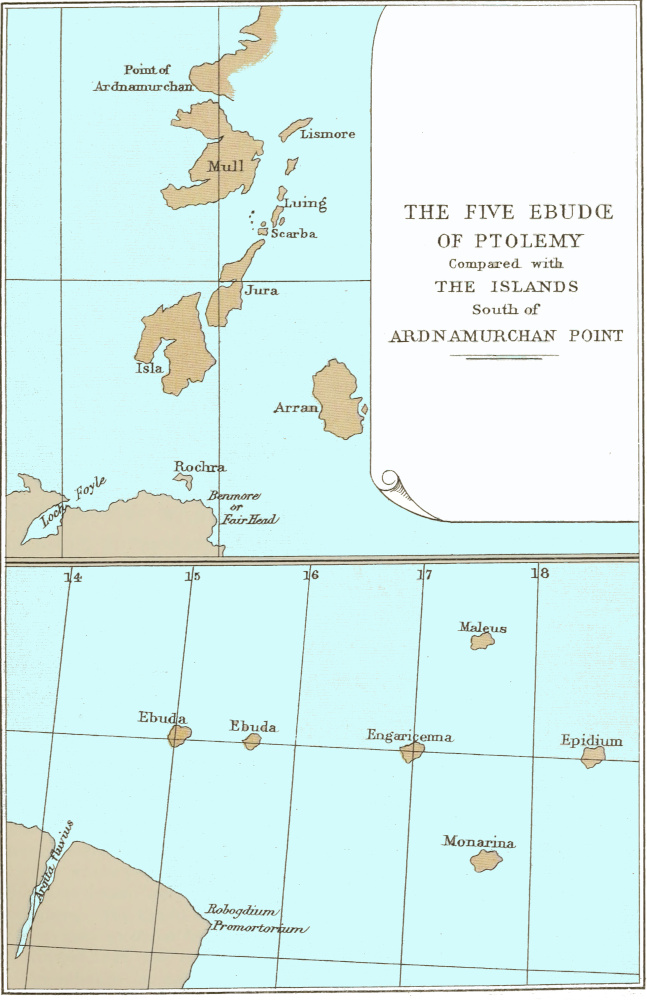
Between Scotland and Ireland Ptolemy places the five
islands which he terms the ‘Ebudæ,’ and the island of
‘Monarina;’ but these islands are attached to his map of
Ireland, to which country he held them to belong, and their
situation is not affected by the great mistake he committed
in the direction of Scotland. The most northerly of the
five he terms ‘Maleus,’ which is so obviously the island of
69Mull that it gives us a clue to the situation of the rest, and
shows that the islands meant were those south of the point
of Ardnamurchan. The remaining four, placed in a line on
the same degree of latitude, and lying from west to east, are
termed the two ‘Ebudas,’ ‘Engaricenna’ and ‘Epidium.’
The relative situation of the western ‘Ebuda’ towards
Ireland corresponds closely with that of Isla, and the two
‘Ebudas’ were probably Isla and Jura. Scarba corresponds
with ‘Engaricenna,’ and the more distant Lismore with
‘Epidium.’ These islands all lie in one line from south-west
to north-east. ‘Monarina’ corresponds in its position
towards Ireland with the island of Arran.[62]
Beyond the point of Ardnamurchan the western islands
seem to have been comparatively unknown. No islands are
mentioned which correspond with the Outer Hebrides, and
the island of Skye seems only to have been known by name,
as it is probably meant by Ptolemy’s island of ‘Scetis,’
which however he places apparently at random near the
north-east promontory of Scotland. On the mainland three
points only are noticed,—the mouth of the Itys river, which
is probably the river Carron flowing into Loch Carron; the
Volsas Bay or Loch, which can only be the great arm of the
sea termed Loch Broom; and the mouth of the river
‘Nabarus,’ obviously the Naver; but these points must have
70apparently been taken from report, as it is difficult otherwise
to account for his ignorance of the true position of
Skye, and for the absence of all mention of the great
headland of Cape Wrath, forming the north-west point of
Scotland.
Along the east coast he denominates the sea the Germanic
Ocean, and along the west, from the Mull of Galloway
to Dunnet Head, the Deucaledonian.
The tribes and their towns.
Such is the wonderfully accurate notice of the salient
features of the coasts of Scotland given by a geographer of
the second century; but his description of the tribes of the
interior of the country, and the position of what he denominates
towns, as compared with the physical appearance of
the country, is no less so. To these tribes Ptolemy assigns
definite names, and to some the possession of what he terms
πόλεις in Greek, and in Latin ‘oppida.’ That these towns
were not exclusively Roman stations is plain from their
being mentioned in a part of the country to which the
Roman arms had not yet penetrated; neither could they
have been simply the rude hill-forts, or primitive shelters in
the woods, such as are mentioned by Cæsar; for they are
only to be found in the southern and eastern districts, and
none are noticed as we approach the rude tribes of the hill
country. They certainly implied a regularly fortified town,
in which the habitations of the natives were collected together,
and formed the great defences of their territories, as
we almost invariably find them placed near the frontiers of
each tribe, or the great passes from one district to another.
They would naturally form the main points of attack in
any assault upon the tribe; and accordingly we usually find,
within the sphere of the Roman operations, a Roman camp
placed in the immediate vicinity of the remains of these
towns; and the Roman stations or roads are useful in assisting
the accurate identification of these within the range of
their campaigns.
71A line drawn from the Solway Firth across the island
to the eastern sea exactly separates the great nation of
the Brigantes from the tribes on the north; but this is
obviously an artificial line of separation, as it closely follows
the course of the Roman wall shortly before constructed by
the Emperor Hadrian, otherwise it would imply that the
southern boundary of three Barbarian tribes was precisely
on the same line where nature presents no physical line of
demarcation. There is on other grounds reason to think
that these tribes, though apparently separated from the
Brigantes by this artificial line, in reality formed part of
that great nation.[63] These tribes were the Otalini or
Otadeni and Gadeni, extending along the east coast from
the Roman wall to the Firth of Forth. They had three
towns—on the south ‘Curia’ and ‘Bremenium,’ whose
situations correspond with Carby Hill in Liddesdale, where
there is a strong native fort, and opposite to it a Roman
station, and High Rochester, in Redesdale. Their northern
frontier was guarded by the town of Alauna, which is placed
by Ptolemy in the Firth of Forth, and corresponds in situation
with the island of Inchkeith.[64]
72Farther to the west, the Selgovæ or Elgovæ occupied the
county of Dumfries, being bounded on the north by the
chain of hills of which the Lowthers formed the highest
part, and extending along the shores of the Solway Firth
as far as the river Nith. Their towns were ‘Trimontium,’[65]
in the exact position where we find the remarkable Roman
remains on the striking hill called the Birrenswark hill;
‘Uxellum’ corresponding in situation with the Wardlaw
hill in the parish of Caerlaverock, where there are the
remains of Roman and native works; ‘Corda’ at Sanquhar,
in the upper part of the valley of the Kith, a name which
implies that it was the site of an ancient Caer or native
strength. The remaining town of the Selgovæ—Carbantorigum—is
placed by Ptolemy on the exact position of the
remains of a very remarkable stronghold termed the Moat
of Urr, lying between the Nith and the Dee.
To the west of the Selgovæ lay the tribe of the Novantæ,
occupying the modern counties of Kirkcudbright and Wigtown.
Their towns were—Lucopibia at Whithorn, where
there are the remains of Roman works, and Rerigonium[66]
on the eastern shore of Loch Ryan, the fortified moat
of which is still to be seen on the farm of Innermessan.
73North of the Selgovæ and Novantæ, and separated
from them by the chain of hills which divides the northern
rivers from the waters which flow into the Solway, was the
great nation of the Damnonii, extending as far north as the
river Tay. They possessed south of the Firths of Forth and
Clyde the modern counties of Ayr, Lanark, and Renfrew;
and north of these estuaries, the counties of Dumbarton
and Stirling, and the districts of Menteith, Stratherne, and
Fothreve, or the western half of the peninsula of Fife. This
great nation thus lay in the centre of Scotland, completely
separating the tribes of the Otalini or Otadeni, Selgovæ or
Elgovæ, and Novantæ, on the south, from the northern
tribes beyond the Tay, and were the ‘novæ gentes,’ or
new nations, whose territories Agricola ravaged to the
‘Tavaus’ or Tay in his third campaign. They possessed six
towns,—three south of the firths, and three north of them.
Their towns in the southern districts were ‘Colania,’ near
the sources of the Clyde, a frontier but apparently unimportant
post; ‘Coria,’ at Carstairs, on the Clyde near
Lanark, which, from the numerous remains both Roman
and native, appears to have been their principal seat; and
‘Vandogara,’[67] on the river Irvine, at Loudon Hill in Ayrshire,
where there are the remains of a Roman camp, which
74was afterwards connected with ‘Coria,’ or Carstairs, by a
Roman road. In their northern districts the geographer
likewise places three towns,—‘Alauna’ at the junction of
the Allan with the Forth, a position which guarded what
was for many centuries the great entrance to Caledonia
from the south; ‘Lindum’ at Ardoch, where the number of
Roman camps, and of hill-forts which surround them, indicates
an important position; and ‘Victoria,’ situated at Loch
Orr, a lake in the western part of Fife, occupied by this
nation, where there are the remains of a Roman station.
On the east coast, the ‘Vernicomes’ possessed the eastern
half of Fife, or the ancient Fife exclusive of Fothreve, and
the counties of Forfar and Kincardine. The only town
mentioned is ‘Orrea,’ which must have been situated near
the junction of the Earn with the Tay, perhaps at Abernethy.
The nearest Roman station to it is at Ardargie. Farther
north along the coast, and reaching from the mountain
chain of the Mounth to the Moray Firth, were the ‘Taexali,’
who gave their name to the headland now called Kinnaird’s
Head. Their town, ‘Devana,’[68] is placed by Ptolemy in the
strath of the Dee, near the Pass of Ballater, and close to
Loch Daven, where the remains of a native town are still
to be seen, and in which the name of Devana seems yet to
be preserved.
West of the two tribes of the ‘Vernicomes’ and the
‘Taexali,’ and extending from the Moray Firth to the Tay,
Ptolemy places the ‘Vacomagi,’ a border people, who lay
along the line separating the Highlands from the Lowlands.
The remarkable promontory of Burghead on the south side
of the Moray Firth, on which the ramparts of the early
town are still to be seen, was one of their positions, on
which they had a town termed πτερωτὸν στρατόπεδον,
75Alata Castra,[69] or the Winged Camp. They had another
town on the Spey near Boharm, termed Tuessis. Their
frontier towns at the southern termination of their territory
were ‘Tamea,’ placed on the remarkable island in the Tay,
termed Inchtuthil, where numerous remains exist, and
‘Banatia’ at Buchanty on the Almond, where a strong
Roman station is overlooked by the commanding native
strength on the Dunmore Hill.
To the north and west of these tribes no further towns
are mentioned; and as the Caledonii extend on the west
along the entire length of the territories of the Vacomagi,
their eastern boundary formed the line of demarcation
between the tribes of the more plain and fertile districts,
who had advanced one step in the progress of social life in
the possession, even at this early period, of settled habitations
and determined limits, and the wilder tribes of the mountain
region, among whom nothing deserving the name of town in
its then acceptation was known to the Romans. Ptolemy
states that the Caledonii extended from the ‘Lemannonius
Sinus,’ or Loch Long, to the ‘Varár Aestuarium’ or Beauly
Firth, thus ranging along the entire boundary of the Highland
portion of Scotland. On the west they had the remarkable
chain of hills termed in the early historical documents
‘Dorsum Britanniae,’ Drumalban, or the backbone of Scotland,
a native term apparently presented in a Greek
form in Ptolemy’s καληδόνιος δρυμός, and converted by
76his Latin translator, who, puzzled by the term δρυμὸς,
recognised in it only an unusual Greek word signifying
an oak wood, into ‘Caledonius Saltus’ or Caledonian Wood.
That this range of hills was at all times a forest in the
highland acceptation of the term, having its southern termination
at the head of Lochs Long and Lomond, there is
no doubt.
North of the Caledonii, on the other side of the Varar or
Beauly Firth, lay the ‘Canteæ’ or ‘Decantæ,’ possessing the
whole of Ross-shire save the districts on the west coast.
Sutherland proper was possessed by the ‘Lugi’ and ‘Mertæ.’
Along the west coast, from the Firth of Clyde northwards,
were the ‘Epidii’ in Kintyre and Lorn. Beyond them the
‘Creones’ or ‘Croenes,’ extending probably from the Linnhe
Loch to Loch Carron. Beyond them the ‘Carnones,’ occupying
probably the western districts of Ross-shire. Beyond these
again, in the west of Sutherland, the ‘Caerini;’ and along
the northern termination of Scotland, including Caithness
and the north-west of Sutherland, were the ‘Curnavii.’
Such were the northern tribes of Britain as described by
the geographer Ptolemy in the second century, and such the
knowledge the Romans now possessed of their position, and
of the towns they occupied.
A.D. 139.
First Roman wall between the Forth and Clyde. Establishment of the Roman province in Scotland.
Ere twenty years had elapsed since this description of the
tribes of the barbarian portion of Britain was written, the
frontier of the Roman province had been advanced from
the wall between the Solway and the Tyne to the isthmus
between the Forth and Clyde, the boundary destined for
it by the sagacity of Agricola. Early in the reign of
Antoninus, who succeeded Hadrian in the empire in the
year 138, the independent portion of the nation of the
Brigantes had broken the bounds set to them by the wall
of Hadrian, and overrun the territories of one of the
provincial tribes, and thus drew upon themselves the vengeance
of the Roman Emperor. Lollius Urbicus was sent
77into Britain in the second year of his reign, towards the end
of the year 139, subdued the hostile tribes, and constructed
an earthen rampart between the Firths of Forth and Clyde,
thus advancing the frontier of the Roman province to the
isthmus between these firths, and again adding the intermediate
territory to the Roman possessions in the island.
This wall between the Forth and Clyde remained from this
time, till the Romans left the island, the proper boundary of
the province during the entire period of their occupation
of Britain.[70]
The isthmus between the Forth and Clyde presents
towards the west the appearance of a great valley, having
the Campsie and Kilsyth hills on the north, and on the south
a series of lesser rising grounds extending in a continuous
line from sea to sea; while the hills on the opposite side
recede as the valley approaches towards the east, till the
view from the southern rising ground extends over the
magnificent plain of the Carse of Falkirk, with the upper
part of the Firth of Forth stretching along its northern
limit. The Roman wall was constructed along the ridge
of the southern rising grounds, and the remains of this
78stupendous work have at all times arrested the attention of
even the careless observer. This great work, as it presents
itself to the inspection of those who have examined it
minutely, consisted of a large rampart of intermingled stone
and earth, strengthened by sods of turf, and must have
originally measured 20 feet in height, and 24 feet in breadth
at the base. It was surmounted by a parapet having a level
platform behind it, for the protection of its defenders. In
front there extended along its whole course an immense
fosse, averaging about 40 feet wide and 20 feet deep. To
the southward of the whole was a military way, presenting
the usual appearance of a Roman causewayed road. This great
barrier extended from Bridgeness, near Carriden, on the Firth
of Forth, to Chapelhill, near West Kilpatrick, on the Clyde, a
distance of twenty-seven English miles,—having, at intervals
of about two miles, small square forts or stations, which,
judging from those that remain, amounted in all to nineteen
in number, and between them were smaller watch-towers.[71]
Such was this formidable barrier in its complete state;
but it is not likely that it owed its entire construction to
Lollius Urbicus. His work appears to have been limited to
what was constructed of turf, and consisted probably only
of the earthen rampart itself. Few probably, if any, of the
principal ‘castella’ formed part of the original construction,
as their remains indicate a more elaborate foundation.
Numerous inscriptions have been found along the course of
the wall, which show that the ‘vallum,’ as it is termed in
these inscriptions, had been constructed by the second, the
sixth, and the twentieth legions, or rather by their vexillations.
79The first and last of these legions had been in Britain
since the time of Claudius; the sixth was brought into the
island by Hadrian. The inscriptions connect the work with
the name of Antoninus, and in one that of Lollius Urbicus
has been found.
A.D. 162.
Attempt on the province by the natives.
This great work, guarded as it was by a powerful body
of Roman troops, seems to have effectually protected the
Roman province in its increased extent during the remainder
of the reign of Antoninus. But the first year of a new
emperor was, as usual, marked in Britain by an attempt
upon the province by the northern tribes, and Calphurnius
Agricola was sent to Britain to quell them. This was
in the year 162.[72]
A.D. 182.
Formidable irruption of tribes north of wall repelled by Marcellus Ulpius.
In the commencement of the reign of Commodus, twenty
years later, the irruption was of a more formidable character.
The nations on the north of the wall succeeded in breaking
through that great barrier, slew the commander with a number
of the soldiers who guarded it, and spread devastation
over the neighbouring part of the province. The war created
great alarm at Rome, and Marcellus Ulpius was sent by
Commodus against them,—a general whose character, as
drawn by Dio Cassius, peculiarly fitted him for the task, and
he appears to have succeeded in repelling the invading tribes,
and terminating the war two years later.[73]
On the death of Commodus in the year 192, three able
generals commanded the Roman troops stationed at the
principal points of the boundary of the Roman empire—Pescennius
Niger in Syria, Lucius Septimius Severus in
Pannonia, and Clodius Albinus in Britain; and after the
death of Pertinax and Didius Julianus—the short-lived
emperors who had been put up and as speedily deposed by
the Prætorian guards—a struggle took place between these
80generals for the empire. Severus was proclaimed emperor
at Rome, but he found himself at once in a position of great
difficulty; for both of his rivals were formidable opponents,
both were in command of powerful armies devoted to them,
and he could not proceed to attack the one without exposing
the seat of the empire to be seized upon by the other, or
remain at Rome without drawing upon himself the simultaneous
attack of both. He therefore caused Albinus to be
proclaimed Cæsar, had his title confirmed by the senate, and
sent letters to him to invite him to share in the government,
but recommended that he should make Britain the seat of
his government, and devote himself to the care of that
province. An example was thus for the first time set of the
command of the troops in Britain being associated with the
imperial dignity, which some of the succeeding commanders
were not slow to imitate, and a separate interest created with
reference to Britain, which tended to isolate it from the rest
of the empire, and greatly affected the fortunes of both. It
is unnecessary for our purpose to detail the struggle which
now took place between Severus and Pescennius Niger, and
resulted in the defeat and death of the latter in the year 194.
Severus then led his army into Gaul to attack Albinus, who
promptly met him by crossing the channel with the British
army, and in the battle of Lyons which ensued, he also was
defeated and slain in the year 197,[74] and Severus found himself
in possession of the undivided rule of the Roman world.
A.D. 201.
Revolt of Caledonii and Mæatæ.
It would appear that Albinus, in the course of his
government, had come to terms with the barbarians or
independent tribes of the north, for four years after this
battle we find the natives of the Mæatæ, now for the first
time mentioned, threatening hostilities against the Roman
province, and the Caledonii, who are accused of not abiding
by their promises, preparing to assist them. The governor,
81Virius Lupus, who had probably been sent as Albinus’s
successor, being unable to obtain assistance from Severus in
consequence of his being engaged in war elsewhere, appears
to have been driven by necessity to purchase peace from the
Mæatæ at a great price, a circumstance which shows the
formidable character which the independent tribes of the
north still bore, and the extent to which they taxed the
military ability and energy of the Roman governors to
protect the province from their attacks.
A.D. 204.
Division of Roman Britain into two Provinces.
The great extent of the province, and the difficulty experienced
in defending it, probably led to Roman Britain being
now divided into two provinces. Herodian distinctly tells us
that after the war with Albinus, Severus settled matters in
Britain, dividing it into two governments, and Dio alludes
to them under the names of Upper and Lower Britain. It is
impossible now to ascertain the precise relative position of
the two provinces; but the older province of Britain, formed
in the reign of Claudius, seems to have been one, while the
other probably embraced the later conquests of the Romans
from the Humber to the Firths of Forth and Clyde, comprising
mainly the great nation of the Brigantes with its
dependent tribes. Dio states that the second and twentieth
legions were stationed in Upper Britain, while Ptolemy
places the one at Isca Silurum or Caerleon; and both
Ptolemy and the Itinerary of Antonine place the other at
Deva, now Chester. The sixth legion was stationed, according
to Dio, in Lower Britain, and Ptolemy as well as the
Itinerary of Antonine place it at York, which is the only
indication we have of the situation of the two provinces.
These few meagre and incidental notices are all that we
possess of the state of the Roman occupation of Britain, from
the clear and detailed account given by Tacitus of Agricola’s
campaigns, to the second great attempt to subdue the
northern tribes, which we are now approaching. The one
great feature of this intermediate period was the construction
82of the great rampart between the Firths of Forth and Clyde,
and the fixing of that boundary as the frontier of the
province—the line of separation between the provincial
Britons and the barbarian or independent tribes. To the few
emphatic words of the historian of Antoninus, the remains
of the great work itself, and the inscriptions found in its
vicinity, add confirmation and a definite locality; and the
great boundary at the Firths of Forth and Clyde became from
thenceforth the recognised and permanent frontier of the
Roman province.
A.D. 208.
Campaign of the Emperor Severus in Britain.
While Severus remained at Rome, after the defeat and
death of Albinus, he received letters from the prefect of
Britain announcing that the independent tribes had again
broken loose and were in a state of open hostility, overrunning
the province, driving off booty, and laying everything
waste; and that it would be necessary for him either to
send additional troops, or to come in person, to take steps
for the protection of the province. The latter was the course
adopted by Severus. Accompanied by his two sons, and
from age and disease travelling in a litter, he arrived in
Britain in the year 208, and drawing his troops together from
all quarters, and concentrating a vast force, he prepared for
war. His object in these great preparations was apparently
not merely to repel the incursions of the enemy, but effectually
to prevent them from renewing them by striking a severe
blow, and carrying the war, as Agricola had done before him,
into their fastnesses and the interior of the country.
Situation of hostile tribes.
When this war again drew the attention of the Roman
historians to the state of the barbarian or hostile tribes, they
found them in a very different situation from what they had
been when so vividly painted by Tacitus, and so minutely described
by Ptolemy. Instead of their condition as described
by the former, who only knew them as a number of separate
and independent tribes, inhabiting a part of Britain known
by the name of Caledonia, and whom the imminence of the
83Roman invasion alone united into a temporary confederacy,
they are now found combined into two nations, bearing the
names respectively of ‘Caledonii’ and ‘Mæatæ,’ for into
these two, says the historian Dio as abridged by Xiphiline,
‘were the names of the others merged.’ The nation of the
‘Mæatæ’ consisted of those tribes which were situated next
the wall between the Forth and Clyde on the north. The
‘Caledonii’ lay beyond them. The former inhabited the
more level districts, or, as the historian describes them, the
plains and marshes, from which indeed they probably derived
their name.[75] The latter occupied the more mountainous
region beyond them. There is no reason to suppose that the
line of separation between them differed very much from
that which divided the tribe of the ‘Caledonii,’ as described
by Ptolemy, from those on the south and east of them.
The manners of the two nations are described as the
same, and they are viewed by the historians in these
respects as if they were but one people. They are said to
have neither walls nor cities, as the Romans regarded such,
and to have neglected the cultivation of the ground. They
lived by pasturage, the chase, and the natural fruits of the
earth. The great characteristics of the tribes believed to
be indigenous were found to exist among them. They
fought in chariots, and to their arms of the sword and
shield, as described by Tacitus, they had now added a short
spear of peculiar construction, having a brazen knob at the
end of the shaft, which they shook to terrify their enemies,
and likewise a dagger. They are said to have had community
of women, and the whole of their progeny were
reared as the joint offspring of each small community. And
the third great characteristic, the custom of painting the
body, attracted particular notice. They are described as
puncturing their bodies, so as, by a process of tattooing, to
84produce the representation of animals, and to have refrained
from clothing, in order that what they considered an ornament
should not be hidden.
But in these descriptions it must be remembered that
the Romans only saw them in summer, and when actually
engaged in war; and that, like the American Indians in
their war-paint, their appearance might be very different, and
convey a totally erroneous impression of their social habits,
from what really existed among them in their domestic state.
The arrival of the Emperor himself in Britain, and the
vigorous preparations Severus at once made, caused great
alarm among the hostile tribes, and they sent ambassadors
to sue for peace. They had hitherto easily obtained it; but
it was not Severus’s intention to depart from his purpose of
total subjugation, and he dismissed the ambassadors without
a decided answer, and without avowing his purpose, and
proceeded with his preparations. When these had been
completed, and a larger force collected than had ever yet
been arrayed against them, Severus left his son Geta in
the province, and taking his son Antoninus with him, he
‘passed the fortresses and rivers which guarded the frontier,
and entered Caledonia.’ Severus had seen that the
nature of the country had hitherto in the main prevented
the Romans from penetrating far, or their conquests from
being permanent in the north. The numerous natural
bulwarks, the wide-spreading woods, and the extensive
marshes, interposed almost insurmountable obstacles. What
are now extensive plains, well-watered straths, and rich
carses, must then have presented the appearance of a jungle
or bush of oak, birch, or hazel; the higher ground rocky
and barren, and the lower soft and marshy. If the native
tribes were for a time subdued, and their strongholds taken,
they could not be maintained in such a country by the
Romans, and the natives speedily regained possession. The
policy adopted by Severus was the true mode of overcoming
85such obstacles—to open up the country and render it
passable for troops by clearing the jungles, forming roads
in every direction, and throwing bridges over the rivers, so
as to penetrate slowly with his troops and enable them to
continue in possession of the districts as they occupied them
in their advance through the country.
There could not be a better illustration of what a war
between the Romans and these outlying tribes at this time
really was, and how Severus dealt with it, than a few
extracts from a speech by the Duke of Wellington upon
our war at the Cape with the Kaffir tribes beyond the
Colony in 1852. He says,—‘The operations of the Kaffirs
have been carried on by the occupation of extensive regions,
which in some places are called jungle, in others bush: but
in reality it is thick-set, the thickest wood that can be found
anywhere. The Kaffirs having established themselves in
these fastnesses with their plunder, on which they exist,
their assailants suffer great losses. They move away with
more or less celerity and activity, sometimes losing and
sometimes saving their plunder, but they always evacuate
their fastnesses; our troops do not, cannot, occupy these
places. They would be useless to them, and in point of
fact, they could not live in them. The enemy moves off,
and is attacked again; and the consequence is, to my certain
knowledge, under the last three Governments, that some of
these fastnesses have been attacked three or four times over,
and on every occasion with great loss to the assailants.
There is a remedy for these evils: when these fastnesses
are stormed and captured, they should be totally destroyed.
I have had a good deal to do with such guerilla warfare,
and the only mode of subduing a country like that is to
open roads into it, so as to admit of troops with the utmost
facility. It is absolutely necessary that roads should be
opened immediately into these fastnesses.... The only fault
I can find with Sir Harry Smith’s operations is, that he has
86not adopted the plan of opening such roads, after he had
attacked and taken these fastnesses. I have, however,
instructed him to do so in future; but it is a work of great
labour; it will occupy a considerable time, and can only be
executed at great expense.’[76]
Roman roads in Scotland.
It is to this period that the traces of the Roman roads
beyond the wall must be attributed, and their remains,
with those of the Roman camps beyond the Tay, enable us
to trace Severus’s route. He advanced to the northern wall
by the road called Watling Street, repairing the fortifications
of the stations as he passed.[77] From the wall near
Falkirk, a road proceeds in a direct line to Stirling, where
the great pass over the Forth into the north of Scotland has
always had its locality. From Stirling westward along the
banks of the Forth, where now are to be seen the Flanders
and Kincardine mosses, there must have extended one
dense forest, the remains of which are imbedded in these
mosses, and there, at some depth below the present surface,
are to be found remains of Roman roads. From the west
of the district of Menteith to Dunkeld must have stretched
a thick wood of birch and hazel, and from Stirling the
Roman road proceeds through Stratherne to the junction of
the Almond with the Tay. Crossing the Tay, it leaves the
camp at Grassy Walls, which had been occupied by Agricola,
and proceeds in the direction of a large camp near Forfar
termed Battledykes. This camp is larger than any of those
which may, with every appearance of probability, be attributed
to Agricola, and is capable of holding a greater body
of troops than his army consisted of; while, if the view we
have given of his campaigns be correct, it lay beyond the
limit of his utmost advance into the country.
87From the great camp at Battledykes, a line of camps,
evidently the construction of one hand, and connected with
each other by a continuation of the Roman road, extends
at intervals corresponding in distance to a day’s march of a
Roman army, through the counties of Forfar, Kincardine,
and Aberdeen, till they terminate at the shores of the Moray
Firth.[78] Severus is said by the historians Dio and Herodian
to have entered Caledonia at the head of an enormous army,
and to have penetrated even to the extremity of the island,
where ‘he examined the parallax and the length of the days
and nights.’ It would appear from these silent witnesses of
his march, that he had opened up and occupied the country
between the northern wall and the Tay; that he had then
concentrated his army in the great camp at Battledykes,
and leaving a part of his troops there to prevent his retreat
from being cut off, had penetrated through the districts
extending along the east coast till he had reached the great
estuary of the Moray Firth, where the ocean lay extended
before him, and he might well suppose he had reached the
extremity of the island.[79]
88During this march Severus is said to have fought no
battle, his system of opening up the country and rendering
it passable for his troops, insuring him its possession as he
slowly advanced; but the natives appear to have carried on
a kind of guerilla warfare against the parties engaged in
these works, assailing them at every advantage, and enticing
them into the woods and defiles by every stratagem, so that,
although Severus’s progress was sure, his loss is said to
have been very great. This circumstance on his part, and
the effect upon the natives of his success in penetrating to
a point which no Roman invader had hitherto reached, or
even attempted, led eventually to a peace, the principal condition
of which was that the native tribes should yield up
a considerable part of their territory to be garrisoned by
Roman troops. The part ceded could hardly have been any
other district than that extending from the northern wall to
the Tay, a district which Agricola had likewise held to a
limited extent in advance of the frontier he designed for
the province, and this is confirmed by the existence of a
temporary camp and a strong station at Fortingall, not far
from where the river Tay issues from the lake of the same
name. It appears to have been an outpost beyond the Tay,
and there is no known circumstance connected with the
Roman occupation of Britain to which its existence can be
attributed, with any probability or with any support from
authority, save this cession of territory to Severus. There
is a similar camp and station at Fendoch on the banks of
the Almond, where it emerges from the Grampians, and a
corresponding camp and station at Ardoch, which can be
distinguished from Agricola’s camp there.
89A part of the inhabitants of this district, too, made their
appearance about this time in the Roman army, and two
inscriptions found at Nieder Biebr on the Rhine, one of
which is dated in 239, show that there were stationed there
troops composed of the Horesti, and of the people who
possessed Victoria as their chief seat, from which it would
appear that Severus had enrolled bodies of the inhabitants
of the ceded district among the Roman auxiliaries.[80] These
are all marks of Severus’s occupation of this district, and,
as there are traces of Roman works on the Spey at Pitmain,
on the line between the Moray Firth and Fortingall, it would
appear that Severus with a part of the army had returned
through the heart of the Highlands.
Severus’s wall.
Having thus concluded a peace with the Caledonii and
Mæatæ, and compelled them to yield up to him a part of
their territory north of the wall to be occupied by his troops
in advance of the frontier, Severus proceeded to reconstruct
the wall between the Forth and the Clyde, as the actual
boundary of the province. He appears to have added the
large fosse or ditch, to have placed additional posts along
the wall, and to have repaired and strengthened the structure
itself.[81]
90Having completed this work, and left the province thus
once more protected, with the additional security of the
occupation by Roman outposts of the ceded territory beyond
the wall, he returned to York, leaving behind him Antoninus,
whom he was apparently not desirous to retain with him,
in consequence of an attempt he had made upon his life
in presence of the army, while conferring with the Caledonians
regarding the treaty of peace, in charge of the
frontier. He had not remained long at York before the
Mæatæ again revolted, and were joined by the Caledonians,
and he was only prevented from recommencing a war of
extermination by his death, which took place at York in
the year 211.
Antoninus, as soon as he became, by the death of his
father, possessed of the imperial power, being desirous to
disembarrass himself of everything that could interfere with
91his perfect enjoyment of it, terminated the war by making
peace with the barbarian natives, and, receiving pledges of
their fidelity, left the frontier of which he had remained
in charge.
Thus terminated the most formidable attempt which had
been made to subjugate the inhabitants of the barren
regions of the north since the campaigns of Agricola; and
although the expedition was more successful, inasmuch as
the army penetrated farther into the country, it was equally
unproductive of permanent result, and was not marked by
the same brilliant feature of the defeat of the entire force
of the hostile tribes in a pitched battle.
A.D. 287.
Revolt of Carausius; Britain for ten years independent.
There occurs again at this period a silence as to the
relative position of the Romans and the barbarian tribes,
92till, after an interval of seventy-five years, the attention of
the Roman historians is once more called to this distant
part of the Empire by the revolt and usurpation of the
purple by Carausius, in the early part of the reign of the
Emperor Diocletian. In accordance with a custom now
becoming frequent in the Roman Empire, Diocletian had
associated with him in the government Maximian, and to
the share of the latter fell the western provinces of Gaul,
Spain, and Britain. A new feature now took place in the
history of these provinces. This was the appearance of two
new barbaric nations, destined to occupy an important
position among the European kingdoms—the Franks and
the Saxons—who now appeared in the British seas and
ravaged the coasts of Gaul, Belgium, and Britain. In order
to repress them and to protect these countries from their
inroads, a Roman fleet was stationed at Gesoriacum or
Boulogne. Carausius, a native of the city of Menapia in
Belgium, who had risen to eminence in the Roman army,
was appointed to command it, and soon distinguished himself
in repressing the inroads of these new barbarian tribes.
He was accused, however, of retaining the spoil he took from
them, which he ought to have accounted for, and of
encouraging them in their piratical expeditions in order
that he might secure for himself the booty they had taken.
Maximian, in consequence, resolved to put him to death;
but Carausius, having become aware of his intention,
anticipated the resolution of the Emperor by assuming the
purple and taking possession of the provinces of Britain.
He took with him in his revolt the fleet under his charge;
the Roman soldiers in Britain obeyed him, and he increased
his naval force by building numerous new vessels.[82]
A.D. 289. Carausius admitted Emperor.
A Barbarian by birth, and consequently connected with
native tribes, he appears to have received the ready submission
of the Britons, as well as the support of the independent
93tribes, and Britain for the time assumed the
appearance of a separate empire, in which he maintained
himself by his fleet. Maximian, after trying in vain to
reduce him, at length concluded a peace, bestowing upon
him the title of Augustus, and intrusting to him the care of
those provinces he had already taken possession of.[83] In
the meantime, owing to the disturbed state of the Empire
and the revolt in Britain, Diocletian created Galerius
Maximian and Constantius Chlorus, Cæsars.
A.D. 29 Constantius Chlorus recovers Britain.
It appears that the latter, to whose share the provinces
of Gaul, Spain, and Britain were assigned, resolved to wrest
the provinces of Britain from the usurper, but of the
particulars of this war we know nothing except what may
be gathered from a few hints of the panegyrists. We
ascertain from them that in the year 292 Constantius
Chlorus had wrested Gaul from the influence of Carausius,
and besieged and taken possession of the harbour of Boulogne,
compelling Carausius to withdraw his ships to Britain, where
his rule was popular, Constantius being unable to carry the
war into Britain for want of vessels.[84]
A.D. 294.
Carausius slain by Allectus.
The reign of Carausius was one of prosperity to the
Britons, and his government vigorous, but it was terminated
by his assassination by Allectus, one of his followers, who
had conspired against him, and whose cause seems to have
been mainly supported by the independent tribes. Allectus
had not been long in the enjoyment of his insular dominion,
when Constantius Chlorus, having now caused vessels to be
made, sailed from Boulogne to Britain two years after the
death of Carausius. He is described as passing in a mist
the British fleet which was cruising near the Isle of Wight,
and landed in Britain, when he marched upon London, and
his army under Asclepiodotus, having followed Allectus, a
battle took place in which the latter was defeated and slain.
94It was found after the battle that Allectus had few
Roman soldiers, and that his army consisted principally of
Barbarians who had been enlisted by him, and in whom,
from the allusion by the panegyrists to a marked characteristic
indicated by Tacitus as distinguishing them from
the rest of the Britons, we can recognise the inhabitants of
Caledonia.[85] Britain had thus been separated from the rest
of the Roman Empire for ten years, seven of which belong to
the reign of Carausius, and three to that of Allectus, and had
for the greater part of that time been under the government
of one who united an origin derived from the native tribes
with the imperial authority. It almost seemed as if she was
destined at that early period to commence her independent
existence as a great maritime power, had the assassination
of Carausius not altered the character of her fortunes.
A.D. 306. War of Constantius Chlorus against Caledonians and other Picts.
The termination of this independent government was the
signal for the independent tribes to break out into hostilities;
and, as they emerged from under the government of Carausius
and Allectus into their old position towards the Roman
province they now appear for the first time under the
general name of Picts, one section of whom bore the name
of Caledones. On the abdication of Diocletian in 305,
Constantius Chlorus became Emperor of the West, and
apparently made Britain his residence during the greater
part of his short reign. In its first year he appears to
have penetrated beyond the wall, entered the plains of the
low country north of it, and defeated the Picts, who are said
by one of the panegyrists to have consisted of the Caledones
and other nations not named, but in whom we can well recognise
those termed by Dio the Mæatæ.[86] This expedition
was probably limited to the territory beyond the wall which
95had been ceded to the Romans in the peace concluded
with the Emperor Severus. In the following year Constantius
died at York, and his son Constantine, having
become Emperor, left Britain to take possession of the
Empire.
We now hear little of Britain, and nothing of the nations
beyond the boundary of the Roman province, for a period of
fifty years, till in the year 360 a new and very important
feature in the history of the Roman occupation of Britain
manifested itself. This was the commencement of those
formidable and systematic inroads of the Barbarian tribes
into the province, which were not merely temporary expeditions
for plunder, but evidently aimed at the subversion of
the Roman government in Britain, and, though checked at
intervals, were ever again renewed till the Romans finally
abandoned the possession of the island.
From the expedition of Severus to the commencement of
these formidable attacks a period of 150 years had elapsed,
and the few notices we have of the events in Britain show
that the integrity of the province had on the whole been
maintained, and that the provincial Britons enjoyed some
degree of security within its bounds, while the northern
tribes were restrained from making incursions beyond their
territory by the well-guarded wall, which with its numerous
posts along its line, and, in advance of it, in the ceded district,
protected the frontier. The ten years’ independent
kingdom under Carausius and Allectus had not affected this
state of matters. The provincial Britons must have been
equally protected, especially under the vigorous government
of the former. There are even indications of its influence
having extended over the independent tribes, and bodies of
them, whom Allectus had enlisted, were found in his army.
On the termination of this independent empire, they emerge
under a new name; and their defeat and expulsion from the
province was a necessary consequence of the renewed union
96of Britain with the continental provinces under the same
authority.
During this period of a century and a half, the quiet and
prosperity enjoyed by the provincial Britons led to a corresponding
advance in wealth and civilisation, and Britain
became rapidly one of the most valuable provinces of the
Empire. Instead of being estimated, as Appian represents
it in the second century, as of so little value that the part
of the island possessed by the Romans was a mere encumbrance
to them, it is now described by Eumenius, in the end
of the third century, as a possession whose loss to the Empire
under Carausius was severely felt. ‘So productive,’ says he,
‘is it in fruit, and so fertile in pastures, so rich in metals
and valuable for its contributions to the treasury, surrounded
on all sides with abundance of harbours, and an immense
line of coast.’[87] The cultivation of grain, and the amount of
its produce, had so greatly increased, that it had become of
importance as an exporting country; and during the reign
of Julian it had formed his great resource, from whence he
drew a large supply of corn during the great scarcity on the
Continent.
Division of Roman Britain into four provinces.
A change had likewise taken place in its government. By
the arrangement introduced by Diocletian, and confirmed and
established by Constantine, the Roman Empire was divided
into four portions, to correspond with the two Emperors and
two Cæsars. Each of these dioceses, as they were called, was
placed under a great officer termed the prætorian prefect.
The diocese of the west consisted of Gaul, Spain, and Britain,
and the latter country was governed by a vicarius or vicar.
Roman Britain, which from the time of Severus had consisted
of two provinces, termed Upper and Lower Britain,
was now divided into four provinces,—Maxima Cæsariensis,
Flavia, Britannia Prima, and Britannia Secunda,[88] the two
97former or new provinces being apparently named after his
father, who had been Cæsar, and was the founder of the
Flavian family. In the absence of any direct indication of
the position of these provinces, the natural inference certainly
is, that each of the former provinces had been divided into
two; and that, while Upper Britain now consisted of
Britannia Secunda and Flavia, Lower Britain was represented
by Britannia Prima and Maxima Cæsariensis. Each
of these provinces had its governor, either a consul or a
president. The troops were under the command of the
‘Dux Britanniarum’ and the ‘Comes tractus maritimi.’
Under the former were the troops stationed north of a line
drawn from the Humber to the Mersey, following the course
of the river Don, and on the Roman wall between the Solway
and the Tyne; and those under the latter along the
maritime tract, exposed to the incursions of the Franks and
Saxons, extending from the Wash to Portsmouth. The
former appears, therefore, to have been the military leader
in the two northern provinces, while the functions of the
latter were exercised within the two southern.
A.D. 360.
Province invaded by Picts and Scots.
The first serious attack upon the province took place in
the year 360, and proceeded from two nations. The one
consisted of that union of tribes which had now become
generally known by the name of ‘Picti’ or Picts, the distinctive
appellation of the independent tribes beyond the
northern frontier after Britain had been recovered from the
usurpation of Carausius; but along with them appear now
for the first time as actors in the scene of British war a new
nation or people emerging from Ireland, and known to the
Romans under the name of ‘Scoti.’[89] Having broken the
98agreed-on peace, they ravaged—to use the words of the
historian who records it—the districts adjacent to the limits
of the province, and filled the provincial Britons with consternation,
who dreaded a renewal by this formidable combination
of the incursions which had now for so long a time
ceased. We learn from the account given by the historian
of their eventual recovery, that the districts ravaged by the
Picts were those extending from the territories of the independent
tribes to the wall of Hadrian between the Tyne and
the Solway, and that the districts occupied by the Scots
were in a different direction. They lay on the western
frontier, and consisted of part of the mountain region of
Wales on the coast opposite to Ierne, or the island of Ireland,
from whence they came.[90] The Emperor Julian was
unable to render effectual assistance, and Lupicinus, whom
he sent, appears to have been unable to do more than maintain
the provinces from further encroachment.
A.D. 364.
Ravaged by Picts, Scots, Saxons, and Attacotts.
During four years the invading tribes retained possession
of the districts they had occupied, and were with difficulty
prevented from overrunning the province; but in the fourth
year a more formidable irruption took place. To the two
99nations of the Picts and the Scots were now added two
other invading tribes—the Saxons, who had already made
themselves known and dreaded by their piratical incursions
on the coasts; and the Attacotti, who, we shall afterwards
find, were a part of the inhabitants of the territory on the
north of Hadrian’s wall, from which the Romans had been
driven out on its seizure by the independent tribes.[91] They
now joined the Picts in invading the province from the
north, while the attack of the Saxons must have been
directed against the south-eastern shore; and thus, assailing
the provinces on three sides—the Saxons making incursions
on the coast between the Wash and Portsmouth, afterwards
termed the Saxon Shore, where they appear to have slain
Nectarides, the Count of the maritime tract, the Picts and
Attacotts on the north placing Fallofaudus, the Dux Britanniarum,
whose duty it was to guard the northern frontier, in
extreme peril, and the Scots penetrating through the mountains
of Wales—the invading tribes penetrated so far into
the interior, and the extent and character of their ravages
so greatly threatened the very existence of the Roman
government, that the Emperor became roused to the imminence
of the danger, and after various officers had been sent
without effect, the most eminent commander of the day,
Theodosius the elder, was despatched to the assistance of the
Britons. He found the province in the possession of the
Picts, the Scots, and the Attacotts, who were ravaging it and
plundering the inhabitants in different directions. The
Picts, we are told, were then divided into two nations, the
‘Dicalidonæ’ and the ‘Vecturiones,’ a division evidently
corresponding to the twofold division of the hostile tribes in
the time of Severus, the ‘Caledonii’ and the ‘Mæatæ.’ The
similarity of name and situation sufficiently identifies the
first-mentioned people in each of the twofold divisions. The
100Mæatæ had been obliged to cede a part of their territory to
the Romans, so that part of the nation had passed under
their rule, and a part only remaining independent probably
gave rise to the new name of ‘Vecturiones.’ The ‘Attacotti,’
we are told, were a warlike nation of the Britons, and the
epithet applied to the ‘Scoti’ of ranging here and there
shows that their attacks must have been made on different
parts of the coast.[92]
A.D. 369.
Province restored by Theodosius.
Theodosius landed at ‘Rutupiæ’ or Richborough, where
he had appointed the rendezvous of the troops, and marched
upon London. When arrived there he divided his men into
several bodies so as to attack different parties of the enemy,
who were ravaging the country and returning laden with
booty. These he defeated, and wresting from them their
plunder, returned to London and sent to the Continent for
reinforcements. As soon as the expected troops arrived,
Theodosius left London at the head of a powerful and well-selected
army, and speedily succeeded in driving the invaders
from the provinces, and restoring the cities and fortresses.
He then directed his attention to the restoration of the
province to its wonted condition of security. The northern
frontier was again protected by the stations along the line
of the wall between the Forth and Clyde which he renewed,
and part of the recovered provinces were formed into a new
and separate province, which he termed ‘Valentia,’ in honour
of the Emperor Valens.
Such is the narrative of the historian Ammianus; but,
as the panegyrists threw light upon the expeditions of
Constantius, so now the poet Claudian, in his panegyrics
upon the illustrious general, supplies further details of the
101character of his exploits. The Picts, says he, he drove into
their own region, to which he gives the poetical name applied
to Caledonia of Thule. The Scots he pursued across the
sea to the country from whence they proceeded—the island
of Ierne; and the Saxons he indicates had formed their
headquarters in the islands of Orkney. The stations restored
by Theodosius on the frontier he identifies as separating
the province from Caledonia by his allusion to the latter
word; and it may further be inferred that he had again
occupied the castella or outposts with which the Romans
garrisoned the territory beyond the wall ceded to them in
the campaign of Severus.[93]
The inhabitants of a part of the province had joined the
invaders in their second invasion under the name of Attacotti,
and their territory was now again taken possession of by the
Romans. They had exhibited even greater ferocity than the
independent tribes, and these he now formed into Roman
cohorts, and enlisted as a part of the army.[94]
102What part of the recovered provinces he formed into
the new province of Valentia cannot be determined with
certainty. It is usually assumed to have consisted of the
territory between the walls; but this assertion, though now
accepted as almost a self-evident proposition, dates no further
back than the appearance of the spurious work attributed to
Richard of Cirencester, and rests upon his authority alone.
Horsley, who wrote before his date, considers that this part
of Roman Britain belonged to the province of Maxima
Cæsariensis, and is borne out by the distribution of the
troops as given in the Notitia Imperii; the whole of those
stationed from the Humber to the southern wall and along
the line of the wall which evidently guarded the northern
frontier, being placed under the same commander, the ‘Dux
Britanniæ,’ That it was a part of the recovered provinces,
and not new territory, is certain, and equally so that it was
on the frontier; but it is more probable that the new province
was designed to protect Roman Britain against the new
invaders, who had appeared for the first time under the
name of Scots, and who directed their attacks mainly on
the west coast; and this is confirmed by the appearance in
the Notitia of a new military commander called the ‘Comes
Britanniarum,’ who had under him three bodies of infantry,
one of which is called ‘Britanniciani juniores,’ and six bodies
of cavalry, one being placed at a station on the north of the
Don, and another transferred to the Saxon shore, which
would place his command south of the Humber and Mersey.
103As the ‘Comes littoris Saxonici’ protected the south-eastern
coast, and the ‘Dux Britanniæ’ the northern frontier, this
new military functionary was probably created for the protection
of the western frontier exposed to the Irish Channel.
This position also corresponds with the order in which the
provinces are enumerated in the Notitia.[95] In the absence
of any trustworthy authority as to its position, and looking
merely to the slender indications from which any inference
may be drawn, we do not hesitate to pronounce that the
true Valentia was that part of the province most exposed to
the attacks of the Scots, and afterwards called Wales.
Although Theodosius for the time effectually repressed
the invasions of the hostile nations, and restored the province
in its integrity, his success left no permanent result behind
it; and within forty years after the re-establishment of the
104province, the Romans were notwithstanding obliged finally
to abandon the island. This arose from two causes:—the
yearly increasing pressure of the Barbarians upon the military
resources of the Empire required the withdrawal of the
troops from those distant provinces which were less easily
maintained; and the same cause which concentrated the
attention of the Emperor upon the defence of the nearer
frontiers, and led him to neglect those more remote, rendered
the assumption of the imperial authority almost the inevitable
consequence of an isolated command, and a temptation
too great to be resisted. Had these usurpers been content to
remain in possession of Britain alone, they might, in the
distracted state of the Empire, have been able to have maintained
their position, and an insular dominion been founded
which would have greatly affected the future history and
fortunes of Britain; but they aimed at the possession of the
whole of the western diocese of Gaul, Spain, and Britain, and
in grasping at too much effected their own ruin. Their
ambition led to the troops no sooner proclaiming their general
Emperor, than they were withdrawn from Britain and conveyed
into Gaul to support the usurper’s ambitious aim, and
the province was thus left undefended to the incursions of
the hostile nations.
A.D. 383.
Revolt by Maximus.
The first of these insular Emperors after the war of Theodosius
was Clemens Maximus, an Iberian or Spaniard by
birth, who had served under Theodosius in Britain, and was
now, twelve years later, in command of the Roman army
there. Taking advantage of the unpopularity of the Emperor
Gratian with the army owing to favour shown to the Alans,
and jealous of the elevation of the younger Theodosius to a
share in the Empire, he excited the army in Britain to revolt,
and was proclaimed Emperor in the year 383. In the following
year he repressed the incursions of the Picts and Scots,[96]
105and forced the hostile nations to yield to his power. He then
crossed over to Gaul with the army of Britain, slew the
Emperor Gratian, and after maintaining himself in Gaul for
four years, he entered Italy, and was finally defeated and
slain by the Emperor Theodosius at Aquileia, in the year
388.
A.D. 387.
Withdrawal of Roman troops from Britain; first devastation of province by Picts and Scots.
The withdrawal of the Roman troops from Britain by
Maximus left the province exposed to the incursions of their
old enemies, and the two nations of the Picts and Scots—the
one from the north, where the regions beyond the Forth and
Clyde formed their seat—the other from the west, where lay
the island of Ierne, whence they proceeded—continued to
harass the provincial Britons for many years with their
piratical incursions, which they were the less able to resist
as the usurper Maximus had drained the province of the
young and active men who could be trained as soldiers, as
well as withdrawn the army.
A.D. 396.
Repelled by Stilicho, who sends a legion to guard the northern wall.
The Britons at length applied to Stilicho, the minister of
the young Emperor Honorius, and a legion was sent to
Britain, which, for the time, drove back the invading tribes,
and garrisoned the wall between the Forth and the Clyde.
The recovery of the territory at the northern frontier was on
this occasion, as well as when Theodosius repelled the invaders
from it, followed by a part of the nation of the Attacotts
being enrolled in the Roman army, where they bore the
name of Honoriani in honour of the Emperor Honorius.
The Roman historians affording us but little information
regarding these renewed incursions of the Picts and Scots,
their place is now supplied by the British historians Gildas
and Nennius; while the allusions to these events in the
poems of Claudian enable us to assign the somewhat vague
and undated accounts of the British historians to their true
period. They tell us of this irruption of the Picts and Scots,
and of the arrival of the legion to the assistance of the
Britons. The poet Claudian connects this with the name of
106Stilicho. He alludes to the legion which bridled the Scot,
or the Saxon. He describes it as guarding the frontier of
Britain, as bridling the Scot, and examining, on the body of
the dying Pict, the figures punctured with iron. He depicts
Britain as saying that Stilicho had fortified her by a wall
against the neighbouring nations, and that she neither feared
the Scots crossing from Ierne, nor the Pict nor the Saxon
ravaging her coasts.[97] This fixes the date of the expulsion
of the Barbarians and arrival of the legion at the year 400,
and Stilicho appears on this occasion to have also enrolled
bodies of Attacotts in the Roman army.[98]
A.D. 402.
Roman legion withdrawn; second devastation of province.
Four years later the legion was recalled from Britain in
consequence of the Gothic war and the attacks of Alaric, and
left the island, having, as we are informed by Nennius,
appointed a leader to command the Britons. They had no
sooner gone, however, than the old enemies of the provincial
Britons—the Picts and Scots—again broke into the province
and renewed their ravages.
A.D. 406.
Again repelled by Stilicho, and army restored.
107After three years, Stilicho sent assistance to them. He
appears to have feared the total loss of Britain to the
Romans, and, apparently desirous to make a great effort for
its permanent recovery on this occasion, he restored the
army of Britain to its usual strength, consisting of three
legions—the second, the sixth, and the twentieth—by whom
the province was effectually freed from the invaders and
garrisoned by Roman troops.[99] As long as this army remained
in Britain, the province was protected in its full
extent to its frontier at the Firths of Forth and Clyde; but
the position of the army, as indicated in the Notitia Imperii,
sufficiently shows the imminence of the danger which now
threatened the province in Britain, and the quarter from
whence it was dreaded. The three legions which now protected
the frontiers of this distant portion of the Empire, in
the last notice which we have regarding the Roman troops
in Britain, are found stationed in greatest force along the
wall which extended from the Tyne to the Solway, and in
the garrisons between that barrier and the Humber, and
likewise in those that protected what was now termed the
Saxon shore, extending from the Wash to Portsmouth. The
‘Comes Britanniarum’ guarded the western frontier of the
two Britains, where the new province of Valentia had probably
been formed, with troops which may have been
stationed at Caerleon and Chester, the old headquarters of
the second and twentieth legions, and the interior of the
country is comparatively ungarrisoned.
The doom of this great Empire was now, however, rapidly
approaching, and the withdrawal of the troops from the
remote frontiers to protect the seat of power precipitated
the fate of the frontier provinces. The great invasion of
the Vandals with the Alani and Suevi, which took place in
108the year 406, and was the first of those fatal inroads of the
Barbarians into the very heart of the Empire which led to
its final ruin, alarmed the troops which remained of the
army in Britain, who, on the irruption of the Barbarians
into Gaul, found that they would be cut off from the other
forces of the Empire and exposed alone in their insular
position to the attacks of the enemy, and led them to resort
to the step which had now become the habitual tendency of
a Roman army so placed—to proclaim an Emperor. Accordingly
they terminated their four years’ residence in Britain
by revolting, and selected Marcus as Emperor. He was soon
slain by Gratianus, who assumed the imperial authority,
and after a four months’ enjoyment of it, was in his turn
slain by the soldiers.
A.D. 407.
Constantine proclaimed Emperor; withdraws the army from Britain; third devastation by Picts and Scots.
A soldier named Constantine was then chosen, owing his
elevation mainly to his name being that of the celebrated
Emperor; and this new Constantine no sooner assumed the
purple, than, with the fatal policy of his predecessors, he
resolved to strike a blow for the possession of Gaul, and
Spain likewise. Before withdrawing the troops from
Britain, however, he counselled the provincial Britons to
abandon the districts between the walls, a territory now
barely and with difficulty maintained by them, and to protect
the remainder of the province by maintaining garrisons
on the southern wall. At the same time the valleys on the
north side of the Solway Firth appear to have been protected
by an earthen rampart and fosse, which extends from
the shore of the firth opposite the western termination of
the wall across the upper part of the valleys till it terminates
at Loch Ryan. On the south coast, where the province had
been exposed to the piratical descents of the Saxons, and
had hitherto been protected by the Roman vessels, he erected
towers at stated intervals. Having thus taken the best
measures in his power to enable the provincial Britons to
protect the province, Constantine crossed over to Gaul with
109the army, and the Roman legions left Britain, never again
to return. They had no sooner been withdrawn, than the
old enemies of the province occupied the district as far as
the southern wall to which Constantine had withdrawn the
frontier; but although the Roman troops had left the island,
the civil government of the Romans still remained in force,
and the provinces of Britain continued to form an integral
part of the Empire. The events, however, connected with
the usurpation of Constantine speedily led to the termination
of the Roman government in Britain, and its final
separation from the Empire. Constantine had no sooner
landed in Gaul than an engagement took place between the
British army and the Barbarians who had entered Gaul by
the passes of the Alps, in which the former were successful,
and a great slaughter of the enemy took place. The Roman
troops in Gaul submitted to Constantine, and he thus
obtained possession of the whole of that country. In the
meantime, intelligence having reached Rome of Constantine’s
successful usurpation, and that the provinces of Gaul had
become subject to him, Stilicho returned to Rome from
Ravenna, and sent Sarus in command of an army against
him. Justinian, one of Constantine’s generals, was encountered
and slain. Neviogastes, another, was put to death
by treachery; and Sarus proceeded to besiege Valentia,
where Constantine then was. The usurper now appointed
Edovinchus, and Gerontius a native of Britain, his generals;
and Sarus, dreading their military reputation, retreated from
Valentia, which he had invested for seven days. The new
generals followed and attacked him, and it was with difficulty
he reached the Alps and escaped into Italy, having
had to bribe the ‘Bagaudæ,’ or armed peasantry, who were
in possession of the passes, by giving up to them the whole
of his booty to permit his army to pass through.
Constantine now placed garrisons in the passes of the
Alps, and likewise secured the Rhine, in order to protect
110the territory he had acquired from invasion. Being now
in undisturbed possession of Gaul, he created his eldest son
Constans, who had been a monk, Cæsar, and sent him into
Spain to wrest that country likewise from the government
of Honorius. Constans proceeded accordingly to Spain,
having Terentius as his general, and Apollinarius as prefect
of the Prætorium, and was encountered by the relatives of
Honorius who commanded there, and who surrendered to
him after a battle in which Constans had the advantage,
and an unsuccessful attempt to destroy him by arming the
peasantry. Having thus become possessed of two of the
relations of the Emperor—Verinianus and Didymus—Constantine
sent messengers to Honorius entreating forgiveness
for having allowed himself to accept the Empire, and stating
that it had been forced upon him by the soldiery. The
Emperor was in no position to contend with Constantine,
and being afraid of the fate of his relations, acceded to
his request and admitted him to a share in the imperial
authority.
Constans in the meantime returned from Spain, bringing
with him Verinianus and Didymus, having left there Gerontius,
the Briton, as general, with the troops from Gaul, part
of which consisted of the British nation of the Attacotts,
who had been enlisted in the Roman army by Stilicho,[100] to
guard the passes through the Pyrenees. The unfortunate
relatives of Honorius were no sooner brought before Constantine
than they were put to death, and an embassy was
sent to Honorius in the person of Jovius, a distinguished
orator, to excuse the death of his relatives, and to request
that the peace might be confirmed. The plea was, that
they had been put to death without his consent. Jovius
prevailed with Honorius by pointing out to him that he
111was in no condition to act otherwise, and by promising
him assistance from Constantine’s army in quelling commotions
in Italy and Rome.
A.D. 409.
Gerontius invites Barbarians to invade Empire.
Termination of Roman Empire in Britain.
Constans had, in the meantime, been sent back to Spain,
and took with him Justus as his general. This gave great
offence to Gerontius the Briton, who probably only waited
for a pretext to endeavour to overturn the government of
Constantine; and, having gained over the soldiers in Spain,
who, being principally Attacotts, were probably more accessible
to the influence of their countrymen, he incited the
Barbarians in Gaul to revolt, and invited those beyond the
Rhine to enter the provinces. The latter ravaged them at
pleasure, the main attack having been upon those of Britain.
This took place in the year 409, and that part of the Barbarians
who were thus invited and encouraged to attack the
provinces of Britain were, we know from other sources,
their old enemies, the Picts, Scots, and Saxons. The civil
government of the Romans still continued in Britain, but
Honorius, being unable to afford them assistance, wrote
letters in the following year to the cities in Britain, urging
them to look after their own safety. This was equivalent
to an abandonment of the imperial authority over Britain;
and the provincial Britons, who, no doubt in common with
the inhabitants of the other provinces, groaned under the
intolerable weight of the Roman civil government, rose
against them, and having, by one unanimous and vigorous
effort, freed their cities from the invading Barbarians, drove
out the Roman prefects likewise, and shook off the Roman
yoke.
In the following year Honorius, finding that the existence
of the opposing tyrants, Constantine and Gerontius, had
prevented him from opposing the Barbarians, and led to the
defection of Britain and Armorica, resolved to make an effort
for their destruction, and sent Constantius into Gaul with
an army, who shut Constantine into the town of Arles, took
112it, and slew him. Gerontius, at the same time, no doubt
aiming at the possession of Britain for himself, followed up
his proceedings by slaying Constans at Vienne, and setting
up Maximus, said by one author to have been his son, in
his place. Gerontius was shortly after slain by his own
soldiers, and Maximus, stripped of the purple, fled into exile
among the Barbarians in Spain. The death of Gerontius
thus prevented him from reaping the fruit of his designs,
whatever his object in precipitating the Barbarians again
upon the provinces of Britain may have been.
No attempt was made to recover Britain. It no longer
formed a portion of the Roman Empire, and the Roman
legions never returned to it. This great and momentous
change in the political and social condition of the island
took place in the year 410; and thus terminated the Roman
dominion in that island, which, for good or for evil, had so
long endured, and so powerfully influenced the fortunes of
its inhabitants.
Such is the narrative of the Roman occupation, so far as
it affected the northern portion of the island; such the
knowledge the Romans had attained, and the record their
historians have left us, compressed in few facts, and accompanied
by meagre details of the position, character, and
habits of the northern tribes occupying the barren regions of
Caledonia, who, though often assailed, and sometimes with
temporary success, preserved their independence, and remained
in hostility to the Roman government throughout
the whole period of their dominion in the island.[101]
114
Obscurity of history of Britain after the departure of Romans.
The termination of the Roman dominion in Britain produced
a great and marked change in its political position
and destinies. It ceased to form a part of the great European
Empire, and for the time lost the link which connected it
with the civilisation of the west. It no longer took part in
the common life of the western nations; and, isolated from
all that created for them a common interest, or unconsciously
combined them in a common struggle, out of which the
elements of a new historical world were to emerge, it seemed
to relapse into that state of barbarism from which the influence
of the Roman dominion had for the time extricated
it. The British Isles seemed as it were to retire again into
the recesses of that western ocean from which they had
emerged in the reign of the Emperor Claudius; and a darkness,
which grew more profound as their isolated existence
continued, settled down upon them and shrouded their
inhabitants from the eye of Europe till the spread of that
great and paramount influence which succeeded to the
dominion of the Roman Empire, and inherited its concentrating
energy—the Christian Church—took Britain within
its grasp, and the works of its monastic and clerical writers
once more brought its fortunes within the sphere of history.
Settlement of barbaric tribes in Britain.
When the page of history once more opens to its annals,
we find that the barbaric nations, whom we left harassing the
Roman province till the Romans abandoned the island, had
now effected fixed settlements within the island, and formed
permanent kingdoms within its limits. South of the Firths
115of Forth and Clyde we find her containing a Saxon organisation
and tribes of Teutonic descent hitherto known by the
general name of Saxons, in full possession of her most
valuable and fertile districts, and the Romans of the old
British provincials confined to the mountains of Wales and
Cumbria, the western districts extending from the Solway
to the Clyde, and the peninsula of Cornwall. North of the
Firths we find the barbaric tribes of the Picts and Scots,
which had so often harassed the Roman province from the
north and west, formed into settled kingdoms with definite
limits; while Hibernia or Ireland now appears under the
additional designation of Scotia.[102]
Ignorance of Britain by writers of sixth century.
So little was known of Britain during this interval of
upwards of a century and a half, so undefined were the
notions of the Continental writers, that Procopius, writing
from Constantinople in the sixth century, describes Britain
as extending from east to west, and consisting of two islands,
‘Brittia’ and ‘Brettannia,’ Brittia lay nearest Gaul, and
was divided by a wall, the country to the east of which, or
that nearest the Continent, he believed to be inhabited,
fertile, and productive, and to be occupied by three nations,—the
‘Angiloi,’ ‘Phrissones,’ and ‘Brittones synonymous
with the Isle;’ but the region to the west of the wall, by which
he indicates Caledonia or the districts north of the Forth
and Clyde, he only knew as a region infested by wild beasts,
and with an atmosphere so tainted that human life could
not exist; and he repeats a fable derived, he says, from the
inhabitants, that this region was the place of departed spirits.
The country south of the Humber he considered a separate
island, named ‘Brettannia.’[103]
Stephanus Byzantinus, writing from the same place
half a century earlier, considered ‘Albion,’ ‘Brettia,’ and
116‘Pretania’ separate islands, inhabited respectively by the
‘Albiones,’ ‘Brettanoi,’ and ‘Pretanoi.’[104]
Even Gildas, himself of British descent, and writing from
the neighbouring shore of Armorica, takes his description of
the size of Britain from the cosmogony of Ethicus, written
two centuries earlier, merely qualifying it by the addition,
‘except where the headlands of sundry promontories stretch
farther into the sea,’[105] apparently referring to Caledonia, but
he evidently considered the country north of the Firths of
Forth and Clyde as a separate island from the rest of Britain.
He applies the same epithet of ‘transmarine’ to its inhabitants
and to the Scots from Ireland. He calls the
regions between the walls the extreme part of the island, and
he writes of its transactions as if he had no personal knowledge
of them, but had received them by report from a distant
land; for he says he will relate his history,[106] ‘so far as he is
able, not so much from the writings and written memorials
of his native country, which either are not to be found, or if
ever there were any of them have been consumed in the fires
of the enemy, or been carried off by his exiled countrymen,
as from foreign report, which, from the interruption of intercourse,
is by no means clear.’[107]
Position of Britain at this time as viewed from Rome.
117In order to realise thoroughly the cause of this darkness
and confusion which appear to have settled upon Britain
118and its affairs after the departure of the Romans, we must
consider its real position towards Rome as viewed from
thence. During the period of the Roman dominion it
resembled a distant colony exposed to the incursions of
frontier tribes whom no treaties could bind and no defeats
subjugate, requiring a large military force for its protection,
the accounts of whose proceedings reached Rome at distant
intervals, and only attracted more than a passing attention
when a crisis occurred in her affairs, which must have been
considered rather as a vexatious interruption in matters of
nearer and more engrossing interest than a subject of general
attention. When the Roman government was withdrawn,
she resembled such a distant colony with all connection
severed between her and the home government, abandoned
to the incursions of her enemies, and left to protect and rule
herself.
How completely such a change would for the time blot
out a distant colony from the map of the civilised world may
be readily conceived; and when she again emerged in the
form of a political state, containing once more the elements
of civilisation and of a common interest with the rest of the
world, the intermediate period of confused and uncertain
knowledge would appear almost analogous to that dark age
of barbarian life which precedes the birth of infant states,
and on which the dim light of tradition and the lays of a
rude people engaged in internecine war alone throw an uncertain
ray. So it was with Britain. Deserted almost entirely
by the Continental historians, and deprived of the clue
which any connection with European events would afford, we
are left for the history of this interval to the uncertain guide
of tradition; and although it necessarily fails in affording us
119the means of obtaining a connected and trustworthy history,
yet by discriminating between what is tradition or fable and
what may fairly be accepted as history, and by combining the
indications which traditional accounts derived from different
sources afford, with the scattered notices contained in writings
contemporary, or nearly so, with the events, we may yet be
able to present the salient features of the history of this
period with some confidence in their reality, and in something
like chronological order.
These sources of information, uncertain as they are, and
faint as is the light which they throw upon the history of
the country during this interval, yet reveal very distinctly
indications that to the rule of the Romans in the island there
succeeded a fierce and protracted struggle between the
provincial Britons and the various barbarian tribes, to whose
assaults they had been exposed for so many years, till it terminated
in the settlement of the latter in the country, and
the formation of four kingdoms, embracing these several races
within definite limits. They tell us also something of those
races, and of their character and relation to each other.
The contest which succeeded the departure of the Romans
was one not merely for the possession of the Roman territory,
but for the succession to her dominion in the island. The
competing parties consisted, on the one hand, of the provincial
Britons who had just emerged from under the Roman rule;
and, on the other, of those independent tribes, partly inhabitants
of the island and partly piratical adventurers from
other regions, who had so frequently ravaged the Roman
province, and now endeavoured to snatch the prize from the
provincial Britons, and from each other.
The four races in Britain.
The races engaged in this struggle were four—the Britons,
the Picts, the Scots, and the Saxons or Angles.[108] The two
former were indigenous, the two latter foreign settlers.
The Britons.
120With regard to the former, so many years of Roman
dominion in the island could hardly fail to have produced, in
some respects, a deep and lasting effect upon the native
population; but it did not leave, as might have been expected
from the existence of the Roman province for so long a period,
a provincial people speaking the Roman language, and preserving
their laws and customs. The tendency of the Britons
was to throw off the stamp of Roman provincialism with the
civil government against which they had rebelled, and to
relapse into their primitive Celtic habits and modes of
thought. This arose partly from the character of the Roman
civil rule, partly from the different effect produced by it in
different parts of the country. The distance of Britain from
the seat of government, its fertility, and the uncertainty of
the Roman tenure of the island, caused it to be regarded less
as a valuable portion of the Empire than as a distant mine
from which every temporary advantage ought to be drawn at
whatever cost to the natives. The Roman civil rule was
harsh and oppressive; the British provinces a field for exaction,
from which everything it could be made to yield was
extracted and carried off without remorse. The effects, too,
of the Roman rule were various. On the provincials of the
fertile, accessible, and completely subjugated districts, they
were more deep and lasting. To a great extent they lost
their nationality and became Roman citizens. With it went
also their natural courage, and either the desire or the spirit
to resume an independent position, and they became enervated
or effeminate. On the inhabitants of the northern
and western portions of the province the effect must have
been lighter and more ephemeral in its character. They were
more in the position of native tribes under a foreign rule
than of the civilised inhabitants of a province. They were
121exposed to the continual incursions of the barbaric tribes
beyond the bounds of the Roman Empire; and as they had in
a greater degree preserved their peculiar habits and national
characteristics, the withdrawal of the Roman army and civil
government was more the removal of a restraint which left
them at liberty to resort to their old habits and resume their
independent existence as best they might. Even upon the
barbarian tribes who had remained in hostility to the Roman
rule it exercised an indirect influence. It created union
among them—the gradual combination of small communities
into larger associations under a general name, and the
moulding of a warlike barbarian people into a social organisation
in advance of what they had been.
But the great legacies of Rome to Britain were the idea
of monarchy,[109] the centralisation of authority, and the
municipal government, the position of the ‘civitas’ or city as
the centre of local authority to the surrounding territory. In
provincial Britain the local government under the civil staff
of the Romans was vested in the cities with their senate or
‘curia,’ the ‘decuriones’[110] which composed it, and the
magistrates elected by them. It was to them Honorius addressed
his letters, and when the Roman civilians were driven
out they succeeded to their authority, each city forming the
centre of a small territorial rule. Of the provincial Britons
we find clear indications of a marked distinction between
these two classes: the first consisting of those who considered
themselves more peculiarly Romans, and bore the impress of
their language and habits, among whom were also to be found
the descendants of the Roman soldiers who had become
122naturalised prior to the termination of the Roman government
in Britain, and remained in the island. There were
in fact three descriptions of persons who might be termed
Romans. There was, first, the Roman army, consisting to a
great extent of barbarian auxiliaries, parties of whom remained
stationed at the same places during the greater part
of their occupation of the island. There was, secondly, the
civil government, which, from the time of Constantine, if not
from that of Diocletian, had been distinct from the military
organisation, and had imposed upon the provinces a numerous
and oppressive body of civil officials, principal and subordinate;
and there were, thirdly, the descendants of those
of the military who had received benefices or grants of land,
or had connected themselves by marriage with the natives,
and were thus naturalised among them. The Roman troops
had been withdrawn by the various usurpers who assumed
the purple in the island. The civil government had been
expelled by the people, by whom, in common with all the
provincials of the Roman Empire, it was detested and reluctantly
submitted to; but the third class remained, and
naturally became the leaders of those provincials who had
become, as it were, Romanised. This class of the provincial
Britons would be found mainly in that part of the province
longest subjected and most easily accessible to Roman influence,
bounded by the Humber and the Severn, and in the
eastern and more level portion of the territory between the
Humber and the Firths of Forth and Clyde, where the
proper frontier of the province existed.
The second great class of the provincial Britons consisted
of those who had been later conquered, and, occupying the
wilder and more secluded regions of the north and west,
retained less of the impress of the Roman provincial rule.
These, on the departure of the Romans, fell back more upon
a British nationality; and while the former fell an easy prey
to the invader, the latter, retaining their British speech in its
123integrity, and possessing more of the warlike habits of a
people inhabiting mountainous and pastoral districts, after
the first paralysing effect of the absence of their usual protectors,
the Roman troops, had passed away, took part in the
struggle which ensued with vigour and animation.
Gildas, the British historian, alludes plainly enough to
these two classes when he says that ‘the discomfited people,
wandering in the woods, began to feel the effects of a severe
famine, which compelled many of them without delay to
yield themselves up to their cruel persecutors to obtain subsistence.
Others of them, however, lying hid in mountains,
caves, and woods, continually sallied out from thence to
renew the war, and then it was for the first time they overthrew
their enemies who had for so many years been living
in their country.’[111]
Such were the provincial Britons when the great contest
commenced; but we are here mainly concerned with those
who occupied the western districts extending from the
river Derwent, which falls into the Western Sea at Workington
in Cumberland, to the river Clyde on the north,
forming one of four subsequent kingdoms under the name
of Cumbria.
The Picts.
Among the barbaric tribes who likewise entered into the
struggle for the prize, the first in order were the Picts.
The accounts of them given by Gildas, Nennius, and Bede,
vary considerably. Gildas first mentions them as taking a
part in the irruption of the barbarians into the Roman
province after the departure of Maximus with the Roman
army, but he calls them a transmarine nation, and says they
124came from the north-east.[112] He tells us that after the withdrawal
of the frontier to the southern wall, which we have
seen took place on the departure of Constantine in 406, they
occupied the districts up to that wall as natives;[113] and that
when finally repelled by an effort of the provincial Britons,
they then for the first time settled down in the extreme part
of the island, where they still remained at the time he wrote
his history. The natural inference from his language is that
he considered that the Picts were a foreign people who first
obtained a settlement in the island in the beginning of the
fifth century, unless he regarded the region north of the
Firths of Forth and Clyde as a separate island, and considered
that it lay north-north-east from the standpoint from which
he wrote.[114] The gloss which Bede puts upon his language,
that by transmarine he merely referred to their crossing the
firths, seems a forced and narrow construction of his language.
Nennius too viewed the Picts as a foreign people who settled
in the island, and says that they first occupied the Orkney
Islands, whence they laid waste many regions and seized
those on the left hand or north side of Britain, where they
still remained, keeping possession of a third part of Britain
to his day;[115] but then he placed their settlement as early
as the fourth century before the birth of Christ.
Bede says that ‘at first this island had no other inhabitants
than the Britons, but that when they, beginning at the
south, had made themselves masters of the greatest part of
the island, it happened that the nation of the Picts from
125Scythia, as is reported,[116] putting to sea in a few long ships,
were driven by the winds beyond the shores of Britain, and
arrived on the northern shores of Ireland, where, finding
the nation of the Scots, they desired a settlement among
them, and this being refused by the Scots, they sailed over
to Britain and began to inhabit the northern parts of the
island.’ He adds that having no wives they applied to the
Scots, who gave them on condition that when the succession
came into doubt they should choose their king from the
female royal race rather than from the male, a custom which
he says it is well known is observed among the Picts to his
day.[117] Bede does not say at what time this settlement took
place; but it is obvious that he is reporting a tradition, and
that Nennius’s account is also traditionary; while Gildas
does not seem to be aware that any tradition of their origin
or their original seat was known to the Britons.
When we turn to the classical writers we find that under
the name of the Picts they clearly understood that aggregate
of tribes who, throughout the entire occupation of the provinces
of Britain by the Romans, were known to them as
the Barbarians who dwelt beyond the northern wall—those
ancient enemies of the Romans who had so frequently
harassed them in the quiet possession of Britain. From the
beginning of the third century the older names by which
many of the barbarian tribes beyond the frontiers of the
Empire had been known to the Romans appear to have given
way to new appellations, embracing a larger combination
of tribes; and as in Germany the new generic names of
‘Alamanni,’ ‘Franci,’ ‘Thuringi,’ and ‘Saxones’ now appear,
the constituent elements of which combinations can be
identified with the tribes bearing the older names, so at the
same period the name of ‘Picti’ appears as a designation of
the barbaric tribes in Britain. It is first mentioned by
Eumenius the panegyrist in the year 296. As the Picts
126seemed at first destined to carry off the prize, and, although
eventually obliged to confine themselves to their ancient
limits, formed the groundwork of the future kingdom of
Celtic Scotland, it will be necessary, with a view to the
main object before us, to trace their characteristics with
somewhat more minuteness of detail.
When Agricola first penetrated beyond the Solway Firth,
and extended his conquests over a hitherto unknown country
as far as the Tay, his biographer records the tribes he encountered
as new nations, and in his general description of the
inhabitants of the island he discriminates between the tribes
whom Agricola first made known to the Romans, and whom
he calls inhabitants of Caledonia, and the rest of the Britons.
That they were the same people who had been known to the
Romans by a report not long before as ‘Caledonii Britanni’
there can be little doubt. They possessed, it is true, no
diversity of language or of manners sufficient to attract the
attention of the Roman historian; but still there were some
distinctive features which led him to consider them as not
identic with the provincial Britons, and to give that part of
the island occupied by them a separate name. There was
one physical mark of difference that at once attracted his
observation. They were larger in body and limb, and less
xanthous.
In the following century we learn more regarding these
new nations. We find that in the reign of Hadrian they
consisted of fourteen tribes, and extended from the districts
between the Solway and the Clyde to the extreme north of
Scotland. A closer examination of these tribes shows
evident indications of a different degree of civilisation and
of advancement in social organisation among them. In this
respect they fall naturally into three groups, and they are
likewise geographically divided into the same groups by
three leading tribes extending entirely across the island from
sea to sea. The most southern of these was the tribe of the
127‘Damnonii,’ in itself representing, with the tribe of the
‘Novantæ’ in Galloway, one of these three divisions, and
extending from the Firth of Forth to the great estuary of
the Clyde, and from the mountains of Dumfriesshire to the
river Tay. A line drawn from the head of Loch Long to the
Moray Firth separates the tribe of the ‘Caledonii’ from that
of the ‘Vacomagi,’ each extending parallel to the other from
south-west to north-east. The entire platform of these
fourteen tribes thus naturally falls into three not very unequal
portions. The numbers of the tribes, however, are
more unequally distributed. In the northern and more
mountainous portion were no fewer than nine out of the
fourteen tribes, the great tribe of the ‘Caledonii’ joining the
frontier people on the south-east. In the more lowland
districts, from the Moray Firth to the Firth of Forth, were
only three tribes, of which the ‘Vacomagi’ extended along
the north-west boundary, and the fertile plains from the Tay
to Galloway were entirely possessed by one great tribe, the
‘Damnonii,’ while the ‘Novantæ’ occupied Galloway. This
very plainly points to a more advanced social organisation
as we proceed south, and the same fact is further indicated
even more clearly by the existence of towns among some of
them only.
Among the three tribes extending from the Forth to the
Moray Firth we find what the geographer Ptolemy terms
πόλεις or towns, but not very numerous, and placed on the
frontier of each tribe, so as to show they were organised for
the defence of the community. Among the tribes in the
more northern portion there is no trace whatever of the existence
of such towns, while in the great southern tribe of
the ‘Damnonii’ there are enumerated no fewer than six, as
many as are to be found in the three tribes north of the
Forth; and we likewise find them placed more in the
interior of the territories of the tribe, while the ‘Novantæ’
in Galloway possesses two.
128Not many years after this account of the tribes, the
Roman wall was constructed between the Firths of Forth
and Clyde, through the heart of the territories of the
‘Damnonii,’ thus dividing the nation into two parts, one
of which was included within the province and subjected
to the Roman government, while the other remained beyond
the boundary of Roman Britain. Of the towns enumerated
by Ptolemy, three were now within the province, and the
other three were situated north of the wall.
When the Roman classical writers again furnish us with
any particulars of these tribes, we find that the progress of
social organisation had advanced a step further, and that
they were now combined into two nations—the ‘Caledonii’
and the ‘Mæatæ.’ The historian Dio expressly states that
these were the two divisions of the hostile nations beyond
the Roman province, and that all other names of tribes
beyond the wall had merged into these two denominations,
of which, he adds, the ‘Mæatæ’ were next the wall. The
name of ‘Caledonii’ identifies that nation with the group
of northern tribes, of which the ‘Caledonii’ were the leading
tribe, while the ‘Mæatæ’ must have included those
extending from the ‘Caledonii’ to the wall. The ‘Mæatæ,’
soon after they first appear under that name, were obliged
to yield up a considerable portion of this territory to the
Romans. The ceded district must have been that nearest
the wall; and if, as we have seen, it consisted of the plains
extending from the wall to the Tay, it included exactly
that portion of the nation of the ‘Damnonii’ which lay
on the north side of the wall, who now passed under the
Roman influence, as well as the southern portion of that
nation.
At the time the independent tribes of the north are thus
described as consisting of two nations—the ‘Caledonii’ and
the ‘Mæatæ’—it is recorded of them, as a characteristic
feature, that they retained the custom of painting their
129bodies, by puncturing with iron the figures of animals on
their skin; and when the inhabitants of these northern
regions next appear on the scene after the interval of
nearly a century, we find the whole aggregate of these tribes
bearing the general name of ‘Picti.’ This name, afterwards
so well known and so much dreaded, first appears as their
designation after the fall of the insular empire of Carausius
and Allectus, in whose armies they seem to have been
largely enrolled. They are said at this time to have consisted
of the ‘Caledones and other Picts.’ Fifty years later,
when the first of those great and systematic irruptions into
the province by the simultaneous action of several barbarian
nations burst forth, the ‘Picti’ are more accurately described
by the historian as now consisting of two nations—the
‘Dicaledonæ’ and the ‘Vecturiones;’ while the occupation
of the Roman territory nearest them during the first
four years, brought to their assistance, in their more extended
attack upon the Roman province, a part of its
population under the new designation of the ‘Attacotti.’
We thus see that prior to the extension of the Roman
province under Antoninus, the people known to the Romans
by report as the Caledonian Britons, and described by Tacitus
as a distinct people under the designation of inhabitants
of Caledonia, consisted of fourteen independent tribes; that
a part of the largest of the southern tribes having been cut
off from the rest by the Roman wall, the tribes remaining
independent combined into two nations—the ‘Caledonii’
and ‘Mæatæ;’ that the Mæatæ having to cede a part of
their territory, the remainder of the nation lose that name
and appear under that of ‘Vecturiones,’ the ‘Caledonii’ or
‘Caledones’ being now termed ‘Dicaledonæ,’ inhabiting the
north-western regions bounded by the Deucaledonian sea,
while the combined nation bore the name of ‘Picti.’ Such
seems the natural inference from the successive notices of
the northern tribes by the Roman historians; and while they
130give no hint that they did not consider them the same
people throughout, and while the identity of the northern
division at all times is sufficiently manifest by the preservation
of the name of Caledonians under analogous forms,
the poets clearly indicate that they considered the Picts the
indigenous inhabitants of Caledonia; for while they consider
‘Ierne’ or Ireland as the home of the Scots, and the
‘Orcades’ or Orkneys as the position from whence the
Saxons issued on their expeditions, they assign to the Picts,
as their original seat, the same ‘Thule’ which the earlier
poets had applied as a poetical name for Caledonia, and the
home of the Caledonian Britons.
The same twofold division of the Pictish nation existed
among them till at least the eighth century, when Bede
wrote his Ecclesiastical History of the English nation, for
he tells us that the provinces of the northern Picts were
separated by high and lofty mountains from the southern
regions of that people; and that the southern Picts had
their seats within that mountain range, alluding probably to
the range of the so-called Grampians, which formed the
south-western boundary of that division of the nation which
throughout bore the name of Caledonians. This distinction,
too, between the two branches of the nation must have been
still further increased by the fact recorded by Bede, that the
northern Picts were only converted to Christianity by the
preaching of St. Columba in the year 565; while the southern
Picts had long before embraced Christianity through the
preaching of St. Ninian,[118] who, he tells us, built a church at
‘Candida Casa,’ or Whithern, in Galloway, which he dedicated
to St. Martin of Tours. Ailred probably repeats a
genuine tradition when he says in his Life of St. Ninian
131that he was building this church when he heard of the death
of St. Martin, which happened in the year 397, so that the
southern branch of the Pictish nation was at least nominally
a Christian people, while the northern Picts remained pagan
for a period of upwards of a century and a half.
The Irish equivalent for the name ‘Picti’ was ‘Cruithnigh;’
and we find during this period a people under
this name inhabiting a district in the north of Ireland,
extending along its north-east coast from the river Newry,
and from Carlingford Bay to Glenarm, and consisting of
the county of Down and the south half of the county of
Antrim. This district was termed ‘Uladh,’ and also ‘Dalaraidhe,’
Latinised ‘Dalaradia,’ and its inhabitants were the
remains of a Pictish people believed to have once occupied
the whole of Ulster.[119] South of the Firths of Forth and
Clyde we find the Picts in two different localities. Gildas
tells us that after the boundary of the province they occupied
the northern and extreme part of the island as settlers up to
the wall, and this probably refers to the districts afterwards
comprised under the general name of ‘Lodonea,’ or Lothian,
in its extended sense, comprising the counties of Berwick,
Roxburgh, and the Lothians. In the north-western part
of this region they appear to have remained till a comparatively
late period, extending from the Carron to the
Pentland hills, and known by the name of the plain of
Manau, or Manann, while the name of Pentland, corrupted
from Petland, or Pictland, has preserved a record of their
occupation.
The name of ‘Picti’ was likewise applied to the inhabitants
of Galloway, comprising the modern counties of Kirkcudbright
and Wigtown, till a still later period, and survived
132the entire disappearance of the name as applied to any other
portion of the inhabitants of Scotland, even as late as the
twelfth century. This district was occupied in the second
century by the tribe termed by Ptolemy the ‘Novantæ,’
with their towns of Rerigonium and Lucopibia, and there is
nothing to show that the same people did not occupy it
throughout, and become known as the Picts of Galloway, of
which ‘Candida Casa,’ or Whithern, was the chief seat, and
occupied the site of the older Lucopibia.[120]
133The oldest record connected with the Picts is the Pictish
Chronicle, apparently compiled in the tenth century, of
134which two separate editions are preserved, one of which
probably emerged from Abernethy and the other from
Brechin.[121] It contains a list of kings of the Picts who are
supposed to have reigned over them from their origin to the
termination of their monarchy. The earlier portion of this
list is of course mythic, and the reigns of the supposed kings
are characterised by their extreme length; but the latter
part must form the basis of their history, after the Picts
became settled and assumed the form of a kingdom within
definite limits. The earlier part is mainly useful for philological
purposes. The last of these shadowy monarchs is
Drust, son of Erp, who is said to have reigned a hundred
years and fought a hundred battles, and it is added that in
his nineteenth year St. Patrick went to Ireland. This places
him about the time of the repeated incursions of the Picts
into the Roman province. His successor Talore is said to
have reigned only four years, but with the reign of his
brother Nectan Morbet, to which twenty-four years are
assigned, we probably have something historical. A calculation
of the reigns of the subsequent kings in the list, tested
by the dates furnished by the annalists from time to time,
would place the commencement of this reign in the year
457, and the termination in 481. The Chronicle tells us
135that Nectan had been banished to Ireland by his brother,
and that in consequence of a prophecy by St. Bridget that
he would return to his own country and possess the kingdom
in peace, he, in the third year of his reign, received
Darlugdach, abbess of Kildare, and two years after founded
the church of Abernethy in honour of St. Bridget; but this
tale is inconsistent with the date of St. Bridget, whose death
is recorded in 525. It, however, appears to connect Nectan
with the territory in which Abernethy was situated.[122]
A strange tale is related of him too in the Acts of Saint
Boethius, or Buitte, of Mainister Buitte in Ulster, whose
death is recorded in 521, which likewise connects him with
the same part of the country. St. Buitte is said, on returning
from Italy with sixty holy men and ten virgins, to have
landed in the territories of the Picts, and to have found
that Nectan, the king of that country, had just departed this
life, on which he restores him to life, and the grateful
monarch bestowed upon him the fort or camp in which the
miracle had been performed that he might found a church
there.[123] If he entered the Pictish territories by the Firth
of Tay, it is probable that the place formerly called Dun-Nechtan,
or the fort of Nechtan, and now corrupted into
Dunnichen, in Forfarshire, is the place intended, and that
the name of Boethius or Buitte is preserved in the neighbouring
church of Kirkbuddo, situated within the ramparts
of what was a Roman camp.
Of the two next kings we know nothing but their names
and the length of their reigns. We then come to two
Drests or Drusts—Drest son of Gyrom, and Drest son of
Wdrost—who reigned together for five years, from 523 to
528, and here again we find some legendary matter connected
with one of them.
In the Liber Hymnorum, or Book of Hymns of the
Ancient Church of Ireland, edited by the Rev. Dr. J. H.
136Todd, there is a hymn or prayer of St. Mugint, and the
scholiast in the preface narrates the following tradition:
‘Mugint made this hymn in Futerna. The cause was this:
Finnen of Magh Bile went to Mugint for instruction, and
Rioc and Talmach, and several others with him. Drust
was king of “Bretan” then, and had a daughter, viz. Drusticc
was her name, and he gave her to Mugint to be taught
to read.’ It is unnecessary to add the adventure which
followed. Dr. Todd considers that ‘Futerna is manifestly
Whiterna or Whitern, the Wh being represented by F;’by F;’[124]
and that the Drust of the legend is one of these two Drusts
who reigned from 523 to 528. As Finnen’s death is recorded
in 579, the date accords with the period when he
may have sought instruction. O’Clery, in the Martyrology
of Donegal, quotes a poem which refers to the same legend:
Truist, king of the free bay on the strand,
Had one perfect daughter
Dustric, she was for every good deed
[125] (renowned).
This Drust is therefore clearly connected with Galloway;
and we thus learn that when two kings appear in the
Pictish Chronicle as reigning together, one of them is probably
king of the Picts of Galloway.[126]
The Drusts are followed by two brothers of Drest son
of Gyrom, a Talerg, and another Drest son of Munait, and
then we find ourselves on firm historic ground when we
come to Bridei son of Mailcu.[127] He is said to have reigned
thirty years, and to have been baptized in the eighth year
137of his reign by St. Columba. As that saint is recorded to
have come from Ireland to Britain in the year 563, this
places the first year of his reign in the year 556, and the
termination of his reign in the year 586. His death is,
however, recorded by Tighernac in the year 583. Bede
terms him Bridius, son of Meilochon, a most powerful king
reigning over the Picts, and says that St. Columba converted
his nation to Christianity in the ninth year of his reign,
having preached the word of God to the provinces of the
northern Picts;[128] and Adamnan places his fort and palace
on the banks of the river Ness.[129] The Pictish Chronicle
states that Galam Cennaleph reigned one year with Bridei,
and Tighernac records the death in 580 of Cendaeladh, king
of the Picts.[130] He too was probably a king of the Picts of
Galloway, and traces of his name also can be found in the
topography of that district.[131]
We have now traced the history of the Picts down to
the last half of the sixth century, when we find ourselves
on firm ground, and leave them a Christian people, united
in one kingdom under the rule of a powerful monarch.
The Scots.
But if the word ‘Picti’ was a term applied to the native
tribes beyond the northern frontier of the Roman province,
and the future kingdom of the Picts was formed from a
combination of them, it is equally clear that the term ‘Scoti’
first appears as an appellation of the inhabitants of Ireland.
Gildas tells us that the Scots assailed the province from the
north-west,[132] which, from his standpoint, indicates Ulster as
138the region whence this band of Scots had emerged, and when
he describes the Picts as settling down in the extreme part
of the island, where they still remained to his day, he adds,
that the shameless Irish robbers, as he terms the Scots,
returned home, at no distant date to reappear.[133] By this
expression he appears to indicate that there was a subsequent
settlement of them in the island, but he makes no
further allusion to it.
Nennius, after giving an account of the traditionary
settlement of the Scots from Spain in Ireland, adds a notice
of their later settlements in Britain; but the text of this
part of his work is unfortunately corrupt, and seems to have
been so from an early period, as the Irish translation of it
in the eleventh century contains obvious marks of its being
an attempt to explain what was obscure to the translator.
He appears to indicate settlements in North and South
Wales, and in Dalrieta.[134]
Bede’s account is more consistent. He says that in
course of time, Britain, after the Britons and Picts, received
a third nation, that of the Scots, into that part of the
country occupied by the Picts who came from Ireland under
their leader Reuda, and either by friendly arrangement or
by the sword acquired those seats among the Picts which
they still possess, and that from their leader Reuda they
139were termed ‘Dalreudini.’ He adds, that ‘Hibernia’ or
Ireland was the native country of these Scots, and that
their new settlement was on the north side of that arm of
the sea which formerly divided the Britons from the Picts,
and where the Britons still have their chief fastness, the
city called ‘Alcluith.’[135] There is no doubt that Alcluith
is the rock in the Clyde on which Dumbarton Castle is
situated; the Firth of Clyde, the arm of the sea in question;
and that Bede correctly describes the position of
the Scottish settlement in his own day, as well as its name
of Dalriada, from which he deduces his Reuda as their
‘Eponymus.’
The notices of the Scots by the Roman writers are quite
in harmony with these traditionary accounts. They make
their first appearance in 360, when they joined the Picts and
the Saxons in assailing the Roman province. It is true that
an expression of the Roman historian may be held to imply
that they had first appeared on the scene seventeen years
earlier, in the year 343; but that part of Ammianus’s work
is lost, and we have no distinct account of what took place
when Constans visited Britain in that year. When Theodosius
drove back the invading tribes after their eight years’
occupation of the province, we are clearly told by Claudian
that the Scots were driven back to ‘Ierne’ or Ireland; and
throughout all the subsequent incursions in which the Scots
took part, he implies that it was from thence they were
made.
The oldest document connected with the history of their
settlement in Britain will be found in the Synchronisms of
Flann Mainistrech, compiled about the reign of Malcolm the
Second, in the early part of the eleventh century. We are
there told that twenty years after the battle of Ocha, the
children of Erc passed over into ‘Alban’ or Scotland.[136] The
battle of Ocha is a celebrated era in Irish chronological history,
140and was fought in Ireland in the year 478, which
places this Irish colony in the year 498; and Tighernac the
annalist, who died in 1088, is quite in accordance with this
when, under the year 501, he has ‘Fergus Mor, son of Erc,
held a part of Britain with the tribe of Dalriada, and died
there.’[137] A district forming the north-east corner of Ireland,
and comprising the north half of the county of Antrim, was
called Dalriada. It appears to have been one of the earliest
settlements of the Scots among the Picts of Ulster, and to
have derived its name from its supposed founder Cairbre,
surnamed ‘Righfhada’ or Riada. It lay exactly opposite the
peninsula of Kintyre, from whence it was separated by a part
of the Irish Channel of no greater breadth than about
fourteen miles; and from this Irish district the colony of
Scots, which was already Christian,[138] passed over and settled
in Kintyre, and in the island of Isla. The earlier settlements
indicated by the traditionary accounts of Nennius
and Bede no doubt refer to the incursions of the Scots in the
fourth century, and their temporary occupation of Britain
during eight years.[139] The circumstances which enabled a
141small body of Scots to effect this settlement among the Picts
cannot now be ascertained, and they appear to have extended
themselves over a considerable portion of territory
during the first sixty years of their kingdom, without
meeting with much difficulty, during the reigns of three of
their petty kings—Domangart, son of Fergus, and his two
142sons, Comgall and Gabran—till Brude, son of Mailchu,
termed by Bede a powerful monarch, became king of the
Picts, when a few years after he commenced his reign he
attacked the Dalriads and drove them back to their original
seat in Kintyre, slaying their king Gabran.[140] He was succeeded
by Conall, the son of Comgall, who appears to have
remained with diminished territories in Kintyre; and it
was during this period, when the Scottish possessions were
reduced to that part of Argyllshire which extends from
the Mull of Kintyre to Loch Crinan, the whole of which was
originally comprehended under the name of Kintyre, that
St. Columba came over from Ireland on his mission to
convert the Picts—a mission prompted possibly by the
hazardous position in which the small Christian colony of
the Scots was placed in close contact with the still pagan
nation of the northern Picts under their powerful monarch
Brude. Something like this seems to be expressed in that
remarkable poem of the eleventh century, called the Prophecy
of St. Berchan, where it is said of Columba—
Woe to the Cruithnigh to whom he will go eastward,
He knew the thing that is
Nor was it happy with him that an Erinach
Should be king in the east under the Cruithnigh.
[141]
The death of Conall, son of Comgall, king of Dalriada, in
the thirteenth year of his reign, is recorded by Tighernac,
and he adds that a battle was fought in Kintyre, at a place
called Delgon, in that year, in which his son Duncan and a
large number of the tribe of Gabran were slain.[142] This
143battle seems to have been a further attack by the Picts with
the view of suppressing them altogether, as the same poem
thus alludes to it:—
Thirteen years altogether,
Against the hosts of the Cruithnigh, mild the illustrious.
When he died he was not king,
On Thursday in Kintyre.
[143]
The death of Conall opened the succession to the children
of Gabran according to the law of tanistry, and so far as we
can gather from a statement in Adamnan’s Life of St. Columba,
it fell to Eoganan to fill the throne, but St. Columba
was led by a vision to prefer his brother Aidan, whom he
solemnly inaugurated as king of Dalriada, in the island of
Iona.[144] It is more probable that he was led to prefer Aidan
from his possessing qualities which pointed him out as the
fittest man to redeem the fortunes of the Dalriads, and took
this mode of giving a sanction to his choice, which Aidan
appears soon to have vindicated, as he is termed in the
Albanic Duan ‘king of many divisions,’[145] that is, of extended
territories. The Dalriads seem, as yet, to have been considered
as forming a part of Irish Dalriada, and as a colony
from them, to have been still subject to the mother tribe;
but St. Columba resolved to proceed a step further, and to
make him an independent king. Accordingly he, along with
Aidan, attended a great council held at Drumceat in the year
575, when a discussion arose between him and the king of
Ireland as to the future position of Scotch Dalriada towards
Ireland, and it was agreed that the Scotch Dalriads should
be freed from all tributes and exactions, but should join with
the Irish Dalriads, as the parent stock, in all hostings and
144expeditions.[146] Aidan thus became, as it were, the second
founder of the Dalriadic colony in Scotland, and its first
monarch as an independent kingdom.[147]
The Saxons.
The third of the Barbarian tribes who had assailed the
Roman province, and afterwards effected a settlement in the
island, and the second of those who were foreign settlers, were
the Saxons. The traditionary account of their settlement is
thus given. Gildas tells us that when the Picts and Scots
crossed the southern wall in their last invasion of the province,
and drove the Britons before them, the provincial
Britons applied to Aetius, a powerful Roman citizen, for
protection. He states that this letter bore the address ‘To
Aetius, now consul for the third time, the groans of the
Britons,’ and contained the expression, ‘The Barbarians drive
us to the sea; the sea throws us back on the Barbarians;
thus two modes of death await us, we are either slain or
drowned;’[148] that no assistance being given from Rome, the
more warlike part of the Britons overthrew their enemies,
who had been for so many years living in their country; that
the Picts then settled for the first time in the northern part
of the island, and the Scots returned to Ireland; that this
was followed by a great plenty in Ireland; that a rumour
suddenly arose that their inveterate foes were rapidly approaching
to destroy the whole country, and to take possession
of it, as of old, from one end to the other; that a council was
called to settle what was best and most expedient to be done
to repel the irruptions and plunderings of these nations; and
145that the councillors, along with that proud tyrant, the leader
of the Britons,[149] sealed the doom of their country by inviting
in among them the fierce and impious Saxons, ‘a race,’ says
the Christian and patriotic Gildas, ‘hateful alike to God and
men,’ to repel the invasions of the northern nations. They
arrive in three “cyuls” or long ships, and land on the eastern
side of the island, where they settle. They are followed by a
larger body of their countrymen, who join them. The Barbarians,
being thus introduced as soldiers and supplied with
provisions, become dissatisfied with their monthly provisions,
break the treaty, and proceed to destroy the towns and lands
till they reach the Western Sea. Then follows a lamentable
description of the ruin caused by them; and of the Britons,
some were enslaved, some fled over the sea, and others took
arms under a leader of the Roman nation—Ambrosius Aurelianus,
attack their cruel conqueror and obtain a victory. A
war then follows, in which sometimes the citizens and sometimes
the enemy have the advantage, till the year of the siege
of the Badon Mount,[150] which was also the year of his birth.
Such is a résumé of Gildas’s narrative of the settlement of the
Saxons in Britain, and to it only two dates can be attached.
There is no question that the letter which was sent to Aetius
belongs to the year 446, when he was for the third time
consul; and the siege of Badon Hill took place, according to
the Annales Cambriæ, in the year 516.
Procopius, who wrote at the same time as Gildas, tells us
that three very numerous nations possess Brittia, over each of
which a king presides; which nations are named ‘Angeloi,’
‘Phrissones,’ and those surnamed from the island, ‘Brittones,’
He thus considers that those whom Gildas calls generally
146Saxons, consisted of two nations, the Angles and the Frisians;
but he tells us nothing as to their settlement in the island.
In our present text of Nennius we find three different
accounts of the settlement of the Saxons. The first is thus
told us. ‘After the departure of the Romans, the Britons were
forty years in anxiety. Guorthegirn then reigned in Britain,
and while he reigned he was oppressed by fear of the Scots
and Picts, the Roman power, and the dread of Ambrosius. In
the meantime three cyuls came from Germany, driven into
exile, in which were Hors and Hengist. Guorthegirn received
them kindly, and gave them the island of Thanet. While
Gratianus the Second and Equantius were ruling at Rome,
the Saxons were received by Guorthegirn in the 347th year
after the passion of Christ.’[151] The 347th year after the passion
of Christ is equal to the 374th year after his incarnation,
and in that year Gratianus was consul a second time in conjunction
with Æquitius. He then proceeds, ‘After the Saxons
had continued some time in the island of Thanet, Guorthegirn
promised to supply them with clothing and provision,
on condition they would engage to fight against the enemies
of his country, but is unable to fulfil his engagement, and
bids them depart. Hengist then sends for reinforcements,
who come in sixteen vessels with his daughter.’ Then follows
the well-known incident of the banquet, and the cession of
Kent. Hengist then proposes to send for his son and his
cousin to fight against the Scots, and asks Guorthegirn to
give them the regions next the northern wall. Octa and
147Ebissa come with forty cyuls, and circumnavigating the Picts
lay waste the Orkneys, and occupy several districts beyond
the Frisian sea, as far as the confines of the Picts. They are
followed by other ships, which come to Kent.[152]
The second account is this—‘From the first year in which
the Saxons came into Britain to the fourth year of King
Mervin are reckoned four hundred and twenty-nine years.’[153]
The fourth year of the reign of Mervin, king of North Wales,
corresponds with the year 821, and this places the arrival of
the Saxons in the year 392.
The last account runs thus—‘Guorthegirn, however, held
the supreme authority in Britain in the consulship of Theodosius
and Valentinian, and in the fourth year of his reign the
Saxons came into Britain, Felix and Taurus being consuls in
the four hundredth year of the incarnation of our Lord.’[154]
148The consulship of Theodosius and Valentinian fell in the year
425, and that of Felix and Taurus in the year 428, which is
thus given as the date of the settlement of the Saxons.
The geographer of Ravenna, who wrote in the same century
in which the work which bears the name of Nennius was
originally compiled, reports the tradition thus:—‘In the
Western Ocean is the island which is called Britannia, where
the nation of the Saxons formerly coming from ancient
Saxony, with their chief Anschis, are now seen to inhabit.’[155]
Finally, Bede, in the succeeding century, the historian of
the Anglic nation, gives us the traditionary history in the
following shape. He repeats in very much the same terms
the account given by Gildas of the incursions of the Picts and
Scots beyond the southern wall; the letter to Aetius asking
assistance, which, he adds, he was unable to give on account
of the war with Blaedla and Attila, kings of the Huns; the
great famine; the efforts made by the more warlike part of
the Britons; the return of the Irish plunderers to their own
home,[156] and the quietness of the Picts in the extreme part
of the island; the great plenty which followed; the alarm
of renewed invasion, when ‘they all agreed with their king
Vortigern to call over to them and from the parts beyond
the sea the Saxon nation.’[157] Bede then proceeds thus:—‘In
the year of our Lord’s incarnation 449, Martian, being made
emperor with Valentinian, and the forty-sixth from Augustus,
ruled the empire seven years. Then the nation of the Angles
or Saxons, being invited by the aforesaid king, arrived in
Britain with three long ships, and had a place assigned them
149to dwell in by the same king in the eastern part of the island,
that they might thus appear to be fighting for the country,
whilst their real intentions were to enslave it. Accordingly
they engaged with the enemy, who had come from the north
to give battle, and obtained the victory; which, being known
at home in their own country, as also the fertility of the
country and the cowardice of the Britons, a more considerable
fleet was quickly sent over, bringing a still greater number
of men, which, being added to the former, made up an invincible
army. The new-comers received from the Britons
a place to inhabit among themselves, upon condition that
they should wage war against their enemies for the peace
and security of the country, whilst the Britons agreed to
furnish them with pay.’ Bede then tells us that those who
came over were of three nations, the Saxons, the Angles, and
the Jutes; and that from the Angles came all the tribes that
dwell on the north side of the river Humber, and the other
nations of the English, and that the two first commanders
are said to have been Hengist and Horsa. He then says—‘In
a short time swarms of the aforesaid nations came over
into the island, and they began to increase so much that they
became terrible to the natives themselves who had invited
them. Having on a sudden entered into a temporary league
with the Picts, whom they had by this time repelled to a
distance by the force of their arms, they began to turn their
weapons against their confederates.’[158] Bede then takes from
Gildas the account of the ravages by the Saxons, and their
victory by Ambrosius Aurelianus, down to the mention of
the siege of ‘Mons Badonicus,’ which he places forty-four
years after the arrival of the Saxons, or in the year 492. He
then narrates the breaking out of the Pelagian heresy, the
coming of Germanus and Lupus to Britain, the war upon
150the Britons by the Saxons and the Picts, which he connects
with the league he had just mentioned as having been entered
into between them, and the victory under the influence of
Germanus, usually called the Allelujatic victory. This part
of his narrative he takes from the life of Germanus, written
within forty years of his death by Constantius of Lyons.[159]
Such is the form into which Bede has reduced this legendary
history. Let us now see how far, by the aid of contemporary
notices, we can extract the few really historical
facts imbedded in it. Though Gildas tells us very distinctly
that the Barbarians who assailed the Roman province after
Maximus, who usurped the Empire, had departed with the
Roman army, and the British youth consisted solely of the
two nations of the Picts and Scots, yet certain it is that
bodies of Saxons were joined with them in their incursions.
For the fact that they formed one of the barbarian tribes who
burst into the province in 360 we have the united testimony
of Ammianus and Claudian, and the latter authority is equally
clear that they formed one of the bands who invaded the
province after Maximus and were driven back by Stilicho.
Ammianus tells us that in 368 the Count of the Maritime
Tract was slain, and in the Notitia Imperii we find the same
functionary termed Count of the Saxon Shore. In the same
document this designation of the Saxon Shore is also applied
to the country about Grannona in Gaul,[160] where the Saxons
151had established regular settlements. It is therefore reasonable
to suppose that the name of the Saxon Shore was given
to the coast extending from the Wash on the north to near
Portsmouth in the south, not because it was exposed to the
ravages of the Saxons, but because they had likewise made
settlements there.[161] We may well believe, then, that between
the year 368 and the date of the Notitia, about the beginning
of the fifth century, the Saxons who had been assailing the
province from the east had effected a settlement on the shores
of Norfolk, Suffolk, and Kent; and this accords with the two
earliest dates given in Nennius, 374 and 392. The statement
by Gildas that the Saxons came on the invitation of a proud
tyrant and leader of the Britons, to whom, in the succeeding
century, the name of Guorthegirn is given, and who is associated
with the arrival of the Saxons at these early dates,
seems to find its counterpart in the invitation given to the
Barbarians to invade Gaul and Britain by Gerontius, a Count
of Britain in the service of Constantine, in the year 407, and
in the later form of the tradition they are certainly identified.[162]
Bede tells us that after the arrival of the Saxons in
449 they united with the Picts, whom they had driven back,
and attacked the Britons, when they were defeated in the
Allelujatic victory; but Constantius, from whom this event
is taken, and who was nearly a contemporary writer, dates
this event in the year 429, thus showing the Saxons in combination
with the Picts twenty years before the date assigned
by Bede for the arrival of the former; and here again the
true date of this event is in harmony with the third date
assigned in Nennius for the arrival of the Saxons, viz., the
year 428.
Finally, we have the testimony of Prosper Aquitanus,
whose chronicle was compiled in the year 455, that in 441
152the British provinces had already been reduced under the
power of the Saxons.[163] Five years after this the letter to
Aetius was written, and it follows that the Barbarians, against
whom it made that despairing cry for assistance, were the
Saxons, and to them the expressions quoted from the letter
are much more applicable than to the Picts and Scots.[164]
The misplacing of this document in Gildas’s narrative has
given rise to the false chronology which has been attached
to it, and we are warranted in concluding that the settlement
of the Saxons on the south-eastern shore had commenced as
early as the year 374, and that Britain was considered as
under subjection to them at least eight years before the date
in which Bede places their first arrival.
Gildas records no events between the victory, which
he attributes to the leader of the Roman party, Ambrosius
Aurelianus, and the siege of Mount Badon in 516. Nennius,
who connects Ambrosius with the Roman power, and
alludes to a discord between him and Guitolin, of which
he gives no particulars, but which he places in the year 437,
fills up this interval with the exploits of Arthur.
War with Octa and Ebissa’s colony.
The Arthur of Nennius was, however, a very different
personage from the shadowy and mythic monarch of the
later Welsh traditions, and of the Arthurian romance. He
is described by Nennius as merely a warrior who was a
military commander in conjunction with the petty British
kings who fought against the Saxons.[165] The Saxons referred
153to were those whom Nennius had previously described as
colonising the regions in the north under Octa and Ebissa,
and it is to that part of the country we must look for the
sites of the twelve battles which he records. The first was
fought at the mouth of the river Glein. The second, third,
fourth, and fifth, on another river called Dubglas, in the
region of Linnius, and this brings us at once to the Lennox,
where two rivers called the Douglas, or Dubhglass, fall into
Loch Lomond. This was certainly one of the districts about
the wall called ‘Guaul’ which had been occupied by Octa’s
colony; and Nennius tells us elsewhere that Severus’s wall,
which passed by Cairpentaloch to the mouth of the river
Clyde, was called in the British speech ‘Guaul.’[166] The
sixth battle was fought at a river called Bassas. The seventh
in the Caledonian wood,[167] which again takes us to the north
for the site of these battles. The eighth in the fastness of
Guinnion, which is connected by an old tradition with the
church of Wedale, in the vale of the Gala Water. The ninth
at the City of the Legion. The tenth on the strand of the
river called Tribruit. The eleventh in the mount called
Agned, which once more brings us to the north, as there can
be no doubt that Edinburgh, called by the Welsh Mynyd
Agned, is the place meant, and this battle appears to have
been directed against the Picts, who were in league with the
Saxons.[168] The twelfth was the battle at Mount Badon,[169] in
154which Nennius tells us that 960 men of the enemy perished
in one day from the onslaught of Arthur, and that he was
victorious in all of these battles. Nennius adds that while
the Saxons were defeated in all of these battles, they were
continually seeking help from Germany, and being increased
in numbers, and obtaining kings from Germany to rule them
till the reign of Ida, son of Eobba, who was the first king
in Bernicia, with which sentence he closes his narrative,
and this still further tends to place these events in the
north. So far we may accept Arthur as a historic person,
and this account of his battles as based on a genuine tradition.[170]
The chronicle attached to Nennius tells us that he
was slain twenty-one years afterwards in the battle of
Camlan, fought in 537 between him and Medraud.[171] As
Medraud was the son of Llew of Lothian, this battle again
takes us to the north for its site.[172]
Kingdom of Bernicia.
Ten years after this we find the scattered tribes of the
155Angles and the Frisians occupying the districts on the east
coast from the Tees to the Forth, and those who had been
the opponents of Arthur in most of these battles, formed
into the kingdom of Bernicia by Ida, son of Eobba, in the
year 547,[173] who placed his capital on a headland not far
from the Tweed, where he erected a fort called in British
Dinguardi, or Dinguoaroy, and in Anglic Bebbanburch,
afterwards Bamborough. Ida reigned twelve years, and
died in 559, when he was succeeded by Ella, who belonged
to a different family, and added the districts between the
Humber and the Tees, termed Deira, thus forming one
kingdom of Northumbria, extending from the Humber as
far north as the territory occupied by the Angles reached.
The province of Bernicia, however, remained under the rule
156of Ida’s sons, and it is with this province alone that we are
concerned in this work.[174]
Ida left twelve sons, six of whom reigned successively
over Bernicia, and it is with these sons that the conflict
between the Britons and Saxons in the north was continued.
Adda, the eldest, reigned seven years, and was followed by
Clappa, one year, which brings us to the year 567, when
Hussa, the next brother, begins to reign; and we are told
that ‘against him four kings of the Britons—Urbgen, Riderchen,
Guallauc, and Morcant—fought.’[175] One of their kings,
Riderchen, belonged to that party among the Britons who
were termed Romans, from their supposed descent either
from Roman soldiers or from Roman citizens; the other
three to the native or warlike party among the Britons.
These seem mainly to have belonged to that part of the
nation which occupied the western districts, while the so-called
Romans were to be found principally in the central
regions. Of the result of this war during Hussa’s reign we
are told nothing; but dissensions seem now to have broken
out among the Britons themselves, who formed two parties,
arising from other grounds besides those of supposed descent.
The existence in the country of a pagan people like the
Angles, and the extent to which they had subjected the
natives, exercised a great influence even over those who
were not subject to their power. The Picts, who were
either subjected by them or in close alliance with them,
157were more immediately under their influence, and seem to a
great extent to have apostatised from the Christianity introduced
among them by St. Ninian, and a great part of the
British population in the south fell back upon a half
paganism fostered by their bards, who recalled the old traditions
of the race before they had been Christianised under
the Roman dominion. There was thus a Christian and
what may be called a Pagan party. The so-called Romans
mainly belonged to the former, and this Riderchen or Rhydderch
was at their head. The latter embraced the native
Britons, whose leaders traced their descent from Coil Hen,
or the aged, and their head was Gwendolew.
Battle of Ardderyd.
These dissensions now broke into open rupture, and a
great battle is recorded to have taken place between them in
the year 573, which was to decide who was to have the
mastery. It was termed the battle of Ardderyd, and the
scene of it was at Arthuret, situated on a raised platform on
the west side of the river Esk, about eight miles north of
Carlisle. This name is simply the modern form of the word
Ardderyd. Two small hills here are called the Arthuret
knowes, and the top of the highest, which overhangs the
river, is fortified by an earthen rampart. About four miles
north of this is a stream which flows into the Esk, and bears
the name of Carwhinelow, in which the name of Gwendolew
can be easily recognised; and near the junction of the Esk
and the Liddel, at no great distance from it, is the magnificent
hill-fort called the Moat of Liddel. Here this great
battle was fought, the centre of a group of Welsh traditions.[176]
158It resulted in the victory of the Christian party and the
establishment of Rhydderch as the king of the Cumbrian
Britons. We find him mentioned in Adamnan’s Life of
Saint Columba as reigning at Alclyde or Dumbarton, and
from the seat of his capital his kingdom came to be called
Strathclyde. Adamnan tells us that Rodercus, son of
Tothail, who reigned at the Rock of Cluaithe (Petra Cloithe,
159Alclyde, or Dumbarton), being on friendly terms with St.
Columba, sent him a message to ask him whether he would
be killed by his enemies or not, and the saint replied that
he would never be delivered into the hands of his enemies,
but die at home on his own pillow; which prophecy, adds
Adamnan, regarding King Roderic, was fully accomplished,
for, according to his word, he died quietly in his own house.[177]
Adamnan was born only twenty-one years after the death
of Rhydderch.
The next brother who reigned over Bernicia was Freodulf,
for six years, but no war is recorded in his reign; but
that of his successor Theodoric, who reigned from 580 to
587, introduces us to a new champion for the Britons,
Urbgen, the City-born—the Urien of the Bards—who, with
his sons, is said to have fought stoutly against him; and it
is added that sometimes the enemy and sometimes the
natives prevailed. This Theodoric is the Flamddwyn or
Flame-bearer of the Bards.[178] He was succeeded by the last
of the brothers who reigned, Aethelric, who, after a short
reign of two years, was followed in 594 by his son Ethelfred
Flesaurs, of whom Bede tells us that he was a most powerful
king and covetous of glory, who more than all the chiefs of
the Angles ravaged the nation of the Britons. For no one
among the tribunes, no one among the kings, after exterminating
or subjugating the natives, caused a greater
160extent of their territory to become either tributary to the
nation of the Angles or to be colonised by them.[179]
During the last three reigns another actor had appeared
on the scene, and this was Aidan the Scot. Before his
accession to the throne of Dalriada in 574 he appears as
one of the kinglets among the nations south of the Firths of
Forth and Clyde, and seems to have had claims upon the
district of Manau or Manann, peopled by the Picts. After
his accession he allied himself with Baedan, son of Cairell,
who then ruled over the Irish Cruithnigh, and called himself
king of Ulster. By him the Saxons were driven out of
Manann, and he retained possession of it till his death in
581.[180] Two years after Tighernac records the battle of
161Manann by Aidan, of which, however, we have no particulars
except that he was victorious; and again, in 596, the battle
of Chirchind, in which four of his sons were slain.[181]
Adamnan evidently refers to this battle, which he calls ‘the
battle of the Miathi,’ when he tells us in his Life of Saint
Columba that while the Saint was in Iona ‘he suddenly said
to his minister, Diormit, “Ring the bell.” The brethren,
startled at the sound, proceeded quickly to the church, with
the holy prelate himself at their head. There he began, on
bended knees, to say to them, “Let us pray now earnestly
to the Lord for this people and king Aidan, for they are
engaging in battle at this moment.” Then, after a short
time, he went out of the oratory, and, looking up to heaven,
said, “The barbarians are fleeing now, and to Aidan is given
the victory—a sad one though it be;” and the blessed man
in his prophecy declared the number of the slain in Aidan’s
army to be three hundred and three men.’[182] It is difficult to
162fix the site of this battle, but it was no doubt fought against
the Southern Picts, who seem to have been still known by
the name of Miathi, perhaps the same as Mæatæ.
Battle of Degsastane or Dawstane.
In 603 Rhydderch appears to have died, and Bede tells
us that Aidan came against Aedilfrid with a large and powerful
army. It consisted no doubt of a combined force of
Scots and Britons, at whose head Aidan was placed as
Guledic, and he appears also to have had the aid of Irish
Picts. He advanced against the Bernician kingdom, and
entered Aedilfrid’s territories by the vale of the Liddel, from
the upper end of which a pass opens to the vale of the
Teviot, and another to that of the North Tyne. The great
rampart called the Catrail, which separated the Anglic
kingdom from that of the Strathclyde Britons, crosses the
upper part of the vale of the Liddel. Its remains appear at
Dawstaneburn, whence it goes on to Dawstanerig, and here,
before he could cross the mountain range which separates
Liddesdale from these valleys, Aidan was encountered by
Aedilfrid and completely defeated, his army being cut to
pieces at a place called by Bede ‘Degsastan,’ in which we
can recognise the name of Dawstane, still known there.
On the part of Aedilfrid, his brother Theobald, called by
Tighernac, Eanfraith, was slain by Maeluma, the son of
Baedan, king of Ulster, and the body of men he led into
battle cut off.[183] On Nine Stone Rig, opposite Dawstane,
there still exists a circle of nine stones; and on the farm of
Whisgills, some miles lower down the valley, there is an
163enormous cairn in the middle of an extensive moor, and near
it a large stone set on end about five feet high, called the
standing stone; and at Milnholm, on the Liddel, an ancient
cross of one stone. These are probably memorials of the
battle and flight which followed it. It was fought within
sight of the ancient hill-fort which we have identified as
Coria, one of the cities of the Ottadeni in the second
century.
Bede adds that this battle was fought in the year 603,
and the eleventh year of the reign of Aedilfrid, which lasted
for twenty-four years, and that from this time forth till his
own day (that is, till 731), none of the kings of the Scots
ventured to come in battle against the nation of the Angles,
and thus terminated the contest between these tribes for
the possession of the northern province substantially in
favour of the latter people, who under Aedilfrid now retained
possession of the eastern districts from the Humber
to the Firth of Forth, as far west as the river Esk.
164
Inquiry into Ethnology of Britain proper at this stage.
Having thus given the traditionary history of that dark
interval which intervened between the departure of the
Romans from the island of Britain in the beginning of the
fifth century, and the period when we become once more
acquainted with its history in the latter part of the sixth
century, and find the barbarian tribes who had assailed the
Roman province now settled in the form of kingdoms with
definite limits; and having endeavoured to extricate from it
a chronological narrative of events based on historic truth,
we may pause here to make some inquiry into the ethnology
of the races composing these kingdoms.
The traditionary writers describe the whole of these four
nations—the Britons, Picts, Scots, and Saxons—as having
been colonies of foreign races who came into Britain at
different periods; and, in a sense, this is true of all of them,
though the immigration of the first two took place at a very
remote period, and long before we have any historical record
connected with the inhabitants of the island. Archæology,
however, enables us to trace the previous existence of a
people of a different race, indications of which are to be
found to a limited extent in the earlier notices of Britain
and in its topography.
An Iberian or Basque people preceded the Celtic race in Britain and Ireland.
A distinguished writer on ethnology lays down certain
propositions which he terms fixed points in British ethnology.
His first proposition is this: ‘Eighteen hundred years ago
the population of Britain comprised peoples of two types of
complexion, the one fair, and the other dark. The dark
165people resembled the Aquitani and the Iberians; the fair
people were like the Belgic Gauls.’ His second proposition
is, ‘The people termed Gauls, and those called Germans, by the
Romans, did not differ in any important physical character.’
These two propositions we may accept as well founded.[184]
Certain it is that when the Romans entered Britain and
became acquainted with its inhabitants in that part of the
island nearest Gaul, they do not record any difference in their
physical appearance. On the contrary, Tacitus remarks that
they resembled each other in every respect. When the war
with the Silures, who occupied territories in the south-west,
brought them in contact with that people, Tacitus thus
records the result of their observation. Their complexion
was different and of a darker hue. Their hair was curly, and
they resembled the Iberians: and when Agricola’s campaigns
made them acquainted with the inhabitants of Caledonia, the
only observation they made was that they were larger-limbed
and had redder hair, and in this respect resembled the
Germans more than the Gauls.
At an early period, the Greek writers, in whom we find
the earliest notices of Britain, seem to have had a persuasion
that the portion of the inhabitants of Britain who were
more particularly connected with the working of tin, possessed
peculiarities which distinguished them from the rest.
At first they knew only of islands called the Cassiterides,
so called from a word signifying tin, as the quarter from
whence tin was brought. They then became aware that tin
was wrought in Britain as well, and they came to view the
Cassiterides as islands lying between Spain and Britain.
Diodorus tells us that ‘they who dwell near the promontory
of Britain which is called Belerion (Land’s End) are singularly
fond of strangers, and, from their intercourse with foreign
166merchants, civilised in their habits. These people obtain the
tin by skilfully working the soil which produces it; this
being rocky, has earthy interstices, in which, working the
ore, and then fusing, they reduce it to metal; and when they
have formed it into cubical shapes, they convey it to a certain
island lying off Britain, named Ictis; for at the low tides
the intervening space being laid dry, they carry thither in
wagons the tin in great abundance.’ He also says, ‘Above
the country of the Lusitanians, there are many mines of tin
in the little islands called Cassiterides from this circumstance,
lying off Iberia, in the ocean, and much of it also is carried
across from the Bretannic Isle to the opposite coast of Gaul,
and thence conveyed on horses by the merchants, through the
intervening Celtic land, to the people of Massilia, and to the
city called Narbonne.’ Though the name Ictis leads one to
refer this description to the Isle of Wight, it is more probable
that the present St. Michael’s Mount is meant. At ebb tide
it is accessible from the mainland, and tin is found there in
two ways, in streamlets and in mines. By the Cassiterides,
the Scilly Islands seem to be intended.[185]
Strabo reports of Posidonius that he says that tin is not
found upon the surface, as authors commonly relate, but that
it is dug up; and that it is produced both in places among
the Barbarians who dwell beyond the Lusitanians, and in the
islands Cassiterides; and that from the Bretannic Isles it is
carried to Massalia; and he adds, ‘The Cassiterides are ten
in number, and lie near each other in the ocean, towards the
north from the haven of the Artabri: one of them is desert,
167but the others are inhabited by men in black cloaks, clad in
tunics reaching to the feet, and girt about the breast; walking
with staves, and bearded like goats. They subsist by
their cattle, leading for the most part a wandering life. And
having metals of tin and lead, these and skins they barter
with the merchants for earthenware and salt, and brazen
vessels.’ He mentions that they were visited by Publius
Crassus, apparently one of Caesar’s officers, ‘who perceived
that the metals were dug out at a little depth, and that the
men being at peace were already beginning, in consequence
of their leisure, to busy themselves about the sea,’[186] The
black cloaks and goats’ beards seem to be an exaggerated and
distorted representation of the darkness of the complexion
and the curled hair attributed to the Silures. Pomponius
Mela and Pliny in the first century both allude to the
Cassiterides, so called, say both, because they abound in tin,
and so does Solinus in similar terms; but the latter also
states that ‘a stormy channel separates the coast which the
Damnonii occupy from the island Silura, whose inhabitants
preserve the ancient manners, reject money, barter merchandise,
value what they require by exchange rather than by
price, worship the gods, and both men and women profess a
knowledge of the future.’ His description resembles that of
Diodorus, and he probably considered Cornwall as an island,
and connects it by name with the Silures.[187]
In the following century we find that the name of Cassiterides
has been dropped, and they are now called the
168Hesperides, while their inhabitants were believed to have
been Iberians. Dionysius Periegeta says, in the end of this
century—‘But near the sacred promontory, where they say
is the end of Europe, the Hesperides Isles, whence tin proceeds,
dwell the rich sons of the noble Iberians.’[188] In the
fourth century, Rufus Festus Avienus calls these islands the
Oestrymnides. He says that the northern promontory of
Spain was called Oestrymnis, and adds, ‘Below the summit
of this promontory the Oestrymnic bay spreads out before
the inhabitants, in which the Oestrymnic Isles show themselves’—
Lying far off, and rich in metals
Of tin and lead. Great the strength of this nation,
Proud their mind, powerful their skill,
Trading the constant care of all.
The broad boisterous channel with boats and southerly wind,
They cut the gulf of the monster-filled ocean;
They know not to fit with pine
Their keels, nor with fir, as use is,
They shape their boats; but, strange to say,
They fit their vessels with united skins,
And often traverse the deep in a hide.
Then, after mentioning the sacred island of the Hiberni
and the island of the Albiones, he adds, ‘It is customary for
the people of Tartessus to trade in the bounds of the Oestrymnides;’[189]
and Priscianus Periegeta, who flourished in the
beginning of the sixth century, calls them the Hesperides,
and says that over-against the sacred promontory which men
169call the end of Europe lie the Hesperides, full of tin, which
the strong people of the Iberi occupy.[190]
If these notices show that a persuasion existed among
many that the population of the Scilly Isles, Cornwall, and
South Wales was Iberian, an examination of the ancient
sepulchral remains in Britain gives us reason to suppose that
a people possessing their physical characteristics had once
spread over the whole of both of the British Isles. The
latest writer on the subject thus sums up the result of the
investigation into the character of these remains:—‘The
materials for working out the craniology of Europe in prehistoric
times do not justify any sweeping conclusions as to
the distribution of the various races, but those which Dr.
Thurnam has collected in Britain offer a firm basis for such
an inquiry. In the numerous long barrows and chambered-gallery
graves of our island, which, from the invariable
absence of bronze and the frequent presence of polished stone
implements, may be referred to the neolithic age, the crania
belong, with scarcely an exception, to the first two of these
divisions (the Dolichocephali or long skulls). In the round
barrows, on the other hand, in which bronze articles are
found, they belong mainly to the third division (Brachycephali
or broad skulls), although some are Orthocephalous
(having oval skulls). On evidence of this kind Dr. Thurnam
concludes that Britain was inhabited in the neolithic age by
a long-headed people, and that towards its close it was invaded
by a bronze-using race, who were dominant during the
bronze age. This important conclusion has been verified by
nearly every discovery which has been made in this country
since its publication. The long skulls graduate into the broad,
the oval skulls being the intermediate forms, and this would
naturally result from the intermingling of the blood of the
170two races.’[191] Ireland presents precisely the same phenomena.[192]
The same writer thus sums up the result of the inquiry:—‘Dr.
Thurnam was the first to recognise that the long skulls,
out of the long barrows of Britain and Ireland, were of the
Basque or Iberian type, and Professor Huxley holds that the
river-bed skulls belong to the same race. We have therefore
proofs that an Iberian or Basque population spread over the
whole of Britain and Ireland in the neolithic age, inhabiting
caves, and burying their dead in caves and chambered
tombs, just as in the Iberian peninsula also in the neolithic
age.’[193]
Ethnologic traditions.
Of the Celtic race, which succeeded the Iberians in the
British Isles, and whose descendants still remain here, the
Romans tell us nothing, save that those in the interior of the
country were believed to be indigenous, and that those on the
regions bordering upon the sea which divides Britain from
Gaul had passed over from the latter country; but here we
have the advantage of possessing an additional element of
information in their traditions. These represent, in more or
less of an archaic form, the popular notions prevailing among
the people themselves of their ethnology, their supposed descent,
and their mutual relation to each other. They usually
appear in two different shapes—one in which the tribes
inhabiting the same country, but distinguished from each
other by national or ethnological differences, appear as
successive colonies, arriving at different times in the country
from distant regions, founded either upon genuine tradition
or artificially upon some fancied resemblance in name or
characteristic; the other, where each race is represented by
an ‘eponymus’ from whom they are supposed to have been
descended, and to have derived their name, and these
171supposed eponymic ancestors are connected together in an
artificial family, in which the paternal ancestor represents
the race, and the maternal the country or city they occupy.
An analysis of these legends, then, is an almost indispensable
preliminary to any attempt to ascertain their true place in
the ethnology of the island.
British traditions.
For the oldest forms of the British traditions we must
look to Nennius. According to him, the Britons were a colony
of Trojans who came from Italy, and were the first inhabitants
of the island. ‘Æneas the Trojan had by Lavinia, daughter
of Latinus, king of Italy, besides his son from whom the
Romans descended, a younger son, Brutus, who was expelled
from Italy and came to the islands of the Tyrrhene Sea.
From thence he went to Gaul and built the city of the
“Turones,” called Turnis. At length he came to this island,
named from him Britannia, dwelt there, and filled it with
his descendants.’ His account of the colonies of Picts and
Scots which followed has been noticed in the preceding
chapter. He then says that he had learnt another account of
these Britons from the ancient books of his ancestors. According
to this form, ‘the first man who came to Europe of the
race of Japhet was Alanus, with his three sons, Hessitio,
Armenon, and Negue. Hessitio had four sons, Francus,
Romanus, Britto, and Albanus. Armenon had five sons,
Gothus, Ualagothus, Gebidus, Burgoandus, and Longobardus.
Negue, however, had three sons, Wandalus, Saxo, and
Boguarus. From Hessitio are sprung four nations, the Franci,
the Latini, the Albani, and the Britti. From Armenon five,
the Goths, Walagoths, Gebiddi, Burgunds, and Longobards;
and from Neguius four, the Boguarii, Vandals, Saxons, and
Turingi.’ This is a rude attempt to express in this form the
ethnology of Europe. We have the Britons and the people
of Albania or the north represented by two brothers, Brittus
and Albanus; and we have the Saxons affiliated to another
ancestor. There is no appearance either in this or the
172previous form of ethnologic tradition of these inhabitants of
Britain having been preceded by the Iberi.[194]
Irish traditions.
The Irish ethnologic legends are found in a prose tract,
termed the Leabhar Gabhala, or Book of Conquests.[195]
The legends are supposed to have been preserved by Fintan,
who was baptized by St. Patrick, and gave him an account
of everything he remembered himself. It was reported that
he had lived before the flood, and had been miraculously
preserved in order that the memory of these events should
not be lost.
The tale is this:—Forty days before the Deluge, Ceasar
landed in Eirin, at Dunnamarc, with Fintan, Bioth, and
Ladhra, and fifty maidens, but they all died before the Deluge
happened. The first peopling of Ireland after the Flood was
by Partholon and his colony, who came from Migdonia in
Greece, and took his way through the “Muir Torrian,” or
Mediterranean, by Sicily, and, leaving Spain on the right,
arrived in Ireland, where he landed, with his three sons,
Rughraidhe, Slainge, and Laighline, and a thousand soldiers,
at Inversceine, in the west of Munster, on the 14th of May,
but after three hundred years this colony was entirely swept
off by a plague at the Hill of Howth.
Thirty years after Nemhidh landed with a colony in Ireland.
He came from Scythia, through the Euxine Sea, past
the Rhiphæan Mountains, to the North Sea, whence he sailed
173to Ireland with his four sons, Starn, Iarbhainel Faidh or the
Prophet, Aininn, and Fergus Leithderg or Redside. After
his death his followers were expelled by a people called the
Fomhoruigh or sea robbers, and left Eirin in three bands.
One, under Simon Breac, son of Starn, went to that part of
Greece called Thrace. The second, under Iobaath, son of
Beothuig, son of Iarbhainel, went to the regions of the north
of Europe; and the third, under Briotan Maol, son of Fergus
Leithderg, to Dobhar and Iardobhar, in the north of Alban,
and dwelt there.
Nemhidh and his race were two hundred and sixteen years
in Ireland, after which it remained a wilderness for two
hundred years, when a people called the Firbolg arrived in
Ireland from Thrace. They were the descendants of Simon
Breac, and the Greeks had subjected them to slavery, obliging
them to dig the earth and raise mould, and carry it in
sacks or bags of leather, termed bolgs in Irish. Whereupon
they came to a resolution to shake off the yoke, and make
boats out of the leathern sacks in which they carried the earth.
They arrived under the five sons of Deala—Slainge, Rughruidhe,
Gann, Geannan, and Seangann—who divided Ireland
into five provinces. Their followers were divided into three
septs: the Firbolg, or men of the bags, who under Gann and
Seangann landed at Iorrus Domnann in Connaught; the Fir
Domhnan, so called from the domhin or pits they used to
dig, landed under Geannan and Rughruidhe at Tracht Rughruidhe
in Ulster; and the Fir Gaillian, or men of the spear,
so called from the gai or spears they used to protect the rest
at work, under Slainge at Inverslainge in Leinster.
They founded the monarchy of Eirin, and held it thirty-six
years; when under Eochaidh, son of Erc, their last king,
a people called the Tuatha De Danaan arrived in Ireland.
They were descended from Iobaath, son of Beothuig, son of
Iarbhainel the Prophet, son of Nemhidh, who had taken
refuge in the north of Europe. They lived in the land of
174Lochlin, where they had four cities—Falias, Gorias, Finias,
and Murias. After they had continued a long time in these
cities, they passed over to the north of Alban, and dwelt
seven years in Dobhar and Iardobhar, taking with them four
articles of value—the Lia Fal, or Stone of Destiny, from
Falias; the sword of Lughaidh Lamhfhada from Gorias; his
spear from Finias; and the caldron of the Dagda from
Murias. After seven years they left Alban, and landed on
Monday the 1st of May in the north of Ireland, and sent
ambassadors to the king of the Firbolg, and demanded the
sovereignty of Erin. Upon this a great battle was fought at
Muigh Tuireadh, in which the Firbolg were defeated with
the loss of ten thousand men, and the remainder fled to the
islands of Arran, Isla, Rachlin, and Innsigall, where they
remained till they were eventually driven out of the isles by
the Cruithnigh or Picts.
The Tuatha De Danaan remained one hundred and ninety-seven
years in Ireland, when the sons of Miledh arrived from
Spain with the Scots, and wrested the kingdom from them.
This Miledh was said to have originally borne the name of
Golamh, and to be the son of Bile, son of Breogan, who took
possession of Spain. He had eight sons—two, Donn and
Aireach Feabhruadh, by Seang, daughter of Refloir, king of
Scythia; and six, Eibherfionn and Amhergin, Ir and Colpa,
Arannan and Eireamon, by Scota, daughter of Pharaoh, king
of Egypt. The Tuatha De Danaan were under the rule of
three brothers—MacCuill, MacCeacht, and MacGreine—who
had their seat at Oileach Neid in the north of Ulster, and
from whose three wives—Eire, Fodla, and Banba—the island
had these names given to it. The sons of Miledh arrived
with their fleet at Inverslainge, now Wexford, but were
driven from shore by the spells of the Tuatha De Danaan,
and went round to Inbhersceine in the west of Munster. Three
of the sons—Donn, Ir, and Arannan—were drowned in a
storm, but Eimher and his followers landed at Inbhersceine,
175and encountered Eire with the Tuatha De Danaan at Slieve
Mis in Ulster, and defeated them. In this battle, Scota, the
wife of Miledh, fell. Eireamon, with another division of the
fleet, landed at Inbhercolpe, now called Drogheda, and was
joined by Eibhear there, when they met the rest of the
Tuatha De Danaan at Taillten in Meath, and slew there
three kings with their wives. Having thus entirely reduced
the island, Eireamon became their first king. He divided
Ireland into four provinces. He gave the province of Ulster
to Emhear, son of Ir; Munster to the four sons of Emhear
Finn; Connaught to Un and Eadan; and Leinster to Crimthan
Sgiathbhel of the Fir Domnan.[196]
In the time of this Crimthan Sgiathbhel, king of Leinster,
the Cruithnigh came from the land of Thrace. They were
the children of Gleoin Mac Ercol, that is, of Gelonus, son of
Hercules, and were called Agathirsi. They came away
with nine ships and three hundred and nine persons, landed
at Inverslainge under six brothers—Solan, Ulfa, Nechtan,
Drostan, Aengus, and Leithenn—and had passed through
France, where they built the city of Pictavis. The king of
Leinster offered them a settlement, provided they would
drive out a people called the Tuatha Fidhbhe. This they
accomplished. Of the brothers, Leithenn died in France;
and Drostan, Solan, Nechtan, and Ulfa in Ireland. Gub,
and his son Cathluan, acquired great power in Erin, till
Eireamon drove them out, and gave them the wives of the
men who had been drowned with his brother Donn. Six of
them remained in the plains of Bregia in Meath. Those
that left Erin sailed to Inver Boinne to dwell in the country
beyond Ile, and from thence they conquered Alban from
Cath to Forchu.[197]
An older account of the settlement of the sons of Miledh,
176and that of the Cruithnigh in connection with it, is probably
to be found in a poem contained in the Book of Leinster,
and attributed to Maelmurra of Othain, who died in the
year 884.[198] They are said in this poem ‘to have been
Greeks in their origin, and descended from Fenius, who
came from Scythia to Nembroth, where he built the great
tower, and founded a school for languages. This Fenius
Farsaid had a son Nel, who went to Egypt, and married
Scota, daughter of Forann (Pharaoh), by whom he had a son,
Gaedhel Glass, and his people were called Gaedhil from
him, Feni from Fenius, and Scuith or Scots from Scota.
After Forann was drowned in the Red Sea, they seized his
ships, and passed by India and by Asia to Scythia; and
then by the Caspian Sea to the Slieve Riffi or Rhiphæan
Mountains. They settled in Golgutha, where they dwelt
two hundred years. Brath, son of Deagath, then left
Gaethligh for the islands of the Muir Torrian or Mediterranean,
and by Crete and Sicily to Spain. His son, Breogan,
conquered Spain, and founded Brigantia, or the tower of
Breogan. His son, Ith, discovered Erin, and landed at Bentracht
or Magh Ith in Leinster, and died at Slemnaibh
(unknown). The six sons of Miledh—Donn, Colptha,
Amergin, Ir, Eber, and Erimon, with Luguid, son of Ith,
came to revenge his death with four-and-twenty plebeians
to attend them—two on each chief. Cruithne, son of Cing,
took their women from them, except Tea, the wife of Eireamon.
They fought Banba with her hosts at Sliabh Mis,
Fodhla at Ebhlinne, and Eire at Uisneach. The Tuatha
Dea sent them forth, according to the laws of war, over nine
waves. Eireamon went with one half of the host to Inbhercolphtha;
Donn with the other half to Inbhersceine, but
himself died at sea. They spread themselves through Erin
to her coasts, and made alliance with the Firbolg and the
clan of Nemid, their wives having been stolen from them.
177They made alliance with the Tuatha Dea, and half the land
was given to them. Eireamon took the north as the inheritance
of his race. Eber took the south. Lugaidh, son of Ith,
possessed certain districts, and Erin is full of the race of Ir.’
Such is a short abstract of this curious poem. The Milesians
are here represented not as driving out the previous inhabitants,
but as making alliance with them, and obtaining wives
from the Tuatha De Danaan, their own wives having been
taken from them by the Cruithnigh.
Another version of this form of the legend of the Cruithnigh,
is that ‘Cruithnechan, son of Cinge, son of Lochit, went
from the sons of Miledh to the Britons of Fortrenn, to fight
against the Saxons, and remained with them. But they had
no wives, for the women of Alban had died. They then
went back to the sons of Miledh, and swore by heaven and
earth, and the sun and the moon, and by the dew and the
elements, and by the sea and the land, that the regal succession
should be on the mother’s side, and they took twelve of
the women whose husbands had been drowned with Donn.’[199]
In the form which these legends of the colonisation of
Ireland assume in the Book of Conquests there are five
successive colonies, but the first two, those of Partholan
and Nemhidh, are separated from each other and from the
latter by long internals, while the last three, beginning with
the Firbolg, are continuous, each succeeding the other without
interval. The older form, as contained in Maelmurra’s
poem, knows nothing of Partholan and his colony, names
the Firbolg first, and appears to identify the Clanna
Nemidh with the Tuatha Dea.[200] An unfortunate resemblance
between the name of the Firbolg and Cæsar’s Belgæ
178has led most writers to assume that they were the same
people, to the great confusion of the early history of Ireland.
There is nothing in the legend—and what we are told of the
Firbolg is simply legendary—to warrant this, and the interpretation
there given to the names Firbolg and Firdomnan
harmonises very singularly with the legendary accounts of
the tin-workers of Cornwall and the tin islands. It is not
difficult to recognise in the tradition that the Firbolg derived
their name from the leathern sacks which they filled with
soil, and with which they covered their boats, and the Firdomnan
from the pits they dug, the people who worked the
tin by digging in the soil and transporting it in bags in their
hide-covered boats. The traditions too of the physical
characteristics of these early colonists of Ireland lead to the
same conclusion. It is thus quoted in the preface to
M‘Firbis’s Book of Genealogies: ‘Every one who is white
[of skin], brown [of hair], bold, honourable, daring, prosperous,
bountiful in the bestowal of property, wealth, and rings,
and who is not afraid of battle or combat, they are the
descendants of the sons of Miledh in Erinn. Every one
who is fair-haired, vengeful, large; and every plunderer;
every musical person; the professor of musical and entertaining
performances; who are adepts in all Druidical and
magical arts; they are the descendants of the Tuatha De
Danaan in Erinn. Every one who is black-haired, who is
a tattler, guileful, tale-telling, noisy, contemptible; every
wretched, mean, strolling, unsteady, harsh, and inhospitable
person; every slave, every mean thief, every churl, every
one who loves not to listen to music and entertainment,
the disturbers of every council and every assembly, and
the promoters of discord among the people, these are the
descendants of the Firbolg, the Fir Gailian of Liogairné, and
of the Firdomnan in Erinn. But, however, the descendants
of the Firbolgs are the most numerous of all these. This is
taken from an old book.’[201]
179That there were two distinct types of people in ancient
Ireland—‘one a high-statured, golden-coloured or red-haired,
fair-skinned, and blue or grey-blue-eyed race; the other
a dark-haired, dark-eyed, pale-skinned, small or medium
statured, little-limbed race,’[202]—is very certain, and the
traditionary account of the characteristics of the Firbolg
identifies them with the latter, and with the lowest type of
the Irish people. They belong to the same class with the
Silures, and may be held to represent the Iberian race which
preceded the Celtic. Of the fair-skinned race the Tuatha
De Danaan correspond in character with Tacitus’s large-limbed
and red-haired Caledonians, and the brown-haired
Milesians or Scots present a less Germanic type.[203]
In this legend of the sons of Miledh, too, we can recognise
the appearance of the second form in which such
traditions usually embody themselves—that of the ethnologic
family. Miledh was descended from Gaedhel Glass,
the ‘eponymus’ of the Gaedhelic race. He was son of
Scota, who was also wife of Miledh, and represented Ireland
under its name of Scotia. His three sons, Heber, Heremon,
and Ir, along with Ith, son of Breogan, from whom the population
180of Ireland which succeeded the Tuatha De Danaan is
brought, represent the different races of which it was composed.
Bede distinguishes the Scots as divided into northern
and southern Scots.[204] The former are represented by Heremon,
the latter by Heber, who divided Ireland between
them.[205] The descendants of Ir, to whom Ulster was
assigned, are the Cruithnigh, who were its inhabitants till
confined by the Scots to Dalaradia. The small tribes of Ith,
son of Breogan, who inhabited a district in the south-west
of Ireland, are the people whom Ptolemy calls Brigantes
and places there. The sons of Miledh are said, in the Annals
of the Four Masters, to have arrived in Ireland in the age
of the world 3500, which, according to their computation,
corresponds with the year 1694 before Christ; and in the
following year Eremhon and Emher, or Heremon and Heber,
are said to have assumed the joint sovereignty of Ireland
and divided it into two parts between them. Then follows
an artificially-constructed history, in which the name of
each successive king, with the length of his reign, the son
of Miledh from whom he was descended, and the battles he
fought, are given with the same minuteness of detail
throughout, until we find ourselves at length within what
may be termed the historic period of Irish history.[206]
181It would be out of place here to enter into a critical
analysis of these annals, or to discuss further the ethnology
of Ireland, except in so far as it may tend to throw light
upon that of Scotland; but it may so far elucidate the
legends which follow if we notice shortly what they tell us
regarding the descendants of Ir, to whom Ulster was
assigned in the distribution of the provinces of Ireland.
About four centuries after the arrival of the sons of Miledh
the Annals place seven kings of the race of Ir in succession
upon the throne of Ireland. These are Ollamh Fodhla,
who is said to have established the Feis Teamhrach, or great
annual feast, at Tara, and to have appointed a Toshech over
every cantred, and a Brughaidh, or farmer, over every townland.
He was called Ollamh Fodhla because he had been
first a learned Ollamh, or chief poet, and afterwards king of
Fodhla, or Ireland. He was followed by his son Finachta,
so named because snow (Snechta) fell with the taste of wine
(Fiona); and he by another son, Slanoll; and he by a third
son, Gede Ollgothach; and he by Fiacha, son of Finnachta;
and Fiacha by Bearnghal, son of Gede Ollgothach; and
Bearnghal by Olioll, son of Slanoll, when the government of
Tara was wrested from the Ultu or race of Ir. The oldest
of the annalists, Tighernac, commences his annals in the
year 305 before Christ, with Cimbaoch, son of Fintain, of
this race, who reigned at Eaman or Eamania eighteen years;
182and adds this significant sentence, ‘All records of the Scots
before Cimbaoch are uncertain.’[207] From Cimbaoch, Tighernac
gives a succession of Irian kings reigning at Eamania
down to Fiacha Araidhe, who was slain in battle in the
year 248 by the Heremonian kings of Tara and Leinster.
His people are called by Tighernac Cruithniu, and from him
Dalaraidhe, or Dalaradia, takes its name. In 254 he mentions
that some of the Ultonians were driven by the king of
Ireland to Manann;[208] and in 332 he records the battle of
Achadh Leithdearg, in Fernmuigh, in which Fergus Foga,
the last king of Eamania, was slain by the three Collas of
the line of Heremon, who, says Tighernac, ‘afterwards destroyed
Eamhian Macha or Eamania, and the Ultonians did
not dwell in it from thenceforth, and they took from them
their kingdom from Loch Neagh westward,’ which became
known as Airgialla, now Oriel. The Irians were from this
time confined to the district of Dalaradia, and now appear
under the name of Cruithnigh.
An old form of the Irish legend contained in the Acts of
Saint Cadroë, compiled in the eleventh century, corroborates
this account to some extent. According to this legend, the
Scots were Greeks from the town of Chorischon upon the
river Pactolus, which separates Choria from Lydia. Having
obtained ships, they went by Pathmos, Abidos, and the
islands of the Hellespont, to Upper Thrace, and being joined
by the people of Pergamus, and the Lacedæmonians, they
are driven by the north wind past Ephesus, the island of
Melos, and the Cyclades, to Crete, and thence by the African
sea they enter the Illyrian gulf. Then by the Balearic Isles
183they pass Spain, and through the Columns of Hercules to
remote Tyle, and finally land at Cruachan Feli in Ireland.
On landing and exploring the country, they discover the
nation of the Picts.[209] They then attack and defeat the
inhabitants of Cloin, an ancient city on the Shannon. The
Chorischii then, seeing the land flowing with milk and
honey, attack the islanders, and take possession of Arlmacha,
their metropolis, and the whole land between Loch Erne
and Ethioch. This is clearly the same event as the taking
of Eamania by the three Collas, and their precursors in the
country are here called the nation of the Picts. They then
take Kildare and Cork, a city of Munster, besiege and enter
Bangor, a city of Ulster. After many years, passing over
the sea, they occupy the Euean island, now called Iona, and
crossing the contiguous sea enter the region of Rossia by the
river Rosis, and take possession of the towns Rigmonath and
Bellethor,[210] situated at a distance from it, and thus the whole
country, called after their own name Chorischia, they now
called Scotia[211] after the wife of a certain son of Æneas the
184Lacedæmonian,[212] called Nelus or Niulus, who was their chief,
and obtained an Egyptian wife, Scota, and in her language,
having lost their own mother-tongue, and in course of years
became converted to Christianity by St. Patrick. This
legend, in a great measure, appears to refer to ecclesiastical
foundations.
Dalriadic legend.
The only legend which we can connect directly with the
Scots who settled in Britain, and formed the small kingdom
of Dalriada in the West Highlands, is that contained in the
poem of the eleventh century, usually termed the Albanic
Duan. It records the successive possessors of Alban, and
states that the first who possessed it was Albanus, son of
Isacon, and brother of Briutus, and that from him Alban of
Ships has its name. He was banished by his brother across
the Muir n-Icht, or Straits of Dover, and Briutus possessed
it as far as the promontory of Fotudain. Long after Briutus
the Clanna Neimhidh or Nemedians possessed it. The
Cruithnigh then came from Ireland and possessed it. Seventy
kings, from Cathluan, the first king, to Constantine, the last,
possessed the Cruithnian plain. They were followed by the
three sons of Erc, son of Eochaidh, the children of Conaire,
the chosen of the strong Gael, three who obtained the blessing
of St. Patrick, who took Alban after great wars. The rest of
this poem belongs to history.
This legend combines the British with the Irish forms.
We have Briutus and Albanus, sons of Isacon, as in the
ethnologic family given by Nennius, the ‘eponymi’ of the
Britanni and Albani, and the latter representing the first
inhabitants of the north. The Nemedian colony is obviously
that part of the Irish legend in which one body of the
descendants of Nemedius settled in Dobhar and Iardobhar in
North Alban, out of which the Tuatha De Danaan emerge.
The colony of the Cruithnigh belongs also to the Irish form
185of the legend, and the settlement of the sons of Erc is historic,
except perhaps in so far as in this poem Loarn is made to
precede Fergus as the first king of Dalriadic Alban.[213] There
is no appearance here of the Firbolg, but they are made in
the Irish legend to precede the Picts in the Western Isles.[214]
Pictish Legends.
Of the Pictish legends there are still three forms to be
noticed. One which may be called the national legend of
the Picts, and belongs especially to the whole nation which
possessed the country north of the Firths of Forth and
Clyde; a second, which is the legend of the Irish Picts of
Dalaradia in Ulster; and a third, connected with the Picts
of Galloway.
For the first and most important legend we must look to
the Pictish Chronicle, a work of the tenth century. There
are two editions of it. One in Latin, but obviously translated
from a Gaelic original, and the other in the Irish Nennius;
and the first contains a preface, mainly taken from the work
of Isidore of Seville, in the sixth century, a work which
formed the basis of Nennius’s compilation also. In this
preface we have additional facts told us: first, that the Scots,
who are now corruptly called Hibernienses, were so called,
either as Scythians because they came from Scythia and
derive their origin from it, or from Scota, daughter of Pharaoh,
king of Egypt, who was, it is said, queen of the Scots. The
second is that natives of Scythia were called from their fair
hair Albani, and that from these Albani both Scots and
Picts derive their origin.[215] It then proceeds to tell us that
Cruidne, son of Cinge, was the father of the Picts inhabiting
186this island, and had seven sons—Fib, Fidach, Fodla, Fortrenn,
Got, Ce, Circinn. The edition in the Irish Nennius adds to
this, ‘And they divided the land into seven divisions as
Columcille says,
Seven children of Cruithne,
Divided Alban into seven divisions:
Cait, Ce, Cirig, a warlike clan;
Fib, Fidach, Fotla, Fortrenn,
and the name of each man is given to their territories.’
Five of these divisions can still be identified: Fib is Fife,
Fotla is Athfoitle, now corrupted into Atholl; Fortrenn is
the district between the rivers Forth and Tay; Circinn
the district of Mearns, a name corrupted from Maghgirginn,
now Kincardineshire; and Cait is Cathenesia, or Caithness.
It is obvious, therefore, that this legend belongs to the
Pictish inhabitants of these seven divisions. The seven sons
are then followed by Gede Ollgothach, whose name is the
same as one of the seven kings of the descendants of Ir, who
in the first legend occupied the throne of Ireland. We then
have Oenbecan and Olfinecta; and the Irish edition tells us
that Onbecan, son of Caith, son of Cruthne, took the sovereignty
of the seven divisions, and that Finach was lord of
Erin at that time, and took hostages of the Cruithnigh. He
also is one of the seven Irian kings. After three more
names we have Brude bont, and are told that from him thirty
Brudes reigned over Albania and Hibernia or Alban, and
Erin, for a period of 150 years. These Brudes have each a
name attached to them, and the Irish edition tells us that
these names were also names of divisions of the country, and
that the account is taken from the books of the Cruithnigh.[216]
It is obvious that this legend views the Picts of Alban and
of Erin as forming one people, and being in close connection
with each other.
The legend of the Irish Picts of Dalaradia has a close
187bearing upon this one. It is called ‘Of the descent of the
Dalaraidhe,’ and is this. ‘Twice eighteen soldiers of the
tribes of Tracia went to the fleet of the sons of Miledh to
Germany, and they took them away with them and kept
them as soldiers. They had no wives, and afterwards took
wives of the race of Miledh; and when they had cleared
their swordland among the Britons, first Magh Fortrenn,
and then Maghgirginn, the succession to the sovereignty
was through females. They took with them from Erin
thrice fifty maidens to become mothers of sons, whence
Altnaninghean or the rock of the maidens in Dalaraidhe is
called. There were thirty kings of the Cruithnigh over Erin
and Alban, viz. of the Cruithnigh of Alban, and of Erin, that
is the Dalaraidhe. They were from Ollamhan, from whence
comes Mur Ollamhan at Tara, to Fiacha, son of Baedan, who
fettered the hostages of Erin and Alban. Seven kings of
the Cruithnigh of Alban governed Erin at Tara,’ Then
follow the seven kings of the race of Ir, who are said in the
Irish legend to have ruled at Tara.[217] The thirty kings of
this legend who ruled over Erin and Alban are surely the
thirty kings who bore the name of Brude in the previous
legend, who also reigned over Erin and Alban during 150
years. In it Finach or Ollfinachta, who precedes them, is
said to have taken hostages of the Cruithnigh. In this
legend the thirty kings are said to have reigned over Erin and
Alban, to Fiacha, son of Baedan, who fettered the hostages
of Erin and Alban. Baedan was a king of Dalaradia, who
died in 581, and Tighernac records in A.D. 602 the battle of
Cuile Cail, in which Fiachaidh, son of Baedan, was victorious;
and in 608 the death of Fiachach, son of Baedan, by the
Cruithnigh.[218] These entries relate surely to the event above
recorded, and give us a date between 602 and 608 for the
188termination of the reign of these thirty kings, and 452 or 458
for its commencement. This event no doubt marks the
separation of the Irish Picts or Cruithnigh of Dalaradia from
all connection with the kingdom of the Picts in Scotland, and
their full incorporation into the Irish monarchy.
The last of the Pictish legends relates to the Picts of
Galloway. It is inserted in the Irish Nennius, and follows
the account of the final departure of the Romans, when the
Picts took possession of the districts extending to the southern
wall, and settled there as inhabitants. It is as follows:[219]
‘After this Sarran assumed the sovereignty of Britain, and
established his power over the Saxons and the Cruithnigh.
He married Erc, daughter of Loarn, king of Alban, but she
eloped from him with Muredach, son of Eogan, son of Niall,
to Erin, by whom she had a son called Murceartach MacErca,
afterwards king of Ireland. Sarran then married her sister
Babona, by whom he had four sons, Luirig and Cairnech and
Dallan and Caemlach, and he died after victory and triumph
in the House of Martain.’ By the House of Martain the
monastery of Candida Casa, founded by St. Ninian, and
dedicated to St. Martin of Tours, is evidently meant, which
shows that Sarran’s Cruithnigh were the Picts of Galloway.
‘Luirig succeeded him, and built a fort within the precincts
of the monastery of Cairnech his brother—that is, of Candida
Casa—upon which Cairnech promises Murceartach MacErca,
who was at that time with the king of Breatan, that is
Luirig, learning military science, that he should be king of
Erin and Britain for ever, if he could prevent Luirig from
exercising his power against the church. Luirig refusing,
Murceartach kills him, and he and Cairnech take hostages
and power in that land (that is Galloway), and also the
sovereignty of Britain and Cat (Caithness), and Orc (Orkney)
and Saxan (Saxonia or Lothian). Murceartach then takes the
wife of Luirig, and has by her four sons,—Constantine and
189Gaedel Ficht, from whom descend the lords[220] of Breatan and
the kings of Breatan Cornd, or Cornwall; and Nellan, from
whom the race of Nellan, and Scandal, from whom the race
of Scandal. It is in Erin the descendants of the two last
are.’ It is unnecessary to follow the legend further. The
kings of Cornwall and the knights of Bretan are here said to
be descended from Constantine and Gaedel Ficht. Constantine
is no doubt the legendary king of Cornwall, who is
said to have become a Christian missionary, and preached
to the Scots and Picts, and the latter is obviously the
‘eponymus’ of the Picts of Galloway, from whom their lords,
here called ‘Ruirig Bretan,’ are descended.
Saxon legends.
Such being the legendary matter connected with the Picts
and Scots, which appears to contain their popular traditions
as to their origin, it remains to add those which tell us of the
original home of the Saxons who settled in Britain. Bede
says that the nation of the Angles or Saxons who settled in
Britain consisted of three peoples of Germany:—The Jutes,
from whom sprang the people of Kent and the Isle of Wight;
the Saxons, from whom came the East, Middle, and West
Saxons—that is, those of Essex, Middlesex, and Wessex; and
the Angles, from whom came the East and Mid Angles, the
Mercians, and the whole race of the Northumbrians—that is,
all those nations of the Angles which inhabited the country
north of the Humber. He states that the original settlements
of these three races were in the Cimbric Chersonese, that the
Saxons came from Old Saxony, which seems to have been
nearly modern Holstein; the Angles from that country called
‘Angulus,’ which in his day was nearly deserted, by which
the present province of Angeln in Sleswick is probably
meant; and the Jutes north of them, the Angles being
between them and the Saxons. Whether in this Bede is reporting
a tradition of the people themselves, or whether it is
190merely a speculation of his own, he does not tell us.[221] Nennius
brings the Saxons from Germania generally;[222] but in
the genealogies annexed to his work, which are not much
later than the period when Bede wrote, he deduces the
pedigrees of the kings of Kent, East Anglia, Mercia, Deira,
and Bernicia from four brothers, sons of Woden; so that he
seems to have considered these five nations, being Bede’s
Jutes and Angles, as forming one people, whose successive
arrivals he describes, under the name of Saxons,[223] while he
omits Bede’s three nations of East, Middle, and West Saxons,
who did not arrive in the island till the end of the fifth and the
beginning of the sixth century, thus confining his account to
those who arrived in the early part of the fifth century. The
description which Bede gives of the country from which the
Saxons came does not correspond with what we learn of its
early history from other sources. The first people whom we
read of as inhabiting the Cimbric Chersonese were the Cimbri,
the Teutones, and the Ambrones, who assailed the Roman
Empire about a century before Christ. The name of Teutones
appears to have passed through several forms into that of
Juthæ or Jutæ, and the Ambrones seem to be the same people
whom Ptolemy places in the southern part of the peninsula,
now Holstein, and calls Saxones, and to whom he also gives
three islands, now Northstrand, Busen, and Heligoland.[224]
The Angles Ptolemy places on the west bank of the river
191Elbe, somewhat more to the south, in what is now the
Duchy of Magdeburg.[225]
The name of Saxones, however, in the third century, no
longer designated a single nation, but had a much wider
signification, and was applied to a confederacy of the nations
extending along the north coast from the Elbe to the Ems,
if not the Rhine. These were the Cauci, Cherusci, and
Angrivarii. Between the Ems and Rhine were the Frisii
or Frisones. From the Ems to the Elbe were the Cauci;
and south of them were the Cherusci and Angrivarii, about
the Weser; and on the west bank of the Elbe the Teutones
and the Angles. It is in this wider sense that the name of
Saxons was applied to those people who harassed the coast
of Britain in the concluding half-century of the Roman province.
It is to the people inhabiting this country that the
name of Old Saxons was applied, to distinguish them from
the Saxons in Britain. Beyond the Elbe were the original
Saxons, and mixed with both were Frisians—one body
extending along the coast from the Ems to the Weser, and
another beyond the Saxons in Sleswick, where Bede places
his Jutes. The islands, too, which Ptolemy called the islands
of the Saxons, and which lay off the west coast of the Cimbrian
Chersonese, appear afterwards as Frisian Islands.
Whether this was an actual mixture of Frisians with the
Saxons, or a mere extension of the name to a part of the
Saxons, it is difficult to determine;[226] but although a small
district in the east of Sleswick, extending from the Schley
to Flensburg, bore the name of Angeln, there is no record of
any people called Angli having ever occupied it. They are
placed on the west bank of the Elbe behind the Cauci, and
their name too probably spread much beyond its original
limits.[227] Of the Saxons who settled in Britain prior to the
192year 441, the colony which occupied the northern district
about the Roman wall were probably Frisians, as the Firth
of Forth is termed by Nennius the Frisian Sea, and a part
of its northern shore was known as the Frisian Shore, but
the great bulk of the immigrants were Angli. Bede gives
us the expression of ‘the nation of the Angles’ for the whole
Saxon people. Augustine’s mission to Kent was a mission
to the Angles. The church he founded there was the church
of the Angles. The name of Anglia was, however, unknown
to Bede; and in his Lives of the Abbots of Wearmouth he
quotes a letter written by Huaetberctus, abbot of the
monastery of Wearmouth, to Pope Gregory in 716, in which
he says his monastery was in ‘Saxonia.’[228] The name of
Saxons, applied in a general way to those who settled in
Britain prior to 441, seems therefore to have been used in
its geographical sense. Procopius was probably right in
saying that they consisted of Frisians and Angles.[229] The
tribes who arrived much later, and founded the petty kingdoms
of the East, West, and South Saxons, probably alone
belonged to the Saxons proper. The bulk of the natives
consisted of the Angli, and their national name soon superseded
the general appellation of Saxons, though the geographical
term ‘Saxonia’ still remained attached to the
most northern part of their territory.
Languages of Britain.
Having thus analysed the legends of the four races, it
becomes necessary, before we attempt to draw any deductions
from them, to inquire into the relation of their languages
to each other. Bede gives us a list of the languages
used in Britain in his day. He tells us that at that time in
Britain the knowledge of the same divine truth and true
sublimity was confessed and studied in the languages of five
nations—viz., that of the Angles, the Britons, the Scots, the
193Picts, and the Latins, which latter language, from the study
of the Scriptures, has become common to all.[230] None of these
languages, of course, represent that of the Iberians. For it
we must look to the south of France and Spain, where the
Euskara, or Basque, appears to represent it. It is a peculiar
language, and has no relation to any of the languages belonging
to the Arian family. Putting it and the Latin aside,
we have here the languages of the four nations, the Angles,
Britons, Scots, and Picts, who succeeded the Iberians, and
whose legends we have just analysed, distinguished from
each other. There can be no doubt of the race and language
to which the first three belonged. We have the
remains of their languages still spoken among us, and each
possesses a literature which enables us to trace the progress
of the language from its older forms to the present day.
Anglic language.
The language of the Angles was a Low German dialect,
resembling most nearly the Frisian; and in its earlier form
consisted of three varieties, the southern, midland, and
northern English.
British language.
The language of the Britons is still spoken in Wales,
but not now in Cornwall, though it lingered there till the
middle of last century. We possess, however, written
remains of the Cornish language, sufficient to show that the
Cornish and Welsh form two varieties of the British language
in the island, differing but slightly from each other,
and showing a dialectic difference somewhat resembling that
between Low and High German.
Language of the Scots.
The language of the Scots was undoubtedly the Irish
language still spoken there, and which is identic with the
Gaelic of the Scotch Highlands and the Manx of the Isle of
Man. They form indeed but one language, which may be
194called Gaelic, and show no greater variety among each other
than those which characterise the vernacular speech of different
provinces of the same nation.
These two languages—the British and Scottish—belong
to the same family, and are usually, for convenience sake,
classed together as forming the Celtic language of the British
Isles; but the difference between them is marked and wide,
and they must be viewed as two distinct branches of the
Celtic language, possessing vital peculiarities of form and
structure which distinguish them from each other, and the
people by whom they were spoken, as forming two distinct
races—cognate, indeed, as belonging to the same Celtic family,
but clearly separated by national and linguistic differences.
These two races are known in Irish as Breatan and Gaedheal,
and in Welsh as Brython or Cymry and Gwyddyl. To the
one belong the Welsh and the people of Cornwall and Bretagne,
speaking three different dialectic varieties of the same
language. To the other belong the Irish, the Scotch Highlanders,
and the Manx, who all call their language Gaelic.
The Pictish language.
In the attempt we are about to make to assign to the
Picts their proper place among these races, we shall, as the
most convenient nomenclature, call the two great divisions
of the Celtic language, British and Gadhelic; and the three
varieties of the first, Welsh, Cornish, and Breton; and of
the second, Irish, Scotch Gaelic, and Manx. Those Pictish
words which obviously belong to either we shall class with
them; but where they are peculiar to the Picts, and yet
have the characteristics of Gadhelic, we shall term them
Pictish Gaelic. The position of the Pictish language differs
from that of the others in this respect, that we cannot point
to any spoken language in the island which can be held to
represent it as a distinctive dialect, unless we could suppose
it to have merged in one or other of the spoken languages
of the island.[231] But here we are met at once by a difficulty.
195If Bede, by calling these five distinct languages, meant to
convey the fact that they were so different from each other
as to constitute separate tongues, then the Pictish could not
have belonged to the same family with any of the others.
It could not have been a German dialect, because it is distinguished
from the language of the Angles. It could not,
on the same ground, have been British, nor could it have
been Irish or Scotch Gaelic; but Bede’s language does not
warrant so broad a conclusion as this. He does not say
that the Divine truth was studied in five different languages,
but in the languages of five nations. It implies that the
nations were distinct from each other, in so far as they
formed separate kingdoms, and that the Scriptures were
studied in the language of each. The differences between
them may have been great, or they may have been mere
varieties of the same language, so far as any inference from
Bede’s language is concerned. It might very well be said
in a Bible Society report that the Scriptures were translated
into French, German, Dutch, Danish, and Swedish. Here
French is as different from German as Latin from Anglic;
but Dutch is a Low German dialect, and resembles the Low
German more nearly than High German does; and Danish
and Swedish are quite as near to each other. The question
then to be solved is, Where are we to place the Pictish language?
Is it a Celtic or a Teutonic dialect? and if either,
was it the same with any of the known spoken dialects, or
in what respect did it differ? The answer to these questions
will in a great measure show to what race they belonged.
The argument for the Pictish being a Teutonic language
196is mainly historic, and is at first sight very plausible. It
may be thus shortly stated:—Tacitus says that the Caledonians
had a German origin. The Picts were the same
people as the Caledonians. The Welsh Triads say that the
Picts came from Llychlyn, which is Scandinavia. The Picts
occupied the Lowlands of Scotland, and broad Scotch is the
language of the Lowlands. It is a Teutonic dialect, and no
other language can be traced as ever having been spoken in
the same districts which the Picts had occupied.[232] Such an
argument as this could only have been stated with any
plausibility before the science of comparative philology
existed. If the Picts were the same as the Caledonians of
Tacitus, of which there is indeed no doubt, and if they were
a Teutonic people, they must have left their original country
and settled in Caledonia prior to the first century. A separation
from the original stock for so many centuries must
infallibly have led to a great divergence in the language, and
their Teutonic speech must have presented marked dialectic
differences from that of the rest of the race from which they
sprang. The broad Scotch, however, of the Lowlands was
absolutely identic with the northern English, a variety of
the Saxon, or rather Anglic, which prevailed north of the
Humber. Nor is it correct to say that this language was
spoken in all the districts occupied by the Picts, for they
included in their territories the North Highlands, where the
spoken language has been, equally far back, the Scotch
197Gaelic. Further, Tacitus infers a German origin for the
inhabitants of Caledonia, not from their language, but from
their physical characteristics—the large limbs and the red
hair; and it is now quite established that there was no
essential diversity in this respect between the German and
the Celtic races viewed as a whole. The Welsh Triads
which contain the passage referred to may now be regarded
as spurious.
Are there, then, any historic grounds which would lead
us, irrespective of philological considerations, to consider the
Picts as belonging either to the Welsh or to the Gaelic race?
The only answer that can be made to this is, that there is
almost a concurrent testimony of the Celtic inhabitants of
Britain to the Picts having belonged to that branch of the
race which the Welsh called Gwyddyl, and the Irish Gaedheal.
Throughout the whole of the Welsh documents the
Picts are usually denominated Gwyddyl Ffichti, while the
Irish are simply termed Gwyddyl. Although this word
Gwyddyl is generally used to designate a native of Ireland,
and is so translated, this is its modern usage only; and it is
impossible to examine the older Welsh documents without
seeing that it was originally the designation of the Gadhelic
race wherever situated, and the Picts are thus clearly assigned
to it.[233] This is quite in accordance with what may be called
198the statement by the Picts themselves. The two races of
Cymry or Brython and Gwyddyl are symbolised in the
ethnologic family by the two brothers, Brittus and Albanus,
from whom descend the Britanni and Albani; and the Pictish
Chronicle, which may be viewed as their national record,
states that the Scots and Picts were two branches of the
Albani. The race of the Picts were not, however, confined to
Britain. They originally extended over the whole of the
north of Ireland, and though eventually confined to the territory
on the east of Ulster called Dalnaraidhe, or Dalaradia,
they remained there as a separate people under the name of
Cruithnigh till a comparatively late period. Down to the
beginning of the seventh century they formed, with the Picts
of Scotland, one nation; but during the whole period of their
separate existence the Irish Annals do not contain a hint that
they spoke a language different from the rest of Ireland; and
in the Irish ethnologic family they are made the descendants
of Ir, one of the sons of Milesius, whose descent is derived
from Gaethel Glas, the ‘eponymus’ of the Gaelic race.[234]
It is true that Adamnan tells us that St. Columba used
an interpreter in his intercourse with the northern Picts,
whom he converted in the sixth century, but this is usually
stated much too broadly. Adamnan describes St. Columba
as conversing freely with Brude, king of the Picts, with
Broichan, his Magus or Druid, and with the king’s messengers,
without the intervention of an interpreter.[235] On two
occasions only does he mention that an interpreter was
199required; and on both occasions it is connected with his
preaching the Word of Life.[236]
There is no point on which so much misconception exists
as that of the precise amount of divergence between two
languages necessary to prevent those speaking them from
understanding each other. It is frequently asserted that a
Welshman can understand an Irishman, and conversely;
and it is invariably assumed that the three dialects of British—the
Welsh, Cornish, and Breton—are mutually intelligible.
But this is not the case, and, in point of fact, a very small
difference is sufficient to affect the mutual intelligibility.
A mere change in the vowel sounds, with a difference in the
position of the accent, although the vocabulary might be
absolutely the same, would be sufficient to render mutual
intercourse difficult; and, although one might make a shift
to follow a conversation, or a few sentences of simple import
might be understood, no very great dialectic difference would
be required to make a formal address unintelligible.[237] Saint
200Columba was an educated man, possessing all the learning of
the age, and had to instruct a rude and unlettered people
whose vernacular idiom would vary in different parts of the
country from the cultivated language of a Christian ecclesiastic.
He seems to have had no difficulty with the king
and those about him; but of the two occasions when he is
recorded to have used an interpreter, one was when an old
Pictish chief called Artbrannan arrived by sea to meet him
in the island of Skye, and therefore probably came from some
remote island or place still farther north where the vernacular
speech may have had a greater amount of difference
from that which Saint Columba used; and it may be
remarked that the island apparently furnished the interpreter,
and its inhabitants undoubtedly spoke a Gaelic dialect,
as they called the spring where Artbrannan was baptized
‘Dobur Artbrannan.’[238] The other case was when Saint Columba
preached the Word of Life to a peasant somewhere in
the province of the Picts;[239] and it may be added that when
he preached the Word of Life to an old man in the Vale of
201Urquhart, who was apparently of a higher class, and lived
not far from the headquarters of the Picts, no interpreter
appears to have been required.[240] Giving, therefore, the
fullest weight to this consideration, it amounts to no more
than this, that the difference between Pictish and Irish may
not have been greater than that between Breton or Cornish
and Welsh.
Legend again comes in to help us here. The tale that
the Picts or Cruithnigh were a colony of soldiers, who had
no wives, and that they obtained wives from the Irish
settlers by force or by agreement, has undoubtedly a
linguistic meaning. All legends are, in fact, attempts to
convey a popular explanation of some social or ethnologic
peculiarity, the origin of which is lost while the form
survives; and when the explanation of one feature has
assumed the form that a part of the native population had
been a foreign colony from a different country, then the
fact of their speaking a native tongue was attempted to be
explained by supposing that they had married wives of the
native race. This idea is based upon the conception that
children learn their language from their mothers, and is
conveyed in the popular expression of ‘the mother tongue,’
Thus, in relating the legendary settlement of the Britons in
Armorica, Nennius, in order to explain how the settlers
retained their own language, has this addition in some copies—‘Having
received the wives and daughters (of the
Armoricans) in marriage, they cut out their tongues lest
their children should learn the mother tongue’[241] In the
older form of the Irish legend, the race of Miledh, who are
brought from Scythia, are said on their settlement in Ireland
to have married wives of the Tuatha De Danaan, whom they
202found in the country. In that contained in the Life of St.
Cadroë the country is named by Nel or Niul, in the language
of his wife Scota, his own having been corrupted. As soon,
therefore, as the idea was formed that the Picts of Scotland
and Ireland were not the old inhabitants of the country, but
a foreign colony who settled among them, if their language
was at all akin to that of the native population, the popular
explanation must at once have arisen that they had married
wives of the native race, from whom they learned their
language; and in the case of the Picts of Scotland this would
appear the more probable from a kind of female succession
to the throne having prevailed among them. In the British
form of the tradition they apply to the Britons for wives, and
are refused, and recommended to apply to the Irish, from
whom they obtain them; and this may imply that there was
a British element in the language of a part of the natives,
though that of the main body was Irish. In the Irish
traditions they obtain their wives at once from the sons of
Miledh, who give them the widows of those of the Milesian
colony who were said to have been drowned in the attempt
to land. In what may be viewed as the legend of the Picts
themselves, it is confined to that of the Irish Cruithnigh, and
does not appear in those of the Picts of Scotland. That it
was, however, understood as implying that the language of
the Picts was derived from these supposed ancestresses of
the race, seems to be clear enough. The legend is undoubtedly
given in Layamon’s Brut, in order to explain the
language of the Picts, which adds—
Through the same women
Who there long dwelt,
The folk began to speak
And in the chronicle quoted in the Scala Chronica it is
said that they obtained wives from Ireland ‘on condition
that their issue should speak Irish, which language remains
203to this day in the Highlands among those who are called
Scots.’[243]
The portion of the Pictish people which longest retained
the name were the Picts of Galloway. Completely surrounded
by the Britons of Strathclyde, and isolated from the
rest of the Pictish nation, protected by a mountain barrier
on the north, and the sea on the west and south, and
remaining for centuries under the nominal dominion of the
Angles of Northumbria, they maintained an isolated and
semi-independent position in a corner of the island, and
appear as a distinct people under the name of Picts as late
as the twelfth century, when they formed one division of the
Scottish army at the battle of the Standard.[244] If any part
of the Pictish people might be expected to retain their
peculiar language and characteristics, it would be the Picts
of Galloway; and if that language had been a Cymric
dialect, it must have merged in the speech of the British
population around them. In one of the legends which seems
peculiarly connected with them, Gaedel Ficht or the Gaelic
Pict appears as the ‘eponymus’ of the race; and Buchanan
tells us that in his day, that is, in the reign of Queen Mary,
‘a great part of this country still uses its ancient language.’[245]
What that language was we learn from a contemporary of
Buchanan, William Dunbar the poet, who, in the ‘Flyting’
between him and Kennedy, taunted his rival with his
extraction from the natives of Galloway and Carrick, and
styles him ‘Ersch Katheraine,’ ‘Ersch brybour baird,’ and
his poetry as ‘sic eloquence as they in Erschery use.’ This
word ‘Ersch’ was the term applied at the time to Scotch
Gaelic, as when Sir David Lyndesay says—
204Had Sanct Jerome bene borne intil Argyle,
Into Irische toung his bukis had done compyle.
And Kennedy retorts upon Dunbar—
Thow luvis nane Erische, elf I understand,
But it sowld be all trew Scottismennis leid;
It wes the gud langage of this land.
[246]
We find, therefore, that in this remote district, in which the
Picts remained under their distinctive names as a separate
people as late as the twelfth century, a language considered
the ancient language of Galloway was still spoken as late as
the sixteenth century, and that language was Gaelic.[247]
The question then remains, Are there any fragments of
the Pictish language still preserved upon which we can base
a proper philological inquiry into its place among the languages
of Britain? For such an investigation the materials
are slender, but they are not totally wanting. There are a
few Pictish names and words preserved by Adamnan, Bede,
and other writers, and there is the list of Pictish monarchs,
both mythic and historical, preserved in the Pictish Chronicle.
This list may be divided into two parts, the mythic and the
historical; but a comparison of this list with other chronicles
leaves little room for doubt that the proper names throughout
the whole are here presented to us in their Pictish form,
and the occasional occurrence of the addition of epithets to
the names aids the inquiry.[248] It is obvious that the mere
comparison of a very few words with the vocabulary of other
205languages can do little to help us in this matter, and a list of
proper names still less; but the form of the words affords a
very important means of ascertaining the character of a language.
This has been shown in a very striking manner in
the Teutonic dialects, by the operation of Grimm’s law, and
between the Celtic dialects there are also phonetic differences
equally available for such an inquiry. The interchange, for
instance, between Welsh and Gaelic of the labial or dental
with the guttural, and the digamma GW with F, and that
between Welsh and Cornish of T with Z, supplies us with a
clue which can be easily applied to the form of words, however
few in number they may be; and, in this point of view,
the proper names likewise afford us a test of the character of
the language. A comparison of Pictish proper names with
the Welsh and Irish shows us that they are all constructed
on the same principle, by the combination of certain syllables
as prefixes, with others as affixes, in different varieties of connection;
and where these syllables show the phonetic differences
of the dialects, they furnish as good a means of comparison
as the few words of the language which have been
preserved.[249] In examining these words and proper names,
206it will be necessary, however, to endeavour to connect them
with that part of the Pictish nation to which they properly
belong. It must not be assumed, at the outset, that the Picts
were strictly and entirely homogeneous, and there may have
been some dialectic differences in the language of different
parts of the same nation. Of a twofold distinction of some
kind, indeed, we find evident indication in their history. We
have already traced this twofold division among the tribes
described by Ptolemy as occupying the country north of the
Forth and Clyde, and the forms of their names do certainly
indicate something of the kind. Of the nine tribes who occupy
the western district, the names of six begin with the guttural
or hard C;[250] while of the three great tribes which extended
on the east coast from the Moray Firth to the Firth of Forth,
one name begins with a dental, and the other two with the
Roman V, which represents Gw in Welsh and F in Gaelic.[251]
207In the third and fourth centuries we find these same people
divided into two nations, which certainly implies a twofold
distinction of some kind. The one appears as Caledones and
Dicaledonæ with the guttural C, and the other, first Mæatæ
and then Vecturiones with the Roman V. So far as we can
judge from the forms of these names, the presumption is,
that the western tribes, characterised by the guttural initial,
belonged to the Gaelic race; but there is nothing in the form
of the names beginning with the V to show to which race
they belonged. When we proceed to analyse the list of
proper names contained in the Pictish Chronicle, we find
that they commence with Cruidne, son of Cinge, the ‘eponymus’
of the race. This is undoubtedly an Irish form from
Cruith, form or colour. He has seven sons, who are said to
have given their names to seven provinces. They are Caith,
Ce, Circinn, Fib, Fidach, Fodla, Fortrenn, and we can identify
five of the provinces—Caith representing Caithness, Circinn
Kincardineshire, Fib Fife, Fodla Atholl, Fortrenn the district
between the Forth and the Tay; but in these names we recognise
the same distinction. Three have the initial guttural
and four the initial F; the latter, however, belong equally
to the Gaelic race, to which the initial F is peculiar, and
represents the Welsh Gw. The names, too, are Irish in form.
Fidach appears as an Irish name in the Annals of the Four
Masters. Fodla was the epithet of a king of Ireland; it was
also the name of a queen of the Tuatha De Danaan, and was
one of the old names of Ireland; and Fortrenn means in
Irish powerful.[252] These seven sons are followed by three
kings, Gede Olgudach, Aenbecan, and Olfinecta. Two of
these names, the first and the last, are the same with two of
the seven Irian kings said to have reigned at Tara, and we
are told in one of the legends that Ainbeccan was son of
208Caith and ‘Ardrigh’ or sovereign over the seven divisions
while Finachta reigned in Ireland.[253] So far, then, we find
nothing but Irish forms. The next name in the list is Guidid
Gaedbrechach, and this is undoubtedly a Welsh form. In
one of the Irish editions he has the epithet of Breathnach or
the Briton.[254] He is followed by Gest Gwrtich and Wurgest,
and these are Cornish forms. Here, then, we trace the first
appearance of a British element. We then have the statement
that thirty Brudes reigned over Hibernia, and Albania or
Erin, and Alban, for 150 years. In the list of the names
only twenty-eight are given, and they fall into two parts—one
where each name of Brude is followed by a monosyllable,
and the other where the same monosyllable has prefixed to
it the syllable Wr; and one of the Irish editions adds that
they were not only the names of men, but of divisions of
land. It will be remarked that one half of these monosyllabic
names have the initial guttural, three beginning with C and
four with G, and of the other half, one begins with labial P,
and two with F, which seems to point to a twofold distinction
similar to what we have already noticed. The name Brude
belongs to the northern Picts, as the first historic king of the
name is called by Bede king of the provinces of the Northern
Picts, and it may be viewed as an Irish form.[255] After these
209Brudes we have a list of twenty-one names, beginning with
Gilgide and ending with Drust, son of Erb, which brings us
to the end of the mythic division. Of these names some
are obviously mythic, as appears from the length of their
supposed reigns, and others appear to represent historic
persons. The eighth name in this list is ‘Dectotreic frater
Diu’ or ‘Tiu.’ The form of the name is Teutonic, and is
the same name as Theodric. Nennius terms Theodric, son
of Ida, Decdric, and there can be little doubt that he is the
king meant. He is called, in the Welsh poems, Flamddwyn,
or the Flame-bearer, and here the brother of Tiu, the Germanic
god of war. This portion of the list would appear,
therefore, to belong to that part of the Pictish people who
occupied the eastern districts up to the southern wall in the
year 410, and were subjected by the Angles of Bernicia,
under Hussa and Theodric, the Flame-bearer, the sons of Ida.
The four names which follow have as much a Teutonic as a
Celtic appearance, and may also refer to these Bernician
rulers. The last nine names are, however, certainly Celtic.
Ru is one of the thirty Brudes. Of Gartnaith Loc it is said
that four Gartnaidhs came from him; and we find just four
Gartnaidhs in the historic period. One of these, who
succeeded Brude Mac Mailchon, is said to have founded
Abernethy, and the legend of Mazota locates him in Forfarshire,[256]
and another bears the epithet ‘Duiperr,’ which is
rendered in another list, ‘Dives’ or the rich. It is the Irish
210word ‘Saoibher,’ rich, with the interchange of D for S.[257] Of
the names which follow Gartnaidh, Breth may be either
British or Irish. Uip Oignamet is one of the thirty Brudes;
Canatulachama is an Irish form, and is obviously the
Catinolachan, said in one of the Irish legends to be one of
the sons of Cathluan, who led the Picts to Alban, and one of
their champions. Wradech Uecla is represented in Irish by
the name Feradach, and appears to be a Cornish form, and
this brings us to the historic names. We find the same
names here occur repeatedly. These are Drest, Drust, or
Drostan nine times, Talorcan six times, Brude six times,
Gartnaidh four times, Nectan three times, and Cinoid, Galan,
Alpin, Ungust, and Wrgust each twice. Of these names,
Drest is an Irish form; the Welsh form being Gorwst or
Grwst, showing the interchange of D and G.[258] Talorcen may
be either, though more probably British. Brude, as we have
seen, is an Irish form, and belongs to the northern Picts.
Gartnaidh, Nectan, and Cineoch or Cinoid are Gaelic forms,
and these names may be connected with the southern Picts.
Galan may be either. Alpin is represented by Elffin in
Welsh, and is a British name in a Gaelic form, showing the
interchange of Ff and P,[259] and Ungust and Wrgust are
211Cornish forms, and belong to the province called ‘Fortrenn,’
or the districts of Stratherne and Menteith.[260]
The result then of this analysis is that the earliest part
of the list of Pictish kings is purely Irish or Gaelic in its
forms, and that this Gaelic part belongs to the northern
Picts; that another part of the list shows Gaelic forms, but
more removed from the Irish, with a considerable British
element; that this part of the list is more connected with
the southern Picts; that the British element is not Welsh
but Cornish, and belongs to that part of the territories of
the southern Picts which lay between the Tay and the
Forth. The explanation probably is that this district
formed part of the territory occupied by the Damnonii,
who, as they bore the same name, were probably of the
same race as the Damnonii of Cornwall; and when a part
of this tribe was included in the Roman province, the
northern part beyond the wall which formed the boundary
of the province was incorporated into the Pictish kingdom.
They were probably the ‘Breatnu Fortrein’ or Britons of
Fortren of the Irish legends,[261] and gave kings of its race to
the throne; while Scone, which was their capital during the
latter period of the Pictish kingdom, was exactly on the
frontier between the two populations.
Another part of the list, which shows a mixture of
Welsh, Gaelic, and Teutonic names, belongs to the Picts
who took the eastern districts between the walls from the
British population, and were in turn subjected by the
212Angles. The only names in the list which can be attached
to the Picts of Galloway are Drust and Cindaeladh, and
these are Gaelic forms, the latter showing the Gaelic
‘Ceann,’ a head. Reginald of Durham, who wrote in the
latter part of the twelfth century, reports one word of the
Pictish language of Galloway. He tells us that certain
clerics of Kirkcudbright were called in the language of
the Picts, ‘Scollofthes,’ and in the title of the chapter
he implies that the Latin equivalent was ‘Scolasticus.’
This word is in Welsh ‘Yscolheic,’ and in Irish ‘Sgolog.’
This word does not therefore give us the means of discriminating,
though it approaches most nearly to the Irish
form.[262]
Evidence derived from topography.
Such being the results which we obtain from an analysis
of the lists of Pictish kings, and an examination of the
few Pictish words preserved to us, the meaning of which
we can ascertain, there remains one other source of information.
The topography of the country furnishes us with a
not unimportant element of evidence in endeavouring to
ascertain the character of the languages of the tribes which
have possessed it, and the linguistic family to which they
belong, but this test has hitherto been much too loosely and
carelessly applied. It can only be depended upon, if rightly
used, under certain conditions, and controlled by definite
rules of interpretation and comparison.
The oldest names in a country are those which mark its
salient physical features,—the large rivers and mountains,
the islands and promontories jutting into the sea. These
usually resist longest the effect of changes in the population,
and the introduction of different languages, and their primitive
names remain attached to them through successive
213fluctuations in the speech of the people who surround them;
while the names belonging to the inhabited part of the soil,
and places, connected with the social life of the people, and
their industrial occupation, give way more readily, and are
less tenaciously attached to them. The names of rivers and
islands are usually root-words, and sometimes so archaic
that it is difficult to affix a meaning to them. Those of the
mountains and valleys, the townships and homesteads, are
more descriptive, and consist of two words in combination,—one
which may be termed generic and common to the
class to which the physical feature belongs; and the other
specific, distinguishing one member of the same class from
another by some peculiarity of form, colour, or situation.
In countries where the topography obviously belongs to the
same language with that spoken by the people who still
possess it, though perhaps in an older stage of the language,
it presents little difficulty. It is only necessary to ascertain
the correct orthography of the names, and apply the
key furnished by the language itself in that stage of its
forms to which the words belong. This is the case with
the greater part of Ireland and with the Highlands of Scotland,
where the local names obviously belong to the same
Gaelic language which is still the vernacular speech of its
population. It is the case too with Wales, where the people
still speak that form of British to which its topography
belongs; and with Cornwall, where the language was spoken
to the middle of last century; but in that part of the country
where the Saxon, or rather the Anglic, has superseded the
Celtic as the language of the people, the case is different,
and great caution must be used in applying this test. This
is the case in the north-eastern Lowlands of Scotland, and
in the whole country south of the Firths of Forth and Clyde,
including Galloway, where the people speak what is usually
called broad Scotch, and is the same with the old Northumbrian
English.
214There is no difficulty in distinguishing the names which
have been imposed by the Angles themselves, and which
have superseded the older Celtic names. There is one broad
distinction between the Anglic and the Celtic forms. In
the latter the generic term precedes the specific, and in the
former it follows it. But in order to ascertain what Celtic
races occupied these districts before they were superseded
by the Angles, we must examine the older stratum of Celtic
names which still remain, and compare them with those of
the districts in which the language is still spoken by the
people. The usual mode in which this has been done has
been either to assume that wherever a Celtic name in the
one district is also found in the other, it affords proof that
the Celtic people who occupied the two districts belonged to
the same branch of the Celtic race, or else to take the
modern form of the word, and to interpret it by such words
in the different Celtic dialects as appear to come nearest to
it in sound.[263] There is, however, a great fallacy in both
methods. In the first, because there is a very considerable
number of words which are common to both branches of the
Celtic language, and this number was greater formerly than
it is now, and the words approached more closely to each
other in form; but some words which were once common to
both are now obsolete in one and preserved in the other,
and the form of the same word has sometimes become
differently modified in each so as to have less resemblance.
When the name therefore belongs to this class it affords no
215test of difference or similarity of race. There is also in
people belonging to the same race a capricious preference by
one of one synonym, and by the other of another, which
shows an apparent difference of nomenclature when none
really exists.[264] The only true test, in a comparison of this
kind, is to limit it to those words, in the form of which the
phonetic differences between the different dialects must be
apparent. The fallacy in the other mode is that when the
population of a country speaks a different language from
that to which its topography belongs, the names of places
undergo a process of corruption and change till the modern
form diverges very much from the original word, and in
order to ascertain its true meaning, or to make it the means
of affording a genuine comparison with the topography of
those districts where the language still remains, it is
necessary to trace back the word historically to its oldest
form, and interpret it by the language in its then stage of
progress.[265]
In examining, then, the Celtic topography of those districts
in which the people and language have been superseded by
the Anglic, we ought first to look to those names of places
which have been preserved by writers contemporary with the
existence of the four kingdoms as separate states; and before
doing so we may remark that in the river and island names,
which are the oldest, there are one or two archaic words
which we may venture to recognise as Iberian or Basque. A
common appellation of rivers is the Celtic word for water.
216Uisge in Gaelic and Wysg in Welsh furnish the Esks and
Ouses which we find here and there; so do Dobhar in Gaelic
and Dwfr or Dwr in Welsh, as well as Gwy, which signify
water, and give us the Dours and the Wyes. The Basque
word for water is Ur, and analogy would lead us to recognise
it in the rivers called Oure, Urr, Ure, Urie, Orrin, and Ore.
The syllable Il, too, enters largely into the topography of the
Basque countries; and the old name for the island of Isla,
which was Ile, and which legend tells us was occupied by
Firbolg, is probably the same word, as are the rivers of that
name in Banff and Forfar, and the Ulie in Sutherland, known
to Ptolemy as the ‘Ila.’
Tacitus furnishes us with five names in this part of
Britain—‘Caledonia,’ the ‘Tavaus’ estuary, the ‘Clota’ or
Clyde, the ‘Bodotria’ or Firth of Forth, and the ‘Mons
Granpius,’ Of these names two only are genuine survivals
to the present day—the ‘Tavaus’ estuary and that of ‘Clota.’
There is little doubt that the former takes its name from the
Gaelic word ‘Tamh,’ smooth. The Welsh equivalent is Taw,
from which the name of the Welsh river the Tawi is formed.[266]
Ptolemy, besides the ‘Tava,’ ‘Bodotria,’ or‘ ‘Boderia’ as he
calls it, and the ‘Clota’ or Clyde, has of the islands the
names of which still survive, ‘Maleus’ or Mull, and ‘Scetis’
or Skye; and of the rivers, the ‘Longus,’ which corresponds
with the river in Argyllshire called the Add, and in Gaelic
the ‘Abhainn Fhada,’ or long river, the ‘Deva’ or Dee in
Aberdeenshire, the ‘Loxa’ or Lossie, the ‘Celnius’ or
Cullen, the ‘Deva’ or Dee in Galloway, and the ‘Tinna’
or Eden in Fife. Of these the Deva comes more nearly to
the Gaelic Dubh, black, than to the Welsh Du.
Gildas, in the sixth century, mentions only the ‘Mons
Badonis,’ which, if it is rightly placed in the north, affords
no criterion. In the following century the geographer of
Ravenna gives us a large collection of local names, many of
217which are obviously corrupted forms of those in Ptolemy.
Although the exact position of each name is not defined, yet
they are obviously placed in geographical groups, three of
which belong to the region with which we are dealing. One
group, consisting of forty-eight names, is placed between the
Roman wall extending from the Solway to the Tyne, and
what the geographer describes as ‘where Britain is discerned
to be most narrow from sea to sea,’[267] by which the narrow
isthmus between the Firths of Forth and Clyde is obviously
meant, and includes the stations on the wall; the second
with ten names placed upon this isthmus; and the third with
twenty-seven names beyond it. In the first group we can
recognise two Welsh forms in the names placed together,
and next to ‘Carbantium,’ which must be ‘Carbantorigum’
the town of the Selgovæ, of ‘Tadoriton’ and ‘Maporiton.’[268]
In the second group, we have the sixth name, ‘Medio
Nemeton,’ which latter word is surely the Irish Nemed, a
sanctuary.[269] When we enter the third group, we come at
once upon Gaelic forms. The fourth name, ‘Cindocellun,’
is obviously compounded of the Gaelic ‘Ceann,’ a head, and
the name of the Ochil range. Besides these three groups
we have a small group of eight names termed places, loca,
by which districts seem to be meant, as the last four ‘Taba,
Manavi, Segloes, and Daunoni’ are obviously the district
about the Tay; Manau or Manann; the district occupied by
the Selgovæ, or Dumfriesshire; and that occupied by the
Damnonii, or the shires of Ayr, Renfrew, and Lanark. There
is then a list of rivers in Britain generally, and another of
islands, which need not be adverted to.
Most of the names furnished by Adamnan in the seventh
century belong to the Western Isles, among which he mentions
218Ilea, Malea, Egea, and Scia, and to the territory of the
Scots, but a few belong to what he terms the province of the
Picts, and some of these he gives only in their Latin equivalents.[270]
There is the ‘Stagnum Aporicum’ or ‘Aporum,’
in which we recognise Lochaber. The river of ‘Nesa,’ the
lake called ‘Lochdiæ,’ and the district of ‘Ardaibmurcol,’
and bay of ‘Arthcambus,’ are obviously Gaelic forms. He
also mentions the ‘Petra Cloithe,’ or rock of Cluaith, by
which Alcluith is meant. Eddi, who wrote about 720, in
his Life of Wilfrid, gives us two names in the district of
Lothian—Coludesburg, now Coldingham; and Dyunbaer,
now Dunbar.[271] The former is Saxon, but the latter unmistakably
Gaelic, and must belong to the Picts, who superseded
the British Ottadeni, and formed the population of that
district during the fifth and sixth centuries.
Bede, in the same century, gives us in one chapter of his
work an important group of names. In describing the Firths
of Forth and Clyde, he says that the former has in the middle
of it the city of ‘Giudi;’ and the latter, on the right bank,
the city Alcluith, which he says signifies the ‘petra’ or rock
Cluith. Giudi belongs to the Welsh form, and Ail is the
Welsh for a rock. Then, in describing the northern wall, he
says it begins at a place two miles west of the monastery of
‘Aebbercurnig,’ in a place called, in the language of the
Picts, ‘Peanfahel,’ but in the language of the Angles ‘Penneltun,’
and terminates near ‘Alcluith.’[272] The place meant
219can only be the village of Walton, which is exactly three
English miles from Abercorn. Now these names belong to
that district in which the territories of the four kingdoms met,
and which we have termed the debateable land. Its original
population consisted of a part of the tribes of the Damnonii.
It was overrun by the Picts, and was occupied by Octa’s
colony of Frisians or Angles. We learn from a passage added
to Nennius, that the British name of this place was Penguaul;
and, just as we might expect where there is a mixed population,
the Picts adopt the name in the form of Peanfahel,
retaining the Pen but altering the British Gu to the Gadhelic
F, while the Angles, likewise retaining the Pen, omit the
Gu and add the Anglic ‘tun,’ a town, at the end. It no more
follows from this passage that the first syllable Pen was a
Pictish form than that it was Anglic; and when in the same
passage of Nennius it is said that the Scotch name was
‘Cenail,’ the writer seems to have mistakenly identified the
place with Kinneil, which is three miles farther west and six
miles from Abercorn. Aebbercurnig may be either British
or Pictish Gaelic, and Alcluith is, as we have said, a British
form. Bede gives us also a few names in Lothian. These
are the city of Coludi, Mailros, Degsastan, and Incuneningum.
These are all Anglic forms except Mailros, which seems to
belong more to the Gaelic form. The name Incuneningum
has been supposed to mean the district of Cuningham in
Ayrshire; but Bede distinctly says that it was in the region of
the Northumbrians, which is quite inapplicable to any part
of Ayrshire, which was in the kingdom of Strathclyde, and
though for a time subjected to the Northumbrians, had
recovered its liberty in 686, while the king of Northumbria
is recorded in 750 to have then only added Cyil and the
220adjacent regions to his kingdom. The place meant is more
probably Tyninghame in East Lothian.[273]
The Irish Nennius gives us three words as the three old
names of Ireland—Eire, Fodla, Banba—derived from three
queens of the Tuatha De Danann. According to the legend,
however, these Tuatha De Danann came to Ireland from
Alban, or Scotland, where they inhabited a territory called
Dohbar and Iardohbar, obviously of Gaelic form; and in the
north-eastern Lowlands we find these three words entering
into the topography. On the south shore of the Moray
Firth we have the river Eren, now the Findhorn, and
Banbh, now Banff. The word Fodla enters into the name of
Atholl; and in Perthshire we have again Banbh, or Banff,
and Ereann, now the river Earn.[274]
Having thus passed rapidly under review the local
names reported to us by these early writers, we come now
to deal with the topography of these districts, as it presents
itself in the present day, and to consider what light we
may derive from it as to the race and language of those
who imposed these local names. Here, at the outset, we
are met by the argument which is usually urged and popularly
considered to be conclusive. It may be thus stated
in the words of Mr. Isaac Taylor:—‘Inver and Aber are
also useful test words in discriminating between the two
branches of the Celts (the Cymric and the Gaelic).... If
we draw a line across the map from a point a little south of
Inveraray to one a little north of Aberdeen, we shall find
that (with very few exceptions) the Invers lie to the north
of the line, and the Abers to the south of it. This line
nearly coincides with the present southern limit of the
221Gaelic tongue, and probably also with the ancient division
between the Picts and the Scots.’[275] This would be a
plausible view if it were true, but unfortunately there is
no such line of demarcation between the two words; and
though it may be true that it would nearly coincide with
the present southern limit of the Gaelic, it is historically
false that it was the ancient division between the Picts and
the Scots. When we examine, however, the real distribution
of these words, we find it very different from the
representation of it given either by Mr. Kemble or by Mr.
Taylor. South of Mr. Taylor’s line there are in Aberdeenshire
thirteen Abers and twenty-six Invers; in Forfarshire
eight Abers and eight Invers; in Perthshire nine Abers
and eight Invers; and in Fifeshire four Abers and nine
Invers. Again, on the north side of this supposed line there
are twelve Abers extending across to the west coast, where
they terminate with Abercrossan, now Applecross, in Rossshire.
In Argyllshire alone, which was occupied by the
Dalriadic Scots, there are no Abers. The true picture of
the distribution of these two words north of the Firths of
Forth and Clyde is this—in Argyllshire, Invers alone; in
222Inverness-shire and Ross-shire, Invers and Abers in the
proportion of three to one and two to one; and on the south
side of the supposed line, Abers and Invers in about equal
proportions. But the distribution south of the Firths must
not be overlooked. It has a material bearing on this
question. If these words afford a test between British and
Gadhelic, we might naturally expect to find as many Abers
in what was the Strathclyde kingdom as in Wales; but
there are no Abers in the counties of Selkirk, Peebles, Ayr,
Renfrew, Lanark, Stirling, and Dumbarton, occupied by
the Damnonii; four Abers in Dumfriesshire, and six in
Lothian, occupied by the Selgovæ and Ottadeni, and none
in Galloway occupied by the Picts; and when we proceed
farther south we find nothing but Abers in Wales, and no
appearance of them in Cornwall. These words, therefore,
afford no test of dialectic difference, and do not possess
those phonetic changes which would enable us to use them
as a test. There were in fact three words used to express
the position of rivers towards each other, or towards the
sea—Aber, Inbher, and Cumber or Cymmer, which were
originally common to both branches of the Celtic language.
They obviously come from the same root, ‘Ber,’ and they
do not show any phonetic differences. These words are
severally retained in some dialects, and become obsolete in
others.[276] Aber and Inver were both used by the southern
Picts, though not quite in the same way, Inver being
generally at the mouth of a river, Aber at the ford usually
some distance from the mouth. Aber has become almost
obsolete in Cornwall, part of Strathclyde, and among the
northern Picts, where we can almost see the process by
which it passes over into Apple, or Obair, in Scotland, and
into Apple in Cornwall.[277] In Ireland Inver seems undergoing
223a similar process, being once very numerous, but now
reduced to comparatively few names.
The same remarks apply to a group of generic terms which
enter largely into the topography of these districts, and are
popularly supposed to be peculiar to the Welsh, but are in
reality common to both dialects, such as Caer, Llan, Strath,
Tor, Glas, Eaglis, and others.
In order to afford a proper test, we must take words
which contain the phonetic interchange of consonants, such
as P and C in Pen and Ceann, Gw and F in Gwyn and Finn,
or words that similarly show the dialectic differences. Mr.
Taylor attempts to apply this test. He says, ‘In Argyllshire
and the northern parts of Scotland the Cymric pen is ordinarily
replaced by the ben or cenn, the Gaelic forms of the
same word. The distinctive usage of pen and ben enables us
to detect the line of demarcation between the Cymric and
Gaelic branches of the Celtic race. The Gadheli Cenn, a
head, is another form of the same word.’[278] Accepting this
statement, when we examine the real distribution of these
words it is fatal to the author’s argument. There is not a
single Pen north of the Firths of Forth and Clyde, and the
districts occupied by the Picts abound with Bens and Cenns
or Kins.[279] We find, however, in these districts four root-words
224that are peculiar to them, and are met with nowhere
else. These, therefore, may be considered as Pictish. The
first is Pit, the old form of which is Pette. It is not to be
found in Wales. It appears to signify a portion of land, and
is used synonymously with Both, a dwelling, and Baile, a
town.[280] The other three are Auchter, For, and Fin. Auchter
is obviously the Gaelic ‘Uachter,’ upper, and as such we
have it in Ireland. It is not in Wales. The old forms of
For and Fin are Fothuir and Fothen.[281] They do not occur
in Wales, and are obviously Gaelic forms, from the initial
consonant F.
In Galloway there are no Pens. The root Bar enters very
largely into its topography. It is also very common in
Argyllshire, and is also to be found in Ireland. It is the
Gaelic Barr, the top or point of a thing. Ar and Arie also
appear frequently in Galloway and Argyllshire. It is the
Gaelic ‘Airidh,’ a hill pasture.
The Celtic topography of these districts thus resembles a
palimpsest, in which an older form is found behind the more
modern writing, and the result of an accurate examination of
it leads us to lay down the following laws:—
1st, In order to draw a correct inference from the names
of places, as to the etymological character of the people who
imposed them, it is necessary to obtain the old form of the
225name before it became corrupted, and to analyse it according
to the philological laws of the language to which it
belongs.
2d, A comparison of the generic terms affords the best
test for discriminating between the different dialects to which
they belong; and for this comparison it is necessary to have
a correct table of their geographical distribution.
3d, Difference between the generic terms in different parts
of the country may arise from their belonging to a different
stage of the same language, or from a capricious selection of
different synonyms by separate tribes of the same race.
4th, In order to afford a genuine test for discriminating
between dialects, the generic terms must contain within them
those sounds which are differently affected by the phonetic
laws of each dialect; and
5th, Applying these laws, the generic terms do not show
the existence of a Cymric language in the districts occupied
by the Picts.[282]
226
Result of Ethnological inquiry.
The result of our inquiry into the ethnology of Britain and
the race and language of the occupants of its northern districts,
hasty and general as, from the limits of this work, it
has necessarily been, may be thus summed up:—
The Celtic race in Britain and Ireland was preceded by a
people of an Iberian type, small, dark-skinned, and curly-haired.
They are the people of the long-headed skulls, and
their representatives in Britain were the tin-workers of Cornwall
and the Scilly Islands, who traded with Spain, and the
tribe of the Silures in South Wales, and, in the legendary
history of Ireland, the people called the Firbolg. The Celtic
race followed them both in Britain and in Ireland. These are
the people of the round-headed skulls, and consisted of two
great branches, whose language—the British and the Gadhelic—though
possessing evident marks that they had a common
origin, and that both branches belonged originally to one race,
is yet distinguished by marked dialectic differences. Each of
these great branches again was divided into varieties. Of the
Gadhelic branch, one was a fair-skinned, large-limbed, and
red-haired race, and were represented in Britain by the people
of the interior whom the Romans thought to be indigenous,
and who, after the Roman province was formed, were called
by them the Picts or painted people. They are represented
in the legendary history of Ireland by the Tuatha De Danann
and by the Cruithnigh, a name which was the Irish equivalent
of the Latin ‘Picti,’ and was applied to the Picts of
227Scotland, and to the people who preceded the Scots in Ulster,
and were eventually confined to a district in the eastern part
of it. The other variety was a fair-skinned brown-haired
race, represented in the legendary history as the race of
Milidh or Milesius, and, after the fourth century, known by
the name of Scots.
The other great branch of the Celtic race, which extended
itself over the whole of that part of Britain which
became subject to the Roman power, and was incorporated
into a province of the Roman Empire, were those we have
termed British, and resembled the Gauls in their physical
appearance. The two varieties of their language in Britain
are represented by the Cornish and the Welsh.
The Celtic race was followed by a Teutonic people, who
were of the low German race, and issued from the low-lying
country along the north coast of Germany, extending from
the Rhine to the Cimbric Chersonese. After assailing the
Roman province during the last half-century of its existence,
when they were known by the name of Saxons, they made
settlements during the first half of the fifth century in what
was called the Saxon Shore, and along the east coast from
the Humber to the Firth of Forth. These earliest settlers
consisted partly of Frisians, but mainly of the people called
‘Angli,’ who were part of a confederation of tribes who bore
the general name of Saxons, and were followed at a later
period by those who seemed to have belonged to the people
originally called Saxons.
The four kingdoms.
Out of these Celtic and Teutonic races there emerged
in that northern part of Britain which eventually became
the territory of the subsequent monarchy of Scotland, four
kingdoms within definite limits and under settled forms of
government; and as such we find them in the beginning of
the seventh century, when the conflict among these races,
which succeeded the departure of the Romans from the
island, and the termination of their power in Britain, may
228be held to have ceased, and the limits of these kingdoms to
have become settled.
North of the Firths of Forth and Clyde were the two
kingdoms of the Scots of Dalriada on the west and of the
Picts on the east. They were separated from each other by
a range of mountains termed by Adamnan the Dorsal ridge
of Britain, and generally known by the name of Drumalban.
It was the great watershed which separated the
rivers flowing eastward from those flowing westward, and
now separates the counties of Argyll and Perth. The
northern boundary appears to be represented by a line
drawn from the mouth of Loch Leven through the district
of Morvern, separating the old parish of Killecolmkill from
that of Killfintach, then through the island of Mull by the
great ridge of Benmore, and by the islands of Iona and
Colonsay to Isla, where it separated the eastern from the
western districts of the island.[283]
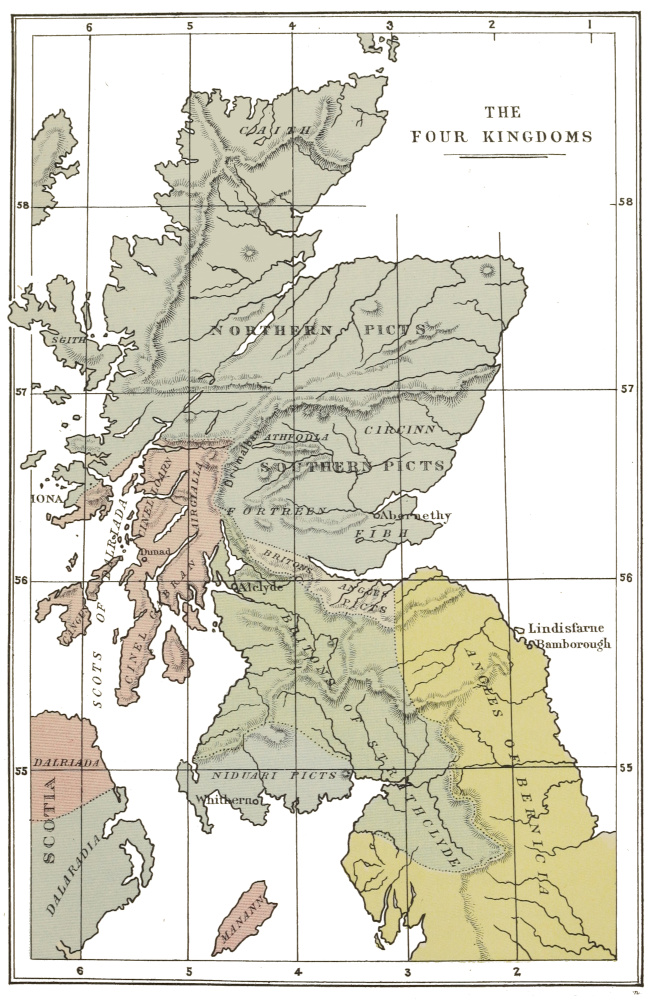
THE
FOUR KINGDOMS
W. & A.K. Johnston, Edinburgh & London.
Scottish kingdom of Dalriada.
229The Scottish colony was originally founded by Fergus
Mor, son of Erc, who came with his two brothers Loarn and
Angus from Irish Dalriada in the end of the fifth century,
but the true founder of the Dalriadic kingdom was his
great-grandson Aedan, son of Gabran. It consisted of three
tribes, the Cinel Gabran, the Cinel Angus, and the Cinel
Loarn, which were called the ‘three powerfuls of Dalriada.’
The Cinel Gabran consisted of the descendants of Fergus,
whose son Domangart had two sons, Gabran and Comgall,
and their possessions consisted of the district of Cowall,
which takes its name from Comgall, that of Cindtire or
Kintyre, which then extended from the river Add, which
flows into the bay of Crinan, to the Mull of Kintyre, and
included Knapdale and the small islands of this coast.
The Cinel Angusa settled in Isla and Jura, while the names
of their townships which have been preserved embrace the
eastern half of the island only. The Cinel Loarn possessed
the district of Lorn, which takes its name from them and
extends from Loch Leven to the point of Ashnish. Between
the possessions of the Cinel Loarn and those of the Cinel
Gabhran extended what is now the great moss of Crinan,
called in Gaelic ‘Monadhmor;’ and on the bank of the
river Add, which meanders through it, there rises an
isolated rocky hill, the summit of which bears the mark of
having been strongly fortified, while the great stones and
cairns on the moss around it preserve the record of many an
attempt to take it. This fortified hill was called Dunadd, a
name which it still retains, and was the capital of Dalriada.
It was also called, from the moss which surrounds it, Dunmonaidh.
The possessions of these Dalriadic tribes surrounded
a small district extending from the districts of
230Lorn, Kintyre, and Cowal, to Drumalban, in the centre of
which was the lake of Loch Awe. As this territory was
not included in the possessions of any of these tribes, it
probably still retained its original population, and contained
the remains of the earlier inhabitants before the arrival of
the Scots. The kings of this small kingdom of Dalriada
all belonged to the race of Erc, and succeeded each other
according to the Irish law of Tanistry, which often assumed
the form of an alternate succession from the members of
two families descended from the common ancestor. In Dalriada
it alternated first between the descendants of Gabran
and Comgall, the two grandsons of Fergus, and afterwards
between the Cinel Gabran and Cinel Loarn.[284]
The kingdom of the Picts.
The remaining districts north of the Firths of Forth and
Clyde formed the kingdom of the Picts. Throughout the
whole course of their history as an independent nation there
seems to have been a twofold division of this people, and
they were eventually distinguished from each other as the
northern and the southern Picts. Bede tells us that they
were separated from each other by steep and rugged mountain
chains, and he terms in one place the northern Picts,
the Transmontane Picts.[285] This mountain range can only
refer to the great chain termed the Mounth, which extends
across the island from Ben Nevis in Lochaber, till it terminates
231near the east coast between Aberdeen and Stonehaven.
The whole country north of this range from sea to
sea belonged to the northern Picts, who appear to have been
purely Gaelic in race and language. The southern Picts are
said by Bede to have had seats within these mountains,
which refers no doubt to the districts intersected by the
lesser chains which extend from the main range towards the
south-east, and from the barrier of the so-called Grampians.
These districts consist of the Perthshire and Forfarshire
Highlands, the former of which is known by the name of
Atholl. The western boundary of the territory of the
southern Picts was Drumalban, which separated them from
the Scots of Dalriada, and their southern boundary the
Forth. The main body of the southern Picts also belonged
no doubt to the Gaelic race, though they may have possessed
some differences in the idiom of their language; but the
original population of the country extending from the Forth
to the Tay consisted of part of the tribe of Damnonii, who
belonged to the Cornish variety of the British race, and
they appear to have been incorporated with the southern
Picts, and to have introduced a British element into their
language. The Frisian settlements, too, on the shores of the
Firth of Forth may also have left their stamp on this part
of the nation. The former are probably the Britons of
Fortrenn of the Pictish legends, and the latter have
apparently left a record of their presence in the term of
the Frisian Shore, known as the name of a district on the
south of the Firth of Forth; and the name of Fothrik,
applied to a district now represented by Kinross-shire and
the western part of Fifeshire, may preserve a recollection of
their Rik or kingdom.
The Picts seem to have preserved a tradition that the
whole nation was once divided into seven provinces, whose
names were derived from seven sons of Cruithne, the ‘eponymus’
of the race, and the reference to Saint Columba, as
232perpetuating this in a stanza, relegates it to this period. Of
these names five can be recognised. In Fib we have Fife,
Fodla enters into the name of Atholl, Circinn into that of
the Mearns, Fortrenn was certainly the district from the Tay
to the Forth, and Caith was the district of Cathenesia, originally
of great extent, and embracing the most northern part
of the island from sea to sea.
The seat of government appears to have been sometimes
within the territory of the southern Picts, and at others on
the north of the great chain of the Mounth. When we can
first venture to regard the list of the Pictish kings preserved
in the Pictish Chronicle as having some claim to a historical
character, we find the king having his seat apparently in
Forfarshire; but when the works of Adamnan and Bede place
us upon firm ground, the monarch belonged to the race of
the northern Picts, and had his fortified residence near the
mouth of the river Ness.
When we examine the historical part of the list of the
Pictish monarchs, we find that it exhibits a very marked
peculiarity in the order of succession. We see brothers, sons
of the same father, succeeding each other, but it does not
present a single instance, throughout the whole period of the
Pictish kingdom, of a son directly succeeding his father. Bede
gives us the law of succession thus: ‘That when it came into
doubt they elected the king rather from the female than from
the male royal lineage, a custom,’ he says, ‘preserved among
the Picts to his day.’[286] It is thus stated in the poem attached
to the Irish Nennius, ‘that from the nobility of the mother
should always be the right to the sovereignty;’ and in the
prose legends, ‘that the regal succession among them for ever
should be on the mother’s side.’ ‘That not less should
territorial succession be derived from men than from women
233for ever;’[287] ‘so that it is in right of mothers they succeed to
sovereignty and all other successions.’ ‘That they alone
should take of the sovereignty and of the land from women
rather than from men in Cruithintuath for ever.’ ‘That of
women should be the royal succession among them for ever.’[288]
These statements, when compared with the actual succession,
lead to this, that brothers succeeded each other in preference
to the sons of each, not an unusual feature in male succession;
but, on their failure, the contingency alluded to by
Bede arose, and the succession then passed to the sons of
sisters, or to the nearest male relation on the female side,
and through a female. This, however, does not exhaust the
anomalies exhibited in this list of kings, for we find that the
names given as those of the fathers of the kings differ entirely
from those of their sons, and in no case does a son who
reigns bear the same name as that of any one of the fathers
in the list. The names of the reigning kings are in the main
confined to four or five names, as Brude, Drust, Talorgan,
Nechtan, Gartnaidh, and these never appear among the
names of the fathers of kings, nor does the name of a father
occur twice in the list. Further, in two cases we know that
while the kings who reigned were termed respectively Brude
and Talorcan, the father of the one was a Briton, and of the
other an Angle.[289] The conclusion which Mr. M‘Lennan, in
his very original work on primitive marriage, draws from
this is, that it ‘raises a strong presumption that all the
fathers were men of other tribes. At any rate there remains
the fact, after every deduction has been made, that the fathers
and mothers were in no case of the same family name;’[290] and
he quotes this as a reason for believing that exogamy prevailed
among the Picts. But this explanation, though it
234goes some way, will not fully interpret the anomalies in the
list of Pictish kings. The only hypothesis that seems to
afford a full explanation is one that would suppose that the
kings among the Picts were elected from one family clan or
tribe, or possibly from one in each of the two divisions of the
northern and southern Picts; that there lingered among the
Picts the old custom among the Celts, who, to use the
language of Mr. M‘Lennan, ‘were anciently lax in their
morals, and recognised relationship through mothers only;’[291]
that intermarriage was not permitted in this royal family or
tribe, and the women had to obtain their husbands from the
men of other tribes, not excluding those of a different race;[292]
that the children were adopted into the tribe of the mother,
and certain names were exclusively bestowed on such children.
Such an hypothesis seems capable of explaining all the facts
of the case; and if the male child thus adopted into the
tribe of the mother became king, and was paternally of a
foreign race, it will readily be seen how much this would
facilitate the permanent occupation of the Pictish throne by
a foreign line of kings. It would only be necessary that one
king, who was paternally of a foreign tribe, and whose succession
to the throne could not be opposed in conformity
with the Pictish law of succession, should become powerful
235enough to alter the succession to one through males, and
perpetuate it in his own family. Although the Pictish
people might resist to the utmost their subjection to a foreign
nation, and would make every effort to throw off the yoke,
there would be nothing in the mere occupation of the throne
by a family of foreign descent, who derived their succession
originally through a female of the Pictish royal tribe, to
arouse their national feeling to any extent against it.
The death of Brude mac Mailchon, the king of the northern
Picts, whom Saint Columba converted, is recorded by
Tighernac in the year 584,[293] after a reign of thirty years;
and as no battle is mentioned between him and the Dalriads
after the arrival of Saint Columba, it seems probable that
the boundaries of the respective kingdoms by the Picts and
Scots of Dalriada were amicably settled by the same influence
which procured the recognition of the independence of Dalriada
at the convention of Drumceitt. Brude was succeeded
by Gartnaidh, who is called son of Domelch, who reigned
eleven years, and his death took place in 599,[294] two years
after that of Saint Columba himself. He is succeeded by
Nectan, who bears the unusual designation of grandson of
Uerd, and who occupied the throne at the beginning of the
sixth century.[295]
Kingdom of the Britons of Alclyde.
The districts south of the Firths of Forth and Clyde, and
extending to the Solway Firth on the west and to the Tyne on
the east, were possessed by the two kingdoms of the Britons
on the west and of the Angles of Bernicia on the east. The
former extended from the river Derwent in Cumberland in the
south to the Firth of Clyde in the north, which separated the
Britons from the Scots of Dalriada. The British kingdom
thus comprehended Cumberland and Westmoreland, with the
exception of the baronies of Allerdale or Copeland in the
236former and Kendal in the latter, and the counties of Dumfries,
Ayr, Renfrew, Lanark, and Peebles, in Scotland. On the
east the great forest of Ettrick separated them from the
Angles, and here the ancient rampart of the Catrail which
runs from the south-east corner of Peeblesshire, near Galashiels,
through the county of Selkirk to the Peel Hill on
the south side of Liddesdale, probably marked the boundary
between them. The population of this kingdom seems to have
belonged to two varieties of the British race,—the southern
half, including Dumfriesshire, being Cymric or Welsh, and
the northern half having been occupied by the Damnonii
who belonged to the Cornish variety. The capital of the
kingdom was the strongly-fortified position on the rock on
the right bank of the Clyde, termed by the Britons Alcluith,
and by the Gadhelic people Dunbreatan, or the fort of the
Britons, now Dumbarton; but the ancient town called Caer
Luel or Carlisle in the southern part must always have been an
important position. The kingdom of the Britons had at this
time no territorial designation, but its monarchs were termed
kings of Alcluith, and belonged to that party among the
Britons who bore the peculiar name of Romans, and claimed
descent from the ancient Roman rulers in Britain. The law
of succession seems to have been one of purely male descent.
Kingdom of Bernicia.
Of Aedilfrid, who at this time ruled over Bernicia, and
soon after extended his sway over Deira also, it is told us by
Bede that he ‘conquered more territories from the Britons,
either making them tributary, or expelling the inhabitants
and planting Angles in their places, than any other king;’ and
to his reign we attribute the greatest extension of the Anglic
power over the Britons. He appears to have added to his
kingdom the districts on the west between the Derwent and
the Mersey, thus extending Deira from sea to sea, and placing
the Northumbrian kingdom between the Britons of the
north and those of Wales. The river Tees appears to have
separated Deira from Bernicia, and the Angles of Bernicia,
237with whom we have more immediately to do, were now in
firm possession of the districts extending along the east coast
as far as the Firth of Forth, originally occupied by the British
tribe of the Ottadeni and afterwards by the Picts, and including
the counties of Berwick and Roxburgh and that of East
Lothian or Haddington, the rivers Esk and Gala forming here
their western boundary. The capital of Deira was York, and
that of Bernicia the strongly-fortified position on the coast
nearly opposite the Farne Islands, crowning a basaltic rock
rising 150 feet above the sea, and accessible only on the south-east,
which was called by the Britons Dinguayrdi, by the
Gael Dunguaire, and by the Angles Bebbanburch after Bebba
the wife of Aedilfrid, now Bamborough. About half-way
along the coast, between Bamborough and Berwick-on-Tweed,
lay, parallel to the shore, the long flat island called by the
Britons Ynys Medcaud, and by the Angles Lindisfarne.[296]
The debateable lands.
In the centre of Scotland, where it is intersected by the
two arms of the sea, the Forth and the Clyde, and where the
boundaries of these four kingdoms approach one another, is
a territory extending from the Esk to the Tay, which possessed
a very mixed population, and was the scene of most
of the conflicts between these four states. Originally occupied
by the tribe of the Damnonii, the northern boundary of the
Roman province intersected it for two centuries and a half,
including part of this tribe and the province, and merging
the rest among the barbarians. On the fall of the Roman
power in Britain, it was overrun by the Picts, and one of the
earliest settlements of the Saxons, which probably was
composed of Frisians, took place in the districts about the
Roman wall. It was here that during the sixth century the
main struggle took place. It falls naturally into three
divisions. The first extends from the Esk and the Pentland
238Hills to the Roman wall and the river Carron. This district
we find mainly peopled by Picts, the remains probably of
those who once occupied the eastern districts to the southern
wall, and preserved a kind of independence, while the rest
were subjected by the Angles.
From the Picts the Angles give the hills which formed its
southern boundary the name of the Pehtland, now Pentland
hills. Near its south-eastern boundary was the strong
natural position called by the Britons Mynyd Agned and
also Dineiddyn, and by the Gael Dunedin. Nine miles
farther west, the Firth of Forth is narrowed till the coast
approaches within two miles of that of Fife, and affords a
ready means of access; and on the south shore of the upper
basin of the Forth, and near the termination of the Roman
wall, was the ancient British town of Caeredin, while in the
Forth itself opposite this district was the insular town of
Giudi. The western part of this territory was known to the
Welsh by the name of Manau Guotodin, and to the Gael as
the plain or district of Manann, a name still preserved in
Sliabhmanann, now Slamanan, and this seems to have been
the headquarters of these Picts.
Between them and the kingdom of the Picts proper lay
a central district, extending from the wall to the river Forth,
and on the bank of the latter was the strong position afterwards
occupied by Stirling Castle; and while the Angles of
Bernicia exercised an influence and a kind of authority over
the first district, this central part seems to have been more
closely connected with the British kingdom of Alclyde. The
northern part, extending from the Forth to the Tay, belonged
to the Pictish kingdom, with whom its population, originally
British, appears to have been incorporated, and was the
district afterwards known as Fortrenn and Magh Fortrenn.
Galloway.
Finally, on the north shore of the Solway Firth, and
separated from the Britons by the lower part of the river
Nith, and by the mountain range which separates the counties
239of Kirkcudbright and Wigtown from those of Dumfries and
Ayr, were a body of Picts, termed by Bede, Niduari; and this
district, consisting of the two former counties, was known to
the Welsh as Galwydel, and to the Irish as Gallgaidel, from
which was formed the name Gallweithia, now Galloway.
A.D. 606.
Death of Aidan, king of Dalriada; Aedilfrid conquers Deira, and expels Aeduin.
Three years after the great battle in which Aidan was
defeated at Dawstone in Liddesdale, he died, leaving his
throne to his son Eocha Buidhe, or the yellow-haired, whom
Saint Columba had named as his successor;[297] and in the
same year Aedilfrid, king of Bernicia, attacked Aeduin, who
had succeeded his father Aella in Deira when a child, and
had barely attained majority, and drove him from his throne,
thus uniting Deira to Bernicia, over which he reigned twelve
years. A change likewise soon took place among the Pictish
kings, and in the year 612 Nectan appears to have been displaced
by Cinioch or Cinadon, son of Luchtren, who from the
Gaelic form of his name probably belonged to the northern
Picts.[298] Five years afterwards Aeduin, who, after wandering
as a fugitive in different parts of Britain, had finally
taken refuge with Redwald, king of the East Angles, succeeded
in persuading him to assist him to recover his throne.
A.D. 617.
Battle between Aeduin and Aedilfrid.
A large army was accordingly raised, and meeting
Aedilfrid, who was advancing against him with inferior force,
he attacked him and slew him on the borders of the kingdom
of Mercia, on the east side of the river called Idlae or Idle,
a small river which falls into the Trent. Aeduin thus not
only regained his kingdom in the year 617, but obtained
possession of both provinces of Deira and Bernicia, which
had been under the rule of Aedilfrid, and in his turn drove
out his sons, who, with many of the young nobles of their
240party, took refuge with the Scots of Dalriada or with the
Picts. The eldest of the sons, Eanfrid, appears to have fled
for protection to the king of the Picts; and the second,
Osuald, who was then of the same age that Aeduin had been
when he was expelled, went to the island of Iona, where
Bede tells us he was instructed in the Christian faith and
baptized by the seniors of the Scots. Aeduin, too, with his
whole nation was converted to Christianity by Paulinus in
the eleventh year of his reign. Bede classes Aeduin among
the kings of the Anglic natives who possessed imperial
authority, and he is the first of the Northumbrian kings to
whom such power is attributed: he says that he ruled over
all the people both of the Angles and the Britons who inhabit
the island, and in another place, that none of the Angles
before him had brought under subjection all the borders of
Britain that were provinces either of themselves or the
Britons.[299] These expressions must not be taken literally,
and are not altogether consistent with the similar statement
with regard to his predecessor Aedilfrid, but they undoubtedly
imply that he was one of the most powerful of the Northumbrian
monarchs, and at least retained all the acquisitions
of his predecessors, while he has left his name in one district,
which shows that he had extended the limits of the Northumbrian
kingdom in one direction at least. The oldest form
of the name of Edinburgh is Edwinesburg,[300] which leads us
to infer that he had added the district from the Esk to the
Avon at least, of which it was the chief stronghold, to his
kingdom. The country extending from the river Avon to
the range of the Lammermoor hills was called by the Saxons
‘Lothene,’ and by the Gael ‘Lethead,’ and appears also under
241the name of the province of Loidis, a name which was afterwards
extended as far south as the Tweed.[301]
A.D. 627.
Battle of Ardcorann between Dalriads and Cruithnigh.
The Irish annalists record in the year 627 the battle of
Ardcorann, in which the Dalriads were victorious, and
Fiachna, son of Deman, was slain by Conadh Cerr, king of
Dalriada.[302] Fiachna mac Deman was the king of the
Cruithnigh of Dalaradia in Ireland, and the battle was probably
fought in Ireland, Conadh Cerr, king of Dalriada,
coming to the assistance of the Irish Dalriads; but Conadh
Cerr was the son of Eochadh Buidhe, who was still alive,
and he would appear to have transferred the throne of
Dalriada to his son. The explanation will probably be found
in the record of another battle fought two years afterwards,
also in Ireland, called the battle of Fedhaeoin or Fedhaeuin.
This battle was also fought between the Cruithnigh and the
Dalriads, and the latter were defeated. On the side of the
victors were Maelcaith mac Scandail, king of the Cruithnigh
of Ulster, Dicuill mac Eachach, king of a tribe of Cruithnigh,
and Eochadh Buidhe; and, on the other, Conad Cerr, king of
Dalriada, and two grandsons of Aidan, who were slain.[303]
242Eochadh Buidhe is here on the side of the Cruithnigh and
opposed to two of his own sons, one of them leading the
Dalriads; but the Annals of Ulster, quoting an old book
called the Book of Cuanac, record the death of Eochadh
Buidhe, king of the Picts, in the same year, and this corresponds
with the length of his reign as given in the Albanic
Duan, where a king of the Picts is mentioned who does not
appear in the list of Pictish monarchs. The inference is
that he was king of the Picts of Galloway, and it would
appear that in the course of his reign Eochadh had either
obtained authority over them or acquired a right to that
province, and placed his son Conadh Cerr on the throne of
Dalriada proper; and thus, when a war broke out between
the Cruithnigh and the Dalriads of Ireland, the anomaly
occurred of the father fighting on the one side with his Picts,
and the sons with the Dalriads on the other.
A.D. 629.
Domnall Breac becomes king of Dalriada.
On the death of Conadh Cerr in 629, his brother Domnall
Breac succeeded him as king of Dalriada, while the rule over
the Picts, which gave to Eochaidh Buidhe his title of king of
the Picts, probably passed by the Pictish law of female succession
to another family.
A.D. 631.
Garnaid, son of Wid, succeeds Cinaeth mac Luchtren as king of the Picts.
The death of Cinaeth mac Luchtren, king of the Picts, is
recorded by Tighernac in 631,[304] and he was succeeded by a
family of three brothers, Garnaid, Bredei, and Talore, sons of
Wid or Foith, who followed each other on the Pictish throne
during the next twenty-two years. In the meantime a storm
was gathering on the borders of Northumbria, which was soon
243to burst upon Aeduin and bring his powerful kingdom with
his own life to an end. Among those British kings who had
been subjected to the authority of the Northumbrian king
was a king of the Britons termed by Bede ‘Caedwalla.’ He
is described by Bede as a man who, though he bore the name
and professed himself a Christian, was yet so barbarous in his
disposition and behaviour that he spared neither women nor
children in his wars.[305] This British king resolved not only
to throw off all subjection to Northumbria, but to cut off the
whole nation of the Angles within the borders of Britain.
He was enabled to attempt this enterprise by having secured
the support of Penda, whom Bede calls a most warlike man,
of the royal race of the Mercians,[306] who had just ascended
the throne of that nation. Penda and his whole nation
were still pagans and idolaters, and probably viewed the
establishment of Christianity as the religion of Northumbria
with much hostility; and Caedwalla, though nominally a
Christian, had all the hatred of the Welsh Church towards
the Anglic Christians and their church, with whom they held
no communication.
A.D. 633.
Battle of Haethfeld. Aeduin slain by Caedwalla and Penda.
A great battle was fought between these leaders and
Aeduin in a plain called by Bede Haethfeld, now Hatfield, in
the West Riding of Yorkshire, on the 12th of October in the
year 633, in which Aeduin was himself killed, and all his
army either slain or dispersed. His son Osfrid also fell in
the same war, and another son Eadfrid was obliged to go
over to Penda.[307] In the genealogies and chronicle attached
to Nennius this battle is called the battle of Meicen, and
244both Osfrid and Eadfrid are said to have been slain in it;
and it is added that none of Aeduin’s race escaped, and the
victor is termed Catguollaun, king of Guenedotia or North
Wales. Bede tells us that a great slaughter was made at this
time of the church and nation of the Northumbrians, and
the more so because one of the commanders by whom it was
done was a pagan, and the other a barbarian more cruel than
a pagan, and that the province of Deira fell on Aeduin’s
death to Osric, son of his uncle Aelric, who was a Christian,
being one of those whom Paulinus had converted; while
Eanfrid, the eldest son of Aedilfrid, who had taken refuge
on the accession of Aeduin with the Picts, and had there
been instructed in the Christian religion by the Scottish
monks, returned on Aeduin’s death to Bernicia and took
possession of his father’s kingdom. We are told, however,
by Bede that both kings, as soon as they obtained possession
of their kingdoms, renounced their Christianity and returned
to their former paganism, but were soon after slain by
Caedwalla, who first surprised and killed Osric, who had
besieged him in the city of York, and after having reigned
for a year over the provinces of the Northumbrians, also
killed Eanfrid, who came to him with only twelve soldiers
to sue for peace, when he was probably advancing upon Bamborough.
That year, adds Bede, is to this day looked upon
as unhappy and hateful to all good men, as well on account
of the apostasy of the Anglic kings who had renounced the
sacraments of their faith, as of the outrageous tyranny of the
British king.[308]
A.D. 634.
Battle of Hefenfeld. Osuald becomes king of Northumbria.
After the death of Eanfrid, his brother Osuald advanced
from the north with an army small indeed in number, as
Bede tells us, but strengthened with the faith of Christ, and
north of the Tweed, and encountered the army of the Britons,
which was greatly more numerous, at a place near the
245Roman wall called in the Anglic tongue Devisesburn, where
a complete victory was gained, and the impious commander
of the Britons was slain. The field of battle, Bede tells us,
was also called Hefenfelth, or the heavenly field, and was
not far from Hexham, in the vale of the Tyne. It has been
identified with a place called St. Osualds, close to the wall,
and about seven or eight miles north of Hexham; and the
British commander must have been driven across the wild
moor on the south side of the wall through the Tyne, until
he was overtaken at a distance of eight or nine miles from
the battlefield, and slain at a little stream called Devisesburn,
a tributary of the Rowley water. This battle is termed
in the additions to Nennius the battle of Catscaul, and it
has been well suggested that this name may be intended for
Cad-ys-gual, the battle at the wall. It is somewhat remarkable
that while Bede names Caedwalla whenever he has
occasion to mention him, he does not name him as the commander
who was slain at this battle. Adamnan, who was
born in 624, and was therefore ten years old when the battle
was fought, tells us that the day before the Saxon ruler
Osuald went forth to fight Catlon, a very valiant king of the
Britons, he saw Saint Columba in a vision, who told him to
march out from his camp to battle the following night,
when his foes would be put to flight and his enemy Catlon
delivered into his hands; and that the next night King
Osuald went forth from his camp to battle, and had a much
smaller army than the numerous hosts opposed to him, yet
he obtained an easy and decisive victory, for King Catlon
was slain, and the conqueror on his return after the battle was
ever after ordained by God emperor of all Britain. Adamnan
adds that he had this narrative from the lips of his predecessor,
the abbot Failbe, who solemnly declared that he
had himself heard King Osuald relate it to the Abbot
Segine.[309] We can hardly have better evidence than this as
246to the events of the battle, whatever may be said as to the
vision, and Tighernac likewise names Catlon, king of the
Britons, as King Osuald’s opponent,[310] but the name given to
Caedwalla in recording the battle in which he slew King
Aeduin was not Cathlon but Chon. In the Genealogies
annexed to Nennius, Caedwalla is termed Catguollaun, king
of Guenedotia, while King Osuald’s opponent is named
Catgublaun, king of Guenedotia. It is therefore not impossible
that the impious commander of Bede may not have
been Caedwalla himself, and that there may be some truth
in the account given in the Welsh Bruts that the Caedwalla,
who slew Aeduin, survived for many years after; but this is
not a matter which much affects our narrative so far as it
concerns the history before us.
A.D. 635.
Battle of Seguise between Garnait, son of Foith, and the family of Nectan.
About the same time the family of that Nectan, king of
the Picts, who had been dispossessed in 612 seem to have
made an effort to recover the throne, for the Annals of Inisfallen
have in 634 the death of Aengus, son of Nechtan, and
Tighernac records in 635 the battle of Seguise, in which
Lochene, son of Nechtan Cennfota, and Cumuscach, son of
Aengus, fell. These names are purely Gaelic forms, and
‘Cennfota’ is a Gaelic epithet, meaning long-headed. The
Annals of Ulster have the death of Gartnait, son of Foith, in
the same year, and say he fell in this battle, which seems to
leave little doubt that it was a contest for the throne.[311] The
battle was probably fought on the west bank of the Tay, a
few miles above Dunkeld, at a place now called Dalguise;
and on the east side of the river, immediately opposite that
place, a cairn once stood about thirty feet in diameter, which
contained a single stone coffin, and near it two high upright
247stones, while at a small distance from the cairn were found
a few rude stone coffins. These may have been memorials of
the battle. Gartnaidh was succeeded by his brother Bredei,
son of Uid or Foith.
A.D. 634.
Battle of Calathros, in which Domnall Breac was defeated.
In the same year in which the battle was fought which
placed Osuald on the throne of Bernicia, Domnall Breac, king
of the Scots of Dalriada, appears to have made an attempt to
wrest the district between the Avon and the Pentland Hills
from the Angles,—whether as having some claim to it through
his grandfather Aidan, or, what is more probable, as a leader
of the Britons, but was defeated at Calathros,[312] or Calatria,
now Callander—a name applied to a small district between
the Roman wall and the Avon; and Bede, who ranks Osuald
after Aeduin among those who held imperial authority in
Britain, tells us that he held the kingdom within the same
boundaries.[313]
Cummen the Fair, who was abbot of Iona from 657 to
669, tells us in his Life of Saint Columba, which is still preserved,
that, when the saint inaugurated Aidan as king of
Dalriada, and placed his hands upon his head, and blessed
him, he prophesied of his sons, grandchildren, and great-grandchildren,
thus addressing him:—‘Believe unhesitatingly,
O Aidan, that none of thy enemies shall be able to resist
thee, unless thou first act unjustly towards me and my kin.
Wherefore exhort thy sons with these words, lest they lose
the kingdom,’ which, he adds, took place, for they transgressed
the injunction of the man of God, and lost the kingdom.
Adamnan, who is also a contemporary authority for the
events of this period, quotes this passage, somewhat amplifying
it, and adds—‘Now this prophecy hath been fulfilled
248in our own times in the battle of Roth, in which Domnall
Breac, the grandson of Aidan, ravaged without the slightest
provocation the territory of Domnall, the grandson of Ainmuireg;
and from that day to this (between 690 and 700)
they have been trodden down by strangers.’[314] The battle
termed by Adamnan, Roth, was the battle of Magh Rath,
fought in 637 between Domnall, son of Aed, king of Ireland,
and Congal Claen, king of Uladh, that is of the Cruithnigh of
Dalaradia, and appears to have been a great struggle between
the Cruithnigh and kindred tribes with the dominant Scots
of the race of Hy Neill. Congal Claen applied for assistance
both to the Britons and to the king of Scottish Dalriada,
and was supported by a large auxiliary force. His claim
upon Domnall Breac arose probably from the connection of
his father, Eochadh Buidhe, with the Picts, and the gravamen
of the charge against the Dalriadic king was that, by the
settlement at the convention of Drumceatt, the hostings and
expeditions of Scotch Dalriada were to belong to the king of
Ireland, and by ranging himself on the side of the Cruithnigh
against him, he not only violated that condition, but assailed
the head of the family to which Saint Columba belonged.[315]
A.D. 638.
Battle of Glenmairison, and siege of Edinburgh.
In the following year Domnall Breac seems to have made
249another attempt to wrest the territory between the Avon and
the Pentlands from the Angles; and Tighernac records in 638
the battle of Glenmairison, or Glenmureson, which is probably
the small stream now called the Mureston Water
which flows from the Pentlands into the Linhouse Water
near Midcalder, in which his people were put to flight, and
the siege of Edinburgh.[316] During these wars there appears
to have been hitherto a combination of the Britons of Alclyde
and the Scots of Dalriada against the Angles and the Pictish
population subject to them. It was, in fact, a conflict of the
western tribes against the eastern, and of the Christian party
against the pagan and semi-pagan, their common Christianity
forming a strong bond of union between the two former
nations, and after the death of Rhydderch Hael in 603 the
Dalriadic kings seem to have taken the lead in the command
of the combined forces. Rhydderch, we are told, but on no
better authority than that of Jocelyn of Furness in the
twelfth century, was succeeded by his son Constantine; but
the throne of Alclyde had by this time passed to another
branch of the same family, and from whatever cause it arose,
a breach now took place between the Britons and the Scots,
and we find the British king and the king of Dalriada in a
hostile position to one another, and brought into violent
conflict, which ended in the fate which Saint Columba predicted
for any descendant of King Aidan who should attack
250|A.D. 642. Domnall Brecc slain in Strathcarron.|
the head of the house of Hy Neill overtaking Domnall Breac,
who, in December in the year 642, was slain in the upper
valley of the river Carron, which was known afterwards as
the forest of Strathcawin, by Oan, king of the Britons, in the
fifteenth year of his reign.[317] Dalriada seems to have fallen
into a state of anarchy on the death of Domnall Breac. During
the remainder of this century we find no descendant of Aidan
recorded bearing the title of king of Dalriada; and it is probable,
from Adamnan’s remark that from that day to this
they have been trodden down by strangers, that the Britons
now exercised a rule over them.[318]
The same year which saw Domnall Breac slain in Strathcarron
251likewise brought Osuald’s reign over Northumbria to
a disastrous end. His first effort, on finding himself firmly
seated on the throne, had been to re-establish the Christian
Church in his dominions, and to drive back the flow of
paganism and apostasy which had overspread the country.
He naturally turned to the form of Christianity in which he
had been educated, and sent to the elders of the Scots, desiring
them to send him a prelate who might instruct the nation
of the Angles once more in the Christian faith, and ere long
received Bishop Aidan from them for this purpose. The
account of this mission belongs more to the History of the
Early Christian Church in Scotland, and will be there more
fully noticed. It is sufficient for our present purpose to say
that his episcopal seat was fixed in the island of Lindisfarne,
which the king gave him for the purpose. ‘From that
time,’ says Bede, ‘many came from the region of the Scots
into Britain, and preached the Word to those provinces of the
Angles over which King Osuald ruled, and they among them
who had received priests’ orders administered the sacrament
of baptism. Churches were built. The people joyfully flocked
to hear the Word. Possessions and lands were given of the
king’s bounty to build monasteries. The Anglic youth were
instructed by their Scottish masters, and there were greater
care and attention bestowed upon the rules and observance
of regular discipline. Most of those that came to preach,’
adds Bede, ‘were monks, and Bishop Aidan himself was a
monk of the island called Hii,’ and now, corruptly, Iona.[319]
252Bede sums up his account of his reign by saying, ‘In
short, he brought under his dominion all the nations and provinces
of Britain, which are divided into four languages—namely,
the Britons, the Picts, the Scots, and the Angles;’[320]
but this general expression must be taken as qualified by the
statement Bede had previously made in contrasting him with
the other Northumbrian kings in his enumeration of those
who held imperial authority, that he had the same extent
under his rule as his predecessor Aeduin, and it implies no
more than that he had brought all the people within the then
limits of the Northumbrian kingdom under his subjection,
to whatever race they belonged. Bede, however, is stating a
more definite result of his reign when he adds that, through
his management, the provinces of the Deiri and the Bernicians,
which till then had been at variance, were peacefully
united and moulded into one people.
A.D. 642.
Osuald slain in battle by Penda.
These fair prospects, however, were soon to be overcast,
for his old enemy Penda, the pagan king of the Mercians,
having resolved to renew the struggle and make a second
attempt to crush the Christian kingdom of the Northumbrians,
Osuald appears to have anticipated the attack, and
was killed in a great battle with the Mercians, which was
fought at a place called by Bede Maserfelth, but to which
the continuator of Nennius gives the name of Cocboy, on the
8th day of August in the year 642. It is believed to have
taken place at Oswestry, formerly Oswaldstree, in Shropshire.
Thus perished a king who was looked upon as the greatest
and most Christian ruler of the Northumbrians, in the ninth
year of his reign and the thirty-eighth of his age.[321]
A.D. 642-670.
Osuiu, his brother, reigns twenty-eight years.
Osuald was succeeded by his brother Osuiu, then only
253about thirty years old, and during the first twelve years of
his reign he had to maintain a struggle for very existence
with the victorious king of the Mercians, who appears, as on
the former occasion, to have combined with the Britons, as
Tighernac records a battle between Osuiu and the Britons
early in his reign.[322] Bede tells us that he was also exposed
to much trouble by his own son, Alchfrid, and also by Oidiluald,
the son of his brother Osuald, who may have thought
he had a better right to the throne. Osuiu placed governors
over the province of Deira, the first being Osuini, son of that
Osric who had reigned a few months over Deira after the
death of Aeduin, and restricted his own immediate rule to his
hereditary province of Bernicia, where he had trouble enough
to maintain himself; for we find during the episcopate of
Aidan, who died in 651, the army of the Mercians, under
Penda, ravaging the country of the Northumbrians far and
near, and attacking the royal city of Bamborough, and not
being able to take it either by assault or by siege, Penda
encompassed it on the land side with the materials of the
wooden houses in the neighbourhood, which he had broken
up and set on fire with a view to burn the town; and Bede
tells us that Aidan, who was in one of the Farne Islands,
perceived the flames and smoke blown by the wind above
the city walls, and by his prayers produced a change of wind,
which blew them back on the besiegers, and obliged them
to raise the siege.[323] On another occasion, some years after
Aidan’s death, we find Penda again coming into this part of
Bernicia with his hostile army, destroying all he could with
fire and sword, and burning the village and church in which
Aidan died, and which was a royal residence not far from
Bamborough.[324] It is plain from these incidental notices that
Penda and his army had Bernicia very much at their mercy,
and were continually in the occupation of the country; and
254their irruptions became so intolerable at last, that Osuiu
offered him a very large gift of royal ornaments and money
to purchase peace if he would cease to ravage and destroy
the provinces of his kingdom, but Penda refused to grant his
request, and resolved to destroy and extirpate all his nation;[325]
and so desperate became his position, that he appears to have
taken refuge in the insular city of Giudi in the Firth of
Forth. Penda followed him with his army, composed both
of Mercians and of Britons, and Osuiu was compelled to
ransom the city by giving Penda all the riches which were
in it and in the neighbouring region as far as Manau, which
he distributed among the kings of the Britons who were with
him; but having raised a small army, and the enemy, who
enormously outnumbered them, probably not anticipating an
attack, and being in a false security, Osuiu fell upon them
unexpectedly in the night and entirely defeated them; Penda
himself and the thirty royal commanders who were with
him being slain, and Catgabail, king of Guenedotia or North
Wales, alone escaping. Bede tells us that this battle took
place on the 15th of November in the thirteenth year of
King Oswiu’s reign, that is in the year 654, and that it was
fought near the river Winuaed, which overflowed its banks
so that many more were drowned in the flight than were
destroyed by the sword, and that the war was thus brought
to a conclusion in the region of Loidis; on the other hand,
the continuator of Nennius says that Penda was slain in the
plain of Gai, and that it was called the slaughter of the plain
of Gai, and places it evidently between the city Judeu, by
which Bede’s insular city of Giudi on the Firth of Forth can
alone be meant, and Manau, which lay between the Pentlands
and the Roman wall. There is no doubt that on the only
other occasion on which Bede mentions the region of Loidis[326]
255he means Leeds, but it is equally certain that Lothian was
likewise called the province of Loidis; and if we suppose
that Bede here means the northern province of Lothian and
not the district of Leeds, it at once reconciles the two
accounts. That this is the probable view we may gather
from this, that Leeds was in Deira, and a battle fought there
is inconsistent with the extent to which it is evident Penda
had invaded the kingdom. On the other hand, Florence of
Worcester tells us that Penda’s attack was upon Bernicia.
It was here that we find Penda from time to time ravaging
the country, and it was this kingdom which was more
immediately under the rule of Osuiu.[327] The word Winuaed
256means Battleford, and the river meant by it is probably the
Avon, which divides the province of ‘Loidis’ from the district
of ‘Calatria,’ called in the Irish Annals ‘Calathros,’ and by
the Britons ‘Catraeth’—a district comprehending the
parishes of Falkirk, Muiravonside, and Polmont; and traces
of the name may still be found in the Fechtin’ Ford about a
mile above Manuel, and the Red Ford half a mile farther up.
The result of this great and unexpected victory was, Bede
tells us, that Osuiu both delivered his own people from the
hostile depredations of the pagans, and, having cut off their
wicked head, converted the nation of the Mercians and the
adjacent provinces to the Christian faith.
Dominion of Angles over Britons, Scots, and Picts.
Bede ranks Osuiu as the seventh king of the nations of
the Angles who possessed imperial power, and sums up the
result of his reign by saying that ‘he held nearly the same
dominions for some time as his predecessors, and subdued and
made tributary the greater part of the nations of the Picts
and Scots which possess the northern part of Britain.’[328] He
thus not only freed his own kingdom from the incursions of
the Mercians, and found himself at last in the full and quiet
possession of it, but he materially added to his dominions.
In the south he obtained possession of Mercia for three
years, and in the north extended his sway not only over the
Britons but over the Picts and Scots; and thus commenced
the dominion of the Angles over the Britons of Alclyde, the
Scots of Dalriada, and the southern Picts, which was destined
to last for thirty years. By the fall of Penda and the defeat
and slaughter of his British allies, the Britons of Alclyde
naturally fell under his sway. Tighernac records the death
257of no king of Alclyde during this period till the year 694,
and the Ulster Annals, after recording in 658 the death of
Gureit or Gwriad, king of Alclyde,[329] have also a blank during
the same time. The Scots of Dalriada naturally fell under
his dominion along with the Britons, and we have the testimony
of Adamnan that they were trodden down by strangers
during the same period. But while these nations became
tributary to the Angles during this period of thirty years,
the mode in which the king of Northumbria dealt with the
Picts shows that their dominion over them was of a different
kind, and that they viewed that part of the nation which
was subject to them as now forming part of the Northumbrian
kingdom. The way for this was prepared by the
accession of Talorcan, son of Ainfrit, to the throne of the Picts
on the death of Talore, son of Wid, or Ectolairg mac Foith,
as Tighernac calls him, in 653.[330] Talorcan was obviously
the son of that Ainfrait, the son of Aedilfrid, and elder
brother of Osuald, who on his father’s death had taken
refuge with the Picts, and his son Talorcan must have
succeeded to the throne through a Pictish mother. At the
time, then, when Osuiu thus extended his sway over the
Britons and Scots there was a king of the Anglic race by
paternal descent actually reigning over the Picts. Tighernac
records his death in 657,[331] and Bede tells us that within
three years after he had slain King Penda, Osuiu subjected
the greater part of the Picts to the dominion of the Angles.[332]
It is probable, therefore, that he claimed their submission to
himself as the cousin and heir on the paternal side of their
king Talorcan, and enforced his claim by force of arms.
How far his dominion extended it is difficult to say, but it
258certainly embraced, as we shall see, what Bede calls the
province of the Picts on the north side of the Firth of Forth,
and, nominally at least, may have included the whole territory
of the southern Picts; while Gartnaid, the son of
Donnell or Domhnaill, who appears in the Pictish Chronicle
as his successor, and who from the form of his father’s name
must have been of pure Gaelic race, ruled over those who
remained independent.
But while Osuiu’s dominion now remained on the whole
free from all disturbance from hostile invasion or internal
revolt, it was not destined to continue long without being
shaken by dissensions from another quarter, and one of those
great ecclesiastical questions soon arose, which, in its results,
materially affected the current of our history. The Church
which Osuald had established in Northumbria, and which
had now existed as the national form of religion for thirty
years, was an offshoot from the Scottish Church which owned
the monastery of Hii or Iona as its head, and followed the
customs and rules of that Church; but the great extension
of Christianity from Northumbria over the southern states
of the Angles which followed the death of Penda, brought it
more directly in contact with the southern Church, which
owned Saint Augustine as its founder, and conformed in its
customs to the Roman Church from which he had derived
his mission.
Colman, who had succeeded Finan in 660 as bishop of
Lindisfarne, at this time presided over the Scottish Church
of Northumbria. Wilfrid was at the head of the Roman
party. The points on which the churches differed were the
proper time for keeping Easter, the form of the tonsure, and
other questions concerning the rules of ecclesiastical life—questions
then thought, and especially the first, as of vital
importance. Osuiu, Bede tells us, having been instructed
and baptized by the Scots, thought nothing better than what
they taught, but his son Alchfrid, who then governed Deira,
259having been instructed in Christianity by Wilfrid, a most
learned man, who had first gone to Rome to learn the
ecclesiastical doctrine, and spent much time at Lyons with
Dalfin, archbishop of Gaul, and receiving from him also the
coronal tonsure,[333] had given him a monastery which had
been founded at Ripon for the Scots, who quitted it rather
than alter their customs.
In order to settle this dispute, a great council was held
in 664 at Strenaeshhalc, now Whitby, the details of which
belong more to the history of the Church. Suffice it to say
that it led to Osuiu submitting with his nation to Wilfrid,
and conforming to the Roman customs, while Colman withdrew
with his Scots and those who adhered to him, and
went back to Scotia to consult with his people what was
to be done in this case.[334] He went first to Hii or Iona on
leaving Lindisfarne in 664, taking with him part of the
relics of Saint Aidan, and having the rest interred in the
sacristy of the church at Lindisfarne, and in 668 passed
over to Ireland accompanied by the sons of Gartnaith, who
took with them the people of Skye, that is the Columban
clergy there, and returned two years afterwards.[335]
260On the departure of the Scots, the episcopal see was
removed from Lindisfarne to York, where it had been
originally placed by Paulinus, and Wilfrid was made bishop
of York, but did not obtain possession of the diocese till
669, when we find him administering the bishopric of York,
and of all the Northumbrians, and likewise of the Picts,
as far as the dominions of King Osuiu extended,[336] an
expression which undoubtedly implies that the Picts were
not merely tributary to the Angles, but that their territory
formed at this time a constituent part of Osuiu’s
dominions.
A.D. 670.
Death of Osuiu, and accession of Ecgfrid his son.
In the following year, Osuiu the king of the Northumbrians,
died, and was succeeded in both Bernicia and Deira
by his son Ecgfrid, whose accession was soon followed by
an attempt on the part of the Picts to throw off the Anglic
yoke. The account of this insurrection is preserved to us
alone by Eddi, in his Life of St. Wilfrid, who wrote a few
years before Bede compiled his history. |A.D. 672. Revolt of the Picts.| He tells us that
‘in the first years of his reign the bestial people of the
Picts, despising their subjection to the Saxons, and threatening
to throw off the yoke of servitude, collected together
innumerable tribes from the north, on hearing which Ecgfrid
assembled an army, and at the head of a smaller body of
troops advanced against this great and not easily discovered
enemy, who were assembled under a formidable ruler called
Bernaeth, and attacking them made so great a slaughter
that two rivers were almost filled with their bodies. Those
261who fled were pursued and cut to pieces, and the people
were again reduced to servitude, and remained under subjection
during the rest of Ecgfrid’s reign.’[337] Such is Eddi’s
account, from which it appears to have been an insurrection
of the southern Picts who were under the Anglic yoke, in
which they were aided by the northern part of the nation
who remained independent. The two rivers may have been
either the Forth and the Teith, which join their streams a
little above Stirling, or the Tay and the Earn, which unite
in the Firth of Tay at Abernethy, having a low-lying plain
forming the parish of Rhynd between, and the battle probably
took place in the second year of Ecgfrid’s reign, as
Tighernac records in that year the expulsion from the kingdom
of Drost, who had succeeded his brother Gartnaith as
king of the Picts.[338] Eddi then tells us that Ecgfrid attacked
and defeated Wlfar, king of the Mercians, and drove him
from his kingdom, an event not narrated by Bede, but
which must have happened before Wlfar’s death in 675,
and adds that ‘Ecgfrid’s kingdom was thus enlarged both in
262the north and the south, and that, under Bishop Wilfrid,
the churches were multiplied both in the south among the
Saxons, and in the north among the Britons, Scots, and
Picts, Wilfrid having ordained everywhere presbyters and
deacons, and governed new churches.’[339] It was probably at
this time that the monastery of Aebbercurnig or Abercorn
was founded in that part of Lothian which extends from
the Esk to the Avon as a central point for the administration
of the northern part of his diocese, which included the
province of the Picts held by the Angles of Northumbria
in subjection.
A.D. 678.
Wilfrid expelled from his diocese.
In 678 Bede tells us that a dissension broke out between
King Ecgfrid and Bishop Wilfrid, who was driven from his
see. His diocese was divided into two; Bosa was appointed
bishop of the province of Deira, having his episcopal seat
at York; and Eata over that of the Bernicians, and his seat
either in the church of Hagustald or Hexham, or in that of
Lindisfarne. Three years afterwards Wilfrid’s diocese was
still further divided and two additional bishops added—Tunberct
for the church of Hagustald, Eata remaining at
Lindisfarne, and Trumuin over the province of the Picts
which was subject to the Angles.[340]
Expulsion of Drost, king of the Picts, and accession of Brude, son of Bile.
On the failure of these great attempts to recover their
independence in 672, that part of the Pictish nation which
had not been brought under subjection to the Angles appears
263to have expelled their unsuccessful monarch, Drost, the
brother and successor of Gartnaith, son of Domnall, from
the kingdom, and to have elected Bredei, son of Bile, to fill
the vacant throne.[341] Bredei was paternally a scion of the
royal house of Alclyde, his father Bile appearing in the
Welsh genealogies annexed to Nennius as the son of Neithon
and father of that Eugein who slew Domnall Breac in 642.
His mother was the daughter of Talorcan mac Ainfrait, the
last independent king of the Picts before they were subjected
by Osuiu.[342] The object in placing him on the throne
may have been to put the true successor of Talorcan, according
to the law of Pictish succession, in competition with any
claim the Anglic monarch may have had as representing
him in the male line. Bredei began his reign in the extreme
north, as eight years after we find the siege of Dunbaitte
or Dunbeath, in Caithness, recorded in 680. In the
following year he advanced beyond the range of the Mounth
toward the south, as we have in 681 the siege of Dunfoither
or Dunnotter, near Stonehaven; and in 682 we are told by
Tighernac that the Orkney Islands were laid waste by
Bruidhe.[343]
In the meantime the little kingdom of Dalriada was in a
state of complete disorganisation. We find no record of any
real king over the whole nation of the Scots, but each
separate tribe seems to have remained isolated from the rest
under its own chief, while the Britons exercised a kind of
264sway over them, and, along with the Britons, they were
under subjection to the Angles. The most northerly part of
Dalriada was the small state called Cinel Baedan, or Kinelvadon,
which was a part of the larger tribe of the Cinel
Eochagh, one of the three subdivisions of the Cinel Loarn, but
separated from the rest by the great arm of the sea called
Linnhe Loch. The head of this little tribe was at this time
Fearchar Fada, or the Tall, the lineal descendant of Baedan,
from whom the tribe took its name, who was son of Eochaidh,
grandson of Loarn.[344] He appears to have commenced
an attempt to throw off the authority of the Britons, and
with it that of the Angles, but at first unsuccessfully. The
first encounter with the Britons was in 678, when the
Dalriads were defeated. At the same time the battles of
Dunlocho, Liaccmaelain and Doirad Eilinn were fought, the
latter of which can alone be placed with any certainty,
Doirad Eilinn being obviously the island of Jura.[345]
A.D. 684.
Ireland ravaged by Ecgfrid.
Bede tells us that in the year 684 Ecgfrid sent Berct, his
general, with an army into Ireland, and laid waste a part of
the country, not even sparing the churches or monasteries, in
265spite of the advice of the most reverend father Ecgberct, an
Anglic priest, who had been trained in Ireland, and lived
much among the Scots and Picts; and we learn from the
Irish Annals that the scene of this devastation was the plain
of Breg, or the districts along the eastern shore from Dublin
to Drogheda.[347] It seems difficult to suppose that Ecgfrid
should have made so wanton an attack upon the Irish without
some motive, and it seems probable that he either
suspected that the Scots of Dalriada were obtaining help
from their countrymen in Ireland, or wishing, by striking
this blow, to prevent the Irish from supporting them in
their attempt to recover their independence.
A.D. 685.
Invasion of kingdom of Picts by Ecgfrid; defeat and death at Dunnichen.
Be this as it may, Bede tells us that in the following
year King Ecgfrid led an army to ravage the province of
the Picts, and that, the enemy feigning a retreat, he was led
into the straits of inaccessible mountains and slain with the
greatest part of the forces which he had taken with him, on
the 20th day of May, in the fortieth year of his age,[348] that is,
in the year 685. The continuator of Nennius tells us that
Ecgfrid made war against the descendants of his father’s
brother, who was king of the Picts, and called Bridei, and
fell there with the whole strength of his army, the Picts
with their king being victorious, and that from the time of
this war it was called the battle of Lingaran. Tighernac
places the devastation in Ireland in the year 685, and this
battle, which he calls the battle of Duin Nechtain, in the
year 686. He agrees with Bede in stating that it took place
on the 20th of June, and adds that it was fought on a
266Saturday, but as the 20th of June fell on a Saturday in the
year 685, it is evident that Bede’s date is the correct one.
Simeon of Durham says that the battle was fought at a place
called Nechtan’s Mere, and the Annals of Ulster add the
further fact that Ecgfrid had burnt Tula Aman and Duin
Ollaig.[349] Ecgfrid appears therefore to have crossed the Forth
at Stirling, and advanced through Perthshire to the Tay,
where he burnt the place called Tula Aman at the mouth of
the river Almond where it falls into the Tay. He seems at
the same time to have sent a detachment from his army
into Dalriada, where he burnt Duinollaig, now Dunolly, the
chief stronghold of the Cinel Loarn. He then followed the
retreating army of the Picts along the level country bounded
on the north-west by the range of the Sidlaw hills, and in
attempting incautiously to penetrate through the mountain
range at Dunnichen was surrounded and defeated, his army
being almost entirely cut off and himself slain. There was
a lake, now drained, called the Mire of Dunnichen, where the
battle was fought, and has left its record in the numerous
stone coffins which have been found in the neighbourhood.[350]
An Irish annalist has preserved to us the following lines,
attributed to Riagal of Bangor:—
‘This day Bruide fights a battle for the land of his grandfather,
Unless the Son of God will it otherwise, he will die in it:
This day the son of Ossa was killed in battle with green swords,
Although he did penance, he shall lie in Hi after his death:
267This day the son of Ossa was killed, who had the black drink.
Christ heard our supplications, they spared Bruide the
brave.’brave.’[351]
Effect of the defeat and death of Ecgfrid.
The effect of this crushing defeat of the Anglic army, accompanied
by the death of their king, was to enable those
who had been under subjection to them at once to recover
their independence; and Bede thus sums it up:—‘From that
time the hopes and strength of the Anglic kingdom began to
fluctuate and to retrograde, for the Picts recovered the territory
belonging to them which the Angles had held, and the
Scots who were in Britain and a certain part of the Britons
regained their liberty, which they have now enjoyed for about
forty-six years.’[352]
The difference in the expressions used with regard to the
Picts and those employed towards the Scots and Britons shows
that while the latter were merely tributary to the Angles, the
former had actually been incorporated with their kingdom;
but the result secured the full independence of both, which
they had retained during the forty-six years which elapsed
from the death of Ecgfrid to the termination of Bede’s
history; and thus terminated the thirty years’ subjection of
the Picts, the Scots of Dalriada, and the Britons of Alclyde,
to the Angles; and as, after the defeat of Aedan with his
army of Scots and Britons at Dawstane, it was said that no
Scot durst after that attack the kingdom of the Angles, so
now we are told that the Angles never afterwards were in a
position to exact a tribute from the Picts.[353]
Position of the Angles and Picts.
Some portion of this period of forty-six years elapsed
before the mutual relations of the Angles and Picts on the
one hand, and the Scots and Britons on the other, became
268fixed within definite limits, and their internal government
completely reorganised. The Angles by this defeat lost the
Pictish territory Osuiu had added to their kingdom thirty
years before; but the previous boundaries of the Northumbrian
kingdom seem to have been retained, and we are told
by Bede that Aldfrid, the successor of Ecgfrid, ‘nobly retrieved
the ruined state of the kingdom though within
narrower bounds.’[354] The whole Pictish nation north of the
Firth of Forth, which Bede terms the Province of the Picts,
was now once more independent, but the kingdom of the
Angles still extended, nominally at least, to the Avon; and
though we are told that ‘among the many Angles who there
either fell by the sword or were made slaves, or escaped by
flight out of the country of the Picts, the most reverend man
of God, Trumuini, who had received the bishopric over
them, withdrew with his people that were in the monastery
of Aebbercurnig’ or Abercorn, Bede adds that it was ‘seated
in the country of the Angles, but close by the arm of the sea
which divides the territories of the Angles and the Picts.’[355]
Seven years after the battle of Dunnichen, Bruide, son of
Bile, the king of the Picts, died.[356] He is termed by Tighernac
king of Fortrenn, from which it would appear that after the
re-establishment of the Pictish kingdom in its independence
he had made the district of Fortrenn his principal seat, to
which he was no doubt led by his paternal connection with
269the Britons, and this term of Fortrenn now came to be used
as synonymous with the kingdom of the Picts.
Adamnan held the abbacy of Hii or Iona at the time that
Bruide died, and the Irish Life of Adamnan contains the following
strange legend:—‘The body of Bruide, son of Bile,
king of the Cruithnigh, was brought to Ia (Iona), and his
death was sorrowful and grievous to Adamnan, and he desired
that the body of Bruide should be brought to him into the
house that night. Adamnan watched by the body till morning.
Next day, when the body began to move and open its
eyes, a certain devout man came to the door of his house
and said, “If Adamnan’s object be to raise the dead, I say he
should not do so, for it will be a degradation to every cleric
who shall succeed to his place, if he too cannot raise the
dead.” “There is somewhat of right in that,” said Adamnan,
“therefore, as it is more proper, let us give our blessing to
the body and to the soul of Bruide.” Thus Bruide resigned
his spirit to heaven again, with the blessing of Adamnan and
the congregation of Ia. Then Adamnan said—
Many wonders doth he perform,
The King born of Mary:
He takes away life (and gives)
Death to Bruide, son of Bile;
It is rare,
After ruling in the kingdom of the north,
That a hollow wood of withered oak (an oak coffin)
Is about the son of the king of Alcluaith.’
[357]
He was succeeded by Taran, son of Entefidich, who seems
to have belonged to a different section of the Picts, and not
to have been generally accepted by the nation, as in the year
following his accession we have again a siege of Dun Foither
or Dunnotter, and after a short reign of four years he is
driven from the throne.[358] Taran was succeeded by Bridei, son
270of Dereli. In the year following Tighernac records a battle
between the Saxons and the Picts, in which Brechtraig, son
of Bernith, is slain. Bede in his Chronicle also records that
Brerctred, a royal commander of the Northumbrians, was slain
by the Picts,[359] and we are told in the Ulster Annals that, a
year after, Taran took refuge in Ireland. Brechtraig appears
to have been the son of that Bernaeth who headed the insurrection
of the Picts in 672, and seems to have made an effort
to recover the influence of the Angles over the Picts, which
was successfully resisted. Aldfrid, King of Northumbria,
died in 705, and was succeeded by his son Osred, a boy of
eight years old; and in the following year Tighernac records
the death of Brude, son of Dereli,[360] who was succeeded by
his brother Nectan, son of Dereli, according to the Pictish
law of succession. Five years after his accession, the Picts
of the plain of Manann, probably encouraged by the success
of the neighbouring kingdom of the Picts in maintaining
their independence against the Angles, rose against their
Saxon rulers. They were opposed by Berctfrid, the prefect
or Alderman of the Northumbrians, whose king was still only
in his fourteenth year. The Picts, however, were defeated
with great slaughter, and their youthful leader Finguine, son
of Deleroith, slain. The Saxon Chronicle tells us that this
battle was fought between Hæfe and Cære, by which the
rivers Avon and Carron are probably meant, the plain of
Manann being situated between these two rivers.[361] These
Picts appear to have been so effectually crushed that they
did not renew the attempt, and we do not learn of any
271further collision between the Picts and the Angles during
this period.
Position Scots and Britons.
The Scots of Dalriada and a party of the British nation,
we are told, recovered their freedom, the Angles still maintaining
the rule over the rest of the Britons. The portion
of their kingdom which became independent consisted of
those districts extending from the Firth of Clyde to the
Solway, embracing the counties of Dumbarton, Renfrew,
Lanark, Ayr, and Dumfries, with the stronghold of Alclyde
for its capital: but the Angles still retained possession of
the district of Galloway with its Pictish population, and
Whitehern as their principal seat, as well as of that part of
the territory of the Britons which lay between the Solway
Firth and the river Derwent, having as its principal seat the
town of Carlisle, which Ecgfrid had, in the same year in
which he assailed the Picts, given to Saint Cuthbert, who
had been made bishop of Lindisfarne in the previous year,
that is, in 684.[362]
Eight years after the death of Ecgfrid, Tighernac records
the death of Domnal mac Avin, king of Alclyde. He was
probably the son of that Oan or Eugein who slew Domnall
Breac in 642,[363] and had, on the defeat and death of Ecgfrid,
recovered his father’s throne. He was succeeded by Bile,
son of Alpin, and grandson of the same Eugein.
Contest between Cinel Loarn and Cinel Gabhran.
Although the Scots of Dalriada had thus obtained entire
independence, they did not immediately become united under
272one king. Their freedom from the yoke of the Britons and
Angles was followed by a contest between the chiefs of their
two principal tribes, the Cinel Loarn and the Cinel Gabhran,
for the throne of Dalriada. On the death of Domnall Breac,
when the Britons obtained a kind of supremacy over the
Dalriads, his brother Conall Crandamna, and his sons
Mailduin and Domnal Donn, appear to have been at the
head of the Cinel Gabhran, but Fearchar Fata, the chief of
the principal branch of the Cinel Loarn, had, as we have
seen, taken the lead in the attempt to free Dalriada from
the rule of strangers. The death of Domnall Donn, the son
of Conall Crandamna, is recorded in 696, and that of Fearchar
Fata in 697. The former was succeeded by Eocha, the
grandson of Domnall Breac, who was slain in the same year,
and the latter by his son Ainbhcellaig, who in the following
year was expelled from the kingdom, after Duinonlaig or
Dunolly had been burnt, and was sent bound to Ireland;[364]
but none of these leaders of the Cinel Loarn or the Cinel
Gabhran bore the title of king of Dalriada.[365] On the expulsion
of Ainbhcellaig we find his brother Sealbach at the head
of the Cinel Loarn, and in 701 he destroys Dun Onlaigh, and
cuts off the Cinel Cathbath, a rival branch of the tribe of
Loarn.[366] Three years after, the slaughter of the Dalriads in
Glenlemnae, or the valley of the Leven, is recorded, but
whether it was in the valley of the river Leven, which divides
Lorn from Lochaber, and flows into Loch Leven there, or
273whether it was the Leven in Dumbartonshire, cannot be fixed
with any certainty. In 707, Becc, grandson of Dunchada,
was slain. He was the head of a branch of the Cinel Gabhran,
who possessed the south half of Kintyre, and were descended
from Conaing, one of the sons of Aidan, to whom it was
given as his patrimony.[367]
Conflict between the Dalriads and the Britons.
The Dalriads appear soon after to have carried the war
into the British territory, for we have, in 711, a conflict of
the Dalriads and Britons at Loirgeclat, by which Loch Arklet,
on the east side of Loch Lomond, is probably meant, in which
the Britons are defeated. In 712 Sealbach besieges Aberte or
Dunaverty, the main stronghold of the south half of Kintyre,
the patrimony of the branch of the Cinel Gabhran of which
the descendants of Conaing, son of Aidan, were the head. In
714 Dunolly is rebuilt by Sealbach, and three years afterwards
there is again a conflict between the Britons and Dalriads, at
the stone which is called Minvircc, and the Britons are again
defeated.[368] In the valley at the head of Loch Lomond which
is called Glenfalloch there is a place called Clach na Breatan,
or the stone of the Britons, which is now at the separation of
Dumbartonshire from Perthshire, but originally marked the
274northern boundary of the territory of the Britons, and was
probably the scene of this conflict.
During the rest of the period of forty-six years which
succeeded the defeat and death of Ecgfrid, no further collision
between the Britons and the Dalriads is recorded, and
each nation remained within the limits of its own proper
kingdom.
275
State of the four kingdoms in 731.
When Bede closes his history, forty-six years after the defeat
and death of Ecgfrid, and we lose his invaluable guidance
through the annals of this obscure period, he leaves us with
this important record of the position of the four kingdoms
at that time:—‘In the province of the Northumbrians,
where king Ceoluulf reigns, four bishops now preside; Wilfrid
in the church of York, Ediluald in that of Lindisfarne, Acca
in that of Hagustald, Pecthelm in that which is called
‘Candida Casa,’ which, from the increased number of believers,
has lately become an additional episcopal see, and has him
for its first prelate. The Picts also at this time have a
treaty of peace with the nation of the Angles, and rejoice in
being united in catholic peace and truth with the universal
church. The Scots that inhabit Britain, satisfied with their
own territories, meditate no plots or conspiracies against the
nation of the Angles. The Britons, though they, for the
most part, through domestic hatred, are adverse to the nation
of the Angles, and wrongfully, and from wicked custom,
oppose the appointed Easter of the whole Catholic Church;
yet, from both the Divine and human power firmly withstanding
them, they can in no way prevail as they desire;
for though in part they are their own masters, yet partly
they are also brought under subjection to the Angles.’[369]
Alteration in their relative position.
276Causes, however, had already been in operation during
the latter part of this period, which were destined soon after
its termination to alter very materially the relative position
of these kingdoms. During the entire period of a century
and a half which had now elapsed since the northern Picts
were converted to Christianity by the preaching of Saint
Columba, there is hardly to be found the record of a single
battle between them and the Scots of Dalriada. Had they
viewed each other as hostile races, it is difficult to account
for the more powerful nation of the Picts permitting a small
colony like the Scots of Dalriada to remain in undisturbed
possession of the western district where they had settled.
Prior, indeed, to the mission of Saint Columba we find
the king of the northern Picts endeavouring to expel them,
but after that date there existed a powerful element of peace
and bond of union in the Columban Church. It was in
every respect a Scottish Church, with a Scottish clergy
supplied from Ireland. The Columban foundations had
spread over the whole nation of the Picts. They owed their
civilisation to its influence, and intrusted the education of
their children to its monastic schools; and the Columban
church of the Picts was, along with the Columban monasteries
in the north of Ireland, under the jurisdiction of the abbot
of Hii or Iona. As long, therefore, as this powerful influence
lasted, the Picts were content to remain at peace with the
Scots of Dalriada, and to view them as forming, as it were,
277one state along with the Pictish provinces in a Christian
confederacy; but the king who now reigned over the Picts,
Nectan, son of Derili, was led to adopt a course which
worked an entire revolution in the ecclesiastical relations of
the Picts and Scots, and led, as its inevitable result, to a
change in their friendly relations.
Legend of St. Bonifacius.
In the reign of this Nectan it is reported that a missionary
named Bonifacius, who came from Rome, landed in
the Firth of Forth, and made his way through Pictavia till
he came to a place called Restinoth. Here he met Nectan,
king of the Picts, with his army, who, with his nobles and
servants, received from Bonifacius the sacrament of baptism.
The king gave the place of his baptism, which he dedicated
to the Holy Trinity, to Bonifacius. Many people were indoctrinated
there into the Christian faith, and he employed
himself in the erection of churches there and in other places.
The legend tells us that Bonifacius was an Israelite descended
from the sister of St. Peter and St. Andrew, and a native of
Bethlehem; that he was accompanied by six other bishops—Benedictus,
Servandus, Pensandus, Benevolus, Madianus, and
Principuus; two virgins, abbesses, Crescentia and Triduana;
seven presbyters, seven deacons, seven sub-deacons, seven
acolytes, seven exorcists, seven lectors, and seven door-keepers;
that he founded one hundred and fifty temples of
God, consecrated as many bishops, and ordained a thousand
presbyters; that he converted and baptized thirty-six
thousand people of both sexes, and died on the 16th of
March.[370] This is of course mere legend, and when reduced
to its probable meaning amounts to no more than this, that
he brought over the king of the Picts and many of his people
from the Columban Church to conformity with the Church
of Rome. He is termed in the calendars Kiritinus; his day
is the same with that in the Irish calendars of Curitan,
bishop and abbot of Rossmeinn, and he is said to have been
278one of the saints who became security for the Cain
Adomnan,[371] which places him at this time. Bonifacius was
therefore in reality probably a missionary from that part of
the Irish Church which had conformed to Rome, and the
church of Restinoth or Restennet being dedicated to St.
Peter is an indication of the character of his mission.
Nectan, son of Derili, conforms to Rome.
This legend is clearly connected with the statement
Bede makes towards the close of his narrative—and here he
is narrating events which happened during his own life—‘that
at this time,’ that is, in the year 710, ‘Naitan, king of
the Picts who inhabit the northern parts of Britain, taught
by frequent study of the ecclesiastical writings, renounced
the error by which he and his nation had till then held in
relation to the observance of Easter, and submitted together
with his people to celebrate the Catholic time of our Lord’s
resurrection. In order that he might perform this with the
greater ease and authority, he sought assistance from the
nation of the Angles, whom he knew to have long since
formed their religion after the example of the holy Roman
and Apostolic Church. Accordingly he sent messengers to
the venerable man Ceolfrid, abbot of the monastery of the
blessed apostles Peter and Paul, which stands at the mouth
of the river Tyne at the place called Jarrow, desiring that he
would write him a letter containing arguments, by the help
of which he might the more powerfully confute those that
presumed to keep Easter out of the due time; as also concerning
the form and manner of the tonsure for distinguishing
the clergy; not to mention that he himself possessed much
information in these particulars. He also prayed to have
architects sent him to build a church in his nation after the
Roman manner, promising to dedicate the same in honour
of the blessed Peter, the Prince of the Apostles, and that he
and all his people would always follow the custom of the
holy Roman Apostolic Church, as far as they could ascertain
279the same in consequence of their remoteness from the Roman
language and nation.’ Bede then gives us the letter addressed
by Abbot Ceolfrid to ‘the most excellent lord and most
glorious king Naitan,’ of which there is strong reason to
think he was himself the author, being at the time a monk
at Jarrow, and thus concludes the narrative:—‘This letter
having been read in the presence of king Naitan and many
others of the most learned men, and carefully interpreted
into his own language by those who could understand it, he
is said to have much rejoiced at the exhortation, insomuch
that, rising from among his great men who sat about him,
he knelt on the ground giving thanks to God that he had
been found worthy to receive such a present from the land
of the Angles; and, said he, I knew indeed before that this
was the true celebration of Easter, but now I so fully know
the reason for the observance of this time, that I seem convinced
that I knew very little of it before. Therefore I
publicly declare and protest to you who are here present,
that I will for ever continually observe this time of Easter,
together with all my nation; and I do decree that this
tonsure which we have heard is most reasonable shall be
received by all the clergy in my kingdom. Accordingly he
immediately performed by his regal authority what he had
said. For the cycles of nineteen years were forthwith, by
public command, sent throughout all the provinces of the
Picts to be transcribed, learnt, and observed, the erroneous
revolutions of eighty-four years being everywhere obliterated.
All the ministers of the altar and the monks adopted the
coronal tonsure; and the nation being thus reformed, rejoiced,
as being newly placed under the direction of Peter,
the most blessed prince of the apostles, and made secure
under his protection.’[372]
Establishment of Scone as the capital.
There is strong reason for concluding that the scene of
this assembly, where we see the king of the Picts surrounded
280by his nobles and his learned men, was no other than Scone,
which had then become, as it was afterwards, the principal
seat of the kingdom, and that from the Mote Hill of Scone
issued now, as similar decrees issued afterwards, that public
decree which regulated the form of the Christian Church
among the Picts; that it was here too that Nectan dedicated
his church to the Holy Trinity; and that it was from these
events and the scene enacted there that the Mote Hill came
to be known as the ‘Hill of Belief.’[373]
The seven provinces.
The reference too to the provinces of the Picts, combined
with the statement in the legend that the Roman mission, as
it may be called, had seven bishops at its head, leads us to
conclude that the division of the kingdom of the Picts into
seven provinces existed at this time. A tract of the twelfth
century tells us that the territory anciently called ‘Albania,’
from the Picts, ‘Pictavia,’ and now corruptly ‘Scotia,’ was in
ancient times divided by seven brethren into seven parts.
‘The principal part was Enegus and Moerne (now Angus
and the Mearns or Kincardineshire), so called from Enegus,
the eldest of the brothers. The second part was Adtheodle
281and Gouerin (now Atholl and Gowry). The third, Sradeern
and Meneted (now Stratherne and Menteith). The fourth,
Fif and Fothreve (now Fife and Kinross). The fifth, Marr
and Buchen (now Mar and Buchan). The sixth, Muref and
Ros (now Moray and Ross). The seventh, Cathanesia citra
montem and ultramontem (now Sutherland and Caithness).
That each province had a sub-province within it, and that
these seven brothers were seven kings having seven sub-kings
under them.’ These seven brothers are different from
the seven sons of Cruithne of the Pictish legend, as the
eldest is here called Angus, but they are obviously merely
the ‘eponymi’ of the people of seven provinces. That this
division can belong to no later period is apparent from the
omission of that part of the western districts which formed
the Scottish kingdom of Dalriada; and of the sub-kings we
find one noticed at this very time,—Talorgan, son of Drostan,
who is mentioned by Tighernac as flourishing from 713 to
739, when his death is recorded as ‘Rex Athfhotla’ or king
of Atholl.[374] Four of these provinces composed the territory
of the southern Picts, and the district of Gowrie forms the
central region in which they all meet, and here on the east
bank of the Tay was Scone, the principal seat at this time
of the kingdom of the Picts.
The Coronation Stone.
It was at Scone too that the Coronation Stone was ‘reverently
kept for the consecration of the kings of Alban,’ and
of this stone it was believed that ‘no king was ever wont to
reign in Scotland unless he had first, on receiving the royal
282name, sat upon this stone at Scone, which by the kings of
old had been appointed the capital of Alban.’[375] Of its identity
with the stone now preserved in the coronation chair at
Westminster there can be no doubt. It is an oblong block
of red sandstone, some 26 inches long by 16 inches broad,
and 10½ inches deep, and the top is flat and bears the marks
of chiselling. Its mythic origin identifies it with the stone
which Jacob used as a pillow at Bethel, and then set up there
for a pillar and anointed with oil, which, according to Jewish
tradition, was afterwards removed to the second temple, and
served as the pedestal for the ark. Legend has much to tell
of how it was brought from thence to Scotland, but history
knows of it only at Scone.[376] It too may have been connected
with the legend of Bonifacius. We find that the principal
Irish missionaries frequently carried about with them a slab
or block of stone, which they used as an altar for the celebration
of the Eucharist, and which was usually termed
a stone altar. In places where it had been used for this
purpose by any celebrated saint, and remained there, it was
the object of much veneration among the people, and is the
subject of many of the miracles recorded in the acts of the
saint. Saint Patrick’s stone altar is frequently mentioned
in his acts, and, in the only strictly analogous case to the
coronation stone of the Scotch kings—that of the kings of
Munster, who were crowned on the rock of Cashel, sitting
upon a similar stone—the belief was that this coronation
stone had been the stone altar of Saint Patrick on which he
had first celebrated the Eucharist after the conversion and
283baptism of the king of Cashel. It is therefore not impossible
that the coronation stone of Scone may have had the same
origin, and been the stone altar upon which Bonifacius first
celebrated the Eucharist after he had brought over the king
of the Picts and his people from the usages of the Columban
Church to conformity with those of the Roman Church, and
possibly re-baptized him. The legend that it had been the
stone at Bethel, which became the pedestal of the ark in the
temple, and brought from thence, may have also a connection
with the statement in the legend of Bonifacius that he was
an Israelite and a native of Bethlehem, and had come from
thence to Rome.[377]
Expulsion of the Columban clergy.
Be this as it may, the fact that Nectan and his people
had at this time conformed to the Anglican Roman Church
as contradistinguished from the Columban, and had issued a
decree requiring the adoption of the Roman usages by the
284clergy of his kingdom, based as it is upon the personal
knowledge of Bede, who lived at the time and records it, is
undoubtedly historical. Nectan appears to have failed to
obtain the submission of the Columban clergy to his decree,
and some years after, in 717, he took the strong step of expelling
them from the kingdom, and driving them across
Drumalban, which then formed the boundary between the
southern Picts and the Scots of Dalriada.[378] This opened
the Columban foundations in the territory of the Picts to
Scottish clergy who belonged to that part of the Irish
Church which had conformed to Rome, and were not under
the jurisdiction of Hii or Iona, as well as to such clergy
from the kingdom of Northumbria as were disposed to
adventure themselves once more into the Pictish country;
and seven years afterwards, in the year 724, Nectan himself
became a cleric, and was succeeded on the Pictish throne by
Druxst.[379] The step thus taken by Nectan of dispossessing
the Columban Church of the foundations it had possessed
for a century and a half, and of driving its clergy out of the
kingdom, naturally placed the kingdom of the Scots of
Dalriada and that of the Picts in direct antagonism to each
other, and arrayed the clergy under the jurisdiction of Iona
against the latter, while the contest between the Dalriads
and the Britons had for the time ceased. That, however,
between the two great tribes of the Dalriads themselves—the
Cinel Loarn and the Cinel Gabhran—still continued.
In 719 Ainbhceallach, the son of Fearchar Fata, who had
reigned one year after his father, and been expelled by his
brother Sealbach, and sent bound to Ireland, appears to have
made an effort to recover his position at the head of the
Cinel Loarn, and a battle took place at Finglen on the Braes
of Loarn, near Lochavich, between the brothers, in which
285Ainbhceallach was slain.[380] Tradition has preserved a record
of this battle in the name Blar nam braithrean, or the
battle-field of the brothers. In the same year a naval battle
took place between the Cinel Gabhran under Dunchadh,
son of Becc, the chief of that branch of the tribe which
possessed the south half of Kintyre, and were descended
from Conaing, son of Aidan, and the Cinel Loarn under
Sealbach, at a place called Arddanesbi, probably the Point
of Ardminish on the island of Gigha, in which the latter
was defeated and several of the chiefs of his vassal tribes
were slain. Dunchadh did not long enjoy his victory, for
his death is recorded two years after, in which he is designated
king of Kintyre.[381] In 722 the death of Beli, son
of Alpin, king of Alclyde, is also recorded, and in the following
year Sealbach becomes a cleric, and resigns his throne
to his son Dungal.[382] Sealbach is the first of those chiefs,
subsequent to the death of Domnall Brecc in 642, who bears
the title of king of Dalriada, which shows that the kingdom
of Dalriada had now been reconstituted, and that the chiefs
of the Cinel Loarn had made good their right to occupy the
throne along with the head of the Cinel Gabhran. Of the
events of the reign of Drust two only are recorded, which
seem to show an opposition between the party of Nectan,
the previous king, and that of Drust. In 725, Simal, the
son of Drust, is taken and bound, and in 726 Drust
286retaliates by subjecting the cleric Nectan to a similar
fate.
Simultaneous revolution in Dalriada and the kingdom of the Picts.
There now follows a revolution in the two kingdoms of the
Dalriads and the Picts, which takes place simultaneously. In
the one Dungal of the Cinel Loarn is driven from the throne,
and Eochaidh, who now appears as the head of the Cinel Gabhran,
succeeds him. In the other Drust is driven from the
throne and succeeded by Alpin.[383] These were brothers. Eochadh
was the son of that Eochaidh, the grandson of Domnall
Brecc, who died in 697, and Alpin was another son of the same
Eochaidh, but his name shows that he had a Pictish mother,
through whom he derived his claim to the Pictish throne.[384]
The expulsion of Dungal from the throne of Dalriada seems
to have called forth his father Sealbach from his monastery to
endeavour to regain it. In 727 there is recorded a conflict at
Ross-Foichen, or the promontory of Feochan, at the mouth
of Loch Feochan, between him and the family of Eachdach,
the grandson of Domnall, in which several of the
two Airgiallas were slain.[385] Sealbach was unsuccessful, as
287Eochaidh remained in possession of the throne till his death
is recorded as king of Dalriada in 733.[386] If, however, the
revolution in Dalriada in 726 led to a renewed contest
between the Cinel Gabhran under Eochaidh and the Cinel
Loarn under Sealbach, that which took place in the kingdom
of the Picts was followed by a still more determined struggle
for supremacy which broke out, apparently, between several
of the Pictish tribes, and led to the final establishment of a
new family on the Pictish throne, the head of which was
destined to terminate the Dalriadic kingdom. The parties
to this struggle were Alpin, the reigning king, and Drust,
288his predecessor, who seem to have had their main interest in
the central region about Scone; Nectan, the son of Derili,
who, once more entering into secular life, endeavoured to
regain his crown; and seems to have been connected with
the more northern districts; and Aengus, son of Fergus, who
is identified with the province of Fortrenn, and appears to
have been the founder of a new family. The first collision
was at ‘Monaigh Craebi’ or Moncrieffe, a name which
belongs to a hill separating the valley of the Earn from that
of the Tay, not far from the junction of the two rivers,
between Aengus and Alpin, in which battle Aengus was victorious,
and wrested the country west of the Tay from Alpin,
whose son was slain in the conflict. The second collision
was between Alpin and Nectan at ‘Caislen Credi’—the
Castle of Belief, or Scone, the capital of the kingdom—when
Alpin was again defeated, his territories and all his men
were taken, and Nectan obtained the kingdom of the Picts
while Alpin fled.[387] The sympathies of the Irish chronicler
were with Alpin, as he terms this battle Cath truadh, an unfortunate
battle. In the following year Angus attacked
Nectan, who now bore the title of king of the Picts, and
seems to have fled before him, as the final conflict took place
on the bank of a lake formed by the river Spey, then termed
Loogdeae, but now Loch Inch, between Nectan and an army
Angus had sent in pursuit of him, in which Aengus’s family
were victorious, and the officers of Nectan were slain,—Biceot
son of Moneit, and his son, and Finguine son of
289Drostan, and Ferot son of Finguine, and many others.[388]
Angus himself, who now called himself king of the Picts,
encountered Drust at a place called Dromaderg Blathmig,
which has been identified as the Redhead of Angus, near
Kinblethmont, where Drust was slain on the 12th day of
August.[389] The last battle fought in this struggle was in 731,
between Brude, son of Aengus, and Talorcan, son of Congus,
in which the latter was defeated and fled across Drumalban
into Lorn,[390] and in the following year Tighernac records the
death of Nectan, son of Derili.
A.D. 731-761.
Aengus mac Fergus, king of the Picts.
Aengus was now firmly established on the Pictish throne,
and his reign of thirty years is variously dated from 729 or
from 731, according as the battles in the one or the other
year are held to have finally confirmed his rule over the kingdom
of the Picts. The death of Eachach, king of Dalriada,
two years after, again opened the throne to the race of Loarn,
and Muredach, the son of Ainbhceallach, assumed the chiefship
of the Cinel Loarn, while Dungal, son of Selbaig, took
possession of the throne of Dalriada; and in the same year
the fleet of Dalriada was summoned to Ireland to assist
Flaithbertach, king of Ireland, who had been defeated in
battle by Aeda Allan, head of the Cinel Eoghan, and afterwards
his successor on the throne of Ireland, and many of
the Dalriads were slain and others drowned in the river
290Bann. Dungal, who appears to have accompanied them on
his way to invade Culrenrigi, an island of the Cinel Eoghan,
found Brude, the son of Aengus, in Toragh, a church founded
by Saint Columba, in Tory island off the coast of Donegal,
and violated the sanctuary by dragging him from it, which
drew down upon him the wrath of Aengus, who in the
following year invaded Dalriada and destroyed a fort called
Dun Leithfinn, but which cannot now be identified, after
having wounded Dungal, who fled to Ireland from his
power. At the same time Tolarg, the son of Congus, was
delivered into his hands by his own brother and drowned
by his orders, and Talorgan, the son of Drostan, was taken
near Dunolly and bound.[391]
A still more formidable attack was made by Aengus, the
Pictish king, upon Dalriada, two years after, when in 736 he
is recorded to have laid waste the entire country, taken possession
of its capital Dunad, burnt Creic, a fort, the remains
of which are still to be seen on the promontory of Craignish,
and thrown the two sons of Sealbach, Dungal and Feradach,
into chains; and shortly after his son Brude, who had been
taken prisoner by Dungal, the king of Dalriada, died.[392] On
this occasion Aengus appears to have obtained entire possession
291of Dalriada, and to have driven the two branches of its
people, the Cinel Loarn under Muredach and the Cinel
Gabhran under Alpin, the brother of Eochaidh, to extremity,
for the former appears to have burst from Dalriada upon the
Picts who inhabited the plain of Manann between the Carron
and the Avon, in a desperate attempt to take possession of
their country or to draw Aengus from Dalriada, and was met
on the banks of the Avon at Cnuicc Coirpri in Calatros, now
Carriber, where the Avon separates Lothian from Calatria,
by Talorgan, the brother of Aengus, and defeated and pursued
by him with his army, and many of his chief men slain.[393]
At this time the Northumbrians were at enmity with the
Picts. Ceoluulf, the king of Northumbria, had followed the
fashion of the time, and become a monk in Lindisfarne in the
year 737. He was succeeded by his cousin Eadberct, the
son of his father’s brother; and we are told, in the short
chronicle annexed to Bede, that in 740 Aedilbald, king of
Mercia, unfairly laid waste part of Northumbria, its king,
Eadberct, being occupied with his army against the Picts.[394]
It is probable that Aengus had excited the hostility of the
king of Northumbria by stirring up the Picts of Lothian and
Galloway to revolt, and that Eadberct may have encouraged
if not invited the Scots of Dalriada to occupy their country.
Alpin is said by all authorities to have reigned four years
after Dungal, which brings us to the year 740, when he invaded
Galloway with the part of the Dalriadic nation which
followed him, and was slain there, after having laid waste and
almost destroyed the country of the Picts. The Ulster Annals
thus record it in 741:—Battle of Drum Cathmail between
the Cruithnigh and the Dalriads against Innrechtach.[395] The
292locality of this battle appears to have been in Galloway, not
far from Kirkcudbright, and Innrechtach was probably the
leader of the Galloway Picts. One of the Chronicles appears
to have preserved the traditionary account of his death when
it tells us that he was slain in Galloway, after he had destroyed
it, by a single person who lay in wait for him in a thick wood
overhanging the entrance of the ford of a river as he rode
among his people.[396] The scene of his death must have been
on the east side of Loch Ryan, where a stream falls into the
loch, on the north side of which is the farm of Laight, and on
this farm is a large upright pillar stone, to which the name of
Laight Alpin, or the grave of Alpin, is given.[397] In the same
year we have the short but significant record of the crushing
of the Dalriads by Aengus, son of Fergus.[398]
Suppressed century of Dalriadic history.
By all the Chronicles compiled subsequent to the eleventh
century, Alpin, son of Eochaidh, is made the last of the kings
of Dalriada; but the century of Dalriadic history which
follows his death in 741 is suppressed, and his reign is
293brought down to the end of the century by the insertion of
spurious kings. The true era of the genuine kings who
reigned over Dalriada can be ascertained by the earlier lists
given us by Flann Mainistrech and the Albanic Duan in the
eleventh century, and the Annals of Tighernac and of Ulster,
which are in entire harmony with each other. These earlier
lists place nine kings during this century which followed
the death of Alpin, whose united reigns amount to ninety-eight
years. There is unfortunately a hiatus in the Annals
of Tighernac from the year 765 to the year 973; but during
the thirty years from 736 to 765 Tighernac records no king
of Dalriada. In the remaining seventy-six years of the suppressed
century, the Annals of Ulster mention only three
kings of Dalriada, the first of whom corresponds with the
second name in the list of nine kings given by the earlier
Chroniclers, and he may have been a Scot;[399] but the seven
who follow him bear the most unequivocal marks of having
been Picts, and this shows us that the effect of Aengus’s repeated
invasions and final conquest of Dalriada was to make
it a Pictish province: his entire possession of the country
having led the remains of both the Cinel Loarn and the
Cinel Gabhran to seek settlements elsewhere; while during
the reign of his successor one attempt only appears to have
been made to restore the Scottish kingdom of Dalriada.[400]
294The list of Pictish kings in the later Chronicles bears also
marks of having been manipulated for a purpose, but here
fortunately we have the trustworthy guide of the Pictish
Chronicle, which belongs to the tenth century, and is evidently
untainted. For the Anglic history our invaluable
guide Bede leaves us in 731, and the short chronicle annexed
to his work in 765, as does also the continuator of Nennius
in 738; and we have now to resort to the works of Simeon
of Durham, as the best source remaining to look to for Northumbrian
events. For the Britons of Alclyde we have merely
the short notices contained in the chronicle annexed to
Nennius, usually termed the Annales Cambriæ, and the
Welsh Chronicle called the Brut y Tywysogyon.
These nations had now resumed their normal relation to
each other—east against west—the Picts and Angles again
in alliance, and opposed to them the Britons and the Scots.
Simeon of Durham tells us that in 744 a battle was fought
between the Picts and the Britons, but, by the Picts, Simeon
usually understands the Picts of Galloway, and this battle
seems to have followed the attack upon them by Alpin and
his Scots. It was followed by a combined attack upon the
Britons of Alclyde by Eadberct of Northumbria, and Aengus,
king of the Picts. The chronicle annexed to Bede tells us
that in 750 Eadberct added the plain of Cyil with other
regions to his kingdom.[401] This is evidently Kyle in Ayrshire,
295and the other regions were probably Carrick and Cuninghame,
so that the king of Northumbria added to his possessions
of Galloway on the north side of the Solway the whole
of Ayrshire. In the same year the Picts of the plain of
Manann and the Britons encountered each other at Mocetauc
or Magedauc, now Mugdoch in Dumbartonshire, where a
great battle was fought between them, in which Talorgan, the
brother of Aengus, who had been made king of the outlying
Picts, was slain by the Britons.[402] Two years after, Teudubr,
the son of Bile, king of Alclyde, died, and a battle is fought
between the Picts themselves at a place called by Tighernac
‘Sreith,’ in the land of Circin, that is, in the Strath in the
Mearns, in which Bruide, the son of Maelchu, fell. As his
name is the same as the Bruide, son of Maelchu, who was king
of the northern Picts in the sixth century, this was probably
an attack upon Aengus’s kingdom by the northern Picts.[403]
Eadberct, king of Northumbria, and Aengus, king of the
Picts, now united for the purpose of subjecting the Britons of
Alclyde entirely to their power, and in 756 they led an army
to Alclyde, and there received the submission of the Britons
on the first day of August in that year. Ten days afterwards,
however, Simeon of Durham records that almost the whole
army perished as Eadberct was leading it from Ovania, probably
Avendale or Strathaven in the vale of the Clyde,
through the hill country to Niwanbyrig or Newburgh.[404] The
296Britons of Alclyde thus passed a second time under subjection
to the Angles, which continued some time, as in 760 the
death of Dunnagual, the son of Teudubr is recorded, but he
is not termed king of Alclyde.[405] In the year 761 Tighernac
records the death of Aengus mac Fergus, king of the Picts,
after a reign of thirty years; and the chronicle annexed to
Bede, which places his death in the same year, adds that
‘from the beginning of his reign to the end of it he showed
himself a sanguinary tyrant of the most cruel actions.’[406]
Foundation of St. Andrews.
Nevertheless, it is to the reign of this Angus, son of
Fergus, that the foundation of the monastery of Kilrimont or
St. Andrews properly belongs. According to the earliest form
of the legend, the king of the Picts, Ungus son of Uirguist
by name, with a large army, attacks the Britannic nations
inhabiting the south of the island, and cruelly wasting them
arrives at the plain of Merc (Merse). There he winters, and
being surrounded by the people of almost the whole island
with a view to destroy him with his army, he is, while
walking with his seven ‘comites,’ surrounded by a divine
light, and a voice, purporting to proceed from St. Andrew,
promises him victory if he will dedicate the tenth part of
his inheritance to God and St. Andrew. On the third day
he divides his army into twelve bodies, and proving victorious
returns thanks to God and St. Andrew for the victory, and
wishing to fulfil his vow, he is uncertain what part of his
territory he is especially to dedicate as the principal city to
297St. Andrew, when one of those who had come from Constantinople
with the relics of St. Andrew arrives at the summit
of the King’s Mount, which is called Rigmund. The king
comes with his army at a place called Kartenan, is met by
Regulus the monk, a pilgrim from Constantinople, who
arrives with the relics of St. Andrew, at the harbour called
Matha. They fix their tents where the royal hall now is,
and King Aengus gives the place and city to God and St.
Andrew to be the head and mother of all the churches in
the kingdom of the Picts.[407] The later and more elaborate
legend contained in the Register of St. Andrews tells substantially
the same tale, but adds that Hungus, the great king of
the Picts, fought against Adhelstan, king of the Saxons, and
was encamped at the mouth of the river Tyne, and that St.
Andrew appeared to him in a dream; that the king of the
Picts divided his army into seven bodies, and defeated the
Saxons, slaying their king Adhelstan, whose head he cut off.
King Hungus returns with his army to his own country, taking
Adhelstan’s head with him, and affixed it on a wooden pillar
at the harbour called Ardchinnechun, now the Queen’s
Harbour, after which the Saxons never ventured to attack
the Picts. In the meantime Regulus the bishop, with the
relics of St. Andrew, arrives in the land of the Picts, at a
place formerly called Muckros, and now Kilrimont. From
thence they go to Fortevieth, where they find the three sons
of Hungus, Howonam and Nectan and Phinguineghert, and
because their father was then engaged in an expedition into
the regions of Argathelia and they were anxious for his life,
they dedicate to God and St. Andrew the tenth part of the
city of Fortevieth. They then go to Moneclatu, now called
Monichi, and here they find Queen Finche, who bears a child
to King Hungus called Mouren, and Queen Finche gives the
house and whole royal palace to God and St. Andrew. They
then cross the Mounth, and come to a lake called Doldencha,
298now Chondrochedalvan. Here they meet King Hungus returning
from his expedition, who does honour to the relics of
St. Andrew, and gives that place to God and St. Andrew, and
builds a church there. The king then crosses the Mounth and
comes to Monichi, where he builds a church, and then to
Fortevieth, where he also builds a church, and after that to
‘Chilrymont,’ where he dedicates a large part of that place
to God and St. Andrew for the purpose of building churches
and oratories.[408] It is unnecessary to follow this legend
further. The places here mentioned can be identified without
difficulty, and are simply those where churches dedicated
to St. Andrew existed. Chilrymont is the modern St.
Andrews, the principal church dedicated to the apostle St.
Andrew in honour of his relics. Monichi is Eglis Monichti
in the county of Forfar, also dedicated to St. Andrew, and
Chondrochedalvan is Kindrochet in Braemar, which is also
dedicated to him. The war with the Saxons refers to that
period in the reign of Aengus when he was at war with
Eadberct, king of Northumberland; the expedition into
Argathelia, to his invasion of Dalriada in 736. His sons
living at Fortevieth, and giving a tenth part of the city, shows
his connection with the province called Fortrenn, in which
it was situated; and the appearance for the first time during
Aengus’s reign of an abbot of Ceannrigmonaidh, whose
death Tighernac records in 747, fixes the foundation to
his reign.[409]
299These legends must, of course, be taken only for what
they are worth, and in analysing them it is necessary to distinguish
between that portion which belongs to the history
of the relics of St. Andrew and what is obviously connected
with the foundation of St. Andrews. The events in this
portion of the legend are thus not inconsistent with those of
the reign of Aengus, son of Fergus, and we may accept them
so far as to conclude that, as in the reign of Nectan, son of
Derili, the Columban monks had been superseded by a
clergy from that portion of the Irish Church which had conformed
to the Roman usages, and from the Anglic Church
established by Wilfrid, and the veneration of Saint Peter,
the prince of the apostles, had replaced the dedication of the
churches to their local founders, according to the custom of
the Columban Church; so in the reign of Aengus, son of
Fergus, another clerical immigration from the same quarter
had brought in the veneration of St. Andrew, and founded
a church in honour of his relics at the place first called
‘Ceannrighmonaigh,’ and afterwards from the church ‘Cellrighmonaidh,’
corrupted to Kilrymont, which commended
itself so much to the Pictish nation that it, in its turn, superseded
the veneration of St. Peter. St. Andrew was adopted
as their patron saint, and the church of St. Andrews became
their national church; and these legends emerged from this
church in the form we have them, as they felt the importance
of claiming for its foundation an antiquity superior to
that of Iona.
A.D. 761-763.
Bruide mac Fergusa, king of the Picts.
Aengus was succeeded, in accordance with the Pictish
law, by his brother Bruide, who reigned only two years, and
died in 763. He is termed by Tighernac king of Fortrenn.[410]
300|A.D. 763-775.
Ciniod, son of Wredech, king of the Picts.|
His successor was Ciniod, son of Wredech, who reigned
twelve years. Eadberct, the king of Northumbria, abdicated
his throne in 758, and was succeeded by his son Osulf, who
had reigned only one year when he was slain, and by his
own people; and in 759, Ethelwald, called Moll, became
king; and in the third year Simeon tells us a battle was
fought between him and Oswine, one of his generals, at
Eldun near Melrose,[411] in which Oswine was slain, which
shows that Ethelwald’s kingdom still extended at least as
far as East Lothian. After a six years’ reign, Ethelwald was
succeeded in 765 by Alcred, a descendant of Ida through a
concubine. Ciniod had reigned only five years over the
Picts, when a battle is recorded in Fortrenn between him and
Aedh.[412] This is the first appearance of that Aed called by
Flann Mainistrech the plunderer, and by the Albanic Duan
the high lord,[413] and is the first of those kings of Dalriada
who appear in the Annals of Ulster, where he is termed Aed
Finn, son of Ecdach. He was probably a Scot who attempted
to restore the Dalriadic kingdom after the strong grasp of
Angus mac Fergus over it was withdrawn. Aedh’s death is
recorded in 778, and in 781 that of his brother Fergus, but
the latter does not appear among the list of kings in Flann
Mainistrech and the Albanic Duan, and therefore was either
only nominally king or reigned in Irish Dalriada, and three
years after the last tie which bound the Scots to Dalriada was
severed. The founders of the colony, the three sons of Erc,
301are stated in all the chronicles to have been buried in Iona,
and in 784 their remains were exhumed and carried to the
city of Taillten, in Meath, in Ireland, the ancient cemetery
of the kings of Ulster.[414]
Ciniod, the king of the Picts, appears at this time to
have been in close connection with the Angles, for Simeon
of Durham tells us that in 774 King Alcred, by the design
and consent of all his connections, being deprived of the
society of the royal family and princes, changed the dignity
of empire for exile. He went with a few of the companions
of his flight first to the city of Bamborough, and afterwards
to the king of the Picts, Cynoth by name; and Ethelred, the
son of his predecessor, occupied the throne of Northumbria
for six years; and in the following year he tells us that
‘Cynoth, king of the Picts, was taken from the whirl of this
polluted life.’[415] His death in the same year is more quietly
recorded in the Ulster Annals.
A.D. 775-780.
Alpin, son of Wroid, king of the Picts.
Ciniod was succeeded by Alpin, son of Wroid, who
appears to have obtained possession of part of the Northumbrian
territory north of the Tweed, as after a reign of three
or four years his death is recorded in 780 as that of Elpin,
king of the Saxons.[416] This is the more probable as he is
followed by Drest, son of Talorgen, who reigns four or five
years, and Talorgen, son of Aengus, who reigns two and a
half. The accession of the latter, however, was contrary to
the Pictish law, being the son of a previous king; and we
find that this was a case of disputed succession, the northern
Picts supporting the one, and the other being accepted by
the southern Picts, as king during the first half of the reign
302of Drest, till he was slain in 782; for the Ulster Annals in
that year record the death of Dubhtolargg, king of the
Cismontane Picts.[417] This was the first break in upon the
Pictish law of succession, and the intercourse with the
Saxons, and the influence exercised by them, probably led
the southern Picts to view with more favour a male succession.
A.D. 789-820.
Constantin, son of Fergus, king of the Picts.
Drest, whose death is not recorded, appears to have been
succeeded by Canaul, son of Tarla, or Conall, son of Taidg,
who reigned five years, till in 789 or 790 he is attacked by
Constantin, son of Fergus, and the result of a battle between
them was that Conall, son of Taidg, was defeated and fled,
and the victor Constantin became king of the Picts.[418]
Conall, son of Taidg, appears to have taken refuge in
Dalriada, where at this time Domnall, son of Constantin,
was ruler under the Picts, and to have eventually governed
there himself for four years, as Domnall is followed in the
list by two Conalls who are said to be brothers, the first
ruling two and the second four years, and the end of the
government of the latter corresponds with the year 807,
when the Ulster Annals record the assassination of Conall,
son of Taidg, by Conall, son of Aedain, in Kintyre.[419] Constantin,
son of Fergus, the king of the Picts, appears now to
have assumed the rule in Dalriada himself, as his name
follows that of the second Conall in the lists, and retained it
for nine years.
Norwegian and Danish pirates.
In the meantime, a new race appeared on the scene, who
were destined to cut off for several centuries, to a great
extent, the intercourse which had hitherto prevailed between
Scotland and Ireland, and materially to influence the history
303of both countries. They make their first appearance in the
year 793 in an attack upon the island of Lindisfarne.
Simeon of Durham tells us that their approach was heralded
by ‘fearful prodigies which terrified the wretched nation of
the Angles; inasmuch as horrible lightnings and dragons
in the air and flashes of fire were often seen glancing and
flying to and fro; which signs indicated the great famine
and the terrible and unutterable slaughter of multitudes
which ensued,’ and he gives the following graphic account
of their attack upon Lindisfarne. ‘In the same year, of
a truth, the Pagans from the northern region came with a
naval armament to Britain like stinging hornets, and over-ran
the country in all directions like fierce wolves, plundering,
tearing, and killing not only sheep and oxen, but priests
and levites, and choirs of monks and nuns. They came, as
we before said, to the church of Lindisfarne, and laid all
waste with dreadful havoc, trod with unhallowed feet the
holy places, dug up the altars, and carried off all the treasures
of the holy church. Some of the brethren they
killed, some they carried off in chains, many they cast out
naked and loaded with insults, some they drowned in the
sea.’[420] They seem to have been mainly attracted to those
islands where monastic establishments were to be found
as affording richest plunder; and the scene above depicted
by Simeon was no doubt repeated at the sack of each
monastery.
In the following year they ravaged the harbours of
King Ecgfrid, and plundered the monastery at the mouth of
the river Wear; but, says Simeon, ‘St. Cuthbert did not
allow them to depart unpunished, for their chief was there
put to a cruel death by the Angles, and a short time afterwards
a violent storm shattered, destroyed, and broke up
their vessels, and the sea swallowed up very many of them;
some, however, were cast ashore and speedily slain without
304mercy; and these things befel them justly, since they
heavily injured those who had not injured them.’[421]
Another body of these pirates directed their attacks
against the Western Isles in 794, when the Ulster Annals
record that these islands were utterly laid waste by a people
to whom they apply the general term of Gentiles, and the
church of Iona is plundered by them. In 796 Osuald the
Patrician, who had been appointed to the kingdom of Northumbria
by some of the chiefs of that nation on the death
of King Ethelred, who was slain in that year on the 18th of
April, was twenty-seven days after expelled from the kingdom,
and with a few followers retired to the island of Lindisfarne,
and thence went by ship with some of the brethren
to the king of the Picts, Constantin. In 798 the northern
pirates took spoils of the sea between Erin and Alban, which
no doubt implies that the Western Isles were again laid
waste by them. In 802 I-Columchill, or Iona, is burnt by
them, and in 806 the community of Iona, amounting to
sixty-eight persons, are slain by them.[422] Besides the general
term of Gentiles, that of Gall, the Irish word for stranger,
was likewise applied to them, and two nations were distinguished
as Finngaill, white or fair-haired Galls, and Dubhgaill,
black or dark-haired Galls—the former being Norwegians,
to whom also the term of Lochlannach, or people
of Lochlann, was applied, and the latter, Danes.[423] Iona,
when thus ravaged by these pirates, and its community
almost entirely cut off by them, was still the head of all the
305Columban churches, and this catastrophe seems to have led
to a resolution to remove the seat of the supremacy to
a safer locality. This was not to be found in any of the
Western Isles, and the respective claims of Scotland and
Ireland were solved by the foundation in each country of a
church which should be supreme over the Columban monasteries
in that country. In Ireland, accordingly, a new church
was commenced in the year following the slaughter of the
Iona monks, at a place called Cennanus, in Meath, now
Kells, which had been given to the Columban Church three
years before, and the church was finished in the year 814.
In Scotland the position selected was at the pass where the
Tay makes its way through the barrier of the Grampians;
and here, while Constantin ruled over both Dalriada and
the Picts, he founded the Church of Dunkeld,[424] in which he
may possibly have put the brethren from Lindisfarne who
took refuge with him in 796.
A.D. 820-832.
Aengus, son of Fergus, king of Fortrenn.
On his death, which took place in 820,[425] his brother
Aengus, who had ruled over Dalriada during the last four
years of Constantin’s reign, succeeded him as king of the
Picts, and ruled over both kingdoms for the first five years
of his reign, in the last year of which we find recorded the
martyrdom of Blathmhaic, son of Flann, by the Gentiles in
Hi Coluimcille. During the remainder of his reign we find
Dalriada governed successively by Aed, son of Boanta, and
306by his own son Eoganan. It is to this Aengus, son of Fergus,
that the later chronicles have erroneously attributed the
foundation of St. Andrews; but as the kings of this family
are termed kings of Fortrenn, and are found bearing the same
names, it is probable that they belonged to the royal family
of which the first Aengus, son of Fergus, was the founder,
and which appears to have been peculiarly connected with
the province of Fortrenn. The death of Aengus, son of Fergus,
is recorded by the Ulster Annals in 834,[426] and again we find
a conflict between the old Pictish law of succession and the
custom more recently introduced of permitting the sons of
previous kings to occupy the throne, for the Pictish Chronicle
tells us that Drest, son of Constantin, and Talorgan, son of
Wthoil, reigned jointly for three years. The former, who
was the son of Constantin mac Fergus, was probably accepted
by the southern Picts, while those of the northern
provinces were more tenacious of the old law, and supported
a king the name of whose father was not borne by any of
the previous kings.
A.D. 832.
Alpin the Scot attacks the Picts, and is slain.
We find, however, at this time a third competitor, who
appears to have asserted his right to rule over the southern
Picts. This was Alpin, of Scottish race by paternal descent,
but whose Pictish name shows that his maternal descent was
from that race. We are told in the Chronicle of Huntingdon
that ‘in the year 834 there was a conflict between the
Scots and Picts at Easter, and many of the more noble of
the Picts were slain, and Alpin, king of the Scots, remained
victorious, but being elated with his success, he was, in
another battle fought on the 20th of July in the same year,
defeated and decapitated.’[427]
307Alpin seems to have made this attempt at the head of
those Scots who were still to be found in the country, and
was probably supported by a part of the Pictish nation who
were favourable to his cause. Tradition points to the Carse
of Gowrie as the scene of his attempt, and Pitalpin, now
Pitelpie, near Dundee, as the locality of the battle in which
he was defeated and slain; and the occurrence of a place
near St. Andrews called Rathalpin or the Fort of Alpin,
now Rathelpie, seems to indicate that it was in the province
of ‘Fib’ or Fife that he found his support and
established himself after his first success.
A.D. 836-839.
Eoganan, son of Aengus.
After the two kings Drest and Talorgan, who are said to
have reigned jointly, the Pictish Chronicle has Uven, son of
Unuist, who reigned three years. He is obviously the
Eoganan, son of Aengus, who ruled over Dalriada for thirteen
years, and probably succeeded Drest as king of the southern
Picts. We find, therefore, the principle of male succession
making a further step in advance, as the sons of both the
previous kings, Constantin and Angus, thus reign after
them over part at least of the Pictish nation; but in his
reign the Picts were doomed to receive so crushing a blow
from the Danish pirates that it seems to have almost exterminated
the family connected with Fortrenn, and paved the
way for the successful attempt of the son of Alpin the Scot
to place himself on the throne of the Picts. In the ancient
Tract on the wars of the Gaedheal with the Galls we are
told that in the year 839 there came to Dublin threescore
and five ships, and Leinster was plundered by them to the
sea and the plain of Bregia, extending from Dublin to
Drogheda. After the plundering of Leinster and Bregia
they went northwards, when the people of Dalriada gave
battle to this fleet, and Eoganan, son of Aengus, king of
Dalriada, was slain in that battle. The Danes seem from
this to have attempted to invade Scotland through Dalriada;
but in recording the same event the Ulster Annals tell us
308that a battle was fought by the Gentiles against the men of
Fortrenn, in which Eoganan son of Aengus, Bran son of
Aengus, Aed son of Boanta, and others innumerable, were
slain.[428] These two notices taken in combination very clearly
show us that at this time the people of Dalriada and the
men of Fortrenn were the same, and that Eoganan, the son
of Aengus, ruled over both.
A.D. 839.
Kenneth MacAlpin invades Pictavia.
The Chronicle of Huntingdon tells us that ‘Kynadius
succeeded his father Alpin in his kingdom, and that in the
seventh year of his reign, which corresponds with the year
839, while the Danish pirates, having occupied the Pictish
shores, had crushed the Picts, who were defending themselves,
with a great slaughter, Kynadius, passing into their
remaining territories, turned his arms against them, and
having slain many, compelled them to take flight, and was
the first king of the Scots who acquired the monarchy of the
whole of Alban, and ruled in it over the Scots.’[429] The
309allusion here to the defeat of the men of Fortrenn by the
Danes is obvious, and this account certainly conveys the
impression that Kenneth acted in concert with them, if he
did not merely take advantage of the great defeat of the
Picts to renew the attempt his father had made.
Flann Mainistrech and the Albanic Duan make Kenneth
the immediate successor of Eoganan in Dalriada, but the
Pictish Chronicle places two kings as reigning over the Picts—Wrad,
son of Bargoit, who reigned three years, and Bred
one year; so that, while the events of the year 839 appear
to have placed him in possession of Dalriada, they did not,
as the Chronicle of Huntingdon implies, establish him on the
throne of the Picts. Bred is the last of the line of Pictish
kings in the Pictish Chronicle, and the reigns of himself and
his predecessor, amounting to four years, bring us to the year
844. This was the twelfth year of Kenneth’s reign, and the
Chronicle of Huntingdon tells us that ‘in his twelfth year
Kenneth encountered the Picts seven times in one day, and
having destroyed many, confirmed the kingdom to himself.’[430]
A.D. 844.
Kenneth mac Alpin becomes king of the Picts.
This is the true year of Kenneth’s possession of the
Pictish kingdom, and it is with this year that the Pictish
Chronicle commences his reign. Here we are told that
‘Kinadius, son of Alpin, the first of the Scots, governed
Pictavia happily for sixteen years. Two years, however,
before he came to Pictavia, he acquired the kingdom of
Dalriada.’[431] The name of the father of Bred, the last king
of the Picts, is not given in the Pictish Chronicle, but in the
later chronicles he is called Brude, son of Ferat, and his reign
310limited to one month. He is followed in these chronicles by
three kings whose reigns amount to six years. These are
Kinat, son of Ferat, one year; Brude, son of Fotel, two years;
and Drest, son of Ferat, three years; and the latter is said to
have been slain by the Scots ‘at Forteviot according to some,
and at Scone according to others,’[432] and he is followed by
Kenneth mac Alpin, who reigns sixteen years. This would
bring his accession to the Pictish throne down to the year
850, and this is in fact the era upon which all the late
calculations as to the duration of the kingdom of the Scots
are based. It is possible that these kings may have existed
and maintained a six years’ struggle with Kenneth before
the last of them was slain; but they rest upon authority
which cannot be considered trustworthy. The length of the
reign assigned to Kenneth of sixteen years by the same
chronicler is quite inconsistent with the introduction of these
supposed kings; and the year 844 remains as undoubtedly
the true era of the accession of the Scottish race to the
Pictish throne. In the seventh year of Kenneth’s reign
over the Picts, or 851, he is said in the Pictish Chronicle to
have transferred the relics of Saint Columba to a church
which he had built.[433] This was no doubt the final carrying
out of the arrangement by which the supremacy of Iona was
to be transferred in Ireland to Kells, and in Scotland to
Dunkeld. It is there that Kenneth had either completed a
church begun by Constantin, or founded a new church, and
a portion of Saint Columba’s relics was now transferred
to each place. The subsequent events of Kenneth’s reign
are given in the Pictish Chronicle in very general terms. He
is said to have invaded Saxonia or Lothian six times, and to
have burnt Dunbar and Melrose, usurped presumably by the
311Angles, while the Britons are said to have burnt Dunblane,
and the Danes to have laid waste Pictavia as far as ‘Cluanan’
or Cluny and Dunkeld.[434] There is, however, no record of
these events to be found elsewhere.
The Gallgaidhel.
During the latter years of Kenneth’s reign, a people
appear in close association with the Norwegian pirates, and
joining in their plundering expeditions, who are termed Gallgaidhel.
This name is formed by the combination of the
two words ‘Gall,’ a stranger, a foreigner, and ‘Gaidhel,’ the
national name of the Gaelic race. It was certainly first
applied to the people of Galloway, and the proper name of
this province, Galwethia, is formed from Galwyddel, the
Welsh equivalent of Gallgaidhel. It seems to have been
applied to them as a Gaelic race under the rule of Galls or
foreigners; Galloway being for centuries a province of the
Anglic kingdom of Northumbria, and the term ‘Gall’ having
been applied to the Saxons before it was almost exclusively
appropriated to the Norwegian and Danish pirates. Towards
the end of the eighth century the power of the Angles in
Galloway seems to have become weakened, and the native
races began to assert their independent action. The bishopric,
which had been founded by the Angles in 727, ceases
with Beadulf, the last Bishop, about the year 796; and
William of Malmesbury tells us that he could find no record
of any subsequent bishop, because the bishopric soon ceased
being situated in the remote corner of the Angles, and having
become exposed to the attacks of the Scots or Picts.[435]
In the Islands Landnamabok we are told that ‘Harold
the Fairhaired, king of Norway, subdued all the Sudreys or
312Western Isles, so far west that no Norwegian king has since
conquered farther except King Magnus Barefoot; but he had
no sooner returned than vikings, both Scottish and Irish,
cast themselves into the islands, and made war, and plundered
far and wide. When King Harold heard this he sent westward
Ketill Flatnose, the son of Bjarnan Bunu, to reconquer
the islands.’ Ketill departed for the west, and subdued
all the Sudreys. He made himself king over them.[436]
The Laxdaela Saga, however, makes Ketill a petty king in
Norway, who left it on the extension of Harold’s kingdom,
and on arriving in Scotland with his vessel, was well received
there by men of rank, as he was both a celebrated
man and of high descent. They offered him any possessions
he pleased, so that Ketill settled there with all his
kindred. Ketill, however, must have settled in the Sudreys
before Harold’s time, as his daughter Audur married
Olaf the White, who became king of Dublin in 852;
and in 856 we find a notice in the Ulster Annals of
a great war between the Gentiles and Maelsechnaill along
with the Gallgaidhel who were with them, and in 857
a victory by Imair and Amlaiph, against Caittil Finn with
the Gallgaidhel in Munster.[437] Caittil Finn is no doubt
the same person as Ketill Flatnose, and the Gallgaidhel
those Scotch and Irish vikings whom he had brought
under his authority. There is no doubt that the name
of Gallgaidhel was applied to the Gaelic population of the
Western Isles called Innse Gall or the islands of the
Galls, and the name, which originally belonged exclusively
to the Gallwegians when under Anglic dominion, was extended
to the islanders when under that of the Norwegians.
In the fragments of Irish Annals published by the Irish
313Archæological Society, we are told that in 852 ‘a battle was
given by Aedh, king of Ailech, the most valiant king of his
time, to the fleet of the Gallgaidhel. They were Scots and
foster-children of the Northmen, and at one time used to be
called Northmen. They were defeated and slain by Aedh,
and many of their heads carried off by Niall with him; and
the Irish were justified in committing this havoc, for these
men were wont to act like Lochlans;’ and again, in 858,
that ‘the Gallgaidhel were a people who had renounced their
baptism, and were usually called Northmen, for they had the
customs of the Northmen, and had been fostered by them,
and though the original Northmen were bad to the churches,
these were by far worse in whatever part of Erin they used
to be.’be.’[438]
The name, however, as applied to a territory, continued
to be exclusively appropriated to Galloway.
The Pictish Chronicle adds that Kenneth died ‘tumore
ani,’ on the Ides of February on the third of the week, in his
palace of Forteviot, on the river Earn, and this fixes 860 as
the year of his death. St. Berchan says of him—
Seventeen years of warding valour,
In the sovereignty of Alban,
After slaughtering Cruithneach, after embittering Galls,
He dies on the banks of the Earn.
[439]
Flann Mainistrech says of him that he was the first king
who possessed the kingdom of Scone, of the Gaidhel; and by
the Ulster Annals, the Annales Cambriæ, and others, in recording
his death, he is invariably called king of the Picts.[440]
He appears to have had two sons, Constantin and Aed, and
three daughters, one married to Run, king of the Britons
of Strathclyde, another married to Amlaimh or Olaf the
White, the Norwegian king of Dublin, and a third, Maelmaire,
314married to Aedh Finnliath, king of Ireland, who died in
879.[441]
Obscurity of this period of history.
There is no more obscure period in the annals of the
northern kingdoms than the latter part of the eighth and the
first half of the ninth centuries, and no more difficult question
than to ascertain the nature and true character of that revolution
which placed a Scottish race in possession of the kingdom
of Scone. For this period we lose the guidance of the
great Anglic historian Bede, and of the Irish annalist
Tighernac. When we refer to trustworthy sources of information,
we can find no record of any revolution at this
time. They exhibit to us only the great confusion into
which these kingdoms were thrown by the incessant depredations
of the Norwegian and Danish piratical hordes.
In the oldest and most authentic lists of kings we find
Kenneth mac Alpin and his descendants following the
Pictish kings as belonging to the same series. By the
annalists who record the events of this period Kenneth is
simply termed king of the Picts. The historical documents
which make any direct statement on the subject, with one
exception, belong to an artificial system of history, constructed
after the eleventh century to serve the purposes
of a political and ecclesiastical controversy, and cannot be
trusted to afford us anything but distorted fragments of
true history, and we are left with the solitary statement of
Flann Mainistrech, that Kenneth was the first king who
gave the kingdom of Scone to the Gaidheal.
Causes and nature of revolution which placed Kenneth on the throne of the Picts.
That Kenneth mac Alpin was a Scot by paternal descent,
and that the succession to the throne of the Pictish kingdom
of Scone was eventually perpetuated in his race, may be held
to be as certain as any event of that period can be ascertained;
315but the slender record we possess of the events of
his reign does not exhibit them to us as implying the
conquest of one nation by another, still less of the Picts by
the Scots of Dalriada, as is usually assumed. The name of
Kenneth’s father, Alpin, shows that he was of the Pictish
race by maternal descent, and that he may have had a claim
to the throne, but these events exhibit themselves to us
more as a war of succession—in which Alpin and his son
Kenneth were supported in their claim to the throne not
only by a party among the Picts, but by the remains of the
Scots of Dalriada who were still to be found in the country,—than
as a foreign invasion. During the reigns of Kenneth
and his three successors, they were simply kings of Scottish
paternal descent, ruling over the same kingdom and the same
people who had previously been governed by those of
Pictish race. The country of which Scone was the capital
was still Cruithintuath, or Pictavia its Latin equivalent. The
people were still the men of Fortrenn or the Picts, and the
deaths of these kings of Scottish race were still recorded as
those of kings of the Picts. The period was one very favourable
to such a change being easily and quietly made. The
Picts had no repugnance to any of their kings being paternally
of foreign descent, so that they represented a Pictish
royal family, and were held to belong to a Pictish tribe
through their mothers. The old Pictish law of succession
too, had broken down, among the southern Picts at least,
under Anglic influence, and the right of the sons of Pictish
kings to ascend the throne had been more than once recognised.
Shortly after Alpin had put forward his claim, the
Picts of Fortrenn had sustained a most crushing blow from
the Danes, and were as completely prostrated by them as the
Scots of Dalriada had been a century before by the powerful
Pictish king Aengus mac Fergus. That it was followed by a
rising everywhere of the remains of the Scots of Dalriada we
may well believe, but an additional and very potent element
existed among his means of support. The ban against the
316Columban clergy who had been so long dispossessed of their
foundations in the territories of the southern Picts had been
partially removed by the foundation of Dunkeld, which probably
gave them some footing again in the country, and they
may have now gladly seized upon such an opportunity as
the combination of a king of Scottish race claiming the throne
with the temporary prostration of the most powerful tribe
among the Picts to make an effort to recover them. The
Pictish Chronicle clearly indicates this as one of the great
causes of the fall of the Pictish monarchy. It says, ‘For God
thought them worthy to be made aliens from and stript of
their hereditary possessions as their perverseness deserved,
because they not only spurned the rites and the precepts of
the Lord, but also refused to allow themselves to be placed
on an equal footing with others.’[442] This appears to refer
very plainly to the original expulsion of those of the
Columban clergy who would not conform to the decree issued
by Nectan, king of the Picts, and to the Roman usages it
enforced, as well as to the ban which had been kept up
against them till it was partially relaxed by Constantin
when he founded Dunkeld; and when Kenneth transferred
the relics of Saint Columba to Dunkeld, they seem to have
regained their footing as far as he could effect it, as we find
that the abbot of Dunkeld was placed at the head of the
Pictish Church.[443]
Where did the Scots come from?
Two questions still remain to be solved. The first is,
Where was the kingdom of his father Alpin, and where did
Kenneth rule during the first six years after his father’s
death in 832? Not in the kingdom of the Picts, for he only
obtained the Pictish throne in the twelfth year of his reign,
in the year 844. Not in Dalriada, for he did not obtain that
317kingdom till after the year 839, and two years before he
became king of the Picts. If, then, he did not commence his
reign either in Dalriada or in Pictavia, it must have been in
some part of Scotland south of the Firths of Forth and
Clyde, or else he must have been in Irish Dalriada or elsewhere
in Ireland. The later chronicles tell us that ‘with
wonderful eagerness he led the Scots from Ergadia into the
land of the Picts,’[444] but this is part of that artificial system by
which the later kingdom of the Scots was, by the suppression
of a century, connected immediately with the earlier Scottish
kingdom of Dalriada. The earliest tradition which indicates
this appears to have at one time formed a part of the Pictish
Chronicle. In narrating the events of Kenneth’s reign over
the Picts, there are in this chronicle some expressions which
show that this part of it had once been preceded by an
account of the mode in which he obtained the Pictish
throne.[445] The compiler, however, of one of the later chronicles
obviously had a copy of the Pictish Chronicle before
him. It was also known to Ranulph Higden, who used it
in his Polychronicon, and in both the events of Kenneth’s
reign are preceded by what is obviously a traditionary
account of how the Scots obtained possession of the Pictish
kingdom.[446] The same tale appears also in the chronicle
contained in the Scalachronica, where it also precedes the
account of the reign of Kenneth, and it was likewise known
to Giraldus Cambrensis, who narrates part of it.[447] Comparing
318the four editions of this narrative with each other
and with the expressions in the Pictish Chronicle referring
to it, we can make a fair approximation to what this lost
passage of the chronicle contained. It seems to have commenced
with Bede’s statement that in the course of time the
Scots came from Ireland under their leader Reuda, and
obtained a settlement either by permission or by force among
the Picts. We are then told that the Scots inhabited Galloway,
to which Giraldus adds that they afterwards effected
an extension of their territories, and the Scalachronica ‘as
also Argyll and others of the Isles.’ The Scots thus living
in conjunction with the Picts, and having obtained from
them a district to inhabit, contrive a plot against them.
They invite the magnates of the Picts, according to Scalachronica,
to a great council, and coming privately armed
they slew the great lords of the Picts, and afterwards sent
for others and slew them; according to the other editions,
to a banquet where they had undermined the seats, and
having withdrawn the supports the sitters fell into the
hollow places prepared for them, and were slain without
difficulty; and profiting by this treachery the Scots took
their land reaching from sea to sea, which is now called
Scotia; and thus Kenneth, son of Alpin, invaded Pictavia
and destroyed the Picts.[448] This, of course, can only be
viewed as a traditionary account, but it seems to contain a
reference to the subsequent history of the Scots of Dalriada,
after they were driven out by the Picts. It narrates Alpin’s
invasion of Galloway with his Scots, and then repeats from
Bede the first settlement of the Scottish colony, stating that
they inhabited Galloway along with the Picts. His son
Kenneth acquires the kingdom of Dalriada, and the Scots
again emerge and extend themselves into Argyll and the
319Isles. Kenneth then invades the kingdom of the Picts, but
does not finally subdue it till five years after; and in place
of this we have the story of the plot by which he treacherously
slays the principal nobles of the Picts. St. Berchan
in his so-called prophecy alludes to this tale, but adds it to
a reference to a war, and removes the scene of it to Scone.
He says—
A man who shall feed ravens, fight battles;
His name was the conqueror.
He is the first king who possessed in the east
Of the men of Erin in Alban.
It was by strength of spears and swords,
By violent deaths, by violent fates,
By him are deceived in the east the firm ones.
He shall dig in the earth, cunning the art,
(With) dangerous goad blades, death and pillage,
In the middle of Scone of high shields.
[449]
Now the Scalachronica places it in the time of Drust, son of
Feradach, the last king of the Picts, who was slain at Scone
by treason. This would bring the event to the year 850,
after Kenneth had been already six years in possession of
the Pictish throne.
We may gather from this tale that Kenneth emerged
from Galloway where the last remnant of the Scots of Dalriada
disappear from history nearly a century before; and if
the appearance of the Norwegians on the scene had led the
people of Galloway, as well as Scots from other quarters, to
adopt the same piratical life under the name of Gallgaidhel,
we can readily understand that Kenneth, taking advantage
of the crushing blow inflicted on the Picts of Fortrenn by
the Danes, would be readily joined by Scots from all quarters
in regaining the kingdom of Dalriada, and prosecuting his
father’s claim to the throne of the Picts.
But there is another legend which appears also to refer
to this period. It is that contained in the life of St. Cadroë.
320We are there told, after that part of the legend which relates
to the settlement of the Scots in Ireland, that many years
passed when the Scots crossed the Irish Channel and took
possession of Iona, and then continuing their voyage enter
the region of Rossia, evidently the province of Ross, by the
river Rosis, which is also evidently the river Rasay, the old
name of the Blackwater, which flows from a small lake
called Loch Droma,[450] on the ridge separating the eastern and
western watershed, and flows through the long valley leading
from near the head of Loch Broom till it falls into the river
Conan, some miles above Dingwall. From thence they proceed
southward to Rigmoneth, the old name for St. Andrews,
and to Bellathor, which must have been situated at or near
Scone. There is no record of any Scots ever having reached
St. Andrews or Scone till the reign of Kenneth mac Alpin,
and this part of the legend seems to refer to this time; but
the previous part of it is obviously ecclesiastical in its
character, and it is probable that it rather belongs to the
return of the Columban clergy, who may have gone from
Ireland to Iona and thence by Ross-shire to Rosemarkie, an
old Columban foundation, from which they had been dispossessed
by Boniface, and finally to Rigmoneth in Fifeshire
and Bellachoir in Perthshire; and in this view it is difficult
to avoid connecting it with the legend of St. Adrian, who,
like St. Boniface, is brought from the east and lands in the
eastern parts of Scotland then occupied by the Picts, having
321with him six thousand and six hundred and six persons,
composed of confessors, clerics, and lay people. These men
with their bishop did many signs in the kingdom of the
Picts, afterwards desired to have a residence in the Isle of
May, where the Danes, who then devastated the whole of
Britain, came and slew them.[451] Their martyrdom is connected
with a Danish invasion in 875. The east part of Scotland
in which they had their first settlement was evidently
Fife. Their arrival is almost coincident with the invasion
of the kingdom of the Picts by the Scots under Kenneth,
and the large number who are said to have come shows that
the traditionary history was really one of the immigration
of a people. Hector Boece, in referring to this legend, tells
us that while some write that they were Hungarians, others
say that they were a company collected from Scots and
Angles.[452] It is perhaps not an unreasonable conclusion that the
Scots invaded the Pictish territories in two bands—one under
Kenneth across Drumalban against the southern Picts, and
the other from sea by Loch Broom against the northern Picts.
What was Kenneth mac Alpin’s paternal descent?
The second question we have to solve is, To what family
of the Scots of Dalriada did Kenneth, by paternal descent,
belong? The ordinary pedigree, which traces his descent
through the kings of Dalriada of the Cinel Gabhran, and
identifies his father Alpin with Alpin son of Eachach, the
last of the Dalriadic kings, is not older than the twelfth
century, and is unquestionably artificial; but we have indications
that two other lines of descent were attributed to
him. St. Berchan, in his so-called prophecy, after a few
stanzas which refer to Conall, the son of Comgall, the king
of Dalriada who received Saint Columba as narrated by
Adamnan, passes at once to the reign of Kenneth mac Alpin,
with these words:—
A son of the clan of his son will possess
The kingdom of Albany by virtue of his strength.
322Conall, according to the Tract on the Men of Alban, had
seven sons,[453] from any one of whom Kenneth may have
descended, and this would attach him to that tribe of the
Dalriads termed the Cinel Comgall, from whom the district
of Cowall takes its name; but the same tract contains
another statement, which seems to present to us a more
authentic notice of his descent. According to this tradition,
from Eachach Buidhe, son of Aedain, the king of Dalriada
inaugurated by Saint Columba, there branched off two clans,
‘the clan Fergusa Gall, son of Eachach Buidhe, or the
Gabhranaigh, and the clan Conall Cerr, son of Eochaid
Buidhe, who are the men of Fife in the sovereignty; that is,
the clan of Kenneth, son of Alpin, son of Aidan.’[454] This
has all the appearance of a genuine fragment which has
been preserved from some older source. The reference to
Fife, which appears to have been the province which mainly
supported the claim of this family, and in which Rathelpin,
or the Fort of Alpin, was situated, and the appearance of a
Conall, son of Aidan, in Kintyre, in 807, by whom Conall,
son of Tadg, the then Pictish governor of Dalriada was
slain,[455] and who was probably a son of the same Aidan here
made father of Alpin, gives great probability to it. We
may therefore conclude that Kenneth mac Alpin belonged
to the Cinel Gabhran, but was descended from a different
branch than that which had furnished the kings of that race
to Dalriada.
A.D. 860-864.
Donald, son of Alpin, king of the Picts.
Kenneth mac Alpin was succeeded by his brother Donald,
who, according to the Pictish Chronicle, held the same
kingdom for four years. His death is recorded by the
Annals of Ulster four years after that of Kenneth, with the
same title of king of the Picts. He died, according to the
323Pictish Chronicle, at his palace of Cinn Belachoir, on the
ides, or 13th, of April. St. Berchan says of him—
Three years to the king,
And three months, who shall number them?
On Loch Adhbha shall be his grave:
He dies of disease suddenly.
The later chronicles differ as to the place of his death.
By some he is said to have died at Rath Inveramon, and by
others to have been slain at Scone. These names, however,
can all be referred to localities in the immediate neighbourhood
of Scone, and probably belonged to the defences and
possessions of that central seat of the monarchy.[456] The
only event recorded in his reign is the curious notice in the
Pictish Chronicle that in his time the Gaedhel established
with their king in Forteviot the rights and laws of the kingdom
of Edus, son of Echdach.[457] The reference is here
unquestionably to that Aedfin, son of Eachach, whose death
as king of the Dalriads is recorded by the Annals of Ulster
in 778, and who appears to have been the last of the Scots
who attempted to make any stand against the rule of the
Picts over Dalriada, and by his kingdom that of the Scots
of Dalriada must be meant. Among the rights and laws
now established was probably the law of succession among
the Scots, which is usually termed the law of Tanistry, and
which, in its preference of the male over the female succession,
was opposed to that of the Picts. This law, as we
have seen, had to some extent been partially introduced
among the southern Picts before the accession of Kenneth,
and would therefore now be established at Forteviot with
less difficulty.
A.D. 863.
Constantin mac Kenneth, king of the Picts.
It was in accordance with this law that Donald was succeeded
by Constantin, son of Kenneth mac Alpin, who
reigned sixteen years. The Pictish Chronicle records that
324in his first year Maelsechnaill, king of Ireland, died, and his
death took place on Tuesday the 30th November 863,[458]
which gives us the true commencement of this reign. After
two years Amlaibh with his Gentiles laid waste Pictavia,
and occupied it from the kalends of January to the feast of
St. Patrick—that is, from the first of January to the 17th of
March; and in the following year, while withdrawing with
his booty, he was attacked and slain by Constantin.[459]
The Ulster Annals record the same event when they tell
us that in 866 Amlaiph and Aiusle went to Fortrenn with
the Galls of Erin and Alban, and laid waste all Cruithintuaith,
of which name Pictavia is here the Latin equivalent,
and took hostages.[460] This Amlaib, or Amlaiph, was Olaf
the White, king of Dublin, who had married a daughter of
Kenneth mac Alpin; and his occupation of the country and
the hostages he took may have been in connection with some
claim through his wife; but his death did not really take
place till some years after,[461] for we find from the Ulster
Annals that in the year 870 Alclyde was besieged by the
Northmen under the same Amlaiph, along with Imhair,
another of their kings, and destroyed after a four months’
siege. Another annalist tells us that after having wasted
the people who were in the citadel by hunger and thirst,
and succeeded in drawing off the water from the well that
325was in it, the Northmen entered upon them and first carried
off all the riches that were within it, and afterwards a great
host of prisoners were brought into captivity.[462] On this
occasion they appear to have also attacked both the Picts of
Galloway and the Angles of Bernicia, for in the following
year we are told that Amlaiph and Imhair returned to
Dublin from Alban with two hundred ships, and a great
booty of men, Angles, Britons, and Picts, was brought with
them to Ireland in captivity.[463] After this we hear no more
of Amlaiph or Olaf the White of Dublin. In 872 the Ulster
Annals tell us that Artgha, king of the Britons of Strathclyde,
was slain by the advice of Constantin.[464] This was
Arthgal, a lineal descendant of Dunnagual, whose death was
recorded in 760, and the father of that Run who married
the daughter of Kenneth mac Alpin.[465] We thus see that
after the death of the last of this line, who is called king of
Alclyde, in 750, and the subjection of his kingdom to the
Angles, it now again reappears as an independent kingdom
with the new designation of that of the Britons of Strathclyde.
It was probably in connection with this event that
St. Berchan, in referring to the battles fought by Constantin,
says—
The hazard through which three battles are gained
Against the Gentiles of pure colour (the Fingall).
The fourth battle, the battle of Luaire,
Against the king of the Britons of green standard.
[466]
Luaire is probably Carlowrie in West Lothian.
326Simeon of Durham tells us that in 875 the host of the
Danes who had ravaged the east coast of Britain divided
itself into two bands, one of which under Halfdan marching
into the region of the Northumbrians laid it waste, and
wintering near the river Tyne brought the whole country
under their dominion, and destroyed the Picts and the people
of Strathclyde. These were probably the Picts of Galloway,
and in reference to this the Ulster Annals tell us of a conflict
between the Picts and the Dubhgalls in 875, in which a great
slaughter of the Picts was made.[467] The people here called
of Strathclyde are in the Saxon Chronicle, in recording the
same event, termed Stræcled Wealas, and this name is
rendered by Ethelwerd into the Latin Cumbri, which is the
first appearance of the term of Cumbri or Cumbrians as
applied to the Britons of Strathclyde.[468] In the meantime
Olaf the White, the Norwegian king of Dublin, had left a
son by his wife Audur the Wealthy, daughter of Ketill
Flatnose or Caittil Fin, who was called Thorstein the Red,
and he appears on his father’s death to have commenced
making piratical expeditions, infesting Scotland far and wide,
and usually obtaining victory. His attacks were directed
against the northern provinces, and he is said in the Islands
Landnamabok to have conquered ‘Katanes and Sudrland,’
or Caithness and Sutherland, Ross and Moray, and more than
half of Scotland, and to have reigned over these districts
until he was betrayed by the Scotch and slain in battle. In
the Laxdaela Saga, on the other hand, he is said to have at
length become reconciled with the king of the Scots, and
obtained possession of the half of Scotland, over which he
327became king.[469] It is hardly to be supposed that Constantin
could have had any real authority over these northern
regions, or that the power of the kings of Kenneth mac
Alpin’s race could have at this time extended beyond the
provinces of the southern Picts. He therefore probably
merely permitted what he could not prevent, and indeed may
have viewed a Norwegian conquest of the provinces of the
northern Picts as favourable to his cause as the Danish defeat
of the men of Fortrenn had been to that of his father.
Thorstein’s kingdom, however, lasted only one year. The
Pictish Chronicle refers to it when it says that the Northmen
passed an entire year in Pictavia, and the Ulster Annals
record in 875 that Ostin or Thorstein, son of Amlaiph, king
of the Northmen, was treacherously slain by the people of
Alban.[470]
Constantin, however, was doomed himself to fall in the
following year under an unexpected onslaught by the Danes.
Ever since the Danes, or Dubhgall, first came to Ireland
there had been a contest between them and the Norwegians
or Fingall for superiority, and in 877 a battle took place
between them in which the Norwegians had the victory.
The Danes, being for the time driven out of Ireland, went
to Alban or Scotland. They appear to have entered the
Firth of Clyde, and, penetrating through the country watered
by the Teith and Forth, attacked the province of Fife.
A battle took place between them and the Scots at Dollar,
which must have been unfavourable to the latter, as the
Danes are said to have driven and slaughtered them through
Fife, as far as the north-east corner, where, at a place called
Inverdufatha, now Inverdovet, in the parish of Forgan, they
gained a battle over the men of Alban. Constantin was
slain and a great multitude with him. The earth is said on
this occasion to have burst open under the men of Alban.[471]
328This is the first appearance in the Pictish Chronicle of
the term ‘Scotti’ or Scots being applied to any portion of
the inhabitants of Pictavia, and it seems to have been used
with reference to those of the province of Fife in particular,
but the Ulster Annals record the death of Constantin as king
of the Picts.[472]
A.D. 877-878.
Aedh, son of Kenneth, king of the Picts.
He was succeeded by his brother Aedh, who reigned only
one year. The Pictish Chronicle says of him that the shortness
of his reign left nothing memorable to record, but that
he was slain in the town of Nrurim. St. Berchan says
of him—
He dies without bell, without communion,
In the evening in a dangerous pass.
And the Ulster Annals record in 878 that Aedh, son of
Cinador, king of the Picts, was slain by his own people.[473]
329With Aedh died the last of Kenneth’s sons, and thus far
the succession of the kings of his race had not only followed
the law of Tanistry, but did not vary from that modification
of the Pictish law which had been already sanctioned among
the southern Picts, and had admitted the sons of previous
kings in a similar order to fill the Pictish throne; but now
the two modes of royal succession were again in conflict. By
the law of Tanistry the succession opened to Donald, son of
Constantin and grandson of Kenneth; by the Pictish law,
when strictly observed, to Eocha, son of Run, king of the
Britons of Strathclyde, whose mother was Constantin’s sister.
Both of these claimants to the throne appear to have been
under age, and there had not yet been an instance of a lineal
male descendant in the third generation being permitted to
succeed to the Pictish throne. The great defeat and slaughter
which befell the Scots under Constantin had probably, for
the time, weakened the Scottish interest, while the heir,
according to their law, had the additional disqualification of
being too young to reign.
A.D. 878-889.
Girig mac Dungaile and Eochodius, son of Run.
The Pictish party prevailed, and Eocha, the Briton, was
placed on the throne, but as he appears also to have been
too young to reign alone, another king was associated with
him as his governor.[474] The Pictish Chronicle calls him
‘Ciricius,’ but leaves a blank for his father’s name; but in
the Irish version he is called Giric, son of Dungaile; and by
Flann Mainistrech, Girg, son of Dungaile. In the Latin
lists it is corrupted to Grig, but in the Chronicle of St.
Andrews it appears as Carus. By the Albanic Duan he is
omitted altogether, and the Ulster Annals do not mention
330him, which leads to the suspicion that he was an intruder in
the Scottish line, and was not of that race. His name is
evidently the British name Curig, and under this form St.
Ciricus, a martyr of Tarsus, was introduced into the British
calendar, and has several churches in Wales dedicated to
him. It was no doubt from Girig, son of Dungaile, being
named after him that the eclipse on his day in the calendar
is recorded as taking place during this reign. As governor
to Eocha, and as bearing a British name, the presumption is
that he was also a Briton, and the name of Dungaile, borne
by his father, was the same name as that of Dunnagual, who
appears in the Welsh Genealogies annexed to Nennius as
the father of Arthgal and grandfather of Run; Girig was
therefore in all probability Eocha’s paternal granduncle.[475]
The Pictish Chronicle places the death of Aed, son of
Neil, king of Ireland, in his second year, and Aed died on
8th November 879, and we are told that in his ninth year
an eclipse of the sun took place on St. Ciricus’s day. His
day in the calendar is the 16th of June, and an eclipse of
the sun actually took place on that day in the year 885.
These notices give us sufficiently the true chronology of his
reign, but the Pictish Chronicle records none of the events
of it, and simply says that after a reign of eleven years
Eochodius with his tutor is now expelled from the kingdom.[476]
331The later chronicles supply this defect so far as to
give us in general terms two events of his reign. The first
is that he brought under subjection to himself the whole of
Bernicia and part of Anglia;[477] and there may possibly be
some foundation for the statement, to a partial extent at
least, when we consider the position in which the kingdom
of Northumbria was placed during his reign, and the changes
which apparently followed it.
During the reign of Eadberht, in the middle of the
eighth century, the kingdom of Northumbria had apparently
attained to a position of as great power as that
to which it had been raised in the previous century by
Ecgfrid. The two provinces of Deira and Bernicia were
united under his rule; the territories of the Britons south
of the Solway Firth and the province of Galloway on the
north were parts of his kingdom; he had himself added to
it Kyle and the adjacent districts, and in conjunction with
Aengus, the equally powerful king of the Picts, had enforced
the submission of the Britons of Alclyde, when after a reign
of twenty-one years he, in the year 758, abdicated his throne
in favour of his son Oswulf, and took the tonsure. His son
was in the following year treacherously slain by his own
people, and with him ended the direct descendants of Ida.
The kingdom seems then to have fallen into a state of disorganisation,
and has thus been well described:—‘One
ealdorman after another seized on the government, and
held it till his expelled predecessors returned with a
superior force, or popular favour and successful treason had
raised up a new competitor.’ And thus it continued till the
332end of the century, when the arrival of the Northmen added
an additional element of confusion. In 867 the monarchy
completely broke down. In the previous year a large fleet
of Danish pirates, under the command of Halfdan, Inguar,
and Hubba, the sons of Ragnar Lodbrog, had arrived on the
coast of England, and had wintered in East Anglia, and this
year they invaded Northumbria, and took possession of the
city of York. The Northumbrians had just expelled their
king Osbryht, and placed Alla on the throne, but the former
was now recalled, and the two kings, uniting their forces,
attempted to wrest the city of York from the Danes, and
were both slain. The Danes then took possession of the
whole of Northumbria as far as the river Tyne, and placed
Ecgbert as king over the Northumbrians north of the Tyne.
After a reign of six years Ecgbert died, and was succeeded
by Ricsig. It was in his time that, 875, Halfdan, with his
Danes, again entered Northumbria, and brought the whole
country under his dominion. In the following year Ricsig
died, and Halfdan is said by Simeon of Durham to have
placed a second Egbert over the Northumbrians beyond the
Tyne. He is said to have reigned only two years. But
notwithstanding, in 883, or seven years after, when Halfdan
dies, we are told by Simeon that by the advice of the abbot
Eadred, Guthred, son of Hardicnut, was made king, and
reigned at York; but Ecgbert ruled over the Northumbrians.
There is no mention of this second Ecgbert either
in his History of the Church of Durham or of the Archbishops
of York, and he appears, with his inconsistent dates,
to be a mere reproduction of the Ecgbert who was placed
over the Northumbrians north of the Tyne in 867, introduced
to fill up a period when the historian did not know
or did not care to tell who really ruled over Bernicia at
that time.
This is, however, the period of Girig’s reign, and he
may, like his predecessor Kenneth, have overrun Lothian
333and obtained possession of Bamborough, the chief seat of the
Bernician kings, which lies at no great distance from the
south bank of the Tweed; and Simeon himself indicates
this when he tells us in his History of the Church of Durham
that during the reign of Guthred ‘the nation of the
Scots had collected a numerous army, and among other
deeds of cruelty had invaded and plundered the monastery
of Lindisfarne.’[478] His object too may have been to free
the Britons, his own countrymen, from the Anglic yoke, and
certainly, if he conquered Bernicia, and perhaps that part of
Anglia which consisted of the British possessions extending
from the Solway to the Derwent, their reunion with the
kingdom of the Strathclyde Britons, as well as the freedom
of Galloway from Anglic supremacy, would be the natural
result. The second event attributed to him is that he first
liberated the Scottish Church, which till that time had been
in servitude according to the custom and usage of the Picts,
and this has probably more foundation in fact. That Girig
found it necessary to win over the Scottish clergy to his
cause, or at least not to oppose him, is probable enough, and
he seems to have freed the Church from those secular exactions
and services to which the clergy of most churches were
at this time subjected. The Anglic Church had not long
before been freed from similar services by King Ethelwulf,
and the later Pictish Church was closely connected with that
of Northumbria.[479] A curious memorial of Girig, and of
his relation to the Scottish Church, remains in the church
in the Mearns which bears the name of Eglisgirg, or Greg’s
334church, and was dedicated to St. Ciricus, from whom it came
to be called St. Cyrus.[480]
The gratitude of the Scottish Church for the boon they
had obtained from Girig seems to have shown itself in this,
that in the artificial history to which the interests of an
ecclesiastical controversy had so large a share in giving birth,
the usurper of foreign race, who had for a time intruded
upon the line of Scottish kings descended from Kenneth
mac Alpin, and been after a few years driven out, fills a prominent
position, as Gregory the Great, solemnly crowned at
Scone, and one of the most powerful of the early Scottish
kings.
335
A.D. 889-900.
Donald, son of Constantin, king of Alban.
The Scots having now placed Donald, the son of Constantin,
and the heir, according to the law of Tanistry, on the
throne,[481] the succession became firmly established in the male
line of the Scottish descendants of Kenneth mac Alpin, and
assumed the not unusual form of an alternate succession
between the houses descended from his two sons. The
kingdom ceased to be called that of Scone and its territory
Cruithentuath, or Pictavia its Latin equivalent, and now
became known as the kingdom of Alban or Albania, and we
find its kings no longer called kings of the Picts but kings
of Alban.
About the time of Donald’s accession the islands of the
Orkneys had become colonised by the Norwegians, who fled
before the power of Harald Harfagr, the king of Norway;
and that king having, after his power was established, sailed
to the Orkneys with his fleet, and taken possession, he gave
them on his return to Rognwald, Earl of Maeri, as a compensation
for the loss of his son killed in one of his battles.
By him they were made over to his brother Sigurd, to whom
336the king gave the title of Jarl, and thus the Norwegian earldom
of Orkney was founded. Soon after Sigurd’s establishment
as earl he invaded Scotland, and, in one account,
‘obtained possession of Caithness and Sutherland and all as
far as Ekkialsbakki;’ in another, ‘Caithness, Sutherland,
Ross, and Moray;’ and in a third, ‘all Caithness and much
more of Scotland—Maerhæfui (Moray) and Ross—and that
he built a borg on the southern border of Maerhæfui.’ These
were the same districts which had been overrun by Thorstein
the Red, and these Sagas confound the two invasions, and
join Sigurd with Thorstein in their acquisition; but the
inexorable logic of dates shows that the two invasions were
different, and that the one was subsequent to the other.[482]
The borg was no doubt built on the promontory called Torfnes
by the Norse, and now Burghead, situated between the
Findhorn and the Spey. We are then told that Melbrigda
Tönn, or of the Tooth, a Scottish jarl, and Earl Sigurd made
an arrangement to meet in a certain place with forty men
each in order to come to an agreement regarding their
differences. On the appointed day Sigurd, suspicious of
treachery on the part of the Scots, caused eighty men to be
mounted on forty horses. When Earl Melbrigda saw this,
he said to his men, ‘Now we have been treacherously dealt
337with by Earl Sigurd, for I see two men’s legs on one side of
each horse, and the men, I believe, are thus twice as many
as the beasts. But let us be brave and kill each his man
before we die.’ Then they made themselves ready. When
Sigurd saw it, he also decided on his plan, and said to his
men, ‘Now let one half of your number dismount and attack
them from behind when the troops meet, while we shall ride
at them with all our speed to break their battle-array.’ There
was hard fighting immediately, and it was not long till Earl
Melbrigda fell, and all his men with him. Earl Sigurd and
his men fastened their heads to the saddle-straps in bravado,
and so they rode home triumphing in their victory. As they
were proceeding, Earl Sigurd, intending to kick at his horse
with his foot, struck the calf of his leg against a tooth protruding
from Earl Melbrigda’s head, which scratched him
slightly; but it soon became swollen and painful, and he
died of it. Sigurd the Powerful was buried in a mound at
Ekkialsbakki.[483]
338The power of the Scottish king of Alban, however, could
hardly at this time have extended to these northern districts,
and their invasion would not materially affect Domnall’s
position. A Danish invasion, however, followed some years
after, which had for its scene the more southern districts,
and proved fatal to the king himself. Towards the end of
this century a fleet of Danes under the sons of Imhair came
to Dublin, and the greater part of Ireland was plundered by
them. After four years these Danes left Ireland, and invaded
Alban under Sitriuc, son of Imhair. A battle was
fought between these Danes and the Scots at a place which
cannot now be recognised under the corrupted name of
Visibsolian, or Visibcolian, in which the Scots claimed to be
victorious; but that they had overrun the southern districts
is evident, as Domnall the king was himself cut off and slain
at Dun Fother, or Dunotter.[484]
339The Ulster Annals record his death after a reign of eleven
years in the year 900, and he is the first of the kings of the
line of Kenneth who is termed by them Ri or king of
Alban.[485]
A.D. 900-942.
Constantin, son of Aedh, king of Alban.
He was succeeded, according to the Tanistic usage, by
Constantin, son of Aedh, his father’s brother, who reigned
forty years, and was, soon after his accession, exposed to a
similar invasion, for in his third year the Northmen plundered
Dunkeld and the whole of Alban, but in the following
year were cut off in Stratherne, and their leader, Imhair Ua
Imhair, slain by the men of Fortrenn, who are said to have
invoked the aid of Saint Columba, and to have attacked
them with the crozier of Saint Columba at their head as
their standard, which was henceforth called the Cathbuaidh,
or Battle-victory.[486]
Constantin seems now to have turned his attention
towards consolidating his kingdom, and obliterating the
distinctions between its discordant elements by placing them
on a footing of equality with each other. In his sixth year
a solemn assembly was held on the Mote Hill, near the
340royal city of Scone, in which he as king, and Cellach, as
bishop of Kilrymont, or St. Andrews, resolved ‘that the laws
and discipline of the faith, and the rights of the churches
and of the evangel, should be preserved entire and on a
footing of equality with the Scots.’[487] By this declaration
the Pictish and Scottish churches were now united into one,
with the bishop of Kilrymont as its head, the supremacy of
Dunkeld ceased, and the bishops of St. Andrews became
known as bishops of Alban.
It is to this period also that we may probably attach one
of the accounts given of the division of Alban, or Albania,
into seven provinces. This account is given on the authority
of Andrew, Bishop of Caithness, a Scotsman by birth, and a
monk of Dunfermline. He is mentioned as bishop in the
year 1150, and died on 3d December 1184. He seems to
have considered that these provinces were separated from
each other by large rivers or mountain chains, which do not
always form what were evidently their actual boundaries.
The first province, he tells us, extended from the water of
Forth, which divides the kingdoms of the Scots and the
Angles, and flows past Stirling, to the river Tay. This province
consists, therefore, of the districts of Menteith and
Stratherne, and was certainly that known by the name of
Fortrenn. The second province extended to the Hilef, and
contains the districts encircled by the sea as far as the hill
on the north of the plain of Stirling called Athran. If by
Hilef he means the river Isla, he must have supposed that
341instead of falling into the Tay it flowed in a direct line
towards the sea, but he may also have meant the place
now called Lyff, on the present boundary between the
counties of Perth and Forfar at the sea. By Athran, Aithrie,
near Stirling, is meant, and this province evidently contained
the whole peninsula of Fife, including Kinross and
Clackmannan, along with the district of Gowrie. The third
province extends from Hilef to the Dee, and contains the
old districts of Angus and Mearns, now the counties of
Forfar and Kincardine. The fourth province extended from
the river Dee to the river Spey, and included the old districts
of Mar and Buchan, now the counties of Aberdeen
and Banff. The fifth province extended from the Spey to
the mountains of Brumalban, or Breadalbane, and by it the
district of Atholl seems meant. The sixth province was
Muref or Moray in its extended sense, and Ross; and the
seventh was Arregaithel.[488]
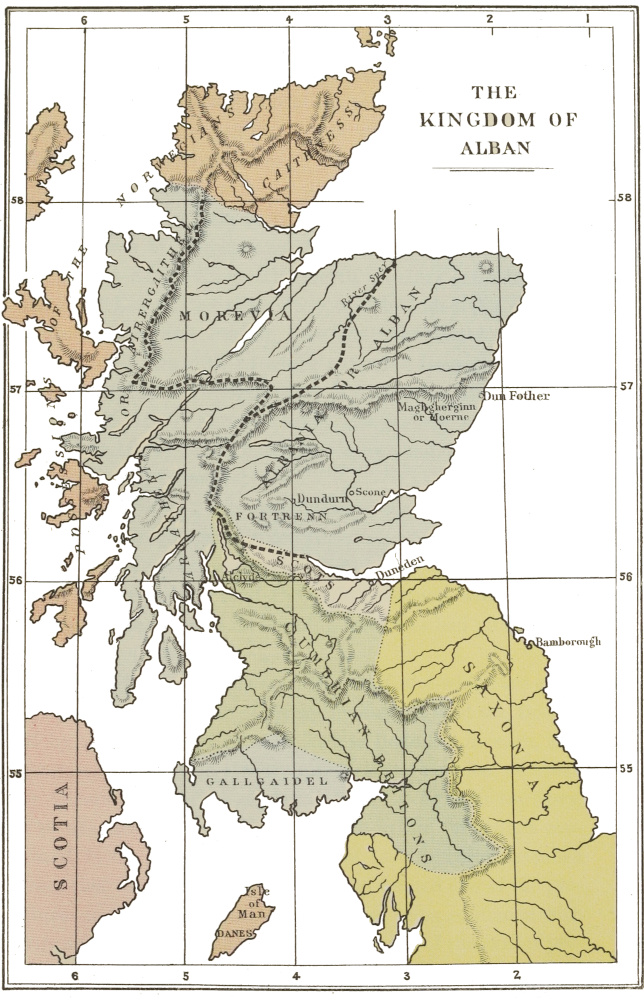
THE
KINGDOM OF
ALBAN
W. & A.K. Johnston, Edinburgh & London
A comparison of this description of the sevenfold division
of Alban with the other account contained in the same tract,
and which we relegated to the reign of Nectan, king of the
Picts, in the early part of the eighth century, will show the
change which the two intervening centuries had produced in
the aspect of the kingdom.
The first five provinces, the boundaries of which are given
by the natural features of rivers, mountains, and sea, instead
of by the old names of the districts included in each, now
constituted what was, strictly speaking, the kingdom of Alban
or Albania, at this time extending from the Forth to the Spey.
The changes which had taken place within its bounds consisted,
in the main, of the district of Gowrie being detached
from that of Atholl, with which it had formed one of the provinces
in the earlier state of them, and being combined with
Fife and Fothrif, which had formed another of the earlier provinces,
into one central region, the occupiers of which now
342appear as Scotti or Scots. It was, no doubt, the nucleus of
the settlement of Scots which had taken place in the Pictish
territory, and Gowrie became the heart of the kingdom of
Alban in which its capital, Scone, was situated. West of it, in
the province extending from the Forth to the Tay, were the
old districts of Stratherne and Menteith, the people of which
were still called the Men of Fortrenn. They were probably
remains of the Pictish inhabitants, and had for their chief
stronghold Dundurn, at the east end of Loch Earn. Forteviot,
which had also belonged to them, and which is but a few
miles from the west bank of the Tay, now belonged to the
Scots, and was one of the seats of their kings. North of this
central region was Atholl, and east of it a province extending
from Hilef to the Dee, the northern part of which was occupied
by a people called the Men of Moerne, also probably
remains of the Pictish population, whose chief stronghold was
Dun Fother or Dunotter; and north of them, extending from
the Dee to the Spey, was the most northerly province included
in the kingdom, which must still have been to a great
extent Pictish.
The territory overrun by Thorstein the Red, and by Sigurd,
earl of Orkney, consisted of the two earlier provinces beyond
the Spey, which formed the northern boundary of the kingdom
of Alban strictly so called. One of them, consisting of Muref
and Ross, is included in the list of later provinces, as being still
under its native rulers, but the other, Cathanesia, disappears,
as being attached to the Norwegian earldom of Orkney.
In place of it we have Arregaithel, now connected with the
kingdom. The new province thus introduced must not, however,
be absolutely identified, as is usual, with the kingdom of
Dalriada, which was omitted from the list of the earlier provinces,
as being then a separate kingdom of the Scots. It no
doubt included it, but had a much more extensive signification,
embracing the western districts extending from the Firth
of Clyde to Loch Broom, and derives its name from being the
343border or coast region of the Gaedhel or Gael, a name now
applied to all the inhabitants of Scotland who belonged to
the Gaelic branch of the Celtic race.[489] The organisation of
these seven provinces appears to have been quite analogous to
that of Ireland. The unit was the Tuath or tribe; several
Tuaths formed a Mortuath or great tribe; two or more Mortuaths
a Coicidh or province; and at the head of each was
the Ri or king; while each province contributed a portion
of its territory, at their point of junction, to form a central
district, in which the capital of the whole county was placed,
and the Ri or king, who was elected to be its Ardri or
sovereign, had his seat of government. In this account the
provinces are termed ‘regna’ or kingdoms. Under each
province was the ‘subregio’ or mortuath, with its ‘Regulus’
or Ri mortuath, and composed, no doubt, of a certain
number of tuaths or tribes, with their chiefs or Ri tuaith; and
where the four southern provinces met, was the central district
in which the capital, Scone, the seat of the Ardri Albain,
was placed. At the period to which the description of the
provinces given us by Andrew, bishop of Caithness, belongs,
this organisation had been so far modified, that the title of Ri,
or king, is no longer borne by the heads of the tuath or tribe,
and the mortuath or subregion, but at the head of the
tuath is the Toisech, and of the mortuath, the Mormaor. The
latter dignity, however, was still hereditary, and in the district
of Angus, which was more immediately under Scottish
influence and authority, we find it descending in the male
line, while, in the most northern district of the kingdom of
344Alban proper, the Pictish law of succession through females
was still observed.[490]
Beyond these seven provinces on the north were the
islands of Orkney and Shetland, which were now colonised
by the Norwegians. On the death of Sigurd, the first earl, he
was succeeded by his son Guthorm, who reigned only one
winter, and died childless. When Earl Rognwald, who had
transferred the islands to his brother Sigurd, heard of his
death and that of his son, he sent his son Hallad as earl, but
he soon grew tired of it and resigned the earldom, which was
then bestowed upon another son called Einar, who was earl
at this time, and ruled over the Orkneys a long time.[491] On
345the west of these provinces lay the Western Islands, which
were likewise colonised by the Norwegians, and were now
called the Inchigall or islands of the Galls or strangers, and
the Gaelic inhabitants of the islands and districts under their
rule were now called the Gallgaidhel, a name originally borne
by the Gallwegians, and still used in its territorial sense as
synonymous with Galloway.[492] These islands, with the island
of Man, were even more completely subdued and subjected to
the Norwegian rule than any part of Ireland itself. They
were eminently fitted to serve as a stronghold for the
Northern Vikings, whose strength consisted almost entirely
in their large and well-constructed ships, and may be regarded
as the centre of the Norwegian settlements in the west, completely
cutting Scotland off from Ireland, and severing the
connection and arresting the intercourse between them.[493]
The Western Isles were termed by them the Sudreys, to distinguish
them from the Orkneys or Northern Islands;[494] and
as Cathannia or Caithness and Sutherland had passed under
the influence of the latter, and become more Norwegian than
Scotch, so Galloway appears to have borne very much the
same relation to the former. South of these provinces was on
the east coast what had been the most northern district of
Northumbria, but was now continually overrun by the king
of Alban, to which the name of Saxonia was given; and on
346the west were the districts occupied by the Britons of Strathclyde.
In the previous century and a half these had been
narrowed to the Vale of the Clyde, with Alclyde or Dumbarton
as its stronghold, and the rest of the British districts had,
along with Galloway, been under the dominion of the Angles
of Northumbria; but their rule had been relaxed during the
period of disorganisation into which the Northumbrian kingdom
had fallen, and had by degrees become little more than
nominal, when the invasion of Bernicia by the Briton Giric,
who for a time occupied the Pictish throne, led to the severance
of these districts from Northumbria, and the whole of
the British territory from the Clyde to the river Derwent in
Cumberland became once more united under the rule of an
independent king of the Britons.
The king at this time was Donald, but he appears to have
been the last of the family claiming Roman descent which
had hitherto given its kings to Alclyde; and on his death,
which took place in the eighth year of the reign of King
Constantin, the Britons appear to have found no one of their
own race fitted to preserve their new-won independence; and
as they owed it to a king of their own race who occupied the
throne of Alban, so now they accepted a king from Alban by
electing Donald, son of Aedh and brother of Constantin, to
fill the throne of Alclyde.[495]
As in the earlier years of his reign Constantin had seen
his kingdom overrun by a horde of Norwegians, who were
finally cut off and their leader slain, so now but a few years
elapsed ere he found himself engaged in a serious encounter
with a powerful band of the Danish pirates, with a more
doubtful result. Their leader was Regnwald, the son or
347grandson of Inguar or Imhair, son of Ragnar Lodbrog, and
the brother of that Sitriuc who had invaded the kingdom in
the latter years of his predecessor Donald. This Regnwald,
in company with two other leaders, Ottir the Jarl and Oswl
Gracaban, broke into the country and ravaged Dunblane.
This took place in the year 912.[496] We next hear of Regnwald
in the following year at the Isle of Man fighting a
battle with Barid, son of Ottir, who is slain;[497] and he
appears to have been making his way to effect a settlement
in Ireland, as in 916 we hear of him arriving with innumerable
hordes at Loch da Caech or Waterford, in Ireland,
where they settle for the time and ravage the whole of
Ireland. Here they remain for two years, when the Irish
succeed in driving them out of Munster. They then proceed
to Alban and invade the country. Their object appears
to have been to make their way to Northumberland, and the
irruption was so formidable that Constantin united with
Eldred, the lord of Bamborough and ruler over Bernicia, to
resist them. The encounter took place on a moor near
the mouth of the river Tyne, which flows through East
Lothian, called, by the Pictish Chronicle, Tynemoor. The
Danes divided themselves into four bands—one under Gothbrith,
a brother of Regnwald; the second under the two
earls Ottir and Gracaban; the third under the young lords;
and the fourth under Regnwald himself, which remained in
ambuscade. The Scots invoked the aid of St. Columba, and
advanced to meet them with his crozier, called the Cathbuaidh
or Battle-victory, as their standard, and it did not
belie its name, for the three battalions were routed by the
men of Alban, and there was a great slaughter of the Danes,
with the two earls Ottir and Gracaban. Regnwald then
348advanced from his ambuscade with the fourth battalion, and
attacked the men of Alban from behind and slew many of
them, but neither Constantin nor any of his maormors fell
by him. Night put an end to the battle, but the Scots had
evidently failed in their object, for Regnwald made his way
to the south and took possession of the territories of the
lord of Bamborough.[498]
This was the last invasion of Alban by the Northmen,
who had harassed the kingdom during the whole period of
the reigns of Kenneth mac Alpin and his successors down
to Constantin. It was now to obtain a respite from their
incessant invasions for upwards of a century; but if Constantin
had no longer to defend his kingdom against the
Northmen, he had to encounter a new enemy, and the
kings of Alban were for the first time brought into contact
with the growing power of the kings of Wessex. Their
349relations with the Anglic kings had hitherto been confined
to those of Northumbria alone; but while the power of the
latter state had been waning, that of Wessex had been increasing,
and early in the ninth century these kings had in
the person of Ecgbert obtained a supremacy over the other
kingdoms south of the Humber. Their advance to the north,
however, was arrested by their wars with the Danes, which
lasted till the reign of the great Aelfred, who, after a fierce
struggle, finally made a permanent peace with them in 878-883,
which was only interrupted by a renewed struggle of
four years from 893 to 897.
Aelfred is said by Simeon of Durham, on the death of
Guthred, the Danish king of Deira, to have had the entire
disposal of the whole kingdom of the Northumbrians, and
to have appended to his own kingdom the provinces
south of the East Angles and the Northumbrians;[499] but
it was just at this moment that his renewed struggle
with the Danes commenced, and the Saxon Chronicle, in
recording his death, says, ‘he was king over all the Anglic
race, except the part that was under the dominion of the
Danes.’
His successor, Eadward the Elder, was supreme over all
the states south of the Humber, but made no attempt to
advance beyond it.
The Saxon Chronicle tells us in 924, ‘In this year king
Eadward was chosen for father and for lord by the kings
of the Scots, and by the Scots, and by king Regnall, and
by all the Northumbrians, and also by the king of the
Strathclyde Welsh, and by all the Strathclyde Welsh;’
but there is no record of any war beyond the Humber by
which the submission of the northern kingdoms could
350have been obtained or enforced. What exactly took place,
which could be interpreted by the Saxon Chronicle into the
language of commendation, cannot now be discovered; but
there was nothing in the relations of the northern kingdoms
to the king of Wessex at that time that should
naturally have led to a voluntary surrender of their independence,
and the statement itself contains within it
elements of suspicion which lead to doubt of its genuineness,
while it is hard to believe that there was any reality
in it. It was not till the reign of Aethelstan, the son and
successor of the latter, that any serious attempt was made
to extend the power of the Wessex kings beyond the Humber;
and the great struggle to which it led on the part of
the northern kingdoms to resist this advance and to maintain
their independence, is sufficient to cast doubt upon
mere nominal claims, unsupported by any events which
would naturally have given rise to the supposed relation
involved in them.[500]
With the accession of Aethelstan in 925, and the extension
of the power of the kings of Wessex beyond the
Humber, we obtain the valuable guidance of the Saxon
Chronicle in the northern events. Aethelstan no sooner
found himself firmly seated on the throne than he set himself
seriously to work to add Northumbria to his kingdom.
His first proceeding was to form a treaty of alliance with
the existing rulers of Northumbria and with the northern
351powers who would support him. There was at this time
a close connection between the Danes of Northumbria and
those of Dublin and Waterford. Their chiefs belonged to
the same family, and were equally descended from Inguar
or Imhair, as he was termed by the Irish, the son of Ragnar
Lodbrog, who first invaded Northumbria in 867, and the
same person was frequently king of Dublin at one time,
and king of Northumbria at another. The Danish king who
ruled over Deira at this time was Sitriuc. He was the same
Sitriuc called son of Imhair who had invaded Dublin in the
last year of the reign of Donald, the predecessor of Constantin.
He had been king of Dublin, but had been driven
from thence in the year 920, and became king of the Danes
of Deira. The Saxon Chronicle tells us that in the year
925 a meeting took place between him and Aethelstan at
Tamworth, on the thirtieth of January, and that Aethelstan
gave him his sister as a wife. In the following year an
opportunity unexpectedly offered itself to Aethelstan by the
sudden death of Sitriuc, and he immediately seized the kingdom
of Deira and added it to his own, driving out, according
to Simeon of Durham, Guthferth, the son of Sitriuc, who
had succeeded his father. The northern part of Northumbria,
to Bernicia, was at this time under the rule of a family
calling themselves lords of Bamborough, and with Ealdred,
son of Ealdulf of Bamborough, he made peace, maintaining
him in his possessions, and also with Constantin, king of
Alban; and, adds the Saxon Chronicle, they confirmed the
peace by pledge and by oaths, at the place which is called
Eamot, on the fourth of the Ides, or the 12th of July; but
the Chronicle stamps its own statement with doubt when it
adds ‘and they renounced all idolatry, and after that submitted
to him in peace.’
Anlaf, the eldest son of Sitriuc, had, on his father’s death,
gone to Dublin, and his father’s brother, Guthferth, having
attempted, with a party of Danes from Dublin, to recover the
352kingdom of Deira, and been driven out in the following year
by Aethelstan, he appears to have gone to Alban, and there
cemented an alliance with Constantin by marrying his
daughter, and they were probably making preparations for
an attempt to recover Anlaf’s kingdom, when Aethelstan
anticipated them, and, on the plea that Constantin had
broken the peace, invaded Alban in the year 933 both by
sea and land. The Saxon Chronicle merely says that he
ravaged a great part of it; but Simeon of Durham, who
places the invasion in the year 934, tells us that having put
Owin, king of the Cumbrians, and Constantin, king of the
Scots, to flight, he ravaged Scotland with his land force,
which consisted of cavalry, as far as Dunfoeder, or Dunfother,
and Wertermore, probably the Saxon form of Kerrimor or
Kirriemuir in Forfarshire, and with his navy as far as
Caithness, and in a great measure depopulated it.[501]
A.D. 937.
Battle of Brunanburg.
Three years after this the whole of the northern population
beyond the Humber united in a great effort to wrest
Northumbria from Aethelstan, and the result of this effort
was to decide whether the power of the kings of Wessex was
to be arrested at the Humber and their kingdom limited to
the southern part of Britain, or whether it was to extend
to the Firth of Forth, if not to sweep the kingdom of Alban
itself within its grasp. It was resolved to concentrate the
northern forces upon Deira. Constantin and his son-in-law,
353Anlaf Cuaran as he was called, were to proceed with a fleet
which was to enter the Humber, and a land army was to
advance into Northumbria. The Strathclyde Britons were to
cross the hills which divided them from the Anglic kingdom,
and another Anlaf was to come from Dublin, with a body of
the Danes of Dublin to support them. The chroniclers merely
tell us of this battle in general terms, but we have two
detailed accounts of it preserved to us: one from a Norse
source in the Egills Saga, and the other in the poem commemorating
the battle which is preserved to us in the Saxon
Chronicle. Florence of Worcester tells us that Anlaf the
Pagan, king of the Irish and of many islands besides, at the
instigation of his father-in-law Constantin, king of the Scots,
entered the mouth of the river Humber with a powerful fleet.
King Aethelstan and his brother Eadmund the Etheling, met
him at a place called Brunnanburg, and after a battle which
lasted from daybreak until evening, slew five reguli and seven
earls, whom the enemy had brought with them as auxiliaries,
shedding more blood than had ever before in England been
shed in battle, and returned home in great triumph, having
driven the kings, Anlaf and Constantin, back to their ships.
The latter were terribly cast down by the destruction of
their army, and returned to their country with very few
followers.[502]
The Egills Saga tells us that ‘when Adalsteinn had taken
the kingdom there rose up to war those chiefs who had lost
the dominion which their ancestors had possessed.’ They
were ‘Britons, Scots, and Irish’ (Bretar oc Scotar oc Irar).
Among them was ‘Olafr Skotakonungr,’ called the red; ‘he
was Scotch by father’s kin, but Danish by mother’s kin; he
came of the race of Ragnar Lodbrok.’[503] He drew together
354a mighty host, and went south from Scotland to England,
when he harried all Northimbraland, gained a victory over
two earls, who governed it under Adalsteinn, and subdued all
Northimbraland. When Adalsteinn heard this he summoned
all his troops and advanced to meet him. The two armies
meet at Vinheidi (the Vin-heath) by Vinnskoda (the Vin-wood).
King Olaf occupied a ‘Borg’ that stood north of the
heath, with the greater part of his army, which encamped
on the heath between the wood and the river. South of
the heath was another ‘Borg,’ which was occupied by King
Adalsteinn’s army, the leader of which amuses King Olaf
with negotiations for peace till King Adalsteinn comes to the
southern borg with additional troops. After a preliminary
skirmish in which two of King Olaf’s earls had fallen with
many of the Britons and Scots, the main battle takes place
between the two armies, which are about equal in numbers.
The details are given very minutely, but mainly to show
the exploits of Egill and his brother from whom the saga is
named. The result was that the army of King Olaf gave
way, and great slaughter was made of them. ‘King Olaf
fell there, and the most part of the troops that Olaf had led,
because those that turned to flee were slain by their pursuers.
King Adalsteinn there made a wonderful victory.’[504] This
account, though inaccurate in its details, for King Olaf or
Anlaf was not slain but fled in his ships from the Humber,
355is chiefly valuable from the description it gives of the scene
of the battle. The Saxon Chronicle contains the following
poem celebrating the victory, from which we may gather the
following particulars:—
This year King Aethelstan,
Lord of Earls,
Ring-giver of warriors,
And his brother eke
Eadmund Aetheling,
Life-long glory
In battle won,
With edges of swords
At Brunanburh:
which gives us the oldest name of the field of battle. Then
we have—
The foes lay low,
The Scots people
And the shipmen,
Death-doomed fell;
showing that they had arrived by sea. Again—
The West Saxons forth
The livelong day
In martial bands
Followed the footsteps
Of the hostile nations.
Again—
The Mercians refused not
The hard hand-play
To any of the warriors
Who with Olaf,
O’er the waves mingling
In the ship’s bosom,
The land had sought
Death-doomed in fight;
showing that Olaf too had arrived by sea. The slaughter too
was great.
Five lay
On that battle stead,
Young kings,
By swords laid to sleep,
So seven eke
Of Olaf’s jarls,
Of the army countless,
Shipmen and Scots.
Then both Olaf and Constantin take refuge in their ships,
and fly by sea.
There was put to flight,
The Northmen’s prince,
By need constrained,
To the vessel’s prow,
With a little band.
The bark drove afloat,
The king departed
On the fallow flood,
His life preserved.
So there eke the aged
Came by flight
To his country north,
Constantine,
Hoary warrior.
356His son and friends are slain.
He of his kinsmen was bereft,
Of his friends deprived,
On the trysting place,
In conflict slain,
And his son he left
On the slaughter place,
Mangled with wounds,
Young in warfare.
The Northmen who came from Dublin with another Olaf
return.
Departed then the Northmen
In their nailed barks,
The darts gory leaving,
On the roaring sea,
O’er the deep water,
Dublin to seek,
Ireland once more,
In mind abashed.
And the poem concludes—
No slaughter has been greater
In this island,
Ever yet
Of folk laid low,
Before this,
By the sword’s edges,
From what books tell us,
Old chroniclers,
Since hither from the East,
Angles and Saxons
Came to land,
O’er the broad seas.
Britain sought
Proud war smiths,
The Welsh o’ercame,
Men for glory eager,
357The site of this great battle is one of the problems in
English history which has not yet been solved. It has been
generally placed at Brumby or Brough on the Humber, from
the statement that Anlaf entered the Humber with his ships;
but if a large part of his force came from the north by land,
it is unlikely that they would be allowed to penetrate as far
as the Humber before they were met by Aethelstan. Others
have looked for it in Lancashire, from the statement that
Anlaf fled in his ships to Dublin; but the Anlaf who returned
to Dublin was Anlaf, son of Godfrey, king of the
Danes of Dublin, who had come to support his brethren in
Northumbria, and he probably landed in Cumberland and
made his way with the Cumbrians from thence to Northumbria
and returned as he came. Anlaf, the son-in-law of
Constantin, was Anlaf, son of Sitriuc, and he appears to have
escaped with his father-in-law in the ships from the Humber,
and returned to Scotland.
The poem in the Saxon Chronicle terms the field of
battle the trysting-place, and the Egills Saga likewise implies
that the battle had been fought at the place fixed by Anlaf
for the assembling of his forces. We must therefore look
for it at some point suitable for bringing these forces together.
They may be said, in the main, to have come from three
directions. First, a part under Constantin and possibly his
son-in-law Anlaf came in ships up the Humber. Another
part, consisting of the Scotch army, came by land from
Scotland; and a third, consisting of the Cumbrians and the
Danes from Dublin, came from the west, while Aethelstan
in his march from the south met them and gave them battle
at a place called Brunanburh in the Saxon Chronicle, and
Vinheidi by the Egills Saga. Simeon of Durham says, in
his history of the kings, that ‘Aethelstan fought at Wendune,
and put King Onlaf with six hundred and fifteen ships,
Constantin king of the Scots, and the king of the Cumbrians,
with all their forces, to flight.’ And in his history of the
358Church of Durham, he says ‘Aethelstan fought at Weondune,
which is also called Ætbrunnanmere or Brunnanbyrig,
against Onlaf, the son of Guthred, the late king, who had
arrived with a fleet of six hundred and fifteen ships, supported
by the auxiliaries of the kings recently spoken of,
that is to say, of the Scots and Cumbrians.’
The Wendune of Simeon is evidently the Vinheidi of the
Egills Saga, and Brunnanbyrig, the Duinbrunde of the
Pictish Chronicle, and the Borg on the river at the northern
extremity of the heath occupied by Anlaf and his army.
Now the Humber, with the Ouse which falls into it, is navigable
for vessels as far as Boroughbridge, anciently called
Ponte Burgi, about sixteen miles from York. A little lower
down the river was the important Roman station of Isurium,
the ramparts of which still remain, and here four Roman
roads met, two from the south and two from the north.
The Roman road from York passed along the left bank of
the Ouse, until it crossed at a ferry near Aldwark, not far
above the present bridge. Another road from the south
passed through Knaresborough, and joined the former road
at this point. From it two ‘Itinera’ went, one direct to the
north, and the other to Cataracton or Catterick on the Swale,
whence it proceeded by Stanmore into Cumberland. The
Roman station of Isurium was called by the Angles the
‘Ealdburg,’ or Old Burgh. It appears in the time of Edward
the Confessor as the manor of Burc, and it is now Aldborough.
About a quarter of a mile to the west of Boroughbridge
are three large monoliths, varying from eighteen to
twenty-three feet high. They are now called the Devil’s
Arrows; and east of Aldborough, at a place called Dunsforth,
was a tumulus called the Devil’s Cross; it was
broken into many years ago for road materials, and in it
were found human remains.
Aldborough unites almost all the conditions required for
the site of Brunanburgh. The ships which entered the
359Humber could make their way thus far. This burg, called
by the Angles the old Burg, may have been the Borg
on the river occupied by Anlaf. The Borg, south of the
heath, occupied by Aethelstan, could hardly have been
York, as it was too well known not to be mentioned by
name, but may have been the strong position of Knaresborough,
from whence an ancient way led to Aldborough.
The Scots would advance by one of the northern routes, and
the Danes of Dublin and the Cumbrians by the great
highway which led from Cumberland by Catterick. The
only authority which gives any indication of its situation
are the Annals of Clonmacnoise, which say that the battle
was fought on the plains of Othlyn. Othlyn is probably
Gethlyn, now Getling, which gives its name to two Wapentakes
in the vale of the Swale, which unites with the
Ure close to Aldborough, and forms the river Ouse, which
flows past York into the Humber, and the monuments
called the Devil’s Cross and the Devil’s Arrows may be
memorials of the battle.
Soon after Aethelstan had gained this great victory,
he was to receive an unexpected auxiliary in curbing the
Danes of Northumberland. In one of the Norse sagas
we are told that Eric, called Bloody Axe, the son of the
Norwegian king Harald Harfagr, sailed with a fleet to
the west. He went first to Orkney, where he recruited
his force, and then sailed south to England, plundering
the coasts of Scotland and Northumberland as he went.
On which King Aethelstan offered him a settlement in
Northumberland, if he would defend it against the Danes
and other Vikings and be baptized. Eric accepted their
offers, received lands in Northumberland, where he settled
his followers, was baptized, and had his residence at York.[506]
Aethelstan did not long survive the battle, but died in
the year 940, and was succeeded by his brother Eadmund.
360Five years after this great defeat, Constantin, worn out
with age and disappointment, resigned the throne for the
pilgrim’s staff, and committed the kingdom to Malcolm,
the son of his predecessor Donald, who was entitled under
the Tanistic law to succeed him.[507] The later chronicles
say that he became abbot of the Culdees of St. Andrews,
and served God in that capacity for five years; but that
is importing later language and ideas into his time, though
he appears to have retired to the monastery of St. Andrews.
St. Berchan says—
Afterwards God did call him
To the Recles (monastery) on the brink of the waves,
In the house of the apostle (Andrew) he came to death.
Undefiled was the pilgrim.
He lived ten years after his retirement, and his death is
recorded by the Ulster Annals in the year 952, and by the
Pictish Chronicle in the tenth year of his successor.[508]
A.D. 942-954.
Malcolm, son of Donald, king of Alban.
Malcolm commenced his reign by making the first
attempt to push the power of the kings of Alban beyond the
Spey. So far as the northern boundary of the kingdom,
their authority seems now to have been pretty well
established; but he now invaded the province of Moreb or
Moray beyond it with his army, and slew Cellach, probably
its provincial king,[509] but with what permanent result we
are not told. He was soon, however, to receive a much
more important addition to his dominions in another
direction. In the year 941, we are told by the Saxon
Chronicle, the Northumbrians belied their fealty oaths,
and chose Olaf of Ireland for their king. It is difficult to
361distinguish between the acts of the two Anlafs,—the son of
Guthfrith and the son of Sitriuc,—in their appearances in
Northumberland, and the chroniclers themselves seem to
share in the difficulty; but following in the main the Saxon
Chronicle, we may hold that this was Anlaf, son of Guthfrith
or Godfrey, king of the Danes of Dublin; but a year after
that, having laid waste and burnt the church of St. Balthere
at Tyningham, he suddenly perished. Anlaf, the son of
Sitriuc and son-in-law of Constantin, at length became king
of Northumberland. In the year 943 he took Tamworth by
storm, and great slaughter was made on either side; and
the Danes had the victory, and led away great booty with
them. King Eadmund then beset him in Leicester, and
would have captured him had he not escaped out of the
town by night. After that King Anlaf gained King
Eadmund’s friendship, and was received by him at baptism,
and he royally gifted him. And in the same year, after a
good long interval, he received King Regnald at the bishop’s
hand. This sudden friendship, however, only subsisted one
year, for in 944 King Eadmund subdued all Northumberland
into his power and expelled the two kings, Anlaf son
of Sitriuc, and Regnald son of Guthfrith. During the
whole of these attempts by the Danish kings of Dublin
to maintain possession of Northumberland, and the repeated
invasions from Dublin which followed every effort to expel
them, they seem to have made their way through the
territories of the Cumbrian Britons, and to have received
the support of their kings, who, as descended from the
brother of King Constantin, whose daughter Amlaiph, or
Anlaf Cuaran, had married, were nearly connected with him.
Eadmund seems therefore to have resolved to deprive them
of this ready means of access to Northumberland and
the support they obtained from it, by overrunning the British
territories and making the king of Alban a guarantee for
their fidelity.
A.D. 945.
Cumbria ceded to the Scots.
362The Saxon Chronicle tells us that in the year 945
‘King Eadmund harried over all Cumberland, and gave it
all up to Malcolm, king of the Scots, on the condition that
he should be his co-operator both on sea and on land.’ It
has usually been assumed that this refers to the district
in England afterwards called Cumberland alone, but the
people termed by the same chronicle the Strathclyde Welsh
had now come to be known under the Latin appellation of
‘Cumbri,’ and their territory as the land of the Cumbrians,
of which ‘Cumbraland’ is simply the Saxon equivalent.
Their king at this time was Donald, the son of that
Eugenius or Owin, who was at the battle of Brunanburh.
He is called king of the Northern Britons, and his kingdom
extended from the Derwent in Cumberland to the Clyde.
Accordingly we find in the British annals that at this time
Strathclyde was ravaged by the Saxons.[510] There can be
little question that the tenure by which the Cumbrian
kingdom was held by Malcolm was one of fealty towards the
king of England, and this seems to be the first occasion on
which this relation was established with any reality between
them, so far at least as this grant is concerned.
In the following year Eadmund died, and is succeeded
by Eadred Aetheling, his brother, who, the Saxon Chronicle
tells us, ‘reduced all Northumberland under his power; and
the Scots gave him oaths that they would all that he
would.’ The next year ‘Wulstan, the archbishop, and all
363the Northumbrian Witan swore fealty to the king; and
within a little space belied it all, both pledges and also
oaths;’ as did also the Scots, for in 948 ‘king Eadred
harried over all Northumberland because they had taken
Eric for their king. And when the king went homewards,
the army within York overtook him, and there made great
slaughter. Then was the king so indignant that he would
again march in, and totally destroy the country. When the
Northumbrian Witan understood that, they forsook Eric,
and made compensation for the deed to King Eadred.’
Upon this the irrepressible Anlaf Cuaran again appeared on
the scene, and came in the year 949 to Northumberland.
This was the seventh year of the reign of Malcolm, the son
of Donald; and we are told by the Pictish Chronicle that in
that year he laid waste the Anglic territories as far as the
river Tees, and carried off a multitude of men with their
flocks, and that he did this at the instigation of Constantin,
though some say that he made this plundering raid
himself, having requested the king to surrender the kingdom
to him for one week for the purpose; but he seems
at all events to have retained in his penitential cell a
sufficient interest in secular matters to incite Malcolm to
support the attempt by his son-in-law Anlaf upon Northumberland
by this expedition.[511] Anlaf only possessed Northumberland
364three years when the Northumbrians expelled
him in 952,[512] and again received Eric Bloody Axe, and two
years after expelled him, and submitted to Eadred, who in
954 ‘assumed the kingdom of the Northumbrians.’ This
terminated the kingdom. Eadred committed the government
to an earl, and Northumbria from a kingdom thus
became an earldom, and remained so from henceforth.
Anlaf Cuaran, on this his last expulsion, took refuge in
Ireland, and spent the rest of a long life in incessant wars
in that country as king of the Danes of Dublin, till at
last, in the year 980, he was defeated in a great battle
at Tara with the king of Ireland, in which his son
Ragnall was slain, together with all the nobles of the
Galls of Dublin, and Anlaf, son of Sitriuc, high king of the
Galls, went on a pilgrimage to Hi-Choluimcille, where he
died.
In the year 954 the Ulster Annals record that Maelcolam,
son of Domnall, king of Alban, was slain. The
Pictish Chronicle tells us that the men of Moerne slew
him at Fodresach, now Fetteresso, in the parish of Fordun,
Kincardineshire;[513] but the later chronicles remove the
scene of his death farther north, and state that he was slain
at Ulurn by the Moravienses, or people of Moray. St. Berchan,
however, places it with the Pictish Chronicle in the
parish of Fordun, when he says—
365Nine years to his reign,
Traversing the borders.
On the brink of Dun Fother at last
Will shout the Gael around his grave.
A.D. 954-962.
Indulph, son of Constantin, king of Alban.
The succession to the throne now fell, according to the
system of alternate succession which prevailed in the line of
the Scottish kings, to Indulph, the son of his predecessor
Constantin, and during his reign of eight years only two
events are recorded, the first of which is, however, one of
great significance. We are told by the Pictish Chronicle
that in his time Duneden, or Edinburgh, was evacuated by
the Angles and surrendered to the Scots, who still possessed
it when the chronicle was compiled.[514] The surrender of
Edinburgh implied that of the district between the Esk and
the Avon, of which it was the principal stronghold, and the
tenure of which by the Angles had always been very uncertain
and precarious. From the Avon to the Forth the
territory was still probably claimed by the Britons of Strathclyde.
The other event recorded in the Pictish Chronicle
is that a fleet of the Sumarlidi, or ‘Summer Wanderers’—a
term applied to those Norwegian pirates who went out
on plundering expeditions in summer, spending the winter
at home or in a friendly port—had made a descent upon
Buchan, and were there cut off.[515] This Norwegian fleet in
question was probably that of the sons of Eric Bloody
Axe, who had gone on his death from Northumberland to
Orkney.[516] The later chronicles state that Indulph was
366slain by the Norwegians at Inverculen, but if this is the
same event the Pictish Chronicle gives no countenance
to the statement, and St. Berchan distinctly implies that
he died at St. Andrews. In his metrical account of his
reign he alludes to this unsuccessful attempt upon his
territories, and to his acquisition of Duneden, when he
says—
No severance will he sever
Of Alban of ships of long territories;
It is an addition to his kingdom he will take
From a foreign land by force;
Nine years and a half of bright fame
For him over Alban in the sovereignty.
In the house of the same pure apostle
He died, where died his father.
A.D. 962-967.
Dubh, son of Maelcolam, king of Alban.
As his death is not recorded by the Pictish Chronicle or
by the Ulster Annals, it is probable that he had followed
his father’s example and retired to the monastery of Kilrymont,
committing his kingdom to Dubh,[517] the son of
Malcolm, who would have been entitled to succeed him on
his death, but his family do not appear to have acquiesced
in this, and there is some appearance that the principle of
lineal succession was now coming into conflict with the form
of Tanistic succession which had hitherto prevailed. The
acquisition first of the Cumbrian kingdom and afterwards of
part of Lothian would, no doubt, aid this. The latter was
the acquisition of Indulph himself, and his son would
naturally claim it as his inheritance accordingly. Dubh had
not been three years on the throne when we find a battle
fought at Drumcrub, in Stratherne, between him and
367Cuilean, the son of Indulph, who appears to have been
supported by the lay abbot of Dunkeld and the governor of
Atholl. In this battle Cuilean was defeated and his two
supporters slain.[518]
A.D. 967-971.
Cuilean, son of Indulph, king of Alban.
Two years after Cuilean succeeds in expelling Dubh, and
in the same year the Ulster Annals record his death.[519] The
later chronicles relate a strange story that Dubh was slain
in Forres, that his body was hidden under the bridge of
Kynlos, and that the sun did not shine till it was found.
These chroniclers usually remove the scene of the battles in
which these kings were slain from their southern localities
to the northern districts of Scotland. It is, however, possible
that in this case, when Dubh was expelled from the
kingdom, he may have taken refuge in the country beyond
the Spey, and had been slain at Kynlos, while the fact that
an eclipse of the sun was visible there on the 10th of July
967 may have given rise to the tradition. Of Cuilean’s
reign, which lasted four years and a half, we know nothing
further than that he and his brother Eochodius or Eocha
were slain by the Britons in the year 971.[520] The later
chronicles are here in accord with the older, for they state
that he was slain in Laodonia or Lothian, that is probably
the part of Lothian which his father had acquired from the
Angles, by Andarch, son of Donvald, on account of his
daughter. St. Berchan names these two kings Dubh or black
and Fionn or white, and considers that during Dubh’s life
they reigned jointly.
368Two kings after that over Alban,
Both of them at mutual strife,
Fionn and Dubh together.
Woe! who took them in joint reign,
Nine years for them in their reign.
He terms the latter ‘Dubh of the three black divisions,’
which implies that he had the support of only three of the
provinces. Of Fionn or Cuilean he says—
The grave of Fionn on the brink of the waves
A spear shall sever (life);
In a strange high valiant land,
It was by the Britons shall be his death.
A.D. 971-995.
Kenneth, son of Malcolm, king of Alban.
The succession to the throne of Alban now fell to
Kenneth, the son of Malcolm and brother of Dubh, and his
first act seems to have been to retaliate upon the Britons
for the death of his predecessor, but this he did not effect
without loss. He is said by the Pictish Chronicle to have
immediately laid waste the territory of the Britons to a
great extent, while a party of his foot-soldiers were cut
off with great slaughter in the moss of the Cornag, the
water which gives its name to Abercorn.[521] His attention,
however, was soon directed to the more important field of
Northumbria. When the kingdom came to an end in 954,
and the government of an earl substituted, the first earl
appointed was Osulf, who ruled over both provinces, but he
was succeeded in 966 by Oslac, and soon after Northumbria
was divided into two earldoms, Oslac ruling at York and
the southern parts, while Eadulf, called Yvelchild, was
placed over the Northumbrians from the Tees to Myrcforth,
369or the Firth of Forth.[522] Immediately after the unsatisfactory
expedition against the Strathclyde Britons, the Scots are
recorded in the Pictish Chronicle to have laid waste Saxonia
or the northern part of Northumbria as far as Stanmore,
Cleveland, and the pools of Deira, that is, the part of
Northumbria which had been placed as a separate earldom
under Eadulf; and in order to protect himself against the
Britons, Kenneth fortified the fords of the river Forth,
which at this time separated his kingdom from that of
Strathclyde.[523] In the following year Kenneth repeated his
invasion of Northumbria, and is said to have carried off a
son of the king of the Saxons, by whom Earl Eadulf is
probably meant. We now lose the invaluable guidance of
the Pictish Chronicle, which appears to have been compiled
in Kenneth’s reign, at Brechin, as it breaks off with the
intimation that this king gave the great city of Brechin to
the Lord,[524] and leaves the years of his reign unfilled up,
while it contains no record of his death; but, on the other
hand, we recover the Irish annalist, Tighernac, the hiatus in
whose annals terminates with the year 973. In 975 he
tells us that Domnall, son of Eoain, king of the Britons,
went on a pilgrimage. The Welsh Chronicle, the Brut y
370Tywysogion, which records the same event, calls him Dunwallaun,
king of Strathclyde, and states that he went
to Rome.[525] He is the same Domnaldus who was king of
the Cumbrians when Eadmund ravaged the country in 945,
and was the son of that Eugenius, king of the Cumbrians,
who fought in the battle of Brunnanburg. Kenneth too
appears to have had to contend against the claims of the
sons of Indulph to succeed to their father in preference to
that form of the law of Tanistry which had hitherto
regulated the succession, by which it alternated between the
two branches of the Scottish royal family; for Tighernac
records that Amlaiph or Olaf, the son of Indulph, king of
Alban, was slain in the year 977, by Kenneth, son of Malcolm.[526]
The English chroniclers, however, add some events
to the reign of Kenneth, of a much more questionable
character, the chief of which is that the district of Lothian
was ceded to Kenneth by King Eadgar, to be held by him
as a fief of the English crown. This statement first appears
in the Tract on the arrival of the Saxons, attributed to
Simeon of Durham. It is there said that when Eadgar set
the two earls, Oslac and Eadulf, over Northumbria, giving
the latter the territory from the Tees to the Firth of Forth,
these earls, with the bishop, brought Kenneth, king of the
Scots, to King Eadgar, and when he had done homage to him,
Eadgar gave him Lothian and sent him home with honour.[527]
This Chronicle was made use of by John Wallingford, who
wrote nearly a century later, and thus elaborates the story:—‘Kenneth,
the king of Scotland, hearing from common
371report, and the praises of the two earls, Oslach and Eadulf,
and Elfsi, bishop of Durham, of the greatness of King Eadgar,
desiring greatly to see him, asked and obtained a safe-conduct
to London, that he might converse with him. Thus
conducted at the command of the king by the two earls and
the bishop, Kenneth, the king of Scotland, came to London,
and was honourably received by King Eadgar, and treated
with high consideration. While they were conversing
familiarly and pleasantly together, Kenneth suggested to
Eadgar that “Louthion” was a hereditary possession of the
kings of Scotland, and therefore ought to belong to him.
King Eadgar being unwilling to do anything hurriedly, for
fear of repenting of what he had done afterwards, referred the
cause to his counsellors.
‘These men having been well instructed in the wisdom of
their ancestors ... unless the king of Scotland should consent
to do homage for it to the king of England ... and
chiefly because the means of access to that district for the
purposes of defence are very difficult, and its possession not
very profitable.... Kenneth, however, assented to this
decision, and sought and obtained it on the understanding
that he was to do homage for it; and he did homage
accordingly to King Eadgar, and further was obliged to
promise under pledges, in solemn form, that he would not
deprive the people of that region of their ancient customs,
and that they should still be allowed to use the name and
language of the Angles. These conditions have been faithfully
observed to the present day, and thus was settled the
old dispute about Louthion, though a new ground of difference
still often arises.’[528]
The older English chroniclers know nothing whatever of
this cession of Lothian by King Eadgar to Kenneth, and it
is quite inconsistent with the account given by Simeon of
372Durham himself of how the Scottish kings acquired it.
The Saxon Chronicle, though it mentions the cession of
Cumbria to Malcolm, has no hint of this transaction, while
the Pictish Chronicle presents us with a totally different
picture of the relations between Kenneth and the two earls
who shared the Northumbrian territories between them.
There he appears only as endeavouring to wrest the country
north of the Tees from one of them. We may therefore
dismiss this tale as having no foundation in fact, and as one
of those spurious narratives arising out of the controversy
as to the dependence of Scotland. That the kings of Alban
of the line of Kenneth mac Alpin asserted some claim to
the territory south of the Firth of Forth seems however
to have some foundation, otherwise it is difficult to account
for the fact that they no sooner become possessed of the
Pictish throne than, instead of consolidating their power over
the Pictish kingdom, they at once attack Saxonia or the
Northumbrian districts on the south side of the Firth of Forth.
Kenneth, the founder of their house, is said to have invaded
it six times. Giric is said to have conquered Bernicia. We
find Constantin, son of Aedh, in alliance with the northern
Saxons, and in conjunction with Anlaf Cuaran invading
Northumbria. Malcolm, son of Donald, overruns the country
as far as the Tees. Edinburgh and the district around it are
given up by the Angles to Indulph, and Kenneth, of whom
we are treating, twice repeats a similar invasion; but if
these invasions of Northumbria were connected with any
supposed claim to its possession, it was not Lothian alone
but the whole of Bernicia that they claimed. Upon what
right such a claim could have been based, whether upon the
extent to which the previous kings of the Picts had obtained
possession of part of that territory, or whether upon some
ground peculiar to their dynasty, and involving, as Wallingford
asserts, the assertion of a hereditary right, it is difficult
to say. There is no doubt that not long before the accession
373of Kenneth mac Alpin to the Pictish throne the kingdom
of Northumbria seems to have fallen into a state of complete
disintegration, and we find a number of independent chiefs,
or ‘duces’ as they are termed, appearing in different parts
of the country and engaging in conflict with the kings and
with each other, slaying and being slain, conspiring against
the king and being conspired against in their turn, expelling
him and each other, and being expelled. Out of this confusion,
however, one family emerges who appear as lords of
Bamborough and for a time govern Bernicia. Galloway,
with which Kenneth’s family was connected, and out of
which he emerged to claim the Pictish throne, was nominally
a part of Bernicia, and under Anglic rule; and it is not
impossible that among the chiefs who at this time appear to
have asserted their position against the king of Northumbria,
and to have practically ruled over different districts, one of
Scottish descent, either from his connection with Galloway
or from some connection in the female line with the Northumbrians,
may have for the time obtained such a right to
the rule over Bernicia as might give rise to a claim on
the part of his descendants;[529] but be this as it may, we
374may hold it as certain that no cession of any part of
this territory, in addition to what had been acquired by
Indulph, had been made at this time to Kenneth son of
Malcolm.
But if Kenneth did not add permanently to his kingdom
on the south, we find that the districts beyond the
Spey, on the north, had again fallen under the dominion of
the Norwegian earl of Orkney. The earl who ruled at this
time was Sigurd ‘the Stout.’ He was the son of Hlodver,
the previous earl of Orkney, whose father Thorfinn, called
the ‘Skull-cleaver,’ was the son of Earl Einar, and by his
marriage with Grelauga, daughter of Dungadr or Duncan,
the jarl of Caithness, had brought that district to the Norwegian
earls of Orkney. But although they appear to have
claimed Caithness as now forming an integral part of their
dominions as Norwegian earls, and maintained possession of
it as such, the kings of Alban seem also to have asserted a
right to a sovereignty over it as one of the dependencies of
their kingdom. By Grelauga Earl Thorfinn had five sons,
three of whom were successively earls of Orkney. Havard,
the eldest son, succeeded him, and was slain by his wife;
and we find that when Liotr, the second brother, was earl
of Orkney, another brother, Skuli, went to Scotland, and
obtained a right to the earldom of Caithness from the king
of the Scots. This led to a conflict between the brothers, in
which Skuli was supported by the Scottish king and a
Scottish earl called Magbiodr, and a battle ensued in which
the Scots were defeated and Skuli slain. Earl Liotr then
375took possession of Caithness, and remained at war with the
Scots, when Earl Magbiodr again came from Scotland with
an army, and met him at Skidamyre in Caithness, where a
hotly-contested battle took place, in which Liotr was victorious,
but was mortally wounded. Hlodver, the only
surviving brother, succeeded to the earldom, but died of
sickness, and was buried at Hofn in Caithness. Sigurd, his
son, succeeded him about the year 980, and was, we are told,
a powerful man and a great warrior. He kept Caithness by
main force from the Scots, and went every summer in war
expeditions to the Sudreys or Western Isles, to Scotland,
and to Ireland.[530]
Soon after Sigurd’s succession we find Finleikr, a Scotch
jarl, entering Caithness with a large army, and challenging
Earl Sigurd to meet him in battle at the same Skidamyre in
Caithness where Magbiodr had met the former earl. He
was no doubt the Finlaic, son of Ruaidhri, Mormaer of
Moreb or Moray, whose death Tighernac records in the year
1020, and Magbiodr was probably the Maelbrigdi who is
mentioned as his brother, and had been the previous Mormaer.[531]
Sigurd drew an army together, but it was inferior
in numbers until he obtained the aid of the ‘Bondir’ or
allodial possessors of Orkney, by restoring to them the full
right to their allodial lands, which had been taken from
them by Earl Einar, and then went to battle with Earl
Finleikr, whom he entirely defeated. Sigurd seems to have
followed up his victory by overrunning the provinces north
of the Spey, as we find him in 989 in possession of the four
provinces of Moray, Ross, Sudrland or Sutherland, and
Dali.[532] The district to which the name of Dali is here
376given was probably that part of Argathelia which had
borne the name of Dalriada, a name which still lingered
in connection with it, and appears in the Irish annalists
for the last time at this period; and the acquisition of this
district by Sigurd seems to have brought him in contact
with the rulers of the Western Isles, who had hitherto
possessed it. These were also Norwegians; and the kings
of Norway appear to have claimed tribute from the islands,
and to have attempted from time to time to maintain a direct
dominion over them by means of jarls or earls, while at
other times they appear under the rule of a Danish king
of the Isles. In 973 we find a king Maccus or Magnus,
whom Florence of Worcester calls king of many islands;
and in the Irish Annals he is called son of Aralt, who was
son of Sitriucc, lord of the Danes of Limerick.[533] He died
about 977, and we then find his brother Godred or Goffraigh,
son of Aralt, called king of Innis Gall or the Western Isles.
These kings were descended from Inguar or Imhair, the
ancestor of the Danish kings of Dublin, termed from him
Hy Imhair; and thus, while the Danes gave kings to
Dublin, Waterford, and Northumbria, the Norwegians gave
earls to Orkney, which they colonised, and possessed the
Innse Gall, Sudreys, or Western Isles,—the island of Man
appearing to have been a bone of contention between the
two.[534]
At the time that Sigurd came into contact with Godred
or Godfrey mac Aralt he had entered into a short struggle
with the Danes of Dublin for the possession of Man and
the Isles. In 986 the Ulster Annals tell us that the Danes
came with three ships to ‘Airer Dalriatai,’ or the coast
lands of Dalriada, but that the attack was successfully resisted,
377the Danes were taken, 140 of them were hung, and
the rest thrust through, and in the same year I Columcille
was plundered by the Danes on Christmas Eve, and the
abbot slain, with fifteen of the brethren. In the following
year a battle is fought at the Isle of Man against Gofrath
mac Aralt and the Danes, in which a thousand of them were
slain, and in the same year a great slaughter was made of
the Danes who had pillaged Iona.[535] Godred or Gofra had,
however, now to encounter Sigurd, earl of Orkney. The events
of this war are partly detailed to us in the Nial Saga in
connection with the adventures of Grim and Helgi, the sons
of Nial of Iceland. The narrative commences with the sons
of Nial leaving Iceland in a ship with Olaf Ketilson of Elda,
and Bardi the White. They are driven southward by a
strong north wind, and so thick a mist came over them that
they knew not where they were till the shoal water showed
them they must be near land. They ask Bardi if he knows
what land they would be nearest, who says that with the
wind they had had it might be the Islands of Scotland or
Ireland. Two nights after they enter a fiord, when they
see land on both sides and breakers within. Here they
anchor, and next morning are attacked by thirteen ships
coming out of the fiord commanded by Griotgard and
Snaekolf, sons of Moldan, from Duncansby in Caithness.
The battle is then described, and they are hard bestead, when,
looking to seaward, they see ten vessels coming from the
southward round the promontory. They row hard towards
them, and in the first of the ships they see a man by the
mast clad in a silken kirtle, with a gilded helmet and gold-studded
378spear. This was Kari Solmundson, one of Earl
Sigurd’s courtiers, who had been taking scat or tribute from
the Sudreys from Earl Gilli. The battle is then renewed,
and the sons of Earl Moldan are both slain. The sons of
Nial then accompany Kari to Hrossey or the Mainland of
Orkney, where he presents them to Sigurd, and tells him he
found them fighting in the fiords of Scotland with the sons
of Earl Moldan. These fiords of Scotland must be the
numerous sea lochs which intersect the west coast; and as
the fiord in question lay between Orkney and the Sudreys,
had land on both sides, and a fleet coming from the south
would be seen passing on looking to seaward, the description
seems to answer to Loch Broom in the north-west of Ross-shire.
The sons of Nial are passing the winter with Sigurd,
when he receives news that two Scotch earls, Hundi and
Melsnati, had entered the Norwegian territory on the mainland
and slain Havard of Threswick, Sigurd’s brother-in-law,
who was probably its Norwegian governor. This territory,
we are told, consisted of the rikis or provinces in Scotland
of Ros, Moray, Sudrland, and Dali, Caithness being considered
as belonging to Orkney and not to Scotland. Earl
Sigurd collects a large army and lands in Caithness, and a
great battle takes place between him and the earls at
Duncansness, when the Scots are defeated, Earl Melsnati
slain, and Earl Hundi driven to flight, who is pursued till
they learn that Earl Melkolf is collecting another army at
Duncansby, when, finding themselves not in a position to
meet a second army, the Norwegians return to Orkney. In
the following summer Kari goes on an expedition with the
sons of Nial, makes war in many places, and is everywhere
victorious. They encounter Godred, king of Man, and
vanquish him. Kari then goes to Norway with the scat or
tribute to Earl Hakon of Norway. In the following summer
they make a second expedition and harry all the Sudreys.
Thence they go to Kintyre, land there, fight with the landsmen
379and carry off plunder. Then they go south to Wales,
hold on for the Isle of Man, again meet Godred, fight with
him, and slay Dungall, his son. Thence they go north to
Koln or Colonsay, where they find Earl Gilli, and stay with
him a while. Then Earl Gilli accompanies them to the
Orkneys to meet Earl Sigurd, who gives him his sister
Nereide in marriage, and he returns to the Sudreys and the
sons of Nial to Iceland.[536] Such is a short outline of this
curious narrative, from which we may gather that the tenure
by which Earl Sigurd held his mainland possessions, extending
to the river Spey, was a very precarious one, and appears
to have been more an assertion of dominion over the native
Mormaers, who took every opportunity to throw off the yoke.
In the Western Islands we find an Earl Gilli having his
principal seat in Colonsay, and paying scat or tribute to
Sigurd, while Godred, who is obviously the Gofraigh mac
Arailt, the Danish king of Innse Gall of the Ulster Annals,
has his residence in Man. We also see that the Earl of
Orkney paid scat or tribute to Earl Hakon of Norway. The
name Gilli indicates that he was a native,[537] and not a Norwegian,
and that the Sudreys did not so much differ from the
mainland possessions in being merely subject and tributary
to the Norwegians as in being actually colonised by them.
The Ulster Annals record in 989 the death of Gofraigh mac
Arailt, king of Innse Gall in Dalriatai, the Dali of Nials
Saga, which gives us the date of the conclusion of this war,
by which the temporary occupation of the Western Isles by
the Danes of Dublin appears to have been brought to an
end.[538]
If Kenneth was thus unable to extend his territories
380either south of the Firth of Forth or beyond the Spey on the
north, we may well suppose that during a long reign of
twenty-four years he could do much to consolidate the power
of the Scots within these limits. Of the two great branches
of the descendants of Kenneth mac Alpin who gave kings
alternately to Alban, the senior house, of which he was the
head, seems to have had its main interest in the provinces
north of the Tay, while the junior house was more particularly
connected with that of Fife and the other provinces
south of it. We find the kings of the former house invariably
confronted with the people called the Men of Moerne or the
Mearns (viri na Moerne), as those of the latter were with
the Men of Fortrenn (firu Fortrenn). Thus Donald, son of
Constantin, is slain at Dun Fother, or Dunotter. His son Malcolm,
too, is killed by the men of the Moerne at Fetteresso, and
Kenneth, son of Malcolm, founds the church of Brechin in
this part of the kingdom. On the other hand, the two conflicts
which Constantin, son of Aedh, had with the Northmen—one
against the Norwegians in his third year, and the other against
the Danes in his eighteenth year—are fought by the men of
Fortrenn. After the reign of Constantin we hear no more of
the men of Fortrenn, who had now apparently become merged
in the general population; but Kenneth, like his father and
grandfather, is doomed to find his end in the same quarter.
Tighernac, in recording his death in 995, merely tells us
that he was slain by his own subjects, to which the Ulster
Annals add the significant expression ‘by treachery.’[539] We
have not now the assistance of the Pictish Chronicle, but the
later chronicles tell us that he was slain in Fotherkern, now
Fettercairn, in the Mearns, by the treachery of Finvela,
daughter of Cunchar, earl of Angus, whose only son Kenneth
had killed at Dunsinnan;[540] and this is confirmed by
381St. Berchan, who places his death on the moorland plain at
the foot of the Mounth or great chain of the so-called
Grampians.
He will bend his steps, no neighbourly act,
To Magsliabh at the great Monadh.
The Gael will shout around his head.
His death was the end of it.
[541]
A.D. 995-997.
Constantin, son of Cuilean, king of Alban.
He was succeeded by Constantin, the son of his predecessorpredecessor
Cuilean, but his accession was not unopposed, as
he had barely reigned two years when we are told by
Tighernac that a battle took place between the men of
Alban in the year 997, in which Constantin mac Cuilindain
was slain with many others.[542] The later chronicles
say that he was slain at Rathinveramon, or the fort at the
mouth of the river Almond, by Kenneth, son of Malcolm.[543]
Fordun places this battle on the banks of the Almond in
West Lothian, and says that this Kenneth was an illegitimate
brother of the deceased king.[544] This latter statement
may be true, as we have no other clue to his identity, but
St. Berchan clearly places the battle on the Tay.
A great battle shall be fought in Alban
With the shame of his head colours shall be changed.
The leader of the hosts was he
At Sruthlinn, or the Pool, which is called Toe.
The allusion in the second line is to the epithet given him of
Constantin the Bald, and by the name Toe the Tay is meant.
Tighernac likewise records in the year 997 the death of
Malcolm, son of Donald, king of the Northern Britons.[545]
382He was, no doubt, the son of that Donald who was king of
the Cumbrians, when his kingdom was overrun by King
Eadmund and bestowed upon Malcolm, king of Alban, and
this shows that though the sovereignty was now vested in
the Scottish kings, the line of provincial kings still remained
in possession of their territory.
A.D. 997-1004.
Kenneth son of Dubh, king of Alban.
Constantin’s successor was Kenneth, son of Dubh, who
was the son of Malcolm, and the elder brother of Kenneth,
son of Malcolm, the predecessor of Constantin. He is termed
by St. Berchan
The Donn, or brown, from strong Duncath,
which is probably the fort on one of the Sidlaw hills in the
parish of Fearn, Forfarshire, now called Duncathlaw, which
connects him with the same part of the kingdom with which
the branch of the descendants of Kenneth mac Alpin to
which he belonged were peculiarly connected. In his fourth
year Aethelred, king of England, appears to have attempted
to wrest the Cumbrian kingdom from him, as the Saxon
Chronicle tells us that in the year 1000, ‘the king went to
Cumbraland and ravaged it very nigh all, and his ships went
out about Chester, and should have come to meet him but
could not,’ while St. Berchan implies that he had successfully
resisted the attempt.
He will scatter hosts of the Saxons.
After the day of battle he will possess.
Five years after this, we are told by the Ulster Annals
that a battle took place between the men of Alban among
themselves, in which Kenneth, son of Dubh, the king of
Alban, fell.[546] This expression, ‘a battle among the men of
Alban themselves,’ usually implies a war of succession, and
the later chronicles tell us that he was slain by Malcolm,
383the son of Kenneth, in Moeghavard[547] or Monzievaird in
Stratherne, and St. Berchan confirms this when he says
Eight years and a half, bright the deeds,
To the Donn in their sovereignty
’Twas shut till they came against him.
Alas! the Gael again,
The Gael gathered around him,
The day on which he will be killed by us
At his stone of blood between two glens,
Not far from the banks of the Earn.
St. Berchan’s expression, ‘Alas! the Gael again,’ seems
to imply that on this occasion Malcolm, son of Kenneth,
brought against him the men of Moerne, who appear to
have occupied an important position in the population of
the kingdom of Alban throughout the entire history of her
kings.
384
A.D. 1005-1034.
Malcolm, son of Kenneth, king of Scotia.
The line of the kings of Scottish descent had now been for
a century and a half in possession of the Pictish throne.
During the first half-century they had borne the title of
kings of the Picts; but during the remainder of this period
their title had passed over into that of kings of Alban,
and what formerly had been known as Cruithintuath
and Pictavia, or the territory of the Picts, and, from its
capital, the kingdom of Scone, had now become Albania
or the kingdom of Alban, extending from the Firth of
Forth to the river Spey, over which these kings of Alban
ruled, while a certain supremacy was acknowledged beyond
it. The mixed population of Picts and Scots had now
become to a great extent amalgamated, and under the influence
of the dominant race of the Scots were identified
with them in name.
Their power was now to be further consolidated, and
their influence extended during the thirty years’ reign of a
king who proved to be the last of his race, and who was to
bequeath the kingdom, under the name of Scotia, to a new
line of kings. This was Malcolm, the son of Kenneth, who
slew his predecessor, Kenneth, the son of Dubh, at Monzievaird.
Malcolm appears to have inaugurated the commencement
of his reign by the usual attempt on the part of the
more powerful kings of this race to wrest Bernicia from the
kings of England, but which resulted in defeat and a great
385slaughter of his people. The Ulster Annals tell us that in
the year 1006 a great battle was fought between the men of
Alban and of Saxonia, in which the men of Alban were
overcome, and a great slaughter made of their nobles;[548] and
Simeon of Durham furnishes us with further details. He
says that ‘during the reign of Ethelred, king of the English,
Malcolm, king of the Scots, the son of King Kyned, collected
together the entire military force of Scotland, and having
devastated the province of the Northumbrians with fire and
sword, he laid siege to Durham. At this time Bishop
Aldun had the government there, for Waltheof, who was the
earl of the Northumbrians, had shut himself up in Bamborough.
He was exceedingly aged, and in consequence
could not undertake any active measure against the enemy.
Bishop Aldun had given his daughter Ecgfrida in marriage
to his son Uchtred, a youth of great energy and well skilled
in military affairs. Now when this young man perceived
that the land was devastated by the enemy, and that Durham
was in a state of blockade and siege, he collected together
into one body a considerable number of the men of Northumbria
and York, and cut to pieces nearly the entire multitude
of the Scots; the king himself and a few others escaping
with difficulty.’[549]
386But if Malcolm thus met with this great defeat in his
first attempt to extend his territories beyond the Firth of
Forth on the south, he does not appear to have been more
successful in wresting the districts north of the Spey from
the grasp of Sigurd, the powerful earl of Orkney. The only
change which appears to have taken place in Sigurd’s
relations with the kings of the Scots is, that from being a
pagan he had become Christian under the influence of Olaf
Tryggvesson, the first Christian king of Norway, who,
returning from a viking expedition to the west, came to the
Orkneys in the year 997, and seized Earl Sigurd as he lay
under the isle of Hoy with a single ship. King Olaf offered
the earl to ransom his life on condition he should embrace
the true faith and be baptized; that he should become his
man, and proclaim Christianity over all the Orkneys. He
took his son Hundi or Hvelp as a hostage, and left the
Orkneys for Norway, where Hundi stayed with him some
years, and died there.[550]
This event was more likely to confirm than to shake
Sigurd’s hold over the Scottish provinces, and he had now
the support of the king of Norway, who, according to the
Olaf Tryggvesson’s Saga, ‘promised him that he should hold
in full liberty as his subject, and with the dignity of an earl,
all the dominions which he had had before.’ Malcolm
appears to have found it more expedient to form an alliance
with Sigurd, as the next event recorded in the history of the
Norwegian earl is, that he then married the daughter of
Melkolf, the king of the Scots, by whom he had a son, Thorfinn.
A great event, however, was now approaching, which
was not only to terminate Sigurd’s sway over these districts
with his life, but to free Ireland almost entirely from the
domination of the Danes. The native tribes of Ireland at
length resolved to make a serious effort to throw off the
Danish yoke. The war commenced in Munster, and the
387leader was the celebrated Brian Boroimhe, the head of one
of its most powerful tribes. His success in this war led to
his becoming the monarch of all Ireland, about a year or two
before Malcolm ascended the Scottish throne. The struggle
between the two races in Ireland, the Scandinavian and the
Gaelic, soon became a vital one, and each party recognised
that it must terminate either in the freedom of Ireland from
the Danish dominion, or in its entire and permanent subjection
to them. This final conflict between the two races
took place in the year 1014.
Each party assembled from all quarters such forces as
they could command. In addition to the native tribes of
Munster, Connaught, and Meath, who followed Brian, he had
also an auxiliary force from Alban under Donald, son of
Eimin, son of Cainnich, the Mormaer of Marr,[551] and advanced
against Dublin in the spring of that year. The Danes of
Dublin, besides a party of the native tribes of Leinster who
adhered to them, assembled the Northmen, both Danes and
Norwegians, from all quarters. Among the former came
Danes from Northumbria, and among the latter Sigurd, earl
of Orkney, with the Norwegians of Orkney and Caithness,
and those of the Isle of Man, of Skye, of Lewis, of Kintyre,
and Airergaidhel or Argyll, as well as from Wales.[552] This
388fleet arrived from every quarter at Dublin, and with the
Danes of Dublin formed a very great force, consisting
of three strong battalions. A great battle took place at
Cluantarbh near Dublin on Good Friday in the year 1014
which ended in the entire defeat of the Danes and their
auxiliaries. The slaughter was very great on both sides.
On the side of the Irish, Brian himself, then an old man,
fell after the victory had been won, and Domnall, the
Mormaer of Marr from Alban, was slain in the battle. On
the side of the Danes, most of the leaders, with Sigurd, the
earl of Orkney, were slain.[553]
By the death of Sigurd the provinces in Scotland which
had been subjected by him seem to have passed at once from
under the domination of the Norwegian earls. In fact the
relation of these earls towards the territory under their rule
varied considerably, and was more or less close according
to the hold which the Norwegians had over them. When
they had entirely settled and colonised a district, it was
close and intimate, and the death of each earl in no way
altered its position, and it passed naturally to his successor.
This was the case with the Orkney Islands, which had
become entirely Norwegian, and were held as an earldom
under the kingdom of Norway. They passed from him to
his sons by his first marriage—Sumarlidi, Brusi, and Einar—who
divided the islands among them and were accepted
as earls. Those possessions which had been only partially
389settled by the Norwegians were usually claimed by them,
and also by their native lords, and either formed part of the
Norwegian earldom or were separated from it according to
the power and ability of the Norwegian earl to retain their
possession. Such was the position of Caithness, which was
claimed by the Norwegian earl as part of his hereditary
possessions, and also by the king of Scots as one of the
dependencies of his kingdom. When Sigurd went on his
expedition to Ireland which ended so fatally for him, he
had sent his son Thorfinn, by his second wife, the daughter
of Malcolm, king of the Scots, to his grandfather; and
though he was only five years old at his father s death, the
king of the Scots ‘bestowed Caithness and Sutherland upon
him with the title of earl, and gave him men to rule the
domain along with him.’[554] Those districts, on the other
hand, which the Norwegians had rendered tributary to them
without dispossessing their native rulers, or to any great
extent colonising them, were in a different position. Their
relation to the Norwegian earl seems to have been one
mainly personal to the earl whose power had subjected them
to his authority, and ceased at his death, as it is said with
reference to a subsequent earl that on his death ‘many
“Rikis” which the earl had subjected fell off, and their
inhabitants sought the protection of those native chiefs who
were territorially born to rule over them.’[555] This was the
case with the province of Moray and Ross, which we find
after Sigurd’s death ruled over by the same Finleikr from
whom he had wrested them, and who appears in Tighernac
as Findlaec mac Ruaidhri, Mormaer Moreb, and in the
Ulster Annals as ‘Ri Alban,’ indicating that he claimed a
position of independence both from the earls of Orkney and
the kings of the Scots. Such too may have been the position
of those of the Sudreys which were under Earl Gilli.
390He is mentioned in the year of the battle of Cluantarbh,
but he did not accompany the Norwegian chiefs to Ireland.
He appears to have been merely tributary to them, and
readily transferred his obedience from one Norwegian leader
to another, which, as well as the form of his name, confirms
the impression that he was a native ruler and belonged to
that portion of the Gaelic tribes who from their subjection
to foreign rule were termed Gall gaidhel, and the islands
under his immediate rule may now for a time have owned
the authority of the king of the Scots.[556] Such too was probably
the position of the province termed by the Norwegians
Dali, or the Dales, and which seems to have been
the western districts known as Airer Gaidhel, and part of
which was formerly Dalriada. This may also have been
the position of Galloway, as we find in that district, immediately
after Cluantarbh, an Earl Melkolf or Malcolm, whose
name marks him out as a native chief.[557]
As Thorfinn was only five winters old when his father,
Earl Sigurd, was slain in 1014, this places the marriage of
King Malcolm’s daughter to the Norwegian earl in the year
1008,[558] but another and evidently an elder daughter had
been already married to Crinan, or as the Irish Annals term
him, Cronan, ‘Abbot of Dunkeld.’ Though bearing this
designation he was not an ecclesiastic, but in reality a great
secular chief, occupying a position in power and influence
391not inferior to that of any of the native Mormaers. The
effect of the incessant invasions and harassing depredations,
directed as they were largely against the ecclesiastical
establishments, had been to disorganise the Christian
Church to a great extent, and to relax the power and
sanction by which the constitution and the lives of her
clergy were regulated. They became secular in their lives
and habits, married, and had children who inherited their
possessions. The more important benefices passed into the
hands of laymen, who, along with the name of the office,
acquired possession of the lands attached to it, without
taking orders or attempting to perform clerical duties, and
these offices with the possessions attached to them became
hereditary in their families.[559] After the church of Dunkeld
had been founded or at least reconstructed by Kenneth mac
Alpin, we find mention of an abbot of Dunkeld, who was
also chief bishop of Fortrenn, and whose death is recorded
in 865. Eight years after the abbot is termed simply
Superior of Dunkeld.[560] In the following century we find
392Donnchadh or Duncan, abbot of Dunkeld, appearing at the
head of his followers, and taking part in a war of succession
in support of one of the claimants to the throne. He was
no doubt a lay abbot, and the possessions of the church of
Dunkeld were sufficiently extensive to give him an important
position among the Mormaers of Alban. Crinan or
Cronan, as lay abbot of Dunkeld, probably possessed, with
the lands belonging to it and other foundations intimately
connected with it, territories in the district of Atholl of
great extent, including almost the whole of the western
part of it,[561] and must have occupied a position of power
and influence. He had by the king’s daughter a son
Duncan, and probably another son Maldred, and the name
of his eldest son leads to the inference that he was probably
the son or grandson of Duncan the lay abbot who was slain
in battle in 965, and in whose person the lay abbacy had
become hereditary.
In the year 1016 Uchtred, the earl of Northumbria who
had inflicted so disastrous a defeat upon Malcolm in the
early years of his reign, was slain by Cnut, a Dane who was
then in possession of the greater part of England, and
became its king in the following year, and the earldom of
Northumbria was bestowed by him upon Eric, a Dane.
Eadulf Cudel, however, the brother of Uchtred and the heir
to his earldom, appears to have maintained possession of the
northern division north of the Tyne. Malcolm seems to
have felt this to be a favourable opportunity for making a
second attempt upon the northern districts. He was now
393in firm possession of the kingdom of Alban; he could
count upon the assistance of the Britons of Cumbria, whose
sub-king was under his dominion; and the outlying
provinces of the north and west were for the time freed
from the Norwegian rule, and might be won to aid him.
A.D. 1018.
Battle of Carham, and cession of Lothian to the Scots.
With as large a force as he could raise, he, in the year
1018, invaded Northumbria along with Eugenius the Bald,
king of the Strathclyde Britons, and penetrated the country
south of the Firth of Forth as far as the river Tweed, where
he encountered the Northumbrian army at a place called
Carham on the Tweed, a couple of miles above Coldstream,
where a great battle took place, in which the Northumbrians
were entirely defeated, and their army, drawn mainly from
the region between the Tees and the Tweed, almost entirely
cut off.[562] Simeon of Durham tells us in his history of
that church that in that year ‘a comet appeared for thirty
nights to the people of Northumbria, a terrible presage of
the calamity by which that province was about to be
desolated. For, shortly afterwards (that is, after thirty days),
nearly the whole population, from the river Tees to the
Tweed and their borders, were cut off in a conflict in which
they were engaged with a countless multitude of Scots
at Carrum.’[563] The effect of this great victory was that the
long-pending claims upon these districts which the Scots
had so long tried to enforce, whatever they might be, were
394now settled by the surrender to them of the whole district
north of the Tweed, which now became the southern
boundary of the Scottish kingdom. In his account of the
siege of Durham, Simeon tells us that Eadulf Cudel, an
indolent and cowardly man, apprehensive that the Scots
would revenge upon himself the slaughter which his brother
had inflicted upon them, yielded up to them the whole of
Lodoneia in satisfaction of their claim and for a solid peace;
and in this manner, he adds, Lodoneia or Lothian in its
extended sense was annexed to the kingdom of the Scots.[564]
Malcolm appears to have retained Lothian without objection
or interference either from the earls of Northumbria
or the king of England for upwards of ten years. Eugenius
or Owen, the son of Domnall, sub-king of Cumbria, who
was with him in this expedition, was slain either in battle
or elsewhere in the same year; and this line of provincial
kings, descended from the same royal house with Malcolm
himself, terminated with him, as the next king of the
Cumbrians we hear of was Duncan, the grandson of the
Scottish king, whom he now probably placed over the whole
territory belonging to his kingdom south of the firths of
Forth and Clyde.[565]
395But while the king of the Scots thus at length obtained
possession of a part at least of Bernicia, and his rule could
now be legitimately exercised as far at least as the river
Tweed, the question still remained open as to the relation in
which it was to place him towards the king of England.
All the rights that the Earls of Northumbria could give
him to the district of Lothian he had obtained by treaty;
but, as part of Northumbria, it belonged to the kingdom of
the Angles, and was under the dominion of its kings, and
their right, as overlords, could obviously not be thus
transferred. Cnut the Dane had, the year before the battle
of Carham, become king of all England, but he had enough
to occupy his attention during the first few years of his
reign, and it was not till the year 1031 that he could take
any active steps to vindicate his right as king of England.
In that year, we are told by the Saxon Chronicle, ‘King
Cnut went to Rome, and as soon as he came home, he went
to Scotland, and the Scots king, Malcolm, submitted to him
and became his man; but held that only a little while; and
two other kings, Maelbaethe and Jehmarc.’ The actual
kingdom of Alban, now called Scotia, extended only from
the Firth of Forth to the river Spey, and the provinces
beyond them, though viewed by the kings of the Scots as
dependencies upon their kingdom, were not yet considered
as forming an integral part of it; those lying to the north
and west of the kingdom proper frequently passing under
the rule of the Norwegians. It is to these outlying provinces
we must look for the two kings who are said to have
separately submitted along with Malcolm. It is to this
period that a description of Britain belongs in which these
provinces are separately distinguished. The part which
refers to Scotland is thus described:—‘From the Tweed to
396the great river Forth are Loonia and Galweya.’ From
thence to Norwegia and Dacia—that is, to the districts
occupied by Norwegians and Danes—are ‘all Albania, which
is now called Scotia, and Moravia;’ and the districts and
islands here included under the terms Norwegia and Dacia
are ‘Kathenessia, Orkaneya, Enchegal, and Man, and Ordas,
and Gurth, and the other Western Islands around them.’[566]
Loonia is Lothian, recently annexed to the Scottish kingdom,
and the name Galweya was afterwards extended so as to
include the whole country from the Solway to the Clyde.
Albania is here distinguished from the provinces south of
the Firths, on the one hand, and from Moravia, north of the
Spey, on the other, and we are told that it is now called
Scotia. Moravia, in its extended sense, was the province of
Moray and Ross. North and west of these provinces was
the territory occupied by the Norwegians and Danes. On
the mainland it consisted of Kathenessia or Caithness, and
Airergaidhel, here probably meant by Enchegal. Ordas and
Gurth are probably intended for Lewis and Skye, the old
forms of which names were Lodus and Sgithidh, and which
are usually mentioned separately from the other islands.
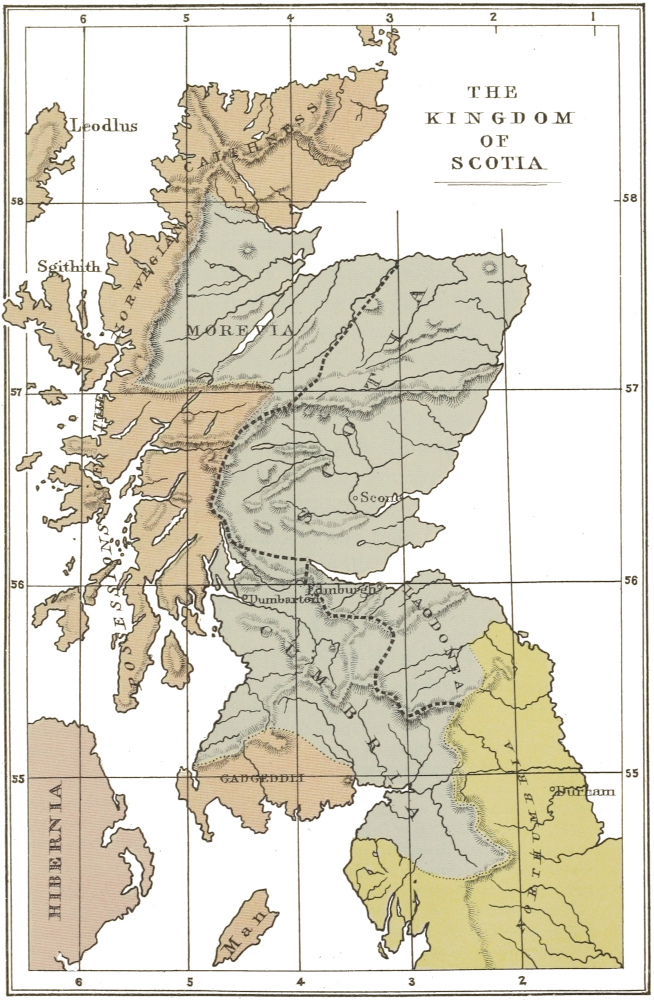
THE
KINGDOM
OF
SCOTIA
W. & A. K. Johnston, Edinburgh & London.
397Moravia is here not included among the Norwegian and
Danish possessions. On the death of Sigurd, the Norwegian
earl of Orkney, it had become freed from the Norwegian rule,
and its rulers appear to have considered themselves so far
independent as to claim the Celtic title of Ri or king. Findlaec,
the son of Ruadhri, who appears in the sagas under the
name of Finleikr Jarl, and whose slaughter by the sons of
his brother Maelbrigdi in 1020 is recorded by Tighernac as
Mormaer of Moreb, is termed in the Ulster Annals ‘Ri
Albain;’ and Tighernac, in recording the death of his successor
Malcolm, the son of his brother Maelbrigdi, and one
of those who slew him, in 1029, terms him ‘Ri Albain.’[567]
There can therefore be little doubt that the king Maelbaethe,
who submitted to King Cnut, was Macbeth, the son of
Findlaec, who appears under the same title which had been
borne by his cousin and his father.[568] The native rulers of
Airergaidhel or Argathelia appear also to have borne the
Celtic title of Ri, and it is probable that Jehmarc represents
in a corrupted form the name of the ruler of this district.[569]
These kings would probably have little scruple in rendering
their submission to King Cnut the Dane, from their having
so recently been under Norwegian rule.
Three years after this expedition Malcolm died. Tighernac
398records his death in 1034 as king of Alban and head of
the nobility of the west of Europe;[570] but we now obtain an
additional source of information for this period of the history
of very great value in the Chronicle of Marianus Scotus, who
was born in the reign of this Malcolm, in the year 1028, and
notices a few of the events in Scottish history which took
place during his own lifetime. The first Scotch event noticed
by him is the death of Malcolm, which he says took place
on the twenty-fifth of November 1034, and he terms him
‘king of Scotia.’[571] The kings of Alban occasionally appear
as kings of the Scots, but this is the first instance in which
the name of Scotia is applied as a territorial designation of
their kingdom. Used by a contemporary writer, who was
himself a native of Ireland, it is evident that the name of
Scotia had now been transferred from Ireland, the proper
Scotia of the previous centuries, and become adopted for the
kingdom of the Scots in Britain in the reign of Malcolm,
son of Kenneth, which ushers in the eleventh century,
superseding the previous name of Alban.
With Malcolm the descendants of Kenneth mac Alpin,
the founder of the Scottish dynasty, became extinct in the
male line. Had any male descendant existed, there would
have been great risk of the territories now composing the
kingdom becoming again disunited. As Malcolm had no son,
but at least two daughters who had male issue, Cumbria and
Lothian would naturally have passed to the nearest heir in
the female line; while a male collateral who could trace his
descent from the founder of the family would, by the law of
399Tanistic succession, have had a preferable claim to the regions
north of the Firths of Forth and Clyde, forming the kingdom
of Alban proper, and would probably have received the support
of the Scottish part of its population at least; but the
existence of any such male descendant cannot be traced, and
the last male scion of the race appears to have been slain by
King Malcolm in the year which preceded his own death,
probably to make way for the quiet accession of Duncan,
his grandson through his daughter, to the whole of the territories
which he had united under his sway.[572]
A.D. 1034-1040.
Duncan, son of Crinan and grandson of Malcolm, king of Scotia.
He attained his object, for Duncan appears at first to have
succeeded him in the whole of his dominions without objection,
but ere long to have provoked aggression both in the
south and in the north. In the south, Eadulf Cudel, the
earl who had ceded Lothian to the Scots, did not long survive
the battle of Carham, and was succeeded in the Bernician
earldom by Aldred, a son of Uchtred, on whose death
his brother Eadulf succeeded him, and in the year 1038
400invaded Cumbria and devastated the whole country.[573]
Duncan, however, was not equally successful in an invasion
of the territories of Eadulf, for Simeon of Durham, in his
history of that church, tells us that Duncan, king of the
Scots, advanced with a countless multitude of troops and
laid siege to Durham, and made strenuous but ineffective
efforts to carry it, for a large proportion of his cavalry was
slain by the besieged, and he was put to a disorderly flight,
in which he lost all his foot-soldiers, whose heads were
collected in the market-place, and hung up upon posts.[574]
The aggression, however, which he provoked in the north
brought a formidable competitor into the field, and was destined
to terminate more fatally for him. The details of this
war are preserved to us in the Orkneyinga Saga; and
though its authority is not unexceptionable, and the events
it records are not to be found elsewhere, the narrative still
carries with it an air of truth, and it fills a blank in the
meagre records of the time which supplies in a great measure
a clue to their real character. In this narrative the king who
succeeded Malcolm appears under the strange designation of
Karl or Kali Hundason,[575] that is, either the Churl, or Kali
401the son of the hound; and from the appellation here given
to Duncan’s father, we learn that the Hundi Jarl or the
Hound Earl, who fought with Sigurd the Stout, earl of
Orkney, could have been no other than Crinan, the warlike
lay abbot of Dunkeld. On Sigurd’s death the islands of
Orkney fell to his three sons, Sumarlidi, Einar, and Brusi,
among whom they were divided; while Thorfinn, his son
by the daughter of King Malcolm, received from his grandfather
Caithness and Sutherland, with an earl’s title. The
last of the three brothers among whom the Orkneys were
divided died, however, a few years before the death of King
Malcolm;[576] and when his grandson Duncan succeeded him,
Thorfinn had been for some years in possession of the entire
earldom of Orkney. Duncan seems to have considered that
Thorfinn having become earl of Orkney, he might resume
possession of Caithness, or at least demand tribute from it.
Thorfinn, on the other hand, considered that it was his inheritance
from King Malcolm through his mother, and that
he had obtained it before Duncan inherited the kingdom.
Thus, says the Saga, they became open enemies and made
war on each other. Duncan took the initiative, and bestowed
Caithness with the title of earl upon a relation of his own,
Moddan, said to be his sister’s son, who proceeded immediately
to the north and collected forces in Sutherland.
Earl Thorfinn on his part raised the men of Caithness, and
on being joined by Thorkell Fostri with an army from the
Orkneys, Moddan retired before his superior forces. Thorfinn
then subdued the districts both of Sutherland and Ross,
and after plundering in the district south of them, returned
402to Caithness and remained at Dungallsbae or Duncansby,
with five war-ships and their crews, the rest of the army
returning to Orkney. Moddan then sought the king, whom
he found at Berwick, then probably on his return from his
unsuccessful invasion of Northumbria, and told him the
result of his expedition. Duncan organised a more formidable
attack. He sent Moddan by land with a considerable
force to make his way to Caithness, and he himself sailed
from Berwick with a naval force, consisting of eleven warships
and a numerous army. His intention was by landing
on the north of Caithness to place Earl Thorfinn between
the two armies, but the latter anticipated his plan by sailing
out in his own ships and attacking Duncan’s fleet in the
Pentland Firth. Though the latter fleet was superior in
numbers, the Scots could not stand against the fierce onslaught
of the Norwegians, and after an obstinate conflict
gave way before them, and fled south into the Moray Firth,
where Duncan landed and proceeded south to collect a new
army. Thorfinn remained in the north till he was again
joined by Thorkell Fostri with the Orkneymen, and then
went south into the Moray Firth in pursuit of Duncan, and
began to plunder the districts on its southern shore. In the
meantime, Moddan, who had no one to oppose him, appears
to have occupied Caithness with his army, and took up his
quarters at Thurso, where he remained waiting for reinforcements,
which he expected to receive from Ireland. Thorfinn,
hearing this, again anticipated him. He remained himself
in Scotland, and continued plundering the country, while he
sent Thorkell north with a portion of the army. The people
of Caithness were in his interest, and thus Thorkell succeeded
in surprising Moddan in Thurso, where he came by night,
set fire to the house in which Moddan was, and slew him.
His men then surrendered, and Thorkell went from thence
to the Moray Firth to rejoin Thorfinn with all the men he
could collect in Caithness, Sutherland, and Boss, and found
403him in Myrhaevi or Moray. King Duncan now collected as
large an army as he could assemble from the rest of Scotland;
or, as the Saga expresses it, ‘as well from the south as the
west and east of Scotland, and all the way south from Satiri
or Kintyre, and the forces for which Earl Moddan had sent,
also came to him from Ireland.[577] He sent far and near to
chieftains for men, and brought all this army against Earl
Thorfinn.’ Earl Thorfinn appears to have been stationed
at Torfness or Burghead, where the Borg was which his
ancestor Sigurd had built to enable the Norwegians to
maintain their footing in Moray, and here the great battle
took place which was to decide this contest. Thorfinn first
attacked the Irish division, who were immediately routed,
and never regained their position. King Duncan then
brought his standard forward against Earl Thorfinn, and the
fiercest struggle took place between the Scots and the Norwegians;
‘but,’ says the Saga, ‘it ended in the flight of the
king, and some say he was slain.’ Earl Thorfinn then drove
the fugitives before him through Scotland, and laid the land
under him wherever he went, and all the way south to Fife.[578]
Such is the account given us by the Saga of this war.
Marianus supplements it by telling us that in the year 1040
Donnchad, king of Scotia, was slain in autumn, on the 14th
of August, by his general, Macbethad, son of Finnlaech, who
succeeded him in the kingdom.[579] Macbeth was at this time
404the Ri or Mormaer of the district of Myrhaevi or Moray,
which finally became the seat of war, and when Duncan sent
far and wide to the chieftains for aid, he probably came to
his assistance with the men of Moray, and filled the place
which Moddan had formerly occupied as commander of his
army; but the tie which united the mormaers of Moray with
the kings of the Scots was still a very slender one. They
had as often been subject to the Norwegian earls as they had
been to the Scottish kings; and when Duncan sustained this
crushing defeat, and he saw that Thorfinn would now be able
to maintain possession of his hereditary territories, the interests
of the Mormaer of Moray seem to have prevailed
over those of the commander of the king’s army, and he
was guilty of the treacherous act of slaying the unfortunate
Duncan, and attaching his fortunes to those of
Thorfinn.
The authorities for the history of Macbeth know nothing
of Earl Thorfinn and his conquests. On the other hand the
Sagas equally ignore Macbeth and his doings, and had to
disguise the fact that Thorfinn was attacking his own cousin,
and one who had derived his right to the kingdom from the
same source from which Thorfinn had acquired his to the
earldom of Caithness, by concealing his identity under the
contemptuous name of Karl or Kali Hundason,[580] while some
of the chronicles have transferred to Macbeth what was true
of Thorfinn, that he was also a grandson of King Malcolm,[581]
405and a Welsh Chronicle denominates him king of Orkney.[582]
The truth seems to be that the conquest of the provinces
south of Moray, which took place after this battle, was the
joint work of Thorfinn and Macbeth, and that they divided
the kingdom of the slain Duncan between them: Thorfinn
receiving the districts which had formerly been under his
father, with the addition of those on the east coast extending
as far as Fife or the Firth of Tay. According to the Orkney-inga
Saga, he possessed ‘nine earldoms in Scotland, the whole
of the Sudreys, and a large riki in Ireland,’ and this is confirmed
by the St. Olaf’s Saga, which tells us that ‘he had
the greatest riki of any earl of Orkney; he possessed Shetland
and the Orkneys, the Sudreys, and likewise a great riki in
Scotland and Ireland.’[583] Macbeth obtained those in which
Duncan’s strength mainly lay—the districts south and west
of the Tay, with the central district in which Scone, the
capital, is situated. Cumbria and Lothian probably remained
faithful to the children of Duncan.
A.D. 1040-1057.
Macbeth, son of Finnlaec, king of Scotia.
The kingdom had thus hardly passed from the last
male descendant of the founder of the Scottish dynasty to
a new family, when it was again transferred to rulers of a
different race. The whole of the northern part found itself
under the rule of the Norwegian earl of Orkney, while the
centre of the kingdom, in which the capital was situated,
accepted as its king the hereditary ruler of Moray, a district
the connection of which with the kingdom proper had
hitherto been both slender and uncertain, who reigned over
these districts for seventeen years. It is difficult to understand
how a king who had no hereditary claim upon their
allegiance should have been able to maintain his possession
of the throne for so many years in a part of the country
which was the stronghold of the Scots. That he should
406have slain his predecessor was no unusual circumstance, and
would equally have excluded many of his predecessors. His
only connection with the Scottish dynasty was, that his
wife was Gruoch, the daughter of that Boete or Bode, son
of Kenneth, whose son or grandson had been slain in 1032
by Malcolm mac Kenneth, and through her some claim
upon the allegiance of the Scots seems to have been based.
That he was not the tyrant he is represented by Fordun to
have been seems very certain. There is no trace of it in
any authentic record. On the contrary, St. Berchan speaks
kindly of him. Thus—
After slaughter of Gael, after slaughter of Galls,
The liberal king will possess Fortrenn.
The red one was fair, yellow, tall;
Pleasant was the youth to me.
Brimful (or plenteous) was Alban east and west,
During the reign of the fierce red one.
And we find Macbeth son of Finnlaec, and Gruoch daughter
of Bode, king and queen of the Scots, granting the lands of
Kyrkness to the Culdees of Lochleven from motives of
piety, and for the benefit of their prayers; and Macbeth,
again, granting the lands of Bolgyne to the same Culdees,
‘with the utmost veneration and devotion.’[584] That his hold
over this part of the country, whether from personal
407character or from his claim through his wife, was quite
equal at least to that of the family of the lay abbot of
Dunkeld, we find from the unsuccessful attempt made by
the latter to drive him from the throne a few years after his
accession. Tighernac gives us the short but significant
statement, that in the year 1045 a battle took place between
the men of Alban on both sides, in which Crinan, abbot of
Dunkeld, was slain, and many with him, viz., nine times
twenty heroes.[585]
Five years after this he seems to have gone to Rome,
probably to obtain absolution for the murder of Duncan,
as Marianus tells us that in the year 1050 the king of
Scotia, Macbethad, freely distributed silver to the poor at
Rome.[586]
The immunity with which he enjoyed the fruit of his
treachery towards Duncan may no doubt be attributed in a
great measure to there being no one with a preferable right
who was in a position to oppose him. The children of
Duncan must have been in mere infancy at his death, and
if the immediate succession of a son to his father’s throne
was still somewhat strange to the Celtic population, that of
an heir who was not of sufficient age to be capable of
governing personally was totally opposed to their laws. He
had too no doubt behind him the support of the powerful
earl of Orkney, and if he had possessed a legitimate title,
he would probably have maintained his position, and been
recorded as one of the best of the Scottish kings; but the
stamp of usurpation was upon him, and his immunity was
408to cease when Malcolm, the son of Duncan, reached an age
to enable him to contest his right and claim, which was to
bring a more powerful antagonist into the field than Macbeth
had yet had to encounter. This was Siward, earl of
Northumbria. He was of Danish race, and became connected
with the earls of Northumbria by marriage with
Elfleda the daughter of Ealdred, earl of Northumbria, and
on the slaughter of Eadulf, his wife’s uncle, by King Hardacnut,
in the year 1041, was made earl over the whole of
Northumbria, extending from the Humber to the Tweed.[587]
Siward was doubly connected with the house of Crinan, the
abbot of Dunkeld, for his wife’s aunt, Aldgitha, half-sister
of Earl Ealdred, was married to Maldred, son of Crinan, and
King Duncan himself married either the sister or the cousin
of Earl Siward, by whom he had a son, Malcolm. On the
assassination of his father, Malcolm must have been a mere
child, but when he reached an age which enabled him to
claim his father’s kingdom, Siward seems to have resolved
to make an effort to drive Macbeth from the throne he had
usurped.
A.D. 1054.
Siward, earl of Northumbria, invades Scotland, and puts Malcolm, son of King Duncan, in possession of Cumbria.
The Saxon Chronicle tells us that in the year 1054 ‘Earl
Siward went with a large army into Scotland, both with a
naval force and a land force, and fought against the Scots,
of whom he made great slaughter, and put them to flight,
and the king escaped. Many also fell on his own side, both
Danish and English, and also his own son Oshern, and his
sister’s son Siward, and some of his “huscarls” and also of
the kings were there slain, on the day of the Seven Sleepers,
409that is, on the 27th of July.’[588] Tighernac records in the
same year ‘a battle between the men of Alban and the men
of Saxonia,’ in which many of the soldiers were slain;[589] and
the Ulster Annals add that ‘three thousand of the men of
Alban were slain, and fifteen hundred of the men of Saxonia,
around Dolfinn, son of Finntuir’Finntuir’ (or Thorfinn).[590] There
is a statement in Gaimar’s metrical chronicle not to be
found elsewhere. We are there told that ‘Earl Syward
made an agreement with the king of Scotland when he
went, but Macbeth destroyed the peace, and ceased not to
carry on war.’ He then gives an account of the expedition,
evidently taken from the Saxon Chronicle.[591]
As Siward advanced against Macbeth with both a naval
force and a land army, he must have intended to enter the
Firth of Tay with the former, while he penetrated by land
into Scotland proper. To send a fleet merely into the Firth
of Forth could in no way have aided his enterprise. His
object therefore seems to have been Scone, the capital of the
kingdom, to which he would penetrate by land by the usual
route, crossing the Forth at Stirling, and passing through
Stratherne, while his fleet entering the Firth of Tay, would
not only support the land army, but prevent the force of the
districts north of the Tay being used to turn the flank of
his army. He seems to have been opposed by the people
of Alban, who appear to have been united in support of
410Macbeth, who likewise had the aid of the Norwegians, as
the son of Thorfinn, called by the Irish annalist Finntuir,
fell in the contest. St. Berchan appears to allude to this
battle at Scone, and to imply that a night attack had been
made, when he says,
On the middle of Scone, it will vomit blood,
The evening of a night in much contention.
Although the Saxon Chronicle claims the victory for Siward,
it admits the greatness of the slaughter on his side. It
seems to have been a fiercely contested struggle, after which
Siward found it necessary to retire without effecting his
object of driving Macbeth from the throne of Scotia, as he
reigned for three years longer; but he appears to have so far
advanced the cause of young Malcolm, that he established
him in possession of the territory of the Cumbrian Britons,
and of Lothian as king of Cumbria.[592]
In the following year Siward died, and Malcolm thus
lost the powerful support of the Danish earl of Northumbria,
but he appears to have formed a close alliance
with his successor Tostig, the son of Earl Godwine, who,
though not of the Northumbrian race, had been appointed
earl by King Edward, so that they became sworn brothers;
and in the year 1057, when he had been three years in
411possession of the districts south of the Firths of Forth
and Clyde as king of Cumbria, Malcolm seems to have
found himself strong enough to make an independent
attempt to drive Macbeth from the throne he had usurped,
and this time his attempt was successful. Of the details
of this renewed attempt no account has been handed
down to us, but it resulted in Macbeth being driven across
the great range of the Mounth, and slain by Malcolm at
Lumphanan in Marr on the 15th day of August in the
year 1057.[593]
A.D. 1057-8.
Lulach, son of Gilcomgan, king of Scotia.
The party in the kingdom who supported him now put
up, as king, Lulach, who was the son of Gilcomgan, Mormaer
of Moray, and the heir to whom the hereditary rule over
that province fell on the death of Macbeth, while his mother
was a granddaughter of Boete or Bodhe, and through her
he inherited whatever rights to the Scottish throne that
family possessed; but his reign, nominal as it was, lasted
only seven months, and he was slain at Essy in Strathbolgy
on the 17th day of the following March.[594]
A.D. 1057-8.—1093.
Malcolm, eldest son of King Duncan, king of Scotia.
These isolated events may be accepted as facts, transmitted
to us as they are by contemporary writers, but they
leave us quite in the dark as to how Malcolm so speedily
412and thoroughly accomplished what the powerful Siward with
his army and his fleet had failed to effect three years before.
It seems difficult too to understand how, if the northern
provinces up to Fife were under the rule of the powerful
earl of Orkney with his Norwegians, Malcolm could have
carried the war so far into them as to drive Macbeth beyond
the Dee and defeat and kill him there. The Orkneyinga
Saga tells us that Thorfinn possessed nine earldoms in Scotland,
and that on his death ‘many of the rikis which the
earl had subjected fell off, and their inhabitants sought the
protection of those native chiefs who were territorially born
to rule over them.’[595] Besides the four earldoms in Scotland
of Sutherland, Ross, Moray, and Dali, which his father
Sigurd had subjected before him, he had brought for the
first time under the Norwegian yoke the four earldoms of
Buchan, Marr, Mearns, and Angus, and these would bring
his possessions up to Fife, and with Galloway,[596] which he
probably also possessed, would make up the nine earldoms,
and the most probable explanation of Malcolm having
selected this year to make a great effort to recover his
father’s throne and of its apparent rapid success, is that it
was also the year of Thorfinn’s death, when many of the
provinces which had been subjected by him fell again under
native rule. Of these, the first to free themselves from the
Norwegian yoke would be the four earldoms extending from
the Spey to the Firth of Tay, forming the northern half of
the kingdom proper. It was, however, in this part of the
kingdom, and mainly in Angus, that the branch of the royal
house of which Malcolm, son of Kenneth, was the head, and
which Malcolm, the son of Duncan, now represented in the
female line, had its main seat, and it was there that their
power and influence lay. If these provinces were now freed
from the Norwegian yoke, Malcolm might find there powerful
413support, while his paternal descent from the lay abbots of
Dunkeld would likewise bring the people of Atholl and of
the extensive possessions of that church to his aid. The
death of Thorfinn would thus present to him a great opportunity
for making another attempt to add the kingdom of
Scotland to that of Cumbria, with the district of Lothian
which he already possessed; and Macbeth, finding himself
isolated, with the forces of Cumbria and Lothian in front
of him and a hostile population behind him, in place of
the support of the Norwegian earl, would fall back upon
his own hereditary province of Moray, and being followed
by Malcolm with his army, gathering strength as he proceeded,
was overtaken and slain at Lumphanan.
If this view, that Thorfinn died in 1057, appears to
afford us the most plausible explanation of the sudden
termination of Macbeth’s kingdom, there is nothing in the
Sagas which raises any serious objection to it. They nowhere
state any fact which gives us a fixed date for Thorfinn’s
death. The Orkneyinga Saga says, that from the year
when he was made earl, that is, in 1014, ‘he was earl for
seventy winters,’ which would make him live till the year
1084. The Saga of Saint Olaf reduced the number of years
to sixty winters, that is, to the year 1074, but both Sagas
agree that he died in the end or in the latter days of Harald
Sigurdson, who was slain at the battle of Stamford Bridge
in the year 1066; and when Harald came to the Orkneys,
on his way to England, he found Thorfinn’s sons ruling as
earls of Orkney, and took them with him. No events are
recorded of Thorfinn in the Sagas after the year 1050, and
if he died in 1057 his death would take place about eight
years before that of Harald Sigurdson, and in the last half
of his reign. It might still be said that he died towards the
end of his reign.
Simeon of Durham too tells us that in the year 1061
‘Aldred, archbishop of York, went to Rome with Earl Tostig
and received the pall from Pope Nicholas. Meanwhile
414Malcolm, king of Scots, furiously ravaged the earldom of
his sworn brother Earl Tostig, and violated the peace of
St. Cuthbert in the island of Lindisfarne.’[597] What led to
Malcolm thus taking advantage of Tostig’s absence to attack
his earldom we do not know, and the chronicler throws no
further light upon it; but it is hardly possible to suppose
that Malcolm could have ventured to attack Northumbria,
and break off his alliance with Tostig, if he had not by this
time effected the subjugation of his entire kingdom, and if
the northern half of it still remained under the rule of the
Norwegian earl of Orkney. On Thorfinn’s death Malcolm
appears to have endeavoured to conciliate the Norwegian
element in the country by making Ingibiorg, the widow of
Thorfinn, his wife, by whom he had a son Duncan. His
Norwegian wife did not, however, apparently survive the
birth of her son many years, and gave way to a more
important alliance for Malcolm, and one that was to
exercise a powerful influence on the internal condition of
the country, and the character of the reigning house. The
Saxon Chronicle tells us, that in the summer of the year
1067 ‘Eadgar child went out (from Northumberland) with
his mother Agatha, and his two sisters Margaret and
Christina, and Mærleswegen, and many good men with
them, and came to Scotland under the protection of King
Malcolm, and he received them all.’ One edition of the
chronicle adds, ‘Then King Malcolm began to yearn after
his sister Margaret to wife, but he and all his men long
refused, and she herself also declined, and said that she
would have nor him nor any one if the heavenly clemency
would grant that she in maidenhood might propitiate the
mighty Lord with corporal heart in this short life in pure
continence. The king earnestly urged her brother, until he
answered yea, and indeed he durst not otherwise, because
415they were come into his power.’ The other edition of the
chronicle simply adds, ‘and he took the child’s sister
Margaret to wife.’ Florence of Worcester, who is the next
best authority, places this event in the year 1068, which is
probably the correct year,[598] and tells us that ‘Marleswein
and Gospatric, and all the nobler Northumbrians, to avoid
the severity of the king, and dreading the imprisonment
which so many had suffered, sailed to Scotland with Eadgar
Aetheling, his mother Agatha, and his two sisters Margaret
and Christina, and wintered there under the protection of
Malcolm king of Scots.’[599] The marriage probably took
place the following spring at Dunfermline, which King
Malcolm appears to have adopted as his principal seat, and
not without reason, according to Fordun’s description of it:
‘For that place was of itself most strongly fortified by
nature, being begirt by very thick woods and protected by
steep crags. In the midst thereof was a fair plain, likewise
protected by crags and streams, so that one might think
that was the spot whereof it was said, scarce man or beast
may tread its pathless wilds.’[600]
Child Eadgar, as the Saxon Chronicle calls him, was the
son of Eadward Aetheling, who had returned from exile in
Hungary in the year 1057, and died in England the same
year. As Eadward Aetheling was the son of King Eadmund,
the elder brother of Eadward the Confessor, he might have
been held, if he had been at home instead of in distant
exile, to have had a preferable right to the throne; but after
the death of Eadward the Confessor his family were looked
upon as representing the royal house of Wessex, and as
possessing a legitimate claim upon the allegiance of the
416Saxon population, which, had the personal character of
Eadgar been different, might have made him a more formidable
opponent to the Norman Conqueror than he proved
to be. The connection of Malcolm with this family by
marriage with his sister was a very important one for him,
and he now combined in his own person advantages which
gave him a claim to the obedience of each of the different
races now united under his rule. In the male line he
represented the powerful lay abbots of Dunkeld, and inherited
their influence over the ecclesiastical foundations
dependent upon that monastery. In the female, he possessed
the more important representation of the Scottish royal
house who had ruled for a century and a half over the
kingdom of Scotland. His father Duncan had been recognised
for twenty years by the Welsh population of Cumbria
or Strathclyde as their king, and by his mother he was connected
with the Danes of Northumbria and their powerful
earl Siward. His marriage with Ingibiorg gave him a claim
to the good-will at least of the Norwegians, and the Anglic
population of Lothian and Northumbria would look upon
his marriage with the daughter of the Aetheling as giving
him an additional right to their steadfast support. The
northern province of Moray alone, whose hereditary rulers
were of the same family as Macbeth, would probably render
but an unwilling submission to his authority, and his rule
over them would be little more than nominal.
Of the events of his thirty-five years’ reign, however,
very few have been recorded. The combination of so many
advantages in his own person would naturally lead to a
further amalgamation of the different provinces of the
kingdom, with their varied population, into one monarchy;
but this is a silent process, which little attracts the notice
of the chroniclers of the time. The personal character of
Margaret, no doubt, was one to exercise a great influence
upon the internal condition and progress of the people, as
we learn to some extent from her life by Turgot; but this
417belongs to a different part of our subject, and beyond a few
isolated notices we know really nothing of the internal
history of his reign.
Malcolm invades Northumbria five times.
As to external events, Simeon of Durham, whose language,
however, is coloured by an indignant hatred of the
Scots on account of their frequent attacks upon Durham,
tells us that Malcolm had ‘five times wasted the province
of Northumbria with a savage devastation, and carried
captive the wretched natives to reduce them to slavery:
once in Eadward’s reign, when Tostig, earl of York, had
gone to Rome;’ twice in the reign of King William the
Conqueror; and twice in that of his successor.[601]
The first we have already noticed. The two next were
probably connected with the claims of the Aetheling; but
it is also possible that Malcolm may now have begun to
realise the growing importance of Lothian and its Anglic
population as an integral portion of its dominions, and been
not unwilling to take advantage of the unsettled state of
the north of England to extend to the Tyne the limits of
that province which was now assuming the prominent place
it ever after occupied in the future Scotland. Simeon seems
to hint at some such motive, when he accuses him of being
‘instigated by avarice.’ If this was Malcolm’s real object,
his policy seems to have been, by harassing and devastating
the earldom north of the Tyne, from time to time, to force
them to put themselves under his protection—a policy not
unknown to the descendants of a part of his subjects, when
black mail was a familiar term.
During the first three years of the reign of William the
Conqueror, he had little real power or authority beyond the
Humber, and it was not till the end of the year 1069, when
he invaded Northumbria, and laid the country entirely
waste with fire and sword, that he may be said to have
actually conquered the country. Previous to that expedition
418he exercised a merely nominal authority, through
earls of his own appointment, who no sooner attempted to
exercise their functions within the earldom than they were
ere long slain.
It was in Northumbria that the cause of the Aetheling
was mainly supported, and that part of it which was north
of the Tyne presented a tempting field for the incursions of
the Scots. On the death of Siward in 1055 an earl was for
the first time appointed who was not of Northumbrian race.
Tostig, the son of Earl Godwine, was appointed earl by King
Eadward, but, after a ten years’ rule, we are told by the
Saxon Chronicle that in 1065 ‘all the thanes in Yorkshire
and Northumberland gathered together, and outlawed their
Earl Tostig, and slew all his household-men that they could
come at, both English and Danish, and took all his weapons
at York, and gold and silver, and all his treasures which
they could anyway hear of, and sent after Morkere, son of
Earl Aelfgar (of Mercia), and chose him for their earl,’
which was confirmed by King Edward. Morkere does not
seem, however, to have been accepted by the Northumbrians
beyond the Tyne, as Simeon of Durham tells us that he
transferred that part of the earldom to Osulf, son of Earl
Eadulf, of the line of the native earls, who had been slain
in the year 1041. In the year 1067 King William summoned
Earl Morkere to attend him on his voyage to Normandy,
and retained him beside him, and at the same time
sent Copsige, who had been an adherent of Earl Tostig, to
govern, as procurator, that part of the earldom under Osulf;
but Simeon tells us that ‘Osulf, driven by Copsige from the
earldom, concealed himself in the woods and mountains in
hunger and want, till at last, having gathered some associates
whom the same need had brought together, he
surrounded Copsige while feasting at Newburn. He
escaped through the midst of confused crowds, but, being
discovered while he lay hid in the church, he was compelled,
by the burning of the church, to go out to the door, where,
419at the very door, he was beheaded by the hands of Osulf, in
the fifth week of his charge of the earldom, on the fourth
of the ides of March. By and by, in the following autumn,
Osulf himself, rushing headlong against the lance of a
robber who met him, was thrust through, and there perished.
At his death Gospatric, the son of Maldred, the son of
Crinan, going to King William, obtained the earldom of the
Northumbrians, which he purchased for a great sum, for the
dignity of that earldom belonged to him by his mother’s
blood. His mother was Algitha, the daughter of Earl
Uchtred, whom he had by Algiva, daughter of King
Agelred.’[602] Gospatric, by paternal descent, was nearly connected
and a member of the same house with Malcolm, the
king of the Scots, while the means by which he obtained
his earldom ranged him among the followers of King
William, and he thus placed himself in a position which it
was very difficult for him to maintain without alienating
from him either the one or the other. In the following year,
therefore, the Saxon Chronicle tells us that, in 1067, after
Whitsunday, ‘it was then announced to the king that the
people of the north had gathered themselves together and
would stand against him if he came. He then went to
Nottingham, and there wrought two castles; and so went to
York, and there wrought two castles, and in Lincoln, and
everywhere in that part. And Earl Gospatric and the best
men went to Scotland.’ The same Chronicle tells us that
in the following year, 1068 according to the Chronicle, but
correctly given by Simeon in 1069, ‘King William gave to
Earl Robert (de Comines) the government over Northumberland;
but the men of the country surrounded him in the
burgh at Durham, and slew him and nine hundred men
with him. And immediately after Eadgar Aetheling came,
with all the Northumbrians, to York, and the townsmen
made peace with them; and King William came unawares
on them from the south with an overwhelming army, and
420put them to flight, and slew those who could not flee, which
were many hundred men, and plundered the town, and
defiled St. Peter’s monastery, and also plundered and
oppressed all the others, and the Aetheling went back again
to Scotland.’
This unsuccessful attempt seems to have led to a more
general combination of the northern powers in favour of the
Aetheling, in which the aid of Swein, king of Denmark,
had been solicited and obtained; and in autumn ‘came from
Denmark,’ the Saxon Chronicle tells in 1069, ‘three sons of
King Svein and Asbiörn Jarl, and Thorkell Jarl, with two
hundred and forty ships, into the Humber; and there came
to meet them Eadgar child and Earl Waltheof, and Maerleswegen,
and Earl Gospatric, with the Northumbrians, and all
the country people, riding and walking, with a countless
army, greatly rejoicing; and so all unanimously went to
York and stormed and demolished the castle, and gained
innumerable treasures therein, and slew there many hundred
Frenchmen, and led many with them to the ships....
When the king learned this, he went northward with all
his force that he could gather and completely harried and
laid waste the shire. And the fleet lay all winter in the
Humber, where the king could not come at them. And the
king was in the day of Midwinter at York, and so all the
winter in the land.’ Florence of Worcester tells us that
‘King William ceased not, during the whole winter, to lay
waste the land, to murder the inhabitants, and to inflict
numerous injuries.’[603] This devastation of the land, however,
does not appear to have extended beyond the Tyne, or
to have affected the districts on the coast; but what was
left undone by William was completed by Malcolm, king of
the Scots, for Simeon of Durham tells us that in the spring
of the year 1070, after King William had returned to the
south of the Humber, ‘a countless multitude of Scots
marched through Cumbreland, under the command of King
421Malcolm, and turning to the east ravaged with fierce devastation
the whole of Teesdale, or the vale of the river Tees,
and the parts bordering it on each side.’ Then, ‘having
pillaged Cleveland in part, by a sudden foray he seized
Holderness, and thence savagely overrunning the territory
of St. Cuthbert, between the Tees and the Tyne, he deprived
all of their property, and some of their lives. Then he
destroyed by fire, under his own inspection, the church of
St. Peter, the prince of the apostles, at Wearmouth. He
burnt also other churches, with those who had taken refuge
in them.’[604] Whether this inroad was made as part of the
plan for a combined attempt in favour of Eadgar, which
failed the preceding year, and that Malcolm had been too
late in putting his part of it into execution, or whether, as
seems more probable, he thought it a favourable opportunity
for carrying out the policy which he hoped might lead to
his extending his frontier to the Tyne, it seems difficult to
say; but Gospatric, who had fled to Scotland before the
approach of King William the preceding year, had now
become reconciled to him, as Orderic of Vital says that
while King William had pursued his foes to the river Tees,
he ‘there received the submission of Waltheof in person,
and of Gospatric by his envoys, who swore fealty on his
part,’[605] and he seems to have thought that he might win
favour by acting against Malcolm. Simeon therefore tells
us, ‘Having called in some bold auxiliaries, he made a
furious plundering attack upon Cumbreland. Having done
this with slaughter and conflagration, he returned with
great spoil and shut himself with his allies into the strong
fortress of Bamborough, from which making frequent sallies,
he weakened the forces of the enemy.’ Malcolm ‘having
heard, while still gazing on the church of St. Peter as it was
being consumed by the fire of his men, of what Gospatric
had committed against his people, scarcely able to contain
himself for fury, ordered his troops no longer to spare any
422of the English nation, but either to smite all to the earth,
or to carry them off captives under the yoke of perpetual
slavery.’ Simeon then gives us his usual picture of the
barbarity with which such inroads were carried on by the
Scots, and adds as the result, ‘Scotland was therefore filled
with slaves and handmaids of the English race; so that
even to this day, I do not say no little village, but even no
cottage, can be found without one of them.’[606] Simeon inserts
the following tale in his account of this inroad by
Malcolm the king of the Scots. He says that ‘when he was
riding along the border of the river (Wear) beholding from
an eminence the cruel exploits of his men against the
unhappy English, and feasting his mind and eyes with such
a spectacle, it was told him that Eadgar Aetheling and his
sisters, who were beautiful girls of the royal blood, and many
other very rich persons, fugitives from their homes, lay with
their ships in that harbour. When they came to him with
terms of amity, he addressed them graciously, and pledged
himself to grant them and all their friends a residence in his
kingdom as long as they chose.’ And Simeon afterwards
adds, ‘After Malcolm’s return to Scotland, when Bishop
Egelwin was commencing his voyage towards Cologne, a contrary
wind arising soon drove him back to Scotland. Thither
also it bore with a favourable course Eadgar Aetheling with his
companions before named. King Malcolm, with the consent
of his relatives, took in marriage Eadgar’s sister Margaret, a
woman noble by royal descent, but much more noble by her
wisdom and piety. By her care and labour the king himself,
laying aside the barbarity of his manners, became more
gentle and civilised.’ But this story, if it has any foundation
at all, appears to be misplaced, and the marriage which
followed it had already taken place. Placed as it is in this
year, it is quite inconsistent with the previous narrative.
Simeon had recorded two years before the flight of Eadgar
with his mother Agatha, and his two sisters Margaret and
423Cristina, by sea, to Scotland, where he says they passed the
winter. It is therefore in the highest degree improbable
that when Eadgar went in the following year to Northumbria
to join the Danes in seizing the country, he should have
taken his mother and sisters with him, from their secure
refuge at the court of Scotland, to join him in so hazardous
an expedition. Then the story as told implies that Malcolm
now heard of these sisters and their charms for the first time;
while, according to Simeon himself, they had already passed
a winter with him in Scotland. The story really belongs to
the first flight of Eadgar to Scotland, with his mother and
sisters, in 1068, and not to his return from Northumbria in
1070, and seems to be the same tale which Fordun tells, on
the authority of Turgot, that King Malcolm, when residing
at Dunfermline, heard of the arrival of Eadgar and his
sisters in St. Margaret’s Bay, and sent messengers to ascertain
who they were, who brought him precisely the same
report of the beauty of the sisters, in consequence of which
he invited them to his court, and married Margaret.[607]
During the early years of the reign of the Conqueror,
Scotland had not only been the refuge of his discontented
subjects, and the haven in which those who unsuccessfully
opposed him could at all times shelter themselves from his
vengeance and renew their attempts when opportunity offered,
but its king had afforded the Aetheling three times a refuge
at his court, and had now identified himself with his cause
by marrying his sister. King William therefore felt the
necessity of establishing at once a more definite relation
between himself and the Scottish king, and of convincing
him that his power was not to be opposed with impunity.
It was not till the year 1072 that he was able to turn his
424attention seriously to this object, but in that year the Saxon
Chronicle tells us ‘King William led a naval force and a
land force to Scotland, and lay about that land with ships
on the sea-side, and himself with his land force went
in over the ford.’ This was precisely the same disposition
of his forces which Earl Siward had made when he invaded
Scotland in 1054, and no doubt with the same object, that
of investing Scone, the capital of the country. King
William, we know, marched with his land army through
Lothian and Stirlingshire, and entered Scotland proper by
the ford over the Forth[608] there, and the only object in
sending a fleet could have been to penetrate into the interior
of the country by the Firth of Tay. We are then told that
‘King Malcolm came and made peace with King William,
and gave hostages and became his man, and the king went
home with all his force.’ Florence of Worcester says that
‘Malcolm, king of Scots, met him in a place called Abernethiei’[609]
or Abernethy on the Tay, which is quite in
accordance with this view. What the precise nature or
extent of the homage was which Malcolm agreed at Abernethy
to render, there are no materials now to determine.
When the possessions of the king of the Scots were confined
to the kingdom proper north of the Firths of Forth and
Clyde, the expression ‘he became his man’ would have a
definite significance; but after the cession of Cumbria and
Lothian it loses its force, as we cannot tell whether the
homage was paid for the kingdom or for one or both of
these outlying dependencies. The hostage given was, as we
425are afterwards informed by the Saxon Chronicle, Duncan,
the eldest son of Malcolm by Ingibiorg, his first wife, who
must then have been a boy of about ten years of age. Simeon
tells that on the return of King William from this expedition,
he deprived Gospatric of his earldom, ‘charging him
with having afforded counsel and aid to those who had
murdered the earl (Robert de Comines) and his men at
Durham, although he had not been present in person, and
that he had been on the side of the enemy when the Normans
were slain at York’ in the same year; and he adds that,
‘flying therefore to Malcolm, he (Gospatric) not long after,
made a voyage to Flanders; returning after a little time to
Scotland, the king bestowed upon him Dunbar with the
adjacent lands in Lothian.’ [610] King William seems now to
have thought it more politic to place one who had some
hereditary claim to the earldom than a stranger over the
Northumbrians, and bestowed Gospatric’s earldom upon
Waltheof, ‘which,’ says Simeon, ‘was his right by his
father’s and brother’s descent, for he was the son of Earl
Siward by Elfleda, daughter of Earl Aldred.’
Eadgar Aetheling appears to have taken refuge, when
King William invaded Scotland, in Flanders; but two years
after, when King William went to Normandy, ‘Eadgar child
came,’ the Saxon Chronicle tells us, ‘from Flanders to Scotland
on St. Grimbald’s mass day, or the 8th of July, and
King Malcolm and his sister Margaret received him with
great worship. At that same time Philip, king of France,
wrote to him and bade him come to him and he would give
him the castle of Montreuil, that he might then daily do
harm to his enemies. Moreover, King Malcolm and his
sister Margaret gave him and all his men great gifts and
many treasures in skins decked with purple and in pelisses
of marten-skin and weasel-skin and ermine-skin, and in
palls and in golden and silver vessels; and led him and all
his ship men with great worship from his dominion.’ No
426doubt, in the relation in which Malcolm then stood to King
William, his presence was an embarrassment to him; and
as he was not disposed to assist him himself at this time, he
was glad to be relieved from his difficulty by the king of
France discovering that he might make use of him to annoy
the king of England from another quarter. But King
Malcolm was not to be so easily freed from the embarrassment
of his presence as he expected; for we are told that
‘on the voyage evil befell them when they went out at sea,
so that there came on very rough weather, and the raging
sea and the strong wind cast them on the land so that all
their ships burst asunder, and they themselves with difficulty
came to land, and almost all their treasures were lost, and
some of his men also were seized by the Frenchmen; but
he himself and his best men went back again to Scotland,
some ruefully going on foot and some miserably riding.
When King Malcolm advised him that he should send to
King William over the sea and pray his peace; and he also
did so, and the king granted it to him and sent after him.
And King Malcolm and his sister again gave him and all
his men innumerable treasures, and very worthily again sent
him from their jurisdiction.’ Malcolm was more fortunate
the second time. Eadgar succeeded in reaching the court of
King William in safety, where he was well received, and remained
with him.
Malcolm appears now to have turned his attention more
to the amalgamation of the provinces he held, instead of
attempting to enlarge his dominions at the expense of
Northumbria, and in the year 1078 he appears to have
invaded the province of Moray. The hereditary ruler of
the province at this time was Maelsnectan, the son of that
Lulach who had borne the title of king for four months,
and his son appears under the Celtic title of ‘Ri Moreb,’
or king of Moray. Malcolm seems to have been successful
in his attempt, as the Saxon Chronicle tells us in an imperfect
notice that ‘in this year King Malcolm won the
427mother of Maelslaeht ... and all his best men, and all his
treasure and his cattle, and he himself escaped with difficulty.’
He may have taken refuge in the remote stronghold
of Loch Deabhra in Lochaber, which St. Berchan tells us
had been the habitation of his father Lulach, and here he
died seven years after.[611]
Malcolm appears to have been emboldened by this
success and by the continued absence of King William in
Normandy to make another attempt to extend his frontier
to the Tyne, notwithstanding that his son Duncan was still
retained as a hostage at the English Court, as Simeon of
Durham tells us that in 1079 ‘Malcolm, king of Scots, after
the Assumption of St. Mary on the 15th of August, devastated
Northumberland as far as the great river Tyne, slew
many, took more prisoners, and returned with great spoil;’
but when King William returned in the following year to
England, ‘he sent in the autumn his son Robert to Scotland
against Malcolm, but having gone as far as Egglesbreth he
returned without accomplishing anything, and built the new
castle on the Tyne.’[612] Egglesbrech is the Gaelic name of
Falkirk,[613] so that Robert penetrated as far as the river
Carron, but did not venture to proceed farther, and it is probable
that he contented himself with repaying the devastation
of that part of Northumbria north of the Tyne by
pillaging Lothian and Calatria, and was forced to retreat by
the want of supplies; and while he protected Northumbria
south of the Tyne by the castle he erected on that river, he
virtually surrendered the district north of it to the incursions
of the Scots.
In the year 1085, the same year in which Maelsnectan
428died, Malcolm appears to have lost a son, Domnall, probably
another son by his first marriage, who seems to have died a
violent death;[614] and two years afterwards William the Conqueror
died and was succeeded by his son William Rufus.
By the death of his great and imposing antagonist Malcolm
seems to have considered himself relieved from the necessity
of further observing any engagements he may have entered
into towards the king of England; and though his eldest
son was still retained as a hostage at the English Court, he
had now around him a flourishing band of youthful sons,
the fruit of his union with Queen Margaret, the eldest of
whom may now have been approaching majority, and he may
have felt less hesitation in exposing the son whom he had
not seen since he was a boy, and by a mother whom he had
forgotten, to have the consequences of any act of hostility
visited upon him. Accordingly, when in the year 1091
Eadgar Aetheling had been deprived of the lands which had
been given him in Normandy by the new king, and went to
Scotland to his brother-in-law and to his sister, Malcolm
had no hesitation in this time adopting his cause. As the
Saxon Chronicle tells us, ‘While King William was out of
England King Malcolm of Scotland came hither into
England and harried a great deal of it, till the good men
who had charge of this land sent a force against him and
turned him back. When King William in Normandy heard
of this he made ready for his departure, and came to
England, and his brother the Count Robert with him, and
forthwith ordered a force to be called out, both a ship force
and a land force; but the ship force, ere he could come to
Scotland, almost all perished miserably a few days before
St. Michael’s mass,[615] and the king and his brother went with
the land force. But when King Malcolm heard that they
429would seek him with a force, he went with his force out of
Scotland into the district of Lothian in England, and there
awaited.[616] When King William with his force approached,
there intervened Count Robert and Eadgar Aetheling, and
so made a reconciliation between the kings, so that King
Malcolm came to our king and became his man, with all
such obedience as he had before paid to his father, and that
with oath confirmed. And King William promised him in
land and in all things that which he had had before
under his father. In this reconciliation Eadgar Aetheling
was also reconciled with the king, and the kings then with
great good feeling separated.’ This passage seems very
clearly to imply that the expression ‘and Malcolm became
his man’ does not refer to any homage rendered by Malcolm
for the kingdom of Scotland, either on this or the former
occasion, but for land held under the king in England;
and although Malcolm may have considered that he had a
hereditary right to the district of Lothian, and was not inclined
to admit its dependence upon the king of England
when he could help it, yet it can hardly be doubted that
when forced to recognise the claims of the king of England
he conceded that Lothian was not an integral part of Scotland
but of England, and, in becoming the king’s man,
acknowledged his supremacy over it.
A.D. 1092.
Cumbria south of the Solway wrested from the Scots.
The Chronicle adds, in narrating this reconciliation, ‘but
that stood only a little while;’ and accordingly in the following yearfollowing year
King William, who apparently coveted that part of
the Cumbrian territory which extended from the Solway to
the river Derwent and the Cross at Stanmore, and probably
considered that if his right as overlord had been recognised
430he might resume any part of it, ‘with a large force went
north to Carlisle and restored the town, and raised the castle
and drove out Dolphin, who had previously ruled the land
there, and garrisoned the castle with his own men, and then
returned south hither. And very many country folk, with
wives and with cattle, he sent thither to dwell and to till
the land,’ Dolphin was probably the son of Earl Gospatric,
and held this part of Cumbria under Malcolm, and this was
a direct invasion of his rights, as the kings of Scotland unquestionably
were in legitimate possession of the whole of
the ancient British kingdom of Cumbria, which extended
from the Clyde to the Derwent and to Stanmore; but he
appears to have endeavoured at first to obtain redress by
negotiation, for the Chronicle tells us that ‘after this, the
king of Scotland sent, and demanded the fulfilment of the
treaty which had been promised him. And King William
summoned him to Gloucester, and sent him hostages to
Scotland, and Eadgar Aetheling afterwards, and the men
back again, who brought him with great worship to the
king. But when he came to the king he could not be held
worthy either the speech of the king or the conditions that
had been previously promised him; and therefore in great
hostility they parted, and King Malcolm returned home to
Scotland. But as soon as he came home he gathered his
army, and marched into England, harrying with more
animosity than ever behoved him. And then Robert the
earl of Northumberland ensnared him with his men unawares
and slew him. Morel of Bamborough slew him, who
was the earl’s steward and King Malcolm’s gossip. With
him also was slain his son Eadward, who should, if he had
lived, have been king after him.’ Simeon of Durham adds
that he was cut off near the river Alne, and that ‘his army
either fell by the sword, or those who escaped the sword were
carried away by the inundation of the rivers which were
then more than usually swollen by the winter rains. Two
431of the natives placed the body of the king in a cart, as none
of his men were left to commit it to the ground, and buried
it at Tynemouth.’[617]
By some of the Scotch Chronicles Malcolm is said to
have been slain at Inneraldan or the mouth of the river
Alne, by others at Alnwick, and to have been buried at
Tynemouth;[618] and thus terminated his long reign of thirty-five
years.[619] The character of Malcolm was variously
432regarded by the English and by his own subjects. The
English historians, who had mainly to record his frequent
invasions of Northumberland, regarded him as a man of
barbarous disposition and a cruel and pitiless temper, who
delighted to ravage and devastate the northern districts of
England, instigated by avarice; while they attributed any
better traits in his character to the humanising influence of
his Saxon consort Queen Margaret. By his Celtic subjects
he was known as Malcolm Ceannmor, or ‘great head,’ and
was regarded, according to the testimony of St. Berchan, as
A king, the best who possessed Alban;
He was a king of kings fortunate.
He was the vigilant crusher of enemies.
No woman bore or will bring forth in the East
A king whose rule will be greater over Alban;
And there shall not be born for ever
One who had more fortune and greatness.
State of Scotland at Malcolm’s death.
On his death he left the kingdom in possession for the
first time of the same southern frontier which it ever after
retained. It was now separated from the kingdom of
England by the Solway Firth, the range of the Cheviot
Hills, and the river Tweed. From the Solway to the Clyde
extended that portion of Cumbria which still belonged to
the Scottish king; from the Tweed to the Forth, the district
of Lothian. From the Forth to the Spey was Alban or
Albania, now called Scotia. Beyond it, on the north, the
province of Moravia; on the west, Airergaidhel or Argathelia;
while beyond these were, on the north, Caithness and
the Orkney Isles forming the Norwegian earldom of Orkney;
and, on the west, the Sudreys or Western Islands still
occupied by the Norwegians, though since the death of
Thorfinn belonging nominally to Scotland.
433
Effects of King Malcolm’s death.
The death of Malcolm Ceannmor, though his reign had
been prolonged for the unusual period of thirty-five years,
was a great misfortune for Scotland. He united in himself
so many claims to the allegiance of the heterogeneous races
under his rule, that a work of consolidation had been
insensibly going on during his reign, while the influence of
his pious and accomplished queen, the Saxon Princess
Margaret, equally advanced their civilisation. His death,
followed in four days by that of his queen, who succumbed
to the grief and shock caused by this unexpected blow,
arrested the progress of both, and not only retarded the
advance the kingdom had been making for a period of
thirty years, but threatened its dismemberment, till the
accession of David the First once more united all the races
of its population under one vigorous rule, and the task
commenced by his father—the process of consolidation and
advancing civilisation—was again resumed.
It will be necessary for our purpose to notice the events
which affected the population of the country during this
interval.
The death of Malcolm raised once more the vexed
question of the succession to the throne, and brought the
laws and prepossessions of the different races, now united
under one government, into conflict. Malcolm appears to
434have had two brothers, Donald Ban and Melmare, from the
latter of whom the earls of Atholl descended.[620] By his first
wife Ingibiorg, the widow of Thorfinn, earl of Orkney, he
seems to have had two sons, Duncan, who was given up to
the king of England as a hostage in 1072, and Donald, who
predeceased him in 1085. By his second wife, the Saxon
Queen Margaret, he had six sons and two daughters. The
sons were Eadward, who was slain with his father at
Alnwick; Eadmund; Ethelred, who appears, while under
age, as lay abbot of Dunkeld and earl of Fife;[621] Eadgar,
Alexander, and David.
By the Welsh population of the Cumbrian province belonging
to Scotland, Duncan, as the eldest son of his father,
must have been regarded as the true heir to the throne, and
those parts of the kingdom which were colonised by Norwegians,
or under Norwegian influence, must have also looked
to him both on that account and as the son of the Norwegian
Ingibiorg. On the death of Thorfinn, the powerful
earl of Orkney who had brought under his rule both the
Western Isles and so many earldoms on the mainland, while
his patrimonial inheritance of the Orkneys, and probably
Caithness, passed to his sons, the other districts, as well as the
435Western Islands, reverted to their natural lords, and no doubt
passed under the dominion of Malcolm Ceannmor. The earldoms
which lay within the bounds of the kingdom of Alban,
or Scotland proper, became once more incorporated with it.
The great district of Moravia, or Moray and Ross, fell under
the rule of his native Mormaers. The Western Isles, with
Galloway and Argyll, must still to a great extent have been
occupied by Northmen; and the revolution by which Godred
Crovan, a Norwegian, succeeded in driving out the Danish
ruler, and taking possession of the Island of Man some time
between the years 1075 and 1080, appears to have led to the
Western Isles passing also under his rule, over which he
placed his eldest son Lagman; while the appearance of
Magnus Barefoot, who had recently become king of Norway,
with his fleet in the autumn of the year 1093, and his conquest
of the Orkneys and the Western Isles, led to the latter
being for the time transferred from the rule of Malcolm
Ceannmor, who was at the time engaged in preparing the
expedition into England which had, for him, so fatal a
termination, and could not defend these remote possessions,
to that of the king of Norway.[622] In these more remote parts
of the kingdom the claim of Duncan would be regarded
with most favour.
Lothian, however, had now become a very important and
influential dependence of the kingdom, and its Saxon population
must have looked with longing eyes to the children
of their revered Saxon princess Queen Margaret as their
natural lords. This is clear from the Saxon Chronicle, which,
in recording the death of Eadward, the eldest son of Malcolm
436by Queen Margaret, who was slain with his father in 1093,
adds ‘who should, if he had lived, have been king after him,’
and in Lothian the claim of Eadmund, the next surviving
son, would be preferred.
Among the Gaelic tribes which still formed the main
body of the population of the districts extending from the
Forth to the Spey, and constituting the proper kingdom of
Scotia, the law of Tanistry must still have had a powerful
influence, and had too recently had full sway among them to
prepare them to accept the succession of a son in preference
to a brother without difficulty; and here Donald Ban, the
brother of Malcolm Ceannmor, must have been regarded as
their natural and legitimate king, while his only competitor
in their eyes, Duncan, being still detained as a hostage at
the English court, was in no position personally to contest
the succession with him.
A.D. 1093.
Donald Ban, Malcolm’s brother, reigns six months.
The Saxon Chronicle tells us that on Malcolm’s death
‘the Scots,’ by whom the people of Scotland proper are no
doubt meant, ‘then chose Donald, Malcolm’s brother, for king,
and drove out all the English who were before with King
Malcolm.’[623] He appears to have asserted his claim with great
promptitude, for John of Fordun, whom we may now accept
as a fair authority for the events of Scottish history, as being
nearer his own time, and having no longer a theory to maintain
at the expense of its true features, tells us that Donald
Ban, the king’s brother, having heard of the death of Queen
Margaret, invaded the kingdom at the head of a numerous
band, and besieged the castle of Edinburgh, while her body
still remained there unburied, and where her sons, whom
Fordun terms the king’s rightful and lawful heirs, still were;
but her family, taking advantage of a thick mist, which of
course he considers miraculous, but is not an unfrequent
accompaniment of an Edinburgh day, brought down her body
by a postern on the western side, and conveyed it safely to
437the church of Dunfermline, where she was buried.[624] Wynton,
who wrote in the following century, repeats the same story,
but says that it was her son Ethelred who conveyed her
body to Dunfermline, which is probable enough, as that
royal seat was situated within the bounds of his earldom of
Fife.[625] Eadgar Aetheling, the queen’s brother, who was still
alive, then gathered her sons and daughters together and
brought them secretly to England for the purpose of being
privately educated by their mother’s relatives.
A.D. 1093-1094.
Duncan, son of Malcolm by his first wife, Ingibiorg, reigns six months.
Donald Ban was, however, not to escape a conflict with
Duncan, the eldest son of the deceased king, for when the
news of these events reached the English court, where he
had remained since he had been given as a hostage when a
mere child, and had received his education, he went to the
king, ‘and performed such fealty as the king would have of
him, and so with his permission went to Scotland with the
support he could get of English and French, that is Normans,
and deprived his kinsman Donald of the kingdom, and was
received for king.’[626] This took place after Donald had reigned
for six months. By the population of Lothian and Cumbria,
who had probably had enough of Donald and his Gaelic
followers, Duncan would no doubt be received at once; for
though the people of Lothian might have preferred a son of
the Saxon queen, and might not dislike to see him set aside
for one of that family, they would have no hesitation in
supporting his cause against that of his uncle. The Gaelic
inhabitants of Scotland proper seem to have been divided.
A party of the Scots appear to have been sufficiently favourable
to him to enable him to expel the intruders, while
another section of the natives rejected him, for we are told
438by the same chronicle that ‘some of the Scots afterwards
gathered together and slew almost all his followers, and he
himself with few escaped. Afterwards they were reconciled
on the condition that he never again should harbour in the
land either English or French.’[627] Duncan had probably
agreed to hold the whole kingdom as a vassal of the king of
England, being himself by education a Norman, and trusting
to his English and Norman support to maintain him in his
position; but he seems to have found that his only chance
of retaining his rule over the districts north of the Forth was
by claiming them as his by hereditary right. There are two
charters by him preserved: one is a grant by Duncan of
the lands of Tiningham and others in East Lothian to Saint
Cuthbert, that is, to the church at Durham, in which he
styles himself ‘son of King Malcolm and by hereditary right
king of Scotland,’ It is witnessed apparently by his brother
Eadgar, and with one exception the other witnesses are all
Saxons.[628] He appears also to have granted lands in Fife to
the church of Dunfermline.[629] He is said to have married
Ethreda, daughter of Gospatric, earl of Northumberland, who
took refuge in 1067 with Malcolm Ceannmor, and was made
earl of Dunbar, by whom he had a son William.[630]
The reign of Duncan, however, did not last longer than
439that of his uncle Donald; for after he had possessed the
throne for six months, the Saxon Chronicle records in the
following year, ‘In this year also the Scots ensnared and slew
their king Duncan, and after took to them again, a second
time, his paternal uncle Donald for king, through whose
machinations and incitement he was betrayed to death.’[631]
The Scots who thus ensnared him were those who inhabited
the districts north of the Tay, the leaders among whom were
the men of the Mearns; and Duncan is said by our oldest
chronicles to have been slain by Malpeder MacLoen, the
Mormaer, or Comes as the Mormaers were now called, of
the Mearns, at Monachedin, now Mondynes, in the Mearns
or Kincardineshire, where a large upright monolith rising
six or eight feet above the surface may commemorate the
event.[632]
A.D. 1094-1097.
Donald Ban again, with Eadmund, son of Malcolm, reigned three years.
Donald Ban, who thus a second time obtained possession
of the throne, appears to have felt that he could not maintain
himself in that position without neutralising the opposition
of the Anglic inhabitants of Lothian, and with the view
of strengthening himself offered to associate with him one of
the sons of Malcolm by Queen Margaret. Eadgar, the heir,
was not likely to surrender his claims for a divided rule
with his uncle, but his brother Eadmund appears to have
yielded to the temptation and joined the party of Donald
Ban. It was at the instigation of Donald Ban and Eadmund
that Duncan was slain; and while Donald Ban ruled over
the Scots north of the Firths, Eadmund was no doubt
placed over Lothian, and, as son of their revered princess
Margaret, readily commanded their allegiance.[633] Their joint
440reign appears to have lasted for three years, and Lothian
thus became again dissevered during that period from the
kingdom of Scotland.
Eadgar Aetheling, however, resolved now to make an
effort to place his nephew Eadgar on the throne; and we are
told by the Saxon Chronicle that in the year 1097, ‘soon
after St. Michael’s Mass, or the 29th of September, Eadgar
Aetheling, with the king’s support, went with a force into
Scotland, and in a hard-fought battle won that land and
drove out the king Donald, and in King William’s vassalage
set as king his kinsman Eadgar, who was the son of King
Malcolm and of Queen Margaret, and afterwards returned to
England.’ Eadmund, according to William of Malmesbury,
being taken and doomed to perpetual imprisonment, sincerely
repented, and on his near approach to death ordered himself
to be buried in his chains, confessing that he suffered deservedly
for the crime of fratricide.[634] Eadgar thus reunited
Lothian with Scotland, and subjected both to his rule, but
it was not till two years after that he succeeded in taking
Donald Ban prisoner, who was blinded and condemned to
perpetual imprisonment at Roscolpin or Rescobie, where he
died, and was buried in Dunfermline.[635]
A.D. 1097-1107.
Eadgar, son of Malcolm Ceanmnor by Queen Margaret, reigns nine years.
In the first year of Eadgar’s reign, Magnus Barefoot, the
king of Norway, again appeared in the Western Sea with his
fleet. On the former occasion he was content with merely
subjecting the islands to his authority as sovereign, without
apparently disturbing their local government. The sons of
441Earl Thorfinn retained their position as earls of Orkney, and
Godred Crovan remained ruler of the Isles in subordination
to the king of Norway, and died in the year 1095. According
to the Chronicle of Man, he died in Isla after a reign of
sixteen years, and his eldest son Lagman, who had ruled the
Isles under him during his life, went on a pilgrimage to
Jerusalem, where he died. The king of Norway then sent a
Norwegian named Ingemund to rule the Isles, but he soon
exasperated the islanders by his conduct, and on his assembling
the chiefs of the Isles in the island of Lewis, where
he appears to have had his seat of government, for the purpose
of having himself declared king, they surrounded his
house, set it on fire, and he and his whole retinue were
destroyed either by the fire or the sword.[636]
It was this event which probably led to Magnus’s second
expedition, and he resolved now to bring the islands under
his own immediate rule. According to the Saga ‘he had
both a large and vigorous army and excellent ships. King
Magnus went with that army westward over the sea, and first
to Orkney. He took captive the earls Paul and Erlend, and
sent them both east to Norway, but left as a chieftain over
the islands his son Sigurd, and gave a counsel to him. He
went with his whole army to the Sudreys, but when he came
there he commenced plundering immediately, burnt the
inhabited places, killed the people, and pillaged wherever he
went. But the people of the country fled to various places,
some up to Scotland or into the fiords or sea lochs, some
southward to Satiri or Kintyre; some submitted to King
Magnus and received pardon.’[637] It is obvious from this
account that the objects of King Magnus’s wrath were the
original native possessors of the Isles, and not the Norwegian
442Vikings who had settled there, and it is probable that the
destruction of Ingemund and his party arose from an
attempt on their part to throw off the Norwegian yoke.
After the complete subjection of the Isles, Magnus proceeded
southwards to the Isle of Man, and from thence to
Anglesea, which he took possession of after subduing two
earls—Hugo the Modest and Hugo the Stout—who governed
it, and slaying one of them. On his return to the Isles he
came to terms with the king of the Scots, by which all the
islands to the west of Scotland, between which and the mainland
a helm-carrying ship could pass, were ceded to him, and
it was on this occasion that he is said to have had his ship
drawn across the narrow isthmus between east and west Loch
Tarbert, and included Satiri or Kintyre in the new kingdom
of the Isles. It is probable that Eadgar did not feel himself
sufficiently secure on his throne, and had as yet acquired too
little authority over the remote parts of his kingdom to be
able to resist the Norwegian king, and had no alternative but
to buy off any attack upon the mainland by confirming the
cession which his father had been obliged to make in the
last years of his reign; and the Isles thus became entirely
severed from their connection with the kingdom of Scotland,
and were not again united till after the lapse of more than a
century and a half.[638] King Magnus was slain in Ulster in
443the end of August in the year 1104, after he had ruled the
Isles for six years. After his death the chiefs of the Isles
appear to have endeavoured to throw off the Norwegian
yoke with the assistance of the Irish under a leader, Donald
mac Tadg, who, according to the Annals of Inisfallen,
‘carried war into the north of Ireland, and acquired the
kingdom of Insegall by force’ in 1111;[639] but two years
after, Olave, the son of Hodred Crovan, who had taken
refuge with the king of England, recovered the possession of
the now independent kingdom of the Isles, and ruled over
them for forty years.[640]
444Fordun tells us that while Eadgar was advancing with
his uncle Eadgar Aetheling, towards Scotland, Saint
Cuthbert appeared to him in a dream, and promised him
success if he would take his standard from the church at
Durham and carry it against his foes; and that, having put
Donald and his men to flight, Eadgar then, by the favour of
God and the merits of Saint Cuthbert, happily achieved a
bloodless victory, and when established on the throne
granted to the monks of Durham the lands of Coldingham.[641]
That he refounded the monastery of Coldingham, and granted
it to the canons regular of Saint Cuthbert is certain, for the
charters still exist.[642] In these charters Eadgar terms himself
king of the Scots (rex Scottorum), and addresses them
to the Scots and Angles or English (Scottis et Anglis), thus
classing his subjects under these two heads. Only one of
the charters contains a list of witnesses. These are of the
same character as those of King Duncan’s charter, and
equally belong to the race of the Angles. Two of them are
in part repeated; Vinget and Aelfric, who witnessed Duncan’s
charter, appear also witnessing this charter as Unioett ghwite
and Aelfric Pincerna, and Eadgar was thus surrounded by a
Saxon court. He appears too to have made Edinburgh his
residence, which as a stronghold situated near the western
boundary of Lothian and on the Firth of Forth, was well
adapted to be the seat of a king whose main supporters were
in Lothian, and whose tenure of the northern part of his
kingdom was uncertain, and to have died there on the 13th
of January in the year 1107,[643] and was buried in Dunfermline.
445There were only three of the sons of Queen Margaret
in life, Ethelred, Alexander, and David.[644] Ethelred was a
churchman, abbot of Dunkeld, and possessed as a further
appanage of the earldom of Fife, but seems to have made no
pretension to the throne, and Alexander appears to have
regarded himself as the natural heir; but Eadgar limited his
succession to Scotland proper and its dependencies, and
bequeathed the districts south of the Firths, consisting of
Lothian and the Cumbrian province, to his youngest brother,
David, with the title of Comes or Earl.[645] His motive for
making this division of the kingdom between the two
brothers was probably caused by the difficult position in
which the kingdom was placed towards the English monarch,
in regard to his claims of superiority. So far as Lothian was
concerned, there was probably no idea at this period of the
history of contesting it, and both Duncan and Eadgar seem
to have purchased the assistance of the English by a general
admission that they held the kingdom under the king of
England. As soon, however, as they had obtained possession
of the throne, they found the necessity of basing their right
to the throne, so far as the districts north of the Firths were
concerned, upon their hereditary title as heirs of its ancient
kings, and not upon any concession from the king of
England; but their possession of Scotland proper as independent
446kings, of Lothian as vassals of the king of England,
and of Cumbria on an uncertain tenure in this respect,
coupled with the radical diversity in the races which peopled
these districts, and their mutual antagonism, made their
position an anomalous one, and tended to compromise the
independence of the monarchy. Donald Ban seems to have
met the difficulty by associating a son of Queen Margaret
with him in his second usurpation; and Eadgar, probably
experiencing the same difficulty during his life, tried to
obviate it after his death by making one brother independent
king of the Scots, and placing the district more immediately
affected by the English claims under the rule of his brother
David, who was so far subordinated to Alexander as to bear
the title of earl only. Such seems the natural explanation
of this strange arrangement, by which Alexander’s succession
as king was limited to the kingdom north of the Firths of
Forth and Clyde, with the debateable ground extending from
the river Forth to the river Esk, and including the strong
positions of Stirling and Edinburgh; while David as earl
obtained the richer districts extending from thence to the
borders of England; and between them lay the earldom of
Gospatric of Dunbar. According to Ailred, within whose
lifetime Eadgar died, he was ‘a sweet and amiable man, like
his kinsman the holy King Edward in every way; using no
harshness, no tyrannical or bitter treatment towards his
subjects, but ruling and correcting them with the greatest
charity, goodness, and loving kindness;’[646] and consistently
with this character we find few events recorded in his
reign. He gives a very different character to his brother
Alexander. Although, he says, he was humble and kind
enough to the monks and the clergy, he was to the rest of
his subjects beyond everything terrible; a man of large heart,
447exerting himself in all things beyond his strength. He was
a lettered man, and most zealous in building churches, in
searching for relics of saints, in providing and arranging
priestly vestments and sacred books; most open-handed, even
beyond his means, to all strangers, and so devoted to the poor
that he seemed to delight in nothing so much as in supporting
them, washing, nourishing, and clothing them.[647]
A.D. 1107-1124.
Alexander, son of Malcolm Ceannmor by Queen Margaret, reigns over Scotland north of the Firths of Forth and Clyde as king for seventeen years.
Alexander seems to have been dissatisfied with the arrangement
made by the deceased king, and the expression in
the Saxon Chronicle, coupled with the charters by which he
confirms to the monks of Durham the grants they had received
from Edgar,[648] implies that he was inclined to claim the
whole kingdom as heir to his brother, with the assistance of
the king of England, whose natural daughter Sibylla he
afterwards married; but the hearty support given by the
people of Lothian to his brother David, with the exception
of Earl Gospatric, who appears among Alexander’s adherents,
was too powerful to enable him to oppose with success the
partition of the kingdom.
He soon justified that part of the character given him
by Ailred which relates to the monks and the clergy, for
besides the usual grants made by each king to Dunfermline,
he, after he had reigned about seven years, founded a
monastery at Scone, the principal seat of his kingdom, and
established in it a colony of canons regular of St. Augustine,
whom he brought from the church of St. Oswald at Nastlay,
near Pontefract, in Yorkshire; and the church which had
448previously been dedicated to the Holy Trinity, he placed
under the patronage of the Holy Virgin Mary, and of St.
Michael, St. John, St. Laurence, and St. Augustine. The
foundation charter is granted by himself and his wife
Sibylla, daughter of Henry, king of England, as king and
queen of the Scots, is confirmed by two bishops, and the formal
consent of six earls and of Gospatric, who had also the rank
of earl, is given to the grant.[649] Four can be connected with
certain districts. These are Mallus of Stratherne, Madach
of Atholl, Rothri of Mar, and Gartnach of Buchan. The
older designation of Mormaer had now passed into that of
‘comes’ or earl, but was still more of a personal than a
territorial title; and we here see Alexander, king of the
Scots, whose kingdom was limited to that of Alban or Scotland
proper, acting with a constitutional body of seven earls,
six of whom represented the older Mormaers of the Celtic
kingdom. He also founded a priory of the same canons
in the island of Lochtay for himself and the soul of his
queen Sibylla, which was dedicated to the Virgin and all
saints.[650] In the same year in which Alexander founded the
church of Scone, he found himself obliged to enter upon a
struggle for the independence of the church in Scotland
which indirectly involved that of the kingdom itself. The
event which gave rise to this contest was the death of
Turgot, bishop of St. Andrews. The see of St. Andrews had
remained vacant since the death, in 1093, of the last Celtic
bishop, termed in the Ulster Annals Fothudh, high bishop
of Alban,[651] and in the Register of St. Andrews, Modach, son
of Malmykel, of pious memory, bishop of St Andrews.[652]
During the troubled time of the contest between the sons
and brother of Malcolm Ceannmor, and during the reign of
449Eadgar, there appears to have been no consecrated bishop,
but in the first year of Alexander’s reign, Turgot, who had
been Queen Margaret’s confessor, and was now prior of
Durham, was elected to fill the vacant see on the 20th of
June 1107.[653] A difficulty immediately arose as to his consecration.
The bishops of St. Andrews were at the time the
sole bishops in Scotland. The controversy which had existed
between Lanfranc, archbishop of Canterbury, and Thomas,
archbishop of York, as to the rights of their respective
metropolitan jurisdiction, had terminated in an agreement,
at the council of Windsor in 1072, which conceded to York
jurisdiction over all the episcopal sees from the Humber to
the farthest limits of Scotland; and the archbishop of York
now claimed the right to consecrate the bishop of St.
Andrews. The claim was not without plausible grounds.
The diocese of Wilfrid, the first bishop of York, after the
withdrawal of the Scottish clergy, had extended over the
whole of that part of Scotland which had been subjected to
the Northumbrian rule, and included the entire territory of
the subsequent diocese of St. Andrews, and that of Glasgow;
and Lothian at that time annexed to St. Andrews, and
Teviotdale annexed to Glasgow, had belonged to the
bishopric of Lindisfarne. The church of St. Andrews too
was founded after the expulsion of the Columban monks
and might be viewed as much an offshoot of the Northumbrian
church as the early Scottish church of Lindisfarne
was of Iona. On the other hand, the church of St.
Andrews claimed to be the representative of an older foundation,
and engrafted a legendary origin upon its true
history. The diocese of Galloway had been founded by
the Northumbrians, and as to its subjection to the metropolitan
jurisdiction of York there seems never to have been
any question; but to allow it to extend over Glasgow and
450St. Andrews might compromise the independence of the
kingdom. Turgot, however, as prior of Durham, would
naturally be disposed to look to York for his consecration.
Alexander had apparently been no party to his election, and
seems hardly to have known thus early in his reign how to
extricate himself from the difficulty, and the matter was
settled for the time by a compromise. Turgot was consecrated
at York on 1st August 1109, with reservation of the
rights of both sees.[654] It was probably with a view to
remove this difficulty that Alexander had, before the foundation
of the church of Scone, erected the two additional
sees of Dunkeld and Moray. Turgot, as the first bishop of
St. Andrews of Anglic race, seems to have found his position
an uncomfortable one, and experienced difficulty in exercising
his episcopal functions; accordingly, six years after
his consecration, he asked leave to retire to Durham, and
died there on the 31st August 1115. It now became
necessary to appoint a successor. Alexander appears to
have wished for an Englishman, and to have thought that
he could best defeat the pretensions of the archbishop of
York by applying to the primate of all England. He accordingly
wrote to Radulf, archbishop of Canterbury, to ask
him to recommend a successor, since, as he averred in old
time the bishops of St. Andrews were wont to be consecrated
by the Pope or the archbishop of Canterbury. This appeal
seems to have revived the disputes between York and
Canterbury, which was probably Alexander’s object; and
while they disputed as to who should consecrate the bishop,
the see remained again vacant till the year 1120, when
Alexander chose Eadmer, a monk of Canterbury, to be
bishop of St. Andrews, and wrote to the archbishop of
Canterbury to request that he might be sent to Scotland to
be consecrated, who agreed to his appointment, but proposed
he should be sent back to be consecrated. Eadmer went to
451Scotland, and was elected bishop by the clergy and people
of the land, with the royal assent, but when it came to consecration
the difficulty again occurred, and was again
eventually settled by compromise. Eadmer received the
ring from Alexander, took the pastoral staff from off the
altar, and assumed the charge of the diocese. He, however,
found himself quite as uncomfortable as Turgot had been.
The renewed dissensions about the conflicting claims of
York and Canterbury and the rights of St. Andrews
retarded his consecration, and it ended in his returning the
ring to Alexander, the staff to the altar, and leaving Scotland
for Canterbury. When he wished, shortly afterwards,
to reclaim his bishopric and return to Scotland, Alexander
refused to receive him. The see again remained vacant,
during which time the archbishop renewed his claim to
jurisdiction over the Scottish bishops, which was supported
by Pope Calixtus and steadily rejected by King Alexander;
but on the death of Eadmer in the beginning of the year
1124, Robert, prior of the monastery of regular canons at
Scone, was elected bishop of St. Andrews, and four years
after Alexander’s death he was, in the reign of his successor,
consecrated as Turgot had been by the archbishop of York,
reserving the rights of both churches.[655]
It was on the occasion of Robert, the prior of his own
monastery of Scone, becoming bishop of St. Andrews, that
Alexander I. restored to the church of St. Andrews the
lands called the Boar’s Chase, with many privileges, accompanied
with the strange gift of the royal Arabian steed,
with its trappings and silver shield and spear, which the
king led up to the altar, and a splendid suit of Turkish
armour.[656]
Alexander appears also in the same year to have founded
452a monastery of canons regular on the small island of Emonia,
now called Inchcolm, in the Firth of Forth.[657] If these foundations
amply justify the character given him of devotion
and liberality to the church, that which Ailred likewise
applies to him of being terrible towards his subjects was
probably acquired by the stern manner in which he repressed
the resistance of the Gaelic population of his kingdom, and
forced them to submit to his rule. Fordun tells us that
Alexander was surnamed Fers or the Fierce, and his interpolator
Bower adds ‘that he acquired this name because he
had received from his father’s brother, who was earl of
Gowry, at his baptism, according to custom, the lands of
Lyff and Invergowry, near Dundee;[658] that when he became
king, he proceeded to erect a palace at Lyff, but was attacked
by certain people of the Mearns and Moray in the night,
who broke in the door, but he was brought secretly out[659]
by his attendant, Alexander Carron, and having taken ship
at Invergowry, he went to the south of Scotland, and
having collected an army, he hastened against the rebels;
that he then founded the monastery of Scone, and bestowed
upon it the lands of Lyff and Invergowry. He then pursued
the rebels to the river Spey, and there finding his
453enemies collected in great numbers on the opposite bank,
and the river so swollen, and his men unwilling to cross, he
gave his standard to Alexander Carron, who plunged into
the stream, was followed by the army, and his enemies were
put to flight.’[660] Wynton substantially narrates the same
tale, but places the king’s palace or ‘maner-plas’ at Invergowry;
terms his assailants ‘a multitude of Scottysmen;’
says that they fled ‘owre the Mownth,’ and removes their
final dispersion from the Spey to the Beauly river, when he
adds that the king
Folowyd on thame rycht fersly
Owre the Stokfurd into Ros;
And that
Quhilk he oure-tuk thame at the last,
And tuk and slwe thame, or he past
Owt off that land, that fewe he lefft
To tuk on hand swylk purpos efft.
Fra that day hys legys all
Oysid hym Alysandyr the Fers to call.
[661]
Wynton places the foundation of Scone on his return
from the north. Whether this event really took place or not,
it is probably a true enough indication of what Alexander
had to experience from his Gaelic subjects, and how he dealt
with them, and certain it is that the foundation charter of
the monastery of Scone contains a grant of the lands of Lyff
and Invergowry.[662]
454Alexander grants three of his charters at Strivelin, Perth,
and Scone; and, in his foundation charter of the latter place,
he gives the monks five dwellings in his principal towns.
These are Edwinsburg or Edinburgh, Strivelin or Stirling,
Inverkeithing, Perth, and Aberdon or Aberdeen. He died
at Stirling in full health of body and faculties, according to
Fordun, on the 24th of April in the year 1124, and was
buried at Dunfermline on the day of St. Mark the Evangelist,
that is, on the 25th of April, near his father, in front of the
great altar.[663]
A.D. 1107-1124.
David, youngest son of Malcolm Ceannmor by Queen Margaret, rules over Scotland south of Forth and Clyde as earl.
The only son of Queen Margaret now left was David, the
youngest. He appears, while yet a youth, to have accompanied
his sister Matilda to the English court, on her
marriage with Henry the First, king of England, which took
place in November 1100, during the reign of Eadgar over
Scotland,[664] and here he was trained, with other young
Norman barons, in all the feudal usages, so as to become, by
education and association with the young English nobility,
imbued with feudal ideas, and surrounded by Norman
influences, or, as William of Malmesbury expresses it,
‘polished from a boy by intercourse and familiarity with
us.’[665] When he reached maturity Henry I. gave him in
marriage a rich young widow, Matilda, daughter and heiress
of that Waltheof who was son of Siward, earl of Northumberland,
and himself earl of Northampton, and had married
Judith, the niece of the Conqueror, and was afterwards
beheaded by him. She was the widow of Simon de Senlis,
455and by her David obtained during her life the earldom of
Northampton and honour of Huntingdon. David was thus,
to all intents and purposes, a Norman baron when the death
of his brother Eadgar placed him, by his bequest, in possession
of almost the entire Scottish territory south of the
Firths of Forth and Clyde, with the title of earl. The
districts thus possessed by him extended, on the east, from
the Tweed as far at least as the Lammermoor range, beyond
which was the earldom of Gospatric of Dunbar; while the
district extending from the Esk to the Forth was retained
by King Alexander. On the west his possessions reached
from the Solway Firth to the Firth of Clyde.
Six years after he obtained these lands, he founded, in
the year 1113, a monastery of Benedictine monks of Tyron,
at Selkirk, on the banks of the Ettrick, and his foundation-charter
will still further indicate the extent of his possessions
as earl. In this charter he calls himself Earl David,
son of Malcolm, king of Scots, and addressed it to all his
adherents, Normans, Angles, and Scots,[666] and gives the
monks the lands of Selkirk and other lands in Teviotdale, a
ploughgate in Berwick, and a croft in the burgh of Roxburgh,
the tenth of his ‘can’ or dues from Galweia or Galloway,
and in addition some lands in his English lordship of Northampton;
and he shows his independent position by adding
that this grant was made while Henry was reigning in
England and Alexander in Scotia, or Scotland proper.[667]
Not long after he refounded the bishopric of Glasgow, to
which he appointed John as first bishop, who had been his
tutor. The instrument which records the restoration of the
diocese, and an investigation ordered by Earl David into
the possessions of the see, is still preserved, and may probably
be dated some time between the years 1116 and 1120. In
456this document it was stated that ‘in the time of Henry,
king of England, while Alexander, king of Scots, was reigning
in Scotia, God had sent them David, brother-german of
the king of Scotia, to be their prince and leader;’[668] and
‘David, prince of the Cumbrian region, causes inquisition to
be made into the possessions of the church of Glasgow in all
the provinces of Cumbria which were under his dominion
and power, for he did not rule over the whole of the Cumbrian
region.’[669] The kingdom of Cumbria originally
extended from the Firth of Clyde to the river Derwent,
including what was afterwards the dioceses of Glasgow,
Galloway, and Carlisle.[670] That portion, however, which
extended from the Solway Firth to the river Derwent, and
afterwards formed the diocese of Carlisle, was wrested from
the Scots by William Rufus in 1092, and was bestowed by
Henry the First upon Ranulf de Meschines.[671] David’s
possessions in Cumbria consisted, therefore, of the counties
of Lanark, Ayr, Renfrew, Dumfries, and Peebles, and the
inquisition contains lands in these counties. He was, as we
have seen, overlord of Galloway, and his rule extended also
over Lothian and Teviotdale, in the counties of Berwick,
Roxburgh, and Selkirk; for, in a charter by Earl David to
457the monks of Durham of the lands of Swinton in Berwickshire,
he addresses it to Bishop John of Glasgow, to Gospatric,
Colban and Robert his brothers, and to his thanes
and drengs of Lothian and Teviotdale;[672] and, in another,
Thor of Ednam in Berwickshire calls him his overlord, or
the superior of his lands.[673]
From these deeds we not only learn the extent of David’s
possessions, but we also see that he had attached to himself
not only his Anglic vassals but a large following of Norman
barons. Of the witnesses to the inquisition there are,
besides his countess Matilda and his nephew William, son
of his brother Duncan, eight of Anglic race and fourteen
who are Normans. In his foundation charter of Selkirk, besides
Bishop John of Glasgow, his countess Matilda, his son
Henry, his nephew William, and three chaplains, there are
eleven Norman witnesses, nine Anglic, and a solitary Gillemichel
to represent the Celtic race. The native Cumbrians
nowhere appear as witnessing his grants, and it seems plain
enough that he had largely introduced the Norman element
into his territories, and ruled over them as a feudal superior
basing his power and influence upon his Norman and Anglic
vassals, of whom the former were now the most prominent
both in weight and number.[674]
A.D. 1124-1153.
David reigns over all Scotland as first feudal monarch.
On the death of King Alexander in the year 1124, the
Saxon Chronicle tells us that ‘David, his brother, who was
earl of Northamptonshire, succeeded to the kingdom, and
had them both together, the kingdom of Scotland and the
458earldom in England;’ and thus the southern and northern
districts, which had been severed during the whole of
Alexander’s reign, were once more united under one king,
and David founded a dynasty of feudal monarchs of Celtic
descent in the paternal line, and in the maternal representing
the old Saxon royal family, but governing the country as
feudal superiors, and introducing feudal institutions. The
extent to which the feudal and Norman element had already
been introduced into the south of Scotland, while under the
rule of earl, by David, will be apparent when we examine
the relation between the Norman barons who witness his
charters and the land under his sway. The most prominent
of those who witness the foundation charter of Selkirk are
four Norman barons, who possessed extensive lordships in
the north of England. The first was Hugo de Moreville,
and we find him in possession of extensive lands in Lauderdale,
Lothian, and Cuningham in Ayrshire. The second was
Paganus de Braosa. The third Robertus de Brus, who
acquired the extensive district of Annandale in Dumfriesshire;
and the fourth, Robertus de Umfraville, received
grants of Kinnaird and Dunipace in Stirlingshire. Of the
other Norman knights who witness this charter, and also
the inquisition, Gavinus Ridel, Berengarius Engaine, Robertus
Corbet, and Alanus de Perci possess manors in Teviotdale.
Walterus de Lindesaya has extensive possessions in Upper
Clydesdale, Mid and East Lothian, and in the latter district
Robertus de Burneville is also settled. In Scotland proper
the character in which David ruled will be best seen by
contrasting his charters with those of his predecessors.
Eadgar, who possessed the whole kingdom north of the
Tweed and the Solway, addresses his charters to all his
faithful men in his kingdom, Scots and Angles. Alexander,
who possessed the kingdom north of the Firths of Forth and
Clyde alone, to the bishops and earls, and all his faithful men
of the kingdom of Scotia. A charter granted by David, in
459the third year of his accession to the throne, to the monks of
Durham, of lands in Lothian, is addressed to all dwelling
throughout his kingdom in Scotland and Lothian, Scots and
Angles;[675] but when we enter Scotland proper, and compare
his foundation charter of Dunfermline with that of Scone by
his predecessor, Alexander I., there is a marked contrast
between them. Alexander grants his charter to Scone, with
the formal assent and concurrence of the seven earls of Scotland;
and it is confirmed by the two bishops of the only
dioceses which then existed in Scotland proper, with exception
of St. Andrews, which was vacant, and the witnesses
are the few Saxons who formed his personal attendants,
Edward the constable, Alfric the pincerna, and others.[676] King
David’s charter to Dunfermline, a foundation also within
Scotland proper, is granted ‘by his royal authority and
power, with the assent of his son Henry, and with the
formal confirmation of his queen Matilda, and the bishops,
earls, and barons of his kingdom, the clergy and people
acquiescing.’ Here we see the feudal baronage of the
kingdom occupying the place of the old constitutional body
of the seven earls, while the latter appear only as individually
witnessing the charter. David’s subsequent charters to
Dunfermline show this still more clearly, for they are
addressed to the ‘bishops, abbots, earls, sheriffs, barons,
governors, and officers, and all the good men of the whole
land, Norman, English, and Scotch:’ in short, the feudal
community or ‘communitas regni,’ consisting of those holding
lands of the crown, while the old traditionary earls of
the Celtic kingdom appear among the witnesses only.[677]
The reign of David I. is beyond doubt the true commencement
of feudal Scotland, and the term of Celtic Scotland becomes
no longer appropriate to it as a kingdom. Under his
460auspices feudalism rapidly acquired predominance in the
country, and its social state and institutions became formally
assimilated to Norman forms and ideas, while the old Celtic
element in her constitutional history gradually retired into
the background. During this and the subsequent reigns the
outlying districts, which had hitherto maintained a kind of
semi-independence under their native rulers, and in which
they were more tenaciously adhered to, were gradually
brought under the more direct power of the monarch and
incorporated into the kingdom. It will be unnecessary for
our purpose to continue further a detailed narrative of the
reigns of the kings of this dynasty who had thus become
feudal monarchs, and it only remains to notice shortly
the occasional appearance of the Celtic element in her
constitution, and the fitful struggles of her Celtic subjects to
resist the power which was gradually but surely working
out this process of incorporation and the consolidation of
the various districts which composed it into one compact
kingdom.
A.D. 1130.
Insurrection of Angus, earl of Moray, and Malcolm, bastard son of Alexander I.
David had been barely six years on the throne of Scotland
when a united attempt was made on the part of its
Gaelic inhabitants to wrest the districts north of the Firths
of Forth and Clyde from his dominion, and the further
encroachment of the English barons with their feudal holdings.
At the head of this insurrection was Malcolm, a
natural son of the late King Alexander, who probably
counted upon the Gaelic population of Scotland proper
preferring to recognise him as his father’s heir in his limited
kingdom, rather than be united with Lothian under the
feudal government of David; and Angus, son of the daughter
of Lulach the Mormaer of Moray, and successor of Macbeth
as king of Scotia, for three months, who on the death
of Lulach’s son Maelsnechtan in 1085 had succeeded to
him, according to the Pictish law of succession, as Mormaer
of Moray, or, as it was now termed, Earl. Orderic of Vital
461gives so circumstantial an account of this insurrection, that
his narrative may be accepted as substantially true, supported
as it is by other authorities. ‘Malcolm, a bastard son
of Alexander,’ he tells us, ‘attempted to deprive his uncle of
the crown, and involved him in two rather severe contests;
but David, who was his superior in talent as well as in
wealth and power, defeated him and his party. In the year
of our Lord 1130, while King David was ably applying himself
to a cause in King Henry’s court, and carefully examining
a charge of treason which, they say, Geoffrey de Clinton
had been guilty of, Angus, earl of Moray, with Malcolm and
five thousand men, entered Scotia (or Scotland proper) with
the intention of reducing the whole kingdom to subjection.
Upon this Edward, the son of Siward, earl of Mercia in the
time of King Edward, who was a cousin of King David and
commander of his army, assembled troops and suddenly
threw himself in the enemy’s way. A battle was at length
fought, in which Earl Angus was slain and his troops defeated,
taken prisoners, or put to flight. Vigorously
pursuing the fugitives with his soldiers elated with victory,
and entering Morafia, or Moray, now deprived of its lord
and protector, he obtained, by God’s help, possession of the
whole of that large territory. Thus David’s dominions were
augmented, and his power was greater than that of any of
his predecessors.’[678] This account is confirmed by the Saxon
Chronicle, which has in the year 1130, ‘In this year
Anagus was slain by the Scots army, and there was a great
slaughter made with him. Thus was God’s right avenged
on him, because he was all forsworn;’ and the Ulster
Annals have in the same year, ‘Battle between the men of
462Alban and the men of Moray, in which fell four thousand
of the men of Moray, with their king Oengus, son of the
daughter of Lulag, a thousand also of the men of Alban in
heat of battle.’[679] Fordun places the scene of this battle at
Stracathro in Forfarshire.[680]
A.D. 1134.
Insurrection by Malcolm Maceth.
This attempt, which ended so fatally for the Gael of
Moray, was followed a few years after by one of the strangest
incidents which occur in the history of Scotland at that
period. It is obviously alluded to by Ailred in his eulogium
upon King David, when, on telling us that ‘God gave David
the affection of a son amid scourgings, that he should not
murmur or backslide, but should give thanks amid “scourgings,”’
he adds, ‘These were his words, when God sent as a
foe against him a certain spurious bishop, who lied and said
he was the earl of Moray’s son;’ and again, ‘that the Lord
had scourged with the lies of a certain monk that invincible
king who had subdued unto himself so many barbarous
nations, and had, without great trouble triumphed over the
men of Moray and the islands.’[681]
William of Newburgh, however, who had personally
known the impostor, if impostor he was, and had conversed
with him, gives us a fuller account of this strange transaction.
He first appears as a monk of the Cistercian
monastery of Furness, which had been founded in the year
1124, as Brother Wymundus. According to William of
Newburgh, ‘he possessed an ardent temper, a retentive
memory, and competent eloquence, and advanced so rapidly
that the highest expectations were formed of him.’ In
1134, Olave, the Norwegian king of Man, granted lands in
that island to Yvo, abbot of Furness, to found an affiliated
463monastery at Russin, and Brother Wymund was sent with
some monks to fill it; and here we are told ‘he so pleased
the barbarous natives with the sweetness of his address and
openness of his countenance, being also of a tall and athletic
make, that they requested him to become their bishop
and obtained their desire.’ Olave accordingly applied to
Thurstan, archbishop of York, to consecrate him their bishop,
and Wymund appears to have been consecrated by him.[682]
He had no sooner obtained this position than he announced
himself to be the son of the earl of Moray, who had been
slain in 1130, and ‘that he was deprived of the inheritance
of his father by the king of Scotland.’ Having collected a
band of followers, who took an oath to him, he dropped his
monastic name of Wymund for his Celtic appellation of
Malcolm mac Eth, and began his career throughout the
adjacent islands. His claim appears to have been recognised
as genuine by the Norwegian king of the Isles, and by
Somerled, the Celtic regulus of Argyll, whose sister he
married. ‘Every day,’ says William of Newburgh, ‘he was
joined by troops of adherents, among whom he was conspicuous
above all by the head and shoulders: and, like some
mighty commander, he inflamed their desires. He then
made a descent on the provinces of Scotland, wasting all
before him with rapine and slaughter; but whenever the
royal army was despatched against him, he eluded the whole
warlike preparation, either by retreating to distant forests, or
464taking to the sea; and when the troops had retired, he again
issued from his hiding-places to ravage the provinces.’ In
this career he met one check; for, invading the province of
Galloway and demanding tribute from the bishop, he was
encountered by him at the head of his people when attempting
to ford the river Cree; and the bishop ‘having met him
as he was furiously advancing and himself striking the first
blow in the battle, by way of animating his party, he threw
a small hatchet, and, by God’s assistance, he felled his enemy
to the earth as he was marching in the van. Gladdened
at this event, the people rushed desperately against the
marauders, and killing vast numbers of them compelled
their ferocious leader shamefully to fly,’ ‘Wymund,’ adds
William, ‘himself used afterwards with much pleasantry
and boastingly to relate among his friends that God alone
was able to vanquish him by the faith of a simple bishop.
This circumstance I learnt from a person who had been one
of his soldiers, and had fled with those who had made their
escape. Recovering his forces, however, he ravaged the
islands and provinces of Scotland as he had done before;’before;’[683]
till at length the king, with the assistance of a Norman
army, succeeded in taking him prisoner, and confined him in
the castle of Marchmont or Roxburgh.[684] This took place, as
we shall see, in the year 1137.[685]
A.D. 1138.
David invades England; position of Norman barons.
465In the following year, when King David invaded England
at the head of as large a force as he could bring together
from the entire country under his dominion, for the purpose
of supporting the cause of his niece Matilda, the daughter
of King Henry the First, and empress of Germany, he placed
those Norman barons who belonged to the party of Stephen
of Blois, and held possessions under King David as well as
in England, in a position of great difficulty. Their feudal
holdings in Scotland gave David a right as their overlord to
their military service, while their policy in England was to
support Stephen in his opposition to the claim of his niece
Matilda to the English throne. One of the principal of
these Norman barons, Robertus de Brus, who had great
possessions in Yorkshire, but had adhered to King David
from his youth, and held under him the extensive district of
Annandale, repaired to the Scottish camp when David had
advanced as far as the Tees, to remonstrate with him, and
when he did not succeed, renounced his fealty to him. It
is well worth quoting that part of his speech, as reported by
Ailred, which details the part the Norman barons had taken
in the Scottish events detailed in this chapter. ‘Against
whom,’ he says to the king, ‘dost thou this day take up
arms and lead this countless host? Is it not against the
English and Normans? O king, are they not those from
whom thou hast always obtained profitable counsel and
prompt assistance? When, I ask thee, hast thou ever found
such fidelity in the Scots that thou canst so confidently
dispense with the advice of the English and the assistance
of the Normans, as if Scots sufficed thee even against Scots?
This confidence in the Galwegians is somewhat new to thee
466who this day turnest thine arms against those through
whom thou now rulest,—beloved by Scots and feared by
Galwegians. Thinkest thou, O king, that the majesty of
heaven will behold thee, with unmoved eyes, do thy best to
ruin those by whom the throne was gotten and secured to
thee and thine? With what forces and by what aid did
thy brother Duncan overthrow the army of Donald and
recover the kingdom which the tyrant had usurped? Who
restored Eadgar thy brother, nay more than brother, to the
kingdom? was it not our army? Thou too, O king, when
thou didst demand that part of the kingdom which that
same brother bequeathed to thee at his death from thy
brother Alexander, was it not from dread of us that thou
receivedst it without bloodshed? Recollect last year when
thou didst entreat the aid of the English in opposing Malcolm,
the heir of a father’s hate and persecution, how keenly,—how
promptly,—with what alacrity, Walter Espec and
many other English nobles met thee at Carlisle; how many
ships they prepared,—the armaments they equipped them
with,—the youths they manned them with; how they
struck terror into thy foes till at length they took the
traitor Malcolm himself prisoner, and delivered him bound
to thee. Thus the fear of us did not only bind his limbs
but still more daunted the spirit of the Scots, and suppressed
their tendency to revolt by depriving it of all hope
of success. Whatever hatred, therefore,—whatever enmity
the Scots have towards us, is because of thee and thine, for
whom we have so often fought against them, deprived them
of all hope in rebelling, and altogether subdued them to thee
and to thy will.’
Composition of king David’s army.
Ailred tells us that King David’s army was composed
not only of those who were subject to his dominion, but that
he had been joined by many of the people of the Western
Isles and the Orkneys still under Norwegian rule;[686] and the
467account which he gives of the different bodies of men
which now formed his troops gives us a good idea of the
heterogeneous elements of which the population of Scotland
was at this time composed.
The first body of his army was composed of the ‘Galwenses’
or people of Galloway, who still bore the name of
Picts, and who claimed to lead the van as their right. The
second body was led by Henry, King David’s son, with
soldiers and archers, to whom were joined the ‘Cumbrenses’
and ‘Tevidalenses,’ or the Welsh population of Strathclyde
and Teviotdale. The third body consisted of the ‘Laodonenses’
or Anglic inhabitants of Lothian, with the ‘Insulani’
and ‘Lavernani’ or Islesmen and people of the Lennox; and
the last body or rearguard was led by the king in person,
and consisted of the ‘Scoti’ and ‘Muravenses,’ or the Scots
of the kingdom proper extending from the Forth to the
Spey, and the recently subdued people of Moray. Along
with the king were many of the Norman and English
knights who still adhered to him.[687]
During the remaining year of David’s reign he appears
to have maintained his authority with a firm hand and
unimpaired over these various races. We read of no further
insurrections on their part against him, and all attempts to
resist the encroachment of the Norman barons, with their
feudal followers, on their territories seem to have been given
up, though probably no great advance was made in the
process of amalgamating these different nationalities into
one people. In the last year of his reign, his only son,
Prince Henry, died, leaving three sons, the eldest of whom,
468Malcolm, was only eleven years of age. The succession of
a grandson to his grandfather was still a novelty to the
Celtic population of the kingdom, and a greater infringement
upon the law of tanistic succession than had yet been
made, while the obstacle to his succession would be still
greater if his grandfather’s death opened the throne to him
while yet a minor. The aged monarch foresaw that after
his death a conflict would once more take place between the
laws and customs of the Teutonic and Celtic races, and lead
to a renewed collision between them; and in order to avert
this, he prevailed upon the earl of Fife, who was the
acknowledged head of the constitutional body of the seven
earls of Scotland, to make a progress with the youthful
Malcolm through the kingdom, and obtain his recognition
as heir to the throne.
David died in the following year, and, as might have
been expected, the succession of Malcolm was viewed with
dislike by the entire Gaelic population of the country, as
well as by those districts more immediately under the
power or influence of the Norwegians, and he had ere long
to contend against the open revolt of the great Gaelic districts
which surrounded the kingdom of Scotland proper.
These were, on the north, ‘Moravia’ or Moray; on the west,
‘Arregaithel’ or Argyll; and on the south-west corner,
separated from Scotland by the Cumbrian population, was
the wild region of Galloway. It is remarkable that, while
the race of native rulers of the first had come to an end in
the preceding reign, we find the two latter suddenly starting
into life under the rule of two native princes—Somerled,
‘regulus’ of Arregaithel, and Fergus, prince of Galloway,
while no hint is given of the parentage of either. The
Norwegians appear to have retained a hold over both districts
till the beginning of the twelfth century, and it is
probable that the native population had now succeeded in expelling
them from their coasts, and that owing to the long
469possession of the country by the Norwegians, all trace of the
parentage of the native leaders under whom they had risen
had disappeared from the annals of the country, and they
were viewed as the founders of a new race of native lords.[688]
A.D. 1153-1165.
Malcolm, grandson of David, reigns 12 years.
On the death of King David, his grandson was at once
taken by those who had acknowledged him as heir, and
crowned at Scone, and he is the first king of whom we have
the fact of his coronation at Scone stated on contemporary
authority.[689]
A.D. 1154.
Somerled invades the kingdom with the sons of Malcolm Maceth.
This had no sooner been accomplished, than Somerled,
the regulus of Arregaithel, rose against him in conjunction
with his nephews, the sons of Malcolm mac Eth, and assailed
the kingdom at all quarters.[690] The civil war had lasted
three years, when, in the year 1156, Donald, the eldest
son of Malcolm, was taken prisoner at Whitherne, in
Galloway, by some of Malcolm’s adherents, and delivered
over to him, when he was imprisoned in the castle of
Marchmont along with his father.[691] Somerled, however,
continued the war, and Malcolm found it expedient to
neutralise the support he received from those who still
adhered to the cause of Malcolm Maceth, by coming
to terms with him. Accordingly he liberated Malcolm in
the following year. William of Newburgh tells us that ‘he
gave him a certain province, which suspended the incursion
he had instigated.’ There is good reason for thinking that
this province was the earldom of Ross,[692] a remote district
470over which King Malcolm could exercise but little authority;
and he may have thought that his prisoner might expend
his turbulent energy there with impunity—a view so far
realised, as William of Newburgh further relates, that
‘whilst he was proudly proceeding through his subject
province surrounded by his army like a king, some of the
people who were unable to endure either his power or his
insolence, with the consent of their chiefs, laid a snare for
him.’ Obtaining a favourable opportunity, when he was
following slowly and almost unattended a large party which
he had sent forward to procure entertainment, they took and
bound him and deprived him of both his eyes, and otherwise
mutilated him. ‘Afterwards he came to us,’ says William
of Newburgh, ‘at Byland, and quietly continued there many
years till his death. But he is reported even there to have
said that had he only the eye of a sparrow, his enemies
should have little occasion to rejoice at what they had done
to him.’[693] In the meantime events had occurred which led
to a temporary peace between the king and Somerled.
Olave, the Norwegian king of the Isles, had died in the
same year as King David, and his son Godred had succeeded
him. Somerled had married the daughter of Olave, by
whom he had a son, Dugall; and three years after Godred’s
accession, when his tyrannical mode of government had
excited great discontent, Somerled took advantage of it to
endeavour to have his son Dugall made king of the Isles.
This led to a naval engagement between Godred and Somerled
on the night of the Epiphany, or 6th of January 1156,
in which there was great slaughter on both sides, and an
agreement was made by which the Isles were divided
between them. The contest, however, continued between
471them, and Somerled seems to have been glad to make peace
with Malcolm in 1159.[694]
The opposition to Malcolm had as yet proceeded from the
western districts over which Somerled ruled, and where the
family of Malcolm Maceth found support, but this had been
no sooner quieted by the conclusion of peace between them
and the king, than he was exposed to a greater danger from
the alienation of the Gaelic population of the kingdom of
Scotland proper, and their native rulers, which he appears to
have provoked by his apparent attachment to the king of
England. He could hardly, from his extreme youth, be
held responsible for the treaty in 1157, by which Northumberland
and Cumberland were surrendered to the English
monarch, but he had now attained the age of seventeen. In
the previous year he had gone to Chester to meet the king
of England for the purpose of obtaining knighthood at his
hand, which, owing to some difference between them, was
refused, but he now passed over to France and joined the
king, who was besieging Toulouse, and served in his
army.
A.D. 1160.
Revolt of six earls.
In consequence of news which reached Malcolm of the
dissatisfaction in Scotland proper, he returned hastily, and
on reaching the town of Perth, where according to Fordun
he had summoned his nobles and clergy to meet him, he was
besieged by Ferteth, earl of Stratherne, and five others of
the seven earls of Scotland, who wished to take him
prisoner, but failed in the attempt.[695] Neither the Chronicle
472of Melrose nor Fordun tells us the cause of the failure, but
the latter adds that he was by the advice of the clergy
brought to a good understanding with his nobles. But they
soon found that he was prepared to act with vigour, and to
show that he was, though young, capable of reducing all
recalcitrant provinces to his authority.
A.D. 1160. Subjection of Galloway.
In the same year he thrice invaded the district of Galloway
with a large army, and brought its inhabitants finally
under subjection.[696]
A.D. 1160. Plantation of Moray.
According to Fordun, he likewise invaded the district of
Moravia or Moray, ‘removed them all from the land of their
birth, and scattered them throughout the other districts of
Scotland, both beyond the hills and on this side thereof, so
that not even a native of that land abode there, and he
installed therein his own peaceful people.’[697] This statement
is probably only so far true that he may have repressed the
rebellious inhabitants of the district, and followed his
473grandfather’s policy by placing foreign settlers in the low
and fertile land on the south side of the Moray Firth,
extending from the Spey to the river Findhorn; and here
he certainly did grant the lands of Innes and Etherurecard,
extending from the Spey to the Lossie, to Berowald the
Fleming, by a charter granted at Perth on the first
Christmas after the agreement between the king and
Somerled.[698]
A.D. 1164.
Invasion by Somerled. His defeat and death at Renfrew.
Malcolm had to sustain one other invasion of his kingdom
ere he passed from this earthly scene at the early age of
twenty-five. It proceeded once more from Somerled, who
had now become more powerful by the addition of one-half
of the Western Isles, which he held under the king of Norway,
to his possessions on the mainland. What provoked this
invasion we know not, but it proved fatal to himself. Having
collected forces from all quarters, including Ireland, and
assembled a fleet of 160 ships, he landed at Renfrew with the
intention of subduing the whole kingdom, but was suddenly
attacked by the people of the district and sustained an unexpected
defeat, having been slain with his son Gillecolm.[699]
This took place in the year 1164, nearly two years before
Malcolm’s death, and was attributed by the chroniclers to
divine interposition; but the author of a curious contemporary
poem claims the credit for the merits of Saint Kentigern
of Glasgow.[700] The rest of the country had remained quiet
during the few concluding years of Malcolm’s reign, but he
474appears to have conciliated its Gaelic population, and won
their regard, for the Ulster Annals tell us that in 1165
‘Malcolm Cenmor or Greathead, son of Henry the high king
of Alban, the best Christian that was to the Gael on the
east side of the sea for almsgiving and fasting and devotion,
died.’[701]
A.D. 1166-1214.
William the Lyon, brother of Malcolm, reigns forty-eight years.
Malcolm was succeeded by his brother William, commonly
called the Lyon King, who was crowned at Scone on Christmas
eve of the year 1165, but no particulars of the ceremony are
recorded.[702] His first proceeding was to claim from the king
of England the restoration of Northumberland, which had
been assigned to him as his appanage by his father David,
but had been surrendered along with Cumberland during his
brother Malcolm’s reign in 1157, and we find him invading
England in 1173, with an army consisting mainly of those
Highland Scots, whom, Fordun tells, men call ‘Bruti,’ and
the Gallwegians.[703] In the following year William was taken
prisoner by the English, when Fordun tells us the Scots and
Gallwegians ‘wickedly and ruthlessly slew their Norman
and English neighbours in frequent invasions with mutual
slaughter, and there was then a most woeful and exceeding
475great persecution of the English, both in “Scotia” or Scotland
proper and Galloway.’[704]
A.D. 1174. Revolt in Galloway.
This account is confirmed by Roger of Hoveden, so far as
Galloway is concerned, where he had been himself sent by
the king of England. He tells us that Uchtred, son of
Fergus, and Gilbert, his brother, princes of the Gallwegians,
immediately after the captivity of the king entered their
own land, and expelled the king’s officers from its bounds,
slew the English and Normans whom they found in their
lands without mercy, and took and destroyed the fortifications
and castles which the king had placed in their territory.
They even proposed to the king of England to pass from the
dominion of the king of Scots to that of the English crown.
In short, it was a resistance by the Gaelic population to
encroachments of the Norman and English barons, and shows
the nature of the policy adopted by the Scottish king in
subjecting these districts to his authority, and the extent to
which it had been carried. The liberation of William from
captivity in the following year arrested the progress of the
insurrection.[705] According to Fordun the king led an army
into Galloway, but ‘when the Gallwegians came to meet
him under Gilbert, the son of Fergus, some Scottish bishops
and earls stepped in between them, and through their
mediation they were reconciled; the Gallwegians paying a
sum of money and giving hostages.’[706]
A.D. 1179.
King William subdues the district of Ross.
Having thus quieted the Gallwegians, the king resolved
to bring the district of Ross, which lay between the Moray
and Dornoch Firths, under his authority. In the year 1179
he penetrated into that district at the head of his earls and
barons, with a large army, subdued it, and in order to maintain
his authority built two castles—one called Dunscath on
476the prominent hill on the north side of the entrance to the
Cromarty Firth, to dominate over Easter Ross, and the other
called Etherdover on the north side of the Beauly Firth, at
the place now called Red Castle, to secure the district called
the Black Isle.[707] Though William had thus for a time
brought the northern districts under subjection to the royal
authority, he was not permitted to retain them long without
disturbance, and two years after he had to encounter the
assault by a pretender to the crown, who found his chief
support in the Gaelic population of these districts. This was
Donald Ban, who called himself the son of William Fitz
Duncan, and claimed the throne as lineal heir of Duncan,
the eldest son of Malcolm Ceannmor, who had been himself
king of Scotland.
A.D. 1181. Insurrection in favour of Donald Ban Macwilliam.
King William had purchased his liberation from captivity
in England by the surrender of the independence of
Scotland, and this probably created great dissatisfaction among
the Celtic population of the kingdom north of the Firths,
which finally broke out, in 1181, in a serious attempt to
place the ancient kingdom of Alban with the northern districts
under a separate monarch in the person of Donald Ban,
whose descent from the marriage of Malcolm Ceannmor with
the Norwegian Ingibiorg would commend his pretensions
both to the native and the Norwegian leaders. He seems to
have borne the name of Macwilliam, and this is the first
appearance of a family name, which was to become more
familiar to the kings of Scotland in connection with such
insurrections. Invited, or at least encouraged, by a formidable
party among the earls and barons of Scotland proper, he
invaded the northern districts with a large force.[708] Fordun
477tells us that ‘for the whole time from the capture of the
king of Scots to his liberation, the inhabitants of the
southern and northern districts of the kingdom were
engaged in mutual civil war with much slaughter;’ and this
was probably true of the entire period from the surrender
of the independence of the kingdom to its restoration,
during which time Galloway and the districts beyond the
Spey were more or less in insurrection, and a considerable
party in Scotland proper were hostile to the king. On the
1st of January 1185, Gilbert, son of Fergus, lord of
Galloway, died, and a part of the Gallwegians broke out
into rebellion under a certain Gilpatrick; while Roland, the
son of Uchtred, who had been slain by his brother Gilbert,
espoused the cause of the king, and a battle took place
between them in which Roland was victorious. One of the
king’s officers, too, Gilcolm the Marescal, revolted from him
and surrendered the king’s castle of Earn or Dundurn, at
the east end of Loch Earn, to the king’s enemies, which
shows that there was a party in Stratherne hostile to him,
and infested Lothian with frequent attacks. As soon as he
heard of the defeat of Gilpatrick, Gilcolm, who is termed
by Fordun ‘a tyrant and robber chief,’ and whose name
478shows that he was of Gaelic, and probably of Gallwegian,
descent, invaded Galloway with the view of putting himself
at the head of the insurgents, and establishing himself as
ruler in those parts of Galloway hostile to the king; but he,
too, was defeated in battle by Roland on the 30th of September,
and perished with many of his followers.[709]
After the defeat of the Gallwegian rebels, and the
slaughter of Gilcolm and his followers, the earls and barons
of the kingdom of Scotland proper appear to have become
more reconciled to their legitimate monarch; and he felt
the necessity of either slaying or expelling Macwilliam,
who had now for six years maintained himself in the
northern districts beyond the Spey, and been ravaging and
devastating those parts of the kingdom which adhered to
King William, if he would not lose his crown altogether;[710]
but it was not till the year 1187 that he found himself in a
position to advance against him. He then invaded Moravia
or Moray at the head of a large army, and while he
479remained with the main body of the army at Inverness,
sent his earls and barons with the Scots and Gallwegians
to lay waste the more western parts of the province. They
encountered Macwilliam in the upper part of the valley
of the Spey, encamped on a moor called Mamgarvia, and
a battle took place there on Friday, the 31st of July, in
which Macwilliam was slain with many of his followers.[711]
Two years after the independence of Scotland was restored
by Richard the First, king of England, and the relations
between the two kingdoms replaced on their former
footing.
A.D. 1196. Subjection of Caithness.
The annexation of the district of Ross to the kingdom,
and the suppression of this insurrection, seem, however,
soon after to have brought the people of Caithness into
closer contact with the royal authority. Although nominally
held of the Scottish king, Caithness was possessed as an
earldom by the earl of Orkney, who held his other earldom
of the king of Norway, and thus the tie with Scotland was
a slender one. The earl at this time was Harald, who was
himself of the royal family, being son of Madach, earl of
Atholl, whose father was a brother of Malcolm Ceannmor,
and he had succeeded to the earldom of Orkney and Caithness
480through his mother, Margaret, the daughter of the
Norwegian earl Hakon of Orkney, and his wife was a
daughter of Malcolm mac Eth. According to Fordun, King
William led an army into Caithness in the year 1196.
Crossing the river Oikell, which separates Sutherland from
Ross, he killed some of the disturbers of the peace, and
subjected both provinces of the Caithness men—that of
Sutherland and of Caithness—routing Earl Harald, who,
says Fordun, had been ‘until then a good and trusty man,
but at that time, goaded on by his wife, the daughter of
Mached, had basely deceived his lord the king, and risen
against him. Then, leaving there a garrison for the country,
the king hurried back into Scotland.’[712] From the Chronicle
of Melrose we learn that in the following year ‘a battle
was fought near the Castle of Inverness, between the king’s
troops, who had been probably left as a garrison there, and
Roderic and Thorfinn, son of Earl Harald, in which the
king’s enemies were put to flight, and Roderic slain, with
many of his followers. King William then proceeded with
his army to Moray, and the more remote districts’—that is,
as Fordun tells us, the districts of Sutherland, Caithness,
and Ross; ‘and, having taken Earl Harald prisoner, confined
him in the castle of Roxburgh, where he remained till his
son Thorfinn gave himself as a hostage for his father.’[713]
Such are the Scotch accounts of these events; but Roger of
Hoveden, a contemporary English writer, gives a somewhat
different account. He says that, in 1196, King William
entered Moray with a great army to drive out Harald, who
481had occupied that district, but before the king could enter
Caithness, Harald fled to his ships. The king then sent his
army to Thurso, and destroyed the castle. Harald then came
to the king and submitted, and the king permitted him to
retain half of Caithness on condition he surrendered his
enemies to him in Moray, and gave the other half to Harald,
grandson of Rognwald, a former earl of Orkney and Caithness.
The king then returned to his own land, and Harald
to Orkney. In the autumn the king returned to Moray, and
went to Invernairn to receive the king’s enemies from
Harald; but after bringing them to the port of Loch Loy,
near Invernairn, he allowed them to escape, on which the
king took him prisoner, and kept him in Edinburgh Castle
till his son Thorfinn was delivered up for him. Harald the
younger was afterwards slain in battle with the elder Harald,
who then went to the king and offered to redeem his lands
in Caithness with a sum of money. The king agreed to
give him back the half of Caithness if he would put away
his wife, the daughter of Malcolm Maceth, and take back
his first wife, Afreka, sister of Duncan, earl of Fife; but he
refused, on which the king gave Caithness to Reginald, the
son of Somerled, for a sum of money, reserving the king’s
annual tribute.[714] In consequence of an attack upon Caithness
made in 1202 by Harald, in which he drove out
Reginald’s men and made an outrage on the bishop, King
William once more sent his army in the spring of that year
to Caithness, but it was unable to penetrate beyond the border
of the country, and as the king was preparing to follow by
sea, Harald met him at Perth under the safe-conduct of
Roger, bishop of St. Andrews, and came to an understanding
with the king, by which he was restored to his earldom
on payment of every fourth penny to be found in Caithness,
amounting to 2000 merks of silver.[715]
A.D. 1211.
Insurrection in favour of Guthred Macwilliam.
482Towards the close of William’s reign he had again to
suppress a renewed attempt by the people of Ross to throw
off the yoke by supporting the claims of the descendants of
William Fitz Duncan. Fordun tells us that ‘Guthred, the
son of Macwilliam, came about the Lord’s Epiphany (6th
January), by the advice, it was said, of the Thanes of Ross,
out of Ireland into that district, and infested the greater part
of the kingdom of Scotland. But the king’s army was suddenly
sent against him to kill him or to drive him out of the
country, and King William himself went after him, and in
the following summer built two towns there; but Guthred
being seized and fettered through the treachery of his own
men, was brought before the king’s son Alexander, at the
king’s manor and place of Kincardine, and was there beheaded
and hung up by the feet.’feet.’[716] An old chronicler, Walter
of Coventry, represents what appears to have been the feeling
of the Gaelic population towards the family of Macwilliam,
and led to these frequent revolts. ‘This Guthred,’
he says, ‘was of the ancient lineage of the Scottish kings
who, with the support of Scots and Irish, did, as well as his
father Domnald, exercise constant hostilities against the
modern kings, now secretly, now openly. For these
modern kings affected more the Normans, as in race, so
in customs, language, and culture, and the Scots being
reduced to utter servitude admitted the Normans only
to their friendship and service.’[717] During the remainder
of his reign William had no further encounter with his
Gaelic subjects, and died at Stirling on the 4th of
December 1214.
A.D. 1214-1249.
Alexander the Second, son of king William the Lyon, reigned thirty-five years. Crowned by the seven earls
483He was succeeded by his son Alexander, who was then
in his seventeenth year, and was crowned at Scone on the
following day. We now learn some further particulars of
the coronation of the Scottish kings, and we are told by
Fordun that the bishop of St. Andrews, the head of the
Scotch Church, and the seven earls of Scotland—the earls
of Fife, Stratherne, Atholl, Angus, Menteith, Buchan, and
Lothian—took Alexander, brought him to Scone, and there
raised him to the throne in honour and peace, with the approval
of God and man, and with more grandeur and glory
than any one till then, while all wished him joy and none
gainsaid him. So King Alexander, as was meet, held his
feast in state at Scone on that day, viz., Friday, and the
Saturday following, viz., the Feast of St. Nicholas, as well as
the next Sunday.[718]
A.D. 1215.
Insurrection in favour of Donald Macwilliam and Kenneth Maceth.
The young king had barely reigned a year when he had
to encounter the old enemies of the crown, the families of
Macwilliam and Maceth, who now combined their forces,
and under Donald Ban, the son of that Macwilliam who had
been slain at Mamgarvia in 1187, and Kenneth Maceth, a
son or grandson of Malcolm Maceth, with the son of one
of the Irish provincial kings, burst into the province of
Moray at the head of a large band of malcontents. A very
important auxiliary, however, now joined the party of the
king. This was Ferquhard or Fearchar, called Macintagart,
the son of the ‘Sagart’ or priest who was the lay possessor
of the extensive possessions of the old monastery founded by
the Irish Saint Maelrubha at Applecross in the seventh
century. Its possessions lay between the district of Ross and
the Western Sea, and extended from Loch Carron to Loch
484Ewe and Loch Maree, where the name of Maelrubha was
long venerated as Saint Maree, and Ferquhard was thus in
reality a powerful Highland chief commanding the population
of an extensive western region. The insurgents were
assailed by him with great vigour, entirely crushed, and
their leaders taken, whom he at once beheaded, and presented
their heads to the new king as a welcome gift on the 15th
of June, when he was knighted by the king as the reward of
his prompt assistance.[719]
A.D. 1222.
Subjection of Arregaithel or Argyll.
Of the districts which still maintained a kind of semi-independence
of the Scottish crown as ancient provinces of
Scotland, there now only remained the extensive region of
Arregaithel or Argyll, forming the entire western seaboard
of the country from the Firth of Clyde to Loch Broom, the
northern part of which, however—North Argyll as it was
called—consisting chiefly of the possessions of the ancient
monastery of Applecross, were now brought by their lay
possessor Macintagart into close connection with the crown.
The remote and secluded position of Galloway too rendered
it little amenable to the royal authority, and the Western
Isles, one half of which were under the rule of a Norwegian
petty king, and the other half belonged to the family of
Somerled, still belonged to the kingdom of Norway. The
attention of King Alexander was strongly drawn towards the
necessity of bringing Argyll under subjection from the support
its people afforded to the families of Macwilliam and
Maceth. The head of the former family was at this time
Gillescoph Mahohegan or Gillespic mac Eochagan, and he
485appears to have had the support of Roderic, son of Reginald,
Lord of the Isles, and other chiefs of Argyll.
The account of these transactions is to be found in
Fordun and Wynton alone, but there seems no reason to
doubt their authority at this period. Fordun tells us that
‘during this time,’ that is, in 1221, ‘some unrighteous men
of the race of Macwilliam, viz., Gillespic and his sons and
Roderic, started up in the uttermost bounds of Scotland.’[720]
Alexander was at the time at York, where he was betrothed
to the English king’s eldest sister Joan, as yet a girl; but on
his return with his bride Fordun tells us that ‘having raised
an army out of Lothian and Galloway and other outlying
provinces, the king sailed for Argyll, but a storm having
arisen he was obliged to put back, and brought up at
Glasgow in safety but not without danger. In the following
year, however, after Whitsunday, he led back the army into
Argyll. The men of Argyll were frightened. Some gave
hostages and a great deal of money, and were taken back in
peace, while others who had more offended against the king’s
will forsook their estates and possessions and fled. But our
lord the king bestowed both the land and the goods of these
men upon his own followers at will, and thus returned in
peace with his men.’[721]
Wynton gives the following account of it:—
The kyng that yhere Argyle wan,
That rebell wes till hym befor than;
For wyth his ost thare in wes he,
And athe tuk off thare fewté,
Wyth thare serwys and thare homage,
That off hym wald hald thare herytage:
Bot the ethchetys off the lave
To the lordys off that land he gave.
486Oure the Mownth theyne passyd he sene,
And held hys Yhule in Abbyrdene.
[722]
This expedition seems to have thus lasted from Whitsunday
till near Christmas, and to have been confined to Argyll
south of the Mounth, and thus was this region also brought
under subjection to the crown. The rebels appear to have
taken refuge in Galloway, and here we find them witnessing
a charter in that year of lands in Galloway to the monks of
Melrose. After the abbot of Melrose; Alan son of Roland
of Galloway; Fergus son of Uchtred; Edgar son of Dovenald;
Duncan son of Gilbert Earl of Carrick, all lords of Galloway,
appear the following names:—‘Gileskop Macihacain; Giladuenan
son of Duvegal; Gillecrist son of Kenedi; Iwan son
of Alewain; Gillenef Okeueltal; Gilleroth son of Gillemartin;
Makeg son of Kyin; and Gillefakeneshi son of Gillin;’Gillin;’[723] all
no doubt fully justifying Fordun’s epithet of ‘iniquus.’ The
only account he gives of their fate is that ‘God gave them
over, with their abettors, into King Alexander’s hand; and
thus the land was no longer troubled by their lawlessness.’[724]
In the following year, while the king was keeping his birthday
at Forfar, John, earl of Caithness, who was son of Earl
Harald the elder, came to him there and purchased back a
part of his earldom which the king had taken from him the
previous year on account of his having been supposed to be
privy to the outrage committed by the people of Caithness on
487their bishop, Adam, whom they had burned in his own
house.[725]
A.D. 1235.
Revolt in Galloway.
Galloway appears to have been still a constant source of
disquiet to the kingdom. Alan, the son of Roland, lord of
Galloway and Constable of Scotland, died in the year 1234,
leaving three daughters, who were married to Norman barons,
and one son, considered illegitimate, who during his father’s
lifetime had married the daughter of the king of Man. The
Norman barons divided the territory between them; ‘but,’
we are told in the Chronicle of Melrose, ‘the inhabitants of
that land preferring one master rather than several, went to
our lord the king with the request that he himself would
accept the lordship of that inheritance, but the king was too
just to do this. Thereupon the Gallwegians were angry above
measure, and prepared for war. Moreover, they devastated
with fire and sword some of the royal lands contiguous to
themselves,’ and the king resolved to make a final effort to
reduce it entirely to obedience.
‘In the following year our lord the king,’ says the
chronicler, ‘mustered an army, and entered Galloway.
Having reached a spot convenient for the purpose, he determined
there to pitch his tents, for the day was now drawing
towards evening. The Gallwegians, however, who had all
day been hiding among the mountains, knew the place better,
and, trusting to their local acquaintance with its difficulties,
offered the king battle. In truth, the place was filled with
bogs, which were covered over with grass and flowers,
amongst which the larger portion of the royal army had involved
itself. At the beginning of the battle the earl of
Ross, called Makintagart, came up and attacked the enemies
in the rear, and as soon as they perceived this they took to
flight, and retreated into the woods and mountains, but they
were followed up by the earl and several others, who put
many of them to the sword, and harassed them as long as
488daylight lasted. On the next day the king, acting upon his
accustomed humanity, extended his peace to as many as came
to him, and so the surviving Gallwegians, with ropes round
their necks, accepted his offer.’[726]
The illegitimate son of Alan, lord of Galloway, however,
Thomas, went over to Ireland with Gilrodh, who incited him
to his rebellion, and was no doubt the Gilleroth, son of Gillemartin,
who appears among the followers of Gillescop Mahohegan,
from whence he soon after returned, bringing with
him a fleet and a body of Irish, with the son of one of their
chieftains. ‘The Scots,’ we are told, ‘fled before him, and in
their hasty flight arrived at a piece of water, in which many
perished by means of that accursed army;’ but the bishop of
Galloway and the abbot of Melrose, as soon as they heard of
it, went, accompanied by the earl of Dunbar and his troops,
to the district of Galloway, and informed Gilrodh that he
must either make his submission to the king, or engage
the earl’s army in battle. Perceiving his inferiority in
numbers, Gilrodh followed their advice, and the king placed
him for some time in the custody of the before-mentioned
earl. Being thus deprived of all counsel and assistance, the
bastard was obliged to sue for the king’s peace. He was
imprisoned for a short time in Edinburgh Castle, and then
the king gave him his freedom; and we hear no more of
any resistance to the royal authority in this quarter, and
they seem to have acquiesced in their incorporation into the
kingdom.
A.D. 1249.
Attempt to reduce the Sudreys, and death of the king at Kerrera.
There now remained but one object to be accomplished
to complete the amalgamation of the different outlying
provinces of the kingdom occupied by a Celtic population,
and that was to wrest the possession of the Western Isles
from the kingdom of Norway. Alexander first attempted
to obtain the islands by treaty, and sent two of his bishops
to Hakon, king of Norway, to ascertain if he would voluntarily
489surrender the islands as having been unjustly wrested
from the Scottish crown by Magnus Barefoot; but Hakon
refused, on the ground that Magnus had won them from
Godred, king of the Isles, and that his right to the Isles
had been confirmed by the king of Scots. The king then
proposed to purchase the Isles, but this likewise was refused;
and though the negotiations were frequently renewed,
the Scots received no other answer.[727] In the year 1249,
however, Harald, son of Olave, the Norwegian king of Man
and the Isles, died, and was succeeded by his brother
Reginald, who began to reign in the Isle of Man on the
sixth of May, and was slain on the thirteenth of the same
month near Russin, in the Isle of Man. The succession
was then claimed by Harald, son of Godred Don, whose father
was brother of Olave, the father of the slain king.[728] Alexander
seems to have considered this a favourable opportunity
to endeavour to obtain the Isles by force of arms, and having
collected forces throughout all Scotland, he prepared for a
voyage to the Hebrides, and determined to subdue these
islands under his dominion. According to the Saga, he
declared ‘that he would not desist till he had set his standard
east on the cliffs of Thurso, and had reduced under
himself all the provinces which the Norwegian monarch
possessed to the westward of the German Ocean.’[729] With
this view he sent to one of the island kings of the family of
Somerled, and appointed a meeting with him in the islands,
when he endeavoured to persuade him to renounce his allegiance
to King Hakon, and to surrender to him the castle of
Cairnburgh, in the Treshinish Isles, on the west coast of Mull,
and three other castles, but without success, and the further
prosecution of his enterprise was arrested by death. He was
seized with severe illness, and having been carried to the
490island of Kerrera, on the coast of Lorn, he died there. The
Scottish army then broke up, and removed the king’s body
to Scotland. The Saga reports that the king had seen a
vision while lying in the Sound of Kerrera, in which Saint
Olave of Norway, Saint Magnus of Orkney, and Saint Columba
appeared to him, and prophesied evil to him if he
would not abandon his purpose;[730] but how Saint Columba,
whose successors had suffered such evils at the hands of the
Northmen, should have appeared in such company is not
explained.
A.D. 1249-1285.
Alexander the Third, his son, reigned thirty-six years.
Ceremony at his coronation.
King Alexander was buried in the church of Melrose
on the 8th of July 1249, and was succeeded by his son
Alexander, a boy in his eighth year.[731] Notwithstanding
his extreme youth he was crowned at Scone on the 13th
of July 1249, and Fordun gives us a very graphic account
of the ceremony. Walter Comyn, earl of Menteith, and
all the clergy, having ‘joined unto them some earls—viz.,
Malcolm, earl of Fife, and Malise, earl of Stratherne,
and a great many other nobles—led Alexander, soon to be
their king, up to the cross which stands in the cemetery
at the east end of the church. Here they placed him upon
the celebrated coronation stone, which was covered with
silken cloths interwoven with gold, and the bishop of St.
Andrews, assisted by the rest, consecrated him king.’ The
boy king then received the homage of the feudal baronage of
the kingdom, and a strange ceremony followed, probably now
for the first time, and intended to mark the cordial acceptance
of the king by the entire Gaelic population as the heir
and inheritor of a long line of traditionary Gaelic monarchs.
491A Highland sennachy advanced, and, kneeling before the
fatal stone, hailed him as the ‘Ri Alban,’ and repeated his
pedigree according to Highland tradition through a long line
of Gaelic kings, partly real and partly mythic, till he reached
Gaithal Glas, the ‘eponymus’ of the race.[732]
A.D. 1250.
Relics of Queen Margaret enshrined before the seven earls and the seven bishops.
It is probable that the seven earls, though not specifically
mentioned by Fordun, took part in this ceremony, as he tells
us that in the following year, ‘on the 19th of June,’ the king
and the queen, his mother, with bishops and abbots, earls and
barons, and other good men, both clerics and laymen, in great
numbers, met at Dunfermline, and took up, in great state,
the bones of the blessed Margaret, sometime queen of Scots,
out of the stone monument where they had lain through a long
course of years, and them they laid with the deepest devoutness
in a shrine of deal set with gold and precious stones;[733]
but when we turn to the Chartulary of Dunfermline, we find
from an inquisition taken in the year 1316, that the enshrining
took place ‘in the presence of King Alexander the Third,
the seven bishops, and the seven earls of Scotland.’[734]
During the earlier years of Alexander’s reign, the Comyns
seem to have held the principal sway in Scotland, at the head
of whom was Walter, earl of Menteith; but when he had
492reached the age of fourteen, Henry, king of England, had an
interview with him at Rokesburgh, the result of which was
that the bishops of St. Andrews and Glasgow, and the earl
of Menteith, who were at the head of the national party,
were disgraced, and a regency appointed of the earl of
Dunbar and others, who were more favourable to the king
of England, for the seven years that would elapse till
Alexander attained majority.[735]
A.D. 1263.
War between kings of Norway and Scotland for the possession of the Sudreys.
During this time no attempt appears to have been made
to renew the contest for the Western Isles, but when the
king attained the age of twenty-one, he announced his intention
of subduing the Hebrides if life were granted to him.
The war was commenced by the earl of Ross, the son of that
Macintagart who had proved so important an auxiliary to
the crown, with others of the Ross-shire chiefs, with a kind
of guerilla warfare against the isle of Skye and those other
islands which lay opposite their territories. In the summer of
1262 letters reached the king of Norway from the kings of
the Sudreys complaining of these hostilities, and warning the
king of King Alexander’s avowed intention of wresting the
islands from him by force, upon which King Hakon resolved
to anticipate by an expedition to the Sudreys with a large
force to repress these hostilities, and confirm the island chiefs
in their allegiance to him. He accordingly, in the beginning
of 1263, issued orders for collecting his forces, which were to
assemble at Bergen towards the commencement of summer.
On the 15th of July Hakon sailed with a large fleet,
consisting, according to the Saga, of upwards of 120 sail, and
in a few days arrived in Orkney, and anchored in Elwick
harbour in Shapinshay, opposite Kirkwall. King Alexander
was not idle in preparing for the impending attack. He
repaired the fortifications of Inverness, Wigtown, Stirling,
and other castles, and increased their garrisons. He built
vessels, and strongly garrisoned the castle of Ayr, where the
493chief attack was expected. On the 10th of August Hakon
sailed from Orkney with his fleet, which had been reinforced,
doubled Cape Wrath, swept past Lewis, and entered the
Sound of Skye, where he anchored south of the island of
Raasay. Here he was joined by Magnus, king of Man, and
other Norwegian barons. He then proceeded through the
Sound of Mull to Kerrera, where the forces gathered in
the Isles were already assembled. From Kerrera, he sent
50 ships under the command of King Magnus and some
Norwegian barons, and of King Dugald, of the family of
Somerled, to Kintyre, and 15 ships to Bute, while he himself
brought up at Gigha. The castles of Dunaverty in Kintyre
and Rothesay in Bute having capitulated, he now sailed with
the whole fleet and anchored in Lamlash harbour in Arran.
King Alexander was stationed with the greater part of his
forces at Ayr, on the opposite mainland, and negotiations
now commenced for a peace, in which the Norwegian
endeavoured to get his right to the whole islands acknowledged,
while the Scots merely protracted them till the
summer should pass and the bad weather of autumn set in.
In this they were successful, and it was late in September
when they were broken off. King Hakon then sent 60 of
his ships under leaders of Somerled’s family to sail into
Loch Long and ravage the adjacent districts, while he himself
prepared to land with the main force at Largs, to which
place the Scottish king had moved, and was encamped there
with his army. A great storm, however, broke out on the
night of the 30th of September, and lasted two days. Ten
of the vessels sent to Loch Long were wrecked, and the
main fleet off Largs suffered greatly.[736]
Of the battle of Largs which followed we have two
accounts, one in the Norse Saga of Hakon IV., the other
by Fordun; and it is possible that while the one makes too
light of the Norwegian loss, the other may make their defeat
494more complete than it really was. Fordun’s account is that,
‘on the very day that both the kings had appointed for
battle, there arose at sea a very violent storm which dashed
the ships together; and a great part of the fleet dragged
their anchors and were roughly cast on shore whether they
would or not. Then the king’s army came against them and
swept down many, both nobles and serfs, and a Norwegian
king; Hakon’s nephew, a man of great might and vigour,
was killed. On account of this the king of the Norwegians
himself, sorrowing deeply, hurried back in no little dismay
to Orkney, and while wintering there, awaiting a stronger
force to fight it out with the Scots, he died.’[737] Although
the Saga does not admit that the Norwegians were defeated,
it states that five days after the battle King Hakon departed
with his fleet, and sailed through the Western Isles till he
arrived in the Orkneys, where he remained while the most
part of the troops sailed to Norway; and while the Saga
makes the most of the grants he is said on his return to have
made to those Sudreyan kings of the family of Somerled
who adhered to him, and even avers that, ‘in this expedition
King Hakon regained all those provinces which
Magnus Barefoot had acquired and conquered from the
Scotch and the Sudreyans,’ it is obvious from the results
that the expedition had in reality failed. King Hakon died
in the Bishop’s Palace at Kirkwall on the 15th of December
1263, and was succeeded by his son Magnus as king of Norway.
The results of the battle of Largs and the death of
495King Hakon substantially left the Western Isles at the mercy
of King Alexander; and Fordun tells us that he no sooner
heard of King Hakon’s death than he got a strong army
together and made ready to set out with a fleet towards the
Isle of Man. When he had reached Dumfries on his way,
King Magnus of Man met him, and agreed to do homage for
his petty kingdom which he was to hold of him for ever.
The king then sent the earls of Buchan and Mar, and Alan
the Hostiary, with a band of knights and natives, to
the Western Isles, ‘where they slew those traitors who had
the year before encouraged the king of Norway to go to war
with Scotland. Some of them they put to flight, and, having
hanged some of the chiefs, they brought with them thence
exceeding great plunder.’[738]
A.D. 1266.
Annexation of the Western Isles to the crown of Scotland.
King Magnus of Man died on the 24th of November
1265, and this paved the way for a treaty between the
kings of Scotland and of Norway, by which, for payment of
a sum of 4000 marks and an annual payment to the crown
of Norway of 100 marks, the Isle of Man and all the
Sudreys were finally ceded to King Alexander, the Orkneys
and Shetland being excepted; and the ecclesiastical jurisdiction
and metropolitan rights of the archbishop of Drontheim
over Man and the Isles reserved. The treaty was
concluded in July 1266, and thus were the Sudreys or
Western Isles finally annexed to the kingdom of Scotland.[739]
496Alexander III. had two sons, Alexander and David, and
one daughter, Margaret, who was married to Eric, king of
Norway, but in the course of three years he was left childless.
His son David died at Stirling at the end of June in
the year 1281. On the 9th of April 1283 his daughter Margaret
died, leaving an only daughter Margaret, commonly
called the Maid of Norway, and on the 28th of January
following died Alexander, prince of Scotland.
A.D. 1283.
Assembly of baronage of the whole kingdom at Scone on 5th February to regulate succession.
The king immediately summoned the Estates of Scotland to
meet at Scone on the 5th of February, and there they became
bound to acknowledge Margaret, princess of Norway, as the
legitimate heir of their sovereign, ‘failing any children whom
Alexander might have, and failing the issue of the prince of
Scotland deceased, in the whole kingdom and the island of
Man, and the whole other islands belonging to the kingdom
of Scotland.’ The nobles present will show that the Estates
now represented the entire territory of Scotland. There
were the earls of Buchan, Dunbar, Stratherne, Lennox,
Carrick, Mar, Angus, Menteith, Ross, Sutherland, Fife, and
Atholl, of whom four were Norman intruders into Celtic
earldoms, and the earl of Orkney represented the earldom of
Caithness; and there were twenty-four barons, of whom
eighteen at least represented the Norman baronage of the
kingdom; while the Celtic element is represented only by
Alexander of Argyll, Angus son of Donald, and Alan son of
Rotheric, the native rulers of Argyll and the Isles.[740]
A.D. 1285-6.
Death of Alexander the Third.
King Alexander, thus left childless, married Yolande,
daughter of the Count de Dreux, on the 14th of October 1285,
in the hope of obtaining a male heir to the Crown, but was
killed on the 19th of March following, having been thrown
from his horse in the dusk of the evening while riding
from Queensferry to Kinghorn to visit his queen.[741]
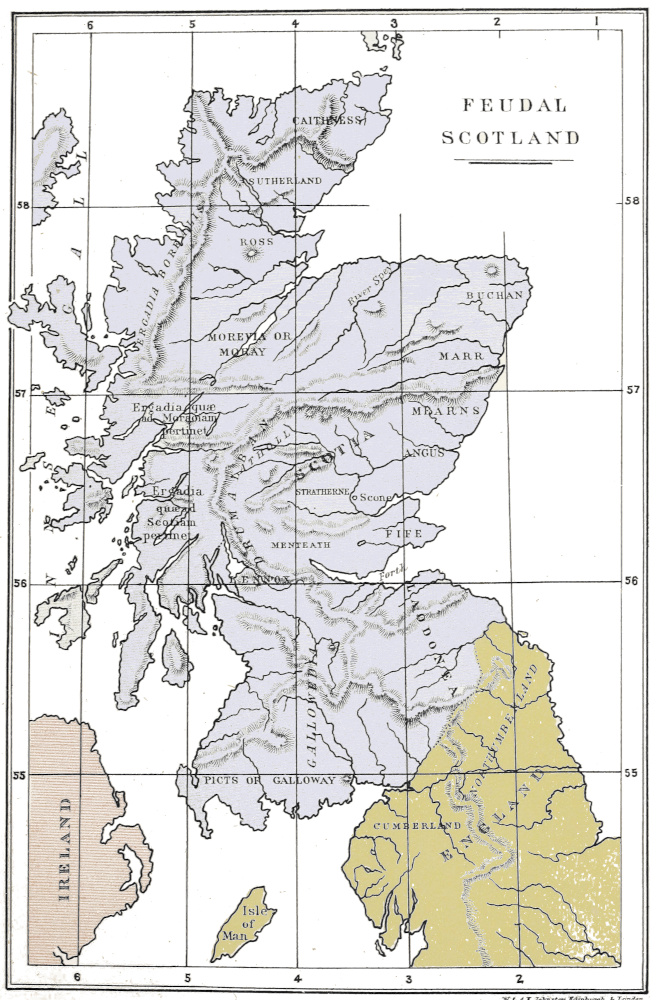
FEUDAL
SCOTLAND
W. & A. K. Johnston Edinburgh & London.
Conclusion.
497The young Maid of Norway died in Orkney, when on
her passage from Norway to take possession of her kingdom,
in the end of September 1290, and thus terminated the last
native dynasty of Scottish monarchs of Celtic descent in
the male line, and Scotland, with her united provinces, her
feudal institutions, and her mixed population, now became a
prize to be contested for between the English monarch, who
asserted his right as her lord paramount, and the various
Norman barons who claimed her as their inheritance through
descent in the female line from her native monarchs. It is
with the Celtic portion of her population alone that this
work is now mainly concerned.