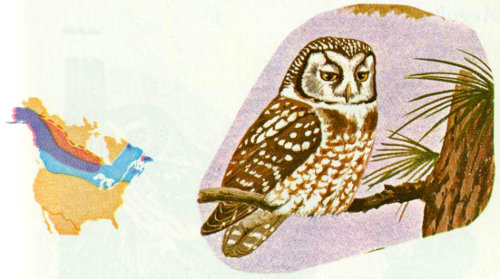
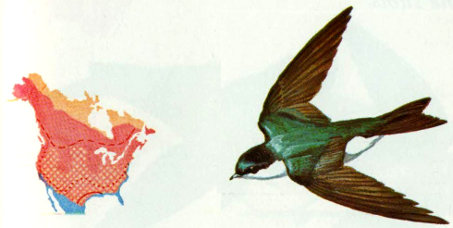
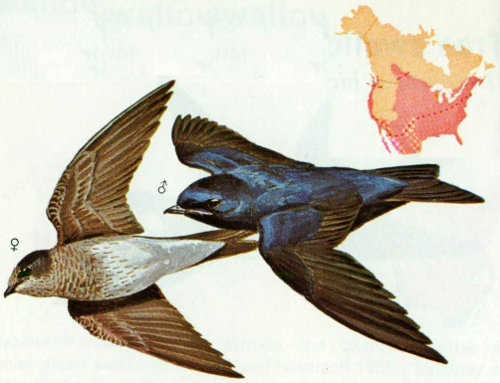
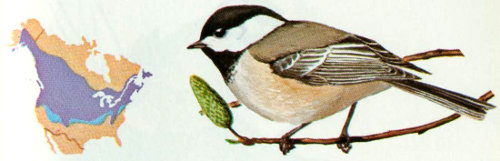
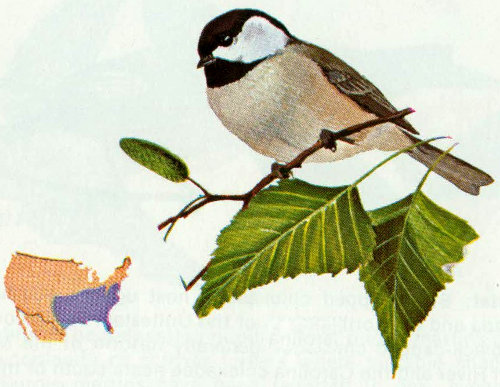
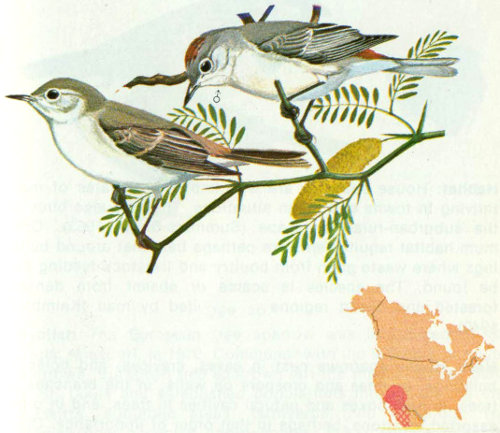
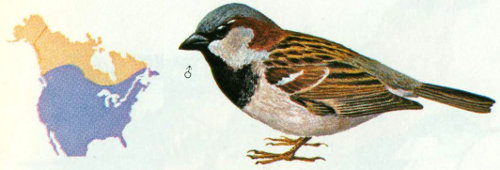
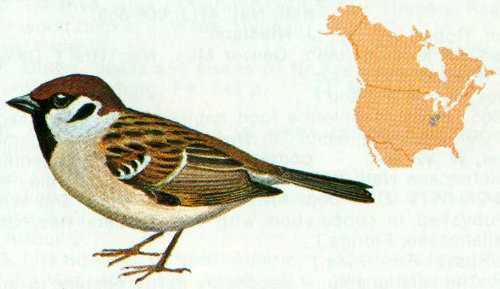
Many species of cavity-nesting birds have declined because
of habitat reduction. In the eastern United States, where
primeval forests are gone, purple martins depend almost entirely
on man-made nesting structures (Allen and Nice 1952).
The hole-nesting population of peregrine falcons disappeared
with the felling of the giant trees upon which they depended
(Hickey and Anderson 1969). The ivory-billed and red-cockaded
woodpeckers are currently on the endangered list, primarily as
a result of habitat destruction (Givens 1971, Bent 1939). The
wood duck was very scarce in many portions of its range, at
least in part, for the same reason and probably owes its
present status to provision of nest boxes and protection from
overhunting.
Some 85 species of North American birds (table 1) excavate
nesting holes, use cavities resulting from decay (natural cavities),
or use holes created by other species in dead or deteriorating
trees. Such trees, commonly called snags, have often
been considered undesirable by forest and recreation managers
because they are not esthetically pleasing, conflict with other
forest management practices, may harbor forest insect pests,
or may be fire or safety hazards. In the past such dead trees
were often eliminated from the forest during a timber harvest.
As a result, in some areas few nesting sites were left for cavity-nesting
birds. Current well-intentioned environmental pressures
to emphasize harvesting large dead or dying trees, if
realized, would have further adverse effects on such ecologically
and esthetically important species as woodpeckers, swallows,
wrens, nuthatches, and owls—to name a few.
The majority of cavity-nesting birds are insectivorous. Because
they make up a large proportion of the forest-dwelling
bird population, they play an important role in the control of
forest insect pests (Thomas et al. 1975). Woodpeckers are
especially important predators of many species of tree-killing
bark beetles (Massey and Wygant 1973). Bruns (1960) summarized
the role of birds in the
2
forests:
Within the community of all animals and plants of the forest,
birds form an important factor. The birds generally are not able
to break down an insect plague, but their function lies in preventing
insect plagues. It is our duty to preserve birds for esthetic as
well as economic reasons ... where nesting chances are diminished
by forestry work.... It is our duty to further these biological
forces [birds, bats, etc.] and to conserve or create a rich
and diverse community. By such a prophylactic ... the forests
will be better protected than by any other means.
Several of the birds that nest in cavities tend to be resident
(non-migrating) species (von Haartman 1968) and thus more
amenable to local habitat management practices than migratory
species. Nest holes may be limiting for breeding populations
of at least some species (von Haartman 1956, Laskey
1940, Troetschler 1976, Kessell 1957). Bird houses have been
readily accepted by many natural cavity nesters, and increases
in breeding density have resulted from providing such structures
(Hamerstrom et al. 1973, Strange et al. 1971, Grenquist 1965),
an indication that management of natural snags should be
rewarding.
Because nesting requirements vary by bird species, forest
type, and geographic location, more research is needed to
determine snag species, quality, and density of existing and
potential cavity trees that are needed to sustain adequate populations
of cavity-nesters. In a Montana study, for example,
larch and paper birch snags were most frequently used by
cavity-nesters (McClelland and Frissell 1975). The most frequently
used trees were large, broken-topped larches (either
dead or alive), greater than 25 inches diameter at breast height
(dbh), and more than 50 feet tall. No particular snag density
was recommended to managers. In the Pacific Northwest,
Thomas et al. (1976) suggested about seven snags per acre to
maintain 100 percent of the potential maximum breeding populations
of cavity-nesters in ponderosa pine forests and six per
acre in lodgepole pine and subalpine fir. In Arizona ponderosa
pine forests, an average of 2.6 snags per acre (mostly ponderosa)
were used by cavity-nesting birds (Scott, in press[1]).
The most frequently used snags were trees dead 6 or more
years, more than 18 inches dbh, and with more than 40 percent
bark cover. The height of the snag was not as important as the
diameter, but snags more than 46 feet tall had more holes than
did shorter ones. Balda (1975) recommended 2.7 snags per acre
to maintain natural bird species diversity and maximum densities
in the ponderosa pine forests of Arizona.
3
Important silvical characteristics in the development of nesting
cavities include (1) tree size, longevity, and distribution;
(2) regeneration by sprouts, and (3) decay in standing trees
(Hansen 1966). Although trees less than 14 to 16 inches dbh at
maturity are too small to yield cavities appropriate for wood
ducks, they may be important for smaller species. Aspen,
balsam fir, bitternut hickory, ironwood, and other trees fall
within this range. Short-lived species such as aspen and balsam
fir usually form cavities earlier than longer lived trees.
Since a major avenue of fungal infection is sprouts, sprouting
vigor and the age at which sprouts are produced are important
considerations in managing for cavity-producing hardwood
trees. Cavity formation in oaks of basal origin is a slow
process, but black oak is a good cavity producer as trees
approach maturity because although the heartwood decays
rapidly the sapwood is resistant (Bellrose et al. 1964). Basswood
is a good cavity producer because of its sprouting characteristics.
Baumgartner (1939), Gysel (1961), Kilham (1971),
Erskine and McLaren (1972), and others presented information
on tree cavity formation for wildlife species. More information
on the role of decay from branch scars, cutting, and animal
damage is needed for different species of trees so that positive
management for snags may be encouraged.
Removal of snags is also known to reduce populations of
some birds. For example, removal of some live timber and
snags in an Arizona ponderosa pine forest reduced cavity-nesting
bird populations by 50 percent (Scott[2]). Violet-green
swallows, pygmy nuthatches, and northern three-toed woodpeckers
accounted for much of the decline. A previously high
population of swallows dropped 90 percent, and a low woodpecker
population was eliminated. On an adjacent plot, where
live trees were harvested but snags were left standing, cavity-nesters
increased as they did on a plot where live trees and
snags were undisturbed.
Foresters and recreation managers are now more aware of
the esthetic and economic values of nongame wildlife, including
cavity-nesting birds. In summer of 1977 the U.S. Forest
Service established a national snag policy requiring all Regions
and Forests to develop guidelines to “provide habitat needed to
maintain viable, self-sustaining populations of cavity-nesting
and snag-dependent wildlife species.” These guidelines are
also to include “retention of selected trees, snags, and other
flora, to meet future habitat requirements” (USDA Forest Service 1977).
4
Some Forest Service Regions had already established
policies for snag management. For example, in 1976 the
Arizona-New Mexico Region (USDA Forest Service 1976) recommended
that three good quality snags be retained per acre
within 500 feet of forest openings and water, with two per acre
over the remaining forest. The policy also requires that provisions
be made for continued recruitment of future snags;
spike-topped trees with cavities and obvious cull trees should
be left for future cavity nesters. Some foresters are now using
tags to protect the more suitable snags from fuelwood cutters
in high-use areas.
In this book, we have summarized both published data and
personal observations on the cavity-nesting birds of North
America in an attempt to provide land managers with an up-to-date,
convenient source of information on the specific requirements
of these birds. Bird nomenclature follows the American
Ornithologists’ Union Checklist of North American Birds (fifth
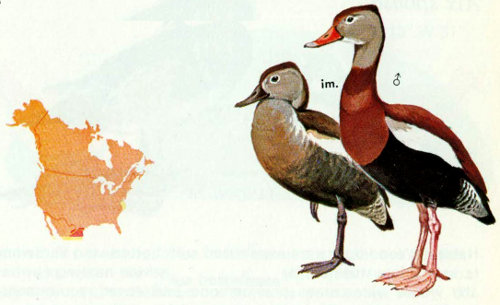
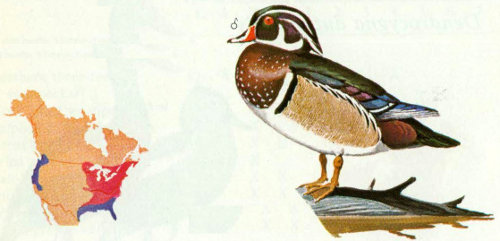
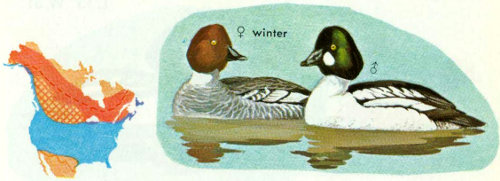
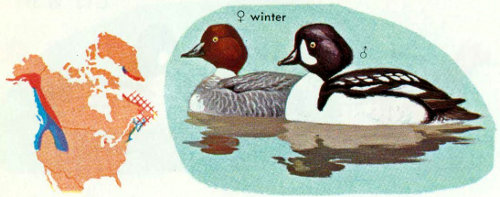
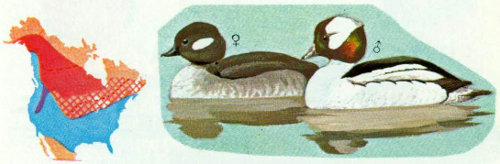
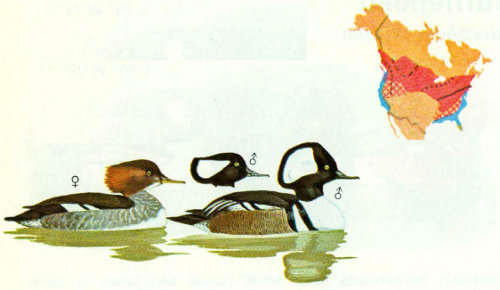
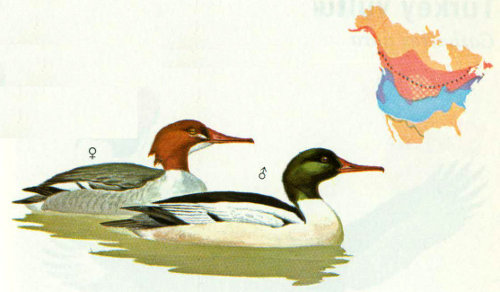
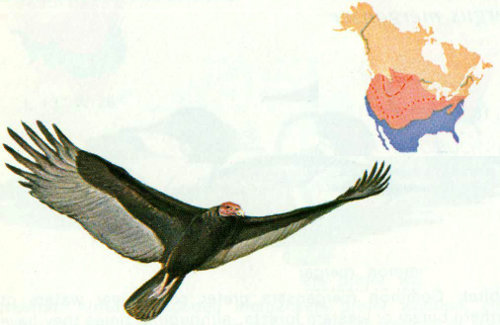
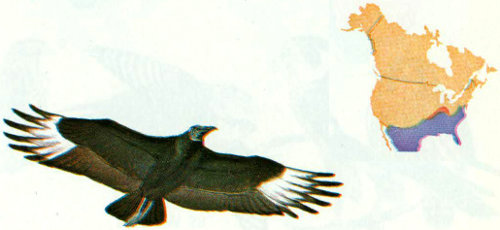
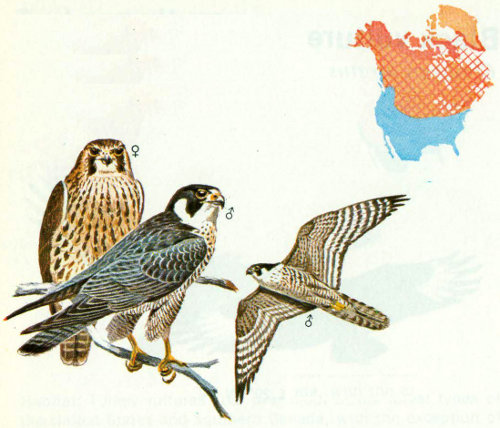
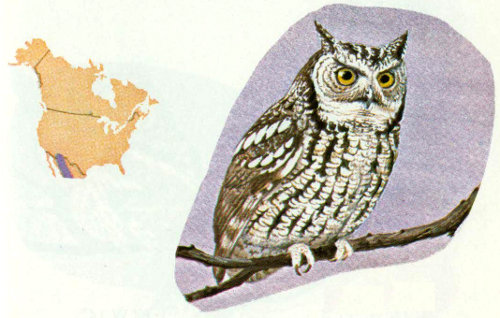
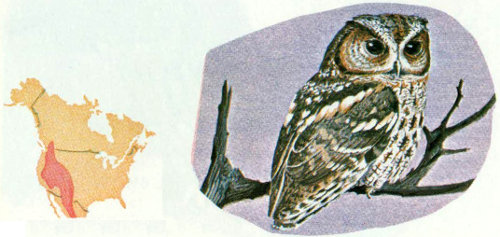
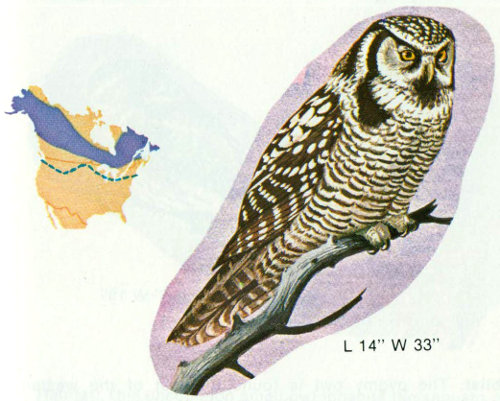
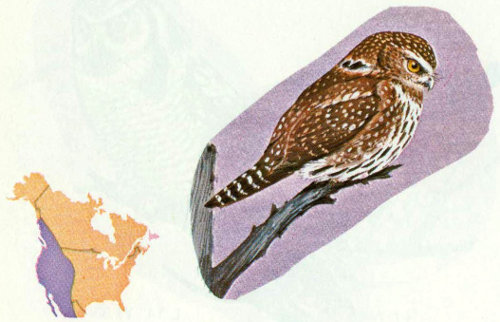
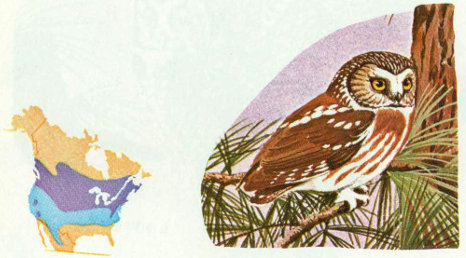
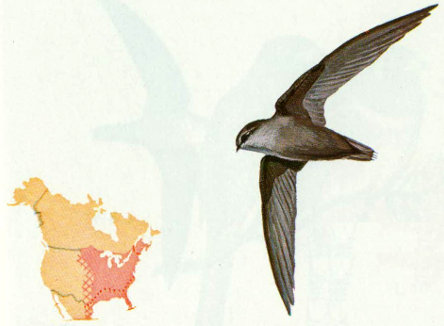
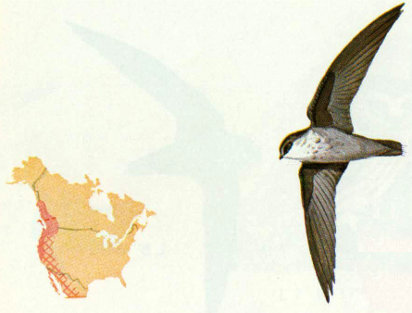
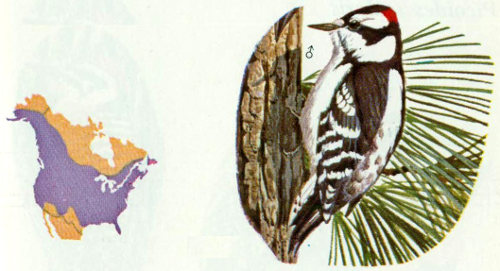
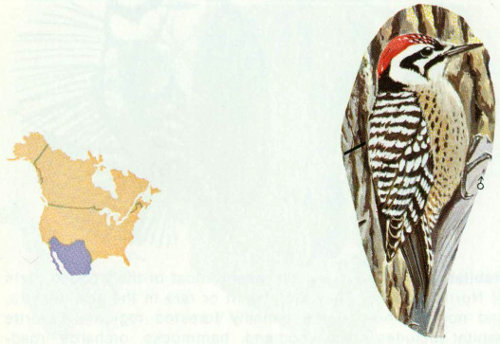
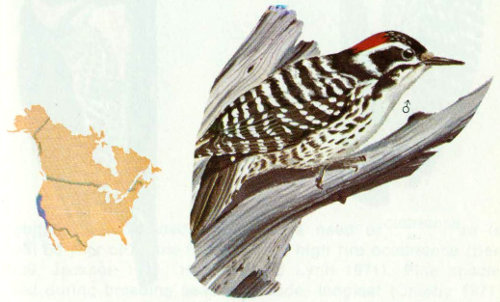
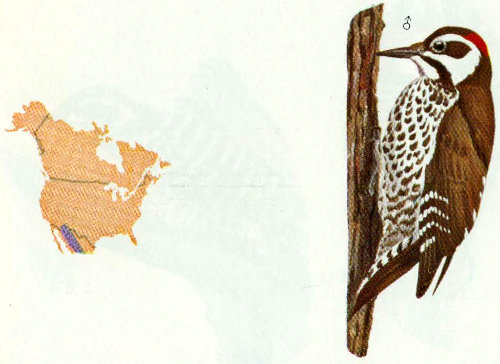
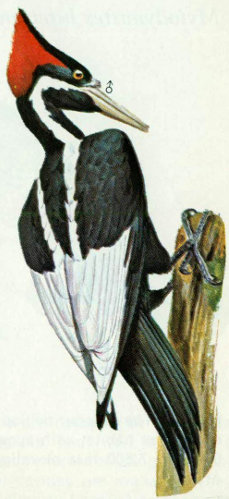
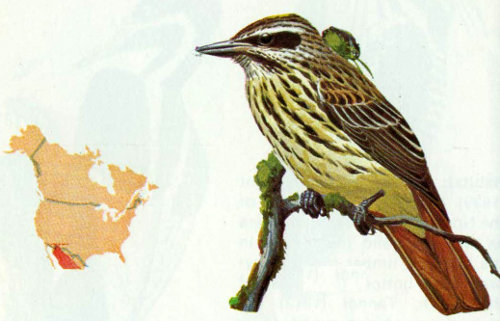
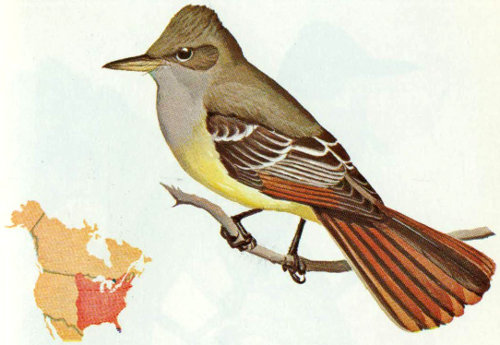
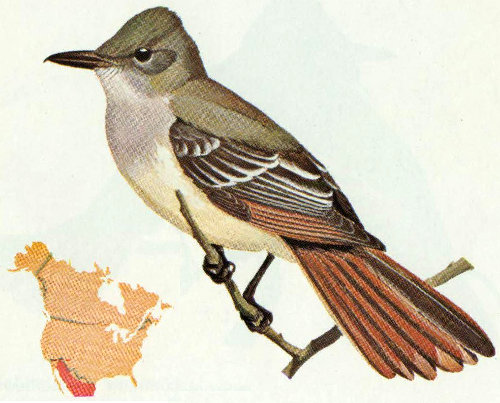
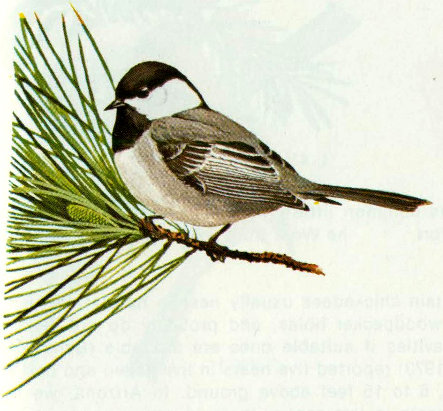
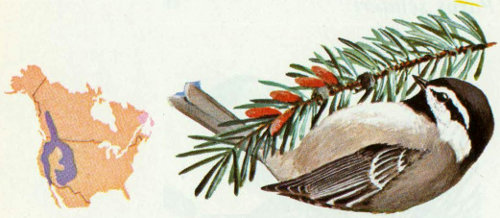
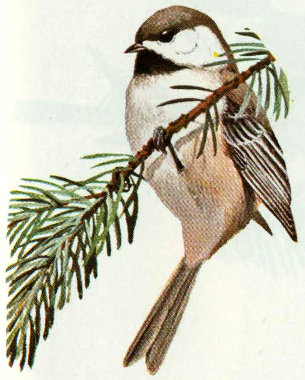
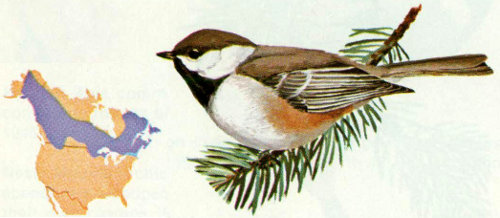
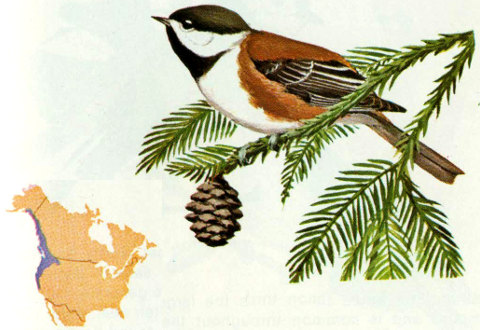
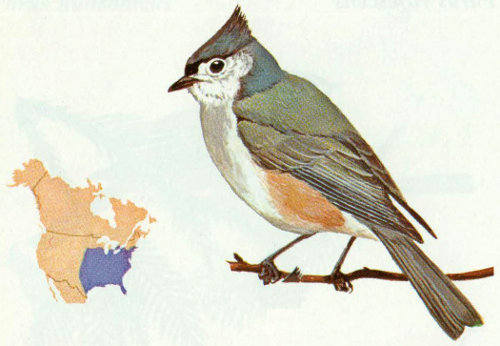
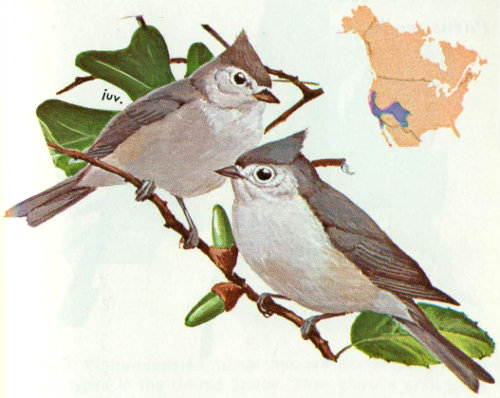
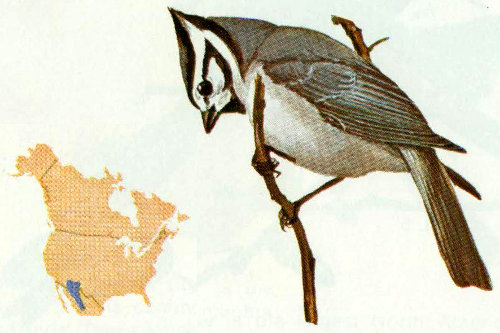
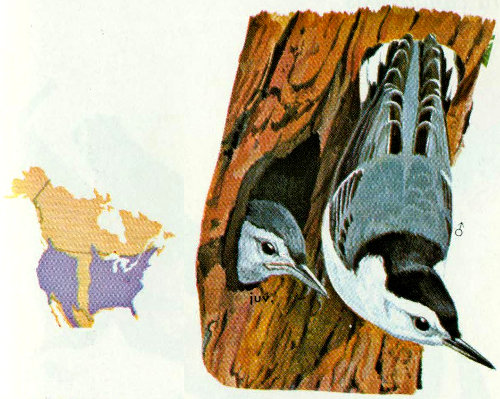
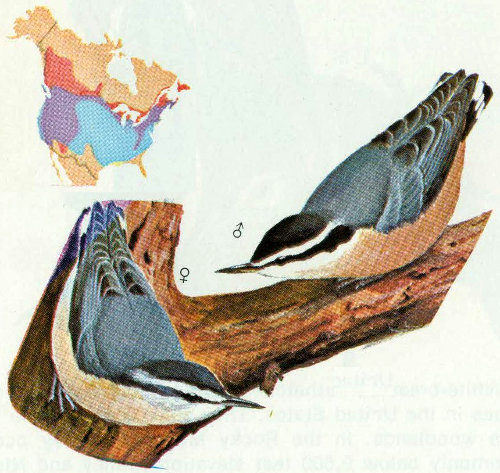
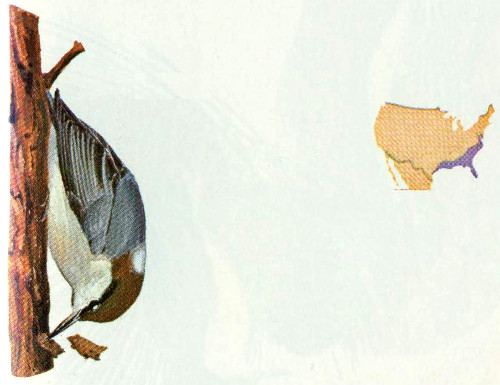
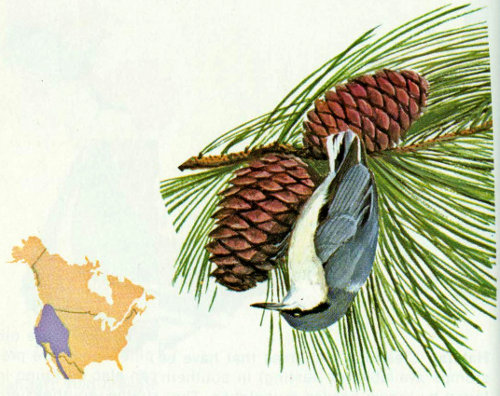
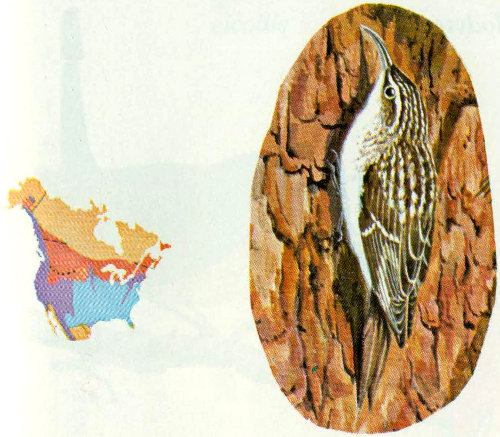
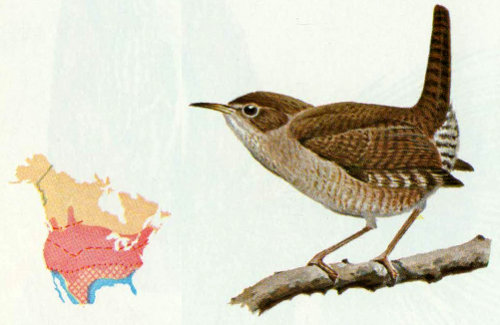
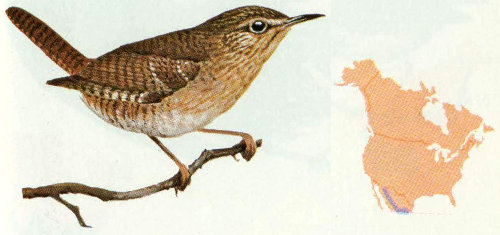
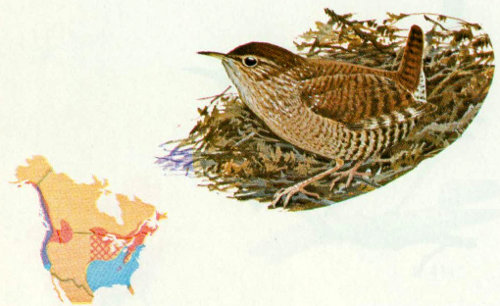
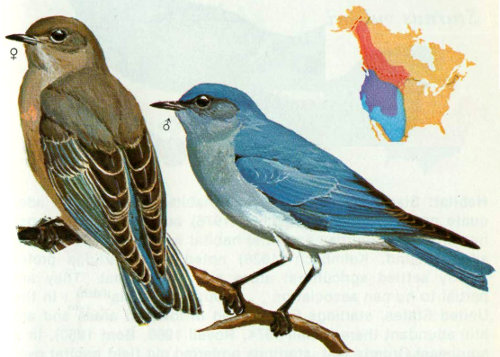
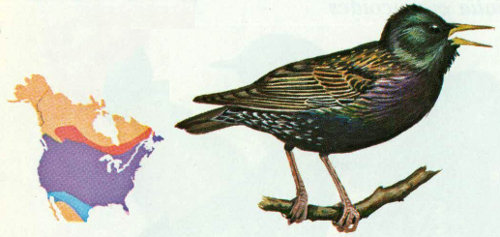
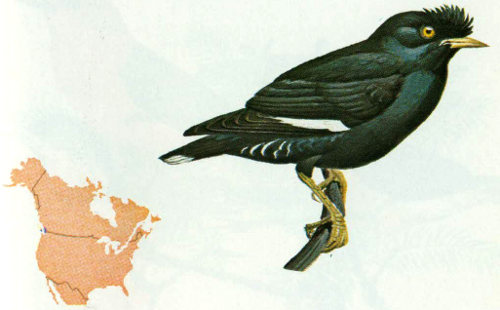
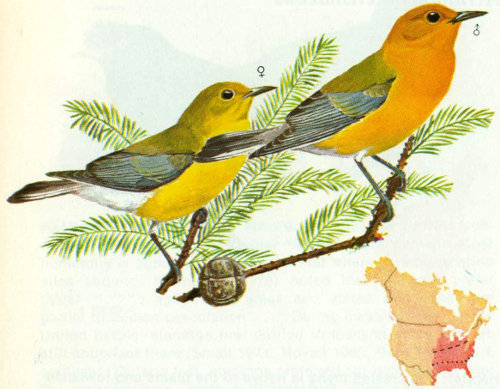
edition, with supplements). Bird illustrations and distribution
maps are reprinted with permission of Western Publishing Co.
from A Guide to Field Identification of Birds of North America
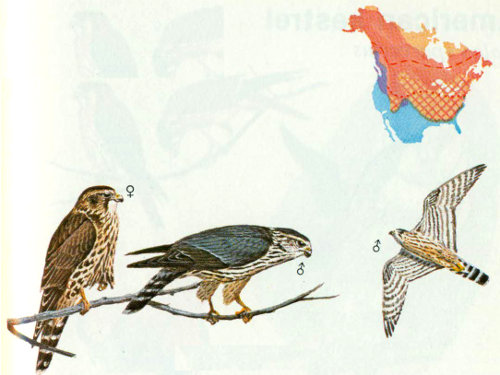
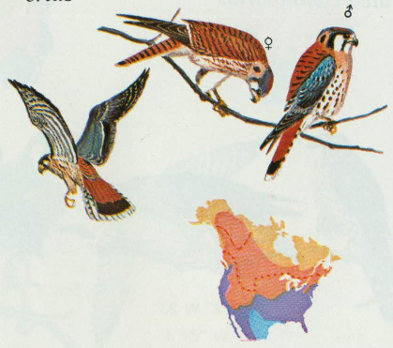
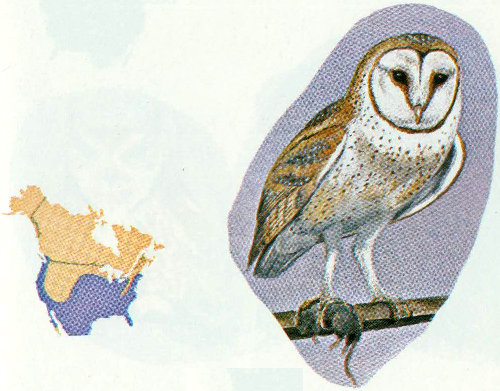
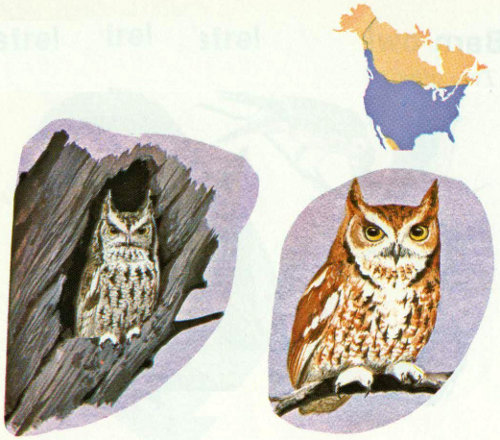
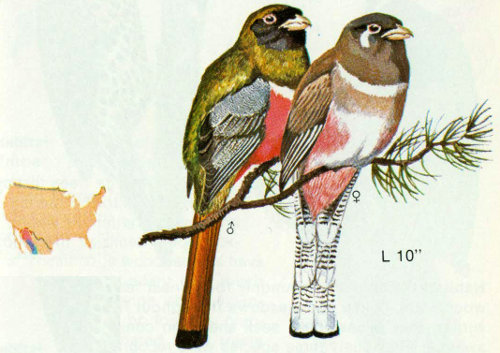
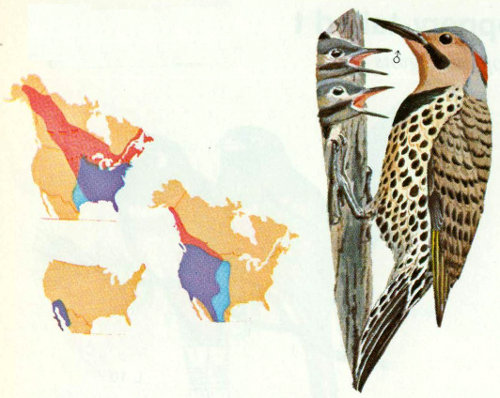
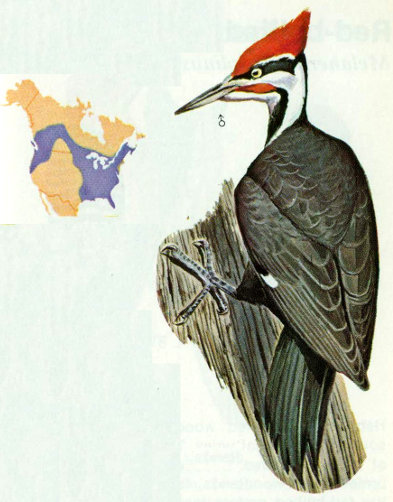
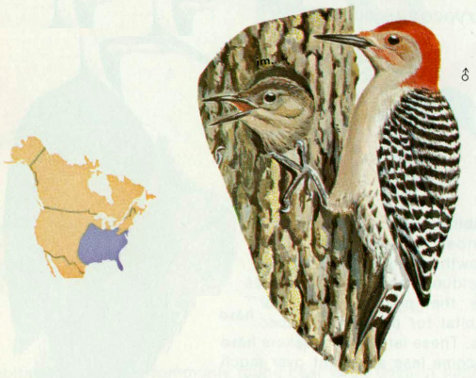
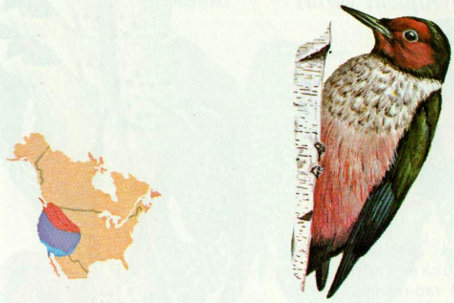
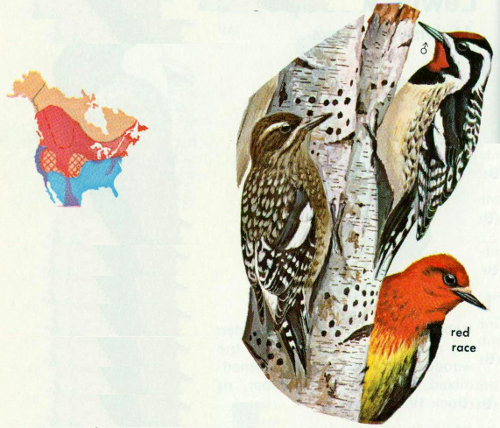
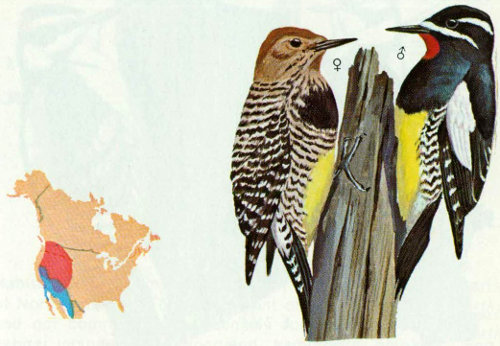
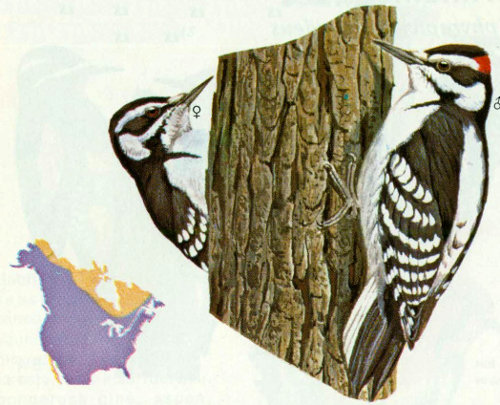
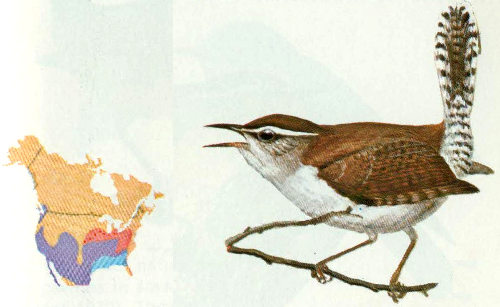
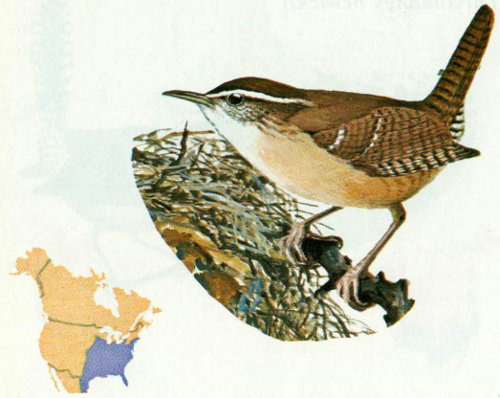
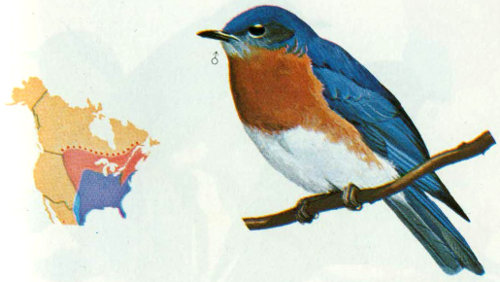
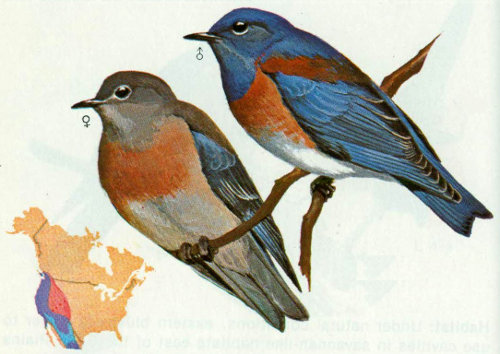
by Robbins et al. (1966). The small range maps indicate where
birds are likely to be found during different seasons. Summer
or breeding range is identified in red, winter range in blue;
purple indicates areas where the species may be found all year.
Red cross-hatching identifies areas where migrating birds are
likely to be seen only In spring and fall. Length measurements
(L) are for birds in their natural position, while W indicates
wingspan.
Percentages of the diet under “Food” in species accounts
refer to volume, unless otherwise indicated. Since nestlings of
most species require insect protein, “Major Foods” refers
largely to adult diets. Appendices list common names of plants
and animals mentioned in the text, with scientific names when
they could be determined.
5
7
Dendrocygna autumnalis
L 13″ W 37″
Habitat: Black-bellied whistling ducks (tree ducks) are found
regularly in southern Texas and erratically elsewhere. Open
woodlands, groves or thicket borders where ebony, mesquite,
retama, huisache, and several species of cacti are dominant in
freshwater habitat are preferred (Oberholser 1974, Meanley and
Meanley 1958). Range extensions have been facilitated by
flooding and impoundments.
Nest: Natural cavities in trees such as live oaks, ebony, willow,
mesquite, and hackberry are preferred, but ground nests and
nest boxes are sometimes used. The nest can be over land or
water, but herbaceous vegetation under “land-bound” nests
may be preferred to brush (Bolen et al. 1964). A perch near the
cavity entrance may also be a factor in nest tree selection.
Open and closed cavities are used. Nest cavities average 8.7
feet above ground or water and 23 inches deep, with 7.0 × 12.5
inch openings (Bellrose 1976). Nesting boxes should be 11 × 11
× 22 inches high at the front and tapered to 20 inches in the
rear, with entrances 5 inches in diameter (Bolen 1967). Nest
boxes should not be erected unless they are predator proof.
Food: Black-bellied whistling ducks are predominantly grazers
(Rylander and Bolen 1974), but they can dabble and dive for
aquatic food. Of 92 percent plant materials, sorghum and
Bermudagrass predominated, with smartweeds, millets, water
stargrass, and corn also occurring in one study (Bolen and
Forsyth 1967). In some areas corn and oats are more important
in the diet.
8
Aix sponsa
L 13½″ W 28″
Habitat: Wood ducks are associated with bottomland hardwood
forests where trees are large enough to provide nesting cavities
and where water areas provide food and cover requirements
(McGilvrey 1968). Requirements may be met in several important
forest types, all of which must be flooded during the early
nesting season: (1) southern flood plain, (2) red maple, (3) central
flood plain, (4) temporarily flooded oak-hickory, and (5)
northern bottomland hardwoods.
Nest: Optimum natural cavities are 20 to 50 feet above the
ground with entrance holes of 4 inches in diameter, cavity
depths of 2 feet, and cavity bottoms measuring 10 × 10 inches
(McGilvrey 1968). Management for cavities more than a half
mile from water is not recommended, and dead trees, other
than cypress, do not usually contain usable cavities. Good
densities of suitable wood-duck cavities have been recorded for
many timber types (Bellrose 1976). Nest boxes are readily used
by wood ducks, and their use may increase breeding populations,
even if natural cavities are abundant, if predators are
excluded. Measurements and placement of wood duck boxes
have been well described (U.S. Fish and Wildlife Service 1976,
Bellrose 1976, McGilvrey 1968).
Food: Wood ducks consume large quantities of acorns, usually
in flooded bottoms. Other mast and fleshy fruits also are
eaten, as are waste corn and wheat (Bellrose 1976). Smartweed,
buttonbush, bulrush, pondweed, cypress, ash, sweet
gum, burweed, and arrow arum seeds are used by breeding
birds. Skunk cabbage, coontail, and duckweed are also food
items. Duckweed is also habitat for invertebrates in the diet
(Grice and Rogers 1965).
9
Bucephala clangula
L 13″ W 31″
Habitat: The breeding range of the common goldeneye generally
coincides with the boreal coniferous forest in North America
(Johnsgard 1975, Bellrose 1976). In a Minnesota study, 87
percent of breeding goldeneyes were found on large, sand-bottomed
fish lakes (Johnson 1967), while in New Brunswick,
this species preferred water areas with marshy shores and adjacent
stands of old hardwoods (Carter 1958). In Maine, nests are
found in mature hardwoods adjacent to lakes with rocky
shores, hard bottoms, and clear water. Shoal waters less than
10 feet deep with an irregular shoreline provide brood shelter
and protective vegetation necessary for duckling food (Gibbs
1961).
Nest: Common goldeneyes used and were more successful in
open top or “bucket” cavities than in enclosed cavities in New
Brunswick (Prince 1968). Most nests were in silver maples on
wetter sites or American elms on drier sites and aspen in
northern conifer forests. Nest trees averaged 23 inches in
diameter with cavity dimensions of 8 inches in diameter and
18 inches deep; most entrances were 6 to 40 feet above ground
(Prince 1968). Wooden nest boxes measuring 12 × 12 × 24
inches with elliptical entrances 3½ × 4½ inches were used
extensively in Minnesota (Johnson 1967).
Food: Of 395 stomachs examined by Cottam (1939), crustaceans
(32 percent), insects (28 percent), and molluscs (10 percent)
were primary animal foods (total, 73.9 percent). Crabs,
crayfish, amphipods, caddisfly larvae, water boatmen, naiads
of dragonflies, damselflies, and mayflies were also found.
Pondweed, wild celery, and seeds of pondweed and bulrushes
were important plant materials.
10
Bucephala islandica
L 13″ W 31″
Habitat: Barrow’s goldeneyes attain their highest breeding
population levels in western North America on moderately
alkaline lakes of small to medium size in parkland areas. Open
water is a necessity throughout the range, but frequently
goldeneyes favor a dense growth of submerged aquatics such
as sago pondweed and widgeon grass. The abundance of
aquatic invertebrates may be more important than nesting cavities
in determining distribution (Johnsgard 1975).
Nest: This species is not an obligate tree nester, and has been
reported to use holes in banks or lava beds, rock crevices,
ground under shrubs and on islands, haylofts, crows’ nests,
and the outer walls of peat shelters for sheep in Iceland (Harris
et al. 1954). However, the usual site is in dead stubs or trees
such as aspen, Douglas-fir, and ponderosa pine within 100 feet
of water (Palmer 1976). Deserted pileated woodpecker or common
flicker cavities enlarged by natural decay are readily used
(Palmer 1976). Cavity entrances from 3.0 to 3.9 inches in
diameter, cavity depths between 9.8 and 52.9 inches, and
cavity diameters between 6.5 and 9.0 inches have been reported
(Johnsgard 1975). Nest boxes have been used around high
lakes in the Cascade Mountains (Bellrose 1976).
Food: Food of 71 adult Barrow’s goldeneyes consisted of 36
percent insects, 19 percent molluscs, 18 percent crustaceans, 4
percent other animals, and 22 percent plants (Cottom 1939).
Naiads of dragonflies and damselflies, caddisfly and midge
larvae, blue mussels, amphipods, isopods, and crayfish were
important animal foods, and pondweeds and wild celery were
primary plant foods.
11
Bucephala albeola
L 10″ W 24″
Habitat: Buffleheads favor small ponds and lakes in open
woodlands (Godfrey 1966). In British Columbia, most nesting
is in the interior Douglas-fir zone while poplar communities are
usually used in Alberta, and ponderosa pine types are preferred
in California. Scattered breeding records in Oregon, Wyoming,
and Idaho are primarily in subalpine lodgepole pine, and in
Alaska (Erskine 1971) Engelmann spruce and cottonwood
stands are used for nesting.
Nest: Of 204 nests observed from California to Alaska, 107
were in aspen trees, 44 in Douglas-fir, 14 in balsam poplar and
black cottonwood, 12 in ponderosa pine, 11 in poplar, and 16 in
a few other coniferous and deciduous trees (Palmer 1976).
Buffleheads prefer unaltered flicker holes in aspen. Dead trees
close to (within 220 yards) or in water are preferred, and “bucket”
or open top cavities are rarely used (Erskine 1971). Forestry
practices that leave stubs near water while clearing away most
ground litter and slash that might hinder ducklings from reaching
water are to be encouraged. Nest boxes used by captive
buffleheads had entrances 2⅞ inches wide with cavities 7
inches in diameter and 16 inches deep (Johnsgard 1975).
Food: Buffleheads consume mostly animal material. Insects
make up 70 percent of summer foods in freshwater habitat.
Midge, mayfly, and caddisfly larvae, and naiads of dragonflies
and damselflies are also consumed. Water boatmen are the
most widely distributed, important food. Plant food was found
in many stomachs but much was fiber and was probably taken
while catching aquatic insects. Pondweed and bulrush seeds
were frequently consumed plant items. Dragonfly and damselfly
larvae are important in the diet of ducklings in all areas
(Erskine 1971).
12
Lophodytes cucullatus
L 13″ W 26″
Habitat: Although hooded mergansers prefer wooded, clear
water streams, they also use the wooded shorelines of lakes.
Drainage of swamps and river bottoms, removal of snags, and
other human activities have been detrimental to this species as
they have been to wood ducks. Hooded mergansers are more
easily disturbed by man and far more sensitive to a decline in
water quality than are wood ducks. Breeding densities often
seem more related to food abundance and availability than to
nesting cavities (Johnsgard 1975).
Nest: Cavities at any height may be selected in any species of
tree; the size and shape of the cavity are apparently not important
(Bent 1923). Natural cavities chosen are similar to those
used by wood ducks but with smaller optimum dimensions.
Frequent use of nest boxes has been reported in Missouri,
Mississippi, and Oregon (Bellrose 1976). In Oregon, boxes
were placed 30 to 50 feet apart in sets of 8 (Morse et al. 1969).
Some of the most southerly nesting records of this species are
from wood duck nest boxes (Bellrose 1976).
Food: The food habits of hooded mergansers are not well
known, but are apparently more diversified than those of common
mergansers. Of 138 stomachs taken from various locations
in the United States, rough fishes made up 24.5 percent,
game fish and unidentified fish fragments 19.4 percent, crayfish
22.3 percent, other crustaceans 10.3 percent, and aquatic
and other insects 13.4 percent (Palmer 1976). Acorns are sometimes
eaten in large quantities. Frogs, tadpoles, and molluscs
such as snails are also consumed.
13
Mergus merganser
L 18″ W 37″
Habitat: Common mergansers prefer cool, clear waters of
northern boreal or western forests, although at times they have
nested as far south as North Carolina and Mexico. Ponds associated
with the upper portions of rivers in northern forested
regions are often used (Johnsgard 1975). As with hooded
mergansers, clear water is needed for foraging.
Nest: Although hollow trees are the usual location, ground
nests under thick cover or in rock crevices are not uncommon.
A wide variety of other locations have been reported such as
chimneys, hawk nests, bridge supports, and old buildings. The
species of tree used for nesting and the height of the cavity are
apparently unimportant (Foreman 1976). Nest sites are usually
close to water (Bellrose 1976) and are used repeatedly, probably
by the same female (Palmer 1976). Artificial nest boxes
have been accepted, especially in Europe. Preferred dimensions
are 9.1 to 11 inches wide, and 33.5 to 39.4 inches high,
with 4.7 × 4.7-inch entrances, 19.7 to 23.6 inches above the
base of the nest box (Johnsgard 1975).
Food: Programs to reduce populations of this fish-eating
merganser have increased trout and salmon production in several
areas, at least temporarily. Generally, common mergansers
are opportunistic feeders with salmon taken extensively in
some areas and suckers, chubs, and eels in others. In warm-water
areas, food is usually rough and forage fish such as carp,
suckers, gizzard shad, perch, and catfish. In some areas, water
plants, salamanders, insects, or molluscs may be important in
the diet of this species (Palmer 1976).
14
Cathartes aura
L 25″ W 72″
Habitat: Turkey vultures soar over most of the forest types of
the United States and southern Canada, with the exception of
the pine and spruce-fir stands in the extreme northeastern
United States. In search of food this common carrion eater
makes use of the forest openings created by roads, powerline
rights-of-way, clearcuts, and abandoned fields.
Nest: Preferred nest sites are often at a premium because of
the bird’s large size and the shortage of large snags. The smell
of carrion around the nest necessitates a well-protected site to
lessen predator losses. The nest site is almost always at or
near ground level (Bent 1937). Although nesting sites are commonly
located in hollow trees or hollow logs lying on the
ground, these vultures will nest on cliffs, in caves, and in
dense shrubbery (Gingrich 1914, Townsend 1914). These birds
will return to the same nesting site year after year unless the
site has been severely disturbed (Jackson 1903, Kempton 1927).
Food: Turkey vultures are scavengers and carrion-eaters, often
hunting along roads where animals have been struck by automobiles.
They feed on snakes, toads, rats, mice, and other
available animal matter. Often a dozen or more vultures will
gather at and feed on a large carcass.
15
Coragyps atratus
L 22″ W 54″
Habitat: The black vulture is found in the southern Great
Plains, southeastern pine forests, oak-hickory forests, and
intermediate oak-pine forests. It is a more southern species
than the turkey vulture.
Nest: Like turkey vultures, black vultures nest under a wide
variety of conditions. They use the nest site as found without
adding nesting materials (Hoxie 1886, Bent 1937). Hollow
stumps or standing trees are favorite nesting sites when they
are available; otherwise, eggs are laid on the ground, often in
dense thickets of palmetto, yucca, or tall sawgrass (Bent
1937). Nests have been reported in abandoned buildings.
Food: This carrion-eater is often found in towns and cities,
feeding on animal wastes, scraps, or garbage. Forests are used
primarily for roosting and nesting sites, whereas feeding is
usually in more open areas and along highways, where animal
carcasses are more plentiful.
16
Falco peregrinus
L 15″ W 40″
Habitat: The peregrine falcon is found in tundra regions,
northern boreal forests, lodgepole pine and subalpine fir,
spruce-fir, southern hardwood-conifer, cold desert shrubs, and
prairies—mainly in open country and along streams. It is also
found around salt and freshwater marshes (Fyfe 1969, Hickey
and Anderson 1969, Nelson 1969). This species is currently
classified as “Endangered” in the United States.
Nest: Although the peregrine falcon is currently considered a
cliff-nester, records indicate that it once nested in tree cavities
(Goss 1878, Ridgway 1889, Ganier 1932, Bellrose 1938, Spofford
1942, 1943, 1945, 1947, Peterson 1948). The peregrine still
uses cavities in broken-off trunks in Europe (Hickey 1942), but
the hole-nesting population of America apparently disappeared
with the felling of the great trees on which they depended
(Hickey and Anderson 1969).
Food: The peregrine falcon feeds primarily on birds ranging in
size from mallards to warblers, which are usually stunned or
killed in flight. Mammals and large insects form only an
insignificant portion of the diet (Bent 1938). White and
Roseneau (1970) found remains of fish in the stomachs of peregrines
in Alaska, and suggested that fish may be more common
in some peregrine diets than the literature indicates.
17
Falco columbarius
L 12″ W 23″
Habitat: The merlin is usually found in open stands of boreal
forest, Douglas-fir—sitka spruce, poplar-aspen-birch-willow,
ponderosa pine—Douglas-fir, oak woodlands, and saltwater
marshes (Craighead and Craighead 1940, Lawrence 1949,
Brown and Weston 1961).
Nest: Like the peregrine falcon, most cavity nests for the
merlin were reported before 1910, when it was nesting in
cavities of poplars, cottonwoods, and American linden trees
(Bendire 1892, Houseman 1894, Dippie 1895). The merlin
usually uses tree nests built by other large birds (such as
hawks, crows, and magpies) but sometimes nests on the
ground under bushes or on cliffs and cutbanks.
Food: Brown and Amadon (1968) found that birds made up 80
percent (by weight) of the food for merlins, insects 15 percent,
and mammals 5 percent. Ferguson (1922) examined 298
stomachs and found 4 mammals, 318 birds, and 967 insects.
Birds found in the stomachs included small shorebirds, small
game birds, and songbirds (which are normally captured in
flight). Insect prey consisted of crickets, grasshoppers,
dragonflies, beetles, and caterpillars (Bent 1938), while mammals
included pocket gophers, squirrels, mice, and bats
(Fisher 1893).
18
Falco sparverius
L 8½″ W 21″
Habitat: The American kestrel is the smallest and most common
falcon in North America, occurring in open and semi-open
country throughout the continent. In the Rocky Mountain region,
kestrels are most abundant on the plains, but do nest up
to 8,000 feet elevation in the Douglas-fir, ponderosa pine, and
pinyon-juniper forest types (Scott and Patton 1975, Bailey and
Niedrach 1965). They have been observed on the highest peaks
after the nesting season (Bailey and Niedrach 1965).
Nest: Nest sites vary greatly, but kestrels prefer natural cavities
or old woodpecker holes. The following nest sites are reported
in order of usage: common flicker holes, natural cavities,
cavities in arroyo banks or cliffs, buildings, magpie nests, and
man-made nesting boxes (Bailey and Niedrach 1965, Bent
1938, Roest 1957, Forbush and May 1939). Nest boxes, approximately
10 × 10 × 15 inches, should be located 10 to 35 feet
above ground with a 3-inch entrance hole. Natural cavities or
nest boxes should be available along edges of forest openings
(Bailey and Niedrach 1965, Hamerstrom et al. 1973, Pearson
1936).
Food: Kestrels hunt from high exposed perches overlooking
forest openings, fields, or pastures. Food consists primarily of
insects (often grasshoppers), small mammals, and an occasional
bird (Bent 1938).
19
Tyto alba
L 14″ W 44″
Habitat: The barn owl inhabits most of the forest types in the
United States except the higher elevation types in the Rocky
Mountains. They are usually considered uncommon residents
because their silent nocturnal habits render them undetectable
by most casual observers. Barn owls are also birds of the open
country, and adapt readily to areas occupied by man (Marti
1974).
Nest: Before the coming of man, barn owls nested in natural
cavities in trees, cliffs, or arroyo walls, but now they also nest
in barns, church steeples, bird boxes, mine shafts, and dovecotes
(Bailey and Niedrach 1965, Reed 1897).
Food: Barn owls frequent areas where small mammals are
plentiful; mice, voles, rats, gophers, and ground squirrels are
major food items. Birds other than those such as house sparrows
and blackbirds, which have communal roosts, are only
rarely taken (Marti 1974).
20
Otus asio
L 8″ W 22″
Habitat: This small owl is found in most forest types below
8,000 feet elevation throughout the United States. Screech owls
prefer widely spaced trees, interspersed with grassy open
spaces, for hunting. Meadow edges and fruit orchards are
favored throughout the eastern United States.
Nest: Like other owls, the male screech owl defends a nesting
and feeding territory. Maples, apples, and sycamores with
natural cavities or pines with woodpecker holes are preferred in
the East (Bent 1938). Along the drainage systems of the plains
areas, natural cavities or common flicker holes in cottonwood
trees are preferred (Bailey and Niedrach 1965). Nest boxes in
orchards or residential areas are often used. Hamerstrom
(1972) recommended a nesting box 8 × 8 × 8 inches with a 3-inch
entrance hole.
Food: Screech owls are among the most nocturnal owls and
are rarely seen feeding. Major food items are mice and insects.
Fisher (1893) examined 255 stomachs of screech owls and
found birds in 15 percent of them, mice in 36 percent, and
insects in 39 percent. Korschgen and Stuart (1972) found mostly
small mammals in 419 screech owl pellets from western
Missouri. The volume of the screech owl pellets was predominantly
meadow mice, white-footed mice, and cotton rats.
21
Otus trichopsis
L 6½″ W 16″
Habitat: The small whiskered owl is generally found in the
dense oak or oak-pine forests of southern Arizona, southwestern
New Mexico, and into Mexico.
Nest: Nests have been reported in both natural cavities and old
woodpecker holes located in oak, cottonwood, willow, walnut,
sycamore, and juniper trees (Bent 1938). Karalus and Eckert
(1974) suggest that white oak is one of the favorite nest sites,
and that these small owls prefer to nest in cavities in the limbs
of trees rather than in the trunk.
Food: Black crickets, hairy crickets, moths, grasshoppers,
large beetle larvae, and centipedes are the principal elements
of the diet (Jacot 1931). In addition to those mentioned by
Jacot, Karalus and Eckert (1974) list praying mantids, roaches,
cicadas, scorpions, and small mammals as part of the diet.
22
Otus flammeolus
L 6″ W 14″
Habitat: The flammulated owl normally is not found in cutover
forests or in pure stands of conifers but requires some understory
or intermixture of oaks in the forest (Phillips et al. 1964).
It occurs in ponderosa pine, spruce-fir, lodgepole pine, aspen,
and pinyon-juniper forest types (Grinnell and Miller 1944,
Karalus and Eckert 1974).
Nest: Nests are usually located in abandoned flicker or other
woodpecker holes, but flammulated owls may take over
occupied nests (Karalus and Eckert 1974). Their nests have
been reported in pine, oak, and aspen snags (Bent 1938).
Food: The flammulated owl is almost entirely insectivorous,
but it occasionally captures small mammals and birds. In the
few stomachs that have been examined, items reported were
various beetles, moths, grasshoppers, crickets, caterpillars,
ants, other insects, spiders, and scorpions (Bent 1938).
Kenyon (1947) examined the stomach contents of one owl and
found 4 crane flies, 1 caddisfly, 7 moths, 11 harvestman
spiders, and 1 long-horned grasshopper; the bird had apparently
choked to death on the grasshopper.
23
Surnia ulula
L 14″ W 33″
Habitat: The hawk owl inhabits much of the northern poplar,
spruce, pine, birch, tamarac, and willow forests where such
forests are broken by small prairie burns and bogs (Henderson
1919).
Nest: Hawk owls usually nest in natural cavities or in enlarged
holes of pileated woodpeckers and flickers. Nests have been
reported in birch, spruce, tamarac, poplar snags (Henderson
1919, 1925, Bent 1938), and occasionally on cliffs or in crow’s
nests.
Food: This owl hunts extensively during the day and feeds on
small mammals, birds, and insects (Bent 1938). Mendall (1944)
examined 21 hawk owl stomachs; all contained meadow or red-backed
mice; two owls had also fed on shrews.
24
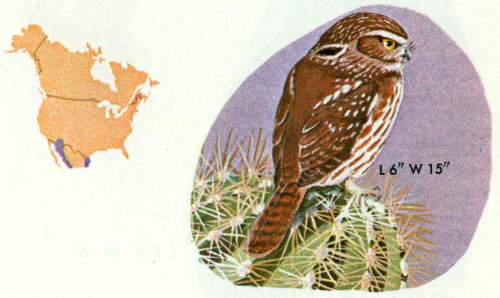
Glaucidium gnoma
L 6″ W 15″
Habitat: The pygmy owl is found in most of the western
wooded areas from western Canada into Mexico. It is probably
most abundant in open coniferous or mixed forests and is
reported specifically in ponderosa pine, mixed conifer, and fir-redwood-cedar
forests.
Nest: This owl usually nests in old woodpecker holes ranging
in size from those constructed by hairy woodpeckers up to and
including those of the flickers from 8 to 75 feet above ground
(Bent 1938).
Food: Mice and large insects are probably the most common
prey of the pygmy owl, although other small mammals, birds,
amphibians, and reptiles have been reported (Bent 1938). Brock
(1958) found one vole, a deer mouse, and a Jerusalem cricket
in the stomach of one bird and reported seeing another pygmy
owl take a Nuttall’s woodpecker. We observed one pygmy owl
in Arizona carrying a small vole. They have also been observed
taking mice in the mountains west of Denver, and taking birds
in the vicinity of feeders in Boulder, Colorado (Richard Pillmore
pers. comm.[6]).
25
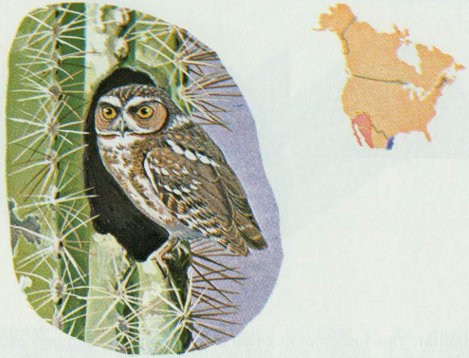
Glaucidium brasilianum
L 6″ W 15″
Habitat: This uncommon small owl inhabits the saguaro cactus
in Sonoran deserts and wooded river bottoms near the Mexican
border.
Nest: Nests are in abandoned woodpecker holes in mesquite,
cottonwood, and saguaro cactus. Nest heights range from 10
to 40 feet above ground (Bent 1938, Karalus and Eckert 1974).
Food: The diet of the ferruginous owl consists primarily of
small birds; however, insects, small mammals, invertebrates,
reptiles, and amphibians are occasionally eaten (Karalus and
Eckert 1974).
26
Micrathene whitneyi
L 5¼″ W 15″
Habitat: The elf owl is restricted to the southwestern United
States where it is found primarily in the saguaro cactus
deserts, bottomland sycamore and cottonwood stands and in
conifer-hardwood forests at high elevations.
Nest: One of the most common nest sites of the elf owl is in
old woodpecker holes in saguaro cactus. It has also been
reported nesting in cavities in sycamore, walnut, mesquite, and
pine trees (Ligon 1967, Bent 1938, Hayes and James 1963).
Cavities are usually located in snags or in dead branches of
living trees.
Food: Elf owls feed almost entirely on insects, particularly
beetles, moths, and crickets. They also feed on centipedes and
scorpions and have been reported to take an occasional reptile
(Ligon 1967).
27
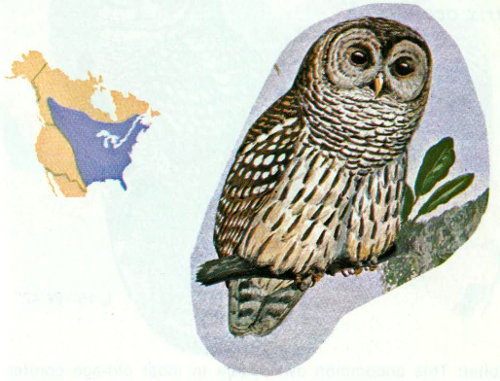
Strix varia
L 17″ W 44″
Habitat: Barred owls are common in southern swamps and
moist river bottoms of the Midwest, and less common but
widespread in northern forests. These owls are found in all of
the eastern forest types. Although they use white pine, these
large owls prefer oak woods and mixed hardwood-conifer
stands (Nicholls and Warner 1972). Preferred oak woods contain
dead and dying trees for cavities and are free of dense
understory, thus facilitating unobstructed flying and attacking
of prey.
Nest: Natural cavities in hollow trees are preferred by barred
owls. If these are unavailable, deserted crow, raptor, or squirrel
nests are occasionally used (Pearson 1936, Bent 1938). Hollow
trees used usually have hunting perches with good views.
Recommended nest box size is 13 × 15 × 16 inches deep, with
an entrance hole 8 inches in diameter (Hamerstrom 1972). Nest
boxes will have a better chance of being used if they are placed
near woods and streams.
Food: Barred owls are nocturnal hunters. More than half of the
food items taken in western Missouri consisted of meadow
mice, cottontail rabbits, and cotton rats (Korschgen and Stuart
1972).
28
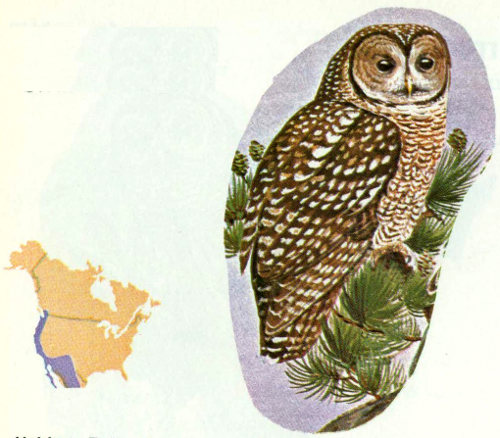
Strix occidentalis
L 16″ W 42″
Habitat: This uncommon owl occurs in most old-age conifer
associations in the western United States. Forsman (1976)
located 123 pairs in Oregon, and 95 percent occupied undisturbed
old-growth conifer forests. Karalus and Eckert (1974)
described the habitat as being dense fir forests, heavily
wooded cliffsides, narrow canyons, and sometimes stream
valleys well stocked with oak, sycamore, willow, cottonwood,
and alder.
Nest: Forsman (1976) found spotted owls nesting in the holes
of living old-growth conifers, particularly Douglas-fir. Nest
trees typically had secondary crowns and broken tops caused
by parasite infection. Cavities were located inside the tops of
hollow trunks 62 to 180 feet above ground. Dunn (1901) reported
spotted owls nesting in cavities in live and dead oak and
sycamore trees. Spotted owls also nest in cavities in cliffs, and
occasionally in abandoned nests of other large birds (Bent
1938).
Food: The major food items of the spotted owl are mammals
and birds, with occasional insects and amphibians. Forsman
(1976) found that mammals made up 90 percent of the total
biomass taken; the major prey species were flying squirrels
and wood rats. Marshall (1942) examined 23 pellets and
stomach contents of 5 spotted owls and found 6 bats, 4 mice,
31 crickets, 12 flying squirrels, 1 mole, 1 shrew, 4 songbirds, 2
smaller owls, and 1 amphibian.
29
Aegolius funereus
L 10″ W 24″
Habitat: This northern owl is normally found in the mixed
conifer-hardwood forests of Canada (Peterson 1961). One
juvenile reported in Colorado during August suggests that this
owl may nest in the southern Rocky Mountains (Bailey and
Niedrach 1965). Boreal owls are confined to evergreen woods
and dense alder, white pine, and spruce forests.
Nest: Old flicker and pileated woodpecker holes are preferred,
usually at a height of 10 to 25 feet (Fisher 1893, Preble 1908,
Tufts 1925, Lawrence 1932). Conifer snags seems to be preferred
for nest trees, although hardwoods have been used (Bent
1938).
Food: The main portion of the boreal owl’s diet consists of
small rodents. Mendall (1944) examined the contents of 20
stomachs in Maine and found 73 percent mice (chiefly meadow
voles) and 20 percent short-tailed shrews. Pigeons and grasshoppers
made up the remaining 7 percent. In Ontario, Catling
(1972) found 86.2 percent meadow voles, 5.6 percent deer
mice, 4.2 percent star-nosed moles, 2.7 percent masked
shrews, and 1.4 percent short-tailed shrews. Small birds, bats,
insects, amphibians, and reptiles are also occasionally eaten
(Karalus and Eckert 1974).
30
Aegolius acadicus
L 7″ W 17″
Habitat: Saw-whet owls are small, nocturnal hunters of the
deep north woods. They nest in the Rocky Mountains up to
about 11,000 feet (Bailey and Niedrach 1965). This widely distributed
owl nests in most of the forest types throughout the
northern half of the United States, but only rarely do they nest
as far south as central Missouri.
Nest: These small owls prefer to nest in old flicker or other
woodpecker holes (Bent 1938). Nesting habitat may be improving
in areas where Dutch Elm disease has infested many elms,
and woodpeckers have drilled nest holes (Hamerstrom 1972).
Saw-whets will use nesting boxes if sawdust or straw is provided.
Nest boxes should be 6 × 6 × 9 inches with a 2.5-inch
entrance hole (Hamerstrom 1972).
Food: Saw-whet owls consume mostly small mammals and
insects. Specific food items include mice, shrews, young
squirrels, chipmunks, bats, beetles, grasshoppers, and occasionally
small birds (Scott and Patton 1975, Burton 1973,
Hamerstrom 1972, Bent 1938).
31
Chaetura pelagica
L 5″ W 12½″
Habitat: Chimney swifts are found throughout the eastern half
of the United States in wooded and open areas. They have
adopted to man-made structures and are no longer dependent
upon hollow trees for nesting and roosting.
Nest: Originally chimney swifts nested in hollow trees, especially
sycamores. They now use chimneys, barn silos, cisterns,
and wells (Pearson 1936). Their nests are made of twigs,
which are glued to a vertical surface with saliva to form a “half-saucer”
(Forbush and May 1939).
Food: Chimney swifts feed almost entirely on flying insects
but will sometimes take small caterpillars hanging from tree
branches or leaves (Forbush and May 1939).
32
Chaetura vauxi
L 4½″
Habitat: This small swift is most likely to be found in river
valleys among dense Douglas-fir and redwood forests in the
western United States.
Nest: Nests are usually located in tall hollow snags in burned
or logged areas and are made from twigs (Peterson 1961,
Robbins et al. 1966). Nests have been reported in unused
chimneys and under building eaves (Bent 1940).
Food: Flying insects such as mosquitoes, gnats, flies, and
small beetles captured in flight probably make up the entire
diet (Bent 1940).
33
Trogon elegans
L 10″
Habitat: Coppery-tailed trogons can be found along riparian
streams and in pine-oak forests in Arizona, southwestern New
Mexico, and southern Texas.
Nest: Nests are found 12 to 40 feet above the ground in
deserted large woodpecker holes (Bent 1940). Cottonwood and
sycamore snags are usually selected for nests. Of the 34
species in the family Trogonidae, this is the only one that
breeds in the United States (Wetmore 1964).
Food: There is little information on the food of these birds, but
apparently both animal and vegetable matter are included in the
diet. Bent (1940) reported on stomach contents of two birds.
One contained adult and larvae of moths and butterflies; the
other contained 68 percent insects and 32 percent fruits. Insect
food included grasshoppers, praying mantids, stink bugs, leaf
beetles, and larvae of hawk moth, sawfly, and miscellaneous
other insects. Vegetable food consisted of fruits of cissus and
red pepper and undetermined plant fiber.
34
Colaptes auratus
L 10½″
Habitat: Flickers are commonly found near large trees in open
woodlands, fields, and meadows throughout North America. In
winter, they occasionally seek shelter in coniferous woods or
swamps. Previously three species were recognized: the yellow-shafted
of the East, the red-shafted of the West, and the gilded
of the southwestern desert. These are now considered a single
species.
Nest: Flickers prefer to nest in open country or in lightly
wooded suburban areas where park-like situations are plentiful
(Bent 1939). Conner et al. (1975) reported that flickers usually
nest in edge habitats and, in extensive forested areas, nest
only in or around openings. Flickers excavate nest holes with a
2.75-inch entrance hole diameter in dead trees or dead limbs of
many species of trees including aspen, cottonwood, oak,
willow, sycamore, pine, and juniper. Nests are sometimes as
high as 100 feet but usually between 10 and 30 feet (Scott and
Patton 1975, Lawrence 1967).
Food: Sixty percent of common flicker food is animal matter.
Of this, 75 percent is ants, more than taken by any other North
American bird. Some flicker stomachs have contained over
2,000 ants. The rest of the insect material includes beetles,
wasps, caterpillars, grubs, and crickets. The vegetable portion
of the diet includes weed seeds, cultivated grain, and the fruit
of wild shrubs and trees (Bent 1939, Forbush and May 1939).
35
Dryocopus pileatus
L 15″
Habitat: Forests of heavy
timber and secondary
growth consisting of mixed
deciduous and coniferous trees
are the preferred year-round
habitat for pileated woodpeckers.
These large woodpeckers have
become less abundant over much
of their former range where extensive
agriculture or logging practices
have eliminated large tracts
of old growth forests. In the
Ozarks, they are plentiful wherever
extensive forests remain, preferring areas where past cutting
practices (early 1900’s) have left scattered large cull trees
throughout.
Nest: Pileated woodpecker nests have been found in beech,
poplar, tulip-popular, birch, oak, hickory, maple, hemlock,
pine, ash, elm, basswood, and aspen trees. Cavity heights
range from 15 to 70 feet, with an entrance hole up to 4 inches
in diameter (Hoyt 1941, 1957). Tall dead trees with smooth surfaces
and few limbs are preferred. One tree may be used for
several years, but rarely is a nest hole reused. This behavior
provides cavities for other wildlife, including wood ducks,
owls, and squirrels (Hoyt 1957). Timber stands with sawtimber
of 15 to 18 inches dbh provide adequate habitat if there is a
supply of dead and decaying trees (Conner et al. 1975).
Food: Insects make up more than 70 percent of the food of
pileated woodpeckers. Ants (especially carpenter ants) and
beetles are the major food items. In the fall, dogwood berries,
wild cherries, acorns, and other wild fruit are included in the
diet (Bent 1939).
36
Melanerpes carolinus
L 8½″
Habitat: Red-bellied woodpeckers are common throughout
southeastern forest types. This bird has habits similar to those
of the red-headed woodpecker, except that the red-headed
prefers open woodlands, farm yards, and field edges whereas
the red-bellied prefers larger expanses of forest. Bailey and
Niedrach (1965) reported that the red-bellied woodpecker is
extending its range westward up the river valleys of the Great
Plains.
Nest: These woodpeckers most commonly excavate nest holes
in dead limbs of living trees. Excavations were found in a wide
variety of tree species, and ranged from 33 to 72 feet above
ground (Reller 1972). Cavities are usually located in mature
timber stands. Between September and January, males and
females roost in separate holes. Often one of the roost holes
(usually that of the female) becomes the nest site (Kilham
1958).
Food: Although primarily insectivorous, red-bellied woodpeckers
consume more vegetable matter than most woodpeckers.
Insects that are eaten include ants, adult and larval
beetles, and caterpillars. Vegetation eaten includes grain,
berries, and fruits of holly, dogwood, and poison ivy. Acorns
and berries are stored in crevices in the fall (Kilham 1963, Bent
1939).
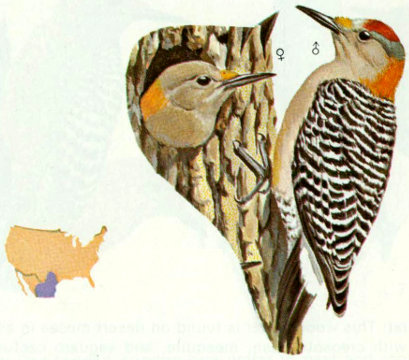
37
Melanerpes aurifrons
L 8½″
Habitat: The golden-fronted woodpecker’s preferred habitat is
mesquite and riparian woodlands in Texas and Oklahoma.
Cooke (1888) listed this species as an abundant resident of the
lower Rio Grande Valley, Texas, in 1884.
Nest: Nesting behavior of the golden-fronted is similar to that
of the red-bellied woodpecker (Pearson 1936). Tall trees of
pecan, oak, and mesquite are the major species used for nesting
(Bent 1939). Occasionally fence posts, telephone poles,
and bird boxes are used (Reed 1965).
Food: The diet of the golden-fronted woodpecker consists of
both insects and vegetable matter. Grasshoppers make up
more than half of the animal matter and other insects include
beetles and ants (Pearson 1936, Bent 1939). Vegetable matter
consumed consists of corn, acorns, wild fruits, and berries
(Bent 1939).
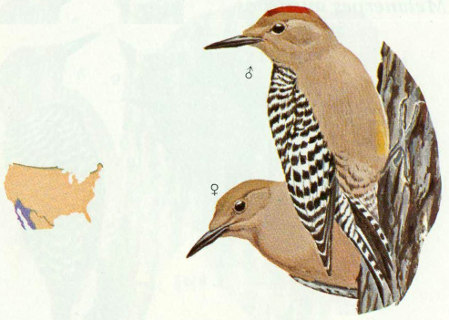
38
Melanerpes uropygialis
L 8¼″
Habitat: This woodpecker is found on desert mesas in association
with creosote bush, mesquite, and saguaro cactus from
central Arizona to edges of adjacent states. It is also common
in river bottoms and in foothill canyons among cottonwoods,
willows, and sycamores.
Nest: The Gila woodpecker excavates holes in saguaro cacti for
nests. Cottonwoods, willows, and mesquites are also used at
higher elevations (Bent 1939, Ligon 1961).
Food: The diet of the Gila woodpecker consists of ants,
beetles, grasshoppers, fruits from saguaro cactus, and mistletoe
berries (Bent 1939). This woodpecker has been reported to
remove eggs from the nests of various songbirds.
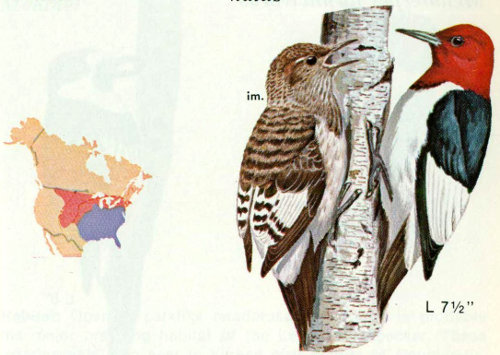
39
Melanerpes erythrocephalus
L 7½″
Habitat: Red-headed woodpeckers prefer to nest and roost in
open areas. Farmyards, field edges, and timber stands that
have been treated with herbicides or burned are preferred habitats.
Redheads are attracted to areas with many dead snags
and lush herbaceous ground cover, but not to woods with
closed canopies. They are found throughout the East and along
wooded streams of the prairie to eastern Colorado and Wyoming.
Competition for nesting space is often intensive where
starlings are abundant (Bailey and Niedrach 1965).
Nest: Red-headed woodpeckers most commonly excavate
holes in the trunks of dead trees. Holes are excavated from 24
to 65 feet above the ground and the 1.8-inch diameter entrance
hole often faces south or west (Reller 1972). These woodpeckers
may excavate new holes each year, or use old nest sites.
Food: Red-headed woodpeckers consume about half animal
matter (mostly insects) and half vegetable matter. Occasionally
the eggs or the young of other birds are destroyed. Although a
wide variety of vegetable matter is consumed, acorns from pin
oak comprise a large portion of the winter diet. Nuts are
stored whole or in pieces in cracks and crevices in bark, and in
cavities which are sealed with bits of bark when full. These
birds also store insects (especially grasshoppers) along with
acorns in cavities and crevices (Kilham 1963, Bent 1939).
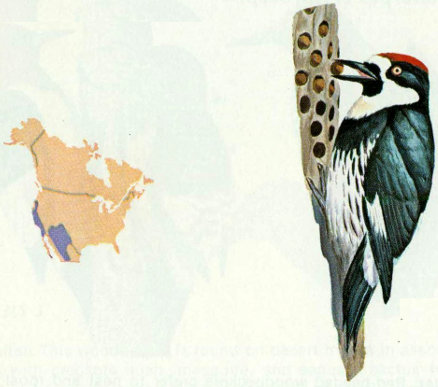
40
Melanerpes formicivorus
L 8″
Habitat: The acorn woodpecker is a common resident of mixed
oak-pine woodland and adjacent open grassland from Oregon
along the Pacific Coast to the southwestern United States.
Nest: Acorn woodpeckers are communal nesters, and the
young are fed by the entire group (Wetmore 1964). They usually
excavate holes in ponderosa pine, but live and dead oaks of
various species, sycamore, cottonwood, and willow are also
used for nests. Their old holes are important for secondary
cavity nesters such as small owls, purple martins, violet-green
swallows, nuthatches, house wrens, and kestrels (Bent 1939).
Food: As the name implies, acorn woodpeckers feed mostly on
acorns which are stored in holes drilled in communal trees.
Sap from several species of oaks also is consumed from midwinter
to summer (MacRoberts and MacRoberts 1972). About
25 percent of the diet is insects, including grasshoppers, ants,
beetles, and flies (Bent 1939). Almonds, walnuts, and pecans
are eaten when they are available.
41
Melanerpes lewis
L 9″
Habitat: Open or parklike ponderosa pine forest is probably
the major breeding habitat of the Lewis’ woodpecker. These
woodpeckers also nest in burned over stands of Douglas-fir,
mixed conifer, pinyon-juniper, riparian, and oak woodlands
(Bock 1970).
Nest: The Lewis’ woodpecker generally excavates its own nest
cavity, but will use natural cavities or holes excavated in previous
years. Bock (1970) summarized the following nest data:
height range 5 to 170 feet; 47 nests in dead stubs and 17 in live
trees; 29 nests in conifers, 31 in cottonwood and sycamore, 6
in oaks, 2 in power poles, 1 in juniper, and 1 in catalpa. At
Boca Reservoir, California, 10 of 11 nests were in dead ponderosa
pines, and the other was in a hollow section of a living
pine.
Food: Insects, including flies, ladybird beetle larvae, tent caterpillars,
ants, and mayflies, were the primary food of Lewis’
woodpeckers during spring and summer (Bock 1970). Fruits
and berries were the most frequently used food in late summer
and fall, while winter food consisted mostly of acorns and
almonds gathered and stored in crevices of dead trees, power
poles, and oak bark. Hadow (1973) reported that, on snowy
days when insects were inactive, Lewis’ woodpeckers in southeastern
Colorado spent 99 percent of their feeding time feeding
from caches of acorns and corn kernels.
42
Sphyrapicus varius
L 7¾″
Habitat: The yellow-bellied
sapsucker (sometimes
called red-naped) is most
abundant along streams in
mixed hardwood-conifer
forests. It is also found in
ponderosa pine, aspen,
mixed conifer, lodgepole
pine, and in mixed stands
of fir-larch-pine.
Nest: Yellow-bellied sapsuckers usually nest in cavities in
snags or live trees with rotten heartwood. Aspen seems to be
the preferred species (Howell 1952, Lawrence 1967, Kilham
1971), but nests have also been found in ponderosa pine, birch,
elm, butternut, cottonwood, alder, willow, beech, maple, and
fir (Bent 1939). Kilham (1971) noted that nest trees were often
infected by the Fomes fungus. Nest height varies from 5 to 70
feet above ground. The same nest tree is often used repeatedly,
but a new cavity is excavated each year.
Food: Sap is eaten throughout the year by the yellow-bellied
sapsucker, but the amount taken and tree species used vary
seasonally (Tate 1973, Lawrence 1967). The birds regularly tap
one or two “favorite trees” in their area; Oliver (1970) found that
these tend to be trees which have been wounded (by logging,
porcupines, etc.). About 80 percent of the insect food taken
consists of ants (McAtee 1911). Other insects in their diet
include beetles and wasps, but none of the woodboring larvae.
The fruits of dogwood, black alder, Virginia creeper, and blackberries
are included in the small portion of vegetable matter
eaten (Bent 1939).
43
Sphyrapicus thyroideus
L 8¼″
Habitat: This sapsucker prefers mixed conifer-hardwood forests
of the Rocky Mountain region but also inhabits the subalpine
spruce-fir-lodgepole zone, and ponderosa pine, Douglas-fir,
and aspen forests.
Nest: The choice of tree species for nesting seems to differ
between regions. Bent (1939), Packard (1945), Bailey and Niedrach
(1965), Burleigh (1972), and Jackman (1975) reported
Williamson’s sapsuckers nesting primarily in conifers. Other
authors (Rasmussen 1941, Hubbard 1965, Tatschl 1967, Ligon
1961, Crockett and Hadow 1975) found a preference for aspens.
Of 57 nests in Colorado examined by Crockett and Hadow
(1975), 49 were in aspens, especially aspens infected by the
Fomes fungus; where pines were used, there were no suitable
aspen sites nearby. In Arizona, we found 17 nests in aspen
snags, 3 in aspens with dead tops, and 1 nest in a live aspen.
Food: The diet of Williamson’s sapsuckers is made up of 87
percent animal and 13 percent vegetable material (Bent 1939).
Most of the animal food taken is ants, and most of the vegetable
material is cambium. Like the yellow-bellied sapsucker,
the Williamson’s sapsucker feeds on sap, especially in spring,
and picks out “favorite trees” which it taps regularly (Oliver
1970).
44
Picoides villosus
L 7½″
Habitat: Hairy woodpeckers are residents of nearly all types of
forest from central Canada south.
Nest: Live trees in open woodlands are preferred nesting sites
of hairy woodpeckers. This species makes a nest entrance that
exactly fits its head and body size (1.6 to 1.8 inches). Because
this size also seems very convenient for starlings and flying
squirrels, hairy woodpeckers are often troubled with invasions
(Kilham 1968a, Lawrence 1967). Hairy woodpeckers will often
excavate the entrance so it is camouflaged or hidden, such as
on the underside of a limb. Nest heights vary from 15 to 45 feet
but are commonly approximately 35 feet high. Hairies will often
use the same hole year after year.
Food: Hairy woodpeckers prefer to feed on insects on dead and
diseased trees (Bent 1939). Approximately 80 percent of the
diet is animal matter; adult and larval beetles, ants, and caterpillars
are the most frequently eaten items. The primarily insect
diet is supplemented with fruit, corn, acorns, hazelnuts, and
many other species (Beal 1911, Bent 1939). The males forage in
trees away from the nest for large insects (usually borers)
located deep in the wood. Females forage close to the nest on
the surface of trees, shrubs, or on the ground for small prey
(Kilham 1968a).
45
Picoides pubescens
L 5¾″
Habitat: Downy woodpeckers inhabit most of the wooded parts
of North America. They are absent or rare in the arid deserts,
and not common in the densely forested regions. Favorite
habitat includes open woodland, hammocks, orchards, roadside
hedges, farmyards, and urban areas (Bent 1939). Occasionally,
these birds nest at elevations above 9,000 feet in
the central Rockies (Bailey and Niedrach 1965). Most populations
are considered nonmigratory; however, there is some
movement from north to south and from high elevations to the
plains during winter.
Nest: Downy woodpeckers resemble common flickers in many
of their nesting habits. Both prefer to excavate near the tops of
dead trees in fairly open timber stands. They generally excavate
new cavities each year in the same tree, but do not usually
use cavities of other birds or reuse old cavities (Lawrence
1967). In the fall, these birds excavate fresh holes to use as
winter roosts (Kilham 1962). Nest holes are normally 8 to 50
feet above the ground with an entrance hole 1.2 to 1.4 inches in
diameter (Bent 1939).
Food: The diet is about 75 percent animal and 25 percent vegetable
material. Animal material consists mostly of economically
harmful insects. Kilham (1970) found that beetles, mostly
wood-boring larvae, made up 21.5 percent of the diet. Other
materials included ants (21 percent), caterpillars (16.5 percent),
weevils (3 percent), and fruit (6 percent). Like hairy woodpeckers,
downy woodpeckers have been credited with reducing
forest pests (MacLellan 1958, 1959, Olson 1953).
46
Picoides scalaris
L 7″
Habitat: Ladder-backed woodpeckers are commonly found in
mesquite and deciduous woodland along streams in desert
regions of the Southwest.
Nest: Ladder-backed woodpecker nests are located in a variety
of trees such as mesquite, screw bean, palo verde, hackberry,
china tree, willow, cottonwood, walnut and oak, usually from 2
to 30 feet above ground. Saguaro cactus, yucca stalks, and
branches are sometimes used for nests, as are telephone poles
and fence posts (Bent 1939, Phillips et al. 1964).
Food: Insects, especially larvae of wood-boring beetles, caterpillars,
and ants, are major food items. The ladder-backed
woodpecker also has been reported to eat the ripe fruit of
saguaro cactus (Bent 1939).
47
Picoides nuttallii
L 6¾″
Habitat: This western woodpecker is an inhabitant of oak
woodlands, riparian woods, and chapparal west of the Sierras
in California.
Nest: From a literature survey and personal observations, Miller
and Bock (1972) summarized the following nest-tree data for
57 nests: 23 percent in oak, 19 percent in willow, 18 percent in
sycamore, 16 percent in cottonwood, and 12 percent in alder.
Cavities were excavated in dead limbs and trunks of trees, from
3 to 45 feet above ground.
Food: About 80 percent of the diet of Nuttall’s woodpecker is
insects, including 28 percent beetles, 15 percent hemipterans,
14 percent lepidopteran larvae, and 8 percent ants (Beal 1911).
Most of the insects are gleaned from trunk and limb surfaces or
captured on the wing (Short 1971). Wild fruits, poison oak
seeds, and occasional acorns make up the vegetable portion of
the diet. Nuttall’s woodpeckers in California have been known
to take almonds, occasionally robbing the caches of Lewis’
woodpeckers (Emlen 1937, Bock 1970).
48
Picoides arizonae
L 7¼″
Habitat: Arizona woodpeckers are found in live oak and oak-pine
forests and canyons from 4,000 to 7,500 feet in Arizona
and New Mexico.
Nest: The Arizona woodpecker excavates holes in dead
branches of living trees, primarily walnuts, oaks, maples, and
sycamores. One nest was reportedly located in a mescal stalk
(Bent 1939).
Food: This woodpecker’s diet probably consists largely of the
adult and larval stages of insects, with some fruit and acorns,
but few details of food items have been reported (Bent 1939).
49
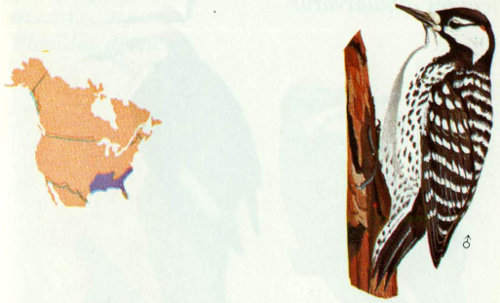
Picoides borealis
7¼″
Habitat: Red-cockaded woodpeckers need open, mature (at
least 60 year old) pine forest with a high fire occurrence (Bent
1939, Jackson 1971, Hopkins and Lynn 1971). Pine species
used during breeding season include: longleaf (Crosby 1971),
slash (Lowry 1960), loblolly (Sprunt and Chamberlain 1949),
and shortleaf (Sutton 1967). Red-cockaded woodpeckers are on
the national “Endangered species” list.
Nest: These woodpeckers prefer living pines infected with red
heart rot for nesting. These trees have a soft, easily excavated
interior with a living exterior, leaving the tree less susceptible
to destruction by fire than a dead tree. Cavities can often be
reused for at least 20 years and for several years by the same
pair (Ligon 1971). The height of cavity is influenced by the
location of red heart infection and the height and density of
undergrowth (Crosby 1971). The majority of cavities face west,
and, when found in leaning trees, are generally on the low side
(Beckett 1971, Baker 1971).
Food: Insects make up the major portion of the diet of red-cockaded
woodpeckers. Beal (1911) and Beal et al. (1916)
examined 99 stomachs and found 86 percent insects and 14
percent vegetable matter, mostly mast. Beetle larvae (16 percent)
and ants made up an important part of the year-round
diet. The corn earworm can be a major food source during
several weeks where conditions are suitable (Ward 1930). Plant
material recorded being eaten includes wax myrtle, magnolia,
poison ivy, wild grape, pokeberry, blueberry, wild cherry, black
gum, and pecan (Beal 1911, Baker 1971, Ligon 1971).
50
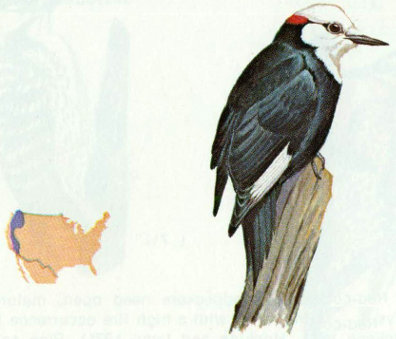
Picoides albolarvatus
L 7¾″
Habitat: Open ponderosa pine forest from Washington to central
California is the primary habitat of the white-headed woodpecker,
but it also occurs in sugar pine, Jeffrey pine, and red
and white fir forests (Grinnell and Miller 1944).
Nest: This woodpecker seems to prefer dead pines, but nests
have also been found in live and dead fir, oak, and aspen.
White-headed woodpeckers usually excavate a new nest cavity
every year and often excavate several holes before selecting
one to nest in (Bent 1939). Average nest height is 8 feet above
ground.
Food: White-headed woodpeckers feed primarily on pine seeds
during the winter and early spring, and on insects during the
summer. Tevis (1953) determined that 60 percent of the annual
diet was pine seeds and 40 percent was insects. Ants made up
half of the insect food; other insects taken were woodboring
beetles, spiders, and fly larvae (Beal 1911, Grinnell and Storer
1924, Ligon 1973).
51
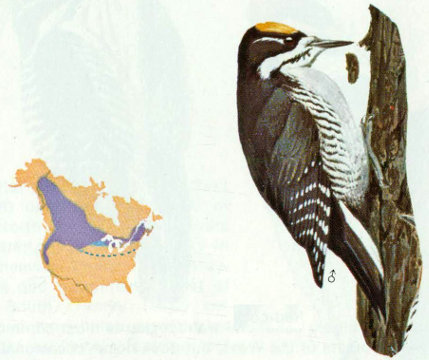
Picoides arcticus
L 8″
Habitat: The conifer forests of the north are preferred, but this
three-toed woodpecker is not abundant even in its favorite
habitat. Forest types include mixed conifer, lodgepole pine,
white fir, subalpine fir, tamarack swamps, boreal spruce-balsam
fir, Douglas-fir, and mixed hardwood-conifer.
Nest: This species usually excavates its cavities in snags or
live trees with dead heartwood, especially in areas that have
been burned or logged (Bent 1939). Nests are usually in
spruce, balsam fir, pines, or Douglas-fir, although maple,
birch, and cedar have been used.
Food: The food of this species is similar to that of the northern
three-toed woodpecker. Beal (1911) found 75 percent of the
food to be woodboring beetle larvae, mainly long-horned
beetles and metallic woodboring beetles. Weevils and other
beetles, spiders, and ants are eaten along with some wild fruit,
mast, and cambium. Beal estimated that each three-toed woodpecker
annually consumed 13,675 woodboring beetle larvae.
52
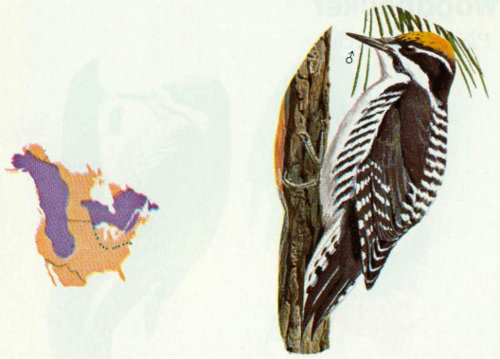
Picoides tridactylus
L 7½″
Habitat: This highly beneficial woodpecker is most common in
coniferous forests of the West, but does occur occasionally in
the Northeast.
Nest: The northern three-toed woodpecker excavates nest
cavities each year in standing dead trees or in dead limbs of
live trees with rotted heartwood (Jackman and Scott 1975).
Their nest cavities have been reported in pine, aspen, spruce,
and cedar trees (Bent 1939). In Arizona, we found two nests in
ponderosa pine snags.
Food: The northern three-toed woodpecker is probably one of
the most important birds in combating forest insect pests in
the western United States. Massey and Wygant (1973) found
that spruce beetles comprised 65 percent of their diet in Colorado.
During the winter when other foods were scarce, the
spruce beetle made up 99 percent of the food taken. West and
Speiers (1959) reported that both species of three-toed woodpeckers
in northeastern United States feed on elm bark beetles,
which carry Dutch elm disease. Koplin (1972) estimated that 20
percent of an endemic and 84 percent of an epidemic spruce
beetle population in Colorado were consumed by three species
of woodpeckers, the most important of which was the northern
three-toed. Other foods include ants, woodboring and lepidopteran
larvae, fruits, mast, and cambium (Beal 1911, Massey and
Wygant 1973).
53
Campephilus principalis
L 18″
Habitat: Cooke (1888) and Bent
(1939) described the largest of
the North American woodpeckers
as rare, shy, and found only in
the heaviest timber in virgin cypress
and bottomland forest of
the South. Tanner (1942) described
ivory-billed woodpecker
habitat as heavily forested and
usually flooded alluvial land bordering
rivers, made up of oaks,
cypress, and green ash. The most
recent sightings (between 5 and
10 pairs) have been made in
bottomland hardwoods that have been cut over but still have
some large, mature trees (Dennis 1967). They are included on
the national “Endangered species” list.
Nest: Nest cavities of this species have been recorded in almost
every species of tree occurring within the ivory-bill’s
habitat (Greenway 1958). The squarish holes (Dennis 1967) are
high, 16 to 65 feet, and in the trunks of living or dead trees
(Greenway 1958, Forbush and May 1939).
Food: Ivory-billed woodpeckers could be of economic importance
except for their small numbers (Greenway 1958). The
woodboring larvae making up a third of their diet (Beal 1911)
are injurious to trees (Pearson 1936), and are most abundant in
areas where recently dead and dying trees are numerous because
of flooding, fire, insect attacks, or storms. The birds
stay as long as there are abundant larvae (Dennis 1967). They
also eat fruit of magnolia and pecan trees (Beal 1911).
54
Myiodynastes luteiventris
L 6¾″
Habitat: The sulphur-bellied flycatcher is a common occupant
of riparian habitat with sycamore trees in deep canyons from
5,000 to 7,500 feet elevation in the Huachuca Mountains of
Arizona.
Nest: Invariably the nest of this species, made from leaf stems
(Peterson 1961), is built in a natural cavity in a large sycamore
at a height between 20 and 50 feet above the ground. The cavity
normally is a knothole where a large branch has broken off
(Bent 1942). At least one member of each pair may return to the
same nest site each year.
Food: Little information has been published on the food habits
of this flycatcher, but insects caught in the air are undoubtedly
the major items. Apparently small fruits and berries also are
eaten (Bent 1942).
55
Myiarchus crinitus
L 7″
Habitat: Great crested flycatchers are common in deciduous
and mixed woods east of the Rockies. They were originally a
deep forest bird, but with increases in forest clearing and thinning
operations, fewer and fewer cavities are available. They
seem to be adapting well to less densely forested areas, areas
treated with herbicides, and forest-field edge situations (Hespenheide
1971, Bent 1942).
Nest: Great crested flycatchers use natural cavities or excavations
made by other species. Nests are found in a variety of
tree species anywhere from 3 to 70 feet above the ground
(mostly below 20 feet). They build a bulky nest, and therefore
prefer deep cavities. Before constructing a nest, they will
generally fill a deep cavity with trash to a level of 12 to 18
inches from the top. They are well known for their habit of
including a snake skin in the nest or dangling it from the cavity
opening (Bent 1942).
Food: Food habit studies have shown that great crested flycatchers
eat 94 percent animal and 6 percent vegetable material.
Most frequently eaten are butterflies, beetles, grasshoppers,
crickets, katydids, bees, and sawflies. Vegetable matter
is mainly wild fruits. Most food is caught in flight in the
usual flycatcher fashion (Bent 1942).
56
Myiarchus tyrannulus
L 7¼″
Habitat: Desert saguaros, deciduous woodlands and riparian
vegetation in the Southwest are the preferred habitats of the
Wied’s crested flycatcher.
Nest: Nests made from twigs, weeds, and trash are built in
abandoned woodpecker holes in saguaro cacti at a height from
5 to 20 feet above the ground. Sycamores, cottonwoods, and
fence posts are used occasionally (Bent 1942).
Food: The diet of this species is similar to that of other crested
flycatchers, consisting mostly of beetles, flying insects, and
perhaps some berries and fruits (Bent 1942).
57
Myiarchus cinerascens
L 6½″
Habitat: The ash-throated flycatcher occupies dense mesquite
thickets, oak groves, saguaro cactus, riparian vegetation, and
pinyon-juniper forests. It ranges from Washington to the southwestern
United States and Texas.
Nest: The ash-throated flycatcher is not particularly specific in
tree selection as long as it has a cavity. Woodpecker holes,
exposed pipes, and nest boxes have been used. Mesquite, ash,
oak, sycamore, juniper, and cottonwood are common nest
trees (Bent 1942).
Food: The diet of this species consists mainly of animal material.
Beetles, bees, wasps, bugs, flies, caterpillars, moths,
grasshoppers, spiders, etc., make up about 92 percent of the
diet. Mistletoe, berries, and other fleshy fruits account for the
remainder (Bent 1942).
58
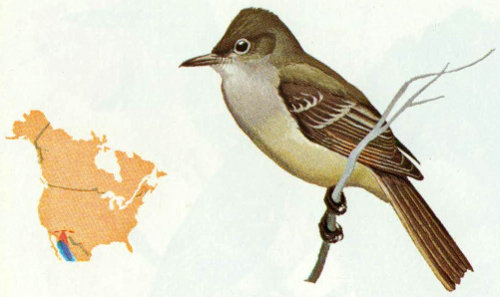
Myiarchus tuberculifer
L 5¾″
Habitat: Olivaceous flycatchers are found in dense oak thickets,
pinyon-juniper forests, and along canyon streams in Arizona
and southwestern New Mexico.
Nest: Nests are located in natural cavities or abandoned woodpecker
holes. Oaks are preferred, but nests also have been reported
in ash and sycamore trees (Bent 1942).
Food: Limited evidence on food habits of this species indicates
that the major food items are small insects including grasshoppers,
termites, mayflies, treehoppers, miscellaneous bugs,
moths, bees, wasps, and spiders (Bent 1942).
59
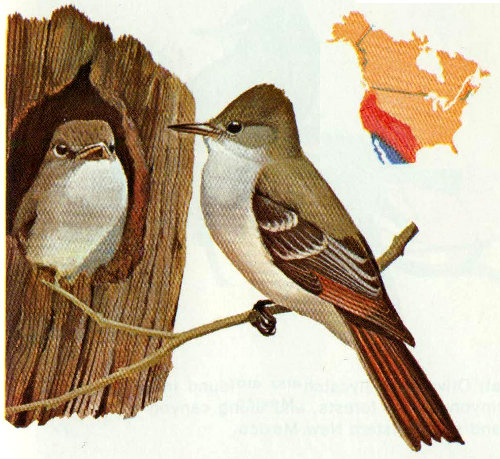
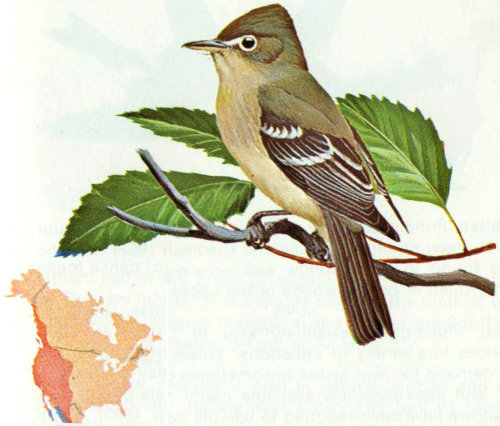
Empidonax difficilis
L 5″
Habitat: Moist deciduous or coniferous forests and areas near
running water with tall trees are favored by the western flycatcher
(Grinnell and Miller 1944).
Nest: Western flycatchers sometimes nest in cavities, but use
a variety of nest sites. Davis et al. (1963) found four nests in
natural cavities in willows and oaks, and six behind flaps of
bark in sycamores and willows. Nests are often reported in
natural rock crevices, on tree limbs and crotches, and on
ledges of buildings (Bent 1942, Davis et al. 1963, Beaver 1967).
Food: Almost all of the food of the western flycatcher is insects
captured on the wing. An examination of 23 stomachs
showed 31 percent flies, 25 percent beetles, 23 percent lepidopterans
(including pupae and adults of spruce budworms),
and 17 percent hymenopterans (Beaver 1967).
60
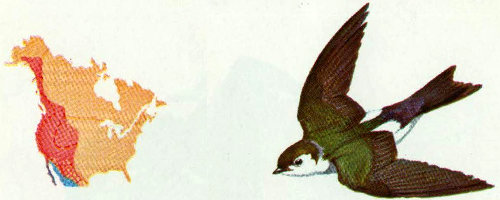
Tachycineta thalassina
L 4¾″
Habitat: Ponderosa pine affords the favorite habitat for
violet-green swallows (Bailey and Niedrach 1965), but they are
also found in aspen-willow and spruce-aspen forests. They
prefer open or broken woods or the edges of dense forests.
Nest: Violet-green swallows nest in holes, cavities, and
crevices in a variety of situations. Where birds are abundant,
the demand for nest sites is sometimes greater than the supply,
and practically any available cavity may be used. These
swallows have been reported to use old nests of cliff swallows
and even burrows of bank swallow (Bent 1942). Winternitz
(1973) reported violet-greens using old woodpecker holes in
live aspen as nesting sites, but in Arizona, we found them
nesting primarily in old woodpecker holes in ponderosa pine
snags. We found one in the dead top of an aspen, 5 in dead
tops of ponderosa pine, and 26 in ponderosa pine snags. Nest
heights ranged from 16 to 80 feet and averaged 43 feet.
Food: Apparently, the diet of this species is exclusively insects
taken on the wing. It includes leafhoppers, leaf bugs, flies,
flying ants, and some wasps, bees, and beetles (Bent 1942).
In Colorado, Baldwin (pers. comm.[7]) found that insects made
up 99 percent of the stomach contents of six violet-green
swallows. Flies were the most abundant insect found. Scolytid
beetles, seed and leaf bugs, miscellaneous insects, and a few
spiders were also found.
61
Iridoprocne bicolor
L 5″
Habitat: Tree swallows breed throughout North America from
the northern half of the United States north to the limit of tree
growth. They are migrants throughout the Central and Southern
states and winter primarily in Central America.
Nest: Tree swallows prefer to nest in natural cavities and old
woodpecker holes—usually near water. The lack of natural
cavities, competition for existing cavities, and the availability
of nest boxes, have resulted in a shift in nesting preferences to
nest boxes in the eastern United States (Bent 1942, Low 1933,
Whittle 1926). Bluebird boxes and purple martin houses are
frequently used. Tree swallows are not colonial, but will nest
within 7 feet of each other, if there are adequate meadows,
marsh, or water area available for feeding (Whittle 1926).
Woodpecker holes in aspen, spruce, and pine are the most
common nest sites in the West (Bailey and Niedrach 1965).
Food: This species is the first of the swallows to arrive in the
north in the spring, and the last to depart in the fall. Because
tree swallows can subsist on seeds and berries, they are not as
dependent upon insects as are other swallows. They are partial
to waxmyrtle and bayberry where these are available. Plant
food proportions in the diet are 1 percent in spring, 21 percent
in summer, 29 percent in fall, and 30 percent in winter
(Martin et al. 1951, Forbush and May 1939).
62
Progne subis
L 7″
Habitat: The natural nesting population of purple martins prefer
open woodlands or cutover forests where suitable snags remain.
Purple martins have been reported in oak, sycamore,
ponderosa pine, Monterey pine, spruce, and fir forests of
California (Grinnell and Miller 1944). In the Southwest, the
purple martin breeds in the ponderosa pine belt and in the
saguaro cactus desert.
Nest: The western purple martin has not adapted to nesting in
boxes as well as the eastern form (Bunch 1964), and much of
the western population depends upon holes made by woodpeckers,
usually in tall pines in relatively open timber stands
(Bent 1942). Martins also nest in old woodpecker holes in
saguaro cactus. We have recorded 21 nests near Cibecue, Arizona,
all in ponderosa pine snags. Nests ranged from 25 to 35
feet above ground. Nest compartments in martin houses
should be 6 × 6 × 6 inches with an entrance hole 2½ inches in
diameter 1 inch above the floor. The boxes should be 15 to 20
feet above ground.
Food: The purple martin feeds on the wing, and nearly all the
diet is insects, although some spiders are taken (Beal 1918).
Johnston (1967) examined the stomach contents of 34 martins
collected in April, May, June, and August in Kansas. Beetles,
true bugs, flies, bees, and wasps were the important food
items. Although the purple martin has been credited for feeding
on large numbers of mosquitoes (Bent 1942), it was not
documented by the two food habit studies mentioned.
63
Parus atricapillus
L 4½″
Habitat: Black-capped chickadees nest throughout southern
Canada and the northern half of the United States. In Missouri,
the black-capped chickadee generally nests north of the Missouri
River and the Carolina chickadee nests south of the River.
The breeding range extends farther south at higher elevations
of the Rocky and Appalachian Mountain ranges than in non-mountainous
areas. In Colorado, black-caps are most abundant
in the ponderosa pine and aspen forests (Bailey and Niedrach
1965).
Nest: Chickadees nest in cavities but roost anywhere convenient,
generally not in cavities (Odum 1942). The most suitable
nesting sites are stubs with partially decayed cores and
firm shells. They usually excavate their own cavities, but will
use natural cavities or nest boxes. Black-caps will occasionally
nest in a cavity they used the previous year after making some
alterations. Preferred nesting sites throughout the eastern
forests are tree species that occur in the early seral stages but
that are short lived and persist in the intermediate stages as
decaying stubs (Odum 1941, Brewer 1961).
Food: The diet of the black-capped chickadee is comprised of
70 percent animal and 30 percent vegetable matter. Mast, chiefly
from coniferous trees, and fruits of bayberry, blackberry,
blueberry, and poison ivy make up the bulk of the vegetable
matter. Animal material eaten (mostly insects) includes caterpillars,
eggs, moths, spiders, and beetles. Winter diet is primarily
larvae, eggs, katydids, and spiders (Bent 1946, Martin
et al. 1951).
64
Parus carolinensis
L 4¼″
Habitat: The Carolina chickadee, which inhabits the southeastern
forests, is a slightly smaller version of the black-capped
chickadee. In Missouri, the Carolina chickadee nests south of
the Missouri River throughout the Ozarks.
Nest: The nesting habits of the black-capped and Carolina
chickadees are quite similar. They occasionally nest in natural
cavities or deserted holes of woodpeckers, but commonly excavate
their own nest cavity in decaying wood of dead trunks or
limbs of deciduous trees (Bent 1946). Black-capped and Carolina
chickadees line their nesting cavities with fine grasses and
feathers.
Food: Food habits of the Carolina chickadee are also very
similar to those of the black-capped chickadee. Food consists
of insects and a variety of fleshy fruits and seeds (Bent 1946).
65
Parus sclateri
L 4¼″
Habitat: This species inhabits pine and spruce forests from
7,000 to 10,000 feet elevation just inside the United States in
the Chiricahua Mountains of Arizona and the Animas Mountains
of New Mexico (Phillips et al. 1964).
Nest: Mexican chickadees excavate nest holes in dead trees or
branches. One nest was found in a willow stub about 5 feet
above the ground (Bent 1946).
Food: No information on diet was found in the literature.
66
Parus gambeli
L 4¼″
Habitat: This common little chickadee can be found in most
coniferous forests of the West from 6,000 to 11,000 feet (Bent
1946).
Nest: Mountain chickadees usually nest in natural cavities or
abandoned woodpecker holes, and probably do not excavate
their own cavities if suitable ones are available (Bent 1946).
Winternitz (1973) reported five nests in live aspen and one in a
dead aspen, 6 to 15 feet above ground. In Arizona, we have
found five nests in live aspen, three in aspen snags, two in
ponderosa pine snags, and one in a white fir snag.
Food: Insects probably make up a large portion of the diet
(Bent 1946). Telford and Herman (1963) collected 10 birds in
the Inyo National Forest, where there was an infestation of
lodgepole needle miners and found 639 needle miner caterpillars
in chickadee stomachs. Baldwin (pers. comm.[8]) examined
the contents of 17 stomachs from the Wet Mountains, Colorado,
and found that 75 percent of the summer diet was insects.
Large numbers of spruce aphids were found, as well as
flies, beetles, hymenopterans, and other insects. Vegetable
material included seeds, spruce buds, and fruits. In southwestern
Montana, during summer, mountain chickadees fed
on lepidopteran larvae, especially cone worms and spruce budworms
(DeWeese et al.[9][in prep.]), and insects made up about
98 percent of the diet.
67
Parus cinctus
L 4¾″
Habitat: Broken forests or edges of aspen, willow, and spruce
are the preferred habitat of the gray-headed chickadee. The
range is limited to western Canada and Alaska.
Nest: Old woodpecker holes or natural cavities are selected as
nest sites. Bent (1946) reported one nest about 6 feet above
ground in a spruce snag.
Food: No information could be found in the literature on the
food habits of the gray-headed chickadee, but the diet is probably
similar to that of other chickadees.
68
Parus hudsonicus
L 4¼″
Habitat: The boreal chickadee is fairly common in northern
forests of spruce, fir, aspen, and birch (McLaren 1975).
Nest: Natural cavities, old woodpecker holes, or cavities excavated
by the chickadees themselves are used for nesting (Bent
1946). McLaren (1975) found 22 nest holes, all in trees or snags
with soft heartwood, and believed that softness of the core
rather than a preference for a certain tree species is the determining
factor in nest site selection.
Food: In summer the boreal chickadee consumes caterpillars,
moths, beetles, other insects, and insect eggs; birch cones,
seeds, and cedar berries are eaten in the fall and winter (Bent
1946).
69
Parus rufescens
L 4¼″
Habitat: Coniferous forests of the humid coastal belt from
Alaska to central California are the favorite habitat, but this
bird is also found in adjacent deciduous woodlands and along
streams (Peterson 1961, Grinnell and Miller 1944).
Nest: Nests of this species are in abandoned woodpecker holes
or in cavities excavated by the bird itself. Nests have been
found in pine, oak, and Douglas-fir snags (Bent 1946).
Food: The diet is made up of about 65 percent animal and 35
percent vegetable matter. Of the animal material, 25 percent is
hemipterans, 18 percent caterpillars, 13 percent wasps, 7 percent
spiders, and 2 percent beetles. Seeds and fruit make up
the vegetable material (Beal 1907).
70
Parus bicolor
L 5½″
Habitat: The tufted titmouse is the largest North American
titmouse and is common throughout the eastern deciduous
woodlands. These active and vocal birds are generally found in
groups of 2 to 6 in thick timber stands, often near water (Gillespie
1930). The black-crested titmouse, found in southern
Texas and northeastern Mexico, is now considered conspecific
with the tufted titmouse (33rd supplement, A.O.U. Checklist).
Nest: Nests of the tufted titmouse are very difficult to locate
and are not often reported in the literature. Published accounts
indicate that these birds nest in abandoned woodpecker holes
or natural cavities usually less than 20 feet above the ground.
While titmice are quite conspicuous in late fall and winter, they
tend to disappear in late spring to nest and molt (Gillespie
1930, Laskey 1957).
Food: The diets of tufted titmice change seasonally. In spring
and summer they eat primarily animal matter (89 percent and
82 percent respectively) and spend most of their feeding time
in the tree tops. Caterpillars often make up over 50 percent of
the animal matter. Common winter foods consist of beechnuts,
acorns, dogwood berries, Virginia creeper berries, alder seeds,
honeysuckle, seeds of tulip-tree pods. In winter, they spend
a larger percentage of their feeding time on or near the ground
(Gillespie 1930, Martin et al. 1951).
71
Parus inornatus
L 5″
Habitat: Oak and pinyon-juniper woodlands from 5,000 to 7,000
feet elevation from Oregon south and west to Texas and New
Mexico are the favored habitat of the plain titmouse.
Nest: Plain titmice usually nest in natural cavities or old woodpecker
holes. Most reported nests have been in oaks, 2 to 23
feet above ground (Bent 1946). Nest boxes are used when available
(Wetmore 1964).
Food: Beal (Bent 1946) examined the contents of 76 stomachs
and found 43 percent animal material (true bugs 12 percent,
caterpillars 11 percent, beetles 7 percent, ants and wasps 6
percent, daddy longlegs and grasshoppers 5 percent, spiders 1
percent, and 1 percent unreported) and 57 percent vegetable
matter (cherries and pulp of larger fruit and leaf galls 32 percent,
seeds of poison oak and weeds 25 percent).
72
Parus wollweberi
L 4½″
Habitat: Bridled titmice prefer chaparral and pinyon-juniper in
the Southwest at elevations from 5,000 to 7,000 feet. This titmouse
also uses areas along streams where cottonwoods are
present (Phillips et al. 1964).
Nest: Almost all nest locations have been recorded in natural
cavities of dead and living oak trees from 4 to 28 feet above the
ground (Bent 1946).
Food: No published information was found, but the diet is
probably similar to that of other members of this genus. All live
in similar habitats and spend much of their time foraging in
crevices in the bark, on the trunks, and on branches, presumably
hunting for adults, larvae, and eggs of insects (Bent 1946).
73
Sitta carolinensis
L 5″
Habitat: White-breasted nuthatches are non-migratory in most
forest types in the United States. They show a preference for
deciduous woodlands. In the Rocky Mountains, they occur
most commonly below 9,500 feet elevation (Bailey and Niedrach
1965).
Nest: White-breasted nuthatches nest almost exclusively in
natural cavities within living trees of mature forests. When
natural cavities are unavailable, they may use an abandoned
woodpecker hole (Kilham 1968b). In the West, nests have been
found in dead aspens and dead portions (lightning strikes) of
live ponderosa pines (Bailey and Niedrach 1965, Scott and Patton
1975). Nests are lined with hair and feathers and are often
used for more than 1 year.
Food: A myriad of insects, including larvae of the gypsy moth
and the forest tent caterpillar, beetles, spiders, caterpillars,
and ants comprise the main diet of white-breasted nuthatches
throughout the spring and summer. In the winter, nearly all
food eaten is mast composed of beechnuts, acorns, hickory
nuts, maize and sunflower seeds (Bent 1948). Among the
insect foods are several other forest pests including nut
weevils, locust seed weevils, and roundheaded woodborers
(Scott and Patton 1975). Nuthatches may also be attracted to
feeders with suet and sunflower seeds.
74
Sitta canadensis
L 4″
Habitat: Red-breasted nuthatches nest throughout the high
elevations of the Rocky Mountains and in the Canadian boreal
forests. They are erratic winter migrants to the eastern forest
types. In Colorado, their preferred habitat is the coniferous-aspen
type from the Canadian Life Zone to timberline.
Nest: Red-breasted nuthatches will excavate their own cavity if
a natural cavity or woodpecker hole is not available or to their
liking (de Kiriline 1952). Nests are usually 6 to 40 feet above
the ground in rotten stubs or branches of dead trees. Nests
have been reported in birch, poplar, cottonwood, oak, and
pine. Nests usually are not lined, in contrast to those of white-breasted
nuthatches.
Food: Little is known of the food taken by red-breasted nuthatches.
They feed on seeds of pine, spruce, and other coniferous
trees. The animal food is known to include beetles, hymenoptera,
spiders, and ribbed pine borers. They sometimes
feed on flying insects (Bent 1948). Birds will visit feeders offering
suet during the winter.
75
Sitta pusilla
L 3½″
Habitat: Clearings and areas that have been burned (more old
stumps available for nesting) in southern pine woods are preferred
by brown-headed nuthatches. They can also be found in
mixed pine and hardwood forests of extreme southeastern
United States (Bent 1948).
Nest: Brown-headed nuthatches excavate or partially excavate
nest cavities 4.5 to 8 inches deep in dead trees and stumps
(often fire blackened) or posts and poles. Bent (1948) gave little
evidence that the brown-headed nuthatch will use old woodpecker
holes, but they may enlarge and use natural cavities.
The nests are located 3 to 46 feet from the ground (only rarely
above 13 feet). Because nest entrances are more like a crack in
a tree than rounded like a woodpecker hole, nests are difficult
to find (Pearson 1936).
Food: Brown-headed nuthatches are mainly insectivorous, and
are considered a useful protector of trees. They search for
insects and their eggs in crevices of the bark on the trunks,
branches, twigs, and needles of pines. They also eat pine
seeds (Bent 1948).
76
Sitta pygmaea
L 3½″
Habitat: Pygmy nuthatches are common in ponderosa pine
forests throughout the West. They are also found in Jeffrey
pine, Bishop pine, and Monterey pine associations in California
(Grinnell and Miller 1944), and in pinyon-juniper woodlands
in Arizona (Phillips et al. 1964).
Nest: Nearly all reported nests of the pygmy nuthatch have
been from 8 to 60 feet above ground in cavities excavated by
the bird itself in dead or live pine trees (Bent 1948). We found
27 nests in ponderosa pine snags and two in dead aspens in
the White Mountains of Arizona.
Food: About 80 percent of the diet is animal material, mostly
wasps and spittle insects, including some ants, beetles, and
caterpillars; the balance is nearly all conifer seeds (Bent 1948).
77
Certhia familiaris
L 4¾″
Habitat: This inconspicuous small bird is fairly common in the
coniferous forests of the Transition and Canadian Life Zones.
In Colorado, it breeds from 7,000 feet to timberline (Bailey and
Neidrach 1965). Creepers winter throughout the forests of the
southern states.
Nest: Sometimes creepers nest in natural cavities and old
woodpecker holes, but generally they make their nests between
the loose bark and the trunk of a large dead tree (Bent 1948).
We found three nests behind the loosened bark of dead ponderosa
pines and one in a white fir snag in the White Mountains
of Arizona.
Food: Few details are known, but the diet is mainly insects,
including weevils, leafhoppers, flat bugs, jumping plant lice,
scale insects, eggs of katydids, ants and other small hymenoptera,
sawflies, moths, caterpillars, cocoons of leaf skeletonizers,
pupae of the codling moth, spiders, and pseudoscorpions
(Bent 1948). The small amount of vegetable material
eaten is chiefly mast.
78
Troglodytes aedon
L 4¼″
Habitat: House wrens are common nesters in shrubbery and
brush throughout the northern two-thirds of the United States,
but they winter in the southern states. They range from the
plains to timberline throughout the Rocky Mountains. They are
commonly found along the edges of woods, swamps, fields,
and in orchards.
Nest: House wrens are aggressive in their nesting habits and
will drive other birds from cavities. Nests have been found in a
variety of sites including 2-inch pipes used to brace fence
posts, nesting boxes, natural cavities, and downy woodpecker
holes (Sutton 1930). Nests are usually less than 10 feet above
the ground. Diameter of the entrance hole in nesting boxes
should be 1 inch.
Food: House wrens are capable of eating large quantities of
insects and arthropods, which constitute 98 percent of their
diet. Animal items include beetles, caterpillars, bugs, grasshoppers,
and ants (Bent 1948).
79
Troglodytes brunneicollis
L 4″
Habitat: Brown-throated wrens inhabit oak forests, mostly in
desert ranges, but can be found up to elevations of 8,000 feet
in southern Arizona.
Nest: This wren uses natural cavities or old woodpecker holes
in tree trunks or limbs. Like the house wren, it will sometimes
occupy recesses about buildings and nest boxes (Pough 1957).
Food: We could not find published information on food habits
but the diet is probably insects similar to that of other wrens.
80
Troglodytes troglodytes
L 3¼″
Habitat: Winter wrens inhabit coniferous forests of spruce, fir,
and pine, and underbrush in woodlands in eastern and western
United States and Canada.
Nest: Winter wren nests, made from twigs and leaves, are built
near the ground in exposed roots or fallen logs or in rocks and
crevices (Bent 1948, Wetmore 1964).
Food: Details on food items were not found in the literature,
but the diet is probably adult and larval stages of insects (Bent
1948).
81
Thryomanes bewickii
L 4½″
Habitat: Bewick’s wrens are common and widespread in the
West, but uncommon and local in the Appalachians and
Ozarks. They are usually found in farmyards, brushlands,
fencerows, and suburban areas. Bewick’s wrens are fairly common
in the pinyon-juniper forest type, and in mesquite-willow-cottonwood
associations along southwestern streams.
Nest: Nests of the Bewick’s wren can be found in a multitude
of places. Most nests are cup-shaped and can be either open or
closed above. They are usually located in cavities close to the
ground (Miller 1941). Nest sites include natural cavities, woodpecker
holes, knotholes in fallen trees, fence posts, tin cans,
bird boxes, and deserted automobiles (Bent 1948).
Food: Bewick’s wrens, like other wrens, eat large numbers of
insects that are injurious to vegetation. Ninety-seven percent
of the diet is insects, including primarily hemiptera and coleoptera.
In the South they are credited with eating boll weevils
(Bent 1948).
82
Thryothorus ludovicianus
L 4¾″
Habitat: Carolina wrens are common in forest types with thick
underbrush throughout the eastern United States. The number
in northern populations fluctuates widely depending on the
harshness of winter conditions.
Nest: Carolina wrens are quite universal in their choice of nesting
sites. These wrens prefer nesting sites that are fairly well
enclosed, but they are not totally dependent upon cavities.
They are well adapted to habitat conditions provided by man,
but also nest in the woods where they prefer tangles and
brushy undergrowth. Nests have been found in natural cavities,
mailboxes, newspaper cylinders, old hornet nests, and bird
houses (Laskey 1948, Nice and Thomas 1948).
Food: Animal food, mostly insects, makes up 93 percent of the
Carolina wren’s diet. Of this, beetles, caterpillars, and moths
comprise the largest portion. The 7 percent vegetable material
is mostly seeds taken in the winter. Since the Carolina wren
feeds mostly on or near the ground, deep snow is detrimental
to survival. They will visit feeding stations if placed near brush
piles (Bent 1948).
83
Sialia sialis
L 5½″
Habitat: Under natural conditions, eastern bluebirds prefer to
use cavities in savannah-like habitats east of the Great Plains
(Rustad 1972). They are an edge species and therefore do not
live in dense woods or in closely built residential sections of
town (Thomas 1946). Like purple martins, bluebirds have taken
advantage of nest boxes provided in areas around farms, near
open fields, and in orchards.
Nest: Eastern bluebird nesting sites (snags) are often eliminated
because of their unsightliness or interference with cultivation.
When available, eastern bluebirds nest in old woodpecker
holes, hollows of decayed trees, and crevices of rocks
(Pearson 1936). They will readily take to hollows in wooden
fence posts or correctly sized and placed nest boxes (5 × 5 × 8
inches high with a 1.5-inch hole located 6 inches from the bottom).
Boxes should be placed 5 to 10 feet above the ground at
the edge of a forest opening or field.
Food: Eastern bluebirds consume 70 percent animal matter and
30 percent vegetable matter. Vegetable intake increases to
more than 50 percent in December and January, but is completely
lacking in May. Animal matter includes grasshoppers,
crickets and katydids, various coleoptera, moths and caterpillars,
some hymenoptera and hemiptera, as well as various
other invertebrates and small vertebrates. Vegetable matter is
mostly wild fruits (Bent 1949).
84
Sialia mexicana
L 5½″
Habitat: The western bluebird is most abundant in open ponderosa
pine forests of the Transition Zone, but may also be
found in oak woodlands, pinyon-juniper, mixed conifer, and
subalpine forests.
Nest: Nests are usually in old woodpecker holes, but this bird
also uses natural cavities. Nests have been reported in oak,
sycamore, and pine trees. In Monterey County, California,
nests were found from 5 to 40 feet above ground in pine
stumps or trees (Bent 1949). This bluebird, like the eastern,
also readily nests near humans in bird houses. Nest boxes
should be 5 × 5 × 8 inches with a 1.5-inch entrance hole located
6 inches from the floor. Boxes should be placed 5 to 10
feet above ground near forest openings or meadows.
Food: Beal (Bent 1949) examined the contents of 217 stomachs
and found 72 percent animal material (grasshoppers 21 percent,
caterpillars 20 percent, useful beetles 9 percent, other
beetles 16 percent, ants 5 percent, other hymenoptera 1 percent)
and 28 percent vegetable material, mostly wild fruits,
including elderberries, mistletoe berries, blackberries or raspberries,
prunes, cherries, and a few weed seeds.
85
Sialia currucoides
L 6″
Habitat: The mountain bluebird nests in nearly all timber types
of the Rocky Mountain region, and is reported from 800 to
11,000 feet elevation in Idaho (Burleigh 1972). However, this
species usually ranges from 7,000 to 11,000 feet in open
forests or near forest edges.
Nest: The mountain bluebird usually nests in natural cavities or
in old woodpecker holes but will also use man-made structures.
Nests have been reported in fir and pinyon snags and
aspen trees (Burleigh 1972, Bent 1949). We recorded six nests
in the White Mountains of Arizona ranging from 12 to 35 feet
above ground in ponderosa pine snags. Five of these were in
abandoned woodpecker holes and one was in a natural cavity.
Nest boxes should be similar to those for other bluebirds.
Food: This is probably the most insectivorous of the bluebirds.
Studies indicate that nearly 92 percent of the diet is animal
material, including miscellaneous beetles, weevils, ants, bees,
wasps, cicadas, stinkbugs, negro bugs, assassin bugs, jassids,
flies, caterpillars, grasshoppers, locusts, and crickets
(Bent 1949). Vegetable items include currants, grapes, elderberries,
sumac seeds, mistletoe berries, hackberry seeds, Virginia
creeper seeds, and cedar berries.
86
Sturnus vulgaris
L 6″
Habitat: Starlings breed in various habitats that provide adequate
nestling food (Troetschler 1976) but are perhaps most
numerous in suburban and rural habitat where suitable nesting
sites abound. Kalmbach (1928) noted that starlings prefer
thickly settled agricultural areas and stated that “They are
partial to human association....” During establishment in the
United States, starlings first settled in lowland areas and are
still abundant there (Small 1974, Royall 1966, Bent 1950). In a
southeast Ontario test, starlings preferred old field habitat over
five other habitats when sufficient nest sites were available
(Gibo et al. 1976).
Nest: Cavities in trees, telephone poles, or fence posts, in
drainpipes, mail boxes, or buildings, and in haystacks and
cliffs have been used for nesting, as have burrows and open
nests of other species (Kessel 1957, Bent 1950). Natural nest
sites seem to be preferred over nest boxes (Planck 1967). Competition
between starlings and native species for nesting cavities
usually favors the starling, but most native species seem
to breed in some habitats where starlings are not numerous.
Food: Analysis of contents of 2,750 starling stomachs taken in
the northeastern states showed 57 percent animal materials
such as insects, millipeds, spiders, molluscs, and a few
crustaceans. Insects such as weevils, ground beetles, and
plant-feeding scarabaeids such as May beetles were especially
important. Of the 43 percent vegetable material, wild fruit was
most important, but cultivated cherries, vegetable material,
grain, and seeds of various sorts were also used (Kalmbach
1928). In other areas, grapes, blueberries, figs, and other fruit,
truck crops, sprouting crops, and prepared livestock feed are
eaten.
87
Acridotheres cristatellus
L 9″
Habitat: The crested myna is native to the plains and lowlands
of cultivated southern China, and was introduced in Vancouver,
B.C., Canada in the 1890’s. Although the myna has been reported
in the states of Washington and Oregon, most of the
population is in Greater Vancouver and Vancouver Island.
Mynas are apparently dwellers of urban and nearby open field
areas (Mackay and Hughes 1963).
Nest: In urban areas, mynas nest in almost any enclosed area,
including bird boxes intended for other birds. In wooded areas,
holes made by flickers and other woodpeckers seem to be preferred
(Bent 1950).
Food: Scheffer and Cottam (1935) examined the contents of
117 adult myna stomachs and found 39 percent animal and 61
percent vegetable matter. Animal matter included flies, moths
and caterpillars, wasps, bees, ants, bugs, beetles, grasshoppers,
spiders, and earthworms. Vegetable matter included wild
varieties of elderberries, cherries, blueberries, crowberries,
snowberries, salmonberries, loganberries, and serviceberries.
Fruits of cultivated cherries, strawberries, raspberries, and
blackberries were also eaten, with some damage done to
apples, pears, cabbages, and lettuce.
88
Protonotaria citrea
L 4¾″
Habitat: The prothonotary warbler is found south of Canada in
the eastern deciduous forests of the United States. Other
names for this warbler (golden swamp warbler and willow
warbler) describe its preference for swamps and periodically
flooded areas. The prothonotary often lives near running water
with streamside willows (Pearson 1936).
Nest: Nests are almost always in stumps and snags either
standing in or near water (Simpson 1969) and often leaning
over the water (Pearson 1936). Downy woodpecker and chickadee
holes ranging from 2 to 12 feet and averaging 5 feet above
the ground are used most often (Pearson 1936). However, the
warbler reportedly has a wide tolerance for the type of nesting
cavities used. Prothonotaries occasionally even nest in bird
boxes and near buildings (Forbush and May 1939).
Food: Prothonotary warblers are primarily insectivorous. They
eat ants, spiders, beetles, mayflies, and their larvae. They also
will eat the larvae of water insects. This warbler feeds on
trunks and branches of trees, shrubs, and fallen logs. They
will also perch on rank grasses and water plants and eat small
molluscs (Bent 1953).
89
Vermivora luciae
L 4¼″
Habitat: This warbler inhabits mesquite woodlands and riparian
vegetation with willows and cottonwoods from Nevada to the
southwestern United States.
Nest: Nests of Lucy’s warblers are usually located in tree
cavities or under loose bark in willows, cottonwoods and mesquite.
Ironwood, palo verde, and catclaw have also been used
for nest trees (Robbins et al. 1966, Bent 1953, Peterson 1961).
Food: Insects are the major food items in the diet of Lucy’s
warbler (Bent 1953).
90
Passer domesticus
L 5¼″
Habitat: House sparrows are well known associates of man,
thriving in towns and urban situations. They are also birds of
the suburban-rural landscape (Summers-Smith 1963). Optimum
habitat requirements are perhaps best met around buildings
where waste grain from poultry and livestock feeding can
be found. The species is scarce or absent from densely
forested and desert regions uninhabited by man (Kalmbach
1940).
Nest: House sparrows nest in eaves, crevices, and holes in
buildings; in vines and creepers on walls; in the branches of
trees; in nest boxes and natural cavities in trees; and in other
assorted locations, perhaps in that order of importance. Open
tree nests may be built more often in warmer latitudes, but
females seem to prefer hole nests (Cink 1976). Nesting cavities
of cliff and bank swallows and house finches may be usurped.
Nests are usually at least 6 to 8 feet from the ground, may be
as high as 50 feet, and groups or colonies are not uncommon.
Nests are domed whether in cavities or the open. House sparrows
all too readily accept bird houses erected for purple martins,
bluebirds, and other species.
Food: Kalmbach’s (1940) study of the contents of 4,848
stomachs of suburban-rural birds indicated that adult and
juvenile (non-nestling) house sparrows take 3.4 percent animal
material throughout the year, particularly dung beetles, May
beetles, and other Scarabaeidae. Grain from poultry yards,
etc., made up the largest percentage of vegetable material (31.5
to 84.2 percent), followed by seeds of grasses and weeds (17
percent), and oats other than that in feed (14.4 percent). Ragweed,
crabgrass, smartweed, and pigweed were important
plants in the grass and weed category.
91
Passer montanus
L 5″
Habitat: The European tree sparrow was introduced in St.
Louis, Missouri, in 1870. Coincident with the increase in house
sparrows, European tree sparrows left the thickly settled parts
of St. Louis and established populations throughout the city
outskirts, suburban areas, farmyards, and woodlots. The
species now occupies approximately 8,500 square miles in
extreme east-central Missouri and west-central Illinois. They
appear to be slowly expanding their range northward in western
Illinois (Barlow 1973).
Nest: European tree sparrows nest in natural cavities, crevices,
and woodpecker holes. They appear to be a weak competitor
for available nesting sites. Part of the reason for the extension
of tree sparrow range north may be related to large numbers of
dead and dying American elms (victims of Dutch elm disease)
which have provided an increasing source of nesting sites (Barlow
1973).
Food: Tree sparrows feed primarily on the ground on weed
seeds, maize, insects, and spiders.
92