AMERICAN CIVILIZATION.
AS VIEWED BY WEEPING WEASEL, LATE CHIEF
OF THE KIOWAS.
A LECTURE
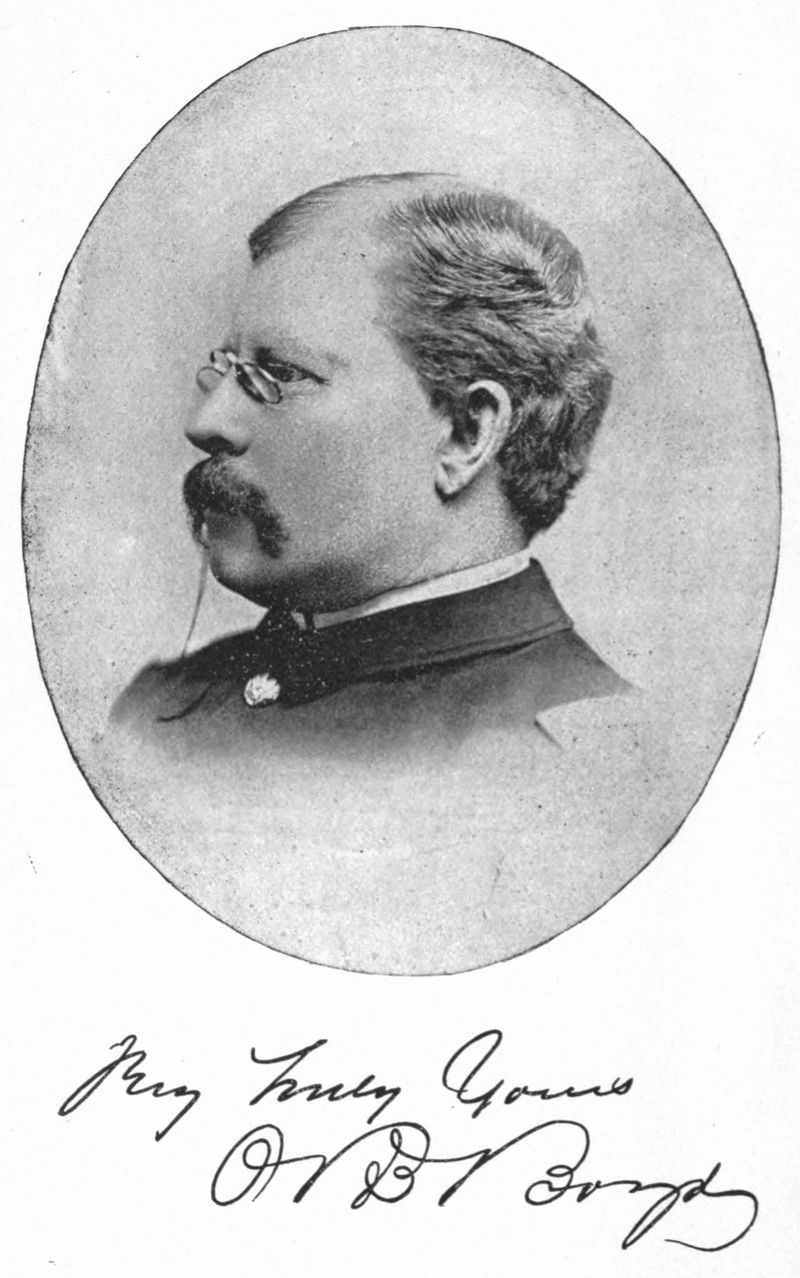
Written by Captain Orsemus Bronson Boyd, in behalf
of the Charitable Enterprises of the Ladies connected
with the —— Church of Davenport, Iowa, and also
given before the Masonic Lodge in San Antonio,
Texas.
Ladies and Gentlemen:—In the first place I am
not a lecturer. I make this announcement now,
for fear you may not discover it before I shall have
finished, or if the fact should be rudely thrust
upon you, I will have pleaded guilty in advance to
the indictment.
When, a boy, I took part in the debating clubs
that were held in those old red schoolhouses where
all great affairs of state—wars, revolution, politics
and finance—were discussed with the freedom
of boys and the ignorance of savages, there
was one question which never failed to elicit ample
talk: “Resolved, that anticipation is better than
reality,” and on that question I was always in the
affirmative. In an hour you will all be with me.
I shall tell no tale of personal adventure; nothing
worth recording ever happened to me. Diogenes,
with a lantern, and open sunlight to aid the
lantern, in the city of Athens failed to find an
honest man. An untutored Indian from the plains
of Texas, amid the common events and every-day
life of the Pale-faces, discovered that their vaunted
civilization was a myth, and their boasted culture
a delusion. Let us at once annihilate the Indian
and discredit Diogenes.
In common with all Christians of our kind, we
believe that it is easier for a camel to go through
the eye of a needle than for a rich man to inherit
the kingdom of heaven. There are other Christians
who believe that it is easier for a rich man to
go through the eye of a needle than for a camel
to inherit the kingdom of heaven. Who shall say
which Christian is the Christian?
Before the brothers of this noble profession, this
mystic tie, whose deeds have been known in every
land and under every sun—amid burning flames
and on frozen mountains, on swollen rivers and
tempestuous seas, by the bedsides of dying princes,
in the cabins of poverty, desolation, and disease,
in public and private, to bond and free, to all
brothers who own its symbolic rites—to all
brothers and wives of the brothers, I can more
freely speak of one who, though ignorant and a
savage, still found in his own faith and his own
civilization his own Christianity.
Eighteen hundred years ago, in Capernaum by
the Sea of Galilee, a man, whom the charity of
God had sent into the world, was preaching to the
people. And a certain lawyer, willing to justify
himself, stood up and asked, “Who is my neighbor?”
Promptly came the answer:
“A certain man went down from Jerusalem to
Jericho, and fell among thieves, which stripped
him of his raiment, and wounded him, and departed,
leaving him half dead.
“And by chance there came down a certain
priest that way, and when he saw him he passed
by on the other side.
“And likewise a Levite, when he was at the
place, came and looked on him, and passed by on
the other side.
“But a certain Samaritan as he journeyed, came
where he was; and when he saw him, he had compassion
on him.
“And went to him, and bound up his wounds,
pouring in oil and wine, and set him on his own
beast, and brought him to an inn, and took care of
him.
“And on the morrow when he departed, he took
out two pence, and gave them to the host, and said
unto him, Take care of him: and whatsoever thou
spendest more, when I come again, I will repay thee.
“Which now of these three, thinkest thou, was
neighbor unto him that fell among the thieves?”
On the boundless prairies of the West and
South, that are in extent empires, the white man
has learned that devotion which Nature, in her
grandest forms, most surely teaches. He has
learned that tolerance which men unfettered by
the bonds of conventional society most quickly
learn.
Two years ago last July I found myself encamped
upon the banks of the Red River of
Texas, with forty horsemen as scouts under my
command. Like a silver thread the river ran a
thousand feet beneath us, through the wildest and
most precipitous cañon.
At four o’clock one morning, a Seminole Indian,
attached to the command, brought me intelligence
that six hours previously six horses, four lodges,
one sick Indian, five squaws, and several children
had descended into the cañon one mile above us,
and were then lost to sight. I asked:
“Had they provisions?”
“Yes; corn and buffalo meat.”
“How do you know?”
“Because I saw corn scattered upon one side of
the trail, and flies had gathered upon a piece of
buffalo meat on the other.”
“How do you know that one of the Indians is
sick?”
“Because the lodge poles were formed into a
travois, that was drawn by a horse blind in one
eye.”
“How do you know the horse was half blind?”
“Because, while all the other horses grazed upon
both sides of the trail, this one ate only the grass
that grew upon one side.”
“How do you know the sick one was a man?”
“Because when a halt was made all the women
gathered around him.”
“Of what tribe are they?”
“Of the Kiowa tribe.”
And thus, with no ray of intelligence upon his
stolid face, the Seminole Indian stood before me
and told all I wished to know concerning our new
neighbors, whom he had never seen.
Two hours from that time, not knowing whether
they were friends or enemies, I was carefully
studying, from the bluff above, through a field-glass,
the Indian camp.
The lodges had all been erected, and were gay
with the robes of the buffalo of the plains, the
prairie wolf, and the coyote. A great war bonnet
of eagles’ feathers hung before the door of the
principal tepee, denoting that its occupant was a
chief. From the lodge pole floated a blue streamer,
bearing the rude device, in red paint, of a whip-poor-will
attacking a rattlesnake; this told me that
he was the chief of all the Kiowas. I knew the
man. I had met him, with many others of his
tribe, one night several years before, one hundred
miles below on the same river, and the meeting
had not been pleasant to either of us.
In fact, several hours had been required in which
to adjust our differences; and as the chief left me
amid the crack of rifles and the swish of arrows,
I heard his clear voice solemnly declaring in Spanish
that he would surely come again “when the
moon was young.” Fate was too strong even for
the chief of the Kiowas; he never came; his tribe
had been conquered and were at peace.
Returning to my cantonment, I hastily saddled
a small detachment, and descending the almost
precipitous sides of the gorge reached the Indian
encampment, and dismounting, raised the buffalo
skin that hung before the entrance of the principal
lodge, and stood unsummoned in the presence of
the chief. An old and shriveled man, with nerveless
arms and sunken eyes, from which the fire of
battle had forever fled, lay upon a rude couch of
skins. He gave courteous greeting, said he knew
me, and even spoke my name. As I sat upon the
ground at his side he told me how, for weeks
before our previous meeting to which I have
alluded, he had been upon my trail when I marched
over the short, crisp buffalo grass of the staked-plains.
He had known my personal habits, the
disposition of the camp for defense at night, the
number of men, animals, and wagons; in fact, all
that I had known myself.
The chief then told me that he was stricken by
death, and should soon be in the presence of the
Great Spirit, roaming the happy hunting grounds
of his tribe, and asked that he be allowed to die
in peace.
Day after day I visited the dying warrior, who
related from time to time, as his strength permitted,
the story of his life and the story of his
tribe. He recounted the wrongs they had suffered,
and the wrongs they had done. He told me of
their customs and traditions, their marriages,
births, and deaths. For days he talked, sometimes
in the soft Spanish tongue, often in the beautiful
sign language of the plain Indian.
In my youth I lived near, and of course read the
romantic creations of that clever gentleman who
resided upon the shores of the beautiful Cooperstown
Lake. I had also read the works of a novelist
from the South who had invested the Indian
character with all the warmth and color of his
native skies, with all the romance that belonged to
his Southern forests, gay with flowers and poetic
with festoons of clinging moss.
In consequence of this I had come to look upon
the Indian as all that was noble, grand, and heroic
in war, all that was gentle, tender, and true in
peace. I had read with breathless interest of his
loves, courtships, and marriages. I had admired
his keenness of vision upon the trail, his untiring
energy, fleetness of foot, immunity from fatigue,
his long fasts, and the halo of romance that
seemed to ever encircle him. I considered him a
“Chevalier Bayard,” a model of physical beauty,
who resembled, perhaps, the dying gladiator.
My boyhood’s dream was rudely broken, and like
many another boyish illusion it disappeared in a
day. I found the Indian dirty, unwashed, and
treacherous, a prey to the lowest instincts and the
most revolting cruelty.
He was no “Chevalier Bayard,” and did not
resemble the dying gladiator. The romance, color,
light and shades—all were gone, and I learned
that the Indian and our treatment of him were
deformities and blots upon our fair land and our
modern civilization. Between the law of force
upon one side, and the law of civilization upon the
other, the Indian has been tossed like an unripe
apple, and has not known which to obey.
One night the old Indian chief died, and the
next morning, with such rude and simple rites as
obtained among the Kiowas, we carried him to his
last resting-place upon the platform which had
been erected for the purpose.
The dawning light was flushing rosy red in the
blushing East; in the West the darkness of the
night still lingered. The songs of a thousand birds
and the chirp of millions of insects broke in some
measure the eternal silence of those great plains.
The buzzard, a mere speck in the sky, with the
eye of the eagle waited impatiently for his prey.
Herds of timid antelopes, with great startled eyes,
watched us from a distance, ready to dash away on
fleetest foot at a moment’s warning. Troops of
buffaloes were slaking their thirst in the rippling
river. The great cat-fish, with strong leaps, rose
bodily from the water in pursuit of prey, and fell
back with a splash.
All animal life was awake with the flush of the
morning; and as the sun’s disk appeared above
the horizon’s dead level, we laid the chief upon the
platform, with his face turned toward the “God of
the Dome.” His body was wrapped in a red
blanket stoutly bound about with cords. He had
been brave in battle, so all his war implements
were laid by his side. His great war bonnet of
eagle’s feathers was hung upon one of the upright
poles. His horses were slain by the scaffold.
Then, to the accompaniment of low-voiced chants,
his widows began their work of scarification with
knives upon the lower extremities. When that
was finished we left him to the hush of those vast
plains.
That night in one of the lodges a great great
granddaughter but a few months old died. The
child was placed in a frail burial canoe, covered
with trailing vines that had grown upon the river’s
banks, and gently cast adrift. No doubt the tiny
bark was soon caught in rippling eddies, or its
course stopped by stout rushes, and in time its lifeless
occupant returned to the dust from which it
had sprung.
After the obsequies of the dead chief I returned
to camp, and in order to divert my mind sought to
fatigue my body by stalking buffaloes all day. But
I had gained a new insight into the Indian character,
and one which enabled me to respect it.
That evening, lying in a hammock under the
awning of my tent, as the first shades of darkness
came creeping over the plains, there struck upon
my ears, borne upward from the gorge below, the
chant of Indian women for their dead. Its tones
were the rhythm of sorrow and the notes of woe.
Until midnight the songs continued, now loud, then
sinking to the faint whisperings of the wind. Next
morning the lodges were in ashes, and nothing was
left of our strange neighbors but the dead chief
upon his platform, and the footprints of their moccasins
as they traveled straight toward the North
Star.
These events made so strange and strong an
impression upon me, that I propose telling you
this evening, in as simple words as possible, the
story of the pilgrimage of Weeping Weasel, late
chief of all the Kiowas. I shall dwell longer upon
his attempts to introduce the white man’s civilization
in his tribe, what he saw, and the inferences
drawn therefrom, than upon all the other incidents
he related. The conclusions at which Weeping
Weasel, with the intellect of an Indian and the
sagacity of a politician, arrived, are not necessarily
mine; and if their recital should wound any one
within the sound of my voice, I would beg them to
remember that they were told me by a dying Indian
chief, as he lay in his lodge upon the banks of
the Red River flowing peacefully through the great
staked-plains of Texas.
Years and years before—even for hundreds of
summers—the Kiowas had been a powerful nation.
When the tent of the chief was planted, there clustered
around it five thousand lodges. The tribe
was rich in the implements of war, owned thousands
of horses, were mighty hunters, bold and
aggressive warriors. No footprint of man or animal,
no upturned stone, broken twig or bended
grass escaped the keen vision of their scouts.
From El Paso, where the Rio Grande del Norte
commences its westward course, and swings in the
arc of a great circle until completed at the mouth
of the Pecos, where it again flows south, they
owned the lands of which this river formed the
Western boundary; thence south across the “Devil’s
River” and the Nueces, to where it empties
into beautiful Matagorda Bay. On the east they
had fought for supremacy with the Comanches,
and been victorious. They had made the Tonkawas
a nation of beggars and old women. From
across the border they had repelled invasions
of the Kickapoos and Lipan-Apaches. They had
marched, an irresistible army, across the pine ridges
and cedar mountains of New Mexico, and fearlessly
confronted the Warm Springs and Mescalero
tribes. The Utes of Colorado had descended from
their mountain fastnesses, battled with them in
the open plain, and been defeated. They had
measured lances with and beaten the Tonto and
Jicarrila—Apaches of Arizona. They had destroyed
the great wheat-fields on the Gila River of
the Pima and Maricopa tribes. The Yumas had
heard their battle-cry. They had pushed their
conquests amongst the Pi-Utes and Shoshones of
Nevada, and from thence had marched against the
Bannocks of Idaho, and the Nez Perces of Oregon.
Their spoils of war had been great.
But in course of time the hands of all other
tribes were raised against them, and through disaster
and defeat they had been reduced to the
occupancy of only the great plains of Western
Texas.
At that time Weeping Weasel became their
chief. He was then in the prime of manhood.
The nerveless arm that I saw in his lodge could
then draw the six-foot arrow to its head, and make
the cord of deer sinews writhe and moan as in
pain.
He saw that peace and industry would perhaps
be of great benefit to his tribe, and after much
communion with himself and consultation with the
elders, concluded at no distant day to turn his
face toward the rising sun, and learn the strange
and barbarous ways of the Pale-faces. He had
been told they were as numberless as the leaves of
the forest when the hot sirocco that comes from
the southern islands shakes them with its fiery
breath.
Marching over these great and silent plains
under the blazing sun, he had learned in some
instinctive way that the Pale-faces would build
cities there, and people them with busy men and
women.
Weeping Weasel had seen the Pongo or smoke-man
in the North that traversed its iron rails
faster than his fleetest pony could gallop. He had
seen a small wire stretched on poles through which
he could but dimly comprehend that the men who
lived at the rising sun talked with their brothers
who lived at the setting sun.
But before starting on a journey so fraught
with peril, he thought best to call to his aid
teachers—those of good repute among the Pale-faces.
Through a missionary he secured the services
of two devotees from Massachusetts, who
came and opened a school for the boys and girls of
his tribe.
It is true that in visage and mien these teachers
did not resemble the dusky beauties of the Kiowa
race. The ringlets worn at the side of the face,
the eyes that looked through strange pieces of
glass, the mysterious scrolls which they held in
their hands, and the sounding fall of a heavy foot
instead of the dewy touch of the moccasin, were
not calculated to inspire love and respect from untutored
savages.
Still, with the devotion of their calling, and in
their desire to do good, these mistaken and misguided
women taught on. But one fatal day they
were surprised by Weeping Weasel while teaching
the children that the world is round. The Kiowas
believed it to be flat. Weeping Weasel, with the
decision worthy a general of iron nerve and unflinching
courage in the right, seized and burned
them at the stake.
He scattered their ashes to the four winds of
heaven, and in a long address to the Historical
Society of Boston, asked that others with less
pernicious doctrines be sent. It is perhaps needless
to state that even the old Bay State, with its
advanced ideas and unyielding principles, could
find no more volunteer missionaries for that work.
Therefore Weeping Weasel must needs start upon
his pilgrimage toward the rising sun.
The night previous to his departure all the
tribes assembled, and with the great Southern
Cross gleaming and burning, they performed the
sacred rites and mysteries of the sun dance. A
hundred fires flamed brightly. Amid the yells of
warriors and the shrieks of those fainting from
self-inflicted tortures, there arose the monotonous
chants of the women as they prayed for the safety
of their chief.
At break of day he left them, and a great silence
fell upon the tribe as they mournfully sought
their separate lodges.
Day by day Weeping Weasel traveled north
and east, sleeping at night under the stars, his
food procured by bow and arrow, his drink taken
from limpid streams.
At last he came to the country of the “Smoke-man,”
and taking passage was borne swiftly over
mountains and through the valleys to some bluffs
upon the boundary of a great State, where other
Indians had held their councils years before, and
where he determined to commence his researches
and investigations.
His pilgrimage becoming known, the chief was
hospitably lodged in the house of a Christian
gentleman of that town who was a land agent.
Among the Kiowas the title to all lands and the
occupancy thereof were considered sacred. Even
in their forays against other tribes they contended
for supremacy, not for a title to the country.
Indeed, so strong was this honesty implanted
in the breast of the savage and barbarous Indian,
that once, after a great battle with the Comanches,
rather than do violence to this principle he had
ceded to them a thousand square miles of his own
country, deeming that better than to question such
undoubted right.
The land agent showed him, in his office, maps of
lands which bore strong resemblance to those occupied
by his tribe. Upon leaving, this same
Christian gentleman followed him across the State
to a city with a great bridge and offered to sell, beseeching
him to buy, for a merely nominal sum,
thousands and thousands of acres upon which his
tribe had dwelt from time immemorial. Weeping
Weasel determined not to incorporate the land
usages of the Pale-faces amongst his people.
In the towns and camps of the Kiowas, great attention
had been paid to the sanitary conditions of
their immediate surroundings. This was necessary
for the life and health of individual members
of the tribe.
In that city by the bridge he found the people in
a certain locality stricken unto death by a strange
pestilence. Upon investigating the cause, he
learned they all had drank water from a certain
well. Weeping Weasel concluded that, if he were
the chief in this locality, there would be sewers
and water-mains; or failing these, the inhabitants
who refused or were too indolent to carry water
from the river would receive a punishment, compared
with which the cholera would be a lingering
and painless death. But Weeping Weasel was an
untaught, rude, and barbarous savage.
The “Father of Waters” next attracted the attention
of this curious pilgrim. Compared with all
other rivers he had ever seen, it was as the sun to
the faintest twinkling star. He worshiped it as a
god. Day by day he sat upon the banks, watched
it through all changing moods, loved it best when
angry currents brought down yellow mud from the
far North, and worshiped it most when the setting
sun’s ocher light fell upon its surging waters,
enveloping beautiful islands.
There floated upon its broad expanse numberless
strange monsters, propelled in some mysterious
way. Weeping Weasel found they carried grain,
fruit, and other produce from one part of the
country to another, and then first began to understand
the law of trade—of barter and sale. He
took passage upon one of these palaces, descending
a hundred miles; saw the busy towns upon the
banks of his idol, filled, as he thought, with crazy
men and women. Why all this rush, ceaseless activity
and strife for wealth, he questioned.
Returning at night, and standing upon the deck
with head uncovered in the reverent attitude a
savage always assumes when awe-stricken in the
presence of nature, he suddenly became conscious
of a strange throbbing through every fiber of the
monster. He also saw abreast another monster all
aglow with fire; men were shouting and running
like mad! Every few minutes its huge furnace
doors were opened, and the blazing fires fed with
pitch and resin. The vessel shook in every joint;
men and women were crowding the deck all hoarse
from shouting; money was freely changing hands;
from the smoke-stacks long lines of fire trailed out
through the darkness; the gurgling water at the
bow was thrown in spray upon the deck. Suddenly
there was a terrible roar, a great flash of fire, then
darkness came, and Weeping Weasel knew no more
until he found himself safe upon the river’s bank.
He was told that a hundred men, women, and
children had been sacrificed that night. Burning
with anger and righteous indignation, Weeping
Weasel attended the coroner’s inquest; the evidence
was conflicting; no one in particular seemed
to have been to blame; it was an accident. Weeping
Weasel went forward to offer his testimony; a
savage could not take the oath. The coroner’s
jury promptly acquitted all of blame, even the
poor Indian, and the event was soon forgotten.
Weeping Weasel determined that the civilization
of the steamboat should never be introduced among
his people.
Again he turned his face to the east, and traveled
across a great State where the fields were
waving with ripening grain. Neat farmhouses had
been erected on every side. The corn and wheat
that he saw growing seemed to him of no use.
Who would require it?
On these undulating plains with cattle, sheep,
and horses, where peace and plenty seemed to
reign and the merry voices of children were heard
at sunset, our untutored savage began to think
perhaps was the civilization of which he had
dreamed. Still he had the Indian’s caution, and
arrived at conclusions slowly.
He determined to abide three days in the most
peaceful and quiet village, and chose one with two
churches, a bank, and store.
Upon awakening the first morning, he found
that the store had been robbed and burned during
the night. The following day the two churches
were in fierce dispute over some minor point of
doctrine. The third morning it was learned that
the bank cashier had absconded with all the funds,
leaving hundreds of families destitute.
The Kiowas did not steal from each other; the
simple faith in the Great Spirit which they had in
common furnished no cause for dispute; and the
custodian of the tribe’s public goods never ran
away with them. They never had thought of such
an occurrence; and the event was so improbable
that those barbarous savages had not even prescribed
a mode of punishment for it.
Weary, harassed, tormented, and worn out even
at the commencement of his pilgrimage, Weeping
Weasel would gladly have turned his face toward
the setting sun; but patience being one of the great
virtues of the Kiowas, he again girded up his loins
and proceeded on his journey.
But a great fear was coming upon his superstitious
soul. One afternoon, years before, while
hunting, Weeping Weasel had fallen asleep by the
side of a spring that bubbled from beneath an
immense boulder, which was sufficiently large to
protect him from the sun’s rays. As he slept, there
appeared before him the god Stone-Shirt, followed
by Pantasco, or he who robs the living; Kay-Wit,
he who robs the dead; and Quite-Qiu, who robs
both living and dead. All passed before the sleeping
warrior, to whom Stone-Shirt foretold in the
sign language this pilgrimage and the events which
would follow.
Weeping Weasel could only dimly comprehend
on awaking, that in case of failure he was to be
turned into one of the three horrid shapes shown
him by Stone-Shirt; and, forever shut out from the
Great Spirit and the happy hunting grounds, his
soul, without arms to defend itself, must wander
and fall through unfathomable space and darkness.
When he saw the terrible anxiety, woe, and
despair written upon the faces of fathers, mothers,
and children whom the vandal acts of the faithless
cashier had ruined, Weeping Weasel concluded to
ever pray that he be not turned into the horrid
shape which steals from the living.
In the robbery of the store the proprietor had
been killed; and as this ignorant savage gazed upon
the form of the man who had died while defending
his property, Weeping Weasel, in the agony of his
soul, prayed to Stone-Shirt that he be spared, both
in this his mortal, and in his future spiritual,
existence, assuming the form of him who robs the
dead.
In the dispute between the churches, so much
rancor and venom had been developed that men
who were peacefully lying, as they had lain for
years, in the little cemetery of the town, were
publicly discussed, and motives and opinions the
worst imputed to them. Happily they were ignorant
of all this.
The living were slandered and the dead vilified.
Brother became the enemy of brother, sisters were
estranged, husbands and wives separated. Again
Weeping Weasel besought Stone-Shirt, and with
the sweat of mortal agony upon his brow, that, if
he must, he would face either of the two horrible
shapes to be spared the form of the one who robs
both the living and the dead.
Weeping Weasel soon found himself in a great
city by a lake. Here he was lodged in the house
of a gray-haired and respectable man, a pillar of
the church, and one who gave largely, in an indiscriminate
way, to churches and the poor. He had
no time to investigate charities, and only contributed
to them because he had money, or perhaps to
ease the gnawings of a conscience not altogether
dormant.
Weeping Weasel was taken to church, where an
eloquent preacher held his audience spell-bound as
he impressed upon it the evils of gambling. To
all his strictures the gray-haired man responded
with fervent “Ahmens!”
The next morning his host escorted Weeping
Weasel to a great mart of trade in that populous
city. There the savage Indian remembered the
immense wheat and corn fields he had passed as he
journeyed east. He saw the reverend gentleman
who had spoken so eloquently on the sin of gambling
stealthily enter a broker’s office and sell
thousands and thousands of bushels of grain which
he did not own, and never would. His gray-haired
entertainer, who had so graciously responded “Ahmen!”
stood in the center of hundreds of other
men, all of whom were shouting and howling as he
drove grain up and down by a nod of his head;
men were ruined and families made destitute by
this man, who called gambling a sin.
Weeping Weasel learned, but it was difficult to
grasp the idea, that crops were bought and sold
before they were sown; that they became a football
upon “Change,” even while growing; and
when finally sent to market they ruined thousands.
He found that all this disastrously affected the
poor brethren of the Pale-faces, and that children
were hungry in consequence. The chief decided
he would grow only enough corn to satisfy the
wants of his people, and would forever remain
silent in regard to the gambling transactions.
Once in the history of the Kiowa tribe an old
and respected warrior had been selected to build a
lodge in which public meetings were to be held.
He was to be paid from the goods owned in
common. To the dismay and horror of all, it was
found that this rude architect had not been honest;
he had demanded more buffalo hides than were
needed for the building, and the best he had conveyed
to his own lodge, and afterward sold to wandering
traders. When the man’s crime became
known he was seized, and the elders sat around
him with stern visages. His trial was short; he
was bound on the top of the dishonestly built
lodge, and met his death in its flames.
Weeping Weasel was shown a great hall of justice
in that city where the granite was the finest
and the workmanship the most skillful. He was
told that the builder had taken the best granite
and sold it to the traders among the Pale-faces.
Thinking this had just been discovered, our barbarous
Indian went early the next morning to witness
the destruction of the building and cremation of
the dishonest builder. He waited until noon, and
as the building still stood and no torch had been
applied, Weeping Weasel turned sorrowfully away
just in time to see the false builder drinking
champagne at a fashionable restaurant with his
friends. This phase of civilization would not do
for the fierce and warlike Kiowas.
The right of husbands to exact obedience, and
the duty of wives to obey, was one of the laws of
the Kiowas, as unalterable as if written upon
tablets of stone. So strongly was this doctrine
implanted in the breast of the savage that once, in
a foray against a Northern tribe, a favorite squaw
of Weeping Weasel’s had, in direct disobedience to
his command, followed a distance of two days’
march and entered his lodge at nightfall. She was
beautiful then; but when I saw her on the banks
of the Red River she was disfigured. A broken
collar bone and a flattened nose were the results of
her disobedience. She returned quickly; her only
cause of anxiety being that she could not travel
nights for fear of passing her own village.
But among the Pale-faces Weeping Weasel
learned that the custom was different. He found
the wife frittered away her time while the husband
was at the counting-room or office. If he commanded
her to abstain from the round dances, she
danced them; if he ordered her east, she went
west; if he asked her to attend church, she preferred
the opera; if he expressed a desire for the
sea-shore, she chose the mountains of New Hampshire.
Weeping Weasel, with the cunning of the
savage, decided that this should never be told
the squaws of his nation.
As no man, intent upon a great mission, can hope
to escape annoyances and observation from the idle,
vulgar, and indolent, this warrior from the South
found that his wearing apparel, the dress of his
fathers, and the habit of his tribe, was a matter of
curious comment even among those busy people.
His clothes were good enough for him, and there
were no fashion plates and paper patterns in use
among the Kiowas. Still, at a council held at one
time for the general good of the tribe, a daring innovator
had, as a protection against snakes while
marching, suggested that the boots of the Pale-face
be adopted. A pair had been found amongst their
war plunder at one time, and had been examined
curiously by all the tribe.
In an institution for the sick, Weeping Weasel
saw in a padded cell a maniac, confined and chained
to the floor. He held a wisp of straw in his mouth,
his clothes were torn to tatters, his hands cut and
bleeding, foam issued from his mouth and mingled
with blasphemy from his lips. His cries for salvation
from invisible enemies were piteous. The
matted hair and bloodshot eye told the Indian a
tale as graphic as the pictured rocks of his own
tribe. He found that the man was young, rich, and
respected. He asked the nature of the disease, and
was carelessly told that it was “snakes in his
boots.” Sadly Weeping Weasel asked that the
wire be at once ordered to carry a message to his
tribe for the immediate destruction of the boots
found among their plunder. He also wondered
why the Pale-faces did not at once destroy the serpent
whose terrible folds were coiling around the
youth of their country.
All this time Weeping Weasel’s perceptions were
being quickened and his reasoning powers enlarged.
The Kiowas had always considered the
marriage tie sacred. It was true a man might
have many wives, enough to do all the work of
his lodge, while he used his energies only for war
or in the pursuit of game. But once taken, the
man and woman were bound for life. No power
on earth could dissolve the tie. Infidelity in either
was punished by death. But in that great city he
found courts open as the day, in which shameless
men and brazen women sought the strong arm of the
law to break and tear asunder the most sacred and
binding of oaths. Weeping Weasel learned that
only a publication in an obscure newspaper was
necessary to satisfy the goddess whom Weeping
Weasel had seen represented as blind-folded, with
scales in her hand. Incompatibility of temperament
was often the cause alleged. This the Indian
could not understand. Among the Kiowa husbands
and wives such a thing was unknown. The husband
commanded, the wife obeyed. Weeping
Weasel found after a time that this term was used
to indicate that wives had become tired of their
husbands, or husbands had grown weary of their
wives. It often meant dishonest and unholy loves,
and could be construed as indicative of a thousand
things when the cord that first bound two people
together had become a gnawing, corroding chain of
iron.
The ignorant savage had not as yet found any
advantage to be gained from the civilization of the
Pale-faces. Weary and sick at heart, the pilgrim
pushed on until he reached the chief city of the
great nation. He had begun to comprehend the
numbers of the Pale-faces and their strength. His
brain was confused. He was so torn by conflicting
emotions that he feared his judgment would become
warped and valueless. Arriving in the great
city, he learned that a man with unlimited power
had betrayed his trust and plundered the city’s
treasury of millions. Yet the blind goddess had
thrown around him all possible shields to cover his
glaring rascality. He had banded with him an
army of thieves. Again a great hall of justice had
been the means used to rob and plunder the people
at will. Before public exposure the thing had been
a byword and a jest at the clubs.
The man who had done all this had risen to
power from the ranks of the common people.
Weeping Weasel wondered if he had risen to
power by his rascality. But conscious that he was
ignorant and a savage, he rejected the thought
as unmanly.
When a warrior among the Kiowas betrayed a
public trust he was terribly punished. But one
such case had ever been handed down in the traditions
of their tribe. In that instance the culprit
had been led in a circle surrounded by all his tribe—every
man, woman, and child was present—the
silence was fearful; then the body of the victim
was covered with the broad leaves of the
prickly pear, and they were one by one set on fire.
The punishment seemed to have been effectual.
Next morning our Indian appeared at the city
hall to witness the torture; again he waited until
noon, and as no steps had been taken against the
wrong-doer, he concluded, to say the least, that the
white man was slow in punishing criminals.
The Kiowas had always paid great attention to
the rearing of their children, and especially exercised
great care and foresight over the girls, who
were to become future mothers of the warriors of
the tribe. No Indian girl of six or twelve years
could be absent from her lodge after the fall of
evening dew. She knew no lovers until she had
arrived at the age and estate of womanhood.
Among the Pale-faces this custom did not obtain.
Weeping Weasel saw misses of tender age, in pinafores,
give large parties to other children; boys
were invited. He saw childish eyes sparkle with
bandied jest and compliments fit only for mature
years. He saw children, excited by the dance, intoxicated
with music, satiated with rich food,
spend the best hours of the night in gay and reckless
dissipation.
At certain seasons of the year the Chickasaw
plum furnished much of the food used by his
tribe. If the pure white dust was brushed from
its surface when half-ripe, it never fruited in
perfection. Weeping Weasel found that the Pale-faces
often brushed the dust of the plum from the
cheek of childhood.
The Kiowa woman was to him the model of
physical beauty; her large waist, broad, strong
shoulders, the strength of limb, elastic, springing
step, and downcast eyes were such as he deemed
fitting for women who were to rear the future
braves of their race.
Among the Pale-faces he found that maternity
was a burden to be avoided; that the waist was
contracted by springs of steel; the body thrown
forward at an angle upon the hips by strong pieces
of wood placed under the heels; the face was
covered by a vile compound which looked like
flour, or was painted as the savage paints when he
marches to battle or prepares for the sun dance.
Curious to ascertain the exact value of all this
nonsense he made calculation, and learned that
the muslin and silk, velvet and ribbons, paint and
powder, flowers and bits of steel, amounted to
about four hundred and fifty-three dollars. That
is to say, in the Kiowa computation, forty-five and
a half horses.
Weeping Weasel determined to be silent upon
this manifest absurdity of the Pale-face women.
The Kiowa women wore the hair straight down
their backs and combed away from their eyes.
The daughters of the Pale-faces cut theirs short in
front and allowed it, except when curled by hot
irons, which the damp strangely affected, to fall
into their eyes. The meaning and mystery of this
Weeping Weasel never attempted to fathom.
Besides the Great Spirit whom the Kiowas worshiped
in common, each Indian had a personal
god to whom alone he was responsible. This god
was the conscience of the savage, and above it was
only the commands of the Great Spirit. His religion
was always with him; it was his shield and
strength in the day of battle, his comfort in time
of peace: he heard it in the whispering of the
wind and the sighing of the trees; he recognized it
in the rustle of the growing grass and the ripening
grain; he felt it in the songs of birds and the
whirr of insects’ wings. It warned him in the
broken watch-spring buzz of the deadly rattlesnake;
in the forms of the clouds he saw it; in
the flush of morning and the darkness of evening
he knew it. It was his only ideal of the estate of
future happiness where game would be plenty and
peace eternal. The bark on which these mysteries
were written was to him sacred. The savage accepted
as truth its teachings, which long generations
of Kiowas had confirmed.
He went while in that city to hear a speaker—silver-tongued
and magnetic, who had all the
graces which belong to the polished orator; his
voice was like the sound of bells to the Indian,
whose nature is ever open to the charm of this
God-like gift. But he heard the man revile, distort,
and falsify the religion of the white man. He
heard him read from the sacred book, with laughing
mien and careless jest, most solemn promises.
The mysteries of the creation and the origin of the
Pale-faces became in the mouth of this man as intangible
as the will-o’-the-wisp he had seen floating
over his Southern swamps.
Listening to him, and applauding to the echo,
were sons and daughters of the Pale-faces. Fair
women and intelligent men accepted as eternal
truth the words of the speaker. Weeping Weasel
was ashamed, astonished, dismayed! In this desecration
of religion the wild Indian of the Southern
plains thought he could dimly comprehend the
future downfall of a great nation.
The pilgrim lost hope. Still he determined to
pursue the subject to its bitter end, and went one
bright morning to the City of Churches. Business
had ceased, and the streets were quiet. In a
darkened temple, rich with stained glass, the air
heavy with burning incense, and stirred only by
the notes of a great organ as it kept time to the
voices of boys who sang in angelic tones the litany
of the church, he heard an eloquent preacher tell
of the wickedness and sin of two great cities; and
how, because not ten righteous men could be found
therein, they were destroyed from the face of the
earth. He also listened to the story of the wife
who looked back, and was turned into a pillar of
salt. The next morning Weeping Weasel bought
a canopy of asbestos roofing, and thereafter never
appeared in the streets of either of the cities without
carrying it above his head.
Again he was shown the great marts of trade,
larger than the grain exchange of another city.
Here men bought and sold scraps of paper and the
country’s gold. It was the same old scenes. Stocks
went up and down by a nod of the head, and again
men were made poor in a moment. The ruined
ones were driven from the exchange, and forever
after, with wild eyes and fevered pulse, they
haunted its doors and talked, with the strange infatuation
of the Indian hemp-eater, of the rise and
fall of the stocks that had ruined them.
One terrible day Weeping Weasel saw a coin
that the Pale-face used in exchange for goods become
enhanced in value three times. Wild, haggard
men clung to railings for support, so faint
they could not stand. Two unprincipled members
of the exchange were the agents of this scheme.
When night came, the credit of the country had
been nearly ruined. The two conspirators slunk
to a hotel that was soon surrounded by a howling
mob. Trade and industry were impaired, commerce
nearly swept from the sea and land, and credit
almost lost by the act of those two men. Weeping
Weasel again determined that gambling should
forever be prohibited among his people, even the
throw of the six cherry stones for a quart of
Chickasaw plums.
Among the Kiowas the public singer of the
tribe’s heroic deeds was a warrior, always well
paid for his services. He had the warmest seat in
the lodge, and at the feast of dog-meat the tenderest
piece; but the newspaper man of the Pale-faces
was lean, ill-fed, and most lightly paid.
Weeping Weasel found that medicines for the cure
of all diseases were sold in bottles, and that the
proprietors waxed rich. The savage concluded
that all the Pale-faces could drink, but that few
could read.
In settling disputes among the Kiowas, all matters
in question were referred to a council composed
of fifteen elders of the tribe. Each principal
laid his case before the tribunal with all the clearness
possible, in order that a just decision might
be reached. Among the Pale-faces the Indian
found a class of men skilled in the preparation of
causes in dispute. From long practice, close study,
and great care, these men, who talked only of
others’ rights and not of their own, had become so
skillful that white was made black, and black white,
as each argued his own point. Doubt was thrown
upon the most open and public transactions. Witnesses
swore to the most improbable events, and
to occurrences they had never seen. In their harangues
before the elders each quoted the same
statutes in the same words, as applicable to his
side of the cause. There were fierce disputes and
incessant wrangling. Weeping Weasel determined
that this kind of practice should never obtain a
footing in his tribe.
The Kiowas had always considered sacred the
life of each member of the tribe. In their rude
and barbarous code there was no deviation from
the rule of “blood for blood;” it was as unchangeable
as the “Laws of the Medes and Persians.”
In a court of justice Weeping Weasel saw a man
arraigned who had wantonly slain a brother by
sending a bullet through his heart. The crime
had been seen by many; there was no conflicting
evidence; it was premeditated; but again the counselors
covered the case with doubt. The murderer
had a bright, intelligent face and an undimmed intellect.
Weeping Weasel heard him acquitted on
the ground of temporary emotional insanity. The
proceedings of that court were unfit for the uncivilized
Kiowa.
Among the Kiowas, the position of medicine-man
was one of great honor and trust, but extremely
hazardous to the incumbent. When a
warrior sickened the medicine-man was at once
summoned. With rude rites, much beating of
drums and strange incantations, he sought to drive
away the disease. Sometimes he was unsuccessful
and the patient died. When the corpse of his mismanagement
was ready for burial the medicine-man
was summoned, and he always came. He was
divested of all his titles to respect, all the trophies
he had gained by successful practice of physic, and
manfully met his death on the scaffold with his
victim.
Such was not the custom among the Pale-faces.
Everywhere Weeping Weasel saw gilt-lettered signs
of the medicine-man of the whites; yet the Pale-faces
died, and the same medicine-man ministered
to another. The savage also noticed that in this
strange country the physician never attended the
burial of his victim. Weeping Weasel concluded
that the death of the doctor had once been a
custom among the Pale-faces, but having fallen
into disuse the fraternity attended no funerals for
fear it might be revived.
Among the medicine-men of the Pale-faces,
Weeping Weasel found a class who with pictures
and posters attracted the eye to fabulous certificates
of wonderful cures. They resided in great
houses wherein were all comforts, and where, with
endless noise and show, they professed to cure all
diseases by water, by physic, by pills, by powders,
by plasters, by new and strange remedies, even by
the laying on of hands. He found that while regular
practitioners were allowed to live, these people
fared better even than they. They waxed fat and
grew rich upon the credulity of an ignorant public.
They lived and moved in the open glare of the
noonday sun. After all he had seen, Weeping
Weasel ceased to wonder at the strange epidemics
that sometimes prevailed among the Pale-faces.
He saw long trains, drawn by the mysterious
Pongo man, and managed by underpaid and careless
workmen, collide with other trains, and as a
result men and women were killed and children
maimed; yet no one was punished.
Our pilgrim now turned his face toward the
capital of the great nation. One of the three
horrible shapes shown him by Stone-Shirt must
inevitably become his. But he did not look back.
Civilization had caused him to think of the
exhortations of the Pale-faced preacher. He “remembered
Lot’s wife.”
The Massachusetts school teachers had displayed
in rude letters on the walls of the lodge in which
they taught this text from the scriptures: “The
wicked flee when no man pursueth.” In the city
in which Weeping Weasel had just arrived he
found that an officer of the Pale-face warriors was
a defaulter to the sum of many thousands of the
coins of his people. He was shamefully untrue!
His position and name had been used to further defraud.
There were no extenuating circumstances—there
could be none. But the officer escaped, and
no one followed and brought him back. Weeping
Weasel was glad that he had burned the teachers
at the stake, for he concluded they had willfully
misrepresented the text hung upon the walls of the
lodge, and that it should have read, “No man pursueth
when the wicked flee.”
In the Kiowa tribe all the councils were held
and the proceedings argued in a grave and dignified
manner. The pipe, signifying good will and
friendship, was first passed around. Each warrior
touched it with his lips. That day on the banks
of the Red River, when Weeping Weasel attempted
to tell me of the councils of the elders of the white
man, his breath was short, and much of what he
said was lost.
In that city he was told offices were bargained
for; the daughters of the Pale-faces solicited them
for their husbands and friends. He saw a cabinet
minister fall from his high place through the sale
of paltry positions.
Worn, harassed and broken in spirit, his pilgrimage
useless, as no good could, in his opinion, come
to the savage from the white man’s civilization,
Weeping Weasel turned his face towards the setting
sun. He traveled as before, sleeping at night
under the stars, and again his drink came from
limpid streams; but his food was procured by a
revolver and magazine gun of the Pale-faces.
Civilization had taught him the deadly effect of
these weapons which he afterward used upon his
enemies and the Pale-faces themselves.
He returned to his tribe. His coming was seen
from afar. Without a word he entered his lodge:
he had no greeting for his faithful wives who
clustered around him.
Three days passed, and then Weeping Weasel
told to his people the story of his pilgrimage, told
what he had seen and heard, and the conclusions
he had drawn therefrom. With barbarous splendor
he was tried for the crime of falsehood, which
is capital among Indians, all the men, women and
children of the tribe serving as judges.
In a great amphitheater of rock, at the junction
of the Pecos with the Rio Bravo del Norte, where
the swift rush and meeting of the two rivers forms
a whirlpool from which nothing can escape, the
public trials of the tribe were held, the people sitting
for days in solemn judgment. If sentence of
death was decreed the body was thrown into this
fearful eddy, and watched by all the tribe as it
whirled, leaped, and sprang in the boiling water
until its final disappearance.
For generations and generations the gray and
frowning rocks had witnessed the trials of offenders
among the Kiowas. On one side rose sloping to
the bluff a half-circle of trees. So thickly grew
the branches of those pines and cedars that but
scant sunlight could filter through them. Custom
had decreed that if, at the moment of passing sentence,
a ray of light should penetrate those thickly
mingled branches and fall upon the face of the
criminal, one-half of the sentence should be remitted.
The trial was as great as the occasion. Eagle
Face, the oldest medicine-man of the tribe, was
master of ceremonies. Flowing Hair, the favorite
wife of Weeping Weasel, who had at one time,
during five days of starvation, fed her first-born
boy with blood drawn from her breast, was there,
but silent, in her great fear, as became an Indian
woman. Circumstances were against the pilgrim.
Those wild savages could by no argument be
brought to believe that there were such uncivilized
people upon the face of the earth. If it were true,
how could they live together? It was decided
that sentence of death must be passed.
The chief, proud and defiant, took his stand
against the half-circle of trees. Below, the pool
was lashing itself into anger from a rising river.
Flowing Hair had thrown herself at his feet as
if to interpose her womanly strength against the
dread sentence of an undeviating Indian code. At
that moment a broad, imprisoned ray of light that
had been entangled among the pines escaped and
fell, in all its trembling warmth and pitying tenderness,
upon the face of the wild Indian who had
told the truth. In its soft caress it embraced the
form of his fainting squaw.
Weeping Weasel escaped capital punishment, but
was deposed from civil authority over the Kiowas,
and was only obeyed as their supreme war-chief.
His sentence further banished him, when stricken
by death, from his tribe and from burial with his
brethren. This was why I found him while dying,
surrounded only by his family, on the banks of
the Red River.
On the night of his death, to comfort a poor,
dying soul, whose future seemed bright enough—although
his religion was not mine—I told him,
in the sign language, which his glazed and closing
eyes could but dimly see, that, in my opinion, his
tribe was nearer civilization than he dreamed,
since to advanced ideas his sentence seemed just,
and that he had only suffered the fate of all
reformers.